THE INVENTION OF TYPOGRAPHY A BRIEF SKETCH OF THE INVENTION OF PRINTING AND HOW IT CAME ABOUT
Transcriber’s Note:
The cover image was created by the transcriber and is placed in the public domain.
TYPOGRAPHIC TECHNICAL SERIES FOR APPRENTICES—PART VIII, No. 50
BY
FREDERICK W. HAMILTON, LL.D.
EDUCATION DIRECTOR
UNITED TYPOTHETAE OF AMERICA
PUBLISHED BY THE COMMITTEE ON EDUCATION
UNITED TYPOTHETAE OF AMERICA
1918
Copyright, 1918
United Typothetae of America
Chicago, Ill.
Composition and electrotypes contributed by
Evans-Winter-Hebb, Inc.
Detroit
PREFACE
3
The writer of this book makes no claim to original
investigation. The materials for such investigation
do not exist to any considerable extent in this
country. The results of such an investigation would
form a book not suited to this series.
The writer has attempted to set forth briefly the
conditions which brought about the invention of
printing and to present the main lines of discussion
concerning the inventor. He has consulted with
some care a considerable number of authorities
and has endeavored to present the results in comprehensive
shape.
The writer believes that the history of any particular
event is a part of the general history of the time
in which it occurred. He has, therefore, endeavored
throughout the historical portion of this series to
indicate the general historic background of all particular
historical events sufficiently to set these particular
events in their relations to what was going on at the
time in the world generally.
In addition to the supplementary reading indicated
in the several volumes which follow, the writer ventures
to hope that the students will familiarize themselves
with some good general text book on modern
history.
Many persons and many places have claimed
the honor of the invention of typographic printing.
That these conflicting claims should be made
is the most natural thing in the world. Almost all
epoch-making inventions and discoveries are of more
or less doubtful origin. The reason for this is that
such discoveries grow out of conditions and needs.
At the time appointed they appear as inevitably as
the blossom on the plant. Very likely they appear
in several places at once. Often, also like the blossoms
on a plant, only one produces what the gardener calls a
“set,” that is, a fruit which ripens and matures seed
for reproduction. The state of human knowledge or
the pressure of human need may be such that many
students are at work at the same time upon problems
which seem to demand solution. In this way the
theory of evolution, whose adoption, revolutionizing
as it did the entire system of human thinking, was
the most important event of the nineteenth century,
was independently discovered by Darwin and Wallace,
who were working at the same time along independent
lines of investigation.
The advance in surgery and a keen appreciation
of the suffering under operation which made many
operations impossible led to the simultaneous discovery
of anesthesia by at least two investigators,
William T. G. Morton and Dr. Charles T. Jackson.
Investigation of the uses of electricity led to the
independent invention of the telephone by Bell and
Dolbear. It is certain that occasional European
sailors found their way to the western hemisphere
through several centuries before Columbus made his
8famous voyage. These are only a few of the most
notable instances of such disputed or independent
discoveries.
In some cases the judgment of the world has probably
awarded the glory incorrectly. In other cases
the glory has gone, perhaps justly, to that one of
two or more discoverers who succeeded in making his
invention practically or commercially useful. For
instance, while Morton was probably not the original
discoverer of anesthesia, it was he who made it
practically useful in surgical operations, and while
there appears to be no question that Dolbear antedated
Bell in the discovery of the telephone, Dolbear’s
interest was purely scientific while Bell gave
the telephone to commerce.
The same conditions of doubt and obscurity surround
the invention of printing. As we shall later
see, more at length, the invention of printing was a
development of existing processes called for by the
needs of the time and arising out of the conditions of
the time. It was inevitable that typographic printing
should be discovered by somebody in the middle of
the fifteenth century. So far as the evidence at our
command shows, the art was not invented in several
places at the same time, but was developed by one
man out of familiar processes. For some reason
which is not now clear, the work of this man, though
considerable in extent, appears to have been without
immediate direct results of much importance. At a
very early stage the invention was seized upon by
another who, with his associates, established a center
from which the art steadily grew and developed. So
important in its practical results was the work of this
man and his associates that he has been for centuries
hailed as the inventor of printing. It is needless to
say that this man was John Gutenberg.
In the judgment of the present writer, however,
the claim that Gutenberg invented typographic printing
cannot be maintained. The discussion has been
long and sometimes bitter. The arguments, or at
9least many of them, are of a highly technical nature
and many minor points yet remain to be cleared up.
In a book of this sort it would be obviously out of
place to go at length into the details of the argument.
The writer, moreover, lays no claim to original
investigation. An attempt will be made in the following
pages to show the conditions out of which
the discovery arose, to tell the story of the invention,
to place the credit both of actual invention and
practical application where it belongs, and to bring
out certain points which may be interesting about
the work of the very earliest printers.
In taking the position which he does with regard
to the invention the writer regrets that he is obliged
to dissent from the conclusions of De Vinne. In his
Invention of Printing, De Vinne ably maintains the
claims of Gutenberg. No one can be more ready
than the present writer to pay homage to the greatness
of De Vinne and to acknowledge the immense debt
which the printers of America owe to him. His
series of historical and critical essays on the practice
of typography are still unapproachable. In spite of
the changes which have taken place in the years since
they were written, their substance is not affected
excepting in some minor and unimportant details.
They are still supreme authority in their field. De
Vinne’s historical work was also of great importance
and for the most part may still be accepted without
question. Under these circumstances it is only natural
that the conclusions of De Vinne should carry
great weight and that the great body of American
printers should have accepted the Gutenberg attribution
without question upon De Vinne’s authority.
It must be remembered, however, that De Vinne’s
work was written nearly forty years ago. Just before
he wrote, Dr. Van der Linde had published a voluminous
work in which the theory of the Gutenberg
invention was supported at great length and with
great show of scholarship. This was later followed
by other volumes of similar purport. For a considerable
10time Van der Linde’s books were considered
as settling the question. De Vinne, as may clearly
be seen from his preface, wrote under the spell of
Van der Linde’s influence. Later investigations,
however, have shown that Van der Linde’s scholarship
was largely show, that he was not only uncritical
but unskillful in his use of authorities, and that his
voluminous works are written with the sole purpose
of bolstering up a preconceived theory. Most of this
investigation had not been conducted when De Vinne
wrote. The discussion cannot be said to have swung
the balance of probability to the other side until after
De Vinne’s literary activities ceased. The knowledge
we now possess, however, has forced the present
writer to abandon the De Vinne position and to base
the historical part of this series of text-books on
acceptance of the belief that typographic printing
was discovered by Coster, of Haarlem, in Holland.
CHAPTER I Conditions in the Middle of the Fifteenth Century
11
As was briefly indicated in the preceding volume
in this series, the conditions existing in the world
of letters at the middle of the fifteenth century were
such as to demand imperatively some new method of
making books. The slow march of civilization had
gone on with many setbacks and interruptions through
the centuries, but was now proceeding with a swiftness
hitherto unknown. The demands of the human mind
were pressing hard against the physical boundaries
to progress created by the methods of book-making
then in use. It must be remembered that men were
still making books just as they had done for nearly
two thousand years. A vast store of knowledge had
been accumulated and additions were being made
with tremendous rapidity, but there was no adequate
means of getting this knowledge before the people.
At the same time there were more people intensely
eager for knowledge than ever before.
It is worth while to stop for a moment to consider
the conditions of the period. The Hundred Years’
War between France and England, which had paralyzed
the energies of a divided France and had
exhausted the powers of England in useless attempts
at an impossible conquest, had at last come to an end.
The English had withdrawn to their own island.
They had given up the dreams of a continental
empire which had danced before their eyes ever since
William of Normandy, in 1066, had added England
to his possessions. In reading English history we
are liable to forget that during a great part, if not the
12whole, of the four hundred years succeeding the Conquest,
the English kings had considered their continental
possessions the more important, regarding the
little island which they shared with the Scotch, then
an independent nation, as a sort of colonial possession.
It is true that they maintained their capitals
there and took their titles thence, because in England
they were kings, whereas they governed their broad
possessions on the continent as dukes or counts only.
From the time of Henry V they had claimed to be
kings of France. Now these continental ambitions
were definitely given up and England was free to
develop her own nationality, and a much more vigorous
national life immediately began.
The same events mark an era in the development of
France. Free from the horrors of war and the dread
of another conquest, a new opportunity was given for
the development of the arts of peace.
Italy was still divided into a great number of
independent states whose quarrels and changing
alliances make the Italian history of the period
extremely difficult to study on its political side.
There had, however, developed in Italy a group of
strong rulers who governed states of respectable size
and kept them for considerable periods in comparative
stability. The Italian states had rallied more quickly
from the barbarian invasions which overthrew the
Roman Empire than the rest of Europe and their
progress in civilization had been very remarkable
when one considers the civil wars and wars between
small states which had been almost continuous.
For the most part Germany had lagged far behind
the rest of Europe in the development of civilization.
The greater part of it, however, was now in a fairly
stable political condition and many of the German
states had become important centers of learning.
This was especially true of western and southern
Germany, where the influence of Rome had been
strongest and where the influence of France and Italy
had been most felt.
13Much of Spain was still in the hands of the Moors,
who were in many respects more civilized than their
Christian neighbors. Portugal was enlightened and
advanced.
The great schism known as the Babylonish Captivity
which had rent the Catholic Church in twain, with
rival popes ruling at Rome and Avignon, had come
to an end, and for the time being the unity of Christendom
was undisturbed.
The political conditions of Europe were thus more
favorable than they had been for a long time for the
development of the intellectual life. They were still
far from ideal and there were many dark days in store,
but the bad old times were never fully to come back.
This political condition, however, was only a background
for the revival of intellectual activity known
as the Renaissance which distinguishes this remarkable
period.
This movement may perhaps be said to have begun
with Petrarch, the Italian poet, philosopher, and
student, who died in 1374. By the middle of the
fifteenth century, however, many men had appeared
in the world of letters whose names are famous for
all time. These great thinkers and writers revived the
study of the ancient languages, recast the study of
philosophy, and even ventured to discuss the fundamentals
of religion. In so doing they not only revived
the ancient learning, but started a new one.
New universities sprang up, among them Erfurt in
1392, Leipsic in 1409, St. Andrews, in Edinburgh, in
1411, Louvain in 1426. The revival of the study of
great literature in Italy may be said to have begun
about 1400. About 1450, there were many eminent
Greek scholars and their enthusiasm for Greek literature
had led to the revival of the philosophy of Plato.
The revival of interest in the art of the ancients,
classic literature, and the philosophy of Plato brought
about the great advance of modern art which marked
the second half of the century, Perugino, the teacher
of Raphael, being born in 1446.
14All this intellectual activity stirred a new spirit
of adventure. Just as the men whose intellectual
energies had been absorbed in the petty quarrels of
church and state now devoted themselves to constructive
thinking, so those whose physical energies had
been devoted to the constant succession of small wars
of which we have spoken now gave themselves to
exploration. By the middle of the century important
discoveries had been made by the exploring expeditions
sent out by the Portuguese prince, Henry the
Navigator. The known world was to be doubled in
size by the voyage of Columbus before the end of the
century.
It is easy to see that all this meant the creation of
many books. Learning without books is a manifest
impossibility. There was a renewed interest in the
old books and a great call for copies of them. All this
new learning and discovery required books for record
and for dissemination. It is true there were many
more books than there had been formerly and many
more were being made, but the possibility of supply
was hopelessly behind the demand. Great libraries
were being formed and many individuals had remarkable
collections of books. Some of these libraries
still exist, the best known probably being the library
of the Vatican, at Rome, which was started in 1447.
The trade of book-making had long since outgrown
the monastery. As we saw in the preceding volume,
practically all of the book-making of the so-called
Dark Ages was in the monasteries and much was still
done there, but there was now in existence a regularly
organized trade of copyists. No really good
book of this period was complete without its ornamental
capitals, pictures, and other embellishments.
These adornments, or illuminations, as they were
called, extended in some cases to every page of a
book. They were not generally made by the men
who did the copying or writing of the text, but
by a class of specially trained men who were called
illuminators.
15Clearly the shortcomings of the manuscript books
are very evident. First and foremost must be placed
the absolute impossibility of making by the laborious
process of writing out by hand anything like the
number of books required to meet the demand.
Either some new method of making books must be
devised or the new learning and the new civilization
were to be strangled at birth. Moreover, the manuscript
books were necessarily very costly and they
were also very inaccurate. Any one who has had
any experience in the hand-copying of large amounts
of manuscript will see how impossible it is to avoid
errors, even with the most careful checking over. It
is not probable that any two copies of any manuscript
book were ever exactly alike. It is true that the
invention of printing did not automatically remove
errors. Indeed errors and inaccuracies, very common
in the early books, are far from unknown at present,
but at any rate all the copies of one edition are alike
and errors may be corrected either in subsequent
editions or by the insertion of errata in the printed
book.
Not only was the time ripe for the invention of a
new method of book-making, but the materials were
ready with the vital exception of type, and that was
within a step of discovery. The materials are paper,
ink, presses, and type. Paper is supposed to have
been invented by the Chinese about the end of the
first century A. D., and to have been more or less
known in the East for a long time before the knowledge
of it was brought to Europe. The Arabs conquered
Samarkand in 751, and from this conquest it
is supposed that the knowledge of paper and paper-making
came to Europe by way of Spain, the greater
part of which was then in the hands of the Moors,
who were themselves Arabs. As early as the eleventh
century there were paper mills at Valencia, Xativa,
and other Moorish towns in Spain. From Spain the
art of paper-making spread to Italy where we know
that there was a paper mill at Fabriano before 1340,
16and to France where there was a mill at Troyes about
the same time. Not long after we find paper-making
at Nuremberg. By the middle of the century paper
was familiar throughout Europe, but the use of it was
not extensive. The paper of that time did not lend
itself readily to writing and the makers of the manuscripts
preferred the use of parchment.
Obviously, printing can not be done with writing
ink. Very different qualities are necessary for the
two arts, but as early as the beginning of the century
special inks were being made for printing from blocks.
Those inks were not exactly like those soon to be used
for printing from type, but they were near enough
in their general character to indicate the improvements
which were needed to produce a true printer’s
ink. Who invented these inks is not known, but it is
generally supposed that they were invented by artists
who were accustomed to the handling of color and
pigments. The invention has been attributed by
some to an unknown Italian painter, by others to
Hubert Van Eyck, a great Dutch painter of the period.
It is not probable, however, that the invention, if it
can be said to be the invention of an individual, can
ever be traced to its author.
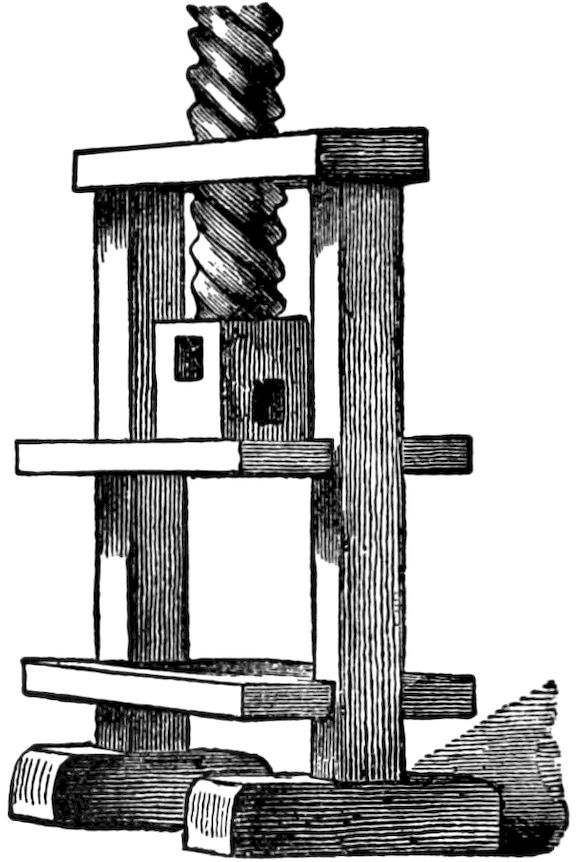
The press needed was only an adaptation of a very
simple machine in common use for many different
purposes. The use of the press in squeezing grapes
for wine, in molding cheese and squeezing out the
whey, and for a great number of other purposes was
so common that the problem of the exertion of pressure
was already solved. Everything was ready but the
type, and when one sees how far men had gone
toward the use of type one wonders that the invention
was not made long before it really occurred. Probably
it was only waiting for the imperious demand of
necessity to spur some one to the making of the
necessary experiments.
CHAPTER II Steps Toward Typography
17
Typographic printing, briefly defined, is
printing from movable types. That is to say,
it is the impression of words upon paper or other
material by the use of movable types which have
first been covered with ink, the inked face of the type
transferring the characters to paper and producing
the printed page. This includes any printing from
a type form in which movable cuts may be locked up
with the type, or in some cases may be used alone on
the press as in printing full-page illustrations. It was
this process which was invented in the middle of the
fifteenth century.
The practice of making impressions upon various
substances by the use of various devices prepared for
that purpose goes back to the dawn of civilization.
The earliest device of this sort appears to have been
a seal used for impressing a device which might stand
for a personal signature or indicate the official
authentication of a document or other public act.
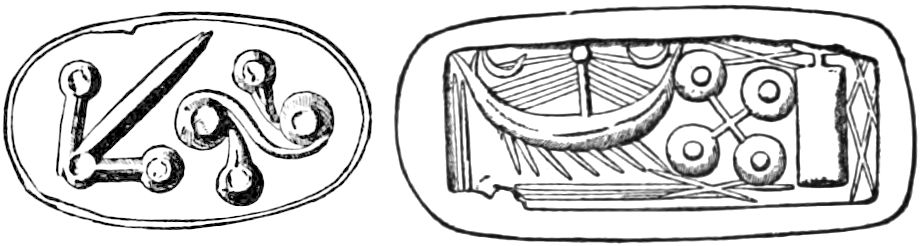
These seals are found in great numbers among the
most ancient remains. Two early ones from the island
of Crete are shown herewith.
Ancient Seals from Crete
There are also in existence many ancient Babylonian
seals. These seals were of various sorts. Sometimes
18the design was cut in the flat surface, leaving a raised
impression when stamped upon wax, clay, or some
other yielding substance. Such seals are said to be
made in intaglio. Sometimes the surface is cut away
leaving the designs standing out, thus making a
depressed mark in the soft surface. These seals are
said to be cut in relief. Sometimes the surface of
the seal, instead of being flat, was a cylinder rolling
on a pivot so that the impression of whichever sort
it might be was made by rolling the seal with pressure
over the soft substance. It is said that the
Romans came very near the discovery of typographic
printing. The Roman potters stamped their
names letter by letter in the soft clay of their ware
before it was fired. The use of dies for stamping
coins and metal seals is also very ancient.
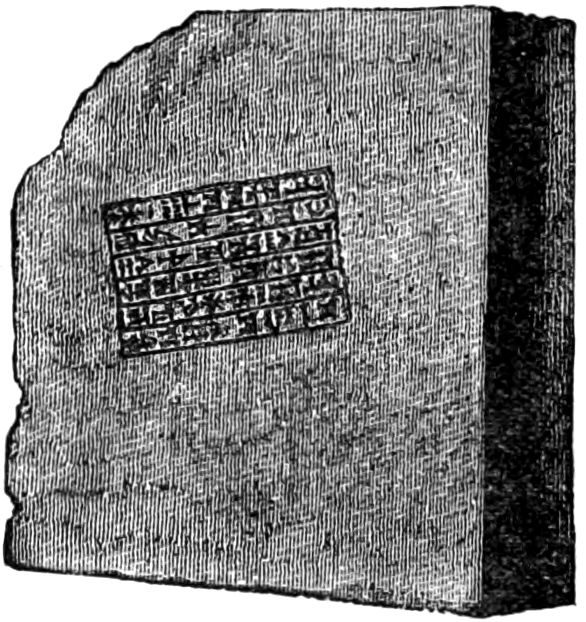
Assyrian Clay Tablet
The Assyrians not
only inscribed their
records upon cylinders
of soft clay by
pressing a sharp stick
into them to make
the curious wedge-shaped
characters of
their alphabet, but
it is evident that they
carved rather long inscriptions
on plates,
probably of wood, and
transferred these to
bricks by pressure.
The illustration shows
an Assyrian stamped
brick of this sort. Wherever we touch the history of
civilized man we find some form of printing by the
use of a seal, a stamp, or even a single letter. Some
manuscripts long before the middle of the fifteenth
century seem to have had the initial letters put in
by means of stamps which were applied either by
heavy hand pressure or by the blow of a mallet. These
19initial letters certainly show the use of color in making
the impression. It is probable that such use of color
was early thought of as a means of making the impression
of the seal more distinct and dispensing with
the pressure necessary to force the seal into the substance
of the parchment, papyrus, or paper which was
being used. Thus through the ages we slowly grow
toward a more varied and extensive use of these
primitive methods of printing.
If we turn to Asia we find that the Chinese and their
neighbors, the Japanese and the Coreans, anticipated
Europe by many centuries in printing, as well as in
other arts. The Chinese appear to have hit upon
the device of multiplying books by cutting all the
characters needed for a page on a block of wood and
then applying the inked block to the paper as early
as the sixth century, A. D. Books printed by this
process, generally known as block books, were common
among the Chinese as early as the tenth century.
The Japanese were using blocks for printing before
the year 800, A. D. The British Museum contains a
Corean book apparently printed from movable types
which is supposed to date as far back as 1338.
All this is very interesting, but there is not the
slightest evidence that it had any effect whatever
on the development of printing in Europe. Chinese
and Japanese typography is not a development
from their own block books, but is a recent importation
from Europe. The Chinese characters, which
are also used by the Japanese, are not letters but
ideograms. Instead of having a few characters
representing the fundamental sounds, by the combination
of which words are expressed, they have a vast
number of characters, many thousands of them.
These characters represent to the mind an idea as a
whole. They may be vocalized as a word or a syllable,
but not as a single sound out of a combination
of which syllables and words may be built up. It was
quite practicable to carve the characters representing
a page on a block and print from that, but it was
20clearly not practicable to make movable types representing
all these almost innumerable characters.
Typographic printing is possible only through the
selection for common use of a small number of the
most essential characters and using them as the basis
of a working vocabulary. The introduction of
typography represents probably a step toward the
reduction of this great number of characters to a
comparatively small number representing the sounds
or syllables most in use. A font of Chinese type is
a fearful and wonderful thing, and learning the case
for Chinese composition is a task which very few
western people would care to undertake.
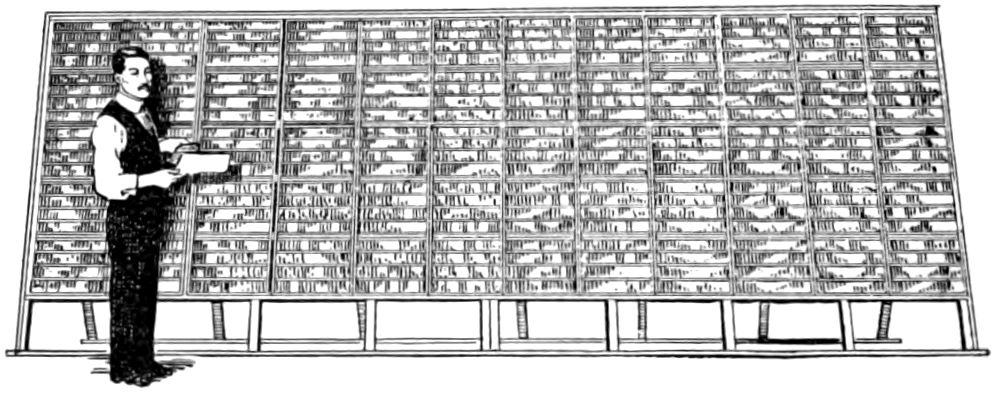
Modern Chinese Type Case
The accompanying illustration shows a Chinese
compositor at his case in the Lakeside Press, Chicago.
The “frame” contains one complete font of approximately
seven thousand characters. It is about sixteen
feet long by five feet high, and is made up of a number
of smaller “cases” approximately twelve by fifteen
inches over all, each holding about two hundred and
forty characters. This font is approximately ten-point
body according to United States standards. It
required an entire month to “lay the cases.” It
requires about ten thousand characters to print a
Chinese book, but some of them are made by combinations
of primary characters, so that the seven thousand
in the case will do the work.
21During the centuries previous to the invention of
printing the number of persons who could read was
very small. The common people, farmers, soldiers,
workmen, and the like, received but little instruction
outside the immediate necessities of their lives. That
little was largely by word of mouth reinforced by
symbol and picture or statue. In those days the
churches were the poor man’s schools and libraries.
The Bible stories were told him by the priests and
nuns and by the old men and women. The churches
were elaborately ornamented with statues, stained
glass windows, brasses, paintings, and carvings. Many
of these painted or sculptured representations were
conventionalized. If one saw a figure with a great
key in his hand, no matter what the costume of the
figure or the design of the face, he knew it was St.
Peter. If he saw another figure with a book and a
sword, he knew that it was St. Paul, and so on. He
saw the sacrifice of Isaac, the Massacre of the Innocents,
the Crucifixion, the Martyrdom of St. Stephen,
and all the other Bible stories visibly expressed. He
saw the statues of kings and bishops and was told
the meaning of the scenes in which these and other
characters were represented in picture or sculpture.
He thus read and reread the statues, stained glass
windows, and sculptures of his church as we read
and reread our Bibles and our histories. Many carvings
and pictures were put into the churches which
we should today consider entirely out of place.
Caricature began here as well as religious and historical
instruction. We find represented scenes which
recall the current fables of the time and sometimes
pictures of scenes ridiculous or even indecent, according
to modern ideas, which satirized the vices and
faults of men and women while they warned against
them.
By and by the desire came to bring this instruction
into the homes of the people who were too poor to
have paintings and carvings of their own. This desire
was met by the production of what is known as image
22prints. The picture of some saint was carved on a
piece of wood and from this block, or more properly
plate, because the pictures were carved on the side
and not the end of a flat piece of wood, an inked
impression was made on parchment or paper. This
process seems to have come in use some time in the
fourteenth century. By the beginning of the fifteenth
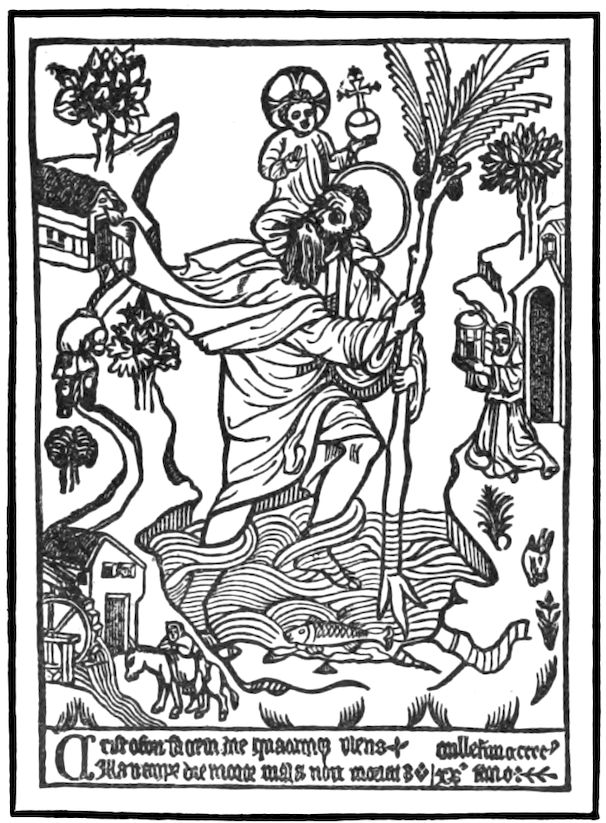
it was fairly common. The earliest dated woodcut
of this sort, bearing the date 1423, is shown herewith.
It is interesting not only as being the oldest dated
work of this sort, but as being typical of the way in
which these pictures were conceived and executed.
It represents St. Christopher. The saint is shown
fording the river with the Child Jesus on his shoulder
and represents the entire legend of St. Christopher,
the Christ Bearer.
Reduced Facsimile of Early Wood-cut
23At first these images appeared upon single sheets
bearing only the picture. Later, words were carved
upon the block in addition to the picture, giving us
on one page the combination of picture and text.
Very probably the owner could not read the inscription,
but he could be told what it meant and the very
form of it would recall to his mind the words which
he had learned.
From this single picture there were two lines of
development. One was the binding up of several
pages of such pictures and texts into a book. Each
page was printed from a single block and the result
was a block book. Of these there were two especially
famous and often printed, The Biblia Pauperum, or
Poor Man’s Bible, and the Speculum Humani Salvationis,
or Mirror of Human Salvation. The Poor
Man’s Bible, of course, was a collection of prints
recalling the biblical stories. The Mirror went further
afield and showed pictures representing moral teaching.
Great numbers of these books were printed
and circulated, especially in Holland and Germany.
The other development was the printing of whole
pages of text. Certain books were in great demand.
The advantage of being able to reproduce them
quickly and cheaply was obvious. The two best
known are alphabet books for beginners called
Abecederia, or Abecederium in the singular, and the
elementary Latin grammars abstracted from the works
of an old Latin grammarian named Donatus. These
grammars were commonly called Donatuses. These
books, especially the school books, were printed
mostly on vellum, partly because of its greater durability
and partly because the use of paper was not
yet common.
We have here the lines of development which led
directly to the invention of typography. We have
24already mentioned books printed from plates with
pictures without text, pictures with text, and text
without pictures. What would be more natural
than to cut off the part of the block containing the
text and use the picture alone, or to combine the
text with text cut from another block or with another
picture from which the text had been removed? If
we could do this why could we not cut out a single
word or a single letter and why not make a considerable
number of these single letters and combine them
into words? If parts of two or more blocks were to
be used for the same picture, they must be fastened
together in some way, or as we should say today the
form must be locked up. Why could not separate
letters be fastened together in the same way so that
we could print anything we wanted by the simple
process of putting together the necessary letters in
the proper relation? As we shall see presently, this
is exactly what happened, and the invention of printing
thus considered is the most natural thing in the
world.
Before passing to the next phase of the discovery,
a word should be said about playing cards. Until
recently playing cards were considered as having a
place in this development which they probably never
occupied. Playing cards, like many other things
good and bad, were invented in the East. They
made their appearance in Europe somewhere about
1375 A. D. and by 1400 they had become popular.
The first cards were hand painted which, of course,
made them expensive and confined their use to the
wealthy. A little later, however, they were painted
by the use of stencils so that they could be produced
cheaply and plentifully. Later still they were printed
from blocks like the image prints and colored by
hand. Color being essential to playing cards, the
development thus outlined was the most natural. It
has been supposed that the comparatively small
playing card was first made and that the image print
was derived from the playing card. There now seems
25no question that the process was the other way about,
as there are no printed playing cards known as early
as the St. Christopher above referred to. The block-printed
playing card seems to have been clearly an
imitation of the image print, and not the image print
an evolution from the playing card.
CHAPTER III Claims to the Invention
26
De Vinne mentions fifteen cities or towns as
having been specified by as many different
authors as the true birthplace of typography. The
names of these are Augsburg, Basle, Bologna, Dordrecht,
Feltre, Florence, Haarlem, Lubeck, Mainz,
Nuremberg, Rome, Russemburg, Strasburg, Schelestadt,
and Venice. The various authors assign to
these towns the names of the following alleged inventors:
Castoldi, Coster, Fust, Gensfleisch, Gresmund,
Gutenberg, Hahn, Mentel, Jenson, Regiomontanus,
Schoeffer, Pannartz and Sweynheym, and Louis de
Vaelbaeske.
Of these claims there are only three which deserve
any consideration whatever. The first of these
claims, the alleged discovery at Avignon, is by far
the most recent and may be quickly disposed of. In
1890 the Abbé Requin discovered five curious documents
in the notarial records of Avignon, in southern
France. These papers deal with the business dealings
of the silversmith Procopius Waldfoghel with
certain other persons regarding the art of writing
artistically, instruction therein, and certain tools
therefor. There are mentioned in these papers two
steel alphabets in Latin, one iron alphabet in Hebrew,
two iron frames, one steel screw, forty-eight forms of
tin, and divers other forms belonging to the art of
writing. There is also mention of instruments or
tools of iron, steel, copper, latten, lead, tin, and wood
for writing artistically. These documents date from
1444 and 1446, before Gutenberg had produced any
results. On the evidence of these documents attempts
have been made to show that printing was being
27done at Avignon several years before the earliest date
that can be assigned to the 42-line Bible, the Letters
of Indulgence, or even the somewhat doubtful Latin
Grammar.
A careful study of the documents, however, hardly
bears out this claim. It is said that the writing was
to be done on “stuffs” (cloth), but nothing is said of
paper, ink, or other materials needed for printing, and
it is a stretch of the imagination to see punches and
matrices in the iron and steel alphabets and the forty-eight
forms.
The probability is that Waldfoghel cut letters of
ornamental and artistic forms on dies to be used as
initials and the like on manuscripts or on cloth and
other materials and devised or borrowed a method of
printing from them by the application of power
through some sort of screw press. This is in harmony
with much that we know to have been done at that
time, but is quite apart from anything like typography
as we are considering it.
The second is the so-called Coster legend. This
story in its legendary form says that Lourens Janssoen
Coster invented printing from the chance trifling of
an idle hour. He is said to have been strolling in
the woods near Haarlem one day and to have cut
some pieces of birch bark in the form of letters. With
some of these letters dipped in ink he made marks on
parchment or paper and found that he could combine
them and recombine them so as to make words and
sentences. He then began experimenting in earnest.
His first letters were carved out of wood, then he
made them out of lead, and at last out of tin. Finding
the ink used by the copyists unsatisfactory he invented
an ink of more viscous kind better suited to the work
in hand. The story runs that his new invention attracted
much attention and that he made many books
which he sold at good profit. The work grew beyond
his personal capacity to do it and he took servants or
apprentices. Among them was a young fellow named
John. John had more brains than honesty, and one
28day while the family were at church John packed up
the type and the matrices and left Haarlem. From
Haarlem, the story goes on to say, he went to Mainz
where he set up in business for himself and prospered
exceedingly. It is from this act, says the story, that
all the Mainz printing proceeded. In this form the
story is obviously legendary. We shall examine it
later in another connection when we shall see this
point more clearly, some of the details being evidently
introduced to fill the gaps in what may be regarded
as history.
The third claim is the commonly accepted Gutenberg
legend. Concerning Gutenberg himself we know
very little, although somewhat more than we know
about Coster. What we do know of him rests almost
entirely upon public registers and the records of law
suits. No authentic record of his birth exists, but it
is supposed to have taken place at Mainz about 1399.
Mainz, like many other cities of the time, was a prey
to internal disputes and as a result of some such
political overturn Gutenberg’s family went to Strasburg
some time before 1430. In a legal document in
existence at Strasburg we find mention of John Gensfleisch,
otherwise known as Gutenberg, of Mainz.
His name occurs in a proclamation issued in 1430
granting political amnesty to the Mainz exiles. In
the same year he negotiated with the authorities of
Mainz for a pension for his mother and in 1432 he was
in Mainz. He next appears in the Strasburg court
records in 1439, when he was defendant in a suit
brought against him by his business partners. In
these records are obscure references which have been
interpreted as referring to printing. In the light of
the clearer reference of later law suits it is not
probable that this interpretation is correct.
Gutenberg was then, as for all his life, in financial
difficulty. Whatever the outcome of the 1439 suit,
he borrowed a hundred pounds in 1441 and in 1442
sold an annual income of four pounds for eighty
pounds cash. The Strasburg tax books show that he
29was in arrears for taxes between 1436 and 1440. By
some writers these financial difficulties are supposed
to have arisen out of Gutenberg’s devotion to his
experiments in typography. It is more probable,
however, that they were owing to lack of business
ability and possibly to lack of business integrity.
The shifts to which he had recourse in his financial
difficulties run at times perilously near the line of
dishonesty.
In 1448 Gutenberg was back in Mainz and again
borrowing money. What happened next can best be
read back from what is known as the Helmasperger
document, a notarial instrument relating to a law suit
which John Fust brought against Gutenberg in 1455.
From this document it appears that about 1450, or
slightly before, Gutenberg became acquainted with
John Fust, who was a prosperous business man in
Mainz. The two entered into a contract of partnership
for five years. Fust was to advance 800 guilders
to Gutenberg at six per cent interest for use in
procuring tools and materials, said tools to remain
mortgaged to Fust until the loan was paid.
In addition Fust was to advance to Gutenberg 300
guilders every year to provide for servant’s wages,
house rent, vellum, paper, ink, etc. In return Fust
was to receive one half of the profits, but was to be
responsible for no debts and was to take no personal
part in the business.
It is reasonably clear from this contract that while
Gutenberg had hopes in 1450, and we shall probably
see later upon what they were founded, he had not
even made the necessary tools for printing, much less
printed anything. Things did not, however, go
smoothly under the new partnership. Instead of
Fust paying the eight hundred guilders at once, he
spread the payments over two years. Gutenberg,
on his part, did not find the three hundred guilders a
year sufficient. Fust, therefore, proposed that instead
of paying the three hundred guilders a year for the
remaining three years of the partnership, he should
30pay eight hundred guilders down, and remit the
interest on the first eight hundred guilders as an offset
for the one hundred guilders which Gutenberg would
lose under this modification of the original contract.
These arrangements seem to have been carried out
but in 1455 the results were so unsatisfactory that
Fust brought suit to recover the money advanced.
The court decided at least in part in favor of Fust.
Gutenberg was unable to return the money which the
court awarded to Fust, and in consequence Fust took
possession of the business and equipment. Gutenberg
appears to have saved something out of the wreck
and found a new financial backer in the person of
Conrad Humery, a physician and town clerk of Mainz.
To this new office are attributed a number of books
and pamphlets, the most important one being a Catholicon,
1460, nearly eight hundred pages large folio. In
1462 the city of Mainz was besieged and sacked and
the printing industry therein was broken up. In
1466, however, we find printing done in Eltville, a
suburb of Mainz, with type which is supposed to have
been Gutenberg’s. As this was the birthplace of
Gutenberg’s mother and there was a family estate
there it is quite probable that the Gutenberg-Humery
office was set up in that place. In 1465 we find
Gutenberg appointed one of the officers of the court
of Adolph II, the militant prince-bishop who had
captured and looted Mainz three years before. The
patent states that this appointment is made on
account of “agreeable and voluntary service rendered
to us and our bishopric.” This is the last we hear of
Gutenberg except the record of his death in February,
1468.
In brief, this legend tells us that Gutenberg was for
years a patient but disappointed seeker after an
invention which he had dreamed of but could not
make practical, that he finally succeeded only to be
robbed of the fruits of his success by an unscrupulous
money lender, that in his old age he began
again with undaunted courage, struggling always
31against financial difficulties and always failing to
make a wordly success of his great invention, reaping
his only reward in the tardy favor of the prince-bishop.
That Fust and his son-in-law, Schoeffer,
did make a financial success of printing, and that
further success was made by Bechtermüntz, who is
said to have been a relative of Gutenberg and to have
inherited type and material from his second shop, and
that from Mainz as a center the art of printing spread
over the civilized world are beyond question. These
are the legends of the invention. Now let us see if
we can find out what really happened.
CHAPTER IV The Invention
32
The study of the question of the invention of
printing, like that of any other historical question,
must deal with the examination of three classes
of evidence or so many of them as may be available.
These three classes of evidence, in order of their
importance, are first, remains, second, contemporary
documents, and third, documents or evidence of a
later period. For example, there may be tradition
widely current and running backward in literary form
to within a hundred years of the death of the person
referred to, that a certain king ruled in a certain
country and did certain things. That is evidence of
the third class. There may be extant contemporary
works of travelers, histories of other countries, or even
the published recollections of old men, which said
that at a certain period that king lived and did certain
things. That is evidence of the second class. There
may be coins, official inscriptions, public documents,
emanating directly from this king or even bearing
his signature. This is evidence of the first class.
This class of evidence is conclusive. The second
class is strong, but not conclusive, the third class is
very uncertain.
Now it happens that with regard to the invention
of printing we have evidence of all three classes. All
of it is conflicting, but the conflicts, it is to be noted,
are mainly in the evidence of the third class. The
evidence of the second class exists mainly in Mainz,
but is not nearly as conclusive as has been supposed.
Evidence of the first class comes entirely from Haarlem,
and is there supported by one or two important
pieces of evidence of the second class. With this brief
33introduction perhaps it will be easier to understand
the argument which follows.
Of course, the material of the first class, namely,
remains, would be the earliest known pieces of printing.
If these pieces of printing were dated as books
are today, they could not be questioned, but as they
are not so dated, but must be placed by other evidence,
they have been questioned. There exist, in whole or
in part, forty-seven distinct pieces of printing each
bearing evidence of being among the first pieces of
printing produced. These forty-seven works in
their present condition run all the way from an entire
book to a fragment of a single page. A group of
three or four of them may be identified by reference
to officials whose official dates were known as being
either in 1474 or immediately preceding it. This,
however, does not date the whole group. These
few specimens are much more advanced in their
appearance and workmanship than the rest of the
forty-seven. Several other editions of some at least
of these better books appear in this interesting lot of
remains. The other editions are of a much more
primitive appearance, showing that the period covered
by the forty-seven works ended not later than 1474.
Of these forty-seven works, forty-five are in Latin,
which, as we know, was the language of schools,
courts, and churches at this period in all nations. One,
an edition of a book of which there are several editions
in Latin, was in Dutch. One was in French. That
these forty-seven books all came from Haarlem is
pretty clearly shown by certain internal evidence.
One of them is clearly placed in Holland by the fact
that it was printed in Dutch. Nobody at the very
outset of printing would print books in Dutch except
a Dutchman. All the rest of the forty-seven are closely
related to these, as is shown by the similarity but not
identity of their types.
The earliest printers were imitators of the copyists.
They made their pages look as much like a manuscript
page as they could, not perhaps with intent to
34deceive, but because nothing else occurred to them.
You will find that all the earliest types are modeled
upon the handwriting current among the copyists
of the place where the printing was done. Certainly
these books did not come from Mainz. Nobody has
ever claimed that they did. Almost equally certainly
they did come from Holland and from Haarlem. The
handwriting is the handwriting of the Haarlem copyists
of the period. An attempt was made at one time
to assign these books to Utrecht, but it is not only
true that each country had its prevailing copyist’s
hand, but that each important center had its own
system variously developed in the local schools in
which copying was taught. The Utrecht hand is not
the Haarlem hand. The books resemble the Haarlem
hand and not the Utrecht.
While the forty-seven books show a considerable
number of varieties of type, the editions being identified
by these type differences, all the type faces show
a strong family resemblance. They are designed from
a common model, but not at the same time, and consequently
they show marked resemblances and marked
differences. The question may be asked why the
same printer should use eight or nine different fonts
of type for only forty-seven books. The answer is
found in the fact that type-making was as yet in an
experimental stage and that durable material had not
yet been found for that purpose. When we come to
the discussion of evidence of another class we shall
find confirmation of this. There is no evidence of
the second or third class connecting early printing
with any Dutch town except Haarlem. There is,
however, important evidence of the other classes
which does connect printing with Haarlem. There
are not, however, forty-seven different works. Twenty
of the forty-seven books are different editions of the
Donatus, that is to say they are Donatuses showing
such typographic differences as to show that no two
of them could have been printed from the same type
form. Four of them are editions of the Speculum
35and eight are different editions of the Doctrinale. The
Doctrinale was a brief compend to Christian doctrine
approved by the church and widely circulated among
the faithful.
Nearly all of the fragments of these forty-seven
books have been found in Haarlem or in the neighborhood.
It is evident that the publications of this
press, whatever its date, were locally sold and that
neither its fame nor its product went far from the
place of production.
Having thus shown the reasons for believing that
these forty-seven pieces of early printing came from
Haarlem, let us see what they have to say for themselves
as to the time of their production. It has
already been pointed out that a small group of the
best of them dated themselves no later than 1474,
as is shown by their contents. So far as the contents
themselves are concerned we have nothing to date
the others. There are certain things about the books
themselves, however, which show that their production
must have begun long before 1474.
For one thing, there are twenty editions of the
Donatus. We have no way of knowing how near
together the editions were, but when we compare
them with the editions of the Donatus later published
we shall see that it is not unreasonable to suppose
that they run back some thirty years. There were
also four editions of the Speculum and eight editions
of the Doctrinale. In each case the evidence of other
printers shows that even one of the small editions
usually published at that time lasted for a considerable
period. The appearance of the books themselves
bears out this conclusion. Good as the later
ones are, they are inferior to Mainz workmanship
of their period and the earlier ones are far inferior to
Mainz workmanship of any period. They are not
only without signatures, initial directors, hyphens,
and catch words, all of which had come into use before
1474, but they show certain other remarkable peculiarities.
36Many of these editions were printed on vellum,
which is not in itself remarkable, as vellum continued
to be used for a good many years for some books and
for special copies of certain editions. Some of them
show a further peculiarity of having vellum and
paper combined together, some of the pages being
printed on sheets of vellum and some being printed
on sheets of paper. A considerable number of these
books are printed only on one side of the page. None
of the early Mainz books show this peculiarity.
Some of these books not only show the curious combination
of paper and vellum just noted, but curious
combinations of the use of block and type. In
some cases the upper part of the page shows a picture
printed from a block while the lower part is
printed from type.
The blocks thus used are the old familiar blocks of
the Speculum but with no text carved on the block.
Some of the books show the peculiarity of certain
pages of text printed from blocks and other pages of
text printed from type.
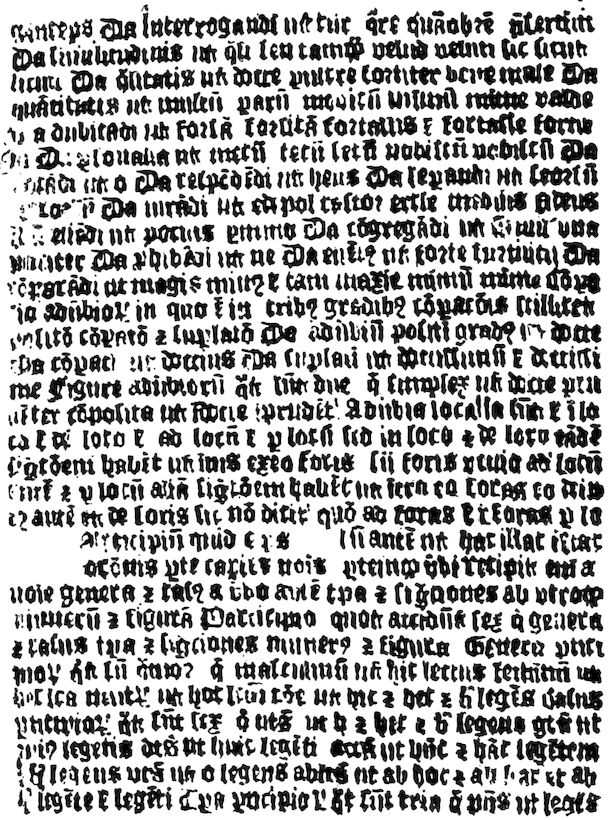
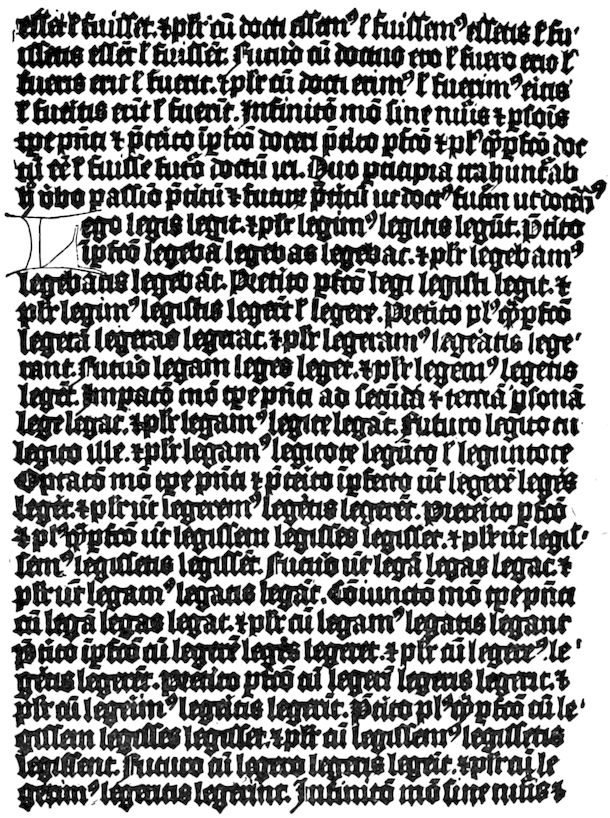
The accompanying illustrations show a reproduction
of a page of a Donatus printed from blocks,
and a reproduction of a Donatus printed from type
by Coster. They are taken from Holtrop’s Monuments
Typographiques des Pays-Bas. Two pages,
not consecutive, of the printed Donatus, were found
in the binding of a book published in Delft in 1484.
The leaves are of vellum, printed on one side only.
The ink is pale and is soluble in water. There is no
punctuation and there are no hyphens at the ends of
lines where words are divided, showing that the font
contained only letters. The lines are fairly regular
in length and end with either a complete word or a
syllable. The form is well locked up and the presswork
is fair. The letters are of slightly varying size
and are not in perfect alignment. Apparently each
letter was cut independently on the end of the type
body and the cutter was not sufficiently skillful to
center them perfectly.
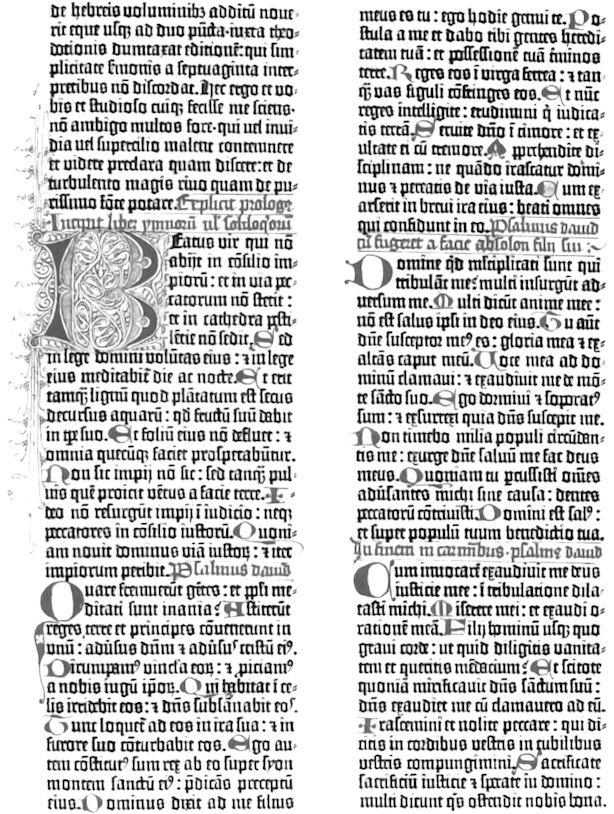
37Compare this page with the reproductions of the
Mazarin, or forty-two line Bible, shown on pages 48
and 49. We know that the Mazarin Bible was
printed not later than 1456. By some it has been
attributed to Gutenberg, or at least to his types, but
it is now considered the work of Schoeffer. The
Mazarin Bible is one of the most perfect and splendid
pieces of typography that has ever been produced.
Other work attributed to Gutenberg shows a high
degree of excellence. It has always been one of the
wonders of invention that so difficult and complicated
an art as typography should have sprung into being
fully perfected, without trace of imperfect experiment.
In the rough page of Coster’s Donatus we clearly see
the imperfect beginning—the missing link.
These peculiarities are exactly what we should
expect to find in the missing links between the
printing of block books and the printing of books from
type. The printer is experimenting. He cuts the
lettering off his blocks and combines them with type.
He uses type and blocks for the same edition. He
experiments with paper. He is very primitive in his
methods. A block book could be printed only on
one side. He is not yet sure that the type-set book
can be printed on both sides. Not improbably he
began by using for his type page the same method of
printing that he used with his wooden block. It
seems pretty clear that in this mass of material,
known collectively as the Costeriana, we have the
records of the course of experimentation which led
from the printing of the image print, with its legend
cut on the same block, by placing a sheet of paper or
vellum on the inked surface of the block and pressing
it down with a frotten, to the production of the book
from type-set pages impressed upon both sides of the
paper by means of a press.
We have thus gone through the evidence of the
first class which exists for the invention of printing.
We have seen that there exists indisputable evidence
that forty-seven editions were printed at Haarlem
38before 1474 by an experimenter who seems to have
gone over the road from the block book to the type-set
book.
Reduced Facsimile of Type Page by Coster.
39
Reduced Facsimile of Block Printing
We have a few bits of evidence of the second and
third class which bear upon this subject and confirm
our conclusions. Jean Le Robert, Abbot of Cambray,
says in his diary that he bought in 1446 and
401451 copies of the Doctrinale of Alexander Gallus
printed from type. Certainly no Doctrinales were
printed from type in Mainz as early as 1446, although
we know that the Costeriana include Doctrinales in
eight editions which may well have gone back to 1451.
The opponents of the Haarlem theory claim that the
Abbot refers to Doctrinales printed from blocks but
we have no knowledge of the existence of any Doctrinales
so made, and the term by which he describes
them is a term which from the beginning has been
specifically applied to the making of type and could
not be applied to the making of blocks. Presumably
the Abbot knew what he was talking about and told
the truth.
Hadrianus Junius, in 1568, tells the story of Coster
and the birch bark letters as we have previously told
it. It is not necessary to repeat the story, but it is
interesting to note certain features of it. Junius says
that Coster printed his leaves on one side, pasting
two together to avoid the recurrence of alternate
blank pages. He further says that he saw one or two
of Coster’s books thus made. He claims that he got
the story in his youth from his tutor, Nicholas Gaal,
a very aged man, but of good memory, who said that
in his boyhood he had heard a certain Cornelis, a
book binder, then eighty years old, tell the story of
Coster’s invention and his struggles to perfect it,
including the use of one side of the paper and of
several different materials for type. The Burgomaster
of Haarlem, Quirinius Talesius, admitted to
Junius that in his youth Cornelis had told him the
same story, and it is interesting to note in this connection
that some of the Costeriana fragments are
found in bindings made by this same Cornelis.
One more evidence which, like that of Junius, falls
into the third class remains to be cited. In 1499
Koelhoff published the Cologne Chronicle in which he
speaks of the invention of printing, using as his
authority Ulrich Zell, a printer of the Mainz school,
who settled in Cologne. He says that Zell told him
41that “the art of printing was first found at Mainz,
but in the manner as it was then (1499) practiced;
the first prefiguration, however, the beginning
of that at Mainz, was found in Holland from the
Donatuses which had been printed in that country
before.” Certainly this is not an attribution of the
invention of printing either to Mainz or to Gutenberg.
It is a distinct confession that it is only the sort of
work then being done which was invented at Mainz
and that it was suggested by work brought from
Holland. It entirely agrees with the Junius account
above quoted.
In the Haarlem Town Library there is a pedigree
of the Coster family. In its present form it dates from
1559, but the earlier part was evidently copied from
an old document. This pedigree says that Lourens
Janssoen Coster invented printing in 1446.
While we have not here an exact agreement of
dates we have one near enough for all practical purposes.
The Costeriana run back for a period which
may be conservatively stated at thirty years from
1474, that is to say, to 1444 or thereabouts. Zell
says that printed Donatuses came from Holland, but
that the art of printing as practiced in 1499 was
invented at Mainz, and this invention, as we shall
presently show, is fixed as subsequently to 1450.
Junius, writing in 1568, says that Coster discovered
printing 128 years previously, that is to say, 1440.
If we now turn to the examination of the evidence
in support of the claim for Gutenberg, we find that it
is lacking in material of the first or even of the second
class. It is not absolutely certain that we have any
book printed by Gutenberg. If, however, for the
sake of the argument we admit that he printed nearly
or quite all of the works that are attributed to him we
find that they are all much better in workmanship
and appearance than the Haarlem books. None of
them are printed on one side of the page only, excepting,
of course, small matters which would not cover
more than one page, and there are no signs whatever
42of transition from any previous type of printing to
typography. Those who have accepted the theory
of Gutenberg’s invention have marveled at the perfection
of his work, as well they might.
There are only two pieces of evidence of the first
class. One is the Helmasperger document, a notary’s
document concerning the law suit which Fust brought
against Gutenberg in 1455. A close examination of
this document would appear to show that it tells
rather against than in favor of Gutenberg. It appears
to show conclusively that Gutenberg had not done
any printing before 1450, and had not at that time
even made the tools with which to print. In this
document Fust speaks of “the work” and “our common
work.” Gutenberg speaks of “tools” in preparation.
Clearly he is borrowing money in order to
make tools. He speaks further of “servants’ wages,
house rent, vellum, paper, ink, etc.” and of “the work
of the books.” The judges speak of “the work to the
profit of both of them,” “their common use,” and the
like. There is not a word which speaks distinctly
of an invention. It is true that the argument from
silence is always dangerous and that those who believe
that Gutenberg invented printing could easily read
between the lines of this document references to the
invention. To one who approaches the subject with
an open mind, however, the language is rather that
of one who enters into partnership for the carrying on
of a business enterprise which is understood by both
parties and from which both expect to receive profit
rather than that of the man who undertakes to finance
an inventor for a share in the invention.
The other piece of evidence of the first class is the
letters patent by which Adolph II appointed Gutenberg
one of the officers of his court. The document
states that the appointment is made for “agreeable
and voluntary service rendered to us and our bishopric.”
It has been argued that as Gutenberg was not
a soldier this agreeable and voluntary service must
have been the invention of printing. Surely this is a
43violent assumption. If we believe that Gutenberg
invented printing, we may perhaps see in these words
a reference to the invention, although we then marvel
why so epoch-making an accomplishment was not
specifically mentioned. It is difficult, however, to
see why an unconvinced person should be expected
to see in such a statement as this any evidence that
Gutenberg had invented printing. Certainly there
are many other kinds of service which might well
have been rendered by one of whom we know so little
as we do of Gutenberg.
Zell’s testimony, already referred to, is of the second
class. Zell’s testimony also counts against Gutenberg.
He distinctly does not claim that Gutenberg invented
any more than the method of printing in use in 1499,
admitting that he got his suggestion from the Donatuses
brought out of Holland. It has been argued
that these Donatuses were block books and that it
was from them that Gutenberg got the idea of typography.
This argument, however, breaks down at
once when we remember that many block books were
printed in Germany. There is no earthly reason
why the suggestion of typography should have come
from a Dutch block book when everybody was familiar
with the German ones and had been so familiar for
many years.
A careful examination of the documentary evidence
which will be found set forth in chronological order
in the article on Typography in the eleventh edition
of the Encyclopedia Britannica shows several interesting
things. While the earlier mentions of printing
generally attribute the beginnings of the art to Mainz,
few of them speak distinctly of its being invented
there. They speak of its being practiced there and
being given to Germany and the world from there,
claims as we shall presently see quite consistent with
the theory of invention elsewhere. Nearly, if not
quite, all of the early statements that printing was
invented by Gutenberg are traceable either directly
to Gutenberg himself, to his family, or to people who
44would be quoting him or his family. It is not until
a comparatively late period that we find any agreement
among writers in attributing the invention to
Gutenberg.
We are now perhaps in position to form a pretty
clear idea of just what happened and to award discriminating
credit where it belongs. The present
writer believes that it may be considered as settled
that Coster invented printing in Haarlem about 1446.
Coster did not, however, found a school of printing.
He ceased to print not far from 1481, as about that
time we find some of his material used elsewhere. The
later years of the century see a few printers in Holland.
How far they derived their inspiration from Coster
is doubtful. It is certain that Haarlem was not a
center from which spread to the rest of Europe and
ultimately to the whole world the art preservative of
all arts.
The honor of being this center clearly belongs to
Mainz. How did the art get there? Probably not
through the treachery of a dishonest apprentice. That
is one of the legendary features of the Junius story,
explained by the fact that in his time everybody knew
that the center from which printing spread was
Mainz and that the first two printers were John
Gutenberg and John Fust. We may at this point
accept Zell’s account as the true one. Some of Coster’s
work found its way to Mainz, together, probably,
with some general, unscientific statements as to how
it was produced. Acting on this hint and with these
models before him, Gutenberg reinvented the art,
that is, he worked out from the finished product and
a general idea of how it was made what was to all
intents and purposes an original process superior to
the one by which the work in his possession had been
produced.
His association with Fust, the business man, and
Schoeffer, the craftsman, was the means whereby the
invention became profitable to the world, though not
to Gutenberg. There is no reason to suppose that
45Fust was an unprincipled schemer who stole Gutenberg’s
invention and profited by it. He was a business
man who made a contract with another man for
the carrying on of a certain manufacturing process,
setting his capital against the other man’s labor for
an equal share in the profit. There was not only no
profit, but the working partner did not live up to his
side of the contract. Fust sued, obtained a judgment,
and under this judgment took over a great part at
least of the equipment which his money had paid for.
While the criminal procedure of this age was of a
very harsh and primitive sort the judgments of the
German courts in civil cases appear generally to have
been fairly just. When we consider Gutenberg’s
record of financial slipperiness there seems no reason
to doubt that it was just in this case. On obtaining
the business Fust associated with himself the young
journeyman, Peter Schoeffer, who had learned the
business in the Gutenberg and Fust establishment
and had married Fust’s daughter. He was an excellent
workman and his skill, backed by Fust’s capital,
set the new invention on a practical basis and insured
its future.
In deciding against the claims of Gutenberg to the
invention we by no means deprive him of all share in
the glory. The reinvention with improvements was
nearly if not quite as creditable a task as the invention,
especially when we remember how simple a step
the actual inventor took in going from his block book
to his type-set book. The invention of Coster was
sterile. The reinvention of Gutenberg was fruitful.
It was Mainz and not Haarlem which actually gave
printing to the world.
In view of all this the early testimonies are not so
conflicting as they seem. We have seen that the
testimonies of Junius and of Zell supplement each
other. We can see that the early authorities were
right in their claim that printing was given to Germany
and the world by Mainz, and at the same time
that the claim is not, as has been hastily supposed,
46a claim that it was invented there. We can see that
the reinvention of printing might well seem so important
to Gutenberg himself and to his family that they
should claim that he invented it. The statement in
the letters patent may well refer to the service which
Gutenberg rendered to the court and bishopric of
Adolph II by the introduction of typography because
he unquestionably did thus render them great service,
and we are no longer surprised at the omission of a
distinct statement that Gutenberg was rewarded for
inventing typography. In a word, the Gutenberg
monuments need not come down, but the inscriptions
on them should be changed.
CHAPTER V Materials and Methods of the First Printers — SUPPLEMENTARY READING
47
Our knowledge of Coster is much less complete
than our knowledge of Gutenberg. Much, however,
that could be said of one would undoubtedly
be true of the other. It is reported that Coster began
with wooden type. This would naturally be the first
step forward from the block book, which was invariably
printed from wood. Finding that wooden type
was unsatisfactory in the press, he experimented with
lead and with tin, we are told. Obviously he would
not get satisfactory results with either of these metals
unalloyed. The use of unsatisfactory material probably
accounts for the number of fonts of type which
he employed in his comparatively small output.
Showing Principle of a Type Mold
Gutenberg and his associates
invented a more satisfactory
type metal and an improved
method for the making of type.
The first types appear to have
been carved individually by
hand. This was a great task,
but not as great as might
appear. The early printers
printed their books page by
page. When one page was
printed in sufficient numbers
for the edition the type was distributed and another
page set up, and so on. In this way a comparatively
small amount of type would suffice for the equipment
of a small shop. It was not long, however, before the
superiority of casting was perceived.
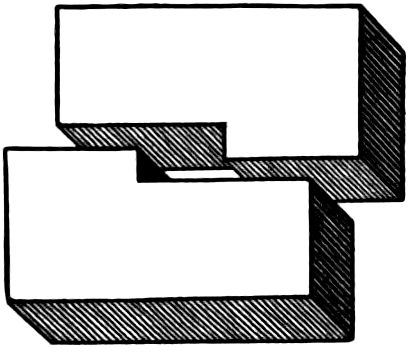
The first mold was probably two notched blocks
of brass or copper, like those shown in the accompanying
48illustration, a method being provided of accurately
positioning the matrix under the opening in the mold
and also of holding the two blocks firmly together.
From the illustration it will be noted that when the
blocks are forced together a square opening remains.
Still keeping the blocks together, but sliding down the
one at the right, one dimension of the opening does
not change, but the other can be varied. This mold
has been improved in detail, but not greatly altered
in principle down to this day. A fairly satisfactory
form of matrix very similar to the one in use today
was soon devised. This was made by cutting the
letter in relief on the end of a soft steel or iron punch
which was then hardened and driven into a block of
soft brass or copper, which became the matrix.
Type of the Mazarin Bible (exact size)
The type, as has been said, was cut to resemble the
handwriting of the scribes in the locality where the
book was printed. This would be the obvious method
because it must be remembered that the rapid reproduction
49of manuscripts was the sole end which the
first printers had in view. They did not think of
developing a conventional book type different from
handwriting or script. They simply imitated the
script which was current, and consequently most
legible, in their neighborhood. The school boys of
that day did not have to learn two alphabets, one the
script letter and the other the printed letter, as we do
today. The device of spacing was immediately
adopted. The letters were cast, however, upon
bodies with wide shoulders at top and bottom and
used without leads.
Page from the Mazarin Bible (reduced)
50The types of the period were both handsome and
legible. Perhaps they may not be easy for us to
read, but that is because we are not familiar with the
forms of the letters used and especially with the contractions
and abbreviations which were common.
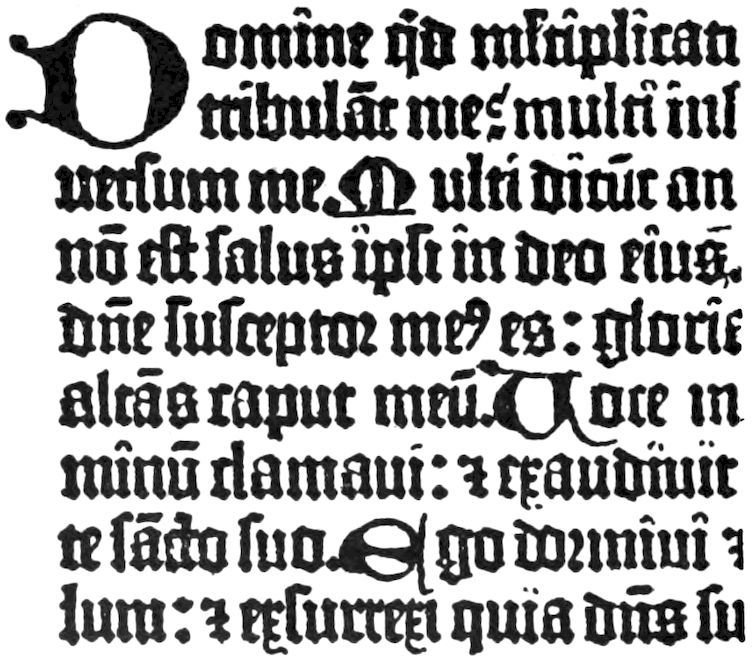
The beauty of some of these early types will be seen
from the little specimen of the type of the Mazarin
Bible which is herewith
reproduced in
full size.
With the example
of the illuminators
before them the early
printers paid much
attention to the ornamenting
of their
pages. They introduced
some ornaments
of their own
and they occasionally
left space for the hand
illuminator to use in
supplementing their
work. A full page of
the Mazarin Bible
greatly reduced is
shown herewith. By
comparing that with
the specimen of full
size type and imagining
the whole page
thrown up to natural
size one can see what a really beautiful book this
famous Bible was.
An Early Printing Press
The press in use was of the most simple form imaginable,
as shown by the accompanying illustration.
It was an adaptation of a familiar mechanical device,
51with no originality about it. It was made of wood
and was operated by a screw turning through a nut,
the moving of the screw bringing the platen and bed
into contact. The form was released by the reverse
movement of the screw. After a while the sliding bed
and frisket shown in the accompanying illustration
were introduced and there the mechanism stopped
for a long time.
Bed of Hand Press Showing Tympan and Frisket
The first twenty-five years or so of printing have
been described as a period of stagnation. They have
also been described as the period of the workman.
Apparently the vast possibilities of the new art were
slow in obtaining recognition. The earliest printers
were only mechanics. They had not yet got the
52vision of combining scholarship with their art and so
unlocking the treasuries of the world to mankind
generally, still less that of adding to the sum total of
human knowledge. They had found out an art by
which manuscripts could be rapidly produced and
money made by their sale, and that was all.
They contented themselves with a slavish imitation
of manuscripts, with apparently no thought of their
being anything more than manuscript imitators. This
condition of things, however, could not last long. It
was inevitable that the scholars of the world should
become interested in this new process and should
begin to see its advantages. After twenty or twenty-five
years of printing this took place. The period of
sluggish and practically dormant infancy passed and
the development of the art began, as we shall see in
the next volume of this series, No. 51, A Short History
of Printing, Part I.
The Story of Books. By Gertrude Burford Rawlings. McClure,
Phillips & Co., New York.
The Invention of Printing. By Thedore L. De Vinne. Oswald
Publishing Co., New York.
Haarlem, not Mainz. By J. H. Hesels.
Early Printed Books. By E. Gordon Duff.
Books and Their Makers in the Middle Ages. Vol. I. by
George Haven Putnam. G. P. Putnam’s Sons, New York.
Encyclopedia Britannica. Eleventh Edition. Article on
Typography.
Pupils who have access to large libraries should consult J.W.
Holtrop’s Monuments Typographiques des Pays-Bas and Samuel
Sotheby’s Principia, both of which contain many excellent
reproductions of very early printing. Sotheby’s book is commonly
referred to as above, but is published under several
different names in editions which vary but little. Perhaps the
best is entitled Typography of the Fifteenth Century.
SUGGESTIONS TO STUDENTS AND INSTRUCTORS — QUESTIONS
53
The following questions, based on the contents of this volume,
are intended to serve (1) as a guide to the study of the text, (2)
as an aid to the student in putting the information contained
into definite statements without actually memorizing the text,
(3) as a means of securing from the student a reproduction of the
information in his own words.
A careful following of the questions by the reader will insure
full acquaintance with every part of the text, avoiding the accidental
omission of what might be of value. These primers are so
condensed that nothing should be omitted.
In teaching from these books it is very important that these
questions and such others as may occur to the teacher should be
made the basis of frequent written work, and of final examinations.
The importance of written work cannot be overstated. It not
only assures knowledge of material but the power to express that
knowledge correctly and in good form.
If this written work can be submitted to the teacher in printed
form it will be doubly useful.
1. What interesting fact is noted about most great inventions and what is the reason for
it?
2. Give some well known instances.
3. How does this condition apply to the invention of printing?
4. Why may we question De Vinne’s decision?
5. Why was the discovery of typography inevitable about 1450?
6. What was the condition of England and France at this time?
7. What was the condition of Italy?
8. What was the condition of Germany, Spain, and Portugal?
9. What was the condition of the church?
10. What important movement was made possible by these political conditions?
11. Name some important events in the movement.
12. What had all this to do with book-making?
13. What were the shortcomings of manuscript books?
5414. What materials were already invented and ready for the printer?
15. Tell what you can about each.
16. What is typography?
17. What were the earliest predecessors of typography?
18. Tell of some later methods of making impressions.
19. What early attempts at printing were made by the Chinese and their neighbors?
20. Did these attempts develop into typography, and why?
21. What devices took the place of books among the poor before the invention of printing?
22. What were image prints, and how made?
23. What were the two lines of development from the image prints?
24. How did these developments suggest typography?
25. How were early playing cards made, and what was their relation to block printing?
26. Name some of the places where and persons by whom typography is said to have been
invented.
27. Tell the story of Waldfoghel, and what we conclude about it.
28. Tell the Coster legend.
29. What do we know about Gutenberg before 1450?
30. What was his contract of that year with Fust?
31. How did it work out?
32. What do we know of Gutenberg after 1455?
33. Give the main points of the Gutenberg legend.
34. What are the clear facts about early Mainz printing?
35. What are the three classes of historical evidence?
36. What can you say, with this distinction in mind, about the evidence concerning the
invention of typography?
37. What evidence of the first class is there coming from Haarlem?
5538. Why do we claim that this evidence comes from Haarlem?
39. Why did the printer use so many fonts of type for so few books?
40. What internal evidence is there for the date of these books?
41. What are the peculiarities of these books?
42. What do these peculiarities show?
43. What piece of evidence of the second class have we which bears on these books?
44. What pieces of evidence of the third class have we which bear on these books?
45. What does all this evidence seem to show as to who invented typography, where, and
when?
46. What do the printed pieces attributed to Gutenberg show?
47. What does the Helmasperger document show?
48. What does the patent of Adolph II show?
49. What does Zell’s statement show?
50. What can you say of the early statements that Gutenberg invented typography?
51. Compare the results of the work of Coster and of Gutenberg.
52. How did the Haarlem invention get to Mainz?
53. What did Gutenberg really do?
54. What was the outcome of his work?
55. How does this theory explain the doubtful or conflicting evidence?
56. What can you say about Coster’s type?
57. How were the first types made?
58. What two important inventions in type-making do we owe to Gutenberg and his
associates?
59. What can you tell about the first type faces?
60. Why are the early books so beautiful?
61. Describe Gutenberg’s press and the first improvements upon it.
62. What has the first period of about twenty-five years of typography been called, and
why?
i
TYPOGRAPHIC TECHNICAL SERIES FOR APPRENTICES
The following list of publications, comprising the Typographic
Technical Series for Apprentices, has been prepared
under the supervision of the Committee on Education of the
United Typothetae of America for use in trade classes, in course of
printing instruction, and by individuals.
Each publication has been compiled by a competent author or
group of authors, and carefully edited, the purpose being to provide
the printers of the United States—employers, journeymen,
and apprentices—with a comprehensive series of handy and
inexpensive compendiums of reliable, up-to-date information upon
the various branches and specialties of the printing craft, all
arranged in orderly fashion for progressive study.
The publications of the series are of uniform size, 5×8 inches.
Their general make-up, in typography, illustrations, etc., has
been, as far as practicable, kept in harmony throughout. A brief
synopsis of the particular contents and other chief features of each
volume will be found under each title in the following list.
Each topic is treated in a concise manner, the aim being to
embody in each publication as completely as possible all the
rudimentary information and essential facts necessary to an understanding
of the subject. Care has been taken to make all statements
accurate and clear, with the purpose of bringing essential
information within the understanding of beginners in the different
fields of study. Wherever practicable, simple and well-defined
drawings and illustrations have been used to assist in giving
additional clearness to the text.
In order that the pamphlets may be of the greatest possible
help for use in trade-school classes and for self-instruction, each
title is accompanied by a list of Review Questions covering
essential items of the subject matter. A short Glossary of technical
terms belonging to the subject or department treated is also
added to many of the books.
These are the Official Text-books of the United Typothetae of
America.
Address all orders and inquiries to Committee on Education,
United Typothetae of America, Chicago, Illinois, U. S. A.
iiPART I—Types, Tools, Machines, and Materials
1. Type: a Primer of Information By A. A. Stewart
Relating to the mechanical features of printing types; their sizes, font
schemes, etc., with a brief description of their manufacture. 44 pp.;
illustrated; 74 review questions; glossary.
2. Compositors’ Tools and Materials By A. A. Stewart
A primer of information about composing sticks, galleys, leads, brass
rules, cutting and mitering machines, etc. 47 pp.; illustrated; 50 review
questions; glossary.
3. Type Cases, Composing Room Furniture By A. A. Stewart
A primer of information about type cases, work stands, cabinets, case
racks, galley racks, standing galleys, etc. 43 pp.; illustrated; 33 review
questions; glossary.
4. Imposing Tables and Lock-up Appliances By A. A. Stewart
Describing the tools and materials used in locking up forms for the press,
including some modern utilities for special purposes. 59 pp.; illustrated;
70 review questions; glossary.
5. Proof Presses By A. A. Stewart
A primer of information about the customary methods and machines for
taking printers’ proofs. 40pp.; illustrated; 41 review questions; glossary.
6. Platen Printing Presses By Daniel Baker
A primer of information regarding the history and mechanical construction
of platen printing presses, from the original hand press to the modern
job press, to which is added a chapter on automatic presses of small size.
51 pp.; illustrated; 49 review questions; glossary.
7. Cylinder Printing Presses By Herbert L. Baker
Being a study of the mechanism and operation of the principal types of
cylinder printing machines. 64 pp.; illustrated; 47 review questions;
glossary.
8. Mechanical Feeders and Folders By William E. Spurrier
The history and operation of modern feeding and folding machines; with
hints on their care and adjustments. Illustrated; review questions;
glossary.
9. Power for Machinery in Printing Houses By Carl F. Scott
A treatise on the methods of applying power to printing presses and allied
machinery with particular reference to electric drive. 53 pp.; illustrated;
69 review questions; glossary.
10. Paper Cutting Machines By Niel Gray, Jr.
A primer of information about paper and card trimmers, hand-lever
cutters, power cutters, and other automatic machines for cutting paper,
70 pp.; illustrated; 115 review questions; glossary.
11. Printers’ Rollers By A. A. Stewart
A primer of information about the composition, manufacture, and care of
inking rollers. 46 pp.; illustrated; 61 review questions; glossary.
12. Printing Inks By Philip Ruxton
Their composition, properties and manufacture (reprinted by permission
from Circular No. 53, United States Bureau of Standards); together with
some helpful suggestions about the everyday use of printing inks by
Philip Ruxton. 80 pp.; 100 review questions; glossary.
iii13. How Paper is Made By William Bond Wheelwright
A primer of information about the materials and processes of manufacturing
paper for printing and writing. 68 pp.; illustrated; 62 review questions;
glossary.
14. Relief Engravings By Joseph P. Donovan
Brief history and non-technical description of modern methods of engraving;
woodcut, zinc plate, halftone; kind of copy for reproduction; things
to remember when ordering engravings. Illustrated; review questions;
glossary.
15. Electrotyping and Stereotyping By Harris B. Hatch and A. A. Stewart
A primer of information about the processes of electrotyping and stereotyping.
94 pp.; illustrated; 129 review questions; glossaries.
PART II—Hand and Machine Composition
16. Typesetting By A. A. Stewart
A handbook for beginners, giving information about justifying, spacing,
correcting, and other matters relating to typesetting. Illustrated;
review questions; glossary.
17. Printers’ Proofs By A. A. Stewart
The methods by which they are made, marked, and corrected, with
observations on proofreading. Illustrated; review questions; glossary.
18. First Steps in Job Composition By Camille De Véze
Suggestions for the apprentice compositor in setting his first jobs,
especially about the important little things which go to make good
display in typography. 63 pp.; examples; 55 review questions; glossary.
19. General Job Composition
How the job compositor handles business stationery, programs and
miscellaneous work. Illustrated; review questions; glossary.
20. Book Composition By J. W. Bothwell
Chapters from DeVinne’s “Modern Methods of Book Composition,”
revised and arranged for this series of text-books by J. W. Bothwell of
The DeVinne Press, New York. Part I: Composition of pages. Part II:
Imposition of pages. 229 pp.; illustrated; 525 review questions; glossary.
21. Tabular Composition By Robert Seaver
A study of the elementary forms of table composition, with examples of
more difficult composition. 36 pp.; examples; 45 review questions.
22. Applied Arithmetic By E. E. Sheldon
Elementary arithmetic applied to problems of the printing trade, calculation
of materials, paper weights and sizes, with standard tables and rules
for computation, each subject amplified with examples and exercises.
159 pp.
23. Typecasting and Composing Machines A. W. Finlay, Editor
Section I—The Linotype By L. A. Hornstein
Section II—The Monotype By Joseph Hays
Section III—The Intertype By Henry W, Cozzens
Section IV—Other Typecasting and Typesetting Machines By Frank H. Smith
A brief history of typesetting machines, with descriptions of their
mechanical principles and operations. Illustrated; review questions;
glossary.
ivPART III—Imposition and Stonework
24. Locking Forms for the Job Press By Frank S. Henry
Things the apprentice should know about locking up small forms, and
about general work on the stone. Illustrated; review questions; glossary.
25. Preparing Forms for the Cylinder Press By Frank S. Henry
Pamphlet and catalog imposition; margins; fold marks, etc. Methods of
handling type forms and electrotype forms. Illustrated; review questions;
glossary.
PART IV—Presswork
26. Making Ready on Platen Presses By T. G. McGrew
The essential parts of a press and their functions; distinctive features of
commonly used machines. Preparing the tympan, regulating the
impression, underlaying and overlaying, setting gauges, and other
details explained. Illustrated; review questions; glossary.
27. Cylinder Presswork By T. G. McGrew
Preparing the press; adjustment of bed and cylinder, form rollers, ink
fountain, grippers and delivery systems. Underlaying and overlaying;
modern overlay methods. Illustrated; review questions; glossary.
28. Pressroom Hints and Helps By Charles L. Dunton
Describing some practical methods of pressroom work, with directions
and useful information relating to a variety of printing-press problems.
87 pp.; 176 review questions.
29. Reproductive Processes of the Graphic Arts By A. W. Elson
A primer of information about the distinctive features of the relief, the
intaglio, and the planographic processes of printing. 84 pp.; illustrated;
100 review questions; glossary.
PART V—Pamphlet and Book Binding
30. Pamphlet Binding By Bancroft L. Goodwin
A primer of information about the various operations employed in
binding pamphlets and other work in the bindery. Illustrated; review
questions; glossary.
31. Book Binding By John J. Pleger
Practical information about the usual operations in binding books;
folding; gathering, collating, sewing, forwarding, finishing. Case making
and cased-in books. Hand work and machine work. Job and blank-book
binding. Illustrated; review questions; glossary.
PART VI—Correct Literary Composition
32. Word Study and English Grammar By F. W. Hamilton
A primer of information about words, their relations, and their uses.
68 pp.; 84 review questions; glossary.
33. Punctuation By F. W. Hamilton
A primer of information about the marks of punctuation and their use,
both grammatically and typographically. 56 pp.; 59 review questions;
glossary.
v34. Capitals By F. W. Hamilton
A primer of information about capitalization, with some practical typographic
hints as to the use of capitals. 48 pp.; 92 review questions;
glossary.
35. Division of Words By F. W. Hamilton
Rules for the division of words at the ends of lines, with remarks on
spelling, syllabication and pronunciation. 42 pp.; 70 review questions.
36. Compound Words By F. W. Hamilton
A study of the principles of compounding, the components of compounds,
and the use of the hyphen. 34 pp.; 62 review questions.
37. Abbreviations and Signs By F. W. Hamilton
A primer of information about abbreviations and signs, with classified
lists of those in most common, use. 58 pp.; 32 review questions.
38. The Uses of Italic By F. W, Hamilton
A primer of information about the history and uses of italic letters.
31 pp.; 37 review questions.
39. Proofreading By Arnold Levitas
The technical phases of the proofreader’s work; reading, marking,
revising, etc.; methods of handling proofs and copy. Illustrated by
examples. 59 pp.; 69 review questions; glossary.
40. Preparation of Printers’ Copy By F. W. Hamilton
Suggestions for authors, editors, and all who are engaged in preparing
copy for the composing room. 36 pp.; 67 review questions.
41. Printers’ Manual of Style
A reference compilation of approved rules, usages, and suggestions
relating to uniformity in punctuation, capitalization, abbreviations,
numerals, and kindred features of composition.
42. The Printer’s Dictionary By A. A. Stewart
A handbook of definitions and miscellaneous information about various
processes of printing, alphabetically arranged. Technical terms explained.
Illustrated.
PART VII—Design, Color, and Lettering
43. Applied Design for Printers By Harry L. Gage
A handbook of the principles of arrangement, with brief comment on the
periods of design which have most influenced printing Treats of harmony,
balance, proportion, and rhythm; motion; symmetry and variety;
ornament, esthetic and symbolic. 37 illustrations; 46 review questions;
glossary; bibliography.
44. Elements of Typographic Design By Harry L. Gage
Applications of the principles of decorative design. Building material
of typography: paper, types, ink, decorations and illustrations. Handling
of shapes. Design of complete book, treating each part. Design of
commercial forms and single units. Illustrations; review questions,
glossary; bibliography.
vi45. Rudiments of Color in Printing By Harry L. Gage
Use of color: for decoration of black and white, for broad poster effect,
in combinations of two, three, or more printings with process engravings.
Scientific nature of color, physical and chemical. Terms in which color
may be discussed: hue, value, intensity. Diagrams in color, scales and
combinations. Color theory of process engraving. Experiments with
color. Illustrations in full color, and on various papers. Review questions;
glossary; bibliography.
46. Lettering in Typography By Harry L. Gage
Printer’s use of lettering: adaptability and decorative effect. Development
of historic writing and lettering and its influence on type design.
Classification of general forms in lettering. Application of design to
lettering. Drawing for reproduction. Fully illustrated; review questions;
glossary; bibliography.
47. Typographic Design in Advertising By Harry L. Gage
The printer’s function in advertising. Precepts upon which advertising
is based. Printer’s analysis of his copy. Emphasis, legibility, attention,
color. Method of studying advertising typography. Illustrations;
review questions; glossary; bibliography.
48. Making Dummies and Layouts By Harry L. Gage
A layout: the architectural plan. A dummy: the imitation of a proposed
final effect. Use of dummy in sales work. Use of layout. Function of
layout man. Binding schemes for dummies. Dummy envelopes.
Illustrations; review questions; glossary; bibliography.
PART VIII—History of Printing
49. Books Before Typography By F. W. Hamilton
A primer of information about the invention of the alphabet and the
history of book-making up to the invention of movable types. 62 pp.;
illustrated; 64 review questions.
50. The Invention of Typography By F. W. Hamilton
A brief sketch of the invention of printing and how it came about.
64 pp.; 62 review questions.
51. History of Printing Part I By F. W. Hamilton
A primer of information about the beginnings of printing, the development
of the book, the development of printers’ materials, and the work
of the great pioneers. 63 pp.; 55 review questions.
52. History of Printing Part II By F. W. Hamilton
A brief sketch of the economic conditions of the printing industry from
1450 to 1789, including government regulations, censorship, internal
conditions and industrial relations. 94 pp.; 128 review questions.
53. Printing in England By F. W. Hamilton
A short history of printing in England from Caxton to the present time.
89 pp.; 65 review questions.
54. Printing in America By F. W. Hamilton
A brief sketch of the development of the newspaper, and some notes on
publishers who have especially contributed to printing. 98 pp.; 84
review questions.
55. Type and Presses in America By F. W. Hamilton
A brief historical sketch of the development of type casting and press
building in the United States. 52 pp.; 61 review questions.
viiPART IX—Cost Finding and Accounting
56. Elements of Cost in Printing By Henry P. Porter
The Standard Cost-Finding Forms and their uses. What they should
show. How to utilize the information they give. Review questions.
Glossary.
57. Use of a Cost System By Henry P. Porter
The Standard Cost-Finding Forms and their uses. What they should
show. How to utilize the information they give. Review questions.
Glossary.
58. The Printer as a Merchant By Henry P. Porter
The selection and purchase of materials and supplies for printing. The
relation of the cost of raw material and the selling price of the finished
product. Review questions. Glossary.
59. Fundamental Principles of Estimating By Henry P. Porter
The estimator and his work; forms to use; general rules for estimating.
Review questions. Glossary.
60. Estimating and Selling By Henry P. Porter
An insight into the methods used in making estimates, and their relation
to selling. Review questions. Glossary.
61. Accounting for Printers By Henry P. Porter
A brief outline of an accounting system for printers; necessary books and
accessory records. Review questions. Glossary.
PART X—Miscellaneous
62. Health, Sanitation, and Safety By Henry P. Porter
Hygiene in the printing trade; a study of conditions old and new; practical
suggestions for improvement; protective appliances and rules for safety.
63. Topical Index By F. W. Hamilton
A book of reference covering the topics treated in the Typographic
Technical Series, alphabetically arranged.
64. Courses of Study By F. W. Hamilton
A guidebook for teachers, with outlines and suggestions for classroom and
shop work.
viii
ACKNOWLEDGMENT
This series of Typographic Text-books is the result of the
splendid co-operation of a large number of firms and individuals
engaged in the printing business and its allied industries
in the United States of America.
The Committee on Education of the United Typothetae of
America, under whose auspices the books have been prepared and
published, acknowledges its indebtedness for the generous assistance
rendered by the many authors, printers, and others identified
with this work.
While due acknowledgment is made on the title and copyright
pages of those contributing to each book, the Committee nevertheless
felt that a group list of co-operating firms would be of
interest.
The following list is not complete, as it includes only those who
have co-operated in the production of a portion of the volumes,
constituting the first printing. As soon as the entire list of books
comprising the Typographic Technical Series has been completed
(which the Committee hopes will be at an early date), the full list
will be printed in each volume.
The Committee also desires to acknowledge its indebtedness to
the many subscribers to this Series who have patiently awaited its
publication.
Committee on Education,
United Typothetae of America.
Henry P. Porter, Chairman,
E. Lawrence Fell,
A. M. Glossbrenner,
J. Clyde Oswald,
Toby Rubovits.
Frederick W. Hamilton, Education Director.
ix
CONTRIBUTORS
For Composition and Electrotypes
Isaac H. Blanchard Company, New York, N. Y.
S. H. Burbank & Co., Philadelphia, Pa.
J. S. Cushing & Co., Norwood, Mass.
The Devinne Press, New York, N. Y.
R. R. Donnelley & Sons Co., Chicago, Ill.
Geo. H. Ellis Co., Boston, Mass.
Evans-Winter-Hebb, Detroit, Mich.
Franklin Printing Company, Philadelphia, Pa.
F. H. Gilson Company, Boston, Mass.
Stephen Greene & Co., Philadelphia, Pa.
W. F. Hall Printing Co., Chicago, Ill.
J. B. Lippincott Co., Philadelphia, Pa.
McCalla & Co. Inc., Philadelphia, Pa.
The Patteson Press, New York, New York
The Plimpton Press, Norwood, Mass.
Poole Bros., Chicago, Ill.
Edward Stern & Co., Philadelphia, Pa.
The Stone Printing & Mfg. Co., Roanoke, Va.
C. D. Traphagen, Lincoln, Neb.
The University Press, Cambridge, Mass.
For Composition
Boston Typothetae School of Printing, Boston, Mass,