The Spanish attacks upon England during the
reign of Elizabeth were hardly invasions in the
strict sense of the word, since only once was a small
force actually landed. Nevertheless, they cannot
be ignored, if only for the reason that they came
nearer to effecting a landing in force than any other
of England’s oversea foes since that period. They
furnish the spectacle of a remarkable display of
patience and ill-directed determination, brought to
nought by the might of sea power, happily guided at
the critical moment by the first of England’s modern
scientific admirals. Finally, it is not generally
realized that more than one attack was made.
‘To Castille and to Leon, Colón [Columbus]
gave a new world,’ but his gift was to be the ruin
of Spain. The preposterous papal decree which
divided all the new discoveries between Spain and
Portugal was hardly likely to be respected by
powerful states like France and England.
It was the French who led the way. The
Franco-Spanish wars of the sixteenth century gave
them their opportunity, and the fine seamen of
Normandy, Brittany, and La Rochelle began to
harry the ports of the West Indies. Matters
became worse when the persecuted French Protestants
took to the sea. In 1553 Sores, a
Huguenot captain, with the help of escaped negro
slaves, sacked all the chief Spanish settlements
except San Domingo. The corsairs were assisted
by the utter rottenness of the Spanish colonial
system. It was also in their favour that the social
organization of Spain was still completely mediæval,
and that mercantile and trade interests were entirely
subordinated to those of the military aristocracy.
The English came later. The relations between
England and Spain were for long friendly, and
their commercial intercourse was of old standing.
But after the Reformation the religious factor came
to complicate the situation. Though the Governments
strove to maintain peace, the Protestant
rovers from the West Country preyed on Spanish
commerce, and the Holy Inquisition ignored all the
laws of nations in its treatment of heretic seamen.
Nor was it in human nature to stand idly and see
the trade of half the world monopolized by two
countries merely on the authority of a papal bull.
The colonists themselves were quite willing to
trade, and English merchants soon began to endeavour
to establish markets. To describe them as
pirates is totally inaccurate, but the Spanish officials
did not—perhaps in their ignorance could not—realize
the comparative innocence of the English
merchants. In 1568 John Hawkins, the most prominent
of the pioneers, was treacherously attacked in
the Mexican port of San Juan de Ulua by the
Viceroy and Francisco de Luxan, General of the
Fleet of New Spain. The result was to deeply
embitter the relations of the two Powers, and
thenceforth English seamen went to the West
Indies determined, since the Spaniards would not
trade, to make their profit out of them otherwise.
At sea the two states were most unequally matched.
The power of Spain on land was great, but her
strength at sea has been ludicrously misrepresented.
Spain at this time had no sea-going navy at all! In
the Mediterranean she had some 100 war-galleys,
but galleys were useless for ocean work. On the
other hand, England had, for the time, a considerable
Royal Navy, and the number of armed merchantmen
liable for service in time of war was very large.
Portugal had a considerable oceanic squadron. But
Spain, for two generations, was content to leave her
Atlantic trade entirely unprotected, until the depredations
of the French corsairs forced the situation
upon the notice of her Government.
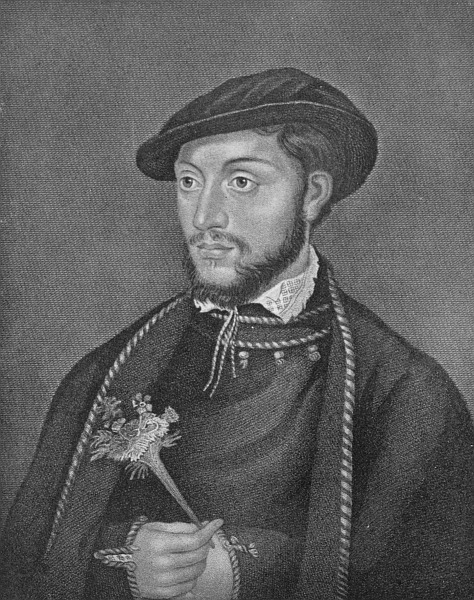
It was Pero Menendez de Aviles, perhaps the
greatest of all Spanish seamen, who goaded his slow-moving
and short-sighted Government into creating
an oceanic navy. Menendez was a fanatically religious
man, and regarding, as he did, the heretic
corsairs as the enemies of mankind, he was frequently
guilty of acts of ferocious cruelty. That he, as
sincerely as his English antitype Francis Drake,
believed himself to be the chosen instrument of
Heaven cannot be doubted; but he certainly lacked
Drake’s kindly nature.
In 1555 Menendez is found with an armed squadron
guarding the trade fleets. He built at his own cost
three ‘galleons’—the battleships of the day—and in
1561 was appointed Captain-General of the Indian
Trade. The French were checked, and by strenuous
endeavour something had been done when the
English appeared on the scene. The Huguenots,
driven from the West Indian Islands, established
themselves at St. Augustine in Florida. Menendez’s
untiring energy pursued them there, and in 1565
the colony was wiped out. Menendez’s grim cruelty
was bitterly remembered. The Spanish Government,
now beginning to rouse itself, issued orders that the
principal vessels of the trade fleets were always
to be armed, and twelve galleons were built for
further protection, for the maintenance of which a
special tax was levied on the Indies merchants.
These galleons were the beginnings of the Spanish
oceanic navy.
The Spanish sea-service was full of grave defects.
A Spanish warship was commanded by a military
officer, whose special charge was the soldiery;
gunnery was neglected and the seamen treated
like galley-slaves. In these circumstances the
Spanish galleon was comparatively ineffective against
ships provided with good guns and gunners. Spain’s
seafaring population, also, was not large, and since it
was impossible to commandeer and arm a powerful
force of her own merchant ships on an emergency,
the Government was wont to seize foreign ships for
the purpose, whose crews naturally embraced every
opportunity of deserting.
On the other hand, the English Navy was the
natural product of seafaring instincts. It was not
the outcome of policy, and was ruled by no jealously
devised legal code comparable to that of Louis XIV.
of France. It grew up almost imperceptibly without
any clear conception of the process. The old feudal
traditions gave way slowly, and in 1588 they still so
far prevailed that a noble had to be made nominal
Commander-in-Chief over the head of Drake, though,
thanks to both, no disaster followed. But there has
usually been a spirit of comradeship in English armaments
largely or entirely lacking elsewhere, and this
spirit was beginning to be felt under Elizabeth.
During the early years of Elizabeth there was a
tendency to neglect the Royal Navy. The country
was so strong in privateers and merchant craft
available for war, and so devoid were her possible
antagonists, France and Spain, of true naval power,
that little was done. But about 1570 the news of
Menendez’s untiring efforts brought about a new
shipbuilding programme under the direction of
John Hawkins, who in 1569 became Treasurer of
the Navy. Several new ships were built under his
supervision, and were the most formidable fighting
engines that had yet appeared on the seas. They
were of moderate size, but very seaworthy, heavily
armed, and almost entirely lacking the high fore-and-stern
castles which had encumbered the earlier
vessels. In 1574 a Spanish agent, reporting to his
Government, noted their great fighting value.
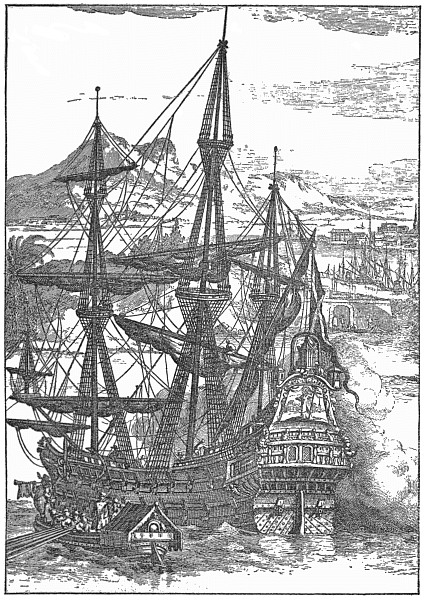
The word ‘galleon’ has been frequently misinterpreted.
The galleon was a ship fit for ocean work,
built with something of the fine lines of a galley—hence
its name. The very long, narrow, lightly-built
galley was useless in the Atlantic; on the
other hand, the short, broad, oceanic trading vessels
were too slow and unwieldy to be of use in war.
Trimming between these two extremes, the French
shipwrights evolved a vessel at once seaworthy and
comparatively fast, and the model was adopted by
England and the Peninsular States. Its essential
characteristics were that it was three beams or
more long, with a draft two-fifths of its beam. By
an extraordinary series of misconceptions the galleon
has come to be regarded as a heavy, clumsy vessel
peculiar to Spain. As a fact, Spain was perhaps
the last of the great Powers of the sixteenth century
to adopt it. This conclusion has been very convincingly
set forth by Mr. Julian Corbett in his
‘Drake and the Tudor Navy.’
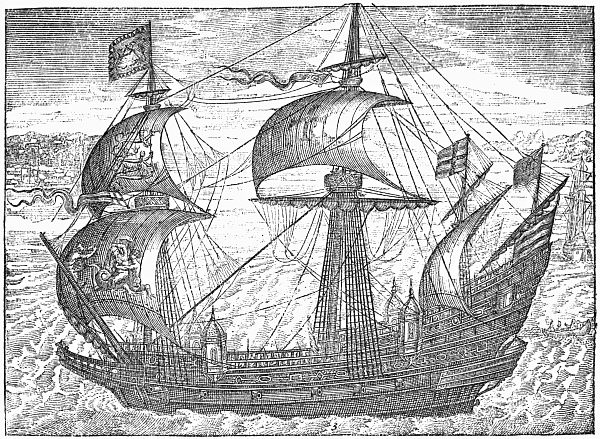
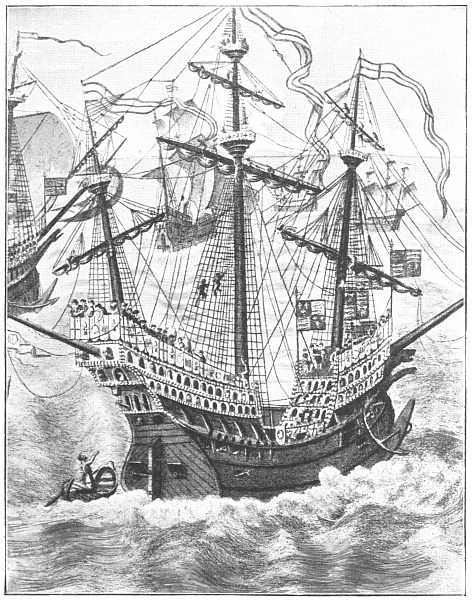
AN ELIZABETHAN MIDDLE-RATE GALLEON OR BATTLESHIP.
She has one covered gun-deck, and shows the low forecastle as against the high ‘cageworks’ of
contemporary Spanish vessels.
(From a contemporary drawing by Visscher.)
In 1574, Philip II., whose bigotry and absolutist
tendencies had created a terrible enemy to Spain
in her Netherland possessions, began to collect a
fleet of light vessels at Santander. The Duke
of Alva had failed in the Low Countries, and
had been succeeded by Don Luis de Requesens,
who found that he could do nothing while Admiral
Boisot and his flotillas held the sea. The command
of the force at Santander was conferred upon Pero
Menendez de Aviles, and by the summer it was
nearly ready to sail. There were 24 large ships
and 188 light vessels of various classes, manned by
12,000 men. Menendez, impressed by the danger
in the Atlantic, was anxious to do something more
than merely support Requesens. He conceived the
design of seizing the Scillies and Falmouth Haven,
and occupying them as naval stations. In this way
he hoped, with his powerful force, to be able at once
to intercept the privateers at the outset of their
Atlantic voyage, and establish a solid check upon
England.
Though Requesens himself was aware of the
danger of provoking England, Philip gave his
assent. On Elizabeth’s side the now reorganized
Royal Navy was prepared for mobilization, together
with some fifty sail of armed merchantmen. But
so great was the dissension in the Council that
Requesens told Menendez that he could sail up the
Channel unopposed. The attempt, made in the
teeth of England’s sea-power, would probably have
failed in the end; yet it might easily have had
grave results, and Menendez was a commander
of real genius. But he died in the midst of his
final preparations, and so much had the armament
depended upon his single dominating personality
that it broke up.
Thus a great danger to England passed away
with the man who perhaps of all was best fitted
to direct an attack upon her; and, as Mr. Julian
Corbett points out, it is worthy of note that almost
at the moment when the greatest of the Spanish
ocean admirals vanishes from the scene, Francis
Drake, the protagonist on the English side, comes
to the front.
For ten years after the death of Menendez
peace nominally subsisted between England and
Spain, but it was a peace that was violated every
day. England, officially and unofficially, continued
to assist the revolted Netherlands, and to raid
Spanish and Portuguese commerce. It became
an everyday affair for young Englishmen who
wanted some fighting to slip across to the Low
Countries. Philip countenanced plots against
Elizabeth, and intrigued in England and Ireland.
The exiled Queen Mary of Scotland was an ever-present
source of danger. Above all, the religious
side of the struggle became accentuated as time
went on. In no man was militant Protestantism
more incarnate than in Drake. In 1577
Elizabeth permitted him to sail on his famous
raid on the Spanish Pacific Settlements, and his
striking success was a new stay to the war-party.
He became at once the leading figure on the
English side.
In 1580 the King of Portugal died, and Philip
at once seized his country, forcing Prince Antonio,
the last (illegitimate) scion of the House of Avis,
to flee to England. Terceira, in the Azores, held
out for some years; but in 1583 it was reduced
by Philip’s famous Admiral, Alvaro de Bazan,
Marques de Santa Cruz, after a naval victory off
St. Michael’s. The possession of Portugal and its
colonies vastly enhanced Philip’s power. The most
important acquisition was that of the Portuguese
Navy—eleven fine galleons, besides galleys and
small craft. The Spanish Empire was now for the
first time a real naval power.
After his reduction of Terceira, Santa Cruz wrote
to Philip. He suggested that his victorious squadron
should be made the nucleus of a great fleet, and an
attempt made to settle the English Question. His
suggestions, if acted upon, would have meant the
assembly of a far larger force than did actually sail
against England five years later. Santa Cruz
thoroughly understood that the English power was
very formidable. Philip did not see his way to
immediate action, but he issued orders in accordance
with his Admiral’s suggestions. They were only
very partially carried out, but something was done,
and in this way began the ‘Enterprise of England.’
Certain aspects of the situation must be carefully
held in mind. England and Spain, though still
nominally at peace, were being steadily drawn into
war by religious feeling, the jealously exclusive
trade policy of Spain, and the determination of the
English to thwart it. Philip, despite his religious
fanaticism, was very loth to plunge into a war that
was clearly against his interests, since the deposition
of Elizabeth would mean the accession to the
English throne of the half-French Mary Stuart.
England, under Mary, might become by dint of
sword and stake Roman Catholic in faith, but would
lean to France in policy. The Pope believed that
Philip must perforce conquer England, but Philip
thought that he could gain the upper hand at sea
without wiping England off the map. Though he
was clumsily putting Santa Cruz’s precepts into
practice and conniving at plots against Elizabeth,
he did not wish for war, nor was he ready.
On her side Elizabeth personally desired peace.
Sir James Crofts, the Controller of the Household,
was Spain’s paid spy. The Lord Treasurer,
Burghley, was a man of peace, and especially
detested the—technically—dubious means by which
the war-party and its instruments were teaching the
world that Spain was but ‘a colossus stuffed with
clouts.’ He entirely failed to see that religious
ardour had cleft an impassable chasm between the
nations, quite apart from the formidable trade
question. The real force which was driving
England into war was the intense Protestant (or
Puritan) feeling of a great part of the nation, of
which the war-party in the Royal Council—Walsingham,
Leicester, Hatton, and others—were
the chief exponents, and whose strongest helper
was the famous seaman, Sir Francis Drake. The
London merchants, however, to a considerable
extent, were opposed to war.
In 1585 an egregious blunder on Philip’s part
precipitated hostilities. There had been a failure of
harvest in the Biscayan provinces. Under special
safe-conduct a fleet of English corn-ships sailed to
relieve the distress, but once in port they were all
seized and the crews imprisoned. One ship, the
Primrose, of London, escaped, carrying off with her
the Corregidor (Sheriff) of Biscay, who had endeavoured
to seize her. On the Biscayan official
were found his directions, proving beyond all doubt
that Spain was really preparing to invade England.
The country now was resolute for war, and
Elizabeth determined to give Philip a sharp lesson.
A fleet of royal and private ships, commanded by
Drake, was ordered to sail to the rescue. Philip
had already released the ships, apparently because
he realized that the action had been a blunder, but
this made no difference to Drake. On September
27 he appeared off Vigo, and for more than
a week blockaded the port, extorting from the
humiliated and helpless local authorities all that
he needed, and plundering in the neighbourhood.
Then he went on to the Canaries and the West
Indies. Santa Cruz was ordered to prepare a
squadron to pursue him, but not for six months
could he sail; and Drake sacked Santiago in the
Cape Verd Islands, San Domingo, Carthagena, and
St. Augustine in the Spanish Main, returning in
triumph to England in the summer of 1586.
After this open defiance, war seemed inevitable,
and nothing but the strange diplomacy of those days
still deferred it. Elizabeth was, at last, interfering
officially in the Netherlands. In 1586 the ‘Babington’
Plot was discovered, and its result was the
execution of Mary Stuart in 1587. One of Philip’s
deterring motives was thus obviated. By 1587 the
work on the Armada was in full swing, when Elizabeth
again let Drake loose with a powerful squadron.
On April 18 he broke into Cadiz Harbour, worked
havoc with the store-ships which crowded it, and
came out again in spite of all that the Spaniards
could do. Then, with magnificent strategic insight,
he stationed himself off Cape St. Vincent, and threw
the entire Spanish mobilization into utter disorder.
Santa Cruz and Admiral de Recalde in the
Tagus could not move, and were cut off from the
other Spanish squadrons in Cadiz and elsewhere.
For a month Drake held his ground, and when
forced to leave his station, owing to disease in his
insanitary ships, he sailed to the Azores and captured
one of Philip’s great trading carracks, with a cargo
worth £110,000, or about £800,000 in modern value.
He said that his cruise had singed Philip’s beard.
In fact, it had dislocated all the Spanish plans, and
done damage to the amount of millions of ducats.
Had the blow been followed up, Philip’s scattered
squadrons could hardly have concentrated. But
Elizabeth now fell into a fit of indecision, which was
encouraged by the unscrupulous Crofts, who actually
suggested that for his services Drake should be
disgraced and his property confiscated!
After Drake’s return, the Spanish preparations
were able, slowly and painfully, to go forward.
The Prince of Parma, Philip’s General in the Netherlands,
said afterwards that had the Armada sailed
in September, it would have encountered no opposition.
But the point is that it did not sail, and that
the English Government was well informed of
its backward state of preparation. Santa Cruz was
still at sea hunting for Drake, who was already safe
at home, and he did not return until September. By
that time the Spanish squadrons were at Lisbon
under General de Leyva, but still in a very unready
state, while Santa Cruz’s vessels needed a complete
refit. After repeated efforts, the Marquis succeeded
in inducing the King to defer the expedition until
March. But he was broken by anxiety and thankless
toil, harassed by unjust attacks, and early in
1588 died. His death robbed the expedition of
most of its chances of success.
At Santa Cruz’s death the Armada was still hopelessly
unready. Guns, ammunition, food—everything
was wanting. The men were unpaid, ragged, and
often dying of hunger. According to feudal notions,
the command of so great an expedition must be
given to a great prince, and a harmless Spanish
grandee, Alonso Perez de Guzman, Duke of Medina
Sidonia, was appointed nominal General. The fleet
was slowly patched into an appearance of efficiency,
but it could not sail until the middle of May, 1588.
To strengthen it nearly all the galleons of the
Indian Guard were added to it, leaving the Atlantic
trade route almost unprotected.
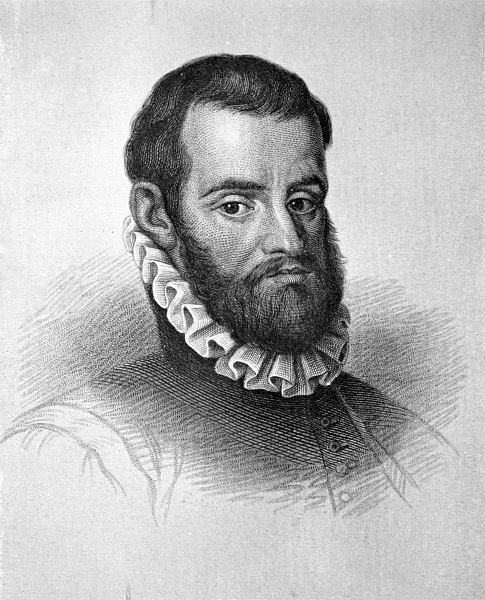
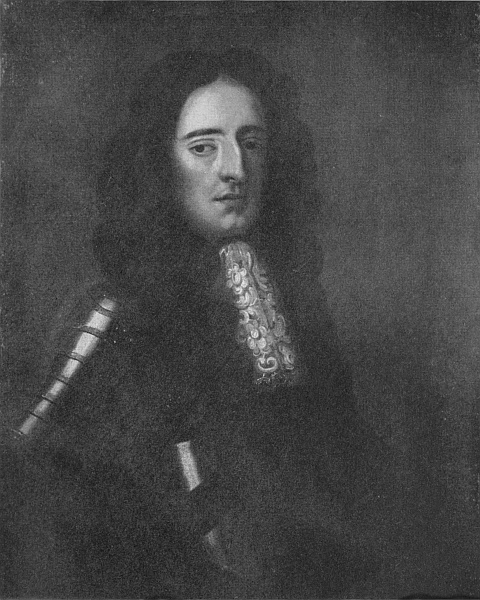
A. Rischgitz.
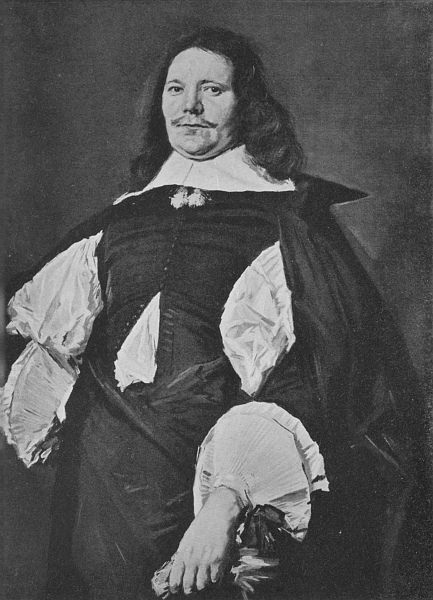
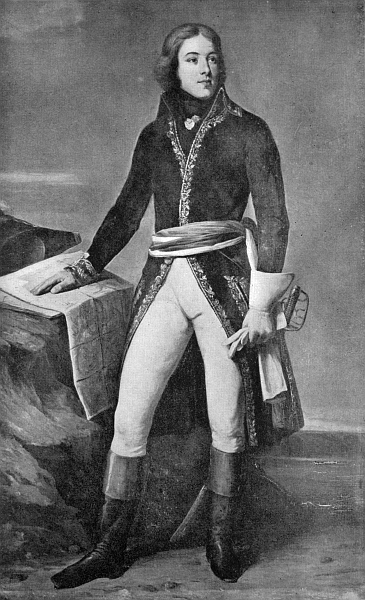
ADMIRAL PERO MENENDEZ DE AVILES (1523–1574).
Now regarded as the greatest of the Spanish oceanic Admirals. A grim fanatic in religion, he
was frequently guilty of acts of gross cruelty. He died while preparing to lead a great fleet
against England.
Meanwhile in England, on December 21, 1587,
Lord Howard of Effingham, Lord High Admiral,
had received his commission as Commander-in-Chief
at sea. His official rank was rather civil
than naval, and he was placed in chief command
for much the same reason as Medina Sidonia had
been. He was, however, greatly superior to the
Spaniard in moral qualities, and, though somewhat
lacking in firmness of character, was always ready
to yield to the advice of the experienced seamen
with whom the navy swarmed. Drake, the guiding
spirit of the resistance, was given the command of
an independent squadron at Plymouth. When the
news of Santa Cruz’s death came in February, there
appeared to be some chance of peace, and commissioners
from the contending Powers met at
Flushing. Howard’s fleet was partly demobilized,
but he himself, with a picked force, was ordered to
make a demonstration off Flushing. In March,
however, news came that the Armada would sail on
the 20th, and the whole Navy was mobilized.
Drake himself was full of contempt for the Spanish
sea-power, and endeavoured to induce the Government
to allow him to attack the Armada in port.
After repeated representations, he triumphed. Lord
Howard was ordered to leave a force to watch Parma,
who was making a precedent for Napoleon in 1804,
by building a flotilla for the transport of his army,
and to join Drake with the bulk of his fleet. This
practically amounted to giving Drake the command
of the English Navy. With Howard present he
was nominally only second, but there is ample
evidence that he was the real chief. Abroad
Howard’s name was hardly mentioned. Drake was
recognized as the English leader by everybody, from
the Pope downwards.
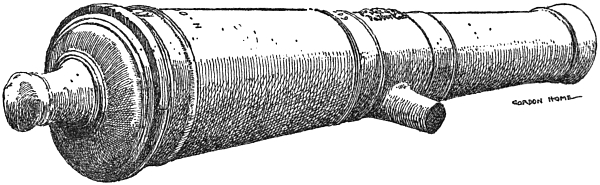
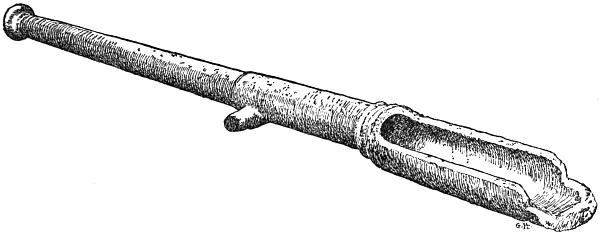
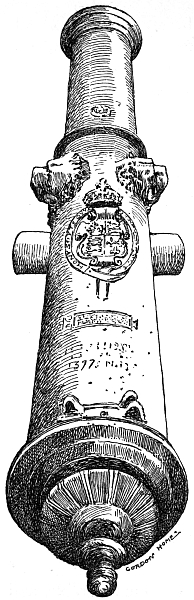
IRON CANNON OF THE ARMADA PERIOD.
9 feet 6 inches long; calibre, 7 inches; weight, 59 cwt. 11·1 lbs. It bears the
Tudor Rose and Crown on the second reinforce. Girth of breech end,
5 feet 9½ inches.
(From the Museum of Artillery, Woolwich.)
Howard was much addicted to nepotism. To
command the Channel Squadron he appointed his
nephew, Lord Henry Seymour, to guide whose inexperience
two veteran admirals, Sir Henry Palmer
and Sir William Wynter, had to be left behind.
Seymour had under his command three of the
finest galleons of the Royal Navy, five smaller
ones, several pinnaces, and the whole of the ships
supplied by the East Coast and Cinque Ports. As
Parma’s flotilla was already closely blockaded by
Dutch ships, this large force was practically wasted.
Howard took off to the West eleven splendid
galleons and eight pinnaces of the Royal Navy, with
some forty private ships and pinnaces, half of them
furnished by London. Drake at Plymouth had five
galleons specially chosen by himself for their sailing
qualities, twenty of the finest private ships in the
country, and a number of pinnaces.
The English Navy ships were very heavily
armed, largely owing to the influence of Drake.
Some were, indeed, so over-gunned that they could
not use their lower tiers in a swell, and there was a
lack of trained gunners. The Government also,
unused to warfare on a great scale, failed to send
supplies and ammunition in sufficient quantity.
On May 23 Howard and Drake effected a
junction off Plymouth, and now had a united fleet
of about 100 sail, manned by 10,000 men. At once
Drake began to urge the necessity of sailing to
attack the Armada in port. On May 30 the whole
fleet put out, but encountered gales, and was obliged
to return on June 6. Meanwhile, on May 18, the
Spanish fleet had sailed from Lisbon, but by June 9
had to put into Coruña with half its stores spoilt, short
of water, crews down in hundreds with sickness,
and with a third of its numbers missing. Medina
Sidonia and his staff, except Don Pedro de Valdes,
Admiral of the Andalucian Squadron, considered
that to continue the attempt was hopeless. Philip
refused to listen to them, and for a month the fleet
lay huddled in Coruña, collecting its stray ships,
painfully refitting, revictualling, and recruiting its
crews with raw peasants from Galicia. Some of
the store-ships had drifted almost to the English
coast, perilously near Howard’s clutches, before they
were recalled.
Meanwhile at Plymouth Drake and Howard were
also struggling with difficulties, the chief of which
was shortage of supplies. The unlettered genius
at the head of the fleet never ceased to endeavour
to impress upon his Admiral his aggressive tactics.
After much argument the whole fleet took up the
station off Ushant, which was afterwards to be so
famous; and on July 7 the wind blew fair for Spain.
Drake insisted on a Council being called, and set
forth his arguments more urgently than ever. After
a long debate the sea-admirals prevailed over the
hesitation of the half-feudal entourage of Howard,
and at eight o’clock in the evening the English Navy
made sail for Spain. Had Drake never done anything
else, this splendid dash would stamp him for
all time as a captain of the first order. What would
have happened to the Armada had Drake attacked
it in Coruña is not doubtful. But almost within sight
of the Spanish coast the breeze died away, and then
turned against the English. They were forced to
put about, and on the 12th were back at Plymouth.
There they lay for a week, straining every nerve
to revictual, dismissing some of the ships so as to
fully man others whose crews were weakened by
disease. On the afternoon of the 20th the officers,
after a hard day’s work, were on the Hoe of
Plymouth, some of them amusing themselves with
a game of bowls, when Captain Fleming burst upon
them with the news that the Armada was off the
Lizard!
It was a staggering blow. The English were
caught in the same predicament as the Spaniards
would have been a week before. Everybody turned
to the short, sturdy, thick-set ‘pirate’ captain upon
whom England pinned her faith, and Drake replied
by one of those little bits of posing by which great
captains so often encourage their followers. ‘Plenty
of time—plenty of time!’ he remarked with studied
coolness. ‘We’ll finish the game, and then go and
finish the Spaniards!’—or words to that effect. It
may be imagined that the great seaman’s nonchalance
had an excellent effect in steadying the nerves of
his excited and less tried colleagues.
None the less, the situation was critical. The
Spaniards were a few miles to the windward of
Plymouth. There was but one remedy—to put
to sea at once in the teeth of the wind. It says
volumes for the efficiency of the captains and crews
that it was successfully done. Everyone worked
to such excellent purpose that by next morning
54 ships, under Drake and Howard, were clear of
the Sound and beating out to sea, while Hawkins,
the Rear-Admiral, was warping out the remaining
10. Besides these 64 ships, there were some
20 light craft. Other vessels were in harbour, but
not immediately available owing to lack of hands.
The 64 ships included 16 Royal Navy galleons of
from 250 to 1,000 tons, 5 private galleons from 300
to 400 tons, and 43 between 140 and 200 tons.
Turning to the Spaniards, the original organization
of their fleet had been in six ship squadrons,
one galleasse (giant galley) squadron, one galley
squadron, one light squadron, and one urca (cargo
vessel) squadron, the last being mainly intended for
store-carrying, though its vessels were armed. The
six ship squadrons included two of war galleons and
four of armed merchantmen and private ships. Each
consisted nominally of ten ships, except the Castillian
squadron, which contained four armed merchantmen
besides its ten galleons.
Between May and July ships lost company and
did not all rejoin, while to replace them others were
added. So far as can be ascertained, the Spanish
fleet, when it arrived off the Lizard, included
19 galleons, 4 galleasses, 41 armed merchantmen,
27 urcas, 16 water and salvage vessels, and about
40 small craft. The real commander, who was to
Medina Sidonia what Drake was to Howard, was
Don Diego Flores de Valdes, Admiral of the
Castillian galleons. The better to discharge his
duties, he sailed with the Duke on the flagship San
Martin. It is characteristic of Philip that he had
chosen for the substantial command a man inferior
in every respect to some of the other admirals.
The squadrons and commanders were as follows:K
Portugal: Alonso Perez de Guzman, Duque de Medina Sidonia.
Castille: Don Diego Flores de Valdes.
Vizcaya (Biscay): Don Juan Martinez de Recalde (Vice-Admiral of the Armada).
Andalucia: Don Pedro de Valdes.
Guipuzcoa: Don Miguel de Oquendo.
Levantiscas (Italy): Don Martin de Bertendona.
Don Alonso Martinez de Leyva (Lieutenant-General of the Armada).
Naples: Don Hugo de Monçada.
Light Squadron: Don Agostin de Ojeda.
Squadron of Urcas (heavy supply ships): Don Juan Gomez de Medina.
Pedro de Valdes told Drake that the total force
included 110 armed vessels and 32 non-effective
craft. There were between 7,000 and 8,000 seamen
and perhaps 17,000 soldiers, besides gentlemen
and slaves; but the seamen were of many
races and some raw recruits. Many of the soldiers
were also raw, though there were five Tercios, or
brigades, of veterans on board.
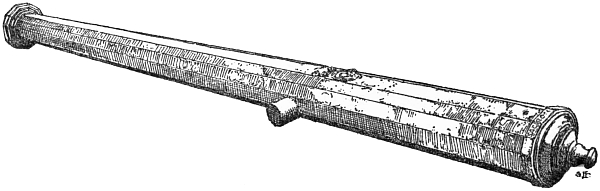
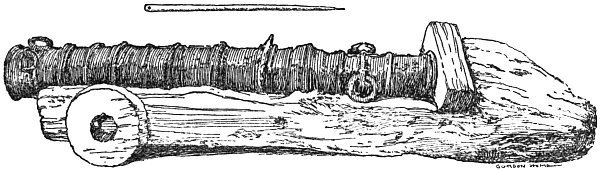
BRASS DODECAGONAL SAKER OF THE SIXTEENTH CENTURY.
Length, 7 feet 11 inches; calibre, 3·92 inches; weight of shot, 5 lbs. Guns of this
class formed the main armament of the bulk of the English merchant-ships.
The Spanish ships were of more antiquated
pattern than those of the English, and looked to
amateur observers very large and formidable. As
a fact, the Spanish galleons were no larger, ship for
ship, than those of their adversaries, and were
much more lightly armed. All the armed merchantmen
were of over 300 tons, but they carried no
armament of guns in proportion to their size.
Some of the Italian ships were wretchedly armed.
Still, it is possible to labour this point too much.
The English galleons were undoubtedly by far the
best fighting ships in the two fleets, and the fine
London trading galleons were also formidably
armed; but so far as can be seen, the bulk of the
English private craft were armed mainly with 4 and
5 pounders. The inferiority of the Spaniards chiefly
lay in the fact that they were even weaker in
gunners than the English, as well as badly supplied
with ammunition. The military officers who commanded
most of the ships were too ignorant and
too self-satisfied to trouble about the guns, relying
instead upon their soldiers. The result was that
no effective reply could be made to the often
ill-directed but rapid English fire, while the
soldiers crowded in the ships were slaughtered
helplessly.
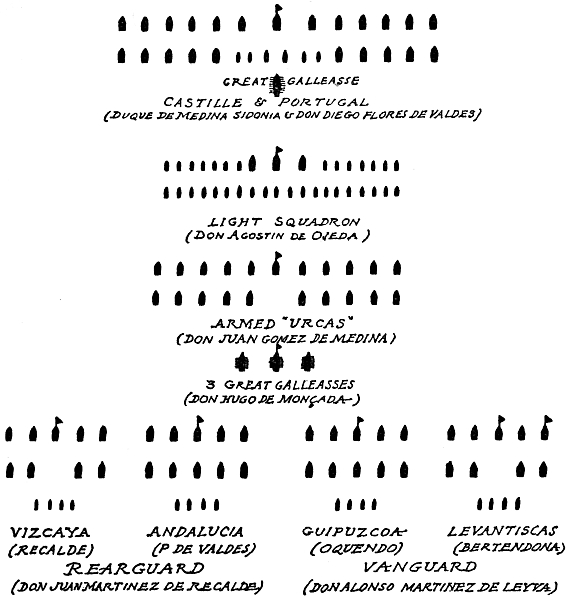
ORDER OF SAILING OF THE SPANISH ARMADA.
Constructed from Spanish documentary material. The English idea of a crescent
formation was due to their attacking the rear squadron which sailed in line
abreast. If the ships at the extremities did not keep station well the crescent
form would no doubt have appeared.
Philip’s strategic orders were faulty. No actual
point of junction with Parma was named. The
fleet was to go to the Downs, avoiding an action if
possible until the two forces had united—a difficult
and indeed impossible task. The division of the
English fleet was known or anticipated, but not
Howard’s junction with Drake. On the basis
that Howard with the Royal Navy was in the
Downs, and Drake with a fleet chiefly of privateers
in the west, the Armada was tactically organized
in three main divisions. At its head sailed the
vessels of Portugal and Castille in one squadron
under Medina Sidonia and Diego de Valdes. The
position of the galleasses is a little uncertain. It
has been thought that they sailed separately with
the chief flagships; but they are generally found
acting together. Behind this vanguard was the
Light Division, and behind it again the urcas.
Behind the urcas was the rearguard in two divisions:
the ‘Rearguard,’ or left wing, consisting of
Recalde’s and Pedro de Valdes’ squadrons, under
the chief command of the former; the Vanguard, or
right wing, comprising the squadrons of Oquendo
and Bertendona, under Leyva. Sidonia and
Diego de Valdes flew their flags together on the
Portuguese galleon San Martin. Recalde was on
the Portuguese galleon San Juan, and Leyva
on an Italian ship, the Rata Encoronada. The
ships generally were badly found. The tactical
formation by line abreast, too, was faulty, since the
broadsides were masked—a proof of how little the
Spanish officers realized that their best weapon
was the gun. But the squadronal organization was
excellent for manœuvring, and discipline was good.
The ships seen by Fleming were not the whole
Armada, but Pedro de Valdes with his squadron,
and about twenty other ships. The rest of the fleet
had been scattered in a gale, but on the 20th it
reunited and proceeded up the Cornish coast towards
Plymouth. Along the shore the Spaniards could
see the beacons signalling their approach. The
Pope’s consecrated banner was hoisted on the San
Martin and everyone knelt at the signal to pray for
victory.
The experienced Spanish admirals, no less than
the impetuous Lieutenant-General de Leyva, urged
their commander-in-chief to push into Plymouth and
destroy the English fleet at its anchorage; but
while they deliberated ships were made out ahead.
It became obvious to the astonished Spaniards that
the English had slipped out of the trap. Presently
a scouting pinnace arrived confirming the unwelcome
impression, and also bringing tidings that the ships
were the united fleets of Howard and Drake.
Sidonia, at a complete loss, anchored his fleet to
wait for daybreak.
Meanwhile Drake and Howard had reached out
to the Eddystone, and at dawn on the 21st they
bore boldly down to attack the Armada, which was
formed in the squadronal order of battle already
described. The English fleet, coming from seaward
in a long line ahead, passed Leyva’s division, and
developed a fierce attack upon Recalde. The
Vizcayan squadron was panic-stricken, Recalde’s
flagship completely disabled, and not for two hours
did Sidonia and Leyva succeed in supporting him.
Howard, thereupon, drew off. As the fleets lay
watching each other, however, the Guipuzcoan San
Salvador was disabled by an explosion. Howard
again threatened an attack. Pedro de Valdes’
flagship, the Nuestra Senora del Rosario, was also
disabled by a collision as she put about, but the
Spanish squadrons came up to the rescue in such
admirable order that Howard again drew off. The
injured Spanish ships were taken in tow, and the
Armada made sail to continue its voyage, as an
attack on Plymouth was obviously now out of the
question.
The English pursued. The leading of the van
was given to Drake, who flew his flag on the far-famed
Revenge, the smartest ship and fastest sailer
in the English navy. His attention was, however,
distracted in the night by some strange lights, and
with a somewhat imperfect appreciation of his duty,
for which he was afterwards unduly blamed, he
turned aside to examine them. They proved to be
harmless merchantmen, and Drake put about to
resume his post, but on his way he fell in with the
crippled Nuestra Senora del Rosario, which had
fallen behind the Spanish fleet. Resistance being
clearly useless—since he was alone amid the English
fleet—Valdes surrendered. The San Salvador also
was so damaged that the Spaniards abandoned her,
and she was taken by Howard, who was close
behind.
This was a bad beginning for the Spaniards.
While Recalde repaired his damaged ship, Leyva
took chief command of the rear, which was
strengthened by three galleasses, three Portuguese
galleons, and the Italian galleon San Francesco de
Florencia from the van. On the night of the 22nd
the fleets were becalmed off Portland. A group of
English ships drifted apart from their main body,
and in the bright moonlight the oared galleasses
might have attacked them; but Captain-General
Monçada was sulking over a fancied slight, and
would not move. At dawn a north-west breeze
sprang up, and the Spaniards boldly bore down to
the attack.
A tumultuous engagement followed, in which
want of organization in the English fleet prevented
it from gaining any real advantage. Drake succeeded
in weathering the Spanish seaward wing;
but on the other flank, Frobisher, the famous explorer,
who commanded the Triumph, the largest
galleon in either fleet, was cut off and fiercely
attacked, and Howard and Drake had to come back
to the rescue. Sidonia’s flagship was badly mauled
by Howard’s flagship, the Ark, and no doubt the
Spaniards suffered more than their adversaries; but
on the whole the battle was drawn.
The English had learnt a lesson, and next day,
as they awaited fresh supplies of ammunition, the
fleet was organized into four squadrons, commanded
respectively by Howard, Drake, Hawkins, and
Frobisher. The latter owed his command to the
courage which he had shown at Portland; but he
was no tactician, and attributed Drake’s scientific
manœuvres to cowardice.
The Spanish admirals knew well the weak point
of Philips design. Recalde had served under
Menendez, and was especially urgent in pointing
out that an English port must be seized as a base.
It was eventually decided to occupy the Isle of
Wight, and establish themselves there till a plan
of concerted action could be managed with Parma.
The English harassed the rearguard incessantly, and
eventually it had to sail constantly in order of battle.
On the morning of the 25th the fleets lay becalmed
to the south of the Isle of Wight. The
Portuguese galleon San Luis had fallen behind the
Armada, and Hawkins attacked her by towing up
with his boats. The gallant Leyva came back to
the rescue with three galleasses and some ships,
whereupon Howard towed up to assist Hawkins.
After a sharp encounter, Leyva rescued the San
Luis, but the galleasses were very roughly handled.
A breeze now sprang up, and the English attacked.
Frobisher, with bulldog courage, went at Recalde,
and was again cut off. The Spaniards appeared to
have the Triumph at their mercy, but her boats
were lowered and took her in tow. The wind rose
again; her sails filled, and she slipped away, leaving
the pursuing Spaniards just as if they had been at
anchor. So says Calderon, the Spanish Fleet
Treasurer.
Howard apparently took little further part in the
action, except to assist Frobisher and contain part
of the Spanish fleet. But under cover of the banks
of gun-fire smoke Drake and Hawkins carried out
successfully a finely conceived and decisive stroke
of tactics. Working well out to sea, they bore down
irresistibly upon the Armada’s weather wing, with
the object of driving it upon the ‘Owers,’ the
dangerous shoals which had had their place in Lord
Lisle’s plan of action against D’Annibault in 1545.
The weather ships were forced helplessly to leeward.
The attack on Frobisher and Howard died away,
because Sidonia had to support Leyva’s broken
division; and to save themselves from being driven
upon the Owers, the Spaniards were forced to retreat
eastward. The triumph of the English tactics was
complete. The Spaniards were prevented from
occupying the island, and in despair sailed for Calais.
They were badly demoralized by the English
fighting and manœuvring powers, and their losses
had been heavy. Messages were sent on to Parma
for ammunition and some vessels that might outsail
the fast English ships. Meanwhile Howard could
not find room for the soldiers who were streaming
out from the coast to reinforce his crews.
Among the noble volunteers who hurried to join
him were the Earl of Cumberland, soon to be a
famous admiral, and Robert Carey (son of Lord
Hunsdon), to whose Memoirs we owe an invaluable
picture of Elizabethan times. Carey tells the story
of their adventure. They ‘took post-horse and
rode straight to Portsmouth, where we found a
frigate that carried us to sea; and having sought for
the fleets a whole day, the night after we fell in
among them: where it was our fortune to light first
on the Spanish fleet; and finding ourselves in the
wrong, we tacked about, and in short time got to
our own fleet.’ Evidently they had a narrow escape.
They found Howard so well attended that he had
no cabins to spare, and so boarded the Bonaventure,
in which they took part in the Battle of Gravelines.
On the day after the battle Howard celebrated
the victory by knighting some of his commanders,
including Hawkins and Frobisher. All through the
26th and 27th the pursuit went on, until about
four o’clock in the afternoon Sidonia anchored off
Calais. Nothing had been heard from Parma, and
the pilots said that they could answer for the safety
of the fleet no farther, as they did not know the
North Sea. The English anchored also, to windward
of the Armada, and less than a mile away.
Meanwhile a pinnace had been sent to call in
the Channel Squadron from the Downs. Seymour
and Wynter had already made up their minds to
join Howard wherever he might be, and wasted not
a moment. They had only three days’ provisions
in hand, but none the less weighed and beat across
to Calais. The disheartened Spaniards made no
attempt to prevent the junction, and at nightfall
the whole available naval forces of England were
gathered within striking distance of the foe.
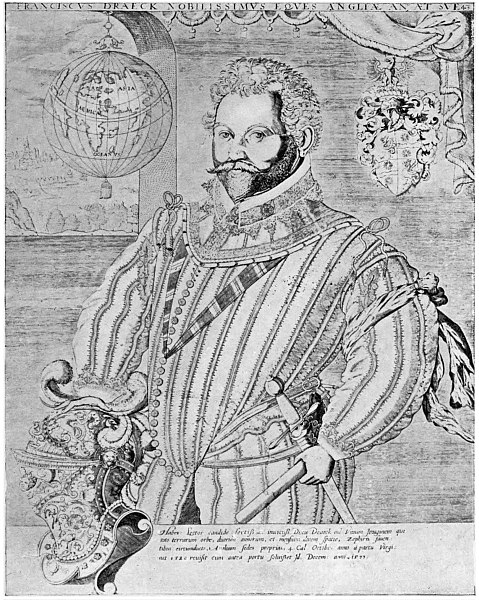
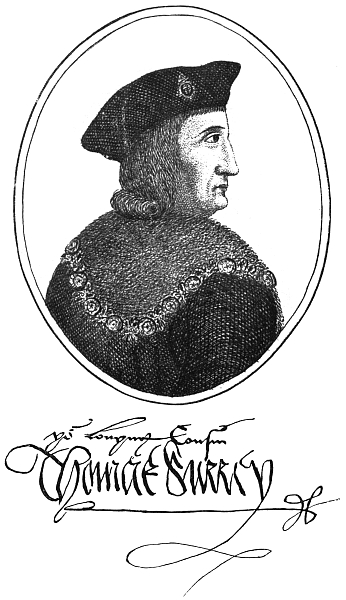
SIR FRANCIS DRAKE.
The first of the great English oceanic Admirals.
From an engraving by Elstracke.
On Sunday morning a council of war assembled
on the Ark, and it was decided to attempt to dislodge
the Armada from its anchorage by drifting
fireships among its crowded ranks. Combustibles
had already been collected at Dover, but lest valuable
time should be lost it was decided to use vessels
from the fleet. Drake and Hawkins immediately
offered two of their own ships for the service.
Eight in all were collected and hurriedly prepared.
Guns and stores were left on board, for there was
no time to remove them. Captains Yonge and
Prouse were entrusted with the dangerous duty of
directing them, and some time after midnight they
were fired and bore down with wind and tide upon
the horror-stricken Spaniards. Everyone thought
of what Gianibelli’s fireships had done at Antwerp
only a few years before. Sidonia, seeing no help
for it, ordered or permitted cables to be cut, and
there was a nerve-breaking scene of disorder and
panic. Ship collided with ship in the darkness,
and there were many accidents. Monçada’s flagship,
the San Lorenzo, lost her rudder; the San
Martin herself was almost overtaken by a fireship
before she could work clear. Still, the material
damage was small. Wind and tide carried the
fleet clear, and the fireships burnt out harmlessly.
Sidonia, with the San Marcos, the San Juan, and
one or two other ships, anchored as soon as they
were clear, but the bulk of the fleet drifted away
in a straggling line off Gravelines. The wind was
about south-west, so that they could not easily close
up on Sidonia. The latter therefore weighed to
rejoin them.
At dawn the English admirals saw their foes
scattered, but also perceived that Sidonia was endeavouring
to reunite his fleet. At once they got
under weigh and made sail, Drake leading the
attack on the right, Hawkins to his left rear, then
Howard, and then Frobisher, with Wynter and
Seymour still farther back. All the accounts seem
to show that the squadrons did not succeed in
engaging simultaneously. The Channel Squadron
came into action at least two hours after Drake.
It was now that the inexperienced Lord High
Admiral committed a huge blunder. The San
Lorenzo was seen on the right trying to get into
Calais, and with a total lack of appreciation of his
duties as Commander-in-Chief he turned off to seize
her, followed by nearly all his squadron. He took
and plundered the galleasse, and Monçada was killed;
but for nearly four hours a fifth of the English
fleet was absent from the critical point.
Sidonia’s pilots were anxious. They assured him
that if the fleet continued to run before the wind it
must go ashore. It was a crushing announcement,
but Sidonia, to his credit be it said, did not flinch.
Courage Spaniards have never lacked. Pinnaces
were sent to warn the fleet, and the devoted flagship
and her consorts swung round to face the
enemy. In front, and nearest to Sidonia, the ever
famous Revenge, flying Drake’s flag, was bearing
down upon him, closely followed by three galleons
of the Royal Navy, and for miles behind them the
great English fleet was setting all sail and streaming
to the attack. No time was to be lost. The Spanish
captains knew the peril, and were coming back to
the rescue of the Admiral. The English came on
in stern silence, reserving their fire until the last
moment, in order not to waste their already too
scanty supply of ammunition. At sunrise Drake
was within easy range of Sidonia’s little group.
The Revenge fired her bow battery into the San
Martin, and then, hauling to the wind, sailed past
her larboard broadside, letting fly with every gun
that she could bring to bear. Behind her came the
Nonpareil (Vice-Admiral Thomas Fenner) and so,
one after another, all Drake’s squadron filed past,
cannonading furiously and holding on after their
leader to beat off the main body of the Armada,
which was standing out to the rescue of the
admiral. Hawkins next came into action and
fastened on Sidonia, but he does not seem to have
supported Drake; and the result was that one by
one about fifty of the best Spanish ships came into
action about their Admiral. Frobisher apparently
was in action soon after Hawkins, but the Channel
Squadron did not come up till about 9 a.m.; and
Howard, having wasted so much time, was not
on the scene until past ten. The Spaniards were
never really able to form proper order, and as they
struggled singly into action they were attacked by
whole English squadrons and fearfully mangled.
Recalde’s division mostly found its way to Sidonia’s
right, or weather wing, and upon it the English
concentrated their fiercest efforts. The English
cannonade was overwhelming. The crowded Spanish
ships were mere slaughter-pens. Deserters declared
that some of them were full of blood, but surrender
was never heard of. They fought to the bitter end.
The finest fighting was done by the Portuguese
galleon San Mateo. She was full of veterans
from the Tercio de Sicilia, and had on board
its Colonel, Don Diego de Pimentel. She was
surrounded by the whole Channel Squadron, and
fought on, answering the storm of cannon-balls
with musketry, until Recalde rescued her. An
English officer, filled with admiration, hailed her to
surrender; but the desperate veterans shot him, and
cursed the English cowards who would not close
and fight like men. The San Felipe, under Don
Francisco Alvarez de Toledo, a kinsman of the
terrible Alva, vied with the San Mateo in the
heroism of her resistance. In one of the shifts of
the battle the San Martin was out of action. She
might have escaped, but Sidonia bravely went into
the conflict again.
The English had to endure no such ordeal, but
they fought with furious determination. The Revenge
was severely battered. Wynter’s Vanguard fired
500 30-, 18-, and 9-pounder shot—a remarkable
achievement in those days. But so completely had
the English the advantage that, according to Vice-Admiral
Fenner, they lost only sixty killed.
By three o’clock the battle was at an end. Nearly
twenty Spanish ships were cut off (among them
the San Martin, San Mateo, and San Felipe),
all sadly shattered, full of dead and dying, and
with not a shot left to reply to the merciless cannonade
that was still pouring upon them. Nothing,
it seemed, could save them, when suddenly a squall
descended upon the struggling fleets. The English
were forced to cease fighting to meet the danger.
The crippled Spaniards, unable to manœuvre, had
to put before the wind, and the combatants were
parted. The Spaniards had no power left to fight.
All that night they fled blindly, followed by the
English, while their shattered ships went down and
drifted ashore. Several were lost in this way, including
the San Felipe and the San Mateo, and
with the wind as it was nothing could save them
from all going ashore.
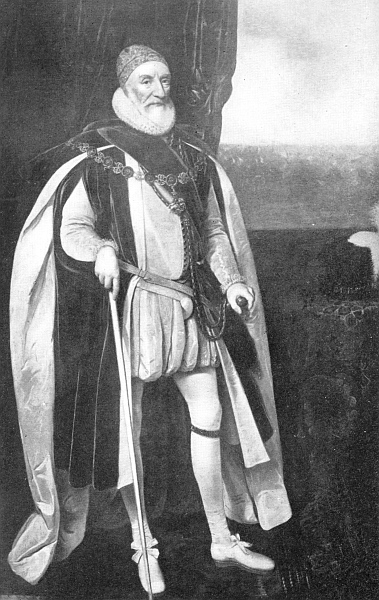
A. Rischgitz.
CHARLES HOWARD OF EFFINGHAM, FIRST EARL OF NOTTINGHAM.
Lord High Admiral of England in 1588, and official commander of the English fleet which
defeated the great Armada.
From the portrait by Zucchero in the Painted Hall, Greenwich Hospital.
Sidonia, having confessed and prepared for death,
turned to bay; but there was no heart left in the
fleet to follow their Admiral’s example, though
Leyva and Oquendo, brave to the last, at once
supported him. The English fleet was holding off
to let the Zeeland sandbanks do their deadly work,
and Leyva and Oquendo urged Sidonia to at least
make a show of attacking. It could not be.
Discipline was gone. They cursed him in their
despair, and shouted to the crew to throw Diego
Valdes overboard! Nearer and nearer to the
banks drifted the miserable throng of shattered,
blood-stained hulks that now represented the
Fortunate and Invincible Armada, when suddenly
the wind shifted. The English could not understand
it. Twice God had intervened to save the
foe! The Armada was able to bear out from the
shoals and steer a course to the northward in deep
water.
So ended the great struggle. On the surface the
Armada had suffered little; its numbers were not
greatly diminished. But in fact nearly all its fighting
ships were so mangled that they could hardly
hope to survive a severe gale. They were mere
floating dens of misery, full of men wounded, sick, and
worn out. The loss of life at Gravelines can only be
conjectured. The Spaniards admitted 1,400 killed
and wounded. But it is known that the San Mateo
and the San Felipe lost nearly all their companies, and
the Maria Juan of Biscay over two-thirds of hers.
Judging from such evidence as this, the total can
hardly be estimated at less than 4,000.
Seymour, to his disgust, was left to watch Parma,
while the English main fleet pursued the Armada
until it was certain that it did not intend to put into
the Forth. There was apparently some thought of
fighting again. Howard’s squadron still had a fair
supply of ammunition on board, but the others had
expended nearly all theirs; and on August 2 Drake
flew a flag of council to discuss the matter. ‘It
was found,’ says Carey, ‘that in the whole fleet
there was not munition sufficient to make half a
fight.’ Compelled to be content, the fleet ran for
home. It was time, for already disease was beginning
to rage in the insanitary ships, and many men
died before the fleet could be paid off.
The story of how the beaten Armada made its
retreat round Scotland and Ireland is better known
than that of its engagements with the English
fleet. There was little water, and rations were
reduced to starvation limit. The shattered vessels
could not fight the Atlantic gales, and sank
in the raging seas, or went ashore on the iron-bound
shores of the Hebrides and Ireland. Such
of the crews as succeeded in landing were massacred
either by Irish kernes or English soldiers.
Leyva perished near Dunluce. Some sixty ships
only struggled through to the Biscayan ports. In
some there was no water for fourteen days, and the
wine was nearly out. The half-dead crews were
often unable to work the ships, and they drifted
helplessly into such harbours as lay in their aimless
course. Recalde and Oquendo came home only to
die exhausted and broken-hearted, and the roll of
death was swelled by thousands who had survived
England’s artillery and the Atlantic storms.
The popular impression of the catastrophe of the
Armada still is that it was beaten by the English
privateers. The Admirals did not think so. The
pamphlet printed for general circulation, probably
inspired by Drake, states that the work was done
by the Royal Navy and a few merchants. Wynter
said bluntly that the private ships were of hardly
any use at all, and so another cherished idea fades
into the limbo of ancient misconceptions. The real
truth is set forth by the Italian writer Ubaldino,
who points out that the English won because they
had a properly organized Royal Navy, composed of
excellent sailing ships, well armed with artillery, not
cumbered with useless soldiers, and directed not by
mediævally-minded soldiers, but by scientific seamen.
In his summing-up lies a lesson to be
remembered by Englishmen for all time.