The first American soil on which the invader set foot was not on the
mainland. It was a steep-edged, wind-blown bit of New England territory
that swims like a ship far out on the Atlantic in the great misty ocean
gate between painted Gay Head on Martha’s Vineyard and the brown-handed
lighthouse of Montauk Point, Long Island.
Unimportant to the world, but famous in American history and legend is
this Block Island or Manisees, as the Indians called it, meaning the
Isle of God. Here, ever since American liberty was born, there have
clung generations of sea-faring, storm-fighting New England men, proud
to call themselves Rhode Islanders, though the State to which they
belong is so far away that they can only just see its coast.
Block Island’s men and women stood on Mehegan Bluff and Beacon Hill and
Clay Head, watching their sky fill with fighting tops and enemy flags,
and their sea oppressed by enemy craft. Among those who stood there that
day were descendants of men who had fought at sea in every American war.
Some were there who could boast that their ancestors had crept into Long
Island Sound in little sloops, and even in rowing boats, to harry tall
King’s ships.[22]
Strong-hearted, like their forefathers, were these men. They looked out
on their beset horizon and doubled their sun-burned hands into fists,
longing to get among the foe with ship to ship, gun to gun, and the
battle-flag of America shining.
This was no tame population, to be terrified like a driven herd.
Smacksmen were these, accustomed to looking unafraid into the black
snarl of storm. Swordfishermen were here who went daily, without a
second thought, to fight the lithe spearsman of the sea in his own
element.
The First Invader
A cruiser rushed at their island. Heavy with turreted guns and broadside
batteries, tall with laced iron mast-towers and wide funnels and
ponderous cranes, swarthy-gray over all like a Vulcan’s smithy, the
enormous thing stopped half a mile out with the guns of the secondary
batteries pointing at the land. From under her quarter, around bow and
stern, swept destroyers with cocked funnels spitting smoke and with
ready, alert men at the lean little guns.
They moved straight for the little harbor, in a long line. On the bridge
of the foremost, an officer waved a hand at the crowd of fishermen on
the shore, pointed to his guns, and, with a backward motion, to the
cruiser.
“Aye! We take the hint, damn ye!” growled an old man. “He means,” he
turned to the rest, “that we’d better not make a fuss! Drop that!” He
turned sharply to a younger man, who had just joined the group. He had a
shot-gun, half concealed under his coat.
“Are we going to take it laying down?” demanded the armed man.
The old man pushed him backward with both hands. “You fool! That thing
out there could blow us off the island, men, women and
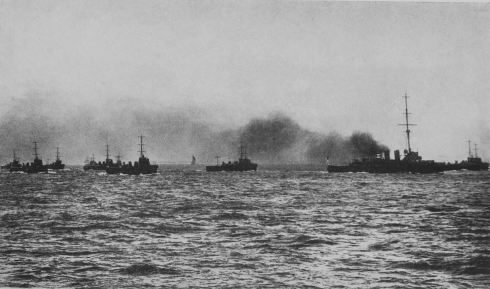 “Destroyers moved straight for the harbor in a long line.”
children, as if we was dead maple-leaves afore a southeastern gale!”
The destroyers had stopped. The crews swung their guns toward the shore.
From the cruiser dropped six ships’ boats, full of blue-jackets. They
swung past the destroyers, beached, and formed in a line. There was a
click of breech-bolts shot home—so quick that it was as but one sound.
A Lieutenant advanced his men with the swinging navy trot. He pointed to
men in the little throng, selecting six of the older ones. “We take the
island,” he said in precise English. “Fall in! We hold you responsible
for the good order of the rest of your people. There must be no attempt
at resistance.”
While he spoke, another detachment of the landing party had been busy
among the huddle of boats in the harbor. Some were being made up into a
tow. Others were being scuttled at their moorings. A third detachment
was knocking holes into the smaller craft hauled up on shore.[23]
The First American to Fall
Three sailors were just driving boat-hooks through the bottom of an
up-turned cat-boat, when a tall young fisherman leaped at them with an
oaken tiller-handle, and struck one down.
The other two closed on him, but let go again almost instantly at the
sound of a sharp order. They tore themselves away and jumped aside.
There was another order, in the same sharp voice. Instantly, while the
fisherman still stood, staring, with his weapon in the motion of
striking, a blast of fire spat at him from six carbines. His head went
up, exposing his broad brown throat. He thrust his hands before him, all
the fingers out-spread. With his eyes wide open, he tottered and pitched
face down.
Another order, and the sailors wheeled, covering the islanders.
“Dan!” screamed a girl in the crowd. “Hush! Don’t look!” An older woman
caught her around the neck and pressed the girl’s face to her breast.
“He brought it on himself!” said the Lieutenant to the fishermen. “Take
warning! That is war!” He turned, and walked to the beach.
The dead man lay where he had fallen. The bluejackets, lowering their
carbines, came to rest beyond him, facing the Block Islanders
impassively.
None of these had said a word. Save for the outcry of the girl and the
woman’s “Hush!” there had been utter silence, as if the discharge of the
weapons had swept away speech. Slowly clenching and unclenching their
hands, the big, weather-beaten, strong men stared at the corpse that lay
huddled so awkwardly before them.
One of the women touched a white-haired, white-bearded islander on the
arm. “Won’t they let us have him!” She turned her eyes toward the dead
man. “It don’t seem hardly right—to let him lay there.”
The old man looked at her as if waking from a trance. He passed his
rough hand over his brow. With his slow, wide fisherman’s stride, he
stepped forward. The sailors instantly brought their weapons up.
The old man pointed dumbly to the corpse. In reply, a sailor indicated
the Lieutenant with a gesture.
The fisherman walked to the Lieutenant. “I wanted to ask you—” he
began, but a signalman interrupted him, pointing at his head. The Block
Islander looked at him, bewildered. Impatiently, the sailor pointed
again, and the islander understood.
Hesitatingly, reluctantly, he took off his hat. Crushing its brim with
the grip of helpless anger, he faced the officer.
“I wanted to know—sir—if mebbe we couldn’t—” he indicated the corpse.
“Yes!” answered the officer, shortly. “You can have him!” With a change
in his voice, he added: “I am sorry. Very sorry. Yes! You may take him
away.”
Block Island as a Naval Base For the Enemy
So fell brave Block Island. It had greeted the sunrise with the stars
and stripes hauled defiantly in the face of the invader. The setting sun
shone on the flag of the enemy. Its wireless was being operated by
uniformed men. Its telephone and telegraph communications with the
mainland were torn out. Its little harbors were being used by destroyers
and small craft as if they had been foreign naval bases forever.
So, too, had fallen the islands of Nantucket and Martha’s Vineyard with
their stouthearted, passionately American population. They had yielded,
not to ignoble fear, but to the irresistible mechanics of war.
The people of Block Island, watching destroyers steaming slowly toward
the New England coast with strings of their fishing boats in tow, noted
a curious thing. Every boat was laden with fish-nets. The enemy had
gathered every seine, every pound-net. He had lifted long fyke-nets from
the sea, and had dragged the enormous hauling-seines from their
drying-reels.
Block Island wondered what a fighting navy meant to do with fish-nets.
Nantucket and Martha’s Vineyard wondered, too; for they, also, had been
stripped of their gear.
Following the long tows with their heaped brown freight, six cruisers
moved toward the coast, each guarded by destroyers whose men watched the
sea for a periscope, or for the whitened, broken water that would
indicate the presence of a submarine.[24]
They moved fast, until they were within three miles of land. Then they
opened fire.
Steaming rapidly up and down, ship behind ship, they loosed all their
broad-side batteries, starboard and port in turn, simultaneously. So
fierce was the blast that the water shook. All the surface of the sea
between the ships and the land quivered. Fantastic vibration-ripples
shot all around, like cracks on a shattered steel plate.
The blast killed the wind, and made an infernal little gale of its own
around each ship, that spun in hot ascending columns. Surface-swimming
fish were struck dead and floated in schools on the water, miles away.
Even the bottom-haunting creatures felt the shock and scurried into the
sand and mud.[25]
This was only the blast from the lips of the guns. It was only pressure.
It was only the released energy that drove conical steel masses forward.
They sped with a violence that would leave the swiftest locomotive
behind in the wink of an eye. Like locomotives smashing into an
obstacle, the projectiles hit the land.
That impact alone was annihilation. Having struck, the projectiles
exploded.
The chart under the shaded light in the Admiral’s cabin had a
semi-circle marked on it—a semi-circle that made a great segment into
the land. As if it were in the electric arc, the country in that zone of
fire melted. Houses vanished into stone-dust and plaster-dust even as
the screaming thing that had done it struck houses a mile beyond and
threw them on each other. Streets became pits with sloping sides that
burned. Trees rocked, roaring as in a gale, and were tossed high, and
fell, and twisted in flame. The land shriveled.
A Vast Confusion of Facts and Rumors
As the shells fell on New England’s coast, so the news fell on the
United States. It sped as a vast confusion of facts and rumors,
bewildered tales of terror, inventions born of crazed brains, dispatches
that told only half a story, and messages that told none at all and yet,
in their very incoherence, told more than intelligible words could have
done.
The newspapers were tested that night, and the steady, intangible
discipline of the great organization held true. Never a linotype in all
the cities had to wait for its copy. The word went to the presses to
“let her go.” Extras followed extras.
But the news sped ahead of the extras. It sped, and spread, and grew,
and became monstrous.
The enemy had forced the harbor defenses of Boston! So ran the rushing
rumor in New York and Philadelphia. Long before trains could carry
papers there, people in far-off country districts heard it.
The State House was in ruins! Portsmouth and Boston Navy Yards had
fallen!
New York, ran the stories through Boston and all New England, was
invested at both approaches! Fort Totten had been blown up! The enemy
ships had the range of the city, and already the sky-scrapers were
toppling into Broadway!
The government was fleeing from Washington! An army had landed on the
Delaware coast!
Even those who had the newspapers before them, and knew that none of
these things was true, were shaken when the tales that had sped ahead,
came back like the back-wash of a wild sea. Many hundreds that night ran
with the newspapers in their hands and helped to spread, and make more
fantastic, the fantastic falsehoods that had been born miles away.
But the newspaper organization worked steadily. Bit by bit the medley
took tangible form. From the watchful, self-controlled chain of
light-house and life-saving stations, revenue marine and other coast
guard services; from the steady, unimaginative army and navy; from the
alert, unshaken harbor-defenses, bit by bit the story of the night began
to come in orderly sequence.
The Sea Vitals of the Commercial United States
The enemy fleet was biting into the sea-vitals of the commercial United
States, the southern coast of New England between Cape Cod and Long
Island Sound whose possession is the key to the manufacturing and
industrial life of the East.
Battle-ships lying off the mouth of Buzzards Bay were dropping shells
into the harbor and into the shores. One ship had ventured close into
the land, approaching within the zone of fire from Fort Rodman, and had
dropped shells near New Bedford. Hidden by intervening hills, it had
escaped return fire, and was now lying just out of range, dropping an
occasional 15-inch projectile toward the defenses.[26]
Other ships were firing into Narragansett Bay. They, too, were firing at
immensely long range, to avoid return fire from the defenses.
Montauk Point’s wireless transmitted a dispatch that three vessels were
standing in there and lowering boats. Then the apparatus fell silent.
Point Judith’s wireless had ceased speaking soon after dusk. Its last
dispatch was that shells were falling near it. An hour later its
operators reported from Narrangansett Pier that the tower had been
destroyed.
Watch Hill and Westerly, on Rhode Island’s southwestern border, said a
message from near-by Stonington, were burning, and were being wrecked by
heavy shells. Fort Wright telegraphed that this was fire from two
battle-ships standing just outside of range from the fort’s mortars and
rifles, and throwing shells from 15-inch guns.[27]
But these great guns were being used only at intervals. Though their
bite could rend towns, they destroyed themselves as they wreaked
destruction. The acid-fumes from their monster powder-charges ate out
their scientifically rifled cores. They had to be spared.
The real attack came from the heavy cruisers, standing close in and
working 4, 5, and 8-inch guns. For every shot that the battle-ships’
mammoths fired, the cruisers fired a hundred. It was not a bombardment.
It was a driving flail of whirling, smashing, exploding metal that
whipped the coast between Watch Hill and Point Judith.
To the ear it was din, vast, insane. In reality, it was an operation of
war, conducted as precisely and methodically as if it were a quiet
laboratory experiment. The wireless controlled every shot from every gun
on every ship. From the small things on slim tripods to the wide-mouthed
heavy calibers spitting from hooded turrets, not one spoke without
orders.
Sweeping the Floor Clean for the Enemy Army
To the trained artillerists, listening in the Narragansett and Long
Island Sound defenses, it was plain as English words. That crash, as if
a steel side had been blown out of a ship, was the four-inch broadside,
all loosed at once. Now it would be fifteen seconds, and another crash,
farther east, would tell of the next ship’s 4-inch discharge. And the
heavier, fuller, air-shaking roar that came in between was from 5-inch
guns, while the broken, slower, coughing bellow, that overwhelmed all
the rest and echoed from every echo-making prominence inland, was the
voice of an 8-inch rifle, speaking once every five minutes.
Now the flocks of shells went high to reach far to their farthest range
into the land. Now they went low to sweep through the cover near shore.
Sometimes the steel things drove, as if in sudden uncontrollable fury,
at one given spot. Again, they spread out into a dreadful cone that
danced along a five-mile stretch like a dancing whirl-wind.
The fire slackened, and died away, and fell silent, and burst out again
as if a horde of devils had only held their breaths to scream anew. Up
and down it moved, now in, now out, although long ago the shells had
whirled away everything that could be destroyed. There was nothing
living in there now. The very beasts of the woods, the birds in their
nests, were dead.
To the survivors who had escaped from the first red blast, the thing
seemed only a deed of insane wickedness. What had they done, they asked
each other with sobbing breaths, to bring a steel navy at them? What
could a great, powerful enemy gain by this murder of peaceful, unarmed
country folk? What danger could there lie to him, they gasped as they
fled through the dark, or lay face down to the earth and gripped at
grass, in tiny houses and gardens and little sea-shore hamlets?
It was wicked murder. “Wicked murder!” said the wires, telling their
tale to their fellow-citizens far away.
The men who were working the ships’ guns were from little villages, from
pretty sea-shore hamlets like these themselves. They were not thinking
of the habitations which were being blasted away. It was an operation of
war. This was the chosen time, and this the chosen place, for the
landing of the army that waited in the gloom of the sea for them to make
the shore safe for it.
With their brooms of steel and fire, they simply were sweeping clear the
floor on which that army was to set its foot.
Far in shore of the flame-torn cruisers, safe from any land-fire under
the parabolas of the naval projectiles as if they were under a bombproof
arch, certain little vessels had toiled up and down from the beginning.
Slowly, for they dragged between them long wire cables that hung down to
the sea-bottom, they moved back and forth along the beach, fishing.
The fish they were trying to catch were spherical and conical steel fish
that bore little protuberances on their tops like the sprouting horns of
a yearling kid.
A touch as soft as the touch of a lover’s hand could drive those little
horns inward, to awaken a slumbering little devil of fulminate of
mercury, whose sleep is so light that a mere tap will break it. And the
fulminate’s explosion would detonate three hundred pounds of gun-cotton.
The submarine mine says to the big ships: “I am Death!” And they cannot
answer it.
Guns That Were Being Made Too Late
But there is an answer to the mine. It is the mine-sweeper that drags
for them. The men on these mine-sweepers dedicate themselves to the
tomb. Some must inevitably perish. They will find a mine with their
keels instead of their groping drags; or they will grapple one too
close; or their wire cable will clutch two mines and swing them
together, so that the little horns touch—
But, if the mine-sweepers are permitted to work on, the mines may kill,
and kill, and kill, yet in the end they will be gathered in.
There is an absolute answer to the mine-sweepers. It is to hammer them
with rapid fire from the shore. These little vessels, dragging
laboriously, present targets that scarcely move. No artillerist can miss
them.
But again there is an answer to the mine-protecting guns. It is
long-range fire from the ships that lie safely outside of the
mine-fields.
There is only one answer to that. It is for defenders on land to plant
huge guns far inland that can reach the ships and beat them back that
they dare not come close enough to reach the lesser shore artillery
nearer the sea.
This formula of shore-defense is a formula so simple that a
mathematician, given the conditions, can work it out with simple
arithmetic though he never had seen a cannon in his life.
Guns, guns, and again guns—and an army to protect them! This was the
only possible reply to the fleet that was pounding the coast. The United
States had not enough sufficiently powerful mobile coast guns and siege
guns. It had not enough artillerists to fight what guns there were. And
it had not enough ammunition to provide them with food.[28]
In Bethlehem, Pennsylvania; up the Hudson, in smoky Watervliet; in
Hartford and Bridgeport and New Haven, and a dozen other towns, with
machinery hastily assembled, and workmen hastily learning, they were
trying, now, to make projectiles enough, and guns enough. They were
trying to make enough powder, down in Delaware and New Jersey.
In the encampment of the United States army at that moment trains were
delivering guns—guns made in record time, magnificent testimony to
American efficiency under stress. But the guns were coming in one by
one—to meet an enemy who was beating at the gates and could not be
stopped except with hundreds.
The Enemy on the Mainland!
Even then the flag-ship off the coast was sputtering a code into the
night. It was a long code, but its meaning was short. It meant: “Now!”
The mine-sweepers hauled their gear and came out. Fourteen had gone in.
Those that came out were nine.
Before they had well begun to move, the beach was white with ships’
boats, and nine hundred bluejackets and marines set foot on the mainland
of the United States.[29]
With sharpened knives in their sheaths, and loaded carbines, and
bandoleers filled with cartridges, and entrenching tools and provisions,
each man of that first force presented the highest attainable
unit-efficiency for war.
The boats were scarcely off the beach, to return to the ships, before
eight hundred of these units were trotting through the up-land,
throwing out advance parties, and making hasty trenches from which, in a
moment, there looked the greyhound muzzles of machine-guns.
On the shore, the strand-party was sinking sand-anchors and rigging
derricks. Others were setting together the five and one-half foot
sections of jointed hollow masts for the wireless. When the boats
beached again, with more men, two 40-foot masts reached into the night,
and hand-power generators were making the antennæ pulse with their
mysterious life.
Launches came in now, dragging wide, flat-bottom pontoons and swinging
them on to shore and speeding back for more. Men snatched at them, and
held them in the surf, and ran their mooring up the beach, while others
carried out kedges and boat-anchors from all sides to make them lie
steady in the groundswell.
The beach shone white as day, all at once. The destroyers had steamed
in, and were giving their men aid with their search-lights.
In swung more pontoons. Broadside to broadside, kedged and anchored out,
they were moored out into the sea, at half a dozen parts of the beach.
Laid far enough apart that they should not touch, however hard the swell
might strive to grind them together, they formed floating piers,
reaching beyond the farthest outer line of surf. From pontoon to pontoon
ran gang-planks, lashed fast.
Three hours had passed. Three times the ships’ boats had made the trip
between warships and shore—thirty naval service cutters, each carrying
thirty men. Twenty-seven hundred sailors, marines and soldiers were
holding the Rhode Island coast.[30]
From the trenches of the advance party a wireless spoke to the cruiser
bearing the senior officer. “Motor scouts reported in front, on road,
three thousand yards in. Will fire rocket indicating direction.”
The rocket burst. For a minute it made all that part of the black
country stand out as under lightning. “Crash!” said the ship. Over the
bluejackets swept the shells, and burst.
“Crash!” said another ship.
“Apparently effective,” said the wireless again. “Shall send patrols
forward.” And again it spoke, in half an hour: “Enemy driven back. Our
patrols hold road. Barb wire entanglements completed. Scouts in. Report
land clear, except for enemy cavalry in force inland out of range.”
The Transports
“Now!” said the cruiser’s wireless, speaking once more into the sea.
Silent, formless, black, four vast ships, long and twice as tall as the
cruisers, came slowly in among them.
These were the transports, sealed that not a thread of light should
shine from them to betray them to the thing that all the fleet dreaded
more than anything else—the under-water lance of a submarine’s torpedo.
Under water the submarine is always blind, even when the brightest light
of the noon-day sun shines vertically into the ocean. It can see only
with its periscope eye above the surface.
At night the periscope cannot see. Then the submarine ceases to be
useful as a submarine. It can act still; but only on the surface, like
any other torpedo boat.
Two score destroyers, each of thirty knots, each armed with from four to
ten 3-inch guns and rapid-firers, circled around the transports. Twice
as swift as the surface-speed of the swiftest submarine, armed
overwhelmingly, they could defy surface attack.[31]
They hemmed the darkened troop-ships round with a great circle of
search-lights, all thrown outward, that served the double purpose of
illuminating the ocean for miles, and of blinding any who tried to
approach. No human eye looking into that glare could have seen the
transports, even if the night had not shrouded them.
Still, these liners with their tens of thousands of men, were too
precious to be protected only by this bright vigilance. From each
transport there projected long steel booms, eleven to a side. These held
out a half-ton net of steel grommets. Stretched fore and aft as taut as
steam-capstans could haul it, this shirt of
 “He steered his craft, awash, from behind Fisher’s Island, at dawn.”
chain-mail hung far down into the sea to catch any torpedo that might
come driving at the keel.
There was more protection than that. It would be day soon, and then the
submarines would be blind no longer. All around the area chosen for the
transports to lie in, the fishing boats taken from the sea-islands were
being towed by destroyers, to drop their nets. Their wooden buoys formed
odd geometrical outlines on the sea.
These thin things of meshed twine, made only to hold little, inoffensive
fish, were suspended like submarine fences, north and south and east and
west of the field of operations.
That such trivial things should be of any avail against under-water
craft with death in their heads, might well have seemed absurd to a
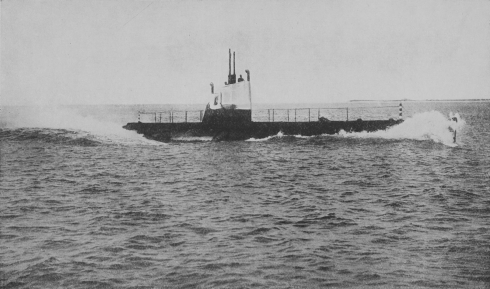
landsman. They did not seem absurd to the Lieutenant who commanded
United States submarine M-9, when he steered his craft, awash, out from
behind Fisher’s Island Sound at dawn, and looked eastward through his
glasses.[32]
Ten miles away lay the transports, quite motionless, beautifully
assembled as a target for him. At that distance their masts and funnels
seemed huddled. He had a vivid picture in his mind, for an instant. It
was a picture of fat, slow sheep crowding together with a wolf among
them.
Woven Twine Versus Submarine M-9
But between them and his wolf lay the net buoys, dotting all the
surface, in and out as if they had been laid by some laboring artist to
make a maze.
The sea-wolf went slowly nearer. With its tanks full of water, it lay so
far submerged that the sea washed the coaming around the manhole hatch.
The Lieutenant was like a man wading breast-high in the ocean. It would
be hard to see him from any distance.
He studied the traceries of buoys. There were spaces between them, that
betokened gaps in the fences. One might find a gap and go through.
But to find a gap, the submarine must raise her periscope above water,
and look around. But at each gap, sweeping incessantly to and fro, like
galloping cavalry, were destroyers.[33]
Could one dive and go through blind? The Lieutenant knew the limitations
of his terrible little animal. Its kiss could draw a twenty thousand ton
ship into the abyss, but the woven twine would laugh at it.
Its nose could cut through them like the threads that they were. But the
torn ends would catch conning tower and masts and periscope tubes. Even
if it tore away from them, the whirl of the propellor remained to renew
the danger, sucking the trailing cords to itself and in one instant
switching them around and around the spinning shaft.
With the propellor blocked, the submarine must rise; for only with its
propellor thrusting and its horizontal fins set to hold it down, can the
submarine stay under. It submerges, not by sinking but by diving with
main strength.
Another rather vivid picture flashed into the Lieutenant’s mind. It was
not a picture, this time, of a wolf among sheep. It was a picture of a
sudden enormous commotion among those quiet net-buoys, as of something
struggling down below; and then of a violent surge as the tangled nets
were dragged to and fro by a helpless submarine, held fast by the
tail.[34]
A breeze arose with the rising sun, and the water roughened. The
submarine stopped. It could not meet rough water while it was awash.
Although its buoyancy when it was sealed was such that its propellor had
to thrust full speed to make it dive, yet with its hatches open two
hundred gallons of water, far less than is contained in a single big
wave, would send it down like a tin can.[35]
The Commander held on as long as he could, watching the whitening water
in the east, and watching the transports.
He saw that at a thousand yards’ distance around them (just what he
would have chosen as neat torpedo range), there lay a little fleet of
gun-boats, all thrusting out booms with steel nets, that made them look
oddly as if they were hooped and wide-skirted. Disposed in an oval, they
guarded the transports with a second wall of steel wire.
And overhead, soaring in spirals, never flying far away, and always
returning, were three naval planes. The Commander of the M-9 knew that
they were waiting and watching for just one thing—the “shadow” of a
submerged submarine.[36]
This enemy, plainly, was taking no chances. The fleet had power and
time. It bent them to one object—to land its men safely. It would not
engage the harbor defenses, and so open itself to the risks of plunging
fire and torpedo attack. It would not blockade harbors, and so make
itself a chosen mark for such terrors as M-9.
The Three Harbor Gates to New York and Boston
Very scientifically, very thoughtfully, had the enemy staked out the
vital spot at which he had decided to strike. Here, facing each to each
almost like the salients of a fortification, lay three harbor gates to
the northeastern United States—Buzzards Bay, gashing deeply into
Massachusetts: Narragansett Bay, almost cutting Rhode Island in two: and
the eastern entrance to Long Island Sound and the cities of
Connecticut.[37]
Open any one of these gates, and it opened the way at one blow to both
New York and Boston.
These three sea-salients were greatly armed for defense. In each harbor
lay batteries of 12-inch all-steel rifled cannon. Hidden under facings
of earth, steel and concrete, they sat on disappearing carriages and
pneumatic gun-lifts that would swing them up as if they weighed ounces
instead of tons, and instantly plunge them back again into cover after
firing.
Deep under earth embankments, squatting in concrete-lined graves,
12-inch mortars, sixteen to a group, stared upward at the patches of sky
over their heads, which was all that their men would see while they were
firing, however bitter the fight might be.
A single shot from one of the long, graceful rifles might sink a ship,
if it were well placed. A single salvo from the mortars, the sixteen
firing together, assuredly would. And they could do it. Aimed by
mathematics, they were sure to strike the spot.[38]
A score of serving devices in the defenses were slaves to the steel
champions. Searchlights in armor waited like men-at-arms to point with a
long white finger at their prey. Mine fields and emplacements and cable
conduits were there to force the ships to steer where the guns could
strike them most surely. Masked by trees and mounds, concealed by every
device against betrayal, were range-finders and fire-control stations.
Here sat experts who had studied the most occult questions of
arithmetic, geometry, surveying, navigation, and cartography for one
purpose—to direct those long guns true. They were provided with
exquisite instruments for calculating angles and distances to an inch,
though the point to be ascertained were ten nautical miles and more
away.
Before them lay charts of the sea-area that they were guarding. Let a
ship come within the limit of their apparatus, and in the time required
to speak into a telephone the gun-pits miles away down the defense-line
would crack with the explosion of tons of smokeless powder.
They were nearly perfect, those works—as engineering works. They were
fully armed with the engines to make them malignant to the ultimate
fatal degree. The ten-mile area of sea that lay so bright and dimpled
that morning might well have been black as the Wings of Death; for a few
little motions of the waiting men under the pretty grassy mounds would
unfold those pinions.
The Joint in America’s Armor
But under the iron visages was weakness. In none of the defenses on this
morning when the time had come for their test, were there more than
one-half the number of men required to hold them.[39]
They could fight the guns, so long as the action remained a ship-to-fort
action; but if the enemy attacked at the rear, from the land, they were
not in sufficient force to meet him and throw him back. Attacked from
the land, the men of the defenses would have to retire to the inner keep
and fight from shelter with rapid-fire guns. And when the defenses thus
began to defend themselves, their hour would have struck.[40]
Still, for the time they were deadly. The enemy fleet paid them the
supreme tribute of scrupulous respect. Not a vessel ventured after dawn
into the deadly circle of their reach. To make sure that no vessel
should expose itself by accident, the mine-layers of the enemy fleet
were even then moving well outside of the zone of extreme fire, and
laying immense steel buoys, painted a vivid scarlet.
These scarlet buoys outlined an area of safety that was shaped somewhat
like a pentagon with its apex at Block Island and its base on the Rhode
Island coast between Watch Hill and Point Judith.
It was a base marking out five miles of beach that was safe both from
the fire of the Long Island Sound defenses and from the shots of the
Narragansett defenses.
Here day-light revealed a land occupied in orderly, quiet, perfect
military manner. Inland, as far as the naval guns could protect them,
lay the men of the advance landing party behind their machine-gun
positions. For miles beyond that, east and west, their patrols had cut
telegraph and telephone wires, and occupied points that commanded roads
by which attacking forces might approach.
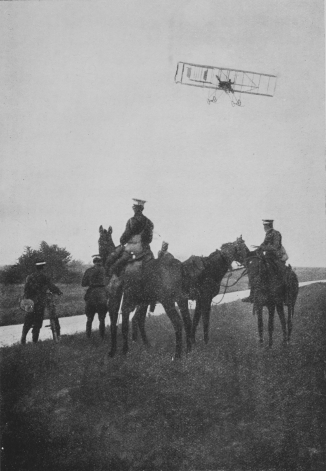 “For miles beyond that the enemy’s patrols had occupied points....”
On the beach, where the blocks and tackle and hoisting derricks had been
rigged in the night, gun-floats were being brought to the beach with
cannon and caissons. Under the pull of centrifugal blocks these were
hoisted out and dropped in shore on railway tracks that led over the
sand to firm ground.
There motor trucks and traction engines, all brought to land during the
night, took them and hurried them to positions ready for fight, or to
park them ready for moving when the advance should begin.
Destroying the Railroad of Southern New England
From vantage points inland, from hills on Fisher’s Island, from such
venturesome spies as M-9, went the news to Washington, and so through
the land. The crowds in the cities, dense even at that early hour of the
morning, read on the bulletin boards:
“Enemy effected a landing during the night on Rhode Island between
Narragansett Bay and Long Island Sound. Transports are now close in
preparing to put troops ashore. Scouts report four liners aggregating
one hundred thousand tons. Army officials estimate that at the usual
allowance of two men per ton this means fifty thousand men. More
transports waiting under Block Island.”
“Now is the time to strike ’em!” It was not one man in one crowd who
said it. In every city where there were crowds there arose these
speakers—the excitable, passionate orators who are born of every great
crisis and who, in such moments, find willing listeners.
“Now is the time to strike ’em, before they can bring more men ashore!
They should have been attacked in the night! What kind of Generals have
we got, to let ’em land, instead of throwing ’em back into the sea as
fast as they came? Where is our army? Keeping itself safe?”
The army, with ten thousand civilian workers impressed as they were
needed, was destroying the railroad of southern New England. It was
tearing up the shore line of the New York, New Haven and Hartford
Railroad from New Haven to New London and from New London to Providence.
It was throwing the rails on flat cars to be whirled away westward and
northward. Concrete and stone embankments, steel bridges, and tunnels
were sent skyward through the night with dynamite.
All the connecting system from New Haven north to Hartford and from New
London north to Worcester was being destroyed. Locomotives and rolling
stock that could not be removed were being sent down grades to crash
into wreckage, or blown up or set afire. A curious intoxication of
destruction was on the population that night. Prosperous, dignified
citizens came out with axes or with oil and fire, and helped in the
ruin.
In fire and dirt and amid shattering roars of explosion and rumbling of
falling trestles they worked on hundreds of miles of iron highway,
desperately, frantically, shouting aloud, willing to tear their soft
hands and to risk limb and even life, rather than to wait inactive, and
listen for news, and dread what was to happen.
They were tearing up their civilization; and they did it with a savage
delight, that nothing might be left to the foe.
The American Army’s Lack of “Eyes”
In the Army Headquarters, where a single short order had set loose all
this saturnalia of destruction, the Commanding General and his staff
were busied with something that was of more immediate importance to
them. Desperately they were thrusting out for information, and always
they were baffled by superior numbers, superior resources.
They had pushed cavalry toward the coast, and it had been driven back by
artillery and long-range fire from the ships, whose aim was controlled
by aeroplane signals from the sky and wireless from the shore. They had
pushed out motor scouts, and the artillery had found them. Always, at
every approach, during the night or since daylight, the ships’ fire had
swept the roads.
Now, scarcely an hour after sunrise, the army aeroplanes had come back,
after only haphazard scouting. They had not been able to fly over the
invaded coast. Wherever they tried it, they reported, they were met by
enemy planes in superior numbers.
One United States air-man had been driven by four enemy planes into
Narragansett Bay where he had been picked up by boats from the Newport
Torpedo Station. Two others, borne down by three enemy machines faster
than they, and fired at by anti-air-craft guns from an in-lying ship,
had barely managed to escape behind the defenses of Fort Wright in the
Sound.
The others had been pressed back, inexorably, by the screen of naval
planes that swarmed over the coast.[41]
The enemy planes came from the sea. To the marveling eyes in the
American defenses, it seemed as if the ocean were spewing them forth.
One after another rose from the Atlantic under Block Island.
Three strange vessels lay there. They had funnels set extremely far aft,
like certain types of clumsy tramp-ships, but they were big as passenger
liners and their lines showed all the efficiency of the naval architect.
The great sweep of their decks forward was as bare as the deck of a
racing schooner yacht.
A structure on short trestles like a skid-way rose from this deck at the
bow, projecting slightly.
It was there that the aeroplanes were being spewed. These were
mother-ships.
Torpedo-netted, guarded by destroyers, guarded even by a small
semi-rigid dirigible that hovered a thousand feet high over-head, they
were sending out spies to search the land.
Twenty-Five Aeroplanes Against a Swarm
The two United States fliers, standing by their machines in Fort Wright,
looked at the ascending swarm. “No wonder!” said one. “You know how many
one of those Nations had at last accounts? Twelve hundred!”[42]
“And we’ve got thirteen in the Army and twelve in the Navy!” His
companion laughed. “And Servia had sixty, before the Great War!”
They said no more, but watched in silence. That ascending, continually
growing line of flying things was like something that was writing into
the sky the word: “Resources!”
Suddenly the American air-men noticed that these new machines were not
flying to the coast near them. They were turning off, in regular order.
One turned west, to fly over Long Island. The next one turned east,
toward Buzzards Bay. They alternated thus till the entire division had
separated, and disappeared.
One of the scouts slapped his thigh. “I believe,” said he, “that they
are going to show themselves to Boston and New York!”
That was at nine o’clock in the morning. At noon the crowds in the two
cities were startled by a distant roar that grew, almost before they had
first heard it, into a thundering that shook the air. They stared upward
and beheld the first squadron of armed flying machines that America ever
had seen.