Two of the myriad of London’s night-workers were walking down Fleet
Street together soon after dawn on Sunday morning, 2nd September.
The sun had not yet risen. That main artery of London traffic, with its
irregular rows of closed shops and newspaper offices, was quiet and
pleasant in the calm, mystic light before the falling of the smoke-pall.
Only at early morning does the dear old City look its best; in that one
quiet, sweet hour when the night’s toil has ended and the day’s has not
yet begun. Only in that brief interval at the birth of day, when the
rose tints of the sky glow slowly into gold, does the giant metropolis
repose—at least, as far as its business streets are concerned—for at
five o’clock the toiling millions begin to again pour in from all points
of the compass, and the stress and storm of London life at once
recommences.
And in that hour of silent charm the two grey-bearded sub-editors,
though engaged in offices of rival newspapers, were making their way
homeward to Dulwich to spend Sunday in a well-earned rest, and were
chatting “shop” as Press men do.
“I suppose you had the same trouble to get that Yarmouth story through?”
asked Fergusson, the news-editor of the Weekly Dispatch, as they
crossed Whitefriars Street. “We got about half a column, and then the
wire shut down.”
“Telegraph or telephone?” inquired Baines, who was four or five years
younger than his friend.
“We were using both—to make sure.”
“So were we. It was a rattling good story—the robbery was mysterious,
to say the least—but we didn’t get more than half of it. Something’s
wrong with the line, evidently,” Baines said. “If it were not such a
perfect autumn morning, I should be inclined to think there’d been a
storm somewhere.”
“Yes—funny, wasn’t it?” remarked the other. “A shame we haven’t the
whole story, for it was a first-class one, and we wanted something. Did
you put it on the contents-bill?”
“No, because we couldn’t get the finish. I tried in every way—rang up
the Central News, P.A., Exchange Telegraph Company, tried to get through
to Yarmouth on the trunk, and spent half an hour or so pottering about,
but the reply from all the agencies, from everywhere in fact, was the
same—the line was interrupted.”
“Just our case. I telephoned to the Post Office, but the reply came back
that the lines were evidently down.”
“Well, it certainly looks as though there’d been a storm, but——” and
Baines glanced at the bright, clear sky overhead, just flushed by the
bursting sun—“there are certainly no traces of it.”
“There’s often a storm on the coast when it’s quite still in London, my
dear fellow,” remarked his friend wisely.
“That’s all very well. But when all communication with a big place like
Yarmouth is suddenly cut off, as it has been, I can’t help suspecting
that something has happened which we ought to know.”
“You’re perhaps right after all,” Fergusson said. “I wonder if anything
has happened. We don’t want to be called back to the office, either of
us. My assistant, Henderson, whom I’ve left in charge, rings me up over
any mare’s nest. The trunk telephones all come into the Post Office
exchange up in Carter Lane. Why not look in there before we go home? It
won’t take us a quarter of an hour, and we have several trains home from
Ludgate Hill.”
Baines looked at his watch. Like his companion, he had no desire to be
called back to his office after getting out to Dulwich, and yet he was
in no mood to go making reporter’s inquiries.
“I don’t think I’ll go. It’s sure to be nothing, my dear fellow,” he
said. “Besides, I have a beastly headache. I had a heavy night’s work.
One of my men is away ill.”
“Well, at any rate, I think I’ll go,” Fergusson said. “Don’t blame me if
you get called back for a special edition with a terrible storm, great
loss of life, and all that sort of thing. So long.” And, smiling, he
waved his hand and parted from his friend in the booking-office of
Ludgate Hill Station.
Quickening his pace, he hurried through the office and, passing out by
the back, ascended the steep, narrow street until he reached the Post
Office telephone exchange in Carter Lane, where, presenting his card, he
asked to see the superintendent-in-charge.
Without much delay he was shown upstairs into a small private office,
into which came a short, dapper, fair-moustached man with the bustle of
a person in a great hurry.
“I’ve called,” the sub-editor explained, “to know whether you can tell
me anything regarding the cause of the interruption of the line to
Yarmouth a short time ago. We had some important news coming through,
but were cut off just in the midst of it, and then we received
information that all the telephone and telegraph lines to Yarmouth were
interrupted.”
“Well, that’s just the very point which is puzzling us at this moment,”
was the night-superintendent’s reply. “It is quite unaccountable. Our
trunk going to Yarmouth seems to be down, as well as the telegraphs.
Yarmouth, Lowestoft, and beyond Beccles seem all to have been suddenly
cut off. About eighteen minutes to four the operators noticed something
wrong, switched the trunks through to the testers, and the latter
reported to me in due course.”
“That’s strange! Did they all break down together?”
“No. The first that failed was the one that runs through Chelmsford,
Colchester, and Ipswich up to Lowestoft and Yarmouth. The operator found
that he could get through to Ipswich and Beccles. Ipswich knew nothing,
except that something was wrong. They could still ring up Beccles, but
not beyond.”
As they were speaking, there was a tap at the door, and the assistant
night-superintendent entered, saying—
“The Norwich line through Scole and Long Stratton has now failed, sir.
About half-past four Norwich reported a fault somewhere north, between
there and Cromer. But the operator now says that the line is apparently
broken, and so are all the telegraphs from there to Cromer, Sheringham,
and Holt.”
“Another line has gone, then!” exclaimed the superintendent-in-charge,
utterly astounded. “Have you tried to get on to Cromer by the other
routes—through Nottingham and King’s Lynn, or through Cambridge?”
“The testers have tried every route, but there’s no response.”
“You could get through to some of the places—Yarmouth, for instance—by
telegraphing to the Continent, I suppose?” asked Fergusson.
“We are already trying,” responded the assistant superintendent.
“What cables run out from the east coast in that neighbourhood?”
inquired the sub-editor quickly.
“There are five between Southwold and Cromer—three run to Germany, and
two to Holland,” replied the assistant. “There’s the cable from Yarmouth
to Barkum, in the Frisian Islands; from Happisburg, near Mundesley, to
Barkum; from Yarmouth to Emden; from Lowestoft to Haarlem, and from
Kessingland, near Southwold, to Zandyport.”
“And you are trying all the routes?” asked his superior.
“I spoke to Paris myself an hour ago and asked them to cable by all five
routes to Yarmouth, Lowestoft, Kessingland, and Happisburg,” was the
assistant’s reply. “I also asked Liverpool Street Station and King’s
Cross to wire down to some of their stations on the coast, but the reply
was that they were in the same predicament as ourselves—their lines
were down north of Beccles, Wymondham, East Dereham, and also south of
Lynn. I’ll just run along and see if there’s any reply from Paris. They
ought to be through by this time, as it’s Sunday morning, and no
traffic.” And he went out hurriedly.
“There’s certainly something very peculiar,” remarked the
superintendent-in-charge to the sub-editor. “If there’s been an
earthquake or an electrical disturbance, then it is a most extraordinary
one. Every single line reaching to the coast seems interrupted.”
“Yes. It’s uncommonly funny,” Fergusson remarked. “I wonder what could
have happened. You’ve never had a complete breakdown like this before?”
“Never. But I think——”
The sentence remained unfinished, for his assistant returned with a slip
of paper in his hand, saying—
“This message has just come in from Paris. I’ll read it. ‘Superintendent
Telephones, Paris, to Superintendent Telephones, London.—Have obtained
direct telegraphic communication with operators of all five cables to
England. Haarlem, Zandyport, Barkum, and Emden all report that cables
are interrupted. They can get no reply from England, and tests show that
cables are damaged somewhere near English shore.’ ”
“Is that all?” asked Fergusson.
“That’s all. Paris knows no more than we do,” was the assistant’s
response.
“Then the Norfolk and Suffolk coasts are completely isolated—cut off
from post office, railways, telephones, and cables!” exclaimed the
superintendent. “It’s mysterious—most mysterious!” And, taking up the
instrument upon his table, he placed a plug in one of the holes down the
front of the table itself, and a moment later was in conversation with
the official in charge of the traffic at Liverpool Street, repeating the
report from Paris, and urging him to send light engines north from
Wymondham or Beccles into the zone of mystery.
The reply came back that he had already done so, but a telegram had
reached him from Wymondham to the effect that the road-bridges between
Kimberley and Hardingham had apparently fallen in, and the line was
blocked by débris. Interruption was also reported beyond Swaffham, at a
place called Little Dunham.
“Then even the railways themselves are broken!” cried Fergusson. “Is it
possible that there’s been a great earthquake?”
“An earthquake couldn’t very well destroy all five cables from the
Continent,” remarked the superintendent gravely.
The latter had scarcely placed the receiver upon the hook when a third
man entered—an operator who, addressing him, said—
“Will you please come to the switchboard, sir? There’s a man in the
Ipswich call office who has just told me a most extraordinary story. He
says that he started in his motor-car alone from Lowestoft to London at
half-past three this morning, and just as it was getting light he was
passing along the edge of Henham Park, between Wangford village and
Blythburgh, when he saw three men apparently repairing the telegraph
wires. One was up the pole, and the other two were standing below. As he
passed he saw a flash, for, to his surprise, one of the men fired
point-blank at him with a revolver. Fortunately, the shot went wide, and
he at once put on a move and got down into Blythburgh village, even
though one of his tyres went down. It had probably been pierced by the
bullet fired at him, as the puncture was unlike any he had ever had
before. At Blythburgh he informed the police of the outrage, and the
constable, in turn, woke up the postmaster, who tried to telegraph back
to the police at Wrentham, but found that the line was interrupted. Was
it possible that the men were cutting the wires, instead of repairing
them? He says that after repairing the puncture he took the village
constable and three other men on his car and went back to the spot,
where, although the trio had escaped, they saw that wholesale havoc had
been wrought with the telegraphs. The lines had been severed in four or
five places, and whole lengths tangled up into great masses. A number of
poles had been sawn down, and were lying about the roadside. Seeing that
nothing could be done, the gentleman remounted his car, came on to
Ipswich, and reported the damage at our call office.”
“And is he still there?” exclaimed the superintendent quickly, amazed at
the motorist’s statement.
“Yes. I asked him to wait for a few moments in order to speak to you,
sir.”
“Good. I’ll go at once. Perhaps you’d like to come also, Mr. Fergusson?”
And all four ran up to the gallery, where the huge switchboards were
ranged around, and where the night operators, with the receivers
attached to one ear, were still at work.
In a moment the superintendent had taken the operator’s seat, adjusted
the ear-piece, and was in conversation with Ipswich. A second later he
was speaking with the man who had actually witnessed the cutting of the
trunk line.
While he was thus engaged an operator at the farther end of the
switchboard suddenly gave vent to a cry of surprise and disbelief.
“What do you say, Beccles? Repeat it,” he asked excitedly.
Then a moment later he shouted aloud—
“Beccles says that German soldiers—hundreds of them—are pouring into
the place! The Germans have landed at Lowestoft, they think.”
All who heard those ominous words sprang up dumbfounded, staring at each
other.
The assistant-superintendent dashed to the operator’s side and seized
his apparatus.
“Halloa—halloa, Beccles! Halloa—halloa—halloa!”
The response was some gruff words in German, and the sound of scuffling
could distinctly be heard. Then all was silent.
Time after time he rang up the small Suffolk town, but in vain. Then he
switched through to the testers, and quickly the truth was plain.
The second trunk line to Norwich, running from Ipswich by Harleston and
Beccles, had been cut farther towards London.
But what held everyone breathless in the trunk telephone headquarters
was that the Germans had actually effected the surprise landing that had
so often in recent years been predicted by military critics; that
England on that quiet September Sunday morning had been attacked.
England was actually invaded. It was incredible!
Yet London’s millions in their Sunday morning lethargy were in utter
ignorance of the grim disaster that had suddenly fallen upon the land.
Fergusson was for rushing at once back to the Weekly Dispatch office
to get out an extraordinary edition, but the superintendent, who was
still in conversation with the motorist, urged judicious forethought.
“For the present, let us wait. Don’t let us alarm the public
unnecessarily. We want corroboration. Let us have the motorist up here,”
he suggested.
“Yes,” cried the sub-editor. “Let me speak to him.”
Over the wire Fergusson begged the stranger to come at once to London
and give his story, declaring that the military authorities would
require it. Then, just as the man who had been shot at by German advance
spies—for such they had undoubtedly been—in order to prevent the truth
leaking out, gave his promise to come to town at once, there came over
the line from the coastguard at Southwold a vague, incoherent telephone
message regarding strange ships having been seen to the northward, and
asking for connection with Harwich; while King’s Cross and Liverpool
Street Stations both rang up almost simultaneously, reporting the
receipt of extraordinary messages from King’s Lynn, Diss, Harleston,
Halesworth, and other places. All declared that German soldiers were
swarming over the north, that Lowestoft and Beccles had been seized, and
that Yarmouth and Cromer were isolated.
Various stationmasters reported that the enemy had blown up bridges,
taken up rails, and effectually blocked all communication with the
coast. Certain important junctions were already held by the enemy’s
outposts.
Such was the amazing news received in that high-up room in Carter Lane,
City, on that sweet, sunny morning when all the great world of London
was at peace, either still slumbering or week-ending.
Fergusson remained for a full hour and a half at the Telephone Exchange,
anxiously awaiting any further corroboration. Many wild stories came
over the wires telling how panic-stricken people were fleeing inland
away from the enemy’s outposts. Then he took a hansom to the Weekly
Dispatch office, and proceeded to prepare a special edition of his
paper—an edition containing surely the most amazing news that had ever
startled London.
Fearing to create undue panic, he decided not to go to press until the
arrival of the motorist from Ipswich. He wanted the story of the man who
had actually seen the cutting of the wires. He paced his room excitedly,
wondering what effect the news would have upon the world. In the rival
newspaper offices the report was, as yet, unknown. With journalistic
forethought he had arranged that at present the bewildering truth should
not leak out to his rivals, either from the railway termini or from the
telephone exchange. His only fear was that some local correspondent
might telegraph from some village or town nearer the metropolis which
was still in communication with the central office.
Time passed very slowly. Each moment increased his anxiety. He had sent
out the one reporter who remained on duty to the house of Colonel Sir
James Taylor, the Permanent Under-Secretary for War. Halting before the
open window, he looked up and down the street for the arriving
motor-car. But all was quiet.
Eight o’clock had just boomed from Big Ben, and London still remained in
her Sunday morning peace. The street, bright in the warm sunshine, was
quite empty, save for a couple of motor-omnibuses and a sprinkling of
gaily dressed holiday-makers on their way to the day excursion trains.
In that centre of London—the hub of the world—all was comparatively
silent, the welcome rest after the busy turmoil that through six days in
the week is unceasing, that fevered throbbing of the heart of the
world’s great capital.
Of a sudden, however, came the whirr-r of an approaching car, as a
thin-faced, travel-stained man tore along from the direction of the
Strand and pulled up before the office. The fine car, a six-cylinder
“Napier,” was grey with the mud of country roads, while the motorist
himself was smothered until his goggles had been almost entirely
covered.
Fergusson rushed out to him, and a few moments later the pair were in
the upstairs room, the sub-editor swiftly taking down the motorist’s
story, which differed very little from what he had already spoken over
the telephone.
Then, just as Big Ben chimed the half-hour, the echoes of the
half-deserted Strand were suddenly awakened by the loud, strident
voices of the newsboys shouting—
“Weekly Dispatch, spe-shall! Invasion of England this morning! Germans
in Suffolk! Terrible panic! Spe-shall! Weekly Dispatch, Spe-shall!”
As soon as the paper had gone to press Fergusson urged the
motorist—whose name was Horton, and who lived at Richmond—to go with
him to the War Office and report. Therefore, both men entered the car,
and in a few moments drew up before the new War Office in Whitehall.
“I want to see somebody in authority at once!” cried Fergusson excitedly
to the sentry as he sprang out.
“You’ll find the caretaker, if you ring at the side entrance—on the
right, there,” responded the man, who then marched on.
“The caretaker!” echoed the excited sub-editor bitterly. “And England
invaded by the Germans!”
He, however, dashed towards the door indicated and rang the bell. At
first there was no response. But presently there were sounds of a slow
unbolting of the door, which opened at last, revealing a tall, elderly
man in slippers, a retired soldier.
“I must see somebody at once!” exclaimed the journalist. “Not a moment
must be lost. What permanent officials are here?”
“There’s nobody ’ere, sir,” responded the man in some surprise at the
request. “It’s Sunday morning, you know.”
“Sunday! I know that, but I must see someone. Whom can I see?”
“Nobody, until to-morrow morning. Come then.” And the old soldier was
about to close the door when the journalist prevented him, asking—
“Where’s the clerk-in-residence?”
“How should I know? Gone up the river, perhaps. It’s a nice mornin’.”
“Well, where does he live?”
“Sometimes ’ere—sometimes in ’is chambers in Ebury Street,” and the
man mentioned the number.
“Better come to-morrow, sir, about eleven. Somebody’ll be sure to see
you then.”
“To-morrow!” cried the other. “To-morrow! You don’t know what you’re
saying, man! To-morrow will be too late. Perhaps it’s too late now. The
Germans have landed in England!”
“Oh, ’ave they?” exclaimed the caretaker, regarding both men with
considerable suspicion. “Our people will be glad to know that, I’m
sure—to-morrow.”
“But haven’t you got telephones, private telegraphs, or something here,
so that I can communicate with the authorities? Can’t you ring up the
Secretary of State, the Permanent Secretary, or somebody?”
The caretaker hesitated a moment, his incredulous gaze fixed upon the
pale, agitated faces of the two men.
“Well, just wait a minute, and I’ll see,” he said, disappearing into a
long cavernous passage.
In a few moments he reappeared with a constable whose duty it was to
patrol the building.
The officer looked the strangers up and down, and then asked—
“What’s this extraordinary story? Germans landed in England—eh? That’s
fresh, certainly!”
“Yes. Can’t you hear what the newsboys are crying? Listen!” exclaimed
the motorist.
“H’m. Well, you’re not the first gentleman who’s been here with a scare,
you know. If I were you I’d wait till to-morrow,” and he glanced
significantly at the caretaker.
“I won’t wait till to-morrow!” cried Fergusson. “The country is in
peril, and you refuse to assist me on your own responsibility—you
understand?”
“All right, my dear sir,” replied the officer, leisurely hooking his
thumbs in his belt. “You’d better drive home, and call again in the
morning.”
“So this is the way the safety of the country is neglected!” cried the
motorist bitterly, turning away. “Everyone away, and this great place,
built merely to gull the public, I suppose, empty and its machinery
useless. What will England say when she learns the truth?”
As they were walking in disgust out from the portico towards the car, a
man jumped from a hansom in breathless haste. He was the reporter whom
Fergusson had sent out to Sir James Taylor’s house in Cleveland Square,
Hyde Park.
“They thought Sir James spent the night with his brother up at
Hampstead,” he exclaimed. “I’ve been there, but find that he’s away for
the week-end at Chilham Hall, near Buckden.”
“Buckden! That’s on the Great North Road!” cried Horton. “We’ll go at
once and find him. Sixty miles from London. We can be there under two
hours!”
And a few minutes later the pair were tearing due north in the direction
of Finchley, disregarding the signs from police constables to stop,
Horton wiping the dried mud from his goggles and pulling them over his
half-closed eyes.
They had given the alarm in London, and the Weekly Dispatch was
spreading the amazing news everywhere. People read it eagerly, gasped
for a moment, and then smiled in utter disbelief. But the two men were
on their way to reveal the appalling truth to the man who was one of the
heads of that complicated machinery of inefficient defence which we so
proudly term our Army.
Bursting with the astounding information, they bent their heads to the
wind as the car shot onward through Barnet and Hatfield, then, entering
Hitchin, they were compelled to slow down in the narrow street as they
passed the old Sun Inn, and afterwards out again upon the broad highway
with its many telegraph lines, through Biggleswade, Tempsford, and Eaton
Socon, until, in Buckden, Horton pulled up to inquire of a farm labourer
for Chilham Hall.
“Oop yon road to the left, sir. ’Bout a mile Huntingdon way,” was the
man’s reply.
Then away they sped, turning a few minutes later into the handsome
lodge-gates of Chilham Park, and running up the great elm avenue, drew
up before the main door of the ancient hall, a quaint many-gabled old
place of grey stone.
“Is Sir James Taylor in?” Fergusson shouted to the liveried man who
opened the door.
“He’s gone across the home farm with his lordship and the keepers,” was
the reply.
“Then take me to him at once. I haven’t a second to lose. I must see him
this instant.”
Thus urged, the servant conducted the pair across the park and through
several fields to the edge of a small wood, where two elderly men were
walking with a couple of keepers and several dogs about them.
“The tall gentleman is Sir James. The other is his lordship,” the
servant explained to Fergusson; and a few moments later the breathless
journalist, hurrying up, faced the Permanent Under-Secretary with the
news that England was invaded—that the Germans had actually effected a
surprise landing on the east coast.
Sir James and his host stood speechless. Like others, they at first
believed the pale-faced, bearded sub-editor to be a lunatic, but a few
moments later, when Horton briefly repeated the story, they saw that
whatever might have occurred, the two men were at least in deadly
earnest.
“Impossible!” cried Sir James. “We should surely have heard something of
it if such were actually the case! The coastguard would have telephoned
the news instantly. Besides, where is our fleet?”
“The Germans evidently laid their plans with great cleverness. Their
spies, already in England, cut the wires at a pre-arranged hour last
night,” declared Fergusson. “They sought to prevent this gentleman from
giving the alarm by shooting him. All the railways to London are already
either cut, or held by the enemy. One thing, however, is clear—fleet or
no fleet, the east coast is entirely at their mercy.”
Host and guest exchanged dark glances.
“Well, if what you say is the actual truth,” exclaimed Sir James,
“to-day is surely the blackest day that England has ever known.”
“Yes, thanks to the pro-German policy of the Government and the false
assurances of the Blue Water School. They should have listened to Lord
Roberts,” snapped his lordship. “I suppose you’ll go at once, Taylor,
and make inquiries?”
“Of course,” responded the Permanent Secretary. And a quarter of an hour
later, accepting Horton’s offer, he was sitting in the car as it headed
back towards London.
Could the journalist’s story be true? As he sat there, with his head
bent against the wind and the mud splashing into his face, Sir James
recollected too well the repeated warnings of the past five years,
serious warnings by men who knew our shortcomings, but to which no
attention had been paid. Both the Government and the public had remained
apathetic, the idea of peril had been laughed to scorn, and the country
had, ostrich-like, buried its head in the sand, and allowed Continental
nations to supersede us in business, in armaments, in everything.
The danger of invasion had always been ridiculed as a mere alarmist’s
fiction; those responsible for the defence of the country had smiled,
the Navy had been reduced, and the Army had remained in contented
inefficiency.
If the blow had really been struck by Germany? If she had risked three
or four, out of her twenty-three, army corps, and had aimed at the heart
of the British Empire? What then? Ay! what then?
As the car swept down Regent Street into Pall Mall and towards
Whitehall, Sir James saw on every side crowds discussing the vague but
astounding reports now published in special editions of all the Sunday
papers, and shouted wildly everywhere.
Boys bearing sheets fresh from the Fleet Street presses were seized,
and bundles torn from them by excited Londoners eager to learn the
latest intelligence.
Around both War Office and Admiralty great surging crowds were
clamouring loudly for the truth. Was it the truth, or was it only a
hoax? Half London disbelieved it. Yet from every quarter, from the north
and from across the bridges, thousands were pouring in to ascertain what
had really occurred, and the police had the greatest difficulty in
keeping order.
In Trafalgar Square, where the fountains were plashing so calmly in the
autumn sunlight, a shock-headed man mounted the back of one of the lions
and harangued the crowd with much gesticulation, denouncing the
Government in the most violent terms; but the orator was ruthlessly
pulled down by the police in the midst of his fierce attack.
It was half-past two o’clock in the afternoon. The Germans had already
been on English soil ten hours, yet London was in ignorance of where
they had actually landed, and utterly helpless.
All sorts of wild rumours were afloat, rumours that spread everywhere
throughout the metropolis, from Hampstead to Tooting, from Barking to
Hounslow, from Willesden to Woolwich. The Germans were in England!
But in those first moments of the astounding revelation the excitement
centred in Trafalgar Square and its vicinity. Men shouted and
threatened, women shrieked and wrung their hands, while wild-haired
orators addressed groups at the street corners.
Where was our Navy? they asked. Where was our “command of the sea” of
which the papers had always talked so much? If we possessed that, then
surely no invader could ever have landed? Where was our Army—that brave
British Army that had fought triumphantly a hundred campaigns, and which
we had been assured by the Government was always ready for any
emergency? When would it face the invader and drive him back into the
sea?
When?
And the wild, shouting crowds looked up at the many windows of the
Admiralty and the War Office, ignorant that both those huge buildings
only held terrified caretakers and a double watch of police constables.
Was England invaded? Were foreign legions actually overrunning Norfolk
and Suffolk, and were we really helpless beneath the iron heel of the
enemy?
It was impossible—incredible! England was on the most friendly terms
with Germany. Yet the blow had fallen, and London—or that portion of
her that was not enjoying its Sunday afternoon nap in the smug
respectability of the suburbs—stood amazed and breathless, in
incredulous wonder.
Monday, 3rd September 1910, was indeed Black Monday for London.
By midnight on Sunday the appalling news had spread everywhere. Though
the full details of the terrible naval disasters were not yet to hand,
yet it was vaguely known that our ships had been defeated in the North
Sea, and many of them sunk.
Before 7 a.m. on Monday, however, telegrams reaching London by the
subterranean lines from the north gave thrilling stories of frightful
disasters we had, while all unconscious, suffered at the hands of the
German fleet.
With London, the great cities of the north, Liverpool, Manchester,
Sheffield, and Birmingham, awoke utterly dazed. It seemed incredible.
And yet the enemy had, by his sudden and stealthy blow, secured command
of the sea and actually landed.
The public wondered why a formal declaration of war had not previously
been made, ignorant of the fact that the declaration preceding the
Franco-German War was the first made by any civilised nation prior to
the commencement of hostilities for one hundred and seventy years. The
peril of the nation was now recognised on every hand.
Eager millions poured into the City by every train from the suburbs and
towns in the vicinity of the metropolis, anxious to ascertain the truth
for themselves, pale with terror, wild with excitement, indignant that
our land forces were not already mobilised and ready to move eastward to
meet the invader.
As soon as the banks were opened there was a run on them, but by noon
the Bank of England had suspended all specie payments. The other banks,
being thus unable to meet their engagements, simply closed the doors,
bringing business to an abrupt standstill. Consols stood at 90 on
Saturday, but by noon on Monday were down to 42—lower even than they
were in 1798, when they stood at 47¼. Numbers of foreigners tried to
speculate heavily, but were unable to do so, for banking being suspended
they could not obtain transfers.
On the Stock Exchange the panic in the afternoon was indescribable.
Securities of every sort went entirely to pieces, and there were no
buyers. Financiers were surprised that no warning in London had betrayed
the position of affairs, London being the money centre of the world.
Prior to 1870 Paris shared with London the honour of being the pivot of
the money market, but on the suspension of cash payments by the Bank of
France during the Franco-German War, Paris lost that position. Had it
not been that the milliards comprising the French War indemnity were
intact in golden louis in the fortress of Spandau, Germany could never
have hoped to wage sudden war with Great Britain before she had made
Berlin independent of London in a money sense, or, at any rate, to
accumulate sufficient gold to carry on the war for at least twelve
months. The only way in which she could have done this was to raise her
rate so as to offer better terms than London. Yet directly the Bank of
England discovered the rate of exchange going against her, and her stock
of gold diminishing, she would have responded by raising the English
bank-rate in order to check the flow. Thus competition would have gone
on until the rates became so high that all business would be checked,
and people would have realised their securities to obtain the necessary
money to carry on their affairs. Thus, no doubt, the coming war would
have been forecasted had it not been for Germany’s already prepared
war-chest, which the majority of persons have nowadays overlooked. Its
possession had enabled Germany to strike her sudden blow, and now the
Bank of England, which is the final reserve of gold in the United
Kingdom, found that as notes were cashed so the stock of gold diminished
until it was in a few hours compelled to obtain from the Government
suspension of the Bank Charter. This enabled the Bank to suspend cash
payment, and issue notes without a corresponding deposit of the
equivalent in gold.
The suspension, contrary to increasing the panic, had, curiously enough,
the immediate effect of somewhat allaying it. Plenty of people in the
City were confident that the blow aimed could not prove an effective
one, and that the Germans, however many might have landed, would quickly
be sent back again. Thus many level-headed business men regarded the
position calmly, believing that when our command of the sea was again
re-established, as it must be in a day or two, the enemy would soon be
non-existent.
Business outside the money market was, of course, utterly demoralised.
The buying of necessities was now uppermost in everyone’s mind. Excited
crowds in the streets caused most of the shops in the City and West End
to close, while around the Admiralty were great crowds of eager men and
women of all classes, tearful wives of bluejackets jostling with
officers’ ladies from Mayfair and Belgravia, demanding news of their
loved ones—inquiries which, alas! the casualty office were unable to
satisfy. The scene of grief, terror, and suspense was heartrending.
Certain ships were known to have been sunk with all on board after
making a gallant fight, and those who had husbands, brothers, lovers, or
fathers on board wept loudly, calling upon the Government to avenge the
ruthless murder of their loved ones.
In Manchester, in Liverpool, indeed all through the great manufacturing
centres of the north, the excitement of London was reflected.
In Manchester there was a panic “on ’Change,” and the crowd in Deansgate
coming into collision with a force of mounted police, some rioting
occurred, and a number of shop windows broken, while several agitators
who attempted to speak in front of the Infirmary were at once arrested.
Liverpool was the scene of intense anxiety and excitement, when a report
was spread that German cruisers were about the estuary of the Mersey. It
was known that the coal staithes, cranes, and petroleum tanks at
Penarth, Cardiff, Barry, and Llanelly had been destroyed; that Aberdeen
had been bombarded; and there were rumours that notwithstanding the
mines and defences of the Mersey, the city of Liverpool, with all its
crowd of valuable shipping, was to share the same fate.
The whole place was in a ferment. By eleven o’clock the stations were
crowded by women and children sent by the men away into the
country—anywhere from the doomed and defenceless city. The Lord Mayor
vainly endeavoured to inspire confidence, but telegrams from London
announcing the complete financial collapse, only increased the panic. In
the Old Hay Market and up Dale Street to the landing-stages, around the
Exchange, the Town Hall, and the Custom House, the excited throng
surged, talking eagerly, terrified at the awful blow that was
prophesied. At any moment the grey hulls of those death-dealing cruisers
might appear in the river; at any moment the first shell might fall and
burst in their midst.
Some—the wiseacres—declared that the Germans would never shell a city
without first demanding an indemnity, but the majority argued that as
they had already disregarded the law of nations in attacking our fleet
without provocation, they would bombard Liverpool, destroy the shipping,
and show no quarter.
Thus during the whole of the day Liverpool existed in hourly terror of
destruction.
London remained breathless, wondering what was about to happen. Every
hour the morning newspapers continued to issue special editions,
containing all the latest facts procurable regarding the great naval
disaster. The telegraphs and telephones to the north were constantly at
work, and survivors of a destroyer who had landed at St. Abb’s, north of
Berwick, gave thrilling and terrible narratives.
A shilling a copy was no unusual price to be paid in Cornhill, Moorgate
Street, Lombard Street, or Ludgate Hill for a halfpenny paper, and the
newsboys reaped rich harvests, except when, as so often happened, they
were set upon by the excited crowd, and their papers torn from them.
Fleet Street was entirely blocked, and the traffic stopped by crowds
standing before the newspaper offices waiting for the summary of each
telegram to be posted up upon the windows. And as each despatch was
read, sighs, groans, and curses were heard on every hand.
The Government—the sleek-mannered, soft-spoken, self-confident Blue
Water School—were responsible for it all, was declared on every hand.
They should have placed the Army upon a firm and proper footing; they
should have encouraged the establishment of rifle clubs to teach every
young man how to defend his home; they should have pondered over the
thousand and one warnings uttered during the past ten years by eminent
men, statesmen, soldiers, and writers: they should have listened to
those forcible and eloquent appeals of Earl Roberts, England’s military
hero, who, having left the service, had no axe to grind. He spoke the
truth in the House of Lords in 1906 fearlessly, from patriotic motives,
because he loved his country and foresaw its doom. And yet the
Government and the public had disregarded his ominous words.
And now the blow he prophesied had fallen. It was too late—too late!
The Germans were upon English soil.
What would the Government now do? What, indeed, could it do?
There were some who shouted in bravado that when mobilised the British
troops would drive the invader into the sea; but such men were unaware
of the length of time necessary to mobilise our Army for home
defence—or of the many ridiculous regulations which appear to be laid
down for the purpose of hindering rather than accelerating the
concentration of forces.
All through the morning, amid the chaos of business in the City, the
excitement had been steadily growing, until shortly after three o’clock
the Daily Mail issued a special edition containing a copy of a German
proclamation which, it was said, was now posted everywhere in East
Norfolk, East Suffolk, and in Maldon in Essex, already occupied by the
enemy.
The original proclamation had been found pasted by some unknown hand
upon a barn door near the town of Billericay, and had been detached and
brought to London in a motor-car by the Mail’s correspondent.
It showed plainly the German intention was to deal a hard and crushing
blow, and it struck terror into the heart of London, for it read as will
be seen on next page.
Upon the walls of the Mansion House, the Guildhall, outside the Bank of
England, the Royal Exchange, and upon the various public buildings
within the City wards a proclamation by the Lord Mayor quickly appeared.
Even upon the smoke-blackened walls of St. Paul’s Cathedral, where, at
that moment, a special service was being held, big posters were being
posted and read by the assembled thousands.
There was a sullen gloom everywhere as the hours went slowly by, and the
sun sank into the smoke haze, shedding over the giant city a blood-red
afterglow—a light that was ominous in those breathless moments of
suspense and terror.
Westward beyond Temple Bar proclamations were being posted. Indeed, upon
all the hoardings in Greater London appeared various broadsheets side by
side. One by the Chief Commissioner of Police, regulating the traffic in
the streets, and appealing to the public to assist in the preservation
of order; another by the Mayor

PROCLAMATION.
WE, GENERAL COMMANDING THE 3rd GERMAN ARMY,
HAVING SEEN the proclamation of His Imperial Majesty the Emperor
William, King of Prussia, Chief of the Army, which authorises the
generals commanding the different German Army Corps to establish special
measures against all municipalities and persons acting in contradiction
to the usages of war, and to take what steps they consider necessary for
the well-being of the troops,
HEREBY GIVE PUBLIC NOTICE:
(1) THE MILITARY JURISDICTION is hereby established. It applies to all
territory of Great Britain occupied by the German Army, and to every
action endangering the security of the troops by rendering assistance to
the enemy. The Military Jurisdiction will be announced and placed
vigorously in force in every parish by the issue of this present
proclamation.
(2) ANY PERSON OR PERSONS NOT BEING BRITISH SOLDIERS, or not showing by
their dress that they are soldiers:
(a) SERVING THE ENEMY as spies;
(b) MISLEADING THE GERMAN TROOPS when charged to serve as guides;
(c) SHOOTING, INJURING, OR ROBBING any person belonging to the German
Army, or forming part of its personnel;
(d) DESTROYING BRIDGES OR CANALS, damaging telegraphs, telephones,
electric light wires, gasometers, or railways, interfering with roads,
setting fire to munitions of war, provisions, or quarters established by
German troops;
(e) TAKING ARMS against the German troops,
WILL BE PUNISHED BY DEATH.
IN EACH CASE the officer presiding at the Council of War will be charged
with the trial, and pronounce judgment. Councils of War may not
pronounce ANY OTHER CONDEMNATION SAVE THAT OF DEATH.
THE JUDGMENT WILL BE IMMEDIATELY EXECUTED.
(3) TOWNS OR VILLAGES in the territory in which the contravention takes
place will be compelled to pay indemnity equal to one year’s revenue.
(4) THE INHABITANTS MUST FURNISH necessaries for the German troops daily
as follows:—
1 lb. 10 oz. bread.
13 oz. meat.
3 lb. potatoes. |
1 oz. tea.
1½ oz. tobacco or 5 cigars.
½ pint wine. |
1½ pints beer, or 1
wine-glassful of
brandy or whisky. |
The ration for each horse:—
| 13 lb. oats. | | 3 lb. 6 oz. hay. |
| 3 lb. 6 oz. straw. |
(ALL PERSONS WHO PREFER to pay an indemnity in money may do so at the
rate of 2s. per day per man.)
(5) COMMANDERS OF DETACHED corps have the right to requisition all that
they consider necessary for the well-being of their men, and will
deliver to the inhabitants official receipts for goods so supplied.
WE HOPE IN CONSEQUENCE that the inhabitants of Great Britain will make
no difficulty in furnishing all that may be considered necessary.
(6) AS REGARDS the individual transactions between the troops and the
inhabitants, we give notice that one German mark shall be considered the
equivalent to one English shilling.
The General Commanding the Ninth German Army Corps,
VON KRONHELM.
Beccles, September the Third, 1910.
of Westminster, couched in similar terms to that of the Lord Mayor; and
a Royal Proclamation, brief but noble, urging every Briton to do his
duty, to take his part in the defence of King and country, and to unfurl
the banner of the British Empire that had hitherto carried peace and
civilisation in every quarter of the world. Germany, whose independence
had been respected, had attacked us without provocation; therefore
hostilities were, alas, inevitable.
When the great poster printed in big capitals and headed by the Royal
Arms made its appearance it was greeted with wild cheering.
It was a message of love from King to people—a message to the highest
and to the lowest. Posted in Whitechapel at the same hour as in
Whitehall, the throngs crowded eagerly about it and sang “God Save our
Gracious King,” for if they had but little confidence in the War Office
and Admiralty, they placed their trust in their Sovereign, the first
diplomat in Europe. Therefore the loyalty was spontaneous, as it always
is. They read the royal message, and cheered and cheered again.
As evening closed in yet another poster made its appearance in every
city, town, and village in the country, a poster issued by military and
police officers and naval officers in charge of dockyards—the order for
mobilisation.
The public, however, little dreamed of the hopeless confusion in the War
Office, in the various regimental dépôts throughout the country, at
headquarters everywhere, and in every barracks in the kingdom. The armed
forces of England were passing from a peace to a war footing; but the
mobilisation of the various units—namely, its completion in men,
horses, and material—was utterly impossible in the face of the
extraordinary regulations which, kept a strict secret by the Council of
Defence until this moment, revealed a hopeless state of things.
The disorder was frightful. Not a regiment was found fully equipped and
ready to march. There was a dearth of officers, equipment, horses,
provisions, of, indeed, everything. Some regiments simply existed in
the pages of the Army List, but when they came to appear on parade they
were mere paper phantoms. Since the Boer War the Government had, with
culpable negligence, disregarded the needs of the Army, even though they
had the object-lesson of the struggle between Russia and Japan before
their eyes.
In many cases the well-meaning efforts on the part of volunteers proved
merely a ludicrous farce. Volunteers from Glasgow found themselves due
to proceed to Dorking, in Surrey; those from Aberdeen were expected at
Caterham, while those from Carlisle made a start for Reading, and found
themselves in the quiet old city of Durham. And in a hundred cases it
was the same. Muddle, confusion, and a chain of useless regulations at
Aldershot, Colchester, and York all tended to hinder the movement of
troops to their points of concentration, bringing home to the
authorities at last the ominous warnings of the unheeded critics of the
past.
In that hour of England’s deadly peril, when not a moment should have
been lost in facing the invader, nothing was ready. Men had guns without
ammunition; cavalry and artillery were without horses; engineers only
half-equipped; volunteers with no transport whatever; balloon sections
without balloons, and searchlight units vainly trying to obtain the
necessary instruments.
Horses were being requisitioned everywhere. The few horses that, in the
age of motor-cars, now remained on the roads in London were quickly
taken for draught, and all horses fit to ride were commandeered for the
cavalry.
During the turmoil daring German spies were actively at work south of
London. The Southampton line of the London and South-Western Railway was
destroyed—with explosives placed by unknown hands—by the bridge over
the Wey, near Weybridge, being blown up, and again that over the Mole,
between Walton and Esher, while the Reading line was cut by the great
bridge over the Thames at Staines being destroyed. The line, too,
between Guildford and Waterloo was also rendered impassable by the
wreck of the midnight train, which was blown up half-way between
Wansborough and Guildford, while in several other places nearer London
bridges were rendered unstable by dynamite, the favourite method
apparently being to blow the crown out of an arch.
The well-laid plans of the enemy were thus quickly revealed. Among the
thousands of Germans working in London, the hundred or so spies, all
trusted soldiers, had passed unnoticed, but, working in unison, each
little group of two or three had been allotted its task, and had
previously thoroughly reconnoitred the position and studied the most
rapid or effective means.
The railways to the east and north-east coasts all reported wholesale
damage done on Sunday night by the advance agents of the enemy, and now
this was continued on the night of Monday in the south, the objective
being to hinder troops from moving north from Aldershot. This was,
indeed, effectual, for only by a long détour could the troops be moved
to the northern defences of London, and while many were on Tuesday
entrained, others were conveyed to London by the motor-omnibuses sent
down for that purpose.
Everywhere through London and its vicinity, as well as in Manchester,
Birmingham, Sheffield, Coventry, Leeds, and Liverpool, motor-cars and
motor-omnibuses from dealers and private owners were being requisitioned
by the military authorities, for they would, it was believed, replace
cavalry to a very large extent.
Wild and extraordinary reports were circulated regarding the disasters
in the north. Hull, Newcastle, Gateshead, and Tynemouth had, it was
believed, been bombarded and sacked. The shipping in the Tyne was
burning, and the Elswick works were held by the enemy. Details were,
however, very vague, as the Germans were taking every precaution to
prevent information reaching London.
Terror and excitement reigned everywhere. The wildest rumours were
hourly afloat. London was a seething stream of breathless multitudes of
every class.
On Monday morning the newspapers throughout the kingdom had devoted
greater part of their space to the extraordinary intelligence from
Norfolk and Suffolk and Essex and other places.
That we were actually invaded was plain, but most of the newspapers
happily preserved a calm, dignified tone, and made no attempt at
sensationalism. The situation was far too serious.
Like the public, however, the Press had been taken entirely by surprise.
The blow had been so sudden and so staggering that half the alarming
reports were discredited.
In addition to the details of the enemy’s operations, as far as could as
yet be ascertained, the Morning Post on Monday contained an account of
a mysterious occurrence at Chatham, which read as follows:—
“Chatham, Sept. 1 (11.30 p.m.).
“An extraordinary accident took place on the Medway about eight
o’clock this evening. The steamer Pole Star, 1200 tons register,
with a cargo of cement from Frindsbury, was leaving for Hamburg and
came into collision with the Frauenlob, of Bremen, a somewhat
larger boat, which was inward bound, in a narrow part of the
channel about half-way between Chatham and Sheerness. Various
accounts of the mishap are current, but whichever of the vessels
was responsible for the bad steering or neglect of the ordinary
rules of the road, it is certain that the Frauenlob was cut into
by the stem of the Pole Star on her port bow, and sank almost
across the channel. The Pole Star swung alongside her after the
collision, and very soon afterwards sank in an almost parallel
position. Tugs and steamboats carrying a number of naval officers
and the port authorities are about to proceed to the scene of the
accident, and if, as seems probable, there is no chance of raising
the vessels, steps will be at once taken to blow them up. In the
present state of our foreign relations such an obstruction directly
across the entrance to one of our principal warports is a national
danger, and will not be allowed to remain a moment longer than can
be helped.”
“Sept. 2.
“An extraordinary dénoûement has followed the collision in the
Medway reported in my telegram of last night, which renders it
impossible to draw any other conclusion than that the affair is
anything but an accident. Everything now goes to prove that the
whole business was premeditated and was the result of an organised
plot with the object of ‘bottling up’ the numerous men-of-war that
are now being hurriedly equipped for service in Chatham Dockyard.
In the words of Scripture, ‘An enemy hath done this,’ and there can
be very little doubt as to the quarter from which the outrage was
engineered. It is nothing less than an outrage to perpetrate what
is in reality an overt act of hostility in a time of profound
peace, however much the political horizon may be darkened by
lowering warclouds. We are living under a Government whose leader
lost no time in announcing that no fear of being sneered at as a
‘Little Englander’ would deter him from seeking peace and ensuring
it by a reduction of our naval and military armaments, even at
that time known to be inadequate to the demands likely to be made
upon them if our Empire is to be maintained. We trust, however,
that even this parochially minded statesman will lose no time in
probing the conspiracy to its depths, and in seeking instant
satisfaction from those personages, however highly placed and
powerful, who have committed this outrage on the laws of
civilisation.
“As soon as the news of the collision reached the dockyard the
senior officer at Kethole Reach was ordered by wire to take steps
to prevent any vessel from going up the river, and he at once
despatched several picket-boats to the entrance to warn in-coming
ships of the blocking of the channel, while a couple of other boats
were sent up to within a short distance of the obstruction to make
assurance doubly sure. The harbour signals ordering ‘suspension of
all movings,’ were also hoisted at Garrison Point.
“Among other ships which were stopped in consequence of these
measures was the Van Gysen, a big steamer hailing from Rotterdam,
laden, it was stated, with steel rails for the London, Chatham, and
Dover Railway, which were to be landed at Port Victoria. She was
accordingly allowed to proceed, and anchored, or appeared to
anchor, just off the railway pier at that place. Ten minutes later
the officer of the watch on board H.M.S. Medici reported that he
thought she was getting under way again. It was then pretty dark.
An electric searchlight being switched on, the Van Gysen was
discovered steaming up the river at a considerable speed. The
Medici flashed the news to the flagship, which at once fired a
gun, hoisted the recall, and the Van Gysen’s number in the
international code, and despatched her steam pinnace, with orders
to overhaul the Dutchman and stop him at whatever cost. A number of
the marines on guard were sent in her with their rifles.
“The Van Gysen seemed well acquainted with the channel, and
continually increased her speed as she went up the river, so that
she was within half a mile of the scene of the accident before the
steamboat came up with her. The officer in charge called to the
skipper through his megaphone to stop his engines and to throw him
a rope, as he wanted to come on board. After pretending for some
time not to understand him, the skipper slowed his engines and
said, ‘Ver vel, come ‘longside gangway.’ As the pinnace hooked on
at the gangway, a heavy iron cylinder cover was dropped into her
from the height of the Van Gysen’s deck. It knocked the bowman
overboard and crashed into the fore part of the boat, knocking a
big hole in the port side forward. She swung off at an angle and
stopped to pick up the man overboard. Her crew succeeded in
rescuing him, but she was making water fast, and there was nothing
for it but to run her into the bank. The lieutenant in charge
ordered a rifle to be fired at the Van Gysen to bring her to, but
she paid not the smallest attention, as might have been expected,
and went on her way with gathering speed.
“The report, however, served to attract the attention of the two
picket-boats which were patrolling up the river. As she turned a
bend in the stream they both shot up alongside out of the darkness,
and ordered her peremptorily to stop. But the only answer they
received was the sudden extinction of all lights in the steamer.
They kept alongside, or rather one of them did, but they were quite
helpless to stay the progress of the big wall-sided steamer. The
faster of the picket-boats shot ahead with the object of warning
those who were busy examining the wrecks. But the Van Gysen,
going all she knew, was close behind, an indistinguishable black
blur in the darkness, and hardly had the officer in the picket-boat
delivered his warning before she was heard close at hand. Within a
couple of hundred yards of the two wrecks she slowed down, for fear
of running right over them. On she came, inevitable as Fate. There
was a crash as she came into collision with the central
deck-houses of the Frauenlob and as her bows scraped past the
funnel of the Pole Star. Then followed no fewer than half a dozen
muffled reports. Her engines went astern for a moment, and down she
settled athwart the other two steamers, heeling over to port as she
did so. All was turmoil and confusion. None of the dockyard and
naval craft present were equipped with searchlights. The
harbourmaster, the captain of the yard, even the admiral
superintendent, who had just come down in his steam launch, all
bawled out orders.
“Lights were flashed and lanterns swung up and down in the vain
endeavour to see more of what had happened. Two simultaneous shouts
of ‘Man overboard!’ came from tugs and boats at opposite sides of
the river. When a certain amount of order was restored it was
discovered that a big dockyard tug was settling down by the head.
It seems she had been grazed by the Van Gysen as she came over
the obstruction, and forced against some portion of one of the
foundered vessels, which had pierced a hole in her below the
water-line.
“In the general excitement the damage had not been discovered, and
now she was sinking fast. Hawsers were made fast to her with the
utmost expedition possible in order to tow her clear of the
piled-up wreckage, but it was too late. There was only just time to
rescue her crew before she, too, added herself to the under-water
barricade. As for the crew of the Van Gysen, it is thought that
all must have gone down in her, as no trace of them has as yet been
discovered, despite a most diligent search, for it was considered
that, in an affair which had been so carefully planned as this
certainly must have been, some provision must surely have been made
for the escape of the crew. Those who have been down at the scene
of the disaster report that it will be impossible to clear the
channel in less than a week or ten days, using every resource of
the dockyard.
“A little later I thought I would go down to the dockyard on the
off-chance of picking up any further information. The Metropolitan
policemen at the gate would on no account allow me to pass at that
hour, and I was just turning away when by a great piece of good
fortune I ran up against Commander Shelley.
“I was on board his ship as correspondent during the manœuvres
of the year before last. ‘And what are you doing down here?’ was
his very natural inquiry after we had shaken hands. I told him that
I had been down in Chatham for a week past as special
correspondent, reporting on the half-hearted preparations being
made for the possible mobilisation, and took the opportunity of
asking him if he could give me any further information about the
collision between the three steamers in the Medway. ‘Well,’ said
he, ‘the best thing you can do is to come right along with me. I
have just been hawked out of bed to superintend the diving
operations which will begin the moment there is a gleam of
daylight.’ Needless to say, this just suited me, and I hastened to
thank him and to accept his kind offer. ‘All right,’ he said, ‘but
I shall have to make one small condition.’
“ ‘And that is?’ I queried.
“ ‘Merely to let me “censor” your telegrams before you send them,’
he returned. ‘You see, the Admiralty might not like to have too
much said about this business, and I don’t want to find myself in
the dirt-tub.’
“The stipulation was a most reasonable one, and however I disliked
the notion of having probably my best paragraphs eliminated, I
could not but assent to my friend’s proposition. So away we marched
down the echoing spaces of the almost deserted dockyard till we
arrived at the Thunderbolt pontoon. Here lay a pinnace with steam
up, and, lighted down the sloping side of the old ironclad by the
lantern of the policeman on duty, we stepped on board and shot out
into the centre of the stream. We blew our whistles and the
coxswain waved a lantern, whereupon a small tug that had a couple
of dockyard lighters attached gave a hoarse ‘toot’ in response, and
followed us down the river. We sped along in the darkness against a
strong tide that was making up-stream, past Upnor Castle, that
quaint old Tudor fortress with its long line of modern powder
magazines, and along under the deeper shadows beneath Hoo Woods
till we came abreast of the medley of mud flats and grass-grown
islets just beyond them. Here, above the thud of the engines and
the plash of the water, a thin, long-drawn-out cry wavered through
the night. ‘Someone hailing the boat, sir,’ reported the lookout
forward. We had all heard it. ‘Ease down,’ ordered Shelley, and
hardly moving against the rushing tideway we listened for its
repetition. Again the voice was raised in quavering supplication.
‘What the dickens does he say?’ queried the commander. ‘It’s
German,’ I answered. ‘I know that language well. I think he’s
asking for help. May I answer him?’
“ ‘By all means. Perhaps he belongs to one of those steamers.’ The
same thought was in my own mind. I hailed in return, asking where
he was and what he wanted. The answer came back that he was a
shipwrecked seaman, who was cold, wet, and miserable, and implored
to be taken off from the islet where he found himself, cut off from
everywhere by water and darkness. We ran the boat’s nose into the
bank, and presently succeeded in hauling on board a miserable
object, wet through, and plastered from head to foot with black
Medway mud. The broken remains of a cork life-belt hung from his
shoulders. A dram of whisky somewhat revived him. ‘And now,’ said
Shelley, ‘you’d better cross-examine him. We may get something out
of the fellow.’ The foreigner, crouched down shivering in the
stern-sheets half covered with a yellow oilskin that some
charitable bluejacket had thrown over him, appeared to me in the
light of the lantern that stood on the deck before him to be not
only suffering from cold, but from terror. A few moments’
conversation with him confirmed my suspicions. I turned to Shelley
and exclaimed, ‘He says he’ll tell us everything if we spare his
life,’ I explained. ‘I’m sure I don’t want to shoot the chap,’
replied the commander. ‘I suppose he’s implicated in this “bottling
up” affair. If he is, he jolly well deserves it, but I don’t
suppose anything will be done to him. Anyway, his information may
be valuable, and so you may tell him that he is all right as far as
I’m concerned, and I will do my best for him with the Admiral. I
daresay that will satisfy him. If not, you might threaten him a
bit. Tell him anything you like if you think it will make him
speak.’ To cut a long story short, I found the damp Dutchman
amenable to reason, and the following is the substance of what I
elicited from him.
“He had been a deck hand on board the Van Gysen. When she left
Rotterdam he did not know that the trip was anything out of the
way. There was a new skipper whom he had not seen before, and there
were also two new mates with a new chief engineer. Another steamer
followed them all the way till they arrived at the Nore. On the way
over he and several other seamen were sent for by the captain and
asked if they would volunteer for a dangerous job, promising them
£50 a-piece if it came off all right. He and five others agreed, as
did two or three stokers, and were then ordered to remain aft and
not communicate with any others of the crew. Off the Nore all the
remainder were transferred to the following steamer, which steamed
off to the eastward. After they were gone the selected men were
told that the officers all belonged to the Imperial German Navy,
and by orders of the Kaiser were about to attempt to block up the
Medway.
“A collision between two other ships had been arranged for, one of
which was loaded with a mass of old steel rails into which liquid
cement had been run, so that her hold contained a solid
impenetrable block. The Van Gysen carried a similar cargo, and
was provided with an arrangement for blowing holes in her bottom.
The crew were provided with life-belts and the half of the money
promised, and all except the captain, the engineer, and the two
mates dropped overboard just before arriving at the sunken vessels.
They were advised to make their way to Gravesend, and then to shift
for themselves as best they could. He had found himself on a small
island, and could not muster up courage to plunge into the cold
water again in the darkness.
“ ‘By Jove! This means war with Germany, man!—War!’ was Shelley’s
comment. At two o’clock this afternoon we knew that it did, for the
news of the enemy’s landing in Norfolk was signalled down from the
dockyard. We also knew from the divers that the cargo of the sunken
steamers was what the rescued seaman had stated it to be. Our
bottle has been fairly well corked.”
This amazing revelation showed how cleverly contrived was the German
plan of hostilities. All our splendid ships at Chatham had, in that
brief half-hour, been bottled up and rendered utterly useless. Yet the
authorities were not blameless in the matter, for in November 1905 a
foreign warship actually came up the Medway in broad daylight, and was
not noticed until she began to bang away her salutes, much to the utter
consternation of everyone!
This incident, however, was but one of the many illustrations of
Germany’s craft and cunning. The whole scheme had been years in careful
preparation.
She intended to invade us, and regarded every stratagem as allowable in
her sudden dash upon England, an expedition which promised to result in
the most desperate war of modern times.
At that moment the Globe reproduced those plain, prophetic words of
Lord Overstone, written some years before to the Royal Defence
Commission: “Negligence alone can bring about the calamity under
discussion. Unless we suffer ourselves to be surprised we cannot be
invaded with success. It is useless to discuss what will occur or what
can be done after London has fallen into the hands of an invading foe.
The apathy which may render the occurrence of such a catastrophe
possible will not afterwards enable the country, enfeebled, dispirited,
and disorganised by the loss of its capital, to redeem the fatal error.”
Was that prophecy to be fulfilled?
Some highly interesting information was given by Lieutenant Charles
Hammerton, 1st Volunteer Battalion Suffolk Regiment, of Ipswich, who
with his company of Volunteer cyclists reconnoitred the enemy’s position
in East Suffolk during Monday night. Interviewed by the Ipswich
correspondent of the Central News, he said:
“We left Ipswich at eight o’clock in order to reconnoitre all the roads
and by-roads in the direction of Lowestoft. For the first twelve miles,
as far as Wickham Market, we knew that the country was clear of the
enemy, but on cautiously entering Saxmundham—it now being quite
dark—we pulled up before Gobbett’s shop in the High Street, and there
learnt from a group of terrified men and women that a German
reconnoitring patrol consisting of a group of about ten Uhlans under a
sergeant, and supported by other groups all across the country to
Framlingham and Tannington, had been in the town all day, holding the
main road to Lowestoft, and watching in the direction of Ipswich. For
hours they had patrolled the south end opposite Waller’s, upon whose
wall they posted a copy of Von Kronhelm’s proclamation.
“They threatened to shoot any person attempting to move southward out of
the town. Three other Germans were on the old church tower all day
making signals northward at intervals. Then, as night closed in, the
Uhlans refreshed themselves at the Bell, and with their black and white
pennants fluttering

PROCLAMATION.
———
CITIZENS OF LONDON.
———
THE NEWS OF THE BOMBARDMENT of the
City of Newcastle and the landing of the German Army
at Hull, Weybourne, Yarmouth, and other places along
the East Coast is unfortunately confirmed.
THE ENEMY’S INTENTION is to march upon
the City of London, which must be resolutely defended.
THE BRITISH NATION and the Citizens of
London, in face of these great events, must be energetic
in order to vanquish the invader.
The ADVANCE must be CHALLENGED FOOT
BY FOOT. The people must fight for King and
Country.
Great Britain is not yet dead, for indeed, the more
serious her danger, the stronger will be her unanimous
patriotism.
GOD SAVE THE KING.
HARRISON, Lord Mayor.
Mansion House,
London, September 3rd, 1910.
THE LORD MAYOR’S APPEAL TO LONDON.
from their lances, clattered backward in the direction of Yoxford.
“I had sent scouts off the main road from Woodbridge, through
Framlingham, Tannington, and Wilby, with orders to push on if possible
to Hoxne, to join the main road to Harleston, which I judged must be on
the enemy’s flank. Each man knew those difficult crossroads well, which
was necessary, we having to travel noiselessly without lights.
“In the bar-parlour of the Bell at Saxmundham we held consultation with
a sergeant of police and a couple of constables, from whom we gathered
some further information, and then decided to push cautiously north and
ascertain into what positions the Uhlans had retired for the night, and,
if possible, the whereabouts of the enemy’s march outposts. I had with
me twelve men. Nine of us were in uniform, including myself, but the
other four preferred to go in mufti, though warned of the risk that they
might be treated as spies.
“Carefully, and in silence, we got past the crossroad, to Kelsale, on
past the Red House, and down into Yoxford village, without meeting a
soul. We were told in Yoxford by the excited villagers that there were
foreign soldiers and motor-cyclists constantly passing and repassing all
day, but that soon after seven o’clock they had all suddenly retired by
the road leading back to Haw Wood. Whether they had gone to the right to
Blythburgh, or to the left to Halesworth, was, however, unknown. Our
expedition was a most risky one. We knew that we carried our lives in
our hands, and yet the War Office and the whole country were anxiously
waiting for the information which we hoped to gain. Should we push on? I
put it to my companions—brave fellows every one of them, even though
the Volunteers have so often been sneered at—and the decision was
unanimous that we should reconnoitre at all costs.
“Therefore, again in silence, we went forward, determining to take the
Lowestoft high road. Where the enemy’s outposts were, we had no idea.
Quietly we skirted Thorington Park, and were just ascending the bridge
over the Blyth, before entering Blythburgh, when of a sudden we saw
silhouetted on the slope against the star-lit sky a small group of
heavily-accoutred German infantry, who had their arms piled beside the
road, while two were acting as sentries close at hand.
“At once we were challenged in German. In an instant we flung ourselves
from our machines, and took shelter in a hedge opposite. Several times
was the gruff challenge repeated, and as I saw no possibility of
crossing the bridge, we stealthily turned our cycles round and prepared
to mount. Of a sudden we were evidently perceived, and next second shots
whistled about us, and poor Maitland, a private, fell forward upon his
face in the road—dead. We heard loud shouting in German, which we could
not understand, and in a moment the place seemed alive with the
foreigners, while we only just had time to mount and tear away in the
direction we had come. At Haw Wood I decided to pass the river by a
by-road I knew at Wissett, avoiding Halesworth on the right. As far as
Chediston Green all was quiet, but on turning northward to Wissett at
the cross-roads outside the inn we perceived three men lurking in the
shadow beneath the wall.
“With one of my men I abandoned my machine, and crept softly in their
direction, not knowing whether they were farm labourers or the enemy’s
outposts. Slowly, and with great caution, we moved forward until, on
listening intently, I heard them in conversation. They were speaking in
German! On my return to my section, Plunkett, one of the privates in
mufti, volunteered to creep past without his machine, get to Aldous
Corner, and so reconnoitre the country towards the enemy’s headquarters,
which, from Von Kronhelm’s proclamation, we knew to be at Beccles.
“Under our breath we wished him God-speed, and a moment later he
disappeared in the darkness. What afterwards happened we can only
surmise. All we know is that he probably stumbled over a length of
barbed wire stretched across the road, for of a sudden the three lurking
Germans ran across in his direction. There was a sound of muffled oaths
and curses, a quick shuffling of struggling feet, and the triumphant
shout in German as a prisoner was secured.
“The truth held us breathless. Poor Plunkett was captured as a spy!
“We could do nothing to save him, for to reveal ourselves meant capture
or death. Therefore we were compelled to again retire. We then slipped
along the by-roads until we reached Rumburgh, narrowly avoiding
detection by sentries stationed at the fork leading to Redisham.
Rumburgh was the native place of one of my men named Wheeler, and
fortunately he knew every hedge, wall, ditch, and field in the vicinity.
Acting as our guide, he left the main road, and by a series of footpaths
took us to the main Bungay Road at St. Lawrence. Continuing again by
circuitous footpaths, he took us to the edge of Redisham Park, where we
discovered a considerable number of German infantry encamped, evidently
forming supports to the advance line of outposts. It then became
difficult how to act, but this dilemma was quickly solved by Wheeler
suggesting that he being in mufti should take the other two
plain-clothes men and push on to Beccles, we having now safely passed
the outposts and being actually within the enemy’s lines. No doubt we
had penetrated the advance line of outposts when we struck off from
Rumburgh, therefore there only remained for us to turn back and make
good our escape, which we did by crossroads in the direction of Bungay.
Wheeler and his two brave companions had hidden their cycles and rifles
in the ditch outside the park, and had gone forward with whispered
good-byes.
“Presently we found ourselves at Methingham Castle, where we again saw
groups of Germans waiting for the dawn, while squadrons of cavalry and
motor-cyclists were apparently preparing to move out along Stone Street
to scour all the country to the south-west. These we at once gave a wide
berth, and succeeded at last in getting down to the Waveney and crossing
it, little the worse, save for a wetting. Near Harleston, four miles to
the south-west, we came across two of our men whom we had left at
Woodbridge, and from them learnt that we were at last free of the enemy.
Therefore, by three o’clock we were back again in Ipswich, and
immediately made report to the adjutant of our regiment, who was
anxiously awaiting our return to headquarters. The scene during the
night in Ipswich was one of terror and disorder, the worst fears being
increased by our report.
“Would Wheeler return? That was the crucial question. If he got to
Beccles he might learn the German movements and the disposition of their
troops. Yet it was a terribly risky proceeding, death being the only
penalty for spies.
“Hour after hour we remained in eager suspense for news of the three
gallant fellows who had risked their lives for their country, until
shortly after eight I heard shouts outside in the street, and, covered
with mud and perspiration, and bleeding from a nasty cut on his
forehead, the result of a spill, Wheeler burst triumphantly in.
“Of the others he had seen nothing since leaving them in the
market-place at Beccles, but when afterwards he secured his own cycle,
the two other cycles were still hidden in the ditch. Travelling by paths
across the fields, however, he joined the road south of Wissett, and
there in the grey morning was horrified to see the body of poor Plunkett
suspended from a telegraph pole. The unfortunate fellow had, no doubt,
been tried at a drum-head court-martial and sentenced to be hanged as a
warning to others!
“During the two and a half hours Wheeler was in Beccles, he made good
use of eyes and ears, and his report—based upon information given him
by a carter whom the enemy had compelled to haul supplies from
Lowestoft—was full of deepest interest and most valuable.
“From my own observations, combined with Wheeler’s information, I was
enabled to draw up a pretty comprehensive report, and point out on the
map the exact position of the German Army Corps which had landed at
Lowestoft.
“Repeated briefly, it is as follows:—
“Shortly before three o’clock on Sunday morning the coastguard at
Lowestoft, Corton, and Beach End discovered that their telephonic
communication was interrupted, and half an hour later, to the surprise
of everyone, a miscellaneous collection of mysterious craft were seen
approaching the harbour; and within an hour many of them were high and
dry on the beach, while others were lashed alongside the old dock, the
new fish-docks of the Great Eastern Railway, and the wharves,
disembarking a huge force of German infantry, cavalry, motor-infantry,
and artillery. The town, awakened from its slumbers, was utterly
paralysed, the more so when it was discovered that the railway to London
was already interrupted, and the telegraph lines all cut. On landing,
the enemy commandeered all provisions, including the stock at Kent’s,
Sennett’s, and Lipton’s, in the London Road, all motor-cars they could
discover, horses and forage, while the banks were seized, and the
infantry falling in, marched up Old Nelson Street into High Street and
out upon the Beccles Road. The first care of the invaders was to prevent
the people of Lowestoft damaging the Swing Bridge, a strong guard being
instantly mounted upon it, and so quietly and orderly was the landing
effected that it was plain the German plans of invasion were absolutely
perfect in every detail.
“Few hitches seemed to occur. The mayor was summoned at six o’clock by
General von Kronhelm, the generalissimo of the German Army, and briefly
informed that the town of Lowestoft was occupied, and that all armed
resistance would be punished by death. Then, ten minutes later, when the
German war-flag was flying from several flagstaffs in various parts of
the town, the people realised their utter helplessness.
“The Germans, of course, knew that irrespective of the weather, a
landing could be effected at Lowestoft, where the fish docks and
wharves, with their many cranes, were capable of dealing with a large
amount of stores. The Denes, that flat, sandy plain between the upper
town and the sea, they turned into a camping-ground, and large numbers
were billeted in various quarters of the town itself, in the
better-class houses along Marine Parade, in the Royal, the Empire, and
Harbour hotels, and especially in those long rows of private houses in
London Road South.
“The people were terror-stricken. To appeal to London for help was
impossible, as the place had been cut entirely off, and around it a
strong chain of outposts had already been thrown, preventing anyone from
escaping. The town had, in a moment, as it seemed, fallen at the mercy
of the foreigners. Even the important-looking police constables of
Lowestoft, with their little canes, were crestfallen, sullen, and
inactive.
“While the landing was continuing during all Sunday the advance guard
moved rapidly over Mutford Bridge, along the Beccles Road, occupying a
strong position on the west side of the high ground east of Lowestoft.
Beccles, where Von Kronhelm established his headquarters, resting as it
does on the River Waveney, is strongly held. The enemy’s main position
appears to run from Windle Hill, one mile north-east of Gillingham,
thence north-west through Bull’s Green, Herringfleet Hill, over to Grove
Farm and Hill House to Ravingham, whence it turns easterly to Haddiscoe,
which is at present its northern limit. The total front from Beccles
Bridge north is about five miles, and commands the whole of the flat
plain west towards Norwich. It has its south flank resting on the River
Waveney, and to the north on Thorpe Marshes. The chief artillery
position is at Toft Monks—the highest point. Upon the high tower of
Beccles Church is established a signal station, communication being made
constantly with Lowestoft by helio by day, and acetylene lamps by night.
“The enemy’s position has been most carefully chosen, for it is
naturally strong, and, being well held to protect Lowestoft from any
attack from the west, the landing can continue uninterruptedly, for
Lowestoft beach and docks are now entirely out of the line of any
British fire.
“March outposts are at Blythburgh, Wenhaston, Holton, Halesworth,
Wissett, Rumburgh, Homersfield, and Bungay, and then north to Haddiscoe,
while cavalry patrols watch by day, the line roughly being from Leiston
through Saxmundham, Framlingham, and Tannington, to Hoxne.
“The estimate, gleaned from various sources in Lowestoft and Beccles, is
that up to Monday at midday nearly a whole Army Corps, with stores,
guns, ammunition, etc., had already landed, while there are also reports
of a further landing at Yarmouth, and at a spot still farther north, but
at present there are no details.
“The enemy,” he concluded, “are at present in a position of absolute
security.”
This authentic news of the position of the enemy, combined with the
vague rumours of other landings at Yarmouth, along the coast at some
unknown point north of Cromer, at King’s Lynn, and other places,
produced an enormous sensation in London, while the Central News
interview, circulated to all the papers in the Midlands and Lancashire,
increased the panic in the manufacturing districts.
The special edition of the Evening News, issued about six o’clock on
Tuesday evening, contained another remarkable story which threw some
further light upon the German movements. It was, of course, known that
practically the whole of the Norfolk and Suffolk coast was already held
by the enemy, but with the exception of the fact that the enemy’s
cavalry vedettes and reconnoitring patrols were out everywhere at a
distance about twenty miles from the shore, England was entirely in the
dark as to what had occurred anywhere else but at Lowestoft. Attempts
similar to that of the Ipswich cyclist volunteers had been made to
penetrate the cavalry screen at various points, but in vain. What was in
progress was carefully kept a secret by the enemy. The veil was,
however, now lifted. The story which the Evening News had obtained
exclusively, and which was eagerly read everywhere, had been related by
a man named Scotney, a lobster-fisherman, of Sheringham, in Norfolk, who
had made the following statement to the chief officer of coastguard at
Wainfleet, in Lincolnshire:—
“Just before dawn on Sunday morning I was in the boat with my son
Ted off the Robin Friend taking up the lobster pots, when we
suddenly saw about three miles offshore a mixed lot of
curious-looking craft strung out right across the horizon, and
heading apparently for Cromer. There were steamers big and little,
many of them towing queer flat-bottomed kind of boats, lighters,
and barges, which, on approaching nearer, we could distinctly see
were filled to their utmost capacity with men and horses.
“Both Ted and I stood staring at the unusual sight, wondering
whatever it meant. They came on very quickly, however—so quickly,
indeed, that we thought it best to move on. The biggest ships went
along to Weybourne Gap, where they moored in the twenty-five feet
of water that runs in close to the shore, while some smaller
steamers and the flats were run up high and dry on the hard
shingle. Before this I noticed that there were quite a number of
foreign warships in the offing, with several destroyers far away in
the distance, both to east and west.
“From the larger steamships all sorts of boats were lowered,
including apparently many collapsible whale-boats, and into these
in a most orderly manner, from every gangway and
accommodation-ladder, troops—Germans we afterwards discovered them
to be to our utter astonishment—began to descend.
“These boats were at once taken charge of by steam pinnaces and
cutters and towed to the beach. When we saw this we were utterly
dumbfounded. Indeed, at first I believed it to be a dream, for ever
since I was a lad I had heard the ancient rhyme my old father was
so fond of repeating:
“ ‘He who would old England win,
Must at Weybourne Hoop begin.’
“As everybody knows, nature has provided at that lonely spot every
advantage for the landing of hostile forces, and when the Spanish
Armada was expected, and again when Napoleon threatened an
invasion, the place was constantly watched. Yet nowadays, except
for the coastguard, it has been utterly unprotected and neglected.
“The very first soldiers who landed formed up quickly, and under
the charge of an officer ran up the low hill to the coastguard
station, I suppose in order to prevent them signalling a warning.
The funny thing was, however, that the coastguards had already been
held up by several well-dressed men—spies of the Germans, I
suppose. I could distinctly see one man holding one of the guards
with his back to the wall, and threatening him with a revolver.
“Ted and I had somehow been surrounded by the crowd of odd craft
which dodged about everywhere, and the foreigners now and then
shouted to me words that unfortunately I could not understand.
“Meanwhile, from all the boats strung out along the beach, from
Sheringham right across to the Rocket House at Salthouse, swarms of
drab-coated soldiers were disembarking, the boats immediately
returning to the steamers for more. They must have been packed as
tightly as herrings in a barrel; but they all seemed to know where
to go to, because all along at various places little flags were
held by men, and each regiment appeared to march across and
assemble at its own flag.
“Ted and I sat there as if we were watching a play. Suddenly we saw
from some of the ships and bigger barges, horses being lowered into
the water and allowed to swim ashore. Hundreds seemed to gain the
beach even as we were looking at them. Then, after the first lot of
horses had gone, boats full of saddles followed them. It seemed as
though the foreigners were too busy to notice us, and we—not
wanting to share the fate of Mr. Gunter, the coastguard, and his
mates—just sat tight and watched.
“From the steamers there continued to pour hundreds upon hundreds
of soldiers who were towed to land, and then formed up in solid
squares, which got bigger and bigger. Horses innumerable—quite a
thousand I should reckon—were slung overboard from some of the
smaller steamers which had been run high and dry on the beach, and
as the tide had now begun to run down they landed only knee-deep in
water. Those steamers, it seemed to me, had big bilge keels, for as
the tide ebbed they did not heel over. They had, no doubt, been
specially fitted for the purpose. Out of some they began to hoist
all sorts of things, wagons, guns, motor-cars, large bales of
fodder, clothing, ambulances with big red crosses on them,
flat-looking boats—pontoons I think they call them—and great
piles of cooking pots and pans, square boxes of stores, or perhaps
ammunition, and as soon as anything was landed it was hauled up
above high-water mark.
“In the meantime lots of men had mounted on horseback and ridden
off up the lane which leads into Weybourne village. At first half a
dozen started at a time; then, as far as I could judge, about fifty
more started. Then larger bodies went forward, but more and more
horses kept going ashore, as though their number was never-ending.
They must have been stowed mighty close, and many of the ships must
have been specially fitted up for them.
“Very soon I saw cavalry swarming up over Muckleburgh, Warborough,
and Telegraph Hills, while a good many trotted away in the
direction of Runton and Sheringham. Then, soon after they had
gone—that is, in about an hour and a half from their first
arrival—the infantry began to move off, and as far as I could see,
they marched inland by every road, some in the direction of Kelling
Street and Holt, others over Weybourne Heath towards Bodham, and
still others skirting the woods over to Upper Sheringham. Large
masses of infantry marched along the Sheringham Road, and seemed to
have a lot of officers on horseback with them, while up on
Muckleburgh Hill I saw frantic signalling in progress.
“By this time they had a quantity of carts and wagons landed, and a
large number of motor-cars. The latter were soon started, and,
manned by infantry, moved swiftly in procession after the troops.
The great idea of the Germans was apparently to get the beach clear
of everything as soon as landed, for all stores, equipment, and
other tackle were pushed inland as soon as disembarked.
“The enemy kept on landing. Thousands of soldiers got ashore
without any check, and all proceeding orderly and without the
slightest confusion, as though the plans were absolutely perfect.
Everybody seemed to know exactly what to do. From where we were we
could see the coastguards held prisoners in their station, with
German sentries mounted around; and as the tide was now setting
strong to the westward, Ted and I first let our anchor off the
ground and allowed ourselves to drift. It occurred to me that
perhaps I might be able to give the alarm at some other coastguard
station if I could only drift away unnoticed in the busy scene now
in progress.
“That the Germans had actually landed in England was now apparent;
yet we wondered what our own fleet could be doing, and pictured to
ourselves the jolly good drubbing that our cruisers would give the
audacious foreigner when they did haul in sight. It was for us, at
all costs, to give the alarm, so gradually we drifted off to the
nor’-westward, in fear every moment lest we should be noticed and
fired at. At last we got around Blakeney Point successfully, and
breathed more freely; then hoisting our sail, we headed for
Hunstanton, but seeing numbers of ships entering the Wash, and
believing them to be also Germans, we put our helm down and ran
across into Wainfleet Swatchway to Gibraltar Point, where I saw the
chief officer of coastguard, and told him all the extraordinary
events of that memorable morning.”
The report added that the officer of coastguard in question had, three
hours before, noticed strange vessels coming up the Wash, and had
already tried to report by telegraph to his divisional inspecting
officer at Harwich, but could obtain no communication. An hour later,
however, it had become apparent that a still further landing was being
effected on the south side of the Wash, in all probability at King’s
Lynn.
The fisherman Scotney’s statement had been sent by special messenger
from Wainfleet on Sunday evening, but owing to the dislocation of the
railway traffic north of London, the messenger was unable to reach the
offices of the coastguard in Victoria Street, Westminster, until Monday.
The report received by the Admiralty had been treated as confidential
until corroborated, lest undue public alarm should be caused.
It had then been given to the Press as revealing the truth of what had
actually happened.
The enemy had entered by the back door of England, and the sensation it
caused everywhere was little short of panic.
Some further very valuable information was also received by the
Intelligence Department of the War Office, revealing the military
position of the invaders who had landed at Weybourne Hoop.
It appears that Colonel Charles Macdonald, a retired officer of the
Black Watch, who lived in the “Boulevard” at Sheringham, making up his
mind to take the risk, had carefully noted all that was in progress
during the landing, had drawn up a clear description of it, and had,
after some narrow escapes, succeeded in getting through the German lines
to Melton Constable, and thence to London. He had, before his
retirement, served as military attaché at Berlin, and, being thoroughly
acquainted with the appearance of German uniforms, was able to include
in his report even the names of the regiments, and in some cases their
commanders.
From his observations it was plain that the whole of the IVth German
Army Corps, about 38,000 men, had been landed at Weybourne, Sheringham,
and Cromer. It consisted of the 7th and 8th Divisions complete,
commanded respectively by Major-General Dickmann and Lieutenant-General
von Mirbach. The 7th Division comprised the 13th and 14th Infantry
Brigades, consisting of Prince Leopold of Anhalt-Dessau’s 1st Magdeburg
Regiment, the 3rd Magdeburg Infantry Regiment, Prince Louis Ferdinand
von Preussen’s 2nd Magdeburg Regiment, and the 5th Hanover Infantry
Regiment. Attached to this division were the Magdeburg Hussars No. 10,
and the Uhlan Regiment of Altmärk No. 16.
In the 8th Division were the 15th and 16th Brigades, comprising a
Magdeburg Fusilier Regiment, an Anhalt Infantry Regiment, the 4th and
8th Thuringen Infantry, with the Magdeburg Cuirassiers, and a regiment
of Thuringen Hussars. The cavalry were commanded by Colonel Frölich,
while General von Kleppen was in supreme command of the whole corps.
Careful reconnaissance of the occupied area showed that immediately on
landing, the German position extended from the little town of Holt, on
the west, eastward, along the main Cromer Road, as far as Gibbet Lane,
slightly south of Cromer, a distance of about five miles. This
constituted a naturally strong position; indeed, nature seemed to have
provided it specially to suit the necessities of a foreign invader. The
ground for miles to the south sloped gently away down to the plain,
while the rear was completely protected, so that the landing could
proceed until every detail had been completed.
Artillery were massed on both flanks, namely, at Holt and on the high
ground near Felbrigg, immediately south of Cromer. This last-named
artillery was adequately supported by the detached infantry close at
hand. The whole force was covered by a strong line of outposts. Their
advanced sentries were to be found along a line starting from Thornage
village, through Hunworth, Edgefield, Barningham Green, Squallham,
Aldborough, Hanworth, to Roughton. In rear of them lay their picquets,
which were disposed in advantageous situations. The general line of
these latter were at North Street, Pondhills to Plumstead, thence over
to Matlash Hall, Aldborough Hall, and the rising ground north of
Hanworth. These, in their turn, were adequately supplemented by the
supports, which were near Hempstead Green, Baconsthorpe, North
Narningham, Bessingham, Sustead, and Melton.
In case of sudden attack, reserves were at Bodham, West Beckham, East
Beckham, and Aylmerton, but orders had been issued by Von Kleppen, who
had established his headquarters at Upper Sheringham, that the line of
resistance was to be as already indicated—namely, that having the
Holt-Cromer Road for its crest. Cuirassiers, hussars, and some
motorists—commanded by Colonel von Dorndorf—were acting independently
some fifteen miles to the south, scouring the whole country, terrifying
the villagers, commandeering all supplies, and posting Von Kronhelm’s
proclamation, which has already been reproduced.
From Colonel Macdonald’s inquiries it was shown that on the night of the
invasion six men, now known to have been advance agents of the enemy,
arrived at the Ship Inn, at Weybourne. Three of them took accommodation
for the night, while their companions slept elsewhere. At two o’clock
the trio let themselves out quietly, were joined by six other men, and
just as the enemy’s ships hove in sight nine of them seized the
coastguards and cut the wires, while the other three broke into the
Weybourne Stores, and, drawing revolvers, obtained possession of the
telegraph instrument to Sheringham and Cromer until they could hand it
over to the Germans.
The panic in both Sheringham and Cromer when the astounded populace
found the enemy billeted on them was intense. There were still many
holiday-makers in the Grand and Burlington Hotels in Sheringham, as also
in the Metropole, Grand, and Paris at Cromer, and these, on that
memorable Sunday morning, experienced a rude awakening from their
slumbers.
At Cromer the enemy, as soon as they landed, took possession of the post
office, commandeered all the stores at shops, including the West-End
Supply Stores and Rust’s; occupied the railway station on the hill, with
all its coal and rolling stock, and made prisoners of the coastguards,
the four wires, as at Weybourne, having already been cut by advance
agents, who had likewise seized the post office wires. A German naval
party occupied the coastguard station, and hoisting the German flag at
the peak of the staff in place of the white ensign, began to make rapid
signals with the semaphore and their own coloured bunting instead of our
coastguard flags.
In the clean, red-brick little town of Sheringham all the grocers and
provision-dealers were given notice not to sell food to anyone, as it
was now in possession of the invaders, while a number of motor-cars
belonging to private persons were seized. Every lodging-house, every
hotel, and every boarding-house was quickly crowded by the German
officers, who remained to superintend the landing. Many machine guns
were landed on the pier at Cromer, while the heavier ordnance were
brought ashore at the gap and hauled up the fishermen’s slope.
Colonel Macdonald, who had carefully marked a cycling road-map of the
district with his observations driving in his own dog-cart from one
point to the other, met with a number of exciting adventures.
While in Holt on Monday evening—after a long day of constant
observation—he suddenly came face to face with Colonel Frölich,
commanding the enemy’s cavalry brigade, and was recognised. Frölich had
been aide-de-camp to the Emperor at the time when Macdonald was attaché
at the British Embassy, and both men were intimate friends.
They stopped and spoke, Frölich expressing surprise and also regret that
they should meet as enemies after their long friendship. Macdonald,
annoyed at being thus recognised, took the matter philosophically as the
fortunes of war, and learnt from his whilom friend a number of valuable
details regarding the German position.
The retired attaché, however, pushed his inquiries rather too far, and
unfortunately aroused the suspicions of the German cavalry commander,
with the result that the Englishman’s movements were afterwards very
closely watched. He then found himself unable to make any further
reconnaisance, and was compelled to hide his map under a heap of stones
near the Thornage Road, and there leave it for some hours, fearing lest
he should be searched and the incriminating plan found upon him.
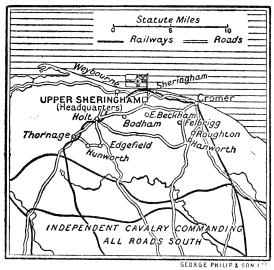 Position of the IVth German Army Corps Twelve Hours after
Landing at Weybourne, Norfolk
At night, however, he returned cautiously to the spot, regained
possession of his treasure, and abandoning his dog-cart and horse in a
by-road near North Barningham, succeeded in getting over to Edgefield.
Here, however, he was discovered and challenged by the sentries. He
succeeded, nevertheless, in convincing them that he was not endeavouring
to escape; otherwise he would undoubtedly have been shot there and then,
as quite a dozen unfortunate persons had been at various points along
the German line.
To obtain information of the enemy’s position this brave old officer had
risked his life, yet concealed in his golf-cap was the map which would
condemn him as a spy. He knew the peril, but faced it boldly, as an
English soldier should face it.
His meeting with Frölich had been most unfortunate, for he knew that he
was now a marked man.
At first the sentries disbelieved him, but, speaking German fluently, he
argued with them, and was at last allowed to go free. His one object was
to get the map into the hands of the Intelligence Department, but the
difficulties were, he soon saw, almost insurmountable. Picquets and
sentries held every road and every bridge, while the railway line
between Fakenham and Aylsham had been destroyed in several places, as
well as that between Melton Constable and Norwich.
Through the whole night he wandered on, hoping to find some weak point
in the cordon about Weybourne, but in vain. The Germans were everywhere
keeping a sharp vigil to prevent anyone getting out with information,
and taking prisoners all upon whom rested the slightest suspicion.
Near dawn, however, he found his opportunity, for at the junction of the
three roads near the little hamlet of Stody, a mile south of Hunworth,
he came upon a sleeping Uhlan, whose companions had evidently gone
forward into Briningham village. The horse was grazing quietly at the
roadside, and the man, tired out, lay stretched upon the bank, his
helmet by his side, his sabre still at his belt.
Macdonald crept up slowly. If the man woke and discovered him he would
be again challenged. Should he take the man’s big revolver and shoot him
as he lay?
No. That was a coward’s action, an unjustifiable murder, he decided.
He would take the horse, and risk it by making a dash for life.
Therefore, on tiptoe he crept up, passing the prostrate man, till he
approached the horse, and in a second, old though he was, he was
nevertheless in the saddle. But none too soon. The jingle of the bit
awakened the Uhlan suddenly, and he sprang up in time to see the
stranger mount.
In an instant he took in the situation, and before the colonel could
settle himself in the saddle he raised his revolver and fired.
The ball struck the colonel in the left shoulder, shattering it, but the
gallant man who was risking his life for his country only winced, cursed
his luck beneath his breath, set his teeth, and with the blood pouring
from the wound, made a dash for life, and succeeded in getting clean
away ere the alarm could be raised.
Twelve hours later the valuable information the colonel had so valiantly
gained at such risk was in the hands of the Intelligence Department at
Whitehall, and had been transmitted back to Norwich and Colchester.
That the Fourth German Army Corps were in a position as strong as those
who had landed at Lowestoft could not be denied, and the military
authorities could not disguise from themselves the extreme gravity of
the situation.
The first news of the great naval battle, as generally happens in war,
was confused and distorted. It did not clearly show how the victory had
been gained by the one side, or what had brought defeat upon the other.
Only gradually did the true facts appear. The following account,
however, of the sudden attack made by the Germans upon the British Fleet
represents as near an approach as can ever be made, writing after
events, to the real truth:
On the fateful evening of September 1, it appears that the North Sea
Fleet lay peacefully at anchor off Rosyth, in the Firth of Forth. It
mustered sixteen battleships, four of them of the famous Dreadnought
class, and all powerful vessels. With it, and attached to it, was a
squadron of armoured cruisers eight ships strong, but no destroyers, as
its torpedo flotilla was taking part in the torpedo manœuvres in the
Irish Sea. Some excitement had been caused in the fleet by orders
received on the previous day, directing it to remain under steam ready
to put to sea at an hour’s notice. Officers and men had read the reports
in the papers announcing some friction with Germany, and had recalled
with ironical amusement certain speeches of the Premier, in which he had
declared that since his advent to power war was impossible between
civilised nations. On the morning of the First, however, the orders to
hold the fleet in readiness were cancelled, and Admiral Lord Ebbfleet
was instructed to wait at his anchorage the arrival of reinforcements
from the reserve divisions at the great naval ports. The Admiral had
reported some shortage of coal and ammunition, and had asked for further
supplies of both. A promise was made him that more coal should be sent
to Rosyth, but ammunition, he was told, it would be inconvenient and
unnecessary to forward at this juncture. There was no reason for
precipitation or alarm, a cipher telegram from Whitehall ran: Any sign
of either would irritate Germany and endanger the situation. He was
peremptorily enjoined to refrain from any act of preparation for war.
The estimates could not be exceeded without good reason, and the
necessary economies of the Admiralty had left no margin for unexpected
expenses. Even the commissioning of the reserve ships, he was told, was
not to be considered in any sense as pointing to the imminence of war;
it was merely a test of the readiness of the fleet.
This remarkable despatch and the series of telegrams which accompanied
it were produced at the Parliamentary investigation after the war, and
caused simple stupefaction. There was not a hint in them of the peril
which menaced the North Sea Fleet. Not the safety of England, but the
feelings of the enemy, were considered. And yet the same utter absence
of precautions had characterised the policy of the Government during the
Fashoda crisis, when Mr. Goschen indignantly denied to an approving
House of Commons the suggestion that the dockyards had been busy or that
special efforts to prepare for war had been needed. In the North Sea
crisis again, the safety of England had been left to chance, and the
British fleets carefully withdrawn from the waters of the North Sea, or
placed in a position of such weakness that their defeat was a
probability.
Lord Ebbfleet, the Admiral, however, was wiser than the Admiralty. There
were too many busybodies about, and the ships were too plainly under
observation, to make the full battle toilet. But all that afternoon his
crews were active in removing the woodwork, which could not,
unfortunately, be sent ashore or thrown into the water—that would have
caused excessive suspicion. He would personally have preferred to weigh
anchor and proceed to sea, but his instructions forbade this. A great
admiral at such a juncture might have disobeyed, and acted on his own
responsibility; but Lord Ebbfleet, though brave and capable, was not a
Nelson. Still, as well as he could, he made ready for war, and far into
the night the crews worked with a will.
Torpedo-nets were got out in all the large ships; the guns were loaded;
the watch manned and armed ship; the ships’ torpedo boats were hoisted
out and patrolled the neighbouring waters; all ships had steam up ready
to proceed to sea, though the Admiralty had repeatedly censured Lord
Ebbfleet for the heinous offence of wasting coal. Unhappily, the
fortifications on the Firth of Forth were practically unmanned and
dismantled. Many of the guns had been sold in 1906 to effect economies.
In accordance with the policy of trusting to luck and the kindness of
the Germans, in fear, also, of provoking Germany, no steps had been
taken to mobilise their garrisons. Under the latest scheme of defence
which the experts in London had produced, it had been settled that
fortifications were not needed to protect the bases used by the fleet.
The garrison artillery had gone—sacrificed to the demand for economy.
It was considered amply sufficient to man the works with mobilised
Volunteers when the need arose. That the enemy might come like a thief
in the night had seemingly not occurred to the Government, the House of
Commons, or the Army reformers.
Thus the Admiral had to trust entirely to his own ships and guns. The
very searchlights on the coast defences were not manned; everything
after the usual English fashion was left to luck and the last minute.
And, truth to tell, the pacific assurances of the Ministerial Press had
lulled anxiety to rest everywhere, save, perhaps, in the endangered
fleet. The nation wished to slumber, and it welcomed the leading
articles which told it that all disquietude was ridiculous.
It was equally disastrous that no destroyers accompanied the fleet. The
three North Sea flotillas of twenty-four boats were conducting exercises
in the Irish Sea, whither they had been despatched after the grand naval
manœuvres were over. No flotilla of destroyers, and not even a single
one of those worn-out, broken-down torpedo boats which the Admiralty had
persisted in maintaining as a sham defence for the British coast, was
stationed in the Forth. For patrol work the Admiral had nothing but his
armoured cruisers and the little launches carried in his warships, which
were practically useless for the work of meeting destroyers. The mine
defences on the coast had been abolished in 1905, with the promise that
torpedo boats and submarines should take their place. Unluckily, the
Admiralty had sold off the stock of mines for what it would fetch,
before it had provided either the torpedo boats or the submarines, and
now five years after this act of supreme wisdom and economy there was
still no mobile defence permanently stationed north of Harwich.
At nightfall six of the battleships’ steam torpedo boats were stationed
outside the Forth Bridge, east of the anchorage, to keep a vigilant
watch, while farther out to sea was the fast cruiser Leicestershire
with all lights out, in mid-channel, just under the island of Inchkeith.
Abreast of her and close inshore, where the approach of hostile torpedo
craft was most to be feared, were three small ships’ torpedo boats to
the north and another three to the south, so that, in all, twelve
torpedo boats and one cruiser were in the outpost line, to prevent any
such surprise as that of the Russian fleet at Port Arthur on the night
of February 8, 1904. Thus began this most eventful night in the annals
of the British Navy.
Hour after hour passed, while the lieutenants in charge of the torpedo
boats incessantly swept the horizon with night glasses; and on the
bridge of the Leicestershire a small group of officers and signalmen
directed their telescopes and glasses out to sea. The great cruiser in
the darkness showed not a glimmer of light; gently her engines moved her
to and fro upon her beat; she looked through the blackness like a
monstrous destroyer herself; and as she went to and fro her guns were
always kept trained out seawards, with the watch ready. Towards 2 a.m.
the tide began to set strongly into the Forth, and at the same time the
weather became misty. Captain Cornwall, noting with uneasiness that the
horizon was becoming obscured, and that the field of vision was
narrowing, exclaimed to his fellow-watchers on the bridge that it was an
ideal night for destroyers—if they should come.
Barely had he spoken thus when he was called aft to the wireless
telegraphy instruments. Out of the night Hertzian waves were coming in.
The mysterious message was not in the British code; it was not in the
international code; and it bore no intelligible meaning. It was in no
language that could be recognised—was evidently a cipher. For two or
three minutes the recorder rattled off dots and dashes, and then the
aërial impulse ceased. Immediately, with a noise like the rattle of
pistol shots, the Leicestershire’s transmitters began to send the news
of this strange signal back to the flagship at the anchorage. The
special tuning of the British instruments kept for fleet work would
prevent a stranger taking in her news.
While the Leicestershire’s wireless instruments were signalling, a
steamer was made out approaching Inchkeith. From her build she was a
tramp; she carried the usual lights, and seemed to be heading for
Queensferry. A flashlight signal was made to her to ask her name and
nationality, and to direct her not to approach, as manœuvres were in
progress. She made not the faintest response to these signals—a by no
means unusual case with British and foreign merchant steamers. In the
dim light she looked to be of about 2500 tons displacement as she
steered straight for the Leicestershire. Captain Cornwall ordered one
of the inshore torpedo boats to proceed to her, and examine her, and
direct her, if she was not British, to go into Leith, thus taking upon
his shoulders the considerable responsibility of interfering with a
foreign ship in time of peace. But she paid no attention to the torpedo
boat. She was about 3000 yards off the Leicestershire when the order
to the boat was given, and she had now approached within 1500 yards.
Disquieted by her proceedings, Captain Cornwall ordered one of the
3-pounders to fire a shot across her bow, and then, as this did not stop
her, followed it up with two shots from a 3-pounder directed against her
hull.
At the first shot across her bows she swung round, now little more than
a thousand yards away from the British cruiser, bringing her broadside
to bear. There was the noise of a dull report like the discharge of
torpedo tubes, as an instant later the 3-pounder shells struck her hull.
Immediately, at Captain Cornwall’s order, the Leicestershire opened
fire with all her guns that would bear. Through the water came two
streaks of bubbles and foam, moving with lightning speed. One passed
right ahead of the Leicestershire; the other swept towards the British
cruiser’s stern; there was a heavy explosion; the whole hull of the
cruiser was violently shaken and lifted perceptibly up in the water; a
spout of water and smoke rose up astern, and the engines ceased to work.
The Leicestershire had been torpedoed by the stranger.
The stranger caught the cruiser’s fire and reeled under it. The British
gunners took their revenge. The searchlights came on; four 7.5’s, in
less time than it takes to tell, planted shell after shell upon her
waterline, and the steamer began slowly to founder. Clouds of smoke and
steam rose from her; her engine was apparently disabled, and the British
launches closed about her to seize those of her crew that survived. In
ten minutes all was over. The steamer had disappeared, her side torn
open by a dozen 7.5-in. shells charged with lyddite. But the
Leicestershire was in serious plight. The damage done by the German
torpedo was of the gravest nature. The British cruiser was heavily down
by the stern; her port engine and propeller would no longer revolve; two
compartments on the port quarter had filled, and water was leaking into
the port engine-room. Very slowly, with the help of the starboard
engine, Captain Cornwall took her in towards Leith and beached his ship
on the shoals near the new harbour.
The opening act had been cleverly thought out by the German staff. While
the torpedo boats were picking up the crew of the steamer, three
divisions of German torpedo craft, each six boats strong, had passed
into the Forth under the shadow of the northern coast. They glided like
shadows through the darkness, and they do not seem to have been seen by
the British vessels off Inchkeith, whose crews’ attention was riveted
upon the Leicestershire. A fourth division, moving rapidly in the
shadow of the southern coast, was seen by the Leicestershire and by
the British launches about her and with her, and at once she opened fire
upon the dim forms. But, bereft of motive power, she could not use her
battery to advantage, and though it was thought that one of the
destroyers disappeared in the water, the others sped up the estuary,
towards the British fleet.
Warned by wireless telegraphy that destroyers had been sighted, the
British crews were on the qui vive. There was not time at this
eleventh hour to weigh and put out to sea; the only possible course was
to meet the attack at anchorage. The fleet was anchored off Rosyth, the
battleships in two lines ahead, headed by the flagships Vanguard and
Captain. The Vanguard and Captain, the leading ships in the
starboard and port lines respectively, were just abreast of the Beamer
Rock and Port Edgar. The seven armoured cruisers were moored in the St.
Margaret’s Hope Anchorage. To torpedo craft coming from the sea and
passing under the Forth Bridge, the fleet thus offered a narrow front,
and comparatively few of its guns would bear.
About 2.30 a.m. on Sunday morning, the lookout of the Vanguard
detected white foam, as from the bows of a destroyer, just under Battery
Point; a few seconds later, the same sign was seen to the south of
Inchgarvie, and as the bugles sounded and the 12-in. guns in the three
forward turrets of the British flagship opened, and the searchlights
played their steady glare upon the dark waters just under the Forth
Bridge, the forms of destroyers or torpedo boats fast approaching were
unmistakably seen.
In a moment the air trembled with the concussion of heavy guns; the
quick-firers of the fleet opened a terrific fire; and straight at the
battleships came eighteen German destroyers and large torpedo boats,
keeping perfect station, at impetuous speed. The sea boiled about them;
the night seemed ablaze with the flashing of the great guns and the
brilliant flame of exploding shells. Now one destroyer careened and
disappeared; now another flew into splinters, as the gunners sent home
their huge projectiles. Above all the din and tumult could be heard the
rapid hammering of the pom-poms, as they beat from the bridges with
their steady stream of projectiles upon the approaching craft.
Four destroyers went to the bottom in that furious onrush; ten entered
the British lines, and passed down them with the great ships on either
side, not more than 200 yards away, and every gun depressed as much as
it could be, vomiting flame and steel upon the enemy; the others turned
back. The thud of torpedo firing followed; but the boats amid that
tempest of projectiles, with the blinding glare of the searchlights in
their gunners’ eyes, aimed uncertainly. Clear and unforgettable the
figures of officers and men stood out of the blackness, as the
searchlights caught the boats. Some could be seen heaving heavy weights
overboard; others were busy at the torpedo tubes; but in the blaze of
light the pom-poms mowed them down, and tore the upper works of the
destroyers to flinders. Funnels were cut off and vanished into space; a
conning-tower was blown visibly away by a 12-in. shell which caught it
fairly, and as the smitten boat sank there was a series of terrific
explosions.
Fifth ship in the starboard British line from the Vanguard lay the
great battleship Indefatigable, after the four “Dreadnoughts” one of
the four powerful units in the fleet. Four torpedoes were fired at her
by the German destroyers; three of the four missed her, two of them only
by a hair’s breadth, but the fourth cut through the steel net and caught
her fairly abreast of the port engine-room, about the level of the
platform deck. The Germans were using their very powerful 17.7-in.
Schwartzkopf torpedo, fitted with net-cutters, and carrying a charge of
265 lb. of gun-cotton, the heaviest employed in any navy, and nearly a
hundred pounds heavier than that of the largest British torpedo.
The effect of the explosion was terrific. Though the Indefatigable had
been specially constructed to resist torpedo attack, her bulkheads were
not designed to withstand so great a mass of explosive, and the torpedo
breached the plating of the wing compartments, the wing passage, and the
coal-bunker, which lay immediately behind it. The whole structure of the
ship was shaken and much injured in the neighbourhood of the explosion,
and water began to pour through the shattered bulkheads into the port
engine-room.
The pumps got to work, but could not keep the inrush down; the ship
rapidly listed to the port side, and though “out collision mat” was
ordered at once, and a mat got over the huge, gaping hole in the
battleship’s side, the water continued to gain. Slipping her anchors, at
the order of the Admiral, the Indefatigable proceeded a few hundred
yards with her starboard screw to the shelving, sandy beach of Society
Bank, where she dropped aground. Had the harbour works at Rosyth been
complete, the value of them to the nation at this moment would have been
inestimable, for there would have been plenty of time to get her into
the dock which was under construction there. But in the desire to effect
apparent economies the works since 1905 had been languidly pushed.
The calamities of the British fleet did not end with the torpedoing of
the Indefatigable. A few seconds later some object drifting in the
water, probably a mine—though in the confusion it was impossible to say
what exactly happened—struck the Resistance just forward of the fore
barbette. It must have drifted down inside the torpedo nets, between the
hull and the network. There was an explosion of terrific violence, which
rent a great breach in the side of the ship near the starboard fore
torpedo tube, caused an irresistible inrush of water, and compelled her
captain also to slip his anchors and beach his ship.
Two of the British battle squadron were out of action in the space of
less than five minutes from the opening of fire.
Already the shattered remnants of the German torpedo flotilla were
retiring; a single boat was steaming off as fast as she had come, but
astern of her four wrecks lay in the midst of the British fleet devoid
of motive power, mere helpless targets for the guns.
As they floated in the glare of the searchlights with the water
sputtering about them, in the hail of projectiles, first one and then
another, and finally all four, raised the white flag. Four German boats
had surrendered; four more had been seen to sink in the midst of the
fleet; one was limping slowly off under a rain of shells from the
smaller guns of the Vanguard.
The British cruiser Londonderry was ordered to slip and give chase to
her, and steamed off in pursuit down the Forth. A caution to “beware of
mines” was flashed by the Admiral, and was needed. The German destroyers
must have carried with them, and thrown overboard in their approach, a
large number of these deadly agents, which were floating in all
directions, greatly hampering the Londonderry in her chase.
But with the help of her searchlights she picked her way past some
half-dozen mines which were seen on the surface, and she was so
fortunate as not to strike any of those which had been anchored in the
channel. Gathering speed, she overhauled the damaged destroyer. The crew
could offer little resistance to the guns of a powerful cruiser.
A few shots from the three-pounders and a single shell from one of the
Londonderry’s 7.5’s did the work. The German torpedo boat began to
sink by the stern; her engines stopped; her rudder was driven by the
explosion of the big projectile over to starboard, and the impulse of
the speed at which she was travelling brought her head round towards the
British vessel. The boat was almost flush with the water as one of her
crew raised the white flag, and the fifth German boat surrendered.
The prisoners were rescued from the water with shaken nerves and quaking
limbs, as men who had passed through the Valley of the Shadow of Death,
who had endured the hail of shells and faced the danger of drowning.
So soon as the survivors of that most daring and gallant attack had been
recovered from the water, and possession had been taken of the battered
hulls in which they had made their onset, the Admiral ordered his
torpedo launches to drag the channel for mines.
And while the dragging was proceeding, the prisoners were taken on board
the flagship and interrogated. They would disclose little other than the
fact that, according to them, war had been already declared. The ship
which had attacked the Leicestershire, they said, was a tramp fitted
for mine-laying and equipped with three torpedo tubes. Half of them were
more or less seriously wounded; all admitted that the slaughter on board
their boats caused by the British fire had been terrific. One lieutenant
stated that all the men at one of his torpedo tubes had been mown down
twice by the hail of small shells from the pom-poms, while a 12-in.
shell which had hit the stern of his boat had blown it completely away.
Yet the remnant of the boat had still floated.
Lord Ebbfleet surveyed the scene with rueful eyes. The Indefatigable
and Resistance, two of his powerful battleships, were out of action,
and could take no more part in operations for weeks. The
Leicestershire was in the same plight. From sixteen battleships his
force had fallen to fourteen; his armoured cruiser squadron was reduced
from eight ships to seven. To remain in the anchorage without destroyers
and torpedo boats to keep a lookout would be to court further torpedo
attacks, and perhaps the even more insidious danger from German
submarines, and might well imperil the safety of the British reserve
ships. Only one course remained—to weigh and proceed to sea,
endeavouring to pass south to meet the reserve ships.
Efforts to communicate his intention to the Admiralty failed. The roar
of firing had awakened Leith and Edinburgh; people were pouring into the
streets to know what this strange and sudden commotion meant, and what
was the cause of the storm.
The windows at Queensferry had been shattered; the place was shaken as
by a great earthquake. The three heavy bursts of firing, the continuous
disquieting flashes of the searchlights, and the great hull of the
Leicestershire ashore off Leith, indicated that something untoward had
befallen the fleet.
For a moment it was thought that the Admiral had fallen to manœuvres
at a most unseasonable hour, or that some accident had occurred on board
the injured cruiser. Then suddenly the truth dawned upon the people. The
crowd ashore, constantly increasing, as it gazed in alarm towards the
anchorage, realised that war had begun, and that for the first time
since the Dutch sailed up the Medway, more than two hundred years
before, the sanctity of a British anchorage had been invaded by an
enemy.
The coastguardsmen, who had been placed under the control of the civil
authorities as the result of one of the numerous reforms effected in the
interests of economy, had for the most part forgotten the art of quick
signalling or quick reading of naval signals, else they might have
interpreted to the crowd the history of that night, as it was flashed to
the wireless station at Rosyth, for transmission to London.
But, as has been said, the attempt to despatch the news to headquarters
failed. The private wire from the dockyard to Whitehall would not work,
and though the post office wires were tried no answer could be obtained.
It appeared that, as on the famous night of the North Sea outrage, there
was no one at the Admiralty—not even a clerk. It was, therefore,
impossible to obtain definite information.
Lord Ebbfleet had meantime received a report from his torpedo launches
that a precarious passage had been cleared through the mines in the
channel, and about four o’clock on Sunday morning he ordered the
armoured cruiser squadron to put to sea and ascertain whether the coast
was clear, preceding the battle squadron, which, minus the two damaged
battleships, was to follow at six.
The interval of two hours was required to take on board ammunition from
the damaged ships, to land woodwork and all the impedimenta that could
possibly be discarded before battle, and also to complete the
preparations for action.
It was now almost certain that a German fleet would be encountered, but,
as has been said, the risk of remaining in the Forth was even greater
than that of proceeding to sea, while the Commander-in-Chief realised
the full gravity of the fact that upon his fleet and its activity would
depend the safety of England from invasion.
He knew that the other main fleets were far distant; that the reserve
ships were much too weak by themselves to meet the force of the German
Navy, and that the best chance of averting a fresh disaster to them was
to effect as speedily as possible a junction with them. Where exactly
they were or whether they had moved from the Nore he was not yet aware;
the absence of information from the Admiralty left him in the dark as to
these two important points.
The armoured cruisers were ordered, if they encountered the German
cruisers in approximately equal or inferior force, to drive them off and
push through them, to ascertain the strength and whereabouts of the
German battle fleet; if, however, the Germans were in much superior
force, the British squadron was to fall back on the battle fleet. One by
one the armoured cruisers steamed off, first the Polyphemus, with the
Rear-Admiral’s flag, then the Olympia, Achates, Imperieuse,
Aurora, and Londonderry, and last of all the Gloucester bringing
up the rear.
Upon these seven ships the duty of breaking through the enemy’s screen
was to devolve. As they went out they jettisoned their woodwork and
formed a line ahead, in which formation they were to fight.
Unfortunately, the shooting of the squadron was very uneven. Three of
its ships had done superbly at battle practice and in the gun-layers’
test; but two others had performed indifferently, and two could scarcely
be trusted to hit the target.
For years the uneven shooting of the fleet had been noted as a source of
weakness; but what was needed to bring the bad ships up to the mark was
a lavish expenditure of ammunition, and ammunition cost money. Therefore
ammunition had to be stinted.
In the German Navy, on the other hand, a contrary course had been
followed. For the two months before the war, as was afterwards disclosed
by the German Staff History, the German ships had been kept constantly
at practice, and if the best ships did not shoot quite so well as the
best units in the British fleet, a far higher average level of gunnery
had been attained.
Increasing the number of revolutions till the speed reached 18 knots,
the cruiser squadron sped seawards. The east was flushed with the glow
of dawn as the ships passed Inchcolm, but a grey mist lay upon the
surface of the gently heaving sea and veiled the horizon. Leaving
Inchkeith and the Kinghorn Battery soon after the Leith clocks had
struck the half-hour, and steaming on a generally easterly course, the
lookout of the Polyphemus saw right ahead and some ten or eleven miles
away to the north-east the dark forms of ships upon the horizon. The
British line turned slightly and headed towards these ships. All the
telescopes on the Polyphemus’s fore-bridge were directed upon the
strangers, and the fact that they were men-of-war painted a muddy grey
was ascertained as they drew nearer, and transmitted by wireless
telegraphy to Lord Ebbfleet.
They were coming on at a speed which seemed to be about 17 knots, and
were formed in line ahead, in a line perfectly maintained, so that, as
they were approaching on almost exactly the opposite course, their
number could not be counted. In another minute or two, as the distance
between the two squadrons rapidly diminished, it was clear from her
curious girdermasts that the ship at the head of the line was either the
large German armoured cruiser Waldersee, the first of the large type
built by Germany, or some other ship of her class. At six miles distance
several squadrons of destroyers were made out, also formed in line
ahead, and steaming alongside the German line, abaft either beam.
A battle was imminent; there was no time to issue elaborate orders, or
make fresh dispositions.
The British Admiral signalled that he would turn to starboard, to
reconnoitre the strange fleet, and reserve fire till closer quarters. He
turned five points, which altered his course to an east-south-easterly
one. For a fractional period of time the Germans maintained their
original course, steering for the rear of the British line. Then the
German flagship or leader of the line turned to port, steering a course
which would bring her directly across the bows of the British line.
Simultaneously the two divisions of torpedo craft on the port beam of
the German squadron increased speed, and, cutting across the loop,
neared the head of the German line.
The German squadron opened fire as it began to turn, the Waldersee
beginning the duel with the two 11-in. guns in her fore-turret.
A flash, a haze of smoke instantly dissipated, and a heavy shell passed
screeching over the fore-turret of the Polyphemus.
Another flash an instant later, and a shell struck the British cruiser’s
third funnel, tearing a great hole in it, but failing to burst. Then
every German gun followed, laid on the Polyphemus, which blew her
steam siren and fired a 12-pounder, the prearranged signal to the
British ships for opening, and an instant later, just after 5 a.m., both
squadrons were exchanging the most furious fire at a distance which did
not exceed 5000 yards.
As the two lines turned, the British were able at last to make out the
strength and numbers of their enemy. There were ten German armoured
cruisers in line—at the head of the line the fast and new Waldersee,
Caprivi, and Moltke, each of 16,000 tons, and armed with four 11-in.
and ten 9.4-in. guns, with astern of them the Manteuffel, York,
Roon, Friedrich Karl, Prince Adalbert, Prince Heinrich, and
Bismarck.
The last four did not follow the first six in the turn, but maintained
their original course, and headed direct for the rear of the British
line. Thus the position was this: One German squadron was manœuvring
to pass across the head of the British line, and the other to cross the
rear of that line. Each German squadron was attended by two torpedo
divisions.
Retreat for the British Admiral was already out of the question, even if
he had wished to retire. But as he stood in the Polyphemus’s
conning-tower and felt his great cruiser reel beneath him under the
concussion of her heavy guns—as he saw the rush of splinters over her
deck, and heard the officers at his side shouting down the telephones
amid the deafening din caused by the crash of steel on steel, the
violent explosion of the shells, the heavy roar of the great guns, and
the ear-splitting crack and rattle of the 12-pounders and pom-poms—he
realised that the German squadrons were manœuvring perfectly, and
were trying a most daring move—one which it would need all his nerve
and foresight to defeat.
Contrary to anticipation, in the interchange of fire the ships of the
two combatants did not suffer any disabling injury. The armour on either
side kept out the shells from the vitals, though great smoking gaps
began to show where the unarmoured sides had been riven.
The Waldersee’s turrets flashed and smoked incessantly as she closed;
the whole German squadron of six ships, which included her and followed
her, turned its concentrated fire upon the Polyphemus, and the British
cruisers to the rear of the British line were at some disadvantage,
since their weapons could only fire at extreme range. The Germans aimed
chiefly at the Polyphemus’s conning-tower, wherein, they knew, dwelt
the brain that directed the British force.
Amidst the smoke and fumes of high-explosive shells, with the outlook
obscured by the hail of splinters and the nerves shaken by the incessant
blast of shells, it was difficult to keep a perfectly cool head.
The next move of the British Admiral has been bitterly criticised by
those who forget that the resolutions of naval war may have to be
reached in two seconds, under a strain to which no General on land is
subjected.
Seeing that the main German squadron was gaining a position to execute
the famous manœuvre of “crossing the T,” and unable to turn away to
starboard for want of sea-room, the British Admiral signalled to his
fleet to turn simultaneously to port, reversing the direction of his
movement and inverting the order of his fleet. His van became his rear,
his rear his van.
Amidst all the uproar, the main German squadron replied with the same
manœuvre, while the second German squadron instantly headed straight
for the ships which had been to the rear of the British line, and now
formed its van.
Simultaneously two of the four divisions of German destroyers attacked,
one the rear and the other the head, of the British line, and the German
ships let go their long-range torpedoes.
The range had fallen to a distance of not much over 3000 yards between
the main German squadron and the Polyphemus. At the other extremity of
the British line, as the four armoured cruisers forming the second
German squadron closed on the British van, it rapidly decreased. The
confusion was fearful on either side, and if the British had had
destroyers with them the German official narrative acknowledges that it
might have gone very hard with the German fleet. But here, as elsewhere,
initial errors of disposition, in the famous words of the Archduke
Charles, proved fatal beyond belief.
The smaller guns on board all the ships of both sides had been in many
cases put out of action; even the heavier weapons had suffered. Several
of the turrets no longer flashed and revolved. Funnels and bridges had
sunk; wreckage of steel yawned where decks had been; dense clouds of
smoke poured from blazing paint or linoleum, and the fires were
incessantly renewed by fresh shell explosions. Blood covered the decks,
the scuppers ran red; inside the fore barbette of the Imperieuse,
which had been pierced by an 11-in. shell, was a scene of indescribable
horror. The barbette had suddenly ceased firing.
An officer, sent to ascertain the cause, was unable to make his way in
before he was swept away by a fresh projectile. Another volunteer
climbed up through the top into the steel pent-house, for there was no
other means of access—returned alive, and reported that the whole
barbette crew were dead and that the place was like a charnel-house.
There was no sign of disabling injury to the mechanism, but the problem
was how to get a fresh crew of living men through the hail of shells to
the guns.
The four German armoured cruisers of the second division turned within
1500 yards of the head of the British line, firing torpedoes and
delivering and receiving a terrific shell fire. One torpedo boat
followed each German cruiser closely, and as the four cruisers turned,
the torpedo craft, instead of following them, charged home.
The manœuvre was so unexpected and so hazardous that it was difficult
to meet. At twenty-five knots speed the German boats passed like a flash
through the British line. A great hump of water rose under the British
cruiser Londonderry, second in the inverted order of the line, and she
reeled and settled heavily in the water. A torpedo had struck her abaft
the fore-turret.
Almost at the same instant another German torpedo division attacked the
rear of the British line, and a German torpedo boat made a hit upon the
Olympia, last but one in the British line. She was struck abaft the
starboard engine-room, and she too listed, and settled in the water.
As the German boats attempted to escape to the south they caught the
fire of the British squadron’s port broadsides, which sent two to the
bottom and left two others in a sinking condition. Both the damaged
British ships turned out of the British line and headed for the coast to
the south. The only chance of saving the ships and crews was to beach
the vessels and effect repairs. As they steered out of the battle, the
tumult behind them increased, and their crews could see great tongues of
flame shooting upwards from the Bismarck, which was held unmercifully
by the British 9.2-in. shells. She was badly damaged and in sore
trouble, but the rest of the German ships still appeared to be going
well. The British torpedoes, fired from the cruisers’ tubes, seemed to
have made no hits.
The Germans offered no hindrance to the withdrawal of the injured ships.
They closed on the remnant of the British force, now reduced to five
ships, all much damaged. On their side, without the Bismarck, which
had fallen out of the line, they had nine ships in action and two intact
flotillas of torpedo craft to bring to bear.
The second German squadron had wheeled to join the other division, which
was now steering a generally parallel course, though well astern of the
British ships. The two fleets had drawn apart after the short but fierce
torpedo action, and the British were now heading north. A fierce cruiser
battle ensued.
In this sharp encounter at close quarters, at a range which did not
exceed 2000 yards, a grave catastrophe had befallen the Polyphemus. As
the Admiral was giving orders for his squadron to turn, two heavy
projectiles in quick succession struck the conning-tower, inside which
he was standing with the captain, a midshipman, a petty officer, and two
boys at his side. The first shell struck the base of the conning-tower,
causing a most violent shock, and filling the interior of the tower with
smoke and fumes.
The Admiral leant against the side of the tower and strove to ascertain
through the narrow opening in the steel wall what had happened, when the
second shell hit the armour outside, and exploded against it with
terrific violence. Admiral Hardy was instantly killed by the shock or by
the bolts and splinters which the explosion or impact of the projectile
drove into the conning-tower. The flag-captain was mortally wounded; the
petty officer received an insignificant contusion. The midshipman and
the two boys escaped without a scratch, though stunned and much shaken
by the terrific blow.
For some seconds the ship passed out of control; then, dazed and
bewildered, the midshipman took charge, and shouted to the chamber
below, where the steering gear was placed with the voice-pipes and all
other appliances,—an improvement introduced after the war in the Far
East,—orders to communicate the death of the Admiral and disablement of
the captain to the commander. For some minutes the British squadron was
without a chief, though under the system of “follow my leader,” which
had been adopted for the cruiser squadron, the captain of the
Gloucester which led the line was controlling the battle.
Some confusion resulted, and the opportunity of finishing off the
Bismarck which undoubtedly offered at this moment was lost. Captain
Connor, of the Gloucester, increased speed to eighteen knots, heading
northward, to draw the German squadron away from the damaged British
ships, and attempted to work across the head of the German line. The
fleets now fought broadside to broadside, exchanging a steady fire,
until Captain Connor, finding himself getting too close to the north
coast, and with insufficient manœuvring room, turned southward,
inverting the British line, and bringing the Polyphemus once more to
its head.
The British squadron, after turning, steamed towards the Bismarck,
which was crawling off eastwards, with a division of German torpedo
boats near at hand to give her succour. The German squadrons had now
formed up into one compact line, in which two of the ships appeared to
be in serious difficulties. They copied the British manœuvre and
steered a parallel course to the British cruisers, holding a position a
little ahead of them. Simultaneously, their other intact torpedo
division took station to leeward of their line near its rear, and the
six remaining boats of the two divisions, which had executed the first
attack, took station to leeward near the head of the line. The two
fleets steamed 3500 yards apart, gradually closing, and fought an
artillery battle, in which the greater gunpower, of the Germans, who had
nine ships in action to the British five, speedily began to tell.
The Gloucester lost two of her four funnels; one of her masts fell
with a resounding crash. The Olympia had a slight list; the Aurora’s
forward works were shot away; the Achates had lost one of her funnels.
In the German line the Waldersee’s forward military mast tottered and
could be seen swaying at each instant, the network of steel girders had
been badly damaged. The Caprivi was on fire amidships, and smoke was
pouring up from the fire. The Moltke was without one of her four
funnels. The Manteuffel’s stern had been wrecked till the structure of
the ship above the armour looked like a tangle of battered girders. The
York and Roon were less shattered, but gaping wounds could be seen
in their sides. The Friedrich Karl had lost the upper portion of her
after military mast. The Prince Heinrich was slightly down by the bow,
and was drooping astern.
Sparks and splinters flew upwards from the steel sides of the great
ships as the projectiles went home; the din was indescribable; mingled
with the dull note of the heavy guns was the crackling of the smaller
guns and the beating of the pom-poms, playing a devil’s tattoo in this
furious encounter of the mastodons.
The German Admiral saw that the two fleets were steadily nearing the
Bismarck, and essayed once more the manœuvre which he had already
tried, a manœuvre studiously practised in the German Navy, which had
for ten years been daily experimenting with battle-evolutions, and
testing its captains’ nerves till they were of steel. In these difficult
and desperate manœuvres, it was remarked then—and it has since been
proved by experience—the Germans surpassed their British rivals, not
because the German officer was braver or more capable, but because he
was younger taught to display initiative to a higher degree than the
personnel of the British fleet, and better trained for actual battle.
The four last cruisers in the German line suddenly altered course and
steered straight at the British line, while behind them, as before,
followed six torpedo boats. Through the intervals at the head of the
German line came the other six boats—an evolution which they had
constantly rehearsed in peace, and which they carried out with admirable
precision and dash in the crisis of battle—and charged the head of the
British line. The rest of the German squadron maintained its original
course, and covered the attack with a terrific fire, all its guns
accelerating the rapidity of their discharge till the air hummed with
projectiles.
The attack was suddenly and vigorously delivered. The British ships at
the rear of the line met it and countered it with success by turning
together south and steaming away, so that the German effort in this
quarter ended with a blow to the air.
But the flagship at the head of the line was not so alert; the death of
the Admiral was at this critical moment severely felt, and the
Polyphemus, though she eluded three torpedoes which were fired at her
at about 3000 yards by the German battleships, found two torpedo boats
closing in upon her from right ahead. She charged one with the ram;
there was no time for thinking, and she caught the boat fair under her
steel prow, which cut through the thin plating of the boat like a knife
through matchwood. Her huge hull passed with a slight shudder over the
boat, which instantly foundered with a violent explosion.
The other boat, however, passed her only a hundred yards away in the
spray of shells and projectiles which seemed as if by enchantment just
to miss it. Her crew had a vision of wild-looking officers and men busy
at the boat’s torpedo tubes; the flash of two torpedoes glinted in the
sun as they leaped from the tubes into the water; then a great shell
caught the boat and sent her reeling and sinking, but too late. The
mischief had been done. One of the German torpedoes struck the
Polyphemus full on the starboard engine-room, and, exploding with
devastating effect, blew in the side and bulkheads. The engine-room
filled at once, and bereft of half her power the great cruiser broke
from the British line and headed for the shore with a heavy list. Almost
at the same moment the fire on board the Caprivi blazed up so fiercely
under the impact of the British shells that she, too, had to leave the
line of battle.
The British line re-formed, heading east, now only four ships strong,
faced by eight German ships. For some minutes both fleets steamed on a
parallel course 4500 yards apart, the Germans, who had, on the whole,
suffered less damage, since their injuries were distributed over a
larger number of ships, steaming a little faster. Once more the German
Admiral essayed a surprise. Suddenly the eight German ships made each
simultaneously a quarter-turn, which brought them into line abreast.
They stood in towards the four British survivors, to deal the
culminating blow. End-on they caught the full vehemence of the British
fire. But with forces so weakened, the British senior officer could not
run the risk of a mêlée, and to avoid his antagonists he, too, turned
away from the Germans in a line abreast, and at the same moment the
Achates, Imperieuse, and Aurora fired their stern torpedo tubes.
Realising the danger of pressing too closely in the course of a retiring
fleet, the Germans again altered course to line ahead, and steered to
cut the British ships off from their line of retreat up the Forth.
The four British cruisers now headed up the Forth, perceiving that
victory was impossible and flight the only course. They again received
the German fire, steering on a parallel course. At this juncture the
Gloucester, the last ship in the British line, dropped far astern; she
had received in quick succession half a dozen heavy German shells on her
6-in. armour and had sprung a serious leak. The German ships closed on
her, coming in to less than 2000 yards, when their guns battered her
with ever-increasing effect. She sank deeper in the water, heading for
the coast, with the Germans in hot pursuit firing continuously at her.
The other three cruisers were preparing to turn and go to her aid—a
course which would certainly have involved the annihilation of the First
Cruiser Squadron—when welcome help appeared.
To the west a column of great ships was made out coming up at impetuous
speed from the Upper Forth. The new-comers were the British battleships
steering to the scene of action.
At their approach the German cruisers wheeled and stood seaward, making
off at a speed which did not exceed 16 knots, and leaving the
Gloucester to beach herself. They were now in peril, in imminent
danger of destruction—as it seemed to the British officers. Actually,
however, the risk for them had not been great. Within touch of them the
main German battle-fleet had waited off the Forth, linked to them by a
chain of smaller cruisers and torpedo boats. It would have shown itself
before, but for its commander’s fear that its premature appearance might
have broken off the battle and led to the retreat of the British
squadron. As the British fleet came up, the German cruiser Bismarck,
which had been for an hour in the gravest trouble, dropped astern of the
other German ships, and it could be seen that one other German ship had
been taken in tow and was falling astern.
Thus the preliminary cruiser action between the fleets had ended all to
the disadvantage of the British, who had fought for two hours, and in
that brief space lost four ships disabled. From seven ships on that
disastrous morning, the British strength had been reduced to three.
Impartial posterity will not blame the officers and men of the armoured
cruiser squadron, who made a most gallant fight under the most
unfavourable conditions.
The real criminals were the British Ministers, who neglected
precautions, permitted the British fleet to be surprised, and compelled
the British Admiral to play the most hazardous of games while they had
left the coast without torpedo stations, and England without any
military force capable of resisting an invading army.
Had there been a national army, even a national militia, the
Commander-in-Chief could have calmly awaited the concentration of the
remaining British fleets, which would have given the British Navy an
overwhelming superiority. Had there been a fair number of destroyers
always attached to his force, again, it is morally certain that he would
have suffered no loss from the German torpedo attacks, while a number of
torpedo stations disposed along the North Sea coast would have enabled
him to call up torpedo divisions to his assistance, even if he had had
none attached to his fleet.
Foresight would have provided for all the perils which menaced the
British Navy on this eventful night; foresight had urged the rapid
completion of the harbour at Rosyth, without which further strengthening
of the North Sea fleet was difficult; foresight had pointed out the
danger of neglecting the strengthening of the torpedo flotilla;
foresight had called for a strong navy, and a nation trained to defend
the fatherland.
It was the cry of the people and the politician for all manner of
“reforms” at the expense of national security; the demand for old-age
pensions, for feeding of children, for State work at preposterous wages
for the work-shy; the general selfishness which asked everything of the
State and refused to make the smallest sacrifice for it; the degenerate
slackness of the Public and the Press, who refused to concern themselves
with these tremendous interests, and riveted all their attention upon
the trivialities of the football and cricket field, that worked the doom
of England.
The nation was careless and apathetic; it had taken but little interest
in its Fleet. Always it had assumed that the navy was perfect, that one
British ship was a match for any two enemies. And now in a few hours it
had been proved that the German Navy was as efficient; that its younger
officers were better trained for war and more enterprising than the
older British personnel; that its staff had perfectly thought out and
prepared every move; and that much of the old advantage possessed by the
British Navy had been lost by the too general introduction of short
service.
The shooting of the British ships, it is true, had on the whole been
good, and even the cruisers, which in battle practice had done badly, in
action had improved their marksmanship to a remarkable degree. But it
was in the art of battle manœuvring and in the scientific employment
of their weapons that the British had failed.
The three surviving cruisers of the British squadron had all suffered
much damage from the German fire, and had exhausted so much of their
ammunition in the two hours’ fight that they were practically incapable
of taking further part in the operations. They had to proceed to Rosyth
to effect hasty repairs and ship any further ammunition that might with
luck be found in the insignificant magazines at that place.
The Olympia had been struck three times on her fore barbette, but
though one of the 9.2-in. guns which it contained had been put out of
action by splinters, the barbette still worked well. Twice almost the
entire crew of the barbette had been put out of action and had been
renewed. The scenes within the barbette were appalling. Two of her
7.5-in. barbettes had been jammed by the fire; her funnels were so much
damaged that the draught had fallen and the coal consumption enormously
increased. Below the armour deck, however, the vitals of the ship were
intact.
The Impérieuse and Aurora had serious hits on the water-line astern,
and each of them was taking on board a good deal of water. They, too,
were much mauled about their funnels and upper works. As for the four
beached cruisers, they were in a parlous condition, and it would take
weeks to effect repairs. The losses in men of the cruisers had not been
very heavy; the officers in the conning-towers had suffered most, as
upon the conning-towers the Germans had directed their heaviest fire.
Most serious and trying in all the ships had been the outbreaks of fire.
Wherever the shells struck they appeared to cause conflagrations, and
this, though the hoses were spouting water and the decks drowned before
the action began. Once a fire broke out, to get it under was no easy
task. Projectiles came thick upon the fire-parties, working in the
choking smoke. Shell-splinters cut down the bluejackets and tore the
hoses. The difficulty of maintaining communications within the ships was
stupendous; telephones were inaudible in the terrible din; voice-pipes
were severed; mechanical indicators worked indifferently.
The battle-fleet had spent its respite at the anchorage in getting on
board the intact ships much of the ammunition from the Indefatigable
and Triumph, and stripping away all remaining impedimenta; in rigging
mantlets and completing the work of preparation.
While thus engaged at five a.m. the heavy boom of distant firing came in
towards it from the sea—the continuous thundering of a hundred large
guns, a dull, sinister note, which alternately froze and warmed the
blood. Orders were instantly issued to make ready for sea with all
possible speed, and hoist in the boats. Meantime the ships’ torpedo and
picket boats had dragged carefully for mines, as Lord Ebbfleet dared to
leave nothing to chance. Numerous mines were found floating on the water
or moored in the channel, and it seemed a miracle that so many ships of
the cruiser squadron had passed out to sea in safety.
Ten minutes later, at 5.10 a.m., Lord Ebbfleet signalled to weigh
anchor, and the battle-fleet got under way and headed out to sea, its
ships in a single line ahead, proceeding with the utmost caution. As it
cleared the zone of danger, speed was increased to sixteen knots, and
off Inchcolm the formation was modified.
Wishing to use to the utmost the high speed and enormous batteries of
his four battleships of the “Dreadnought “class, Lord Ebbfleet had
determined to manœuvre with them independently. They steamed three
knots faster than the rest of his fleet; their armour and armament
fitted them to play a decisive part in the approaching action. They took
station to starboard, and to port steamed the other ten battleships,
headed by the Captain, under Sir Louis Parker, the second in command,
who was given full authority to control his division. Behind the
Captain steamed the Sultan, Defiance, Active, Redoubtable,
Malta, Excellence, Courageous, Valiant, and Glasgow—a
magnificent array of two-funnelled, grey-painted monsters, keeping
perfect station, with their crews at quarters, guns loaded, and
battle-flags flying. To starboard were the enormous hulls of the four
“Dreadnoughts,” the Vanguard leading, with astern of her the
Thunderer, Devastation, and Bellerophon. The great turrets, each
with its pair of giant 45 ft. long 12-in. guns, caught the eye
instantly; the three squat funnels in each ship emitted only a faint
haze of smoke; on the lofty bridges high above the water stood
white-capped officers, looking out anxiously to sea. Nearer and nearer
came the roll of the firing; presently the four “Dreadnoughts” increased
speed and drew fast ahead of the other line, while the spray flew from
under their bows as the revolutions of the turbines rose and the speed
went up to nineteen knots.
The other ten battleships maintained their speed, and fell fast astern.
Off Leith a vast crowd gathered, watching the far-off fighting, and
listening in disquietude to the roar of the firing of the cruiser
battle, and cheered the great procession as it swiftly passed and
receded from view, leaving behind it only a faint haze of smoke. A few
minutes before 7 a.m. the group of officers on the Vanguard’s bridge
saw ahead of them three cruisers, evidently British, steaming towards
them, and far away yet another British cruiser low in the water, smoking
under the impact of shells, with about her a great fleet of armoured
cruisers. The cruisers, as they approached, signalled the terrible news
that Admiral Hardy was dead, three British cruisers out of action, and
the Gloucester in desperate straits.
The battleships were just in time to effect the rescue. At 11,000 yards
the Vanguard’s fore-turret fired the first shot of the battleship
encounter, and as the scream of the projectile filled the air, the
German cruisers drew away from their prey. The “Dreadnoughts” were now
two miles ahead of the main squadron. Steaming fast towards the
Bismarck, which had been abandoned by her consorts, the Vanguard
fired six shells at her from her fore and starboard 12-in. turrets. All
the six 12-in. shells went home; with a violent explosion the German
cruiser sank instantly, taking with her to the bottom most of her crew.
Yet there was no time to think of saving men, for on the horizon ahead
of the British Fleet, out to sea, could be seen a dense cloud of smoke,
betokening the presence of a great assemblage of ships. Towards this
cloud the German cruisers were steaming at their best pace.
Lord Ebbfleet reduced speed to permit his other battleships to complete
their formation and take up their positions for battle. The ten
battleships of the second division simultaneously increased speed from
fifteen to sixteen knots, which was as much as their engines could be
trusted to make without serious strain.
About 7.15 a.m. the British Fleet had resumed its original order, and
was abreast of North Berwick, now fast nearing the cloud of smoke which
indicated the enemy’s presence, and rose from behind the cliffs of the
Island of May.
The British admirals interchanged signals as the fleet steamed seaward,
and Lord Ebbfleet instructed Vice-Admiral Parker and Rear-Admiral
Merrilees to be prepared for the sudden charges of German torpedo craft.
That there would be many with the German Fleet was certain, for,
although about twenty-four destroyers and torpedo boats had been sunk,
damaged, or left without torpedoes as the result of the previous attacks
during the night and early morning, the German torpedo flotilla had been
enormously increased in the four years before the war, till it mustered
144 destroyers and forty large torpedo boats.
Even ruling thirty out of action and allowing for detachments, something
like a hundred might have to be encountered.
Lord Ebbfleet was not one of those officers who expect the enemy to do
the foolish thing, and he had no doubt but that the Germans would follow
a policy of rigid concentration. They would bring all their force to
bear against his fleet and strive to deal it a deadly blow.
Five minutes passed, and the smoke increased, while now at last the
forms of ships could be made out far away. Rapidly approaching each
other at the rate of some thirty knots an hour, the head ships of the
two fleets were at 7.25 a.m. about nine miles apart. It could be seen
that the German ships were in three distinct lines ahead, the starboard
or right German line markedly in advance of the others, which were
almost abreast. The German lines had wide intervals between them.
In the British ships the ranges were now coming down to the guns from
the fire-control stations aloft: “18,000 yards!” “17,000 yards!” “16,000
yards!” “15,000 yards!” “14,000 yards!” followed in quick succession;
the sights were quietly adjusted, and the tension of the crews grew
almost unendurable. The hoses were all spouting water to wet the decks;
every eye was turned upon the enemy. Far away to the south the Bass Rock
and the cliffs near Tantallon Castle rose out of a heaving sea, and
behind them loomed the upland country south of Dunbar, so famous in
Scottish story. To the north showed the rocky coast of Fife. The sun was
in the eyes of the British gunners.
The guns of the Vanguard, and, indeed, of all the British battleships,
were kept trained upon the leading German. It could now be seen that she
was of the “Kaiser” class, and that five others of the same class
followed her. Her tier on tier of turrets showed against the sun; the
grim brownish-grey hulls produced an impression of resolute force.
In the centre German line appeared to be stationed several ships of the
“Braunschweig” and “Deutschland” classes—how many the British officers
could not as yet make out, owing to the perfect order of the German
line, and the fact that it was approaching on exactly the opposite
course to the British Fleet.
The port or left German line was headed by one of the new monster
battleships, built to reply to the Dreadnought, and of even greater
size and heavier battery than that famous ship. It was, in fact, the
Sachsen, flying Admiral Helmann’s flag, armed with twelve of the new
pattern 46 ft. long 11-in. guns, twenty-four 4-in. quick-firers, and ten
pom-poms.
The monster German battleship could be plainly distinguished by the
Eiffel Tower-like structure of her masts, each with its two platforms
carried on an elaborate system of light steel girders, which rendered
them less liable to be shot away. End-on she showed her four 11-in.
turrets, each bristling with a pair of muzzles. She brought two more
heavy guns to bear ahead and on the broadside than did the
Dreadnought, while her stern fire was incomparably more powerful,
delivered from eight 11-in. guns.
It was the completion of two ships of this class that had caused Lord
Ebbfleet so much anxiety for his position. Yet there were four of the
class in the German line of battle, two of which did not appear in the
official lists as ready for sea, but were given out to be only
completing.
The range-finders in the fire-control stations in the British flagship
were still sending down the distance. “13,000 yards!” “12,000 yards!”
and the tension augmented. The centre and port German columns of ships
slowed and turned slightly in succession, while the starboard line
increased speed and maintained its original course. By this manœuvre
the German Fleet looked to be formed in one enormous irregular line,
covering four miles of sea.
The numbers of the enemy could at last be counted; the British Fleet of
fourteen battleships had twenty-two battleships against it, and of those
twenty-two, four were as good ships as the Vanguard. The British Fleet
turned a little to starboard to bring its batteries to bear with the
best effect, and take advantage, as Lord Ebbfleet intended, of the
dispersion of the German formation. “11,000 yards!” “10,000 yards!” came
down to the barbettes. The Vanguard fired a 12-pounder, and as the
flash was seen both Fleets opened with sighting shots, and the great
battle began.
But the German Admiral had anticipated the British move, and as the two
fleets closed, replied with a daring and hazardous blow. His irregular
line dissolved once more into its elements as the flashes came from
every heavy gun that would bear in his twenty-two battleships. The
Germans, as they drew abreast of the British Fleet, steaming on an
opposite course, broke into three columns in three lines ahead, one of
which steered straight for the British rear, one for the centre, and one
for the van.
The Vanguard and the other three large battleships with Lord Ebbfleet
had increased speed, and moved ahead of their original station till
their broadsides bore and they practically belonged the British line.
They circled at full battle speed of nineteen knots to pass across the
German rear. Sheltering under the lee of the German battleships several
destroyers or torpedo-boats could be discerned, and there were other
destroyer or torpedo-boat divisions away to the north-east, moving
gently apart and aloof from the battle out at sea.
The fire on either side had now become intense and accurate; the range
varied from minute to minute, but it constantly fell. The tumult was
indescribable. The German third division of six “Kaisers” passed round
the rear of the main British division, executing against it the
manœuvre of “crossing the T,” but receiving serious injury in the
process.
A stunning succession of blows rained upon the Glasgow, the sternmost
battleship in the British line, and her excessively thin belt was
pierced by three German 9.4-in. shells, one of which burst with dreadful
effect inside the citadel, denting the armoured deck, driving bolts and
splinters down into the boiler and engine-rooms, and for some instants
rendering the ship uncontrollable. A great fire broke out where the
shell had burst.
Almost at the same instant the Glasgow’s fore barbette put two shells
in succession home just above the upper level of the Zahringen’s
armour-belt amidships, and one of these shells bursting, wrecked and
brought down the German battleship’s after-funnel, besides putting two
of her Schultz boilers out of action. The Zahringen took fire, but the
flames were quickly got under; she carried no wood and nothing
inflammable.
Dense clouds of smoke from funnels, from bursting shells, from burning
ships, began to settle over the water, and the air was acrid with the
taint of burnt cordite and nitrous fumes from the German powder. In the
twilight of smoke the dim forms of monster ships marched and
countermarched, aglow with red flame.
The four “Dreadnoughts” passed round the first German division
containing the four battleships of the “Sachsen” class, interchanging
with them a terrific fire at about 5000 yards. Each side made many hits,
and some damage was done to unarmoured portions of the huge hulls. An
11-in. shell struck the Thunderer’s centre 12-in. barbette, and jammed
it for a few minutes; the Vanguard, at the head of the British
division, received a concentrated fire, seven 11-in. shells striking her
forward of her centre barbette. Several of her armour-plates were
cracked; her port anchor gear was shot away, and her fore-funnel much
shattered. Her whole structure vibrated under the terrific blows.
Splinters swept her fore-bridge, and a hail of small projectiles from
the German 40-pounder guns beat upon her conning-tower, rendering
control of the battle exceedingly difficult.
The noise and concussion were terrible; the blast of the great 12-in.
guns, when they fired ahead, shook the occupants of the tower, and
extreme caution was needed to avoid serious injury. Lord Ebbfleet
triumphantly achieved the manœuvre of “crossing the T,” or passing
across the head of the German line and raking it with all his ships,
against the Germans, though the enormous bow-fire of the Sachsen
served her well at this point.
But the German Admiral diminished the effectiveness of the manœuvre
by turning away a little, and then, when the danger had passed, resuming
his original course. The second German division rapidly came up on the
port beam of the British main division, its head ships receiving a
fearful fire from the British line. Closing upon the first German
division, it formed up astern of it into one long line, and attacked the
British rear.
Thus the Germans had surrounded the British ten battleships under Sir
Louis Parker, and had concentrated against them twenty-two battleships.
The fire of this great host of German ships told heavily upon the weak
armour of the “Defiance” and “Valiant” classes. The “Sachsens,” at about
4000 yards, put shot after shot from their 11-in. guns into the hull of
the Glasgow, the last ship in the British line, and clouds of smoke
and tongues of flame leapt up from her. She was now steaming slowly, and
in evident distress.
The four “Dreadnoughts” worked to the north of the Germans, maintaining
with them a long-range action, and firing with great effect. But seeing
the German concentration against the other division of his fleet, Lord
Ebbfleet turned and stood towards it, while at the same time Admiral
Parker began to turn in succession and move to meet the “Dreadnoughts.”
As his line turned, the rearward ships received further injuries.
Outside the armour the structure of many ships on both sides was fast
being reduced to a tangle of shattered beams and twisted and rent
plating. Most of the smaller guns were out of action, though the 6-in.
guns in the casemates of the British ships were still for the most part
intact. The Sultan’s 7.5’s were firing with great effect; while the
Captain, which headed the British main division, had resisted the
battering superbly, and inflicted great injury on the Preussen by her
fire. At moments, however, her guns were blanketed by the ships behind
her, from the fact that the German columns were well astern. It was to
bring his guns to bear as well as to rejoin his Commander-in-Chief that
the British Vice-Admiral altered course and steamed south-westward.
The Germans now practised a masterly stroke.
Their third division of six “Kaisers” headed direct for the van of the
British line, closing rapidly upon a generally opposite course. At the
same time their other two divisions steered to prevent the British ships
from making a countermarch and avoiding the charge which was now
imminent.
Lord Ebbfleet saw the danger, and increased speed, closing on the
“Kaisers,” well astern of them, and plying them with a terrific fire
from the three 12-in. turrets which bore ahead in his flagship. Smoke
and sparks flew upwards from the Friedrich III., the last ship in the
division. Her after-turret was out of action; her after-military mast
fell amidst a rain of splinters; her stern sank slightly in the water.
At the same time the “Kaisers” began to catch the full fire of the other
British division, and they were doubled upon. The head of their line was
being raked by Sir Louis Parker; the Captain put shell after shell
into the bows of the Wilhelm II.; her 9.2’s and 12-in. guns played
with a steady stream of projectiles upon the German battleship, until,
at 2000 yards, the Wilhelm’s upper works appeared to be dissolving in
smoke and flame as before some irresistible acid.
The bows of the German battleship sank a little, but she turned, brought
her broadside to bear, and the five ships behind her did the same. The
range was short; the position favourable for torpedoes; and the six
Germans fired, first their bow tubes as they came round, and then twice
in quick succession their two broadside tubes at the British line. The
thirty torpedoes sped through the sea; the British replied with the two
broadside tubes in each ship, as those tubes bore.
There was amidst all the din and turmoil and shooting flame a distinct
pause in the battle as the crews of both fleets, or all those who could
see what was happening, watched spell-bound the issue of this attack and
counter-attack. They had not long to wait. One of the huge German
torpedoes caught the Excellent right astern and wrecked her rudder and
propellers. Another struck the Sultan almost amidships, inflicting
upon her terrible injury, so that she listed heavily. The Wilhelm II.
was struck by a British torpedo right on her bows, and as she was
already low in the water, began to fill and sink.
The scene at this point was one of appalling horror. One battleship, the
Wilhelm II., was sinking fast, with none to rescue her crew; the men
were rushing up on deck; the fire from her guns had ceased; she lay on
the sea a shattered wreck, riddled with shell, and smoking with the
fires which still burnt fiercely amidst the débris of her upper works.
Not far from her lay the Excellent, completely disabled, but still
firing. Near the Excellent, again, moving very slowly, and clearly in
a sinking condition, but still maintaining gallantly the battle, was the
Glasgow, in a dense cloud of smoke caused by the bursting shell from
the guns of sixteen enemies and the blazing fires on board.
Making off to the south to beach herself was the Sultan, in lamentable
plight, with a heavy list. It was 8.40 a.m., or little more than an hour
since the joining of battle, and the German Admiral at this moment
signalled that victory was his.
The news was sent by wireless telegraphy to the German cruisers out at
sea, and by them transmitted to Emden and Berlin.
At 11 that morning newspapers were selling in the streets of the German
capital with the news that the British Fleet was beaten, and that
Britain had lost the command of the sea. Five British battleships, it
was added, in the brief wireless message, had been already sunk or put
out of action.
Berlin um Eins!
Berlin um Eins!

Mittags-Ausgaße.
Berlin, Montag, den 3 September 1910
Triumph der
Deutschen
Waffen.
Vernichtung der
Englischen
Flotte.
Von Kronhelm Auf
Dem Vormarsche
Nach London.
The First News in Berlin of the
German Victory.
The German lines closed upon the two injured British ships, Exmouth
and Glory, showering shells upon them. At once the two British
Admirals turned and moved to the rescue, through the clouds of smoke
which had settled on the sea, and which were rendering shooting at long
range more than ever difficult. Through the smoke German torpedo-boats
could be made out on the move, but they did not attempt as yet to close
on the intact battleships, and kept well out of the range of the British
guns. The first and most powerful German battleship division covered the
other German ships in their attack upon the disabled British
battleships, and encountered the fire of the eleven British battleships
which still remained in action. Meantime the other thirteen German
battleships closed to about 1000 yards of the injured British ships. The
11-in. shells from the German turrets at this distance inflicted
terrible injury. The German guns were firing three shots in two minutes,
and under their fire and the storm of 6-in. and 6.7-in. shells which
their smaller guns delivered it was impossible for the British gunners
to shoot with any effect. Great explosions occurred on board the
Glory; an 11-in. shell struck her fore barbette, where the plating had
already been damaged by a previous hit, and, perforating, burst inside
with fearful effect, blowing the crew of the barbette to pieces, and
sending a blast of fire and gas down into the loading chamber under the
barbette, where it exploded a cordite charge. Another shell struck the
conning-tower, and disabled or killed all inside it. The funnels fell;
both the masts, which were already tottering, came down; the ship lay
upon the water a formless, smoking hulk. Yet still her crew fought on, a
hopeless battle. Then several heavy shells caught her waterline, as the
Germans closed a little, and must have driven in the armour or pierced
it. More explosions followed; from the centre of the ship rose a column
of smoke and flame and fragments of wreckage; the centre lifted visibly,
and the ends dropped into the sea. The Glory parted amidships, and
went to the bottom still firing her after barbette in that supreme
moment, having proved herself worthy of her proud name. Several German
torpedo-boats steamed towards the bubbles in the water, and fell to work
to rescue the crew. Others had drawn near the Wilhelm II., and in
neither case were they molested by the fire of the British fleet.
A scene as terrible took place on board the Exmouth. To save her was
impossible, for only a few brief minutes were needed to complete the
torpedo’s work, and no respite was given by the German officers. They
poured in a heavy fire from all their guns that remained battle-worthy
upon the Exmouth’s barbettes and conning-tower, raining such a shower
of projectiles upon the ship that, as in the case of the Glory, it was
impossible for the British crew to fight her with effect. Her 7-in.
armour did not keep out the German 11-in. projectiles at short range,
and the citadel of the ship became a perfect charnel-house.
Amid the tangled steel-work, amid the blaze of the fires which could no
longer be kept under, amid the hail of splinters, in the choking fumes
of smoke from burning wood and linoleum and exploding shells, officers
and men clung manfully to their posts, while under them the hull sank
lower and lower in the water. Then the Braunschweig headed in to 500
yards, and at this range fired her bow torpedo at the British ship
amidships. The torpedo struck the British battleship and did its
dreadful work. Exploding about the base of the after-funnel, it blew in
the side, and immediately the British ship listed sharply, showed her
deck to her enemy, and with a rattle of objects sliding across the deck
and a rush of blue figures, capsized amid a cloud of steam.
While the two disabled battleships were being destroyed, and the
Swiftsure was crawling off to the south in the hope of reaching the
shore and beaching herself, the fight between the rest of the British
Fleet and the German divisions had reached its full intensity. For some
minutes, indeed, both fleets had been compelled by the smoke to cease
fire, but the heavy thunder of the firing never altogether stopped. The
four big German battleships were still seemingly undamaged in any vital
respect, though all showed minor injuries. The four British
“Dreadnoughts” had stood the stern test as well.
But the other battleships had all suffered grievously. The Duncan and
Russell had lost, one both her funnels and the other both her masts,
and the speed of the Duncan could scarcely be maintained in
consequence. The Montagu had one of her barbettes out of action, and
one of the Albemarle’s 12-in. guns had either blown off its muzzle or
else had it shot away. The Albemarle had received a shell forward
below the waterline, and had a compartment full of water. In the German
line the Lothringen was on fire amidships, had lost her fore and
centre funnels, and was low in the water, but her heavy guns were still
in action. On her the British line now concentrated most of its fire,
while the Germans plied with shell the Duncan and Russell. The
second and third German divisions used their port batteries against the
British main fleet, while their starboard batteries were destroying the
Exmouth and Glory.
At this juncture the Duncan fell astern and left the British line, and
almost at the same moment the Lothringen quitted the German line. The
British Admiral turned all his ships eight points simultaneously,
inverting the order of his line, to rescue his injured vessel. To
attempt an attack upon the Lothringen would have meant forcing his way
through the German line, and with the ever-growing disparity of numbers
he did not dare to risk so hazardous a venture. But before he could
effect his purpose, the German Admiral closed on the Duncan, and from
the Sachsen’s and Grosser Kurfuerst’s 11-in. turrets poured in upon
her a broadside of twenty 11-in. shells, which struck her almost
simultaneously—the range was now too short for the gunners to miss—and
caused fearful slaughter and damage on board her. Two of the
projectiles, which were alternately steel shell and capped
armour-piercing shell, perforated her side-armour; two more hit her fore
barbette; one exploded against the conning-tower; the others hulled her
amidships; and when the smoke about her lifted for an instant in a puff
of the wind, she was seen to be slowly sinking and motionless. One of
her barbettes was still firing, but she was out of the battle and
doomed. Four British battleships had gone and two German, though one of
these was still afloat and moving slowly off to the north-east, towards
two divisions of German destroyers, which waited the moment to close and
deal a final blow against the British Fleet.
It was now about 10 a.m., and both fleets drew apart for some minutes.
Another German battleship, the Westfalien, quitted the German line,
and followed the Lothringen away from the fight. Her two turrets had
been jammed temporarily by the British 12-in. shells, while most of her
smaller guns had been put out of action by the Agamemnon’s 9.2-in.
weapons, which had directed upon her a merciless fire. The Germans could
be seen re-forming their divisions, and one of the battleships moved
from the second to the first division. With seven battleships in each of
these two divisions and five in the third, the Germans once more
approached the British line, which had also re-formed, the Agamemnon
taking station to the rear. The battle was renewed off Dunbar. Astern of
the Germans, now that the smoke had cleared away, could be seen fifteen
or twenty torpedo craft. Other destroyer and torpedo divisions were
farther away to sea.
The German battleships steamed direct towards the British battleships,
repeating the manœuvre which they had employed at the opening of the
battle, and forming their two first divisions in one line, which moved
upon the port bow of the British, while the other division, the third,
advanced against the starboard bow. Both fleets reopened fire, and to
avoid passing between the two German lines, Lord Ebbfleet turned towards
the main German force, hoping, at even this eleventh hour, to retrieve
the fortunes of the disastrous day by the use of his big ships’
batteries. Turning in succession in the attempt to cross his enemy’s
bows, his ships received a very heavy fire from both German lines;
simultaneously the conning-towers of the Vanguard and the Sachsen
were struck by several shells. Two British 12-in. projectiles caught the
Sachsen’s tower in succession; the first weakened the structure and
probably killed every one inside, among them Admiral Helmann; the second
practically demolished it, leaving it a complete wreck.
The blow of the German 11-in. shell upon the Vanguard’s tower was
equally fatal. Lord Ebbfleet was killed by a splinter, and his
chief-of-the-staff received mortal injuries. Not a man in the tower
escaped untouched. The brains of both fleets were paralysed, and the
Vanguard steered wildly. The German destroyers saw their opportunity,
and rushed in. Four boats came straight at the huge hull of the British
flagship from ahead, and before she could be got under control, a
torpedo fired from one of them hit her right forward, breaching two
compartments and admitting a great quantity of water. Her bows sank in
the sea somewhat, but she clung to her place in the line for some
minutes, then dropped out, and, in manifest difficulty, headed for the
shore, which was close at hand to the south. Another division of four
destroyers charged on her, but her great turrets were still intact, and
received them with a murderous fire of 12-in. shrapnel.
Two of the six guns made hits and wrecked two boats past recognition;
the other four missed the swiftly moving targets, and two boats survived
the first discharge and closed, one to port, and one to starboard. Her
smaller guns were out of action, or unable to stop the boats with their
fire. Both boats discharged two torpedoes; three torpedoes missed, but
the fourth struck the flagship under the fore-turret. She took in so
much water that she grounded, east of Dunbar, and lay there submerged up
to the level of her main deck, and unable to use her big guns lest the
concussion should shake her in this position to pieces. The Germans
detached the battleship Preussen to wreck her with its fire. With the
rest of their fleet they followed the remaining British ships, which
were now heading seawards. Admiral Parker had determined to make a
vigorous effort to escape to the south-east along the British coast, and
surviving, to fight again on a less disastrous day, with the odds more
even. Nothing could be achieved with nine ships against eighteen, even
though many of the eighteen were much damaged. Moreover, on board some
of the British ships ammunition was beginning to run low.
The seventeen German ships formed into a single line and pursued the
British, steering a parallel course, the head of the German line
somewhat overlapping the head of the British line, so that the four
German battleships of the “Sachsen” class could bring their entire fire
to bear upon the three remaining “Dreadnoughts.” The other fourteen
German battleships pounded the six older and weaker British battleships
in the line. The distance between the two fleets was from 4500 to 6000
yards, and the fire of each fleet was slow, as the want of ammunition
was beginning to be felt. For nearly five hours the two fleets had
fought; it was now 11.30 a.m. Well out to sea, and some distance to
leeward of the German battleships, the British captains could discern
several German armoured cruisers, which, after having effected hasty
repairs and shipped further ammunition from a store-ship in the offing,
were closing once more. With them were at least four or five divisions
of torpedo craft, shadowing and following the movements of the two
fleets, prepared to rush in if a favourable opportunity offered. Both
fleets were making about thirteen knots, for the worst damaged of the
British battleships were not good for much more.
The fire of the Thunderer’s 12-in. guns, concentrated on the hull of
the Sachsen, at last began to produce some effect. The conning-tower
had already been wrecked by the Vanguard’s guns, which rendered the
control and direction of the ship a matter of great difficulty. Two of
her 11-in. turrets were also out of action, jammed by shells or
completely disabled. She turned northward out of the German line, about
twelve, leaving the Bayern at its head. About the same time the
Albemarle signalled that she was in extreme difficulty; a great fire
was raging on board her, her funnels were much damaged, both her masts
were down, two compartments were full, and but few of her guns could
fire. Looking down the British line from the battered afterbridge of
the Thunderer, it was evident that other ships were finding difficulty
in keeping station. Strange changes and transformations had been worked
in their outward appearance. Funnels and cowls were gone, masts had been
levelled, heaps of wreckage appeared in place of the trim lines of the
grey-painted steel-work. The sea was red with the blood that poured from
the scuppers. Great rents gaped everywhere in the unarmoured works.
In the German line the conditions were much the same. Certain ships were
dropping from their stations and receding to the rear of the long
procession; many of the German battleships had been grievously mauled;
all showed evident traces of the British gunners’ handiwork. The huge
steel superstructures of the “Deutschland” class were wrecked beyond
recognition. The Braunschweig, as the result of receiving a
concentrated broadside from the Bellerophon, which caught her near the
foot of her foremast, had an immense opening in the hull extending from
the fore-turret to the foremast 6.7-in. gun turret, and her fore-funnel
and foremast were completely shot away; her conning-tower, with its
armoured support, stood up out of the gap, from which poured volumes of
smoke and steam. She was clearly in a parlous condition, and only her
after-turret still fired.
About 1 p.m. the Albemarle could keep up with the British line no
longer. Admiral Parker signalled to her, with extreme difficulty, for
most of his signalling appliances were shot away, and his message had to
be conveyed by “flag-wagging,” to beach herself if possible on the coast
to the south. To have turned with his fleet to protect her would have
meant annihilation of the rest of his force. She stood away to the
south, and as the rest of the British fleet, now only six ships strong,
increased speed to about fifteen knots, two German battleships were seen
to follow her, shell her, and then rejoin the German fleet. The remnant
of the British fleet, with the Agamemnon at the rear in the place of
honour, began slowly to draw out of range, though still to the north the
German torpedo craft followed in a sinister manner, and caused the more
anxiety because, in view of the large quantity of ammunition that had
been expended, and the great damage that had been done to all the
smaller guns in the surviving British ships, their attacks would be
extremely difficult to resist with success.
About 2 p.m. the German Admiral fired the last shot of the great battle
of North Berwick at a range of 10,000 yards.
Meanwhile let us turn to the state of affairs on land. When the
intelligence of the invasion was received, Lancashire and Yorkshire were
in a state of utter panic.
The first news, which reached Leeds, Bradford, Manchester, Liverpool,
and the other great centres of commerce, about four o’clock on Sunday
afternoon, was at once discredited.
Everyone declared the story to be a huge hoax. As the people assembled
in the places of worship that evening, the amazing rumour was eagerly
discussed; and later on, when the Sunday evening crowds promenaded the
principal thoroughfares—Briggate in Leeds, Market Street in Manchester,
Corporation Street in Birmingham, Cheapside in Barnsley, and the
principal streets of Chester, Liverpool, Halifax, Huddersfield,
Rochdale, Bolton, and Wigan—wild reports of the dash upon our east
coast were upon everyone’s tongue.
There was, however, no authentic news, and the newspapers in the various
towns all hesitated to issue special editions—first because it was
Sunday night, and secondly because the editors had no desire to spread a
wider panic than that already created.
Upon the windows of the Yorkshire Post office in Leeds some of the
telegrams were posted and read by large crowds, while the Manchester
Courier, in Manchester, and the Birmingham Daily Post, in Birmingham,
followed a similar example.
The telegrams were brief and conflicting, some from the London
correspondents, and others from the Central News, the Press Association,
and the Exchange Telegraph Company. Most of the news, however, in that
early stage of the alarm was culled from the exclusive information
obtained by the enterprise of the sub-editor of the Weekly Dispatch.
Leeds, the first city in Yorkshire, was the centre of most intense
excitement on that hot, stifling Sunday night. The startling report
spread like wildfire, first from the office of the Yorkshire Post
among the crowds that were idling away their Sunday evening gossiping in
Boar Lane, Briggate, and the Hunslett Road, and quickly the whole city
from Burton Head to Chapel Town, and from Burmantofts to Armley Park,
was in a ferment.
The sun sank with a misty, angry afterglow precursory of rain, and by
the time the big clock in the tower of the Royal Exchange showed
half-past seven the scene in the main streets was already an animated
one. The whole city was agog. The astounding news, carried everywhere by
eager, breathless people, had reached to even the remotest suburbs, and
thousands of alarmed mill-hands and workers came flocking into town to
ascertain the actual truth.
As at Leeds, so all through Lancashire and Yorkshire, Volunteers were
assembling in breathless eagerness for the order to mobilise. But there
was the same cry of unpreparedness everywhere. The Volunteer battalions
of the Manchester Regiment at Patricroft, at Hulme, at
Ashton-under-Lyne, at Manchester, and at Oldham; those of the Liverpool
Regiment at Prince’s Park, at St. Anne’s, at Shaw Street, at Everton
Brow, at Everton Road, and at Southport; those of the Lancashire
Fusiliers at Bury, Rochdale, and Salford; the Hallamshire Volunteers at
Sheffield; the York and Lancasters at Doncaster; the King’s Own Light
Infantry at Wakefield; the battalions of the Yorkshires at Northallerton
and Scarborough, that of the East Yorkshires at Beverley, and those of
the West Yorkshires at York and Bradford.

BY THE KING.
PROCLAMATION
FOR CALLING OUT
THE ARMY RESERVE.
EDWARD R.
WHEREAS by the Reserve Forces Act, 1882, it is amongst other things
enacted that in case of imminent national danger or of great emergency,
it shall be lawful for Us, by Proclamation, the occasion being declared
in Council and notified by the Proclamation, if Parliament be not then
sitting, to order that the Army Reserve shall be called out on permanent
service; and by any such Proclamation to order a Secretary of State from
time to time to give, and when given, to revoke or vary such directions
as may seem necessary or proper for calling out the forces or force
mentioned in the Proclamation, or all or any of the men belonging
thereto:
AND WHEREAS Parliament is not sitting, and whereas WE have declared in
Council and hereby notify the present state of Public Affairs and the
extent of the demands on our Military Forces for the protection of the
interests of the Empire constitute a case of great emergency within the
meaning of the said Act:
NOW THEREFORE We do in pursuance of the said Act hereby order that Our
Army Reserve be called out on permanent service, and We do hereby order
the Right Honourable Charles Leonard Spencer Cotterell, one of our
Principal Secretaries of State, from time to time to give, and when
given, to revoke or vary such directions as may seem necessary or proper
for calling out Our Army Reserve, or all or any of the men belonging
thereto, and such men shall proceed to and attend at such places and at
such times as may be respectively appointed by him to serve as part of
Our Army until their services are no longer required.
Given at our Court at James’, this fourth day of September, in the
year of our Lord, one thousand nine hundred and ten, and in the
tenth year of Our Reign.
GOD SAVE THE KING.
In Halifax great crowds assembled around the office of the Yorkshire
Daily Observer, at the top of Russell Street, where the news received
by telephone from Bradford was being constantly posted up. Huddersfield,
with its cloth and woollen factories, was paralysed by the astounding
intelligence. The electric trams brought in crowds from Cliff End, Oakes
Fartown, Mold Green, and Lockwood, while telephone messages from
Dewsbury, Elland, Mirfield, Wyke, Cleckheaton, Overdon, Thornton, and
the other towns in the vicinity all spoke of the alarm and excitement
that had so suddenly spread over the West Riding.
The mills would shut down. That was prophesied by everyone. And, if so,
then before many days wives and families would most certainly be crying
for food. Masters and operatives alike recognised the extreme gravity of
the situation, and quickly the panic spread to every home throughout
that densely populated industrial area.
The city of Bradford was, as may well be imagined, in a state of
ferment. In the red, dusky sunset a Union Jack was flying from the staff
above Watson’s shop at the corner of Market Street, and the excited
throngs, seeing it, cheered lustily. Outside the Bradford Daily
Telegraph and the Yorkshire Daily Observer offices the latest
intelligence was posted, the streets being blocked by the eager people
who had come in by car from Manningham, Heaton, Tyersall, Dudley Hill,
Eccleshill, Idle, Thackley, and other places.
Bolton, like the neighbouring towns, was ruled by Manchester, and the
masters eagerly went there on Monday to go on ’Change and ascertain the
exact situation. They knew, alas! that the alarm must have a disastrous
effect upon the cotton trade, and more than one spinner when the
astounding news had been told him on the previous night, knew well that
he could not possibly meet his engagements, and that only bankruptcy was
before him.
In every home, rich and poor, not only in Bolton but out at Farnworth,
Kearsley, Over Hulton, Sharples, and Heaton the terrible catastrophe was
viewed with abject terror. The mills would eventually close, without a
doubt; if Manchester sent forth its mandate, then for the thousands of
toilers it meant absolute starvation.
Those not at work assembled in groups in the vicinity of the Town Hall,
and in Cheapside, Moor Street, Newport Street, Bridge Street, and the
various central thoroughfares, eagerly discussing the situation, while
outside Messrs. Tillotson’s, the Evening News office in Mealhouse
Lane, the latest telegrams from London and Manchester were posted, being
read by a great crowd, which entirely blocked the thoroughfare. The
Evening News, with characteristic smartness, was being published
hourly, and copies were sold as fast as the great presses could print
them, while a special meeting of the Town Council was summoned and met
at twelve o’clock to discuss what steps should be taken in case the
mills really did close and the great populace were thrown on the town in
anger and idleness.
The cotton trade was already feeling the effect of the sudden crisis,
for by noon startling reports were reaching Bolton from Manchester of
unprecedented scenes on ’Change and of the utter collapse of business.
Most mill-owners were already in Manchester. All who were near enough at
once took train—from Southport, Blackpool, Morecambe, and other
places—and went on ’Change to learn what was intended. Meanwhile,
through the whole of Monday authentic reports of the enemy’s movements
in Norfolk, Suffolk, Essex, and East Yorkshire were being printed by the
Evening News, each edition increasing the panic in that level-headed,
hard-working Lancashire town.
Across at smoky Wigan similar alarm and unrest reigned. On that Monday
morning, bright and sunny, everyone re-started work, hoping for the
best. Pearson and Knowles’ and the Pemberton Collieries were running
full time; Ryland’s mills and Ekersley’s spinning mills were also full
up with work, for there was an era of as great a prosperity in Wigan as
in Bolton, Rochdale, Oldham, and other Lancashire towns. Never for the
past ten years had the cotton and iron industries been so prosperous;
yet in one single day—nay, in a few brief hours—the blow had fallen,
and trade had become paralysed.
Spy mania was rife everywhere. In Oldham an innocent German, agent of a
well-known firm in Chemnitz, while walking along Manchester Street about
one o’clock, was detected as a foreigner and compelled to seek
protection inside a shop. From Chadderton to Lees, from Royton to
Hollinwood, the crisis was on everyone’s lips. Here again was the
crucial question: Would the mills close?
Meanwhile, across at Liverpool, the wildest scenes were also taking
place on ’Change. News over the wires from London became hourly more
alarming, and this, combined with the rumour that German warships were
cruising off the Mersey estuary, created a perfect panic in the city.
The port was already closed, for the mouth of the river had been blocked
by mines; yet the report quickly got abroad that the Germans would send
in merchant ships to explode them and enter the Mersey after thus
clearing away the deadly obstacles.
Liverpool knew too well the ridiculously weak state of her defences,
which had so long been a reproach to the authorities, and if the German
ships that had done such damage at Penarth, Cardiff, and Barry were now
cruising north, as reported, it seemed quite within the bounds of
probability that a demonstration would really be made before Liverpool.
Outside and within the great Exchange the excitement was at fever heat.
The Bank Charter was suspended, and the banks had closed with one
accord. Upon the “flags” the cotton-brokers were shouting excitedly, and
many a ruined man knew that that would be his last appearance there.
Every moment over the telephones came news from Manchester, each record
more disastrous than the last. Hot, perspiring men who had lived, and
lived well, by speculation in cotton for years, surged around the great
pediment adorned by its allegorical group of sculpture, and saw each
moment their fortunes falling away like ice in the sunshine.
Thus trade in Lancashire—cotton, wool, iron, and corn—was, in the
course of one single morning, utterly paralysed, all awaiting the
decision of Manchester.
Thousands were already face to face with financial disaster, even in
those first moments of the alarm.
The hours passed slowly. What was Manchester doing? Her decision was now
awaited with bated breath throughout the whole of Lancashire and
Yorkshire.
In Manchester, the Courier, the Daily Mail, and the several other
journals kept publishing edition after edition, not only through the
day, but also through the night. Presses were running unceasingly, and
hour after hour were printed accounts of the calm and orderly way in
which the enemy were completing their unopposed landing at Goole,
Grimsby, Yarmouth, Lowestoft, King’s Lynn, and on the Blackwater.
Some British destroyers had interfered with the German plans at the
latter place, and two German warships had been sunk, the Courier
reported. But full details were not yet forthcoming.
There had been a good deal of skirmishing in the neighbourhood of
Maldon, and again near Harleston, on the Suffolk border. The town of
Grimsby had been half destroyed by fire, and the damage at Hull had been
enormous. From a timber-yard there the wind had, it seemed, carried the
flames across to the Alexandra Dock, where some stores had ignited and a
quantity of valuable shipping in the dock had been destroyed at their
moorings. The Paragon station and hotel had also been burned—probably
by people of Hull themselves, in order to drive the German commander
from his headquarters.
From Newcastle, Gateshead, and Tynemouth came harrowing details of
bombardment, and the frightful result of those awful petrol bombs. Fire
and destruction had been spread broadcast everywhere.
On the Manchester Exchange on Tuesday there was no longer any reason to
doubt the accuracy of Sunday’s report, and the feeling on ’Change became
“panicky.” It seemed as though the whole of the ten thousand members had
made up their minds to be present. The main entrance in Cross Street was
blocked for the greater part of the afternoon, and late comers dodged
round to the two entrances in Market Street, and the third in Bank
Street, in the hope of squeezing through into the vibrating mass of
humanity that filled the floors, the corridors, and the telephone,
reading, and writing rooms. The attendants found they had an impossible
task set them to make their way to the many lanterns around the vast
hall, there to affix the latest messages, recording astounding
fluctuations of prices, and now and again some news of the invasion. The
master and secretary in the end told the attendants to give up the
struggle, and he made his way with difficulty to the topmost balcony,
where, above the murmurings of the crowd below, he read the latest
bulletins of commercial and general intelligence as they arrived.
But there were no efforts made to do business; and had any of the
members felt so inclined, the crush and stress were so great that any
attempt to book orders would have ended in failure. In the swaying of
the crowd hats were lost and trampled under foot; men whose appearance
on ’Change had always been immaculate were to be seen with torn collars
and disarranged neckwear. Never before had such a scene been witnessed.
Lancashire men had often heard of such a state of things having occurred
in the “pit” of the New York Exchange, when wild speculation in cotton
was indulged in, but they prided themselves that they were never guilty
of such conduct. No matter how the market jumped, they invariably kept
their heads, and waited until it assumed its normal condition, and
became settled. It had often been said that nothing short of an
earthquake would unnerve the Manchester commercial man; those who were
responsible for the statement had evidently not turned a thought to a
German invasion. That had done it completely.
In the cafés and the hotels, where the master-spinners and the
manufacturers had been wont to forgather after high ’Change, there were
the usual gatherings, but there was little or no discussion on business
matters, except this: there was a common agreement that it would, in
present circumstances, be inadvisable to keep the mills running. Work
must be, and it was, completely suspended. The shippers, who had the
manufacturers under contract to supply certain quantities of goods for
transportation to their markets in India, China, and the Colonies,
trembled at the very contemplation of the financial losses they would
inevitably sustain by the non-delivery of the bales of cloth to their
customers abroad; but, on the other hand, they also paid heed to the
great danger of the vessels in which the goods were placed falling into
the hands of the enemy when at sea. The whole question was full of grim
perplexities, and even the most impatient among the shippers and the
merchants had to admit that a policy of do-nothing seemed the safest
course of procedure.
The chaotic scenes on ’Change in the afternoon were reproduced in the
streets in the evening, and the Lord Mayor, towards eight o’clock,
fearful of rioting, sent special messengers to the headquarters of three
Volunteer corps for assistance in regulating street traffic. The
officers in command immediately responded to the call. The 2nd V.B.M.R.
took charge of Piccadilly and Market Street; the 4th were stationed in
Cross Street and Albert Square; and the 5th lined Deansgate from St.
Mary’s Gate to Peter Street. Mounted constabulary, by the exercise of
tact and good temper, kept the crowds on the move, and towards midnight
the pressure became so light that the officers felt perfectly justified
in withdrawing the Volunteers, who spent that night at their respective
headquarters.
It was Wednesday, however, before Manchester people could thoroughly
realise that the distressing news was absolutely true, and on the top of
the confirmation came the startling report that the Fleet had been
crippled, and immense troops of Germans were landing at Hull, Lowestoft,
Yarmouth, Goole, and other places on the east, with the object of
sweeping the country.
The authentic account of a further landing in Essex—somewhere near
Maldon—was now published. The statement had been dictated by Mr. Henry
Alexander, J.P.,—the Mayor of Maldon, who had succeeded in escaping
from the town,—to Captain Wilfred Quare, of the Intelligence Department
of the War Office. This Department had, in turn, given it to the
newspapers for publication.
It read as follows:—
“On Sunday morning, September 2, I had arranged to play a round of golf
with my friend Somers, of Beeleigh, before church. I met him at the Golf
Hut about 8.30. We played one round, and were at the last hole but three
in a second round when we both thought we heard the sound of shots fired
somewhere in the town. We couldn’t make anything at all of it, and as we
had so nearly finished the round, we thought we would do so before going
up to inquire about it. I was making my approach to the final hole when
an exclamation from Somers spoilt my stroke. I felt annoyed, but as I
looked round—doubtless somewhat irritably—my eyes turned in the
direction in which I now saw my friend was pointing with every
expression of astonishment in his countenance.
“ ‘Who on earth are those fellows?’ he asked. As for me, I was too
dumbfounded to reply. Galloping over the links from the direction of the
town came three men in uniform—soldiers, evidently. I had often been
in Germany, and recognised the squat pickel-haubes and general get-up of
the rapidly approaching horsemen at a glance.
“ ‘I didn’t know the Yeomanry were out!’ was what my friend said.
“ ‘Yeomanry be hanged! They’re Germans, or I’m a Dutchman!’ I answered;
‘and what the dickens can they be doing here?’
“They were upon us almost as I spoke, pulling up their horses with a
great spattering up of grass and mud, quite ruining one of our best
greens. All three of them pointed big, ugly repeating pistols at us, and
the leader, a conceited-looking ass in staff uniform, required us to
‘surrender’ in quite a pompous manner, but in very good English.
“ ‘Do we look so very dangerous, Herr Lieutenant?’ inquired I in German.
“He dropped a little of his frills when he heard me speak in his native
language, asked which of us was the Mayor, and condescended to explain
that I was required in Maldon by the officer at present in command of
His Imperial Majesty the Kaiser’s forces occupying that place.
“I was absolutely staggered.
“When I left my house a couple of hours back I had just as much
expectation of finding the Chinese there on my return as the Germans. I
looked at my captor in complete bewilderment. Could he be some fellow
trying to take a rise out of me by masquerading as a German officer? But
no, I recognised at once that he was the genuine article. Everything
about him, from the badly-cut riding-boots to the sprouting moustache
curled up in feeble imitation of the Emperor’s characteristic adornment,
bore witness to his identity. If anything were wanting, it was supplied
by his aggressive manner.
“I suggested that he might point his pistol some other way. I added that
if he wanted to try his skill as marksman it would be more sporting to
aim at the flag at the Long Hole near Beeleigh Lock.
“He took my banter in good part, but demanded my parole, which I made no
difficulty about giving, since I did not see any way of escape, and in
any case was only too anxious to get back to town to see how things
were.
“ ‘But you don’t want my friend, do you—he lives out the other way?’ I
queried.
“ ‘I don’t want him, but he will have to come all the same,’ rejoined the
German. ‘It isn’t likely we’re going to let him get away to give the
alarm in Colchester, is it?’
“Obviously it was not, and without more ado we started off at a sharp
walk, holding on to the stirrup leathers of the horsemen.
“As we entered the town there was, on the bridge over the river, a small
picket of blue-coated German infantry. The whole thing was a perfect
nightmare. It was past belief.
“ ‘How on earth did you get here?’ I couldn’t help asking. ‘Did you come
down from town in an excursion train or by balloon?’
“My German officer laughed.
“ ‘By water,’ he answered shortly, pointing down the river as he spoke,
where I was still further astonished—if it were possible after such a
morning—to see several steam pinnaces and boats flying the black and
white German ensign.
“I was conducted straight to the Moot Hall. He already knew his way
about, this German, it seemed. There I found a grizzled veteran waiting
on the steps, who turned round and entered the building as we came up.
We followed him inside, and I was introduced to him. He appeared to be a
truculent old ruffian.
“ ‘Well, Mr. Mayor,’ he said, pulling viciously at his white moustache,
‘do you know that I’ve a great mind to take you out into the street and
have you shot?’
“I was not at all inclined to be browbeaten.
“ ‘Indeed, Herr Hauptman?’ I answered. ‘And may I inquire in what way I
have incurred the displeasure of the Hochwohlgeboren officer?’
“ ‘Don’t trifle with me, sir. Why do you allow your miserable Volunteers
to come out and shoot my men?’
“ ‘My Volunteers? I am afraid I don’t understand what you mean,’ I said.
‘I’m not a Volunteer officer. Even if I were, I should have no
cognisance of anything that has happened within the last two hours, as I
have been down on the golf course. This officer will bear me out,’ I
added, turning to my captor. He admitted that he had found me there.
“ ‘But, anyway, you are the Mayor,’ persisted my interrogator. ‘Why did
you allow the Volunteers to come out?’
“ ‘If you had been good enough to inform us of your visit, we might have
made better arrangements,’ I answered, ‘but in any case you must
understand that a mayor has little or no authority in this country. His
job is to head subscription-lists, eat a dinner or two, and make
speeches on public occasions.’
“He seemed to have some difficulty in swallowing this, but as another
officer who was there, writing at a table, and who, it appears, had
lived at some period in England, corroborated my statement, the choleric
colonel seemed to be a little mollified, and contented himself with
demanding my parole not to leave Maldon until he had reported the matter
to the General for decision. I gave it without more ado, and then asked
if he would be good enough to tell me what had happened. From what he
told me, and what I heard afterwards, it seems that the Germans must
have landed a few of their men about half an hour before I left home,
down near the Marine Lake. They had not entered the town at once, as
their object was to work round outside and occupy all the entrances, to
prevent anyone getting away with the news of their presence. They had
not noticed the little lane leading to the golf course, and so I had
gone down without meeting any of them, although they had actually got a
picket just beyond the railway arch at that time. They had completed
their cordon before there was any general alarm in the town, but at the
first reliable rumour it seems that young Shand, of the Essex
Volunteers, had contrived to get together twenty or thirty of his men in
their uniforms and foolishly opened fire on a German picket down by St.
Mary’s Church. They fell back, but were almost instantly reinforced by a
whole company that had just landed, and our men, rushing forward, had
been ridden into by some cavalry that came up a side street. They were
dispersed, a couple of them were killed and several wounded, among them
poor Shand, who was hit in the right lung. They had bagged four Germans,
however, and their commanding officer was furious. It was a pity that it
happened, as it could not possibly have been of any use. But it seems
that Shand had no idea that it was more than a very small detachment
that had landed from a gunboat that someone said they had seen down the
river. Some of the Volunteers were captured afterwards and sent off as
prisoners, and the Germans posted up a notice that all Volunteers were
forthwith to surrender either themselves or their arms and uniforms,
under pain of death. Most of them did the latter. They could do nothing
after it was found that the Germans had a perfect army somewhere between
Maldon and the sea, and were pouring troops into the town as fast as
they could.
“That very morning a Saxon rifle battalion arrived from the direction of
Mundon, and just afterwards a lot of spike-helmeted gentlemen came in by
train from Wickford way. So it went on all day, until the whole town was
in a perfect uproar. Another rifle battalion, then some sky-blue hussars
and some artillery, then three more battalions of a regiment called the
101st Grenadiers, I believe. The infantry were billeted in the town, but
the cavalry and guns crossed the river and canal at Heybridge, and went
off in the direction of Witham. Later on, another infantry regiment
came in by train and marched out after them.
“Maldon is built on a hill that slopes gradually towards the east and
south, but rises somewhat abruptly on the west and north, humping up a
shoulder, as it were, to the north-west. At this corner they started to
dig entrenchments just after one o’clock, and soon officers and
orderlies were busy all round the town, plotting, measuring, and setting
up marks of one kind and another. Other troops appeared to be busy down
in Heybridge, but what they were doing I could not tell, as no one was
allowed to cross the bridge over the river.
“The German officer who had surprised me down on the golf course did not
turn out to be a bad kind of youth on further acquaintance. He was a
Captain von Hildebrandt, of the Guard Fusilier Regiment, who was
employed on the Staff, though in what capacity he did not say. Thinking
it was just as well to make the best of a bad job, I invited him to
lunch. He said he had to be off. He, however, introduced me to three
friends of his in the 101st Grenadiers, who, he suggested, should be
billeted on me. I thought the idea a fairly good one, and Von
Hildebrandt, having apparently arranged this with the billeting officer
without any difficulty, I took them home with me to lunch.
“I found my wife and family in a great state of mind, both on account of
the untoward happenings of the morning and my non-return from golf at
the expected time. They had imagined all sorts of things which might
have befallen me, but luckily seemed not to have heard of my adventure
with the choleric colonel. Our three foreigners soon made themselves
very much at home, but as they were undeniably gentlemen, they contrived
to be about as agreeable as could be expected under the circumstances.
Indeed, their presence was to a great extent a safeguard against
annoyance, as the stable and back premises were stuffed full of
soldiers, who might have been very troublesome had they not been there
to keep them in order.
“Of what was happening up in London we knew nothing. Being Sunday, all
the shops were shut; but I went out and contrived to lay in a
considerable stock of provisions one way and another, and it was just as
well I did, for I only just anticipated the Germans, who commandeered
everything in the town and put everybody on an allowance of rations.
They paid for them with bills on the British Government, which were by
no means acceptable to the shopkeepers. However, it was ‘Hobson’s
choice’—that or nothing. The Germans soothed them by saying that the
British Army would be smashed in a couple of weeks, and the defrayment
of such bills would be among the conditions of peace. The troops
generally seemed to be well-behaved, and treated those inhabitants with
whom they came in contact in an unexceptionable manner. They did not see
very much of them, however, as they were kept hard at work all day with
their entrenchments and were not allowed out of their billets after
eight o’clock that evening. No one, in fact, was allowed to be about the
streets after that hour. On the other hand, a couple of poor young
fellows in the Volunteers who had concealed their connection with the
force and were trying to slip out of the town with their rifles after
dark, were caught, and the next morning stood up against the
three-cornered tower of All Saints’ Church and shot without mercy. Two
or three other people were shot by the sentries as they tried to break
out in one direction or the other. These affairs produced a feeling of
horror and indignation in the town, as Englishmen, having such a long
experience of peace in their own country, have always refused to realise
what war really means.
“The German fortifications went on at a rapid rate. Trenches were dug
all round the northern and western sides of the town before dark on the
first evening, and the following morning I woke up to find three huge
gun-pits yawning in my garden, which looked to the northward. One was
right in the middle of the lawn—or rather of where the lawn had been,
for all the grass that had not been displaced in the digging had been
cut up in sods to build up the insides of their parapets. During
breakfast there was a great rattling and rumbling in the street without,
and presently three big field howitzers were dragged in and planted in
the pits. There they stood, their ugly snouts pointing skyward in the
midst of the wreck of flowers and fruit.
“Afterwards I went out and found that other guns and howitzers were
being put in position all along the north side of Beeleigh Road, and
round the corner by the Old Barracks. The high tower of the disused
Church of St. Peter’s, now utilised for the safe custody of Dr. Plume’s
library, had been equipped as a lookout and signal station.”
Such was the condition of affairs in the town of Maldon on Monday
morning.
The excitement in London, and indeed all over the country, on Tuesday
night was intense. Scotney’s story of the landing at Weybourne was
eagerly read everywhere.
As the sun sank blood-red into the smoke haze behind Nelson’s Monument
in Trafalgar Square, it was an ominous sign to the panic-stricken crowds
that day and night were now assembled there.
The bronze lions facing the four points of the compass were now mere
mocking emblems of England’s departed greatness. The mobilisation muddle
was known; for, according to the papers, hardly any troops had, as yet,
assembled at their places of concentration. The whole of the East of
England was helplessly in the invader’s hands. From Newcastle had come
terrible reports of the bombardment. Half the city was in flames, the
Elswick works were held by the enemy, and whole streets in Newcastle,
Gateshead, Sunderland, and Tynemouth were still burning fiercely.
The Tynemouth fort had proved of little or no use against the enemy’s
guns. The Germans had, it appeared, used petrol bombs with appalling
results, spreading fire, disaster, and death everywhere. The
inhabitants, compelled to fly with only the clothes they wore, had
scattered all over Northumberland and Durham, while the enemy had seized
a quantity of valuable shipping that had been in the Tyne, hoisted the
German flag, and converted the vessels to their own uses.
Many had already been sent across to Wilhelmshaven, Emden, Bremerhaven,
and other places to act as transports, while the Elswick works—which
surely ought to have been properly protected—supplied the Germans with
quantities of valuable material.
Panic and confusion were everywhere. All over the country the railway
system was utterly disorganised, business everywhere was at a complete
deadlock, for in every town and city all over the kingdom the banks were
closed.
Lombard Street, Lothbury, and other banking centres in the City had all
day on Monday been the scene of absolute panic. There, as well as at
every branch bank all over the metropolis, had occurred a wild rush to
withdraw deposits by people who foresaw disaster. Many, indeed, intended
to fly with their families away from the country.
The price of the necessities of life had risen further, and in the East
End and poorer districts of Southwark the whole population were already
in a state of semi-starvation. But worst of all, the awful truth with
which London was now face to face was that the metropolis was absolutely
defenceless.
Would not some effort be made to repel the invaders? Surely if we had
lost our command of the sea the War Office could, by some means,
assemble sufficient men to at least protect London? This was the cry of
the wild, turbulent crowd surging through the City and West End, as the
blood-red sun sank into the west, flooding London in its warm
afterglow—a light in the sky that was prophetic of red ruin and of
death to those wildly excited millions.

NOTICE.
TO ALL GERMAN SUBJECTS RESIDENT
IN ENGLAND.
WILHELM.
To all OUR LOYAL SUBJECTS,
GREETING.
We hereby COMMAND and enjoin that all
persons born within the German Empire, or
being German subjects, whether liable to
military service or not, shall join our arms at
any headquarters of either of our Army Corps
in England within 24 hours of the date of this
proclamation.
Any German subject failing to obey this our
Command will be treated as an enemy.
By the EMPEROR’S Command.
Given at Beccles, Sept. 3rd, 1910.
VON KRONHELM,
Commanding the Imperial German Army in England.
FACSIMILE OF A PROCLAMATION POSTED BY UNKNOWN
HANDS ALL OVER THE COUNTRY.
Every hour the papers were appearing with fresh details of the invasion,
for reports were so rapidly coming in from every hand that the Press had
difficulty in dealing with them.
Hull and Goole were known to be in the hands of the invaders, and
Grimsby, where the Mayor had been unable to pay the indemnity demanded,
had been sacked. But details were not yet forthcoming.
Londoners, however, learnt late that night more authentic news from the
invaded zone, of which Beccles was the centre, and it was to the effect
that those who had landed at Lowestoft were the IXth German Army Corps,
with General von Kronhelm, the Generalissimo of the German Army. This
Army Corps, consisting of about 40,000 men, was divided into the 17th
Division, commanded by Lieutenant-General Hocker, and the 18th by
Lieutenant-General von Rauch. The cavalry was under the command of
Major-General von Heyden, and the motor infantry under Colonel
Reichardt.
According to official information which had reached the War Office and
been given to the Press, the 17th Division was made up of the Bremen and
Hamburg Infantry Regiments, the Grand Duke of Mecklenburg’s Grenadiers,
the Grand Duke’s Fusiliers, the Lübeck Regiment No. 162, the
Schleswig-Holstein Regiment No. 163, while the cavalry brigade consisted
of the 17th and 18th Grand Duke of Mecklenburg’s Dragoons.
The 18th Division consisted of the Schleswig Regiment No. 84, and the
Schleswig Fusiliers No. 86, the Thuringen Regiment, and the Duke of
Holstein’s Regiment, the two latter regiments being billeted in
Lowestoft, while the cavalry brigade forming the screen across from
Leiston by Wilby to Castle Hill were Queen Wilhelmina’s Hanover Hussars
and the Emperor of Austria’s Schleswig-Holstein Hussars No. 16. These,
with the smart motor infantry, held every communication in the direction
of London.
As far as could be gathered, the German commander had established his
headquarters in Beccles, and had not moved. It now became apparent that
the telegraph cables between the East Coast and Holland and Germany,
already described in the first chapter, had never been cut at all. They
had simply been held by the enemy’s advance agents until the landing had
been effected. And now Von Kronhelm had actually established direct
communication between Beccles and Emden, and on to Berlin.
Reports from the North Sea spoke of the enemy’s transports returning to
the German coast, escorted by cruisers; therefore the plan was
undoubtedly not to move until a very much larger force had been landed.
Could England regain her command of the sea in time to prevent the
completion of the blow?
The Eastminster Gazette, and similar papers of the Blue Water School,
assured the public that there was but very little danger. Germany had
made a false move, and would, in the course of a few days, be made to
pay very dearly for it.
But the British public viewed the situation for itself. It was tired of
these self-satisfied reassurances, and threw the blame upon the
political party who had so often said that armed hostilities had been
abolished in the twentieth century. Recollecting the Czar’s proposals
for universal peace, and the Russo-Japanese sequel, they had no further
faith in the pro-German party or in its organs. It was they, cried the
orators in the streets, that had prevented the critics having a hearing;
they who were culpably responsible for the inefficient state of our
defences; they who had ridiculed clever men, the soldiers, sailors, and
writers who had dared to tell the plain, honest, but unpalatable truth.
We were at war, and if we were not careful the war would spell ruin for
our dear old England.
That night the London streets presented a scene of panic indescribable.
The theatres opened, but closed their doors again, as nobody would see
plays while in that excited state. Every shop was closed, and every
railway station was filled to overflowing with the exodus of terrified
people fleeing to the country westward, or reserves on their way to join
the colours.
The incredulous manner in which the country first received the news had
now been succeeded by wild terror and despair. On that bright Sunday
afternoon they laughed at the report as a mere journalistic sensation,
but ere the sun set the hard, terrible truth was forced upon them, and
now, on Tuesday night, the whole country, from Brighton to Carlisle,
from Yarmouth to Aberystwyth, was utterly disorganised and in a state of
terrified anxiety.
The Eastern counties were already beneath the iron heel of the invader,
whose objective was the world’s great capital—London.
Would they reach it? That was the serious question upon everyone’s
tongue that fevered, breathless night.
The morning of Wednesday, September 5, dawned brightly, with warm sun
and cloudless sky, a perfect day of English early autumn, yet over the
land was a gloom and depression—the silence of a great terror. The fate
of the greatest nation the world had ever known was now trembling in the
balance.
When the first flush of dawn showed, the public clamoured for
information as to what the War Office were doing to repel the audacious
Teutons. Was London to be left at their mercy without a shot being
fired? Was the whole of our military machinery a mere gold-braided
farce?
Londoners expected that, ere this, British troops would have faced the
foe, and displayed that dogged courage and grand heroism that had kept
their reputation through centuries as the best soldiers in the world.
The Press, too, were loud in their demands that something should at once
be done, but the authorities still remained silent, although they were
in ceaseless activity.
They were making the best they could out of the mobilisation muddle.
So suddenly had the blow been struck that no preparation had been made
for it. Although the printed forms and broadsides were, of course, in
their dusty pigeon-holes ready to be filled up, yet where were the men?
Many had read the proclamation which called them up for duty with their
own corps, and in numberless cases, with commendable alacrity, they set
out on a long and tiresome journey to join their respective units,
which were stationed, as is the case in peace-time, all over the
country.
A sturdy Scot, working in Whitechapel, was endeavouring to work his way
up to Edinburgh; a broad-speaking Lancastrian from Oldham was struggling
to get to his regiment down at Plymouth; while an easygoing Irishman,
who had conducted an omnibus in London, gaily left for the Curragh, were
a few examples of the hopeless confusion now in progress.
With the disorganised train and postal services, and with the railway
line cut in various places by the enemy, how was it possible for these
men to carry out the orders they received?
Meanwhile, the greatest activity was in progress in the regimental
depôts in the Eastern counties, Norwich, Bury St. Edmunds, Bedford,
Warley, Northampton, and Mill Hill. In London, at Wellington Barracks,
Chelsea Barracks, and the Tower of London, were witnessed many stirring
scenes. Veterans were rejoining, greeting their old comrades—many of
whom had now become non-commissioned officers since they themselves left
the ranks—while excited crowds pressed round the barrack squares,
wildly cheering, and singing “God save the King.”
There was bustle and movement on every hand, for the sight of English
uniforms aroused the patriotic enthusiasm of the mob, who, having never
been trained to arms themselves, now realised their own incompetency to
defend their homes and loved ones.
Farther afield in the Home counties, the Regimental depôts at Guildford,
Canterbury, Hounslow, Kingston, Chichester, and Maidstone were filling
up quickly with surplus infantry, reservists, and non-efficients of all
descriptions. At Guildford the Royal West Surrey Regiment were at
Stoughton; at Canterbury were the old “Buffs”; at Hounslow the Royal
Fusiliers; at Kingston the East Surrey Regiment; at Chichester the Royal
Sussex, and at Maidstone the Royal West Kent.
Cavalry were assembling at the riding establishments, while veteran
gunners and Army Service Corps men were making the best of their way by
steamer, rail, and road to Woolwich.
Horses for both cavalry and artillery were urgently required, but owing
to the substitution of the motor-omnibus for the horse-drawn vehicle in
the London streets, there was no longer that supply of animals which
held us in such good stead during the South African War.
At the depôts feverish excitement prevailed, now that every man was
ordered on active service. All officers and men who had been on leave
were recalled, and medical inspection of all ranks at once commenced.
Rations and bedding, stores and equipment were drawn, but there was a
great lack of uniforms. Unlike the German Army, where every soldier’s
equipment is complete even to the last button on the proverbial gaiter,
and stowed away where the owner knows where to obtain it, our officers
commanding depôts commenced indenting for clothing on the Royal Army
Clothing Department, and the Army Corps Clothing Department.
A large percentage of men were, of course, found medically unfit to
serve, and were discharged to swell the mobs of hungry idlers. The plain
clothes of the reservists coming in were disposed of, no man daring to
appear in the ranks unless in uniform, Von Kronhelm’s proclamation
having forbidden the tactics of the Boers of putting mere armed citizens
into the field.
Horse-collecting parties went out all over the country, taking with them
head-collars, head-ropes, bits, reins, surcingles, numnahs,
horse-blankets, and nose-bags. These scoured every county in search of
likely animals. Every farm, every livery stable, every hunting-box, all
hound-kennels, and private stables were visited, and a choice made. All
this, however, took time. Precious hours were thus being wasted while
the enemy were calmly completing their arrangements for the
long-contemplated blow at the heart of the British Empire.
While the War Office refused any information, special editions of the
papers during Wednesday printed sensational reports of the ruthless
completion of the impenetrable screen covering the operations of the
enemy on the whole of the East Coast.
News had, by some means, filtered through from Yarmouth that a similar
landing to those at Lowestoft and Weybourne had been effected. Protected
as such an operation was, by its flanks being supported by the IVth and
IXth Army Corps landing on either side, the Xth Army Corps under General
von Wilburg had seized Yarmouth, with its many miles of wharves and
docks, which were now crowded by the lighters’ craft of flotilla from
the Frisian Islands.
It was known that the landing had been effected simultaneously with that
at Lowestoft. The large number of cranes at the fish-docks were of
invaluable use to the enemy, for there they landed guns, animals, and
stores, while the provisions they found at the various ship’s chandlers,
and in such shops as Blagg’s and the International Stores in King
Street, Peter Brown’s, Doughty’s, Lipton’s, Penny’s, and Barnes’s, were
at once commandeered. Great stores of flour were seized in Clarke’s and
Press’s mills, while the horse-provender mills in the vicinity supplied
them with valuable forage.
The hotels in the Market Place—the Bull, the Angel, the Cambridge, and
Foulsham’s—were full of men billeted, while officers occupied the Star,
the Crown and Anchor, and Cromwell House, as well as the Queen’s
opposite the Britannia Pier, and the many boarding-houses along Marine
Parade. And over all the effigy of Nelson looked down in silent
contemplation!
Many men, it appeared, had also been landed at the red-brick little port
of Gorleston, the Cliff and Pier Hotels being also occupied by officers
remaining there to superintend the landing on that side of the Yare
estuary.
Beyond these few details, as far as regarded the fate of Yarmouth
nothing further was at present known.
The British division at Colchester, which comprised all the regular
troops north of the Thames in the eastern command, was, no doubt, in a
critical position, threatened so closely north and south by the enemy.
None of the regiments, the Norfolks, the Leicestershire, and the King’s
Own Scottish Borderers of the 11th Infantry Brigade, were up to their
strength. The 12th Infantry Brigade, which also belonged to the
division, possessed only skeleton regiments stationed at Hounslow and
Warley. Of the 4th Cavalry Brigade, some were at Norwich, the 21st
Lancers were at Hounslow, while only the 16th Lancers were at
Colchester. Other cavalry regiments were as far away as Canterbury,
Shorncliffe, and Brighton, and although there were three batteries of
artillery at Colchester, some were at Ipswich, others at Shorncliffe,
and others at Woolwich.
Therefore it was quite evident to the authorities in London that unless
both Colchester and Norwich were instantly strongly supported, they
would soon be simply swept out of existence by the enormous masses of
German troops now dominating the whole eastern coast, bent upon
occupying London.
Helpless though they felt themselves to be, the garrison at Colchester
did all they could. All available cavalry had been pushed out past
Ipswich, north to Wickham Market, Stowmarket, and across to Bury St.
Edmunds, only to find on Wednesday morning that they were covering the
hasty retreat of the small body of cavalry who had been stationed at
Norwich. They, gallantly led by their officers, had done everything
possible to reconnoitre and attempt to pierce the enemy’s huge cavalry
screen, but in every instance entirely in vain. They had been
outnumbered by the squadrons of independent cavalry operating in front
of the Germans, and had, alas! left numbers of their gallant comrades
upon the roads, killed and wounded.
Norwich had, therefore, on Wednesday morning, fallen into the hands of
the German cavalry, utterly defenceless. Reports of the retiring
troopers told a grim story of how the grand old city had fallen. From

CITY OF NORWICH.
CITIZENS—
AS IS WELL KNOWN, a hostile army has landed
upon the coast of Norfolk, and has already occupied
Yarmouth and Lowestoft, establishing their headquarters
at Beccles.
IN THESE GRAVE CIRCUMSTANCES our only
thought is for England, and our duty as citizens and
officials is to remain at our post and bear our part in
the defence of Norwich, our capital now threatened.
YOUR PATRIOTISM, of which you have on so many
occasions in recent wars given proof, will, I have no
doubt, again be shown. By your resistance you will
obtain the honour and respect of your enemies, and by
the individual energy of each one of you the honour and
glory of England may be saved.
CITIZENS OF NORWICH, I appeal to you to view
the catastrophe calmly, and bear your part bravely in the
coming struggle.
CHARLES CARRINGTON,
Mayor.
Norwich, September 4, 1910.
APPEAL ISSUED BY THE MAYOR OF NORWICH.
the Castle the German flag was now flying, the Britannia Barracks were
being used by the enemy, food had all been seized, the streets were in a
state of chaos, and a complete reign of terror had been created when a
company of British infantry, having fired at some Uhlans, were
ruthlessly shot down in the street close by the Maid’s Head Hotel.
An attempt at a barricade had been erected at the top of Prince of
Wales’s Road, but the enemy, who came down the Aylsham Road, had soon
cleared it. Many motor cars were seized from Howe’s garage, and the
Norfolk Imperial Yeomanry, who were assembled at their headquarters in
Tombland, were quickly discovered, disarmed, and dispersed. Green &
Wright’s wholesale provision stores in Upper King Street, as well as
Chandler’s in Prince of Wales’s Road, Wood’s in London Street, and many
other grocers and provision-dealers were seized, the telegraph lines at
the post-office were taken over by Germans, while, by reason of a shot
fired from a window upon a German soldier who was passing, the whole
block of buildings from the East Anglia Daily Press office, with
Singer’s and the railway receiving office, was deliberately set on fire,
and produced an alarming state of things.
In addition to this, the Mayor of Norwich was taken prisoner, lodged in
the Castle, and held as surety for the well-behaviour of the town.
Everywhere Von Kronhelm’s famous proclamation was posted, and as the
invaders poured into the city the inhabitants looked on in sullen
silence, knowing that they were now under German military discipline,
the most rigorous and drastic in the whole world.
The nation had, unfortunately, passed by unheeded the serious warnings
of 1905-6. The authorities had remained impotent, and Mr. Haldane’s Army
Scheme had proved useless. The War Office had only one power within it,
that of the man who represented the Cabinet. The rest were mere
instruments.
There were many reports of sharp brushes between our cavalry vedettes
and those of the enemy. The latter belonged to the corps who had
established their headquarters in Maldon, and among those killed was an
officer named Von Pabst, who was a prisoner, and who was shot while
escaping, and in whose pocket was found a letter addressed to a friend,
a certain Captain Neuhaus, of Lothringen Pioneer Battalion, stationed at
Darmstadt.
It was interesting, for it threw some light upon the manner that
particular corps of the invaders had embarked at Antwerp, and had
apparently been hurriedly written in the intervals of the writer’s
duties with Prince Henry of Würtemburg’s staff. Having been secured, it
was sent to London, and was as follows:—
“Maldon, England,
“Wednesday, September 5.
“My dear Neuhaus,—Behold me, here at last in the ‘tight little island,’
by the English so greatly boasted! So far, we have had absolutely our
own way, and have hardly seen an enemy. But you will be glad to have
some account of my experience in this never-to-be-forgotten expedition.
I was, of course, overjoyed to find myself appointed to the staff of His
Highness Prince Henry of Würtemburg, and having obtained leave to quit
my garrison, started for Treves without a moment’s delay. Our troops
were to enter Belgium ostensibly to quell the riots in Brussels. But the
line was so continually blocked by troop-trains going west, that on
arrival I found that he had gone with his army corps to Antwerp. There
at last I was able to report myself—only just in time. My train got in
at noon, and we sailed the same night.
“Antwerp might have been a German city. It was simply crammed with our
troops. The Parc, the Pépinière, the Jardin Zoologique, the Parc du
Palais de l’Industrie, the Boulevards, and every open space, was
utilised as a bivouac. Prince Henry had his quarters in a very nice
house on the Place Vert, opposite the Cathedral, and in the Place
itself were picketed the horses belonging to the squadron of Jäegers zu
Pferde, attached to the XIIth Corps. I rode round with the Prince in the
afternoon, and saw the various regiments in the bivouacs, and the
green-coated artillery, and the train in their sky-blue tunics hard at
work all along the quays, getting their guns and waggons on board. The
larger steamers lay two and three moored abreast alongside the quays,
and astern of each a dozen flats or barges in two lots of six, each
lashed together with a planked gangway leading to the outer ones. More
barges, and the Rhine and other river steamers, and tugs to tow the
lighters, lay outside in midstream. How all this had been arranged in
the short time that had elapsed is more than I can imagine. Of course,
our people had taken good care that no news should reach England by any
of the many telegraph routes; the arrangements for that were most
elaborate. There was no appearance of enthusiasm among the men. The
gunners were too busy, and the infantry and cavalry destined for the
expedition were not allowed to leave their bivouacs, and did not know
that they were in for a sea voyage. The Belgian troops have all been
disarmed and encamped on the other side of the river, between the older
fortifications known as the Tête de Flandre and the outer lines. The
populace for the most part have a sulky appearance, but as there is a
very large German colony we found plenty of friends. The Burgomaster
himself is a Bavarian, and most of the Councillors are also Germans, so
that in the evening Prince Henry and his staff were entertained right
royally at the Hôtel de Ville. I assure you, my friend, that I did
justice to the civic hospitality. But the banquet was all too short.
“At eight o’clock we had to be on board. The steamer told off for us was
the Dresden, which, with many other British vessels, had been
commandeered that day. She lay alongside the pontoon, near the Steen
Museum. As soon as she cast off, a gun was fired from the Citadel,
followed by three rockets, which shot up into the darkness from the Tête
de Flandre. This was the signal for the flotilla to start, and in
succession one steamer after another slid out into the stream from the
shadows of the quays, and, followed by her train of tugs and barges,
began to glide down the Scheldt. Our arrangements had been perfected,
and everything went without a hitch.
“The Dresden went dead slow along under the farther bank for a time,
and we watched the head of the procession of transports pass down the
river. It was an inspiring sight to see the densely-packed steamers and
barges carrying their thousands of stout German hearts on their way to
humble the pride of overbearing and threatening Albion. It brought to
mind the highly prophetic utterance of our Emperor: ‘Our Future lies on
the Water.’ The whole flotilla was off Flushing shortly before midnight,
and after forming in four parallel columns, stood away to the
north-west. It was a quiet night, not very dark, and the surface of the
water, a shining, grey sheet, was visible for a considerable distance
from the ship. The steamers carried the usual steaming lights, and the
barges and lighters white lights at bow and stern. The scuttles were all
screened, so that no other lights might confuse those who were
responsible for the safe conduct of the armada. I had no inclination to
turn in.
“The general excitement of the occasion, the fascination I found in
watching the dim shades of the swarm of craft on all sides, the lines of
red, white, and green lights slowly moving side by side with their
flickering reflections in the gently-heaving waters, held me spellbound
and wakeful as I leaned over the taffrail. Most of my comrades on the
staff remained on deck, also muffled in their long cloaks, and talking
for the most part in undertones. Prince Henry paced the bridge with the
officer in command of the vessel. All of us, I think, were impressed
with the magnitude of the venture on which our Fatherland had embarked,

GOD SAVE THE KING.
PROCLAMATION.
TO ALL WHOM IT MAY CONCERN.
In regard to the Decree of September 3rd of the present
year, declaring a state of siege in the Counties of Norfolk
and Suffolk.
In regard to the Decree of August 10th, 1906, regulating
the public administration of all theatres of war and military
servitude;
Upon the proposition of the Commander-in-Chief
IT IS DECREED AS FOLLOWS:
(1) There are in a state of war:
1st. In the Eastern Command, the counties of Northamptonshire,
Rutlandshire, Cambridgeshire, Norfolk,
Suffolk, Essex, Huntingdonshire, Bedfordshire, Hertfordshire,
and Middlesex (except that portion included in the
London Military District).
2nd. In the Northern Command, the counties of Northumberland,
Durham, Cumberland, and Yorkshire, with
the southern shore of the estuary of the Humber.
(2) I, Charles Leonard Spencer Cotterell, his Majesty’s
Principal Secretary of State for War, am charged with the
execution of this Decree.
War Office, Whitehall,
September the Fourth, 1910.
This proclamation was posted outside the War Office in London at
noon on Wednesday, and was read by thousands. It was also posted
upon the Town Hall of every city and town throughout the country.
and although we felt that things had been so carefully thought out and
so splendidly arranged that the chances were almost all in our favour,
yet we could not but wonder what would be the end of it all. As Von der
Bendt—whom you will doubtless remember when he was in the 3rd Horse
Grenadiers at Bromberg, and who is also on the Prince’s staff—said that
night as he walked the deck, ‘Where would we be if, despite our
precautions, the English had contrived to get wind of our intentions,
and half a dozen destroyers came tearing up out of the darkness, and in
among our flotilla? Our own particular future would then probably lie
under the water instead of on it.’ I laughed at his croakings, but I
confess I looked rather more intently at our somewhat limited horizon.
“About two in the morning the moon rose. Her light was but fitful and
partial on account of a very cloudy sky, but I received rather a shock
when her first rays revealed a long grey line of warships with all
lights out, and with the darker forms of their attendant destroyers
moving on their flanks, slowly crossing our course at right angles. As
it turned out, they were only our own escorts, ordered to meet us at
this point, and to convoy us and the other portions of the XIIth Corps,
which were coming out from Rotterdam and other Dutch ports to join us.
In a few minutes after meeting the ironclads, a galaxy of sparkling
points of light approaching from the northward heralded their arrival,
and by three o’clock the whole fleet was steaming due west in many
parallel lines. Four battleships moved in line ahead on each flank, the
destroyers seemed to be constantly coming and going in all directions,
like dogs shepherding a flock of sheep, and I fancy there were several
other men-o’-war ahead of us. The crossing proved entirely uneventful.
We saw nothing of the much-to-be-dreaded British warships, nor indeed of
any ships at all, with the exception of a few fishing-boats and the
Harwich-Antwerp boat, which, ablaze with lights, ran through the rear
portion of our flotilla, luckily without colliding with any of our
flats or lighters. What her crew and passengers must have thought of
meeting such an array of shipping in mid-Channel can only be surmised.
In any case, it was of no consequence, for by the time they arrived in
Antwerp all our cards would be on the table.
“Towards morning I got very drowsy, and eventually fell asleep on a
bench behind the after deck-house. I seemed hardly to have closed my
eyes when Von der Bendt woke me up to inform me that land was in sight.
It was just dawn. A wan light was creeping up out of the east, bringing
with it a cold air that made one shiver. There was but little light in
the west, but there right ahead a long black line was just discernible
on the horizon. It was England!
“Our half of the fleet now altered course a few points to the southward,
the remainder taking a more northerly course, and by five o’clock we
were passing the Swin Lightship, and stood in the mouth of the river
Crouch, doubtless to the amazement of a few fishermen who gazed
open-mouthed from their boats at the apparition of our grey warships,
with their bristle of guns and the vast concourse of shipping that
followed them. By six we were at Burnham-on-Crouch, a quaint little
town, evidently a yachting centre, for the river was absolutely covered
with craft—small cutters, yawls, and the like, and hundreds upon
hundreds of boats of all sizes. Many large, flat-bottomed barges, with
tanned sails, lay alongside the almost continuous wooden quay that
bordered the river. The boats of the squadron carrying a number of
sailors and detachments from the 2nd Marine Battalion that formed part
of the expedition had evidently preceded us, as the German ensign was
hoisted over the coastguard station, which was occupied by our men.
Several of our steam pinnaces were busily engaged in collecting the
boats and small craft that were scattered all over the estuary, while
others were hauling and towing some of the barges into position beside
the quays to serve as landing-places. The method employed was to lash
one outside the other till the uttermost one was outside the position of
low-water mark. Our lighter craft, at any rate, could then go alongside
and disembark their men and stores at any time.
“The first men I saw land were the residue of the Marine Battalion, who
were in the next transport to us. As soon as they were ashore, Prince
Henry and his staff followed. We landed at a little iron pier, the
planking of which was so rotten that it had given way in many places,
and as the remainder of the flooring threatened to follow suit if one
placed one’s weight on it, we all marched gingerly along the edge,
clutching tight hold of the railings. The carpenter’s crew from one of
the warships was, however, already at work on its repair. As we landed,
I saw the Odin, followed by a steamer, towing several flats containing
the 1st Battalion of the 177th Infantry, and a battery of artillery
landing farther up the river. She did not go far, but anchored stem and
stern. The steamer cast off her lighters close to the southern bank, and
they ran themselves ashore, some on the river bank, and others in a
little creek that here ran into the main stream. This detachment, I was
informed, was to entrench itself in the little village of Canewdon,
supposed to have been the site of Canute’s camp, and situated on an
eminence about three miles west of us, and about a mile south of the
river. As it is the only high ground on that side the river within a
radius of several miles of Burnham, its importance to us will be
evident.
“While we were waiting for our horses to be landed, I took a turn
through the village. It consists of one street, fairly wide in the
central portion, with a curious red tower on arches belonging to the
local Rath-haus on one side of it. At the western exit of the town is a
red-brick drill hall for the Volunteers. Our Marines were in possession,
and I noticed several of them studying with much amusement a
gaudily-coloured recruiting poster on the post-office opposite, headed:
‘Wanted, recruits for His Majesty’s Army.’ One of their number, who
apparently understood English, was translating the letterpress, setting
forth the joys and emoluments which awaited the difficult-to-find
Englishman patriotic enough to become a soldier. As if such a system of
raising an army could ever produce an efficient machine! Was it not the
famous Admiral Coligny who perished in the massacre of St. Bartholomew
who said, ‘Rather than lead again an army of voluntaries, I would die a
thousand times.’
“By this time our horses, and those of a couple of troops of the Jäegers
zu Pferde had been put on shore. Then having seen that all the exits of
the village were occupied, the Mayor secured, and the usual notices
posted threatening death to any civilian who obstructed our operations,
directly or indirectly, we started off for the high ground to the
northward, where we hoped to get into touch with the Division which
should now be landing at Bradwell, on the Blackwater. With us went as
escort a troop of the Jäegers in their soft grey-green uniforms—for the
descent being a surprise one we were in our ordinary uniforms—and a
number of mounted signallers.
“The villagers were beginning to congregate as we left Burnham. They
scowled at us, but said nothing. For the most part they appeared to be
completely dumbfounded. Such an event as a real invasion by a real army
of foreigners had never found any place in their limited outlook on life
and the world in general. There were some good-looking girls here and
there, with fresh, apple-red cheeks, who did not look altogether askance
at our prancing horses and our gay uniforms. It was now about half-past
eight, and the morning mists, which had been somewhat prevalent down by
the river and the low-lying land on either bank, had thinned and drifted
away under the watery beams of a feeble sun that hardly pierced the
cloudy canopy above us. This, I suppose, is the English summer day of
which we hear so much! It is not hot, certainly. The horses were fresh,
delighted to escape from their cramped quarters on shipboard, and,
trotting and cantering through the many turns of the muddy lanes, we
soon skirted the village of Southminster, and began to mount the high
ground between it and a little place called Steeple.
“Here, just north of a steading known as Batt’s Farm, is the highest
point on the peninsula formed by the Blackwater and Crouch Rivers.
Though it is only 132 ft. above sea-level, the surrounding ground is so
flat that a perfect panorama was spread before us. We could not
distinguish Burnham, which was six miles or more to the southward, and
hidden by slight folds of the ground and the many trees which topped the
hedgerows, but the Blackwater and its creeks were in full view, and
about seven miles to the north-west the towers and spires of Maldon, our
principal objective in the first instance, stood up like grey
pencillings on the sky-line. Our signallers soon got to work, and in a
very few minutes picked up those of the Northern Division, who had
established a station on a church tower about two miles to our
north-east, at St. Lawrence. They reported a successful landing at
Bradwell, and that the Ægir had gone up in the direction of Maldon
with the 3rd Marine Battalion, who were being towed up in their flats by
steam pinnaces.
“I think, my dear Neuhaus, that it would be as well if I now gave you
some general idea of our scheme of operations, so far as it is known to
me, in order that you may be the better able to follow my further
experiences by the aid of the one-inch English ordnance map which you
will have no difficulty in procuring from Berlin.
“As I have already said, Maldon is our first objective. It is situated
at the head of the navigable portion of the Blackwater, and in
itself—situated as it is on rising grounds suitable for defence, and
surrounded to the north and north-west with a network of river and
canal—offers a suitable position to check the preliminary attack that
we may surely expect from the Colchester garrison. It is intended, then,
to occupy this as quickly as possible, and place it in a state of
defence. Our next move will be to entrench ourselves along a line
extending southward from Maldon to the river Crouch, which has already
been reconnoitred by our Intelligence Department, and the general
positions selected and planned. Prince Henry will, of course, be able to
make any modifications in the original design that he may consider
called for by circumstances. The total length of our front will be
nearly seven miles, rather long for the number of troops we have at our
disposal, but as the English reckon that to attack troops in position a
six-to-one force is required, and as they will be fully occupied
elsewhere, I expect we shall be amply sufficient to deal with any attack
they can make on us. The right half of the line—with the exception of
Maldon itself—is very flat, and offers no very advantageous positions
for defence, especially as the ground slopes upwards in the direction of
the enemy’s attack. It is, however, but a gradual slope. Towards the
left, though, there is higher ground, affording fairly good gun
positions, and this we must hold on to at all hazards. This, in fact,
will be the real key of the position. Holding this, even if we are
beaten out of Maldon and forced to abandon our defences in the flat
ground to the south of the town, we can use it as a pivot, and fall back
on a second position along a line of low hills that run in a north-east
direction across the peninsula to St. Lawrence, which will quite well
cover our landing-places. In order to further protect us from surprise,
the three battalions of the 108th Sharpshooter Regiment belonging to the
32nd Division left Flushing somewhat in advance of us under convoy of
some of the older battleships in three or four average-sized steamers
that could get alongside the long pier at Southend, and have been
ordered to occupy Hockley, Rayleigh, and Wickford, forming as it were a
chain of outposts covering us from any early interruption by troops sent
over from Chatham, or coming from London
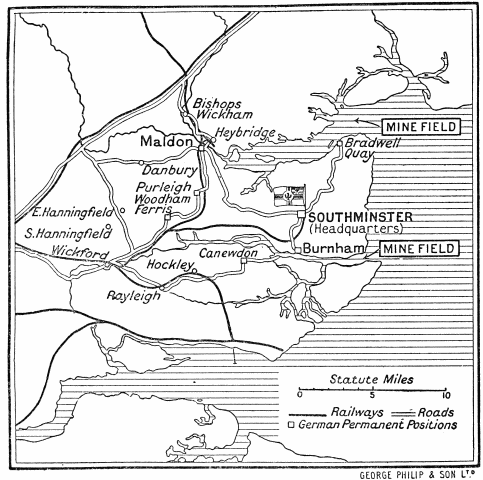 Position of the Saxon Corps Twenty-Four Hours after
Landing in Essex.
by either the southern branch of the Great Eastern Railway or the
London, Tilbury, and Southend line. They took nothing with them but
their iron ration, the ammunition in their pouches, and that usually
carried in the company ammunition waggons (57.6 rounds per man). For the
transport of this they were to impress carts and horses at Southend, and
to move by a forced march to their positions. As soon as we are able, we
also shall push forward advanced troops to South Hanningfield, East
Hanningfield, Danebury, and Wickham Bishops, covering us in a similar
manner to the west and north. Our flanks are well protected by the two
rivers, which are tidal, very wide in parts, and difficult to cross,
except at one or two places on the Crouch, which we shall make special
arrangements to defend. Moreover—with the exception of Canewdon, which
we have already occupied—there is no elevated ground within miles of
them which would offer good positions from which the enemy might fire
into the ground we occupy between them.
“So much for the military portion of our programme. Now for the part
allotted to the Navy. As I have told you, we had eight warships as our
convoy, not counting destroyers, etc. These were the eight little
armour-clads of the “Ægir” class, drawing only 18 ft. of water and
carrying three 9.4 guns apiece, besides smaller ones. The Ægir and
Odin are operating in the rivers on our flanks as far as they are
able. The remaining six are busy, three at the entrance of each river,
laying down mine-fields and other obstacles to protect us from any
inroad on the part of the British Navy, and arranging for passing
through the store-ships, which we expect to-night or to-morrow morning
from various German and Dutch ports, with the provisions, stores, and
ammunition for the use of the Northern Army Corps, when they have
penetrated sufficiently far to the south to get into touch with us.
Except by these rivers, I do not think that the English naval commanders
can get at us.
“What are known as the Dengie Flats extend for three miles seaward, all
along the coast between the mouths of the two rivers, and broken marshy
land extends for three miles more inland. Their big ships would have to
lie at least seven or eight miles distant from our headquarters and
store depôt, which we intend to establish at Southminster, and even if
they were so foolish as to waste their ammunition in trying to damage us
with their big guns firing at high elevations, they would never succeed
in doing us any harm. I believe that the squadron of older battleships
that escorted the 108th to Southend have orders to mine the mouth of the
Thames, cover the mine-field with their guns as long as they can before
being overpowered, and incidentally to try and capture Shoeburyness and
destroy or bring off what guns they may find there. But this is not
really in our particular section of the operations.
“But to return to my own experiences. I told you that Prince Henry and
his staff had arrived at Steeple Hill, and that the signallers had got
through to the other division that had landed at Bradwell. This was soon
after nine o’clock. Not long afterwards the advanced guard of one of the
Jäeger battalions, with their smart glazed shakoes, having the black
plumes tied back over the left ear, and looking very workmanlike in
their green red-piped tunics, came swinging along the road between St.
Lawrence and the village of Steeple. They had some of their war-dogs
with them in leashes. They were on their way to reinforce the 3rd Marine
Battalion, which by this time we trusted had occupied Maldon and cut off
all communication with the interior. They had a good nine miles before
them. The Prince looked at his watch. ‘If they’re there before noon it’s
as much as we can expect,’ he said. ‘Go and see if they are coming up
from Burnham now,’ he added, turning sharply to me. Away I went at a
gallop till I struck the main road out of Southminster. Here I just
headed off the 1st Battalion of the 101st Grenadiers. Its Colonel
informed me that the whole regiment was ashore and that the other two
battalions were following close behind. When they left Burnham the three
battalions of the 100th Body Grenadiers had nearly completed their
disembarkation, and the horses of the Garde Reiter Regiment and the 17th
Uhlans were being hoisted out by means of the big spritsail yards of the
barges lying alongside the quays. The landing pontoons had been greatly
augmented and improved during the last hour or two, and the
disembarkation was proceeding more and more quickly. They had got two of
the batteries of the 1st Brigade Division landed as well as the guns
belonging to the Horse Artillery, but they were waiting for the horses.
The Prince signalled to the officer superintending the disembarkation at
Burnham to send forward the cavalry and horse artillery by batteries and
squadrons as soon as they could be mounted.
“Nothing could be done in the meantime but trust that the marines had
been successful in occupying Maldon and in stopping any news of our
presence from leaking out to Colchester. Presently, however, the
signallers reported communication with a new signal station established
by the Jäegers zu Pferde on Kit’s Hill, an eminence about six miles to
the south-west. The officer in command of the troop reported: ‘Have cut
line at Wickham Ferrers. Captured train of eight coaches coming from
Maldon, and have shunted it on to line to Burnham.’ Prince Henry
signalled back: ‘Despatch train to Burnham’; and then also signalled to
O.C. 23 Division at Burnham: ‘Expect train of eight coaches at once.
Entrain as many infantry as it will hold, and send them to Maldon with
the utmost despatch.’
“While these signals were passing, I was employed in taking a careful
survey with my glasses. This is what I saw, looking from right to left.
The green and white lance pennons of a detachment of the hussars
belonging to the 32nd Division came fluttering round the shoulder of the
hill topped by the grey tower of St. Lawrence. Immediately below us a
Jäeger battalion was winding through Steeple Village like a dark green
snake. Away to my left front the helmets of the 101st Grenadier Regiment
twinkled over the black masses of its three battalions as they wound
downhill towards the village of Latchingdon, lying in a tree-shrouded
hollow. Maldon was more distinct now, but there was nothing to indicate
the presence of our men, though not so very far down the river the
lofty mast of the Ægir, with its three military tops, was
distinguishable over a line of willows. As I lowered my field-glasses
the Prince beckoned me. ‘Von Pabst,’ ordered he, as I raised my hand to
the salute, ‘take half a dozen troopers, ride to Maldon, and report to
me the situation there. I shall be at Latchingdon,’ added he, indicating
its position on the map, ‘or possibly on the road between that and
Maldon.’
“Followed by my six Jäegers in their big copper helmets, I dashed away
on my mission, and before long was nearing my destination. Maldon
perched on its knoll, with its three church towers and gabled houses,
brought to my mind one of the old engravings of sixteenth-century cities
by Merian. Nothing indicated the approach of war till we were challenged
by a sentry, who stepped from behind a house at the entrance to a
straggling street. We trotted on till just about to turn in the main
street, when ‘bang’ went a straggling volley from the right. Shot after
shot replied, and this told me that our marines had arrived. Then a
score of khaki-clad men ran across the entrance of the side street up
which we were approaching. ‘The English at last!’ thought I. It was too
late to turn back. One or two of the enemy had caught sight of us as
they rushed by, though most of them were too busily engaged in front to
observe us. So with a shout of ‘Vorwarts!’ I stuck in my spurs, and with
my six troopers charged into the middle of them, though I had no idea of
how many there might be up the street. There was a tremendous clatter
and banging of rifles. I cut down one fellow who ran his bayonet into my
wallet. At the same time I heard a loud German ‘Hoch!’ from our right,
and caught sight of a body of marines coming up the street at the
double. It was all over in a moment. There were not more than thirty
‘khakis’ all told. Half a dozen lay dead or wounded on the ground, some
disappeared up side alleys, and others were made prisoners by the
marines. It appeared afterwards that on the first boat-load landing,
about an hour previously, the alarm had reached a local Volunteer
officer, who had managed to collect some of his men and get them into
uniform. He then made the foolish attack on our troops which had ended
in so unsatisfactory a manner for him. He, poor fellow, lay spitting
blood on the kerbstone. The colonel of marines appeared a moment later,
and at once gave orders for the Mayor of Maldon to be brought before
him.”
The letter ended abruptly, the German officer’s intention being no doubt
to give some further details of the operations before despatching it to
his friend in Darmstadt. But it remained unfinished, for its writer lay
already in his grave.
A special issue of the Times in the evening of 3rd September contained
the following vivid account—the first published—of the happenings in
the town of Goole, in Yorkshire:—
“Goole, September 3.
“Shortly before five o’clock on Sunday morning the night operator of the
telephone call-office here discovered an interruption on the trunk-line,
and on trying the telegraphs was surprised to find that there was no
communication in any direction. The railway station, being rung up,
replied that their wires were also down.
“Almost immediately afterwards a well-known North Sea pilot rushed into
the post-office and breathlessly asked that he might telephone to
Lloyd’s. When told that all communication was cut off he wildly shouted
that a most extraordinary sight was to be seen in the river Ouse, up
which was approaching a continuous procession of tugs, towing flats, and
barges filled with German soldiers.
“This was proved to be an actual fact, and the inhabitants of Goole,
awakened from their Sunday morning slumbers by the shouts of alarm in
the streets, found to their abject amazement foreign soldiers swarming
everywhere. On the quay they found activity everywhere, German being
spoken on all hands. They watched a body of cavalry consisting of the
1st Westphalian Hussars and the Westphalian Cuirassiers land with order
and ease at the Victoria Pier, whence, after being formed up on the
quay, they advanced at a sharp trot up Victoria Street, Ouse Street, and
North Street to the railway stations, where, as is generally known,
there are large sidings of the North-East Lancashire and Yorkshire lines
in direct communication both with London and the great cities of the
north. The enemy here found great quantities of engines and rolling
stock, all of which was at once seized, together with huge stacks of
coal at the new sidings.
“Before long the first of the infantry of the 13th Division, which was
commanded by Lieutenant-General Doppschutz, marched up to the stations.
They consisted of the 13th and 56th Westphalian Regiments, and the
cavalry on being relieved advanced out of the town, crossing the Dutch
River by the railway bridge, and pushed on as far as Thorne and Hensall,
near which they at once strongly held the several important railway
junctions.
“Meanwhile cavalry of the 14th Brigade, consisting of Westphalian
Hussars and Uhlans, were rapidly disembarking at Old Goole, and,
advancing southwards over the open country of Goole Moors and Thorne
Waste, occupied Crowle. Both cavalry brigades were acting independently
of the main body, and by their vigorous action both south and west they
were entirely screening what was happening in the port of Goole.
“Infantry continued to pour into the town from flats and barges,
arriving in endless procession. Doppschutz’s Division landed at Aldan
Dock, Railway Dock, and Ship Dock; the 14th Division at the Jetty and
Basin, also in the Barge Dock and at the mouth of the Dutch River; while
some, following the cavalry brigade, landed at Old Goole and Swinefleet.
“As far as can be ascertained, the whole of the VIIth German Army Corps
have landed, at any rate as far as the men are concerned. The troops,
who are under the supreme command of General Baron von Bistram, appear
to consist almost entirely of Westphalians, and include Prince Frederick
of the Netherlands’ 2nd Westphalians; Count Bulow von Dennewitz’s 6th
Westphalians; but one infantry brigade, the 79th, consisted of men from
Lorraine.
“Through the whole day the disembarkation proceeded, the townsmen
standing there helpless to lift a finger and watching the enemy’s
arrival. The Victoria Pleasure Grounds were occupied by parked
artillery, which towards afternoon began to rumble through the streets.
The German gunners, with folded arms, sat unconcernedly upon the
ammunition boxes as the guns were drawn up to their positions. Horses
were seized wherever found, the proclamation of Von Kronhelm was nailed
upon the church doors, and the terrified populace read the grim threat
of the German field-marshal.
“The wagons, of which there were hundreds, were put ashore mostly at
Goole, but others up the river at Hook and Swinefleet. When the cavalry
advance was complete, as it was soon after midday, and when reports had
come in to Von Bistram that the country was clear of the British, the
German infantry advance began. By nightfall they had pushed forward,
some by road, some by rail, and others in the numerous motor-wagons that
had accompanied the force, until march-outposts were established south
of Thorne, Askern, and Crowle, straddling the main road to Bawtry. These
places, including Fishlake and the country between them, were at once
strongly held, while ammunition and stores were pushed up by railway to
both Thorne and Askern.
“The independent cavalry advance continued through Doncaster until dusk,
when Rotherham was reached, during which advance scattered bodies of
British Imperial Yeomanry were met and compelled to retreat, a dozen or
so lives being lost. It appears that late in the afternoon of Sunday
news was brought into Sheffield of what was in progress, and a squadron
of Yeomanry donned their uniforms and rode forward to reconnoitre, with
the disastrous results already mentioned.
“The sensation caused in Sheffield when it became known that German
cavalry were so close as Rotherham was enormous, and the scenes in the
streets soon approached a panic; for it was wildly declared that that
night the enemy intended to occupy the town. The Mayor telegraphed to
the War Office appealing for additional defensive force, but no response
was received to the telegram. The small force of military in the town,
which consisted of the 2nd Battalion Yorkshire Light Infantry, some
Royal Artillery, and the local Volunteers, were soon assembled, and
going out occupied the strong position above Sheffield between Catcliffe
and Tinsley, overlooking the valley of the Rother to the east.
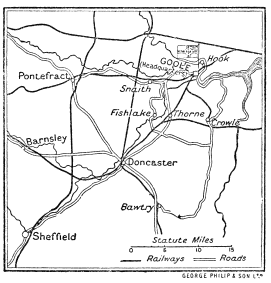 Position of the German Forces Twenty-Four Hours after
Landing at Goole.
“The expectation that the Germans intended an immediate descent on
Sheffield was not realised because the German tactics were merely to
reconnoitre and report on the defences of Sheffield if any existed. This
they did by remaining to the eastward of the river Rother, whence the
high ground rising before Sheffield could be easily observed.
“Before dusk one or two squadrons of Cuirassiers were seen to be
examining the river to find fords and ascertain the capacity of the
bridges, while others appeared to be comparing the natural features of
the ground with the maps with which they all appeared to be provided.
“As night fell, however, the cavalry retired towards Doncaster, which
town was occupied, the Angel being the cavalry headquarters. The reason
the Germans could not advance at once upon Sheffield was that the
cavalry was not strongly enough supported by infantry from their base,
the distance from Goole being too great to be covered in a single day.
That the arrangements for landing were in every detail perfect could not
be doubted, but owing to the narrow channel of the Ouse time was
necessary, and it is considered probable that fully three days must
elapse from Sunday before the Germans are absolutely established.
“An attempt has been made by the Yorkshire Light Infantry and the York
and Lancaster Regiment, with three battalions of Volunteers stationed at
Pontefract, to discover the enemy’s strength and position between Askern
and Snaith, but so far without avail, the cavalry screen across the
whole country being impenetrable.
“The people of the West Riding, and especially the inhabitants of
Sheffield, are stupefied that they have received no assistance—not even
a reply to the Mayor’s telegram. This fact has leaked out, and has
caused the greatest dissatisfaction. An enemy is upon us, yet we are in
ignorance of what steps, if any, the authorities are taking for our
protection.
“There are wild rumours here that the enemy have burned Grimsby, but
these are generally discredited, for telegraphic and telephonic
communication has been cut off, and at present we are completely
isolated. It has been gathered from the invaders that the VIIIth Army
Corps of the Germans have landed and seized Hull, but at present this is
not confirmed. There is, alas! no communication with the place,
therefore the report may possibly be true.
“Dewsbury, Huddersfield, Wakefield, and Selby are all intensely excited
over the sudden appearance of German soldiers, and were at first
inclined to unite to stem their progress. But the German proclamation
showing the individual peril of any citizen taking arms against the
invaders having been posted everywhere, has held everyone scared and in
silent inactivity.
“ ‘Where is our Army?’ everyone is asking. The whole country has run riot
in a single hour, now that the Germans are upon us. On every hand it is
asked: ‘What will London do?’ ”
The following account, written by a reporter of the Hull Daily Mail,
appeared in the London Evening News on Wednesday evening, and was the
first authentic news of what had happened on the Humber on Sunday:—
“Hull, Monday Night.
“A great disaster has occurred here, and the town is in the hands of the
Germans. The totally unexpected appearance in the river at dawn on
Sunday of an extraordinary flotilla of all kinds of craft, filled with
troops and being towed towards Goole, created the greatest alarm. Loud
shouting in the street just before five o’clock awakened me, and I
opened my window. Shouting to a seaman running past, I asked what was
the matter, when the man’s astounding reply was: ‘The whole river is
swarming with Germans!’ Dressing hastily, I mounted my bicycle and ran
along the Beverley road through Prospect Street to the dock office,
where around the Wilberforce monument the excited crowd now already
collected was impassable, and I was compelled to dismount.
“On eager inquiry I learnt that half an hour before men at work in the
Alexandra Dock were amazed to discern through the grey mists still
hanging across the Humber an extraordinary sight. Scores of ocean-going
tugs, each laboriously towing great Dutch barges and lighters, came into
sight, and telescopes being quickly borrowed revealed every boat in
question to be literally crammed with grey-coated men, evidently
soldiers. At first it was believed that they were about to enter Hull,
but they kept out in the channel, on the New Holland side, and were
accompanied, it was seen, by a quantity of tramp steamers of small
tonnage, evidently of such capacity as might get up to the port of
Goole. It was at once patent that Goole was their objective.
“The alarm was at once raised in the town. The police ran down to the
quays and the Victoria Pier, while the townspeople hastily dressed and
joined them to witness the amazing spectacle.
“Somebody at the pier who had a powerful glass recognised the grey
uniforms and declared them to be Germans, and then like wildfire the
alarming news spread into every quarter of the town that the Germans
were upon us.
“The police ran to the telegraph office in order to give the alarm, but
it was at once discovered that both telegraph and telephone systems had
suddenly been interrupted. Repeated calls elicited no reply, for the
wires running out of Hull in every direction had been cut.
“In endless procession the strange medley of queer-looking craft came up
out of the morning mist only to be quickly lost again in the westward,
while the onlookers, including myself—for I had cycled to the Victoria
Pier—gazed at them in utter bewilderment.
“At the first moment of alarm the East Yorkshire Volunteers hurried on
their uniforms and assembled at their regimental headquarters for
orders. There were, of course, no regular troops in the town, but the
Volunteers soon obtained their arms and ammunition, and after being
formed, marched down Heddon road to the Alexandra Dock.
“On every side was the greatest commotion, already bordering upon panic.
Along Spring Bank, the Hessle road, the Anlaby road, and all the
thoroughfares converging into Queen Victoria Square, came crowds of all
classes eager to see for themselves and learn the truth of the startling
rumour. The whole riverside was soon black with the excited populace,
but to the astonishment of everyone the motley craft sailed on, taking
no notice of us and becoming fewer and fewer, until ships appeared
through the grey bank of fog only at intervals.
“One thing was entirely clear. The enemy, whoever they might be, had
destroyed all our means of appealing for help, for we could not
telephone to the military at York, Pontefract, Richmond, or even to the
regimental district headquarters at Beverley. They had gone on to Goole,
but would they turn back and attack us?
“The cry was that if they meant to seize Goole they would also seize
Hull! Then the terrified crowd commenced to collect timber and iron from
the yards, furniture from neighbouring houses, tramway-cars, omnibuses,
cabs; in fact, anything they could lay their hands upon to form
barricades in the streets for their own protection.
“I witnessed the frantic efforts of the people as they built one huge
obstacle at the corner of Queen Street, facing the pier. Houses were
ruthlessly entered, great pieces of heavy furniture—wardrobes, pianos,
and sideboards—were piled anyhow upon each other. Men got coils of
barbed wire, and lashed the various objects together with seamanlike
alacrity. Even paving-stones were prised up with pickaxes and crowbars,
and placed in position. The women, in deadly terror of the Germans,
helped the men in this hastily improvised barrier, which even as I
watched grew higher across the street until it reached the height of the
first-storey windows in one great heterogeneous mass of every article
conceivable—almost like a huge rubbish heap.
“This was only one of many similar barricades. There were others in the
narrow Pier Street, in Wellington Street, Castle Street, south of
Prince’s Dock, in St. John’s Street, between Queen’s Dock and Prince’s
Dock, while the bridges over the river Hull were all defended by
hastily improvised obstructions. In Jennings Street, on Sculcoates
Bridge, and also the two railway bridges of the Hull and Barnsley and
North-Eastern Railways were similarly treated. Thus the whole of the
town west of the river Hull was at any rate temporarily protected from
any landing eastward.
“The whole town now seemed in a perfect ferment. Wildest rumours were
afloat everywhere, and the streets by six o’clock that morning were so
crowded that it was almost impossible to move.
“Hundreds found themselves outside the barriers; indeed, the people in
the Southcoates, Drypool, and Alexandra Wards were in the threatened
zone, and promptly began to force their way into the town by escalading
the huge barricades and scrambling over their crests.
“Foreigners—sailors and others—had a rough time of it, many of them
being thrust back and threatened by the indignant townspeople. Each time
a foreigner was discovered there was a cry of ‘spy,’ and many innocent
men had fortunate escapes.
“The river seemed clear, when about seven o’clock there suddenly loomed
up from seaward a great, ugly, grey-hulled warship flying the German
flag. The fear was realised. Her sight caused absolute panic, for with a
sudden swerve she calmly moored opposite the Alexandra Dock.
“Eager-eyed seamen, some of them Naval Reservists, recognised that she
was cleared for action, and even while we were looking, two more similar
vessels anchored in positions from which their guns could completely
dominate the town.
“No sooner had these swung to their anchors than, from the now sunlit
horizon, there rose the distant smoke of many steamers, and as the
moments of terror dragged by, there came slowly into the offing a
perfect fleet of all sizes of steamers, escorted by cruisers and
destroyers.
“Standing behind the barricade in Queen Street I could overlook the
Victoria Pier, and the next half-hour was the most exciting one in my
whole life. Three dirty-looking steamers of, as far as I could judge,
about 2500 tons each, anchored in a line almost midstream. From my coign
of vantage I could hear the rattle of the cables in the hawse-pipes as
many other vessels of about the same size followed their example farther
down the river. No sooner had the anchors touched the bottom than boats
were hoisted out, lowered from all the davits, and brought alongside,
while into them poured hundreds upon hundreds of soldiers, all in a
uniform dusky grey. Steam pinnaces quickly took these in charge, towing
some of them to the Victoria Pier near where I stood, and others to the
various wharves.
“Armed and accoutred, the men sprang ashore, formed up, and were quickly
told off by their officers in guttural accents, when, from our
barricade, close beside me, a Volunteer officer gave the order to fire,
and a ragged volley rang sharply out.
“A young German infantry officer standing in Nelson Street, in the act
of drawing his revolver from its pouch, pitched heavily forward upon his
face with a British bullet through his heart. There were also several
gaps in the German ranks. Almost instantly the order for advance was
given. The defence was an ill-advised and injudicious one, having in
view the swarm of invaders. Hundreds of boats were now approaching every
possible landing-place right along the river front, and men were
swarming upon every wharf and quay.
“Shots sounded in every direction. Then, quite suddenly, some
unintelligible order was given in German, and the crowd of the enemy who
had landed at our pier extended, and, advancing at the double, came
straight for our barricade, endeavouring to take it by assault. It was
an exciting moment. Our Volunteers poured volleys into them, and for a
time were able to check them, although the Germans kept up a withering
fire, and I found myself, a non-combatant, with bullets whistling about
me everywhere, in unpleasant proximity.
“They were breathless moments. Men were continually falling on both
sides, and one fierce-faced, black-haired woman, evidently a sailor’s
wife, who had helped to build the barricade, fell dead at my side, shot
through the throat. From the very beginning our defence at this point
seemed utterly hopeless. The Volunteers—many of them friends of
mine—very gallantly endeavoured to do what they could in the
circumstances, but they themselves recognised the utter futility of
fighting against what seemed to be a veritable army. They did their
utmost, but the sudden rush of an enormous number of supports to
strengthen the enemy’s advanced parties proved too much for them, and
ten minutes later bearded Teutons came clambering over the barricades,
ruthlessly putting to death all men in uniform who did not at once throw
down their arms.
“As soon as I saw the great peril of the situation I confess that I
fled, when behind me I heard a loud crash as a breach was at last made
in the obstruction. I ran up Queen Street to Drypool Bridge, where at
the barricade there I found desperate fighting in progress. The scene
was terrible. The few Volunteers were bravely trying to defend us. Many
civilians, in their frantic efforts to guard their homes, were lying
upon the pavement dead and dying. Women, too, had been struck by the
hail of German bullets, and the enemy, bent upon taking the town, fought
with the utmost determination. From the ceaseless rattle of musketry
which stunned the ears on every side it was evident that the town was
being taken by assault.
“For five minutes or so I remained in Salthouse Lane, but so thick came
the bullets that I managed to slip round to Whitefriargate, and into
Victoria Square.
“I was standing at the corner of King Edward Street when the air was of
a sudden rent by a crash that seemed to shake the town to its very
foundations, and one of the black cupolas of the dock office was carried
away, evidently by a high explosive shell.
“A second report, no doubt from one of the cruisers lying in the river,
was followed by a great jet of flame springing up from the base of one
of the new shops on the left side of King Edward Street—caused, as I
afterwards ascertained, by one of those new petrol shells, of which we
had heard so much in the newspapers, but the practicability of which our
unprogressive Government had so frequently refused to entertain.
“In a flash three shops were well alight, and even while I watched the
whole block from Tyler’s to the corner was furiously ablaze, the petrol
spreading fire and destruction on every hand.
“Surely there is no more deadly engine in modern warfare than the
terrible petrol bomb, as was now proved upon our unfortunate town.
Within ten minutes came a veritable rain of fire. In all directions the
houses began to flare and burn. The explosions were terrific, rapidly
succeeding one another, while helpless men stood frightened and aghast,
no man knowing that the next moment might not be his last.
“In those never-to-be-forgotten moments we realised for the first time
what the awful horror of War really meant.
“The scene was frightful. Hull had resisted, and in retaliation the
enemy were now spreading death and destruction everywhere among us.”
Reports now reached London that the VIIth German Army Corps had landed
at Hull and Goole, and taking possession of those towns, were moving
upon Sheffield in order to paralyse our trade in the Midlands. Hull had
been bombarded, and was in flames! Terrible scenes were taking place at
that port.
The disaster was, alas! of our own seeking.
Lord Roberts, who certainly could not be called an alarmist, had in 1905
resigned his place on the Committee of National Defence in order to be
free to speak his own mind. He had told us plainly in 1906 that we were
in no better position than we were five or six years previous. Behind
the Regular Army we had no practicable reserve, while military training
was more honoured in the breach than in the observance. The outlook was
alarming, and the reasons for reform absolutely imperative.
He had pointed out to the London Chamber of Commerce in December 1905
that it was most important that our present unpreparedness for war
should not be allowed to continue. We should use every endeavour to
prevent the feeling of anxiety as to our unpreparedness from cooling
down. England’s military hero, the man who had dragged us out of the
South African muddle, had urged most strongly that a committee of the
leading men of London should be formed to take the matter into their
earnest consideration. The voice of London upon a question of such vital
importance could not fail to carry great weight throughout the country.
A “citizen army,” he had declared, was needed as well as the Regular
Army. The only way by which a sufficient amount of training could be
given—short of adopting the Continental practice—was by giving boys
and youths such an amount of drill and practice in rifle shooting as was
possible while they were at school, and by some system of universal
training after they reached manhood. And that Lord Roberts had urged
most strongly.
Yet what had been done? Ay, what?
A deaf ear had been turned to every appeal. And now, alas! the long
prophesied blow had fallen.
On that memorable Sunday, when a descent had been made upon our shores,
there were in German ports on the North Sea nearly a million tons gross
of German shipping. Normally, in peace time, half a million tons is
always to be found there, the second half having been quietly collected
by ships putting in unobserved into such ports as Emden, Bremen,
Bremerhaven, and Geestemunde, where there are at least ten miles of
deep-sea wharves, with ample railway access. The arrival of these crafts
caused no particular comment, but they had already been secretly
prepared for the transport of men and horses while at sea.
Under the cover of the Frisian Islands, from every canal, river, and
creek had been assembled a huge multitude of flats and barges, ready to
be towed by tugs alongside the wharves and filled with troops. Of a
sudden, in a single hour it seemed, Hamburg, Altona, Cuxhaven, and
Wilhelmshaven were in excited activity, and almost before the
inhabitants themselves realised what was really in progress the
embarkation had well commenced.
At Emden, with its direct cables to the theatre of war in England, was
concentrated the brain of the whole movement. Beneath the lee of the
covering screen of Frisian Islands, Borkum, Juist, Norderney, Langebog,
and the others, the preparations for the descent upon England rapidly
matured.
Troop-trains from every part of the Fatherland arrived with the
punctuality of clockwork. From Düsseldorf came the VIIth Army Corps, the
VIIIth from Coblenz, the IXth were already assembled at their
headquarters at Altona, while many of them being stationed at Bremen
embarked from there, the Xth came up from Hanover, the XIVth from
Magdeburg, and the Corps of German Guards, the pride and flower of the
Kaiser’s troops, arrived eagerly at Hamburg from Berlin and Potsdam,
among the first to embark.
Each army corps consisted of about 38,000 officers and men, 11,000
horses, 144 guns, and about 2000 motor-cars, wagons, and carts. But for
this campaign—which was more of the nature of a raid than of any
protracted campaign—the supply of wheeled transport, with the exception
of motor-cars, had been somewhat reduced.
Each cavalry brigade attached to an army corps consisted of 1400 horses
and men, with some thirty-five light machine-guns and wagons. The German
calculation—which proved pretty correct—was that each army corps could
come over to England in 100,000 tons gross of shipping, bringing with
them supplies for twenty-seven days in another 3000 tons gross.
Therefore about 618,000 tons gross conveyed the whole of the six corps,
leaving an ample margin still in German ports for any emergencies. Half
this tonnage consisted of about 100 steamers, averaging 3000 tons each,
the remainder being the boats, flats, lighters, barges, and tugs
previously alluded to.
The Saxons who, disregarding the neutrality of Belgium, had embarked at
Antwerp, had seized the whole of the flat-bottomed craft in the Scheldt
and the numerous canals, as well as the merchant ships in the port,
finding no difficulty in commandeering the amount of tonnage necessary
to convey them to the Blackwater and the Crouch.
As hour succeeded hour, the panic increased.
It was now also known that, in addition to the various corps who had
effected a landing, the German Guards had, by a sudden swoop into the
Wash, got ashore at King’s Lynn, seized the town, and united their
forces with Von Kleppen’s corps, who, having landed at Weybourne, were
now spread right across Norfolk. This picked corps of Guards was under
the command of that distinguished officer the Duke of Mannheim, while
the infantry divisions were under Lieutenant-Generals von Castein and
Von Der Decken.
The landing at King’s Lynn on Sunday morning had been quite a simple
affair. There was nothing whatever to repel them, and they disembarked
on the quays and in the docks, watched by the astonished populace. All
provisions were seized at shops, including the King’s Lynn and County
Stores, the Star Supply Stores, Ladyman’s and Lipton’s in the High
Street, while headquarters were established at the municipal buildings,
and the German flag hoisted upon the old church, the tower of which was
at once used as a signal station.
Old-fashioned people of Lynn peered out of their quiet, respectable
houses in King Street in utter amazement, but soon, when the German
proclamation was posted, the terrible truth was plain.
In half an hour, even before they could realise it, they had been
transferred from the protection of the British flag to the militarism of
the German.
The Tuesday Market Place, opposite the Globe Hotel, was one of the
points of assembly, and from there and from other open spaces troops of
cavalry were constantly riding out of town by the Downham Market and
Swaffham Roads. The intention of this commander was evidently to join
hands with Von Kleppen as soon as possible. Indeed, by that same evening
the Guards and IVth Corps had actually shaken hands at East Dereham.
A few cavalry, mostly Cuirassiers and troopers of the Gardes du Corps,
were pushed out across the flat, desolate country over Sutton Bridge to
Holbeach and Spalding, while others, moving south-easterly, came past
the old Abbey of Crowland, and even to within sight of the square
cathedral tower of Peterborough. Others went south to Ely.
Ere sundown on Sunday, stalwart, grey-coated sentries of the Guards
Fusiliers from Potsdam and the Grenadiers from Berlin were holding the
roads at Gayton, East Walton, Narborough, Markham, Fincham, Stradsett,
and Stow Bardolph. Therefore on Sunday night, from Spalding on the east,
Peterborough, Chatteris, Littleport, Thetford, Diss, and Halesworth were
faced by a huge cavalry screen protecting the landing and repose of the
great German Army behind it.
Slowly but carefully the enemy were maturing their plans for the defeat
of our defenders and the sack of London.
London was at a standstill. Trade was entirely stopped. Shopkeepers
feared to open their doors on account of the fierce, hungry mobs
parading the streets. Orators were haranguing the crowds in almost every
open space. The police were either powerless, or feared to come into
collision with the assembled populace. Terror and blank despair were
everywhere.
There was unrest night and day. The banks, head offices and branches,
unable to withstand the run upon them when everyone demanded to be paid
in gold, had, by mutual arrangement, shut their doors, leaving excited
and furious crowds of customers outside unpaid. Financial ruin stared
everyone in the face. Those who were fortunate enough to realise their
securities on Monday were fleeing from London south or westward. Day and
night the most extraordinary scenes of frantic fear were witnessed at
Paddington, Victoria, Waterloo, and London Bridge. The southern railways
were badly disorganised by the cutting of the lines by the enemy, but
the Great Western system was, up to the present, intact, and carried
thousands upon thousands to Wales, to Devonshire, and to Cornwall.
In those three hot, breathless days the Red Hand of Ruin spread out upon
London.
The starving East met the terrified West, but in those moments the bonds
of terror united class with mass. Restaurants and theatres were closed,
there was but little vehicular traffic in the streets, for of horses
there were none, while the majority of the motor ’buses had been
requisitioned, and the transit of goods had been abandoned. “The City,”
that great army of daily workers, both male and female, was out of
employment, and swelled the idlers and gossips, whose temper and opinion
were swayed each half-hour by the papers now constantly appearing night
and day without cessation.
Cabinet Councils had been held every day, but their decisions, of
course, never leaked out to the public. The King also held Privy
Councils, and various measures were decided upon. Parliament, which had
been hurriedly summoned, was due to meet, and everyone speculated as to
the political crisis that must now ensue.
In St. James’s Park, in Hyde Park, in Victoria Park, on Hampstead Heath,
in Greenwich Park, in fact, in each of the “lungs of London,” great mass
meetings were held, at which resolutions were passed condemning the
Administration and eulogising those who, at the first alarm, had so
gallantly died in defence of their country.
It was declared that by the culpable negligence of the War Office and
the National Defence Committee we had laid ourselves open to complete
ruin, both financially and as a nation.
The man-in-the-street already felt the strain, for the lack of
employment and the sudden rise in the price of everything had brought
him up short. Wives and families were crying for food, and those without
savings and with only a few pounds put by looked grimly into the future
and at the mystery it presented.
Most of the papers published the continuation of the important story of
Mr. Alexander, the Mayor of Maldon, which revealed the extent of the
enemy’s operations in Essex and the strong position they occupied.
It ran as below:—
“Of the events of the early hours of the morning I have no very clear
recollection. I was bewildered, staggered, dumbfounded by the sights and
sounds which beset me. Of what modern war meant I had till then truly
but a very faint idea. To witness its horrid realities enacted in this
quiet, out-of-the-way spot where I had pitched my tent for so many
years, brought them home to me literally, as well as metaphorically. And
to think that all this wanton destruction of property and loss of life
was directly due to our apathy as a nation! The Germans had been the
aggressors without a doubt, but as for us we had gone out of our way to
invite attack. We had piled up riches and made no provision to prevent a
stronger nation from gathering them. We had seen every other European
nation, and even far-distant Japan, arm their whole populations and
perfect their preparedness for the eventualities of war, but we had been
content to scrape along with an apology for a military system—which was
really no system at all—comforting ourselves with the excuse that
nothing could possibly evade or compete with our magnificent navy. Such
things as fogs, false intelligence, and the interruption of telegraphic
and telephonic communication were not taken into account, and were
pooh-poohed if any person, not content with living in a fool’s paradise,
ventured to draw attention to the possibility of such contingencies.
“So foolhardy had we become in the end, that we were content to see an
immense and threatening increase in the German shipbuilding programme
without immediately ‘going one better.’ The specious plea that our
greater rapidity in construction would always enable us to catch up our
rivals in the race was received with acclamation, especially as the
argument was adorned with gilt lettering in the shape of promised
Admiralty economies.
“As might have been foreseen, Germany attacked us at the psychological
moment when her rapidly increasing fleet had driven even our laissez
faire politicians to lay down new ships with the laudable idea of
keeping our naval pre-eminence by the rapidity of our construction. Our
wide-awake enemy, seeing that should these be allowed to attain
completion the place he had gained in the race would be lost, allowed
them to be half finished and then suddenly attacked us.
“But to return to my personal experiences on this never-to-be-forgotten
day. I had run down Cromwell Hill, and seeing the flames of Heybridge,
was impelled to get nearer, if possible, to discover more particularly
the state of affairs in that direction. But I was reckoning without the
Germans. When I got to the bridge over the river at the foot of the
hill, the officer in charge there absolutely prevented my crossing.
Beyond the soldiers standing or kneeling behind whatever cover was
offered by the walls and buildings abutting on the riverside, and a
couple of machine guns placed so as to command the bridge and the road
beyond, there was nothing much to see. A number of Germans were,
however, very busy in the big mill just across the river, but what they
were doing I could not make out. As I turned to retrace my steps, the
glare of the conflagration grew suddenly more and more intense. A mass
of dark figures came running down the brightly-illuminated road towards
the bridge, while the rifle fire became louder, nearer, and heavier than
ever. Every now and again the air became alive with, as it were, the
hiss and buzz of flying insects. The English must have fought their way
through Heybridge, and these must be the bullets from their rifles. It
was dangerous to stay down there any longer, so I took to my heels. As I
ran I heard a thundering explosion behind me, the shock of which nearly
threw me to the ground. Looking over my shoulder, I saw that the Germans
had blown up the mill at the farther end of the bridge, and were now
pushing carts from either side in order to barricade it. The two Maxims,
too, began to pump lead with their hammering reports, and the men near
them commenced to fall in twos and threes. I made off to the left, and
passed into the High Street by the end of St. Peter’s Church, now
disused. At the corner I ran against Mr. Clydesdale, the optician, who
looks after the library which now occupies the old building. He pointed
to the tower, which stood darkly up against the blood-red sky.
“ ‘Look at those infernal Germans!’ he said. ‘They can’t even keep out of
that old place. I wish we could have got the books out before they
came.’
“I could not see any of our invaders where he was pointing, but
presently I became aware of a little winking, blinking light at the very
summit of the tower.
“ ‘That’s them,’ said Clydesdale. ‘They’re making signals, I think. My
boy says he saw the same thing on Purleigh Church tower last night. I
wish it would come down with them, that I do. It’s pretty shaky,
anyway.’
“The street was fairly full of people. The Germans, it is true, had
ordered that no one should be out of doors between eight in the evening
and six in the morning; but just now they appeared to have their hands
pretty full elsewhere, and if any of the few soldiers that were about
knew of or thought anything of the interdiction, they said nothing. Wat
Miller, the postman, came up and touched his cap.
“ ‘Terrible times, sir,’ he said, ‘ain’t they? There was a mort of people
killed this afternoon by them shells. There was poor old Missis Reece in
the London Road. Bed-ridden, she were, this dozen years. Well, sir,
there ain’t so much as the head on her left. A fair mash up she were,
poor old lady! Then there was Jones the carpenter’s three kids, as was
left behind when their mother took the baby to Mundon with the rest of
the women. The house was struck and come down atop of ’em. They got two
out, but they were dead, poor souls! and they’re still looking for the
other one.’
“The crash of a salvo of heavy guns from the direction of my own house
interrupted the tale of horrors.
“ ‘That’ll be the guns in my garden,’ I said.
“ ‘Yes, sir; and they’ve got three monstrous great ones in the opening
between the houses just behind the church there,’ said Clydesdale.
“As he spoke the guns in question bellowed out, one after the other.
“ ‘Look—look at the tower!’ cried the postman.
“The light at the top had disappeared, and the lofty edifice was swaying
slowly, slowly, over to the left.
“ ‘She’s gone at last!’ exclaimed Clydesdale.
“It was true. Down came the old steeple that had pointed heavenward for
so many generations, with a mighty crash and concussion that swallowed
up even the noise of the battle, though cannon of all sorts and sizes
were now joining in the hellish concert, and shell from the English
batteries began to roar over the town. The vibration and shock of the
heavy guns had been too much for the old tower, which, for years in a
tottery condition, had been patched up so often.
“As soon as the cloud of dust cleared off we all three ran towards the
huge pile of débris that filled the little churchyard. Several other
people followed. It was very dark down there, in the shadow of the trees
and houses, despite the firelight overhead, and we began striking
matches as we looked about among the heaps of bricks and beams to see if
there were any of the German signal party among them. Why we should have
taken the trouble under the circumstances I do not quite know. It was an
instinctive movement of humanity on my part, and that of most of the
others, I suppose. Miller, the postman, was, however, logical. ‘I ’opes
as they’re all dead!’ was what he said.
“I caught sight of an arm in a light blue sleeve protruding from the
débris, and took hold of it in a futile attempt to remove some of the
bricks and rubbish which I thought were covering the body of its owner.
To my horror, it came away in my hand. The body to which it belonged
might be buried yards away in the immense heap of ruins. I dropped it
with a cry, and fled from the spot.
“Dawn was now breaking. I do not exactly remember where I wandered to
after the fall of St. Peter’s Tower, but it must have been between
half-past five and six when I found myself on the high ground at the
north-western corner of the town, overlooking the golf links, where I
had spent so many pleasant hours in that recent past that now seemed so
far away. All around me were batteries, trenches, and gun-pits. But
though the firing was still going on somewhere away to the right, where
Heybridge poured black smoke skyward like a volcano, gun and howitzer
were silent, and their attendant artillerymen, instead of being in cover
behind their earthen parapets, were clustered on the top watching
intently something that was passing in the valley below them. So
absorbed were they that I was able to creep up behind them, and also get
a sight of what was taking place. And this is what I saw:—
“Over the railway bridge which spanned the river a little to the left
were hurrying battalion after battalion of green and blue clad German
infantry. They moved down the embankment after crossing, and continued
their march behind it. Where the railway curved to the right and left,
about half a mile beyond the bridge, the top of the embankment was lined
with dark figures lying down and apparently firing, while over the golf
course from the direction of Beeleigh trotted squadron after squadron of
sky-blue riders, their green and white lance pennons fluttering in the
breeze. They crossed the Blackwater and Chelmer Canal, and cantered off
in the direction of Langford Rectory.
“At the same time I saw line after line of the Germans massed behind the
embankment spring over it and advance rapidly towards the lower portion
of the town, just across the river. Hundreds fell under the fire from
the houses, which must have been full of Englishmen, but one line after
another reached the buildings. The firing was now heavier than
ever—absolutely incessant and continuous—though, except for an
occasional discharge from beyond Heybridge, the artillery was silent.
“I have but little knowledge of military matters, but it was abundantly
evident, even to me, that what I had just seen was a very formidable
counter-attack on the part of the Germans, who had brought up fresh
troops either from the rear of the town or from farther inland, and
launched them against the English under cover of the railway embankment.
I was not able to see the end of the encounter, but bad news flies
apace, and it soon became common knowledge in the town that our troops
from Colchester had not only failed to cross the river at any point, but
had been driven helter-skelter out of the lower town near the station
and from the smoking ruins of Heybridge with great loss, and were now in
full retreat.
“Indeed, some hundreds of our khaki-clad fellow-countrymen were marched
through the town an hour or two later as prisoners, to say nothing of
the numbers of wounded who, together with those belonging to the
Germans, soon began to crowd every available building suitable for use
as an hospital. The wounded prisoners with their escort went off towards
Mundon, and are reported to have gone in the direction of Steeple. It
was altogether a disastrous day, and our hopes, which had begun to rise
when the British had penetrated into the northern part of the town, now
fell below zero.
“It was a black day for us, and for England. During the morning the same
officer who had captured me on the golf course came whirling into Maldon
on a 24-h.p. Mercedes car. He drove straight up to my house, and
informed me that he had orders to conduct me to Prince Henry, who was to
be at Purleigh early in the afternoon.
“ ‘Was it in connection with the skirmish with the Volunteers?’ I asked.
“ ‘I don’t know,’ was the reply. ‘But I don’t fancy so. In the meantime,
could I write here for an hour or two?’ he asked politely. ‘I have much
to write to my friends in Germany, and have not had a minute up to
now.’
“I was very glad to be able to oblige the young man in such a small way,
and left him in my study till midday, very busy with pens, ink, and
paper.
“After a makeshift of a lunch, the car came round, and we got into the
back seat. In front sat his orderly and the chauffeur, a fierce-looking
personage in a semi-military uniform. We ran swiftly down the High
Street, and in a few minutes were spinning along the Purleigh Road,
where I saw much that amazed me. I then for the first time realised how
absolutely complete were the German plans.”
“Tuesday, September 4.
“About six o’clock this morning I awoke rather suddenly. The wind had
gone round to the northward, and I was certain that heavy firing was
going on somewhere in that direction. I opened the window and looked
out. The ‘thud’ and rumble of a cannonade, with the accompaniment of an
occasional burst of musketry, came clearly and loudly on the wind from
the hills by Wickham Bishops village. The church spire was in plain
view, and little faint puffs and rings of grey smoke were just visible
in its vicinity every now and again, sometimes high up in the air, at
others among the trees at its base. They were exploding shells; I had no
doubt of that. What was going on it was impossible to say, but I
conjectured that some of our troops from Colchester had come into
collision with the Germans, who had gone out in that direction the day
of their arrival. The firing continued for about an hour, and then died
away.
“Soon after eight Count von Ohrendorff, the general officer commanding
the 32nd Division, who appeared to be the supreme authority here, sent
for me, and suggested that I should take steps to arrange for the
manufacture of lint and bandages by the ladies living in the town. I
could see no reason for objecting to this, and so promised to carry out
his suggestion. I set about the matter at once, and, with the assistance
of my wife, soon had a couple of score of more or less willing workers
busily engaged in the National Schoolroom. In the meantime, the roll of
a terrible cannonade had burst forth again from Wickham Bishops. It
seemed louder and more insistent than ever. As soon as I got away from
the schools I hurried home and climbed out on the roof. The top of the
Moot Hall, the tower of St. Peter’s, and other better coigns of vantage
had all been occupied by the Germans. However, with the aid of a pair of
field-glasses I was able to see a good bit. Black smoke was now pouring
from Wickham Bishops in clouds, and every now and again I fancied I
could see the forked tongues of flame shooting up above the surrounding
trees. A series of scattered black dots now came out on the open ground
to the south of the church. The trees of Eastland Wood soon hid them
from my sight, but others followed, mingled with little moving black
blocks, which I took to be formed bodies of troops. After them came four
or five guns, driven at breakneck pace towards the road that passes
between Eastland and Captain’s Woods, then more black dots, also in a
desperate hurry. Several of these last tumbled, and lay still here and
there all over the slope.
“Other dots followed at their heels. They were not quite so distinct. I
looked harder. Hurrah! They were men in khaki. We were hustling these
Germans at last. They also disappeared behind the woods. Then from the
fringe of trees about Wickham half a dozen big brilliant flashes,
followed after an interval by the loud detonation of heavy cannon. I
could not distinguish much more, though the rattle of battle went on for
some time longer. Soon after eleven four German guns galloped in from
Heybridge. These were followed by a procession of maimed and limping
humanity. Some managed to get along unaided, though with considerable
difficulty. Others were supported by a comrade, some carried between two
men, and others borne along on stretchers. A couple of ambulance carts
trotted out and picked up more wounded. Our bandages and lint had not
long to wait before being required. After this there was a cessation of
firing.
“About one o’clock the German general sent word to me that he thought an
attack quite possible during the afternoon, and that he strongly advised
me to get all the women and children out of the town—for the time
being, at any rate. This was evidently well meant, but it was a pretty
difficult matter to arrange for, to say nothing of raising a panic among
the inhabitants. However, in an hour and a half’s time I had contrived
to marshal several hundred of them together, and to get them out on to
the road to Mundon. The weather was warm for the time of year, and I
thought, if the worst came to the worst, they could spend the night in
the old church. I left the sad little column of exiles—old, bent women
helped along by their daughters, tiny children dragged along through the
dust, clutching their mothers’ skirts, infants in arms, and other older
and sturdier children staggering beneath the weight of the most precious
home adornments—and made the best of my way back to arrange for the
forwarding to them of their rations.
“At every step on my homeward way I expected to hear the cannonade begin
again. But beyond the twittering of the birds in the trees and
hedgerows, the creak and rumble of a passing cart, and the rush of a
train along the railway on my left—just the usual sounds of the
countryside—nothing broke the stillness. As I stepped out on the
familiar highway I could almost bring myself to believe that the events
of the past twenty-four hours were but the phantasmagoria of a dream.
After interviewing some of the town councillors who were going to
undertake the transport of provisions to the women and children at
Mundon, I walked round to my own house.
“My wife and family had driven over to Purleigh on the first alarm, and
had arranged to stay the night with some friends, on whatever shakedowns
could be improvised, since every house in the peninsula harboured some
of the ubiquitous German officers and men. I wandered through the
familiar rooms, and came out into the garden—or rather what had been
the garden. There I saw that the Saxon gunners were all standing to
their pieces, and one of my none too welcome guests accosted me as I
left the house.
“ ‘If you’ll take my advice, sare, you’ll get away out of this,’ he said
in broken English.
“ ‘What! are you going to fire?’ I asked.
“ ‘I don’t fancy so. It wouldn’t hurt you if we were. But I think your
English friends from Colchester are about to see if they can draw us.’
“As he spoke I became aware of a sharp, hissing noise like a train
letting off steam. It grew louder and nearer, passed over our heads, and
was almost instantly followed by a terrible crash somewhere behind the
house. A deeper and more muffled report came up from the valley beyond
Heybridge.
“ ‘Well, they’ve begun now, and the best thing you can do is to get down
into that gun epaulment there,’ said the German officer.
“I thought his advice was good, and I lost no time in following it.
“ ‘Here comes another!’ cried he, as he jumped down into the pit beside
me. ‘We’ll have plenty of them now.’
“So we did. Shell after shell came hissing and screaming at us over the
tree-tops in the gardens lower down the hill. Each one of them sounded
to me as if it were coming directly at my head, but one after another
passed over us to burst beyond. The gunners all crouched close to the
earthen parapet—and so did I. I am not ashamed to say so. My German
officer, however, occasionally climbed to the top of the embankment and
studied the prospect through his field-glasses. At length there was a
loud detonation, and a column of dirt and smoke in the garden next below
us. Then two shells struck the parapet of the gun-pit on our left
almost simultaneously. Their explosion was deafening, and we were
covered with the dust and stones they threw up.
“Immediately afterwards another shell passed so close over our heads
that I felt my hair lift. It just cleared the parapet and plunged into
the side of my house. A big hole appeared just to the right of the
dining-room window, and through it came instantaneously the loud bang of
the explosion. The glass was shattered in all the windows, and thick
smoke, white and black, came curling from every one of them.
“ ‘The house is on fire!’ I shouted, and sprang madly from the pit.
Heedless of the bombardment, I rushed into the building. Another crash
sounded overhead as I entered, and a blaze of light shone down the
stairway for an instant. Another projectile had found a billet in my
home. I tried to make my way to my study, but found the passage blocked
with fallen beams and ceiling. What with the smoke and dust, and the
blocking of some of the windows, it was very dark in the hall, and I got
quite a shock when, as I looked about me to find my way, I saw two red,
glittering specks shining over the top of a heap of débris. But the howl
that followed told me that they were nothing but the eyes of miserable
Tim, the cat, who, left behind, had been nearly frightened out of his
senses by the noise and concussion of the bursting shell. As I gazed at
him another projectile struck the house quite close to us. Tim was
simply smashed by a flying fragment. I was thrown down, and half buried
under a shower of bricks and mortar. I think I must have lost
consciousness for a time.
“The next thing I recollect was being dragged out into the garden by a
couple of Saxons. I had a splitting headache, and was very glad of a
glass of water that one of them handed me. Their officer, who appeared
to be quite a decent fellow, offered me his flask.
“ ‘The house is all right,’ he said, with his strong accent. ‘It caught
fire once, but we managed to get it under. Your friends have cleared
off—at any rate for the present. They got too bold at last, and pushed
their guns down till they got taken in flank by the warship in the
river. They had two of their pieces knocked to bits, and then cleared
out. Best thing you can do is to do the same.’
“I was in two minds. I could not save the house by staying, and might
just as well join my people at Purleigh Rectory. On the other hand, I
felt that it would better become me, as Mayor, to stick to the town.
Duty triumphed, and I decided to remain where I was—at least for the
present. All was now quiet, and after an early supper I turned in, and,
despite the excitement of the day and my aching head, was asleep the
moment I touched the pillow.”
“Wednesday, September 5.
“It must have been about three in the morning when I awoke. My head was
much better, and for a minute or two I lay comfortably in the darkness,
without any recollection of the events of the preceding day. Then I saw
a bright reflection pass rapidly over the ceiling. I wondered vaguely
what it was. Presently it came back again, paused a moment, and
disappeared. By this time I was wide awake. I went to the window and
looked out. It was quite dark, but from somewhere over beyond Heybridge
a long white ray was sweeping all along this side of Maldon. Now the
foliage of a tree in the garden below would stand out in pale green
radiance against the blackness; now the wall of a house half a mile away
would reflect back the moving beam, shining white as a sheet of
notepaper.
“Presently another ray shone out, and the two of them moving backwards
and forwards made the whole of our hillside caper in a dizzy dance. From
somewhere far away to my right another stronger beam now streamed
through the obscurity, directed apparently at the sources of the other
two, and almost simultaneously came the crack of a rifle from the
direction of Heybridge, sharp and ominous in the quiet darkness of the
night. Half a dozen scattered shots followed; then a faint cheer. More
and more rifles joined in, and presently the burring tap-tap-tap of a
Maxim. I hurried on my clothes. The firing increased in volume and
rapidity; bugles rang out here, there, and everywhere through the
sleeping town, and above the rolling, rattling clamour of the drums I
could distinguish the hurried tramp of hundreds of feet.
“I cast one glance from the window as I quitted the room. The electric
searchlights had increased to at least half a dozen. Some reached out
long, steady fingers into the vague spaces of the night, while others
wandered restlessly up and down, hither and thither. Low down over the
trees of the garden a dull red glare slowly increased in extent and
intensity. The rattle of musketry was now absolutely continuous. As I
ran out of the house into the street I was nearly carried off my feet by
the rush of a battalion that was pouring down Cromwell Hill at the
double. Hardly knowing what I did, I followed in their wake. The glare
in front got brighter and brighter. A few steps, and I could see the
cause of it. The whole of Heybridge appeared to be on fire, the flames
roaring skywards from a dozen different conflagrations.”
England halted breathless. Fighting had commenced in real earnest.
The greatest consternation was caused by the publication in the Times
of the description of the operations in Essex, written by Mr. Henry
Bentley, the distinguished war correspondent, who had served that
journal in every campaign since Kitchener had entered Khartum.
All other papers, without exception, contained various accounts of the
British defence at the point nearest London, but they were mostly of the
scrappy and sensational order, based more on report than upon actual
fact. The Times account, however, had been written with calm
impartiality by one of the most experienced correspondents at the
front. Whether he had been afforded any special facilities was not
apparent, but, in any case, it was the most complete and truthful
account of the gallant attempt on the part of our soldiers to check the
advance from Essex westward.
During the whole of that hot, stifling day it was known that a battle
was raging, and the excitement everywhere was intense.
The public were in anxious terror as the hours crept by until the first
authentic news of the result of the operations was printed in a special
evening edition of the Times as follows:—
“(From our War Correspondent.)
“Danbury, Essex, September 8.
“To-day has been a momentous one for England. The great battle has raged
since dawn, and though just at present there seems to be a lull, during
which the opposing forces are, so to speak, regaining their breath, it
can be by no means over.
“Dead and living alike will lie out on the battlefield the whole night
through, for we must hold on to the positions so hardly won, and be
ready to press forward at the first glimmer of daylight. Our gallant
troops, Regular and Volunteer alike, have nobly vindicated the
traditions of our race, and have fought as desperately as ever did their
forebears at Agincourt, Albuera, or Waterloo. But while a considerable
success—paid for, alas! by the loss of thousands of gallant lives—has
been achieved, it will take at least another day’s hard fighting before
victory is in our grasp. Nowadays a soldier need not expect to be either
victorious or finally defeated by nightfall, and although this battle,
fought as it is between much smaller forces and extending over a much
more limited area than the great engagement between the Russians and
Japanese at Liaoyang, will not take quite so long a time to decide, the
end is not yet in sight. I write this after a hard day’s travelling
backwards and forwards behind our advancing line of battle.
“I took my cycle with me in my motor-car, and whenever opportunity
offered mounted it, and pushed forward as near to the fighting as I
could get. Frequently I had to leave the cycle also, and crawl forward
on hands and knees, sheltering in some depression in the ground, while
the enemy’s bullets whined and whistled overhead. As reported in a
previous issue, the Army which had assembled at Brentwood moved forward
early on the 5th.
“During the afternoon the advanced troops succeeded in driving the enemy
out of South Hanningfield, and before sundown they were also in full
retreat from the positions they had held at East Hanningfield and
Danbury. There was some stiff fighting at the latter place, but after a
pounding from the artillery, who brought several batteries into action
on the high ground north-west of East Hanningfield, the Germans were
unable to withstand the attack of the Argyll and Sutherlands and the
London Scottish, who worked their way through Danbury Park and Hall Wood
right into their position, driving them from their entrenchments by a
dashing bayonet charge. Everything north and east of the enemy’s main
position, which is now known to lie north and south, between Maldon and
the river Crouch, was now in our hands, but his troops still showed a
stout front at Wickford, and were also reported to be at Rayleigh,
Hockley, and Canewdon, several miles to the eastward. All preparations
were made to assault the German position at Wickford at daybreak to-day,
but our scouts found that the place had been evacuated. The news that
Rayleigh and Hockley had also been abandoned by the enemy came in
shortly afterwards. The German invaders had evidently completed their
arrangements for the defence of their main position, and now said, in
effect, ‘Come on, and turn us out if you can.’
“It was no easy task that lay before our gallant defenders. Maldon,
perched on a high knoll, with a network of river and canal protecting it
from assault from the northward, fairly bristles with guns, many of
them heavy field howitzers, and has, as we know to our cost, already
repulsed one attack by our troops. Farther south there are said to be
many guns on the knolls about Purleigh. This little out-of-the-way
hamlet, by the way, is noteworthy as having had as its Rector from
1632-1643 the great-great-grandfather of the famous George Washington,
and the father of the first Washingtons who emigrated to Virginia. Great
Canney Hill, standing boldly up like an immense redoubt, is reported to
be seamed with entrenchments mounting many heavy guns. The railway
embankment south of Maldon forms a perfect natural rampart along part of
the enemy’s position, while the woods and enclosures south-west of Great
Canney conceal thousands of sharpshooters. A sort of advanced position
was occupied by the enemy at Edwin Hall, a mile east of Woodham Ferrers,
where a pair of high kopjes a quarter of a mile apart offered command
and cover to some of their field batteries.
“Our scouts have discovered also that an elaborate system of wire
entanglements and other military obstacles protects almost the whole
front of the somewhat extensive German position. On its extreme left
their line is said to be thrown back at an angle, so that any attempt to
outflank it would not only entail crossing the river Crouch, but would
come under the fire of batteries placed on the high ground overlooking
it. Altogether, it is a very tough nut to crack, and the force at our
disposal none too strong for the work that lies before it.
“Further detail regarding our strength would be inadvisable for obvious
reasons, but when I point out that the Germans are supposed to be
between thirty and forty thousand strong, and that it is laid down by
competent military authorities that to attack troops in an entrenched
position a superiority of six to one is advisable, my readers can draw
their own conclusions. For the same reason, I will not enumerate all the
regiments and corps that go to compose our Army in Essex. At the same
time there can be no harm in mentioning some of them which have
particularly distinguished themselves in the hard fighting of the past
twelve hours.
“Among these are the Grenadier and Irish Guards, the Inns of Court
Volunteers, and the Honourable Artillery Company from London, and the
Oxfordshire and two battalions of the Royal Marines from Chatham, which,
with other troops from that place, crossed over at Tilbury and joined
our forces. The last-mentioned are the most veteran troops we have here,
as, besides belonging to a long-service corps, they have in their ranks
a number of their Reservists who had joined at a day’s notice. The
Marines are in reality, though not nominally, the most territorial of
our troops, since the greater number of their Reserve men settle down in
the immediate neighbourhood of their headquarters. It is this fact which
enabled them to mobilise so much quicker than the rest of our regiments.
The Oxfordshire, for instance, coming from the same garrison, has very
few Reservists as yet, while most of the others are in the same plight.
And yet the fiat has gone forth that the Marine Corps, despite its past
record, the excellence of its men, and its constant readiness for active
service, is to lose its military status. Would that we had a few more of
its battalions with us to-day. But to return to the story of the great
battle.
“The repairs to the railway line between Brentwood and Chelmsford, that
had been damaged by the enemy’s cavalry on their first landing, were
completed yesterday, and all night reinforcements had been coming in by
way of Chelmsford and Billericay. The general headquarters had been
established at Danbury, and thither I made my way as fast as my car
could get along the roads, blocked as they were by marching horse, foot,
and artillery. I had spent the night at South Hanningfield, so as to be
on the spot for the expected attack on Wickford; but as soon as I found
it was not to come off, I considered that at Danbury would be the best
chance of finding out what our next move was to be.
“Nor was I mistaken. As I ran up to the village I found the roads full
of troops under arms, and everything denoted action of some kind. I was
lucky enough to come across a friend of mine on the staff—Captain
B——, I will call him—who spared a moment to give me the tip that a
general move forward was commencing, and that a big battle was imminent.
Danbury is situated on the highest ground for many miles round, and as
it bid fair to be a fine, clear day, I thought I could not do better
than try and get a general look round from the summit of the church
tower before proceeding farther. But I was informed that the General was
up there with some of his staff and a signalling party, so that I could
not ascend.
“However, no other newspaper correspondents were in the immediate
vicinity, and as there was thus no fear of my case being quoted as a
precedent, my pass eventually procured me admission to the little
platform, which, by the way, the General left a moment after my arrival.
It was now eight o’clock, the sun was fairly high in the heavens, and
the light mists that hung about the low ground in the vicinity of Maldon
were fast fading into nothingness. The old town was plainly
distinguishable as a dark silhouette against the morning light, which,
while it illumined the panorama spread out before me, yet rendered
observation somewhat difficult, since it shone almost directly into my
eyes. However, by the aid of my glasses I was able to see something of
the first moves on the fatal chess-board where so many thousands of
lives are staked on the bloody game of war.
“I noticed among other things that the lessons of the recent war in the
East had not passed unobserved, for in all the open spaces on the
eastern slope of the hill, where the roads were not screened by trees or
coppices, lofty erections of hurdles and greenery had been placed
overnight to hide the preliminary movements of our troops from the
glasses of the enemy. Under cover of these regiment after regiment of
khaki-clad soldiers, batteries of artillery, and ammunition carts, were
proceeding to their allotted posts down the network of roads and lanes
leading to the lower ground towards the south-east. Two battalions stood
in quarter column behind Thrift Wood. They were kilted corps, probably
the Argylls and the London Scottish. Several field batteries moved off
to the left towards Woodham Walter. Other battalions took up their
position behind Hyde Woods, farther away to the right, the last of them,
the Grenadier Guards, I fancy, passing behind them and marching still
farther southward.
“Finally two strong battalions, easily recognised as marines by their
blue war-kit, marched rapidly down the main road and halted presently
behind Woodham Mortimer Place. All this time there was neither sight nor
sound of the enemy. The birds carrolled gaily in the old elms round my
eyrie, the sparrows and martins piped and twittered in the eaves of the
old church, and the sun shone genially on hill and valley, field and
wood. To all appearance, peace reigned over the countryside, though the
dun masses of troops in the shadows of the woodlands were suggestive of
the autumn manœuvres. But for all this, the ‘Real Thing’ was upon us.
As I looked, first one then another long and widely scattered line of
crouching men in khaki issued from the cover of Hyde Woods and began
slowly to move away towards the east. Then, and not till then, a vivid
violet-white flash blazed out on the dim grey upland five miles away to
the south-east, which had been pointed out to me as Great Canney, and
almost at once a spout of earth and smoke sprang up a little way ahead
of the advancing British. A dull boom floated up on the breeze, but was
drowned in an ear-splitting crash somewhere close to me. I felt the old
tower rock under the concussion, which I presently discovered came from
a battery of big 4.7 guns established just outside the churchyard.
“There were at least six of them, and as one after another gave tongue,
I descended from my rickety perch and went down to look at them. They
were manned by a party of Bluejackets, who had brought them over from
Chatham, and among the guns I found some of my acquaintances in the
Boer War, ‘Joe Chamberlain’ and ‘Bloody Mary,’ to wit. But I must leave
my own personal experiences, at least for the present, and endeavour to
give a general account of the day’s operations so far as I was able to
follow them by observation and inquiry. The movement I saw developing
below me was the first step towards what I eventually discovered was our
main objective—Purleigh. The open ground, flat as a billiard-table to
the north of this towards Maldon, presented the weakest front to our
attack, but it was considered that if we penetrated there we should in a
very short time be decimated and swept away by the cross fire from
Maldon and Purleigh, to say nothing of that from other positions we
might certainly assume the enemy had prepared in rear.
“Could we succeed in establishing ourselves at Purleigh, however, we
should be beyond effective range from Maldon, and should also take Great
Canney in reverse, as well as the positions on the refused left flank of
the enemy. Maldon, too, would be isolated. Purleigh, therefore, was the
key of the position. We have not got it yet, but have made a good stride
in its direction, and if it is true that ‘fortune favours the brave,’
ought certainly to be in possession of it by to-morrow evening. Our
first move was in this direction, as I have already indicated. The
scouts were picked men from the Line battalions, but the firing lines
were composed of Volunteers and, in some cases, Militiamen. It was
considered more politic to reserve the Regulars for the later stages of
the attack. The firing from Canney, and afterwards from Purleigh, was at
first at rather too long a range to be effective, even from the heavy
guns that were in use, and later on the heavy long-range fire from
‘Bloody Mary’ and her sisters at Danbury, and other heavy guns and
howitzers in the neighbourhood of East Hanningfield, kept it down
considerably, although the big, high-explosive shells were now and again
most terribly destructive to the advancing British.
“When, however, the firing line—which as yet had
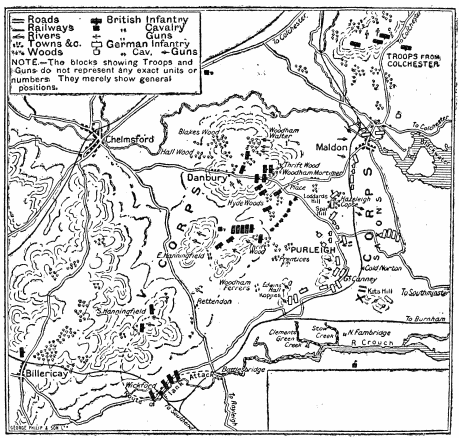 Battle of Purleigh, 6th September.
not been near enough to fire a shot in reply—arrived in the
neighbourhood of Loddard’s Hill, its left came under a terrible rifle
fire from Hazeleigh Wood, while its right and centre were all but
destroyed by a tornado of shrapnel from some German field batteries to
the north of Purleigh. Though dazed and staggered under the appalling
sleet of projectiles, the Volunteers stuck doggedly to their ground,
though unable to advance. They were intelligent men; and even if they
had the inclination to fall back, they knew that there was no safety
that way. Line after line was pushed forward, the men stumbling and
falling over the thickly scattered bodies of their fallen comrades.
“It was a perfect holocaust. Some other card must be played at once, or
the attack must fail.”
The second of Mr. Henry Bentley’s descriptive articles in the Times
told a terrible truth, and was as follows:—
“(From our War Correspondent.)
“Chelmsford, September 7.
“When I sent off my despatch by motor-car last night it was with
very different feelings to those with which I take my pen in hand
this evening, in the Saracen’s Head Hotel, which is the
headquarters of my colleagues, the correspondents.
“Last night, despite the hard fighting and the heavy losses we had
sustained, the promise of the morrow was distinctly a good one. But
now I have little heart with which to commence the difficult and
unpleasant task of chronicling the downfall of all our high hopes,
the repulse—ay, and the defeat—it is no use mincing matters—of
our heroic and sorely tried Army.
“Yes, our gallant soldiers have sustained a reverse which, but for
their stubborn fighting qualities and a somewhat inexplicable
holding back on the part of the Germans, might very easily have
culminated in disaster. Defeat although it undoubtedly is, the
darkness of the gloomy outlook is illuminated by the brilliancy of
the conduct of our troops.
“From General down to the youngest Volunteer drummer boy, our brave
soldiers did all, and more, than could be humanly expected of them,
and on none of them can be laid the blame of our ill-success. The
plan of attack is agreed on all hands to have been as good a one as
could have been evolved; the officers led well, their men fought
well, and there was no running short of ammunition at any period of
the engagement.
“ ‘Who, then, was responsible?’ it may well be asked. The answer is
simple. The British public, which, in its apathetic attitude
towards military efficiency, aided and abetted by the soothing
theories of the extremists of the ‘Blue Water’ school, had, as
usual, neglected to provide an Army fitted to cope in numbers and
efficiency with those of our Continental neighbours. Had we had a
sufficiency of troops, more especially of regular troops, there is
not the slightest doubt that the victory would have been ours. As
it was, our General was obliged to attack the enemy’s position with
a force whose numbers, even if they had been all regular soldiers,
were below those judged necessary by military experts for the task
in hand.
“Having broken through the German lines, success was in his grasp,
had he had sufficient reinforcements to have established him in the
position he had won and to beat back the inevitable counter-attack.
But it is best that I should continue my account of the fighting
from the point at which I closed my letter of yesterday. I had
arrived at the checking of our advance near Loddard’s Hill by the
blast of shrapnel from the German field batteries. It was plain
that the Volunteer Brigade, though it held its ground, could not
advance farther. But, unnoticed by them, the General had been
preparing for this eventuality.
“On the left the two battalions of Marines that I noticed drawn up
behind Woodham Mortimer Place suddenly debouched on Loddard’s Hill,
and, carrying forward with them the débris of the Volunteer firing
line, hurled themselves into Hazeleigh Wood. There was a sanguinary
hand-to-hand struggle on the wire-entangled border, but the
new-comers were not to be denied, and after a quarter of an hour’s
desperate mêlée, which filled the sylvan glades with moaning and
writhing wounded and stark dead bodies, we remained masters of the
wood, and even obtained a footing on the railway line where it
adjoins it.
“Simultaneously a long line of our field batteries came into
action near Woodham Mortimer, some trying to beat down the fire of
the German guns opposite, while others replied to a battery that
had been established near West Maldon Station to flank the railway,
and which was now beginning to open on Hazeleigh Wood. The latter
were assisted by a battery of 4.7 guns manned by Volunteers, which
took up a position behind Woodham Walter. The firing on Great
Canney from our batteries at East Hanningfield redoubled, the whole
summit of the hill being at times obscured by the clouds of smoke
and débris from the explosions of the big, high-explosive
projectiles.
“The main firing line, continually fed from the rear, now began
slowly to gain ground, and when the Grenadiers and the Irish
Guards, who had managed to work up through the series of
plantations that run eastwards for nearly two miles from Woodham
Hall without drawing any particular attention from the busily
engaged enemy, came into action on the right, there was a distinct
move forward. But the defence was too stubborn, and about midday
the whole line again came to a standstill, its left still in
Hazeleigh Wood, its right at Prentice Farm. Orders were passed that
the men should try to entrench themselves as best they could, and
spades and other tools were sent forward to those corps who were
not provided with them already.
“Here we must leave the main attack to notice what was going on
elsewhere. On the north the Colchester Garrison again brought their
heavy artillery into action on the slopes south of Wickham Bishops,
while others of our troops made a show of advancing against Maldon
from the west. These movements were, however, merely intended to
keep the German garrison occupied. But on the right a rather
important flanking movement was in progress.
“We had a considerable body of troops at East Hanningfield, which
lies in a hollow between two little ridges, both running from
south-west to north-east, and about a mile apart. The most easterly
ridge is very narrow for the most part, and behind it were
stationed several batteries of our field howitzers, which fired
over it at Great Canney at a range of about 5000 yards. A number of
4.7-inch guns, scattered over the western hill, were also
concentrated on the same target. Although the range was an
extremely long one, there is no doubt that they made a certain
number of effective hits, since Great Canney offered a conspicuous
and considerable target. But beyond this the flashes of their
discharges drew off all attention from the howitzer batteries in
front of them, and served to conceal their presence from the enemy.
Otherwise, although invisible, their presence would have been
guessed at. As it was, not a single German projectile came anywhere
near them.
“When the fighting began, those troops who were not intended to be
held in reserve or to co-operate with the right of the main attack
moved off in the direction of Woodham Ferrers, and made a feint of
attacking the German position astride the two kopjes at Edwin’s
Hall, their field guns coming into action on the high ground north
of Rettendon, and engaging those of the enemy at long range. But
the real attack on this salient of the German position came from a
very different quarter.
“The troops detailed for this movement were those who had advanced
against Wickford at daybreak, and had found it abandoned by the
enemy. They consisted of the Oxfordshire Light Infantry, the
Honourable Artillery Company, and the Inns of Court Volunteers,
together with their own and three or four other machine-gun
detachments, their Maxims being mounted on detachable legs instead
of carriages. Co-operating with them were the Essex and the East
Kent Yeomanry, who were scouting in the direction of Hockley.
“The troops had a long, wearisome march before them, the design
being to take advantage of the time of low tide, and to move along
out of sight of the enemy behind the northern bank of the river
Crouch, as it had been discovered that the German line of defence
turned back to the eastward at a mile or two north of the river at
the point aimed at. Its guns still commanded it, and might be
trusted to render abortive any attempt to throw a bridge across it.
The Yeomanry had the task of occupying the attention of the enemy
at Canewdon, and of preventing the passage of boats from the German
warships. This part of our operations succeeded admirably. The long
creeping lines of the Oxfordshires and the machine-gun detachments
in their khaki uniforms were almost indistinguishable against the
steep mud banks at any distance, and they escaped observation both
from the German main lines and from their outpost at Canewdon until
they had reached the entrances of the two branch creeks for which
they were making.
“Then, and not till then, came the sound of artillery from the left
rear of the German position. But it was too late. The Oxford
companies pushed forward at the double. Five companies lined the
embankments of Stow Creek, the easternmost of the two, while the
remainder, ensconced in Clementsgreen Creek, aligned the whole of
their machine-guns on the southern of the two kopjes against which
the manœuvre had been directed. Their fire, which, coming from a
little to the rear of the left flank of the southern kopje,
completely enfiladed it, created such slaughter and confusion that
the Honourable Artillery Company and the Inns of Court, who had
been working up the railway line from Battle Bridge, had little
difficulty in establishing themselves at Woodham Ferrers Station
and in an adjacent farm. Being almost immediately afterwards
reinforced by the arrival of two regular battalions who had been
pushed forward from Rettendon, a determined assault was made on the
southern kopje. Its defenders, demoralised by the pelting shower of
lead from the machine-gun battery, and threatened also by the
advance from Woodham Ferrers village, gave way, and our people,
forcing their way over every obstacle, seized the position amid
frantic cheering.
“Meanwhile the Oxfordshires had been subjected to a determined
counter-attack from North Frambridge. Preceded by a pounding from
the guns on Kit’s Hill, but aided by the fire of the Yeomanry on
the south bank of the river, who galloped up and lined the
embankment, thus flanking the defenders of Stow Creek, it was
beaten back with considerable loss. The machine-guns were
transferred to the neighbourhood of South Kopje, and used with such
effect that its defenders, after repulsing several counter-attacks
from the adjoining German entrenchment, were able to make
themselves masters of the North Kopje also.
“Elsewhere the fighting still continued strenuous and deadly. The
main attack had contrived to make some little shelter for itself;
but though three several attempts were made to advance from this,
all ended in failure, one nearly in disaster. This was the last of
the three, when the advancing line was charged by a mass of cavalry
which suddenly appeared from behind Great Canney Hill. I myself was
a witness of this attack, the most picturesque incident of the
day’s fighting.
“I was watching the progress of the engagement through my glasses
from the high ground about Wickhams Farm, when I saw line after
line of the German horsemen in their sky-blue tunics and glittering
helmets trot out into the open, canter, and one after another break
into a mad gallop as they bore down upon the advancing lines of our
citizen soldiers. Staunchly as these had withstood the murderous
fire which for hours had been directed upon them, this whirlwind of
lance and sabre, the thunder of thousands of hoofs, and the hoarse
cries of the riders, were rather more than such partially trained
soldiers could stand. A scattering discharge from their rifles was
followed by something very much approaching a sauve qui peut.
“A large number of the Volunteers, however, sought shelter among
the ruined houses of Cock Clarke’s hamlet, from whence they opened
a heavy fire on the adventurous horsemen. The Argyll and Sutherland
Highlanders, who were by this time in Mosklyns Copse, and the
Guards and other troops on the right, also opened a rapid and
sustained fire on the German cavalry, which, seconded by the
shrapnel from our guns on Loddard’s Hill, caused them to turn and
ride back for their lives. There was a tremendous outburst of
firing from both sides after this, followed by quite a lull. One
could well imagine that all the combatants were exhausted by the
prolonged effort of the day. It was now between five and six in the
evening. It was at this time that the news of the capture of the
two kopjes reached me, and I made for Danbury to write my
despatches.
“Shortly after my arrival I heard of the capture of Spar Hill, a
detached knoll about 12,000 yards to the north-west of Purleigh.
The Marines from Hazeleigh Wood and the Highlanders from Mosklyns
Copse had suddenly and simultaneously assaulted it from opposite
sides, and were now entrenching themselves upon it. What wonder,
then, that I reported satisfactory progress, and reckoned—too
confidently, as it proved—on a victory for the morrow?
“I spent a great part of that night under the stars on the hilltop
near East Hanningfield, watching the weird play of the searchlights
which swept over the country from a score of different positions,
and listening to the crash of artillery and clatter of rifle fire
which now and again told of some attempted movement under cover of
the darkness. Just before daylight the continuous roar of battle
began again, and when light dawned I found that our troops had cut
right through the German lines, and had penetrated as far as Cop
Kitchen’s farm, on the Maldon-Mundon road. Reinforcements were
being hurried up, and an attack was being pushed towards the rear
of Purleigh and Great Canney, which was being heavily bombarded by
some of our large guns, which had been mounted during the night on
the two kopjes.
“But the reinforcements were not enough. The Germans held fast to
Purleigh and to some reserve positions they had established about
Mundon. After two or three hours of desperate effort, costing the
lives of thousands, our attack was at a standstill. At this
critical moment a powerful counter-attack was made from Maldon,
and, outnumbered and almost surrounded, our gallant warriors had to
give ground. But they fell back as doggedly as they had advanced,
the Argylls, Marines, and Grenadiers covering the retreat on
Danbury.
“The guns at East Hanningfield and the two kopjes checked the
pursuit to a great extent, and the Germans seemed unwilling to go
far from their works. The kopjes had to be abandoned later in the
day, and we now occupy our former line from Danbury to Billericay,
and are busily engaged in entrenching ourselves.”
Late on Wednesday night came tardy news of the measures we were taking
to mobilise.
The Aldershot Army Corps, so complete in the “Army List,” consisted, as
all the world knew, of three divisions, but of these only two existed,
the other being found to be on paper. The division in question, located
at Bordon, was to be formed on mobilisation, and this measure was now
being proceeded with. The train service was practically suspended, owing
to the damage done to the various lines south of London by the enemy’s
emissaries. Several of these men had been detected, and being in plain
clothes were promptly shot out of hand. However, their work had,
unfortunately for us, been accomplished, and trains could only run as
far as the destroyed bridges, so men on their way to join their
respective corps were greatly delayed in consequence.
In one instance, at about four o’clock in the morning, three men were
seen by a constable acting suspiciously beneath the iron girder bridge
of the South-Western Railway spanning the road on the London side of
Surbiton Station. Of a sudden the men bolted, and a few moments later,
with a terrific explosion, the great bridge crashed into the road.
The constable raised the alarm that the fugitives were German spies,
whereupon a few unemployed workmen, rushing down Effingham Gardens,
caught two of the men in Malpas Road. In the hands of these irate
bricklayers the Germans were given short shrift, and, notwithstanding
the protests of the constable, the two spies were dragged along the
Portsmouth Road, pitched headlong into the Thames almost immediately
opposite the water-works, and drowned.
All was confusion at Bordon, where men were arriving in hundreds on
foot, and by the service of motor-omnibuses, which the War Office had on
the day before established between Charing Cross and Aldershot.
Perspiring staff officers strove diligently, without much avail, to sort
out into their respective units this ever-increasing mass of reservists.
There was perfect chaos.
Before the chief constituent parts of the division—that is to say,
regiments who were stationed elsewhere—had arrived little could be done
with the reservists. The regiments in question were in many cases
stationed at considerable distance, and although they had received
orders to start, were prevented from arriving owing to the universal
interruptions of the railway traffic south. By this, whole valuable days
were lost—days when at any hour the invaders might make a sudden swoop
on London.
Reports were alarming and conflicting. Some said that the enemy meant to
strike a blow upon the capital just as suddenly as they had landed,
while others reassured the alarmists that the German plans were not yet
complete, and that they had not sufficient stores to pursue the
campaign.
Reservists, with starvation staring them in the face, went eagerly south
to join their regiments, knowing that at least they would be fed with
regularity; while, in addition, the true patriotic spirit of the
Englishman had been roused against the aggressive Teuton, and everyone,
officer and man, was eager to bear his part in driving the invader into
the sea.
The public were held breathless. What would happen?
Arrivals at Aldershot, however, found the whole arrangements in such a
complete muddle that Army Service Corps men, who ought to have been at
Woolwich, were presenting themselves for enrolment at Bordon, and
infantry of the line were conducted into the camp of the Dragoons. The
Motor Volunteer Corps were at this moment of very great use. The cars
were filled with staff officers and other exalted officials, who were
settling themselves in various offices, and passing out again to make
necessary arrangements for dealing with such a large influx of men.
There were activity and excitement everywhere. Men were rapidly drawing
their clothing, or as much of it as they could get, and civilians were
quickly becoming soldiers on every hand. Officers of the Reserve were
driving up in motor-cars and cabs, many of them with their old battered
uniform-cases, that had seen service in the field in distant parts of
the globe. Men from the “Junior” and the “Senior” wrung each other’s
hands on returning to active duty with their old regiments, and at once
settled down into the routine work they knew so well.
The rumour, however, had now got about that a position in the
neighbourhood of Cambridge had been selected by the General Staff as
being the most suitable theatre of action where an effective stand
could, with any hope of success, be made. It was evident that the German
tactics were to strike a swift and rapid blow at London. Indeed, nothing
at present stood in their way except the gallant little garrison at
Colchester, who had been so constantly driven back by the enemy’s
cavalry on attempting to make any reconnaissance, and who might be swept
out of existence at any hour.
During Tuesday and Wednesday large gangs of workmen had been busy
repairing the damaged lines. The first regiment complete for the field
was the 2nd Battalion of the 5th Fusiliers, who carried upon their
colours the names of a score of battles, ranging from Corunna and
Badajoz, all through the Peninsula, Afghanistan, and Egypt, down to the
Modder River. This regiment left by train for London on Tuesday
evening, and was that same night followed by the 2nd Battalion King’s
Liverpool Regiment and the 1st King’s Shropshire Light Infantry, while
the Manchester Regiment got away soon after midnight.
These formed the second infantry brigade of the 1st Division, and were
commanded by Brigadier-General Sir John Money. They were several hours
getting up to London, whence from Clapham Junction their trains circled
London on to the Great Eastern system to Braintree, where the Horn Hotel
was made the headquarters. By other trains in the small hours of the
morning the last of the Guards Brigade under Colonel (temporary
Brigadier-General) Lord Wansford departed, and duly arrived at Saffron
Walden, to join their comrades on the line of defence.
The divisional troops were also on the move early on Wednesday. Six
batteries of artillery and the field company of Royal Engineers left by
road. There was a balloon section accompanying this, and searchlights,
wireless instruments, and cables for field-telegraphy were carried in
the waggons.
The 2nd Division, under Lieutenant-General Morgan, C.B., was also
active. The 3rd Infantry Brigade, commanded by Major-General Fortescue,
composed of 2nd Battalion Northamptonshire Regiment, the 2nd
Bedfordshire, the 1st Princess of Wales’ Own, and the 1st Royal Welsh
Fusiliers, were preparing, but had not yet moved. The 4th Infantry
Brigade of the same division, consisting of the 3rd and 4th Battalions
King’s Royal Rifle Corps, the 2nd Sherwood Foresters, and the 2nd South
Lancashire, with the usual smartness of those distinguished regiments,
were quick and ready, now as ever, to go to the front. They were
entrained to Baldock, slightly east of Hitchin, where they marched out
on the Icknield Way. These were followed by Fortescue’s Brigade, who
were also bound for Baldock and the neighbourhood.
The bulk of the cavalry and field artillery of both divisions, together
with the divisional troops, were compelled to set out by march-route
from Aldershot for the line of defences. The single and all-sufficient
reason of this delay in sending out the cavalry and artillery was owing
to the totally inadequate accommodation on the railways for the
transport of so many horses and guns. The troop-trains, which were, of
course, necessary to transport the infantry, were not forthcoming in
sufficient numbers, this owing to the fact that at several points the
lines to London were still interrupted.
The orders to the cavalry who went by march-route were to get up to the
line proposed to be taken up by the infantry as quickly as possible, and
to operate in front of it to the east and north-east in screening and
reconnoitring duties. The temporary deficiency of cavalry, who ought, of
course, to have been the first to arrive at the scene, was made good as
far as possible by the general employment of hordes of motor-cyclists,
who scoured the country in large armed groups in order to ascertain, if
possible, the dispositions of the enemy. This they did, and very soon
after their arrival reported the result of their investigations to the
general officers commanding the 1st and 2nd Divisions.
Meanwhile both cavalry and artillery in great bodies, and strings of
motor-omnibuses filled with troops, were upon the white, dusty roads
passing through Staines to Hounslow and Brentford, thence to London, St.
Albans, en route to their respective divisions. Roughly, the distance
was over fifty miles, therefore those marching were compelled to halt
the night on the way, while those in the motor-omnibuses got through to
their destination.
To cavalry, thirty-five miles is a long day’s march, and in view of the
heavy work before them, stringent orders had been given them to spare
the horses as much as possible. The heads of the columns did not,
therefore, pass beyond Hounslow on the first night, and in that
neighbourhood the thousands of all ranks made themselves as comfortable
as circumstances would permit. The majority of the men were fed and
billeted by the all-too-willing inhabitants, and upon their hot march
they met with ovations everywhere.
At last we were defending ourselves! The sight of British troops
hurrying to the front swelled the hearts of the villagers and townsfolk
with renewed patriotism, and everywhere, through the blazing, dusty day,
the men were offered refreshment by even the poorest and humblest
cottagers. In Bagshot, in Staines, and in Hounslow the people went
frantic with excitement, as squadron after squadron rapidly passed
along, with its guns, wagons, and ambulances rumbling noisily over the
stones, in the rear.
Following these came pontoon troops with their long grey wagons and
mysterious-looking bridging apparatus, telegraph troops, balloon
sections, supply columns, field bakery, and field hospitals, the
last-named packed in wagons marked with the well-known red cross of the
Geneva Convention.
No sooner was Aldershot denuded of its army corps, however, than
battalions began to arrive from Portsmouth on their way north, while
troops from the great camp on Salisbury Plain were rapidly being pushed
to the front, which, roughly speaking, extended through Hitchin,
Royston, to Saffron Walden, across to Braintree, and also the high
ground commanding the valley of the Colne to Colchester.
The line chosen by the General Staff was the natural chain of hills
which presented the first obstacle to the enemy advancing on London from
the wide plain stretching eastward beyond Cambridge to the sea.
If this could be held strongly, as was intended, by practically the
whole of the British forces located in the South of England, including
the Yeomanry, Militia, and Volunteers—who were now all massing in every
direction—then the deadly peril threatening England might be averted.
But could it be held?

WE, WILHELM,
GIVE NOTICE to the inhabitants of those provinces occupied
by the German Imperial Army, that—
I MAKE WAR upon the soldiers, and not upon English
citizens. Consequently, it is my wish to give the latter and
their property entire security, and as long as they do not
embark upon hostile enterprise against the German troops
they have a right to my protection.
GENERALS COMMANDING the various corps in the
various districts in England are ordered to place before the
public the stringent measures which I have ordered to be
adopted against towns, villages, and persons who act in
contradiction to the usages of war. They are to regulate
in the same manner all the operations necessary for the
well-being of our troops, to fix the difference between the
English and German rate of exchange, and to facilitate in
every manner possible the individual transactions between
our Army and the inhabitants of England.
WILHELM.
Given at Potsdam, September 4th, 1910.
The above is a copy of the German Imperial Decree, printed in
English, which was posted by unknown German agents in London, and
which appeared everywhere throughout East Anglia and in that
portion of the Midlands held by the enemy.
This was the appalling question on everyone’s tongue all over the
country, for it now became generally known that upon this line of
defence four complete and perfectly equipped German army corps were
ready to advance at any moment, in addition to the right flank being
exposed to the attack of the XIIth Saxon Corps, entrenched on the Essex
coast.
It was estimated that no fewer than two hundred thousand Germans were
already upon English soil!
The outlook grew blacker every hour.
London was in a state of absolute stagnation and chaos. In the City,
business was now at an entire standstill. The credit system had received
a fatal blow, and nobody wanted to buy securities. Had people kept level
heads in the crisis there would have been a moratorium, but, as it was,
a panic had been created that nothing could allay. Even Consols were now
unsaleable. Some of the smaller banks were known to have failed, and
traders and manufacturers all over the country had been ruined on
account of credit, the foundation of all trade, having been swept away.
Only persons of the highest financial standing could have dealt with the
banks, even if they had remained open.
The opinion held in banking circles was that if the invasion should
unfortunately prove disastrous to England, and Germany demand a huge
indemnity, there was still hope, however small. The experience of the
Franco-German War had proved that though in such circumstances the Bank,
for a considerable period, might not be able to resume cash payments,
yet, with sound finance, there was no reason that the currency should
greatly depreciate. During the period of suspension of cash payments by
the Bank of France the premium on gold never went above 1.5 per cent.,
and during most of the period was 5, 4, or even less per mille.
Therefore what the French by sound banking had been able to do, there
was no reason why English bankers could not also do.
At the outbreak of the war of 1870, on August 1 French Three per Cent.
Rentes were at 60.85, and Four and a Half per Cents. at 98. On the
memorable day of Sedan, September 2, they were at 50.80 and 88.50
respectively, and on January 2, 1871, Three per Cents. were down to
50.95. At the commencement of the Commune, on March 18, they were at
51.50 and 76.25, and on the 30th of that month down to 50.60 and 76.25
respectively.
With so little money in England as there now was, securities had fallen
to the value at which holders would as soon not sell as sell at such a
great discount. High rates and the heavy fall in the value of securities
had brought business in every quarter all over London to a standstill.
Firms all over the country were now hard put to it in order to find the
necessary money to carry on their various trades. Instantly, after the
report of the reverse at Sheffield, there was a wild rush to obtain
gold, and securities dropped even a few more points.
Therefore, there was little or nothing for the banks to do, and Lombard
Street, Lothbury, and the other banking centres were closed, as though
it had been Sunday or Bank Holiday. Despair was, alas! everywhere, and
the streets presented strange scenes.
Most of the motor-omnibuses had been taken off the road and pressed into
the service of the military. The walls bore a dozen different broadsides
and proclamations, which were read by the gaping, hungry crowds.
The Royal Standard was flying from St. Stephen’s Tower, for Parliament
had now met, and all members who were not abroad for their summer
vacation had taken their places at the heated debates now hourly in
progress. Over Buckingham Palace the Royal Standard also flew proudly,
while upon every public building was displayed a Union Jack or a white
ensign, many of which had done duty at the coronation of His Majesty
King Edward. The Admiralty flew its own flag, and upon the War Office,
the India Office, the Foreign Office, and all the dark, sombre
Government buildings in Whitehall was bunting displayed.
The wild enthusiasm of Sunday and Monday, however, had given place to a
dark, hopeless apprehension. The great mobs now thronging all the
principal thoroughfares in London were already half-famished. Food was
daily rising in price, and the East End was already starving. Bands of
lawless men and women from the slums of Whitechapel were parading the
West End streets and squares, and were camping out in Hyde Park and St.
James’s Park.
The days were stifling, for it was an unusually hot September following
upon a blazing August, and as each breathless evening the sun sank, it
shed its blood-red afterglow over the giant metropolis, grimly
precursory of the ruin so surely imminent.
Supplies were still reaching London from the country, but there had been
immediate panic in the corn and provision markets, with the result that
prices had instantly jumped up beyond the means of the average Londoner.
The poorer ones were eagerly collecting the refuse in Covent Garden
Market and boiling it down to make soup in lieu of anything else, while
wise fathers of families went to the shops themselves and made meagre
purchases daily of just sufficient food to keep body and soul together.
For the present there was no fear of London being absolutely starved, at
least the middle class and wealthier portion of it. At present it was
the poor—the toiling millions now unemployed—who were the first to
feel the pinch of hunger and its consequent despair. They filled the
main arteries of London—Holborn, Oxford Street, the Strand, Regent
Street, Piccadilly, the Haymarket, St. James’s Street, Park Lane,
Victoria Street, and Knightsbridge, overflowing northward into
Grosvenor, Berkeley, Portman, and Cavendish Squares, Portland Place, and
to the terraces around Regent’s Park. The centre of London became
congested. Day and night it was the same. There was no sleep. From
across the river and from the East End the famished poor came in their
bewildering thousands, the majority of them honest workers, indignant
that by the foolish policy of the Government they now found themselves
breadless.
Before the Houses of Parliament, before the fine new War Office, and the
Admiralty, before Downing Street, and before the houses of known members
of the Government, constant demonstrations were being made, the hungry
crowds groaning at the authorities, and singing “God save the King.”
Though starving and in despair, they were nevertheless loyal, still
confident that by the personal effort of His Majesty some amicable
settlement would be arrived at. The French entente cordiale was
remembered, and our Sovereign had long ago been declared to be the first
diplomat in Europe. Every Londoner believed in him, and loved him.
Many houses of the wealthy, especially those of foreigners, had their
windows broken. In Park Lane, in Piccadilly, and in Grosvenor Square,
more particularly, the houses seemed to excite the ire of the crowds,
who, notwithstanding special constables having been sworn in, were now
quite beyond the control of the police. The German Ambassador had
presented his letters of recall on Sunday evening, and together with the
whole staff had been accorded a safe conduct to Dover, whence they had
left for the Continent. The Embassy in Carlton House Terrace, and also
the Consulate-General in Finsbury Square, had, however, suffered
severely at the hands of the angry crowd, notwithstanding that both
premises were under police protection.
All the German waiters employed at the Cecil, the Savoy, the Carlton,
the Métropole, the Victoria, the Grand, and the other big London hotels,
had already fled for their lives out into the country, anywhere from the
vengeance of the London mob. Hundreds of them were trying to make their
way within the German lines in Essex and Suffolk, and it was believed
that many had succeeded—those, most probably, who had previously acted
as spies. Others, it was reported, had been set upon by the excited
populace, and more than one had lost his life.
Pandemonium reigned in London. Every class and every person in every
walk of life was affected. German interests were being looked after by
the Russian Ambassador, and this very fact caused a serious
demonstration before Chesham House, the big mansion where lives the
representative of the Czar. Audacious spies had, in secret, in the night
actually posted copies of Von Kronhelm’s proclamation upon the Griffin
at Temple Bar, upon the Marble Arch, and upon the Mansion House. But
these had been quickly torn down, and if the hand that had placed them
there had been known, it would certainly have meant death to the one who
had thus insulted the citizens of London.
Yet the truth was, alas! too plain. Spread out across Essex and Suffolk,
making leisurely preparations and laughing at our futile defence, lay
over one hundred thousand well-equipped, well-fed Germans, ready, when
their plans were completed, to advance upon and crush the complex city
which is the pride and home of every Englishman—London.
On Friday night an official communication from the War Office was issued
to the Press, showing the exact position of the invaders. It was roughly
this:—
“The IXth German Corps, which had effected a landing at Lowestoft, had,
after moving along the most easterly route, including the road through
Saxmundham and Ipswich, at length arrived at a position where their
infantry outposts had occupied the higher slopes of the rising ground
overlooking the river Stour, near Manningtree, which town, as well as
Ipswich, was held by them.
“The left flank of this corps rested on the river Stour itself, so that
it was secure from any turning movement. Its front was opposed to and
directly threatened Colchester, while its outposts, to say nothing of
its independent cavalry, reached out in a northerly direction towards
Stowmarket, where they joined hands with the left flank of the Xth
Corps—those under Von Wilburg, who had landed at Yarmouth—whose
headquarters were now at Bury St. Edmund’s, their outposts being
disposed south, overlooking the valley of the upper reaches of the
Stour.”
Nor was this all. From Newmarket there came information that the enemy
who had landed at Weybourne and Cromer—viz., the IVth Corps under Von
Kleppen—were now encamping on the racecourse and being billeted in the
town and villages about, including Exning, Ashley, Moulton, and
Kentford. Frölich’s cavalry brigade had penetrated South, covering the
advance, and had now scoured the country, sweeping away the futile
resistance of the British Yeomanry, and scattering cavalry squadrons
which they found opposed to them, all the time maintaining communication
with the Xth Corps on their left, and the flower of the German Army, the
Guards Corps, from King’s Lynn, on their right. Throughout the advance
from Holt, Von Dorndorf’s motorists had been of the greatest utility.
They had taken constantly companies of infantry hither and thither. At
any threatened point, so soon as the sound of firing was heard in any
cavalry skirmish or little engagement of outposts, the smart motor
infantry were on the spot with the promptness of a fire brigade
proceeding to a call. For this reason the field artillery, who were
largely armed with quick-firing guns, capable of pouring in a hail of
shrapnel on any exposed point, were enabled to push on much farther than
would have been otherwise possible. They were always adequately
supported by a sufficient escort of these up-to-date troops, who,
although infantry, moved with greater rapidity than cavalry itself, and
who, moreover, brought with them their Maxims, which dealt havoc far and
near.
The magnificent troops of the Duke of Mannheim in their service
uniforms, who had landed at King’s Lynn, had come across the wide, level
roads, some by way of Downham Market, Littleport, and Ely, and arrived
at Cambridge. The 2nd Division, under Lieutenant-General von Kasten,
protecting the exposed flanks, had marched viâ Wisbech, March,
Chatteris, and St. Ives, while the masses of the cavalry of the Guard,
including the famous White Cuirassiers, had been acting independently
around the flat fen country, Spalding and Peterborough, and away to
quaint old Huntingdon, striking terror into the inhabitants, and
effectively checking any possible offensive movement of the British that
might have been directed upon the great German Army during its ruthless
advance.
Beyond this, worse remained. It was known that the VIIth Corps, under
Von Bristram, had landed at Goole, and that General Graf Haeseler had
landed at Hull, New Holland, and Grimsby. This revealed what the real
strategy of the Generalissimo had been. Their function seemed twofold.
First and foremost their presence, as a glance at the map will show,
effectually prevented any attack from the British troops gathered from
the north and elsewhere, and who were, as shown, concentrated near
Sheffield and Birmingham, until these two corps had themselves been
attacked and repulsed, which we were, alas! utterly unable to
accomplish.
These were two fine German army corps, complete to the proverbial last
button, splendidly equipped, well fed, and led by officers who had had
lifelong training, and were perfectly well acquainted with every mile of
the country they occupied, by reason of years of careful study given to
maps of England. It was now entirely plain that the function of these
two corps was to paralyse our trade in Yorkshire and Lancashire, to
commit havoc in the big cities, to terrify the people, and to strike a
crushing blow at our industrial centres, leaving the siege of London to
the four other corps now so rapidly advancing upon the metropolis.
Events meanwhile were marching quickly in the North.
The town of Sheffield throughout Tuesday and Wednesday was the scene of
the greatest activity. Day and night the streets were filled with an
excited populace, and hour by hour the terror increased.
Every train arriving from the North was crowded with Volunteers and
troops of the line from all stations in the Northern Command. The 1st
Battalion West Riding Regiment had joined the Yorkshire Light Infantry,
who were already stationed in Sheffield, as had also the 19th Hussars,
and from every regimental district and depot, including Scarborough,
Richmond, Carlisle, Seaforth, Beverley, Halifax, Lancaster, Preston,
Bolton, Warrington, Bury, Ashton-under-Lyne, came battalions of Militia
and Volunteers. From Carlisle came the Reservists of the Border
Regiment, from Richmond those of the Yorkshire Regiment, from Newcastle
came what was left of the Reservists of the Durham Light Infantry, and
the Northumberland Fusiliers, from Lancaster the Royal Lancashires,
while field artillery came from Seaforth and Preston, and small bodies
of Reservists of the Liverpool and the South Lancashire Regiments came
from Warrington. Contingents of the East and North Lancashire Regiments
arrived from Preston. The Militia, including battalions of the Liverpool
Regiment, the South Lancashire Regiment, the Lancashire Fusiliers, and
other regiments in the command, were hurried to the scene of action
outside Sheffield. From every big town in the whole of the North of
England and South of Scotland came straggling units of Volunteers. The
mounted troops were almost entirely Yeomanry, and included the Duke of
Lancaster’s Own Imperial Yeomanry, the East Riding of Yorks, the
Lancashire Hussars, Northumberland Yeomanry, Westmorland and Cumberland
Yeomanry, the Queen’s Own Yorkshire Dragoons, and the York Hussars.
These troops, with their ambulances, their baggage, and all their
impedimenta, created the utmost confusion at both railway stations. The
great concourse of idlers cheered and cheered again, the utmost
enthusiasm being displayed when each battalion forming up was marched
away out of the town to the position chosen for the defence, which now
reached from Woodhouse on the south, overlooking and commanding the
whole valley of the river Rother, through Catcliffe, Brinsworth, and
Tinsley, previously alluded to, skirting Greasborough to the high ground
north of Wentworth, also commanding the river Don and all approaches to
it through Mexborough, and over the various bridges which spanned this
stream—a total of about eight miles.
The south flank was thrown back another four miles to Norton, in an
endeavour to prevent the whole position being turned, should the Germans
elect to deliver their threatened blow from a more southerly point than
was anticipated.
The total line then to be occupied by the defenders was about twelve
miles, and into this front was crowded the heterogeneous mass of troops
of all arms. The post of honour was at Catcliffe, the dominating key to
the whole position, which was occupied by the sturdy soldiers of the 1st
Battalion West Riding Regiment and the 2nd Battalion Yorkshire Light
Infantry, while commanding every bridge crossing the rivers which lay
between Sheffield and the invaders were concentrated the guns of the 7th
Brigade Royal Horse Artillery, and of the Field Artillery, the 2nd, the
30th, the 37th, and 38th Brigades, the latter having hurriedly arrived
from Bradford.
All along the crests of these slopes which formed the defence of
Sheffield, rising steeply from the river at times up to five hundred
feet, were assembled the Volunteers, all now by daybreak on Thursday
morning busily engaged in throwing up shelter-trenches and making hasty
earthwork defences for the guns. The superintendence of this force had
merged itself into that of the Northern Command, which nominally had
its headquarters in York, but which had now been transferred to
Sheffield itself, for the best of reasons—that it was of no value at
York, and was badly wanted farther south. General Sir George Woolmer,
who so distinguished himself in South Africa, had therefore shifted his
headquarters to the Town Hall in Sheffield, but as soon as he had begun
to get the line of defence completed, he, with his staff, moved on to
Handsworth, which was centrally situated.
In the command were to be found roughly twenty-three battalions of
Militia and forty-eight of Volunteers; but owing to the supineness and
neglect of the Government the former regiments now found themselves, at
the moment when wanted, greatly denuded of officers, and, owing to any
lack of encouragement to enlist, largely depleted in men. As regards the
Volunteers, matters were even worse. During the past five years as much
cold water as possible had been thrown upon all voluntary and patriotic
military endeavour by the “antimilitant” Cabinets which had so long met
at No. 10 Downing Street. The Volunteers, as a body, were sick to death
of the slights and slurs cast upon their well-meaning efforts. Their
“paper” organisation, like many other things, remained intact, but for a
long time wholesale resignations of officers and men had been taking
place. Instead, therefore, of a muster of about twenty-five thousand
auxiliaries being available in this command, as the country would have
anticipated, if the official tabulated statements had been any guide, it
was found that only about fifteen thousand had responded to the call to
arms. And upon these heroic men, utterly insufficient in point of
numbers, Sheffield had to rely for its defence.
It might reasonably have been anticipated that in the majority of
Volunteer regiments furnished by big manufacturing towns, a battalion
would have consisted of at least five hundred efficient soldiers; but
owing to the causes alluded to, in many cases it was found that from one
hundred to two hundred only could “pass the doctor,” after having
trained themselves to the use of arms. The catchword phrase, “Peace,
retrenchment, and reform,” so long dinned into the ears of the
electorate by the pro-German Party and by every socialistic demagogue,
had sunk deeply into the minds of the people. Patriotism had been jeered
at, and solemn warnings laughed to scorn, even when uttered by
responsible and far-seeing statesmen. Yet the day of awakening had
dawned—a rude awakening indeed!
Away to the eastward of Sheffield—exactly where was yet unknown—sixty
thousand perfectly-equipped and thoroughly-trained German horse, foot
and artillery, were ready at any moment to advance westward into our
manufacturing districts!
Arrests of alleged spies were reported from Manchester, Birmingham,
Liverpool, Sheffield, and other large towns. Most of the prisoners were,
however, able to prove themselves naturalised British subjects; but
several men in Manchester, Birmingham, and Sheffield were detained
pending investigation and examination of correspondence found at their
homes. In Manchester, where there are always a number of Germans, it is
known that many slipped away on Sunday night after the publication of
the news of the invasion. Several houses in Eccles and Patricroft,
outside Manchester, a house in Brown Street in the City itself, one in
Gough Street, Birmingham, and another in Sandon Place, Sheffield, were
all searched, and from the reports received by Scotland Yard it was
believed that certain important correspondence had been seized,
correspondence which had betrayed a widespread system of German
espionage in this country. Details were wanting, as the police
authorities withheld the truth, for fear, it was supposed, of increasing
the public alarm. At the house in Sheffield, where lived a young German
who had come to England ostensibly as pupil at one of the large
steelworks, an accumulation of newspaper cuttings was discovered,
together with a quantity of topographical information concerning the
country over which the enemy was now advancing from Goole.
In most of the larger Midland towns notices had been issued by the
mayors deprecating hostility towards residents of foreign origin, and
stating that all suspicious cases were already receiving the attention
of the police.
In Stafford the boot factories were idle, and thousands of despairing
men were lounging about in Greengate, Eastgate, and other thoroughfares.
In the Potteries all work was at a standstill. At Stoke-on-Trent, at
Hanley, at Burslem, Tunstall, and Congleton all was chaos. Minton’s,
Copeland’s, Doulton’s, and Brown Westhead’s were closed, and thousands
upon thousands were already wanting bread. The silk-thread industry at
Leek was ruined, so was the silk industry at Macclesfield; the great
breweries at Burton were idle, while the hosiery factories of Leicester
and the boot factories of Northampton were all shut.
With the German troops threatening Sheffield, Nottingham was in a state
of intense alarm. The lace and hosiery factories had with one accord
closed on Tuesday, and the great Market Place was now filled day and
night by thousands upon thousands of unemployed mill-hands of both
sexes. On Friday, however, came the news of how Sheffield had built
barricades against the enemy, and there ensued a frantic attempt at
defence on the part of thousands of terrified and hungry men and women.
In their frenzy they sacked houses in order to obtain material to
construct the barricades, which were, however, built just where the
fancy took the crowd. One was constructed in Clumber Street, near the
Lion Hotel; another at Lister Gate; and a third, a much larger one, in
Radford Road. Near the Carrington Station, on the road to Arnold, a huge
structure soon rose, another at Basford, while the road in from Carlton
and the bridges leading in from West Bridgford and Wilford were also
effectually blocked.
The white, interminable North Road, that runs so straight from London
through York and Berwick to Edinburgh, was, with its by-roads in the
Midlands, now being patrolled by British cavalry, and here and there
telegraphists around a telegraph post showed that those many wires at
the roadside were being used for military communication.
At several points along the road between Wansford Bridge and Retford the
wires had been cut and tangled by the enemy’s agents, but by Friday all
had been restored again. In one spot, between Weston and
Sutton-on-Trent, eight miles south of Newark, a trench had actually been
dug during the night, the tube containing the subterranean telegraph
lines discovered, and the whole system to the North disorganised.
Similar damage had been done by German spies to the line between London
and Birmingham, two miles south of Shipston-on-Stour, and again the line
between Loughborough and Nottingham had been similarly destroyed.
The Post Office linesmen had, however, quickly made good the damage
everywhere in the country not already occupied by the enemy, and
telegraph and telephone communication North and South was now
practically again in its normal state.
Through Lincolnshire the enemy’s advance patrols had spread South over
every road between the Humber and the Wash, and in the city of Lincoln
itself a tremendous sensation was caused when on Wednesday, market-day,
several bodies of German motor-cyclists swept into the Stonebow and
dismounted at the Saracen’s Head amid the crowd of farmers and dealers
who had assembled there, not, alas! to do business, but to discuss the
situation. In a moment the city was panic-stricken. From mouth to mouth
the dread truth spread that the Germans were upon them, and people ran
indoors and barricaded themselves within their houses.
A body of Uhlans came galloping proudly through the Stonebow a quarter
of an hour later, and halted in High Street, opposite Wyatt’s clothing
shop, as though awaiting orders. Then in rapid succession troops seemed
to arrive from all quarters, many halting in the Cathedral Close and by
Exchequer Gate, and others riding through the streets in order to
terrify the inhabitants.
Von Kronhelm’s famous proclamation was posted by German soldiers upon
the police station, upon the Stonebow, and upon the door of the grand
old Cathedral itself, and before noon a German officer accompanied by
his staff called upon the Mayor and warned him that Lincoln was occupied
by the German troops, and that any armed resistance would be punished by
death, as the Generalissimo’s proclamation stated. An indemnity was
demanded, and then the powerless people saw upon the Cathedral and upon
several of the public buildings the German flag rise and float out upon
the summer wind.
Boston was full of German infantry, and officers had taken up temporary
quarters in the Peacock and the other hotels in the market-place, while
upon the “stump” the enemy’s colours were flying.
No news came from London. People in Norwich, Ipswich, Yarmouth, and
other places heard vaguely of the invasion in the North, and of fighting
in which the Germans were careful to report that they were always
successful. They saw the magnificently equipped army of the Kaiser, and,
comparing it with our mere apology for military force, regarded the
issue as hopeless from the very first. In every town the German colours
were displayed, and all kinds of placards in German and in English made
their appearance.
The Daily Mail, on September 10, published the following despatch
from one of its war correspondents, Mr. Henry Mackenzie:—
“Royston, September 9.
“Victory at last. A victory due not only to the bravery and exertion of
our troops, regular and auxiliary, but also to the genius of
Field-Marshal Lord Byfield, our Commander-in-Chief, ably seconded by the
energy and resource with which Sir William Packington, in command of
the IVth Army Corps at Baldock, carried out that part of the programme
entrusted to him.
“But though in this success we may hope that we are seeing the first
glimmerings of dawn,—of deliverance from the nightmare of German
invasion that is now oppressing our dear old England,—we must not be
led into foolishly sanguine hopes. The snake has been scotched, and
pretty badly into the bargain, but he is far from being killed. The
German IVth Army Corps under the famous General Von Kleppen, their
magnificent Garde Corps commanded by the Duke of Mannheim, and Frölich’s
fine Cavalry Division, have been repulsed in their attack on our
positions near Royston and Saffron Walden, and driven back with great
loss and confusion. But we are too weak to follow up our victory as it
should be followed up.
“The menace of the IXth and Xth Corps on our right flank ties us to our
selected position, and the bulk of our forces being composed of
indifferently trained Volunteers and Militia, is much more formidable
behind entrenchments than when attempting to manœuvre in a difficult
and intricate country such as it is about here. But, on the other hand,
we have given pause to the invaders, and have certainly gained a few
days’ time, which will be invaluable to us.
“We shall be able to get on with the line of fortifications that are
being constructed to bar the approaches to London, and behind which it
will be necessary for us to make our final stand. I do not conceive that
it is possible for such an agglomeration of amateur troops as ours are
in the main, to defeat in the open field such formidable and
well-trained forces as the Germans have succeeded in throwing into this
country. But when our Navy has regained command of the sea we hope that
we may, before very long, place our unwelcome visitors ‘between the
devil and the deep sea’—the part of the devil being played by our brave
troops finally concentrated behind the strong defences of the
metropolis. In short, that the Germans may run out of ammunition and
provisions. For if communication with the Fatherland is effectively cut,
they must starve, unless they have previously compelled our submission,
for it is impossible for an army of the size that has invaded us to live
on the country.
“No doubt hundreds, nay thousands, of our non-militant countrymen—and,
alas! women and children—will starve before the German troops are
conquered by famine, that most terrible of enemies; but this issue seems
to be the only possible one that will save the country.
“But enough of these considerations of the future. It is time that I
should relate what I can of the glorious victory which our gallant
defenders have torn from the enemy. I do not think that I am giving any
information away if I state that the British position lay mainly between
Saffron Walden and Royston, the headquarters respectively of the IInd
and IIIrd Army Corps. The IVth Corps was at Baldock, thrown back to
cover the left flank, and protect our communications by the Great
Northern Railway. A detached force, from what command supplied it is not
necessary or advisable to say, was strongly entrenched on the high
ground north-west of Helions Bumpstead, serving to strengthen our right.
Our main line of defence—very thinly held in some parts—began a little
to the south-east of Saffron Walden, and ran westwards along a range of
high ground through Elmdon and Chrishall to Heydon. Here it turned south
through Great Chrishall to Little Chrishall, where it again turned west,
and occupied the high range south of Royston, on which stands the
village of Therfield.
“The night before the battle we knew that the greater portion of the
German IVth and Garde Corps were concentrated, the former at Newmarket,
the 1st Division of the latter at Cambridge, the 2nd on this side of St.
Ives, while Frölich’s Cavalry Division had been in constant contact with
our outposts the greater part of the day previous. The Garde Cavalry
Brigade was reported
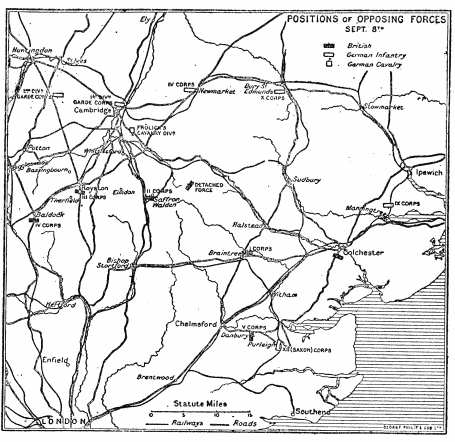
to be well away to the westward towards Kettering, as we suppose, on
account of the reports which have been going about of a concentration of
Yeomanry and Militia in the hilly country near Northampton. Our
Intelligence Department, which appears to have been very well served by
its spies, obtained early knowledge of the intention of the Germans to
make an attack on our position. In fact, they talked openly of it, and
stated at Cambridge and Newmarket that they would not manœuvre at
all, and only hoped that we should hold on long enough to our position
to enable them to smash up our IInd and IIIrd Corps by a frontal attack,
and so clear the road to London. The main roads lent themselves
admirably to such strategy, which rendered the reports of their
intentions the more probable, for they all converged on our position
from their main points of concentration.
“The letter ‘W’ will exactly serve to show the positions of the
contending forces. St. Ives is at the top of the first stroke, Cambridge
at the junction of the two shorter centre ones, Newmarket at the top of
the last stroke, while the British positions at Royston and Saffron
Walden are at the junctions of all four strokes at the bottom of the
letter. The strokes also represent the roads, except that from Cambridge
three good roads lead towards each of the British positions. The
prisoners taken from the Germans in the various preliminary skirmishes
also made no bones of boasting that a direct attack was imminent, and
our Commander-in-Chief eventually, and rightly as it proved, determined
to take the risk of all this information having been specially
promulgated by the German Staff to cover totally different intentions,
as was indeed quite probable, and to accept it as true. Having made up
his mind, he lost no time in taking action. He ordered the IVth Corps
under Sir William Packington to move on Potton, twelve miles to the
north-west, as soon as it was dark. As many cavalry and mounted infantry
as could possibly be spared from Royston were placed at his disposal.
“It ought to be stated that while the auxiliary troops had been busily
employed ever since their arrival in entrenching the British position,
the greater part of the regular troops had been occupying an advanced
line two or three miles to the northward on the lower spurs of the
hills, and every possible indication of a determination to hold this as
long as possible was afforded to the German reconnoitrers. During the
night these troops fell back to the position which had been prepared,
the outposts following just before daylight. About 6 a.m. the enemy were
reported to be advancing in force along the Icknield Way from Newmarket,
and also by the roads running on either bank of the river Cam. Twenty
minutes later considerable bodies of German troops were reported at
Fowlmere and Melbourn on the two parallel Royston-Cambridge roads. They
must have followed very close on the heels of our retiring outposts. It
was a very misty morning,—down in the low ground over which the enemy
were advancing especially so,—but about seven a gust of wind from the
westward dispelled the white fog-wreaths that hung about our left front
and enabled our look-outs to get a glimpse along the famous Ermine
Street, which runs straight as an arrow from Royston for twenty or
thirty miles to the N.N.W.
“Along this ancient Roman way, far as the eye could reach, poured a
steady stream of marching men, horse, foot, and artillery. The wind
dropped, the mists gathered again, and once more enveloped the invaders
in an impenetrable screen. But by this time the whole British line was
on the qui vive. Regulars, Militia, and Volunteers were marching down
to their chin-deep trenches, while those who were already there busied
themselves in improving their loopholes and strengthening their head
cover. Behind the ridges of the hills the gunners stood grouped about
their ‘Long Toms’ and heavy howitzers, while the field batteries waited,
ready horsed, for orders to gallop under cover of the ridge to whichever
set of emplacements should first require to be manned and armed. We had
not enough to distribute before the movements of the enemy should, to a
certain extent, show his hand.
“About seven o’clock a series of crackling reports from the outskirts of
Royston announced that the detachment of Mounted Infantry, who now alone
held it, was exchanging shots with the advancing enemy, and in a few
minutes, as the morning mistiness cleared off, the General and his
staff, who were established at the northern edge of the village of
Therfield, three or four hundred feet higher up than the German
skirmishers, were able to see the opening of the battle spread like a
panorama before them. A thick firing line of drab-costumed Germans
extended right across from Holland Hall to the Coach and Horses on the
Fowlmere Road. On their left moved two or three compact masses of
cavalry, while the infantry reserves were easily apparent in front of
the village of Melbourn. Our Mounted Infantry in the village were
indistinguishable, but away on the spur to the north-east of Royston a
couple of batteries of Horse Artillery were unlimbered and were pushing
their guns up to the brow of the hill by hand. In two minutes they were
in action, and hard at work.
“Through the glasses the shrapnel could be seen bursting, half a dozen
together, in front of the advancing Germans, who began to fall fast. But
almost at once came an overwhelming reply from somewhere out of sight
behind Melbourn. The whole hilltop around our guns was like a spouting
volcano. Evidently big high-explosive shells were being fired from the
German field-howitzers. In accordance with previous orders, our
horse-gunners at once ran down their guns, limbered up, and started to
gallop back towards our main position. Simultaneously a mass of German
cavalry deployed into attack formation near the Coach and Horses, and
swept down in their direction with the evident intention of cutting off
and capturing them. But they reckoned without their escort of Mounted
Infantry, who had been lying low behind the long, narrow line of copse
north of Lowerfield Farm. Safely ensconced behind this—to
cavalry—impassable barrier, the company, all good shots, opened a
terrible magazine fire on the charging squadrons as they passed at close
range. A Maxim they had with them also swept horses and men away in
swathes. The charge was checked, and the guns saved, but we had not
finished with the German reiters. Away to the north-east a battery of
our 4.7 guns opened on the disorganised cavalry, firing at a range of
four thousand yards. Their big shells turned the momentary check into a
rout, both the attacking cavalry and their supports galloping towards
Fowlmere to get out of range. We had scored the first trick!
“The attacking lines of German Infantry still pressed on, however, and
after a final discharge the Mounted Infantry in Royston sprang on their
horses and galloped back over Whitely Hill, leaving the town to be
occupied by the enemy. To the eastward the thunder of heavy cannon,
gradually growing in intensity, proclaimed that the IInd Corps was
heavily attacked. Covered by a long strip of plantation, the German IVth
Corps contrived to mass an enormous number of guns on a hill about two
miles north of the village of Elmdon, and a terrific artillery duel
began between them and our artillery entrenched along the Elmdon-Heydon
ridge. Under cover of this the enemy began to work his infantry up
towards Elmdon, obtaining a certain amount of shelter from the spurs
which ran out towards the north-east of our line. Other German troops
with guns put in an appearance on the high ground to the north-east of
Saffron Walden, near Chesterton Park.
“To describe the fortunes of this fiercely-contested battle, which
spread along a front of nearly twenty miles, counting from the detached
garrison of the hill at Helions Bumpstead—which, by the way, succeeded
in holding its ground all day, despite two or three most determined
assaults by the enemy—to Kelshall on the left of the British position,
would be an impossibility in the space at my disposal. The whole morning
it raged all along the northern slopes of the upland held by our gallant
troops. The fiercest fighting was, perhaps, in the neighbourhood of
Elmdon, where our trenches were more than once captured by the Magdeburg
battalions, only to be themselves hurled out again by the rush of the
1st Coldstream Guards, who had been held in reserve near the threatened
point. By noon the magnificent old palace at Audley End was in flames.
Art treasures which were of inestimable value and absolutely
unreplaceable perished in this shocking conflagration. Desperate
fighting was going on in the streets of the little town of Saffron
Walden, where a mingled mass of Volunteers and Militia strove hard to
arrest the advance of a portion of the German Army which was
endeavouring to work round the right of our position.
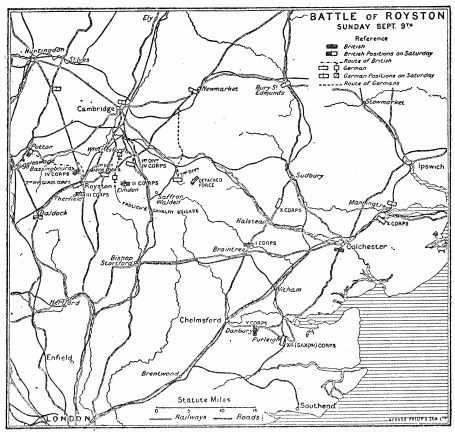
“On our left the Foot Guards and Fusiliers of the 1st German Guard
Division, after receiving a terrible pounding from our guns when they
poured into Royston at the heels of our Mounted Infantry, had fought
their way up the heights to within fifteen hundred yards of our trenches
on the upper slopes of the ridge. Farther than that they had been unable
to advance. Their close formations offered an excellent target to the
rifles of the Volunteers and Militia lining our entrenchments. The
attackers had lost men in thousands, and were now endeavouring to dig
themselves in as best they could under the hail of projectiles that
continually swept the hillside. About noon, too, the 2nd Division of the
Garde Corps, after some skirmishing with the Mounted Infantry away on
our left front, got into attack formation along the line of the Hitchin
and Cambridge Railway, and after pouring a deluge of projectiles from
field guns and howitzers upon our position, advanced upon Therfield with
the greatest bravery and determination. They had succeeded by 2 p.m. in
driving our men from the end of the spur running northward near
Therfield Heath, and managed to get a number of their howitzers up
there, and at once opened fire from the cover afforded by several copses
out of which our men had been driven.
“In short, things were beginning to look very bad for old England, and
the watchers on the Therfield heights turned their glasses anxiously
northward in search of General Sir William Packington’s force from
Potton. They had not long to wait. At 2.15 the winking flash of a
heliograph away near Wendy Place, about eight miles up Ermine Street,
announced that the advance guard, consisting of the 1st Royal Welsh
Fusiliers, was already at Bassingbourn, and that the main body was close
behind, having escaped detection by all the enemy’s patrols and flank
guards. They were now directly in the rear of the right of the German
reserves, who had been pushed forward into the neighbourhood of Royston
to support the attack of their main body on the British position. A few
minutes later it was evident that the enemy had also become aware of
their advent. Two or three regiments hurriedly issued from Royston and
deployed to the north-west. But the guns of the Baldock Corps turned
such a ‘rafale’ fire upon them that they hesitated and were lost.
“Every long-range gun in the British entrenchments that would bear was
also turned upon them, leaving the infantry and field guns to deal with
the troops assaulting their position. The three battalions, as well as
a fourth that was sent to their assistance, were simply swept out of
existence by this terrible cross-fire. Their remnants streamed away, a
disorganised crowd of scattered stragglers, towards Melbourn; while,
still holding on to Bassingbourn, the Baldock force moved down on
Royston, driving everything before it.
“The most advanced German troops made a final effort to capture our
position when they saw what was going on behind them, but it was
half-hearted; they were brought to a standstill, and our men, fixing
bayonets, sprang from their trenches and charged down upon them with
cheers, which were taken up all along the line for miles. The Germans
here and there made a partial stand, but in half an hour they were down
on the low ground, falling back towards the north-east in the greatest
confusion, losing men in thousands from the converging fire of our guns.
Their cavalry made a gallant attempt to save the day by charging our
troops to the north of Royston. It was a magnificent sight to see their
enormous masses sweeping over the ground with an impetus which looked
capable of carrying everything before it, but our men, clustering behind
the hedges of Ermine Street, mowed them down squadrons at a time. Not
one of them reached the roadway. The magnificent Garde Corps was routed.
“The combined IIIrd and IVth Corps now advanced on the exposed right
flank of the German IVth Corps, which, fighting gallantly, fell back,
doing its best to cover the retreat of its comrades, who, on their part,
very much hampered its movements. By nightfall there was no unwounded
German south of Whittlesford, except as a prisoner. By this time, too,
we were falling back on our original position.”
On Tuesday, 10th September, the Tribune published the following
telegram from its war correspondent, Mr. Edgar Hamilton:—
“Chelmsford, Monday, September 9.
“I sit down, after a sleepless night, to indite the account of our
latest move. We hear that Sheffield has fallen, and our troops are in
flight. As, by the time this appears in print, the enemy will of
necessity be aware of our abandonment of Colchester, the censor will
not, I imagine, prevent the despatch of my letter.
“For our move has been one of a retrograde nature, and I do not doubt
that the cavalry of the German IXth Corps are close behind us and in
touch with our own. But I must not, in using the word ‘retrograde,’ be
supposed to criticise in any way the strategy of our generals. For
everyone here is, I am sure, fully persuaded of the wisdom of the step.
Colchester, with its plucky little garrison, was altogether too much ‘in
the air,’ and stood a great risk of being isolated by a converging
advance of the IXth and Xth Corps of the German invaders, to say nothing
of the XIIth (Saxon) Corps at Maldon, which since the unfortunate battle
of Purleigh has shown itself very active to the north and east.
“The Saxons have refrained from attacking our Vth Corps since its
repulse, and it has been left almost in peace to entrench its position
from Danbury to the southward; but, on the other hand, while not
neglecting to further strengthen their already formidable defences
between the Blackwater and the Crouch, their cavalry have scoured the
country up to the very gates of Colchester. Yesterday morning the 16th
Lancers and the 17th Hussars—who had fallen back from Norwich—together
with some of the local Yeomanry, moved out by the Tolleshunt d’Arcy and
Great Totham roads, and drove in their patrols with some loss. At
Tiptree Heath there was a sharp cavalry engagement between our red
Lancers and several squadrons of a sky-blue hussar regiment. Our people
routed them, but in the pursuit that followed would have fared badly, as
they fell in with the four remaining squadrons supported by another
complete regiment, had it not been for the opportune arrival of the
Household Cavalry Brigade, which had moved north-east from Danbury to
co-operate. This completely changed the aspect of affairs. The Germans
were soundly beaten, with the loss of a large number of prisoners, and
galloped back to Maldon in confusion. In the meantime the 2nd King’s Own
Royal Lancaster Regiment and the 5th Battery R.F. Artillery had been
sent down to Witham by train, whence they marched up to the high ground
near Wickham Bishops. They and the Yeomanry were left there in a
position to cover the main London road and the Great Eastern Railway,
and at the same time threaten any movement of the enemy by the Great
Totham road. When the news of our success reached Colchester soon after
midday, we were all very jubilant. In fact, I fear that a great many
people spent the afternoon in a species of fool’s paradise. And when
towards the evening the announcement of our splendid victory at Royston
was posted up on the red walls of the fine town hall, and outside the
Cups, there was an incipient outbreak of that un-English excitement
known as ‘Mafficking.’ Gangs of youths paraded the High Street, Head
Street, and the principal thoroughfares, shouting, yelling, and
hustling passers-by, and even respectable members of society seemed
bitten by the desire to throw up their hats and make idiots of
themselves.
“The hotels, the Lamb, the Red Lion, and other places, did a roaring
trade, and altogether the town was more or less demoralised. But all
this exultation was fated to be but short-lived, even though the Mayor
appeared on the balcony of the town hall and addressed the crowd, while
the latest news was posted outside the offices of the Essex Telegraph,
opposite the post-office. The wind was in the north, and about 5.45 in
the afternoon the sound of a heavy explosion was heard from the
direction of Manningtree. I was in the Cups Hotel at the time arranging
for an early dinner, and ran out into the street. As I emerged from the
archway of the hotel I distinctly heard a second detonation from the
same direction. A sudden silence, ominous and unnatural, seemed to fall
on the yelping jingoes in the street, in the midst of which the rumble
of yet another explosion rolled down on the wind, this time from a more
westerly direction. Men asked their neighbours breathlessly as to what
all this portended. I myself knew no more than the most ignorant of the
crowd, till in an officer who rushed hastily by me in Head Street, on
his way into the hotel, I recognised my friend Captain Burton, of the
Artillery.
“I buttonholed him at once.
“ ‘Do I know what those explosions were?’ repeated he in answer to my
inquiry. ‘Well, I don’t know, but I’m open to bet you five to one that
it’s the sappers blowing up the bridges over the Stour at Manningtree
and Stratford St. Mary.’
“ ‘Then the Germans will have arrived there?’ I queried.
“ ‘Most probably. And look here,’ he continued, taking me aside by the
arm, and lowering his voice, ‘you take my tip. We shall be out of this
to-night. So you’d best pack up your traps and get into marching
order.’
“ ‘Do you know this?’ said I.
“ ‘Not officially, or I shouldn’t tell you anything about it. But I can
put two and two together. We all knew that the General wouldn’t be fool
enough to try and defend an open town of this size with such a small
garrison against a whole army corps, or perhaps more. It would serve no
good purpose, and expose the place to destruction and bring all sorts of
disaster on the civil population. You could have seen that for yourself,
for no attempt whatever has been made to erect defences of any kind,
neither have we received any reinforcements at all. If they had meant to
defend it they would certainly have contrived to send us some Volunteers
and guns at any rate. No, the few troops we have here have done their
best in assisting the Danbury Force against the Saxons, and are much too
valuable to be left here to be cut off without being able to do much to
check the advance of the enemy. If we had been going to try anything of
that kind, we should have now been holding the line of the river Stour;
but I know we have only small detachments at the various bridges,
sufficient only to drive off the enemy’s cavalry patrols. By now, having
blown up the bridges, I expect they are falling back as fast as they can
get. Besides, look here,’ he added, ‘what do you think that battalion
was sent to Wickham Bishops for this morning?’
“I told him my theories as set forth above.
“ ‘Oh yes, that’s all right,’ he answered. ‘But you may bet your boots
that there’s more in it than that. In my opinion, the General has had
orders to clear out as soon as the enemy are preparing to cross the
Stour, and the Lancasters are planted there to protect our left flank
from an attack from Maldon while we are retreating on Chelmsford.’
“ ‘But we might fall back on Braintree?’ I hazarded.
“ ‘Don’t you believe it. We’re not wanted there—at least, I mean, not so
much as elsewhere. Where we shall come in is to help to fill the gap
between Braintree and Danbury. I think, myself, we might just as well
have done it before. We have been sending back stores by rail for the
last two days. Well, goodbye,’ he said, holding out his hand. ‘Keep all
this to yourself, and mark my words, we’ll be off at dusk.’
“Away he went, and convinced that his prognostications were correct—as,
indeed, in the main they proved—I hastened to eat my dinner, pay my
bill, and get my portmanteau packed and stowed away in my motor. As soon
as the evening began to close in I started and made for the barracks,
going easy. The streets were still full of people, but they were very
quiet, and mostly talking together in scattered groups. A shadow seemed
to have fallen on the jubilant crowd of the afternoon, though, as far as
I could ascertain, there were no definite rumours of the departure of
the troops and the close advent of the enemy. Turning out of the main
street, I had a very narrow escape of running over a drunken man.
Indeed, I regret to say that there were a good many intoxicated people
about, who had celebrated the day’s victory ‘not wisely but too well.’
“When I arrived at the barracks, I saw at once that there was something
in the wind, for there was a great coming and going of orderlies; all
the men I could see were in marching order, and the Volunteers, who had
been encamped on the drill-ground since the outbreak of hostilities,
were falling in, surrounded by an agitated crowd of their relations and
friends. I pulled up alongside the barrack railings, and determined to
watch the progress of events. I had not long to wait. In about ten
minutes a bugle sounded, and the scattered assemblage of men on the
barrack-square closed together and solidified into a series of quarter
columns. At the same time, the Volunteer battalion moved across from the
other side of the road and joined the Regular troops. I heard a sharp
clatter and jingling behind me, and looking round, saw the General and
his staff with a squad of cavalry canter up the road. They turned into
the barrack gate, greeted by a sharp word of command and the rattle of
arms from the assembled battalions. As far as I could make out, the
General made them some kind of address, after which I heard another word
of command, upon which the regiment nearest to the gate formed fours and
marched out.
“It was the 2nd Dorsetshire. I watched anxiously to see which way they
turned. As I more than expected, they turned in the direction of the
London road. My friend had been right so far, but till the troops
arrived at Mark’s Tey, where the road forked, I could not be certain
whether they were going towards Braintree or Chelmsford. The Volunteers
followed; then the Leicestershires, then a long train of artillery,
field batteries, big 4.7 guns, and howitzers. The King’s Own Scottish
Borderers formed the rearguard. With them marched the General and his
staff. I saw no cavalry. I discovered afterwards that the General,
foreseeing that a retirement was imminent, had ordered the 16th Lancers
and the 7th Hussars, after their successful morning performance, to
remain till further orders at Kelvedon and Tiptree respectively, so that
their horses were resting during the afternoon.
“During the night march the former came back and formed a screen behind
the retiring column, while the latter were in a position to observe and
check any movement northwards that might be made by the Saxons, at the
same time protecting its flank and rear from a possible advance by the
cavalry of Von Kronhelm’s Army, should they succeed in crossing the
river Stour soon enough to be able to press after us in pursuit by
either of the two eastern roads leading from Colchester to Maldon. After
the last of the departing soldiers had tramped away into the gathering
darkness through the mud, which after yesterday’s downpour still lay
thick upon the roads, I bethought me that I might as well run down to
the railway station to see if anything was going on there. I was just in
time.
“The electric lights disclosed a bustling scene as the last of the
ammunition and a certain proportion of stores were being hurried into a
long train that stood with steam up ready to be off. The police allowed
none of the general public to enter the station, but my correspondent’s
pass obtained me admission to the departure platform. There I saw
several detachments of the Royal Engineers, the Mounted Infantry—minus
their horses, which had been already sent on—and some of the
Leicestershire Regiment. Many of the men had their arms, legs, or heads
bandaged, and bore evident traces of having been in action. I got into
conversation with a colour-sergeant of the Engineers, and learned these
were the detachments who had been stationed at the bridges over the
Stour. It appears that there was some sharp skirmishing with the German
advanced troops before the officers in command had decided that they
were in sufficient force to justify them in blowing up the bridges. In
fact, at the one at which my informant was stationed, and that the most
important one of all, over which the main road from Ipswich passed at
Stratford St. Mary, the officer in charge delayed just too long, so that
a party of the enemy’s cavalry actually secured the bridge, and
succeeded in cutting the wires leading to the charges which had been
placed in readiness to blow it up. Luckily, the various detachments
present rose like one man to the occasion, and despite a heavy fire,
hurled themselves upon the intruders with the bayonet with such
determination and impetus that the bridge was swept clear in a moment.
The wires were reconnected, and the bridge cleared of our men just as
the Germans, reinforced by several of their supporting squadrons, who
had come up at a gallop, dashed upon it in pursuit. The firing key was
pressed at this critical moment, and, with a stunning report, a whole
troop was blown into the air, the remaining horses, mad with fright,
stampeding despite all that their riders could do. The road was cut, and
the German advance temporarily checked, while the British detachment
made off as fast as it could for Colchester.

NOTICE.
CONCERNING WOUNDED BRITISH SOLDIERS.
In compliance with an order of the Commander-in-Chief of the
German Imperial Army, the Governor-General of East Anglia decrees
as follows:—
(1) Every inhabitant of the counties of Norfolk, Suffolk, Essex,
Cambridge, Lincolnshire, Yorkshire, Nottingham, Derby, Leicester,
Northampton, Rutland, Huntingdon, and Hertford, who gives asylum
to or lodges one or more ill or wounded British soldier, is obliged to
make a declaration to the mayor of the town or to the local police
within 24 hours, stating name, grade, place of birth, and nature of
illness or injury.
Every change of domicile of the wounded is also to be notified
within 24 hours.
In absence of masters, servants are ordered to make the necessary
declarations.
The same order applies to the directors of hospitals, surgeries, or
ambulance stations, who receive the British wounded within our
jurisdiction.
(2) All mayors are ordered to prepare lists of the British wounded,
showing the number, with their names, grade, and place of birth in
each district.
(3) The mayor, or the superintendent of police, must send on the
1st and 15th of each month a copy of his lists to the headquarters of
the Commander-in-Chief. The first list must be sent on the 15th
September.
(4) Any person failing to comply with this order will, in addition to
being placed under arrest for harbouring British troops, be fined a sum
not exceeding £20.
(5) This decree is to be published in all towns and villages in the
Province of East Anglia.
Count VON SCHONBURG-WALDENBURG,
Lieutenant-General,
Governor of German East Anglia.
Ipswich, September 6, 1910.
COPY OF ONE OF THE ENEMY’S PROCLAMATIONS.
“I asked the sergeant how long he thought it would be before the Germans
succeeded in crossing it. ‘Bless you, sir, I expect they’re over by
now,’ he answered. ‘They would be sure to have their bridging companies
somewhere close up, and it would not take them more than an hour or two
to throw a bridge over that place.’ The bridges at Boxted Mill and
Nayland had been destroyed previously.
“The railway bridge and the other one at Manningtree were blown up
before the Germans could get a footing, and their defenders had come in
by rail. But my conversation was cut short, the whistle sounded, the men
were hustled on board the train, and it moved slowly out of the station.
As for me, I hurried out to my car. As I came out I noticed that it had
begun to rain. However, I was fully equipped for it, and, except for the
chance of skidding and the splashing of the flying mud, did not mind it.
But I could not help thinking of the poor soldiers trudging along on
their night march over the weary miles that lay before them. I
determined to follow in their steps, and putting on speed, was soon
clear of the town, and spinning along for Mark’s Tey. It is about five
miles, and shortly before I got there I overtook the marching column.
The men were halted, and in the act of putting on their greatcoats. I
was stopped here by the rearguard, who took charge of me, and would not
let me proceed until permission was obtained from the General.
“Eventually this officer ordered me to be brought to him. I presented my
pass; but he said, ‘I am afraid that I shall have to ask you either to
turn back, or to slow down and keep pace with us. In fact, you had
better do the latter. I might, indeed, have to exercise my powers and
impress your motor, should the exigencies of the Service require it.’ I
saw that it was best to make a virtue of necessity, and replied that it
was very much at his service, and that I was very well content to
accompany the column. In point of fact, the latter was strictly true,
for I wanted to see what was to be seen, and there were no points about
going along with no definite idea of where I wanted to get to, with a
possible chance of falling into the hands of the Saxons into the
bargain. So a Staff officer, who was suffering from a slight wound, was
placed alongside me, and the column, having muffled itself in its
greatcoats, once more began to plug along through the thickening mire.
My position was just in front of the guns, which kept up a monotonous
rumble behind me. My companion was talkative, and afforded me a good
deal of incidental and welcome information. Thus, just after we started,
and were turning to the left at Mark’s Tey, a bright glare followed by a
loudish report came from the right of the road. ‘What’s that?’ I
naturally ejaculated. ‘Oh, that will be the sappers destroying the
junction with the Sudbury line,’ he replied. ‘There’s the train waiting
for them just beyond.’
“So it was. The train that I had seen leaving had evidently stopped
after passing the junction, while the line was broken behind it. ‘They
will do the same after passing the cross line at Witham,’ volunteered
he.
“A mile or two farther on we passed between two lines of horsemen, their
faces set northwards, and muffled to the eyes in their long cloaks,
‘That’s some of the 16th,’ he said, ‘going to cover our rear.’
“So we moved on all night through the darkness and rain. The slow,
endless progress of the long column of men and horses seemed like a
nightmare. We passed through the long street of Kelvedon, scaring the
inhabitants, who rushed to their windows to see what was happening, and
with the first glimmer of dawn halted at Witham. We had about nine miles
still to go to reach Chelmsford, which I learned was our immediate
destination, and it was decided to rest here for an hour, while the men
made the best breakfast they could from the contents of their
haversacks. But the villagers brought out hot tea and coffee, and did
the best they could for us, so we did not fare so badly after all. As
for me, I got permission to go on, taking with me my friend the Staff
officer, who had despatches to forward from Chelmsford. I pushed on at
full speed. We were there in a very short space of time, and during the
morning I learned that the Braintree Army was falling back on Dunmow,
and that the Colchester garrison was to assist in holding the line of
the river Chelmer.”
Another despatch from Mr. Edgar Hamilton, of the Tribune, was
published in that journal on Friday, the 14th September:—
“Brentwood, Thursday, September 13, 1910.
“The events of the last three days have been so tremendous, so
involved, and so disastrous to us as a nation, that I hardly know
how to deal with them. It is no news now that we have again been
beaten, and beaten badly. The whole right of our line of defence
has been driven back in disorder, and we are now practically at the
‘last ditch.’ The remnants of that fine force which has, up to now,
not only been able to hold the Saxon Army in check, but even to be
within an ace of beating it at the memorable battle of Purleigh,
less than a week ago, is now occupying the entrenchments which have
been under construction ever since the landing of the Germans, and
which form a section of the works that have been planned for the
defence of the metropolis.
“Here, too, are portions of the Braintree Army Corps and some of
the troops lately constituting the garrison of Colchester, whom I
accompanied on their night march out of that city when it had been
decided to abandon it. We have only the vaguest rumours as to what
has happened to the other portion of the 1st Army Corps that was
occupying Dunmow and the upper part of the river Chelmer. We can
only hope that these troops, or at any rate a considerable portion
of them, have been able to gain the shelter of the defensive
enceinte to the north-westward. It is to be feared this reverse
will necessitate the retreat of the Second, Third, and Fourth
Armies from Saffron Walden, Royston, and Baldock, that position
which they so gallantly defended against the flower of the German
Army, emerging victorious from the glorious battle of Royston. For
to stay where they are, in the face of the combined forward
movement of the IXth, Xth, and XIIth Corps of the invaders, and the
rumoured resumption of the offensive by the two corps defeated
before Royston, would be to court being outflanked and cut off from
the rest of our forces at a time when every single soldier is
urgently required to man the northern portion of the defences of
London.
“But to return to the relation of our latest and most disastrous
defeat, which I must preface by saying that my readers must not be
deceived by the words ‘Army Corps’ as applied to the various
assemblages of our troops. As a matter of fact, ‘Divisions,’ or
even ‘Brigades,’ would be nearer the mark. The ‘Army Corps’ at
Braintree had only four, or perhaps later six, regular infantry
regiments, with a very small force of cavalry and not too many
guns. Compare that with the Xth German Army Corps under General von
Wilberg, which was more immediately opposed to it. This formidable
fighting unit may be taken as a representative one, observing that
the Garde Corps is yet stronger. Von Wilberg’s Corps is a
Hanoverian one, and comprises no less than twenty-three battalions
of infantry, four regiments of cavalry, twenty-five batteries of
artillery, a train battalion, and a pioneer battalion. What chance
has a so-called army corps of half a dozen regular infantry
battalions, perhaps a dozen Volunteer and Militia Corps, a scratch
lot of cavalry, and half the number of guns, against such a
powerful, well-organised, and well-trained force as this?
“In the recent fighting about Chelmsford we have had at the outside
thirty regular battalions to oppose the onslaught of three complete
German Army Corps such as that described above. We have had a
number of auxiliary troops in addition, as well as a preponderance
in heavy long-ranging artillery, but the former cannot be
manœuvred in the same way as regular soldiers, however brave and
devoted they may be; while, if weaker in big guns, the enemy
outnumbered our mobile horse and field artillery by five or six to
one. So it must be understood that while a defeat is deplorable and
heartbreaking, yet a victory against such odds would have been
little less than a miracle. No blame can be attached either to our
officers or their men. All did as much, or more, than could be
humanly expected of them. The long and short of it is that since
we, as a nation, have not chosen to have a sufficient and
up-to-date Army, we must take the rub when an invasion comes.
“We knew well enough—though most of us pretended ignorance—that
we could not afford to pay for such an Army at a rate comparable to
the current labour market rates, even if we had been twice as rich,
and if shoals of recruits had been forthcoming. We were aware, in
consequence, that some form of universal service was the only
possible method of raising a real Army, but we shrank from making
the personal sacrifices required. We were too indolent, too
careless, too unpatriotic. Now we have got to pay for the pleasures
of living in a fool’s paradise, and pay through the nose into the
bargain. We have no right to grumble, whatever may be the outcome,
and God only knows what the bitter end of this war may be, what
final defeat may mean for our future as a nation. But I must quit
moralising and betake myself to my narrative.
“In my letter of the 9th I left the Colchester garrison making
their breakfast at Witham. I had understood that they were coming
on to Chelmsford, but, as it turned out, the Leicestershires and
Dorsets got orders to turn off to the right just before reaching
Boreham, and to take up a position on the high ground east of
Little Waltham, which is about four miles due north of Chelmsford.
With them went a number of the heavy 4.7-inch guns we brought away
with us. The Volunteers, Scottish Borderers, and the
Lancasters—the latter of whom had been covering the flank of the
retreat at Wickham Bishops—came in to Chelmsford, and during the
evening were marched out and billeted in the houses thickly
scattered along the Braintree road. The cavalry, after some slight
skirmishing with the advanced patrols of Von Kronhelm’s Army, who
came up with them near Hatfield Peverell, turned up in the
afternoon.
“In Chelmsford, when I halted at the Saracen’s Head, I found there
were the 2nd Lincolnshire and the 2nd Royal Scots Fusiliers, who
had come up from Salisbury Plain, the 1st Hampshire and the 1st
Royal Fusiliers from Portsmouth and the Isle of Wight. The 2nd
South Wales Borderers from Tidworth and the 1st Border Regiment
from Bordon Camp arrived in the afternoon, and were marched out to
Great Baddow, half-way to Danbury. The 14th Hussars from
Shorncliffe and the 20th from Brighton had also come in the day
previously, and they at once moved out to the front to relieve the
16th Lancers and 7th Hussars, who had been covering the retiral
from Colchester. The town was crowded with Volunteers in khaki,
green, red, blue—all the colours of the rainbow—and I noticed two
very smart corps of Yeomanry marching out to support the two
regular cavalry regiments. Everyone seemed in good spirits on
account of the news from Royston and the successful issue of the
cavalry skirmish of the morning before. As Chelmsford lies in a
kind of hollow, I could not see much from there, so in the
afternoon I thought I would run out to the high ground near Danbury
and see if I could get any idea of what was going on.
“As I passed Danbury Place I heard the deafening report of heavy
guns close at hand. I found that the firing came from some of the
Bluejackets’ 4.7’s near the church, where I had seen them at work
at the opening of Purleigh Battle. I got out of my car and went up
to the officer in charge, whom I met on that occasion. I asked him
at what he was firing. ‘Look over there,’ he said, pointing towards
Maldon. I saw nothing at first. ‘Look higher,’ said the sailor. I
raised my eyes, and there, floating hundreds of feet over and on
this side of the old town, a great yellow sausage-like something
glistened in the sunlight. I recognised it at once from the
photographs I had seen of the German manœuvres. It was their
great military balloon, known as the ‘Wurst,’ or sausage, from its
elongated shape. Its occupants were doubtless hard at work
reconnoitring our position.
“Another gun gave tongue with an ear-splitting report, and then a
second one, its long chase sticking up into the air like a monster
telescope. They were firing high explosive shell at the balloon,
hoping that the detonation would tear it if near enough. I saw the
big shell explode apparently close to their target, but the
distance was deceptive, and no apparent injury was done. After
another round, however, it began slowly to descend, and soon
disappeared behind the huddled roofs of the town. ‘Might have got
her,’ remarked Akers, the commander in charge of the guns, ‘but I
fancy not. But I reckon they thought it too warm to stay up. We had
our balloon up this morning,’ he continued, ‘and I expect she’ll go
up again before dark. They had a few slaps at her, but didn’t get
within a mile of her. She’s in a field behind the woods at Twitty
Fee, about half a mile over there, if you want to see her.’
“I thanked him and motored slowly off in the direction indicated. I
noticed great changes on Danbury Hill since my last visit.
Entrenchments and batteries had sprung up on every side, and men
were still as busy as bees improving and adding to them. I found
the balloon, filled with gas and swaying about behind a mass of
woodland that effectually concealed it from the enemy, but as I was
informed that there would be no ascent before half-past five, I
continued my tour round the summit of the hill. When I arrived at
the northern end I found that fresh defences were being
constructed right away round to the westward side. The northern
edge of Blake’s Wood had been felled and made into a formidable
abattis, the sharpened branches of the felled trees being connected
together with a perfect web of barbed wire.
“The same process was being carried out in the woods and copses at
Great Graces. New Lodge had been placed in a state of defence. The
windows, deprived of glass and sashes, were being built up with
sand bags; the flower garden was trampled into a chaos; the grand
piano stood in the back yard, forming a platform for a Maxim gun
that peered over the wall. The walls were disfigured with
loop-holes. Behind the house were piled the arms of a Volunteer
Battalion who, under the direction of a few officers and N.C.O.’s
of the Royal Engineers, were labouring to turn the pretty country
house into a scarred and hideous fortress. Their cooks had dug a
Broad Arrow kitchen in the midst of the tennis lawn, and were
busied about the big black kettles preparing tea for the workers.
New Lodge was the most suggestive picture of the change brought
about by the war that I had yet seen. From the corner of Great
Graces Wood I could see through my glasses that the outskirts of
Great Baddow were also alive with men preparing it for defence. I
got back to the balloon just in time to see it rising majestically
above the trees. Either on account of their failure to reach it in
the morning, or for some other reason, the enemy did not fire at
it, and the occupants of the car were able to make their
observations in peace, telephoning them to a non-commissioned
officer at the winding engine below, who jotted them down in
shorthand. From what I afterwards heard, it seems that a long
procession of carts was seen moving northwards from Maldon by way
of Heybridge.
“It was presumed that these contained provisions and stores for the
IXth and Xth Corps from the big depôt which it had been discovered
that the Saxons had established near Southminster. A few
long-range shots were fired at the convoy from the big guns, but
without any appreciable effect. The procession stopped though. No
more carts came from the town, and those already out disappeared
behind the woods about Langford Park. I understand that, apprised
of this by signal from the balloon, the 14th Hussars made a gallant
effort to attack the convoy, but they found the country east of the
Maldon-Witham Railway to be full of the enemy, both infantry and
cavalry, came under a heavy fire from concealed troops, and
sustained considerable loss without being able to effect anything.
It is believed that the movement of stores continued after dark,
for our most advanced outposts and patrols reported that the rumble
of either artillery or wagons was heard coming from the direction
of the roads leading north out of Maldon almost the whole night
through.
“On my return to Chelmsford I visited Springfield, where I found
the Scots Fusiliers, a Militia, and a Volunteer Regiment
entrenching themselves astride the railway.
“I dined with three brother newspaper men at the Red Lion Hotel.
One of them had come from Dunmow, and reported that the First Army
was busily entrenching itself on a long ridge a couple of miles to
eastward of the town. He said he had heard also that the high
ground about Thaxted had been occupied by some troops who had come
up from the South on Sunday night, though he could not say what
regiments they were. They had detrained at Elsenham, and marched
the rest of the way by road. If his information is correct, the
British Army on Monday night occupied an almost continuous line
stretching from Baldock on the west to South Hanningfield, or
perhaps Billericay on the south. A very extensive front, but
necessary to be held if the forward march of the five German Army
Corps operating in the Eastern Counties was to be checked. For
though it would, of course, have been desirable to take the
offensive and attack the Xth Corps during the temporary
discomfiture of the Garde and IVth Corps, we were compelled in the
main to adopt the tactics pursued by the Boers in South Africa and
act almost entirely on the defensive on account of the poor quality
of the bulk of our forces. There was this exception, however, that
the few regular battalions were as far as possible placed in such
positions that they would be available for local counter-attacks
and offensive action. Our generals could not be altogether guided
by the generally-accepted rules of tactics and strategy, but had to
do the best they could with the heterogeneous material at their
disposal.
“As to what the enemy were doing during this day we had no
information worth speaking of, although there was a rumour going
about late in the afternoon that Braintree had been occupied by the
Hanoverians, and that the head of General Von Kronhelm’s Army Corps
had arrived at Witham. However this may have been, we neither saw
nor heard anything of them during the night, and I much enjoyed my
slumbers after the fatigues of the last twenty-four hours. But this
was but the lull before the storm. About ten a.m. the low growl of
artillery rolled up from the south-east, and it began to be bruited
about that the Saxons were attacking South Hanningfield in force,
doubtless with the object of turning our right flank. I ordered out
my motor, thinking I would run down to the high ground at Stock,
five miles to the southward, and see if I could get an inkling of
how matters were progressing. That heavy fighting was in progress I
felt certain, for the cannonade grew momentarily louder and
heavier. Hardly had I cleared the town, when a fresh outburst of
firing boomed out from a northerly direction. I stopped irresolute.
“Should I go on or turn back and set my face towards Dunmow? I
eventually decided to go on, and arrived at Stock about eleven. I
could not get much information there, or see what was going on, so
I decided to make for South Hanningfield. At the foot of the hill
leading up to Harrow Farm I came across a battalion of infantry
lying down in quarter column behind the woods on the left of the
road. From some of the officers I ascertained that it was the 1st
Buffs, and that they were in support of two Militia battalions who
were holding the ridge above. The Saxons, they said, had come up
from the direction of Woodham Ferris in considerable force, but had
not been able to advance beyond the Rettendon-Battles-Bridge Road
on account of the heavy fire of our artillery, which comprised
several heavy guns, protected both from fire and sight, and to
which their field batteries in the open ground below could make no
effective reply.
“I had noticed for some little time that the firing had slackened,
so I thought I might as well get to the top of the hill and get a
view of the enemy. I did not see much of them. By the aid of my
glass I fancied I could distinguish green uniforms moving about
near the copses in front of Rettendon Hall, but that was about all.
I looked towards Danbury and saw our big balloon go up, and I also
observed the big German sausage wobbling about over Purleigh. But
there was no sign of military movement on either side. All the
time, however, I was conscious of the distant rumble of guns away
to the northward, and as there was apparently nothing more to be
seen at South Hanningfield for the present, I regained my car and
started back for Chelmsford. I found the town buzzing like a hive
of bees.
“The troops were falling in under arms, the station was full of
people trying to get away by train, while the inhabitants were
tramping away in crowds by the Brentwood and Ongar roads. The
booming of the still distant guns sounded louder and faster, and
rumour had it that the Hanoverians were trying to force the passage
of the river at Ford Mill. I replenished my flask and luncheon
basket, and started off in the direction of the firing.
“All along the road to Little Waltham I caught glimpses of khaki
uniforms in the trenches that zig-zagged about on the river slopes,
while I passed two or three regiments stepping northwards as fast
as they could get over the ground. There was a grim, set look on
the men’s faces that betokened both anger and determination.”
The continuation of the despatch from Brentwood, as follows, was
published on Saturday, 15th September:
“At Little Waltham I found myself close to the scene of action. About a
mile ahead of me the hamlet of Howe Street was in flames and burning
furiously. I could see the shells bursting in and all over it in perfect
coveys. I could not make out where they were coming from, but an officer
I met said he thought the enemy must have several batteries in action on
the high ground about Littley Green, a mile and a half to the north on
the opposite side of the river. I crossed over myself, and got up on the
knoll where the Leicestershires and Dorsets had been stationed, together
with a number of the 4.7-inch guns brought from Colchester.
“This piece of elevated ground is about two miles long, running almost
north and south, and at the top of it I got an extensive view to the
eastward right away to beyond Witham, as the ground fell all the way.
The country was well wooded, and a perfect maze of trees and hedgerows.
If there were any Germans down there in this plain they were lying very
low indeed, for my glasses did not discover the least indication of
their presence. Due east my view was bounded by the high wooded ground
about Wickham Bishops and Tiptree Heath, which lay a long blue hummock
on the horizon, while to the south-east Danbury Hill, with our big
war-balloon floating overhead, was plainly discernible.
“While I gazed on the apparently peaceful landscape I was startled by a
nasty sharp, hissing sound, which came momentarily nearer. It seemed to
pass over my head, and was followed by a loud bang in the air, where now
hung a ring of white smoke. It was a shell from the enemy. Just ahead of
me was a somewhat extensive wood; and, urged by some insane impulse of
seeking shelter, I left the car, which I ordered my chauffeur to take
back for a mile and wait, and made for the close-standing trees. If I
had stopped to think I should have realised that the wood gave me
actually no protection whatever, and I had not gone far when the
crashing of timber and noise of the bursting projectiles overhead and in
the undergrowth around made me understand clearly that the Germans were
making a special target of the wood, which, I imagine, they thought
might conceal some of our troops. I wished heartily that I was seated
beside my chauffeur in his fast-receding car.
“However, my first object was to get clear of the wood again, and after
some little time I emerged on the west side, right in the middle of a
dressing station for the wounded, which had been established in a little
hollow. Two surgeons, with their assistants, were already busily engaged
with a number of wounded men, most of whom were badly hit by shrapnel
bullets about the upper part of the body. I gathered from one or two of
the few most slightly wounded men that our people had been, and were,
very hardly put to it to hold their own. ‘I reckon,’ said one of them, a
bombardier of artillery, ‘that the enemy must have got more than a
hundred guns firing at us, and at Howe Street village. If we could only
make out where the foreign devils were,’ continued my informant, ‘our
chaps could have knocked a good many of them out with our
four-point-sevens, especially if we could have got a go at them before
they got within range themselves. But they must have somehow contrived
to get them into position during the night, for we saw nothing of them
coming up. They are somewhere about Chatley, Fairstead Lodge, and
Little Leighs, but as we can’t locate them exactly and only have ten
guns up here, it don’t give us much chance, does it?’ Later I saw an
officer of the Dorsets, who confirmed the gunner’s story, but added that
our people were well entrenched and the guns well concealed, so that
none of the latter had been put out of action, and he thought we should
be able to hold on to the hill all right. I regained my car without
further adventure, bar several narrow escapes from stray shell, and made
my way back as quickly as possible to Chelmsford.
“The firing went on all day, not only to the northward, but also away to
the southward, where the Saxons, while not making any determined attack,
kept the Vth Corps continually on the alert, and there was an almost
continuous duel between the heavy pieces. As it appeared certain that
the knoll I had visited in the forenoon was the main objective of the
enemy’s attack, reinforcements had been more than once sent up there,
but the German shell fire was so heavy that they found it almost
impossible to construct the additional cover required. Several batteries
of artillery were despatched to Pleshy and Rolphy Green to keep down, if
possible, the fire of the Germans, but it seemed to increase rather than
diminish. They must have had more guns in action than they had at first.
Just at dusk their infantry made the first openly offensive movement.
“Several lines of skirmishers suddenly appeared in the valley between
Little Leighs and Chatley, and advanced towards Lyonshall Wood, at the
north end of the knoll east of Little Waltham. They were at first
invisible from the British gun positions on the other side of the
Chelmer, and when they cleared the spur on which Hyde Hall stands they
were hardly discernible in the gathering darkness. The Dorsetshire and
the other battalions garrisoning the knoll manned their breastworks as
they got within rifle range, and opened fire, but they were still
subjected to the infernal rafale from the Hanoverian guns on the hills
to the northward, and to make matters worse at this critical moment the
Xth Corps brought a long line of guns into action between Flacks Green
and Great Leighs Wood, in which position none of the British guns except
a few on the knoll itself
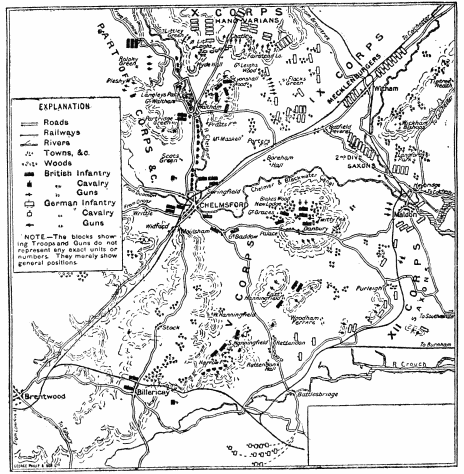 Battle of Chelmsford.
Position on the Evening of September 11.
could reach them. Under this cross hurricane of projectiles the British
fire was quite beaten down, and the Germans followed up their
skirmishers by almost solid masses, which advanced with all but impunity
save for the fire of the few British long-range guns at Pleshy Mount.
There they were firing almost at random, as the gunners could not be
certain of the exact whereabouts of their objectives. There was a
searchlight on the knoll, but at the first sweep of its ray it was
absolutely demolished by a blizzard of shrapnel. Every German gun was
turned upon it. The Hanoverian battalions now swarmed to the assault,
disregarding the gaps made in their ranks by the magazine fire of the
defenders as soon as their close advance masked the fire of their own
cannon.
“The British fought desperately. Three several times they hurled back at
the attackers, but, alas! we were overborne by sheer weight of numbers.
Reinforcements summoned by telephone, as soon as the determined nature
of the attack was apparent, were hurried up from every available source,
but they only arrived in time to be carried down the hill again in the
rush of its defeated defenders, and to share with them the storm of
projectiles from the quick-firers of General Von Kronhelm’s artillery,
which had been pushed forward during the assault. It was with the
greatest difficulty that the shattered and disorganised troops were got
over the river at Little Waltham. As it was, hundreds were drowned in
the little stream, and hundreds of others killed and wounded by the fire
of the Germans. They had won the first trick. This was indisputable, and
as ill news travels apace, a feeling of gloom fell upon our whole force,
for it was realised that the possession of the captured knoll would
enable the enemy to mass troops almost within effective rifle range of
our river line of defence. I believe that it was proposed by some
officers on the staff that we should wheel back our left and take up a
fresh position during the night. This was overruled, as it was
recognised that to do so would enable the enemy to push in between the
Dunmow force and our own, and so cut our general line in half. All that
could be done was to get up every available gun and bombard the hill
during the night, in order to hamper the enemy in his preparations for
further forward movement and in his entrenching operations.
“Had we more men at our disposal I suppose there is little doubt that a
strong counter attack would have been made on the knoll almost
immediately; but in the face of the enormous numbers opposed to us, I
imagine that General Blennerhasset did not feel justified in denuding
any portion of our position of its defenders. So all through the dark
hours the thunder of the great guns went on. In spite of the cannonade
the Germans turned on no less than three searchlights from the southern
end of the knoll about midnight. Two were at once put out by our fire,
but the third managed to exist for over half an hour, and enabled the
Germans to see how hard we were working to improve our defences along
the river bank. I am afraid that they were by this means able to make
themselves acquainted with the positions of a great number of our
trenches. During the night our patrols reported being unable to
penetrate beyond Pratt’s Farm, Mount Maskell, and Porter’s Farm on the
Colchester Road. Everywhere they were forced back by superior numbers.
The enemy were fast closing in upon us. It was a terrible night in
Chelmsford.
“There was a panic on every hand. A man mounted the Tindal statue and
harangued the crowd, urging the people to rise and compel the Government
to stop the war. A few young men endeavoured to load the old Crimean
cannon in front of the Shire Hall, but found it clogged with rust and
useless. People fled from the villa residences in Brentwood Road into
the town for safety, now that the enemy were upon them. The banks in
High Street were being barricaded, and the stores still remaining in the
various grocers’ shops, Luckin Smith’s, Martin’s, Cramphorn’s, and
Pearke’s, were rapidly being concealed from the invaders. All the
ambulance wagons entering the town were filled with wounded, although as
many as possible were sent south by train. By one o’clock in the
morning, however, most of the civilian inhabitants had fled. The streets
were empty, but for the bivouacking troops and the never-ending
procession of wounded men. The General and his Staff were deliberating
to a late hour in the Shire Hall, at which he had established his
headquarters. The booming of the guns waxed and waned till dawn, when a
furious outburst announced that the second act of the tragedy was about
to open.
“I had betaken myself at once to the round tower of the church, next the
Stone-bridge, from which I had an excellent view both east and north.
The first thing that attracted my eye was the myriad flashings of rifle
fire in the dimness of the breaking day. They reached in a continuous
line of coruscations from Boreham Hall, opposite my right hand, to the
knoll by Little Waltham, a distance of three or four miles, I should
say. The enemy were driving in all our outlying and advanced troops by
sheer weight of numbers. Presently the heavy batteries at Danbury began
pitching shell over in the direction of the firing, but as the German
line still advanced, it had not apparently any very great effect. The
next thing that happened was a determined attack on the village of Howe
Street made from the direction of Hyde Hall. This is about two miles
north of Little Waltham. In spite of our incessant fire, the Germans had
contrived to mass a tremendous number of guns and howitzers on and
behind the knoll they captured last night, and there were any quantity
more on the ridge above Hyde Hall. All these terrible weapons
concentrated their fire for a few moments on the blackened ruins of Howe
Street. Not a mouse could have lived there. The little place was simply
pulverised.
“Our guns at Pleshy Mount and Rolphy Green, aided by a number of field
batteries, in vain endeavoured to make head against them. They were
outnumbered by six to one. Under cover of this tornado of iron and fire,
the enemy pushed several battalions over the river, making use of the
ruins of the many bridges about

D E C R E E
CONCERNING THE POWER OF COUNCILS OF WAR.
WE, GOVERNOR-GENERAL OF EAST ANGLIA, in virtue of the powers conferred
upon us by His Imperial Majesty the German Emperor, Commander-in-Chief
of the German Armies, order, for the maintenance of the internal and
external security of the counties of the Government-General:—
Article I.—Any individual guilty of incendiarism or of wilful
inundation, of attack, or of resistance with violence against the
Government-General or the agents of the civil or military authorities,
of sedition, of pillage, of theft with violence, of assisting prisoners
to escape, or of exciting soldiers to treasonable acts, shall be
PUNISHED BY DEATH.
In the case of any extenuating circumstances, the culprit may be sent to
penal servitude with hard labour for twenty years.
Article II.—Any person provoking or inciting an individual to commit
the crimes mentioned in Article I. will be sent to penal servitude with
hard labour for ten years.
Article III.—Any person propagating false reports relative to the
operations of war or political events will be imprisoned for one year,
and fined up to £100.
In any case where the affirmation or propagation may cause prejudice
against the German army, or against any authorities or functionaries
established by it, the culprit will be sent to hard labour for ten
years.
Article IV.—Any person usurping a public office, or who commit
any act or issues any order in the name of a public functionary, will be
imprisoned for five years, and fined £150.
Article V.—Any person who voluntarily destroys or abstracts any
documents, registers, archives, or public documents deposited in public
offices, or passing through their hands in virtue of their functions as
government or civic officials, will be imprisoned for two years, and
fined £150.
Article VI.—Any person obliterating, damaging, or tearing down
official notices, orders, or proclamations of any sort issued by the
German authorities will be imprisoned for six months, and fined £80.
Article VII.—Any resistance or disobedience of any order given in the
interests of public security by military commanders and other
authorities, or any provocation or incitement to commit such
disobedience, will be punished by one year’s imprisonment, or a fine of
not less than £150.
Article VIII.—All offences enumerated in Articles I.-VII. are within
the jurisdiction of the Councils of War.
Article IX.—It is within the competence of Councils of War to
adjudicate upon all other crimes and offences against the internal and
external security of the English provinces occupied by the German Army,
and also upon all crimes against the military or civil authorities, or
their agents, as well as murder, the fabrication of false money, of
blackmail, and all other serious offences.
Article X.—Independent of the above, the military jurisdiction already
proclaimed will remain in force regarding all actions tending to imperil
the security of the German troops, to damage their interests, or to
render assistance to the Army of the British Government.
Consequently, there will be PUNISHED BY DEATH, and we expressly repeat
this, all persons who are not British soldiers and—
(a) Who serve the British Army or the Government as spies, or receive
British spies, or give them assistance or asylum.
(b) Who serve as guides to British troops, or mislead the German
troops when charged to act as guides.
(c) Who shoot, injure, or assault any German soldier or officer.
(d) Who destroy bridges or canals, interrupt railways or telegraph
lines, render roads impassable, burn munitions of war, provisions, or
quarters of the troops.
(e) Who take arms against the German troops.
Article XI.—The organisation of Councils of War mentioned in Articles
VIII. and IX. of the Law of May 2, 1870, and their procedure are
regulated by special laws which are the same as the summary jurisdiction
of military tribunals. In the case of Article X. there remains in force
the Law of July 21, 1867, concerning the military jurisdiction
applicable to foreigners.
Article XII.—The present order is proclaimed and put into execution on
the morrow of the day upon which it is affixed in the public places of
each town and village.
The Governor-General of East Anglia,
COUNT von SCHONBURG-WALDENBURG,
Lieutenant-General.
Norwich, September 7th, 1910.
there which had been hastily destroyed, and which they repaired with
planks and other materials they brought along with them. They lost a
large number of men in the process, but they persevered, and by ten
o’clock were in complete possession of Howe Street, Langley’s Park, and
Great Waltham, and moving in fighting formation against Pleshy Mount and
Rolphy Green, their guns covering their advance with a perfectly awful
discharge of shrapnel. Our cannon on the ridge at Partridge Green took
the attackers in flank, and for a time checked their advance, but,
drawing upon themselves the attention of the German artillery, on the
south end of the knoll, were all but silenced.
“As soon as this was effected another strong column of Germans followed
in the footsteps of the first, and deploying to the left, secured the
bridge at Little Waltham, and advanced against the gun positions on
Partridge Green. This move turned all our river bank entrenchments right
down to Chelmsford. Their defenders were now treated to the enfilade
fire of a number of Hanoverian batteries that galloped down to Little
Waltham. They stuck to their trenches gallantly, but presently when the
enemy obtained a footing on Partridge Green they were taken in reverse,
and compelled to fall back, suffering terrible losses as they did so.
The whole of the infantry of the Xth Corps, supported—as we
understand—by a division which had joined them from Maldon, now moved
down on Chelmsford. In fact, there was a general advance of the three
combined armies stretching from Partridge Green on the west to the
railway line on the east. The defenders of the trenches facing east were
hastily withdrawn, and thrown back on Writtle. The Germans followed
closely with both infantry and guns, though they were for a time checked
near Scot’s Green by a dashing charge of our cavalry brigade, consisting
of the 16th Lancers and the 7th, 14th, and 20th Hussars, and the Essex
and Middlesex Yeomanry. We saw nothing of their cavalry, for a reason
that will be apparent later. By one o’clock fierce fighting was going
on all round the town, the German hordes enveloping it on all sides but
one. We had lost a great number of our guns, or at anyrate had been cut
off from them by the German successes around Pleshy Mount, and in all
their assaults on the town they had been careful to keep out of
effective range of the heavy batteries on Danbury Hill. These, by the
way, had their own work cut out for them, as the Saxon artillery were
heavily bombarding the hill with their howitzers. The British forces
were in a critical situation. Reinforcements—such as could be
spared—were hurried up from the Vth Army Corps, but they were not very
many in numbers, as it was necessary to provide against an attack by the
Saxon Corps. By three o’clock the greater part of the town was in the
hands of the Germans, despite the gallant way in which our men fought
them from street to street, and house to house. A dozen fires were
spreading in every direction, and fierce fighting was going on at
Writtle. The overpowering numbers of the Germans, combined with their
better organisation, and the number of properly trained officers at
their disposal, bore the British mixed Regular and Irregular forces
back, and back again.
“Fearful of being cut off from his line of retreat, General
Blennerhasset, on hearing from Writtle soon after three that the
Hanoverians were pressing his left very hard, and endeavouring to work
round it, reluctantly gave orders for the troops in Chelmsford to fall
back on Widford and Moulsham. There was a lull in the fighting for about
half an hour, though firing was going on both at Writtle and Danbury.
Soon after four a terrible rumour spread consternation on every side.
According to this, an enormous force of cavalry and motor infantry was
about to attack us in the rear. What had actually happened was not quite
so bad as this, but quite bad enough. It seems, according to our latest
information, that almost the whole of the cavalry belonging to the three
German Army Corps with whom we were engaged—something like a dozen
regiments, with a proportion of horse artillery and all available
motorists, having with them several of the new armoured motors carrying
light, quick-firing and machine guns—had been massed during the last
thirty-six hours behind the Saxon lines extending from Maldon to the
River Crouch. During the day they had worked round to the southward, and
at the time the rumour reached us were actually attacking Billericay,
which was held by a portion of the reserves of our Vth Corps. By the
time this news was confirmed the Germans were assaulting Great Baddow,
and moving on Danbury from east, north, and west, at the same time
resuming the offensive all along the line. The troops at Danbury must be
withdrawn, or they would be isolated. This difficult manœuvre was
executed by way of West Hanningfield. The rest of the Vth Corps
conformed to the movement, the Guards Brigade at East Hanningfield
forming the rearguard, and fighting fiercely all night through with the
Saxon troops, who moved out on the left flank of our retreat. The wreck
of the Ist Corps and the Colchester Garrison was now also in full
retirement. Ten miles lay between it and the lines at Brentwood, and had
the Germans been able to employ cavalry in pursuit, this retreat would
have been even more like a rout than it was. Luckily for us the
Billericay troops mauled the German cavalry pretty severely, and they
were beset in the close country in that neighbourhood by Volunteers,
motorists and every one that the officer commanding at Brentwood could
get together in this emergency.
“Some of them actually got upon our line of retreat, but were driven off
by our advance guard; others came across the head of the retiring Vth
Corps, but the terrain was all against cavalry, and after nightfall most
of them had lost their way in the maze of lanes and hedgerows that
covered the countryside. Had it not been for this we should probably
have been absolutely smashed. As it was, rather more than half our
original numbers of men and guns crawled into Brentwood in the early
morning, worn out and dead-beat.”
We must now turn to the position of Sheffield on Saturday, September 8.
It was truly critical.
It was known that Lincoln had been occupied without opposition by
General Graf Haesler, who was in command of the VIIIth Corps, which had
landed at New Holland and Grimsby. The enemy’s headquarters had been
established in the old cathedral city, and it was reported in Sheffield
that the whole of this force was on the move westward. In fact, on
Saturday afternoon the head of the advance-guard coming by way of
Saxilby and Tuxford had arrived at East Retford, and during the night
the rest of the main body, following closely on its heels, disposed
itself for bivouac in rear of that sloping ground which reaches from
Clarborough, through Grove and Askham, to Tuxford, on the south.
In advance was Major-General von Briefen’s splendid cavalry brigade,
who, during the march, had scoured the county almost as far west as the
River Rother itself. Chesterfield, with its crooked spire, had been
approached by the 7th Westphalian Dragoons, supported by the Grand Duke
of Baden’s Hussars and a company of smart motor infantry. Finding,
however, that no resistance was offered, they had extended, forming a
screen from that place to Worksop, examining and reconnoitring every
road, farmstead, and hamlet, in order that the advance of the main body
behind them could not be interfered with.
The cavalry brigade of the other division, the Cuirassiers of the Rhine
No. 8, and the 7th Rhine Hussars, scouted along to the northward as far
as Bawtry, where they were able to effect a junction with their comrades
of the VIIth Corps, who, it will be remembered, had landed at Goole, and
had now pushed on.
During Saturday afternoon a squadron of British Yeomanry had been pushed
out from Rotherham as far as the high ground at Maltby, and hearing from
the contact patrols that nothing appeared to be in front of them, moved
on to Tickhill, a small village four miles west of Bawtry. Unknown to
them, however, a force of Westphalian Dragoons, having had information
of their presence, crept up by the lower road through Blythe and
Oldcoats, effectively taking them in rear, passing as they did through
the grounds of Sandbeck Hall.
The Yeomanry, at the alarm, pulled up, and, dismounting under cover,
poured in a rattling volley upon the invaders, emptying more than one
Westphalian saddle. Next instant the Germans, making a dash, got between
them and their line of retreat on Maltby. It was palpable to the officer
in charge of the Yeomanry that he must get back to Sheffield some other
way. It would not do to stay and fight where he was, as there was every
prospect of his small troop being annihilated, nor did he desire himself
to be taken prisoner. His business was to report what he had seen. This
latter he was bound to accomplish at all risks. So, hastily leaping into
his saddle in the middle of a perfect hail of bullets—the result of
which was that several horses went down and left their riders at the
mercy of the invaders—the little band set off to regain their camp
outside Rotherham, by the cross-country roads through Stainton and
Braithwell. Here again they narrowly escaped falling into the hands of
some cavalry, who evidently belonged to the VIIth Corps, and who had
come down from the direction of Goole and Doncaster.
Eventually, however, they crossed the River Don at Aldwark, and brought
in the first definite news which General Sir George Woolmer at Sheffield
had yet received. It was thus proved that the German cavalry were now
within the sphere of operations, and that in all probability they formed
a screen covering the advance of the two great German corps, which it
was quite certain now intended to make an attack upon the position he
had selected for defence.
Night fell. On every road British yeomanry, cavalry, motor-cyclists,
motor-infantry, and independent groups of infantry were endeavouring to
penetrate the secret of the exact whereabouts of the enemy. Yet they
found every road, lane, and pathway, no matter how carefully approached,
held by Germans. Ever and anon, as they crept near the line of German
outposts, came the low, guttural demand as sentries challenged the
intruder.
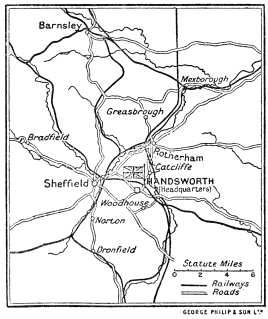 The Defence of Sheffield.
Here and there in the hot night shots rang out, and some daring spirit
fell dead, while more than once a dying scream was heard as a German
bayonet ended the career of some too inquisitive patriot.
Away in Sheffield the town awaited, in breathless tension and hot
unrest, what was felt by everyone to be the coming onslaught. Through
the night the heavy clouds that had gathered after sunset culminated in
a terrific thunderstorm. The heavens seemed rent asunder by the vivid
lightning, the thunder crashed and rolled, and rain fell in torrents
upon the excited populace, who, through the dark hours, crowded around
the barricades in the Sheffield streets. In the murky dawn, grey and
dismal, portentous events were impending.
Information from the enemy’s camp—which was subsequently made
public—showed that well before daylight the advance of the VIIth German
Corps had begun from Doncaster, while along the main road through
Warmsworth and Conisborough sturdily tramped the 13th Division, all
Westphalians, formed into three infantry brigades and commanded by
Lieut.-General Doppschutz. The 14th Division, under Lieut.-General von
Kehler, moving through Balby and Wadworth, prolonged the flank to the
south. The advance of both divisions was thus steadily continued
south-westward parallel to the River Rother, which lay between
themselves and the British. It was therefore plain that the plan of the
senior officer—General Baron von Bistram, commanding the VIIth
Corps—was that the attack should be carried out mainly by that corps
itself, and that strong support should be given to it by the VIIIth
Corps, which was coming, as has already been shown, from East Retford,
and which could effectively assist either to strike the final blow
against our Army, or, keeping well to the south, could threaten
Sheffield from the direction of Staveley.
No one knew what resistance the British were prepared to offer. Full of
courage and patriotism, they were dominated by the proud traditions of
English soldiers; still, it was to be remembered that they consisted
mainly of raw levies, and that they were opposed by a force whose
training and equipment were unequalled in the world, and who outnumbered
them in proportion of about four to one.
What was to be expected? Sheffield knew this—and was breathless and
terrified.
The great thunderstorm of the night helped to swell the Rivers Don and
Rother, and as the invaders would have to cross them, doubtless under a
terrific fire, the battle must result in enormous casualties.
Early on Sunday morning it was evident that the all-important blow, so
long threatened, was about to be struck. During the night great masses
of German artillery had been pushed up to the front, and these now
occupied most of the dominating hills, commanding not only all
approaches to the British position over the River Rother, but they were
even within effective range of the key of the British position itself.
Hundreds of guns—many of them coming under the head of
siege-artillery—were concentrated a little to the east of Whiston,
whence they were able to pour in an oblique fire upon the defences. This
artillery belonged evidently to the VIIth German Corps, and had, with
great labour and difficulty, been hauled by all available horses, and
even by traction-engines, right across the country to where they were
now placed. The heaviest metal of all had been posted on Bricks Hill, an
eminence of some four hundred feet, immediately above the Rother, and
about six thousand yards from Catcliffe, already referred to as the key
of our defences.
Suddenly, at sunrise, a low boom was heard from this point. This was the
opening German gun of the artillery preparation for the attack, which
was now evidently developing, and although the distance was nearly six
thousand yards, yet the bursts of the huge shells were seen to have been
well timed. Another and another followed, and presently these huge
projectiles, hurtling through the air and bursting with a
greenish-yellow smoke, showed that they were charged with some high
explosive. No sooner had this terrific tornado of destruction opened in
real earnest from the enemy, than the field artillery, massed as has
already been described, commenced their long-distance fire at a range of
about three thousand five hundred yards, and for a period, that seemed
hours, but yet was in reality only about fifty minutes, the awful
cannonade continued.
The British guns had already come into action, and intermittent firing
of shrapnel and other projectiles was now directed against the German
batteries.
These latter, however, were mostly carefully concealed, effective cover
having, by means of hard spade-work, been thrown up during the night.
The British guns were mostly served by Volunteers and
Militia-Artillerymen, who, although burning with patriotism, were—owing
to the little real practice they had had in actually firing live shell,
having mostly been drilled with dummy guns—utterly incompetent to make
any impression upon the enemy’s lines of concealed artillery.
It was plain, then, that the Germans had adopted the principle of
massing the bulk of the guns of their two divisions of the VIIth Corps
at such a point that they might strike the heaviest blow possible at the
defence, under cover of which, when resistance had been somewhat beaten
down, the infantry might advance to the attack. This was now being done.
But away to the south was heard the distant roar of other artillery, no
doubt that of Haesler’s Corps, which had apparently crossed the river
somewhere in the neighbourhood of Renishaw, and advancing via Eckington
had established themselves on the high ground, about five hundred and
twenty feet in altitude, just north of Ridgeway, whence they were able
to pour in an enfilading fire all along the British position from its
centre at Woodhouse almost to Catcliffe itself. This rendered our
position serious, and although the German guns had opposed to them the
southernmost flank from Woodhouse to Norton Woodseats, yet it was plain
that the main portion of the British defence was in process of being
“turned.”
The heavy firing continued, and at last, under cover of it, the rear
attack now began some two hours after the opening of the fight.
The 13th Division, under Doppschutz, were evidently advancing by the
main Doncaster road. Their advance guard, which had already occupied
Rotherham, had also seized the bridge which the invaders had neither
time nor material to demolish, and now swept on across it, although
exposed to a heavy onslaught from that line of the British position
between Tinsley and Brinsworth. Those sturdy, stolid Westphalians and
bearded men of Lorraine still kept on. Numbers dropped, and the bridge
was quickly strewn with dead and dying. Yet nothing checked the steady
advance of that irresistible wave of humanity.
Down the River Rother, at Kanklow Bridge, a similar scene was being
enacted. The railway bridge at Catcliffe was also taken by storm, and at
Woodhouse Mill the 14th Division, under Von Kehler, made a terrific and
successful dash, as they also did at Beighton.
The river itself was about an average distance of a mile in front of the
British position, and although as heavy a fire as possible was directed
upon all approaches to it, yet the Germans were not to be denied.
Utterly indifferent to any losses, they still swept on in an
overwhelming tide, leaving at the most not more than ten per cent. of
casualties to be dealt with by the perfectly equipped ambulances in
their rear. So, for the most part, the various regiments constituting
the divisions of the two German commanders found themselves shaken, but
by no means thwarted. On the west bank of the river, the steep slopes
rising from Beighton to Woodhouse gave a certain amount of dead ground,
under cover of which the foreign legions took refuge, in order to
dispose themselves for the final assault.
A similar state of things had taken place to the south. General Graf
Haesler had flung both his divisions across the river, with but little
opposition. The 15th, composed mainly of men of the Rhine, under Von
Kluser, crossed at Killamarsh and Metherthorpe Station, while the 16th,
under Lieut.-General Stolz, crossed at Renishaw, and, striking
north-easterly in the direction of Ridgeway, closed in as they advanced,
till at length they were enabled to be within effective reach of their
comrades on the right.
The German attack had now developed into an almost crescent-shaped
formation, and about noon Von Bistram, the commander-in-chief, issued
his final orders for the assault.
The cavalry of the VIIth German Corps under Major-General von Landsberg,
commanding the 13th Cavalry Brigade, and the 14th Cavalry Brigade,
consisting of Westphalian Hussars and Uhlans, under Major-General von
Weder, were massed in the neighbourhood of Greasborough, whence it might
be expected that at the critical stage of the engagement if the British
defences gave way they might be launched upon the retiring Englishmen.
Similarly in the valley over by Middle Handley, a little south of
Eckington, were found the 15th and 16th Cavalry Brigades of the VIIIth
Corps, consisting of the 15th of Cuirassiers and Hussars of the Rhine,
and the 16th of Westphalians, and the Grand Duke of Baden’s Hussars,
under that well-known soldier, Major-General von Briefen. All these were
equally ready to advance in a northerly direction to strike the crushing
blow at the first of the many important cities which was their
objective.
Unless the scheme of von Bistram, the German generalissimo in the North,
was ill-conceived, then it was plain, even to the defenders, that
Sheffield must eventually give way before the overpowering force opposed
to it.
Within the city of Sheffield the excitement now rose to fever-heat.
It was known that the enemy had closed in upon the defences, and were
now across the river, ready at any moment to continue their advance,
which, as a matter of fact, had developed steadily without intermission,
notwithstanding the heroic efforts of the defenders.
In these days of smokeless powder it was hard for the Germans to see
where the British lines of defence were actually located, but the heavy
pounding of the artillery duel, which had been going on since early
morning, was now beginning to weaken as the German infantry, company by
company, regiment by regiment, and brigade by brigade, were calmly
launched to the attack. They were themselves masking the fire of the
cannon of their own comrades as, by desperate rushes, they gradually
ascended the slopes before them.
The objective of the VIIth Corps seemed to be the strongpoint which has
already been referred to as dominating the position a little west of
Catcliffe, and the VIIIth Corps were clearly directing their energies on
the salient angle of the defence which was to be found a little south of
Woodhouse. From this latter point the general line of the British
position from Woodhouse north to Tinsley would then be turned.
The British stood their ground with the fearless valour of Englishmen.
Though effective defence seemed from the very first futile, steady and
unshaken volleys rang out from every knoll, hillock, and shelter-trench
in that long line manned by the sturdy Yorkshire heroes. Machine-guns
rattled and spat fire, and pom-poms worked with regularity, hurling
their little shells in a ceaseless stream into the invaders, but all,
alas! to no purpose. Where one German fell, at least three appeared to
take his place. The enemy seemed to rise from the very ground. The more
stubborn the defence, the more numerous the Germans seemed to become,
gaps in their fighting line being reinforced in that ruthless manner
which is such a well-known principle in German tactics—namely, that the
commander must not be sparing in his men, but fling forward
reinforcements at whatever cost.
Thus up the storm-swept glacis reaching from the Rother struggled
thousands of Germans in a tide that could not be stemmed, halting and
firing as they advanced, until it became clear that an actual
hand-to-hand combat was imminent.
The British had done all that men could. There was no question of
surrender. They were simply swept away as straws before a storm. Dead
and dying were on every hand, ambulances were full, and groaning men
were being carried by hundreds to the rear. General Woolmer saw that the
day was lost, and at last, with choking emotion, he was compelled to
give that order which no officer can ever give unless to save useless
bloodshed—“Retire!—Retire upon Sheffield itself!”
Bugles rang out, and the whistles of the officers pierced the air. Then
in as orderly a manner as was possible in the circumstances, and amid
the victorious shouts from thousands of German throats, the struggling
units fell back upon the city.
The outlook was surely black enough. Worse was, however, yet to follow.
In the line of retreat all roads were blocked with endless masses of
wagons and ambulances, and in order to fall back at all men had to take
to the open fields and clamber over hedges, so that all semblance of
order was very quickly lost.
Thus the retreat became little short of a rout.
Presently a shout rang out. “The cavalry! The cavalry!”
And then was seen a swarm of big Uhlans riding down from the north at a
hand-gallop, evidently prepared to cut off the routed army.
By Tinsley Park a body of Volunteers were retreating in an orderly
manner, when the alarm of the cavalry advance reached their ears. Their
colonel, a red-faced, bearded old gentleman, wearing the green ribbon of
the V.D., and who in private life was a brewery’s manager at Tadcaster,
rose in his stirrups and, turning round towards the croup of his
somewhat weedy steed, ejaculated the words in a hoarse and raucous
bellow: “Soaky Poo!”
His men wondered what he meant. Some halted, believing it to be a new
order which demanded further attention, until a smart young subaltern,
smiling behind his hand, shouted out, “Sauve qui peut—Every man for
himself!”
And at this there was a helter-skelter flight on the part of the whole
battalion.
The Uhlans, however, were not to be denied, and, circling round through
Attercliffe, and thence south towards Richmond Park, they effectively
placed themselves across the line of retreat of many of the fugitives.
The latter practically ran straight into the lines of the Germans, who
called to them to lay down their arms, and in half an hour along the
cordon over two thousand five hundred British of all arms found
themselves prisoners in the hands of Von Landsberg, upon whose brigade
the brunt of this attack had fallen.
General von Wedel, of the 14th Cavalry Brigade, was not inactive. He
pursued the flying columns along all the roads and country north-east of
the city. From the south came news of the cavalry of the VIIIth Corps,
which had circled through Dronfield, Woodhouse, Totley, along Abbey
Dale, till they made an unresisted entry into Sheffield from the south.
Within the town it was quickly seen that the day was lost. All
resistance had been beaten down by the victorious invaders, and now, at
the Town Hall, the British flag was hauled down, and the German ensign
replaced it. From every street leading out of the city to the west
poured a flying mob of disorganised British troops, evidently bent upon
making the best of their way into the hilly district of the Peak of
Derbyshire, where, in the course of time, they might hope to reorganise
and re-establish themselves.
The German pursuit, although very strenuous on the part of the cavalry
as far as effecting the occupation of the city was concerned, did not
extend very much beyond it. Clearly the invaders did not want to be
burdened with a large number of British prisoners whom they had no means
of interning, and whom it would be difficult to place on parole. What
they wanted was to strike terror in the great cities of the north.
Sheffield was now theirs. Nearly all the ammunition and stores of the
defenders had fallen into their hands, and they were enabled to view,
with apparent equanimity, the spectacle of retreating masses of British
infantry, yeomanry, and artillery. Westwards along the network of roads
leading in the direction of the High Peak, Derwent Dale, Bradfield,
Buxton, and on to Glossop, the British were fast retreating, evidently
making Manchester their objective.
Sheffield was utterly dumbfounded. The barricades had been broken down
and swept away. The troops, of whom they had hoped so much, had been
simply swept away, and now the streets were full of burly foreigners.
George Street swarmed with Westphalian infantry and men of Lorraine; in
Church Street a squadron of Uhlans were drawn up opposite the Sheffield
and Hallamshire Bank, while the sidewalk was occupied by piled arms of
the 39th Fusilier Regiment. In the space around the Town Hall the 6th
Infantry Regiment of the Rhine and a regiment of Cuirassiers were
standing at ease. Many of the stalwart sons of the Fatherland were seen
to light their pipes and stolidly enjoy a smoke, while officers in small
groups stood here and there discussing the events of the victorious day.
The saddest scenes were to be witnessed at the Royal Infirmary, in
Infirmary Road, at the Royal Hospital in West Street, and even in some
of the vacant wards in the Jessop Hospital for Women in Victoria Street,
which had to be requisitioned for the accommodation of the crowds of
wounded of both nations, so constantly being brought in by carts,
carriages, motor-cars, and even cabs.
The St. John’s Ambulance Brigade, with many ladies, were doing all they
could to render aid, while the Queen Victoria Jubilee Institute for
Nurses was called upon for all available help. Every place where sick
could be accommodated, including the well-known George Woofindin
Convalescent Home, was crowded to overflowing with sufferers, while
every doctor in Sheffield bore his part in unceasing surgical work. But
the number of dead on both sides it was impossible to estimate.
At the Town Hall the Lord Mayor, aldermen, and councillors assembled,
and met the German General, who sternly and abruptly demanded the
payment of half a million pounds sterling in gold as an indemnity,
together with the production of all stores that the German Army should
require in order that they could re-victual.
In reply the Lord Mayor, after consulting with the Council, stated that
he would call a meeting of all bank managers and heads of the great
manufacturing firms in order that the demand might be, as far as
possible, complied with. This answer was promised at five p.m.
Meanwhile, on the notice-board outside the Town Hall, a proclamation was
affixed by the Chief of the German Staff, a sentry being posted on
either side of it to prevent it being torn down.
Copies were sent to the offices of the local newspapers, and within half
an hour its tenor was known in every part of the city. Throughout the
night German cavalry patrolled all the main streets, most of the
infantry being now reassembled into their brigades, divisions, and army
corps on the southern outskirts of the city, and in Norton, Coal Aston,
Dronfield, and Whittington were being established the headquarters of
the four different divisions of which the VII. and VIII. Corps
respectively were composed.
Reports from Sheffield stated that on Sunday the gallant defence of the
town by General Sir George Woolmer had been broken. We had suffered a
terrible reverse. The British were in full flight, and the two
victorious Corps now had the way open to advance to the metropolis of
the Midlands, for they knew that they had left behind them only a
shattered remnant of what the day before had been the British Army of
the North.
In both Houses of Parliament, hastily summoned, there had been memorable
scenes. In the Commons, the Government had endeavoured to justify its
suicidal actions of the past, but such speeches were howled down, and
even the Government organs themselves were now compelled to admit that
the party had committed very grave errors of judgment.
Each night the House had sat until early morning, every member who had
been in England on the previous Sunday being in his place. In response
to the ever-repeated questions put to the War Minister, the reply was
each day the same. All that could be done was being done.
Was there any hope of victory? That was the question eagerly asked on
every hand—both in Parliament and out of it. At present there seemed
none. Reports from the theatres of war in different parts of the country
reaching the House each hour were ever the same—the British driven back
by the enemy’s overwhelming numbers.
The outlook was indeed a black one. The lobby was ever crowded by
members eagerly discussing the situation. The enemy were at the gates of
London. What was to be done?
In the House on Friday, September 7, in view of the fact that London was
undoubtedly the objective of the enemy, it was decided that Parliament
should, on the following day, be transferred to Bristol, and there meet
in the great Colston Hall. This change had actually been effected, and
the whole of both Houses, with their staff, were hurriedly transferred
to the west, the Great Western Railway system being still intact.
The riff-raff from Whitechapel, those aliens whom we had so long
welcomed and pampered in our midst—Russians, Poles, Austrians, Swedes,
and even Germans—the latter, of course, now declared themselves to be
Russians—had swarmed westward in lawless, hungry multitudes, and on
Monday afternoon serious rioting occurred in Grosvenor Square and the
neighbourhood, and also in Park Lane, where several houses were entered
and pillaged by the alien mobs.
The disorder commenced at a great mass meeting held in the Park, just
behind the Marble Arch. Orators were denouncing the Government and
abusing the Ministers in unmeasured terms, when someone, seeing the many
aliens around, set up the cry that they were German spies. A free fight
at once ensued, with the result that the mob, uncontrolled by the
police, dashed across into Park Lane and wrecked three of the largest
houses—one of which was deliberately set on fire by a can of petrol
brought from a neighbouring garage. Other houses in Grosvenor Square
shared the same fate.
In every quarter of London shops containing groceries, provisions, or
flour were broken open by the lawless bands and sacked. From Kingsland
and Hoxton, Lambeth and Camberwell, Notting Dale and Chelsea, reports
received by the police showed that the people were now becoming
desperate. Not only were the aliens lawless, but the London unemployed
and lower classes were now raising their voices. “Stop the war! Stop
the war!” was the cry heard on every hand. Nearly all the shops
containing provisions in Whitechapel Road, Commercial Road East, and
Cable Street were, during Monday, ruthlessly broken open and ransacked.
The police from Leman Street were utterly incompetent to hold back the
rush of the infuriated thousands, who fought desperately with each other
for the spoils, starving men, women, and children all joining in the
fray.
The East End had indeed become utterly lawless. The big warehouses in
the vicinity of the docks were also attacked and most of them emptied of
their contents, while two at Wapping, being defended by the police, were
deliberately set on fire by the rioters, and quantities of wheat burned.
Fierce men formed themselves into raiding bands and went westward that
night, committing all sorts of depredations. The enemy were upon them,
and they did not mean to starve, they declared. Southwark and
Bermondsey, Walworth and Kennington had remained quiet and watchful all
the week, but now, when the report spread of this latest disaster to our
troops at Sheffield, and that the Germans were already approaching
London, the whole populace arose, and the shopbreaking, once started in
the Walworth and Old Kent Roads, spread everywhere throughout the whole
of South London.
In vain did the police good-humouredly cry to them to remain patient; in
vain did the Lord Mayor address the multitude from the steps of the
Royal Exchange; in vain did the newspapers, inspired from headquarters,
with one accord urge the public to remain calm, and allow the
authorities to direct their whole attention towards repelling the
invaders. It was all useless. The public had made up its mind.
At last the bitter truth was being forced home upon the public, and in
every quarter of the metropolis those very speakers who, only a couple
of years before, were crying down the naval and military critics who
had dared to raise their voices in alarm, were now admitting that the
country should have listened and heeded.
London, it was plain, had already abandoned hope. The British successes
had been so slight. The command of the sea was still in German hands,
although in the House the Admiralty had reassured the country that in a
few days we should regain the supremacy.
A few days! In a few days London might be invested by the enemy, and
then would begin a reign of terror unequalled by any in the history of
the civilised world.
By day the streets of the city presented a scene of turmoil and
activity, for it seemed as though City workers clung to their old habit
of going there each morning, even though their workshops, offices, and
warehouses were closed. By night the West End, Pall Mall, Piccadilly,
Oxford Street, Regent Street, Portland Place, Leicester Square,
Whitehall, Victoria Street, and around Victoria Station were filled with
idle, excited crowds of men, women, and children, hungry, despairing,
wondering.
At every corner men and boys shouted the latest editions of the
newspapers. “ ’Nother great Battle! ’Nother British Defeat! Fall of
Sheffield!” rose above the excited chatter of the multitude. The cries
fell upon the ears of defenceless Londoners, darkening the outlook as
hour after hour wore on.
The heat was stifling, the dust suffocating, now that the roads were no
longer cleaned. The theatres were closed. Only the churches and chapels
remained open—and the public-houses, crowded to overflowing. In
Westminster Abbey, in St. Paul’s Cathedral, in St.
Martin’s-in-the-Fields, and in Westminster Cathedral special prayers
were that night being offered for the success of the British arms. The
services were crowded by all sorts and conditions of persons, from the
poor, pinched woman in a shawl from a Westminster slum, to the lady of
title who ventured out in her electric brougham. Men from the clubs
stood next half-starved working men, and more than one of the more
fortunate slipped money unseen into the hand of his less-favoured
brother in adversity.
War is a great leveller. The wealthy classes were, in proportion, losing
as much as the workers. It was only the grip of hunger that they did not
feel, only the cry of starving children that did not reach their ears.
For the rest, their interests were equal.
Meanwhile, from every hand rose the strident cries of the newsboys:
“ ‘Nother great Battle! British routed at Sheffield! Extrur
spe-shall!—spe’shall!”
British routed! It had been the same ominous cry the whole week through.
Was London really doomed?