William Lithgow—Elizabeth Vasconellos—John Coustos—Mr. Bower.
Spanish and Portuguese bigotry could not be satisfied with the sacrifice
of native subjects. The vengeance of the Inquisition had been wreaked on
the helpless of other nations, whom Providence, from time to time,
brought within its grasp. To prevent their sufferings had not always
been in the power of foreign governments; and even British subjects have
been sufferers by this horrid court. The terror of the name of Oliver
Cromwell, the Lord Protector of England, compelled the inquisitors to
liberate and to honour the English consul, Thomas Maynard. (See Chapter
XI.) But how many have been tortured and murdered in the concealment of
the Inquisition cannot be ascertained by us before the day of judgment.
A few cases of such sufferers may, however, be given, still further to
illustrate the intolerance and cruelty of the papacy.
1. William Lithgow.—William Lithgow was a gentleman of Scotland, and
while travelling on foot over Europe he came to Malaga, in Spain, in the
year 1620, when he was apprehended as a spy connected with the English
fleet then in that port. His cruel treatment by the governor and his
sufferings in the Inquisition will best appear from his own words, as
follows:—
“Upon the knowledge that I was secretly to be incarcerate in the
governor’s palace, entered the Mr. Sergeant and begged my money, and
license to search it; and liberty granted, he found in my pockets eleven
phillipoes or ducatoons; and then unclothing me before their eyes, even
to my shirt, and searching my breeches, he found in my doublet-neck,
fast shut between two canvasses, a hundred and thirty-seven double
pieces of gold. Whereat the corregidor arose, and counting my gold,
being five hundred and forty-eight ducats, he said to the sergeant,
‘Clothe him again, and enclose him there in the cabinet till after
supper.’ Meanwhile, the sergeant got the eleven ducatoons of silver; and
my gold, which was to take me to Ethiopia, the governor seized upon;
giving afterwards two hundred crowns of it to supply the new foundation
of a Capuchin monastery there, reserving the rest, being three hundred
and forty-eight ducats, for his own avaricious ends.
“This done, and midnight come, the sergeant and two Turkish slaves,
releasing me from the inferior room, brought me through certain
ascending passages to a chamber right above his summer kitchen; where,
and then, the sergeants and the two slaves thrust on every ancle a heavy
bolt, my legs being put to a full stride, by a strong gad of iron, far
above a yard long; upon the ends of which the two bolts depended that
were fastened about my legs; insomuch that I could never sit up, nor
walk, nor stand, nor turn me, but lay continually on my back, the two
irons being thrice heavier than my body. They left me with solacious
words, and straight returned with victuals, being a pound of boiled
mutton, a wheat bread, and a small pint of wine, which was the first,
the best, and the last of this kind that ever I got in that woeful
mansion. The sergeant leaving me, never seeing him more till a more
unwelcome sight, he directed the slaves that after I had contented my
discontented appetite, they should lock the door and carry the keys to
Areta, a Spaniard, and keeper of the silver plate. The day following,
the governor entered my prison alone, entreating me to confess that I
was a spy, and he would be my friend, and procure my pardon; neither in
the meantime should I lack any needful thing. But I still attesting my
innocence, he wrathfully swore that I should see his face no more till
grievous torments should make me do it; and leaving me in a rage he
observed too well his condition.
“But withal, in my hearing, he commanded Areta that none should come
near me, except the slave, nor any food be given me but three ounces of
musted brown bread every second day, and a fuleto, or English pint of
water, neither any bed, pillow, or coverlet to be allowed me. ‘And close
up,’ said he, ‘this window in his room, with lime and stone; stop the
holes of the doors with double mats, hanging another lock on it; and to
withdraw visible and sensible comfort from him, let no tongue nor feet
be heard near him till I have my designs accomplished. And thou, Hazier,
I charge thee, at thy incomings to have no conference with him, nor at
thy outgoings abroad to discover him to the English factors, as thou
wilt answer upon thy life, and the highest tortures that can be
devised.’ These directions delivered, and, alas! too accessory to me in
the performance, my room was made a dark drawn dungeon, my body the
anatomy of merciless hunger, my comfortless hearing the receptacle of
sounding bells, my eye wanting light, a loathsome languishing in
despair, and my ground-lying body the woeful mirror of misfortunes,
every hour wishing another’s coming, every day the night, and every
night the morning. My body grew weak and infirm, insomuch that the
governor, after his answers received from Madrid, made haste to put in
execution his bloody and merciless purpose before Christmas holyday;
lest, ere the expiring of the twelfth day, I should be utterly famished,
and unable to undergo my trial without present perishing. By God’s
permission, the forty-seventh day after my first imprisonment, and five
days before Christmas, about two o’clock in the morning, I heard the
noise of a coach in the street; within a while I heard the locks of my
prison door opening; whereupon, bequeathing my soul to God, I humbly
implored his gracious mercy and pardon for my sins; for neither in the
former night, nor in this, could I get any sleep, such was the force of
my gnawing hunger, and the portending heaviness of my presaging soul.
“Meanwhile, nine sergeants, accompanied with the scrivan, entered the
room without speaking, and carrying me thence, they laid me on my back
in the coach, where two of them sat beside me. Baptista, the coachman,
an Indian negro, arriving, I was brought westward, almost a league from
the town, to a vine-press house, standing alone, where they enclosed me
in the room till daylight; for hither the rack had been brought the
night before. All this secrecy was used, that neither English, French,
or Flemings, should see or get any knowledge of my trial, my grievous
tortures, and dreadful despatch. At the break of day the governor, Don
Francisco, and the alcaide came, and I, invited to their presence,
pleaded for an interpreter, the which they absolutely refused; neither
would they suffer or grant me an appellation to Madrid. After new
examinations from morning till dark night, finding my first and second
confessions run into one, the governor swore, ‘Is it possible he can, in
such distress, and so long a time, observe, so strictly, in every
manner, the points of his first confession?’
“The governor’s interrogation and my confession being mutually
subscribed, he and Don Francisco besought me earnestly to confess my
guiltiness in time, saying, ‘Thou art as yet in my power, and I may
spare or pardon thee, providing thou wilt confess thyself a spy, and a
traitor against our nation.’ But finding me stand fast to the mark of my
spotless innocency, he, invective and malicious he, after many
tremendous threatenings, commanded the scrivan to draw up a warrant for
the chief-justice; which being done, he set his hand to it, and, taking
me by the hand, delivered me and the warrant into the alcaide-major’s
hands, to be tortured, broken, and cruelly tormented. Whence being
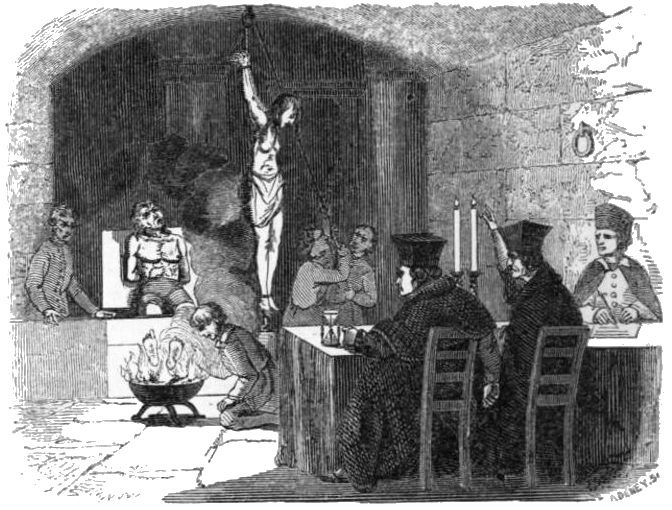
carried along to the end of a stone gallery, where the rack was placed,
the encarnador, or tormentor, began to disburden me of my irons, which
he could not unloose for a long time, whereat the chief-justice being
offended, the malicious villain struck away above an inch of my heel
with the bolt; whereupon I grievously groaning, being exceeding faint,
and without my three ounces of bread and a little water for three days
together, the alcaide said, ‘O, traitor, all this is nothing, but the
earnest of a greater bargain you have in hand!’
“After this, the alcaide and scrivan, being both chair-set, the one to
examine, the other to write down my confession and tortures, I was
stripped to the skin, brought to the rack, and mounted to the top of it;
where, soon after, I was hung by the bare shoulders, with two small
cords, which went under my arms, running on two rings of iron that were
fixed to the wall above my head. Then being hoisted to the appointed
height, the tormentor descended below, and, drawing my legs through the
two sides of the three-planked rack, he tied a cord about each of my
ancles; and then ascending upon the rack, he drew the cord upward, and
bending forward with main force my two knees against the two planks, the
sinews of my two hams burst asunder, and the lids of my knees being
crushed, and the cords made fast, I hung so for a large hour. At last,
the encarnador informing the governor that I had the mark of Jerusalem
on my right arm, joined with the name and crown of King James, and done
upon the holy grave, the corregidor gave direction to tear asunder the
name and crown, as he said, of that heretic king, and arch enemy of the
holy Catholic church. Then the tormentor, laying the right arm above the
left, and the crown upmost, did cast a cord over both arms, seven
distinct times; and then lying down upon his back, and setting both his
feet upon my hollow pinched belly, he charged and drew violently with
his hands, making my womb support the force of his feet, till the
several cords combined in one place of my arm; and cutting the crown,
sinews, and flesh to the bare bones, did pull in my fingers close to
the palm of my hands; the left hand of which is lame so still, and will
be for ever.
Now mine eyes began to startle, my mouth to foam and froth, and my teeth
to chatter like to the doubling of drumsticks. O strange inhumanity of
monster men-manglers! surpassing the limits of their national law;
threescore tortures being the trial of treason, which I had, and was to
endure; yet thus to inflict a sevenfold surplusage of more intolerable
cruelties; and, notwithstanding of my shivering lips in this fiery
passion, my vehement groaning, and blood springing forth from my arms,
broke sinews, hams, and knees, yea, and my depending weight on
flesh-cutting cords, yet they struck me on the face with cudgels, to
abate and cease the thundering noise of my wrestling voice. At last,
being loosed from these pinnacles of pain, I was, handfast, set on the
floor, with this their imploration, ‘Confess, confess, confess in time,
for thine inevitable ensue;’ when, finding nothing from me but still
innocent, ‘O, I am innocent; O Jesus! the Lamb of God, have mercy upon
me, and strengthen me with patience to undergo this barbarous murder.’
“Then, by command of the justice, was my trembling body laid above and
long, upon the face of the rack, with my head downward, inclosed within
a circled hole, my belly upward toward the top of the rack; my legs and
arms being drawn asunder, were fastened with pins and cords to both
sides of the outward planks, for now was I to receive my greatest
torments.
Now, the alcaide giving commission, the executioner laid fast a cord
over the calf of my leg, then another in the middle of my thigh; and the
third cord over the great part of my arm, which was severally done on
both sides of my body, receiving the ends of the cords from the six
several places, through the holes made in the outward planks, which were
fastened to pins, and the pins made fast with a device: for he was to
charge on the outside of the planks with as many pins as there were
holes and cords, the cords being first laid next to my skin; and on
every one of these six parts of my body I was to receive seven several
tortures, each torture consisting of three winding throws of every pin,
which amounted to twenty-one throws in every one of those six parts.
Then the tormentor, carrying a pot full of water, in the bottom whereof
was a hole, stopped by his thumb till it came to my mouth, he did pour
it into my belly; the measure being an English pottle. The first and
second services I gladly received, such was the scorching drought of my
tormenting pain, and I had drunk none for three days before. But at the
third charge, perceiving these measures of water to be inflicted upon me
as tortures, I closed my mouth; whereat, the alcaide, enraged, set my
teeth asunder with a pair of iron cadges, whereupon my hunger-charged
belly waxing great, grew drum-like; for it being a suffocating pain, in
regard of my head hanging downward, and the water re-ingorging itself in
my throat with a struggling force, it strangled and swallowed up my
breath from yowling and groaning.
“Between each one of these seven circular charges I was always
re-examined half an hour; each half hour a hell of infernal pain; and
between each torment a long distance of life-quelling time. Thus lay I
six hours upon the rack, between four o’clock in the afternoon and ten
o’clock at night, having had inflicted upon me threescore and seven
torments. Nevertheless, they continued me a large half hour, after all
my torture, at the full bending, my body being all begored with blood,
and cut through, in every part, to the crushed and bruised bones; I
pitifully roaring, howling, foaming, and gnashing my teeth, with
insupportable cries, before the pains were undone and my body loosed.
True it is, it passeth the capacity of man either sensibly to conceive,
or I patiently to express, the intolerable anxiety of mind and
affliction of body, in that dreadful time I sustained. At last, my head
being by their arms advanced, and my body taken from the rack, the water
regushed abundantly from my mouth; then they, reclothing my broken,
bloody, cold, and trembling body, being all this time stark naked, I
fell twice in a sounding trance; which they again refreshed with a
little wine, and two warm eggs—not done out of charity, but that I
should be reserved for further punishment; and if it were not well known
that these sufferings are true, it would almost seem incredible to many,
that a man, being brought so low with starving hunger and extreme
cruelties, could have subsisted any longer, reserving life.
“And now, at last, they charged my broken legs with my former
eye-frighting irons, and carried me to the coach, being after brought
secretly to my former dungeon, without any knowledge of the town, save
to my lawless and merciless tormentors. I was laid, with my head and
heels alike high, on my former stones. The latter end of this woeful
night, poor mourning Hazier, the Turk, was sent to keep me; and on the
morrow the governor entered my room, threatening me with still more
tortures, to confess; and so he caused every morning, to make me believe
I was going to be racked again, to make me confess an untruth; and thus
they continued every day of five days to Christmas.
“Upon Christmas-day, Marina, the ladies’ gentlewoman, got permission to
visit me, and with her licence she brought abundance of tears,
presenting me also with a dish of honey, sugar, some confections, and
raisins in great plenty, to my no small comfort, besides using many
sweet speeches, for consolation’s sake. The twelfth day of Christmas
expired, they began to threaten me on still with more tortures, even
till Candlemas. In all which comfortless time I was miserably afflicted
with the beastly plague of gnawing vermin, which lay crawling in lumps,
within, without, and about my body; yea, hanging in clusters about my
beard, my lips, my nostrils, and my eye-brows, almost inclosing my
sight. And for my greater satisfaction to their merciless minds, the
governor called Areta, his silver-plate keeper, to gather and sweep the
vermin upon me twice in eight days, which tormented me almost to death,
being a perpetual punishment; yet the poor infidel, some few times, and
when opportunity served, would steal the keys from Areta, and about
midnight would enter my room, with sticks and burning oil, and sweeping
them together in heaps, would burn the greatest part, to my great
release; or, doubtless, I had been miserably eaten up and devoured by
them.”
Cruelty more diabolical it appears difficult to imagine, than that
exercised upon this unhappy Scotchman. Yet he was preserved for still
greater suffering. For being now in the power of the inquisitors, they
pretended to be anxious for his soul’s salvation; and therefore they
implored him to be converted to the Roman Catholic faith, that he might
escape condemnation to the flames as a heretic. When the inquisitor
interrogated him as to his difficulties, errors, and misbelief, Lithgow
replied, like a North Briton taught by the Bible, that “he was confident
in the promises of our Saviour, believing the revealed doctrines of the
Gospel, professed by the reformed Catholic church; that these being
confirmed by grace, he possessed an infallible assurance in his own soul
of the true word of Christ.” “To these words,” as Lithgow observes, “he
answered, ‘Thou art no Christian, but an absurd heretic, and, without
conversion, a member of perdition.’ Whereupon I replied, ‘Reverend Sir,
the nature of charity and religion does not consist in opprobrious
speeches: wherefore, if you would convert me, as you say, convince me by
argument; if not, all your threatenings of fire, death, or torments,
shall not make me shrink from the truth of God’s word in Sacred
Scriptures,’ Whereupon the mad inquisitor clapt me on the face with his
foot, abusing me with many railings; and if the Jesuits had not
intercepted him, he had stabbed me with a knife; where, when dismissed,
I never saw him more.”
Lithgow was as little affected by another interview with an inquisitor;
he made no confession, and he was sentenced to be again tortured. He
says, therefore, “I was condemned to receive that night eleven
strangling torments in my dungeon; and then, after Easter holidays, I
should be transported privately to Granada, and there, about midnight,
to be burnt, body and bones, into ashes, and my ashes to be flung into
the air. Well, that same night, the scrivan, sergeants, and the young
English priest entered my melancholy prison, where the priest, in the
English tongue, urging me all he could, though little it was he could
do, and not prevailing, I was disburdened of mine irons, unclothed to my
skin, set on my knees, and held up fast with their hands; where,
instantly setting my teeth asunder with iron cadges, they filled my
belly full of water, even gorging to my throat; then with a garter they
bound fast my throat, till the white of mine eye turned upward; and
being laid on my side, I was tumbled by two sergeants to and fro seven
times through the room, till I was almost strangled. This done, they
fastened a small cord about each of my great toes, and hoisting me
therewith to the roof of a high loft (for the cords ran in two rings
fastened above), they cut the garter, and there I hung, with my head
downward, in my tormented weight, till all the gushing water dissolved.
This done, I was let down from the loft, quite senseless, lying a long
time cold dead among their hands; whereof the governor being informed,
came running up stairs, crying, ‘Is he dead? O fie, villains, go fetch
me wine!’ which they poured in my mouth, regaining thereby a slender
spark of breath.
“These strangling torments closed, and I reclothed and fast bolted
again, they left me lying on the cold floor, praising my God, and
singing of a psalm. The next morning, the pitiful Turk visiting me with
bread and water, brought me also secretly, in his shirt sleeve, two
handfuls of raisins and figs, laying them on the floor, amongst the
crawling vermin; for having no use of arms, I was constrained by hunger
and impotency of time to lick one up with another with my tongue. This
charity of figs the slave did once every week or fortnight, or else I
had long or then famished.”
Mr. Lithgow’s case became known, by some means, to the English factors
at Malaga; and they, therefore, at once united with the consul in an
application to the king and council of Spain. Their petition was
granted, and the release of the wretched prisoner was ordered, in a
warrant to the governor. His generous friends received the injured
confessor, treated him with kindness, and procured for him a passage to
England in a ship-of-war, in 1621. His case being made known at court,
he was visited by many of the nobility, and by King James I., who
commanded him to be sent to the Spanish ambassador, then in London.
That grandee promised that restitution should be made to him of the
money and valuables that had been taken from him at Malaga, and
compensation for the injuries that he had sustained in prison. These
assurances were not, however, honoured; and Mr. Lithgow, reproaching the
ambassador with having deceived him, and, as some say, striking him,
under the provocation, he was imprisoned for some months in the
Marshalsea, London.
2. Elizabeth Vasconellos.—This lady, having been released from the
Inquisition at Lisbon, made the following deposition, in December,
1706:—
“Elizabeth Vasconellos, now in the city of Lisbon, doth on the 10th day
of December, Anno 1706, in the presence of John Milner Esq., her
majesty’s consul-general of Portugal, and Joseph Willcocks, minister of
the English factory at Lisbon, declare and testify,
“That she was born at Arlington, in the county of Devon, and a daughter
of John Chester, Esq., bred up in the church of England; and in the
eleventh year of her age, her uncle, David Morgan, of Cork, intending to
go and settle in Jamaica, as a physician, by her father’s consent, he
having several children, took her with him to provide for her.
“In 1685, they went in an English ship, and near the island they were
attacked by two Turkish ships; in the fight her uncle was killed, but
the ship got clear into Madeira, and she, though left destitute, was
entertained by Mr. Bedford, a merchant, with whom, and other English,
she lived as a servant till 1696. In that year she was married, by the
chaplain of an English man-of-war, to Cordoza Vasconellos, a physician
of that island, and lived with him eight years, and never in the least
conformed to the Romish church.
“In 1704, her husband being gone on a voyage to Brazil, she fell
dangerously ill, and, being light-headed, a priest gave her the
sacrament, as she was told afterwards, for she remembered nothing of it.
It pleased God she recovered, and then they told her she had changed her
religion, and must conform to the Romish church, which she denied, and
refused to conform; and thereupon, by the bishop of that island, she was
imprisoned nine months, and then sent prisoner to the Inquisition at
Lisbon, where she arrived the 19th of December, 1705. The secretary of
the house took her effects, in all above £500 sterling; she was then
sworn that that was all she was worth, and then put into a strait dark
room, about five feet square, and there kept nine months and fifteen
days.
“That the first nine days she had only bread and water, and a wet straw
bed to lie on. On the ninth day, being examined, she owned herself a
Protestant, and would so continue; she was told she had conformed to the
Romish church, and must persist in it or burn; she was then remanded to
her room, and after a month’s time brought out again, and persisting in
her answer as to her religion, they bound her hands behind her, stripped
her back naked, and lashed her with a whip of knotted cords a
considerable time, and told her afterwards that she must kneel down to
the court, and give thanks for their merciful usage of her, which she
positively refused to do.
“After fifteen days she was again brought forth and examined, and a
crucifix being set before her, she was commanded to bow down to it and
worship it, which she refusing to do, they told her that she must expect
to be condemned to the flames and to be burnt with the Jews, at the next
auto da fé, which was nigh at hand; upon this she was remanded to her
prison again for thirty days, and being brought out, a red-hot iron was
got ready, and brought to her in a chafing-dish of burning coals, and
her breast being laid open, the executioner, with one end of the red-hot
iron, which was about the bigness of a large seal, burnt her to the bone
in three several places on the right side, one hard by the other, and
then sent her to her prison, without any plaister, or other application,
to heal the sores, which were very painful to her.
“A month after this, she had another severe whipping as before; and, in
the beginning of August, she was brought before the table, a great
number of inquisitors being present, and was questioned, whether she
would profess the Romish religion or burn. She replied, she had always
been a Protestant, and was a subject of the queen [Anne] of England, who
was able to protect her, and she doubted not would do it, were her
condition known to the English residing in Lisbon; but as she knew
nothing of that, her resolution was to continue a Protestant, though
she were burnt for it. To this they answered, that her being the queen
of England’s subject signified nothing in the dominions of the king of
Portugal; that the English residing in Lisbon were heretics, and would
certainly be damned; and that it was the mercy of that tribunal to
endeavour to rescue her out of the flames of hell; but if her resolution
were to burn, rather than profess the Romish religion, they would give
her a trial of it beforehand. Accordingly, the officers were ordered to
seat her in a fixed chair, and to bind her arms and her legs, that she
could make no resistance nor motion; and the physician being placed by
her, to direct the court how far they might torture her without hazard
of life, her left foot was made bare, and an iron slipper red-hot being
immediately brought in, her foot was fastened into it, which continued
on burning her to the bone, till such time as, by extremity of pain, she
fainted away, and the physician declaring her life was in danger, they
took it off, and ordered her again to her prison.
“On the 19th of August she was again brought out, and whipped after a
cruel manner, and her back was all over torn; and being threatened with
more and greater tortures, and on the other hand being promised to be
set at liberty, if she would subscribe such a paper as they should give
her, though she could have undergone death, yet not being able to endure
a life of so much misery, she consented to subscribe as they would have
her, and accordingly, as she was directed, wrote at the bottom of a
large paper, which contained she knew not what; after which they advised
her to avoid the company of all English heretics, and not restoring to
her anything of all the plate, goods, or money, she brought in with her,
and engaging her by oath to keep secret all that had been done to her,
turned her out of doors, destitute of all relief, but what she received
from the help and compassion of charitable Christians.
“The abovesaid Elizabeth Vasconellos did solemnly affirm and declare the
above-written deposition to be true, the day and year above written.
“John Milner,
“Joseph Willcocks.
“Lisbon, January 8, 1707, N. S.”
3. John Coustos.—Mr. Coustos having escaped from the Inquisition,
published the narrative of his sufferings, shortly after his return to
England in 1744. From his account the following is abridged:—
“I am a native of Berne in Switzerland, and a lapidary. In 1716, my
father came and settled in London; and after living twenty-two years in
that city, I went to Paris, to work in the galleries of the Louvre. Five
years after I removed to Lisbon, in hopes of going to Brazil, to make my
fortune; but the king of Portugal being informed of the skill I might
have in diamonds, refused my petition, as improper for a foreign
lapidary to be allowed in a country abounding with immense treasures.
“I got acquainted with several jewellers and other persons of credit in
Lisbon, whose generous offers I accepted, having a prospect of
supporting my family and of a competency, could I but have escaped the
cruel inquisitors. They have assumed so formidable a power in Spain and
Portugal, as to encroach on the privilege of kings, and stop, at the
post-office, the letters of all whom they suspect. In this manner I was
served a year before the inquisitors ordered me to be seized, in order
to discover the secrets of freemasonry. They did not find that it struck
at the Romish religion, or tended to disturb the government—still they
concluded to seize one of the chief freemasons of Lisbon; and I was
pitched upon as master of a lodge, and Mr. A. J. Mouton, a diamond
cutter, born at Paris, and a Romanist. He had been six years at Lisbon,
a housekeeper in the city, where his integrity gained him the
approbation of all.
“We did not know that our art was forbidden in Portugal, and we were
discovered by the barbarous zeal of a lady at confession. The officers
of the Inquisition engaged a jeweller, a familiar of the Holy Office, to
send for Mr. Mouton on pretence of mending a diamond weighing four
carats. This was a mere pretence to know the person of Mouton. I
happened to be with him, which gave the jeweller the highest joy. He
made his report to the inquisitors; and, two days after, Mr. Mouton went
alone to fetch the diamond, computed to be worth a hundred moidores.
This familiar had five subalterns of the Inquisition with him; and
having led him into the back shop, they seized him as a prisoner in the
king’s name.
“Being sensible that he had not committed any crime, so as to incur his
Portuguese majesty’s displeasure, he gave up his sword, when several
familiars fell upon him, and declared that they arrested him in the name
of the Inquisition. Forbidding him to murmur, they dragged him to a
small chaise at the back-door, and conveyed him to prison in the
Inquisition, and spread a report that he was gone off with the diamond.
His friends, shocked at the slander, went and offered full payment to
the jeweller, who declined the amount, pretending that the owner was
very wealthy.
“Four days after, I was betrayed by a Portuguese friend, and nine
officers of the Inquisition seized me, March 5, 1743, pretending I had
passed my word for the diamond which Mr. Mouton had taken. In vain was
my attempt at justification: the wretches took away my sword, handcuffed
me, and forced me into a chaise. They commanded me not to open my lips;
but I called aloud to a friend. They forced me into the prison, and
delivered me to one of the officers of the pretended holy place. This
officer bid the guards to search me, and take away all the gold, silver,
papers, knives, scissors, buckles, &c., about me. They then led me into
a lonely dungeon, expressly forbidding me to speak loud. It was then
that, struck with all the horrors of the place, I plunged into the
blackest melancholy. I passed a whole day and two nights in these
terrors, heightened at every interval by the complaints, the dismal
cries, and hollow groans, echoing through these dreadful mansions, of
several other prisoners, my neighbours, and which the silence of the
night made infinitely more shocking. These threescore hours appeared to
me like so many years. However, I endeavoured to arm my soul with
patience. I considered that, being a Protestant, I should inevitably
feel all that rage and barbarous zeal could infuse into the breast of
monks, who cruelly gloried in committing to the flames great numbers of
ill-fated victims, whose only crime was differing from them in religious
opinions.
“In a few days, after having been shaved, and had my hair cut by their
order, I was led, bareheaded, to the president and four inquisitors, who
bid me kneel and swear to speak truly to all questions they should ask.
They informed me that the diamond was only a pretence to get an
opportunity of seizing me. I now besought them to let me know the true
cause of my imprisonment; that having been born and educated in the
Protestant religion, I had been taught to confess myself to God and not
to man. They declared that a confession would be forced from me. They
gave orders for my being conveyed into another deep dungeon; I was
overwhelmed with grief, and gave myself up entirely for lost.
“During my stay in this dungeon I was taken three times before the
Inquisition, and I fell sick. A physician visited me, and another
prisoner was sent to attend me in another dungeon, into which some
glimmerings of daylight were admitted. Having recovered, I was sentenced
to suffer the tortures employed by the Holy Office. I was conveyed to
the torture room, where no light appeared but what two candles gave;
and, to prevent the dreadful cries and shocking groans of the unhappy
victims from reaching the ears of the other prisoners, the doors are
lined with a sort of quilt.
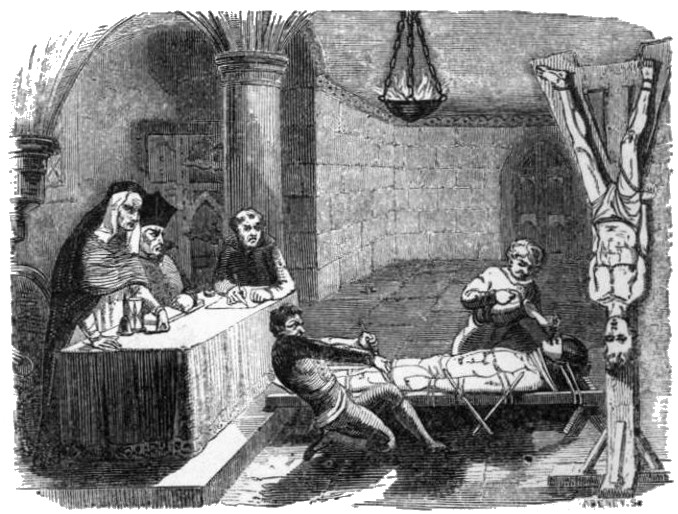
“I was seized with horror, when, at my entering this infernal place, I
saw myself surrounded by six wretches, who stripped me naked all to my
drawers, and laid me on my back. First, they put round my neck an iron
collar, which was fastened to the scaffold; they then fixed a ring to
each foot; and this being done, they wound two ropes, the thickness of
one’s little finger, round each arm, and two round each thigh, passing
under the scaffold, through holes, and drawn tight by four men. My pains
were intolerable; the ropes pierced through my flesh quite to the bone,
making the blood gush out of eight different places. I persisted in
refusing to discover any more; the ropes were drawn together four times;
but suspended at intervals, by order of the physician and surgeon in
attendance.
“While thus suffering, they barbarously declared that, if I died under
torture, I should be guilty of self-murder. And the last time of
suffering I fainted, and was carried to my dungeon unperceiving it.
Finding that the more they made me suffer, the more I supplicated
patience from heaven, these barbarians exposed me to another kind of
torture. They made me stretch my arms so that the palms of my hands were
turned outwards; when, by a rope that fastened them together at the
wrist, and which they turned by an engine, they drew them in such a
manner that the back of each hand touched; both my shoulders were
dislocated, and a considerable quantity of blood issued from my mouth.
This torture was repeated thrice, after which, the physician and
surgeons, in setting my bones, put me to exquisite pain in my dungeon.
“Two months after, being a little recovered, I was again conveyed to the
torture room, where they turned round my body a thick iron chain, which,
crossing my stomach, terminated at my wrists. They next set my back
against a thick board, at each extremity of which was a pulley, through
which there was a rope run, that caught the ends of the chains at my
wrists. These ropes, by means of a roller, pressed or bruised my
stomach, so that my wrists and shoulders were put out of joint. The
surgeons set my bones presently, and the barbarians made me undergo this
torture a second time, which I bore with equal constancy. I was remanded
to my dungeon, attended by the surgeons, who dressed my bruises; and
here I continued till their auto da fé.
“Nine different times they put me to the torture, when most of my limbs
were put out of joint, and bruised in such a manner that I was unable,
during some weeks, to lift my hand to my mouth. I fear that I shall feel
the effect of this cruelty so long as I live; being seized from time to
time with thrilling pains, with which I never was afflicted till I fell
into the merciless and bloody hands of the inquisitors.
“The day of the auto da fé being come, I was made to walk in the
procession with the other victims of this tribunal. At St. Dominic’s
church my sentence was read, of being condemned to the galleys during
four years. Four days after I was conveyed to the galleys; and joined,
the next day, in the occupation of my fellow-slaves. However, the
liberty I had of speaking to my friends, after having been deprived of
the sight of them during my wretched abode in the prison of the
Inquisition, the open air, and being freed from the apprehensions which
always overspread my mind, made me find the toil of the galley more
supportable.
“By the tortures inflicted on me in the Inquisition, I was unfit for the
painful labour allotted me, viz., the carrying water to the prisons of
the city; but fear of the inhumanity of the overseers caused me to exert
myself, and I fell sick. I was then sent to the infirmary for two
months; when I was visited by the first friars of the convent of Corpo
Santo, who offered to get my release, provided I would turn Roman
Catholic. I assured them that I expected my enlargement from the
Almighty; and having leisure, I desired a friend to write to my
brother-in-law, Mr. Barber, informing him of my deplorable state, and
entreating him to address the Earl of Harrington in my favour, he having
the honour to live in his lordship’s family. This nobleman spoke to his
grace the Duke of Newcastle, secretary of state, supplicating leave
from our sovereign that his minister at Lisbon might demand me, as a
subject of Great Britain.
“His majesty was so gracious as to interpose in my favour. Mr. Compton,
the British minister at Lisbon, demanded my liberty of the king of
Portugal, in the name of his Britannic majesty; and I obtained it in the
latter end of October, 1744. The officer took me from the galley by
order of the inquisitors, and brought me before them, when the president
told me that Cardinal de Cunha had ordered my release, but I must return
in three days.
“I could perceive that the spies of the Inquisition followed me. I
waited upon our envoy, and our consul; and five days after I returned to
the inquisitors, when the president declared that the tribunal would not
permit me to continue any longer in Portugal, and that I must name the
city and kingdom whither I intended to retire. I replied that, ‘as my
family is in London, I design to go thither;’ and they bid me embark in
the first ship that should sail for England.”
Mr. Coustos was kindly received by the Dutch admiral on board his ship,
then in the port of Lisbon, and he permitted him to send for his friend,
Mr. Mouton, being affected with the relation of their sufferings. They
arrived in London, December 15th, 1744. He adds,
“I here return thanks, with all the power of my soul, to the Almighty,
for his having so visibly protected me from that infernal band of
friars, who employed their various tortures to force me to apostatise
from my holy religion. I return our sovereign, George II., the most
dutiful and respectful thanks for his so graciously interposing in
favour of an ill-fated galley-slave. I shall retain, so long as I have
breath, the deepest sensation of affection and loyalty for his sacred
person, and will ever be ready to expose my life for his majesty and his
august family.”
Mr. Bower.—Mr. Archibald Bower was not so much a victim as to be
subjected to the torture, as he was enabled to escape from the power of
the inquisitors; but his biography illustrates the character of the
Inquisition. He was born in 1686, near Dundee, in Scotland. His parents
being Roman Catholics, sent him, at the age of five years, to an uncle
in Italy, for education. First at Douay, and then at Rome, his progress
was uncommon. He became a Jesuit, and was appointed professor of
rhetoric and logic, in the college of Macerata, in Italy. In this city
he became intimate with the inquisitor-general of the Holy Office, from
whom he received preferment as a counsellor to the Inquisition. There
were twelve counsellors, each of whom had a residence, with about £200
per annum, besides extensive privileges.
On being installed into office, he received a manuscript book of
directions for inquisitors, for his private guidance. These rules
required the extremes of inhumanity; and his attendance on the trials of
the Holy Office he found most agonising, so that he frequently uttered
exclamations of horror. Though not suspected, the inquisitor-general,
on one occasion, in great warmth, striking the table, remarked, “Mr.
Bower, you always object to the evidence.” At another time, looking on
the face of a wretched victim undergoing the torture, he perceived
symptoms of death, and fainted, when he was carried out of the hall; and
on his return he was reproved by the chief-inquisitor, alleging that
“what is done to the body is for the good of the soul.” Mr. Bower
excused himself, urging “the weakness of his nature, which he could not
help.” “Nature!” exclaimed the inquisitor, “you must overcome nature by
grace!” But the colloquy ceased, as the miserable victim died at that
moment under the torment!
While considering how he might escape from this horrid office, Mr. Bower
was required to “conquer nature,” by the arrest of a nobleman, who was a
personal friend. His alleged crime was some trifling expression
regarding the particular garb of two friars, one of whom denounced him
to the Inquisition. Being ordered to arrest his best friend in Macerata,
he remonstrated with the inquisitor-general, urging, “My lord, you know
the connexion—;” when the inquisitor, with all the sternness of his
official character, interrupted him,—“Connexion! what, talk of
connexion when the holy faith is concerned?” And, as he withdrew, he
ordered, “See that it be done; the guards shall wait without;” adding,
“this is the way to conquer nature, Mr. Bower.” Unable to save or to
warn his friend, he proceeded with the guards, obtained admittance to
his residence and to his bed-room, and found both the nobleman and his
lady asleep. The lady awaking, shrieked on seeing the strangers, when
one of the ruffian officers gave her a blow on the head, which was
followed by blood. The nobleman was astonished at being thus arrested by
his friend, but dared not to reproach him; while Bower could not look
him in the face, in performing so shameful an act.
Mr. Bower announced the arrest, next morning, as he delivered the key to
the chief-inquisitor, who commended him,—“This is done like one who is
desirous of conquering the weakness of nature.” The nobleman was soon
subjected to torture by the pulley, and died in three days after its
infliction. His estates were then confiscated to the Inquisition, a
small pension only being allowed to his widow, to whom the inquisitor
wrote, desiring her to pray for the soul of her deceased husband, at the
same time warning her against complaining of injustice or cruelty
against the Holy Office.
Mr. Bower could endure his situation no longer, and he resolved on
attempting his escape from Italy. He, therefore, solicited permission to
make a pilgrimage to the house of the Virgin Mary, at Loretto; and this
being granted by the inquisitor-general, he proceeded with his
portmanteau, on horseback, concealing his valuable papers. He took his
course through the Adriatic States for Switzerland; but the papers that
he had taken with him were soon missed by the inquisitor-general, who
offered a reward for his head of about £600 in English money, or £800,
if brought alive to the Inquisition. His danger became imminent through
this proclamation; as he found in a post-house a copy of it, and two of
his countrymen, to one of whom he was known. He challenged the man, and
threatened him; and mounting his horse, escaped, so that after many
difficulties he reached Calais. At the hotel he found two Jesuits, who
wore the red cross of the Inquisition; when he hastily left the room,
and found that the packet would be three days before it sailed for
England. He applied to a fisherman, who dared not venture to cross the
Channel; and he was in agony, especially when on his return he was told
by his hostess, in reply to his inquiry for the Jesuits, “Oh, Sir, I am
sorry to inform you that they are upstairs, searching your portmanteau.”
At that moment he heard voices talking loudly in another room, and,
supposing them to be English, he entered, and recognised in one Lord
Baltimore, whom he had seen at Rome. He entreated his protection, but
that nobleman exclaimed, “Mr. Bower, you are undone; I cannot protect
you: they are searching your apartment.” However, he and his friends
guarded him to their boat; and, with four pairs of oars, soon reached a
yacht that was taking a short cruise; and the wind being fair, they
conveyed him safely to Dover.
Mr. Bower now relinquished his former religion, conformed to the church
of England, and married. He became tutor in the family of Lord Aylmer,
and found a generous patron in Lord Lyttleton. Numerous enemies from
among the Catholics brought grievous accusations against him; but he
vindicated himself from their slanders, and gained himself a high
reputation by several literary works, especially his “Lives of the
Popes,” in seven volumes quarto. He died in England, in the year 1766,
as is believed, a sincere Protestant.