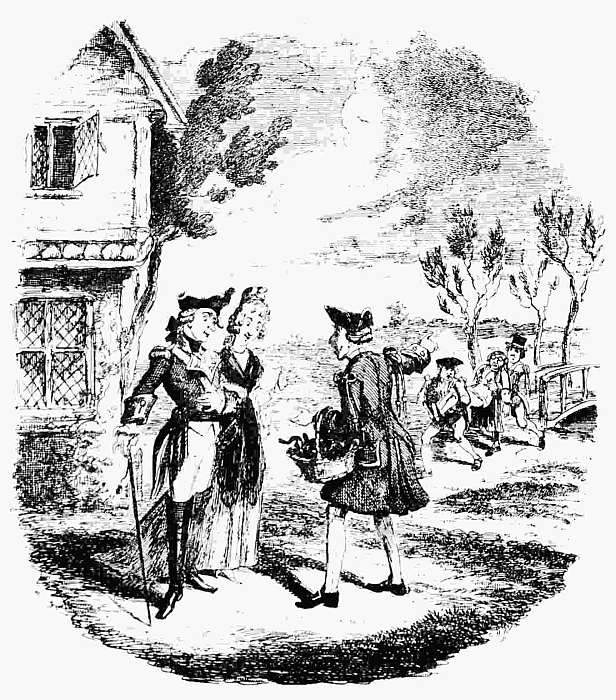
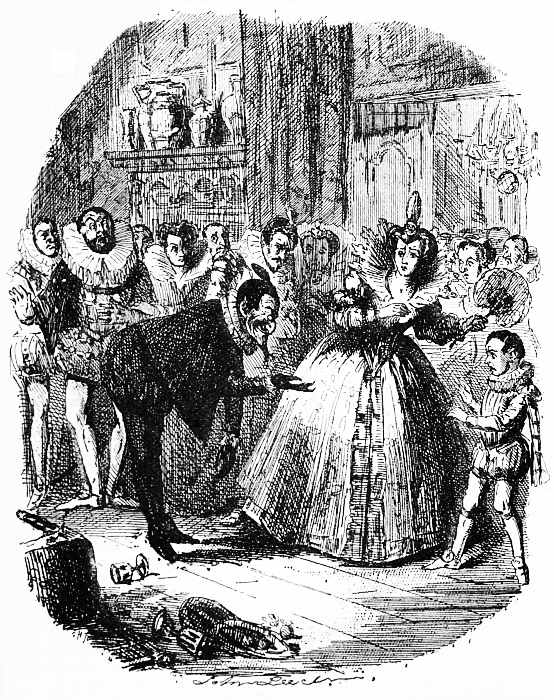
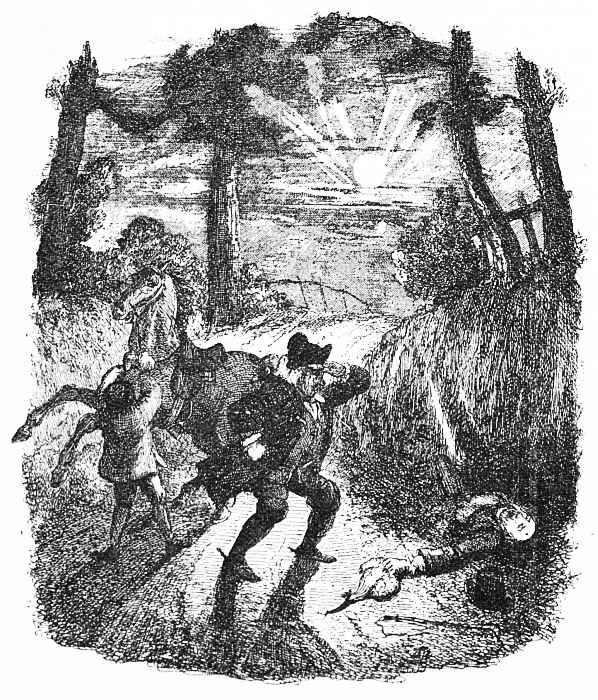
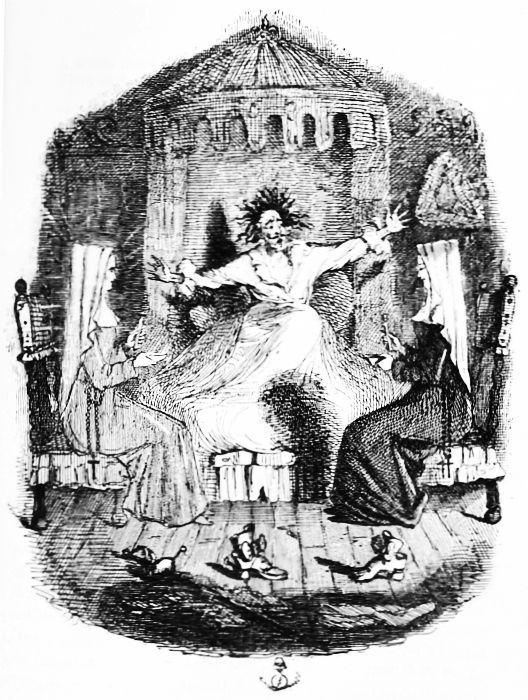
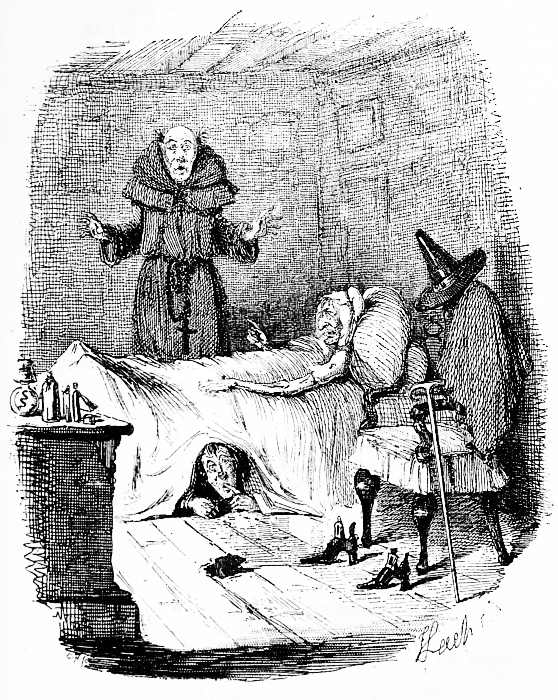
"It is very odd, though; what can have become of them?" said Charles
Seaforth, as he peeped under the valance of an old-fashioned
bedstead, in an old-fashioned apartment of a still more old-fashioned
manor-house; "'tis confoundedly odd, and I can't make it out at all.
Why, Barney, where are they?—and where the d—l are you?"
No answer was returned to this appeal; and the lieutenant, who was, in
the main, a reasonable person,—at least as reasonable a person as any
young gentleman of twenty-two in "the service" can fairly be expected
to be,—cooled when he reflected that his servant could scarcely reply
extempore to a summons which it was impossible he should hear.
An application to the bell was the considerate result; and the
footsteps of as tight a lad as ever put pipe-clay to belt sounded along
the gallery.
"Come in!" said his master.—An ineffectual attempt upon the door
reminded Mr. Seaforth that he had locked himself in.—"By Heaven! this
is the oddest thing of all," said he, as he turned the key and admitted
Mr. Maguire into his dormitory.
"Barney, where are my pantaloons?"
"Is it the breeches?" asked the valet, casting an inquiring eye round
the apartment;—"is it the breeches, sir?"
"Yes; what have you done with them?"
"Sure then your honour had them on when you went to bed, and it's
hereabout they'll be, I'll be bail;" and Barney lifted a fashionable
tunic from a cane-backed arm-chair, proceeding in his examination.
But the search was vain: there was the tunic aforesaid,—there was a
smart-looking kerseymere waistcoat; but the most important article of
all in a gentleman's wardrobe was still wanting.
"Where can they be?" asked the master, with a strong accent on the
auxiliary verb.
"Sorrow a know I knows," said the man.
"It must have been the devil, then, after all, who has been here and
carried them off!" cried Seaforth, staring full into Barney's face.
Mr. Maguire was not devoid of the superstition of his countrymen, still
he looked as if he did not quite subscribe to the sequitur.
His master read incredulity in his countenance. "Why, I tell you,
Barney, I put them there, on that arm-chair, when I got into bed; and,
by Heaven! I distinctly saw the ghost of the old fellow they told me
of, come in at midnight, put on my pantaloons, and walk away with them."
"May be so," was the cautious reply.
"I thought, of course, it was a dream; but then,—where the d—l are
the breeches?"
The question was more easily asked than answered. Barney renewed his
search, while the lieutenant folded his arms, and, leaning against the
toilet, sunk into a reverie.
"After all, it must be some trick of my laughter-loving cousins," said
Seaforth.
"Ah! then, the ladies!" chimed in Mr. Maguire, though the observation
was not addressed to him; "and will it be Miss Caroline, or Miss Fanny,
that's stole your honour's things?"
"I hardly know what to think of it," pursued the bereaved lieutenant,
still speaking in soliloquy, with his eye resting dubiously on the
chamber-door. "I locked myself in, that's certain; and—but there must
be some other entrance to the room—pooh! I remember—the private
staircase; how could I be such a fool?" and he crossed the chamber to
where a low oaken doorcase was dimly visible in a distant corner. He
paused before it. Nothing now interfered to screen it from observation;
but it bore tokens of having been at some earlier period concealed by
tapestry, remains of which yet clothed the walls on either side the
portal.
"This way they must have come," said Seaforth; "I wish with all my
heart I had caught them!"
"Och! the kittens!" sighed Mr. Barney Maguire.
But the mystery was yet as far from being solved as before. True, there
was the "other door;" but then that, too, on examination, was even
more firmly secured than the one which opened on the gallery,—two
heavy bolts on the inside effectually prevented any
coup de main on
the lieutenant's bivouac from that quarter. He was more puzzled than
ever; nor did the minutest inspection of the walls and floor throw any
light upon the subject! one thing only was clear,—the breeches were
gone! "It is very singular," said the lieutenant.
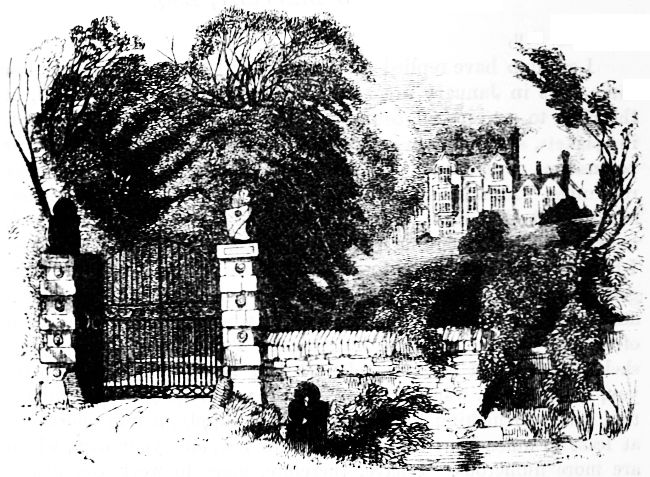
Tappington (generally called Tapton) Everard is an antiquated but
commodious manor-house in the eastern division of the county of Kent. A
former proprietor had been High-sheriff in the days of Elizabeth, and
many a dark and dismal tradition was yet extant of the licentiousness
of his life, and the enormity of his offences. The Glen, which the
keeper's daughter was seen to enter, but never known to quit, still
frowns darkly as of yore; while an ineradicable bloodstain on the oaken
stair yet bids defiance to the united energies of soap and sand. But it
is with one particular apartment that a deed of more especial atrocity
is said to be connected. A stranger guest—so runs the legend—arrived
unexpectedly at the mansion of the "Bad Sir Giles." They met in
apparent friendship; but the ill-concealed scowl on their master's brow
told the domestics that the visit was not a welcome one; the banquet,
however, was not spared; the wine-cup circulated freely,—too freely,
perhaps,—for sounds of discord at length reached the ears of even the
excluded serving-men as they were doing their best to imitate their
betters in the lower hall. Alarmed, some of them ventured to approach
the parlour; one, an old and favoured retainer of the house, went so
far as to break in upon his master's privacy. Sir Giles, already high
in oath, fiercely enjoined his absence, and he retired; not, however,
before he had distinctly heard from the stranger's lips a menace that
"There was that within his pocket which could disprove the knight's
right to issue that or any other command within the walls of Tapton."
The intrusion, though momentary, seemed to have produced a beneficial
effect; the voices of the disputants fell, and the conversation was
carried on thenceforth in a more subdued tone, till, as evening closed
in, the domestics, when summoned to attend with lights, found not only
cordiality restored, but that a still deeper carouse was meditated.
Fresh stoups, and from the choicest bins, were produced; nor was it
till at a late, or rather early hour, that the revellers sought their
chambers.
The one allotted to the stranger occupied the first floor of the
eastern angle of the building, and had once been the favourite
apartment of Sir Giles himself. Scandal ascribed this preference to the
facility which a private staircase,communicating with the grounds, had
afforded him, in the old knight's time, of following his wicked courses
unchecked by parental observation; a consideration which ceased to be
of weight when the death of his father left him uncontrolled master
of his estate and actions. From that period Sir Giles had established
himself in what were called the "state apartments;" and the "oaken
chamber" was rarely tenanted, save on occasions of extraordinary
festivity, or when the yule log drew an unusually large accession of
guests around the Christmas hearth.
On this eventful night it was prepared for the unknown visitor, who
sought his couch heated and inflamed from his midnight orgies, and
in the morning was found in his bed a swollen and blackened corpse.
No marks of violence appeared upon the body; but the livid hue of
the lips, and certain dark-coloured spots visible on the skin,
aroused suspicions which those who entertained them were too timid to
express. Apoplexy, induced by the excesses of the preceding night, Sir
Giles's confidential leech pronounced to be the cause of his sudden
dissolution; the body was buried in peace; and though some shook their
heads as they witnessed the haste with which the funeral rites were
hurried on, none ventured to murmur. Other events arose to distract the
attention of the retainers; men's minds became occupied by the stirring
politics of the day, while the near approach of that formidable
armada, so vainly arrogating to itself a title which the very elements
joined with human valour to disprove, soon interfered to weaken, if
not obliterate, all remembrance of the nameless stranger who had died
within the walls of Tapton Everard.
Years rolled on: the "Bad Sir Giles" had himself long since gone to his
account, the last, as it was believed, of his immediate line; though
a few of the older tenants were sometimes heard to speak of an elder
brother, who had disappeared in early life, and never inherited the
estate. Rumours, too, of his having left a son in foreign lands were at
one time rife; but they died away, nothing occurring to support them:
the property passed unchallenged to a collateral branch of the family,
and the secret, if secret there were, was buried in Denton churchyard,
in the lonely grave of the mysterious stranger. One circumstance
alone occurred, after a long-intervening period, to revive the memory
of these transactions. Some workmen employed in grubbing an old
plantation, for the purpose of raising on its site a modern shrubbery,
dug up, in the
execution of their task, the mildewed remnants of what
seemed to have been once a garment. On more minute inspection, enough
remained of silken slashes and a coarse embroidery to identify the
relics as having once formed part of a pair of trunk hose; while a few
papers which fell from them, altogether illegible from damp and age,
were by the unlearned rustics conveyed to the then owner of the estate.
Whether the squire was more successful in deciphering them was never
known; he certainly never alluded to their contents; and little would
have been thought of the matter but for the inconvenient memory of one
old woman, who declared she heard her grandfather say that when the
"stranger guest" was poisoned, though all the rest of his clothes were
there, his breeches, the supposed repository of the supposed documents,
could never be found. The master of Tapton Everard smiled when he heard
Dame Jones's hint of deeds which might impeach the validity of his own
title in favour of some unknown descendant of some unknown heir; and
the story was rarely alluded to, save by one or two miracle-mongers,
who had heard that others had seen the ghost of old Sir Giles, in his
night-cap, issue from the postern, enter the adjoining copse, and wring
his shadowy hands in agony, as he seemed to search vainly for something
hidden among the evergreens. The stranger's death-room had, of course,
been occasionally haunted from the time of his decease; but the periods
of visitation had latterly become very rare,—even Mrs. Botherby, the
housekeeper, being forced to admit that, during her long sojourn at the
manor, she had never "met with anything worse than herself;" though, as
the old lady afterwards added upon more mature reflection, "I must say
I think I saw the devil once."
Such was the legend attached to Tapton Everard, and such the story
which the lively Caroline Ingoldsby detailed to her equally mercurial
cousin Charles Seaforth, lieutenant in the Hon. East India Company's
second regiment of Bombay Fencibles, as arm-in-arm they promenaded a
gallery decked with some dozen grim-looking ancestral portraits, and,
among others, with that of the redoubted Sir Giles himself. The gallant
commander had that very morning paid his first visit to the house of
his maternal uncle, after an absence of several years passed with his
regiment on the arid plains of Hindostan, whence he was now returned on
a three years' furlough. He had gone out a boy,—he returned a man; but
the impression made upon his youthful fancy by his favourite cousin
remained unimpaired, and to Tapton he directed his steps, even before
he sought the home of his widowed mother,—comforting himself in this
breach of filial decorum by the reflection that, as the manor was so
little out of his way, it would be unkind to pass, as it were, the door
of his relatives without just looking in for a few hours.
But he found his uncle as hospitable and his cousin more charming
than ever; and the looks of one, and the requests of the other, soon
precluded the possibility of refusing to lengthen the "few hours" into
a few days, though the house was at the moment full of visitors.
The Peterses were there from Ramsgate; and Mr, Mrs., and the two Miss
Simpkinsons, from Bath, had come to pass a month with the family;
and Tom Ingoldsby had brought down his college friend the Honourable
Augustus Sucklethumbkin, with his groom and pointers, to take a
fortnight's shooting. And then there was Mrs. Ogleton, the rich young
widow, with her large black eyes, who, people did say, was setting
her cap at the young squire, though Mrs. Botherby did not believe
it; and, above all, there was Mademoiselle Pauline, her femme de
chambre, who "mon-Dieu'd" everything and everybody, and cried "Quel
horreur!" at Mrs. Botherby's cap. In short, to use the last-named and
much-respected lady's own expression, the house was "choke-full" to the
very attics,—all, save the "oaken chamber," which, as the lieutenant
expressed a most magnanimous disregard of ghosts, was forthwith
appropriated to his particular accommodation. Mr. Maguire meanwhile
was fain to share the apartment of Oliver Dobbs, the squire's own man:
a jocular proposal of joint occupancy having been first indignantly
rejected by "Mademoiselle," though preferred with the "laste taste in
life" of Mr. Barney's most insinuating brogue.
"Come, Charles, the urn is absolutely getting cold; your breakfast will
be quite spoiled: what can have made you so idle?" Such was the morning
salutation of Miss Ingoldsby to the militaire as he entered the
breakfast-room half an hour after the latest of the party.
"A pretty gentleman, truly, to make an appointment with," chimed
in Miss Frances. "What is become of our ramble to the rocks before
breakfast?"
"Oh! the young men never think of keeping a promise now," said Mrs.
Peters, a little ferret-faced woman with underdone eyes.
"When I was a young man," said Mr. Peters, "I remember I always made a
point of—"
"Pray how long ago was that? asked Mr. Simpkinson from Bath.
"Why, sir, when I married Mrs. Peters, I was—let me see—I was—"
"Do pray hold your tongue, P., and eat your breakfast!" interrupted his
better half, who had a mortal horror of chronological references; "it's
very rude to tease people with your family affairs."
The lieutenant had by this time taken his seat in silence,—a
good-humoured nod, and a glance, half-smiling, half-inquisitive, being
the extent of his salutation. Smitten as he was, and in the immediate
presence of her who had made so large a hole in his heart, his manner
was evidently distrait, which the fair Caroline in her secret soul
attributed to his being solely occupied by her agrémens,—how would
she have bridled had she known that they only shared his meditations
with a pair of breeches!
Charles drank his coffee and spiked some half-dozen eggs, darting
occasionally a penetrating glance at the ladies, in hope of detecting
the supposed waggery by the evidence of some furtive smile or conscious
look. But in vain; not a dimple moved indicative of roguery, nor did
the slightest elevation of eyebrow rise confirmative of his suspicions.
Hints and insinuations passed unheeded,—more particular inquiries were
out of the question:—the subject was unapproachable.
In the meantime, "patent cords" were just the thing for a morning's
ride; and, breakfast ended, away cantered the party over the downs,
till, every faculty absorbed by the beauties, animate and inanimate,
which surrounded him, Lieutenant Seaforth of the Bombay Fencibles
bestowed no more thought upon his breeches than if he had been born on
the top of Ben Lomond.
Another night had passed away; the sun rose brilliantly, forming with
his level beams a splendid rainbow in the far-off west, whither the
heavy cloud, which for the last two hours had been pouring its waters
on the earth, was now flying before him.
"Ah! then, and it's little good it'll be the claning of ye,"
apostrophised Mr. Barney Maguire, as he deposited, in front of his
master's toilet, a pair of "bran-new" jockey boots, one of Hoby's
primest fits, which the lieutenant had purchased in his way through
town. On that very morning had they come for the first time under the
valet's depuriating hand, so little soiled, indeed, from the turfy ride
of the preceding day, that a less scrupulous domestic might, perhaps,
have considered the application of "Warren's Matchless," or oxalic
acid, altogether superfluous. Not so Barney: with the nicest care had
he removed the slightest impurity from each polished surface, and there
they stood, rejoicing in their sable radiance. No wonder a pang shot
across Mr. Maguire's breast, as he thought on the work now cut out for
them, so different from the light labours of the day before; no wonder
he murmured with a sigh, as the scarce-dried window-panes disclosed
a road now inch-deep in mud, "Ah! then, it's little good the claning
of ye!"—for well had he learned in the hall below that eight miles
of a stiff clay soil lay between the manor and Bolsover Abbey, whose
picturesque ruins,
"Like ancient Rome, majestic in decay,"
the party had determined to explore. The master had already commenced
dressing, and the man was fitting straps upon a light pair of
crane-necked spurs, when his hand was arrested by the old question,
"Barney, where are the breeches?"
They were nowhere to be found!
Mr. Seaforth descended that morning, whip in hand, and equipped in
a handsome green riding-frock, but no "breeches and boots to match"
were there: loose jean trowsers, surmounting a pair of diminutive
Wellingtons, embraced, somewhat incongruously, his nether man, vice
the "patent cords," returned, like yesterday's pantaloons, absent
without leave. The "top-boots" had a holiday.
"A fine morning after the rain," said Mr. Simpkinson from Bath.
"Just the thing for the 'ops," said Mr. Peters. "I remember when I was
a boy—"
"Do hold your tongue, P.," said Mrs. Peters,—advice which that
exemplary matron was in the constant habit of administering to "her
P.," as she called him, whenever he prepared to vent his reminiscences.
Her precise reason for this it would be difficult to determine, unless,
indeed, the story be true which a little bird had whispered into Mrs.
Botherby's ear,—Mr. Peters, though now a wealthy man, had received a
liberal education at a charity-school, and was apt to recur to the days
of his muffin-cap and leathers. As
usual, he took his wife's hint in good part, and "paused in his reply."
"A glorious day for the ruins!" said young Ingoldsby. "But, Charles,
what the deuce are you about?—you don't mean to ride through our lanes
in such toggery as that?"
"Lassy me!" said Miss Julia Simpkinson, "won't you be very wet?"
"You had better take Tom's cab," quoth the squire.
But this proposition was at once overruled; Mrs. Ogleton had already
nailed the cab, a vehicle of all others the best adapted for a snug
flirtation.
"Or drive Miss Julia in the phaeton?" No; that was the post of Mr.
Peters, who, indifferent as an equestrian, had acquired some fame as
a whip while travelling through the midland counties for the firm of
Bagshaw, Snivelby, and Ghrimes.
"Thank you, I shall ride with my cousins," said Charles, with as much
nonchalance as he could assume,—and he did so; Mr. Ingoldsby, Mrs.
Peters, Mr. Simpkinson from Bath, and his eldest daughter with her
album, following in the family coach. The gentleman-commoner "voted
the affair d—d slow," and declined the party altogether in favour
of the gamekeeper and a cigar. "There was 'no fun' in looking at old
houses!" Mrs. Simpkinson preferred a short séjour in the still-room
with Mrs. Botherby, who had promised to initiate her in that grand
arcanum, the transmutation of gooseberry jam into Guava jelly.
"Did you ever see an old abbey before, Mr. Peters?"
"Yes, miss, a French one; we have got one at Ramsgate; he teaches the
Miss Joneses to parley-voo, and is turned of sixty."
Miss Simpkinson closed her album with an air of ineffable disdain.
Mr. Simpkinson from Bath was a professed antiquary, and one of the
first water; he was master of Gwillim's Heraldry, and Milles's History
of the Crusades; knew every plate in the Monasticon; had written an
essay on the origin and dignity of the office of overseer, and settled
the date of a Queen Anne's farthing. An influential member of the
Antiquarian Society, to whose "Beauties of Bagnigge Wells" he had
been a liberal subscriber, procured him a seat at the board of that
learned body, since which happy epoch Sylvanus Urban had not a more
indefatigable correspondent. His inaugural essay on the President's
cocked hat was considered a miracle of erudition: and his account of
the earliest application of gilding to
gingerbread, a masterpiece of
antiquarian research. His eldest daughter was of a kindred spirit: if
her father's mantle had not fallen upon her, it was only because he had
not thrown it off himself; she had caught hold of its tail, however,
while it yet hung upon his honoured shoulders. To souls so congenial,
what a sight was the magnificent ruin of Bolsover! its broken arches,
its mouldering pinnacles, and the airy tracery of its half-demolished
windows. The party were in raptures; Mr. Simpkinson began to meditate
an essay, and his daughter an ode: even Seaforth, as he gazed on
these lonely relics of the olden time, was betrayed into a momentary
forgetfulness of his love and losses; the widow's eye-glass turned from
her cicisbeo's whiskers to the mantling ivy: Mrs. Peters wiped her
spectacles; and "her P." supposed the central tower "had once been the
county jail." The squire was a philosopher, and had been there often
before, so he ordered out the cold tongue and chickens.
"Bolsover Priory," said Mr. Simpkinson, with the air of a
connoisseur,—"Bolsover Priory was founded in the reign of Henry the
Sixth, about the beginning of the eleventh century. Hugh de Bolsover
had accompanied that monarch to the Holy Land, in the expedition
undertaken by way of penance for the murder of his young nephews in
the Tower. Upon the dissolution of the monasteries, the veteran was
enfeoffed in the lands and manor, to which he gave his own name of
Bowlsover, or Bee-owls-over (by corruption Bolsover),—a Bee in chief,
over three Owls, all proper, being the armorial ensigns borne by this
distinguished crusader at the siege of Acre."
"Ah! that was Sir Sidney Smith," said Mr. Peters; "I've heard tell of
him, and all about Mrs. Partington, and—"
"P., be quiet, and don't expose yourself!" sharply interrupted his
lady. P. was silenced, and betook himself to the bottled stout.
"These lands," continued the antiquary, "were held in grand serjeantry
by the presentation of three white owls and a pot of honey—"
"Lassy me! how nice!" said Miss Julia. Mr. Peters licked his lips.
"Pray give me leave, my dear—owls and honey, whenever the king should
come a rat-catching into this part of the country."
"Rat-catching!" ejaculated the squire, pausing abruptly in the
mastication of a drumstick.
"To be sure, my dear sir: don't you remember that rats once came under
the forest laws—a minor species of venison? 'Rats and
mice, and such
small deer,' eh?—Shakspear, you know. Our ancestors ate rats ("The
nasty fellows!" shuddered Miss Julia in a parenthesis); and owls, you
know, are capital mousers—"
"I've seen a howl," said Mr. Peters; "there's one in the Sohological
Gardens,—a little hook-nosed chap in a wig,—only its feathers and—"
Poor P. was destined never to finish a speech.
"Do be quiet!" cried the authoritative voice, and the would-be
naturalist shrank into his shell, like a snail in the "Sohological
Gardens."
"You should read Blount's 'Jocular Tenures,' Mr. Ingoldsby," pursued
Simpkinson. "A learned man was Blount! Why, sir, his Royal Highness the
Duke of York once paid a silver horse-shoe to Lord Ferrers—"
"I've heard of him," broke in the incorrigible Peters; "he was hanged
at the Old Bailey in a silk rope for shooting Dr. Johnson."
The antiquary vouchsafed no notice of the interruption; but,
taking a pinch of snuff, continued his harangue.
"A silver horse-shoe, sir, which is due from every scion of royalty
who rides across one of his manors; and if you look into the penny
county histories, now publishing by an eminent friend of mine, you
will find that Langhale in Co. Norf. was held by one Baldwin per
saltum, sufflatum, et pettum; that is, he was to come every Christmas
into Westminster Hall, there to take a leap, cry hem! and—"
"Mr. Simpkinson, a glass of sherry?" cried Tom Ingoldsby, hastily.
"Not any, thank you, sir. This Baldwin, surnamed Le—"
"Mrs. Ogleton challenges you, sir; she insists upon it," said Tom,
still more rapidly; at the same time filling a glass, and forcing it on
the sçavant, who, thus arrested in the very crisis of his narrative,
received and swallowed the potation as if it had been physic.
"What on earth has Miss Simpkinson discovered there?" continued Tom;
"something of interest. See how fast she is writing."
The diversion was effectual: every one looked towards Miss Simpkinson,
who, far too ethereal for "creature comforts," was seated apart on
the dilapidated remains of an altar-tomb, committing eagerly to paper
something that had strongly impressed her: the air,—the eye "in a fine
frenzy rolling,"—all betokened that the divine afflatus was come.
Her father rose, and stole silently towards her.
"What an old boar!" muttered young Ingoldsby; alluding,
perhaps, to a
slice of brawn which he had just begun to operate upon, but which, from
the celerity with which it disappeared, did not seem so very difficult
of mastication.
But what had become of Seaforth and his fair Caroline all this while?
Why, it so happened that they had been simultaneously stricken with
the picturesque appearance of one of those high and pointed arches,
which that eminent antiquary, Mr. Horseley Curties, has described in
his "Ancient Records" as "a Gothic window of the Saxon order;"—and
then the ivy clustered so thickly and so beautifully on the other
side, that they went round to look at that;—and then their proximity
deprived it of half its effect, and so they walked across to a little
knoll, a hundred yards off, and in crossing a small ravine, they came
to what in Ireland they call "a bad step," and Charles had to carry his
cousin over it;—and then, when they had to come back, she would not
give him the trouble again for the world, so they followed a better but
more circuitous route, and there were hedges and ditches in the way,
and stiles to get over, and gates to get through; so that an hour or
more had elapsed before they were able to rejoin the party.
"Lassy me!" said Miss Julia Simpkinson, "how long you have been gone!"
And so they had. The remark was a very just as well as a very natural
one. They were gone a long while, and a nice cosey chat they had; and
what do you think it was all about, my dear miss?
"O, lassy me! love, no doubt, and the moon, and eyes, and nightingales,
and—"
Stay, stay, my sweet young lady; do not let the fervour of your
feelings run away with you! I do not pretend to say, indeed, that one
or more of these pretty subjects might not have been introduced; but
the most important and leading topic of the conference was—Lieutenant
Seaforth's breeches.
"Caroline," said Charles, "I have had some very odd dreams since I have
been at Tappington."
"Dreams, have you?" smiled the young lady, arching her taper neck like
a swan in pluming. "Dreams, have you?"
"Ay, dreams,—or dream, perhaps, I should say; for, though repeated, it
was still the same. And what do you imagine was its subject?"
"It is impossible for me to divine," said the tongue;—"I have
not the least difficulty in guessing," said the eye, as plainly as ever
eye spoke.
"I dreamt—of your great grandfather!"
There was a change in the glance—"My great grandfather?"
"Yes, the old Sir Giles, or Sir John, you told me about the other day:
he walked into my bedroom in his short cloak of murrey-coloured velvet,
his long rapier, and his Raleigh-looking hat and feather, just as the
picture represents him: but with one exception."
"And what was that?"
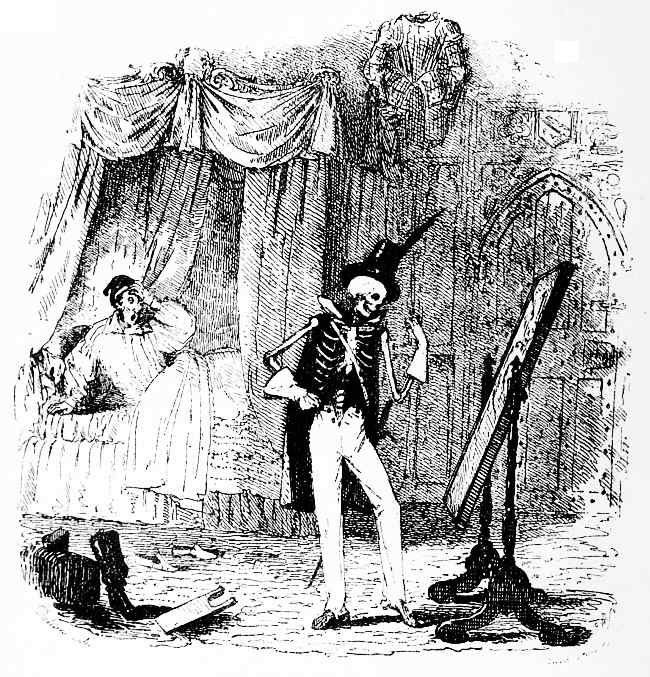
"Why, his lower extremities, which were visible, were—those of a
skeleton."
"Well."
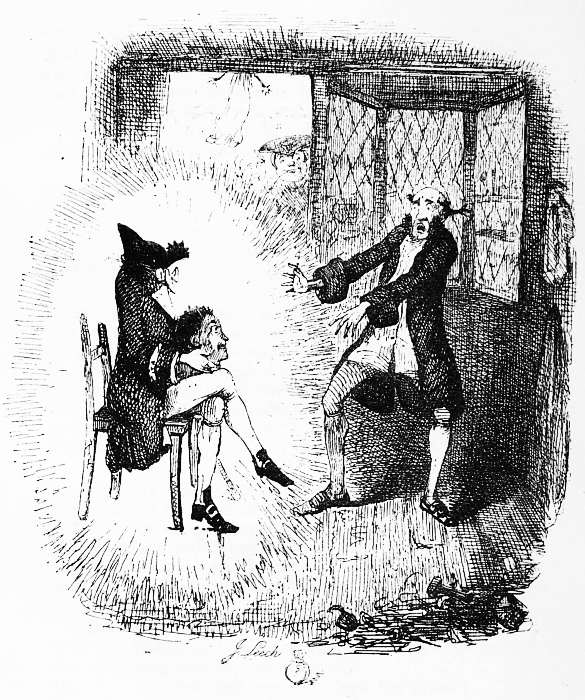
"Well, after taking a turn or two about the room, and looking round him
with a wistful air, he came to the bed's foot, stared at me in a manner
impossible to describe,—and then he—he laid hold of my pantaloons;
whipped his long bony legs into them in a twinkling; and strutting up
to the glass, seemed to view himself in it with great complacency. I
tried to speak, but in vain. The effort, however, seemed to excite
his attention; for, wheeling about, he showed me the grimmest-looking
death's head you can well imagine, and with an indescribable grin
strutted out of the room."
"Absurd! Charles. How can you talk such nonsense?"
"But, Caroline,—the breeches are really gone."
On the following morning, contrary to his usual custom, Seaforth was
the first person in the breakfast parlour. As no one else was present,
he did precisely what nine young men out of ten so situated would have
done; he walked up to the mantel-piece, established himself upon the
rug, and subducting his coat-tails one under each arm, turned towards
the fire that portion of the human frame which it is considered equally
indecorous to present to a friend or an enemy. A serious, not to say
anxious, expression was visible upon his good-humoured countenance, and
his mouth was fast buttoning itself up for an incipient whistle, when
little Flo, a tiny spaniel of the Blenheim breed,—the pet object of
Miss Julia Simpkinson's affections,—bounced out from beneath a sofa,
and began to bark at—his pantaloons.
They were cleverly "built," of a light grey mixture, a broad stripe
of the most vivid scarlet traversing each seam in a perpendicular
direction from hip to ankle,—in short, the regimental costume of the
Royal Bombay Fencibles. The animal, educated in the country, had never
seen such a pair of breeches in her life—Omne ignotum pro magnifico!
The scarlet streak, inflamed as it was by the
reflection of the fire,
seemed to act on Flora's nerves as the same colour does on those
of bulls and turkeys; she advanced at the pas de charge, and her
vociferation, like her amazement, was unbounded. A sound kick from the
disgusted officer changed its character, and induced a retreat at the
very moment when the mistress of the pugnacious quadruped entered to
the rescue.
"Lassy me! Flo! what is the matter?" cried the sympathising lady,
with a scrutinising glance levelled at the gentleman.
It might as well have lighted on a feather bed.—His air of
imperturbable unconsciousness defied examination; and as he would not,
and Flora could not expound, that injured individual was compelled to
pocket up her wrongs. Others of the household soon dropped in, and
clustered round the board dedicated to the most sociable of meals;
the urn was paraded "hissing hot," and the cups which "cheer, but not
inebriate," steamed redolent of hyson and pekoe; muffins and marmalade,
newspapers and Finnon haddies, left little room for observation on
the character of Charles's warlike "turn-out." At length a look from
Caroline, followed by a smile that nearly ripened to a titter, caused
him to turn abruptly and address his neighbour. It was Miss Simpkinson,
who, deeply engaged in sipping her tea and turning over her album,
seemed, like a female Chrononotonthologos, "immersed in cogibundity of
cogitation." An interrogatory on the subject of her studies drew from
her the confession that she was at that moment employed in putting
the finishing touches to a poem inspired by the romantic shades of
Bolsover. The entreaties of the company were of course urgent. Mr.
Peters, "who liked verses," was especially persevering, and Sappho at
length compliant. After a preparatory hem! and a glance at the mirror
to ascertain that her look was sufficiently sentimental, the poetess
began:—
"There is a calm, a holy feeling,
Vulgar minds can never know,
O'er the bosom softly stealing,—
Chasten'd grief, delicious woe!
Oh! how sweet at eve regaining
Yon lone tower's sequester'd shade—
Sadly mute and uncomplaining—"
—Yow!—yeough!—yeough!—yow!—yow! yelled a hapless sufferer from
beneath the table.—It was an unlucky hour for quadrupeds; and if
"every dog will have his day," he could not have selected a more
unpropitious one than this. Mrs. Ogleton, too,
had a pet,—a favourite
pug,—whose squab figure, black muzzle, and tortuosity of tail, that
curled like a head of celery in a salad-bowl, bespoke his Dutch
extraction. Yow! yow! yow! continued the brute,—a chorus in which Flo
instantly joined. Sooth to say, pug had more reason to express his
dissatisfaction than was given him by the muse of Simpkinson; the other
only barked for company. Scarcely had the poetess got through her first
stanza, when Tom Ingoldsby, in the enthusiasm of the moment, became so
lost in the material world, that, in his abstraction, he unwarily laid
his hand on the cock of the urn. Quivering with emotion, he gave it
such an unlucky twist, that the full stream of its scalding contents
descended on the gingerbread hide of the unlucky Cupid.—The confusion
was complete;—the whole economy of the table disarranged;—the company
broke up in most admired disorder;—and "Vulgar minds will never know"
anything more of Miss Simpkinson's ode till they peruse it in some
forthcoming Annual.
Seaforth profited by the confusion to take the delinquent who had
caused this "stramash" by the arm, and to lead him to the lawn, where
he had a word or two for his private ear. The conference between the
young gentlemen was neither brief in its duration nor unimportant in
its result. The subject was what the lawyers call tripartite, embracing
the information that Charles Seaforth was over head and ears in love
with Tom Ingoldsby's sister; secondly, that the lady had referred
him to "papa" for his sanction; thirdly and lastly, his nightly
visitations, and consequent bereavement. At the two first items Tom
smiled auspiciously; at the last he burst out into an absolute "guffaw."
"Steal your breeches!—Miss Bailey over again, by Jove," shouted
Ingoldsby. "But a gentleman, you say,—and Sir Giles too.—I am not
sure, Charles, whether I ought not to call you out for aspersing the
honour of the family."
"Laugh as you will, Tom,—be as incredulous as you please. One fact is
incontestible,—the breeches are gone! Look here—I am reduced to my
regimentals; and if these go, to-morrow I must borrow of you!"
Rochefoucault says, there is something in the misfortunes of our very
best friends that does not displease us;—assuredly we can, most of
us, laugh at their petty inconveniences, till called upon to supply
them. Tom composed his features on the instant, and replied with more
gravity, as well as with an expletive, which, if my Lord Mayor had been
within hearing, might have cost him five shillings.
"There is something very queer in this, after all. The clothes, you
say, have positively disappeared. Somebody is playing you a trick;
and, ten to one, your servant has a hand in it. By the way, I heard
something yesterday of his kicking up a bobbery in the kitchen, and
seeing a ghost, or something of that kind, himself. Depend upon it,
Barney is in the plot."
It now struck the lieutenant at once, that the usually buoyant spirits
of his attendant had of late been materially sobered down, his
loquacity obviously circumscribed, and that he, the said lieutenant,
had actually rung his bell three several times that very morning before
he could procure his attendance. Mr. Maguire was forthwith summoned,
and underwent a close examination. The "bobbery" was easily explained.
Mr. Oliver Dobbs had hinted his disapprobation of a flirtation carrying
on between the gentleman from Munster and the lady from the Rue St.
Honoré. Mademoiselle had boxed Mr. Maguire's ears, and Mr. Maguire had
pulled Mademoiselle upon his knee, and the lady had not cried Mon
Dieu! And Mr. Oliver Dobbs said it was very wrong; and Mrs. Botherby
said it was "scandalous," and what ought not to be done in any moral
kitchen; and Mr. Maguire had got hold of the Honourable Augustus
Suckle-thumbkin's powder-flask, and had put large pinches of the best
double Dartford into Mr. Dobbs's tobacco-box;—and Mr. Dobbs's pipe had
exploded, and set fire to Mrs. Botherby's Sunday cap;—and Mr. Maguire
had put it out with the slop-basin, "barring the wig;"—and then they
were all so "cantankerous," that Barney had gone to take a walk in the
garden; and then—then Mr. Barney had seen a ghost!!
"A what? you blockhead!" asked Tom Ingoldsby.
"Sure then, and it's meself will tell your honour the rights of it,"
said the ghost-seer. "Meself and Miss Pauline, sir,—or Miss Pauline
and meself, for the ladies comes first anyhow,—we got tired of the
hobstroppylous skrimmaging among the ould servants, that didn't know a
joke when they seen one: and we went out to look at the comet,—that's
the rory-bory-alehouse, they calls him in this country,—and we walked
upon the lawn,—and divil of any alehouse there was there at all;
and Miss Pauline said it was because of the shrubbery maybe, and why
wouldn't we see it better beyonst the trees?—and so we went to the
trees, but sorrow a comet did meself see there, barring a big ghost
instead of it."
"A ghost? And what sort of a ghost, Barney?"
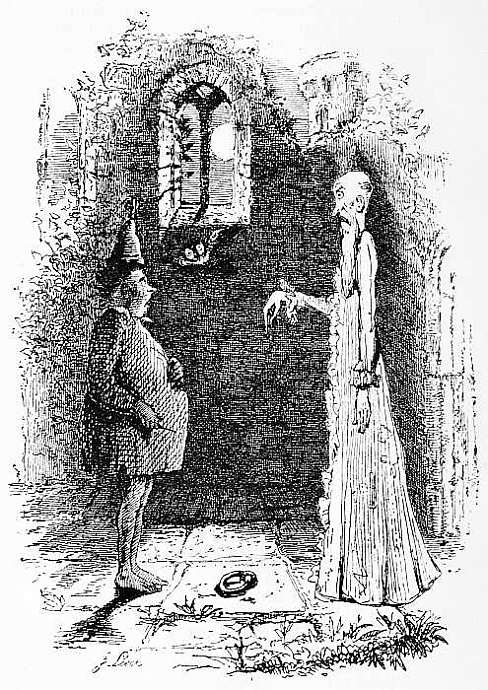
"Och, then, divil a lie I'll tell your honour. A tall ould gentleman
he was, all in white, with a shovel on the shoulder of him, and a
big torch in his fist,—though what he wanted with that it's meself
can't tell, for his eyes were like gig-lamps, let alone the moon
and the comet, which wasn't there at all;—and 'Barney,' says he to
me,—'cause why he knew me,—'Barney,' says he, 'what is it you're
doing with the colleen there, Barney?'—Divil a word did I say.
Miss Pauline screeched, and cried murther in French, and ran off with
herself; and of course meself was in a mighty hurry after the lady,
and had no time to stop palavering with him any way; so I dispersed at
once, and the ghost vanished in a flame of fire!"
Mr. Maguire's account was received with avowed incredulity by both
gentlemen; but Barney stuck to his text with unflinching pertinacity.
A reference to Mademoiselle was suggested, but abandoned, as neither
party had a taste for delicate investigations.
"I'll tell you what, Seaforth," said Ingoldsby, after Barney had
received his dismissal, "that there is a trick here, is evident; and
Barney's vision may possibly be a part of it. Whether he is most knave
or fool, you best know. At all events, I will sit up with you to-night,
and see if I can convert my ancestor into a visiting acquaintance.
Meanwhile your finger on your lip!"
"'Twas now the very witching time of night,
When churchyards yawn, and graves give up their dead."
Gladly would I grace my tale with decent horror, and therefore I do
beseech the "gentle reader" to believe, that if all the succedanea to
this mysterious narrative are not in strict keeping, he will ascribe
it only to the disgraceful innovations of modern degeneracy upon the
sober and dignified habits of our ancestors. I can introduce him, it is
true, into an old and high-roofed chamber, its walls covered on three
sides with black oak wainscotting, adorned with carvings of fruit and
flowers long anterior to those of Grinling Gibbons; the fourth side is
clothed with a curious remnant of dingy tapestry, once elucidatory of
some Scriptural history, but of which not even Mrs. Botherby could
determine. Mr. Simpkinson, who had examined it carefully, inclined
to believe the principal figure to be either Bathsheba, or Daniel in
the lions' den; while Tom Ingoldsby decided in favour of the King of
Bashan. All, however, was conjecture, tradition being silent on the
subject.—A lofty arched portal led into, and a little arched portal
led out of, this apartment; they were opposite each other, and each
possessed the security of massy
bolts on its interior. The bedstead,
too, was not one of yesterday, but manifestly coeval with days ere
Seddons was, and when a good four-post "article" was deemed worthy
of being a royal bequest. The bed itself, with all the appurtenances
of palliasse, mattresses, etc., was of far later date, and looked
most incongruously comfortable; the casements, too, with their little
diamond-shaped panes and iron binding, had given way to the modern
heterodoxy of the sash-window. Nor was this all that conspired to ruin
the costume, and render the room a meet haunt for such "mixed spirits"
only as could condescend to don at the same time an Elizabethan doublet
and Bond Street inexpressibles.
With their green morocco slippers on a modern fender, in front of
a disgracefully modern grate, sat two young gentlemen, clad in
"shawl-pattern" dressing gowns and black silk stocks, much at variance
with the high cane-backed chairs which supported them. A bunch of
abomination, called a cigar, reeked in the left-hand corner of the
mouth of one, and in the right-hand corner of the mouth of the
other;—an arrangement happily adapted for the escape of the noxious
fumes up the chimney, without that unmerciful "funking" each other,
which a less scientific disposition of the weed would have induced.
A small pembroke table filled up the intervening space between them,
sustaining, at each extremity, an elbow and a glass of toddy;—thus in
"lonely pensive contemplation" were the two worthies occupied, when the
"iron tongue of midnight had tolled twelve."
"Ghost-time's come!" said Ingoldsby, taking from his waistcoat pocket a
watch like a gold half-crown, and consulting it as though he suspected
the turret-clock over the stables of mendacity.
"Hush!" said Charles; "did I not hear a footstep?"
There was a pause:—there was a footstep—it sounded distinctly—it
reached the door—it hesitated, stopped, and—passed on.
Tom darted across the room, threw open the door, and became aware of
Mrs. Botherby toddling to her chamber, at the other end of the gallery,
after dosing one of the housemaids with an approved julep from the
Countess of Kent's "Choice Manual."
"Good night, sir!" said Mrs. Botherby.
"Go to the d—l!" said the disappointed ghost-hunter.
An hour—two—rolled on, and still no spectral visitation; nor did
aught intervene to make night hideous; and when the turret-clock
sounded at length the hour of three, Ingoldsby, whose patience and grog
were alike exhausted, sprang from his chair, saying,—
"This is all infernal nonsense, my good fellow. Deuce of any ghost
shall we see to-night; it's long past the canonical hour. I'm off to
bed; and as to your breeches, I'll insure them for the next twenty-four
hours at least, at the price of the buckram."
"Certainly.—Oh! thank'ee;—to be sure!" stammered Charles, rousing
himself from a reverie, which had degenerated into an absolute snooze.
"Good night, my boy! Bolt the door behind me; and defy the Pope, the
Devil, and the Pretender!—"
Seaforth followed his friend's advice, and the next morning came down
to breakfast dressed in the habiliments of the preceding day. The charm
was broken, the demon defeated; the light greys with the red stripe
down the seams were yet in rerum naturâ, and adorned the person of
their lawful proprietor.
Tom felicitated himself and his partner of the watch on the result of
their vigilance; but there is a rustic adage, which warns us against
self-gratulation before we are quite "out of the wood."—Seaforth was
yet within its verge.
A rap at Tom Ingoldsby's door the following morning startled him as he
was shaving;—he cut his chin.
"Come in, and be d—d to you!" said the martyr, pressing his thumb on
the scarified epidermis.—The door opened, and exhibited Mr. Barney
Maguire.
"Well, Barney, what is it?" quoth the sufferer, adopting the vernacular
of his visitant.
"The master, sir—"
"Well, what does he want?"
"The loanst of a breeches, plase your honour."
"Why, you don't mean to tell me—By Heaven, this is too good!" shouted
Tom, bursting into a fit of uncontrollable laughter. "Why, Barney, you
don't mean to say the ghost has got them again?"
Mr. Maguire did not respond to the young squire's risibility; the cast
of his countenance was decidedly serious.
"Faith, then, it's gone they are, sure enough! Hasn't meself been
looking over the bed, and under the bed, and in the bed, for the
matter of that, and divil a ha'p'orth of breeches is there to the fore
at all:—I'm bothered entirely!"
"Hark'ee! Mr. Barney," said Tom, incautiously removing his thumb, and
letting a crimson stream "incarnadine the multitudinous"
lather
that plastered his throat,—"this may be all very well with your
master, but you don't humbug me, sir:—tell me instantly what have
you done with the clothes?"
This abrupt transition from "lively to severe" certainly took Maguire
by surprise, and he seemed for an instant as much disconcerted as it is
possible to disconcert an Irish gentleman's gentleman.
"Me? is it meself, then, that's the ghost to your honour's thinking?"
said he, after a moment's pause, and with a slight shade of indignation
in his tones: "is it I would stale the master's things,—and what would
I do with them?"
"That you best know:—what your purpose is I can't guess, for I
don't think you mean to 'stale' them, as you call it; but that you
are concerned in their disappearance, I am satisfied. Confound this
blood!—give me a towel, Barney."
Maguire acquitted himself of the commission. "As I've a sowl, your
honour," said he solemnly, "little it is meself knows of the matter:
and after what I seen—"
"What you've seen! Why, what have you seen?—Barney, I don't want to
inquire into your flirtations; but don't suppose you can palm off your
saucer eyes and gig-lamps upon me!"
"Then, as sure as your honour's standing there I saw him: and why
wouldn't I, when Miss Pauline was to the fore as well as meself,
and—"
"Get along with your nonsense,—leave the room, sir!"
"But the master?" said Barney imploringly; "and without a
breeches?—sure he'll be catching cowld!—"
"Take that, rascal!" replied Ingoldsby, throwing a pair of pantaloons
at, rather than to, him: "but don't suppose, sir, you shall carry on
your tricks here with impunity; recollect there is such a thing as a
treadmill, and that my father is a county magistrate."
Barney's eye flashed fire,—he stood erect, and was about to speak;
but, mastering himself, not without an effort, he took up the garment,
and left the room as perpendicular as a Quaker.
"Ingoldsby," said Charles Seaforth, after breakfast, "this is now past
a joke; to-day is the last of my stay; for, notwithstanding the ties
which detain me, common decency obliges me to visit home after so long
an absence. I shall come to an immediate explanation with your father
on the subject nearest my heart, and depart while I have a change of
dress left. On his answer will my return depend!
In the meantime tell
me candidly,—I ask it in all seriousness, and as a friend,—am I not a
dupe to your well-known propensity to hoaxing? have you not a hand in—"
"No, by heaven! Seaforth; I see what you mean: on my honour, I am as
much mystified as yourself; and if your servant—"
"Not he:—if there be a trick, he at least is not privy to it."
"If there be a trick? Why, Charles, do you think—"
"I know not what to think, Tom. As surely as you are a living man, so
surely did that spectral anatomy visit my room again last night, grin
in my face, and walk away with my trousers; nor was I able to spring
from my bed, or break the chain which seemed to bind me to my pillow."
"Seaforth!" said Ingoldsby, after a short pause, "I will—But hush!
here are the girls and my father.—I will carry off the females, and
leave you a clear field with the governor: carry your point with him,
and we will talk about your breeches afterwards."
Tom's diversion was successful; he carried off the ladies en
masse to look at a remarkable specimen of the class Dodecandria
Monogynia,—which they could not find;—while Seaforth marched boldly
up to the encounter, and carried "the governor's" outworks by a coup
de main. I shall not stop to describe the progress of the attack;
suffice it that it was as successful as could have been wished, and
that Seaforth was referred back again to the lady. The happy lover was
off at a tangent; the botanical party was soon overtaken; and the arm
of Caroline, whom a vain endeavour to spell out the Linnæan name of a
daffy-down-dilly had detained a little in the rear of the others, was
soon firmly locked in his own.
"What was the world to them,
Its noise, its nonsense, and its 'breeches' all?"
Seaforth was in the seventh heaven; he retired to his room that night
as happy as if no such thing as a goblin had ever been heard of, and
personal chattels were as well fenced in by law as real property. Not
so Tom Ingoldsby: the mystery,—for mystery there evidently was,—had
not only piqued his curiosity, but ruffled his temper. The watch of
the previous night had been unsuccessful, probably because it was
undisguised. To-night he would "ensconce himself,"—not indeed "behind
the arras,"—for the little that remained was, as we have seen, nailed
to the wall,—but in a small closet which opened from one corner of
the room, and, by leaving the door ajar, would give to its occupant
a view of all that might
pass in the apartment. Here did the young
ghost-hunter take up a position, with a good stout sapling under his
arm, a full half-hour before Seaforth retired for the night. Not even
his friend did he let into his confidence, fully determined that if his
plan did not succeed, the failure should be attributed to himself alone.
At the usual hour of separation for the night, Tom saw, from his
concealment, the lieutenant enter his room, and, after taking a few
turns in it, with an expression so joyous as to betoken that his
thoughts were mainly occupied by his approaching happiness, proceed
slowly to disrobe himself. The coat, the waistcoat, the black silk
stock, were gradually discarded; the green morocco slippers were kicked
off, and then—ay, and then—his countenance grew grave; it seemed to
occur to him all at once that this was his last stake,—nay, that the
very breeches he had on were not his own,—that to-morrow morning was
his last, and that if he lost them—A glance showed that his mind was
made up; he replaced the single button he had just subducted, and threw
himself upon the bed in a state of transition,—half chrysalis, half
grub.
Wearily did Tom Ingoldsby watch the sleeper by the flickering light of
the night-lamp, till the clock, striking one, induced him to increase
the narrow opening which he had left for the purpose of observation.
The motion, slight as it was, seemed to attract Charles's attention;
for he raised himself suddenly to a sitting posture, listened for a
moment, and then stood upright upon the floor. Ingoldsby was on the
point of discovering himself, when, the light, flashing full upon his
friend's countenance, he perceived that, though his eyes were open,
"their sense was shut,"—that he was yet under the influence of sleep.
Seaforth advanced slowly to the toilet, lit his candle at the lamp that
stood on it, then, going back to the bed's foot, appeared to search
eagerly for something which he could not find. For a few moments he
seemed restless and uneasy, walking round the apartment and examining
the chairs, till, coming fully in front of a large swing-glass that
flanked the dressing-table, he paused, as if contemplating his figure
in it. He now returned towards the bed; put on his slippers, and,
with cautious and stealthy steps, proceeded towards the little arched
doorway that opened on the private staircase.
As he drew the bolt, Tom Ingoldsby emerged from his hiding-place;
but the sleep-walker heard him not; he proceeded softly down stairs,
followed at a due distance by his friend; opened the door which led
out upon the gardens; and stood at once among the
thickest of the
shrubs, which there clustered round the base of a corner turret, and
screened the postern from common observation. At this moment Ingoldsby
had nearly spoiled all by making a false step: the sound attracted
Seaforth's attention,—he paused and turned; and as the full moon shed
her light directly upon his pale and troubled features, Tom marked,
almost with dismay, the fixed and rayless appearance of his eyes:—
"There was no speculation in those orbs
That he did glare withal."
The perfect stillness preserved by his follower seemed to reassure
him; he turned aside; and from the midst of a thickset laurustinus,
drew forth a gardener's spade, shouldering which he proceeded with
greater rapidity into the midst of the shrubbery. Arrived at a certain
point where the earth seemed to have been recently disturbed, he
set himself heartily to the task of digging, till, having thrown up
several shovelfuls of mould, he stopped, flung down his tool, and very
composedly began to disencumber himself of his pantaloons.
Up to this moment Tom had watched him with a wary eye: he now advanced
cautiously, and, as his friend was busily engaged in disentangling
himself from his garment, made himself master of the spade. Seaforth,
meanwhile, had accomplished his purpose: he stood for a moment with
"His streamers waving in the wind,"
occupied in carefully rolling up the small-clothes into as compact
a form as possible, and all heedless of the breath of heaven, which
might certainly be supposed, at such a moment, and in such a plight, to
"visit his frame too roughly."
He was in the act of stooping low to deposit the pantaloons in the
grave which he had been digging for them, when Tom Ingoldsby came close
behind him, and with the flat side of the spade—
The shock was effectual;—never again was Lieutenant Seaforth known
to act the part of a somnambulist. One by one, his breeches,—his
trousers,—his pantaloons,—his silk-net tights,—his patent
cords,—his showy greys with the broad red stripe of the Bombay
Fencibles were brought to light,—rescued from the grave in which they
had been buried, like the strata of a Christmas pie; and, after having
been well aired by Mrs. Botherby, became once again effective.
The family, the ladies especially, laughed;—the Peterses laughed;—the
Simpkinsons laughed;—Barney Maguire cried "Botheration!" and
Ma'mselle Pauline, "Mon Dieu!"
Charles Seaforth, unable to face the quizzing which awaited him on all
sides, started off two hours earlier than he had proposed:—he soon
returned, however; and having, at his father-in-law's request, given up
the occupation of Rajah-hunting and shooting Nabobs, led his blushing
bride to the altar.
Mr. Simpkinson from Bath did not attend the ceremony, being engaged
at the Grand Junction Meeting of Sçavans_, then congregating from
all parts of the known world in the city of Dublin. His essay,
demonstrating that the globe is a great custard, whipped into
coagulation by whirlwinds, and cooked by electricity,—a little too
much baked in the Isle of Portland, and a thought underdone about the
Bog of Allen,—was highly spoken of, and narrowly escaped obtaining a
Bridgewater prize.
Miss Simpkinson and her sister acted as bridesmaids on the occasion;
the former wrote an epithalamium, and the latter cried "Lassy me!" at
the clergyman's wig.—Some years have since rolled on; the union has
been crowned with two or three tidy little offshoots from the family
tree, of whom Master Neddy is "grandpapa's darling," and Mary-Anne
mamma's particular "Sock." I shall only add, that Mr. and Mrs. Seaforth
are living together quite as happily as two good-hearted, good-tempered
bodies, very fond of each other, can possibly do: and, that since
the day of his marriage Charles has shown no disposition to jump out
of bed, or ramble out of doors o' nights,—though, from his entire
devotion to every wish and whim of his young wife, Tom insinuates that
the fair Caroline does still occasionally take advantage of it so far
as to "slip on the breeches."

It was not till some years after the events just recorded, that Miss
Mary-Anne, the "pet Sock" before alluded to, was made acquainted with
the following piece of family biography. It was communicated to her in
strict confidence by Nurse Botherby, a maiden niece of the old lady's,
then recently promoted from the ranks in the still-room, to be second
in command in the nursery department.
The story is connected with a dingy wizzen-faced portrait, in an
oval frame, generally known by the name of "Uncle Stephen," though from the
style of his cut-velvet, it is evident that some generations must have
passed away since any living being could have stood towards him in that
degree of consanguinity.

 N.B.—If defunct the
 )'