THE CATHEDRAL: THE MURDER OF BECKET
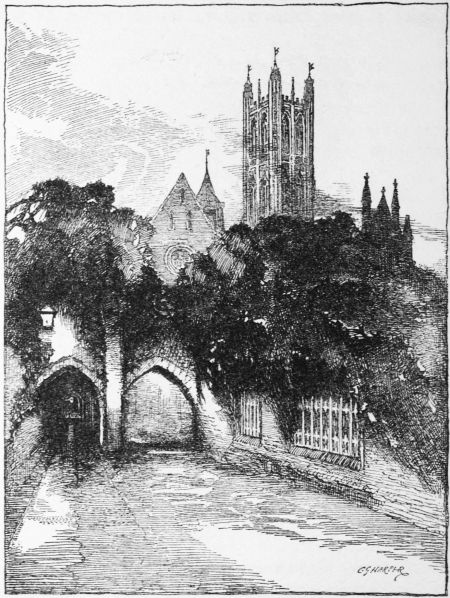
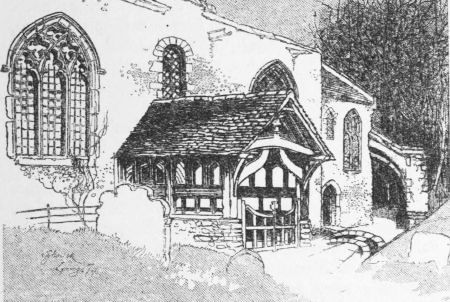
It is by the south porch that the Cathedral is
entered. Let none suppose this to be the veritable
Cathedral that Becket knew; that was replaced,
piece by piece, in the succeeding centuries, all save
the Norman transept where he met his fate. The
nave, by whose lofty, aspiring perspective we
advance, was built in 1380 upon the site of that
of the twelfth century. According to the testimony
of the time, it was in a ruinous condition. Conceive,
if you can, the likelihood of one of those particularly
massive Norman naves like those of Tewkesbury and
Gloucester, which this resembled, becoming ruinous!
The more probable truth of the matter is that the
feeling of the time had grown inimical to those
cavernous interiors of the older architects, and sought
any excuse for tearing them down and building
in their stead in the lightsome character of the
Perpendicular period.
This nave, then, much later than Becket's era,
leads somewhat unsympathetically to that most
interesting spot in the whole Cathedral, the north
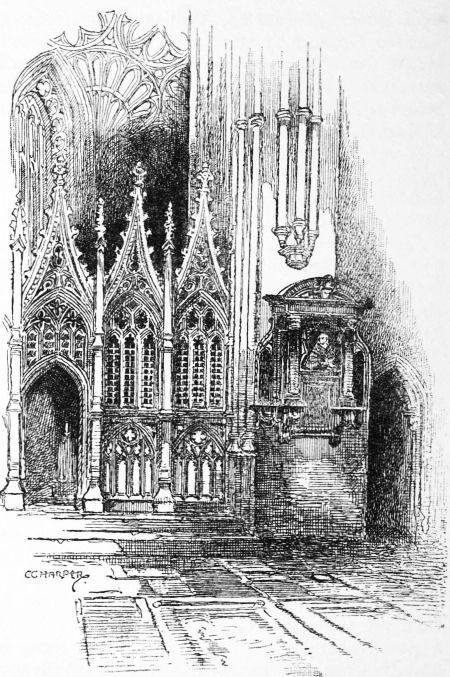
transept. Here is the "Martyrdom," as that massive
Norman cross-limb where Becket fell beneath the
swords and axes of his murderers is still called.
You look down into it from the steps leading into
the choir and choir-aisles, as into a pit. Little
changed, in the midst of all else that has been altered,
this north transept alone remains very much as it
was when he was slain, more than seven hundred
years ago, and the sight of its stern, massive walls
does much to bring back to those who behold them
that fierce scene which, in the passage of all those
years and the heaping of dull verbiage piled up by
industrious Dryasdusts and beaters of the air, has
been dulled and blunted.
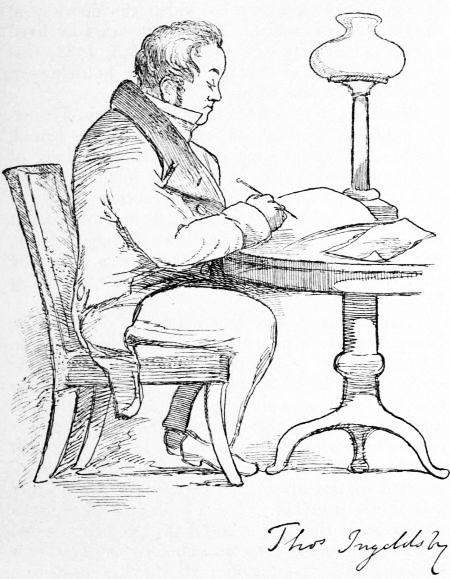
Barham—our witty and mirthful Tom Ingoldsby—felt
a keen personal interest in this scene, for was
not his ancestor—as he conceived him to be—Reginald
FitzUrse, the chief actor in that bloody
scene of Becket's death? He is flippant, it must
be allowed, in the reference he makes to the occurrence
in the Ingoldsby Legends:
A fair Cathedral, too, the story goes,
And kings and heroes lie entombed within her;
There pious Saints in marble pomp repose,
Whose shrines are worn by knees of many a sinner;
There, too, full many an aldermanic nose
Roll'd its loud diapason after dinner;
And there stood high the holy sconce of Becket,
—Till four assassins came from France to crack it.
Historians have not yet agreed upon the character
of Becket, and no final conclusion is ever likely to
be arrived at upon the vexed question of who was
right and who wrong in the long-drawn contention
between King and Archbishop. It is easy to shirk
the point and to decide that neither was right; but
another and a more just resort is to declare, after
due consideration, that in the attempted secular
encroachments of the Crown, and in the resistance
of the Archbishop to any interference with the
prerogatives and jurisdiction of the Church and the
clergy, both sides were impelled by the irresistible
force of circumstances. Becket was of English origin,
and the first of the downtrodden Saxon race who
had won to such preferment since the Norman rule
began. Thus, besides being bound to defend the
Church, of which he had become the head, he was
regarded by the people, who idolised him, as their
champion against those ruling classes whose mailed
tyranny crushed them to earth.
A prime difficulty in judging the character of
Becket is the extraordinary change in his conduct
after he had been induced to accept the Primacy,
that goal and crown of the clerical career ardently
desired by all, and attained by Becket in his forty-third
year. Long the favourite of the King, and
already, as Chancellor, at the height of power and
magnificence, there was little advantage in this
elevation to the throne of Saint Augustine, and he
seemed singularly unfitted to fill it, for until that
juncture he had been among the most worldly of
men. As Chancellor, his magnificence had outshone
that of the King, he himself was gay and
debonnair, clothed in purple and fine linen, feasting
royally, and with hundreds of knights in his train.
Nothing that the world could give had he denied
himself. He was not only impressed personally
with his unfitness, but the monks of Canterbury
themselves, in conclave, desired to elect one of their
own choice. It was, therefore, against the desire
of the Church and against his own better judgment,
foreseeing as he did much of the trouble that was
to come, that he was given the headship.
But once enthroned, his conduct changed. He
dismissed his magnificent household, feasted no more,
expended his substance in charity and himself in
good works; became, indeed, and in very truth,
that Right Reverend Father in God which the
simulacra, the windbags, the ravening wolves, the
emptinesses that for hundreds of years have occupied
his place, are styled. The sinner saved must be
prepared for misunderstandings—it is part of the
cross and burden he has taken up. The scarlet sins
of the unregenerate are remembered against the
saint, and his saintliness becomes to his old boon
companions a hypocritical farce. That is why
Becket's contemporaries did not understand him;
that, too, is why so many, dimly fumbling by the
rush-light glimmer of their little sputtering intelligences,
presently choked and dowsed in the dusty,
cobwebby garrets of incredible accretions of lies,
mistakes, perversions and general rag-bag of pitiful
futilities, have been left wandering in infinite darkness,
and content so to wander in estimating him.
It was the sinners whose poisonous tongues did,
by dint of much persistence, estrange the King's
affections from Becket within a year, and their
innuendoes were remembered when a growing
struggle over disputed privileges found the Archbishop
immovably set upon what he regarded as his
duty, and not at all prepared to favour the King.
If Henry had supposed the Archbishop whom he
had created would be in every sense his creature, he
must have been furious at his gross mistake. The
fury of the Norman kings was like the unrestrained
paroxysms of a raving maniac, and opposition threw
them into transports of rage, felt severely by animate
and inanimate objects alike. This second Henry,
whose eyes were said to have in repose been gentle
and dove-like, is no exception. Ill fares the
messenger who brings him bad news—as ill sometimes
as though he had brought about the untoward
things of which he tells. Slight displeasure means
a thump, a resounding smack on the face from the
Royal hands, or a right Royal kick on that part
where honour is so easily hurt. May not enquiring
minds, diligently bent on running to earth the
origin of the still existing etiquette of retreating
backwards from the presence of the sovereign,
find it in a natural desire of courtiers at all
hazards to protect that honour?
Conceive, then, the really Royal rage of this King,
bearded by someone not to be dissuaded, persuaded,
admonished, or let or hindered in any particular.
He became like a wild beast, tearing whatever came
in his way, flinging off his clothes, throwing himself
on the floor and gnawing the straw and rushes, and
not merely kicking the posteriors of messengers, but
flying at them with intent to tear out their eyes.
What was that which wrought such enmity
between such old-time friends? Not merely one,
but many things, but first and last among them the
determination of the King that the clergy, instead of
being amenable for offences only to the ecclesiastical
courts, should be answerable to the civil tribunals.
This, the earliest of the at last happily successful
series of blows at clerical privilege, seemed to Becket
almost sacrilegious, and he determined to protect
the Church against what was, he honestly thought,
according to his lights and his sacerdotal sympathies,
an unwarranted attack.
By all accounts this saint was not, in his new
character, the most tactful of men. With the old
courtier days gone by, he had discarded the courtier-like
speech, and austerely held his own. Jealous of
him, several great dignitaries of the Church supported
the King: among them the Archbishop of
York, and the Bishops of London and Salisbury.
Becket, as their spiritual chief, hurled excommunication
at them, and it was even feared that he would
do the same by the King. Then, in fear of his life,
he went into six years' exile, ended by a pretence of
reconciliation that was patently a pretence, even
before he sailed for England. He was weary of
exile, and ready to lay down his life for the
Church.
It was early in December 1170 that he returned
to Canterbury, "to die," as he prophetically had
said, before embarking. Quarrels, insults, and petty
persecutions met him, and thus sped December to
its close. On Christmas Day he preached in the
Cathedral on the text, as he read it (an all-important
reservation), "On earth, peace to men of good will."
"There is no peace," he declared, "but to men of
good will," and with solemn meaning, readily understood
by the great congregation that heard him,
spoke of the martyrs who had fallen in olden days.
It was possible, he added, that they would soon
have another.
"Father," wailed that assembled multitude, "why
do you desert us so soon? To whom will you
leave us?" But, heedless of the interruption,
he passed from a plaintive strain to one of fiery
indignation, ending, in a voice of thunder, by a full
and particular excommunication of many of his
enemies and persecutors. "May they be cursed,"
his voice resounded through the building, "by Jesus
Christ, and may their memory be blotted out of
the assembly of the saints, whoever shall sow discord
between me and my lord the King." So saying, he,
with mediæval symbolism, dashed down a lighted
candle upon the stones, to typify the extinction
of those accurst, and, with religious exaltation on
his face, left the pulpit, saying to his crossbearer,
"One martyr, St. Alphege, you have already;
another, if God will, you will have soon."
Already, while he spoke, his furrow was drawing
to its end. Over in Normandy, where the King
was keeping Christmas, the Archbishop of York
and the Bishops of London and Salisbury were
suggesting that it would be a good thing if there
were no Becket. "So long as Thomas lives," said
one, "you will have neither good days, nor peaceful
kingdom, nor quiet life."
The thought thus instilled into the King's mind
threw him into a frenzy. "A fellow," he shouted—"a
fellow that has eaten my bread has lifted up his
heel against me; a fellow that I loaded with benefits
has dared to insult the King and the whole Royal
family, and tramples on the whole kingdom; a
fellow that came to Court on a lame sumpter-mule
sits without hindrance on the throne itself. What
sluggard wretches, what cowards, have I brought up
in my Court, who care nothing for their allegiance
to their master! Not one will deliver me from this
low-born, turbulent priest!" So saying, he rushed
from the room, doubtless to roll in one of those
ungovernable Plantagenet rages upon the floor of
some secluded chamber.
The four knights who from among that Court
sprang forth to prove themselves, even to the awful
extremities of sacrilege and murder, true King's
men, were Reginald FitzUrse, Hugh de Moreville,
William de Tracy, and Richard le Bret. In the
light of later events, the monkish chroniclers, eager
to discover the marvellous in every circumstance of
the tragedy, found a dark significance in their very
names. FitzUrse, they said, was of truly bear-like
character; De Moreville's name proclaimed
him to be of "the city of death"; Le Bret was
"the brute." With so much ingenuity available,
it is quite surprising they could not twist Tracy's
name into something allusive to murder; but they
had to be content with the weak suggestion that
he was of "parricidal wickedness." All save Le
Bret had been knights owning fealty to Becket while
he was Chancellor.
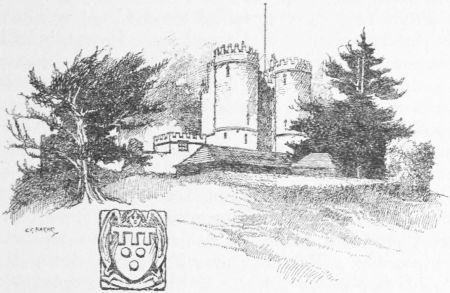
It is detailed in these pages, in the description
of Saltwood Castle, how they landed in England
and made for Canterbury. A dreadful circumstance
is that they knew perfectly well on whom to call
when they reached the city, and waited upon a
sympathiser with the King, Clarembald, the Abbot
of St. Augustine's, who is thus sufficiently implicated.
From the Abbot's lodging they sent a command,
ordering the Mayor to issue a proclamation
in the King's name forbidding any help being
given to the Archbishop. Then they took horse
again and rode to the Palace, accompanied by their
men-at-arms, whom they posted in a house hard
by the gateway. The short day of December 29th
was nearly at its close when they drew rein in the
courtyard beneath the great hall of the Palace,
where the Archbishop and his household had but
just retired from supper. They had left their
swords outside, and came as travellers, their mailed
armour concealed under long cloaks. Entering the
hall they met the seneschal, who ushered them into
the private room where the Archbishop sat, among
his intimates. "My lord," he said, "here are four
knights from King Henry wishing to speak with
you"; and they were bidden enter.
FitzUrse began the furious discussion. The
knights had seated themselves on the floor at the
Archbishop's feet, and waited until he should finish
the conversation he was holding with a monk.
When Becket turned and looked calmly at each in
turn, ending with saluting Tracy by name, FitzUrse
it was who broke in with a contemptuous
"God help you!"
The Archbishop's face flushed crimson. He was
a man of vehement nature, and it is wonderful that
he restrained himself from striking that insolent
intruder. "We have a message from the King
over the water," continued FitzUrse; "tell us
whether you will hear it in private, or in the hearing
of all."
Within the hearing of all that message, such
as it was, was given. It was but a reiteration of
old demands and old grievances, made to goad the
Archbishop into fury, and to afford an excuse for
an attack upon him. The discussion aroused both
sides to anger, and the knights, calling upon all
to prevent the Archbishop from escaping, dashed
off, with the cry of "To arms!" for their
swords.
But Becket harboured no thoughts of escape.
Although he perceived that death was near, he
made no retreat, being indeed, by this time, fanatically
bent upon the martyr's crown. Outside, the signal
had been already given to the men-at-arms, who
now came pouring in, with shouts of "Réaux!"
or "King's men." The knights now returned,
their swords girt about them. Already, however,
the Archbishop's attendants had closed and barred
the doors, and were endeavouring to save him from
that death he seemed to welcome. With kindly
violence they pushed and pulled him by obscure
passages from the Palace and along the cloisters,
while the blows of axes and the splintering of wood
told how in their rear the murderers were hewing
their way onward. Thus at last, strenuously
resisting, he was impelled towards the door that
opened from the cloisters into the north transept.
Once within the Cathedral the monks bolted the
door behind them, and in their haste excluded some
of their brethren, thus left, unprotected, to face the
onrush of armed men. Hearing these unfortunate
ones vainly knocking for admittance, Becket, exerting
all his authority, commanded the door to be opened;
and when he found his words disregarded, broke
away from those who held him and drew back the
bolts with his own hands.
Seeing the way thus made clear for those pursuing
men of wrath, the crowd of anxious monks
surrounding the Archbishop immediately turned
and fled to those hiding-places they knew of. Only
three remained, dauntless, by their chief. These
were Robert of Merton, William FitzStephen, and
Edward Grim, who stood by him, vainly imploring
him to flee. Only one concession he made to their
entreaties. He would go to the choir, and there,
before the high altar, the holiest place in the
Cathedral, with all dignity make an end.
It was as he was thus ascending the steps from the
transept that the knights burst into the sacred
building. Bewildered at first by the almost complete
darkness, they could only shout at random, "Where
is Thomas Becket, traitor to the King?" No
answer. Then, falling over a monk, came an oath,
from FitzUrse, and the question, "Where is the
Archbishop?" Becket himself answered, and
descending again into the transept, confronted
them. He stood in front of what was then the
the Chapel of St. Benedict, and calmly asked,
"Reginald, why do you come into my church
armed?" For answer FitzUrse thrust a carpenter's
axe he had found against his breast, and with a
savage oath declared, "You shall die: I will tear out
your heart!" "Fly!" exclaimed another, not so
eager to commit the sin of sacrilege, before which
the mediæval world recoiled; "Fly! or you are a
dead man!" striking him with the flat of his sword,
to emphasise the warning.
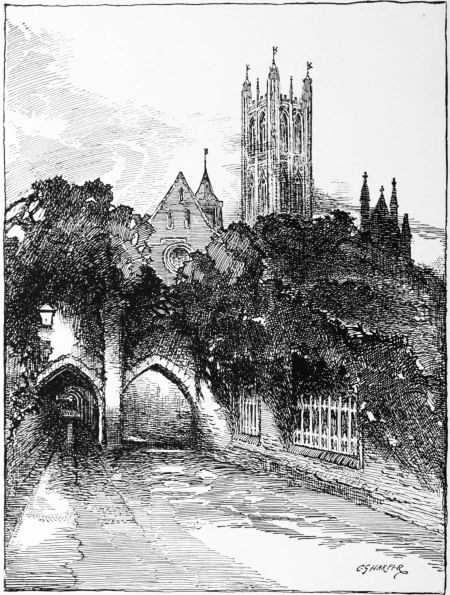
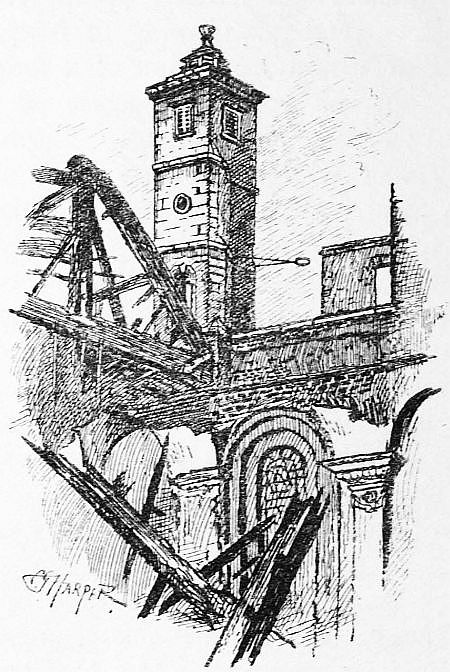
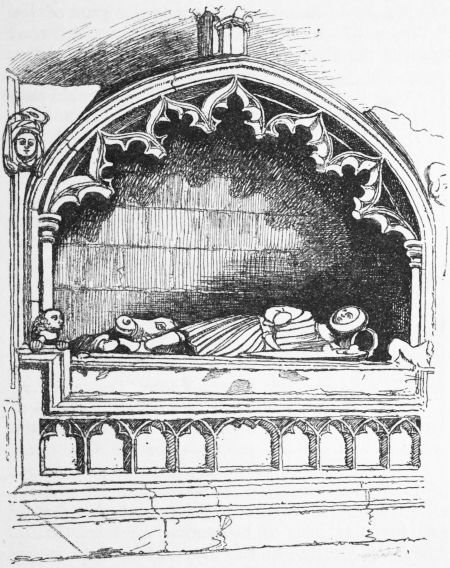
THE "MARTYRDOM," CANTERBURY CATHEDRAL.
Then the four united their efforts to drag him
from the Cathedral, but without success. Himself
a powerful man, he seized Tracy and flung him
heavily upon the pavement. FitzUrse, advancing
upon him with a drawn sword, he called by a vile
name, adding, "You profligate wretch, you are my
man; you have done me fealty; you ought not
to touch me." No fear, it will be seen, in all this,
but a not unreasonable fury, somewhat obscuring the
martyr spirit. Fury on both sides, for FitzUrse,
losing the last atom of restraint, and yelling "Strike!"
aimed a blow with his great, two-handed sword
that, had it been better directed, must have smote
off the Archbishop's head. As it was, it merely
skimmed off his cap. Becket, who must have been
momentarily surprised to find himself still alive,
then covered his eyes with his hands, and bending
his head, was heard to commend his cause and the
cause of the Church to God, to St. Denis of France,
to St. Alphege and all the saints of the Church.
Tracy then dealt a blow, partly intercepted by Grim,
whose arm, protecting the Archbishop, was broken
by it. By this time blood was trickling down the
Archbishop's face. He wiped it away and murmured,
"Into Thy hands, O Lord, I commend my
spirit;" and then, falling at a further blow from
Tracy, "For the name of Jesus, and for the defence
of the Church, I am willing to die." There he
lay, and so lying, received a tremendous stroke
from Richard le Bret, who accompanied it with the
exclamation, "Take this, for love of my lord
William, brother of the King!" That stroke not
only clove away the upper part of the skull, but the
sword itself was broken in two. Vengeance was
accomplished.
When the assassins fled from that scene of blood,
it was quite dark. They went as they had come,
by the cloisters, shouting that they were "King's
men," and cursing and stumbling over unfamiliar
steps. A servant of the Archdeacon of Sens was
sufficiently unfortunate to be wailing for the cruel
death of the Archbishop when they passed, and
foolish enough to be in their way. They fell over
him, and, still heady with that struggle and the lust
of blood, gave him in passing a mailed kick,
and so tremendous a sword-thrust that for long
afterwards he had sufficient occasion to lament for
himself.
It was something of an anti-climax to their
murderous passions that they should, as they now
did, repair to the Archbishop's Palace and make
a burglarious raid upon the gold and silver vessels
of the church, and loot from Becket's stables the
magnificent horses he kept. With this personal
plunder, and with a mass of the Archbishop's
documents and papers seized on behalf of the King,
they were preparing to depart when the very unusual
circumstance in December of a violent thunderstorm
set a final scene of horror upon that closing day.
The news fell heavily upon the people of Canterbury,
who reverenced Becket far more than did
those within the Church who had immediately surrounded
him; and the citizens came rushing like
an irresistible torrent into the Cathedral as soon
as they heard of the sacrilegious deed.
Like the greater number of our cathedrals, this
of Canterbury has been greatly altered since that
time. It was into a Norman nave that the excited
populace thronged—a building that must have
closely resembled the still-existing nave of that
period at Gloucester, gloomy and dark at the best
of times, but on this December evening a well of
infinite blackness, faintly illuminated by the distant
lights twinkling in the choir and on the high altar.
This horror-stricken crowd was only with great
difficulty forced back and at last shut out, and it
was long before the monks returned to the transept
where the Archbishop had fallen before the blows of
the four. There his body lay in the dark, as it had
been left, his blood still wet on those cold stones, as
Osbert, the chamberlain, entering with a single light,
held out at arm's length in that cavern of blackness
and unimaginable gloom, steps in it, and, if he
be not quite different from other men, shudders
and almost drops his glimmering candle when he
finds what awful moisture that is in which he has
been walking. Osbert alone has ventured to seek
his master. Where, then, are the others of his
household? In hiding, like those monks who, now
that all is still, venture, like rats, to come from their
hiding-holes in chapel and triforium, or from secret
places contrived for such emergencies in the roof.
The Archbishop lay upon his face, the upper part
of his scalp sliced off by that whirling blow of
Tracy's, and the contents of his head spilled over
the pavement, just as a bowl of liquid might be
overset. Osbert, with rare fortitude, replaces that
scalp as one might replace a lid, and binding the
head, he and the monks between them place the
body upon a bier and carry it to the high altar in
the choir.
There were those among the monks who felt
small sympathy for Becket. To them he was but
a proud worldling whose remarkable preferment to
the Primacy had been scandalous, and whose quarrels
with the King had been, they thought, dictated
more for the advancement of his own personal
authority than for sake of a purely impersonal desire
to preserve and cherish the rights of the Church.
He had been elected Archbishop by desire of the
King and against the feeling of the Priory, and
they thought he should, in consequence, have been
more complaisant to Royal demands. They were
not a little jealous of the man set to rule over them,
and moreover, could not at once perceive the
martyr and the saint in the dignitary thus at last
struck down in that long struggle. They were
horror-stricken at the sacrilege of it, but did not
burst into grief and lamentations for the individual
until that happened which put a very different
complexion upon the dead Archbishop's character.
Far into the night, as the monks sat in the choir
around that silent figure, his aged friend and
instructor, Robert of Merton, told them of the
secret austerities of his later life, and made a
revelation that wholly changed their mental attitude.
To prove his words, he exposed the many layers of
the clothing to those who gathered round, and
showed how, beneath all, and next the skin, the
"luxurious" Archbishop had worn the habit of a
monk, and had endured the disciplinary discomfort
of a hair-shirt. There, too, on the skin, were
visible the weals of the daily scourgings by which
the Archbishop mortified the flesh. Nor was this
the sum of his virtues, for when, a little later, his
garments were removed, previous to interment, they
were found to be swarming with vermin; that
hair-cloth, itself so penitential, densely populated
with a crawling mass whose presence must have
made it more penitential still. According to the
accounts of those who beheld these transcendent
proofs of sanctity, the hair-cloth was bubbling over
with these inhabitants, like water in a simmering
cauldron.
At sight of such unmistakable evidences of
holiness the brethren went into hysterics. "See,
see," they said to one another, "what a true monk
he was, and we knew it not!"—an oblique and
unpleasing reflection upon the personal habits of the
monastic orders. They kissed him, as he lay dead
there, and called him "St. Thomas," and at last,
unwilling that any tittle of his sanctity should be
impugned, buried him in his verminous condition.
Meanwhile, newly alive to the saintly character
of him whom they now clearly perceived to be a
martyr, orders were given to rail off the spot where
he had fallen, and for every trace of his blood to
be jealously preserved. But unhappily for the
Church, the common people, who had from the
moment of his death regarded their Archbishop as
a martyred saint, had already soaked up the greater
part of that precious blood in strips hastily torn
from their clothes, and had been given his stained
and splashed outer garments. These were losses
that could never be made good, but they did not
greatly matter to those who could so dilute the little
remaining blood that it sufficed to supply the
uncounted thousands of pilgrims who made pilgrimage
to the shrine of St. Thomas for the space of
three hundred and fifty years, and took away with
them little phials containing, as they fondly believed,
so intimate a relic of England's most powerful
saint.
In spite of the dark legends that tell how
vengeance overtook the assassins, it does not seem
to be the fact that they were adequately punished
for their fearful crime, and certainly no Royal
displeasure lighted upon them. "The wicked,"
we are told, "flee when no man pursueth," and
the knights, fearful of the revenge that might be
taken upon them by the people of Canterbury, rode
off, unhindered, with their small escort of men-at-arms,
to Saltwood. Within that stronghold they
felt safe. That they would have been equally safe
at Canterbury we may suppose, for Robert de Broc,
shut up within the strong walls of the Archbishop's
Palace, felt strong enough to threaten the monks
with what he would do if they dared so honour the
dead Prelate as to bury him among the tombs of
the Archbishops. He would, he declared, tear out
the body, hang it from a gibbet, hew it in pieces,
and throw the fragments by the highway, to be devoured
by swine or birds of prey. It is quite evident
that Robert de Broc was a good hater and a very
thorough partisan of the King. The monks did
well to be afraid of him, and meekly forbearing from
giving offence, laid their martyr in the crypt.
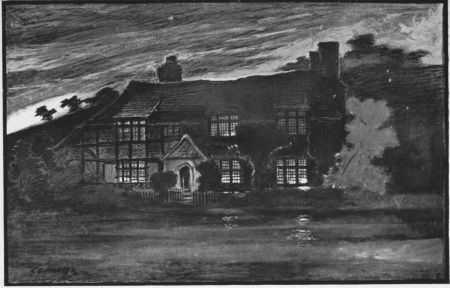
The four lay only one night at Saltwood. The
next day they rode to the old manor-house of
South Malling, near Lewes, itself a property belonging
to the Archbishops, and throwing down
their arms and accoutrements upon a dining-table
in the hall, gathered comfortably round the cheerful
hearth, when—says the legend—the table, unwilling
to bear that sacrilegious burden, started back and
threw the repugnant load on the ground. The
arms were replaced by the startled servants, who
came rushing in with torches; but again they were
flung away, this time with even greater force. It
was one of the knights who, with blanched face,
declared the supernatural nature of this happening.
The following morning they were off again,
bound for Hugh de Moreville's far distant Yorkshire
castle of Knaresborough, where they remained
for one year. It would have been too scandalous
a thing for the King to receive his bravos at once,
for he had a part of his own to play that would
have been quite spoiled by such indecent haste—a
dramatic part, but one that fails to carry any
conviction of its sincerity. It was at Argenton
that he heard of the successful issue of his commission,
and on receipt of the news isolated himself
for three days, refused all food but milk of almonds,
rolled himself in penitential sackcloth and ashes, and
grievously called upon God to witness that he was
not responsible for the Archbishop's death. "Alas!"
exclaimed that trembling hypocrite, "alas! that it
ever happened."
But it is not in empty lamentations, real or
feigned, that penitence is found. The assassins
went unpunished, and, together with others of
Becket's bitterest enemies within and without the
Church, were even promoted. Before two years
had passed the four knights were found constantly
at the King's Court, on familiar terms with him
and his companions in hunting. It is a cynical
commentary upon the kingly penitence that one of
the murderers, William de Tracy, became Justiciary
of Normandy. But something had to be done to
expiate a deed whose echoes rumbled horrifically
throughout Europe. The Pope, Alexander III.,
indicated a course of fighting against the infidel
in the Holy Land, and it seems probable that they
did so work off their sins; all except Tracy, who,
having made over his Devonshire manor of Daccombe
to the Church, for the maintenance of a monk for
ever, to celebrate masses for the repose of the souls
of the living and the dead, set out for Palestine,
but was for so long driven back by contrary winds
that he almost despaired of setting foot abroad.
This especial retribution meted out to him was for
the particular heinousness of having dealt the first
effective blow at the martyr. When at last he
was carried to the coast of Calabria, he was seized
with a mysterious disease at Cosenza, a disease
whose agonies made him tear the flesh from his
bones with his own hands. Thus entreating,
"Mercy, St. Thomas!" he perished miserably.
The mysticism of the time told many dreadful
legends. Dogs refused to eat from the tables of
the murderers; grass would not grow where their
feet went; those they loved were doomed to misery
and death.
From the King a certain humiliation was demanded,
but it amounted to little beyond an oath, taken on
the gospels before the Papal legates, that he had
not ordered or desired the murder, and an expressed
readiness to restore property belonging to the See
of Canterbury. This easy satisfaction was given at
Avranches, in May 1172, but if it was sufficient
for the Pope it did by no means calm the English
people, who saw in the cumulative domestic troubles
and foreign disasters of the time the wrath of
Heaven. The greater penance of 1174 was accordingly
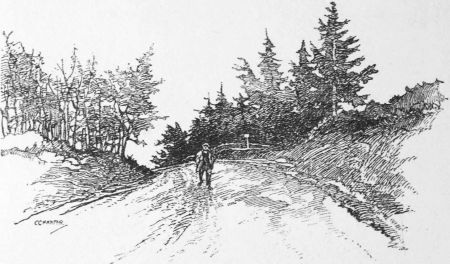
decided upon. Arriving from Normandy on
July 8th, he journeyed to Canterbury, to the
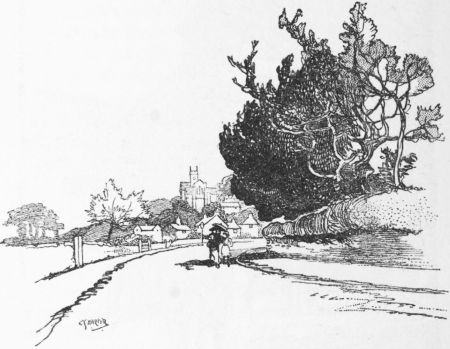
shrine of the already sainted martyr, by the Pilgrims'
Road, living the while upon bread and water.
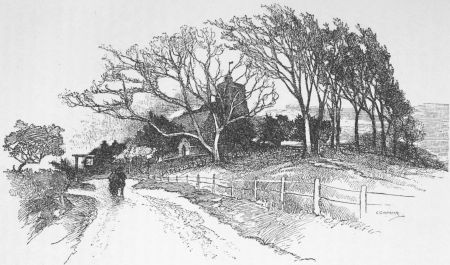
Coming to Harbledown, he resigned horseback for
a barefooted walk into the city. Thus, with a mere
woollen shirt and a cloak, he came to the Cathedral,
kneeling in the porch, and then proceeding directly
to the scene of the martyrdom, where he again knelt
and kissed the stone where the Archbishop had died.
From that spot, he was conducted to the crypt,
where the tomb still remained, and, placing his head
and shoulders in the tomb itself, received on his
shoulders five strokes of a rod from each bishop
and abbot present, and three each from the by-standing
eighty monks. This discipline must have
killed him had those monks laid on with the hearty
goodwill customary with prison warders; but their
stripes were mere formalities, and the King departed
the next morning, after passing a solitary fasting
vigil in the crypt, where, during the solemn hours
of the night, he had had ample opportunity of
repentance. From Canterbury he rode to London,
absolved and with a whole skin.
The nation saw much virtue in this public reparation.
How could they fail so to do when the affairs
of the realm took an immediate and decided turn
for the better, when the King of Scots, long a
terror in the north, was captured at Alnwick, and
when the invading fleet of Henry's own rebellious
son was repulsed? The forgiveness and the miraculous
intercession of the beatified Thomas were
prompt and efficacious.
The cult of this peculiarly sainted person was
extraordinary, and far transcended that of any other
martyr. To his shrine, erected in a place of
especial honour, and encrusted with gold and gems,
the pilgrims of many nations and many centuries
flocked, greatly to the enrichment of the Church.
The miraculous cures wrought at his tomb, and the
marvellous legends that clustered around the story
of his life and death, were the theme of ages. But
the gross superstitions, and the grosser scandals,
tricks, and miscellaneous knaveries that were encouraged
by that martyr-worship had discredited
him by the time of Henry VIII., that less superstitious
age when it was possible for the King and
his advisers to declare "Thomas Becket" a traitor,
to submit his relics to every indignity, to destroy
them and his shrine, and to seize all the endowments
and valuables connected with his worship.
The great destruction wrought at the Reformation
accounts for the scantiness of Becket's memorials.
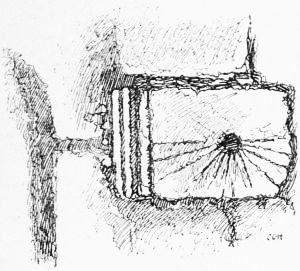
Here, in the "Martyrdom," only the Norman walls
that looked down upon the scene, and some portions
of the pavement, are left. A square piece of stone,
inserted in the middle of a large slab, marks the
exact spot where he fell, and tells how the original
stone, regarded as of a peculiar sanctity, had been
at some time or another removed.