The planet Saturn is the most remote of the seven planetary orbs
recognised by the ancient writers on astrology. He is of a pale ash
colour, slow in motion, only finishing his course through the twelve
signs of the zodiac in 29 years and about 157 days. His greatest north
latitude from the ecliptic is 2 degrees 48 minutes; his south latitude
is 2 degrees 49 minutes.
Those born with this planet well-dignified
[4] are studious, grave,
economical, prudent, patient and in all their actions sober and
somewhat austere. They are not much given to the love of women, but
they are persons of much depth of feeling, and, when they do love, they
are very constant. They are given to the study of occult matters,
[5]
and are of a melancholic, suspicious and jealous temperament. In person
when well-dignified Saturn gives a rather tall stature and long
limbs. The hair is dark, the eyebrows much marked and generally meeting
between the eyes, which are dark brown, deep set and close together.
The nose is long and generally somewhat bent over the lips and the
under jaw slightly protrudes. The complexion is sallow, the ears large
and the hands and feet are generally long, but not fleshy.
Those born under the potent aspect of Saturn are generally slow of
speech and their voices are harsh; when Saturn rises in a horoscope
devoid of dignities, the native is envious, covetous, malicious,
subtle, untruthful and of a discontented disposition. In person
frequently deformed, with long and irregular features, the eyes and
hair dark and the skin yellow and harsh.
In man's body this planet rules the spleen, the right ear, the lips and
the teeth. In illness he gives ague, palsy, ruptures (especially should
he rule in the sign of Scorpio), jaundice, toothache and all affections
of the sight, of the ear, of the teeth and jaws and of the legs.
The herbs he governs are the hemlock, hellebore, burdock, sage,
henbane, rue, nightshade and mandrake.
The trees under his rule are the willow, the yew, the cypress, the
box-tree and the pine.
The beasts he governs are the elephant, the wolf, the bear, the dog,[6]
the basilisk, the crocodile, the scorpion, the serpent, the rat, the
mouse and all manner of creeping things; among birds, the crow, the
cuckoo, the raven, the owl and the bat.
Of fish he rules the eel, the tortoise and all shell fish.
The minerals he governs are lead and the dross of all metals.
His stones are jet, onyx and all dark stones which are incapable of
polish. The colour he rules is black.
He rules Saturday—the first hour after sunrise, and the eighth hour of
the same day. His number is 55. In gathering the herbs under his rule
the ancients were particular to do so in his hours, as this rendered
the medicament more powerful. This is to be observed regarding the
herbs ruled by all the planets.
Saturn's orb is nine degrees before and after any aspect; that is, his
influence begins to operate when either he applies to any planet or it
applies to him within nine degrees of his perfect aspect, and his
influence continues in force until he is separated nine degrees from
the aspect. His angel is Cassiel. His friends are Jupiter, Venus,
Mercury and the Moon; his enemies are Mars and the Sun.
Jupiter is the next planet below Saturn and is of a bright, clear,
azure colour. He much exceeds Saturn in motion, as he finishes his
course through the twelve signs in twelve years. His greatest north
latitude is 1 degree 38 minutes, and his greatest south latitude 1
degree 40 minutes. When he rises at birth well-dignified he gives an
erect, tall stature, sanguine complexion, oval face, large grey eyes,
thick brown hair, full lips and good teeth. In temperament those born
under the good influence of this planet are honourable, generous and
hospitable, but loving material pleasures, kind and affectionate to
wife and family, charitable, desiring to be well thought of and hating
all mean and sordid actions. The voices of those born under Jupiter are
clear and sonorous. When this planet rises devoid of dignities
the native will be gluttonous, profligate, vain, and boastful, of mean
abilities and shallow understanding, easily seduced to extravagance and
a tyrant to those of his family and household.
In man's body he rules the lungs and the blood, and of diseases he
gives apoplexy, gout, inflammation of the lungs, pleurisy and all
illnesses proceeding from corruption of the blood.
The herbs he governs are cloves, mace, nutmeg, gilliflower, marjoram,
mint, borage and saffron.
Of trees, he rules the mulberry, the olive, the vine, the fig, the
beech and the pear-tree.
Of beasts, the sheep, the hart, the ox and all those animals that are
useful to man.
Of birds, the stork, the snipe, the lark, the eagle, the pheasant, the
partridge and the peacock.
Of fishes, the whale, the dolphin and the sword-fish.
His metal is tin.
His stones are the sapphire, the amethyst and the emerald.
Of colours he rules red mixed with green.
His day is Thursday and he rules the first hour after sunrise and the
eighth hour. His number is 78.
His orb is 9 degrees before and after any aspect.
All the planets except Mars are his friends.
His angel is Zadkiel.
Mars in order succeeds Jupiter. He appears of a red colour, and
finishes his course through the zodiac in 1 year 321 days. His greatest
north latitude is 4 degrees 31 minutes. His south latitude is 6 degrees
47 minutes. When he is well-dignified in a horoscope, the native is
courageous, confident, loving war and all that belongs to it, jealous
of honour, hot-tempered and a great lover of field-sports. In person he
will be of middle stature, broad-shouldered and with big bones; the
complexion of a red fairness; the hair is crisp or curly and also red,
but this varies slightly according to the sign rising at birth; in
watery signs the hair is not so red, and in earthy signs it is more
chestnut; the eyes are grey and have a bold, fixed glance like that of
a hawk.
When he is ill-dignified at birth, the native is turbulent, cruel,
boastful, a promoter of sedition, ungracious in manners and
unscrupulous in his actions, with no fear of either God or man. He
rules the head and face, the gall, the throat and intestines; and the
diseases he gives are fevers, carbuncles, smallpox, all throat
affections, all hurts to the head and face (especially by iron), and
all diseases which arise from too much heat of blood; also accidents
from four-footed beasts.
The herbs over which he rules are the nettle, the thistle, onions,
scammony, garlic, horehound, cardamons, mustard and all herbs giving
heat.
Of trees, all those which are of a prickly nature, such as the holly,
the thorn and the chestnut.
Of beasts, all fierce animals—the tiger, the panther, the wolf, the
horse, the leopard, the wild ass and the bear.
The dog is sometimes assigned to Mars on account of its courage and
combativeness. This delightful animal is probably ruled by both Saturn
and Mars; the former giving it the quality of fidelity which it
possesses in a degree beyond all other creatures.
Of fish, the pike, the barbel and the sword-fish.
Of birds, the hawk, the vulture, the kite, the eagle, the magpie and
the cock, all of which are combative.
The metal he rules is iron. The colour he rules is red.
The stones, the carbuncle, the ruby and the blood-stone.
His orb is 7 degrees before and after any aspect.
He governs Tuesday—the first hour after sunrise, and the eighth. His
number is 39.
His friend among the planets is Venus, all the others are his enemies.
His angel is Samael.
The Sun passes through all the twelve signs of the zodiac in one year
and a few hours over the 365 days which constitute the year. He has no
latitude.
When the Sun rises at a birth well-dignified, the native is of an
honourable disposition, but always desiring to rule, loving pomp, yet
affable, speaking with gravity and without too many words and
possessing much self-reliance and dignity of manner. In person he will
be tall, well made, with golden hair, yellowish skin, large and
piercing eyes and long, straight and well-formed features.
When ill-aspected the native is arrogant, boastful, a spendthrift,
proud, yet in poverty hanging on other men's charity, very loquacious,
restless and without judgment.
He governs the heart, the brain, the right eye and the arms; and the
diseases he causes are all illnesses of the heart, such as swoons,
palpitations, cramps, also diseases of the mouth, the brain, and the
eyes.
Of colours he rules the yellow and orange colour.
The plants subject to the Sun are all those of pungent odours, such as
the marigold, heliotrope, rosemary, balsam, peony, spikenard, musk, St.
John's wort, and ginger.
Of trees he rules the palm, the laurel, the cedar, the orange-tree and
the citron-tree.
Of beasts, the lion, the ram, the goat.
Of birds, the eagle, the cock, the buzzard.
Of fish, the star-fish, the crab-fish and the sea-fox.
He governs Sunday. His number is 34.
Of metals, gold.
Of colours he rules the yellow.
Of stones, the topaz, amber, chrysolite and all yellow stones.
His orb is 15 degrees before any aspect, and as many after separation.
His friends are all the planets except Saturn and Mars.
His angel is Michael.
After the Sun the planet Venus succeeds in order; she is of a bright
shining colour. Her greatest north or south latitude is 2 degrees and 2
minutes. When she rises well-dignified in a nativity the person born
will be of middle stature, rather inclining to shortness, with a
beautiful complexion, light brown hair, the eyes large, of a blue or
grey colour and with a slow and rather languishing movement, red lips,
and dimples in the cheeks, chin and about the mouth. In disposition,
gracious, very tender, inclined to love-making; easy of belief and not
given to labour about anything; fond of music, plays, and all sorts of
merry-makings.
When ill-dignified at birth Venus causes the native to be over-fat,
with thick lips, and much flesh about the chin and cheeks. In
disposition, sensual, riotous and immoral.
Venus governs the lower parts of the body, and the illnesses she gives
are cancer and all affections of the womb.
All the herbs she governs have a sweet smell and, generally, have
smooth leaves and white flowers, such as the lily, both white and
yellow, and the lily of the valley, also the water lily, the myrtle,
maidenhair, violets and roses.
The trees she rules are the walnut, the almond, the apple-tree, the
box-tree, the sycamore, the ash and myrtle.
Of beasts, the hart, the rabbit, the calf and all small cattle.
Of birds, the dove, the sparrow, the nightingale, the swan, the pelican
and the swallow.
Her metal is copper.
Her stones, white and red coral, rubies, the beryl, turquoise and lapis
lazuli, because it expels melancholy.
Her colours are white and purple.
Her orb is 7 degrees before and after any aspect.
Her day of the week is Friday, of which she rules the first and eighth
hour after sunrise. Her number is 45.
Her friends are all the planets, but Saturn is the least sympathetic to
her.
Her angel is Anael.
Mercury is of a soft silver colour. His greatest north latitude is 3
degrees 33 minutes. His greatest south latitude is 3 degrees 33
minutes.
When he rises well-dignified at a birth the native is a person of
subtle intellect, an excellent logician, and possessing much eloquence
in his speech; sharp and witty, of admirable memory, curious in occult
knowledge, given to divination, and, if he should turn his attention to
trade, no man would exceed him in the invention of new ways to gain
wealth.
In person, when Mercury rises well-dignified, the native is of rather
small stature, but elegantly formed, very active and supple in his
limbs, and with long arms; he will have a long, narrow face, a high
forehead, rather swelling at the temples, grey eyes with brown spots in
them, delicate mouth, straight eyebrows, a skin of a pale yellow or
olive colour, the hair of a red-brown, commonly called auburn.
When ill-dignified at birth Mercury gives a person of very small
stature, with small, insignificant features and very small and
quickly-moving eyes; and in character he is shifty, a boaster,
foolishly loquacious and a great liar.
He rules the liver, the tongue and the nerves, and the illnesses he
gives are epilepsy, giddiness, dry cough, any affection of the tongue,
and all nervous affections.
The herbs attributed to him are generally those having a subtle smell,
and having effect on the tongue, brain, lungs, or memory; they are
vervain, adder's-tongue, aniseed, dragon-wort, and the reed.
The trees are the elder and the filbert-tree.
The animals are the squirrel, the weasel, the spider, the greyhound,
the fox, the ape and all cunning and quickly-moving creatures.
The birds, the parrot, the magpie, the crane, the linnet and the
swallow.
Of fish, the jack-fish and the mullet.
His metal is quicksilver.
His stones all those of divers colours, white and red carnelian and
marcasite, or fire-stone.
In colours he rules azure, and all light blue colours.
His orb is 7 degrees before and after any aspect.
He governs Wednesday—the first hour and the eighth after sunrise. His
number is 114. The Moon, Venus, Jupiter, the Sun and Saturn are his
friends; Mars is his enemy.
His angel is Raphael.
The Moon is the nearest to the earth of all the seven planets. She
finishes her course through the whole twelve signs in 27 days 7 hours
and 36 seconds. Her greatest north latitude is 5 degrees and about 17
minutes, her greatest south latitude 5 degrees and 12 minutes.
When she rises well-placed in a horoscope, she signifies a person of
soft and gentle manners, timid, imaginative, loving pleasure and ease,
yet fond of moving from place to place, rather capricious, but of a
poetic and romantic turn of mind. In person, those born under good
aspects of the Moon are of middle height, with a round head and face,
pale, soft skin, large light eyes, usually one a little larger than the
other. The whole body inclined to be fleshy, the lips full, and the
hair of a dull, light colour, but not at all inclined to gold.
When the Moon is ill-aspected at birth the native is indolent,
sometimes a drunkard and vagabond, generally a liar, and, as Lilly puts
it, "a muddling creature."
The Moon governs the left side and the bladder. She gives dropsy, all
cold and rheumatic diseases, colds or hurts in the eyes, convulsive
fits, hysteria, and feminine weaknesses.
The plants she governs are all those which have soft, juicy leaves,
such as the lettuce, the melon, the gourd, the poppy, mushroom, cabbage
and colewort. Of trees, all those which have round, spreading leaves,
such as the lime-tree and the sycamore.
The beasts she rules are those which love the water, as the otter and
the seal.
She rules all sea fowl and also the goose, the duck and the night owl.
Of fish, the oyster, the cockle and the lobster.
Her colours are light greenish-blue mixed with white.
Her metal is silver.
Her stones, pearls, diamonds, opals, crystals and selenite.
Her orb is 12 degrees before and after any aspect.
Her day is Monday; the first hour and the eighth after sunrise are
hers. Her number is 45.
Her friends are Venus, Jupiter, the Sun, Saturn and Mercury.
Her enemy among the planets is Mars.
Her angel is Gabriel.
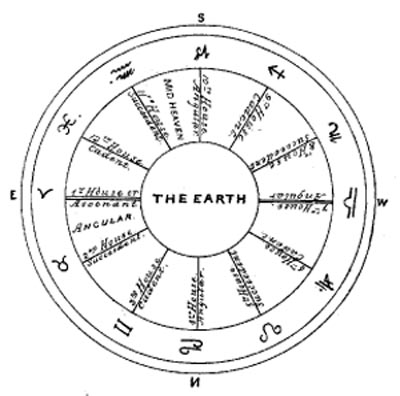
CHAPTER VI. CONCERNING THE TWELVE HOUSES OF HEAVEN AND THEIR POWERS
The ancient astrologers divided the heavens into twelve houses.
The First House.—This is called the Ascendant, and the
planet rising therein—whether well or ill-dignified—will materially
affect the mind, bodily appearance and fate of the native through his
whole existence. This house is masculine, and governs the head and face
of man and, if the planet Mars be in this house at the time of birth,
there will always be some blemish or mole in the face of the native; if
a few out of the degrees have ascended the scar or blemish is, without
fail, on the upper part of the head; if the middle part of the sign
ascends the mark is in the middle of the face; if the latter part of
the sign is ascending the mark is near the chin. This house represents
the head, the tongue and the memory, and it governs in colours white.
The Second House.—This house has signification of the native's
wealth and worldly goods. The house is feminine, ruling the neck, and
the colour is green.
The Third House.—This governs brothers and sisters, short
journeys, neighbours, letters and writings. It is masculine and governs
the hands, arms and shoulders; its colours are red and yellow mixed.
The Fourth House.—This rules the father, inheritances or
property of the native, and shows his condition at the close of life.
It is feminine, and rules the stomach, breast and lungs; its colour is
red.
The Fifth House.—This signifies the children of the native,
also his success in speculation and hazardous games, the pleasures he
enjoys and the wealth of the father. It rules the heart, back and
liver, is masculine, and represents in colour black and white mixed.
The Sixth House.—This concerns the native's servants, sheep,
goats and small cattle. It also signifies the father's kindred. This
house is feminine. It rules the belly and intestines and its colour is
black.
The Seventh House gives judgment of marriage and describes the
man or woman in all love questions. It is masculine, it rules the
haunches, and its colour is black.
The Eighth House argues of death, of legacies and wills, also of
the kind of death a man shall die; it is a feminine house. It rules the
lower parts of the trunk of the body; its colours are green and black.
The Ninth House gives judgment on voyages and long journeys, and
also on events happening to the wife's kindred. It rules the hips and
thighs. It is a masculine house; its colours are green and white.
The Tenth House is called the Mid-heaven, and is
feminine. This concerns the native's mother, and also his calling. It
rules the knees and hams, and its colours are red and white.
The Eleventh House represents friends and friendship. It is
masculine and rules the legs.
The Twelfth House.—This house is often called the Evil
Dæmon, for it is the house of sorrow, self-undoing, enemies and
imprisonment. It governs great cattle. It is feminine, and rules the
feet and toes, and in colour it governs green.
The strongest houses are the first (the Ascendant) and the tenth
(the Mid-heaven). The first, fourth, seventh, and tenth are
called Angular Houses, and represent the four cardinal points of the
compass; thus the first is east, the seventh west, the fourth is north,
and the tenth south. The second, fifth, eighth, and eleventh houses are
called Succedent Houses; the third, sixth, ninth, and twelfth houses
are termed Cadent Houses (see plate 1). Any planet posited in a Cadent
House is regarded as weak in its effects on the native. It is necessary
to have thoroughly mastered the influences of the twelve houses, as
well as those of the seven planets, and of the signs of the zodiac,
before attempting to cast a nativity or to work a horary question.
CHAPTER VII. AN EXPLANATION OF VARIOUS TERMS USED IN ASTROLOGY
Ascension, Right.—The distance any body or point in the heavens
is from the beginning of the ecliptic or first point of Aries. It is
measured in degrees and minutes of a degree. It is thus abbreviated, A.
R.
Ascension, Oblique.—If a star be not on the equator, it will,
when it rises, form an angle with that part of the equator which is
rising at the same time, and this is called its
Ascensional Difference.—This, added to its right ascension (A.
R.) if it have south declination, but subtracted from it if it
have north declination, gives its oblique ascension.
Application signifies the approach of two planets and is of
three kinds: first, when a planet, swift of motion, applies to one of
slower progress: for example, we will suppose Mercury posited in 16
degrees of the sign Gemini, and Mars in 21 degrees of the same sign
(both being in direct motion), Mercury being swifter would
overtake and form a conjunction with Mars, which is termed a direct
application. The second kind of application is formed by two
retrograde planets: thus we will suppose Mercury in 16 degrees of
Gemini and Saturn in 15 degrees of the same sign, both retrograde.
Mercury being the swiftest planet, applies to Saturn, a more ponderous
planet, by retrogradation, and this is called a retrograde
application. The third kind of application is when one planet,
being direct in motion, meets another which is retrograde: for
instance, we will suppose Mercury retrograde in 16 degrees of Gemini,
and Saturn direct in motion in 12 degrees of the same sign; here
Mercury, being the higher planet, applies to a conjunction of
Saturn by a retrograde motion. These two last are considered
evil applications. It should also be remembered that the
superior planets, Saturn, Jupiter and Mars, never apply to the inferior
planets, Venus, Mercury and the Moon, except by retrograde motion; but
the inferior planets apply in both ways.
Besieging signifies a planet situated between the two malevolent
planets, Saturn and Mars: thus, if Saturn were in the 12th degree of
Aries, Jupiter in the 14th, and Mars in the 16th, Jupiter would then be
besieged by the two malefic planets, Saturn and Mars. This is,
of course, an evil position.
Cazimi.—A planet is said to be in cazimi when it is in
the heart of the Sun: that is, only 17 minutes before or after the Sun.
All astrologers agree that a planet is fortified by this position, but
a planet when combust is very evil in its influences.
Direct motion signifies that a planet is moving on its natural
course, according to the succession of the signs of the zodiac: thus a
planet is direct in motion when it moves from Aries to Taurus,
or from Taurus to Gemini.
Frustration means the approach of a swift planet to an aspect
with one of slower motion; but before it can approach near enough to
join that aspect the more weighty planet is joined to some other, by
which the first aspect is frustrated.
Hayz is when a masculine diurnal planet is situated above the
horizon in the daytime, or when a feminine nocturnal planet is placed
below the horizon in the night-time; this is fortunate in its
influence.
Node.—That part of the ecliptic where a planet passes out of
north into south latitude is its south node; that where it goes into
north latitude is its north node.
Oriental and Occidental.—A planet, when oriental, rises before
the Sun; when occidental sets after him and is seen above the horizon
when the Sun is down; consequently, when a planet is oriental it is
posited in the east, and when occidental, in the west.
From the fourth house eastward to the tenth is oriental and from the
tenth westward to the fourth is occidental. But  or
or
 are oriental between the first and tenth and its
opposite quarter and are occidental between the tenth and
seventh and its opposite quarter.
are oriental between the first and tenth and its
opposite quarter and are occidental between the tenth and
seventh and its opposite quarter.
Void of course is when a planet is separated from another
planet, and does not, during its continuance in the same sign, form any
aspect with any other planet. This most usually happens with the Moon.
The effect of this is
CHAPTER VIII. OF THE FIGURE OF THE HEAVENS
This was formerly termed a horoscope, but is now more generally
called a figure of the heavens. It is simply a scheme, or plan,
representing an accurate picture of the heavens—that is, of the
positions of the Sun, Moon, and planets, and, in some instances, of the
fixed stars also, for the moment at which a child is born. In horary
questions the figure is drawn for the required time, which may be the
moment of the propounding of a question to an astrologer, or of the
occurrence of any event of the result of which astrological information
is desired.
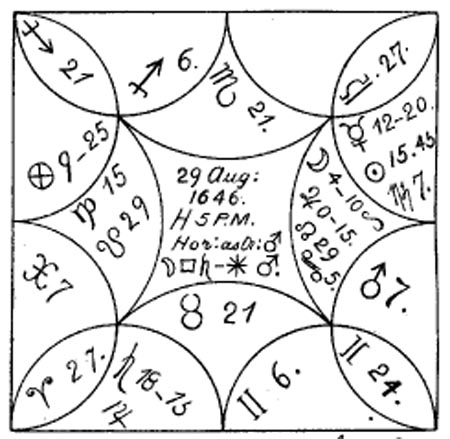
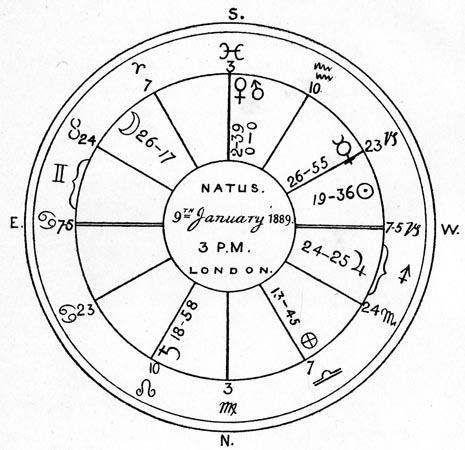
This map, which contains the twelve divisions already described as the
twelve houses of heaven, may be drawn in either a square or circular
form. Lilly and other mediæval writers use both forms indiscriminately;
but as the latter is more easily understood, the diagram (plate 2) is
drawn up in that manner. It will be seen that it is formed of three
circles. In the centre space the date, time and place of the event of a
horary question are entered, and in a nativity the name, sex and moment
of birth of the native. The next space (divided into twelve equal parts
for the houses) is reserved for the planets and in the outer space are
placed the signs of the zodiac, with the number of their degrees, on
the cusp of each house. The cusps of the Houses are represented by that
line between each house. Having obtained an Ephemeris, or astrological
almanack
[7] for the year required, we must find the Sidereal Time for
the day and month of the birth, or question; then, if the time of the
event be before noon we must deduct the difference
between the given time and noon from the Sidereal Time of the day; for
example, on the day of the event (the 9th January, 1889), the Sidereal
Time at noon is shown by the Ephemeris to be 19 hours 16 minutes 51
seconds, if the birth had been at 9 a.m. The difference between 9 a.m.
and noon is 3 hours. We should, therefore, have to deduct 3
hours from 19 hours 16 minutes 51 seconds, which gives 16 hours 16
minutes 51 seconds, the Sidereal Time required.
As the event is supposed to happen at 3 in the afternoon, we
must add the difference between noon and the time given to the
Sidereal Time of the day. The difference between noon and 3 p.m. is 3
hours, and, as the Sidereal Time on the 9th January, 1889, is 19 hours
16 minutes 51 seconds, we add 3 hours to this amount, which
gives 22 hours 16 minutes 51 seconds, the Sidereal Time required.
We must now proceed to place the signs for 3 p.m. on the 9th January,
1889, which is thus done: We turn to the "Table of Houses" (which will
be found at the end of the Ephemeris), and having found (under the
column headed "Sidereal Time") the nearest time to 22 hours 16 minutes
51 seconds, which in this case is 22 hours 16 minutes 48 seconds for the
latitude of London, we see in the next column (headed 10) the sign
 (Pisces), and the number 3° opposite our Sidereal Time,
showing that the third degree of Pisces is on the cusp of the 10th
house, In the next column (headed 11) we see
(Pisces), and the number 3° opposite our Sidereal Time,
showing that the third degree of Pisces is on the cusp of the 10th
house, In the next column (headed 11) we see  , and the number
7°; we therefore place 7° on the cusp of the 11th
house, next 24°
, and the number
7°; we therefore place 7° on the cusp of the 11th
house, next 24°  on the 12th; then 7° 5′
  on the
Ascendant (or first house), 23° on the 2nd and 10°
on the
Ascendant (or first house), 23° on the 2nd and 10°
 on the 3rd; for the remaining houses we place the signs in
order opposite to those already given, keeping the same number of
degrees to each corresponding house and sign. The opposite house to the
10th is the 4th, and the opposite sign to is
on the 3rd; for the remaining houses we place the signs in
order opposite to those already given, keeping the same number of
degrees to each corresponding house and sign. The opposite house to the
10th is the 4th, and the opposite sign to is  ; we
therefore place 3° on the cusp of the 4th house, and so on
of the rest. It will, however, now be seen that the two signs
; we
therefore place 3° on the cusp of the 4th house, and so on
of the rest. It will, however, now be seen that the two signs  and
and  are missing; these signs are "intercepted," which means that
they lie between two houses without occupying the cusp of either; they
must, therefore, be placed in their order between the cusps of
the houses. This is, of course, not always the case, and some horoscopes
will have no intercepted signs.
are missing; these signs are "intercepted," which means that
they lie between two houses without occupying the cusp of either; they
must, therefore, be placed in their order between the cusps of
the houses. This is, of course, not always the case, and some horoscopes
will have no intercepted signs.
HOW TO PLACE THE PLANETS.
In the Ephemeris the longitudes of the planets are given daily for mean
noon; so, to find the exact place of a planet for a given time,
we must note the difference of longitude between the previous noon and
noon of the day for drawing the map for a.m. and for p.m., the
difference between noon of the day and noon of the day after. This
difference is the motion of the planet in 24 hours, which we
must work thus: As 24 hours are to—hours (i.e., the difference
between the given time and noon), so is the daily motion to the motion
required. For example, the at noon on the 6th January is
(omitting seconds) in 19° 29′  , and on the 10th January at
noon he is in 20° 30′ , which gives a daily motion
of 59 minutes. We must find his place for 3 p.m. on the 9th January. As
24 hours are to 3 hours, so are 59 minutes to the time required; this
equals about 7 minutes, which we add to the 's longitude at noon
on the 9th. If the event had been for a.m. this amount would have been
deducted from the 's longitude at noon on the day
of the event. We must proceed in the same way for the other planets and
place them in the map according to their positions in respect to the
degrees on the cusps of the houses. The will be in 19°
36′ , or about the middle of the 7th house. And note
that the number of degrees of a sign on the cusp of any house shows
that that sign commenced in the previous house. Supposing the
had been 1° of , we should then have
placed it in the 6th house, a little below the cusp of the 7th. When a
planet is Retrograde (shown in the Ephemeris thus, R.),
we add the amount to the longitude when the event is before noon
or a.m., and deduct it from the longitude when the event is
after noon or p.m. The mode of giving the judgment on a horoscope will
be shown farther on.
, and on the 10th January at
noon he is in 20° 30′ , which gives a daily motion
of 59 minutes. We must find his place for 3 p.m. on the 9th January. As
24 hours are to 3 hours, so are 59 minutes to the time required; this
equals about 7 minutes, which we add to the 's longitude at noon
on the 9th. If the event had been for a.m. this amount would have been
deducted from the 's longitude at noon on the day
of the event. We must proceed in the same way for the other planets and
place them in the map according to their positions in respect to the
degrees on the cusps of the houses. The will be in 19°
36′ , or about the middle of the 7th house. And note
that the number of degrees of a sign on the cusp of any house shows
that that sign commenced in the previous house. Supposing the
had been 1° of , we should then have
placed it in the 6th house, a little below the cusp of the 7th. When a
planet is Retrograde (shown in the Ephemeris thus, R.),
we add the amount to the longitude when the event is before noon
or a.m., and deduct it from the longitude when the event is
after noon or p.m. The mode of giving the judgment on a horoscope will
be shown farther on.
 ; Jupiter,
  ; Mars,
  ; Sol,
  ; Mercury,
  ; Luna,
  ; and the
Dragon's Tail,
; and the
Dragon's Tail,  . These are neither planets nor signs of the
zodiac, nor constellations, but are only the nodes or points where the
ecliptic is crossed by the Moon. One of these points looks northward,
where the Moon begins her northern latitude, and the other points
southward, where she commences her south latitude. The head of the
Dragon is considered of a benevolent nature; the tail of the Dragon is
of evil tendency.
. These are neither planets nor signs of the
zodiac, nor constellations, but are only the nodes or points where the
ecliptic is crossed by the Moon. One of these points looks northward,
where the Moon begins her northern latitude, and the other points
southward, where she commences her south latitude. The head of the
Dragon is considered of a benevolent nature; the tail of the Dragon is
of evil tendency.


 Conjunction, when two planets are in the same place, viz., in same
degree of the same sign.
Conjunction, when two planets are in the same place, viz., in same
degree of the same sign.
 Sextile, when they are 60 degrees or two signs apart.
 Square, when they are 90 degrees or three signs apart.
 Trine, when they are 120 degrees or four signs apart.
 Opposition, when they are 180 degrees or six signs asunder.