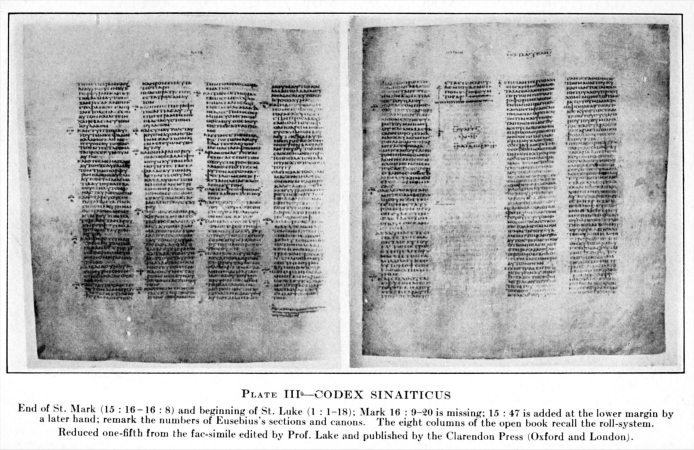
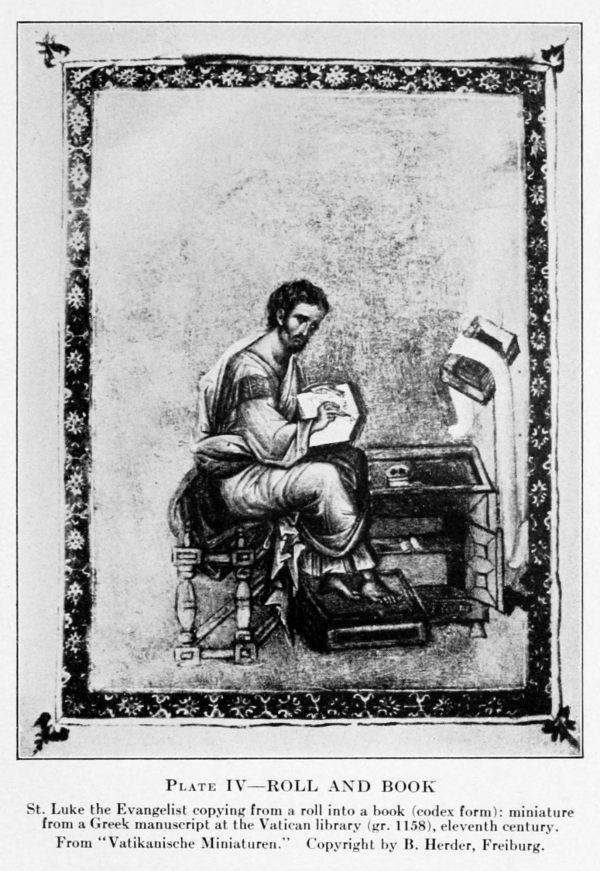
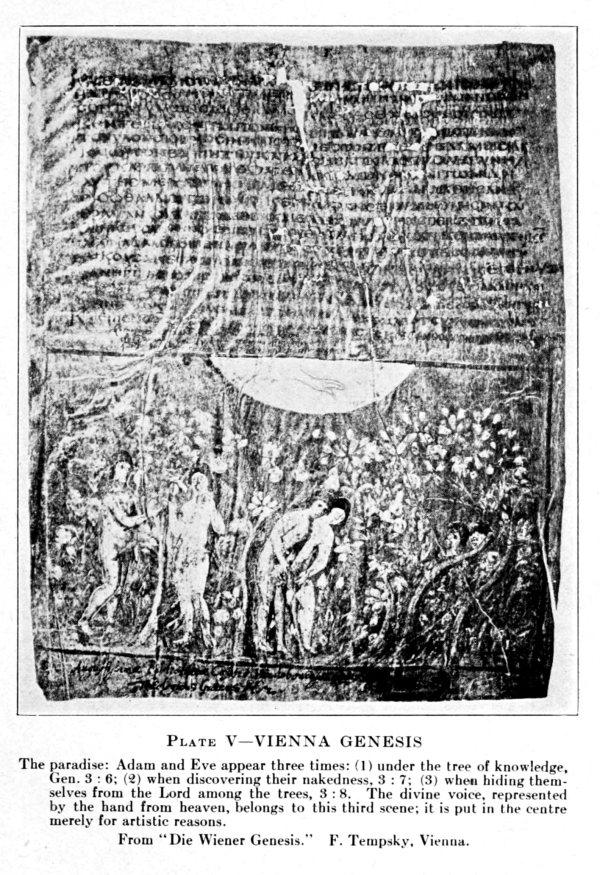
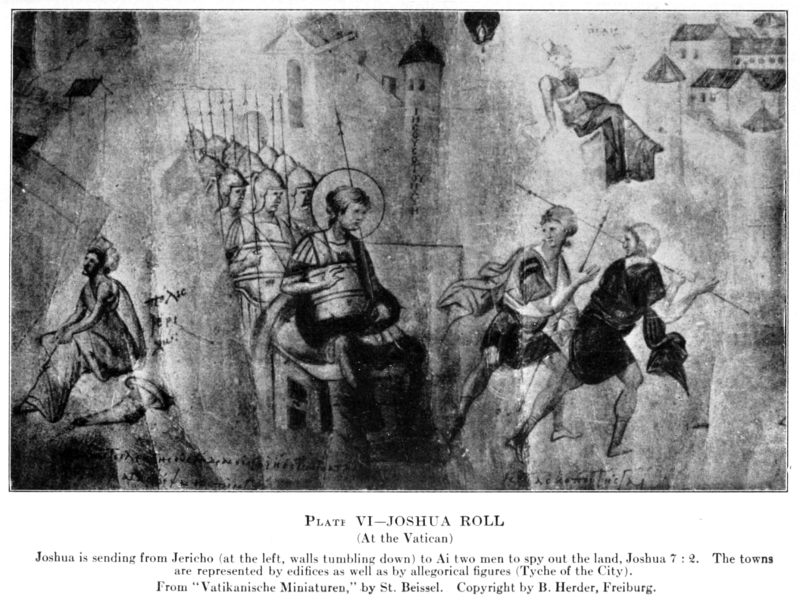
There is a small book; one can put it in one's
pocket, and yet all the libraries of America, numerous
as they are, would hardly be large enough to
hold all the books which have been inspired by this
one little volume. The reader will know what I am
speaking of; it is the Bible, as we are used to call
it—the Book, the book of mankind, as it has properly
been called. It has been commented upon,
treated in every way, but, curious to say, hardly
any one has attempted to trace its history through
the centuries and mark the influence which it exerted
upon our civilisation.
In order to do this we follow the traces of the
Bible through the different periods of human or,
to speak more accurately, of Christian civilisation.
In the first period of Christian history, the time of
persecutions during the first three centuries of our
era, there is not much to say about the Bible as
influencing civilisation. Christianity was but starting
on its way and fighting for its place in the world.
The Bible could not exert a civilising influence upon
a hostile world. But by impressing its value upon
the Christian mind it made itself indispensable for
the church and thereby laid the foundation for the
future development.
Christianity was a living religion. The first congregations
were dwelling in an atmosphere of enthusiasm.
There was a general outpouring of the Holy
Spirit. The prophet's words seemed to be fulfilled:
"They shall teach no more every man his neighbour
and every man his brother, saying: know the
Lord; for they shall all know me." Christianity
was not a religion of a sacred book, whose dead letter
was to be artificially kept alive by learned men.
It was a religion of living experiences. Nevertheless,
Christianity from the beginning had a sacred
book. Jesus and his disciples used the Bible of
their people, the Old Testament, and Saint Paul
carried it to the Christian communities of gentile
origin, which had not known of it before.
Christianity could not do without it. If it was
necessary to convince Jews that Jesus was the
Messiah, how could this be done without arguing
from the Scriptures as proof? If the gospel was to
be announced to the heathen they would give less
heed to the new tidings than to the statement that
it was really the most ancient form of religion as
attested by this sacred book, which was superior to
all the books of poets and philosophers and legislators
by reason of its venerable age. Christianity
without any hesitation claimed the Old Testament
as its own book, its own Bible. Not only was Jesus
the content of this book, he was even believed to
be its author. It was the spirit of Jesus which
dwelt in the prophets and made them seek and
search concerning the salvation offered by Christ
(I Peter 1 : 10-11). "The prophets having their
grace from him, did prophesy unto him," we are
told in the so-called letter of Barnabas. So the Old
Testament seemed to be a Christian book both in
content and in origin, and it was easy enough to add
some properly Christian pamphlets, as Saint Paul's
letters and some gospels, the Acts and other letters,
and some books of revelation. It was as necessary
as it was easy, if Christianity was not to lose contact
with its proper origin.
The New Testament, as we have it now, was not
complete at the start. It was a collection of primitive
Christian writings, larger in some ways than
it is now; on the other hand lacking some of its
present elements. Its precise content did not become
finally established until a very late period, not
earlier than the end of the fourth century.
So also the size of the Old Testament was not
quite fixed. There were more books in the Greek
Bible of the Alexandrian Jews than in the Hebrew
Bible of the Palestinian rabbis. The Christian
church at first adopted the Greek Bible, but from
time to time some scholar pointed out the difference,
and many people thought they had better keep
to the Hebrew canon. This view, championed by
Saint Jerome, led to a partial rejection of the books
which nowadays we usually call the Old Testament
Apocrypha, until in the sixteenth century the
churches accentuated their difference by a different
attitude toward these books, the Calvinists rejecting
them altogether, the Roman church including them
as an integral part of the Bible, and the Lutherans
giving them an intermediate position as books to
be read with safety but without canonical authority.
When, in 1902, King Edward VII was to be crowned,
the British and Foreign Bible Society intended to present
to his Majesty the copy of the Bible on which
he was to take his oath. Then it was discovered
that according to the old regulations the king of
England had to take his oath on a complete Bible,
that is a Bible containing the Apocrypha. The
British and Foreign Bible Society on its part, by its
statutes, was prevented from printing Bibles including
the Apocrypha; so they presented to the king
a most beautiful copy, but the king did not use it
for the coronation service. It is the difference between
the Alexandrian and the Palestinian canon
which reappears in this little struggle and thereby is
seen surviving to our own time.
Unsettled as the size of the Old and of the New
Testament may have been, nevertheless the principle
was established at a very early date that
Christianity was to have a holy Scripture in two
parts, one taken over from Judaism, the other
added from its own stores.
Let us stop here for a moment and try to realise
what this meant. Mohammed, when founding his
new religion, acknowledged, it is true, the books of
the former religions, but for his own believers the
unique authority is the Koran, a book which originated
within a single generation and therefore is
pervaded by one uniform spirit. Christianity adhered
to a Bible whose larger part originated in a
period much anterior to its own and in a religion
inferior to Christianity. The Bible covers a period
of over a thousand years. What a difference in
civilisation between the nomadic life of the patriarchs
and the time of Jesus! What a difference in
spirit between the sons of Jacob killing the whole
population of Sichem in order to avenge their sister
and Jesus' parable of the good Samaritan! or between
the prophet Elijah killing four hundred and
fifty prophets of Baal and Jesus preaching the love
of one's enemies! In fact, it was possible to overcome
this difference only in an age which did not
read the Bible with historical notions. Even so,
the juxtaposition caused much difficulty. We shall
see the problem of the Law troubling the church
through all the centuries. We shall find the notions
of sacrifice and priesthood adapted to Christian institutions.
Looking at Charlemagne or Calvin, we
realise that the Old Testament is ever introducing
its views into Christian minds, as authoritative as
any word of the gospel.
Now, at the beginning the influence was rather
the other way; the Old Testament was to be interpreted
in the light of the New. And, in truth, much
light came from the life of Jesus to the history of
the ancient people and to the prophecies. We do
not wonder that Christian minds were excited by
all this fresh illumination, and we must not wonder
that sometimes they remodelled the tradition of the
life of Christ to accord with the Old Testament.
The harmony between the two Testaments soon
became a leading idea in Christian doctrine. Some
heretics, indeed, would not accept the Old Testament.
Marcion maintained that it came from an
inferior god, while the supreme God, the father of
our Lord Jesus Christ, had revealed himself only
through his Son. He found a great many contrasts
between the Old and the New Testament, and this
criticism was supported by pagan philosophers, as,
for example, Porphyry. The church, therefore, was
most anxious to establish the harmony of the Testaments
by any means at its command. Taste varies
from century to century; the minute parallelism
constructed by some early Christian writers, and
evidently much admired by their contemporaries,
seems to us rather ridiculous and fanciful. On the
other hand, the church was right in maintaining the
harmony. The New Testament needs to be explained
from the Old Testament; it is open to much
misunderstanding when taken apart. There was
almost no sense for historical development at that
time; the criticism of Ptolemæus, in his famous letter
to Flora, where he speaks of several strata of
revelation running through the Old and the New
Testament, is an exceptional one. For most of the
faithful the Christian doctrine was directly looked
for and found in the Old Testament; the gospel
was contained in every one of its books, from Genesis
to Malachi. Unity was conceived as uniformity.
This was the system which appealed most to the
average Christian mind. And the Bible was open
to all Christians, as Harnack has brilliantly demonstrated
in a recent publication. The ancient church
laid stress upon this publicity and never tried to
withdraw the Bible from the people. There was
no hidden mystery regarding the Bible. On the
contrary, all members of the church were anxiously
urged to make themselves as familiar with the Bible
as possible. They were supposed to have copies of
their own and to read them privately as well as in
the congregation. Even when the struggles about
the right doctrine began and the heretics sometimes
held to the Bible as their champion against the
doctrine of the church, the church did not remove
the Bible from public discussion. The ecclesiastical
party maintained that the Bible was always in
favour of the true doctrine; one needs but to know
how to read it. Tertullian, it is true, once in the
heat of controversy declared that it was no use
arguing against heretics from the Bible, but he did
it, nevertheless, and so did the other fathers.
The Bible proved its spiritual value to the experience
of every reader. A man familiar with the
Psalms has a treasure which cannot be lost; in any
situation he will find what is suitable for his needs.
If one looks for examples of faith, the author of the
epistle to the Hebrews in his eleventh chapter gives
a splendid model for finding heroes of faith all
through the Bible. The book of Genesis, especially
its first chapters, was of particular interest for
most of the readers on account of the sublime
description there given of the beginnings of mankind.
The creation story in Genesis implies much
more than even the finest of all Greek myths,
namely, the myth in Plato's Timæus, with which it
was compared by the emperor Julian. The mighty
words, "In the beginning God created heaven and
earth," proved to be the one true answer to all the
cosmological questions of Greek philosophy, and besides
there was ample room for introducing whatever
was wanted—such as the creation and the fall
of the angels—if only one knew how to read between
the lines.
In an old Christian book dealing with church
regulations and the rules for individual Christian
life we find the following admonition to use no
other book at all except the Bible, because, as the
author says, the Bible contains literature of every
kind. The passage runs:[1]
Stay at home and read in the Law and in the Book
of the Kings and in the Prophets and in the Gospel
(which is) the fulness of these things. Keep far away
from all the books of the heathen; for what hast thou
to do with foreign words or with false laws or prophecies
which also easily cause young people to wander
from the faith? What then is wanting to thee in the
Word of God, that thou throwest thyself upon these
myths of the heathen? If thou wishest to read the
tales of the fathers, thou hast the Book of the Kings;
or of wise men and philosophers, thou hast the Prophets
amongst whom thou wilt find more wisdom and
science than among the wise men and the philosophers,
because they are the words of God, of the one only wise
God. If thou desirest song, thou hast the Psalms of
David or if the beginning of the world, thou hast the
Genesis of great Moses; if law and commandments,
thou hast the book of Exodus of the Lord our God.
Therefore keep entirely away from all these foreign
things, which are contrary to them.
The Bible, in fact, pervaded the whole life of a
Christian. It was the Bible, its history, its commandments,
that he was taught as a child in his
parents' home. When the girls gathered in the
women's hall to spin, they would sing and talk
about God's revelations more eagerly than even
Sappho had praised her luxurious love—according
to an expression used by Tatian in his Apology.
The prayers, private as well as ecclesiastical, all
echoed Biblical phrases, and even at burials the
Christians sang joyful psalms.
So the Bible became familiar to the Christians
of that time. We are astonished to find how well
they knew it. The sermons of this period are full
of Biblical allusions, and evidently the preacher
could expect them to be understood.
This is the more remarkable as the circulating of
the Bible in this time met with the greatest difficulties.
There was, of course, a large amount of Bible
reading in the congregations. According to Justin's
description of early Christian worship about 150 a. d.,
the service began with continuous reading of the
Bible through many chapters, as far as time would
allow. Then an officer, bishop or elder, would begin
to preach. The office of reading was esteemed so
highly that it was regarded as based on a special
spiritual gift; the anagnostes, i. e., the reader, in
the earliest time had his place among the prophets
and spirit-gifted teachers. And, in fact, if we look
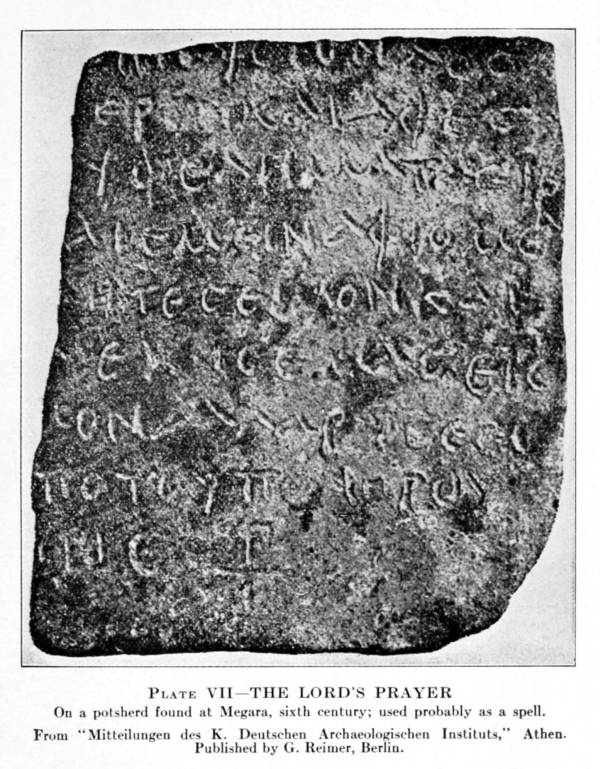
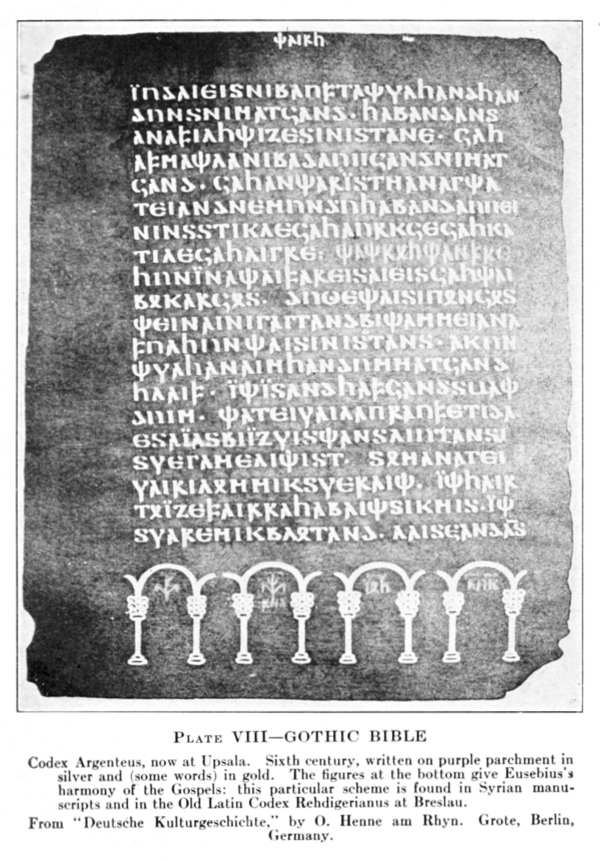
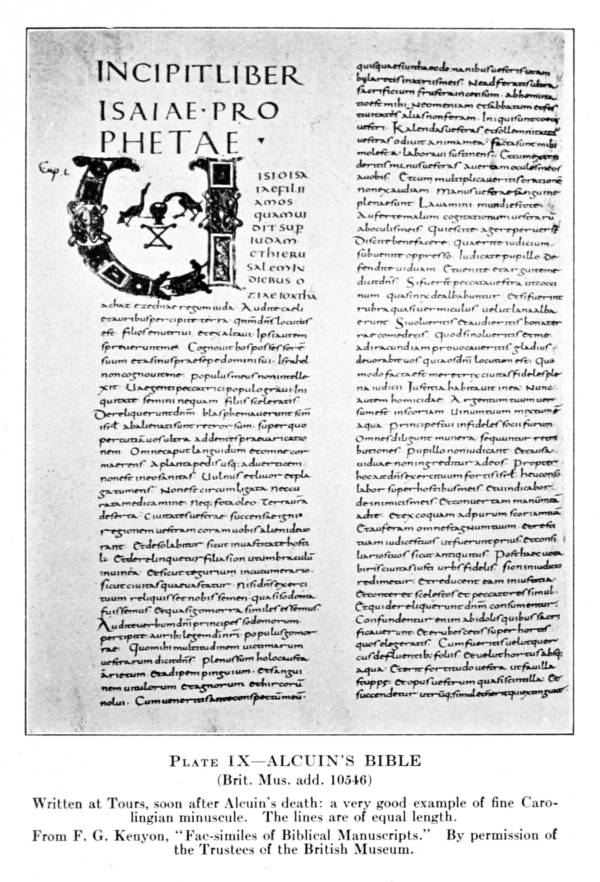
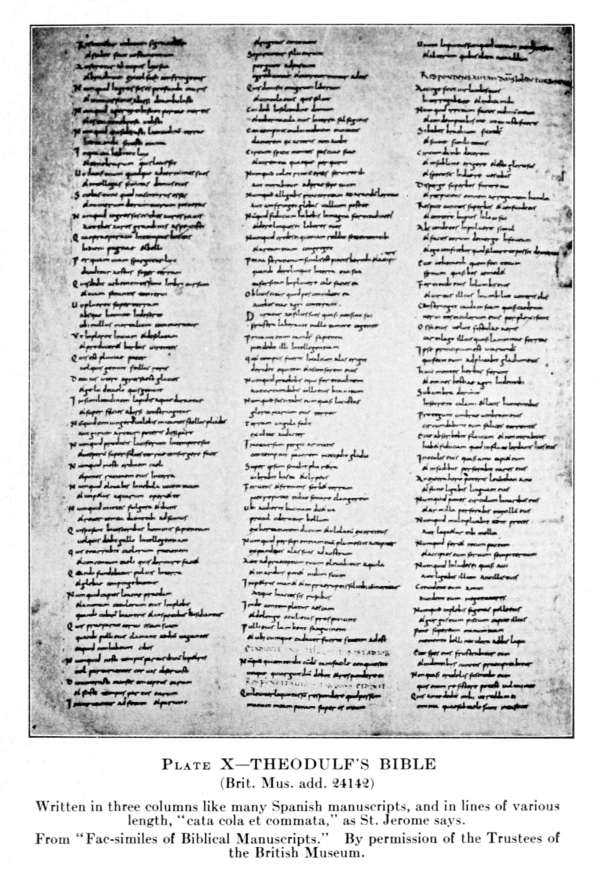
at the earliest manuscripts of the Bible which have
come down to us, we shall almost think that supernatural
assistance was necessary for reading them:
no punctuation, no accent, no space between the
words, no breaking off at the end of a sentence.
The reader had to know his text almost entirely by
heart to do it well. From the "Shepherd of Hermas,"
a very interesting book written by a Roman
layman about 140 a. d., we learn that some people
gathered often, probably daily, for the special
purpose of common reading and learning. But
even granted that the memory of these men was not
spoiled by too much reading, as is ours, so that by
hearing they were able to learn by heart—it is said
of some rabbis that they did not lose one word of
all their master had told them, and, in fact, the Talmudic
literature was transmitted orally for centuries—nevertheless,
we must assume that these Christians
had their private copies of the Bible at home. The
evidence from the allusions of preachers to private
reading is strong. Cyprian addresses a Christian:
"Your life should be one of assiduous prayer or
reading (of the Bible): now you speaking to God,
now God to you."
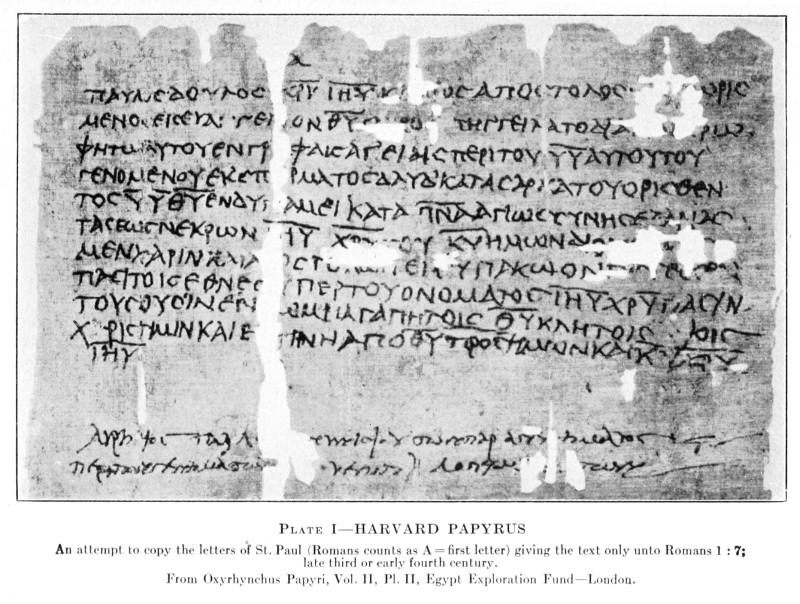 Plate I—HARVARD PAPYRUS
An attempt to copy the letters of St. Paul (Romans counts as A = first letter) giving the text only unto Romans 1 : 7;
late third or early fourth century.
From Oxyrhynchus Papyri, Vol. II, PI. II, Egypt Exploration Fund—London.
Here begins our difficulty: how did they get so
many copies? There was an organised book-trade
in the ancient world; publishers had their offices,
using (instead of printing-presses) slaves who were
trained in copying; they had shorthand writers, as
well as calligraphers to do the fine writing. But as
long as Christianity was still an oppressed religion
it is doubtful if the Bible was among the books
which publishers would care to take. The Christians
were, most of them, poor people who could
not spend much money for procuring Bibles. Besides,
it was no easy thing to get a complete Bible.
At that time the books were still written on papyrus
rolls, not in book form. Only one side of the
papyrus could be used; the roll would become unwieldy
if too long. So, in order to get all the books
of the Old and the New Testament, at least two
dozen rolls had to be written. Maybe a simple Christian
copied for himself one gospel or some letters
or even one or more books from the Old Testament.
There are preserved on papyrus some unfinished attempts
which show what hard work it was (Plate I).
We can scarcely imagine a man going with this
heavy hand through all the books of the Bible.
We are told that wealthy Christians helped their
brethren by procuring copies for them. Origen, the
greatest Bible scholar of the ancient church, is said
to have been supported by a rich admirer, who put
at his disposal a number of slave copyists. With
their help he succeeded in creating one of the greatest
works which Bible criticism ever undertook, his
so-called Hexapla, which is a comparison of more
than six various Greek translations of the Old Testament.
Scholars in the nineteenth century held that
scarcely more than one copy of this enormous work
had ever been written, but by recent discoveries we
know that it was copied several times (Plate II).
A later admirer of Origen, Pamphilus, is said always
to have carried with him several rolls in order to
provide poor brethren. Now that was the third
century. Christianity had already begun to spread
among the higher classes and to become a feature
in the world's life.
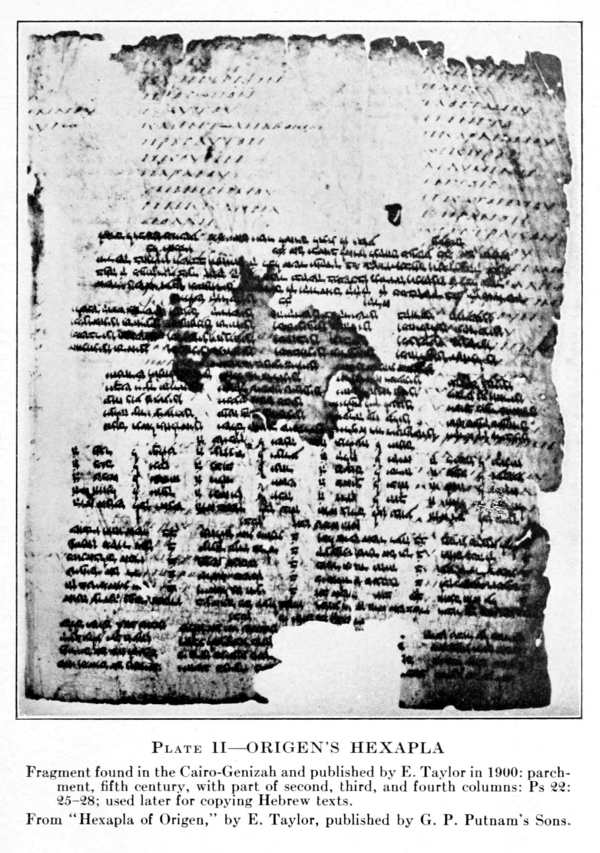 Plate II—ORIGEN'S HEXAPLA
Fragment found in the Cairo-Genizah and published by E. Taylor in 1900; parchment,
fifth century, with part of second, third, and fourth columns: Ps 22 : 25-28;
used later for copying Hebrew texts.
From "Hexapla of Origen," by E. Taylor, published by G. P. Putnam's Sons.
Devotional reading of the Bible was accompanied
by scholarly interpretation. We mentioned Origen
as the greatest Bible scholar of his time, if not of
all times. It may be worth while to insert here a
few words on his life. A native of Alexandria, he
saw as a boy his father dying as a martyr for his
Christian faith; he longed to become a martyr himself,
and was only prevented from giving himself up
by a trick of his mother's, who concealed all his
clothes. He got a good training at the catechetical
school of Alexandria, not restricting himself to mere
Christian and Biblical studies, but reading the pagan
philosophers of his time as well as the Greek classics.
A youth of only eighteen years, he became the head
of the school, and his fame spread all over the empire.
He travelled to Rome, to Greece; he was
even asked by the Roman governor to come to
Arabia to settle certain questions. So zealous was
he to fulfil the commandments of the gospel that,
misunderstanding one of the Lord's sayings, he
made himself a eunuch for the kingdom of heaven's
sake, which brought him into trouble in his
later life. When once on a journey through Palestine
he, being still a layman, had preached before
the bishop of Cæsarea, he was summoned by his
own bishop and ordered not to preach. Some years
afterward the bishop of Cæsarea, who was among
his strongest admirers, ordained him a priest, which
caused his bishop to banish him from Alexandria.
He settled at Cæsarea and lived there for twenty
years without ever aiming at any ecclesiastical position,
pursuing his study of the Bible and gathering
around his chair the best men from every part
of Christianity. So great was his fame that the
empress Julia Mammæa, being still a pagan, asked
him to see her when she was travelling in the East.
He was the one man to refute the vigorous attack
made against the truth of Christian doctrine by the
philosopher Celsus. When persecution began again
he wrote a tractate of comfort, "On Martyrdom,"
and another, "On Prayer." He himself suffered
imprisonment and torture, and died after his release,
as a result of these sufferings, at the age of sixty-nine.
We can scarcely do honour enough to this man,
who three centuries after his death was proclaimed
to be one of the most dangerous heretics, the church,
however, using his learning in the form of extracts.
The vast amount of reading, the sagacity, and the
perspicuity of the man are alike admirable. He is
said to have commented upon nearly all the books
of the Bible, and this three times. He wrote short
annotations, he compiled large and learned commentaries,
and he preached before the congregation.
Only a small part of his works has come down to us,
but this fills volumes. Origen's great merit is that he
brought Christian interpretation to a system which
enabled the church to retain the plain historical
sense alongside the so-called higher meaning.
For a long time gentile philosophers as well as
Jewish preachers had adopted the method of treating
their sacred books allegorically. Homer, it was
assumed, in telling his stories of battles of gods and
heroes, meant quite another thing; otherwise he
would be guilty of irreligion. He meant that the
powers of nature and the energies of the human soul
came into struggle, and therefore virtues and vices
were fighting one with another. The same thing was
done by Philo for the Old Testament. There was no
real history; all was symbolical, allegory. Christianity
tried to follow in this path. The gnostics indulged
in the wildest form of allegory. But it was
not safe to give up the idea of historicity altogether.
Jesus and his gospel were historical facts, not mere
ideas; they were emptied of all meaning if turned
into allegory. And likewise the history of the Old
Testament could not simply be reduced to allegorical
metaphors. Origen saved the situation by asserting
that each of these two views had its proper place.
His theory is that as man consists of body, soul, and
spirit, so the holy Scripture has a threefold nature, to
which corresponds a threefold interpretation. The
body stands for the plain historical meaning: Jesus
did cast out of the temple those that sold oxen
and sheep and doves and the changers of money.
There are some historical difficulties, Origen admits,
if we compare the different gospel narratives and if
we take account of the fact that a single man did
this; Origen explains that it was a miracle showing
the divine power in Jesus. But there are other aspects
too. The soul represents the higher moral
view: Christ is always casting out of his church,
which belongs to the heavenly Jerusalem, the men
who are profaning it by their money-making.
And, lastly, there is the spirit, that is, the supreme
mystical understanding. The spirit of Christ,
entering its temple, the man's soul, casts out of
it all earthly desires and makes it a house of
prayer. Now that is very ingenious. These three
strata of interpretation allow for a great variety
in explanation and adaptation. Origen succeeds
by this method in keeping the essential historical
basis and adding what in those days was thought
to be most significant. The Bible, being a divine
book, seemed to require a higher form of interpretation;
the Holy Ghost of God was supposed
to be a spirit of mysteries; it was assumed that
to interpret the Bible in a plain way was to think
of God meanly.
Of course, the Bible contained some allegories
which might seem to support this theory of allegorical
interpretation; for instance, the beautiful vision
of Ezekiel, told in the thirty-seventh chapter of his
book: he sees the valley full of dry bones, and at the
command of God he prophesies over them and they
begin to come together, and flesh came up and skin
covered them above and at last breath came into
them and they lived. It is a magnificent allegory
of the people of Israel, scattered in the exile and
brought to life again by the power of God. It
is irritating to see the fathers just at this point declining
to follow the path of allegorical interpretation.
They insist upon the reality of the occurrence;
it is to be taken literally as resurrection of the dead—so
it has influenced all mediæval pictures of the
last judgment! I need only add that the rabbis took
Ezekiel's description in the same way, as a real occurrence,
arguing for the historicity by showing the
phylacteries which the risen persons had worn—and
one feels what a pity it is to treat allegory as history.
But the opposite fault is still worse: the
spiritualising and allegorising of real history is the
greatest damage ever done to religion.
Theologians tried to establish the authority of the
Bible. This had already been done in some measure
by the rabbis of the synagogue. In taking
over the Bible the Christians had only to accept
their estimate of it, but they were not quite satisfied
with it. The rabbinical doctrine was a rather
mechanical one: God had used men, just as a man
uses a pencil to write with. The pencil does not
act consciously: so the Old Testament writers, according
to this theory, did not take any part in
what they were writing; it was to them as another
man's script. Commenting upon the last chapter
of Deuteronomy, where the death of Moses is described,
a rabbinical authority remarks: "Until this
passage God dictated and Moses wrote; henceforth
God dictated and Moses wrote weeping"—namely,
the account of his own death. There was so little
interest in the human author that he could be eliminated
altogether. We are told by an early Jewish
legend that all books of the Old Testament had been
destroyed at the time of Nebuchadnezzar, when the
temple was burned; so God dictated them all to Ezra.
According to this theory Ezra would be the real
author of the whole Old Testament. This is the
most mechanical way of representing the equal inspiration
of all parts of the Old Testament. The
Jews of the dispersion had a somewhat similar theory
about the inspiration of their Greek Bible; when
Ptolemy Philadelphus, king of Egypt, gathered at
Alexandria seventy elders of the Jews to make the
Greek translation of their law, he put each one of
them in a separate cell in order to avoid any communication
between them, so the legend runs. Then,
after working for seventy days, all at once they
shouted "Amen" from their cells, having accomplished
their task, and when the seventy copies had
been compared they were found to agree even in the
smallest detail. Here we have again an attempt to
assert inspiration not only for the book itself but
also for its translation. It is as mechanical as the
former, all human co-operation being excluded.
Christians did not want this. In Jesus they had
experienced living revelation; they had prophets
among themselves. So, at least at the beginning,
they had a much higher view of inspiration. God
enters a man's soul and fills it with his spirit; now the
man acts and speaks in the power of this spirit, and
yet he is not unconscious of his own doing and speaking.
There are two ways of inspiration, we are told
by Clement of Alexandria: either God snatches up
the man's soul and conducts it to the unseen world
and shows to it whatever he wishes it to know—this
is ecstasy—or God enters the man and fills him
and makes him his organ. The latter, less striking
though it appears, is nevertheless the higher and
more valuable concept. Therefore the fathers do
not so much use the metaphor of the pencil as the
similitude of a musical instrument, whether a flute
through which the Holy Spirit is playing, or a harp
which he touches with a plectrum.
Much as they appreciate the holy Scripture, the
early fathers usually talk about it in a very unpretentious
manner. They have not yet developed
those gorgeous formulas of quotation which are used
in later times. They quote simply: "Scripture
says," or "Paul says," not "the holy and glorious
apostle in his most excellent epistle to the Romans
says exceedingly well." They talk in simple words,
but they are prepared even to die for this Bible.
Eusebius, the first historian of the Christian
church, to whom we are indebted for so much invaluable
information, tells us a moving story about
Marinus, a young Christian officer in the Roman
army, at Cæsarea, in Palestine. He had the confidence
of his superiors and was to be promoted to
the higher rank of captain. Then out of jealousy
one of his comrades denounced him as a Christian.
Summoned before his colonel, he was asked if this
was true, and when he confessed he was urged to
abjure his faith. The colonel gave him three hours'
time. So he went to the small Christian church,
where he found the venerable old bishop. The
bishop, hearing his story, took the Bible in one
hand and the soldier's sword in the other. "This
is your choice," he said. And the soldier, without
hesitating, grasped the Bible, went back, and declared
himself to be and to remain a Christian.
And instead of receiving military promotion he
became a martyr.
It is a significant little story. Indeed, after a hard
struggle, lasting through nearly three centuries, when
the Roman empire found it necessary to attempt the
final destruction of Christianity the attack was
mostly directed against the Bible. Diocletian, in
303 a. d., on the 24th of February, issued an edict
ordering all Christian churches to be destroyed and
all Bibles to be burned. He relied on the Roman
law, which forbids not only the exercise of magical
arts, but the science of magic, too, and therefore
condemns all books of magic to be burned. The
Christians were accused of employing magic, and
their Bible was treated as a magical book.
We have thrilling accounts of Christians trying
to conceal their treasured Bible rolls from the
eyes of the inquiring officials. They took them
from the church into their private homes, securing
the Bible in safety but many a time bringing persecution
upon themselves. To the officials they
surrendered books of various kinds in order to
escape from surrendering the Scriptures. Asked if
they had sacred books in their houses, many of
them would answer: "Yes, in our hearts." The enthusiasm
was so great that they believed the story
of any miracle in support of the Bible. They maintained
that copies of the Bible which had been
thrown into the fire by the heathen were not burned
or even touched by the flame.
Naturally there were others who were not strong
enough in their faith to resist, but these "surrenderers,"
as they were called, were cast out of the church
and never admitted again. During the fourth century
to bring against a clergyman the charge of
having surrendered sacred books at that period of
persecution was felt to be the most serious accusation
possible. Even to be ordained by a bishop who
was under suspicion of having surrendered his
church's holy Scriptures was held a disgrace by a
large party of zealous Christians who demanded
that orders of this kind be invalidated. The records
of a trial held at Carthage in 329 a. d. dealing with
this question have come down to us. Here documents
from 303 a. d. were introduced as evidence
against the clergy, and the whole forms one of the
most illuminating pages of church history.
Even to be found reading the Bible made a man
guilty of obstinate resistance to the emperor's law
and involved him in penalty. There was a deacon
at Catania in Sicily named Euplus. He was reading
the holy Scripture when the sheriff laid hold of
him. Brought before the judge he takes his copy of
the Gospel and reads from it (Matt. 5 : 10): "Blessed
are they that have been persecuted for righteousness'
sake, for theirs is the kingdom of heaven,"
and (Matt. 10 : 38): "And he that doth not take
his cross and follow after me, is not worthy of me."
The judge asks him: "Why did you not surrender
those volumes which the emperors forbade?" "Because,"
he replies, "I am a Christian and it was
not loyal to surrender. It is better to die than to
surrender." We do not need the addition made by a
late Byzantine hagiographer that the copy of the
Gospels was hung on his neck when he was conducted
to execution. It is clear enough that he
was suffering for his devotion toward the Bible and
that it was the gospel which inspired his boldness.
Euplus does not stand alone. I could mention a
dozen martyrs whose acts all give the same impression.
Sometimes a gathering of men and women
is apprehended while reading the Bible, and the
whole company is forthwith carried away to the
most painful tortures.
These Christians knew what the Bible was to
them. All declamations of later theologians about
the inspiration and the authority of the Bible count
for nothing compared with this testimony.
After all, we do not wonder that the Bible became
a civilising power as soon as Christianity had won
its victory.