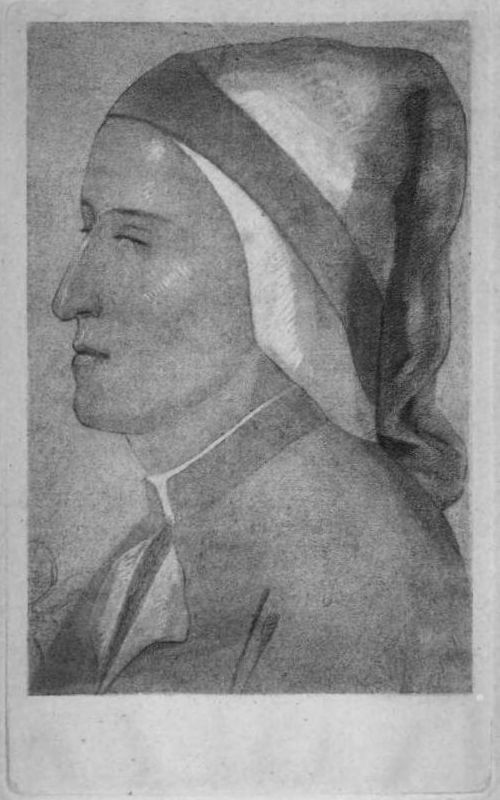
Dante is himself the hero of the Divine Comedy,
and ere many stages of the Inferno have been
passed the reader feels that all his steps are being
taken in a familiar companionship. When every allowance
has been made for what the exigencies of art
required him to heighten or suppress, it is still impossible
not to be convinced that the author is revealing
himself much as he really was—in some of his weakness
as well as in all his strength. The poem itself, by many
an unconscious touch, does for his moral portraiture
what the pencil of Giotto has done for the features of his
face. The one likeness answers marvellously to the
other; and, together, they have helped the world to
recognise in him the great example of a man of genius
who, though at first sight he may seem to be austere, is
soon found to attract our love by the depth of his feelings
as much as he wins our admiration by the wealth of
his fancy, and by the clearness of his judgment on everything
concerned with the lives and destiny of men. His
other writings in greater or less degree confirm the impression
of Dante’s character to be obtained from the
Comedy. Some of them are partly autobiographical;
and, studying as a whole all that is left to us of him, we
can gain a general notion of the nature of his career—when
he was born and what was his condition in life;
his early loves and friendships; his studies, military
service, and political aims; his hopes and illusions, and
the weary purgatory of his exile.
To the knowledge of Dante’s life and character
which is thus to be acquired, the formal biographies of
him have but little to add that is both trustworthy and
of value. Something of course there is in the traditional
story of his life that has come down from his time
with the seal of genuineness; and something that has
been ascertained by careful research among Florentine
and other documents. But when all that old and
modern Lives have to tell us has been sifted, the additional
facts regarding him are found to be but few; such
at least as are beyond dispute. Boccaccio, his earliest
biographer, swells out his Life, as the earlier commentators
on the Comedy do their notes, with what are
plainly but legendary amplifications of hints supplied
by Dante’s own words; while more recent and critical
writers succeed with infinite pains in little beyond
establishing, each to his own satisfaction, what was the
order of publication of the poet’s works, where he may
have travelled to, and when and for how long a time
he may have had this or that great lord for a patron.
A very few pages would therefore be enough to tell the
events of Dante’s life as far as they are certainly known.
But, to be of use as an introduction to the study of his
great poem, any biographical sketch must contain some
account—more or less full—of Florentine affairs before
and during his lifetime; for among the actors in these
are to be found many of the persons of the Comedy.
In reading the poem we are never suffered for long
to forget his exile. From one point of view it is an
appeal to future ages from Florentine injustice and
ingratitude; from another, it is a long and passionate
plea with his native town to shake her in her stubborn
cruelty. In spite of the worst she can do against him
he remains no less her son. In the early copies of it,
the Comedy is well described as the work of Dante
Alighieri, the Florentine; since not only does he people
the other world by preference with Florentines, but it
is to Florence that, even when his words are bitter
against her, his heart is always feeling back. Among
the glories of Paradise he loves to let his memory rest
on the church in which he was baptized and the streets
he used to tread. He takes pleasure in her stones;
and with her towers and palaces Florence stands for
the unchanging background to the changing scenes of
his mystical pilgrimage.
The history of Florence during the twelfth and
thirteenth centuries agrees in general outline with that
of most of its neighbours. At the beginning of the
period it was a place of but little importance, ranking
far below Pisa both in wealth and political influence.
Though retaining the names and forms of municipal
government, inherited from early times, it was in reality
possessed of no effective control over its own affairs, and
was subject to its feudal superior almost as completely
as was ever any German village planted in the shadow of
a castle. To Florence, as to many a city of Northern
and Central Italy, the first opportunity of winning
freedom came with the contest between Emperor and
Pope in the time of Hildebrand. In this quarrel the
Church found its best ally in Matilda, Countess of
Tuscany. She, to secure the goodwill of her subjects as
against the Emperor, yielded first one and then another
of her rights in Florence, generally by way of a pious
gift—an endowment for a religious house or an increase
of jurisdiction to the bishop—these concessions, however
veiled, being in effect so many additions to the
resources and liberties of the townsmen. She made
Rome her heir, and then Florence was able to play off
the Papal against the Imperial claims, yielding a kind
of barren homage to both Emperor and Pope, and only
studious to complete a virtual independence of both.
Florence had been Matilda’s favourite place of residence;
and, benefiting largely as it did by her easy
rule, it is no wonder that her name should have been
cherished by the Florentines for ages after as a household
word.[1] Nor is the greatest Florentine unmindful
of her. Foe of the Empire though she was, he only
remembers her piety; and it is by Matilda, as representing
the active religious life, that Dante is ushered
into the presence of Beatrice in the Earthly Paradise.[2]
It was a true instinct which led Florence and other
cities to side rather with the Pope than with the Emperor
in the long-continued struggle between them for predominance
in Italy. With the Pope for overlord they
would at least have a master who was an Italian, and one
who, his title being imperfect, would in his own interest
be led to treat them with indulgence; while, in the permanent
triumph of the Emperor, Italy must have
become subject and tributary to Germany, and would
have seen new estates carved out of her fertile soil for
members of the German garrison. The danger was
brought home to many of the youthful commonwealths
during the eventful reign of Frederick Barbarossa
(1152-1190). Strong in Germany beyond most of his
predecessors, that monarch ascended the throne with
high prerogative views, in which he was confirmed by
the slavish doctrine of some of the new civilians. According
to these there could be only one master in the
world; as far as regarded the things of time, but one
source of authority in Christendom. They maintained
everything to be the Emperor’s that he chose to take.
When he descended into Italy to enforce his claims, the
cities of the Lombard League met him in open battle.
Those of Tuscany, and especially Florence, bent before
the blast, temporising as long as they were able, and
making the best terms they could when the choice lay
between submission and open revolt. Even Florence,
it is true, strong in her allies, did once take arms
against an Imperial lieutenant; but as a rule she never
refused obedience in words, and never yielded it in
fact beyond what could not be helped. In her pursuit
of advantages, skilfully using every opportunity, and
steadfast of aim even when most she appeared to
waver, she displayed something of the same address
that was long to be noted as a trait in the character
of the individual Florentine.
The storm was weathered, although not wholly without
loss. When, towards the close of his life, and after he
had broken his strength against the obstinate patriotism
of Lombardy, Frederick visited Florence in 1185, it was
as a master justly displeased with servants who, while
they had not openly rebelled against him, had yet proved
eminently unprofitable, and whom he was concerned to
punish if not to destroy. On the complaint of the
neighbouring nobles, that they were oppressed and had
been plundered by the city, he gave orders for the
restoration to them of their lands and castles. This
accomplished, all the territory left to Florence was a
narrow belt around the walls. Villani even says that
for the four years during which Frederick still lived the
Commonwealth was wholly landless. And here, rather
than lose ourselves among the endless treaties, leagues,
and campaigns which fill so many pages of the chronicles,
it may be worth while shortly to glance at the constitution
of Florentine society, and especially at the place held in
it by the class which found its protector in Barbarossa.
Much about the time at which the Commonwealth was
relieved of its feudal trammels, as a result of the favour
or the necessities of Matilda, it was beginning to extend
its commerce and increase its industry. Starting somewhat
late on the career on which Venice, Genoa, and
Pisa were already far advanced, Florence was as if
strenuous to make up for lost time, and soon displayed
a rare comprehension of the nature of the enterprise.
It may be questioned if ever, until quite modern times,
there has been anywhere so clear an understanding of
the truth that public wellbeing is the sum of private
prosperity, or such an enlightened perception of what
tends to economical progress. Florence had no special
command of raw material for her manufactures, no sea-port
of her own, and no monopoly unless in the natural
genius of her people. She could therefore thrive only
by dint of holding open her communications with the
world at large, and grudged no pains either of war or
diplomacy to keep at Pisa a free way out and in for
her merchandise. Already in the twelfth century she
received through that port the rough woollens of
Flanders, which, after being skilfully dressed and dyed,
were sent out at great profit to every market of Europe.
At a somewhat later period the Florentines were to give
as strong a proof of their financial capacity as this was
of their industrial. It was they who first conducted a
large business in bills of exchange, and who first struck
a gold coin which, being kept of invariable purity,
passed current in every land where men bought and
sold—even in countries where the very name of
Florence was unknown.[3]
In a community thus devoted to industry and commerce,
it was natural that a great place should be filled
by merchants. These were divided into six guilds, the
members of which, with the notaries and lawyers, who
composed a seventh, formed the true body of the
citizens. Originally the consuls of these guilds were
the only elected officials in the city, and in the early
days of its liberty they were even charged with political
duties, and are found, for example, signing a treaty of
peace with a neighbouring state. In the fully developed
commune it was only the wealthier citizens—the members,
we may assume, of these guilds—who, along with
the nobles,[4] were eligible for and had the right of electing
to the public offices. Below them was the great body
of the people; all, that is, of servile condition or engaged
in the meaner kinds of business. From one point of
view, the liberties of the citizens were only their privileges.
But although the labourers and humbler tradesmen
were without franchises, their interests were not therefore
neglected, being bound up with those of the one or
two thousand citizens who shared with the patricians
the control of public affairs.
There were two classes of nobles with whom Florence
had to reckon as she awoke to life—those within the
walls, and those settled in the neighbouring country.
In later times it was a favourite boast among the noble
citizens—a boast indulged in by Dante—that they were
descended from ancient Roman settlers on the banks
of the Arno. A safer boast would in many cases have
been that their ancestors had come to Italy in the train
of Otho and other conquering Emperors. Though
settled in the city, in some cases for generations, the
patrician families were not altogether of it, being
distinguished from the other citizens, if not always by
the possession of ancestral landward estates, at least by
their delight in war and contempt for honest industry.
But with the faults of a noble class they had many of
its good qualities. Of these the Republic suffered them
to make full proof, allowing them to lead in war and
hold civil offices out of all proportion to their numbers.
Like the city itself, the nobles in the country around
had been feudally subject to the Marquis of Tuscany.
After Matilda’s death they claimed to hold direct from
the Empire; which meant in practice to be above all
law. They exercised absolute jurisdiction over their
serfs and dependants, and, when favoured by the situation
of their castles, took toll, like the robber barons of
Germany, of the goods which passed beneath their walls.
Already they had proved to be thorns in the side of the
industrious burghers; but at the beginning of the
twelfth century their neighbourhood became intolerable,
and for a couple of generations the chief political
work of Florence was to bring them to reason. Those
whose lands came up almost to the city gates were first
dealt with, and then in a widening circle the country
was cleared of the pest. Year after year, when the days
were lengthening out in spring, the roughly organised
city militia was mustered, war was declared against
some specially obnoxious noble and his fortress was
taken by surprise, or, failing that, was subjected to a
siege. In the absence of a more definite grievance, it
was enough to declare his castle dangerously near the
city. These expeditions were led by the nobles who
were already citizens, while the country neighbours of
the victim looked on with indifference, or even helped
to waste the lands or force the stronghold of a rival.
The castle once taken, it was either levelled with the
ground, or was restored to the owner on condition of
his yielding service to the Republic. And, both by way
of securing a hold upon an unwilling vassal and of
adding a wealthy house and some strong arms to the
Commonwealth, he was compelled, along with his family,
to reside in Florence for a great part of every year.
With a wider territory and an increasing commerce,
it was natural for Florence to assume more and more
the attitude of a sovereign state, ready, when need was,
to impose its will upon its neighbours, or to join with
them for the common defence of Tuscany. In the
noble class and its retainers, recruited as has been
described, it was possessed of a standing army which,
whether from love of adventure or greed of plunder,
was never so well pleased as when in active employment.
Not that the commons left the fighting wholly to
the men of family, for they too, at the summons of the
war-bell, had to arm for the field; but at the best they
did it from a sense of duty, and, without the aid of professional
men-at-arms, they must have failed more frequently
in their enterprises, or at any rate have had to
endure a greatly prolonged absence from their counters
and workshops. And yet, esteem this advantage as highly
as we will, Florence surely lost more than it gained by
compelling the crowd of idle gentlemen to come within
its walls. In the course of time some of them indeed
condescended to engage in trade—sank, as the phrase
went, into the ranks of the Popolani, or mere wealthy
citizens; but the great body of them, while their landed
property was being largely increased in value in consequence
of the general prosperity, held themselves
haughtily aloof from honest industry in every form.
Each family, or rather each clan of them, lived apart
in its own group of houses, from among which towers
shot aloft for scores of yards into the air, dominating
the humbler dwellings of the common burghers.
These, whenever they came to the front for a time in
the government, were used to decree that all private
towers were to be lopped down to within a certain
distance from the ground.
It is a favourite exercise of Villani and other historians
to trace the troubles and revolutions in the state
of Florence to chance quarrels between noble families,
arising from an angry word or a broken troth. Here,
they tell, was sown the seed of the Guelf and Ghibeline
wars in Florence; and here that of the feuds of Black
and White. Such quarrels and party names were symptoms
and nothing more. The enduring source of trouble
was the presence within the city of a powerful idle class,
constantly eager to recover the privilege it had lost,
and to secure itself by every available means, including
that of outside help, in the possession of what it
still retained; which chafed against the curbs put upon
its lawlessness, and whose ambitions were all opposed
to the general interest. The citizens, for their part, had
nothing better to hope for than that Italy should be
left to the Italians, Florence to the Florentines. On
the occasion of the celebrated Buondelmonti feud
(1215), some of the nobles definitely went over to the
side of the people, either because they judged it likely
to win in the long-run, or impelled unconsciously by
the forces that in every society divide ambitious men
into two camps, and in one form or another develop
party strife. They who made a profession of popular
sympathy did it with a view of using rather than of
helping the people at large. Both of the noble parties
held the same end in sight—control of the Commonwealth;
and this would be worth the more the fewer
there were to share it. The faction irreconcilable
with the Republic on any terms included many of the
oldest and proudest houses. Their hope lay in the
advent of a strong Emperor, who should depute to them
his rights over the money-getting, low-born crowd.
The opportunity of this class might seem to have
come when the Hohenstaufen Frederick II., grandson of
Barbarossa, ascended the throne, and still more when,
on attaining full age, he claimed the whole of the
Peninsula as his family inheritance. Other Emperors
had withstood the Papal claims, but none had ever
proved an antagonist like Frederick. His quarrel
seemed indeed to be with the Church itself, with its
doctrines and morals as well as with the ambition of
churchmen; and he offered the strange spectacle of a
Roman Emperor—one of the twin lights in the Christian
firmament—whose favour was less easily won by
Christian piety, however eminent, than by the learning
of the Arab or the Jew. When compelled at last to
fulfil a promise extorted from him of conducting a
crusade to the Holy Land, he scandalised Christendom
by making friends of the Sultan, and by using his
presence in the East, not for the deliverance of the
Sepulchre, but for the furtherance of learning and commerce.
Thrice excommunicated, he had his revenge
by proving with how little concern the heaviest anathemas
of the Church could be met by one who was
armed in unbelief. Literature, art, and manners were
sedulously cultivated in his Sicilian court, and among
the able ministers whom he selected or formed, the
modern idea of the State may be said to have had its
birth. Free thinker and free liver, poet, warrior, and
statesman, he stood forward against the sombre background
of the Middle Ages a figure in every respect
so brilliant and original as well to earn from his contemporaries
the title of the Wonder of the World.
On the goodwill of Italians Frederick had the claim
of being the most Italian of all the Emperors since the
revival of the Western Empire, and the only one of
them whose throne was permanently set on Italian soil.
Yet he never won the popular heart. To the common
mind he always appeared as something outlandish and
terrible—as the man who had driven a profitable but
impious trade in the Sultan’s land. Dante, in his
childhood, must have heard many a tale of him; and
we find him keenly interested in the character of the
Emperor who came nearest to uniting Italy into a
great nation, in whose court there had been a welcome
for every man of intellect, and in whom a great original
poet would have found a willing and munificent
patron. In the Inferno, by the mouth of Pier delle
Vigne, the Imperial Chancellor, he pronounces Frederick
to have been worthy of all honour;[5] yet justice requires
him to lodge this flower of kings in the burning tomb
of the Epicureans, as having been guilty of the arch-heresy
of denying the moral government of the world,
and holding that with the death of the body all is
ended.[6] It was a heresy fostered by the lives of many
churchmen, high and low; but the example of Frederick
encouraged the profession of it by nobles and learned
laymen. On Frederick’s character there was a still
darker stain than this of religious indifference—that of
cold-blooded cruelty. Even in an age which had produced
Ezzelino Romano, the Emperor’s cloaks of lead
were renowned as the highest refinement in torture.[7]
But, with all his genius, and his want of scruple in
the choice of means, he built nothing politically that
was not ere his death crumbling to dust. His enduring
work was that of an intellectual reformer under whose
protection and with whose personal help his native
language was refined, Europe was enriched with a
learning new to it or long forgotten, and the minds of
men, as they lost their blind reverence for Rome, were
prepared for a freer treatment of all the questions with
which religion deals. He was thus in some respects a
precursor of Dante.
More than once in the course of Frederick’s career
it seemed as if he might become master of Tuscany
in fact as well as in name, had Florence only been
as well affected to him as were Siena and Pisa.
But already, as has been said, the popular interest
had been strengthened by accessions from among
the nobles. Others of them, without descending
into the ranks of the citizens, had set their hopes
on being the first in a commonwealth rather than
privates in the Imperial garrison. These men, with
their restless and narrow ambitions, were as dangerous
to have for allies as for foes, but by throwing their
weight into the popular scale they at least served to
hold the Imperialist magnates in check, and established
something like a balance in the fighting power of
Florence; and so, as in the days of Barbarossa, the
city was preserved from taking a side too strongly. The
hearts of the Florentine traders were in their own affairs—in
extending their commerce and increasing their
territory and influence in landward Tuscany. As
regarded the general politics of Italy, their sympathy
was still with the Roman See; but it was a sympathy
without devotion or gratitude. For refusing to join in
the crusade of 1238 the town was placed under interdict
by Gregory IX. The Emperor meanwhile was acknowledged
as its lawful overlord, and his vicar received
something more than nominal obedience, the choice of
the chief magistrates being made subject to his approval.
Yet with all this, and although his party was powerful
in the city, it was but a grudging service that was yielded
to Frederick. More than once fines were levied on the
Florentines; and worse punishments were threatened
for their persevering and active enmity to Siena, now
dominated by its nobles and held in the Imperial
interest. Volunteers from Florence might join the
Emperor in his Lombard campaigns; but they were left
equally free by the Commonwealth to join the other
side. At last, when he was growing old, and when
like his grandfather he had been foiled by the stubborn
Lombards, he turned on the Florentines as an easier
prey, and sent word to the nobles of his party to seize
the city. For months the streets were filled with battle.
In January 1248, Frederick of Antioch, the natural
son of the Emperor, entered Florence with some squadrons
of men-at-arms, and a few days later the nobles
that had fought on the popular side were driven into
banishment. This is known in the Florentine annals
as the first dispersion of the Guelfs.
Long before they were adopted in Italy, the names of
Guelf and Ghibeline had been employed in Germany
to mark the partisans of the Bavarian Welf and of the
Hohenstaufen lords of Waiblingen. On Italian soil
they received an extended meaning: Ghibeline stood for
Imperialist; Guelf for anti-Imperialist, Papalist, or simply
Nationalist. When the names began to be freely used
in Florence, which was towards the close of Frederick’s
reign and about a century after their first invention,
they denoted no new start in politics, but only supplied
a nomenclature for parties already in existence. As
far as Florence was concerned, the designations were
the more convenient that they were not too closely
descriptive. The Ghibeline was the Emperor’s man,
when it served his purpose to be so; while the Guelf,
constant only in his enmity to the Ghibelines, was free
to think of the Pope as he chose, and to serve him no
more than he wished or needed to. Ultimately, indeed,
all Florence may be said to have become Guelf. To
begin with, the name distinguished the nobles who
sought alliance with the citizens, from the nobles who
looked on these as they might have done on serfs newly
thriven into wealth. Each party was to come up in
turn. Within a period of twenty years each was twice
driven into banishment, a measure always accompanied
with decrees of confiscation and the levelling of private
strongholds in Florence. The exiles kept well together,
retreating, as it were in the order of war, to camps of
observation they found ready prepared for them in the
nearest cities and fortresses held by those of their own
way of thinking. All their wits were then bent on
how, by dint of some fighting and much diplomacy,
they might shake the strength and undermine the credit
of their successful rivals in the city, and secure their
own return in triumph. It was an art they were proud
to be adepts in.[8]
In a rapid sketch like this it would be impossible to
tell half the changes made on the constitution of
Florence during the second part of the thirteenth
century. Dante in a well-known passage reproaches
Florence with the political restlessness which afflicted
her like a disease. Laws, he says, made in October
were fallen into desuetude ere mid-November.[9] And
yet it may be that in this constant readiness to change,
lies the best proof of the political capacity of the
Florentines. It was to meet new necessities that they
made provision of new laws. Especial watchfulness was
called for against the encroachments of the grandees,
whose constant tendency—whatever their party name—was
to weaken legal authority, and play the part of
lords and masters of the citizens. But these were no
mere weavers and quill-drivers to be plundered at will.
Even before the return of the Guelfs, banished in 1248,
the citizens, taking advantage of a check suffered in the
field by the dominant Ghibelines, had begun to recast
the constitution in a popular sense, and to organise the
townsmen as a militia on a permanent footing. When,
on the death of Frederick in 1250, the Imperialist
nobles were left without foreign aid, there began a
period of ten years, favourably known in Florentine
history as the Government of the Primo Popolo or
Popolo Vecchio; that is, of the true body of the citizens,
commoners possessed of franchises, as distinguished
from the nobles above them and the multitude below.
For it is never to be forgotten that Florence, like
Athens, and like the other Italian Republics, was far
from being a true democracy. The time was yet to
come, and it was not far distant, when the ranks of
citizenship were to be more widely opened than now to
those below, and more closely shut to those above. In
the meantime the comparatively small number of wealthy
citizens who legally composed the ‘People’ made good
use of their ten years of breathing-time, entering on
commercial treaties and widening the possessions of
the Commonwealth, now by war, and now by shrewd
bargains with great barons. To balance the influence
of the Podesta, who had hitherto been the one great
officer of State—criminal judge, civil governor, and
commander-in-chief all in one—they created the office
of Captain of the People. The office of Podesta was
not peculiar to Florence. There, as in other cities, in
order to secure his impartiality, it was provided that
he should be a foreigner, and hold office only for six
months. But he was also required to be of gentle
birth; and his councils were so composed that, like his
own, their sympathies were usually with the nobles.
The Captain of the People was therefore created partly
as a tribune for the protection of the popular rights,
and partly to act as permanent head of the popular
forces. Like the Podesta, he had two councils assigned
to him; but these were strictly representative of the
citizens, and sat to control his conduct as well as to
lend to his action the weight of public opinion.
Such of the Ghibelines as had not been banished
from Florence on the death of Frederick, lived there
on sufferance, as it were, and under a rigid supervision.
Once more they were to find a patron and ally in a
member of the great house of Hohenstaufen; and with
his aid they were again for a few years to become
supreme in Florence, and to prove by their abuse of
power how well justified was the mistrust the people
had of them. In many ways Manfred, one of Frederick’s
bastards, was a worthy son of his father. Like
him he was endowed with great personal charm, and
was enamoured of all that opened new regions to
intellectual curiosity or gave refinement to sensual
pleasure. In his public as well as in his private
behaviour, he was reckless of what the Church and its
doctrines might promise or threaten; and equally so,
his enemies declared, of the dictates of common
humanity. Hostile eyes detected in the green clothes
which were his favourite dress a secret attachment to
Islam; and hostile tongues charged him with the
murder of a father and of a brother, and the attempted
murder of a nephew. His ambition did not aim at
the Empire, but only at being King of Sicily and
Naples, lands which the Hohenstaufens claimed as their
own through the Norman mother of Frederick. Of
these kingdoms he was actual ruler, even while his
legitimate brother Conrad lived. On the death of
that prince he brushed aside the claims of Conradin,
his nephew, and bid boldly for recognition by the
Pope, who claimed to be overlord of the southern
kingdoms—a recognition refused, or given only to be
immediately withdrawn. In the eyes of Rome he was
no more than Prince of Tarentum, but by arms and
policy he won what seemed a firm footing in the South;
and eight years after the rule of the Popolo Vecchio
began in Florence he was the acknowledged patron of
all in Italy who had been Imperialist—for the Imperial
throne was now practically vacant. And Manfred
was trusted all the more that he cared nothing for
Germany, and stood out even more purely an Italian
monarch than his father had ever been. The Ghibelines
of Florence looked to him to free them of the
yoke under which they groaned.
When it was discovered that they were treating with
Manfred, there was an outburst of popular wrath
against the disaffected nobles. Some of them were
seized and put to death, a fate shared by the Abbot of
Vallombrosa, whom neither his priestly office nor his
rank as Papal Legate availed to save from torture and
a shameful end.[10] Well accustomed as was the age to
violence and cruelty, it was shocked at this free disposal
of a great ecclesiastic by a mercantile community; and
even to the Guelf chronicler Villani the terrible defeat
of Montaperti seemed no more than a just vengeance
taken by Heaven upon a crime so heinous.[11] In the
meantime the city was laid under interdict, and those
concerned in the Abbot’s death were excommunicated;
while the Ghibelines, taking refuge in Siena, began to
plot and scheme with the greater spirit against foes
who, in the very face of a grave peril, had offended in
the Pope their strongest natural ally.
The leader of the exiles was Farinata, one of the
Uberti, a family which, so long ago as 1180, had raised
a civil war to force their way into the consulship. Ever
since, they had been the most powerful, perhaps, and
certainly the most restless, clan in Florence, rich in men
of strong character, fiercely tenacious of their purpose.
Such was Farinata. To the Florentines of a later age
he was to stand for the type of the great Ghibeline
gentleman, haughty as Lucifer, a Christian in name
though scarcely by profession, and yet almost beloved
for his frank excess of pride. It detracted nothing
from the grandeur of his character, in the judgment of
his countrymen, that he could be cunning as well as
brave. Manfred was coy to afford help to the Tuscan
Ghibelines, standing out for an exorbitant price for the
loan of his men-at-arms; and to Farinata was attributed
the device by which his point of honour was effectually
touched.[12] When at last a reinforcement of eight
hundred cavalry entered Siena, the exiles and their
allies felt themselves more than a match for the militia
of Florence, and set themselves to decoy it into the
field. Earlier in the same year the Florentines had
encamped before Siena, and sought in vain to bring
on a general engagement. They were now misled by
false messengers, primed by Farinata, into a belief that
the Sienese, weary of the arrogance of Provenzano
Salvani,[13] then all-powerful in Siena, were ready to
betray a gate to them. In vain did Tegghiaio Aldobrandi,[14]
one of the Guelf nobles, counsel delay till the
German men-at-arms, wearied with waiting on and
perhaps dissatisfied with their wages, should be recalled
by Manfred. A march in full strength upon the hostile
city was resolved on by the eager townsmen.
The battle of Montaperti was fought in September
1260, among the earthy hills washed by the Arbia and
its tributary rivulets, a few miles to the east of Siena.
It marked the close of the rule of the Popolo Vecchio.
Till then no such disastrous day had come to Florence;
and the defeat was all the more intolerable that it was
counted for a victory to Siena. Yet the battle was far
from being a test of the strength of the two rival cities.
Out of the thirty thousand foot in the Guelf army,
there were only about five thousand Florentines. In
the host which poured out on them from Siena, beside
the militia of that city and the Florentine exiles, were
included the Ghibelines of Arezzo, the retainers of
great lords still unsubdued by any city, and, above all,
the German men-at-arms of Manfred.[15] But the worst
enemies of Florence were the traitors in her own ranks.
She bore it long in mind that it was her merchants
and handicraftsmen who stood stubbornly at bay, and
tinged the Arbia red with their life-blood; while it
was among the men of high degree that the traitors
were found. On one of them, Bocca degli Abati, who
struck off the right hand of the standard-bearer of the
cavalry, and so helped on the confusion and the rout,
Dante takes vengeance in his pitiless verse.[16]
The fortifications of Florence had been recently
completed and strengthened, and it was capable of a
long defence. But the spirit of the people was broken
for the time, and the conquerors found the gates open.
Then it was that Farinata almost atoned for any wrong
he ever did his native town, by withstanding a proposal
made by the Ghibelines of the rival Tuscan cities, that
Florence should be destroyed, and Empoli advanced
to fill her room. ‘Alone, with open face I defended
her,’ Dante makes him say.[17] But the wonder would
rather be if he had voted to destroy a city of which he
was about to be one of the tyrants. Florence had now
a fuller experience than ever of the oppression which it
was in the character of the Ghibelines to exercise. A
rich booty lay ready to their hands; for in the panic after
Montaperti crowds of the best in Florence had fled,
leaving all behind them except their wives and children,
whom they would not trust to the cruel mercy of the
victors. It was in this exile that for the first time
the industrious citizen was associated with the Guelf
noble. From Lucca, not powerful enough to grant
them protection for long, they were driven to Bologna,
suffering terribly on the passage of the Apennines from
cold and want of food, but safe when the mountains
lay between them and the Val d’Arno. While the
nobles and young men with a taste for fighting found
their livelihood in service against the Lombard Ghibelines,
the more sober-minded scattered themselves to
seek out their commercial correspondents and increase
their acquaintance with the markets of Europe. When
at length the way was open for them to return home,
they came back educated by travel, as men must always
be who travel for a purpose; and from this second exile
of the Guelfs dates a vast extension of the commerce
of Florence.
Their return was a fruit of the policy followed by the
Papal Court The interests of both were the same.
The Roman See could have as little independence of
action while a hostile monarch was possessed of the
southern kingdoms, as the people of Florence could
have freedom while the Ghibeline nobility had for patron
a military prince, to whom their gates lay open by way
of Siena and Pisa. To Sicily and Naples the Pope laid
claim by an alternative title—they were either dependent
on the See of Rome, or, if they were Imperial fiefs, then,
in the vacancy of the Empire, the Pope, as the only head
of Christendom, had a right to dispose of them as he
would. A champion was needed to maintain the
claim, and at length the man was found in Charles of
Anjou, brother of St. Louis. This was a prince of intellectual
powers far beyond the common, of untiring
industry in affairs, pious, ‘chaste as a monk,’ and cold-hearted
as a usurer; gifted with all the qualities, in
short, that make a man feared and well served, and
with none that make him beloved. He was not one
to risk failure for want of deliberation and foresight, and
his measures were taken with such prudence that by
the time he landed in Italy his victory was almost
assured. He found his enemy at Benevento, in the
Neapolitan territory (February 1266). In order to get
time for reinforcements to come up, Manfred sought
to enter into negotiations; but Charles was ready, and
knew his advantage. He answered with the splendid
confidence of a man sure of a heavenly if he missed an
earthly triumph. ‘Go tell the Sultan of Lucera,’[18] was
his reply, ‘that to-day I shall send him to Hell, or he
will send me to Paradise.’ Manfred was slain, and his
body, discovered only after long search, was denied
Christian burial. Yet, excommunicated though he was,
and suspected of being at heart as much Mohammedan
as Christian, he, as well as his great rival, is found by
Dante in Purgatory.[19] And, while the Christian poet
pours his invective on the pious Charles,[20] he is at no
pains to hide how pitiful appeared to him the fate of
the frank and handsome Manfred, all whose followers
adored him. He, as more than once it happens in the
Comedy to those whose memory is dear to the poet, is
saved from Inferno by the fiction that in the hour of
death he sent one thought heavenward—‘so wide is
the embrace of infinite mercy.’[21]
To Florence Charles proved a useful if a greedy and
exacting protector. Under his influence as Pacificator
of Tuscany—an office created for him by the Pope—the
Guelfs were enabled slowly to return from exile, and
the Ghibelines were gradually depressed into a condition
of dependence on the goodwill of the citizens
over whom they had so lately domineered. Henceforth
failure attended every effort they made to lift
their heads. The stubbornly irreconcilable were
banished or put to death. Elaborate provisions were
enacted in obedience to the Pope’s commands, by which
the rest were to be at peace with their old foes. Now
they were to live in the city, but under disabilities as
regarded eligibility to offices; now they were to be represented
in the public councils, but so as to be always
in a minority. The result of the measures taken, and
of the natural drift of things, was that ere many more
years had passed there were no avowed Ghibelines in
Florence.
One influence constantly at work in this direction
was that of the Parte Guelfa, a Florentine society
formed to guard the interests of the Guelfs, and which
was possessed of the greater part of the Ghibeline
property confiscated after the triumph of Charles had
turned the balance of power in Italy. This organisation
has been well described as a state within a state, and it
seems as if the part it played in the Florentine politics
of this period were not yet fully known. This much
seems sure, that the members of the Society were
mostly Guelf nobles; that its power, derived from the
administration of vast wealth to a political end, was so
great that the Captain of the Parte Guelfa held a place
almost on a level with that of the chief officials of the
Commonwealth; and that it made loans of ready money
to Florence and the Pope, on condition of their being
used to the damage of the Ghibelines.[22]
The Commonwealth, busy in resettling its government,
was but slightly interested in much that went on
around it. The boy Conradin, grandson of Frederick,
nephew of Manfred, and in a sense the last of the
Hohenstaufens, came to Italy to measure himself with
Charles, and paid for his audacity upon the scaffold.[23]
Charles deputed Guy of Montfort, son of the great Earl
Simon, to be his vicar in Florence. The Pope smiled
and frowned in turn on the Florentines, as their devotion
to him waxed and waned; and so he did on his
champion Charles, whose ambition was apt to outrun his
piety. All this was of less importance to the Commonwealth
than the promotion of its domestic interests. It
saw with equanimity a check given to Charles by the
election of a new Emperor in Rudolf of Hapsburg
(1273), and a further check by the Sicilian Vespers,
which lost him half his kingdom (1283). But Siena and
Pisa, Arezzo, and even Pistoia, were the objects of a
sleepless anxiety. Pisa was the chief source of danger,
being both from sentiment and interest stubbornly
Ghibeline. When at length its power was broken by
Genoa, its great maritime rival, in the naval battle of
Meloria (1284), there was no longer any city in
Tuscany to be compared for wealth and strength with
Florence.
It was at this period that Dante, reaching the age
of manhood, began to perform the duties that fell to
him as a youthful citizen—duties which, till the age of
thirty was reached, were chiefly those of military
service. The family to which he belonged was a
branch of the Elisei, who are included by Villani in
the earliest catalogue given by him of the great Florentine
houses. Cacciaguida, one of the Elisei, born in
1106, married a daughter of the Aldighieri, a family
of Ferrara. Their son was christened Aldighiero, and
this was adopted by the family as a surname, afterwards
changed to Alighieri. The son of Aldighiero was
Bellincione, father of Aldighiero II., the father of Dante.
It serves no purpose to fill a page of biography
with genealogical details when the hero’s course in life
was in no way affected by the accident of who was his
grandfather. In the case of Dante, his position in the
State, his political creed, and his whole fashion of
regarding life, were vitally influenced by the circumstances
of his birth. He knew that his genius, and
his genius alone, was to procure him fame; he declares
a virtuous and gentle life to be the true proof of
nobility: and yet his family pride is always breaking
through. In real life, from his family’s being decayed
in wealth and fallen in consideration compared with
its neighbours, he may have been led to put emphasis
on his assertion of gentility; and amid the poverty
and humiliations of his exile he may have found a
tonic in the thought that by birth, not to speak of other
things, he was the equal of those who spurned him or
coldly lent him aid. However this may be, there is
a tacit claim of equality with them in the easy grace
with which he encounters great nobles in the world of
shades. The bent of his mind in relation to this
subject is shown by such a touch as that when he
esteems it among the glories of Francis of Assisi not to
have been ashamed of his base extraction.[24] In Paradise
he meets his great crusading ancestor Cacciaguida, and
feigns contrition for the pleasure with which he listens
to a declaration of the unmixed purity of their common
blood.[25] In Inferno he catches a glimpse, sudden and
terrible, of a kinsman whose violent death had remained
unavenged; and, for the nonce, the philosopher-poet
is nothing but the member of an injured Florentine
clan, and winces at the thought of a neglected blood
feud.[26] And when Farinata, the great Ghibeline, and
haughtiest of all the Florentines of the past generation,
asks him, ‘Who were thine ancestors?’ Dante says
with a proud pretence of humility, ‘Anxious to obey, I
hid nothing, but told him all he demanded.’[27]
Dante was born in Florence in the May of 1265.[28]
A brother of his father had been one of the guards of
the Florentine Caroccio, or standard-bearing car, at the
battle of Montaperti (1260). Whether Dante’s father
necessarily shared in the exile of his party may be
doubted. He is said—on slight authority—to have
been a jurisconsult: there is no reason to suppose he
was at Montaperti. It is difficult to believe that Florence
was quite emptied of its lawyers and merchants
as a consequence of the Ghibeline victory. In any
case, it is certain that while the fugitive Guelfs were
mostly accompanied by their wives, and did not return
till 1267, we have Dante’s own word for it that he was
born in the great city by the Arno,[29] and was baptized
in the Baptistery, his beautiful St. John’s.[30] At the font
he received the name of Durante, shortened, as he bore
it, into Dante. It is in this form that it finds a place
in the Comedy,[31] once, and only once, written down of
necessity, the poet says—the necessity of being faithful
in the report of Beatrice’s words: from the wider
necessity, we may assume, of imbedding in the work itself
the name by which the author was commonly known,
and by which he desired to be called for all time.
When Dante was about ten years old he lost his
father. Of his mother nothing but her Christian name
of Bella is known. Neither of them is mentioned in
the Comedy,[32] nor indeed are his wife and children.
Boccaccio describes the Alighieri as having been in
easy though not in wealthy circumstances; and Leonardo
Bruni, who in the fifteenth century sought out what he
could learn of Dante, says of him that he was possessed
of a patrimony sufficient for an honourable livelihood.
That he was so might be inferred from the character
of the education he received. His studies, says
Boccaccio, were not directed to any object of worldly
profit. That there is no sign of their having been
directed by churchmen tends to prove the existence
in his native town of a class of cultivated laymen; and
that there was such appears from the ease with which,
when, passing from boyhood to manhood, he felt a
craving for intellectual and congenial society, he found
in nobles of the stamp of Guido Cavalcanti men like-minded
with himself. It was indeed impossible but
that the revival of the study of the civil law, the
importation of new learning from the East, and the
sceptical spirit fostered in Italy by the influence of
Frederick II. and his court, should all have told on the
keen-witted Florentines, of whom a great proportion—even
of the common people—could read; while the
class with leisure had every opportunity of knowing
what was going on in the world.[33] Heresy, the rough
word for intellectual life as well as for religious aspiration,
had found in Florence a congenial soil.[34] In the
thirteenth century, which modern ignorance loves to
reckon as having been in a special sense an age of
faith, there were many Florentines who, in spite of
their outward conformity, had drifted as far from
spiritual allegiance to the Church as the furthest
point reached by any of their descendants who some
two ages later belonged to the school of Florentine
Platonists.
Chief among these free-thinkers, and, sooth to say,
free-livers—though in this respect they were less distinguished
from the orthodox—was Brunetto Latini, for
some time Secretary to the Republic, and the foremost
Italian man of letters of his day. Meagre though his
greatest work, the Tesoro, or Treasure, must seem to
any one who now glances over its pages, to his contemporaries
it answered the promise of its title and
stood for a magazine of almost complete information
in the domains of natural history, ethics, and politics.
It was written in French, as being a more agreeable
language than Italian; and was composed, there is
reason to believe, while Latini lived in Paris as an
exiled Guelf after Montaperti. His Tesoretto, or Little
Treasure, a poem in jingling eight-syllabled Italian
verse, has been thought by some to have supplied hints
to Dante for the Comedy.[35] By neither of these works
is he evinced a man of strong intellect, or even of good
taste. Yet there is the testimony of Villani that he did
much to refine the language of his contemporaries, and
to apply fixed principles to the conduct of State affairs.[36]
Dante meets him in Inferno, and hails him as his intellectual
father—as the master who taught him from
day to day how fame is to be won.[37] But it is too much
to infer from these words that Latini served as his
teacher, in the common sense of the word. It is true
they imply an intimacy between the veteran scholar
and his young townsman; but the closeness of their
intercourse is perhaps best accounted for by supposing
that Latini had been acquainted with Dante’s father,
and by the great promise of Dante’s boyhood was led
to take a warm interest in his intellectual development.
Their intimacy, to judge from the tone of their conversation
down in Inferno, had lasted till Latini’s
death. But no tender reminiscence of the days they
spent together avails to save him from condemnation
at the hands of his severe disciple. By the manners
of Brunetto, and the Epicurean heresies of others of
his friends, Dante, we may be sure, was never infected
or defiled.
Dante describes himself as having begun the serious
study of philosophy and theology only at the mature
age of twenty-seven. But ere that time he had studied
to good effect, and not books alone, but the world
around him too, and the world within. The poet was
formed before the theologian and philosopher. From
his earliest years he was used to write in verse; and
he seems to have esteemed as one of his best endowments
the easy command of his mother tongue acquired
by him while still in boyhood.
Of the poems written in his youth he made a selection,
and with a commentary gave them to the world
as his first work.[38] All the sonnets and canzoni contained
in it bear more or less directly on his love for
Beatrice Portinari. This lady, whose name is so indissolubly
associated with that of Dante, was the
daughter of a rich citizen of good family. When
Dante saw her first he was a child of nine, and she
a few months younger. It would seem fabulous, he
says, if he related what things he did, and of what a
passion he was the victim during his boyhood. He
seized opportunities of beholding her, but for long
never passed beyond a silent worship; and he was
eighteen before she spoke to him, and then only in the
way of a passing salutation. On this he had a vision,
and that inspired him with a sonnet, certainly not the
first he had written, but the first he put into circulation.
The mode of publication he adopted was the common
one of sending copies of it to such other poets as were
within reach. The sonnet in itself contains a challenge
to interpret his dream. Several poets attempted the
riddle—among them the philosopher and poet Guido
Cavalcanti. They all failed in the solution; but with
some of them he was thus brought into terms of intimacy,
and with Cavalcanti of the closest friendship. Some
new grace of style in Dante’s verse, some art in the
presentation of his mystical meaning that escapes the
modern reader, may have revealed to the middle-aged
man of letters that a new genius had arisen. It was by
Guido’s advice that the poems of which this sonnet
stands the first were some years later collected and
published with the explanatory narrative. To him, in
a sense, the whole work is addressed; and it agreed
with his taste, as well as Dante’s own, that it should
contain nothing but what was written in the vulgar
tongue. Others besides Guido must have recognised
in the little book, as it passed from hand to hand, the
masterpiece of Italian prose, as well as of Italian verse.
In the simple title of Vita Nuova, or The New Life,[39]
we can fancy that a claim is laid to originality of both
subject and treatment. Through the body of the work,
though not so clearly as in the Comedy, there rings the
note of assurance of safety from present neglect and
future oblivion.
It may be owing to the free use of personification
and symbol in the Vita Nuova that some critics, while
not denying the existence of a real Beatrice, have held
that she is introduced only to help out an allegory, and
that, under the veil of love for her, the poet would
express his youthful passion for truth. Others, going
to the opposite extreme, are found wondering why he
never sought, or, seeking, failed to win, the hand of
Beatrice. To those who would refine the Beatrice of
the early work into a being as purely allegorical as she
of the Comedy, it may be conceded that the Vita
Nuova is not so much the history of a first love as of
the new emotional and intellectual life to which a first
love, as Dante experienced it, opens the door. Out of
the incidents of their intercourse he chooses only such
as serve for motives to the joys and sorrows of the
passionate aspiring soul. On the other hand, they who
seek reasons why Dante did not marry Beatrice have
this to justify their curiosity, that she did marry another
man. But her husband was one of the rich and powerful
Bardi; and her father was so wealthy that after
providing for his children he could endow a hospital
in Florence. The marriage was doubtless arranged as
a matter of family convenience, due regard being had
to her dower and her husband’s fortune; and we may
assume that when Dante, too, was married later on, his
wife was found for him by the good offices of his
friends.[40] Our manners as regards these things are not
those of the Italy of the thirteenth century. It may
safely be said that Dante never dreamed of Beatrice for
his wife; that the expectation of wedding her would
have sealed his lips from uttering to the world any
word of his love; and that she would have lost something
in his esteem if, out of love for him, she had
refused the man her father chose for her.
We must not seek in the Vita Nuova what it does
not profess to give. There was a real Beatrice Portinari,
to a careless glance perhaps not differing much
from other Florentine ladies of her age and condition;
but her we do not find in Dante’s pages. These are
devoted to a record of the dreams and visions, the new
thoughts and feelings of which she was the occasion or
the object. He worshipped at a distance, and in a
single glance found reward enough for months of
adoration; he read all heaven into a smile. So high
strung is the narrative, that did we come on any hint
of loving dalliance it would jar with all the rest She
is always at a distance from him, less a woman than
an angel.
In all this there is certainly as much of reticence as
of exaggeration. When he comes to speak of her death
he uses a phrase on which it would seem as if too little
value had been set. He cannot dwell on the circumstances
of her departure, he says, without being his own
panegyrist. Taken along with some other expressions
in the Vita Nuova, and the tone of her words to him
when they meet in the Earthly Paradise, we may gather
from this that not only was she aware of his long
devotion, but that, ere she died, he had been given to
understand how highly she rated it. And on the occasion
of her death, one described as being her nearest
relative by blood and, after Cavalcanti, Dante’s chief
friend—her brother, no doubt—came to him and
begged him to write something concerning her. It
would be strange indeed if they had never looked
frankly into one another’s faces; and yet, for anything
that is directly told in the Vita Nuova, they never did.
The chief value of the Vita Nuova is therefore
psychological. It is a mine of materials illustrative of
the author’s mental and emotional development, but as
regards historical details it is wanting in fulness and
precision. Yet, even in such a sketch of Dante’s life
as this tries to be, it is necessary to dwell on the turning-points
of the narrative contained in the Vita Nuova;
the reader always remembering that on one side Dante
says more than the fact that so he may glorify his love,
and less on another that he may not fail in consideration
for Beatrice. She is first a maiden whom no public
breath is to disturb in her virgin calm; and afterwards a
chaste wife, whose lover is as jealous of her reputation
as any husband could be. The youthful lover had begun
by propounding the riddle of his love so obscurely
that even by his fellow-poets it had been found insoluble,
adepts though they themselves were in the art
of smothering a thought. Then, though all his longing
is for Beatrice, lest she become the subject of common
talk he feigns that he is in love first with one lady and
then with another.[41] He even pushes his deceit so far
that she rebukes him for his fickleness to one of his
sham loves by denying him the customary salutation
when they meet—this salutation being the only sign of
friendship she has ever shown. It is already some few
years since the first sonnet was written. Now, in a
ballad containing a more direct avowal of his love than
he has yet ventured on,[42] he protests that it was always
Beatrice his heart was busy with, and that to her, though
his eyes may have seemed to wander, his affection was
always true. In the very next poem we find him as if
debating with himself whether he shall persevere. He
weighs the ennobling influence of a pure love and the
sweetness it gives to life, against the pains and self-denial
to which it condemns its servant. Here, he tells
us in his commentary, he was like a traveller who has
come to where the ways divide. His only means of
escape—and he feels it is a poor one—is to throw
himself into the arms of Pity.
From internal evidence it seems reasonably certain
that the marriage of Beatrice fell at the time when he
describes himself as standing at the parting of the ways.
Before that he has been careful to write of his love in
terms so general as to be understood only by those in
possession of the key. Now he makes direct mention of
her, and seeks to be in her company; and he even leads
us to infer that it was owing to his poems that she became
a well-known personage in the streets of Florence.
Immediately after the sonnet in which he has recourse
to Pity, he tells how he was led by a friend into the
house of a lady, married only that day, whom they find
surrounded by her lady friends, met to celebrate her
home-coming after marriage. It was the fashion for
young gentlemen to offer their services at such a feast.
On this occasion Dante for one can give no help. A
sudden trembling seizes him; he leans for support
against the painted wall of the chamber; then, lifting
his eyes to see if the ladies have remarked his plight,
he is troubled at beholding Beatrice among them,
with a smile on her lips, as, leaning towards her,
they mock at her lover’s weakness. To his friend, who,
as he leads him from the chamber, asks what ails him,
he replies: ‘My feet have reached that point beyond
which if they pass they can never return.’ It was only
matrons that gathered round a bride at her home-coming;
Beatrice was therefore by this time a married
woman. That she was but newly married we may infer
from Dante’s confusion on finding her there.[43] His
secret has now been discovered, and he must either
renounce his love, or, as he is at length free to do,
Beatrice being married, declare it openly, and spend
his life in loyal devotion to her as the mistress of his
imagination and of his heart.[44]
But how is he to pursue his devotion to her, and
make use of his new privilege of freer intercourse,
when the very sight of her so unmans him? He
writes three sonnets explaining what may seem pusillanimity
in him, and resolves to write no more. Now
comes the most fruitful episode in the history.
Questioned by a bevy of fair ladies what is the end of
a love like his, that cannot even face the object of its
desire, he answers that his happiness lies in the words
by which he shows forth the praises of his mistress. He
has now discovered that his passion is its own reward.
In other words, he has succeeded in spiritualising his
love; although to a careless reader it might seem in
little need of passing through the process. Then, soon
after, as he walks by a crystal brook, he is inspired with
the words which begin the noblest poem he had yet
produced,[45] and that as the author of which he is hailed
by a fellow-poet in Purgatory. It is the first to glorify
Beatrice as one in whom Heaven is more concerned
than Earth; and in it, too, he anticipates his journey
through the other world. She dies,[46] and we are surprised
to find that within a year of her death he wavers
in his allegiance to her memory. A fair face, expressing
a tender compassion, looks down on him from a window
as he goes nursing his great sorrow; and he loves the
owner of the face because she pities him. But seeing
Beatrice in a vision he is restored, and the closing
sonnet tells how his whole desire goes forth to her, and
how his spirit is borne above the highest sphere to
behold her receiving honour, and shedding radiance on
all around her. The narrative closes with a reference
to a vision which he does not recount, but which incites
him to severe study in order that he may learn to write
of her as she deserves. And the last sentence of the
Vita Nuova expresses a hope—a hope which would be
arrogant coming after anything less perfect than the
Vita Nuova—that, concerning her, he shall yet say
things never said before of any woman. Thus the poet’s
earliest work contains an earnest of the latest, and his
morning makes one day with his evening.
The narrative of the Vita Nuova is fluent and graceful,
in this contrasting strongly with the analytical arguments
attached to the various poems. Dante treats his readers
as if they were able to catch the meaning of the most
recondite allegory, and yet were ignorant of the alphabet
of literary form. And, as is the case with other
poets of the time, the free movement of his fancy is
often hampered by the necessity he felt of expressing
himself in the language of the popular scholastic philosophy.
All this is but to say that he was a man of his
period, as well as a great genius. And even in this his
first work he bettered the example of Guido Cavalcanti,
Guido of Bologna, and the others whom he found, but did
not long suffer to remain, the masters of Italian verse.[47]
These inherited from the Provençal and Sicilian poets
much of the cant of which European poetry has been
so slow to clear itself; and chiefly that of presenting
all human emotion and volition under the figure of love
for a mistress, who was often merely a creature of fancy,
set up to act as Queen of Beauty while the poet ran his
intellectual jousts. But Dante dealt in no feigned
inspiration, and distinguishes himself from the whole
school of philosophical and artificial poets as ‘one who
can only speak as love inspires.’[48] He may deal in
allegory and utter sayings dark enough, but the first
suggestions of his thoughts are obtained from facts of
emotion or of real life. His lady was no creature of
fancy, but his neighbour Beatrice Portinari: and she
who ends in the Paradiso as the embodied beauty of
holiness was, to begin with, a fair Florentine girl.
The instance of Beatrice is the strongest, although
others might be adduced, to illustrate Dante’s economy
of actual experience; the skilful use, that is, of real
emotions and incidents to serve for suggestion and
material of poetical thought. As has been told,
towards the close of the Vita Nuova he describes how
he found a temporary consolation for the loss of Beatrice
in the pity of a fair and noble lady. In his next
work, the Convito, or Banquet, she appears as the personification
of philosophy. The plan of the Convito is
that of a commentary on odes which are interpreted as
having various meanings—among others the literal as
distinguished from the allegorical or essentially true.
As far as this lady is concerned, Dante shows some
eagerness to pass from the literal meaning; desirous, it
may be, to correct the belief that he had ever wavered
in his exclusive devotion to Beatrice. That for a time
he did transfer his thoughts from Beatrice in Heaven
to the fair lady of the window is almost certain, and by
the time he wrote the Purgatorio he was able to make
confession of such a fault. But at the earlier period
at which the Convito[49] was written, he may have come to
regard the avowal in the Vita Nuova as an oversight
dishonouring to himself as well as to his first love, and
so have slurred it over, leaving the fact to stand enveloped
in an allegory. At any rate, to his gloss upon
this passage in his life we are indebted for an interesting
account of how, at the age of twenty-seven, he put
himself to school:—
‘After losing the earliest joy of my life, I was so smitten
with sorrow that in nothing could I find any comfort. Yet
after some time my mind, eager to recover its tone, since
nought that I or others could do availed to restore me,
directed itself to find how people, being disconsolate, had
been comforted. And so I took to reading that little-known
book by Boethius, by writing which he, captive and
in exile, had obtained relief. Next, hearing that Tully as
well had written a book in which, treating of friendship, he
had consoled the worthy Laelius on the occasion of the
loss of his friend Scipio, I read that too. And though at
the first I found their meaning hard, at last I comprehended
it as far as my knowledge of the language and
some little command of mother-wit enabled me to do:
which same mother-wit had already helped me to much,
as may be seen by the Vita Nuova. And as it often
happens that a man goes seeking silver, and lights on gold
he is not looking for—the result of chance, or of some
divine provision; so I, besides finding the consolation I
was in search of to dry my tears, became possessed of
wisdom from authors and sciences and books. Weighing
this well, I deemed that philosophy, the mistress of these
authors, sciences, and books, must be the best of all things.
And imagining her to myself fashioned like a great lady,
rich in compassion, my admiration of her was so unbounded
that I was always delighting myself in her image. And
from thus beholding her in fancy I went on to frequent the
places where she is to be found in very deed—in the schools
of theology, to wit, and the debates of philosophers. So
that in a little time, thirty months or so, I began to taste
so much of her sweetness that the love I bore to her
effaced or banished every other thought.’[50]
No one would guess from this description of how he
grew enamoured of philosophy, that at the beginning of
his arduous studies Dante took a wife. She was Gemma,
the daughter of Manetto Donati, but related only distantly,
if at all, to the great Corso Donati. They were
married in 1292, he being twenty-seven; and in the course
of the nine years that elapsed till his exile she bore him
five sons and two daughters.[51] From his silence regarding
her in his works, and from some words of Boccaccio’s
which apply only to the period of his exile, it has been
inferred that the union was unhappy. But Dante makes
no mention in his writings of his parents or children
any more than of Gemma.[52] And why should not his
wife be included among the things dearest to him which,
he tells us, he had to leave behind him on his banishment?
For anything we know to the contrary, their
wedded life up to the time of his exile may have been
happy enough; although most probably the marriage
was one of convenience, and almost certainly Dante
found little in Gemma’s mind that answered to his own.[53]
In any case it is not safe to lay stress upon his silence.
During the period covered by the Vita Nuova he served
more than once in the field, and to this none of his
earlier works make any reference. In 1289, Arezzo
having warmly espoused the Ghibeline cause, the Florentines,
led by Corso Donati and the great merchant
Vieri dei Cerchi, took up arms and met the foe
in the field of Campaldino, on the edge of the upland
region of the Casentino. Dante, as a young man of
means and family, fought in the vanguard;[54] and in a
letter partly preserved by one of his early biographers[55]
he describes himself as being then no tiro in arms, and
as having with varying emotions watched the fortunes of
the day. From this it is clear that he had served before,
probably in an expedition into the Aretine territory made
in the previous year, and referred to in the Inferno.[56]
In the same year as Campaldino was won he was
present at the surrender of Caprona, a fortress belonging
to Pisa.[57] But of all this he is silent in his works, or
only makes casual mention of it by way of illustration.
It is, therefore, a waste of time trying to prove his
domestic misery from his silence about his marriage.
So hard a student was Dante that he now for a time
nearly lost the use of his eyes.[58] But he was cured by
regimen, and came to see as well as ever, he tells us;
which we can easily believe was very well indeed. For
his work, as he planned it out, he needed all his powers.
The Convito, for example, was designed to admit of a
full treatment of all that concerns philosophy. It marks
an earlier stage of his intellectual and spiritual life than
does the opening of the Inferno. In it we have the
fruit of the years during which he was wandering astray
from his early ideal, misled by what he afterwards came
to count as a vain and profitless curiosity. Most of its
contents, as we have it,[59] are only indirectly interesting.
It is impossible for most people to care for discussions,
conducted with all the nicety of scholastic definition,
on such subjects as the system of the universe as it was
evolved out of the brains of philosophers; the subject-matter
of knowledge; and how we know. But there is
one section of it possessed of a very special interest,
the Fourth, in which he treats of the nature of nobility.
This he affirms to be independent of wealth or ancestry,
and he finds every one to be noble who practises the
virtues proper to his time of life. ‘None of the Uberti
of Florence or the Visconti of Milan can say he is
noble because belonging to such or such a race; for
the Divine seed is sown not in a family but in the
individual man.’ This amounts, it must be admitted,
to no more than saying that high birth is one thing,
and nobility of character another; but it is significant
of what were the current opinions, that Dante should
be at such pains to distinguish between the two
qualities. The canzone which supplies the text for the
treatise closes with a picture of the noble soul at
every stage of life, to which Chaucer may well have
been indebted for his description of the true gentleman:[60]—‘The
soul that is adorned by this grace does
not keep it hid, but from the day when soul is wed
to body shows it forth even until death. In early life
she is modest, obedient, and gentle, investing the outward
form and all its members with a gracious beauty:
in youth she is temperate and strong, full of love and
courteous ways, delighting in loyal deeds: in mature age
she is prudent, and just, and apt to liberality, rejoicing
to hear of others’ good. Then in the fourth stage of
life she is married again to God,[61] and contemplates her
approaching end with thankfulness for all the past.’[62]
In this passage it is less the poet that is heard than
the sober moralist, one with a ripe experience of life,
and contemptuous of the vulgar objects of ambition.
The calm is on the surface. As has been said above,
he was proud of his own birth, the more proud perhaps
that his station was but a middling one; and to the close
of his life he hated upstarts with their sudden riches,
while the Philip Argenti on whom in the Inferno he
takes what has much the air of a private revenge may
have been only a specimen of the violent and haughty
nobles with whom he stood on an uneasy footing.
Yet the impression we get of Dante’s surroundings
in Florence from the Vita Nuova and other poems, from
references in the Comedy, and from some anecdotes
more or less true which survive in the pages of
Boccaccio and elsewhere, is on the whole a pleasant
one. We should mistake did we think of him as always
in the guise of absorbed student or tearful lover.
Friends he had, and society of various kinds. He tells
how in a severe illness he was nursed by a young and
noble lady, nearly related to him by blood—his sister
most probably; and other ladies are mentioned as
watching in his sick-chamber.[63] With Forese and
Piccarda Donati, brother and sister of the great Corso
Donati, he was on terms of the warmest friendship.[64]
From the Vita Nuova we can gather that, even when
his whole heart fainted and failed at the mere sight
of Beatrice, he was a favourite with other ladies
and conversed familiarly with them. The brother of
Beatrice was his dear friend; while among those of the
elder generation he could reckon on the friendship of
such men as Guido Cavalcanti and Brunetto Latini.
Through Latini he would, even as a young man, get
the entry of the most lettered and intellectually active
society of Florence. The tradition of his intimacy
with Giotto is supported by the mention he makes of
the painter,[65] and by the fact, referred to in the Vita
Nuova, that he was himself a draughtsman. It is to
be regretted there are not more anecdotes of him on
record like that which tells how one day as he drew
an angel on his tablets he was broken in upon by
‘certain people of importance.’ The musician Casella,
whom he ‘woes to sing in Purgatory’[66] and Belacqua,
the indolent good-humoured lutemaker,[67] are greeted by
him in a tone of friendly warmth in the one case and
of easy familiarity in the other, which help us to know
the terms on which he stood with the quick-witted
artist class in Florence.[68] Already he was in the enjoyment
of a high reputation as a poet and scholar, and
there seemed no limit to the greatness he might attain
to in his native town as a man of action as well as a
man of thought.
In most respects the Florence of that day was as
fitting a home for a man of genius as could well be
imagined. It was full of a life which seemed restless
only because the possibilities of improvement for the
individual and the community seemed infinite. A true
measure of its political progress and of the activity of
men’s minds is supplied by the changes then being
made in the outward aspect of the city. The duties of
the Government were as much municipal as political,
and it would have surprised a Florentine to be told
that the one kind of service was of less dignity than the
other. The population grew apace, and, to provide
the means for extending the city walls, every citizen,
on pain of his testament being found invalid, was required
to bequeath a part of his estate to the public.
Already the banks of the Arno were joined by three
bridges of stone, and the main streets were paved with
the irregularly-shaped blocks of lava still familiar to
the sojourner in Florence. But between the time of
Dante’s boyhood and the close of the century the other
outstanding features of the city were greatly altered, or
were in the course of change. The most important
churches of Florence, as he first knew it, were the
Baptistery and the neighbouring small cathedral church
of Santa Reparata; after these ranked the church of the
Trinity, Santo Stefano, and some other churches which
are now replaced by larger ones, or of which the site
alone can be discovered. On the other side of the
river, Samminiato with its elegant façade rose as now
upon its hill.[69] The only great civic building was the
Palace of the Podesta. The Old Market was and had
long been the true centre of the city’s life.
At the time Dante went into exile Arnolfo was
already working on the great new cathedral of St. Mary
of the Flowers, the spacious Santa Croce, and the
graceful Badia; and Santa Maria Novella was slowly
assuming the perfection of form that was later to
make it the favourite of Michel Angelo. The Palace
of the Signory was already planned, though half a
century was to elapse before its tower soared aloft to
daunt the private strongholds which bristled, fierce
and threatening, all over the city. The bell-tower
of Giotto, too, was of later erection—the only pile
we can almost regret that Dante never saw. The
architect of it was however already adorning the walls
of palace and cloister with paintings whose inspiration
was no longer, like that of the works they overshadowed,
drawn from the outworn motives of Byzantine
art, but from the faithful observation of nature.[70] He in
painting and the Pisan school in sculpture were furnishing
the world with novel types of beauty in the plastic
arts, answering to the ‘sweet new style’ in verse of
which it was Dante that discovered the secret.[71]
Florence was now by far the leading city in Tuscany.
Its merchants and money-dealers were in correspondence
with every Mediterranean port and with every country
of the West. Along with bales of goods and letters of
exchange new ideas and fresh intelligence were always
on the road to Florence. The knowledge of what was
going on in the world, and of what men were thinking,
was part of the stock-in-trade of the quick-witted
citizens, and they were beginning to be employed
throughout Europe in diplomatic work, till then almost a
monopoly of churchmen. ‘These Florentines seem to
me to form a fifth element,’ said Boniface, who had
ample experience of how accomplished they were.
At home they had full employment for their political
genius; and still upon the old problem, of how to
curb the arrogance of the class that, in place of being
satisfied to share in the general prosperity, sought its
profit in the maintenance of privilege. It is necessary,
at the cost of what may look like repetition, to revert
to the presence and activity of this class in Florence,
if we are to form a true idea of the circumstances of
Dante’s life, and enter into the spirit with which much
of the Comedy is informed. Though many of the nobles
were now engaged in commerce and figured among
the popular leaders, most of the greater houses stood
proudly aloof from everything that might corrupt their
gentility. These were styled the magnates: they found,
as it were, a vocation for themselves in being nobles.
Among them the true distinctive spirit of Ghibelinism
survived, although none of them would now have dared
to describe himself as a Ghibeline. Their strength lay
partly in the unlimited control they retained over the
serfs on their landward estates; in the loyalty with
which the members of a family held by one another; in
their great command of resources as the administrators
of the Parte Guelfa; and in the popularity they enjoyed
with the smaller people in consequence of their lavish
expenditure, and frank if insolent manners. By law
scarcely the equals of the full citizens, in point of fact
they tyrannised over them. Their houses, set like
fortresses in the crowded streets, frequently served as
prisons and torture-chambers for the low-born traders
or artisans who might offend them.
Measures enough had been passed towards the
close of the century with a view to curb the insolence
of the magnates; but the difficulty was to get them put
in force. At length, in 1294, they, with many additional
reforms, were embodied in the celebrated Ordinances
of Justice. These for long were counted back
to as the Great Charter of Florence—a Great Charter
defining the popular rights and the disabilities of the
baronage. Punishments of special severity were enacted
for nobles who should wrong a plebeian, and the whole
of a family or clan was made responsible for the crimes
and liabilities of its several members. The smaller
tradesmen were conciliated by being admitted to a
share in political influence. If serfage was already
abolished in the State of Florence, it was the Ordinances
which made it possible for the serf to use his liberty.[72]
But the greatest blow dealt to the nobles by the new
laws was their exclusion, as nobles, from all civil and
political offices. These they could hold only by
becoming members of one of the trade guilds.[73] And
to deprive a citizen of his rights it was enough to
inscribe his name in the list of magnates.
It is not known in what year Dante became a member
of the Guild of Apothecaries. Without much reason it
has been assumed that he was one of the nobles who took
advantage of the law of 1294. But there is no evidence
that in his time the Alighieri ranked as magnates, and
much ground for believing that for some considerable
time past they had belonged to the order of full citizens.
It was not necessary for every guildsman to practise
the art or engage in the business to which his guild
was devoted, and we are not required to imagine Dante
as having anything to do with medicine or with the
spices and precious stones in which the apothecaries
traded. The guilds were political as much as industrial
associations, and of the public duties of his membership
he took his full share. The constitution of
the Republic, jealously careful to limit the power of the
individual citizen, provided that the two chief executive
officers, the Podesta and the Captain of the People,
should always be foreigners. They held office only for
six months. To each of them was assigned a numerous
Council, and before a law could be abrogated or a new
one passed it needed the approval of both these Councils,
as well as that of the Priors, and of the heads of
the principal guilds. The Priors were six in number,
one for each district of the city. With them lay the
administration in general of the laws, and the conduct
of foreign affairs. Their office was elective, and held
for two months.[74] Of one or other of the Councils
Dante is known to have been a member in 1295, 1296,
1300, and 1301.[75] In 1299 he is found engaged on a
political mission to the little hill-city of San Gemigniano,
where in the town-house they still show the pulpit
from which he addressed the local senate.[76] From the
middle of June till the middle of August 1300 he
served as one of the Priors.[77]
At the time when Dante entered on this office,
Florence was distracted by the feud of Blacks and
Whites, names borrowed from the factions of Pistoia,
but fated to become best known from their use in the
city which adopted them. The strength of the Blacks
lay in the nobles whom the Ordinances of Justice had
been designed to depress; both such of them as had
retained their standing as magnates, and such as, under
the new law, had unwillingly entered the ranks of the
citizens. Already they had succeeded in driving into
exile Giano della Bella,[78] the chief author of the Ordinances;
and their efforts—and those of the citizens who,
fearing the growing power of the lesser guilds, were in
sympathy with them—were steadily directed to upset the
reforms. An obvious means to this end was to lower
in popular esteem the public men whose policy it was
to govern firmly on the new lines. The leader of the
discontented party was Corso Donati, a man of small
fortune, but of high birth; of splendid personal appearance,
open-handed, and of popular manners. He and
they who went with him affected a violent Guelfism,
their chance of recovering the control of domestic
affairs being the better the more they could frighten
the Florentines with threats of evils like those incurred
by the Aretines and Pisans from Ghibeline oppression.
It may be imagined what meaning the cry of Ghibeline
possessed in days when there was still a class of beggars
in Florence—men of good names—whose eyes had
been torn out by Farinata and his kind.
One strong claim which Corso Donati had on the
goodwill of his fellow-townsmen was that by his ready
courage in pushing on the reserves, against superior
orders, at the battle of Campaldino,[79] the day had been
won to Florence and her allies. As he rode gallantly
through the streets he was hailed as the Baron (il
Barone), much as in the last generation the victor of
Waterloo was sufficiently distinguished as the Duke.
At the same battle, Vieri dei Cerchi, the leader of the
opposite party of the Whites, had shown no less bravery,
but he was ignorant of the art, or despised it, of making
political capital out of the performance of his duty. In
almost every respect he offered a contrast to Donati.
He was of a new family, and his influence depended
not on landed possessions, though he had these too,
but on wealth derived from commerce.[80] According to
John Villani, a competent authority on such a point,[81]
he was at the head of one of the greatest trading houses
in the world. The same crowds that cheered Corso
as the great Baron sneered at the reticent and cold-tempered
merchant as the Ghibeline. It was a strange
perversion of ideas, and yet had this of justification,
that all the nobles of Ghibeline tendency and all the
citizens who, on account of their birth, were suspected
of leaning that way were driven into the party of the
Whites by the mere fact of the Blacks hoisting so
defiantly the Guelf flag, and commanding the resources
of the Parte Guelfa. But if Ghibelinism meant, as fifty
years previously it did mean, a tendency to exalt
privilege as against the general liberties and to court
foreign interference in the affairs of Florence, it was
the Blacks and not the Whites who had served themselves
heirs to Ghibelinism. That the appeal was now
taken to the Pope instead of to the Emperor did not
matter; or that French soldiers in place of German
were called in to settle domestic differences.
The Roman See was at this time filled by Boniface
VIII., who six years previously, by violence and fraud,
had procured the resignation of Celestine V.—him who
made the great refusal.[82] Boniface was at once arrogant
and subtle, wholly faithless, and hampered by no
scruple either of religion or humanity. But these
qualities were too common among those who before and
after him filled the Papal throne, to secure him in a
special infamy. That he has won from the ruthless
hatred which blazes out against him in many a verse of
Dante’s,[83] and for this hatred he is indebted to his
interference in the affairs of Florence, and what came
as one of the fruits of it—the poet’s exile.
And yet, from the point of view not only of the
interest of Rome but also of Italy, there is much to be
said for the policy of Boniface. German domination
was a just subject of fear, and the Imperialist element
was still so strong in Northern and Central Italy, that
if the Emperor Albert[84] had been a man of a more
resolute ambition, he might—so contemporaries deemed—have
conquered Italy at the cost of a march through
it. The cities of Romagna were already in Ghibeline
revolt, and it was natural that the Pope should seek to
secure Florence on the Papal side. It was for the
Florentines rather than for him to judge what they
would lose or gain by being dragged into the current of
general politics. He made a fair beginning with an
attempt to reconcile the two parties. The Whites were
then the dominant faction, and to them reconciliation
meant that their foes would at once divide the government
with them, and at the long-run sap the popular
liberties, while the Pope’s hand would soon be allowed
to dip freely into the communal purse. The policy of
the Whites was therefore one of steady opposition to all
foreign meddling with Florence. But it failed to secure
general support, for without being Ghibeline in fact it
had the air of being so; and the name of Ghibeline was
one that no reasoning could rob of its terrors.[85]
As was usual in Florence when political feeling ran
high, the hotter partisans came to blows, and the
streets were more than once disturbed by violence
and bloodshed. To an onlooker it must have seemed
as if the interposition of some external authority was
desirable; and almost on the same day as the new
Priors, of whom Dante was one and who were all
Whites, took office in the June of 1300, the Cardinal
Acquasparta entered the city, deputed by the Pope to
establish peace. His proposals were declined by the
party in power, and having failed in his mission he left
the city, and took the priestly revenge upon it of
placing it under interdict.[86] Ere many months were
passed, the Blacks, at a meeting of the heads of the
party, resolved to open negotiations anew with Boniface.
For this illegal step some of them, including
Corso Donati, were ordered into exile by the authorities,
who, to give an appearance of impartiality to their proceedings,
at the same time banished some of the Whites,
and among them Guido Cavalcanti. It was afterwards
made a charge against Dante that he had procured the
recall of his friend Guido and the other Whites from
exile; but to this he could answer that he was not then
in office.[87] Corso in the meantime was using his
enforced absence from Florence to treat freely with
the Pope.
Boniface had already entered into correspondence
with Charles of Valois, brother of Philip, the reigning
King of France, with the view of securing the services of
a strongly-connected champion. It was the game that
had been played before by the Roman Court when
Charles of Anjou was called to Italy to crush the
Hohenstaufens. This second Charles was a man of
ability of a sort, as he had given cruel proof in his
brother’s Flemish wars. By the death of his wife,
daughter of his kinsman Charles II. of Naples and so
grand-daughter of Charles of Anjou, he had lost the
dominions of Maine and Anjou, and had got the nickname
of Lackland from his want of a kingdom. He
lent a willing ear to Boniface, who presented him with
the crown of Sicily on condition that he first wrested it
from the Spaniard who wore it.[88] All the Papal influence
was exerted to get money for the expenses of the
descent on Sicily. Even churchmen were required to
contribute, for it was a holy war, and the hope was that
when Charles, the champion of the Church, had reduced
Italy to obedience, won Sicily for himself by arms, and
perhaps the Eastern Empire by marriage, he would win
the Holy Sepulchre for Christendom.
Charles crossed the Alps in August 1301, with five
hundred men-at-arms, and, avoiding Florence on his
southward march, found Boniface at his favourite
residence of Anagni. He was created Pacificator
of Tuscany, and loaded with other honours. What
better served the purpose of his ambition, he was urged
to retrace his steps and justify his new title by restoring
peace to Florence. There the Whites were
still in power, but they dared not declare themselves
openly hostile to the Papal and Guelf interest by refusing
him admission to the city. He came with gentle
words, and ready to take the most stringent oaths not to
tamper with the liberties of the Commonwealth; but
once he had gained an entrance (November 1301) and
secured his hold on Florence, he threw off every disguise,
gave full play to his avarice, and amused himself with
looking on at the pillage of the dwellings and warehouses
of the Whites by the party of Corso Donati. By
all this, says Dante, Charles ‘gained no land,’ Lackland
as he was, ‘but only sin and shame.’[89]
There is a want of precise information as to the
events of this time. But it seems probable that Dante
formed one of an embassy sent by the rulers of Florence
to the Pope in the autumn of this year; and that on the
occasion of the entrance of Charles he was absent from
Florence. What the embassy had to propose which
Boniface could be expected to be satisfied with, short
of complete submission, is not known and is not easy
to guess. It seems clear at least that Dante cannot
have been chosen as a person likely to be specially
pleasing to the Roman Court. Within the two years preceding
he had made himself prominent in the various
Councils of which he was a member, by his sturdy
opposition to affording aid to the Pope in his Romagnese
wars. It is even possible that his theory of the
Empire was already more or less known to Boniface, and
as that Pontiff claimed Imperial authority over such
states as Florence, this would be sufficient to secure
him a rough reception.[90] Where he was when the
terrible news came to him that for some days there
had been no law in Florence, and that Corso Donati
was sharing in the triumph of Charles, we do not know.
Presageful of worse things to come, he did not seek to
return, and is said to have been in Siena when he heard
that, on the 27th January 1302, he had been sentenced
to a heavy fine and political disabilities for having
been guilty of extortion while a Prior, of opposing the
coming of Charles, and of crimes against the peace of
Florence and the interest of the Parte Guelfa. If the
fine was not paid within three days his goods and property
were to be confiscated. This condemnation he
shared with three others. In the following March he
was one of twelve condemned, for contumacy, to be
burned alive if ever they fell into the hands of the
Florentine authorities. We may perhaps assume that
the cruel sentence, as well as the charge of peculation,
was uttered only in order to conform to some respectable
precedents.
Besides Dante many other Whites had been expelled
from Florence.[91] Whether they liked it or not, they
were forced to seek aid from the Ghibelines of Arezzo
and Romagna. This led naturally to a change of
political views, and though at the time of their banishment
all of them were Guelfs in various degrees, as
months and years went on they developed into Ghibelines,
more or less declared. Dissensions, too, would be
bred among them out of recriminations touching the
past, and charges of deserting the general interest for
the sake of securing private advantage in the way of
making peace with the Republic. For a time, however,
the common desire of gaining a return to Florence held
them together. Of the Council constituted to bring
this about, Dante was a member. Once only with his
associates does he appear to have come the length of
formal negotiations with a view to getting back. Charles
of Valois had passed away from the temporary scene
of his extortions and treachery, upon the futile quest
of a crown. Boniface, ere being persecuted to death
by his old ally, Philip of France (1303), had vainly
attempted to check the cruelty of the Blacks; and
Benedict, his successor, sent the Cardinal of Ostia to
Florence with powers to reconcile the two parties.
Dante is usually credited with the composition of the
letter in which Vieri dei Cerchi and his fellow-exiles
answered the call of the Cardinal to discuss the conditions
of their return home. All that had been done
by the banished party, said the letter, had been done
for the public good.[92] The negotiations came to nothing;
nor were the exiles more fortunate in arms. Along
with their allies they did once succeed by a sudden
dash in penetrating to the market-place, and Florence
lay within their grasp when, seized with panic, they
turned and fled from the city, which many of them
were never to see again.
Almost certainly Dante took no active part in this
attempt, and indeed there is little to show that he was
ever heartily associated with the exiles. In his own
words, he was compelled to break with his companions
owing to their imbecility and wickedness, and to form a
party by himself.[93] With the Whites, then, he had little
more to do; and the story of their fortunes need not
longer detain us. It is enough to say that while, like
Dante, the chief men among them were for ever excluded
from Florence, the principles for which they had contended
survived, and even obtained something like a
triumph within its walls. The success of Donati and
his party, though won with the help of the people, was
too clearly opposed to the popular interest to be
permanent. Ere long the inveterate contradiction between
magnate and merchant was again to change the
course of Florentine politics; the disabilities against
lawless nobles were again to be enforced; and Corso
Donati himself was to be crushed in the collision of
passions he had evoked but could not control (1308).
Though tenderly attached to members of his family,
Dante bore Corso a grudge as having been the chief
agent in procuring his exile—a grudge which years
could do nothing to wipe out. He places in the
mouth of Forese Donati a prophecy of the great
Baron’s shameful death, expressed in curt and scornful
words, terrible from a brother.[94] It is no figure of
speech to say that Dante nursed revenge.
For some few years his hopes were set on Henry of
Luxemburg, elected Emperor in 1308. A Ghibeline,
in the ordinary sense of the term, Dante never was.
We have in his De Monarchia a full account of the
conception he had formed of the Empire—that of
authority in temporal affairs embodied in a just ruler,
who, being already supreme, would be delivered from
all personal ambition; who should decree justice and
be a refuge for all that were oppressed. He was to
be the captain of Christian society and the guardian of
civil right; as in another sphere the Pope was to be
the shepherd of souls and the guardian of the deposit
of Divine truth. In Dante’s eyes the one great officer
was as much God’s vicegerent as the other. While the
most that a Ghibeline or a moderate Guelf would
concede was that there should be a division of power
between Pope and Emperor—the Ghibeline leaving it
to the Emperor and the Guelf to the Pope to define
their provinces—Dante held, and in this he stood
almost alone among politicians, that they ought to be
concerned with wholly different kingdoms, and that
Christendom was wronged by the trespass of either
upon the other’s domain. An equal wrong was done
by the neglect by either of his duty, and both, as
Dante judged, had been shamefully neglecting it. For
more than half a century no Emperor had set foot in
Italy; and since the Papal Court had under Clement V.
been removed to Avignon (1305), the Pope had ceased
to be a free agent, owing to his neighbourhood to
France and the unscrupulous Philip.[95]
Dante trusted that the virtuous single-minded
Henry VII. would prove a monarch round whom all
the best in Italy might gather to make him Emperor
in deed as well as in name. His judgment took the
colour of his hopes, for under the awful shadow of the
Emperor he trusted to enter Florence. Although no
Ghibeline or Imperialist in the vulgar sense, he constituted
himself Henry’s apologist and herald; and in
letters addressed to the ‘wicked Florentines,’ to the
Emperor, and to the Princes and Peoples of Italy, he
blew as it were a trumpet-blast of triumph over the
Emperor’s enemies and his own. Henry had crossed
the Alps, and was tarrying in the north of Italy, when
Dante, with a keen eye for where the key of the situation
lay, sharpened by his own wishes, urged him to lose no
more time in reducing the Lombard cities to obedience,
but to descend on Florence, the rotten sheep which was
corrupting all the Italian flock. The men of Florence
he bids prepare to receive the just reward of their crimes.
The Florentines answered Dante’s bitter invective
and the Emperor’s milder promises by an unwearied
opposition with the arms which their increasing command
of all that tends to soften life made them now
less willing to take up, and by the diplomacy in
which they were supreme The exiles were recalled,
always excepting the more stubborn or dangerous;
and among these was reckoned Dante. Alliances
were made on all hands, an art which Henry was
notably wanting in the trick of. Wherever he
turned he was met and checkmated by the Florentines,
who, wise by experience, were set on retaining
control of their own affairs. After his coronation
at Rome (1312),[96] he marched northwards, and with
his Pisan and Aretine allies for six weeks laid fruitless
siege to Florence. King Robert of Naples, whose aid
he had hoped to gain by means of a family alliance,
was joined to the league of Guelfs, and Henry passed
away from Florence to engage in an enterprise
against the Southern Kingdom, a design cut short by
his death (1313). He was the last Emperor that ever
sought to take the part in Italian affairs which on Dante’s
theory belonged to the Imperial office. Well-meaning
but weak, he was not the man to succeed in reducing
to practice a scheme of government which had broken
down even in the strong hands of the two Fredericks,
and ere the Commonwealths of Italy had become each
as powerful as a Northern kingdom. To explain his
failure, Dante finds that his descent into Italy was unseasonable:
he came too soon. Rather, it may be
said, he came far too late.[97]
When, on the death of Henry, Dante was disappointed
in his hopes of a true revival of the
Empire, he devoted himself for a time to urging
the restoration of the Papal Court to Rome, so
that Italy might at least not be left without some
centre of authority. In a letter addressed to the Italian
Cardinals, he besought them to replace Clement V.,
who died in 1314,[98] by an Italian Pope. Why should
they, he asked, resign this great office into Gascon
hands? Why should Rome, the true centre of Christendom,
be left deserted and despised? His appeal
was fruitless, as indeed it could not fail to be with
only six Italian Cardinals in a College of twenty-four;
and after a vacancy of two years the Gascon
Clement was succeeded by another Gascon. Although
Dante’s motives in making this attempt were doubtless
as purely patriotic as those which inspired Catherine
of Siena to similar action a century later, he met, we
may be sure, with but little sympathy from his former
fellow-citizens. They were intent upon the interests of
Florence alone, and even of these they may sometimes
have taken a narrow view. His was the wider patriotism
of the Italian, and it was the whole Peninsula that
he longed to see delivered from French influence and
once more provided with a seat of authority in its
midst, even if it were only that of spiritual power.
The Florentines for their part, desirous of security
against the incursions of the northern horde, were
rather set on retaining the goodwill of France than
on enjoying the neighbourhood of the Pope. In this
they were guilty of no desertion of their principles.
Their Guelfism had never been more than a mode of
minding themselves.
For about three years (1313-1316) the most dangerous
foe of Florence was Uguccione de la Faggiuola, a
partisan Ghibeline chief, sprung from the mountain-land
of Urbino, which lies between Tuscany and Romagna.
He made himself lord of Pisa and Lucca, and defeated
the Florentines and their allies in the great battle of
Montecatini (1315). To him Dante is believed to have
attached himself.[99] It would be easy for the Republic to
form an exaggerated idea of the part which the exile
had in shaping the policy or contributing to the success
of his patron; and we are not surprised to find that,
although Dante’s fighting days were done, he was
after the defeat subjected to a third condemnation
(November 1315). If caught, he was to lose his
head; and his sons, or some of them, were threatened
with the same fate. The terms of the sentence
may again have been more severe than the intentions
of those who uttered it. However this may
be, an amnesty was passed in the course of the following
year, and Dante was urged to take advantage of it.
He found the conditions of pardon too humiliating.
Like a malefactor he would require to walk, taper in
hand and a shameful mitre on his head, to the church
of St John, and there make an oblation for his crimes.
It was not in this fashion that in his more hopeful
hours the exile had imagined his restoration. If ever
he trod again the pavement of his beautiful St John’s,
it was to be proudly, as a patriot touching whom his
country had confessed her sins; or, with a poet’s more
bashful pride, to receive the laurel crown beside the
font in which he was baptized. But as he would not
enter his well beloved, well hated Florence on the
terms imposed by his enemies, so he never had the
chance of entering it on his own. The spirit in which
he, as it were, turned from the open gates of his native
town is well expressed in a letter to a friend, who
would seem to have been a churchman who had tried
to win his compliance with the terms of the pardon.
After thanking his correspondent for his kindly eagerness
to recover him, and referring to the submission
required, he says:—‘And is it in this glorious fashion
that Dante Alighieri, wearied with an almost trilustral
exile, is recalled to his country? Is this the desert of
an innocence known to all, and of laborious study
which for long has kept him asweat?... But, Father,
this is no way for me to return to my country by;
though if by you or others one can be hit upon through
which the honour and fame of Dante will take no hurt,
it shall be followed by me with no tardy steps. If by
none such Florence is to be entered, I will never enter
Florence. What then! Can I not, wherever I may
be, behold the sun and stars? Is not meditation upon
the sweetness of truth as free to me in one place as
another? To enjoy this, no need to submit myself
ingloriously and with ignominy to the State and People
of Florence! And wherever I may be thrown, in any
case I trust at least to find daily bread.’
The cruelty and injustice of Florence to her greatest
son have been the subject of much eloquent blame.
But, in justice to his contemporaries, we must try to see
Dante as they saw him, and bear in mind that the very
qualities fame makes so much of—his fervent temper
and devotion to great ideas—placed him out of the
reach of common sympathy. Others besides him had
been banished from Florence, with as much or as little
reason, and had known the saltness of bread which has
been begged, and the steepness of strange stairs. The
pains of banishment made them the more eager to have
it brought to a close. With Dante all that he suffered
went to swell the count of grievances for which a
reckoning was some day to be exacted. The art of
returning was, as he himself knew well, one he was slow
to learn.[100] His noble obstinacy, which would stoop to
no loss of dignity or sacrifice of principle, must excite
our admiration; it also goes far to account for his
difficulty in getting back. We can even imagine that
in Florence his refusal to abate one tittle of what was
due to him in the way of apology was, for a time, the
subject of wondering speculation to the citizens, ere
they turned again to their everyday affairs of politics
and merchandise. Had they been more used to deal
with men in whom a great genius was allied to a
stubborn sense of honour, they would certainly have
left less room in their treatment of Dante for happier
ages to cavil at.
How did the case stand? In the letter above quoted
from, Dante says that his innocence was known to
all. As far as the charge of corruption in his office-bearing
went, his banishment—no one can doubt it
for a moment—was certainly unjust; and the political
changes in Florence since the death of Corso Donati
had taken all the life out of the other charges. But by
his eager appeals to the Emperor to chastise the Florentines
he had raised fresh barriers against his return.
The governors of the Republic could not be expected
to adopt his theory of the Empire and share his views
of the Imperial claims; and to them Dante must have
seemed as much guilty of disloyalty to the Commonwealth
in inviting the presence of Henry, as Corso
Donati had been in Dante’s eyes for his share in bringing
Charles of Valois to harry Florence. His political
writings since his exile—and all his writings were more
or less political—had been such as might well confirm
or create an opinion of him as a man difficult to live
with, as one whose intellectual arrogance had a ready
organ in his unsparing tongue or pen. Rumour would
most willingly dwell upon and distort the features of
his character and conduct that separated him from the
common herd. And to add to all this, even after he
had deserted the party of the Whites in exile, and
had become a party to himself, he found his friends
and patrons—for where else could he find them?—among
the foes of Florence.
History never abhors a vacuum so much as when she
has to deal with the life of a great man, and for those
who must have details of Dante’s career during the
nineteen years which elapsed between his banishment
and his death, the industry of his biographers has
exhausted every available hint, while some of them
press into their service much that has only the remotest
bearing on their hero. If even one-half of their
suppositions were adopted, we should be forced to the
conclusion that the Comedy and all the other works of
his exile were composed in the intervals of a very busy
life. We have his own word for this much, (Convito i. 3,)
that since he was cast forth out of Florence—in which
he would ‘fain rest his wearied soul and fulfil his
appointed time’—he had been ‘a pilgrim, nay, even a
mendicant,’ in every quarter of Italy,[101] and had ‘been
held cheap by many who, because of his fame, had
looked to find him come in another guise.’ But he
gives no journal of his wanderings, and, as will have
been observed, says no word of any country but Italy.
Keeping close to well-ascertained facts, it seems established
that in the earlier period of his exile he
sojourned with members of the great family of the
Counts Guidi,[102] and that he also found hospitality with
the Malaspini,[103] lords of the Val di Magra, between
Genoa and Lucca. At a still earlier date (August
1306) he is found witnessing a deed in Padua. It
was most probably in the same year that Dante found
Giotto there, painting the walls of the Scrovegni
Chapel, and was courteously welcomed by the artist,
and taken to his house.[104] At some time of his life he
studied at Bologna: John Villani says, during his
exile.[105] Of his supposed residence in Paris, though it
is highly probable, there is a want of proof; of a visit
to England, none at all that is worth a moment’s consideration.
Some of his commentators and biographers
seem to think he was so short-witted that he must
have been in a place before it could occur to him to
name it in his verse.
We have Dante’s own word for it that he found his
exile almost intolerable. Besides the bitter resentment
which he felt at the injustice of it, he probably cherished
the conviction that his career had been cut short
when he was on the point of acquiring great influence
in affairs. The illusion may have been his—one not
uncommon among men of a powerful imagination—that,
given only due opportunity, he could mould the
active life of his time as easily as he moulded and
fashioned the creations of his fancy. It was, perhaps,
owing to no fault of his own that when a partial opportunity
had offered itself, he failed to get his views
adopted in Florence; indeed, to judge from the kind of
employment in which he was more than once engaged
for his patrons, he must have been possessed of no little
business tact. Yet, as when his feelings were deeply
concerned his words knew no restraint, so his hopes
would partake of the largeness of his genius. In the
restored Empire, which he was almost alone in longing
for as he conceived of it, he may have imagined for
himself a place beside Henry like what in Frederick’s
court had been filled by Pier delle Vigne—the man
who held both keys to the Emperor’s heart, and
opened and shut it as he would.[106]
Thus, as his exile ran on it would grow sadder with
the accumulating memories of hopes deferred and
then destroyed, and of dreams which had faded away
in the light of a cheerless reality. But some consolations
he must have found even in the conditions of his
exile. He had leisure for meditation, and time enough
to spend in that other world which was all his own.
With the miseries of a wanderer’s life would come not
a few of its sweets—freedom from routine, and the intellectual
stimulus supplied by change of place. Here
and there he would find society such as he cared for—that
of scholars, theologians, and men familiar with every
court and school of Christendom. And, beyond all,
he would get access to books that at home he might
never have seen. It was no spare diet that would
serve his mind while he was making such ample calls
on it for his great work. As it proceeds we seem to
detect a growing fulness of knowledge, and it is by
reason of the more learned treatment, as well as the
loftier theme of the Third Cantica, that so many
readers, when once well at sea in the Paradiso, recognise
the force of the warning with which it begins.[107]
What amount of intercourse he was able to maintain
with Florence during his wanderings is a matter of mere
speculation, although of a more interesting kind than
that concerned with the chronology of his uneasy travels.
That he kept up at least some correspondence with
his friends is proved by the letter regarding the terms
of his pardon. There is also the well-known anecdote
told by Boccaccio as to the discovery and despatch to
him of the opening Cantos of the Inferno—an anecdote
we may safely accept as founded on fact, although
Boccaccio’s informants may have failed to note at the
time what the manuscript consisted of, and in the
course of years may have magnified the importance of
their discovery. With his wife he would naturally
communicate on subjects of common interest—as, for
instance, that of how best to save or recover part of his
property—and especially regarding the welfare of his
sons, of whom two are found to be with him when he
acquires something like a settlement in Verona.
It is quite credible that, as Boccaccio asserts, he would
never after his exile was once begun ‘go to his wife or
suffer her to join him where he was;’ although the
statement is probably an extension of the fact that she
never did join him. In any case it is to make too large
a use of the words to find in them evidence, as has
frequently been done, of the unhappiness of all his
married life, and of his utter estrangement from Gemma
during his banishment. The union—marriage of
convenience though it was—might be harmonious
enough as long as things went moderately well with the
pair. Dante was never wealthy, but he seems to have
had his own house in Florence and small landed
possessions in its neighbourhood.[108] That before his
banishment he was considerably in debt appears to be
ascertained;[109] but, without knowing the circumstances
in which he borrowed, it is impossible to be sure
whether he may not only have been making use of his
credit in order to put out part of his means to advantage
in some of the numerous commercial enterprises in
which his neighbours were engaged. In any case his
career must have seemed full of promise till he was
driven into banishment. When that blow had fallen,
it is easy to conceive how what if it was not mutual
affection had come to serve instead of it—esteem and
forbearance—would be changed into indifference with
the lapse of months and years of enforced separation,
embittered and filled on both sides with the mean cares
of indigence, and, it may be, on Gemma’s side with the
conviction that her husband had brought her with himself
into disgrace. If all that is said by Boccaccio and
some of Dante’s enemies as to his temperament and
behaviour were true, we could only hope that Gemma’s
indifference was deep enough to save her from the
pangs of jealousy. And on the other hand, if we are to
push suspicion to its utmost length, we may find an
allusion to his own experience in the lines where Dante
complains of how soon a widow forgets her husband.[110]
But this is all matter of the merest speculation. Gemma
is known to have been alive in 1314.[111] She brought up
her children, says Boccaccio, upon a trifling part of her
husband’s confiscated estate, recovered on the plea that
it was a portion of her dowry. There may have been
difficulties of a material kind, insuperable save to an
ardent love that was not theirs, in the way of Gemma’s
joining her husband in any of his cities of refuge.
Complete evidence exists of Dante’s having in his
later years lived for a longer or shorter time in the
three cities of Lucca, Verona, and Ravenna. In
Purgatory he meets a shade from Lucca, in the murmur
of whose words he catches he ‘knows not what of
Gentucca;’[112] and when he charges the Lucchese to
speak plainly out, he is told that Lucca shall yet be
found pleasant by him because of a girl not yet grown
to womanhood. Uguccione, acting in the interest of
Pisa, took possession of Lucca in 1314, and Dante is
supposed to have taken up his residence there for some
considerable time. What we may certainly infer from
his own words in the Purgatorio is that they were
written after a stay in Lucca had been sweetened to
him by the society of a lady named Gentucca. He
cannot well have found shelter there before the city was
held by Uguccione; and research has established that
at least two ladies of the uncommon name of Gentucca
were resident there in 1314. From the whole tone of
his allusion—the mention of her very name and of her
innocent girlhood—we may gather that there was
nothing in his liking for her of which he had any
reason to feel ashamed. In the Inferno he had covered
the whole people of Lucca with his scorn.[113] By the
time he got thus far with the Purgatorio his thoughts
of the place were all softened by his memory of one
fair face—or shall we rather say, of one compassionate
and womanly soul? That Dante was more than
susceptible to feminine charms is coarsely asserted by
Boccaccio.[114] But on such a matter Boccaccio is
a prejudiced witness, and, in the absence of sufficient
proof to the contrary, justice requires us to assume
that the tenor of Dante’s life was not at variance
with that of his writings. He who was so severe a
judge of others was not, as we can infer from more
than one passage of the Comedy, a lenient judge
when his own failings were concerned.[115] That his
conduct never fell short of his standard no one will
venture to maintain. But what should have hindered
him, in his hours of weariness and when even his
hold on the future seemed to slacken, in lonely
castle or strange town, to seek sympathy from some
fair woman who might remind him in something of
Beatrice?[116]
When, in 1316, Uguccione was driven out of Lucca
and Pisa, that great partisan took military service with
Can Grande. It has been disputed whether Dante had
earlier enjoyed the hospitality of the Scaligers, or was
indebted for his first reception in Verona to the good
offices of Uguccione. It is barely credible that by this
time in his life he stood in need of any one to answer
for him in the court of Can Grande. His fame as a
political writer must have preceded him; and it was of
a character to commend him to the good graces of the
great Imperialist. In his De Monarchia he had, by an
exhaustive treatment of propositions which now seem
childish or else the mere commonplaces of everyday
political argument, established the right of the civil
power to independence of Church authority; and
though to the Scaliger who aimed at becoming Imperial
lieutenant for all the North of Italy he might
seem needlessly tender to the spiritual lordship of the
Holy Father, yet the drift of his reasoning was all in
favour of the Ghibeline position.[117] Besides this he
had written on the need of refining the dialects of Italian,
and reducing them to a language fit for general use in
the whole of the Peninsula; and this with a novelty of
treatment and wealth of illustration unequalled before
or since in any first work on such a subject.[118] And,
what would recommend him still more to a youthful
prince of lofty taste, he was the poet of the ‘sweet new
style’ of the Vita Nuova, and of sonnets, ballads, and
canzoni rich in language and thought beyond the
works of all previous poets in the vulgar tongues.
Add to this that the Comedy was already written, and
published up, perhaps, to the close of the Purgatorio,
and that all Italy was eager to find who had a place,
and what kind of place, in the strange new world from
which the veil was being withdrawn; and it is easy to
imagine that Dante’s reception at Can Grande’s court
was rather that of a man both admired and feared for
his great genius, than that of a wandering scholar and
grumbling exile.
At what time Dante came to Verona, and for
how long he stayed, we have no means of fixing with
certainty. He himself mentions being there in 1320,[119]
and it is usually supposed that his residence covered
three years previous to that date; as also that it was
shared by his two sons, Piero and Jacopo. One of
these was afterwards to find a settlement at Verona in a
high legal post. Except some frivolous legends, there is
no evidence that Dante met with anything but generous
treatment from Can Grande. A passage of the Paradiso,
written either towards the close of the poet’s residence
at Verona, or after he had left it, is full of a praise of
the great Scaliger so magnificent[120] as fully to make
amends for the contemptuous mention in the Purgatorio
of his father and brother.[121] To Can Grande the Paradiso
was dedicated by the author in a long epistle containing
an exposition of how the first Canto of that
Cantica, and, by implication, the whole of the poem, is
to be interpreted. The letter is full of gratitude for
favours already received, and of expectation of others
yet to come. From the terms of the dedication it has
been assumed that ere it was made the whole of the
Paradiso was written, and that Dante praises the lord of
Verona after a long experience of his bounty.[122]
Whether owing to the restlessness of an exile, or to
some prospect of attaining a state of greater ease or of
having the command of more congenial society, we
cannot tell; but from the splendid court of Can Grande
he moved down into Romagna, to Ravenna, the city
which of all in Italy would now be fixed upon by the
traveller as the fittest place for a man of genius, weighed
down by infinite sorrows, to close his days in and find
a tomb. Some writers on the life of Dante will have
it that in Ravenna he spent the greater part of his
exile, and that when he is found elsewhere—in Lucca
or Verona—he is only on a temporary absence from his
permanent home.[123] But this conclusion requires some
facts to be ignored, and others unduly dwelt on. In
any case his patron there, during at least the last year
or two of his life, was Guido Novello of Polenta, lord of
Ravenna, the nephew of her who above all the persons
of the Comedy lives in the hearts of its readers.
Bernardino, the brother of Francesca and uncle of
Guido, had fought on the side of Florence at the battle
of Campaldino, and Dante may then have become
acquainted with him. The family had the reputation of
being moderate Guelfs; but ere this the exile, with his
ripe experience of men, had doubtless learned, while retaining
intact his own opinions as to what was the true
theory of government, to set good-heartedness and a
noble aim in life above political orthodoxy. This Guido
Novello—the younger Guido—bears the reputation of
having been well-informed, of gentle manners, and fond
of gathering around him men accomplished in literature
and the fine arts. On the death of Dante he made a
formal oration in honour of the poet. If his welcome
of Dante was as cordial as is generally supposed, and
as there is no reason to doubt that it was, it proved his
magnanimity; for in the Purgatorio a family specially
hostile to the Polentas had been mentioned with
honour,[124] while that to which his wife belonged had been
lightly spoken of. How he got over the condemnation
of his kinswoman to Inferno—even under such gentle
conditions—it would be more difficult to understand
were there not reason to believe that ere Dante went
to Ravenna it had come to be a matter of pride in Italy
for a family to have any of its members placed anywhere
in that other world of which Dante held the
key.
It seems as if we might assume that the poet’s last
months or years were soothed by the society of his
daughter—the child whom he had named after the
object of his first and most enduring love.[125] Whether
or not he was acting as Ambassador for Guido to
Venice when he caught his last illness, it appears to be
pretty well established that he was held in honour by his
patron and all around him.[126] For his hours of meditation
he had the solemn churches of Ravenna with
their storied walls,[127] and the still more solemn pine
forest of Classis, by him first annexed to the world of
Romance.[128] For hours of relaxation, when they came,
he had neighbours who dabbled in letters and who
could at any rate sympathise with him in his love of
study. He maintained correspondence with poets and
scholars in other cities. In at least one instance this
was conducted in the bitter fashion with which
the humanists of a century or two later were to make
the world familiar;[129] but with the Bolognese scholar,
Giovanni del Virgilio, he engaged in a good-humoured,
half-bantering exchange of Latin pastoral poems, through
the artificial imagery of which there sometimes breaks
a natural thought, as when in answer to the pedant’s
counsel to renounce the vulgar tongue and produce in
Latin something that will entitle him to receive the
laurel crown in Bologna, he declares that if ever he
is crowned as a poet it will be on the banks of the
Arno.
Most of the material for forming a judgment of how
Dante stood affected to the religious beliefs of his time
is to be gathered from the Comedy, and the place for
considering it would rather be in an essay on that work
than in a sketch of his life which necessity compels to
be swift. A few words may however be here devoted
to the subject, as it is one with some bearing on the
manner in which he would be regarded by those around
him, and through that on the tenor of his life. That
Dante conformed to Church observances, and, except
with a few malevolent critics, bore the reputation of
a good Catholic, there can be no doubt. It was as a
politician and not as a heretic that he suffered persecution;
and when he died he was buried in great honour
within the Franciscan Church at Ravenna. Some few
years after his death, it is true, his De Monarchia was
burned as heretical by orders of the Papal Legate in
Lombardy, who would gladly, if he could, have had the
bones of the author exhumed to share the fate of his
book. But all this was only because the partisans of
Lewis of Bavaria were making political capital out of the
treatise.
Attempts have been made to demonstrate that in
spite of his outward conformity Dante was an unbeliever
at heart, and that the Comedy is devoted to
the promulgation of a Ghibeline heresy—of which, we
may be sure, no Ghibeline ever heard—and to the
overthrow of all that the author professed most
devoutly to believe.[130] Other critics of a more sober
temper in speculation would find in him a Catholic
who held the Catholic beliefs with the same slack grasp
as the teaching of Luther was held by Lessing or
Goethe.[131] But this is surely to misread the Comedy,
which is steeped from beginning to end in a spirit of the
warmest faith in the great Christian doctrines. It was
no mere intellectual perception of these that Dante had—or
professed to have—for when in Paradise he has
satisfied Saint Peter of his being possessed of a just conception
of the nature of faith, and is next asked if,
besides knowing what is the alloy of the coin and the
weight of it, he has it in his own purse, he answers
boldly, ‘Yea, and so shining and round that of a surety
it has the lawful stamp.’[132] And further on, when required
to declare in what he believes, nothing against the fulness
of his creed is to be inferred from the fact that he
stops short after pronouncing his belief in the existence
of God and in the Trinity. This article he gives as
implying all the others; it is ‘the spark which spreads
out into a vivid flame.’[133]
Yet if the inquiry were to be pushed further, and it
were sought to find how much of free thought he
allowed himself in matters of religion, Dante might be
discovered to have reached his orthodox position by
ways hateful to the bigots who then took order for preserving
the purity of the faith. The office of the Pope
he deeply revered, but the Papal absolution avails
nothing in his eyes compared with one tear of heartfelt
repentance.[134] It is not on the word of Pope or
Council that he rests his faith, but on the Scriptures,
and on the evidences of the truth of Christianity, freely
examined and weighed.[135] Chief among these evidences,
it must however be noted, he esteemed the fact of the
existence of the Church as he found it;[136] and in his
inquiries he accepted as guides the Scholastic Doctors
on whose reasonings the Church had set its seal of
approbation. It was a foregone conclusion he reached
by stages of his own. Yet that he sympathised at least
as much with the honest search for truth as with the
arrogant profession of orthodoxy, is shown by his treatment
of heretics. He could not condemn severely
such as erred only because their reason would not
consent to rest like his in the prevalent dogmatic
system; and so we find that he makes heresy consist
less in intellectual error than in beliefs that tend to
vitiate conduct, or to cause schism in societies divinely
constituted.[137] For his own part, orthodox although he
was, or believed himself to be—which is all that needs
to be contended for,—in no sense was he priest-ridden.
It was liberty that he went seeking on his great
journey;[138] and he gives no hint that it is to be gained by
the observance of forms or in submission to sacerdotal
authority. He knows it is in his reach only when he
has been crowned, and mitred too, lord of himself[139]—subject
to Him alone of whom even Popes were
servants.[140]
Although in what were to prove his last months
Dante might amuse himself with the composition of
learned trifles, and in the society and correspondence
of men who along with him, if on lines apart from his,
were preparing the way for the revival of classical
studies, the best part of his mind, then as for long
before, was devoted to the Comedy; and he was counting
on the suffrages of a wider audience than courts
and universities could supply.
Here there is no room to treat at length of that work,
to which when we turn our thoughts all else he wrote—though
that was enough to secure him fame—seems to
fall into the background as if unworthy of his genius.
What can hardly be passed over in silence is that in the
Comedy, once it was begun, he must have found a refuge
for his soul from all petty cares, and a shield against all
adverse fortune. We must search its pages, and not
the meagre records of his biographers, to find what was
the life he lived during the years of his exile; for, in a
sense, it contains the true journal of his thoughts, of his
hopes, and of his sorrows. The plan was laid wide
enough to embrace the observations he made of nature
and of man, the fruits of his painful studies, and the
intelligence he gathered from those experienced in
travel, politics, and war. It was not only his imagination
and artistic skill that were spent upon the poem:
he gave his life to it. The future reward he knew
was sure—an immortal fame; but he hoped for a nearer
profit on his venture. Florence might at last relent,
if not because of his innocence and at the spectacle of
his inconsolable exile, at least on hearing the rumour of
his genius borne to her from every corner of Italy:—
If e’er it comes that this my sacred Lay,
To which both Heaven and Earth have set their hand—
Through which these many years I waste away—
Shall quell the cruelty that keeps me banned
From the fair fold where I, a lamb, was found
Hostile to wolves who ’gainst it violence planned;
With other fleece and voice of other sound,
Poet will I return, and at the font
Where I was christened be with laurel crowned.[141]
But with the completion of the Comedy Dante’s life
too came to a close. He died at Ravenna in the
month of September 1321.