The Industrial Republic A Study of the America of Ten Years Hence
Transcriber’s Note:
The cover image was created by the transcriber and is placed in the public domain.
THE INDUSTRIAL REPUBLIC
BOOKS BY UPTON SINCLAIR
THE JUNGLE
MANASSAS
THE JOURNAL OF ARTHUR STIRLING
PRINCE HAGEN
KING MIDAS
Courtesy of Everybody’s Magazine
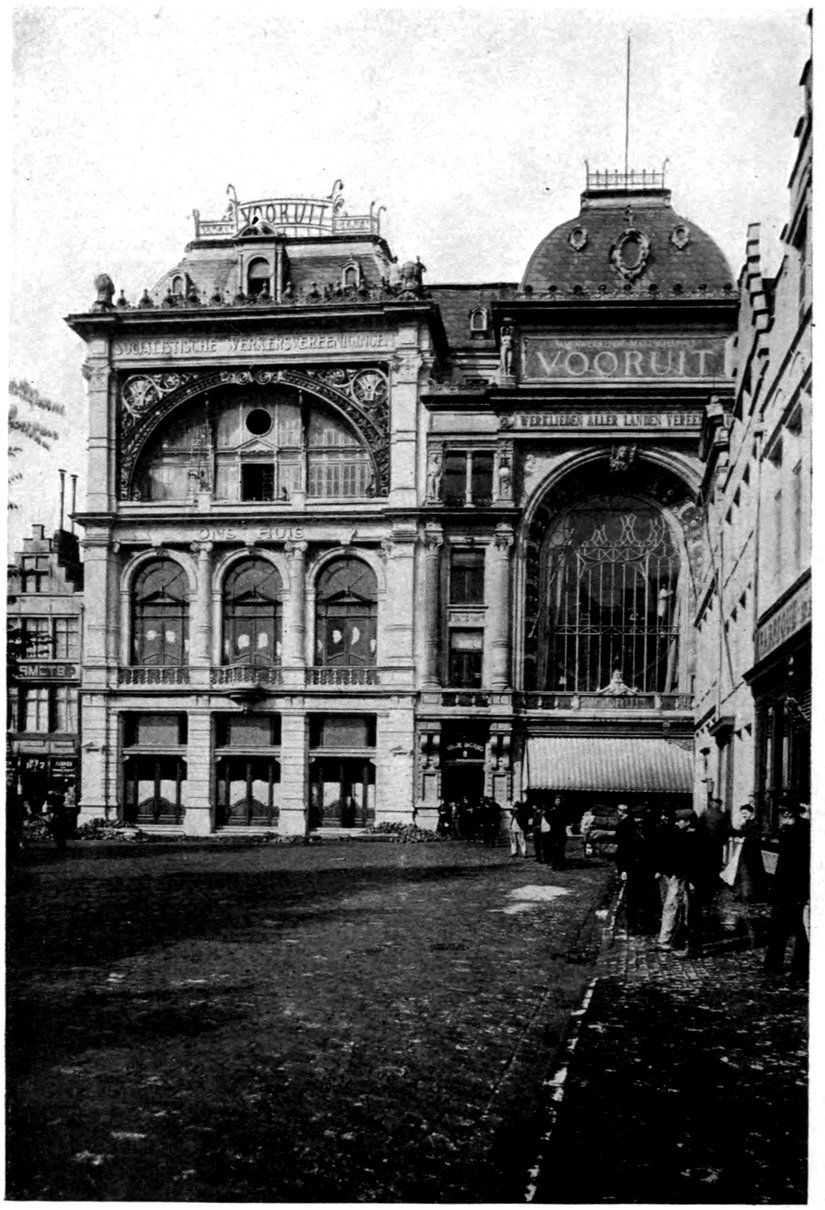
“VOORUIT” Home of the Socialist Societies of Ghent
By
UPTON SINCLAIR
ILLUSTRATED
New York
Doubleday, Page & Company
1907
Copyright, 1907, by
Doubleday, Page & Company
Published, May, 1907
All Rights Reserved
Including that of Translation into Foreign Languages
Including the Scandinavian
TO H. G. WELLS
“THE NEXT MOST HOPEFUL”
INTRODUCTION
vii
The thought of the time has familiarised
us with the evolutionary view of things; we
understand that life is the product of an
inner impulse, labouring to embody itself
in the world of sense; and that the product
is always changing—that there is nothing
permanent save the principles and laws in
accordance with which development goes
on. We understand that the universe of
things was evolved by slow stages into what
it is to-day, that all life has come into being
in the same way. We have traced this
process in the far-distant suns and in the
strata of the earth; we have traced it in the
vegetables and in the animals, in the seed
and in the embryo; we have traced it in
all of man’s activities, his ways of thinking
and acting, of eating and dressing and working
and fighting and praying.
This book is an attempt to interpret in
the light of evolutionary science the social
problem of our present world; to consider
American institutions as they exist at this
hour—what forces are now at work within
them, and what changes they are likely
to produce. The subject-matter dealt with
is not abstract speculation, but rather the
viiieveryday realities of the world we know—our
present political parties and public men,
our present corporations and captains of
industry, our present labour unions and
newspapers, colleges and churches. The
thing sought is an answer to a concrete and
definite question: What will America be
ten years from now?
Inasmuch as the people who are most
interested in practical affairs are very busy
people, I judge it to be a common-sense
procedure to set forth my ideas in miniature
at the outset; so that one may learn
in two or three minutes exactly what my
book contains, and judge whether he cares
to read it.
It is my belief that the student of a generation
from now will look back upon the
last two centuries of human history and
interpret them as the final stage of a long
process whereby man was transformed from
a solitary and predatory individual to a
social and peaceable member of a single
world community. He will see that men,
pressed by the struggle for existence, had
united themselves into groups under the
discipline of laws and conventions; and that
the last two centuries represented the period
when these laws and conventions, having
done their unifying work, and secured the
survival of the group, were set aside and
replaced by free and voluntary social effort.
ixThe student will furthermore perceive
that this evolutionary process had two manifestations,
two waves, so to speak; the first
political, and the second industrial; the first
determined by man’s struggle to protect
his life, and the second by his struggle to
amass wealth. The culmination of the first
occurred successively in the English revolutions,
the American and French revolutions,
and the other various efforts after political
freedom. After each of these achievements
the historian notices a period of bitterness
and disillusionment, a sense of failure, it
being discovered that the expected did not
occur, that Liberty, Equality and Fraternity
did not become the rule of men’s conduct.
After that, however, succeeds a period of
enlightenment, it having been realised that
the work has only been half done, that man
has been made only half free. The political
sovereignty has been taken out of the possession
of private individuals and made
the property of the whole community, to be
shared in by all upon equal terms; but the
industrial sovereignty still remains the property
of a few. A man can no longer be put
in jail or taxed by a king, but he can be
starved and exploited by a master; his body
is now his own, but his labour is another’s—and
there is very little difference between
the two. So immediately there begins a
new movement, the end of which is a
xnew revolution, and the establishment of
THE INDUSTRIAL REPUBLIC.
What do I mean by an Industrial Republic?
I mean an organisation for the production
and distribution of wealth, whose
members are established upon a basis of
equality; who elect representatives to govern
the organisation; and who receive the full
value of what their labour produces. I
mean an industrial government of the people,
by the people, for the people; a community
in which the means of production have been
made the inalienable property of the State.
My purpose in writing this book is to point
out the forces which are now rapidly developing
in America; and which, when they
have attained to maturity, will usher in the
Industrial Republic by a process as natural
and as inevitable as that by which a chick
breaks out of its shell or a child comes forth
from the womb at the proper hour. I
believe that the economic process is whirling
us on with terrific momentum toward the
crisis; and I look to see the most essential
features of the great transformation accomplished
in America within one year after
the Presidential election of 1912.
If I had been a tactful person I should
have kept that last statement until far on in
my argument. For I find many people who
are interested in the idea of an Industrial
Republic, and some few who are willing
xito think of it as a possibility; but I find none
who do not balk when I presume to set the
day. Yet the setting of the day is a vital
part of my conviction, and I should play
the reader false if I failed to mention it in
this preliminary statement of my argument.
It is a conviction to which I have come with
the diligent use of the best faculties I possess,
and after a preparation of a sort that
is certainly unusual, and possibly even
quite unique.
Perhaps I cannot do better by way of
introduction than to explain just what I
mean. Our country has passed through
two great crises, when important political
and social changes came with startling
suddenness. I refer to the Revolution and
the Civil War; and to the latter of these
crises, or rather the period of its preparation—1847
to 1861—I once had occasion to
give two years of an interesting kind of
study. I read everything which I could find
in the two largest special collections in the
country; not merely histories and biographies,
but the documents of the time,
speeches and sermons and letters, newspapers
and magazines and pamphlets. I
literally lived in the period; I knew it more
intimately than the world that was actually
about me. My purpose was to write a
novel which should make the crisis real to
the people of the present; and so I had to
xiiread creatively, I had to get into the very
soul of what I read. I had to struggle and
to suffer with the people of that time, to
forget my knowledge of the future, and to
watch through their eyes the hourly unfolding
of the mighty drama of events.
There were so many kinds of men—statesmen
and business men, lawyers and
clergymen, heroes and cowards; and I had
to study them all, and see the thing through
the eyes of each of them. And of course,
I could only play at ignorance, for I knew
the future; and I saw all their mistakes,
and the reasons for them, and the pity and
the folly and the tragedy of it all. Knowing,
as I did, the great underlying forces which
were driving behind the events, I saw all
these people as puppets, moved here and
there by powers of whose existence they
never dreamed.
And, of course, all the while I was also
reading my morning newspaper, and watching
the world of to-day; and inevitably I
found myself testing the people of the
present by these same methods. I would
find myself seeking for the forces which were
at work to-day, and striving to reach out to
the future to which they were leading. I
would find myself, by the way of helping in
this interpretation, comparing and balancing
the two eras, and transposing its
figures back and forth. This famous
xiiieducator or this newspaper editor of to-day—what
would he have been saying had he
lived in 1852? And this clergyman friend
of mine, this politician—where would he fit
into that period? Or if Yancey had been
alive to-day, what would he have been
doing? Where should I have found Seward—what
parts would Edward Everett and
Wendell Phillips and Jefferson Davis have
been playing?
It was really a fascinating problem in
proportion. The men of fifty years ago
stood thus and so to a known crisis; similar
men of the present stand thus to an unknown
crisis—and now find the crisis. When I
had finished “Manassas” I took up the
writing of “The Jungle”; which is simply
to say that I was drawn on irresistibly to
seek for this latter crisis, and to try to understand
it—to get into the heart of it, and
live it and follow it to its end, just as I had
done with the earlier one. So now I feel that
I have much the same sort of power as Cuvier,
the naturalist, who could construct a
prehistoric animal from a bit of its bone. I
have far more than the bone of this monster—I
have his tail, beginning far back in the
seventies; and I have the whole of his huge
body—the present. I have counted his
scales and measured his limbs; I have even
felt his pulse and had his blood under the
microscope. And now you ask me—How
xivmany more vertebræ will there be in the
neck of this strange animal? And what
will be the size and the shape of his head?
So it is that I write in all seriousness that
the revolution will take place in America
within one year after the Presidential election
of 1912; and, in saying this, I claim to speak,
not as a dreamer nor as a child, but as a
scientist and a prophet.
The thing which most impresses the student
of the Civil War struggle, is
how generally and completely the people
who lived through it failed to understand
it themselves. We of the present day know
that the War was a clash between two incompatible
types of civilisation; between an
agricultural and conservative aristocracy,
and a commercial and progressive democracy.
We can see that each society developed
in its people a separate point of view,
separate customs and laws, ideals and
policies, literatures and religions. We can
see that their differing interests as to tariffs,
police regulations, domestic improvements
and foreign affairs, made political strife
between them inevitable; and that finally
the expansion which was necessary to the
life of each brought them into a conflict
which could only end with the submission
of one or the other. Yet, plain as this seems
to us now, the people of that time did not
4grasp it; through the whole long process
they were dragged, as it were, by the hair
of their heads, and each event as it came was
a separate phenomenon, a fresh source of
astonishment, alarm, and indignation. Even
after the war had broken out, the vast
majority of them would not be enlightened as
in regard to it—a few of them have not been
enlightened yet. I talked recently with an
old Confederate naval officer, who said to me:
“Oh, yes; it was the politicians who made
the war.” I recall the astonished look which
crossed the old gentleman’s face when I
ventured the opinion that the politicians of
this country had never yet made anything
except their own livings.
It seemed not merely that they could not
understand the thing; they would not. The
truth did not please them, and the best and
wisest of them appeared to have the idea
that they had only not to see it, and it would
cease to be the truth; after the manner of
the learned men of Galileo’s time, who
declined to look through his telescope, or
to watch him drop weights from the Tower
of Pisa. They made it a matter of offence
that anyone should understand; the ability
to predict political events was held to imply
some collusion with them. When Lincoln,
just before the crash, ventured to doubt
the stability of “a house divided against
itself,” his enemies fell upon him precisely
5as if he had declared, not that such a house
would fall, but that he intended to knock
it down. And this was the established view
of all the conservatism of the country, only
two or three years before there burst upon
it one of the most fearful cataclysms of
history.
Let us endeavour to place ourselves in
the position of the average man of 1860, and
see now the whole matter appeared to him.
Way back in the early thirties, eight or
ten more or less insane fanatics—“apostate
priests and unsexed women,” as one writer
described them—had got together and begun
an agitation for a wholly impossible and
visionary (to say nothing of revolutionary
and unconstitutional) programme—“the immediate
and unconditional emancipation of
the slaves.” They formed a society and
started a paper called the Liberator.
When governors of Southern states protested
concerning it, the Hon. Harrison
Gray Otis, Mayor of Boston, wrote as
follows: “It appeared upon inquiry that
no member of the city government, nor any
person of my acquaintance, had ever heard
of the publication. Sometime afterward
it was reported to me by the city officers that
they had ferreted out the paper and its
editor; that his office was an obscure hole,
his only visible auxiliary a negro boy, and his
supporters a very few ignorant persons of
6all colours. This information, with the
consent of the Aldermen, I communicated
to the above named governors, with an
utterance of my belief that the new fanaticism
had not made, nor was likely to make,
proselytes among the respectable classes of
the people.”
Nevertheless, the danger of this propaganda
was recognised, and before long the
Abolitionists were being stoned and shot,
their presses smashed, and their meetings
broken up; a “broadcloth mob” put a rope
round the neck of the editor of the Liberator
and dragged him through the streets
of the city. And still, in spite of this, the
agitation went on. All the “cranks” of the
country gradually rallied about the movement.
Their leader was a woman’s suffragist,
an infidel, a prohibitionist, and a
vegetarian; he denounced the Constitution
as “an agreement with Death, and a covenant
with Hell.” There was one man
among them who addressed meetings with
clanking chains about his wrists, and a
three-pronged iron slave-collar about his
neck; and who declared to the people of a
town that they “had better establish among
them a hundred rum-shops, fifty gambling-houses
and ten brothels, than one church.”
They allowed Negroes to speak on the platform
with them, and they opened schools
for Negro girls, or tried to, until these were
7broken up. One of them refused to pay
taxes to a slave-holding government, and
went to jail for it.
Assuredly, no common-sense person would
have thought that here was anything save
a madness that might be allowed to run
its course. Yet the Abolitionists kept at it.
In the election of 1840, a wing of them split
off, and nominated a candidate for the
Presidency, who received seven thousand
votes out of a total of two or three millions.
Four years later, when the Democratic
Party was on the verge of forcing the country
into a war with Mexico, they raised a hue
and cry that this was a “slave-driver’s
enterprise,” with the result that their vote
went up to sixty-two thousand. And by
keeping up the ceaseless agitation all through
the war, and taking advantage of a factional
quarrel in New York state to nominate a
politician who came into their camp for the
sake of revenge, they cast, in 1848, a vote
of two hundred and ninety-one thousand.
And also they had by this time succeeded
in colouring a great mass of the popular
thought with their views. They had gotten
the country unsettled; they had made
people feel that something was wrong, and
all sorts of anti-slavery measures were
beginning to be championed. Some wanted
to exclude slavery from the new Territories;
some wanted to exclude it from the National
8Capital; some wanted to restrict the domestic
slave-trade. All of these people, of course,
denied indignantly that they were Abolitionists,
denied that they had any sympathy
with Abolitionism, or that their measures
had anything to do with it. But the South,
whom the matter concerned, understood
perfectly well the folly of such a claim—understood
that the institution of Slavery
was one which could not be made war upon,
or limited, and that the first hostile move
which was made against it would necessarily
mean its downfall. Hence, to the South,
all these people were “Abolitionists.”
Over the California question, there came
at last a crisis, and all the Conservative
forces of the nation were scarcely equal to
the settling of it. Edward Everett and
Rufus Choate and Calhoun and Clay and
Webster, and a dozen others that one might
name, exerted all their influence, and went
about warning their countrymen of the
danger, and denouncing what Webster called
“the din and roll and rub-a-dub of Abolition
presses and Abolition lectures.” Under
these circumstances the “Compromise” was
adopted, and the vote of the Abolitionist
Party fell off to one hundred and fifty-six
thousand.
But then came the repeal of the Missouri
Compromise, which brought Lincoln into
politics. The Abolition clamour surged up
9as never before—here was one proof the
more, they said, that Slavery was menacing
American institutions. The whole country
seemed suddenly to be full of their supporters;
and the Kansas Raid only added more
fuel to the flame. The Republican Party
was formed, the Black Republican Party,
as the slave-holders called it; and at the
Presidential election of 1856, they cast more
than one million three hundred thousand
votes, about one-third of the total vote of
the country.
After that came, in due course, the attempt
of the Supreme Court to put an end to the
Abolitionist agitation, declaring that Congress
could not restrict slavery in the Territories,
which meant that the Republican
Party had no right to exist. To “cheerfully
acquiesce” in the decision of the Supreme
Court, was the duty of “all good citizens,”
according to President Buchanan; yet the
only result of the action of the Supreme
Court was to cause the agitation to burst out
afresh. In Illinois, Abraham Lincoln ran
for senator in flat defiance of the Supreme
Court’s decision, and the Republican Party
all over the country went on in its revolutionary
course, precisely as if no Supreme Court
had ever existed. A year or two later an
agitator made matters still worse by his
attempt to set free the slaves by force. “It
is my firm and deliberate conviction,” said
10Senator Douglas, “that the Harper’s Ferry
crime was the natural, logical and inevitable
result of the doctrines and teachings of the
Republican Party.” And he was perfectly
right.
It was disgraceful, and yet it would not
stop. The North had by this time become
so full of Abolitionism, that even the Democrats
were not to be trusted. When the
split came, in Charleston, Yancey of Alabama
explained this. “When I was a boy
in the Northern States,” he said, “Abolitionists
were pelted with rotten eggs. But
now this band of Abolitionists has spread
and grown into three bands—the Black
Republicans, the Free-soilers, and the Squatter-sovereignty
men—all representing the
common sentiment that Slavery is wrong.”
And when Abraham Lincoln was elected
President by a minority of the people, upon
a platform which declared that the Constitution
was to be disregarded, the party of
conservatism and tradition resorted to force
to maintain its rights.
And what happened then? Why, simply
this: a group of fanatical visionaries who
had for thirty years been jeered at for
demanding of the country something that
was revolutionary and inconceivable—the
destruction of an institution which had
stood for centuries, and was built into the
very framework of the nation—suddenly
11began to see the mighty structure totter,
to see cracks open in it, to see its pillars
crumble, its roof fall in; and at last, before
they had fairly time to realise what was
happening, the whole heaven-defying colossus
lay a heap of dust and ruins at their feet!
I have said that I believe that our country
is now only a few years away from a
similar great transformation. In order to
maintain that thesis, it will be necessary to
show, first, a great underlying economic
cause, working irresistibly to force the issue;
and second, a consequent movement of
protest, slowly making headway and ultimately
permeating the whole thought of
the country.
What was the cause of the Civil War?
To put it into a phrase, it was the need
under which Slavery laboured of securing
new territory. The reader may find a
contemporary exposition of the situation in
Olmstead’s “Cotton Kingdom.” Slave
labour was a very wasteful means of cultivation—only
the top of the soil was used,
and ten or fifteen crops exhausted it. Virginia
was once a great exporting state, but
in the forties and fifties it had become simply
a slave-breeding ground for the younger
generation, which had moved to the Far
South. And then, when the Far South
began to prove insufficient, there was
12another move, into Texas; and finally an
attempt at still a third, into Kansas—which
brought on the clash with the free
states.
At the present day we have a society,
industrial instead of agricultural; and the
struggle which we are witnessing is that
between capital and labour. It is a struggle,
not for land, but for profits; and if we are to
show that it is, like the Civil War, “an
irrepressible conflict between opposing and
enduring forces,” we must show in this case
also that the thing struggled for is limited
in quantity, and ultimately insufficient to
satisfy the needs of both the contending
parties.
That our industrial system is based upon
profits, and that a failure of profits would
lead to its collapse, will be admitted by
anyone. But how could profits ever fail?
the reader asks. Will not the soil always
produce? And does not every man who
comes into the world bring a pair of hands
with him, to produce things and earn his
living? And so, can there not always be
profitable exchange? There could, I
answer, provided that the various pairs of
hands were to remain upon equal terms.
But suppose that one pair were to get
some advantage over the other pairs, and
use that advantage to get constantly
increasing advantage; might there not
13then come a time when the other pairs,
having less and less, were finally unable
to furnish as much profits as were
necessary?
We began the economic battle in this
country upon equal terms. Some got the
advantage and became masters, the others
becoming wage-workers. This advantage—that
is, capital—brought constantly increasing
advantage—profit, rent, interest;
and those who had not the advantage
stayed meanwhile just where they were—they
got enough to live on, and no more.
Numerous exceptions to this do not in the
least disturb the main facts—that as a class
the wage-workers stayed wage-workers, and
the masters stayed masters. Neither does
the fact that wages rose constantly in the
least disturb the main fact, for the cost of
living rose also; the wage-worker got his
living then, and he gets it now. And
meanwhile, according to the way of nature,
and in spite of the outcry of moralists and
old-fashioned statesmen, the strong went
on growing stronger, and fighting among
each other, the victors growing ten times
stronger yet; until now we have come to a
stage where, industrially speaking, we are
a nation of eighty million pygmies and a
dozen giants. Nor is the work quite done
yet—it is going straight on, in spite of anti-trust
decisions and the labour of the “muckrake
14man”—and within a very few more
years the dozen giants will be but one giant.
The dozen, meanwhile, are giants, and
they are that because the industrial opportunities
of the nation are their property.
They are the nation, economically speaking;
they own its railroads and telegraphs, its
coal mines, oil fields, factories and stores.
And they grant to the eighty millions of the
nation the right to these opportunities and a
chance to earn their living upon one certain
definite condition—that of what they produce,
they receive only a part, yielding up
the balance to be “profits.”
It is also important to notice that these
profits are not taken “in kind”—the product
must first be sold, so that both wages and
profits can be paid in money. It thus follows
that the amount of profits is strictly
limited by the amount of market that can be
found; in other words, that a society whose
income is limited, is also limited as to its
profit-yielding capacity—that, for instance,
a society of eighty millions of people receiving
a mere living wage will be able to yield
just so much rent, interest and dividends,
and not any more.
But what it yields has in the past been
enough, says the reader. Why will it not
be enough for the future?
Just this is the crux of the whole matter.
Rent, interest, dividends, it must be understood,
15are fractions; and fractions may be
decreased as well by increasing the denominator,
as by decreasing the numerator. A
man, for instance, who invested a hundred
dollars and made six, would receive six
per cent. interest; but if he invested the
second year one hundred and six dollars,
and was able still to gain only six, his
profit would be, not six per cent., but
only five and a fraction. If he wished to
make six, he would have to squeeze out a
little more than six dollars; would have to
compel the man who paid it to him to work
just a little harder. And that, in miniature,
is a representation of what is going on in
our society to-day. You, the well-meaning
reader, who are struggling to make the
world better, and failing—whether the thing
which you are trying to reform be politics or
literature or religion, New York or Colorado
or the Philippines, Fifth Avenue or Wall
Street or Hell’s Kitchen—you are meeting
with failure because of that little arithmetical
difficulty which has just been set forth.
Consider our millionaire fortunes, how
they grow. Consider, for instance, that
Mr. John D. Rockefeller makes fifty per
cent. a year upon his holdings in the
Standard Oil Company. The stock of the
Standard Oil Company is now at five hundred,
and has been as high as eight hundred
in the market. This is assuming that Mr.
16Rockefeller invested in the stock at par—though
as a matter of fact, he put in only
about twenty dollars a share, which would
make his profit two hundred and fifty per
cent. His income is at least fifty million
dollars a year.
What does he do with it? Of course,
he can’t spend it—if he treated himself to
a St. Louis Exposition every year, he
couldn’t spend it. What he does with it
is to take it promptly, and reinvest it in
the form of new capital; he employs a
staff of thirty-two trained experts to aid
him in this work. The effect of this is,
of course, to make his income fifty
per cent., compound interest, instead of
simple; and what it will be in the course of
time is a problem for those who like figures.
While he is doing this, all the other capitalists
are doing the same—the American millionaire
lets his wife and daughters spend
as much of his money as they can, but he
seldom spends any himself; he is more
interested in “doing things.” The consequence
is, therefore, that year after year
we are paying the vast mass of our people
mere living wages, and all the surplus product
of our toil we are selling, and devoting
to the creation of new instruments of production.
We have, mark you, machinery
that creates products for hundreds of times
as many men as it employs, and still we
17skim off the surplus and devote it to making
new machines. Is it not obvious that this
cannot go on forever? And that the time
must come that we make all that we need—or
rather that our people have money to
buy, wages being what they are? And
if that ever happens, then of course the
factories will have to shut down. We
shall have millions of men out of work, and
starving on our streets; and when they
form processions and begin agitating, demanding
that we give them work, then we
say—that is, our newspapers, our preachers,
our politicians, everybody says—
“But, my good man, there is no more
work to be done!”
“But I am starving,” insists the workingman,
“we are all starving. Why is
there no work?”
“The reason there is no work is ‘overproduction.’
The market is clogged with
products, you must understand, and we
can’t sell them. What is your trade?”
“I work in a shoe-factory.”
“But the shoe market is already glutted—there
are twice as many shoes as there is
any use for.”
“Twice as many shoes! But my feet are
on the ground!”
“Well, we can’t help that, my good man;
that’s because you have no money to buy
them with.”
18“And my friend here,” goes on the workingman—“he
is a tailor, and he is naked
because there are too many coats on the
market?”
“Exactly.”
“And the baker here is starving because
we are both too poor to buy his bread?”
“Exactly.”
“And then this druggist is sick because
we have no money to buy medicine?”
“Exactly.”
After which, the workingman stands and
scratches his head for a moment. “There
is too much of everything,” he reflects.
“There is no more work to be done.” And
suddenly the light breaks. “Oh, I see!”
he cries, “we have finished our work
for the capitalists!” And you answer,
“Exactly! Everything is complete, and
of course there is no more room for you.
Therefore you had best be off to another
planet!”
So it would be, if the workingman were
content to take his doctrines from the other
side—from the retainers of those “to whom
God in His Infinite Wisdom has entrusted
the care of the property interests of the
country.” But, meantime, the workingman
has been thinking for himself—and
evolving a quite new doctrine, all his own,
concerning the property interests of the
19country. This doctrine is, in a word, that
the means of production of wealth belong
of right to no individual, but to the whole
people; and that in the hour of the collapse
of the profit-making system, the
thing for the people to do is to take possession
of the machinery, and use it to produce
goods, no longer for those who own, but for
those who work.
And that brings me to the second of my
tasks. I have shown the “great underlying
economic cause, working irresistibly
to force the issue”; there remains to show
the consequent “movement of protest.”
I have before me, as I write, a little pamphlet
published by the “Standard Publishing
Company,” of Terre Haute, Indiana, and
entitled, “The American Movement,” by
Eugene V. Debs. It opens with the
statement that “The twentieth century,
according to the prophecy of Victor Hugo,
is to be the century of humanity,” and will
witness “the crash of despotism and the
rise of world-wide democracy, freedom and
brotherhood.” The reader, continuing, soon
discovers that the “American movement,”
with which this pamphlet deals, is the
American Socialist movement. The writer
tells of its early “Utopian” forms, the
Owenites and the Brook-farmers, and
names the exiles who came from abroad in
1848, bringing the Marxian doctrine, and
20influencing such men as Horace Greeley and
Parke Godwin. “The first large society to
adopt and propagate Socialism in America,”
he writes, “was composed of the German
Gymnastic Unions. Through the sixties
and seventies the agitation steadily increased,
local organisations were formed in
various parts of the country. Following the
Paris Commune of 1871, and its tragic
ending, many French radicals came to our
shores and gave new spirit to the movement.
In 1876 the Workingman’s Party was organised,
and in 1877, at the convention held
in Newark, it became the Socialist Labour
Party. The Socialists were intent upon
building up a working-class party for independent
political action.” This party,
“composed of thoughtful, intelligent men,
aggressive and progressive, of rugged
honesty and thrilled with the revolutionary
spirit and aspiration for freedom, became
from its inception a decided factor in the
labour movement. The busy, ignorant
world about the revolutionary nucleus knew
little or nothing about it; had no conception
of its significance, and looked upon its adherents
as foolish fanatics whose antics
were harmless and whose designs would
dissolve like bubbles on the surface of a
stream. In March, 1885, was inaugurated
the strike of the Knights of Labour. On
May 1st of the same year, the general strikes
21for the eight-hour work-day broke out in
various parts of the country. In 1884,
Laurence Gronlund published his “Coöperative
Commonwealth.” In 1888 Edward
Bellamy published his “Looking Backward,”
and it had a wonderful effect upon
the people. The editions ran into hundreds
of thousands.”
The author then goes on to narrate his
version of the Pullman strike of 1893.
He declares that the American Railway
Union, of which he was president, had
won, when the General Managers’ Association
caused the swearing in of “an army
of deputies,” whom the Chief of Police of
Chicago declared to be “thieves, thugs and
ex-convicts,” and that it was these men who
caused the violence which led to President
Cleveland’s action, and the breaking of
the strike. He then continues the story of
the Socialist movement. The Coming
Nation, started at Greensburg, Indiana,
by J. A. Wayland, in 1893, was the first
popular propaganda paper to be published
in the interests of Socialism in this country.
It reached a large circulation, and the proceeds
were used in founding and developing
the Ruskin coöperative colony in Tennessee.
Later Mr. Wayland began the publication
of the Appeal to Reason, and it now
numbers its subscribers by the hundreds of
thousands. It is not saying too much for
22the Appeal that it has been a great factor
in preparing the American soil for the seed
of Socialism. Its enormous editions have
been and are being spread broadcast, and
copies may be found in the remotest recesses
and the most inaccessible regions.
The periodical and weekly press, so
necessary to any political movement, is
now developing rapidly, and there is every
reason to believe that within the next few
years there will be a formidable array of
reviews, magazines, illustrated journals, and
daily and weekly papers to represent the
movement and do battle for its supremacy.
The last convention of the American Railway
Union was the first convention of the
Social Democracy of America, and this was
held in Chicago, in June, 1897, the delegates
voting to change the railway union into a
working-class political party. The Railway
Times, the official paper of the union,
became the Social-Democrat, and later
the Social-Democratic Herald, and is now
published at Milwaukee in the interest of
the Socialist Party. Since the election of
1900, there has been greater activity in
organising, and a more widespread propaganda
than ever before. In the elections
of the past, it can scarcely be claimed that
the Socialist movement was represented by
a national party. It entered these contests
with but few states organised, and with
23no resources worth mentioning to sustain
it during the campaign. It is far different
to-day. The Socialist Party is organised
in almost every state and territory in the
American Union. Its members are filled
with enthusiasm and working with an
energy born of the throb and thrill of
revolution. The party has a press supporting
it that extends from sea to sea, and is
as vigilant and tireless in its labours as
it is steadfast and true to the party
principles.
“Viewed to-day from any intelligent
standpoint, the outlook of the Socialist
movement is full of promise—to the capitalist,
of struggle and conquest; to the worker,
of coming freedom. It is the break of dawn
upon the horizon of human destiny, and it
has no limitation but the walls of the
universe.”
Whatever the reader may think about
the foregoing narrative, there is one part
of it which he cannot dismiss; the statements
concerning the growth of the American
Socialist Party. In 1888 the Socialist vote
was two thousand. In 1892, it was twenty-one
thousand. In 1896, it was thirty-six
thousand. In 1900, it was one hundred
and thirty-one thousand. In 1904, it was
four hundred and forty-two thousand.
The Socialist Party has some twenty-seven
24thousand subscribing members, who
pay monthly dues. It has over eighteen
hundred “locals,” or centres of agitation;
the members of these “locals” are for the
most part workingmen, who give their
spare hours to the cause, holding meetings
and debates, and circulating the literature
of Socialism. In the larger cities, there are
generally several lectures each week, and
there are a score of “national organisers,”
who travel about, speaking night after night
in various towns, forming new “locals,”
and taking subscriptions to the Socialist
publications. Of these there are four monthlies
and about thirty-five weeklies. Since
1892, Wayland’s paper, The Appeal to Reason
(Girard, Kansas), has increased its paid
circulation from one hundred and twenty-six
thousand to over two hundred and seventy-five
thousand, and last year it printed one
edition of two millions and a half, and another
of over three millions. Another Socialist
paper, Wilshire’s Magazine (New York),
has increased its circulation from fifty-five
thousand to two hundred and seventy thousand
in a single year. In addition to this,
there are many publishing companies, which
distribute books, leaflets and pamphlets, at
little more than cost. I have before me a
treatise, the price of which is one cent, of
which over five million copies have been sold
since its publication some years ago. Its
25title is “Why Workingmen Should Be Socialists,”
by Gaylord Wilshire.
And in giving the figures of the Socialist
growth, it is worth while to point out that
this is not merely a local movement, but a
world movement; that the United States is
one of the most backward of the civilised
nations in respect to Socialism. In
Australia the labour unions have adopted
a full Socialist program, and the labour
unions hold the balance of power. In England,
they have just elected twenty-seven
members of Parliament; they have now
members in the Cabinet of France, and in
Italy they have turned out ministries. In
Belgium, the vote of the party is half a
million, and in Austria it is nearly a million,
while in Germany it has grown from thirty
thousand in 1870, to five hundred and forty-nine
thousand in 1884, one million, eight
hundred and seventy-six thousand in 1893,
three million and eight thousand in 1903
and three million two hundred and fifty
thousand in 1907. The Socialists are electing
representatives in Argentina and South
Africa; in spite of government persecution,
the movement is now growing rapidly in
Japan. Including all languages, the Socialist
journals number nearly seven hundred, and
the Socialist vote of the world is figured at
nearly eight million. Allowing for women,
and for the disfranchised proletariat of such
26nations as Russia, Austria, and Italy, there
are estimated to be thirty million class-conscious
Socialists in the world.
To overlook the significance of a movement
such as this, is but to repeat upon a
larger scale the error of half a century ago,
and to pay with blood and anguish for
blundering and indifference. The processes
of time have their laws, which can be
studied; and all the waste and ruin of history,
which make its records scarcely to be
read, are consequences of the fact that man
has to be lashed to his goal through the
darkness, instead of marching to it in the
light. You take but a shallow view of the
problems of our present time, if you do not
realise that when thirty million people, in
every corner of the civilised world, organise
themselves into a political party, they do
it because of some fundamental and tremendous
motive, and that they will not be
apt to abandon their efforts until they have
accomplished some proportionately significant
result.
CHAPTER II INDUSTRIAL EVOLUTION
27
Herbert Spencer gives a definition
of Evolution, phrased in technical terms,
which might be roughly summed up in these
words: A process whereby many similar and
simple things become dissimilar parts of one
complex thing. If we trace, for instance, the
evolution of human society, we see about
as follows: In the beginning man exists in
widely scattered and unrelated tribes, having
a very loosely organised government,
each individual doing about as he pleases,
and all individuals being very much the
same. Each finds his own food and cooks
it, makes his own weapons and clothing,
and looks and thinks and acts like his neighbour.
Little by little, as the tribe grows,
it begins to come into contact with other
tribes that also are growing, and a pressure
begins; the tribes make war upon each
other, and each individual of the tribe is
forced by the presence of danger to unite
himself more closely with his fellows, to
establish a more rigid rule of obedience, and
to force refractory members to the general
will. Then, under still growing pressure,
28one tribe unites with another against a
common enemy, and the strongest man in
the two rules both; which process of combining
continues until at last there results
an organism of great complexity, whose
members are no longer equal and self-sustaining,
but have different activities and
ranks and characteristics, and are each
dependent upon the rest. If, for instance,
we examine France during the Feudal
period, we find numerous principalities,
duchies and baronies, each one an elaborate
and complex organisation, with various
classes and hierarchies and tributary parts,
and a whole system of laws and customs and
beliefs to correspond. And no sooner is
this process complete than an evolution
begins among these organisms; under the
stress of jealousies and ambitions they too
begin to struggle, to combine; and presently
in one of them arises a strong man who
secures command of them all. When the
process is completed, there stands in the
place of a hundred principalities, one kingdom,
the Kingdom of France.
The object of all this long labour is, of
course, to get some kind of an organism
that shall be capable of maintaining itself
in a world of ferocious strife; that shall
be able to withstand all enemies that may
come against it, and all rebellions that
may arise within it. The French monarchy
29was a marvellous piece of work when it
was done; it had men graded into a thousand
different classes and occupations,
and everything fitted perfectly and ran
like a clock. It had peasants to till the
soil, and soldiers and sailors to fight; artisans
to make all its necessaries, and merchants
to handle them; and rising tier upon tier,
a whole pyramid of governing and administrative
officials, up to the king. It had
likewise the whole outfit of ideas and customs
necessary to its operation; it was complete
and perfect and sublime—it was like
a mighty vessel defying the tempests; it had
also its pennons that waved, and its songs
for the crew to sing. Was it any wonder
that those who had made it were proud of
it, and felt that there was nothing more to
be done in the world but to keep it going?
And yet evolution was not through with
it. Men grow weary and want to rest,
they become “conservative” and fret at
the bare thought of change—but the
processes of life go on inexorably. This
mighty structure, the Kingdom of France,
was only a means and not an end—its purpose
was to bind the people of the nation
together and protect them until they were
able to take care of themselves. It took
a long time for this idea to make its way;
it took a fearful struggle—men were imprisoned
and exiled, burned and beheaded;
30but the idea went right on, and the nation
went right on; and when the time came, it
burst the old integument to pieces, and out
of the Kingdom of France there emerged
the French Republic.
What a marvellous event that was, and
what a stir it made in the world—what a
stir especially in our own corner of the
world—every one knows. Looking at it
from a century’s distance, and calmly, we
see the whole age-long event as an exemplification
of the process of life; the combining
of a number of simple things into
one complex thing. The means was struggle
and rivalry—it was a cruel process;
but you will notice that at the end the
effort and the pain are all gone—that the
organism fulfils its functions freely and
joyfully, and that the only difference between
the first stage and the last is that the individual
man has been raised to a higher
plane of being.
Now, as I have said before, the first care
of a man is to protect his life; the second
is to accumulate wealth. A man does not
set much store by his goods while his enemies
are within sound; but just as soon as they
are dispersed, the tribe begins to gather
flocks, and to till the soil. And so, following
close upon the heels of the evolution of
political society, you have the evolution of
industrial society.
31And it is precisely the same process. We
may see nearly the whole of it in this country.
It begins with the colonial village, where
every man owns a little land and raises his
own food; also he cobbles his own shoes,
spins his own wool, weaves his own cloth,
and makes his own clothes. In the very
earliest days, he never buys anything, because
there is nothing to buy. He may be
the deacon or the schoolmaster or the
judge, but still he has his own farm, and any
other man in the village is about as well
fitted to be the deacon or the schoolmaster
or the judge as he. But then his goods
expand and war begins—industrial war,
I mean—a horse-trade, for example. Political
evolution is slow, because the rate of
increase of men is limited; but the rate of
increase of goods proves to be unlimited.
Machines are invented, and straightway
the industrial process is accelerated tenfold.
It took a thousand years to evolve
a monarchy; it took only a hundred to
evolve a trust.
The industrial units fight each other, and
the strongest survive as employers, the
weakest becoming employees. Then, as
growth continues, these various little groups
all over the country come into contact, and
they struggle also. The struggle is of
course no longer fighting with swords—it
is underselling; but the process is exactly
32the same, and its purpose is the building
up of a capable industrial organism. Precisely
as in one case the tribes by combining
find they are stronger to fight, the employers,
by combining, find that they are stronger
to undersell; and this process goes on until
you have an industrial feudalism, corresponding
in all its details to the political
feudalism of France. And then, as before,
the barons and the princes and the dukes
fight among each other, until out of the
midst arises a strong man, a Rockefeller
or a Harriman, who smashes them right and
left, and makes himself a king.
He is a king in precisely the same way,
and to precisely the same purpose, as
Louis the Great was king. You know how
Richelieu served the nobility of France—if
they would not obey they simply lost their
heads. If you have read Miss Tarbell’s
“History of the Standard Oil Company,”
or Henry D. Lloyd’s “Wealth Against
Commonwealth,” you know how Mr.
Rockefeller served the oil nobility; how he
tricked them and crushed them; how sometimes,
it is said, he blew up their refineries
with dynamite, or burned them with fire.
You know how Louis said he was the State;
and you heard the president of one of the
coal companies, who is doing business in
flat defiance of the laws of the land, declare
that God in His Infinite Wisdom had entrusted
33to him the property interests of the
country. It is not necessary to pursue this
analogy; if you do not see that in the due
and inevitable course of evolution, our
industrial organism has attained the monarchical
stage, it is simply because you do
not wish to see it, and no amount of
exposition will avail. I have only to add, as
before, that the purpose of this process was
to evolve an organism which should be
capable of maintaining itself against all
enemies, without and within. The task of
King Louis was the aggrandisement of
France; the task of Mr. Rockefeller is the
keeping up of Standard Oil stock. Incidentally,
Louis the Great gave the world
a race-heritage and a civilisation; incidentally,
Mr. Rockefeller furnishes the world
with oil. Also—what is true in one case is
true in the other—the Standard Oil Company
is a marvellous piece of work. It has
men graded into a thousand different classes
and occupations, and all fitting perfectly
and running like a clock. It has labourers
to till the soil, lobbyists and salesmen to
fight, factories to make all its necessaries,
and railroads to handle them; and, rising
tier upon tier, it has a whole pyramid of
governing and administrative officials, up
to the president. It has likewise the whole
outfit of ideas necessary to its operation;
it is complete and perfect and sublime—it
34is like a mighty vessel, defying the tempests.
Is it any wonder that those who have constructed
it are proud of it, and feel that there
is nothing more to be done in the world but
to keep it going?
It is of course clear that the next step,
according to my parallel, would be into an
Industrial Republic. The reader differs
from most Americans whom I meet if this
idea is not startling to him. Let us go
forward slowly.
In Mr. John Bach McMaster’s “History
of the People of the United States,” is a
narrative of the terrible yellow-fever epidemic
which occurred in Philadelphia in
the year 1793, causing the death of over four
thousand people in four months. In those
days men had strange ideas as to the causes
of yellow fever; they believed, in this case,
that it “had come from a pile of stinking
hides that had been on one of the wharves.”
The historian goes on to describe the
strange expedients they adopted to get rid
of it. “People were bidden to keep out of
the sun, and not to get tired. The doctors
had little faith in bonfires as purifiers of
the air, but much in the burning of gunpowder.
Every one then who could buy
or borrow a gun, loaded and fired it from
morning till night. Then one remedy after
another would be suggested, and people
would cover themselves with it—nitre,
35tobacco, and garlic, mud-baths, camphor,
and thieves’ vinegar. The last could only
be procured by going to the shop. The
purchaser going to get it was careful to
have a piece of tarred rope wet with camphor
at his nose, and in his pocket his handkerchief
soaked with the last preventive he
had heard of. He shunned the footpaths,
fled down the nearest alley at sight of a
carriage, and would go six blocks to avoid
passing a house where a dead body had
been taken out a week before. He would
not enter a shop where another man stood
at the counter; he would rush in, throw
down the money, and rush home—soak
everything in this prepared vinegar, and
live on a prescribed diet, water-gruel, oatmeal,
tea, barley-water, or a vile concoction
called apple-tea. If his head pained him
or his tongue felt rough, he would immediately
wash out his mouth with warm
water and honey and vinegar——” etc., etc.
At the time when I read all this, it made a
peculiar impression upon me, because the
newspapers happened just then to be full
of the discovery of the true cause of yellow
fever. And so all the time that I was
reading about the man with the tarred
rope in his hands and a sponge wet
with camphor at his nose, I had this
thought in my mind: And while he was
waiting outside of the shop, a mosquito
36flew up, all unheeded, and bit him. And
so he died!
It seemed to me a peculiarly neat illustration
of the precise difference between
knowledge and ignorance. It led me to
reflect how very eager men ought to be
to possess the former; and I put the
anecdote away in my mind, thinking, “I
shall use it some day when I want—all of
a sudden—to scare someone out of a
prejudice!”
For just imagine, if you can, that mosquitoes,
instead of being a pest about which
every man was glad to believe evil, had
been the basis of some important industry,
or otherwise the source of incalculable
advantage to the dominant classes of
the community; that universities were
endowed, and newspapers owned, and
churches and hospitals supported, out of
the proceeds of the mosquito monopoly!
Are you sure that in that case the discovery
of the physicians in Havana would have
been hailed as a triumph of Science? Or
do you not think that there might have been
a strong opposition to the fantastic speculation,
and that the men who had published
it might have been denounced as enemies of
society, and turned out of office for their
incendiary teachings? That other physicians
of high standing might have been
found to ridicule the idea? That newspapers
37might have refused to print arguments
in favour of it—that, in short, the
mosquito monopoly might have succeeded
in conjuring up before the imaginations of
the multitude so horrible an image of this
doctrine and its consequences, that they
would have looked upon anyone who
advocated it as in some way morally
deformed? Assuming that this could have
been done, there are only two things to be
added. The first is that all the while the
mosquitoes would have gone right on causing
the yellow fever; and the second is
that the people would have found it out in
the end—that all that the makers of public
opinion would have done, would be to put
just so many millions of dollars into the
pockets of the mosquito monopoly, at a
cost of just so much misery to the human race.
At the outset of this argument, I very
much wish that you, the reader, would commune
with yourself prayerfully, as to
whether or not it might not possibly be that
the ideas you have in your head concerning
an “Industrial Republic” are really not
ideas of your own at all, but prejudices
which other people have put there for purposes
known to them.
Let me repeat the definition which I gave
at the outset of this argument: I mean
by an Industrial Republic, an organisation
38for the production of wealth, whose members
are established upon a basis of equality;
who elect representatives to govern the
organisation; and who share equally in all
its advantages.
A century or two ago our ancestors were
governed, “by grace of God,” by an unamiable
old gentleman over in England,
who controlled their destinies, and sent his
representatives over here to tax and oppress
them; and they impiously rose up and
adopted a declaration to the effect that all
men were born free and equal; and they
seized the property and revenues of their
king, and thereafter managed the country
for their own benefit solely. “No taxation
without representation,” had been their
doctrine beforehand. And you, who are
an American, and celebrate the Fourth of
July, and teach your children to admire
the men who threw the tea into Boston
Harbour—do you think that you could
give me any reason why a man has a right
to be represented where he pays his taxes,
and no right to be represented where he
gets his daily bread? Do you not perceive
that a man who can say to me, “Do thus,
or you and your children can have nothing
to eat,” is just as much my lord and master
as the man who can say to me, “Do thus,
or be put into jail?”
You stop and think. “The case is not
39quite the same,” you say. “One is not
represented, to be sure; but certainly every
man has a right to get his daily bread as he
pleases.”
Indeed, I answer. Suppose, for instance,
that his occupation happens to be that of a
steel-worker; has he any way of getting his
daily bread, except upon certain precise
terms which a certain group of men offer
him?
“H’m,” you say, “that’s so. But then,
if he doesn’t like it, can’t he change his
occupation?”
My answer is, I do not believe that George
the Third would have had any objection to
one of our ancestors going to France to
become a subject of King Louis. But I
understand that freedom began in America
when the men of Lexington and Bunker
Hill resolved to stay at home and be free.
“This is all very well in theory,” you say,
“but how can it ever be realised?” As I
said before, I expect to see it realised in the
United States of America within the next
ten years. I expect to see it, exactly as I
should have expected to see the French
Revolution, had I known what I know now;
understood that institutions and systems
have their day, and perceived the signs of
a breakdown as they existed in France in
1780, and as they exist in America in 1907.
What was the cause of the French Revolution?
40The French monarchy was organised
upon a basis of force, represented by
taxes; and those who ran the machine had
no idea but that a machine so organised
could go on forever. But in the long
process of time, there developed a tendency
on the part of those to whom the taxes
came, to grow richer and richer, while those
by whom the taxes were paid grew poorer
and poorer. Little by little, all the property
and all the land of France came into the
hands of the nobility; until at last they had
everything, and the populace had nothing.
Then suddenly the machinery of a society
organised upon a basis of force and taxes
began to refuse to work; the French peasantry
had stood everything, but they could not
stand being required to pay taxes when
they had nothing to pay with. So the
States-General had to be sent for, and the
Revolution came.
And note this—that the trouble was not
at all that the country was poor. Everyone
is familiar with the picture of the horrible
condition of the peasantry of that
time, how they were little better than wild
animals, hiding in holes, naked, and with
blackened skins. Yet all the while France
was full of wealth—all the trouble was that
it was stagnant in the hands of a single
class; the fields of France were ready to
produce, but the people were too poor to
41till them. And notice the curious fact, that
no sooner was the Revolution accomplished
than the difficulty vanished in a flash. The
machinery started up again—the peasant
had land and tilled it, and the artisans of
the cities found work. It seems strange to
read that under the “Terror,” when the
heads of the “aristocrats” were falling by
the dozens every day and all the world was
convulsed with horror, the people of France
were more prosperous and happy than ever
they had been before in history. And when
war broke out, the nation that had been
on the verge of bankruptcy for a generation,
withstood the armies of the combined
kingdoms of Europe for more than twenty
years!
Here in America, we all started even.
Wages were high, and there was work for
every man; there was no need to strike—a
workingman had only to leave and go
elsewhere if he were not pleased. We
found employment for the stream of immigrants
as fast as they came—we had an
enormous country to build up, and an
inexhaustible supply of new lands for the
settler. We manufactured only for our own
use, and we could not manufacture half of
what we needed.
But time passed on. Some who were
frugal and diligent—and others who were
cunning and unscrupulous—grew rich; and
42then machinery came in, and the pace grew
faster. The rich were on top, and they
stayed there. As the country expanded,
railroads were built, and fortunes made;
the war came, with its enormous expenditures,
and still more fortunes were made.
Capital grew; but it could not grow fast
enough—in the seventies the rate of interest
was ten per cent., and the promoters made
fortunes besides. It was in those days that
the battles of the giants were fought, the
railroad wars in which the Gould and
Vanderbilt millions were accumulated. Still
there was plenty to do; the people had
money, and there were some of them to buy
everything we could make, and what came
from abroad besides. The cities grew and
spread, and the immigrants flowed in; railroads
and factories were built, and the
mighty structure of our modern industrial
machine began to take shape. It must be
understood that all the while inventions
and improvements were being made, that
enabled one man to do the work of ten, of
fifty, of a hundred; and each such improvement
set free so many thousands more men,
to turn their attention to another part of
the structure and to rush it on to completion.
Completion! Has it never dawned upon
you that this machine might possibly some
day reach completion?
The purpose of it is a very definite and
43obvious one—it is to supply the needs of
men; and when it is adequate to that purpose,
it is complete. But how will you
know when that is? Why, by the simplest
of methods in the world—by that insufficiency
of profits which I described before.
You are in business for profits, you understand;
and when you are making something
that men need, you make profits; and
when you are making something that men
do not need, you stop making profits. It
would be too bad if men went on making
railroads where no one wanted to ride, and
building houses for no one to occupy; how
fortunate that Nature has arranged it so
that we all know when our work is done!
We were trembling on the very verge—in
fact, we were half-way over the verge—three
years ago, when the Russo-Japanese
War came along and saved us. Everybody
had begun to realise the peril. The
investor, who had been making ten per cent.
in the seventies, came down to three. The
workingman who had a job that did not
suit him, stuck to it all the same, because
he saw a million men in the country who
had no job at all. And the capitalist, the
captain of industry—he mounted into his
watch-tower, and proceeded to scan the
landscape. A market! A market! My
kingdom for a market!
Our newspapers a few years ago were
44quite wild with delight over a phenomenon
called the “American Invasion.” They
told how we were conquering all over the
world—how Europe stood shuddering with
fright—how our exports were mounting by
leaps and bounds! How prosperous we
were! What ocean-tides of wealth were
coming in to us! It seemed so strange to
read it all, and to understand that this
“Invasion” which the editors were celebrating,
was in reality the last death-kick
of the industrial system which they had
been taught to consider the foundation of
all society!
It will be more convenient to consider
the whole question of foreign markets at
a later stage; suffice it here to say, that
if my analysis of the overproduction of
capital be correct, then the first signal of
danger will be what is commonly hailed
as a “favourable balance of trade”—the
existence of a surplus product which must
be sold abroad. You must distinguish, of
course, between a mere exchange of goods,
where exports are balanced by imports,
and selling, which is sending out goods
and taking in gold, or promises to pay gold.
In 1893 our exports were eight hundred and
forty-seven million dollars and our imports
were eight hundred and sixty-six millions.
But in 1901, our exports had leaped to one
billion, four hundred and eighty-seven million
45dollars, and our imports had sunk to
eight hundred and twenty-three millions;
and during the next four years the excess
of exports over imports amounted to a
total of over a billion and a half of dollars!
According to an estimate made public on
January 6, 1907, by the Secretary of the
Treasury, the figures for 1906 will be:
Imports, one billion, two hundred million
dollars, and exports, one billion, eight hundred
million dollars. And for how many
more years does anyone imagine that the
world will be able to pay us six hundred
million dollars in cash, for those surplus
products which we are compelled to sell?
Do not fail to mark the word “compelled.”
If we cannot sell them, we cannot make
profits; and if we cannot make profits, we
cannot pay dividends. “I am a great
clamourer for dividends,” said Mr. Rockefeller;
and other captains of industry share
in his weakness. And when a few years
ago they found that foreign markets were
beginning to fail, they set to work to remedy
the evil in the only other possible way—by
combining, and limiting the product, and
raising prices. And that brings us to the
other great symptom of the approach of
the breakdown—the organising of the trusts.
For six or eight years the process has been
going on, irresistibly, automatically—while
the country raged and stormed, and poured
46out its wrath upon the greedy capitalist.
And yet the capitalist was no more to blame
than a steam-engine that turns aside when
it comes to a switch. The capitalist was
making profits; and he saw, by the cessation
of his profits, that the industrial
machine of the country was getting too big
for the country’s use. Unless he, and the
machine also, were to go to smash, competition
in that particular industry must
be ended.
The work is done now; we have only to
sit by and wait until the people get through
trying to undo it. I never realise more
keenly the naïve and touching incompetence
of our so-called intellectual classes, than
when I reflect that while our men of action
have been accomplishing this mighty work—one
of the greatest labours ever wrought
for civilisation—our benevolent editors and
college presidents have gone right on with
their prattling of “freedom of contract”
and “laissez faire.” And actually, civilisation
must sit by and wait ten years, until
our people have got through butting their
heads against the granite wall of this
accomplished fact!
But we Socialists have to take the world
as we find it, and cultivate a cheerful disposition;
and so behold our great national
spectacle, the morality-play of the terrible
hundred-headed monster of Competition!
47The terrible monster has killed and destroyed
himself, according to the nature of
him; but now by Congressional statute and
Supreme Court decree he has been patched
together again, and will be compelled to go
on fighting! Or at least he shall be stuffed
and mounted, and shall look as if he were
fighting! He shall have wires attached to
his joints and electric lights to gleam from
his eyes; he shall be taken out in the gorgeous
Presidential campaign chariot, drawn
by the Grand Old Party elephant, and all
the people shall see him, and marvel at his
ferocity, and at the deadly conflict he wages
among his various heads! Come now, O
people!—come editors and statesmen and
judges and bishops—come and see how the
terrible hundred-headed monster rends and
tears himself, and shout for four years more
of the “full dinner-pail.”
But surely we must destroy the trusts!
you say. Why must we destroy the trusts?
The trusts are marvellous industrial machines,
of power the like of which was never
known in the world before; they are the
last and most wonderful of the products of
civilisation—and we must destroy them!
We have been a century building them—you,
and I, and the balance of the American
people have toiled for three generations
night and day, stinting and starving ourselves,
so that we might get these trusts
48finished; we have taxed ourselves ten,
twenty, thirty per cent. of our incomes,
under the disguise of a protective tariff, to
maintain and develop them; and now that
they are complete, we must destroy them!
But they belong to Rockefeller! you protest
to me. They belong to Rockefeller in
precisely the same way and to precisely the
same extent as the Kingdom of France
belonged to Louis XIV, or the North
American colonies to George III. They
belong to the people of the United States,
who made them, who contributed every
plank of them, and drove every nail of them,
and who paid Mr. Rockefeller and his
family ample living wages while they superintended
the job.
But you only answer again—we must
destroy the trusts! Go ahead then, and
have your try! Have it out with them!
War to the hilt with them!—and see which
is the stronger, two corporations which are
resolved not to cut each other’s throats, or
you with your law that they shall cut each
other’s throats! Two railroad systems which
know that they cannot continue to exist
separately, or you who are resolved that they
shall not exist together!—It makes one think
of the scene in “Twelfth Night,” where
Sir Toby has engineered a bloody duel
between two terror-stricken antagonists.
“Pox on’t, I’ll not meddle with him!” cries
Sir Andrew Aguecheek. “Come, Sir Andrew,”
says Sir Toby. “There’s no remedy.
Come on, to’t.” But poor Sir Andrew
will not to’t, he fights with his back to the
enemy.
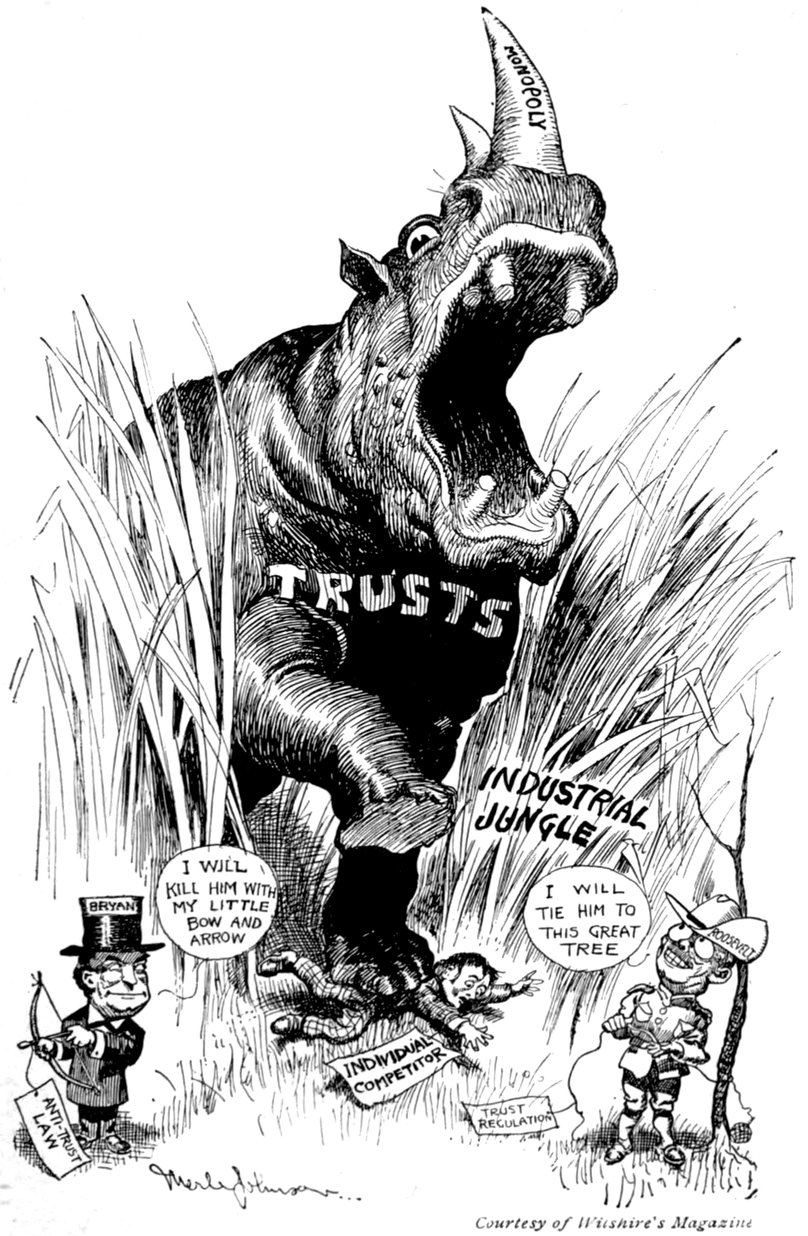
Courtesy of Wilshire’s Magazine
A SOCIALIST VIEW OF THE TRUSTS
49You will hear people abuse the Socialists
for wishing to abolish competition. No
Socialist wishes to abolish competition, no
modern Socialist at any rate. He watches
competition, as the mischievous Irishmen
watched the Kilkenny cats; keeping off at
a suitable distance during the battle, and
simply proposing to the spectators that
when it is all over they shall recognise the
accomplished fact.
There is some competition in the world
to-day among the nations; there was recently
competition between Russia and
Japan, and there will perhaps be competition
between some of the others. But what
competition is left to-day within the limits
of the United States, is left simply because
it is of a kind so petty that the capitalists
have not yet had time to bother with it.
For the most part it exists between a swarm
of retailers of trust-made products, and
takes the form of the screwing down of
the wages of helpless clerks and errand-boys,
the adulteration of products, and the
placarding of the surface of the land with
blatant advertisements which affect a decent
man like the stench of a carcass. One of
50the “competitive” industries that is flourishing
just now is that of cereals prepared
in packages and labelled with names that
suggest Hiawatha and the South Sea Islands.
The usual price of one of these packages
is fifteen cents, and of that, two cents and
a half represents the cost of the product,
and nearly all of the balance goes into the
effort to trap the public into buying it.
And did not the “boodle” investigations
in Missouri disclose the fact that William
Ziegler had spent a fortune in bribing newspapers
and legislatures to implant in the
public mind the idea that “alum baking-powders”
were poisonous, so that the
Royal Baking Powder Trust might have
the custom of the country?
But, you say, if competition perishes,
what becomes of incentive—of initiative?
Will not individual enterprise be destroyed?
I answer that it depends entirely upon what
you mean by individual enterprise. If
you mean that ardent desire which now
consumes every man to cut his neighbour’s
economic throat, to get the better of him
and make money out of him, to beat him
down and leave him a financial wreck—why,
civilisation will suppress this ardent
desire in precisely the same way that it has
suppressed the duel, or the right of private
vengeance, and piracy, or the right of private
51war upon the high seas. The putting
down of these things went hard, you know,
for they had been the greatest glory of
men, and all progress has been due to them.
“Franz von Sickingen was a robber-knight,”
writes Henderson, in his “History of
Germany,” “but with such noble traits, and
such a concept of his calling, that one wonders
if he ought not rather to be put on the
level of a belligerent prince. In carrying
on feuds, he seldom aimed lower than a
duke, or a free city of the Empire; and
there are persons who insist to this day that
his weapons were only drawn in favour of
the oppressed. Be that as it may, he was
not above exacting enormous fines; and
being an excellent manager, he greatly increased
his possessions. He was lord of
many castles, which he furnished with
splendid defences.”
And then the historian goes on to describe
the gallant struggle of this old nobleman
against the advancing power of the Empire.
“He determined, by one brilliant feud,
to restore the tarnished splendour of his
name. He would help the whole order
of knighthood to assert itself against
the power of the princes.” The end of it
was that “the enemy appeared in full force,
demolished in a single day an outer tower
with walls the thickness of twenty feet, and
made a breach in the actual ramparts.”
52Having been wounded, “the grim commander
was carried to a dark, deep vault of
the castle, where it was thought he would
be safe from the cannon-balls of his pursuers;
such an unchristian shooting, he
declared to an attendant, he had never
heard in all his days.” The castle surrendered,
and his foes gathered about him.
“He had now to do, he said, with a greater
lord, and a few hours later he closed his
eyes. The three princes knelt at his side
and prayed God for the peace of his soul.”
Let us hope that the makers of our Industrial
Republic will not forget to pray for the souls
of Baer and Parry, if these gallant captains
of industry should perish in defending the
elemental right of a capitalist to manage
his own business in his own way.
This is all very well, you say, but will
not such a system decrease production? I
rather think that it will; I hope to see the
prophecy of Annie Besant come true, that
when men no longer have to struggle to get
a living, they will at last begin to live.
That they will at last open their eyes to the
world of books and music, of nature and
art, of friendship and love, that stretches
out its arms to them; that they will cease
to regard ingenuity and rapidity in the
production of material things as the final end
and goal of the creation of man; that they
will cease to look upon a human being as a
53machine for the getting of money—to be
valued like an automobile, by the number
of miles an hour it can be driven, by the
number of thousands of miles it can cover
before it is worn out and ready for the
scrap-heap.
Let us have the philosophy of this thing,
in order that we may understand it.
We saw that the process of evolution, in
an individual or in a society, consists of an
expansion and a struggle, the end of which
is the emergence of the organism into a
higher state of being. There is a certain
life impulse, and there is a certain environment,
certain difficulties with which it
contends. We have perhaps no right to
speak of purpose in the process, but we
have a right to speak of results; and the
result of this contest is to shape the organism,
to educate it, to bring out certain
qualities in it which it did not possess
before; until finally it triumphs over its
environment, and emerges from its
prison-house.
The struggle for life goes on, but the form
of it changes unceasingly; and this changing
is progress. Without it there can be
none—the very essence of progress consists
in the suppressing of old forms of strife,
the conquest of old difficulties and the
escape from their thraldom. We know that
54there was once a time when men were hairy
beings who dwelt in caves, and contended
with club and hatchet against the monsters
which assailed them; and now supposing
that we could take some man of modern
times, some one who has risen to eminence
and power under the conditions which now
prevail, and put him among those cavemen,
how do you suppose that he would
make out? How do you suppose that he
would fare, if he were placed even one
century back, in the country of the Iroquois,
where the snapping of a twig and the flight
of an arrow decided the fate of a man?
Is it not obvious that there has been here an
entire change in the form of the struggle for
existence?
The same thing is true of nations. Once
upon a time a nation was an army, and
fighting was its business, the conquering
of its neighbours was its glory and its ideal;
but now we have moved on, we have
become complex and highly organised, and
can no longer afford to conquer our neighbours.
It would not pay us financially,
and intellectually and morally it would
destroy us. We have, for instance, a powerful
country to the north of us; and imagine
what would be the inconvenience and waste
were we under the necessity of fortifying
all our boundary lines, and keeping garrisons
at every few miles of them; if every day we
55were shaken by rumours that an army was
gathering at Montreal, that a fleet of torpedo-boats
was building at Toronto. As a
matter of simple fact, do we not both go
quietly on our way, understanding that we
are two civilised nations, between which a war
of conquest would be an unthinkable crime?
We have grown to used to the change,
that the mere memory of the old ways of
life makes us shudder; it seems to us horrible,
and we forget that it was once beautiful
and delightful to men: that the Germans
of the time of Tacitus held fighting the joy
of life, and imagined a heaven where a man
might be patched up every night and fight
again the next day. We have passed so far
beyond such a state that we cannot even
imagine it, and we have lost the power of
seeing that it was ever necessary and right;
that to those long ages of struggle we owe
our physical being, with all its perfections,
which we take so as a matter of course; a
swift foot and a dexterous hand, an ear
attuned to every sound, an eye that adjusts
itself to every distance, a mind quick and
alert, a spirit bold and enterprising. And
in the same way the nations owe to war
their unity and their complexity, and a great
deal of their power, not merely physical,
but industrial and moral as well.
It was one of the noblest of the world’s
poets who wrote that:
56“God’s most dreaded instrument,
In working out a pure intent,
Is man—arrayed for mutual slaughter;
Yea, Carnage is His daughter.”
And to the same purpose writes Fletcher:
“Oh great corrector of enormous times,
Shaker of o’er-rank states—that heal’st with blood
The earth when it is sick.”
And yet the time of wars is past. We
still have them, of course, and we still have
a war-propaganda; but it would be easy
to show that these wars are never military,
but always commercial—that when two
civilised states fight nowadays, it is not
because they expect to subjugate each other,
or desire to, but because their capitalists
both need the same foreign market. I am
acquainted with only one writer of any
standing in the United States, Captain
Mahan, who is nowadays willing even to
hint that wars may still be necessary to the
disciplining of a nation; and I think one
might assert without fear of contradiction
that people now go to war, not because they
want to, but because they are persuaded
they have to; and that right-thinking men
throughout the world know that a war is a
national calamity, a cause of evils innumerable,
scarcely ever overbalanced by good.
57And it is of the utmost importance to
notice how this has been done; how it is
that the military ideal is universally discredited
in the world. It has not been due
to the preachings of moralists and
enthusiasts; it has not been brought about
by the intervention of any deus ex machina.
It has come about in the perfectly inevitable
course of nature. No hero has arisen to
slay the demon of war—the demon of war
has slain himself. It is simply that the
work of war is done. It is simply that war
has brought about a survival of the fittest,
and that there is no more need of conquest,
and no possibility of it. The peoples have
gone on to a different life, they have almost
forgotten for thought of conquering, or
of being conquered; they know that they
cannot afford it; they know that their social
organism is of too delicate a type to stand
it; they can no more stand it than one of
our modern captains of industry could
stand the shock of jousting with Richard
Cœur de Lion.
We have moved on to another kind of
struggle—to the kind which is known as
industrial competition. And we are to
come to the end of that in precisely the same
way. We are to see the fittest survive, and
grow, and establish themselves impregnably;
and so long as there is room for competition
they will compete; and when they
58find there is no longer room for competition,
that by continuing it they are doing as much
harm to themselves as to their rivals, they
will put an end to competition, and no
power on earth can prevent their putting
an end to it. Any power which really tried
to prevent their putting an end to it would
simply destroy them, as two civilised nations
would be destroyed if they could be compelled
to keep on making war against each
other.
The great task of civilisation is the leading
of men to recognise when these mighty
changes have taken place. For so far I
have spoken of only one side of the evolutionary
process; I have shown the victory—but
there are also defeats. Sometimes in
the struggle between the individual and
his environment, it is the environment that
conquers. Sometimes the man or the
society is not equal to the new task, and
falls back; and the law of this is death.
The stag which can run swiftly enough
escapes, and is able to run all the more
swiftly as the result of the race; the stag
which cannot run quite swiftly enough
becomes venison. The tiny shoot which can
grow high enough finds the light, and becomes
a mighty tree; its neighbour which
could not grow quite so high, turns to mould.
There comes now and then in the history
of every living thing some moment when its
59future hangs in the balance; when it summons
all its forces, and lives or dies. The
butterfly faces such a crisis when it emerges
from the chrysalis; the child when it is
born. You have known such fateful hours
in your own moral life; and you can go
through history and put your finger upon
them—here when the Greeks drove back
the Persians, here when the Franks drove
back the Saracens, here on the field of
Waterloo, on the hills of Gettysburg.
You would like to stay as you are, of
course; for that is the least trouble. You
have your routine and your habits, your
old well-worn paths in which your thoughts
move—you would like to stay as you are.
But the curse of life is upon you—you cannot
stay as you are. You have to go forward,
or else to go back. When the crisis
comes there is no escaping it—it comes.
When the birth-pangs begin, either the
child is born, or the mother dies; when the
throes of revolution seize a nation, either
the old forms are shattered, or the life of
the people is crushed. There was once a
reformation and a revolution in France;
there was no reformation and no revolution
in Spain. So in one case you have new
life and abounding vigour—literatures and
philosophies and sciences, and impulse after
impulse without end; and on the other hand
you have stagnation and ruin.
60The task was simply too hard for the
Spanish nation; they had lived for centuries
in imminent proximity to an enemy of an
alien faith, and the result was the fastening
upon the people of a system of military
despotism and religious bigotry. And when
the danger was by, when the work of these
forces was done, and the time came for the
people of Spain to throw them off, their
efforts were of no avail; their kings and
their priests tortured them and burned them
at the stake; and so the impulse died, and
never afterwards did they lift their heads.
In the same way consider the “Negro question,”
as we have it in the United States.
Here also we are dealing with a defeated
race; a race which was bred where nature
proved too strong for man—where savage
beasts fell upon him, and deadly diseases
smote him, and the swift powers of the
jungle balked his every effort to rise. So
for centuries and ages he was trampled
upon and crushed, until every spark of
genius was extinguished in him; and now
we strive with all the resources of our
civilisation—our noblest and best have
given their lives to the task; and we do not
know yet if we are to win or lose.
Let the reader of this book get a clear
understanding upon at least one point—that
no Socialist expects to abolish competition,
and the survival of the fittest; all
61that any Socialist expects to do is to change
the kind of competition and the standard
of the fitness. The purpose of industrial
competition is to raise up the industrially
fit, and to establish a system for the feeding
and clothing of men. The sign that the
former task is done is the outcry against
the money-madness of the time; the sign
that the latter is done is “overproduction”
and the “trust.”
The purpose of this little book is to lay
before candid and truth-seeking Americans
the overwhelming evidence which exists
of the fact that industrial competition, as
an evolutionary force, has done its work in
our society: that it has disciplined our
labourers in diligence and skill, and our
leaders in foresight, enterprise and administrative
capacity; that it has built us
up a machine for the satisfying of all the
material needs of civilisation, a machine
that has only to be used; and that until we
have found out how to use it, our national
life must remain at a standstill, stagnation
must take the place of progress, and in
every portion of our body politic, the
symptoms of disease and decay must multiply
and grow more and more alarming.
We have been taught to think that the
institutions of freedom in this country are
so secure that we may go about our business
and our play, and leave them to take care
62of themselves. And yet, “eternal vigilance
is the price of liberty,” is the motto our
ancestors left us. For the forms of tyranny
change from generation to generation, and
it is always out of the old freedom that the
new slavery is made. You think that you
can stay free by clinging to the good old
ways, by repeating the good old formulas,
by standing by the good old faiths; but
you cannot, for freedom is not a thing of
institutions, but of the soul. It has always
been under the forms of spirituality that
men have been chained by priestcraft;
and it is with the very pennons and banners
of liberty that this land is bound to-day.
It always has been so, and it always will be
so—that the despot asks nothing save that
things should stay as they are. What was
it that the slave-holder wanted, but that
things should stay as they were? That
men should hold by the Constitution as it
was, while America was made into a Slave
Empire? What is it that our masters want
to-day, save that we should stand by the
good old traditions of American individualism,
freedom of contract and the right of
every man to manage his own business as
he pleases—the while the Republic of Jefferson
and Lincoln is forged into a weapon
for the enslaving of mankind?
There is not one single tradition of the
early times that is not being used to-day
63for the betraying of liberty. Take the
Monroe Doctrine, for instance. We shout
for it every Fourth of July, and we are rushing
to completion a score or two of battleships
to defend it; whenever it is in peril,
our most rabid anti-trust editors and politicians
drop everything and take to singing
Yankee Doodle. And yet, has never the
least suspicion about it come to you? Has
it never occurred to you to look who it is
that is leading you upon this crusade of
freedom—this strange propaganda of civilisation
and republican institutions by battleship
and rapid-firing gun? This zeal of our
captains of industry for the spread of
American institutions among the Filipinos
and Hawaiians and Porto Ricans and Panamanians
and Venezuelans, the while they
are so busy crushing American institutions
in Rhode Island and Colorado!
There was once a time when all the despotisms
of Europe were banded together to
destroy republican institutions, and when
the threatening gesture of this young republic
held them back from half a world.
And thus bravely we guarded civilisation
with our Monroe Doctrine, until the lesson
of freedom had been learned. But now
time has passed, and we have come to a
new age, with new perils and new duties;
there is a new kind of slavery in the world,
and a kind in which we lead all civilisation.
64The control of our Republic has passed
out of the hands of the people; by fraud
and force our liberties have been overthrown—the
very word has been relegated to
schoolboy orations and Grand Army reunions.
And by this new despotism of
greed the people have first been plundered
and crushed, and now are to be marshalled
and led out to do battle with other peoples,
similarly beguiled. In this work every
force of reaction and conservatism in civilised
society is now enlisted, every tradition
of olden time has been called into service.
No pretence is too hollow, no blasphemy
too abominable to be employed; every national
prejudice, every racial hatred, every
religious bigotry is made use of—and the
starving wretches of the slums and gutters
of London are sent into South Africa to
capture diamond mines for the glory of
free Britannia, while the helpless peasants
of Russia are led out with jewelled images
of the Virgin in front of them to steal Manchuria
in the name of Jesus Christ.
It is with Germany that we Americans
are scheduled to battle for the sake of the
Monroe Doctrine. And what is the situation
in Germany? There is first of all, the
degenerate who sits upon its throne, and
proclaims himself by grace of God the lord
and master of the German people. There
is in the second place, the hide-bound
65mediæval nobility of the Empire, the direct
descendants of those robber-knights of whom
we read a while ago, some of them living in
the very same castles from which their
ancestors made their raids. There is in the
third place, the aristocracy of the army,
whose insolent and dissolute officers beat,
kick and maim the helpless country boys and
artisans who are herded like sheep under
their command. There is in the fourth
place, the bigoted seventeenth-century Protestant
Church, with its snuffy country
parsons and doctors of dusty divinity.
There is in the fifth place, the mediæval
Roman Catholic Church, with its confessional
and other agencies of Darkness. There
is in the sixth place, a subsidised “reptile
press,” whose opinions are written and
whose news is garbled by knavish bureau
officials. And every one of these powers,
forgetting all past differences, and uniting
with brotherly affection, are struggling with
every prejudice they can appeal to, and
every threat which they can wield, to hold
the German people subject to the identical
same “System” that rules in America, the
industrial aristocracy of cunning and greed;
is working them upon starvation wages at
home, and driving them to serve in armies
and navies, to conquer markets abroad;
to threaten Dewey at Manila, and to seize
Chinese ports and conduct “punitive
66expeditions” against Chinamen; to sell bad
whiskey and firearms to Hereros and then
slaughter them when they rebel; to blockade
ports in Venezuela and to sink “pirates”
in the West Indies; and to sound and
measure channels as a preliminary to the
taking of a naval base and the inauguration
of a war with the United States!
But then, you say, we can’t help that.
What can we do? Is the only thing you
can think of to do, to build battleships and
get ready for the strife? How differently
our fathers did it, in the old days when the
Monroe Doctrine was really what it pretends
to be—a pledge of freedom to men!
How the impulses that started in this land
thrilled through the civilised world and
made the “despots of Europe” tremble!
What messages of brotherhood flashed upon
invisible wires from continent to continent,
bearing hope and comfort to all the
oppressed of mankind! How we welcomed
Lafayette, as if he had been an emperor!
How the whole nation turned out in honour
of Kossuth, making his long journey one
triumphal procession! And are we doing
anything like that now?
The people of Germany, you must understand,
are closed in a death grip with all
these powers of infamy. In spite of obloquy
and contempt, in spite of lies and blandishments
and menaces, in spite of persecution
67and exile and imprisonment, for
a generation they have been toiling—devoted,
heroic men and women have given
their labour and their lives to the task of
teaching, writing, speaking, exhorting, to
open the eyes of the masses to the truth.
And step by step they have marched on,
gathering force every hour, strengthened
by each new persecution, training themselves
in literary and political combat,
building up a system of scientific thought
which has never been refuted and never
can be, inspired by a moral purpose as
noble as any the world has ever seen—preparing
in all ways for the glorious hour
when the people of the Fatherland are to
come to their own! The man at their head
was once a poor working boy, a wheelwright,
and he has raised himself to the
leadership of the mightiest effort after
freedom that the world now sees; and day
by day in the Reichstag he leads the opposition
to militarism and savagery, and
his speeches are such as a century ago, and
even half a century ago, would have set
this land aflame from end to end with
revolutionary fervour. And this is no isolated
movement of a nation, it is a world
movement—it is a movement to which the
lovers of liberty all over the earth are
welcomed as comrades and brothers. It
is a movement at one with every high
68tradition of American life; and you—what
is your attitude to it? What do you know
about it—what do you care about it? Do
you hold public meetings and send messages
of sympathy? Do the halls of Congress
ring with fervid speeches, as they did in
the days of Webster and Henry Clay? Do
your papers teem with glowing editorials,
with news about the movement, and sketches
of its leaders? What have you to say
about it, what have you to do for it—but
to repeat day in and day out one miserable,
pitiful lie, with which you try to blind and
deceive the masses of your own country,
that this tremendous Socialist movement
is not really a Socialist movement at all,
but only a movement of political reform!
I do not think that we shall sleep forever;
I do not think that the memories of Jefferson
and Lincoln will call to us in vain
forever; but assuredly there never was in
all American history a sign of torpor so
deep, of degeneration so frightful, as this
fact that in such a crisis, when the downtrodden
millions of the German Empire
are struggling to free themselves from the
tyranny of military and personal government,
there should come to them not one
breath of sympathy from the people of the
American Republic! And all our interest,
all our attention, is for that strutting turkeycock,
the war-lord whose mailed fist holds
69them down! That monstrous creature, with
his insane egotism, his blustering and his
swaggering, his curled mustachios and military
poses! An epileptic degenerate, who
spends his whole life in cringing terror of
hereditary insanity: whose spies and police
agents are invading the homes of German
Socialists, searching for letters in behalf of
the agents of the Czar, obtaining evidence
to send men in Russia to exile and
death! This ruler of his people, who
the other day cashiered a near relative, an
army officer who had advised soldiers to
complain when they were maltreated! whose
generals and admirals are swaggering about
and spitting in the face of civilisation—and
making maps and plans for a naval
station in defiance of the Monroe Doctrine!
Forty years ago, at the time of our Civil
War, when the fate of this nation hung
trembling in the balance, when the Emperor
of France and the aristocracy of England
saw a chance to cripple republican government
and to set back civilisation half a century—what
was it then that prevented them?
What was it but the fact that in England
there existed an organised opposition, alert
and watchful, trained by a generation of
parliamentary conflict, and with leaders who
in such a crisis could not be put down?
What was it but the fact that the workers of
the factory towns of Great Britain had been
70disciplined and taught, and could not be
deceived—that they chose rather to starve
than to help the cause of Slavery? And if
you care to see what would have happened
had not that opposition been ready, go back
three- or four-score years, when the people
of France struck their blow for liberty, and
see the leaders of the British aristocracy
crushing out protest and imprisoning objectors,
and hurling the nation into a criminal
and causeless war! Hear the king and the
nobility, statesmen and authors, newspapers
and pulpits screaming in frenzy and goading
the people on, till they had desolated Europe
with fifteen years of hideous slaughter, from
the moral and spiritual effects of which
the world has not yet recovered!
And now you stand and contemplate
another such crime against civilisation. The
two most enlightened peoples of the world
are to come together and strip for a fight.
The powers that rule in each of them made
up their minds years ago, and among the
officers, both in the army and in the navy
of each, the coming conflict is taken for
granted. Two or three years ago a German
officer promised that an army corps would
march from one end of this continent to
the other; and an admiral in our own navy
has publicly foretold the struggle. The
German capitalists are in desperation for
new markets, and the German people are on
71the edge of a revolt, with an irresponsible
military despot in absolute control of them,
who knows that his only chance to put off
the revolution is to pick a quarrel and beat
the war-drum, and summon the masses
to the defence of the honour of the Fatherland.
When that supreme hour comes, and
when the war-lust begins to burn, upon the
Social-Democratic Party of Germany will
fall the task of saving civilisation; and what
shall we have done to help them—what
encouragement shall we have sent them?
We have sent ships of grain to the cotton-operatives
of Lancashire when they were
starving; but what have we done for the
people of Germany? What reason have
we given them, with our tariffs and imperialisms,
to think of us otherwise than as a
nation of shopkeepers, a nation sunk in
greed and commercialism, and dead to every
noble impulse of men?
CHAPTER III MARKETS AND MISERY
72
I gave in the first chapter a brief outline
of my view of the process of wealth-concentration.
It is now time to consider the
present status of affairs, and determine if
we can exactly how near to completion our
industrial machinery has come. Because
of the vital part which the question of foreign
markets has played and must play in our
affairs, it is necessary that this inquiry should
include a careful survey of conditions in the
rest of the world.
The manufactures of the United States
have grown from one hundred and ninety-eight
million dollars in 1810, to five billion
in 1890, and thirteen billion in 1900. Our
exports to foreign countries increased from
sixty-six million dollars in 1810 to eight
hundred and fifty-six million in 1890, and
a billion and half in 1905. Of course, if
we could find unlimited markets abroad
we might go on for half a century, or at
least until our people grew tired of doing
hard work for the rest of the world, and
getting in return either bad debts, or else
money to be used in building new machines
73to do more work of the same sort. But
this is not the case, as it happens; there are
half a dozen nations that have been building
up industrial machines of their own, and
have completed them; the meaning of the
Socialist movements of England and Germany
and France and Belgium and Italy
is simply that all these nations are now able
to manufacture more than their own people
are able to buy, under the old deadly combination
of a monopoly price and a competitive
wage. And so when we go over
to Europe to look for markets, we meet
people who are coming over to look for
markets among us; and when in our desperation
we begin to sell out at any cost, the
German capitalist cries out in protest, and
the German workingmen are thrown on the
streets, and the German Socialists increase
their vote. And when the German capitalist
retaliates and sells out at cost, our capitalists
are checked, and our mills are stopped—and
our Socialist vote goes up.
Look at the figures. England was the
first in the field. The output of coal of
Great Britain was one hundred and fifty
million dollars in 1810; it was six hundred
and sixty-five million dollars in 1878; in the
same period the exports of manufactures
rose from two hundred and thirty million
dollars to one billion dollars. All that
while, of course, England ruled the sea and
74had things her own way. In 1820 the value
of all her manufactures was about seven
billion dollars—equal to that of Germany
and Austria combined, or to France and
the United States combined, or to all the
rest of the world, excluding these four
nations. But then, little by little, the others
began to catch up with her: in 1880, instead
of manufacturing one-fourth of the world’s
products, Great Britain manufactured one-fifth,
and in 1894 she manufactured less
than one-sixth. Between the years 1894
and 1902, British exports increased only
thirteen per cent., while those of France increased
sixteen per cent., those of Germany
thirty-nine per cent., and those of the
United States sixty-six per cent. The
result was that a few years ago tens and
hundreds of thousands of starving men were
parading the streets of London, and all
England was startled by Mr. Chamberlain’s
announcement that the last hope of England
was a tariff which would reserve for
her the trade of the colonies! Of course
England could not have made money by a
tariff unless her colonies had consented to
lose money; and the colonies were not
planning to lose money—they were counting
on making some by England’s tax on
food. So the plan simply reduced itself
to an invitation to the British workingman
to pay more for his bread so that he could
75get starvation wages for doing the manufacturing
of Canada and Australia and
India. Is it any wonder that the reply to
the proposal should have been an independent
labour vote which sent a thrill of alarm
through the nation?
And meanwhile Canada and Australia
and India are straining every nerve to build
up manufactures of their own! “No person
connected with the cotton industry can be
ignorant of the progress of cotton manufactures
in India,” wrote the Textile
Recorder in 1888. “Indian cotton piece-goods
are coming to the front and displacing
those of Manchester.” The Bombay Factory
Commission of the same year recorded
in Parliament how this was being done.
“The factory engines are at work as a rule
from 5:00 A. M. to 7:00, 8:00 and 9:00 P. M.
In busy times it happens that the same
set of workers remain at the gins and
presses night and day, with half an hour’s
rest in the evenings.” And, like India,
Canada also puts duties on British goods
to protect her own growing industries!
Meanwhile, also, the rest of the world is
hard at work. Let us continue viewing
that same industry of cotton-spinning. The
value of the manufactured-cotton product
of Austria has grown from fifteen million
dollars in 1834, to thirty-five million dollars
in 1860, and ninety millions in 1894. The
76textile manufactures of Belgium trebled
themselves in three years previous to 1894;
those of Germany have increased twenty-fold
in sixty years; those of Italy nine-fold
in twenty years, while even such backward
countries as Russia and Spain have doubled
their textile industries, one in thirty, the
other in twenty years. Most unexpected
and disconcerting of all, however, is Japan,
who was once looked upon as a permanent
customer, but whose home industries have
been growing like a magic plant. The
textile manufactures of Japan doubled in
value in the three years between 1896 and
1899. From six million pounds of cotton
spun in 1886, Japan advanced to ninety-one
million in 1893, and to one hundred and
fifty-three million in 1895, in nine years
increasing twenty-four fold. The value of
all her textile produce was six million dollars
in 1887, and it was seventy million
dollars in 1895. Therefore her imports of
cotton goods from Europe fell from eight
million dollars in 1884 to four million in 1895.
And while this was going on in the rest
of the world, in the United States the value
of manufactured cotton was rising from
forty-five million dollars in 1840, to two
hundred and ten million dollars in 1880,
to two hundred and sixty-seven million
dollars in 1890, and to three hundred and
thirty-nine million in 1900! Under such
77circumstances, is it any wonder that, at
the outbreak of the Russo-Japanese war,
the factories of Massachusetts and Canada
were running on half-time, and dozens not
running at all; that British cotton manufacturers
found that prices had decreased
fifteen per cent. in as many years; that the
weavers of Belgium were starving, and the
country was full of riots and insurrections;
and that all the nations of Europe were
gathering in the Far East like vultures about
a carcass—knowing that the sole condition
upon which any one of them could maintain
its industrial and social régime for another
decade, was its ability to secure the custom
of some hundreds of millions of Chinamen,
who are so poor that a handful of rice and a
cotton shirt are all they own in the world!
I often wonder what our college presidents
and other after-dinner economists make of
facts such as these. They do not discuss
them in their speeches. I am acquainted
with only one man among all our orthodox
advisers who believes in the permanence of
the competitive régime, and at the same
time really understands what it is and what
it implies—who cares for the truth, follows
his views to their conclusions, and then
speaks the conclusions. When I first
became acquainted with this gentleman—intellectually
acquainted, that is—it affected
me painfully, and even now the sight of
78his book gives me internal sensations akin
to those of a man in an ascending elevator
which comes to a sudden halt.
The book is “The New Empire,” and
the author is Mr. Brooks Adams. He
writes coldly and dispassionately, and with
the certainty of the man of science, whose
conclusions may not be disputed. His
style is characteristic; it is brief and to
the point, and there are no apologies.
Mr. Adams is the apostle of competition.
He explains that he is this, not from choice
but from necessity. “Very probably keen
competition is not a blessing. We cannot
alter our environment. Nature has cast
the United States into the vortex of the
fiercest struggle ever known.” His theory
of life Mr. Adams condenses as follows:
“For the purpose of obtaining a working
hypothesis it is assumed that men are
evolved from their environment like other
animals, and that their intellectual, moral,
and social qualities may be investigated as
developments from the struggle for life....
Food is the first necessity, but
as most regions produce food more or less
abundantly, the pinch lies not so much in
the existence of the food itself as with its distribution....
To satisfy their hunger
men must not only be able to defend their
own, but, in case of dearth, to rob their
neighbours, where they cannot buy,
79for the weaker must perish.... Life
may be destroyed as effectually by peaceful
competition as by war. A nation which is
undersold may perish by famine as completely
as if slaughtered by a conqueror....
For these reasons men have striven
to equip themselves well for the combat, and
since the end of the Stone Age no nation in the
more active quarters of the globe has been
able to do so without a supply of relatively
cheap metal.... Thus the position of
the mines has influenced the direction of
travel. The centre of the mineral production
is likely to be the seat of empire. I believe
it is impossible to overestimate the effect
upon civilisation of the variation of trade
routes. According to the ancient tradition,
the whole valley of the Syr-Daria was once so
thickly settled that a nightingale could fly
from branch to branch of different trees,
and a cat walk from wall to wall and from
housetop to housetop, from Kashgar to
the Sea of Aral.” But the trade route
across central Asia was displaced, “and so
it has come to pass that Bagdad has sunk
into a mass of hovels, and the valley of
Syr-Daria is a wilderness. The fate of
the empire of Haroun-al-Raschid exemplifies
an universal law.”
“The greatest prize of modern times,”
in Mr. Adams’s opinion, is northern China,
and upon this the fate of empire rests.
80His book was published in 1901, and he
considered then that the chances were all
with the United States. Ten years before
we had been “tottering upon the brink of
ruin.... Relief came through an
exertion of energy and adaptability, perhaps
without a parallel.... In three
years America reorganised her whole social
system by a process of consolidation, the
result of which has been the so-called trust.
But the trust is in reality the highest type
of administrative efficiency, and therefore
of economy, which has as yet been attained.
By means of this consolidation the American
people were enabled to utilise their mines
to the full.... The shock of the impact
of the new power seems overwhelming....
In March, 1897, Pittsburg achieved
supremacy in steel, and in an instant
Europe felt herself poised above an abyss....
The Spanish Empire disintegrated,
and Great Britain displayed a lassitude
which has attracted the attention of the
entire world.... Germany has also
been perturbed.... Russia has, however,
suffered most.
“The world seems agreed that the United
States is likely to achieve, if indeed she
has not already achieved, an economic
supremacy. The vortex of the cyclone is
near New York. No such activity prevails
elsewhere; nowhere are undertakings so
81gigantic, nowhere is administration so perfect;
nowhere are such masses of capital
centralised in single hands. And as the
United States becomes an imperial market,
she stretches out along the trade routes
which lead from foreign countries to her
heart, as every empire has stretched out
from the days of Sargon to our own. The
West Indies drift toward us, the Republic
of Mexico hardly longer has an independent
life, and the City of Mexico is an American
town. With the completion of the Panama
Canal all Central America will become a
part of our system. We have expanded into
Asia, we have attracted the fragments of
the Spanish dominions, and reaching out
into China, we have checked the demands
of Russia and Germany, in territory, which,
until yesterday, had been supposed to be
beyond our sphere. We are penetrating
Europe, and Great Britain especially is
assuming the position of a dependency,
which must rely upon us as the base from
which she draws her food in peace, and
without which she could not stand in war.”
“Supposing the movement of the next
fifty years only equal to that of the last,”
continues our author, ... “the United
States will outweigh any single empire, if
not all empires combined. The whole
world will pay her tribute. Commerce
will flow to her, both from east and west, and
82the order which has existed from the dawn
of time will be reversed.”
There is only one peril about all this,
in the opinion of Mr. Adams. “Society
is now moving with intense velocity, and
masses are gathering bulk with proportional
rapidity. There is also some reason to
surmise that the equilibrium is correspondingly
delicate and unstable. If so
apparently slight a cause as a fall of prices
for a decade has been sufficient to propel
the seat of empire across the Atlantic, an
equally slight derangement of the administrative
functions of the United States
might force it across the Pacific. Prudence
therefore would dictate the adoption of
measures to minimise the likelihood of
sudden shocks.... If the New Empire
should develop, it must be an enormous
complex mass, to be administered only by
means of a cheap, elastic and simple machinery;
an old and clumsy mechanism must,
sooner or later, collapse, and in sinking
may involve a civilisation.”
By “an old and clumsy mechanism”
Mr. Adams explains elsewhere that he means
our American political system. Our ancestors
were opposed to much consolidation,
and they formed a constitution that was
practically unchangeable, because they believed
they had “reached certain final truths
of government.” “The language of the
83Declaration of Independence, in which they
proclaimed one of these truths (that all
men are created equal), varies little from
that of a Catholic council,” says Mr.
Adams. An American is apt to believe
such formulas, being “dominated by tradition.”
But a modern thinker views
them “as having no necessary relation to
the conduct of affairs in the twentieth
century.” “If men are to be observed scientifically,
the standard by which customs
and institutions must be gauged cannot
be abstract moral principles, but success....
Institutions are good when they
lead to success in competition, and bad
when they hinder.”
The United States now forms a “gigantic
and growing empire. She occupies
a position of extraordinary strength.
Favoured alike by geographical position,
by deposits of minerals, by climate, and by
the character of her population, she has
little to fear either in peace or war, from
rivals, provided the friction created by
the movement of the masses with which
she has to deal does not neutralise her
energy.”...
“The alternative presented is plain. We
may cherish ideals and risk substantial benefits
to realise them. Such is the emotional
instinct. Or we may regard our government
dispassionately, as we would any other
84matter of business.... The United
States has become the heart of the economic
system of the age, and she must maintain her
supremacy by wit and force, or share the fate
of the discarded. What that fate is the following
pages tell.... With conservative
populations slaughter is nature’s remedy.”
Never in my life shall I forget the hours
in which I wrestled with these problems—the
weeks and the months of perplexity and
despair. It happened long before I ever
heard of Mr. Adams—for of course these
thoughts of his are the thoughts of the time,
there is a whole literature of them, from
Kipling, Roosevelt, and the Kaiser down.
And to look back over the weary wastes of
history—the blind, hideous nightmare of
blood and tears—and then to look forward,
and in all the future see nothing else! To
see never any rest for agonised humanity,
only kill or be killed for ages upon ages!
To see this newest and noblest effort of
man after freedom and peace—the American
Republic—turned into an engine of slaughter
and oppression! To be shown by cold,
scientific formulas that my reverence for
the traditions of Lincoln was merely an
“emotional impulse,” and that the end of
it could only be that my country would share
“the fate of the discarded!” I could not
believe it—I cried out in the night-time for
deliverance from it.
85[1]There is a certain relentlessness about
Mr. Adams, which fills the reader with
rebellion, and makes him think. The
average imperialist carefully avoids doing
this; he veils his doctrines with moral
phrases, with the decent pretence of “destiny”
at the very least. But Mr. Adams
dances a very war-dance upon the thing
called “moral sense”—never before was
it made to seem such an impertinent
superfluity.
1. Portions of the following argument were published as an article in
the North American Review.
Have you, the reader, never had one smallest
doubt? Does it not, for instance, seem
strange to you now, when you think of it,
that this mighty people cannot stay quietly
at home and live their own life and mind
their own affairs? How does it happen
that our existence as a nation depends upon
expansion? Is it that our population is
growing so fast? But here is our Imperialist
President lamenting that our population
is not growing fast enough! And so
we have to fight to find room for our children;
and we have to have more children
in order that we may be able to fight! We
deplore race suicide, and we give as our
reason that it prevents race-murder!
Picture to yourself half a dozen men on an
island. If the island be fertile they can get
along without any foreign trade, can they
86not? And then why cannot a nation do
it? According to Mulhall, in 1894 two
millions of our agricultural labourers were
raising food for foreign countries. And all
our imports are luxuries, save a few things
such as tea and coffee and some medicines!
And still our existence as a nation depends
upon foreign trade—trade with Filipinos
and Chinamen, with Hottentots and Esquimaux!
Why?
Can you, the reader, tell me? We
manufacture more than we can use, you
say. Unless we can sell the balance to
the Chinamen some of our factories must
close down, and then some of our people
would starve. But why, I ask, cannot our
own starving people have the things that go
abroad—some of all that food that goes
abroad, for instance? Why is it that the
Chinamen come first and our own people
afterwards? Until we have made some
things for the Chinamen, you explain, we
have no money to buy anything ourselves.
And so always the Chinamen first. It
seems such a strange, upside-down arrangement—does
it not seem so to you? For,
look you, the people of England are in the
same fix, and the people of Germany are
in the same fix—the people of all the competing
nations are in the same fix! They
actually have to go to war to kill each other,
in order to get a chance to sell something
87to the Chinamen, so that they can get money
to buy some things for themselves! They
were actually doing that in Manchuria for
eighteen months! More amazing yet, they
had to go and murder some of the Chinamen,
in order to compel the rest to buy something,
so that they could get money to buy something
for themselves!
How long can it be possible for a human
being, with a spark of either conscience or
brains in him, to gaze at such a state of
affairs and not know that there is something
wrong about it? And how long could he
gaze before the truth of it would flash over
him—that the reason for it is that some
private party owns all the machinery and
materials of production, and will not give
the people anything, until they have first
made something that can be sold! That
all the world lies at the mercy of those who
own the materials and machinery, and who
leave men to starve when they cannot make
profits! And that this is why we Americans
cannot stay at home and be happy, but are
forced to go trading with Filipinos and
Chinamen, Hottentots and Esquimaux, and
competing for “empire” with our brothers
in England and Germany and Japan!
If the reader be an average American,
these thoughts will be new to him. He has
been brought up on a diet of misunderstood
Malthusianism. He is told that life has
88always been a struggle for existence and
always will be; that there is not food enough
to go round, and that therefore, every now
and then, the surplus population has to be
cut down by famine and war. It is to be pointed
out concerning the doctrine that, while he
swears allegiance to it, he doesn’t like to
think about it, and when it comes to the
practical test he shows that he does not
really believe it. Whenever famine comes,
he subscribes to a grain-fund, and does his
best to defeat nature; when war comes, he
gets up a Red Cross Society for the same
purpose. And yet he still continues to
swear by this wiping out of the nations, and
any discussion about abolishing poverty
he waves aside as Utopian.
The writer may fail in his purpose with
this paper, but he will not have written in
vain if he can lead a few men to see the
pitiful folly of that half-baked theory which
ranks men with the wild beasts of the jungle,
and ignores the existence of both science
and morality. He can do that, assuredly,
with any one whom he can induce to read
one little book—Prince Kropotkin’s “Fields,
Factories and Workshops.”
The book was published nine years ago,
but apparently it has not yet had time to
affect the cogitations of the orthodox economists.
You still read, as you have been
used to reading since the days of Adam
89Smith, that the possibilities of the soil are
strictly limited, and that population always
stays just within the starvation limit. Nearly
all the fertile land in this country, for instance,
is now in use, and so we shall soon
reach the limit here. The forty million
people of Great Britain have long since
passed it, and they would starve to death
were it not for our surplus. And there are
portions of the world where population is
even more dense, as in Belgium. All this
you have known from your school-days,
and you think you know it perfectly,
and beyond dispute; and so how astonished
you will be to be told that it is simply one
of the most stupid and stupefying delusions
that ever were believed and propagated
among men; that the limits of the productive
possibilities of the soil have not only
not been attained, but are, so far as science
can now see, absolutely unattainable; that
not only could England support with ease
her own population on her own soil, and not
only could Belgium do it, but any most
crowded portion of the world could do it,
and do it once again, and yet once again,
and do it with two or three hours of work a
day by a small portion of its population!
That England could now support, not
merely her thirty-three million inhabitants,
but seventy-five and perhaps a hundred
million! And that the United States could
90now support a billion and a quarter of
people, or just about the entire population
of this planet! And that this could be done
year after year, and entirely without any
possibility of the exhaustion of the soil!
And all this not any theory of a closet
speculator or a Utopian dreamer, but by
methods that are used year after year by
thousands and tens of thousands of men
who are making money by it in all portions
of the world—in the market-gardens of
Paris and London, of Belgium, Holland
and the island of Jersey, the truck-farms of
Florida and Minnesota, and of Norfolk,
Virginia!
Prince Kropotkin writes:
“While science devotes its chief attention
to industrial pursuits, a limited number of
lovers of nature and a legion of workers,
whose very names will remain unknown to
posterity, have created of late a quite new
agriculture, as superior to modern farming
as modern farming is superior to the old
three-fields system of our ancestors. They
smile when we boast about the rotation
system having permitted us to take from
the field one crop every year, or four crops
every three years, because their ambition
is to have six and nine crops from the very
same plot of land every twelve months.
They do not understand our talk about
good and bad soils, because they make the
91soil themselves, and make it in such quantities
as to be compelled yearly to sell some
of it; otherwise, it would raise up the levels
of their gardens by half an inch every year.
They aim at cropping, not five or six tons
of grass to the acre, as we do, but from
fifty to one hundred tons of various
vegetables on the same space; not twenty-five
dollars’ worth of hay, but five hundred
dollars’ worth of vegetables, of the plainest
description, cabbages and carrots. That
is where agriculture is going now.”
The writer tells about all these things in
detail. Here is the culture maraîchere of
Paris—a M. Ponce, with a tiny orchard of
two and seven-tenths acres, for which he
pays five hundred dollars rent a year, and
from which he takes produce that could not
be named short of several pages of figures:
twenty thousand pounds of carrots, twenty
thousand of onions and radishes, six thousand
heads of cabbage, three thousand of
cauliflower, five thousand baskets of tomatoes,
five thousand dozen choice fruit,
one hundred and fifty-four thousand heads
of “salad”—in all, two hundred and fifty
thousand pounds of vegetables. Says the
author:
“The Paris gardener not only defies the
soil—he would grow the same crops on an
asphalt pavement—he defies climate. His
walls, which are built to reflect light and to
92protect the wall-trees from the northern
winds, his wall-tree shades and glass protectors,
his pépinières, have made a rich
Southern garden out of the suburbs of
Paris.”
The consequence of this is that the population
of the districts of that city, three
millions and a half of people, could, if it
were necessary, be maintained in their own
territory, provided with food both animal
and vegetable, from a piece of ground less
than sixty miles on a side! And at the same
time, by the same methods, they are raising
thirty tons of potatoes on an acre in Minnesota,
and three hundred and fifty bushels
of corn in Iowa, and six hundred bushels
of onions in Florida. And with machinery,
on the prairie wheat-farms, they raise crops
at a cost which makes twelve hours and a
half of work of all kinds enough to supply
a man with the flour part of his food for a
year! And then, as if to cap the climax,
comes Mr. Horace Fletcher with his discovery
that all the ailments of civilised man,
(including old age and death) are due to
overeating; and Professor Chittenden with
his practical demonstration that the quantity
of food needed by man is about four-tenths
of what all physiologists have previously
taught! [2]And while all this has been
going on for a decade, while encyclopedias
have been written about it, our political
economists continue to discuss wages and
labour, rent and interest, exchange and consumption,
from the standpoint of the dreary,
century-old formula that there must always
be an insufficient supply of food in the world!
2. Horace Fletcher: “The A-B-Z of Our Own Nutrition.” R. L. Chittenden:
“Physiological Economy in Nutrition.”
Courtesy of Wilshire’s Magazine
Courtesy of Wilshire’s Magazine
REAPING BY HAND AND BY MACHINERY
93Such is the state of affairs with agriculture:
and now how is it with everything
else? In the Thirteenth Annual Report of
the Commissioner of Labour (1898), Carroll
D. Wright has figured the relative costs of
doing various pieces of work by hand and
by modern machinery. Here are a few of
the cases he gives:
“Making of 10 plows: By hand, 2 workmen,
performing 11 distinct operations,
working a total of 1,180 hours, and paid
$54.46. By machine, 52 workmen, 97
operations, 37½ hours, $7.90.
“Making of 500 lbs. of butter: By hand,
3 men, 7 operations, 125 hours, $10.66.
By machine, 7 men, 8 operations, 12½
hours, $1.78.
“Making of 500 yds. twilled cottonade: By
hand, 3 men, 19 operations 7,534 hours,
$135.61. By machine, 252 men, 43 operations,
84 hours, $6.81.
“Making of 100 pairs of cheap boots: By
hand, 2 workmen, 83 operations, 1,436
hours, $408.50. By machine, 113 workmen,
122 operations, 154 hours, $35.40.”
94Thus we see human labour has been cut
to the extent of from eighty to ninety-five
per cent. From other sources I have
gathered a few facts about the latest machinery.
In Pennsylvania, some sheep were
shorn and the wool turned into clothing in
six hours, four minutes. A steer was killed,
its hide tanned, turned into leather and
made into shoes in twenty-four hours. The
ten million bottles used by the Standard
Oil Company every year are now blown by
machinery. An electric riveting-machine
puts rivets in steel-frame buildings at the
rate of two per minute. Two hundred and
sixty needles per minute, ten million match-sticks
per day, five hundred garments cut
per day—each by a machine tended by one
little boy. The newest weaving-looms run
through the dinner hour and an hour and a
half after the factory closes, making cloth
with no one to tend them at all. The new
basket-machine invented by Mergenthaler,
the inventor of the linotype, is now in operation
everywhere, “making fruit-baskets,
berry-baskets and grape-baskets of a
strength and quality never approached by
hand labour. Fancy a single machine that
will turn out completed berry-baskets at
the rate of twelve thousand per day of nine
hours’ work! This is at the rate of one
thousand three hundred per hour, or over
twenty baskets a minute! One girl, operating
95this machine, does the work of twelve
skilled hand operators!”
Since all these wonders are the commonplace
facts of modern industry, it is not
surprising that here and there men should
begin to think about them; here is the naïve
question recently asked by the editor of a
Montreal newspaper which I happened on:
“With the best of machinery at the present
day, one man can produce woollens for three
hundred people. One man can produce
boots and shoes for one thousand people.
One man can produce bread for two hundred
people. Yet thousands cannot get woollens,
boots and shoes, or bread. There must be
some reason for this state of affairs.”
There is a reason, a perfectly plain and
simple reason, which all over the world the
working-people, whom it concerns, are coming
to understand. The reason is that all
the woollen manufactories, the boot and shoe
and bread manufactories, and all the sources
of the raw materials of these, and all the
means of handling and distributing them
when they are manufactured, belong to a
few private individuals instead of to the community
as a whole. And so, instead of the
cotton-spinner, the shoe-operative and the
bread-maker having free access to them,
to work each as long as he pleases, produce
as much as he cares to, and exchange his
products for as much of the products of
96other workers as he needs, each one of these
workers can only get at the machines by
the consent of another man, and then does
not get what he produces, but only a small
fraction of it, and does not get that except
when the owner of the balance can find
some one with money enough to buy that
balance at a profit to him!
Prof. Hertzka, the Austrian economist,
in his “Laws of Social Evolution,” has
elaborately investigated the one real question
of political economy to-day, the actual
labour and time necessary for the creation,
under modern conditions, of the necessaries
of life for a people. Here are the results for
the Austrian people, of twenty-two million:
“It takes 26,250,000 acres of agricultural
land, and 7,500,000 of pasturage, for all
agricultural products. Then I allowed a
house to be built for every family, consisting
of five rooms. I found that all industries,
agriculture, architecture, building, flour,
sugar, coal, iron, machine-building, clothing,
and chemical production, need 615,000
labourers employed 11 hours per day, 300
days a year, to satisfy every imaginable want
for 22,000,000 inhabitants.
“These 615,000 labourers are only 12.3
per cent. of the population able to do work,
excluding women and all persons under 16
or over 50 years of age; all these latter to be
considered as not able.
97“Should the 5,000,000 able men be engaged
in work, instead of 615,000, they need
only to work 36.9 days every year to produce
everything needed for the support of the
population of Austria. But should the
5,000,000 work all the year, say 300 days—which
they would probably have to do to
keep the supply fresh in every department—each
one would only work 1 hour and 22½
minutes per day.
“But to engage to produce all the luxuries,
in addition, would take, in round figures,
1,000,000 workers, classed and assorted as
above, or only 20 per cent. of all those able,
excluding every woman, or every person
under 16 or over 50, as before. The
5,000,000 able, strong male members could
produce everything imaginable for the whole
nation of 22,000,000 in 2 hours and 12
minutes per day, working 300 days a year.”
But then you say: If this be true, if two
hours’ work will produce everything, how
can everybody go on working twelve hours
forever? They can’t; and that is just why
I am writing this book. They can do it
only until they have filled the needs, first
of themselves, then of all the Filipinos and
Chinamen, Hottentots and Esquimaux who
have money to buy anything—and then
until they have filled all the factories, warehouses
and stores of the country to overflowing.
Then they cannot do one single
98thing more; then they are out of work.
They can go on so long as their masters can
find a market in which to sell their product at
a profit; then they have to stop. And then
suddenly (instantly, God help them!) they
have to take their choice between two alternatives—between
an Industrial Republic,
and a political empire. Either they will
hear Prince Kropotkin, or they will hear
Mr. Brooks Adams. Either they will take
the instruments and means of production
and produce for use and not for profit; or
else they will forge themselves into an engine
of war to be wielded by a military despot.
In that case, they will fling themselves
upon China and Japan, and seize northern
China, “the greatest prize of modern times.”
They will enter upon a career of empire,
and by the wholesale slaughter of war they
will keep down population, while at the
same time by the wholesale destruction of
war they keep down the surplus of products.
So there will be more work for the workers
for a time, and more profits for the masters
for a time; until what wealth there is in
northern China has also been concentrated
and possessed, when once more there will
begin distress. By that time, however, we
shall have an hereditary aristocracy strongly
intrenched, and a proletariat degraded beyond
recall; so that our riots will end in
mere slaughter and waste, and we shall
99never again see freedom. We shall run
then the whole course of the Roman Empire—of
frenzied profligacy among the
wealthy, and beastly ferocity among the
populace: until at last we fall into imbecility,
and are overwhelmed by some new, clean
race which the strong heart of nature has
poured out.
Empires have risen and have fallen;
but it has not been, as Mr. Adams asserts,
because of “variations of trade routes,”
but solely because of wealth-concentration,
with its ensuing corruption, ignorance and
brutality among the populace, and avarice
and luxury among the rich. Let the reader
take Froude’s “Cæsar,” and read, in the
first chapter, his picture of the last days of
the Roman Republic:
“An age in so many ways the counterpart
of our own, the blossoming period of the old
civilisation, when the intellect was trained
to the highest point that it could reach, and
on the great subjects of human interest,
on morals and politics, on poetry and art,
even on religion itself and the speculative
problems of life, men thought as we think,
doubted where we doubt, argued as we
argue, aspired and struggled after the same
objects. It was an age of material progress
and material civilisation; an age of
civil liberty and intellectual culture; an
age of pamphlets and epigrams, of salons
100and of dinner-parties, or senatorial majorities
and electoral corruption. The highest
offices of state were open in theory to the
meanest citizen; they were confined, in fact,
to those who had the longest purses, or the
most ready use of the tongue on popular
platforms. Distinctions of birth had been
exchanged for distinctions of wealth. The
struggles between plebeians and patricians
for equality of privilege were over, and a
new division had been formed between the
party of property and a party that desired a
change in the structure of society. The free
cultivators were disappearing from the soil.
Italy was being absorbed into vast estates,
held by a few favoured families and cultivated
by slaves, while the old agricultural
population was driven off the land, and
was crowded into towns. The rich were
extravagant, for life had ceased to have
practical interest, except for its material
pleasures; the occupation of the higher
classes was to obtain money without labour,
and to spend it in idle enjoyment. Patriotism
survived on the lips, but patriotism
meant the ascendancy of the party which
would maintain the existing order of things,
or would overthrow it for a more equal
distribution of the good things which alone
were valued. Religion, once the foundation
of the laws and rule of personal conduct, had
subsided into opinion. The educated in
101their hearts disbelieved it. Temples were
still built with increasing splendour; the
established forms were scrupulously observed.
Public men spoke conventionally
of Providence, that they might throw on
their opponents the odium of impiety; but
of genuine belief that life had any serious
meaning there was none remaining beyond
the circle of the silent, patient, ignorant
multitude.”
Is not this a parallel to make one pause
and think? And if our American republic
is to escape the fate of Rome, to what
cause will it be due? The Roman failure
was due to the fact that “the men and
women by whom the hard work of the world
was done were chiefly slaves”; those who
held the franchise, the free Roman citizens,
were a comparatively small class, and the
patricians bought them with “bread and
circuses,” and so held the reins of power.
In our present time, however, those who do
the work and those who have the ballot
are the same class; and also they have the
public school and the press, and the whole of
modern science at their backs. More important
yet—the all-dominating fact—is the
machine. The Roman chattel-slave worked
with his hands, while the modern wage-slave
works with tools of gigantic speed and
power; which means that our modern economic
process, while infinitely more cruel and
102destructive, makes up for these qualities
by the certainty and swiftness with which
it rushes to its end. So it is that a Revolution
which in Rome took centuries to
culminate and fail, will require only decades
in America to accomplish its inevitable
triumph.
CHAPTER IV SOCIAL DECAY
103
If my analysis of the industrial process
be correct, there will be two developments
observable in our society: the first a
material change, a kind of economic apoplexy,
the concentration of wealth in one portion
of society, accompanied by an intensification
of competition, a falling in the rate
of interest, and a steady rise in the cost
of living; and second, a spiritual change
coincident with the material one, a protest
against the rising frenzy of greed, and
against the constantly increasing economic
pressure.
It is important that these two processes
should be clearly perceived, and their
relationship correctly understood; for there
is no aspect of the whole problem about
which there is more bad thinking done.
The two are cause and effect, and they
explain and prove each other; and yet almost
invariably you will hear them cited as
contradicting each other. If, for instance,
one speaks of the ever-rising tide of misery
and suffering in our society, he will be met
with the response that “the world is getting
104better all the time.” And when he asks
for some proof of the statement, the reply
will be that a great national awakening is
going on, that we are developing new ideals
and a new public spirit!
Similarly I have, time and again, when
advocating this or that concrete remedy,
been met with the statement that the cure
for the evils of the time is publicity—that
the people must be educated—that we
must appeal to men’s moral sense, etc.
It is useless to argue with a person who
cannot perceive that all these things are
simply means to an end, and not the end.
You cannot educate people just to be educated;
when you appeal to them, you have
to appeal to them to do something.
One cannot insist too strongly upon the
futility of sentiment in connection with this
process. We are dealing with facts, with
grim and brutal and merciless reality. And
it will not avail you to try to smooth it over—it
will not do any good to turn your head
and refuse to face it. Here is the monster
machine of competition, grinding remorselessly
on; the wealth of the world is rushing
with cyclonic speed into one portion of the
social body, and in the other portion whole
classes of men and women and children are
being swept out of existence, are being
wiped off the economic slate. Exactly as
capital piles up—at compounded and
105re-compounded interest—so also piles up the
mass of human misery of every conceivable
sort—luxury, debauchery and cynicism at
the top, prostitution, suicide, insanity, and
crime at the bottom. Political corruption
spreads further and eats deeper, business
practice becomes more impersonal and more
ruthless; and all progress awaits the swing of
the pendulum, the time when the cumulative
pressure of all this mass of misery shall
have driven the people to frenzy, and forced
them to overturn the system of class
exploitation and greed.
I purpose to cite in detail the symptoms
of disease and decay in our body politic;
before I begin, I wish to put my interpretation
of them into one sentence, which
a man can carry away with him. I say
that the evils of our time are due without
exception to one single cause—that our
people are being driven, with constantly increasing
rigour, to the ultimately hopeless
task of paying interest upon a mass of
capital which is increasing at compound
interest.
Consider in the first place the broader
aspect of the situation—the dollar-madness
of the time which is the staple theme of the
moralist. I have a friend who is in control
of a great business concern, and who will
read this little book with intense disapproval;
and yet so fearfully has this man been
106driven by the lash of competition that when
I saw him last he could scarcely digest a bit
of dry bread, and his hand trembled so that
he could hardly lift a glass of water to his
lips. He talked of his business in his sleep,
and he could not go for a walk and forget
it for five minutes. And why? Was it
money? He has so much that his family
could not spend it if they lived a hundred
years; but it was his business, it was his
life. He was caught in the mill and he
could not get out. His is one of those few
industries which have not yet formed a
trust, and he is in the last gasp of the competitive
struggle—he has to plot and plan
day and night to get new orders, and to cut
down expenses, and to keep up the dividends
upon which his reputation rests.
And as it is with him, so it is with the rest
of us. We have to play the game; we have
to cut our neighbour’s throat, knowing that
otherwise our neighbour will cut ours.
And year after year the pressure of the whole
thing grows more tense. Suicide in the
United States has increased from twelve
per one hundred thousand of population
in the year 1890, to sixteen in the year 1896,
and seventeen in the year 1902; in Germany
it rose from twenty to nearly twenty-two in
the three years between 1900 and 1903;
in England it rose from thirty in 1894, to
thirty-five in 1904. According to the Civiltà
107Cattolica the frequency of this crime in
Europe has increased four hundred per cent.
while population has increased only sixty
per cent.; and there have been over one million
suicides recorded in the last twenty-five
years. There were ninety-two thousand insane
persons in the United States in 1880, one
hundred and six thousand in 1890, and
one hundred and forty-five thousand in 1896.
Per one thousand of population, there were
twenty-nine prisoners in 1850, sixty-one in
1860, eighty-five in 1870, one hundred and
seventeen in 1880, and one hundred and thirty-two
in 1890. In 1876 the population of this
country consumed eight and sixty-one one-hundredths
gallons of liquor per capita; in
1890 they consumed fifteen and fifty-three
one-hundredths, and in 1902 they consumed
nineteen and forty-eight one-hundredths.
The actual consumption at the last date was
a billion and a half of gallons. These figures
take but a few lines to state; and yet no human
imagination can form any conception of the
frightful mass of human anguish which they
imply. They constitute in themselves a
proof of the thesis here advanced, that there
is at work in our society some great and
fundamental evil force.[3]
3. “An experienced magistrate, Recorder John W. Goff of New York, told
me not long since that in his judgment the course of crime in this country
is not only towards more frequency and gravity, but that it is changing
its old hot impulsiveness, openness and directness for cold calculation,
secretiveness and deliberate intention to strike without being discovered.
This progress and difference he attributes mediately and immediately to
extending and deepening poverty.” Henry George: “The Menace of Privilege.”
108Whenever the administrators of our “constantly
increasing mass of capital” find they
are no longer making profits, they either
reduce wages, or raise the price of their
product. One or the other they must do,
because without profits the machine cannot
run. When good times come they sometimes
raise the wages again—because of
the unions; but they never lower the price
of the product—the poor consumer is a nonunion
man. Two years ago Mr. Rockefeller
put up the price of oil one cent, and
the Beef Trust has done the same about
once a year. And of course a general increase
in prices is exactly the same as a
general cut in wages—in either case the
consumer has to work a little harder to
make ends meet, and if he cannot work
harder, he dies. The coal-miners rejoiced
in the award of the Commission, untroubled
by the extra fifty cents the coal companies
put on the product; but when the miner
comes to add up his account with the butcher
and the oil man, he finds he is just where he
was before. He does not know why, you
understand—it is merely that he finds himself
compelled to do without something he
used to consider a necessity. Dun’s Review,
figuring the cost of living in the United States
upon a basis of 100, puts it at 72.455
in 1897, and 102.208 in 1904—an increase
of forty-one per cent. Bradstreet, reckoning
109in another way, shows an increase from
6.51 in 1897, to 9.05 in 1904, or thirty-nine
per cent. According to the annual report of
the Commissary General, United States
Army, the cost of feeding the soldiers of the
army has increased from eighteen cents in 1898
to thirty-four and six-tenths cents in 1903.
Statisticians have figured that the average
employee earns ninety dollars a year more
than he did twenty years ago, while it costs
him to live on the same scale, one hundred
and thirty dollars a year more. According
to the last United States census the average
compensation per wage earner was only
three hundred and forty dollars, while the
value of the manufactured product was two
thousand four hundred and fifty dollars
per wage earner. Perhaps no clearer statement
of the intensification of exploitation
can be found than in the fact that whereas
the average profit on the products of all
industries was three hundred and seventy-five
dollars per wage earner in 1880, in 1900
it had increased to six hundred and twenty-six
dollars.
Another consequence of the increasing
strain is “race suicide”; which is simply
a popular term for that “elimination of the
middle class” which Karl Marx predicted
half a century ago. The homilies of President
Roosevelt may have caused a few more
superfluous bourgeois babies to be born;
110but I rather fancy that in general it has
been a case of “everybody’s business and
nobody’s business”—that the average
middle-class American has no idea of lowering
his standard of living for the purpose
of affecting the census returns. As a result
of a confidential census of “race suicide,”
taken in England and reported in the
Popular Science Monthly, Mr. Sidney Webb
found that the offspring had been voluntarily
limited in two hundred and twenty-four
cases out of a total of two hundred and
fifty-two marriages; and out of the one hundred
and twenty-eight cases in which the
causes of limitation were given, economic
causes were specified in seventy-three. Similar
results would certainly follow an inquiry
in this country; in fact Americans of refinement
have come to have an instinctive feeling
of repugnance to a large family; to have
six or seven children is vulgar and
“common,” and suggestive of foreigners.
The reason is simply that conditions now
prevail which make large families impossible,
except to Poles and Hungarians
and Italians and French-Canadians, people
who are too ignorant to limit their offspring,
and whose standards of life are close to
animals—their children earning their own
livings in sweatshops, mines and factories, as
soon as they are able to walk.
And yet, low as our lowest classes have
111been ground, they are not low enough.
Thousands of agents of steamship companies
are gathering the outcasts from the
sewers of Europe and shipping them here.
The rate of immigration into this country
was three hundred and eleven thousand
in 1899, four hundred and eighty-seven
thousand in 1901, six hundred and forty-eight
thousand in 1902, eight hundred and fifty-seven
thousand in 1903, and over a million in
1905—more than one-half of the last shipments
being from Hungary, Russia, and
southern Italy. All this, you must understand,
is managed by the “System” which
rules in our centres of industry. “In that
unhappy anthracite country,” writes Mr.
John Graham Brooks, a person of authority,
“the employers will tell you openly, and
with conscious bravado, that they must get
cheaper and cheaper labour to keep wages
down, else they could make no money.”
And it was recently estimated by George
W. Morgan, State Superintendent of Elections
in New York, that in one past year
over six hundred thousand dollars profit
was made by selling false naturalisation
papers. The Federal authorities who had
been investigating the frauds believed that
over one hundred thousand sets of such
papers had been sold, and that thirty thousand
of these had been issued in New York
City. Fully thirty per cent. of the Italian
112citizens in the southern district of New York
were estimated to hold false papers.
Cheaper and cheaper labour! Women’s
labour and children’s labour! Over one
million of women are at present working in
factories alone in this country; and one
million and three-quarters of children
between ten and fifteen years of age are
engaged in gainful occupations. In the cotton
factories of the South, while the number of
men employed increased seventy-nine per
cent. in the past ten years, the number of
women increased one hundred and fifty-eight
per cent. and the number of children
under sixteen increased two hundred and
seventy per cent. The number employed
in Alabama alone was estimated by the
Committee on Child Labour to be fifty
thousand, with thirty-four per cent. of them
under twelve years, and ten per cent. under
ten years. These children work twelve
hours a day, and the oldest get fifty cents
and the youngest get nine cents. Here are
the descriptions of observers:
“A little boy of six years has been working
12 hours a day, from 6:20 A. M. to 6:20 P. M.
(40 minutes off at noon), for 15 cents per
day.
“Three boys aged respectively 9, 8, and
7 years. The boy aged 9 has been working
two years, the boy aged 8 has been working
three years; the boy aged 7 years has been
113working two years. These little fellows
work 13 hours a day, from 5:20 A. M. to
6:30 P. M., with twenty minutes for dinner.
In ‘rush’ periods their mill works until
9:30 and 10 P. M. They were refused a
holiday for Thanksgiving and they obtained
Christmas Day only by working till 7 P. M.
in order to make up the time.”
Mrs. Irene Ashby-Macfadden says: “I
have talked with a little boy of seven years,
in Alabama, who worked for forty nights;
and another child not nine years old, who at
six years old had been on the night shift
eleven months.”
Miss Jane Addams, of Chicago, says:
“In South Carolina, in a large new mill, I
found a child of five working at night. In
Columbia, S. C., in a mill controlled by
Northern capital, I stood at ten-thirty at
night and saw many children who did not
know their own ages, working from 6 P. M.
to 6. A. M.”
Here is a description of their surroundings:
“An atmosphere redolent of oil, thick
with lint, the deafening, incessant whir of
machinery, in summer stifling heat, always
the insensate machinery claiming the
strained attention of young eyes and tiny
fingers, broken threads clamorously crying
for adjustment, all requiring not hard work,
but incessant vigilance, springing feet and
nimble fingers. Young eyes watching
114anxiously for a fault in these intricately
constructed machines, paying with crushed
or broken members for an error in judgment,
for the crime of carelessness, how must
the responsibility—lightly smiled at by
adults—weigh upon the barely developed
intelligence of a young child? And after
long hours, lagging footsteps, throbbing
heads, wandering attention—what sort of
stone is this, O Brothers, to be placed in
the children’s hands who cry for bread?”
Several years ago I saw in the Independent
an advertisement setting forth the
advantages of the State of Alabama
as an investing-place for capital. I wish I
had cut it out. The point of it was that
there were no “labour-troubles” in Alabama;
the boycott being prohibited there,
and labour unions being sued for damages
and smashed. The advertisement might
have added that there is no factory-legislation
to amount to anything, and that the
percentage of native white illiteracy is
fourteen and eight-tenths. There is factory-legislation
in Massachusetts, and it is enforced,
and the percentage of native white
illiteracy is only eight-tenths of one per cent.,
or one-eighteenth of the proportion of Alabama.
So in the last overproduction crisis
the mills of Alabama were running, while
those of Massachusetts were shut down;
and the special correspondence of the New
York Evening Post contained the following
pregnant item:
Courtesy of Penna. Child Labor Committee
Courtesy of Penna. Child Labor Committee
CHILD LABOR IN GLASS FACTORIES AND COAL MINES
115“Atlanta, Ga., June 12—‘The sceptre
of commercial supremacy is falling from the
palsied hand of New England industry;
apparently it is to be taken up by the South.
Grasp it firmly. The whole country, torn
by labour disputes, looks to the South to
make the final stand against legislative
encroachments on the liberty of the individual
workman and the individual employer.’
“So Daniel Davenport of Bridgeport,
Conn., spoke to the members of the Georgia
Industrial Association, at their annual convention
at Warm Springs, Ga., last week.
This association was one of the earliest to
recognise the depressing effect of restrictive
labour legislation upon the cotton manufacturing
of New England; its members
fear that similar legislation in the South
would be followed by even more disastrous
consequences, and what has injuriously
affected the more hardy and older establishments
of the North, would, they believe,
stunt the growth of the infant industries of
the South, if it did not actually crush them.”
I made an effort in “The Jungle” to
show what is happening to the wage earner
in our modern highly concentrated industries,
under the régime of a monopoly price and
a competitive wage. I spent seven weeks
in Packingtown studying conditions there,
116and I verified every smallest detail, so that
as a picture of social conditions the book is
as exact as a government report. But the
reader does not have to take my word for it,
there are any number of studies by independent
investigators. Let him go to a library
and consult the American Journal of Sociology
for March, 1901, and read the reports
of a graduate of the University of Chicago,
who investigated the conditions in the
garment-trade in that city. Here were
girls working ten hours a day for forty cents
a week. The average of all the “dressmakers”
was but ninety cents a week, and
they were able to find employment on the
average only forty-two weeks in the year.
The “pants-finishers” received a dollar and
thirty-one cents, and they were employed
only twenty-seven weeks in the year. The
general average in the entire trade was less
than two dollars and a half a week, and the
average number of weeks of work was only
thirty-one, making an average yearly wage
for a whole industry of seventy-six dollars
and seventy-four cents per year. Or let
the reader get Mr. Jacob A. Riis’s pictures
of conditions in the slums of New York.
In his book, “How the Other Half Lives,”
Mr. Riis states that in the block bounded
by Stanton, Houston, Attorney and Ridge
streets, the size of which is two hundred by
three hundred feet, are two thousand two
117hundred and forty-four human beings. In
the block bounded by Sixty-first and Sixty-second
streets, Amsterdam and West
End avenues, are over four thousand.
Jack London, in his “War of The Classes,”
quotes the Rev. Dr. Behrends, speaking
of the block bounded by Hester, Canal,
Eldridge and Forsyth Streets: “In a room
twelve feet by eight, and five and a half feet
high, it was found that nine persons slept
and prepared their food. In another room,
located in a dark cellar, without screens or
partitions, were together two men with
their wives and a girl of fourteen, two single
men and a boy of seventeen, two women
and four boys, nine, ten, eleven and fifteen
years old—fourteen persons in all!” Apropos
of this it may be well to add that an
investigation conducted in Berlin established
the fact that with families living in one room
the death rate was one hundred and sixty-three
per thousand, while with families living
in three or four rooms it was twenty. What
it was with three or four families living in
one room does not appear. According to
a recent report of the New York Tenement
House Commission there were four hundred
thousand “dark rooms”—rooms without
any outside opening whatever. Mr. Riis
has been so successful in battling with such
conditions that he has been called by
President Roosevelt “the most useful
118American.” Neither the President nor Mr.
Riis understand economics, and so probably
they are both perplexed at the result of his
ten years of effort—which is that rents on
the East Side have gone up about fifty per
cent. in the last two years, and there have
been riots and evictions—and a Socialist all
but elected to Congress!
But Mr. Riis is a business man, and he
can figure the social cost of these evil conditions.
Of the New York tenements he
writes:
“They are the hot beds of epidemics that
carry death to the rich and poor alike; the
nurseries of pauperism and crime that fill
our jails and police courts; that throw off
a scum of forty thousand human wrecks
to the island asylums and workhouses year
by year; that turned out in the last eight
years a round half million beggars to prey
upon our charities; that maintain a standing
army of ten thousand tramps with all
that that implies; because, above all, they
taint the family life with deadly moral
contagion.”
In his newly published discussion of
social problems called “In the Fire of the
Heart,” Mr. Ralph Waldo Trine writes of
the country’s situation as follows:
“And over ten millions of our people are
in a state of chronic poverty at this very
hour—almost one out of every seven, or,
119to make full allowance, one out of every
eight of all our people are in the condition
where they have not sufficient food, and
clothing, and shelter to keep them in a
state of physical and mental efficiency. And
the sad part of it is that large additional
numbers—numbers most appalling for such
a country as this, are each year, and through
no fault of their own, dropping into this
same condition.
“And a still sadder feature of it is, that
each year increasingly large numbers of
this vast army of people, our fellow-beings,
are, unwillingly on their part and in the
face of almost superhuman efforts to keep
out of it till the last moment, dropping into
the pauper class—those who are compelled
to seek or to receive aid from a public, or
from private charity, in order to exist at
all, already in numbers about four million,
while increasing numbers of this class, the
pauper, sink each year, and so naturally,
into the vicious, the criminal, the inebriate
class. In other words, we have gradually
allowed to be built around us a social and
economic system which yearly drives vast
numbers of hitherto fairly well-to-do, strong,
honest, earnest, willing and admirable men
with their families into the condition of
poverty, and under its weary, endeavour-strangling
influences many of these in time,
hoping against hope, struggling to the last
120moment in their semi-incapacitated and
pathetic manner to keep out of it, are forced
to seek or to accept public or private charity,
and thus sink into the pauper class.
“It is a well-authenticated fact that
strong men, now weakened by poverty,
will avoid it to the last before they will take
this step. Many after first parting with
every thing they have, break down and cry
like babes when the final moment comes, and
they can avoid it no longer. Numbers at
this time take their own lives rather than
pass through the ordeal, and still larger
numbers desert their families for whom they
have struggled so valiantly—it is almost
invariably the woman who makes her way
to the charity agencies. The public and
private charities cost the country during
the past year as nearly as can be conservatively
arrived at, over two hundred million
dollars.
“Moreover, a strange law seems to work
with an accuracy that seems almost marvellous.
It is this. Notwithstanding the
brave and almost superhuman struggles that
are gone through with, on the part of these,
before they can take themselves to the
public or private charity for aid, when the
step is once taken, they gradually sink into
the condition where all initiative and all
sense of self-reliance seems to be stifled or
lost, and it is only in a rare case now and then
121that they ever cease to be dependent, but
remain content with the alms that are
doled out to them—practically never do they
rise out of that condition again. Talk
with practically any charity agent or worker,
one with a sufficiently extended experience,
and you will find that there is scarcely more
than one type of testimony concerning this.
And as this condition gradually becomes
chronic, and endeavour and initiative and
self-respect are lost, a certain proportion
then sink into the condition of the criminal,
the diseased, the chronically drunk, the
inebriate, from which reclamation is still
more difficult.”
The fullest and most authoritative treatise
upon conditions in America is of course
Mr. Robert Hunter’s “Poverty.” Mr.
Hunter is a settlement worker, and he has
gathered his material in the midst of the
conditions of which he writes. He quotes,
for instance, the following definite facts,
which are obtained from official sources:
“1903: twenty per cent. of the people of
Boston in distress.
“1897: nineteen per cent. of the people of
New York state in distress.
“1899: eighteen per cent. of the people of
New York state in distress.
“1903: fourteen per cent. of the families of
Manhattan evicted.
“Every year ten per cent. (about) of those
122who die in Manhattan have pauper burials.”
“On the basis of these figures,” Mr. Hunter
continues, “it would seem fair to estimate
that certainly not less than fourteen per cent.
of the people, in prosperous times (1903),
and probably not less than twenty per cent.
in bad times (1897), are in distress. The
estimate is a conservative one, for despite
all the imperfections which may be found
in the data, and there are many, any allowance
for the persons who are given aid by
sources not reporting to the State Board,
or for those persons not aided by the authorities
of Boston, or for those persons who, although
in great distress, are not evicted,
must counterbalance the duplications or
errors which may exist in the figures either
of distress or evictions.
“These figures, furthermore, represent
only the distress which manifests itself.
There is no question but that only a part
of those in poverty, in any community, apply
for charity. I think anyone living in a
Settlement will support me in saying that
many families who are obviously poor—that
is, underfed, underclothed, or badly
housed—never ask for aid or suffer the social
disgrace of eviction. Of course, no one
could estimate the proportion of those who
are evicted or of those who ask assistance
to the total number in poverty; for whatever
opinion one may have formed is based, not
123on actual knowledge, gained by inquiry,
but on impressions, gained through friendly
intercourse. My own opinion is that probably
not over half of those in poverty ever
apply for charity, and certainly not more than
that proportion are evicted from their homes.
However, I should not wish an opinion of
this sort to be used in estimating, from the
figures of distress, etc., the number of those
in poverty. And yet from the facts of distress,
as given, and from opinions formed,
both as a charity agent and as a Settlement
worker, I should not be at all surprised if
the number of those in poverty in New York,
as well as in other large cities and industrial
centres, rarely fell below twenty-five per
cent. of all the people.”
Such are the conditions in America to-day;
what they would be in the future, if present
tendencies went on unchecked, the reader
may learn by going to Europe, where industrial
evolution has been slower in coming
to a head, and where the people have been
held down by religious superstition and
military despotism. Let him take Mr.
Richard Whiteing’s “No. 5 John Street”;
or, if he has a particularly strong stomach,
let him try Jack London’s “People of the
Abyss,” or Charles Edward Russell’s terrifying
story of the poverty of India, in his
“Soldiers of the Common Good.” Here
is a scene in a London park, selected,
124by way of example, from the first-named
book:
“We went up the narrow, gravelled walk.
On the benches on either side was arrayed
a mass of miserable and diseased humanity,
the sight of which would have impelled
Doré to more diabolical flights of fancy than
he ever succeeded in achieving. It was a
welter of filth and rags, of all manner of
loathsome skin-diseases, open sores,
bruises, grossness, indecency, leering monstrosities
and bestial faces. A chill, raw
wind was blowing, and these creatures
huddled there in their rags, sleeping for
the most part, or trying to sleep. Here were
a dozen women, ranging in age from twenty
years to seventy. Next a babe, possibly
nine months old, lying asleep, flat on the
hard bench, with neither pillow nor covering,
nor with anyone looking after it. Next,
half a dozen men sleeping bolt upright, and
leaning against one another in their sleep.
In one place a family group, a child asleep
in its sleeping mother’s arms, and the husband
(or male mate) clumsily mending
a dilapidated shoe. On another bench
a woman trimming the frayed strips of her
rags with a knife, and another woman with
thread and needle, sewing up rents. Adjoining,
a man holding a sleeping woman
in his arms. Farther on, a man, his clothing
caked with gutter mud, asleep, with
his head in the lap of a woman, not more
125than twenty-five years old, and also asleep.
‘Those women there,’ said our guide,
‘will sell themselves for thru’pence or
tu’pence, or a loaf of stale bread.’ He said
it with a cheerful sneer.”
And then turn back to the preface: “It
must not be forgotten that the time of
which I write was considered ‘good times’
in England. The starvation and lack of
shelter I encountered constituted a chronic
condition of misery, which is never wiped
out, even in the periods of greatest prosperity.
Following the summer in question
came a hard winter. To such an extent
did the suffering and positive starvation
increase that society was unable to cope
with it. Great numbers of the unemployed
formed into processions, as many as a dozen
at a time, and daily marched through the
streets of London crying for bread. Mr.
Justin McCarthy, writing in the month of
January, 1903, to the New York Independent,
briefly epitomises the situation, as
follows: ‘The workhouses have no space
left in which to pack the starving crowds
who are craving every night at their doors
for food and shelter. All the charitable
institutions have exhausted their means in
trying to raise supplies of food for the famishing
residents of the garrets and cellars of
London lanes and alleys.’”
And then consider that in the city where
126this was going on, the leading newspaper
(the Times) was printing a three-column
article setting forth the fact that competition
had grown so great that it was now no longer
possible for a “gentleman” to maintain
his status with a family in London upon an
income of half a million dollars a year!
Yet if one wishes for social contrasts,
there is really no need of crossing the ocean.
Mr. Schwab’s nine million dollar palace in
New York will answer the purpose; or so
will the St. Regis Hotel. The swinging
doors of the St. Regis, so the visitor is informed,
cost ten thousand dollars apiece;
the panelling of the smoking-room cost
forty-five thousand dollars, and the carriage-entrance
rain-shed cost eighty-five thousand
dollars. The walls of it are covered with
a silk brocade, which cost twenty dollars a
yard, and the ceiling is gilded with material
costing one dollar an ounce. It cost a hundred
thousand dollars to fit up the office,
and four million dollars to build the whole
structure. A two-room apartment in it,
without meals, is valued at nine thousand
six hundred dollars a year; and for your
meals you may try—say, “milk-fed chicken”
at two dollars for each tiny portion.
Courtesy of Penna. Child Labor Committee
From Stereograph, Copyrighted 1906, by Underwood & Underwood
THE SOCIAL CONTRAST IN NEW YORK
127Perhaps this seems monstrous; but it
really is not—it is a perfectly inevitable consequence
of industrial competition, and
of the “constantly increasing mass of
capital.” Mr. John Jacob Astor, who owns
the hotel, has an income of more than its
value every year, and he is in desperate
straits to find any way of investing it by
which he can make profits. There are
seven thousand millionaires in this country,
who want the best, the only best they know
being what costs the most; and so he knew
that if he built a hotel exceeding in cost any
other hotel in the world, that hotel would
pay him profits. For precisely the same
reason a number of buildings are now being
torn down in Brooklyn to make room for
a graveyard for wealthy people’s pet dogs.
The founder of the Astor fortune came
to New York a century ago and bought land
while it was cheap. Millions of men have
since contributed their labour to the building
up of New York; and no one of them
did anything without adding to the wealth
of the Astors—who merely sat by and
watched. Now the property of the family
is estimated to be worth four hundred and
fifty millions of dollars, according to Mr.
Burton J. Hendricks’s recent account of it
in McClure’s Magazine. It includes
half a dozen hotels like the St. Regis; it
includes also innumerable slum-tenements
with “dark rooms.” Its value grows by
leaps and bounds—one corner lot on Fifth
Avenue “made” them seven hundred thousand
dollars in two years. To Mr. William
128Waldorf Astor alone the harried and overdriven
population of Manhattan Island
delivers eight or ten millions of tribute
money every year; and Mr. William Waldorf
Astor resides at Clieveden, Taplow,
Bucks, England—giving as his reason the
fact that “America it not a fit place for a
gentleman to live in.”
The fundamental characteristic of the
régime under which we live is that it values
a man only in so far as he is capable of
producing wealth. Hence one of the signs
of the increasing difficulty of making profits
will be an increasing recklessness of human
life. Our railroads killed six thousand
people in 1895, seven thousand in 1899,
eight thousand in 1902, nine thousand in
1903, and ten thousand in 1904; they injured
thirty-three thousand in 1895, forty-four
thousand in 1899, sixty-four thousand in 1902,
seventy-six thousand in 1903, and eighty-four
thousand in 1904. According to the
statistics of the Interstate Commerce Commission,
our railways injured one passenger
out of every one hundred and eighty-three
thousand passengers they carried in 1894;
in 1904 they injured one out of every seventy-eight
thousand. If casualties are to continue
increasing at the same rate until 1912,
there are one hundred thousand people
under sentence of sudden death, and a
number doomed to be maimed greater than
129the entire population of the District of
Columbia, Delaware, Montana, Arizona,
Nevada, Wyoming, Alaska, Idaho and the
Hawaiian Islands.
In 1890, before the present appalling
slaughter began, we were killing, of a given
number of employees, twice as many as
the State-owned roads of Germany, and
three times as many as Austria. The
street railroads of New York City alone
take one human life every day, or one in
ten thousand of the population every year.
People walk about the streets carelessly,
but tremble when there is a thunderstorm;
yet the street-cars kill ten persons in a year
for every one that the lightning kills in the
lifetime of a man!
These things create indignation in our
pulpits and editorial rooms; but any practical
railroad man could tell you that to
stop them would be to overthrow society.
The reason they occur is that it costs less
to pay the damages than it would to take
proper precautions, and if the railroads
were forced to take the precautions, many
of them would have to shut down at once.
The situation is covered so completely in
the following news item, clipped from the
Minneapolis Journal of May 26, 1904, that
I cannot do better than to quote it entire:
“Because James J. Hill guaranteed eight
per cent. to the stockholders of the Burlington
130when he assumed control of that system,
many of the older employees are undergoing
what they consider real hardship. Ten
days ago the Journal voiced the complaints of
Burlington employees on other parts of the
system, mentioning the fact that the runs
to and from the Twin Cities had been combined
in some way, to squeeze more work
out of the train crews. The new schedule
has now been in effect longer and complaints
are correspondingly more emphatic.
No dissatisfaction is openly expressed, as
the Hill guillotine gets nobody more surely
than the man who talks too much.
“Trainmen complain that with the long
runs and long hours they are forced to work
to a point almost beyond human endurance.
They are haunted by the fear of accidents
from unpreventable neglect of duty. They
hold that the running of trains in safety
depends upon the vigilance and alertness
of the crews and they cannot do themselves
and their employers justice, when compelled
to work long hours on fast runs.
“Crews are now running from Minneapolis
to Chicago, a distance of about 430
miles, with seventy-two stops. The men start
from Minneapolis at 7:30 A. M., and arrive,
on locals, in Chicago at 9:35 P. M. The
men leaving Chicago on No. 50 at 10:50
P. M. arrive in Minneapolis at 1:20 P. M. the
next afternoon.
131“Trainmen declare that in making this
schedule the management has broken faith
and virtually abrogates previous working
agreements. Hints of a strike are made.
In discussing the conditions an old Burlington
employee said:
“‘A conductor and his crew feel a sense
of responsibility for the lives of those upon
a train. A man can only be worked so far
when he becomes actually irresponsible.
I hate to feel that I am in any way
responsible for the lives of passengers on a
train when the length of the run and hours
have worked me beyond my limit. There
is no flagman on the train, and the brake-man
has to help load baggage, brake, flag,
and do anything that comes up. He is
certainly not in good condition to be an
alert flagman on the latter end of the run.’”[4]
4. “In the matter of rigging the stock-market the American railroad
manager has no superior. In the matter of providing safe and
expeditious facilities for transportation he has no inferior in any nation
of the first rank. He can manipulate political conventions. He can
debauch legislatures. He can send his paid attorneys to Congress and
sometimes put them on the bench. In these matters he is a master, just
as he is a master in the art of issuing and juggling securities. It is only
in the operation of railroads that he is deficient. The mere detail of
transporting lives and property safely and satisfactorily he seems to
regard as unworthy of his genius. His equipment is usually inadequate.
His road-bed is generally second class or worse. His employees are
undisciplined and his system is archaic. Whatever the causes may be,
the fact remains that, judged by the results of operation, the American
railroad manager is incompetent, and the records of death and disaster
prove it.”—New York World.
In the same way it is cheaper for a theatre-manager
to bribe police officials with free
tickets than to comply with the regulations
of the Fire Department; and so it is that
five or six hundred people are burned up in
132five minutes. It is easier to bribe a building
inspector than it is to put steel rivets in a
building, and so you have a Darlington
Hotel collapse, and kill ten or twenty
workingmen. And a few weeks later came
the Slocum disaster, and a helpless steamboat
captain was punished, and the responsible
capitalists not even named. At
the same time, in Trenton, New Jersey,
some other capitalists were arrested for
making life-preservers with iron bars
in them. Of course they were not punished,
for everyone understands that such things
cannot be helped. In 1893 the number of
miners killed in the United States and
Canada was two and fifty-three hundredths
per thousand; in 1902 it was three and
fifty-one hundredths. Better precautions
against accidents were one of the demands
for making which the miners of Colorado
were strung up to telegraph poles, shut in
bull-pens, beaten and “deported.” Their
mortality was thirty-two per thousand in ten
years; the mortality among railroad brake-men
is now thirty-two per thousand in two
years, so it was very unreasonable of the
miners to complain.
There are annually, says Social Service,
344,900 accidents among the 7,086,000
people engaged in this country in manufacturing
and mechanical pursuits. It calculates
that if the percentage of accidents among
133the other 23,000,000 employed in other
occupations is only one-tenth as much as
the above, it means that another 100,000
must be added to the list. “This is perpetual
war on humanity,” the paper goes on to say,
“and more bloody than any civil or international
war known to history. This war
is costing suffering, physical and mental,
which is beyond calculation. It is costing
great economic loss. It is creating a sense
of wrong and a feeling of class-hatred on the
part of those who are its victims.”
In the same category of waste of human
life belong all the facts of over-driving, long
hours, and irregular employment among
workingmen. Under the old Southern system
of slavery the master took care of his servant
the year round; but the wage-slave
is kept only while he is needed, and only
while he remains at his maximum of working
efficiency. Recently in a single month,
I clipped from a New York newspaper, items
to the effect that the Brooklyn street-railroad
combine was discharging all of its superannuated
employees; that the master-pilots
of the Great Lakes had agreed to engage
no man over forty; that the Delaware and
Hudson Railroad Company had just published
a rule barring all over thirty-five; and
that the Carnegie Steel Company had done
the same.
And in this same category of waste of
134human life belong all the facts of woman and
child-labour. For of course the children
die; and the women produce deformed
and idiot and degenerate offspring, to fill
our asylums and prisons. The reader is
referred, for first-hand accounts of the life
of the American woman wage-slave, to
Van Vorst’s “The Woman who Toils,” and
to that fascinating human document, “The
Long Day.” In Mr. John Spargo’s “The
Bitter Cry of the Children,” he will find a
mass of facts about child-labour, the most
hideous of all the evils incidental to the
process of wealth-concentration.
There is, if one had only time to point it
out, no tiniest nook of our society where
human lives are not being ground up for
profit; the capitalists are ground up, as
Mr. Schwab was, and the meanest woman
of the town shares his fate. There was
a time when a prostitute was an independent
person, who could support herself
until she grew old; nowadays, under the
stress of competition, every city has its
prostitution trust. It takes capital to pay
the police, and the business is therefore in
the hands of the proprietors of houses, who
buy young girls out of the slums and immigrant
population by thousands and tens of
thousands, use them up in a year or two,
and then fling them out into the gutters to
die, often when they are not out of their
135teens. In the same way the gambler and
the saloon-keeper are now as much employees
as are the officials of the Standard
Oil Company: the whole profits of these
occupations flowing into the hands of some
“captain of industry” as inevitably as all
the rills on the mountain-side flow into the
river. All of these facts are perfectly
familiar, but for the sake of concreteness,
I will quote a paragraph from Mr. Steffens’s
book, “The Shame of the Cities.” He is
telling of the city of Pittsburg:
“The vice-graft ... is a legitimate
business, conducted, not by the police, but
in an orderly fashion by syndicates, and the
chairman of one of the parties at the last
election, said it was worth two hundred
and fifty thousand dollars a year. I saw
a man who was laughed at for offering
seventeen thousand five hundred dollars
for the slot-machine concession; he was
told that it was let for much more. ‘Speakeasies’
(unlicensed drinking places) pay
so well that when they earn five hundred
dollars or more in twenty-four hours their
proprietors often make a bare living. Disorderly
houses are managed by ward syndicates.
Permission is had from the syndicate
real-estate agent, who alone can rent
them. The syndicate hires a house from
the owners at, say, thirty-five dollars a
month, and he lets it to a woman at from
136thirty-five to fifty dollars a week. For
furniture, the tenant must go to the ‘official
furniture-man,’ who delivers one thousand
dollars worth of ‘fixings’ for a note for three
thousand dollars, on which high interest
must be paid. For beer the tenant must
go to the ‘official bottler,’ and pay two
dollars for a one-dollar case of beer; for
wines and liquors to the ‘official liquor-commissioner,’
who charges ten dollars for
five dollars’ worth; for clothes to the ‘official
wrapper-maker.’ These women may not
buy shoes, hats, jewellery, or any other luxury
or necessity except from the official
concessionaries, and then only at the official,
monopoly prices.”
And by way of conclusion, in reference
to this particular aspect of the consequences
of the “increasing mass of capital,” let me
quote the following little incident, which
a friend of mine clipped from one of the
New York newspapers:
“One night a young girl called at the
entrance to the House of the Good Shepherd
in New York City; she asked for food
and a place to sleep. ’Twas a pitiful tale
she told the matron in charge. She told
of her parents having died and left her alone
in the great dark city; she told of jobs she
had secured but was discharged owing to
her physical inability to keep pace with the
machine, and as a last resort she appealed
137to this institution for succour and support.
The matron in attendance, after having
heard this terrible tale of woe and being
thoroughly convinced as to the girl’s honesty
and integrity, as well as to her virtue, informed
her that she could not take her in
there, as that institution was established
for the reclamation of fallen women only.
The poor girl went away, but on the following
night she returned.... ‘You may
take me now,’ she said, ‘you may take me
now, for I am a fallen woman!’”
CHAPTER V BUSINESS AND POLITICS — MEDICINAL PRODUCTS
138
In this discussion of the process of
wealth-concentration, I have so far
purposely omitted all mention of the most
important aspect of the phenomenon—the
seizing by the “constantly increasing mass
of capital” of the powers of the State, and
their use for purpose of intensifying exploitation.
I have avoided that feature,
partly because it is conspicuous enough to
deserve a chapter to itself, but mainly in
order to make clear my view-point, that the
phenomenon, while important, is secondary—an
effect rather than a cause.
This is, of course, contrary to the view
usually taken. In most discussions of the
problems of the time, it is taken for granted
that “government by special interests” is
the source of all the evil. But while recognising
how enormously the process of wealth
concentration has been accelerated by the
political alliance, it is my thesis that exactly
the same conditions would have developed
had economic forces been left to work out
their own results. I maintain that economic
competition is a self-destroying stage in
139social development; and that to regard it
as permanent is simply not to realise what
it is. For competition is a struggle, and
the purpose of every struggle is a victory;
to conceive of a struggle without the intention
to end the struggle, is simply impossible
in the nature of things. In the industrial
combat the end is the victory of a class, and
the reduction of all other classes to servitude—with
the ultimate extinction of all individuals
not needed by the victors.
Again, it is generally the custom to regard
this phenomenon of class-government with
indignation and astonishment, as if it were
something abnormal and monstrous; but
from the point of view of this discussion, it
is a perfectly natural and inevitable incident
of the intensification of competition. You
are to picture Capital, seeking profits; like a
wild beast in a cage, pacing about, watching
for an opening, here and there; like water,
caught behind a dam, creeping up, crowding
forward, feeling for a weak spot. And the
one thing to be determined is: Is there any
way in which profits can be made through
the powers of government? If so, it is quite
certain that there will be an attempt made
by capital to get possession of those powers.
You can see the thing in its germ in any
primitive community; I once amused myself
by studying it in a little village in Canada,
where the trusts had never been heard
140of. The storekeeper was a rich man, and
he had a “pull” with the squire and with
the constable and with the game-warden;
he did little favours for them, and they for
him—so that a poor “Frenchman” who
was suspected of stealing a pair of socks
found himself in jail before he knew why.
And then there was a big “lumber man” in
the township; he owned all the jobs, and
he traded with the storekeeper, and the
storekeeper in return ran the political
machine. That was the whole story of the
politics of the district—except that there
were several fellows of independent temperament,
who grumbled, and who constituted
the germ of the Socialist movement.
Political corruption first became epidemic
in our country in 1861, when the government
had to go into business upon an enormous
scale. There were contractors—and competition.
And then, of course, there was
the tariff, a shrewd scheme to compel the
people to pay high prices without knowing it.
Later on someone discovered the brilliant
idea of the franchise, the selling for a
nominal sum of the right to tax the public
without limit. And so capital went into
politics.
At first it did a purely retail business,
buying up the legislators as it needed them;
but soon the thing became systematised,
and Capital got wholesale prices—it financed
141the machines, and chose its own candidates.
The process culminated at the beginning of
the present decade, when “big business”
was in practically undisputed possession
of both the majority parties, of Congress
and the Presidency, and of the governments
in every town, city and state in America.
You see, it was as if our society was in
unstable equilibrium. We had a political
democracy, and we were developing an
industrial aristocracy; and it was impossible
for them to exist side by side. Innocent
people had taken it for granted that they
could; but it is no more possible for a democracy
to be aristocratic in any of its aspects
and remain a democracy, than it is for a
virtuous man to be vicious in one particular,
and remain a virtuous man. Democracy
is not a code of laws, nor is it a system of
government—it is an attitude of soul. It
has as its basis a perception of the spiritual
nature of man, from which follows the
corollary that all men either are equal, or
must become so. And so between
aristocracy and democracy, wherever and
under whatever aspects they appear, there
is, and forever must be, eternal and deadly
war. Here is the testimony and the warning
of the greatest of American democrats,
Abraham Lincoln, who if he could rise from
his grave to speak to us in these times of our
country’s trial could speak no more pertinent
142words than these. He had declared that
the Slavery question was one between right
and wrong. “Right and wrong,” he said—“that
is the issue that will continue in this
country when these poor tongues of Judge
Douglas and myself shall be silent. It is
the eternal struggle between these two
principles—right and wrong—throughout
the world. They are the principles which
have stood face to face from the beginning
of time and will ever continue to struggle.
The one is the common right of humanity,
and the other is the divine right of kings.
It is the same principle in whatever shape
it develops itself. It is the same spirit that
says: ‘You work and toil and earn bread,
and I’ll eat it.’ No matter in what shape
it comes, whether from the mouth of a king
who seeks to bestride the people of his own
nation, and live by the fruit of their labour,
or from one race of men as an apology for
enslaving another race, it is the same
tyrannical principle.”
It is worth while pointing out the utter
hopelessness of the struggle. On the one
hand was the capitalist, with his millions,
alert, aggressive and resourceful; he had
an army of experts to help him—shrewd
attorneys, skilful lobbyists, newspapers and
publicity bureaus, political henchmen
trained all their lifetime to the trade; he
was cold and unscrupulous—as a rule he
143was not a man at all, but a corporation, a
thing without a soul, a monster “clamouring
for dividends.” He had a thousand devices,
a thousand pretences, a thousand
disguises. And opposed to him was the
Public—unorganised, uninformed, and
sound asleep!
Recently, when Mr. H. G. Wells was in
this country, I had a long talk with him, and
he asked me how I accounted for the
saturnalia of corruption in our political life;
he said that our people did not seem to him
degraded or brutal, and he could not understand
why things were so much worse here
than in England. I said that in England
the economic process had been modified by
the existence of an hereditary aristocracy,
holding over from old times and having high
traditions of public service. By nature
this aristocracy sympathised with capital,
and to a certain extent fraternised with it;
but it would not abdicate to it, and occasionally,
to preserve its own power, it made concessions
to the public, and so served as a
check upon the forces of commercialism.
On the other hand the American people
had only themselves to rely upon and until
they had been goaded into revolt, there was
no limit whatever to the power of greed.
I suppose it is unnecessary to offer any
proofs of the existence of “government by
special interests.” If there is anyone who
144has been out of the country for the past
three years and has not read any of the
magazines, it will be sufficient to refer him
to the two books of Mr. Lincoln Steffens—“The
Shame of the Cities” and “The
Struggle for Self Government.”
Steffens himself is a proof of the evil
conditions: a man who has spent ten years
studying our politics, who went to the task
with no preconceptions, and only a passion
for honesty and fair dealing—and who has
been made into a thorough-going radical by
the irresistible logic of facts. It was his
particular service to the Republic to trace the
stream of graft to its fountain-head, which is
what he calls “big business”; and the series
of papers in which he proved that thesis to
our people will long be studied as models of
the higher journalism—the journalism which
is to ordinary newspaper writing what
statesmanship is to politics.
As I say, there is no need of proof; but
simply by way of illustration, and to call the
picture to the reader’s mind, let me quote a
few paragraphs from one of these papers—“Pittsburg,
a City Ashamed”:
“The railroads began the corruption of
this city. There always was some dishonesty,
as the oldest public men I talked
with said, but it was occasional and criminal
till the first great corporation made it
business-like and respectable. The Pennsylvania
145Railroad was in the system from the
start, and as the other roads came in and
found the city government bought up by
those before them, they purchased their
rights of way by outbribing the older roads,
then joined the ring to acquire more rights
for themselves and to keep belated rivals
out. As corporations multiplied and capital
branched out, corruption increased naturally,
but the notable characteristic of the
‘Pittsburg plan’ of misgovernment was that
it was not a haphazard growth, but a deliberate,
intelligent organisation.... The
Pennsylvania Railroad is a power in Pennsylvania
politics, it is part of the State ring,
and part also of the Pittsburg ring. The
city paid in all sorts of rights and privileges,
streets, bridges, etc., and in certain periods
the business interests of the city were
sacrificed to leave the Pennsylvania road in
exclusive control of a freight traffic it could
not handle alone.”
The “bosses” who ruled Pittsburg were
Magee and Flynn, and Mr. Steffens prints
in full the agreement between them and
Senator Quay, by which they divided the
boodle of the state. “Magee and Flynn
were the government and the law. How
could they commit a crime? If they wanted
something from the city they passed an
ordinance granting it, and if some other
ordinance was in conflict it was repealed or
146amended. If the laws of the state stood
in the way, so much the worse for the laws
of the state; they were amended. If the
constitution of the state proved a barrier,
as it did to all special legislation, the Legislature
enacted a law for cities of the second
class (which was Pittsburg alone) and the
courts upheld the Legislature. If there
were opposition on the side of public opinion,
there was a use for that also.
“As I have said before, unlawful acts
were exceptional and unnecessary in Pittsburg.
Magee did not steal franchises and
sell them. His councils gave them to him.
He and the busy Flynn took them, and
built railways, which Magee sold and
bought and financed and conducted, like
any other man whose successful career is
held up as an example for young men. His
railways, combined into the Consolidated
Traction Company, were capitalised at
thirty million dollars. There was scandal
in Chicago over the granting of charters for
twenty-eight and fifty years. Magee’s read,
‘for nine hundred and fifty years,’ ‘for nine
hundred and ninety-nine years,’ ‘said
Charter is to exist a thousand years,’ ‘said
Charter is to exist perpetually,’ and the
Councils gave franchises for the ‘life of the
charter.’”
And all this was a regular profession,
a custom of the country, which its devotees
147studied. “Two of them told me repeatedly
that they travelled about the country looking
up the business, and that a fellowship had
grown up among boodling aldermen of the
leading cities in the United States. Committees
from Chicago would come to St.
Louis to find out what ‘new games’ the St.
Louis boodlers had, and they gave the St.
Louisans hints as to how they ‘did the
business’ in Chicago. So the Chicago and St.
Louis boodlers used to visit Cleveland and
Pittsburg and all the other cities, or, if the distance
was too great, they got their ideas by
those mysterious channels which run all
through the ‘World of Graft.’ The meeting
place in St. Louis was Decker’s stable, and
ideas unfolded there were developed into
plans which the boodlers say to-day, are
only in abeyance. In Decker’s stable was
born the plan to sell the Union Market;
and though the deal did not go through, the
boodlers, when they saw it failing, made
the market-men pay ten thousand dollars
for killing it. This scheme is laid aside
for the future. Another that failed was to
sell the court-house, and this was well under
way when it was discovered that the ground
on which this public building stands was
given to the city on condition that it was to
be used for a court-house and nothing else....
The grandest idea of all came from
Philadelphia. In that city the gas-works
148were sold out to a private concern, and the
water-works were to be sold next. The St.
Louis fellows have been trying ever since
to find a purchaser for their water-works.
The plant is worth at least forty million
dollars. But the boodlers thought they
could let it go at fifteen million dollars, and
get one million dollars or so themselves for
the bargain. ‘The scheme was to do it
and skip,’ said one of the boodlers who
told me about it, ‘and if you could mix it
all up with some filtering scheme it could
be done. Only some of us thought we could
make more than one million dollars out of
it—a fortune apiece. It will be done some
day.’...
“Such, then, is the boodling system as
we see it in St. Louis. Everything the city
owned was for sale by the officers elected
by the people. The purchasers might be
willing or unwilling takers; they might be
citizens or outsiders; it was all one to the
city government. So long as the members
of the combines got the proceeds they would
sell out the town. Would? They did and
they will. If a city treasurer runs away
with fifty thousand dollars there is a great
halloo about it. In St. Louis the regularly
organised thieves who rule have sold fifty
million dollars’ worth of franchises and other
valuable municipal assets. This is the
estimate made for me by a banker, who
149said that the boodlers got not one-tenth of
the value of the things they sold.”
Two or three years ago, before I met Mr.
Steffens, I thought that he knew only as
much as he “let on”; and so I wrote him
an “open letter,” to point out the consequences
of this régime of “big business.”
The story of this manuscript is an amusing
one, and worth telling for the light it throws
upon my argument. Mr. Steffens was
so good as to say that it was the best criticism
of himself that he had ever read; and it
was scheduled for publication in one of our
three or four largest magazines. But alas—it
was purchased by the enthusiastic young
editor, and then read by the elderly and
unenthusiastic proprietor. When I rebelled
at the long wait which followed, the
proprietor invited me to dinner, and unbosomed
his soul to me. He was the dearest
old gentleman I ever met, and he put his
arm about me while he explained the situation.
“My boy,” he said, “you are a very
clever chap, and you know a lot; but why
don’t you put it all into a book, where you
can’t hurt anyone but yourself? Why do
you try to get it into my magazine, and
scare away my half million subscribers?”
So the letter was shelved. But the
questions it asked are now the questions
which events are asking of the American
people; and so I shall take the advice of
150the elderly and unenthusiastic proprietor—and
publish some of the letter in a book!
It ran as follows:
This is the question I have wished to ask
you, Mr. Steffens. “A revolution has happened,”
you tell us; we have no longer “a
government of the people, by the people,
for the people,”—we have “a government of
the people, by the rascals, for the rich.”
And if we find that that revolution, which
has overthrown the law, and which defies
the law, cannot be put down and overcome
by the means of the law—what are we going
to do then? Are we going to sit still, and
content ourselves with saying it is too bad?
Are we going to bear it—to bear it forever?
Can we bear it forever? And if we cannot
bear it forever what are we going to do when
we can bear it no longer?
A revolution is a serious thing, Mr. Steffens.
A man should not talk about a
“revolution” except with a thorough realisation
of what the word implies. A revolution
means that the social contract has
been broken, that rights have been violated
and justice defied—that, in a word, the game
of life has not been fairly played, that those
who have lost may possibly have had the
right to win. And the game of life is a
pretty stern game for many of us, Mr.
Steffens.
151You and your friends, I and my friends,
belong to a class whom this “system”
touches only through our ideals. Editors
and authors, clergymen and lawyers, we are
pained to know that corruption is eating out
the heart of our country—but still, if the
problem be not solved to-day, we can put it
off till to-morrow, and not realise what a
difference it makes. But there are some
in our country whom the System touches
far more intimately and directly than this—some
to whom the difference between to-day
and to-morrow is simply a difference between
life and death. I happened only yesterday
to be reading a letter from a man who, I
think, knows that “System,” which is our
new government, in this personal and
intimate way. I will quote a few words
from his letter:
“I have been arrested, put in jail, prosecuted
and persecuted. I have had my
customers driven away; I have been boycotted
to the extent that men who dared to
trade with me have lost their jobs; I have
had my home broken into at night; been
beaten with guns and abused by vile and
foul-mouthed thugs; been torn, partly
dressed and bleeding, from the side of my
wife, who was driven from her bedroom
and roughly handled; and finally I have
been shipped out and told that if I returned
to my home I would be hung. Not satisfied
152with this they have twice deported my
brother, who was conducting the business
in which we were both earning our living,
so that it became necessary for an adjuster
to take charge, of our store.” All this was,
needless to say, in Colorado; the writer is
Mr. A. H. Floaten, a storekeeper of Telluride,
but now of Richmond County, Wisconsin,
where he was working in a hayfield
when he wrote. He goes on to add
that the charge upon which he was “deported”
was that of selling goods to members
of the Western Federation of Miners. “As
for my brother and myself,” he states, “I
defy any and all persons to show a single
instance where either of us have ever violated
any law or even been suspected of
crime, or have ever wronged any person.”
Here is your “revolution,” Mr. Steffens,
in full swing. One of the questions which
I have for some months found myself longing
to ask you is, how clearly you recognised
in the Colorado civil war the natural and
inevitable consequences of a continuation
of your “government of the people, by the
rascals, for the rich?” Here is an unequivocal
declaration, by a vote of two to
one, by the people in one of the states of this
free country, in favour of a constitutional
amendment permitting an eight-hour law;
and here are representatives of both the
majority parties pledging themselves to
153enact it, and then openly and shamelessly
selling themselves out to the predatory
corporations of the state. The people then
resort to a strike to secure their rights; and
when they are seen to be winning, the militia
is summoned, criminals are hired to commit
a dynamite outrage and afford the necessary
pretext, and then every tradition of American
liberty and every safeguard of free institutions
is overthrown, and the strike crushed
and the striker’s organisation exterminated
with a ruthlessness and a recklessness which
no police official in Russia could have surpassed.
And then the party of “law and
order”—that is the “System”—sat enthroned
in Colorado, and the guileless reader
of newspaper despatches believed that an
“election” took place in that state last
November! The “System” suspended the
Habeas Corpus Act, censored newspapers
and telegrams, opened mails, entered houses
without warrant and drove women from
their beds at dead of night, deported men,
defied and threatened judges, shut down
mines in spite of their owners’ will—and
finally haled a score or two of elected
officials before it and put ropes around their
necks and compelled them to resign. And
then the “rebellion,” that is, the agitation
for an eight-hour law, attempted to reassert
itself in the form of ballots; and by
means of a threat of deposition it compelled
154the newly elected governor to accede
in everything to its will—and in particular
to retain in office the infamous militia
official who was its agent in these crimes!
But we, as I said before, are touched by
these things only through our ideals. We
are sorry to see American institutions overthrown
in an American state; but we do
not live in Colorado, and we are quite sure
that there is no danger of our being turned
out of our homes. And yet we know that
the system exists in our own city and state,
and sits just as surely intrenched there as
in Colorado. And we know also that it
exists for a purpose—that it exists to rule.
And are we to imagine that it exists to rule
the people of Patagonia, of Greenland and
Afghanistan? Do we not know that it
exists to rule us?
How does it rule us? How does it rule
the people of Colorado? Whatever is it
that is wanted of the people of Colorado?
Why, simply that they should go into the
mines and factories and work, not eight hours
a day, as they wished to, but twelve hours
a day, the time the “System” bade them to.
And what is it that it wants everywhere
else—in California, in Maine and in Texas?
What, save that those who have labour to
sell shall sell it at the price the “System” is
paying, and that those who have goods to
buy shall buy them at the price the “System”
155asks? If this be so, is not the only difference
between us and the people of Colorado
that they went on strike against the “System,”
whereas we are not on strike—we
pay?
Let us deal with facts. Here is a corporation
which runs a street-railroad in a
city. It gives an abominable service, its
cars are cold and filthy, its employees are
underpaid wretches who work thirteen and
fifteen hours a day—and the fare is just
double that of the splendid government
service of Berlin. And the public-spirited
men of the city have for ten or twenty years
been trying to do something with that corporation
at the state capital; but the corporation
has its lobby and continues to pay
pig dividends upon its watered stock year
after year. And then do the people of the
city organise and go on strike against that
corporation? No indeed—they pay.
You know of the agitation for a parcels
post; you know that under the parcels-post
system an Englishman can send a package
to California for one-third of what it costs
us to send one from New York. In Germany
a ten-pound package may be sent
anywhere in the Empire for twelve cents;
and our post office pays the railroads more
for its service than all the rest of the civilised
world combined, though the quantity
of mail matter carried is less than that of
156Great Britain, France and Germany alone!
Yet we know that it is a waste of ink setting
these facts forth. Is not the president of
the United States Express Company the
United States senator from your own state?
The railroad systems of this country have,
of course, their lobby in every state capital,
and in Washington as well; and every single
year the railroad systems of this country
slaughter and maim the equivalent of a
Gettysburg campaign—there were as many
people killed in the last three years as the
British lost in the entire Boer war. Yet
there is not the least reason for this; the
railroads could, if they chose, build cars
which will not crumble up like matchboxes—they
have proven it by killing only six
Pullman-car passengers in the same three
years. But of course you have to pay a
large sum extra to ride in a Pullman car.
If you cannot pay with money, you pay
with your bones—in either case, of course,
you pay.
And then there is the tariff. You, Mr.
Steffens, are a man who has both the ability
and the honesty to think, and you know
what the tariff is. You know that it is a
device to keep out foreign competition and
thus enable home manufacturers to charge
higher prices. You know that in the early
days its effect was to make manufacturing
possible by keeping prices at a level where a
157fair profit was paid. Above this level they
could not go, because there was free
domestic competition. The tariff was thus a
tax, self-imposed by every man in the
country, for the purpose of building up the
country’s home industries; exactly as if
the owner of a sugar-plantation should
conclude it would pay him to grind his own
cane, and should set aside his gains for a
few years to buy the machinery. Now I
might stop to argue the socialistic implications
of such a procedure—involving as
it does the doctrine that the manufactures
are the interest and concern of the whole
people, to the advantages of which, when
completed, they all have a right. (No
plantation master, I take it, would expect
to furnish himself with machinery out of
the wages of his hands.) Continuing, however,
to discuss facts and not theories, you
see that these industries which we have
“encouraged” have now become the mightiest
power in the land. It is they who have
accomplished the revolution and set up the
“System”; it is they who use the money
which the people have turned over to them,
to maintain and perpetuate the old arrangement—an
arrangement which now enables
them, since they have become monopolies,
to charge for their products from thirty
to fifty per cent. more than a fair price,
as is proven by what they charge abroad.
158The workingman, you know, Mr. Steffens,
has all this justified to him by the fact that
he gets his share of this “prosperity”; but
of late the workingman has been finding
that he does not get his share. He has
brought the industrial machinery of the
country to such a pitch of perfection that
he produces more than the country needs;
and so when foreign markets fail he is out
of work part of the time; and the mass of
unemployed labour operates by the “iron
law” to beat down wages and to break
strikes, and to make his share less and less.
And all the time, to pay interest on the constantly
increasing capital of the country,
the prices of trust products are being
raised yet higher, and the cost of living is
rising, year by year.
In the cotton mills of Alabama and
Georgia little children six and eight years
of age are working twelve hours for a wage
of nine cents a day. And how do you
think they fare in this fearful race for profits—what
do you think is the effect upon them
of the continued operation of the “System”?
You may remember that I said a little way
back that there were people in this country
to whom the difference between to-day and
to-morrow is simply a difference between
life and death. It was such people as these
I had in mind.
Look, Mr. Steffens; you go from town to
159city, and from city to state, and everywhere
you show us hordes of political parasites
battening on corruption; and you tell us
that the fortunes that they make represent
but a small portion of what is made by the
“big business men” who bribe them. Magee
and Quay, you tell us, made thirty millions
out of the street railroads of Pittsburg; and
all over this land, year in and year out, such
sums are being “made.” And soon afterward
came Mr. Lawson’s story of how the
Standard Oil group “made” forty-six million
dollars in a single deal without turning
over their hands. Mr. Lawson expatiates
upon this way of “making” dollars—he
makes reflections which I had often wondered
if you were making. I have wondered
if you realised entirely that these millions
of dollars were real dollars? Dollars that
a man might spend, just the same as any
other dollars—with which he might purchase
food that men had toiled to raise, and
houses that men had toiled to build! I am
writing these words in October, and the
windows of my room look out upon a cornfield.
All the year long I have watched a
farmer and his son at work in this field—first
plowing it, then harrowing it back and
forth and across, then planting the corn,
patiently, row by row. The field is ten
acres in size, and it seemed to me that not
a week passed all summer that the farmer
160was not plowing and weeding it; and now
that the fall has come he has cut it stalk by
stalk, and stacked it; and now I can see
him and his son sitting on the bare, bleak
hillside this morning, husking it, ear by ear.
That will take them all of two or three
weeks, and when the whole thing has been
done they will gather up the ears to cart
them to town, and the farmer will have
five hundred bushels of corn and will get
for them two hundred and fifty dollars.
And then I read Mr. Lawson’s account of
how the Rockefellers “made” forty-six
million dollars out of Amalgamated Copper—and
strive to realise that what they made
was the equivalent of the labour of the
farmer and the farmer’s sons and the farmer’s
horses in one hundred and eighty-six
thousand ten-acre cornfields such as
the one I look out upon!
Is it not obvious that if I were to have
the power to call a piece of paper one
dollar and to put it into circulation, exchanging
it for two bushels of corn, I could
only do it by diminishing the value of every
other dollar in the country a certain small
amount? Supposing that the total wealth
of the country was one billion dollars, I
should diminish every single dollar by one-billionth.
Suppose that similarly I “made”
one million dollars—by any sort of “making”
whatever save by producing some
161useful thing and increasing the total wealth
of the country—I should then tax the holder
of every dollar one mill. A man who owned
ten thousand dollars would be robbed by
me of ten dollars—he would be robbed of
it just as literally and as actually as if I had
broken into his house and stolen his watch.
He would not know that he was robbed,
perhaps—all that he would know would be
that when he spent his ten thousand dollars
he would not get quite so much. In Dun’s
and Bradstreet’s the event would be recorded
in the statement that the cost of living had
risen one-tenth of one per cent. since last
week, and that interest rates had similarly
declined. And now here is the young girl
who works in the sweatshops of Chicago
for a wage of forty cents a week, as thousands
of them do. The great Amalgamated Copper
deal is consummated, Mr. Rockefeller
and his fellow-conspirators “make” forty-six
million dollars—and the young girl’s wage
becomes thirty-nine cents and a fraction.
At forty cents she was hanging on for her
life; at thirty-nine cents and a fraction she
enters the nearest brothel. Here is the
little child of eight years toiling from six
at night till six in the morning in the midst
of throbbing cotton-looms for nine cents.
Magee and Quay of Pittsburg “make”
thirty million dollars in street railroads—and
the little child’s wage becomes eight
162cents and a fraction. At nine cents he was
starving; at eight and a fraction he faints,
and the machinery seizes him, and his arm
has been torn out of him before anyone can
answer his screams. So it is, Mr. Steffens,
that there are people in this country to whom
the difference between to-day and to-morrow
is simply a difference between life and
death.
That farmer about whose work I spoke
will take his two hundred and fifty dollars
to the bank for deposit; and in the line
before the window will be a young spendthrift
idler with a month’s income from his
father’s estate, and a politician with a bribe
for a street railway franchise; and to the
banker all these deposits will stand upon
equal terms, they will all be equally “good,”
and will claim and get interest at the same
rate. The farmer will have to content
himself with a lower rate, because of the
competition of the others; and next week,
when the activities of some speculator in
Wall Street bring about a failure of the
bank, he will get not a bit more out of
the wreck than the other two. And then he
will go back and toil for another year, to
raise a similar crop—and what will he find
then? Why this: the forty-six millions of
the Standard Oil gang will have survived
all mischances, and having by their enormous
mass attracted profits, will have
163become fifty millions, or even sixty; and the
thirty millions of Magee and Quay will
have become thirty-five. All the untold
millions of the capital of the country will
have increased similarly; and the investment
field will have become more crowded yet,
and the prizes fewer yet, and the chances
more hazardous yet; and the cost of living
will be a little higher yet; and the interest
rate a little lower yet, and wages a little
lower yet; and the whole of human society
will be toiling a little harder yet to pay the
profits upon that heaped-up mass of wealth.
More men will be taking to drink, and more
women will be taking to brothels—more to
suicide, madness, vagabondage and crime.
The race for profits will be a little more
fierce, social ostentation will be a little more
vulgar, political corruption will be a little
more shameless, strikes and riots will be a
little more common, the socialists will be
a little more active—and you, Mr. Lincoln
Steffens, will be a little more saddened at
the sight of your country’s downward career.
I have noticed the very curious fact about
your views, that all your hope of betterment
is in the future—it is always how we can
prevent new stealing, never how we can
punish the past. And so those thirty million
dollars of Magee and Quay, the forty-six
millions of the Amalgamated deal—they
are safe and beyond recall forever?
164Mr. Lawson talks about “restitution”;
do you think he will ever bring it about—do
you see any signs of it so far? And yet
those forty-six million dollars, assuming
that they grow at ten per cent., a small
earning for such a sum—year after year
they will be, roughly speaking, as follows:
46, 51, 56, 63, 69, 76, 84, 92, 101, 111, 122,
134, 147, 162, 178, 196, 216, 238, 262, 288,
318, and so on. In other words, the
heirs of the “Amalgamated” financiers will
twenty years from now have multiplied that
sum nearly seven times, and be receiving
nearly seven times as much tribute from
the sewing-girl in the Chicago slums and
the children in the Georgia cotton mill. I,
Mr. Steffens, am one of those who look upon
all profits, rent, interest, and dividends
as a survival of barbarism, the last but not
the least of the devices whereby the strong
enslave the weak and profit by their toil;
but I assume that you are not one of these—that
you are one of the class I heard described
by a speaker the other night, “who
think that the first dollar is a male dollar
and the second a female, and that when you
put them in the bank together they bring
forth dimes and nickels, which in the course
of the years grow up to be dollars as big
as their parents.” Yet even so, you can not
but recognise the distinction between legitimate
and illegitimate children. You can
165not—to drop an inconvenient metaphor—claim
that society can by any possibility
whatever be required to go on paying tribute
to that stolen forty-six millions—the three
hundred and eighteen millions of twenty
years from now. It is a maxim of law, Mr.
Steffens, that there is no wrong without its
redress.
And if you grant this and begin to examine
the millions in that light—what
perplexities you come upon! Only take the
tariff, for instance—is there a dollar invested
in the business of this country to-day which
has not profited by that, and which is therefore
not made up out of the tiny contributions
of thousands of persons who not
only do not own that dollar, but do not own
any other dollar? And then consider that
the beginnings of most of our great fortunes
were made in Civil War times, when the
nation in its extremity paid two dollars for
every dollar in value it received! And consider
the chaos of political corruption that
followed, the twenty years of plundering of
every variety that American ingenuity could
invent, from Black Friday to the Western
land grabs and railroad steals! Try to
figure how many crimes are represented by
the Vanderbilt millions, how many by the
Goulds’s; think of the commercial assassinations
represented by the word Standard
Oil—the secret rebates and discriminations,
166the wholesale buyings of legislatures and
elections; think of the whole institution of
corruption of the present day, of the “System,”
intrenched in village and town, city,
and state, and nation, owning both parties,
the executive, the legislative, and the judicial
branches of the Government, the schools,
the colleges, the pulpits, the press, literature,
and art, and public opinion—making it, not
figuratively and hyperbolically, but literally,
simply, and indisputably the fact that there
is not to-day in the land a place where a
man can take a dollar and invest it, and get
back a copper cent that is not tainted with
corruption, polluted by violence, treason,
and crime, and stained with the blood and
tears of uncounted thousands of agonised
women and children!
So much for the letter. If there is anyone
who, after reading it, is still of the
opinion that the people should pay the
tribute demanded twenty years from now,
there is nothing more that I can say to him—except
to give a few statistics by way of
further elucidation, showing him how many
more millions of dollars there will be to enter
their claim. There will be, for instance, the
four hundred and fifty million dollars of the
Astor family—all invested in New York
City real estate, and at the rate of growth
of the city, certainly destined to be a billion
167dollars in twenty years from date. There is
the half billion dollars of Mr. Rockefeller,
increasing by a most conservative estimate at
the rate of ten per cent. per year, and therefore
destined to be over four billions at that
time. And then there are the railroads of the
country. We are now being prepared for
a decision to be some day delivered by the
Supreme Court, to the effect that any rate
regulation which interferes with dividends
is confiscation, and therefore unconstitutional.
And yet we know that railroad
capitalisation is simply a function of earning-power;
that what the financiers have uniformly
done was to charge all the traffic
would bear, and then water their stock
until the rate of dividends came down to
the market average. The capitalisation
of the railroads of the country, fixed upon
this basis, is thirteen billion dollars, whereas
their actual cost was only six or seven
billions. To give one or two samples of
this process, the Western Maryland Railroad
was bought up by the Goulds, and watered
from nine millions up to fifty-one millions.
The Central Railroad of Georgia, which
cost less than seven millions, has now been
watered up to fifty-five millions. Assuming
that the watering were to stop to-day, and
that the railroads simply re-invested their
dividends at the present rate of six
per cent., in twenty years we should be
168paying interest upon over forty billion
dollars.
From a brokerage circular which recently
came in my mail, I have clipped a few more
instances of the workings of trust finance.
The argument of the circular is that I need
not be frightened at their offer to make my
money earn more than six per cent.—that
over a hundred per cent. is “being frequently
earned by legitimate business.” Thus the
Diamond Match Company recently paid
ten per cent. on a capitalisation of fifteen
million dollars, when its original capitalisation
had been only six million dollars.
The Western Union Telegraph Company
began in 1858 with only three hundred and
eighty-five thousand dollars, yet in 1874
it paid one hundred and fourteen per cent.
on seventeen million dollars. Anyone
who had invested one thousand dollars in
this stock in 1858 would by 1890 have
received fifty thousand dollars in stock dividends
and one hundred thousand dollars
in cash dividends. The present capital
is over ninety-seven millions—“and the
greater part of the equipment has been
created out of the earnings of the company!”
In the case of the Prudential Life Insurance
Company (owing, though the circular does
not state it, to a little deal between United
States Senator Dryden and the New Jersey
State Legislature) for every one thousand
169dollars originally paid in, the stockholders
now own twenty-two thousand dollars’ worth
of stock and received annual cash dividends
of twenty-two hundred dollars, or two
hundred and twenty per cent. upon their
original investment!
And then, to diversify the subject, let
us consider the tariff, and its variegated
plunderings. In a letter to the New York
Evening Post of Oct. 26th, 1904, Mr. J. R.
Dunlap gave some figures showing the
“scandalous taxes imposed by trusts upon
the people”:
“Now, to show how the Dingley duty of
eight dollars per ton on steel rails taxes American
railroads and hence reaches deep into the
pockets of shippers and travellers on American
railroads, I need only cite the fact that,
during the year 1903 our American railroads
purchased from the steel pool exactly
three million forty-six thousand eight hundred
and thirty-six tons of new steel rails
(see statistical abstract, Department of
Commerce and Labour). The price to
foreign railroads being, say twenty dollars
per ton—as we now know—and the pool
price to American railroads being twenty-eight
dollars per ton, that means that the
American people, during the single year last
past, contributed a clean net profit of twenty-four
million three hundred and seventy-four
thousand six hundred and eighty-eight dollars
170to the rail pool—by reason, presumably,
of their “patriotic” belief in the Dingley
duties! And during the past six years—since
the Dingley Bill was enacted—these
same American railroads have been forced
to contribute to the few members of the
rail pool exactly one hundred and two
million six hundred and twenty-one thousand
two hundred and fifty-six dollars, or
eight dollars per ton on twelve million eight
hundred and twenty-seven thousand six
hundred and fifty-seven tons of rails bought
and used. Dividing that stupendous sum
of protection profit (one hundred and two
million six hundred and twenty-one thousand
two hundred and fifty-six dollars) by
eighty million of population, we see that the
rail pool alone—to say nothing of other
combinations “sheltered” by the Dingley
duties—has collected a tax of exactly one
dollar and twenty-eight and one-quarter
cents ($1.28¼) for every man, woman, and
child in America, white and coloured.
“To further indicate the fabulous profits
which the Dingley duties make possible to
our ‘infant’ iron and steel industries, I
need only cite recent and familiar records.
In the spring of 1899, when the Steel Trust
was in process of formation, and when it
became necessary for the influential men in
the steel industry to prove what enormous
profits the steel manufacturers were making,
171and thus to induce the investing public to
put their money into Steel Trust stocks—then
it was that Mr. Charles M. Schwab,
president, wrote to Mr. Henry C. Frick,
chairman of the Carnegie Steel Company,
the famous letter of May 15, 1899, now
public property, in which Mr. Schwab used
these words:’
“‘What is true of rails is equally true of
other steel products.... You know
we can make rails for less than twelve dollars
per ton, leaving a nice margin on foreign
business.’
“Mark you, that was in 1899, when the
boom was at its zenith, when wages were
highest, and when all the costs of production
were far above all averages of recent
boom years.
“To show how accurate Mr. Schwab
was in these statements, and to show how
trustworthy was his confident forecast of
future profits, I need only cite the following
speaking figures from the two annual statements
which have been made public by the
United States Steel Corporation, namely:
Total number of employees:
1902.
1903.
168,127
167,709
Total annual salaries and wages paid:
$120,528,343.00
$120,763,896.00
Net earnings:
$133,308,763.72
$109,171,152.35
172“It will be observed that during these
two years the average annual net earnings
of the Steel Trust exceeded the total labour
cost of their entire product!”
“Turning from the iron and steel industry,
we might take quinine, and many
other medicinal products; we might take
chemicals, many of them most essential in
manufacturing industry; we might take
borax, which sells in America at seven and
one-half cents per pound, and in Britain at
two and one-half cents per pound, because
the Dingley duty is exactly five cents per
pound; we might take mica, a mining product
largely used in the electrical, wall-paper
and stove-making industries, and which
enjoys a modest protection ranging from
one hundred and fifty to four thousand per
cent. In short, we might take each and
every staple product now made in America,
and needlessly sheltered by the Dingley
duties, and prove, by comparative prices at
home and abroad, that the fabulous profits
which the gentlemen engaged in these industries
are now making—and which they
have capitalised into watered “industrials”—are
due chiefly and directly to the fostering
care of the Dingley Bill, which was designed
to protect our ‘infant’ industries.”
173In the same issue, another correspondent,
Mr. W. J. Gibson, shows how the Government
serves as a tool of the trusts in tariff
exactions. He gives several columns of
facts about such outrages as the “Rupee
Cases.” For instance:
“There have been nine or ten decisions
on this one question against the Government,
and still the secretary of the treasury
refuses to refund the money which the
courts have decided so often he has exacted
illegally. The money he has directed to be
wrongfully assessed and collected, and is
retaining in these cases, known as “the
Rupee Cases,” amounts to over a million
dollars. The parties cannot get any interest
for their money so wrongfully withheld,
and the customs officials are still being
directed to assess all merchandise coming
from India on the basis of the rupee at the
value of thirty-two cents in our money.
This has gone on for more than six years,
and against the decision of the United
States Circuit Court since January 7, 1899.”
And now, can we get any broad view of
the results of this long process of wealth-concentration?
In 1850 the wealth of the
United States was estimated at nine billions;
in 1870 it was thirty billions; in 1890 it
was sixty-five billions; and in 1900 it was
ninety-five billions. How is this wealth
distributed? Writing in 1896, Dr. C. B.
174Spahr made his famous calculation, embodied
in the statement that one-eighth of
the population owned seven-eighths of the
wealth, and that one per cent. owned more
than the remaining ninety-nine per cent.
And at that time the machinery of exploitation
had hardly more than got under
way. The best attempt at an estimate since
then is the one by Lucien Sanial, published
by the American Branch of the International
Institute of Social Science. This is the
result of a careful analysis of the census of
1900; it shows that of ninety-five billions
of the country’s present wealth, sixty-seven
billions are owned by a capitalist-class of two
hundred and fifty thousand persons, twenty-four
billions by a middle class of eight
million four hundred thousand persons,
and four billions by a working-class of over
twenty million persons. And now, if the
sixty-seven billions owned by the capitalists
be assumed to earn ten per cent.—which is
surely a reasonable average amount—our
people will be paying interest upon four
hundred and fifty billion dollars at the end
of the twenty year period!
And that represents the centralisation
of the actual ownership of wealth; but one
does not get a real understanding of the
situation until he begins to consider the
centralisation of the control of wealth. In
explaining the struggle over the surplus
175of the life-insurance companies, one of
our financial magnates remarked to me:
“I would rather have the power of manipulating
four hundred million dollars, than the
actual ownership of fifty millions.” And
with that crucial fact in mind, let one
consider the figures given by Mr. Sereno
S. Pratt in The World’s Work for December,
1903, and summarised in Dr. Strong’s
“Social Progress,” as follows:
“One-twelfth of the estimated wealth of
the United States is represented at the meeting
of the Board of Directors of the United
States Steel Corporation.
“They represent as influential directors
more than two hundred other companies.
These companies operate nearly one-half
of the railroad mileage of the United States.
They are the great miners and carriers of
coal. The leading telegraph system, the
traction lines of New York, of Philadelphia,
of Pittsburg, of Buffalo, of Chicago, and of
Milwaukee, and one of the principal express
companies, are represented in the
board. This group includes also directors
of five insurance companies, two of which
have assets of seven hundred millions of
dollars. In the Steel Board are men who
speak for five banks and ten trust companies
in New York City, including the First
National, the National City, and the Bank
of Commerce, the three greatest banks in
176the country, and the heads of important
chains of financial institutions. Telephone,
electric, real estate, cable, and publishing
companies are represented there, and our
greatest merchant sits at the board table.
“What the individual wealth of these
men is, it would be impossible and beside
the point to estimate; but one of them, Mr.
John D. Rockefeller, is generally estimated
to be the richest individual in the world.
But it is not the personal, but the representative,
wealth of those men that makes the
group extraordinary. They control corporations
whose capitalisations aggregate
more than nine billion dollars—an amount
(if the capitalisations are real values) equal
to about the combined public debts of Great
Britain, France, and the United States.
It is this concentration of power which is
significant. There were at the time of the
last statement sixty-nine thousand nine
hundred and fifty-five stockholders in the
Steel Corporation. But the control of this
corporation is vested in twenty-four directors,
and this board of directors is guided
by the executive and finance committees,
which in turn are largely directed by their
chairmen, who are probably selected by
the great banker who organised the corporation
and in a large part sways its policy.
“Examinations show that the concentration
of control of these great New York
177City banks has gone so far that a comparatively
small group of capitalists
possesses the power to regulate the flow of
credit in this country. In the last analysis
it is found that there are actually only two
main influences, and that these are centred
in Mr. Morgan and Mr. Rockefeller. It
is possible to express in approximate figures
the extent of the Morgan influence”—which
the writer shows in a table to
figure up over six billion two hundred and
sixty-eight million dollars. How very conservative
is Mr. Pratt’s estimate is shown by
the fact that he gives the number of holders
of shares of the railroads of this country as
nine hundred and fifty thousand persons;
with which the reader may contrast the following
editorial paragraph from a recent
issue of the New York Times:
“It would appear from evidence collected
by the Interstate Commerce Commission
and communicated to the Senate, that the
ownership of the railroad system of this
country is not as widely diffused as has been
supposed. On the 30th of June, 1904, the
1,220 railroads reporting to the Commission
had only 327,851 stockholders of record.
This total includes many duplications, as
it was impossible to know in how many
instances one capitalist was represented in
the stockholding interest of several railroads.
Assuming the population of the United
178States to be, in round figures, eighty millions,
the entire mileage of the railroads
doing an interstate business is owned by
about four-tenths of 1 per cent. of the people
of this country.”
Such is the situation. It completes our
view of the process of Industrial Evolution,
so far as it has progressed up to date. The
condition is like that of an oak tree planted
in a jar, or a chick developing within its
shell; the indefinite continuance of the
process is inconceivable. What form the
collapse will assume, and when it may be
expected to occur, is the problem next to
be taken up.
CHAPTER VI THE REVOLUTION
179
One is at a great disadvantage just
at present in picturing an industrial
crisis. We are at the very flood-tide
of prosperity; the railroads are paralysed
by the volume of the country’s business;
the coal mines cannot furnish the coal,
and the farmers are burning their grain because
they cannot get it to market; the steel
trust has orders for two years ahead—and
so on without limit. I have to ask
the reader to picture interest rates going
down to zero, at a time when they are
higher than they have been in a decade;
I have to ask him to picture too much of
everything in the country, at a time when
there is not enough of anything. And yet
all this excess of “prosperity” is an integral
part of the phenomenon we are studying.
If the process of wealth-concentration
and overproduction of capital went on
unmodified by any other factor, we should
witness a gradual rise in the price of commodities,
a gradual increase in the number
of unemployed, and a gradual fall in the
rates of interest. As it happens, however,
180the movement proceeds in rhythmic pulses,
like the swinging of a pendulum, or the
ebbing and flowing of the tide. This is
owing to the factor of credit-expansion,
which we have still to interpret.
We have pictured Capital, ubiquitous,
endlessly resourceful, incessantly alert—“clamouring
for dividends.” Competition
is a forcing-process by which every device
that will increase profits is driven into
general use, and subjected to its maximum
strain. The most obvious of these devices
is that of credit.
A business man has a certain amount
of capital. If he makes his “turn over”
once a year, he gains, say, ten per cent.
profit; if he can make the “turn over”
twice a year, he gains twenty per cent.
He sees the business ahead, and so he
goes into debt. And of course this step
gives an impulse to the business of the
man who manufactures his machinery,
and to the man who raises his raw material,
and to the railroads which handle both.
The effect of that condition, prevailing
throughout a whole community, is to accelerate
enormously the industrial process; under
it the capital of the community becomes,
exactly as in the case of the railroads, not the
actual definite cost of the instruments of production
existing, but an altogether hypothetical
thing, a function of anticipated earnings.
181So it is that you have a “boom”—a
period of furious and fevered activity, in
which everyone sees fortunes springing
up about him; and then comes some disturbing
factor, which suggests to a number
of men the advisability of realising on their
expectations; and a chill settles upon the
community, and there is a wild rush to
collect, and the discovery is made that
most of the anticipated profits are not in
existence.
There is one more consideration which
has to be touched upon before we are prepared
to consider the concrete problem in
America. The process which has been
outlined is an industrial one; events have
been pictured here as they would take
place in a community given altogether to
manufacturing, mining, and transportation.
But as a matter of fact we have not only to
reckon with thirteen billions a year of
manufactured products, but also with four
billions a year of farm products. The
importance of this new element lies in the
fact that the ownership of the farms is still
largely in the hands of the masses; which
means that once every year the process
we have been picturing is stayed while the
American people get rid of four billion
dollars of spending money, which comes
to them outside of and independent of the
wage-fund. Thus, strange as it may seem,
182abundant crops tend to mitigate an “overproduction”
crisis, while a failure of crops
would do more than anything else in the
world to precipitate one.
With these facts in mind we are now in
position to interpret our recent industrial
history. We have generally had our hard
times in America at ten year intervals,
with especially severe crises at twenty
year intervals. We had our last severe
attack in 1893, and we were due to have
one of the lesser sort in 1903. What happened
then was very interesting to watch,
in the light of the views just explained.
In the early winter and spring of 1904, the
avalanche was well under way. Here,
for instance, is an item clipped from the
Chicago Tribune in April of that year:
“Organised labour is facing the greatest
wage crisis since the panic of 1893, if the
forecast of its leaders is correct. It is estimated
that before the close of the year the
greatest employing concerns of the country
will have dismissed nearly one million men,
most of them labourers and general-utility
workers. Of this number the railroads are
expected to discharge two hundred thousand
employees; the mine operators, fifty
thousand; the machine shops, iron, steel,
and tin plate plants, two hundred and
fifty thousand; and the building trades,
forty thousand. The railroads and the
183steel mills have already begun the work of
reducing their forces, and the wage liquidation
threatens to become as sensational
as was the recent liquidation in stocks.”
And then on May 25th following, the
New York Herald reported that the
railroads of the country had laid off seventy-five
thousand men; and quoted the following
in an interview with James J. Hill:
“The whole question falls back primarily
upon decreasing business and the reason for
it. Why are the railroads carrying less
freight than they were a year or two years
ago? Because the demand for the products
of the United States is not commensurate
with the supply. We manufacture and we
grow and we mine more than we can consume
in the United States. Hence we are
dependent upon foreign markets in order to
sell the surplus.”
The reasons why we got over this period
of liquidation with only a severe scare are
two: First, because there came in the fall
a “bumper” crop of unprecedented proportions,
which gave the railroads a new
start; and second, and most important,
because it happened that at the precise
hour of our stress, there broke out one of
the greatest military struggles of all history.
The war, you understand, was a new
world-market. All at once a million or
two of men were set to work at destroying
184manufactured articles; and at the same
time several millions more were taken
from their regular tasks to provide and
maintain them while they did it; and the
greater part of the surplus capital of civilisation
was drawn off to pay the bills. It
was not merely that during the first four
months of the conflict Japan and Russia
bought fifty million dollars’ worth of our
spare products, or that they took hundreds
of millions of our spare cash. It made no
real difference where the money was raised,
or where it was spent; the man who got
it spent it again, and sooner or later the
bulk of it came to us, because we had the
things to sell. Under the conditions of
modern Capitalism, all the world is one;
and when a nation goes to war, whoever
has a spare dollar lends it to pay the bills,
and wherever in the world there is an
idle labourer, he is put to work to help
support the fighters of both nations. In
return, the world gets from the warring
governments a paper promise to wring an
equivalent amount of service out of their
people at some future date.
Before going on I ought to mention that
there is another view of the events of 1904.
I have heard Mr. Arthur Brisbane maintain
that we are to have no more overproduction
crises, for the reason that, competition
having been abolished in all our
principal industries, our trust magnates
can so adjust supply to demand as to mitigate
the stress, and give instead periods of
partial idleness in widely scattered industries.
Diagram prepared by Wilshire’s Magazine
DIAGRAM SHOWS HOW HIGH PRICES FOLLOW WARS
Range of average prices of 25 leading Railway Stocks for the past 22 years
185If this is true, it is very important, for it
means a long continuance of Trust government;
but I do not believe that it is true.
The trusts have, of course, put an end to
blind production without any assurance
of a market; but even assuming that our
industry were so far systematised and our
management so conservative that we never
manufactured goods except upon a definite
order—how would that be able to hold in
check a community gone mad with prosperity-drunkenness?
For instance, the steel
trust now has orders enough ahead for two
years; and upon the basis of these orders,
its administrators are going ahead building
a new “steel city.” Yet does the steel
trust know what proportion of its orders
for steel rails are intended for the transportation
of purely speculative freight? Does
it know what proportion of its orders for
structural steel is intended for buildings
for imaginary tenants? Does it concern
itself with the problem whether its customers
are going to be able to find any use
for the materials which they have bought?
There might be more plausibility in the
argument, if our trust magnates were men
of conscience and a keen sense of responsibility;
186but as a matter of fact their attitude
toward their work is purely predatory.
They are not administrators of production
at all, but parasites upon production, exploiters
and wreckers. Far from striving
to regulate the madness of the public,
they are competing among themselves to
fan it to a flame, so that they may capitalise
the expectations of their own properties.[5]
5. Anyone who wishes to make a scientific study of the true functions
of modern finance is advised to read Professor Veblen’s last book, “The
Theory of Business Enterprise,” a most extraordinary study of the
whole field of present-day economics. In my opinion this book, together
with its author’s other masterpiece, “The Theory of the Leisure Class,”
constitutes the greatest contribution to social science ever made in
America, and perhaps the greatest in the world since Carl Marx. It
might be worth while to add in passing that Professor Veblen was
turned out of Mr. Rockefeller’s University of Chicago for writing it.
The ebb of the tide is coming; the only
question is, when? According to precedent,
it should come in 1913; but I expect it
much sooner, partly because I do not
believe that we had anything like a thorough
liquidation in 1904, and partly because of
the extreme violence of the present activity.
During the last year the “boom” has
reached real estate, and that always means
that other avenues of investment are clogged.
I anticipate the storm in 1908 or 1909;
but I do not predict it, because it depends
upon uncertain factors. Another great war
might put it off ten years; and on the
other hand, crop failures might precipitate
it this summer. What I do believe that I
can predict—for reasons which I stated in
the introduction to this argument—is the
187course which political events in this country
will take from the hour when the “hard
times” arrive.
As we saw from the Chicago Tribune
item, the first sign of trouble is the turning
out of work of a million workingmen; and
what are the consequences—the economic
consequences—of the turning out of work
of a million men? According to the census
the average yearly wage of the factory
employee is four hundred and thirty-seven
dollars. Dr. Peter Roberts says that the
average wage in the anthracite coal district
is less than five hundred dollars. In
the Middle States a third of all the workers
get less than three hundred a year, and in
the South nearly sixty per cent. get less.
It was proven before the Industrial Commission
that the maximum wage of the
hundred and fifty thousand railroad and
track hands and the two hundred thousand
carmen and shopmen, was a hundred and
fifty dollars in the South, and less than
three hundred and seventy-five in the
North. And this to feed and clothe a
family, and provide against sickness, accident,
and old age! The meaning of it is
simply that when a million men are laid
off, in a month or two they and their
families are starving.
And that, you understand, means a loss
of a market—of a market of five million
188people—a population equal to that of the
Dominion of Canada. And of course, therefore,
those whose work it has been to supply
these people, will be out of work, and likewise
those who supply the suppliers. And
even this is by far the least of the consequences;
for another part of our domestic
market depends upon the fact that our
workingmen too have been able to form
trusts. And when this period of depression
comes, their trusts will fall to pieces, and
competition will begin again—a process
which they will find all the brickbats and
dynamite in the country cannot check.
The employers will, of course, be straining
every nerve to make ends meet; and so
wages will go down, and when strikes are
declared, the starving workingman will
“scab” and the strikes will fail. We shall
have riots, and perhaps gatling guns in our
streets, but the wages will go down; and
step by step as the wages go down, consumption
goes down, with the loss of another
Dominion of Canada. When the thing is
once started, it will be an avalanche that
no power upon earth can stop; and it will
be the beginning of the Revolution.
The word has an ominous sound. The
reader thinks of street battles and barricades.
By a Revolution I mean the complete
transfer of the economic and political
power of the country from the hands of the
189present exploiting class to the hands of
the whole people; and in the accomplishment
of this purpose the people will proceed,
as in everything else they do, along
the line of least resistance. It is very much
less trouble to cast a ballot than it is to go
out in the streets and shoot: and our people
are used to the ballot method. However,
the staid and respectable Harper’s
Weekly, which calls itself a “Journal of
Civilisation,” suggested in 1896 that if Mr.
Bryan were elected, it might be necessary
for the propertied classes to keep him out
of office. If anything of that sort is attempted
in this coming crisis, why then
there will be violence—just as there will
be in such countries as Germany and Russia,
which have yet to learn to let the people
have their own way. The worst feature
of the situation with us is that we have gotten
into the habit of letting our elections
be carried by bribery; and that is likely
to play us some ugly tricks in this new
emergency.
The reader perhaps objects to my theory
that this change must come with suddenness.
It is such a tremendous change—and would
it not be better if it were brought about
little by little? Undoubtedly it would have
been a great deal better; but the time to
begin was ten or twenty years ago. Now
the horse is stolen, and we are venting all
190our energies, and cannot even succeed in
getting the stable-door locked afterward.
They are bringing it about gradually in
Australia and New Zealand—the only countries
in the world in which the people are
effectually regulating the progress of the
Juggernaut of Capitalism. That is because
these countries are very young, with
comparatively little capital, no slums, and
an intelligent working-class. I have an
idea—I do not know whether there is anything
in it—that the extraordinary success
of New Zealand may in part be due to the
fact that it was a convict-settlement; the
men whom capitalism makes into criminals
being for the most part a very superior class
of people, active, independent, and impatient
of injustice. Transported to a new
land, and given a fair chance, I should
think that a burglar or a highwayman ought
to make a very excellent Socialist.
You ask, perhaps, if the thing is not also
being accomplished gradually in England
and on the Continent; you point to “Municipal
trading,” to the London County
Council, to the state-owned railroads and
telephones of Germany, Switzerland, Sweden,
etc. You have been accustomed to
hear these things referred to as State
Socialism, and you have accepted the statement—not
understanding that the essence
of Socialism is democracy, and that it is
191fundamentally opposed to paternalism in
every conceivable form. Municipal and
State ownership is not State Socialism at
all, but State Capitalism. Under it, the
government buys certain franchises, pays
for them with bonds, and then runs the
roads to pay the bondholders. Undoubtedly
it is a better system for the people
than private Capitalism, for the reason that
it fixes the exploiters’ tax, instead of letting
stock-watering go on indefinitely. But, unfortunately,
economical administration by
the State is possible at present only in such
countries as have an aristocratic governing-class,
jealous of the power of the capitalist.
In this country the holders of the municipal
bonds, who also own the street-car factories
and the steel mills and the coal mines,
would use the interest they got from the
city to bribe the city’s servants to pay exorbitant
prices for all the street-cars and
steel rails and coal and other supplies
which the city would have to have in order
to operate the roads. You have seen that
perfectly illustrated in the case of our Post
Office. For example, we pay the railroads
in rent for our mail-cars twice as much per
year as it costs to build the cars; and the
cars are so flimsy that the insurance companies,
which own a large share of the railroads
and the cars, refuse to insure the
lives of the mail-clerks who work in them!
192However, the advisability of Municipal
Ownership under present conditions is a
purely academic question, for the reason
that the capitalist will never give us a chance
to try it. The capitalist is in possession,
and he “stands pat.” When you talk
about “reform,” he will make you as many
fine speeches and deliver you as many moral
discourses as you wish; but when it comes
to giving up any dollars—he has spent all
his lifetime learning to hold on to his dollars.
You are thinking, perhaps, of President
Roosevelt, who is hailed as a successful
reformer. In the first place, it is of importance
to point out that President Roosevelt
is a complete anomaly in our political
life; he was probably the last Republican
in the country who would have been selected
to rule us. He made himself governor
by a shrewd device called “the Rough
Riders;” he was made President for the
first time by the bullet of an assassin, and
the second time by the death of Mark
Hanna. By a series of such blind chances
as these the people have been given a chance
to vote for what they want, and they of
course have seized the chance. But assuredly
it was no part of the “System’s”
plan to ask them what they wanted, nor
even to let them find out what they wanted
themselves.
Under the peculiar circumstances, there
193has been nothing for the “System” to do
but make sure that the President accomplishes
nothing; and that it has done as
a matter of course. In saying this, let me
remind the reader once more of my distinction
between moral revolt and economic
remedy. I have no wish to under-estimate
the tremendous importance of President
Roosevelt’s services in awakening the people;
but I say that so far as actual concrete
accomplishment is concerned, he might
just as well never have lifted a finger. In
one case, that of the suit against the Paper
Trust, he did effect a lowering of prices;
but in that case he was simply a pawn in
the struggle between two trusts—of which
the Newspaper Trust proved to be the
stronger. In no case where the people
alone were concerned has he effected any
economic change whatever. The Northern
Securities decision was evaded by another
device; the Beef Trust and the Standard
Oil suits ended with nominal fines. Over
the rate regulation question we had two
years’ agitation—and not one single rate
has been lowered. In the struggle for life-insurance
reform, to which the President
gave all his moral support, a few grafting
officials were hounded to death; but the
real and vital evil, the exploitation of the
surplus for purposes of stock-manipulation,
was scarcely even touched upon. And
194then came the Chicago packing-house
scandals—and I can speak with some
knowledge of them. Sometimes, when I
look back upon them, it seems like a dream—I
can hardly believe that I ever played
my part in that cosmic farce. Only think
of it—we had the President and Congress
and all the newspapers of the country discussing
it—we had this entire nation of
eighty million people literally thinking about
nothing else for months—nay, more, we
had the attention of the whole civilised
world riveted upon those filthy meat-factories.
We uncovered crimes for which
the condemnation of every dollar’s worth
of property in Packingtown would have
been a nominal punishment; and then we
settled back with a sigh of contentment,
because we had put a few more inspectors
at work and forced the whitewashing of
some slaughter-house walls. And we left
the monster upas-tree of commercialism
to flourish untouched—to go on year after
year bearing its fruit of corruption and
death!
There is nothing whatever to be got from
the capitalist. I used to think that the
same thing was true of the politician. In
common with most Socialists, I thought
that the Revolution would have to wait until
the people had come to full consciousness
of their purpose, and had elected a Socialist
195president and a Socialist congress. But
at the time of the coal-strike, when Dave
Hill came out for government ownership
of the coal mines, I realised that the politician
is the jackal and not the lion. Of
course we have amateur politicians—capitalists
who play at the game—and they will
not give way; but the professional politician
is not a rich man—the competition has
been too keen. He has served the capitalist
because it paid; and when the people get
ready to have their way, it will pay to serve
the people. This is really a very important
matter, for our political machinery is complicated,
and the people have got used to
it. It would be a frightful waste of energy
to create new machinery—in fact, I do not
think that our Constitution could stand
the strain.
We will now assume that the industrial
crisis has come. What will be the political
consequences? It takes two or three years
for industrial conditions to get themselves
translated into political acts in this country;
it means an immense amount of agitating—tens
of thousands of meetings have to be
held and hundreds of thousands of speeches
made; and then there is all the machinery
of conventions and elections. The panic
of 1893, for instance, resulted in the Bryan
movement of 1896. That movement was
a revolt of the debtor class; if it had
196succeeded it would have precipitated a panic,
and that would have been a misfortune,
for the reason that both the people and
their leaders were ignorant, and instead of
the Industrial Republic, we should have
had a severe reaction. Mark Hanna was
a cunning man; but if he had been still
more cunning, he would never have raised
six million dollars to buy the presidency
for William McKinley—he would have let
the people have free silver, and then he
would have had the people.
We came to the election of 1900 on the
crest of a prosperity wave; but prosperity
too takes its time to be realised, and so
Hanna took the precaution to raise four
million dollars and buy the election again.[6]
And then came 1904, which, I think, was
the most interesting election of them all.
With the politicians the prosperity boom
still held sway. Mark Hanna had Roosevelt
all ready for the shelf; and the old-time
“state-rights” Democrats arose and
buried Mr. Bryan in the deepest vault of
their party catacombs. But then came
the people—with the country trembling
on the verge of another “hard times.”
They gave President Roosevelt the most
tremendous majority ever recorded in America;
and incidentally, as if this were not
enough to show how they felt, they gave
197nearly half a million votes to Eugene V.
Debs!
6. Figures quoted, evidently upon inside information, by the Washington
Post, in 1906.
This election, according to my schedule,
corresponds with the election of 1852 in
the Civil War crisis. The “safe and sane”
Democracy, which received its death-blow
in 1904, corresponds with the old Whig
party. It will probably make independent
nominations in 1908 and 1912, exactly as
did the Whigs, and will receive the votes of
all those who believe in dealing with new
conditions according to old formulas.
In the meantime, the real contestants
of the coming crisis are forming their lines.
Under ordinary circumstances the Republican
party would have been the party of
disguised but unrelenting conservatism; and
our Presidents in 1904 and 1908 would have
been either figureheads like Fairbanks and
Shaw, or shrewd beguilers of the people
like Cannon and Root. As it is, it looks
now if President Roosevelt were to remain
the master of his party, in which case we
shall have in 1908 a mild reformer like Taft,
or possibly even Governor Hughes. The
one thing certain is that whoever receives
the Republican nomination will be the next
President. If it is a Roosevelt man, the
President’s prestige will elect him; or if
the “System” concludes to have its own
way, he will be put in by bribery. In any
case, he will go in, and it is best that he
198should go in. So long as we are to have
Capitalism, it is proper that the capitalist
should have a free hand. Personally I
should consider the election of a radical in
1908 a calamity; for “hard times” will be
just about to break, and I greatly desire to
see Cannon and Aldrich and the rest of
them “caught with the goods on.”
Who will be the Democratic candidate?
Will it be the champion of the Western
farmers, or of the proletariat of our Eastern
cities? I do not know, but I am inclined to
think that it will be Mr. Bryan; and I am
sorry, in a way, because that will put him
out of the race in 1912. I conceived an
intense admiration for Mr. Bryan after his
last speech in New York City.
Never in our history did a public man
face a greater temptation than he did after
his two years of travel; everything in the
country seemed to have turned conservative,
and the money-power, frightened by Roosevelt,
was ready to throw itself into his
arms. What he did was to take his stand
upon the great issue over which the battle
of the next six years will be fought out—the
nationalisation of the railroads; and
in doing it he placed his name upon the
roll of our statesmen.
199
The Type.
Chattel Slavery. (1846–1863.)
Wage Slavery (1893–1914.)
The Conservative Reformer
Daniel Webster.
Grover Cleveland
The Unwilling Prophet
John C. Calhoun
Marcus A. Hanna
The Great Compromiser
Henry Clay
Theodore Roosevelt
The Timid Conservative
Edward Everett.
Alton B. Parker.
The Editor of Radicalism
Horace Greeley.
Arthur Brisbane
The Statesman of Radicalism
Charles Sumner.
Wm. J. Bryan.
The Politician of Radicalism
Wm. H. Seward.
Robt. M. LaFollette.
The Agitator of the Revolt
Wm. Lloyd Garrison.
Eugene V. Debs.
The Orator of the Revolt
Wendell Phillips.
Geo. D. Herron.
The Martyr of the Revolt
John Brown.
Charles H. Moyer ( ?).
The Voice of the Victim
Frederick Douglass.
Jack London.
The Compromising Reactionist
Stephen A. Douglas.
John C. Spooner.
The Aggressive Reactionist
Jefferson Davis.
Nelson W. Aldrich.
The Organiser of Reaction
Wm. Lownds Yancey.
David M. Parry.
The Last Figurehead
James Buchanan (1856).
William H. Taft (1908).
The Untried Hope
Abraham Lincoln (1860).
Wm. Randolph Hearst (1912).
200A couple of years ago I was sketching out
my comparison of the Civil War crisis and
our own, in conversation with an English
gentleman, who asked me to make him a
table showing the parallel between the men
of the two periods. This table was afterwards
published in the Independent, with
an explanatory letter, (in the course of which
I pointed out that one must not take it too
literally, or look for a resemblance in external
details).[7]
In the course of its editorial comment,
the Independent suggested another parallel,
that between “The Jungle” and “Uncle
Tom’s Cabin”; and then it went on to
express its perplexity at my venturing to
compare Hearst with Lincoln.
There is no man in our public life to-day
who interests me so much as William
Randolph Hearst. I have been watching
him for ten years, during the last half-dozen
of them weighing and testing him as the man
of the coming hour. I do not say that he
will be the man; all that I can say is that
he stands the best chance of being the candidate
of the Democratic party in 1912;
and that the man who secures that nomination
will, if he does his work (and for him
to fail to do it is almost inconceivable)
write his name in our history beside the
names of Washington and Lincoln.
Mr. Hearst is one of the by-products of
the industrial process—a member of the
“second generation.” You are to picture
201many thousands of young men, heirs of the
enormous fortunes of our captains of industry;
they are brought up in luxury, and
in complete idleness—the world gives them
carte blanche, with the result that at an
early age they are sated with all the ordinary
pleasures of human beings. And at
the same time they have big, healthy bodies,
and they crave excitement.
It would be interesting to compile a
list of some of the things they have done.
Of course, a great many simply follow in
the footsteps of their fathers, and become
commercial buccaneers; some devote themselves
to automobiles and race-horses, some
to society and gossip, some to mere brutal
dissipation—such as the scions of the now
extinct line of Pullman, who used to smash
up the saloons of Chicago, and now and
then amuse themselves by hurling brickbats
through the windows of their father’s
home. Now and then there is one who
goes in for big game, or for monkey-dinners,
or for Sunday-schools, or for Socialism, or
for flying-machines; and there was one who
went in for newspapers!
His father was reluctant to humour the
whim—he thought that a million dollar
racing-stable would cost less in the end than
a forty thousand dollar newspaper: which
of course put the young man upon his
mettle—made him set out to make the
202paper pay, and “show the old man.” To
make it pay he had to get circulation; and to
get circulation he had to get something new—there
was no use doing things like the
old newspapers, which were not paying,
but had to be funded by the political powers
which used them. So once more you see
capital, as I have pictured it—“like a wild
beast in a cage, pacing about, watching
for an opening here and there.”
And where is the opening? Why, the
people! The people, whom the merciless
machinery of exploitation beats down and
tramples upon, and pushes out of the way
and forgets. They are brutalised and ignorant,
they are stupid with toil—but yet they
are human beings, they crave life. They
never read newspapers—but give them
what they want, and they will learn to read.
Give them big head-lines, and a shock on
every page; give them royalty and “high life,”
scandal and spice, battle, murder and sudden
death—and then they will buy your paper.
It was good fun for Mr. Hearst to do this.
Watching his newspapers, what has struck
me most is the sheer audacity of them.
Audacity is his characteristic quality, and
it is a characteristic American quality—it
places him among our national treasures,
along with Mark Twain, and P. T. Barnum,
and Buffalo Bill, and the Mississippi steamboats
with the “nigger on the safety-valve.”
203I am told by friends of Mr. Hearst that
his instinct from the start was for democracy.
If so, so much the better; but it is not
necessary to my hypothesis. A newspaper
has to have editorial opinions; and they
had best be opinions that please its readers.
If we are to publish a paper for the masses
to read, we must also voice the hopes and
the longings of the masses.
So Mr. Hearst turned traitor to his class.
He seems to have done this instinctively,
and without pangs. I find, what is very
singular and striking, that the members
of his own class hate him, not only publicly,
but personally. It seems to have pleased
him to defy all their conventions. I was
told, for example, that when he first came
to New York, he made himself a scandal in
the “Tenderloin.” I was perplexed about
that, for the members of our “second generation”
are generally well known in the
Tenderloin, and nobody calls it a scandal.
But one young society man who had known
Hearst well gave me the reason—and he
spoke with real gravity: “It wasn’t what he
did—we all do it: but it was the way he
did. He didn’t take the trouble to
hide what he did.”
I have made clear in this book my belief
that the masses are driven to revolt by the
pressure of stern and ruthless economic
force. They were ignorant and helpless,
204and among our men of wealth and power
there was no one to help them—there was
no one among all our intellectual leaders to
voice their wrongs. They were left to
help themselves—so what more natural
than that it should occur to some enterprising
young millionaire to leap into the
breach? There was endless excitement and
notoriety to be won—and at the end, perhaps,
power of a new and quite incredible
sort.
You will observe that I am taking, deliberately,
the lowest possible view. I am
dealing with material conditions and picturing
a material remedy for them. My
point is, that whatever he may be personally,
Mr. Hearst is mortgaged, body and soul,
to the course to which he has given himself;
not only his public reputation, but his entire
fortune, is in his newspapers, and the public
is the master of his newspapers. He has
conjured a storm which he cannot possibly
control—he must play out to the end the
part he has chosen.
It is very curious to observe how his rôle
has taken hold of him and changed him. I
am told that when he first came to New
York he wore checked trousers and fancy
ties; and now he wears the traditional soft
hat and frock coat of our statesmen. And
also, I think, the rôle has changed his character.
For this struggle is a real one, it is
205a struggle of the people for life; the cause
is a cause of truth and justice, and the man
does not live who can do battle for it as
Mr. Hearst has done, and not come to take
fire with the passion of it. The man does
not live who can make the enemies Mr.
Hearst has made, and not take a real and
vital interest in the task of bringing them
to their knees. I believe that Mr. Hearst
is to-day as sincere a man as we have in
political life.
It may be, of course, that some one else
will get the Democratic nomination in 1912;
that matters not at all in my thesis—the one
thing certain is that it will be some man who
stands pledged to put an end to class-government.
Following it there will be a campaign
of an intensity of fury such as this country
has never before witnessed in its history.
Let us outline in a few words the situation
as it will then exist.
In the first place there will be two or
three million—perhaps five or ten million—men
out of work. They will have been out
for a year or two, and have had plenty of
time to work up excitement. They may
have forced Congress to provide them some
temporary employment—which will, of
course, be the first taste of blood to the
tiger. They will certainly have been waging
strikes of a violence never before known—they
206will have been shot down in great
numbers, and they may have done a great
deal of burning and dynamiting. That
some particularly conspicuous individual
like Mr. Rockefeller or Mr. Baer may have
been assassinated, seems more than likely;
that a “Coxey’s Army” of much larger
size will have marched on Washington,
seems quite certain.
When I was in Chicago, just after the
last “Beef Strike,” I met half a dozen labour
leaders who told me an interesting story.
Chicago has the most thoroughly revolutionary
working-class of any city in the
country, and towards the end of this strike
they were deeply stirred, and there had been
several conferences in which a complete
program had been laid out for an “anti-rent
strike.” On a certain day, all the
working people of Chicago were to refuse
to pay rent until the meat-packers gave in.
The project was nipped by the settlement
of the strike, but it only waits a new occasion
to be put into effect. By the time which
we are picturing here, it will quite certainly
have spread east and west to the two oceans,
so that not half our city population will be
paying any rent for their homes at this time.
Copyright, 1894, Leslie’s Weekly
Copyright, 1894, Leslie’s Weekly
COXEY’S ARMY ON THE MARCH AND IN WASHINGTON
207And also, of course, there will have been
processions in the streets, and unemployed
demonstrations every day. There will be
a Socialist meeting round every corner—all through this period of stress, you are to
picture the Socialists working like bees at
swarming time. That is the function of
the Socialist party all through this crisis,
to stir up and organise the proletariat, to
make certain that in the crisis the people
are not ignorant of the way. They will
be heading the hunger-parades, carrying
the banners and making the speeches, circulating
tracts and five-million-copy editions
of the “Appeal to Reason.” They will
be polling unheard of votes—in one or two
cities they will be carrying the elections,
and Socialist mayors will be confiscating
street-railroads, and clapping obstructive
judges into jail. The Socialist party is a
party of agitation rather than administration;
but it is of vital importance that
it should everywhere exist, as a party of
the last resort, a club held over Society.
Everywhere the cry will be: Do this, and
do that, or the Socialists will carry the
country.
So will be ushered in the election campaign
and the death-grapple. You will
try to beat the people back, as you have
done before—but you will not succeed
this time. Before this, the people were
ignorant—but now they will know. They
will have had the whole of the festering
ulcer of commercialism laid open before
their eyes. You will not be able to blame
208it on the labour unions, nor on the Rate
Bill, nor on Roosevelt, nor on the Negro,
nor on the Esquimau. You will not be
able to awe the people with any great names,
nor to fool them with respectability. They
will have been taught to regard the leaders
of our business affairs as convicted and
unpunished criminals; and if you were to
propose such a thing as a “business man’s
parade,” you would be greeted with a
scream of fury.
You will be utterly terrified at the state
of affairs. Credit will be failing, and the
business of the country will be holding its
breath. You will subscribe a campaign
fund of ten—fifteen—twenty millions of
dollars—but there will be Mr. Hearst with
his extras in a dozen cities, and his twenty
million free copies a day, and he will tell
how much you are raising and a whole lot
more. So there will be committees of
safety to guard the ballot—and a few more
good campaign cries. There will be frenzied
conferences among our political millionaires,
and a week or two before election
day Mr. Hearst’s opponent—quite probably
ex-President Roosevelt—will come out
favouring nearly all of his radical proposals,
but declaring that they ought not to be
carried into effect by a Socialist like Mr.
Hearst. Mr. Hearst will reply with his ten
thousand and tenth declaration that he is
209not a Socialist, and has no sympathy with
Socialism—a statement which the Socialists,
who will not understand in the least
the meaning of events, will cordially substantiate.
Mr. Hearst will declare that he
stands upon a platform of Americanism,
and that he seeks only equal rights for all—and
therefore Federal ownership of all
criminal monopolies.
So election day will come, and Mr.
Hearst will be elected; and within the next
week the business of the country will have
fallen into heaps. Banks will have closed,
mills will be idle—there will be no freight,
and railroads will be failing. The people
of New York will be reminded that if the
railroads stop the city will starve to death
in a couple of weeks; and so, perhaps even
before Mr. Hearst takes office, government
ownership of the railroads will be realised.
How will it be accomplished? It is a
charmingly simple process—I could do
it all myself. Have you ever heard the
inside story of how the last coal strike was
settled? The operators were standing upon
their rights as the persons to whom God
in His infinite wisdom had entrusted the
care of the property interests of the country;
and all winter long the people had been
lacking coal. Then suddenly President
Roosevelt, who is a master of the art of
feeling the public pulse, made the discovery
210that government ownership of coal mines
was about to crystallise into an issue of
practical politics. So he sent Secretary
Root to see Morgan, and tell him that the
coal operators must give in. Morgan saw
the operators, and they insisted upon their
rights, and so Root went back to Washington,
and came again to say that, as Mr.
Morgan well knew, the coal roads were
doing business in flat violation of the law;
and that unless within twenty-four hours
they gave their consent to the appointment
by the President of a board of arbitration,
the whole power of the United States
Attorney General’s office would be turned
upon an investigation of their business
methods. And so the strike was settled
in a day.
And in very similar ways will the future
problems be settled. There will be similar
conferences; and then some fine day a
duly-accredited commissioner from the
President will travel, say to Philadelphia,
and enter the offices of the Pennsylvania
Railroad, arch-corrupter of the great Keystone
state. The directors of the company
will receive him with bows and smiles, and
will spread their books before him and his
staff, and place themselves and their office
at his disposal. He will hear a brief account
of the situation, and will then give his orders
to the president and other officials of the
211road: to the effect that schedules are to
be continued as previously; that all salaries
will remain unaltered until further
notice; and that passenger and freight rates
are to be dropped to a point where net
profits will be wiped out. Then he will
shake hands with the directors and thank
them for their services in building up the
road, adding that their services are now
at an end. And that, for all practical purposes,
will be the application of Socialism
to the Pennsylvania Railroad.
But, you say, by my hypothesis the road
could not run; how will it be able to run
now? The reason it couldn’t run before
was that there were no profits; but now
it will not be run for profits, but for service,
like the Post Office. To help it over its
momentary embarrassment, of course, the
credit of the government may be needed:
but even that is not likely. For exactly the
same thing which happens to the Pennsylvania
Railroad will be happening to
the Steel Trust and the Oil Trust and the
Coal Trust and the Beef Trust; and all
these industries will be starting into activity,
and so there will be plenty of freight. With
the captains of each of these trusts there
will have been secret Presidential conferences,
at which these gentlemen will
have been told that since they can no longer
run their business, they must allow the
212Government to take possession and run it—the
price to be paid for their stock being
a matter for future negotiation, and a
matter of no great importance to them in
any case, because of the income and inheritance
tax laws just then being rushed
through Congress.
Such will be the Revolution—and the
gateway into the Industrial Republic. Precisely
as in France we saw that the peasant
who was starving because he could not pay
his taxes, began to till the land and grow
rich without any taxes, so in the midst
of universal destitution, it will suddenly
be discovered that the farmer who could
not sell his grain, and therefore had no hat
to wear, may now exchange his grain with
the operative in the hat factory who had
produced so many hats for his master that
he was himself out of a job, and could not
get any bread. And all the cotton mills
which were shut because we could no
longer sell shirts to the Chinamen, will now
start merrily to work making shirts for all
the shirtless wretches the length and breadth
of America. And the shoe operatives of
Massachusetts, who were making shoes
for the Filipinos, which the poor Filipinos
had to be forced at the point of the bayonet
to buy, will begin making shoes for their
own children, and for the unhappy people
of the tenements who were before going
213barefooted. And the Steel Trust will suddenly
leap into action, because those misery-smitten
four hundred thousand families
in the “dark rooms” of the New York City
tenements will now earn money to build
themselves decent habitations. And the
tens of thousands of little boys and girls
who are now being ground up in the glass factories
of New Jersey and the cotton mills
of Georgia and the coal mines of
Pennsylvania, will come out into the sunlight
and play, while their parents are building
schools to which they can be sent.
And the young girl who stands shuddering
on the brink of prostitution, working ten
hours a day in an East Side sweatshop
for a wage of forty cents a week, will receive
the full value of her product, and be able
to maintain herself by two hours of work a
day.
I know what is the attitude of the medical
profession towards a “cure-all”; and yet
it is but the sober truth that for nearly every
evil that troubles our age there is one
remedy and only one—the democratisation
of our industry. If you were to take a
growing boy and rivet an iron band about
his chest, there would come sooner or later
a time when the boy would show symptoms
of distress—and for every symptom there
would be but one remedy. Is the boy
cross and complaining? Break the band!
214Is he pale and sickly? Break the band!
Does he gasp and cry out? Break the band!
Do you not know that in the monarchy of
France, in the year 1780, a man who set
out to find a remedy for this or that evil
of the hour would have found but one
remedy for all of them—the overthrowing
of the aristocracy? And similarly all the
diseases of this period, which are the despair
of the moralist and the patriot, are
consequences of the fact that our society
is gasping in a last desperate agony of
effort to maintain its system of competitive
industry. We are like a man running on
a railroad track pursued by a train. The
train is increasing its speed, and do what he
will, it gains upon him; he cries out, he
gasps for breath, he is agonised, wild with
terror, making his last leap with the engine
at his very heels—and then suddenly it
occurs to him to leap to one side, and so
the train flashes by, and he sits down and
mops his brow and thinks how very stupid
it was of him!
CHAPTER VII THE INDUSTRIAL REPUBLIC
215
And now let us imagine that society has
abolished exploitation and the competitive
wage-system, and got its breath
and found leisure to examine itself under
the new régime. How will it find things
proceeding?
One of the first objections that you will
run up against, if ever you start out to
agitate Socialism, is your lack of definiteness.
Give us your program, people will
say—we want to know what sort of a world
you expect to make, and how you are going
to make it. And they will grow angry
when they find that you have not a cut-and-dried
scheme of society in your pocket—that
you have stirred them up all to no purpose.
And yet that is just what you have to go on
doing. There used to be Utopian Socialists—Plato
was the first of them and Bellamy
was the last—who knew the coming
world from its presidents to its chimneysweeps;
who could tell you the very colour
of its postage-stamps. But nowadays all
Socialists are scientific. They say that
social changes are the product of the interaction
216of innumerable forces, and cannot
be definitely foretold; they say that the
new organism will be the result of the strivings
of millions of men, acted upon by various
motives, ideals, prejudices and fears. And
so they call themselves no longer builders of
systems, but preachers of righteousness;
their answer to objectors is that I once
heard given by Hanford, recent candidate
for vice-president on the Socialist ticket,
to a lawyer with whom he was debating:
“Do you ask for a map of Heaven before
you join the Church?”
This much we may say, however. The
Industrial Republic will be an industrial
government of the people, by the people,
for the people. Exactly as political sovereignty
is the property of the community,
so will it be with industrial sovereignty—that
is, capital. It will be administered
by elected officials and its equal benefits
will be the elemental right of every citizen.
The officials may be our presidents and
governors and legislatures, or they may be
an entirely separate governing body, corresponding
to our present directors and
presidents of corporations. In countries
where the revolution is one of violence they
will probably be trade-union committees.
The governing power may be chosen
separately in each trade and industry, by
those who work in it, just as the officials of
217a party are now chosen by those who vote
in it; or they may be appointed, as our
postmasters and colonial governors are
appointed, by some central authority, perhaps
by the President. All of these things
are for the collective wisdom of the country
to decide when the time comes; meanwhile
it is only safe to say that there will be as
little change as possible in the business
methods of the country—and so little that
the man who should come back and look
at it from the outside, would not even know
that any change had taken place. I have
heard a distinguished Republican orator,
poking fun at Socialism in a public address,
picture women disputing in the public
warehouses as to whether each had had her
fair share of shoes and fish. In the Industrial
Republic the workingman will go
to the factory, will work under the direction
of his superior officer, and will receive his
wages at the end of the week in exactly the
same way as to-day. He will spend his
money exactly as he spends it to-day—he
will go to a store, and if he gets a pair of
shoes he will pay for them. The farmer
will till his land exactly as he does to-day,
and when he takes his grain to market he will
be paid for it in money, and will put it in
the bank and will draw a check upon it to
pay for the suit of clothes he has ordered
by express. The only difference in all
218these various operations will be that the
factories will be public property, and the
wages the full value of the product, with no
deductions for dividends on stock; and that
the street cars, the banks and the stores
will be public utilities, managed exactly as
our post office is managed, charging what
the service costs, and making no profits.
In the year 1901 the U. S. Steel Corporation
paid one hundred and twenty-five million
dollars and employed one hundred and
twenty-five thousand men; under Socialism
the wages of each employee of the U. S.
Steel Corporation would therefore be increased
one thousand dollars a year, which
is two or three hundred per cent. In the
same way, the wages of an employee of the
Standard Oil Company would be increased
four thousand dollars, which is from eight
to ten hundred per cent. The fare upon
the government-owned street railroads in
the City of Berlin is two and a half cents,
which would mean that our workingman’s
car-fare bill would be cut by fifty per cent.
The toll of the government-owned telephone
of Sweden is three cents, which would mean
that the workingman’s telephone bill would
be cut seventy per cent. The elimination
of the speculator and the higher piracy of
Wall Street would raise the price of the
farmer’s grain by fifty per cent.; the elimination
of the millers’ trust and the railroad
219trust would lower the price of bread by an
equal sum. The elimination of the tariff
on wool, of the sweater and the jobber, the
department store and the express trust,
would probably lower the price of the farmer’s
suit of clothes sixty per cent; the
elimination of the sweatshop and the slum
might raise it to its original level, while
decreasing the farmer’s doctor’s bills
correspondingly. Of course I do not mean
to say that the gains from the abolition of
exploitation will be distributed in exactly the
ratios outlined above. They will be distributed
so as to equalise the rewards of labour.
The point is that there will be a saving at
every point—because at every point there is
exploitation.
I have sketched in “The Jungle”
(Chapter 36) a few of the social savings
incidental to the abolition of competition.
The reader who cares for a thorough and
scientific study of the subject is referred to
a recently published book, “The Cost of
Competition,” by Sidney A. Reeve. I had
never heard of Professor Reeve until his
publishers sent me his book. They say
that he worked on it for seven years; and
when I read it I counted myself that many
years to the good, for I had meant to try to
do the task myself. Professor Reeve has done
it in a way which leaves not a word to be
said. It is a marvellous analysis of the
220whole of our present productive system;
and best of all, it is free from the jargon of
the schools—it is the work of a man who
has kept in touch with actual life, and has
moral feeling as well as scientific training.
Professor Reeve analyses, not merely the
“economic costs” of competition, but also
the “ethical costs,” which after all are the
most important. The difference to the
workingman will be, not merely that his
wages will be several times as great, but that
he himself will no longer be a wage-slave,
obliged to serve another man for his bread,
to cringe and grovel for a a job, to toil all
day for another man’s profit, and save up
his little hoard and live in dread of the next
wage reduction, the next strike, or the next
closing down of the factory. He will be
a free and independent member of a coöperative
State. He will be delivered from the
necessity of getting the better of his neighbour,
because his neighbour will no longer
be able to get the better of him. He will
be certain of permanent employment, without
possibility of loss or failure of payment—certain
that so long as he works he will
receive just what he produces, that in case of
accident or old age he will be maintained,
and that in case of death his children will
be cared for and brought up to become
coöperative partners in the great Industrial
Republic.
From “The Cost of Competition”
THE COOPERATIVE DISTRIBUTION OF INFORMATION
The Congressional Library
From “The Cost of Competition”
THE COMPETITIVE DISTRIBUTION OF INFORMATION
221How, you ask, could Socialism guarantee
every man permanent employment? Could
there not be overproduction under Socialism?
There could not; the surplus product being
the property of the man who had produced
it, and not, as now, the property of some
other man, in a case of overproduction the
workingman would be, not out of work,
but on a vacation. As a matter of fact,
only a reasonable surplus would be produced,
because the workingman would stop
when he had produced what he wanted—just
as you stop eating when you have
satisfied your hunger.
In the Industrial Republic there will be
an administrative officer, a cabinet official
with a bureau of clerks, whose task it will
be to register the decrees of the law of supply
and demand. It is found, let us assume,
that the amount of coal needed by the
community is represented by the labour of
two million men, five days in the week,
and six hours a day; the number of shoes
is represented by the labour of half a million
men the same time. The wages in
each trade are ten dollars a day, and at this
rate it is found that two million men go to
the shoe factories to work and only half a
million to the coal mines. The wages of
coal mining are therefore made twelve
dollars, and the wages of shoe-making
eight dollars; if the balance still does not
222adjust itself, it will at the rate of thirteen to
seven, or fourteen to six. Every week the
government list shows the wages that can
be earned in the various trades; stoking in
a steamship is a painful and dangerous
task—stokers in steamships are receiving
twenty dollars a day, and still few takers,
so that the steamships have to be fitted with
stoking machinery at once. On the other
hand, driving a rural-delivery mail-wagon
is pleasant work, and is paying at present
only five dollars a day, and with prospects
of going still lower. And does all this seem
fantastic to you? But it is exactly the way
our employment problem is solved to-day,
when it is solved at all; it is solved by means
of “Help Wanted” advertisements and
viva voce rumours—imperfectly, blindly and
sluggishly, instead of instantly, intelligently
and consciously by a universal government
information bureau. Out in the country
where I lived two years ago the farmers were
unable to get help for love or money, while
millions were out of work and starving in
the cities; and that is only one of the thousands
of illustrations one could give of
“how much depends, when two men go
out to catch a horse, upon whether they
devote their time to catching him, or to
preventing each other from catching him.”
The Independent recently published an
article entitled “Poverty: Its Cause and
223Cure,” by Mr. James Mackaye, a Harvard
graduate and technological chemist; in the
course of its editorial comment the paper
hailed his plan for the abolition of poverty
as “nothing less than a very great invention.”
“It adds something that was lacking
in the older schemes of Socialism,” the
Independent continued, “but absolutely
necessary to any Socialism that would be
practically workable.” This “something”
is a device to increase the salaries of managers
of the various industrial departments
in proportion as they reduced the “producing
time” of the commodity for which
they were responsible. Mr. Mackaye is
another student who, like Professor Reeve
and Professor Veblen, have come into
Socialism by their own routes. In his
elaborate book, “The Economy of Happiness,”
he shows so thorough a grasp of the
whole subject that I cannot suppose him
to share in the ignorance of the literature
of modern proletarian Socialism, which
leads the Independent to hail his plan as
a “great invention.” As a matter of fact,
I could name a score of Socialist books and
pamphlets in which such plans are suggested
and discussed. I personally have
always rejected them as unsound in
theory and unnecessary in practice. I
have already suggested the likelihood of
a continuance of present official salaries
224after the revolution; but there will be a
strong tendency to reduce these, and I can
see no ultimate result except equality of
compensation by the State. I can see no
theoretical basis for the State’s paying to
any employee more than it pays to another
in the same industry—hand labour being
equally as necessary to the production of
wealth as is superintendence. To my mind,
the only necessary stimulus to efficiency is
the community of interest of all the workers.
The incentive to the manager is emulation,
and the higher range of activity which goes
with a position of command; and I should
be very jealous of the introduction of any
pecuniary motive into the struggle for
promotion—as likely to continue the old
evils of graft and favouritism to which we
are now subject. I do not think that,
when you have so organised industry that
every man is working for himself, you will
find it necessary to employ any outside
force to impel him to work; and in fact I
should consider it a violation of the rights
of the worker to attempt anything of the
sort. Of course if the workers themselves
chose to offer a bonus to a manager to
invent new methods, that would be another
matter; but that would come under the
head of intellectual production, which I shall
consider later on.
In discussing the question of salaries,
225it is to be pointed out what a vast difference
will be made in the amount of money which
every individual needs, by the socialisation
of all the leading industries. In the Industrial
Republic a thousand dollars a
year will buy more comfort and happiness
than ten thousand in the world as at present
organised. There will come, at the very
outset, the great economic savings already
outlined; and then, the whole power
of the coöperative mind of man being
applied to the elimination of waste and the
making of beauty and joy, we shall have
in a very short time a world in which few
men will care to cumber themselves with
possessions of any sort excepting the clothes
upon their backs and the few tools of their
intellectual trades,—books, music, etc. The
abolition of privilege and class exploitation
will of course wipe out at a stroke all that
competition in ostentation which Professor
Veblen has entitled “conspicuous consumption
of goods.” In the Industrial
Republic there will be no luxury, for there
will be no slavery. There will be no menial
service of any sort under Socialism. I
believe that this gives one a key by which
he can do a great deal of predicting as to
what will be found in the world when the
impending revolution has taken place. In
the Industrial Republic no man will work
for another man—except for love—because
226no other man will be able to pay the “prevailing
rate of wages.”
It is the vision of this that makes the
critics of Socialism cry out that it will
destroy the home. What they mean is
that it will destroy that kind of a home which
exists upon a basis of butlers, cooks and
kitchen maids, banquets and carriages,
jewellery and fine raiment, sweat shops, and
slums, prostitution, child-labour, war and
crime. Unless I am very much mistaken,
those people who now wear diamonds,
and decorate their homes with all sorts of
objects of “art,” would do a great deal less
of it if they had to pay for it with their own
toil—if they were not able to pay for it with
money extracted from the toil of others.
I imagine that those who now, in our restaurants
and banquet halls, gorge themselves
upon the contents of earth, sea, and
sky, would dine very much more simply—and
very much more wholesomely—if they
had to wash the dishes. For this reason,
I expect that in the Industrial Republic
there will be very little of that pseudo-art
which ministers to vanity and sensuality.
Our houses and clothing will become simpler
and more dignified, and the artist will
turn his thoughts to public works—he will
decorate the parks and public buildings,
the theatres, concert halls and libraries,
the great coöperative dining halls and
227apartment houses. In the cities and towns
of the Industrial Republic there will of
course be possibilities of beauty such as we
cannot even dream of at present. Now our
cities grow haphazard, and are typical of
all our blindness, selfishness, and misery.
At every turn in them one comes upon new
and more painful signs of these things—filthy
and horrible slums, blatant and vulgar
advertisements, insolent rich people in
carriages, wan and starving children in the
gutters. In the Industrial Republic a city
will be one thing, and a work of art. It
will not be crowded, for the combination
of poverty and the railroad trust will not
make spreading out impossible. Intelligent,
coöperative effort having become the rule,
nearly all the things that are now done
privately and selfishly will be done socially.
Manual work will not be a disgrace, and
poverty will not keep any man ignorant,
filthy and repulsive. There will be no
classes and no class feeling. There will
be not only public schools and academies—there
will be public playgrounds for all
children, and clubs and places of recreation
for men and women. In the Industrial
Republic you will not mind going to such
places and letting your children go. You
will not be afraid of disease, because there
will be public hospitals for all the sick; and
you will not be afraid of rowdies, because
228the rowdy is a product of the slum, and there
will not be any slum.
At present, we are all engaged in a
struggle to beguile as much money out of
each other as we can; and the State has
nothing to do save to stand by and see fair
play—and commonly finds that task too
much for it! As a consequence, we find ourselves
confronted with an infinite variety of
little petty exactions—we have to spend
money every time we turn around. Very
soon after the Revolution, I fancy, men will
begin to realise that these little exactions
are more of a nuisance than a saving. For
instance, I shall be very much surprised, if,
a generation from now, the use of postage-stamps
is not abolished. At present, with
society wasting so immense a portion of
its energy in competitive advertising, every
piece of matter which goes into the mail
has to be made to pay its way; but once do
away with competition, and the only mail
is government documents and personal
letters—and the time it takes to stamp and
cancel them will be many times greater than
the cost of carrying the additional number of
letters that a free mail service would bring
forth. In the same way it will be found not
worth while to employ conductors and
spotters, and print tickets and transfers;
after that we shall ride free on our street-cars,
and perhaps ultimately in our government
229railroad trains. Similarly, all our
places of recreation and of artistic expression
would come to be free; and then some one
would realise the waste incidental to our
present system of book buying, and we
should then have a universal national
library, from which at frequent intervals
delivery service would bring you any books
then in existence. I have just witnessed in
New York an exhibition of an invention
which will make music as free as air. Bellamy
was ridiculed for predicting “electric
music” in the year 2000; and it is on sale
in New York City in the year 1907. By
this marvellous machine, the “telharmonium,”
all previously existing musical instruments
are relegated to the junk heap;
and all music composed for them becomes
out of date. At one leap the art of music
is set free from all physical limitations, and
the musician is given command of all possible
tones, and may play to ten thousand
audiences at once. It is worth while pointing
out, that, living under the capitalist
system as we are, the inventor had no recourse
save to use his machine to make
profits, and so the newspapers, which are
also in business for profits, left it to make its
own way. So it came about that the first
public exhibition of an invention which
means more to humanity than any discovery
since the art of printing, received
230mention in only one New York paper, and
that to the extent of three or four inches.
But to return to the Revolution, and the
first steps which have to be taken.
There are some industries which anyone
can see are all ready for public ownership;
and when the people have once found out
the way, they will be very impatient with
all remaining forms of rent, interest, profit
and dividends. Also, the exploiters will
soon learn to give way. Just as soon as the
proprietors of department stores find that
the people seriously intend to open a public
store in every city, and to sell goods at cost,
they will be glad to sell out for a few cents
on the dollar; just as soon as the bankers
find out that there is really to be a national
bank, charging no interest, and incapable
of failing, they will do the same with their
buildings and outfits. To quote a paragraph
from “The Jungle” (page 405),
“The coöperative Commonwealth is a universal
automatic insurance company and
savings bank for all its members. Capital
being the property of all, injury to it is
shared by all and made up by all. The
bank is the universal government credit
account, the ledger in which every individual’s
earnings and spendings are balanced.
There is also a universal government bulletin,
in which are listed and precisely
231described everything which the Commonwealth
has for sale. As no one makes any
profit by the sale, there is no longer any
stimulus to extravagance, and no misrepresentation,
no cheating, no adulteration
or imitation, no bribery, no ‘grafting.’”
There remains only one other great problem
to be mentioned—that of agriculture.
I think no one will want to interfere with
the farmer, any more than with the cobbler,
the small storekeeper, the newsman or any
other petty business. The farmer will stay
on his land, and make money—and study the
situation. He will find in the first place
that coöperation is a success, and has come
to stay. He will find that while he is working
with his hands, the rest of society is
working with steam and electricity, and
leaving him far behind. He will find that he
can no longer hire help—that his hired man
is employed as a coöperative worker, and
receiving several times more than the farmer
himself. He will understand that to
get his share of all the good things of the
new civilisation, he will have to put his land
into the common fund, and work for the
commonwealth and not for his own wealth.
In this case, of course, all the risks and
losses of his trade will be shared by the whole
community—the result of a bad crop in
Maine being made up by a good crop in
California, so that the farmer who works
232will be as certain of gain and as free from
care as the factory hand.
And now let us consider the effect of this
new system upon certain of the leading
features of our civilisation. What, for instance,
will be the effect of Socialism
upon crime? The man who becomes a
criminal at present finds himself in a
world where he is compelled to work
for some other man’s profit, and to
have flaunted in his face every hour the
wealth which has been exacted from his
toil. But now he will find himself in a
world from which luxury and pauperism
have been banished, and in which coöperation
and mutual fellowship is the law. He
will find that he gets just what he produces,
and that he can produce in a day more than
he can steal in a month. Don’t you think
that the criminal may find these powerful
motives to become a worker? He may
be a degenerate, of course, in which case we
shall put him in a hospital; we should do
that now, if we did not feel dimly that it
would be of no use, because our social system
is making criminals faster than we can
pen them up, and makes the life of the
majority of the working-class so horrible
that men have been known to steal on purpose
to get into jail.
I have tried in “The Jungle” to give a
picture of the process whereby the forces
233of commercialism turn honest workingmen
into criminals and tramps. There is
also another story to which I would
refer the reader who cares to have more
acquaintance with such conditions—“An Eye
for an Eye,” by Clarence Darrow.—And
also, while we are considering this subject,
let us not forget how the change would
affect the criminals of the future, the
wretched children of the slums and gutters,
who will now be cared for by the State, and
made into decent citizens in public asylums
and hospitals, training schools and playgrounds.
What will be the effect of Socialism upon
prostitution? Any young girl can go to the
public factories or stores, to the coöperative
boarding houses and hotels, the schools
and nursery playgrounds, and secure employment
for the asking, and support herself
by a couple of hours’ work a day in
decent and attractive surroundings. She
will, moreover, be able to marry the man
who loves her, because the problem of a
living will no longer enter into the question
of marriage. She will be able to restrict
her family to as many as she and her husband
care to support, because she will be
as intelligent and sensible as the women of
our present upper classes.
The question of the relationship of the
system of wage-slavery to the lives of women
234is too vast a one to be even outlined here;
suffice it to say that the Socialist battle is
the battle of woman, even more than it is
the battle of the workingman. I cannot
do better than to refer the reader to another
book in which the whole question of the
effects which age-long conditions of economic
inferiority has wrought in the minds and
bodies of women is discussed in scientific
and yet fascinating form—Mrs. Gilman’s
“Woman and Economics.”
What will be the effect of Socialism upon
drunkenness? Under Socialism the workingman
will have a decent home, and attractive
clubs, reading rooms, and places
of entertainment of all sorts, with
plenty of time to frequent them. He
will have steady employment, wholesome
food, a pleasant place to work in, and—railroad
fares being almost nothing—a trip
to the country when he fancies it. His
wife will not be an overworked, repulsive
drudge, and his children will not be starving
brats. When he wants a drink he will go
to a public drinking-place and get it; what
he gets will be pure, and will be sold him
by a man who has no interest in getting him
drunk. On the contrary, the attendant
may be getting a royalty upon all nonintoxicating
drinks he sells, and the drinker
will quite certainly be paying a big tax upon
all the intoxicating drinks he buys. Do
235you not think that all this may have some
effect upon the nation’s drink bill, which
now is doubling itself every decade?
Recently I was invited by the Christian
Herald to contribute to a symposium upon
the question of prohibition. I wrote as
follows: “In my opinion the drink evil
is primarily an effect, and not a cause; it is
a by-product of wage-slavery. The
working classes are to-day organised as the
bond slaves of capital. The conditions
under which they live are such as to brutalise
and degrade them and drive them to drink.
As I have phrased it in “The Jungle,” if
a man has to live in hell, he would a great
deal rather be drunk than sober. The
solution of the drink evil waits upon the
coming of Socialism.
“As a part of the capitalist system, you
have liquor sold for profit, and the liquor
interests are one of the forces which dominate
the land. Therefore, you are unable
to effect any legislation to correct the evil.
Liquor is sold in order to make money out
of the victim, therefore every inducement and
temptation is laid before him. Under
Socialism, the only barkeeper would be
the community, and the community would
have every object in limiting the traffic.
The children of the masses would be taken
in hand and taught the secret of right living;
and when they grew up they would have
236enough to eat and the means of keeping
in working condition, and would know
other sources of happiness than drunkenness.
At present, attempts to reform the
evil are attempts to sweep back the tide.
Moreover, it is to be noticed that many of
those who are most active in the work are
themselves busily engaged in exploiting the
working-class in their private business,
and are therefore directly identified with
the cause of the evil they are attempting
to combat.”
What will be the effect of Socialism upon
war? The New York Sun recently
expressed the opinion that the end of war
will come only with the Golden Age. If so,
the Golden Age is within sight of all of us.
Socialism will abolish war as inevitably, as
naturally and serenely, as the sunrise abolishes
the night. The cause of war is foreign
markets; and under Socialism the markets
will all be at home. Under Socialism the
existence of the workers of the United States,
of England, Germany, and Japan, will not
be dependent upon the ability of their
masters to sell their surplus products for
profit to Chinamen. Under Socialism an
international Congress will take in hand
the backward nations, will clean out their
sewers and wipe out their plagues and
famines, their kings and their capitalists,
their ignorance, their superstition and their
237wars. It will do these things because they
need to be done—it will not do them as a
mere pretence to cover greed for gold mines
and markets. Outside of mines and markets
there is no longer any cause of war,
save the old race hatreds which these have
begotten; and race hatreds are not known
among Socialists. In their last International
Congress a Russian and a Japanese
shook hands upon the platform, while their
countrymen were flying at each other’s
throats in Manchuria. The Socialist movement
is a world movement—it has brought
under its banners, working shoulder to
shoulder, men and women of all religions,
races and colours. With their victory, and
only with their victory, will the efforts of
“Peace Congresses” bear fruit.
Finally, what will be the effect of Socialism
upon the “System”? It is important to
distinguish between corruption as a sporadic
event, an accident here and there, and
corruption as a national institution. In
the Industrial Republic a worker might of
course bribe his foreman to let him cheat
the community; but that would be every
man’s loss, and there would be every inducement
to find it out and make it known, and
no hindrance whatever to its punishment.
At present, however, we have corruption
organised in town, county, city, state, and
nation, with every inducement to keep it
238hidden, and almost no possibility of punishing
it. Everybody understands that we
have corporations, and that the corporations
rule us; all that everybody does not
yet understand is that the continuance of
their rule would mean the ruin of free
institutions in America, and ultimately the
downfall of civilisation itself.
I have outlined the economic and political
conditions which I believe will prevail in
the Industrial Republic; there remains to
consider what influences these will exert
upon the moral and intellectual life of men.
When people criticise the Socialist programme
they always think about government
censors and red tape, and limitations upon
free endeavour; and so they say that Socialism
would lead to a reign of tameness and
mediocrity. They tell us that under the
new régime we should all have to wear the
same kind of coat and eat the same kind of
pie. They argue that if all the means
of production are owned by the Government
there will be no way for you to get your own
kind of pie; failing to perceive that government
control of the means of production no
more implies government control of the
product, than government control of the
post office means government control of
the contents of your letters. Said a good
clergyman friend of mine: “What possible
239place, for instance, would there be for me
in your Socialist society.” And I answered,
“There would be just exactly the same place
for you that there is at present. How is it
that you get your living and your freedom?
You are maintained by an association of
people who want the work you can do.
Every clergyman in the country is maintained
in that way—and so are thousands
upon thousands of editors, authors, artists,
actors—so are all our clubs, societies,
restaurants, theatres and orchestras. The
Government has absolutely nothing to do
with them at present—and the Government
need have absolutely nothing to do with
them under Socialism. The people who
want them subscribe and pay for them.
Under our present system they pay the cost
to private profit-seekers; under Socialism
they would pay the State.”
In the Industrial Republic a man will be
able to order anything he wishes, from a
flying machine to a seven-legged spider
made of diamonds; and the only question
that anyone will ever dream of asking him
will be: “Have you got the money to pay
for it?” There remains only to add that,
the system of wealth-distribution being
now one of justice, that question will mean:
“Have you performed for society the equivalent
of the labour-time of the article you
desire society to furnish you?”
240Nine-tenths of the argument against
Socialism dissolves into mist the moment
one states that single all-important fact,
that Socialism is a science of economics.
For instance, Mr. Bryan has recently published
in the Century Magazine an article
entitled “Individualism versus Socialism;”
and here is the way he contrasts the two:
“The individualist believes that competition
is not only a helpful but a necessary force in
society, to be guarded and protected; the
Socialist regards competition as a hurtful
force, to be entirely exterminated.” Now
there are endless varieties of competition
with which Socialism could in no conceivable
way interfere: the competition of love, and
of friendship; the competition of political
life; the competition of ideals, of music
and books, of philosophy and science. It
is the claim of the Socialists that by setting
men free from the money-greed and the
money-terror—from the need of struggling to
deprive other men of the necessities of life
in order to prevent them from depriving
you of these necessities—the mind of the
race would be set free for more vigorous
competition in these other fields, and thus
the development of real individuality would
be for the first time made possible. This
being the desire of the Socialist, it should be
clear how fundamental is the misconception
of Mr. Bryan, indicated by the bare title
241of his article—“Individualism versus Socialism.”
Socialism is not opposed to Individualism,
and to set the two in opposition is
like the attempt to imagine a fight between
an elephant and a whale.
Socialism is a proposition for an economic
re-organisation; as such, the only thing to
which it can logically and intelligently be
opposed is Capitalism. Mr. Bryan indicates
that he discerns this, in another
portion of his article. He says; “For the
purpose of this discussion Individualism
will be defined as the private ownership of
the means of production and distribution
where competition is possible, leaving to
public ownership those means of production
and distribution in which competition is
practically impossible; and Socialism will
be defined as the collective ownership,
through the State, of all the means of production
and distribution.” For general unfairness
this statement makes me think of
the story of a man who was riding through
the country and stopped to admire a fine
pair of turkeys, and after praising them
with enthusiasm, remarked to the farmer:
“I will match you for them! Heads they
are mine, and tails they stay yours.” Mr.
Bryan has composed a subtly worded definition
of Individualism which takes all the
kernels from the Socialist ear, and leaves
to the Socialist only the husk. “Leaving
242to public ownership those means of production
and distribution in which competition
is practically impossible!” What a beautiful
field for controversy, and what endless
opportunities for compromise and concession,
for advance or retreat! Ten years
ago Mr. Bryan would not have appreciated
the necessity of inserting this clause; industrial
evolution had not proceeded quite
so far, and all our radicals were bending
their efforts to destroying the trusts. It
was only after the last presidential election,
unless I am mistaken, that Mr. Bryan
definitely committed himself to the public
ownership “of those means of production
and distribution in which competition is
practically impossible.”
If Mr. Bryan would only procure and read
a really authoritative treatise upon modern
scientific Socialism (say Vandervelde’s “Collectivism
and Industrial Evolution”) he
would understand that his programme is
so close to that of the Socialists that the
difference would require a microscope to
discern. In fact, I imagine that the majority
of modern proletarian thinkers would
be willing to subscribe to the programme of
“Individualism” exactly as Mr. Bryan
states it: “the private ownership of the
means of production and distribution where
competition is possible, leaving to public
ownership those means of production and
243distribution in which competition is practically
impossible.”
The one point to be made absolutely
clear in this matter is that the Industrial
Republic will be an organisation for the
supplying of the material necessities of
human life. With the moral and intellectual
affairs of men it can have very little
to do. What Socialism proposes to organise
and systematise is industry, not thought.
The difference between the products of
industry and those of thought is a fundamental
one. The former are strictly limited
in quantity, and the latter are infinite. No
man can have more than his fair share of
the former without depriving his neighbour;
but to a thought there is no such limit—a
single poem or symphony may do for a
million just as well as for one. With the former
it is possible for one man to gain control
and oppress others; but it is not possible to
monopolise thought. And it is in consequence
of this fact that laws and systems
are necessary with the things of the body,
which would be preposterous with the
things of the mind. The bodily needs of
men are pretty much all alike. Men
need food, clothing, shelter, light, air, and
heat; and they need these of pretty nearly
the same quality and in pretty nearly the
same quantity—so that they can be furnished
methodically year in and year out,
244according to order. This is being done
by our present industrial masters for profit;
in the Industrial Republic it will be done
by the State, for use.
Quite otherwise is it with things in which
men are not alike—their religions and their
arts and their sciences. The only conditions
under which the State can with any
justice or efficiency have to do with production
in these fields, is after men have
come to agreement—when opinion has given
place to knowledge. For instance, we have,
in certain fields of science, methods which
we can consider as agreed upon; it would
be perfectly possible for the State to endow
astronomical investigators, and seekers of the
North Pole, and inventors of flying machines,
and pioneers in all the technical arts. In
the same way we come to agree, within
certain limits, what is a worth-while play
or book; in so far as we agree, we can have
government theatres and publishing houses,
government newspapers and magazines. If
ever science should discover the rationale
of the phenomenon of genius, so that we
could analyse and judge it with precision,
we should then have the whole problem
solved.
You are a writer, perhaps; and you say
that you would not relish the idea of bringing
your book to a government official to
be judged. Ask yourself, however, if some
245of your prejudice may not be due to your
conception of a government official as the
representative of a class, and of the interests
of a class. In the Industrial Republic
there will be no classes, and the officers
of the coöperative publishing house will
have no one to serve but the people. If
they are not satisfactory to the people, the
people can get rid of them—something the
people cannot do anywhere in the world
to-day. You think, perhaps, that you
choose your own governors in this country—but
you do not. What you do is
to go to the polls and choose between two
sets of candidates, both of whom have
been selected by your economic rulers as
being satisfactory to them.
While I do not profess to be certain, I
imagine that an author who wanted his
book published by the Government would
have to pay the expenses of the publication.
This would not be any hardship,
for wages in the Industrial Republic
could not be less than ten dollars for a
day of six hours’ work. With the rapid
improvement in machinery and methods
that would follow, they would probably
soon be double that—and of course it
would rest with the people who were doing
the work to see that it was done in an attractive
place, with plenty of fresh air and due
safeguards against accidents. Under these
246conditions a man of refinement could go
to a factory to work for pleasure and exercise,
instead of pulling at ropes in a gymnasium,
as he commonly does nowadays. And
when a young author had earned the cost
of making his book, he would have done
all that he had to do. He would not have
to enter into a race in vulgar advertising
with exploiting private concerns; nor
would the public form its ideas of his work
from criticisms in reviews which were run
to secure advertisements, and which gave
their space to the books that were advertised
the most. Neither would his
critics be employed by a class, to maintain
the interests of a class, and to keep down
the aspirations of some other class. Also,
the book-reading public would no longer
consist—as our present society so largely
consists—of idle and unfeeling rich, and
ignorant, debased and hunger-driven poor.
And then, as I said, there is a second
method—the method of the churches and
clubs. Out in Chicago there was, four
years ago, a man who thought there ought
to be more Socialist books published than
there were. He had no money; but he
drew up a programme for a coöperative
publishing house, to furnish Socialist literature
at cost to those who wanted it. He
got some ten thousand dollars in ten-dollar
shares, and since then he has been turning
247out half a million pieces of Socialist literature
every year. That seems to me a
perfect illustration of what would happen
in the new society, the second way in which
books would be published. Such concerns—free
associations, as they are termed in
the Socialist vocabulary—would spring up
literally by the thousands. They would
cover every field that the liberated soul of
man might be interested in, they would care
for every type of thinker and artist, no
matter how eccentric; they would offer
encouragement to every man who showed
the slightest sign of power in any field.
The only reason we do not have many times
as many of these associations as we have
now, is simply that those people who really
care about the higher things of life are
almost invariably poor and helpless.
One of the curious things which I have
observed about those who pick flaws in
the suggestions of the Socialist, is how
seldom it ever occurs to them to apply
their own tests to the present system of
things. How is it with art and literature
production now—are all the conditions
quite free from objection? Is the man of
genius always encouraged and protected,
and set free to develop his powers?
In the North American Review a couple
of years ago there appeared an article by
Mrs. Gertrude Atherton, in which she set
248forth her opinion that “American literature
to-day is the most timid, the most anæmic,
the most lacking in individualities, the most
bourgeois, that any country has ever
known.” This seemed to perplex Mrs.
Atherton very much—she could not comprehend
why such a very great country
should have a “bourgeois” literature. I
replied to her in a paper which was published
in Collier’s Weekly, in which I
maintained that “American literature is
the most bourgeois that any country has
ever known, simply because American life
is the most bourgeois that any country has
ever known.” I shall quote a few paragraphs
from the essay, which began with an
attempt to define the word “bourgeois”:
It signifies, in a sentence, that type of
civilisation, of law and convention, which
was made necessary by the economic struggle,
and which is now maintained by the
economic victors for their own comfort and
the perpetuation of their power. The
bourgeoisie, or middle class, is that class
which, all over the world, takes the sceptre
of power as it falls from the hands of the
political aristocracy; which has the skill
and cunning to survive in the free-for-all
combat which follows upon the political
revolution. Its dominion is based upon
wealth; and hence the determining characteristic
of the bourgeois society is its regard
249for wealth. To it, wealth is power, it is
the end and goal of things. The aristocrat
knew nothing of the possibility of revolution,
and so he was bold and gay. The
bourgeois does know about the possibility
of revolution, and so it is that Mrs. Atherton
finds that our literature is “timid.” She
finds it “anæmic,” simply because the
bourgeois ideal knows nothing of the spirit,
and tolerates intellectual activity only for
the ends of commerce and material welfare.
She finds also that it “bows before the
fetich of the body,” and she is much perplexed
by the discovery. She does not
seem to understand that the bourgeois
represents an achievement of the body, and
that all that he knows in the world is body.
He is well fed himself, his wife is stout, and
his children are fine and vigorous. He
lives in a big house, and wears the latest
thing in clothes; his civilisation furnishes
these to every one—at least to every one who
amounts to anything; and beyond that he
understands nothing—save only the desire
to be entertained. It is for entertainment
that he buys books, and as entertainment
that he regards them; and hence another
characteristic of the bourgeois literature
is its lack of seriousness. The bourgeois
writer has a certain kind of seriousness, of
course—the seriousness of a hungry man
seeking his dinner; but the seriousness of
250the artist he does not know. He will roar
you as gently as any sucking dove, he will
also wring tears from your eyes or thrill
you with terror, according as the fashion
of the hour suggests; but he knows exactly
why he does these things, and he can do
them between chats at his club. If you
expected him to act like his heroes, he
would think that you were mad.
The basis of a bourgeois society is cash
payment; it recognises only the accomplished
fact. To be a Milton with a “Paradise
Lost” in your pocket is to be a tramp:
to be a great author in the bourgeois literary
world is to have sold a hundred thousand
copies, and to have sold them within memory—that
is, a year or two. With the
bourgeois, success is success, and there is
no going behind the returns; to discriminate
between different kinds of success would
be to introduce new and dangerous distinctions.
As Mr. John L. Sullivan once
phrased it: “A big man is a big man, it
don’t matter if he’s a prize-fighter or a
president.” Mr. John L. Sullivan is a big
man himself; so is Mr. Frank Munsey,
and so was Mr. Henry Romeike, and so
was Senator Hanna. So are they all, all
honourable men, and when you look up in
“Who’s Who,” you find that they are there.
The bourgeois ideal is a perfectly definite
and concrete one: it has mostly all been
251attained—there are only a few small details
left to be attended to, such as the
cleaning of the streets and the suppressing
of the labour unions. Thus there is no call
for perplexity, and no use for anything
hard to understand. Originality is superfluous,
and eccentricity is anathema. The
world is as it always has been, and human
nature will always be as it is; the thing to
do is to find out what the public likes. The
public likes pathos and the homely virtues;
and so we give it “Eben Holden” and
“David Harum.” The public likes high
life, and so we give it Richard Harding Davis
and Marie Corelli. The public does not
like passion; it likes sentiment, however—it
even likes heroics, provided they are conventionalised,
and so to amuse it we turn
all history into a sugar-coated romance.
The public’s strong point is love, and we
lay much stress upon the love-element—though
with limitations, needless to say.
The idea of love as a serious problem among
men and women is dismissed, because the
social organisation enables us to satisfy
our passions with the daughters of the poor.
Our own daughters know nothing about
passion, and we ourselves know it only as
an item in our bank accounts. To the
bourgeois young lady—the Gibson girl, as
she is otherwise known—literary love is
a sentiment, ranking with a box of bonbons,
252and actual love is a class marriage with an
artificially restricted progeny.
These which have been described are
the positive and more genial aspects of the
bourgeois civilisation; the savage and terrible
remain to be mentioned. For it must
be understood that this civilisation of comfort
and respectability furnishes its good
things only to a class, and to an exceedingly
small class. The majority of mankind it
pens up in filthy hovels and tenements, to
feed upon husks and rot in misery. This
was once easy, but now it is growing harder—and
thus little by little the bourgeoisie is
losing its temper. Just now it is like a fat
poodle by a stove—you think it is asleep
and venture to touch it, when quick as a
flash it has put its fangs in you to the bone.
The bourgeois civilisation is, in one
word, an organised system of repression.
In the physical world it has the police and
the militia, the bludgeon, the bullet, and
the jail; in the world of ideas it has the
political platform, the school, the college,
the press, the church—and literature. The
bourgeois controls these things precisely
as he controls the labour of society, by his
control of the purse-strings. Unless proper
candidates are named by political parties,
there are no campaign funds; unless proper
teachers and college presidents are chosen,
there are no endowments. Thus it happens
253that our students are taught a political
economy carefully divorced, not merely
from humanity, but also from science,
history, and sense; any other kind of political
economy the student sometimes despises—more
commonly he does not even
know that it exists. And it is just the same
with the churches and with theology. We
have at present established in this land a
religion which exists in the name of the
world’s greatest revolutionist, the founder
of the Socialist movement; this man denounced
the bourgeois and the bourgeois
ideal more vehemently than ever it has since
been denounced—declaring in plain words
that no bourgeois could get into Heaven;
and yet his church is to-day, in all its forms,
and in every civilised land, the main pillar
of bourgeois society!
With the press the bourgeois has a still
more direct method than endowment; the
press he owns. All the daily newspapers
in New York, for instance, are the property
of millionaires, and are run by them in
their own interests, exactly the same as
their stables or their cuisine. That does
not mean, of course, that many of their
journalistic menials are not sincere—it does
not mean that the college presidents and
clergymen may not be sincere. One of
the quaintest things about the bourgeois
editor, the bourgeois college president, the
254bourgeois clergyman, is the whole-souled
naïveté with which he takes it for granted
that just as all civilisation exists for the
comfort of the bourgeois, so also all truth
must necessarily be such as the bourgeois
would desire it to be.
And then there is literature. The bourgeois
recognises the novelist and the poet
as a means of amusement somewhat above
the prostitute, and about on a level with
the music-hall artist; he recognises the
essayist, the historian, and the publicist as
agents of bourgeois repression equally as
necessary as the clergyman and the editor.
To all of them he grants the good things
of the bourgeois life, a bourgeois home with
servants who know their places, and a
bourgeois club with smiling and obsequious
waiters. They may even, on state occasions,
become acquainted with the bourgeois magnates,
and touch the gracious fingers of
the magnates’ pudgy wives. There is only
one condition, so obvious that it hardly
needs to be mentioned—they must be
bourgeois, they must see life from the bourgeois
point of view. Beyond that there is
not the least restriction; the novelist, for
instance, may roam the whole of space and
time—there is nothing in life that he may
not treat, provided only that he be bourgeois
in his treatment. He may show us
the olden time, with noble dames and
255gallant gentlemen dallying with graceful
sentiment. He may entertain us with pictures
of the modern world, may dazzle us
with visions of high society in all its splendours,
may awe us with the wonders of
modern civilisation, of steam and electricity,
the flying machine and the automobile.
He may thrill us with battle, murder, and
Sherlock Holmes. He may bring tears
to our eyes at the thought of the old
folks at home, or at his pictures of the
honesty, humility, and sobriety of the common
man; he may even go to the slums
and show us the ways of Mrs. Wiggs, her
patient frugality and beautiful contentment
in that state of life to which it has pleased
God to call her. In any of these fields the
author, if he is worth his salt, may be
“entertaining”—and so the royalties will
come in. If there is any one whom this
does not suit—who is so perverse that the
bourgeois do not please him, or so obstinate
that he will not learn to please the bourgeois—we
send after him our literary policeman,
the bourgeois reviewer, and bludgeon
him into silence; or better yet, we simply
leave him alone, and he moves into a garret.
The bourgeois garrets resemble the bourgeois
excursion steamers. They are never
so crowded that there is not room for as
many more as want to come on board; and
any young author who imagines that he can
256bear to starve longer than the world can
bear to let him starve, is welcome to try it.
Letting things starve is the specialty of the
bourgeois society—the vast majority of
the creatures in it are starving all the time.
So much for things as they are. The
Revolution will, of course, not change our
present bourgeois people—except that it
will scare them thoroughly, and make them
teachable. But it will bring to the front
an enormous class of people to whom life
is a new and wondrous thing; and their
children also will grow up in a different
world, and with a different ideal; and so
a generation from now there will be a new
art public. The people who compose it
will not have been forced to consider money
the only thing in life, the sole test of excellence
and power; they will not have
been brought up on the motto, “Do others
or they will do you.” They will have been
brought up in a world in which no man is
able to “do” another man, and in which
all men stand as equals as regards money.
They will have been brought up in a world
in which work and a decent life are the right
and duty of every man, and are taken for
granted with every man; in which influence,
reputation, and command are given
for other things than money. If it be true
that faith, hope, and charity are greater
things than wealth, it is perhaps not altogether
257Utopian to suppose that these
will be the things that the new public will
honour and will contrive to promote. The
best way in which one can be sure about
this is to study the writers who are shaping
the ideals of Socialism—such men as Whitman
and Thoreau, Ruskin and William
Morris, Kropotkin and Carpenter and
Gorky. Above all I wish that I could be
the cause of the reader’s looking into one
book, in which one of the master-spirits
of our time has made an attempt to picture
this beautiful world that is to be. When
I met Mr. H. G. Wells last year, I had not
read any of his books; so he sent me a copy
of his “Modern Utopia,” graciously inscribing
it: “To the most hopeful of Socialists,
from the next most hopeful!”
Afterward, I was asked by Life to name
the book which had given me the most
pleasure during the last year, and I named
this one. It is, in my opinion, one of the
great works of our literature; it is worthy
to be placed with the visions of Plato and
Sir Thomas More. It has three great
virtues which are rarely, if ever, found in
combination. In the first place, it is characterised
by a nobility and loftiness of spirit
which makes its reading a religious exercise.
In the second place, it is the work of
an engineer, a man with the modern sense of
reality and acquainted with the whole field
258of scientific achievement. In the third
place, it is written in a a literary style
which makes the reading of each paragraph
a delight in itself. It is a book to love
and to cherish; one leaves it, refreshed and
strengthened, to wait with patience and
cheerfulness the hour of the Great Change.
CHAPTER VIII THE COÖPERATIVE HOME
259
In all that I have outlined concerning
the Industrial Republic, I have
tried to indicate my belief that it will be
the creation of no man’s will, but a product
of evolution—the result of many forces
which are now at work in our society.
These forces we can study and analyse; and
in picturing their final product, we are not
simply indulging in fantastic speculation,
but are making scientific deductions. I
believe that we have now in our present
world the half-developed embryo of everything
which I have pictured in the future;
the Revolution, which comes suddenly, and
in the midst of strain and agony, is precisely
the parallel of a child-birth. In our present
“trusts,” for instance, we have perfect
examples of the centralising and systematising
of production and distribution; absolutely
the only thing needed to fit them into
the world I have pictured is a change of
ownership. Again, in the labour unions,
we see the building up of the machinery of
industrial self-government. And similarly,
in our churches and clubs, our benevolent
260and artistic and scientific associations, we
have the germs of all the coöperative
activities of the future. In our public
educational system, we have a complete and
perfect piece of practical Socialism, ready
to fit into the structure of our Industrial
Republic. In our Post Office we have
still another, while in the army and navy
we have examples of industrial paternalism
which need only the breath of a new ideal
to make them indispensable for all time.
We saw after the San Francisco earthquake
the real use of standing armies; and for
such purposes they will continue to exist,
long after war shall have become a nightmare
memory.
It has occurred to me that in concluding
my argument, it might be well to tell of
another such seed of the future, in the planting
of which I myself have had the pleasure
of assisting. I refer to the Helicon Home
Colony, at Englewood, New Jersey, where
I have been living while writing this book.
Our industries are organised at present
under the competitive system; and I do not
believe that any coöperative method of
production can drive human beings to the
same pitch of effort as they are driven by
the lash of wage-slavery. So I consider
that any form of coöperation in production
is doomed to failure, under present conditions;
and I should prefer to watch from
261the outside any attempt to found “colonies”
of the Brook Farm and Ruskin type. The
case is quite otherwise, however, when it
comes to coöperation in distribution, in the
expenditure of one’s income. We are familiar
with hundreds of forms of that sort of
association—coöperative stores, benevolent
fraternities, social clubs and churches. The
practicability of any such enterprise depends
upon two questions: First, are there a sufficient
number of people who want the same
thing, and second, can they get it more
effectively in combination than otherwise.
The idea of coöperation in domestic
industry has been well worked out in theory—notably
in Mrs. Gilman’s book “The
Home.” The first attempt to realise it in
practice, so far as I know, is the Helicon
Home Colony.
The plan was broached in an article
which I published in The Independent, in
June of 1906. In the course of the article,
I outlined the situation as follows:
Here am I on my little farm, living as
my ancestors lived—like a cave man or a
feudal baron. I have my little castle and
my retainers and dependants to attend
me, and we practise a hundred different
trades: the trade of serving meals, and
the trade of cleaning dishes, the trade of
washing and ironing clothes, of killing and
dressing meat, of churning butter, of baking
262bread, of grinding meal, of raising
chickens, of cutting wood, of preserving
fruit, of heating a house, of decorating
rooms, of training children, and of writing
books! And all these crowded into one
establishment, in close proximity, and all
jarring and clashing with each other! And
all carried on in the most primitive and
barbarous fashion, upon a small scale, and
by unskilled hand labour. It takes a
hundred cooks to prepare a hundred meals
badly, while twenty cooks could prepare
one meal for a hundred families, and do it
perfectly. It costs a hundred thousand
dollars to build and equip a hundred
kitchens; it would cost only five thousand
dollars to build one kitchen! But, of course,
if you have large-scale cooking at present,
you can only have it under capitalist
auspices; and so it is associated in your
minds with uncleanness, and bad service,
and high prices. It takes a hundred churns
and a hundred aching backs to make a
thousand pounds of butter; it would take
only one machine and a man to tend it to
make the same thousand pounds, and the
cost of making it would be cut ninety-five
per cent. But of course you cannot have
large-scale butter-making except it is done
for profit—and that means adulteration
and poisoning! It takes a hundred ignorant
nursemaids to take care of the children
263of a hundred families, and develop every
kind of ugliness and badness in them; it
would take only twenty or thirty trained
nurses and kindergarten teachers to take
care of them coöperatively, and bring them
up according to the teachings of science.
One could show this same thing in a
thousand different forms, if it were necessary;
but it has all been reasoned out
in Charlotte Perkins Gilman’s book, “The
Home,” and anyone to whom the idea
is new may read it there. The purpose
of this paper is not to persuade anyone,
but to move to action those already persuaded.
There must be, in and near New
York, thousands of men and women of
liberal sympathies, who understand this
situation clearly, and are handicapped by
its miseries in their own lives—authors,
artists and musicians, editors and teachers
and professional men, who abhor boarding
houses and apartment hotels and yet shrink
from managing servants, who have lonely
and peevish children like my own, and are
no fonder of eating poisons or of wasting
their time and strength than I am. There
must be a few who, like myself, have realised
that it is a question of dragging through life
a constantly increasing burden of care, or
making an intelligent effort and solving
the problem once for all. To such I offer
my coöperation. I am not a business man,
264but circumstances have forced me to take
up this problem, and I am not accustomed
to failing in what I undertake. I have
said that “Socialism is not an experiment
in government, but an act of will”; and I
say the same of this plan. Having gotten
the figures from experts and found out
exactly what we can do, the one thing
remaining is to go ahead and do it.
I suppose that the average professional
man invests ten thousand dollars in a
home (or else pays rent equal to interest
upon that sum); and that he pays two
thousand dollars a year living expenses for
his family. Let a hundred such families combine
to found a coöperative home, and there
would be a million dollars for building and
equipment, and two hundred thousand
dollars a year for running expenses; I believe
that for half the outlay five hundred
people could live and enjoy comforts at
present possible only to millionaires. I
have, however, no intention of asking anyone
to risk his money upon such a guess.
I write this to find out if there are people
disposed to consider the project; and if
there are enough, I will have the plan
figured upon by architects, contractors,
stewards, and other qualified experts, and
have prepared a definite business proposition,
and a plan of organisation for a stock
company.
265The following embodies my own conception
of what such a “home colony” should
be. It would be located within an hour of
New York, and would have one hundred
families, and three or four hundred acres
of land, healthfully located, near some body
of water, and as unspoiled by the hand of
man as possible. It should have an abundant
water supply and a filtering plant; an
electric light and power plant, and a large
garden and farm, raising its own stock,
meat, poultry, fruit and vegetables, and
canning the last for winter use. It should
be administered by a board of directors,
democratically elected. For the management
of its various departments salaried experts
should be employed; machinery should
be installed wherever it could be made to
pay, and the best modern methods should be
applied in every industry. All its purchases
should be in bulk and tested for quality;
and, so far as the preparation and serving
of food is concerned, the processes should
be kept as aseptic as a surgical operation.
We are accustomed to having our buildings
for public purposes endowed by persons
with a great deal of money and few ideals;
and so we consume much space and material
and accomplish little, exactly typifying our
civilisation. The buildings of this home
colony should be of frame at the outset, of
simple and expressive design, each structure
266exactly adapted to its specific purpose. The
buildings should be conveniently grouped—those
for the children in one place, those
for cooking and eating in another, those for
reading, for music and social intercourse,
for recreation and exercise, in still other
places. The greater part of the land would
of course be given up to farm and woodland,
and to the individual dwellings of the
families. The ground available for this
latter purpose should be divided into lots,
priced according to size and location, and
eased to stockholders for long terms. Each
would erect his own home, according to his
own taste—a home, of course, of a kind
hitherto unknown, with no provision for
the cooking of food, or the training of children,
or other trades and professions. It
would be a place where the family met,
to rest and play and sleep. It might be
large or small, anything that the owner
chose to make it—my own would be a
four- or five-room cottage, of rustic design,
and it would cost from six to eight hundred
dollars. Besides these there should be
apartment buildings, owned by the colony,
and dormitories with rooms for single men
and women.
As to the public buildings, there should
be a large and beautiful dining hall, and
a modern, scientifically constructed kitchen.
There should be separate tables for each
267family, or for congenial groups of people.
The service should be unexceptionable,
the food simple, but perfect in quality
and preparation; there should be a vegetarian
service for those who prefer this
cheaper mode of life, and the charge for
board should be based upon the cost of the
service. As to what the cost would be,
with a colony raising nearly all its own food
upon the premises, I can only submit three
experiences of my own: First, it cost me
for my family of three to board in New
York City, in one room and in the cheapest
way, a thousand dollars a year. Second,
it cost us, living in a three-room cottage in
the country, doing our own work and buying
our food from a farmer at wholesale prices,
seven hundred dollars a year. Third, it
cost us, living upon a sixty-acre farm, which
represented a total investment of four thousand
dollars, doing no work ourselves but
the managing, paying a man and woman
five hundred and forty dollars a year,
having a horse and carriage, and feeding
five persons instead of three, a total of less
than six hundred dollars a year. Lest this
should be unbelievable, I put it in another
form—the total expenses of the farm, including
labour, were less than twelve hundred
dollars, the income was six hundred
dollars, and the net loss, or the cost to us of
a year’s living, was less than six hundred.
268And these figures, it should be explained,
included not merely board, but also household
supplies and repairs of all sorts, items
which would appear in other places in the
community’s accounts. I will probably be
laughed at, but I believe that, granting the
land, horses and machinery, buildings, equipment
and capital, the members of such a
colony as I describe could be provided with
perfect service and an abundance of food
of the best quality at a total cost of one
hundred dollars a year per person.
So much for the coöperative preparation
of food. And now for the caring for children.
There should be two separate establishments,
one for infants, who like to sleep,
and one for children, who like to run and
shout. Both should be scientifically constructed
and ventilated and kept as clean
as an up-to-date hospital; the food should
be prepared under the general direction of
a physician. No building for children
should be over two stories high, and the
upper windows should be beyond the reach
of children; no matches or exposed fire
should be permitted, and there should be
a night watchman, fire extinguishers, and an
automatic sprinkling apparatus. These establishments
should be under the supervision
of a board of women directors; and
the actual work of caring for the children,
washing, dressing and feeding them,
269playing with them and teaching them, should
be done by trained nurses and kindergarten
teachers who live in the colony as the friends
and social equals, of its members. In other
words, it is my idea that the caring for children
should be recognised as a profession,
and that servants should have nothing to do
with it; it is my idea that it should be done
in a place built for the purpose, with floors
for babies to crawl where there is no dirt
for them to eat, with playgrounds for children
where there are no stoves and no boiling
water, no staircases and wells, no cats and
dogs, no workbaskets, lamps, pianos, sewing
machines, jam closets, inkstands, and authors’
writing tables. Instead, there should
be sleeping rooms and bedrooms, and sun
parlours for nursing mothers; a separate
building for the sick; kindergarten rooms
and indoor playgrounds for bad weather,
and a big all-outdoors romping ground, with
sunny places and shady places, swings,
rocking horses, sand piles, and all other
accessories of a children’s heaven. Of
course, any mother should come and play
with or care for her own children just as
much as she pleased, or take them home,
as she chose; though I think that no one
would care to assist this plan who did
not believe that children should be cared
for in accordance with the principles of
science, and preserved from the corrupting
270influence of grandmothers and aunts. Of
course, any mother who believed that her
work in the world was caring for children,
and who wished to care for her own and
others, according to the methods of the
commonwealth, would be free to do so,
and to earn her living by doing it.
I have already explained that I should
not regard this as an experiment in Socialism;
but I do think that those who undertook
it would have to be in sympathy with
the spirit of Socialism, which is the spirit
of brotherhood and democracy. Whenever
I have mentioned this plan to friends they
have always said: “The great difficulty
would be to get together a community of
congenial people.” It does not seem to me
that this would be a difficulty at all. Every
member of the community would have his
own home, to which he would invite his
personal friends as he chose; and the other
members of the community he would meet
in the same way that he meets acquaintances
in business and politics, in theatres, restaurants,
and clubs. I myself am the most
unsociable of human beings when I am
busy, and have no idea of giving up my
hermit’s tastes. In a colony of a hundred
families there ought to be persons of every
kind of inclination, and it would not be
in the least necessary for anyone to associate
with those who were not congenial.
271Of course there are people in the world whom
we should not want near us at all; but such
people, I think, would not care to join our
colony. Vulgar and snobbish people get
along very well in the world as it is, and
do not find it a task to give orders to servants.
Those who would be interested in such a
plan would be men and women who wished
to practise “plain living and high thinking”;
and they would naturally wish to get as far
as possible from every suggestion of ostentation
and conventionality. They would
establish the shirt-waist and the short skirt
as en règle, and would, I trust, allow me in
without a dress suit. They would be all
hard-working people themselves, and they
would not look down upon honest labour.
This spirit, if wisely and earnestly cultivated,
would solve the “servant problem” for the
colony, and solve the health problem for
its members as well. I know business and
professional men who, when they need
exercise, have to go down into the basement
and lift weights and pull at rubber straps;
and they envy me my farm, where I can
hoe the garden, or pitch hay, or pick fruit,
and not merely benefit my body, but also
put money in my purse. In this community
every member would be credited for the
time he worked; and it ought to become the
custom for the men to help with the harvests,
and the women with the preserving of fruit,
272and the children with the berry picking and
the weeding of the gardens. I have no
doubt that there are thousands of young
men and women in New York City, students
of art and music and the professions,
who would be glad of a chance to earn their
way in a community where class feeling
did not make labour degrading. I appreciate
the difficulties in the way of such a
project; the chances at present are against
a coal-heaver’s being a socially possible
person, and I am not insisting that the day
labourers should share in the privileges of
the community. But I do think that this
should certainly be the case with those
whom we select to care for and teach our
children, and also, if possible, with those
whom we permit to prepare and serve our
food; if I am not willing to shake a man’s
hand or sit next to him in a reading-room,
I do not see why I should be willing to eat
what he has cooked. I personally know
a young man who is studying art, and who
earns his living by washing dishes in a
downtown restaurant, because it takes only
two or three hours a day of his time. In
Memorial Hall at Harvard University, in
the sanitarium at Battle Creek, and in
many other places I might name, those who
wait upon the tables are college students;
and anyone who knows the difference which
there is in the atmosphere of such a
273dining hall knows what I should wish to
attain.
The above article brought me replies from
four or five hundred persons; and committees
were named, which met all through the
summer to work out the details of the plan.
In October of the same year the purchase
of Helicon Hall was made, and the “Colony”
began its career. Six months after the
publication of my first article, I contributed
to The Independent an account of how the
experiment was succeeding; I quote from it
the following paragraphs:
We made many mistakes; I shall tell
about some of them in due course, for the
benefit of future pioneers. But there is
one thing to be said here at the start: we
made no mistake in believing in democratic
institutions. It was a point about which
the critics of our plan were all agreed, that
it could not possibly work, because people
could never decide what they wanted.
That dreadful bugaboo called “human
nature” would wreck us in the end. I, for
my part, believed that people in America
were used to the methods of majority government,
and I believed that if we should apply
those same methods in a coöperative home,
a group of intelligent and sincere people
could manage to solve all their problems.
From the beginning our policy was publicity
274and democracy; and from the beginning
it brought us through. At the committee
meetings everyone had his say. And little
by little you would see a majority opinion
taking shape on the question at issue, until,
finally, when all had been heard, the matter
was put to a vote. There was no case where
the minority did not give way with all
courtesy. And now that the colony really
exists we sit round the fireside and talk out
our questions, and as a rule we do not even
have to take a vote—an informal discussion
is enough to make clear to everyone what is
fair and right.
I am a believer in the materialistic conception
of history; I am accustomed to
interpret the characters of men from this
position—to say that competition has made
them selfish and deceitful, and that coöperation
will make them beautiful and sincere.
I think that I can see it working out in this
colony. We have founded it upon justice
and truth; socially we stand upon terms
of equality, and economically we pay for
exactly what we get. These are the principles
we have built upon, and all take them
for granted, and no other idea ever enters
their thought.
Photograph by Jessie Tarbox Beals, N. Y.
HELICON HALL
275“But will this last?” you ask. I do not
see how it can fail to last, and to grow—admitting,
of course, that my analysis of
the cause is correct. We did not start out
with any enthusiasms and religious ecstasies;
we had simply cold common sense; we
employed lawyers and business men to put
us on a sound basis. Our only real peril
was at the beginning, before the colony
spirit was well developed in our members,
and some of us were tired and overworked;
and even then there were no misunderstandings
that a little discussion could not
clear up. Now things are beginning to
run smoothly, and we are realising some of
the benefits.
We are as yet in our infancy, of course;
there is no one of the departments in which
we do not intend to make numerous improvements;
but we have got over the
roughest parts of the road, and we can begin
to look about us a little. We are living in
what I think is the most beautiful suburban
town near New York. We have nine and
a half acres of land, sloping down from the
western brow of the Palisades, and commanding
a view of thirty miles, and we have
only half a mile to walk to come out upon
the Hudson, where there is scenery which
tourists would travel many miles to look at,
if they only knew about it. The hall itself
has nearly six thousand square feet of floor
space on the ground floor alone, devoted to
rooms for social purposes; there is a central
court filled with palms and rubber trees,
which have grown to the very top of the
276three-story building. We have a large
pipe-organ, a swimming pool and bowling
alley, a theatre, and a billiard room. We
have thirty-five bedrooms, ranged in galleries
about the court, so that we can look
out of our windows in the morning and see
the sun rise, and then look out of our door
and see the tropics. We have the finest
heating system in the world—we pump
fresh air in from outside, heat it in a three-thousand-foot
steam coil, and then distribute
it to all the rooms, with the result
that we feel as well all the time as other
people feel when they take a trip to Arizona
or the Adirondacks. In such a place as
this we have a comfortable bedroom or
study, where we can go and be by ourselves
and never be disturbed, for $3 a week.
And downstairs we have a huge fireplace,
where, if we happen to feel in a sociable
humour, we can sit and talk with our
friends. And also, we have a dining-room,
where a group of cultivated people meet
three times a day to partake of wholesome
and pleasant-tasting food, prepared by other
members of our big family, whose cleanliness
and honesty are matters of common knowledge
to us. This last-named privilege costs
us $5 a week, or $4 if we only eat two meals;
and we do not have to add to this price
any care or worry, because the price includes
the salary of a superintendent and
277a manager, who work sixteen hours a day
each to straighten out all the kinks and keep
the machine running.
Finally, this magical building contains
a dormitory and a children’s dining-room
and play-room, where ten happy and healthy
children receive their lessons in practical
coöperation at a cost of four dollars a week
for each child. It was over these “institutionalised
infants” of ours that the critics
of our plan were most incensed. Several
dear ladies who had read my books and
conceived a liking for me, sat down and
wrote me tearful letters to point out the
wickedness of “separating the mother from
her children.” As a matter of fact, we have
five mothers in the colony, and the work of
caring for the children is divided among
four of them. (The fifth is studying medicine
in New York.) By the simple process
of combining the care of the ten children we
accomplish the following results: First, the
labour and trouble of caring for each child
is reduced about two-thirds; second, the
child has playmates, and is happy all day
long; third, we can afford to keep the child
in a more hygienic place than the average
nursery—we have a pump driving fresh air
into his play-room all day; and, fourth, we
can dispense with the services of nurse
maids, and go away, leaving the child in
the care of a friend.
278Of course we cannot have everything
that we should like in the “children’s
department.” We have to wait for more
colonists for that. With only ten children
we have to dispense with a resident
physician; we cannot even afford a kindergarten.
And, of course, we have not the
scientifically constructed dormitory of which
we dream; we have only a converted theatre,
and instead of the uniform cots and the
dustproof walls and all the rest, we have
to make apologies to visitors. However,
our children are all enjoying it meantime;
and our five mothers are holding meetings
and learning to coöperate.
The other big problem which we promised
to tackle is the servant problem. All
the world is waiting to hear about this, so
we are told; even the aristocracy of Englewood
is waiting; the ladies come in and
tell us their troubles and ask if we will feed
them in cases of emergency. They were
even going to invite me to lecture them
about it—until one of them recollected that
I was a Socialist “of a particularly dangerous
type.”
We have been only a few months at it;
and we have still a great deal left to accomplish.
But we think that we have got far
enough to claim to have proven our thesis—that
by means of coöperation, with the
saving which it implies, the introduction of
279system and of labour-saving machinery,
household labour can be lifted to the rank
of a profession, and people found to do it
who can be admitted to the colony as members.
Those who wish to make fun of the
idea have assumed this to mean that we
insist upon college diplomas from our cooks
and chambermaids. It does not mean that
at all; as a matter of fact, we prefer to employ
people who have always earned their
living by doing the work they do for us. It
means simply that we look for people who
are cleanly and courteous and honest; and
that then, when they come into the colony,
we treat them, simply and as a matter of
course, exactly as we treat everyone else.
So far as I know, there is no one here who
has experienced the least difficulty or unpleasantness
in consequence.
There remains to explain the financial
organisation of the colony. The property
is owned by the Home Colony Company,
a separate corporation, which was formed
to raise the necessary capital. The company
puts the building in thorough repair
and equips it for use as a residence, and
the colony rents it upon a three-year lease,
assuming responsibility for the interest on
the mortgages, the insurance, taxes, and
other charges, and paying eight per cent.
dividends upon the company stock. The
ownership of stock is thus entirely optional.
280One may live in the colony without contributing
any capital.
The Helicon Home Colony is a membership
corporation. It is governed by a board
of directors, elected every six months by
secret ballot. The only conditions to residence
in the colony are “congeniality”
and freedom from contagious disease; one
may reside in the colony indefinitely without
becoming a member, but only members
have the right to vote. The conditions of
membership are one month’s residence,
election by a four-fifths vote, and the payment
of an initiation fee of $25. The
constitution of the colony provides for
initiative, referendum and recall of members
of the board of directors; also for a complete
statement of the financial affairs of
the colony, to be rendered every three
months.
I have quoted this at length because, as
I said before, I believe that it is the seed
from which mighty forests are destined to
grow. We should never have given the
time and strength which we have given to
this experiment, but for our certainty that
all the world will some day be following in
our footsteps. We are living in a coöperative
home because we wish to do it—but some
day you will be doing it because you have
to. You get along badly enough with your
281servants, you admit; still you get along
somehow or other. But has it ever occurred
to you what your plight would be if, when
you went to the “intelligence-office,” instead
of getting a bad servant, you got no
servant at all? When that time comes, you
will be grateful to us pioneer “home-colonists.”
It is a most interesting thing to watch;
it is the Industrial Republic in the making.
We care nothing whatever about the intellectual
opinions of the people who come to
live in the colony; but I have observed
that nearly every non-Socialist who has come
here has been turned into a Socialist in the
course of a month or two. And that is not
because we argue with him, or bother him;
it is simply because facts are facts. What
becomes of the old shop-worn argument
that it would be necessary to change human
nature—when human nature is suddenly
discovered to be so kindly and considerate
as it is in this big home of ours? And what
becomes of the ponderous platitudes about
“Socialism versus Individualism” in a place
where so many different kinds of individuals
are developing their individualities.
I am often moved to use this experiment
of ours as an illustration of what I said in
the previous chapter, concerning the difference
between material and intellectual
production. Here in Helicon Hall we have
282all the dreadful machinery of paternalism
which frightens our capitalist editors and
college presidents whenever they contemplate
Socialism; we submit ourselves to the
blind rule of majorities—we allow a majority
to decide what we shall pay for our
rooms, and when we shall pay it; to lay out
our menu, and refuse to give us pie for
breakfast; to forbid our giving tips, or
whistling in the halls, or dancing after a
certain hour at night. And we have all the
symbols of oppression—constitution and
by-laws and boards of directors and
managers. And yet somehow, we are freer
than we ever were in the world before; because,
by means of these little concessions,
we have made possible a system—and so
flung from our shoulders all at once the
burden of care which used to wear the life
out of us.
And in consequence of that, for the first
time in our experience we find ourselves
really free with regard to the real things of
life. We have absolutely not a convention
in the place. We do as we please, and we
wear what we please. We are free to come
and go, where we please and whenever we
please. We have each our own rooms or
apartments, to which we retire, and it never
comes into anyone’s mind to ask what we
are doing there. We may work all night and
sleep all day, if we feel like it—so little do
283we bother with each others’ affairs that I
have known people to be away for a day or
two without being missed.
And on the other hand, if we feel like
company, we can have it; there is always a
group around our wonderful four-sided
fireplace in the evening, and you can always
find someone willing to play billiards or
go for a walk. And as for our intellectual
freedom—you should see the sparks scatter
when our half-score assorted varieties of
“Fabians” and “impossibilists,” “individualists”
and “communist-anarchists,” all
get together after dinner! There are so
many typewriters in Helicon Hall that as
you wander about the galleries in the morning
you can fancy you hear a distant
battle with rapid-firing guns; and the products
of the industry vary from discussions
of Yogi philosophy and modern psychic
research to magazine fiction, woman’s suffrage
debates, and Jungle “muck-raking.”
And yet all these people share amicably
in the ownership of the fireplace and the
swimming-pool and the tennis-court; providing
thereby a most beautiful illustration
of the working out of the formula laid down
by Kautsky for the society of the future:
“Communism in material production,
anarchism in intellectual.”
It is working out so beautifully, that the
spirit of it has got hold of even our children,
284and they are holding meetings and deciding
things. Of our nine youngsters seven are
under six years of age; and last night I
attended a meeting of the whole nine, at
which a grave question was gravely discussed:
“When a child wakes up early in
the dormitory, is it proper to wake the
other children, or should the child lie still?”
After a long debate, Master David (aged
five) remarked: “All in favour, please say
Aye.” Everybody said “Aye.”
The above was written in the middle of
December, 1906. On March 16, 1907, at
four o’clock in the morning, Helicon Hall
was burned to the ground, and forty-six
adults and fifteen children were turned out
homeless upon the snow. The story of
our ill-fated experiment is left to stand as
it was first printed.
TRANSCRIBER’S NOTES
Silently corrected typographical errors and variations in spelling.
Archaic, non-standard, and uncertain spellings retained as printed.