Roman and Visigothic.—Hispano Moresque earthenware.—Painted,
glazed and lustred pottery.—Terra-cotta.—Azulejos (Tile
decorations).—Pottery made at Talavera, Valencia, Seville, Triana,
Zamora, Puente del Arzobispo.—Unglazed pottery.—Bucaros.—Alcora
ware and porcelain.—Buen Retiro porcelain.
THE productions of Ceramic Art have constituted from the earliest times
a very important industry in Spain. Fragments of vases of
greyish-coloured paste, ornamented with bands or zones, are constantly
found in excavations in different localities. It cannot, however, be
determined whether they were importations, or imitations made in the
Spanish Peninsula. The earliest mention which we find of this industry
in Spain is in Pliny (Lib. xxx., cap. xii., line 19, Edition of Paris,
1526-7), who, in praising vases of pottery made in different countries,
mentions those of Saguntum (Murviedro) near Valencia. An epigram by
Juvenal (Sat. v. xxix.), and several by Martial (iv. 45, viii. 6, xiv.
108) on the same subject, prove that the pottery from the eastern coast
of the Mediterranean was very famous at that time.
Count Lumiares, in his work on pottery of Saguntum ("Barros Saguntinos,"
Valencia, 1779, 8vo), mentions having examined more than 1500 specimens
of pottery of different kinds, which he classifies in four groups: grey
pottery, cream-coloured pottery, yellow pottery and red glazed ware,
with ornamentation in relief (Samian ware); this ornamentation
constitutes, in my opinion, the only distinctive feature of the pottery
made at Saguntum.
Remains of this pottery are very frequently found in the ruins of former
Roman cities; a much larger number of specimens of all kinds have
appeared since Count Lumiares wrote his book, none however differ
materially from the terra-cottas of the Roman period found in Italy, or
in other countries. Some of the marks are identical with those given by
Birch and several authors who have written on Roman pottery; hence it
would appear that this industry was imported into Spain, or the forms
and marks copied there to a very large extent.
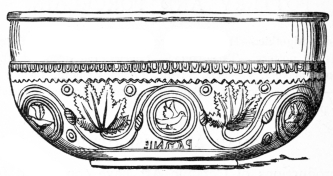
SAMIAN BOWL.
The number of inscriptions and potters' marks met with on the vases and
fragments found in Spain is very great. Students who take a special
interest in this subject will find full details in Dr. Emile Hübner's
important work, "Inscrip. Hispaniæ Latinæ," Berlin, 1869. This writer
has collected the greatest number of inscriptions. He mentions 43 which
appear on bricks, 36 on vases and drinking vessels, 63 on lamps, 579 on
vases of red pottery, 115 inscriptions of doubtful reading, 21 which are
incomplete, and 56 written by hand. He gives us, besides, other marks
without inscriptions, representing hands, horses, rabbits, butterflies,
bees, flowers, etc. In an inedited history of the ancient city of
Emporion (Cataluña) [MS., Acad. of Hist., Madrid], the author, Dr.
Joaquin Botet y Sisó, has collected 198 potters' marks. A large number
are still unpublished which have been met with on fragments of pottery
found in Extremadura and Andalucia; we may therefore confidently assert
that the number amounts to upwards of 1500.
During the Visigothic monarchy, after the downfall of the Roman empire,
which lasted until the invasion of the Arabs in the 8th century, the
same style of ceramic industry, copied from the Romans, continued in
Spain. No special study has been made of the pottery of this epoch, but,
judging by the large amount of fragments of vessels for domestic use,
which are constantly found in ruins of the Visigothic period, there can
be no doubt that pottery continued to be manufactured in Spain. What San
Isidoro, who died in 636, says in his "Etimologies, Book xx.," confirms
this opinion, and undoubtedly refers to vessels similar to those of the
Roman period. (De vasis Escariis, potoriis vinariis et aquariis,
oleariis, coquinariis et luminariorum.)
After the Roman domination and Visigothic monarchy, ceramic art in Spain
may be divided into the following groups:—
1st. Objects imported by the Moors into Spain; these consist of remains
of pottery belonging to the first period of their invasion; lustred
wares, manufactured in the Peninsula, which attained great importance
during the Middle Ages, and still continue to be made in the present
day; terra-cottas, and green and white glazed pottery; and lastly tiles,
azulejos, of bright colours in the Moorish style.
2nd. Pottery of a distinct Italian style, made principally at Talavera;
porous, unglazed, coloured pottery, bucaros; white, unglazed pottery,
made at Andujar and La Rambla.
3rd. Pottery and porcelain made at Alcora, and the porcelain manufactory
of Buen Retiro, near Madrid.
The Spanish Peninsula was invaded by the Arabs about the year 711 A.D.,
and they absorbed for several centuries the industries of the country.
Ceramic Art attained great importance in their hands during the Middle
Ages and Renaissance period, for even while the pottery works
established at Talavera, Seville, and other localities, manufactured
pottery to a very great extent, which was chiefly imitated from Italian
models, the Moorish style still continued, and has never been
interrupted in the province of Valencia down to the present day.
The Arabs had as early as the beginning of the 12th century, if not even
before, established the industry of metallic-lustred pottery in Spain.
It remains to be seen what were the leading characteristics of the
pottery of the period of the greatest importance of the Spanish Moors
from the 8th to the 11th century.
Cordova, the capital of the independent Caliphs of Damascus, was the
centre from which works of art of all kinds of a high order were largely
exported. The ruins of the palaces at Medina Az zahra have, it is deeply
to be regretted, never been excavated, and Granada is the only locality
where some fragments of Moorish pottery may be studied belonging to this
time.
Granada was almost unknown in the 8th century; the ancient Roman town of
Illiberis, about six miles from the present site of Granada, had alone
any importance: it was one of the bishoprics of Andalucia. The Arabs
first settled in the remains of the Roman city: in the 10th century they
removed to the spot occupied by the present town, and Illiberis was then
abandoned. Roman remains are frequently found at Illiberis, as are also
vestiges of the Moorish occupation, chiefly consisting of objects in
bronze and fragments of pottery. These specimens are decorated with
arabesques in green and black on a whitish ground. Some interesting
examples may be studied at the small Museo Provincial at Granada,
which certainly belong to the 10th or beginning of the 11th century. One
of these fragments has unreadable Arabic letters; another is decorated
with a stag; the most remarkable is a plate fourteen inches in diameter,
in the centre of which is represented a falcon on a horse's back. The
form and every detail of the horse, the plaited tail, ending in the
form of a trident, all are identical with one on which is mounted a man
holding a hawk in his hand, carved on the ivory casket described on page
133 as dated 359 of the hegira (A.D. 969), and probably of Cordovese
manufacture. Both these objects possess a very decided Persian
character, and undoubtedly belong to the date ascribed; for besides the
circumstance of their having been found in ruins of this period, the
shape of the horse is conclusive; its character changes soon after, as
we find in the miniatures of the MS. of the 13th century at the Bib.
Nationale de Paris, containing the "Séances de Hariri." It is almost
impossible to assert whether this pottery was made in, or imported into
Spain. One argument in favour of its Spanish-Moorish origin is that the
glaze and paste are similar to pottery which we know was manufactured at
Granada. The common earthenware proceeding from that locality is
decorated in much the same manner.
Soon after the fall of the Caliphate, metallic-lustred ware was made in
Spain: Edrisi, the most remarkable Arabic geographer of the Middle Ages,
in describing Calatayud, says: "Here the gold-coloured pottery is made
which is exported to all countries." ("Descrip. de l'Afrique et de
l'Espagne," Leyde, 1866.) Edrisi was born in the year 1100. He studied
at Cordova, and finished writing his book in 1154. The circumstance of
this pottery being mentioned in the 12th century as excellent enough for
exportation, certainly makes it appear probable that the fabrique
already existed at an earlier date, especially when we bear in mind that
Calatayud was conquered in the year 1120 by the Christians, and it is
impossible to suppose that they established an Oriental industry there
which was foreign to their culture, or to the contemporary Christian
art. This text of Edrisi's has hitherto not been properly interpreted.
In Jauber's translation (Edrisi, Paris, 1836-40), he interprets the word
guidar,
 lutum purum of potters, as the name
of a gilt textile, perhaps because in his time it was difficult to
believe in the existence of metallic-lustred pottery. In the Edit. of
Leyden, by Messrs. Dozy and Goeje, the sense of the word is properly
given; indeed, Jauber himself translates it by porcelain in the
chapter of this volume which refers to China.
lutum purum of potters, as the name
of a gilt textile, perhaps because in his time it was difficult to
believe in the existence of metallic-lustred pottery. In the Edit. of
Leyden, by Messrs. Dozy and Goeje, the sense of the word is properly
given; indeed, Jauber himself translates it by porcelain in the
chapter of this volume which refers to China.
This text of Edrisi's has never yet been quoted by writers on Ceramic
Art; but once known it is impossible for a moment to state that the
earliest manufacture of Moorish lustred ware was that at Malaga, an
opinion which has been supported hitherto on the quotation from Ben
Batutah's works, which will be given later on. I regret to have found no
other allusion to the lustred ware of Aragon until the 10th century. No
mention is made of it in the geographical texts published by Juynboll,
Al Makkari, or other Arabic writers. From what we know of Aragon in the
16th century, it was a great centre of this industry, and its
productions rivalled those of Valencia and Andalucia.
The next text which alludes to this manufacture is given by Ben Batutah,
a celebrated traveller, who, after travelling for twenty years in the
East, went from Tangiers to Granada, from 1349 to 1351. Passing by
Malaga, he says: "At Malaga, the fine golden pottery is made which is
exported to the furthermost countries." ("Voy. d'Ibn Batoutah," Paris,
1853-58, vol. iv. p. 367.) This text has been constantly reproduced and
commented upon, since Baron Charles Davillier first drew attention to it
in his interesting little brochure on "Faïences Hispano-Moresques."
The next time I find lustred pottery mentioned is in the 15th century.
Eximenus, in his "Regiment de la cosa publica," Valencia, 1499, in
speaking of the excellent things made in the kingdom of Valencia, says:
"The twenty-seventh excellent thing is that some artificial objects are
made there which bring great renown to the country, for they are
excellent and beautiful, and are now to be found in other localities ...
but above all is the beauty of the gold pottery so splendidly painted at
Manises, which enamours everyone so much, that the Pope, and the
cardinals, and the princes of the world obtain it by special favour,
and are astonished that such excellent and noble works can be made of
earth."
Lustred pottery had already attained great importance in Aragon early in
the 16th century. We find in a deed granted at Calatayud in 1507, that
"Muhamed ben Suleyman Attaalab, an inhabitant of the suburb of the Moors
at Calatayud, and an artificer of lustred golden earthenware, engaged
himself with Abdallah Alfoquey of the same locality, to teach him the
said industry, in the space of four years and a half, from the date of
the deed." ("Estado social de los mudejares de Castilla, by Fernandez y
Gonzalez," Madrid 1866, p. 437.) At Muel, a village in the province of
Aragon near Zaragoza, this industry existed to a great extent in 1585.
In the travels of Henrique Cock ("Relacion del viage hecho por Felipe
II. en 1585," por Henrique Cock, publicado por Morel Fatio y Rodriguez
Villa, Madrid, 1876,) we find the following interesting details of the
manner in which this pottery was made, p. 30:—
"Almost all the inhabitants of this village are potters, and all the
earthenware sold at Zaragoza is manufactured in the following manner.
First the vessels are fashioned of a certain ingredient the earth
furnishes them in that locality, in the shape they may require. Once
made, they bake them in an oven fitted for the purpose. They then remove
them to varnish with white varnish and polish them, and afterwards make
a wash of certain materials in the following manner: twenty-five pounds,
one arroba, of lead, with which they mix three or four pounds of tin,
and as many pounds of a certain sand which is to be found there. All
these ingredients are mixed into a paste like ice; it is broken into
small pieces and pounded like flour, and kept by them in powder. This
powder is mixed with water, the dishes are passed through it, and they
are rebaked in the oven, and keep their lustre. Afterwards, in order
that the pottery may be gilt, they take very strong vinegar, mixed with
about two reales (a small coin equivalent to 6d.) of silver in powder,
vermilion, and red ochre, and a little wire. When all is mixed
together, they paint with a feather on the dishes any decoration they
may like, rebake them, and then they remain gold-coloured for ever. This
was told me by the potters themselves."
But nothing can be compared in exactitude to the following receipt of
the manner of preparing this lustred ware, which I was fortunate enough
to find in a manuscript in the British Museum. (Egerton, No. 507, MS.
fol. 102).
Count Florida Blanca wishing in 1785 to establish at Madrid a
manufactory of metallic-lustred ware, had the following report on the
actual state of the industry sent to him from Manises with full details
of the manner in which it was required to be carried out.
"After the pottery is baked, it is varnished with white and blue, the
only colours used besides the gold lustre; the vessels are again baked;
if the objects are to be painted with gold colour, this can only be put
on the white varnish, after they have gone twice through the oven. The
vessels are then painted with the said gold colour and are baked a third
time, with only dry rosemary for fuel.
"The white varnish used is composed of lead and tin, which are melted
together in an oven made on purpose; after these materials are
sufficiently melted, they become like earth, and when in this state the
mixture is removed and mixed with an equal quantity in weight of sand:
fine salt is added to it, it is boiled again, and when cold, pounded
into powder. The only sand which can be used is from a cave at
Benalguacil, three leagues from Manises. In order that the varnish
should be fine, for every arroba, 25 pounds of lead, 6 to 12 ounces of
tin must be added, and half a bushel of fine-powered salt: if a coarse
kind is required, it is sufficient to add a very small quantity of tin,
and three or four cuartos worth of salt, which in this case must be
added when the ingredient is ready for varnishing the vessel.
"Five ingredients enter into the composition of the gold colour:
copper, which is better the older it is; silver, as old as possible;
sulphur; red ochre, and strong vinegar, which are mixed in the following
proportions: of copper three ounces, of red ochre twelve ounces, of
silver one peseta (about a shilling), sulphur three ounces, vinegar a
quart; three pounds (of twelve ounces) of the earth or scoriæ, which is
left after this pottery is painted with the gold colour, is added to the
other ingredients.
"They are mixed in the following manner: a small portion of sulphur in
powder is put into a casserole with two small bits of copper, between
them a coin of one silver peseta; the rest of the sulphur and copper
is then added to it. When this casserole is ready, it is placed on the
fire, and is made to boil until the sulphur is consumed, which is
evident when no flame issues from it. The preparation is then taken from
the fire, and when cold is pounded very fine; the red ochre and scoriæ
are then added to it; it is mixed up by hand and again pounded into
powder. The preparation is placed in a basin and mixed with enough water
to make a sufficient paste to stick on the sides of the basin; the
mixture is then rubbed on the vessel with a stick; it is therefore
indispensable that the water should be added very gradually until the
mixture is in the proper state.
"The basin ready prepared must be placed in an oven for six hours. At
Manises it is customary to do so when the vessels of common pottery are
baked; after this the mixture is scratched off the sides of the basin
with some iron instrument; it is then removed from there and broken up
into small pieces, which are pounded fine in a hand-mortar with the
quantity of vinegar already mentioned, and after having been well ground
and pounded together for two hours the mixture is ready for decorating.
It is well to observe that the quantity of varnish and gold-coloured
mixture which is required for every object can only be ascertained by
practice."
Excellent lustred ware was made at Murcia, and in several villages of
the province of Valencia; a good example exists of this pottery at the
museum (see woodcut); none, however, was so important as the manufactory
of Manises. Diago, in his "Anales del reyno de Valencia, 1613-40,"
repeats the words of Eximeno: "That the pottery made at Valencia is
painted and gilt with so much art, that it has enamoured every one, so
much so that the pope, the cardinals, and princes send for it,
astonished that things of such beauty can be made of earth."
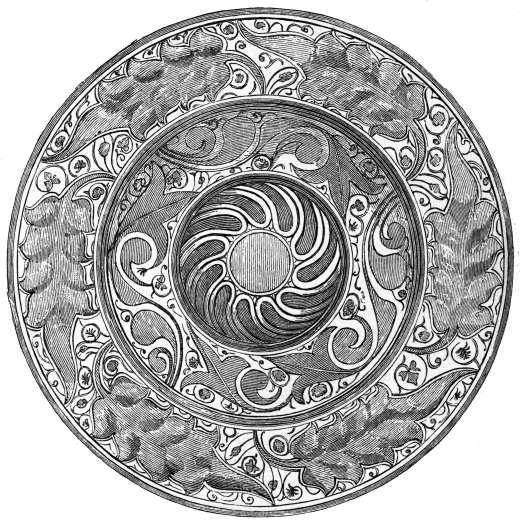
PLATEAU, PROBABLY OF VALENCIA. SOUTH KENSINGTON MUSEUM.
[Medium amplification]
[Largest amplification]
This and similar texts relating to the exportation of Spanish pottery
explains the fact of these specimens being so frequently met with in
Italy. Pottery of a dark copper-coloured lustre is made at the present
time at Manises, and the imitations and forgeries to be met with at the
dealers' shops in Madrid are made in that locality.
I have mentioned the different historical texts which allude to this
industry, and the technical receipts showing the ingredients employed to
give the lustre. It is now no longer possible to doubt that this pottery
came originally from the East. This opinion has gained ground of late
years; for among the objects discovered by Sir Henry Layard at Nineveh,
and in more recent excavations in Ephesus and Asia Minor, fragments of
pottery have been found with metallic lustre. This and other important
examples of artistic culture undoubtedly arose in Persia. No examples
which may be mentioned can give a better or more distinct idea of this
than a comparison between the Persian and Hispano-Moresque wares at the
South Kensington Museum. The technical proceedings and effect produced
by the metallic lustre on a white ground, with touches here and there of
blue, are exactly the same in both cases. The principal difference
consists in a greater richness and variety of ornamentation which we
find in the specimens brought from Persia, especially those covered with
a turquoise blue lustre, those of a dark blue and metallic lustre, and
those on which gold is applied en froid, of which I know no similar
examples in Spain. It is possible they may have existed in the mosques,
but no traces remain of mosques built by the Spanish Moors during the
13th, 14th, and 15th centuries. The mosques at Cordova and Toledo which
still exist are of an earlier date. If we judge by the mosque of Amru at
Cairo, and others of the same early period, tile decorations were not
used in their ornamentation, and it appears probable that this industry
only became important after the 10th century. The similarity of objects
used in Spain and Persia is constantly observed by travellers in that
country. Ruy Gonzalez de Clavijo, who was sent there as ambassador from
the King of Castille from 1403 to 1406, gives a most interesting
description of tile decoration, by which we find they were used in the
same manner as in Spain. ("Historia del gran Tamorlan," Seville, 1582,
fol.) Another Spanish traveller, Silva de Figueroa, in a MS. belonging
to Don Pascual de Gayangos, in describing his embassy to Persia in 1618
mentions the manner in which these tiles were used. I do not quote from
many other travellers, for their remarks are hardly so valuable as those
of Spaniards, who were accustomed to see these objects in their native
country.
After mentioning the historical sources from which I have traced the
manufactory of Hispano-Moresque lustred ware in Spain, it is advisable
to enumerate the most important examples which have reached us belonging
to the 14th century, or to an earlier date.
The fine vase at the Alhambra, Granada. (See woodcut.)
A vase of the same character which exists at the Archæological Museum of
Madrid.
A vase of the same kind, which belonged to the painter, Mariano Fortuny,
and which was sold at the sale of his art objects in Paris, April 30th,
1875. (Vide "Atelier de Fortuny," Paris, 1875.)
A fragment of another vase, which belonged also to Fortuny, and was sold
at the same time.
A fragment of a vase at the Museo of Granada; it is similar to the
others in form and size, but without metallic lustre.
A large plaque, or azulejo, which belonged also to Fortuny.
The azulejos, or tile decorations of the house known by the name of
Cuarto Real de Santo Domingo at Granada.
Several dishes and bowls at the Kensington, Madrid, and Cluny Museums,
which belong to this period.
Baron Charles Davillier in his article on Hispano-Moresque lustred ware,
in "Atelier de Fortuny," Paris, 1875, says that interesting specimens of
this pottery exist also at the Museum of Stockholm, and the Cathedral
of Mezzara in Sicily, but that he had not had the opportunity of
studying them.
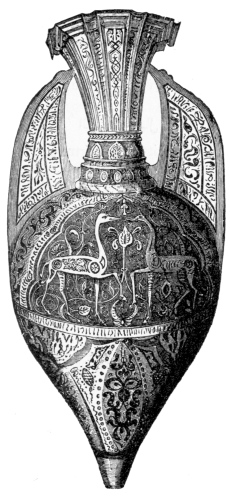
MOORISH VASE AT THE ALHAMBRA.
All these objects have hitherto been considered to have proceeded from
Malaga, writers on ceramic art derived their evidence from the text
already mentioned, given in Ben Batutah's travels, the only one which
alluded to the existence of this industry in Spain before the 15th
century; but since I have found in Edrisi's Geography a manufacture
mentioned of lustred pottery which existed at Calatayud at the beginning
of the 12th century, that is to say, more than two centuries earlier
than Ben Batutah's travels, I consider it extremely difficult to
classify them.
The fine vase at the Alhambra is 4 feet 5½ inches high by 8 feet
2½ inches in circumference. It is decorated in the centre with two
antelopes, and a series of elegant traceries of knots, stems, and leaves
which cover the body of the vase. The colours employed are brown and
blue on a yellow ground, the metallic lustre is extremely pale, of a
mother-of-pearl colour. The following inscriptions are repeated all over
the vase in African characters:

Felicity and Fortune.

Permanent prosperity.
A similar vase was at the Alhambra until the beginning of the present
century; it disappeared at that time, and its present whereabouts is
unknown. Drawings exist of this vase which have been published in
Lozano's "Ant. Arab. de España," and Murphy's Atlas of "Arabian Ant. of
Spain."
The fine vase at the Museo Arq. of Madrid is similar in style. It has
been reproduced in a chromo-lithograph in Mus. Esp. de Ant. VI. p. 435.
Both these vases are decorated with colours which are disposed in quite
a distinct manner to all the other specimens of this pottery hitherto
known. The vase at Granada is ornamented in the centre with two
antelopes, and from drawings which have reached us of the companion
vase, we find birds are introduced in the decoration of the handles.
Animals combined with ornamentation are never met with in the immense
number of Moorish traceries of all kinds which may be studied at
Granada. This circumstance has induced me to consider these objects to
have been brought from Persia, for Ben Batutah tells us that several
Persians of importance had settled at Granada; and it is highly
probable that a direct communication existed between these two
countries. It is fair, however, to mention a detail which is against
this argument. The arms of the Moorish kings of Granada appear on the
vase which has disappeared from Granada, and although it may have been
ordered from Persia, it is also possible that it was made in the
province of Andalucia.
The vase which belonged to Fortuny, and the large azulejo, Nos. 42, 44
(vide "Atelier de Fortuny"), are very different in style. They have no
colours, and their metallic lustre is very low in tone, a common
circumstance in Hispano-Moorish pottery. The following inscription,

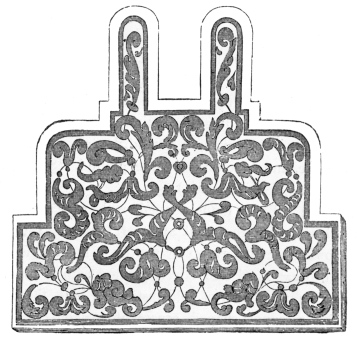
TILE PROBABLY FROM THE ALHAMBRA; FORMERLY IN THE MARRYAT COLLECTION.
"Glory to Our Lord the Sultan Abul Hajaj," [A.D. 1333-1354.] occurs on
this tile, an inscription very frequently met with also on the walls of
the Alhambra. Abul Hajaj carried out works of restoration to a very
large extent at the Palace. The two large tiles on either side of the
entrance-door of the Cuarto Real de Santo Domingo at Granada, although
not so fine as the vase and tile which belonged to Fortuny, are similar
in general character, and it is safe therefore to consider these
objects, and others of a similar kind, to have proceeded from the
manufacture of Malaga mentioned by Ben Batutah, or other pottery works
of the same kind, which probably existed at that time in the province of
Granada.
Metallic-lustred dishes have at times an even surface without
ornamentation in relief, and sometimes are ornamented with ribs and
convex dots, which appear to suggest that they are meant to imitate the
structure of nails, bars, or other work common to metal vessels, in the
manner of Etruscan vases.
The finest specimens of Hispano-Moresque ware at the Kensington Museum
are—
No. 8968-'63. A vase which belonged to the Soulages Collection. Mr.
Fortnum, in his "Majolica, Hispano-Moresco, Persian, Damascus and
Rhodian Wares, at the Kensington Museum," London, 1873, describes this
vase as spherical on a trumpet-shaped base, the neck of elongated funnel
form, flanked by two large wing-shaped handles perforated with circular
holes. The surface, except the mouldings, is entirely covered with a
diaper-pattern of ivory or briony leaves, tendrils and small flowers in
brownish lustre, and blue on the white ground. Spanish. 14th or 15th
century. (See woodcut.)
No. 486-'64. Bowl, funnel-shaped, with representation of a ship in full
sail, with the royal arms of Portugal, 15th century.
The following are also especially worthy of mention:—
No. 7659-'62. Bowl and cover, painted with a scroll diaper in alternate
compartments of gold lustre and blue, the cover surmounted by a
cupola-shaped ornament in gold lustre. 16th century.
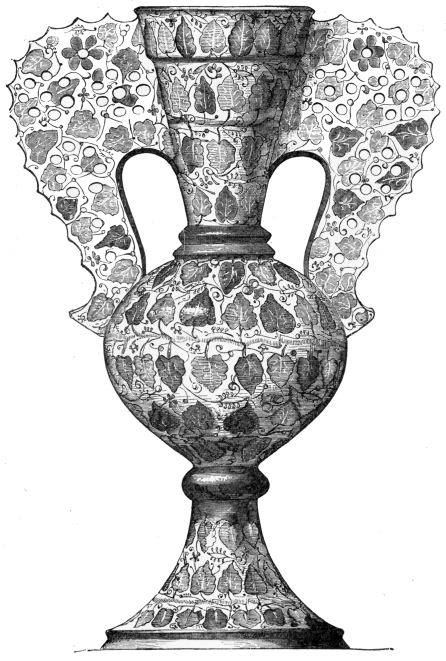
VASE DIAPERED WITH IVY OR BRYONY IN GOLDEN LUSTRE.
HISPANO-MORESCO, 14TH OR 15TH CENTURY. SOUTH KENSINGTON MUSEUM.
[Medium amplification]
[Largest amplification]
No. 489-'64. Plateau with lustred arabesque ornaments in compartments.
In the centre are two simulated Arabic inscriptions. 15th century.
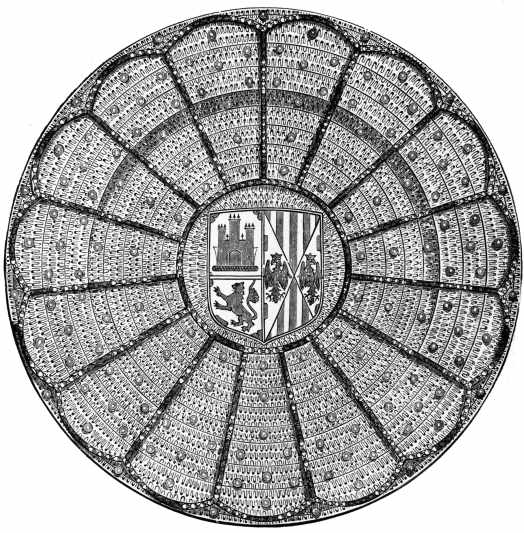
PLATEAU, DIAPERED AND WITH RAISED RIBS AND STUDS, IN BLUE
AND GOLDEN LUSTRE. THE ARMS OF LEON, CASTILE, AND ARAGON.
HISPANO-MORESCO. 15TH OR 16TH CENTURY. SOUTH KENSINGTON MUSEUM.
[Medium amplification]
[Largest amplification]
No. 1680-'55. Plateau, gold shield in the centre, with the arms of Leon,
Castille, and Aragon. The diapered ground is curiously ribbed, and
dotted with raised studs. (See woodcut.)
No. 243-'53. Plateau, in the centre an escutcheon of arms of Aragon,
Leon, and Castile. (See woodcut.)
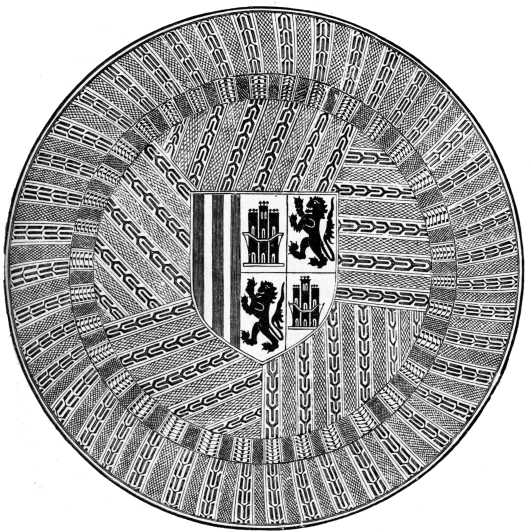
SALVER, DIAPERED IN GOLDEN LUSTRE, WITH THE SHIELD OF
ARAGON, LEON, AND CASTILE. HISPANO-MORESCO. 15TH OR 16TH CENTURY.
SOUTH KENSINGTON MUSEUM.
[Medium amplification]
[Largest amplification]
No. 104-'69. Vase, with shield of arms, seemingly of Sicily and
Portugal.
Specimens of a later date are distinguished by the redness of the
lustre, such as No. 327-'66, a bowl, with feather-like ornament in the
centre; Nos. 326-'66 and 328-'66 are good examples of this lustred ware
of the last and early present century made at Manises, Valencia.
It is almost impossible to classify the existing specimens of
Hispano-Moresque pottery. A few examples are marked with the monogram of
Manises, or possess some special sign, such as the Eagle of St. John,
which would make it appear they were made in the province of Valencia,
but as the texts from ancient authors only praise this pottery and give
no details of its general characteristics, it is very difficult to
assign any given specimens to the manufactories of Aragon and Valencia.
The receipts which I have given prove that the ingredients used were the
same, the modification in lustre was owing to the different combinations
of silver and copper. The system hitherto adopted of classifying this
ware by the localities in which it has been purchased is not a safe one,
unless borne out by further evidence. All that can be done at the
present time is to point out the oldest specimens, and probable period
of their manufacture. As a general rule the finest specimens are also
the oldest, for this industry decayed after the Moors were expelled from
Spain, and Italian pottery was imported into that country in the 16th
century.
The opinion which has been so generally accepted that gold lustred
pottery was made and exported from the Balearic Islands has been
contradicted by Dn. Alvaro Campaner y Fuertes in a letter addressed to
Baron Davillier which appeared in the "Museo Balear," Palma, 1875, in
which he refutes the Baron's arguments on the pottery which he supposes
to have come from that locality.
The earliest historical notice which I have met with of Terracottas is
in a grant made in A.D. 1222, by King Don Fernando el Santo, in favour
of the manufacturers of bricks or tiles at Talavera (M. S. Bibl.
Nacional Madrid, Dd. 114, p. 17), and another document of a similar kind
by his son, King Don Alonso el Sabio A.D. 1281, in favour of the
Cathedral of Cordova, "that no pottery works should be allowed inside
the town, unless they were established in the same manner as in the time
of the Moors." (Mem. Hist. Español, t. ii. p. 45). Although this
information is not of great importance, it enables us to infer that in
the 13th century an industry existed in Spain which was closely
connected with pottery. Baron Davillier mentions a privilege granted by
King Dn. Jaime de Aragon to the inhabitants of Jativa, province of
Valencia, in which he commands, "that any master potter who made jars,
pots, pans, tiles, and bricks, should pay a tribute of one besant
yearly for each oven, and be permitted to carry out his industry with no
other obligation or service." (Col. Doc. Ineditos, vol. xviii. p. 67.)
The details concerning this industry in Cataluña are more interesting;
especially on account of the references given to the marks of the
objects proceeding from this manufacture. The potters, who were known by
the generic name of olleros sent, in 1257, two individuals to form
part of the town council. They formed at that time a guild; in 1314 they
agree in their regulations as to the mark to be adopted for their
pottery, and the actual spot is mentioned on which every potter was to
stamp his wares. This stamp was ordered to be very visible, and
instructions are given as to the quality of the clay, and its
manipulation, in order to produce pottery of a first-class order. We
find statutes in this sense up to 1355. But we cannot find in the "Libro
de Ordenanzas" of the potter's guild that any laws existed touching the
technical details of this manufacture; most of the regulations refer to
the management of the guild from 1304, which was composed of potters,
bricklayers, jar-makers, and manufacturers of pottery for domestic
purposes of Barcelona. (Capmany, Memorias Historicas, 1779-92, vol. i.
part 3, p. 69.)
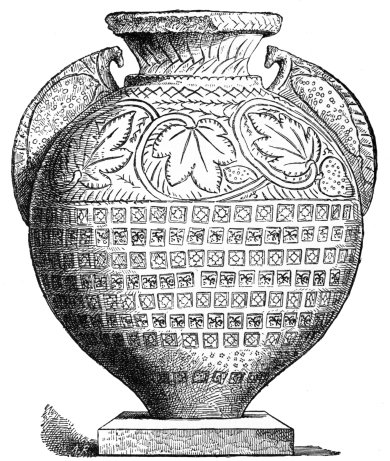
WINE JAR—"TINAJA." SOUTH KENSINGTON MUSEUM.
These references are not, however, sufficient to identify the kind of
pottery made at that time in Cataluña. It is highly probable that
lustred ware was also made there to a great extent, not only because it
was the most characteristic produce of the Peninsula, but also because
this ware was exported to a great extent, and highly esteemed.
The most important examples of Spanish terra-cotta which have reached us
are tinajas, large jars for holding wine and oil.
One of the best tinajas which I know is at the South Kensington
Museum, No. 330-'66. (See woodcut.) It is a wine jar, amphora-shaped,
and ornamented with incised pattern of vine leaves, and stamped diaper
of a Gothic character. This and similar specimens have always been found
in Andalusia and the province of Toledo, and hence we may infer that the
chief centres of this industry existed at Toledo and Seville. They
continue to be made there, and are used for the same purposes as in the
Middle Ages, for keeping stores of wine, oil, meat, grain, etc.
Belonging to this section of objects of a large size, are some specimens
of glazed earthenware made for brims of wells. I only know four or five
examples in the local museums of Toledo and Cordova; the font of the
church of San Salvador, Toledo, belongs also to the same pottery. The
brim of a well, at the South Kensington Museum, No. 1763-'71, is of the
same manufacture. It was bought at Toledo for three guineas at a
shoemaker's shop. It is made of glazed white and green earthenware, with
ornamental Cufic characters in high relief all round, which appear to be
of the 14th century (see woodcut on next page). The inscription, which
is repeated, is imperfect, and all that I can decipher are the words:

"The power, the excellence, and the peace."
There is no difficulty in affirming that this form of earthenware was
made at Toledo, for Marineo Siculo, in his interesting volume treating
of "De las Cosas Memorables de España," Alcala, 1539, says, "much coarse
green and white pottery is made at Toledo."
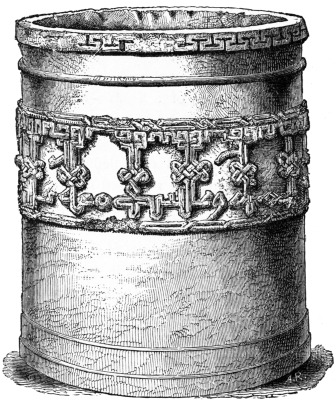
BRIM OF WELL FROM TOLEDO. SOUTH KENSINGTON MUSEUM.
The manufacture of tiles, as was the case with so many other industries
in Spain, was imported by the Arabs. In the Middle Ages it attained
great importance, and has never ceased in Spain up to the present day.
The earliest tiles (azulejos) made in Spain are composed of small
pieces let into the wall, forming geometrical patterns. The proceeding
is similar to that employed by the workers of Byzantine mosaic,—tile
decoration undoubtedly took the place of this mosaic work in Moorish
buildings. It is difficult to fix the precise period when they were
first made, but it must have been posterior to the 10th century, when
Moorish architecture underwent a radical change in its system of
decoration. The oldest tiles which exist in Spain are at the Palace of
the Alhambra, Granada. They belong to the 14th century. The great
variety of their design may be seen in Owen Jones' "Plans and elevations
of the Alhambra," London, fol. 1842, and the fine work published by the
Spanish government, "Monumentos Arquitectonicos." We can judge of the
style adopted by two interesting fragments, both of which came from the
Alhambra, No. 1104-'53, No. 324-'64, South Kensington Museum.
The earliest mention which I have found of this manufacture occurs in a
letter from Doña Juana de Mendoza, the wife of the Almirante de
Castilla, which is addressed to the lady abbess of the nunnery of Santo
Domingo at Toledo. She begs that a large number of "azulejos" of
different colours, black, white, yellow, and green should be sent to
her. She alludes, in the same letter, to painted tiles, and says she was
expecting a master potter from Seville to place these tiles in their
proper places. This shows us that it was only in the province of
Andalusia that the art was known of cutting these tiles into geometrical
sections and mosaic patterns. This letter is not dated, but it is bound
up with other documents of 1422, and evidence exists to prove that both
the Almirante and his wife were dead in 1431. The locality for which the
tiles were required was probably Palencia; the convent of Santa Clara
was built by them at that time, and they both were buried there. It was
extremely difficult to cut and join together these tiles; the workmen
who did so had to pass through a regular examination in compliance with
the municipal ordinances drawn up in the 15th century; without this
requisite they were not allowed to exercise their trade.
We know, from documents existing at the Archives of the Alhambra, at
Granada, that tiles were made there at the end of the 16th and beginning
of the 17th century. We find the names of Antonio Tenorio, Gaspar
Hernandez, and Pedro Tenorio working there at that time as master
potters.
The use of these azulejos was not restricted to Moorish buildings;
they were largely employed to decorate the walls of Christian churches,
convents, palaces, and private houses. The style of work, however, soon
changed, for instead of being made of mosaic work, they were formed of a
single piece like the ordinary tiles, but imitating the Moorish colours.
In the 16th century designs of the Renaissance style alternated with
these, although the system and colouring continued the same. This style
continued in vogue until the expulsion of the Moriscos in 1610. A fine
collection may be seen at the South Kensington Museum of 200 tiles, in
which upwards of 150 varieties of design will be found, Nos. 308-'66 and
367-'66. Their chief characteristic is that only pure colours are used
without gradations or half tints. Lustred reflets are very seldom met
with in tiles; the only examples I know are two beautiful plaques of the
14th century of a pale lustre which are on either side of the entrance
door of the Moorish saloon called Cuarto Real de Sto. Domingo, at
Granada; some small polygons of copper-coloured lustre at the Tower of
la Cautiva, Granada: some few details in the coats of arms which are let
into the tiles which adorn the walls of the Chapel at the Alhambra, and
some few tiles with the arms of the Mendozas at the Casa de Pilatos,
Seville.
A few dishes belong also to the 15th century, ornamented with the same
colouring as the tiles without metallic lustre, and generally decorated
with fantastic animals. They are very scarce. Two examples exist at the
South Kensington Museum, Nos. 1459 and 1461-'70. They probably were made
at Seville; all those I have seen come from there, and we know that the
pottery from Seville was much esteemed. In Pedro de Medina's "Libro de
Grandezas y Cosas Memorables de España," Sevilla, 1549, fol. Iii., he
says, "In this town of Triana much excellent pottery of Malaga is made,
coloured white and yellow, and of different sorts and kinds. This
pottery is made in about fifty houses, and it is exported from here to
many localities. In the same manner excellent azulejos are made, of
great variety of colour and design. And likewise fine reliefs of men
and other things. Great quantities of these azulejos are taken to
different localities."
At the introduction of Italian forms of art in Spain, at the beginning
of the 16th century, artistic pottery divided itself into two
schools—one kept to the traditional designs and strong tones of colour,
the other used shaded colours, and especially yellow and blue tints, at
times imitating Italian maiolica, but always following the decoration
characteristic of the Renaissance style.
The Italian influence, and its finest results in Spain may be favourably
studied in Seville, in the tile decorations of the chapel at the
Alcazar, the doorway of the convent of Santa Paula, and a remarkable
sepulchre decorated with tiles at the church of St. Anne at Triana. All
these tile decorations are signed by the same person, and it would be
difficult to find any more remarkable.
The azulejos at the Alcazar represent a picture in the manner and
style of Pietro Perugino; they are admirable in colour and design. Those
which decorate the sepulchre at the church of St. Anne have the
following inscription, "Niculoso Francesco italiano me fecit, en el
agno del mil ccccciii." Some very interesting tiles also may be seen in
one of the rooms in the lower part of the Alcazar; they are marked in
the following manner: A.V.S.T.A.—A.V.G.W.S.T.A. 1577-1578. On the floor
of the pavilion of the Emperor Charles V. in the garden there are also
some fine tiles which are signed Juan Hernandez, 1540.
We find mention in Cean Bermudez of a painter of azulejos named Juan
Flores, a native of Flanders; he painted tiles for the royal palaces of
Madrid, the Pardo and Segovia; he was appointed Maestro Azulejero by
Philip II. in 1565.
Returning to other examples of earthenware we meet with the ancient
manufactures of the Balearic Islands, although it is not easy to
determine the kind of pottery which was really made there. Bernardo da
Uzzano, in 1442, made a commercial treaty, (vide Davillier, "Faïences
Hispano Moresques," p. 26), in which he mentions the "faïence" made at
Mallorca and Minorca, which "was exported to a very large extent." The
royal Ordinances for the island of Iviza, which have not been mentioned
by either of these authors, state that the principal traffic and the
greatest industry of ancient times of the island of Iviza consisted in
some vessels of the finest earthenware, well baked and curiously worked,
of which an innumerable quantity were sent off to Africa and other
places, not only on account of the excellence of their worth, which was
admirable, but the speciality of the clay, which preserved from poison.
("Reales Ordinaciones de Iviza," Palma, 1751).
Manufactures of pottery also existed in a great number of localities in
Spain; the most important centres were at Talavera, Valencia, and
Triana. Judging by the manner in which different authors praise the
earthenware of Talavera, its productions were evidently the most
esteemed. The earliest mention we find of Talavera pottery occurs in a
MS. volume dated 1560—a history of this town, in which mention is made
of "white, green, blue and other coloured Talavera ware." In the
inventory of the effects of Dna. Juana, a sister of Philip II., 1573,
several objects of "white earthenware of Talavera" are mentioned. In a
report drawn up by order of Philip II. 1576, it is stated that Talavera
"produced fine white glazed earthenware-tiles, and other pottery, which
supplied the country, part of Portugal and India." Father Ramon de la
Higuera in his "Republicas del Mundo," 1595, mentions the ware of
Talavera in terms of the highest praise. In a MS. history of Talavera
written in 1651, (Bib. Nac. Madrid, G. 112,) the author, Father Alfonso
de Ajofrin, says that "the pottery is as good as that of Pisa, a large
number of azulejos are also made to adorn the front of altars,
churches, gardens, alcoves, saloons, and bowers, and large and small
specimens of every kind. Two hundred workmen work at eight different
kilns. Four other kilns are kept to make common earthenware. Red porous
clay vases and drinking cups are baked in two other kilns, in a thousand
different shapes in imitation of birds and other animals, also
brinquiños for the use of ladies, so deliciously flavoured that after
drinking the water they contained, they eat the cup in which it was
brought them." In another MS. history of Talavera (Bibl. Nac. G. 187) we
find mention of "perfect imitations of oriental china," and that the
pottery made there, "was used all over Spain, and sent to India, France,
Flanders, Italy and other countries, and was esteemed everywhere for the
perfection of the colouring and brilliancy of the glaze."
This information may be increased by quoting another interesting MS. on
the history of this town (Bib. Nac. F. 142) in which the writer, Fr.
Andres de Torrejon, who professed in the convent of Santa Catalina in
1568, says:—"The earthenware pottery made here has reached to a great
height of perfection; it is formed of white and red clay. Vases, cups,
bucaros and brinquiños are made of different kinds, dishes and table
centres, and imitations of snails, owls, dogs and every kind of fruits,
olives, and almonds. These objects are painted with great perfection,
and the imitations of porcelain brought from the Portuguese Indies are
most excellent. Every one wonders that in so small a town such excellent
things should be made. The varnish used for the white pottery is made
with tin and sand, it is now found to be more acceptable than coloured
earthenware, so much so, that persons of importance who pass by this
town although they have in their houses dinner services of silver, buy
earthenware made at Talavera, on account of its excellence. The sand
which was used to make the white varnish was brought from Hita, it is
now found at Mejorada, near Talavera. This sand is as fine and soft as
silk."
"The red pottery made at Talavera is much to be commended, for besides
the great variety of objects which they make, the different medals which
they place upon them, they have invented some small brinquiños of so
small and delicate a kind, that the ladies wear them. Rosaries are also
made of the same material. A certain scent is added in the manufacture
of this pottery which excites the appetite and taste of the women, who
eat the pottery so frequently that it gives great trouble to their
confessors to check this custom."
In a volume of "Relaciones Topograficas de los Pueblos de España hechas
en 1576," (MS. in fol. t. ii.) we find, in speaking of Talavera, that
the author says: "What is most excellent there is the white pottery, and
tiles and other objects of this earthenware with which the kingdom and
part of Portugal are provided."
In Larruga's "Memorias Politicas y Economicas," (vol. x. Madrid, 1741,)
we find, p. 22, that "the manufactory of fine earthenware of Talavera de
la Reyna continued to make much pottery of importance until 1720: eight
kilns existed then, which employed more than 400 persons, men, women and
children. These manufactories possessed at that time large sums of
money. From that time this industry decayed to such an extent, that in
1730 only four kilns existed where pottery of a very inferior kind was
produced."
The industry was revived later on in the century, but the finest
specimens are of an earlier date. Larruga adds, in p. 17, vol. x., of
his "Memorias," that "Talavera ware is of a lighter clay than the
imitations of this earthenware which were made in other localities."
Pottery of a similar kind was also made in different other localities of
Spain. Mendez Silva says that at Puente del Arzobispo, near Toledo,
"fine pottery is manufactured in about 8 kilns, which produce more than
40,000 ducats yearly." ("Relacion General de España," Madrid, 1645, fo1.
32.) Paton likewise in his "Historia de Jaen," 1628, writes that "the
white unglazed earthenware made at these towns, is very remarkable for
the curious manner in which they imitate different figures of animals,
such as porcupines, fish, syrens, tortoises, &c." Objects of a similar
kind are still made in Spain.
The English traveller Clarke, in his "Letters concerning the Spanish
Nation during the years 1760-1761," London, 1763, p. 263, says, "the
pottery fabrics are very numerous and excellent, particularly
Talavera." And in "Annales de l'Espagne," by Alvarez de Colmenares,
Amsterdam, 1741, we find, p. 187, in speaking of Talavera, that "On y
fait des ouvrages vernissés d'une façon ingénieuse, avec des peintures
de bon goût; on estime ces ouvrages autant que ceux de Pise et des Indes
Orientales; on en fournit plusieurs provinces. Ce négoce rend plus de
50,000 ducats par an."
Udal ap Rhys in his "An Account of the Most Remarkable Places and
Curiosities in Spain and Portugal," London, 1749, in speaking of
Talavera says, "It is noted also for a very curious kind of earthenware
that is made in imitation of China."
Although we find by the remarks we have quoted from contemporary authors
that earthenware of every description was made at Talavera, the
specimens which are more generally met with may be divided into two
groups, which are painted on a white ground, either in blue, or in
colours in the manner of Italian maiolica. The most important examples
which have reached us consist of bowls of different sizes, dishes,
vases, tinajas, holy-water vessels, medicine jars, and wall decorations.
Blue oriental china was imitated to a vast extent, the colouring was
successful but the design was an imitation of the baroque school of the
time, and the figures, landscapes, and decoration follow the bad taste
so general in Spain in the 18th century. The imitations of Italian
maiolica are effective. The colours most commonly used are manganese,
orange, blue and green.
Several specimens of this manufacture are in the South Kensington
Museum; among these may be noted—
No. 327-'76. A large vase painted in blue with cavaliers and men on foot
in a hilly landscape, on the shoulder are the words "Silva Coronel."
No. 1282-'71. Holy-water vessel, with raised flowers and scrolls of
foliage with polychrome decoration.
No. 1281-'71. Soup tureen and cover, white, with raised scrolls and
groups of painted flowers.
No. 351-'76. Another soup tureen with cover and stand, painted with
garlands and the arms of Portugal. On the cover is a group of fishes and
shells in relief.
No. 1279-'71. A bowl decorated within with a bull-fight; outside are
storks and trees in green, orange, and manganese. (See woodcut.)
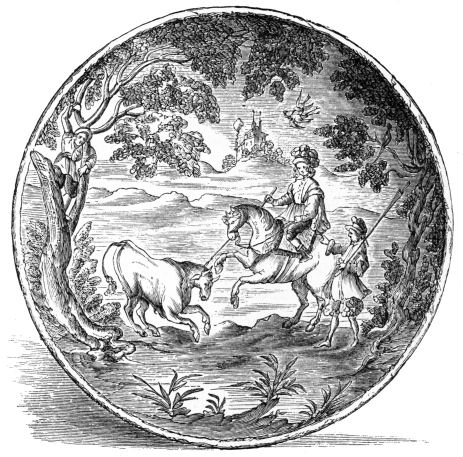
EARTHENWARE BOWL. TALAVERA WARE. SOUTH KENSINGTON MUSEUM.
Several pottery works were established in Spain in the 18th century, all
of them, in the same manner as the earlier fabriques, modified the
system of decorating their wares. In some instances the colours and
designs of Italian maiolica were imitated, others copy the blue
faïences of Pisa, Genoa, and Savona, while others adopted the styles of
Moustiers, Nevers, and Rouen, or English earthenwares.
Ten or twelve manufactories existed at Toledo in the 17th century which
imitated Talavera ware; in the 18th they hardly produced anything of
importance. Ignacio de Velasco in 1735 founded one at great expense at
Toledo in which imitations of Genoese pottery were chiefly made. At the
death of Ignacio in 1738, these works passed to his son George; in 1742
Francisco Hernandez directed them, and in 1747 imitated Japanese models.
Several specimens proceeding from Toledo, at the South Kensington
Museum, painted blue on a white ground, in the style of Savona and
Japan, belong to this period.
In 1755 thirteen pottery kilns existed at Puente del Arzobispo near
Toledo; they still worked in 1791, but their productions were very
inferior in artistic merit.
Earthenware pottery was made at Segovia from a very early period,
chiefly for domestic use, until a manufactory was founded by two
brothers—Manuel and Tomás Ledesma in 1752—they had seen some specimens
which were made at Bolonia for Isabel Farnesio, the widow of King Philip
V., and they endeavoured to imitate them. In 1774 they tried with a most
unsatisfactory result to imitate English wares. This industry fell into
decay towards the end of the century, and only ware of a very common
description was made there.
Talavera ware was also imitated at Zamora. At the middle of the 18th
century works existed there where pottery was made in the manner adopted
at Alcora with few results, for soon after it was established the master
potter, who was at the head of these works, left the locality.
["Memorias," Larruga, Vols. 13 and 34.]
The further we advance into the 18th century, the more we find the
tendency in Spanish ceramic art to imitate the pottery most in vogue in
other countries. Francisco Cavalli, a potter of Ruidoms, won a prize at
Tarragona in 1787, for his excellent imitations of brown and white
Genoese ware. [MS. fol. Bibl. de S. Magestad el Rey, S. 2, E. B. pt. 8.]
The efforts made by King Charles III. towards increasing industrial arts
in Spain, contributed to the reproductions and efforts made to imitate
foreign wares. When the king founded in 1768 the villages of La Carolina
and La Carlota in Andalucia, he ordered that pottery works should be set
up there. At the same time that he established at Madrid the important
porcelain manufactory of Buen Retiro, he wished that earthenware works
should exist in the same locality, where specimens should be made in
imitation of the best work produced elsewhere. The king was most anxious
to revive to a great extent the almost extinct industry of metallic
lustred pottery, and thanks to this we are able to know most accurately
the receipt and manner in which this lustre was applied. In the same
volume in which I found these documents, [Brit. Mus. MS. Egerton, 507],
are two reports addressed to Count Florida Blanca in 1786, by Iriarte
and Vargas, who were instructed to facilitate the development of this
industry. The first report contains information relating to the pottery
works of the county of Stafford; the second tells us that in the
building of San Isidro el Real, essays had been made to reproduce
English wares, and the lustred productions of Manises, with an idea of
establishing inside or outside of Madrid pottery works on a large scale,
under the protection of Count Florida Blanca. Iriarte and Vargas were of
opinion that these works should be established far from Madrid,
suggesting as the best spot El Viso in La Mancha, owing to the excellent
quality of the clay. Don Sebastian Schepers, a son or brother of
Cayetano Schepers, was at the head of these works. Cayetano was the
chief modeller at the Retiro manufactory. Their imitations of English
earthenware did not succeed; the varnish turned out badly, and they
determined to bring out English workmen. Their imitations of gold
lustred ware were eminently successful, so much so that competent judges
declared it was equal to what was made at Manises. Pottery works where
earthenwares of different descriptions were made existed also at this
time in Madrid; the best were those of Rodriguez and Reato, mentioned in
Larruga's "Memorias Economicas."
At the end of the 18th, and beginning of the 19th century, Valencia and
Aragon supplied the country with painted tiles. One of the finest
examples of this class which have reached us is the pavement of the
chapter house of the cathedral of Saragossa, on which landscapes,
medallions, and animals are finely designed in the Italian renaissance
style. In a shield may be read the following inscription:
Reals Fbcas
D E
Dª Maria Salb
adora
Disdier
Bru ft
Año 1808.
Valencia has been much renowned for its manufacture of painted tiles,
azulejos, which continue to be made there in a very creditable manner
at the present time. J. Townsend, in his "Journey through Spain in the
Years 1786-1787, London," 1792, says: "I was most delighted with the
manufacture of painted tiles. In Valencia their best apartments are
floored with these, and are remarkable for their neatness and elegance.
They are stronger and more beautiful than those brought from Holland."
In a "Nouveau Voyage en Espagne," Paris, 1789, p. 56, the author says:
"L'industrie des Valenciens tire d'ailleurs parti de toutes les
productions de leur sol. Il contient une espèce de terre, dont ils font
ces carreaux de faïence colorée connus sous le nom de azulejos, et qu'on
ne fabrique qu'à Valence. On en pave les appartements, et on en revêt
leurs lambris; on y peint les sujets les plus compliqués, tels par
exemple qu'un bal masqué, une fête de taureaux. La couleur rouge est la
seule qui ne puisse être fixée sur cette espèce de faïence. Elle
s'altère par la cuisson." In "Voyage en Espagne, 1797-1798," Paris 1801,
the author says, p. 245: "Les plats sont faits de faïence bleuâtre ou
toute autre couleur orné de figures d'oies."
Before we pass to describe another most important branch of Spanish
pottery the unglazed earthenware must be mentioned, which from a very
early period has constituted and still constitutes a most important
branch of its industry. This pottery, generally used for cooling water,
consists of white porous vessels of which a large modern collection may
be seen at the South Kensington Museum proceeding from Andujar and La
Rambla (Andalusia). This industry remains in precisely the same state as
in the time of the Arabs.
The earthenware vessels called Bucaros are similar to these. This
porous pottery was made to a very large extent at Talavera. It was
imported originally from America; the great centre existed at Mejico.
The paste of this ware is unglazed and whitish, black or red—when
painted the colours chosen are generally red, black, and gold. It was
made in Spain as early as the 16th century, and we constantly find
Bucaros alluded to in documents of this period. In the inventory of
the effects belonging to Dna Juana, the sister of Philip the Second,
drawn up in 1573, bucaros made at Lisbon, Estremoz, and Montemayor in
Portugal, and those of Ciudad Rodrigo and Castille, are also mentioned.
Madame d'Aunoy in her "Voyage d'Espagne," Lyon, [MDCXCIII.], mentions
the habit of Spanish ladies of eating this porous clay. At the South
Kensington Museum there are several good specimens of red pottery of
this kind, Nos. 285 to 318—'72, which, as we have remarked were made at
Talavera and Toledo.
Don Buenaventura Pedro de Alcantara inherited in 1725 the estates
belonging to the title of Aranda in the province of Valencia. Count
Aranda found that the inhabitants of the village of Alcora made coarse
earthenware of every description, and that their vicinity to the sea
coast favoured exportation; he determined, therefore, upon establishing
in 1726 a manufacture of pottery there, in which fine wares might be
made in imitation of those imported from Italy, Germany, France and
England. The count's efforts were so successful that in less than two
years specimens of different kinds of Alcora pottery were exported to a
very large extent.
No account has hitherto been published which gives any idea of the
importance of this manufactory, nor have the names of the artists who
worked there been known, or the works which they executed. Wishing to
ascertain this, I applied to the Duchess of Hijar, the present
representative of the house of Aranda, and permission was granted me,
thanks to the kindness of the Duchess's Apoderado general, Sr. Robles,
to look through the Archives, where the accounts, contracts, and details
of the manufactory are kept. This has enabled me to give an idea of the
importance of this industry, and the names of the artists who worked
there, which have been ignored until the present time by writers on
ceramic art.
Count Aranda spent in 1726 about £10,000 in establishing the manufactory
of Alcora, and in May, 1727, the first specimens appeared, consisting of
pottery made "in the manner of China, Holland, and other localities."
The manufactory was at that time under the superintendence of Dn.
Joaquin Joseph de Sayas and Joseph Ollery, a Frenchman, chief
draughtsman and carver, who was engaged at a good salary in 1726, and
brought to Alcora from Moustiers by the painter, Edward Roux. In 1728
Count Aranda increased his salary owing to the "excellent manner in
which Ollery has worked at Alcora, the fine and numerous models which he
constructed, which have contributed to make my manufacture the first in
Spain."
Five painters and two modellers from Cataluña and six Valencian painters
and two modellers joined these French artists. The personnel of the
fabrique was completed with eleven potters from the locality. The French
painters, M. Pierre Maurissy and M. Gras, and the master of the
modellers, M. Sebastian Carvonel, were engaged in 1728 for two years to
work at the manufactory. Ollery only appears in the lists up to 1737.
The Count granted him a yearly pension of 500 francs besides his salary,
"for his especial zeal in the improvement of the manufactory, and his
great skill in directing the construction of every kind of work." From
this date until the manufacture of porcelain in 1764, only Spanish
artists worked at Alcora.
The Count was able from the year 1729 to circulate the pottery made at
Alcora through the Spanish dominions, free of custom-house duties. The
government granted him several other privileges and the manufactory
continued to improve, and spared no pains to import the foreign shapes
and designs which were most acceptable. No Spanish pottery manufactory
could compare with Alcora in the excellence and beauty of its work.
Among the obligations of the artists engaged, whether Spaniards or
Frenchmen, was that of teaching drawing and modelling to a certain
number of pupils. A special Academy was created for this purpose, which
at one time held more than one hundred pupils, who were constantly
renewed and increased with those who appear henceforward in the works at
Alcora. In 1736 there were fifty-six painters, eleven masters, twenty
workers at the wheel, and twenty-five apprentices. In this same year,
1736, specimens of pottery made at Alcora were sent "to all the
dominions of Spain, Rome, Naples, Malta, many Italian cities, Portugal,
and some provinces of France."
The manufactory produced yearly about 300,000 specimens of different
kinds. The ordinances are interesting which in 1732-1733 prescribe,
"that in our manufactory only pottery of the most excellent kind should
be made, similar to the Chinese, to be equally fine as to the earths
employed, that the models and wheels should be perfect, the drawing of a
first-rate kind, and the varnish and colours excellent, and the pottery
light and of good quality, for it is our express wish that the best
pottery should only be distinguished from that of an inferior kind by
the greater or less amount of painting which covers it."
Miguel Soliva, Christobal Cros, Francisco Grangel, Miguel Vilar,
Christobal Rocafort, Vicente Serrania, and Joseph Pastor were the best
painters at Alcora in 1743; they decorated a fine dinner service made
for the Tribunal of Commerce, and the large slabs for the Convent of Las
Descalzas Reales at Madrid, representing the Virgin as the Divine
Shepherdess.
Pottery painted with metallic lustre was made in 1749. We find among the
receipts used in that year one brought from Manises for this object.
We find it also stated in the communications which passed between the
Tribunal of Commerce and the count in 1746, that "the perfection of the
earthenware of Alcora consisted in the excellent models which had been
made by competent foreign artists, the quality of the earth and receipts
brought at great expense from abroad." Joseph Ochando is mentioned in
that year as an excellent painter, and Juan Lopez as the best carver and
modeller. This document tells us "that from the earliest period of the
manufacture pyramids with figures of children, holding garlands of
flowers and baskets of fruits on their heads, were made with great
perfection, likewise brackets, centre and three-cornered tables, large
objects, some as large as five feet high, to be placed upon them,
chandeliers, cornucopias, statues of different kinds, and animals of
different sorts and sizes. The entire ornamentation of a room has also
been made here; the work is so perfect that nothing in Spain, France,
Italy or Holland could equal it in merit."
The objects which were made to a great extent at this time consisted in:
- Vases of different shapes.
- Small pots, Chinese fashion.
- Teapots and covers, Chinese fashion.
- Teapots and covers, Dutch fashion.
- Cruets, complete sets, Chinese style.
- Entrée dishes.
- Salt-cellars, Chinese style.
- Escudillas (bowls) of Constantinople.
- Barquillos (sauce bowls), Chinese style.
- Bottles, in the Chinese manner.
- Cups, plates, and saucers of different kinds with good painted
borders in imitation of lace-work (puntilla); some were designed
in the Chinese manner, and especial care was taken with
fruit-stands, salad-bowls and dishes.
- Trays and refrigerators.
In 1750 Count Aranda passed the pottery works on to a private company,
in whose hands they remained until 1766. We know the pottery continued
to be excellent. Unfortunately almost all the details of this period are
missing from the Archives. One of the few documents remaining is a
contract drawn up in October, 1741, with François Haly (the name of this
artist is given by Baron Davillier), a Frenchman, in which he agreed to
work at the manufactory during a period of ten years with a yearly
salary of over 1000 francs, under the following conditions:
"That the travelling expenses of his wife and children should be given
him, and that his salary should be paid as soon as he made before the
Director and two competent judges the different kinds of porcelain which
he had undertaken to make." He agreed to give up his receipts, and it
was promised him that he should have two modellers and one painter
working by his side, and that if in one year Haly's porcelain was
satisfactory the Count undertook to make him a present of 1000 livres
(tornoises).
Towards the middle of the century, porcelain was made for the first time
at Alcora. A contract was drawn up on 24th March, 1764, with a German,
called John Christian Knipfer, who had already worked there in the
pottery section. By the original agreement, which exists at the
Archives, we find he was to prepare works of "porcelain and painting
similar to those made at Dresden, during a period of six years, under
the following conditions:"
"That the said Knipfer obliges himself to make and teach the apprentices
the composition and perfection of porcelain paste, its varnishes, and
colours, and whatever he may know at the present time, or discover
during this period of six years; he is not to prevent the Director of
the Works from being present at all the essays made."
"The said Knipfer offers to make and varnish porcelain, and to employ
gold and silver in its decoration, and in that of the ordinary wares;
likewise the colours of crimson, purple, violet, blues of different
shades, yellow, greens, browns, reds, and black.
"That Knipfer will give up an account of his secrets, and the management
and manner of using them, in order that in all times the truth of what
he has asserted may be verified."
From the original documents which exist we gather that Knipfer was
chiefly famed for his excellence in the painting and decoration of
porcelain.
François Martin was engaged in 1774 for his skill in preparing different
pastes for manufacturing porcelain and pipeclay. He agreed to make "hard
paste porcelain, Japanese faïence, English paste (pipeclay), and
likewise to mould and bake it. The necessary materials were to be
provided by the Count of Aranda." His expenses were to be paid if the
specimens he presented to the competent authorities gave a satisfactory
result, and his salary was to be increased to 1200 francs a year.
Knipfer and Martin greatly added to the importance of the works made at
the manufactory. Don Pedro Abadia, the Count's steward, an intelligent
man, possessing great scientific knowledge, who had studied this subject
in Paris and London, writes to the Count that the presence of both these
artists was of absolute necessity at Alcora, "until the workmen who were
near them perfected themselves." For owing to the carelessness of the
managers of the porcelain works in 1776 Count Aranda wrote from Paris,
during his embassy there: "My pottery of Alcora, notwithstanding every
effort which has been made, the money spent, and foreign masters which
have been brought over, gets worse every day instead of improving."
Abadia repeats this in his reports. Porcelain of other kinds decidedly
improved. He says also that the pipeclay which Martin had found at
Alcora was the best in Europe.
In my opinion, a large number of unmarked white biscuit and
demi-porcelain figures which are so constantly found in collections
belong to this period of the manufactory of Alcora. They have hitherto
been classified with very great difficulty, and attributed to the
porcelain manufactory of Buen Retiro, without any reason which justifies
this opinion. For the help of collectors I will mention the subjects
which they represent, which I have found in a document, dated 1777, of
the figures and groups and other objects made during that year.
- Figures of tritons.
- "of soldiers, two sizes.
- ""one-third palmos high.
- "of the four seasons (two sizes).
- "of dancers.
- "of tritons in form of children.
- "with brackets.
- "of different animals.
- "of gardener and female companion in the Dresden style.
- Dancing figures in the German style.
- Figures of Neptune.
- Figures of shepherd and shepherdess.
- "of the Moorish king, Armenius.
- "of the four parts of the world, two sizes.
- "of peasant and his wife.
- Small figures holding musical instruments.
- Figures representing different monarchies.
- ""historical personages.
- ""the history of Alexander the Great, two sizes.
- ""Marius Curtius, two sizes.
- "of elephants.
- "of a man mounted on an elephant.
- "representing Chinese figures.
- "of Heliogabalus.
- "of a general on horseback.
- "of a grenadier supporting a candlestick.
- Large figures representing Julius Cæsar.
- Figures representing the different costumes worn in Spain, on brackets.
- Groups of Chinese figures.
- Snuff-boxes, sugar basins, inkstands.
- Rabbits, horns, and pug dogs for holding scent.
- Small scent bottles.
- Needle cases.
- Large vases with foot and cover.
- Brackets.
- Walking-stick handles.
- Knife handles.
- Tea-spoons.
- Figures representing Spanish costumes, two sizes.
- Groups of two figures.
- Large and small figures of the four parts of the world.
- Figures of the four seasons, two sizes.
We find also the following figures of painted and glazed porcelain:
- Four seasons, two sizes.
- Groups of two figures.
- Figure of a Moorish king.
- "of musicians and huntsmen.
- Figure of peasants.
- "of Chinese.
- Small figures of a gardener and female companion.
- Figures of soldiers in the German style.
In 1780 four rival pottery works were established in the neighbourhood
which copied and imitated the pottery made at Alcora. The two most
important were at Rivasalbes and Onda, the other two at Alcora itself.
Many of the artists who belonged to the works established by Count
Aranda worked at the rival factories; among them were Mariano Causada,
Joaquin Ten, Francisco Marsal, Vicente Alvaro, Christoval Mascarós,
Francisco and Miguel Badenas, and Nadal Nebot; some of these artists
returned to the Count's manufactory. In order to distinguish the genuine
pottery from imitations, orders were given, with the authorization of
the Tribunal of Commerce, that the pottery made there should be marked
henceforward with the letter A; no special mark had hitherto been used
at the manufactory, the artists very often signed the specimens they
made with their monograms or signatures, of which those most frequently
met with will be found accompanying the list of artists' names, for the
help of collectors; all of them have been copied from original
documents. It is interesting for collectors to bear in mind, that all
specimens which are marked with the letter A are posterior to 1784.
The pottery works founded in imitation of the manufactory belonging to
Count Aranda came to an end before 1790, some by special agreement with
the owners themselves, and others by the express orders of the
authorities, in virtue of the privileges granted to the Count.
Mr. Martin died at Alcora in the month of May, 1786. Knipfer left soon
afterwards, and was succeeded by a French artist, M. Pierre
Cloostermans, a skilful man, and well versed in the manufacture of
porcelain pastes, as well as in painting and decorating them. According
to his contract, which was drawn up in Paris in 1787, "Pierre
Cloostermans, chemiste, natif de Paris, demeurant à Paris, Rue de
Clery, au coin de celle Montmartre," agreed to "live for thirty years at
Alcora as director and workman, to make soft and hard porcelains, and
all the necessary colours with which to paint and decorate it."
He also promised to make good pipeclay pottery and marbled wares which
were to be as excellent as those of Strasburg. The expenses of his
journey were paid, his sons were to be employed in the works, and it was
stipulated that if the works increased to a great extent, 500 pounds
(Valencian money), was to be added to his yearly salary. It was against
the Count's express desire that pottery of an exclusively artistic
character should be produced at Alcora; his chief object was to improve
the industry itself. In one of his letters to Abadia, written in
October, 1789, he says: "I wish to export the porcelain of my
manufactory, but chiefly in common objects, such as cups of different
kinds, tea and coffee services, etc. These may be varied in form and
colour, the principal point being that the paste should bear hot
liquids, for we Spaniards above everything wish that nothing we buy
should ever break. By no means let time be wasted in making anything
that requires much loss of time. The chief object is that the pastes
should be of first-rate excellence and durability."
Cloostermans suffered much discomfort and annoyance from other workmen
at Alcora, who were envious of his merit: they put every difficulty in
his path, insulted him daily with pasquins, accused him of not
fulfilling his religious duties, and annoyed him incessantly. His
letters are full of these complaints. Count Aranda treated him with
every consideration. During Cloostermans' stay at Alcora, the pottery
made improved greatly in artistic merit. Figures and groups of many
kinds were attempted, and even Wedgwood jasper ware was creditably
imitated. In 1789, among other pottery that was sent to Madrid were "two
hard paste porcelain cups, adorned with low relief in the English
style." The most important one was moulded by Francisco Garcés, the
garlands and low reliefs by Joaquin Ferrer, sculptor, the flowers on the
covers by an apprentice, helped by Cloostermans. The composition of
these objects was suggested by Abadia, who brought some specimens from
Paris which came from England.
Cloostermans sent the Count in 1789 a number of objects of different
kinds made of porcelain. Among them the most interesting were "a tea and
coffee service painted and gilt of glazed porcelain, and ten unglazed
figures. Those painted by Albaro are marked A, those by Escuder, E, and
by Mas, M, and Cloostermans' son." A large and varied collection of
marbled wares and toys were sent at the same time. Cloostermans' marbled
wares are pronounced superb.
Count Aranda writes in July, 1790, to Diez Robles alluding to a large
collection of pots for plants, which were made at Alcora for the King,
decorated with the royal arms. Another series are still to be met with
at the Royal Gardens; they are of pipeclay, and ornamented with rams'
heads.
In 1784 the Count sent two potters, Christoval Pastor and Vicente
Alvaro, to Paris to study the last improvements in porcelain. They
returned in 1789, and the porcelain they made was much commended and
highly approved. They write to the Count in September, 1789: "We know
that Don Domingo has sent your Excellency 97 objects made by us, marked
No. 3, 1, No. 4, No. 3, with a dot, and No. 3 with the letter 'P'; No. 4
with the letter 'H,' all made by me in clay, and varnished with the
greatest care. Three flask-stands and two toothpick-stands were made by
me, Pastor, before I went to Paris. The marble wares, Nos. 3 and 4, and
other similar objects with gold lines, are also made by me."
In 1784, Mariano Garcia of Valencia made some experiments before the
Directors of laying on gold, and different shades of purples. A number
of specimens were sent to the Count, but Knipfer did not approve of the
plan adopted, and it was afterwards abandoned.
Marbled wares of different colours were made at Alcora in vast
quantities in 1790. A large depôt was established in 1791 of Alcora ware
in the Calle de Luzon at Madrid. The printed prospectuses which were
issued give a long and detailed list of the different productions of the
manufactory, which chiefly consisted of dinner and tea services, and
other objects of domestic use.
In 1792 nearly 100 painters and modellers existed at the manufactory; 45
were employed to work in porcelain and pipeclays, and 26 were
apprentices.
Cloostermans was forced to leave Alcora in April, 1793, owing to certain
disturbances which occurred at Valencia, when, owing to a proclamation
of the Captain-Generals, he and other Frenchmen residing in the province
of Valencia, were ordered to leave the country. The Count gives
instructions that Cloostermans should want for nothing on his journey;
he writes ordering that 3000 reales should be given him, and his yearly
pension of 1200 pounds (tornoises). Cloostermans left with his three
sons after giving up the receipts and other documents connected with the
manufactory. In 1795 permission was given that Frenchmen might return to
Spain, and he resumed his post in the manufactory.
The principal efforts at Alcora since Knipfer, Martin, and Cloostermans
entered the manufactory, had been centred in making porcelain and
pipeclay wares of different kinds. A great number of essays with foreign
earths were made; and all those of a suitable kind which were known in
Spain. Count Aranda was always most anxious that Spanish materials
should be used in the manufactory; he says, in a letter written in 1790,
"the Kaolin of Cataluña may be good or bad, but it is acknowledged to be
Kaolin, and if not used these works must be closed." This Kaolin had
been found by Christobal Pastor and Vicente Albaro on their return from
Paris.
Baron Davillier has been good enough to inform me that he has found
mention of some objects of Alcora wares which Count Aranda sent as a
present to his friend Voltaire, at Ferney.
From 1789 to 1797 the following kinds of pottery were made at Alcora:—
- Hard paste porcelain (French).
- Porcelain of three different kinds called Spanish.
- Porcelain of pipe-clay (English).
- Blue pipe-clay porcelain.
- Marbled pipe-clay porcelain.
- Bucaro, painted and gilt.
- Strasburg Ware.
- Porcelain painted en froid.
- Marbled and gilt wares, hitherto unknown.
- Procelain painted with gilt lines.
- ""without gold.
- Porcelain (frita), canary colour.
- Boxes in relief.
- "plain.
- Porcelain (frita), painted with marble wares.
- Plain boxes of the same kind.
- Porcelain (frita), of blue and brown ground.
- Cups and saucers of a similar kind.
- Figures.
- Vases.
- Pedestals.
- White porcelain (frita) cups of different kinds.
- ""ornamented and plain.
- Boxes with busts.
- Boxes with ornamentations in relief.
- Figures.
- Vases for holding flowers, plates, etc.
- Large figures of the Four Seasons.
- Flower vases with rams' heads.
- Plain boxes.
- Boxes with ornaments in relief.
- Plates, cups, etc.
- Figures of different kinds.
- Cups, saucers, plates, etc.
- Cream pots.
- Plain snuff boxes, or in the shape of a dog.
- Fruit stands in relief.
In 1799 we find mention made of partridges modelled by Christoval Mas,
and Clemente Aycart much commended for his dogs, ducks, tortoises and
frogs.
Joseph Ferrer writes to the Duke of Hijar in the same year, that "he had
just seen a bust of Dn José Delgado, a trifle smaller than the one
previously sent of your excellency." These busts and some medallion
portraits were made of porcelain frite. Ferrer complains in the same
letter that Delgado the manager had asked for a fine jug and basin of
Sèvres, which had been given by the King of France to the late Count,
and that he had been obliged to hide it away with some English specimens
which were in the warehouse.
Count Aranda died in January, 1798, and was succeeded by his son the
Duke of Hijar. Cloostermans died the same year; Vicente Prats is stated
to be the best painter and decorator at Alcora at this date. In an
extract drawn up of the state of the pottery works in 1798, it appears
that 200 workmen were employed, and pottery of every description was
made, common earthenware, pipeclays in imitation of the English ones,
and porcelain in small quantities; common wares were made in large
quantities; the pipeclays were pronounced superior to the English in
brilliancy, but were so porous that they were easily stained, a large
number of snuff-boxes and other small objects belong to this period.
In 1800, the Duke of Hijar, who succeeded the Count of Aranda in the
management of the manufactory, writes to Dn Josef Ferrer, saying:
"As I do not know the authors of the pipe-clay porcelain or that of
other kinds which is sent here, I beg you to order the master workmen of
porcelain and common pottery to engrave, in making it, the initials of
their names, as it will enable me to distinguish the good from the bad."
Twelve porcelain baths with the arms of Spain in blue were made at
Alcora for Queen Maria Louisa in 1800.
The Duke of Hijar ordered in 1800 that a dinner-service should be made
there for his use. He sent instructions that it should be of the same
kind as a tea-service previously sent to his son the Duke of Aliaga. The
painter chosen to decorate it was Mariano Alvaro, and the designs
selected by Ferrer were taken from the Loggie of Raphael.
In the same year some cases of pottery were sent to the Duke; in one of
them was a fine soup tureen modelled by Josef Ferrer, Cloostermans' son,
Pierre, writes at this time, asking to be appointed to the post left
vacant by his father's death; his petition however was not granted.
We have already seen that pottery and porcelain continued to be
manufactured in the present century at Alcora in the same manner as in
the 18th century, but owing to the French invasion of 1808 this industry
suffered the consequences of war, and the work done there greatly
diminished in excellence and quantity. Even before this the Director,
Dn José Delgado complains in several documents of the bad state of
the manufactory, the Directors who replaced him, Dn Juan Bautista
Cabot and Dn Pedro Bezarco, write continually repeating the same
thing. After the French were turned out of Spain, the industry was
revived and strengthened by fresh artists from the porcelain manufactory
of Madrid. Dn Luis Poggetti was appointed drawing master there in 1815,
and Dn Domingo Palmera master of ornamental art, both these artists
had worked at Buen Retiro, Poggetti as Director of pietre dure, and
Palmera as second-class sculptor. After this time the manufactory of
pottery at Alcora ceased to produce artistic works, and limited itself
to send out common wares for domestic purposes; this system continued
until 1858, when the Duke of Hijar sold the manufactory to Dn Ramon
Girona, who brought over English workmen from Staffordshire in order to
improve the wares. Many imitations of the older styles have also been
made at Alcora of late years.
One of the most important results of the present study is the necessity
of changing the classifications of a great number of specimens which
have been believed to be manufactured at Moustiers and other localities
in France, but which in fact were made at Alcora. It is sufficient to
mention the names of Grangel, Cros, Soliva, and Vilar, which one of the
best informed writers on Ceramic industry, Baron Davillier, has
discovered on different specimens of pottery, and which, in his "Hist.
des faïences et porcelaines de Moustiers, etc., Paris, 1863," he
considers to be the names of artists who worked in France, although all
of them belonged exclusively to Alcora, as will be seen in the subjoined
list of artists' names. I am in hopes, also, that many errors may be
corrected in future, touching French and English pottery, which was
imitated to a great extent, and with much success at Alcora.
We gather also by this information that an immense number of objects
were made of pipeclay porcelain, in imitation of English wares; and, in
my opinion, a great quantity of objects of white pipeclay porcelain
which have been found of late years in Spain are of Alcora manufacture.
They have been hitherto classified by amateurs as Leeds pottery. We
find, in papers relating to Alcora, that a decided distinction is made
between white and straw-coloured pottery. This indication may be
sufficient to distinguish it from English wares.
Townsend, in "A Journey to Spain in the years 1786-1787," London, 1792,
p. 255, says: "At Alcora, in the neighbourhood of Valencia, a
manufacture of porcelain has been successfully established by Count
Aranda, and deserves encouragement. I was much pleased with their
imitations of gilding. It is very natural, and the manager informed me
that after many years' trial it was found to be durable."
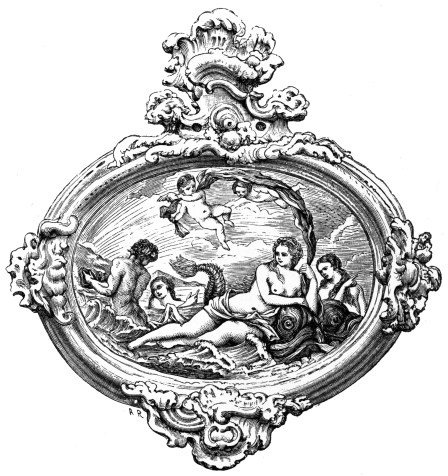
EARTHENWARE PLAQUE, ALCORA WARE. SOUTH KENSINGTON MUSEUM.
Specimens exist of Alcora ware and porcelain at the South Kensington
Museum.
Nos. 1051, 1052-'71. Two fine plaques, painted with mythological
subjects of Pomona and Galatea, the borders raised in form of a frame,
with scroll ornaments [see woodcut of No. 1052].
No. 341-'76. A porcelain cup and saucer, blue ground, gilt; painted with
flowers in white medallions.
No. 333-'76. A plate painted with sprigs, and containing models of fruit
in full relief.
- Dr. Joaquin Joseph de Sayas, 1727.
- Joseph Ollery, 1727 to 1733.
- Manuel de Molina, 1727 to 1735.
- Cayetano Allue, 1727 to 1750.
- Marcial Guirandeta, 1778 to 1783.
- Juan Villalonga, 1789.
- Pierre Cloostermans, 1789.
- Domingo Abadia, 1789.
- Gabriel Berenguer y Cebrian, 1789.
- Josef Ferrer, 1799.
- Josef Delgado, 1800.
- Abella, Francisco, 1750, at Alcora.
- Alvaro, Cristobal, 1750.
- Alvaro, Joseph, paints pottery in 1743, 1750.
- Alvaro, Vicente, el mayor, works at the wheel in 1750.
- Alvaro, Vicente, painted with Knipfer in 1783; he was sent by Count
Aranda in 1784 to Paris to learn the making of porcelain; he returned to
Spain in 1789, and continued to work at Alcora.
- Alvaro, Tiburcio, painted with Knipfer in 1783.
- Andrés, Cristoval, modeller and carver in 1783.
- Andrés, Francisco, modeller in 1783.
- Andrés, Francisco, modeller, 1743 to 1750.
- Andrés, Gabriel, painter, 1743 to 1750.
- Andrés, Gabriel, figures as one of the leading painters in 1794.
- Andrés, Jaime, painter, from 1728 to 1737.
- Andrés, Mariano, paints from 1739 to 1750.
- Andrés, Mariano, works in 1789.
- Andrés, Miguel, painter, 1743 to 1750.
- Aparicio, Manuel, painter, 1750.
- Arqua, Vicente, 1750.
- Aycart, Clemente, sculptor, worked at the porcelain works in 1789.
- Aycart, Roque, worked at the wheel in 1783.
- Aycart, Ventura, worked at the wheel in 1783.
- Bachero, Vicente, painted porcelain in 1789.
- Badenas, Cristoval, painter, 1727 to 1750.
- Badenes, Francisco, establishes with Miguel Badenas pottery works, where
pottery was made in imitation of Alcora: it was put a stop to by
agreement in 1789.
- Badenes, Miguel; see Francisco.
- Beltran, Pedro, retouched painting on porcelain in 1783 to 1789.
- Berenguer, Cristoval, painter, painted from 1727 to 1750.
- Blasco, Bautista, painted from 1727 to 1750.
- Blasco, Francisco, painted from 1731 to 1738.
- Blasco, Joaquin, painted in 1750.
- Blasco, Joseph, modeller, 1731 to 1735; he painted in 1750.
- Blasco, Manuel, painter, 1728 to 1750.
- Blasco, Vicente, painted 1727 to 1750.
- Buxadós, Ildefonso, painted 1727 to 1750.
- Buxadós, Manuel, painted common pottery in 1783.
- Calvo Perales, Joseph, painter from 1727 to 1750.
- Calvo, Manuel, painter of common pottery in 1783.
- Calvo, Ramon, painted common earthenware from 1750 to 1783.
- Campion, Juan, a Frenchman, worked at the wheel in 1743.
- Carnicer, Juan, worked at pipe-clay porcelain in 1789.
- Carnicer, Vicente, modeller from 1783 to 1789.
- Carbonel, Sebastian, a Frenchman; he modelled in 1728.
- Catalá, Cristoval, modelled in 1783.
- Catalá, Juan, 1750.
- Catalá, Manuel, 1750.
- Catalá, Pascual, painter from 1729 to 1750.
- Catalá, Pedro Juan, painted common pottery in 1783.
- Caussada, mayor, Jacinto, painted from 1727 to 1750.
- Caussada, menor, Jacinto, from 1727.
- Caussada, Joseph, a son of Jacinto, painted from 1743 to 1750. He ran
away from the manufactory and went to work at Talavera, and was brought
back to Alcora.
- Caussada, Mariano. It was proposed that he should be turned out of the
manufactory, owing to his having gone over to the works established at
Onda, where he gave them the receipts of the colours and varnishes used
at Alcora; he returned to Alcora in 1789.
- Caveta, Pascual, painter, 1743.
- Chiva, Cristoval de, painted porcelain in 1789.
- Chiva, Joseph, painted from 1727 to 1738.
- Chiva, Manuel, painted in 1789.
- Cloostermans, Pierre, a French artist; he entered the manufactory in
1787, and continued to work there until his death in 1798.
- Cloostermans, a son of Pierre's, was an excellent painter on porcelain
in 1789.
- Corrás, Ignacio, a native of Cataluña, painted from 1727 to 1728.
- Coll, Jaime, a native of Cataluña, painted from 1727 to 1736.
- Cros, Cristoval, painted from May, 1727 to 1743; he was one of the best
artists who painted at Alcora.
- Cros, Manuel, worked at the wheel in 1783.
- Cros, Manuel, 1750.
- Cros, Pascual, painted from 1727 to 1736.
- Cros, menor, Vicente, painted porcelain from 1750 to 1789.
- Cros, Vicente, 1735 to 1750.
- Datos, Gaspar, modeller, 1731 to 1750.
- Datos, Julian, modeller, in 1783.
- Datos, Ramon, painted in 1750.
- Datos, Vicente, 1750.
- Escuder, Vicente, painted with Knipfer from 1783 to 1789.
- Fabra, Francisco, painted from 1730 to 1743.
- Fabra, Vicente, painter, 1727 to 1735.
- Falco, Joseph, painter, 1727 to 1743.
- Falco, Pedro, painter, 1727 to 1735.
- Feliu, Vicente Tomas, painter, from 1727 to 1750.
- Feliu y Thomas, Vicente, painted common pottery in 1783.
- Ferrer, Joaquin, a carver, who worked with Mr. Martin from 1783 to 1789.
- Ferrer, Esteban, painted porcelain in 1789.
- Ferrer y Carnicer, Vicente, worked at the wheel in 1783. In December,
1789, he had an oven on his own account at Alcora, the only one which
remained out of four which had been established four years previously
there.
- Ferrer, menor, Vicente, 1750.
- Ferrer, Vicente, painted from 1727 to 1743.
- Flor, Antonio, painted common pottery from 1750 to 1783.
- Fores, Joseph, painter, 1727.
- Fornench, Joseph, painted in 1739.
- Fornench, Phelipe, painted common pottery in 1783.
- Fornench, Francisco, worked at the wheel in 1783.
- Fornench, Phelipe, painter, 1727 to 1750.
- Fuste, Salvador, painter, 1727.
- Galvez, Juan, modeller, 1731 to 1735.
- Garcés, Joaquin, painter. He worked with Joaquin Ter at the manufactory
which he established at Alcora, and returned to the Counts in 1789.
- Garcés, Francisco, worked at the wheel with Mr. Martin in 1783, and was
considered by Cloostermans, in 1789, his most able workman.
- Garcés, Joseph, painter, 1727.
- Garcés, Pedro, 1743.
- Garcia, Mariano, a native of Valencia. He went to Alcora to try a system
of gilding and purple which he had invented, which produced an
unsatisfactory result.
- Gasch, Agustin, painter from 1728 to 1750, although he was absent from
the works from 1735 to 1741.
- Gasch, Bruno, a son of Juan's, worked at the wheel from 1743 to 1750.
- Gasch, Cristoval, worked with the turners, 1731 to 1741, and joined the
painters until 1750.
- Gasch, Francisco, worked at the wheel from 1729 to 1750.
- Gasch, mayor, Joaquin, worked at the wheel in 1783.
- Gasch, Joseph, painter, 1731 to 1735.
- Gasch, Juan, worked at the wheel from 1728 to 1750.
- Gasch, Manuel, worked at the wheel in 1783.
- Gasch, Miguel, the son of Juan, painted in 1743.
- Gasch, Vicente, 1750.
- Gasch, Correo Vicente, worked at the wheel in 1783.
- Gardo, Juan, painter and modeller, 1731 to 1735.
- Gil, Francisco, modeller, 1783.
- Giner, Manuel, painter, 1727.
- Gomez, Cristoval, painter on common pottery, 1783.
- Gomez, Francisco, modeller, 1731 to 1750.
- Gomez, Vicente, painter, 1750, 1783.
- Gomez, menor, Vicente, worked at the wheel and painted from 1783 to
1789.
- Gorris, Joseph, 1750.
- Granell, Cristoval, painter, 1729, 1750.
- Granell, Joseph, modeller, 1731 to 1735.
- Granell, Vicente, 1731 to 1750.
- Grangel, Francisco, pintor, painted from 1727 to 1783. In 1743 the
finest work was given to him.
- Grangel, Juan, painted from 1727 to 1750.
- Gras, Monsieur, painter, 1728.
- Haly, François, 1751.
- Herrando, Francisco, 1727.
- Herrando, Joseph, painter, 1727 to 1736.
- Herrando, Juan, painted from 1729 to 1735.
- Herrando, Manuel, modeller, 1783.
- Herrando, Pascual, worked at the wheel from 1728 to 1743.
- Herrando, Thadeo, 1750.
- Huguet, Cristobal, worked at the wheel in 1783.
- Huguet, Francisco, worked at the wheel and modelled in porcelain from
1783 to 1789.
- Huguet y Mascarós, Joseph, painter, 1783 to 1794.
- Huguet, Vicente, painter. He worked at the manufactory established by
Joaquin Ten at Alcora, and returned to Count Arandas in 1789, and
continued there in 1794.
- Huguet Serra, Joseph, modeller in 1783.
- Ibañez, Juan, painter from 1727 to 1735.
- Knipfer, Juan, a native of Saxony, 1783.
- Lazaro, Joseph, painter, 1727.
- Lopez, Julian, 1792.
- Llorente, Francisco, 1750.
- Lloscos, Joaquin, painter, 1783.
- Llosca, menor, painter, 1783.
- Malanco, Nicolas, painter, 1727.
- Marin, Pedro, painter, 1727 to 1736.
- Marques, Miguel, painter, 1794.
- Marras, Francisco, painter and modeller in 1727.
- Marsal, Bautista, painter from 1727 to 1743.
- Marsal, Francisco. He worked at Alcora, and left it for the manufactory
of Onda; in 1783 he returned to Count Aranda's works.
- Marti, Miguel, worked at the wheel in 1783.
- Martin, Francisco, modeller in 1783.
- Martir, Pedro, worked at the wheel in 1739.
- Mas, Cristoval, modeller from 1783 to 1789.
- Mas, Francisco, painted common pottery in 1783.
- Mas, Julian, a skilful painter on porcelain in 1789.
- Mas, menor, Manuel, painted common pottery in 1783.
- Mas, Manuel, painted from 1727 to 1750.
- Mas, Pedro, painter in 1743.
- Mascarós, Cristobal, painter from 1728 to 1750.
- Mascarós y Thomas, Cristoval, painted on pottery from 1783 to 1794.
- Mascarós, Francisco, 1743 to 1750.
- Mascarós, Joseph, painted porcelain in 1789.
- Mascarós, José, painter in 1735 to 1736.
- Mascarós, Pedro Martin, painted from 1729 to 1736.
- Mascarós, Vicente, worked at the wheel from 1750 to 1780.
- Masso y Fabra, Vicente, painted in 1727.
- Massó, Joseph, 1750.
- Massó y Fabra, Francisco, painter, 1739, 1750.
- Massó Nadal, Vicente, painter from 1727 to 1750.
- Mallol, Joaquin, modeller, 1783.
- Mallol, Cristoval, modeller in 1783.
- Mallol, Vicente, modeller, 1783.
- Maurisi, Pedro, a Frenchman, began to work in 1728.
- Mezquita y Chiva, Francisco, worked at the wheel in 1783.
- Mezquita, Francisco, painted in 1750.
- Mezquita, Jaime, painter, 1731 to 1750.
- Mezquita, Pascual, painter from 1727 to 1735.
- Miguel, Vicente, 1750.
- Miralles, Vicente, worked in clay from 1731 to 1743.
- Moliner, Cristoval, worked at the wheel in 1783.
- Moliner, Miguel, painted from 1728 to 1750.
- Moliner, Vicente, modeller in 1783.
- Monfort, Agustin, modeller in 1783.
- Monfort, Pablo, modeller in 1783.
- Montemenor, Joseph, modeller in 1783.
- Montolin, Jacinto, painter, from 1731 to 1750.
- Montolin, Juan, painter, the son of Jacinto, from 1735 to 1750.
- Montolin, Juan, varnisher and painter in 1783.
- Montolin, Joseph, painter on porcelain in 1789.
- Montolin, Vicente, painter of common pottery in 1783.
- Montolin, Vicente, painter, from 1727 to 1750.
- Moya, Crisostomo, retouched porcelain in 1789.
- Nadal, Felix, 1727 to 1735.
- Nadal, Juan, master at the wheel, painter and carver from 1727 to 1737.
- Nadal, Miguel, 1783.
- Nadal, Nebot, works from 1743 to 1783.
- Navarro, Cristoval, worked at the wheel in 1783, and painted porcelain
in 1789.
- Nebot, Bautista, painter, 1794.
- Nebot, Cristoval, modeller, 1750.
- Nebot, Cristoval, menor, 1794.
- Nebot, Francisco, 1750.
- Nebot, Francisco, painter in 1794.
- Nebot, Joseph, worked at the wheel from 1728 to 1740.
- Nebot, Joaquin, worked at the wheel in 1794.
- Nebot, Juan, painter, 1750 to 1783.
- Nebot, Miguel, painter, 1783 to 1794.
- Nebot, Narciso, painter, 1794.
- Negre, Deodato, painter, 1727.
- Negre, Francisco, worked at the wheel from 1783 to 1794.
- Negre, Julian, worked at the wheel in 1794.
- Negre, Manuel, modeller, 1783 to 1794.
- Negre, Ramon, painter, 1783 to 1794.
- Negre, Vicente, modeller, 1727.
- Nondedeu, Cristoval, modeller, 1729.
- Nondedeu, Miguel, turner, 1731 to 1743.
- Ochando, Joseph, draughtsman and carver, from 1727 to 1742.
- Olery, Joseph, director of the works from 1735 to 1737. In August, 1729,
he was appointed principal draughtsman.
- Pacor, Bartolomé, painter, 1728 to 1735.
- Palau, Francisco, painter, from 1727 to 1750.
- Palmera, Domingo, master of ornamental art, 1815.
- Pardo, Cristoval, turner, from 1727 to 1750.
- Pardo, Francisco, 1750.
- Pardo, Joseph, turner, from 1731 to 1750.
- Pardo, Vicente, master at the wheel in 1728.
- Pastor Bartolo, Antonio, painter, 1750.
- Pastor Butoni, Antonio, painter, 1750.
- Pastor, Bartolomé, a brother of Vicente's, from 1729 to 1750.
- Pastor, Bautista, varnisher, 1783.
- Pastor, Cristoval, worked at the wheel with Mr. Martin from 1783 to
1789.
- Pastor, Gaspar, 1750.
- Pastor, Joseph, painted in common pottery and porcelain from 1783 to
1789.
- Pastor, Joseph, painter, from 1728 to 1750; his name appears in 1743
among the best artists of Alcora.
- Pastor, Vicente, painter, from 1728 to 1743.
- Pastor, Vicente, painter, was pensioned in Paris by Count Aranda in
1784; he returned to the works in 1789, and continued there for several
years afterwards.
- Peña, Vicente, modeller, 1783.
- Perales, Ramon de, painter, 1750.
- Periz, Joseph, modeller, from 1727 to 1731.
- Periz, Joseph, mayor, painter, from 1750 to 1783.
- Periz, Joseph, menor, modeller, 1783.
- Perpiñan, Cristoval, a son of Vicente, painter, from 1727 to 1740.
- Perpiñan, Vicente, modeller, from 1731 to 1743.
- Pinazo, Andres, draughtsman and carver, 1727.
- Poggetti, Luis, drawing master, 1815.
- Porcar, Cristoval, painter, from 1727 to 1735.
- Porcar, Pascual, modeller, from 1729 to 1735.
- Prast, Antonio, painter of common pottery in 1783.
- Prats, Cristoval, modeller, 1783.
- Prats, Cristoval, turner, from 1731 to 1750.
- Prats, Francisco, modeller, from 1750 to 1783.
- Prats, Fulgencio, painter, 1783.
- Prats, Vicente, painter, from 1750 to 1794. In 1789 he ranked among the
first artists at Alcora.
- Querol, Vicente, 1743.
- Querol, Joseph, a son of Vicente, painter, from 1727 to 1750.
- Querol, Manuel, painter, from 1750 to 1783.
- Rech, Joseph, a native of Cataluña, painter, in 1727.
- Redolat, Joseph, painter on porcelain in 1789.
- Ribot, Joseph, turner, from 1731 to 1735.
- Ricart, Antonio, turner, from 1729 to 1735.
- Ricart, Clemente, modeller, in 1783.
- Ricart, Joaquin, modeller, in 1783.
- Robert, a Frenchman, painted in 1729.
- Rocafort, Cristoval, painted from 1727 to 1750; he was one of the best
artists at the manufactory in 1743.
- Roman, Juan, painted from 1731 to 1735.
- Roman, Manuel, painted from 1735 to 1750.
- Romualdo, Joseph, painter, from 1728 to 1750.
- Roux, Edouard, a French painter, who worked at Alcora, where he had been
brought by Ollery in 1728 until 1735.
- Rules, Joseph de, turner, from 1731 to 1735.
- Saborit, Cristoval, modeller, in 1783.
- Saborit, Cristoval, painted from 1727 to 1736.
- Saborit, Joaquin, painter, 1783.
- Saborit, Joaquin, painted from 1728 to 1750.
- Saborit, Manuel, modeller, in 1783.
- Sagao, Rafael, draughtsman and carver, 1727.
- Salvada, Joseph, 1789.
- Sancho, Joaquin, painted in 1783.
- Serrania, Cristoval, 1750.
- Serrania, Vicente, painted from 1728 to 1743.
- Soliva, Joaquin, painted pottery in 1783, and retouched porcelain in
1789.
- Soliva, Miguel, painted from 1727 to 1750. In 1743 he was considered the
best artist at Alcora.
- Soriano, Joseph, turner from 1731 to 1735.
- Soriano, Nicasio, turner from 1731 to 1735.
- Sorolla, Manuel, worked at the wheel in 1783.
- Tarazona, menor, Cristoval, modeller, 1783.
- Tarazona, Cristoval, painted from 1727 to 1750.
- Tarazona, Ramon, retouched porcelain in 1783.
- Tarragó, Joseph, painter from 1728 to 1735.
- Tarragó, Vicente, painter from 1727 to 1750.
- Ten, Francisco, modeller in 1783.
- Ten, Joaquin, painter from 1732 to 1750. In 1789 he closes the pottery
works which he had established in imitation of those of Alcora.
- Ten, Joseph, 1750.
- Ten, Jaime, painter from 1735 to 1750.
- Terra, Cristobal, modeller, 1783.
- Terra, Vicente, varnisher, 1783.
- Thomas, Antonio, modeller, 1783.
- Thomas, Gaspar, 1750.
- Thomas, Joaquin, modeller in 1783.
- Thomas, José, 1750.
- Thomas, José, worked at the wheel in 1783.
- Thomas, Juan, 1743, 1750.
- Thomas, Mateo, 1750.
- Thomas Feliu, Vicente, painter from 1729 to 1740.
- Thomas, Vicente, 1783.
- Torres, Cristoval, painter from 1728 to 1750.
- Torres, Juan, from 1731 to 1735.
- Vadenes, Cristobal, 1770.
- Valentin, Pedro, painter from 1727 to 1743.
- Vilar, Cristobal, painter from 1727 to 1750.
- Vilar, Cristobal, sculptor, works in porcelain in 1789.
- Vilar, Francisco, 1750.
- Vilar, Joseph, modeller in 1783.
- Vilar, Miguel, painter from 1727 to 1743.
- Vilar, Pedro, worked in the ovens from 1735 to 1750.
- Vilar, Ramon, retouched porcelain in 1789.
- Vilar y Bordoñan, Cristobal, modeller in 1783.
- Vilar y Bordoñan, Mariano, worked at pipe-clay porcelain in 1789.
- Vilar Perpiñan, Cristobal, painted from 1739 to 1743.
- Vilar Ricart, Cristobal, painter from 1727 to 1735.
- Vilar Porcar, Cristobal, painter, 1727.
- Vilar Ricart, Joseph, painter from January, 1731, to 1735.
- Vilar Porcar, Joaquin, painter from 1727 to 1735.
- Vilar Saboret, Joaquin, painter in 1729.
- Yguet, Vicente, painted common pottery in 1783.
- Zaragoza, Friar, worker in porcelain, 1799.
From 1727 to 1784 no special mark was used at Alcora. In several
instances specimens were signed with the painter's name or initials.
In order to distinguish the qualities or sizes, coloured numbers were
frequently added.
From 1784 the letter A in gold or colours was used to mark the pottery
and porcelain made at Alcora.
The following marks were used after 1784. The a underlined, A,
sometimes in blue.
A number and letter, No. 4 A, G 8; No. 3 P. In 1799 the pottery made by
Friar Joseph de Zaragoza was marked M. O. X.
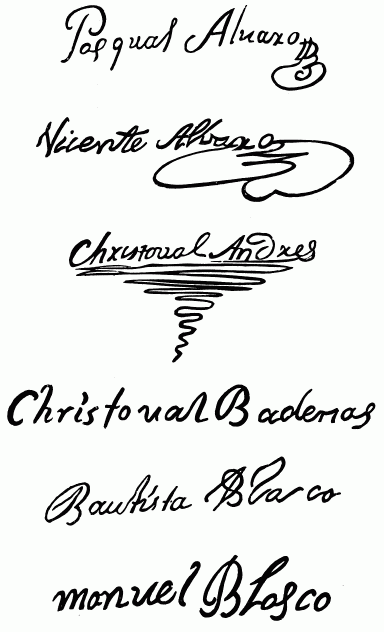
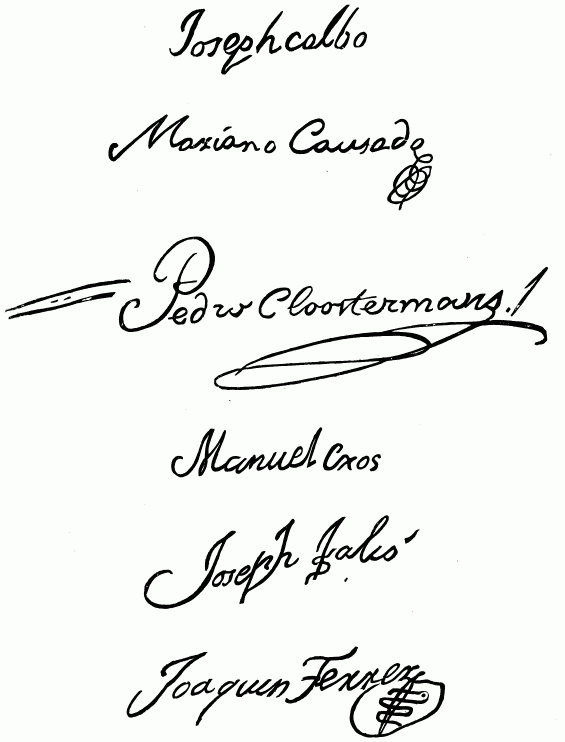
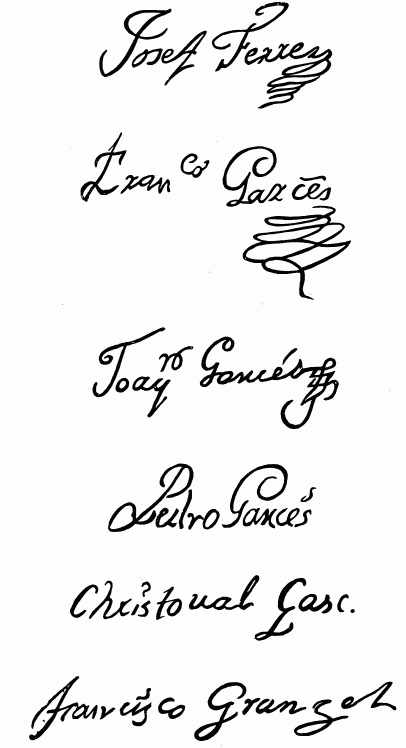
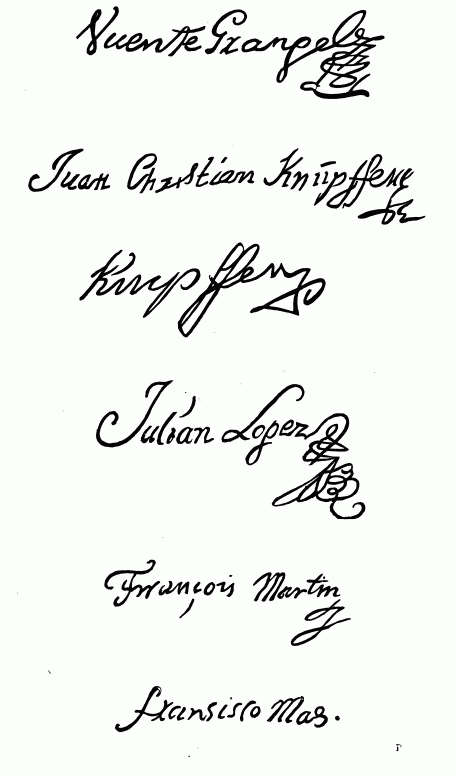
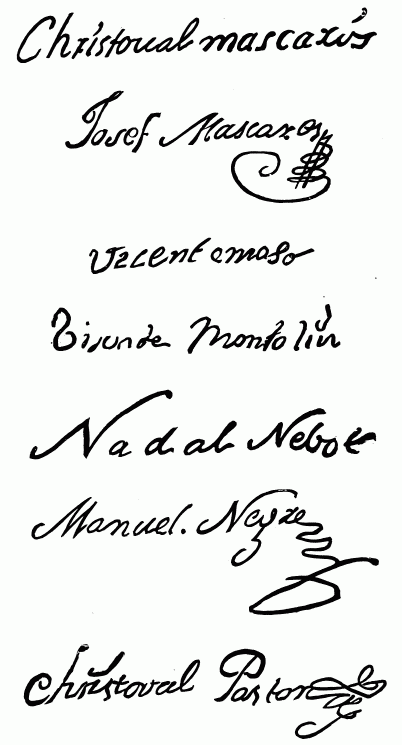
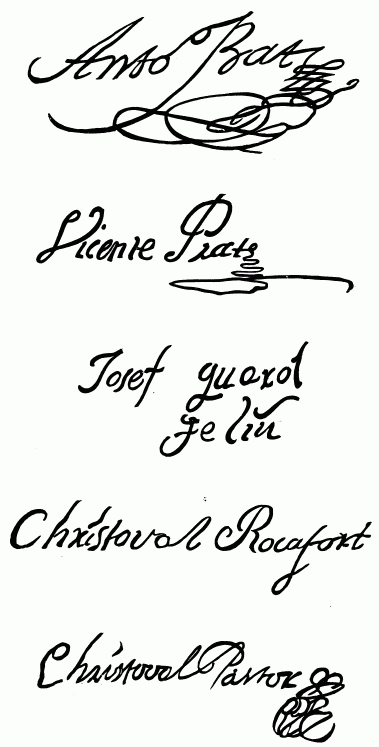
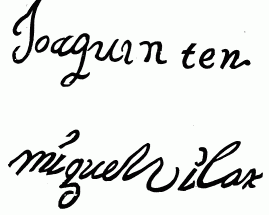
In 1759 King Charles III. came from Naples, having inherited the Spanish
crown on the death of his brother Ferdinand VI. Soon after his arrival
he determined to establish a porcelain manufactory at Madrid in the same
style as one which in 1736 he had founded at Naples. The documents which
exist relating to this manufactory at the archives of the Royal Palace,
Madrid, Alcala, Ministry of Finance, etc., state that before the King
left Naples, he ordered the following letter to be written to the
Secretary of State, Richard Wall, on September 11, 1759: "Likewise the
workmen and utensils used at the royal manufactory of porcelain of Capo
di Monte must be embarked from Naples to Alicant, in the vessels
prepared for that purpose, in order to continue from there the journey
to Madrid. The necessary conveyances are to be provided, and the
expenses to be charged to his Majesty's account."
Charles III. landed at Barcelona on the 17th of October, 1759, and we
find a letter written by order of the King, by the Marquis of Esquilace
to Secretary Wall, in November of the same year, in which he says that
the King had heard of the arrival in Spain of the workmen from Capo di
Monte, and gives orders that money should be supplied to the Director,
Don Juan Thomas Bonicelli. Wall answers that he "will give orders and
help the workmen who are to establish the manufactory, and let them have
every facility to examine different sorts of earths and localities which
may suit them, and that the Director, Bonicelli, should have the money
he might require."
It appears also that 300 gold ducats were given to Giuseppe Gricci,
"modeller," in absence of Bonicelli. The King ordered Wall to be
informed that he understood that a place had been found near Madrid to
establish these works, and that he was anxious to see a plan of the
exact locality. Giuseppe Gricci drew the plan of the spot chosen, and
was paid 100 gold doubloons for works connected with the manufactory.
Bonicelli sends the following list of workmen who had arrived from
Naples to the King.
| Cayetano Schepers, | chief composer. |
| Pablo Forni. | |
| Joseph Gricci, | principal modeller. |
| Carlos Gricci. | |
| Esteban Gricci, | modeller. |
| Cayetano Fumo, | " |
| Basilio Fumo, | " |
| Joseph Fumo, | " |
| Carlos Fumo, | " |
| Macedonio Fumo, | " |
| Joseph Santorum, | " |
| Juan Bescia, | " |
| Bautista de Bautista, | " |
| Antonio Morelly, | " |
| Salvador Nofri, | " |
| Phelipe Esplores, | " |
| Ambrosio de Giorgi, | " |
| Pedro Antonio de Giorgi, | " |
| Pablo Frate, | " |
| Workmen employed in the Kilns. |
Jenaro Bonincosa.
Nicolas Rocio.
Pasqual Rocco.
Juan Frate.
Baldo de Beneditis. |
Vincenzio Frate.
Matheo Mayni.
Giorchino Amable.
Joseph Esclavo.
Antonio Aquaviva Esclavo. |
| Workmen who Pounded the Colours. |
Francisco Conte.
Nicolas Conte.
Angelo Lionelli. |
Joseph Caramello.
Joachim Pataroti,
carver in pietri dure. |
| Workmen employed at the Wheel. |
Joseph Grossi.
Nicolas Botino. |
Juan Remini, gold beater.
Pedro Chevalier, mounter. |
| Painters. |
José de la Torre.
Juan Bautista de la Torre.
Nicolas de la Torre.
Fernando Sorrentini.
Mariano Nani.
Jenaro Boltri.
Nicolas Donadio. |
Antonio Provinciale.
Joseph del Coco.
Carlos Remissi.
Francesco Simini.
Xavier Brancacio.
Joseph Esclavo.
Francisco Esclavo. |
On the 19th of December, 1759, Don Carlos de Borbon, the King's
architect, presented him with the plans of the porcelain manufactory.
The spot selected was inside the gardens of the Royal Palace of Buen
Retiro. Ponz tells us in his "Viage," Vol. VI. p. 108, that the building
was large and of regular architecture. We know it cost 179,130 reals.
Don Carlos de Borbon was a black slave who had been captured with other
blacks during the reign of Ferdinand VI. The Queen-mother sent them to
Naples, and Charles III. gave them an artistic education.
Don Carlos Antonio became the King's architect. On the 22nd of May,
1760, the building was finished, the money then spent amounted to
upwards of 145,000 reals, and Larruga tells us, in his Memorias, "The
King spent in establishing this manufactory £115,000, with a yearly cost
to keep it up of £20,000."
William Clarke, in his "Letters concerning the Spanish Nation during the
years 1760-1761," London, 1763, says, p. 262: "At Madrid is lately set
up a manufacture of porcelain in the gardens of the King's palace at the
Retiro, wrought by artificers brought from Saxony." Documents exist
proving that in 1760-1761, they were already working there. Townsend, in
his "Journey through Spain in 1786 and 1787," London, 1792, says, Vol.
II., p. 278:—
"I tried to obtain admission to the china manufacture, which is likewise
administered on the King's account, but His Majesty's injunctions are so
severe that I could neither get introduced to see it, nor meet with any
one who had ever been able to procure that favour for himself. I was the
less mortified upon this occasion because, from the specimens which I
have seen, both in the palace at Madrid, and in the provinces, it
resembles the manufacture of Sèvres which I had formerly visited in a
tour through France."
In the "Nouveau voyage en Espagne, ou Tableau de l'état actuel de cette
monarchie," Paris, 1789, Vol. I. p. 233, the author tells us, how "Le
monarque actuel à établi dans leur interieur une fabrique de porcelaine,
dont l'entrée est jusquà present interdite à tout le monde. On veut sans
doute que ses essais se perfectionment dans le silence, avant de les
exposer aux yeux des curieux. Ses productions ne peuvent encore se voir
que dans les Palais des Souverains, ou dans quelques Cours d'Italie,
auxquelles il les envoie en presens."
We find in a "Nouveau voyage en Espagne," Paris, 1805, p. 34, in
describing this porcelain manufactory that the author says; "Cet
établissement tres couteux ne travaille que pour le Roi et a son compte;
il en sort des vases d'une beaute et d'un fini qui ne le cedent point à
ceux de Sèvres."
Citoyen Alquier, in 1800, the envoy of the French Republic, was allowed
to visit the manufactory.
We do not know the precise date when porcelain began to be manufactured
at the Retiro. Clarke, writing in 1761, says the works had begun, and in
1764 pupils attended the classes at the Academy of Sn Fernando.
Larruga, in his "Memorias," says that as soon as the building was
finished, china was made under the superintendence of Don Cayetano
Schepers; the works, during his superintendence, proved very
unsatisfactory, to his great astonishment, as the same process and
workmen were employed as at Naples. Schepers attributes it to squabbles
between the Spanish and Italian workmen. Sebastian Schepers, from 1783,
a son of Cayetano's, tried various experiments with different clays of
the country.
The porcelain made at Buen Retiro was kept for the first thirty years
for the exclusive use of the royal family, or to be sent as presents to
foreign courts. Nothing was offered for sale until January, 1789, after
Charles III.'s death, 1788, when Charles IV. determined that the china
manufactured at Buen Retiro might be sold. Even in Spain the specimens
of this china are very scarce; it is only at the palaces of Madrid,
Aranjuez, the Escorial and La Granja that an idea can be formed of the
perfection of this manufacture.
The director at that time was Don Domingo Bonicelli, a son of Don Juan
Bonicelli. Don Domingo chose a room within the Retiro, which was
arranged at a cost of £350, in which to exhibit the objects for sale.
Another room was taken in the Calle del Turco, which is mentioned in
"Noticias varias y curiosas de Madrid," Valero Chicarro, 1762-1793,
which we find was closed in 1800, as the "objects manufactured at the
Retiro were simply for ornament, and could only be bought by very rich
persons." Southey in his "Letters from Spain," London, 1797, p. 118,
says, "The old palace of Buen Retiro is converted into a royal porcelain
manufactory; the prices are extravagantly high, but they have arrived at
great excellence in the manufacture. The false taste of the people is
displayed in all the vases I saw there, which though made from Roman
models, are all terminated by porcelain flowers."
Every kind of porcelain was made at Buen Retiro, hard and soft paste,
white china, glazed or unglazed, or painted and modelled in the style of
Capo di Monte. A great many existed imitating the blue jasper ware of
Wedgwood, and they also made flowers, coloured and biscuit, groups, and
single figures, and painted porcelain of different kinds. Great
quantities of tiles for pavements were also made there, which may still
be seen at the Casa del Labrador at Aranjuez; they are mentioned in the
accounts which exist at the Ministry of Finance for 1807 and 1808. We
find in these same accounts interesting details of the objects made
monthly. In January, 1808, a large number of figures were made,
including 151 heads for the table centre which was made for the king,
306 objects ornamented with paintings, 2,056 tiles, 577 objects of less
artistic importance, such as dishes, plates, etc. The finest specimens
which exist are in the Neapolitan style, and are two rooms at the
Palaces of Madrid and Aranjuez of which the walls are completely covered
with china plaques and looking-glasses, modelled in the most admirable
manner with figures, fruits, and flowers. The room at Aranjuez is
covered with a bold ornamentation of figures in the Japanese style, in
high relief, painted with colours and gold with the most exquisite
details. The figures unite the fine Italian modelling with the Japanese
decoration. The chandelier is in the same style. Upon a vase on the
wainscot to the right of the entrance door is the following inscription:
JOSEPH
GRICCI
DELINEAVit
ET
SCULit
1763.
This same date is repeated in the angles, and in some shields near the
roof we find,
AÑO
1765;
probably the year the work was terminated. Antonio Conca, in his
"Descrizione Odeporica della Spagna in cui spezialmente si da notizia
delle cose spettanti alle Belle Arti," Parma, 1793, Vol. III., p. 310,
says, "Il Gabineto abbelitto di porcellana della Fabbricca del Retiro ha
meritato le bodi de curiozi viaggiatori." We also find in p. 119, "Un
altro Gabinetto vien chiamato della Cina pel sud principal ornata di bei
putti, di bassi relievi, e di altre opere di porcellana della nuova Real
Fabbricca del Ritiro." Ponz, in his "Viage de España," Madrid, 1782,
describes the room at the Palace of Madrid, saying, "it is covered with
large plaques of porcelain made at Buen Retiro. In some are represented
figures of children copied from models, and between each compartment
looking-glasses are let in." (See woodcut.)
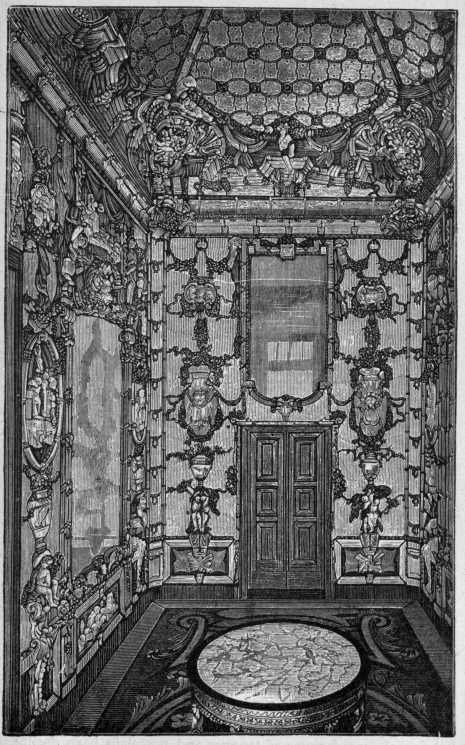
ROOM DECORATED WITH BUEN RETIRO PORCELAIN, IN THE PALACE AT MADRID.
From the establishment of the manufactory in 1759 by Charles III.
until 1803 the styles adopted at Capo di Monte had been followed. At the
beginning of this century Dn. Bartolomé Sureda went to Paris to learn
the manner in which Sèvres porcelain was made. On his return in 1803 he
was appointed director of the works at Buen Retiro and endeavoured to
imitate the paste and brilliancy of decoration of Sèvres. Two workmen
came over from Paris—Victor Perche, and Vivien.
Among the finest specimens of this period of the manufactory are a
splendid clock and four vases, two mètres high, with porcelain flowers,
which exist in one of the state rooms of the Palace of Madrid. The vases
are placed in the four corners of the room. The clock is ornamented with
large biscuit figures. A large number of vases exist at the royal
Palaces of Madrid, Aranjuez, and Escorial, of Retiro china. They are
often finely mounted in gilt bronze with muslin or porcelain flowers.
The blue of the imitations of Wedgwood is not so pure, nor is the
biscuit work so fine as the English. Gold is often added to these
specimens.
We find at the archives of the Ministry of Finance interesting details
of a dinner service made in 1798 for Charles IV., and a centre-piece,
which probably is that now in the Casa del Labrador at Aranjuez.
When the French made their entry into Madrid in the spring of 1808 they
took possession of the position occupied by the royal manufactory. In
July of the same year it continued in the hands of the French, who
forced open the doors of the laboratory. Porcelain continued, however,
to be made there during the reign of Joseph I.; we find in "Travels
through Spain and part of Portugal," London, 1808, p. 23, that, the
author says, "the gardens of the Buen Retiro are open to the public. In
the neighbourhood of these the royal porcelain manufacture is carried on
in a large white building." Lord Blayney, in his "Narrative of a Journey
through Spain and France in 1810-1814," London, 1814, says that "the
royal manufactures of tapestry and porcelain have declined since the
death of Charles III. and have now entirely ceased."
We find in "Paseos por Madrid," Madrid, 1815-8, p. 87, it stated that
"The English, at the second entry of our troops in Madrid, ruined this
building in order that it should not be used as a fortress by the French
troops."
Richard Ford, in his "Handbook for Travellers in Spain," London, 1845,
says, "Everything was destroyed by the invaders, who turned the
manufactory into a fortification, which surrendered with 200 cannon,
Aug. 14th, 1812, to the Duke of Wellington. Ferdinand VII., on his
restoration, re-created La China, removing the workshops and ware rooms
to the Moneloa."
The South Kensington Museum contains an interesting collection of Buen
Retiro porcelain of different kinds, of which may be named:
No. 344-'66. A vase of biscuit porcelain, two-handled, with frieze of
classic dancing figures and flowers.
Nos. 333, 4-'66. Two small vases for tea, white porcelain, covered with
flowers in relief.
No. 892-'75. A pair of vases painted with young bacchanals in rose
camaïeu, and gilt.
No. 893-'75. A pair of draped female figures, each holding a cornucopia,
standing on an altar-shaped plinth.
No. 894-'75. A clock case, white porcelain, of rock and scroll work,
with flowers and groups of amorini.
No. 332-'76. A group of Ariadne and the panther.
No. 1068-'73. A pair of tall vases, with gilt serpent handles, the necks
fluted with gold, the upper part of the body painted with classic
groups, and with coloured scroll foliage in relief, the lower part
painted with leaves and scrolls on white ground. (See woodcut on next
page.)
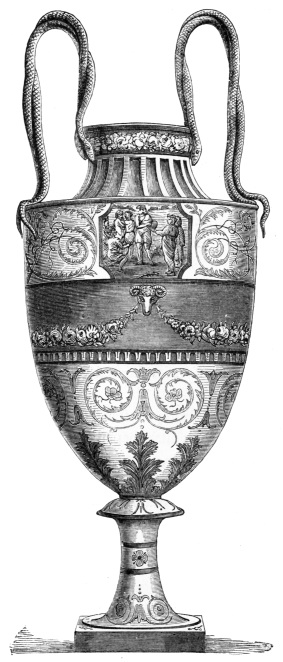
BUEN RETIRO VASE. SOUTH KENSINGTON MUSEUM.

The usual mark in blue.

In blue, and sometimes in violet and gold.
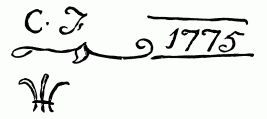
Cayetano or Carlos Fumo. The initials and date are graved in the clay
under the glaze; the fleur-de-lis is pencilled in blue. On a fine group
of children playing with a goat.
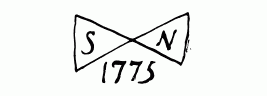
This mark is graved in the clay, under the glaze, on a fine group
modelled by Salvador Nofri.

Ochogavia? graved in the soft clay on a figure.
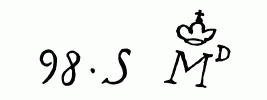
1798, Sorrentini? These marks are pencilled in red on a pink cup and
saucer, with landscapes painted
en grisaille.
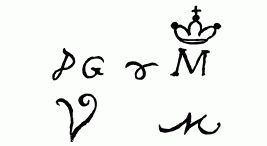
Pedro Antonio Georgi? The initials P. G. are gilt; the M crowned in red;
the V and M graved in the clay; on a cup and saucer buff coloured.

Provinciale? The letters Po are graved in the clay, the fleur-de-lis in
blue; on two saucers, beautifully painted with children.

Probably the initial of the king. On two jardinières; the interlaced C's
graved in the clay, the fleur-de-lis in blue.
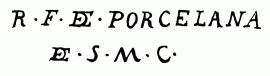
On two large vases imitating Wedgwood's blue and white jasper, with
white biscuit flowers.

On a group of biscuit Retiro porcelain of two figures representing
Painting. The same mark appears on a figure of Apollo, about one foot
high. This mark is stamped on the porcelain; the letters are in relief
tinted rose colour.
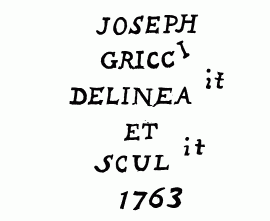
At the room decorated with Buen Retiro plaques at Aranjuez. It appears
on a vase in relief, which is placed on the basement to the right on
entering. The date 1765 appears on the ceiling, probably the year when
the work was finished.
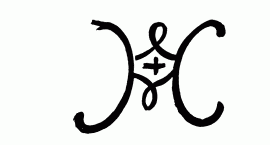
Graven on the clay on a white soft paste bracket painted with coloured
flowers belonging to Count Valencia de D
n Juan.
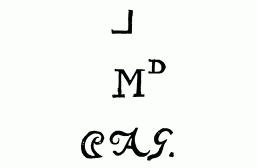
On a cup at the Museo Arqueologico, Mad., painted with landscapes. The
initials are of Pedro Antonio Giorgi, who painted from 1802 to 1808.
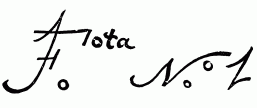
Engraved on the clay on a plaque of blue biscuit porcelain imitating
Wedgwood jasper ware, representing a mythological subject.
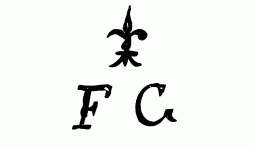
On a dessert plate representing a vine leaf at the Museo Arqueologico.
The initials appear to be those of Felipe Gricci, a son of the first
modeller José, who came with Charles III. from Naples.
Fleur-de-lis graven in the clay on a fine group of three figures.
- Bonicelli, Juan Thomas, principal Director at the establishment of the manufactory in 1759.
- Bonicelli, Domingo. In 1786 he was Director; in 1796 he solicits his retirement, and died soon after.
- Cristobal de Torrijos, appointed Director in 1797, after the death of Don Domingo Bonicelli.
- Sureda, Bartolomé, Director in 1804, and continues in 1808.
- Schepers, Cayetano, first Modeller in 1759.
- Gricci, Carlos, son of Joseph Gricci, came to Spain, 1759. He appears in a list of artists employed in 1764: he died 1795.
- Gricci, Felipe, 1785. In 1802 he was first Modeller.
- Forni, Antonio, second Modeller in 1802.
- Agreda, Esteban, born at Logroño, 1759. He obtained several prizes at the Academy of San Fernando; employed in 1797, and continued to work there in 1808.
- Avila, Ceferino de, employed 1799, and continued there in 1808.
- Avila, Juan de, 1771, and continued there in 1808.
- Bautista, Bautista de, 1759.
- Bautista, Cayetano, 1785.
- Bautista, Juan Lopez, employed from 1799 to 1808.
- Benedictis, Cayetano, 1785, 1802.
- Benincasa, Miguel, 1778, and continues to work in 1808.
- Benincasa, Vicente, 1785.
- Bergaz, Alonso, 1764.
- Bescia, Juan, 1759.
- Borbon, Geronimo, 1802
- Borbon, Genaro, 1784 and 1808.
- Caravielo, Miguel, 1785.
- Chaves, Alonso, born at Madrid in 1741. In 1760 was appointed Modeller, and in 1763 obtained a Second Prize at the Academy, and a First Prize in 1766.
- Chaves, Justo, 1785.
- Esplores, Felipe, 1759.
- Estebe, Antonio, 1778 and 1808.
- Flores, Josef, 1785.
- Forni, Pablo, 1759.
- Francholy, Angel, 1776 to 1808.
- Francholy, José, 1804 to 1808.
- Francholy, Luis, 1785.
- Frate, Carlos, 1785 to 1802.
- Frate, Josef, 1785.
- Frates, Juan, 1794 to 1808.
- Frate, Pablo, from 1759 to 1785.
- Frates, Mateo, 1797 to 1808.
- Frates, Mateo, born at Madrid in 1788. First Prize of the Academy in 1805; in 1829 was appointed Director of the China establishment at the Moncloa.
- Frates, Francisco, 1764 to 1808.
- Fumo, Basilio, in 1759 was Director of the China manufactory; in 1779 he was appointed a Member of the Academy of San Fernando; died in 1797.
- Fumo, Carlos, 1759.
- Fumo, Cayetano, 1759.
- Fumo, Joseph, 1759; died in 1799.
- Fumo, Macedonio, 1759, and continues in 1802.
- Fumo, Bernabé, 1802.
- Giorgi, Pedro Antonio de, 1759, and continues in 1785.
- Giorgi, Carlos, 1785 to 1808.
- Giorgi, Ambrosio de, 1759.
- Giorgi, Antonio, 1795 to 1808.
- Gricchi, Joseph, 1759. In 1766 was appointed Honorary Director of the
- Academy of San Fernando; died in 1769.
- Gricci, Esteban, 1759.
- Guijarro, Dionisio, 1798 to 1808.
- Llorente, Manuel, 1764 to 1785.
- Morelly, Antonio, 1759 to 1785.
- Nofri, Salvador, 1759 to 1785.
- Nofri, Justo, 1778 to 1808.
- Nofri, or Noferi, Juan, 1802.
- Ochogavia, Manuel, 1764. Born in Galicia in 1744; in 1760 won a Second Prize of Sculpture at the Academy, and in 1763 a First Prize.
- Palmerani, Domingo, 1795, 1808.
- Palmerani, Angel, 1799 to 1808.
- Penaba, Joseph, 1793 to 1808.
- Rodriguez, Antonio, 1797 to 1808.
- Sancho, Dionisio, 1788. Born at Cienpozuelos in 1762; won a Prize at the Academy in 1793; was appointed a Member of the Academy, 1796; in 1810 he went to Mexico, where he died, 1829.
- Santorum, Joseph, 1759.
- Sorrentini, Fernando, 1785 to 1808.
- Sorrentini, Rafael, 1785.
- Sorrentini, Francisco, 1802.
- Valentin, José, 1779 to 1808.
- Valentin, Miguel, 1785.
- Alonso, Francisco, 1764.
- Boltri, Genaro, 1756. Born in Naples in 1730; in 1759 he came to Madrid with Charles III.'s household, and worked at the Retiro; died in Madrid in 1788.
- Brancasio, Xavier, 1759.
- Brancacho, Domingo, 1762 to 1803.
- Branga, Ignacio de, 1800, painter of figures; he continues there in 1808.
- Camaron, Josef, 1802. Born at Segorbe in 1760; in 1776 he won a prize of painting at Valencia; he was pensioned to Rome, and appointed Painter in Ordinary to the King.
- Castillo, Fernando del, born at Madrid in 1740. He was appointed Painter at the manufactory, and worked there until his death in 1777.
- Coco, Joseph del, 1759.
- Cruz, Mariano de la, 1807, 1808.
- Domeu, Carlos, 1785.
- Donadio, Nicolas, 1759.
- Giorgi, Pedro Antonio, 1802.
- Martinez, Antonio, 1764.
- Martinez, Pedro, 1796 to 1808.
- Nani, Mariano, 1759. His wife received a pension from 1804, probably the year of his death.
- Peshorn, Jorge, 1788, and continues working in 1802.
- Provinciale, Antonio, 1759 and 1785.
- Quirós, Juan José, 1802.
- Rimini, Carlos, 1759.
- Romero, Juan Bautista, 1800. Flowers and fruit; appears in lists of 1802.
- Rubio, Joseph, 1799 to 1808.
- Semini, Francisco, 1759.
- Soriano, Joaquin, 1799. Landscape painter in 1800; continues in 1808.
- Sorrentini, Josef, 1756, probably from Capo di Monte. In 1802 he asks for a retiring pension.
- Sorrentini, Fernando, 1759.
- Sorrentini, Pablo, 1764 to 1808.
- Sorrentini, Gabriel, 1769 to 1808.
- Sorrentini, Manuel, 1785 to 1802.
- Torre, Joseph de la, 1759.
- Torre, Nicolas de la, 1759. In 1802 asks for a retiring pension.
- Torre, Raphael de la, 1759.
- Torre, Juan Bautista de la, 1759 and 1808.
- Torre, Josef de la, 1785 and 1802.
- Torre, Francisco de la, 1796 to 1808.
- Torre, Julian de la, 1802.
- Velasquez, Castor, 1807, and continued in 1808. Born in Madrid in 1768 and obtained a prize at the Academy in 1787.
- Agreda, Manuel, Sculptor, a brother of Esteban Agreda; he superintended the making of biscuit china; born at Haro in 1773; won prizes at the Academy; and was employed at the Manufactory from 1805 to 1808.
- Bautista, Juan, employed to make porcelain flowers from 1785 to 1808.
- Bautista, Francisco, appears in 1802 as maker of porcelain flowers.
- Bautista, Sebastian, appears in 1802 as a maker of porcelain flowers.
- Chevalier, Pedro, mounter of snuff-boxes from 1759, and continued to work at the Manufactory in 1763.
- Escalera, Josef, mounter of snuff-boxes from 1781, and continued to work at the Manufactory in 1808.
- Perche, Jaime Victor, French workman brought from Paris to prepare porcelain, from 1803 to 1809.
- Vivien, French workman, brought from Paris to prepare porcelain, from 1803 to 1809.
At the same time that porcelain was made at Retiro and Alcora, other
manufactories of a similar kind were established in Spain; but none of
them could compete with these. The most important was established at
Sargadelos, Galicia, in 1804. One of the finest specimens which have
reached us of this manufactory is a large bas relief representing the
massacres of the Spaniards by the French in Madrid on the 2nd of May,
1808.



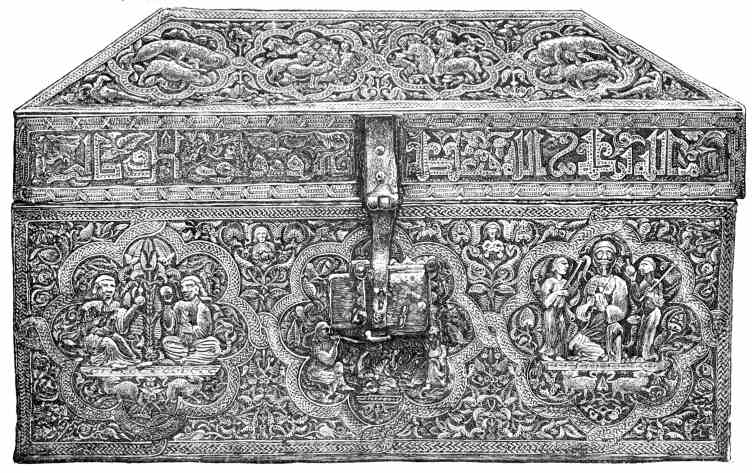


![[Medium amplification]](images/ill_pg_131_med.jpg)
![[Largest amplification]](images/ill_pg_131_lg.jpg)
![[Medium amplification]](images/ill_pg_152_med.jpg)
![[Largest amplification]](images/ill_pg_152_lg.jpg)
![[Medium amplification]](images/ill_pg_159_med.jpg)
![[Largest amplification]](images/ill_pg_159_lg.jpg)
![[Medium amplification]](images/ill_pg_160_med.jpg)
![[Largest amplification]](images/ill_pg_160_lg.jpg)
![[Medium amplification]](images/ill_pg_161_med.jpg)
![[Largest amplification]](images/ill_pg_161_lg.jpg)
![[Medium amplification]](images/ill_pg_267_med.jpg)
![[Largest amplification]](images/ill_pg_267_lg.jpg)