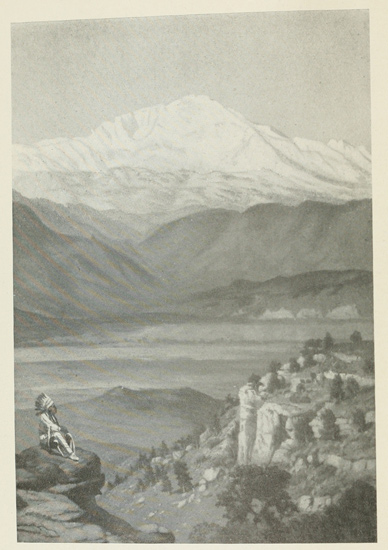
The principal Indian trail into the mountains
from the plains to the northeast of Pike's Peak
came in by way of the Garden Ranch, through
what used to be known as Templeton's Gap. It
crossed Monument Creek about a mile above Colorado
Springs, then followed up a ridge to the
Mesa; then it went southwest over the Mesa and
across Camp Creek, passing just south of the Garden
of the Gods; from there it came down to the
Fountain, about a mile west of Colorado City, and
there joined another trail that came from the
southeast up the east side of Fountain Creek.
The latter trail followed the east side of the
Fountain from the Arkansas River, and crossed
Monument Creek just below the present Artificial
Ice Plant in Colorado Springs, from which point
it ran along the north side of the Fountain to a
point just west of Colorado City, where it crossed
to the south side, then up the south side of the
creek to the Manitou Springs. From this place it
went up Ruxton Creek for a few hundred yards,
then crossed over to the west side, then up the
creek to a point just below the Colorado Midland
Railway bridge; thence westward up a long ravine
to its head; then in the same direction near the
heads of the ravines running into the Fountain and
from a quarter to a half of a mile south of that
creek for two miles or more. The trail finally came
down to the Fountain again just below Cascade
Cañon and from there led up the Fountain to its
head, where it branched off in various directions.
The trail I have described from Manitou to
Cascade Cañon is the famous old Ute Pass trail
which undoubtedly had been used by various tribes
of Indians for hundreds of years before the discovery
of America. We know it was used later
for many generations by the Spanish explorer,
the hunter, the trapper, and the Indian until the
white settler came, and even after that by occasional
war-parties, up to the time the Indians
were driven from the State of Colorado. Marble
markers were placed at intervals along this trail
by the El Paso County Pioneer Society in the
summer of 1912. This trail and those leading
into it from the plains were well-traveled roads
and gave indication of long and frequent use.
Dr. Edwin James, botanist and historian of
Long's expedition, who visited the Pike's Peak
region in 1820, says:
A large and much frequented road passes the springs
and enters the mountains running to the north of the
high peak.
He says of the principal spring at Manitou:
The boiling spring is a large and beautiful fountain
of water, cool and transparent and aërated with carbonic
acid. It rises on the brink of a small stream
which here descends from the mountains at the point
where the bed of this stream divides the ridge of sandstone,
which rests against the base of the first granitic
range. The water of the spring deposits a copious
concretion of carbonate of lime, which has accumulated
on every side, until it has formed a large basin overhanging
the stream, above which it rises several feet.
The basin is of snowy whiteness and large enough to
contain three or four hundred gallons, and is constantly
overflowing. The spring rises from the bottom
of the basin with a rumbling noise, discharging about
equal volumes of air and of water, probably about
fifty gallons per minute, the whole kept in constant
agitation. The water is beautifully transparent, has
a sparkling appearance, the grateful taste and exhilarating
effect of the most highly aërated artificial
mineral water.
In the bottom of the spring a great number of beads
and other small articles of Indian adornment were
found, having unquestionably been left there as a
sacrifice or present to the springs, which are regarded
with a sort of veneration by the savages. Bijeau,
our guide, assured us he had repeatedly taken beads
and other adornments from these springs and sold
them to the same savages who had thrown them in.
Mr. Rufus B. Sage, who describes himself as a
New Englander, after passing through this region
in 1842, published a book giving his experiences
and observations. In speaking of the Fontaine
qui Bouille Creek, now known as the Fountain
and of the Manitou Springs, he says:
This name is derived from two singular springs
situated within a few yards of each other at the
creek's head, both of which emit water in the
form of vapor, with a hissing noise; one strongly
impregnated with sulphur and the other with soda.
The soda water is fully as good as any manufactured
for special use and sparkles and foams with equal
effervescence. The Arapahoes regard this phenomenon
with awe, and venerate it as the manifestation
of the immediate presence of the Great Spirit. They
call it the "Medicine Fountain" and seldom neglect
to bestow their gifts upon it whenever an opportunity
is presented. These offerings usually consist of robes,
blankets, arrows, bows, knives, beads, moccasins, etc.,
which they either throw into the water, or hang upon
the surrounding trees.
Sometimes a whole village will visit the place for
the purpose of paying their united regard to this
sacred fountain.
The scenery in the vicinity is truly magnificent.
A valley several hundred yards in width heads at the
springs, and overlooking it from the west in almost
perpendicular ascent tower the lofty summits of
Pike's Peak, piercing the clouds and reveling in
eternal snow. This valley opens eastward and is
walled in at the right and left at the mountain's base
by a stretch of high table-land surmounted by oaks
and stately pines, with now and then an interval displaying
a luxuriant coating of grass. The soil is a
reddish loam and very rich. The trees, which skirt
the creek as it traces its way from the fountain, are
generally free from underbrush, and show almost as
much regularity of position as if planted by the hand
of art. A lusty growth of vegetation is sustained
among them to their very trunks, which is garnished
by wild flowers during the summer months, that invest
the whole scene with an enchantment peculiar to itself.
The climate, too, is far milder in this than in
adjoining regions, even of a more southern latitude.
"'Tis here summer first unfolds her robes, and here the
longest tarries"; the grass, continuing green the entire
winter, here first feels the genial touch of spring.
Snow seldom remains upon the ground to exceed
a single day, even in the severest weather, while the
neighboring hills and prairies present their white
mantlings for weeks in succession.
As the creek emerges from the mountains, it increases
in size by the accession of several tributaries,
and the valley also expands, retaining for a considerable
distance the distinguishing traces above
described.
The vicinity affords an abundance of game, among
which are deer, sheep, bear, antelope, elk, and buffalo,
together with turkeys, geese, ducks, grouse, mountain
fowls, and rabbits. Affording as it does such magnificent
and delightful scenery, such rich stores for the
supply of human wants both to please the taste and
enrapture the heart; so heavenlike in its appearance
and character, it is no wonder the untaught savage
reveres it as a place wherein the Good Spirit delights
to dwell, and hastens with his free-will offerings to the
strange fountain, in the full belief that its bubbling
waters are the more immediate impersonation of Him
whom he adores.
And there are other scenes adjoining this that
demand a passing notice. A few miles from the
springs, and running parallel with the eastern base
of the mountain range, several hundred yards removed
from it, a wall of coarse, red granite towers to a varied
height of from fifty to three hundred feet. This wall
is formed of an immense strata planted vertically.
This mural tier is isolated and occupies its prairie
site in silent majesty, as if to guard the approach to
the stupendous monuments of Nature's handiwork,
that form the background, disclosing itself to the
beholder for a distance of over thirty miles.
Lieut. John C. Frémont, who visited the springs
in 1843, while on his second expedition, was just
as enthusiastic about them. He says:
On the morning of the 16th of July we resumed our
journey. Our direction was up the Boiling Springs
River, it being my intention to visit the celebrated
springs from which the river takes its name, and
which are on its upper waters at the foot of Pike's
Peak.
Our animals fared well while we were on this stream,
there being everywhere a great abundance of grass.
Beautiful clusters of flowering plants were numerous,
and wild currants, nearly ripe, were abundant. On
the afternoon of the 17th, we entered among the
broken ridges at the foot of the mountain, where the
river made several forks.
Leaving the camp to follow slowly, I rode ahead in
the afternoon, in search of the springs. In the meantime,
the clouds, which had been gathering all the
afternoon over the mountains, began to roll down their
sides, and a storm so violent burst upon me that it
appeared I had entered the store house of the thunder
storms. I continued, however, to ride along up the
river until about sunset, and was beginning to be
doubtful of finding the springs before the next day,
when I came suddenly upon a large, smooth rock about
twenty feet in diameter, where the water from several
springs was bubbling and boiling up in the midst of a
white encrustation, with which it had covered a portion
of the rock. As it did not correspond with the description
given me by the hunters, I did not stop to taste
the water, but dismounting, walked a little way up the
river, and passing through a narrow thicket of shrubbery
bordering the stream, stepped directly upon a
huge, white rock at the foot of which the river, already
becoming a torrent, foamed along, broken by a small
fall.
A deer which had been drinking at the spring was
startled by my approach, and springing across the
river bounded off up the mountain. In the upper
part of the rock, which had been formed by the deposition,
was a beautiful, white basin overhung by currant
bushes, in which the cold, clear water bubbled up,
kept in constant motion by the escaping gas, and overflowing
the rock which it had almost entirely covered
with a smooth crust of glistening white.
I had all day refrained from drinking, reserving
myself for the springs, and as I could not well be more
wet than the rain had already made me, I lay down by
the side of the basin and drank heartily of the delightful
water.
As it was now beginning to grow dark, I rode
quickly down the river on which I found the camp a
few miles below. The morning of the 18th was beautiful
and clear, and all of the people being anxious to
drink of these famous waters, we encamped immediately
at the springs and spent there a very pleasant day.
On the opposite side of the river is another locality
of springs which are entirely of the same nature. The
water has a very agreeable taste, which Mr. Preuss
found very much to resemble that of the famous
Selter spring in the Grand Duchy of Nassau, a
country famous for wine and mineral waters.
Resuming our journey on the morning of the 19th,
we descended the river, in order to reach the mouth
of the eastern fork which I proposed to ascend. The
left bank of the river is here very much broken. There
is a handsome little bottom on the right, and both
banks are exceedingly picturesque, a stratum of red
rock in nearly perpendicular walls, crossing the valley
from north to south.
Lieut. George F. Ruxton, an officer of the
British Army, who was seeking the restoration of
his health by roughing it in the Rocky Mountains,
camped at the Manitou Springs for a number of
months in the early part of 1847.
Writing of his trip from Pueblo up the Fontaine
qui Bouille in the month of March of that year,
and of his stay at the springs afterwards, he says:
The further I advanced up the creek and the nearer
the mountains, the more advanced was the vegetation.
As yet, however, the cottonwoods and the larger trees
in the bottom showed no signs of life, and the currant
and cherry bushes still looked dry and sapless. The
thickets, however, were filled with birds and resounded
with their songs, and the plains were alive with prairie
dogs, busy in repairing their houses and barking
lustily as I rode through their towns. Turkeys, too,
were calling in the timber, and the boom of the prairie
fowl at rise and set of sun was heard on every side.
The snow had entirely disappeared from the plains,
but Pike's Peak and the mountains were still clad in
white.
On my way I met a band of hunters who had been
driven in by a party of Arapahoes who were encamped
on the eastern fork of the Fontaine qui Bouille [Monument
Creek]. They strongly urged me to return,
as, being alone, I could not fail to be robbed of my
animals, if not killed myself. However, in pursuance
of my fixed rule never to stop on account of Indians,
I proceeded up the river and camped on the first fork
for a day or two, hunting in the mountains. I then
moved up the main fork on which I had been directed
by the hunters to proceed, in order to visit the far
famed springs, from which the creek takes its name.
I followed a very good lodge-pole trail which struck the
creek before entering the broken country, being that
used by the Utes and Arapahoes on their way to the
Bayou Salado. Here the valley narrowed considerably,
and turning an angle with the creek, I was at once shut
in by mountains and elevated ridges which rose on
each side of the stream. This was now a rapid torrent
tumbling over the rocks and stones and fringed with
oak and a shrubbery of brush. A few miles on, the
cañon opened into a little shelving glade and on the
right bank of the stream, raised several feet above it,
was a flat, white rock, in which was a round hole where
one of the celebrated springs hissed and bubbled with
its escaping gas. I had been cautioned against drinking
this, being directed to follow the stream a few
yards to another, which is the true soda spring.
I had not only abstained from drinking that day,
but with the aid of a handful of salt, which I had
brought with me for the purpose, had so highly
seasoned my breakfast of venison, that I was in a most
satisfactory state of thirst. I therefore proceeded
at once to the other spring, and found it about forty
yards from the first and immediately above the river,
issuing from a little basin in the flat, white rock, and
trickling over the edge into the stream. The escape
of gas in this was much stronger than in the other,
and was similar to water boiling smartly.
I had provided myself with a tin cup holding about
a pint, but before dipping it in I divested myself of
my pouch and belt, and sat down in order to enjoy
the draught at my leisure. I was half dead with thirst,
and tucking up the sleeves of my hunting shirt, I
dipped the cup into the midst of the bubbles and raised
it, hissing and sparkling, to my lips. Such a draught!
Three times without drawing a breath was it replenished
and emptied, almost blowing up the roof of my
mouth with its effervescence. It was equal to the very
best soda water, but possesses that fresh, natural
flavor which manufactured water cannot impart.
The Indians regard with awe the medicine waters
of these fountains, as being the abode of a Spirit who
breathes through the transparent water, and thus
by his exhalations causes the perturbation of its surface.
The Arapahoes especially attribute to this water
god, the power of ordaining the success or miscarriage
of their war expeditions, and as their braves
pass often by the mysterious springs when in search
of their hereditary enemies, the Utes, in the "Valley of
Salt," they never fail to bestow their votive offerings
upon the water sprite, in order to propitiate the
Manitou of the fountain and insure a fortunate issue
to their path of war. Thus at the time of my visit,
the basin of the spring was filled with beads and wampum
and pieces of red cloth and knives, while the
surrounding trees were hung with strips of deer skin,
cloth, and moccasins; to which, had they been serviceable,
I would most sacrilegiously have helped myself.
The signs, too, around the spring, plainly showed
that here a war dance had been executed by the
braves, and I was not a little pleased to find that
they had already been here and were not likely to
return the same way; but in this supposition I was
quite astray.
The large spring referred to by Dr. James, Sage,
Frémont, Ruxton, and the other writers whom I
have quoted, is the one now enclosed and used by
the bottling works at Manitou. Ruxton says the
two springs were intimately connected with the
separation of the Comanche and the Snake, or
Ute tribes, and he gives the following legend
concerning the beginning of the trouble:
Many hundreds of winters ago, when the cottonwoods
on the Big River were no higher than an arrow,
and the red men, who hunted the buffalo on the plains,
all spoke the same language, and the pipe of peace
breathed its social cloud of kinnikinnik whenever
two parties of hunters met on the boundless plains—when,
with hunting grounds and game of every kind
in the greatest abundance, no nation dug up the
hatchet with another because one of its hunters
followed the game into their bounds, but, on the
contrary, loaded for him his back with choice and
fattest meat, and ever proffered the soothing pipe
before the stranger, with well-filled belly, left the village,—it
happened that two hunters of different
nations met one day on a small rivulet, where both
had repaired to quench their thirst. A little stream
of water, rising from a spring on a rock within a few
feet of the bank, trickled over it and fell splashing
into the river. To this the hunters repaired; and
while one sought the spring itself, where the water,
cold and clear, reflected on its surface the image of
the surrounding scenery, the other, tired by his exertions
in the chase, threw himself at once to the ground
and plunged his face into the running stream.
The latter had been unsuccessful in the chase, and
perhaps his bad fortune and the sight of the fat deer,
which the other hunter threw from his back before he
drank at the crystal spring, caused a feeling of jealousy
and ill-humour to take possession of his mind. The
other, on the contrary, before he satisfied his thirst,
raised in the hollow of his hand a portion of the water,
and, lifting it towards the sun, reversed his hand and
allowed it to fall upon the ground,—a libation to the
Great Spirit who had vouchsafed him a successful
hunt, and the blessing of the refreshing water with
which he was about to quench his thirst.
Seeing this, and being reminded that he had
neglected the usual offering, only increased the feeling
of envy and annoyance which the unsuccessful
hunter permitted to get the mastery of his heart;
and the Evil Spirit at that moment entering his body,
his temper fairly flew away, and he sought some pretense
by which to provoke a quarrel with the stranger
Indian at the spring.
"Why does a stranger," he asked, rising from the
stream at the same time, "drink at the spring-head,
when one to whom the fountain belongs contents
himself with the water that runs from it?"
"The Great Spirit places the cool water at the
spring," answered the other hunter, "that his children
may drink it pure and undefiled. The running water
is for the beasts which scour the plains. Au-sa-qua
is a chief of the Shos-shone; he drinks at the head
water."
"The Shos-shone is but a tribe of the Comanche,"
returned the other; "Waco-mish leads the grand
nation. Why does a Shos-shone dare to drink above
him?"
"He has said it. The Shos-shone drinks at the
spring-head; other nations of the stream which runs
into the fields. Au-sa-qua is chief of his nation.
The Comanche are brothers. Let them both drink
of the same water."
"The Shos-shone pays tribute to the Comanche.
Waco-mish leads that nation to war. Waco-mish
is chief of the Shos-shone, as he is of his own people."
"Waco-mish lies; his tongue is forked like the
rattlesnake's; his heart is black as the Misho-tunga
[bad spirit]. When the Manitou made his children,
whether Shos-shone or Comanche, Arapahoe, Shi-an,
or Pā-né, he gave them buffalo to eat, and the pure
water of the fountain to quench their thirst. He said
not to one, Drink here, and to another, Drink there;
but gave the crystal spring to all, that all might
drink."
Waco-mish almost burst with rage as the other
spoke; but his coward heart alone prevented him from
provoking an encounter with the calm Shos-shone.
He, made thirsty by the words he had spoken—for the
red man is ever sparing of his tongue—again stooped
down to the spring to quench his thirst, when the
subtle warrior of the Comanche suddenly threw
himself upon the kneeling hunter, and, forcing his
head into the bubbling water, held him down with all
his strength, until his victim no longer struggled, his
stiffened limbs relaxed, and he fell forward over the
spring, drowned and dead.
Over the body stood the murderer, and no sooner
was the deed of blood consummated than bitter
remorse took possession of his mind, where before had
reigned the fiercest passion and vindictive hate. With
hands clasped to his forehead, he stood transfixed
with horror, intently gazing on his victim, whose head
still remained immersed in the fountain. Mechanically
he dragged the body a few paces from the water,
which, as soon as the head of the dead Indian was
withdrawn, the Comanche saw suddenly and strangely
disturbed. Bubbles sprang up from the bottom,
and rising to the surface, escaped in hissing gas. A
thin vapoury cloud arose, and gradually dissolving,
displayed to the eyes of the trembling murderer the
figure of an aged Indian, whose long, snowy hair and
venerable beard, blown aside by a gentle air from his
breast, discovered the well-known totem of the great
Wan-kan-aga, the father of the Comanche and Shos-shone
nation, whom the tradition of the tribe, handed
down by skillful hieroglyphics, almost deified for the
good actions and deeds of bravery this famous warrior
had performed when on earth.
Stretching out a war-club towards the affrighted
murderer, the figure thus addressed him:
"Accursed of my tribe! this day thou hast severed
the link between the mightiest nations of the world,
while the blood of the brave Shos-shone cries to the
Manitou for vengeance. May the water of thy tribe
be rank and bitter in their throats." Thus saying,
and swinging his ponderous war-club (made from the
elk's horn) round his head, he dashed out the brains
of the Comanche, who fell headlong into the spring,
which, from that day to the present moment, remains
rank and nauseous, so that not even when half dead
with thirst, can one drink the foul water of that
spring.
The good Wan-kan-aga, however, to perpetuate
the memory of the Shos-shone warrior, who was renowned
in his tribe for valour and nobleness of heart,
struck, with the same avenging club, a hard, flat rock
which overhung the rivulet, just out of sight of this
scene of blood; and forthwith the rock opened into a
round, clear basin, which instantly filled with bubbling,
sparkling water, than which no thirsty hunter ever
drank a sweeter or a cooler draught.
Thus the two springs remain, an everlasting
memento of the foul murder of the brave Shos-shone,
and the stern justice of the good Wan-kan-aga; and
from that day the two mighty tribes of the Shos-shone
and Comanche have remained severed and apart;
although a long and bloody war followed the treacherous
murder of the Shos-shone chief, and many a scalp
torn from the head of the Comanche paid the penalty
of his death.
In telling of the great quantities of game in this
region, Ruxton says:
Never was there such a paradise for hunters as this
lone and solitary spot.
Game abounded on every hand. Bear, elk,
deer, mountain sheep, antelope, and grouse were
in abundance in the surrounding mountains and
valleys. Of buffalo there were few except in
the valleys west of Pike's Peak and in the Bayou
Salado, or South Park, as it is now known.
Ruxton further says:
It is a singular fact that within the last two years
the prairies, extending from the mountains to one
hundred miles or more down the Arkansas, have been
entirely abandoned by the buffalo; indeed, in crossing
from the settlements of New Mexico, the boundary
of their former range is marked by skulls and bones,
which appear fresher as the traveler advances westward
and towards the waters of the Platte.
The evidences that Ruxton here mentions were
still apparent twelve or fourteen years later, when
the first settlers of this region arrived. Buffalo
skulls and bones were scattered everywhere over
the plains, but live buffalo could seldom be
found nearer than one hundred miles east of the
mountains.
The reason for this has been variously stated,
some claiming that a contagious disease broke
out among the buffalo in the early forties, which
virtually exterminated those along the eastern
base of the mountains. Others say that about
that time there was a tremendous snowfall in
the early part of the winter which covered the
whole country along the eastern base of the
mountains to a depth of six to eight feet, and that
as a result all the buffalo within the region of the
snowfall starved to death during the following
winter. It is very possible that the latter reason
may have been the true one, as a heavy fall of
snow in the early part of the winter is not unknown.
In the winter of 1864-1865 the antelope of this
region nearly starved to death, owing to a two-foot
fall of snow, on the last day of October and
the first day of November, 1864, which covered the
ground to a considerable depth for most of the
winter.
While it is true that there were no buffalo in
this immediate region at the time Ruxton was here,
nor afterwards, it is well-known that they had
been fairly plentiful in earlier years. Lieutenant
Pike tells of killing five buffalo the day he
reached the present site of Pueblo in 1806, and a
day or two afterwards he killed three more on
Turkey Creek, about twenty miles south of where
Colorado Springs now stands, and saw others
while climbing the mountains in his attempt to
reach the "high point," as he calls it, now known
as Pike's Peak.
In 1820, Long's expedition, on its way from
Platte Cañon, killed several buffalo on Monument
Creek, a few miles south of the Divide; and later,
while camped on the Fountain a short distance
below the site of the present city of Colorado
Springs, killed several more.
Sage says that in 1842, during a five days' stay
at Jimmy's Camp (ten miles east of the present
city of Colorado Springs), he "killed three fine
buffalo cows."
After Ruxton had been camped near Manitou
Springs for two or three weeks, while out hunting
one day, he ran across an Indian camp, which
startled him very much. No Indians were in
sight at the time, but later he got a glimpse of
two carrying in a deer which they had killed. The
next morning Ruxton concluded that as a matter
of safety, he had better remove his camp to some
more secluded spot. The following day a fire
was started on the side of the mountain to the
south of the springs, which rapidly spread in every
direction. He says:
I had from the first no doubt that the fire was caused
by the Indians who had probably discovered my
animals, and thinking that a large party of hunters
might be out, had taken advantage of a favorable wind
to set fire to the grass, hoping to secure the horses
and mules in the confusion, without risk of attacking
the camp.
In order to be out of reach of the fire, Ruxton
moved his camp down the Fontaine qui Bouille
six or seven miles. He says:
All this time the fire was spreading out on the
prairies. It extended at least five miles on the left
bank of the creek and on the right was more slowly
creeping up the mountainside, while the brush and
timber in the bottom was one mass of flame. Besides
the long, sweeping line of the advancing flame the
plateaus on the mountainside and within the line
were burning in every direction as the squalls and
eddies down the gullies drove the fire to all points.
The mountains themselves being invisible, the air
from the low ground where I then was, appeared a
mass of fire, and huge crescents of flame danced as
it were in the very sky, until a mass of timber blazing
at once exhibited the somber background of the
stupendous mountains.
The fire extended towards the waters of the
Platte upwards of forty miles, and for fourteen
days its glare was visible on the Arkansas River
fifty miles distant.
The testimony of Ruxton bears out information
I have from other sources, that a large portion of
the great areas of dead timber on the mountainsides
of this region is the result of fires started by
the various Indian tribes in their wanderings to
and fro. Old trappers say that the Utes frequently
went out upon the plains on horse-stealing
expeditions; that when they had located a camp
of their enemies, they would stealthily creep in
among their ponies in the night, round them up,
and start off towards the mountains with as many
as they could hastily gather together. They were
sure to be pursued the following morning when the
raid had been discovered, and often the Utes with
the stolen herd would find their pursuers close
after them by the time they reached the mountains.
In that case, they knew that if they followed
up Ute Pass they were likely to be overtaken,
but by crossing over the northern point of Cheyenne
Mountain and on to the west along a trail that
ran not very far distant from the route now followed
by the Cripple Creek Short Line, they could
much more easily elude their pursuers. If, when
west of Cheyenne Mountain the Utes found their
enemies gaining upon them, they would start a
timber fire to cover their retreat. These fires
would, of course, spread indefinitely and ruin
immense tracts of timber. This is doubtless one
of the principal reasons why our mountainsides
are so nearly denuded of their original growth
of trees. These horse-stealing raids were no uncommon
occurrence. Colonel Dodge, in his book
Our Wild Indians, tells of one made by the Utes
in 1874, which was daring as well as successful.
He says:
A mixed band of some fifteen hundred Sioux and
Cheyennes, hunting in 1874, went well up on the headwaters
of the Republican River in search of buffalo.
The Utes found them out and a few warriors slipped
into their camp during the night, stampeded their
ponies at daylight, and in spite of the hot pursuit
of the Sioux, reached the mountains with over two
hundred head.
Ruxton frequently mentions the Ute Pass, and
states that it was the principal line of travel to
and from the South Park for all the Indian tribes
of this region at the time of his arrival, as well as
previous thereto.
There was another much-used trail into the
South Park which entered the mountains near the
present town of Cañon City. It led in a northwesterly
direction from the latter place, and
reached the South Park proper near Hartsell
Hot Springs. This route was used by the Indians
occupying the country along the Arkansas River
and to the south of it. In addition to the two
principal trails, there were others of lesser note,
as, for example, that over the north end of Cheyenne
Mountain, and one west of the present
town of Monument; but these were difficult and
were not used to any great extent.
In 1806, Lieutenant Pike attempted to lead his
exploring expedition over the Cañon City trail,
but evidently had a very poor guide, and, as a
result, lost his way very soon after leaving the
Arkansas River. They wandered about through
the low mountains west of the present mining
camp of Cripple Creek, and finally reached the
Platte near the west end of Eleven-Mile Cañon
where the river emerges from the South Park.
He mentions having found near that point a
recently abandoned Indian camp which he estimates
must have been occupied by at least three
thousand Indians.
Thomas J. Farnham, on his way to Oregon in
1839, passed through the South Park, reaching it
from the Arkansas River by the trail already described.
He tells of his trip, in a rudely bound
little book of minutely fine print, published in
1843. In recounting his journey from the Arkansas
River to the South Park, he frequently mentions
James Peak as being to the east of the route
he was traveling. Previously, when encamped on
the Arkansas River, below the mouth of the Fontaine
qui Bouille, he speaks of the latter stream as
heading in James Peak, eighty miles to the northwest;
he also states that one of the branches of
the Huerfano originates in Pike's Peak, seventy to
eighty miles to the south. This brings to mind the
fact that previous to about 1840 the peak that we
now know as Pike's Peak was known as James
Peak. Major S. H. Long, who was in command
of the expedition that explored the Pike's Peak
region in 1820, gave it this name in honor of Dr.
James, who is supposed to have been the first
white man to ascend it. After about 1840, this
name was gradually dropped and Pike's Peak was
substituted.
Farnham was very much pleased with the South
Park, and says of it, after describing its streams,
valleys, and rocky ridges:
This is a bird's-eye view of Bayou Salado, so named
from the circumstance that native rock salt is found
in some parts of it. We were in the central portion
of it. To the north and south and west its isolated
plains rise one above another, always beautiful and
covered with verdure during the months of spring and
summer. A sweet spot this, for the romance of the
future as well as of the present and past. The
buffalo have for ages resorted here about the last days
of July from the arid plains of the Arkansas and
the Platte; and hither the Utes, Cheyennes and
Arapahoes, Black Feet, Crows and Sioux of the north,
have for ages met and hunted and fought and loved,
and when their battles and hunts were interrupted
by the chills and snows of November, they separated
for their several winter resorts.
How wild and beautiful the past, as it comes up
fledged with the rich plumage of the imagination!
These vales, studded with a thousand villages of
conical skin wigwams, with their thousands of fires
blazing on the starry brow of night! I see the dusky
forms crouching around the glowing piles of ignited
logs, in family groups, whispering the dreams of their
rude love, or gathered around the stalwart form of
some noble chief at the hour of midnight, listening to
the harangue of vengeance or the whoop of war that
is to cast the deadly arrow with the first gleam of
morning light.
Or, may we not see them gathered, a circle of old
braves, around an aged tree, surrounded each by the
musty trophies of half a century's daring deeds. The
eldest and richest in scalps rises from the center of
the ring and advances to the tree. Hear him!
"Fifty winters ago when the seventh moon's first
horn hung over the green forests of the Ute hills, myself
and five others erected a lodge for the Great Spirit
on the snows of the White Butte and carried there our
wampum and skins, and the hide of a white buffalo.
We hung them in the Great Spirit's lodge and seated
ourselves in silence till the moon had descended the
western mountain, and thought of the blood of our
fathers that the Comanches had killed when the moon
was round and lay on the eastern plains. My own
father was scalped, and the fathers of five others were
scalped, and their bloody heads were gnawed by the
wolf. We could not live while our father's lodges were
empty and the scalps of their murderers were not in
the lodges of our mothers. Our hearts told us to
make these offerings to the Great Spirit who had
fostered them on the mountains, and when the moon
was down and the shadows of the White Butte were
as dark as the hair of a bear, we said to the Great
Spirit: 'No man can war with the arrows from the
quiver of thy storms. No man's word can be heard
when thy voice is among the clouds. No man's hand
is strong when thy hand lets loose the wind. The
wolf gnaws the heads of our fathers and the scalps of
their murderers hang not in the lodges of our mothers.
Great Father Spirit, send not thine anger out.
Hold in thy hand the winds. Let not thy great voice
drown the death yell while we hunt the murderers
of our fathers.' I and the five others then built
in the middle of the lodge a fire, and in its bright light
the Great Spirit saw the wampum and the skins and
the white buffalo hide. Five days and nights I and
five others danced and smoked the medicine and beat
the board with sticks and chanted away the powers
of the great Medicine Men, that they might not be
evil to us and bring sickness into our bones. Then
when the stars were shining in the clear sky, we swore
(I must not tell what, for it was in the ear of the Great
Spirit), and went out of the lodge with our bosoms
full of anger against the murderers of our fathers whose
bones were in the jaws of the wolf and went for their
scalps, to hang them in the lodges of our mothers."
See him strike the aged tree with his war-club; again,
again, nine times. "So many Comanches did I slay,
the murderers of my father, before the moon was round
again and lay upon the eastern plains."
Farnham, continuing, says:
This is not merely an imaginary scene of former
times in the Bayou Salado. All the essential incidents
related happened yearly in that and other hunting-grounds,
whenever the old braves assembled to celebrate
valorous deeds of their younger days. When
these exciting relations were finished, the young men of
the tribe who had not yet distinguished themselves
were exhorted to seek glory in a similar way; and woe
to him who passed his manhood without ornamenting
the door of his lodge with the scalps of his enemies.
This valley is still frequented by these Indians as
a summer haunt, when the heat of the plains renders
them uncomfortable. The Utes were scouring it
when we passed. Our guide informed us that the
Utes reside on both sides of the mountains,—that
they are continually migrating from one side to the
other,—that they speak the Spanish language,—that
some few half-breeds have embraced the Catholic
faith,—that the remainder yet hold the simple and
sublime faith of their forefathers, in the existence of
one great, creating, and sustaining Cause, mingled
with the belief in the ghostly visitations of their
deceased Medicine Men, or Diviners;—that they number
one thousand families.
He also stated that the Cheyennes were less brave
and more thievish than any of the other tribes living
on the plains.
Farnham's description of the incantations
practiced by the Utes is in the main probably
true; the information on which it was based was
doubtless obtained from his guide.
Ruxton tells of the use of the trail west of the
present town of Monument by a war-party of
Arapahoes on their way to the South Park to
fight the Utes. In the night the band had surprised
a small company of trappers on the head of
Bijou Creek, killing four of them and capturing
all of their horses. The following morning two
of the trappers, one of whom was slightly wounded,
started in pursuit of the Indians, intending if
possible to recover their animals. They followed
the trail of the Indians to a point in the
neighborhood of the present town of Monument where
they found that the band had divided, the larger
party, judging from the direction taken, evidently
intending to enter the mountains by way of Ute
Pass. The other party, having all the loose animals,
started across the mountains by the pass to
the west of Monument, probably hoping to get
the better of the Utes by coming in from two
different directions. The trappers followed the
latter party across the first mountains where they
found their stolen animals in charge of three
Indians. The trappers surprised and killed all
three of them, recaptured their animals, and
then hurried on to the Utes, giving such timely
warning as enabled them to defeat the Arapahoes
in a very decisive manner.
The battles in the South Park and on the plains
between the contending tribes were seldom of a
very sanguinary nature. If the attacking Indians
happened to find their enemies on level ground,
they would circle around them just out of gunshot
at first, gradually coming closer, all the time
lying on the outside and shooting from under the
necks of their ponies. These ponies were generally
the best that the tribe afforded and were not
often used except for purposes of war. While
engaged in battle, the Indians seldom used saddles,
and in place of bridles had merely a piece of
plaited buffalo-hide rope, tied around the under
jaw of the pony. If the defending party was
located in a fairly good defensive position, the
battle consisted of groups of the attacking party
dashing in, firing, and then dashing out again.
This was kept up until a few warriors had been
killed or wounded and a few scalps had been
taken; then the battle was over, one side or the
other retreating. With an Indian, it was a waste
of time to kill an enemy unless his scalp was taken,
as that was the evidence necessary to prove the
prowess of the warrior. Engagements of the
kind I have mentioned have occurred in almost
every valley in and around the South Park at
some time during the hundreds of years of warfare
that was carried on in that region.
Frémont, on his return trip from California,
during his second exploring expedition, crossed
the Rocky Mountains by way of Middle Park,
then across South Park, reaching the Arkansas
River near the present town of Cañon City. On
his way through the South Park he witnessed one
of these battles, in describing which he says:
In the evening a band of buffalo furnished a little
excitement by charging through our camp. On the
following day we descended the stream by an excellent
buffalo trail along the open grassy bottom of the river.
On our right, the Bayou was bordered by a mountainous
range crested with rocky and naked peaks, and
below it had a beautiful parklike character of pretty,
level prairies, interspersed among low spurs, wooded
openly with pine and quaking aspens, contrasting well
with the denser pines which swept around on the
mountainous sides. Descending always the valley
of the stream, towards noon we descried a mounted
party descending the point of a spur, and judging them
to be Arapahoes—who, defeated or victorious, were
equally dangerous to us, and with whom a fight would
be inevitable—we hurried to post ourselves as strongly
as possible on some willow islands in the river. We
had scarcely halted when they arrived, proving to be
a party of Ute women, who told us that on the other
side of the ridge their village was fighting with the
Arapahoes. As soon as they had given us this
information, they filled the air with cries and lamentations,
which made us understand that some of their
chiefs had been killed.
Extending along the river directly ahead of us was
a low piny ridge, leaving between it and the stream
a small open bottom on which the Utes had very
injudiciously placed their village, which, according to
the women, numbered about three hundred warriors.
Advancing in the cover of the pines, the Arapahoes,
about daylight, charged into the village, driving off a
great number of their horses, and killing four men,
among them the principal chief of the village. They
drove the horses perhaps a mile beyond the village to
the end of a hollow where they had previously forted
at the edge of the pines. Here the Utes had instantly
attacked them in turn, and, according to the report of
the women, were getting rather the best of the day.
The women pressed us eagerly to join with their
people, and would immediately have provided us with
the best horses at the village, but it was not for us to
interfere in such a conflict. Neither party were our
friends or under our protection, and each was ready to
prey upon us that could. But we could not help feeling
an unusual excitement at being within a few
hundred yards of a fight in which five hundred men
were closely engaged, and hearing the sharp cracks
of their rifles. We were in a bad position and subject
to be attacked in it. Either party which we might
meet, victorious or defeated, was certain to fall upon
us, and gearing up immediately, we kept close along
the pines of the ridge, having it between us and the
village, and keeping the scouts on the summit to
give us notice of the approach of the Indians. As we
passed by the village which was immediately below
us, horsemen were galloping to and fro, and groups of
people were gathered around those who were wounded
and dead and who were being brought in from the
field.
We continued to press on, and crossing another
fork which came in from the right, after having made
fifteen miles from the village, fortified ourselves
strongly in the pines a short distance from the river.
During the afternoon Pike's Peak had been plainly
in view before us and from our encampment bore
north 87° east by compass. This was a familiar object,
and it had for us the face of an old friend. At its
foot were the springs where we had spent a pleasant
day in coming out.
In 1859, a battle between the Utes on the one
side, and the Cheyennes, Arapahoes, and Sioux on
the other, was fought six miles north of Colorado
City, in the valley now occupied by the Modern
Woodmen's Home. There were several hundred
warriors on each side and the battle was of unusual
duration, continuing for almost an entire day.
The Utes were finally victorious and drove their
enemies back to the plains.
Until 1864, every spring after the white settlers
came into this region, war-parties of Cheyennes,
Arapahoes, and Sioux would come trailing in from
the plains, pass through Colorado City, stopping
long enough to beg food from the families living
near the line of their march and then go on to the
soda springs; here they would tarry long enough
to make an offering to the Great Spirit who was
supposed to be manifest in the bubbling waters,
and then follow, in single file, up the Ute Pass
trail into the South Park, where they would scout
around until they had found a band of Utes. If
they succeeded in surprising the latter, they would
probably come back with a lot of extra ponies and
sometimes with captured squaws and children, in
which case they would exhibit a jubilant air; but
at other times on their return, they would present
such a dejected appearance that one could readily
surmise that they had suffered defeat. These
annual visits were discontinued after the tribes
became involved in warfare with the whites.
Referring again to the mineral springs at Manitou,
I quote from Col. R. B. Marcy, of the United
States Army, who, with his command, camped
there during the whole of the month of April,
1858. He tells not only of the springs and the
game of that neighborhood, but of a frightful
snowstorm that delayed them, near Eastonville
in El Paso County, for several days at the beginning
of the following month. He says:
Having accomplished the objects of my mission to
New Mexico, by procuring animals and other supplies
sufficient to enable the troops at Fort Bridger to make
an early march into Salt Lake Valley, I, on the 15th
day of March, left Fort Union on my return for Utah,
intending to pass around the eastern base of the
mountains near Pike's Peak and the headwaters of
the Arkansas and Platte rivers, following the Cherokee
trail from the Cache la Poudre. The command was
well organized, and we made rapid progress for about
two hundred and fifty miles, when, on the 27th of
March, I received an order from the General in
Command in New Mexico, to halt and await reinforcements.
I was obliged to obey the order and went
into camp upon the headwaters of a small tributary
of the Arkansas, called Fontaine qui Bouille, directly
at the foot of Pike's Peak and near a very peculiar
spring which gives the name to the stream.
This beautiful fountain issues from the center of
a basin, or rather bowl, about six feet in diameter,
and throws out a column of water near the size of a
man's arm. The receptacle, which is constantly
filled but never runs over, seems to have been formed
by the deposit of salts from the water, and is as
perfectly symmetrical and round as if it had been cut
out with a chisel. As the fountain is constantly
playing and never overflows, it of course has a subterranean
outlet. The most remarkable feature,
however, in the Fontaine qui Bouille, is the peculiar
taste of the water. It is pungent and sparkling and
somewhat similar in taste to the water from the Congress
spring at Saratoga, but sweeter, and to my
palate pleasanter. We drank it every day in large
quantities without perceiving any ill effect from it,
and the men made use of it instead of yeast in raising
their bread, which induced the belief that it contained
soda or some other alkali.
The Indians believe it to possess some mysterious
powers, the purport of which I could not learn, but
there were a great many arrows, pieces of cloth, and
other articles that they had deposited in the spring,
probably as an offering to the Big Medicine Genius
that presided over it. We remained at this place a
month, during which time we amused ourselves in
hunting elk, mountain sheep, and blacktail deer, all
of which were very abundant in the surrounding
country, and our larder was constantly supplied with
the most delicious game.
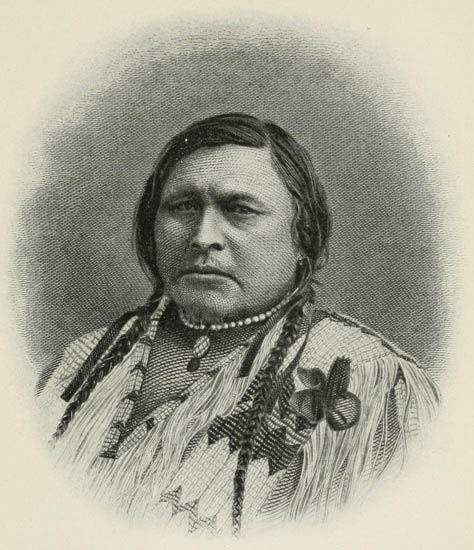
Ouray
Chief of the Utes
I remember that one morning just at daybreak, I
was awakened by my servant, who told me there was
a large herd of elk in close proximity to the camp. I
ran out as soon as possible and saw at least five hundred
of these magnificent animals, drawn up in line
like a troop of cavalry horses, with their heads all
turned in the same direction, and from the crest of a
high projecting cliff, looking in apparent wonder and
bewilderment directly down upon us. It was to me
a most novel and interesting spectacle. The noise
made in the camp soon frightened them, however,
and they started for the mountains. They were pursued
for some distance by our hunters, who succeeded
in killing six before they escaped.
On the 30th day of April, our reinforcements having
joined us, we gladly resumed our march for Utah, and
at about one o'clock encamped upon the ridge that
divides the Arkansas from the Platte rivers. The day
was bright, cheerful, and pleasant, the atmosphere soft,
balmy, and delightful. The fresh grass was about six
inches high. The trees had put forth their new leaves
and all nature conspired in giving evidence that the
somber garb of winter had been cast aside for the more
verdant and smiling attire of spring. Our large herds
of animals were turned out to graze upon the tender
and nutritious grass that everywhere abounded. Our
men were enjoying their social jokes and pastimes
after the fatigues of the day's march and everything
indicated contentment and happiness. This pleasant
state of things lasted until near sunset, when the wind
suddenly changed into the north. It turned cold and
soon commenced snowing violently, and continued to
increase until it became a frightful winter tempest,
filling the atmosphere with a dense cloud of driving
snow, against which it was utterly impossible to ride
or walk. Soon after the storm set in, one of our
herds of three hundred horses and mules broke furiously
away from the herdsmen who were guarding
them, and in spite of their utmost efforts, ran at full
speed directly with the wind for fifty miles before they
stopped. Three of the herdsmen followed them as
far as they were able, but soon became exhausted,
bewildered, and lost on the prairie. One of them
succeeded in finding his way back to camp in a state
of great prostration and suffering. One of the others
was found frozen to death in the snow, and the third
was discovered crawling about upon his hands and
knees in a state of temporary delirium, after the
tempest subsided. This terrific storm exceeded in
violence and duration anything of the kind our eldest
mountaineer had ever beheld. It continued with
uninterrupted fury for sixty consecutive hours and
during this time it was impossible to move for any
distance facing the wind and snow. One of our employes
who went out about two hundred yards from
the camp, set out to return, but was unable to do so
and perished in the attempt. Several antelope were
found frozen upon the prairie after the storm....
At the termination of this frightful tempest, there
was about three feet of snow upon the ground, but
the warm rays of the sun soon melted it, and after
collecting together our stampeded animals, we again
set forward for Utah and on the third day following,
struck the South Platte at its confluence with Cherry
Creek. There was at that time but one white man
living within one hundred and fifty miles of the place,
and he was an Indian trader named Jack Audeby,
on the Arkansas.
A year later, after the Pike's Peak mining excitement
had started, Marcy issued a handbook for
overland expeditions, in which he says, referring
to a point at the mouth of Monument Creek,
which he calls the forks of the Fontaine qui
Bouille:
The road to Cherry Creek here leaves the Fontaine
qui Bouille and bears to the right. There is a large
Indian trail which crosses the main creek and takes a
northwesterly course towards Pike's Peak. By going
up this trail about two miles, a mineral spring will be
found which gives the stream its name of "The Fountain
that Boils." This spring, or rather these springs,
for there are two, both of which boil up out of the
solid rock, are among the greatest natural curiosities
that I have ever seen. The water is strongly impregnated
with salts, but is delightful to the taste and
somewhat similar to the Congress water. It will well
compensate one for the trouble of visiting it.
Marcy claims that while waiting at the mouth of
Cherry Creek for a ferry-boat to be constructed
to take them over the Platte River, which was
very high at the time, one of his employees washed
a small amount of gold dust from the sands of
Cherry Creek. This employee was discharged soon
after and went direct to St. Louis, where he told
of his discovery, and Marcy claims that this was
the beginning of the mining excitement in the
Pike's Peak region. This is different from other
versions of the event, the most probable of which
is that the discovery of gold was first made by the
semi-civilized Cherokee Indians on their way to
California.
What was known as the old Cherokee trail
came up the Arkansas River to a point about
twelve miles below the mouth of the Fontaine
qui Bouille. From that place it ran in a northwesterly
direction across the hills, striking that
creek about eight or ten miles above its mouth;
thence up the valley of the Fontaine to a point
near the present town of Fountain; turning
northerly by the way of Jimmy's Camp to the
head of Cherry Creek, and down Cherry Creek to
its mouth, where Denver now stands. From this
place, after running northerly along the base of the
mountains for a considerable distance, it struck
across the mountains through Bridger's Pass,
and then turned westerly along the usual traveled
road to California. This trail was used by the
first gold-seeking parties which came to the present
State of Colorado in 1858. The first of these
parties arrived at Cherry Creek only about two
months after Marcy left. The second party
followed a week or two later, and the third party,
of which Anthony Bott, of Colorado City, was a
member, was close behind it. Members of this
third party explored the region around where
Colorado City now stands, and later, with some
others, returned and laid out the town.
In 1859, occurred the memorable visit of Horace
Greeley to the Pike's Peak region. He arrived
in Denver, June 16th, having come by the Smoky
Hill route. Writing from Denver, he says, among
other things:
I have been passing, meeting, observing, and trying
to converse with Indians, almost ever since I crossed
the Missouri River. Eastern Kansas is checkered with
their reservations,—Delaware, Kaw, Ottawa, Osage,
Kickapoo, Potawatamie, while the buffalo range and
all this side belong to, and are parceled among
the Cheyennes, the Arapahoes, and the Apaches,
or perhaps among the two former only, as Indian
boundaries are not well defined. At all events, we
have met or passed bands of these three tribes, with
occasional visitors from the Sioux on the north, and
the Comanches on the south, all these tribes having
for the present a good understanding. The Utes
who inhabit the mountains are stronger and braver
than any one of the three tribes first named, though
hardly a match for them all, are at war with them.
The Arapahoe Chief, Left Hand, assures me that his
people were always at war with the Utes; at least
he has no recollection, no tradition, of a time when
they were at peace. Some two or three hundred
lodges of Arapahoes are encamped in and about this
log city, calculating that the presence of the whites
will afford some protection to their wives and children
against a Ute onslaught, while the braves are off
on any of their fighting—that is stealing—expeditions.
An equal or larger body of Utes are camped
in the mountains some forty or fifty miles west, and
the Arapahoe warriors recently returned in triumph
from a war party on which they managed to steal
about one hundred horses from the Utes, but were
obliged to kill most of them in their rapid flight so
that they only brought home forty more than they
took away. They are going out again in a day or two,
and have been for some days practicing secret incantations
and public observances with reference
thereto. Last midnight they were to have had a great
war dance and to have left on the warpath to-day, but
their men sent out after their horses reported that they
saw three Utes on the plain, which was regarded as
premonitory of an attack, and the braves stood to their
arms all night and were very anxious for white aid in
case of the Ute foray on their lodges here in Denver.
Such an attack seems very improbable and I presume
the three Utes who caused all this uproar were simply
scouts or spies on the watch for just such marauding
surprise parties as our Arapahoe neighbors are constantly
meditating. I do not see why they need to
take even this trouble. There are points on the
mountain range west of this city, where a watchman
with sharp eyes and a good glass could command the
entire plain for fifty miles north, south, and east of him,
and might hence give intelligence of any Arapahoe
raid at least a day before a brave entered the mountains;
for though it is true that Indians on the warpath travel
or ride mainly by night, I find that the Arapahoes do
this only after they have entered on what they consider
disputed or dangerous ground; that they start
from their lodges in open day and only advance under
cover of darkness after they are within the shadows
of the mountains. Hence the Utes, who are confessedly
the stronger, might ambush and destroy any
Arapahoe force that should venture into their Rocky
Mountain recesses, by the help of a good spy-glass
and a little "white forecast"; but the Indians are
children. Their arts, wars, treaties, alliances, habitations,
crafts, properties, commerce, comforts, all belong
to the very lowest and rudest ages of human
existence. Any band of schoolboys from ten to fifteen
years of age are quite as capable of ruling their
appetites, devising and upholding a public policy,
constituting and conducting a state or community, as
the average Indian tribe.
I have learned to appreciate better than hitherto,
and to make more allowance for the dislike, aversion,
and contempt wherewith Indians are usually regarded
by their white neighbors, and have been since the
days of the Puritans. It needs but little familiarity
with the actual, palpable aborigines, to convince
anyone that the poetical Indian—the Indian of
Cooper and Longfellow—is only visible to the poet's
eye.
The Utes seldom visited Colorado City and the
region round about in the early days, except in the
winter, which was the only time they could do
so with a fair degree of safety. A majority of
the tribe had been on friendly terms with the
English-speaking people from the time of their
earliest contact with that race. It is true that
straggling bands of Utes occasionally committed
acts of depredation, and such bands on one or
two occasions killed white people, but these acts
were not approved by the majority of the tribe.
One of these exceptions occurred on Christmas
day, 1854, at Fort Napesta, on the present site
of the city of Pueblo. It is said that the men who
occupied the fort were celebrating the day with
the liquid that both cheers and inebriates, and in
the midst of their jollity, a band of wandering
Utes came by and was invited to join in the revelry.
The Indians, nothing loath, partook of the white
man's Taos lightning, the product of a distillery
at Taos, New Mexico, and the natural consequence
was an attack upon the whites which resulted in
all the latter being killed.
In 1866, a small band of Utes began a raid
upon the settlers on Huerfano Creek, but when the
news reached Ouray, the head chief of the tribe,
he sent runners out at once to warn the settlers
and then went to the scene of action with a band
of his faithful warriors. He soon afterwards took
the hostile Indians prisoners and compelled them
to go to Fort Garland and remain there, in this
manner quickly ending the trouble. Ouray was
always the friend of the whites, and is entitled to
the very greatest credit for the able manner in
which he held the Utes under control up to the
time of his death, in 1881.
Ouray was born at Taos, New Mexico, in 1833.
His father was a Tabeguache Ute and his mother
a Jicarilla Apache. His boyhood was passed
among the better class of Mexicans, chiefly as a
herder of sheep. He learned Spanish and always
preferred it to his native tongue. When eighteen
years of age, he joined the band of Utes of which his
father was leader, then located in southwestern
Colorado. From that time until about 1860,
he led the life of a wild Indian, passing his time
hunting in the mountains and on the plains,
varied by an occasional battle with the hereditary
enemies of his people, the Kiowas, Sioux, Cheyennes,
and Arapahoes of the plains, in which he acquired
the reputation of a courageous and skillful warrior.
In 1859, he chose a wife, named Chipeta, from
among the Tabaguache maidens, to whom he was
always devotedly attached, and who bore him a
son. This child was captured by the Cheyennes
in 1863, they having surprised a hunting camp of
Utes under Ouray's command, near the present
site of Fort Lupton on the Platte River. The
boy was never recovered and, indeed, was never
heard of afterwards.
In person Ouray was of the almost invariably
short stature which distinguishes his people from
those of the plains tribes. He stood about five
feet seven inches high and in his later years became
quite portly. His head was strikingly large and
well-shaped, his features were regular, bearing an
expression of dignity in repose, but lighting up
pleasantly in conversation. In his ordinary bearing
his manner was courtly and gentle, and he was
extremely fond of meeting and conversing with
cultivated white men, with whom he was a genial
companion, compelling their respect and favor
by the broad enlightenment of his views. In his
habits he was a model, never using tobacco,
abhorring whiskey, and taking only a sip of wine
when in company with those who were indulging,
and then merely as a matter of courtesy to them.
He never swore nor used obscene language, was a
firm believer in the Christian religion, and about
two years before his death united himself with
the Methodist Church.
When in active command of his men, his word
was law, and disobedience meant death. In the
summer of 1874 at Bijou, while returning from
Denver to their camp in the south, one of his men
decided to build a fire and started to cut some wood
for that purpose within the enclosure of a white
settler. Ouray, discovering his intention, ordered
him back, reminding him that they must not
trespass upon the property of the white man. The
obstinate Ute replied that he must have firewood
and that he would cut it anyway. Ouray answered
that if he did, he would kill him, whereat
the other observed that two could play at that
game. Instantly both started for their guns,
reaching them at about the same time, but Ouray
was quicker than his adversary and shot him.
On another occasion he shot and broke the arm of
Johnson, a member of his tribe, who afterwards
caused much of the trouble at the White River
Agency. Johnson was given to gambling, horse-racing,
lying, and trickery of all kinds. In the
present case, he had stolen some horses from white
men, and refused to return them when commanded
to do so, thereby, in Ouray's opinion, bringing
disgrace upon the Ute nation, for which he had to
be punished.
In the foregoing, I have quoted freely from
General Frank Hall's History of Colorado.
General Hall had unusual opportunities for knowing
Ouray and of his dealings with the whites.
It was through the prompt and decisive action of
Ouray that the leaders of the massacre of Meeker
and others at the White River Agency, in 1879,
were surrendered to the authorities for punishment.
The early settlers of Colorado owe to Ouray a
debt of gratitude, and a monument to his memory
should at some time be erected by the people of
this State. Ouray frequently came to Colorado
City in the early days, and sometimes his visits
were of considerable duration.
In the winter of 1865-1866, a large body of
Ute Indians camped for several months on the
south side of the Fountain, opposite Colorado
City. On departing in the spring, they abandoned
a squaw who had broken a leg, leaving her in a
rudely constructed tent, or tepee. Had not the
women of Colorado City taken her in charge she
would have starved. After the Indians left, she
was moved into a log cabin in Colorado City and
provided with all she needed until her death, which
occurred a few months later. The Utes seemed to
think nothing of this heartless act, and even the
abandoned squaw did not seem to resent it. It
was a very common occurrence for the Indians
of most of the tribes to abandon the aged and
disabled, as in moving around, they did not wish
to be burdened with those who were incapable of
taking care of themselves.
In the winter of 1866-1867, a thousand or more
Utes camped for several months below Manitou,
between the Balanced Rock and the Fountain.
Game was very scarce in this region during that
winter and the Indians suffered for want of food.
Finally, they reached such a strait that their chiefs
made a demand upon the citizens of Colorado
City for twenty sacks of flour, and intimated that
unless it was produced forthwith, they would be
compelled to march into town and take it by force.
The citizens, realizing their utter helplessness in
the matter, obtained the flour without delay and
turned it over to the Indians. This was the only
time in all the early period that Colorado City
suffered from the presence of the Utes.
Chaveno and Colorow were the principal chiefs
of this band. Chaveno was an Indian of a good
deal of intelligence. When visiting the whites he
always went about dressed in an army officer's uniform
of dark blue which had been given him by
an officer at Fort Garland. Chaveno was always
strutting around, and seemed very proud of himself
in his uniform, of which he took the greatest
possible care. In the matter of dress, Colorow
was the reverse. He seemed to have no liking
whatever for the white man's costume. His
physique was like that of Ouray, short, but of
powerful build. He had been a noted warrior in
his early days and delighted in telling of his
exploits in the various battles with the Cheyennes
and Arapahoes in which he had taken part.
Colorow was treacherous by nature and his friendship
for the whites was not always to be depended
upon.
In the winter of 1874-1875, Ouray, with a band
of six hundred Utes, camped at Florissant for
several months. One day a Mr. Marksberry,
living on Tarryall Creek, rode up to the Post Office
at Florissant, tied his horse, and went into the
building. The pony attracted the attention of an
Indian named Antelope, who claimed the animal
as his own; he slipped off the saddle and bridle,
and, jumping on the pony's back, rode away.
Marksberry and a friend, being determined to
recover the pony, followed the band to their camp
in Beaver Park, south of Pike's Peak. Marksberry
found his pony with the Indian herd, caught it,
and was turning away, when Antelope, hidden
behind a tree, shot and instantly killed him. Chief
Ouray, always ready to "travel the white man's
road," gave up Antelope to justice. Upon trial
of the case in the courts of Arapahoe County,
some months later, he was acquitted.
The Utes, by treaties made in March, 1868,
April, 1874, and March, 1880, ceded to the general
government all the lands claimed by them within
the boundaries of the present State of Colorado,
except a small reservation retained for their own
use in the southwestern part of the State.