From the cradle to the grave the life of a Havasupai
is practically an out-of-door life. Their
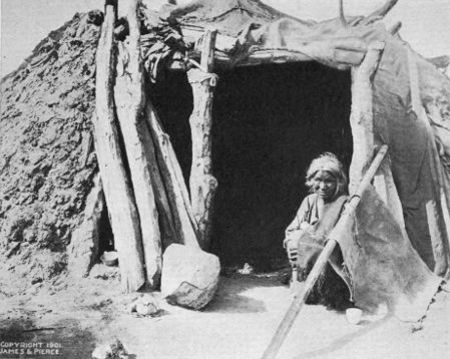
hawas—even the best of them—are partially exposed
and open, and in the summer hawas there is no
pretence at what among civilized peoples is essential
privacy.
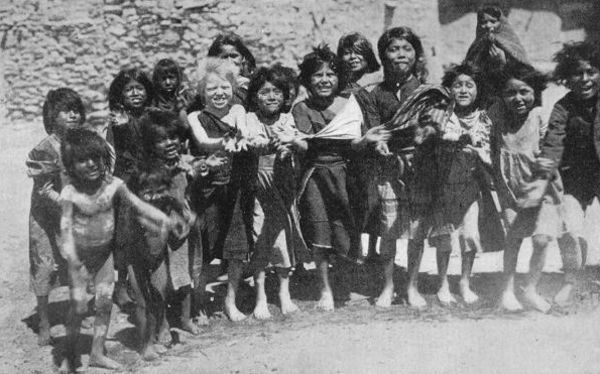
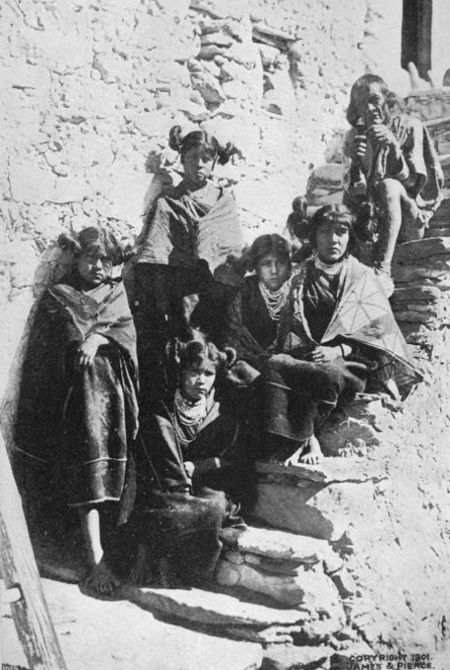
The games of the Havasupai children seem very few.
I have seen only three. Of the first importance is
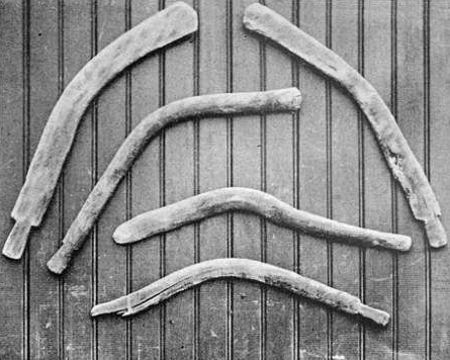
shinny, or, as they call it, tha-se-vi'-ga. The goals are
go-ji-ga', the ball, ta-ma-na'-da, and the playing stick
ta-so-vig'-a. The boys enter into this with the zest one
would expect of such a time-honored game, yet, such
is their general indifference to prolonged effort, they
do not play it very often.
An easier game, but generally left to the girls, is,
hui-ta-qui'-chi-ka to-ho'-bi-ga, which I have fully described
in my book on the Grand Canyon.
The third game is stolen bodily from the Navahoes,
except the name, which with the Havasupais is Tōd-wi-ga.
It is the Nan-zosh, and is elsewhere fully described
in these pages.
Such a paucity of games is indicative of low mental
power, lack of imagination and invention, and results
in, or perhaps from a slow, heavy mental temperament.
There is no comparison between the children
of the same ages of the Havasupais and the Navahoes
or Hopis. And yet, when they enter school, some of
the Havasupais learn with a rapidity equal to that of
these other children.
It seems strange to find a people whose children
have no equivalent for dolls; nothing specifically to
care for. They are capricious in their treatment of
their domestic animals, cats and dogs, sometimes petting
them to excess, and then lifting the yelping or squalling
creatures by the legs, twisting these members over
their backs, or otherwise torturing them.
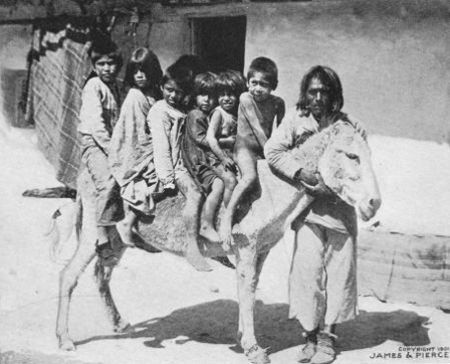
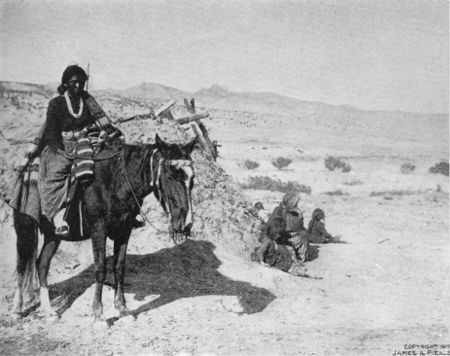
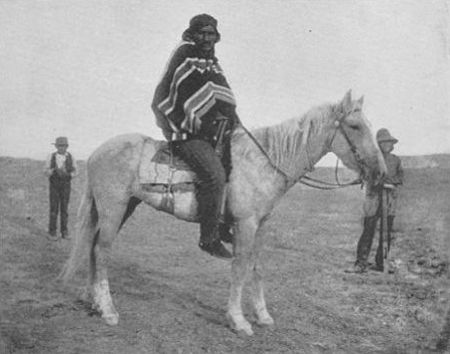
The boys and the girls, as well as the men and
women, are expert horse riders. Every family has its
horses, and the children ride from their earliest years.
Even as I write I catch glimpses now and then of a
red-shawled girl on horseback and hear the hard strike
of the horse's hoofs as he dashes along at break-neck
speed along the trail near the hawa of my host. All ride
astride, and are as fearless in ascending and descending
the steep trails that give access and egress to their
canyon home as the wildest and most expert of the
Rough Riders.
One of their great sports and gala times is when visiting
Indians—Navahoes, Hopis, or Wallapais—come
with fleet horses and races are arranged for. While they
have no "Derby Day," they have days on which half
the personal property of the village is pledged on the
success of certain horses. They are inveterate gamblers;
and blankets, buckskins, saddles, bridles, Navaho
jewelry, horses, burros, and everything "gambleable"
are risked on the outcome. And what an exciting scene
an Indian horserace is, and how picturesque! There
is not so much difference after all in human nature,
when one penetrates below the surface. The reserved
Englishman, the excitable Italian, the vivacious Frenchman,
and the so-called stupid and stolid native aboriginal
American exhibit exactly the same traits of
character under the excitement of a horserace. But
in Havasu Canyon the conditions are quite different
from Ascot, Doncaster, or Newmarket. Here are bucks
dressed in the breech-clout and excitement, and women
gesticulating and waving their si-dram´-as (our large
flaming red or other "loud" colored bandannas,
fastened over the shoulders and across the breast).
Some suppress their excitement, others jabber like
monkeys, and as the horses come to the starting-point
there is just as much talking and din as after the start
is made. One distinct feature is that many horses are
raced without riders. They seem to understand, and
when the signal to "let go" is given they dart off at
full speed, just as if riders were on their backs urging
them forward. Compared with our finely bred, beautifully
chiselled horses, such as one sees, or used to see,
in Lucky Baldwin's or the late Senator Stanford's stables,
what ragged, scrawny, wretched creatures these are;
and yet when they run how they surprise you, how
those ugly limbs seem to limber up, and those sleepy
eyes gain fire!
Gambling at these races is carried to an extraordinary
extent. Men, women, and children alike gamble all
they possess, or even hope to possess. This gambling
spirit has grown wonderfully in the past few years, for,
during the Kohot Navaho's lifetime he constantly used
his powerful influence to discourage it.
Gambling, unfortunately, is not confined merely to
horse-racing. All the afternoon, as I have sat at my
work, a group of eight women, some young, some middle-aged,
and one old, have gambled without cessation for
five solid hours. Two young mothers had their babies—surely
not more than two to three months old—and
the youngest of the women was one of these mothers,
and she could not have been more than eighteen years
of age. Girls gamble at Hui-ta-qui-chi-ka for safety-pins,
and boys for knives and the like, so that now it
is a vice which has affected every individual of the
tribe.
The Havasupai children are expert ball tossers.
With three or four small melons they rival the conjurers
and jugglers of our vaudeville shows in feats of
dexterity, keeping three or more balls in the air at
the same time.
Boys and girls alike run around in the fiercest rain,
their feet and legs wet and the few clothes they have on
absolutely soaked. The idea of changing them has
never seemed to enter their primitive minds, and without
care, without a fire, unless he chooses to build one, the
youngster gets along as best he may. It is a case of the
weaker going to the wall, for here only the strong can
survive.
There is very little attempt on the part of their parents
to control them. They are generally allowed to do as
they choose. I have often seen a little girl take a
cigarette from between her father's lips, give it a few
puffs, and return it, he all the while either indifferent to
or unconscious of the act.
The close proximity of Havasu Creek and its large
ponds or reservoirs, made by the irrigation dams,
naturally suggests that they are swimmers. Observation
confirms this. From earliest childhood they are expert
swimmers, boys and girls alike learning the art often
before they can walk. I have seen mere babies placed
in the creek and ditches by their parents and older
brothers, and one can scarcely say they are taught to paddle,
for it seems to come instinctively. There is not a
child in the village who cannot swim and dive expertly,
and there is no greater fun than to expend a dozen nickels
by throwing them into one of the reservoirs and having
the children dive for them. Sometimes they can be induced
to bring the coins up in their teeth, even picking
them in that manner from the sandy bed of the reservoir.
They are as expert swimmers as the children of the
South Seas. No Kanaka going out to meet an incoming
steamer could ride the billows more daringly than the
boys and girls of the Havasu swim in the rapid currents
of their little stream. I have been with them to-day for
a couple of hours. The boys dived into deep water
and rose and fell like loons. I amused myself by throwing
a stone into ten or more feet of water, and four or
five of the boys would dive for it and get it almost as
quickly as I could throw it. It was no sooner in than it
was out again. One of the little girls, a sister of one of
the boys, stood watching the sport. She became so
interested that, suddenly, without removing her calico
dress, she jumped into the deep place and enjoyed the
fun with the rest.
Then, a Havasupai man, riding a burro, brought the
animal down into the stream where it was shallow and
had a gravelly bed. For an hour he and the boys
amused themselves by swimming back and forth through
the deep pool, and every now and again one or another
would jump on the creature's back and, hanging on,
overbalance him, or make him turn a somersault. The
burro bore it all good-naturedly and seemed to object
very little to the fun: the only time he showed decided
inappreciation was when the Indians got him down into
deep water and forced his head under for too long a
time.
A little later on a horse was brought, who entered
into the sport as if he were used to it. He swam back
and forth and took to the water as willingly as a child
takes candy. The boys hung on to his mane, got on
his back, his neck, or hung on to his tail, and, to all
seeming, it was all the same to him.
Though they are so fond of the water, the Havasupais
cannot be called in some respects a cleanly people. Far
from it. Though they take the sweat bath almost as a
religious rite[7] and their skin is thus kept clean, there is
another kind of cleanliness in which they are very
remiss. It would be unreasonable to expect that people
living in the exposed wicker huts of the Havasupais
could approach anywhere near the ordinary white man's
standard of cleanliness. But certainly they might have
a higher standard than they do. Lice swarm in the
heads of the children and most of the women. On the
other hand, all the younger men are particular to be
cleanly in this regard, and dress their hair with skill and
neatness. Bed-bugs abound in Havasu Canyon as in
no other place on earth. They swarm everywhere, and
are absolutely found in clusters in the sand, under the
old bark of decayed trees, and in every conceivable
and inconceivable lodging-place. The warm sand and
the seductive moisture that obtains during the major
part of the year must be especially conducive to their
breeding, for they are ubiquitous. Yet, strange to say,
I have never known of an instance where a bed-bug has
been brought out of the canyon by a visitor. Though I
have been with the Havasupais scores of times I never
detected one of these vermin either in my clothing or
bedding. The breed seems to be peculiar to the warm,
moist air of the canyon and to be unable to live away
from it, for which we give hearty thanks.
Now and again scorpions may be found, and, after a
rain, I have seen a score of hundred-legged worms (perfectly
harmless) rolled up on the trail between the
village and Bridal Veil Falls.
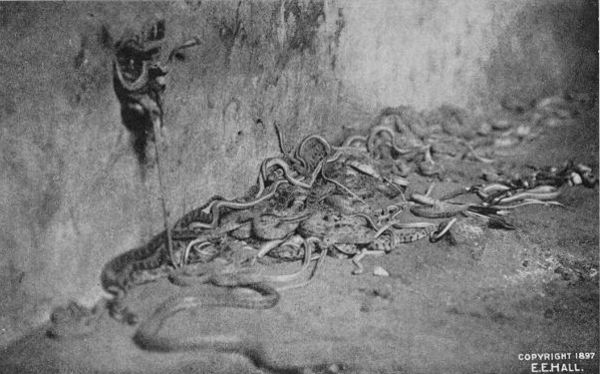
Rattlesnakes are not common anywhere in those portions
of the canyon much visited by the Havasupais,
but now and then one may be found on the trails or
basking in the sun on the rocks near by. Elsewhere in
this canyon and its many greater or lesser tributaries
they are common, and the Indians can find any quantity
if they are sent for them. In all my years of wandering
to and fro, though, I have not seen a half-dozen rattlesnakes
in Havasu Canyon.
Other pests are mosquitoes, gnats, and a small black
fly which, in certain seasons, persistently lodges in the
eye, causing considerable annoyance, and sometimes
distress and pain. There are not many mosquitoes,
though at times they are troublesome enough to satisfy
one for their scarcity.
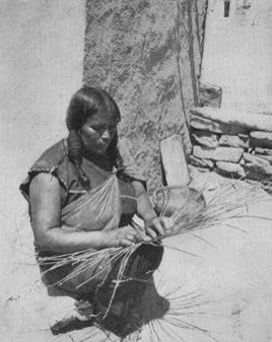
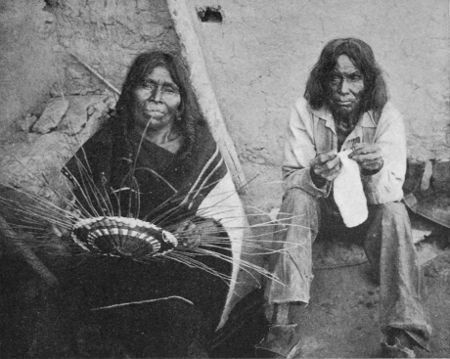
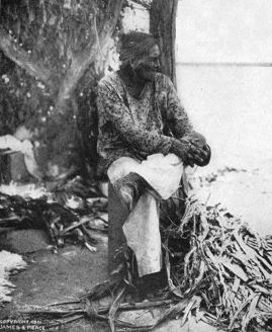
Many of the women are expert basket makers, and in
my book on Indian Basketry I have fully explained their
methods of work and the charming nature of their
designs. The Havasu Canyon is a basket maker's paradise,
for the stream is lined for miles with willows
suitable for this work.
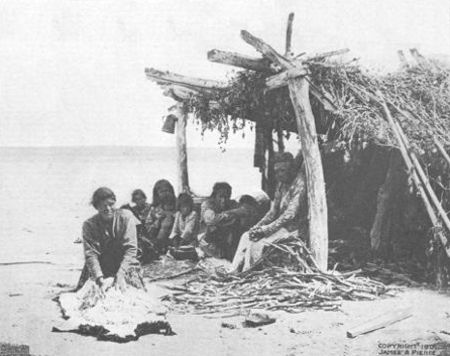
The process of making strands or splints of the willows
is a very simple and primitive one. Here as I sit
writing (Sept. 14, 1901), Chickapanagie's squaw has a
lot of willow shoots before her. Taking hold of one end
of the splint in her teeth, she pulls away the cuticle with
her fingers. These alone are her tools, and it is astonishing
the rapidity and regularity with which the process is
accomplished.
As soon as a girl can frame her fingers to the work
of basket making she is required to begin. It is very
interesting to watch the small children in their endeavors
to make the rougher baskets, and then, as they
grow in skill, try the finer work. Pul-a-gas´-a-a is not
more than eight years of age, and yet a basket—kű-ű—she
brought to me was one of her own make, and it now
occupies a place in my collection. The work is irregular
and crude, but shows skill, and if the child has patience
to stick to it, in time she will become one of the most
accomplished basket makers of the tribe.
As soon as possible after attaining puberty the
Havasupai girls marry, generally between the ages of
thirteen and fourteen. The parents themselves urge
these early marriages. Whether they fear the loss of
virtue in their daughters from evil white men, or the
degenerate young men of their own tribe, I do not know,
but several parents have told me that the sooner their
girls marry, after they are marriageable, the better
pleased they are.
Marriage is generally arranged by purchase. When
a young man sets his affections upon any particular
girl, he contrives to show his preference for her, and,
as soon as he finds that his attentions are agreeable, he
visits his fair one's father or nearest male relative, and
without parley begins to bargain for her as he would
for a horse or any other commodity. The standard
price for a wife is ten to twenty dollars, and where a
trade cannot be made with a pony or blanket, the
money itself is offered. The bargaining completed,
there are no further preliminaries or ceremony, except
that, three weeks or so before the wedding, the
bridegroom takes up his residence in the hawa of the
bride's parents. He is treated as one of the family, and
at night rolls himself up in his blanket and sleeps alongside
his prospective kinsfolk on the floor of the domicile.
At the end of three weeks, if the contracting young
folks are satisfied that their dispositions are harmonious,
and if the marriage settlement is satisfactory, the
wedding takes place. The groom takes his bride, the
old folk take the medium of purchase, and the company
laughs and banters the young husband and wife.
The man takes the woman to his hawa, and the
announcement of their marriage is made by the fact
that they are living together and have assumed marital
relationship.
Sometimes an obdurate father or mother will refuse to
sell a daughter, and thus expresses disapprobation of the
suggested match. Occasionally, as among more civilized
people, the young couple mournfully, but dutifully, acquiesce
in the decision of the older people, but, more
often—even, also, as white young people do—they
rebel, and take the decision into their own hands by
eloping and living together. This ends the matter.
The ethics of the tribe are such that cohabitation once
entered upon, the parents have no authority to declare
the marriage void. And, as a further penalty for his
obdurate obstinacy, the father loses the ten dollars or
its equivalent he might have had by being kind and
complaisant to the desires of the young couple.
The Havasupais are polygamists, and believe in
having as many wives as they can buy and support.
At the time of his death Kohot Navaho had three wives
living with him, and I personally know of two others
that he had discarded on account of old age. When
Hotouta, his oldest son, was living, his mother was a
thrust-out member of Navaho's household. She was
almost blind and decrepit, and Navaho with a wave
of his hand and ten words had dismissed her from his
bed and board. Hotouta had a tender heart and used
to speak very bitterly about the injustice of this custom
which allowed an old and helpless wife thus mercilessly
to be discarded.
Shortly before Navaho's death his oldest wife evidently
"ruled the roost," and it certainly must have
been by other means than her physical beauty. And
yet she was vain of her good looks, for, when I made
her husband's photograph, she became my strong ally
in persuading him to sit before the camera, on condition
that I would make a "sun-picture" of her own
beautiful physiognomy and enchanting tout ensemble.
When I made the photograph, she secured her petticoats
between her legs in such a manner as to make
them appear like rude trousers, and when I commented
upon the unfeminine appearance and asked her to
spread out her skirts in orthodox style, she boxed my
ears with a manner at once decisive, haughty, and jocular,
and bade me proceed as she was or not at all. The
second wife was a meek kind of a creature, who seemed
to be entirely under the dominion of wife number one;
but the youngest wife, a buxom woman of twenty-three
or four summers, evidently knew how to hold her own,
for she once or twice refused to obey wife number one,
though she readily obeyed the same request when given
by Navaho personally. This woman is now married to
my old host, Waluthama.
Marriage with a white man is unknown among the
Havasupais, and unlawful cohabitation with one is punishable
by death.
The question of marrying is becoming a more serious
one with the Havasupais each year. While occasionally
a man will marry a Wallapai squaw, there is a
strong sentiment against marriage outside of the tribe.
Yet the number of the tribe is so small, and
intermarriage has so long been carried on between them,
that it is no uncommon thing for a young man or
woman to be debarred from choice in marriage. At
the present time Gōō-fwho's son can marry but one girl
in the whole tribe without violating their own laws
of consanguinity, about which no people are more
particular.
The present Head Chief—Kohot—of the tribe is
Man-a-ka-cha, a heavily built man, who is popular with
the younger element. But he suffers much in comparison
with the former Kohot, Navaho, who died
in 1898.
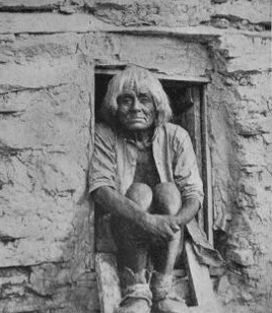
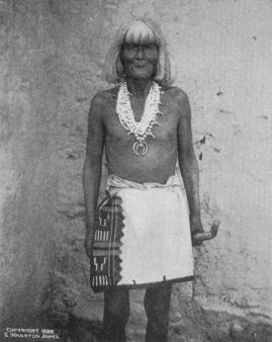
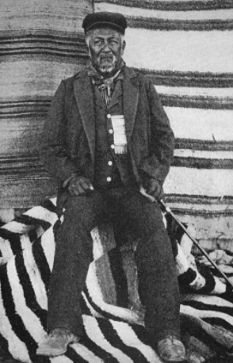
Kohot Navaho's was a strong face, marked and furrowed
with bearing the cares of his little nation. A
firm chin, powerful nose, gentle mouth, courageous
forehead, eyes which were once fiery as well as piercing,
but of late years had little of their primitive fire,—these
gave a key to his character, in which firmness, courage,
bravery, and gentle tenderness were commingled. His
whole demeanor was of dignity and pride. No European
sovereign in the days of despotic power could
have worn the "air" of a monarch more regally than
Navaho. But it was real with him. His kingship was
within himself as well as in the affection of his people.
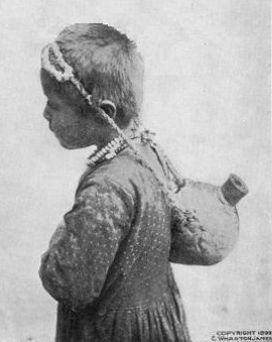
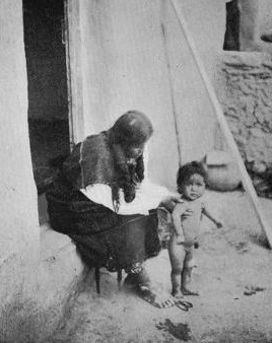
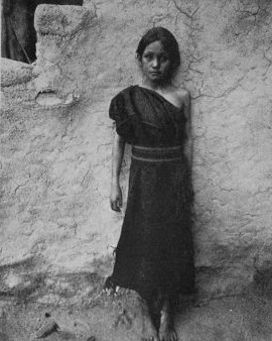
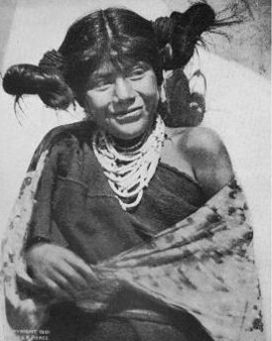
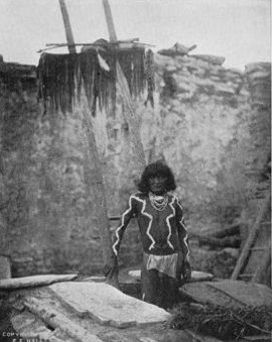
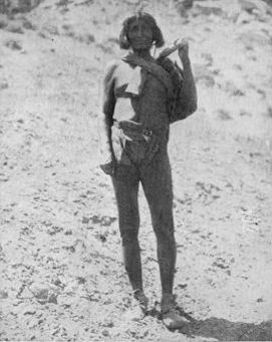
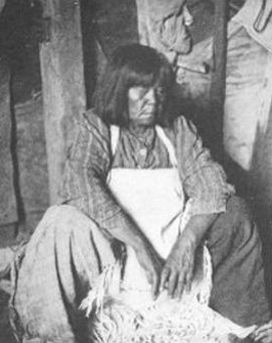
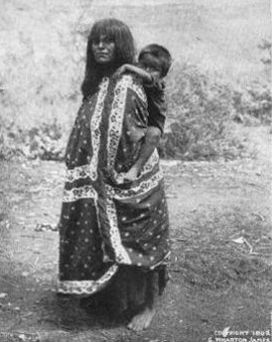
Waluthanca's Daughter, with Esuwa, going for Water.
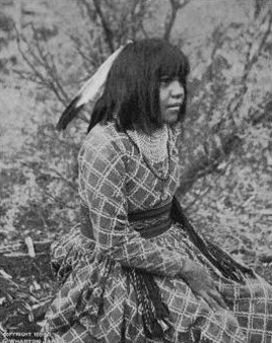
Lanoman's Wife. A Havasupai.
As might be expected with their powerful physical
development, the men are great wrestlers, and often
may be seen indulging in friendly, but none the less
hard and exhausting bouts, where Havasupai methods
of cross-buttocking and other "throws" are tested to the
utmost. One of the former teachers was an expert
wrestler,—learned doubtless among the Sioux, with
whom he used to live as a United States teacher,—and
one secret of the influence he had over the Havasupais
was his ability to "down" them in a wrestling
match. Time and again he had given their best men
great "falls," and the more he threw, the more they
respected and obeyed him.
As runners and trailers they almost equal the Mohaves,
Apaches, and Hopis, though, on the desert, their
endurance is not so great as that of these two desert
tribes. As canyon climbers, however, they surpass
either of them. The climbing muscles, by life-long
and constant practice, are remarkably developed, and
they run up and down the long, wearisome, steep trails
of canyons in a manner to excite the envy of a college
athlete, and the astonishment of one who has, but a
short time before, laboriously and tediously essayed a
brief trip in which ascending or descending a steep trail
was an essential feature.
As riders they are skilful and full of endurance, but
they are neither as graceful nor as daring as the Navahoes.
Men and women both dress the buckskins for which
the Havasupai is so famous. Amole root is macerated
and beaten up and down in a bowl of water until a
good lather and suds are produced. Then the operator
takes a mouthful of the liquid and squirts it over the
skin, which he manipulates and softens, rubs, scrubs, and
pulls with his fingers and feet, moistening it again and
again as occasion requires. Wild catskins are treated in
the same way.
From this excellent buckskin the men make moccasins
for themselves and their women. The first time I
saw Kohot Navaho he was sitting naked, upon a blanket
outside his hawa, his three wives near by, they cutting
and preparing peaches for drying, he busily engaged
making a pair of moccasins. The sole is of two or three
thicknesses of heavy rawhide, to which the uppers of
buckskin are deftly sewn, with strings of catgut or deer
intestines, the holes being made by a bone awl.
Every summer trading-parties of both Hopis and
Navahoes come down to the village, bringing blankets,
ponies, pottery, and the like, for exchange. In 1898
there were three separate bands of Navahoes and two of
Hopis. Trading is a serious process. Laws of barter
or sale are first made, before the traders open their
packs, and all the people are expected to abide by these
loosely promulgated laws without question. Then the
hawa of the Havasupai host is turned into a store.
Poles are suspended in every possible direction on which
to show off the blankets to best advantage. A crowd
of chattering men and women stand outside, or, now
and again, come inside, during the whole day, and at
night-time the men who have done business come in,
squat on the ground, and spend the hours in smoking,
tale-telling, and gossip.
There is difficulty in the Havasupai mind at trading
for more than one thing at a time. If you wish to buy
six articles from the same Indian, you cannot pay a
lump sum for the six. Each one must be traded and
paid for separately.
In most things there is no fixed standard of price.
Fictitious values are placed upon articles of no value
whatever, but to which the Indian mind has attached
singular virtue and importance. On the other hand
baskets, which require days to manufacture, taking no
account of the time and arduous labor expended in
gathering the materials, dyes, etc., for that purpose, are
sold at varying prices, but nearly always far too low to
begin to compensate them for the efforts expended.
Yet they are keen traders in their way. "What
can I get out of him?" is the normal attitude of mind,
and the price is made to correspond to what the seller
imagines is the ability of your pocket.
In dealing with them, I adopted the plan years ago,
as a fixed rule, from which I seldom deviate, to state a
figure I will give for things offered to me, and that sum,
no more, no less, is what I will pay. They soon learn
this, and, though at times it seems to be a disadvantage,
it gains the confidence of the Indian and he will the
more readily trade with me.
I once excited the hearty laughter and some scorn
of the Havasupais by buying a lot of old baskets,
blankets, etc., that they had long deemed of no value.
I was seeking their older styles of work and urged them
to bring me "any old trash" they had discarded. The
usual crowd assembled around my camp, and, as each
specimen of dilapidation was half-shamefacedly revealed
a shout of laughter arose, directed partially at the would-be
seller for her temerity in supposing that such rubbish
could ever find a purchaser, and partially at myself for
being so foolish as to want to carry it away. But I
obtained some fine specimens, though much worn, of
the workmanship I desired, so could afford to be very
complaisant at the derision I aroused.
The Havasupai is one of the most jolly, frolicsome,
and light-hearted of mortals. With his stomach full he
has no cares, and he goes into fun with a zest and energy
that are pleasing. He is fond beyond measure of practical
jokes,—when he is not the victim,—and cares very
little who suffers so long as he can obtain fun. Consequently
if one meets with a misfortune, especially a
laughable one, he need expect little, if any, sympathy
in Havasu Canyon.
They are a singular mixture of frankness and cunning,
of honor and deception, of truth and frankness, of
reliability and untrustworthiness. They will as deliberately
and coolly lie to a white man about anything and
everything—if it suits their purpose—as they will
tell the truth. Ask a man his name—an insult, by
the way—and he will lie to you, even though you are
a good friend; as, for instance, when, after being the
guest of "Supai Charley" for several days, I quietly and
without seeming intent asked him his name, which I
knew to be Wa-lu-tha-ma, that I might send him some
gifts I had promised. For a few moments he hesitated,
and then said "Qu-ar-ri"—a Wallapai name that has
no relation to the Havasus whatever. Sinyela was full
of deception, and yet, when a friend told him he might
catch one of his horses and ride it so far, and we reached
that point and I suggested to him that he take the pony
forward and leave it at the designated spot on his
return, he would not listen to it for a moment.
They are petty thieves, but years of experience have
taught me that they could not be persuaded to engage
in larceny on a grander scale. One of my first experiences
in this line was to have some little thing taken
from my camp many years ago (I forget now what it
was). Immediately I sent for Hotouta, and told him the
article must be returned. In a few hours the boy thief
(now a hang-dog looking buck) came and brought back
the article.
On my last visit, coffee and candy were taken from
my sacks at Wa-lu-tha-ma´s hawa, and three necklaces
which I had taken as presents for some of the children.
I spoke angrily to my host of his negligence to protect
my goods when they were in his care, and, as for the
necklaces, said if they were not returned by morning I
should complain to the agent, and have the thief discovered
and punished. Long before sunrise in the
morning the necklaces were returned.
There is a good deal of craft about some of them. For
a long time Captain Jim and a few others had wished to
have a road or trail made around Hue-gli-i-wa that would
make it less dangerous, and add much to the comfort of
the people, who lived both above and below this spot,
when they wished to visit each other. For years nothing
was done. But when, this year, he took the matter up
again, he did it in a round-about way that won success.
He urged that an invitation be sent to the leading
horsemen of the Wallapais to bring their best horses
and come and run races with them. The Wallapais
accepted the invitation. Now was Captain Jim's
opportunity for the display of his finesse. He casually
suggested to some of the most ardent racers that the
way to beat the Wallapais was to make a race-track
just the same as the white men did, and, when it was
completed, train their horses to run on it until they
were so familiar with it that, when the Wallapais
came, they would be able to take all the advantages
this additional knowledge would give. The suggestion
worked like a charm. It was Tom Sawyer's woodpile
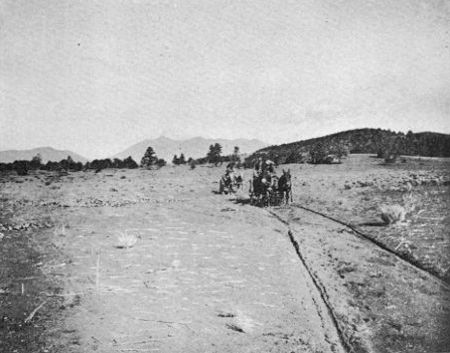
over again. The young men waited on the Kohot,
Manakacha, and asked permission to cut a road a mile
long through the middle portion of the canyon. The
only place where this could be done was just where
Captain Jim desired the road. He was appointed to
see that the work was properly done, and the first few
days of my visit were enlivened by the echoing roars
of the powder explosions that were set off. When I
went down to the lower part of the village it was over
the new and completed road, a full mile in length, and
well cut out and graded. Such a consummation was devoutly
to be wished, and while races are not an unmixed
good, one could tolerate them the easier for the
Havasupais if they would always be the means of
accomplishing such desirable ends.
The Havasupais are far from being dull and stupid, as
casual observers suppose. They can see the point of
things as quickly as some of their white neighbors.
For instance; I have elsewhere, in my Grand Canyon
book, told how Silver, Hotouta's fine horse, was given
to Mr. Bass. This horse has always been an object of
envy to some of the young men of the tribe. Mr. Bass
also bought from Sinyela a red mule of some of my
exciting experiences. Having once had possession of
this mule was in itself an overpowering temptation to
those Indians, who, in the days of Sinyela's ownership,
had been permitted to ride it. Consequently Mr. Bass
was often annoyed by finding, on his return from an
absence of a few days, that Silver and the mule, one
or both, had been taken from the pasture and ridden
by the Indians. When he completed his trail across
the river and finally established the ferry that bears his
name—the only ferry, by the way, across the Grand
Canyon, and the only one on the Colorado River
between Lee's Ferry and the one below the mouth of
the canyons—he decided to swim Silver and the mule
across the river and keep them for use on the north
side. When this was done Chickapanagie was present.
With a twinkle in his eye he said: "Bass heap sopogie
(understand). Havasupai no ride 'em Silvern, and Red
Mule no more."
There is wide diversity in the attitude different members
of the tribe hold towards the whites. Some are
friendly, others openly hostile and ugly, while others
merely receive strangers on sufferance as a necessary
evil, useful for the purchase of baskets and such other
things as they may have to dispose of.
Manakacha was elected to his kohot-ship because
the majority of the men were in favor of keeping out
the whites from Havasu Canyon, and he was ever
averse to the white man.
Those, however, who are friendly, are good and
true friends, as those who knew Hotouta, Spotty, and
others who are gone can testify.
Spotty was a genial, kindly soul, with whom I had
various dealings. He was intelligent and reliable in
his intercourse with me, though a medicine-man and
ready to dispense charms, incantations, and native medicines
on the slightest pecuniary provocation. On one
of my early trips to Havasu I negligently overlooked
taking a sufficient supply of extra films. What an idea!
To start on such a trip and forget one's camera rolls.
There were about thirty exposures left on my film and
I was sure I should need two hundred and fifty.
Indeed, long before I had reached the Havasupai
village all the roll was exhausted, and no more pictures
could be taken.
I was disgusted with my own want of forethought, and
generally disgruntled, when lo! on sight of Spotty
the idea occurred as if by inspiration: "Why not send
Spotty for it?" No sooner suggested mentally than
I broached the subject. The round trip was a good
fifty-five to sixty miles, and much of the road up Havasu
Canyon, and I must have the roll within twenty-four
hours. Spotty's eye was on the main chance, and
he at once expressed his willingness to go provided
there was "enough in it." "How much you give me?"
he inquired. I considered for a while, and then with a
Pecksniffian air of benignant charity offered him "two
dollar!" "Al lite, I go! Maybe so I go quick you
catch 'em two dollars and a half?" he asked. I studied
over it awhile before committing myself, and then queried
"When you start, Spotty?" Looking up towards hue-a-pa-a
(the man image) on the upper rim of the near
canyon wall, he pointed. "I go when you see 'em
ha-ma-si-gu-va´-te (the evening star)."
"When you come back?"
"I come back next day all same time you see 'em
ha-la'-ha (the moon). Maybe so I come back sooner
you see 'em, you give me two dollar half?"
A twenty-four hours' ride on horseback—nearly
sixty miles—through a solitary country where his only
company would be coyotes, mountain lions, and other
wild animals, and a large portion of it ridden in the
dark night, for two dollars, with a bonus of fifty cents
if the trip was made within twenty-four hours—it was
not extravagant pay, so I cheerfully acceded to his request
for the bonus. But now came the difficulty of fully
explaining to Spotty what I wanted, and where he could
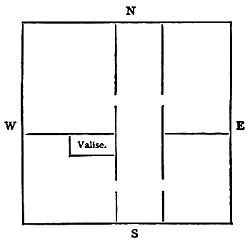
find it. The tent at Bass Camp was divided into five
compartments,—two small rooms with canvas walls on
either side of a long room which ran through the centre
of the tent, its entire width. Making a plan of the tent
on the ground, so, and giving him the compass points, I
showed that my "all same white man's basket made of
leather," viz., my valise, was in the northeast corner of
the southwest room. The film was in the valise, but I also
needed my ruby lamp, so I deemed it best for him to bring
valise and lamp, which latter was separate. Off he went
cheerfully and merrily, and two hours before the moon rose
he was back at the camp with valise and lamp safe and
secure. He received his bonus and we were both happy.
Like all other Indians, they used to have an abnormal
dread of the camera.
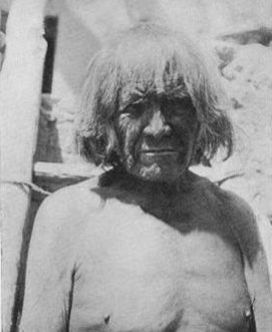
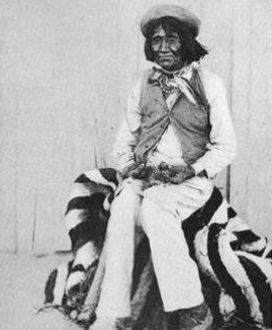
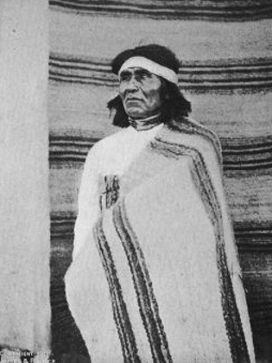
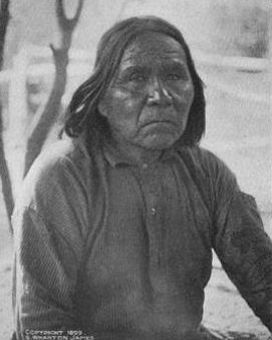
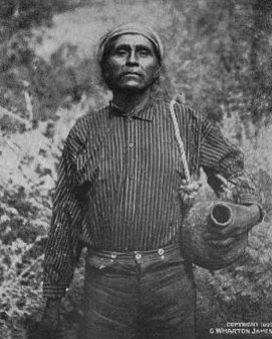
One of my Havasupai friends, U-math-ka, thus stated
his reasons for refusing to be photographed. With
graphic gesture of horror and dread he said: "If you
make my picture I die pretty soon. I look at the Sun.
He get heap hot. I no breathe. I lie down. I die!"
When I assured him no possible injury could result, he
yielded to my urgent entreaties so far as to consent to
allow me to make his sun-picture, on the sole condition,
however, that I did not ask him to look at the camera,
or to cease talking (he was relating some Havasupai
myths at the time). His condition was what I desired,
for it enabled me to secure the accompanying natural
and life-like photograph.
In speech the Havasupai tongue is not very musical
or agreeable. The voices of men and women are soft
and sweet, as a rule, and either when singing their rude
aboriginal songs or those that they have been taught
at school, they show a natural appreciation of tone
that is not usual or common. In a sentence the last
syllable of the last word is often a third higher than the
rest of the word. This gives a singularly emphatic
effect.
The voices of the men are not unpleasant, though
generally they are thrown too high—head tones—to
be agreeable; and as conversation increases they often
allow their voices to rise to an almost querulous note.
There is a good deal of the chant about it of a half-musical
nature.
The women's voices are usually sweet and musical,
but the language itself does not lend itself to the display
of vocal sweetness. It is not a "liquid" language. It
is full of crooks and twists, gutturals and harsh labials,
and seems to be ground out in angles with a machine-like
regularity. In some cases, the women, having
imitated the querulous tone of some of the men, have
developed a harshness that is disagreeable. The rapidity
with which they learn new words is remarkable.
Lanoman, one of the present policemen, asked me the
English of a number of words, and all during the day I
heard him repeating them over to himself, and seldom
would he need correction.
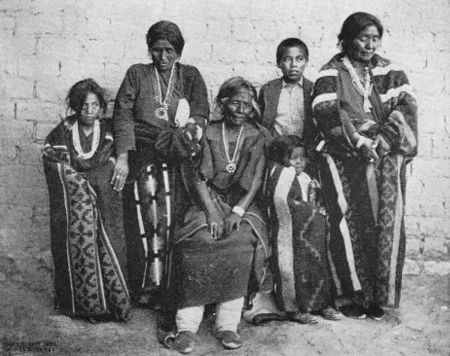
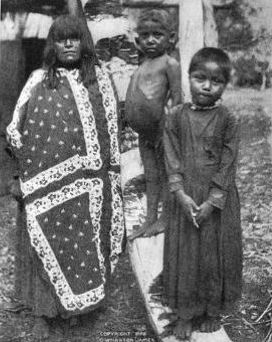
The dress commonly worn by the women consists of
a short skirt and waist, made of colored calico, and a
si-dram'-a, which may be described as a rude shawl,
two corners of which are tied obliquely across the chest.
When at work this is often slung over one side of the
body so that one arm is free. Among the Havasupais
the si-dram-a that is most desired and sought after is
one made of four large bandana handkerchiefs, with red
as the choice of colors.
The men, when I first visited them, seldom wore anything
more than the breech-clout except in cold weather,
but as school influences began to permeate the village,
blue overalls and the cast-off trousers and other clothing
of the white man were donned, until now it is a
rare sight to see a man clothed in any other than the
ordinary fashion, though the influence of the outside
Indians is seen in the Spanish "cut" of all home-made
garments. Moccasins are the common foot-gear, though
occasionally a man or woman may be found wearing
"civilized" shoes.
Fish, pork, chicken, all kinds of birds and eggs, are
tabooed as food by the Havasupais, but they eat rats,
deer, antelope, rabbit, prairie dog, and mountain sheep.
They are especially fond of beef, and horse and mule
meat, no matter how the animals come to their death,
are esteemed luxuries. They will even eat lizards and
lice.
The prickly pear and the fruit of the amole, or hosh-kon,
are much favored when ripe. The latter is roasted
in the coals until the outside is completely blackened.
A hole is made in this carbonized surface to let out the
steam, and, when cold, the fruit is eaten as a great
delicacy. I have often eaten and enjoyed it, though it
has a sickish-sweet vegetable taste that at first is
somewhat unpleasant. The pinion nut, sunflower and squash
seeds are also regarded as delicacies. Practice has
made the Havasupais dexterous in eating these
husk-covered seeds. The novice finds it a wearisome task
to hull them, but the expert throws a handful of seeds
into his mouth, cracks the shells, and by skilful
manipulation eats the nuts on one side of his mouth and
expels the shells on the other. When I can do this I
shall make a meal on pinion nuts, as they are of
exquisitely sweet and delicious flavor.
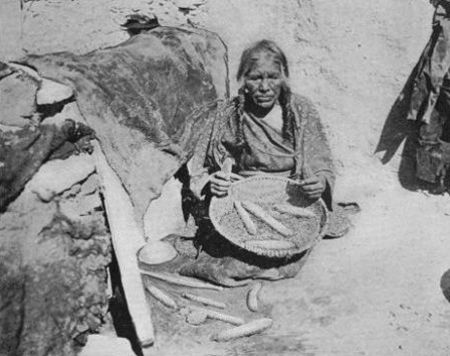
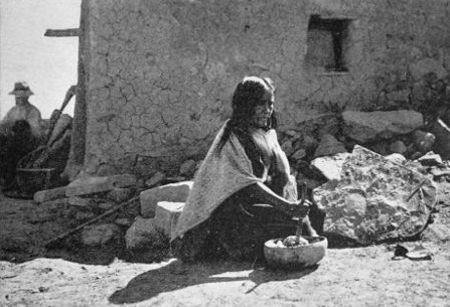
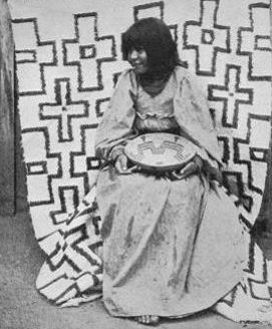
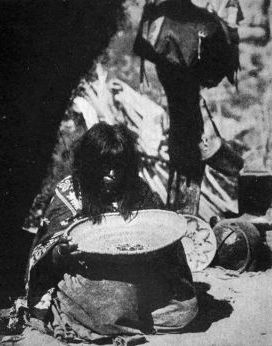
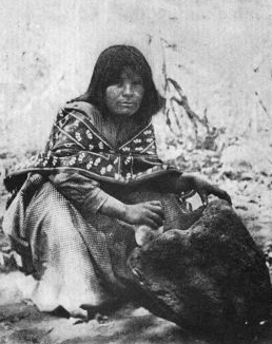
Sunflower seeds, squash seeds, and a variety of wild
grass seeds and corn are parched by the women by
placing them in saucer-shaped baskets—or kű-űs´—with
hot ashes, and then tossing them up and down and
to and fro until sufficiently cooked. The seeds are then
scooped out with the fingers, and ground on a slab of
basaltic rock, by rubbing one stone over the other. On
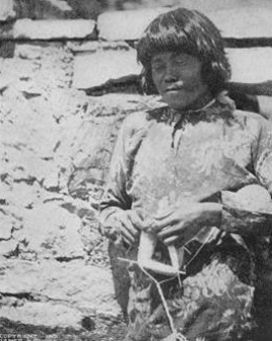
the occasion of one of my visits, when I was the guest
of Chickapanagie, I made the accompanying photograph
of his wife as she thus parched corn in a basket. It
was the placing of a covering of clay inside the kű-ű,
to prevent its burning, that led Frank Cushing to the
belief that here was the explanation of the origin of
pottery.[8]
Green squash is cooked after being hacked into pieces
in an apparently reckless but most effective manner.
With the squash in one hand, the woman takes a large
butcher knife in the other and strikes indifferently at
the squash, turning it around and at different angles
the while. In a few moments chips, as it were, begin
to fall into the cooking pot, and after the exterior is cut
and hacked in every direction the cook begins to slice
it into the pot. When well cooked, it is eaten without
any other improvement than a little salt.
Corn and beans are plentiful with them, and both are
as delicious and tender as any I have ever tasted elsewhere.
Mescal is one of their chief foods. It is made by
them exactly as the Wallapais make it. That fibrous
portion of the plant that cannot be treated in this
manner is boiled, and the drink therefrom, when fresh,
is a sickish-sweet liquid, that, however, might soon
become agreeable. This liquid is of a dark brown color,
and when boiled for a long time becomes a species of
thin molasses.
The Havasupais know no process of fermentation so
far as I have been able to learn, and the elders of the
people long objected to the coming of the white man
because one of the bad things he brought to the Indian
was whiskey and other intoxicants.
Quail and ducks abound in various parts of the Havasu
Canyon region. Even to this day many of the latter
are shot, for sale to the white man, with the arrow instead
of the gun. The Havasupais claim that the arrow
is far less liable to scare away the flock than is the loud
report of a gun, so they keep up their practice with the
antiquated bow and arrow, and some of them show wonderful
skill in their use. I have often placed a ten-cent
piece in a notched stick and enjoyed watching the
young men as they fired their arrows at it at a distance
of fifty paces. Their skill was such that on one occasion
I lost a dollar thus within half an hour.
At one time in February I found the canyon alive
with quail, the whirring of whose wings met us on every
hand as we rode along from hawa to hawa.
I am told there is no fish in Havasu Creek above
Mooney Falls, but from the base of this fall on to
the river both large and small fish are abundant. I
rather doubt this, as on the occasion of my attempt to
reach Beaver Falls down the course of the creek from
Mooney Falls I saw no fish, nor signs of any.
One of the Havasupais tells me that mountain sheep
may be seen on the northern rim of the Grand Canyon
in small bands. When the snow is deep upon the Buckskin
Mountains and the Kaibab Plateau they descend
to the more temperate regions of the canyon where
grass may be found in plenty, and then the Paiuti and
Paieed Indians kill them, drying the flesh for later
use. This they do regardless of a territorial law, which
forbids even an Indian killing mountain sheep at any
time. The Indian regards his as a prior right, existing
long before there was any territorial legislature, and he
acts accordingly.
Mountain lions, wildcats, lynxes, coyotes, badgers,
deer, and antelope, with an occasional mountain sheep
and bear, are the larger quarry of the Havasupai
hunters. The deer and antelope they find in the open
grassy glades of the forests on the canyon rim and
reaching towards the desert. The other game is
generally found in the recesses of the canyons or on
the slopes of the far-away mountains of Hue-han-a-patch-a
(the San Franciscos), Hue-ga-wool-a (Williams
Mountain), or Hue-ga-da-wi-za (Red Butte).
Some of the skins are dressed with the hair on and
are used for clothing, as sleeping mats, or are sold to
the travellers at the trains or traded at the stores on the
railway. But many of the better skins are carefully
tanned and dressed and converted into buckskins, as
before stated.
This, indeed, is one of their staple articles of trade,
good buckskins fetching as high as five dollars and even
ten dollars cash. I have several times seen a blanket
for which I had offered eight dollars or ten dollars
readily exchanged for a simple buckskin, and it is not
an unusual occurrence to note a trade where a fair
Navaho pony is given for a large and well-dressed skin.
The outside Indians that the Havasupais are familiar
with are the friendly Wallapais, whom they call their
cousins, the Hopis and the Navahoes. They have often
had wars with the hated Mohaves, Apaches, and Paiutis.
The Chemhuevis, Pimas, and Maricopas are their distant,
little known, but accepted friends. Far-away Zuni
is Si-u, and still farther Acoma is Ac-o-ca-va, and though
intercourse with the people of these villages is rare, it
has always been friendly.
For the grazing and watering of their horses and other
stock each head of a family has a certain region allotted
to him, over the boundaries of which he may not allow
his stock to wander, except when removing them or
by special permission. Manakacha, the head Kohot,
takes the range formerly owned or controlled by Captain
Navaho, the late Kohot, viz., the region of Black Tanks.
Rock Jones (the chief medicine-man) has Topocobya
Canyon and the plateau above as far as the other side
of the Grand Canyon towards the Mystic Spring Trail,
where begins the territory of Vesna, Captain Burro, and
Chickapanagie. This includes the south banks of the
Grand Canyon towards the Little Colorado River and
including the Mystic Spring, the Bright Angel, the Grand
View, Hance's old and the Red Canyon Trails, in the
neighborhood of which, for centuries, the Havasupais
have been descending. Indeed, it was the Havasupais
who made the "Indian Gardens" that are so charming
a feature of the Bright Angel Trail. Sinyela has the
upper part of Havasu Canyon reaching to Bass's camp
at the Caves, named by the Havasupais Wai-a-mel.
Uta and Waluthama have the lower portion of Havasu
Canyon, around to the head of Beaver Canyon and all
the territory on the south side as far as Hack-a-tai-a—the
Colorado River.
Thus there are no disputes arising over the wrongful
pasturage of stock, as each Indian regards himself as
bound by the strictest ties of honor not to deviate from
these established and long-observed boundaries.
As I have before stated, the Havasupais at one time
owned the whole of the Kohonino Forest region and
also the trails into Hack-a-tai-a (the Grand Canyon).
From time immemorial they have hunted from Havasu
(Cataract) Canyon to the Little Colorado, and, of
course, have had access to the water pockets, or rock
tanks, in which rain water accumulates all along this dry
and springless region. In talking with one of the Indians
recently he asked me if the Great Father at Washington
could do nothing for him and his people so that
they might still continue to use the water pockets of
their ancestral hunting-ground. He said, "You sabe
Ha-ha-poo-ha (Rain Tank) and Ha-wai-i-tha-qual-ga
(Rowe's Well) and Ha-ga-tha-wa-di-a (the water hole
near Hance's Camp) and Ha-ha-i-ga-sa-jul-ga (Red
Horse Tank), Havasupai use these water holes when
him go hunt deer and antelope. Now white man him
come and say, 'D— you, you get away. I've got no
water for any blanked Indian.' We no catch 'em water,
we no go hunt, and we no go hunt we no catch 'em deer
and antelope and jack rabbit, and by-em-by our squaws
and boys and gels go heap hungry. Maybe so you
see 'em Great Father at Washington and you tell him,
and ask him what Havasupai do."