SCHOOLCRAFT'S AMERICAN CYCLOPÆDIA, OR ETHNOLOGICAL GAZETTEER OF THE
INDIAN TRIBES OF THE AMERICAN CONTINENT, NORTH AND SOUTH,
COMPRISING THEIR HISTORY, GEOGRAPHY, AND NOMENCLATURE, FROM THE
DISCOVERY IN 1492, TO THE PRESENT PERIOD.
A prospectus for this work was issued in 1842. While the title is
slightly modified, the design and plan of its execution have not been
essentially changed. The principal object aimed at, under the general
idea of the history and geography of the Aboriginal Race, is to furnish
a general and standard reference-book, or short encyclopædia of topics
relative to the entire race, alphabetically arranged. By the insertion
of the name of each family of tribes, nation, sub-tribe, or important
clan, the occasion will be presented of noticing the leading or
characteristic events, in their history, numbers, government, religion,
languages, arts or distinctive character.
Where the scene or era of their expansion, growth and decay has been so
extensive, embracing as it does, the widest bounds and remotest periods,
their antiquities have also called for a passing notice. Nor could any
thing like a satisfactory accomplishment of the plan be effected,
without succinct notices of the lives and achievements of their
principal chiefs, rulers, and leading personages.
Language is an important means of denoting the intricate thread of
history in savage nations. Mr. Pritchard considers it more important
than physiological structure and peculiarities. It is, at least, found
often to reveal ethnological affinities, where both the physical type,
and the light of tradition, afford but little aid. The words and names
of a people, are so many clues to their thoughts and intellectual
structure; this branch of the subject, indeed, formed the original germ
of the present plan, which was at first simply geographical, and has
been rather expanded and built upon, than, if we may so say, supplied
the garniture of the edifice. In a class of transpositive languages,
which are very rich in their combinations, and modes of concentrated
description, it must needs happen, that the names of places would often
recall both associations and descriptions of deep interest in
contemplating the fate and fortunes of this unfortunate race. Without
intruding upon the reader disquisitions which would be out of place, no
opportunity has been omitted, from the consideration of their names, to
throw around the sites of their former or present residence, this
species of interest.
But half the work would have been done, it is conceived, to have
confined the work to North America; and it must necessarily have lost,
by such a limitation, more than half its interest. We are just beginning
in truth to comprehend the true character and bearing of that unique
type of civilization which existed in Mexico, Peru, and Yucatan. The
rude hand with which these embryo kingdoms of the native race were
overturned, in consequence of their horrid idolatries, necessarily led
to the destruction of much of their monumental, and so far as their
picture writing reached, some of their historical materials, of both of
which, we now feel the want. It is some relief, to know, as the
researches of Mr. Gallatin, which are now in progress, demonstrate, that
by far the greatest amount of the ancient Mexican picture writings, as
they are embraced in the elaborate work of Lord Kingsborough, relate to
their mythology and superstitions, and are of no historical value
whatever. And if the portions destroyed in the Mexican and Peruvian
conquests, were as liberally interspersed with similar evidences of
their wild polytheism, shocking manners, and degraded worship, neither
chronology nor history have so much to lament.
The early, strong and continued exertions which were made by the
conquerors to replace this system of gross superstition and idolatry, by
the Romish ritual, filled Mexico and South America with missions of the
Catholic Church, which were generally under the charge of zealous, and
sometimes of learned and liberal-spirited superintendants, who have
accumulated facts respecting the character and former condition of the
race. These missions, which were generally spread parallel to the sea
coasts of the Atlantic and Pacific, reaching inland along the banks of
the great rivers and plains, have confessedly done much to ameliorate
the manners and condition of the native race, to foster a spirit of
industry, and to enlighten their minds. Still, it is scarcely known,
that numerous and powerful tribes, stretching through wide districts of
the Andes and the Cordilleras, never submitted to the conqueror, and yet
exist in their original state of barbarism.
In this department of inquiry, the geographical and historical work of
De Alcedo, which, so far as the Spanish and Portuguese missions are
concerned, is both elaborate and complete in its details, has been taken
as a basis. No one can write of South America and its native tribes,
without reference to Humboldt. Other standard writers have been
consulted, to give this part of the work as much value as possible, not
excepting the latest voyages and travels. The design has been, without
aiming at too much, to compress a body of leading and characteristic
facts, in the shortest practicable compass, which should, at the same
time, present an ethnological view of the various families and groups of
the race.
In each department of inquiry, which admitted of it, the author has
availed himself of such sources and opportunities of personal
observation and experience, as his long residence in the Indian
territories, and his study of the Indian history have afforded. And he
is not without the hope, that his inquiries and researches on this head
may be found to be such as to merit approval.
Ab, often pronounced with the sound of we, before it,—a particle which,
in geographical names, in the family of the Algonquin dialects, denotes
light, or the east. It is also the radix of the verb wab, to see, as
well as of the derivatives, a-ab, an eye-ball, and wabishka, a white
substance, &c.,—ideas which either in their origin or application, are
closely allied.
Abacaris, a settlement of Indians in the Portuguese possessions of the
province of Amazon. These people derive their name from a lake, upon
which they reside. It is a peculiarity of this lake, that it has its
outlet into the river Madiera which, after flowing out of the province
turns about and again enters it, forming, in this involution, the large
and fertile island of Topanambes. This tribe is under the instruction of
the Carmelites. They retain many of their early peculiarities of manners
and modes of life. They subsist by the cultivation of maize, and by
taking fish in the waters of the Abacaris; or Abacactes in addition to
these means, they rely upon tropical fruits. The latest notices of them
come down to 1789. But little is known of their numbers, or present
condition.
Abaches, or Apaches, an erratic tribe of Indians, who infest the
prairies of western Texas and New Mexico. They are supposed by some, to
consist of not less than 15,000 souls. They are divided into petty
bands, known under various names. They are the most vagrant of all the
wild hunter tribes of the general area denoted. They do not live in
fixed abodes, but shift about in search of game or plunder, and are
deemed a pest by the Santa Fe traders. They raise nothing and
manufacture nothing. Those of them who are east of the Rio del Norte,
subsist on the baked root of the mauguey, and a similar plant called
Mezcal, and hence they are called Mezcaleros.
Another division of them, and by far the greatest, rove west of that
stream, where they are called Coyoteros, from their habit of eating the
coyote, or prairie wolf. They extend west into California and Sonora.
They bear a bad character wherever they are known. If on the outskirts
of the ranches and haciendas, they steal cattle and sheep. If on the
wide and destitute plains which they traverse, they thieve and murder.
Sometimes they are pursued and punished; more frequently, they escape.
The Mexican authorities keep some sort of terms with them by treaties,
which the vagrants, however, break and disregard, whenever they are
excited by hunger, or the lust of plunder. For Indians bearing the name,
formerly from the U. States, see Apaches.
Abaco, one of the Bahama islands. The native inhabitants of this, and
the adjacent groupes of islands, were, early after the discovery,
transported to the main, to work in the mines. In 1788 this island,
known to nautical men as the locality of the Hole in the Wall, had a
population of 50 whites, and 200 Africans.
Abacooche, or Coosa, a stream rising in Georgia. It flows into Alabama,
and after uniting with the Tallapoosa, a few miles below Wetumpka it
forms the Alabama river. The word is, apparently, derived from Oscooche,
one of the four bands into which the Muscogees, were anciently divided.
Abanakee, or Eastlanders, a distinct people, consisting of a plurality
of tribes, who formerly occupied the extreme north eastern part of the
United States. The word is variously written by early writers. See
Abenakies, Abernaquis, Wabunakies.
Abancay, the capital of a province of the same name 20 leagues from
Cuzco, in Peru. It is memorable for the victories gained in the vicinity
by the king's troops in 1542 and 1548 against Gonzalo Pizarro. It lies
in a rich and spacious valley, which was inhabited by the subjects of
the Inca, on the conquest.
Abasca, or Rabasca, a popular corruption, in the northwest, of
Athabasca, which see.
Abanes, an unreclaimed nation of Indians, living in the plains of St.
Juan, to the north of the Orinoco, in New Grenada. They are of a docile
character, and good disposition, lending a ready ear to instruction, but
have not embraced the Catholic religion. They inhabit the wooded shores
of the river, and shelter themselves from the effects of a tropical sun,
in the open plains, by erecting their habitations in the small
copse-wood. They are bounded towards the west, by the Andaquies and
Caberras, and east by the Salivas.
Abangoui, a large settlement of the Guarani nation of Indians, on the
shores of the river Taquani, in Paraguay. This stream and its
inhabitants were discovered by A. Numez, in 1541.
Abecoochi, see Abacooche.
Abeicas, an ancient name for a tribe of Indians, in the present area of
the United States, who are placed in the earlier geographies, south of
the Alabamas and west of the Cherokees. They dwelt at a distance from
the large rivers, yet were located in the districts of the cane, out of
the hard substance of which they made a kind of knife, capable of
answering the principal purposes of this instrument. They were at enmity
with the Iroquois.
Abenakies, a nation formerly inhabiting a large part of the
territorial area of the states of New Hampshire and Maine. There were
several tribes, of this nation the principal of which were the
Penobscots, the Norredgewocks, and the Ameriscoggins. They were at
perpetual hostilities with the New England colonists. They had received
missionaries, at an early day, from the French in Canada, and acted in
close concert with the hostile Indians from that quarter. At length in
1724, the government of Massachussetts organized an effective expedition
against them, which ascended the Kennebec, attacked the chief town of
the Norredgewocks, and killed a large number of their bravest warriors.
Among the slain, was found their missionary Sebastian Rasle, who had
taken up arms in their defence. There was found, among his papers, a
copious vocabulary of the language, which has recently been published
under the supervision of Mr. Pickering. In the year 1754, all the
Abenakies, except the Penobscots, removed into Canada. This nation had
directed their attention, almost exclusively, to hunting. At the mouth
of the Kennebec they absolutely planted nothing. Their language, as
observed by Mr. Gallatin, has strong affinities with those of the
Etchemins, and of the Micmacs, of New Brunswick and Nova Scotia; there
are fewer resemblances in its vocabulary to the dialects south of them.
This nation appears to have been called Tarrenteens, by the New England
Indians. Their generic name for themselves, if they had one, is unknown.
The term Abenakie, is one manifestly imposed by Algonquin tribes living
west and south of them. It is derived from wabanung, the east, or a
place of light, and akee, land.
Abekas, a name applied, so late as 1750, to a band of the Muscogees,
living on the river Tombigbee, within the present area of Alabama.
Abernaquis, a settlement of the expatriated Abenakies of New England,
in Lower Canada. They subsist themselves at this time in a great measure
by agriculture, and manifest a disposition to improve. From a report
made in 1839 by the American Board of Foreign missions of Boston who
employ a missionary and teacher among them, sixty persons attend
Protestant worship, of which number, 24 are church members. Twenty of
the youth attend a daily school.
Abigiras, an Indian mission formerly under the charge of the order of
Jesuits, in the governmental department of Quito. It is situated on the
river Curasari, 30 leagues from its mouth, and 240 from Quito. It was
founded in 1665 by father Lorenzo Lucero.
Abingas, or Wabingas, a name for a band, or sub-tribe of the River
Indians, of the Mohegan, or Mohekinder stock, who formerly inhabited the
present area of Dutchess county, N. Y., and some adjacent parts of the
eastern shores of the Hudson, above the Highlands.
Abipones, an unreclaimed nation of Indians, who inhabit the south shores
of the river Bermejo, in the province of Tucuman, Buenos Ayres. This
nation is said, perhaps vaguely, to have formerly numbered 100,000
souls, but was, at the last accounts, about A.D. 1800, much reduced.
They present some peculiar traits, living as nearly in a state of nature
as possible. The men go entirely naked, subsisting themselves by hunting
and fishing, and passing much of their time in idleness or war. The
women wear little ornamented skins called queyapi. Physically, the
people are well formed, of a lofty stature and bearing, robust and good
featured. They paint their bodies profusely, and take great pains to
inspire hardihood. For this purpose they cut and scarify themselves from
childhood; they esteem tiger's flesh one of the greatest dainties,
believing its properties to infuse strength and valor. In war they are
most cruel, sticking their captives on the top of high poles, where,
exposed to the scorching rays of the sun, they are left to die the most
horrid death.
They have no knowledge of God, of laws, or of policy, yet they believe
in the immortality of the soul, and in a land of future bliss, where
dancing and diversions shall prevail. Widows observe celibacy for a
year, during which time they abstain from fish. The females occupy
themselves in sewing hides, or spinning rude fabrics. When the men are
intoxicated—a prevalent vice—they conceal their husbands' knives to
prevent assassinations. They rear but two or three children, killing all
above this number.
Abisca, an extensive mountainous territory of Peru, lying between the
Yetau and Amoramago rivers, east of the Andes, noted from the earliest
times, for the number of barbarous nations who occupy it. It is a wild
and picturesque region, abounding in forests, lakes and streams, and
affording facilities for the chase, and means of retreat from
civilization, so congenial to savage tribes. An attempt to subjugate
these fierce tribes made by Pedro de Andia in 1538, failed. The same
result had attended the efforts of the emperor Yupanqui.
Abitanis, a mountain in the province of Lipas, in Peru. In the Quetchuan
tongue, it signifies the ore of gold, from a mine of this metal, which
is now nearly abandoned.
Abittibi, the name of one of the tributaries of Moose River, of James'
Bay, Canada. Also a small lake in Canada West, near the settlement of
Frederick, in north latitude 48°, 35´ and west longitude 82°: also, a
lake north of lake Nepissing, in the direction to Moose Fort. It is a
term, apparently derived from nibee, water, and wab, light.
Abitigas, a fierce and warlike nation of Indians, in the province of
Tarma in Peru, of the original Quetche stock. They are situated 60
leagues to the east of the Andes. They are barbarians, roving from place
to place, without habits of industry, and delighting in war. They are
numerous, as well as warlike; but like all the non-agricultural tribes
of the region, they are often in want and wretchedness. They are
bounded on the south by their enemies the Ipilcos.
Abo, Abouor Michabo, or the Great Hare, a personage rather of
mythological, than historical note, in the traditions of the Lake
Algonquin tribes. It is not clear, although probable, that he is to be
regarded as identical with Manabosho, or Nanabosho.
Abojeeg, a celebrated war and hereditary chief of the Chippewa nation,
who flourished during the last century; more commonly written Wabojeeg,
which see.
Abraham, a chief of the Mohawks, who, after the fall of king Hendrick,
so called, at the battle of lake George, in 1755, between the English
and French armies, became the ruling chief of that nation. He was the
younger brother of Hendrick, and lived at the lower Mohawk Castle. He
was of small stature, but shrewd and active, and a fluent speaker.
Numbers of his speeches are preserved, which he delivered, as the ruling
chief of his tribe, in various councils, during the stormy era of 1775,
which eventuated in the American revolution. In the events of that era,
his name soon disappears: as he was then a man of advanced years, he
probably died at his village. It is not known that he excelled in war,
and, at all events, he was succeeded, about this time, in fame and
authority, by a new man in the chieftainship, who rose in the person of
Thyendanegea, better known as Joseph Brant. Abraham, or little Abraham,
as he was generally called, appears from his speeches and policy, to
have thoroughly adopted the sentiments and policy of Sir William
Johnson, of whom, with his tribe generally, he was the friend and
admirer. He was, as his speeches disclose, pacific in his views,
cautious in policy, and not inclined, it would seem, to rush headlong
into the great contest, which was then brewing, and into which, his
popular successor, Brant, went heart and hand. With less fame than his
elder brother Hendrick, and with no warlike reputation, yet without
imputation upon his name, in any way, he deserves to be remembered as a
civilian and chieftain, who bore a respectable rank; as one of a proud,
high spirited, and important tribe. Little Abraham was present at the
last and final council of the Mohawks, with the American
Commissioners, at Albany, in September 1775, and spoke for them on this
occasion—which is believed to have been the last peaceable meeting
between the Americans and the Mohawk tribe, prior to the war.
[Note.—Accents are placed over all words of North American origin,
when known. Vowels preceding a consonant, or placed between two
consonants, are generally short: following a consonant, or ending a
syllable or word, they are generally long. Diphthongs are used with
their ordinary power.]
Absecon. A beach of the sea coast of New Jersey, sixteen miles southwest
of Little Egg Harbor. The word is a derivative from Wabisee, a Swan, and
Ong, a Place.
Absoróka, a name for the Minnetaree tribe of Indians on the river
Missouri. They are philologically of the Dacotah family. See Minnetaree.
Abucees, a mission of the Sucumbias Indians, in the province of Quixos,
Quito, which was founded by the order of Jesuits. It is situated on the
shores of a small river, which enters the Putumago, in north latitude O°
36´ longitude 79° 2´ west.
Aburra, a town, in a rich valley of the same name, in New Grenada,
discovered in 1540, by Robledo. In its vicinity are found many huacas,
or sepulchres of the Indians, in which great riches, such as gold
ornaments, are found deposited. There are, in the vicinity, some streams
of saline water, from which the Indians manufacture salt.
Abwoin, or Bwoin, a name of the Chippewas, Ottawas, and other modern
Algonquin tribes of the upper Lakes, for the Dacotah or Sioux nation. It
is rendered plural in ug. The word is derived from abwai, a stick used
to roast meat, and is said to have been given to this tribe, in reproach
from the ancient barbarities practised towards their prisoners taken
captive in war. For an account of this tribe, see Dacotah and Sioux.
Abwoinac; Abwoina: Terms applied to the general area between the
Mississippi and Missouri, lying north of the St. Peter's, occupied by
Sioux tribes. In the earlier attempts of Lord Selkirk, to plant a colony
in parts of this region, the compound term Assinaboina, was, to some
extent, but unsuccessfully employed. The two former terms are
derivatives from Abwoin, a Sioux, and akee, earth; the latter has the
prefix assin, (ossin,) a stone.
Acaquato, a settlement of Indians in the district of Tancitars, in Peru,
reduced in 1788, to fifteen families, who cultivated maize and
vegetables.
Acambaro, a settlement of 490 families of Indians, and 80 of
Mustees, belonging to the order of St. Francis, in the district of
Zelaya, in the province and bishopric of Mechoacan, seven leagues S. of its
capital.
ACamistlahuac, a settlement of 30 Indian families in the district of
Tasco, attached to the curacy of its capital, from whence it is two
leagues E. N. E.
Achamuchitlan, a settlement of 60 families of Indians in the district of
Texopilco, and civil division of Zultepec. They sell sugar and
honey—the district also produces maize and vegetables. It is 5 leagues
N. of its head settlement.
Acantepec. The head settlement of Tlapa, embracing 92 Indian families,
including another small settlement in its vicinity, all of whom maintain
themselves by manufacturing cotton stuffs.
Acapetlahuala, a settlement of 180 Indian families, being the principal
settlement of the district of Escateopan, and civil district of
Zaquaepa.
Acari, a settlement in a beautiful and extensive valley of Camana, in
Peru, noted for a lofty mountain called Sahuacario, on the skirts of
which the native Indians had constructed two fortresses, prior to their
subjugation by the Spanish. This mountain is composed of “misshapen
stones, and sand,” and is reported, at certain times of the year to emit
loud sounds, as if proceeding from pent up air, and it is thought to
have, in consequence, attracted the superstitious regard of the ancient
Indian inhabitants.
Acatepec. There are five Indian settlements of this name, in Spanish
America.
1. A settlement comprising 860 Indian families, of the order of St.
Francis, in the district of Thehuacan. Forty of these families live on
cultivated estates stretching a league in a spacious valley, four
leagues S. S. W. of the capital.
2. A settlement in the district of Chinantla, in the civil jurisdiction
of Cogamaloapan. It is situated in a pleasant plain, surrounded by three
lofty mountains. The number of its inhabitants is reduced. The Indians
who live on the banks of a broad and rapid river, which intercepts the
great road to the city of Oxaca, and other jurisdictions, support
themselves by ferrying over passengers in their barks and canoes. It is
10 leagues W. of its head settlement.
3. A settlement of 100 Indian families, in the same kingdom; situated
between two high ridges. They are annexed to the curacy of San Lorenzo,
two leagues off.
4. A settlement of 39 Indian families annexed to, and distant one league
and a half N. of the curacy of Tlacobula. It is in a hot valley, skirted
by a river, which is made to irrigate the gardens and grounds on its
borders.
5. A settlement of 12 Indian families in the mayorate of Xicayun of
the same kingdom.
Acatepeque, St. Francisco, De, a settlement of 140 Indian families in
the mayorate of St. Andres de Cholula, situated half a league S. of its
capital.
Acatlan, six locations of Indians exist, under this name, in Mexico.
1. A settlement of 850 families of Indians in the alcaldia of this
name, embracing some 20 Spaniards and Mustees. In the vicinity are
some excellent salt grounds. The climate is of a mild temperature, and
the surrounding country is fertile, abounding in fruits, flowers, and
pulse, and is well watered. It is 55 leagues E. S. E. of Mexico.
2. A settlement of 180 Indian families in Xalapa of the same kingdom,
(now republic.) It occupies a spot of clayey ground of a cold moist
temperature, in consequence of which, and its being subject to N. winds,
fruits, in this neighbourhood, do not ripen. Other branches of
cultivation succeed from the abundance of streams of water, and their
fertilizing effects on the soil. This settlement has the dedicatory
title of St. Andres.
3. San Pedro, in the district of Malacatepec, and alcaldia of
Nexapa. It contains 80 Indian families, who trade in wool, and the fish
called bobo, which are caught, in large quantities, in a considerable
river of the district.
4. Zitlala. It consists of 198 Indian families, and is a league
and a half N. of its head settlement of this name.
5. Sentepec, a settlement 15 leagues N. E. of its capital. The
temperature is cold. It has 42 Indian families.
6. Atotonilco, in the alcaldia mayor of Tulanzingo. It contains
115 Indian families, and has a convent of the religious order of St.
Augustine. It is 2 leagues N. of its head settlement.
Acatlanzingo, a settlement of 67 Indian families of Xicula of the
alcadia mayor of Nexapa, who employ themselves in the culture of
cochineal plants. It lies in a plain, surrounded on all sides by
mountains.
Acaxee, a nation of Indians in the province of Topia. They are
represented to have been converted to the catholic faith by the society
of Jesuits in 1602. They are docile and of good dispositions and
abilities. One of their ancient customs consisted of bending the heads
of their dead to their knees, and in this posture, putting them in
caves, or under a rock and at the same time, depositing a quantity of
food for their supposed journey in another state. They also exhibited a
farther coincidence with the customs of the northern Indians, by placing
a bow and arrows with the body of the dead warrior, for his defence.
Should an Indian woman happen to die in child-bed, they put the
surviving infant to death, as having been the cause of its mother's
decease. This tribe rebelled against the Spanish in 1612, under the
influence of a native prophet, but they were subdued by the governor of
the province, Don Francisco de Ordinola.
Acaxete, Santa Maria de, the head settlement of the district of Tepcaca,
on the slope of the sierra of Tlascala. It consists of 176 Mexican
Indians, 7 Spanish families, and 10 Mustees and Mulatoes. In its
vicinity there is a reservoir of hewn stone, to catch the waters of the
mountain, which are thence conducted to Tepcaca, three leagues N. N. W.
Acaxuchitlan, a curacy consisting of 406 Indian families of the
bishopric of La Peubla de los Angeles. It is in the alcaldia of
Tulanzingo, lying 4 leagues E. of its capital.
Acayuca, the capital of a civil division of New Spain, in the province
of Goazacoalco, embracing, in its population, 296 families of Indians,
30 of Spaniards, and 70 of mixed bloods. It lies a little over 100
leagues S. E. of Mexico, in lat. 17° 53´ N.
Acazingo, St. Juan de, a settlement of the district of Tepcaca,
consisting of 700 families of Indians, 150 of Spaniards, 104 of Mustees,
and 31 of Mulatoes. It is situated in a plain of mild temperature, well
watered, and has a convent and fountain, and a number of “very ancient
buildings.”
Accócesaws, a tribe of Indians of erratic habits, of Texas, whose
principal location was formerly on the west side of the Colorado, about
200 miles S. W. of Nacogdoches. At a remoter period they lived near the
gulf of Mexico: they made great use of fish, and oysters. Authors
represent the country occupied, or traversed by them, as exceedingly
fertile and beautiful, and abounding in deer of the finest and largest
kind. Their language is said to be peculiar to themselves; they are
expert in communicating ideas by the system of signs. About A. D. 1750
the Spanish had a mission among them, but removed it to Nacogdoches.
Accomac, a county of Virginia, lying on the eastern shores of Chesapeak
bay. This part of the sea coast was inhabited by the Nanticokes, who
have left their names in its geography. We have but a partial vocabulary
of this tribe, which is now extinct. It has strong analogies, however,
to other Algonquin dialects. Aco, in these dialects, is a generic term,
to denote a goal, limit, or fixed boundary. Ahkee, in the Nanticoke, is
the term for earth, or land. Auk, is a term, in compound words of these
dialects, denoting wood. The meaning of accomac, appears to be as far
as the woods reach, or, the boundary between meadow and woodlands.
Accomacs, one of the sub tribes inhabiting the boundaries of Virginia on
its discovery and first settlement. Mr. Jefferson states their numbers
in 1607 at 80. In 1669, when the legislature of Virginia directed a
census of the Indian population, within her jurisdiction, there appears
no notice of this tribe. They inhabited the area of Northampton county.
They were Nanticokes—a people whose remains united themselves or at
least took shelter with the Lenapees, or Delawares.
Accohanocs, a division or tribe of the Powhetanic Indians, numbering 40,
in 1607. They lived on the Accohanoc river, in eastern Virginia.
Accomentas, a band, or division of the Pawtucket Indians inhabiting the
northerly part of Massachusetts in 1674. (Gookin.)
Achagua, a nation of Indians of New Grenada, dwelling in the plains of
Gazanare and Meta, and in the woods of the river Ele. They are bold and
dexterous hunters with the dart and spear, and in their contests with
their enemies, they poison their weapons. They are fond of horses, and
rub their bodies with oil, to make their hair shine. They go naked
except a small azeaun made of the fibres of the aloe. They anoint
their children with a bituminous ointment at their birth, to prevent the
growth of hair. The brows of females are also deprived of hair, and
immediately rubbed with the juice of jagua, which renders them bald
ever after. They are of a gentle disposition but addicted to
intoxication. The Jesuits formerly reduced many of them to the Catholic
faith, and formed them into settlements in 1661.
Achafalaya, the principal western outlet of the Mississippi river. It is
a Choctaw word, meaning, “the long river,” from hucha, river, and
falaya, long. (Gallatin.)
Ackoways, a synonym for a band of Indians of New France, now Canada. See
Acouez.
Ackeekseebe, a remote northern tributary of the stream called Rum river,
which enters the Mississippi, some few miles above the falls of St.
Anthony, on its left banks. It is a compound phrase, from Akeek, a
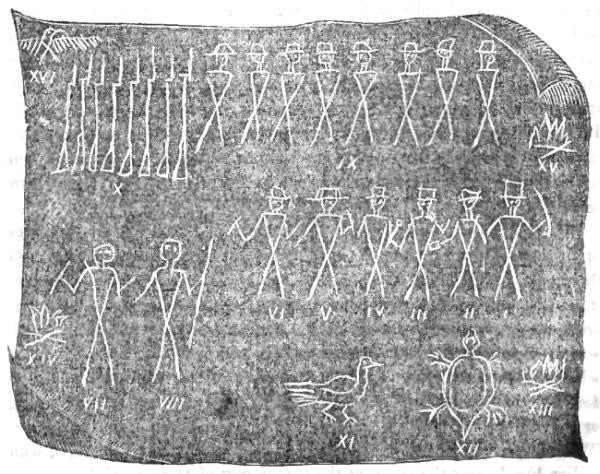
kettle, and seebe, a stream. It was on the margin of this stream, in a
wide and spacious area, interspersed with beaver ponds, that a
detachment of Gen. Cass's exploring party in July 1820, encamped; and
the next morning discovered an Indian pictorial letter, written on bark,
detailing the incidents of the march.
Ackeeko, or the Kettle chief, a leading Sauc chief who exercised his
authority in 1820, at an important Indian village, situated on the right
banks of the Mississippi, at Dubuque's mines.
Achquanchicóla, the name of a creek in Pennsylvania; it signifies in the
Delaware or Lenapee language, as given by Heckewelder, the brush-net
fishing creek.
Achwick, a small stream in central Pennsylvania. It denotes in the
Delaware language, according to Heckewelder, brushy, or difficult to
pass.
Acobamba, a settlement in the province of Angaraes in Peru, near which
are some monumental remains of the ancient race, who inhabited the
country prior to its conquest by the Spanish. They consist, chiefly, of
a pyramid of stones, and the ruins of some well sculptured stone
couches, or benches, now much injured by time.
Acolman, San Augustin de, a settlement of 240 families of Indians of
Tezcoco in Mexico. It is situated in a pleasant valley, with a benign
temperature, and has a convent of Augustine monks.
Acomes, a fall in the river Amariscoggin, Maine, denoting, in the
Indian, as is supposed, a rest, or place of stopping. From aco, a bound
or point.
Acomulco, a village of 12 Indian families in Zochicoatlan, New Spain,
two leagues W. of its capital.
Aconichi, the name of a settlement of Indians formerly living on the
river Eno, in North Carolina.
Acotitlan, a settlement of 15 Indian families, in the alcaldia of
Autlan, Mexico. They employ themselves in raising cattle, making sugar
and honey, and extracting oil from the cacao fruit.
Acouez, a name formerly applied by the French to a band of Indians in
New France. Believed to be identical with Ackoways.
Acquackinac, or Acquackinunk, the Indian name of a town on the W. side
of the Passaic river, New Jersey, ten miles N. of Newark and 17 from New
York. From aco, a limit, misquak, a red cedar, and auk, a stump or trunk
of a tree.
Acquinoshiónee, or United People, the vernacular name of the Iroquois
for their confederacy. It appears, from their traditions, communicated
to the Rev. Mr. Pyrlaus, a Dutch missionary of early date, that this
term had not been in use above 50 years prior to the first settlement of
the country: and if so, we have a late date, not more remote than 1559
for the origin of this celebrated union. But this may be doubted.
Cartier discovered the St. Lawrence in 1534, and found them at the site
of Montreal; Verrizani, is said to have entered the bay of New York ten
years before. Hudson entered the river in 1609. Jamestown was founded
the year before. The Pilgrims landed at Plymouth 14 years later. It is
more probable that the 50 years should be taken from the period of the
earlier attempts of the French settlements, which would place the origin
of the confederacy about A. D. 1500. (See Iroquois.)
Actopan, or Octupan, a town and settlement of the Othomies Indians,
situated 23 leagues N. N. E. of Mexico. Its population is put by Alcedo
in 1787, at 2750 families. These are divided into two parties, separated
by the church. It also contains 50 families of Spaniards, Mustees, and
Mulatoes. The temperature is mild, but the ground is infested with the
cactus, thorns and teasel, which leads the inhabitants to devote their
attention to the raising of sheep and goats. In this vicinity are found
numbers of the singular bird, called zenzontla, by the Mexican
Indians.
Actupan, a settlement of 210 families of Indians in the district of
Xocimilco, Mexico.
Acuiapan, a settlement of 58 Indian families, in the alcaldia mayor
of Zultepec, annexed to the curacy of Temascaltepec. They live by dressing
hides for the markets—ib.
Acuilpa, a settlement of 92 Indian families, in the magistracy of Tlapa,
Mexico. It is of a hot and moist temperature, yielding grain, and the
white medicinal earth called chia, in which they carry on a trade.
Acuio, a considerable settlement of Spaniards, Mustees, Mulatoes, and
Negroes, 30 leagues W. of Cinaqua, in the curacy of Tauricato, Mexico;
embracing 9 Indian families.
Acula, San Pedro de, an Indian settlement of 305 families, four leagues
E. of Cozamaloapan, its capital. It is situated on a high hill, bounded
by a large lake of the most salubrious water, called Peutla by the
natives. This lake has its outlet into the sea through the sand banks of
Alvarado, and the lake is subject to overflow its banks in the winter
season.
Acutitlan, an Indian settlement of 45 families, in the district of
Tepuxilco, Mexico, who trade in sugar, honey, and maize. It is five
leagues N. E. of Zultepec, and a quarter of a league from Acamuchitlan.
Acutzio, an Indian settlement of Tiripitio, in the magistracy of
Valladolid, and bishopric of Mechoacan, Mexico. It contains 136 Indian
families, and 11 families of Spaniards and Mustees. Six cultivated
estates in this district, producing wheat, maize, and other grains,
employ most of this population, who also devote part of their labour to
the care of large and small cattle.
Adaes, or Adaize, a tribe of Indians, who formerly lived forty miles
south west from Natchitoches, in the area of country, which now
constitutes a part of the republic of Texas. They were located on a
lake, which communicates with the branch of Red-river passing Bayou
Pierre. This tribe appears to have lived at that spot, from an early
period. Their language is stated to be difficult of acquisition, and
different from all others, in their vicinity. They were at variance with
the ancient Natchez, and joined the French in their assault upon them in
1798. They were intimate with the Caddoes, and spoke their language.
At the last dates, (1812) they were reduced to twenty men, with a
disproportionate number of women. The synonyms for this now extinct
tribe are, Adayes; Adees; Adaes; Adaize.
Adario, a celebrated chief of the Wyandot nation, who was at the height
of his usefulness and reputation, about 1690. He was able in the
councils of his tribe, shrewd and wily in his plans, and firm and
courageous in their execution. The Wyandots, or Hurons as they are
called by the French, were then living at Michilimackinac, to which
quarter they had been driven by well known events in their history. The
feud between them and their kindred, the Iroquois, still raged. They
remained the firm allies of the French; but they were living in a state
of expatriation from their own country, and dependant on the friendship
and courtesy of the Algonquins of the upper lakes, among whom they had
found a refuge. Adario, at this period, found an opportunity of making
himself felt, and striking a blow for the eventual return of his nation.
To understand his position, a few allusions to the history of the period
are necessary.
In 1687, the English of the province of New York, resolved to avail
themselves of a recent alliance between the two crowns, to attempt a
participation in the fur trade of the upper lakes. They persuaded the
Iroquois to set free a number of Wyandot captives to guide them through
the lakes, and open an intercourse with their people. Owing to the high
price and scarcity of goods, this plan was favored by Adario and his
people, and also by the Ottowas and Pottowattomis, but the enterprise
failed. Major McGregory, who led the party, was intercepted by a large
body of French from Mackinac, the whole party captured and their goods
were distributed gratuitously to the Indians. The lake Indians, who had
covertly countenanced this attempt, were thrown back entirely on the
French trade, and subjected to suspicions which made them uneasy in
their councils, and anxious to do away with the suspicions entertained
of their fidelity by the French. To this end Adario marched a party of
100 men from Mackinac against the Iroquois. Stopping at fort Cadarackui
to get some intelligence which might guide him, the commandant informed
him that the governor of Canada, Denonville, was in hopes of concluding
a peace with the Five Nations, and expected their ambassadors at
Montreal in a few days. He therefore advised the chief to return. Did
such a peace take place, Adario perceived that it would leave the
Iroquois to push the war against his nation, which had already been
driven from the banks of the St. Lawrence to lake Huron. He dissembled
his fears, however, before the commandant, and left the fort, not for
the purpose of returning home, but to waylay the Iroquois delegates, at
a portage on the river where he knew they must pass. He did not wait
over four or five days, when the deputies arrived, guarded by 40 young
warriors, who were all surprised, and either killed or taken prisoners.
His next object was to shift the blame of the act on the governor of
Canada, by whom he told his prisoners, he had been informed of their
intention to pass this way, and he was thus prepared to lie in wait for
them. They were much surprised at this apparent act of perfidy,
informing him at the same time, that they were truly and indeed on a
message of peace. Adario affected to grow mad with rage against
Denonville, declaring that he would some time be revenged on him for
making him a tool, in committing so horrid a treachery. Then looking
steadfastly on the prisoners among whom was Dekanefora, the head chief
of the Onondaga tribe, “Go,” said he, “my brothers, I untie your bonds,
and send you home again, although our nations be at war. The French
governor has made me commit so black an action, that I shall never be
easy after it, until the Five Nations have taken full revenge.” The
ambassadors were so well persuaded of the perfect truth of his
declarations, that they replied in the most friendly terms, and said the
way was opened to their concluding a peace between their respective
tribes, at any time. He then dismissed his prisoners, with presents of
arms, powder and ball, keeping but a single man (an adopted Shawnee) to
supply the place of the only man he had lost in the engagement. By one
bold effort he thus blew up the fire of discord between the French and
their enemies, at the moment it was about to expire, and laid the
foundation of a peace with his own nation. Adario delivered his slave to
the French on reaching Mackinac, who, to keep up the old enmity between
the Wyandots and the Five Nations, ordered him to be shot. On this
Adario called up an Iroquois prisoner who was a witness of this scene,
and who had long been detained among them, and told him to escape to his
own country, and give an account of the cruelty of the French, from whom
it was not in his power to save a prisoner he had himself taken.
This increased the rage of the Five Nations to such a pitch, that when
Mons. Denonville sent a message to disown the act of Adario, they put no
faith in it, but burned for revenge. Nor was it long before the French
felt the effects of their rage. On the 26th of July, 1688, they landed
with 1200 men on the upper end of the island of Montreal, and carried
destruction wherever they went. Houses were burnt, plantations sacked,
and men, women and children massacred. Above a thousand of the French
inhabitants were killed, and twenty-six carried away prisoners, most of
whom were burnt alive. In October of the same year, they renewed their
incursion, sweeping over the lower part of the island as they had
previously done the upper. The consequences of these inroads were most
disastrous to the French, who were reduced to the lowest point of
political despondency. They burnt their two vessels on Cadarackui lake,
abandoned the fort, and returned to Montreal. The news spread far and
wide among the Indians of the upper lakes, who, seeing the fortunes of
the French on the wane, made treaties with the English, and thus opened
the way for their merchandise into the lakes.—[Colden.]
Such were the consequences of a single enterprise, shrewdly planned and
vigorously executed. The fame of its author spread abroad, and he was
every where regarded as a man of address, courage and abilities. And it
is from this time, that the ancient feud between the Wyandots and their
kindred, the Five Nations, began to cool. They settled on the straits of
Detroit, where they so long, and up to the close of the late war (1814,)
exercised a commanding influence among the lake tribes, as keepers of
the general council fire of the nations.
La Hontan, in his Travels in New France, relates some conversations with
this chief, on the topic of religion, which may be regarded, almost
exclusively, as fabulous.
Adayes, Adaes, and Adees, forms of orthography, occurring in various
writers, for the Adaize Indians, which see.
Adequatángie, a tributary of the eastern head waters of the river
Susquehanna in New-York. The word is Iroquois.
Addees, the number of this tribe, residing on the waters of Red River,
in Louisiana, in 1825, is stated, in an official report, from the war
department of that year, at twenty-seven.
Adóles, a settlement of Indians in the province of Orinoco. They were of
the Saliva nation. The settlement was destroyed by the Caribs in 1684.
Adiróndacks, the name of the Iroquois tribes for the Algonquins. The
consideration of their history and characteristics, as a family of
tribes, will be taken up, under the latter term.
Adirondack Mountains, a name bestowed, in the geological survey of New
York, upon the mountains at the source of the Hudson River.
Adik, Iá-ba. See Iaba Wadik.
Adikíminis, or Cariboo Island; an island situated in the north eastern
part of lake Superior, which is invested with no other importance than
it derives from Indian mythology and superstition. It is small and has
seldom been visited. The Chippewas believe that this is one of the
places of residence of their local manitoes, and that it was formerly
inhabited by Michabo or Manabosho. Early travellers, who notice this
belief, represent its shores to be covered with golden sands, but that
these sands are guarded by powerful spirits, who will not permit the
treasure to be carried away. Many fanciful tales are told of its having
been once attempted, when a huge spirit strode into the water, and
reclaimed the shining treasure. This is Carver's version, who, however,
confounds it with another contiguous island. Henry, who visited it in
his search after silver mines, in 1765, says that the Indians told him
that their ancestors had once landed there, being driven by stress of
weather, but had great difficulty in escaping from the power of enormous
snakes. He calls it the Island of Yellow Sands. It abounded certainly
with hawks in his day, one of whom was so bold as to pluck his cap from
his head. He found nothing to reward his search but a number of
Cariboos, which is the American reindeer, of which no less than 13 were
killed, during his stay of three days. He represented it to be 12 miles
in circumference, low, and covered with ponds, and to be sixty miles
distant from the north shore of the lake. He thinks it is perhaps the
same island which the French called Isle de Pontchartrain.
Affagoula, a small village of Indians, of Louisiana, who were located in
1783 near Point Coupé, on the Mississippi.
Agaces, a nation of Indians of the province of Paraguay. They are
numerous, valiant, and of a lofty stature. They were, in ancient times,
masters of the banks of the Paraguay, waging war against the Guavanies,
and keeping the Spaniards at bay, but were at last subjugated in 1542,
by Alvar Nunez Cabeza de Vaca, governor of the province.
Agariata, an Iroquois chief, who, having gone on an embassy of peace
about 1688, to Canada, the governor, Monsieur Coursel, being
exasperated against him, on account of bad faith and a violation of a
treaty, caused him to be hanged in the presence of his countrymen.
Agamentigus, a mountain of considerable elevation, eight miles from York
harbour, Maine; also, a river of the same vicinity, which derives its
waters chiefly from the influx of Piscataqua bay. The termination of the
name in us, is foreign, and not in accordance with the Abenakie
dialects of this coast.
Agamuntic, the name of a small lake, or pond, of Maine, which discharges
its waters through the west branch of the Chaudiere river.
Agawams, a band of Indians of the Pokenoket, or Wampanoag type, who
formerly lived at various periods, in part in Sandwich, in part in
Ipswich, and in part in Springfield, Massachusets. The word is written
with some variety, in old authors, the chief of which, are, the addition
of another g, and the change of the penultimate a to o.
Agiocochook, a name of the Indians, for the White Mountains of
New-Hampshire; of which the penultimate ok, is the plural. This group is
also called, according to President Allen, Waumbek—a word, which in
some of the existing dialects of the Algonquin, is pronounced Waubik,
that is, White Rock.
Agnalos, a tribe of infidel Indians, inhabiting the mountains north of
the river Apure, in New Grenada.
Agrias, a tribe of Indians, formerly very numerous, of the government of
Santa Marta, to the north of the Cienegra Grande. They are, at present,
considerably reduced.
Agua de Culebra, San Francisco Xavier De La, a reduccion of
Indians of the Capuchins, of the province of Venezuela. The vicinity
produces, in abundance, cacao, yucao, and other vegetable productions.
Aguacagua, an Indian mission, on a branch of the Oronoco, called Caroni.
Aguacatlan, an Indian mission of Xala, in Mexico. In 1745, it contained
80 families of Indians, who cultivated maize and French beans.
Agualulco, the capital of the jurisdiction of Izatlan, New Galicia,
which in 1745, contained 100 Indian families.
Aguanos, a settlement in the province of Mainas, Quito, so called from
the Indians of whom it is composed.
Aguarico, an Indian mission of the Jesuits, on the shores of the river
Napo, of the province of Máinás, Quito.
Aguaringua, an ancient and large settlement of Indians of the Taironas
nation, in Santa Marta.
Aguilusco, a settlement of the district of Arantzan, in the province of
Mechoacan, which contains 36 Indian families. They subsist by sowing
seed, cutting wood, making saddle trees, and manufacturing vessels of
fine earthen ware.
Ahapopka, a lake of Florida, having its outlet through the Oclawaha
river of the St. John's.
Ahasimus, an ancient Indian name, for the present site of Jersey city,
Hudson county, New Jersey.
Ahome, or Ahoma, a nation of Indians, living on the banks of the river
Zaque, in the province of Cinaloa, of California. They are located four
leagues from the gulf, in extensive and fertile plains, and are said to
be superior, by nature, to the other Indians of New Spain. Some of their
customs denote this. They abhor poligamy, they hold virginity in the
highest estimation. Unmarried girls, by way of distinction, wear a small
shell suspended to their neck, until the day of their nuptials, when it
is taken off by the bridegroom. They wear woven cotton. They bewail
their dead a year, at night and morning. They are gentle and faithful in
their covenants and engagements.
Ahouandáte, a name for the tribe of the Wyandots, which is found on
ancient maps of the Colonies.
Ahuacatlan, the name of four separate settlements of Mexico, containing,
respectively, 51, 13, 450, and 160 families of Indians.
Ahuacazalca, Nueva Espána. At this place, 56 families of Indians live by
raising rice and cotton. It is in the district of San Luis de la Costa.
Ahuacazingo, in the district of Atengo, Nueva Espána, contains 46 Indian
families.
Ahualican, of the same province, has 36 Indian families.
Ahuatelco, ib. Has 289 families, who cultivate wheat and raise cattle.
Ahuatempa, ib. Has 39 families.
Ahuatepec, ib. Has 32 families.
Ahuazitla, ib. Has 36 families, who trade inchia, a white medicinal
earth, grain and earthen-ware.
Ahwahawa, a tribe of Indians who were found in 1805 to be located a few
miles above the Mandans, on the south west banks of the Missouri. They
are believed to have been a band of the Minnitares. They numbered at
that date 200. They were at war with the Snake Indians. They claim to
have once been a part of the Crow nation. They professed to have been
long residents of the spot occupied. The name has not been kept up, and
does not appear in recent reports from that quarter. Their history is,
probably, to be sought in that of the Mandans and the Minnetares.
Aiahualtempa, a settlement of Chalipa, Mexico, containing 36 Indian
families.
Aiahualulco, ib. Two settlements of this name, contain, respectively, 70
and 42 Indian families.
Aiapango, ib. contains 100 Indian families.
Aiatepec, ib. has 45 families of natives.
Aiautla, ib. has 100 families.
Aiches, a settlement of Indians of Texas, situated on the main road to
Mexico.
Aiectipac, Mexico. Twenty-one Indian families reside here.
Ainse, a Chippewa chief of Point St. Ignace, Mechilimackinac county,
Michigan. The population of this band, as shown by the government census
rolls in 1840, was 193, of whom 33 were men, 54 women, and 106 children.
They support themselves by the chase and by fishing. They cultivate
potatoes only. They receive, together with the other bands, annuities
from the government, in coin, provisions, salt, and tobacco, for which
purpose they assemble annually, on the island of Michilimackinac. The
name of this chief is believed to be a corruption from Hans.
Aiocuesco, an Indian settlement of Chalipa, Mexico. Has 400 Indian
families.
Aioctitlan, ib. Has 76 ditto.
Aiozinapa, ib. Has 34 ditto.
Aiozingo, ib. Has 120 ditto.
Airicos, a nation of Indians inhabiting the plains of Cazanare and Meta
in the new kingdom of Grenada, to the east of the mountains of Bogota.
They inhabit the banks of the river Ele. They are numerous and warlike,
and feared by all their neighbours, for their valour and dexterity in
the use of arms. In 1662 Antonio de Monteverde, a Jesuit, established a
mission among them, and baptized numbers.
Aishquágonabee. A Chippewa chief, of some note, of a mild and dignified
carriage, living on Grand Traverse Bay, on the east shores of lake
Michigan. In 1836 he formed a part of the delegation of Chippewa and
Ottowa chiefs, who proceeded to Washington city, and concluded a treaty
ceding their lands to the U. S. from Grand river on lake Michigan, to
Chocolate river on lake Superior. The name signifies, the first feather,
or feather of honour. The population of his village in 1840, as shown by
the census rolls, was 207, of whom 51 were men, or heads of families, 49
women, and 107 children. They receive annuities annually at
Michilimackinac. They subsist by the chase, by planting corn, beans and
potatoes, and by fishing.
Aishkebugékozh, or the Flat Mouth, called Guelle Platte, in the patois
of the Fur Trade. The Head chief of the band of the Chippewas, called
Mukundwas or Pilligers, who are situated at Leech Lake, on the sources
of the Mississippi. This band, it is estimated, can furnish 200
warriors. They are a brave and warlike people, and are at perpetual war
with their western neighbours, the Sioux. They subsist by the chase, and
by taking white fish in the lake. Some corn and potatoes are also raised
by the women and the old and superannuated men of the band. They are a
fierce, wild, untamed race, strong in their numbers, and proud and
confident in their success in war, and the comparative ease with which
they procure a subsistence from the chase. They adhere to their ancient
religious ceremonies and incantations, and are under the government of
their native priests, jossakeeds and seers. Aishkebugekozh, has for many
years exercised the political sway over them, leading them, sometimes to
war, and presiding, at all times, in their councils. He is a shrewd man,
of much observation and experience in the affairs of the frontiers. He
is of a large, rather stout frame, broad shoulders and chest, and broad
face, with a somewhat stern countenance, denoting decision of character
and capacity to command. Thin and extended lips, parted in a right line
over a prominent jaw, render the name, which his people have bestowed on
him, characteristic. By the term Kozh, instead of Odoan, the true
meaning of it is rather muzzle, or snout, than mouth, a distinction
which the French have preserved in the term Guelle.
Aiuinos, a nation of Indians, of the government of Cinaloa, New Spain.
They live in the north part of the province. They formerly dwelt in
lofty mountains, to escape the effects of war with other nations. In
1624, the Jesuits established a mission amongst them. They are docile,
well inclined, and of good habits.
Aiutla, a settlement of New Spain, containing 187 Indian families.
Another location of the same name contains 23 families.
Ajoues, a tribe of Indians of Louisiana, in its ancient extent, while it
existed under the government of the French. The word, as expressed in
English orthography, is Iowas, and the tribe will be considered under
that head.
Akósa, an Odjibwa chief, living on the peninsula of Grand Traverse Bay,
lake Michigan, known for his good will towards the mission established
near his village, by the American Board, in 1839. In the recess periods
of hunting, he is attentive on the means of instruction furnished at
that station. He enjoins on his children attendance at the school. He
bestows a punctual care in planting his corn-field and garden. He has
erected a good dwelling house of logs, and supplied it with several
articles of plain household furniture. He is of a mild and pleasing
character, and appreciates and acknowledges the superiority of
agriculture and civilization over the uncertainties of the chase.
Without distinction in war, or eloquence, or a genealogy of warriors to
refer to, and consequently, of but little general note or fame in his
tribe, he is an active hunter, and stable, temperate man, and may be
regarded as a fair average specimen, physically and mentally, of the
race. The band of Akosa mustered 160 souls, on the pay rolls of 1840, of
which number, 37 were men, 42 women, and 89 children. They receive their
annuities at Michilimackinac.
Akansa, a synonym of Arkansas.
Alabáma, one of the United States of America. The name is derived from a
tribe of Indians, who formerly inhabited the banks of the river of the
same name. This river, on its junction with the Tombigbee, forms the
Mobile. The Alabama Indians, were succeeded in the occupancy of this
river by the Creeks, or Muscogees. They withdrew towards the west. In
1790 their descendants lived in a village, eligibly situated, on several
swelling green hills on the banks of the Mississippi. No accounts of
them are given in recent reports. They appear to have continued their
route westward by the way of Red River. The precise period of their
crossing the Mississippi is not known. They came to Red River about the
same time as the Bolixies and Appalaches. Their language is represented
to be the Mobilian, as denominated by Du Pratz, that is the Chacta. Part
of them lived, at the end of the 18th century, on Red River, sixteen
miles above Bayou Rapide. Thence they went higher up the stream, and
settled near the Caddoes, where they raised good crops of corn. Another
party, of about 40 men, lived in Apalousas district, where they
cultivated corn, raised and kept horses, hogs and cattle, and exhibited
a quiet and pacific character. From a statement published in a paper, at
Houston, the seat of government of Texas, in 1840, their descendants
were then settled on the river Trinity, in that republic, where they are
associated with the Coshattas, forming two villages, numbering two
hundred warriors, or about 1000 souls. They preserve, in this new
location, the pacific and agricultural traits noticed during their
residence in Louisiana.
Alachua, an extensive level prairie, in Florida, about 75 miles west of
St. Augustine. The ancient Indian town of Alachua, stood on its borders,
but its inhabitants removed to a more healthful position at Cuscowilla.
Alaclatzala, a settlement in the district of St. Lewis, New Spain,
containing 125 Indian families.
Alahuitzlan, ib. a settlement having 270 Indian families.
Alapaha, one of the higher tributary streams of the Suwannee river, in
Florida.
Alaske, or Onalaska, a long peninsula on the N. W. coast of America. At
its termination, are a number of islands, which form a part of the
cluster called the northern Archepelago.
Albarrada, a settlement of Indians in the kingdom of Chile, situated on
the shores of the river Cauchupil. Also a settlement of New Spain,
containing 22 Indian families.
Alempigon improperly written for Nipigon, a small lake north of lake
Superior.
Alfaxaiuca, a settlement of New Spain, containing 171 Indian families.
Algansee, a township of the county of Branch, Michigan. It is a compound
derivative from Algonkin, gan, a particle denoting a lake, and
mushcodainse, a prairie.
Algic, an adjective term used by the writer, to denote a genus or family
of tribes who take their characteristic from the use of the Algonquin
language. It is a derivative from the words Algonquin, and Akee,
earth, or land.
Algonquin, a nation of Indians who, on the discovery and settlement of
Canada, were found to occupy the north banks of the St. Lawrence between
Quebec, Three Rivers, and the junction of the Utawas. Quebec itself is
believed to be a word derived from this language, having its origin in
Kebic, the fearful rock or cliff. When the French settled at Quebec,
fifteen hundred fighting men of this nation lived between that nation
and Sillery. They were reputed, at this era, to be the most warlike and
powerful people in North America, and the most advanced in their policy
and intelligence. Colden speaks of them as excelling all others. On the
arrival of Champlain, who, although not the discoverer of the country,
was the true founder of the French power in Canada, they were supplied
with fire arms, and even led to war, by that chivalric officer, against
their enemies, the Iroquois. They were stimulated to renewed exertions
in various ways, by the arrival of this new power, and carried the
terror of their arms towards the south and south-west. They were in
close alliance with the Wyandots, a people who, under the names of
Quatoghies and Hurons, on Cartier's arrival in 1534, were seen as low
down the St. Lawrence as the island of Anticosti, and bay Chaleur. But
as soon as the Iroquois had been supplied with the same weapons, and
learned their use, the Algonquins were made to feel the effects of their
courage, and combined strength. The Wyandots were first defeated in a
great battle fought within two leagues of Quebec. The Iroquois next
prepared to strike an effective blow against the collective tribes of
kindred origin, called Algonquins. Under the pretence of visiting the
Governor of Canada, they introduced a thousand men into the valley of
the St. Lawrence, when, finding their enemies separated into two bodies,
the one at the river Nicolet, and the other at Trois Rivière, they fell
upon them unawares, and defeated both divisions. In this defeat the
Nipercerinians (Nipessings) and the Atawawas (Ottowas) who then lived on
the banks of the St. Lawrence, participated. The former, who were indeed
but the Algonquins, under their proper name, drew off towards the
north-west. The Atawawas migrated to the great chain of the Manatoulines
of lake Huron, whence they have still proceeded further towards the west
and south, until they reached L'arbre Croche and Grand River of
Michigan, their present seats. The Quatoghies or Wyandots fled to the
banks of the same Lake (Huron) which has derived its name from the
celebrity of their flight to, and residence on its banks.
Of the Algonquins proper who remained on the St. Lawrence, and who are
specifically entitled to that name, but a limited number survive. About
the middle of the 17th century, they were reduced to a few villages near
Quebec, who were then said to be “wasted, and wasting away under the
effects of ardent spirits.” Subsequently, they were collected, by the
Catholic Church, into a mission, and settled at the Lake of Two
Mountains, on the Utawas or Grand River of Canada, where they have been
instructed in various arts, and effectually civilized. There, their
descendants still remain. They are a tall, active, shrewd, lithe,
energic race. Parties of them have been engaged as voyagers and hunters,
within modern times, and led in the prosecution of the fur trade into
the remote forests of the north-west. In these positions, they have
manifested a degree of energy, hardihood, and skill in the chase, far
beyond that possessed by native, unreclaimed tribes. The Algonquin
women, at the Lake of Two Mountains, make very ingenious basket and bead
work, in which the dyed quills of the porcupine, and various coloured
beads of European manufacture, are employed. They also make finger rings
out of moose hair, taken from the breast tuft of this animal, in which
mottoes or devices are worked. They have melodious soft voices, in
chanting the hymns sung at the mission. This tribe is called
Odishkuaguma, that is, People-at-the-end-of-the-waters, by the Odjibwas.
They were called Adirondacks, by the Six Nations. The term Algonquin,
which we derive from the French, is not of certain etymology. It appears
at first to have been a nom de guerre, for the particular people, or
tribe, whose descendants are now confined to the position at the Lake of
Two Mountains. It was early applied to all the tribes of kindred origin.
And is now a generic term for a family or primitive stock of tribes in
North America, who either speak cognate dialects, or assimilate in the
leading principles of their languages.
The number of these tribes still existing, is very large, and viewed in
the points of their greatest difference, the variations in the
consonantal and diphthongal sounds of their languages, are considerable.
As a general geographical area, these tribes, at various periods from
about 1600, to the present time, ethnographically covered the Atlantic
coast, from the northern extremity of Pamlico-sound to the Straits of
Bellisle, extending west and north-west, to the banks of the Missinipi
of Hudson's Bay, and to the east borders of the Mississippi, as low as
the junction of the Ohio. From this area, the principal exceptions are
the Iroquois of New York, the Wyandots west, and the Winnebagoes and
small bands of the Docotahs. The grammatical principles of these
dialects, coincide. As a general fact, in their lexicography the letters
f, r and v are wanting. The dialects derive their peculiarities, in a
great measure, from interchanges between the sounds of l and n, b and p,
d and t, g and k, in some of which, there is a variance even in distant
bands of the same tribe. The language is transpositive. In its
conjugations, the pronouns are incorporated with the verb, either as
prefixes or suffixes. Its substantives are provided with adjective
inflections, denoting size and quality. Its verbs, on the other hand,
receive substantive inflections. Gender is, as a rule, lost sight of, in
the uniform attempt, to preserve, by inflections, a distinction between
animate and inanimate, and personal or impersonal objects. It is
remarkable for the variety of its compounds, although the vocabulary
itself, is manifestly constructed from monosyllabic roots. All its
substantives admit of diminutives, but, in no instance, of
augmentatives. They also admit of derogative and prepositional
inflections. The comparison of adjectives, is not, on the contrary, made
by inflections, but by separate words. There is no dual number, but in
all the dialects, so far as examined, a distinction is made in the
plural of the first person, to denote the inclusion or exclusion of the
object. There is no distinction between the pronoun, singular and
plural, of the third person. The language has some redundancies, which
would be pruned off by cultivation. It has many liquid and labial
sounds. It has a soft flow and is easy of attainment. It is peculiarly
rich and varied, in its compound terms for visible objects, and their
motions or acts. Streams, mountains, vallies, and waters, in all their
variety of appearance, are graphically described. It is equally suited
to describe the phenomena of the heavens, the air, tempests, sounds,
light, colours, motion, and the various phases of the clouds and
planetary bodies. It is from this department, that a large portion of
their personal names are taken.
It is true that many of the grammatical principles of the Algonquin
languages, are also developed in other stocks. Yet these stocks are not
as well known. It was chiefly in the area of the Algonquin tribes, that
the British and French, and Dutch and Swedish colonists settled, and the
result of enquiry, through a long period, has accumulated most materials
in relation to this type of the American languages. Specific notices of
each of the subdivisions of this stock, will be given under the
appropriate names.
The general synonyms for this nation are but few. The principal
differences in the orthography, between the French and English writers
consist in the latter's spelling the last syllable quin, while the
former employ kin. In old encyclopædias and gazetteers, the phrase
Algonquinensis, is used. The term Abernaquis, is also a French mode of
annotation for the same word, but is rather applied at this time to a
specific band. The word Algic, derived from the same root, has been
applied by the writer to the entire circle of the Algonquin tribes, in
their utmost former extent in North America. Mr. Gallatin has proposed
the term “Algonkin-Lenape,” as a philological denomination for this
important family. Their own name for the race, is a question of some
diversity of opinion. Those particular tribes, who were found on the
Atlantic coast between the Chesapeak-bay and the Hudson, called
themselves Lenapes, generally with the prefixed or qualifying noun of
Linno, or Lenno. Other tribes extending over the largest area of the
union, and of British America, inhabited by this stock, denote
themselves as a race, by the term Anishinábá, that is, the common
people.
The term Lenápe, signifies a male, and is identical in sense with the
Algonquin word Iába. If Lenno, or Linno be, as some contend, a term
denoting original, they must be conceded to have had more forethought,
and a greater capacity for generalization, than other stocks have
manifested, by calling themselves, Original Men. If, however, it only
implies, as others acquainted with this language, assert, common or
general, then is here perceived to be a perfect identity in the
meaning of the two terms.
Algonac, a village of the county of St. Clair, Michigan, which is
pleasantly situated on the banks of the river St. Clair. It is a term
derived from the word Algonquin, and akee, earth or land.
Algonquinensis, a term used in old gazetteers and geographical
dictionaries, for the Algonquins.
Alietans, a name for the Shoshones, or Snake Indians. See Ietans.
Alibamons, or Alibamis, ancient forms of orthography for the tribe of
the Alabamas.
Alina, a settlement of Pinzandarc, New Spain, containing 20 Indian
families, who have a commerce in maize and wax.
Alipkonck, an Indian village which, in 1659, stood on the east banks of
the river Hudson, between the influx of the Croton, then called by the
Dutch Saehkill, and the Indian village of Sing Sing. [Osinsing.]
Aneebikong? place of leaves, or rich foliage.
Allca, an ancient province of the kingdom of Peru, south of Cuczo,
inhabited by a race of natives, who made a vigorous stand against Manco
Capac, the fourth emperor of the Incas, and called the conqueror. In
this defence, they were favoured by the rugged character of the country,
which abounds in woods, mountains, lakes, and gold and silver mines.
Allegan, an agricultural and milling county of the state of Michigan,
bordering on the east shores of lake Michigan. It is a derivative word,
from Algonkin, and gan the penultimate syllable of the Odjibwa term
Sa-gí-é-gan, a lake.
Alleghany, the leading chain of mountains of the United States east of
the Mississippi, also one of the two principal sources of the Ohio
river. Indian tradition attributes the origin of this name to an ancient
race of Indians who were called Tallegewy, or Allegewy. This nation,
tradition asserts, had spread themselves east of the Mississippi and of
the Ohio. They were a warlike people, and defended themselves in long
and bloody wars, but were overpowered and driven south by a confederacy
of tribes, whose descendants still exist in the Algonquin and Iroquois
stocks. Such is the account of the Delawares.
Almoloia, a settlement of Zultepec in New Spain, of 77 Indian families;
also, in Metepec, in the same kingdom, of 156 families.
Almololoaian, a settlement in the district of Cohma, New Spain, of 60
Indian families.
Alotepec, ib. has 67 families.
Alozozingo, ib. has 110 families.
Alpizagua, ib. has 36 families.
Alpoieca, ib. has 42 families. Another, same name, of 115 families.
Alpoiecazingo, ib. has 140 families.
Alponeca, ib. has 30 families. Another, same name, 77 families.
Altamaha, a river of Georgia.
Altotonga, the name of a settlement of Xalapa, in New Spain. The word
signifies in the Mexican language, hot and saltish water, and this comes
from the intermingled qualities of two streams which originate in a
mountain near to each other, and form by their junction a river which
runs into the lake of Alchichica.
Alzoui, a settlement of 190 Indian families, of Tlapa, in New Spain, or
Mexico. They are industrious, cultivating maize, cotton, French beans
and rice.
Almouchico, the Indian name for New England, on the map of “Novi
Belgii,” published at Amsterdam in 1659.
Amacaches, a nation of Indians of Brazil, of the province of Rio
Janiero. They inhabit the mountains south of the city. They are
numerous, and much dreaded, on account of the desperate incursions they
have made into the Portuguese settlements. Their weapons are darts, and
macanaw, a kind of club made of a very heavy wood. They poison their
arrows and lances.
Amalistes, a band of Algonquins, living on the St. Lawrence, and
numbering 500 in 1760.
Amanalco, an Indian settlement of the district of Metepeque, Mexico, of
1224 families.
Amapaes, a barbarous nation of Indians in New Andalusia, to the west of
the river Orinoco, near the mountains of Paria. They are valiant and
hardy; sincere and faithful in their engagements. They live by the chace
and by fishing. They make arms, which are tipped by vegetable poisons.
They are at war with the Isaperices. Their territory is called, after
them, Amapaya.
Amapilcan, a settlement of Tlapa, Mexico, containing 15 Indian families.
Amatepec, an Indian settlement of Zultepec, Mexico, situated on the top
of a mountain, consisting of 80 families. Another settlement, of the
same name, in the district of Toltontepec, has 15 Indians families. Both
have a cold temperature.
Amaticlan, a settlement of Huitepec, in Mexico, containing 43 Indian
families.
Amatinchan, a settlement of Tlapa, Mexico, containing 62 Indian
families.
Amatlan, a settlement of Tanzitaro, Mexico, containing 60 Indian
families. Another settlement of San Louis, has 380 families. Another, in
the district of Cordova, has 220. Another, in Zacatlan 248. Another, in
Cozamaopan has 150. All these bear the same name, with the prefix of the
dedicatory patron, Santa Ana.
Amboy, a bay of New Jersey. This part of the state was occupied, in
ancient time, by a tribe or band of the Minci, who were called
Sauhikans.
Amealco, a settlement of Querataro, Mexico, containing 38 Indian
families.
Ameca, a settlement of Autlan, Mexico, containing 43 Indian families.
Amecameca, a settlement of Chalco, Mexico, containing 570 Indian
families.
Amecaque, a settlement of Calpa, Mexico, containing 275 Indian families.
America; no nation of Indians on this continent, had, so far as we know,
ever generalized sufficiently to bestow a generic name on the continent.
The Algonquin terms “Our Country,” Aindanukeyan, and “The West,” Kabean,
were probably the most comprehensive which their intercourse or ideas
required. Equivalents for these phrases might be, perhaps, successfully
sought among all the most advanced tribes. The instances here given are
from the Odjibwa dialect.
Amicways, or Amicawaes, a tribe or family of Indians, who are spoken of
by the French writers as having formerly inhabited the Manatonline chain
of islands in lake Huron. The term is from Amik, a beaver. The Ottowas
settled here, after their discomfiture, along with the Adirondacks, on
the St. Lawrence.
Amik-eminis, the group of Beaver islands of Lake Michigan. The
easternmost of this group is called Amik-aindaud, or the Beaver-house.
These islands are inhabited by Chippewas. In 1840, they numbered 199
souls, of whom 39 were men, 51 women, and 109 children. All were engaged
in the chase, or in fishing, and none in agriculture. Their chief was
called Kinwabekizze.
Amikwug, a wild roving nation northwest of the sources of the
Mississippi. See Beaver Indians.
Amilpa, a settlement of Xochimilco, in Mexico, containing 730 Indian
families, who live by agriculture.
Amiltepec, a settlement of Juquila, M., containing 14 Indian families.
Amixocores, a barbarous nation of Indians of Brazil. They inhabit the
woods and mountains south of Rio Janerio. They are cruel and
treacherous. They are at continual war with the Portuguese. Very little
is known of the territory they inhabit, or of their manners.
Ammougkaugen, a name used in 1659, for the southern branch of the
Piscataqua river.
Amola, or Amula, a judicial district in Guadaxalara, Mexico. In the
Mexican tongue, it signifies the land of many trees, as it abounds in
trees. The change from o to u in the word, is deemed a corruption.
Amoltepec, a settlement of Teozaqualco, Mexico, containing 96 Indian
families.
Amonoosuck, an Indian name which is borne by two rivers of New
Hampshire. Both take their rise in the White Mountains. The upper
Amonoosuck enters the Connecticut River, at Northumberland, near upper
Coos. The lower, or Great Amonoosuck, enters the same river above the
town of Haverhill, in lower Coos.
Amopocan, a settlement of Indians of Cuyo, in Chili, situated along the
shores of a river.
Amozaque, a settlement of Puebla de los Angelos, in a hot and dry
temperature, containing 586 Indian families.
Ampones, a barbarous nation of Indians, in Paraguay. They inhabit the
forest to the south of the Rio de la Plata. They are of small stature.
They are divided into several tribes. They are courageous. They live on
wild tropical fruits, and on fish which are taken in certain lakes. They
preserve these by smoking. They enjoy a fine country and climate. They
find gold in the sand of their rivers, and have some traffic with the
city of Conception. Some converts have been made to the Catholic faith.
Amues, a settlement and silver mine of San Luis de la Paz, in Mexico. It
has 43 Indian families, besides 93 of Mustees and Mullatoes. They
subsist by digging in the mines.
Amurcas, a nation of barbarous Indians, descended from the Panches, in
New Grenada. They live in the forests to the south of the river
Magdalena. But little is known of them.
Amuskeag, the Indian name of a fall in the river Merrimack, New
Hampshire, 16 miles below Concord, and 7 miles below Hookset falls.
Ana, Santa. Of the fifty-five names of places in Mexico, or New Spain,
mentioned by Alcedo, which bear this name, seven are the seat of a joint
population of 544 Indian families. Of these, 31 are in Zaqualpa; 117 in
Zultepec; 124 in Toluca; 134 in Cholula; 18 in Yautepec; 25 in Mitla; 70
in Amaqueca; and 149 in Huehuetlan.
Anahuac, the ancient Indian name of New Spain, or Mexico. The valley of
Mexico, or Tenochtitlan, is, according to Humboldt, situated in the
centre of the cordillera of Anahuac. This valley is of an oval form. Its
length is 18-3/4 leagues, estimating from the entry of the Rio Tenango
into lake Chalco to the foot of the Cerro de Sincoque, and 12-1/2
leagues in breadth, from St. Gabriel to the sources of the Rio de
Escapusalco. Its territorial extent is 244-1/2 square leagues, of which
only 22 square leagues are occupied by lakes, being less than a tenth
of the whole surface. The circumference of the valley, estimating around
the crest of the mountains, is 67 leagues. This crest is very elevated
in most parts, and embraces the great volcanoes of La Puebla,
Popocatepetl, and Iztacchihuatl. There are five lakes in this valley, of
which, that of Tezcuco is the largest. All are much diminished in the
quantity of water they yield, since the 16th century, which is owing, in
part, to the destruction of trees by the Spaniards, but most directly to
the canal of Huehuetoco, cut through a mountain, by which the waters are
drawn into the river Panuco, and thus find their way into the Atlantic.
By this work, the city of Mexico itself was freed from all effects of
periodical inundation, and the site enlarged and rendered better suited
to streets and carriages. The waters of lake Tezcuco are impregnated
with muriate and carbonate of soda. Those of Xochimilco are the most
pure and limpid. Humboldt found their specific gravity to be 1.0009,
when distilled water at the temperature of 54° Fahrenheit, was 1.000,
and that of Tezcuco 1.0215.
Of the five lakes mentioned, Xochimilco and Chalco contain 6-1/2 square
leagues; Tezcuco, 10-1/10; San Christoval, 3-6/10; and Zumpango, 1-3/10.
The valley is a basin, surrounded by an elevated wall of porphyry
mountains. The bottom of this basin is 2,277 metres, or 7,468 feet above
the sea.
Analco, a settlement of Guadalaxara, in Mexico, containing 40 Indian
families.
Anasaguntakook, a band of the Abenaki, on the sources of the
Androscoggin, in Maine.
Ancamares, a nation of Indians inhabiting the shores of the river
Madera. They are very warlike and robust. In 1683 they attacked the
Portuguese, and compelled them to give up the navigation of the river.
They are divided into different tribes. The most numerous are the
Ancamares, who inhabit the shores of the river Cayari.
Ancas, a nation of Indians in Peru, who, on the 6th January, 1725, were
overwhelmed and destroyed by the ruins of a mountain which burst forth
by an earthquake. Fifteen thousand souls perished on that occasion.
Ance, or Hance's band of Chippewas, living at Point St. Ignace, on the
straits of Michilimackinac, in Michigan. This band, in 1840, as denoted
by the annuity pay rolls, numbered 193; of whom, 33 were men, 54 women,
and 106 children. They subsist in part by hunting the small furred
animals still existing in the country, and in part by fishing. They
migrate from place to place, as the season varies, plant very little,
and are addicted to the use of ardent spirits.
Anclote, an island on the southwest coast of Florida; also, a river
flowing into the gulf at that locality, which is also called, in the
Seminole dialect, the Est-has-hotee.
Ancuteres, a nation of infidel Indians inhabiting the forests of the
river Napo, in Quito. They are numerous, savage, treacherous, and
inconstant.
Andastes, a nation formerly inhabiting the territory on the southern
shores of lake Erie, southwest of the Senecas. They were extirpated by
the Iroquois.
Andaig Weos, or Crow's Flesh, a hereditary chief of the Chippewa nation,
living towards the close of the last century at the ancient Indian
village of La Pointe Chegoimegon, on lake Superior. He possessed
qualities, which, under a different phasis of society, would have
developed themselves in marked acts of benevolence. Numbers of
anecdotes, favourable to his character, are related of him, and have
been handed down by tradition among the French residents on that remote
frontier. Although a warrior, engaged in frequent expeditions against
the enemies of his tribe, he opposed the shedding of the blood of white
men who were encountered, in a defenceless state, in the pursuits of
trade. He also resisted the plunder of their property. He had a strong
natural sense of justice, accompanied with moral energy, and gave
utterance to elevated and ennobling sentiments in his intercourse.
Andreas, San. A settlement of Texupilco, in Mexico, containing 77 Indian
families; another of Toluco, of 134; another in Tlatotepec, of 33;
another in Tuxtla, of 1170; another in Guejozingo, of 15; another in
Papalotepec, of 20; another in Hiscoutepec, of 68; another in
Tepehuacan, of 40; all under the same dedicatory name.
Androscoggin, the main western source of the river Kennebec, in Maine.
Angagua, Santiago De; a settlement of Valladolid, Mexico, containing 22
Indian families.
Angamocutiro, a settlement of the same district with the preceding,
containing 106 Indian families.
Angaraes, a province of Peru, containing six curacies or parishes of
Indians.
Angeles, Puebla De Los, the capitol of the province of Tlaxcala, in New
Spain, or Mexico, founded in 1533. The entire number of Indian families
within this important jurisdiction is 3,200, which, at the ordinary rate
of the estimation of Indian population here, that is, five souls to a
family, gives an aggregate of 16,000. These are descendants of the
ancient Azteecs, who inhabited the country on its conquest.
This is, however, but the population of the chief town or capital. The
entire intendency of Pueblos de los Angeles contained, in 1793, 508,098
souls. Of this number, 373,752 were Indians of pure blood, divided into
187,531 males, and 186,221 females. There were also 77,908 of the mixed
race, divided into 37,318 males, and 40,590 females. But 54,980 were
Spaniards, or whites, exclusive of 585 secular ecclesiastics, 446 monks,
and 427 nuns. This preponderance of the native Indian population is
still more striking in the government of Ilaxcala, which, of course,
includes the capital above named. In 1793, it contained a population of
59,177 souls; of which, 42,878 were Indians, divided into 21,849 males,
and 21,029 females. The town is governed by a Cacique, and four Indian
Alcaldes, who represent the ancient heads of the four quarters, still
called Teepectipac, Ocotelalco, Quiahtuitztlan, and Tizatlan. By virtue
of a royal cedula of 16th April, 1585, the whites have no seat in the
municipality. The Cacique, or Indian Governor, enjoys the honors of an
alferez real. Notwithstanding the zeal of a Spanish intendant general,
the progress of the inhabitants in industry and prosperity has been
extremely slow. The secret of this is, perhaps, revealed in the fact
that four fifths of the whole property belongs to mort-main proprietors,
that is to say, to communities of monks, to chapters, corporations, and
hospitals. Their trade is also depressed by the enormous price of
carriage from the table lands, and the want of beasts of burden.
The geology and antiquities of this part of Mexico, are equally
interesting. The intendency of Puebla is traversed by the high
cordilleras of Anahuac, which, beyond the 18th degree of latitude,
spreads into a plain, elevated from 1,800 to 2,000 metres above the
level of the ocean, or from 5,905 to 6,561 feet. In this intendency is
also the Popocatepetl, the highest mountain in Mexico. Humboldt's
measurement of this volcano makes it 600 metres (1,968 feet,) higher
than the most elevated summit of the old continent. It is, indeed, only
exceeded between Panama and Behring's Straits, by Mt. St. Elias.
The table land of Puebla exhibits remarkable vestiges of ancient
civilization. The fortifications of Tlaxcala are posterior in the date
of their construction to the great pyramid of Cholula. This pyramid, or
teocalli, is the most stupendous monument erected by the race. Its
squares are arranged in exact accordance with the astronomical
parallels. It is constructed in stages or terraces, the highest of which
is 177 feet above the plain. It has a base of 1423 feet. By a passage
excavated into the north side of it, a few years ago, it is found to be
solid, and to consist of alternate layers of brick and clay. Its centre
has not, however, been reached. Its height exceeds the third of the
great Egyptian pyramids of the group of Ghiza. In its base, however, it
exceeds that of all other edifices found by travellers in the old
continent; it is almost double that of the great pyramid of Cheops. To
conceive of the vastness of the structure, let the traveller imagine a
square four times the size of the Place Vendome, piled up with brick, in
terraces, twice the utmost height of the palace of the Louvre.
The Indians of the province of Tlaxcala speak three languages, differing
from one another, namely: the Mexican, Totonac, and Tlapanac. The first
is peculiar to the inhabitants of Puebla, Cholula, and Tlascalla; the
second to the inhabitants of Zacatlan; and the third is preserved in the
environs of Tlapa. The population of the entire intendency of Puebla, in
1803, that is, ten years after the census above noted, had advanced to
813,300 in an extent of 2,696 square leagues, giving 301 inhabitants to
the square league. Small as this may appear, it is four times greater
than that of Sweden, and nearly equal to that of the Kingdom of Arragon.
Anialis, a barbarous nation of South American Indians, in the llanos of
Casanare and Meta, in the new kingdom of Grenada. They are descended
from the Betoyes. They are very numerous, and of a gentle nature. The
Jesuits established a mission among them in 1722.
Annaciois, or Annacous, a barbarous nation of Indians, of the province
of Puerto Seguro, in Brazil. They inhabit the woods and mountains to the
west, and near the rivers Grande and Yucara. They are in a constant
state of warfare, night and day. They are irreconcileable enemies of the
Portuguese, whose colonies and cultivated lands they continually infest,
and which they destroyed in 1687.
Annemosing, the name of the Ottowas, and Chippewas, for the Fox Islands,
of lake Michigan. It is derived of Annemose, a young dog or fox, and
ing, a particle denoting place, or locality.
Annemikeens, a Chippewa hunter of Red River, in Hudson's bay, who
survived a conflict with a grisly bear. After being terribly lacerated,
in his face and limbs, but not deprived of consciousness, he affected
death. The animal then seized him gently by the neck, and dragged him to
a thicket, where he was left, as it was thought, to be eaten when the
calls of hunger should demand. From this position he arose, first
setting up, and binding parts of his lacerated flesh down, and
afterwards rose, and succeeded in reaching his wigwam, where, by skill
in the use of simples, his wounds were entirely healed. The name
signifies little thunder, being a compound from Annimikee, thunder, and
the diminutive inflection in us.
Annutteligo, a hammock brought to notice in the late war with the
Seminoles, in Florida. It is situated east of the Withlacooche river.
Anolaima, a settlement of Iocaima, in New Granada, containing a small,
but indefinite population of Indians.
Antalis, a barbarous and warlike nation of Indians, in the kingdom of
Chile, to the west of Coquimbo. They valorously opposed the progress of
the Inca Yupanqui, compelling him, in the end, to terminate his
conquests on the other side of the river Maule, the last boundary of
Peru.
Antiquities. See the articles Grave Creek, Marrietta, Circleville, &c.
Anthony St.; the falls of, being the fourth and lowermost of the
perpendicular, or prominent falls of the Mississippi, and by far the
greatest.
The first fall of this stream is the Kakabika, situated about half a
day's journey below Itasca lake; the second is called Pukägama, and
occurs below the influx of the Leech lake branch. The third is below
Elk river, and is passable in boats and canoes. St. Anthony's is the
most considerable of the series, and the only one which presents an
abrupt plunge of the stream from horizontal rocks. They were thus named
by Hennepin, about 1680. By the Dacotah Indians, who inhabit the
country, they are called Haha. It is at this point, that the
Mississippi, which gathers its waters from high table lands, and has its
course, for several hundreds of miles, through diluvions superimposed on
the primitive, first plunges into the great secondary formation. For
more than a thousand miles, in its way southward, its banks are rendered
imposing and precipitous by this formation. At or near the Grand Tower,
and its adjunct precipice, on the Missouri shore, this formation ceases,
and the river enters the great delta, which still confines it, for a
like distance, before it expands itself, by its bifurcations, and final
exit, in the Gulf of Mexico, at the Balize.
Antonio, San. The following statistical facts, denote the Indian
population, of sundry settlements, bearing this name, within the former
government of New Spain, now Mexico. In the limits of Toliman, 32
families; in Tampolomon, 128; in Toluca, 51; in Metepec, 261; in
Coronango, 44; in Huehuetlan, 140; in Chapala, 27.
Apacahund, or White Eyes, a Delaware chief of note, of the era of the
American revolution, who is frequently mentioned in documents of the
times.
Apaces, San Juan Bautista de, a settlement of Zelaga in the province and
bishopric of Mechoacan, containing 135 Indian families. Another
settlement, of the same name, with the dedicatory title of Santa Maria,
in the district of Zitaguaro, contains 24 families.
Apaches, a nation of Indians, located between the Rio del Norte and the
sources of the Nuaces, who were reported, in 1817, at 3,500. In an
official report submitted to Congress, in 1837, their numbers “within
striking distance of the western frontier,” are vaguely put at,
Apallachians; a nation of Indians who formerly inhabited the extreme
southern portion of the United States, and have left their name in the
leading range of the Apallachian mountains. In 1539 De Soto found them
in Florida, a term at that era comprehending also the entire area of the
present states of Alabama, Mississippi, Louisiana, and other portions of
the southern territory. They were numerous, fierce, and valorous. They
were clothed in the skins of wild beasts. They used bows and arrows,
clubs and spears. They did not, as many nations of barbarians do, poison
their darts. They were temperate, drinking only water. They did not make
wars on slight pretences, or for avarice, but to repress attacks, or
remedy injustice. They treated their prisoners with humanity, and like
other persons of their households. They were long lived, some persons
reaching a hundred years. They worshipped the sun, to which they sang
hymns, morning and evening. These facts are to be gleaned from the
narrative. What were their numbers, how far they extended their
jurisdiction, what were their affiliations by language, customs, and
institutions with other tribes, cannot be accurately decided. Much that
is said of their civil and military polity, buildings, ceremonies and
other traits, applies to the Floridian Indians generally, and may be
dismissed as either vague, or not characteristic of the Appalachians. A
quarto volume was published in London in 1666, by John Davies, under the
title of a “History of the Caribby Indians,” in which he traces the
caribs of the northern groups of the West Indies, to the Apallachians,
and relates many incidents, and narrates a series of surprising wars and
battles, reaching, in their effects, through the Mississippi valley up
to the great lakes, which have the appearance of fable. How much of this
account, which speaks of “cattle” and “herds,” may be grafted on ancient
traditions, it is impossible to tell. There are some proofs of such an
ancient civilisation in the Ohio valley and other sections of the
country, but they are unconnected with any Indian traditions, which have
survived, unless we consider the mounds and remains of antique forts as
monumental evidences of these reputed wars. The Lenapee accounts of
these ancient wars with the Tallagees or Allegewy, may be thought to
refer to this ancient people, who had, if this conjecture be correct,
extended their dominion to the middle and northern latitudes of the
present area of the United States, prior to the appearance of the
Algonquin and Iroquies races. Mr. Irving has suggested the name of
Apallachia, or Allegania, derived from the stock, for this division of
the continent.