THE EFFECT OF RUTH’S SPEECH.
Mere words can give but little idea of Ruth’s speech. It was what would be
called in military phrase of the “rapid-firing order.” Her pretty brown
eyes were ablaze with feeling. Every gesture struck home. The Golden Rule
President encouraged her with nods and smiles. Lawyer Rattlinger was
amused and interested. The ladies were effected to tears, while Schwarmer
turned all sorts of colors—red being the predominant one. His face seemed
full to bursting at times; but her final invocation steadied him a little
and after the last lady had disappeared, he gasped out:
“Well gentlemen, really and truly! What are we to do about a thing of this
kind? I don’t quite understand the ladies. They have such a sort of
vascilating way—most assuredly they have.”
“Yes, but there’s where the love comes in,” said the President. He was
humming a tune and twitching his ample fingers in a lively way as though
they might be playing on a harp of a thousand strings. Then he sang out:
“O! it’s through the women people we shall find the promised rest. The
women, God bless them! They know what the town needs if the rest of us
don’t, Mr. Schwarmer, and they are going for it. You may as well
capitulate—capitulate gracefully and give them a library.”
“And you, Rattlinger, I would like your view of it, most assuredly I
would—that is, the legal view.”
“Certainly, you are welcome to my point of view both legal and
experimental,” replied Rattlinger. “I should say to begin with that the
uprising is too respectable and tee-total to be ignored. Experimentally I
know that a woman is the deuce for persistence when she once gets after a
thing. I should say that when a whole army of them get on the war-path the
library would have to come. Legally considered, you have not given a
promissory note, but you have given them promissory words. There’s a point
of honor, you see.”
“Well, really, gentlemen, I have always intended to give a library or
something of that kind, in the end, you know, but I don’t fancy being
forced to do it—prematurely, so to speak; and you can’t blame me for
that, most assuredly you can’t.”
“No! No! Mr. Schwarmer,” sang the President:
“You’re a free untrammeled soul
An undivided atom within a mighty whole.”
“But you’d better divide up with the ladies, Mr. Schwarmer,” laughed
Rattlinger, “or you will have to enter the field against them; I don’t
believe you want to do that. At least I shouldn’t. I should know that I
would have to beat a retreat in the end and I should rather beat a retreat
in the beginning while I could do it and save my honor; as the famous
French General always did. I would not wait ’til I had a lot of
indictments social or otherwise tacked onto my coat-skirts. As I
understand it they have quite a number of things laid up against you; and
you know the ladies are famous for making things look picturesque.”
The laugh of the President at this remark was so contagious that Schwarmer
couldn’t help joining in.
“It’s all over with you, my good man,” said the President, slapping him on
the shoulder as he proceeded to put on his hat.
“The women people have pleaded guilty—guilty of doing a good deed and
they have won their case according to Lawyer Rattlinger’s opinion. You had
better send the library along at once. A little concession of that sort
makes everything run as smooth as silk.”
The President and the lawyer went home to tea and Schwarmer returned to
the city on the next train. Nothing was heard from him until September
first. Then he came on in his rushing way with a surveyor, two architects
and half a dozen contractors. The news ran through the town like wild
fire that he was really going to begin the long looked for library
building. It was to be on the vacant lot where he was born. The house not
being of a substantial character had been demolished long ago and the lot
itself had been voted a nuisance by the adjacent neighbors; so there were
more reasons than one for rejoicing. The ladies were especially delighted.
“Behold the result of your maiden speech!” exclaimed Ralph when he came
home with the good news.
“Newly married speech,” laughed Ruth; but as Ralph went on to tell of the
large preparations which were being made she shook her pretty head and
“hoped Schwarmer would not be so idiotic as to put all his donation into a
splendid building and leave nothing for books. A good plain, commodious
building is what we want. Not a palatial, monumental thing that will make
our homes look like hovels and turn out to be a monument for himself, for
us to keep in order.”
“Seneca the Sensible,” were Ralph’s next words, “but, you are right, dear
love,” he added, “Schwarmer needs watching. ‘Eternal vigilance’ is the
price when you deal with such a man. The corporation is not obliged to
accept his library unless it is properly furnished and endowed. I’ll speak
to the Golden Rule President about that, at once. Bless your heart for
putting it into my head.”
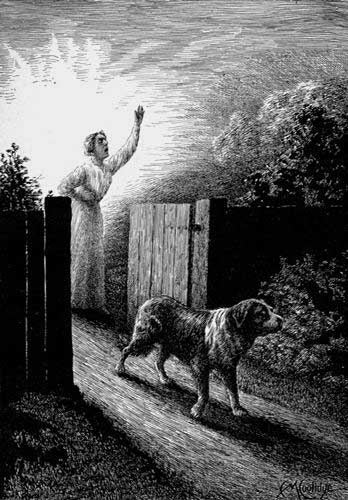
“Who in the world is Dombey bringing us?” exclaimed Ruth as her dog came
leaping and frisking up the walk. “He acts as though he had secured a great
prize.”
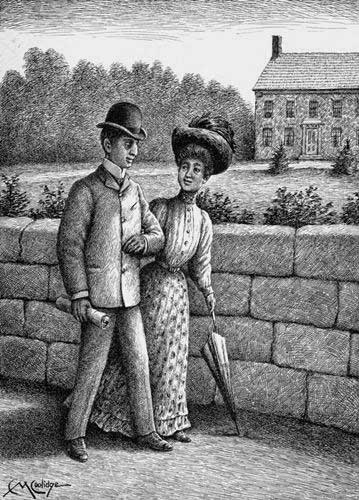
“Millionaire Schwarmer’s daughter as I live,” exclaimed Ralph! “Isn’t it
comical though. I never knew before that dogs could be obsequious! See
that brute trying to smile.”
The girl came on slowly and rather timidly up the long walk, while the dog
rushed backward and forward and indulged in all sorts of joyous antics.
“Excuse me for coming,” she said when she got within speaking distance,
“but the dog would have it so.”
“Dombey knew you would be welcome,” replied Ruth.
“He met me at the train and followed me all around to every place I went,
but when I got to this street he took the lead. I went on but he came
after me and cried and took hold of my dress. I guessed what he wanted so
I came a little way with him; but when I turned to go back he whined and
made such a time of it, that I gave up and came home with him.”
“And now he wants you to come up on the verandah and rest,” laughed Ruth,
looking down into the blue eyes. She thought she had never seen any so
blue and true looking.
“I will a moment, but I can’t stay. I came up with father. I wanted to
see poor Mary who got scared and lost her baby Fourth of July night.”
“I heard she was better,” said Ruth.
“Father heard so too, and thought I hadn’t better come, but I would come.
I know she feels bad about her baby and I want to tell her how sorry I am
and how much I blame Mr. Bombs.” The blue eyes filled with tears.
“Fireworks are dangerous things,” said Ruth. She felt her own eyes getting
misty and she was wondering if Schwarmer’s daughter knew of their action
in regard to the Schwarmer fireworks.
“Yes, they are dangerous,” said Miss Schwarmer, “and they are horrid—all
that I have ever seen; and I blame father for ever buying such awful
things to give away. I don’t believe he ever will any more. There are so
many pretty things to buy.”
“Bless your heart,” said Ruth. “I’m sure he never will if you ask him not
to.”
“I have asked him not to and I’ve blamed him. He is going to let me buy
things after this, for the children here.”
“O that will be lovely,” exclaimed Ruth—“then we shall see you often
shall we not?”
“I wish I could stay here always,” said Miss Schwarmer. “I don’t like to
travel but we’re all going over to London with Mr. Bombs. I don’t like
him, though he is honest with me. I blame him for not being honest with
others. Father says he was educated to amuse and mystify the people.
Isn’t it horrid to be mystified?”
Ruth assured her it was and then she left with Dombey at her heels.
“Dombey knows,” said Ruth; “and it’s no wonder. She is so good and
honest.”
“The wonder is that Mr. Schwarmer should have such a child,” said Ralph,
“or Mrs. Schwarmer either from all we hear about her. What a pity that she
should be dragged around the world against her will; but she ‘blames’ them
and no doubt but they need her blame.”
“And Mr. Bombs, the man that’s been educated to amuse and mystify people.
He needs her blame without the shadow of a doubt; and he will end by
falling desperately in love with her,” said Ruth. “It came over me like a
flash, when she was speaking of him.”
“Then it must be so,” laughed Ralph, “for you have a sample on hand. I
hope she will marry him and put him to beneficent uses.”
When Ralph came home to tea he brought another item of news. Some kind of
a building was going to be constructed on Schwarmer Hill; and no one as
yet had been able to find out what it was to be.
“A Bombs’ mystification, perhaps,” sighed Ruth.
The library building went on very rapidly and by the time the cold weather
set in, it was enclosed and ready for inside work. It gave evidence of
being a plain, substantial, common sense structure, with nothing showy or
monumental about it. Whether it was due to Ruth’s original suggestions,
Ralph’s timely action, Lawyer Rattlinger’s shrewdness or President
Hartling’s practical ability, was not known. The one thing that was
known, however, and made sure of by every taxpayer in town was that it
would not be saddled onto them for support. That it was to be an
absolutely free gift. That there would be a liberal sum for books and a
sufficient sum set aside to keep it in good running order.
The knowledge concerning the building on Schwarmer Hill was not so clear.
In fact it was “extremely hazy,” as Lawyer Rattlinger expressed it. And
yet there was no seeming of secrecy about the matter. The boss-workman as
well as the architect and builders were remarkably unanimous in saying
when questioned, that it was to be a sort of amphitheatre for sports and
games of various kinds.
“That settles it, or rather unsettles it,” said the President, “for there
are various kinds—a large number of them. They are very various and very
brutal many of them. Yes, a great many of them all the way down from the
Indian LaCrosse game and Fillipino Hurdle races to Jiu-Jitsu—the
treacherous Japanese game of ankle and neck-breaking. Even the college
sports must be pursued with the old time barbaric violence and virulence.
If we send a son to college in these days to cultivate his mental powers,
we may expect he will be swept into the rage for physical culture, and
wind up by losing an eye or two fingers at the least.”
This was the President’s point of view very decidedly after having had a
friend who cultivated his physical powers while in college to that extent;
but he was ready to confess that he had not always held such a view. He
recalled with regret a time when he had encouraged brutal games by
inviting a party of tired young men and women to witness a football game.
“What an idiocy,” he exclaimed, “when there were so many perfectly
harmless amusements which I could have taken them to; but I didn’t think
about it. I wanted to take them where they wanted to go, instead of
wanting to take them where they ought to go and managing to make it
pleasant for them.”
“And so there was a Providence in your friend’s hurt after all, you see,”
said the minister.
“No, I don’t see it,” replied the President, “else I should have to accuse
Providence of hitting the wrong man. I ought to have been the one to have
had my eye plucked out or my hand plucked off. For I had been taught the
good old Quaker rule, to avoid all games that are gotten up by men, for
the purpose of beating each other; I’m going to stand by that rule after
this, and I hope Schwarmer can be induced to draw the lines at the
dangerous games.”
Ruth hoped so too, but her solicitude was not to be put aside. Every week
she would have Ralph go with her to The Hill presumably for a walk, but in
reality to see what the huge thing looked like. She feared it was going to
be something objectionable and unhelpable.
“It doesn’t matter so much, does it dear, if he keeps it to himself—that
is if it doesn’t slop over onto us?”
“Yes it does matter, Ralph—that is if it turns out to be an arena for
pyrotechnics and that horrible Bombs is in it. If he is, it will be an
advertisement for the blinding and demoralization of every youth within
sight of it. Powder and dynamite will be the fashion and our Fourth of
July horror will rage again. O Ralph! Ralph!”
“Here am I, dear! Trust! trust! We will be on the watch-tower. If Mr.
Bombs comes we will see what we can do with him. There’s always something
to be done if we can only keep a level head. You must not get too much
excited over it, dear, you know the reason why. You remember the
gardener’s wife, poor soul. Let’s stop and see her on our way down.”
“Yes, Ralph,” replied Ruth eagerly. “Perhaps she will know if Miss
Schwarmer is coming up this Fourth. If there is anybody in the world who
can influence that perverse Mr. Bombs rightly I believe it is she.”
Mary Langley, the gardener’s wife, had never recovered from the hurt and
fright caused by the explosion of Mr. Bombs’ rocket. Hers was one of those
double hurts for which materia medicae has no remedy. She recovered
sufficiently to be able to attend to her household duties and to the wants
of her two little children. Miss Schwarmer’s well filled purse had helped
her thus far; but it could not tide her over the invalid line. Dreams of
fiery serpents and the lost baby kept her from refreshing sleep night
after night. Her husband ridiculed her in vain for her so-called woman’s
weakness. Her hurt was too deep for money or ridicule to mend. She grew
thinner and thinner, day after day, and ghostly white until it was rumored
about town that she was going into a decline.
The Norwoods were ill prepared, however, for the frail spiritual looking
creature who met them at the door.
“Beg pardon,” said Ruth, “perhaps you are not well enough to receive us. I
have heard about you and have been wanting to come and see you ever since;
but I thought you had so many friends—and better ones—at least those who
could do more for you. You are well acquainted with the Schwarmers, of
course. Miss Schwarmer is lovely and she spoke to me so kindly about
you.”
“Yes,” replied Mrs. Langley, “Miss Adelaide is very, very kind and as good
and honest as she can be and she did help me all she could, bless her
heart, in deed and word; but she had to go away and it seemed as though
nobody else knew just how I felt, and she so young too—the others made
fun of me.”
Tears came into the hollow eyes as she stopped speaking.
“Made fun of you?” questioned Ruth, looking at Ralph wonderingly.
“O! the brutes!” he exclaimed, angrily. He could not trust himself to say
more. He wanted to ask who the brutes were and why her husband did not
resent such cruel insult?
“I suppose I was foolish,” she said apologetically. “Even my husband
can’t quite understand why I was so frightened—frightened out of my wits,
he says; nor why I can’t get over it. Why I want to go away from this
place. He hired to Mr. Schwarmer for three years and he can’t go and it
wouldn’t do to quarrel with him. Poor James! He works hard all day and is
so tired at night; and night is the time I feel the terror coming on!”
Ruth gave a little sob.
“I can understand you, dear Mrs. Langley. It’s the horrible fireworks and
their promoters you are afraid of, and you are afraid they will come
again. I used to feel that way until we went to work to get rid of them;
but you are helpless here on the Schwarmer grounds. Then there’s the new
building. Have you any idea what use that will be put to?”
“My husband talks of beautiful horses and races and fairs and things of
that kind, but I have my fears. I know they won’t let Fourth of July pass
without doing something dreadful; but I shan’t be here then.”
Ruth knew that she meant that she expected to die before that time, but
she would not take it so.
“Indeed you must not stay here. You must come over and stay with us. We
are not going to have any of those horrible things. You must come, you and
the children, too; if you do not come of your own accord, we will come and
take you away,” laughed Ruth.
Mrs. Langley promised to come and Ruth and Ralph went home far better
pleased than they would have been if they had been returning bridal calls
in the ordinary stereotyped fashion.