STRATFORD-ON-AVON
WHEN you have seen Warwick Castle and
Guy's Cliff and the Saxon Mill—which is
so old that it must be soothing to the most tempestuous
temperament—and you hasten back to
your hotel and get your dog—if that dog be
Charles—on purpose to expose him to its calm influences,
you go to St. Mary's Church, which is,
the guide-book tells you, "one of the most remarkable
specimens of ecclesiastical architecture
extant," and you see the Norman Crypt, and the
clumsy sarcophagus of Fulke Greville, Lord Brooke,
who wrote his own epitaph, and you read how he
was "servant to Queen Elizabeth, Canceller to
King James, and friend to Sir Philip Sidney."
Also you see the Beauchamp Chapel, and love
it and linger in it, admiring the tombs of the earls
of Warwick and other grown-ups, and feeling, even
after all these years, a thrill of sadness at the
sight of the little effigy of the child whose brocaded
gown the marble so wonderfully produces
and whose little years knock at your heart for pity.
"Here resteth," says the monument, "the body
of the noble Impe Robert of Dudley, . . . a child
of greate parentage, but of farre greater hope and
towardness, taken from this transitory unto the
everlasting life in his tender age, . . . on Sunday
the 19 of July, in the yeare of our Lorde God
1584."
You see, also, the Warwick pew, and wish you
could have worshiped there.
Then you go to Leicester's Hospital, half
timbered and beautiful, with the row of whispering
limes on its terraced front, where the "brethren"
still wear the "gown of blew stuff with the
badge of the bear and ragged staff on the left
sleeve." And the badges are still those provided
by Lord Leicester in 1571.
You are sorry that the old banqueting-hall
should now be used for the coal-cellar and the
laundry of the brethren, and still more sorry that
the minstrels' gallery should have been cut off to
enlarge the drawing-room of the Master's house.
If you are of a rude and democratic nature you
may possibly comment on this in audible voices
beneath the Master's windows, which, I am sorry
to say, was what Mr. Basingstoke and his companion
did.
You will see the Sidney porcupine on the wall
of the quadrangle, some gilded quills missing, and
no wonder, after all these years. You will see—and
perhaps neglect to reverence, as they did—the
great chair once occupied by that insufferable
monarch and prig, James the First. You will
visit the Brethren's Chapel, which seems to be
scented by all the old clothes ever worn by any of
the old brethren, and you will come out again into
the street, and, as you cross the threshold, it will
be like stepping across three hundred years, and
you will say so. Then you will probably say,
"What about Stratford for this afternoon?" At
least, that is what Edward said. And as he said
it he was aware of a figure in black which said,
"Can you tell me the way to Droitwich?"
It was a woman, spare and pale, in black that
was green, but brushed to threadbareness.
"Do you want to walk?" Edward asked.
"I've got to, sir," she said.
"Do you mind," he asked, "telling me why you
want to go?"
"I've got relations there, sir," said the woman
in black, raising to his the plaintive blue eyes of
a child set in a face that fifty years and more had
wrinkled like a February apple. "My husband's
relations, that is. They might do something to
help me. I might be able to be of use to them, just
to work out my keep. It isn't much I require.
But I couldn't—"
She stopped, and Edward Basingstoke knew
that she couldn't even bring herself to name the
great terror of the poor—the living tomb which
the English call the workhouse.
"I'm afraid you've had a hard time," said Mr.
Basingstoke.
"I had many happy days," she said, simply.
"I always think you pay for everything you have,
sooner or later. And I'm paying now. I don't
grudge it, but I'd like to end respectable. And
thank you for asking so kindly, sir, and now I'll
be getting on." And he saw in her eyes the fear
that he would offer her money to pay her way to
Droitwich.
Instead he said: "We're motoring your way
this afternoon. If you'll let us give you a lift—"
The woman looked from one to the other.
"Well," she said, "I do call that kind. But I
wasn't asking for any help. And I'd best be
getting on."
Then the other woman came quite close to the
woman in black. "Won't you," she said, "come
and have dinner with us—and then we'll drive
you over? Do come. We're so happy and we do
hate to think that you aren't. Perhaps we can
think of some way to help you . . . find you
some work or something," she added, hastily,
answering the protest in the blue eyes.
"I don't like to, miss," she said, "thanking you
all the same. It's truly good of you—but—"
Edward moved away a pace or two and lit a
cigarette. He never knew what his lady said to
the woman in black, but when he turned again a
handkerchief was being restored to a rubbed black
leather reticule and the woman in black was saying,
"Well, ma'am, since you say that, of course I
can't say no, and thank you kindly."
The three had dinner together in the little
private room over the porch at the Warwick Arms,
and as they passed through the hall there could
have been, for the little woman in black, no better
armor against the sniffs of chambermaids and the
cold eyes of the lady in the glass case than the
feel of another woman's hand on her arm. She
was very silent and shy, but not awkward or
clumsy, during the meal, and when it was finished
Edward got up and said,
"Well, Katherine, I'll leave you two to talk
things over."
It was the first time he had called her by her
name. She flushed and sparkled, and was startled
and amazed next moment to know that she had
answered,
"Yes, dear, do—"
Edward, however, was not unduly elated. He
knew how women will play the part set for them,
to the least detail. She hoped he had not noticed
the slip which, quite unconsciously, the opening
of her heart toward this sad sister-woman had led
her to make. He wished that she had not first
called him that in a mere desire to act up to what
this woman would expect.
He left them, and then the pitiful little story
all came out, with fit accompaniment of sighs,
and presently tears, together with those sweet
and tender acts and words which blend with the
sighs and tears of the sorrowful into a melody as
sad as beautiful. They had been married thirty-seven
years next Michaelmas; they had had a
little shop—a little needlework and fancy shop.
She had done well enough with the customers, but
he had always done the buying, and when he was
taken. . . .
"Ah, my dear, don't cry," said the one who was
young and happy, "don't cry. You'll make him
so sad."
"Do you think he knows?" the widow asked.
"Of course he knows. He knows everything's
going to be all right, only he hates to see you miserable.
He knows it's only a little time, really,
before you and he will be together again, and happy
for ever and ever."
"I wish I could believe that."
"You must, because it's true. I expect he's
been praying for you, and that's why you met us—because,
you know, I'm certain my"—she hesitated,
but the word came instead of "brother,"
which was what she thought she meant to say—"my
husband will think of something for you to
do to earn your living; he's so clever. And I
suppose the business—"
Yes. The business had gone to pieces. Fashions
change so, and the widow had not known how
to follow the fashions in needlework. There was
only enough left to pay the creditors, but every
one had been paid, and with the pound or
two left over she had lived, trying to get needle
work, or even, at last, charring or washing. But
it had all been no good; nothing had been any
good.
"And now," said Katherine, "everything's
going to be good. You'll see. Edward will think
of something. Don't cry any more. You must
not cry. I can't bear it, dear. Don't."
"I'm only crying for joy," said the woman
whose life was over. "Even if he doesn't think of
anything, I can't ever despair again, and you
being like you have to me."
But when Edward came back he had thought
of something. His old nurse, it seemed, was in
temporary charge of a house that wanted a housekeeper,
and he was sure Mrs. Burbidge understood
housekeeping.
Mrs. Burbidge owned to an understanding of
plain cooking and plain housekeeping. Also
needlework, both the plain and the fine. "But
not where butlers are kept," she said, apprehensively.
"This is a farm-house," said Edward. "Not a
butler within miles."
"My father was a farmer, in Somerset," said
Mrs. Burbidge, "but, oh, sir, you don't know
anything about me. Suppose I was a fraud like
you read of in the newspapers. But the vicar at
home would speak for me."
"Your face speaks for you," said Katherine,
and within half an hour all was settled—the old
nurse telegraphed to, money found for such modest
outfit as even a farmer's housekeeper must
have, the train fixed that should take the widow
to London, the little hotel named where she
should spend a night, and the train decided on
that should take her in the morning to the farm-house
that needed a housekeeper.
"It's no use me saying anything," said Mrs.
Burbidge, at parting, "but—"
"There's nothing to say," said Katherine, and
kissed her, "only you will write to the Reverend
Smilie at Eccles vicarage. I can't be easy unless
you do," were her last words.
When she was gone they stood a moment
looking at each other, and each would have liked
to hold out hands to the other, to come quite close
in the ecstasy of a kind deed jointly done. Instead
of which he said, awkwardly:
"I suppose that was a thoroughly silly thing
to do."
And she answered, "Oh, well, let's hope it will
turn out all right."
An interchange which left both of them chilled
and a little disenchanted.
It was Edward who had the sense to say, as the
motor whirled them toward Stratford, "That was
all nonsense, you know, that we said just now."
She was disingenuous enough to say, "What—"
"About Mrs. Burbidge perhaps not being all
right. She's as right as rain. I don't know what
made me say it."
"A sort of 'do-good-by-stealth-and-blush-to-find-it-fame'
feeling, I expect, wasn't it? Of course
she's all right. You know I knew you knew she
was, don't you?"
"I know now," said he. "Yes, of course I
knew it. Don't let's pretend we aren't both jolly
glad we met her."
"No, don't let's," said she. And laid her hand
on his. His turned under it and held it, lightly
yet tenderly, as his hand knew that hers would
wish to be held, and not another word did either
say till their car drew up at the prosperous, preposterous
Shakespeare Inn at Stratford-on-Avon.
But all through the drive soft currents of mutual
kindness and understanding, with other electricities
less easy to classify, ran from him to her and
from her to him, through the contact of their
quiet clasped hands.
The inn at Stratford is intolerably half timbered.
Whatever there may have been of the old woodwork
is infinitely depreciated by the modern
imitation which flaunts itself everywhere. The
antique mockery is only skin deep and does not
extend to the new rooms, each named after one
of Shakespeare's works, and all of a peculiarly
unpleasing shape, and furnished exactly like the
rooms of any temperance hotel. The room where
Katherine washed the dust of the road from her
pretty face was called "The Tempest," and the
sitting-room where they had tea was a hideous
oblong furnished in the worst taste of the middle-Victorian
lower middle class, and had "Hamlet"
painted on its door.
"We must see the birthplace, I suppose," said
Edward, "but before we go I should like to warn
you that there is not a single authentic relic of
Shakespeare, unless it's the house where they say
he was born, and even that was never said to be
his birthplace till a hundred and fifty years after
his death, and even then two other houses claimed
the same honor. If ever a man was born in three
places at once, like a bird, that man was William
Shakespeare."
"You aren't a Baconian, are you?" she asked,
looking at him rather timidly across the teacups.
"But you can't be, because I know they're all
mad."
"A good many of them are very, very silly,"
he owned, "but don't be afraid. I'm not a Baconian,
for Baconians are convinced that Bacon wrote
the whole of Elizabethan and Jacobean literature
off his own bat. I only think there's a mystery.
You remember Dickens said the life of Shakespeare
was a fine mystery and he trembled daily
lest something should turn up."
"And nothing has."
"Nothing. That's just it. There's hardly anything
known about the man. He was born here—died
here. He went to London and acted. One of
his contemporaries says that the top of his performance
was the Ghost in 'Hamlet.' He married,
he had children, he got hold of money enough
to buy a house, he got a coat of arms, he lent
money and dunned people for it, he speculated in
corn, he made a will in which he mentions neither
his plays nor his books, but is very particular
about his second-best bed and his silver-gilt bowl.
He died, and was buried. That's all that's known
about him. I'm not a Baconian, Princess, but
I'm pretty sure that whoever wrote 'Hamlet,'
that frowzy, money-grubbing provincial never
did."
"But we'll go and see his birthplace, all the
same, won't we?" she said.
And they went.
If she desired to worship at the shrine of
Shakespeare he did not give her much chance.
She listened to the talk of the caretaker, but always
he was at her ear with the tale of how often
Shakespeare's chair had been sold and replaced
by a replica, how the desk shown as his is that of
an eighteenth-century usher and not of a sixteenth-century
scholar. How the ring engraved "W. S."
was found in the surface of the ground, near the
church, in 1810, where, one supposes, it had lain
unnoticed since Shakespeare dropped it there two
hundred years before.
At the grammar-school Edward pointed out that
there is no evidence to show that Shakespeare
ever attended this or any other school. Anne
Hathaway's cottage could not be allowed to be
Anne Hathaway's, since it was only in 1770 that
its identity was fixed on, two other houses having
previously shared the honor. Like her husband,
she would seem to have possessed the peculiar gift
of being born in three places at once.
"I don't think I like it," she said at last. "I'd
rather believe everything they say. It's such a
very big lot of lies, if they are lies. Let's go to the
church. The man's grave's his own, I suppose."
"I suppose so," said he, but not with much
conviction; "anyhow, I won't bore you with any
more of the stuff. But it is a fine mystery, and
there's a corner of me that would like to live in
Bloomsbury and grub among books all day at the
British Mu. and half the night in my booky little
den, and see if I couldn't find something out. But
the rest of me wants different things, out-of-door
things, and things that lead to something more
than finding the key to a door locked three hundred
years ago."
The bust of Shakespeare in Stratford Church is
a great blow to the enthusiast. A stubby, sensual,
Dutch-looking face.
"I wish they'd been content with the gravestone,"
she said, and read aloud the words:
"Goodfrend for Jesus sake forbeare
To digg the dust encloasèd heare
Blest be ye man yt spares these stones
And curst be he yt moves my bones."
"There's not much chance of any one doing
that—look, the altar-step goes right across the
tombstone. I wonder what they would find, if
they did move the stone."
"Nothing, madam," said a voice behind her—"nothing
human, that is."
She turned to face a tall, gaunt man in loose,
ill-fitting clothes with a despatch-case in one hand
and three or four note-books in the other. "Excuse
my joining in," he said, "but I couldn't help
hearing what you said. Whatever there is in that
tomb, there is not the body of the man Shakespeare.
Manuscripts there may be, but no corpse."
"What makes you think so?" she asked.
"Evidence, madam, evidence. The evidence of
facts as well as of ciphers."
"Oh," she said, and smiled brilliantly, "you
must be a Baconian. How very interesting!"
Now she had received all Edward's criticisms of
Shakespearian legend with a growing and visible
impatience. Yet for this stranger she had nothing
but sympathy and interest.
"It is interesting," said the stranger. "There's
nothing like it. I've spent eighteen years on it,
and I know now how little I know. It isn't only
Bacon and Shakespeare; it's a great system—a
great cipher system extending through all the
great works of the period."
"But what is it that you hope to find out in
the end?" she asked. "Secrets of state, or the
secret of the philosopher's stone, or what?"
"The truth," he said, simply. "There's nothing
else worth looking for. The truth, whatever it is.
To follow truth, no matter where it leads. I'd go
on looking, even if I thought that at the end I
should find that that Stratford man did write the
plays." He looked up contemptuously at the
smug face of the bust.
"It's a life's work," said Mr. Basingstoke, "and
I should think more than one life's work. Do you
find that you can bring your mind to any other
kind of work?"
"I gave up everything else," said the stranger.
"I was an accountant, and I had some money and
I'm living on it. But now . . . now I shall have
to do something else. I've got a situation in
London. I'm going there next week. It's the end
of everything for me."
"There ought to be some endowment for your
sort of research," said Edward.
"Of course there ought," said the man, eagerly,
"but people don't care. The few who do care
don't want the truth to come out. They want to
keep that thing"—he pointed to the bust—"to
keep that thing enthroned on its pedestal forever.
It pays, you see. Great is Diana of the Ephesians."
"I suppose it wouldn't need to be a very handsome
endowment. I mean that sort of research
work can be done at museums. You don't have
to buy the books," Edward said.
"A lot can be done with libraries, of course.
But I have a few books—a good few. I should
like to show them to you some day—if you're
interested in the subject."
"I am," said Edward, with a glance at the girl,
"or I used to be. Anyhow, I should like very
much to see your books. You have a Du Bartas,
of course?"
"Three," said the stranger, "and six of the
Sylva Sylvarum, and Argalus and Perthenia—do
you know that—Quarles—and—"
Next moment the two men were up to the eyes
in a flood of names, none of which conveyed anything
to her. But she saw that Edward was happy.
At the same time, the hour was latish. She waited
for the first pause—a very little one—but she
drove the point of her wedge into it sharply.
"Wouldn't it be nice if you were to come back
to dinner with us, at Warwick, then we should
have lots of time to talk."
"I was going to London to-night," said the
stranger, "but if Warwick can find me a night's
lodging I shall only too gladly avail myself of
your gracious invitation, Mrs.—"
"Basingstoke," said Edward.
The stranger had produced a card and she read
on it:
Dr. C. P. Vandervelde,
Ohio College, U. S. A.
"Yes," he said, "I'm an American. I think
almost all serious Baconians are. I hope you
haven't a prejudice against my country, Mrs.
Basingstoke—"
"It's Miss Basingstoke," she said, thinking of
the hotel, "and I've never met an American that
I didn't like."
He made her a ceremonious and old-fashioned
bow. "Inscrutable are the ways of fate," he said.
"Only this morning I was angry because the
chambermaid at my inn in Birmingham destroyed
my rubbing of the grave inscription, and I had to
come to Stratford to get another. Yes, I could
have written, but it was so near, and I shall soon
be chained to an office desk—and now, in this of
all spots, I meet youth and beauty and sympathy
and hospitality. It is an omen."
"And what," she asked, as they paced down the
church, "was the cipher that said there was nothing
in the tomb? Or would you rather not talk
about your ciphers?"
"I desire nothing better than to talk of them,"
he answered. "It's the greatest mistake to keep
these things secret. We ought all to tell all we
know—and if we all did that and put together the
little fragment of knowledge we have gathered,
we should soon piece together the whole puzzle.
The first words I found on the subject are,
'Reader, read all, no corpse lies in this tomb,'
and so on, and with the same letters another
anagram in Latin, beginning 'Lector intra sepulcho
jacet nullum cadaver.' I'll show you how I got it
when we're within reach of a table and light."
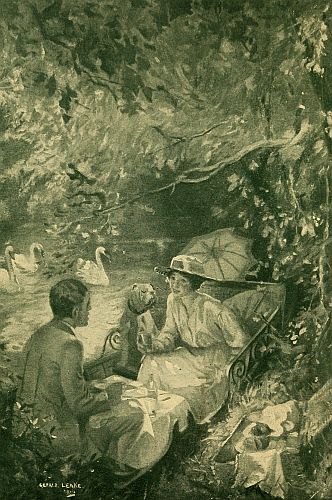
They lingered a moment on the churchyard
terrace where the willows overhang the Avon and
the swans move up and down like white-sailed
ships.
"How hospitable we're getting," she said to
Edward that night when their guest had gone
to his humbler inn—"two visitors in one day!"
"Katherine," he said, just for the pleasure of
saying it, for they two were alone, so he could not
have been speaking to any one else—"Katherine,
that man's ciphers are wonderful. And what a
gift of the gods—to possess an interest that can
never fail and that costs nothing for its indulgence,
not like postage-stamps or orchids or
politics or racing!"
"The ciphers were wonderful," she said. "I
had no idea such things were possible. I understood
quite a lot," she added, a little defiantly.
"But it's rather hateful to think of his being
chained to a desk doing work that isn't his work."
"That, or something like it, is the lot of most
people," he said, "but it needn't be his lot. It's
for you to say. I can very well afford a small endowment
for research, if you say so."
"But why must I decide?"
"Because," he said, slowly, "I felt when I was
talking to you to-day that you hated everything
I said; you wanted to go on believing in all the
Shakespeare legends."
"I think I said so. I'm not sure that I meant
it. Anyhow, if it rests with me I say give him
his research endowment, if he'll take it."
"He'll take it. I'll get a man I know at Balliol
to write, offering it. In his beautiful transatlantic
simplicity the dear chap will think the
college is offering the money. He'll take it like
a lamb. But won't you tell me—why was it that
you hated me to be interested in this business
and you are glad that this Vandervelde should
be helped to go on with it?"
"I should like him to be happy," she said, "and
there's nothing else in life for him—he has given
up everything else for it. I want him, at least, to
have the treasure he's paid everything for—the
joy of his work. But that sort of joy should be
reserved for the people who can have nothing
else. But for you—well, somehow, I feel that
people who take up a thing like this ought to be
prepared to sacrifice everything else in life to it,
as he has done. And I could not bear that you
should do it. Life has so much besides for you."
"Yes," he said, "life holds very much for me."
"And for me, too," she said, and with that
gave him her hand for good night.
He was certain afterward that it had not been
his doing, and yet it must have been, for her hand
had not moved in his. And yet he had found it
laid not against his lips, but against his cheek,
and he had held it there in silence for more than a
moment before she drew it away and said good
night.
At the door she turned and looked back over
her shoulder. "Good night," she said again.
"Good night, Edward."
And that was the first time she called him by his
name.

 [See page 118
