It was a bushmaster which started the
Quest of the Emerald—and only a possible
bushmaster at that. One May evening
in Cornwall, Big Jim Donegan, the lumber-king,
sat in the misty moonlight with his
slippered feet on the rail of the veranda of
the great house in which he lived alone. He
was puffing away at a corn-cob pipe as
placidly as if he did not have more millions
than Cornwall has hills—which is saying
something, for Cornwall has twenty-seven
of the latter. Along the gravel walk, which
wound its way for nearly half a mile to the
entrance of the estate, came the sound of
a dragging footstep. A moment later, from
out of the shadows stepped a man over six
feet in height, a little stooped, and who wore
a shiny frock-coat surmounted by a somewhat
battered silk hat. The stranger had a long,
clean-shaven, lantern-jawed face. His nose
jutted out like a huge beak, a magnificent,
domineering nose, which, however, did not
seem in accord with his abstracted blue eyes
and his precise voice.
"What do you want?" snapped Big Jim,
bringing his feet to the floor with alarming
suddenness.
The stranger blinked at him mildly for a
moment with a gaze that seemed to be cataloguing
the speaker.
"This is Mr. James Donegan," he finally
stated.
"How do you know?" demanded the lumber-king.
"You have all the characteristics of a magnate,"
returned the other, calmly, "energy,
confidence, bad temper, worse manners,
and—"
"Whoa!" shouted Big Jim, whose bark
was worse than his bite and who always
respected people who stood up to him.
"Never mind any more statistics. Who are
you!"
"My name is Ditson," responded the other,
sitting down without invitation in the most
comfortable chair in sight. "Professor Amandus
Ditson. I am connected with the Smithsonian
National Museum."
"Well," returned Mr. Donegan, stiffening,
"I don't intend to subscribe any money
to the Smithsonian Museum or any other
museum, so there's no use of your asking
me."
"I had no intention of asking you for
anything," returned Professor Ditson, severely.
"I had understood that you were a
collector of gems, and I came to place at your
disposal certain information in regard to
the finest emeralds probably now in existence.
I too am a collector," he went on abstractedly.
"Humph!" grunted Big Jim. "What do
you collect?" he inquired, regarding his visitor
shrewdly.
"Bushmasters," responded Professor Ditson,
simply.
"Come again," returned Big Jim, much
puzzled, "I don't quite get you. What are
bushmasters?"
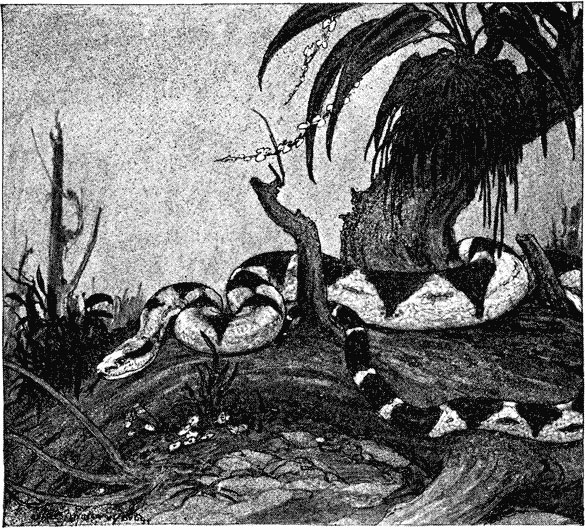 "The bushmaster is the largest, rarest, and deadliest of
South American serpents"
"The bushmaster is the largest, rarest, and deadliest of
South American serpents"
"The bushmaster," announced Professor
Ditson, with more animation than he had
yet shown, "is the largest, the rarest and
the deadliest of South American serpents.
It attains a length of over twelve feet and
has fangs an inch and a half long. You will
hardly believe me," he went on, tapping Mr.
Donegan's knee with a long, bony forefinger,
"but there is not a single living specimen in
captivity at present, even in our largest
cities."
The lumber-king regarded the scientist with
undisguised astonishment.
"Professor Amandus Ditson," he announced
solemnly, "so far as I'm concerned, there can
continue to be a lack of bushmasters not only
in our great cities, but everywhere else.
Snakes of any kind are absolutely nothing in
my young life."
"Tut! tut!" responded the professor, reprovingly.
"I think that I could convince you
that you are wrong in your unfortunate aversion
to reptiles."
"No you couldn't," returned Big Jim, positively,
"not if you were to lecture all the rest
of the year."
"Well," responded Professor Ditson soothingly,
"suppose we discuss your hobby, which
I understand is precious stones."
"Now you're talking," returned the
other, enthusiastically, "I suppose I've
about the finest collection of gems in this
country, and in some lines perhaps the best
on earth. Take pearls, for instance," he
boasted. "Why, Professor Ditson, some boys
right here in Cornwall helped me get the finest
examples of pink and blue pearls that there
are in any collection. When it comes to emeralds,
there are half a dozen collectors who
beat me out. What's all this dope you have
about them, anyway?"
"Last year," replied the other, "I was in
Peru at a time when they were repairing one
of the oldest cathedrals in that country. A
native workman, knowing that I was interested
in rarities of all kinds, brought me an old
manuscript, which turned out to be a map and
a description of the celebrated Lake of Eldorado."
"That's the name of one of those dream
places," interrupted Mr. Donegan, impatiently.
"I've no time to listen to dreams."
Professor Ditson was much incensed.
"Sir," he returned austerely, "I deal in facts,
not in dreams. I have traveled one thousand
miles to see you, but if you can not speak more
civilly, I shall be compelled to terminate this
interview and go to some one with better manners
and more sense."
"Just what I was going to suggest," murmured
Big Jim, taken aback, but much pleased
by the professor's independence. "So long,
however, as you've beat me to it, go on. I'll
hear you out anyway."
Professor Ditson stared at him sternly.
"For nearly four hundred years," he began
at last, "there have been legends of a sacred
lake somewhere in Bolivia or Peru. Once a
year, before the Spanish conquest, the chief of
the Incas, the dominant race of Peru, covered
with gold-dust, would be ferried out to the
center of this lake. There he would throw
into the lake the best emerald that had been
found in their mines during the year and then
leap in himself. At the same time the other
members of the tribe would stand on the
shores with their backs to the lake and throw
into the water over their shoulders emeralds
and gold ornaments."
"Why on earth did they do that?" exclaimed
the old collector.
"As an offering to the Spirit of the Lake,"
returned the professor. "The Spaniards,
when they heard the story, named the lake,
Eldorado—The Lake of the Golden Man.
As the centuries went by, the location was
lost—until I found it again."
There was a long pause, which was broken
at last by the lumber-king.
"Have you any proof that this story of
yours is true?" he inquired sarcastically.
For answer, the scientist fished a dingy bag
from his pocket and shook out on the table a
circlet of soft, pale gold in which gleamed
three green stones.
"I found this ten feet from the shore," he
said simply.
The lumber-king gasped as he studied the
stones with an expert eye.
"Professor Ditson," he admitted at last,
"you're all right and I'm all wrong. That's
South American gold. I know it by the color.
African gold is the deepest, and South American
the palest. Those stones are emeralds,"
he went on; "flawed ones, to be sure, but of
the right color. The common emerald from
the Ural Mountains is grass-green," lectured
Mr. Donegan, fairly started on his hobby.
"A few emeralds are gray-green. Those come
from the old mines of the Pharaohs along the
coast of the Red Sea. They are found on
mummies and in the ruins of Pompeii and
along the beach in front of Alexandria, where
treasure-ships have been wrecked."
Professor Ditson yawned rudely.
"Once in a blue moon," went on the old
collector, earnestly, "a real spring-green emerald
with a velvety luster, like these stones,
turns up. We call 'em 'treasure emeralds,'"
he continued, while Professor Ditson shifted
uneasily in his chair. "Most of them are in
Spanish collections, and they are supposed to
be part of the loot that Cortez and Pizarro
brought back to Spain when they conquered
Mexico and Peru. How large did these old
Peruvian emeralds run?" he inquired suddenly.
He had to repeat this question before Professor
Ditson, who had been dozing lightly,
roused himself.
"Ah yes, quite so, very interesting, I'm
sure," responded that scientist, confusedly.
"As to the size of South American emeralds,"
he went on, rubbing his eyes, "the Spanish
record shows that Pizarro sent back to Spain
several which were as large as pigeon eggs,
and there is a native tradition that the last Inca
threw into Eldorado an oval emerald as large
as a hen's egg."
Donegan's face flushed with excitement.
"Professor Ditson," he said at last, "I've
got to have one of those emeralds. Come in,"
he went on, getting up suddenly, "and I'll
show you my collection."
Professor Ditson sat still.
"No, Mr. Donegan," he said, "it would be
just a waste of time. To me, gems are just a
lot of colored crystals."
The old lumber-king snorted.
"I suppose you prefer snakes," he said cuttingly.
Professor Ditson's face brightened at the
word.
"There," he said enthusiastically, "is something
worth while. I only wish that I had you
in my snake-room. I could show you live, uncaged
specimens which would interest you
deeply."
"They sure would," returned Mr. Donegan,
shivering slightly. "Well," he went on, "every
man to his own taste. What's your idea about
this emerald secret? Can we do business together?"
The professor's face assumed an air of what
he fondly believed to be great astuteness.
"I would suggest," he said, "that you fit out
an expedition to the Amazon basin under my
direction, to remain there until I collect one
or more perfect specimens of the bushmaster.
Then I will guide the party to Eldorado and
assist them, as far as I can, to recover the
sunken treasure."
He came to a full stop.
"Well," queried the lumber-king, "what
else?"
The professor looked at him in surprise. "I
have nothing else to suggest," he said.
"Suppose we get emeralds which may be
worth hundreds of thousands of dollars—what
percentage will you claim?" persisted Mr.
Donegan.
"I thought that I had made it plain," returned
the professor, impatiently, "that I have
no interest whatever in emeralds. If you will
pay the expenses of the expedition and allow
me to keep as my own property any specimens
of bushmasters obtained, it will be entirely satisfactory
to me. Of course," finished the scientist,
generously, "if we catch several bushmasters,
I should have no objections to your
having one."
"Heaven forbid!" returned the lumber-king.
"Professor," he went on with great emphasis,
"I am perfectly willing that you shall
have absolutely for your own use and benefit
any and all bushmasters, crocodiles, snakes,
toads, tarantulas, and any other similar bric-à-brac
which you may find in South America.
Moreover," he continued, "I'll fit out an expedition
right here from Cornwall that will do
the business for both of us. There's a good-for-nothin'
old chap in this town named Jud
Adams who has been all over the North
huntin' an' trappin' an' prospectin'. In his
younger days he was a pearl-diver. Then
there're two young fellows here that went off
last year with him for me and brought
back the finest blue pearl in the world. I ain't
got no manner of doubt but what all three of
'em will jump at the chance to go after emeralds
and bushmasters."
"Bushmasters and emeralds, please," corrected
the professor.
"Just as you say," responded the lumber-king.
"Now you come right in and I'll
put you up for the night and we'll send
over at once for the crowd that I have in
mind and get this expedition started right
away."
"The sooner the better," responded the professor,
heartily. "Any day, some collector
may bring back a bushmaster and beat me out
with the Smithsonian."
"I feel the same way," agreed the lumber-king.
"I want Jim Donegan to have the first
crack at those Inca emeralds."
While all this talk about gold and emeralds
and bushmasters was going on in Big Jim's
big house, over in a little house on the tiptop
of Yelpin Hill, Jud Adams, the old trapper,
was just sitting down to supper with two of
his best friends. One of these was Will
Bright, a magnificently built boy of eighteen
with copper-colored hair and dark blue eyes,
and the other his chum, Joe Couteau, silent,
lithe, and swart as his Indian ancestors.
Jud himself was not much over five feet
tall, with bushy gray hair and beard and
steel-sharp eyes. These three, with Fred Perkins,
the runner, had won their way to Goreloi,
the Island of the Bear, and brought back Jim
Donegan's most prized gem, as already chronicled
in "The Blue Pearl." They had learned
to care for one another as only those can who
have fought together against monsters of the
sea, savage beasts, and more savage men. Joe
and Will, moreover, had shared other life-and-death
adventures together, as told in "Boy
Scouts in the Wilderness," and, starting without
clothes, food, or fire, had lived a month in
the heart of the woods, discovered the secret of
Wizard Pond, and broken up Scar Dawson's
gang of outlaws. Will never forgot that Joe
had saved him from the carcajou, nor Joe that
it was Will who gave him the first chance of
safety when the bloodhounds were hot on their
heels through the hidden passage from Wizard
Pond. Each one of the four, as his share of
the blue pearl, and the sea-otter pelt brought
back from Akotan, had received fifteen thousand
dollars. Fred had invested his money in
his brother's business in Boston, left Cornwall,
and bade fair to settle down into a successful
business man. Will and Joe had both
set aside from their share enough to take them
through Yale. As for Jud, the day after he
received his winnings in the game which the
four had played against danger and death, he
had a short interview with his old friend Mr.
Donegan.
"All my life long," began Jud, "I've been
makin' money; but so far, I haven't got a
cent saved up. I know how to tame 'most any
other kind of wild animal, but money allers
gets away from me. They do say, Jim," went
on the old man, "that you've got the knack of
keepin' it. Probably you wouldn't be worth
your salt out in the woods, but every man's
got somethin' that he can do better 'n most.
So you just take my share of the blue-pearl
money an' put it into somethin' safe an' sound
that'll bring me an income. You see, Jim,"
he went on confidentially, "I ain't so young as
I used to be."
"I should say you ain't!" exclaimed
Big Jim, knowing how Jud hated to be
called old. "You're 'most a hundred
now."
"I ain't! I ain't!" howled Jud, indignantly.
"I ain't a day over fifty—or thereabouts."
"Well, well," said his friend, soothingly,
"we won't quarrel over it. I'll take care of
your money and see that you get all that's
comin' to you for the two or three years which
you've got left"; and with mutual abuse and
affection the two parted as good friends as
ever.
To-night the old trapper and his guests
had just finished supper when the telephone
rang.
"Jud," came Mr. Donegan's voice over the
wire, "what would you and Bill and Joe think
of another expedition—after emeralds this
time?"
"We'd think well of it," returned Jud,
promptly. "The kids are here at my house
now."
"Good work!" exclaimed the lumber-king.
"All three of you come right over. I've got
a scientist here who's going to guide you to
where the emeralds grow."
"You got a what?" queried Jud.
"A scientist!" shouted Big Jim, "a perfesser.
One of those fellows who know all about
everything except what's useful."
"We'll be right over," said Jud, hanging
up the receiver and breaking the news to his
friends.
"Listens good," said Will, while Joe grunted
approvingly.
"It's a pity old Jim ain't young and supple
enough to go on these trips with us himself,"
remarked Jud, complacently.
"He ten years younger than you," suggested
Joe, slyly, who always delighted in teasing
the old trapper about his age.
"Where do you get such stuff?" returned
Jud, indignantly. "Jim Donegan's old
enough to be my father—or my brother, anyway,"
he finished, staring sternly at his grinning
guests.
"You're quite right, Jud," said Will, soothingly.
"Let's go, though, before that scientist
chap gets away."
"He no get away," remarked Joe, sorrowfully,
who had listened to the telephone conversation.
"He go with us."
"I don't think much of that," said Jud,
wagging his head solemnly. "The last perfesser
I traveled with was while I was prospectin'
down in Arizona. He sold a cure
for snakebites an' small-pox, an' one night
he lit out with all our cash an' we never did
catch him."
Half an hour later found the whole party
in Mr. Donegan's study, where they were introduced
to Professor Ditson.
"What might you be a perfesser of?" inquired
Jud, staring at him with unconcealed
hostility.
The other stared back at him for a moment
before he replied.
"I have specialized," he said at last,
"in reptiles, mammals, and birds, besides
some research work in botany."
"Didn't leave out much, did you?" sneered
Jud.
"Also," went on the professor, more
quietly, "I learned early in life something
about politeness. You would find it an
interesting study," he went on, turning away.
"Now, now," broke in Mr. Donegan, as Jud
swallowed hard, "if you fellows are going
treasure-hunting together, you mustn't begin
by scrappin'."
"I, sir," returned Professor Ditson, austerely,
"have no intention of engaging in an
altercation with any one. In the course of
collecting-trips in the unsettled portions of all
four continents, I have learned to live on good
terms with vagabonds of all kinds, and I can
do it again if necessary."
"Exactly!" broke in Mr. Donegan, hurriedly,
before Jud could speak; "that certainly
shows a friendly spirit, and I am sure
Jud feels the same way."
"I do," returned the latter, puffingly, "just
the same way. I got along once with a perfesser
who was no darn good, and I guess I
can again."
"Then," said Mr. Donegan, briskly, "let's
get down to business. Professor Ditson, show
us, please, the map and manuscript with which
you located Lake Eldorado."
For reply, the gaunt scientist produced from
a pocket a small copper cylinder, from which
he drew a roll of yellowed parchment. Half
of it was covered with crabbed writing in the
imperishable sepia ink which the old scriveners
used. The other half was apparently
blank. The lumber-king screwed his face up
wisely over the writing.
"H'm-m," he remarked at last. "It's some
foreign language. Let one of these young
fellers who're going to college try."
Will took one look at the paper.
"I pass," he said simply; while Joe shook
his head without even looking.
"You're a fine lot of scholars!" scoffed Jud,
as he received the scroll. "Listen now to
Perfesser Adams of the University of Out-of-Doors."
Then, to the astonishment of everybody, in
his high-pitched voice he began to translate
the labored lines, reading haltingly, like a
school-boy:
"I, Alvarado, companion of Pizarro, about to
die at dawn, to my dear wife Oriana. I do repent
me of my many sins. I am he who slew
the Inca Atahualpa and many of his people, and
who played away the Sun before sunrise. Now
it comes that I too must die, nor of the wealth that
I have won have I aught save the Secret of Eldorado.
On a night of the full moon, I myself
saw the Golden Man throw into the lake the great
Emerald of the Incas and a wealth of gold and
gems. This treasure-lake lies not far from Orcos
in which was thrown the Chain. I have drawn a
map in the way thou didst show me long years
ago. Take it to the king. There be treasure
enough there for all Spain; and through his justice,
thou and our children shall have a share.
Forgive me, Oriana, and forget me not.
Alvarado"
There was a silence when he had finished.
It was as if the shadow of the tragedy of that
wasted life and vain repentance had drifted
down the centuries and hung over the little
company who had listened to the reading of
the undelivered letter. The stillness was
broken by Mr. Donegan.
"Where did you learn to read Spanish, you
old rascal?" he inquired of Jud.
"Down among the Greasers in Mexico,"
chuckled the latter, delightedly.
"What does he mean by 'playing away the
Sun' and the 'Chain'?" asked Will, of the scientist.
"When the treasures of the Incas were divided,"
explained Professor Ditson, precisely,
"Alvarado had for his share a golden image of
the sun over ten feet in diameter. This he
gambled away in a single night. The Chain,"
continued Professor Ditson, "surrounded the
chief Inca's residence. It was made of gold,
and was two hundred and thirty-three yards
long. It was being carried by two hundred
Indians to Cuzco to form part of the chief's
ransom—a room filled with gold as high as
he could reach. When the gold came to his
shoulder, he was killed. At the news of his
death, the men who were bringing the Chain
threw it into Lake Orcos."
"But—but," broke in the lumber-king,
"where is the map? If you've got it with
you, let's have a look at it."
Without speaking, Professor Ditson reached
over and took the match from the table.
Lighting it, he held the flame for an instant
close to the parchment. On the smooth
surface before their eyes, suddenly appeared
a series of vivid green lines, which at last
took the form of a rude map.
"What he learned from Oriana," explained
Professor Ditson, "was how to make and use
invisible ink."
"Fellows," broke in Mr. Donegan, earnestly,
"I believe that Professor Ditson has
found Eldorado, and I'm willing to go the
limit to get one of the emeralds of the Incas.
I'll finance the expedition if you'll all go.
What do you say?"
"Aye," voted Will.
"Aye," grunted Joe.
"I assent," said Professor Ditson, with his
usual preciseness.
Jud alone said nothing.
"How about it, Jud?" inquired Big Jim.
"Well," returned Jud, doubtfully, "who's
goin' to lead this expedition?"
"Why, the professor here," returned the
lumber-king, surprised. "He's the only one
who knows the way."
"That's it," objected Jud. "It's likely to
be a rough trip, an' treasure-huntin' is always
dangerous. Has the perfesser enough pep
to keep up with us younger men?"
Professor Ditson smiled bleakly.
"I've been six times across South America,
and once lived among the South American
Indians for two years without seeing a white
man," he remarked acidly. "Perhaps I can
manage to keep up with an old man and two
boys who have never been in the country before.
You should understand," he went on,
regarding the old trapper sternly, "that specialization
in scientific investigation does not
necessarily connote lack of physical ability."
Jud gasped. "I don't know what he means,"
he returned angrily, "but he's wrong—specially
that part about me bein' old."
"I feel it is my duty to warn you," interrupted
Professor Ditson, "that this trip may involve
a special danger outside of those usual
to the tropics. When I was last in Peru," he
went on, "I had in my employ a man named
Slaughter. He was an expert woodsman, but
sinister in character and appearance and with
great influence over the worst element among
the Indians. One night I found him reading
this manuscript, which he had taken from
my tent while I was asleep. I persuaded him
to give it up and leave my employ."
"How did you persuade him?" queried Jud,
curiously.
"Automatically," responded Professor Ditson.
"At least, I used a Colt's automatic,"
he explained. "His language, as he left, was
deplorable," continued the scientist, "and he
declared, among other things, that I would
have him to reckon with if I ever went again
to Eldorado. I have no doubt that through
his Indian allies he will be advised of the expedition
when it reaches Peru and make trouble for us."
"What did he look like?" inquired Mr. Donegan.
"He was a giant," replied Professor Ditson,
"and must have been over seven feet in
height. His eyebrows made a straight line
across his forehead, and he had a scar from
his right eye to the corner of his jaw."
"Scar Dawson!" shouted Will.
"You don't mean the one who nearly burned
you and Joe alive in the cabin?" said the
lumber-king, incredulously.
"It must be," said Will. "No other man
would have that scar and height. I'll say
'some danger' is right," he concluded, while
Joe nodded his head somberly.
"That settles it!" said Jud. "It's evident
this expedition needs a good man to keep these
kids out of trouble. I'm on."
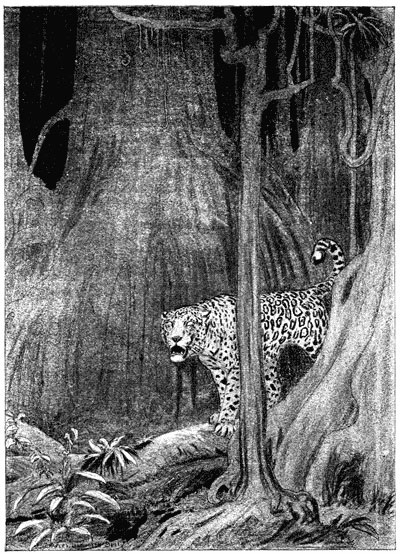 From the heart of the jungle sounded the deep, coughing
roar of a jaguar
From the heart of the jungle sounded the deep, coughing
roar of a jaguar