IN preparing a work for the press, the author, the compositor, and the
proof-reader are the three factors that enter into its construction. We
will, however, treat more especially of the last-named in connection
with the first.
The true proof-reader should not only be a practical printer, but he
should be a lover of literature, familiar with the classics of all
languages, with the results accomplished by science, and indeed with
every subject that concerns his fellow-men. When an author prepares a
work for the press, he often uses many abbreviations, his capitalization
is frequently incorrect, his spelling occasionally not in accordance
either with Worcester or Webster, his punctuation inaccurate, his
historical and biographical statements careless, and his chirography
frequently very bad. In such cases the proof-reader is sorely tried; and
unless he is a man of much patience, well versed in the art of
deciphering incorrigible manuscripts, and supplying all their
deficiencies, his last state will, to speak mildly, be worse than his
first.
It is said that, when Charles Dudley Warner was the editor of the
“Hartford Press,” back in the “sixties,” arousing the patriotism of the
State with his vigorous appeals, one of the type-setters came in from
the composing-room, and, planting himself before the editor, said:
“Well, Mr. Warner, I ’ve decided to enlist in the army.” With mingled
sensations of pride and responsibility, Mr. Warner replied encouragingly
that he was glad to see the man felt the call of duty. “Oh, it is n’t
that,” said the truthful compositor, “but I ’d rather be shot than try
to set any more of your damned copy.”
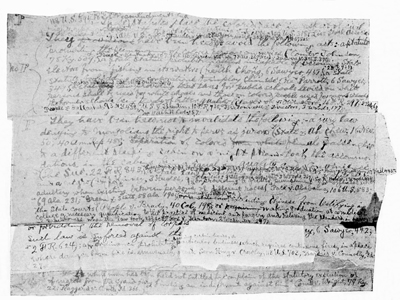
As an example of what I mean by bad MS. I take the liberty of showing
you one page of a work which, unfortunately, I had agreed to print. This
is a sample of one half of a work of 1000 MS. pages. When the author
offered me, a few years later, another work similarly prepared, I
declined, with thanks, to accept it.
Another illustration of careless writing I copy from “Harper’s Young
People”:—
A Massachusetts clergyman nearly got himself into a peck of trouble
because of the bad quality of his handwriting. It was more than a
century ago that he had occasion to address a letter to the General
Court of Massachusetts upon some subject of great interest at that time.
When the letter was received, the court ordered the clerk to read it,
and were filled with wrath at what appeared to be these words in
opening: “I address you not as magistrates, but as Indian devils.”
“What!” they cried. “Read that over again. How does he address us?”
“Not as magistrates, but as Indian devils,” repeated the clerk. “That ’s
what he says.”
The letter was passed around, and the judges were by no means pleased to
see that the clerk had apparently made no mistake. Very angry at what
they believed to be an insult, the judges passed a vote of censure upon
the clergyman, and wrote to him demanding an apology. He came before
them in person, when it turned out that where the judges had read
“Indian devils” he had written “individuals,” which, of course, made an
apology unnecessary; but the reverend gentleman was admonished to
improve his handwriting if he wished to keep out of trouble.
Still another case of “blind copy” furnished to the printer, resulted in
making the title “Pilgrim’s Progress” to appear in “cold type” as
“Religious Rogues.”
The “Philadelphia Press” relates the following: “Recently an editor of
a morning paper wrote an article on the Boer question, and headed it,
‘The British Army won a Victory that was Remarkable.’ To his surprise he
found that the printer made it read, ‘The British Army won a Victory.
That was Remarkable! ’ The infuriated editor told his foreman that he
must be in sympathy with the Boers.”
Many intelligent persons regard the duty of a proof-reader as consisting
in simply following his copy and in securing the proper spelling of
words. If this, however, were the sum of his accomplishments, many an
author would come to grief. Recently an author, quoting the expression,
“God tempers the wind to the shorn lamb,” attributed it to the Bible;
but the proof-reader queried the authority and wrote in the margin,
“Sterne,” which the author had the good sense gratefully to accept.
Young men and women, recent graduates of colleges, have sometimes
requested me to introduce them to publishers desiring to issue
translations of certain books in foreign languages; but knowing how
superficial often is the linguistic attainment of the college graduate,
making him incapable of rendering correctly into English the spirit and
the letter of a foreign tongue, I have respectfully declined. I may say,
and with accuracy, that scarcely a translation is made which does not
show some blunder more or less appalling.
The French word “bois” means wood. In a certain sentry-box several
soldiers had died, and, to prevent the supposed contagion from
spreading, Napoleon ordered the bois to be burned. The translator
rendered the word bois as forest; which would have led the reader to
suppose that the whole forest was burned. The proof-reader, after
consulting the French text, suggested the substitution of “sentry-box”
for “forest.” The change was made, and the meaning of the original was
thus restored.
A German professor, who prided himself on his knowledge not only of the
classics, but of modern languages, translated the New Testament
expression “The spirit indeed is willing, but the flesh is weak” into,
“The ghost indeed is willing, but the meat is bad.” If he had said, in
the light of some modern achievements, “the meat is embalmed,” he might
have hit the nail on the head.
A gentleman who was in Venice when the news of the destruction of
Admiral Cervera’s squadron came, and who could not make out the Italian
account very well, took the paper to a certain professor who speaks
almost perfect scholar’s-English, and asked him to translate it. The
professor did so in excellent style until he came near the end, when,
with a little hesitation, he read, “And the band played The Flag with
the Stars on it, and It will be very warm in the City this Evening.”
It was about a minute before the gentleman recognized the proper title
of the last piece, “There ’ll be a hot Time in the old Town to-night.”
In the cases cited, and in very many others, the proof-reader has shown
himself to be “a power behind the throne;” for, without his aid,
innumerable errors would have occurred.
A writer on Punctuation, many years ago, said that, “Perhaps there never
existed on any subject, among men of learning, a greater difference of
opinion than on the true mode of punctuation, and scarcely can any two
persons be brought to agree on the same method; some making the pause of
a semicolon where the sense will only bear a comma; some contending for
what is termed stiff pointing, and others altogether the reverse.”
To-day, however, this variety of opinion is less chaotic; for since then
several works on Punctuation have been published, showing that there are
rules or laws determining the construction of sentences and aiding the
reader to understand more readily the true meaning of the writer.
As you are aware, there is a great difference between grammatical and
rhetorical punctuation. The former is for the eye, the latter for the
ear. Leading actors, in preparing their plays for the stage, always
punctuate rhetorically, to indicate to the speaker of the lines the
pauses necessary for effect. The art of true punctuation is, however,
founded on grammar, its aim being to assist the reader to discover the
true meaning of a sentence.
To illustrate this matter of rhetorical punctuation, let me instance the
expression, “No, sir.” The grammatical reading is, “No, O sir,” whereas
the rhetorical reading is, “No sir.” The expression “The Oak, one day,
said to the Reed,” rhetorically read, will be, “The Oak one day, said to
the Reed.” In the latter case, the reader makes one day the name of
the oak,—putting the two nouns in apposition as meaning one thing. In
the Lord’s Prayer, it is not uncommon to see a comma after the words,
kingdom, power, and glory; as, “For thine is the kingdom, and the
power, and the glory, forever and ever.” Rhetorically, and to give force
and emphasis to each expression, a pause in reading is necessary; but,
grammatically, the comma is inaccurate.
Writers sometimes, and frequently proof-readers, blunder in the proper
use of the exclamations, O and Oh. The former should be used only in
cases of invocation, as, “O Lord!” “O my countrymen!”—the latter in
cases of emotion, as, “Oh that I had the wings of a dove, that I might
fly to the uttermost parts of the earth!”—“Oh for a lodge in some vast
wilderness!”
It is not, perhaps, surprising that errors in grammar should be
frequently seen on signs; as, for instance, “House to Let,” which should
be, “House to be Let.” A person can “Let” the house to another; but he
who occupies it cannot say that he “Lets” it. Occasionally are seen on
painted signs the words Billiards, Groceries, with an apostrophe
before the letter s; and even in classic Cambridge this sign was to be
seen at one time, “Students Tickets can be had here,” without the
apostrophe after the letter s in the word Students. The other day,
in Harvard Square, was to be seen the sign, “Students Furniture,” also
without the apostrophe. Under the portrait of Admiral Dewey, during his
reception in Boston, were the words, “Our Nations Hero,” without the
apostrophe before the letter s. If authors and proof-readers
occasionally nod, why should not also the people?
The colloquial inquiry, “Where do you live?” should be, “Where do you
reside?”—for we live everywhere, but we reside only at one place.
A not uncommon error is made even by noted writers in the misuse of the
article a before the word historical; as, “In a historical address
at the observance of the centennial of Washington’s death.” We can say,
“A history of,” etc., for the accent is on the first syllable; but in
the expression, “An historical,” the accent being on the second
syllable, good taste and euphony demand the article an.
Occasionally a writer will split his infinitive; as, “We were to
cautiously and quickly advance to the hill above,” instead of, “We were
to advance cautiously and quickly to the hill above;” “You must not
expect to always have things as you would like to have them,” instead
of, “You must not expect to have always things as you would like to have
them.” It is claimed by some writers, however, that it is not only
correct to separate the infinitive from the verb, but that such
construction adds force to the sentence; as, “A pure heart is necessary
if we wish to thoroughly enjoy the beauties of nature,” in place of to
enjoy thoroughly, etc.
Many errors are also made by incorrect application of punctuation
marks; as, for instance: An auctioneer, who had a buggy for sale, placed
the sign, “Buggy! for Sale,” on an old bedstead near his door. In a
short time his attention was drawn to the blunder by the laughter of
some who passed. He readily perceived his error, and promptly made the
correction. Examples of this kind are countless, of which I here give a
few: “Woman, without her man, is a brute,” should be, “Woman,—without
her, man is a brute.” A child being asked, “Why should we love God?”
replied, “Because He makes preserves, and redeems us,” when he should
have said, “Because He makes, preserves, and redeems us.” A blacksmith,
passing by a barber’s shop, observed in the window an imprinted placard,
which he read as follows:—
“What do you think?
I ’ll shave you for nothing,
And give you some drink.”
The son of Vulcan, with a huge black beard on his chin, and a little
spark in his throat, accepted the invitation and entered the shop. After
the operation had been duly performed, he asked for the liquor. But the
shaver of beards demanded payment; when the smith, in a stentorian
voice, referred him to his own placard, which the barber very
good-humoredly produced, and read thus:—
“What! do you think
I ’ll shave you for nothing,
And give you some drink?”
Another example of the ludicrous will tend still better to show the
value of correct punctuation:—
“Every lady in this land
Hath twenty nails upon each hand;
Five and twenty on hands and feet.
And this is true, without deceit.”
The true meaning of the passage will at once be made clear by correct
punctuation; as,—
“Every lady in this land
Hath twenty nails; upon each hand
Five; and twenty on hands and feet.
And this is true, without deceit.”
The following request was once presented to a clergyman: “A sailor going
to sea, his wife desires the prayers of the congregation for his
safety.” The minister, either through carelessness or short sightedness,
misread the request thus: “A sailor, going to see his wife, desires the
prayers of the congregation for his safety.”
A few days since, a gentleman wrote on a slip of paper the address of a
friend, namely: “Adolph Windermeer, Jr., care of Sylvester Windsor &
Co., New York.” Not seeing any comma after the name “Sylvester” or
“Windsor,” I inquired if “Sylvester” was the Christian name of
“Windsor;” to which he replied (marking in a comma), “Oh, no.”
A few of the above illustrations I have taken from my father’s book on
Punctuation.
While the rules governing punctuation are now generally adopted, there
are a few cases where printers and proof-readers disagree. In the
division of a word at the end of a line, the English prefer to divide on
the vowel, as in ha-bit, pre-face, pro-phet; the American, on the
consonant, as hab-it, pref-ace, proph-et. The former division
shows the origin of the word; the latter, its pronunciation. Of the
two, I prefer the English style; for instance, in the word cre-a-tion,
of three syllables, it is better to divide on the second vowel, thus
crea-tion,—the syllable tion being more easy to pronounce; and the
vowel at the beginning of a line being unsightly.
It is also not uncommon, in some American books, to omit the comma after
the second noun in the case of the mention of three nouns, as in the
sentence, “Industry, honesty, and temperance are essential to
happiness,” and also to omit the comma after the second name in the sign
of a firm of three, as, “Little, Brown, & Co.” While in this country the
omission of the comma in these instances is often made, it by no means
follows that such omission is correct. Another difference from the
English practice is that of omitting the comma after the given number of
a street, as, “274 Washington Street.” In this case, the grammatical
reason for placing the comma after the number is that there are not 274
Washington streets, but that the meaning is No. 274 of Washington
Street.
Many authors and printers vary also in the capitalization of certain
compound titles or names, as, the “Charles River,” the “river Thames,”
“New York City,” the “city of Boston,” the “Blue Hills,” the “White
Mountains,”—the words River, City, and Mountain beginning with a
capital letter or with a small letter according to their position in the
sentence.
When two nouns are jointly used, the first serving as a qualifying
adjective to the second, a hyphen should be inserted between them.
Writers and printers frequently omit the hyphen in such cases, causing
an unnecessary obscurity to the reader; thus, “Colonel Baden-Powell,
when in West Africa, fell in love with a native saying, ‘Softly, softly:
catchee monkey!’ which, when Anglicized, is, ‘Don’t flurry: patience
gains the day!’” I had some difficulty in understanding the meaning of
this pleasantry till I supplied the hyphen between the two words,
native-saying. When a compound title becomes very common, the two
words coalesce, as, cornfield, farmyard, schoolhouse, etc.
It is not uncommon to see the titles of books, especially in the
printed catalogues of our Public Libraries, begin with a small or
lower-case letter. This style is not only incorrect, but misleading, and
corrupting good taste, and should not be adopted by men of letters. The
reason given for it, namely, ease in reading, is very weak and
inadequate. The plea of “good usage,” urged in many cases, is not
sufficient justification of any literary practice in itself incorrect
and vulgar.
When phonetic spelling and writing come to take the place of our present
or ideographic method, the difficulties of the proof-reader will be
greatly increased. To-day it would be a difficult matter for him to
spell the expression, “Uneeda Biscuit,” or to decide the correct mode of
printing the word “coffee,” which sometimes appears as kaughphy. It is
true that phonotypy would enable the child the more easily to master the
art of spelling; but whether words meaning the same thing would be
spelled alike by all writers is very questionable, as the most common
words are frequently mispronounced; as, sech for such, gud for
good, git for get, gut for got, etc.
With a few exceptions, the words of MS. books, to the 15th century, run
on continuously without spacing; and as to punctuation, little or
nothing was known. In the Greek works on papyrus before Christ, there
are to be found certain marks indicating pauses, such as the
wedge-shaped sign (>). In Biblical MSS., however, the division of the
text into lines enabled the reader the more easily to understand the
meaning, and was an assistance to him in public reading. As many
blunders were made by the monks in transcribing and re-transcribing the
ancient MSS., the assistance of the corrector, or proof-reader, was as
much needed then as now; the wrong words were erased with a sponge or
with a knife, and the corrected words inserted. Solomon, three thousand
years ago, said, “Of making many books there is no end; and much study
is a weariness of the flesh.” This was uttered at a time when few read
or studied, and when all books were in manuscript, the printer’s art
being then unknown. To-day everybody reads, studies, and writes; what at
one time was a “weariness of the flesh” has to-day become a pleasure and
a joy. Jeremy Belknap, in his Papers, says that there are four things
necessary to constitute a man: “first, he should build a house; second,
he should write a book; third, he should get a child; fourth, he should
plant a tree.”
Now, let us not only do all these things prescribed, but let us
supplement them by four others, which the proof-reader thinks are just
as, if not more, important; namely: let our chirography be readable,
our spelling correct, our punctuation faultless, and our rhetoric
such that “he who runs may read.”
As members of The Odd Volume Club, we all love not only rare, but
good books. When I enter a bookstore, or more especially a large
publishing house, like that for instance of Little, Brown, & Co., and
behold before me row upon row of books,—“a sea of upturned faces,” as
it were,—my feelings are like those of a loving mother, who, with
outstretched arms, is ever ready to embrace and press to her bosom her
beloved child. I long to clasp by the hand one and all of these
attractive, silent spirits, to press them to my heart, and to exclaim,
in the words of Channing, “God be thanked for books! ”
These words of Channing recall an incident in my boyhood. One night, as
I was studying my lessons for the morrow, my father read to me, from
Channing’s Essay on Self Culture, the words I have quoted, which
illustrate not only Channing’s enthusiasm, but the power and influence
of books. Let me repeat a few more lines from the passage:—
“God be thanked for books! They are the voices of the distant and the
dead, and make us heirs of the spiritual life of past ages. Books are
the true levellers. They give to all who will faithfully use them the
society, the spiritual presence, of the best and greatest of our race.
No matter how poor I am; no matter though the prosperous of my own time
will not enter my obscure dwelling; if the sacred writers will enter and
take up their abode under my roof,—if Milton will cross my threshold to
sing to me of Paradise; and Shakespeare to open to me the worlds of
imagination and the workings of the human heart; and Franklin to enrich
me with his practical wisdom,—I shall not pine for want of intellectual
companionship, and I may become a cultivated man, though excluded from
what is called the best society in the place where I live.”
Byron says that “a small drop of ink may make millions think.” Many a
time a book has decided the character of a man’s life. A book makes
friends for you; for there springs up from its reading an
acquaintanceship not only between you and the author, but between you
and another man who reads the same book. Samuel Johnson, hearing that a
man had read Burton’s “Anatomy of Melancholy,” exclaimed, “If I knew
that man I could hug him.” It is said that Cæsar, when shipwrecked and
in danger of drowning, did not try to save his gold, but took his
Commentaries between his teeth and swam to shore.
All these instances I have cited tend to prove how great is the
appreciation which men of culture have for those books out of which they
have drawn inspiration for their lives, or into the making of which they
have put their souls; and they all prove, also, the immense importance
of the accomplished proof-reader in helping to create for us the books
which we love.
Transcriber’s Note:
The spellings today and to-day, and spaced contractions
have been retained as they
appear in the original book.
Punctuation has been changed as follows:
| Page 9 |
“The British Army won |
|
‘The British Army won |
| Page 17 |
New York. Not |
|
New York.” Not |
| Page 19 |
gains the day!’ I |
|
gains the day!’” I |