This is not a novel, nor a work of fiction; it is
based on the facts of the Eleventh Census and
other statistical reports, and on the most reliable
authorities on these subjects. This book represents
the most essential and fundamental features
of the nation’s situation. It shows the reasons why
your cities rapidly become the property of a comparatively
very few persons; why the American
farmers lose their ground, and the urban population
lose liberty; and why all become absolutely
dependent upon a few multi-millionaires. It exposes
the conditions in consequence of which the
whole nation becomes a nation of mere tenants of
farms and homes, paying rents; and, while the
wealth increases, the greatest majority of the people
come into desperate struggle not for pleasure,
but for simple existence.
In order to impart as much knowledge in regard
to the situation of the nation as possible, it was
found necessary to supply the readers with a sufficient
comparison of statistical facts, pointing to
the differences of averages made by different authorities
on the subject. This comparison has also
been introduced for the purpose of indicating certain
truths of special value, and for finding the true
VIbases of reasonably dealing with the most vital
problem of the national existence. This problem
involving conditions that cause the commonly recognized
social unrest of the present time is a problem
which grows in intensity.
Recognizing the difficulty in solving the problem
and the danger of the situation, we should
not wonder, if the very persons who are always
inclined to make discounts in established truths,
will be profoundly surprised to know from the final
conclusions here presented, that the time of discounts
has passed away, and that it is now too late
to ignore the facts of so serious significance.
If this work should come to be regarded as a
general diagnosis of the diseased situation, we may
rest assured that there are many thousands of people
who will count it their sacred duty to find the
proper remedy for curing the disease of the national
organism. For it will be seen that the situation
is rapidly growing worse every year with
the increase of population, and there must be an
end to the disease. Surely, if the increase of the
national wealth is becoming less than the continual
net incomes of the private monopolies, trusts and
combinations, it is not difficult to recognize that
the situation is already very bad. It is therefore
desirable that every one should carefully learn the
situation.
CHAPTER I. DISTRIBUTION OF WEALTH IN THE UNITED STATES. — STATISTICAL CONCLUSIONS OF MR. SHEARMAN.
1
When a heavy mass of clouds suddenly rises in
a clear sky, every one thinks that a terrific storm
is to follow, displaying a great store
of pent up forces. And many people
|SIGNS OF THE TIMES.|
never make a single mistake in predicting
from so ominous a summer sky what is
going to take place. Some similar forecasting is
now going on within the consciousness of the people.
For nearly every one more or less clearly
feels that he is heavily pressed upon by some portent
in the national life. And every one whose
mental horizon is clear enough and wide enough
sees, beyond the outward appearance, that something
dangerous is stored in the nation. It may
be something so unusually great in its force, something
so explosive, something so combustible, that
with the new century it may terribly shake the
world.
It was quite recently when the “North American”
of Philadelphia asked the question, “What
has the Nineteenth Century in store for Philadelphia?”
And by its own admission the replies
received were amazing. In summing them up,
2before spreading them at large before its readers,
it said:
“Substantial business men, whose names are almost
household words, solemnly affirm that with
opinions of the new century will come revolution
and bloodshed. Leading lawyers
|OPINIONS OF BUSINESS MEN.|
say the tendency will be toward
socialism. Bankers join with labor leaders in forecasting
the triumph of the single-tax theory and
the consequent overthrow of existing social conditions.
That such a tremendous undercurrent of
dissatisfaction and unrest exists in this city will
undoubtedly come as a shock to thousands of conservative
citizens. The opinions given are not those
of labor agitators or anarchists. They are the
careful expressions of men of wealth and of broad
education. The revolutionary suggestions were
not shouted upon the street in time of riot and
excitement, but were given deliberately while the
speakers sat in their well furnished offices, surrounded
by comforts and evidences of prosperity.[1]”
So then the Nineteenth Century has stored
up in the social organism of the nation enough
material to produce revolution and bloodshed in
the Twentieth Century.
And Mr. Louis Post says in “The Public” of
Chicago: “Our leisurely friends of Philadelphia,
3who are to be envied, by the way, and not sneered
at, for being philosophical enough and sensible
enough to keep so much unwholesome hustle out
of their lives—these slow and sober people must
have been ‘startled’ by the above ‘revelations’ of
the Philadelphia North American, that ancient
landmark, now in its 128th year.[2] It was undoubtedly
an amazing surprise in view of its age that
the answer of its readers was, as you see, ‘revolution
and bloodshed.’
If similar questions were presented to the thinking
public of the various cities of the United States,
we might have thousands of like opinions and all
of them would be conditioned by sufficient reasons.
One of the most prominent thinkers of the city
of Chicago[3] also quite recently said that “the
Twentieth Century will bring to us
the bloodiest revolution that human
|OPINIONS OF LEARNED MEN.|
history ever witnessed.” And his
assertion was not less amazing than was the affirmation
of the substantial business men of Philadelphia.
If it were honest and right to expose the
names of men whose confidential conversations led
to the same or similar assertions, I alone could
make a long list of these names.
They all admit that the nation, as an organism,
has long been diseased; its nerves have long been
4abnormally strained. But, like the friends of Philadelphia,
they speak about revolution and bloodshed
which is but the last and most convulsive
stage of any nation’s serious disease. And it is true
that, when this stage is reached, it is impossible to
avoid the most intolerable operation.
But the amazing feature of such opinions is that
different men agree in affirming that revolution
and bloodshed is almost unavoidable;
yet different men, as I know,
|CAUSES OF UNREST.|
assign different causes for such an
undesirable event.[4] Some say it must come because
the population increases and the unemployed
laborers increase. Others say that the trusts, combinations,
and monopolies must ruin the nation.
Still others say that progress and poverty, being
very rapid in their diverse directions, must rapidly
bring the wealthy and the poor into the state of
cut-throats against each other. And only very
few men understand that all these causes are but
secondary, though working to the same horrible
end. While the real, effective cause for revolution
and bloodshed, with the nation, is the exceedingly
unequal distribution of wealth, and its rapid concentration
in a very few hands.
It is this situation that our democratic people
will not be able to endure, because they are born
|PEOPLE THINK THEY ARE BORN FREE.|5free, whereas the storing up of wealth in a few hands
makes them all economic slaves; deprives them of
the privileges they enjoyed; makes
them absolutely dependent upon the
mercies of the rich, which, if shown
to them, they may live; if withheld from them,
they must starve to death.
Let us see, then, what it is that the Nineteenth
Century has stored up, which is to result in such
a terrific convulsion in the Twentieth Century.
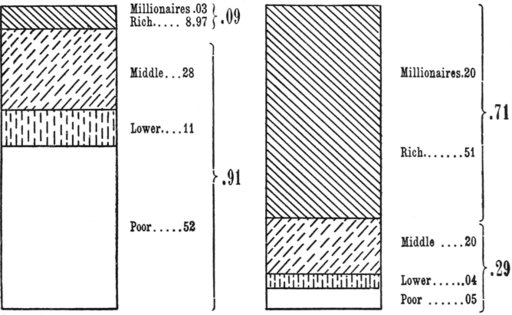
The following diagrams present the Logical
Premises from which the “revolution and bloodshed,”
as a conclusion, must inevitably follow, provided
their action is not checked.
Distribution of Wealth in the United States.[5] Population: 62,622,250. Wealth: $65,037,091,197.
6“These diagrams showing by percentages the
population and wealth distribution in the United
States, according to tables compiled by George K.
Holmes, U. S. Census Expert on Mortgage Statistics,
are from the Encyclopedia of Social Reform.”
The contents of the above diagrams show on
the bases of statistics that in 1890 three hundredths
of one per cent of the population,
|PERCENTAGES OF WEALTH AND PEOPLE.|
which are the millionaires, held 20
per cent of the nation’s wealth.
Eight per cent and ninety-seven hundredths of one
per cent of the population, which are the rich, held
51 per cent of the wealth. The middle class, consisting
of 28 per cent of the population, held 20
per cent of the wealth. The lower class, consisting
of 11 per cent of the population, held 4 per cent of
the wealth. And the poor class, consisting of 52
per cent of the population, held but 5 per cent of
the national wealth,[6] as this table shows:
Table I.
Percentages of People.
Population in Groups.
Percentages of Wealth
Aggregates of Wealth in Dollars.
Distribution of wealth per head in Dollars.
00.03
18,786
20
13,007,418,274
691,867
08.97
5,617,172
51
33,168,916,461
59,041
28.00
17,534,216
20
13,007,418,253
741
11.00
6,888,432
4
2,601,483,644
377
52.00
32,563,644
5
3,251,854,565
99
100.00
62,622,250
100
65,037,091,197
1,036
7This illustrative table represents the exact value
of the diagrams on p. 5. And nothing is more
interesting in this table than the sad differences in
the worth of the groups, and especially when their
respective wealth is divided per every head. The
right-hand column shows that there are 18,786
persons whose aggregate wealth, if divided equally
among them, would give $691,867 to each man,
woman, and child. And there are 32,563,644 persons[7]
in the last group, whose wealth, if equally
divided among them, can give but $99 to every
person. These two groups present the greatest
possible extremes of group-poverty and group-opulence.
The other three groups, as their averages clearly
show, are intermediary between the two extremes.
|PER CAPITA WEALTH.|
And if all the wealth of the nation
were equally divided among its population,
we could have $1,036 to
every man, woman, and child. This per capita
wealth indicates that the nation is very rich on the
whole, but its riches, as you see, belong to a very
few persons.
What then is the difference between a rich man
and a poor man, between a rich woman and a
poor woman?
If the 32,563,644 men, women and children had
8$100 per capita wealth, then one rich man of the
first group of the above table, would be worth more
|WORTH OF MEN.|
than 6,918 men of the last group of
the same table. A rich man’s horse
often worth more than 10, 20, 30, or
even more, poor men taken together. A rich
woman’s finger alone worth more than 10 or 20
poor women taken together, because that finger is
often embellished with the diamond rings that cost
thousands of dollars. A complete ladies’ dress or a
costume often amounts to more than $5,000, and
hence it is worth more than 40 or 50 women taken
together with their dresses. Such are the differences
between the rich and the poor people when
they are valued by the dollar.
But the dollar differences cause a great many
other differences between the rich and the poor.
The poor man is not only poor in
wealth, but he is poorer still in social
|POOR IN SOCIAL RIGHTS.|
rights and privileges. And there is
no possibility for the poor to rise up out of his poverty.
For he has no resources of wealth which the
rich people have; and he has no property of his
own; for if he is worth but $99, which is really his
house-scarb,[8] he has no productive property at
all; he is then absolutely dependent upon the mercy
of the wealthy, without which he cannot exist even
9for six months. He cannot acquire higher education
and training, because he is encompassed with
poverty which furnishes no means for the education
that helps men to acquire wealth. Hence, the
lack of education keeps the poor in poverty; and
this poverty prevents him from getting the helpful
education. So that, poverty and ignorance become
the bitter enemies of the above millions of individuals
in the modern world of progress. Yet the
modern poor have a far more potent enemy than
poverty and ignorance combined, which we shall
see later on.
Meanwhile, we will say here, that the rich are
the masters over the poor in the sphere of law,
in the sphere of politics, in the club,
in the theater, in the church, at home
|DOMINANCY OF THE RICH.|
and abroad—everywhere; as if all
power were given unto them under the heavens
over the poor. And how many church-ministers
would not give them the same power and the best
places in the hereafter? For the very character of
sermons in our days depends upon the pleasures
of the rich in many churches, because the ministers
depend upon the wealthy few more than they depend
on the millions of the poor. While all these
poor are the rich men’s economic slaves, spending
half of their labor energy in favor of the wealthy.
That is what the Nineteenth Century has provided
for the nation.
10But the above statistical conclusions were by
many regarded as “roseate” and “extremely moderate
conclusions.” And it was in
consequence of this that Dr. Spahr
|CONCLUSIONS ARE MODERATE.|
was obliged to reiterate the expression:
“Since the completion of this study, a volume
has appeared that must set at rest all question
as to the extreme moderation of the estimates
reached.”[9] For it was clear that every new investigation
of the distribution of wealth confirmed the
fact of a more and more rapid concentration of the
national wealth in fewer hands than before. And
it is the question of poverty, that spreads like contagion,
that the American people have now to deal
with, in view of a phenomenal increase of the
national wealth which concentrates in the few
hands. And it is this question that cannot be set
at rest while millions grow poorer and poorer and
the propertyless increase in numbers, as we shall
soon see.
The people cannot set this question at rest until
they know the truth of the different statistical
tables, indicating the nation’s situation and destiny.
And we cannot rest until we make a series
of propositions for the purpose of producing more
equal distribution of wealth in this country. And
11even then we cannot rest, until our propositions be
applied to the irrational life of the nation, with the
purpose of working out justice for the people.
When we see all this in their actual life, then we
shall rest, as the people shall be regaining their
freedom, their property, their resources of income,
their rights to work and to enjoy the fruits of their
toil. The intelligent people cannot and must not
rest before they reach a resting place. They cannot
always be deceived by the shallow and selfish
arguments which prove that the national wealth
increases enormously,—for it so increases only
with the few and rapidly decreases with the entire
people. But the time will come when the tens of
millions will no longer vote for men who deprive
them of all rights, self-respect and liberty.
As we shall see later on, the 32,563,644 persons
|UTENSILS AS WEALTH.|
of the last group of the table I possessed no real
wealth at all even at the census in
1890. For though the diagrams represent
them as having had $99 worth
of wealth to every head, yet this wealth was personal
and not productive.
“An estimate of the distribution of wealth in the
United States was made by Mr. Thomas G. Shearman
|RESEARCHES OF MR. SHEARMAN.|
in the ‘Forum’ for 1889, and for January, 1891.
It was based on careful estimates of the wealth of
12the very wealthy, a list of which he gave, and estimates
of the division of the remaining wealth of
the country between the middle class
and the poor based on assessors’
returns.”[10]
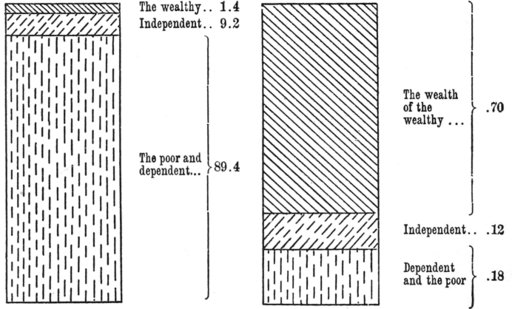
“Mr. Shearman came to the conclusion that 1.4
per cent of the population own 70 per cent of the
wealth; 9.2 per cent of the population own 12 per
cent of the wealth; and 89.4 per cent of the population
own only 18 per cent of the wealth.”[11]
In these conclusions, we have a still greater
twist of facts by wrong handling. Now, to illustrate
these conclusions as they stand by another set
of diagrams, they will be as follows:
Population: 62,622,250. Wealth: $65,037,091,197.
13These diagrams indicate by percentages the exact
conclusions of Mr. Shearman in respect to the
population and the wealth distribution
in this country. The author
|LOOSE AVERAGES.|
of these conclusions obviously put
too much salt of his own into his averages; for, by
parceling out the wealth of a number of the well-to-do
and rich people, he succeeded in persuading
his readers, that, in America, the body of tens of
millions of propertyless people, the paupers and
the tramps, do not possess, on an average, less than
$200 worth of wealth for each person, including
women and children of all ages. Whereas, in reality,
the wealth from which he made the fictitious
averages, belongs to a very few persons of the
nation. While an astonishing majority of the people,
as we shall see, have no rights whatever to
this wealth.
Let us again illustrate the conclusions in a tabular
way for the sake of definiteness:
14The first glance at this table and a glance at the
table on page 6 show the reader that Mr. Shearman
divided the population into three
groups; and Mr. Holmes divided it
|LINES OF DIVISION OF THE PEOPLE.|
into five groups. The bases of division
are economic in both tables; but the lines of
division are very different with the one statistical
authority and the other. If we examine these lines,
we shall find that Mr. Holmes’ fifth group consists
of over 32½ million persons who, taken together,
had been worth a little over 3 billion dollars; so
that, each person of the group could have about
$99 worth of wealth, as the average of table I
shows. The next higher group of the same author,
which comprises nearly 7 million persons, had, on
an average, more wealth to each person, than each
person could have in the fifth group, hence the
per capita wealth of the fourth group of people
was $377. While the group still higher up in
wealth, which consists of little over 17½ million
persons, and which had over 13 billion dollars’
worth of wealth, could have $741 to every head,
that is, if this wealth were equally divided among
them. The second group of Mr. Holmes’ division
consists of over 5½ million persons, among whom
the poorest ones had, probably not less than
$5,000 worth of wealth, as their average worth of
over $59,000 shows. Such a division of the population
into five economic groups, if every family is
15rightly and honestly valued, presents an immense
amount of truth to the public judgment.[13]
But what Mr. Shearman really did with his estimates
and conclusions is this: Seeing that the
extent of poverty is appalling, he
made the division line in the group of
|SWEEPING AVERAGE.|
well-to-do people; he thus made the
group of the very poor extend so far as to comprise
nearly 56 million persons; and then, by dividing
the wealth of the well-to-do persons among all
these millions, he obtained an average of $209
worth of wealth to every pauper, to every tramp, to
every man, woman and child,—who have had no
wealth, and have had no rights whatever to the
wealth they are nominally represented as entitled to.
Consequently, his distribution of wealth among
the third group of people is merely on paper, is
nominal, is showy, and it does not
correspond to reality with reference
|ONLY NOMINAL DISTRIBUTION.|
to more than 35 million persons as
represented in Mr. Holmes’ distribution of this
wealth. Mr. Shearman might as well follow the
example of Mr. Carroll D. Wright[14] and, by a
single effort in calculation, divide among all individuals
the 70 per cent of wealth that belongs to
his 1.4 per cent of the people. In doing that, he
might apportion more than $1,000 worth of it to
16|JESUITS AND GALILEO.|
every penniless individual, and then might say,
Why, we are all rich, we are the most civilized and
righteous people in the world! But such an effort,
and such an assertion, however, would not at all
alter the real situation; no more than Galileo, when
in view of the danger of death, signing the Jesuit
verdict in favor of the non-revolution
of our planet round the sun, could
thereby stop the actual revolution of
the earth; for the earth’s progressive motion went
on, in spite of the ardent desire and policy of the
Jesuits to make it stand still by a verdict. Nothing
but an indescribable shock of the earth against another
heavenly body can change its principles of
motion.
The same is true of the nation. Once the principle
of concentration of wealth is left unimpeded
in its action, it must work out its end;
|DANGER.|
it must of living necessity produce
revolution and bloodshed. And
neither the extremely moderate statisticians, nor
the false averages, of even of the meanest falsehood,
can prevent its action toward such a horrible result.
“You remember the French revolution?”
|FRENCH REVOLUTION, ROME.|
asked Hon. Jno. S. Crosby
of his audience in Binghamton,[15] N. Y.,
and then he said: “In France all the lands
had come into the hands of a few people, the king
17and nobles, and a majority of the people were depending
on them for a living. The time came
when these down-trodden people rose up and Paris
streets ran with blood. Your country will have
the same experience if you keep on fooling with the
laws of God.
“Rome was once the mistress of the whole
world. She lorded it over the other countries. But
she fell, and Pliny, her historian, lays the cause of
her downfall to land monopoly.”[16] And so it was
with ancient Egypt; so it was with ancient Assyria,
and so it was with the Byzantine Empire, those
great and powerful nations that perished for similar
misconduct in relation to themselves.
Exactly so, this young nation also irrationally
strides in the way of Rome. The concentration of
her wealth in a few hands is now
more rapid than it was before the last
|RUSH OF THE NATION.|
census. That census brought about
astonishing conclusions, yet the nation rushes as
fast as she can to her ruin. And who can locate
the weight of responsibility for her end? Every
one seems to think about his selfish interests. Consequently,
nothing has been done in the past to
evade the ruin; nothing but the greatest national
harm is being done in the present; and no fundamental
|LOGICAL PREMISES FOR THE YEAR OF....|
measure, no rational remedy, no serious
18means appear for delaying it in the future. While
the Logical Premises[17] for revolution
and bloodshed have been established
in the nation’s life, and their forces
have been working to that inexorable end.
Now we are ready to present another conclusion
that the statisticians of 1890 reached. It deals
with the numbers of families, leaving out the individual
inhabitants.
We have been assured that the U. S. nation in
1890 consisted of 12,690,152 families, and that each
family, on an average, consisted of little less than
5 members, namely: 4.93 members.[18] The distribution
of the national wealth among families, therefore,
was expressed as follows:
“Less than half the families in America are propertyless;
nevertheless, seven-eighths of the families
|HALF THE NATION.|
hold but one-eighth of the national
wealth,” and vice versa. “While one
per cent of the families hold more
(wealth) than the remaining ninety-nine,” says Dr.
C. B. Spahr.[19]
At last we have struck in these conclusions a
19piece of more serious reality. “Less than half the
families in the United States are propertyless.”
Here you are! “Less than half.”
|CONCLUSIONS OF REALITY.|
Yet even here, we are far from the
fulness of truth. It seems as if the
statisticians themselves were afraid to reveal the
full truth to the people. And there are many intelligent
persons who believe that the pure and complete
truth should be known only to God Omniscient,
while His creatures must be content to know
but particles of truth mixed with falsehood.
As long, however, as the U. S. nation remains a
democratic nation, and as long as responsibility for
its prosperity or distress and disaster
|RESPONSIBILITY OF THE PEOPLE.|
rests upon a majority of its people,
this people ought to know not particles,
but the whole truth of the conditions of their
existence. Otherwise the least possible minority
of the sharks in human form or the wolves in
sheep’s skin, may devour or ruin the greatest bulk
of the people.
Let us then illustrate here one of the above conclusions,
while leaving the two others for later
discussion.
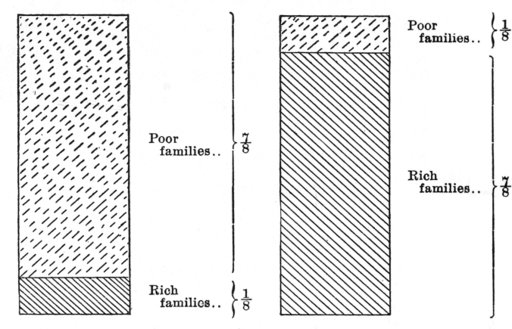
“Seven-eighths of the families hold but one-eighth
of the national wealth,” and vice versa, as
the diagrams on the following page indicate,
where the 12,690,152 families represent 62,622,250
individuals as in the preceding diagrams.
These diagrams represent exactly the truth of the
conclusion: “Seven-eighths of the families of this
nation held but one-eighth of the national wealth;[20]
or seven-eighths of the nation’s wealth was held by
but one-eighth of the families.
The table on the next page illustrates some of the
details of the above conclusion.
The upper division of that table presents the
distribution of wealth among the families, where
the two “per family” averages indicate
|FAMILIES.|
a difference in the worth of
more than 11-million families that
held $732 each, and the worth of little over 1½-million
families that held $35,875 each. So that,
21each family of the latter group was worth as much
as 49 families of the former. While the general
average of $5,125 shows that, if the national wealth
had been equally distributed among all families,
every one of them would have had this average
amount as its own.
Table III.
Proportions of
Number of families in groups.
Proportions of
Aggregate wealth per group, in dollars.
Average wealth per family.
7/8
11,103,883
1/8
8,129,636,399
$ 732
1/8
1,586,269
7/8
56,907,454,798
35,875
8/8
12,690,152
8/8
65,037,091,197
5,125
Number of individuals.
Wealth—the same in dollars.
Wealth per head.
7/8
54,794,468
1/8
8,129,636,399
$ 148
1/8
7,827,782
7/8
56,907,454,798
7,269
8/8
62,622,250
8/8
65,037,091,197
1,036
The lower division of the table represents the
same amounts of national wealth, the same population,
only individually considered;
and both the wealth and the population
|INDIVIDUALS.|
were divided into eight parts
each, in order to carry out the proportions between
numbers of the individuals and the wealth they
possessed. The result in this division is that
7,827,782 individuals have had an average wealth
of $7,269 each man, woman and child, and 54,794,468
individuals had but $148 worth of wealth
22to every head.[21] The difference between the worth
of one person of the one group, and one person
of the other group, is $7,121 in favor of the rich
person. And that, again, one person of the
wealthy class, on an average, is worth more than
49 persons of the poor class.
But the most astounding fact is that we have
over 54½-million inhabitants of this poverty-stricken
class, and we have only a
|NUMBERS NEAREST TO THE TRUE ONES.|
little more than 7½-million inhabitants
of the wealth-swollen class. So
that, these 54½-million individuals appear to be
totally dependent upon the mercies and motions of
7½-million persons who are steadily growing richer
and decreasing in numbers, while the poor are
growing poorer and rapidly increasing in numbers.
For such has been the growth of economic slavery
that the above millions have to combat with.
Besides all this, we have seen the statistical conclusion
that, “Less than half the families in America
are propertyless,” which certainly
|THE PROPERTYLESS FAMILIES APPEAR LITTLE BETTER OFF.|
means, that these propertyless families
must be found included among
the 54-millions of the poor. So that the present
average wealth of these millions, which is $148
per every head, was made of the wealth of the
upper classes, which average was not at all possessed
23by the poor. The economic conditions of
the poor must be still worse than Table III represents
them. But we shall find this out in the next
chapter; while the conclusion that, “1 per cent
of the families hold more wealth than the remaining
99 per cent of them,” nearly corresponds with
the conclusion of Mr. Shearman, as represented on
pp. 12 and 13.
CHAPTER II. STATISTICS OF WEALTH OWNERS. — STATISTICS OF WEALTH. — GREAT BRITAIN, FRANCE, AND GERMANY.
24
In the preceding chapter, we have dealt with
ready-made conclusions of different statistical
authorities, which, by the way of
|RESULTS OF THE FIRST CHAPTER.|
analysis, revealed to us, that 32,563,644
persons[22] of the population had
on an average $99 worth of wealth, according to
Mr. G. Holmes; that 55,984,298 persons[23] had on
an average $209 worth of wealth, according to Mr.
Thos. Shearman; and that 54,794,468 persons[24] out
of 62,622,250 inhabitants, with $65,037,091,197
worth of wealth, had on an average $148 worth of
wealth apiece, according to Dr. Spahr.
These differences in conclusions indicate that
the national wealth is very strongly concentrated
with a few persons, and that in order
|WEALTH IN THE HANDS OF FEW.|
to obtain the nominal average of
$148 worth of wealth to every poor
person, one has to move the line of division of
wealth so far up toward the wealthy few as to
include nearly all the people among the masses of
the poor. While, without this unfair moving of
the line, more than 30-millions of the population
would have no real wealth at all. For $56,907,454,798
25worth of the wealth actually belongs to
one-eighth of the population, or to 7,827,782 individuals,
including men, women and children.
And among these, we are told, “1 per cent of the
population held more wealth than the remaining
99 per cent held together.”[25] So that the day is
not far off when these 99 per cent of the people
shall absolutely depend upon the 1 per cent of the
rich and far reaching.
Regarded as the Logical Premises of the life of
the nation, this extremely unequal distribution of
wealth cannot be other than extremely
dangerous for the existence
|THE SITUATION IS DANGEROUS FOR THE FUTURE.|
of the nation as it is, for the logic is
inexorable: Whatever you have sown, that shall
you also reap, is a saying that cannot be mistaken
either by the wealthy or the poor. The situation
indicates that this apparently polished nation presents
only an enormous working mechanism, made
not of steel and iron, but a mechanism of wood,
which may be broken into pieces at any future
time, in consequence of any insignificant occasion,
if it continues to work heedlessly on with a wrong
speed against itself. A rational regulation of its
speed is absolutely necessary, in order to save it
from an otherwise unavoidable destruction. A
civilized nation cannot live long without a highly
intelligent regulation of all its working principles.
26For, to live a national life is not to play a childish
game.
Yes, we have examined the above conclusions,
but we have not realized the entire truth of the
situation. For we were told that,
|THE SITUATION IS WORSE THAN INDICATED.|
“Less than half the families in America
are propertyless,”[26] which clearly
means that the distribution of wealth among the
people is much worse than we have a right to suppose
upon the basis of the stated conclusions
of 1890. As these conclusions differ from each
other in contents, we have the moral right to re-examine
the varying statistical tables that testify
of the same distribution of wealth. And we have
a right to find the naked truth in the mass of materials
we have, and to look it straight in the
face, if we can.
But before proceeding to compare the main
tables of statistics, it will be well to show what the
wealth of the nation in 1890 consisted of. Accordingly,
the table on the next page represents
eight items into which the wealth was classified.
And it represents the summary of all kinds of
wealth that was found existing in the United States
in the year of the 11th census. While the next
table, following it, represents the history of the
accumulation of wealth, by application of the labor
27energy of the people upon various resources of
land.
“The census valuation of real and personal
property in the United States (Alaska excluded)
in 1890[27] was prepared by J. K. Upton,” as follows:
Table of Wealth.
Real estate with improvements thereon
1
$39,544,544,333
Live stock of farms, farm implements and machinery
2
2,703,015,040
Mines and quarries, including product on hand
3
1,291,291,579
Gold and silver coin and bullion
4
1,158,774,948
Machinery of mills and product on hand, raw and manufactured
5
3,058,593,441
Railroads and equipments, including street railroads
28The last historic table shows that the accumulation
of wealth by the nation has been phenomenal,
and equal to the expense of labor
|INCREASE OF WEALTH PHENOMENAL.|
energy which was embodied by the
people into that wealth. And if the
amount of wealth existing in 1890 had been equally
distributed among the people, every man, woman
and child, would have had more than $1,000 of
it, or exactly $1,036 as the nominal per capita distribution
of it by Mr. Carroll D. Wright indicates.
Let us, however, see the actual distribution of
wealth, as it was in 1890:
29It is difficult to understand why this important
table has been published in round numbers almost
throughout. It is, however, not at all difficult to
see that it represents an extremely unequal distribution
of the wealth among the American people.
And in order to restore the figures of this table
so as to bring the whole into accord with the last
census, it is necessary to regard the
|EXTREMES TO BE EQUALIZED.|
size of each family at 4.93 members,
as the census represents them. In
doing this, it is also necessary to restore the round
numbers, supplying all omissions in the aggregate
totals and in the wealth of the groups. Before giving
a further explanation, then, the restored table
will appear as follows:
1st Restored Table.
Economic classes of families.
Number of families.
Aggregates of wealth per class in dollars.
Average wealth per family.
The wealthy classes, $50,000 and over
126,750
33,000,000,000
260,355
The well-to-do classes, $50,000 to $5,000
1,394,250
22,676,863,197
16,264
The middle classes, $5,000 to $500
5,584,576
8,522,541,600
1,526
The poorer classes, under $500
5,584,576
837,686,400
150
Totals
12,690,152
65,037,091,197
5,125
30Now, this restoring has been made up by borrowing
$323,136,803 from the wealth found in the
2d group; and again by adding $37,091,197 worth
of wealth which was omitted in the round numbers
of the total aggregate of wealth. These two
amounts, consisting of $360,228,000 in the restored
table, have on the basis of the original averages
been distributed among the families of the 3d
and the 4th groups. So that the 3d group of
families appears to be richer by $322,541,600;
while the 4th group by $37,686,400; and the 2d
group appears to be poorer by $323,136,803 worth
of wealth. Hence, we have made the 1st R. table
represent the distribution of wealth by $360,228,000
more equal than the author of the original
table has actually found it to exist.[31]
On the other hand, in restoring the numbers of
family-members to the census average of 4.93, we
|FAMILIES MADE EQUAL TO CENSUS.|
add about 7 members to every 100
families of five members each, as Dr.
Spahr represents them. This addition
of 190,152 families to the whole renders the
average-family and the total number of families in
the United States exactly as they were given by
the census in 1890.
But in restoring this table to the census status,
31we do not for a moment disregard its original
value, as the most reliable work, nor do we think
of making an argument, or anything of the kind,
in favor of anybody, upon the ground of the surface
restoration. No, there is a deeper sense and a
deeper ground in the restored and the next table,
and we have an abundance of other material for
our purpose of showing the truth. Meanwhile,
this restoring of the 1st table that had omissions,
has been necessary for many reasons, and because
it seemed to many thinkers as probably an extreme
representation, though it was true to the
facts. For these thinkers desired that the distribution
of wealth should be more equal than it
has really been.
And, further, holding a conservative position, it
was necessary too to avoid a serious disturbance in
the original averages of the family wealth found by
Dr. Spahr, thus making the table comparable with
another table, which is the most important one, because
it indicates the tenants of farms and homes
and the owners of mortgaged farms and homes.
Furthermore, the restored table may serve as
a means of comparison of its classes of different
worth with the corresponding classes in the following
table, based upon the eleventh census facts.
Accordingly, the next table represents the families
of different worth which were classified upon the
same economic bases as in the table of Dr. Spahr.
We have read on pp. 11 and 12 that, when Mr.
Shearman made his list of statistics of wealth distribution,
“that his table was based
on careful estimates of the wealth of
|METHODS OF RESEARCH.|
the very wealthy; while the wealth
of the poorer classes was estimated on the bases of
assessors’ returns;” just as the table of Dr. Spahr,
p. 28, which represents the very wealthy families in
the 1st group, the well-to-do in the 2d, and the
poor families in the 3d and 4th groups. This
arrangement and representation of the families
evidently agrees with that of Mr. Shearman, and
proves the fact that both distinguished authorities
used the same or similar methods in studying the
33actual distribution of wealth, and in representing
their conclusions to those that were anxious to
know of the distribution.
But the 2d statistical table, on the preceding
page, was based upon the carefully averaged conclusions
of Mr. G. K. Holmes, the U. S. Census
Expert on Mortgage Statistics in 1890.
“Mr. Holmes,” as the author of the 2d table
says, “follows a method contrary to that of Mr.
Shearman, and by estimating the wealth of the
poor, arrives at the wealth of the rich. He finds
that .03 per cent of the people own 20 per cent
of the wealth; 8.97 per cent of the people own 51
per cent of the wealth, and 91 per cent of the
people own only 29 per cent of the wealth.[32]
“The fact that Mr. Holmes is not a partisan
either of conservatism or radicalism, gives to his
estimates an unwonted value. As published in the
Political Science Quarterly,” says the Editor of the
Encyclopedia of Social Reform, “and in the Journal
of the Royal Statistical Society, these estimates
have resulted in these four groups of families seen
in the 2d table, p. 32.”
We agree with Rev. W. Bliss and others in regarding
the estimates of Mr. Holmes as exceedingly
valuable, because without them
we could neither have known the
|IMPORTANCE OF HOLMES’ WORK.|
number of the tenant families, nor
the number of the mortgagor families, in the
34United States. And hence, we could not have
known the seriousness of the situation in the economic
conditions of the nation. While having the
table based upon his estimates, the reader may,
at the very slight examination of the first two
groups of it, reflect and know the great danger
implied in them for the nation. And it is this
table that can tell the number of the propertyless
families in the United States, even without regarding
any further material on the subject.
But the first trouble about this table[34] is, that
the author of it has omitted $38,468,981[35] worth
of wealth from the aggregate wealth
of the group 4, for the sake of roundness
|FIRST DIFFICULTY.|
in the great numbers, I suppose.
Otherwise it is impossible to admit that the
omitted wealth did not belong to anyone in
the United States at the time of his making up the
table. So that, restoring the $38,468,981 worth
of wealth to the 4th group, we find its aggregate
amounting to $48,638,468,981 worth of wealth.
And it thus begins to correspond with the great
masses of wealth owned by the first two groups in
the 1st table, p. 28 or 29. This omission cannot be
regarded as a serious one; but, to reach a definite
conclusion, we must restore it.
The second trouble in the same table, p. 32, is,
35that the total of families in it contains exactly
1,000,000 families more than the nation consisted
of in the year 1890. For there were
12,690,152 families in the United
|SECOND DIFFICULTY.|
States, whereas the second table
represents 13,690,152 of them, an absolutely round
number having been added to some group of the
families. As this table has been published since
1896, it may be that the author of it had a reason
to add one million families to the 1st group, because,
as the population has increased, so the families
without property have also greatly increased
during the seven years since 1890. And he is undoubtedly
right in his calculations as to the growth
of the propertyless. The statistics of 1890, also,
represented an ample ground for similar calculations
on the part of anyone who has studied them.
The estimates of Mr. G. Holmes, however, do
not warrant the conclusion that there were 7,871,099
family-tenants of farms and
homes in the United States in 1890.
For, whatever degree of moderation
|NOT SO MANY TENANTS.|
might be in his estimates, this number of the propertyless
families could not have existed at that
time in the United States. For, if so many propertyless
families had been in existence ten years
ago, a thousand presidents at this time might lose
their heads in view of the national troubles that
could result from that abnormal situation of so
36vast an extent. The individuals that now howl
about an unusual prosperity might be the indirect
butchers of human flesh before they themselves
are butchered. No, we drop out the surplus million
families from the 1st group of the 2d table,
and the table will be more correct as follows:
2d Table Restored.
Holders of Wealth.
No. of Farms.
Value in Dollars.
Tenants of farms and homes
1
6,871,099
2,837,049,500
Owners of mortgaged farms and homes worth less than $5,000
2
1,483,356
2,614,955,764
Owners of free farms and homes worth less than $5,000
3
3,078,077
10,946,616,952
Owners of farms and homes worth $5,000 and over
4
1,257,620
48,638,468,981
Totals
12,690,152
65,037,091,197
The conclusions in the first two groups of families
of this table now appear as trustworthy as the
entire conclusions of Dr. Spahr in
the 1st table, p. 28 or 29; and, that
|TRUSTWORTHY CONCLUSIONS.|
the first two groups, made up on the
basis of Mr. Holmes’ estimates, actually surpass
everything in statistical importance for this country,
no one will doubt, when he has read this work.
37For the first group represents the tenant-families
that hire their farms and homes from others, being
themselves propertyless. And the second
group represents families that are in debt, and that
are also rapidly becoming propertyless, as we shall
see in Chapter V.
The differences between the 1st and the 2d
tables, however, appear very great. The 1st table
shows that the national wealth is
quite abnormally concentrated in a
|DIFFERENCES IN THE TABLES.|
comparatively few hands, represented
by the first two groups. The 2d table shows
that the same wealth is more equally distributed
among the families of the last two groups, than is
true in the 1st table. And it is the 2d table which
was compiled from the estimates that by some men
were regarded as extremely moderate, and, therefore,
inconsistent with the real situation of the
people.
It is certainly not difficult to misrepresent the
whole situation even without intending to do any
wrong to the nation. For the right
or the wrong representation of realities
|COULD BE MADE UNINTENTIONALLY.|
depends very greatly upon the
handling of the averages in the distribution of
wealth among the people. The census facts or the
assessors’ returns may be right, as well as the classifications
of these facts or returns. And yet the
final representations of them may be twisted, either
38according to the desire of the statisticians or according
to the abstract rules of arithmetic. So
that these rules and desires may be satisfied, but
the realities may easily be obscured, and even the
greatest national dangers may be concealed under
an improper use of the averages.
Thus, we have seen the average of Mr. Shearman,
which, including some of the well-to-do families
among millions of the poor,
makes these poor appear as if every
|OR WITH A BIAS OF WILL.|
one of them possessed $209, because
Mr. Shearman’s average covered nearly 56-millions
of individuals.[36] While Mr. Carroll D. Wright,[37]
describing the problem: “Are the rich growing
richer and the poor poorer?” makes a single average
on the basis of the entire population. His
sweeping average actually and correctly makes, not
only the 56-millions of the poor of Mr. Shearman,
but every pauper, every tramp, and everyone in
hundreds of the lunatic and other asylums, worth
$1,036 of wealth. Whereas, in reality, 1 per cent of
the population held more wealth than the remaining
99, as Dr. Chas. Spahr has proved.[38]
Now, something similar has taken
place in the 3d group of the 2d table,
where more than 3-million families
are represented as the “owners of free farms and
|A DEGREE OF MODERATION.|
homes worth less than $5,000.” And, consequently,
39the difference between the 1st table and
the 2d table in the wealthy groups appeared. The
2d table contradicts nearly all statistical authorities
and has been spoken of as based upon extremely
moderate conclusions. It is, therefore, necessary
to show the degree of moderation implied in
its distribution of wealth.
The fact that all families in the United States
|FIRM BASIS OF CLASSIFICATION.|
were classified according to their economic worth,
as families worth $5,000 and over
and $5,000 and under, gives us the
best basis for a comparison of the
two contradictory tables of the great authorities.
Let us first see the inconsistency in the groups
of families which represent the middle classes in
the two tables.
40Now, the restored group of the middle classes
of the first R. table should be absolutely in favor
of diminishing the differences in the
worth of the identical families and in
|INCONSISTENCY POINTS TO TRUTH.|
their number. Yet the two groups
reciprocally exclude each other by their opposite
terms. So that, the comparison shows that the
greater number of families has much smaller
amount of the aggregate wealth; and the lesser
number of families has much larger amount of the
aggregate wealth; and that the difference in family-numbers
is greater than 2½-millions in favor of the
group of the 1st table; and the difference in the
wealth, nearly 2½-billion dollars worth is in favor
of the group of the 2d table. Hence, the opposite
terms of the two economically similar groups can
in no way coincide with one another.
This being so, it is not difficult to find out the
true situation as to the actual distribution of
wealth which ought to have been
represented by the 2d table. The
alleged moderation of this table has
|AVERAGES ARE THE CAUSES.|
been brought about by the same influence of
averages which we have seen in the conclusions of
Mr. Shearman.[41] One average of this gentleman
has covered 89.4 per cent of the population, and
thus made the wealth of the richest of them to be
distributed among the millions of the very poor.
41The 89.4 per cent includes nearly 56-millions of
individuals, whose aggregate wealth amounts to
18 per cent of the national wealth, and apportions
$209 worth of it to every individual. But if you
exclude only 20 per cent out of the 89.4 per cent
of this great mass of people, selecting the wealthiest
of all for the exclusion, you will thus have 69.4
per cent of the people left with less than 9 per
cent of the national wealth. Your average then
will be altogether different; it will cover masses of
the poorest people, and every one of them will
have less than $99 worth of wealth.
It is by a similar inclusion of a number of the
well-to-do families among the group of “owners
of free farms and homes” that the
more equal distribution of wealth
|SOME OF THE RICH AVERAGED WITH THE POOR.|
has been obtained in the 2d table.
Otherwise, this table could represent a more melancholy
array of facts than the presentation of
these facts which appeared in the first table. But,
however bitter the truth may be, it is always better
to taste it than to be ignorant of its existence, because
one falsehood must create thousands of other
falsehoods, and, accumulated and multiplied into
a tremendous mass, these falsehoods may lead the
nation to self-destruction even as many other nations
were led to it.
Dividing again all families of the nation into the
families worth less than $5,000, and families worth
42|THE SAME ECONOMIC BASES OF THE AUTHORS.|
over $5,000, we shall now compare these two classes
of families in both tables upon their common basis.
And, as this basis presents the very
bottom of statistics, the comparison
therefore cannot fail to show us the
very naked truth as to the actual distribution of
wealth which has partly been obscured by the 2d
table.
43As you see, the comparison of the families of the
same worth in the different tables shows that the
poor classes of the 2d table are larger
by 263,380 families, and richer
by $7,038,394,216 worth of wealth,
|DIFFERENCES REVEALED.|
than they are in the first table. On the contrary,
the comparison of the wealthy classes that consist
of families worth $5,000 and over, shows that the
1st table is larger by 263,380 families, and richer
by $7,038,394,216 worth of wealth, than the same
families in the 2d table. Hence, the concentration
of wealth in the first table is by $7,038,394,216
worth greater than it is in the 2d table. And it is
clear that this amount of wealth is closely connected
with the 263,380 families of the well-to-do
classes. The question, therefore, is, Where could
Dr. Spahr find so many more families worth $5,000
and over, than Mr. Holmes has found?
We know that both these great authorities
dealt with the same primary facts of statistics,
though Dr. Spahr dealt with them
as they appeared in the Surrogate
Courts, thus raising the value of the
|BASAL FACTS UNALTERABLE.|
facts. And we know that these facts or returns
represent the worth of every family, just at it
actually was at the time of the 11th census. Supposing
then that the above families were represented
as worth $26,723 each, could Dr. Spahr
make each one of them worth $4,000 of wealth,
44with the purpose of including them among the millions
of families worth $5,000 and under in each
case? And could he thus rob the 263,380 families
of their ownership of wealth, in order to make the
distribution of wealth so abnormal as his table
shows it? No, sir; this is an utter impossibility
on anyone’s part. And Dr. Spahr represented the
above families among those that were worth
$5,000 and over in each case, and that is what anyone
ought to have done in his place.
While in the case of the second table, the little
more equal distribution of wealth appeared not
because it was actually so, but because
the above 263,380 families,
with their $26,723 worth of wealth
|UNREAL BASIS OF MORE EQUAL DISTRIBUTION OF WEALTH|
on the average, unintentionally or accidentally,
were included among the families worth less than
$5,000. Consequently, their aggregate wealth,
amounting to $7,038,394,216 worth, has been
nominally distributed among the group of “owners
of free farms and homes worth less than $5,000”
to every family. This inclusion was as easily performed
as was the inclusion of the well-to-do
among the poor by Mr. Shearman. We therefore
subtract the above families and their wealth from
the 3d group and add them to the 4th group of
families worth $5,000 and over, in order to show
that these families and wealth belonged to another
class of the people, as follows:
45
2d Right Table.
Holders of Wealth.
Number.
Value in dollars.
Tenants of farms and homes
6,871,099
2,837,049,500
Owners of mortgaged farms and homes worth less than $5,000
1,483,356
2,614,955,764
Owners of free farms and homes worth less than $5,000
2,814,697
3,908,222,736
Owners of farms and homes worth $5,000 and over
1,521,000
55,676,863,197
Totals
12,690,152
65,037,091,197
Now this table represents the very essence of
statistics on the distribution of wealth which was
|TABLE MOST VALUABLE.|
worked out by the two contradictory
authorities. The 4th group of it contains
the 263,380 families with their
aggregate wealth, and equals the first two groups
in the 1st R. table, these two and that being made
of the families—each worth $5,000 and over.
It should be noticed here, that neither the 263,380
families that we have now included in the
proper group of the table, nor their
aggregate wealth, had anything to
|GROUPS SIGNIFICANT.|
do with the groups of mortgagors
and tenants in the 2d table. These two groups of
families have been separated from the influence
46of the free owners of wealth, by being debtors and
tenants, who have a definite significance of their
own in the statistics. And this is the reason why
the subtracted families worth $5,000 and over
could only be lodged in the 3d group of families
worth below $5,000 under its wholesale average.
It should also be remembered that, though the
4th group of the last table represents an enormous
amount of wealth, yet there are hundreds
of thousands of families in it
which are worth but few dollars
|THE WEALTHY ONLY FEW.|
over $5,000 worth of wealth. So that, the real
concentration of that enormous amount of wealth
remains in the possession of less than half a million
families, as these facts have been represented by
Mr. Shearman and the others in the first chapter.
And nothing can be said against the accuracy of
the careful estimates of the wealth of the very
wealthy by Mr. Shearman and the other authorities.
In order to have a more definite idea of the
distribution of wealth, let us compare both tables
on one page, and remember that if the group
wealth were equally divided among the group-families,
each family could have such amount of it as
the averages indicate. And mind that the next two
tables, being based upon the same census facts, represent
the results of careful comparison of the original
ones.
47
The 1st Table as Restored.
Owners of Wealth.
Number.
The wealth of
Average.
The poorer classes under $500
5,584,576
$ 837,686,400
$ 150
The middle classes $500 to $5,000
5,584,576
8,522,541,600
1,526
The well-to-do classes $5,000 to $50,000
1,394,250
22,676,863,197
16,264
The wealthy classes $50,000 and over
126,750
33,000,000,000
260,355
The totals.
12,690,152
65,037,091,197
5,125
The 2d Table as Restored.
Owners of Wealth.
Number.
The wealth of
Average.
Tenants of farms and homes
6,871,099
$ 2,837,049,500
$ 413
Owners of mortgaged farms and homes worth less than $5,000
1,483,356
2,614,955,764
1,762
Owners of free farms and homes worth less than $5,000
2,814,697
3,908,222,736
1,388
Owners of farms and homes worth $5,000 and over
1,521,000
55,676,863,197
37,117
The totals.
12,690,152
65,037,091,197
5,125
It should be noticed again, that the differences
in the family averages of the corresponding groups
48of the two tables, depend on the differences in the
|AVERAGES OF FAMILIES’ WORTH DIFFER.|
numbers and in the aggregate wealth of the same
groups of the tables. And these differences
could not be avoided, since
the two authorities have made a
different classification of the families of different
worth.
But the comparative importance of the two
tables consists in the fact, that the last group of the
1st table shows the extremely abnormal
concentration of wealth in
|THE RICH AND THE POOR GROUPS.|
the hands of 126,750 families, which
possess more wealth than the remaining 12,563,402
families do, on the one hand. While, on the other
hand, the first group of the 2d table shows that
there have been 6,871,099 families without real
property; and the second group shows, that there
were 1,483,356 families in debt and in danger of
losing their properties, and that both these groups
of families have been in the state of economic slavery
to the wealthy few. But we shall examine
their conditions of existence later on.
“The distribution of private property in Great
Britain and Ireland in 1891,” was such that it was
said “that less than 2 per cent of the
families of the United Kingdom
|THE PROPERTYLESS IN BRITAIN.|
hold about three times as much private property
49as all the remainder, and that 93 per cent
of the people hold less than 8 per cent of the
accumulated wealth. There remains, therefore,
nearly 6,000,000 families”—i. e., 30,000,000 individuals—“or
more than three-fourths of the people
of Great Britain and Ireland, without any registered
property whatever. They have indeed their
household goods, but the total value of these can
hardly exceed £100,000,000,”[44] which is little over
$16 to every individual.
“The ownership of land is an important factor
in the social condition of a people,” says Mayo
Smith.[45] And “if we contrast the
|DISTRIBUTION OF LAND IN FRANCE AND ENGLAND.|
peasant proprietorship system of
France, with more than 4,500,000
owners of land, with the landlord system of England,
with its 325,000 owners, the social as well as
the economic influence must be very different”[45]
in the two nations. Certainly the French people
feel and enjoy economic freedom, while the British
people are pressed down by an economic slavery.
In fact, the statisticians seem to agree that the
distribution of wealth, even in Paris, the capital of
France, and in Berlin, the capital of Germany, is
proportionally much more equal than it is in the
nation of Great Britain or in that of the United
States, although it is natural that the largest
cities, as a rule, have the distribution of wealth
much worse than the nations behind them.
50
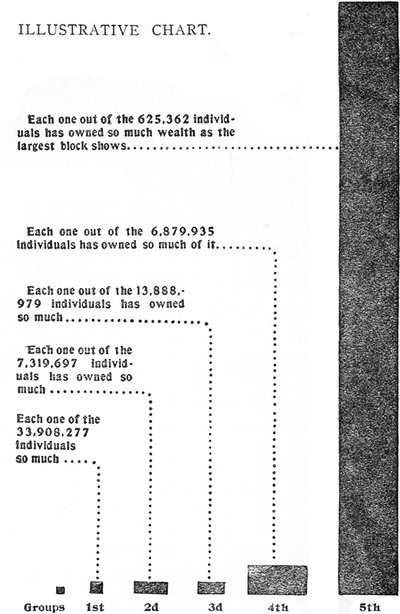
ILLUSTRATIVE CHART.
Every block here represents a comparative average wealth of one man, woman, or child of the respective groups in the 2d Corrected Table, p. 51; while the figures above show the numbers of individuals owning one block each, as indicated.
51While the thirty millions of British people have
on the average $16 worth of wealth, the American
people of the same class have somewhat more of
this kind of wealth than the British, as the last
table, individually regarded, shows the average
property of every person of the families. It is as
follows.
The 2d Corrected Table, 1890.
Holders of Wealth.
Individuals.
The wealth of
Average.
Tenants of farms and homes
33,908,277
$ 2,837,049,500
$ 83
Owners of mortgaged farms and homes worth less than $5,000
7,319,697
2,614,955,764
357
Owners of free farms and homes worth less than $5,000
13,888,979
3,908,222,736
287
Owners of farms and homes worth $5,000 to $50,000
6,879,935
22,676,863,197
3,296
Owners of farms and homes worth $50,000 and over
625,362
33,000,000,000
52,769
The totals.
62,622,250
65,037,091,197
1,036
The average of $83 worth of personal property
in the 1st group of individuals here is a little too
large, because, subtracting the surplus million
52families from this group,[46] we have left the wealth
|THE POOREST CLASSES, 1890.|
of it untouched. In any way, this group contains
27,117,000 individuals having on
the average $30 worth of property
each, according to the last
group of families in the table of Dr. Spahr.[47] It
does not, however, make a great difference on the
whole, because the group of tenants, since 1890,
has undoubtedly increased up to 38,837,849 without
having been able to add anything more to its
aggregate wealth.
The increase of the propertyless accrues from
the natural increase of the population, and from
the loss of the mortgaged properties
|CAUSES OF THE INCREASE OF THE PROPERTYLESS|
by foreclosure of the mortgages in
the 2d group, and from the immigration
of the propertyless foreigners[48] without special
means; while the people of the 3d group have
sunk by thousands into debt from having mortgaged
their properties; and only about a million
families of the last two groups have been exceedingly
prosperous, as we shall understand the situation
later on.
CHAPTER III. PROPERTIED AND PROPERTYLESS PEOPLE.
53
The statistical authorities told us that “Less
than half the families in the United States are propertyless,”[49]
and we desire to know the chances for,
and resources of, their living; and what it means
to be a propertied person or to be a propertyless
person upon earth.
Let us see the clear distinction between the
|CONDITIONS OF LIFE OF THE PROPERTIED AND PROPERTYLESS.|
state of a property owner and the state of a propertyless
person; between the conditions
of life of the former, and the
conditions of life of the latter, and
how both are affected by and related to these
conditions.
First of all an owner of property and a propertyless
person, are, on an average, perfectly equal
in that they have physical strength,
and in that they have equal rights to
use or to apply that strength somewhere
|EQUAL IN PHYSICAL STRENGTH.|
upon the wealth of an owner of wealth.
And here we meet the first difference between
them: An owner of property has a chance to
apply, and to spend his strength upon his own
54property; if, for instance, this property is land that
gives him any kind of returns in exchange for his
|THE ONE HAS, THE OTHER HAS NO CHANCE.|
labor and toil. The propertyless person
has neither this chance nor this
right to toil anywhere, unless he
pays for the opportunity of using his strength, by
dividing the results of his labor between himself
and the owner of wealth who permits him to draw
some income from the resources of his own property
or wealth. So far, the advantage of the propertied
person is such that he has twice as much
right in his strength, and twice as much chance to
profitably use his personal strength.
Now, every one knows that whatever the wealth
of a nation may be, it is primarily derived from
land which is the only inexhaustible
source of riches, or, of derived
wealth. And when a person gets
|LAND PRIME ORIGIN OF WEALTH.|
into his possession a portion of land, whether it
will be in a city, town, or in the country, he then
obtains a number of resources for his life; he
becomes a propertied man, and he can apply his
strength, his skill or his intellect upon his own
property and thus reap the fruits of his labor.
The land then is the first store of wealth; but it
almost never yields anything to man, unless he
labors, works upon it, with a hoe, a plough, a
scythe or some other implement that aids him to
draw greater returns from his land. Again, if iron,
55for instance, is primarily derived from land, then
|LAND MAIN FACTOR OF WEALTH.|
when it comes to the forge, where the hammer, the
anvil and the other tools aid the blacksmith to
make an ax out of the rough iron, the ax will be
of a greater value than the material he used for it.
But what really made the ax is his
personal strength and the skill that
were aided by the tools he used.
These tools with the blacksmith, and those implements
with the farmer are economically called
|SKILL SECOND FACTOR OF WEALTH.|
“capital,” because they aid to draw more wealth
by the labor of man. It follows, that land is the
main factor of wealth; that human
energy or labor is the next factor of
wealth; and that capital, as aiding
labor and land to produce more wealth than they
can yield without it, is the third factor of wealth.
Money is not regarded as direct capital here.
As capital is a very important source of income
to a propertied man, and as it is perhaps not clearly
understood by all, let me illustrate this factor of
wealth by introducing more examples of it.
Capital from an economic standpoint is that
wealth which produces farther wealth, or simply
aids to create farther wealth. A
needle is capital, because it aids to
|CAPITAL THIRD FACTOR OF WEALTH.|
make a shirt that costs more than
the material used for it. A sewing machine is
capital of more effective kind than the needle used
56by hand, because it aids to produce more wealth
than the tailor or the seamstress can produce without
it. A lathe is capital, because it
not only shapes the round forms of
any material more accurately than
|MACHINERY, TOOLS, ARTIFICIAL WEALTH.|
the artizan would ever be able to make without it,
but it greatly saves his time on every piece of the
work; thus saving time it aids in producing more
wealth. A factory, as a whole (including the
building and machinery), is capital, because all
the machinery, all tools and instruments used in it
produce farther wealth from the raw materials, and
serve as sources of income to the owner of this
property. Under the care of the stock-raiser, cattle
are capital, because they grow and multiply; but the
meat or beef is utility, because it may be unproductively
consumed.[50] Agricultural implements, as well
as the fertilizers, like guano, phosphates and many
others are capital, because they increase fertility and
increase the produce of land, which makes a greater
57income in favor of its owner. A thousand different
machineries and special instruments might be introduced
here to show that each one of them has been
invented for the purpose of aiding to create more
wealth out of less wealth. And that all of them
and every one, when used by an owner of wealth,
is a definite source of income and of profit to him,
because it aids his own skill and energy to obtain
greater returns in exchange for his labor and
mind, than he can obtain without it.
But the most effective factor in aiding to produce
more wealth and a much greater income for
an owner of wealth is the energy of
steam or any other mechanical force,
applicable to various forms of labor
|MECHANICAL FORCE; INCREASE OF STEAM.|
and completely obedient to the bidding of man.
“Steam power has increased in the United States
from 3½-millions, in 1860, to 17-millions horse
power in 1895; while in Great Britain and Ireland
it has increased from 2½- to 13-millions; Germany
from ⅞- to 7⅔-millions, and in France from
1 to 5-millions horse-power. The increase of
this capital has been most manifest in manufactures,”
says Dr. Henderson.[51] But it should be
remarked at once that no one of the families worth
below $5,000 could apply these millions of horsepower
of steam force upon their properties. This
energy has all the time been a profitable source of
58great income in favor of the families that made the
wealthiest group in the tables of statistics, whereas
the others have had but little crumbs of its
increase of wealth. The mechanical force, as every
one knows, is in service of the capitalists.
But when we look into the limits of towns and
cities, we find millions of rentable properties of all
possible kinds; and every factory,
|SOURCES OF INCOME.|
every storehouse, every shop and
every dwelling house there is a sure
source of income to the propertied man. The very
sweat-shops, where the working people can not,
on an average, live longer than 28 years—even
these dens of poison and pestilence are inexhaustible
sources of income and profit to their owners.
As to the town and city lots, they are all sources
of greater or less income to the men who own
them. Whether these lots of land are occupied by
|SOURCES OF INDIRECT INCOME.|
anything or are remaining waste, makes little difference,
because as the town population increases,
their values also increase in proportion as the city
population and its business increase; the owners
of properties towards centers of the cities are usually
bound to be rich out of the resources of rent.
Even a simple house, somewhere
about the marginal line of a city or
town is usually a source of indirect
income to its owner, because he and his family
may have a comfortable shelter in it, without
59which they would pay the rent for another’s house,[52]
and would carry on all other expenses of life, just
as they do in their own house, in which they save the
rental money for some other purposes of living.
Now then, whatever property you may think
of—whether natural or artificial, whether animate
or inanimate, that a person has possession of—it is
always wealth, and a source of income in his favor.
|WEALTH CREATED BY LABOR.|
The natural wealth is the land, wherever it may be
in convenient places, it may always
provide one or more resources of
income in exchange for the application
and expense of strength or skill of labor upon
it. The artificial wealth includes all capital, whatever
it may be, it is capital, if it can assist the labor
energy to double, triple or multiple the income
and profit, drawn from the natural resource to
which the labor-strength is applied. The rentable
house or any other building is artificial wealth.
And it is also a source of income to its owner who,
by a use of skill and by an application of labor
energy, can make his source of income give a multiple
yield, in return for the expense of his personal
strength upon it.
Thus, the indirect and direct resources of a propertied
60person, therefore, are always many and
complete when he works out the wealth himself.
|COMPLETE AND INCOMPLETE INCOMES OF PROPERTY OWNERS.|
By complete I mean this, that whatever
his intelligence and strength can
draw out of the source they are
applied to, it is always his and is always to his
benefit. An incomplete income or yield from a
source of wealth, to its owner, will be this, that, if
he hires the energy, or the skill of another person
to apply upon his property, then his income is
incomplete, because he has to pay for the hired
labor energy as well as for hired skill. In this
way an owner of wealth of any kind may even
divide the yield and the product of the source of
income into halves.
But as long as a person is an owner of wealth,
an owner of capital, and an owner of physical and
mental energy, he is a possessor of
|PROPERTY GUARANTY OF LIFE.|
resources; his labor energy and his
existence are then fully guaranteed
for himself, his wife, and children by his wealth,
because wealth or property becomes a direct
source of income, when he himself labors on it,
and an indirect, when he rents it to others. A
propertied man, therefore, is safe forever by the
resources of his property, which yield incomes and
profits for sustenance of the highest possible life,
highest education, freedom, and enjoyment.
But what about the propertyless man? How
61many resources, or how many sources of income
|HAS THE PROPERTYLESS ANY SOURCE OF INCOME, ETC.?|
has he for his own life, the life of his wife and children?
What sources of income has
he for education, for bread and butter,
for clothes and dress, for their shelter
and his own? What resources has he for his
sustenance in this world, when the entire world tends
rapidly to be the property of a very few persons?
He has neither land, nor capital, nor house; he
has neither natural, nor artificial wealth to serve
him, and hence, has not a single one
of the above described sources of
|THE PROPERTYLESS HIMSELF IS A SOURCE OF MULTIPLE EXPENSE.|
income and profit which the Creator
provided for man’s enjoyment. On the contrary,
the propertyless man himself is a source of multiple
expense; he has but a store of labor energy within
himself, which store must be supported by its own
effort, and that too while his life is guaranteed by
nothing but by his physical strength and natural
mind. And it is only these two that unite to support
him who is the single source of the following
manifold expenses in favor of many owners of
properties and wealth, who sometimes make enormous
fortunes by the efforts of the propertyless.
If a propertyless man desires to exist at all in
the sight of his God in this quasi-civilized world,
he must spend his life in the following ways:
1. He must pay from it for a shelter to one
or another property owner, when this owner has
62a rentable house, which house serves as a source of
income and profit to the owner. So that the tenant
of his house becomes a permanent resource for the
owner’s well-being, because he cannot avoid paying
rent to the one or the other.
2. He must pay for his clothes to another property
owner or an owner of wealth, who gets income
and profit from selling the
|EXPENSES FOR CLOTHES, ETC.|
goods, and who gets incomes and
profits for making and producing
the goods. And as a consumer, the propertyless
man is relied upon as a source of income by these
owners of wealth, and hence, he is a resource of
their own well-being. He must also pay for
laundry to another owner of wealth and must be a
real source of income and profit for him, because
he too is a propertied man and has many resources
for life.
3. He must pay for his board, whether in a
boarding house or in a restaurant, it makes some difference;
but by boarding in either
|EXPENSES FOR NOURISHMENT.|
one or the other, he must be a source
of income and profit to servants and
waiters every day, and to a crowd of owners of
wealth who are ever ready to draw all from him
they can. But if he boards in the house he rents,
and if his wife performs the domestic duties in his
case, then the expense of his life is reduced through
this channel in favor of the wife. Nevertheless, he
63must continue to be a source of income in favor of
the butcher, the baker and grocer, and some other
propertied men who derive their profits from him
at a certain per cent in the way of his nourishment.
4. The propertyless man is another source of
expense in favor of the support of the general government
of the nation, a state government,
a county government, and
perhaps a municipal one. And he
|EXPENSES FOR GOVERNMENT, ETC.|
pays the taxes in the prices of the goods and
clothing he wears; in the prices of food and the
drinks he consumes,—these expenses make him a
sure source of income to many other owners of
wealth, and so on. And to this channel of drain
must be added his expenses for education, for different
asylums, for churches and other institutions;
expenses for the books and newspapers he reads;
expenses for the carfare, etc., he cannot avoid;
expenses for the physicians he is cured by, and the
drugs his strength is invigorated with, and so on.
Thus every one of these propertied persons obtains
his own percentage of income from the resourceless
man. And certainly there are many other
channels of expense for him in the society he
comes into contact with. It is really impossible to
number here even the unavoidable expenses of the
propertyless man.
It is then in the above directions that the physical
and mental energy must run out of the propertyless
64person. And of course it runs out in the
form of currency or the money by which he pays
for shelter, for clothing, etc., for services
|HIS ENERGY IS DRAINED BY THE PROPERTIED MEN.|
and all utilities, to the owners
of wealth. But, if the propertyless
man himself is only a source to be drained by
the others, and if he has neither land, nor capital,
nor any other natural or artificial wealth to draw
an income from, then his very strength is good for
nothing. For the strength itself can neither be
eaten nor can he pay with it any one who has
the right to draw on it. His energy must, therefore,
be first exchanged either for money or for
some other utilities of value which are derived out
of wealth, out of property that he does not possess.
How then can this persistently drained source become
filled or supplied again? Where is the
resource of his own income? Surely he can not
exist without one at least. And, being propertyless,
he naturally does not have even the single one
outside of himself. Yet he has to live from without
or he must die of starvation from within.
Now, the only chance for the propertyless man
to live is to go again to an owner of wealth, and
to hire some one or another resource
|HE MAY HAVE BUT ONE CHANCE FOR A PAYMENT.|
of income from him and to apply
his energy to it, paying for the permission.
Again paying, paying is the only hope
for the propertyless man. And this is the most
65important point after all, because he must pay even
for the application of his personal energy to all
natural and artificial resources of wealth, or income.
Has any one understood what it means—to
pay for an application of labor energy to wealth
that the merciful Creator provided for man? I am
sure that the politico-economists do not understand
it. A few of them hit this point, sometimes,
but unconsciously, without conceiving its significance.
The propertyless person, then, who is drained in
all directions, and who has but one chance to
restore his expended energy from a single source
of income—this man again becomes an additional
source of expense in favor of an owner of wealth,
an additional source of income and profit to propertied
men.
But where, and how, can this unfortunate
creature of God, this multiple source of income
and profit for men, further pay and expend his
strength, for becoming a still further source of
income in favor of the propertied men?
This question, after the four previously explained
series of drains of the propertyless man,
demands the next point.
5. The propertyless man can not even make
himself the source of income and profit to others
without paying an exorbitant price for it to an
owner of wealth. If, for instance, he labors for
66wages, his employer and others finally obtain from
25 to 50 or 75 per cent or even more profit out of
the results of his labor. If he works on a farm,
in a plant, or any other wealth
|HIS EXPENSES FOR EMPLOYMENT IN ANY SPHERE.|
with capital, or works in making
capital, he must in any way divide
the results of his work between the owner of
wealth and himself. His portion is usually paid
by time in money, as wages, as a salary, or in some
other way; while the whole result of his work
remains, and is dispensed by the owner of wealth
who is profited by him. If the propertyless person
serves to an owner of wealth as a clerk, a bookkeeper,
salesman, or in any other capacity, he cannot
serve unless he or she is a profitable source of
income to the propertied master who gives him the
chance to supply his ever drained source of multiple
expenses. If, further, the propertyless man
leases a farm or any other wealth of a propertied
person, he has always to divide the results of his
labor between himself and the owner of wealth.
Whereas, if the owner of it himself labors on his
wealth, then, the whole result of his toil must
remain as a reward to himself. And there is the
difference: The tenant or the lessee is obliged to
labor twice as hard as the propertied man in order
to derive so much income for himself, as the owner
of wealth can derive by working half as hard; and
that is because the owner of property is drawing
67all income of his labor for himself, while the propertyless
man is drawing income for himself and for
the propertied man, to whom the former is a
source of income by paying rent. If, finally, the
propertyless man labors upon a rentable source
of income, and then borrows money for improvements,
in addition to the paying for that source, he
thereby makes himself a source of income in favor
of the creditor, by paying per cents for the loan;
and, consequently, he must divide the results of
his toil between himself and between two owners
of wealth. The improvements, being a capital,
must aid him to produce more wealth than he can
produce without it; but the high rate of percentage
which exists in America must surely ruin the
debtor, because per cents in favor of lenders of
money, etc., generally run from 6 to 12 per cent
per annum; and in some cases the money sharks
obtain even from 15 to 18 per cent.
What then are the advantages of the propertied
person and the disadvantages of the propertyless
man?
From the preceding it is clearly seen that both
men are on an equality merely in the physical
energy. And the propertied person
has an absolute advantage for developing
his mental energy or skill. We
|ADVANTAGES AND DISADVANTAGES.|
have, therefore, to regard their physical energy as
an equal in both. But, with the propertied man,
68this energy is surrounded by multiple resources of
income; so that to whatever resource he applies
his energy, it always yields him the whole results
of his labor. An application of capital in his power
multiplies the yield in his favor. An application
of the hired labor energy still farther multiplies the
yield and increases his income. His
|A PROPERTIED IS A MAN OF MULTIPLE INCOMES.|
physical energy, therefore, must be
regarded as a source of multiple income
even in relation to a small amount of wealth
or income-bearing property.[53] On the contrary,
when there is plenty of employment, the energy of
the propertyless person is itself a
source of multiple expense in favor
of the propertied men. And again,
|A PROPERTYLESS IS A MAN OF MULTIPLE EXPENSES.|
when there is employment, he is permitted to
apply his energy but to a single resource of
income; and when permitted to do so, the propertyless
man can only draw about half the income
that this resource can yield to his energy, while
the other half of it must go to the multiple incomes
of the propertied men who employ him as
the people call it. Hence, being surrounded with
the inexhaustible wealth of nature, with innumerable
resources of income, the propertyless man is
only a semi-sourced man—a man of semi-sourced
income. He is a man who is entitled to a portion
69of the yield, for the expense of energy which is
equal to two or more portions of it. And there is
nothing more in the whole realm of wealth than a
semi-income from one source for the man who
himself is a source of multiple expenses in the
favor of many owners of wealth. A greater injustice
than this could not be fabricated by mankind
under the heavens.
But what about the propertyless, when there is
no employment at all? Or, when the caprice of
the propertied is not satisfied by the
halves of the yields produced by the
|PROPERTYLESS OUT OF EMPLOYMENT.|
labor energy and skill of the propertyless
people? What, when they demand still
more impossible efficiency in product from the
emaciated energy of their victims? The answer is
clear and but one. These economic slaves, these
victims of the greatest injustice and absurdity are
thrown back by thousands into the sphere of
humiliation under public relief. And who constitutes
this public? Nearly all the same propertyless
millions, who relieve the others, when they
themselves are not yet on the point of starvation.
And who is after all accused? Who is searched?
Whose character and history of life is mercilessly
scrutinized at the bars of charity?
|HE IS REGARDED AS INFERIOR.|
Again the same propertyless victims,
the same economic slaves,
whose lives have been spent in working for the
70owners of wealth, owners of property, of fortunes.
It is certainly not with Japan, nor even civilized
England, where primogeniture persists to reign,
and where the hereditary noblemen
|PRINCIPLES OF INJUSTICE.|
equally continue to suck the energy
of the British and Irish people and
of the peoples of their colonies that we have to deal
with. “In 1891 Great Britain and Ireland had had
nearly 6,000,000 propertyless families[54];” and they
have been accustomed for centuries to spend more
than half of their energy in favor of the lords of
property, who are the lords of nearly all resources
of wealth in Britain and in many other parts of the
world. But we have to deal with the people of
the United States, whose fathers tried by all means
to escape the influence of primogeniture, and
whose children have now reached the same economic
|DIVIDOGENESURE.|
condition of slavery, but
under a different title, viz., that of
dividogenesure.[55] As its definition
here shows, the principle of dividogenesure involves
both the individual and class dependence of
71the needy upon the wealthy and applies to the
entire millions of the group of tenant families, as
well as to the group of mortgagor families of the 2d
table.[56] For all these families have been dividing
the sole results of their labor or toil, in one way or
another, between themselves and their economic
masters that they wholly or partly depend upon.
The subsequent chapters, however, will better explain
the situation of their dependence.
While here we shall but briefly indicate that
dividogenesure, as a principle of tacit reality, separates
the people into two classes: 1st, into individuals
of multiple expenditure in
each case, but with a possible semi-income
|ECONOMIC CLASSES.|
for supplying this expenditure;
and 2d, into individuals of also multiple
expenditure for living, but at the same time of
multiple incomes sufficient to leave a considerable
net profit or balance for their future. This balance
or profit, in some cases, gradually amounts to millions
of dollars’ worth of wealth, remultiplying
further incomes most rapidly; while the individuals
of the first class become absolutely dependent
upon the second even for the semi-income
which may at any time be refused them on account
of too many individuals in need of resources for
incomes belonging to the second class.
72And it further follows, that when the resourceless
are admitted into the sphere of dividogenesure,
|ONE SPHERE.|
then their multiple expenditure is
meagerly supplied. But when they
are refused admittance into this
sphere, then their unavoidable fate is starvation or
falling back into the realm of public relief for the
unemployed.
As to their fate under the public relief, Dr.
Amos G. Warner says: “The most difficult
|CHARITIES ANOTHER SPHERE.|
problem in the whole realm of poor-relief
is this of Providing for the
unemployed. England has worked
at it intermittently from the time of Elizabeth”
(1558-1603) up to date without success. For there
were more than 30-millions of individuals without
property in Great Britain and Ireland, when Dr.
Warner was writing, and he continued as follows:
“The most careful investigation made in this
country regarding enforced idleness was probably
that conducted by the Massachusetts
Bureau of Labor during the
|LOSS OF TIME.|
depression of 1885. There were
during that year in Massachusetts 816,470 persons
engaged in gainful occupations; of these
241,589 were unemployed during part of the year.
The time lost, if we consider only the principal
occupation of each individual, was 82,744 years;
but many persons, when unable to work at their
73principal occupation, had some subsidiary work.
Making the proper deductions for the time thus
put in, the net absolute loss of working-time
amounted to 78,717.76 years. * * * Averaged
among those who lost a certain amount of
time, the loss per man was 3.91 months.”[57] or nearly
four months.
This description shows the absolute helplessness
of the resourceless people in the State of Massachusetts
alone, while there were 48
other States and Territories besides
Massachusetts in this country. In
|LOSS OF MONEY.|
all these States and Territories, therefore, not only
millions of years of working-time must have been
lost during the depression of 1882 to 1885, but
millions of dollars of public and private money was
unproductively spent for the relief of the propertyless
from starvation, cold and from other distresses.
And after all, that was a comparatively mild reality.
For the same Dr. Warner further writes:
“This present chapter passes from my hand in
March, 1894, when special relief-work for the unemployed
is being carried forward
on a scale never before known or
|HOMELESS CONSTANT FACTOR.|
needed in this country.[58] It is therefore
not possible to give the results of this
74emergency work.” * * * But the relief must
be given. “The present chapter is concerned
especially with the problem of the homeless poor
as a constant factor in the administration of charities.[59]
The question of how to deal with the tramp
is said to be of special urgency in every locality
in the United States with which I am at all
acquainted. From Boston to San Francisco, and
from St. Paul to New Orleans, complaints come
of a number of tramps, which is alleged to be
‘especially’ large in each case.”[60]
In fact, Dr. Warner’s book of more than 400
pages is one that represents the saddest spectacle
|TWO SISTERS OF INIQUITY.|
of human misery on the largest
scale. It treats all possible causes
of the misery, excepting the main,
and all-powerful, cause of all the minor causes,
which I have named dividogenesure, because it is
the sister of primogeniture, the one being as
iniquitous for millions of families as the other.
As a universally pernicious principle, dividogenesure
is always working in behalf of a few
favorites. It has always been unjust
to the employees, even when those
|IMPLIES DEGREES OF INJUSTICE.|
favorites commanded an equal number
of places of employment to the number of the
employees in a nation, because the latter have
75always been obliged to divide the results of their
toil at an unjust rate of per cent with the former.
The injustice of dividogenesure, however, intensifies
as soon as the number of the employees becomes
greater than the number of the places of
employment, and this injustice grows especially
intense when these employees appear to be the
propertyless individuals. And when a nation has so
many propertyless individuals as to outnumber by
millions the places of employment, then, the great
injustice of dividogenesure changes into the very
foundation of iniquity. For its favorites, then,
make all possible devices, like the blanks with tens
of scrutinizing questions, and other humiliating
devices for the purpose of selecting the most
efficient applicants for employment at the cheapest
possible rates of payment. Thus, the employed
ones become harder and harder economic slaves
of these favorites, while the unemployed are cast
out of the sphere of the slavery without bread, etc.,
into the sphere of starvation and the public relief.
Further, dividogenesure is not a system of ordinary
slavery, where the slaves are dependent upon
their masters for living and dying.
It is not the slavery that imposes a
moral obligation upon the masters
|IT IS NOT AN ORDINARY SLAVERY.|
in favor of the slaves who are subject to them. No,
no, dividogenesure has made millions of families
absolutely dependent on its favorites, but it has
76removed from these favorites all moral obligations
in favor of the modern economic slaves. The modern
master of hundreds of the slaves can extort the
last inch of labor energy from each of them, and
yet can live in perfect peace under the shield of
dividogenesure without responsibility and without
the slightest remorse of conscience. He does
not compel any of the slaves to make applications
for employment, for working out his wealth and
fortune. But he knows very well that there are
invisible, omnipotent and omnipresent forces,
|UNSEEN FORCES.|
namely: Hunger and thirst, or the
multiple expenditure in every individual
case, which mightily push the
slaves to his commanding mastership. And the
only duty dividogenesure bids him to perform, is to
choose the most efficient applicants for the lowest
pay, as they would seem to be the most profitable
for himself. As to the rejected ones, it is neither
his business nor his duty to care whether they live
or perish by fire, by cold, by disease, wither away
or starve to death.
CHAPTER IV. ABNORMITY OF THE SOCIAL SITUATION. — STATISTICS OF THE TENANTS.
77
The preceding chapter has shown the differences
between the conditions of life of the propertied
|DIFFERENCES IN CONDITIONS OF LIFE.|
and of the propertyless people.
It has explained the multiple expenditures
of the resourceless, and how
they are obliged to labor under the principle of
dividogenesure without ever being able to appropriate
the full results of their labor to themselves.
The present chapter will reveal the astonishing
number of the propertyless in the United States,
and the places where they are mostly to be found.
However, before proceeding to examine the
investigations about the people without property,
we must add here, that the propertyless
|THE PROPERTYLESS PAY RENT OR ARE EXPELLED.|
are those that occupy houses, or
rooms, or simply little cells in the
rentable properties of the propertied, paying rent
for them. They are, therefore, regarded as the
tenants of homes, and when occupying rentable
farms, they are regarded as the tenants of farms.
And as long as they are able to earn and to pay
the rents on time, they are regarded as good people,
good families and respectable persons, because
78they constitute the real sources of income to the
owners of the rentable properties. But as soon as
they cannot find a situation, cannot find employment,
cannot find work, cannot find a job, cannot
borrow money, cannot pawn anything, hence cannot
pay rent at the well defined times, then they
are gently or ruthlessly kicked out of the rooms,
and regarded as “no good,” as degenerates.
Expelling them from the tenement houses or
farms, some gentlemen or lady-proprietors sometimes
even express sympathy or
|CANNOT HELP THE SITUATION.|
sorrow to lose their tenants; and
sometimes they anticipate further
sufferings and privations for their unfortunate
roomers, etc., but cannot help them under the
existing conditions. The expelled tenant then
wanders about, suffers privations, humiliations, till
he falls into prison, or she falls into prostitution,
and into all the miseries of the world. And it is
only at the point where these propertyless lose
their real manhood and womanhood that they
cease to be the sources of income for the propertied.
Now let us deal with the homeless and landless
in the statistical accounts, where the tenants and
mortgagors are described together, but with
greater details in respect to the mortgagors than
to the tenants. For the sake of clearness, therefore,
I must prominently represent here the tenant
79families, as the propertyless, and must leave the
mortgagor families for the next chapter.
The following census statistics represent only
percentages of families occupying farms and homes
in the United States, while I have supplied the
figures implied in the relative percentages of these
families.
“Extra Bulletin No. 98 of the United States
Census, 1890, says:
“There are 12,690,152 families in the United
States, and of these families 52.20 per cent,” or
6,624,259 families, “hire their farms or homes, and
47.80 per cent own them.”[61]
“In regard to the families occupying farms the
|FARM FAMILIES.|
conclusion is, that 34.08 per cent,” or 1,624,655
families, “hire, and 65.92[62] per cent
own, the farms cultivated by them.”
So that “among every 100 farm families
34 hire their farms,” being landless.
“The corresponding facts for the families occupying
|HOME FAMILIES.|
homes are, that 63.10 per
cent,” i. e., 4,999,396 families “hire,
and 36.90[62] per cent,” i. e., 2,923,560,[62]
families, “own their homes.” So that “in every 100
80home families, on the average, 63 hire their homes,
and 37[63] own them.”
“There are 420 cities and towns that have a
population of 8,000 to 100,000, and in these cities
|CITIES 64.004 PER CENT. HIRE.|
and towns 64.04 per cent of the
home-families hire and 35.96[63] per
cent own their homes.” So that in
these cities and towns, 64 out of every 100 families
hire their homes, and 36 own them, or as the Bulletin
states: “in 100 home families, on the average,
are found 64 that hire their homes, and 36[63] own
them.”
Besides this, “the cities that have a population
of 100,000 and over,” i. e., cities up to millions,
like Philadelphia, Chicago, New
|LARGE CITIES 77.17 PER CENT. HIRE.|
York and so on, “number 28, and in
these cities 77.17 per cent of the
home families hire their homes and 22.83[63] per cent
own them.” It follows, that in these large and
very populous cities of the United States more
than 77 families out of every 100 are tenant families
or those that hire their homes, and 23[63] own
them. Or, as the Bulletin says: “In these cities
among 100 home families, on the average, 77 hire
and 23[63] own their homes.”[64]
Now then, what this Extra Bulletin reveals to us
is as follows:
811. That in 1890 we had 1,624,655 families hiring
farms. The difference between hiring a farm
and owning a farm is this, that an
owner of a farm reaps all the benefits
|NUMBER OF FAMILIES HIRING FARMS.|
of his own farm; whatever amount
of energy he spends upon his farm, he obtains all
the results of it by himself and for himself, remaining
all the time an independent man. A farm
tenant is just the contrary. He is a dependent
being and is a subject to dividogenesure. He
works upon a rentable property and must first of
all satisfy the rightful owner of the farm. He must
divide the results of his labor between his master
and himself, by paying rent. And in order to be
equally well off with the farmer that works upon
his own farm, the tenant must exert almost twice
as much of labor energy as the owner of a farm.
But this is impossible. And this impossibility rests
upon all the tenants of farms. They are economic
slaves of their masters, slaves under the principle of
dividogenesure. If they don’t wish to divide the
sole results of their labor, then they must starve,
and there is no other alternative for them, because
they are propertyless and hence resourceless.
2. That at the same time we had
4,999,412 other families that were
hiring not the farms but rentable
homes of the propertied men. And these nearly
|NUMBER OF FAMILIES HIRING HOMES.|
5-million families were not only the sources of
82income and profit in favor of the owners of the
homes, but also the sources of income for the
employers that permit them to labor. So that a
farm tenant is a direct[65] source of income to one
lord of property; while a home tenant is a direct[66]
source of income for two owners of wealth. And
a great injustice hangs on the neck of every one of
these millions, because they have no property of
their own. But the principal point is this, that
neither one of them has the right to expend or
apply his labor energy anywhere without paying
for it to those that may not labor at all and live.
Adding now the two classes of tenant families,
we have 6,624,259 of them; and regarding their
|NUMBERS COMBINED.|
numbers individually, we have 32,656,808
propertyless persons who
are in bondage of dividogenesure,
because they have neither the right to expend
their strength nor to restore it without paying for
both to the propertied.
The question now is, Do these numbers show
that we had “less than half the families in the
United States without property?”[67] Even without
examining the numbers of the propertyless in
cities and towns, the Extra Bulletin proves that
there were 279,023 more of the propertyless families
83than the half of the entire population. And
|COULD BUILD A LARGE CITY.|
this little more than the half represents 1,345,683
propertyless individuals who could
build and could inhabit yet another
one of the largest cities in the world,
while under the unjust principle of dividogenesure
they have neither a farm, nor a lot, nor a
single house of their own.
But what do you think about the whole number
of the propertyless? We had fully 32,656,808
individuals of them in 1890, according
to this Bulletin, and they could
|COULD BUILD 32 LARGE CITIES.|
likewise build and inhabit 32 great
cities having in each more than a million of good
citizens. A million population in one city, as you
know, constitutes one of the most populous cities
in the world; and we could have thirty-two such
cities in the possession of these now propertyless
people. These millions of people could make one
of the finest nations on earth with 32 of most
populous cities which they could erect by their
labor energy. How is it, then, that they are
obliged to remain homeless, landless, propertyless,
resourceless? Have they been lazy to work? Have
they been incapable of doing anything for themselves?
Have they been degenerates? No, no,
these tens of millions have been working hard, but
they have been deprived of the results of their labor
by the unjust principle of dividogenesure that compelled
84them to labor for the few families of the
wealthy group of the two tables on p. 47, which
own the results of their labor and toil.
And do you realize what it means to have 420
cities and towns with the population of 8,000 to
100,000 individuals in each? Do you know what
|CITIES BUILT BY LABORERS.|
it means to have nearly seven-tenths of their population
without property, when they cannot exist
without it? And what it means to
have 28 cities whose population is
above 100,000, and which goes up to
millions in some of them; and yet nearly four-fifths
of their people are without homes, without
property, and without any resources of their own?
And do you know that these very cities (and towns)
have almost all been built out of the realized labor
energy or on account of the results of labor of
these slaves of dividogenesure?
And this is not all, for, according to the Bulletin,
we had 32,656,808 of the propertyless individuals,
while the 2d R. table, p. 36,
|COULD BUILD 33 GREAT CITIES.|
which resulted from the 2d table on
p. 32, and which was published in
1897—this table authoritatively demands that we
should add 1,251,469 more propertyless people to
the number found in the Bulletin. This additional
number of the propertyless could make yet another
one of the most populous cities in the world.
And, being added together, these people could
85inhabit not 32 but 33 cities, with the total population
of 33,908,277 individuals or nearly 34-millions
of souls.
Imagine! The whole nation in 1865 was made
|WHOLE NATION OF 1865 PROPERTYLESS IN 1890.|
up of this number of people, whose wealth aggregated
over $24,000,000,000 worth.
Now the principle of dividogenesure
required but 25 years to render the
|BY INCREASING PROPERTY MEN LOST PROPERTY.|
number of the propertyless equal to the entire
nation of 1865. Is it not an astonishing fact that
while this great number of the propertyless
people grew up, the national
wealth actually increased by the
worth of about $41,877,475,129? For in 1860 the
total aggregate of it was $16,159,616,068, whereas
in 1890 it aggregated to $65,037,091,197 worth of
wealth.
In view of these contrasting facts, can any one
say that the 33-millions of the property-losers were
idle? or that the phenomenal increase
of the wealth was produced
|HUMAN ENERGY IS THE INITIAL OPERATOR IN PRODUCTION.|
by the very few owners of it because
they had the most effective capital at their own
hands? No, sir, the capital itself is dead in every
respect and form, and not a single piece of it can
produce anything by itself. But, being effective
aid, assistant in production, capital only helps the
living human energy to increase the results of its
labor. And it follows that whatever the increase
86in production due to mechanical forces or to other
capital may be, it must be attributed to the activity
of human energy which manipulates all invented
forms of capital. And surely the blessings of the
various inventions consist in the fact that the inventions
can aid the labor energy to produce more
wealth than it can produce without them. Hence the
real blessings of the invented capital ought to have
been preëminently in the fact of its increasing the
well-being of the millions of laborers in the various
grades of industry.
How is it, then, that the wealth of the United
States nation, from 1865 to 1890, increased by
more than 42-billion dollars worth,
|IS IT LOGICALLY CORRECT OR MORALLY RIGHT?|
while the well-being of its producers
greatly decreased? How is it that
the tens of millions of the workers not only could
not obtain the due share of the wealth they increased,
but many millions of them in addition
lost their own properties? How is it that the great
blessings of the inventors have been changed into
great curses against their well-being, because now
they appeared to be absolutely dependent for life
on the wealthy few, having nothing of their own?
No explanations of minor causes can answer these
questions, but the great injustice of dividogenesure
explains them.
But what can the propertyless people do when
they increase and when all the wealth and capital
87produced by the people are monopolized by a few
families, as even the 1st and 2d tables, p. 47, show
the facts? What can the 33,908,277 individuals
without property do, when they have nothing to
hope for but labor under the principle of dividogenesure
for the wealthy few that consist of less
than a million families in the enlarged nation?
It is evident that their fate condemns them to
labor, as slaves, on permission, and to satisfy first
the demands of dividogenesure and afterward take
|THE CLAIMS OF DIVIDOGENESURE REGARDED FIRST.|
for themselves what may be allowed
from the results of their toil on the
rentable farms, while the millions of
families which hire homes in the 448 cities and
towns are still harder slaves of dividogenesure than
the families that hire their farms. They are harder
slaves because they are more liable to be freed
even from the oppression of dividogenesure, and
liable to remain months and months in the sphere
of starvation without employment.
Can there be a greater iniquity in the world
than the iniquity that proceeds from the abnormal
system of dividogenesure?
No! No nation in human history has seen an
iniquity that can be compared with the results of
dividogenesure as they are at present,
for it now deprives men of their
|DIVIDOGENESURE IS A FOUNTAIN OF GREAT EVILS.|
fruits of toil to the utmost degree; it
deprives them of their energy, of their rights, and
88of their property; it deceives them by the medium
of exchange of commodities and products; it
makes them economic slaves of the very few masters
or throws them out of the region of the slavery
into the region of resourceless starvation and degeneration;
it concentrates masses of the people’s
wealth into a few hands, leaving millions of families
without income in despair and casts them out
of the rentable homes; it drags them into the
courts, throws them into prisons, drives them into
penitentiaries, fits them for and chases them into
the lunatic and insane asylums. And not only
this, but nearly all causes of murders, of parricides,
of infanticides, etc., and of the suicides perpetrated
by the people, can indirectly be traced to the abnormal
system of dividogenesure, which most
fundamentally conditions almost all national, social
and private crimes, because sound life always
depends upon sound economic basis of a nation.
The system of dividogenesure, however, is pernicious
not only to the tens of millions of the
propertyless people alone, but it has
|IT COMPRISES THE PROPERTIED EMPLOYEES.|
enslaved millions of families that
have homes and have other little
properties not bearing direct incomes for subsistence.
These families therefore are also compelled
to be in gainful pursuits under the same conditions
with the landless and homeless. And Mr. Carroll
D. Wright, onesided and severely criticised, wrote
89about some of them as the American bread-winners,
as follows:
“Bread-winners in 1870 engaged in supporting
themselves were 12,505,923, or 32.43 per cent” of
the population. “The bread-winners in 1880 were
17,392,099, or 34.67 per cent of the total population”
of that time. “The bread-winners in 1890
were 22,735,661, or 36.31 per cent.” By “bread-winners”
he meant “wage earners, salary receivers
... or any one who was engaged in gainful
pursuit,” including “proprietors of whatever grade
or description, and all professional persons.”[68]
I must here make a diversion to examine this
author’s argument.
For the purpose of proving that the poor, the
producers of wealth, were getting better off from
1870 to 1890 by their gainful pursuits,
Mr. Wright has placed in the
|MR. C. D. WRIGHT.|
same class individuals of incomparable
description, and, by making averages upon
equally incomparable basis of their gains, logically
arrived at the false conclusion that the wages
in general had risen during that period of time.
And hence, he added that “the rich are growing
richer and the poor are getting better off.” He
thus arrived at the same nominal conclusion at
which Mr. Shearman has arrived in making nearly
56-millions of individuals appear to be in possession
90of $209 each.[69] And it is exactly in the
same way Mr. Wright himself made the per capita
wealth in the United States, as a whole, amount to
$1,036 for every inhabitant of the nation. The
rules of arithmetic are accurate in every calculation.
But the nominal distribution of wealth has
never made the millions of the people better off;
and it has never altered the fact, that in 1890 we
had nearly 34-millions of them without property;
and we had a little over 7-millions of other individuals
owning more than 55½-billion dollars
worth of wealth.[70] Whereas, at the same time,
there were more than 27-millions of individuals
whose aggregate wealth was only $825-millions,
which is but $30 to each person.[71]
This little diversion from our main thought
once more testifies that the increase of the 42-billion
dollars worth of wealth which accrued from
1865 to 1890 did not in the least raise the wages
of those producers of the wealth who were compelled
even to lose their own properties. On the
contrary, while the salaries and incomes of some
professional persons had decidedly increased, the
wages in general had fallen, as we shall see later on.
Consequently, the tens of millions of the creators of
91that wealth appeared to be all the worse off, as we
have seen on pp. 85, 86.
And when Mr. Wright adds “that the transportation
has been so perfected,” during the same
time, “as to bring to the door of the
|THE PROPERTYLESS HAVE NEITHER DOOR NOR WINDOW.|
poor man and the rich the results of
industry of far away people” in order
that they may buy them from different monopolists;
this sentence really sounds like a mockery to
the 34-millions of individuals who had in 1890
neither their own door nor even window, and who
were absolutely dependent upon chances for a
semi-income under the oppressive dividogenesure.
But as to how many people were engaged in the
gainful pursuits and how many of them were entirely
subject to the system of dividogenesure, we
can better know from the researches of Prof. Mayo
Smith. He says as follows:
“Persons in gainful pursuits, United States 1890,
by classes of occupations, in ten years of age and
over, were 47,413,559. Out of them
|PROF. MAYO SMITH.|
24,352,659 were males and 23,060,900
were females.” After this statement
he innumerates their respective occupations
and adds “That 9,013,201 persons were in gainful
pursuits in agriculture, fisheries and mining, and
that 8,333,692 of these last are males and 679,509
are females.”[72] So that out of 62,622,250 inhabitants
92of the country 47,413,559 individuals of 10
years of age and upwards were engaged in the
gainful pursuits.
Now these nearly 47½-millions of persons in
gainful pursuits could not all be the slaves of
dividogenesure. For some of these
|FAVORITES OF DIVIDOGENESURE SPECULATE.|
persons serve its favorites for very
high salaries and their services are
well remunerated. Nor could this number include
many of the favorites of this unjust principle. For
its real favorites are those that possess extensive
rights in natural and artificial resources of wealth;
they are those that earn their enormous incomes
even in their comfortable beds, by simply speculating
on and relying upon the energy and productivity
of the subjects to dividogenesure. And as the
productivity of the American people is very high,
it therefore becomes as easy for them to grow very
wealthy under the favor of dividogenesure as for
the millions of makers of their fortunes to grow
very poor and emaciated.
Reviewing then the various occupations of the
people in the United States as these are represented
by different authorities, we
|1,000,000 FAMILIES AND 38,837,849 INDIVIDUALS.|
have sufficient reason to judge that
since the year 1890 there have been
about 38,837,849 persons who may be regarded as
positive slaves to dividogenesure on the one hand.
And there have been about one million families
93that were more or less profited by their highly
productive labor and skillful energy on the other
hand. The above number includes nearly all the
homeless and landless of the last census, and includes
about six millions of those who had their
little homes and other properties of no importance.
The productivity of these people may be exemplified
by the following reports:
“Mr. Mulhall, in the ‘North American Review,’
for June, 1895, says:
“An ordinary farm-hand in the United States
raises as much grain as three in England, four in
France, five in Germany, or six in
|PRODUCTIVITY OF FARMERS.|
Austria, which shows what an enormous
waste of labor occurs in
Europe, because farmers are not possessed of the
same mechanical appliances as in the United
States.” (Enc. of Soc. Ref. p. 1093.)
“Mr. Edward Atkinson gives the following
statements on the industrial productivity of the
United States.” He says:
“One thousand barrels of flour, the annual ration
of 1,000 people, can be placed in the city of
New York from a point 1,700 or
|7 PERSONS SERVE 1,000 WITH BREAD.|
2,000 miles distant with the exertion
of human labor equivalent to that of
only four men, working one year in producing,
milling and moving the wheat. It can then be
baked and distributed by the work of three more
94persons, so that seven persons serve 1,000 with
bread.”[73]
“The average crop of wheat in the United
States and Canada would give one person in every
20 of the population of the globe a
|ENOUGH TO FEED THE WORLD.|
barrel of flour in each year, with
enough to spare for seed. The land
capable of producing wheat is not occupied to anything
like one-twentieth of its extent. We can
raise grain enough on a small part of territory of
the United States to feed the world.”[74]
“The general conclusion at which I have arrived
is that in the year 1880, the census year,
|GROSS INCOME IN YEAR 1880.|
when the population of the United
States numbered a little over 50,000,000,
the annual product had a
value of nearly, or quite $10,000,000,000 at points
of final consumption, including, at market prices,
that portion which was consumed upon the farm,
but which was never sold. Omitting that consumed
upon the farm, it was about $9,000,000,000.”[75]
“At an average of 200 pounds per head in the
United States, the largest consumption of iron of
|ONE OPERATOR SERVES HUNDREDS WITH GOODS.|
any nation, we may yet find that the
equivalent of one man’s work for
one year, divided between the coal-mine,
95the iron-mine and the iron-furnace, suffices
for the supply of 500 persons. One operator in
the cotton factory makes cloth for 250; in the
woolen factory for 300; one modern cobbler (who
is anything but a cobbler), working in a boot or
shoe factory, furnishes 1,000 men or more than
1,000 women with all the boots and shoes they require
for a year.”[76]
These paragraphs sufficiently indicate the general
capability of the American people for production
under the existing conditions.
If an Austrian wine-producer or a farmer is six
times less capable to produce than an American
farmer; and if this Austrian farmer
|POVERTY IS IMPOSSIBLE.|
can easily defray the multiple expenses
of his family and his own out
of the results of his less capable labor and live comfortably
every year, the American farmer ought to
have five times as much of net profit from the results
of his capable labor energy as the Austrian
farmer can spend every year for his living. So
that, living in the same way as the Austrian, the
American farmer ought to be in six years fully
thirty times wealthier than an Austrian farmer of
an ordinary type.
How is it then that the wealth of the sturdy
American farm tenant consists on the average of
but $360 per family of nearly five members each;
96while an Austrian farmer is incomparably better
off, being almost always a propertied man?
And if seven American laborers are able to serve
1,000 persons with bread and feed themselves every
year, it is perfectly legitimate, then, that every one
of them should have a yearly profit of his labor,
which is equal to the value of bread, yearly consumed
by nearly 143 men. And this yearly profit
must quickly make a considerable amount of
wealth in his store.
How is it then that the millions of American
producers of bread, each supplying hundreds of
|POVERTY EXISTS.|
persons, are obliged to live from
hand to mouth, having neither property
nor land, nor any other wealth
in store for their future? And if their productivity
testifies that they are able to feed and clothe the
world, as Mr. Atkinson very reasonably affirms, is
it not highly important to find out who profits by
their remarkably efficient labor energy? Or, who
yearly devours the surplus of their products, leaving
them in poverty?
Further, the work of one American miner, “for
one year, divided between the coal-mine, the iron-mine
and the iron-furnace,” ultimately
|NO ROOM FOR POVERTY.|
“suffices for the supply of 500
persons” with the metallic goods and
utilities they consume in a year. “One operator
in the cotton factory can provide goods for 250, in
97the woolen factory for 300, in a boot or shoe factory
for 1,000 men or more than 1,000 women”—one
worker in any of these industries, in one year,
can work out the respective goods these numbers
of consumers require for a year, thus showing that
the productivity of every operator is simply phenomenal.
How is it then that these very operators who
can and do supply hundreds and even thousands
of consumers with different utilities
|YET POVERTY EXISTS IN THE ABSENCE OF JUSTICE, ETC.|
for living and enjoying, are unable
to support their own families for six
months after they cease to be in their exceedingly
productive employment? And why are nearly all
of them homeless? Is it the essential and necessary
demand of modern ethics, that the more one
produces the poorer one must be? Or is it exactly
the demand of modern justice that millions of
human beings should only toil and work for others,
without having the right to work for themselves
and to partake of the fruits of their own labor? And
where is the court of justice to be found which can
vindicate their cause in view of their unusual productivity?
Many consumers are convinced that these operators
as well as all other American laborers
are always paid what they deserve,
though they cannot provide for
|ILL-BASED REASONING.|
their future. Many other consumers think that
98they could not be so productive if it were not for
the highly efficient aid of costly capital under their
operations. And as a logical inference, these consumers
further think that this capital must be highly
paid for its own productivity. Hence the capitalist
must have a lion’s share from the results of
the active energy of every operator with the mechanical
forces in production. And, although the
error of such reasoning is transparent from beginning
to end, yet it seems that justice itself is thus
often satisfied.
These reasoners seem to never ask, Whose energy
is embodied in the capital that the inventors have
|JUSTICE CLAIMS A DEEPER BASIS FOR REASONING.|
left as great blessing for working
humanity? And whose energy has
realized, or rather materialized, the
existing inventions after they had been created in
the minds of the great men? Has all this been
done by inanimate dollars or money, or by the same
animate and intelligent beings whom we now regard
as the mere operators in every sphere of
human activity? Is it not their energy that flows
like a river into all things of utility?
Then they say that the organizers, the managers,
the superintendents must be paid manifold for
their superior work and intelligence. All right,
nobody denies that.
But will you show me a single article in use, in
existence, or an object in the process toward use
99and existence, which does not represent the energy
|THE WHOLE ARTISTIC WORLD IMPLIES EXPENDED HUMAN ENERGY.|
of the laborers in need of some of the necessaries
of mere existence? Show me a brick
or a stone in its use, an iron-bar, a
steel-rail, a machine or an engine,
a steamer or cable, or whatever you please,
which has not been washed with the sweat of the
brow of their makers in need? Show me that building,
that palace or mansion, a house or home,
which does not directly imply, or does not testify
of the energy of the propertied poor and the homeless?
Or show me that article, a heavy stone in a structure,
a lump of iron or coal, a coin of silver or gold,
or show me anything in the world, which should
prove to have been only stained with the sweat of
the brow of a mere speculator in motions of values,
in rentable farms and homes, or in products of the
workers in need? I am sure you cannot.
While as facts I can show that the crystallized
energy of the homeless, the poor and the landless,
in possession of others, floats on the
rivers, the seas and the oceans; it
|IT HAS NOT BEEN JUSTLY PAID FOR.|
fills up the land, builds up the towns
and cities, heats them in winter, lights them at
night. In possession of others, their energy is sold
on the markets, and is laid in the stores and the
banks of others. Further, their energy stands in
the forms of the plants and the factories working in
100speed throughout the country; and it burns in the
stoves, in the furnace of the various works; it
steams in the boilers and moves the machines of its
own making; and it pulls on the cables and the cars
upon the roads made by its muscle and bone. It
crystallizes in goods and all objects of use; it then
moves on in masses upon the lines of rails, and runs
on from cities to cities, obeying speculators’ commands.
So, having been shaped into millions of
different forms, and having escaped from the working
hands of its genuine owners, the energy quickly
changes into more and more durable forms; and
after several motions, it finally rests in the clean
hands of the speculators, as if it were their righteous
net profit and wealth.
Even this picture indicates the true basis where
one should look for justice and rights, for losses
and profits.
“The profits of the Wall street kings the past
year were enormous,” says Dr. Josiah Strong,[77]
about January, 1880. “It is estimated that one of
them made $30,000,000; another, $15,000,000;
two, $10,000,000 each; one, $8,000,000; and four,
from $1,000,000 to $2,000,000 each; making a
grand total for 10 or 12 estates of about $80,000,000”[77]
in one year.
While “Mr. F. C. Waite, special agent of the
101Eleventh Census, in charge of True Wealth, makes
the following statement as to the gross and net
earnings of important natural monopolies for the
census year 1890.”[78]
102Now, these totals show what an enormous
amount of the people’s crystallized energy accrues
to the monopolists in one year, and in every year,
besides covering all yearly expenses. No wonder,
then, why we find that the highly productive people,
of which Mr. Atkinson speaks and which could
even in 1880 put upon the market, “at final points
of consumption,” the annual surplus of $9,000,000,000
worth of various kinds of products, appeared
in 1890 to be in possession of only about
$10,000,000,000 worth of aggregate wealth, belonging
to more than 55-millions of individuals. Whereas,
on the other side, there appeared less than 7½-millions
of individuals in possession of more than
$55,000,000,000 worth of wealth.[81]
It is certainly understood that all products, while
reaching the “points of final consumption,” rise in
their value, on account of the enormous earnings
derived from them by the speculators in the products
of human energy, while they move these
products by the cheapest possible labor of millions
of employees, under the principle of dividogenesure.
The rising of their value is, of course, inevitable
from beginning to end. For as the raw
materials, or the products of any kind, continue to
acquire their consumable state in the hands of the
operators, more and more energy is being spent
103upon them or added to them. And it is just and
meet that the persons who thus add their energy
to the products should be paid for it, whether engaged
in the factory, in the plant, in transportation
or in the final distribution among consumers.
Yet what do we find? We find that the 38,837,849[82]
slaves of dividogenesure, who work in the
whole field of production and distribution,
are losing a great amount
|THEY LABOR FOR LESS THAN THE DUE.|
of their energy in favor of about one
million[82] families that employ them for less payment
than these families finally derive from the
results of the labor energy of these employees. By
“less payment” I mean that net profit which is
called the undue concentration of the producers’
wealth in the employer’s hands; and I mean what
is absolutely due to the laborers and not what is
undue. The facts of the undue concentration of
wealth in the hands of these few families will be
shown in chapter VI.
If we now regard one million families of the
wealthy group of one of the tables[83] as the employers
|THE RATES OF INCOMES.|
of the 38,837,849 propertyless
and the propertied poor, the daily
injustice of the million families will
be expressed in their daily incomes from every individual
as follows:
104
Obtaining daily from each individual worker:
1c.
they
derive
$ 388,378.48
2c.
„
„
776,756.96
3c.
„
„
1,165,135.44
4c.
„
„
1,553,513.92
5c.
„
„
1,941,892.40
6c.
„
„
2,330,270.88
7c.
„
„
2,718,649.36
8c.
„
„
3,107,027.84
9c.
„
„
3,495,406.32
10c.
„
„
3,883,784.80
11c.
„
„
4,272,163.28
12c.
„
„
4,660,541.76
15c.
„
„
5,825,677.20
20c.
„
„
7,767,569.60
So that, if only 20c is obtained from each of the
propertyless and the propertied poor in any employment
whatever, then every one of the million
families on the average gets daily more than $7
of the unjust income. And that is simply because
the resourceless people cannot apply their energy
anywhere without oppression. But, if the principle
of dividogenesure allows these families to
squeeze out of every one’s energy daily 25c, then
the daily dividend of these families will amount to
$9,709,462.25, which is nearly $10 to each family
among the million. And this is one way how the
rich are growing richer and the poor are growing
poorer. While the next chapter will show another
way of getting rich and the poor.
105No one ought to suppose, however, that the
million families, variously employing the above
number of the absolutely dependent
people, obtain equal shares of the
|THE LOSSES AND PROFITS ARE UNEQUAL.|
unearned profits from the workers in
the United States. Nor ought one to suppose that
these workers lose equal amounts of energy in
favor of the owners of capital, means of transportation,
or distribution of products, in favor of landlords
and houselords, etc. No, some of the workers
lose more than others, just as some of the families
get much more than others. The net profits of
the different monopolies, p. 101, as represented by
the census agent, illustrate these differences in the
gains of several families connected with the monopolies.
But, notwithstanding the differences in the detailed
gains and losses, there cannot be any doubt
or discrepancy in the general fact, that if “the natural”
and other[84] “monopolies” shall continue to
earn billions of dollars worth of wealth every year,
all the nation will soon be absolutely enslaved by
a very few families of the wealthiest type. The
economic slavery of the nation then will grow
harder and harder upon the people absolutely dependent
on the principle of dividogenesure.
106For if each one of the 38,837,849 individuals now
daily loses, on the average, 25c worth of wealth
produced by his energy, the continual
|DEPENDENT INDIVIDUALS.|
increase of these dependents
must bring about a continual increase
in the rates of the daily incomes in favor of
the wealthy few—at the rates shown on p. 104,
which shall then go higher up. The concentration
of wealth will go on, and from the standpoint of
dividogenesure, these rates will indicate a continual
increase or decrease in the unjust concentration
of wealth in a few hands.
No one must suppose, however, that by the rates
of dividogenesure we mean only the underrated
wages and salaries. No, we mean here the losses
of the people in all stages of productive and distributive
activity and the final gains of those that
unjustly profit by this general activity of the people.
And I view the nation as a whole with its future.
If the situation be left, as it is at present, many
possibilities can unmistakably be predicted for the
nation’s future.
When the nation is rapidly growing into the
economic slaves of a few favorites of dividogenesure,
there is no use to think about
the freedom and political power of
|POSSIBLE FUTURE.|
the enslaved people, because such
thinking or talking will only be a general mock-flattery
107against the helpless by the ignorant or dishonest
men who may also be slaves over the slaves.
And this modern dependence of the people will
certainly be to their own harm. The tens of millions
of families together shall neither be able to
support the public schools, colleges, churches, nor
any other public institutions without the means of
the wealthy few. Then it will be that the very
teachers, professors, ministers and every one else
in the public service will also be in bondage. Then
it will be that they shall be bound to educate the
people by so shaping their nervous system as to
bear even greater economic slavery than any
savages could tolerate. Then it will be that they
shall be unable to teach any truth valuable for the
well-being of the people even if they know it perfectly
well.[85] And then it will be that every one
shall feel his impotency and littleness in attempting
to throw off the heavy yoke of the few rich families.
Besides, we may see here a type of the Venetian
Republic with all its inherent miseries, on a large
scale; while the people shall continue
to groan even as the Venetians did
|VENETIAN REPUBLIC.|
under a few prosperous families. But
the American groaning and misery may undoubtedly
108be even greater than theirs, because they were
oppressed and labored as beasts of burden, but they
were never compelled to work on a par with the
modern mechanical forces. And as the misery of
the American Republic will be greater, the oppression
heavier, and the economic and other forms of
slavery will be more degrading, it will be necessary
to have a greater Napoleon Bonaparte in order to
liberate the future Americans from their oligarchic
plutocracy than the one who spoke to the
Venetians: “I am your liberator; I am not your
enemy; I am your friend; don’t be afraid,” and so
on.
It is, however, to be hoped that the present
American fathers will not hesitate to provide something
better for their children.
CHAPTER V. MORTGAGOR FAMILIES. — STATISTICS. [88] — CITIES AND TOWNS. — “AMOUNTS:” — THE PER CAPITA DEBT. — AVERAGE RATE PER CENT ON THE DEBT. — SIGNIFICANCE. — “BURDEN OF DEBT.”
109
It must be borne in mind that in this chapter we
have to consider only those families of the nation
which were in possession of real or artificial[86] property
before and after the year 1890. And we have
especially to consider those of them whose properties
were mortgaged; and those whose properties
were to be lost in consequence of the mortgages
they were encumbered with. While the propertyless
or the tenant families, that were treated in the
preceding chapter, will now be kept in the background
of the statistics with which we have to deal.
When, however, we are through with the statistics,
we may make references to and may even
make special statements about the tenant families
treated before; while the prominent position will
now be given to the mortgagor families, showing
how they fall from the class of property owners, become
debtors to the owners of greater wealth, lose
their properties and increase the numbers of the
propertyless.
It is important to note here that the loss of the
rights to property always precedes the actual loss
110of property itself; and that the fall of the propertied
into the sphere of dividogenesure, also precedes
the actual economic slavery of those that become
propertyless.
The very day in which a propertied person
mortgages his property he loses his rights for the
wealth he has owned, because his
property goes from him as a security
|LOSS OF RIGHTS PRECEDES LOSS OF PROPERTY.|
for the loan he makes. And while
losing the rights, he takes upon himself the obligation
to divide the results of his labor between the
lender and himself, and thus falls under the influence
of dividogenesure. For, henceforth, he
spends his active energy in favor of the creditor
and himself, and is obliged to regard the interests
of the creditor as of more importance than his
own. The rate of interest to the creditor must be
accurately paid so much per cent per annum for
the loan. Hence, the mortgagor at once appears
in the position of a tenant of farm or of any other
property. And it depends on the rate of the percentage
he agreed to pay out of the results of his
labor whether he is better off or worse even than a
mere tenant. It also depends on the fact whether
his mortgaged property is a large one or small, and
whether he has mortgaged one part or the whole
of his resources of wealth. In any way, a mortgagor,
according to the degree of his indebtedness,
is an economic slave of the owners of greater
111wealth. And he must have a supernatural ability
and must use an extraordinary effort in order to
pay his debt or to redeem his property. Otherwise
his property must pass into the absolute ownership
of the wealthy families that millions of other
individuals already labor for under the modern type
of slavery.
But let us now see the statistical facts and then
we may better judge of what mortgages signify
and what they mean to the nation. We shall take
the other class treated in the same bulletin out of
which we extracted the 6,624,259 tenant families
for the preceding chapter.[87]
“Extra Bulletin No. 98 of the United States
Census, 1890,” (of the mortgagor families) “says:”
That out of the whole 4,767,179[89] farming families
in the United States only “65.92 per cent,” or
3,142,414 families “own the farms
|FARM FAMILIES IN DEBT.|
cultivated by them.” And “that
28.22 per cent,” or 886,839 families
out of the 3,142,414 owning ones, “own subject to
encumbrance,” i. e., they are in debt; “and 71.78
per cent,” or 2,255,575 families, “own free of encumbrance.”
So that among every 100 farm owning
112families 72[90] own without encumbrance and 28
own with encumbrance.
And the same Bulletin further says: That “on
the owned farms there are liens[91] amounting to
$1,085,995,960, which is 35.55 per
cent of the value of the encumbered
|DEBT AT 7.07 PER CENT.|
farms, and this debt bears interest at
the average rate of 7.07 per cent,” which is more
than 7 dollars for every $100 borrowed. It is at
this rate per annum that the farmer’s labor energy
is drained by the wealthy creditors or by the bankers.
“Each owned and encumbered farm on the
average is worth $3,444.” This average, of course,
includes the families far above $3,444 worth and
far below it—“and” each, on the average, “is subject
to a debt of $1,224.”
Hence it follows that the principle of dividogenesure,
in these cases, has a yearly demand that
every debtor should, on the average,
pay about $86.53 worth of the results
|INTEREST.|
of his labor energy to his creditor.
And it is a question whether even a highly effective
capital worth $1,224 is really able to increase the
yearly results of the debtor’s labor to the extent of
$86.53—I mean an increase in his product absolutely
due to the aid of the borrowed capital on
which he is to pay this sum as the annual interest
113charge. It is rather probable that the majority of
the mortgagors pay more than half of this annual
percentage at the expense of their personal energy,
even under the condition of the most effective use
of the borrowed means. For the rate of 7.07 per
cent is unconscientiously exorbitant and is generally
abnormal.
As to the families owning homes, the corresponding
facts are “that 27.70[92] per cent,” or 809,831
families, out of the 2,923,577
home-owning families, “own their
|HOME FAMILIES IN DEBT.|
homes with encumbrance, and 72.30
per cent,” or 2,113,746, “own them without encumbrance.”
So that in every 100 home-owning
families 28 are in debt and 72 are free of debt.
“The debt on owned homes aggregates
$1,046,953,603, or 39.77 per
|DEBT AT 6.23 PER CENT.|
cent of the value of the encumbered
homes, and bears interest at the average rate
of 6.23 per cent. An average debt of $1,293 encumbers
each home, which has an average value of
$3,250.” This average again includes the family
homes worth far above and far below the indicated
value. While the homes below this value
may have greater encumbrances than the others;
and it is certainly the poorer families that lose their
properties first, if they attempt to get rich by
114means of the loans they can obtain at the rate of
exorbitant per cents.
If then the average debt of these 809,831 families
is $1,293 and the rate per cent for it is 6.23 per
cent per annum, every one of them
|AVERAGE OF INTEREST.|
is, therefore, a subject to the principle
of dividogenesure at the rate of
$80.55 a year. It must, however, he understood that
the averages indicate only the general truth, and
always conceal the particular miseries and distress
of many millions of the people. And I understand
that many of these debtors have been in the gainful
pursuits spoken of by Mayo-Smith, and hence
the dividogenesure presses upon them from two
or even more sides. But it is only the next census
that will show us the situation these debtors are in.
Let us now speak about the cities and towns
with one side of which we have become acquainted
in the preceding chapter.
“There are 420 cities and towns that have a
population of 8,000 to 100,000, and in these “cities
|OWNERS OF THE CITIES FOUND AMONG 414,544 FAMILIES.|
and towns 64.04 per cent,” i. e.,
1,120,433 “of the home families hire
and 35.96 per cent,” i. e., 629,146
families “own their homes, and of the home-owning
families 34.11 per cent,” i. e., 214,602 “own
with encumbrance and 65.89 per cent,” i. e., 414,544
115“own free of encumbrance. The liens on
the owned homes are 39.55 per cent of the value of
those subject to lien. Several averages show that
the rate of interest is 6.29 per cent; value of each
owned and encumbered home is $3,447; lien on the
same is $1,363.” (See Appendix I.)
So that these debtors of the 420 towns and cities
are also subject to the principle of dividogenesure
at the rate of $85.73 each per every year, as long
as the mortgages remain in force and are not foreclosed.
“The cities that have a population of 100,000
and over” (up to millions) “number 28, and in
these cities 77.17 per cent,” i. e.,
|OWNERS OF THE LARGE CITIES FOUND AMONG 276,744 FAMILIES.|
1,503,911 “of the home families hire
and 22.83 per cent,” i. e., 444,923
“own their homes; 37.80 per cent,” i. e., 168,179 of
the latter families have encumbrance and 62.20
per cent,” i. e., 276,744 families are free of encumbrance.
Averages for owned and encumbered
homes are: Encumbrance, $2,337; value,
$5,555; rate of interest, 5.75 per cent. Homes are
encumbered for 42.07 per cent of their value.” This
is the largest average encumbrance among all encumbered
homes and farms.
So that every debtor in these 28 large cities (and
there are 9 of them in every 100) is a subject to
the principle of dividogenesure at the rate of
$134.37 each in every year as long as the mortgage
116is in force and is not foreclosed. It is after
the foreclosure that the debtor cannot even redeem
his mortgaged property; he has then to remain
propertyless. Let us now sum up the preceding
conclusions in a tabular way, as follows:
United States Farms and Homes.
The Farm-Families.
Per Cent.
Number of
The total of families occupying farms
4,767,179
(1) out of them: The families hiring farms
34.08
1,624,765
(2) and the families owning farms
65.92
3,142,414
Out of the last 65.92 per cent. of them are those owning farms with encumbrance
28.22
886,839
And those owning them free of encumbrance
71.78
2,255,575
The Home-Families.
The total of families occupying homes
7,922,973
(1) out of them: The families hiring homes
63.10
4,999,396
(2) and the families owning homes
36.90
2,923,577
Out of the last 36.90 per cent. of them are those owning homes with encumbrance
117This double table shows clearly enough that
there were 8,320,831 tenant and mortgagor families
that have been subject to the
principle of dividogenesure. And
|SUBJECT TO DIVIDOGENESURE.|
that these families had 41,061,563 individual
members, including children that have
now grown up to the same fate of the drain of
labor energy, under which their unfortunate parents
have been. For all these individuals, of
course, cannot exist without working in favor of
the few money lenders and propertied men, because
the tenants have no resources to apply their energy
to, and the mortgagors cannot profit themselves by
the loans of exorbitantly high per cent of interest.
Hence, they are all drained and all are economic
slaves of the wealthy few.
Besides, the necessary life-expenses of every one,
subject to a strong dividogenesure,[94] are absolutely
greater than the same expenses of any one in the
wealthy group. While the incomes of the rich that
the millions of other individuals and the forces of
capital work out, cannot even be compared with
the semi-incomes of the poor that are obliged in
any way to work for the wealthy, when these are
disposed to give them a chance to work.
118Further, is it not an abnormal reality that the 420
towns and cities in the United States should belong
|CITIES OWNED BY LESS THAN 24 PER CENT OF THEIR PEOPLE.|
to less than 24 per cent of the entire
population in them? And is it not
strange that the remaining 76 per
cent of the inhabitants in these cities and towns
should live and labor with the purpose of feeding,
fattening and enriching these 24 per cents of the
people who are really the owners of these towns
and cities? And is it not abnormal in the extreme
to have 28 cities, populated by hundreds of thousands
and by millions of individuals; and that these
|CITIES OWNED BY LESS THAN 14 PER CENT OF THEIR PEOPLE.|
cities, including all kinds of buildings, machines,
houses, etc., etc., should actually be
possessed by less than 14 per cent of
their population? And that, in addition
to this extreme abnormity, the remaining 86 per
cent of their people should be obliged to divide all
results of active and creative energy with these
few owners of the great cities?
But what is inconceivably strange is that this extremely
abnormal situation should be produced in a
nation governed by the people’s representatives
chosen by their good will and purpose; and that
this will and purpose should bring about the results
of so great injustice and wickedness against this
people, is only possible on the basis of ignorance,
neglect of duty and selfishness.
Let us now have an idea of the progress of development
119of the principle of dividogenesure in the
United States, and of the rapidity with which the
people fall under its oppressive influence, thus
gradually becoming propertyless or the absolutely
helpless economic slaves of those that capture
them within the extensive nets of that principle.
“Extra Census Bulletin No. 71 gives the statistics
on mortgages by amounts, length of mortgage,
rate of interest for the United States from 1880 to
1889.”
It says: “That during that time 9,517,747 real
estate mortgages, stating amount of debt incurred,
were made in the United States, representing
|INCREASE OF MORTGAGES.|
an incurred indebtedness
of $12,094,877,793. The number of
mortgages made during one year[95] increased from
643,143 in 1880 to 1,226,323 in 1889, or 90.88 per
cent, and the yearly incurred indebtedness increased
from $710,888,504 in 1880 to $1,752,568,274
in 1889, or 146.53 per cent.”
“With regard to mortgages on acre-tracts, the
number made during 10 years was 4,747,078, representing
an incurred indebtedness
|ACRE-TRACTS.|
of $4,896,771,112.” The increase in
making them was as follows: “The
number of these mortgages made in” the year
120“1880 was 370,984; in 1889, 525,094.” So that
during the years between these “an increase of
41.54 per cent” was made; “while the incurred indebtedness
increased from $342,566,477 in 1880 to
$585,729,719 in 1889, an increase of 70.98 per
cent.
“The increase was relatively larger in the case
of mortgages on lots. They numbered 4,770,669
during the 10 years, and the indebtedness
|ON LOTS.|
incurred under them
amounted to $7,198,106,681. From
1880 to 1889 the annual number made increased
from 272,159 to 701,229, an increase of 157.65 per
cent. During the same time the amount of annual
indebtedness incurred increased from $368,322,027”
in the year 1880, “to $1,166,838,555” in
the year 1889, “an increase of 216.80 per cent.”[96]
As you see, the yearly increase in the numbers
of making new mortgages was astonishingly great
on all sides. This progress of falling under the influence
of dividogenesure, falling into debt, indicates
that the people could not avoid becoming
slaves to the percentages for loans. This progress
indicates that they were compelled by the generally
abnormal conditions of existence to take the risk
of losing their properties. And all cities thus grow
as “New York City,” where “but 6⅓ per cent of
the families owned their homes”[97] in 1890.
121
“During the decade 622,855,091 acres were covered
by 4,758,268 mortgages stating and not stating
the amount of indebtedness incurred under
them. The number of acres covered by mortgage
in 1880 was 42,743,013; in 1889, 70,678,257; an
increase of 65.36 per cent. In the case of lots
covered by mortgage the increase was 198.25 per
cent. The number” thus “covered by mortgages
stating and not stating amount of indebtedness in
the former year being 429,955; in the latter year
1,282,334.
“At the end of the decade, January 1, 1890, the
|ON ACRES AND LOTS.|
real estate mortgage indebtedness amounted to
$6,010,670,985,” on the whole, “represented
by 4,777,698 mortgages,”[98]
which were divided into the mortgages
on the acres and the mortgages on the
lots.
It was also computed that the average length of
a mortgage in the United States is longer than
four and a half years, or exactly
|LIFE OF MORTGAGE.|
“4.660 years.” The Bulletin calls it
a “life of a mortgage,” which may
last “as much longer without being paid off;”
that is, a mortgage may last as long as the creditor
gets his rate of interest, or as long as his increasing
122interest is secure in the whole value of the mortgaged
property. Otherwise a mortgage is foreclosed.
But what is specially important for us is whether
the mortgagors are able to extinguish their debt
with the same rapidity with which it was incurred
by them? If they are able to pay off their debts
at the proper times, then mortgaging of property
would at least appear uninjurious to their well
being, though it could not be regarded as profitable
to them.
The same “Bulletin No. 71,” however, states
that, “since mortgages in force were made, 12.68 per
|ORIGINAL DEBT PAID: 12.68 PER CENT.|
cent of the original amount of indebtedness
incurred under them has
been extinguished by partial payments.”
Now, it was time to extinguish all the
original amount on mortgages in force. Yet 87.32
per cent of the original indebtedness could not be
paid off by the debtors. And this is a sign of the
|ORIGINAL LOSS OF PROPERTY: 87.32 PER CENT.|
most forcible argument, showing
that the greatest majority of the
mortgagors have been on the way
to ruin, and on the way of losing their properties.
It is thus the millions of tenants appeared in 1890.
Instead of being paid off at proper times, the
mortgage debt was accumulating so far that if it
123were divided among the entire population in 1890,
every man, woman and child would have been in
|PROPORTIONS ON STATES.|
debt of $96. Just as the Bulletin
says that “the mortgage debt per
capita in the United States is $96;
the three largest state averages (omitting the District
of Columbia) are $268 in New York, $206 in
Colorado, and $200 in California. The smaller ones
are found in the south and the Rocky Mountain
region.”[99] Such is the per capita debt in these
three States.
“In 41 States 28.86 per cent of the taxed acres
are covered by mortgages in force. The largest
proportion of mortgaged acres is in Kansas, where
60.32 per cent of the total number of taxed acres
are mortgaged. Nebraska stands next, with 54.73
per cent; South Dakota third, with 51.76 per cent.[99]
“In the five States, Illinois, Kansas, Missouri,
Nebraska, and South Carolina, 23.99 per cent of
the taxed lots are covered by mortgages in force,”[99]
and so on in the other States. But the most important
fact is the annual interest the people have
to pay to the wealthy few for their loans.
“The average rate for all mortgages in the
United States is 6.60 per cent. For mortgages on
124acres,” the average is “7.36 per cent; for mortgage
|U. S. RATE PER CENT.|
on lots, 6.16 per cent. These
rates make the annual interest charge
on the existing real estate mortgage in the United
States amount to $397,442,792.”[100]
Now we have reached the principle point in
these statistics. Imagine that the families in debt
are annually charged with the rate
of interest amounting to $397,442,792
|INTEREST CHARGE.|
worth of the results of their labor,
and that the group of creditors get this amount
of wealth yearly without work. And think that,
if the average life of a mortgage is even 4½ years
long, these families have to pay $1,788,492,564
worth of wealth produced by their energy during
this time. But we were told that the average
length of a mortgage life continues “as much
longer without being paid off,” that is, it lasts
nearly 10 years, and these families have, therefore,
to pay nearly $4,000,000,000 worth of the wealth
produced by them during this time. That is how
the debtors are affected by the principle of dividogenesure
which steadily works in all directions in
favor of the wealthy few. This is the economic
slavery that the Nineteenth Century has established
for the people of the United States.
The Bulletin shows that this interest charge is
125for mortgages on acre-tracts and on lots, against
which the debt of $6,010,670,985 was in force in
1890, after which it continued to exist and to increase
probably with the same rate as it increased
in the previous decade. For, nothing special has
been done to prevent the needy people from
mortgaging their properties. So the mortgages
were increasing and the annual interest charge
against lots and acres, too, continued to increase.
But the Extra Bulletin No. 98 shows that the
indebtedness on owned farms was equal to $1,085,995,960,[101]
and the same on owned
homes was equal to $1,046,953,603;[102]|INTEREST CHARGE ON FARMS AND HOMES.|
so that, added together, these two
classes of debt amount to $2,132,949,563, as
was stated in this Bulletin. And the average rate
of interest on this debt is shown at the end of the
second Bulletin to have been 6.65 per cent per
annum. And “the annual interest charge is $141,910,106”[103]
that has been a burden on 1,696,670 families
represented here in the table, p. 116. Of course,
thousands of these families have now lost their
properties forever, as there were liens on their
farms and homes representing the above total of
more than 2-billion dollars.
126If we now unite the annual interest charge on
|COMBINED INTEREST CHARGE.|
the acres and lots mortgage debt, and the annual
interest on farms and homes mortgage
debt, we find that these charges
amount to $539,352,898 in every
year, which must be paid in any way.
It is certainly not the yearly charge of the memorial
past, but it was stated as existing in the
year 1890, and would naturally continue as an
annual interest charge up to the present day. The
debtors must use an extraordinary effort in their
toil, in order to get sufficient results from their
applied energy for clearing up this annual interest
charge, and keeping themselves alive.[104] And to
speak about an unusual prosperity of the people
under such conditions is as absurd as to say that
the creditors are growing poor from receiving the
annual interest charge consisting of $539,352,898
worth of wealth because they get it yearly without
work.
Yes, every one that speaks about prosperity in
the United States knows what he means. For the
statistical facts prove that there is an unusual prosperity
127for the very few that the tens of millions of
individuals are bound to work for. But, is it prosperity
for these millions of the propertyless * * *
and debtors? No, there is positive enslavement for
them and their children. And it is the innocent
children or posterity that are to be specially pitied.
These tens of millions of individuals become
weaker and weaker consumers of their own products
and products of the nation. So that, the few
prosperous families are obliged to look after wider
foreign markets to export to the produce that the
millions here have no means, no purchasing power
to acquire. It has long been the case in England,
where millions of the people wear overcoats, for instance,
from 5 to 10 years each, without being able
to procure new ones; while the exports of all goods
are ever going on to the different foreign markets.
And the United States are growing similar to Great
Britain in almost every respect. * * *
“The percentages representing encumbrance for
various rates of interest,” says the Extra Bulletin
|RATES OF INTEREST ARE HIGHER ON THE POOR.|
No. 71, “show that the larger encumbrances
bear the lower rates of
interest, as a general fact.” And the
differences in the rates of interest are from “less
than 6 to greater than 12 per cent.” Hence, the
poorer the mortgagors, the greater the weight of
oppression they bear; and the greater oppression
they bear, the quicker they lose their properties,
128and the greater becomes the number of tenants and
of economic slaves which we have.
The brute-minded creditors think that it is natural
to skin the helpless, because they have no
great security for the loans.
What is the significance of mortgages for the
nation? And what do other men acquainted with
mortgages think of them?
The significance of mortgages has already been
considered by many thoughtful men, and it is not
out of place to quote here the ready views of some
of them.
As there are two economic classes of the people
in the United States,[105] so “there are two views, both
of which must be understood.” The
|SEMI-OPTIMISTIC VIEW.|
view presented by writers like Mr.
Edward Atkinson is known to some
people as worthy of regard, notwithstanding that
these writers knock their heads against a mountainous
wall of facts. “They argue that the mortgage
is an indication of prosperity.” Mr. Atkinson
says, in the “Forum” for May, 1895, writing (before
the complete mortgage returns given above
had been reported) concerning the census returns
for 33 States:
129“The first startling fact is that in these 33 States
and Territories nearly 7,000,000 mortgages have
been recorded in ten years for a total sum of nearly
$9,500,000,000. The final statement, covering the
whole country, which has not yet been published,
discloses the fact that 9,517,747 mortgages were
executed in the decade 1880-89 to the amount of
$12,094,877,793.”[106] * * *
And then because “on the first of January, 1890,
the amount of these mortgages remaining unpaid
in the whole United States was $6,019,679,985,[107]
Mr. Atkinson says: “It therefore appears that during
the decade one-half of the mortgage debt incurred
had already been paid.” But he forgets to
deal with the process of losing property by the
thousands of the debtors who appeared without
property in 1890.
And being uncertain about mortgages on acres
and lots at the beginning of the last decade, he
infers that “the least estimate of the sum due on
acres and lots at the beginning of this period
(1880-90) would be $1,500,000,000.” And continues
that “these original mortgages executed
prior to 1880 must have been wholly liquidated,
mostly by payment.” * * *
As regards this point we have equal or even
greater reason to say that those mortgages have
130mostly been liquidated by an absolute loss of property,
because at the end of the decade we have had
many millions of propertyless families.
But the chief feature of the situation Mr. Atkinson
wishes to vindicate is that the mortgage
growth indicates prosperity and not the system of
tenancy and landlordism as in Great Britain. He
says:
“The evidence is conclusive that the increase of
hired farms does not imply the permanent establishment
|AFRAID OF PRIMOGENITURE.|
of the relations of landlord
and tenant after the English fashion.
It does not imply the concentration
of land in fewer hands, but rather the reverse. It
does imply better and more intelligent methods of
agriculture, larger and more varied crops produced
from lessening areas of land throughout the
whole great grain-growing section,”[108] and so on.
As to the prosperity, I will say, that a family securing
a large amount of borrowed money or capital
at low rates of interest may
|CONDITIONS OF PROSPERITY.|
prosper under mortgage by efficiently
applying the capital on its wealth,
by efficiently applying the labor energy of the
family members, and, especially, by efficiently applying
hired labor upon its farm or any other kind
of property. So that, only those mortgagor families
can have prosperity, which are aided by many
131agencies in drawing incomes from their land.
While all the poorer families must be ruined by the
mortgages.
As to the argument that we have no establishment
of tenancy after the English fashion of primogeniture,
it is enough to refer the reader to the
third chapter of this work, and beg him to understand
it well by reading a second time. For the
effects of primogeniture and dividogenesure are
the same, as both principles demand that millions
of individuals should divide the sole results of their
applied energy with the few owners of capital and
wealth, or else these millions must starve without
employment. They produce economic slavery in
England and in the United States, where most of
the people are now propertyless and therefore helpless.
Dividogenesure, however, differs from primogeniture
by including all mortgagors into its
sphere of oppression.
And it seems to me perfectly naive to assert that
“larger and more varied crops are produced from
lessening areas of land throughout
|LOGIC QUEER.|
the whole grain-growing section” of
the country. For it really means
that the more land the people lose through mortgages,
the better crops they will produce, and
hence the best crops must be produced by them
when they lose all the land they formerly owned.
132But Mr. Atkinson does not here deal with the
fact that more than 64 per cent of the population
in 420 cities and towns, and 77 per cent of it in
the 28 largest cities are also tenants of homes, beside
the tenants of farms he writes about. He
does not speak of the fact that the 420 cities and
towns actually belong to less than 24 per cent of their
population, and that the 28 great cities in the United
States really belong to less than 14 per cent of their
population; and that the whole population of the 448
cities and towns are bound, by dividogenesure, to
work in one or other way for the small per cent
of their wealthy neighbors, the only independent
population that holds the others in slavery. A
dealing with these tenants would disprove his position.
See appendix I.
Mr. G. H. Holmes, writing in the “Annals of the
American Academy and Social Science Quarterly,”
gives a more balanced view on the subject. He
says:[109]
“While mortgage debtors must admit that they
have done better to obtain real estate on credit
|PINCHING EFFECTS.|
than not to obtain as much of it as
they have done, or not to obtain it at
all, they are nevertheless in a situation
where they feel the pinching effects of a reduction
or loss of income more than real-estate owners
133do who are not debtors. This is owing to the interest
that is wanted by the mortgagee.”
While a still better view is given by Rev. Wm.
Bliss, editor of the Encyclopedia of Social Reform.[110]
He says:
“The mortgage indicates a hope of progress, but
also a slavery to interest under which many sink.”
It is exactly the point of reality, for many propertied
families borrow money with the hope of getting
economically better off, but the
|DECEITFUL HOPES OF VERY MANY.|
hopes mostly deceive them, and they
find themselves in the trap of slavery
on account of paying too high rate of interest for
the loans they obtain. And it is this slavery to interest
that makes them absolutely propertyless,
slaves to dividogenesure.
And it follows that the claim of Mr. Atkinson,
that mortgages are profitable to both the mortgagor
and the mortgagee is only true in the cases
of paying the rates of interest not exceeding 3 per
cent per annum, which, however, does not exist in
America. And if this rate had been in existence,
then, an effective application of all possible
agencies of production could make the mortgages
profitable to the mortgagors and the mortgagees.
While under the present conditions they are only
ruinous to the former and most profitable to the
latter.
134But let us see the other view on mortgages which
must be understood too.
“The view that America is becoming a nation
|SEMI-PESSIMISTIC VIEWS.|
of tenants is well known,” says Mr. J. P. Dunn, Jr.,
writing in the Political Science
Quarterly for March, 1890, after describing
the situation as regards the
Western States.[111]
“The mortgage indebtedness of the Western
States is a matter worthy the attention of economists
|MOUNTAINOUS AND IMMOVABLE.|
and statesmen, as well as of the people of those States. Whatever
may be thought of its effects, it
is a fact—mountainous and immovable. And more,
the probabilities that loom far above the figures
here presented make it very questionable whether
the alarmists who have discussed the subject have
in fact materially exaggerated the existing conditions.
* * *
“If the people of the Western States may be considered
thrifty and judicious, the people of Michigan
may, and by the official records their condition
135appears to be as bad as that of their
neighbors in Indiana. In 1887 an attempt was made
by the bureau of statistics to ascertain the mortgage
debt of the State through personal declarations
of the owners of land. * * * The returns
show (report of 1888) that the real estate
mortgages of the State amount to $129,229,553,
with an annual interest payment of $9,451,851 on
|AN EXAMPLE OF FORECLOSURES.|
a total realty valuation of $686,614,741.
Of this amount $64,392,580
is on farms, and the annual
interest charge is $4,636,265,” which the farms pay
out of their produce. “The number of foreclosures
made during the year was 1,667, and in only 131
cases were redemptions made, leaving a net loss of
1,536 pieces of property by foreclosure in one year.
The situation apparently justifies the statement of
Commissioner Heath that a very large per cent of
the people seem to be in a financial rut, and are
unable to extricate themselves.”
Here you are. Mr. Dunn’s view is not an argument
based upon an inference from a guess, but on
immovable facts of evidence which
testify that the State of Michigan
|LOSSES IN ADDITION TO LOSSES.|
alone assists the prosperity of the few
wealthy families by the yearly contributions of
$9,451,851 worth of wealth produced by the labor
energy of its debtors. And that in addition to this
contribution, the same debtors make a net loss of
1361,536 pieces of property by foreclosure in one year.
That’s how this civilized nation regulates the system
of money-lending for helping the people to
live. And that’s how the civilized slavery is instituted.
It is by becoming mortgagors that the families
pass from a bad degree of slavery to a worse,
until they lose all property, and become totally
helpless slaves of dividogenesure.
But do not flatter yourself by thinking that this
is only the fate of Michigan. No, the people’s
economic conditions are more or less similar in all
the States and Territories, and some States are
much worse off than Michigan, as the statistics
show their situation.
Mr. D. R. Goodloe, in the “Forum” for November,
1890 (not knowing yet the facts of the East),
says:
“The conclusion from this melancholy array of
facts is irresistible. The virgin soil of the West is
rapidly ceasing to be the home and
|A CURSE OF HUMANITY.|
the possession of the sturdy American
freeman. He is but a tenant at
will, or a dependent upon the tender mercies of
soulless corporations and of absentee landlords.
We have abolished monarchy, and primogeniture,
and church establishments supported by the State,
yet the universal curse of humanity, the monopoly
of the earth by the wealthy few, remains.” * * *
And I can tell Mr. Goodloe that these few have
137monopolized, not only the earth of the country,
but also the hundreds of cities and towns, together
with their buildings, their capital, their natural and
artificial wealth, their houses, etc., etc., and the
tens of millions of the inhabitants of these towns
and cities too, have been economically enslaved,
under the system of dividogenesure, to the same
wealthy few.
CHAPTER VI. CONCENTRATION OF WEALTH IN MONOPOLIES, ETC. — THE TOTAL ITEMS OF THE CONCENTRATION OF WEALTH. — “PRESENT POPULATION OF THE UNITED STATES.”
138
The first and the second chapters have revealed
to us that, since the year 1890, there have been
nearly 34-millions of individuals without property
in the United States. The third chapter has shown
that about one-half the results of their labor must
be expended for the necessary support of existence,
while the other half must go to enrich the
owners of rentable farms and homes for which these
owners draw incomes from the propertyless, without
any labor or without any expenditure of their
own energy. Besides this, out of the more than
47-millions of individuals in the gainful pursuits,[112]
there must have been hundreds of thousands of
families who have small properties, like homes, but
their members have been obliged to support themselves
by laboring under the same conditions of
dividogenesure as did the propertyless.
If we admit then that there have been only 38,837,849
individuals in the gainful
pursuits absolutely under the principle
|DAILY INCOME FROM THE POOR.|
of dividogenesure, and that if
one million families have employed them in various
139ways, gaining 25 cents daily from each person
thus employed, the total daily income of these families
would be $9,709,462 per every day.[113] And if
the labor year on an average, for all, consists of 250
days, the yearly income of the million families
would amount to $2,327,365,500. This amount
then would be yearly added to the aggregate
wealth of the fourth group of the 2d R. table, p.
47. Though most of the income would go to only
a few families among the million.
And if the mortgagor families continued to exist
even without an increase in their numbers—which
is really impossible, for the mortgages certainly must have increased—and
continued to pay the annual
|INCOME FROM THE DEBTORS.|
interest charge at the rate of $539,352,898, as has
been stated on pp. 125, 126, then the yearly income
of the wealthy families in the 4th group of the 2d
R. table must have been still greater than what
they could get from the propertyless alone on the
condition of giving them employment, and renting
them the rentable farms and homes. In fact, the
direct and indirect profit in favor of the wealthy
few from the application of the labor energy of
the above millions of the economically enslaved
would amount to $20,067,028,786 worth of wealth
during seven years. And what do we have?
Mr. G. B. Waldron, continuing the estimates of
140the increase of wealth by the Director of the Mint,
from 1870 to 1897, has shown that by 1890 the increase
|INCREASE OF WEALTH.|
of wealth had reached $65,037,091,197,
as has been already stated
in several places, while in 1897 the
increase amounted to $86,825,000,000 worth.[114] So
that an addition of $21,787,908,803 worth of wealth
has been made by the people’s energy during seven
years. Yet, with this enormous increase of the
wealth in seven years, listen! listen! to what the
statisticians said in 1897:
“In the United States wealth has increased
phenomenally; wages since 1873 have fallen (on
account of too great supply of labor);
the concentration of capital has
|STATISTICAL CONCLUSIONS.|
increased; the number of the out of
work has grown.”[115] Some men tried to minimize
the significance of these statements by proving
the contrary situation. Mr. Atkinson is one of
those who said that “wages have risen and prices
fallen,” which view he entertained on the bases of
government reports. But all such arguments
“have been shown in the article ‘Wages’ of Enc. of
Soc. Reform, to be false.”[116] And Prof. Mayo Smith
141has disproved all attempts of these men to show
that the wages have risen, on the whole, by showing
the falsehood of the averages such men represented
in their arguments.[117]
Further, the fundamental doctrine of wages in
economics is that the rates of wages depend principally
on the efficiency of labor and
|THE ECONOMIC DOCTRINE OF THE RATE OF WAGES.|
on supply and demand of labor.
That is, if the efficiency of the laborers
is high, the wages can be high, and if the demand
is great and the number of the laborers small,
the wages are again high; but if the demand for
laborers is small, and the supply is large, the wages
must naturally be low, whether the efficiency of the
laborers is high or low.
The wages in the United States since 1873, on
the whole, have gradually fallen, but not so low
as they ought to have done. For, as
|WAGES WOULD BE TWICE AS LOW.|
the propertyless people have increased
in numbers up to tens of millions,
the wages should have fallen twice as low,
otherwise only half the employees at a time should
have employment, because of the over-supply of
laborers. But, since the trade-unions have been
organized, the wages have artificially been kept up
(for the employed) by these organizations, and by
the employers themselves to some extent.
“A trade union,” says Mr. Webb, “is a continuous
142association of wage-earners for the purpose of
maintaining or improving the conditions of their
employment.[118] The chief object of
it is to elevate the social position
|WAGES ARTIFICIALLY KEPT UP.|
of its members. * * * It is a
union of individual forces in order to compete
against the undue and unfair encroachments of capital
into the continuance of the established well-being
of the united individuals.”[119] Hence, “the
trade unions wish to keep up the rates of wages,
and to prevent a laborer from accepting employment,
under stress of starvation, on terms which
in its common judgment would be injurious to the
union’s interests. And they would rather encourage
idleness than cheap labor. Such idea existed
with them since the beginning, or when it originated.
This idea originated in 1741,” says Mr.
Webb,[119] “but the special enforcing of it commenced
at the beginning of the eighteenth century.” * * *
And surely many an employer knows very well
what the “Strike in Detail” of the trade unions under
this enforcing means.
The trade unions have used all the means in their
power for the purpose of holding up the wages.
But, if the wages have fallen notwithstanding the
143artificial support, their falling testifies to the presence
of a mightier force pressing them down.
In 1896 it was said that, “according to the last
volume of the Connecticut Labor Report and the
Massachusetts Statistics of Manufactures,
the nominal rate of wages in
|GROSS INCOMES OF WORKERS DECREASED.|
1894 had declined 7 per cent below
the level of 1892, while the yearly incomes of laborers
had been still farther reduced by the lack of
employment.” The Connecticut Report testifies
that wages for the same period fell about 10 per
cent, and it says that “the heavy losses of the wage-earners,
however, came not from reduced pay, but
from reduced employment, and that the reduction
in pay and in the employment had decreased the
total wage-payments 25 per cent.” And “the great
mass of families in Connecticut had had their incomes
reduced one-fourth,” says Dr. Spahr.[120] So
that, in Connecticut and Massachusetts, together,
“the family incomes of the laborers between 1892
and 1894 fell at least 20 per cent. In Pennsylvania
they fell 24 per cent. The fall of wages in agriculture
from 1890 to 1894 reduced the incomes
of laborers to the extent of 20 per cent.”[121] And the
rents of houses, on the whole, have risen against
the homeless.
It is not necessary to multiply the same examples
144in the remaining States, since we know that the
supply of labor has increased throughout in the
United States; and since we know that the demand
for labor has proportionately decreased. And, consequently,
the wages in general must have fallen
according to the fundamental principles of economics,
because of the increase of population without
property and without resources.
Now then, if the incomes of, say, 40-millions of
individuals in the gainful pursuits, have on the
whole been reduced; and all these
|WHO PROFITS BY THE INCREASE OF WEALTH?|
millions of people have been made
worse off, we have the right
to ask: Who was profited by the phenomenal increase
of wealth during the period of the seven
years? In other words: Who had obtained the
amount of $21,787,908,803 worth, the increase of
wealth up to 1897? Is it the group of tenants, or
the group of mortgagors? or is it the group of
owners of free farms and homes worth $5,000 and
under, as they are represented in the 2d R. table,
p. 47? And was it possible for all these highly
productive families to retain a goodly share of this
phenomenal increase of the wealth?
The above total of the increased wealth, divided
by the 7 years, gives, on the average, an increase
of $3,112,558,400 every year. It being, of course,
understood that this average was smaller in the
year 1891, and augmenting year by year, it became
145largest in the year 1897. And this augmenting
necessitates a progressive increase in the business
of all monopolies, trusts and combinations, highly
increasing the gross and the net incomes of all.
Let us then sum up the net earnings of the natural
monopolies alone, as they are given on p. 101,
leaving out their necessary increase
|PROFITS OF NATURAL MONOPOLIES.|
consequent upon the unavoidable
growth of business in their favor during
the seven years. The net earnings of $563,689,333
by these monopolies in every year amount
to $3,945,825,331 worth of wealth in seven years.
This is one item of positive loss by tens of millions
of the people in favor of a few families, connected
with the monopolies.
Another item of similar earnings, we have seen
on pp. 125, 126, consists of the annual interest
charge, equal to $539,352,898, from
the results of labor of the mortgagor
|PROFITS OF MORTGAGEE MONOPOLIES.|
families, who are compelled to lose
this amount of their substance yearly in consequence
of the abnormal distribution of wealth in
general. And, as there is no reason to suppose
that mortgages were not increasing in their numbers,
and the mortgagor families were not losing
their properties by foreclosure, so there is no reason
whatever to suppose that the above annual interest
146charge against mortgages, on the whole, had
diminished up to 1897. Hence, we consider that the
above annual interest charge continued to be paid
at least as it was paid in 1890. For, in order to
diminish it or to stop its ruinous effects, some important
reform must be accomplished, which, however,
has not been done.
The annual interest charge of $539,352,898,
against the private family-mortgages, in seven
years amounts to $3,775,470,286 worth of wealth
or of the products of the mortgagor families, lost
during the period in favor of group 4 of the 2d
table (p. 45 or 47). This amount is in addition to
“the net earnings of $3,945,825,331, which accrued
to the same group of families in the table.
Further, we have seen in the lower table, p. 116,
that there were 4,999,396 families that hire their
homes, because being homeless.
|MONOPOLIZERS OF RENTABLE HOMES.|
And this number of the homeless
must be augmented by 246,938 families,
found in the group of the “tenants of farms
and homes,” which are represented by the author
of the same 2d table to be so many more than the
lower and upper tables, p. 116, contain of the tenant
families. We have therefore to deal with
5,246,334 families that hire their homes[122] mainly
147in the 448 cities and towns we have spoken about
on pp. 81, 114-15, 132. For it is they that find
shelter in the rentable houses of these cities, towns,
etc., by paying rents. And our problem is to find
the amount of rent they paid to the owners of these
houses.
An example of average monthly rentals may here
be presented for Boston, as follows:
These averages may be too small for many cities
and too large for the whole United States. But if
we take the general average for all
|PER FAMILY HOUSE RENT.|
families at $9.50 a month, it will
probably be little below,[124] but cannot
be above the true one. In fact, if every family of
4.93 members paid an average of $9.50 of monthly
rent, it would indicate only the net income in favor
of the owners of the rentable houses, and absolute
losses on the side of the homeless.
Now then, by paying $9.50 a month each, the
5,246,334 homeless families paid $598,082,076 rent
in one year. And by paying the same amount
seven years, without regarding the increase of families,
148they paid $4,186,574,532 worth of their
energy, as an unavoidable tribute to those that
speculate in their comfortable beds, while performing
every action by the hired labor of agents and
building new houses by hired laborers.
Furthermore, we have seen in the upper table,
p. 116, that there were other 1,624,765 families that
hire their farms, because being landless.
If we regard the average tenements of these
families at 136 acres of land per family,[125] we shall
|MONOPOLIES OF RENTABLE LANDS.|
find that the 1,624,765 tenant families
held about 220,968,040 acres of
land every year. Although this general
average for all farmers in the United States
may be a little too small for the tenant families, because
their acreage increases much more rapidly
than that of the families owning their farms, as we
shall soon see, yet we shall consider this average
as it is given.
As to the average rent per acre of the farming
land for the United States, the general average
was $2.81 for wheat and $3.03 for corn raising
lands.[126]
Supposing, however, that many farm tenants
hold the grazing and other less valued lands, let
us even admit that the general average rent per
149acre was only $2.75 for all lands hired by these
tenants.
By paying then $2.75 of rent per acre, the
1,624,765 tenant families paid $607,662,110 in one
year for the 220,968,040 acres of land
|THE PROFITS OF LAND MONOPOLIES.|
that does not belong to them. And
by paying the same amount seven
years—from 1891 to 1897 inclusive—they paid
$4,253,634,770 worth of wealth to a number of the
speculators upon land and upon the energy of the
farmers who are the slaves of dividogenesure. It
follows that every farming family of this group, on
the average, paid about $374 for the land alone.
It seems, however, that there are many farm
tenants that pay separate rents for the farm houses.
And in the year 1890 these paid
|HOUSE RENT ON FARMS.|
the total of $140,000,000 of the
house rent, says Dr. C. B. Spahr.[127]
By paying this rent seven years they paid an additional
amount of $980,000,000 worth of their
crystallized energy. Including this total into the
general total of house rents, let us now sum up the
above losses of the productive people, which are
the gains of the few monopolists and speculators
for the seven years as follows in the 1st table of
concentration of wealth on the next page:
Even this grand total indicates that a nation of
thirty millions of individuals would be rich by it,
yet it does not include many other net incomes.
Besides these certain facts, the highest rentals
151derived from the offices, hotels, and other rentable
properties found in the central parts of the cities
above and below 100,000 population are to be ascertained.
And no one will doubt that the comparatively
very few owners of these city-centers
must have collectively drawn a greater amount of
the net incomes from rent, than can be expressed
by three billion dollars’ worth of wealth, derived
without work by the few owners of the most valuable
parts, especially of the 28 cities far above 100,000
population.
Further, we have not treated the net earnings of
the companies and combinations filling up the
large storehouses of the wholesale and retail business
in the same great cities, which distribute the
industrial products of the people, for consumption
at home and abroad. And while the distribution of
these products is carried on by cheap laborers, we
have not represented here the few monopolists that
grow into multi-millionaires behind the busy work
of the distribution. The net incomes of these will
be included into the incomes of the Manufacture and
Mechanical Trades hereafter.
But further still, we entirely omit the indication
of the net earnings of “the meat companies” in
the large cities, like those of the Chicago
stockyards, “the cattle companies,
|THE TRUSTS’ NET INCOMES OMITTED.|
uniting more than $100,000,000;
combinations of the millions, invested in the elevators
152of the Northwest against the wheat-growers;
in whiskey and beer about $100,000,000; in
sugar, $75,000,000; in leather over $100,000,000
(1894). The trust of piano-makers was to have a
capital of $50,000,000, and there is the Cordage
Trust that gets from 40 to 50 per cent on its capital;
the Cotton Seed Oil Trust and Lard Trust”
and others.[129]
Finally, we have not treated the earnings of some
other well-known monopolies, trusts and combinations,
which have, as all the others, been established
with no other purpose or end in view than to draw
from the productive people all they can for themselves
by means of speculation. For, drawing
wealth by combined speculation is the easiest thing
in the world for those who were enabled to make
its beginning.
Omitting the above trusts and combinations, because
of the uncertainty of their net earnings, we
have positive means to find out the
|OWNERS OF THE CENTRAL PARTS OF THE CITIES.|
highest rentals of all central parts of
the cities and towns spoken of before.
In estimating the total income of the nation
for the year 1890, Dr. Spahr found that “the total
income from house and office rents, as estimated in
the text” (his text) “is one-seventh of the total income
153of the non-agricultural population.”[130] And
the total income of the latter population was
$8,200,000,000,[131] one-seventh of which is equal to
$1,171,428,571 3-7—apart from the agricultural
land rents. This one-seventh, then, paid seven
times in seven years, amounted to the same $8,200,000,000,
which amount shows that the owners of
the central parts of the cities and towns obtained
at least $3,033,425,468 rent from their properties.
It does not, however, make a difference whether
we accept the whole amount of rent estimated by
Dr. Spahr or simply add the three billions and over
to our grand total, p. 150. In any way, these facts
indicate that the wealth has concentrated with the
very families that were enormously wealthy in 1890
and appeared to be much wealthier in 1897.
Yet the concentration of wealth is not only very
rapid in drawing the wealth of all the 11,190,152
families worth $5,000 and under[132] to
|CONCENTRATION OF WEALTH IN HIGHER SPHERES.|
a very few families of the 4th group
in the 2d table,[133] but it is also rapid
among the families worth $5,000 and over,[134] so
that all are crushed by the monopolies, the trusts
and combinations. In order to illustrate it, I here
quote the same authority that estimated the increase
154of the wealth from 1890 to 1897 before making
a conclusion from the foregoing, respecting
industries, as follows:
“As to development of ‘the’ trusts before 1890,”
Mr. G. B. Waldron says:
“Of the manufacturing and mechanical industries,
whose statistics were returned in the census
|TRUSTS IN INDUSTRIES.|
of 1890, there are 43 whose manufactured
product for the year 1889
was about $30,000,000, whose capital
averaged above $10,000 per establishment, and
which admitted of comparison with the census of
1880. Of these 43 industries we have chosen 30 as
especially illustrating the growing concentration of
capital during the 10 years from 1880 to 1890.
“It is a significant fact that while in 1880 these
industries were carried on by 84,708 establishments,
or about 33 per cent of the total number of
manufacturing establishments of the country, the
same industries in 1890 were carried on by only
69,659 establishments, or about 22 per cent of the
total establishments, and fewer in number by over
15,000 than in 1880.
“The value of the total product of these 30 industries
in 1880 was $3,125,915,574, or 58 per cent of
the total manufacturing products of the country.
In 1890 these same industries produced products
to the value of $4,595,804,626, or about 51 per cent
of the total product.
155“The concentration of capital in these 30 industries
is shown from the fact that in 1880 their total
capital was $1,735,577,540, or an average of $20,489
per establishment, while in 1890 their total capital
reached $3,468,277,249, or $49,789 per establishment,
a gain of 143 per cent in 10 years. There
has been a similar concentration of employees in
these industries. In 1880 the 84,708 establishments
used 1,340,490 employees, or an average of
16 to an establishment. In 1890 there were 1,964,232
employees in these industries, or an average of
28 to an establishment.”[135]
This is a separate and an additional item of the
concentration of wealth which undoubtedly continued—from
1890 to 1897—to farther aggravate
the general situation, shown by the grand total of
the net incomes in favor of monopolies, on p. 150,
beside the uncertain ones.
For the 30 different industries, taken out of the
43, have perhaps forever supplanted 15,049 factories
and other establishments in ten years. During
the same time the supplanters did much more
than double their own capital. In fact the increase
in the capital of these supplanters reached the
amount of $1,732,699,709 over the capital they had
in 1880.
But, if Mr. Waldron would investigate the same
156facts in the total number of industries, he could
probably show us that the supplanting of different
establishments reached at least 21,586, and that the
increase of capital reached over two billion dollars’
worth with the fewer supplanters. That is, if the
above rate of concentration of the capital were the
same, as it must have been, throughout the industrial
operations in the entire country.
And while there was also the concentration of
the employees, we know that, with the astonishing
increase of the capital in favor of the supplanting
trusts, the wages of these employees have fallen,[136]
notwithstanding that their highly productive labor
enormously increased the capital of the fewer employers.
As regards the fall of wages in all the manufacturing
industries since 1890, it will not be out of
place to state here the minimum injury thereby
sustained by the employees in the seven years under
our consideration.
When all the available data of the Eleventh
Census were published, Dr. Spahr started to estimate
the total income of the nation for the year
1890. In estimating it he found out that the total
income of the manufacture and mechanical trades
alone amounted to $2,790,000,000, including their
157net profits of $1,116,000,000 for the year. The
total number of persons engaged in these trades
was 5,091,000, of whom 4,650,000 were wage-earners,
while the remaining 441,000 were officers, firm
members and clerks. Disregarding these, the average
of actual wages of the wage-earners for the
year was $360. After that year these meager
wages, by reduction and unemployment, “had decreased
25 per cent,” says Dr. Spahr.[137]
But if we regard the average reduction of these
wages at 10 cents a day only, and the average
labor year at 250 days, leaving thus
|SPECIAL LOSSES OF THE WAGE-EARNERS.|
a sufficient room for unemployment,
we then find that the 4,650,000
wage-earners were losing $116,250,000 every year.
And distributing the same losses over seven years,
they have lost $813,750,000 worth of their energy
in favor of the trusts and combinations. The losses,
however, have been greater than this amount, although
we consider only this minimum, which is
simply an increase in the injustice brought about
by the principle of dividogenesure.
But while the real producers of wealth thus constantly
lose their energy in products,
the net profits of the trusts of these
industries for the year 1890 amounted
to $1,116,000,000.[138] This great yearly income
|NET INCOMES OF THE TRUSTS.|158excludes all expenses, and excludes even the
yearly waste of machinery, tools, and of the
other capital used in operations. Obtaining
such profits seven times in seven years,
these trusts have profited themselves by about
$7,812,000,000. And these enormous profits accrued
to them for nothing more than the trouble
of buying the machinery and other capital that the
real producers of wealth operated upon, mostly
under hired supervision. And while the human
and mechanical forces work out these results, the
real beneficiaries do nothing but speculate on the
ways of concentrating the entire increase of wealth
to their hands.
The speculative efficiency of these trusts and the
profound injustice of it will be more apparent, if we
remember that these profits do, not only imply the
systematic extortion of the crystallized energy of
the real producers of wealth by means of exorbitancy
in dividogenesure, but they imply a similar
extortion from the public at large, which consume
the products of these industries for excessive payments.
The question of the “excess of selling price over
the cost of production” in these industries has
been well ascertained. A cost of production
according to economists, implies
|COST OF PRODUCTION.|
cost of materials used; salaries,
wages, rent, taxes, insurance, repairs paid; waste of
159machinery, instruments, and of other capital valued;
in short, it implies all expenses, including reasonable
percentage on stock and reasonable remuneration for
the troubles of capitalists and entrepreneurs. And
all these expenses must be collected by means of
selling prices from consumers of the products.
While what is unreasonable in such prices under
ordinary circumstances is called an “excess of selling
price over the cost of production.” This excess
was raised by the trusts up to 12.95 per cent in
1890.[139]
If then we take the selling prices even of the
total profits of $1,116,000,000 of the manufacture
and mechanical trades for the year
1890,[140] and subtract this excess from
|EXTORTION FROM THE PUBLIC.|
it, we find that the excess amounted
to $144,522,000 in one year. Admitting that the
above percentage sustained some fluctuations, we
cannot but think that, with the increasing activity
in combinations of the trusts, this percentage of
the excess must have increased soon after that
year. So that the average of it, from 1891 to 1897
inclusive, must have been carried on by the trusts
in different ways and means. If so, then they
must have exacted from the consuming public
fully $1,011,654,000 worth of its wealth, as an excess
160of selling price over the cost of production of the
goods consumed. This loss of the public wealth,
of course, does not exclude the losses of the families
worth $5,000 and over; nor does it include any relation
to exports of the products of these trades.
The loss simply indicates an extortion from the
public by perverted morality and profound selfishness
of the combines.
The next item in the concentration of wealth has
been drawn from the agricultural regions.
It has been estimated that the wages and earnings
of all farmers from 1890 to 1895 have fallen
over 20 per cent;[141] and that 8,497,000
persons engaged in agriculture
|SPECIAL LOSSES OF THE FARMERS.|
have suffered from the fall, according
to the estimates of Dr. Spahr,[142] which he based
upon various reports. If, however, we admit only
10 cents of this loss from every person, every labor
day, in favor of the various monopolies, trusts and
combinations which use the raw materials and
transport the agricultural materials and products,
we find that in about 266 working days in one year
the above people lost $226,020,200 worth of their
products. Distributing these losses equally over
seven years we find that these people have lost and
the monopolies, etc., have gained about $1,582,141,400
worth of their wealth for nothing. And
161this is only the minimum loss that was carried
throughout the period of seven years, as constant
drain.
Another item of similar losses is represented by
the 350,000 miners whose wages since 1890 have
fallen “exceptionally low.”[143] So that
it would be perfectly safe to regard
|SPECIAL LOSSES OF THE MINERS.|
the average fall in their daily wages
at 15 cents, and the labor year at 266 days, allowing
again for a possible unemployment. This being
so, they have lost about $13,965,000 in one
year. And as their average wages did not really
rise again during the period under consideration,
they must, therefore, have lost about $97,755,000
worth of their labor energy in favor of the mining
trusts and monopolies. While the profits of these
monopolies in 1890 amounted to $80,000,000,[143]
when the total income was $210,000,000 which we
leave out of further consideration.
|PROFITS OF THE MINING MONOPOLIES.|
The $80,000,000 profits must naturally
have increased with these monopolies.
But even if repeated as they were in that
year, they must have amounted to $560,000,000
during the seven years. Considering the excess of
selling price over the cost of production here at
the rate of 12.95 per cent, this amount of net profits
includes $72,520,000 worth of the public losses, of
unjustifiable extortion.
162Beside all this, I find the telephone and telegraph
monopolies[144] had an increase of $229,624,566,
and the railroad monopolies[144] of $80,377,053
in their net earnings over and above the amount
on pp. 101, 150. The same course is true of many
other monopolies and combinations.
And as Henry B. Brown, Associate Justice of
the United States Supreme Court, in an address
at the Yale Law School, June 24, 1895, said:
“If no student can light his lamp without paying
to one company; if no housekeeper can buy a
pound of meat or of sugar without
|ALL PRODUCTS ABSORBED BY COMBINATIONS.|
swelling the receipts of two or three
all pervading trusts, what is to prevent
the entire productive industry of the country
becoming ultimately absorbed by a hundred
gigantic corporations?”[145] The foregoing facts
clearly show that the corporations, whether under
boards of trustees or under directors of monopolies,
with the principle of dividogenesure do, not
only absorb the entire mass of products of the people,
but absorb even the wealth that was formerly
produced and now being gradually lost.
But let us now turn to the meaning of the increase
of the population in connection with the
preceding facts and estimates for the seven years.
The table on the next page shows it.
The preceding table shows that, from 1891 to
1897 inclusively, the population of the United
States increased by about 8,929,321
individuals, or, distributing this
|INCREASE OF POPULATION.|
number over seven years, the increase
will be 1,250,000 souls in each successive
year. And the approximate proportions of this increase
indicate that every year about 105,665 new
families were reproduced by the 5,246,334 families
that hire their homes; and about 31,698 by the
1,624,765 families that hire their farms, leaving out
here the propertied. And the heritage of these
137,363 newly formed families under the conditions
is to be homeless and landless subjects of
dividogenesure, even as their unfortunate parents
are. For scarcely any of them could acquire property
and thus escape paying rent.
164If then we conclude that the one set of the newly
born families consisted of the tenants of rentable
|RENT PAID FOR HOUSES.|
homes, while the other of the tenants
rentable farms, we must admit
that they paid at least the same
average rents for homes and farms as their parents
did. Therefore, the first set per family paid $9.50
a month as follows:
Table of the House Rent Paid.
105,665
families in 7 years paid
$ 84,320,670
105,665
families in 6 years paid
72,274,860
105,665
families in 5 years paid
60,229,050
105,665
families in 4 years paid
48,183,240
105,665
families in 3 years paid
36,137,430
105,665
families in 2 years paid
24,091,620
105,665
families in 1 year paid
12,045,810
739,655
Total
$337,282,680
Thus the homeless families of the year 1891 paid
the largest amount of the house rents up to the
|RENT PAID FOR FARMS.|
end of 1897. Meanwhile the other
yearly additions of the new families
paid less and less, on account of
having been younger in age. The number of the
increased families renting houses, then, was
739,655, and the total of the rent they paid was
$337,282,680.
The increased families of the farming occupations,
by having paid the average rent of $2.75 per
165acre, for the average of 136 acres of land per family,[147]
have paid sums as follows:
Table of Rent Paid for Land:
31,698
families in 7 years paid
$ 82,985,364
31,698
families in 6 years paid
71,130,312
31,698
families in 5 years paid
59,275,260
31,698
families in 4 years paid
47,420,208
31,698
families in 3 years paid
35,565,156
31,698
families in 2 years paid
23,710,104
31,698
families in 1 year paid
11,855,052
221,886
Total
$331,941,456
That’s what the increase of the homeless and
landless population means. The newly formed
families could neither avoid paying the rents in
favor of the same landed and propertied rich; nor
could they avoid paying indirect taxes in favor of
the national government, as we shall soon see.
And they could not avoid being the slaves of
dividogenesure, nor of being victims of extortion
by various trusts and monopolies. In making our
final conclusion of the profits and losses, the above
amounts of $669,224,136 worth of paid rents by
the increased families will be included into the
previous totals of house and land rents.
166But, in respect to all farmers’ rents and the average
acreage, it should again be noticed that we have
dealt only with minimums of their
expenditure in favor of the land monopolies.
|INCREASE OF RENTED FARMS.|
For, “according to the
abstract of the eleventh census (p. 97), farms cultivated
by their owners increased 9.56 per cent;
rented farms, 41.04 per cent, and farms rented for
a share in product,[148] 19.65 per cent. In the north
central division farms cultivated by their owners
increased less than 1 per cent, while rented farms
increased 66 per cent. In the North Atlantic division,
rented farms increased only 6 per cent,
while farms cultivated by their owners actually
diminished. The farmers thus complain that they
are losing possession of their farms and becoming
tenant farmers.”[149]
On p. 112 we have seen the enormous amount of
indebtedness on the owned farms in the United
States.[150] “The percentage of incumbered
farms was, for the United
|PERCENTAGE OF INDEBTED FARMS.|
States, 47; Kansas, 30; Iowa, 32;
New Jersey and Mississippi, 34; Nebraska, Delaware,
and South Carolina, 35; South Dakota, 39;
and at the other extreme, Oklahoma, 95; Utah
and New Mexico, 85; Arizona and Idaho, 74;
167Montana, 73; Maine, 71.”[151] This economic state
of the farms and farmers continued to exist from
1890. Consequently there is enough evidence to
make one sure that thousands of farm mortgagors
have lost their mortgaged farms by foreclosure,
and have become merely tenant farmers without
real property. The increase of the propertyless
through mortgages may even be greater than
through the increase of the population, though we
regard only the latter.
Seeing also that the “Principal of Public Debt”
has increased from $1,549,206,126 in 1890 to
$2,092,686,024 in 1899,[152] it is probable, therefore,
that the indebtedness of private families
|INCREASE OF PUBLIC DEBT.|
has also greatly increased up to
the end of 1897. Yet, except the
annual interest charge against the indebtedness in
force from 1890, neither the increase of the mortgage
losses, nor the increase of the gains from
them, has entered into our accounts, even as the
great net earnings of the non-national banks, often
drawing immense profits from mortgages, etc.,
have been totally omitted from our estimate.[153]
If, therefore, there should be any decrease in the
few unrevised net earnings of the natural monopolies
after 1890,[154] the net earnings of the above
168banks alone would abundantly fill up the loss with
a great remaining superfluity. Seeing also that the
cities grow and the population increases, increasing
every business in favor of the same monopolies,
no one will doubt that our conclusions will be
moderate, and especially so, because we have failed
to ascertain the net incomes of several trusts.
As to the trusts, the American Anti-Trust Journal,
No. 3, Chicago, says: “Go and talk to the
thousands of commercial travelers—those skirmishers
on the firing line of commercial independence—who
have been thrown out of employment
by the trusts. They will tell you of hundreds and
hundreds of business men who have been forced
out of business within the last four or five years.
They will tell you how the trusts ordered one man
after another to close his establishment. They will
give you the names of ambitious and thriving proprietors
who are now clerks or agents of gigantic
corporate combinations, all hope dead, all opportunity
gone.” Dealing as it does with the trusts of
still later development, the array of facts in this
Journal shows that our final conclusions for 1897
can only be very moderate.
This being so, and disregarding the crooked
ways of making profits, let us then make up the
complete summary of the preceding losses by the
United States people during the period from 1891
to 1897 inclusive, as follows:
Excess of net incomes over and above the total increase of the national wealth
$ 4,282,283,387
170The above table of the net incomes shows the
conclusions that must deeply astonish the thinking
people. It shows that a “terrible change has occurred
in the conditions of life in America within
fifteen or twenty years.” But this concentration
of wealth has taken place within seven years, when
the national expenditures for wars and the incomes
of monopolies and trusts started to increase. The
latter obtained $26,070,192,190.
Think of this total concentration of the wealth
in seven years! It is twenty-six thousand seventy
millions of dollars’ worth of wealth.
|TOTAL LOSS OF WEALTH.|
While the total increase of the national
wealth, during the same time,
only amounted to $21,787,908,803, which was entirely
concentrated in the hands of monopolies and
combinations, together with the additional concentration
of yet another amount of $4,282,283,387.
This astonishing fact indicates that the net
income of about one million families in the United
States has been greater by $4,282,283,387 than the
total increase of the wealth collectively produced
by the nation during the period under consideration.
The whole increase of the wealth then has been
lost in favor of the few. But what does this over
four billion dollars difference between the total increase
and the total net incomes of the monopolies
and combinations mean in view of the situation?
171Where does this over four billion dollars’ worth of
wealth come from?
This surplus amount of $4,282,283,387 of the
net incomes certainly cannot mean anything else
than that the families, unconnected
with monopolies, trusts, and other
combinations were quickly eating up
|LOSS OF THE PREVIOUS WEALTH.|
themselves. They not only have absolutely lost all
that they produced during the time of seven years,
but have also lost $4,282,283,387 worth of the
wealth which they owned in 1890. So that the
aggregate of about $9,260,228,000 worth of
wealth which was owned by the 11,190,152 “families
worth $5,000 and under”[160] in that year, must
have been greatly reduced by monopolies, trusts
and combinations. There cannot be any doubt,
too, that hundreds of thousands of the “families
worth $5,000 and over”[160] have also suffered from
the same causes. Hence, the absolute loss of
$4,282,283,387 worth of the previously owned
wealth must have been shared by all in favor of
the very few families whose undoubted prosperity
has indeed been unusual. For they have concentrated
the enormous total of over $26,000,000,000
worth of the people’s wealth in seven years, and
have thus made the greatly increased population
much poorer in 1897 than it was in the year 1890.
172And this fact of growing poverty has not been
unsuspected. For, if Mr. W. H. Mallock, in trying
to prove the contrary, admits
“that the rich” in England “do grow
|THE POOR GROW ABSOLUTELY POORER.|
richer and the poor grow relatively
poorer, because their numbers increase, although
it seems that in the distribution of wealth a
greater share (of it) falls on their part.”[161] As for
the United States, it was also said that “since 1873
the poor have grown relatively, if not absolutely
poorer.”[162] The method used here for establishing
this fact leaves no doubt that the rich in both
countries do grow absolutely richer and the well-to-do
and the poor in the United States do grow
relatively and absolutely poorer: accordingly, “the
largest fortunes” in this country “are increasing
most rapidly,” says Dr. Charles R. Henderson.[163]
The reasons why “the largest fortunes are increasing
most rapidly” have already been indicated
in this and in the preceding
chapters. The most potent of these
|THE REASONS WHY THE RICH GROW ABSOLUTELY RICHER.|
reasons are: 1. The profoundly unjust
and abnormal principle of dividogenesure,
which further and further underrates the value of
human labor energy and overrates the value of
mechanical forces in favor of the wealthy. 2. The
173too high percentages for loans and capital, which
deprive mortgagors of the fruits of their labor and
cause the losses of property. 3. Abnormal excess
of selling prices over cost of production, and lowering
prices on raw materials. 4. Different frauds
and extortions carried on by means of “watering-stock”
and so on. All these and other unjustifiable
means are freely used by monopolies and combinations
against the general well-being of the United
States people who are constantly robbed and speculated
upon by a very few members of the nation.
As an example of the stock-watering by railroad
monopolies, I introduce here the exact paragraphs
of Dr. Spahr who, after representing the table of
figures of stocks and bonds and the cost of railroads
to original investors, says:
“It should be observed, however, that the sum
upon which the public is paying interest is not the
total capitalization of the railroads,
nor even the stocks and bonds not
|EXTORTION FROM THE PUBLIC.|
held by other railroads, but rather
the sum upon which five per cent net is realized
by the roads. This sum in 1890 was $6,627,000,000.[164]
Not from the standpoint of socialism, but
from the standpoint of common morality, which
condemns as robbery both the refusal of the public
to pay interest upon capital actually lent it, and the
compelling of the public to pay interest on capital
174never lent it, the two thousand and odd millions of
railroad capital representing no investment[165] is
simply capitalized extortion.
“But not even the fruits of this extortion have
gone to the original investors. The expenditures of
railroads and the dividends they declare
|DIRECTORS OF THE HIGHWAYS.|
have been so largely in the
hands of loosely controlled directors,
that railroad construction, railroad purchases, and
railroad speculation have all served as means to
divert the property of the stockholders on the outside,
into the pockets of the managers on the inside.
Nearly all the profits of this extortion from
the public have passed into the hands of a comparatively
few men intrusted with the management
of the public highways.”[166] These passages simply
indicate another way of extortion from the public
of the wealth it creates.
In addition to these crooked ways of concentrating
all that the public has and all it produces,
|THE TAXES.|
let us examine the amounts of the
direct and indirect taxes paid by the
wealthy and the poor during the
same time of seven years. Upon this subject Dr.
Spahr speaks as follows:
175“When we consider only the revenues actually
received by the government the conclusion inevitably
|THE PROPORTIONS OF INDIRECT TAXES.|
reached is that the wealthy class
pays less than one-tenth of the indirect
taxes, the well-to-do class less
than one-quarter and the relatively poorer classes
more than two-thirds. The table summing up the
incidence of these taxes in 1890 would stand as
follows:
Class of Incomes.
Total Incomes in Dollars.
Total Property in Dollars.
National Taxes in Dollars.
Taxation to
Income.
Property.
$5,000 and over
3,110,000,000
35,500,000,000
35,000,000
.01
.001
$5,000 to $1,200
2,890,000,000
21,500,000,000
85,000,000
.03
.004
Under $1,200
4,800,000,000
9,000,000,000
260,000,000
.05
.028
The above table of indirect taxes indicates that
the poorer classes (including the homeless and
landless) which had only little over $9,000,000,000
worth of the aggregate wealth, paid more than
twice as much of these taxes as did the well-to-do
and the wealthy classes taken together. Dr.
Spahr, therefore, adds:
“In the domain of direct taxation such injustice
would not be tolerated one month,
|THE INDIRECT TAXES PAID.|
but in the domain of indirect taxation
it is endured year after year.”[167]
So that, enduring similar injustice seven
176years—from 1891 to 1897 inclusive, the increased
number of families paid the totals of indirect taxes
approximately as follows:
Table of Indirect Taxes Paid, 1891-7.
Classes of Families.
Number.
Totals of Property.
Taxes Paid.
Families worth $5,000 and over
1,695,117
$79,825,000,000
$ 840,000,000
Families worth under $5,000
12,755,310
7,000,000,000
1,479,179,059
The fact that the total revenue, including customs,
etc., received by the government in the seven
years amounted to $2,319,179,059,[168] indicates, that
while the population has increased, the indirect
taxes seem to have decreased by $340,820,941 below
|THE TAXATION MOST UNJUST TO THE POOR.|
the amount which would be required by the
rates paid in 1890. This diminution would average
about $48,688,705 in each successive year, and may
be due to the passage of the Wilson
Bill. Although Dr. Spahr says that
this bill has not materially changed
the situation, because the poorer classes, as we see,
have paid $639,179,057 more for the support of
the government than did the well-to-do and the
wealthy classes together. He therefore adds that
“our system of national taxation remains in proportion
to its weight the most unjust to poorer
classes of any now tolerated in any popularly governed
177country.”[169] Of course, “the situation was
the most unjust,” when the families worth $5,000
and under were smaller in numbers and when they
owned over $9,000,000,000 worth of collective
wealth. But the injustice now surpasses all degrees
of comparison, because these families increased
by about 1,565,158, even without counting
the families worth $5,000 and over whose wealth
must have been reduced below the worth of $5,000.
As to the distribution of local taxes in the year
1890, these were paid as follows:
From this table it is clear that the local taxation
is not so unjustly imposed upon the
poorer families as the indirect taxation
|LOCAL TAXATION IS LESS UNJUST.|
is.[171] Yet judging from the facts
that the above table represents gross incomes,
178and that the poorer classes lose all the wealth they
produce in favor of monopolies and combinations,
the injustice against these classes cannot again be
regarded other than a profound injustice. For,
having been paid seven years—from 1891 to 1897
inclusive—these taxes amount to as follows:
Table of Local Taxes Paid.
Classes of Families.
Number of Families.
Totals of Property in Dollars.
Taxes Paid in Dollars.
Families worth $5,000 and over
1,695,117
$ 79,825,000,000
2,615,963,952
Families worth under $5,000
12,755,310
7,000,000,000
875,000,000
As to these taxes Dr. Spahr says that “from the
incomes less than $1,200 less than three per cent
is taken; from the incomes above $5,000 seven
per cent is taken. Nevertheless, even these relatively
|THE TOTALS OF TAXES PAID IN SEVEN YEARS.|
humane burdens rest twice as heavily upon
the property of the poorer classes as upon the
property of the rich. When these local taxes are
joined with the national, the aggregate tax is one-twelfth
of the income of every class.
There is no exemption of wages. All
the resourceless individuals,[172] even
the absolute slaves of dividogenesure, who divide
the results of their labor with the wealthy, are compelled
to pay taxes from their wages. And “the
179wealthiest class is taxed less than one per cent on
its property,” says Dr. C. B. Spahr, “while the
mass of the people are taxed more than four per
cent on theirs.”[173] Consequently we see that the
1,695,117 families whose wealth, at the end of 1897,
aggregated to $79,325,000,000 worth, paid $3,455,963,952
of the national and local taxes. While the
12,755,310 families whose aggregate wealth, at the
same time, was reduced to about $7,000,000,000
worth, also paid $2,354,179,059 of these taxes,
though these families could not have any net income
at all.
Whatever might be the gross income of the
12,755,310 increased families under the network of
imposition spread by the combines,
they could not have any net income
|THE PROPERTYLESS IN 1897.|
at all, because at the end of 1897
these families represented about 63,150,136 individuals
of a multiple expenditure in every individual
case. And as these families include about
7,832,640 propertyless families which represented
about 38,785,279 homeless individuals, each of
which in addition to his multiple expenditure, is
obliged to pay rent for shelter and to pay for permission
to labor, the multiple expenditure of every
one of these, therefore, surpasses that of each individual
of the remainder of the population.
It would, however, be wrong to suppose that
180we had only 7,832,640 propertyless families at the
end of the period. For beside these families there
were thousands of the mortgagor
|NOT ALL THE PROPERTYLESS COUNTED YET.|
families in the beginning of 1891
which held the last pieces of the
mortgaged property. And they could not but lose
the very last under the heavy pressure of the combines
and of the taxation, thus becoming propertyless,
too, though we are unable at present to
ascertain their number. Yet we may be sure of the
fact, that the more propertyless families we have,
the more house and farm rent they must pay to the
wealthy; and hence the more rapid the concentration
of the wealth and more extensive slavery of
dividogenesure must be caused thereby.
It would also be groundless to think that the
years 1898 and 1899 have altered the firmly established
|THE YEARS AFTER 1897.|
machinery of concentration of
the national wealth. No, the concentration
of wealth in these two
years has undoubtedly been more rapid than in any
two previous years. For the trusts, etc., have been
more active, and have obtained greater net incomes
on account of the war than in any two years
before. While in addition to the
|THE TAXES INCREASED.|
more rapid concentration of wealth
by the combines, the war revenue
caused a great increase in the rates of the indirect
taxes, etc. And since “these taxes were imposed by
181Congress, under the Revenue Act approved June
13, 1898,” both the propertied and the propertyless
people continue to pay them up to date as a drain
additional to the other losses in favor of the wealthy
few.
It should also be remembered that, remaining
unabated, the more rapid concentration of wealth
|INCREASE OF THE CONCENTRATION OF WEALTH AND RIGHTS.|
and of property rights to-day, produces
a still more rapid concentration
of wealth and of rights to-morrow,
because increased and concentrated wealth
consolidates into interest-bearing property—the
rate of interest being derived from the growing
population which by hunger, thirst, and other
forces is compelled to work for the mighty few.
And what will be the consequence?
According to Mr. J. K. Upton, special agent of
the Eleventh Census, “the estimated increase of
wealth from 1880 to 1890 was 49 per cent. A
proportionate increase from 1890 to 1900 would
indicate wealth of nearly $100,000,000,000 at the
beginning of the twentieth century,”[174] say, at the
end of 1901. And if the present situation continue,
it will not be difficult to guess the time when nearly
the whole nation would consist of desperate slaves
of dividogenesure, and of about 1,000,000 masters
distributing places of employment at will—in accordance
182with the highest efficiency and profitableness
of the employed—for the cheapest remuneration
favorable to a few multimillionaires.
As exposed in this work, the situation precludes
the entertaining of any better view, however desirable
it may be. For the following estimates of the
increase of the people prove that the situation has
even been worse than here represented.
“According to estimates made for the World Almanac
by the governors of the States and Territories
for 1900,”[175] exclusive of Alaska and the Indian
Territory, the “grand total, January 1, 1900,
is 79,354,444 individuals.”
It is quite probable that the average family will
now be at the most 4.9 members each.[176] If it is so,
then we have about 16,194,581 families in the nation. And, disregarding
|THE PROPERTYLESS IN 1900 A GREAT NATION.|
again those that were sure of
losing the last pieces of their mortgaged property,
we should now have about 8,958,437 families without
real property, which would represent 43,896,342
propertyless individuals of multiple expenditure
in every case. So that, paying monthly rent
183at $9.50 each, these homeless families must pay
$1,021,261,198 for the year 1900 alone. But if we
|RENT WILL BE PAID.|
admit the regular increase of the
farm tenant families, we may now
have about 1,941,745 of them occupying
rentable lands at the averages of acres and of
rent previously stated, the total rent of all the tenants
of farms and homes would, therefore, reach
$1,526,114,903 for one year. And the rent will be
higher the next year, although new rentable houses
and flats are built by the speculators every year.
For, with the active monopolies and combinations
concentrating a greater amount of national
wealth than the people can produce,
the increase of population causes
|IMPOSSIBILITY OF ACQUIRING PROPERTY.|
utter inability of about 65,000,000 of
individuals to acquire property.[177] And this very
inability causes a constant rise in the average land
and house rent. So that, if some years ago the
average house rent was $9.50 a month per family
of nearly 5 members, it may now be above $11 every
month. The 8,958,437 tenant families would,
therefore, pay over $1,687,367,389 of farm and
184house rent to the few owners of cities, towns, and
of lands in one year.
Thence, the phenomenal net incomes of the omnipotent
afford the ample reasons for defending by
all means in their power the present situation of
the nation’s toiling for the few.
Finally, as long as the concentration of wealth
in the private monopolies, trusts and combinations
not only absorbs all the yearly increase
of wealth produced by the nation,
but absorbs the wealth formerly
|IT IS A QUESTION OF TIME ONLY.|
owned by the people, it does not make a difference
whether these combinations raise or lower the high
prices of utilities which they speculate in upon the
market, the whole wealth and the entire rights for
wealth must sooner or later be concentrated in the
hands of a very few families, because all the means
of concentration are within their hands. Consequently,
it is not a question whether these all pervading
combinations are beneficent or malificent in
their character, as in either case they work out
the same evil result. But the question is only a
question of time: how long before the people with
all their superior productivity and phenomenal increase
of wealth will have neither wealth nor property,
nor rights, nor sufficient means for existence?
How long before they all shall in all details be
absolutely dependent upon the very few speculators,
whose unbounded fortunes the tens of millions
185of workers are constantly compelled to increase?
See Appendix II.
Again, this concentration of wealth can neither
be hindered by raising the prices of the raw materials
and products, nor even by the
|REFORM IS NECESSARY.|
raising of wages, nor by lowering the
prices of consumable utilities, nor by
lowering the present rents, because the rate of concentration
of wealth now surpasses all degrees of
change which may be effected by such regulation,
while the net profits from the nation’s energy and
labor are ultimately derived only by the few, who
are becoming fewer.
The millions of individuals must therefore free
themselves from the delusive hopes of some day
becoming rich; for the strong tendency,
as we have seen, is to deprive
|VAIN HOPES OF THE PEOPLE.|
every one of his proper food and of
the satisfaction of other increasing needs. In order
to become free from the economic bondage and
slavery of dividogenesure, it is necessary that the
distribution of wealth should be made to bring
about more equal results, and that the present
means of the concentration of wealth should work
in favor of all the people engaged in the numerous
spheres of human activity. See Appendix III.
And it is again to be hoped that the present
parents in the United States would in nowise hesitate
to provide some better conditions of life for their
children in the far and near future.
APPENDIX. — I. — II. DEFINITIONS OF TRUSTS AND MONOPOLIES. — MONOPOLY IN PRIVATE HANDS. — III.
187
Percentages and numbers of families in the
United States in 1890, under owned and rented
homes and farms, were represented by Dr. C. B.
Spahr as follows:
178.
As we have seen on p. 116 that 1,696,670 families out of the
total of the owning ones* in 1890, were in debt, having their
properties under mortgage. And only 4,369,747 families out
of 12,690,152 in the United States were free owners of wealth.
Compare the above totals with statistical averages on p. 79.
See Dr. Spahr’s “Present Distribution of Wealth in the
United States,” 1896, p. 53.
188
“A trust,” as defined by a committee of the New
York State Legislature, “is a combination” aiming
“to destroy competition and to restrain trade
through the stockholders therein combining with
other corporations of stockholders to form a joint
stock company of corporations, in effect renouncing
the powers of such several corporations, and placing
all powers in the hands of trustees.” The general
purposes and effects among them are “to control the
supply of commodities and necessities; to destroy the
very possibility of competition; to regulate the quality
of all commodities; and to keep the cost to the
consumer at prices far beyond their fair and equitable
value.”[179] Further, “Trust is” an acting scheme
“where, by a device of trusteeship, various corporations
practically form one monopoly without losing
their separate corporateness. The novel characteristic
of such a trust is not in its being a monopoly,
but the way in which the monopoly is attained.”[179]
Mr. Charles W. Baker in his Monopolies and the
People, says:
“A trust is a combination to restrain competition
among producers, formed by placing the various
producing properties (mills, factories, etc.) in the
189hands of a board of trustees, who are empowered to
direct the operations of production and sale, as if
the properties were all under a single ownership and
management.”[180]
“A monopoly in industry may be defined as the
control of some natural agent, of some line of business,
or of some advantage over existing or possible
competitors, by which greater profits can be secured
than other competitors can make.”[181]
All these definitions indicate that the private
monopolies and combinations have one and the same
purpose or end in view: It is to find such devices and
means and to establish such organization of business
activity, which will enable the organizers and managers
to obtain from the people the greatest profits
for the least cost, thus concentrating the people’s
wealth in a few hands without paying anything to
the people in return.
On the contrary, a monopoly of the government
or of municipality may be defined as a system of
controlling the natural or artificial agencies of public
service and utility at such a cost to the public served,
190which will merely cover all expenses necessary (to
construct and) to keep these agencies in the best
serviceable and available condition or state, thus
leaving no room for the unjust concentration of
the people’s wealth in any private hands.
17. The diagrams and statistical tables supply the life contents
for these premises.
18. The exact statistics of the Eleventh Census, 1890, have
given the average at about 4.93 members to a family, which
means that in each 100 families 93 have 5 and 7 have only 4
members. In 1880 this average was 5.04, and in 1870, 5.09
members to a family.
19. Ibid., p. 69.—I italicize these conclusions. See Enc. of
Soc. R., p. 1389.
20. Dr. C. B. Spahr, “The Present Distribution of Wealth in
the U. S.,” 1896.
21. Whereas the general average of per capita wealth was
$1,036.
28. C. D. Wright, “Atlantic Monthly,” Sept., 1897.
29. “Encyclopedia of Social Reform.” (p. 1388), 1897, by Rev.
Wm. Bliss.
30. Dr. Spahr, “Present Distribution of Wealth in the U. S.,”
p. 69, 1896, who held each family at five members.
31. It should be borne in mind that, “Goods, wares, merchandise,
utensils, furniture, cattle, provisions, and every
other species of personal property, was included among the
assets” representing wealth. Dr. Spahr, Ib., p. 55.
32. Encyclopedia of Social Reform (publ. in 1897), p. 1388.
48. The total number of immigrants entered into the United
States from 1891 to 1897 inclusively was 2,854,834.—The World
Almanac, 1899, p. 176.
49. Here, p. 18.—Dr. Spahr, “The Present Distribution of
Wealth in the United States,” p. 69.
50. Even the uncultivated land is a great source of income
to its owner. And if it were not so, the great landowners
of England and Scotland would not have owned fully
20,000,000 acres of the U. S. land. But now five of them
own it, and draw large incomes from it, while remaining at
home beyond the Atlantic. And the Holland syndicate and
the German syndicate could not have owned 7,000,000 acres
of the U. S. land, if it were not a source of income, even
without special application of any labor energy to it. But
now the former syndicate owns 5,000,000 acres of grazing
land in Western States; and the latter owns 2,000,000 acres
of it in various States, as the “Up to Date, Coin’s Financial
School,” has indicated, pp. 108-118.
51. Chas. R. Henderson, D. D., “Social Elements,” p. 144.
52. Some one may of course prefer to live in another’s house,
as they say, not willing to pay taxes for his own property.
But a just taxation can never cause this trouble. The abnormity
of taxation is shown here in Chapter VI.
53. Land, Capital, Rentables, Salables are income-bearing
properties.
55. Dividogenesure means: (As a class and as an individual,
I am the owner of land, of wealth and capital): Divide with
me your sole results of active energy upon my source of
wealth, or else you may be sure you have only the right
to starve from drain by others without this supply. [Latin:
divido, divide, part, separate. Greek: genesis, origin, source,
creation, origination, production. Latin: ure, (perish) by
rust, by fire, by cold, wither, dry up, or starve to death.]
84. By the “other” monopolies, I mean some monopolies,
companies, trusts and combinations which have not been
mentioned here at all, and many of which deal with rentable
houses in cities, and so on.
85. Prof. George Herron’s dismissal from the Iowa College
is a striking example, foreboding the nation’s near future.
This professor was forbidden by financial necessity to teach
what is good for the people.—“The Public,” Nov. 11, 1899,
Chicago. “The Public” No. 115, 1900, has now on record
four other professors similarly dealt with in different colleges
on grounds similar to that of Prof. G. Herron. One of
these four is President Henry Wade Rogers, of the Northwestern
University, at Evanston, Ill.
86. Artificial property again means all things that were created
or invented by man in the past or the present.
89. This number contains 1,624,765 tenant farming families.
90. Remember that the tenant families are excluded here.
91. Lien means a legal claim on property which must be paid.
92. Remember that the 4,999,396 tenant families are excluded
here.
93. These percentages are from the Official Bulletin, No. 98.
94. Dividogenesure is the stronger, the larger the per cent
an employer obtains from the results of the labor of every
employee; and is the weaker, the smaller the per cent he
obtains from every one dependent on him for life.
95. That is, the rate of making mortgages in 1880th year
was 643,143, and the yearly rate in 1889th year was 1,226,323
in one year.
103. Enc. of Soc. Reform, p. 902. This interest charge is at the
end of the Extra Bulletin No. 71.
104. Yet, it should be remembered that we do not here deal
with the debts of Railroad Companies, Street Railway, Telegraph,
Telephone and other companies and corporations; nor
do we deal with the U. S. debt of $891,960,104; States, $228,997,389;
Counties, $145,048,045; Municipalities, $724,463,060;
School districts, $36,701,948, which in 1890 made the grand
total of $18,027,170,546 including the debt under our consideration.
But we deal with family-debtors, for whom debt is
equal to ruin. Whereas debt to the others is prosperity.
105. That is, if we divide them by the line of families worth
$5,000 and over, and families worth $5,000 and under; and
the latter will include the economic dependants.
111. Mr. Dunn could not have known at the time that some
Eastern States were even worse than the Western ones, and
that “New York,” for instance, “is” more “conspicuously
prominent as having a real estate mortgage indebtedness of
$1,607,874,301, which is 26.71 per cent of the total indebtedness
on acres and lots in the United States.”
112. Here, pp. 91, 92, or Mayo Smith, Statistics and Sociology,
p. 200.
113. As the rates of their gains show, pp. 104, 105.
114. Enc. of Soc. Reform, p. 1386.—Waldron, “Handbook on
Currency or Wealth.”
115. References: Enc. of Soc. R., see “Unemployment.” Dr.
Spahr, “Present Distribution of Wealth in U. S.” (1896).—J.
R. Common’s “Distribution of Wealth,” Enc. p. 1392.
122. The above 246,938 families could not be here classified
among the tenants of farms consisting of the 1,624,765 families,
because after losing their country properties, these
homeless hurry on to crowd up cities.
125. According to the U. S. Census of 1890, there were 4,564,641
farms consisting of 623,218,619 acres of land, or an average
of 136 acres to a farm. World Almanac, 1899, p. 184.
126. Enc. of Soc. Reform, pp. 22, 23; also based on the census.
127. “Present Distribution of Wealth in the U. S.,” pp. 104,
105; (see here: Appendix I.). The same: Enc. of Soc. Reform,
p. 1385—table of incomes, 1890.
128. Some one may suppose that some net earnings of the
national banks might overlap some net earnings of the mortgagee
monopolies, since mortgage profits are often obtained
by banks. But such a supposition cannot have a real ground
here, because the national banks are prohibited by the law
of the United States to make investments in mortgages; and
because mortgages of real estate, being not easily convertible
securities for loans, would not be admissible by them. The
only exception made by the law for these banks is that, for
a necessary accommodation of their business, a mortgage
may sometimes be held as a security, collateral to some
other which is more easily convertible into currency. (See
Revised Statutes, §5137. Prof. Dunbar’s “Theory and Hist.
of Banking,” p. 26.)
It is the non-national or State banks that often directly
deal with mortgages. But estimating their gross earnings
at $200,000,000 for the year 1890 (see p. 101), Mr. Waite evidently
could not ascertain their enormous net incomes,
hence we leave them to be understood as surplus above all
our concluding totals of net incomes.
And whereas, the net incomes of the national banks decreased
$110,378,930 in the 7 years, those of the life insurance
companies increased $108,932,030 (World Almanac, 1900,
p. 180, 184) and with the help of the omitted net incomes of
the gas companies (p. 101) more than offset the loss, leaving
our totals correct.
129. Enc. of Soc. Reform, 1897, pp. 1346-7; from “Philadelphia
Times,” etc.
135. Mr. Waldron, “Hand-book on Currency or Wealth,” pp.
106 and 107. See also: Enc. of Soc. Reform, p. 1389.
136. See the statistical conclusions on the fall of wages, p. 134;
also Dr. Spahr’s “Present Distribution of Wealth,” etc., pp.
95-118.
137. “Present Distr. of Wealth in U. S.” (1896), pp. 104, 105,
112. Here, pp. 140-143. “Average daily wages: 1873, $2.04;
1891, $1.69; urban laborers.”
138. Dr. Spahr, ibid., pp. 104-5. Enc. of Soc. Reform, p. 1385.
139. Dr. Spahr, ibid., pp. 98, 104-5. Also: Statistics of Massachusetts
Bureau of Labor, 1890, p. 319.
146. For 1897 is an approximate estimate of The World
Almanac, 1899, p. 200, foot note.
147. It might be that some of these families paid house rents
on farms beside the land rent, as Dr. Spahr has shown; while
some others might pay simply house rents, and thus offset
each other, making the above sum correct.
148. “For a share in product” is an initial form of serfdom
pure and simple.
155. Includes the increase of $310,001,619 by the railroad, telegraph
and telephone monopolies, p. 162.
156. Excludes net incomes of the artificial gas companies and
those of the non-national banks (beside mortgages) as not
given in the table on p. 101. See foot note, pp. 150, 167, 168.
157. Includes the house rent on farms and that of the increased
population, pp. 149, 164.
158. Includes the rent of land paid by the increased populations,
p. 165.
159. This amount of double taxes is calculated to have been
fully paid for 7 years on the net incomes here stated, and
on all the property these trusts, etc., have had in the beginning
of 1891 and after, according to the tax rates to be
here indicated.
166. Dr. Spahr, ibid., pp. 41, 42. The total capitalization of
railroads in 1890 was represented by $9,437,300,000, while the
total investment amounted to only $3,714,400,000. And Mr.
Van Oss stated that “shares now return at least 18 per cent
per annum on the actual investment.” Ibidem.
167. Dr. Spahr, ibid., p. 143. The total incomes in the table
of taxes above represented are gross incomes.
176. This average would mean that in every 100 families 90
have 5 and 10 have only 4 members. See the decrease of
family membership: foot note, p. 18.
177. “It is interesting to remark that, while in 1893 the number
of the propertyless families reached over 7-millions, the
national and local Building and Loan Associations having
net assets of over $450,000,000, have,” in 25 years, “helped to
secure” only “probably over 400,000 homes,” says Mr.
Wright, U. S. Commissioner of Labor. The World Almanac,
1899, p. 168; ib., 1900, p. 172. But that inability is aggravated
by the taxation unjust to the poor. See here, pp. 174-178.
• Silently corrected obvious punctuation and capitalization errors.
Several unpaired double quotation marks were retained as they
occurred in the original text.
• Unless noted below, spelling and hyphenation are retained as in the original.
• Footnotes have been renumbered and moved to the end of the book.
Other changes:
• Removed half-title page originally on first page
• Page 003: thousands of like opnions → thousands of like opinions
• Page 036: surplus milion families → surplus million families
• Page 039: distribution of weatlh → distribution of wealth
• Page 099: in possesion of others → in possession of others
• Page 108: Napoleon Boneparte → Napoleon Bonaparte
• Page 132: bound, by dividogensure → bound, by dividogenesure
• Page 163: In the table "Increase of Population" corrected the value for percent of population in cities for the year 1880. Changed from 2.57 to 22.57. The correct value was taken from page 18 of the 1890 census http://www2.census.gov/prod2/decennial/documents/1890d9-01.pdf pg 18
• Page 192: defintion and origin → definition and origin