The Immigration Department under the control of the
Ministry of Agriculture, has the direction of all relating thereto
in the Argentine Republic, and is organized to correspond
to the special services related to it, which are ruled by the
organic Law of 16th. October 1876.
The managing staff is composed of a Chief and a head
clerk, and further more the Secretary’s Department, Archives,
Accountants Department, Treasury, Statistics, Interpreters
office for verbal information and foreign correspondence,
Disembarking office, Labour and Forwarding office, Immigration
Hotel, Hospital and Medical service, and Post and
Telegraph office, all of which are established in Buenos Aires.
To attend the requirements of the service in the Interior,
there are 42 Auxiliary Commissions established in the principal
cities and towns of importance.
(Articles 6, 7 and 8, Chapter III of the Law.)
In the Archives of the Department, a careful Register is
kept of all administrative papers, studies, observations and
documents of ships transporting immigrants, and a list of
all those entered since the year 1857.
The Accountant’s Department and the Treasury have
under their charge the financial part of the administration
and keep account of all amounts spent in lodging and transport
of immigrants and their baggage, payment of wages to
employés and other expenses. (Article 3 paragraph 13.)
The Statistical Office keeps minute statistics of the immigrants
arriving in the country, classifying annually and
monthly the arrivals and departures of steamers, stating date,
flag, number of passengers and immigrants with a summary
of the immigration movement; steamers inspected, ports of
procedure, classification of immigrants according to nationality,
profession, sexe, age; monthly, annually and quinquennially;
sexagenarians entered; births and deaths on
board, immigrants entered at the Hotel and settling of immigrants
in the interior.
In the Interpreters office there are employés who speak
several languages: verbal information is given to all immigrants
who ask for it. It provides information regarding
lands offered for sale and has charge of the foreign correspondence.
The Labour and Forwarding Office receives inquiries
for workmen from all parts of the country, and, according to
such inquiries, undertakes the placing of the immigrants who
come to the Hotel, asking for lodging and employment. This
office provides the immigrants with the information they
solicit about the different districts of the country, means of
communication, wages etc. It undertakes the forwarding of
the immigrants and their distribution in the regions to which
they desire to be sent, and all other work connected with
these services. (Articles 9, 10 and 11 and 48 to 54 of the
Law.)
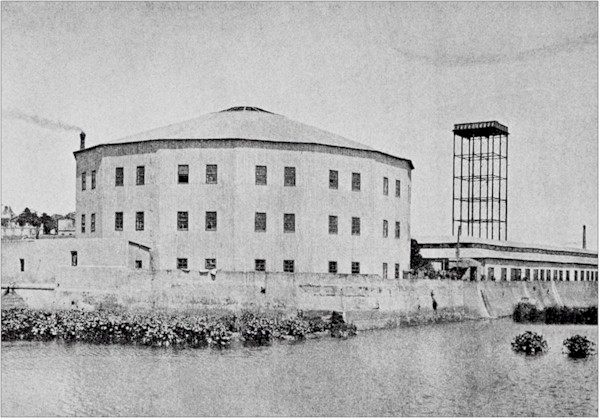 Immigrants Hotel in Buenos Aires
View taken from the River
The Disembarking Office consists of Inspectors who go
on board the vessels to receive and classify the immigrants,
and see if the ships have complied with the conditions of
the Law regarding vessels carrying immigrants, and also to
impede the entry of those which said Law prohibits (Chapter
VI, Articles 18 to 37 and the Regulation agreed upon of
4th. March 1880.)
Those who avail themselves of the benefits of the Law,
are lodged in the Immigrants Hotel whilst work is procured
for them, which is done immediately.
The Hotel is provided with the accommodation and service
necessary to meet this requirement.
It has separate dormitories for each sex, ample dining
rooms, lavatories, and a police service to contribute in maintaining
order and also a corps of firemen to prevent conflagrations.
(Chapter VIII of the Law, Articles 42 to 47.)
The Hotel is provided with interpreters of all languages,
to mediate between the immigrants, and the Hotel employés
and the Labour and Forwarding Office.
Sick immigrants and members of their families are attended
at all hours by the Medical staff of the Hotel, which is
further more provided with an Infirmary supplied with all
the most necessary medicaments.
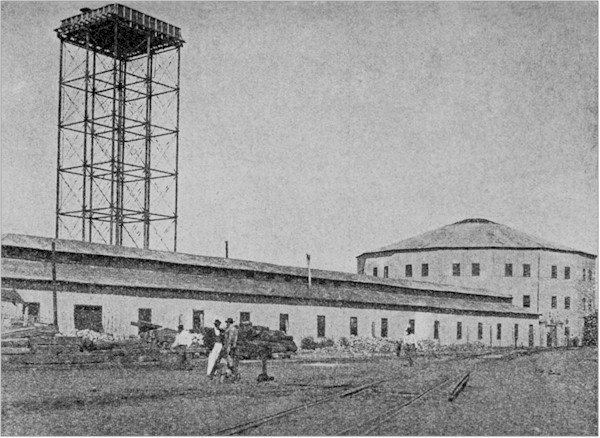 Immigrants Hotel in Buenos Aires
View taken from the City
To facilitate the despatch of immigrants baggage, the
Custom House has an office in the Hotel which carrys out
all the corresponding operations.
By means of this organization, which meets all the exigencies
of the immigration in the Argentine Republic, the
immigrants are given all the advantages accorded by the
Immigration Law hereunder transcribed.
CONCERNING THE LABOUR OFFICES
Art. 9.—The Immigration-Office in Buenos Aires and
the Commissions at their various head quarters shall, whenever
it may be necessary, have placed under their direct control
a Labour and Employment-Office to be served by such
a number of clerks as may be fixed in the Budget.
Art. 10.—These Offices are bound and empowered:
1. To attend to such applications of teachers, artisans,
journeymen or workmen as may be sent in to them.
2. To secure advantageous terms for the employment of
immigrants, and to see that such employment be
given by people of good repute.
3. To intervene at the request of the immigrants in
such agreements as to work as said immigrants may
make, and to see to their strict observance on the part
of masters.
4. To write down in a special register the number of the
procured employments, mentioning the date, the sort
of work, the conditions of the contract, and the names
of the persons that may have intervened in it.
Art. 11.—At such places where there are no Employment-Offices,
the duties incumbent on these shall be carried out
by the Commissions of Immigration.
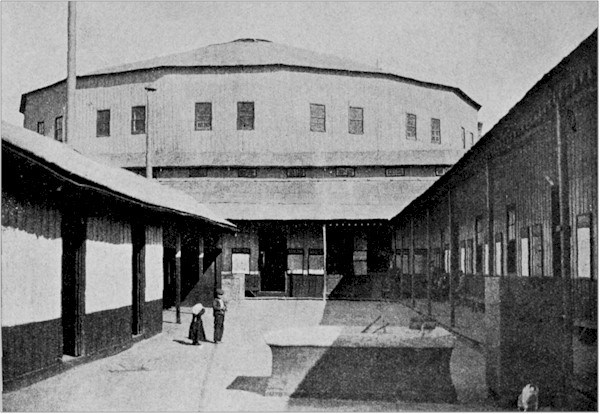 Immigrants Hotel in Buenos Aires
Interior of a yard
CONCERNING IMMIGRANTS
Art. 12.—By the effects of this Law, every foreigner under
sixty years of age, whether he be a journeyman, artisan,
labourer, tradesman or teacher, who proves his morality and
capacities, shall be considered an immigrant, on arriving in
the Republic, to establish himself in it, either in a steamer or
sailing vessel, paying his own 2nd. or 3rd. class
passage, or having it paid by the State, the Provinces, or by private societies
protecting immigration and colonisation.
Art. 13.—Those persons to whom these
conditions apply and who do not desire to profit by the advantages offered
to the immigrants, shall let it be known to the captain of the
ship at the moment of their embarking, when he will note
it in the ship’s register, or communicate it to the maritime
authorities of the landing port: in this case, those persons
shall be considered as simple travellers.
This disposition is not meant for those immigrants who
may come engaged in this capacity for the colonies or other
places in the Republic.
Art. 14.—Every immigrant on giving sufficient proof of
his good conduct and fitness for any occupation, art or
usefull trade, will be entitled, on his arrival to the following
special privileges:
1. To be boarded and lodged at the expense of the Nation
during the time fixed by articles 45, 46 and 47.
2. To have employment given him in such calling or
trade as there may be in the country, and which he
may prefer.
3. To be transported at the expense of the Nation to such
locality in the Republic as he may select for his
residence.
4. To import free of duty articles for personal use, clothing,
furniture for domestic purposes, agricultural implements,
tools, utensils, instruments of such arts and
trades as they may exercise, and one fowling piece to
each adult immigrant, of such value as may be fixed
by the Executive.
Art. 15.—The dispositions of the preceding article shall
be extended as far as they can be applied, to the wives and
to the children of the immigrants, if grown up, provided they
can give proof of their morality and industrious aptitudes.
Art. 16.—The good conduct and industrious capacities of
the immigrants can be proved by certificates given by the
Consuls or Immigration Agents of the Republic abroad, or
by a certificate from the authorities of the immigrant’s residence,
legalized by the said Consuls or Immigration Agents
of the Republic.
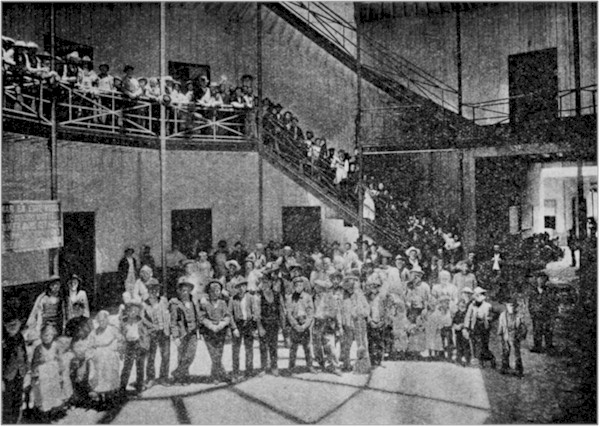 Immigrants Hotel in Buenos Aires
Interior of the yard of the dormitories
CONCERNING THE LODGING AND BOARDING OF THE IMMIGRANTS
Art. 42.—In the cities of Buenos Aires, Rosario, and at
all such others where, owing to the number of immigrants,
it may be necessary, there shall be a house for their temporary
lodgment.
Art. 44.—At such places where there should not be any
houses for the accommodation of immigrants, the respective
Commissions shall proceed to board and lodge the same in
public hotels or in other suitable ways.
Art. 45.—Immigrants shall be entitled to suitable board
and lodging, at the expense of the Nation, for five days after
landing.
Art. 46.—In case of serious illness which should render
it impossible for them to remove to another habitation, at the
expiration of the said five days, the expense of the succeeding
board and lodging shall continue to be met by the
State, as long as the said illness continues.
Except in such cases, the continuance of immigrants at
the Establishment for more than five days shall be at their
own expense, at the rate of half a national gold dollar a day
for every person more than 8 years old, and 25 cents for
every child under that age.
Art. 47.—The regulations contained in the preceding
articles do not include immigrants having contracts with the
Government in connection with the Colonies. All such will
be entitled to board and lodging free of charge until transported
to their destination.
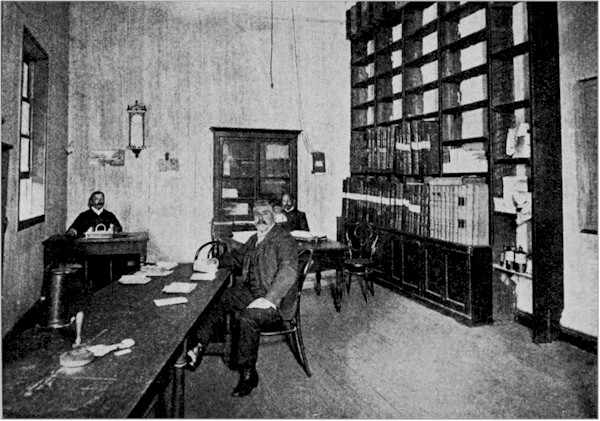 Immigrants Hotel in Buenos Aires
Office for admittance and passports
CONCERNING THE TRANSPORT TO THE PROVINCES AND THE
EMPLOYMENT OF THE IMMIGRANTS
Art. 48.—The Employment-Offices or the Immigration-Commissions
in their stead, shall use their best endeavours
to provide immigrants with employment in such art, trade or
calling as they may prefer.
Art. 49.—Such employment shall be procured if possible
within five days after the immigrant’s arrival, and on as favourable
terms as possible.
Art. 50.—The Employment-Offices or the Immigration-Commissions
in their stead shall, at the request of the interested
parties, intervene in such contracts for employment as
they may make, with a view to securing their fulfillment for
the immigrant.
Art. 51.—Any immigrant who should prefer to fix his
residence in any of the interior Provinces of the Republic,
or at any of its Colonies, will be at once transported with
his family and luggage to such place, as he may select, free
of all charge.
Art. 52.—In case of an immigrant going to the Provinces,
he will be entitled on arrival at his destination, to be lodged
and boarded for ten days by the Immigration-Commission.
At the expiration of this time, he shall pay half a national
gold dollar a day for every person over 8 years old, and 25
cents for every child under that age, except in case of illness,
when he would continue to be maintained at the expense of
the Government as long as the said illness lasts.
Art. 54.—The immigrants can on no pretence whatever,
profit by the privileges granted by the preceding articles, to
pass through the territory of the Republic to a foreign country,
under penalty of repaying all the expenses that have been
occasioned for their passage, landing, board, lodging and
transport.
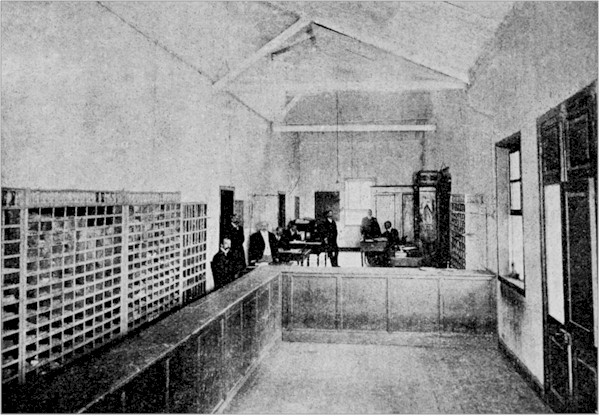 Immigrants Hotel in Buenos Aires
Office for employment and free transport of the immigrants to the provinces Reception of immigrants in the Argentine Republic. — STATISTICAL RETURNS
THE IMMIGRANT INSPECTION AND ITS REASON
Each ship that arrives in the country bringing immigrants,
2nd. and 3rd. class passengers, according to Law, is
visited and inspected by a Commission comprising the Immigration
Inspector, Board of Health doctor and Coast Guard
officer, who examine the hygiene and healthiness of the ship,
accommodation, provisioning during the voyage, supply of
medicines, and as to whether a doctor or chemist is carried;
if or no a greater number of passengers were carried than
the accommodation allows; if the measurements of the deck,
sparedeck and of the berths are in accordance with the
Law; if there is sufficient ventilation, supply of firehose and
cooking utensils, life belts and life boats; if there are passengers
with contagious diseases; if passengers have been embarqued
at ports where there is an epidemic; if any part of
the cargo is inflamable or unhealthy, and, finally, receive any
protest of the passengers of bad treatment and obtain from
the Captain the documents he should deliver, showing cognoscence
of the Immigration Law, and any incidents that have
happened on the voyage. This is done in the interest of
the immigrants.
RECEIVING THE IMMIGRANTS
The immigrants are carefully questioned and classified to
find out their trades and means, note being taken of those
who do not wish to come under the Immigration Law, their
passports then being stamped «passenger only», as also are
stamped «former resident» the passports of those who come
under that heading.
Once the passports revised by the officials, those immigrants
admited under the Law, are handed over to the receiving
officials of the Immigrants Hotel who attend to them,
placing them in trams, which take them to the Hotel. The
baggage is taken on trucks to the same place by the Hotel
porters.
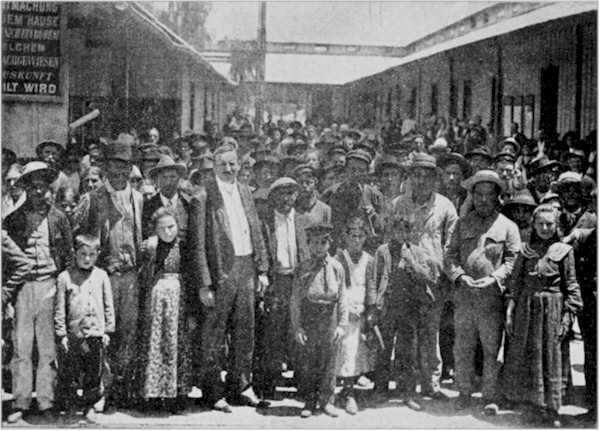 Immigrants Hotel in Buenos Aires
Group of immigrants
FREE LODGING
Arriving at the Hotel, the names of the immigrants are
entered in the Hotel register and they are given a lodging
ticket valid for five days, which can be prolonged in case of
sickness. The immigrants are comfortably lodged, the women
and children in separate rooms to the men. The baggage is
taken by the Hotel porters to a deposit where it is revised
by the Custom House Officers, specially.
FREE BOARD
The rations given to the immigrants are of the best, and
in the following proportions per day, per adult: meat 600
grams, bread 500 grams, potatoes, carrots or cabbage (alternately)
150; rice, maccaroni, or beans (alternately) 100; sugar
25 and coffee 10 grams; milk is given to the children. The
food is cooked by steam and is served by the Hotel attendants
in a large dining room.
MEDICAL ATTENDANCE
There is an Infirmary in the Hotel where patients are
carefully attended; children as well as adults can be vaccinated.
There is a staff of doctors, students, sicknurses, and
a chemist’s fully equiped with medicines and disinfectants.
GOVERNMENT EMPLOYMENT OFFICE
On arrival, the immigrants are questioned as to what part
of the country they wish to go, and are offered work by the
Employment Office, in accordance with the inquiries for
workmen received, full information of which, of wages paid
and other conditions are carefully entered up in books kept
for that purpose. If there are no enquiries for workmen in
the particular trade of an immigrant looking for employment,
this Office undertakes to find him work by either directing
him to Works and Factories or by telegraphing enquiries to
the Interior. Immigrants are warned, should they wish to go
to any part of the country where there is no opening for one
in their trade.
No persuasion is used to induce immigrants to go to any
particular part of the country, it is left to them to decide.
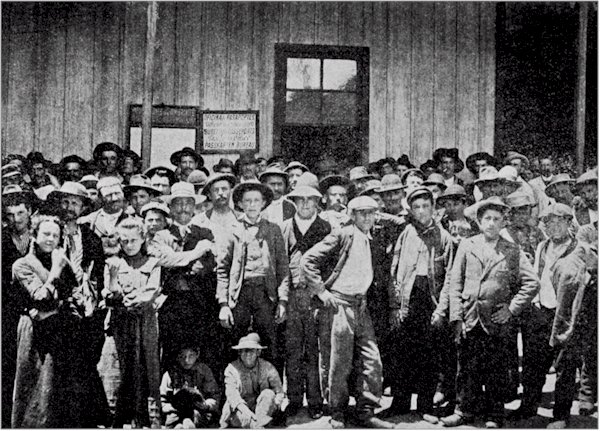 Immigrants Hotel in Buenos Aires
Group of immigrants
FORWARDING AND RECEIVING FREE
The immigrants placed up country or who wish to join
their relations, are taken care of by forwarding Agents who
remit their luggage properly labeled, note down the immigrants
so forwarded, provide them with tickets and see them on to
the train or river steamers.
ARRIVING AT THE PROVINCES AND POINTS OF DESTINATION
The immigrants who go to the Provinces or National
Territories to be settled, are met on arrival of the train by
the Secretary of the Branch Office, boarded and lodged for
ten days until they are settled or leave for some fixed destination.
If they should have to change trains, they are
looked after by this Official in the same way as in the Federal
Capital, from the arrival of one train until the departure
of the one in which they continue their journey.
POST AND TELEGRAPH OFFICE
For the better handing of the immigrants correspondence
and in order that the Head Office and National Employment
Office can transmit without delay, orders and instructions
all over the Republic, there is a Post and Telegraph Office
in the Immigration Hotel.
The four following returns, summarize the Argentine
Immigration movement from 1857 to 1903.
In those relating to the entry and nationality of immigrants,
the information corresponding to the years running
from 1857 to 1903 is given, and in those which refer to their
trades and forwarding to the interior, the information has
been taken corresponding to the last decade, this lapse of
time being sufficiently demonstrative.
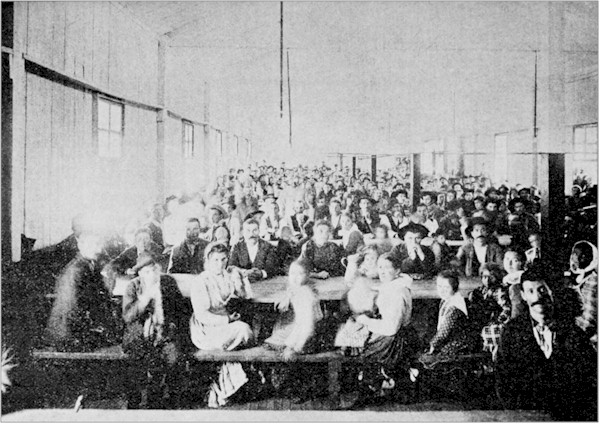 Immigrants Hotel in Buenos Aires
Part of the dining-hall
IMMIGRANTS PLACED AND FORWARDED TO THE
INTERIOR OF THE COUNTRY BY THE NATIONAL LABOUR OFFICE DURING THE
LAST DECADE FROM 1894 TO 1903.
| Provinces and Territories |
1894 |
1895 |
1896 |
1897 |
1898 |
1899 |
1900 |
1901 |
1902 |
1903 |
Total |
| Federal Capital |
545 |
683 |
1.209 |
589 |
876 |
1.736 |
3.077 |
2.739 |
635 |
449 |
12.538 |
| Buenos Aires |
3.071 |
4.212 |
12.028 |
8.471 |
7.503 |
9.991 |
10.213 |
12.982 |
9.828 |
13.447 |
91.746 |
| Entre Rios |
2.345 |
2.129 |
814 |
1.190 |
1.184 |
1.575 |
1.456 |
1.151 |
677 |
317 |
12.838 |
| Corrientes |
101 |
115 |
114 |
455 |
293 |
194 |
117 |
225 |
118 |
46 |
1.778 |
| Santa Fé |
11.801 |
10.143 |
13.077 |
6.273 |
6.577 |
9.647 |
9.336 |
12.628 |
7.440 |
10.115 |
97.037 |
| Córdoba |
2.413 |
2.198 |
2.995 |
1.958 |
2.659 |
3.951 |
3.581 |
4.002 |
1.768 |
2.973 |
28.498 |
| Tucumán |
802 |
387 |
898 |
1.173 |
456 |
514 |
590 |
1.576 |
366 |
366 |
7.128 |
| Santiago del Estero |
76 |
51 |
291 |
149 |
165 |
141 |
99 |
132 |
82 |
73 |
1.259 |
| Salta |
19 |
36 |
47 |
237 |
345 |
224 |
94 |
76 |
31 |
61 |
1.170 |
| JuJuy |
18 |
10 |
104 |
38 |
17 |
69 |
41 |
273 |
72 |
216 |
858 |
| Catamarca |
11 |
29 |
19 |
16 |
8 |
14 |
14 |
35 |
10 |
5 |
161 |
| La Rioja |
— |
25 |
12 |
20 |
14 |
43 |
22 |
20 |
28 |
25 |
209 |
| San Luis |
46 |
91 |
183 |
207 |
95 |
129 |
129 |
159 |
124 |
76 |
1.239 |
| Mendoza |
566 |
665 |
1.973 |
2.569 |
1.365 |
1.695 |
2.183 |
4.160 |
1.521 |
757 |
17.454 |
| San Juan |
137 |
155 |
270 |
390 |
252 |
269 |
354 |
190 |
155 |
82 |
2.254 |
| Chaco |
34 |
6 |
20 |
105 |
112 |
21 |
24 |
41 |
27 |
12 |
402 |
| Misiones |
30 |
13 |
7 |
72 |
254 |
509 |
1.136 |
1.738 |
1.083 |
81 |
4.923 |
| Tierra del Fuego |
— |
16 |
54 |
41 |
19 |
8 |
9 |
17 |
7 |
17 |
188 |
| Chubut |
11 |
25 |
10 |
84 |
22 |
13 |
56 |
75 |
153 |
239 |
688 |
| Santa Cruz |
11 |
1 |
40 |
44 |
18 |
24 |
54 |
85 |
59 |
54 |
390 |
| Formosa |
47 |
5 |
13 |
116 |
50 |
16 |
20 |
35 |
25 |
1 |
328 |
| Pampa Central |
7 |
17 |
63 |
160 |
93 |
117 |
145 |
181 |
173 |
349 |
1.305 |
| Río Negro |
1 |
— |
55 |
293 |
69 |
34 |
42 |
198 |
73 |
63 |
828 |
| Neuquen |
— |
— |
27 |
13 |
— |
16 |
17 |
29 |
39 |
11 |
152 |
| |
22.092 |
21.012 |
34.323 |
24.663 |
22.446 |
30.950 |
32.809 |
42.747 |
24.494 |
29.835 |
285.371 |
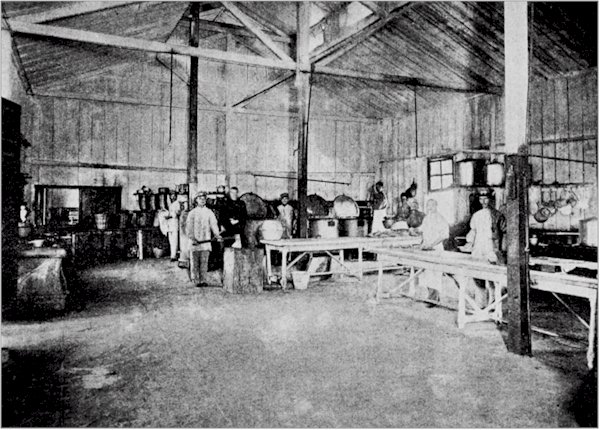 Immigrants Hotel in Buenos Aires
Part of the kitchen
IMMIGRATION FROM COUNTRIES BEYOND THE SEA AND MONTEVIDEO
1857 to 1903.
| Years |
Countries beyond the sea |
Montevideo |
Total |
| 1857 |
4.951 |
|
4.951 |
| 1858 |
4.658 |
|
4.658 |
| 1859 |
4.735 |
|
4.735 |
| 1860 |
5.656 |
|
5.656 |
| 1861 |
6.301 |
|
6.301 |
| 1862 |
6.716 |
|
6.716 |
| 1863 |
10.408 |
|
10.408 |
| 1864 |
11.682 |
|
11.682 |
| 1865 |
11.767 |
|
11.767 |
| 1866 |
13.696 |
|
13.696 |
| 1867 |
13.225 |
3.821 |
17.046 |
| 1868 |
25.919 |
3.315 |
29.234 |
| 1869 |
28.958 |
8.976 |
37.934 |
| 1870 |
30.898 |
9.069 |
39.967 |
| 1871 |
14.626 |
6.307 |
20.933 |
| 1872 |
26.208 |
10.829 |
37.037 |
| 1873 |
48.382 |
27.950 |
76.332 |
| 1874 |
40.674 |
27.603 |
68.277 |
| 1875 |
18.532 |
23.534 |
42.066 |
| 1876 |
14.532 |
16.433 |
30.965 |
| 1877 |
14.675 |
21.650 |
36.325 |
| 1878 |
23.624 |
19.334 |
42.958 |
| 1879 |
32.717 |
22.438 |
55.155 |
| 1880 |
26.643 |
15.008 |
41.651 |
| 1881 |
31.431 |
16.053 |
47.484 |
| 1882 |
41.041 |
10.462 |
51.503 |
| 1883 |
52.472 |
10.771 |
63.243 |
| 1884 |
49.623 |
28.182 |
77.805 |
| 1885 |
80.618 |
28.104 |
108.722 |
| 1886 |
65.655 |
27.461 |
93.116 |
| 1887 |
98.898 |
21.944 |
120.842 |
| 1888 |
(a) 130.271 |
25.361 |
155.632 |
| 1889 |
(a) 218.744 |
42.165 |
260.909 |
| 1890 |
(a) 77.815 |
32.779 |
110.594 |
| 1891 |
28.266 |
23.831 |
52.097 |
| 1892 |
39.973 |
33.321 |
73.294 |
| 1893 |
52.067 |
32.353 |
84.420 |
| 1894 |
54.720 |
25.951 |
80.671 |
| 1895 |
61.226 |
19.762 |
80.988 |
| 1896 |
102.673 |
32.532 |
135.205 |
| 1897 |
72.978 |
32.165 |
105.143 |
| 1898 |
67.130 |
28.060 |
95.190 |
| 1899 |
84.442 |
26.641 |
111.083 |
| 1900 |
84.851 |
21.051 |
105.902 |
| 1901 |
90.127 |
35.824 |
125.951 |
| 1902 |
57.992 |
38.088 |
96.080 |
| 1903 |
75.227 |
37.444 |
112.671 |
| |
2.158.423 |
846.572 |
3.004.995 |
(a)—With assisted passages.
General Total (including first class passengers) 3.685.430.
TRADES OF FOREIGN IMMIGRANTS, IN THE LAST TEN YEARS,
FROM 1894 TO 1903.
| Agriculturers |
312.723 |
Workmen |
118.223 |
| Masons |
8.500 |
Gardeners |
923 |
| Upper cutters |
898 |
Brickmakers |
262 |
| Surveyors |
16 |
Lithographers |
37 |
| Architects |
12 |
Marble-cutters |
59 |
| Fitters |
81 |
Sailors |
7.739 |
| Sawers |
127 |
Engine drivers |
445 |
| Barbers |
1.332 |
Mechanics |
2.113 |
| Coal-men |
99 |
Milliners |
6.051 |
| Butchers |
725 |
Millers |
605 |
| Carpenters |
7.142 |
Musicians |
796 |
| Coppersmiths |
439 |
Miners |
1.272 |
| Cooks (male, female) |
9.265 |
Physicians |
41 |
| Confectioners |
500 |
Furniture makers |
92 |
| Merchants |
30.996 |
Bakers |
2.382 |
| Dressmakers |
28.194 |
Stone cutters |
1.208 |
| Tanners |
691 |
Painters |
926 |
| Coachmen |
149 |
Laundresses |
8.749 |
| Calkers |
54 |
Fishermen |
112 |
| Quarry-men |
255 |
Teachers |
12 |
| Clerks |
10.755 |
Watchmakers |
372 |
| Gilders |
99 |
Tailors |
4.985 |
| Draftsmen |
41 |
Without trade (children) |
113.433 |
| Joiners |
604 |
Without trade (women) |
8.111 |
| Electricians |
711 |
Servants (male, female) |
28.450 |
| Bookbinders |
77 |
Hatters |
501 |
| Sculptors |
43 |
Weavers (male, female) |
6.546 |
| Firemen |
793 |
Typographers |
481 |
| Apothecaries |
352 |
Coopers |
316 |
| Photographers |
65 |
Turners |
103 |
| Cattle breeders |
690 |
Dyers |
62 |
| Engravers |
113 |
Harness makers |
133 |
| Glovers |
76 |
Viner, winemakers |
403 |
| Smiths |
3.546 |
Veterinaries |
33 |
| Tinsmiths |
548 |
Plasterers |
100 |
| Printers |
38 |
Shoemakers |
6.094 |
| Engineers |
17 |
Other trades |
8.430 |
| |
751.366 |
Transcriber’s Note: To make
the following table easier to read on the screen it has been transposed to
show Years as column headings and
Nationalities as row headings.
NATIONALITY OF IMMIGRANTS FROM COUNTRIES BEYOND THE SEA,
EXCLUSIVELY, from 1857 to 1903.
| Years |
1857-59 |
1860-69 |
1870-79 |
1880-89 |
1890-99 |
1900 |
1901 |
1902 |
1903 |
Total |
| Italians |
9.006 |
93.802 |
156.746 |
475.179 |
411.674 |
52.143 |
58.314 |
32.314 |
42.358 |
1.331.536 |
| Spaniards |
2.440 |
20.169 |
44.802 |
148.394 |
124.891 |
20.383 |
18.066 |
13.911 |
21.917 |
414.973 |
| French |
720 |
6.360 |
32.938 |
78.914 |
40.544 |
3.160 |
2.788 |
2.378 |
2.491 |
170.293 |
| Austrians |
226 |
819 |
3.469 |
16.479 |
8.681 |
2.024 |
2.742 |
2.135 |
1.378 |
37.953 |
| English |
359 |
3.603 |
9.265 |
15.692 |
4.691 |
421 |
439 |
405 |
560 |
35.435 |
| Germans |
178 |
1.212 |
3.522 |
12.958 |
9.204 |
760 |
836 |
1.029 |
1.000 |
30.699 |
| Russians |
|
|
|
3.837 |
15.665 |
2.119 |
2.086 |
1.753 |
1.429 |
26.889 |
| Swiss |
219 |
1.562 |
6.203 |
11.659 |
4.875 |
355 |
363 |
267 |
272 |
25.775 |
| Belgians |
68 |
519 |
628 |
15.096 |
2.654 |
117 |
117 |
148 |
174 |
19.521 |
| Dutch |
|
|
|
4.303 |
675 |
43 |
35 |
37 |
72 |
5.165 |
| Portuguese |
|
|
|
1.751 |
1.612 |
205 |
156 |
141 |
202 |
4.067 |
| Danes |
|
|
|
1.097 |
1.230 |
121 |
175 |
187 |
139 |
2.949 |
| North Americans |
|
|
|
1.094 |
794 |
89 |
151 |
132 |
93 |
2.353 |
| Swedes |
|
|
|
613 |
441 |
10 |
18 |
21 |
24 |
1.127 |
| Others |
1.128 |
6.282 |
7.295 |
8.330 |
13.659 |
2.901 |
3.841 |
3.134 |
3.118 |
49.688 |
| |
14.344 |
134.328 |
264.868 |
795.396 |
641.290 |
84.851 |
90.127 |
57.992 |
75.227 |
2.158.423 |