THE 1,200 steerage passengers who sailed for the United States early in
November, 1908, on the steamship America, of the Hamburg-American
Line, were the advance guard of the vast armies of men which were
waiting for the election of Mr. Taft to the presidency.
That to them, was synonymous with the return of good times; but before
those good times had a chance to prove themselves identical with those
which took sudden flight over a year ago, the steamers of all lines were
assured their full number of steerage passengers.
When the first shipload of them sailed into New York harbour, its humble
passengers were hailed as the harbingers of the prosperity which was
being anxiously awaited by rich and poor; by native and foreign born; by
the citizens of New York and Budapest and by the people of Chicago and
Spalato.
We, in the United States, have alternated between fear because so many
immigrants came, and regret because so many went away; but the recent
influx brought joy to all, because the coming again of so many,
indicated the return of good times.
For our good or ill, for what is better than mere good times, and for
worse than financial depression or economic problems, these strangers of
all races and nations come and go, helping to make our history and shape
our destiny.
From the beginning, our history has in a large degree been determined by
the migratory movements of larger or smaller groups from the Old World,
and unless we have idealized these movements overmuch, those groups
which came, unconscious of the gold and the iron slumbering in our
hills—which came for “conscience’ sake”—those groups have affected our
history most fundamentally if not most permanently.
Pilgrims, Puritans, Huguenots, Quakers and German Pietists certainly
made history. They sailed the treacherous seas and marched into the
pathless wilderness, driven by something higher than the mere necessity
to sustain life.
Subsequently came other Germans, the Irish, Scotch and Scandinavians.
They came primarily because of economic distress in the home-land; yet
even among those were many groups which came because they were dreamers
of dreams, and sought “a city whose builder and maker is God.”
In one of our Western states are two large communities, one from Holland
and one from Germany; both are late comers to this Western world. One
of them has built itself into a rather typical Western town and the
other is the one successful example of a religious community in this
country. Both these groups left prosperous homes in the Old World to
seek a place where they might worship God according to the dictates of
their conscience; and all this happened in the latter part of the
nineteenth century, at the very zenith of our material development.
Large and influential groups of these seekers after God may be found
throughout the length and breadth of our country; although they may now
come out of the heart of Russia, like the Molicani in Los Angeles,
California, they come moved by the same impulses which drew the Pilgrims
to Plymouth and the Germans to Pennsylvania, and they exhibit the same
characteristics.
In these days most people believe that when the last Irishman has
arrived from Dublin, the Old World will be drained of her best people,
and we look upon a certain boundary line in Europe as the division
between good people and bad; yet from beyond that line come pilgrim
bands in much larger numbers than the casual observer knows, and they
are bent upon the same holy errand as that which brought those who came
generations ago. In fact the Reformation with its religious and
political consequences is making itself felt at this late day in these
migratory movements. Large groups driven to the plains of the Volga or
the Danube are now coming to the United States; with narrow doctrines,
it is true, but with deep convictions, and the churches of the
Reformation feel this current in the measure in which they have kept
themselves spiritually alert. Yet one must admit that the vast majority
of those who come is driven by no higher motive than the economic
pressure. Yet it is not always poverty which drives them from their
village homes to our cities or from their quiet fields to our noisy
shops.
They are no poorer to-day than they were fifty years ago when no one
thought of moving even a league from the village in which he was born.
They are simply obeying an impulse which is extending to the very edges
of civilization; an impulse created by discontent. Everywhere men are
beginning to believe that God meant them to enjoy the good things of
life now, and that all men, not merely a privileged class, should be
able to enjoy them.
Nothing ever quite so rudely shattered the idea of the stability of
wealth as the discovery of America and the subsequent migrations there
of different groups from different portions of Europe.
Wealth had been in a measure entailed, the possession of a class; and
poverty was meekly accepted as the divine apportionment to the mass of
men. When it was rumoured that gold lay hidden in the mountains across
the sea, that no key was needed to gain access to its hiding-place, and
that it would belong to any one who dared, the myth was quickly
dissolved. Poor men came and got their share of gold—not so often by
finding it as by toiling for it.
Further and further the truth travelled; slowly, as is the way of truth;
until to-day, scarcely anywhere is the prevailing social order or
economic status accepted as fixed. The greater the number of men
returning from America, even with very moderate wealth, the more the
discontent spreads, and men seek the place where this change may soonest
be effected.
They will continue to come until the economic opportunities at home are
appreciably nearer those they find in this strange land. Although at
present there is no European country or province from which there has
not been some emigration, there are people who have only begun to seek
this adjustment; therefore, the force of the tide towards America is
destined to increase rather than decrease, and an annual influx of
2,000,000, more, rather than less, may be expected during the next
decade.
No matter from where the groups come, they will present an economic
problem to those who, in a measure at least, have risen to a higher
standard of living. Each group will fear that the younger and often
cruder body may lessen its chances of maintaining that standard. The
Germans, the Irish and the Norse people were not received with open arms
by those who preceded them, even those of related race or nationality.
This was especially true during the years when war, famine and
persecution brought them in large numbers.
Now, in turn, all these look askance at the Jew, the Slav and the
Italian; while they, like the rest, are ready to close the doors to the
vast hordes about to move onward, and, as they believe, upward. It is
also interesting to note, that among these late comers, there are
decided ideas as to who are desirable immigrants, and who are not.
The Slav, if he is a Pole, would exclude his cousin, the Slovak, and
both are united in thinking that the Ruthenian is a rather inferior
being; while the Ruthenian would debar the Jews, Servians and Croatians
from the economic benefits of the land of his adoption.
Until now there has been room for all, and they have not presented a
serious economic menace, except as they have intensified the general
problem of labour. Each group, driven from the lower and coarser tasks,
has risen from mine to shop, from shop to store, and from the store into
every avenue of business and professional life.
Thus far all have been crowded up and not many have been crowded out. No
considerable groups of native Americans are bewailing the fact that
they cannot find work in the mines; nor would large numbers desire to go
back to them from their safer toiling places.
The Irish are not mourning because they are not working on sections, nor
would they be willing to leave their beats and office chairs from which
they are ruling, not only those of us who came after them, but a fair
share of those who came before them. They do not care to go back to the
track, the pickax and the shovel.
Without the Slav, the Italian and the Magyar, that which we call our
industrial development would have been impossible. This development does
not lessen the economic problem, it intensifies it; but it cannot be
proved that no economic problem would exist if, instead of Slav and
Latin, the Teutonic races were dominant in this movement. In that case I
believe the problem would be more difficult of solution.
Let me again frankly admit that I do not regard most immigrant groups of
the present type as a serious menace to the other groups, or to the
whole economic life, provided they are needed to do the work for which
they seem best fitted. At present this is still a matter of proper
distribution and presents no such serious difficulty as is commonly
supposed; for the immigrant will go wherever he is wanted and a fair
wage is assured him. Nor is he quite so eager to herd in cities as we
imagine, and no community need be without an adequate supply of
labourers, if they are needed for hard, crude labour. There is no work
so hard or so dangerous that the immigrant will not attempt it.
Like their forerunners in the migratory movement of European races, the
present immigrants respond quickly to the American higher standards of
living, and in many cases much more quickly than some of the older
groups responded.
When we speak of the horrors of the East Side of New York, the crowded
Ghetto and Mulberry Street with its Italian filth, we forget the days
when the Irish possessed the land, “squatting” wherever they could, and
living in wretched huts; when the American used to sing:
“The pig was in the parlour, and that was Irish too.”
The pig and the goat have gone, and instead, the Irish have pianos and
phonographs in their parlours; but in one generation, many Slavs and
Italians, under less favourable conditions, have achieved the same
results, minus the pig and goat period.
To-day, the merchants in Wilkes-Barre, Scranton, Connelsville and
Pittsburg regard the Slav as a great “spender”; and if the Italian is
not now like his predecessors, he soon will become so imbued by the
American spirit, that, like us, he will live up to his income and beyond
it.
That phase of the problem so much complained of, which relates to the
immigrants’ sending the bulk of their earnings to Europe, would not be
half so serious if we provided a safe banking system; preferably, Postal
Savings Banks. Both the Austrian and Italian governments thus safeguard
every penny which is sent abroad, and one cannot blame the toiler who
prefers to trust his money to a government in whose financial soundness
he has absolute confidence, rather than place it in our own savings
institutions, in which we ourselves have but little confidence.
The economic problem as presented by the effect of immigration upon the
labour market is made less serious by the fact that large numbers of
those who come, go back and forth, according to the demand for the
commodity which they supply.
During our last financial crisis, the sudden withdrawal from competition
of half a million toilers, certainly rendered conditions less difficult
than they would have been had we drawn for our supply upon those sources
in Northern and Central Europe, which have always sent us their surplus
population for permanent settlement. Those aspects of the present
immigrant population, which are usually pointed out as its defects, have
in a large measure helped to make the economic problem less acute;
although they have aggravated some phases of it. Foremost among these
is the ethnic problem.
Possibly because of the bitterness of the race question in the South,
the American people have become very sensitive to ethnic differences.
All those primitive instincts which were at work in the childhood of the
race have risen to the surface and threaten to become permanent factors
in our national character.
A little more or less pigment in the skin, the shape of a nose or the
slant of the eyes, produce in the average American that most primitive
of antagonisms—race prejudice.
Being a primitive instinct, it defies reason, the commandments of
religion and the dictates of humanity. In fact, it often becomes
irrational, irreligious and inhuman.
During the recent agitation of the Japanese question on the Coast, I
discovered that no matter how far removed the ordinary American may be
from the seat of the difficulty, the very agitation of the question acts
contagiously upon the people of the East as well as of the West. As a
result, their feelings towards the Japanese have unconsciously changed
for the worse, so that the question has assumed in their minds the
qualities and proportions of the Negro problem.
To justify its existence, this instinct, if such it is, overemphasizes
ethnic differences and minimizes the superior qualities of the race or
group involved. It always applies the categoric judgment when the
judgment is adverse, and admits grudgingly that in each group or race
there are certain individuals who possess good qualities.
In visiting nearly every city of the United States where there are
groups of Italians, I have everywhere heard it said by those who had
dealings with them: “We have no bad Italians, ours are good, the bad
ones are elsewhere.” In Trenton, N. J., you are told that the bad
Italians are in Patterson; but when you are there, nearly every one
denies the fact and consigns all the bad Italians to New York.
The truth is, that wherever men have had a chance to know the individual
Italian, they have discovered that there are good Italians even as there
are good Jews and good Slavs, and that there are good and bad in every
race.
Naturally, when men apply the warped categoric judgment to another race,
particularly when that race is in political or economic competition with
them, they are likely to magnify the evil in the character of the race,
and rarely even admit the good. That this categoric judgment is seldom
just, that it leads to antagonisms which actualize themselves in race
riots and wars, is certainly very evident.
I have watched the development of this prejudice against the Japanese,
even as I am most anxiously watching it grow against certain European
groups which are ethnically more or less differentiated from the native
population, and I am not over confident that we shall solve the ethnic
problem without much struggle and stress and strain. Indeed, the ethnic
problem can be solved only if we have patience, a measure of sympathy
and the sense of justice.
There is a subtle force at work, which, to a degree at least, is
settling this matter for us—a force which, if we allow it full play,
will complete the task whose result will be the miracle of the age.
I call it a miracle, advisedly; for the things which seemed fixed,
unchangeable, deeply graven in the nature of certain European races, the
products of long ages, vanish in a generation.
Race characteristics which were regarded as biological are found to be
sociological; on the outside of the race, if we might so express it, and
not on the inside.
The children of the Neapolitans and the Sicilians lose somewhat of their
swarthiness; the features lose their sharpness, and as a rule the
children grow over the heads of their parents. Indeed, the last named
process takes place among natives and aliens alike.
The ethnic differences of even the most strongly marked European races
will ultimately disappear; that is, if we have patience and sympathy,
and, above all, if we mete out that justice which gives every man a
chance, regardless of his nationality or race.
As a nation we do not possess in an abundant degree these qualities;
therefore the ethnic problem is one which may yet postpone its solution
until that time when indeed there shall be “Peace on Earth and Good Will
to Men.”
Thus far I have touched upon two problems presented by the return of the
immigrant tide: the economic and the ethnic.
Another problem presented by this influx of aliens is in that rather
indefinable realm called culture.
The question is: Will these people be able to appreciate the cultural
ideals of America, and make them their own?
It would be an insult to my readers to try to make clear to them that
the people who come to us are not barbarians or semi-barbarians;
although as a rule they are uncultured and not yet in harmony with many
of our ideals. I would not even attempt to mention this, were it not for
the fact that it is the commonly accepted idea, that we are dealing with
the offscouring of Europe. Let me illustrate. Not very long ago, I heard
a home missionary secretary of a certain denomination say before an
audience of intelligent, Christian people, that “We are landing annually
a million paupers and criminals”; and I venture to say that nearly every
one who heard that statement believed it. Let us see who these people
are who come to us.
Slavs, Latins and other Aryan groups, such as Lithuanians, Albanians,
and Greeks; of whom the first two have fairly earned the right to be
called the oldest inhabitants of the continent of Europe. Next in order
are Finns and Magyars, from among the Ugru-Altaic races, Jews and some
smaller Semitic groups. The bulk is made up of Slavs, Latins and Semitic
peoples.
Need I question whether the Latin has in him the qualities which will
enable him to appreciate our culture? The Italian who built Florence,
whose sons built St. Peter’s, painted the ceiling of the Sistine Chapel
and carved out of Carrara marble the “Pieta” and the statue of Moses?
Need I mention Giotto, the builder, Raphael, the painter, a Dante, a
Petrarch, a Savonarola—a hundred masters of the chisel and the brush,
of rhythmic rhyme and stately prose, all reared in that Garden of
Europe, Italy?
Will the Jew learn to appreciate that culture, the best of which was
created by his sires? For the glory of our American culture lies in the
quality of its manhood and womanhood and that at its best is patterned
after men and women whose names would debar them from certain clubs and
hotels to-day. Moses, Amos and Hosea, Isaiah, Jeremiah, and in all
reverence I mention Jesus and Mary, John, Paul and Peter. Strange to
say, it is sometimes necessary to call the attention of intelligent
people to the fact that these men and women were not Methodists or
Presbyterians or even Episcopalians; and that neither their sires nor
their sons came over in the Mayflower.
Perhaps we need to realize that as Americans we have neither invented
nor discovered education, liberty or religion. What we have accomplished
is, that we have made gifts to the many, of some of those blessings
which in the immigrants’ country are the possession only of the few; and
that is no small achievement.
The problem, the real problem, is: how to feed these people on truly
vital knowledge, how to make common to all, the beautiful, the
harmonious, the ethical; how to bring to all, the knowledge of that
religion which indeed makes free from tribal pride and racial hate and
leads men into the freedom of the sons of God.
Perhaps the greatest problem still to be solved is, how to interpret to
these people the one supreme gift of all these gifts which most of them
never possessed—the right of citizenship.
Herein lies our real peril; not because the immigrant cannot be made to
understand how to exercise this right; but because here we are least
efficient, and here we, the earlier comers and their children, have most
signally failed.
The Scotch-Irish of Pittsburg are not a conspicuous example of good
citizenship for the Italians; the Germans of Reading and Lancaster have
no overplus of civic righteousness to give the Slavs; the Quakers of
Philadelphia have not been moved by the Spirit to teach the Jews how to
govern a city righteously; the Yankees of Connecticut and Rhode Island
have not ruled their states in such a manner that the crude Lithuanian
or the Greek could in all cases follow their example; nor are the Irish
of New York in a position to throw stones at the other races.
I do not know of a single case where the newer groups have failed to
respond to sane, vigorous leadership in the struggle for civic
righteousness; while in every large city there are conspicuous examples
of many a battle won, because the immigrants have aided the cause.
In Scranton, Pa., in the fight for a clean city, the mayor’s private
secretary, a Russian Jew, did valiant service; while Pittsburg’s
“cleaning up” has been accomplished because a vigorous attorney of the
same race was one of the captains in a campaign which may have vast
consequences for the entire state.
It ought to be a matter of no little pride to the Jews of Pittsburg,
that among its non-corruptible councilmen there was at least one of
their race.
Prof. Graham Taylor of Chicago, whose worth and work that city does not
fully appreciate, has found the Poles of his ward ready to share in the
struggle for civic betterment. One of the first “clean” councilmen of
the city came from that ward and was a member of the Slavic race.
The problem of citizenship is not a problem created by the immigrant,
and his presence makes it more difficult of solution, only because we
have not provided him with safe leaders and have not ourselves been very
good examples. Indeed the primary corrupting influence in every city
with which I am acquainted is either of native stock or belongs to the
first or second generation of those immigrants whose coming does not
disturb us and whose presence we regard as a blessing. These are either
German or Irish, and largely of the latter nationality.
That phase of the struggle which is directed against the saloon, the
newcomer does not understand, and as yet no one has taken pains to
enlighten him. We are astonished when we find him opposing our efforts
to deprive him of his liquor; but to the Slav, at least, whiskey means
life and strength. He would regard being deprived of meat as more
reasonable than having his vodka or palenka taken from him.
The immigrant needs leaders in whom he can have absolute confidence;
leaders who possess the genius of democracy and the spirit of
brotherhood; who will have patience with his slow ways.
Those of us who are not born to lead ought to realize that a good
example is very contagious, and that the love of righteousness and
justice is not so foreign to these strangers as some of us imagine.
It is in the hope of stimulating both leadership and good example that I
have written the following chapters. In that hope I have pointed out how
contagiously our example acts upon these groups and how the processes of
assimilation are retarded by injustice and prejudice.
I have given special attention to the religious life of these newer
groups whose interpretation I have attempted, because not only does
religion play a large part in their lives; but because I believe that in
the field of religion lie the largest possibilities for that kind of
assimilation which can make of all these “tribes and tongues and
nations” “fellow citizens with the saints”; and of all the “strangers
and sojourners,” members of the “household of God.”
IN the three groups which form the bulk of our immigrant population, the
Slav is now the strongest and the most interesting factor, and is
destined to be for some time to come.
In spite of his being from the least densely populated regions, he is
numerically the greatest and will long maintain his supremacy. There are
more than 100,000,000 Slavs, and the territory they occupy is vast,
covering half the European continent and reaching far into Asia.
These people are scattered in villages, but rarely concentrated in
cities; nevertheless, social and political conditions among all of them
are now such as to force this most immovable of European races into the
great outgoing tide.
The majority of Slavic people is of peasant type, and scarcely anywhere
has it developed a middle class strong enough to form a bridge upon
which to cross the age-long chasm between it and the upper class. This
means that poverty and contempt have been accepted as the reward for
hard labour, and as the divinely appointed lot of the peasant, who in
but few Slavic countries has escaped serfdom, a condition of
semi-slavery from which he emerged with insufficient land, or none, with
many limitations as to individual ownership and with practically no
limitations as to his share of the burden of government support.
The masses of the peoples of the Slavic countries have never been above
economic want, and have been but slowly awakened to the more expensive
demands of our civilization.
To the peasant, bread and cabbage to eat, a straw thatched isba to
shelter his family, and an occasional pull at the vodka bottle, meant
comfort; while to have feather beds, a crowing cock in the barn-yard and
a pig killing once a year, was the realization of his wildest dreams.
Fully two-thirds of these more than 100,000,000 people do not know what
it means to have enough bread to eat, and with the exception of Hungary,
many of the countries in which they live do not produce enough
foodstuffs to allow every man the ordinary military rations.
Nevertheless, they are forced to export a fair share of their crops, in
order to bring sufficient money into the country for the support of the
government.
To people living under such economic conditions, emigrating to America
will, for some years at least, be a going from Egypt to the Promised
Land; although manna and meat have to be supplied without supernatural
intervention and at the constant peril of life and limb.
As the Slav has not yet developed a compact middle class, this has had
to be supplied by foreigners. Germans, Jews, Tartars, Armenians and
Greeks are his merchants and mechanics, his bankers and manufacturers.
This condition has fixed the social status of the peasant, placed him
under exceptionally burdensome laws and marked him an inferior.
His picturesque clothing became his prison garb, and rarely did he have
opportunity to exchange it for the commonplace clothing of our
civilization.
To be a peasant means to be addressed by a personal pronoun which is a
mark of inferiority; it means to be bound by customs which are as
irksome as an “iron shirt”; it means to be the butt of the ridicule of
stage fools, who, after all, only mimic the fools in real life.
Military service offered the only escape from this cast, and bravery in
battle the only avenue to distinction.
Into some regions the industrial life came with its rude call to
freedom, with its trumpet notes of revolution, and the half awakened
Slav struck; then went to sleep again, murmuring something like a curse,
before he closed his eyes.
This social disability of the Slavic peasant is being partially overcome
by immigration; for the immigrant who has tasted a little of even our
crude freedom with its mixed blessings, who wears our sombre clothing,
whose feet are shod with our shoes—he it is of whom it might again be
said, poetically and prophetically: “How beautiful are the feet of him
that bringeth glad tidings of good things.”
These glad tidings will, for a long time, bring us these millions, in
the hope that they too may earn the right to escape their bondage with
its attendant limitations and contumely.
Economically, always at the edge of want and in the shadow of
starvation, and socially always at a disadvantage, the Slavic peasant is
also living under galling political conditions which he is only now
beginning to feel in all their severity.
With but few exceptions, the Slav is an oppressed man; oppressed by
alien rulers, who, by force, are trying to wipe out of his consciousness
his national memories, and steal from his lips his mother tongue.
Where it is not the German or the Magyar who puts him under the yoke, it
is some close Slav relative who is practicing on him the Golden Rule in
its perverted form. When these conditions do not exist, the Slav bears
the yoke of his own making, in the form of Autocracy.
It is the distinction of the Slavs that they are the only Europeans who,
although not unanimously, believe that Autocracy is the form

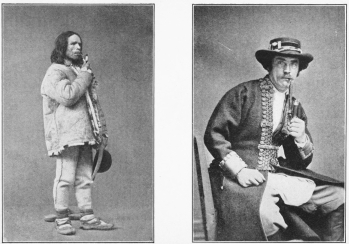
TWO TYPES OF POLES
of government best suited to their national character.
This is certainly true of many Russians, who see in the Czar a divinely
appointed autocrat; while many other Slavs of different nationalities
dream of the day when they shall bear this same yoke. The Russians also
rule, and most severely, their close kinsmen, the Poles, and are not
noticeably liberal to the Malo Russ, the Little Russians of the South.
Every cruel, political expedient has been used by Russia to subjugate or
assimilate these people, who are flesh of her flesh and bone of her
bone.
One might imagine that the Poles would have learned enough in the school
of political adversity to treat their own kinsmen, at least, as they
would wish to be treated; but the trials the Ruthenians have endured at
their hands are equalled only by what they themselves have endured at
the hands of the Russians.
That the Poles suffer from the Germans, the Slovaks from the Magyars,
the Slovenes and Servians from the Austrians, is only additional
evidence that everywhere the Slavic peasant suffers politically, and
that there is sufficient cause for the insecurity of his foothold. He
realizes this the more, in the measure in which he feels the breath of
welcoming freedom from across the seas, which lures him to our
turbulent training school in citizenship, and no doubt will continue to
lure him.
The economic, social and political conditions among the Slavs are such
as will for some time in the future make their coming to America in
large numbers, a certainty, and it is not out of the question that they
will be the determining factor in our civilization. The Slav fits
admirably into the place usually assigned the late comers among the
immigrants: the bottom rung of the economic ladder. Of rugged physique
and docile temper, he is regarded a valuable workman, performing the
hardest tasks uncomplainingly, facing attendant dangers courageously,
and enduring hardships and sufferings stolidly and without a murmur.
Economically, he is never so much of a problem as the immigrant who
comes to make his living by his wits; for that is a sphere likely to be
crowded by the earlier, or what we might call the more advanced groups.
The Slav is docile and patient and need not be regarded as a serious
economic menace by those who think that our workmen should demand a
decent wage and maintain a fair standard of living. He is not temperate
in his habits of either eating or drinking, his tastes in regard to
clothing are crude, but not necessarily inexpensive and he squanders too
much money for “that which satisfieth not.” He spends over thirty per
cent. more for drink than the native workman, pays more, according to
his wage, for rent, and falls behind only in that mysterious column
which the social observer calls “miscellaneous.” In the Slavic groups
which have been here longest and which contain households, the wife has
lifted this mysterious column to a normal figure; for “Mother Vanity”
has many daughters among the Slavic women.
The Slavic standard of cleanliness suffers by comparison with that of
the older groups; although they are widely different in this respect and
it is not safe to generalize on that point.
In judging the Slav we must take into consideration the housing
conditions in America as he finds them, the fact that the men among the
Slavs never do woman’s work, that many of them come without their wives
and that the woman in her native environment has very little time for
the finer household duties. She is her husband’s partner in all his
heavy labour; but must do all her household work unaided.
Many of the Slavic groups will be slow to understand and appreciate the
higher ideals of our civilization, but our civilization is not so
foreign to their genius as we are apt to think. Wherever they have had
the slightest opportunity, they have made valuable contribution to it.
We must not forget that the Slav gave the world a Copernicus before we
gave it a Newton; that he gave it a John Huss before the Germans gave
it a Luther; that Comenius, one of the greatest pedagogues, lived and
laboured before Froebel and Pestalozzi; and that Turgenieff, Tolstoy,
Dostoyevsky, Pushkin and Sienkiewicz stand fairly well beside our makers
of literature.
I am not blind to some of the defects in the character of the Slavic
peoples, in fact I know them so well that I know their source and I
realize that they are not rooted in the race, but are the results of
tyranny. These faults which seem so deeply fixed in the lives of the
people can and will be wiped out; although the task may not be an easy
one.
There is in the Slav a certain passivity of temper, a lack in sustained
effort and enthusiasms, an unwillingness to take the consequences of
telling the truth, a failure to confide in one another and in those who
would do them good, a rather gross attitude towards sexual morality and
an undeniable tendency towards Anarchy and intemperance.
They have but little collective wisdom, even as they have no genius for
leadership, scant courtesy towards women, and other human weaknesses to
which the whole human race is heir. To balance these failings, however,
they have a deeply religious nature, a willingness to suffer hardship, a
genius for self-expression in all forms of art, are usually honest in
their business dealings and hospitable to strangers.
The danger is, that, in his new environment, the idealistic Slav will
grow materialistic, that his phlegmatic temper will not take seriously
the burdens of self-government, that in an individualistic atmosphere
where “help yourself” is the watchword, latent tendencies towards
Anarchy may develop, and that in our social organization which demands
both the power of leadership and that of cohesion, he will be a brittle
element, incapable of either.
Yet I do not fear that Slavic social or religious ideals or even racial
characteristics will become dominant among us, even if the Slavs should
constitute the bulk of our immigrant population. My reasons are: First:
Because these ideals and characteristics are embodied in a peasant
population which has little or no influence over its second generation,
for it has found a higher social level. To this second generation,
neither the speech nor the customs of its parents is attractive.
Second: Because the Slav is environed by city life and no matter how
compact his neighbourhood may be, elements which make up the urban
spirit penetrate into the most densely populated alley, make themselves
felt, and become dominant.
Third: Because in his native environment the Slav has taken on the
ideals of his neighbours more often than he has imposed his upon
others.
In Asia, he has been influenced by his Mongol neighbours, but has
himself not left any visible traces.
In Europe, the numerically weak Finn has resisted the force of the
Autocratic State and the Orthodox Church; but has left the impress of
his genius upon his Slavic neighbours.
After centuries of close contact with Slavic government, the Germans in
the Baltic provinces of Russia are still more German than Russian.
The Czechs of Bohemia, the most virile of all the Slavic peoples, in
spite of their stubborn struggle, have not metamorphosed their Germanic
fellow citizens into Czechs; although they cannot easily deny the strong
influence of their Teutonic neighbours upon themselves.
A mere handful of Magyars, almost at the centre of the sphere of Slavic
influence, have imposed upon millions of Slavs their language and their
ideals.
Whatever the causes for these conditions may be, and there are good
causes, the truth is, that the Slav has nowhere become a dominant factor
in the environment in which he has been placed; and we need neither hope
nor fear that his ideals or his characteristics will become ours for
good or ill.
Again it is true that in America this Slavic peasant population is
awakened to its racial and historic heritage, and that feeling may be so
artificially fostered by patriotism and religious organizations as to
hinder a normal process of assimilation.
The Slav, by virtue of being among the most numerous of our new
citizens, has a right to demand that the rest of us should know him; for
by knowing him, we shall learn to respect him, appreciate the good
qualities of his race and help him to overcome tendencies which hinder
his full development.
We must give the Slav a full chance to know us, the best of us and the
best in us—he usually knows the worst.
He must have our best interpreted to him in rational terms and ways, and
not have it forced upon him by law or by a custom to which he yields but
which he cannot understand.
I have described the Slav’s quality as brittle; perhaps stubborn would
be better. You can lead him to the water and can also compel him to
drink; but he will stop drinking when you are not looking, and “kick”
besides.
On the other hand, once he understands and endorses an ideal, he will be
loyal to it; stubbornly loyal.
Inasmuch as I believe that America’s best possessions are those ideals
which spring from its religious convictions, ideals inherited from its
Judaic and Christian ancestry, I also believe that its effort should be
to interpret them to the Slav in practical terms of fellowship and
service.
How far from these ideals or how near to them the Slav is, I have
attempted to show in the next chapter; and to make the task of
interpretation easier, I have put the more important Slavic groups with
which we have to deal, in their own historic setting.
This will, I trust, stimulate in the further study of these people who
are worth knowing for what they have suffered, for what they have done
and for what they are.
WHEN the sword of Rome, the ideals of Athens and the faith of Judea
strove for the mastery of the world, the Slavs were still unknown to
history. Upon the middle European plain, along the Don, the Dnieper and
the Vistula they lived a semi-nomadic life, at war only with bear, elk
and boar, and at peace with the dominant races in the west of Europe
which scarcely knew of their existence.
Very early in the Christian era, the transition from nomadic to
agricultural life took place, and they became so identified with the
soil that some of the agricultural terms they used have been embodied in
other European languages.
The facts that the Slavs inhabited the eastern portions of Europe to its
very edge, that Christian civilization was imposed upon them by
Byzantine and Roman influences, when both were struggling for the
mastery of the Christian world, and that the territory they inhabited
became their battle-ground—had great and lasting effect, not only upon
their political history but upon their religious life and their national
character.
The Slavs then are a late product of Christian civilization; an
unfinished and inharmonious product which is at its worst, where later
Greek and Roman influences touched it, most turbulent where modern
Western ideas have suddenly affected it, and at its best and rarest
where the Slav’s own talents and resources have had a chance for
rational development and adjustment.
That which complicates the problem presented to us by the Slav is the
fact that in spite of his occupying practically contiguous territory,
the close family bond was early broken by conquering armies, by rival
missionary groups, by invading aliens who came to pillage, barter and
trade, and by the influx of his neighbours, who varied all the way from
Tartar and Turk to German and Magyar; from Finn and Armenian to Greek
and Albanian.
When we speak of Slavs to-day we refer to Aryan people, whatever that
may mean beyond the fact that they are Europeans, presenting no great
ethnic variations; although there is no doubt that Mongol and Finnish
blood has found its way into the veins of the Eastern Slavs. We also
mean that they speak a closely related language, the Slavic; but which
has become so differentiated in time that there are now literatures in
Russian, Polish, Czechish, Servian and Bulgarian; each a distinct
language, differing in alphabet, grammar, accent or sentence
construction.
Besides these, there are other dialects, vital enough and varied enough
to have created their own literature, and zealously guarded as their
mother tongue by the people who speak them.
These linguistic differences have aided in complicating the religious
and political problems among them. Thus, the Russians and the Poles have
been made hereditary enemies, largely, because one received its
Christian doctrines from Rome and the other from Constantinople;
Ruthenians and Poles in Austria have been pitted against each other in
an age-long struggle, by a difference in liturgies; Slovaks and Czechs,
almost twin brothers, are little better than strangers to one another,
because of a few hooks in the alphabet and a few variations in
pronunciation.
The whole Southern Slavic group remains politically ineffective because
of the dissimilarities of the Cyrilian and Latin alphabets and all that
their difference is made to imply.
Even when transplanted to America, these contentions are magnified by
the churches and governments concerned, which thus are effective in the
continued separation of related groups.
If the Slavs may be called one race, they certainly present a
kaleidoscopic conglomerate out of which emerge three groups: the
Western, Eastern and Southern Slavs.
Besides their common racial bond, each group is related by language,
economic environment, determined by climatic and political conditions,
and above all, by religion, which is a stronger bond than even ties of
racial kinship.
The entire Slavic world is living under the dominion of religion more or
less clearly interpreted and understood. This manifests itself in
conversation with the people. “God help you on your way!” “Go with God.”
“Praised be the Lord Jesus Christ!” are common greetings as one journeys
along Slavic highways and byways.
The names of the Deity and of the Saviour or the Virgin are never
uttered without lifting the hat, accompanied by the words: “Slava i cast
nyim budi!” Honour and praise to them!
The highways among the Western Slavs, who are largely Roman Catholic,
are lined by crosses, chapels and shrines; and no matter how wretched
the village, its church is well appointed and its peasants are not quite
happy at the end of the year, unless its monotony was broken by a
pilgrimage to some shrine where the Virgin waits, ready to bestow her
blessing of good health or other rich favours supposed to be in her
special keeping.
Feast days and fast days follow one another in quick succession and no
season of the year or event in life is left unhallowed by religious
observances.
All this is equally true of the Eastern and Southern Slavs who, with but
few exceptions, belong to the Greek Orthodox church, and are cast in a
religious mold as fixed as the form of the Byzantine icon, the symbol
of that church.
To the Russians, the largest body among the Eastern Slavs, religion is
an atmosphere in which they “live and move and have their being.” Among
them also, church feasts and fasts regulate the days, while either the
pleasure or the pain they bring is willingly accepted.
Sacrifices of candles and oil are freely offered and no pilgrimage is
too wearisome to be undertaken. Visiting the tombs of saints and the
dwelling places of hermits is a national mania, and religious
ceremonies, which in their origin and meaning are wholly Pagan, take
place in hut and palace alike; for no class of Russian society is quite
free from gross superstitions. The peasant coachman, who drives his
miserable beast over the cobblestone pavement, crosses himself before
every chapel and icon; while his passenger, be he a general, a
university professor or one of the common people, will do the same, with
perhaps only a little less unction.
Yet, in spite of the fact that religious forms dominate the life of the
masses of the Slavs, there are no people in Europe who less understand
the real value of religion, whose conduct towards each other is so
little affected by it or to whom it is so entirely a mere belief in the
mysterious forces of Heaven and Hell which can be appeased by prayers,
formulas, sacrifices and pilgrimages. Religion with them has seemingly
nothing to do with sobriety, chastity, conquering the will, or the
cultivation of the inner virtues.
The blame for this lies largely with the clergy, which, whether it is in
Russia, Bulgaria or the countries inhabited by the different Servian
nationalities, stimulates the superstition of the people and does but
little to enlighten or ennoble them.
The priests nowhere occupy or deserve the place which they hold among
the Western Slavs, and where the Roman Catholic minority has any
fighting ground among the Southern Slavs, as in Servia,—there the
Franciscans and Trappists tower above the Greek clergy as benefactors of
their people and often as true saints and martyrs.
My assertion that the Slav is by nature truly religious, and that the
clergy is in a great measure to blame for his hopelessly low standards,
is proved by the remarkable phenomenon of the sects, which especially in
Russia flourish, in spite of persecution. They grew up from within; some
of them, supposedly before the Reformation, and still they are being
formed and developed.
These sects range all the way from the most fanatical, whose members
seek salvation in voluntary death or in some revolting form of
mortification of the flesh, to large and influential bodies, kinsmen to
our Quakers, Baptists and Methodists.
It is this hunger for religion which is the most hopeful characteristic
of the Slavs, and one which ought to make contact with them less
difficult than we usually imagine it to be.
The problem is, how to purge these movements from fanaticism when
transferred to America; although in our soberer, freer and more
practical atmosphere the dangerous elements are apt to be spontaneously
corrected.
Protestantism, as a manifestation of historic Christianity, antedates
among them the German Reformation and was contemporaneous with the
earliest movements in England. History clearly shows that the Protestant
spirit found kinship among the Slavs and that it is still alive.
Evidences of this are the sect of the Bogumils early in the fourteenth
century, which has left its traces among the Southern Slavs as far as
Bosnia; the Hussite movement so vitally effective in preparing the way
for Martin Luther and still a force in the national life of Bohemia—and
the various sects among the Russians.
This Protestant spirit in its conventional form, as found in Bohemia, in
Poland to some extent and among the Slovaks of Hungary, is unfortunately
no more a factor than the Mother Church in the shaping of character, in
inducing right social relations, or in determining the future of the
Slavic race.
There are, however, various Protestant forces at work among these
people; forces which emphasize spiritual and ethical ideals; such as the
missions of the American Board, in Bohemia; the devoted and enthusiastic
members of the “Gemeinschaft” in Kattowitz in Silesia, strategically
situated where three great empires meet; the Baptist missions in Russia,
and above all, the returned immigrant, who comes home, often
enthusiastically but sanely, practically and devotedly religious, and
with whom rests largely the religious and political future of at least
two Slavic nationalities, the Slovaks and the Ruthenians, the latest to
be awakened to the economic possibilities in America.
The Slovaks for nearly a thousand years have retained their national
consciousness, in spite of the fact that long ago they were conquered by
the Magyars, who have used every possible means to wean them from their
language, the one strong link binding them to their historic past.
Patiently they have endured a national martyrdom; although the world at
large knows nothing of their sufferings.
Whenever they have tried to speak, prison doors have enforced silence.
In the struggle between race and race, the Magyars, who themselves were
persecuted for freedom’s sake, have, in their treatment of the Slovaks,
violated every principle of political liberty.
In a little village called Hluboka, in the midst of their well tilled
acres, lives a group of Slovaks whose Lutheran pastor, John Hurban, was
a man who helped to keep alive this national spirit, for which he
endured imprisonment and even faced the gallows. In 1892 the people
erected a modest monument over his grave, and at its unveiling they were
driven from the cemetery at the muzzle of the gun.
The son of the dead pastor wrote an article in the public press
protesting against this, and he was sent to prison for twelve months. An
editor, Ambrosius Pietor, was incarcerated for eighteen months, for
writing two articles complaining of the treatment his people received.
When he returned home at the expiration of his term, his admirers met
him at the railroad station and some young girls presented him with
bouquets of flowers.
Twenty-one persons who took part in this reception were sent to prison
for an average of a month each, and the three young girls, who betrayed
their native country by handing this man bouquets of flowers, had to pay
fines, aggregating 400 kronen.
In 1906, 245 Slovaks were sent to prison, and from 1906 to the present
time the number is not far from 500. I have already cited the nature of
the offenses for which they are punished.
I have mentioned these facts, not because I wish to throw discredit upon
the Magyars, for government and people are usually two different
things; but because I wish to throw light upon these Slovaks who come to
us to do our most menial work and whose worth is obscured by our not
knowing them. Their clannishness, the tenacity with which they cling to
their native speech, and their attitude towards our Christian and
national institutions, find some explanation in the miseries they have
endured for the sake of preserving some kind of national or racial
entity.
I consider these Slovaks among the most unspoiled of all the Slavic
peoples; low in the scale of culture, it is true, but of such innate
goodness and possessing so many virtues, as to make them most desirable
immigrants and splendid material upon which to graft the best of our
Christian civilization.
Like all Western Slavs they are largely Roman Catholic, but with enough
of the Protestant element mixed with it to have given evangelical faith
a grappling place.
This broader vision with its ethical element has been transferred from
America to the Slovaks in Hungary and is now manifesting itself in a
company of people, which, though small, is so thoroughly in earnest and
ethical as to prove that they can be brought into harmony with the most
vital religious ideals.
Ruthenians, or Ukranians, as they call themselves, who belong to the
Eastern Slavic group,
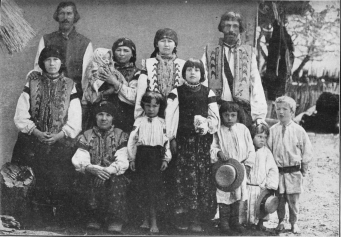
RUTHENIANS
The most backward and oppressed of the Slavic people, whose destiny is
worked out in America.
are a most unhappy people; degraded by adverse economic and religious
conditions, worse if possible than those of the most debased Russians
whose closest kinsmen they are. In Austria a majority belongs to the
Greek Catholic church, which is a union of the Greek Orthodox and the
Roman Catholic churches, maintaining distinct Byzantine dogmas and
acknowledging the supremacy of the Pope.
There are about 34,000,000 of these people, numerically more important
than the Poles, by whom a portion is governed or ill governed and
persecuted. Neither have they any chance for full development in Russia
where the largest number lives; nor in Hungary, where they make their
home on the eastern slopes of the Carpathians. They are now struggling
for the maintenance of their national consciousness and are bearing all
the unfortunate consequences.
In the United States their protest has taken form politically, in a
National Ukranian Society, and religiously, in a Ruthenian Free Church,
and both deserve sympathetic aid from those who believe in political and
religious freedom.
The great task of religion in its ministry to the Slav, and that no
matter what its ancient form or symbol, will be to make clear to him the
difference between God and Cæsar; for religion and nationality, Heaven
and the throne, are confused in his mind.
It must also teach him that besides its sacramental value it has service
value, whose obligations rest upon priest and people alike.
Religion must wean him from his ancient enemies, intemperance and
superstition, and when it has done this, it has rendered a service which
may again make of the Slavs a homogeneous race; great, vital, virile and
well prepared to play a leading part in the future history of Europe as
well as America, where they are now, numerically at least, the most
important element in the great immigrant tide.
THAT portion of our history, which began with the inflow of Germans from
the Palatinate, seems to most of us a closed chapter; yet in the very
heart of the Keystone State, where more than 200 years ago the German
pietist began to build its cities, since grown to greatness, the German
is still a foreigner.
Indeed, he is almost as complete a foreigner as the Slav who lives in
the mining patches along the Wyoming arid Susquehanna Rivers. Germanic
speech, habits and types survive, and it was in a crowded trolley car in
Reading, Pa., just after I had finished a wearisome investigation among
the Slavs, that a woman of generously Teutonic proportions said to me:
“Setz dich a mahl zu mir her.”
Let me add that although I had never seen the lady before, I obeyed the
summons. First, because there was no other seat vacant, and, second,
because I have been long enough in America to obey implicitly when a
lady commands.
“Du acts wie ein stranger,” the good woman continued, taking my hand;
and then, discovering that I had a right to act like a stranger, she
apologized profusely. She had mistaken me for her family physician. In
spite of her evident embarrassment, we began a conversation, and my
ears, accustomed as they now are to our rather monotonous and uneuphonic
English, refreshed themselves by listening to this new
speech—Pennsylvania Dutch. It required thinking in two languages, and
that in their most archaic forms.
Four generations had passed since my neighbour’s ancestors came to this
country; yet her English, whenever she attempted it, smacked strongly of
the Fatherland, and in an unguarded moment, when my sentences seemed to
her rather involved, she said, “Du talkst a bissel zu fast.”
The trolley took us through the manufacturing centre of Reading and out
into the fruitful fields of Lancaster County, and the further I
travelled in that state the more I realized the difference between the
old and the new Pennsylvania, even in the names called into my ears by
the prosaic conductor. Philadelphia does not now suggest Bible times so
much as it might; but there are Bethlehem, Nazareth, Emmaus, and
Ephrata, each name suggesting at once a sacred atmosphere. Then for the
new Pennsylvania are the names of Johnstown, Coalton, Scranton, and
Steelton, besides those yet unplaced on the map—names like Hunkeytown,
Guinea Hill, Dago Roost, and Whiskey Hill, squatted close to the mines,
flanked by culm heaps and huge breakers, and cut through and through by
ravines and dirt-clogged rivers. All these towns are destined to
disappear long before the last lumps of coal dug there, are burned.
The trolley stopped at Ephrata, and my neighbour, who had been in
Reading, “bargains zu kaufe im grosse schtore,” left the car; but not
without admonishing me to be sure to see the cloister of the German
Baptist Brothers, which, she said, “is a grosse sight.” I needed no
admonition, for I was there on a pilgrimage. I had come, to stand face
to face with a great past, to visit the old haunts of these German
mystics, to lose myself in the all-pervading peace of Ephrata, after
having been in the thick of the great industrial war, whose presence was
attested even here by the cloud of smoke on the western horizon. This
cloud of smoke, although changing into a pillar of fire by night, does
not seem to be the guide out of captivity. I suppose one easily reads
something into the atmosphere of a place; but I am sure that, even
without the pilgrim spirit which brought me there, I should have
recognized Ephrata as one of the places in which dreamers have built air
castles; and these are castles which have foundations. The archæologist
does not see them in the dust; but the sociologist, if he has a
sensitive spirit, feels them, especially if he has come from a week’s
study of Whiskey Hill.
One of the men who has written of Ephrata before me says: “There is
nothing peculiar about the village itself, or its people.” He evidently
had no “inner sense,” and, moreover, he had never been at Whiskey Hill.
Not only is the air of Ephrata “salubrious and the outlook delightful,”
the street is full of gabled houses one close upon the other. Some of
them are commonplace indeed; but many of them are quaint and clean, with
deep-set windows full of flower-pots, the green foliage shining through
latticed panes, in rich contrast to the white snow almost up to the
window-sills. And the people one sees—“commonplace”? People who for
nearly two hundred years have clung tenaciously to a strange garb, in
the midst of a “perverse and crooked generation,” bent upon changing the
cut of its coats with every passing season? Women who wear brown bonnets
and look as modest as thrushes, whom one sees in single file following
the men; women who have resisted the allurements of pokes and toques and
picture hats for two hundred years—such women commonplace? Such women
are as remarkable as they are rare, and such there are in Ephrata.
As I watched them they were going to the modest meeting-house at the
edge of the village. I did not follow them, for my way led straight down
the main street which ends in the turnpike, over which a toll-gate still
hangs. The gatekeeper sits in a little hut among his cronies, smoking
the native weed and talking politics—and he who is acquainted with the
quality of either ought to know that they are strangely alike.
“The cloisters are across the meadow,” the toll-keeper informed me. And,
pointing to one of his companions, a man of uncertain age and a rather
doubtful degree of cleanliness, he said: “And he lives in one of them.”
“I am not a member,” the man volunteered, apologetically. “My wife is.”
This alone proved him a modern and commonplace. I left him disgustedly,
and, stepping over the stile, walked through the snow-covered meadow and
along the shores of the Cocalico towards a group of rather ill-shaped,
weather-beaten buildings which suggested a deserted farm more than a
cloister. The momentary disappointment vanishes, however, as soon as one
has a clear view of the peaked-roof buildings in which no outer beauty
is visible, but which, with their low doors, narrow cells, and roped
stairway, recall to him who knows, the “Chronicon Ephratense,” the
groping of this Brotherhood after the blessed life here below, seeking
communion with God in self-denial, in good works and pious songs. These
Brothers fell into all the errors of Christendom and practiced many of
its virtues in a single generation. Conrad Beisel, a German mystic, came
here to live as an anchorite. His pious life drew others to him, and
they progressed to monasticism.
When women found them, they all became celibates. They were close to
every heresy which threatened the early Church, and were not far from
worshipping Conrad Beisel as a reincarnation of Christ; while in the
mystic Sophia they came close to the adoration of the Virgin. They
practiced communism successfully for over half a century, and branded
property as sin long before Proudhon declared it to be theft. They
printed Bibles, wrote ecstatic hymns, developed to a remarkable degree
the art of illuminating letters, and organized a Sunday-school in which
they used some of the so-called modern methods, such as promotion cards,
long before the thought came into the mind of Robert Raikes, the founder
of the Sunday-school of to-day. They were chaste, frugal, and
non-resistant. One of them, Peter Miller, the successor of Conrad
Beisel, went to George Washington to plead for the remittance of the
death penalty of a man, Michael Wildman, accused of treason. The General
told Peter Miller that the severest penalty must be dealt out at a time
like that.
“If it were not so, I would gladly release your friend.”
“Friend!” replied Miller; “he is the only enemy I have.”
This, it is said, made such an impression on General Washington that the
pardon was granted.
I lingered in the “Saal,” the place of worship. Simple and small it is,
with plain pine pews, the beamed ceiling hanging far into the room. The
walls are covered by charts on which, in exquisite ornamental lettering,
Scripture verses and some of the mystic poetry of the Brothers are
written. There are also allegorical pictures, naively drawn by the pen,
suggesting the thought that in time a new school of religious art might
have been developed here.
Scarcely half a dozen worshippers, I was told by the cronies at the
toll-gate, gather here on Saturday; for the sect is that of the Seventh
Day Dunkards, or German Baptists, and it cannot be very long before this
sanctuary will be empty and forsaken and its ruin complete.
I braved the snow-banks and waded through an unmarked path towards the
cemetery where they shall all soon lie. I wandered among the graves,
among those who long ago went to their rest and their reward. Here among
others are the Sisters Iphigenia and Anastasia and the Brothers Daniel
and Gabriel, the headstones of their graves quite covered by the snow.
In the centre of the cemetery a stone sarcophagus rises above the snow.
It seems to have withstood the ravaging tooth of time, for it stands
squarely upon the ground. I brushed aside as best I could the snow which
covered the tablet, and read: “Here rests an outgrowth of the love of
God, a solitary brother, afterwards a leader, ruler, teacher of the
solitary and the congregation of Christ in and around Ephrata. Born in
Eberbach, in the Palatinate. Called by his worldly name, Conrad Beisel;
but according to his spiritual name, ‘Friedsam,’ the peaceful one.”
The snow and the frost clung closely. I could not read it all, but I saw
plainly the beautiful German letters cut deep into the stone.
“Friedsam”—it was this word which took me back to Whiskey Hill.
“Friedsam.” No one could be called that on Whiskey Hill. Weather-beaten
wooden buildings there are, scaffolded structures, shaken by the
vibration of coal-crushing machinery within. From their third or fourth
stories down, young boys sit before troughs, along which the coal rushes
and rumbles and tumbles. Nine hours a day, in an atmosphere black as
night from coal dust, sitting in a cramped and unnatural position, the
breaker-boys pick slate from the falling coal by the light of smoky oil
lamps directly under their nostrils. Nine hours of this, and many of
these boys, mere children, although sworn to be the legal age, which is
fourteen, walk homeward like old men. They look so weary, so old, so
wizened! They surely are not “Friedsam.”
An old man climbs down the breaker. He, too, is now a breaker “boy.”
Only about fifty-six years of age, unfit for the harder work in the
mine, he picks slate from the larger lumps. He clings to a bit of broken
fence as soon as the fresh air strikes him and coughs so violently that
his paroxysm shakes the fence. The boys stand about, jeering; but when a
clot of blood comes from the old man’s mouth, and another followed by a
stream, the boys take to their heels.
“Prach, dust, got into my lungs,” the Slovak miner says. “It can’t
last much longer.” Looking after the boys, and then pointing to himself,
he adds, “The beginning and the end of the breaker-boy.”
I shall never forget the pain written on that man’s face as he told me
that he came to this country, a young Slovak boy from a village by the
river Waag, strong and full of health. He is giving his life-blood drop
by drop, drop by drop, for our enrichment. He is unable to walk home; so
I lead him. Home! This is his home. A gray, weather-beaten hut, one of
thirty, standing on a slant of the hillside, surrounded by culm piles,
black and forbidding. There is a street, deeply sunk in mire; for there
is no sewerage, and a sickening green scum has gathered in front of
every house. I say there is no sewerage—there is not even a decent
ditch which might carry the foul stuff away.
The hut has three stories, the lowest one built into the hillside, with
windows only to the front; the rest of the rooms are damp and cold, not
even fit for the storing of vegetables. In one of these holes lives the
old, consumptive breaker-boy. Surely this suggests nothing “Friedsam.”
There are thousands and tens of thousands such “homes” in Pennsylvania,
all the way from Pittsburg to Whiskey Hill. Each one of them brings rich
revenue to somebody, and all of them reap a rich harvest of death. Six,
eight, and ten dollars’ rent a month is paid by these miners for a place
in which they often die by inches.
The battle against filth is not everywhere zealously prosecuted; but I
challenge any American woman to do better than some of these Slovak
women on Whiskey Hill. Let me take you into one such home—and I came
upon it more often than you may think. The room is freshly papered, the
work done by the miner’s wife, and not ill done. The floor is
scrupulously clean; gorgeous pictures of the saints hang on the wall;
there is a sewing-machine, and a woman busy at her task of making shirts
for her miner husband.
There are two rooms, occupied by a family of
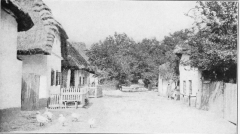
THE SLAVIC HOME IN HUNGARY
A peaceful, little village surrounded by fields of poppies and maize.
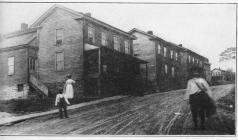
THE SLAVIC HOME ON WHISKEY HILL
Flanked by culm piles, breakers and mines.
five, and four boarders. I know the home of this woman in Hungary, and
the very village from which she comes. I know the clean, straw-thatched
cottage, the broad, dusty street, and the waving poppy-field back of the
house; and I ask, “How are you getting along on Whiskey Hill?” This is
the woman’s reply: “Chvala Bohu dobre.” Thank God, very well. I have
never seen a more beautiful and grateful smile pass over a face, and
have never heard a sentence which more fully suggested “Friedsam”; but
suddenly her face grows dark; she hears the noise of hurrying horses and
the beating of wheels against the rocky street. “The ambulance! O Virgin
Mother, protect me!” she cries; for the ambulance stops at her door, and
they bring in the mangled body of her husband.
He went out a few hours ago and she was “Naomi”—now he is brought home,
and she is “Marah.” Bitter, very bitter.
What happens next on Whiskey Hill? Do people grow excited? Do the
neighbours come rushing in? Do the newspapers in the town at the foot of
Whiskey Hill take notice how this “Hunkey” came to his death? No,
indeed. Nothing happens. The woman laments alone, even as another Marah
laments alone in a similar row on another ridge. There are ten women
anything but “Friedsam”; for on a neighbouring hill their husbands were
slain together, by the fall of one huge rock or the same powder blast.
“And nothing happens?” Yes, something happens. The coroner’s jury is
summoned, and brings in the verdict; the same verdict always, with
slight variations, rendered ever since the great companies absorbed the
anthracite industry. This is it:
“Martin Horvat, aged forty-two, came to his death by a fall of rock in
Mine No. 2 on Whiskey Hill, January 30, 1908. The jury finds that the
company should have provided the deceased a safe place to work in. It
was not the duty of the deceased to pass on the safety of the roof. The
deceased is not to blame.” (What a comfort!) “We further find that the
place in which the deceased worked should have been properly timbered”
(which it was not when the accident occurred), “but we do not find that
the company was to blame.”
Who was to blame? The deceased was not, the company was not. I have
it—the rock was to blame. Somebody in Wilkes-Barre said, in answer to
my query; “These Hungarians are so ignorant.” I see now—ignorance was
to blame.
Every day there are funerals on Whiskey Hill, and after the funeral a
feast, and after the feast a glorious spree. Whiskey Hill has earned its
name, although it might be called Beer Hill just as appropriately. The
saloons not only outnumber the churches; they outnumber the stores,
schools, churches, undertakers’ shops, and culm hills combined, and a
man might make a living by picking up the empty beer barrels that lie in
the ravines. There are enough empty bottles lying in the runs, to clog
the flow of the creek in the spring, when the current becomes strong
enough to make its way through the ooze and slime.
Ignorance and beer are to blame—and avarice, especially avarice. For
the first two the miner is to blame, but only in part. This ignorance is
an inheritance, often a condition arising from the fact that he is in a
strange country, to whose language he is deaf and dumb. The drinking,
too, is an inheritance, and often also a condition arising from the
circumstances under which he must live and work.
Granting, however, that he is ignorant and intemperate, up here on
Whiskey Hill and on hundreds of other hills no attempt is being made by
any one to dispel this ignorance. Neither his masters nor his priests
are doing it. His priests, perhaps, are more content with his ignorance
than his masters, for to the master he might be worth more if he knew
more. The priest is sure of the opposite result as far as he is
concerned. No one on Whiskey Hill tries to curb intemperance by teaching
the “Hunkey” the hurt of it to his bank account, to his body, to his
chances of coming alive out of the mine. His priest usually drinks
freely, and many a saloon license in Pennsylvania bears the signature of
the priest as one of the petitioners.
Even those people who are eager to make laws to curb or prohibit the
sale of liquor, ignore entirely the education of the “Hunkey,” although
he is now, and more and more will be, a great factor in the political
and social life of the state.
Avarice is to my mind the basic fault in all the history of accidents in
the mines of Pennsylvania. It is an avarice which thinks human life
cheaper than timber, and considers it easier to pay funeral expenses
than to support schools and pay teachers. It corrupts politicians to the
degree that there is seemingly nothing more to corrupt; and if half the
charges are true that are made openly by the newspapers in the coal
regions, against the mine inspectors, they certainly are hopelessly
debased.
Of the one thousand people slain annually in the anthracite coal region,
two-thirds are chargeable to one of three causes: ignorance,
intemperance, and avarice. Inasmuch as these causes could in a large
degree be removed by the people of Pennsylvania, it follows that the
people are to blame.
Twenty-three thousand lives have been sacrificed in the coal-mining
industry in the United States in about ten years! Read it again!
Twenty-three thousand people had to give up their lives for the light
and heat and speed which we enjoyed in the last ten years. Twenty-three
thousand men! Almost I envy the Brothers Daniel and Gabriel and the
Sisters Iphigenia and Anastasia the time in which they lived, when the
waters of the Cocalico turned their wheels, when they printed books and
illumined letters, when they could do their share in pushing this world
forward without sacrificing the lives of an army of men to what we call
progress.
That time will never return, in spite of Rousseau and Ruskin and
Tolstoy; but we must have a time, and have it soon, when we shall be
able to do all that we are doing without such slaughter. Nothing is
worth doing and nothing is worth having unless, like Conrad Beisel, we
have a “new name in the Lord.” For myself, if I lived in Pennsylvania,
it should not be “Friedsam” but “Streitsam”—not the peaceful one, but
the fighter.
ACCORDING to ordinary railway standards the car was only half full, for
each passenger was the fortunate possessor of an entire seat.
Reluctantly enough, one or the other of my fellow travellers gave to
some newcomer the space which allowed him some freedom for the movements
of his body; but when a dozen foreigners entered the car at a wayside
station, every man and woman moved defiantly to the outer edge of the
seat, determined that not one of the intruders should share it.
Ordinarily the conductor sees to it that such monopoly of privilege is
properly rebuked; but this time he apologized for the presence of the
immigrants by saying that the smoking-car was “jam full of Dagos
already.”
Meekly enough, the men stood in the aisle, glad of the privilege of
standing in the car, which carried them from the scene of their labours
to the distant city where the signora and the bambini awaited them. I
made room for one of the men, and for a time employed all my senses to
discover if possible the reason for their receiving such treatment. I
smelled neither garlic nor whiskey, although I was soon engaged in
conversation with my neighbour and thus had a good chance to detect
either.
He wore blue jeans overalls, which, while not stylish garments, are
certainly honest clothing. There was no crease down the middle, but they
had creases all over. His hands were not unclean; although the soil of
honest labour was upon them.
In no way was he different from the American working man of the same
class, except that he did not chew tobacco and therefore did not indulge
in the practice which usually accompanies that accomplishment.
In order to ascertain what chances there were for English conversation,
I addressed him in that language, and his answers in broken English were
certainly more entertaining than the abrupt “yes” or “no” which one
often receives from the native fellow traveller, to whom it is usually a
matter of indifference whether or not the time hangs heavily on one’s
hands.
At the next station the smoking-car was relieved of its surplus
passengers, and my neighbour with all his countrymen was driven into it
with rough gestures. I am very proud of the courage I displayed by
turning in my seat and addressing the man who sat behind me.
“Won’t you please tell me,” I said, hesitatingly, “why you wouldn’t
share your seat with one of those men?” I fully expected him to say,
“It’s none of your business,” but his stern face relaxed for a moment as
he replied, with a rising inflection, “Dagos,” and then looked as stern
as before.
I was not satisfied by that answer and said so. This opened the way for
an argument, and conversation was soon in full swing.
“What right have those Dagos to come to this country, anyway?” he
retorted, when I pleaded that those men had paid their fares and had the
same right that he had, to a seat. I soon discovered that neither logic
nor ethics was his strong point; so I thought I would try him on
history.
“Do you know,” I asked, “who was the first ‘Dago’ that came to this
country?” For a moment he put his thinking apparatus to work; then he
said, and I am quoting his words exactly:
“I suppose it was somebody by the name of Macaroni, who sold bananas
when he landed in New York, and talked an outlandish gibberish.”
“No,” I replied, “his name was Christopher Columbus, and if it had not
been for that ‘Dago’ you would still be undiscovered.”
I had great difficulty in making my fellow traveller believe that there
are cities in Italy more beautiful than Pittsburg; but when I told him
that a “Dago” built the largest church in the world, his materialistic
sense was touched and he began to listen respectfully to what I said.
“The same ‘Dago’ who built that church carved statuary so beautiful that
whenever any man wishes to free the ‘imprisoned splendour of the stone’
(I did not quote Michael Angelo to him, however), he has to go to see
what that ‘Dago’ has done.
“And that same man,” I continued, “painted a ceiling which is one of the
great art wonders of the world. His name is Michael Angelo.”
“I never heard of him.”
“I know of another ‘Dago’” I continued, emphasizing “Dago,” “who painted
a picture for which even you might be willing to pay $500.”
“I’d like to see it!”
When I mentioned Raphael and the Sistine Madonna, he did have some vague
idea of what I was trying to convey to him; for these were fairly
familiar names.
Then he fell upon me savagely. “But you don’t mean to say that these
‘Dagos’ that come over here are anything like Michael Angelo or
Raphael!” To which I replied: “No, they are not; but neither are you
anything like George Washington or Abraham Lincoln.” Then I returned to
the perusal of my newspaper.
That man was an average American of the middle class, a representative
of the bulk of our population, and he, in common with many of his
countrymen, is criminally ignorant of the people who will soon have his
weal and woe in their hands.
The Italian, the Greek, and the Syrian are usually called by the classic
names “Dago,” “Roundhead,” or “Guinea,” and the Slavs, be they Poles,
Servians, Slovaks, or Montenegrins, are called “Hunyaks,” “Hunkies,” and
“Slabs”; and I once heard the owner of a great industrial establishment
call them “Bohunks.” It was not an ignorant or malicious friend of mine
who said of a Jew, a man of scholarly attainment and a common
acquaintance, “He is a pretty decent Sheeny.”
I have no quarrel with the fact that the average American is ignorant of
the historic place which these people hold among the nations, and of the
great age-long struggle through which some of them have passed and are
still passing, that they may preserve their identity as a people. I am
thoroughly incensed, however, that nearly every one of the names applied
to them is an expression of contempt, an offhand judgment of
inferiority. After all, it is not even that which makes me take up the
cudgel for them, because they must and will prove for themselves that
they are perfectly human like the rest of us, and that in all essential
things they will grow like us as soon as they have the same privileges
which we have had, who came after the first “Dago” had discovered the
way to this land of opportunity.
What really does burden me and make me cry out is the consequences
which result from such ignorance as I have cited, and because of which I
was on that train travelling to Guinea Hill.
Guinea Hill differs from Whiskey Hill in that it bears many other
fantastic names and in that there are fewer saloons. The beer-kegs do
not lie about in such unpicturesque confusion, and the Slavs who live
there come from the shores of the Adriatic and the bleak mountains of
Montenegro. The huts in which they live on Guinea Hill are even worse
than those of the earlier comers from the north of the Slavic world. I
am told that they were built some thirty years ago, and no sacrilegious
hand has touched them since, to paint them or to change their original
primitive, dry-goods-box architecture. They seem to have sunk into the
refuse of the mines, and the sociological investigators, who know the
housing conditions in Pennsylvania, declare them to be “the worst in the
state,” which phrase would be eloquent from meaning were it not so
common as to lose its force.
Living in these wretched huts among stunted trees, the leaves of which
are shrivelled and blackened by coal dust, I found young men with whom
I had walked among the olive groves near Spalato. These young men had
rowed me across the Boche de Cattero, easily the most magnificent bay in
Southern Europe, and had shared with me the luscious figs which they
carried in their shirt bosoms. I saw many a man whom I first knew
beneath the deep shadow of the Lovozin, the historic mountain of
Montenegro, whence the spirits of departed heroes still call to fight
against Christianity’s hereditary foe—the Turk.
When last I saw these youths they wore garments of red and white cloth,
richly embroidered, with their belts full of costly weapons of ancient
pattern, and their fierce mustachios stretching out defiantly like long,
double-pointed daggers. Here on Guinea Hill they all wear the sober garb
of miners, their mustachios are shorn of their fierceness, their weapons
have disappeared, their shooting is done in the darkness of the mine,
and they rarely shed any blood but their own.
I went to Guinea Hill because I am partly responsible for the presence
there of some of these Southern Slavs. Many years ago, when I visited
their mountain fastness, numbers of them were at the verge of
starvation. The crops on their scant fields had failed; fighting the
Turk had grown to be a fruitless and profitless occupation; Russia,
their ally and the godmother of their little principality, who in the
past sent thither what surplus of foodstuffs she possessed, was herself
living on borrowed money and charity, so that nothing remained for these
warriors except to starve or seek for work.
I suggested to Prince Nicolas that he permit them to go to the “land of
the free and the home of the brave.” Not one of them, however, was then
willing to leave his rocky cradle home for the unknown fabled land so
far away, and they remained on their bleak mountains to take
half-rations or none, waiting for the realization of Russia’s Asiatic
dream in which lay wrapped their own future. The Japanese war and the
subsequent Russian revolution were like the eagles’ stirring the nest,
and the young eagles began to flutter in the exaltation of their first
flight, as they sought the shores of our far-away country. Four or five
thousand of these braves exchanged the hilt of the sword and the butt of
the gun for the shovel and the pickax, and the shadow of the towering
Lovczin for the shadeless Pennsylvania hills. There I found them digging
coal as bravely as they had fought the Turk, but known to their American
masters only as “Hunkies” or “Guineas”—no one discovering in their
open, honest faces a superior race—every one scenting in them
drunkards, brawlers, and incendiaries.
The usual results of such ignorance followed, in that they have been
treated with an injustice which makes them quite unconscious of the fact
that they have found the land of “liberty, equality, and fraternity.” I
have verified nearly every complaint which they have made to me, for I
know how easy it is for sensitive men to exaggerate their wrongs; but I
found that they knew only about half of what they suffered, the other
half being mercifully hidden from them by their ignorance of the
language and the customs of our country.
After pay-days and feast-days the magistrates of the towns around seek
them to arrest them, and the fine they must pay is always twice, three
times, and in some cases ten times as great as that imposed upon the
American offenders. After trials which make a Russian military court
seem fairly decent, they are railroaded into jails and workhouses, and I
now soberly confess that as a stranger I would rather fall into the
hands of the police of Moscow or St. Petersburg than into those of the
protectors of the law in most of our industrial centres in Pennsylvania
and out of it.
The citizens of Pennsylvania may be comforted by knowing that Indiana,
Ohio, and Illinois, in their lower courts, are as unjust to the stranger
as their own state. In one town in Ohio there is, or was, a mayor who is
reputed to have made $9,000 a year out of the fines imposed upon
foreigners for petty offenses, usually for drunkenness or brawling.
This ingenious official arrested alien drunkards under the statute of
the state which allowed him to fine them as high as thirty dollars,
while the native was arrested under the statute of the town and fined
three dollars for his spree.
The Indianapolis police arrested a Slovak woman for the heinous crime of
picking up coal on the tracks. On the coldest day of the year she was
taken from her home and children and driven to the workhouse, in spite
of the fact that she was in an advanced stage of pregnancy. The terrible
results of this inhuman treatment were, of course, what might be
expected. Such facts have led the citizens to organize an Immigrant
Protection League, which makes it its business to see that the immigrant
is not exploited by the courts.
On Guinea Hill every “Roundhead,” as he is commonly called, despises the
court for its undignified procedures and its perspicuous dishonesty. The
judges’ contempt for the immigrant, as well as that of other executive
officers, rankles and hurts beyond the telling, causing people who might
become stanch, loyal, and heroic citizens, to hate and despise our
institutions. If in time of turmoil and economic distress they become
lawless, as I firmly believe they will, we shall reap only what we have
sown. In our present hysteria about Anarchy it is well to remember that
it feeds on injustice, that it cannot grow—in sane minds at least—if a
nation deals out justice impartially, and that it would die out
completely if as a people we would live somewhere within hailing
distance of Mount Sinai.
I do not ask any sentimental consideration in our law courts for the
Slavic or the Italian offender. Deal with him firmly; punish him if
punish we must; but let the man who steals a coal mine be not dealt with
more leniently than the woman who picks up coal on the track. Let the
Jewish thief suffer, if he has stolen the railway’s old iron; but let
him who steals a whole railway also suffer in proportion to the
magnitude of his crime.
I have asked for the aliens, and shall not cease asking until I am
heard: First, that we learn to know them. The people of Montenegro,
Poland, Hungary, and Italy are worth the knowing. If struggle for
liberty means anything in the character of a nation, then these people
have character; for their fields are drenched in martyrs’ blood. Where
in Hungary the poppy grows reddest, or in Italy the figs are most
luscious, there the common people have shed their blood heroically.
Besides that knowledge, which, if it did no more for us, would at least
enlarge our mental horizon, I ask for common, fundamental justice; not
only for the sake of the alien but for our own sake. I ask and shall
continue to ask for justice—justice, which is the least if not the most
that we are capable of giving them. At present I do not ask, for I
cannot expect it, that enlightened justice which is love, the divinest
human gift. I ask for just plain, common, every-day justice.
“As ye would that” your own offenders should be done by, so do ye even
unto the alien. This is as far from the Golden Rule as Guinea Hill is
from the Lovczin; but it is the most we may expect, although not the
most for which we ought to ask.
Not a hundred miles away from Guinea Hill, at the Hazleton Young Men’s
Christian Association, I want to show you what enlightened justice can
do for the “Roundhead.” I came down from the Hill disheartened and sad,
and, stepping into the office of that rather remarkable Young Men’s
Christian Association building, I saw a man, with dust-cloth and broom,
walking about with the peculiarly graceful stride of the mountaineer.
“That’s Gabriel—not the archangel; but an angel, anyway,” Mr. Hill, the
secretary, told me. “Go from garret to cellar and you will find no dust
or disorder. The small boy, that bane of the Young Men’s Christian
Association, fears him and loves him in turn. I don’t see how we could
get along without Gabriel.”
“Kiss my cheek, Gabriel, and wish me well.” And Gabriel kissed my cheek
and wished me well, just as he used to in his Montenegrin home, when
kinsman met kinsman upon the war-path as they fought their ancient
enemy, the Turk. Now, no weapons bulged from Gabriel’s belt, his
clothing was faultlessly American, his once furious mustachios had
fallen beneath an American barber’s shears, and his battle-field was
this splendidly equipped building. Officially, he was the janitor; but
he was also the self-appointed and beneficent dictator, feared by all
evil-doers and breakers of rules, and beloved by all who could
appreciate a faultlessly kept building.
“You must see his room,” the genial secretary said, with a twinkle in
his eyes, and we followed Gabriel to the topmost story. He opened the
door of his room with pardonable pride, for Prince Nicolas, the ruler of
his country, whose bedroom I have seen and in whose throne-room I have
had audience, cannot boast of an apartment so neat and clean or so
gorgeously decorated. Besides the comfortable furniture, unrivalled in
Gabriel’s home-land, the walls were hung with pictures which reflected
prevailing American tastes. Celluloid toilet articles lay upon the
bureau, while many books and newspapers betrayed how this janitor spent
his spare time.
Gabriel’s face was radiant from pride, and so was mine; while added to
my pride was a pleasurable feeling to which I could give no other
expression than to ask for another fraternal kiss, which he gave me
with a resounding smack. When we returned to the lobby, I looked over
the group of men gathered there to meet me, and my wits were tested to
place each man according to his nationality. I looked into the face of
one young man, a veritable giant, and before he opened his lips I said,
“You are a Dalmatian.” “Yes, yes,” he replied, “from Ragusa.”
Again I looked into his deep eyes and finely chiselled features. Yes, it
was the type one sees beneath the half-ruined porticoes of ancient
palaces, where young men play the tambouritza and young maidens listen
behind latticed windows; where old men dream dreams of the Ragusan
Republic and its vanished glory, when it vied with Venice in maritime
power, although it never gained her ascendency. Now it is dying a slow
and a forgotten death, beneath shading palm trees, while its warrior
sons, the bluest blood of Dalmatia, are sent to dig coal in
Pennsylvania, and its guslar minstrels make music for the merry-makers
at Coney Island.
What a fine specimen this is which Ragusa has sent us! Ask the secretary
about him and he will tell you that he is intelligent, cleanly,
temperate, and frugal; yet in Pennsylvania he is just a “Hunky.” Other
members of the Young Men’s Christian Association are loth to see him on
the gymnasium floor with them, and to most Americans he is only an
undesirable immigrant from Southern Europe—something to be dreaded.
“I am an Italian,” very proudly says the next man who grasps my hand,
and, looking into his face, I ask doubtfully, “From Italy?” for his face
shows Slavic lines. “From Triest,” he adds.
Ah! now I understand. That is where Italian, Slav, and German meet—and
fight, as is the custom of all good Austrians; for each race claims
superiority over the others, and in most of them flows the blood of all
three races.
“You must come to see my kindergarten and my church.” I promise; for he
is quite an important factor in the redemption of Little Italy. The next
man is a Slovene from the neighbourhood of Agram, the next a Slovak,
then a Pole, and “last but not least,” a Bohemian. All these are
gathered here beneath the sheltering wing of this archangel Gabriel,
janitor of the Young Men’s Christian Association and self-appointed,
beneficent dictator and preserver of the peace. He preserves the peace
by carrying out, bodily, offending or offensive visitors—a task for
which he is well fitted. One of his ancestors plunged into the thick of
Turkish foes, dragged a magnificent Pasha from his horse and carried him
across the intervening space in the face of a rain of bullets, one of
which struck him. He fell with his burden; but, quickly recovering his
footing, held the Pasha safe by the throat with one hand, pulled a
pistol with the other, and in a moment argued the distinguished prisoner
into taking him upon his shoulders. Carried thus by the Turkish officer,
he came riding into camp and presented his trophy to his commander,
saying, “This is a fine horse I have brought to you, my captain;” and
then fell swooning to the ground.
The building over which his descendant, Gabriel, watches, is as safe as
a fortress. There are only two things which this brave fears. One is the
steam boiler which provides the building with heat. Steam is an unknown
force in his native land, which even the fiery horse has not yet
invaded; so, no matter how often Gabriel is instructed, no matter how
often he is reassured, when the steam bubbles and hisses he flees for
safety; and to this day, valves, screws, wheels, and radiators are
terrifying mysteries to him.
Gabriel’s other dread is—women. Not that he dislikes them; on the
contrary, you should see his face all aglow from pleasure when a woman
looks at him, and yet “trembling takes hold upon him as upon the
inhabitants of Philistia,” and he returns to his task as if beaten by an
enemy, all discouraged and distraught.
Rightly used and wisely directed, men like Gabriel can become a power
among us. Over the various nationalities of Southern Europe now coming
here in great numbers, such men can wield an influence more potent,
perhaps, for the peace of the world than the Hague Tribunal.
Nine men of nine nationalities grasped hands in that Young Men’s
Christian Association lobby at Hazleton, Pennsylvania, and formed a
circular chain like unto the chain formed by the ancient Slavic heroes
when they swore fealty to old “Duchan.” Thus did we pledge our faith to
this new country as we exhorted one another to patience, to justice, and
to love.
In leaving Hazleton I was asked by one of its citizens, “What will these
foreigners do to America when they get the power?”
My answer was, “They will help you save it, or they will aid you in
destroying it. It is very much in your own power whether they shall be
‘leaven’ or ‘dynamite.’”
P. S. Gabriel has left Hazleton. He is now in New York, a valuable
member of the Immigrant Department of the Presbyterian church, and they
say that this Montenegrin is “leaven” and not “dynamite.”
OF all animals, man is the most brutal. Naturalists still disagree as to
the reason for his cruelty, but whatever it be, he has not often stopped
to ask himself the cause. He hates and smites and slays, simply because
he hates.
It is true that man’s historic brutalities are hidden under the gloss of
what he calls patriotism or preservation of the race; but if the average
man were asked the cause for his own unbridled hate of other races, he
could give no intelligent answer.
That race hatred is a primitive passion is no doubt true, that it is
seemingly ineffaceable is also true; for neither education nor religion
has obliterated it; indeed both, strange to say, seem to have
intensified it. Even the religion of Jesus Christ, whose main endeavour
was to break down the tribal prejudices and hate of races, has not only
failed to accomplish its object, but in its historic manifestation has
in many cases aggravated it.
Whatever the cause, be it the old tribal spirit, the ethnic motive or
the opposing religious dogmas; whatever has been endured by one or
other of the races and for whatever cause, the Jewish race has suffered
for all causes, has suffered everywhere, has suffered long, and has not
yet seen the end of its sufferings anywhere.
There is no country in which the Jews have been in any large numbers,
where they have not endured and are not now enduring persecution. There
is no country to-day of which we can say that the causes which led to
their persecutions have been removed.
This is as true of Germany as it is of Russia, and as true of the United
States as it is of Austro-Hungary.
Every fair minded Jew knows this, and because he knows it he would
rather not talk about it or hear it talked about.
Every fair minded Gentile knows it, although perhaps he would not be
willing to acknowledge it, even to himself.
Undoubtedly, there must be reasons for an attitude so universal, and
before we can apply any remedy, it is necessary to analyze the disease.
First: The Jews have been able to maintain the tribal spirit during
periods when it was breaking down all around them. The tenacity
necessary for this and the extremely exclusive methods used, blocked
every avenue of social approach and aroused the suspicion of their
neighbours. Whether these neighbours were Egyptians, Assyrians, Romans,
Greeks, Slavs or Teutons, they hated the Jews because they kept
themselves separate.
The feeling of superiority which the Jew felt, soon degenerated into
contempt for the Gentile and was fostered by the fact that the mass of
the people with whom he came in contact was beneath him culturally,
using the word in its broadest sense.
The Jew could read and write when his Gentile neighbours did not know
the alphabet.
The Gentile bowed down to stocks and stones, to priests and Pope, while
the Jew held his head erect and covered, even in the presence of
Jehovah.
The people who thus voluntarily excluded themselves from Gentile society
were finally kept aloof by law, and when their masters became their
equals, and in some respects their superiors, the way of approach was
effectually blocked; until now, the aversion of the Gentile for the Jew
is fixed, and seems almost ineradicable, much as the Jew may wish to
free himself from it.
Second: Religious prejudice is another vital factor leading to this
antipathy between Jew and Gentile; although it is not the only one. It
manifested itself early in some of the New Testament writings, grew more
intense as the church began to overshadow the synagogue, reached its
height during the crusades and is still a compelling force among the
common people all over the world.
The myth that Jews used the blood of Gentile children for their Passover
feast very early gained currency, and this, coupled with the fact that
it is the anniversary period of Christ’s crucifixion and resurrection,
has always made Easter time a season of brutal outrages against the
Jews.
In reality, the Church has never been quite blameless in these fanatical
outbreaks; although it is also true that Church dignitaries at all times
have tried to shield the Jewish victims. In most cases, however, they
have made no effort to put out the fire until after it was well started,
and consequently were too late.
Yet I firmly believe that religious prejudice alone does not account for
this feeling, because it exists in irreligious and religious people
alike; among those who are quite indifferent to the fact that Jesus
lived and who have but a vague and distant interest in His crucifixion.
The late Prof. Nathaniel S. Shaler of Harvard, one of the most
broad-minded observers, after an exhaustive study of the subject, comes
to these conclusions.[1]
“The greater number of those who have helped me in this inquiry note
that there is, on contact with those who are characteristic Jews, a
distinct and peculiar state of mind aroused by the intercourse. They are
conscious that the feeling is other than that which they experience when
they meet those of their own race; but there is, as might be expected,
no clear agreement as to the precise nature of the impression.
“So far as I have been able to gather, the state is emotional and
instinctive, being in effect the same as that which is always excited by
contact of racially different men. To support and explain this primitive
emotion, there is a natural effort to find some peculiarities of aspect
or demeanour in the neighbour. As to what these idiosyncrasies are,
there is a considerable difference of opinion. The greater number of the
observers agree that there is a failure on the part of the Jews to
respond in like temper to the greeting which they send them; they agree
further that there is generally a sense of avidity, a sense of the
presence of the seeking, in the Jew, for immediate profit, a desire to
win at once some advantage from the situation, such as is not
immediately disclosed, however clear it might be to an interlocutor of
his own race. Several have stated that the offense came from a feeling
that the Jew neighbour was smarter than themselves, having keener wits
and a mind more intent on gainful ends. Others state that the Israelite
spirit makes a much swifter response to the greeting the stranger gives
them than the Aryan, and that the acquaintance is forced to such a
degree as to breed dislike.
“This last noted feature in the contact phenomena of Israelites and
Aryans appears to me a matter of much importance, especially as it
accords with my own experiences and with observations formed long before
I began to devise and criticise theories on this subject. As one of the
Deans of Harvard University, I have been for ten years in a position
where I have to meet from year to year a number of young Hebrews. It has
been evident to me from the first that these youths normally respond
more quickly to my greeting than those of my own race, and that they
divine and act on my state of mind with far greater celerity. They are
in fact so quick that they are often where I am, in my slower way, about
to be, before I am really there. This would make them at times seem
irritating, indeed, presumptious, were it not interesting to me from a
racial point of view. To those who are in nowise concerned with such
questions, this alacrity is naturally exasperating, especially when the
movement is not only one of wits but one of sympathies.
“We all know how disagreeable it is to have the neighbour call on us for
some kind of affectionate response, before we are ready to be moved, and
how certain is such a summons to dry the springs which else might have
yielded abundantly. In our slow, Aryan way, we demand an introductory
process on the part of the fellow man who would successfully appeal to
our emotions. Our orators know this, and provide ample exordiums for
their moving passages; none ventures in the manner of the Hebrew prophet
to assume that his hearers will awaken at a cry.
“In observations made for me by young men, students in Harvard College,
and thus under my own eyes, so to speak, I have confirmation of the
hypothesis that an important part of the difficulty of social contact
between these diverse people is due to the difference in the way their
minds work when they come together. It is an unhappy fact that the last
wave of anti-Semiticism, that which led to the semblance of persecution
in Germany and to the abomination of the Dreyfus incident in France,
swept across the Atlantic and affected to a considerable extent the
social position of the Jews in the United States. They became unwelcome
in clubs, and in hotels; their daughters were not admitted to certain
private schools; and in various ways the unhappy people were made to
feel the ancient burden as in this country it had not come upon them
before.
“Of this resurgence of dislike, the Hebrew students had some, though not
a serious share. Thirty years ago, when the Jews began to be an
appreciable element among the students of this university, there was no
evidence whatever of dislike to them. They took their places among
their mates with no reference to their race; that indeed seemed, so far
as I could discern, to be quite unnoted. Following on the last European
epidemic of hatred to the Israelites, there has developed among this
body of students an evident dislike for their fellows of that race. The
feeling is by no means universal or intense; it is condemned by the
greater part of the leaders of opinion among these young men; yet it is
sufficient to be noticeable and to awaken keen regret in all those who
love the catholic and human motive which so long has inspired that
school. One of my helpers in the effort to find the reason for this
state of mind summed up his acute observations in the statement that
when one spoke to the Jew kindly, ‘the fellow climbed all over you.’”
I agree with nearly all Professor Shaler says; but I am sure that there
are two facts which he does not sufficiently emphasize. First: The
anti-Semitic feeling was carried to Harvard on the wave which came from
France during the Dreyfus trial. This is important; for it proves my
point that race antipathies are contagious, and that it does not matter
whether the contagion springs from an ethical or unethical source.
The psychological law for this lies in the now fairly well explored
field of the “mob” and is a common phenomenon from which many races have
to suffer.
The second point made by Professor Shaler is that which refers to the
Jewish mind. That quick response which the Jews give, which is so
obnoxious to the Gentile, was certainly not disagreeable to Jehovah; for
if we trust Holy Writ, He often held converse with them and made the
quick Jewish mind the vehicle of His thought.
This quality of the Jewish mind made an Amos hear the roaring of the
Lord’s voice in the lonely wilderness; it made an Isaiah hear the call
of Jehovah amid the din of the traffic of Jerusalem, and brought to the
ears of a Paul the heavenly voice, on the road to Damascus.
This quality of the Jewish mind also betrays his “seeking for immediate
profit” and explains the repulsion felt by Professor Shaler’s friends,
and felt by American people in academic circles and out of them.
In my judgment the difference between the Jew and other commercial
people lies largely in the fact that the Jew cannot so well conceal his
desire to make profit. It is written upon his mobile face and conveys
itself in the shrug of his shoulders and the upturned palms of his
hands.
For that reason the Jew is not successful in those forms of business
which demand that their commercial features be hidden. He does not make
a good life insurance agent, for here one must assume the rôle of a
benefactor; nor does he make a good book agent; for in that work one
must seem disinterestedly interested in the entire family or sell the
book as a great favour to a few cultured people in the community.
Although the Jew, especially in America, becomes a fairly clever
gambler, he is a poor match for the Gentile in the game of poker, and
for a long time to come he will have to keep out of games in which the
mask one assumes determines their success; even as he will have to
continue to do business in scrap iron and not in railroads, in
pawn-shops and not in politics.
In my experience with Jewish tradespeople in America, I am convinced
that the sense of immediate profit is no less present in the Gentile
mind than it is in that of the Jew, and that the Gentile does not always
completely conceal it.
There is at least one sphere out of which the Jew keeps his business
more carefully than does his Gentile competitor, and that is the sphere
of religion.
I have yet to see Jewish hymnals invaded by advertisements, as are those
of some Gentile congregations, and although the Jew is a direct
descendant of those traffickers whom Jesus drove out of the temple, he
has managed to keep his synagogue much more free from commercialism than
his critics have their churches.
In the great and solemn moments of life, he is not nearly so practical
as the funny papers would have us believe. At the birth of a child, at
the marriage feast and at the death-bed, he shows his natural idealism
and gives, forgives and forgets.
All this is not quite so true of other commercial peoples, notably the
Americans. The following instance may not be typical nor may it prove
the rule, and would no doubt be attributed to a Jew, had it not occurred
in the college town in which I live and where all the clothing dealers
are Gentiles, if not Christians.
One of them was suddenly taken to a distant city to be operated on for
appendicitis, and the next day a local paper contained the following
advertisement:
“I have gone to Rochester, Minn., to have my appendix cut out. This will
be a great cut, but it will not compare with the cut I am making in
clothing at my store on the corner of X and Y Streets.”
After the operation, while the man hovered between the unknown places, a
second advertisement appeared.
“I am having a hot time holding down a bed in this hospital; but it does
not compare with the hot time my competitors will have in meeting my
prices in clothing at my store, on the corner of X and Y Streets.”
My readers will agree with me that this “beats the Jews.”
The question of business standards is a very different matter, and that
I wish to discuss in another chapter.
I have not set myself the task of playing the apologist for the Jew or
for any of the groups of which I treat. I freely acknowledge that there
are disagreeable qualities in the Jew which explain in a measure, at
least, the prejudice aroused by him.
Foremost, I suppose, is the type which, when it is most pronounced, is
apt to be unpleasant and unsympathetic.
The offenses against good taste in dress are marked in many of them; but
that lies more in the air with which the clothes are worn than in the
clothes themselves. They are usually such as fashion dictates, and not
in all cases more extreme than those worn by many Gentiles. The love of
display is to some degree common to both Jew and Gentile; but is more
noticeable among Jewish women, because they cannot conceal their
feelings as well as the Gentile woman can.
The Jewish woman who has “arrived” and knows it, wants the whole world
to know it also; while the Gentile woman, especially the Gentile
American woman, wears her first imported gown and diamonds as if her
swaddling clothes had been made in Paris and her original baby pins
encrusted with jewels.
Still more apparent is a certain arrogance, a most annoying
characteristic, especially in a people which ought to have the quality
of humility in a large degree. The Jew recognizes this in his fellow Jew
if not in himself, and no one more deplores it.
He calls it Jewish chuzpa, Jewish “cheek,” and it is, perhaps, one of
the greatest causes for the social barriers raised against him. It is
found in the Jewish beggar and in the Jewish millionaire.
It is an ancient fault; for long ago, “Jeshurun waxed fat, and kicked.”
It is a quality which leads many eminent Jews to acts of unwisdom, such
as protests against Christmas exercises in the public schools; the
resolution passed by a recent conference of Jewish Rabbis, that America
is not a Christian country, and other acts equally unadvised.
This, also, has its causes, which are found among many peoples suddenly
released from disabilities and given social and political rights.
In order to introduce my main theme, the relation of the Jew to the
Christian, I have tried conscientiously to analyze the causes which
obstruct the social contact between Jew and Gentile.
There are real antagonisms arising from the Jewish mind and habits,
which are historic inheritances and cannot be easily overcome; but which
have made it often a hard task for the Christian to be a real Christian
towards his Jewish neighbour.
There are other barriers, however, and they exist first, in the historic
development of Judaism and second, in the nature and content of historic
Christianity.
The Jew is heterogeneous in cultural development. There are Orthodox
Jews, wrapped in cabalistic mysticism, who have never moved an inch
along the pathway of progress; to whom not only each word written in the
law of Moses has divine origin and divine meaning, but to whom each word
has as many meanings, as it has letters and dots and dashes. Upon these
Jews, all the fetters of legalism are still rivetted, and to them,
tradition and revelation are one and the same.
There are less Orthodox Jews who have progressed as far as the
philosopher Mendelssohn led them a century ago.
There are nationalistic Jews to whom Zion is beckoning, and who hear the
voice of the prophet bidding them “possess the land” and promising that
“the ransomed of the Lord shall return and come to Zion, with songs and
everlasting joy upon their heads” and that then, “sorrow and sighing
shall flee away.”
There are modern Jews, who have forsaken the law and the ordinances, the
Sabbath and the full moons, to whom the reformed synagogue is merely a
connecting link with the historic past.
There are rationalistic Jews to whom Karl Marx is the Messiah, and the
Socialistic commonwealth, Jerusalem; and there are just Jews, who eat
Kosher food because they like it, to whom Mammon is the Messiah and
their business the Holy of Holies.
To none of these does Christianity in its historic development appeal
very strongly: First, because becoming a Christian means separation from
the race; for heterogeneous as the Jews are in cultural development, so
homogeneous are they in their racial consciousness. This is something
which baffles analysis; it is the strongest example of race cohesion
which we have. People who have lost national unity, who have diverged
widely in religious beliefs and ceremonial observances, who are as far
apart in culture as Greek and Barbarian, are still one as a race, and
the man is Anathema who breaks the racial tie. It matters not whether
he does it to escape persecution, to gain preferment, or from deep
conviction; to his fellow Jews it is always apostasy.
That the broad-minded Jew may have a race consciousness which breaks
through the ties of blood, they admit; but he must not become a
Christian, even if to him Christianity is the only escape from the
narrow tribal idea and from his own outgrown race consciousness, into
the broader realm where he can say that he is a member of the human
race, and as such is under the obligations of brotherhood to all men.
In the second place, Christianity in its ceremonies, its ecclesiastical
practices and its theology, is repellent to all these Jews, from the
extreme radical to the extremest Orthodox.
Anything which has even a semblance of idolatry, the slightest suspicion
of Polytheism, must be obnoxious to the Jew; for he has been smitten by
hail, drought and pestilence, and has been led into captivity because
his unregenerate nature delighted in the worship of Baalim, and because
he forsook Jehovah who dwelt between the Cherubim and the Seraphim.
Then, too, the methods used to win the Jew to Christianity have aroused
his opposition. In the Old World, until comparatively recently, he was
forced once a year to attend church and listen to a sermon preached with
the avowed object of his conversion. Needless to say, it rarely, if
ever, converted him.
The modern method as it manifests itself in Jewish Missions is no less
repellent to him; although he is not forced to listen to the
missionaries’ sermons. Naturally, the converted Jew, who is an official
converter, is usually under suspicion, although that suspicion is not
always justified.
With this question of race consciousness and habits, the Jew alone can
deal, and he, unfortunately, is not always in the frame of mind required
to adjust himself to the feelings of the Gentiles. He will therefore
have to bear the consequences which lie in the social realm and may soon
reach into the economic.
The task of historic Christianity in its relation to the Jew is not an
easy one. It cannot unmake itself or readily adjust itself to his likes
and dislikes in theology; nor can it recede from its endeavour to make
propaganda for the faith which it believes should be universal.
I have the conviction that when Christ comes fully to His own in the
church, He will also come to His own in the synagogue; certainly no
sooner, and perhaps not much later.
When He emerges from the tangle of Greek philosophy, Roman legalism and
Byzantine traditionalism—when “in deed and in truth” He becomes the
Gentile’s Messiah, He will also become the Messiah of the Jew.
As a working basis for the right relation between Jew and Gentile, I
wish to quote Rabbi Sonnenschein, formerly of Des Moines, Iowa, in words
spoken by him to a colleague in the Christian ministry.
“I want to live so, that when you see me, you will say: ‘There goes
Rabbi Sonnenschein, who is a Jew; yet he is a better Christian than I
am.’ And I want you to live so, that when I see you, I will say: ‘That
man is a Christian; but he is a better Jew than I am.’”
THE Jew has nearly always been an immigrant and a problem. Nowhere is he
accepted as indigenous; neither in Russia, where he has lived for
centuries, nor in New York, where he will soon represent the bulk of
population. He is as much a stranger on his home soil in Palestine as
upon the rawest bit of ground staked into a city, in Wyoming or the
Dakotas. His going is nowhere regretted at the time and his coming is
not welcomed; while his remaining in a place leads to the development of
prejudice, which has its root in various causes, already discussed. In a
peculiar sense, his coming in large numbers is felt by the toiler and
the trader; by the most antagonistic Gentile groups and by those Jews
who came earlier, from some more favoured spot in the culture centres of
Europe.
The religious development of the Anglo-Saxon people, influenced more
often by the Old Testament than by the New, as well as their familiarity
with the Bible, has kept the Jew who lives among them immune from the
grosser consequences of Anti-Semitism.
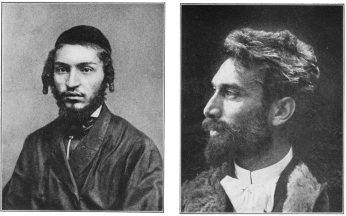
A JEW OF THE POORER TYPE
A product of persecution and orthodoxy. | |
A JEW OF THE FINER TYPE
A Russian Jew; cultured, artistic and cosmopolitan. |
Jehovah’s chosen people have often been regarded with peculiar interest
by the Anglo-Saxons, if not always treated with marked favour; yet even
among them, this feeling has gradually undergone a change, until, their
coming has become a cause for special inquiry by the English Parliament
and one of the chief difficulties of the whole immigrant problem, as it
affects our cities.
I have had peculiar opportunities to note the development of these
changes, and believe that the Jew has been too optimistic regarding his
future in the United States; while the Gentile is too pessimistic as to
the gravity of the Jewish problem.
A clergyman in the city of New York whose fame is international, who is
in constant contact with the best type of Jews, startled me not long ago
by saying that the Jewish problem in the city of New York was in a most
acute stage. In analysing his own feelings, he said: “No matter what you
do, you’re up against it; no matter how you prepare yourself to act the
brother towards them, they won’t let you succeed. You can’t love them
and you don’t dare hate them.”
Mr. Robert Watchorn, the ex-commissioner of immigration, told me that
after an address in which he minimized the problem of immigration, a
well-known citizen of New York came to him and said that in twenty years
Kisheneff will have its counterpart on the East Side.
One of the most liberal Jewish rabbis in this country, whose addresses
teem from the most extreme optimism as to the future of his race in
America, will be amazed to hear that because he was invited to preach
the baccalaureate sermon in a Western state institution of learning, a
large number of the class absented itself from that service. In
commenting upon it, I heard one of the number say to another, in
unacademic, campus language: “Tough luck, boy. They’ve invited a Sheeny
to preach our baccalaureate. It’s an insult to the class!”
The fact that twenty per cent. of the students at Columbia University
are Jews, has led a number of Western boys to say to me: “We won’t go to
Columbia. There are too many Jews there.”
No less brutally frank expressions I have heard in the shops in which I
have worked, and in hotel lobbies where I have loitered; so that while I
may not regard the Jewish problem as the most serious in the general one
of immigration, I certainly regard it as one of the most sensitive to
approach and one of the most difficult to solve.
I usually ask four questions regarding every immigrant group, and the
answer determines, in my own mind at least, the desirability of its
coming to the United States. The four questions are:
First, Do we need them? By that, I mean, will they perform some useful
function which is necessary and which the earlier comers cannot or will
not perform? This is entirely an industrial question and can be safely
answered only by the economist, who knows the field in all its bearings.
My conviction, based upon no such accurate knowledge, is that we most
need those groups which live by their muscle, rather than by their wits;
the toiler, rather than the trader. If my theory is correct, this would
exclude many Jews; although I am sure that they have performed many
important functions in the industrial sphere, both in the realm of
manual labour and out of it. Some such discrimination seems to me fair,
for it would bar classes, rather than races, and would affect equally
other commercial people, such as the Greeks, Armenians and Syrians.
Whether or not this first question is fundamentally sound, of one thing
I am sure. Half the ill feeling against the Jews would vanish if they
would give themselves in any large numbers to the mechanical trades and
to agriculture.
Second, Does the group which seeks admission have the same economic
ideals which characterized the earlier groups?
This refers to standards of living as well as to standards of making the
living.
The Jew answers well to the first part of the question; in fact, better
than the Latin or the Slav. Although he may be compelled to eat plain
and coarse food, he craves the richer and daintier fare; if he has to
live in a tenement on the East Side, he does it with an eye to a flat
in Harlem; for the Jew has never ceased looking for the “land flowing
with milk and honey,” or longing for the “flesh-pots of Egypt.” His
standard of living is not low, but as some one has said: “elastic.” He
may eat red herring to-day, but to-morrow he will eat carp with garlic
sauce; that is, if he can afford it.
He will control his historic appetite in order to “get on,” and it is
the subordination of health and decency to this desire which often makes
him an economic problem, if not a menace.
But when he has attained, he is no miser. His children must have the
best education, and his wife the most expensive clothing; he will save
his children from the sweat shop if he can, and his wife whether he can
or not. He is not willing to live off his children or on the town;
although he is not always above living on his more fortunate brethren,
whom he thus gives a chance to earn the divine favour by bestowing alms;
he rarely sinks into pauperism.
The agencies which minister to pleasure, the theatre, the concert hall
and vaudeville, would lose a fair share of their patronage if Jews were
excluded from them.
The Jew is neither a total abstainer, nor is he intemperate, and his
expenditure for alcohol, compared with that of the Irish, is about as
one to a hundred. None dreads the coming of Jews into a neighbourhood
more than the saloon-keeper, and some of the vilest localities in New
York have been made fairly decent by the expansion of the Ghetto.
One of the most difficult questions to answer is, whether Jewish ideals
of making a living accord with those which characterize the older
groups. The popular judgment is that they do not. It is commonly charged
that the Jew degrades the industries upon which he enters; that as a
competitor he is unscrupulous and as an advertiser, dishonest. “Jewing
down” is a phrase too well known in commercial life to need
interpretation.
Whether it is the “quality of the Jewish mind” which has created this
judgment, as Professor Shaler indicates, or whether it is the quality of
his moral nature, I am not in a position to determine. All I can say
with a sense of assurance is, first, that the business morality of the
Jew not only compares favourably with other commercial groups which are
coming to the United States, but is generally admitted to be higher than
that of the Greeks and Armenians.
Second, That the so-called Jewish business ethics, which in reality are
Oriental and not essentially Jewish, and are also prevalent on the
continent of Europe, do not compare favourably with the straightforward
business methods traditional in America.
Third, That the Jew has adopted these American standards in the lines of
business which he controls, and that in every city he is counted among
its most substantial and reliable business men.
Fourth, That although the methods used by large numbers of Jews in
business are often questionable, as is often the business itself, they
have a remarkably clear record in the sphere of high finance, and that
it is most fortunate for the well-being of the Jews in America that the
so-called “Captains of Industry” are a native product.
Roughly speaking, then, the charges that the Jew is an unfair competitor
in the industries and in business may be true; yet if the case were put
to a jury which could to some degree free itself from prejudice, the
result would probably be a disagreement. What could not be easily denied
is, that the sense of truth in the Jew from the east of Europe, notably
from Poland, is low.
I quote Mr. H. S. Lewis of London, a Jew, and an unprejudiced
authority.[2] “One is sometimes tempted to conclude in despair that the
bulk of the Polish immigrants have no sense of truth whatever. No more
painful spectacle can be witnessed than the hearing of a summons at an
East-End police court, where the parties concerned are foreign Jews.
Obvious perjury on the slightest provocation is committed in case after
case. The comments of Judge Bacon at the Whitechapel County Court on
this fact have been at times severely criticised by the Jewish press.
His generalizations may have been too sweeping, being based on his
experience of petty litigation, where the seamy side of life is
necessarily prominent. At the same time, his remarks have been based on
a substantial substratum of truth. It is the experience of most visitors
among the foreign poor for charitable societies, that although absolute
imposture is exceptional, falsehoods with regard to the details of cases
are constantly met with.
“It is to this taint of untruthfulness that most of the other defects of
the foreign Jews are to be traced. I fear that it cannot be denied that
their standard of business morality is often defective. A statement of
this kind may be regarded as unfair, and it is, of course, difficult to
put it to any exact test. An illustration is, however, afforded by a
return of convictions, periodically issued in the minutes of the London
County Council, for the use of false weights and measures and kindred
offenses. Judging by the names of the offenders, an altogether undue
proportion of them appear to be foreign Jews.
“We meet also in East London with far too many cases where the
Bankruptcy laws are evaded by persons who pass through the courts and
reappear in business with suspicious celerity and without apparent
loss.”
The testimony of Rev. Max Wertheim of Ada, Ohio, ought to have some
weight—it concerns the Americanized Jew. He was a rabbi at Dayton,
Ohio, and after passing through various religious crises, became a
Baptist, and is now doing devoted work on a small salary. Naturally, he
has not received the most generous treatment from his former
co-religionists, and would hardly flatter them. In answer to my question
whether he found any difference in business standards between his Jewish
and his Christian flocks, he unhesitatingly said that there was no
difference.
More weighty is the testimony which Prof. Graham Taylor gave recently
before a Christian Brotherhood. “I know as good Christians among the
Jews as among the churches.”
I am quite sure that basically there is no difference; although I should
characterize some Jewish methods as mean, and those of some Gentiles as
dangerous. In making this distinction, however, I realize that “wooden
nutmegs,” high-bottomed fruit boxes, sun-kissed apples at the top of the
barrel and gnarled ones at the bottom, as well as other tricks of the
native trade, are mean enough; while the methods of the theatrical
trust, the adulteration of foods and drugs, the white slave trade and
other questionable forms of business engaged in by both Jew and
Gentile, may be called both mean and dangerous.
It is also interesting to note that in the great industrial struggle the
Jew is represented largely on the capitalistic side; but on the other
hand, some of the strongest leaders in the labour unions and many of the
Socialists of the rank and file are Jews; consequently the vox populi
may condemn them for being both.
The third question is: Does the group possess ethnic qualities that will
prevent normal assimilation, and therefore will increase race friction
already dangerously strong?
Disagreeable as is the Jewish type when very pronounced, it is
undergoing such rapid changes where the environment is favourable, that
it does not present a serious barrier to assimilation. The issues of
intermarriage are exceptionally good and the resultant types normal. Yet
in spite of the vanishing type, the Jews are a peculiar people and will
long remain so. Their historic inheritance and their religious
traditions, no less than their attitude towards the Gentiles and the
attitude of the Gentiles towards them, will naturally keep them a group
apart. The hostile attitude on both sides ought not to be strengthened,
and I believe that for a period at least, Jewish emigration from the
east of Europe should cease. Not because I believe the Russian Jew
inferior, but merely because he is numerous and the ethnic and cultural
difference between him and the native is so marked as to aggravate an
antipathy already intense; this the Jews themselves feel.
A Jewish merchant, who lives in a certain town in the Middle West, told
me that strong Anti-Semitic feelings were aroused in the community by
the arrival there of Russian Jews, and that as soon as they moved away
the feeling vanished.
Another Jewish merchant told me that in visiting various places with a
view to locating his business, his first inquiry was: “Are there any
Russian Jews in the town?” He said that business for the Jew is better
where there are no Russian Jews.
The feeling of the Americanized Jew towards this new immigrant was thus
expressed by one of them: “We have to stand by them, but we wish they
hadn’t come.”
My fourth question refers to the attitude of the groups towards our
social and political ideals.
If the family ideal is the basis of our social and political life, it is
certainly safe in the keeping of the Jew, who, if he errs at all in that
direction, errs in making the well-being of the community or state,
secondary to the well-being of his family.
In spite of the fact that divorce, according to the rabbinic law, is
easily obtained, almost as easily as in some of our Western states, it
is rarely resorted to. Sexual immorality, wife desertion and divorce,
become more common among the Jews only under stress of changed economic
and religious environment.
The criminal record of the Jew is still good; although he is under
suspicion of merely being too shrewd to be caught.
In the so-called lesser and meaner crimes, such as receiving stolen
goods and pocket-picking, he has almost a monopoly; while in burglary
and murder his record is fairly clean.
At present there are no reliable statistics on this point, and there is
much chance of juggling with figures, for friend and foe alike.
The report of the Commission of Immigration of the state of New York
presents a table of foreign born white offenders in the state’s prisons
in 1904, but unfortunately does not classify the Jews as such. However,
if one took the entire number of criminals tabulated under the countries
from which the Jews come, namely: Austria, Hungary, Russia and Poland,
and counted all as Jews—a procedure manifestly unfair, even then the
prison population of the state of New York contains over twelve per
cent. more Irish than all the natives from these four countries, who of
course are not all Jews, but represent different faiths.
In lieu of reliable statistics, therefore, I must trust to my own
experience. I have found that grosser criminality among the Jews is a
more abnormal phenomenon than among most of the newer immigrant groups.
In my intimate acquaintance with a number of Jewish communities in
Europe, I know some as large as 10,000 souls, where such crimes as
theft, robbery and murder are never committed; yet where cheating,
fraudulent bankruptcy and receiving stolen goods are not uncommon.
The Jew has done himself almost irreparable injury by his protest
against the reading of the Bible, and Christmas exercises in the public
schools and in his attitude towards Sunday laws. In both cases he has
shown himself intolerant, and has alienated staunch friends whose help
and sympathy he may need in the day of tribulation. As a citizen and
patriot, he is everywhere giving evidence of his devotion; while in the
struggle for the coming of a better day in the government of our cities
and of the state, he has done his full share; indeed, among the newer
immigrant groups, he has furnished to that cause by far the largest
quota.
There are several points at which the Jew does not satisfactorily answer
the questions I ask. He provides far too large a number of those, who,
as a class, seem unnecessary at the present stage of our economic
development; he presents too solid a differentiated group, will retard
proper adjustment and increase existing race antagonisms. His attitude
towards the manifestation of the religious spirit in our public
schools, his intolerance towards certain religious practices which are
fundamentally ethical and social, but not necessarily sectarian, will
more and more alienate those Americans who have been most hospitable
towards him and upon whose good will he is dependent, economically and
socially, if not politically.
These, I think, are the sore spots of the problem; and if the Jew is as
shrewd as he is painted, he will look to their healing; while if the
American is as charitable as I think him to be, he will give the Jew
full time for reconvalescence.
IT has always been dangerous for the common mortal who was the spokesman
of his kind to eat at the king’s table; for the tyrant at close range
proved an admirable host and pleasant gentleman, whose tender meats and
delicate wines covered a “multitude of sins.”
When, after having eaten lunch on the East Side for a week, one
receives an invitation to luncheon on Fifth Avenue, even the most
scrupulous may temporize, and I confess that, feeling highly flattered,
I tossed my scruples to the winds and accepted the invitation.
The feast began for me, when my eyes rested on the splendid architecture
of the palatial residence, its furnishings, marbles and pictures, which
appealed to my artistic sense and almost reproduced the atmosphere of
the refinement and culture of those lands in which they had their birth.
In the winter garden where fountains played, and rare flowers nodded
their bedewed heads, filling the air with fragrance, I forgot the
squalor of the East Side and the darkness and dampness of that raw,
February day.
With the luncheon I was less pleased; for frankly, I prefer noodle soup
and Gulyas to French snails and terrapin.
To my plebeian palate the snails tasted like mucilage flavoured with
garlic, and the terrapin like fricasseed Turkish towels.
Of more importance than the menu was my host, whose every word betrayed
the consciousness of his power and his ignorance of those lesser folk,
as whose champion he had invited me to be his guest.
“What can be done to stay the power of Socialism?”
“How can we keep out Black Hands and Anarchists?”
To him, immigrants, Socialists and Anarchists were synonymous terms. My
speech was not yet dulled by the luncheon or my brain clouded by the
smoke of his Havana cigars, and I gave him such plain answers as I might
have given after lunching on noodle soup and Gulyas.
My words were as unpalatable to him as his snails and terrapin were to
me; for I told him that Anarchists live in brown stone houses and that
Socialism is being fed and nourished on Fifth Avenue. Our views were as
far apart as our bank accounts, and to argue with him seriously would
have been as useless as it would have been poor taste. He became more
human as the luncheon progressed from its airy and aristocratic entrées
to the more democratic and substantial roast beef and potatoes.
When we reached pumpkin pie, one of the few connecting links with his
humble past, he had quite lost his critical sternness, and asked my
advice upon so delicate a matter as how to give his wayward sons a
grappling place for the upbuilding of character.
I suggested work in the Settlements; but he regarded them with
suspicion, declaring that they are irreligious and a breeding place for
Socialism. He listened with indifference to my defense of these
institutions which I regard as among the most valuable agencies we have
for the common good. I suggested some public service for the community
or the state.
“Politics?” he asked quizzically; “it’s a dirty game. I want my boys to
help me take care of the interests I have.”
I did not know what those interests were, nor did I care to inquire, and
luncheon being over, I rose to take leave.
“Where are you going?” asked my host, rather abruptly.
“To the East Side,” I replied.
He wondered whether I was not afraid to go there, and when I told him
that I felt safer in the Ghetto at night than I should feel two blocks
west of his palace, he asked whether he might accompany me.
Knowing the free and easy ways of the Ghetto I assured him a hearty
welcome; so we left his home together and took the car for Houston
Street and Avenue B to attend the Gulyas banquet to be given by the
“Bolsover Sick and Benefit Association,” in its hall on Houston Street.
Sunday afternoon is the day on which the East Side looks its best. Its
squalor is temporarily hid beneath the festal garb of the rest day; the
children are still clean after their weekly scrubbing, and the mothers
sit on the stoops, gossiping and watching with the Old World timidity
their agile flocks playing in the middle of the street, also fairly
clean in comparison with its condition on the busier work days, when the
refuse of push-carts and ash cans covers it.
My millionaire host evidently found pleasure in this human mass. He saw
children who seemed happier than his own; for although they had fewer
pleasures, they had no governess to dog their footsteps, no maid to keep
them from exertion and no fear of microbes or bacteria.
Here in the Ghetto all the unrestrained child nature asserted itself,
and being children they had no thought for the morrow and having been
born in America, they were boisterously happy.
My host decided that after all humanity on Houston Street is not so
different from that on Fifth Avenue. The women, especially the younger
ones, were gowned as fashionably although less extravagantly; pony coats
being the style on Fifth Avenue were also found on Houston Street, and
most of the women who paraded both streets looked very much as if they
belonged to the same herd.
Hats were as expansive if not as expensive in this hemisphere of the
social world as in his own; while pride and social prejudice were common
properties of both.
Our entrance into the lodge room, on the fourth floor, over a Kosher
restaurant, was announced by the outer guard, after which a committee
came out to meet us. Then pledging us to secrecy we were escorted to
places of honour at the right and left of the Grand Master of the lodge.
The small room was completely filled by over one hundred members, and
after the business under discussion was finished, we were duly
introduced and addresses of welcome were made by officers and prominent
members.
I doubt that my fellow guest ever listened to addresses which he enjoyed
more than those he then heard, spoken in broken yet picturesque
language; and I am sure he never before realized that such lofty
sentiments lodged in such humble hearts and amid such forbidding
surroundings.
These hundred and more men, we were told, were bound together in
fellowship to help one another when unemployed, to support and nurse one
another when sick, to pay the last honours to the dead and to protect
the widows and the orphans.
And that was not all. It is the object of this lodge to work for mutual
intellectual improvement, and although politics are tabooed, the lodge
strives to develop noble, patriotic ideals among its members.
Of the men who spoke, I have known some from their childhood, and all of
them since their arrival in the United States.
It will not break the pledge of secrecy to say a word about these men,
typical immigrants from Hungary.
The Grand Master was born in a Jewish home in which the best traditions
of the Hebrew faith were adhered to. I have been there many a time
carrying messages from son to parent, and it was always a delight to
meet the saintly old father and mother who have never ceased being
homesick for their boy. He has gone through a hard school in America,
from sweat shop to laundry; and now he is a letter carrier.
The Past Grand Master is a wood-worker who tried business, but failed
and is now back at his bench.
Another is a metal worker, and his calloused hands prove that he obeys
the Divine injunction, and earns his bread by the sweat of his brow.
The man who proposed our being made honorary members of the lodge had
entered the University of Vienna, suffered moral bankruptcy and ran away
to America. He is a cloak presser.
The man who seconded his motion is a waiter, the prodigal son of a rich
father, brought low by his iniquities; but kept from utter ruin by the
fellowship of these men.
I know the record of them all; good and bad records, like those of other
groups of men; but every one of them is now earning his daily bread and
is contributing something to the wealth and the weal of the great city.
My millionaire friend frankly confessed that he had never seen a “bunch”
of men which impressed him more favourably than these—and well they
might impress him; for they all looked like toilers. Labour had bent
their forms, parched their skin and shadowed their eyes.
It was a long meeting, until far into the night. Several times the outer
guard had announced that the Gulyas was ready; but not even the odour
of its rich sauce which pervaded the building could stop the flow of
eloquence, once set in motion, or curb the eagerness with which rival
candidates battled for office.
At last the Grand Master smote his desk with his gavel for the last
time and the “meetunk” was adjourned.
In proper order and ceremoniously, we were conducted to the basement of
the Kosher restaurant. The steaming Gulyas was on the tables, beer
and wine awaited the thirsty guests and the banquet began even before
all the members of the Bolsover Association were fairly seated.
My companion looked askance at the bowls of Gulyas with its red gravy;
but it wooed his appetite through his nostrils and he gained sufficient
courage to take a piece of the well cooked meat with its dripping sauce.
Then I saw him eat as I had not eaten of his French snails and terrapin.
The members of the Society drank their modest measures of beer and
Hungarian wine as toast followed toast.
It had been my privilege not long before to have a conference with
President Roosevelt, and as I rose to toast the chief magistrate of the
United States, I repeated a few of his trenchant sentences. “Elyen!
Elyen!” the men shouted when I mentioned his name; and when I said that
the President had expressed to me the hope that we strangers should so
live that the country which gave us “sanctuary,” a place to work in and
to live in, might be proud of us—the enthusiastic “Elyens!” seemed
unending. After the banquet, the man who had successfully run for the
secretaryship invited us to come into his home, not far away. My host,
having had a taste of the East Side and wanting more, readily accepted
the invitation.
We found this home in the second story of a tenement house on East Ninth
Street. We entered through the kitchen, and in the one other room,
living room, sleeping room and nursery combined, was the man’s wife with
their three daughters. The youngest was in bed, the older one was
reading, while the oldest was entertaining friends—two or three girls
and a young man, her “steady company.” The room was crowded, but clean,
and my Fifth Avenue friend sat down and looked at the novel picture
before him.
The young people chatted about the recent ball of the Bolsover Sick and
Benefit Association, of clothes and beaux; very much as they talk of
balls and clothes and beaux on Fifth Avenue.
Refreshments were offered us, and then the father told of his good
fortune in having been elected secretary of his lodge. Every one was
delighted; but the younger daughter, this little Jewish child, said:
“Papa, why don’t you run for president, once?”
He replied: “My child, don’t you knows that I gets paid for being
secretary, and gets nothing for being president?”
Upon which, this child of the Ghetto faced her father half angrily,
crying: “Why, papa, don’t you know that honour is more than money?”
We left the tenement house together and walked across to Broadway, all
along that gaily lighted thoroughfare, illy named the White Way.
Theatres and concert halls were being emptied, and we were jostled by
the crowds. My friend spoke never a word until we reached the marble
steps of his home. Then, pressing my hand, he said, with almost a
tenderness in his voice: “Honour is more than money.”
WHEN I told a group of friends that I was to speak to the Albanians of
Jamestown, N.Y., one of them, who knew both her history and her
geography uncommonly well, said, questioningly: “Albanians? Are those
the people with white hair and pink eyes?” Then, realizing that Albinos
and Albanians are not identical, and being genuine enough not to conceal
her ignorance, she asked: “Do you mean the people from Albany, N.Y.?”
She may be pardoned for not knowing who the Albanians are, although they
are one of the oldest European peoples, who have kept a corner of that
continent turbulent, in the attempt to wrest from their master, the
Turk, the right of political existence.
One cannot say that the Balkan would have been a peaceful nook had it
not been for these Ghegs and Tosks, as the two main divisions of the
Albanians are called; but certainly, the history of Turk, Greek and
Southern Slav would have been different had it not been for the
Albanians’ clinging tenaciously to ancient rights, and their many
struggles against continuous oppression.
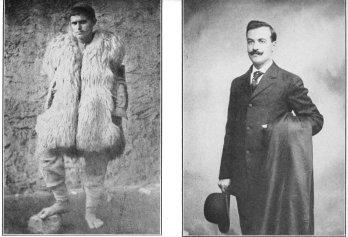
| ALBANIANS |
ON LAKE SKUTARI
The most savage of the Balkan people. |
ON LAKE CHAUTAUQUA
The newest of the Pilgrims, attending the Congregational
church, Jamestown, N. Y. |
The new régime in Turkey feels this Albanian iron in its veins, for one
of the leaders in the new parliament is of this race, as are many of the
most virile editors of Turkish newspapers. Both officers and privates in
the army which wrought the overthrow of the Sultan are of these same
people, who regard themselves as superior to the Turks and to whom no
greater insult can be given than to call them by the name of their
oppressors.
In my travels through the Balkan, I have often passed through some
portion of Albania, which is a narrow strip of land along the Adriatic,
between Montenegro and Greece, with much of its interior inaccessible.
Its savage state was encouraged by Turkey, which maintained there a
borderland against the power and ideals of the West.
Every village was an armed camp, every house a fortress. Tribal warfare
never ceased; neither the holy seasons of the Church nor harvest time
knew the blessings of peace. Every Albanian was a soldier or brigand and
sometimes both, loyal to those to whom he had sworn loyalty; but the
musket was law between him and the stranger, and the bullet its
executor.
Trained for slaughter, the Albanians spurned common theft, but did not
shrink from murder, for pillage or for revenge. The last time I saw them
at home, was on the shores of Lake Skutari, retreating to their native
mountains in the Albanian Alps, after having pillaged a Montenegrin
village, one of the few prosperous enough to make a raid worth while.
They were resting on a rocky hillside, and as I attempted to take a
snapshot, they resisted religiously, good Mohammedans that they were, by
emptying their rifles after me, doing no more damage than frightening my
worn-out team into a gallop.
To say that the next time I saw them, was in the prayer-meeting room of
a Congregational church, describes graphically the difference between
then and now; for it was a docile, conventional looking company of men
that I met; their fierce mustachios shaved or cropped, their muscular
bodies clothed in the commonplace garments of our civilization. Their
eager, black eyes alone spoke of the hot, Albanian blood in their veins
not yet chilled in our cool, workaday atmosphere.
Neither Gheg nor Tosk ever had a chief like the one who led them that
night in singing the “Shcipetari” song, the battle hymn of Albania; for
he who wore the red skullcap of the chief and beat time as they sang,
whose placid face was lighted by a deeper passion than their own, was an
American,—Arthur Baldwin, Patent Attorney and lover of common folks.
One by one he had gathered them as they drifted into the city by the
lake. “Dagos” they were called; homeless, neglected and treated with
scorn. One after another they swore fealty to their new chief, until now
every one of them acknowledges the sovereignty of his passion over them.
Half savage as the Albanian is, he has a fine feeling for womanhood.
Woman is man’s fortress; for he is safe from the enemy’s bullets when in
her company, and she may kill the man who has broken his troth with her.
While the men are loyal to Mr. Baldwin, they feel for Mrs. Baldwin a
sacred awe, and well she deserves their reverence; for she has been
mother and sister to these homeless youths and has taught them the
English language by a method of her own.
Most of the Albanians in Jamestown, and many of those who have scattered
east and west from there, carry with them Mrs. Baldwin’s letters, which
are the English lessons for the week, combined with cordial greetings, a
word of good cheer, and advice.
In the prayer-meeting room of that church of the pilgrims, these newest
of the pilgrims sang that night their national hymn.
Ce me gne te Kollozhégut,
Ch’u fillua Shocerija,
Ce me gne te Kollozhégut
Ch’u fillua Shocerija
Ch’u fillua, brénda m’u ne Sofijé
Per skoli nde, Shciperi.
Ch’u fillua, brénda m’u ne Sofijé,
Per skoli nde Shciperi.
Burra, burra djéma, burra djém,
Burra djém perpicuni.
Burra, burra djéma, mbuhuni,
Mbushuni mé dashuri.
S’jémi Gréker as Bulgare,
Jémi trima Shcipetare
S’jémi Gréker as Bulgare,
Jémi trima Shcipetare
Dhente Zoti la me la,
Afer ghér nde Pérendi,
Dhente Zoti la me la,
Afer ghér nde Pérendi.
Burra, burra djéma, burra djém,
Burra djém perpicuni.
Burra, burra djéma, mbushuni,
Mbushuni mé dashuri.
The music is savagely martial, although the words are commonplace; for
the Albanian, like the rest of us, is thanking God that he is not as
other people, especially the detested Greeks and Bulgarians.
After the singing, the men danced. Shades of the Puritan ancestors!
Dancing in a prayer-meeting room! But inasmuch as these were
semi-civilized people, the dance was decent and full of religious
symbolism. The men swayed their agile bodies to the wild notes, bent the
knee, then two by two joined hands, forming a cross; thus making their
dance an act of worship.
Then I spoke to them of their mountain home and of this one; of their
old tribulations and their new opportunities; of their old feuds and
their new friendships. When I finished, they crowded around me and
pressed my hand, because they had found one who knew them, their fierce
nature and their unsurpassed devotion to their native land. I could not
help thinking of their brothers who, ten years before, chased me along
the shore of Lake Skutari with guns.
While I am sure that Mr. and Mrs. Baldwin would not desire praise for
the work they are doing among these people, the methods they have used
and the spirit which has animated them are so remarkable as to deserve
emulation. Their basis of approach to the Albanians was undisguised and
unadulterated friendship. They liked common folks. As other people on
the shores of Lake Chautauqua liked automobiles or steam yachts of
particular makes, so among folks, the Baldwins liked Albanians. Being
their friends, they wanted to do them good, and what they most needed
was ability to understand English; so they taught them English and with
the new language they have given them the atmosphere of home and
impressed upon them the need of character to save them from the new
temptations.
Wiser than some others who have attempted to do good to strangers, they
restrained their religious ardour and left Greek Orthodox and
Mohammedan undisturbed in their faith, except as by their example they
taught them that love is more effective than its symbols and deeds more
vital than creeds. Neither have they tried to deaden the old patriotism;
and the one great, starry virtue of the Albanian which is almost
unparalleled, is his devotion to his country.
After I had spoken that night, I was escorted to a restaurant kept by
one of them, and there over the steaming coffee we talked of Albania’s
griefs and hopes.
Mr. Baldwin knew every nook and corner of the country and its history.
He spoke of Albania as if he had been cradled among those far-away
mountains, instead of on the placid plains of the Middle West. He
deplored the fact that they had no schools in which their own speech was
taught, that religion held them apart, through factions of Greek
Orthodox, Roman Catholics and Mohammedans; and he talked of Scanderberg,
their national hero, as if he were speaking of Washington or Lincoln.
Mr. Baldwin had invited me to Jamestown, to counsel with his men, who
are doing the most menial tasks to earn money for Albania. At that time
all was dark in Turkey, and a visionary alone could have held out hope
for an autonomous Albania.
Practical American that I have become, I told them to save their money,
start bank accounts and become prosperous Americans. They knew better;
at least they had more faith. They were then training a man in an
American college, for political and social leadership; a young Albanian
noble, who spoke eight languages, had faith in God and man and, above
all, in Albania.
Until long past midnight I talked of peace while they talked of war; I
spoke of submission, while they talked of resistance; I thought I knew
Turkey and the Turk, while they had faith in Albania and the Albanians.
The recent developments prove that their faith was better than my
knowledge.
When the Jamestown Albanians scattered as far east as Natick, Mass., and
as far west as St. Louis, Mo., their old friends aroused interest in
them everywhere. In Natick, Mass., a devoted pastor, Rev. Morris H.
Turk, has matched the Jamestown work for these “twentieth century
pilgrims” as he calls them. He has learned enough Albanian to lead in
devotions, and has fitted out a chapel with chancel, altar and pictures.
“We began,” he says, “where the Greek Orthodox church left off. We
secured some Albanian hymn-books from Monastir, and thus we were enabled
to conduct a somewhat formal religious service, largely in the Albanian
language. Socials, entertainments, receptions, picnics and other
diversions supplement the religious and educational work done at Natick.
“The results have been remarkable. Two of the men are fitting for
college, a dozen or more have blended completely into the parish life,
and best of all, a hundred or more have had the uplift of friendliness
and acquaintance with our American ideals.”
Mr. Turk is making a tour of Albania this summer for the express purpose
of rendering his service to these people more effective; to see life
from their view-point and to acquire a better knowledge of their
difficult language.
Mr. Guy J. Fansher writes from Boston, where he has become interested in
them: “Their love of country is very strong and, like the old Hebrew
prophets in Israel and Judah, we find it necessary to carry on whatever
religious work we may wish to do side by side with their love of
country. This same love of country has been evidenced in their
translating of the Orthodox Church ritual into the Albanian and using
that in their church service monthly in a rented hall.
“I found the men apt to stay indoors too closely, so during the winter
gave them work in gymnastics, using dumb-bells, basket-ball, etc. We had
some flash-light pictures taken of these classes, which the boys were
eager to buy and send home.
“The men are close readers of the daily papers, soon get interested in
politics (were strong for Taft), get out naturalization papers as soon
as possible, and are proud to be in America. They soon learn to dress in
neat suits of brown which is very becoming to them with their dark skin
and hair.
“The men seem to have good control of their habits, seldom drinking to
excess; the cigarette is always with them, however; the social vice is
not theirs to any great degree; they are neat about their rooms and do
not crowd together as the Italians or Jews. These things have rather
assisted our work among them; their exceeding shyness has been hard to
overcome; they must be led, not driven.”
“They must be led, not driven,” and Mr. Baldwin adds: “They must be
trusted, not suspected; loved, and not merely tolerated.”
The events in Turkey have surprised every one who has an interest in the
Balkan question. The young Albanian noble, already referred to, is back
in Albania, somewhere near Lake Skutari, helping shape the future of his
country; for he is a leading member of the Albanian Committee.
On Lake Chautauqua his countrymen still work and pray and hope for an
autonomous Albania, with schools and churches in which they shall be
free to use their language and in which they shall have privileges
commensurate with their sacrifices and with the burdens they have borne
for Turkey.
Then they will sing in Kortia the song they sang in Jamestown, when we
parted before the early dawn of a winter’s morning. It was a national
hymn, which the Albanians have a right to sing, although they sing it
under the crescent banner of Turkey; for it is a translation of
our—“America.”
O Zot Ti fucimath,
Ndihna si ghér tashi
Te lutémi;
Lardi tet’apeme
Mé ghithe zémere:
Per dashurimne T’ent
Ce shoheme.
THE one institution in America most gravely concerned with the coming
and staying of the immigrant is the Protestant church. Each ship-load of
people from Southern and Southeastern Europe increases the already
crowded Roman Catholic parishes, lays foundations for the perpetuation
of the Greek Orthodox church in the United States and enlarges the tents
of Israel whose camps encircle the dying churches.
The Protestant church, in our great cities, pointing to the decrease in
her membership, as evidence of her peril, and bravely singing “Onward
Christian soldiers, Marching as to war,” moves into the suburbs, away
from the congested masses and among the attenuated few.
That the Protestant church has endured thus far, that its ideals are
still dominant, that its preachers’ voices are still heard in the
tumults of our Babels, is direct evidence that somewhere her foundations
rest upon bed-rock and that the Christian faith and practice, as she
understands them, are essential in the solution of the problems of our
civilization. Because I believe this, I am not frightened by figures but
am concerned with forces. It is not a question of the ability of the
church to increase, but of her willingness to decrease, if necessary, in
the attempt to communicate to these masses, from all races and
religions, her passion for humanity and her devotion to the Divine.
I am not at all concerned regarding the inability of the Protestant
church to adjust other men to her creeds or to adjust herself to theirs;
but I am deeply concerned with her inability or unwillingness to make
good her professions of democracy, and to relate herself in some vital
way to these new citizens who are satiated by creeds, but are hungry for
brotherhood; upon whom, like a curse, rest the damp and mould of tombs
and chapels, but who have been untouched by the power of the living,
redeeming Christ, as He has incarnated Himself in His followers.
So long as these people are within the sphere of Foreign Missions, in
“Greenland’s Icy Mountains,” or some other remote and romantic place,
they are the subjects of prayer and the recipients of gifts of men and
money; but when drawn into the radius of one’s immediate neighbourhood,
they become a peril which threatens everything, from the price of real
estate to the foundation upon which the church rests. There is no
question that in many cases the Protestant church is facing this
problem in an admirable spirit; although very often expressing it in a
way calculated to alienate rather than to attract. On the whole there is
a growing desire to serve this new host of men, to help them adjust
themselves more easily to their new environment and to make of them
conscious human beings, consecrated Christians and efficient citizens.
There are to-day increasing numbers of Protestant Christians who have
broken away from the old prejudice against the Roman Catholic church. It
is not their desire to alienate faithful communicants from the church in
which their individual and national life has root and being; but they
recognize certain facts.
First, that in this new influx of immigrants there is an appreciably
large number of men who have fallen heir to Protestant traditions,
without fully realizing their spiritual inheritance and their moral
obligations. To these, the American Protestant churches owe the duty of
interpreting their common faith in its practical terms.
Second, the church realizes that numbers of men, more than are commonly
supposed, among Roman Catholics, Greek Orthodox and Jews, are lost to
their respective churches. Many of them revert to infidelity and
Paganism, and the Protestant church is under obligations to interpret
its faith in rational terms to these, who have been touched by the
rationalism of our times.
One cannot believe that it is good for such men to be left under the
influences of these reactions which may become dangerous to the
well-being of the individual and of the State.
Third, the church finds itself surrounded by large masses of men,
ignorant of our language, of the laws of health and of the land. They
come from countries in which neither Church nor State has attempted to
lift them out of ignorance and its attendant superstition; and whenever
the churches in whose bosoms these people have starved in the Old World
do not make amends here in the New, the Protestant church is called upon
to lift them into a better knowledge of the nature of religion and into
a better conception of human relations, both for her own sake and for
the sake of the communities which she wishes to serve.
This she must do, even if it brings her under suspicion of proselyting;
although with my knowledge of nearly all the agencies engaged in this
task in the United States, I am convinced that the spirit in which this
work is undertaken is not the spirit of the proselyter. Indeed, one of
the growing weaknesses of the Protestant church in America is the loss
of those deep convictions which make proselyting easy; while the number
of those who have the courage zealously to pronounce their shibboleths
is growing smaller every day.
The spirit of the following letter justifies its quotation, for it is an
admirable example of the way in which one Protestant church is trying to
meet the immigrant problem.
—— Avenue Congregational Church,
Hartford, Conn.,
Pastor’s Study, December 17, 1907.
I am writing this letter to you as an office-bearer in the church
and one who is influential in forming church sentiment and
policies. It concerns the relation of our church to the Jews who
are crowding into the streets about the church in ever-increasing
numbers. The Standing Committee has earnestly and sympathetically
considered the subject, as befits a matter of the first importance
to our church.
The settling of these Jews close about us is easily the event of
greatest importance in recent years in the field of this church. It
would be folly, and in the end impossible, for us to look upon
their presence with indifference. We must not drift in this matter.
We must have, as a church, an intelligent and positive policy
towards them. What shall it be?
Some of us have probably looked upon the coming of the Jew as a
misfortune. Is he not also an opportunity? May we trace the
providence of God in settling him about our very doors? I believe
that we may. This faith grows in me, as one who believes that
Christ is to be Saviour of all the nations.
A rabbi in Boston said recently, “The liberty and friendliness of
America will put the severest strain upon Jewish exclusiveness that
it has ever met. The persecutions of Europe have failed to
dissolve our nationality: the kindness of America may succeed.”
In the light of this sentiment, which I share, and with a great
confidence in the Gospel, I propose that we undertake definitely a
Christian ministry to these Jews. I recognize that an attempt at
immediate propagandism would probably be as ineffective as it would
be unwise. I appreciate that probably few if any open conversions
will reward our labours for many years.
What then shall we attempt? To impress upon them the spirit of the
Gospel by living alongside them as Christians should: this first
and chiefly. Let us do this in the hope that as their old-world
superstitions and narrowness yield to the light of America, they
will thus choose the Gospel instead of infidelity. Many of them are
already choosing the latter.
How shall we begin? By treating the Jew as we want to be treated.
In other words, by treating him not as a Jew, but as a man, each
on his own merits. Recognize always that there are both good Jews
and bad Jews, as well as good Yankees and bad Yankees. Make the
acquaintance of both men and women: and of their children too. Give
them a fair chance to show their quality. They are neighbours. They
are interested in our schools. They are fellow citizens. These
common interests give opportunity to know them and, if we will,
their homes also.
Our government by its franchise and its schools welcomes them to an
equal opportunity to show and to develop their character. The
churches have not shown a like spirit. Shall the state be more
Christian than the church?
This proposal of course includes our attitude towards the Italians
and all other foreigners among us. I speak especially of the Jews
because they are far the most numerous and most difficult to reach.
If a score or even a dozen of us should undertake to show them the
spirit of brotherhood that is our Christian boast, and should seek
to get our other church-members to do the same, it would not be a
month before they would be feeling and speaking of our good will
towards them. Meanwhile we can be watchful for opportunity for some
special ministry to them or their children, a ministry which shall
be welcome both to them and us. The habit of Christian
neighbourliness outlined above will lay the foundation of mutual
confidence and knowledge necessary for such a special ministry.
Have you faith and patience for such a long campaign? Will you
quietly enlist for it and try to persuade others to do the same? If
so, will you kindly tell me of it? We will undertake to keep one
another informed of any news of progress.
You will understand why this letter and your talks with others
about this subject should be confidential.
In the name of Him who was a Jew,
Your Pastor.
The Presbyterian church has given proof of the spirit of its intent by
putting the department of Immigration in charge of Rev. Charles Stelzle,
a splendid champion of the rights of labouring men, a man with the
broadest social and religious outlook and a stranger to Pharisaic cant.
The Rev. Howard N. Grose, D.D., the home mission secretary of the
Baptist church, and the men associated with him in the Home Mission
Council of the Evangelical churches, seem to me to possess that broad
outlook upon life, that appreciation of true values which render
impossible their attempting any narrow, sectarian propaganda.
The action of the International Committee of the Y.M. C. A. in placing
its work for “Young Men and Boys of Foreign Parentage” in charge of so
competent an authority as Dr. Peter Roberts, the author of “Anthracite
Communities,”—and the equipment by the State Committee of Pennsylvania
of “The Expedition for the Study of Immigration” with its plans for a
group of well trained college men as secretaries for immigrants, are
additional evidences of the spirit which animates Protestantism in its
relation to the immigrant.
There are, however, two fundamental mistakes which the Protestant church
has made in her attempt to solve the problem she faces.
First, in the kind of results she tries to obtain.
Second, in the kind of men she has sent to represent her among the
immigrants.
The American Protestant of the Evangelical type has carried his business
into the church, but not always the church into his business. He expects
in the church, results which can be tabulated under the head of profit
and loss, just as he expects them in his counting-room.
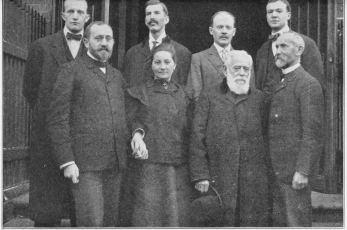 FACULTY AND AMERICAN STUDENTS AT THE MISSIONS-HAUS,
KATTOWITZ
FACULTY AND AMERICAN STUDENTS AT THE MISSIONS-HAUS,
KATTOWITZ
The young men are members of the Pennsylvania Y. M. C. A. Expedition for
the Study of Immigration. The school is strategically situated where
three empires meet. It is non-sectarian and interdenominational;
permeating the East with Christian ideas.
“Immediate results!” is the cry of the constituents of missionary
enterprises, and the result is, that where they cannot be legitimately
produced, conversions are simulated for loaves and fishes.
I do not mean to say that missionaries have not so preached and
practiced the Christian faith, as to produce in their hearers a desire
to adjust their own lives to these new standards; for I know of
innumerable cases of this kind among all races and nationalities.
However, the stress laid upon “immediate results,” the praise and money
lavished upon those who can produce them, the “showing off” of this or
that kind of converted foreigner, the neglect of those who face real
difficulties honestly, and cannot humbug those who support them, put
severe temptation in the way of missionaries and often unconsciously
taint their whole endeavour.
If the Christian religion expresses itself in unselfish devotion to the
noblest cause,—the service which the immigrant needs must be performed
without an eye constantly upon church records.
The Social Settlement is under no such strain, and its work is like
“casting bread upon the water” without expecting it back, “buttered”
after a few days.
For a long time and even for all time with some individuals and groups,
the church must be willing to follow this Biblical example set by an
institution which some ill informed people suspect of being irreligious.
The error which the church has committed in sending poorly prepared men
to minister to these immigrants is in many cases as irreparable as it is
inexcusable.
An ignorant priesthood is more bearable than an ignorant ministry, and
when ignorance is coupled with insincerity, as it is in many cases, the
wrong done to both parties is incalculable.
In their haste to “do something,” and in their eagerness to get quick
results, nearly all Protestant churches have pushed into the ministry
“converted foreigners,” many of whom misrepresent the church which sends
them and become a stumbling-block to honest seekers after truth and an
insult to the people to whom they are sent.
An example of this lack of wisdom is shown in one of the most
interesting missions of a really valuable type, developed in West
Pittston, Pa., by a devoted young American woman who, in a remarkable
degree, won the confidence of the Lithuanians there. She lived and
laboured among them and created a centre of influence which gave great
promise of being permanent in its effect. Her work, however, was much
too indefinite and slow for the “hustling” church which supported her;
so a converted Lithuanian was employed, who in his eagerness to save
souls told the people whom he gathered to hear him preach, that they
would all be damned if they continued going to the Roman Catholic
church. The result was what one might expect. The Lithuanians
immediately forsook the mission and went to the prohibited church.
As a rule, the work to be done demands American born men and women who
are imbued by the spirit of service, who have some linguistic talent and
much consecrated common sense.
The converted foreigner, even if well trained, will be met with
suspicion by many groups; for to them he is a traitor to their religion
and to their national life, the two being inseparable to them.
No such objection can be made to the American worker, who, if he brings
patience to the tedious task of winning confidence, if he has an honest
desire to live unselfishly for the people of a neighbourhood, if he
gives everything and expects nothing as a reward, may be assured that
such service will be accepted and will work out its results in God’s own
time.
If converted immigrants are sent among these people, they should have a
long testing time; a tutelage and training which, while giving them a
thorough equipment for their task, will not spoil them for the humble
work it will involve.
There are but few theological seminaries properly equipped to train men
for this great work, and still fewer in which there is sufficient spirit
of democracy among teachers and students to receive “immigrants” and
treat them like brothers.
In many small, industrial communities where the “immigrants” are a
problem, its solution is merely a question of the attitude of the
churches towards them.
Nothing can be more repellent than the attitude of the average
Protestant Christian towards the immigrant of to-day. As a rule he is
prejudiced, is grossly ignorant of the historic and religious background
of the strangers and meets every one of them with suspicion.
At a recent Summer School of the Y. M. C. A. it was my privilege to
teach a class of young college men numbering about 150. They were
studying this problem, and the questions asked, a few of which I quote,
prove the assertion just made.
“Do not three martyred presidents prove that the immigrant is an
Anarchist and ought to be excluded?”
“Is it not true that ninety per cent. of the criminals in the United
States are foreign born?”
“Do not foreign governments dump their rubbish of criminals and paupers
upon our shores?”
“Is the Constitution of the United States safe in the hands of people
who crucified Jesus?”
“Did not our forefathers come to fight for liberty, and do not these
people come to despoil us?”
The questions asked displayed such animosity and such ignorance, that to
print them all would seem like slandering our Western colleges and the
churches in which these young men were reared.
The churches and the Y. M. C. A.’s have no small task in converting
their membership to some Christian view-point of these, their
neighbours; even if they cannot be converted to a spirit of
brotherliness.
The following instance, while not typical, shows the attitude of Y. M.
C. A. memberships in many industrial communities, towards the immigrant.
An Association in Pennsylvania wished to enlarge its building and
solicited funds in the shops of its own community. Slav and Hungarian
day labourers subscribed $2,000, every cent of which was paid; which
cannot be said of all the money subscribed by Americans.
Some of these foreigners were anxious to learn English, and one of the
rooms in the building—not the best—was opened to them and a teacher
procured. When one of these boys used some of the public conveniences
in the building, the American membership notified the secretary that the
“Hunkies” must not be admitted to the building; and they were not, in
spite of the fact that they had helped pay for its erection.
While no other such gross injustice has come to my knowledge, I know of
many Y. M. C. A.’s in which an Armenian or Greek would be excluded from
such a thoroughly religious privilege as taking a bath.
Wherever a church or Y. M. C. A. has shown itself hospitable to the
strangers it has had as many of their souls to keep as it has cared to
have; but most of them prefer to save the foreigner by “absent
treatment.”
The feeling of the strangers regarding the efforts which the churches
are making on their behalf in so-called missions, which are often
repellently unclean and devoid of any saving grace, is explained in the
following letter, written by a graduate of Oberlin Seminary, a young
Pole, whose spirit and intelligence the letter itself reveals.
Brecksville, Ohio, October 14, 1907.
Prof. E. A, Steiner, Grinnell, Iowa.
My dear Dr. Steiner:—Your plan for the solution of our foreign
problem, as you indicated it in your articles in The
Congregationalist of last year and as you outlined it to me in our
conversation in Cleveland last week, is excellent; and I wish to
tell you that I am in thorough sympathy with it. My own personal
experience in the foreign work convinces me that the easiest, most
economical, and most effective way of solving the foreign problem
is through the American church and the American worker directly.
This for the following reasons: First, mission work established for
the foreigner strictly in his own tongue is not particularly
acceptable to him, and to some it is even offensive. The foreigner
regards himself to be a Christian, and, consequently, resents the
idea of mission work done distinctly for his particular benefit in
order to make a Christian of him. Second, a worker of his own
nationality is looked upon by him with suspicion. As you expressed
it, he is regarded a traitor, and is not to be trusted too much.
When I was in the work, I had that experience over and over again;
I felt that my countrymen, that is, a good many of them, when they
found out that I was a Pole and not a Roman Catholic, had grave
doubts as to whether it was safe for them to trust me. Third, by
coming to the mission, the foreigner feels that he is committing
himself too much all at once—something which he is very unwilling
to do. Then, too, in the mission he is too conspicuous, and thus
too much exposed to persecution from his countrymen. Fourth, our
greatest hope is, not in the grown-up generation, but in the
growing generation—the children and the young people; and these
can be reached more easily through the American church than through
a mission of their mother tongue, because they want to be regarded,
not as foreigners, but as Americans. These difficulties would, to a
large extent, be obviated if we tried to reach the foreigner
directly through our American churches and other religious
organizations and through American workers acquainted with the
history of the different peoples, their characteristics, habits,
and ways of thinking and looking at things, and to a certain extent
with their language also, and in perfect sympathy with them. Of
course, the work done at present by the mission ought not to be
discontinued; it has its place and its value; but it ought to be
supplemented by this better and, as I believe, more effective
method which you have in mind and which you propose to our churches
for adoption.
Sincerely yours,
Paul Fox.
I do not quote this letter because it approves my plan; for I do not
hold dogmatically to any one method. The work of saving men is
desperately hard and there are a thousand ways of doing it.
More important than any plan is a right attitude; for in all human
contact it is the spirit within the man or institution which counts, and
not the precise method of approach.
Wherever an approach has been made in the right spirit towards the
foreigners, they have responded in kind, and many Protestant churches
have been enriched by their presence, by the ardour of their faith and
their willingness to sacrifice for their convictions.
There is, as I have said before, no institution in the United States
which will be so profoundly affected by the immigrant as the Protestant
church. Without him she will languish and die and with him alone she has
a future.
Already the Roman Catholic proclaims the conquest of America, and while
that conquest is not complete, it soon will be, unless Protestantism
wakens to the wealth of its heritage and its great opportunity; unless
with a real sympathy and passion it teaches, preaches and practices the
religion of Jesus.
The Protestant church need not rival the Roman Catholic church in
building stately places of worship, or clothe herself in gorgeous
vestments, or read ancient liturgies.
The immigrant comes from just such environment, and nothing that the
Protestant church can do in this direction will be as beautiful and as
impressive as that which he has left behind.
The one way and the only way in which she can enter into a successful
rivalry with the ancient, Apostolic church, is in reviving the ancient,
Apostolic passion for humanity.
Having quoted so many letters, I may perhaps be pardoned for quoting a
small part of one written long ago, at a time when the church faced a
crisis not unlike the one which she faces to-day.
“If there is therefore any comfort in Christ, if any consolation of
love, if any fellowship of the Spirit, if any tender mercies and
compassions, fulfill ye my joy, that ye be of the same mind, having the
same love, being of one accord, of one mind; doing nothing through
factions, through vainglory, but in lowliness of mind each counting
other better than himself; not looking each of you to his own things,
but each of you also to the things of others. Have this mind in you
which was also in Christ Jesus: who, being in the form of God, counted
it not a prize to be on an equality with God, but emptied Himself,
taking the form of a servant, being made in the likeness of men; and
being found in fashion as a man, He humbled Himself, becoming obedient
even unto death, yea, the death of the cross. Wherefore also God highly
exalted Him, and gave unto Him the name which is above every name; that
in the name of Jesus, every knee should bow, of things in heaven and
things on earth, and things under the earth, and that every tongue
should confess that Jesus Christ is Lord, to the glory of God the
Father.”
IT is now twenty-five years since I landed in the United States with a
group of Slovaks from the district of Scharosh in Hungary.
I followed them across the sea and watched this historic movement of the
Slavs, who until then had remained practically dormant where they had
been left by the glacier-like movement of their race, the pressure of
the invader or the fate which governed Eastern European politics.
It was a fascinating experience to see these forgotten children of an
unresponsive soil coming in touch with a civilization of which they had
never dreamed; to see the struggle of emotions in their usually
impassive faces, as they saw the evidences of European culture and
wealth in the Northern cities through which we passed.
What fear crept into their hearts and drove the healthy blood from their
cheeks when for the first time they saw the turbulent sea.
The ocean was vaster and the fear of it most real to us who sailed out
of Bremerhaven in the steerage of the steamer Fulda; for we were the
forerunners of a vast army of men which had scarcely begun to think of
leaving its age-long bivouac. The Slav has never taken kindly to the
sea, and the “More” held unconquered terrors.
It is difficult now to describe the incidents of that first landing in
New York, for in rapid succession the experience has been so often
repeated; and all the joys, fears and hopes which repeatedly I have
shared with hundreds and thousands of men are so blended in my memory
into one great wonder, that either analysis or description seems vain.
It is strange and yet natural, no doubt, that I remember the trivial
incidents of that first landing. The attempt on the part of some of my
Slovaks to eat bananas without removing the skins; their first
acquaintance with mince pie, which they declared a barbarous dish; our
first meal on American soil, in a third rate boarding-house for
immigrants, and the injunction of one of the earlier comers: “Don’t wait
for anybody, but grab all you can. In this country the motto is: ‘Happy
is the man who can help himself!’”
I remember the lonely feeling that crept over us as we found ourselves
like driftwood in the great current of humanity in the city of New York,
and the fear we had of every one who was at all friendly; for we had
been warned against sharpers. I remember our pleasure in the picturesque
ferry-boat which carried us to New Jersey, its walking-beam seeming
like the limbs of some great monster crossing the water.
Then crowding fast upon one another come memories of hard tasks in
gruesome mines and ghostly breakers; the sight of licking flames like
fiery tongues darting out at us, from furnaces full of bubbling, boiling
metal; the circling camps of the coke burners who kept their night’s
vigil by the altars of the Fire God.
There are memories of dark ravines and mud banks, choked by refuse of
mill and mine; the miners’ huts, close together, as if space were as
scarce on the earth as compassion for the stranger.
I remember the kindness of the poor, the hospitality of the crowded, the
hostility of the richer and stronger, who feared that we would drive
them from their diggings; and the unbelief of those to whom I early
began preaching the humanity of the Slav—rough and uncouth, but human
still, although he has scarcely ever had a fair chance to prove it.
Of the names of the various towns through which I passed, in which I
worked and watched, I particularly remember four: Connelsville,
Scranton, Wilkes-Barre, Pa., and Streator, Ill., all of them typical
coal towns. In none of them were my people received with open arms,
although they rarely met with organized hostility.
In Scranton and in Streator, they still remember our coming and our
staying. Since then, I have repeatedly visited all these four places
upon errands of investigation and interpretation.
I always dreaded going back to them; not only because it would revive
painful memories of a very hard apprenticeship, but because I could not
avoid asking myself if the optimism with which I have treated the
problem of immigration, by voice and pen, would be justified.
What if the Americans in these cities should say: “We have lived with
these Slavs for twenty-five years and more; we have been with them day
after day, while you have flitted about the country. We know better than
you do. We told you the ‘Hunkey’ was a menace when he came, and he is a
menace still.”
I well know that my readers and my auditors have often criticised my
optimism, and especially the sympathetic note with which I approach this
problem, regarding which they are always more skeptical the more remote
they are from it.
I have tried to modify my view of the problem by facing it in all its
bearings; I have not shrunk from seeing the worst of it. In fact I know
American cities best from that dark and clouded side. I know the Little
Italies, the Ghettos, the Patches around the mines, the East Side of New
York and the West Side of Chicago; although I have never been the full
length of Fifth Avenue and have never seen the famous North Shore
drive.
I am familiar with penitentiaries, jails, police courts and even worse
places; for I wanted to know to what depths these leaden souls can sink,
and I fear that I have more anxiety as to their nativity than their
destiny. Yet, having seen the worst of the bad, I never lost my faith in
these lesser folk and my optimism remained unclouded. One fear alone
assailed me; that what my critics said to me and of me was true. “He
is an immigrant himself, and of course it is natural that he should see
the brighter side of the problem.” To me, that was the severest and most
cutting criticism, just because I feared it might be true; yet I have
honestly tried to see the darkest side of this question, both as it
affected the immigrant and the country that received him.
I have listened patiently to jeremiads of home mission secretaries about
these “Godless foreigners.” I have read the reports of Immigrant
Commissions, and all the literature written the last few years upon this
subject, and I am still optimistic, and disagree with much that I have
heard and read. Many authors who have written regarding this question
had no first-hand information about it. They knew neither the speech nor
the genius of these new people; they had a fixed belief that all
civilization, culture and virtue, belong to the north of Europe and
that the east and southeast of that continent are its limbo; and they
relied upon statistics, which at best are misleading, when used to
estimate human conduct and human influences.
Typical of this class of literature is a recent pamphlet upon the
subject, which, judging from the excellent biography appended, must be
based upon extensive reading; yet the author comes to this conclusion:
“Assimilation in the twentieth century is a very different matter from
assimilation in the nineteenth. In many respects, the new immigration is
as bad as the old was good.”[3]
There are several facts which this author has forgotten, as have those
from whom he draws. First, the older immigrant is not yet assimilated.
In the agricultural counties of Mr. Edwards’ own state, there are
townships in which the English language is a foreign tongue, although
the second generation of Germans already plows the fertile fields of
Wisconsin; and there are cities where the Germans have thoroughly
assimilated the Americans.
There are places of no mean size in Pennsylvania, which are as German as
they were 200 years ago, and as far as the Irish everywhere are
concerned, it is still a question what we shall be when they have done
with us.
I venture to predict that the twentieth century immigrant will
assimilate much more quickly and completely than the immigrants of the
eighteenth and the early half of the nineteenth centuries assimilated.
Beside the fact that the process is going on much more rapidly than ever
before, as I asserted, my theories are corroborated by Professor Ross,
of the University of Wisconsin, whose book is suggestive if not
conclusive. Speaking of the assimilation of the immigrant, he says:
“On the whole, those who come now Americanize much more readily than did
the non-English immigrants of the seventeenth and eighteenth centuries.
Not only do they come from lesser peoples and from humbler social
strata, but, thanks to the great rôle the United States plays in the
world, the American culture meets with far more prestige than it had
then. Although we have ever greater masses to assimilate, let us comfort
ourselves with the fact that the vortical suction of our civilization is
stronger now than ever before.”[4]
Neither is any one prepared to prove that the “new immigrant is as bad
as the old was good.”
It is very interesting that when authors and speakers quote statistics,
as they usually do, to prove the criminal nature of the new immigrant,
they do not differentiate between the older and the newer groups. If
they did, and would let statistics determine the issue, they would find
that the new immigrant is good and the old bad; yes, very bad.
The following tables, quoted from the Report of the Commission of
Immigration of the State of New York, are worthy the close study of Mr.
Edwards and the authors upon whom he has relied.[5]
Statistics Referring to Foreign-Born Offenders Committed to New
York State Prisons and Penitentiaries During 1904.
Total Number of Prisoners Committed
| |
Major
Offenses. |
Minor
Offenses. | Total. |
| Aggregate | 3,679 | 26,136 | 29,815 |
| Total white | 3,345 | 24,969 | 28,314 |
| Native white | 2,266 | 16,759 | 19,025 |
| Native white of native parentage | 1,223 | 10,266 | 11,489 |
| Native white of foreign parentage | 732 | 4,500 | 5,232 |
| Native white of mixed parentage | 263 | 1,505 | 1,768 |
| Native white of unknown parentage | 48 | 488 | 536 |
| Foreign-born whites | 1,075 | 8,158 | 9,233 |
| Whites of unknown nativity | 4 | 52 | 56 |
| Negroes | 330 | 1,139 | 1,469 |
| Mongolians | ... | 1 | 1 |
| Indians | 4 | 27 | 31 |
Foreign-Born White Offenders by Nativity
| |
Major
Offenses. |
Per
cent. | Minor
Offenses. |
Per
cent. |
| Austria | 48 | 4.5 | 259 | 3.2 |
| Canada | 68 | 6.3 | 435 | 5.3 |
| Denmark | 5 | 0.5 | 28 | 0.3 |
| England and Wales | 67 | 6.2 | 655 | 8.1 |
| France | 19 | 1.8 | 119 | 1.4 |
| Germany | 212 | 19.7 | 1,136 | 13.9 |
| Hungary | 15 | 1.4 | 83 | 1.0 |
| Ireland | 148 | 13.7 | 3,569 | 43.9 |
| Italy | 255 | 23.7 | 601 | 7.3 |
| Mexico | ... | ... | 6 | 0.1 |
| Norway | 7 | 0.7 | 46 | 0.5 |
| Poland | 30 | 2.8 | 232 | 2.8 |
| Russia | 119 | 11.0 | 392 | 4.9 |
| Scotland | 17 | 1.6 | 220 | 2.7 |
| Sweden | 14 | 1.3 | 163 | 2.0 |
| Switzerland | 4 | 0.4 | 43 | 0.5 |
| Other countries | 47 | 4.4 | 171 | 2.1 |
| Totals | 1,075 | 100.0 | 8,158 | 100.0 |
Paupers Admitted to Almshouses in New York State During Year 1904.
by Nativity and Length of Residence in the United States.
| All paupers admitted | 10,272 |
| Per cent. of white paupers admitted: | |
| Native | 44.0 per cent. |
| Foreign-born | 56.0 per cent. |
Foreign-Born White Paupers Admitted in 1904, by Nativity
| Country of Birth | Per cent. | Per cent. |
| Ireland | 54.3 |
| Germany | 18.7 |
| England and Wales | 6.4 |
| Canada (including Newfoundland) | 4.3 |
| Scandinavia | 2.0 |
| France | 0.9 |
| Scotland | 2.0 |
| ——— | 88.6 |
| Italy | 3.5 |
| Hungary and Bohemia | 0.6 |
| Russia and Poland | 3.3 |
| Unknown | 4.0 |
| —— | 11.4 |
| Grand total | | 100.0 |
What is more striking still is the following table which seems to prove
that the new immigrant does not increase his percentage in the criminal
column materially, in fact that there is a slight tendency to decrease
it.[6]
Foreign-Born Offenders According to Years of
Residence in the United States
| Years |
Major
Offenses. |
Per
cent. |
Minor
Offenses. |
Per
cent. |
| Under one year | 36 | 3.3 | 86 | 1.0 |
| One year | 79 | 7.2 | 229 | 2.8 |
| Two years | 63 | 5.8 | 297 | 3.6 |
| Three years | 52 | 4.8 | 285 | 3.4 |
| Four years | 40 | 3.6 | 177 | 2.2 |
| Over four years | 824 | 75.3 | 7,143 | 87.0 |
| Totals | 1,094 |
100.0 |
8,217 |
100.0 |
I am not trying to prove that the old immigration was worse than the
new; I do not believe that these statistics prove it, in spite of their
appearing to. But they do prove conclusively that statistics of this
kind are absolutely unreliable in furnishing tests of the moral fiber of
this or that group.
Far more reliable is the verdict of various communities after
twenty-five years’ experience with the newer immigrant.
Take for example the city of Streator, Ill., which has steadily grown in
size and in the number and variety of its industrial establishments; a
development which could not have taken place without the new immigrant.
There are certain unprofitable seams in the mines which the
English-speaking miners would not have worked; even as there are less
profitable veins which the Slav does not care to touch and which are
being worked by Sicilians, new upon the scene.
It is true that out of the 500 Welsh miners there are only about fifty
left; but the 450 were pushed up and not out and are in no position to
complain. They have moved on to farms and have grown prosperous while
some of the most lucrative business in the city is theirs.
It does seem a great pity that a skilled trade like mining should have
passed into the hands of unskilled labourers; but for this, the
invention of machinery is to blame, and not the foreigner. Had
comparatively cheap labour been unavailable, the genius of the American
would not have stopped until he had all but eliminated the human
element, as he has done in many other trades in which unskilled foreign
labour is not a factor.
Twenty-five years ago I “squatted” near mine No. 3 with my men from
Scharosh. It was as wretched a patch as miners’ patches always are. We
bunked twenty in a room and took as good care of our bodies as
conditions permitted; so that when we went down-town we were cleanly if
not stylish.
My men soon learned to drink whiskey like the Irish, swear like the
English and dress like the Americans.
After twenty-five years the patches around the mines in Streator are
practically gone, and the homes there are as good as the Welsh or
English miners ever had. Some of the newer additions in that growing
city are occupied entirely by Slavs and do them credit.
Nor has the Slav been content to remain in the mines; he, too, has begun
to move out and up. He owns saloons and sightly stores in which his sons
and daughters clerk, and it would take a very keen student of race
characteristics to distinguish the Slavs from the native Americans.
“Do you see that young man at the entrance to the Chautauqua?” said Mr.
Williams, its public spirited secretary.
“Racially, his father is as sharply marked a man as I have ever seen,
and the son, a graduate of Harvard, looks as if his forefathers had all
grown up in the salt air of the New England coast.”
Here in Streator were the people who have lived with the new immigrant a
quarter of a century and more, and I have spoken to them three times, in
my most optimistic vein; many a man and woman has said:
“You are right, they make splendid citizens.”
“They are good neighbours.”
“They are as human as we are, and they are proving it.”
This, in spite of the fact that in Streator as in Connelsville and in
hundreds of industrial towns, they have been met with suspicion and have
been treated with injustice.
“They are a great strain upon our political institutions,” said Mr.
Williams, himself once a Welsh miner, pushed out of the mine by the Slav
and now one of the leading citizens of Streator.
But Mr. Williams knows that the year I lived in Streator, when the Slav
had no vote or influence, politics in that city were already corrupt and
that the corrupters were native Americans, whose ancestors harked back
to the Mayflower, and who were rewarded for their corruption by high
political offices. In truth, when the Slav came to this country, there
was nothing left to corrupt, in Scranton or Wilkes-Barre, in
Connelsville or Streator; or, indeed, in all Pennsylvania and Illinois.
The Slav now has some political power; but as yet he has not produced
the “grafter.” I do not say that he will not; but when he does, small
blame to him.
In one of the four cities which I have mentioned, I shared with a group
of Poles the vicissitudes of the first few weeks in a boarding-house, a
combination of saloon and hotel, common in Pennsylvania, and usually
offering more bar than board.
One evening an American came among us; a splendid type of agile manhood.
When my men saw him, they said: “This is a prince!” They did not know
that he was a politician. He shook hands with every one of us, and I
said to the men: “This is democracy!” Poor fool! I did not know that it
was the day before election.
Then he marched the men to the bar, and said to the barkeeper: “Fill ’em
up.” And as they drank the fiery stuff, no doubt they thought they were
in Heaven, and forgot that they were in Pennsylvania. When the whiskey
took effect, they were marched into a large hall, where other Poles,
drunk as they, were congregated; speeches were made, full of the twaddle
of political jargon which they did not understand, and when morning
came, these Poles, so intoxicated that they did not know whether they
were North Poles or South Poles, were marched to the voting-place and
sworn in.
I have told this story in each of the four places referred to, and in
the place where it occurred, a judge, who was among my audience, said to
me: “Don’t tell that story again.”
“Why not? It is true,” I replied.
“Yes,” he said, “it is perfectly true; but you’d better save your
strength. In this city, not only the foreigners, who are not citizens,
vote; but the dead vote, long after they have become citizens of
Kingdom Come.”
One of these same Poles recently took me through the Capitol of
Pennsylvania at Harrisburg. With great pride he guided me from
foundation to dome, pointing out those objects of interest which every
stranger must see, as if they were the memorials of noble deeds of
valour.
They consist of wood, painted to imitate marble, chandeliers of base
metal, to be sold by the pound, at fabulous prices, and among many other
spurious things, a safe, supposed to be fire-proof and burglar-proof,
but which was not politician-proof, for an ordinary gimlet bored a hole
into its corrupt heart.
What was distressing to me was not so much that the State paid millions
for this veneered and varnished fraud, but that my Polish guide
pronounced the word graft with evident relish and without fear or
shame.
I do not doubt that the presence of the new immigrant is “a great strain
upon our political institutions”; but not greater than the old immigrant
was, and still is. This certainly is true of Pennsylvania; for there are
counties in that state, into whose wilds the new immigrant has not yet
penetrated, and where those who have been living off its fat acres since
their birth—the sons of immigrants who came 200 years ago—hold their
right of franchise cheap. I am told that in these counties nearly every
vote can be bought for five dollars.
This may be idle rumour; but the fact remains and can be proved by any
one who chooses to investigate, that Scranton, Wilkes-Barre,
Connelsville and a hundred other cities and towns, are better governed
now than they were before Slav, Latin and Jew came to live in their
Patches and Ghettos. This is true in spite of our having tried to
corrupt these new citizens from the very hour when they received their
political rights, and that when they had no rights, we treated them with
neglect and scorn.
The mayor of Greensburg, Pa., a man of the newer and better type of
administrators, whose territory is completely environed by the coke
regions and has an almost totally foreign population—says:
“They make reliable citizens. They can be trusted absolutely. Their
worst enemy is drink; but when a foreigner comes before me and is fined,
if he has no money and I let him go home, he will come the next day to
pay his fine even if he lives ten miles from town. Yet in spite of the
fact that the ‘Hunkey’ and the ‘Dago’ have helped build up Greensburg,
and have enriched its citizens, they are still held in contempt by the
majority of its people.”
This same official told me that a few years ago when the Italians
celebrated their Independence Day, the High School boys of that city
threw decayed vegetables at them and their national flag.
Without the slightest reserve I can say this: Wherever an enlightened
official, like this mayor, or teachers of the public schools, ministers
of the Gospel and business men, have come in real contact with the new
immigrant, their verdict was entirely different from that of Mr. Edwards
and many of the professional writers upon the problem which the
foreigner represents.
There are some places in the United States where I have found the
immigrant a menace, and one of them is in Pittston, Pa. There the
Italian is really bad; there he is an Anarchist and a murderer. But in
Pittston I discovered the really bad American, an Anarchist and a
murderer; although he may be the owner of some of the mines or a high
official in the town. In that city, every law which governs mining has
been openly violated, and there is at least one mine in the place which
is nothing but a deep hell-hole and is known as such by the men
compelled to work in it. It is a mine in which anything may be had for a
bribe and anything may be done without fear of punishment. In one of the
last communal elections, the candidate for its highest office kept open
house, with beer and “booze” in one of the miners’ shacks; young boys,
not out of their teens, were allowed to drink to intoxication, and the
candidate already mentioned was not an Italian or a Slav or a Jew; but
an American, unto the tenth generation and a member of a Protestant
church.
I do not rejoice in writing this or in telling it as I have had to tell
it in the towns affected, and to the very men who have thus offended.
It is painful to me, because, after all, I do not feel myself so closely
identified with the immigrant as with the American. While my sympathies
are with the immigrant, they are much more with this, my country, and
with that circle of the native born, whose ideals, whose hopes and whose
aspirations have become mine.
I am not greatly concerned with immigration, per se; that is a subject
for the economist, which I am not. It is for him, if he is skilled
enough, to know whether we can afford to keep our gates open to the
millions who come, or when and to whom to close them.
Narrowly, or perhaps selfishly, I am concerned for those who are here;
that they be treated justly, with due appreciation of their worth, and
that they may see that best in the American which has bound me to him,
to his land and to its history; to its best men living, and to those of
its dead who left a great legacy, too great to be squandered by a
prodigal generation.
Knowing how great this legacy is, and yet may be for the blessing of
mankind, I am pleading for this new immigrant. If we care at all for
that struggling, striving mass of men, unblessed as yet by those gifts
of Heaven which have blessed us, let us prove to these people of all
kindreds and races and nations, that our God is the Lord, that His law
is our law and that all men are our brothers.
WHILE passing through a pleasure park in one of the European capitals I
met, quite by accident, my fellow passenger on the Italian steamer, the
Puritan rebel; she who smoked cigarettes, drank cocktails, was divorced
and had gone to the Old World in search of a more congenial moral
atmosphere and a husband with braid and buttons. Now she was drinking
the cup of unrestrained pleasure, and having nearly drained it, it was
beginning to taste bitter. Officers and attachés, Grand Opera, frivolous
plays and care-free crowds, were beginning to pall upon her and she was
unmistakably homesick; although she did not confess to that last fact.
“I suppose,” she said, “you can’t get rid of Puritanism, when once it
gets into your blood. It’s an hereditary disease.”
“And it is contagious,” I added.
“I thought,” she continued, “that at home we were small and narrow and
that over here I should find a larger freedom; but you can’t turn around
here, without finding the bars up—racially, religiously, socially and
politically. The only unobstructed passage is the way to Hell.”
Hers were large, black, dreamy eyes and the shadows of disappointment
passed over them. Then, to shake off the gripping seriousness from her
mood, she said, with a forced smile: “I am going to see the Merry Widow
to-night with my Captain. They are both inane. Meeting you has made me
blue, I fear; you remind me of my father.”
She said this reproachfully, I thought; although she added: “Let us sit
down and talk things over. My daughter and the maid are listening to the
music and I have nothing to do until my Captain comes to meet me.”
“Now please listen to me,” I said when we were seated. “I was born over
here, right in this city. My playground was this very park. I have
tasted the best this city can offer a boy, as well as its worst.
“Listen,” I said again; for her eyes wandered to the gay crowds. “I also
know your home city, and I wouldn’t give one block in Hartford, Conn.,
not speaking from the commercial standpoint, for this whole magnificent
city, with its Cathedral, its Grand Opera, its royal castle, its
officers and its Merry Widow. Do you ask why? Just watch this crowd and
let me interpret it to you. Those boys now passing are Bohemians,
apprentices; and they are talking Czechish to make themselves obnoxious
to the Germans whom they hate and who hate them, more than your
forefathers hated the devil.
“Do you see that Bosnian? Notice his smile as he sells a jack-knife to
the Austrian soldier. His smile would be more genuine if he could knife
this detested ‘Schwab,’ his enemy and the conquerer of his country.
“Those men with the needle-pointed moustaches are Magyars, and they hate
the Slavs and Germans and every one else who will not speak their
language.
“The officers with the red fez are Turks, as you know; just now they
despise everything Austrian, and not without reason.
“The picturesque nurse maids, wheeling the babies, do not have those
soldiers with them to protect Austria’s ‘infant industries’; they are
Slovaks, aliens of the aliens, and the unprotected prey of the soldiers.
The Jews here add to the chaos; for all these races hate them and they
reciprocate in kind.”
“We have all these people in Hartford! What of it?” My companion
impatiently interrupted my explanations.
“This,” I replied. “These people have lived for many hundreds of years,
in chaos and confusion. Each in his little world, hemmed in by the pride
of his race or the hate of other people. Each day the barriers grow
taller and the hate grows stronger.
“I lived in it for a good many years, and it is an awfully little world
one is locked into; yet it is as big and terrible as Hell. That being
branded by the marks of your race, by the speech your ancestors have
bequeathed you, by your blood or your religion, and isolated as if you
were a leper, while your heart yearns for the larger fellowships—all
that I have felt from my youth.”
“Haven’t you felt it in America, too?”
“Yes; but with a difference, a tremendous difference. There they may
shut one from the social contact, but there remain the public schools,
the libraries, the churches and settlements. And what schools you have
in Hartford! I have been in schoolrooms there, in the first grade, where
90% of the children were of alien birth, and at a glance I knew their
nationality.
“Italians, miniature old men and women, although scarcely seven years of
age.
“Serious, little black-eyed Jews, with the burden of ages upon their
bent backs.
“Polish boys and girls, with small foreheads, as if some tyrant had
trampled upon their heads.
“Armenians, sad-looking, dark-skinned creatures, haunted by the
remembrance of their village street, red from the blood of the slain.
“Syrian children, out of the very village in whose meadows the angels
sang when Christ was born; but who have never known either peace or good
will.
“I went to the second and third grades, and there it seemed as if the
hand of a good angel had already passed over those marked and marred
faces; I could almost hear the voice of the All-Father saying:
“‘I will blot out the transgressions which have been transgressed
against you.’
“They looked like children who were beginning to live the real life of
the child in a really human world, and were having a chance to grow into
the human likeness.
“I have been to your High School, and there the marks were all but
obliterated; there was ‘neither Jew nor Greek, neither Roman nor
Barbarian’; they were all a new people.”
Now, my Puritan rebel was listening attentively enough; so I continued:
“In America, something happens which cannot happen here. Over there, the
fiber, the tissue, that mysterious fluid which we call life or soul, the
very nerve cells change, under the benign influences of the heritage
left by your fathers; that heritage which you despise—you”—I repeated,
and I said it angrily; “you, who expatriate yourself for the sheen of
braid and buttons, for Grand Opera and Viennese waltzes! You expatriate
yourself
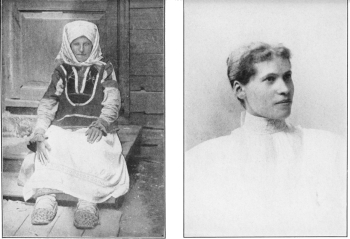
| SLAVIC WOMEN |
| THE ONE WHO STAID AT HOME |
|
THE ONE WHO EMIGRATED |
from a country where there is more idealism to the square inch than in
all this country, in spite of its statuary, its music and its
aristocracy.
“I’d rather live in Connecticut, the wife of a humble artisan, than
here, the ‘consort’ of a Count or Duke.”
“You talk exactly like my father,” she repeated.
“Do I? I’m glad of it. I told you that Puritanism is contagious. Maybe I
caught it from your father, and if I were sure that I have caught it, I
would be sure of more moral fiber than you will get here, if you stay a
hundred years.
“That Puritanism which you despise will make cosmos out of chaos; for in
spite of its narrowness, there is in it the passion for humanity. It
cries for justice, for freedom, for equality, even if it too often
burdens itself with theological dogmas hard to understand and harder to
believe.
“After all, the best thing in your country is, not that you give the
weaker a chance to grow strong, and the broken the blessing of
healing—the best of it is, that those of us who are just what we are,
have a chance to help in the doing. It’s the work that a man or woman
can do over there that counts.
“Yes, go back, crawl back, if necessary, to sober Connecticut; to its
pure women and its undemonstrative men, who do not make meaningless
compliments, after the fashion of your Captain; but who will at least
think no evil of you and who will treat you with real courtesy, when
there is need of courteous action.
“You want art? You fear you will miss it? They are doing something worth
while at home, in bronze and marble; but they are doing more wonderful
things in human flesh and spirit.
“I have seen wretched Italian children who came from where they make
little fairies out of Carrara marble, yet they were crooked without and
within; and I have seen them grow tall and beautiful and pure, by the
grace of God and the passion of some noble woman. That, after all, is
the supreme art.
“Music? You can have Grand Opera in New York composed of all the stars
in the operatic firmament; yet I have heard music, sweeter, better and
truer, sung by children in the Settlements.
“I have seen a Christmas at Hull House, in Chicago, which surpassed any
Grand Opera. I am sure if angels come down to earth and care for our
mundane pleasures, they must have struggled for a front seat there.
“Fifty children of nearly all the races under Heaven sang the songs of
their home-land, all the way from those they used to sing under the dark
pines of Norway’s farthest crag, down to those sung by Sicilian
children beneath the palms of their ever sunny land.
“Together they sang those Heaven-born prophecies of ‘Peace on earth,
good will to men’; and as I heard the blended voices of Jews, Catholics,
and Protestants, Greeks, Italians and Syrians, I felt that the ancient
prophecies are being fulfilled, at least in spots, on our then unknown
continent.
“Go home. Learn to find pleasure in that classic art of making home.
Learn how to find joy in giving children a chance to live and laugh, to
look towards manhood and womanhood from a mountain top and not from a
cage. Catch the rhythm of that new poetry which is now in the making;
which speaks in its sonnets of justice, in its epics of war against all
human wrong and in its lyrics of a sublimer and a larger love.”
“There comes my Captain!” said my victim, with a sigh of relief; “and I
must go.”
Yes, there he stood; all braid and buttons, or just braid and buttons, a
waxed moustache, a waxen smile and clicking spurs.
Gracefully he bowed as he offered his arm, in such a charming manner as
could not be easily reproduced by any mere American. Thus they left me
to my solemn musings, while the living tide swept by me, each drop in
the great current antagonistic to the other. Unbidden there arose before
me the ship, laden by human freight, leaving America, carrying
representatives of these same races and nationalities alien and hostile
to each other: Slavs and Magyars, arch foes of centuries’ standing;
Northern and Southern Italians, looking with scorn at one another; Jews
and Gentiles, Greeks and Bulgarians, Albanians and Montenegrins.
All of them had come out of the chaos wrought by ages of hate and
centuries of warfare. But in America, many of them had learned to live
together without scorn on the lip or hand on the sword-hilt.
The walls which separated them were weakened, if not broken down, and
like blind men they felt for one another in the dark; sometimes missing
the larger brotherhood, but often finding it.
The Pentecost of which prophets and seers have dreamt, which is to
repair the ruin wrought in the human family by the building of its
towers of Babel, cannot be so far away. The cosmos may yet come out of
the chaos, and there is no spot of earth on which this creative act can
be performed as well as in our America.
The land is vast enough and rich enough; no barrier of language divides
the East from the West; the North and the South are almost one, after an
internecine war; and in spite of our melting of metals and slaughter of
cattle and growing of corn—in spite of souls made hard and unresponsive
to anything but money—like the
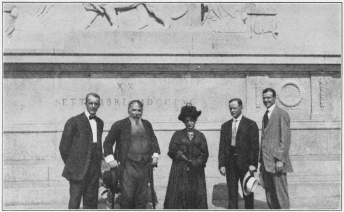 GENERAL AND MRS. RICIOTTO GARIBALDI AT THE FOOT OF HIS
FATHER’S MONUMENT IN ROME
GENERAL AND MRS. RICIOTTO GARIBALDI AT THE FOOT OF HIS
FATHER’S MONUMENT IN ROME
“It is just like you Americans—you go to work to make your dreams come
true.”
cash register we have invented; in spite of my Puritan rebel and her
numerous company—in spite of all that, our land is still full of
dreamers of dreams, who yet are awake and practical enough to make their
dreams come true.
“It is just like you Americans,” said General Riciotto Garibaldi, to my
“boys,” as they stood together at the foot of his father’s monument in
Rome; while he listened to the story of their journeyings in the
immigrants’ land, living in their huts in Hungary, Poland and Italy,
learning their language and their ways, that they may know how to
minister to their needs over here, and bind us to them and them to us.
“It is just like you Americans. We Italians think about those things and
make poetry; you go to work at a great dream to make it true.”
My faith in the dreams of the great dreamers has never wavered. I knew
that the prophet’s vision was not a Fata Morgana, and that the words
of the Son of Man came straight from the fountain of truth. Believing in
them and believing in American manhood and womanhood, in their altruism
and in their faith, and believing in the essential humanity of our
crowding alien host—I believe that cosmos is being created and that
chaos will disappear.
Finally, what we teach the immigrant by precept or by example, he will
become. He will bequeath our virtues or our vices, not only to the next
generation which will spring with virgin strength from his loins; but
through thousands of invisible channels, he will send these blessings or
curses to the ends of the earth.
The issues of the Kingdom of God in this generation are with America.
THE new Immigrant groups which are more difficult to classify according
to race, nationality and religion:
| The Slavs |
| I. Western Slavs |
| Nationality |
| Name | or political division | Religion |
| Bohemian | The Kingdom of Bohemia | Roman Catholic |
| or Czech | a province of Austria | Protestant |
| Moravians | Moravia | Roman Catholic |
| a province of Austria | Protestant |
| Poles | Poland | Roman Catholic |
| divided by the European |
| powers into |
| The Russian province of |
| Poland |
| The German province of |
| Posen |
| The Austrian province of |
| Galicia |
| Slovaks | A number of districts in | Roman Catholic |
| Hungary chiefly in and | Protestant |
| near the Carpathians |
| Wends | Settlements in Germany, | Roman Catholic |
| Prussia and Saxony | Protestant |
| 2. Eastern Slavs |
| Russians | Russia | Greek Orthodox |
| {Little Russians | Southern Russia | Greek Orthodox |
| {Ruthenians | Galicia | and |
| {Russniaks | Hungary | Greek Catholic |
| 3. Southern Slavs |
| Servians | The Kingdom of Servia | Greek Orthodox |
| some districts in |
| Southern Hungary | Greek Orthodox |
| Croatians | Croatia | Roman Catholic |
| a province of Hungary | and |
| Greek Orthodox |
| Montenegrins | Montenegro | Greek Orthodox |
| an independent principality |
| Bosnians | Bosnia and Herzegovina | Greek Orthodox |
| and | Provinces of Austria | Roman Catholic |
| Herzogovinians | Mohammedan |
| Dalmatians | Dalmatia | Greek Orthodox |
| a province of Austria | Roman Catholic |
| Slovenes | Carinthia | Roman Catholic |
| or Griners | Carnolia | Protestant |
| Provinces of Austria |
| Bulgarians | Czardom of Bulgaria | Greek Orthodox |
| Districts in Southern |
| Hungary |
| Eastern European Groups
Non-Slavic |
| Magyars | Kingdom of Hungary | Roman Catholic |
| | and Protestant |
| Finns | Finland | Protestant |
| a semi-independent |
| province of Russia |
| Roumanian | Kingdom of Roumania | Greek Orthodox |
| | Roman Catholic |
| Lithuanians | District in Russia | Roman Catholic |
| | and Protestant |
| Greeks | Kingdom of Greece | Greek Orthodox |
| Albanians | Albania | Greek Orthodox |
| a province of | Roman Catholic |
| Turkey | and |
| | Mohammedan |
| Groups from the Ottoman Empire |
| Armenians | Asia Minor | Armenian Catholic Church |
| | Gregorian Church |
| | Protestant |
| Syrians |
Syria
a province of
Turkey
|
Syrian church |
{Jacobite
{Maronite
{Ancient Syrian
(Roman Catholic) |
THERE is much misapprehension in the popular mind, both as to the number
of immigrants arriving in the United States, and those remaining for
permanent residence.
Until 1907, all aliens arriving were enumerated; but of those departing,
no record was kept.
The Commissioner General of Immigration arrived at the figures of net
immigration given below, by estimating the departures according to
figures obtained during four months in 1907, when the returning tide of
immigration was normal.
The year 1908 shows an abnormally small increase, due to the industrial
depression in that year, when the returning tide of immigration was very
strong. The following tables show that a large number return every year,
and I am inclined to believe that the estimated figures of the net
increase are too high, and that the permanent increase of the
foreign-born population cannot be calculated from this insufficient
data.
The net gain in our foreign born population in the last ten years is
estimated as 5,240,200 which is 68% of the total immigration.
| | Alien arrivals. |
| Year. |
Accepted
immigration
figures. |
Other
alien
arrivals. |
Total
alien
arrivals. |
Total alien
departures
estimated. |
Net
immigration
estimated. |
Ratio
estimated
net
immigration
accepted
immigration
figure. |
| 1899 |
311,715 |
[7]45,000 |
356,715 |
172,837 |
183,878 |
59 |
per cent. |
| 1900 | 448,572 | 65,635 | 514,207 | 206,351 | 307,856 | 69 | " |
| 1901 | 487,918 | 74,950 | 562,868 | 209,318 | 353,550 | 72 | " |
| 1902 | 648,743 | 82,055 | 730,798 | 220,103 | 510,695 | 79 | " |
| 1903 | 857,046 | 64,269 | 921,315 | 247,559 | 673,756 | 79 | " |
| 1904 | 812,870 | 27,844 | 840,714 | 332,019 | 508,695 | 63 | " |
| 1905 | 1,026,499 | 33,256 | 1,059,755 | 385,111 | 674,644 | 66 | " |
| 1906 | 1,100,735 | 65,618 | 1,166,353 | 356,257 | 810,096 | 74 | " |
| 1907 | 1,285,349 | 153,120 | 1,433,469 | 431,306 | 1,007,163 | 78 | " |
| 1908 | 782,870 | 141,825 | 924,695 | [8]714,828 | [8]209,867 | 27 | " |
| Total |
7,762,317 |
753,572 |
8,510,889 |
3,275,689 |
5,240,200 | | |
THE following table, giving the number of immigrant aliens admitted from
June 30, 1907 to June 30, 1908, is of special interest, because it shows
marked decrease during that period of industrial depression.
The figures are from the report of the Commissioner General of
Immigration.
The increase in the number of those from Roumania is probably in Jewish
immigration, following a period of renewed anti-Semitic disorders.
Should a change occur in the political status of the Russian Jews, a
large decrease of that group of immigrants may be expected. While it is
not likely to occur soon, Jewish immigration will also be retarded by
the fact that the economic conditions in the Russian empire are growing
better.
The greatest decrease may be expected from Austria-Hungary, where
drastic emigration laws have been passed, and are rigorously enforced;
especially against the Slavs, whose withdrawal in large numbers has
imperilled agricultural and industrial enterprises in Hungary.
Immigrant Aliens Admitted, Fiscal Years Ended June 30, 1907 and 1908,
Showing Increase and Decrease for Each Country.
| Country of last permanent residence. |
1907. | 1908. | Increase (+)
or
decrease (-) |
| Austria-Hungary | 338,452 | 168,509 | -169,943 |
| Belgium | 6,396 | 4,162 | - 2,234 |
| Bulgaria, Servia, and Montenegro | 11,359 | 10,827 | - 532 |
| Denmark | 7,243 | 4,954 | - 2,289 |
| France, including Corsica | 9,731 | 8,788 | - 943 |
| German Empire | 37,807 | 32,309 | - 5,498 |
| Greece | 36,580 | 21,489 | - 15,091 |
| Italy, including Sicily and Sardinia | 285,731 | 128,503 | -157,228 |
| Netherlands | 6,637 | 5,946 | - 691 |
| Norway | 22,133 | 12,412 | - 9,721 |
| Portugal, including Cape Verde and Azore islands | 9,608 | 7,307 | - 2,301 |
| Roumania | 4,384 | 5,228 | + 844 |
| Russian Empire and Finland | 258,943 | 156,711 | -102,232 |
| Spain, including Canary and Balearic islands | 5,784 | 3,899 | - 1,885 |
| Sweden | 20,589 | 12,809 | - 7,780 |
| Switzerland | 3,748 | 3,281 | - 467 |
| Turkey in Europe | 20,767 | 11,290 | - 9,477 |
| United Kingdom: | | |
| England | 56,637 | 47,031 | - 9,606 |
| Ireland | 34,530 | 30,556 | - 3,974 |
| Scotland | 19,740 | 13,506 | - 6,234 |
| Wales | 2,660 | 2,287 | - 373 |
| Other Europe | 107 | 97 | - 10 |
| Total Europe | 1,199,566 | 691,901 | -509,353 |
I. The examination of all emigrants at the port of embarkation.
Objections
(a) The maintenance of an expensive machinery which will be hard to
direct and control.
(b) The possible objections of the governments concerned.
(c) The prospective emigrant will necessarily have taken the most
serious steps; and rejection at the port of entry will not be a much
greater misfortune than rejection at the port of embarkation.
(d) That it will be practically impossible for political offenders to
leave their country.
II. “That in addition to the restriction imposed by the laws at present
in force, the head tax of four dollars now collected, should be
increased to ten.”[9]
Objection
This would increase the number of immigrants who come here without their
families, and consequently would react upon the United States both
morally and financially.
Suggestion
That the ten dollar head tax be collected from adults, and that the
present tax of four dollars remain in force for children and possibly
for mothers.
III. “That each immigrant, unless he be a political refugee, should
bring with him not less than twenty-five dollars, in addition to the
amount required to pay transportation to the point where he expects to
find employment.”
There is no valid objection to this demand—and the vast majority of
immigrants are able to meet it.
IV. “That immigrants between the ages of fourteen and fifty years should
be able to read a section of the Constitution of the United States,
either in our language, in their own language, or in the language of the
country from which they come.”
Objection
The demand for such a test is not unreasonable, and is humane in that it
exempts the young and the aged; but it does not take account of the fact
that in most immigrant groups, the education of the woman has been
neglected—and that the enforcement of such a law would have the same
effect as that which relates to the increase in the head tax.
Suggestion
That the literacy test be not applied to the wives of immigrants.
A,
B,
C,
D,
E,
F,
G,
H,
I,
J,
K,
L,
M,
P,
R,
S,
T,
V,
W,
Y.
Albania, 300, 302, 305-307
Amerikansky Schtore, 108
Anarchist, 291, 322
Anti-Semitism, 286
Armenia, 351
Austria, 287
Bacon, Judge, 283
Baldwin, 302, 305-306, 309
Beisel, Conrad, 232
“Bessie,” 170 ff.
Black Hand, 291
Calabria, 174
Campagna, 176
Cattero, Boche de, 248
Chautauqua, 305, 309
Chicago, 86, 87
Chorvat, Jan, 130 ff.
Columbus, 244
Connecticut, 200, 353
Connellsville, 192, 331, 341, 344
Constitution of United States, 323
Cracow, description of, 112;
hatred of Germany in, 113;
Jews in, 113;
political condition in, 114
Criminals, 322
Czechs, 212
Dalmatia, conditions in, 138;
government, 139;
America a blessing to, 147
Dowie, Charles A., 89
Edwards, R. H., 334, 336, 345
Ellis Island, 170
Emigrants, views of Americans, 82 ff.;
effect of return of, 72-75
Fansher, Guy J., 308
Gabriel, 256 ff.
Garibaldi, 357
“Gemeinschaft,” 222
Greensburg, Pa., 344
Grose, Howard N., 317
Harrisburg, 343
Hartford, 315, 349, 351
Harvard, 264-266, 340
Hazleton, 353 ff.
Hungary, 260, 287, 295
Huss, 209
Hussite movement, 221
Introduction, letters of, 112
Italy, church of, 177;
dark side of emigration from, 173;
effect of emigration on Italy, 166;
on wages, 174;
on education, 175;
on religion, 176;
on women, 178;
on economic conditions, 179;
on purchase of land in, 174
Italians, bad, 195
Jamestown, 306-307, 310
Japanese question, 194
Jew, the, prevalence of persecution of, 260;
Jewish feeling of superiority, 261;
religious feeling alone does not account for prejudice, 262;
Prof. Shaler’s comparison of Jewish and Gentile students, 264;
Jewish incapacities, 267;
the Orthodox, 272;
nowhere indigenous, 275;
characteristics, 279 ff.
Kisheneff, 277
Kopaniczari, meaning of word, 93;
savage appearance, 94;
view of fires, 94; of cameras, 95;
of medicine, 96
Kortia, 310
Lewis, H. S., 282
London County Council, 283
Lo Perfido, Luigi, 177
Luther, Martin, 210, 221
Matera, 177
Mayflower, The, 341
Medical science in Trenczin, 96, 97
Methodist Church, 176
Molocani, 187
Monastir, 307
Montenegro, Prince of, 153;
minister of exterior of, 152;
festivities of, 154;
emigration from, 155;
neighbours of, 156, 164;
legend of origin, 158;
national dress of, 160
Passover, Feast of, 262
Pennsylvania, 334, 342
Pietor, Ambrosius, 223
Pittston, Pa., 320, 345
Poland, best type of, 116;
in miniature, 117;
federation of, 122
Police, American, 49;
Indianapolis, 251;
Moscow, 250;
St. Petersburg, 250
Polish labourer in America, 65
Polish nobleman, a, 119
Polish peasantry, American influence on, 118
Postal Savings Bank, 193
Ragusa, guslar of, 142, 149 ff.;
returned emigrants in, 143;
and Coney Island, 144;
an evening in, 145
Roberts, Peter, 318
Rohacek, 134
Roosevelt, 297
Ross, Prof., 335
Rousseau, 241
Roy Sisters, the, 132
Ruskin, 241
Ruthenians, 78, 190, 207
Scanderberg, 306
Scharosh, 329, 339
Scranton, 163, 192, 200, 331, 341, 344
Shaler, Prof. N., 262, 266-267
Sicilians, 339
Skutari, 301, 305
Slavs, progress in social scale, 23;
slow to emigrate, 93;
lack of initiative, 118;
future of, 120;
characteristics of, 121, 205 ff.;
numerical supremacy, 203;
condition at home, 204;
dangers in Slavic emigration, 211;
industrial development impossible without them, 191;
late product of civilization, 215;
an Aryan people, 216;
Southern group of, 217;
Western group, Catholic, 218;
priests among, 220;
the reformation among, 221;
speech, 77;
conception of Slovaks, 190;
ideas of drink, 201
Slovak, slowness of, 125-127;
evangelistic effort among, 134;
returned emigrants, 128, 136
Sonnenschein, 275
Spalato, 185, 248
“Stary Kray,” 24, 25
Stelzle, Charles, 317
Streator, Ill., 302-303, 309, 311-312
Syrian children, 352
Taft, President, 309
Taylor, Prof. Graham, 200, 284
Third class travel, 77, 79
Tolstoi, 241
Trenton, N. J., 195
Turk, M. H., 307-308
Vienna, University of, 296
Waag, the River, 124
Wages, 166
Wallachians, 78
Watchorn, R., 277
Welsh miners, 339
Wilkes-Barre, 192, 238, 331, 341, 344
Y. M. C. A., 258, 318, 323-324
Printed in the United States of America
HOME MISSIONS
JOHN T. FARIS Author of “Men Who Made Good”
The Alaskan Pathfinder
The Story of Sheldon Jackson for Boys. 12mo, cloth, net $1.00.
The story of Sheldon Jackson will appear irresistibly to every boy.
Action from the time he was, as an infant, rescued from a fire to his
years’ of strenuous rides through the Rockies and his long years’ of
service in Alaska, permeate every page of the book. Mr. Faris, with a
sure hand, tells the story of this apostle of the Western Indians in
clear-cut, incisive chapters which will hold the boy’s attention from
first to last.
JOSEPH B. CLARK, D.D. The Story of American Home Missions
Leavening the Nation:
New and Revised Edition. International Leaders’ Library. 12mo,
cloth (postage 10c.), net 50c.
This standard history of the Home Mission work of all denominations in
America, has been thoroughly revised and brought up-to-date.
MARY CLARK BARNES and DR. LEMUEL C. BARNES
The New America
Home Mission Study Course. Illustrated, 12mo, cloth, net 50c.
(post. 7c.); paper 30c. (post. 5c.).
This, the regular text-book for the coming year is on the subject of
immigration. The author is eminently fitted for writing on this theme as
she has been a worker among immigrants, and has given much time to
studying the problem.
LAURA GEROULD CRAIG
America, God’s Melting Pot
Home Mission Study Course. Illustrated, 12mo, paper, net 25c.
(postage 4c.).
The subject chosen for study this year, Immigration, covers so wide a
field that it was thought best to prepare a supplemental text book from
an entirely different standpoint. The author has written a “parable
study” which deals more with lessons and agencies than with issues and
processes.
LEILA ALLEN DIMOCK
Comrades from Other Lands
Home Mission Junior Text Book. Illustrated, 12mo, paper, net 25c.
(postage 4c.).
This book is complementary to the last volume in this course of study,
Dr. Henry’s SOME IMMIGRANT NEIGHBORS which treated of the lives and
occupations of foreigners in our cities. This latter tells what the
immigrants are doing in country industries. Teachers of children of from
twelve to sixteen will find here material to enlist the sympathies and
hold the interest of their scholars.
BIOGRAPHY
DAVID LIVINGSTONE
The Personal Life of David Livingstone
By W. Garden Blaikie, D.D. Complete Authorized Edition, with
Portrait and Map. International Leaders’ Library. Cloth, (postage
10c.), net 50c.
For fifteen years this book has remained the Standard Life of
Livingstone. The book is of especial interest just now when all the
world is observing the Centennary of Livingstone’s birth.
“After all the years that have intervened it still remains the most
complete, authentic and inspired of all the biographies of
Livingstone.”—The Bookman.
FRANCES WILLARD
Frances Willard: Her Life and Her Work
By Ray Strachey. With an Introduction by Lady Henry Somerset.
Illustrated, 8vo, cloth, net $1.50.
A notable new life of the great temperance advocate written by an
English woman from an entirely new standpoint. Mrs. Strachey, the
granddaughter of the author of “A Christian’s Secret of a Happy Life,”
had immediate access to Miss Willard’s letters, journals and papers, and
the benefit of her grandmother’s advice and knowledge.
Israel Zangwill says of the book, “A masterpiece of condensation, an
adequate biography of perhaps the greatest woman America has produced.
Nobody can read this book without becoming braver, better, wiser.”
MRS. S. MOORE SITES
Nathan Sites:
With an Introduction by Bishop William F. McDowell. Oriental
Hand-Painted Illustrations. 8vo, cloth, gilt top, net $1.50.
This is one of the notable books of the year. China looms large in
current political and religious interest, so that this life story of one
who for nearly half a century has been closely identified with social
and religious reform in that country must have a large place in current
literature. The book is more than ordinarily notable also because of its
profuse and beautiful illustrations.
G. L. WHARTON
Life of G. L. Wharton
By Mrs. Emma Richardson Wharton. Illustrated, 12mo, gilt top,
cloth, net $1.25.
A biography of a pioneer missionary of the F. C. M. S., written by a
devoted wife who shared the experiences of her husband in a long service
in India and Australia. It is a life of unusual interest and an
important addition to the annals of modern missionary effort.
ROBERT E. SPEER, D. D.
The Foreign Doctor: “The Hakim Sahib”
A Biography of Joseph Plumb Cochran, M.D., of Persia. Illustrated,
12mo, cloth, net $1.50.
Dr. Cochran came to a position of power in Western Persia which made his
life as interesting as a romance. He was one of the central figures in
the Kurdish invasion of Persia, and was the chief means of saving the
city of Uramia. In no other biography is there as full an account of the
actual medical work done by the medical missionary, and of the problem
of the use of the political influence acquired by a man of Dr. Cochran’s
gifts and opportunities.
HENRY D. PORTER, M.D., D.D.
William Scott Ament Missionary of the American Board to China.
Illustrated, 8vo, cloth, net $1.50.
A biography of one of the most honored missionaries of the
Congregational Church, whose long and effective service in China has
inscribed his name high in the annals of those whose lives have been
given to the uplift of their fellowmen.
MARY GRIDLEY ELLINWOOD
Frank Field Ellinwood Former Secretary Presbyterian F. M. Board
His Life and Work. Illustrated, cloth, net $1.00.
A charming biography of one of the greatest missionary leaders of the
Nineteenth Century.—Robert E. Speer.
ANTONIO ANDREA ARRIGHI
The Story of Antonio the Galley Slave
With Portrait, 12mo, cloth, net $1.25.
“Reads like a romance, and the wonderful thing about it is that it is
true. A fervid religious experience, a passion for service and good
intellectual equipment were his splendid preparation for a great
missionary work among his countrymen in America.”—Zion’s Herald.
GEORGE MULLER
George Muller, The Modern Apostle of Faith By Frederick G. Warne.
New Edition, including the Later Story of the Bristol Orphan Home.
Illustrated, cloth, net 75c.
“What deep attractiveness is found in this life of the great and
simple-hearted apostle.”—Christian Advocate.
KINGSTON DE GRUCHE
Dr. Apricot of “Heaven-Below”
Illustrated, 8vo, cloth, net $1.00.
“No one who has read this book will ever afterwards repeat the
threadbare objection, I don’t believe in missions.”—Continent.
A “Vade Mecum” on Immigration
The Immigrant
An Asset and a Liability
By FREDERIC J. HASKIN
Author of the “American Government”
Illustrated, 12mo., cloth, net $1.25
The wide-spread attention focused on this theme makes “THE IMMIGRANT, An
Asset and a Liability” especially timely. No other book of this kind
gathers into itself the consideration of so many phases of the subject
and for this reason it admirably supplements the several text books on
the topic. In brief, lucid replies it answers questions like these:
“Why do the immigrants come?”
“How do they come?”
“How are they treated at ports of entry?”
“What helps and what hindrances meet them?”
“Where do they go?”
“What are the relations of immigration and the white slave traffic?”
“Who is the padrone?”
“What is peonage?”
“How does the new immigrant live?”
“What of the future?”
Mr Haskin has succeeded to a remarkable degree in investing the subject
of Immigration with intense interest. The story of the greatest human
migration of all the ages is told in vivid, incisive and picturesque
style. The three centuries of this great world movement are spread out
before the reader like a panoramic parade of all nations. Accurate
historical statement, philosophic presentation of the underlying
principles and a judicial consideration of the ultimate influence on our
country characterize this latest and in many respects most satisfactory
and complete handbook.