Larger versions of most illustrations may be seen by right-clicking them
and selecting an option to view them separately, or by double-tapping and/or
stretching them.
A list of spelling and accent corrections appears at the end of this eBook.
THE LANGHAM SERIES
AN ILLUSTRATED COLLECTION
OF ART MONOGRAPHS
EDITED BY SELWYN BRINTON, M.A.
THE LANGHAM SERIES OF
ART MONOGRAPHS
EDITED BY SELWYN BRINTON, M.A.
Vol. I.—Bartolozzi and his Pupils in
England.BySelwyn Brinton, M.A.
Vol. II.—Colour-Prints of Japan.ByEdward F. Strange.
Vol. III.—The Illustrators of Montmartre.ByFrank L. Emanuel.
Vol. IV.—Auguste Rodin.ByRudolph
Dircks, Author of “Verisimilitudes”
and “The Libretto.”
Vol. V.—Venice as an Art City.ByAlbert Zacher. [Nearly ready
Vol. VI.—London as an Art City.By
Mrs. Steuart Erskine, Author of “Lady
Diana Beauclerc,” &c. [In the Press
These volumes will be artistically presented
and profusely illustrated, both with
colour plates and photogravures, and neatly
bound in art canvas. 1s. 6d. net, or in
leather, 2s. 6d. net.
There is no modern illustrator whose
work has more completely won the
admiration of his fellows of the brush,
whatever their predilection in art, than
Steinlen. Be the studio in Paris, in London, in
Munich, be it even in Timbuctoo, from some
discreet corner will be drawn a treasured copy or
two of Gil Blas Illustré illustrated by Steinlen—forthwith
to be discussed, and as surely lauded
without stint.
This is not to imply that Steinlen is what is
termed “a painter’s painter” and nothing more;
for the artist we are now considering is one of the
few who are sufficiently great to have captured the
warmest appreciation from the public at large, as
well as from the critical ranks of his fellow
workers.
The “painters’ painter” is, as a rule, if nothing
else, a master of technique, one whose work shows
on the face of it the sheer joy evinced in the skilful
manipulation of the medium employed—the exceptions
to this rule being the
men whose work reflects some
subtle or involved workings of
the brain, and whose great
thoughts are felt to outweigh
the shortcomings of faulty technique. They are of
course styled “painters’ painters” because their
work appeals to artists and other highly trained
critics; and it is useless to expect any but the most
sensitive among the public to appreciate them. In
smoothness and “softness” consists the acme of
technical perfection in the eyes of the untrained,
who, as regards figure subjects, prefer something
which appears to the artist to be inane and common-place,
and as regards landscape subjects, insipid
prettiness is always preferred to greatness or originality
of view. In either case an excess of detail is a
“sine quâ non,” and such plébiscites as have been taken
in England have almost invariably proved that the
inferior painters are the most popular.
Yet, occasionally a great artist arises who will
upset these canons, and compel the admiration of
connoisseur and public alike; such an one is
Steinlen.
Just as it may be presumed that J. F. Millet’s
popularity extends to all classes, so is it certain that
the “Millet of the streets” will be equally widely
and lastingly appreciated.
The pioneer work that Millet did in interpreting
the toilsome life of the French peasantry has been
extended by Steinlen to the denizens—reputable and
disreputable—of the nearer suburbs of Paris.
Born in Lausanne, he was trained for the church;
and we may feel sure that had he joined that profession
he would have been a forcible advocate of
the poor and the ill-favoured, and that his blunt
honesty of diction would have dealt his congregation
some rude shocks indeed.
This was not to be, however, for the art in the
man would out. In 1882 he journeyed to Paris;
there to undergo much privation and many hardships
before getting a foothold in the form of a
drawing accepted by
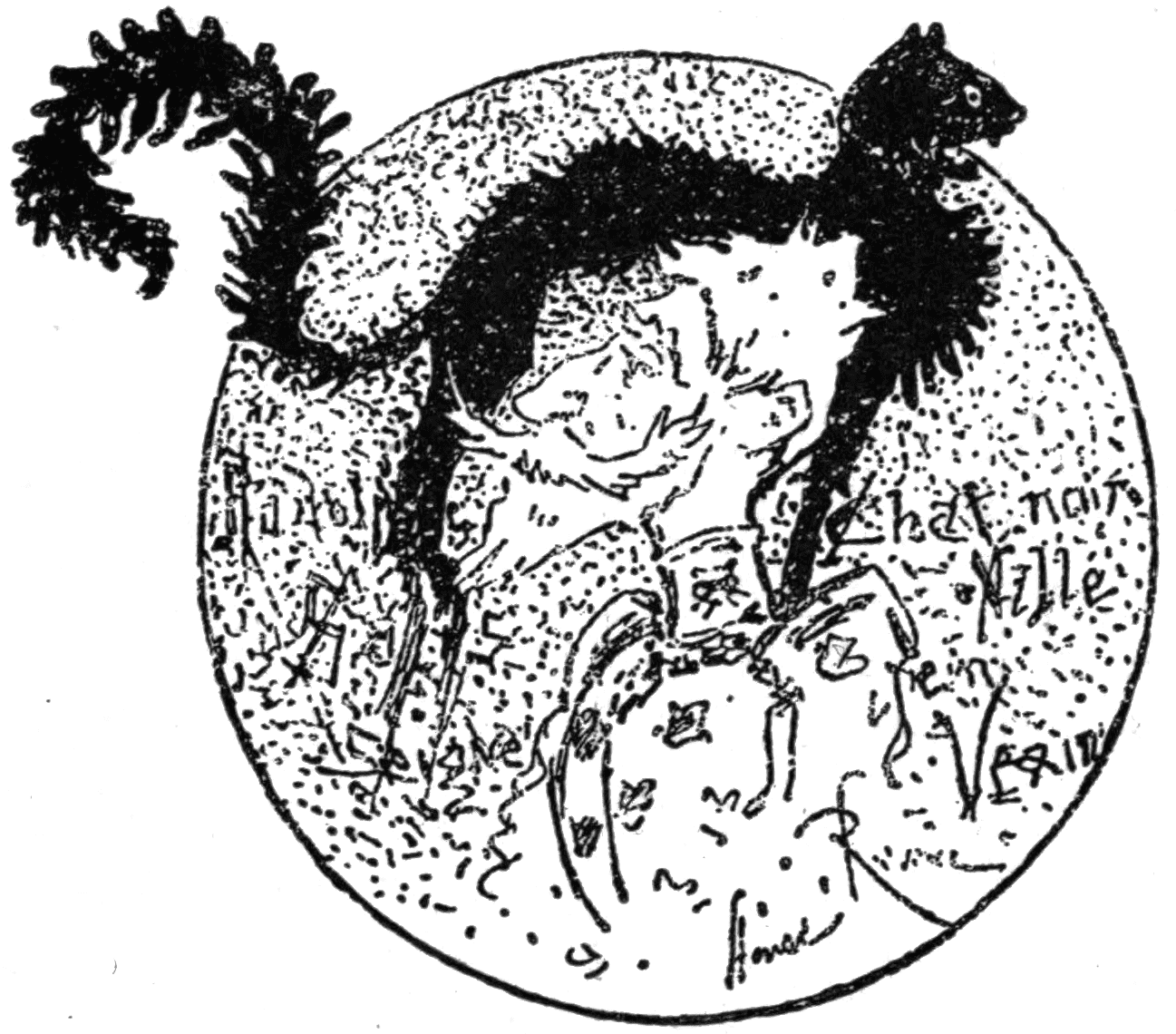
the paper Le Chat
Noir, which was to
prove the first rung
on his ladder to
fame.
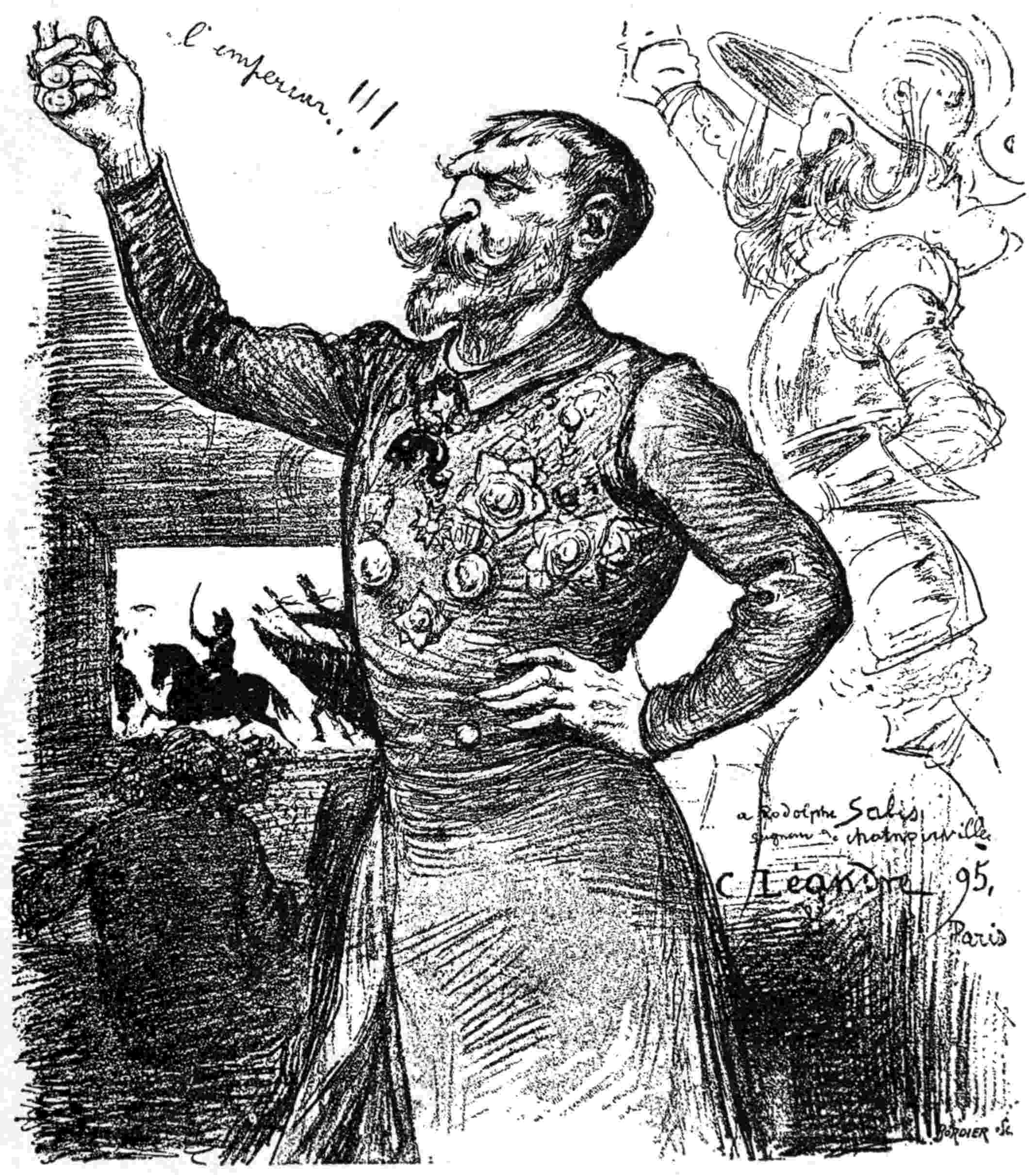
Rudolph Salis’ artistic
cabaret of the
“Black Cat” was
the editorial office of
this paper, and at the
same time a centre
of all that was Bohemian
and daring
and go-ahead, a forcing ground of impatient talent.
These first notable studies by Steinlen were of cats
and of children. It was here that our artist met
the authors whose work he was later to illustrate;
more particularly he struck up a friendship with
that fierce poet cabaretier, Aristide Bruant, whose
powerful and terror-striking poems dealt with the
very world that interested Steinlen to the quick,
and provided him with the stimulus for many of
his finest drawings. They both show us the, to
us, shabby joys of the faubouriens, and their terrible
struggles with one another and with Dame Fortune.
Steinlen’s field of labour has been in the so-called
eccentric quarters of Paris—that is to say, on that
soiled fringe of nondescript outlying districts of the
Ville Lumière, which is separated from the city
proper by the circlet of shabby-genteel exterior
boulevards. Many of these suburbs were at one
time peaceful, outlying villages; but they have now
been swallowed, and more or less thoroughly digested,
by the metropolis. Thus it comes that many of
them consist of a queer mixture of humble rustic
abodes jostling against towering blocks of tenement
buildings, or busy factories for ever being pressed
outwards by the expanding city.
No less incongruous than these streets are their
inhabitants,—chiefly composed of armies upon
armies of toiling workers, while there is nevertheless
an effervescing sediment or substratum of those who
live by violence and crime. The less successful of
those who trade on the weaknesses and follies of a
vicious city are forced by circumstances to live in
these cheaper suburbs, just as are the poorest of the
honest classes; and this is so despite the fact that
throughout Paris the upper stories of all flats are
occupied by the lower, or at any rate the poorer,
classes.
Curiosity, and a search for novel experiences
wherewith to whet their jaded appetites, brought
numbers of roysterers of a higher social grade to the
places of amusement affected by this poverty-stricken
and criminal population. These same humble places
of amusement, more particularly round and about
Montmartre rapidly flourished out of all recognition
of their former selves, and until the recent waning
of the craze others were frequently being added to
the list. This influx added to the complex character
of such neighbourhoods. Artists, authors, and other
persons of more or less Bohemian tastes, many of
them men of great renown and genius, have ever
found their home on the commanding heights of the
Montmartre cliff.
Among them Steinlen has settled, perched high
over the myriad glittering roofs and towers and domes
of Paris, which lies seething far below. The roar and
clatter of the great city reach his window but
fitfully, as the sounds are hurried hither and thither
on the wings of wayward breezes, the while great
stretches of urban landscape are plunged into purple
shadow or bathed in golden sunlight as the fleeting
clouds chase one another across the great dome of
sky.
Most of the artists to be referred to in this little
volume are intimately connected with this same
breezy, turbulent suburb, and also with the before-mentioned
“Chat Noir”. This cabaret, founded
and carried on by Salis, himself an artist, for
years attracted le tout Paris by means of its réunions
of the most up-to-date artists, authors, and actors,
and its unique theatre. Along with its sprightly,
risky weekly paper it would form matter for a
weighty volume of itself. The students from the
Quartier Latin, moreover, came to share their
joyous, reckless hours of leisure between their own
beloved neighbourhood of the Boul’ Mich’, and
the far-away Mount of the Windmills—Montmartre.
Peasants, workgirls, the starving, the insane, the
destitute, those who are fighting misery and those
who are making it, garrotters, thieves, murderers,
and a large assortment of parasitical ruffians as well,
have all found a sympathetic student and recorder
in Steinlen. He understands them, he has a big
heart, and he pities them all, and what is more he
makes us, willy-nilly, pity them also. He delights
in showing us that one little touch of remaining
nature that makes the whole world akin, and will
out in his most abandoned wretch. He makes us
feel that his criminals are what nature and cruel
circumstances have led them to be. Never does he
descend to the narrow-minded, short-sighted, spiteful
views of current events, discernible in the work of
so many of his talented confrères. The firm tenderness
of his nature reveals itself in the very lines of
his drawings, which, as if to counterbalance the
brilliant vivacity of the work of so many French
illustrators, display a sturdy thoroughness and
sanity.
A notable feature about his work is that—although
he depicts the most depraved and immoral,
as well as the most poverty-stricken of his fellow
citizens—it cannot be said to be low or vulgar.
His drawings of simple peasant life have all the
air of having been undertaken as a relaxation from
the contemplation of more lurid subjects. He
sallies forth among his chance models, sketch-book
in hand, ready to put down notes of salient features
and expressive poses, later to be incorporated in the
wonderfully complete drawings which are shown to
the public.
Steinlen is a prolific worker. First in importance
among the many publications whose pages he has
enriched comes the Gil Blas Illustré. It was
Steinlen who initiated the idea of this Paris daily
paper issuing a halfpenny supplement on Sundays
containing feuilletons and poetry, illustrated with
drawings to be reproduced in two or more colours.
Since the year 1891, and until recently, the front
and frequently other pages of this paper have consisted
of splendid drawings by him, as a rule depicting
some terrible or pathetic episode in the lives of
the faubouriens or faubouriennes to whom we
have already alluded. In every case a background,
equally masterly and full of local character, has been
introduced. This series of essentially modern subjects
was occasionally varied by the appearance of a
drawing such as the Chevalier à la Fée or Les
Digitales, inspired by some mediæval incident or
legend. These Steinlen would treat in an entirely
different but equally successful manner—the style
employed somewhat resembling that of another
masterly designer, namely, Eugène Grasset. Of
his more usual style to pick out such splendid
drawings as his suicide in À l’eau, the terrible street
fight in the Voix du Sang or Le Vagabond, L’Immolation,
Pour les Amoureux et pour les Oiseaux, Marchand
de Marrons or 14 Juillet, is but to recall
hundreds of others equally worthy of special attention.
In 1895 the Gil Blas employed more colours in
its reproductions, and Steinlen rose to the occasion
with some daring colour schemes exemplified in
La Terre Chante au Crépuscule, Le Poil de Carotte
and many another drawing. Towards 1896 the
range of his subjects noticeably widened.
Among other publications to which he has contributed
one recalls Le Chambard, in which appeared
splendid lithographs from his own hand, La Feuille,
L’Assiette au Beurre, La Vie en Rose, Le Canard
Sauvage, etc. In the following music albums will
be found some further superb lithographs by Steinlen,
namely, Chanson de Montmartre, Chansons du
Quartier Latin, and Chanson de Femmes. Among
the books he has illustrated are: Les Gaitès Bourgeois,
Prison fin de Siècle, Dans la Rue, and Dans la
Vie—the latter in colour.
Description of a few of his notable drawings,
culled here and there, may help us to a better understanding
of their quality.
First, then, he shows us the gallery of some
dark, putrid Assembly Hall; the air is thick with
garlic, and oaths, and gas, whose garish light illuminates
a disreputable mob of frenzied anarchists,
who are applauding with delirious gusto the sentiments
of “Down with everything,” “Death to
every one.”
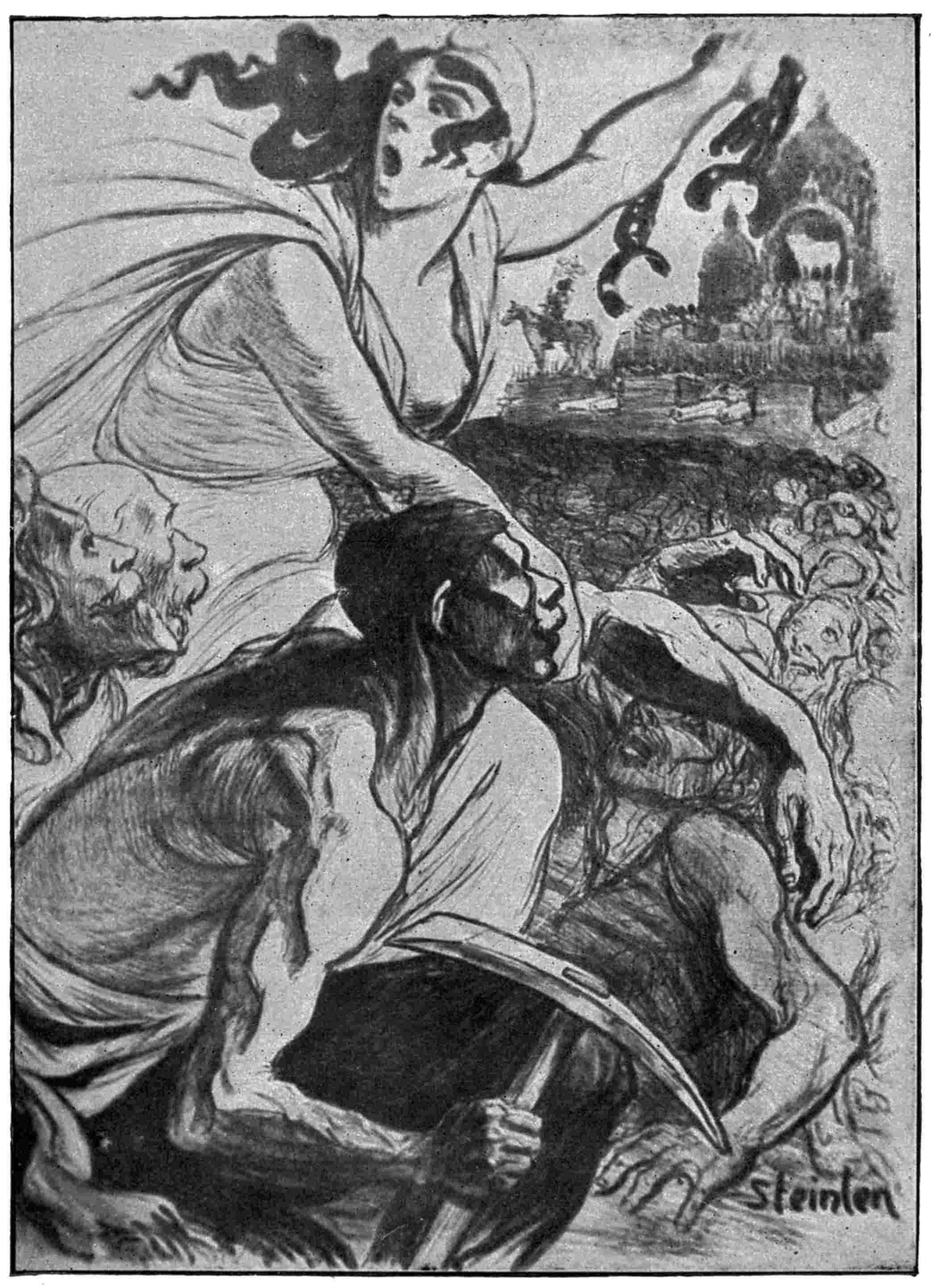
STEINLEN
REVOLUTION
(Lithographed Poster)
Next we are taken to some dull, superstitious
Breton hamlet; a blind and crippled tramp has
arrived, hobbling through on crutches. We feel
that his infirmities have hardly saved him from a
career of violence. We can almost hear his raucous
appeal for alms, as it falls on the ears of a group of
simple village children, pitying, yet more than half-fearing,
the uncanny stranger—just as they did the
chained bear that passed through a week before.
Less gruesome is a great healthy farmer’s lass, surrounded
by cocks and hens and clattering her wooden
shoon across the cobbled farmyard; or the two
fresh little laundry girls, swinging along laden with
three great baskets of clean linen. “Look out!
there’s another of those beastly bicycles,” says one
of them; “and on Sunday too,” comments the
other.
Then again there are idyllic scenes on the sordid
Paris fortifications, or yet further afield. Trompe la
Mort shows us a crowd of humble folk scandal-mongering
in hushed tones, their tittle-tattle provoked
to its utmost by the climax indicated in the
background by a sombre hearse. Another drawing
transports us to the midst of a crowd in quite a
different frame of mind. A hue and cry has been
raised, and an infuriated mob is tearing down the
street at the heels of its hapless prey. Next we see
one of the many drawings dealing with a side of
life which in less safe hands might be offensive. An
unctuous old harpy waylays two fresh little workgirls,
and insidiously lays the seeds which, to her
profit, shall lead to their downfall. Steinlen occasionally,
if rarely, makes drawings of which humour
is the motive power. Among these I recall a café-concert
study of his. Yvette Guilbert, at that time
as thin as a lath, holds the stage, and among the
audience is a great, porpoise-like woman who says,
threateningly to her poor, inoffensive little wisp of a
husband—“Perhaps that’s your style.... Satyr.”
One of his most charming drawings reproduced
in colour in Le Rire is called “le bon Gîte.” The
hapless Krüger, all war stained, is seated in some
peaceful Dutch cottage, where Queen Wilhelmina,
as an awe-struck peasant lassie, fills for him the pipe
of peace, the while her martial German husband
eagerly engages the old man in fighting his battles
over again.
Nor can we forget the splendid double-page
drawing that appeared in L’Assiette au Beurre for
May 23, 1901. Here we see a big boy’s seminary,
representing the French army of the future, the
hope of the country, going out for its daily walk in
charge of a number of priests—every one of them a
monument of craftiness, superstition or bigoted intolerance,
thus representing the power that poisoned
a great nation’s sense of justice during the hateful
period of the Dreyfus trials.
Then again in the same paper for June 27, 1901,
appears among others one of his most notable drawing,
a veritable tour de force, representing the harrowing
scene of the identification of corpses after
the dynamite explosion at Issy.
It is interesting to compare such powerful work
as this with one of his earliest successes, namely
the illustrations to Les Gaitès Bourgeoises, a set of
chic and delicate little pen-drawings instinct with
humour and gaiety.
Steinlen is a giant in the artistic poster movement.
Some of his productions were lithographs in
colour of enormous size, each printed from as many
as thirty different lithographic stones. Here and
there a poster would give him the opportunity to
introduce some of the marvellous drawings of cats
for which he is so justly renowned; and in this
connection we cannot forbear mentioning two
splendid drawings of cocks which appeared in the
earlier numbers of Cocorico, as well as some wonderfully
spirited comic drawings of frogs in a volume
entitled “Entrée de Clowns.”
Those who keep an eye on the picture galleries
of the Paris streets can never forget, so splendid was
their design and colouring, Steinlen’s great posters
for La Rue, or the equally long and fresco-like
groups of realistic Parisian types advertising the
“Affiches Charles Verneau.” Then, who does not
love the “Lait Pur Sterilisé” poster with its golden-haired
little girl in scarlet drinking out of a saucer,
while three inimitable cats beg at her knee. His
poster for Zola’s “Paris” was a poem in itself; and
in the “Tournée du Chat Noir” the noble beast
concerned is treated to a glory of decoration. Then
there are his daring “La Feuille” poster, his
“Yvette Guilbert,” and many another, not to
mention programme covers and such smaller game.
Finally, Steinlen has produced charming etchings,
both in colour and in black and white, and
such splendid oil paintings as Les Blanchisseuses.
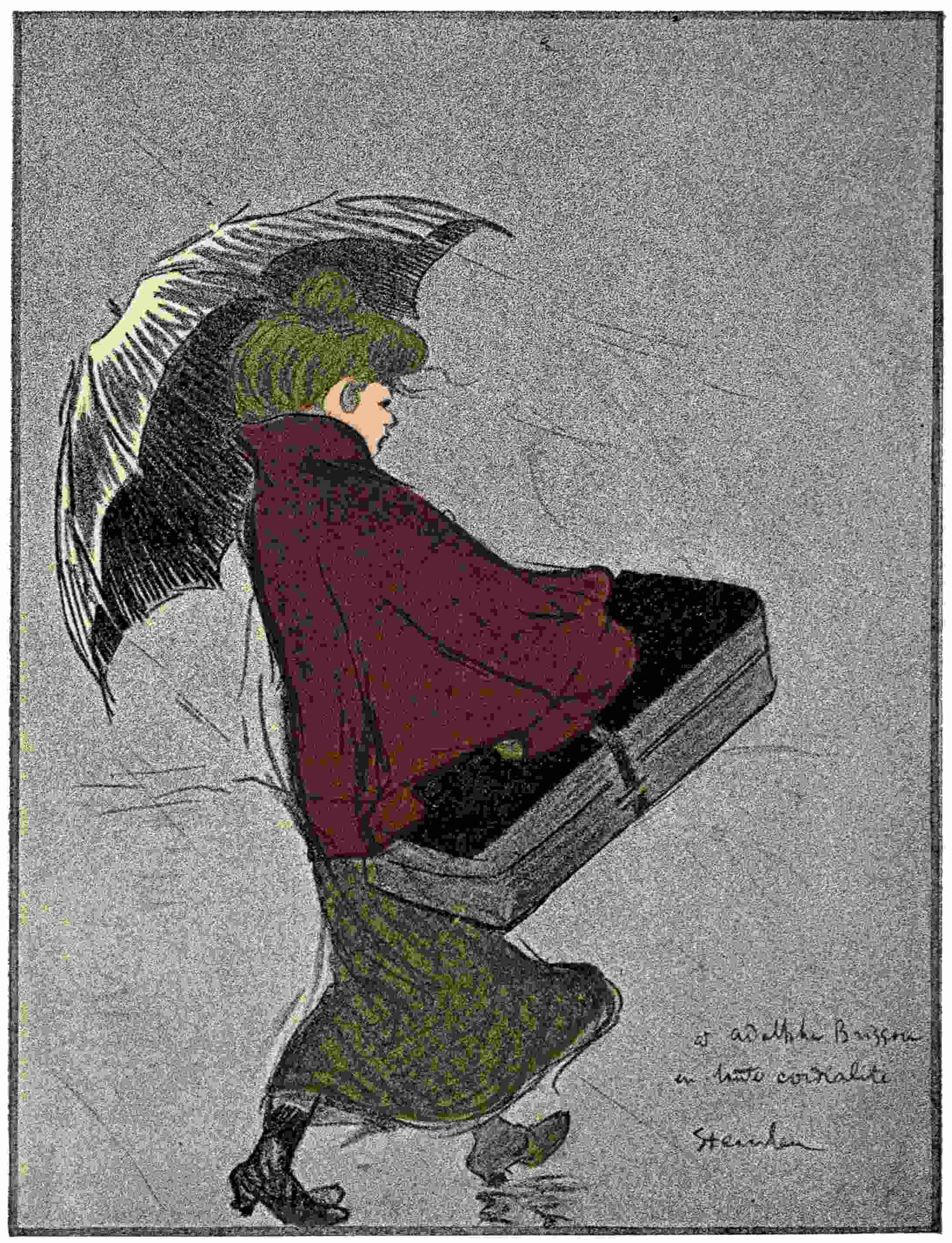
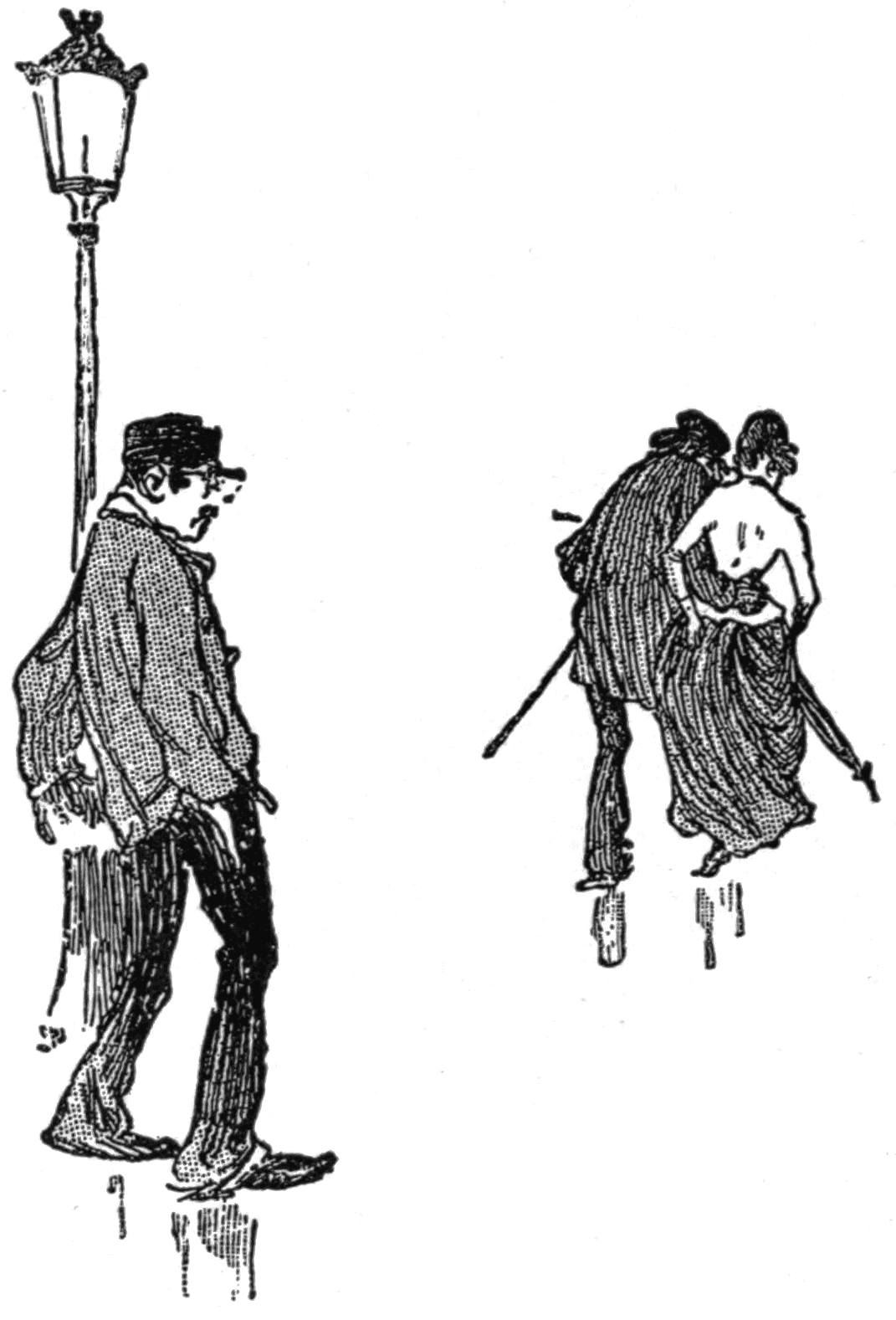
STEINLEN
Gil Blas Illustré
EN PROMENADE
(Pen drawing)
II CARAN D’ACHE
Emmanuel Poiré, better known by his
Russian pseudonym of Caran d’Ache
(pencil), is a public benefactor, in that he
has considerably added to the gaiety of
nations; and if it be true that one laughs and grows
fat, then he must also be responsible for much
of the extra weight that those nations carry with
them.
The man upon whom one may count to make
one merry is sure to be popular. Caran d’Ache,
as we have already hinted, has made whole nations
merry, and he is a popular favourite. It is true
that sometimes his own infectious laughter is
cynical, or spiteful, or cruel to a minority, but he
always has the majority to laugh with him, and
follow him in his pictured tirades—be they well-considered
or ill-considered. But, after all, that is
perhaps a matter of politics, or nationality, or
religion, or what not; and the fact remains that
his drawings are irresistibly humorous, and are
always excellent works of art.
Caran d’Ache was born in Moscow, of French
parents, but when twenty years of age he came to
Paris, where his innate talent soon evinced itself.
While undergoing his military service in the
early eighties his unquenchable passion for drawing
was put by the authorities to their practical use, in
making studies of past and current military uniforms
for the War Office. The costumes of the glorious
Napoleonic era and of Germany were made a
speciality, and the knowledge thus acquired was
carefully retained by the young artist, and served
him in good stead in his later years.
Caran d’Ache, like every thorough-going Frenchman,
preserves his love for the army, incidents in
whose life he is never tired of depicting with that
spirited brilliance we have come to know so well.
And the military officer’s smartness of bearing has
stuck to him, for he is recognised as an “ultra
chic”,—a very dandy among the illustrators, and an
eccentric one at that. Yet at the same time he
refuses to associate himself with the smart set in
Paris; he has too much of the artist temperament
for that.
He was early attracted to the “Chat Noir” on
the Butte of Montmartre, and Rudolph Salis—that
keen exploiter or genial art patron, which you
will—was not long in appreciating the talent of his
client. Soon we hear of him achieving an artistic
triumph with his astoundingly perfect shadow
pantomime, L’Epopée, at the little “Chat Noir”
Theatre. Caran d’Ache had spared no trouble to
make his silhouettes and the effects in which they
were set as perfect as possible. No greater pains
could have been taken preliminary to the painting
of a series of Salon pictures; and he reaped fame as
his reward.
“L’Epopée” dealt with Napoleon’s succession of
military triumphs. Opportunity was thus early
given to M. Poiré to display his astonishing knowledge
of the horse in all its varied attitudes.
The horse he delights and excels in is a magnificent,
proud, high-mettled beast, whom he puts at
some breakneck charge, or causes to career about in
high-strung excitement. Caran d’Ache’s army
horses are not surpassed even by those of such
acknowledged masters as Meissonier and Détaille.
The Studio published some splendid equine studies
of his a year or so ago, which must have been
a revelation to those who had previously looked on
Caran d’Ache as a comic artist and nothing more.
His drawings have been produced in innumerable
papers, magazines, and books, and are for ever being
re-reproduced abroad. Collections of his caricatures
have been published as “L’Album Caran-d’-Ache,”
“Bric-a-Brac,” “Le Carnet de Cheques,” “La
Comédie du Jour,” “Les Courses dans l’Antiquité,”
“Fantaisies,” “Galérie Comique,” “Les Peintres
chez-eux,” apart from his illustrations to “C’est à
prendre ou à laisser,” “Prince Kozakokoff,” “Malbrough,”
&c. More recently “L’Album” published
a selection of his works, including some drawings
done in a bolder style than that which he generally
produces for reproduction,—such are the Battery of
Dreadnoughts, bold and grim, and the splendid
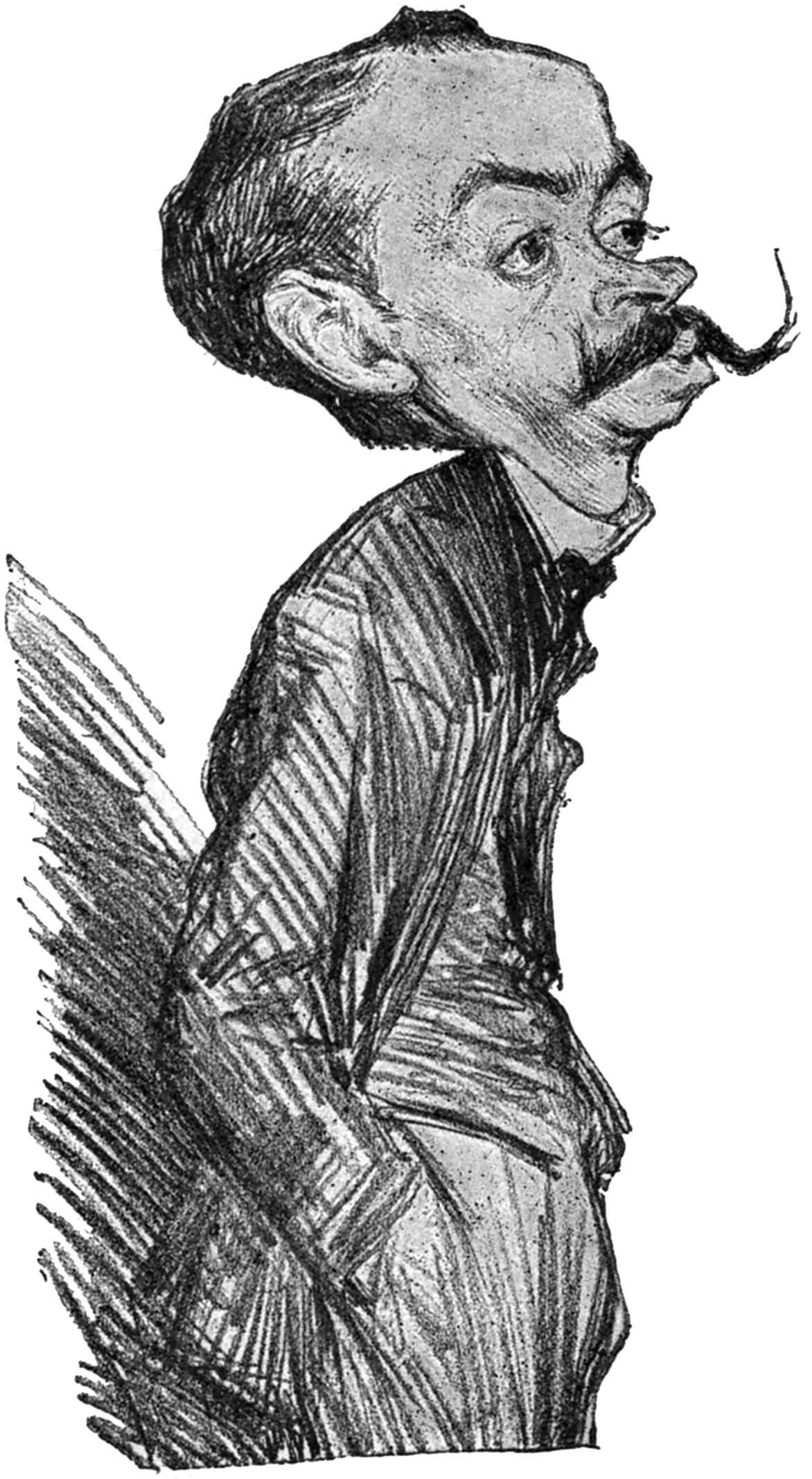
Charge. In the drawing of himself there is a
good specimen of those caricature portraits for which
he is so renowned.
His work appeared in the pages of Tout Paris,
La Vie Moderne, La Revue Illustrée, and Le
Chat Noir, &c.; superb military sketches came
out in La Caricature; and every week he carries
on a running fire of pencilled commentary in Le
Journal, and Le Figaro, contributing at the same
time to Le Canard Sauvage, and Le Rire. A
special number of the latter paper entitled Tactique
et Stratégie consisted of a short series of vigorous
military cartoons, representing various epochs, drawn
on a large scale, and some of them reproduced in
colours.
However, it is by his stories without words
that Caran d’Ache has attracted most attention,
and, it must be confessed, they are simply captivating.
Comic stories have been told by the same
means in Germany for half a century or more, but
Caran d’Ache is credited with having introduced
the progressive drawing into France.
Caran d’Ache’s little tales need not a syllable of
explanation. All is told by the subtlest of alterations
in the expressions on the faces of his figures,
in the movements of their bodies, or of other
animated or inanimate bodies; there is never any mistaking
the gist of a Caran d’Ache story. His attention
to detail is marvellous, yet everything takes
its right place, and the venue is never confused.
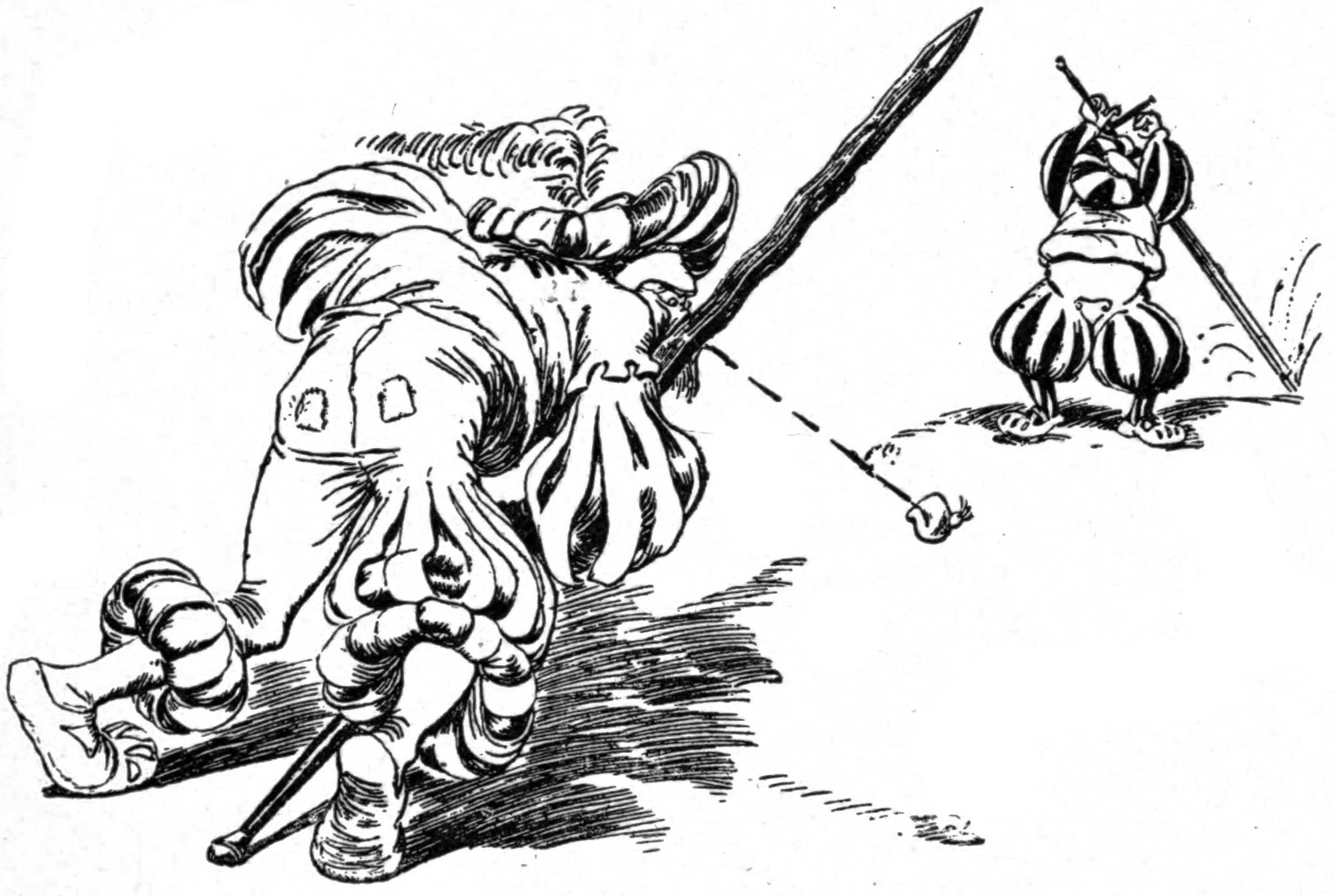
“THE COMBAT”
Nothing could better than—say—the set of
thirty-eight drawings entitled M. Toutbeau catches
the 5.17 a.m. Express. We trace the dear, fat
old fellow through all his agony. He is asleep.
He wakes in a perspiration of fright—ten to five—on
with them—that accursed tight boot—almost forgot
to wash—tie—good gracious, seven to—hallo, there
goes a button—Palsembleu!—5 o’clock—hair
done—now for my coat—I shall never do it! And
so on, through all the terrors of hasty packing,
ringings for the servant, getting, discussing and
paying the hotel bill—umbrella left behind and
recovered at the last moment—the dash into a
crawling cab—and then Mr. Toutbeau is seen
beaming in his first-class railway carriage.
Who does not know the Great Expectations
set, wherein the expectant nephew, to his joy, is
telegraphed for by his dying uncle; and how the
latter miraculously gets stronger and plumper day
by day, just as the erstwhile buoyant and vigorous
nephew’s growing disappointment drags him visibly
nearer and nearer to an untimely grave.
Then there is the little set of three Shooting
Impressions of my Friend Marius, who presumably
hails from the Midi. First he is in the North of
France with his gun and his dog—nothing in sight,
no game at all! Next he is in the Midlands,
both man and dog are happier, There’s just a little,
and a bird has been bagged. Lastly, he’s in his
beloved and romantic Midi and there’s too
much; there’s no room to walk for the game;
they press round and caress the bloodthirsty Marius,
a hare is making up to the dog, and one confiding
game bird has brought its nest of young and actually
settled with them on the gun barrel!
Another splendid set is that of The Finest Conquest
of Man, wherein is traced the marvellous horsemanship
of a swell, who, with the greatest of ease and
suavity, completely subdues a very demon of a
horse.
But we could proceed thus ad infinitum and yet
never give an idea of the wonderful spirit of the
drawings, which must be seen to be loved.
Most of them are executed with a thin, very precise
and sensitive line. How successfully he can
manage bold masses when necessary we can judge
by his excellent Cossack poster for the “Exposition
Russe,” or in those used to advertise the exhibition
of his own works at the Fine Art Society, London,
in 1898.
III H. DE TOULOUSE LAUTREC
Lautrec is one of those artists whose
work is so uneven and out of the
ordinary, that opinions as to its merits or
demerits will ever remain as strongly
divided now that he is gone, as ever they were
during his lifetime. His short life work consists of
a mixed series of talented absurdities, and of veritable
tours de force. His genius, alas! was of the
species that borders on insanity. Occasionally the
border was overstepped.
In more ways than one Aubrey Beardsley’s short
life may be compared to that of Lautrec. His
genius was of a similar order, and as one examines
his work, so will one be inclined first to call him
an unwholesome incompetent, and next feel convinced
that he is a pioneer artist of the first rank.
Lautrec’s life story is a very pathetic one. With
him in 1901 was extinguished the last remnant of
an ancient line of nobles. His father was an amateur
sculptor and painter, who was extremely fond
of sport. The family came to live in Paris in 1883.
The artist son was a dwarf, and after fighting hard
against his handicap, and cheerfully entering the
ring to tilt successfully for fame, his mind gave way,
and he died at an early age in his father’s castle at
Albi, after having been confined in a private asylum.
Lautrec’s student days were passed in Paris at
Cormon’s atelier. His work done from the life in
the studio did not hold out any great promise of
later achievement; but, as is often the case, the
untrammelled work he did outside was recognised
at once as being out of the ordinary, and frequently
of great merit. He would bring to the studio to
show his comrades very clever sketches of types he
had encountered during his rambles along the Boulevards.
Indeed, Lautrec occasionally asserted with
some bitterness in after days that it was these studies
that had inspired Steinlen to make the character-drawings
through which he had become famous—Steinlen
having previously made cats and children
his chief study.
However this may be, one has not much patience
with such claims. Real plagiarism is a detestable
thing, but surely there is room for more than one
artist in the field of the life of the poor, or of the
amusements of a huge city like Paris, without being
suspected of that offence. In any case Steinlen has
treated his subject as no one else has done, or probably
could do.
Lautrec was deservedly popular with his fellow
students; his excellent wit, delivered in a strident
voice, and punctuated with the gesticulations of a
pair of extraordinarily short arms, always proved
entertaining to those in the midst of whose company
he happened to be.
His best work is probably to be found amongst
his posters and portraits. His illustrations, except
in his earliest work, as seen in Paris Illustré,
more frequently show those crude vagaries of form
and colour, which would point to an unevenly
balanced judgment.
That Anquetin’s drawings strongly influenced
Lautrec’s work is evident, while Raffaëlli, Degas
and Renoir were his particular gods in art. Whether
Ibels influenced him, or vice versâ, it is difficult to
judge; but in any case there is a remarkable
similarity in the aims and peculiarities of their
art.
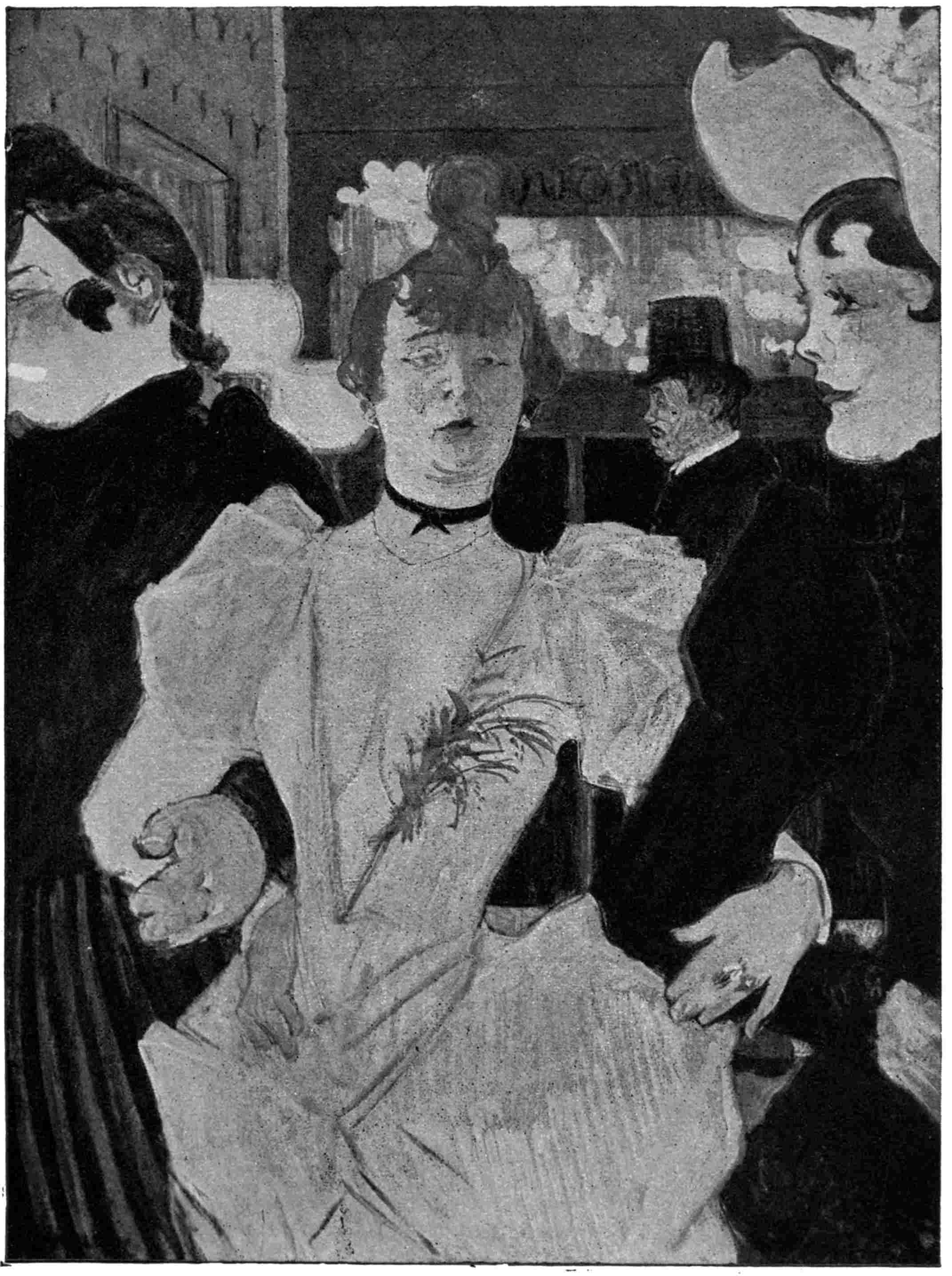
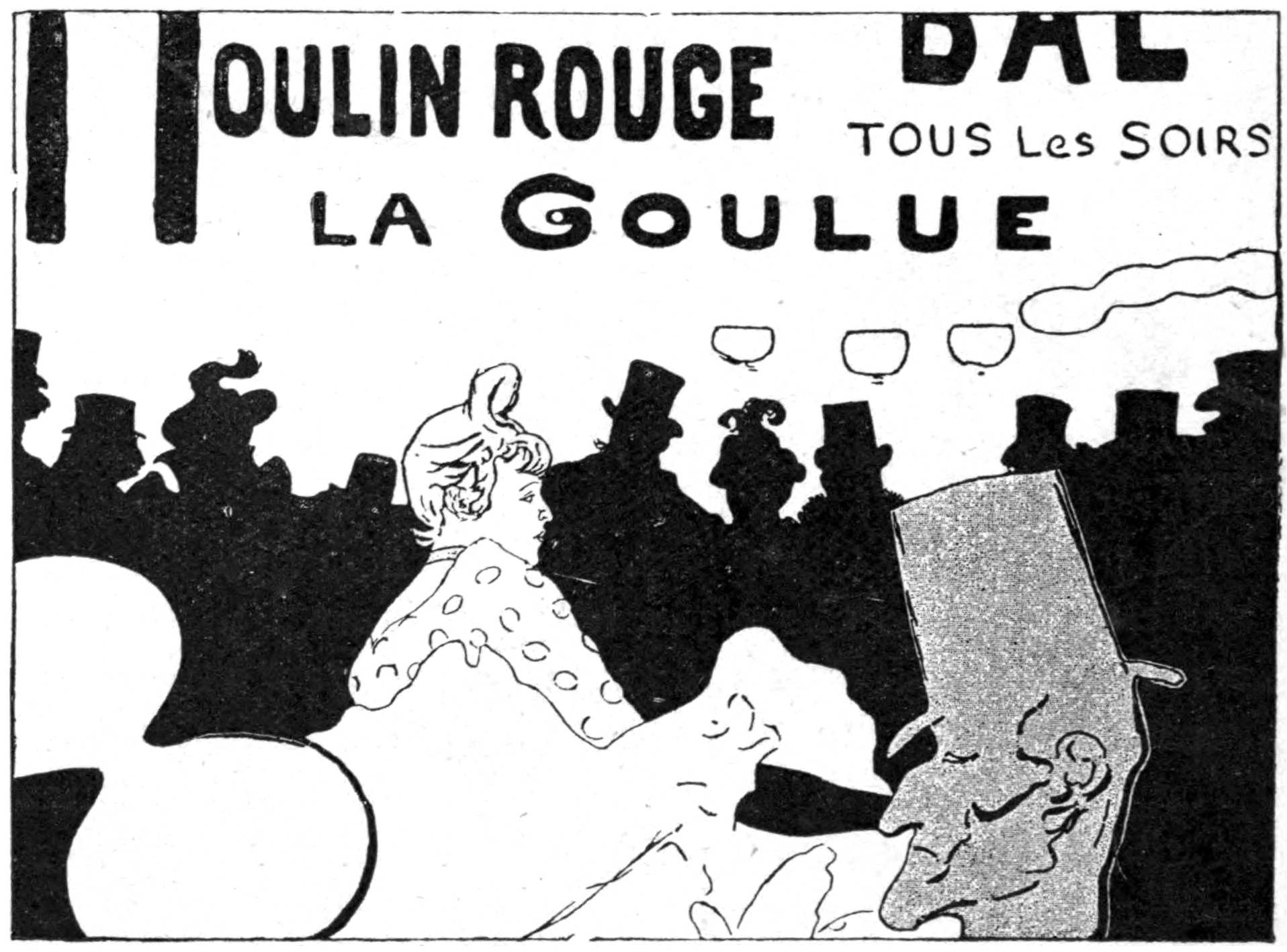
DE TOULOUSE LAUTREC
Paris—Collection Bernheim
AT THE MOULIN ROUGE
(Oil-Painting)
There is a magnificent poster of the poet-saloon-keeper,
Aristide Bruant, by Lautrec, which alone
would have been sufficient to place him high among
modern artists. Bruant in a large soft hat and
wrapped in a cloak of a gorgeous subdued blue,
moves with vivid energy across the sheet. His
strong face, printed in grey, is wonderfully rendered
with a few telling strokes. Little less attractive is
his Bruant at the Ambassadeurs Music Hall. These
are but two of many fine posters, done since his
first essay in 1888, to advertise the stars of that
peculiar firmament of the Cafés Chantants, to which
Lautrec was drawn as a moth to the flame.
He lithographed posters of Cissy Loftus, of the
beautiful Anna Held, La Goulue the dancer of
the Moulin
Rouge, and May
Belfort; and being
particularly
attracted by the
picturesque possibilities
of
Yvette Guilbert,
with her then
lithe figure and
inevitable long black gloves, he introduces her into
many of his works. Then there is a remarkable
poster advertising Babylone d’Allemagne, and a yet
more striking one for La Vache Enragée, where
we see a mad cow charging an old coloured dandy
down a street. There is also the startling
advertisement for “L’artisan moderne,” and the
truly terrible “At the Foot of the Scaffold.” Apart
from these there are his posters “in little,” and
programme-covers, such as those for Le Missionaire
and L’Argent.
The very peculiarities and incomprehensibilities
inherent in Lautrec’s work were sure to arrest
attention, and demand that scrutiny which is of the
very essence of the successful poster. In every
one of Lautrec’s poster designs there is something
strikingly unusual. Very rarely is a figure drawn in
its entirety; the margin cuts off part of it, otherwise
the design would have been too conventional for
him.
The artiste Caudieux zig-zags across a stage seen
in violent perspective, while down in a corner is a
worried member of the orchestra studying the coming
bars. Caudieux’s head is full of life and pent-up
strength, and the whole movement of this
quaintly placed figure is striking in the extreme.
Jane Avril’s poster shows an anæmic-looking
artiste doing a high kick on the stage. The foreground
is occupied by a monster hand holding the
head of a ’cello in the orchestra.
The poster for the Divan Japonais, on the other
hand, shows us a lady and gentleman in the audience
listening to a singer on the stage, behind an
orchestra. Of the singer we see monster black
gloves, and everything but the head; of the
orchestra we are shown two ’cello heads, and, of the
conductor, the arms alone. The lady in the foreground—who
looks as though she always turned
night into day—is wonderfully depicted, as is her
companion, the dissipated, bearded swell. Perhaps
his most graceful work in the poster line is that
advertising Elles.
Finally in the poster for La Gitane, an unsavoury
actress, arms akimbo, who comes right out of the
design in the left hand foreground, smiles over her
shoulder at the bold bad brigand who strides, in
shadow, out of the poster at the top right hand
corner. In all these and his other posters the
lettering is bold and legible.
Lautrec’s studies in the music halls are uncompromising
in their garishness; he apparently does not
attempt to seek beauty where it exists in such small
quantities, or has been so carefully hidden. He
delights in the flare and glare, the powder and paint,
the discords and the inconsistencies of the thing.
He prefers the raucous screech of the bold-faced jig,
whose reputation as a songstress rests on her fine
limbs, to the exquisite song of the highly-trained
opera singer. He would reject gold in favour of
tinsel. Yet this same man in another mood would
paint a splendid and refined portrait.
Then there is Lona Barrison, jauntily leading her
white horse out of the ring, followed by her manager
with the pale chrome hair and beard; and then the
hideous negro—“Chocolat dancing in a bar.”
All of these figures, despite their faulty drawing
and their element of caricature, carry conviction
with them.
Lautrec’s travels in Spain, in England, Holland,
and Belgium seem to have left little impression on
his work. It is probable that the unhealthy surroundings
and late hours imposed by his studies in
café-concerts, in green-rooms, in libertine ballrooms
and worse, hastened the end of that frail,
feverish life—a life like that of a gaudily coloured
rocket, brilliant and soon spent.
In his later
years he had
evinced a
great attraction
towards
the repulsive
and the gruesome,
and
took a pleasure
in seeing
medical operations
performed. Curiously
enough,
his studio
window overlooked
a cemetery.
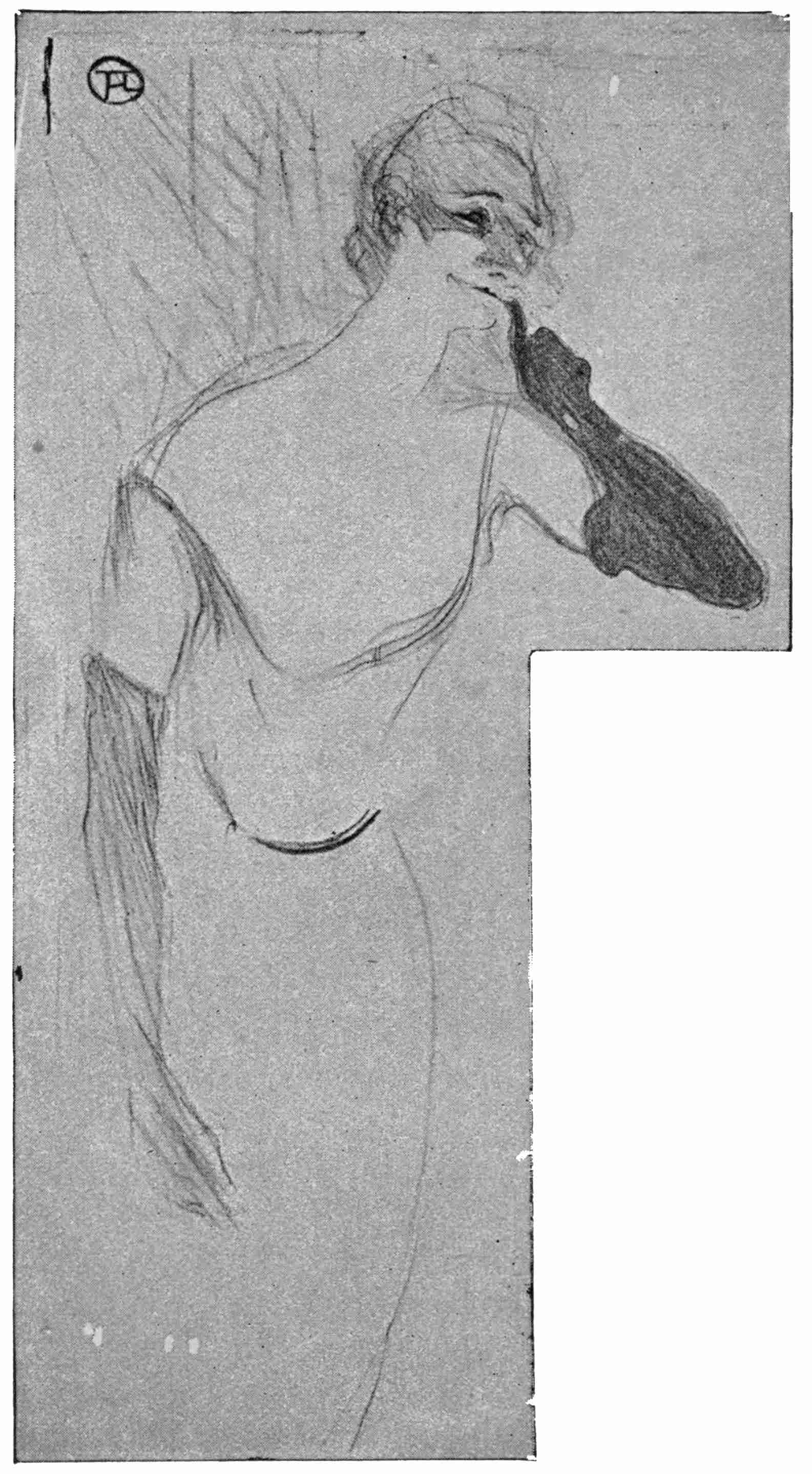
By De Toulouse Lautrec
YVETTE GUILBERT
IV PAUL BALLURIAU
Balluriau is best known as the artist
who has supplemented Steinlen’s realism
in the pages of the Gil Blas Illustré
with drawings full of fancy and imagination.
Just as we shall call Morin the Watteau,
so he may be styled the Boucher of the modern
French press.
His work, however, has not been confined to the
pages of Gil Blas, for his gay and irresponsible (we
had almost said reckless and unfettered) sketches
have been noticeable in many another journal of far
less steady gait. Nor has he restricted himself entirely
to allegorical or eighteenth-century pastoral
subjects. Occasionally he bursts forth as a strong
modern realist, walking sturdily in Steinlen’s steps.
Balluriau has that thorough knowledge of the
human figure which enables him to draw it with
freedom and certainty, and makes him a painter of
classical allegories par excellence. Further, he has a
broad, open style, and a very charming and delicate
sense of colour. His favourite medium is apparently
the chalk point, which he handles vigorously;
occasionally, however, he varies his method by
using pen and ink.
For ten years past his brilliant work has graced
the pages of Gil Blas Illustré. He is essentially the
artist of lovers; and no better choice of an illustrator
for that paper’s series, “Les Poètes de l’Amour,”
than that of Paul Balluriau could have been made.
To judge by these illustrations Cupid has handed
over all the resultant knowledge of his long experience
to Balluriau; for there is very little about the
outward signs of love and passion which he has not
carefully noted, thereafter to render in his drawings.
From the first shy gesture to the tender murmur
of adoration, and thence, through the whole gamut,
to the frenzied passion of uncontrollable love—we
find the recording crayon of Balluriau to be ever
present.
The settings in which he places his graceful
lovers, his Bacchanalian dances, his fauns and his
nymphs, are suitably idyllic and beautiful.
Innumerable are the backgrounds of fair lawns
shaded by great trees, of lovely bowers, and of
secluded nooks in some great park in Dreamland.
Perhaps there is some serio-comic difficulty to be
settled, and we see two charming little ladies, in high
powdered coiffures and bared to the waist, fighting a
duel with swords under the trees. Or perhaps it is
twilight, and some deep and placid stream murmuring
beneath the darkling trees carries on its bosom a
fairy bark and its cargo of love.
Then it is the mysterious hour of moonrise, and
in the shadow of the garden wall, which climbs
serpent-like up hill and down dale, we shall find our
lovers serenely happy, but hushed by the beauty of
the waking night.
Frequently Balluriau will carry us back to a
century of delicate silks and satins; and in the broad
sunlight will show a band of amorous beaux and
belles, full of the joie de vivre, and about to start a
game of blind man’s buff. His figures live within
their old-time costumes; he draws handsome men
and beautiful women, for the ugly or the grotesque
rarely attract him. But he has proved in such
charming works as his “Printemps,” and many
others, that he also finds in the lovers of to-day
sufficient beauty to include them in his répertoire.
The embrace of the sentimental young student in
the felt hat and caped overcoat, who has just met
the darling of his heart in the Bois de Boulogne, is
every whit as tender and graceful as is that of the
perruqued galant of the eighteenth century,
arrayed in pink satins, who, behind a sculptured
satyr, has stolen a kiss from his coy and dainty
partner in the last minuet on the sward. Look, in his
illustration to “Badinage Sentimental,” how natural
is the whole scene, how easy the pose, and how
charming the face of the little Parisienne, who
listens, half fearing the ardent words of the
young exquisite who is stealing a conversation
with her.
Balluriau also knows how to deal with subjects
requiring more vigour of treatment—such as he
displays in his Breton figure subjects. His drawing
Partance is a case in point. The scene is laid
in a sailors’ cabaret, on the tiled floor are rough
tables, at and on which sit peaceful groups of
Breton peasants; and sailor-men and buxom bonnes
are bidding each other their last adieux—for the
sailors are about to embark in one of the ships we
see through the wide-open window.
And in the rare drawings where he touches on
poverty and serious tragedy he proves himself
impressive and capable of deep feeling. His
drawings La Toussaint Héroïque, the terrible beer-house
brawl, L’Été, and Un Mendiant Rousse, are
worthy of Steinlen.
But it is in his illustrations of classical and allegorical
subjects that he stands alone, and shows his
greatest individuality.
Such subjects as his Bacchantes, his weird Vers
le Sabbat, his Chloé, or his La Mort des Lys, to mention
but a few in the Gil Blas alone, could have
come from no other hand; for excellency of
draughtsmanship combined with trained composition
and an exquisitely refined sense of colour, they are
hard to beat.
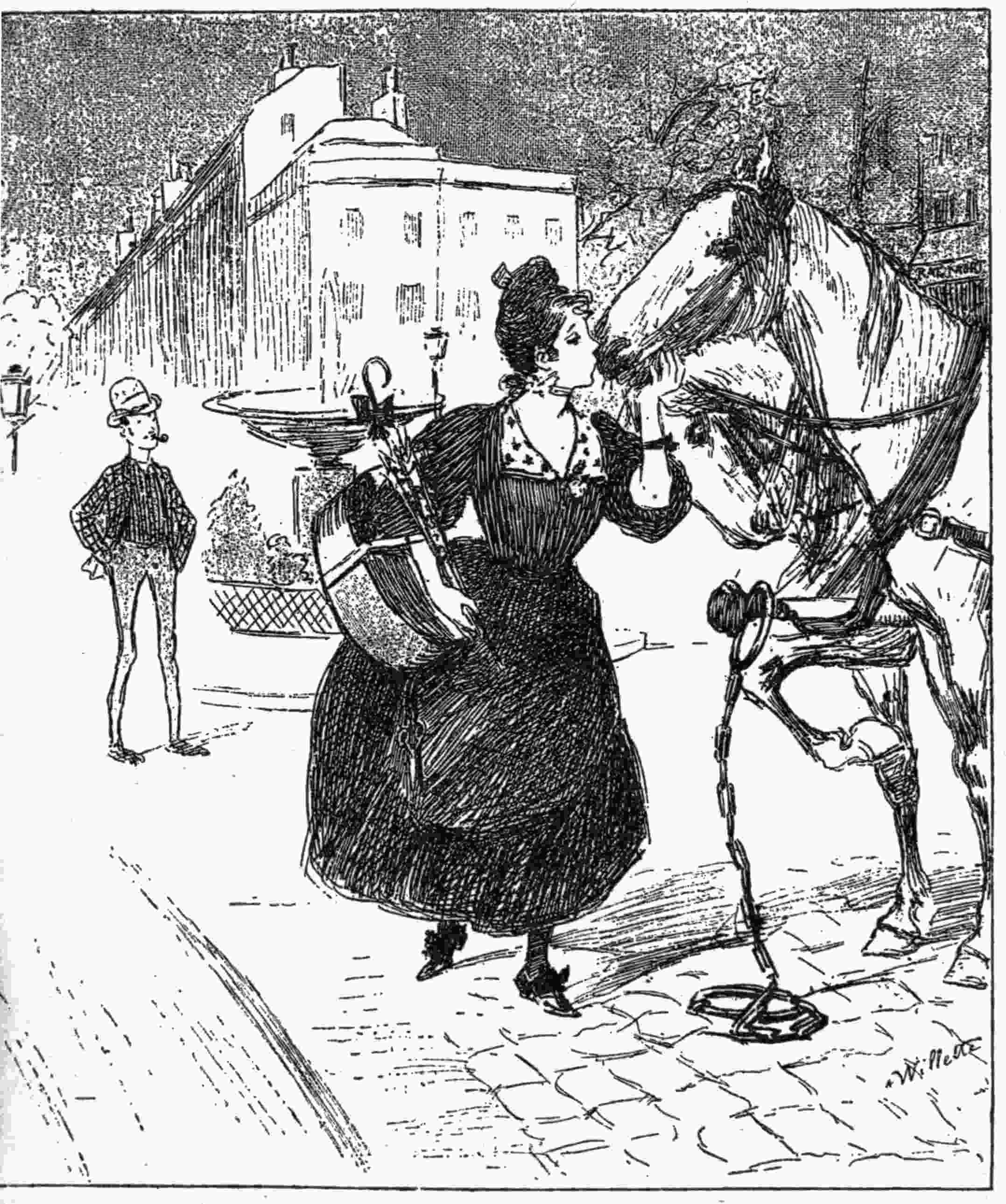
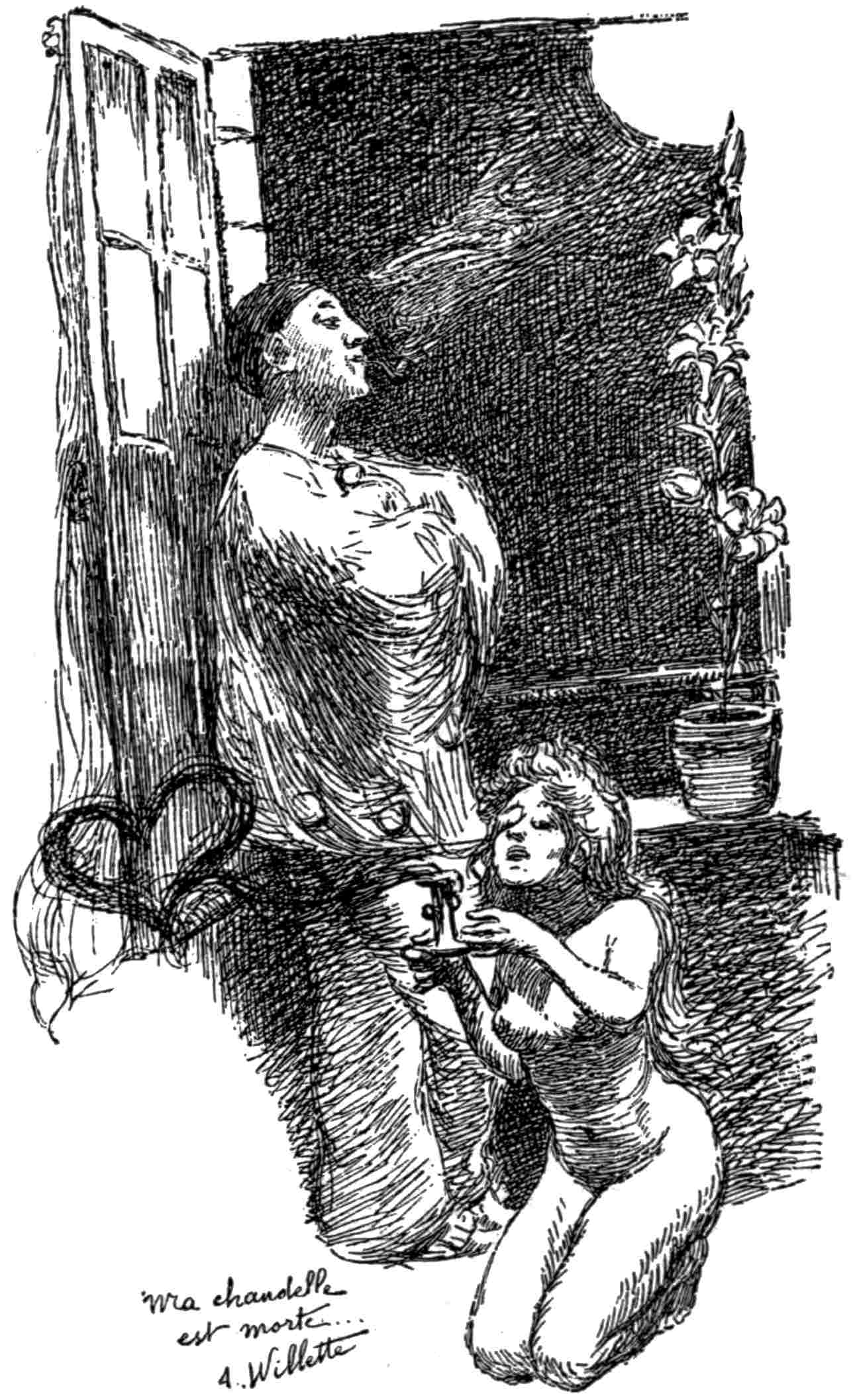
A. WILLETTE
Courrier Français
“MIMI PINSON, TU IRAS EN PARADIS!”
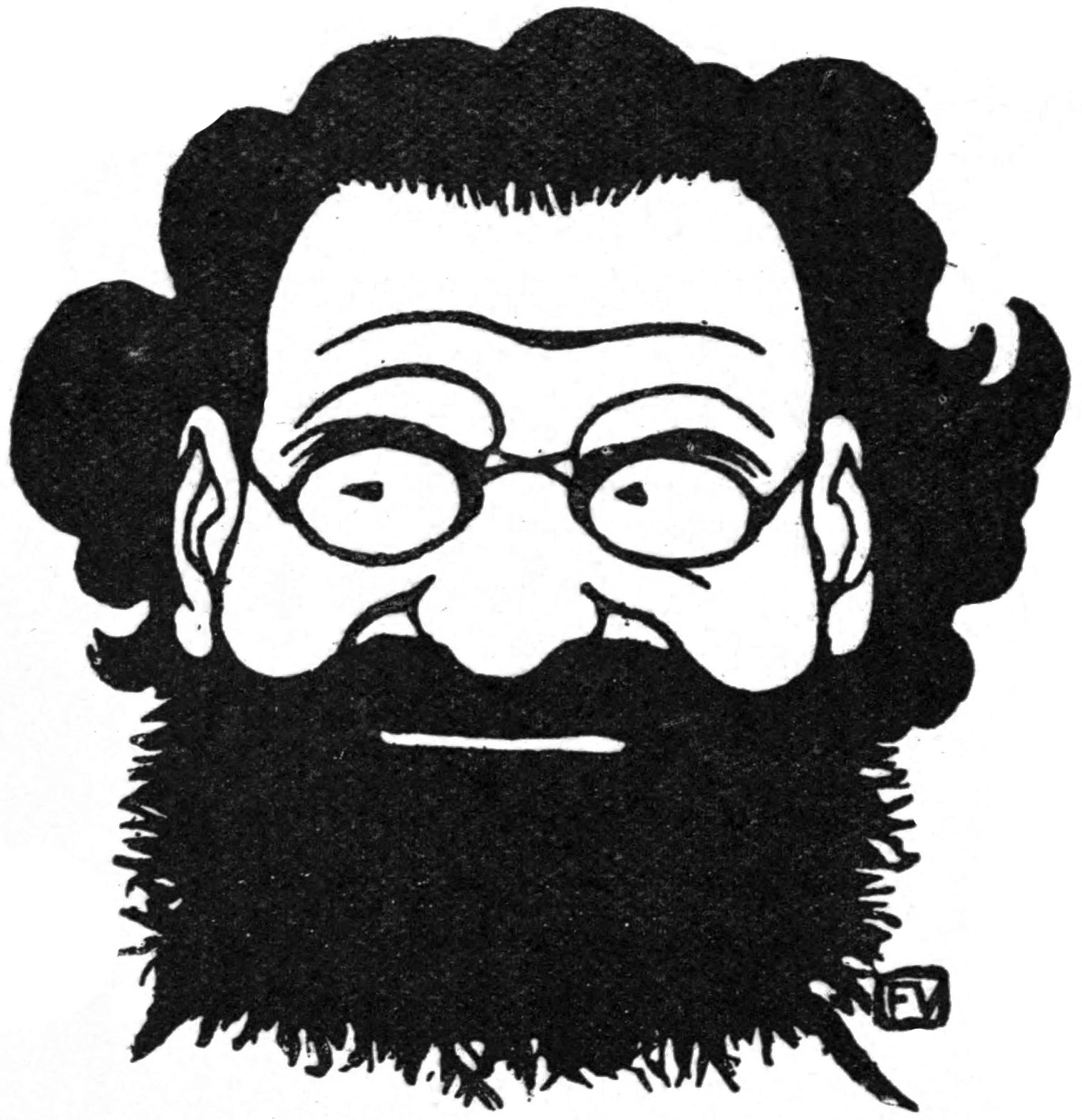
V FRÉDÉRIC VALLOTTON
Vallotton’s work has probably appeared
less frequently in the French
press than that of many of his confrères
to whom we are directing our attention.
His drawings are marked by a singular boldness
of execution; and his skilful manipulation of masses
of pure black gives his work distinction, and makes
them attractive on any page.
Good draughtsmanship, and this clever use of
unbroken black masses—wherewith to indicate and
model both his shadows and his half-tones—is wherein
Vallotton struck out a new line for himself, and
established his individuality. This he did, too, at a
time when there was a lamentable aberration evident
among the ranks of the French illustrators. It
became the fashion for the comic draughtsmen to
draw as though they could not draw—a proceeding
which provided a grand opportunity for those who
could not draw if they would to join their ranks
on even terms, and to pass as geniuses of a very
spirituel order.
The irritating group to whom I refer, in its
frantic efforts to be original, hit on the idea of
drawing with the naïveté of the untutored child;
and this rôle was for several years acted so thoroughly
that some of the papers looked as if their
illustrations had been copied from a collection of
babies’ slates. Terrible examples of this evident
incapability passing muster as genius may be seen
in the ludicrous discords by “Bob,” and, in a less
degree, in the many works by Dépaquit, Delaw,
Rabier and others.
Midway between this group of soi-disant or actual
incompetents, and the valiant band of thorough
unflinching draughtsmen of realism—in whose ranks
we find Renouard, Steinlen, Léandre, Huard, Malteste,
Wély, and others—came an intervening group.
Their work was, and is, extremely interesting.
They adopted much of the naïveté of the enfantillistes,
but wedded to it much knowledge and
artistic feeling. In this class one may mention
Lautrec, who wavered between one group and the
other, Ibels, who did much the same, Jossot, who,
amongst a large number of weird drawings, has
produced some really fine, strong work in black
and white and in colour, Metivet, who has similarly
produced both classes of work, Hermann Paul, an
undeniably great draughtsman, and the subject of
this chapter, Frédéric Vallotton.
The curious thing about Vallotton’s drawings is
that we do not miss the half-tones; the unbroken
blacks are so skilfully managed that we do not feel
the want of Nature’s intervening tones between
pure black and pure white. His convention in no
wise shocks one, but gives keen artistic pleasure.
This question of the accepting of conventions
must strike one as a very remarkable matter. The
human face, in reality covered with a smooth,
soft skin, delicately gradated in tone and colour, is
quite completely and satisfactorily conveyed to us
by Vallotton, in a cunning arrangement of black
splotches; while Huard will model the delicate
roundness of a cheek with two or three bold black
lines in curves. In both cases we at once realise
the truth to Nature, and can even from such
suggestions conjure up the particular colouring and
flesh texture of the person represented.
Vallotton adds a keen sense of humour to his
great ability as a draughtsman. Look at his
coloured drawing Don’t Move, in Le Rire, where
we see a petty official and his family, tidied up for
the occasion, being photographed on a national
fête day. A typical photographer, engrossed in his
work, counts one! two! three! preparatory to
removing the cap from his camera. So engrossed
in his counting is he that he does not notice that
his carefully composed group is becoming rapidly
discomposed. In the foreground is fat nou-nou,
beaming down at the youngest hopeful in her
arms; yet more bulgy maman swerves over to
tickle her youngest, while the next eldest clutches
her mother’s skirts in terror of the great ugly man
with the camera.
In the background is the father of the family,
looking over his wife’s shoulder at the baby; while
he places one hand on the shoulder of his eldest
boy, who is rapidly outgrowing his knickerbockers,
but is nevertheless determined to “come out well”
in the group. The party is completed by the
grown-up sister, who toys coyly with a straw
flower lent her for that exact purpose.
A couple of drawings record with equal force and
truth the effect on the public of the cry “Stop
Thief.” First we see the excited rabble in full
chase; and then the victim (absolutely innocent)
being hurried off to the police station by victorious
gendarmes, followed by a gesticulating crowd of
knowing ones, who declare the prisoner is a murderer
who has killed a woman and six children. On
another page are two street wrestlers, drawn to the
life. One of them is shouting himself hoarse in his
endeavours to collect a crowd to witness the marvellous
accomplishments of his colleague, a mountain
of flesh who is about to lift a stupendous pair of
dumb-bells.
Yet another coloured drawing in Le Rire,
called Le Coup de Main is very remarkable in
its composition and handling, and like most of
Vallotton’s work shows an appreciation of Japanese
methods. It depicts a team drawing a huge block
of stone which has come to a standstill, while a group
of labouring men are all lending a helping hand to
get the huge white mass on the move.
PORTRAIT OF M. DRUMONT
Among the papers which Vallotton has helped to
illustrate may be mentioned Le Cri de Paris, Le
Sifflet, and Le Canard Sauvage.
The hoardings of Paris have been enlivened from
time to time by vigorous posters by Vallotton, a
class of work to which his art is eminently adaptable.
A most notable example was the bold and telling
one he cut on the wood, for the publisher Sagot.
But it is Vallotton’s portraits of contemporary celebrities
that entitle him most to lasting fame. Some
of these have appeared in the French journals, as a
magnificent set of powerful woodcuts, done in a
large style and on a large scale.
A fine example of this work was published in
The Studio in 1899, in a portrait of Puvis de
Chavannes, which Vallotton drew and cut on the
wood specially for that journal.
A very subtle and delicately coloured reproduction
of Vallotton’s work in colour appeared also in
The Studio a few years back; and an excellently
rendered landscape woodcut by him appeared in the
volume that so fully indicated the claims of modern
wood engraving, namely, “L’Image.”
VI LOUIS MORIN
Morin is the Watteau of the modern
illustrated press. He is, so to speak,
an eighteenth-century maître galant
of the twentieth century. He inherits
Watteau’s gaiety and light-hearted joy in the fêtes
and intrigues of the butterfly life of a time now
gone by—a life half imaginary and half real. His
figures tip-toe airily through an atmosphere scented
with roses, ever ready for ardent love-making, for a
stately minuet on the sward, or for a reckless
break-neck dance over the cobble stones. Anon
his figures laze in swan-like gondolas, gliding along
the moonlit canals of Venice to the throbbing music
of the mandoline. Moreover, all his delightful
personages are instinct with life; they flirt and
romp, and their boisterous gaiety is infectious; we
must laugh with them for sheer joy—aye, and
weep with them, now and then, for sheer sorrow.
Morin wields magic pens and pencils. His lines
are full of nerve and verve; they are impelled by
the passionate excitement of the moment, and can
be no mere outcome
of patient
plodding. If ever
an artist’s fingertips
were the ready,
unquestioning servants
of a lively
brain, those fingertips
are Morin’s;
in its effervescent
spirit and gaiety,
the quality of his
brain is essentially
Gallic.
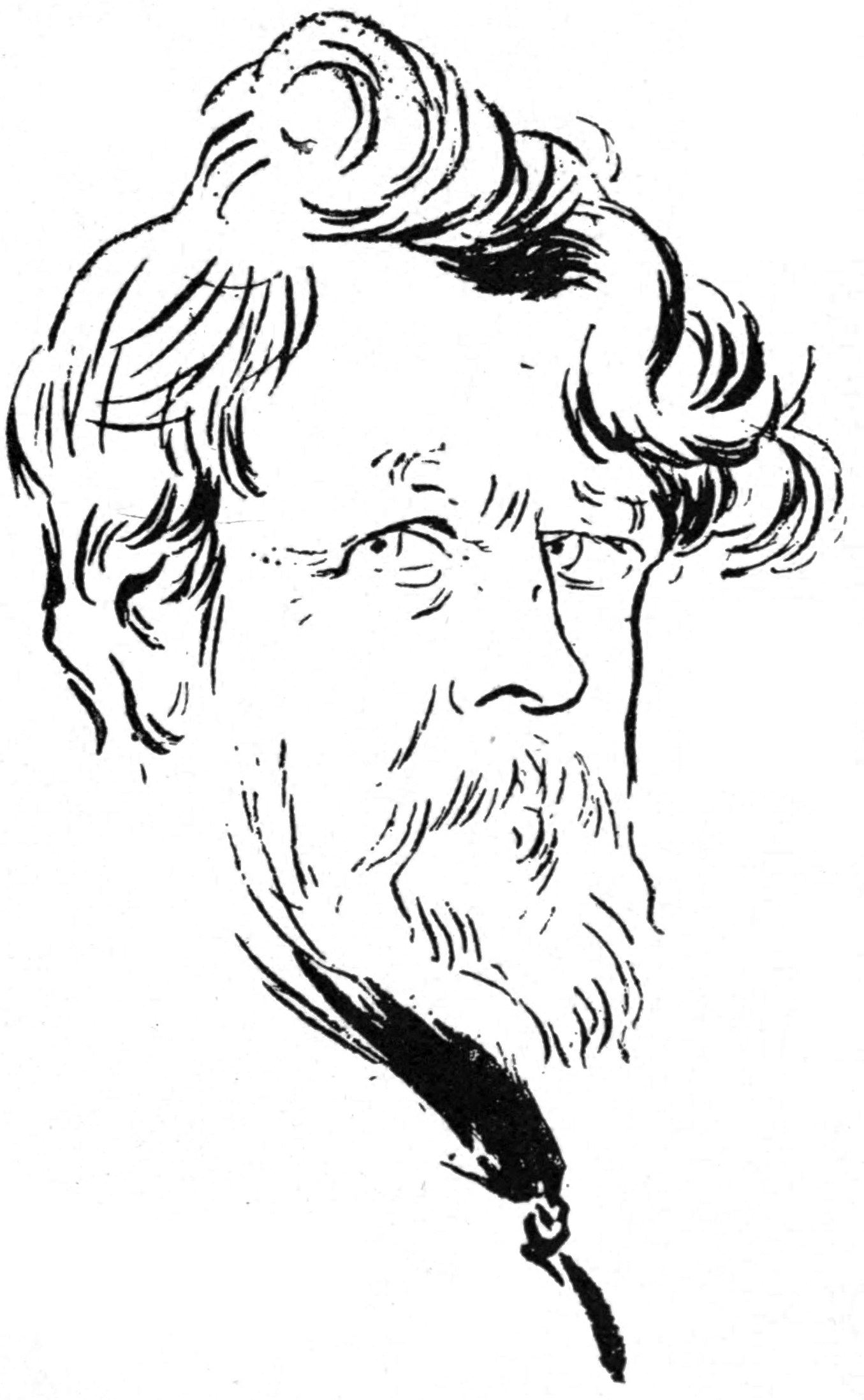
LOUIS MORIN
(By himself)
Morin was born
in Paris in 1855,
and was educated
(education being
much against his
youthful will) first
at Versailles, and
then at one of the
Paris Lycées. He
was trained as an
architect, but left
that profession in
favour of sculpture, producing excellent portrait
busts and such exquisite work as his “Moineau
de Lesbie,” &c. As an author Louis Morin has
gained great distinction. His “Cabaret du Puits
sans Vin,” written in 1884, was crowned by the
Académie Française, and further was awarded a
gold medal at the Paris Exhibition.
In 1883 he had produced “Jeannik,” a book
resulting from a stay in his beloved Brittany, and
illustrated with eighty-seven drawings of eighteenth
century Brittany. Later he travelled in Italy, and
found inspiration for his book, “Les Amours de
Gilles,” which he adorned with 178 spirited
sketches of the beaux and belles of Old Venice,
their manners and their customs. In 1886 he
wrote and illustrated “La Légende de Robert le
Diable,” to charm the little ones. He has also
illustrated for his juvenile admirers, “Pikebikecornegramme,”
and “Dansons la Capucine”;
later he wrote and illustrated with ninety sketches
his delightful “L’Enfant Prodigue.” Then there
are his works on “French Illustrators,” and on
“Quelques Artistes de ce Temps,” as well as
“Dimanches Parisiens,” with twenty-five etchings
by the greatest wood engraver of modern times—A.
Lepère.
He has also illustrated the following books:
“Vieille Idylle” with twelve drypoints, “Le
petit Chien de la Marquise,” “Les Cerisettes,”
“Le dernier Chapître de mon Roman,” “Vingt
Masques,” “Carnavals Parisiens” (with 178 drawings),
and “Les Confidences d’une Aïeule.”
In the early eighties Morin started drawing for
La Caricature and Le Chat Noir, and later on for
the Revue Illustrée, the Revue des Lettres et des Arts,
Figaro Illustré, St. Nicolas, Le Canard Sauvage, La
Vie en Rose, &c.
Morin was one of the leading spirits of the “Chat
Noir” shadow pantomimes, and produced there in
1890 his enchanting “Carnaval de Venise,” in
1892 “Pierrot Pornographe,” in 1894 “Le Roi
débarque,” and in 1896 “L’honnête Gendarme.” In
1891 he produced his pantomime “Au Dahomey”
at the Musée Grévin.
A fair sized room having been acquired as an
annexe to the artistic cabaret of the “Chat Noir,”
a white sheet was fixed at one end of it over a
miniature stage, and surrounded by a quaint and
elaborate gold frame. From the wings at the rear
were thrown on to the sheet the shadows of marvellous
little figures cut out by such artists as Morin,
the great Henri Rivière, Caran-d’-Ache, Henri
Somm and others, who thereby achieved great fame.
All kinds of ingenious little pieces of machinery and
clever combinations were invented and employed to
build up the great success, which proved attractive
enough to draw “all Paris” to Montmartre for
some years, and to fill the pockets of proprietor
Rudolph Salis, the “King of Montjoie-Montmartre,”
so full that towards 1897 he was enabled
to purchase and retire to a noble estate in the
country. From this estate, however, he was shortly
to be recalled by the magnetic attraction of his
beloved Montmartre.
A glance at the pages of the Revue
des Quat’ Saisons, which consists of
four dainty parts written and illustrated
by Morin, serves to give us
a very good idea of his later work.
Each of the quarterly parts is contained
in a paper cover embellished
with a different design in colour by
the artist-author, which gives one a
foretaste of the treat of spices contained
within; for within, interspersed
amongst the larger plates of
a refined colouration, are numberless
little masterpieces of pen draughtsmanship,
incredibly gay and graceful
and supple. Morin herein shows
himself a superb draughtsman, his
excited little figures career about
the pages, their shapely forms palpitating
and quivering with the joie
de vivre. The artist’s quick eye has
detected the slightest inflection in
the body’s outline, caused by some
momentary and wayward impulse, and crystallises
the beautiful thing for his own joy and for ours.
The intoxication of the carnival pervades the
greater part of this book, whose literary contents
consist of a series of chapters on such interesting
matters as the “Courrier Français Ball,” “The
Ball of the Medical Students,” and the final two
Quat’z’arts Balls—at which latter the Paris art
students and their models used, until the heavy hand
of the law fell upon them, to vie with one another
in producing the most artistic and audacious groups
of revellers in (and without) fancy dress ever seen.
Another chapter is devoted to a “Night Fête at
Venice” in the olden time, with its scenes of love
and revelry. Yet another, illustrated with silhouettes
such as helped to make the success of the Chat
Noir Theatre, deals with the influence of that
institution on latter-day Art and Poetry. Then
follows an article on “Spanish and Eastern dances,”
illustrated with gracefully whirling votaries of the
terpsichorean art; next comes a chapter on “Modern
Sculpture,” decorated with irresistibly comic drawings
of models posing in excruciating attitudes to
satisfy the modern sculptor’s supposed craving for
originality.
The amount of ingenuity, facility, and anatomical
sureness shown in this little set astounds one.
Most of the drawings have evidently been done
with a very flexible pen, capable alike of giving a
line that with but slight pressure passes from great
delicacy to corresponding strength.
By Louis Morin
The Vie en Rose contained many contributions
from Morin; occasionally he essayed a drawing
executed with the bold thick line then in vogue, but
anything approaching brutality in method or subject
could not but come amiss to him, and it is in such
delightful fancies in this journal as the Façon de voir
la vie en Rose—Le Dessinateur—that we see him at
his best. A draughtsman of elegant appearance,
surrounded with bric-a-brac, is here seen in his
censer-perfumed studio, reclining on an enormous
rose-coloured cushion; his cigarette is in one hand,
and the crayon which is limning a female form in
the other. Two adoring little models watch and
guard him; while a procession of respectful art
patrons stream in humbly to offer their thousand-franc
notes for the sketches he is tossing off.
Other less discreet studio incidents, treated with
even more delicacy of colour and draughtsmanship,
are contained in the journal.
Morin stands alone in his particular style of
workmanship: those who have come nearest him
are the joyful and boisterous Robida, and the more
reserved Henri Pille.
From all the above it is easy to gather that Louis
Morin is little short of a genius; a charming and
wonderful personality, endowed with one of the
keenest and most versatile brains of our day.
VII CHARLES HUARD
Huard has done for the denizens of the
godly, deadly dull French villages and
provincial towns of France what Steinlen
has done for Paris—and he has done it
exceedingly well. It is difficult to conceive how
these worthy people, so fully convinced of their
own importance, so proud of their deviltries and or
their little wickednesses, and so full of tittle-tattle
about their neighbours could have been better
introduced to us.
Huard’s collection of one hundred sketches,
published in book form, and entitled “Province,”
should prove a valuable document to future writers
on the manners and customs of a section of French
provincials at the commencement of the twentieth
century. He interests himself mainly with the
local official and petit commerçant (or tradesman)
classes, deviating occasionally to draw within his
net a few stray soldiers, or some dignified member
of the old nobility of France.
A man of healthy mien and fine physique, Huard
is excessively reserved and retiring, seeking the
companionship of
very few, and entirely
engrossed in
his work. Moreover,
he is most
modest, and has
in no wise been
spoilt by the lasting
success and
renown his work
has earned for
him, at an age
when others are
but commencing
to hammer at the
door of Fame.
Huard was born
in Paris, but
brought up in a
provincial town.
His schooldays,
we are told, were
marked by indomitable
diligence
in the successful
finding of means of evading the tedium of
one school after another. It is a ludicrous fact
that although none of his humorous sketches are
actual portraits, his own townspeople have taken
such dire offence at what appeared to them as hits
at themselves, that they have so far boycotted the
satirist that he willingly banishes himself from the
town in which he passed his youth. It is even
reported that one old lady said, quite seriously, that
if he ever dared to draw her she would disfigure
him for life with vitriol. Possibly this is the marvellous
person, in a good temper, whose physiognomy
appears on the cover of the Huard number
of “L’Album.”
Of course it is not to be denied that Huard has
“made game” of the provincials; and, knowing the
inherent pettiness of the classes he has held up to
ridicule, it is small wonder that they resent fun poked
at their expense by one who to them can appear
to be no less than a traitor. Huard, however,
is never spiteful or malicious; he sees better and
further than his neighbours, and he knows how to
tell the truth about what he has seen, without being
warped by local influences.
A perusal of “Province,” and other works to be
mentioned, will, I am sure, prove the truth of these
remarks.
His figures are as a rule set in fitting urban landscapes,
every whit as truthful as the personages they
frame. Look at the drawing among those classed
Les Officiels, entitled Midday Mass is far the most
aristocratic—wherein a procession of regular church-goers
debouches out of a picturesque, half-hearted,
somnolent High Street into the blazing sunlight of
the “Grande Place.” The local member and his
wife, the lawyer, and all the other pious scandalmongers
of the town are going to make their daily
penitence. We can see these good folk, we can
feel the sunshine, and we can even hear the clangour
of the bells in the church tower. Then look in
another sketch at the two editors of The Revenge.
Were ever such chauvinistes, such firebrands?
Getting on in years—true; but as dangerous as not
yet extinct volcanoes, they reek of pistols for two
and coffee for one.
A drawing labelled The Express conveying the
President will pass at five o’clock, is most amusing.
There, on the little railway platform, is gathered all
the official rank and society of Tilliere-Sur-Ruron.
Inflated, yet nervous, they fidget about, awaiting
impatiently the proudest moment of their lives. We
know them all; the mayor with his address is there,
surrounded by his satellites of the Municipal Council,
all arrayed in heirloom dress suits, members of
the Gymnastic Society are there—some lithe, some
burly—then there are ces braves pompiers, and the
stern gendarmes; and behind them, dressed in their
best, but shut out from view and from seeing, are
the townspeople in their thousands. No matter,
they are about to receive a main topic of conversation
for many a weary year to come.
Then there are the poor, dear, terrible old ladies,
to whom Huard introduces us under the heading
“Les Vieilles Dames,”—thin-lipped, moustachioed,
bigoted, deadly-dull personages are they, most
of them; but they do not think so. They are
contented, and are even conceited, as to the figure
they cut, despite their shocking clothes; for is not
each of them so much more Parisian in appearance
and manners than “Madame Chose”—round the
corner, and just out of hearing.
Here and there, however, we are presented to
some real dignity, the dignity which pertains to old
parchment. For example there are the portraits of
the Mlles. Petanville de Grandcourt, in whom will
expire the most purple blood of the country.
Under Soirs de Province we are shown with
quaint humour the nocturnal dissipations of a provincial
town. Two troopers, one as drunk as the
other, are zig-zagging an erratic coursee home to
barracks. One says to the other: “Vidalène—you
hurt me to the quick ... you won’t wait for me
because you think I’m drunk ... you are ashamed
of me!” Again, the musical genius of the place
has brought his violin to an at-home, and says:
“What I prefer in music is imitations. Listen, I’ll
give you first ‘Mother-in-Law in hysterics,’ and
then ‘The Nightingale.’”
Then amongst the group of drawings headed
Rentiers et Retraités look at the two retired tradesmen,
chatting in the middle of a deserted square.
In bated breath one of these busybodies relates to
the other—“You know the whole town is agog
with it. Mrs. Lepinçon visited the new dentist
three times in the same day!”
A splendid set of drawings is included in the
group Au café. We can see that they are so many
resumés of the hurried sketches, for ever being made
in the sketch-books which are Huard’s never-failing
companions. The handling, whether in pen and
ink or in chalk, is always frank and bold, and
occasionally is like that of Raffaëlli. Among the
Raisonneurs et Sentimentaux are two old gossips
seated on their favourite bench on the fringe of the
town; it is evident that neither of them, even in
his palmiest days, could have set the local brook on
fire. Yet one of them explains that “there have
only been two men who have understood the
proper course for France to pursue—M. Thiers
and I. M. Thiers is dead, and they will not
listen to me!” A joyful break in the monotony
of life in the provincial town is most admirably
rendered in Market day at Pavigny-le-Gras. Everyone
and everything is fat, and hot, and smiling.
Joy and plenty are the key notes of the harmony;
exuberant good nature exudes from every pore.
Even the houses around the Place de la Cathédrale
seem to beam and bulge in purring contentment.
A review of Huard’s work leads one to regret
that he does not render his survey of provincial
types more complete, by occasionally including
studies of that manly and womanly beauty which
exists in even the most forsaken community, to
leaven the predominant ugliness. However, it may
be that such forms of rustic beauty do not attract
Huard, and we must rest grateful for his view of
such types as do interest him deeply.
M. Huard—equally with several others of the
illustrators mentioned in this little volume—has
been honoured by having an entire number of
“L’Album” devoted to his work. Therein we
learn that to the few Huard is known as a most
able oil and pastel painter of seafaring folk; and
the etchings and chalk drawings reproduced convince
us that it is a well-earned reputation. The
double-page centre drawing of the number consists
of a masterly Return from Mass, in which we see
the good souls repairing homewards in the moonlight,
soothed and contented in mind and in spirit. A
few pages further on we come to two piou-pious, or
“tommies,” enjoying their Plaisir du Dimanche:
they are seated, and one of them smokes a cheap
cigar. The comment runs, “You wanted to come
here so as to show yourself off smoking a cigar;
but we could have had much more fun at the
station watching the trains go through.”
Le Rire has published a quantity of Huard’s
work, the strength and vigour of which never seems
to fail. The subjects are frequently drawn from
the quays of Paris, or from cafés and restaurants
patronised by visitors from the provinces to the gay
city. The humour of a drawing called Plages, in
which a rather vulgar Paris tripper to the seaside,
paddling with her friends, exclaims in astonished
appreciation—“By Jove, sand like at Charenton”
(shall we translate Putney?), is apparent to all. In
these, as in all his sketches, whether drawn from a
low Paris “pub,” or from an innocent village café,
indoors or out, the entire truth to nature of the type
chosen, the very cut and hang of every garment is
absolutely convincing, and unerringly put in with
a few bold touches of the pen.
A pathetic drawing is that of the poor workwoman,
who has tramped out to the sordid wastes
of the fortifs, or fortifications of Paris; and, in her
enjoyment of the faint echo of the real country,
there to be found, exclaims—“If I were rich I’d
come here every day!”
Huard has drawn for L’Assiette au Beurre,
L’Image, Le Rire, and Cocorico some remarkable
military subjects, in which he has depicted the
French soldier to the life. Here, we have him
disclosing to a comrade on the quay his modest
dreams of fortune—there, he is discussing rations
with his colonel, and in another splendid double-page
drawing we see him at night, shouting some rude
refrain, and painting the town scarlet generally;
but the finest of all is perhaps a vivid drawing in
colour of a squad on a drill ground,—red caps, white
suits, and a yellow background,—the whole making
a most striking page. Huard is very successful
with these coloured illustrations, many of which
appear in Le Rire, and charm us with their quaint
breadth and simplicity of treatment. Nothing
in this way could be better than the old concièrge
and his dumpy wife, who are painting a cast of the
“Venus of Milo” with canary yellow, and decide
that it is much prettier like that, and much less
indecent.
For the exhibition of La Demi Douzaine, the little
group of artists among whom he exhibits his marine
work, Huard has done an excellent poster.
Wély is one of the more recent stars in
the firmament of Parisian illustrators;
nevertheless he shines with a peculiar
brilliance of his own.
His drawing of the female form divine, more or
less disclosed in dainty décolleté, is well nigh unsurpassed.
The excellence of the draughtsmanship,
which is so generally attained in the Paris Schools
of Art, is very frequently not traceable in work produced
later in the artist’s career. This, however,
is not the case with Wély; the sureness of drawing
required in the schools remains, plus a large quantity
of vim and esprit. The adjective which best labels
his work is charming; and here it may be well to
state that the more emancipated any one is the greater
the number of Wély’s drawings he is able to admit
to his collection, to charm again and again. For
Wély is the artist of adventures—the adventures
of the bedroom. He is a humorist, and not a
caricaturist. He has too much love of human beauty
to caricature the human face and figure, and it is
possible that for the same reason he never produces
a coarse drawing; however risky the situation he
depicts, that which attracts and interests one is the
beauty of his drawing, and the technical dexterity of
his handling.
It is possible that admiration for the work of Jules
Chéret, the master poster-maker, has had something
to do with the formation of his style. His work,
like that of most of the later illustrators, is done with
chalk or charcoal, very little pen-work being produced.
The perfection to which the photo-reproduction
of drawings now attains has been chiefly
responsible for this, together with the praiseworthy
attempt of the modern men to vie with the magnificent
series of drawings on stone, done half a century
ago, by Gavarni, Daumier, De Beaumont, Cham,
and other splendid draughtsmen. The revival of
their method of treating drawings with a broad
point seems for the time to have more than half
submerged the exquisite pen-and-ink work, such as
was contributed to the illustrated papers some twenty
years ago by Lunel, Courboin, Jeanniot, Vogel, José
Roy, Vierge, Luigi Loir, Moulignié, Gorguet,
Robida, G. Stein, Galice, Myrbach, G. Scott, F. Fau
and others. But the situation is saved by the fact
that Guillaume, Caran-d’Ache, Job, Morin, and a
few other leading illustrators are still faithful to pen
and ink. In any case it is certain that of those who
use crayon, charcoal, or lithographic chalk, none
produce work which is so subtle and yet so facile
and so sure as Wély. He is a light-hearted Steinlen
of my lady’s dressing-room; or an emboldened
Helleu.
The relations between artist and artist’s model
frequently attract Wély’s pencil, while other outside
subjects seem to tempt him much less frequently.
The hard-working, penniless, happy-go-lucky artist
rapins he draws are a delightful crew, most excellently
put upon paper.
A specimen of his humour is indicated in the
words accompanying one of his rare pen and ink
drawings, which appeared in Cocorico. A chic little
lady is seated in a shop, while a female attendant
unrolls pile after pile of material in the hope of supplying
her wants. The lady says: “Why certainly,
show me some more: I’m not a bit tired.”
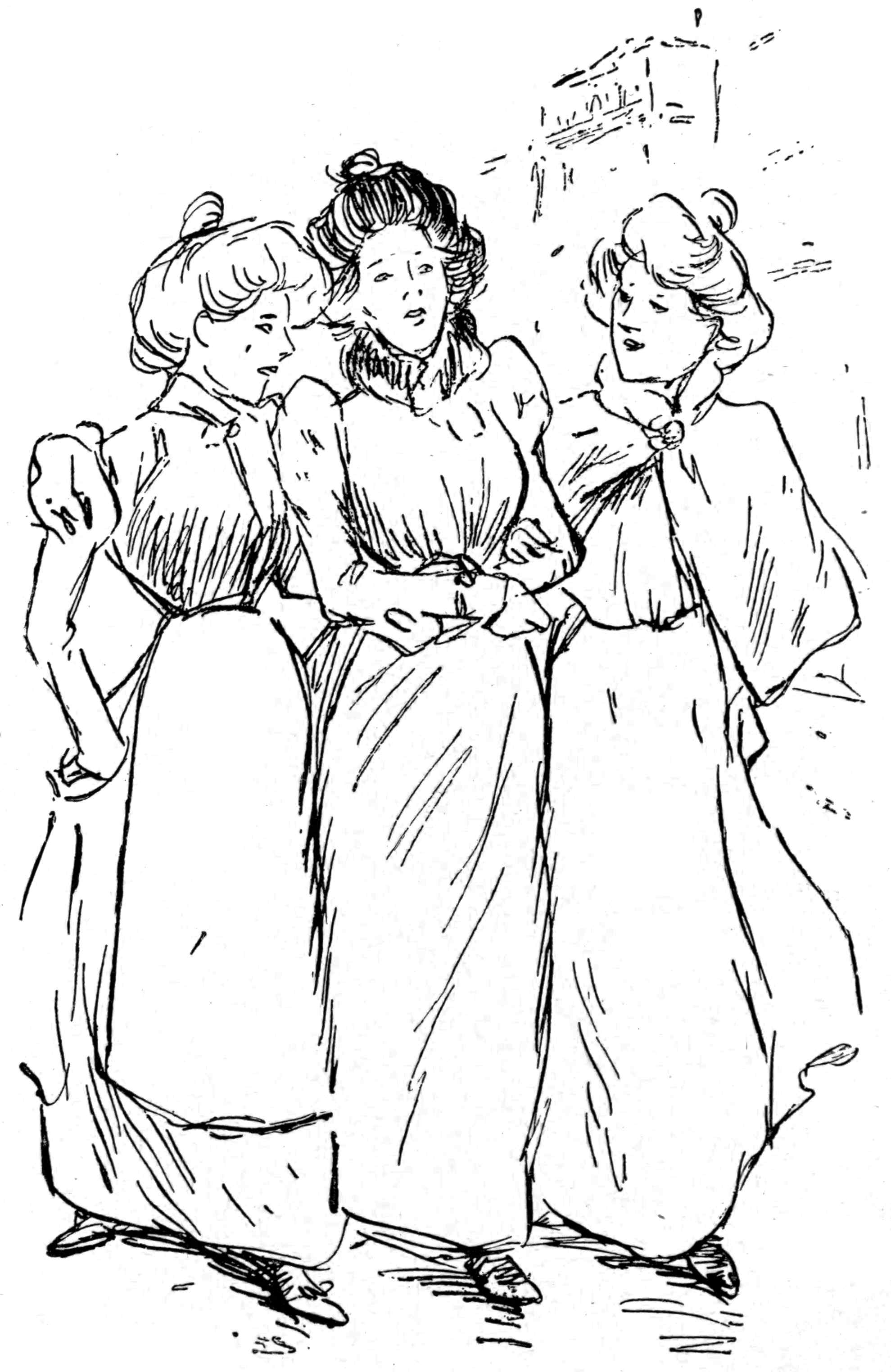
A beautiful little drawing, of two dainty Parisiennes
gossiping on a pier, discloses the method he
has employed to produce a telling piece of work.
The outline has been rapidly sketched in with a few
bold, subtly curving lines from a pen, while modelling
and colour have been given to the whole with
deft crayon touches. We feel the joy the artist
must have evinced in regulating the pressure he put
on the crayon, so as to give each line its exact
breadth, and depth of tone. The pleasure he takes
in manipulating his medium is always manifest in
his work. The complete modelling of a dainty neck
and shoulders, or of a shapely ankle, is frequently
accomplished by the merest touch of the chalk—but
a touch in exactly the right place, and of exactly the
right size.
Wély has contributed to the pages of the Frou
Frou; and very frequently to La Vie en Rose. His
small illustrations to “Aristophane à Paris,” and
to “La Maîtresse du Prince Jean,” which first
appeared in the latter journal, are full of ability,
humour and vivacity. A drawing entitled Quelques
Predictions pour 1902, shows us a delightful little
coquette in déshabillé, who is consulting the cards
with an old woman fortune-teller, the while a tiny
kitten plays with a ball of worsted. They are so
life-like and so subtly depicted that we almost
expect to see them move on the paper. Passe temps
du jeune Age, is one of the most astoundingly able
and beautiful studies of the nude that one can
recall by any artist, and also appears in La Vie en
Rose.
The type of man usually introduced into our
artist’s drawings is not conspicuous for its beauty;
it generally depicts a bit of a scamp, a bon viveur,
who is used artistically as a foil to some fresh and
dainty young person of the opposite sex.
Several pages in colour, which appeared in the
Vie en Rose, evinced a charmingly refined sense in
that direction; while some illustrated covers for
Le Rabelais, each most successfully dealing with
an entirely different and difficult colour problem
were among the most striking examples of that
branch of art yet produced.
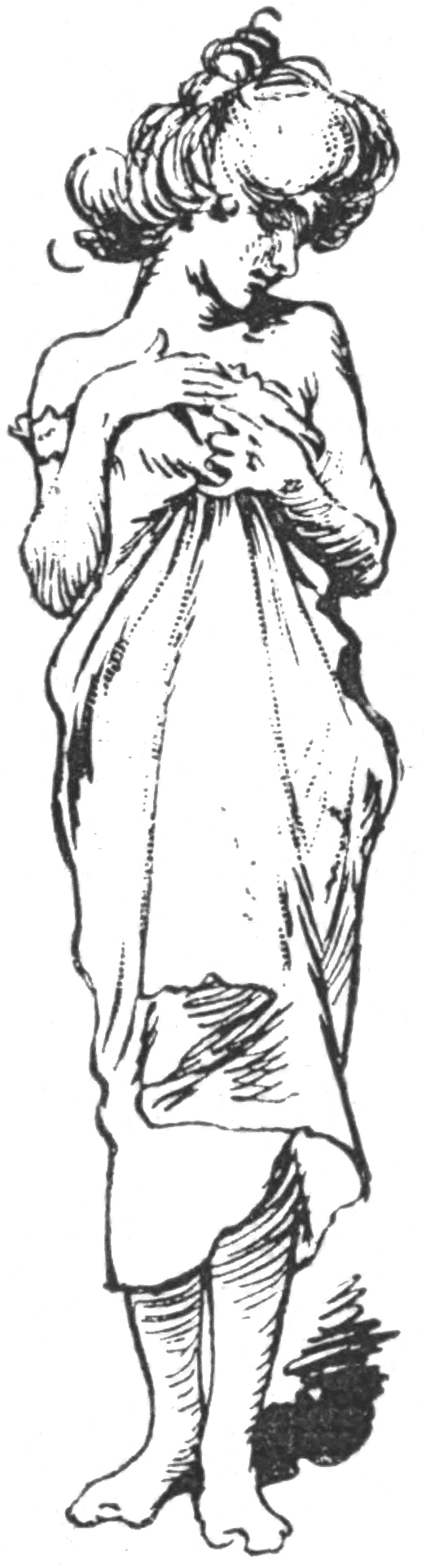
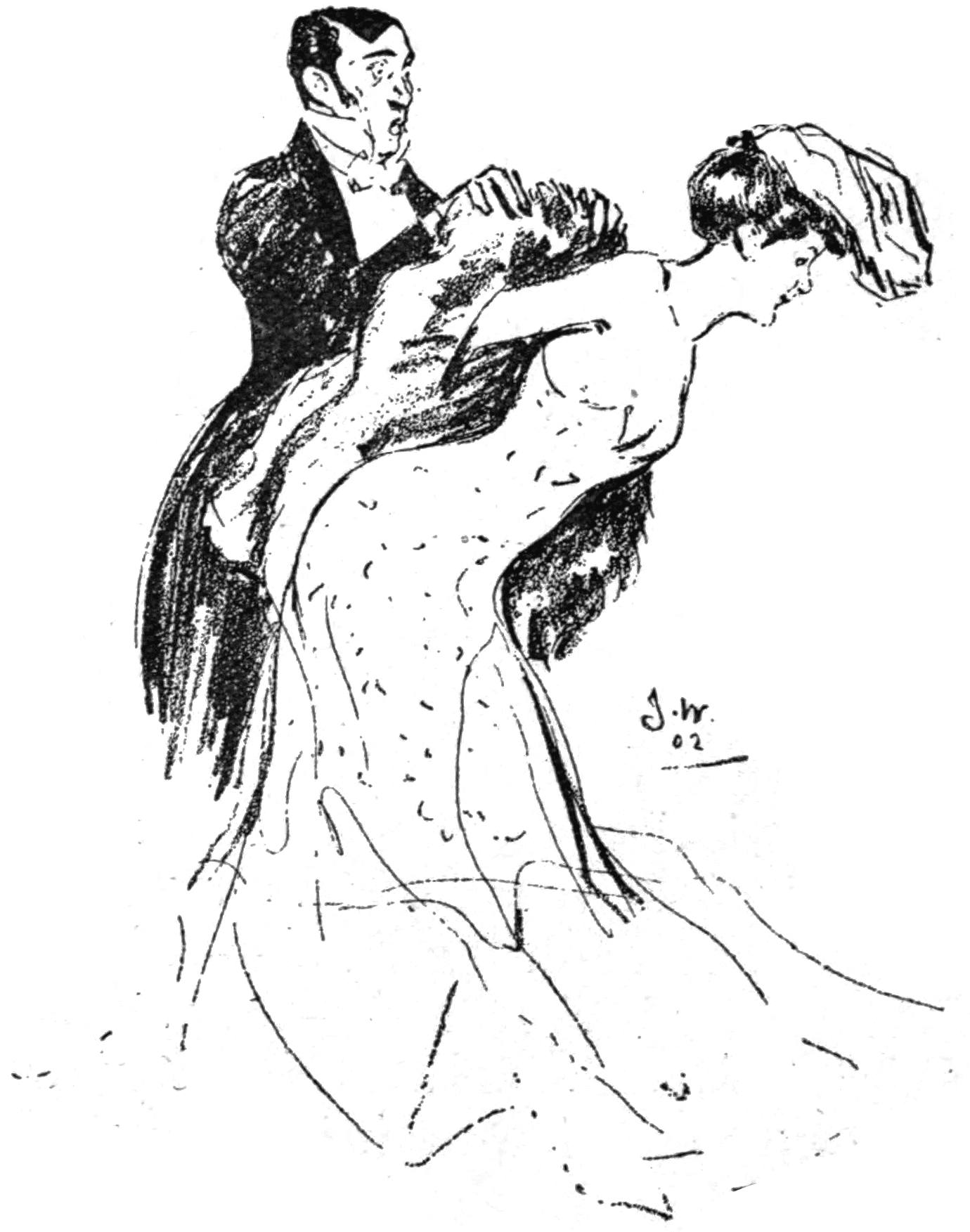
By J. Wély
IX LOUIS MALTESTE
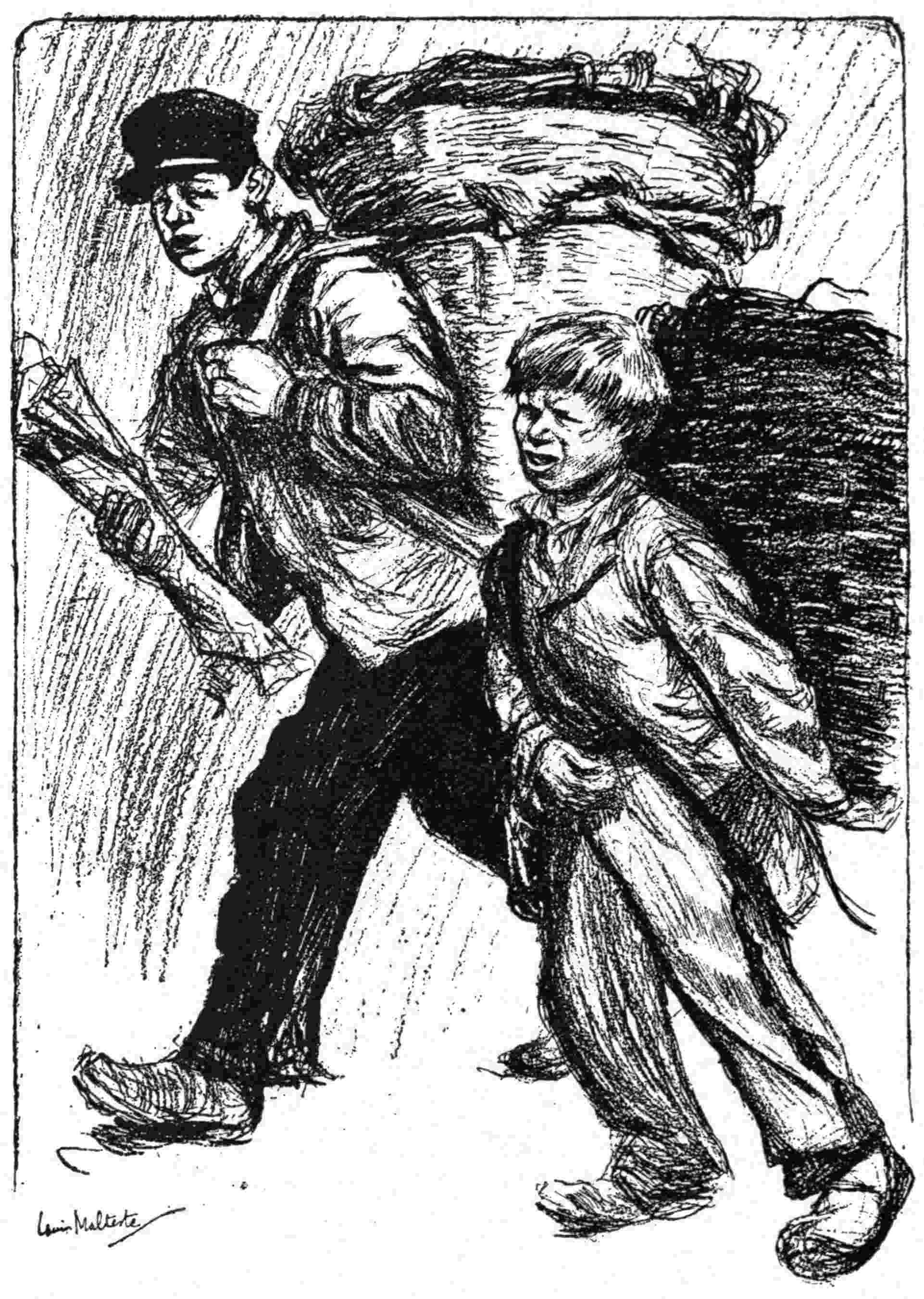
By Malteste
PSYCHOLOGUE
Among the workers on the French illustrated
papers none produces a steadier
flow of thoroughly conscientious, sound
work than Louis Malteste.
His are no chance effects, no tours de force of mere
eccentricity or charlatanism, but are the outcome of
knowledge, hard work and assurance.
He is a splendid draughtsman, unerring and direct,
a seeker and finder of individual character, who does
not attempt to electrify the world with his audacity,
or his at-any-cost originality; for he is content to
delineate for us, in masterly fashion, specimens of
humanity as they appear to the man of keen discernment.
At the time of the loathsome trials of Dreyfus,
Malteste was one of several artists who specially
distinguished themselves by splendid sketches of the
actors concerned therein. In the writer’s possession
is a collection of these spirited and life-like drawings.
They are doubly admirable when one considers
under what disadvantages they were produced.
The task of the artist, told off to a sweltering,
over-crowded court-house, surcharged with violent
excitement, and commissioned to make portrait
groups of interested persons, who are incessantly
changing their positions, is none too easy. Yet
these drawings show no hesitation; in each case
some fleeting gesture or attitude is caught in a
vigorous drawing, and fixed for ever.
No wonder then that publishers such as Hachette,
and the weekly illustrated papers Le Monde Illustré,
L’Illustration, &c., should have availed themselves
of his talent; or that when he turned his crayon to
more fanciful subjects he should have found a ready
outlet in the pages of such papers as La Vie en Rose,
Le Rire, L’Assiette au Beurre, and many others,
wherein to let fly that gauloiserie which flows in
the veins of even the most serious Frenchman.
Most of the drawings in La Vie en Rose are excellent
works in chalk of actions governed by sudden
impulse; and, in technique, strongly recall the
admirable drawings of the English draughtsman,
Gunning King, whose work Malteste has probably
never seen. It is most likely, however, that the
style of both artists has largely resulted from profound
and well-placed admiration of the work of
the veteran Renouard.
There is in La Vie en Rose an amusing series of
drawings by Malteste of coachmen of all grades—each
a strong piece of work, full of character, and
well placed on the page. Another series in colour
consists of fancy portraits of potentates; here again
Malteste has distinguished himself, as witness the
Léopold, Roi des Belges, a harmony in white, yellow,
and brown. Malteste shows himself as a tender
colourist in the excellent drawing of a milking
scene, entitled La Traité des Blanches; another
farm scene, Le Fléau, is as excellent an example of
black and white work, and only surpassed by the
chalk drawing Psychologue, a superb delineation of
two ragged, storm-beaten rag pickers toiling homewards
with their baskets.
His little studies of queer bits of gnarled humanity
are splendid; witness his Femmes Fidèles, La Femme
qui prise, his droll lady who declares There is nothing
like a good swig, his Woman with a Dog, his Woman
with the Cats, or the group called Types of Electors
in the Ville Lumière. We recognise all those electors
at first sight; there is the heavy, obstinate man,
who gets his way by force of sheer dead-weight,
there the suave complaisant “good-sort,” there the
pugnacious, quixotic fellow, who adores a riotous
meeting, there the pensive philosopher, and so on.
There is no mistaking the true character of any one
of them; to a companion page of Femmes Infidèles
the same remarks apply.
A noteworthy quality in Malteste’s work is
the invariably excellent drawing of the hands.
To any but the surest draughtsmen hands are
a veritable bête noire, to be avoided whenever
possible.
Besides his reputation as an illustrator, Malteste
has made his mark as a painter of note, and in
collaboration with Gélis-Didot has executed a
charming poster for L’Absinthe Parisienne; while his
poster for the Théâtre Antoine is one of the finest
things of its kind yet produced.
DE TOULOUSE LAUTREC
X J. L. FORAIN
The collection of two hundred and fifty
sketches, published in book form under
the title “La Comédie Parisienne,” at
once established Forain as a firm
favourite both with the public and with artists.
It could not well have been otherwise. For
these tender, graceful, little sketches touching on
the private life and foibles of dancers, bankers,
lawyers and others, appealed to the risible faculties
and the sympathies of all Parisians; while artists
admired the delicacy of touch and apparent facility
with which the little scenes were “flicked in.”
The expression “apparent facility” is purposely
employed; for despite the appearance of careless
ease of execution conveyed by the slightness of these
sketches, those who have seen the artist at work
know that for each sketch presented to the public
three or four have been rejected by their author as
unsatisfactory.
A very large proportion of the drawings in “La
Comédie Parisienne,” treat of matters to which it is
quite customary to refer in French publications, but
which in England are discreetly relegated to the
confidential whisper of intimates; so that it is
rather difficult here to give specimens of the delicate
wit displayed therein,—lest it should be classed as
indelicate wit. The standard of delicacy topples
over at such very different angles in England and
on the Continent.
Whatever the subject treated, however, one is
struck by the keen observation these drawings display,
the requisite movement or attitude being perfectly
rendered with the minimum number of lines.
They are snap-shots of propitious moments; but
taken by an artist’s eye in place of a photographic
lens, and an artist’s science to display what is
necessary and to discard what is unnecessary for the
illustration of the point at issue.
The drawings here and there reflect the touch of
melancholy in the author’s nature, as well as his
caustic wit.
A charming and sympathetic drawing is that of
the working man playing with his crooning babe,
while the mother, who is getting supper ready, says
to her husband “Ah! wouldn’t you be stunning, if
you’d only give up drinking.” In another drawing
a poor woman says to her drunken husband “Aren’t
you ashamed to be in this state on a Tuesday?”
How telling too the sketch of the rascally picture
dealer who bursts in on the famishing artist and his
starving wife and baby, and says—“I must have
three Corots and a Diaz within six days—Madame,
make him work!”
Then there is another delightful artist subject.
The landlord breaks in on poor hard-working
Pinceau. “Sir, you’ve made me call twenty
times—you owe me seven quarters’ rent, I tell
you I’ve had enough of it!” “Gracious—is that
all you’ve got to think about then,” is the cool
reply.
How beautiful in its simplicity and how exquisitely
the curt legend “—— Rothschild,” fits
that drawing of the little ballet dancer who whispers
the portentous name into the ear of her sister
coryphée, the while the moneyed man behind the
scenes passes them.
Once more, look at the husband stupefied at the
bill which accompanies the host of packages in the
midst of which he and his wife are standing.
“What, what! two thousand seven hundred and
fifty-three francs, forty five centimes! and all that
so as to go away to the seaside for three weeks!”—“Well,
yes, you are right, my dear, I will send
back one of the umbrellas!”
These drawings are almost all executed with a thin,
pin-point pen line, of even thickness throughout, and
with flat tones of shading added by means of mechanically
engraved dots. Forain, Vogel, and Willette,
although their methods differ, are among the few
who now illustrate with such faint lines and aim at
such fragile effects.
A collection in book form of his political and
topical illustrations, which had appeared in Le
Figaro were republished under the title “Doux
Pays.”
The number of L’Album devoted to Forain
contains able sketches, done in wash and chalk,
which are stronger in effect, although incomplete
looking; and bear the impress of having been
dashed off at great speed while the inspiration
lasted. A very subtle drawing of the nude,
entitled, The Tub, however, is included in the
number, as well as some strongly indicated work
in colour.
Forain’s work has been widely published; we
have seen it in Nous, Vous, Eux, in Le Figaro, in
Les Femmes, il n’y a qu’ça, Le Courrier Français, L’Indiscret,
Le Rire, in L’Assiette au Beurre, in The Studio,
and elsewhere.
He has done bold poster work, Le Salon du Cycle,
La Parisienne du Siècle, &c.; and he did a series of
splendid up-to-date designs for a mosaic frieze,
which was inserted in the front of a boulevard
restaurant some few years back.
To Le Rire he has been a pillar of strength; and
this journal has called forth some of his best efforts,
generally drawn in with crayon or brush, and
completed with a wash of two or three such faint
colours as grey-green and pale brick-colour, being
treated frankly as sketches and nothing more. Yet
how amply complete is such a drawing as that of
the little powdered cocotte in the black hat receiving
the last touches to her toilette from her maid,
while her vicious, bony, mother waits impatiently
to hurry her off to the evening’s rendezvous.
Another fine drawing culled from the same source
introduces us to a squat lady sculptor, modelling
from a beautiful nude female model. The shapeless
sculptor cries out, “There! you’re posing so
badly that I shall have to finish it from myself—before
the glass.”
An exhibition of Forain’s work, which was held
on the Eiffel Tower in 1890 or 1891, under the
auspices of the Courrier Français, achieved for the
artist a great success; although he had a terrible
struggle at the outset of his career, even at one
time appealing to Renouard to get him a job to
draw anything,—“anything, fashion plates, or
never mind whatsoever.”
Forain is yet another past habitué of the Montmartre
“Café des Hydropathes” (which later
developed into the “Chat Noir”) who has
achieved fame and riches. He now lives in a
splendid mansion in one of the most fashionable
quarters of Paris, immersed as ever in his studies,
and taking up sculpture as a relaxation. He works
in a vast, untidy studio amidst an astounding litter
of studies and papers, from which he but occasionally
tears himself for a rapid spin in his beloved motor-car.
XI CHARLES LÉANDRE
Léandre must be a terror to the members
of the official classes in Paris, for
they must live from day to day in mortal
fear lest they shall have fallen a prey to
his deft pencil. He must ever persuade them of
their own irresistible comicality, and thereafter they
must always feel more like Léandre’s caricatures
than like themselves, and must inevitably act likewise.
Léandre not only caricatures the faces and figures
of his subjects, but he caricatures their mien and
manners; their politeness, their self-satisfaction,
their hauteur, their cringing, in his hands exudes
from every pore.
LÉANDRE
(From the collection of the Chat-Noir)
RUDOLPH SALIS
(Seigneur de Chat-noir ville)
Yet he is not cruel, he does not lead us to hate
his originals; he makes us enjoy them, and laugh
good naturedly at and with them. He shows us
their unmistakable features, as though seen through
a distorting but discriminating mirror. We can
well imagine one of his victims, impressed with the
undeniable truth of Léandre’s portrait of himself,
shunning daylight altogether, after the publication
thereof; and refusing to walk abroad carrying those
weasel eyes and that terrible nose, which previously
he had flaunted on the boulevards with such evident
pride. Indeed, a dose of Léandre might well be
prescribed as a cure for swollen head.
A. WILLETTE
MA CHANDELLE EST MORTE
It must not be imagined from the foregoing that
portrait caricature alone occupies the pencil of our
artist. His book of subtle wash drawings entitled
“Nocturnes,” and the lively pages of Le Rire, L’Album,
L’Assiette au Beurre, and other journals are embellished
with his cartoons and comic drawings, covering
a fairly wide range of subjects. He is moreover
a serious portrait-painter of great feeling and delicacy.
We may look on him almost as an animalier,
or natural history artist making a speciality of that
droll, brainy, beast—man, recording all his different
varieties, and watching his every gesture and movement.
In his cartoons he occasionally approaches the
somewhat nervous style of Willette, whom we incline
to think time may prove to have been an
overrated artist. The stronger method of Léandre,
however, is particularly noticed in such drawings as
Le Ministère en Vacances and Le Retour du Général
Duchesne in Le Rire; and here we may mention
how much many of the most excellent of the younger
artists—such as Steinlen, Léandre, Malteste, Redon,
Sabattier, Tilly, and Huard in France, Lockhart-Bogle,
Hartrick, Almond and Gunning King in
England, evidently owe
to that giant among
draughtsmen—Paul
Renouard.
Léandre was born at
Champsecret, Orne. It
is easy to trace the influence
that a course of
modelling in plaster
under the decorator
Bin, which he attended
after leaving college
and arriving in Paris,
impressed on his work,
for all his heads have a
strong sculpturesque
feeling about them.
Later he became a
pupil of Cabanel at
the Beaux Arts School;
and we, who know the
ways of Paris art students,
can well imagine
the uproarious series of
“charges” or caricatures,
he must have painted of his fellow students,
and possibly of his professor. For it is certain that
later on he handled the gens sérieux, with whom he
was brought into contact at the reunions given by
his uncle—the Deputy Christofle, with but scant
regard for their dignity.
Settling in Montmartre, he rapidly captured the
quartier with his marvellous caricatures of the
“types” of the neighbourhood, and of the
Bohemians of the greater Paris who flocked to its
cabarets artistiques. Thenceforward his fame has
rapidly spread far and wide: of course he was
a patron of the Chat Noir, and later of the Quat’z’Arts,
to whose papers he contributed.
We have only to examine his drawings to realise
that—given the opportunity to publish his work—success
was inevitable. Before me is one of his
drawings in Le Rire—“The effect of Latin and
table salt on a youth of Normandy.” It represents
a christening scene in the church of a Normandy
village. The irreverent babe in granny’s arms is
howling the roof off its mouth, while the ancient
cleric with port-wine nose, his service interrupted,
essays to quiet the little darling; and we can see he
is only debarred by professional etiquette from using
language unfitting the Church. Grandpa beams
good-naturedly at the wickedness of his latest
descendant, while the fond mamma joyfully simpers
her complete approval of the hopeful’s lung power.
A priggish chorister holds a long guttering church
candle, which his hot hands are melting in the
middle; outside in the porch the bell-ringer with a
jug of cider and a glass is pulling his hardest at the
joy bells, and a background of fidgeting, yawning
children completes the picture.
Then look at the gaily-coloured page which
transports us to the middle of a village fête. All
among the garlands and Japanese lanterns the
firemen are making merry with their lady admirers.
The drummer of the squad, a lusty fellow, is stealing
a kiss from a protesting, yet willing, kitchen-maid.
An astounding drawing of a bacchanalian orgy
entitled Ribote de Noël appeared in No. 112 of
Le Rire, and the whole reeling scene of drunken
revelry is marvellously rendered. In the largeness
of the forms and the rollicking abandon of the whole
scene we are reminded of our own Rowlandson,
an artist whose work is thoroughly appreciated
across the Channel. The quintessence of quaintness
is reached in another drawing, which again
reminds us somewhat of Rowlandson. It is a
drawing contained in L’Album, entitled “La Folie
des Grandeurs—Les Yeux plus grands que le
Ventre”; and shows us a queer little Tom Thumb
of a man smoking a cigar, and speaking in the
language of the eye volumes of admiration for the
mountainous woman against whose knee he lolls.
LÉANDRE
LES CHANTEURS DE MONTMARTRE
(Tourney Poster for Yvette Guilbert)
Other illustrations by Léandre appear in Le Grand
Guignol, and in the comic paper La Vie en Rose.
To a little collection of caricatures of (then) reigning
sovereigns, entitled “Le Musée des Souverains,”
Léandre contributed some remarkably clever work.
President Faure, Queen Victoria, the Emperor of
Austria, the King of the Belgians and King
Menelik, all come in for a more or less trying
pictorial analysis by Léandre. The drawing of
Menelik is a most wonderful piece of work, but unfortunately
intended to be humiliating to Italy; and
here we may mention that Léandre has always been
attracted by general political cartooning, as well as
his more frequent local cartoon work, but however
much his estimate of the nations, as seen from the
Gallic point of view, may tickle outsiders, we feel
he is a good Frenchman, and the artistic quality of
his work never fails. His double-page drawing in
Le Rire of the “Senators going to War against the
Chamber” is crowded with caricature portraits of
politicians hurrying out to do vigorous battle, each
showing by the introduction of some subtle little
device his own marked peculiarity or fad.
LÉANDRE
(By himself)
Léandre has frequently introduced a self-portrait
into his sketches, and he is evidently as critical of
himself as of others. He always shows us a serio-comic
little man with chubby cheeks, bulging,
spectacled eyes, and a big inquisitive nose dominating
a small turned-up moustache and starveling
beard. Some of his own military service adventures
he has depicted for us in mock heroic style in “Les
Treize Jours de Léandre.” Among notable caricature
portraits is that of Drumont, the arch Jew-baiter.
In a coloured drawing entitled “The Ogre’s
Repast,” we see this noisome person with a chain of
Semite “portions” round his neck poising a gory
Jewish head on his fork previous to making a meal
of it. In fine irony a cross hangs on his breast.
His drawings of concerts and musical conductors
throb and thrill with sound, the very paper on
which they are printed seems to vibrate with the
volume of it.
The Comédie Française supplied him with subjects
for a splendid set of caricatures; and the rustic
inhabitants of his native village of Champsecret form
the foundation of yet another delightful series entitled
“Ma Normandie.”
That the tragic side of life touches Léandre
deeply is evident, if only from a couple of drawings
which appeared in L’Assiette au Beurre. The first
is entitled “Saison des eaux—chacun va aux eaux
suivant ses moyens”; and we see a starving, distracted
mother, plunging to eternity in the foul
depths of a canal, while her tiny children, all unconscious
of their fate, clutch her skirts and are
being hurled to death with her. The other drawing
bears the legend, “What have they been doing,
sir? Sleeping without paying for it!”—which is
given as the conversation passing between a little
milliner’s girl and an old gentleman, who are watching
a long procession of dejected outcasts being
led to the lock-up by ferocious-looking policemen,
while behind them is a wall inscribed with the
mocking legend, “Liberté, Egalité, Fraternité.”
The poor prisoners are evidently not criminals, but
merely the crowded-out failures of a great city,
who have perforce been obliged to sleep in the
streets.
Léandre’s posters, such as his “Les Cartomimes”
and “Le Vieux Marcheur” display all his captivating
characteristics, but look hardly robust enough
in style to stand the attacks of weather on a street
hoarding.
Léandre, however, is a great draughtsman, and
there can be no mistaking this fact.
From l’Album
By LÉANDRE
DEUX AMIS
XII CONCLUSION
It may be held that some of the Illustrators
whose work we have been considering are
but slightly connected with Montmartre, and
that there is no such thing as a Montmartre
school. Such contentions are both right and
wrong, according to the manner in which one
cares to approach them.
It is incontestable that in the very informality
and independence of their various styles these
artists are echoing the spirit of that Montmartre in
which they all have spent so many joyous hours.
With the “Butte,” one associates breeziness,
irresponsibility, and a youthful impatience of restraint.
From her lofty perch Montmartre can
survey at leisure, and if it needs be point the pencil
of derision at the world of Paris surging at her
feet; but it must not be forgotten that if she be
light-hearted she is also ever warm-hearted. Her
interest in the follies of life is even surpassed by
her deep sympathy with those who are struggling
against its miseries.
It is possible that, as time goes on, some other
quarter of Paris will take the place of Montmartre,
as the nursery of young free-lances, and will inspire
future Bohemians to other great deeds in the
world of art. Mayhap the honoured quarter
will be “Montparnasse,” or the vicinity of the
“Luxembourg;” or perhaps it will be the “Butte
de Chaumont,”—the other great cliff of Paris,
surrounded in this instance with a romantic park,
and peopled with a toiling, excitable, working
population,—that will attract the next group of
illustrators of modern city life. However that may
be, Paris supplies a never-failing succession of highly
talented artists who, as they leave the schools,
different as their methods may be, group themselves
around some chosen neighbourhood, some
cabaret, some master of the art, or some illustrated
periodical. Already there is a brilliant group of
yet younger illustrators risen in Paris, since the
advent of those with whom this volume deals.
The fact that most of the papers in which these
illustrations appear are unknown to, or unpalatable
to, the British public, renders it certain that, with
but few exceptions, the accomplished work of these
modern masters of black and white art will never
be as widely appreciated in England as it deserves
to be.
And this is one more justification of the writer’s
long-urged plea that in London we are sadly in
need of a National Water Colour and Black and
White Gallery, for which the best obtainable
examples of such work could be procured by gift or
purchase, and thereafter exhibited. Stowed away in
drawers and cupboards at the British Museum, at
the National Gallery, and probably at South Kensington
Museum and elsewhere—visible only in
driblets, after regulated application, is untold
wealth of beautiful drawings which should rightly
be displayed on the walls of such a gallery as is
suggested. Beautiful examples of work by living
illustrators, both British and foreign, could be
obtained for a comparatively nominal sum, and
would exemplify a powerful and fascinating development
of modern art; which meets the requirements
of the day, in its own line, as fully as did the
work of those early Italian masters in their time,
which the nation’s art buyers collect so assiduously
and at so much cost.
But such a gallery would be incomplete were it
to pass by without example the strength of Steinlen,
the dainty elegance of Wély or Morin, Huard’s types
of provincialism, Forain’s delicacy of design, or the
humorous observation of Caran d’Ache. To be
complete and cosmopolitan it must chronicle within
its walls something of that defiance of convention,
that exuberance of youthful audacity, seeking ever
fresh paths within the unexplored—above all, that
single-minded devotion to art for its own sake
which belongs to these Illustrators of Montmartre.
A. WILLETTE
Printed by Ballantyne, Hanson & Co.
London & Edinburgh
Transcriber’s Notes
Punctuation, hyphenation, and spelling were made
consistent when a predominant preference was found
in the original book; otherwise they were not changed.
Simple typographical errors were corrected; unbalanced
quotation marks were remedied when the change was
obvious, and otherwise left unbalanced.
The following French words, misspelled or with accented letters,
were corrected, but others may have been missed. Also,
when the same misspelling occurred more than once, it
was not changed.
Page 5: Ville Lumiére => Ville Lumière Page 9: Chevalier a la Fèe => Chevalier à la Fée Page 9: Eugéne Grasset => Eugène Grasset Page 9: A l’eau => À l’eau Page 9: les Oisseaux => les Oiseaux Page 12: le bon Gite. => le bon Gîte. Page 30: Les Poétes de l’Amour => Les Poètes de l’Amour Page 32: La Toussaint Heroique => La Toussaint Héroïque Page 32: L’Etè => L’Été Page 34: confréres => confrères Page 35: soidisant => soi-disant Page 42: A. Lepére => A. Lepère Page 42: Aieule => Aïeule Page 43: Musée Grèvin => Musée Grévin Page 43: Henri Riviére => Henri Rivière Page 57: decollété => décolleté Page 64: Le Monde Illustrê => Le Monde Illustré Page 65: La Traite des Blanches => La Traité des Blanches Page 66: Gelis-Didot => Gélis-Didot Page 66: Thêatre => Théâtre Page 70: du Siécle => du Siècle Page 75: du Genéral => du Général Page 78: Ribote de Noel -> Ribote de Noël
Not changed:
Page 10: Les Gaitès Bourgeois Page 12: Les Gaitès Bourgeoises Page 18: Charge (perhaps should be “Chargé”) Pages 17 and 43: Caran-d’-Ache Page 75: reunions (perhaps should be “réunions”)
Illustrations in this eBook have been positioned
between paragraphs and outside quotations. In versions
of this eBook that support hyperlinks, the page
references in the List of Illustrations lead to the
corresponding illustrations.
The poor image quality of “Deux Amis” occurs in
at least three different copies of the original
book, and probably was printed that way.