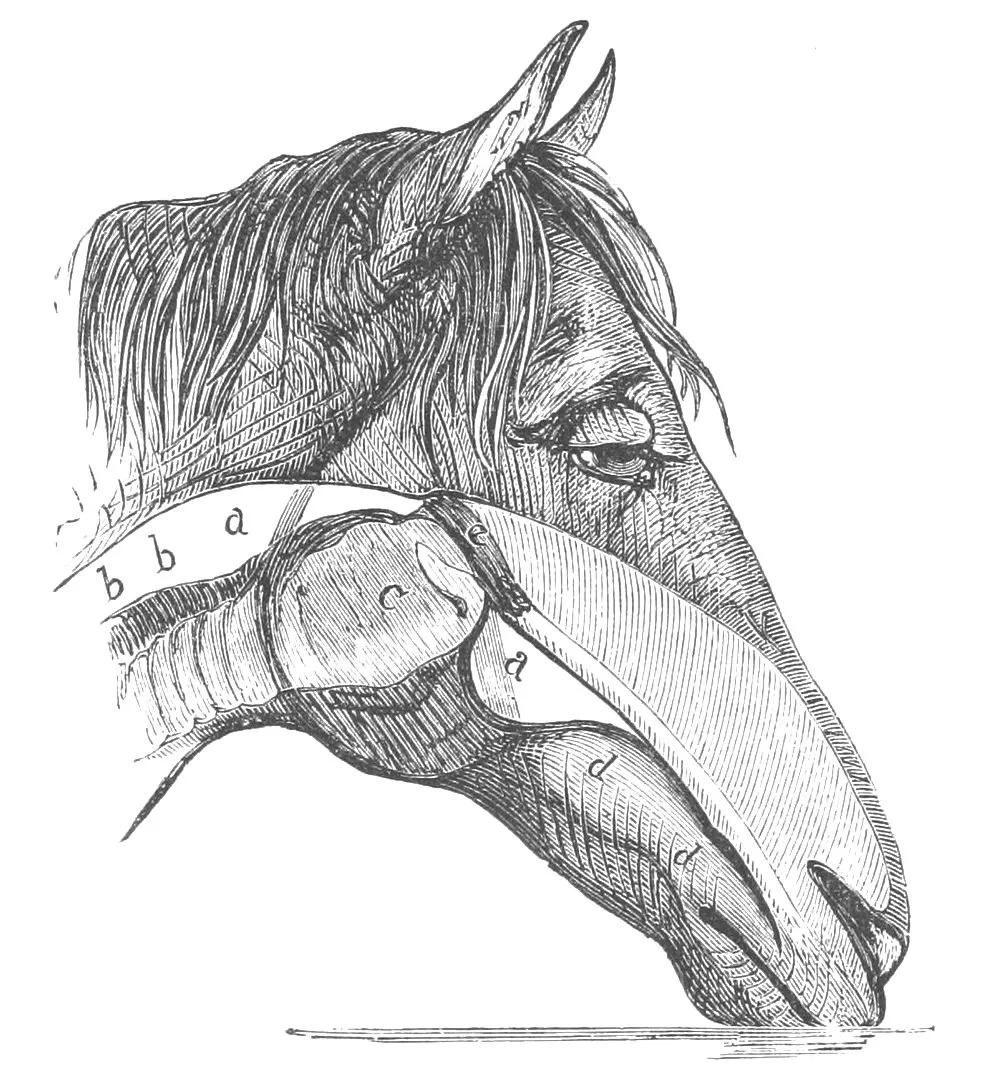
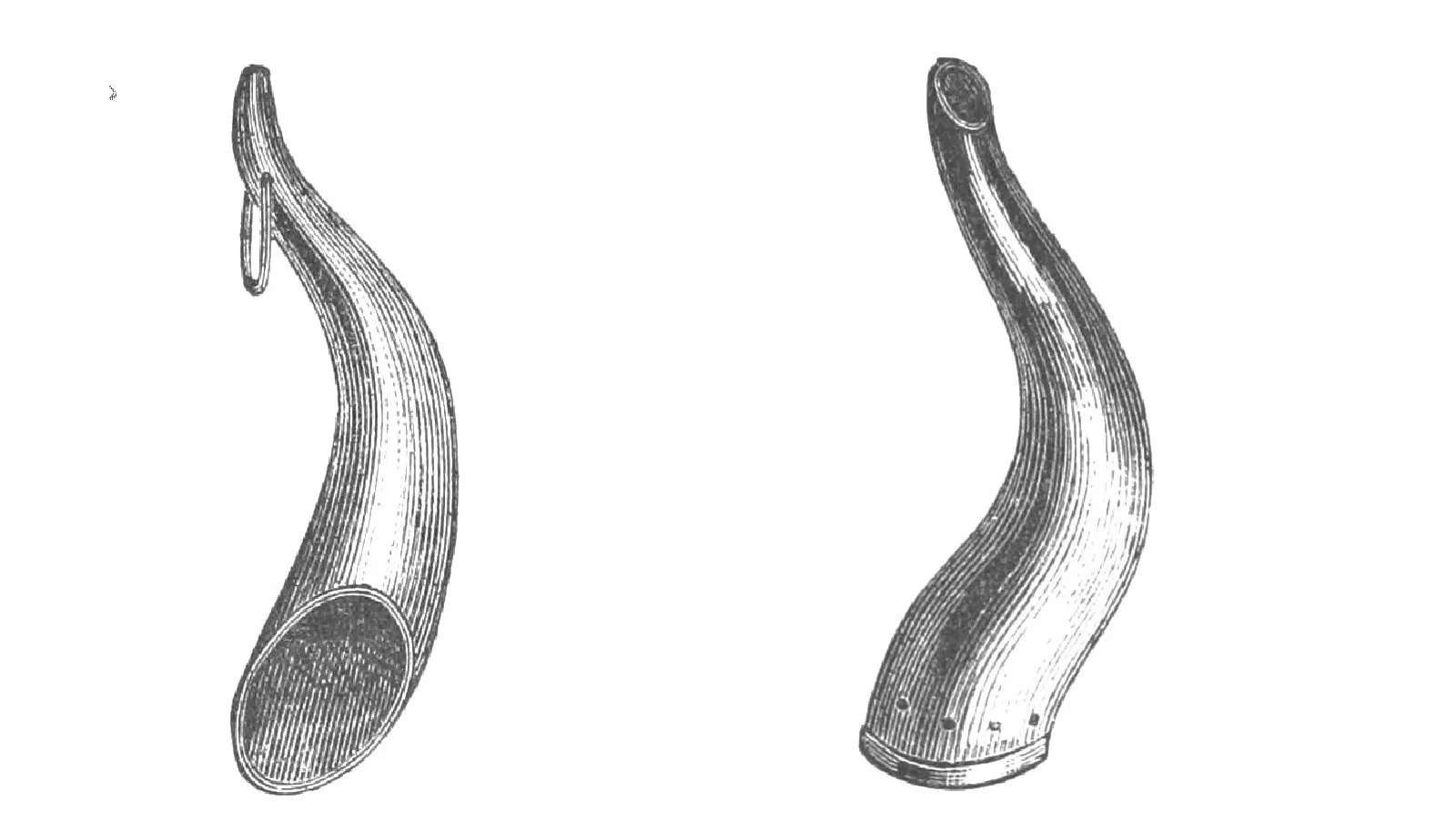
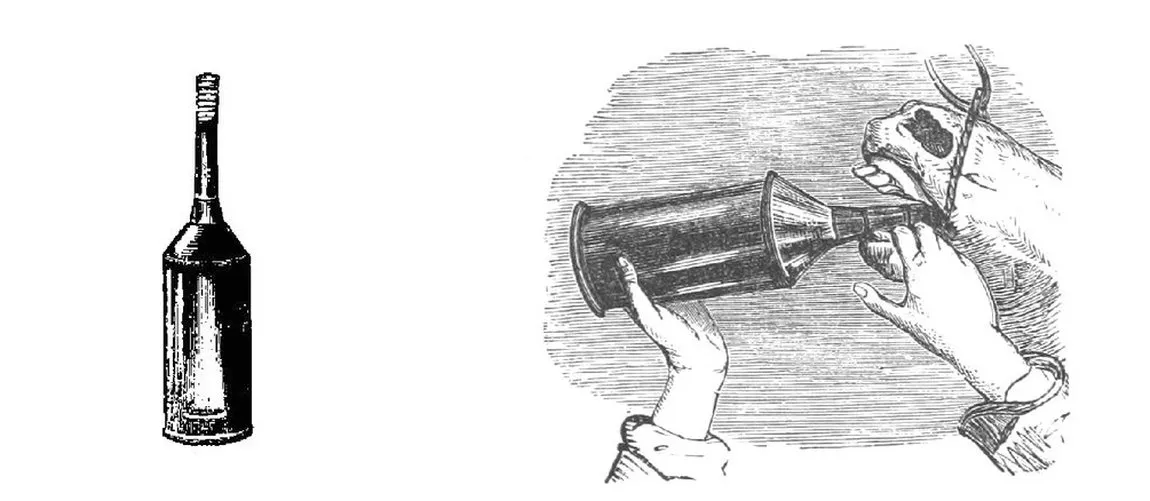
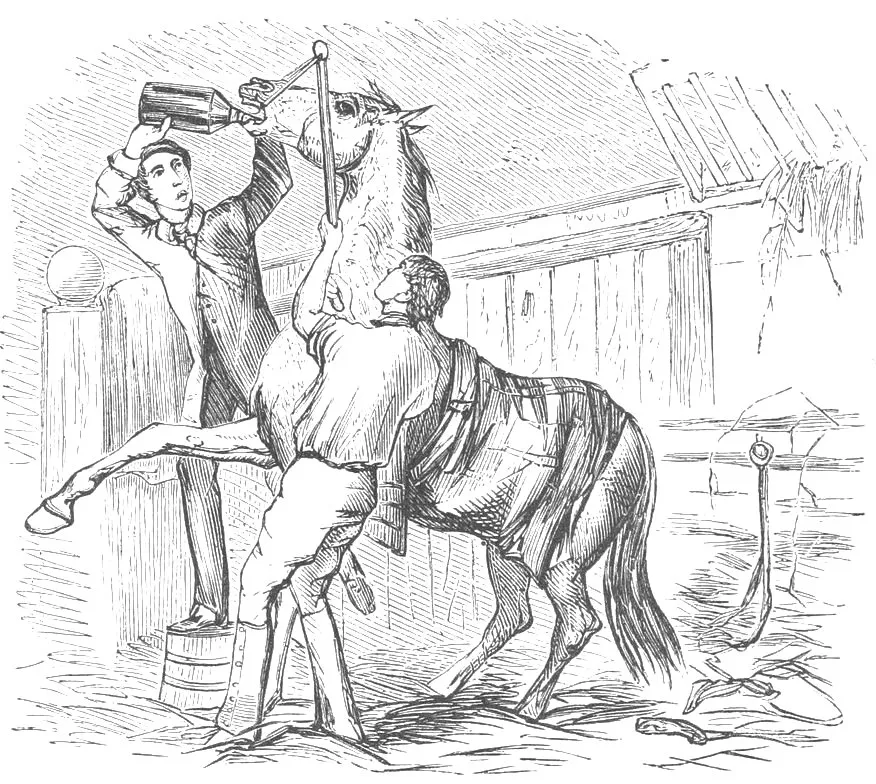
Situation, Nature, and Value of the various Points
TOGETHER WITH COMMENTS ON
GROOMS, DEALERS, BREEDERS, BREAKERS, AND TRAINERS
ALSO ON
CARRIAGES AND HARNESS.
Embellished with more than 400 Engravings, from Original Designs made
expressly for this Work.
BY
EDWARD MAYHEW, M.R.C.V.S. AUTHOR OF “THE ILLUSTRATED HORSE DOCTOR,” AND OTHER WORKS
PHILADELPHIA: J. B. LIPPINCOTT & CO.
1864.
Entered, according to act of Congress, in the year 1864, by
J. B. LIPPINCOTT & CO.,
In the Clerk’s Office of the District Court of the United States for the Eastern
District of Pennsylvania.
PREFACE.
The reader, after having perused the present volume,
may imagine the writer should have been more explicit
when advertising the book’s intentions, that a mass of
speculative novelty should not have been hastily intruded
upon the general public. Such, probably, will be the primary
impression of most purchasers. The author, however,
regrets he is by truth obliged to decline the compliment
embodied in such a complaint. Those notions which,
hurriedly regarded, appear as original, will, to the matured
judgment, show only as an obvious result, worked out by
the easy application of a single idea. Common sense embraces
every merit in the ensuing pages. Grant this, and
there remains no loftier claim to advance. The different
chapters contain nothing which is not very superficial and
entirely based upon fact. Every statement included in the
following articles becomes plain and self-evident to the man
who can release his mind from the trammels of conventionality,
and will allow his conceptions to be shaped by
the habits and the inclinations which are natural to the
equine species.
No living creature could be more exposed to the willfulness
of perversity than the horse has hitherto been. All
around and about the quadruped was moulded by influences
which never regard the instincts of the animal.
Every incident, directly or remotely concerning its welfare,
was misconstrued or misstated. In proof of this is the
common belief that Arabia produces the perfection of the
tribe. This opinion is not to be substantiated by investigation.
It is accepted upon no positive evidence. It is
opposed to deductions drawn from a notorious fact. The
greater number of Arabian steeds are not much larger
than ordinary ponies. The climate dwarfs the stature.
Dwindled development is recognized as the established
proof of an uncongenial location.
The Arab horse is undoubtedly the most beautiful and
the most intelligent specimen of its race. Travelers assure
us it lives beside its master. It is the companion of the
man and the playmate of the child. The country may not
be favorable to its bodily perfection; but the affections and
the mental attributes of a dumb intelligence are in that
land cultivated and enlarged. Arabia boasts possession of
the most civilized race of quadrupeds which are known to
mankind. Looking on the creatures of that country, the
world can contemplate the money value of kindness, since
the indulgence of this emotion can conceal a serious corporal
defect!
Probably it may be urged such intimacy between the
human being and the beast is compatible only with a wild
and a half-savage state of society. But there exist other
nations as unrefined; nay, many peoples are known to be
more barbarous than are the Arabs. The animal, however,
fares as badly with inhabitants of the uncultured
as with people of the civilized regions. The absence or
the presence of refinement does not influence the welfare
of an equine slave. Then gentleness in the Arabian must
be a purely responsive emotion. Its presence or its absence
is apart from mental status, or the social distinctions of
the population to whom it is subjected and by whom it is
surrounded.
The horse, in Britain, generally occupies the same house
as the groom; but it is not, therefore, regarded with the
feeling which is indulged by the inhabitant of the tent.
The change from the soil of its birth to the English stable
is attended with a total alteration of circumstances. Coldness
or brutality, however, cannot banish the spirit which
benevolence had fostered. The rebellion provoked by harshness
is only more complete. The quietude of content is
replaced by the wildness of timidity. Confidence is destroyed;
fear assumes the likeness of savagery. The horse
becomes a brute; for ignorance will not believe its inferior
can be actuated by a reasonable motive.
In India the cavalry are mounted upon half-bred Persian
horses. Not a few of the officers, however, bestride chargers
of pure Arabian blood. These last are commonly under
the charge of European servants, and serve European
masters. The animal’s nature changes with its location.
The alteration, therefore, is independent of heat or of frost.
The Arabs of India are as famed for ferocity as the creatures
of the desert are notorious for gentleness of disposition.
The English behavior is chiefly shaped by selfishness,
based upon a degraded superstition, which insists that every
form of inferior existence was created for man’s use and
relinquished to his pleasure. The author must leave to
others the inquiry, whether Christianity invests those who
profess to believe its doctrines with any power which can
be separated from the potency of charity. It is not for him
to decide whether the conduct of a half-savage and a pagan
tribe should, in its fruits and in its results, shame the consequences
produced by the acts of men who boast of education
and worship the exemplification of self-sacrifice and of
love.
Would man only be content to base observations upon
fact, anatomy has for a sufficient period ascertained a circumstance
which should have startled public wonder into
exclamation. But, where the horse is involved, centuries
of prejudice appear to have generated a slothfulness of
comprehension which overpowers all ordinary intelligence.
In a bird a similar development has for ages been accepted
as the proof of peacefulness of disposition. The pigeon
congregates in flocks; it lives on vegetable substances, and
it possesses a liver which exhibits no gall-bladder. This
deficiency and these habits apply to the horse as literally
as to the feathered type of innocence. Perhaps the higher
status of the quadruped might be urged as the ground of a
primary title to human consideration. Yet the dove-cot
would seem to have blinded man to the merits of the
stable!
The horse possesses a full-sized liver; still the gland exhibits
no receptacle in which any excess of biliary secretion
may be retained. The testimony of nature associates the
creatures which man views as opposites, or regards as the
emblem of peace and as the living embodiment of inveterate
vice. Sameness and dissimilarity appear oddly united when
both lives are viewed as the creations of the Omniscient.
Resemblance in body should direct recognition to a likeness
in spirit. Bearing in mind by whose ordinization all facts
originate; remembering how life in this world is linked by
bonds more difficult to trace than a positive sameness; and
admitting that the One Parent had a design in every part
of the many forms which He called into existence,—human
ignorance must be wrong when it refuses to acknowledge
an identity thus plainly emphasized.
That the workings of mortal conception are peculiarly
eccentric, or at all events that candid appreciation has not
embraced the helpmate of man on earth, is established by
every rule of right being perverted when the horse appears
upon the scene. The spirit of perversion seems so powerful
it involves even the people who act with the animal.
When Mr. Rarey came to England, he was hailed as a
wonder. Mr. Rarey is now away from these shores, and
the persons who formerly acknowledged his genius now
speak of the system which he publicly demonstrated, as a
flagrant imposture!
Why is this? What causes such contradictory opinions?
His present defamers declare Mr. Rarey to be a humbug,
because horses, when returned to the former grooms and
subjected to the former treatment, resume the former
habits. Like causes in other spheres are admitted to produce
like results. The animal merely responds to the conduct
of those who surround it. Mr. Rarey tames by the
exhibition of kindness. He convinces dumb intelligence
how futile is resistance, and makes apparent the groundlessness
of fear. It is not the spirit which he subdues, but it
is the confidence which he gains. All his acts are dictated
by a desire to banish distrust. The animal having learned
its lesson is restored to its proprietor. But if the owner
has not profited by the instruction which he also has witnessed,
ought he to be surprised if his inferior should forget
the lesson received?
Is there not something remorselessly evil in thus converting
the bad conduct of mankind into a reason for denying
the operation of an obvious goodness; in refusing to
acknowledge the responsive nature of the companion specially
given to soften the doom of the human race; and
doing this only to warrant the insolence of severity, which
would seem to be a failing inherent in mortal breasts? But
the doctrines of love and of charity are, by many worthy
individuals, supposed to apply only to the conduct of man
to man. There, in general belief, begins and ends the
lesson. Even at this late period it is often read but never
understood that Universal Benevolence looked down and
blessed every form of life which the Spirit had created.
To inculcate the Christian theory; to simply illustrate
its wisdom, and to demonstrate the folly of verbally acknowledging
its teaching, while the acts of its professed
believers do not testify to its truth, has been the endeavor
of the author. He imagines that possibly he may convince
some reader of the loss which the existing customs entail
upon society. He does not anticipate to actuate many
purchasers; but should a few carry into practice one or
two of his suggestions, and such innovations should upon
trial prove successful, other experiments will be hazarded,
until all meriting adoption are generally recognized.
But numerous readers, after having read the foregoing,
may nevertheless be inclined to inquire, “What is the use
of this fuss about morality, when the issue only involves a
horse?” To this interrogatory the writer unhesitatingly replies,
that the first and the most difficult teaching of civilization
ever concerns man’s behavior to his inferiors. Make
humanity gentle or reasonable toward animals, and strife
or injustice between human beings would speedily terminate.
But instruction to be effective should be convincing:
therefore, purposely avoiding sentimentality, the author
has sought to enlist the feeling only by satisfying the
judgment.
Such are the purposes which induced “Horse Management”
to be indited. But high as the object may be, the
writer, when submitting his labors to the notice of the public,
cannot otherwise than feel there is a common phrase,
which passes current for criticism, and to which this book
is peculiarly exposed. The colloquialism alluded to is the
more insidious because it rather appeals to a prejudice than
expresses anything absolute or definite. It rests upon a
word in general use among the superficial of every profession,
and that word is one which, in the public credulity,
exalts the individual who abuses it. Let a medical practitioner
study to master the rudiments of his calling, and the
purpose of his assiduity will be whispered away by insinuations
about the student being a most admirable theorist;
but, unhappily, not being “a practical man.”
Another individual shall earn disgrace at college. Yet
this man shall start business to knock about the drugs and
hack at living flesh, without comprehending the parts he is
interfering with or having any knowledge of the medicines
which he ventures to administer. This last person, though
he neither adorns nor enlarges the sphere in which he acts,
invariably attains the lucrative repute of being “a purely
practical man.” The notoriety brings profit to the object
who merits no reward, while the absence of such fame
acutely increases the sufferings of a deserving gentleman
who had dared to brave the thorns which proverbially
beset the pathway of desert to the recognition of society.
Against the facts declared in the present pages those who
are interested to uphold existing foolish and cruel customs
will probably urge their “favorite phrase.” To conceal its
hollowness and to render acceptable its wholesale condemnation,
it may be ushered in by an appearance of candor:
thus, “Oh! the book is very pretty—nice reading—very
humane—a little weak—rather overdone—too philanthropical,
and wholly ‘unpractical.’ It teaches nothing which
experience could adopt or which the thorough horseman
can do more than laugh at. Entirely unpractical.”
How long are men to be subjugated by mere verbal assertion?
All this world has to boast of—all mighty truths,
all great inventions—have originally had to struggle against
this “practical” bugbear, which ignorance sets up to frighten
its fellows from those doctrines which aim at the amelioration
of mankind. Recently it delayed the realization of
railways. It has long opposed all social improvement; and
as this is written it is being advanced as a barrier to Practical
Christianity itself! Those who can regard the instruction
of the Creator as too fine for the creature of his
creation, may readily condemn all human promptings!
To deprive this phrase of its abuse and destroy its mysterious
signification, let the reader quietly ask himself what
is really meant by a thing, a book, or a doctrine being
“practical.” If the word bears any construction, it obviously
must imply that which can be used, or a lesson
which is capable of being illustrated by performance. The
test of “practicability,” then, resides in the sincerity of those
endeavors which attempt to embody certain instructions.
Where no wish to exemplify exists, of course no teaching
can be “practical.” The proof, consequently, generally reposes
with the person who advances the accusation, and
the accuser is by this prejudice constituted judge of that
he has already condemned.
What is there in the present volume or in the “Horse
Doctor” which cannot possibly be enacted, supposing an
actuating motive to influence the trial? Nothing can be
practical if there be wanting the desire to embody particular
directions; but to ascertain the value of a current phrase,
he to whom it is addressed should ask for the special passage
to which this condemnation pointedly alludes. If no
specific warrant can be produced, a verdict merely founded
upon generalities should never be accepted.
The author, when seeking to accomplish the evident purpose
of the volume, deeply regrets those comments which a
regard for correctness has compelled him to offer upon the
present race of grooms. He can, however, with sincerity
deny that the indulgence of dislike, or the gratification of
malice, has induced him to travel beyond the limits of his
subject. The men in this capacity occupy an unfortunate
position. They and their interests range in the foremost
rank of existing wrong. It is impossible to amend the
regulations of any modern stable without removing some
of this calling, or overthrowing some of the abuses, with a
perpetuation of which the stable servant and his perquisites
are directly involved. An earnest desire for improvement,
therefore, compelled the review of that class who, if unassailed,
were interested to be the most strenuous advocates
of the bad usages which it was desired should be overthrown.
In conclusion, the getting up of the work bespeaks the
care bestowed upon the volume by the publishers, to whom
the author offers his most fervent acknowledgments. Nor
can the writer bid adieu to his patrons without directing
attention to the talent exhibited by the numerous artists
and engravers whose labors adorn the pages of the present
publication.
CHAPTER I. THE BODY OF THE HORSE ANATOMICALLY CONSIDERED.
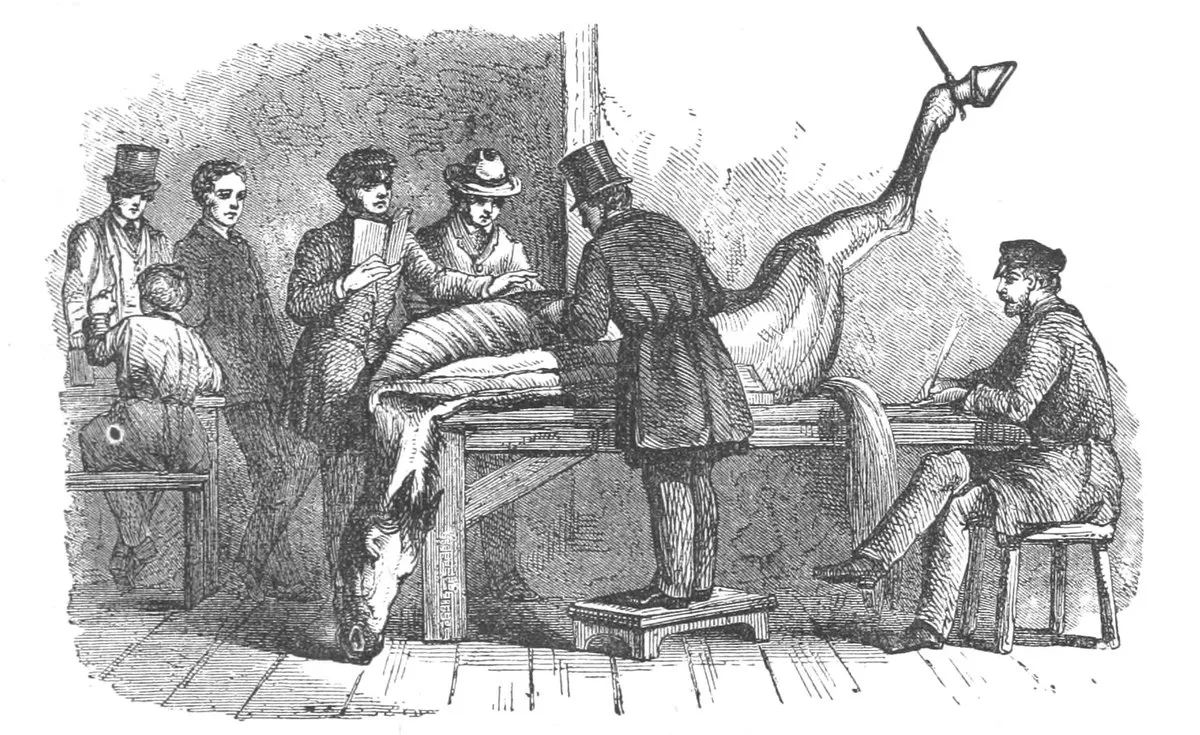
STUDENTS DISSECTING AT THE ROYAL VETERINARY COLLEGE, LONDON.
Were the equine race extinct, nevertheless an anatomist, by studying
its bones, might affirm its instincts and assert its uses. Every part
declares it to be a creature of speed; while its large cranium and beautifully-arranged
teeth would announce it to have once been connected with
civilization by its intelligence, by its uses, and its herbivorous habit. The
provision made for the united strength and elasticity of the spine would
indicate the care nature had bestowed upon the comfort of a rider; while
the mode in which the members were joined to the body, with the reach
of limb peculiar to the skeleton, would equally announce that grace and
that ease which had characterized the lost animal’s movements.
What lamentation would be poured forth over the absence of such a
treasure! How would poignant regrets be awakened, as science demonstrated
what once were the endowments of an extinct inhabitant of earth!
Yet, at the present time, humanity possesses this priceless creature to
lighten toil and heighten pleasure. But, how few of mankind have ever
reflected upon the marvelous delicacy of the slave’s construction! It is
lashed unto exhaustion and worked into deformity. Because of the treatment
it experiences at the hands of the master, whom it serves, it generally
ceases to exist before its body is matured; but short as its life may
be, existence is to it only one continued misery!
Even mortal instruments, things of the world’s manufacture, are limited
in their applications, and capable of being deranged. A spring
carriage is, obviously, not a suitable conveyance for a load of paving
stones. He would be esteemed mad, who should appropriate such a
vehicle to so gross a purpose. The horse’s body is more delicately
arranged and more nicely balanced than the perfection of human skill
can hope to imitate; nevertheless, people expose themselves to no rebuke
when they wrench, cripple, or destroy the beauty which is intrusted to
their authority.
Yet, the thing constructed by human hands, if injured, can be repaired,
and may be thus rendered again equal to its uses. A living animal, however,
being damaged, is not, on this earth, to be restored to its integrity.
That has been, and is lost! Mortal science may relieve the wound, but
the scar remains, to conjure up thoughts of that deeper seated derangement,
which is beyond the reach of this world’s medicine. The body
may partially recover and the life may be prolonged; but deformity,
accompanied by a proportionate loss of function, will testify to the folly
that deteriorated the perfection which was given as a helpmate.
Those forms of agony, which a few years ago were more common in
England than such are even at the present time, evidently declared that
the horse was altogether unequal to increasing wants and growing desires
of mankind. Neither the fleetness of the courser nor the strength
of the heavier breed embodied the requirements of the age. Something
faster and more powerful had become a public necessity; therefore railroads
were permitted.
Such persons as can talk of railroads being destined to destroy the
breed of horses, must suffer under a confusion of ideas. The breed of
horses may be endangered, as this is being written; but the source of
peril lies very far removed from the lines of tramway. The objects,
capable of being fulfilled by breathing flesh and by steaming iron, are
altogether separate and distinct. No living body can aspire to contend,
in strength or in speed, with the results of mechanical contrivance.
Neither can the forge or the furnace ever hope to produce any combination
of springs and wheels which can compare with the ease of motion,
the docility of temper, or the intelligence of spirit that should recommend
the quadruped to the kindness of its earthly proprietor.
The horse is the associate of man. It is true, the poor animal can be
goaded to excessive labor; but the creature becomes degraded when it
toils beyond the sphere of mortal sympathy. No living animal should
be subjected to the exactions of avarice. Life was not made to be thus
debased. What, however, the horse, when properly treated, is capable
of performing, remains to be hereafter demonstrated. How much it can
enact, and how greatly it can benefit, when justly treated, the present
customs refuse the willing drudge a chance of proving. No steed is now
permitted to grow till its thews and muscles are matured. Before the
season of its utility can come round, the colt is seized upon by the impatience
of gain, and the baby limbs are distorted by that early affliction
which forbids the natural powers to be developed.
We can, however, even by the inspection of the body, discover that it
is admirably adapted for continuous and prolonged exertion. The maintenance
of animal motion chiefly depends on the provision made for
aerating the blood. In proportion as the vital current can be revivified
or oxygenated is health promoted by those efforts, which in most bodies
would, assuredly, induce congestion and death. Age becomes very important
when the subject is thus considered. Respiration is in youth
quicker than during adultism, because there is so much more oxygen
needed when the frame is in a growing state. By working the horse
before maturity is attained, the animal is obliged to labor when the
ordinary velocity of the respiration permits of the less marginal speed for
the breathing apparatus to exert upon extraordinary occasions. Nevertheless,
that the reader may judge correctly of the care nature had bestowed
upon the formation of a creature destined for subserviency to
man, the following engraving is appended.
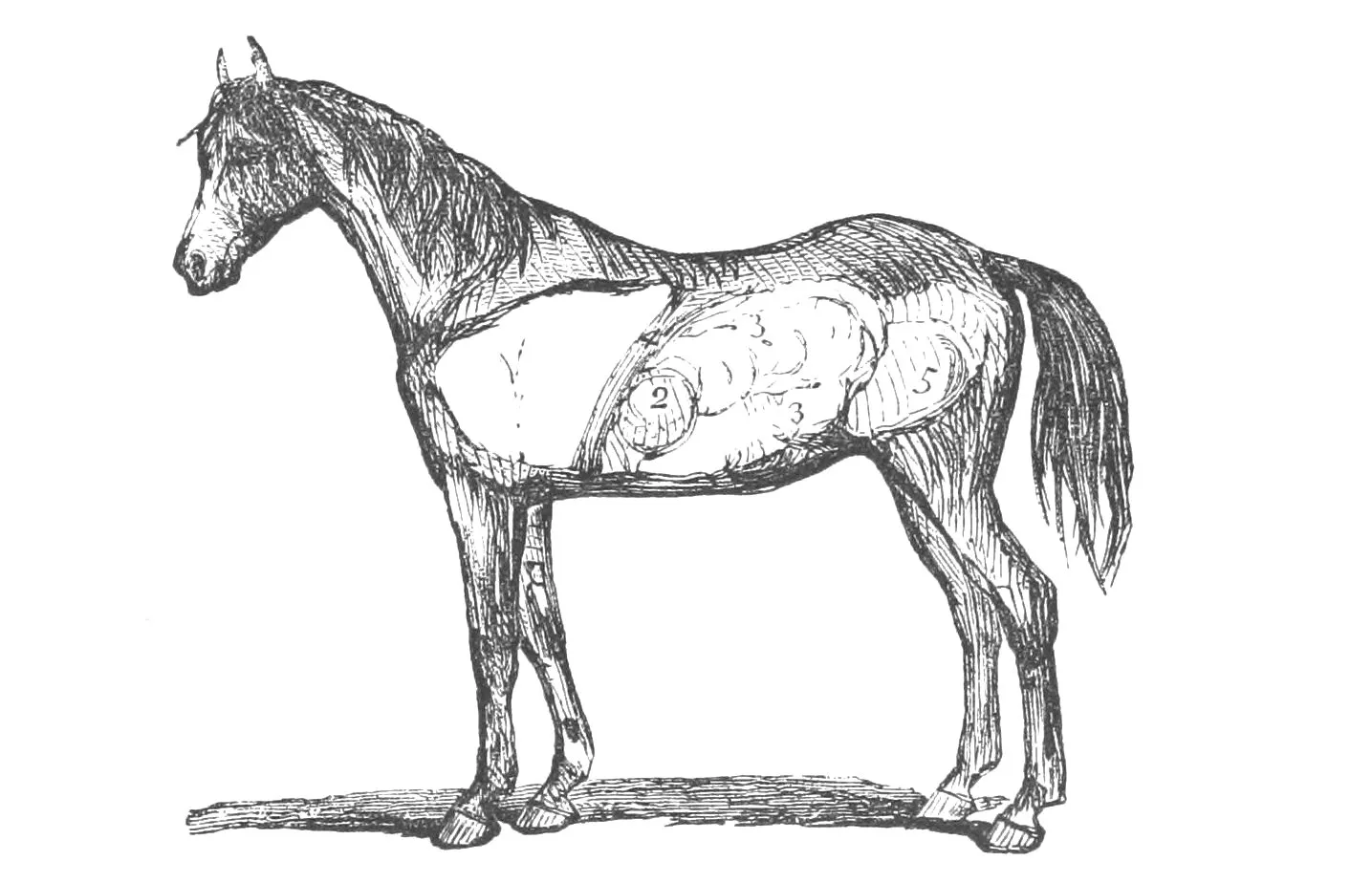
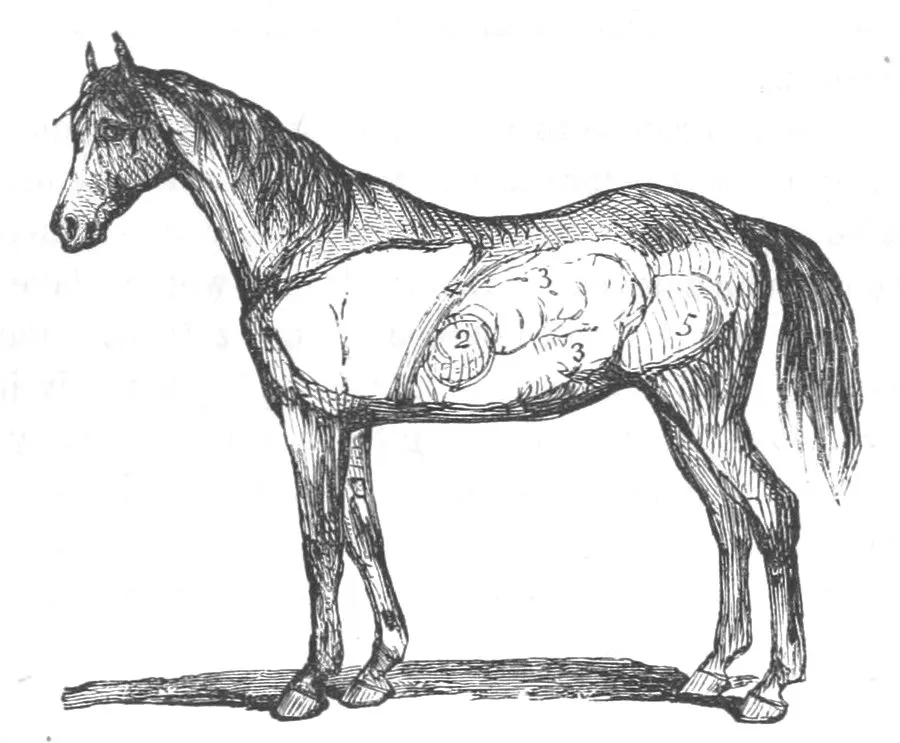
The accompanying illustration exhibits the lungs as of large proportional
dimensions; while the stomach will be recognized as of more than
an equally diminished capacity. Everybody must have experienced how
greatly respiration is impeded by a loaded digestion; and the Common
Benefactor, when creating an animal destined to display speed, seems to
have anticipated the probability of such a contingency. The intestines,
however, are comparatively of large extent. Into these receptacles the
horse’s food passes, after having perfected the first process of digestion,
and there it is subsequently mixed with the fluid secretion of the bowels,
whereby the nutritive matter is separated and rendered fit for absorption.
THE FIGURE OF A HORSE, PORTRAYING THE COMPARATIVE IMPORTANCE AND THE RELATIVE SITUATIONS OF
SOME INTERNAL ORGANS.
1. The lungs.
2. The stomach.
3. The colon.
4. The diaphragm.
5. The situation of the bladder.
The smallness of the horse’s stomach is in itself sufficient evidence that
the quadruped was designed to be a frequent feeder. It was not intended
to endure prolonged abstinence; for almost in every region which the
animal may canter over, its legitimate food abounds. Man, however,
frequently starves the creature, that a loaded stomach may not interfere
with the activity of the respiration; he, in his ignorance and in his presumption,
not being willing to trust to such provision as the All-wise
had made, anticipatory of this accident. At other times, the quadruped
is suffered to over-gorge, its keeper paying no regard to its requirements.
After an excessive fast, a quantity of cut food is placed in the manger,
and the ravenous horse eats, and eats, till its small stomach, being unequal
to the reception of much bolted provender, cracks its walls from
excessive repletion. Such a circumstance does not demonstrate that
nature was wrong, or that the equine races were formed unequal to
their purposes; but it satisfactorily establishes that man cannot, with
impunity, cross the designs or run counter to the institutions of Omnipotence.
The horse was created to live off the grass of the field. This habit
necessitated that much ground should be traveled before the appetite
of so large a body could be appeased; and the distance was the greater
as the animal was sent upon the earth a nice feeder—biting oft the juicy
tops of the herbage, not tearing up roots and all, like the less scrupulous
bovine tribe. The time was also lengthened, by the equine race not
being gifted with a power to ruminate. The ox, having filled the mouth,
bestows little care upon the comminution of the food; but the jaw being
moved twice or thrice, thereby crushing the herbage, so as to form it
into a pellet, the mouthful is forwarded at once to the rumen. This
receptacle is large, and is somewhat hastily filled. Then the ox retires
to a quiet spot and there enjoys its meal; the grass being regurgitated
and fully masticated, during which time the animal is said to be “chewing
the cud.” The horse has no such power. The food it gathers
must be prepared by mastication and insalivation before it enters the
stomach; consequently, because of the niceness of its appetite, and the
absolute necessity for each mouthful being separately comminuted, the
horse, in a free state, has to journey far and to feed long before it can
lie down and rest.
The equine race were meant to collect their sustenance from the surface
of the earth; and, doubtless, the tribe are most at ease when feeding
with the head lowered to the necessary position. A dog naturally
lowers the mouth when it laps a fluid; but, if this creature be tempted
to drink from a saucer held on a level with the ordinary elevation of the
head, repeated coughing will interrupt the draught and testify to the
inconvenience experienced by the animal. So, in the instance of the
horse, we may infer the meal is most relished when the head sinks to
its gratification; and, to justify such an inference, anatomy discloses a
special provision made to that end. Such a proof is, to the author’s
mind, of much more weight than any assertion to the contrary of the
united British public, as emphasized by the fixed altitude of all the
mangers throughout the three kingdoms.
A serious suggestion here forces itself upon the mind of the writer;
and it is one the importance of which should recommend it to the consideration
of the public. Laryngeal affections are among the most
frequent annoyances of every stable, and stand foremost among the
most vexatious of the many evils which the veterinary surgeon is expected
to eradicate.
However, it is proved that if sustenance be swallowed with the head
at a certain elevation, it must interfere with the most irritable organ
entering into the composition of the entire body. Then, horse proprietors
would do well to reflect upon the fact, and to say, how far constantly-repeated
provocation may aggravate or induce the fearful laryngeal
maladies to which domesticated horses are peculiarly liable.
The valves existing in the jugular veins are formed by duplicatures
of its internal lining membrane; and they are so arranged as to prevent
the natural tendency to regurgitate when the fluid within the vessel
moves against gravity. When the head is erect, and the venous current,
flowing toward the heart, is of course downward or is favored by
gravity, then the valves do not act; but the passage of the blood forces
the duplicatures of membrane to remain close against the sides of the
tube.
The jugulars conduct the dark-colored blood from the brain; and as
that important organ cannot endure the smallest pressure, some special
provision was imperative to carry away the fluid, and also to anticipate
the possibility of its return to oppress the sensorium. When the horse
is grazing, the head is lower than the heart, and it naturally occupies
that position for the greater portion of the twenty-four hours. During
all that time the venous current must mount against the influence of
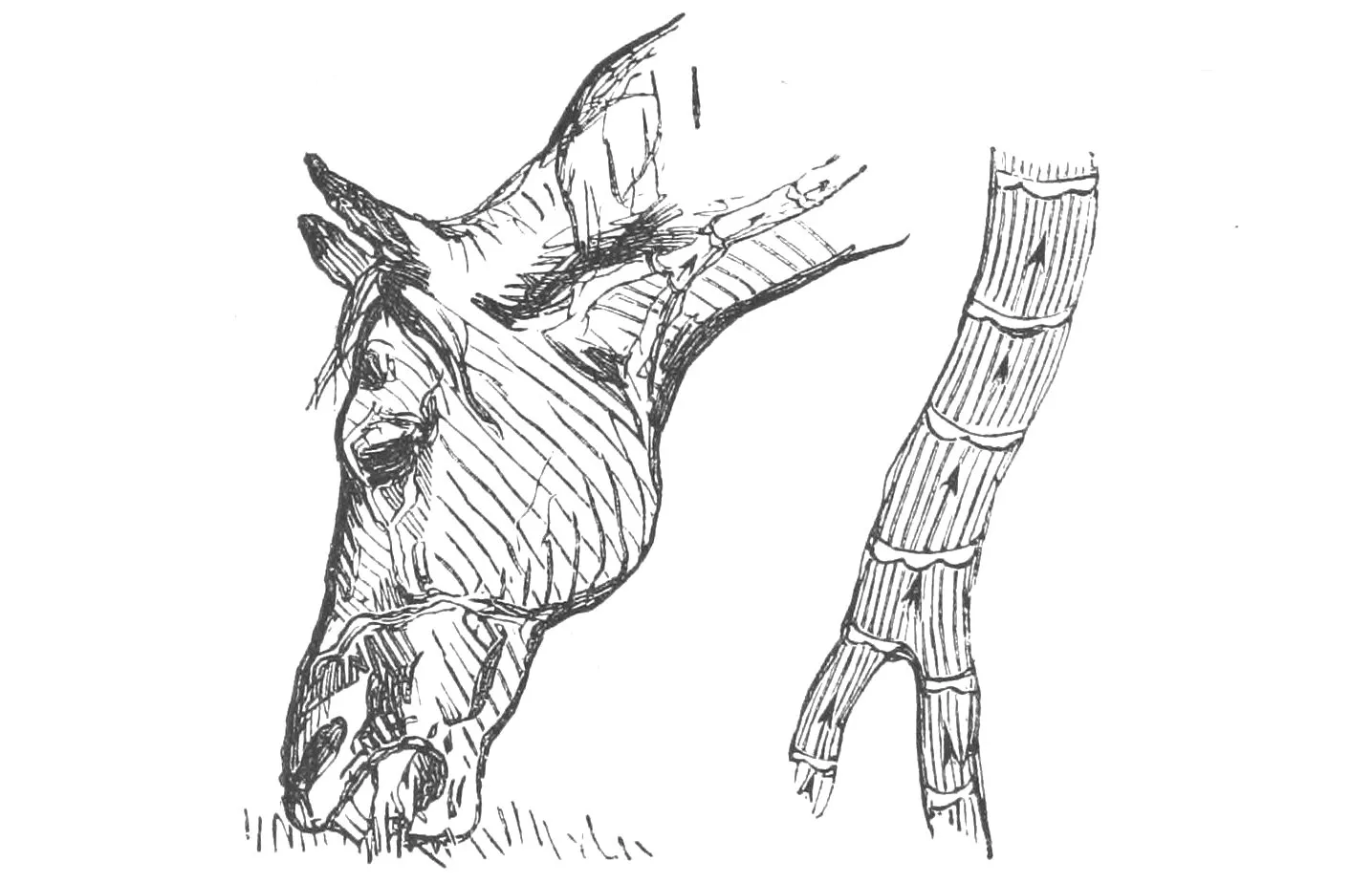
gravitation; and to aid the reader in properly understanding the means by
which this is effected, his attention is invited to the following diagrams.
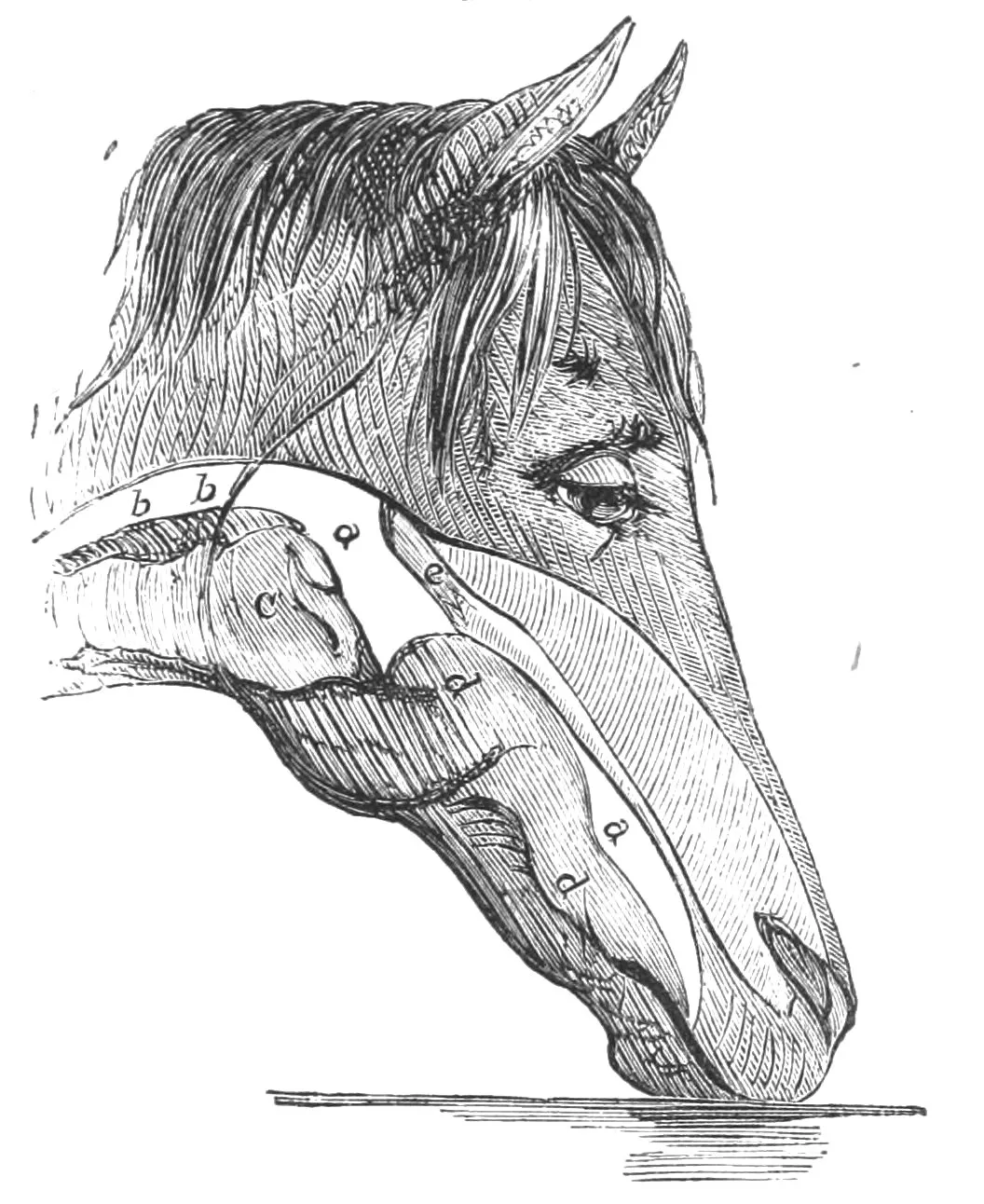
A SKETCH, DISPLAYING THE ACTION OF THE JUGULAR VALVES WHEN THE HEAD IS LOWERED TO FEED OFF THE
GROUND.
The elevated crest, therefore, presents a clear channel to the vital
current. For that reason, the violent action or the most rapid pace of
the animal never produces congestion of its brain. The racer may sink
from exhaustion, but does not perish from apoplexy. The head, when
depressed, however, shows the same canal divided by numerous intersecting
marks. Such lines are intended to represent the venous valves,
which assist the blood in its upward journey, and render impossible the
slightest pressure upon the sensorium. The first thing which strikes
the reader, upon beholding the arrangement depicted above, is the vast
number of valves; and this causes him to inquire, where was the
necessity for such repeated checks. If the conservation of the brain
was the only end to be attained, might not that object have been assured
by a single set of valves? Such may seem a feasible objection; but to
prevent the return current was, as nature appears to have conceived,
best done by repeated assistance of the onward flow; consequently,
these numerous valves anticipate the possibility of regurgitation in any
degree, and provide repeated checks to pressure from the supported
column of heavy venous blood.
There remains, however, another provision to be explained. The
return current has hitherto been spoken of, as though the upward flow
of fluid was its natural tendency. Still, every person must have perceived
the necessity, when liquid was to be propelled in that direction,
of something resembling a forcing pump. Such an apparatus nature
has provided. The head of a healthy animal is depressed only when
eating or when drinking. During the performance of either function,
muscles are contracting which compress the soft coats of the veins, and
thus help to drive the circulation against gravity.
Thus, during feeding, the head is maintained in a depressed attitude
for hours together; and, throughout that space, a most powerful agent
is in operation. The lower jaw, while the quadruped chances to be
thus engaged, is in constant motion, being opened and closed either in
biting or in chewing. When the jaw sinks, the muscles of mastication
are relaxed, and the venous blood rushes from the cranium into the
sinuses. But when the bone is raised by those strong motor agents
which render the bite of a horse so fearful an infliction, the current from
the brain is for a moment checked, and the contents of the maxillary
sinuses are energetically propelled up the jugulars. During the first
half of the action, the valves are in operation, having all the strength
necessary for the perfect performance of their allotted function; but,
during the latter part, they are forced against the sides of the vessels by
the contractive masticatory influence, and cease to act in any way upon
the internal current of the blood.
Notwithstanding the strong conviction emphatically asserted by the
fixed position of the nation’s mangers, the author must be obstinate
enough to disregard human authority, when he has an opportunity of
studying the living book, written by the unerring hand of nature.
Valves, though generally present in veins, are never discovered where
the position of the vessel or other reason would render such provisions
unnecessary. The Great Creator often makes one thing to serve more
than one use; but never creates when His work can answer no profitable
purpose.
The use of veins is simply that of conduits, to convey the refuse
blood back to the heart, whence it is forced into the lungs, and there
revivified or rendered equal to its many forms of nutrition. This mighty
change is very simply effected. When the thorax expands, air merely
enters the lungs to anticipate the vacuum, which otherwise must be
occasioned by the enlargement of the chest. The air consists chiefly
of two substances in a gaseous state—of oxygen and of nitrogen. The
venous blood, being very near to the inhaled air within the lungs, extracts
the oxygen from it, and in exchange sends forth a quantity of
carbonic acid, which is voided with the expired breath.
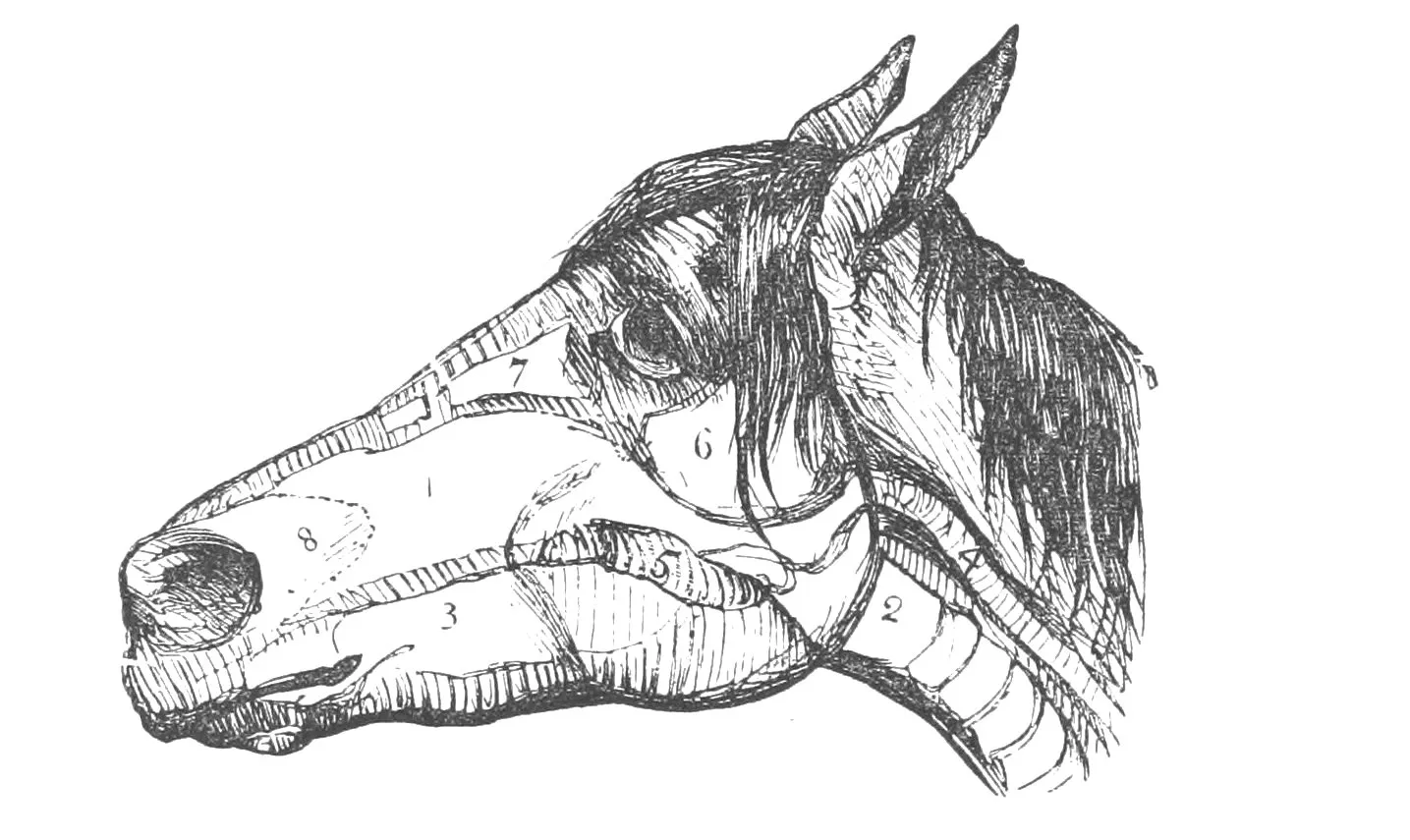
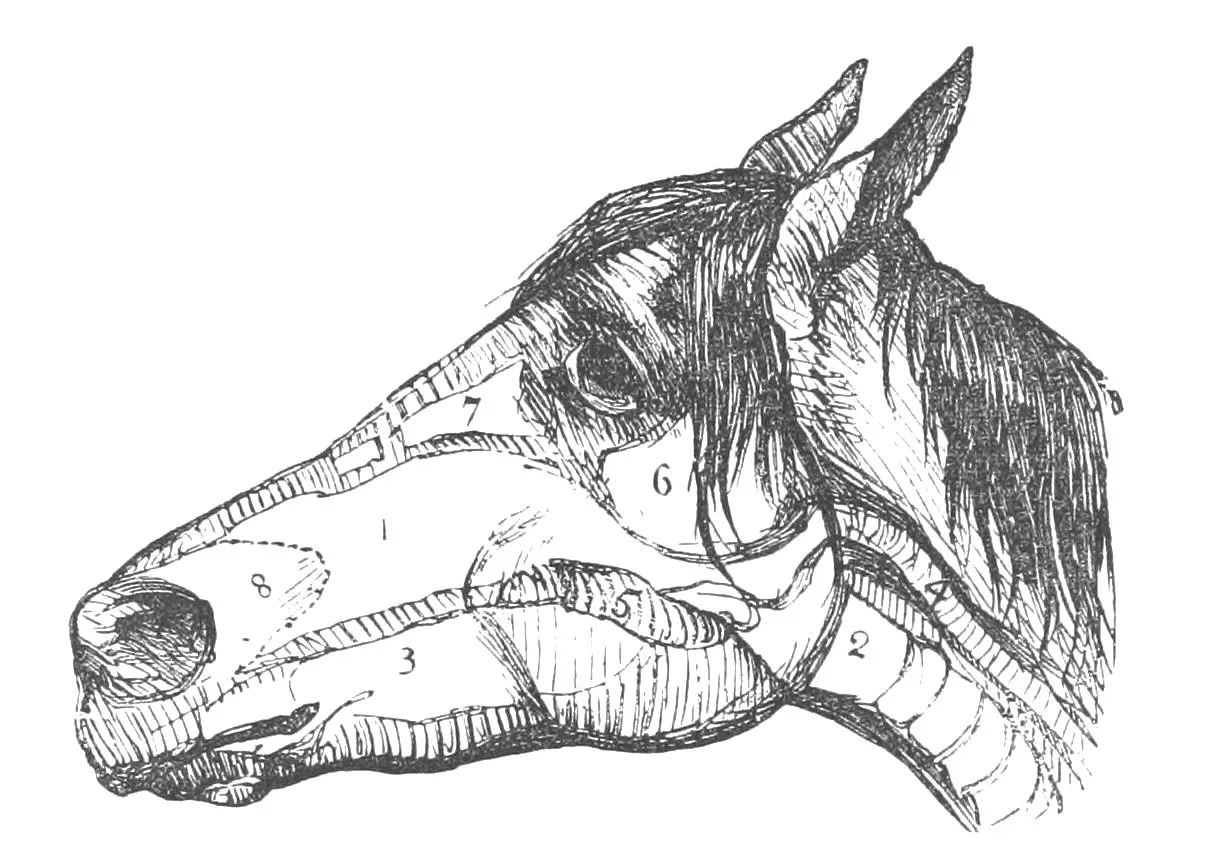
A DIAGRAM, EXPLANATORY OF THE SPECIAL PROVISIONS DISCOVERABLE IN THE HEAD OF A HORSE.
1. The nostril leading direct to—
2. The larynx, situated at the commencement of the windpipe.
3. The tongue.
4. The œsophagus or gullet.
5. The soft palate, which lies upon the tongue and affords a resting-place,
whereon reposes the epiglottis, or the guardian cartilage to the entrance of the larynx (2).
6. The guttural pouches, or large membranous and open sacs, containing nothing but atmospheric air.
7. Nasal or frontal sinuses.
This change will take place when blood is extracted from the body.
If the contents of some vein are exposed to the atmosphere, they will
in time change from a deep modena to a bright scarlet hue. There is,
however, this difference which marks the two processes. The alteration,
when quickened by vitality, is instantaneous; but the change,
when it ensues under human inspection, is slowly, and, as it were, laboriously
accomplished. The size of the equine nostrils informs us of the
ample draughts of air which the animal is fitted to appropriate; it likewise
testifies to the high state of that vitality which could necessitate
such a provision. Creatures with small nostrils, for instance ox and
dog, are endowed with a limited capacity as respects nasal respiration.
Yet, as a recompense, such creatures are formed to inhale through the
mouth. The horse, however, requires no such faculty, its nostrils are
ample; and, under ordinary circumstances, the mouth is closed by a
thick, fleshy screen, which hangs pendulous from the most backward
portion of the bony palate.
In the previous diagram, figure 1 indicates the space allotted to the
nasal chamber, near the external opening to which will be observed the
numeral 8. The dotted lines surrounding the last figure represent the
dimensions of a blind pouch, or cul-de-sac, which separates the external
from the internal wall of the true nostril. The existence of such a provision
has long been a puzzle to physiologists; but, would these gentlemen
have given nature full credit for that care with which the Common
Parent studies to preserve the beauty of the higher order of His children,
and have considered that the horse’s
necessity for different quantities of air varies
with different times and during different occupations,
they might have sooner comprehended
the utility of the development.
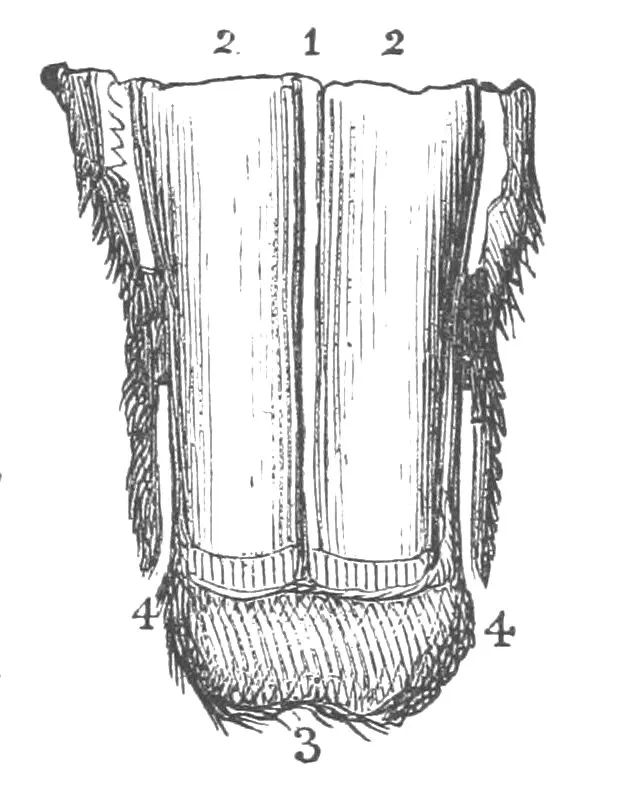
DIAGRAM OF THE FALSE NOSTRILS.
1. The septum nasi.
2. The nasal chambers.
3. The upper lip.
4. The false nostrils.
Where the false nostril is placed is the only
portion of the nasal chamber which is not inclosed
by bone; consequently it is situated at
the only place where the cavity admits of distention
and of contraction. The animal, in a
passive state, breathes very leisurely; at such
times the nostrils would sink inward, or be
deformed by the unavoidable collapse of the
wall, were not the false nostril present to permit
its diminution without materially affecting
the external form. But subsequent to
severe exertion, everybody must have remarked the nostril spasmodically
strain, as though each effort would crack the boundaries of the opening.
At such times the false nostril offers no stubborn opposition to the violence
of respiration, while it serves to soften down the aspect, which,
if laid bare, might show too fearfully.
A varied capacity for admitting air also presupposes a varied capacity
to alter the dimensions of the passages through which the atmosphere
travels to the lungs. If the reader will again refer to the facial diagram,
he will perceive a free space, in the center of which is placed the figure
6. These spaces (one on either side of the face) represent what are
termed the guttural pouches, they being merely bladders containing air,
and communicating separately with each nasal chamber. A bladder
with an external opening is of course most readily compressible. That
no doubt may be entertained of the use for which these vacant spaces
were established, they are placed immediately above the course of the
atmosphere to the lungs, and would contract or dilate according to its
volume.
Such a condition of parts imagines the windpipe also able to alter its
dimensions, so that it may be in accord with other structures; and
anatomy discloses facts which amply support such a supposition. The
larynx or opening to the windpipe is composed of several pieces of cartilage
and of numerous muscles. The presence of the first plastic and
highly elastic structure is a proof that the larynx is of no fixed shape,
while the division of the organ into distinct parts, together with the
internal and external presence of many muscles of motion, is absolute
confirmation that the larynx was created not only to assume various
forms, but also to exhibit different capacities, according to the requirements
of the animal economy.
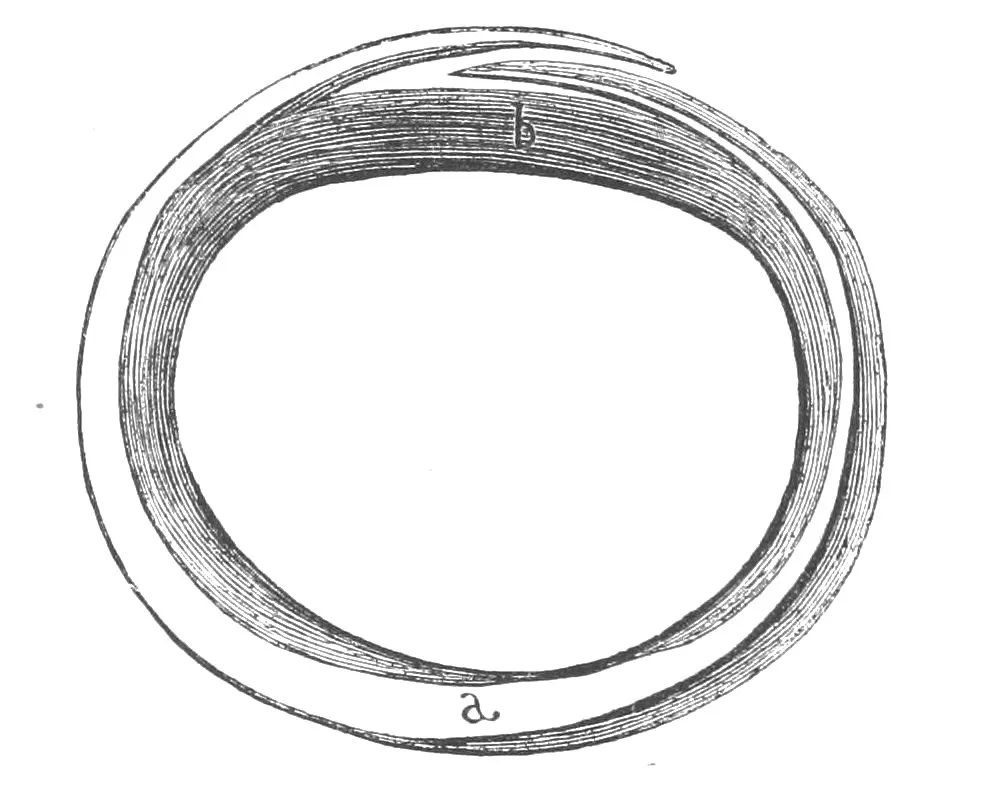
So also with the windpipe itself, and the tubes which proceed from
it; these are formed of distinct rings, or of separate pieces of elastic
cartilage so curved as to form rings, but having free overlapping ends,
which are operated upon by muscular fiber.
The diagram inserted below accurately represents such a ring; it
also shows that the springy cartilage is not made of one thickness
throughout, but is of that form which the mechanic of the present
time recognizes as that best adapted for the preservation of continued
elasticity. The shape and the free ends convinces that such a ring
must always have a tendency to expand, and by this perception we
recognize the purpose of the muscle, which draws the extremities over
each other; thus two opposing forces regulate the capacity of the circle.
ONE OF THE CARTILAGINOUS RINGS, NUMBERS OF WHICH JOINED TOGETHER FORM THE TRACHEA OR THE
WINDPIPE OF THE HORSE.
a One of the cartilages from the trachea of a horse, having free and overlapping extremities.
b The muscular fiber situated within the ring, which regulates the diameter of the circle.
The presence of muscular fiber is always absolute proof of motion.
Where muscle exists and morbid circumstances render motion an impossibility,
the function being destroyed, the motor organ becomes pallid,
or suffers atrophy. The existence, therefore, of such a structure in a
healthy condition is always sufficient proof that the function of expansion
and of contraction was present during life; thus we reach an absolute
certainty that the air-passages of the horse possess a property of
adapting themselves to the necessities of the animal.
Then, looking at these structures, we find them not only free, but so
composed as to be always open, excepting when the momentary swallowing
of the food causes the larynx to close. To breathe is the primary
necessity of life. Health cannot be maintained unless the blood is
sufficiently oxygenated; this fact makes us doubt the national wisdom,
which persists in thrusting the quadruped into stables, rendered close
and hot by the products of impurity. Oxygen is always deficient
where impurity prevails; and, having seen the necessity of its presence,
because it is the primary requirement of existence, and not because of
the warmth or oppression which its absence generates, does the author
presume to oppose his opinion to the decision apparently approved by
the entire British public.
Seeing these provisions made by nature to preserve the beauty of her
most graceful quadruped, and remarking how profusely, in various forms,
loveliness is distributed throughout this earth, we cannot slightingly
esteem the attribute which Perfect Knowledge has impressed, as an
order of merit, upon its creations. Beauty is here spoken of as distinct
from gaudiness. The term is employed not to represent the luster of
the beetle or the vividness of the tropical bird, but to portray that harmony
of parts and deep-seated perfection which is present only in the
more elaborate works of the Creator, and which renders the horse, even
when deprived of its skin, a picture deserving mortal adoration. Viewing
the world and its inhabitants, we must confess that nothing was
formed without its uses; on such a basis, we may safely assert that the
horse was not made the most beautiful of beasts without intention.
This quality appeals in a most mysterious and powerful manner to the
human sympathies. It should influence the mind even more than it
gratifies the eye, and though avarice may blind humanity to its claims,
yet even the most hardened cannot witness the destruction of perfection
without a poignant pang of regret.
In the head of the animal we discern evidences of the care bestowed
to preserve a harmony of form. Above the nasal chambers are certain
hollow spaces, indicated by the figure 7. These empty chambers may
serve to impart depth to the voice, but as the horse is generally a silent
creature, such, obviously, must be only a secondary purpose. To preserve
the undulation of the outline was assuredly the primary intent,
though at the same time the vacancies aid the reverberation of sound,
and with other structures also lighten that part of the body in which
they are situated.
A DIAGRAM, EXPLANATORY OF THE SPECIAL PROVISIONS DISCOVERABLE IN THE HEAD OF A HORSE.
1. The nostril leading direct to—
2. The larynx, situated at the commencement of the windpipe.
3. The tongue.
4. The œsophagus or gullet.
5. The soft palate, which lies upon the tongue and affords a resting-place,
whereon reposes the epiglottis, or the guardian cartilage to the entrance of the larynx (2).
6. The guttural pouches, or large membranous and open sacs, containing nothing but atmospheric air.
7. Nasal or frontal sinuses.
The passage of the air to the lungs, and the admirable provisions to
admit its ingress and its egress, without destroying the mild and characteristic
aspect of the quadruped, having been described, it now becomes
the author’s duty to dwell upon the extraordinary conditions which conserve
the passages of the food. Referring again to the diagram here
reproduced, we see the mouth, occupied by the tongue, (figure 3,) on the
base of which organ reposes a dark body, particularized by the figure 5.
This last is the soft palate, which drops pendulous from the osseous roof
of the masticatory orifice. Upon the soft palate lies the most forward of
the laryngeal cartilages, which is anatomically spoken of as the epiglottis;
while the most backward of the laryngeal cartilages, which are called the
aretenoids, repose beneath the roof of the pharynx. This pharynx is the
enlarged and muscular commencement of the gullet, the situation and
direction of which channel is notified by the number 4.
We thus perceive in its course the food is apparently thrice forbidden
to enter the gullet of the horse. In the first place, there is the soft
palate, retained firmly in its position by pressure of the epiglottis. The
second obstacle we recognize in the opening of the larynx; the third
impediment appears in the aretenoids, that seem to bar all entrance to
the tube which leads to the stomach. Moreover, the gullet itself being
a muscular organ, in the passive state of semi-contraction is closed;
thus appearing to oppose a further hinderance to the admission of sustenance
into its proper receptacle. However, upon inquiry, the reader
will discover these provisions, which appear at first glance to be ranged
against the entrance of nutriment, are in reality only so many elaborate
protections, all tending to the comfort and well-being of the animal.
The soft palate so effectually closes the posterior of the mouth as to
prevent that cavity from being employed to modulate the voice, though
such a peculiarity does not distinguish all the equine tribe. Everybody
must have remarked the bray distend the jaws of an ass, whereas the
neigh flutters only the nostril of the horse, the different channels through
which the sound has to emerge fully accounting for the marked contrast
which is conspicuous in the voices of the animals. Moreover, the horse
does occasionally vomit; but, save when the organization is disturbed
by the agonies of death, the voided matter is generally ejected through
the nostrils.
However, the reader will perhaps best understand how the apparently
closed cavity is rendered subservient to its uses by the process of deglutition
being described. A portion of food is bitten off by the incisors;
the substance is, by the action of the tongue, next passed to the molars,
or is placed between the grinding teeth. There it is thoroughly comminuted.
While this is being performed, the saliva is secreted and mingled
with the mass, so as to render it quite soft or pultaceous. In this
state it is formed into a pellet, and is then pressed by the tongue against
the palate or roof of the mouth. The morsel, being now round and
soft, is afterward, by a more energetic contraction of the tongue, driven
against the pendulous palate, which seemingly closes the posterior of
the orifice.
The last organ lies in that direction which enables it to offer a formidable
resistance, especially when supported by the base of the tongue, to
any substance proceeding from the stomach. In the contrary direction
it is only held down by the epiglottis; that comparatively feeble body is
forced to yield before the greater contractile power of the lingual organ.
The epiglottis flies forward, covering the opening to the larynx, in which
position the posterior cartilages or the aretenoids also fold over the more
forward protector. A secure floor is thus formed, preventing anything
from falling into the windpipe, where intrusion of the smallest substance
would provoke the most alarming spasm; while a roof to the passage is
also made by the raised, soft palate, whereby the nasal chambers are
protected from the encroachment of undigested matters.
A safe way being thus provided, the pellet is shot into the pharynx,
which, independently of the will, immediately contracts upon any substance
coming within its reach, and drives the morsel into the œsophagus
or gullet. The tube, surprised by the presence of the morsel, is obliged
to separate for its reception; but it immediately closes on the stranger,
thereby driving it lower down, when, the contractility of the fiber being
again aroused, it is once more driven onward, and this action is continued
until the food is safely lodged within the walls of the stomach.
Few persons can comprehend the above explanation without being
forcibly impressed by the beauty and the nicety of the whole arrangement.
The elevation of the soft palate closes the nostrils, and at the
same time provides a floor for the gaping passage to the lungs. The
motion of the soft palate nudges the epiglottis, which lies upon it and
causes that cartilage to bend over the opening to the larynx. The bowing
down of the epiglottis induces the aretenoids also to stoop, thus
forming a safe floor to the necessitated passage. Across the chasm, now
rendered secure, the food is shot into the pharynx and conveyed to the
stomach, the whole process being accomplished in an instant, for the act
of swallowing provokes no sensible impediment to the continuance of
respiration.
These things, however instructive or amusing they may be when
related, nevertheless are too little thought of; nor is the horse itself
sufficiently considered. Were the lessons, which its body should teach
mankind, properly understood, those abuses, that are at present limited
to no class, would instantaneously cease to be practiced. Most people
of this country, however, treat the horse as though it were an original
inhabitant of the English climate. Rich and poor in this respect are
equally faulty, save that those are most to blame who, possessing wealth,
can command the leisure requisite for inquiry, and, being blessed with
ability to gratify their inclinations, have no excuse for lack of sympathy
in the pressure of necessity. The great error, however, consists in a
national carelessness about the matter. The slave is accepted as a property;
its life is wasted; its body is abused; man sleeps happy in the
belief that animals were created for his use. To render them subservient
to his pleasure is the amount of all that he conceives to be his duty.
The winter’s straw yard and the autumn’s run are both follies—sadly
common, but nevertheless deserving the condemnation of all good or
thoughtful men.
The animal carries about its person the signs which testify it once
roamed within a warmer climate than our northern region. The certificate
of its origin is legibly written in the eye of the quadruped. This
organ mutely attests, that the temperate zone was not the birthplace of
its progenitors. It has long been a captive in Britain; but the proof of
its proper dwelling-place no time can obliterate. The eye of the horse,
like that of the camel, displays a special provision, fitting the creature to
endure the strongest glare of a tropical sun, even when reflected from a
level waste of shining sand; or, in other words, the first parents of the
tribe must have careered across some burning desert.
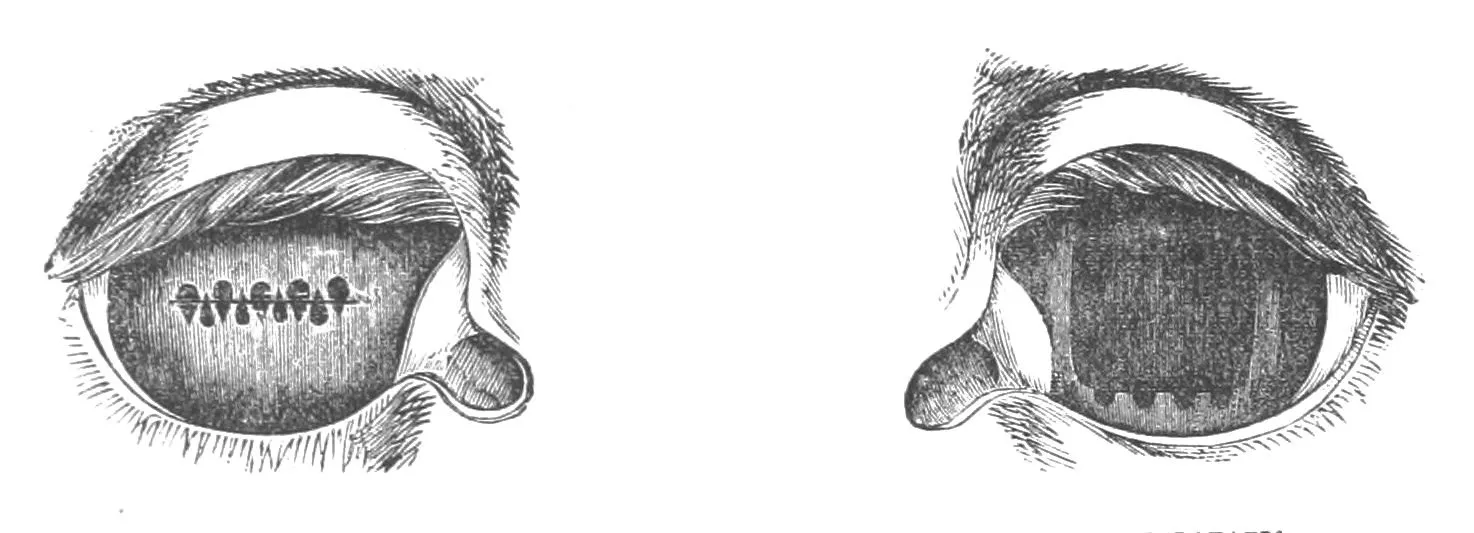
THE PUPIL OF THE HORSE’S EYE IN THE OPPOSITE STATES OF CONTRACTION AND DILATATION, SHOWING THE
SITUATION AND THE USE OF THE CORPORA NIGRA.
The corpora nigra, in the eye of the camel, are black bodies, pendent
from the margin of the iris. The purpose of so special a provision is not
apparent, when darkness occasions the opening to dilate; but when the
glare is powerful—so powerful as to induce blindness even in the natives
of those lands where a concentrated light is possible—then the intent of
its Beneficent Creator becomes apparent.
The pupil of the horse’s eye is never circular, being, when much
dilated, rather oblong in figure; but, when exposed to the direct rays of
the summer’s sun, the opening energetically contracts. Then the pupil
is best represented by a mere line; for the edges of the iris at such a
season seemingly touch each other. In this condition, the uses of the
corpora nigra can hardly be mistaken: the little black bodies appear to
fit into one another, forming apparently an impenetrable network opposed
to the entrance of too strong a glare.
Let the author and the reader, however, temperately consider this
matter. The pupil in the eye of the horse is not more distant than two
inches from the origin of the optic nerve. When the division to be seen
through is so close, and the object to be viewed is exhibited under the
strongest natural light, the merest crevice will be equal to all the purposes
of perfect vision. The full glare of the sun alone occasioning the
horse’s pupil to contract, that which causes the opening to almost shut
also provides the excess of light, which alone could render useful that
narrow division through which objects must be recognized; while the
dark bodies, being stationed before the point of sight, answer the purpose
of the smoke which lads load upon glass when they are ambitious
of gazing at the sun.
The reader must have remarked the pupillary line through which the
domestic cat exercises perfect vision during the bright noon of a midsummer
day. The eye of the feline race is, however, possessed of no
other protection. The contraction may be the effect of weakness of
sight; at all events, the author thinks he may conclude the far-famed
eye of the cat to be inferior to that of a horse. The domestic mouser is
popularly said to see in the dark; the steed has been long known to
penetrate the gloom which sets the strained vision of its master at defiance;
but it remains to be granted that both horse and cat are equally
fitted to roam by night. The habits of the herbivorous creature would,
however, assert it to be possessed of such a faculty; and the anatomist
discovers in the visual organ of the animal a provision specially adapting
it for these peregrinations.
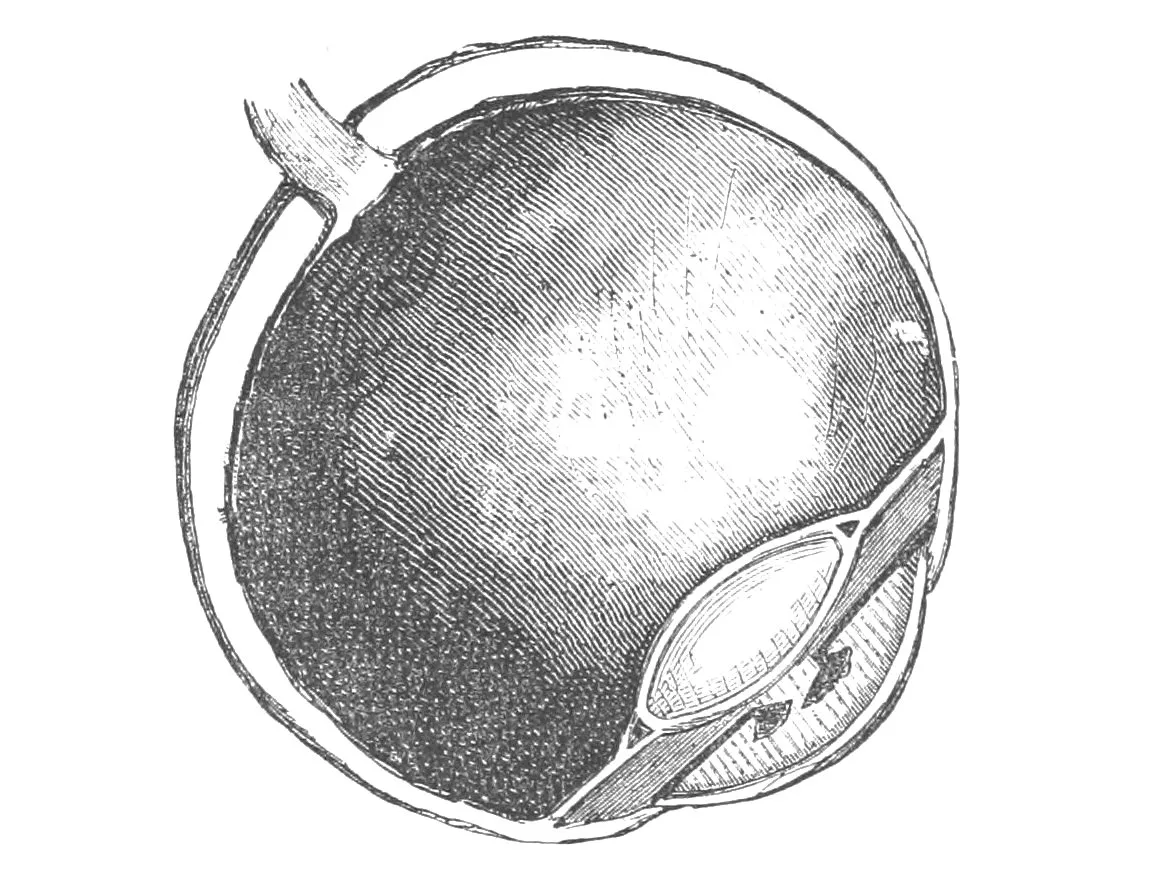
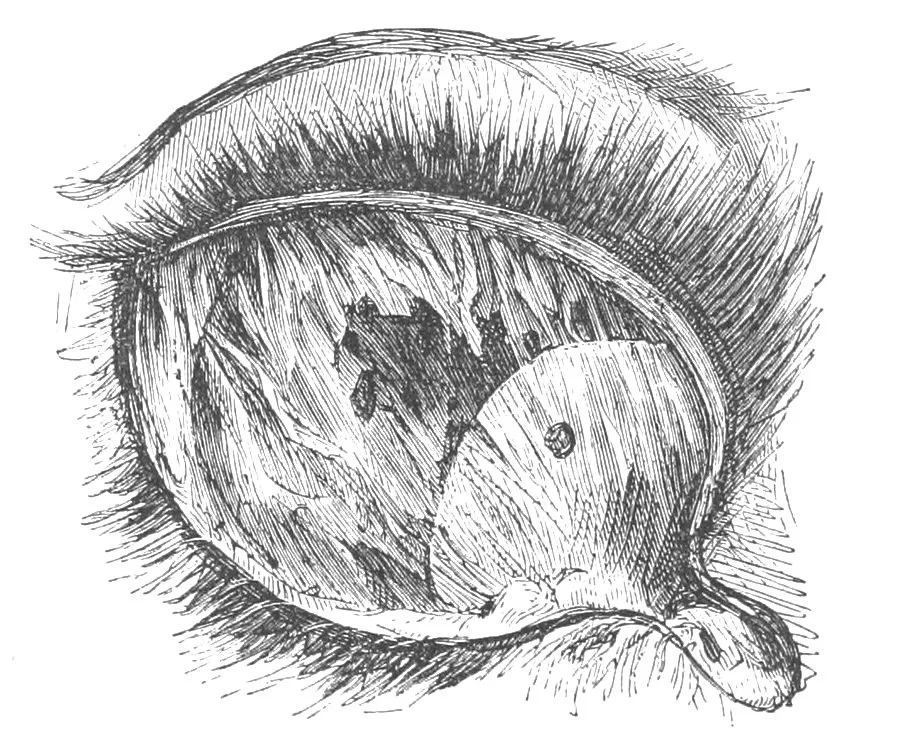
Upon the upper and forward surface of the inner, dark chamber, and
so placed as to catch, to concentrate, and to reflect every stray ray of
light upon the optic nerve, the tapidum lucidum is discovered within the
globe of the horse’s eye. This structure is, after death, very bright or of
metallic luster, and, because of its concave form, is admirably adapted to
its particular function. That no doubt may remain as to the design of
such a provision, the tapidum lucidum is found only within the eyes
of those quadrupeds created to roam by night. It is altogether absent
in such animals as were destined to move about during daylight.
DIAGRAM, EXPOSING THE INTERIOR OF THE HORSE’S EYE, AND DISPLAYING THE SITUATION OF THE TAPIDUM
LUCIDUM, OR GLOSSY SURFACE DEVELOPED WITHIN THE ORGAN.
The tapidum lucidum, therefore, viewed in conjunction with the corpora
nigra, becomes an inferential proof that the horse originally inhabited
some land in which the coolness of the night offered the greatest
temptation for pleasant pasturage. The Mighty Benefactor, consequently,
formed His creature to enjoy the bounties among which it was
permitted to roam. We know the cat was imported from the tropics;
and, seeing that the eyes of both animals, in one marked particular,
resemble each other, we may conjecture the horse originally inhabited a
warmer climate; while the likeness between the equine race and “the
ship of the desert” demonstrates that that locality was the hottest portion
of the earth.
The eye of the horse is also provided with a power which could seldom
be needed in these Northern climes, where the fleetness of the
equine tribe might readily set at defiance the comparative feebleness of
all the predatory beasts of prey. Besides, the wooded state of this
country must have rendered the presence of telescopic vision unnecessary.
Upon the far-stretching level of the desert, however, where
larger and more ferocious animals prowl by night, the possession of
such a faculty would be a needed protection. Accordingly, we find the
interior of the globe to consist chiefly of water, the outward covering
being formed of a tough substance, which is easily compressible; while
all the hidden portion of the exterior is enveloped by muscular fiber.
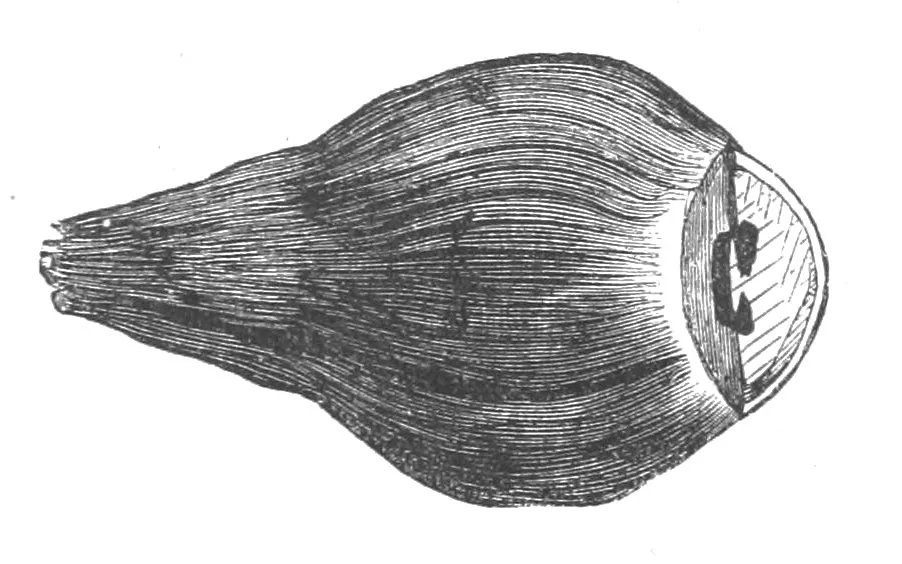
Situated directly upon the forward portion of the ball are the two
oblique muscles. These are inserted at opposite places, and each pulls
in a contrary direction to the other. The two, simultaneously acting,
could not move the organ, but would, obviously, tend to fix it or to
render the globe stationary. The outer substance of the horse’s eyes
is composed of a thick and pliable covering, purely tendinous in character.
The interior consists of fluid perfectly pure and transparent. At
the back of all is placed the optic nerve; while the exterior is enveloped
by several thick and straight muscles.
DIAGRAM, DISPLAYING THE COATING OF MUSCULAR FIBER WHICH COVERS THE SOFT GLOBE OF THE
HORSE’S EYE.
The motor agents are endowed with an ability to contract or to
shorten in their reach. When parts of this nature operate upon a
plastic substance, which is filled only with a fluid, they must of necessity
tend to alter the shape of that body on which they repose. The
oblique muscles act to prevent rotation; the pressure, therefore, can
only compress, elongate, and force backward the ball of the eye. By
such a capacity that telescopic property is produced which man feebly
imitates by a complex and costly machine.
Anatomy also discovers another important function proper to the eye
of the horse, which equally indicates a sandy plain to have been the
original habitat of the tribe.
The soft sand of the Southern region would form a soil over which
the equine foot could safely travel. The horn, in an unprotected state,
was created to journey over so yielding and so dry a surface. Harder
ground is poorly suited to the tread of the animal, a fact well established
by the brittle hoof being among the recognized diseases of this country;
while a wet soil is by no means advantageous, which circumstance
is amply illustrated by the weak horn characteristic of those animals
reared on the fens of Lincolnshire. The level of the desert presented
that combination of qualities which could render the exhibition of its
speed a delight to the unbroken quadruped; while the warmth of the
climate would afford the medium in which a lustrous coat testifies to
the health of a beautiful body.
In opposition to the above inference is the recorded fact that, when
English horses were transported as cavalry into Egypt, the dryness of
the climate frequently caused the hoofs so to crack as to render the
animals totally useless. This circumstance, when first learned, appears
to weigh heavily against the conclusion toward which the author’s
arguments were tending. In reality, however, it establishes nothing;
it fades before rational investigation. A life, after having left its native
country, does not necessarily thrive when it revisits the land of its
origin. Englishmen, who have spent their youth in India, generally
return to the variableness and to the humidity of this climate, and complain
of the country which, when it was quitted, appeared to be cursed
with no evil properties. Negroes captured by British cruisers, and set
free on the far-famed colony of emancipation, are ascertained to perish
the more rapidly on their return to Africa. These poor people are said
to sink more speedily than even Europeans succumb before the clime of
flame.
The speed of the horse would enable the quadruped to travel with
comparative ease between those remote spots of verdure which lie scattered
throughout the desert. The distance which divides these luxuriant
localities could present no insurmountable obstacle to the unburdened
steed, since the domesticated animal has carried its rider more than one
hundred miles. The horse can endure long fasts, and even sustain
severe thirst—the colon being a portion of the bowel generally devoted
to the store of liquid nutriment; but the distance must have been
accomplished in a cloud of sand sufficiently dense to blind the creature
which traveled in the center of a moving herd.
The eye of the horse, however, is by nature provided with a protection
against so terrible an affliction, which would expose any wild
animal to a fearful death. The outer membrane
of the eye is almost limited to covering
the more forward or transparent surface,
being thence reflected upon the interior of
the eyelids. This membrane, when in a
single layer, is incapable of communicating
to the sensorium more than a feeling of uneasiness.
When single, it may be touched,
burnt, and cut, without producing actual
pain; but the unpleasant sensation provokes
a desire to wink, and the instant the lid
descends upon the globe, or from the moment
when two surfaces of the membrane
are in apposition, agony ensues.
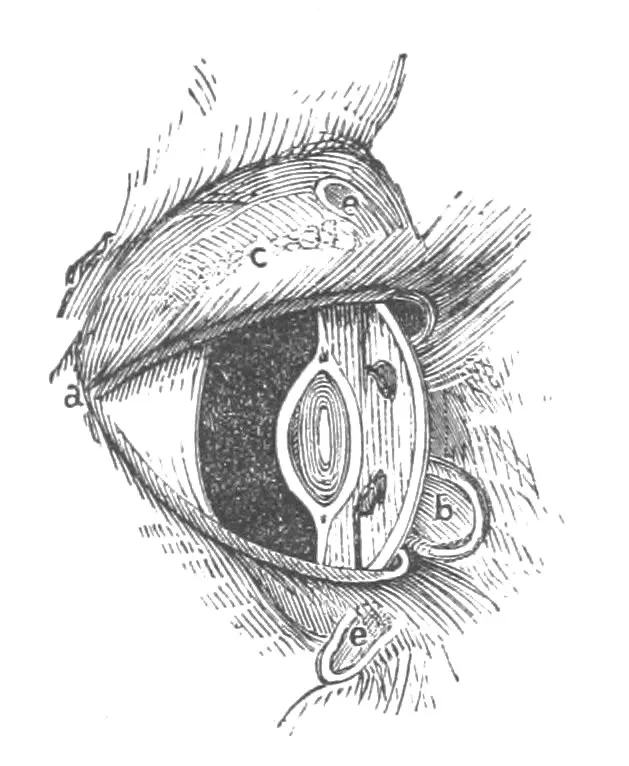
DIAGRAM, EXPLANATORY OF THE SITUATION
OF THE LACHRYMAL GLAND, OR
THE SOURCE OF TEARS, AND OF OTHER
PARTS PROPER TO THE HORSE’S EYE.
a. The outer angle.
b. The puncta
lachrymalis, or round body, situated at
the inner angle of the eye.
c. The lachrymal
gland, covered by the upper lid
and placed near the outer angle of the
eye.
e e. The position, extent, and
doubling of the conjunctiva, or of the
investing mucous membrane, which
envelops the outer portion of the
globe and lines the lids.
The membrane now under consideration
renders it an impossibility for any substance
to get “into the eye;” the pain present,
when such an assertion is commonly made,
gives the strongest proof that the foreign
body is retained between two surfaces of
that delicate structure which is called conjunctiva.
Dryness is, however, destructive of the feeling and of the
transparency of this membrane. Nature, therefore, has created a special
gland for assuring its perpetual moisture. This last body is situated
immediately beneath the surface, under the upper lid and toward the
outer corner of the eye. It is, on ordinary occasions, stimulated to
send forth its secretion by the act of winking; and the outer corner
being situated above the inner corner of the horse’s eye, the moisture
is, by the motion of the lid, instantaneously brushed over the circular
globe.
The gland of the horse, however, has a distinct use not shared by any
similar provision to be found in the eye of man. In the human being,
grief or pain provokes the secretion; these are always accompanied by
floods of tears. Some writers assert they have witnessed agony induce
tears in the quadruped; but the author has seen fearful operations inflicted
on the noble animal—he has heard huge groans testify to the
sufferings endured; yet he has never beheld the eye overflow, or seen
anything present which approximated to weeping.
Pain, when occasioned by some foreign body between the two layers
of membrane, produces not weeping, but a positive overflow of liquid,
the purpose of which will be best explained after the reader has been
made acquainted with a particular organ situated at the inner angle of
the eye.
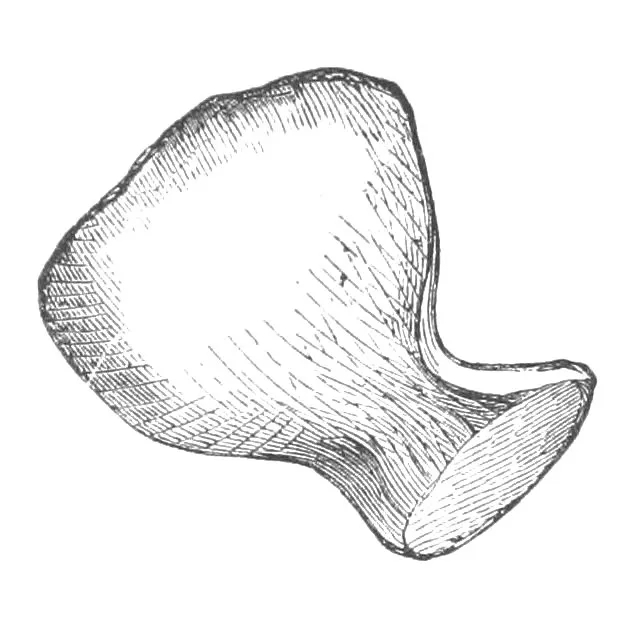
THE CARTILAGO NICTITANS, WHEN REMOVED FROM THE EYE OF A HORSE.
The lower corner of the organ is characterized by a round body,
which, being enveloped in a single layer of membrane, is strictly without
sensation. Upon this body the grime of the human eye accumulates,
and we shall shortly perceive that
its presence in the horse is not without
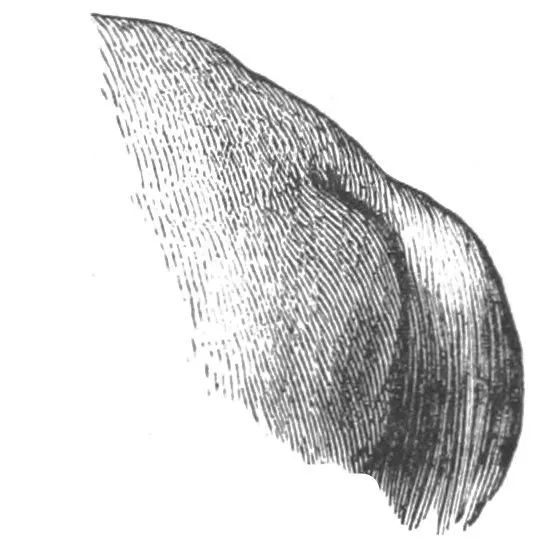
a purpose. Next to the foregoing development,
and so placed as to accurately
fit the globe, is a structure which
anatomists name the cartilago nictitans,
or the winking cartilage. The more
forward portion of this cartilage possesses
a fine edge, while its base presents
a broad surface, which reposes
upon the fat at the back of the orbit.
Now, as fat is not compressible by
ordinary force, whenever the muscles draw the globe backward, the
adipose matter is driven forward; this last carries with it the cartilago
nictitans, which is consequently projected suddenly over the surface of
the globe. But when the muscles relax, the fat resumes its original
place, and with it the cartilage also retires.
DIAGRAM, TO ILLUSTRATE THE ACTION OF THE CARTILAGO NICTITANS UPON THE HORSE’S EYE.
When any foreign body gets between the two layers of membrane,
instant winking results; the gland, stimulated by the motion of the lid,
sends forth a gush of liquid. It is not simply a tear or two, but a
deluge of fluid is emitted; this flood, aided by the action of the lid,
carries the foreign substance in the course of gravity, or from the external
toward the internal corner of the globe. While this is taking place,
the pain also excites the powerful muscles of the eye to spasmodic
activity. With every spasm the fat is displaced, and the cartilage darts
from the inner corner partially over the round surface of the eyeball.
The process continues until the substance is partly brushed and partly
washed to within the range of the fine anterior edge of the cartilage;
when, by its withdrawal, the foreign particle is lodged upon the round
insensitive body developed at the inner corner of the eye. Toward the
last point the tears naturally tend, and any exciting substance, when
there placed, is soon floated on to the hair of the cheek.
By joining these many proofs, we gain a moral certainty concerning
the region whence the horse originated. The eye is seen to be gifted
not only with a special provision against the glare of the desert, but it
also possesses a peculiar development fitting the animal to enjoy the
cool pasturage of the night. The eye is likewise endowed with a telescopic
power suited to sweep the far-stretching horizon of the sandy
waste. Moreover, the organ discloses a special apparatus evidently
designed to overcome those accidents to which inhabitants of arid
plains, when rapidly traveling long distances, and in large herds, were
exposed.
The reader, perhaps, somewhat wearied by this lengthened description,
may, however, be inclined to exclaim, “So that we possess the
horse, what care we whence the beast was derived?” There can be no
crumb of knowledge so small, but it is worth man’s while to stoop and
pick up the treasure. Its uses may not be apparent at the time of its
discovery, but its application is certain before long to repay the person
who prizes it. Taking the instance just narrated about the horse, an
assured knowledge of the land whence the beautiful stranger came
enables man the better to feel for its requirements; attention to the welfare
of its life will be repaid by more lasting service to the master who
claims it as a property. By disregarding this teaching, we subject the
quadruped to suffering, which cramps the limbs, limits the utility, and
shortens the existence, thus stinting the worth and curtailing the lease
of the possession.
When writing the foregoing, the author is aware that gentlemen of
known probity have reported the existence of herds of wild horses careering
free and unbroken over the plains of Asia. Such was formerly said
to be the case, and was also credited as an established fact with regard
to Southern America. Subsequent inquiry, however, has shown that
the wild animals of the pampas are no more than neglected flocks roaming,
apparently without an owner, but which, in reality, are allowed thus
to gain a cheap livelihood by a careless proprietor. These American
herds are liable to the claim of some man, almost as wild as the animals
themselves; so also the reported Asian quadrupeds turn out to be the
recognized possession of some wandering Tartar.
However, to leave the consideration of particular parts, and to view
the entire body anatomically, the vertebræ or spinal chain, as forming
the base of the skeleton, becomes of primary importance. The back-bone
of the horse consists of various pieces, so firmly held together by
interlacing ligaments and muscles that students, when desirous of dividing
the spine of a dead animal, often find it easier to saw the bones
asunder than to separate them with the knife. The neck is composed
of seven bones; the back is formed by eighteen vertebræ; the loins
consist of six pieces, and the sacrum is made up of five distinct parts,
although long before adultism all of these last are united by osseous
junction.
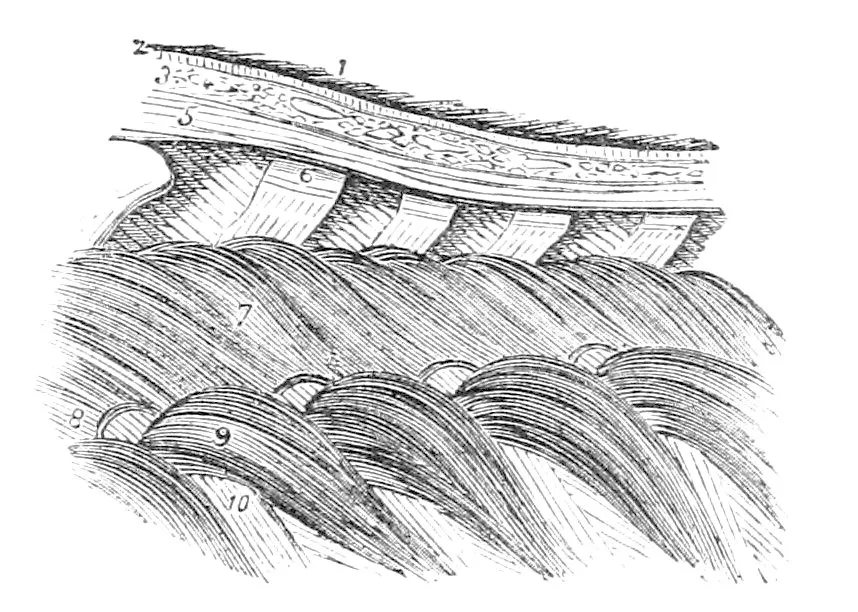
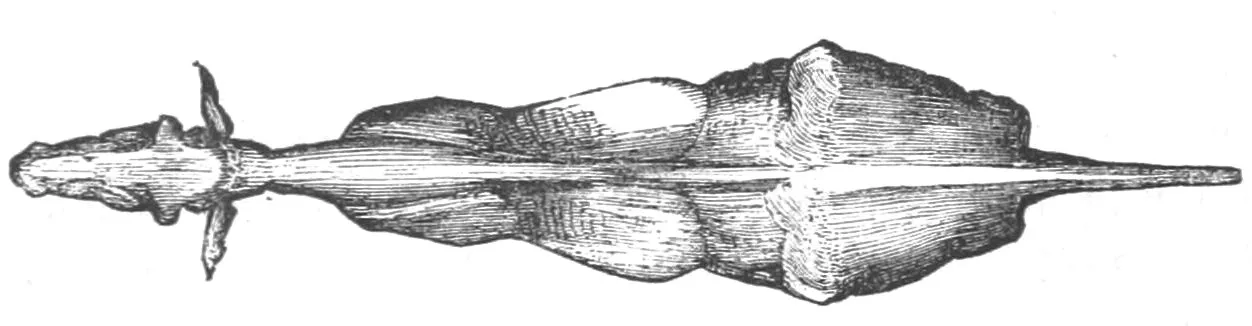
SOME OF THE DEEP-SEATED MUSCLES IMMEDIATELY INVESTING THE SPINE OF THE HORSE.
1. The hair.
2. The skin.
3. The adipose, or fatty tissue directly under the skin.
4. The bursæ mucosæ, or synovial sacks placed above each dorsal spine.
5. The yellow, elastic ligament connecting the dorsal
spines together.
6. The spines of the dorsal vertebræ.
7. The semi-spinalis dorsi muscle.
8. The heads of
the ribs.
9. The levatores costarum muscle.
10. The ribs.
The sacrum, therefore, is not reckoned among the true vertebræ, the
number of which, however, amounts to thirty-two. Of these many divisions,
the bones of the neck alone are not subject to deviations. The
lumbar may be five or seven, and the dorsal limitation is either one
above or one below the usual amount, neither of which varieties are of
very rare occurrence. The links of the back-bone differ in form and in
function. The dorsal vertebræ seem, at first sight, to possess no lateral
processes; whereas in the lumbar region these developments are so extended
as to constitute the principal features of the several parts. So
also the two first bones of the neck enjoy great motion, and all the links
of the neck are very far from stationary. But the parts of the back, on
the contrary, are all but fixed; yet, although each is endowed with a
very limited movement, the whole is gifted with an evident elasticity
which affords an easy seat to the rider.
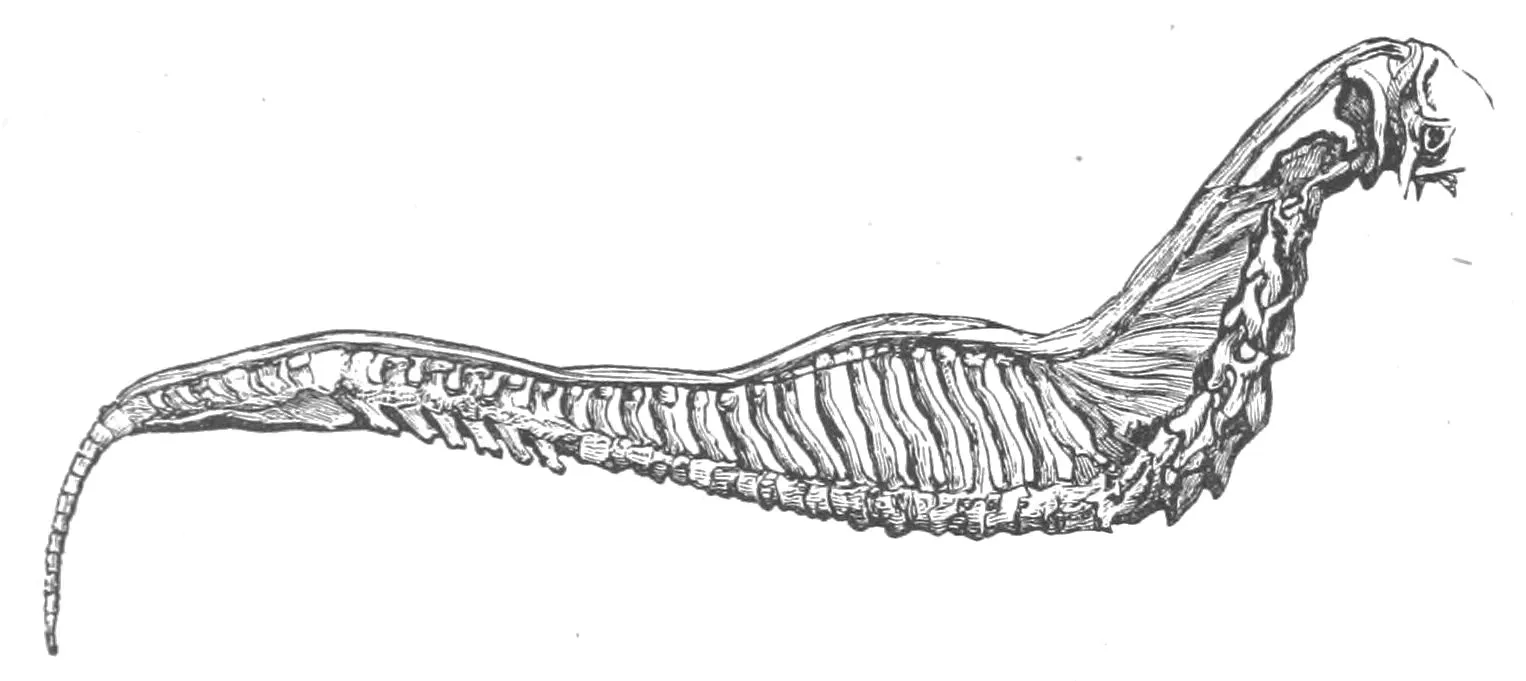
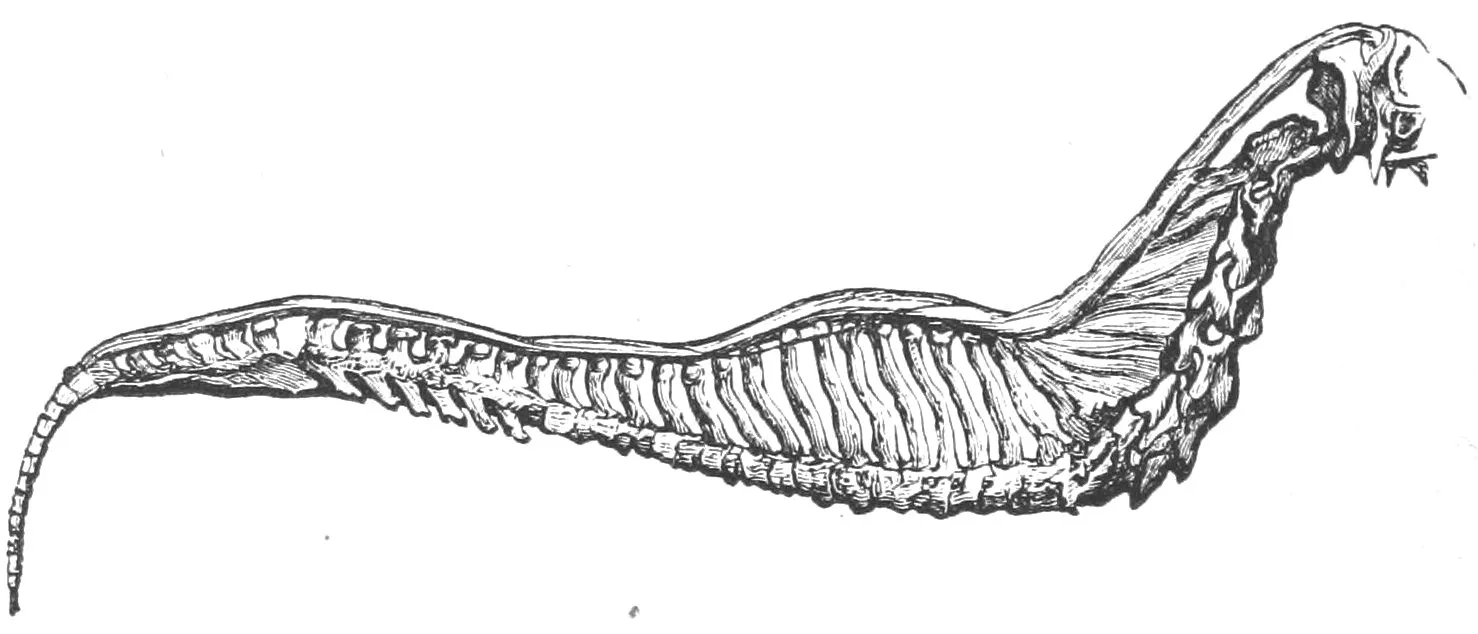
THE SPINE OF THE HORSE, OR THE BASIS OF ITS ANATOMICAL FRAMEWORK.
Along the top of the back-bone runs a strong cord of yellow, elastic
fiber, which unites the several parts, holding these firmly together as one
whole. The elastic cord, however, passes directly from the last dorsal
spine, to be fixed into the back portion of the skull, thus skipping over
all the bones of the neck. The fibers of this cord are longitudinally
arranged; and however elastic such a substance may be, the dorsal
arrangement would not allow of that freedom of motion which was
requisite in the neck of an animal which was to crop its food from the
surface of the earth.
The necessity, however, was fully met by an elastic cloth being, as it
were, thrown over the cord, and extending thence to the bones of the
neck. By this arrangement, frequent attachments were avoided and
grace of outline was preserved, while no deterioration was made in that
provision by means of which the heavy head is supported without apparent
strain upon the muscular fiber. One end of the elastic expansion
being inserted into the cervical bones, all the ease and beauty of movement
is rendered possible by the retractile property of the cloth-like ligament
being fully equal to the sustenance of the weight, but not strong
enough to resist the action of the muscles when excited. Thus, the
muscles situated at the base of the neck serve to depress the head; the
elastic cloth answers as a counterpoising force, which steadies the movement;
the action of the motor agents near the crest, aided by the ligamentous
elasticity of the neck, serve to elevate the part, while the muscular
power at the base of the bones regulates and guides the upward
motion.
But the reader may be desirous to learn how far the back of the animal
is suited to endure the weight of the rider. The bones of the spine, not
being joined by osseous union, may give solidity to the part; but it must
be self-evident the chain possesses no inherent power to sustain the
smallest pressure. Therefore, the body of the rider, when placed upon
the back, cannot be upheld by bone alone. The weight must repose
upon the muscles and the ligaments by which the solid parts are kept
together. Man, therefore, when mounted upon a horse, is seated upon
elastic substances, animated by the powers of vitality. This circumstance
readily accounts for the pleasurable feelings and the lightness of spirit
communicated to the master when within the saddle; although the delicacy
of the structures on which the burden is cast should also instruct
that an elaborately and a delicately-organized body ought to be shielded
from labor until age has confirmed and strengthened the several portions
of the frame.
When contemplating the uses for which the quadruped was created,
we perceive the necessity of that huge mass of muscular fiber with which
the back is cushioned. We also recognize the beauty of intention which
those numerous supports, called ribs, embody and declare. These props,
eighteen on either side, must greatly strengthen the main structure,
although each is of a loose texture, and every one is more or less pliable.
The innate property of elasticity belonging to the horse’s ribs seems to
have been long known to country urchins, who, out of these bones, have
been accustomed to form bows whence to propel juvenile arrows. Nature,
however, seems not to have been satisfied with this provision, for
the inferior portion of the ribs consists of cartilage, which anatomists
speak of as the most elastic substance in the body; this yielding termination
rests on the sternum or breast-bone, a structure more than three
parts of which are composed of the last-named material.
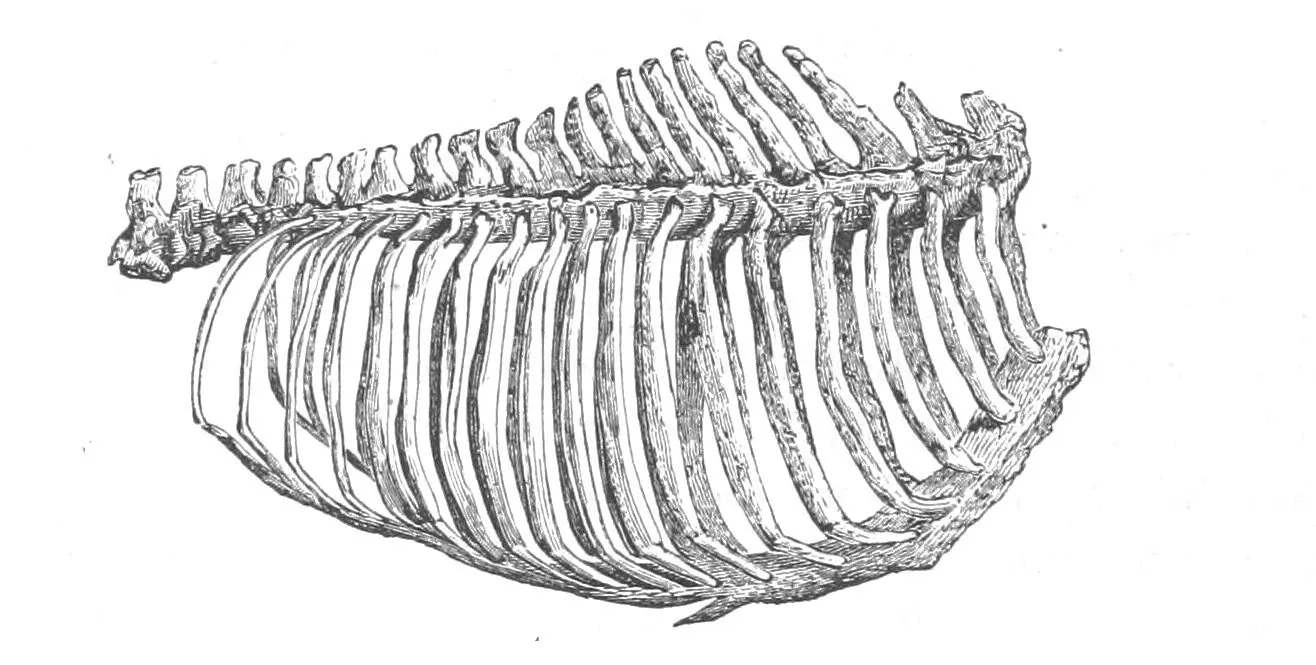
THE THORACIC FRAMEWORK OF THE HORSE.
Showing the manner in which the ribs spring from the spine to unite upon the bone of the breast.
The manner in which the fore limb is united to the trunk likewise
offers matter for the reader’s admiration. Considering that the horse is
a beast of burden, man, were he designing a creature fitted for such uses,
would assuredly have sought to gain strength by the insertion of bone.
Bone, however, would have interfered with that agility which, no less
than strength, is an attribute of the horse’s body. The presence even of
a clavicle joining the shoulder to the thorax would have exposed a jumping
quadruped to repeated fractures. Nature, therefore, bound the parts
together by interlacing fibers. And to afford an idea of the marvelous
care bestowed on this arrangement, the following diagram is submitted
to the contemplation of the reader.
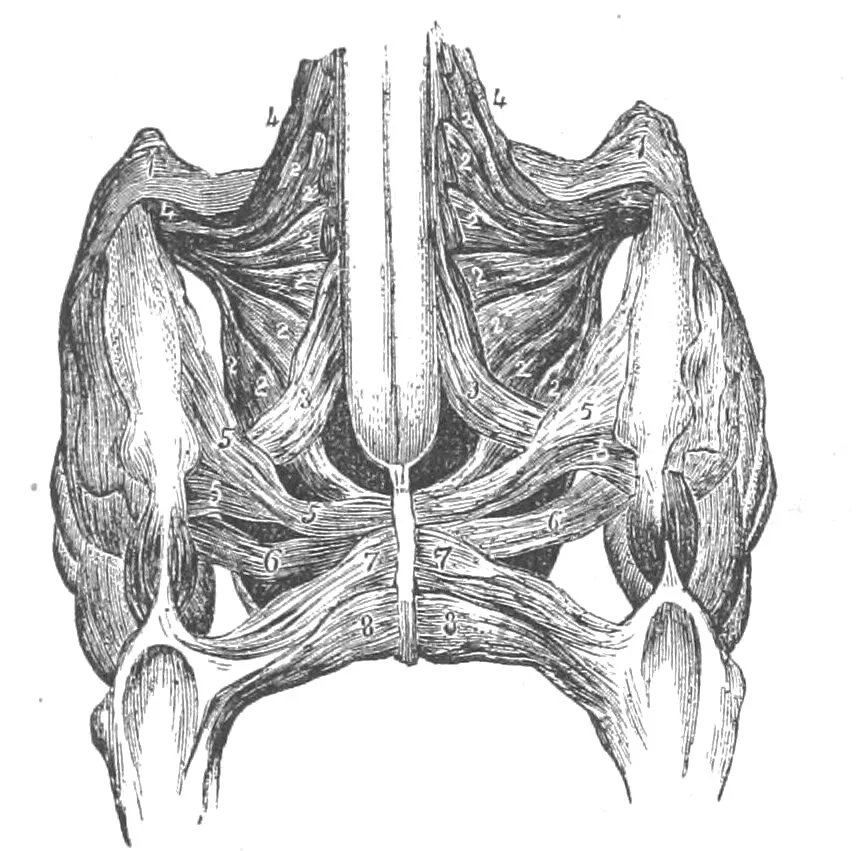
SOME OF THE MUSCLES WHICH ATTACH THE FORE LIMB TO THE TRUNK.
Three muscles have already been removed, viz., the panniculus carnosus, the levator humeri, and the
latissimus dorsi.
1. The trapezius.
2. The seratus magnus.
3. The subscapulo hyoideus.
4. The rhomboideus.
5. The pectoralis anticus.
6. The anterior portion of the pectoralis magnus.
7. The pectoralis parvus.
8. The pectoralis transversus.
The rider, therefore, when mounted on a horse, is not only seated upon
fleshy and ligamentous fiber, and upheld by pliable bone based upon elastic
cartilage, but as the thorax is supported by the anterior extremity, he
actually swings upon the strongest and most yielding substance known
throughout animated nature. Could mortal ingenuity, by the exercise
of any force or duration of thought, have perfected so exquisite a work?
But the mind is abased and humbled before the proofs of Superior Wisdom,
when we find that all hitherto made known is but a part of the
lavish provision bestowed upon the perfection of God’s most beautiful
gift to man.
The bones within the fore limb are not self-sustaining. Remove their
coverings, and they will not retain their several places, but will fall in a
heap upon the earth. The fact proves that the osseous framework,
although it confers solidity upon the body, is nevertheless upheld by
the structures with which it is enveloped. The bony column, however,
when united and bound together, exhibits an intention of bestowing elasticity
quite as much as of conferring strength. In the first place, the
solid column is crowned by a broad but thin plate of cartilage, the yielding
property of which has already been dilated upon; so that the trunk
not only swings upon living fiber, but the primary weight is endured by
what anatomists designate “the most elastic substance in the body,” of
a shape and form which develops to the uttermost its bending property.
The arrangement of the shoulder-blade and the bone on which it rests
being angular, evidently contemplates a yielding to any force coming
from above. The two next bones cannot be viewed as meant solely for
strength; though the several parts of the knee and shank are slightly
columnar in their order, nevertheless the pastern
bones again display an intent to yield rather than
a design at gaining decided resistance. Yet, even
there remains further food for contemplation when
viewing these dry bones of a quadruped. The
shock, of which the rider complains when doomed
to cross the trunk of some poor animal whose
body has been disorganized by abuse, is occasioned
by the bones having been, through disease,
thrown from their natural positions.
Engineers well know that sand will oppose the
force of a cannon ball, the power being rapidly
exhausted which has to travel through numerous
separated particles. Each grain of sand, therefore,
being distinct, a bag of that substance offers
a good preventive to the concussion produced
by the explosive force of gunpowder. But the
reader, when endeavoring to ascertain the provisions
instituted by Benevolence to save the
equestrian from concussion, can at once perceive
the purpose for which the osseous support of the
limb was formed of several pieces, as well as appreciate
the beauty and grace of motion which is
thereby assured.
THE BONES OF THE FORE LIMB.
Looking at the illustration, we observe that certain of the component
solids of the limbs are altogether out of the perpendicular, and consequently
must receive other support than is derived from the bone immediately
below them. Indeed, no portion of the structure is decidedly
columnar in its arrangement. Either the parts are crooked, or they lean
in a direction from the plummet line. The angularity of the two topmost
pieces can, however, not possibly escape notice; neither can the
slanting position of the pastern bones fail to attract attention. Noting
these peculiarities, the reader recognizes that the
bones of the fore extremity cannot be self-sustaining,
but they must be upheld or retained in
their relative situations by the structures which
surround them in the living subject.
The scapula and humerus, or the two topmost
bones, are rendered firm by the joint action of
the powerful extensor and flexor muscles appertaining
to the shoulder. The pastern bones transfer
their weight to the strong tendon which passes
immediately under their lower surfaces. The other
bones are held in their situations by the energetic
contractility of the muscles which embrace them.
Hence it is obvious the rider, when seated on the
back of a horse, is not upheld by any osseous resistance.
His burden reposes upon living fiber.
The bone limits the sphere of contractility, and
thus gives firmness to the limbs; but it endures
no portion of the weight. So exquisitely has nature
adapted her creature to its uses, that in the
horse man is provided with a means of conveyance
remarkable for fleetness, but more wonderful
for the elastic and buoyant seat which an admirable
body affords to an ungrateful master.
THE PRINCIPAL FLEXOR TENDONS OF THE FORELEG.
1. The perforans.
2. The perforatus.
3, 4. Accessory muscles.
5, 6. Restraining ligaments.
7. The pedal cartilage divided.
8. The navicular bone.
Had weight been cast upon bone, the shock
communicated by placing the foot upon the ground would have been so
powerful as must have made the saddle a seat of torture. This is no
speculative conjecture, but it is a deduction drawn from positive fact.
Hard work causes the pastern bones to quit the slant, which is their
natural position, and to assume a more upright direction. They very
rarely become actually perpendicular; but as they verge toward that
attitude, so as partially to transfer their weight from the tendon to one
another, the jar communicated to the rider becomes most distressing.
The tendons of the foreleg are, therefore, of all importance; the utility
of these structures cannot be better illustrated than by appealing to the
terrible effects which ensue upon injury to these organs.
However, that the reader may fully appreciate the simplicity and the
seeming complexity developed in the various arrangements exposed upon
dissection, the next illustration is inserted, against which numerous lines
are fixed. Those marks indicate the points where a substance, like to
white of egg, is interposed between the extremities of the bones. Each
separate bone thus not only rests upon a liquid, but the ends of these
formations are likewise tipped with cartilage, thus
doubly securing the ease of progression. Nor
have the perfection of these various arrangements
received full justice, for concussion of the foot has
not only to travel through different bones tipped
by cartilage and separated by the interposition of
a fluid, but it also has to progress through the
various structures of which the limb itself is composed,
and to travel in different directions.
So elaborate an arrangement, or one better
fitted to answer its intention, no human study
could invent. Man has for ages labored to disarrange
the parts thus admirably adjusted; when
so employed, he has only followed the example
of the savage who destroys the product he is incapable
of understanding. No injury, no wrong,
no cruelty can be conceived which barbarity has
not inflicted on the most generous of man’s many
willing slaves. While this has been going forward,
nations, at a vast outlay, have retained
expensive establishments to entreat the mercies
of a Superior to be lavished upon themselves,
and at the moment these people were boasting
aloud of their refined feelings or of their exalted
civilization, they have been incapable of sympathizing
with the agony which was imprisoned within the walls of their
premises.
THE ARTIST’S IDEA OF A HORSE’S FORE LIMB.
The lines indicate the places
where synovia (or a fluid resembling
white of egg) is interposed
between the different
structures.
Looking toward the quarters of the horse, we perceive the spines of
the lumbar and sacral bones arranged in so peculiar a manner as to
excite remark. Those of the loins bend forward, while those of the
haunch incline backward, thus leaving a free space dividing the uppermost
bones of two neighboring regions. There must be a reason for so
evident a design. Inspecting the last lumbar bone, we ascertain it to be
united by its lateral processes, yet it does not touch the first sacral body,
all other parts of the chain joining at their centers.
Here is cause for reflection! What takes place at this spot which
could render imperative such an arrangement? In what action is the
inclination of the trunk so opposite to the position of the quarters as to
render imperative such a special provision as is here exemplified in the
skeleton? In prancing, in rearing, and in jumping, the hind legs are
firmly planted upon the earth; then, by exertion of the powerful muscles
of the quarters, the forward trunk is
raised. This action could not have been
exhibited had the spines of the sacral bones
ranged in the same direction as those of the
lumbar vertebræ; and to enforce the reason
of this evident provision a free space characterizes
this particular joint, others being
formed by the interposition of cartilage.
THE BONES OF THE HIND EXTREMITY.
The skeleton of the quarters is characterized
by further distinctive peculiarities.
The sacral bones are fixed one to another,
and joining them at the spine is the huge
hip-bone. This is the heaviest of the many
weighty pieces which compose the osseous
frame of the horse. It is irregular in form,
and remarkable for an unusually rugged
exterior. An anatomist, by simply inspecting
it, could designate its uses, so emphatically
is everywhere written the origin and
insertion of powerful motor muscles. In
every ridge, in every indentation, in every
inequality anatomy discovers such a purpose;
thus, when “the gnarled and bossy”
developments upon this bone are viewed in conjunction with the solid
and uneven appearance of the lower osseous supports of the hind limb,
no person properly instructed can doubt that the quarters are peculiarly
the seat of muscular power in the equine race.
Then the angular arrangement of the bones suggests the immediate
purpose of flexion and extension. “Yes,” interrupts the reader, “that
is true; but supposing the loose bones of the skeleton only to exist, what
was to suggest the angularity of arrangement?” Such a fact could be
thus readily ascertained. The bodies of other animals would inform the
anatomist of the relative situations of the stifle and the elbow joints,
while the different lengths and points of bearing in the fore and hind
extremities would instruct him concerning all the rest.
But no knowledge could enable the anatomist to infer the gracefulness
of form and flow of line which characterizes the body of the horse, even
when deprived of its outward investment. Here is a sketch of the quarter
after partial dissection. It scarcely awakens the disgust which anatomical
labors generally create. The elegance which distinguishes the
living creature is hardly lost—certainly it is not entirely destroyed—and
the author is acquainted with no other body which could equally endure
so harsh a test.
THE HIND QUARTER OF A HORSE, FROM WHICH THE SKIN HAS BEEN REMOVED.
The inferior bones of the subjoined sketch lead to the foot; but as the
osseous structure of this part was illustrated
in a previous sketch, and as the
fore and hind feet of the horse are in the
leading particulars alike, the author will
not fill valuable space by unnecessary
repetition. However, the hind foot of
the horse being the point whence all the
strain of propulsion must proceed, the
part, from such a cause alone, will be
liable to certain distortions. The evils
engendered by the cruel impatience of
mankind, which forces the colt into too
early labor, causes the natural position
of the member to become altered. The
pastern bones grow to be erect, and,
should the toil still be enforced, the
shank bone afterward projects. If these warnings are disregarded, inhumanity
provokes the heels to be drawn upward, and a valuable helpmate
is thus incapacitated from assisting man in his earthly task.
While writing of the horse, it should not be forgotten that in this country
there is another animal which properly belongs to the equine race,
and which is liable to most of the evils as well as worthy of much of
the commendation that has been already pronounced, as though these
referred only to one specimen of the tribe. The donkey is much misunderstood.
Because its name has become a figure of reproach, no writer
hitherto has dilated seriously upon its requirements, although several
have been ignorantly sentimental, where suffering needed only truth to
plead in its behalf. The animal must have its uses, or its breed would
not be preserved.
The fact establishes that the creature is of service to mankind, since
the life, whose season of utility has expired, like the dodo, soon ceases to
exist. It is, however, chiefly the property of those whose feelings are
subject to their necessities. The purchase of such a chattel is comparatively
easy; the food is the refuse of the stable; but the work is often
disproportionately heavy, for the ass too frequently belongs to those
whose daily round of toil would tax the strength of the largest horse.
The prejudice which encircles this miserable being appears to be countenanced
even in the dissecting rooms of the veterinary profession. Anatomy
is a science the only merit of which depends upon its being a literal
record of facts; yet students, at the before-mentioned places, are fond of
alluding to the larynx of the ass, as displaying a peculiar development,
which accounts for the difference of voice between the last-named animal
and the horse. The author could never discover such a curiosity, nor
is any necessary, when the peculiarity of the two sounds is attentively
noticed. One is a nasal tone, modulated by the flutter of the nostrils;
the other is a harsh, grating noise, produced by energetically inhaling
and expelling the atmosphere through the extended pipe of the animal’s
trachea.
The donkey labors, however, beyond the care of its enslaver and without
the region of human sympathy. Be its toil exhaustive, let it work
without cessation throughout the day and far into the night, no eye
regards its fatigue with commiseration. It is an object only to laugh at.
The popular belief is, that the tribe is so peculiarly hardy as to be altogether
removed from the necessities, the liabilities, or the accidents common
to every other form of life. All grades of existence which men
please to neglect, they generally designate as “hardy.” Human beings,
however, notoriously become less “hardy” as knowledge is enlarged and
as life becomes better cared for. Will the time ever arrive when perception
can embrace that which we now view only as an object of fun, and
when the donkey will be regarded as entitled to share the consideration
bestowed upon all the other inhabitants of earth?
The country is not secure, the people are not released from barbarism,
while the pressure of want can blind the nation to the lawful needs of
the lives which surround and which serve it. Civilization must be far
from perfected, when an inquiry concerning the man who has beheld a
dead donkey can make a large assemblage laugh. The author has,
however, known poor families to be plunged into deep distress because
the assinine form of existence was not immortal. His experience may,
probably, be peculiar, but it is opposed to the stale jest of our theaters;
for when he was demonstrator at the Royal Veterinary College, he used
to dispute with the man who supplied donkeys for the pupils to dissect,
whether the institution should or should not bear the loss of such as died
before their lives were required by the school. These creatures were
bought at Smithfield, and brought to Saint Pancras for animals enjoying
health; they were wanted to endure but a few days; yet the author has
seen three carcasses anticipate this brief interval of permitted existence.
The author can further testify that, among the scores of carcasses
which he has dissected, he never examined the body of a donkey, however
young it might have been, that he did not encounter appalling
proofs of internal injuries—injuries which had resulted in change of
structure, and which would have consigned the horse to the knacker’s
yard. Yet the animals thus maimed were working up to the date of
purchase; the inability to move was attributed to the obstinacy which
is generously supposed to characterize the ill-treated animal, and the
blows fell heavier in proportion as its actual condition should have
appealed to human forbearance.
STABLED FOR THE NIGHT.
To properly comprehend the sufferings of the quadruped, we must
know the country whence it is derived, and be acquainted with the soil
it is fitted to inhabit. The wild ass delights in the sandy desert of a
tropical region, and for the products of such a locality a taste is, by the
English representative, retained. It lives and thrives upon the spontaneous
herbage of the arid waste. The heat, under which other forms
of life appear to languish, fills the donkey with animation. The comparative
size of its intestines fit it to store away that amount of water
which in the land of its nativity is proverbially scarce.
The donkey in England is dragged into a wintry climate, rendered
more inhospitable by the low temperature which is the most prominent
characteristic of the country. In cold and in wet, the native of a
tropical soil must lead a miserable existence. In Britain, however, it
breathes and breeds; but it is here on the limits of even its power to
endure. In Scotland the tribe is all but unknown. Where it can live,
however, no one thinks of its real condition; no mortal is so weak as
to waste pity upon its suffering. Its toil is without other limit than
the pleasure of its master; when the day’s work is done, the nearest
lane is the only stable ready to receive it.
The author has often, when passing down some narrow and unfrequented
highway, during the early part of December, encountered a
miserable group of beings endeavoring to afford each other a little
warmth by crowding close together. The weather at this season is
piercing cold. The ground is squashy, and moisture loads the atmosphere.
The fierce wind bends the bare twigs of the adjacent hedge,
and the temperature is of that kind which heralds the Christmas frost.
It is not yet so low as to numb sensation; but it leaves the edge of
feeling unblunted, that sense may fully appreciate the heavy misery,
before whose wildness all nature moans and crouches. In such a place,
and at such a season, the author has been made sad by the living anguish
which the preceding illustration feebly depicts.
The donkey, in this country, is very unfortunate in the class whom it
principally serves. The lower order, though with impulses untainted by
politeness, yet, in the struggle for life, have little leisure to quicken their
perceptions or to cultivate their feelings. Their own necessities forbid
them to be generous, and render somewhat rude their intercourse. They
exist not within the amenities, but upon the borders of society; the law,
under whose protection the affluent breathe in comfort, is to them a cruel
institution, which forces them to endure, which they recognize only as a
restraint, and with which they are powerless openly to contend.
In towns, the homes of such a race are without attractions. The
very poor are ignorant of domesticity. They eat and live abroad, and
seek their lodgings only when utter weariness makes them heedless
where they rest. If the lodging be large enough to conceal, it possesses
all the requirements poverty demands. To be larger is to be colder; for
the ignorant study rather to drag on existence from day to day than
think to promote the health, which is their only real possession.
When such a people rise in their sphere of contention, and can afford
to discard the hand-barrow for the donkey-tray, the inferior animal can
expect no separate lodging. That will hardly be provided for a beast
which the master was too abased to conceive necessary for the members
of his family.
The donkey is hailed as a new possession; and for security, not from
any loftier consideration, it has to share the proprietor’s home. No
hole can be too narrow, too dark, or too stifling for the animal’s abode,
so that it provides the safe keeping for which it is sought. Humanity
shudders as it pictures the strange places which poverty may view as
the fitting homes of its dependants!
The young horse may be stinted in its food, but it is spared from work
until a certain period has arrived. All classes have their stated ages
when the colt should first begin to labor; but the ass has no recognized
season of rest, even for its immaturity. It is forced to work so soon as
need can see in the growing body a capacity to assist. Foals are often
to be seen dragging loaded trays about the streets of London, and the
day’s toil is lengthened or shortened by the quickness or the slowness of
the day’s sale. The food is, during this time, the refuse of the stock;
seldom can the owner spare from his earnings that which will purchase
fodder for the life which is the partner of his fatigues.
THE DONKEY’S PREPARATION FOR THE LABOR OF THE DAY.
The donkey is harnessed for the early market. The costermonger
rides with his family to make his bargains for the day; and the stock-in-trade
being procured, he and they ride with it back again. The very
poor never walk, save upon necessity, and seem never to conceive their
animals can be tired or overladen. The wretched quadruped, on home
being reached, is not released and permitted to rest. It has to support
the tray while the family wash the stock, display the viands, and get their
morning meal; after which it is started with a kick and a blow, and an
exclamation of, “Come up, lazy! why, what ails ye, this marning?”
Animals have generally less ability to endure fatigue than have the
human race; but if the donkey has to work before man’s daily round
commences, so also do its toils increase after the period of mortal labor
has been fulfilled. My readers must recollect to have frequently beheld
the coster’s tray, now emptied of the green stock of the morning, but
occupied by several shouting fellows, and drawn past the windows by a
little donkey. The street purveyor of vegetables often travels far to
dispose of his wares. But the green stuff distributed, he considers his
labors for the day to be ended. He then has time to appreciate his own
sensations. He flings his body full length upon the tray, and, with the
good nature which belongs to his class, does not refuse a ride to any
wayfarer so long as the vehicle can accommodate another passenger.
All, then, fully impressed with the popular credulities concerning the
donkey, commence shouting and thumping, while the animal, which has
been upon its legs before the light began, is forced to travel homeward
at a pace which is compelled to be faster in proportion as it may be distant
from its lodging.
In the country, the houses being more separated, the animal is deprived
of the frequent stoppages and the lighter draught of the towns.
The pull is heavier, and the distances are longer; but still the donkey
must progress until the master has earned a certain sum, without which
he rarely turns the creature’s head toward his home. If the proprietors
of asses have few faiths, they are all thoroughly imbued with one belief,
which is, that the animal in their keeping cannot possibly feel exhaustion.
Their credulity does not stay here. They are impressed with a
conviction that no creature of the donkey tribe has any sort of feeling.
The quadruped, they know, can bear an unusual amount of beating with
the thickest possible bludgeon, and simply requires only the coarsest of
refuse for sustenance. Moreover, such conviction leaves the proprietor
his own convenience to consider, when imposing burdens on “the beast
within his gate.”
The last article of belief makes the man select the weakest portion of
his dumb servant’s spine for a seat, when he is inclined to play the
jockey. The reader, to whose notice diagrams of the equine spine have
been submitted, knows that the loins alone are unsupported by other
bones. The absence of that which renders this region the weakest division
of the vertebræ, also makes this portion of the quadruped’s back
the most yielding and elastic. Here the fashion of vulgarity fixes the
rider’s seat when he strides the ass. The veterinary student will remember
that few of the lumbar bones in the carcasses he dissected, when at
college, were in their integrity. The author has encountered two, three,
and even four bones of the six which compose the part locked together
by osseous deposit.
Such a form of union proves the animal to have suffered inflammation.
The injury must have been endured and the agony must have run its
course; for an osseous junction is positive evidence that all the stages
of inflammation have been survived. Few persons, when they behold
the young donkey stagger under the weight of its six-foot rider, care to
think of this; nay, the writer has beheld really worthy gentlemen stand
and enjoy the scene of activity presented at evening time by a rural
gipsy’s encampment. The women were laughing, the men were shouting,
while the more jovial of the gang were racing on the common. Those
poor donkeys, which already had been goaded to the performance of no
ordinary day’s toil, were carrying terrific loads, and beaten till they galloped,
despite the deep-seated anguish with which they were afflicted.
CHAPTER II. PHYSIC, THE MODE OF ADMINISTERING IT, AND MINOR OPERATIONS.
Let the reader ask any gentleman of his acquaintance, “Whether
man is not morally answerable for the welfare of those animals which
are gathered beneath his roof?” The individual thus appealed to will
most probably lean back in his easy chair, and, with a look of amiable
surprise, may reply “Certainly! certainly! Assuredly, my dear sir, I
regard myself as fully responsible! Every horse in my stable costs me
one hundred pounds, or very nearly, a year. The poor animals ought
to be well looked after for that money! Clerks—many young city
men—receive only fifty pounds annually—from respectable houses too.
Therefore, my horses ought to be especially well cared for!”
But to drive this matter home, allow the author, with all humility, to
inquire if it be in the power of money to discharge the smallest or the
slightest moral bond? Is there no difference between paying and doing?
May there not be certain duties which are equally stringent upon the
very rich and the very poor? Can the wealthy compound for such obligations,
and are the needy, only, to be judged for the non-fulfillment of
these responsibilities?
It is among the worst features of modern society that, while it boasts
of several worthy gentlemen who can draw largely upon their bankers,
there are in its ranks so very few who would willingly submit to the
smallest personal exertion for the fulfillment of that which they confess to
be a moral duty. Would these most agreeable and amiable individuals
occasionally lounge toward the stable, the cost of its maintenance might
be decreased, and, nevertheless, the creatures for whose welfare the
owner is confessedly responsible be better treated at the diminished
outlay.
When a dumb slave fails in the service of some affluent proprietor, all
that might be done is not accomplished when an order is hastily given
“to call in” a veterinary surgeon. It is not sufficient that baskets of
drugs are delivered and paid for; that physicking and bleeding are practiced
and remunerated; that a “horse doctor” is constant in his attendance,
or that a building, by its odor, attests to the activity of his measures.
No. Man is formed capable of investigation, and is blessed with
a power of locomotion. A man is bound to go, to see, to hear patiently,
and to judge conscientiously, of that which is done to the lives intrusted
to his responsibility. Had this duty been discharged, many processes,
still sanctioned by custom, might have fallen into disuse; some habits,
now indulged, might have been discarded; while a few objectionable
measures might have been altogether forbidden as useless formalities and
needless cruelties.
Horse Balls—particular forms of veterinary medicine—are generally
sent to stables by the dozen. Physic is thus placed at the pleasure or
the caprice of ignorance to administer. The author has seen a large
chest full of such abominations—looking very pretty, and made up all
of one size, each labeled, and bearing some distinctive title—directed to
an English nobleman resident in the country. Such a supply, the writer
was informed, is dispatched to “my lord’s” address twice in each year,
and is always used by the grooms, and by the stated period, in accordance
with the accompanying directions.
The only safeguard attending such implements of destruction was that
the majority were harmless, either from the worthless nature of the drugs
composing them, or from the change which took place between the agents
being compounded and at the time of their being employed. Many, no
doubt, were thrown away; but that fact excuses neither the professional
man who sent them, the honorable person who ordered them, or the ignorant
servants by whom they were accepted. Each was impressed with
a belief that such things were potent. It is astonishing how much of
this world’s sin is gilt over by its credulity. All concerned regarded
these things as mysterious projectiles, strong enough to regulate the
eccentricities of health and powerful enough to vanquish the dangers
of disease.
One form of ball, however, is neither innocuous nor safe—it is the
aloetic. Aloes is the common purgative of the stable. So general was
the use of the drug, and so unquestioning appears to have, formerly, been
the confidence lavished upon its operation, that this medicine always took
the precedence in every sickness, and, ultimately, by popular consent,
engrossed to itself the significant term of “physic.” “Has this horse
had physic?”—“Prepare this horse for physic”—when spoken in the
stable, signify, has such an animal had aloes? or imply an order that
another quadruped is to be prepared for a dose of aloes. The groom
can only imagine that to be worthy of the title “physic,” which is
capable of producing visible effects; and, certainly, when judged by the
stable-man’s standard, aloes merits the distinction bestowed upon its
drastic results.
Other things will move the bowels of the horse, and will empty its
intestines much more gently, and with altogether more safety; but the
stable cannot, therefore, afford to part with its favorite representative of
the many forms of medicine. Bran mashes, four of these being given
daily, it is well known, will relax the animal’s system; but the groom
employs these agents merely as preparatory to the favorite dose of
aloes; and, though repeated mashes will induce purgation in the equine
patient, the groom is never satisfied unless that result be aggravated by
a dose of aloes.
The horse’s body does not quickly respond to opening medicine; but
the action, once elicited, is not invariably easy to command. The animal’s
life is frequently a prey to a potent purgative. The veterinarian
knows that the different creatures vary much in their capability of swallowing
amounts of aloes; that the dose which will not move one quadruped
may destroy the inhabitant of the next stall. One creature will
imbibe two ounces of the drug without marked effect; another will be
shaken by the action of less than half an ounce of the preparation.
Nevertheless, the stable-man always craves for aloes, and always experiences
an odd delight when watching for its hydragogue operation.
The farmers in Norfolk are strongly tainted with the superstition of the
London mews. They also crave for aloes, and the youthful veterinary
surgeon frequently yields to the demand. Young practitioners delight
in strong doses. Accordingly, a full dose of aloes is sent to the Norfolk
farmer, and by him rammed down the throat of some unfortunate teamster.
The next time the novice encounters his customer, the man of the
diploma is greeted with “Hey, doctor! doctor! what beautiful physic
that were you sent for Slyboots! Oh! how it did work the poor thing,
to be sure! If anything could have saved the beast, that must have
done! But the time were up, and he died of a powerful inflammation.
Thanke, thanke, doctor! Let’s have your bill!”
This is the more lamentable when we consider that in nine cases out
of ten, or rather in twenty-nine out of thirty, the administration of aloes
is unnecessary. In the great majority of cases, its place could be advantageously
supplied by bran mashes, which are readily made according to
the following receipt: Put a peck of bran into a perfectly clean stable-pail.
One person should stir the bran as briskly as possible, while
another person, with speed, empties a sufficiency of boiling water into
the pail to render the contents a pultaceous mass. The vessel is then
covered up, and when it has become cool, the pudding is thrown into
the manger.
However, one horse shall devour bran mashes with avidity, another
will not touch them. This will not partake of the potion unless it be
partially warm; another will not eat until it is perfectly cold; while
most will partake of the mess if it be flavored by the admixture of a
little salt or a few crushed oats.
So it is, also, with water. Certain horses, when feeding upon bran
mashes, refuse all drink; others enjoy frequent draughts of cold fluid;
while a third set seem to crave warm water; and a fourth will neither
imbibe freely nor entirely abstain, being wholly indifferent as to the temperature
of the liquid. Thus the order, which is inserted in most books,
to give to the horse, after the animal has swallowed a dose of aloes, copious
draughts of warm water, is frequently rendered futile; for, as the
proverb teaches, “one man may lead the horse to the pond, but forty
men cannot make the quadruped drink.”
Bran mashes, however, will act without the aid of repeated doses of
warm fluid. Of themselves they do not debilitate, though from the length
and size of the horse’s intestines, purgation cannot be long maintained
without inducing serious exhaustion; and it is never safe to work the
animal while any looseness is observable. A tendency to inflammation
is often announced by repeated and liquid discharges; therefore, never
let the horse be taken out while the bowels are in a state of excitement,
for exercise may increase that action to one of positive disease. Bran
mashes, however, are the safest and the gentlest of laxatives. Any condition
may be induced, according to the number and frequency of the
potions. In general, they act mildly, without inducing that bodily discomfort
and that constitutional weakness which throws the animal out
of condition and renders rest an absolute necessity for recovery. Altogether,
these mixtures are the best and the safest laxative of the stable;
but even these should never be administered to the horse without the
special direction of the proprietor.
On the other hand, aloes can, in no form, be administered to some
horses. Very many cannot receive a full dose of the drug. Several
can only with safety swallow the medicine when highly spiced or in
solution. While a few are all but insensible to the action of the agent.
Alarming spasms often follow the exhibition of a moderate quantity of
aloes, which always renders the quadruped sickly ere the effects are visible.
The drug, in most instances, lies dormant twenty-four hours; during
which period the appetite is lost, the spirits oppressed, the coat dull, and
the entire system evidently shaken. It is not esteemed prudent to work
the patient till several days’ rest have been allowed for its restoration.
It used once to be the custom to trot the animal which was sickening
under a dose of aloes; but experience has shown the danger of the habit.
The horse is now left in the stable, has an extra rug thrown upon the
back, while a pail of warm water is in most instances placed in the
manger. Where safe, it is obviously unnecessary to ride the quadruped
which is sickening under aloes; since the loss of appetite shows the
medicine has affected the system, and the natural effects of the physic
may, therefore, be anticipated.
Very many animals, when suffering from chronic debility, may be
slaughtered by a moderate dose of aloes, while many never sufficiently
recover from purgation to do a day’s work after the medicine has ceased
to operate. Of all the preparations the veterinarian has at his command,
the writer does not know one which exerts so decided an effect upon the
constitution; nor does the veterinary pharmacopœia contain an agent
which could be more advantageously dispensed with. During the years
the author was in active practice, he does not remember to have ever
given a dose of aloes that the symptoms did not afterward cause him to
regret the administration.
There is another fact rendering the aloetic ball an unsafe agent to be
intrusted to the keeping of a groom. These things, as commonly compounded,
become, in a short time, as hard as stones. The author has
handled many which might be broken, but which could not be indented.
Such bodies are not in a fit condition to be thrust down a horse’s throat.
All unyielding substances are liable to stick in the gullet, and to provoke
choking—the digestive passages of the horse not contemplating the deglutition
of other than moist and soft pellets of thoroughly masticated
food. Aloes was, at one time, in spite of the objections urged, very
popular in the stable; for that consequence, the late Professor Coleman
was mainly answerable. They are at present chiefly employed in accordance
with the dictates of routine, and usually take precedence of other
forms of medicine.
A BALL, AS SUCH THINGS ARE SENT FROM THE VETERINARY PHARMACY.
A horse ball represents some substance in powder mixed into a mass
with some moist ingredient, such as soft soap, treacle, palm oil, etc. The
compounds, when united, are usually rolled into sticks about three-quarters
of an inch in diameter. These sticks are subsequently cut
into lengths of two and a half or four inches in extent, according to the
amount required for a dose; each piece is weighed, is dusted with some
non-adhesive powder, is securely wrapped in paper, is labeled, and is
packed away for use or sent out to such stables as delight in strange
property.
A BALL, OF THE FORM WHICH IT IS GENERALLY MADE TO ASSUME WHEN GIVEN.
Previous to a ball being delivered it is customary, with the generality
of practitioners, to pinch the sharp edge of the forward extremity until
that part of the substance becomes rounded. The intention, when doing
this, is so to modify the shape as to facilitate the passage of the body
down the gullet. Where the medicine is soft, as all newly-compounded
drugs must necessarily be, the muscular contractility of the horse’s swallow
would render such trouble useless; but, as the ball must be rather
pulpy which can be thus moulded by the fingers, it would be no more
than a prudent regulation should every proprietor insist on this custom
always being complied with. Whether the present practice in any degree
is beneficial to the animal, the author is very dubious; at all events, the
horse were very fortunate if the sharp edges of the forward extremity
were the only danger it encountered when swallowing the physic which
is supposed to be curative in its effect.
Several potent caustics rank among the most common of horse physics.
Those agents are of great power; as bichloride of mercury, arsenic,
nitrate of silver, sulphate of copper, etc. These burning compounds are
frequently administered in substance, and in enormous doses. Even
where the quantity prescribed is not objectionable, the form in which the
caustic is generally given is calculated to be highly injurious. In the
first place, the use of such things in the veterinary pharmacy is too common
an occurrence for the compounder to bestow much care upon the
accuracy of the weight—a scruple more or less being commonly esteemed
of no importance. Next, small thought is bestowed upon the necessity
of incorporating such fiery components with more mild ingredients before
the mass is forced down the sensitive throat of a living creature. A ball
made of linseed meal and treacle is quickly snatched from one of the
drawers of the surgery; the powerful agent is speedily reduced to powder;
the placebo is torn from its envelope; a slit is cut down its center;
from the mortar the potent material is emptied into the cavity thus
formed for its reception; and the whole, after having been rewrapped in
fresh paper, is esteemed to be ready for delivery.
When such an article has been swallowed by the creature, in whose
welfare no living being seems to take a genuine interest, the paper or
outward investment is speedily removed by the action of the stomach.
Then, the retaining cover being destroyed, the burning mass falls out
upon the fine, moist, and velvet coat lining the viscus; this fact may
very probably explain why stomachic diseases are so general with the
majority of old favorites. As such substances are caustics when applied
to the external flesh, it is only reasonable to infer that no tissue
within the body could long withstand the burning properties of such
potent destroyers. It is true that certain inhumanities, miscalled experiments,
have been practiced upon living horses. Enormous quantities
of the most destructive compounds have been poured down the living
throats of submissive quadrupeds. Some animals long survived such
disgusting brutality; but others have succumbed at the very commencement
of the trial. Veterinary therapeutics, however, take no notice of
such as yielded to the smaller dose. The men who conducted these cruelties
delight to dwell upon the fact that a certain horse actually took so
much of such a poison, and, apparently, suffered no ill effects from imbibition
of the deadly potion.
A COMPOUND BALL, AS PREPARED IN TOO MANY VETERINARY PHARMACIES.
However, supposing such an experiment were made on human beings.
Let a certain number of cripples be procured from the workhouses; aged
creatures whose span of existence was almost run, and on whose countenances
years of suffering had impressed the lines of prolonged misery.
Let such poor mortals be deprived of speech, and let all the signs of suffering
in them be disregarded. Then force these wretched beings to
swallow large quantities of the various poisons. Would all perish simultaneously?
By no means. Affliction often acts as a defense to those
whom it envelops. Men in different stages of distress have endured
strange things, as during every hour the record of calamity makes known.
The poor animals which served for the subjects of the so-called veterinary
experiments were procured from the knackers; they were in the
last stages of disease, and the poison, which would kill healthy horses,
acting upon frames exhausted by every possible accumulation of agony,
probably may have stimulated the exhaustion of excessive debility.
That which would destroy an ordinary life, acting upon an existence
sinking to its last sleep, may, to the blindness of mortal recognitions,
appear to work without sensible result, or may seem to recall the fleeting
spirit back to earth. At all events, no sound deduction can be
drawn, as to the action of any medicinal substances upon the healthy
body, from the apparent influence exerted by such agents upon decrepitude
and upon senility.
The so-called experiments, which are here alluded to only to reprobate
them as horrible cruelties, very probably have induced the carelessness
that prevails throughout veterinary practice as to the use of caustic
bodies among its customary medicines. Such salts should, on no account,
be exhibited in substance, if, indeed, their supposititious virtues should
recommend them at all to the prescriber. During the years which the
author was in practice he scrupulously abjured all these abominations,
and the results which were obtained by gentler agents were such as did
no discredit to the adoption of milder measures.
Humanity should prevail consistently throughout all acts forced upon
the life which Providence has intrusted to our mercy. If the recognition
of this duty, as an actuating motive, be a weakness, in its adoption
is carried its own defense. If charity does no good, it cannot possibly
work harm to the dumb life upon which its offices are expended; whereas,
when administering balls to horses, the cruelty often indulged causes many
of these gentle animals to acquire those habits of resistance which are
at first no more than the wild efforts of conscious helplessness aiming at
self-defense. Such timid creatures, influenced by fear, will instinctively
rear, kick, and vigorously attack whoever may approach them.
He who will have the patience and the courage to encounter what is
in stable language denominated “a savage horse,” may do so with every
confidence. Let him approach the quadruped alone, when the groom is
absent and silence reigns around. Nothing must be done quickly. When
the horse moves, the man must remain stationary. Every symptom of
alarm must be assuaged by kind looks and gentle words. When the horse
is convinced that no injury is designed—and it is astonishing how quickly
a generous spirit will comprehend the intentions of benevolence—in proportion
as ferocity was previously displayed will gratitude gush forth and
submit the huge body to man’s pleasure.
If, however, the person has neither time nor inclination to undertake
such a trial, then, with an animal having a tendency to become excited,
he must adopt one of those mechanical restraints known as balling-irons.
These things are not altogether safe for their employer, while they are
decidedly not beneficial in their operation upon the quadruped. A balling-iron
is simply a piece of metal, so shaped that when thrust violently
between the creature’s jaws it forcibly holds the mouth open. Therefore,
it will certainly prevent biting; but an irritable or a fearful horse can rear
up and strike with its forefeet. Such an animal is not entirely subdued
when the iron is adjusted. Moreover, these instruments occasion pain,
and the horse, instructed by repeated agony, soon grows very cunning,
and equally resolute in its efforts to oppose the insertion of the dreaded
instrument which causes its suffering.
The man using a balling-iron has, therefore, to guard himself from
blows rapidly dealt with the forehoofs of a desperate animal.
THE COMMONEST FORM OF BALLING-IRON.
A A. The ring of iron which, being forced into
the animal’s mouth, keeps the jaws asunder.
B B, B B. That portion of the metal which steadies
the ring by remaining against the jaws.
C. The handle.
THE IMPROVED FORM OF THE COMMON BALLING-IRON,
WHICH AFFORDS A PROBABILITY OF
ESCAPE FOR THE OPERATOR’S ARM.
A A. The part forced into the mouth.
B B, B B. The parts which remain against
the jaws.
C. The handle.
He has also to be ready at the slightest intimation of an intention to
rear, so that he may withdraw his arm on the instant, otherwise the
operator is dragged upward with the elevated crest, and, hanging by the
inserted member, he is very lucky if a broken limb does not reward his
tardiness. The use of the balling-iron, consequently, is not free from
danger; and in practice it will be found safer to subdue by kindness
than to partially conquer by the employment of mechanical restraints.
The most common form of balling-iron is constructed according to the
model indicated in the preceding illustration. The circular piece of metal
is inserted into the mouth of the animal. A straight bar is attached to
either side of the metallic ring, the design of these last being to steady
the instrument after it has been forced into its proper position. Through
the circle the operator’s arm is thrust, and the iron ring affords security
so far as it disables the jaws from closing upon the member. But, though
safe in one direction, such a protection also creates its particular peril;
for, should the horse rear, the arm, being surrounded by a metallic rim,
could not be withdrawn with the speed requisite to insure the operator’s
safety. The suspension of the man’s
body is almost certain to provoke the
fracture of his imprisoned limb; consequently,
to remedy that evil, the improvement
indicated by the right-hand
illustration was introduced.
The circle in the foregoing is left free
on one side; thus, the inexpert have a
little more time allowed for their movements.
The arm could be retracted with
greater ease, and the former danger was,
in a great measure, removed. Still, this
new shape was not wholly satisfactory.
The form was fixed: horses are not all
of one height, one breadth, or of one
capacity. There are small creatures
designated ponies; while horses are not
rarely encountered of enormous proportions.
As the iron has no power of
being adapted, the form that should
prove not large enough for one may be
altogether disproportioned to another
quadruped.
A NEW BALLING-IRON, INVENTED BY PROFESSOR
VARNELL, OF THE ROYAL VETERINARY
COLLEGE, LONDON.
A A. India-rubber tubing, to protect the
mouth from the harshness of the metal
bars.
B B B. Side pieces to keep the iron in its
situation.
C. The handle.
D. The lower bar, attached to the handle.
E. The side piece, which can be raised or
depressed.
F. The screw, at the extremity of the
side piece.
G. The nut which, fastened to the handle,
acts upon the screw and fixes its position.
The weight of metal necessarily employed
to assure the requisite strength,
also rendered it inconvenient for a veterinary
surgeon to carry more than one of
these bulky articles; and though small
was the amount of ingenuity which had
hitherto been lavished on the improvement of the thing, for years it continued
of the last character. Mr. Varnell, assistant professor at the
Royal Veterinary College, however, appears to have entirely removed
all former objections, and to have invented a balling-iron which seems
to possess all the qualities that such an instrument is capable of exhibiting.
The restraining bars of this last amendment are formed of polished
steel, and are covered with a stout piece of India-rubber tubing,
thus in some measure protecting the mouth of the creature from injury
by what hitherto was the exposed metal. The lower bar, moreover, is
attached to the handle, and the handle can be readily raised or depressed
by turning the nut situated at its base. It can, therefore, be quickly
adapted to any possible capacity of jaw.
THE USUAL MANNER OF GIVING A BALL.
Such a form of immunity is, however, seldom sought, save by the very
inexperienced in the veterinary practice. A few years of active employment
enables any person to discard this defense. A sufficient security
is in all ordinary cases afforded by the horse’s tongue, which, when a
ball is about to be administered, is grasped by the left hand, and withdrawn
to the right side of the mouth. The hand thus employed is fixed,
being lightly pressed against the inferior margin of the lower jaw; for,
when retained in such a position, the tongue is pressed upon the foremost
of the huge molar teeth. Of course, the animal, thus held, cannot
approximate its jaws so as seriously to harm the operator without biting
its own flesh; by that circumstance is safety supposed to be rendered
certain. But should violence be exerted, animal fear is apt to be superior
to bodily pain; the tongue and arm may be simultaneously bitten
through. The practiced veterinary surgeon, however, takes advantage
of the first emotion of surprise which the creature experiences at the
liberties taken with, and the indignities offered to, its person. Having
the ball ready in the right hand, he, standing on the left side, quickly
introduces the bolus into the wondering quadruped’s mouth.
The medicine is lodged at the back portion of the tongue, whence, as
the horse does not expectorate, the creature has no ability of expelling
it, save only by coughing. During the spasm, which accompanies this
act, the soft palate is raised and the ball is carried outward with the
volume of violently-expired breath. Some horses acquire a habit of
thus returning all forms of physic, and will cough up a ball twenty times.
Such a circumstance illustrates the necessity of distracting the attention
of the quadruped the instant the hand is retracted; for in the confusion
of the moment the most inveterate “dodger” may be surprised into
swallowing any abhorrent morsel.
THE CUSTOMARY MODE OF DISTRACTING THE HORSE’S ATTENTION, AFTER IT HAS RECEIVED A BALL.
The hand, during the delivery of the ball, being rapidly thrust into
the mouth, is frequently cut by the sharp edges of the molar teeth. No
knowledge, which has hitherto been attained by veterinary science, can
point out the animal possessed of grinders of this dangerous description,
and the only protection as yet suggested is to cover the hand with a
glove. But a glove cannot be washed and dried so readily as the hand;
it, moreover, is highly objectionable to introduce the saliva of one animal
into the mouth of another, as disease may be thus conveyed from horse
to horse; also, it being impossible to provide a new glove with every
fresh patient, the protection is not universally adopted.
The medicine being delivered, the hand is quickly withdrawn, and the
jaws of the animal are clapped together. The nose is then rubbed somewhat
roughly, for—the upper lip being the organ of prehension, as well
as the seat of feeling, in the horse—this part is excited with the design
of preventing the quadruped from dwelling too intently on the unpleasant
nature of the substance which has just been forced into its mouth.
A BALL BEING ADMINISTERED ACCORDING TO MR. GOWING’S DIRECTION.
Mr. Gowing, the excellent veterinary surgeon, of Camden Town, has,
with his usual ingenuity, endeavored to remove those objections to which
the previous manner of delivering a ball is obviously liable. This gentleman
grasps the tongue rather higher up than is customary; and,
having done so, does not retract the member, but fixes the hand upon
the gums which cover the upper margin of the lower jaw. The point
of the tongue protrudes between the thumb and fingers, and it is then
plain that the animal cannot close the mouth without biting upon its
own flesh.
Yet candor obliges the author to state that he does not view this
method of grasping the tongue as an improvement on the old practice.
The tongue, not being drawn out of the mouth, is not so decidedly fixed
upon the molar teeth; while the hand appears to be placed in a somewhat
dangerous position. For if, under excitement, the horse can become
so oblivious as actually to bite through its own flesh, how would the
hand of the operator fare when the closing of the jaws should lacerate
the lingual body? The only advantage which can attend upon Mr.
Gowing’s proposed plan must result from the smaller outrage it offers,
thus leaving the amiable disposition of the animal the better chance of
controlling its emotions.
It is, therefore, demonstrated the tongue can afford the operator no
decided protection; the question, consequently, resolves itself into which
of the methods affords the hand the greatest immunity, should the animal
become alarmed. The author cannot but think the outside of the jaw is,
under such circumstances preferable to the interior of the mouth.
MR. GOWING’S EXCELLENT MANNER OF DELIVERING A BALL.
However, the method proposed by Mr. Gowing for holding and delivering
the ball is unobjectionable. According to the plan adopted by that
gentleman, the knuckles are not elevated; but the hand is extended, the
thumb and fingers being all brought upon one level and all held close
together. The ball is placed between the fore and middle fingers, on
the same level as the hand generally, being retained simply by slight
lateral pressure. In this position it is introduced, and evidently demands
less space for its entrance than was required according to the
former system. When the ball has been advanced to the desired situation,
a separation of the fingers allows the morsel to drop into its place.
Some stress, however, is laid upon the manner of clasping the head
after the ball has been lodged. Mr. Gowing claps-to the jaws and evidently
contemplates holding them in apposition. This is a mistake;
for the muscles of the horse are not to be controlled by the utmost power
of the strongest human being. The old custom, which applied friction
on the most sensitive portion of the horse’s body, the writer esteems as
better calculated to distract the attention of the quadruped.
The delivery of a horse ball is, however, rendered difficult in proportion
to the number of persons who surround the animal, and to the noise
made on the occasion. For the above reason, all the pupils at public
schools have to learn this portion of their profession under heavy difficulties.
The fuss which accompanies this simple operation in such institutions
alarms the horse. It is turned round in its stall; the twitch is
put upon the upper lip; a futile attempt is made to hold the jaws apart;
while the nervousness of the young student who is about to perform,—all
are likely to exercise an evil influence upon a sensitive and a timid
creature.
MR. GOWING’S METHOD OF GRASPING THE JAWS AFTER THE DELIVERY OF A BALL.
Veterinary surgeons, however, soon learn to give a ball with greater
speed and with less ceremony. They go alone up to the head, and
play for a time with the quadruped’s face. Confidence being thus established,
the practitioner gently withdraws the creature’s tongue. This
being accomplished, of course the jaws are sundered; when, without
any sign of flurry, the hand is introduced into the cavity and the medicine
properly lodged. After such a manner, the practiced veterinarian
gives many balls in the course of the day, and is hardly ever known to
fail. Indeed, were the practitioner, when going his rounds, to wait till
four or five assistants could be collected ere he administered the requisite
medicine, the duties of the day could never be discharged.
THE QUIET METHOD OF GIVING A BALL.
The physic being introduced into the mouth, the person who has
undertaken to deliver it should on no account esteem his business
finished, and thereon leave the stable. He should proceed to the left
side of the horse and watch the neck. In that position, when the animal
swallows, any substance can be seen to travel down the gullet; this
proof having been witnessed, the building may be quitted with a safe
conscience. The illustration of this fact was drawn on the wood correctly;
but the artist did not make proper allowance for the transfer of
his sketch by the engraver. The last process has made that which was
originally on the left side of the neck appear as on the right side of the
body.
Drinks or draughts are not in favor with the majority of veterinary
surgeons. Most practitioners urge, in justification of their dislike to
such a form of medicine, that solutions are attended with danger—being
apt, when administered, to pass into the trachea, and thus to flow upon
the lungs. Admitting this objection, it does not decide the question;
for the advocates of solid physic can possess small experience if they
are to be told that balls have proved injurious by also entering the forbidden
channel. Likewise, that when the popular form of physic has
grown hard, much harm has been occasioned by the mass becoming impacted
within the gullet. Evil can, therefore, be caused by physic in
either form, if given without the necessary caution; and the balance of
fact can incline the judgment to neither one side nor the other.
A BALL PASSING DOWN THE HORSE’S GULLET.
But it is curious to read of serious dislike being entertained against
drinks, and at the same time know that several practitioners are accustomed
to administer this kind of medicine after a particular method,
which evinces a desire to illustrate the very circumstance which constitutes
the objection to every solid. Many country veterinarians are
accustomed to pour all the liquids which they exhibit down the nostril
of the animal. Now, the nostrils terminate immediately over the larynx—the
direct channel is from one chamber into the other cavity—thus,
any fluid administered after so unnatural a method will probably find its
way on to the lungs.
Such an abuse of nature’s designs being largely practiced upon a
powerful quadruped, is proof of the perfect submission with which the
creature has accepted its appointed master. Such an absolute negation
of self, deserved considerate recognition from the reasoning and superior
being. Veterinary medicines are too generally composed of pungent
and of caustic materials, while the nostrils are lined with a highly sensitive
and delicately moist mucous membrane. It was created to come
in contact with the air, to which the nostrils in the horse afford the only
legitimate passage. The notion of disregarding the mouth and selecting
so tender a channel, down which to pour acrid and burning solutions,
appears to be such a refinement upon ordinary barbarity as must puzzle
the reader to discover a motive to excuse.
THE NATURAL CONSEQUENCE WHICH IS TO BE EXPECTED WHENEVER THE FILTHY CUSTOM OF POURING
DRINKS INTO THE NASAL CHAMBER OF A HORSE IS ADOPTED.
a a. The windpipe.
b b. The gullet.
c c. The soft palate.
d. The tongue.
The fact appears the more monstrous when we consider the practice
is adopted by the veterinary surgeon, and that it is exhibited upon the
sick horse whose welfare he is especially bound to conserve. The irritation
consequent upon so abhorrent an abuse cannot but be most prejudicial
to that quietude which is, upon every form of existence, healing
in its effect. The motive which prompts so outrageous a proceeding is
the love of display, acting upon an ignorant or unscrupulous individual;
joined to this, is the knowledge that medicine can be administered with
greater speed than when delivered according to the natural method. The
horse has no power to check the course of any liquid emptied into the
nostril of the elevated head; whereas the animal will frequently occupy
a considerable time before a fluid, delivered by the mouth, is swallowed.
By one canal, the will is powerless; by the other channel, volition is
operative. To save his time, as well as to excite surprise, are the only
motives which can prompt a careless man to tamper with that welfare
it is his duty to tenderly protect.
To render this subject the more intelligible to the reader, the natural
process which enables the horse to imbibe liquids shall here be detailed.
The mouth of this animal is peculiar for having at its backward extremity
a fleshy screen, which hangs pendulous from the bony roof.
This soft palate explains why the quadruped, under ordinary circumstances,
breathes only through the nose; and why, when it vomits, the
regurgitated matter is ejected by the nostrils. That specialty is of service,
however, during the act of imbibition. The posterior entrance to
the nasal chamber being open and the head in a pendulous position,
were there no special provision to the contrary, the water, after having
passed the mouth, would, from the mere force of gravity, have
a tendency to return by the nostrils. This actually occurs whenever
cold, strangles, influenza, sore throat, etc. interferes with the activity or
the health of these parts now under consideration. Disease renders the
organ sensitive, and tenderness makes the animal exert its volition to
prevent the employment of the inflamed structure. In consequence of
this cause, the nasal chambers are imperfectly closed, and a great portion
of the fluid imbibed by the mouth flows forth again through the
nostrils. Such a tendency to gravitate is, during health, effectually prevented
by the soft palate. Before any substance can pass from the
mouth toward the throat, that appendage must be raised, and its rising
closes the posterior entrance to the nasal chambers.
DIAGRAM, (FIG. 1,) EXPLANATORY OF THE COMPOUND ACT OF DRINKING IN THE HORSE.
a a. The water drawn into the mouth and forced into the fauces by the compression of the forward part of the tongue and the enlargement of the backward portion of the organ.
b b. The fluid passing down the œsophagus or gullet.
c. The larynx, lowered to admit the passage of the liquid.
d d. The tongue, dilated at one place and contracted at another.
e. The soft palate, floated upward and effectually closing the nasal passages.
DIAGRAM, (FIG. 2,) EXPLANATORY OF THE COMPOUND ACT OF DRINKING.
a a. The water driven backward by the forward dilatation of the tongue and the upward movement of the larynx.
b b. The full current forced down the gullet.
c. The larynx propelled against the soft palate.
d d. The tongue, dilated anteriorly and compressed posteriorly.
e. The soft palate.
The tongue is the primary agent employed when the animal slakes its
thirst. The backward portion of the organ is contracted, and the forward
part compressed by muscular volition, (d d, fig. 1.) A vacuum
would thereby be created, were not the water propelled by atmospheric
pressure into the void thus formed, (a, fig. 1.) The posterior of the
tongue is then relaxed, while the anterior division of the organ is pressed
against the roof of the mouth, (d d, fig. 2.) The fluid is thereby driven
to the backward part of the cavity, (a, fig. 2.) The tongue, during the
act, continues to alternate the states of contraction and relaxation, each
motion of the lingual agent serving to pump the water into the fauces,
(a, fig. 1.) But, before that can be accomplished, the soft palate must
be elevated. The soft palate (e, fig. 2) then closes the nostrils, (e, fig. 1;)
and also in its course to take this position sets in motion the cartilages
of the larynx. The last cover over and effectually protecting the windpipe,
(c, fig. 1,) the fluid is forced onward by the contraction of the tongue,
passes into a secure chamber, the roof and floor of which are but of temporary
formation, (a, fig. 1.) Here it remains only during the inactivity
of the larynx. The upward motion of the latter body (c, fig. 2) propels
the fluid into the pharynx, whence involuntary contractility sends it into
the gullet, the muscular action of which tube conveys it onward to the
stomach, (a b b, fig. 2.)
From the foregoing explanation, the reader is in a position to judge
whether the nasal chamber is a fit passage for acrimonious mixtures,
since he now understands the evident pains the All-wise has bestowed
to prevent the temperate fluid, of which the animal customarily partakes,
from intruding upon the elaborate, delicate, and highly sensitive membrane
that lines the air-passages. All veterinary students are not educated
men, neither are all attentive to their studies while at college; but
it should require an extraordinary amount of ignorance and conceit to
thus grossly misconceive the intentions which are so plainly impressed
upon the body of the quadruped.
The author, however, doubts if those objections generally advanced
to drinks are in any degree derived from the results of actual experience.
Balls can be manufactured by the score, and then stored away for subsequent
use. Drinks would decompose if thus mixed and kept ready in
the surgery. Drinks must be separately compounded, as required. Balls
occupy little space, and being solid can be safely carried or forwarded to
any distance. Drinks being contained in bottles, are less convenient for
transport, and the vessels are liable to fracture. Balls, moreover, are to
be quickly thrust down an animal’s throat; require no assistance for
their administration; and being wrapped in paper are not exposed to
inquisitive discussion as to their ingredients. Drinks being inclosed in
glass, protected only by a cork, are open to investigation, and likely to
provoke remarks which are not always soothing to the pride of a pretender;
liquids likewise necessitate more time should be devoted to their
exhibition, and generally require the assistance which is not invariably
at hand to aid the veterinary surgeon.
The above reasons and objections are not without influence upon
practitioners, whose earnings are greatly dependent upon the speed of
their movements; who generally give the medicines to those animals
they treat, and habitually carry with them, ready compounded, the drugs
which they administer. Drinks, moreover, demand several bulky articles
for their proper administration, and are apt to soil the person who delivers
them. Balls, as a rule, call for no other apparatus than the hand.
Moreover, it causes delay at starting, if there are twenty or thirty drinks
to be previously mixed, bottled, labeled, incased in paper and so packed
as to be in no peril of breakage; whereas any number of balls can be
almost instantaneously transferred from the drawer in the surgery into
the gig at the door.
The usual mode of giving a drink is, moreover, a complex business.
A twitch is mostly kept in regularly appointed stables, and the string or
loop is fixed over the animal’s upper jaw, prior to other measures being
proceeded with. The groom then grasps the stick and takes his place
by the shoulder of the horse. At a previously arranged signal, he raises
the pole; the string, paining the gums under which it is fixed, causes
the head of the quadruped to be elevated. Supposing the horn having
the larger mouth to be employed, the drink is then emptied into the
hollow of this rude appliance until the liquid nearly fills the interior.
The fluid is next carried upward, two fingers of the operator’s left hand
being fastened on to the gums, so as to further expand the jaws and
enable the veterinary surgeon to steady his body while straining to administer
the medicine. The large end is pushed into the quadruped’s
mouth, and, by a sudden movement of the wrist, the contents of the
horn are meant to be splashed upon the animal’s tongue.
THE COMMON FORM OF THE HORN EMPLOYED
TO ADMINISTER DRINKS.
AN IMPROVED FORM OF HORN.
This, which is the more common method of administering a drink, is
open to several objections. The horn, being of a limited capacity, can
hold but a small quantity; and the lengthened time required for frequent
replenishing, necessitates that the animal should be long held in
an attitude of unnatural constraint. In the next place, the fluid is, by
the action of the wrist, rather rudely thrown, than gently emptied, into
the mouth, much of the medicine is generally lost, and no little of it,
guided by the inserted fingers of the operator, is apt to find its way
down the sleeve of his left arm.
To remedy these obvious defects, the tip of the horn was sawn off;
while a piece of wood supplied a bottom to the larger extremity. A
rude bottle was thus formed that would hold a larger amount of fluid,
and from which the medicine could flow more gradually. The smaller
opening afforded greater facilities for inserting that end between the
horse’s extended jaws, and was less likely to pain, when introduced into
the animal’s mouth. Still, drinks usually consisted of much more than
the horn of an ox would contain, and as the smaller opening demanded
greater care, when the article was being replenished, little time was
saved by the last improvement.
A TIN BOTTLE TO HOLD THREE PINTS.
THE MANNER OF USING THE TIN BOTTLE.
A large tin bottle was next employed. It is of dimensions sufficiently
capacious to require no replenishing; this was an advantage in one direction,
an objection in the other; for in proportion to size it became inconvenient
to transport. It rather aggravated than ameliorated the fault
urged against drinks, because of their bulk. The mode of its employment
is made plain in the right-hand illustration, where a loop of string
is depicted as hung upon the prong of a pitchfork, and is made to do
duty for a twitch—such a substitute being far from unusual, even in
well-appointed stables.
Should the operator, having much fluid at command, fill the mouth
too full, or the animal cough during the time of its administration, the
administrator is saturated with the medicine. Any irritation of the
larynx is invariably productive of this effect; the result of which a
reader will the better understand, after the relative situation of those
who are engaged in delivering a drench is fully comprehended.
The misfortunes which the delivery of drinks almost necessarily involve,
will very readily account for any amount of dislike to the fluid
form of medicine, more especially when it is stated that veterinary surgeons
are somewhat slow in adopting new ideas, but seem, with the
fervor and tenacity ignorance displays toward a favorite superstition, to
love and cling to the practices in which they have been educated.
GENERAL METHOD OF ADMINISTERING A DRINK TO A HORSE.
Else, it must have occurred to some member of a large profession that
to violently oppose the instincts of an animal was hardly commendable
in people who professed an observance and a worship of nature’s teaching.
Most animals, however, and the horse among the number, lower
the mouth during the act of drinking. The veterinary surgeon, when
proceeding in his professional capacity, employs a twitch, with which
the head is to be violently upheld while a fluid is being deglutated.
To illustrate the consequence of such conduct, the reader will pardon
the author if he state the results of such opposite proceedings upon a
dog in his possession. A saucer of milk being placed upon the floor,
the head is lowered and the liquid lapped, without the act being characterized
by any unusual circumstance. But should the vessel be held on
the ordinary level of the mouth, the draught is certain to be interrupted
by repeated fits of coughing. Now, the danger that exists of the horse
coughing and spasmodically drawing the fluid upon the lungs, constitutes
the strongest argument urged against the administration of drinks;
but such an objection sounds oddly if he who listens to it is aware that,
during the administration of fluids, the horse’s mouth is fixed according
to the manner which will certainly provoke the obnoxious act in another
quadruped.
GIVING A DRINK, ACCORDING TO THE QUIET METHOD.
All this is very sad and may readily be corrected. Let men endeavor
to rightfully interpret the disposition of the horse. The creature is a
most pleasant study; it is so timid, so loving and so confiding, that it
immediately responds to the kindness which is intelligible to its understanding.
Should it hang back, the fault rather lies with its limited
comprehension than with the promptings of its inclination. Let the
person who intends to deliver a drink fearlessly approach the animal:
allow the huge nostrils to smell their new acquaintance, and not till the
process is concluded, proceed to such trivial familiarities as may establish
perfect trustfulness between the man and his dependent. So soon
as the steed’s confidence is gained, the animal is all submission to the
pleasure of its superior. Then let the practitioner uncork the bottle,
and, putting the left hand gently under the quadruped’s jaw, empty with
the other the contents, gradually, through the interspace which divides
the incisors from the molar teeth.
But when adopting the above plan, the operator must be alone. No
noisy or officious assistant must be near at hand to excite alarm or to
create distrust. No pain must be inflicted; no angry words should be
employed; no violent or hasty action ought to be used to frighten native
susceptibility. All must be quiet. Should the animal be slow to swallow
a nauseous draught, the creature must not be scolded for a natural dislike;
but it should be encouraged by kind and cheerful accents, spoken
as softly as though the words were addressed to a sick child. So alive
is the equine heart to the seductiveness of benevolence, so unsuspecting
is the full confidence of its species, and so happy is its spirit made by
the praises of its superior, that rather than not deserve his commendation
it will gulp down the most distasteful solution.
Blistering.—It is not praiseworthy to the human race that the animal
given to man, with a mind thus impressible and yearning for kindness,
should be treated with severity, and regarded as a brute, to be beaten
and to be subdued. Such, however, is the case, and upon the poor body
of this amiable life all kinds of cruelties are practiced. There is no barbarity
more common than to blister the legs of the quadruped. Only
of late years has the blistering application been somewhat reduced in
strength; but it is still far more potent than is necessary. Our fathers,
however, added all kinds of fiery and irritating drugs to Spanish fly, and
never used to filter the extract; whereby particles got into the sores and
cracks induced by the blister, and it was common for large pieces of skin
to be removed by the sloughing process. A blemish was thus created.
Horses have perished under the agony attendant upon the blistering
of all four feet. It is, however, still a recognized custom for horse doctors
to score a leg or sometimes two legs with the red-hot iron, and over
the lines thus created on a living frame to apply a liquid blister. To
fully appreciate the abhorrent barbarity or the inutility of such a custom,
the reader must recognize that animals suffer awfully from the
wounds occasioned by fire, and understand that the sores are newly
made, when the irritating liquid is placed upon the tender parts. A
blister necessitates that the oil which contains the extract of the fly
should be thoroughly rubbed in. Therefore the horse, when blistered,
after having been fired, has to endure the friction of a rough hand,
applied with all the coarse energy of an uneducated man, made upon
a member smarting under the agony produced by the agent of which
the creature has an instinctive dread.
Blisters, as at present used, are far too powerful. Were they diluted
with three times their bulk of bland oil, or of solution of soap, they would
be equally effective and far less dangerous. But, unfortunately, there is
a prejudice among the partially educated, to which class nearly all veterinary
surgeons belong, in favor of potency in their applications. Such
persons seem to reckon the benefit to be produced according to the
strength of the agent employed. By what other reason is it possible
to explain the foolish perversity which still clings to the abuse of the
heated iron? By what other motive can we account for the prejudice
which tempts the use of the fearful blistering oil, as now commonly
exhibited?
The parts of the horse most generally blistered are the legs, and the
explanation commonly given to excuse the folly is a desire “to freshen
the old animal on the pins,” or “to brighten up the manner of going.”
The legs are parts of the living frame, and one part can hardly fail without
the general system sympathizing. The author was once as tired as
the horse commonly may be supposed to be; but, on that occasion, his
feet were restored long before his body recovered from its exhaustion.
Such a personal testimony seems to witness that fatigue affects the system
generally. Indeed, the legs may be the means of progression; but
it is the life which puts them in action, and it is the nerves which transmit
energy to the muscles; none less ignorant than the generality of
veterinary surgeons and the lower order of horse proprietors, would have
conceived the possibility of restoring animation to a debilitated system
by torturing the parts in which the symptoms of decay are most prominently
testified.
Moreover, there is a maxim, first made known by John Hunter, and
subsequently recognized by the profession of which he was the ornament.
This maxim declares that “two great inflammations cannot exist in the
same body at the same time.” Upon the truth of this discovery, the
practice of counter-irritation is based. Then to fire and to blister simultaneously
may increase the torture of the poor existence thus barbarously
treated; but, according to the doctrine largely accepted by the
medical profession of this country, the double process accomplishes
nothing surgical or curative, since the blister must destroy the action of
the fire; and the man who is greedy to obtain the benefits of both operations,
secures the advantages of neither measure.
To blister, however, is a very antique custom; so, also, is the application
of fire, which was first performed upon the human body. Old
medicine does not bear a very good character, and only exemplifies the
much which suffering can endure, or the little which cruelty can accomplish.
So far as horses are concerned, little would be sacrificed were the
entire list of vesicatories lost to the knowledge of mankind. The blister
is, according to present veterinary practice, employed more often to
gratify the passing whim of some wayward proprietor than with any
medical intention or with the remotest regard for the quadruped. A
man, while lounging through the stable of an evening, a prey to lassitude
and the victim of idle thoughts, but without the slightest pretense
to medical knowledge, may conceive he will have the entire stable blistered
“right through,” and few veterinary surgeons will presume to
expostulate with so wild a notion.
The compliance of the professional attendant is, however, in strict
keeping with opinions implied by the expressions commonly employed
by “horsemen.” Thus, it is very general to hear these persons speak
of—“a good horse with battered legs”—“a beautiful animal, but with
legs that have done their work”—“an excellent frame, but not having a
leg to stand upon,” etc. Such phrases are sheer nonsense! But they
serve to countenance the equine superstition which regards the legs as
distinct from the body. The stable-man cannot conceive a want of liveliness
in the motions to be one of the indications of failing health. Yet
this symptom pervades all nature. It is exhibited by beasts, by birds,
by fishes, and by insects; nay, the very vegetables, when disease attacks
them, no longer spread their branches to the breeze, but droop their heads
and incline their bodies earthward.
To propagate such opinions, however, must destroy much of the power
so dearly loved by the vulgar horse owner, and abolish much of the pleasure
such a person experiences when surveying his long rows of miserable
dependents! These men are always corrupt! It is astonishing how
unfitted human frailty is to possess absolute authority in any shape!
The men who live and think in stables are never so happy as when exercising
their despotic power. The next illustration is an example of
this fact. An omnibus proprietor has entered to speak with a veterinary
surgeon, who is witnessing the man’s orders fulfilled on the forelegs
of a wretched stud. Let the reader contemplate this engraving,
and he will soon perceive the animals stand in need of something far
less costly than any mixture which can proceed from the cheapest
pharmacy.
It will be remarked that the creatures represented are separated
by “bales,” or long poles, suspended by chains from the ceiling. This
kind of arrangement permits more horses to be packed into a limited
apartment, and is, therefore, adopted whenever the expense of lodging
becomes a primary consideration. It will also have occurred to the
spectator that the roof is depicted as very low, and the gangway or free
thoroughfare behind the animals is exhibited as exceedingly narrow.
Now, creatures imprisoned in such a building are actually perishing
of starvation! The food, the water, and the medical attendance may
each of its kind be unexceptionable; but the animals housed in such a
locality soon droop from positive inanition. To breathe, is the primary
necessity of existence. There is no living thing that can thrive where
air is excluded. The quadrupeds represented below have to pass twenty-two
out of every twenty-four hours in a locality barely lofty enough for
each to stand upright in. Let the reader, knowing the duration of captivity,
conjecture how long it will be ere the huge lungs of a horse have
inhaled and contaminated the limited amount of atmosphere which the
place can contain, even were such an abode contemplated as the dwelling
of a single subject.
BLISTERING A STABLEFUL OF OMNIBUS HORSES.
It is true, such sheds are seldom air tight. Were all draughts excluded,
the prisoners would speedily be released from their captivity; but the
wind holes, though large enough to prolong misery, are too small to
render such places the abodes of health. The wretched inmates cannot
be tortured into a show of activity. When will the legislature, in its
wisdom, notice these hot-beds of contagion? When will it empower the
police officer to enter any stable and authorize him to destroy the animals
therein, hopelessly diseased and purposely concealed? Who can, viewing
the stables where the hardest worked of the equine race are stowed
away, wonder that glanders is rarely absent from such nurseries for contamination?
Horses have thus been housed, and have been physicked, fired, and
blistered, for ages. The folly of such practices is continued even to the
present hour. However, let the gentleman who keeps his stable filled
take warning from the errors of his inferiors; and when the groom informs
him that “Blossom” is getting stale upon her legs, refuse to have
the creature tortured. A blister incapacitates a horse for six weeks.
The cessation of toil for such a period may do good; but let the man
who pretends to judge in this matter grant the holiday which the
measures, if adopted, would occupy, and employ the time in looking
jealously around his premises to ascertain wherefore his dumb servant
flags!
Let no man blister a horse’s legs. There is no motor agent situated
in or near to those parts. The shin, foot, and pastern are almost without
muscles. There is nothing, therefore, which could be freshened or
rendered more brisk. But these parts are susceptible of the acutest
agony. They are largely supplied with purely sensitive nerves. Consequently,
let all gentlemen discharge the veterinary surgeon who proposes
to blister the legs of their horses. He does so merely to gain
time: the professional man is totally unworthy of confidence who can
play with his employers’ ignorance and tamper with his patients’ sensations,
merely from reasons of policy or the chance of pecuniary benefit
to himself! The author has beheld hundreds of blisters applied to the
legs, but he cannot remember the instance in which such applications
were productive of the slightest good.
Blisters are seldom required, and are only beneficial as counter-irritants.
Equine medicines are generally too coarse, and much too powerful.
Some practitioners mingle euphorbium, corrosive sublimate, aqua
fortis, etc. with the blistering agent, to increase its potency. Therefore,
never procure the oil of cantharides from a veterinarian. Never use
blistering ointment of any description. Stuffs of this last kind are, for
the most part, made of the refuse flies, exhausted by having been used
to form the oil of cantharides. Buy the oil of some respectable chemist.
Add to this four times its bulk of olive oil; should it not blister after
it has been once used, it may be rubbed in a second or a third time.
Counter-irritation is certain to be thus secured, and vesication is only
a sign which pleases the uneducated eye rather than benefits the
animal.
Never employ any oil that is not perfectly clear. It should be filtered
after it is made, and the slightest opacity is proof that some impurity
is present. This direction is imperative; for, though the ingredients
which compose the oil are not expensive, there is scarcely an article in
the pharmacopœia more liable to adulteration. Let, therefore, the liquid
seem as transparent as that which is represented in the accompanying
illustration.
It is a common custom with most
veterinarians to purge the horse before
they blister its legs. The intention is to
remove any lurking irritability out of
the animal’s system; but such irritability
will most probably be provoked by their
coarse and potent blistering agents; therefore,
a purgative, by increasing the debility,
is only likely to render the quadruped
more sensitive to outward impressions.
A nice “freshener” is embodied,
to the eye of reason, in a drastic purgative,
followed by an active irritant
applied to a most sensitive part of the
body!
A BOTTLE CONTAINING OIL OF CANTHARIDES.
Whenever a blister is adopted, rather
too little than too much oil should be
used. Enough to permeate the hair and
reach the skin is imperative; but the
action rather depends on the amount of friction which accompanies the
agent than on the quantity of the vesicatory that may be employed.
The friction should be regulated by the condition of the surface on
which the oil has to act, and all adjacent tender places, as the points of
flexion in joints, parts where the skin is thin or is thrown into crevices,
should be previously covered with a layer of simple cerate, after the
method exemplified in the left-hand illustration on the next page, wherein
the back of the pastern is exhibited as thus protected.
After the part has been rubbed for ten minutes in summer, and a
quarter of an hour during winter, all oil may be wiped off the hair. Its
presence there can do no good; but as oil becomes more liquid with the
continuance of warmth, the heat of the body may cause the blistering
agent to run on to parts which it is not desirable to subject to its
action.
After the horse has been blistered, it is customary to tie up the head
and put around the animal’s neck a kind of rude apparatus denominated,
but wherefore the author cannot tell, “a cradle.” This last instrument
is designed to prevent the creature from gnawing the blistered surface.
No such act will, however, be indulged where the agent employed is
proportioned to the sensitiveness of the quadruped; but it is the agony
produced by the effect of undue stimulation which generates the madness
that induces the wretched creature to use its formidable teeth in
tearing its own flesh.
THE BACK OF THE PASTERN AND THE HEEL PROTECTED
BY BEING COATED WITH A THICK LAYER
OF SIMPLE CERATE.
A HORSE’S LEG AFTER THE APPLICATION OF A BLISTER.
About three days after the application of the blister, the surface will
have become dry and incrusted with a solid exudation. It is well, at
this period, to soften the part with some emollient liquid, and one can
hardly be found better suited to this purpose than that known as lead
liniment. It is made by mingling together one part of Goulard’s lotion
and two parts of olive oil, whereby is formed a thick creamy compound.
The oil soothes the harshness of the exudation, while the lead serves to
mitigate any pain which may reside in the part. This mixture, being
well shaken, is applied to the surface by means of what cooks call “a
paste brush.”
A BRUSH FOR APPLYING LEAD LINIMENT TO THE LEG OF A HORSE WHICH HAS
RECENTLY BEEN BLISTERED.
The liniment usually causes the “crusts” to fall off; but the hair generally
comes off at the same time, testifying the severe irritation to which
the skin has been subjected.
The most pliant medical individual—the pedantic man who always
acknowledges everything emanating from the schools to be correct—would,
the author imagines, be puzzled to discover any necessary connection
between the processes of balling, blistering, firing, and bleeding;
yet somehow the four operations are associated in veterinary practice.
A ball reduces the bodily activity; a bleeding lowers the action
of vitality; irritants are thought to stimulate organs to which they are
applied, but to lessen the general tonicity. An animal subjected to the
first action appears fitted to dispense with the second; while the last two
seem somewhat similar to the first. But there is no accounting for incongruities
when men, deserting reason, consent to adopt routine as a
guide in the treatment of so capricious a development as disease.
Bleeding.—To lose blood was once deemed a healthful custom by the
human race. Then, horses were regularly depleted every rise and fall.
An old practitioner can remember the period when, on a Sunday morning,
he beheld long sheds full of agricultural quadrupeds waiting to be
bled. The fleam used to be struck into the first horse; then the entire
row were, in succession, similarly treated. The operator afterward returned,
and, pinning up the wound which had been made in the neck of
the first animal, again moved down the line, pinning as he went. No
account was taken of the amount lost by each patient, nor was any pains
thought needful to control the current that flowed upon the ground; but
the creatures did not all suffer an equal depletion. The fleam was soon
struck; to pin up, however, took a comparatively long time for its performance.
The first horse of the group, therefore, lost but little blood;
while the last of the line bled for a considerable period before its turn to
be attended to arrived.
The foregoing anecdote will show how nice our fathers were in their
operations; but it is sad when we reflect that all this carnage was a
sacrifice made to a mistaken idea. Human medicine has abandoned the
antiquated custom. Veterinary physic, however, is not quite so versatile;
still many quiet spots in the country may be found where old
physic is in force, both with the employers and the practitioner. Dogs,
even in the metropolis, are sometimes bled; and there still exist persons
who esteem the use of the lancet upon these animals to be a laudatory
accomplishment. Cats were, formerly, operated upon; and the author
knows an aged lady whose medical practice was confined to depleting
grimalkins. There exist, even at the present enlightened period, few of
the equine species which do not bear several scars, each testifying to a
separate operation. Raise the jugular vein in the neck of any animal,
by simply stopping the downward current that flows through the vessel;
it is ten to one but numerous circular prominences will bulge forth, to
denote the medical activity which has been lavished on the quadruped.
No matter what may be the age, the condition, or the occupation of
the horse, certain practitioners always discover that the mute drudge
requires depletion; thus, an unscrupulous man may at most times earn
a ready shilling by performing an easy operation. Every kind of animal
is liable to be so treated or so abused; and there are very few
stables throughout this kingdom in which the sight of the fleam, blood
stick, and can do not create the groom’s delight. The strangest fact is,
that most rural proprietors love to see the purple life drained from the
necks of their possessions; and bitter are the reproaches usually lavished
on the veterinarian should a horse perish of any disease without the
fatal termination having been hastened by the favorite measure. Indeed
so fully are several country practitioners aware of this probability,
that it is customary with them, when alone, to strike the vein and to pin
up the orifice immediately. The necessary sign can then be adduced,
should death end the case; and a professional reputation be thereby
saved from the assaults of aggravated stupidity.
RAISING THE JUGULAR VEIN.
To show the necessity of venesection in most forms of disease, the
author must be pardoned if he intrudes upon the reader a portion of his
own experience. Some years ago a medical man, then residing in Westbourne
Terrace, kept a well-stocked stable. The family going out of
town during the autumn, some of the animals, much against the author’s
opinion, were allowed a few weeks’ “run at grass.”
When the horses were taken up, none were found to have been benefited;
but one was discovered to be much worse for its period of liberty.
It was very weak, and its constitution evidently was shaken, for nothing
seemed capable of invigorating it. If put into harness and driven merely
round to the street door, the body was sure to be white with perspiration,
and the poor quadruped exhibited signs of exhaustion. If permitted
to remain in the stable, the creature would generally be found with
the head depressed, the corn untouched, the breathing audible, and the
body leaning for support against the trevise.
The animal was in this state when the family again left London for a
few weeks; the horse was taken with them by railroad. Before they
quitted town, the author found occasion to speak with the proprietor.
The writer said that, during the sojourn of the family in the country, it
was probable the urgency of the symptoms would necessitate the calling
in of a local veterinary surgeon; therefore the proprietor was warned
that the ailing quadruped was on no account to be bled; for to deplete
a life in so exhausted a condition was positive slaughter.
As the author had conjectured, so events literally happened. The
symptoms suddenly became alarming. The attendance of the nearest
veterinarian was requested. To him the warning given to the proprietor
was repeated. The gentleman replied that the author had not seen the
animal in its then serious state, or he could not have tendered such
advice. Medical etiquette forbade positive injunctions. The operation
was performed, and the family returned to town leaving a carcass behind
them!
It is very seldom that the system of a horse, when doing full work, can
endure depletion. The labor is exhausting, and the toil is sufficiently
severe to employ it all had the animal twice its normal energy. Many
observant stable-men are of opinion that, nurture as they may, the provender
consumed cannot be equal to the work. There are, however, too
many persons who study to underfeed, and who nevertheless are morally
convinced that every quadruped in their keeping not only possesses a
sufficiency of vigor, but can part with a gallon or two of blood, twice in
every year, with positive advantage.
Here are two opposite convictions; and the cost of horse flesh to each
party, could we inspect the private accounts, would certainly best settle
the dispute. But as men mostly object to laying open their books to
public investigation, we must, therefore, endeavor to decide this point by
drawing inferences, after having submitted the lives of most quadrupeds
to review. None, except the wealthy, keep horses, save for use. The
feelings of men are seldom gratified by feeding idle animals. Two horses
very commonly have to perform extra duty, while the master is looking
about him and in no haste to purchase a third laborer. Rarely do we
find three animals are kept where the owner has full employment only
for two of his slaves.
The horse, therefore, is generally worked to the limits of its strength.
That there may be no doubt upon this matter, the person who has to
judge of its capabilities is he who has an interest in the amount of an
animal’s exertions. The fact is, however, proved by the wonder excited
when a quadruped is recorded to have reached the natural period of its
existence. The great majority of horses in this country perish of exhaustion
before their maturity has been attained. The sad reality, that
of the numbers reared in England the great majority of humanity’s humble,
obedient, and willing slaves are goaded to early graves, before all
their second teeth are up, and before the consolidation of their bones fits
them to endure the strain of fatigue, too fearfully establishes the fate
which beauty and submission receives at the hands of avarice.
Man is a hard task-master! He was so when the pyramids were
raised; he is so still in the Southern States of America. There is something
wrong in the creature who can thus abuse all that serve him. Had
the horse twenty times its present strength, it would still be below the
point of human requirement. It is a very painful occupation to look
into a London street, and, having an understanding which can interpret
equine significances, to observe the lame, the deformed, the starved, the
overloaded, and the weary animals staggering along the thoroughfare,
but to perceive none without the goad, to enforce exertion, flourished
by its side. Yet the creatures thus used, unconscious of a holiday and
worked through sickness or through suffering, are thought by some persons
to possess such a redundancy of health that they can support or be
benefited by the life’s blood being drained, at stated periods, out of their
wretched bodies!
A BLOOD CAN, WHICH IS MARKED TO INDICATE
WHEN A QUART OF FLUID HAS BEEN
EXTRACTED.
Nevertheless it is possible a timely depletion may, upon certain occasions,
save life. Neither the present
reader nor the writer may witness so
rare an occurrence; yet because of the
possibility, every horseman should be
equal to such an emergency. For the
performance of so trivial an operation
certain tools are imperatively necessary.
The first among these is a blood can or
a tin pail, which is generally divided,
by indented lines, into eight equal sections.
The receptacle being made to
contain two gallons, each compartment,
when filled, indicates a quart to have been withdrawn. Wretched horses
have been drained to a greater extent even than two gallons; but should
the reader possess a blood can, it is hoped that it will be indeed an
extreme case in which he would behold the vessel once filled.
One or two quarts should be the limits of an ordinary venesection;
but even that quantity may be of much more service, when aiding the
circulation, than when withdrawn and permitted to coagulate apart from
the body. Many practitioners, however, deplete without either excuse
or justification. Having opened a vessel, they will allow the stream to
flow until the poor horse staggers. Some are proud not to possess a
blood can; but they hold up the stable-pail to catch the vital current,
and are quite content that the most ample drain of the system, conducted
under their supervision, cannot be otherwise than restorative.
FLEAMS, OF THE NEWEST FORM, OPEN AND SHUT.
The next instrument requisite is a fleam. This article is much preferable
to the lancet, though there exists a species of foppery among
veterinary surgeons which tempts them to employ human implements.
For that reason they flourish a lancet as the more scientific indicator. A
lancet is, certainly, necessary to puncture the eye vein, which is visible
upon the cheek of the horse; but as regards a vessel which is as large
as a cart rope, for such is the dimensions of the animal’s jugular, this
last cannot demand the exhibition of vast scientific attainment to pierce
it, or admit of the display of nice manipulation in him who operates on
such a structure. For this reason the old-fashioned fleam is very much
to be preferred. Assuredly it does not appear so pretty as the lancet;
but it always cuts with certainty and leaves a limited orifice; whereas
the more genteel blade has inflicted awkward gashes upon living flesh
when the creature proved restless under its infliction.
The instrument with which the veterinarian extracts blood has been
represented having the blade bared and having it closed. It is readily
admitted not to be of an inviting aspect; but it is not in reality quite so
barbarous as it appears to the beholder. The point which projects from
one side of the blade marks the extent of its cutting surface, and indicates
the size of that puncture which the fleam can leave behind. It is more
safe than the lancet, which, though of a more innocent aspect, has inflicted
wounds of awful dimensions. For the last reason, the employment
of the lancet by veterinary surgeons is not to be commended.
Above the cutting point of the fleam, and upon the opposite side of
the blade, is seen what is intended to represent a bulging piece of metal.
That indicates the place which the operator occasionally strikes with the
side of his hand; its intention is to afford a blunt surface for delivery of the
blow. It is advantageous to possess a fleam of the above form, because,
under rare circumstances, the possibility for which it provides may be
encountered; but for general use a blood stick is more instantaneous,
and is more certain in its result; wherefore it is to be preferred to
the human hand, as giving the smarter impetus to the blade.
A BLOOD STICK, WHICH IS LOADED AT THE LARGER END.
A blood stick is merely a hard piece of wood, six or eight inches long,
and turned in a lathe till it has assumed the above form. The larger end
is then hollowed; the cavity is loaded with lead. Such a tool, though
very diminutive, can be made to deal a heavy blow, and it is quite powerful
enough to send the point of the fleam through the skin and thin
layer of muscular fiber which externally cover the jugular vein.
However, before any attempt is made to bleed the horse, the animal’s
eyes should be bandaged. This should invariably be done before the
fleam or blood stick are produced; as some quadrupeds show their intelligence
by dreading the operation which most veterinary surgeons regard
with complacency. Many persons doubt whether beasts are gifted with
imagination; but it is not rare to encounter a steed which will stagger
at the sight of a fleam, and when the blood stick and can are produced,
will give every indication of approaching syncope. Consequently, if the
reader is determined to have his horse depleted, let the eyes be disabled
before any instrument is produced, more especially before the stick is
attempted to be employed. Most animals, from natural timidity, shrink
if they can discern when the blow is about to be delivered, and the
point of the fleam is thereby frequently displaced.
The sight should first be obscured; then the vessel raised; afterward
the fleam arranged upon the huge pipe thus brought into view; when a
sudden blow being dealt with the blood stick will cause the current to
spurt forth. Should any accident prevent the first attempt from being
successful, the operator should not strike twice in the same place. Repeated
blows upon the same spot are likely to bruise the part, or to
cause a ragged wound; neither of which circumstances are favorable to
the healing process. Leave the slight incision to nature, for it very
rarely requires any treatment, and choosing a fresh mark, repeat the
process with better success.
BLEEDING.
Blood being obtained by the operator, the groom approaches bearing
the blood can. This the man presses against the horse’s neck, thereby
impeding the downward stream within the vessel and causing the vital
current to gush forth.
Whatever may be the urgency of the business which may demand your
presence elsewhere, never quit at this stage of the proceeding. However
experienced or meritorious the servant may be, always remain until
the operation is concluded. These poor men invariably possess opinions
of their own that are stronger because of the ignorance upon which such
notions repose. The groom may have seen a gallon, or even two gallons
extracted, when in his last situation. Such people delight in strong
measures; and he will sneer at the one or two quarts you may desire
should be withdrawn. Be absent only for a brief space, and you may be
certain your directions have been violated, although on your return the
most solemn of faces should protest to the contrary.
PRESSING THE BLOOD CAN AGAINST THE NECK, TO ARREST THE DOWNWARD CURRENT, AND TO
CAUSE THE BLOOD TO FLOW FORTH.
TWISTED SUTURE.
When the quantity has been extracted, remove the
pressure below the orifice and the outward stream will
cease. Then proceed to pin up. Having rendered the
point of a pin somewhat angular, by cutting off the tip,
the wire will pierce the integument the more readily.
Drive it through each side of the wound, and, being in
this situation, twist, after the fashion of a figure of ∞,
some tow or thread, or a hair pulled from the horse’s
tail, round its either extremity. Subsequently remove
so much of the pin as may protrude, and the orifice will be closed by
what surgeons denominate a twisted suture.
When performing this, a few precautions are imperative. In the
first instance, the surfaces should not be brought immediately together.
The wound should be left open until the lips become sticky, as when in
that condition they unite the more readily. Next, when closing the
orifice, all hairs should be removed, which is sometimes difficult should
the integument have been torn asunder with a blunt fleam. The skin
then is twisted and forced from its integrity; but if a sharp or proper
instrument has been used, the presence of hair is never annoying; indeed
it seldom requires attention.
The sides of the incision should be adjusted with all nicety, because,
subsequently to bleeding, healing by the first intention, or by the speediest
natural process, is desirable. Hairs, when present, prevent that union
from being perfected. They irritate the part and act as minute setons,
which provoke suppuration. The advent of the last action is always to
be feared after a vein has been opened. The pus gravitates into the
vessel and the blood becomes vitiated. The consequences frequently
are fatal, and are always much to be lamented.
A HORSE, AFTER BEING BLED, HAS THE HEAD TIED TO THE MANGER FOR TWENTY-FOUR HOURS.
When the wound has been properly secured, all has not been accomplished.
The rack and manger must be cleared. Food or drink must
be withheld for twenty-four hours. The halter must be fastened up to
the bars of the hay rack; for the animal which has just been rendered
faint by having its blood extracted must, for the tedious space of one
entire day and night, neither feed, allay its thirst, nor repose its tottering
limbs. Some certain benefit, substantiated by very potent proofs, are
necessary to justify the measure which must be followed by such deprivation;
for if lack of nutriment and want of rest can generate debility,
what must be the effect of enforced abstinence, when ensuing upon a
sickening depletion?
CHAPTER III. SHOEING—ITS ORIGIN, ITS USES, AND ITS VARIETIES.
Shoeing a horse is understood to signify fastening a piece of iron to
the horn which envelops the foot of the animal. Such an operation, at
first glance, appears to be so simple an affair as to admit of few remarks;
but there is no subject associated with veterinary science on which more
research has been expended, about which more bitter discussion has been
indulged, or with regard to which proprietors and practitioners are more
at variance. Certainly no matter can possibly be more intimately connected
with the sufferings and the comforts of the equine race.
EARLY ARABIAN SHOE.
ARABIAN SHOE OF A MODERN DATE.
The custom of fixing iron to the hoof of the quadruped would seem,
at the present moment, to be all but universal. This habit was probably
derived from the East. In portions of the Desert of Arabia a primitive
looking shoe is still employed, which, like most things in that region,
has possibly remained unaltered during the passage of centuries. Such
articles retain the impress of a by-gone era, being merely pieces of sheet-iron
stamped, not forged, according to a particular pattern. The reader
may be puzzled to form an accurate notion of such things; therefore
illustrations, representing present and ancient shoes, are appended. Both
partake of the same general characteristics, but, among a people so widely
scattered as “the children of the Desert,” doubtless numerous variations,
as regards particulars, might be selected.
A MOORISH, A PERSIAN, AND A PORTUGUESE SHOE. COPIED FROM GOODWIN’S SYSTEM OF SHOEING HORSES.
The preceding look like things produced during the childhood of
civilization; but to assure the reader that at one period horse shoes
resembling the foregoing were almost universal, below is subjoined
sketches of those adopted, even at a recent date, by the Moorish, the
Persian, and the Portuguese nations. These people are widely distributed;
but they all are characterized by the tenacity with which each has
clung to the habits of its ancestors. The shape pervading the examples
brought forward is too eccentric, the generic likeness is too remarkable,
and the peculiarities of feature impressed on each is too conspicuous,
to permit of their united evidence being pushed on one side with any
commonplace reference to an accidental resemblance.
OLD ENGLISH SHOE. COPIED FROM CLARK’S
WORK ON SHOEING.
Succeeding the former engravings is appended an authentic sketch of
the old English horse shoe which was in common use at the commencement
of the last century. When compared
with the plate of the Arab, which doubtless
was the original, it assuredly exhibits
signs of intention. The calkin, intended
to prevent slipping, we here see,
as likewise in the foregoing examples,
is by no means a modern invention.
The position of the nail holes has been
materially altered: they have been
moved from the center, and have been
made to range around the outer margin
and to pierce the solid horn of the toe,
which previously was scrupulously
spared. The fastenings, likewise, have
increased in number, having grown from eight to fourteen. The central
opening has been enlarged; but the thickness of the iron and the general
figure, however, demonstrate the source whence the original was
derived.
Thin plates of iron were once nailed as shoes to the hoofs throughout
Great Britain. The breadth was not, perhaps, considered a decided disadvantage,
when roads were few and much marshy soil had to be crossed
in a day’s journey. But if this peculiar form enabled a steed to walk
more securely on a soft surface, the suction, inseparable from such land,
must also have exposed the animal to the frequent loss of the appendage.
When regarding these unavoidable results, we can perceive the reasons
which have dictated all the subsequent alterations. The central opening
had been enlarged, in the expectation of thereby counteracting the sucking
effects attending the movements over a marshy country; while the
nails had been increased in number, in the expectation of thus gaining
additional security. The fastenings had likewise been ranged round the
rim, so that these might be driven directly through the hardest part of,
and have longer hold upon, the most resistant portion of the horn.
Such plates were at one time, no doubt, in general use throughout
Great Britain; and illustrating whence they were derived, there may be
adduced a well-known fact. The race-horse is of almost pure Eastern
blood. The trainer’s stable is a very conservative locality, into which
changes slowly enter, and where names are retained long after their applicability
has ceased. A thorough-bred is spoken of to this day as
running in “plates;” although the contest is decided in shoes resembling
those worn by other animals, only of lighter make and of the highest
possible finish.
The aspect of the old English shoe evidently suggests a resort to the
hammer; it also indicates that the introduction of regular roads had
began to compel the employment of a closer and harder species of metal
than heretofore had been esteemed necessary. No modern Nimrod dare,
however, essay to career across the best-drained portion of country on a
horse shod with such a shoe as that last represented. Before a second
field were entered he would anticipate a steed with bare feet. No cabman,
however reckless, would take a quadruped on to the rank shod in
such a fashion. Were an article of this form brought out now, no one
who knew anything of such matters would patronize the novelty.
Nevertheless, though it be deficient in all present requirements, it displays
certain features, which have been preserved by the smith and
handed down from father to son until the supposed improvements have
reached the existing generation.
The arrangement of the nails near to the outer edge, and the fixing of
them into the hard outer wall of the crust, are methods still followed,
though experience has demonstrated that such numerous bodies, driven
almost perpendicularly into a thin and a brittle substance, were better
calculated to break the hoof than likely to hold on that which it was
their single office to retain. The modern smith, moreover, does not
generally puncture the toe of the foot; but the situations of the nail
holes and the direction of the nails within such a part must have been
originally regarded as a vast improvement upon the prevailing customs.
That which was formerly an innovation is, however, now the custom.
No other mode of driving the nails is at
present in general practice; though the modern
veterinary surgeon recognizes all the
evils which attend the habit, yet these evils
he contentedly classes as diseases, instead of
seeing in them the natural consequences of a
faulty system.
THE PRESENT METHOD OF FASTENING
THE ENGLISH HORSE SHOE ON TO THE
HORSE’S FOOT.
In the sandy Desert of Arabia, where a
flat and perfectly dry country rendered suction
impossible, any degree of tension, however
feeble, might serve to keep the horse’s
shoe in its situation. On such a soil, eight lateral fastenings—each no
stronger than a stout wire—might afford all needful security. The size
of the holes assures us of the bulk of the nail heads, the projection of
which, probably, served to give security to the tread, as well as to retain
the metal; being inserted at one end and driven with the hammer to the
other extremity of the opening, they might be an ample provision for
such a purpose, when the desert permitted no vast amount of wear, and
the nature of the animal assured lightness of motion.
The English reader may feel disposed to sneer at the Asiatic manner
of fastening the shoe upon the horse’s
hoof; but he will do well to inquire,
“whether the modern method of attaining
the same object is altogether
free from objection?” To enable
him to do this, it is necessary that
the composition of the outer wall of
the equine hoof should be explained.
DIAGRAM, ILLUSTRATIVE OF THE DIFFERENT KINDS
OF HORN COMPOSING THE HORSE’S HOOF.
a a. The wall. The outer dark portion is called
the crust of the wall, and the light-colored, soft,
inner horn is thrown into the laminæ, or thin
leaves, whereby it gains extent of attachment
to its secreting membrane.
b. The light-colored and yielding horn of the sole.
c. The tinted but elastic horn of the frog.
The wall of the foot is so much
horn as can be seen when the hoof
rests upon the ground, and when it is
viewed either immediately from the
front or directly from the sides. This
wall is supplied from two sources.
The coronet, or the prominence to
be seen immediately above the hoof,
secretes the outer layer of horn, which is the darkest, is very much the
hardest, and is the most brittle of all the constituents of the hoof. The
laminæ, or the highly sensitive covering of the internal foot, secrete the
inward layer of horn, which is soft, tough, and devoid of color.
These two opposite and distinct secretions are, by nature, joined together,
forming one body. Now, the intimate union of opposite properties
endues the substance, thus compounded, with the characteristics of
both. The hard, outward horn was needed to protect the foot against
those stones and rocks over which the animal was intended to journey.
The internal, white horn, being fastened upon this substance, acted as a
corrective to its harsh nature, preventing it from breaking, from splitting,
and from chipping, which it else must have done under the weight it was
destined to sustain, and when fulfilling the purposes to which the horse’s
foot was designed to be subjected.
FALSE QUARTER, OR A DEFICIENCY OF
THE OUTER WALL.
THE ONLY POSSIBLE RELIEF FOR
FALSE QUARTER.
SECTION OF A HORSE’S FOOT AFFECTED WITH SEEDY TOE.
A FOOT WITH SANDCRACK.
Pathology has indirectly recognized the intention of this junction, by
acknowledging that condition to be a state of disease, wherein the two
kinds of horn are separated. Such a division is known as a seedy toe
and as false quarter; and the foot is recognized as weakened when such
a want of union is discovered. The outer, dark-colored horn becomes
more brittle; the white, internal horn grows more soft for the want of
that junction by means of which each communicated its attributes to the
other. So also when the two descriptions of horn, although united,
cease to influence one another, pathology acknowledges this condition as
a morbid alteration, known as a changed state of hoof. Thus, when a
sandcrack is visible, or the wall divides from the ground surface to the
coronet, the foot’s incasement is recognized as unhealthy; but in the
forge, the application of such facts is, by most smiths, utterly ignored.
The untutored Arab, however, takes advantage of the united properties
of the horn. In warm countries the horse’s hoof grows strong and
thick. The uninstructed Asiatic allows the wall to descend half an inch
below the sole, and right through the entire of this portion of projecting
hoof he drives the nails which secure the shoe. Proceeding thus, he
does not injure the foot by the insertion of foreign bodies through its
more brittle substance, while he secures the united resistance and tough
qualities of the complex covering of the foot.
THE MODE OF FASTENING THE ARABIAN
SHOE TO THE HOOF OF THE HORSE.
FRACTURED CONDITION OF THE HORN, CONSEQUENT
UPON DRIVING NAILS THROUGH THE
BRITTLE OUTER CRUST OF THE WALL.
The English smith, on the contrary, by ranging the holes for the fastenings
round the edge of the shoe, drives the nails only into the harder
kind of horn, and transfixes the crust for a considerable distance. The
English shoeing nail is meant to pierce only the black or outward substance
of the wall. This may, seemingly, afford the better hold; but it
also offers the more dangerous dependence. There is, likewise, the peril
to be braved of pricking the sensitive foot, should the nail turn a little
to one side—an accident which not unfrequently happens. There is,
moreover, another danger, namely, that which the forge calls driving a
nail “too fine;” that is, forcing it near the white horn rather than sending
it directly through the center of the narrow dark crust. There remains
to be enumerated a third peril. Horses, with thin walls, present
difficulties to the shoeing smith. He is afraid of either pricking the foot
or driving the nail “too fine;” should the last accident ensue, the nail
will, upon the animal being worked, bulge inward, will provoke acute
lameness, often causing pus to be generated. To avoid these evils, he
points his nails outward; and, by so doing, not unseldom induces the
harsh outer crust to crack, to split up, or to chip off. To such an extent
does this sometimes happen, that the smith is occasionally puzzled to
find the place where a nail will hold.
It is a common thing to hear veterinary surgeons, throughout the
length and breadth of the land, attribute to the operation of shoeing all
the evils by which the hoof is affected. They generally assert that a
colt invariably has an open, healthy foot, until it is shod; but, from the
day upon which the animal enters the forge, the horn begins to be
irregularly secreted, and the hoof to grow misshapen; while horsemen
have a well-known saying, that “one horse could wear out four pair of
feet.”
Every rider knows how vexatious it is for a horse to fling a shoe.
Every horseman appreciates the consequence of walking his steed, even
one mile, along the common road, to gain the nearest forge, where the
loss may be made good. Such an accident were an impossibility, if the
nails were firm. There is always danger, as they are at present fixed,
of these fastenings breaking away from the substance of the hoof; yet
no one has hitherto ventured to question the existing method of shoeing
prevalent throughout Europe.
THE SHOE PARTIALLY BREAKS FROM THE
INSECURE FASTENINGS, AND ONE OF
THE NAILS, STICKING UP, PIERCES THE
SOLE OF THE FOOT.
But the worst evil which results from a shoe becoming partially released,
is neither the inconvenience it
occasions the rider, nor fracture, often
produced, on the hoof of the animal.
Some portion of the horn first yields.
This mishap throws greater stress upon
the remaining fastenings. The shoe becomes
loose. The majority of the nails
give way, but one may continue firm.
This is the greatest peril. The shoe is
fastened as by a pivot, and with every
step swings from side to side. The released
nails stick upward—the earth or
roadway, as well as the clinches, preventing
these from leaving their places.
When the foot is in the air, the shoe
hangs pendulous. When the foot is
placed upon the ground, it may be impaled upon the nails that protrude
upward. Many steps are seldom taken without such a result. The
shoe gets under the foot. The blunt and jagged points are, by the huge
weight of the quadruped, forced through the soft sole or frog at the bottom
of the hoof; a dangerous wound is inflicted, the uneven metal being
often driven for some distance into the body of the coffin-bone.
Against the Arabian method of driving the nails, it may be advanced
that if the equine hoof is permitted to grow, the elongation of the horn
at the toe and its non-removal by the knife would occasion this portion
of the foot to protrude, and ultimately curl upward like a Turkish slipper—such
being the result of long-continued neglect, as is exemplified
in the feet of too many donkeys.
THE NEGLECTED AND LONG UNSHOD HOOF OF AN ASS.
ENGLISH MODE OF PARING THE HORSE’S HOOF.
It is not proposed to subject the horse’s foot to anything like the
usage to which the hoof of the ass is habitually exposed. All the writer
contemplates is moderating the smith’s employment of the drawing-knife
and of the rasp, enforcing some caution in the application of the
red-hot iron, when burning a seat for the shoe. Why need the wall be
always cut away till it is level with the horny sole? Why bring this
last portion of the pedal covering, which is naturally soft and yielding,
on a line with that part of the crust which is imbued with a power of
resistance? Nay, the harder wall is protected by the shoe on which it
rests; while the softer sole is brought near to the ground, being left
exposed to an injury, which the lesion known as bruise of the sole proves
not unfrequently to happen.
The sole, being exposed thus close to the earth, is the fruitful source
of several “accidents.” The soft horn of this region being brought so
low, is rendered constantly wet. The consequence is a harshness of
texture, perfectly opposed to the evident intent of nature. This harshness
is one of the most common sources of corns. The edge of the sole
rests upon the web of the shoe—the descent of the coffin-bone, being
unable to play upon a yielding sole, squeezes the flesh between the inferior
surface of the bone and the upper surface of the shoe. This is
acknowledged as the principal source of corns. Stones and other rubbish
often become impacted between the horny sole and the shoe. In
this situation, the foreign substances are retained so firmly and provoke
such acute lameness that it is common for all stable-men to keep by
them, as well as it is general for most horsemen to carry, a curved tool
denominated “a picker.” Such annoyances, with many others, might
be easily avoided, could the English smith only be prevailed upon not
to pare the sole so thin that blood bedews its surface, and then to make
the level of the diminished part the point whereto the crust is to be
lowered.
Another probable consequence, attending the customary cutting away
of the horse’s sole, has not been sufficiently considered.
The shape of this part, its yielding character, and its position immediately
under the coffin-bone, all should be accepted as proofs that it is
of service in supporting the weight of the body. It proves nothing to
assert that if the sole is removed, the pedal bone will not fall down.
The burden may repose upon the numerous laminæ and upon the bulging
rim of the coronet, as well as drag upon the lateral cartilages. Here
is sufficient material to uphold even a greater load; but can such a force
be arbitrarily imposed by human authority without provoking nature’s
resentment? The parts here named are the very regions which are the
common seats of foot disease. Ossified cartilages—irregular secretion
of coronary horn and laminitis, in the acute or in the chronic form—are
very common to stables; so also is navicular disease, which the trimming
of the frog is also likely to induce. Horse proprietors, therefore,
would do well to reflect upon the above possibility, when their property
is again submitted to the unchecked abuses of the forge.
Humanity is not pleaded in this case. Human interest alone is urged
in favor of the plan proposed. Every horse owner knows how common
it is for the animal to return tender-footed from the forge. Every person
can appreciate the unpleasant sensation experienced when a nail has
been pared to the quick.
Immediate lameness, or violent exhibition of acute disease, is required
to convince some people that dumb animals feel anything; but a peculiarity
displayed in the manner of placing the foot on the earth is, to the
author’s mind, sufficient proof of some painful sensation. In two or
three days, the newly-exposed horn may resume its protective function,
and the mode of progressing, by such a time, is generally restored to its
accustomed soundness. But such is not invariably the case, and, when
it does happen, the seeds of future disaster may, nevertheless, have been
sown. Indeed, so conscious are dealers of the injury done to the horse’s
foot by the rasp and the drawing-knife, that, as a rule, they avoid having
their new stock reshod while these animals remain in their possession.
To rectify the foregoing evils, the author would humbly propose that
half an inch of crust should be allowed to protrude below a sole of moderate
thickness. That all idea of breadth of shoe affording the slightest
protection be at once abolished; because the broad web has been proved,
by the general employment of the picker, rather to afford harbor to hurtful
particles than to protect the sole from injury. That the shoe be made
only just wide enough to afford bearing to the wall of the hoof, and to
allow sufficient room for the nail holes to pierce the substance of the
iron. The crust was designed to sustain the weight of the animal’s
body, and the most ignorant smith would not think of permitting the
entire burden to bear upon the sole. A space large enough to give
room for the nails and to provide an ample rest for the wall of the hoof
is all that can be of use; and, being so, all additional width only renders
the shoe of an unnecessary weight.
The use of the sole is well known to be distinct from directly supporting
any portion of the body; but it may be of all service in upholding
occasional weight. That other parts receive the primary burden, is
illustrated in the forge every day—it being an ordinary custom with
the smith to pare the sole of the foot till it yields readily to pressure
from the man’s thumb, or until blood oozes through every pore of the
structure. A further proof of this is the custom of removing a portion
of sole when the animal chances to be bled from the foot; also, by the
veterinary surgeon, without hesitation or fear of consequence, taking
away large pieces of the horn whenever the sole happens to be bruised
and under-run. The function of the sole is to endue the tread with
spring and elasticity; that it may perform its proper office, the removal
of it from all possibility of hinderance to its freedom of motion becomes
a necessity. This requirement is best complied with by allowing the
part to remain so high as anticipates all possibility of its coming in
contact with either the web of the shoe or the ground.
Nature makes nothing in vain; or, in other words, every part which
she creates has its destined uses. To recognize
such a maxim, and then to employ a
smith to destroy the horny sole which nature
provided, is to acknowledge wisdom, but to
follow ignorance. At all events, putting
every appeal to higher principles of action on
one side, let mere cunning or let worldly
prudence decide the point. The present
method has been tried, and has lamentably
failed; consequently it is proved an annoyance
which countenances any feasible change.
ILLUSTRATING HOW LARGE AND SMALL
STONES BECOME IMPACTED BETWEEN
THE SOLE AND THE WEB OF THE SHOE.
But those who are prejudiced in favor of
the usual proceedings may exclaim against
the annihilation of the web, and talk about
the need of protecting the sole. The old English shoe (in which the
web was so broad the horse’s foot rested on a flat metallic surface) did
not defend the sole, else the web would not have been sacrificed. But
what kind of protection does the present form actually afford? Why,
its only use really appears to be that of affording a place of lodgment
for gravel and for pebbles, or of a medium for the generation of corns.
Were half an inch of crust allowed to remain, the web and all its
dangers might be abolished. The weight would thereby be lightened,
while the tenacity of wet clay would be deprived of any leverage on
which to act. Two primary requisites toward a good hunting shoe
would then be obtained. The nail openings also being brought close
to the inner margin, and the fastenings being driven in a direction slanting
outward, a hold would be taken of both species of horn which unites
to form the wall of the foot; and the nails, being firmly clinched upon a
tough body in lieu of a brittle substance, would be retained with greater
certainty. The weight of metal required for such a shoe would be decreased,
thereby materially lessening the labor of the horse; while if
the nails pierced the toe of the crust, a firmer hold would be obtained,
and the quarters would be left free instead of being fettered, as is unavoidable
so long as the present system of nailing is continued. Corns,
bruise of the sole, brittle hoof, etc. would be avoided, and the dangers
of the forge no longer perpetuated. Lastly, the comfort of the animal
being more tenderly considered, the motions of the quadruped would be
so much the easier, and the more pleasant—man’s real interest being
best consulted by strict attention to the happiness of all the lives which
serve him, as every form of existence succumbs to protracted suffering.
The reader, however, may have experienced the deception which commonly
attends every novelty in horse shoes. Therefore he may think,
when the author proposes a return to an old, a
barbarous, and an exploded form of fastening
on the horse’s shoe, he simply aims at trying
an experiment with the living property of other
people. The writer does not propose to contend
against suspicions; but he produces the
plan which he advocates, and contrasts it with
the ordinary method of nailing; when, having
placed the evidence before his judges, he leaves
them to decide on the merits of the adverse
modes, as regards their likelihood to perform the offices of retaining a
ring of iron with safety and with advantage upon the foot of a horse.
THE AUTHOR’S PROPOSED MODE
OF NAILING.
According to the above plan, the hold would be much firmer; it
would embrace the two kinds of horn which nature ordained should
unite to form the wall of the hoof. The nail would pierce those tough
and resistant substances which were designed in their unity to support
the animal’s body, instead of being driven perpendicularly into the more
brittle covering of the foot, thereby dividing the fibers and frequently
injuring the hoof, by causing large flakes to chip off its protecting
envelope.
The present practice of the forge chiefly consists in removing as much
horn as possible: as if the covering of the foot were not a natural growth,
sent for a healthful purpose; or it was the sprouting of disease, which
it became imperative should be excised. The shoe is dragged off, and
afterward the punch, the pliers, and the drawing-knife are employed.
The author does not object to the legitimate use of the last-named
instrument; but to its abuse he dissents. As the shoe alone rests upon
the earth, of course the hoof lacks needful attrition. Therefore, were
no cutting resorted to, the horn would be prolonged, and the shoe ultimately
afford no protection to the foot, being carried forward by the
growth of the toe. It is not unusual to see the iron, which originally
was nailed to and encircled the hoof, borne onward by the continued
development of the horny secretion, in consequence of neglect having
allowed the shoe to remain on the foot for months.
THE SHOE, WHEN SUFFERED TO REMAIN UPON THE FOOT FOR TOO LONG A PERIOD, IS CARRIED FORWARD BY
THE GROWTH OF HORN, AND LEAVES THE HEELS UNPROTECTED.
It is well known to physiologists, that the constant removal of any
natural growth is calculated to result in one of three effects: it may
stimulate production, causing the willfully-excised material to be secreted
in unnatural abundance; or, on the other hand, it may interfere with the
powers of growth and occasion the material to be withheld altogether;
else the operation may cause the product to be secreted in a diminished
quantity. These conditions of hoof are those which the English smith
most often complains of, little suspecting that he may innocently have
aggravated the very evil over which he so loudly laments. Weak, shelly
feet are generally attributed to the colt having been bred upon marshy
soil. This accepted reason may answer its purpose; but it does not
explain why, upon the horse being taken into work, or being carried a
long distance from the place of its birth, the deficiency should become
more conspicuous, and the weakness grow more annoying with each
successive shoeing. Thick, stubborn hoofs are too common to need
much comment; but this effect is generally attributed to the lateral
nailing, which confines the expansion of the quarters. Does not this
excuse suggest the wisdom of carrying the fastenings to the toe, where
the greater thickness of the horn would afford better hold to the nails,
while at the same time the amount of substance would forbid all idea
of motion?
SPECIMENS OF A LOW AND OF A HIGH HEEL.
In reply to the above suggestion, it may be answered that English
smiths like to spare the toe of the horse’s foot. All the strain of draught
is thrown upon this part, which must be dug forcibly into the earth
whenever the load is heavy or is difficult to draw. In fast-trotting
animals, the toe receives the impetus of the blow when the foot descends
upon the ground; therefore, it is urged, the smith has found out by experience
that no nail should weaken this portion of the hoof. The
answer appears to be final, but, on consideration, it will be found of
small value. Mr. Woodger, one of the best veterinary surgeons in
London, informs the writer he prefers to drive nails through the toe of
the horse’s foot.
In the first place, the different methods of fastening on the shoe have
to be properly considered. The author proposes a simple puncture
through all the substance, which, as the opening made is filled with
metal, can hardly produce weakness in the structure. The smith drives
the nail perpendicularly, not through the wall of the hoof, but into its
outward investing envelope, or into a material particularly harsh and
resentful of interference—thus separating the fibers of the horn, destroying
its integrity, and, of course, weakening its capability of sustaining
violence.
But, bearing in mind the foregoing reply, supposed to be urged in
defense of the established custom, let it now be asked, does the English
smith really respect the part, about the integrity of which he appears
to be so anxious? How does he act, when he fits upon the foot of a
horse a shoe having a clip at the toe? Does he, then, scrupulously respect
the most forward portion of the hoof? No! He actually employs
his drawing-knife to cut away the horn, thus forming a bed or seat
within which the clip can lie ensconced. Nor is this all; he turns up
the heels of the shoe afterward, thus forming a calkin, and actually
throwing the bearing of the hoof on that portion of the foot which he
has just denuded of its natural protection.
A SHOE WITH A CLIP AT THE TOE.
THE INCISION WHICH PREPARES THE FOOT TO RECEIVE THE CLIP.
Against all objections embodying the cruelty of this mode of proceeding,
it may be responded that the horn is not endowed with sensation;
that it can be cut or burned without awakening the slightest feeling;
and, therefore, the introduction of the present remark is entirely out of
place. While listening to such talk, it might be inferred those processes
which a few people speak of as exciting no feeling, were positively the
sources of pleasure to the animal. But if shoeing is to the horse so perfectly
painless an operation, what makes many of these quadrupeds dread
its infliction, and refuse to enter the forge? Is it excess of happiness
that occasions several of these creatures to resist the office of the smith,
and provokes a few actually to struggle so violently to escape his attentions
as to sacrifice their existences? Is it any form of ecstasy that
renders most animals fidgety while being shod, or is it the restlessness
of perfect bliss which induces nearly all to move about as though they
were anxious to escape?
The horse is naturally docile and obedient. To serve man is its
destiny, to obey its master is its delight. To please the human savage,
it deforms a beautiful frame before it is matured; and, under the impulse
of fear, submits to usage which destroys the value of its life. In
such a creature, which is denied the use of words, actions must be reasonably
construed, if we desire to interpret its emotions. The acquiescence
of ages has viewed contortion as the evidence of agony; and
universal opinion has regarded nervous movements as being indicative
of fear or of suffering.
The smith, to quiet timidity, may strike “the brute” with his heavy
hammer, or with his scarcely lighter pincers. But no severity can
deprive flesh of its inherent privilege to writhe, when tortured. Fearful
injuries have resulted from the smith’s impatience. Every blow,
however, does not lead to an inquiry; though any animal, having a
most retentive memory, may on the next occasion shy as it approaches
the door of the forge; or it may ever after, with that strange perversity
for which thoughtless proprietors are at a loss to account, prove resistful
at the approach of the shoeing smith. Nevertheless, though the
pantomime of terror should be a language universally comprehended,
few of those most accustomed to horses can see anything in the nervous
spasms of the animal but the exhibition of a vice which needs to be resisted!
Such people will imagine they deserve to be commended when,
by the exertion of their utmost force, they have overpowered the mute
timidity which was endeavoring to appeal to the sympathy of its heartless
superiors.
A HIGH CALKIN.
Calkins to the shoes of the horse, as at present made, are positive
abominations. The shoe, in the first instance, is forged too long for the
foot, when, the extra length of iron being bent downward, a calkin is
established. Below, the author presents a sketch, made from memory,
of the highest calkin he ever remembers to have looked upon. It was
encountered in the country, soon after the breaking up of a severe frost;
and, probably, it was intended to counteract
the wear of metal which invariably
accompanies a frozen condition of the
highways. It would, however, with a
change of weather, fail in its intent; for
the principal wear is then endured by
the toe of the shoe, and the heel comparatively
escapes friction. All such
things operate according to their height.
They fling the entire bearing forward,
where, without any such aid, it must
strongly press. Although contraction of
the tendons is mostly confined to cart-horses, (and this constrained position
of the foot must favor such an affection,) nevertheless the smith
may receive it as an unjust accusation when he is told that high calkins
are to blame for the spread of such a state of disease.
The author, probably, has said enough about the evils attendant on
the present system of shoeing; and, although the subject is far from
exhausted, he yields to the reader’s desire of learning what the writer
would substitute in the place of that which causes the numerous evils
he has denounced. The reformer’s office is but half performed when the
bad is exposed. The most difficult part remains to be discharged—that
of conceiving and of declaring the good which shall fill the void left by
the necessary destruction of the evil.
The author is conscious that, after having condemned so much, he has
placed himself under an obligation to adduce that which he believes to
be grounded on right principles. When doing this, the mighty question
of expense is entirely ignored. It is his office to make known the
remedy; he has no concern with the cost of its application. Gentlemen,
however, though exacting the utmost service from the horse, generally
begrudge the price of the iron which must be ground down while the
patient quadruped is laboring for its task-master’s benefit. With too
many proprietors the cheapest is the best form of shoe. The temptation
of saving a few pence frequently sways the judgment in favor of some
particular article. The welfare and the life of earth’s most beautiful
ornament is, by too many human beings, reduced to a money consideration.
So thoroughly is this fact appreciated that, when a new shoe is
submitted to the notice of the forge, its chances of success are always
judged by the charge for which it can be manufactured, apart from the
merits of the invention.
There is, however, a custom general in the forge which has been discarded
by other trades. The linen-draper tickets up the goods in which
he deals; and, be the customer rich or poor, the price is known to both.
The smith, however, will charge the tradesman three shillings and sixpence,
or four shillings, the set, for a horse’s shoes; while the person of
independent property, or in the upper sphere of life, he makes pay five
shillings for the self-same article. This rule can be based on no principle
of fair dealing, and it needs only to be exposed to be immediately overthrown.
Yet, even up to the present time, so exploded and so antiquated
a rule of trade prevails in the forge, where the addition of an
extra sixpence is unjustly made to turn the scale of merit.
However, the author has here nothing to do with such considerations.
His duty is confined to freely stating his conscientious convictions, and
to acknowledging the reader as the appointed judge of the soundness or
unsoundness of his conclusions. Impressed with such a belief, the following
form of shoe is submitted to the public. It is, by the writer,
designated “a slipper shoe;” and the appearance of such a protection,
when fixed upon the foot of a heavy horse, is presented below.
The principal peculiarity in this shoe is the long strip of metal which
rises above the upper surface and conceals about three-quarters of an
inch of the toe. This is not an enlarged kind of clip, but a hollow receptacle,
which projects above the shoe and covers part of the hoof.
The use will be best understood when stated that it confers the name—the
slipper shoe. The toe is sheltered within the shallow cavity, and its
purpose is to afford the stay which the clip imperfectly provides at the
expense of the horn’s destruction. When the fore portion of the foot is
being dug into the earth, this provision, while it allows the hoof to be
employed in its integrity, will prevent all the stress being transferred to
the nails, and thus hinder the clinches being loosened.
THE FOOT OF A HEAVY ANIMAL, WITH THE SLIPPER SHOE FIXED ON IT.
This shoe has no web. It consists of a piece of iron the breadth of
which is merely sufficient to afford a secure lodgment for the crust. The
thing possesses true calkins, but their existence does not interfere with
the level of the upper surface on which the foot rests. The shoe is
forged of one thickness from toe to heel; and a portion of metal under
each quarter being removed, leaves the calkin, which thus only serves to
maintain the evenness of the bearing. A slipper shoe, adapted for a
lighter kind of animal than was supposed in the above illustration, and
not fixed on the foot, is presented on the next page.
It may possibly be urged that in thus forming the calkin, the author
has weakened the strength of the quarters. Nature has, however, set
the example, by weakening the horn at the quarters; nevertheless, by so
doing she has not destroyed the strength of the hoof. The quarters of
an old shoe, when removed after six weeks’ hard wear, invariably are
not sensibly diminished in substance, showing that the lessened amount
of horn communicates small friction to the metal. Besides, the toe is
supported upon massive iron, while the heels are upheld by blocks of the
same metal. A law of mechanics instructs us that if the extremities of
any powerful substance are adequately sustained, the body which bridges
over the space may be without support. The heels being raised to an
equal height with the toe, the metal left at the quarters, as it is removed
from attrition, is imagined to be fully equal to the necessities of its position.
A HEAVY SHOE.
A LIGHT SHOE.—SHOWING THE MANNER IN WHICH CALKINS MAY BE FORMED, WITHOUT ANY
INCREASE OF WEIGHT.
The diagram exhibits the Slipper Shoe, as suited for different breeds of animals; also shows the
sameness in both kinds of manufacture.
Most existing shoes are fullered, or have a hollow space, narrow but
long, near to the outer margin. Into this empty void or groove the
heads of the nails are received; but as the substance in front is ground
down by wear, of course the duration of the shoe must be shortened in
proportion to the depth of the fullering. That the reader may fully comprehend
the signification of a fullered shoe, on the following page is a
copy, made from Mr. Goodwin’s excellent work on Shoeing, which the
author can recommend as the fullest, the most explicit, and altogether the
best book on this topic which was ever written in the English language.
By inspecting the next illustration, which represents the ground surface,
the reader will perceive an indented void near to the outer margin.
Behind this indentation or fullered cavity the iron gradually slopes away,
so that the substance which is exposed to wear, and on which the horse
must travel, consists of the narrow strip that extends round the outward
edge of the shoe.
A SHOE, WITH THE NAILS COUNTERSUNK.
(Ground surface.)
A FULLERED SHOE.
(Ground surface.)
The author’s proposed shoe contemplates iron of an equal thickness at
every point which is usually exposed to wear. The nails are driven into
holes made to fit close around the heads of those fastenings, so that the
shoe being fixed, no loss of substance is to be detected; for the nail heads
fill the spaces which were countersunk for their admission.
Fullering, or a free indentation round the shoe.
This space is indicated by the dark portion
of the diagram, and within which the heads
of the nails repose.
Countersinking, or only removing so much
metal as may be filled up by the heads of
the nails which are to retain the shoe
upon the horse’s foot.
DIAGRAMS, SHOWING THE DIFFERENCE BETWEEN FULLERING AND COUNTERSINKING, FOR RECEIVING THE
NAIL HEAD OF A HORSE’S SHOE.
The nails pierce the toe of the proposed new shoe. This part is
selected, because this portion of hoof is covered with the thicker horn;
therefore is indicated as the region where all stress should bear. The
author is aware that, among smiths, there is a strong objection to driving
nails in the center of the wall. Yet it seems to the writer that a
more violent outrage is inflicted by actually removing a portion of its
substance, so as to make an abiding-place for a clip, than by piercing
obliquely the strongest part of the hoof, subsequent to the toe having
grown below the true foot.
The thickness of wall there offers several advantages, when considering
the retention of nails. The solidity of the secretion is a proof that
this portion of the hoof is not endowed with motion. Consequently,
when fastening a piece of iron to it, we are not fearful of interfering
with the exercise of a healthful function. Such would be the case if
the nails were to fix the quarters, where the joint thinness, moisture,
and elasticity of the horn afford the best evidence nature meant should
reside expansion and contraction.
When the contents of the foot are compressed by the superimposed
weight of the animal, or when the hoof is resting upon the ground, the
quarters yield to the downward pressure, and they accordingly expand.
When the burden is removed by the hoof being raised, the quarters
again fly back to their original situations. The sides, therefore, being
in constant motion, are entirely unsuited for the purposes to which the
smith compels them. No wonder the clinches are loosened, or the shoes
come off, when the nails are driven into parts hardly ever at rest; this
action is important to the circulation, for the contraction still allows the
arterial blood free ingress, while the expansion permits the full return
of the venous current.
Therefore, because the thickness of horn denies the possibility of
movement; because the amount of inorganic secretion likewise presents
a reasonable hope of not injuring other and more delicate structures;
and because the toe affords those numerous properties which,
for the retention of the fastenings are rendered imperative, the nails,
in opposition to the usage of ages and the experience of thousands, are
fixed within the anterior of the hoof—seven or five being there employed
to fix the shoe.
There is another quality appertaining to the proposed shoe which
may be briefly touched upon. The thing is equally applicable to the
field or to the road. For hunting purposes, it is superior to any modern
shoe. It possesses no unnecessary surface, being absolutely without
web, and is lighter for the absence of so useless a provision. It is also
fixed more firmly upon the foot, being the better able to withstand the
drag, always present, when riding in winter over stiff clays. Moreover,
it does not fetter the quarters of the hoof or necessitate vast removal
of the sole; consequently it leaves the pliable horn to aid the spring,
thereby allowing the horse the full exercise of its natural power.
This reference to one kind of sport, naturally calls to mind another
form of amusement in which the horse is a principal performer. Thorough-breds,
before they start for the race, are shod in very light, but in
equally thin shoes, of which the appended example may convey some
idea. Now, thinness and lightness, where metal is concerned, are attainable
only by the sacrifice of strength. The sad accidents which have
occurred through using the present racing plates, and by these being
broken, bent, or twisted, during the violence of the contention, ought to
provoke their abolition.
AN OLD AND A MODERN RACING PLATE.
Such accidents are, however, fortunately more rare than the substance
of the shoe might lead most readers to suppose. Nevertheless, a greater
injury is consummated by affixing a fetter, which prevents the elasticity
of the quarters aiding the exertions of the animal, while, from its dimension,
it can afford but little protection to the foot. How much the speed
of the racer must be dependent upon that elasticity with which the quarters
are endowed, may be judged of by any person who has ever visited
a race-course and beheld the horses trot previous to the start. Who can
have failed to notice the play of fetlock by which “the blood action” is
characterized? Now, nature never forms one part an exception to the
whole. She delights in harmony; consequently the spring which resides
in the fetlock is positive evidence of the elasticity which belongs to the
unfettered foot. But the bounding property, which the frog, sole, and
quarters would naturally provide, the trainer counteracts, in order to impose
a dangerous article, which is not a horse shoe, nor even a respectable
substitute for one.
A TIP OR HALF SHOE NAILED ONLY
TO THE TOE, AND LEAVING BOTH
THE QUARTERS FREE.
It is so formed, however, as to exercise the
worst functions of the regular shoe. It is a
fetter upon the foot, and firmly impales the
quarters, thereby seriously crippling the animal
and impeding the natural power. If any part
of a thorough-bred’s foot required metallic protection,
it could only be the toe; for this part
alone is employed during the horse’s quickest
pace. The other portions of the hoof touch
the ground, when aiding the spring; but these
are never used with that amount of energy
which necessitates anything approaching artificial
defense. Now, the plate and its nails
check expansion; these also oppose that force of rebound residing in the
hoof and in its various structures. The best horse must feel the bondage
most. The spring or rebound is to it of most value. But that function
is destroyed. Many a fine animal has, doubtless, been condemned for
having “no go in him,” which, could it have exerted all its natural
power, would have been declared winner of every race for which it was
ever entered.
The late William Percivall, the respected author of Hippo-pathology,
many years ago informed the author that he had long ridden a young
horse about town with no greater protection to its forefeet than tips
could afford. He showed the hoofs of the animal to the writer, and
more open or better examples of the healthy horse’s feet need not be desired.
Why could not tips be employed by racers, instead of the present
ridiculous pretense at a shoe? If any greater protection is imperative,
or is thought to be needed, the shoe proposed by the author would give
all security, while it left the pedal structures free to exercise their important
uses. There can be no doubt as to the safety of tips; in which, if
Mr. Percivall could for years take his quadruped through the streets of
London, another animal might, surely, scamper over the well-kept turf
of a race-course, where the heels merely touch the earth during the
intervals of leaps, and then only for an instant.
Were tips more generally employed, this form of shoe would be more
highly valued. They are, however, now thought only to be of service
when the animal is, “for a season,” thrown up; but there can be no
reason why the racer—trained, exercised, and worked always on choice
turf—should ever be crippled by any more
regular form of shoe. Most horsemen, however,
like the warriors of old, place their great
dependence on the accumulation of iron. The
nearest approach they ever make toward a tip,
and then only when guarded by a veterinary
surgeon’s advice, is a three-quarter shoe. The
tip is a protection to be worn only during the
run at grass, and to be discarded so soon as
the stable is entered. Is not the racer always
at grass, since the rail or the van generally
carries it over the roads? How often do the
feet of the thorough-bred fail, though there
must be further cause than the work they have undergone? But no one
is silly enough to suspect the shoeing can be at fault!
A THREE-QUARTER SHOE, WHICH
ONLY LEAVES ONE-QUARTER UNFETTERED.
The three-quarter shoe is but an enlarged kind of tip. Most horsemen
appreciate the unilateral nailing, which was revived some years ago by
that excellent veterinary surgeon, Mr. Turner, of Regent Street. They
can understand the advantages of leaving one-quarter without nails so
long as the unfettered part be covered by a regular shoe. They comprehend
that by omitting the nails on one side of the hoof, that side is
left free to exercise its natural property of expansion. Therefore they
perceive that the unilateral mode of shoeing is a partial remedy for
contraction.
Though always worked on grass, and ever lightly shod, no animal is
so troubled with mule hoofs as is the racer; yet no quadruped is so entirely
under the inspection of man. The mode of shoeing must be at
fault. That cannot be right the results from which are purely evil.
The consequences experienced from the custom of fettering that portion
of the foot on which the pleasure of motion and the extent of the rebound
both depend, argue strongly in favor of tips, not only as training,
but more especially as running shoes. Men with fleshy feet, having no
protection from leather, fearlessly tread the race-course; yet the owners
of blood stock seem afraid of trusting their animals to perform an act
not equally bold—although nature sends the horse into the world with
ready-made and stout-made shoes. There can be no just reason why
the steed which never quits the turf need be hampered even with a
unilateral shoe, were the horn only carefully, and not ruthlessly, cut
away.
A SEATED AND A UNILATERAL SHOE.
A seated shoe implies a regular shoe, which has only so much upper
surface left as will admit of the crust resting upon it. The remainder
of the web slants away, till the posterior or inner margin becomes a
comparatively fine edge. Such a make of shoe may lessen the weight,
but it can afford no protection; while it offers a snug lodging for stones
or grit, and presents an extended surface for the huntsman’s dreaded
heavy clay to act upon. Yet, for the sake of its prettiness, the seated
shoe is all but universally adopted. No other form is so largely patronized
by what should be the informed class of society.
MR. BRACY CLARK’S JOINTED SHOE.
Mr. Bracy Clark once brought forward a jointed shoe, which was
intended to admit of expansion; and was offered to the public as a
radical cure for all the evils to which the foot of the horse was liable.
The joint was placed at the toe, the shoe
being forged in two halves, which were
united by means of a rivet. The thing
was wrong in principle. The toe, which
nature intended should be fixed, was obliged
to move, before the heels could expand;
then, parts could not yield in different
degrees, but all must move at once, according
to the motion of the iron. It was soon
discovered to be terribly injurious, when
brought into use. The battering speedily
fixed the central rivet, and afterward wore
away the joint, leaving the two halves disunited. A thing which turns
out defective, both in principle and in practice, merits that neglect into
which the jointed shoe has now fallen.
Another mechanical ameliorator was termed the screw shoe. This
had two rivets—one on either side of the toe,
operating on two movable quarter pieces. The
sides, therefore, were capable of all motion, and,
being nailed to the quarters, were, by turning
the screw, to be forced outward. The screw
was situated under the frog, and was retained
in its position by a stout bar of iron connected
with the toe piece. Man, however, cannot treat
any portion of an organic frame as it were an
inorganic substance. He may tear flesh, but he
cannot stretch or strain living tissues according to his pleasure. Moreover,
all outward secretions are regulated by the parts which they cover
and inclose. Thus, supposing a lad born with a diminutive head, the
cranium cannot be enlarged by any degree of force; but educate the
boy, exercise the intellect of the youth, and, with the greater development
of the brain, the bones of the head will sensibly expand. So it
must be with the heels of the horse’s feet. These parts may become
rigid and wired in by the fixing power exercised by the nails of the
shoe. But remove the nails, allow the hoof that motion which is needful
to its health, and its internal structures may recover their lost functions;
a gradual restoration to the normal shape may be the consequence
of strength regained by the internal organs.
A SCREW SHOE.
The veterinary mind was, however, slow to recognize so plain a rule.
Like all nature’s laws, the truth necessitated not that show of mastery
in which the ignorant especially delight. The famous screw shoe is
everywhere admitted to have been a decided failure; nevertheless, the
pride of poor humanity could not relinquish the hope of compelling life,
through the power, to direct mechanical force. Screws and rivets had
proved alike hurtful, but there still remained other artifices, which were
as yet untried. The frog-pressure shoe was one of these, which ultimately
lamed many horses, without having benefited a single one. The wedge-heeled
shoe is, however, occasionally encountered, even at the present
day. It consists of a shoe, imperfectly seated upon its upper surface,
and which has the heels much thicker or higher than the toe. The iron,
at the inside heel, is beaten into an angular form, the apex of the angle
looking toward the foot. The intention is, that the heel, resting upon
a slanting surface, should slide downward and outward, thus being
forced gradually to expand. The shoe may be said, up to a particular
point, to answer the inventor’s expectations. The hoof certainly does
slide downward and outward; only, when this is accomplished, the wall
has been torn from its attachments, while the apex of the wedge, coming
into contact with the soft sole, has actually forced its way through the
horn covering the last-named part, thereby lamentably laming the poor
horse. Could the teaching of principle have been interpreted, so sad a
result might have been understood without positively experimenting
with breathing life.
A WEDGE-HEELED SHOE.
But pride has no brains, and a very limited degree of feeling. A
modification of the above shoe is still to be met in the London shops.
The nail holes are principally at the toe, one only being inserted at the
most forward part of each quarter. The author’s proposed plan of fastening
the shoe is, therefore, no positive novelty; since the smith, before
now, has impaled the toe of the foot. A return to perfect freedom, however,
could alone cure the evils caused by unnatural
restraint. The wedge heel pointed the
toe toward the earth; injured the bars and the
sole; often causing large portions of the coffin-bone
to exfoliate. Seeing the plan did not
answer, the next inventor lowered the heels and
raised the forward part, this thing being named
a “thin-heeled shoe.” However, one extreme
could not heal the wounds provoked by another;
and the position of the hoof, which the pavement of the stalls enforces
while the horse is in the stable, the thin-heeled shoe perpetuated whenever
the animal was taken abroad. Ceaseless discomfort can advantage
no form of existence.
A THIN-HEELED SHOE.
The last shoe, moreover, besides being thin at the heels, also displayed
a mild desire to retain the feature of the wedge. This was done
without the inventor suspecting that, when he fixed the quarters of the
hoof at a high altitude, and invited the heels to slide down an inclined
plane, he was only laying a trap for loosening the clinches; since, the
quarters and the heels being continuous, one cannot move without the
other being displaced.
All men having, theoretically, insisted on the necessity of permitted
freedom of motion to the quarters, in order to secure the health of the
foot, the next novelty was a proposition to confine those parts, by establishing
a large clip at either side of the shoe.
The clips were forged; but the thin heels were
also retained. The highest portion being at
the toe, of course the foot, obeying the laws of
gravity, had an inclination to drag toward the
lower level—thus the thin heels had a tendency
to draw the hoof away from the clips, one part
counteracting the other. Then, the clip shoe
has a piece of steel inserted at the toe; but
could an everlasting horse shoe be produced, it would bring but small
gain to the proprietor; since the natural growth of the horn necessitates
that the metal should be removed, that new nails should be inserted, and
that the foot should be pared out every third week. However, the steel
toe and the thin heels were incompatible with each other; since the thin
heels took the bearing from that part which the steel presupposes to be
alone liable to attrition.
A CLIP SHOE.
It would, however, be vain to review all the shoes which have come
before the public. A certain rim of iron has been pinched up, flattened
out, squeezed in, twisted about, has been lengthened and has been
shortened, subjected to every species of treatment but the right; and
each trivial alteration has been patented to the public as a final and a
wonderful improvement. After all the many changes, at the present
time a modification of the shoe originally introduced by Clark, of Edinburgh,
is in general use, or, if such an assertion requires any qualification,
the hospital shoes, or shoes suited for particular forms of disease,
are the principal exceptions.
The generality of grooms will undertake the relief of those injuries
occasioned during motion, or which are produced by one leg being hit
by the opposite foot.
Of cutting there are two descriptions. One is spoken of as “brushing,”
and this kind occurs near to the pastern joint. The other is called
“speedy cut,” and it takes place immediately below the knee. Both
are equally annoying; but the last is the most dangerous. “Speedy cut”
will destroy the rider’s security in his horse; for a blow on the seat
of injury may bring the animal suddenly to earth. Both affections are
likely to occasion exostosis; for the repeated injury may so irritate the
bone as shall cause it to enlarge or tumefy. Thus, the renewal of the
accident produces a result which must increase the probability of its
recurrence.
Almost all weakly, long-legged, and narrow-chested horses cut.
Creatures with cow hocks are said to be exposed to this calamity.
Many young horses strike in going; but they lose the habit as age
matures the strength. Nearly all animals, when exhausted, will
“brush,” and often very severely. Lately, a ring of India-rubber
has been employed as a protection against this annoyance; but it is
a mere fantasy, and one not at all calculated to realize any practical
expectation. Confirmed disappointment engenders a feeling allied to
desperation; but when nostrums fail, advice should then be sought
from more lofty counselors.
The speedy cut has already been alluded to in the Illustrated Horse
Doctor; but in that volume no mention was made of what is ordinarily
implied by “brushing,” which is confined principally to the hind extremities.
It is astonishing how great may be the annoyance which a matter
apparently so trivial will occasion; and it is a legitimate source of
surprise how deep the wound can be, or how lasting the blemish, produced
by slight blows, frequently becomes. The groom may exhaust
his stock of remedies, and the master may expend some money and
much patience, watching for a cure which is never effected.
Let the defeated proprietor then apply to some practical veterinary
surgeon, who will inform him of the real cause of the injury which has
already been intimated. Some horses will only cut during the latter
portion of a long journey, or when thoroughly exhausted. Other
quadrupeds are afflicted with a chronic description of weakness, and
such animals may cut with the first step. These creatures require less
work or entire rest, with a course of tonics, both in food and medicine.
However, make and shape certainly have some control over this affection.
The horse which exhibits a
wide chest, and stands with the feet
not too close together, very rarely
speedy-cuts. The animal which possesses
well-made haunches with prominent
hips and swelling thighs, that
appear full, round, and fleshy, especially
when such a creature places
the fetlocks under the hocks, must be
driven very far and pushed very hard
before the pace shall become injurious.
THE KIND OF HORSE NOT LIKELY TO CUT.
Several repeated remedies have
been sold for the relief of this defect.
Saddlers keep in stock pieces
of leather, or small flaps with straps
appended, which last, being buckled
round the leg, hang pendulous, covering
the wound. Such applications, however, rarely are satisfactory.
The horse, during the motion of the feet, repeatedly kicks the leather,
and the frequent blows generally remove it from its original situation;
thus, long before the journey has ended, the remedy hangs over some
sound part of the leg, and the sore is bleeding from renewed injury.
REMEDIES FOR CUTTING.
A better plan is to procure a piece of cloth which matches the color
of the animal, and to fold this round the leg, ultimately tying it at the
top and the bottom. Such a contrivance cannot be displaced, and is less
likely to attract attention than the leathern flap recently alluded to.
However, it must be tightly wrapped round the shin or it will bag and
appear unsightly, as it is represented in the previous illustration. Still,
such a resort affords but a partial protection, cloth being unable to stay
the entire consequences of a blow; nor can it be regarded as exercising
a curative influence.
That which appears better is a leathern boot, of the color of the skin,
or made of prepared horse skin,
having the hair on, and laced upon
the member. Over the seat of injury
a concave piece of stout leather
is let into the covering, and the hollow
thus formed, which acts as a
protection, can also receive a portion
of lint saturated in the lotion,
prepared by adding one grain of
chloride of zinc to an ounce of water.
Thus, while the sore is spared a renewal
of the cause, curative treatment
is not stayed.
A LEATHERN BOOT.
The chloride of zinc lotion is the
only remedy which an ordinary case
of cutting would require; but aggravated instances of this annoyance
will also be benefited by rest and a course of restoratives to amend the
constitutional debility. Other matters consist in a warm lodging, an
ample bed, prepared food, walking exercise, a loose box, and, above all
things, no work. Should the animal be changing its coat, which is generally
a period of weakness, throw it up till the operation is completed;
give extra nourishment and one ounce of liquor arsenicalis, each day, to
assist nature. Never turn out to grass; for numerous are the examples
of flagging quadrupeds which, after the supposed invigoration of a
month’s “run,” have been taken up in a condition which disabled them
for labor ever afterward.
Such an animal should enjoy the very best of softened food—beans in
excess—and should be retained at the homestead. It should be handled,
not ridden, to exercise, of which it can hardly have too much, provided
the motion does not excite perspiration or cause evident fatigue,
neither of which states is desirable. Should the horse sweat in the
stable, remove all clothing, open the door, and pour over the body several
pails of the coldest water—having a helper ready to dry the saturated
coat with all speed; then, putting on a bridle, send the animal out for
one hour’s brisk walking exercise. Order the man who holds the rein to
walk at the rate of four miles an hour. An active quadruped can travel
much faster, so there can be no excuse, beyond the indulgence of his
individual laziness, for the servant creeping along, while the animal
hangs the head as though it had some intention of laying down.
THE RIGHT AND THE WRONG WAY OF WALKING A GENTLEMAN’S HORSE.
Much injury is done every year by the indolent manner in which idle
lads “walk horses.” The urchins who infest the streets of London display
nimbleness while they run by the side of an equestrian, shouting out
occasionally, “Hold your honor’s horse?” No sooner, however, have
they received orders to walk the quadruped about, than all their activity
departs; they creep along at a pace which only just renders it impossible
to charge them with standing positively stationary. The horse may
be warm, and the master may desire to prevent the body from chilling
while he is detained by business. A ready affirmative testifies that the
command to move briskly has been comprehended; but who ever beheld
one of these youthful idlers, when in possession of a job, stirring even
at the pace of a lady’s ordinary walk?
However, to return to the subject which at present is more especially
under the reader’s consideration. Cutting is often combined with clicking
or forging, for both words signify the same act, implying the noise
made by striking the toe or quarter of the hind shoe against the metal
nailed to the forefoot. This sound is not generally considered pleasant
by those who hear it; because, besides being of a monotonous character,
it announces something to be the matter—either
that the horse is not exactly in proper
working condition, or that the journey has
been a trifle too long for the strength of the
animal, while the repeated blows endanger
the retention of a fore shoe.
SHOE, DESIGNED WITH THE INTENTION
OF ERADICATING CUTTING,
AND OF RENDERING CLICKING AN
IMPOSSIBILITY.
The smith generally is consulted to cure
this defect. He, however, who regards the
cause, will perceive that the eradication of
the evil more concerns the stable than the
forge. The man of the anvil, nevertheless,
will put on a novel kind of shoe which, with
all the confidence of ignorance, he shall assert
must stay the annoyance. The remedy totally
fails, and the horse is led to another forge. The new blacksmith picks
up the foot, and, of course, is cunning enough to profit by what he there
perceives. A different shoe is tried and pronounced an absolute remedy.
Still, this disappoints; the quadruped seeks some other shoemaker. The
next bit of iron leads to no new result. The clicking and the cutting
only get worse during these numerous trials; till the proprietor becomes
alarmed, and the horse is thrown up to undergo regular curative treatment.
The rest thus obtained often effects that which no change of shoe
could accomplish. The smiths, however, are only to be blamed for pretending
to perform impossibilities. The best veterinary surgeons in the
kingdom having no better appliances, could have labored to no better
result; the fact being that the kind of shoe which shall answer in all
such cases, does not and cannot exist. That article has the best chance
which is adopted when the owner deems it necessary to lighten the work
of his exhausted servant. Thus, it is a matter of uncertainty which shoe
will succeed. The first smith may, or perhaps the last will, prove the
very clever tradesman in his employers’ estimation.
The next engraving is a type of the shoe commonly employed for the
alleviation of this unpleasantness. The number of altered shapes and
adapted peculiarities is infinite; but one pervading model is readily detected
through all such modifications. There are, however, several shoes
claimed as inventions by different smiths, and each is warranted to cure
the most aggravated case of cutting or of clicking on the first application.
The author has known many of these to fail; while the ordinary
shoe often answers admirably, so the horse be “up” to his work, and not
pushed too far or too hard.
The fact being, that flesh and blood, if overtasked, will flag, and no
mechanical contrivance can anticipate the natural consequences of such
exhaustion. Clicking and cutting are not local
ailments; therefore, though they may be mitigated,
they cannot be eradicated by any local
application. They doubtless are both produced
by the irregular movement of the feet; but the
motion of the extremities is regulated by the
condition of the body. If the reader is ever on
a journey, and the horse he is guiding chances
to click, the bearing-rein should be let down—if
the driver sit behind harness disgraced by
such an instrument of folly. Should that not
succeed, accept the warning: pull up at the
next tavern, and have the quadruped taken from the shafts, rubbed down
and rested.
SHOE, MEANT TO PREVENT CLICKING.
After a couple of hours spent by the traveler in the coffee-room, the
journey may be resumed, though, of course, a longer stay will rather
benefit than injure the steed; yet, in either case, the subsequent pace
should be a little slackened; and if, on reaching home, the work is
slightly lightened, the noise may never after startle the “ear of propriety.”
These remedies should always anticipate the setting in of winter; because
wet roads necessitate heavier shoes, by which a severer blow can
be inflicted. Nevertheless, the majority of horse owners are extremely
careless about the necessities of the seasons. The winters, in this
climate, are more generally characterized by their severity than remarkable
for their mildness; yet the frost appears always to take horse proprietors
by surprise. Gentlemen, to be sure, during this season allow
their dumb servants to remain within the stable; but quadrupeds which
have to work for their own and their masters’ sustenance, creatures which
have to labor long and to labor hard, slaves which toil before the sun has
risen and never cease till darkness has long set in, are never prepared for
the season which in England seems a certainty.
A horse shoe is, however, not a perishable commodity, nor does its
store necessitate any sacrifice. Supposing it were forged in the summer,
and because of death or change, it should not suit in the winter, the
smith, at such a period, would gladly accept its return. Many forges are
comparatively idle during the warmer months, and any amount of winter
shoes would be most thankfully manufactured. Then no one will employ
the men; but scarcely does a severe frost or the snow set in, than people
throng into the forge, all clamorous to have their horses’ shoes suited to
the weather. They crowd the building; they even stop the roadway.
The inside is full of men and horses—horses and men cluster deep about
the entrance. The smiths have to work fast, and often hang over the
fires for three nights and three days, without looking on a bed. Beer is
abundant; but nature cannot labor continuously on any amount of
stimulant, and the men ultimately sink, exhausted, to sleep soundly on a
heap of old rusty horse shoes, while many voices are shouting and many
anvils are ringing around them.
THE BLACKSMITH’S FORGE AT THE COMMENCEMENT OF A HARD FROST.
Such scenes might be prevented and the work much better done,
would owners lay in a stock of shoes, properly frosted, against the
coming winter. The labor executed during the leisure portion of the
year would not be hastily performed by overtaxed workmen; the only
extra charge such a provision would necessitate is the interest on the
slight cost of the articles supplied: though very often even such an
increase of expense would be avoided, since it is by no means uncommon
for the smith’s account to remain longer than six months before
it is liquidated; while the confusion, loss of time, and those accidents
which often occur, would be banished.
Frosting or roughing, as it is termed, is generally performed in a
coarse and careless manner, because of that excessive press of business
amid which it is executed. In the first place, the shoe is hurriedly torn
from the hoof, without the nails being properly unclinched, or any trouble
being taken about the process. Should the proprietor expostulate, he
only elicits an uncivil reply; for the journeyman
is vexed with boisterous solicitations from
a crowd of impatient customers, and irritable
from inordinate fatigue. The shoe is then
heated; after which the free extremities are
turned downward with the hammer, and the
ends are hastily beaten into a rude, sharp edge.
In some particular cases, the toe is likewise
favored by having a clip forged; but occasionally
the toe is turned downward, forming a
third and a front calkin. The article is thus
rendered too short for the foot, and, with all shape destroyed, is nailed
on to the hoof from which it was recently removed; and the animal is
led from the forge wearing shoes supposed to be properly “frosted.”
THE SHOE OF THE HORSE AS
FREQUENTLY FROSTED.
The rudeness of the above process has long been appreciated by the
more reflective portion of the public. To rectify it, various innovations
have been proposed. The meditated improvements, however, have all
sank into disuse, because of the attendant expense or of the necessitated
exertion. A common man thinks it no trouble to remain through the
night in the blacksmith’s forge, waiting for his turn, at an expensive, a
ruinous, and an inefficient operation,—because other people do the same.
But when his turn arrives, perhaps a new set of shoes is spoiled; for the
ordinary “roughing” is generally of no service after the third day, the
sharp calkins being by that time ground blunt.
The huge weight of the animal grinds the edges off the iron, especially
upon London stones, so that in three days they are no better than
ordinary calkins, and cease to enable the quadruped to progress on ice.
The constant removal and renewal of the shoe—the horn each time
having to be repierced by fresh nails—seriously injures the hoof, so that
frequently animals are forced to remain idle because there remains no
more horn on which to fix a fastening. Those horses which escape such
a fate, nevertheless carry the scars which commemorate the period of
frost for months afterward; for there is no horseman, who has the most
trivial experience in such matters, but will bitterly complain of the
damage done to the quadruped’s feet, when it is forced to work through
the winter season.
Some person, many years ago, proposed to use nails with large steel
sharp-pointed heads, during the prevalence of frost. This plan was
tried, and signally failed. The constant renewal of the nails was found
ruinous to the hoof; for the strongest of the projecting heads was unable
to resist the grinding action of a horse’s foot longer than twenty-four
hours. Then, many of the heads broke off while being driven, and not
a few were fixed in a damaged condition, owing to the blows received
from the heavy hammer of the smith.
A SHOE, INTENDED TO ENABLE A HORSE TO WORK
IN FROST, WHICH IS FIXED ON TO THE FOOT
WITH SHARP HEADED AND PROJECTING NAILS.
A SHOE, WITH POINTS, WHICH SCREW ON AND
OFF, DESIGNED TO FIT A HORSE FOR WORK
DURING FROSTY WEATHER.
Mr. White, however, proposed a plan concerning the utility of which
Mr. Lupton, a living and a most intelligent writer, bears favorable evidence.
Large holes, containing the thread of a female screw, are made
through the heels of the winter shoes, and several steel points, manufactured
with a male screw, adapted to the dimensions of the holes just
mentioned. Whenever frost coats the roads with ice, all that is requisite
a boy might perform. The hole in the shoe has to be cleared out, and
afterward, with an instrument known as “a spanner,” one of the points,
before alluded to, is screwed into the opening. When these points are
worn down, they are easily renewed; thus the terrors of the frost are
overcome without exposing the horse for hours to the chilly air, or
yourself submitting to the incivilities of the forge.
On the above subject, the following is extracted from the excellent
weekly newspaper The Field, and is here quoted because of the information
it affords, and because of the lucid manner in which it explains the
measures necessary to be pursued.
“About this time last season we inserted in The Field an account of
the plan of frosting horse shoes, recommended more than fifty years ago
by Mr. White, veterinary surgeon, of Exeter. Since then, nearly one
thousand sets of the sharp cogs used for this purpose have been sold by
the engineer to whom we intrusted the task of making them; and the
plan appears to give unqualified satisfaction. At the suggestion of
several correspondents who have not seen our former article, we are
induced to repeat the notice, with the addition of an engraving representing
the tools necessary; these being a drill of the required size,
which every smith possesses, and with which a hole is drilled in the
heel of each shoe, and, if needed, in the toe also. These holes are then
converted into female screws by means of two taps, (figs. 1 and 2,) one
being slightly smaller than the other, so as to make a perfect female
screw by using first the smaller one and then the larger. Besides these,
a spanner (fig. 3) is required to fix on the cog firmly; and the cogs
themselves (fig. 4) should be made by a competent smith. These may
all be obtained of S. Morris, 50 Rathbone Place, Oxford Street, London,
the price of the tools being six shillings, and of the cogs, three shillings
per dozen. With this outlay, any shoeing smith can fit a set of shoes
by drilling the heels, (and the toes, if the roads are very slippery, but
for ordinary work the cogs in the heels are quite sufficient,) tapping
them with the taps furnished to him, after which they are nailed on;
and the horse so shod can in five minutes be roughed by his groom, by
screwing a cog in each hole, with the aid of the spanner. It often happens
that the roads become frozen after a horse leaves home; but if the
groom has the spanner and cogs in his pocket, he is independent of the
smith, and neither the delay caused by ‘roughing,’ nor the danger from
its omission, is incurred. A specimen shoe, properly fitted, may be seen
at the office of The Field.”—December 20, 1861.
The plan is excellent, but it requires a little forethought and a slight
expenditure of ready cash. The tools for the tapping, or making the
female screw holes, and for the points, Mr. Lupton obtains from Birmingham;
the former at a cost of five shillings—the last for one penny
or three half pence each. Tapping a set of shoes is by the smith charged
fourpence; and for so small an outlay the gentleman just named escapes
the unpleasantness and the annoyance which are inseparable from the
old method of “roughing” horses during frosty weather.
A FOOT PROPERLY SHOD, AND A FOOT WHICH HAS BEEN CRUELLY RASPED, TO MAKE THE HOOF SUIT A
SHOE THAT WAS TOO SMALL FOR IT.
The author believes he has now touched upon all the necessary heads
connected with the subject he is at present considering; still this article
cannot be closed without apprising the reader of a practice not unusual
in some forges, but never indulged in by the respectable tradesman.
This is, paring and rasping the horse’s foot till it be small enough to fit
the shoe, rather than kindle a fire and forge a new set which shall suit
the feet of the animal. It may to some readers seem like a jest, to write
seriously about the horse’s shoes being too tight; but it is, indeed, no
joke to the quadruped which has to move in such articles. The walk is
strange, as though the poor creature were trying to progress, but could
obtain no bearing for its tread. The legs are all abroad, and the hoofs
no sooner touch the ground than they are snatched up again. The head
is carried high, and the countenance denotes suffering. It is months
before the horn is restored to its normal condition. The animal must,
during this period, remain idle in the stable; and, that the reader may
be enabled to recognize the foot, under such circumstances, the last illustration
was introduced.
It is trusted that whoever may possess an animal which is thus
treated, will, in the first instance, secure the evidence as to fact from
three or four of the principal veterinary surgeons; then enforce, with its
utmost rigor, the law against the individual who has knowingly been
guilty of this most heartless attempt at a positive fraud.
The horse is so entirely given into the hands of man, and is so submissive
to his treatment, that the active supervision of its master is
doubly necessary for its protection. While the present mode of nailing
is continued, every proprietor willfully exposes his quadruped to danger
who sends the creature to be shod. Any journeyman may, therefore,
be pardoned if, occasionally, the foot be pricked; but the pains and the
labor required to adjust a hoof to a shoe of small dimensions are absolute
proof of evil design, and are irrefutable testimony which should
forbid the remotest thought of leniency toward the offender.
CHAPTER IV. THE TEETH—THEIR NATURAL GROWTH, AND THE ABUSES TO WHICH THEY ARE LIABLE.
“No legs, no horse,” is, with a particular class, a very familiar phrase.
This assertion, becoming a maxim, has apparently directed attention in
a special manner to the lower extremities. All purchasers are particular
about the legs and feet of an animal; but the teeth are merely glanced
at, to ascertain the age. Such a custom is evidently wrong; since it
would be as true of the organs of mastication as it is concerning those
of locomotion should the horsemen also say, “No teeth, no horse.” For
the creature that is valuable only on account of its labor, cannot be equal
to its toil if it do not consume a fitting quantity of sustenance. Though
the majority combine, as it were, to pass the teeth over without notice
when inspecting the horse, nevertheless many owners seem to appreciate
the value of these organs to the welfare of the quadruped, it being not
uncommon to hear horse proprietors complain, “the beast cannot eat
sufficient for the demand which is daily made upon its capabilities.”
The animal was sent on this earth provided with every apparatus
necessary to crop, to comminute, and to digest the green verdure of the
earth. Man has seized on and domesticated the body, which is exquisitely
adapted only for special purposes. He works it while in its
infancy, or forces it to labor until the sight is lost and the limbs are
crippled. To fit the creature for his uses, he changes the character of
its food. Artificially-prepared oats and hay, with various condiments,
are used to stimulate the spirit. No one inquires whether such a diet is
the fitting support of the animal. But when the energy lags, beans,
beer, etc. are resorted to as restoratives for exhaustion. The quadruped,
thus treated, men have agreed shall be aged by the eighth year; but the
author has seen very old horses which had not attained the fifth birthday.
Opinion seems to be based upon the circumstance that, by the
time recognized as “aged” in the equine species, the indications of the
teeth do no more than tempt a guess. The cessation of dental growth,
however, does not announce maturity to be consummated; but man
appeals to the teeth as corroborative of his judgment, without asking
himself whether those parts have been doomed to unnatural wear, and
therefore may not have assumed an unnatural aspect.
The author has not lately seen a specimen of bishoped teeth. In
Ireland, such sights obtrude themselves at every horse fair. The majority
of horses are, in that country, sold cheap, most of the purchasers
being clothed in rags. It is a sad feature in the practices of imposition,
that it is always violently rampant where there is the least certainty of
reward.
To fully explain in what bishoping consists, it is necessary to inform
the reader that on the nipping or cutting surfaces of the young horse’s
front teeth there mostly are dark indentations or deep hollows. Below
is presented an enlarged engraving of this portion of a tooth, taken from
the head of that which was a three-year old colt. The dark spot in the
middle of the diagram represents the situation of the hollow into which
the food naturally falls, rendering the interior of the cavity of a deep
color approaching to blackness. Bishoping supposes the cavity always
to be present; invariably to be of one form, and in every instance to
sink to the like depth, which suppositions are contrary to fact; but even
were such rules observed by nature, there are still means by which the
cheat may be detected. Immediately around the dark-colored space is
developed a fine line of enamel, which is always white. The rogues
can counterfeit the black mark, but they cannot imitate the crystalline
white bordering which surrounds the opening. The presence or absence
of this is of more importance, therefore, than the existence of a black
indentation. Again, those who tamper with the teeth cannot change
the shape of the surface on which they work. The young tooth is wide
from side to side, and narrow from the front to the backward margin.
He who ventures where bishoped horses are to be found, should familiarize
his eye with the shape of the youthful organ.
THREE YEARS OLD.
TWELVE YEARS OLD.
An enlarged view of the difference in form and in aspect which separates the table of a twelve-year
old bishoped nipper from the same part in the three-year old colt.
In contrast with the natural tooth, the reader is also presented with
an exaggerated sketch taken from an organ which had been tampered
with, and which was extracted from the head of an animal that had at
least attained its twelfth year. The natural size has been considerably
enlarged, as the author thereby hoped to render the contrast the more
obvious. This last member, it will be remarked, has parted with its
juvenile width, or is now characterized by depth and angularity. The
central cavity, it will also be observed, bears small resemblance to the
natural depression which it is meant to imitate. The color, moreover,
is quite black, and of an even tint throughout, while the presence of the
girding line of enamel cannot be detected.
The difference, however, is more striking, when two full rows of teeth
are placed in contrast one with the other, after the manner in which they
are displayed in the next engraving. In the young mouth, the incisors
are arranged in a gracefully curved line; the posterior margins of the
organ present little peculiarity. In the aged teeth, the prominent
center of these has retracted, while all idea of grace in the order of their
disposal has departed. Each member in the old jaw evinces an inclination
to become equally prominent, and the posterior borders evince an
obvious angularity.
DIAGRAM, SHOWING THE TABLES OF A NATURAL ROW OF FIVE-YEAR OLD TEETH.
THE TABLES OF THE BISHOPED TEETH WHICH BELONG TO AN ANIMAL SIXTEEN YEARS OLD.
Then, if the marks in each are examined, the central cavities in the
bishoped have jagged edges; while from these indentations arise certain
eccentric lines, which invariably run toward the circumference. Such
lines evidently were not made with any design. They were caused
either by the inaptness of the operator, the coarseness of the tool with
which he worked, or they were provoked by the natural struggles of the
animal that was subjected to a merciless operation. The marks, moreover,
are of a deep-black color; while the lines are remarkable for sometimes
being of a lighter hue than the surface on which they repose.
There are, however, other signs which faithfully denote the age of the
quadruped. The permanent incisors, when first cut, are almost perpendicular;
but as years accumulate, these organs assume a more horizontal
direction. The tushes also, when they first appear in the mouth, point
forward. These members, after a time, become straight; but as age
progresses, they ultimately lean decidedly outward and at length incline
backward. Besides these well-marked indications, from the disposition
of the front nippers to arrange themselves in a line, only two can be seen
in old quadrupeds when the mouth is viewed from the side; while the
membrane covering the gums altogether loses its fleshy hue, becoming
evidently thick, yellow, loose and baggy.
THE JAW OF A HORSE WHICH WAS THIRTY YEARS OF AGE.
Such marked signs may, by many persons, be esteemed sufficient
protection; but there are yet additional characteristics with which all
who venture to purchase horses of unknown sellers should be acquainted.
The general indications of senility are strongly impressed both upon
man and upon horse; though the teeth are usually appealed to, the
appearance of the mouth should not be absolutely and solely regarded.
A white horse is rarely young, any more than a white-haired man is, as
a rule, in the possession of youth. Then, as the juvenile period ceases,
absorption begins to operate. Deposit no longer takes place; but with
senility a rapid wasting ensues; both bones and flesh suffer under this
new action.
The branches of the colt’s lower jaw are wide apart, and in the cavity
thus formed the tongue reposes. This space is called the “channel.”
The lower margins, also, of the inferior maxillæ are in the colt full,
round, and prominent. When age is present, the edges retract, the
channel narrows, while the lower margins of the bones appear to the
fingers of the examiner, accustomed to handle young horses, to be positively
sharp.
A YOUNG HORSE.
AN OLD HORSE.
Comparative difference in the channels or in the spaces between the branches of the lower jaws.
When a person having a horse to sell talks boastfully of all “the
marks” being present in the mouth, avoid him as a suspicious individual.
Honest men know, or at least all honest men should by this time be aware,
that there is no dependence to be placed in these so-called “marks;” therefore
they do not strive to direct attention toward fallacious indications.
By simply parting the lips of the animal, a judge can see everything
which he cares to behold. The kind of teeth present are easily recognized;
or when such signs declare the animal to be aged, the position of
the teeth, the condition of the bones, and the general aspect enable him
to guess as to a probability. Therefore, when a gentleman requests to
see the mouth, the horse dealer, unless specially commanded to do so, no
longer endeavors to tug the jaws asunder, a proceeding which, when
conducted hastily, is apt to provoke resistance; but the groom is ordered
to merely separate the lips, a measure to which most animals will complacently
submit.
SHOWING THE HORSE’S TEETH.
Should the person to whom the teeth are exhibited, by an evident
lack of recognition declare his ignorance of their announcement, the
honest dealer may slyly quiz his patron’s want of knowledge; but
assuredly he will not endeavor to take advantage of it. The author of
the present volume has found the dealers in horse flesh to be quite as
honest as, if not more honest than, traders in less perishable commodities.
There are certain blackguards who profess to be dealers in horses,
but who have no fixed place of abode or of business. So also there are
scamps who style themselves traveling jewelers and itinerant booksellers;
but the transactions of neither class of rogues (he whose stock-in-trade
consists of a whip, or they whose most valuable possession is
the mahogany box or the specimen number which is carried from house
to house) can be taken as evidence against the more respectable members
of the calling to which all will assume to belong. A gentleman, ignorant
of any acquaintance with jockeyship, can walk with perfect safety
into the yard of any respectable dealer; look at the animals which are
for sale, and walk out again, without encountering any undue solicitation
to purchase. How many shops are there in London, in which a person,
equally uninformed, could perform the like manœuvre?
When this is written, it is not meant to imply that a horse dealer
keeps all his stock open to public inspection. On the contrary, in most
respectable yards there are certain snuggeries which conceal the more
choice articles. The pick of these are not even open to every purchaser
who can pay the price. No! Horse and picture dealers are alike in one
characteristic trait: each has a pride in the article he sells. The first
individual will allow his dinner to grow cold, while he remains gloating
over the points and beauties of some fresh acquisition. “How it would
look carrying Her Majesty!” The image amuses his fancy! “What a
spanker to hold a first place in the Beaufort hunt!” He warms with the
idea! “What a charger it would make for Cambridge at a Hyde Park
Review!” He is in ecstasies at the thought! He cannot possibly decide
what so much perfection is fit for. He can never consent to treat such
loveliness as a mere chattel,—a thing to be sold and then to be enveloped
in obscurity. The animal must not be parted with to any unknown
individual! The feeling common to his order forbids him to exhibit the
object of his pride to general inspection. But he might dispose of it,
even at a sacrifice, were he convinced it would occupy such a position as
he esteems it is fitted to adorn. He then could point to the animal and
vaunt that it came from his yard. Honor, fame, and profit must accrue
to him who could refer to such exalted dealings;—therefore there is a
strong sense of self lurking under that which at first glance appears to
be mere Quixotic denial of self.
At the same time, if all respectable dealers are above positive imposition,
it is not every dealer who will prevent a self-conceited novice from
imposing upon himself. Such a person, acting upon his own judgment,
may be allowed to purchase the worst screw which some yard contains,
at the money that should procure a first-rate animal. Even then, the
dealer has an escape, which every form of worldly honesty will not provide.
The quadruped, if not approved of, can be exchanged within the
fortnight following the transaction. To be sure, such exchanges generally
advantage only one party: but a tradesman must live; he cannot
be expected to waste hours showing his stock and chattering with fools
for no business purpose!
However, to protect the reader from every chance of imposition, so
far as the age of the horse may be concerned, let him attentively accompany
the author through the following pages; let him also particularly
notice the engravings with which the text is illustrated.
A foal at birth has three molars or grinding teeth, just through the
gums, upon both sides of the upper and of the lower jaws. The little
animal, however, generally displays no incisors or front teeth; but the
gums are inflamed and evidently upon the eve of bursting. The molars
or grinders are, as yet, unflattened or have not been rendered smooth by
attrition. The lower jaw, moreover, when the inferior margin is felt,
appears to be very thick, blunt, and round.
THE FOAL’S JAW AT BIRTH.
A fortnight has rarely elapsed before the membrane ruptures, and two
pairs of front, very white teeth begin to appear in the mouth. At first,
these new members look disproportionately large to their tiny abiding-place;
and when contrasted with the reddened gums at their base, they
have that pretty, pearly aspect which is the common characteristic of
the milk teeth in most animals. They must occasion pain to the foal at
this period: the appearance of the little mouth affords sufficient evidence
of that fact; but it is astonishing how meekly these beautiful creatures
will submit to our examinations of their teeth,—as though they came
into the world possessed of all confidence in man’s intentions and with
every dependence upon his sympathy. Some of the diminutive strangers
seem even to derive pleasure from their irritable gums being inspected.
They behave almost as though they recognized their future master and
felt flattered by his notice. Alas! that brutality should ever repel the
trustfulness of nature, and that experience should instruct most of our
mute fellow-beings to regard mankind as enemies.
THE INCISORS AT TWO WEEKS OLD.
THE INCISORS AT SIX WEEKS OLD.
It is not until another month has passed, or until the foal is six weeks
old, that more teeth appear. By that time, much of the swelling present
on the gums of the newly-born animal has softened down, though all
trace of it cannot be said to have entirely departed. The membrane, as
time progresses, will have to resign much of its scarlet hue. In the brief
period, however, which has elapsed since the former teeth were gazed at,
the growth has been such that the sense of very disproportionate size no
longer remains. The two front teeth are now fully up, and these appear
almost of proportions suited to the mouth which they adorn. But when
the two pairs of lateral incisors first make their appearance, it is in such
a shape as can imply no assurance of their future form. They resemble
the corner nippers, and do not suggest the smallest likeness to the lateral
incisors which they will ultimately become.
The foal, during the first six weeks of its existence, does not learn to
appreciate, at its just value, that which poets have termed “the milk of
human kindness.” A little shyness, however, exhibited about this period
shows that doubt has partially shaken the confidence with which the
appointed master was formerly welcomed. But the little being is still
docile; it does not altogether avoid mankind. It will yet accept their
caresses, permit patiently their mercenary inspections, acting as though
its mild disposition, the natural inheritance of its tribe, derived actual
pleasure and amusement by submitting to the will of him whom it must
shortly recognize as an earthly tyrant.
Why should not the primary lessons of domestication be now gently
commenced, when the spirit requires not to be subdued and the temper
needs not to be conquered? Is there not unnecessary cruelty in the plan
which is commonly adopted? The young life is allowed to roam at
large till the time arrives when man conceives the colt ought to be
“broken in.” There is no gradual instruction; no endeavor to coax or
to soothe by a display of gentleness. Obedience is remorselessly wrenched
out of the being. Harshness naturally engenders resistance; but increased
severity is employed, till the willing creature is literally conquered
and its spirit “broken.” This is done to an animal which is born
anxious to please its superior. Let the reader ponder over this custom,
and then reflect upon the retentive memory of the subjected race. They
must remember—they have no ability to forget. Consider the custom,
and also regard the nature upon which that custom operates; then say
whether the breeder goes the proper way to develop that sweetness of
temper and that gentleness of disposition which increase the value of
equine property.
But, to return to the subject of the present paper. There is now a
long pause before more teeth appear in the mouth. The little one, in
the mean time, lives chiefly upon suction, and runs, during the period of
perfect happiness, free by its mother’s side. Upon the completion of the
first month, seldom earlier, it may be observed to lower the head and
nip the young blades of the shooting grass. From the third month,
however, the habit becomes more frequent, until, by the advent of the
sixth month, the grinders will be worn quite flat; or, having lost their
pointed and jagged prominences, will, by the wear of constant mastication,
have been reduced to the state which is suited to their function.
THE FRONT TEETH AT NINE MONTHS OLD.
The corner incisors come into the mouth about the ninth month, the
four pairs of nippers, which have been already traced, being at this time
fully developed. Above is a view of the foal’s teeth, as these are exhibited
at the period named. The reader will remark that the corner
incisors, which are depicted as through the gums, do not yet meet, though
these organs point toward each other; neither has the membrane of the
mouth at this time entirely lost the deepened hue of infancy.
From this date, however, the gums gradually become pale, till, by the
completion of the first year, the membrane has nearly assumed that complexion
which will endure throughout the earlier period of existence.
All the incisors are, by the first birthday, well up. The masticatory
agent, although consolidated, has not, when the quadruped is one year
old, entirely lost the roundness and bluntness of its inferior margin, for
which the jaw at birth was peculiarly remarkable.
This fullness of the bone is caused by all the grinding teeth which are
in the mouth when the foal first sees the light being of a temporary character;
the enlargement is consequent upon the jaw, therefore, having to
contain and to mature the long permanent grinders which, within the
substance of the bone, are growing beneath the temporary molars. To
contain and to allow the large uncut teeth to become developed, before
appearing above the gums, causes the small jaw of a diminutive foal to
be disproportionately thick, especially when this part is compared with
the same structure in an aged horse; but the mind is reconciled to its
apparent clumsiness when apprised of the uses to which the organ is
subservient.
THE JAW OF A ONE-YEAR OLD.
At one year old, the first permanent tooth appears in the head. This
is the fourth molar, or that which is represented as the most backward
grinder in the appended engraving. The reader will not fail to remark
the greater length which the jaw-bone presents at one year old. The
additional extent also in the opposite direction cannot otherwise than be
observed. This increase of size was necessitated to cover the increasing
size of the recent molar; also, to afford room for the partial development
of two other grinders, which, as age progresses, will appear behind that
which is now the last tooth.
About this time, frequently at birth, little nodules of bone, without
fangs, merely attached to the gums, appear in front of each row of grinders.
These are vulgarly denominated “Wolves’ Teeth,” and were once
held to be of vast importance. At present, however, they are recognized
as the simple representatives of those organs which in other animals
(as in man) render the teeth a continuous or unbroken curve.
They are, by experience, found to be harmless. It is idle to remove
these organs, especially as they generally disappear with the shedding
of those members facing which they are located.
Although by this period the foal has lost the furzy tail, nevertheless
it has not assumed the aspect of the horse. Its face and its back want
length; its trunk needs bulk; its legs are much too long; and no one in
his senses should, for an instant, imagine it could be a full-grown specimen
of its race. Indeed, the author would not mention such a possibility,
did he not know a single instance where an error of this nature
was actually perpetrated with a creature of the equine order. A cockney
gentleman took up his residence, a few years ago, in one of the channel
islands, and wishing to procure some safe animal for the amusement of
his children, the simple Londoner actually purchased and worked a little
donkey, barely one year old, in his ignorance mistaking the animal for
an ass which had attained its maturity. That no reader of the present
volume may commit so cruel a blunder, the portrait of a horse, as it
appears at the first year of its age, is presented below.
ABOUT ONE YEAR OLD.
The changes in the teeth, after the first year of life has been attained,
are characterized by the longer periods which divide them. Nature
appears, as it were, resting to draw breath for a mightier effort than she
has hitherto undertaken. Months have, heretofore, separated the advent
of single pairs; but, from this date, these appearances are to be reckoned
by numbers and by years. The foal, to the point of its present necessities,
has been provided for. It has teeth sufficient to support and to
maintain its growth.
Nature has now to render perfect the body, before the teeth. Accordingly,
between the first and the second year the alteration in the general
aspect is very marked. All the helplessness and pretty ungainliness of
infancy disappears by the expiration of the time mentioned. The animal’s
frame then suggests something of those beautiful proportions which
it is soon to display. Its body, however, still needs maturing; and no
one, less wanting in common sense than a racing man, would think of
subjecting the youthful and tender form to the hardest of all actual work.
The very aspect of the creature should denote it to be unsuited for such
performances. It must, to foreigners, read as strange intelligence, that
the nobility, who patronize the English course, applaud the contests
between two-year olds; while the bumpkins, who breed horses for the
general market, allow the quadruped to enter the third year before the
colt is given over to the breaker. Alas, for the hardihood or want of
sensibility displayed by the most exalted, when prompted by the greed
of gambling!
ABOUT TWO YEARS OLD.
Nothing in the above sketch is more striking than the contrast presented
by the character of the head, when compared with the image
which immediately preceded the last illustration. The face has perceptibly
lengthened; for by this time a second permanent molar, making
five grinders on both sides of the upper and of the lower jaws, has broken
through the fleshy covering of the gums. Preparation is also being
made for the advent of the sixth grinder, and for changes in those milk
molars which were in the mouth when the animal was born. At the
same time, additional width is imperative to allow the permanent incisors
to appear when the proper season arrives for these last organs to
displace their temporary representatives.
JAW AT TWO YEARS OLD.
THE INCISOR TEETH AT TWO YEARS OLD.
Should the front teeth of a two-year old mouth be examined, there
will be perceived a want of that fixedness which, one year before, was
the characteristic of these organs. The central nippers appear to have
done their duty, or, at all events, suggest something approaching to
maturity has, during their brief existences, been attained. It will
hardly provoke regret—certainly it cannot excite wonder—should these
once beautiful ornaments of the foal’s mouth be displaced. Indeed, the
aspect of jaws in the two-year old plainly intimate approaching alteration,
which in a few months will become apparent.
Three years old is the period when the greater number of colts are
brought to market. About this age most animals begin to perform
work. Omnibus horses are purchased when only thus far advanced in
life. The army also buys its remounts when no further matured. Carriages
are drawn by young horses which, when they become three years
old, are resigned to the bit, the bearing-rein, and the exactions of London’s
fashionable ladies. Huntsmen, to be sure, have discovered that a
quadruped must be “full five” before it can gallop “cross country,” take
fences, and be ridden in at the death, or even be expected to “hold” a
good place during “the run.” But all gentlemen like to sit on the yielding
back of a youthful steed; though, to be properly maintained, such
a seat will, very probably, cost fifty pounds a year, if not more money.
The upper classes of society, and those who sacrifice personal judgment
to mimic their example, seem to act as though they were assured that
equine life was, by the third summer, fully fitted to endure the severest
extortions of mankind!
To embitter the fact, every year of the horse’s life is not calculated
according to the calendar. Man chooses to estimate the age of his possession
by another standard than that of the seasons. The first year of
hardly two animals in the kingdom is precisely of the same length.
Horses are, by the Jockey Club, permitted to have only two birthdays.
Thus, all blood foals must first see the light on the first of January; or,
should one presume to peep at the world upon the thirty-first of December,
the decision, which admits of no appeal, will esteem the intruder
one year old when the second day of its existence commences.
Then all animals, not thorough-bred, must forbear to look upon creation
until the first of May comes round; or, if they dare to mistake the time,
even by an hour, they are absolutely pronounced one year old, before
the little beings can fairly stand up and look about them.
Such regulations may be very convenient for the purposes of the
Jockey Club; but nature has not yet given in her submission to human
institutions. Medical men know that ladies cannot always calculate to
the minute; therefore mares, which have not yet learned arithmetic,
should not be held so very strict to their reckonings. Moreover, when
men will pay to sit upon the back of a three-year old, it is of all importance
to the spine, which has to endure the burden, whether the nominal
birthday represents the actual time or merely implies the animal is two
years and half an hour of positive age. However, the teeth most obstinately
ignore the sage code of the Jockey Club; but the laws of that
controlling body disdain to notice any variation; for the creature which
has lost but one nipper, and the quadruped which has four permanent
incisors fully up, are both esteemed to have been dropped at the same
hour, though an animal suffering the first-named change, speaking
truthfully, may be only rising three.
THE INCISORS DENOTE THREE YEARS OLD.
At the same time, the confirmed mouth, with the nippers thoroughly
consolidated, and gums not showing a tinge of redness, can
be esteemed of no greater age: both are three years old; for both must
have been born on the first of January or on the first of May,—they had
no business to appear at any other time. If they were presumptuous
rebels against the just authority and recognized dignity of the Jockey
Club, then they are beyond the pale of all consideration, and must bear
the consequences of their temerity. The differences exhibited by their
mouths are, therefore, held to be of no account.
The age at this period ought to be absolutely ascertained; for most
horses, when three years old, undergo the greatest exertion. At this
period, the animal generally has to suffer the instruction of a rude and
an ignorant—frequently of a brutal and a savage—man, who is justly
denominated “a breaker.” Then, should the “broken” be thought
worthy of a saddle, it is given up to the gentle mercies of a rough rider,
and has to be tortured till it is gotten well together, and has thoroughly
learned its paces. In short, its gentle spirit has to be subdued, or fear
has to master timidity. How little does man know about that life he
has been accustomed to coerce! The pride of this world prefers the
compulsory drudgery of a spirit-broken slave, to the happy service of a
willing friend. The horse is sent upon earth, prepared to serve and
eager to share the happiness of its lord; but it is not understood; it
meets with no sympathy; it is treated as a wild and ravenous beast,
whose subjugation must be enforced and whose obedience must be
compelled.
THE INCISORS DENOTE NO MORE THAN THREE YEARS OLD.
The bit is put into its mouth when the third year has been attained.
It is driven from the field and from the cool grass; at a period of change
and of debility it is expected to display the greatest animation, or to
learn strange things from him who teaches only with the lash or with
the goad. When its gums are inflamed; when the system is excited;
when the strength is absorbed by an almost simultaneous appearance
of twelve teeth, it is led from the plain and made, with its bleeding jaws,
to masticate sharp oats and fibrous hay. At this age, when fever prevails
in its blood, and the growth of its frame naturally weakens the
muscles, it is expected to have leisure to master new teachings, animation
to show off strange acquirements, and stamina to endure the weight
of the tyrant on its back.
From this date, it is the inhabitant of a close, a fetid, and a heated
stable. It may languish for a cool draught of pure air; but its head is
haltered to the manger, and there it must remain, to inhale the tainted
atmosphere of its abode. The fire natural to its condition may rage;
but it must not slake the thirst which consumes it till the groom brings
a pail, only to permit so many gulps or “go downs” to be imbibed.
Nay, if the poor captive should shift its feet, turn its head, or change its
attitude, in the restlessness of fever, it offends its custodian, who, lounging
upon the locker, watches to maintain order, and can punish, should
any horse sin against a groom’s notion of propriety. Within the stable,
of an afternoon, all is silent! The man is uneasy, because of an inward
consciousness that he is not discharging a humane office. The animals
are fidgety under unnatural restraint. The very air of the place is oppressive.
Nothing appears at ease, save the cat, and this creature dozes
and purs with enjoyment. But for the poor colt there is no sympathy.
For should the cutting of many teeth inflame the gums and destroy the
appetite, an iron is made red hot and violently forced into the mouth,
under pretense of burning away the groom’s favorite disease—“the
lampas!” which is purely an imaginary disorder.
JAW OF A THREE-YEAR OLD.
It has been described that a three-year colt cuts twelve teeth. The
above engraving represents half the lower jaw of an animal which had
seen three summers. In it the reader will readily recognize those organs
which are of recent appearance, by their darker color, by their larger
size, or by their differing in shape from the other members. These new
teeth are a central incisor and the first two grinders. The horse has
two jaws and two sides to each jaw; therefore the same number being
present within each side of both jaws, the teeth already alluded to appear
during the third year. However, even the quantity named rather understates
than overrates the fact, for frequently the tushes are cut during
this period; should such be the case, the colt acquires no less than sixteen
teeth in twelve months. We know what the young beings of
our own species suffer when the gums are ruptured and the bones absorbed
by the organs of mastication; the danger then encountered leads
to a belief that the great agony endured is increased by a rapid growth
of the body simultaneously weakening the system. The teeth are only
a part of the living organism; therefore, as when a part moves we may
conclude the whole system is in motion, the advent of sixteen huge
teeth, alone, might reasonably unfit the quadruped for commencing its
education, or for undergoing the severest portion of its labors. But
how do the customs of humanity appear, when illumined by a consideration
of the sufferings which nature is imposing at the time the colt is
tasked to its greatest exertions?
Some very low classes of horse proprietors will, however, make the
work of the three-year old colt as light as possible. The vulgar generally
regard the frame at this age as not perfectly matured, and they
treat the strength as not equal to full labor. A nice practical comment
is thus published upon the behavior of those gentlemen of title and of
fortune, who train, start, and make animals run races at two years old!
Few members of existing society, however, will accord any indulgence
to a colt during its fourth year. Yet if the quadruped once possessed
any claim upon consideration, the animal at this period has positive title
to our forbearance. For the second effort must be more exhausting than
the first; since the latter has to be accomplished with diminished
power. Thus the four-year old has to perfect as many teeth as are
known to protrude into the mouth of the three-year old.
JAW OF A FOUR-YEAR OLD.
The tushes in this view, however, must be disregarded. The precise
time of appearance is uncertain with these analogues of the canine teeth
in man, or of the tusks in the porcine race. They may come up at the
third—they often are delayed to the fourth year; sometimes these teeth
never pierce the membrane of the gums, it being very far from uncommon
to see horses’ mouths of seven years in which the tushes are absent.
By the completion of the fourth year, the colt has certainly gained
twelve teeth; that is, by this time there should exist, on each side of
both jaws, one new lateral incisor and two fresh molars, being the third
and the sixth in position. The appearance of the mouth now announces
the approach of maturity; but the inferior margin of the lower bone
still feels more full and rounded than is altogether consistent with the
perfect consolidation of an osseous structure. We cannot take cognizance
of the swollen and enlarged condition of the jaw, without being
assured that some important process is going forward within its interior.
It is among the firmest physiological truths, that nature is a strict
economist and never does anything without intention; that every enlargement
or every depression—however insignificant it may appear
to human eyes—is a permanent provision for some appointed purpose,
and has its allotted use in the animal system. Accordingly, it is discovered
the sign we just remarked upon indicates the process of dentition
is not finished by the termination of the fourth year. There are
more teeth to be cut, as well as the fangs of those already in the mouth
to be made perfect. This must be a laborious effort. Nature always
toils slowly in proportion to the density of her work; when we regard
the compact structure of a horse’s tooth, we may conjecture the quantity
of blood, the amount of inflammation, and the intensity of suffering
which are necessary for its perfection.
ONE LOWER LATERAL INCISOR BEING THROUGH THE GUM DECLARES A FOUR-YEAR OLD.
Still a gentleman may purchase a colt with one lower lateral incisor
barely through the gum. Nevertheless, such a condition of mouth must
be accepted as announcing the animal to be four years old. That fact is
not to be disputed, for have not the Jockey Club proclaimed it? Being
four years old, most people view the colt as needing no indulgence. The
creature, at this age, is generally urged to the extent of its power.
Would mortal intellect think on that which it beholds, and endeavor to
understand the evidence which is presented to its sight, how much that
is now carelessly passed by unnoticed would be read as a plea for forbearance,
and how much misery might be banished from that abode
which the idle complacently term “a vale of tears”! The gums newly
lacerated or the jaws bleeding do not indicate that conformation of parts
or announce that established strength which could endure extreme exhaustion.
Such signs rather suggest pain, and declare that life is suffering
the penalty of existence. They ought to kindle the sympathy of
him who likewise is born to sorrow, and crave the commiseration of one
whose sad inheritance it is to draw breath at the risk of misery. Would
any man expect his child—whether girl or boy—when only acquiring
the permanent front teeth, to be equal to the toil which a task-master
should allot to fully-developed strength in its prime or in the maturity
of its power? The horse is not a speaking creature. It has no voice
to plead or to complain. But what right has the lord of earth, being
blessed with ability to control his acts and with reason to comprehend
the signs of nature, to enforce that fate upon the dumb slave in his
possession from which he would esteem it a duty to shelter his own
offspring?
THESE TEETH EQUALLY DECLARE ONLY FOUR YEARS OLD.
The colt with four incisors in either jaw, all fully grown and worn flat
with use, is esteemed to be no older than the animal with only one lateral
nipper barely through the swollen gum. Both creatures, according to
man’s reckoning, are of one age. Neither can, says the Jockey Club, be
an hour in advance of the other. Yet the colt with four pairs of permanent
incisors in the mouth has not paid the penalty which nature exacts
from early life. There are still the corner milk nippers to be shed; yet,
while the provision necessary for that labor is taking place within the
body, or while nature is preparing her mute offspring for the coming
struggle, man considers the poor quadruped as fully developed and as
enjoying the prime of its existence.
The teeth may be scarcely visible in the mouth, nevertheless such a
sign announces the fifth year to be attained. Man, who estimates a
horse’s life according to the laws of the Jockey Club, and ignores nature’s
mode of declaring the duration of existence by signs and attributes;
man, who in his impatience refuses to reckon age by those functions
which the body has perfected or which it has to mature—man
seizes upon the imperfect being, as a creature fitted for the accomplishment
of any kind of labor. There are, at five, no more bothering teeth
to cut. All are through the bone, and the mouth will soon be sound.
The animal must be in its prime, and the longest day or the hardest run
should not beat it to a stand-still. Therefore, show off your horsemanship.
Mount, trot, prance, gallop, and leap, as you please. Everybody
says the horse at this time is in its prime. Tear on to plowed fields.
Whip the brute over the widest ditch. Dig your spurs into the flanks
and take the stiffest hedge. The laboring beast may breathe a little
hard or possibly may reel: but, so the quadruped does the performance,
and is scarcely alive after it is accomplished—the owner can hail his
five-year old as a seasoned horse!
FIVE-YEAR OLD.
One upper corner permanent incisor has been cut. The lower corner milk incisor is still retained.
Were the writer to pursue this line of observation from year to year,
the features becoming more minute as time progresses, the investigation
might ultimately grow wearisome. As age increases, so do the bones
contract, till absorption at length commences: or at thirty years all the
appearances of strength, which were conspicuous, will have entirely vanished
in the domesticated quadruped that has been subjected to hot
stables and hard food. The jaw no longer seems endowed with greater
bulk than is needed for the discharge of its function. It has become
comparatively thin, and where it once was wide, it is now narrowed.
Then, the grinding surfaces of the molars are no longer even or straight.
Comminution of an artificially-prepared diet, continued for a number of
years, seems to have worn the organs of mastication into a shallow and
eccentric curve; or, as pressure persevered with upon any living substance
promotes absorption, probably the constant grinding of hardened
food has caused parts of the once even surface to be removed.
THE JAW OF A FIVE-YEAR OLD.
JAW OF A THIRTY-YEAR OLD.
However, many readers may feel disposed to turn from the next illustration,
feeling their dislike of the image to be justified by denominating
it an extreme instance. As such it is adduced, and no wrong is, therefore,
done by so regarding it. It was inserted simply as bearing conspicuous
evidence of that fact which it was the desire to establish. Few,
very few English horses live to reach the thirtieth year; but to show
that those signs which were remarkable in the last engraving commence
at an earlier period, below is the jaw of a twelve-year old horse, in
which the presence of all the indications that at the thirtieth year seem
exaggerated, may be clearly discerned in their commencement.
JAW OF A TWELVE-YEAR OLD.
The author must now explain the phenomena to which he has directed
the reader’s attention. The molar teeth are not all of the like size, nor
of one form. The organs occupying the upper jaw are nearly, not quite,
double the width of those which are located in the lower jaw. The
inferior molars are the grinding agents, or the active organs of mastication.
The superior teeth are simply the passive tables upon which, or
against which, the food undergoes comminution. The slab is always
the lowest of the two in human mills; but nature has more to provide
for than the mere pulverization of certain substances. With mastication,
actually commences a very compound process. With the act of chewing,
digestion begins; it was ordained that more than any mechanical invention
can accomplish should be imperative to the due performance of this
function. The benevolence of the All-wise instituted that while his
creatures were promoting the healthy exercise of the appropriative necessity,
they should likewise excite their enjoyment. Therefore when
pulp is masticated, the pressure of the teeth expels the juices, which fall
directly upon the seat of taste. When a harder substance has to be
comminuted, the bulk is first shattered into fragments; the particles, descending
upon either side of the teeth, have to be gathered up and placed
again between the masticatory organs. The movements of the tongue
and jaw excite the salivary glands; the broken substance becomes mingled
with the secretion of the last-named bodies. Saliva extracts the
savor from the food; and the tongue also brings these in contact with
the seat of taste, while discharging its office of collecting the broken
pieces.
THE CONDITION IN WHICH THE TABLE
OF A TEMPORARY MOLAR IS CAST
FROM THE MOUTH OF A HORSE.
The dotted lines merely indicate
the extent of the tooth previous
to absorption.
The reader being now fully informed as to facts, may have patience
sufficient to peruse an explanation of the principles on which the foregoing
statements are founded. Such a mode of proceeding may, to
certain methodical writers, seem to be transposing the proper arrangement.
The author does not undertake to defend his actions on the score
of their propriety; but he feels that he is addressing
human beings in whom a desire to
know is the best possible foundation on which
knowledge can be established; consequently,
principles become less repulsive when communicated
after incidents have kindled curiosity.
The primary molars cannot boast the length
of the fang, though they exhibit very nearly
the same extent of superficial surface as characterizes
the succeeding teeth. They have
rather shallow roots, which are not composed
of those consolidated materials that are present in their immediate successors.
When the original molar is shed, the temporary tooth is not
expelled entire from its position, but the pressure
of the growing organ (which comes into
the mouth exactly where the milk grinder
stood) causes the root to be absorbed, till
nothing but a superficial shell has to be
ejected.
A FIRST PERMANENT MOLAR, AS
IT APPEARED IN THE MOUTH,
UNCOVERED.
This tooth occupied the fourth
situation in the jaw; therefore
the root would require
to be considerably extended
by subsequent growth.
The horse, in its natural state, exists on
fibrous grasses; it therefore becomes essential
the animal should retain the power of masticating
such substances. Nature never withholds
what is necessary to the well-being of
her creatures. The mode in which the Common
Parent provides for the preservation of
this ability in the horse is perfectly distinct
from any provision that He makes for most
earthly creatures. The temporary remains of
a molar tooth are not shed till another organ
is in the mouth at hand to permanently supply
its place. But the permanent tooth does not appear ready flattened
and prepared to discharge its office. It is cut with certain angular
prominences upon its masticating surface, which must render the animal
disinclined to employ it on the instant of its development. This disinclination
allows a pause, during which the various structures can be
consolidated, and at the end of such brief space the prominences have
become blunted, while the organ, being firmly planted, is then ready for
mastication. Is it not surprising how a plain statement of facts can
reasonably account for that disinclination to feed which, to the groom’s
mind, announces a state of disease that shall necessitate the employment
of burning iron to eradicate what the man styles “Lampas!”
There remains, however, to account for that width and depth of jaw
by which the head of the youthful horse is distinguished. The reader
is requested to attentively inspect the last illustration. The size and
length of fang cannot fail to awaken his surprise. Nevertheless, if this
part be regarded it will be seen depicted as of a ragged, incomplete, and
apparently of a hollow condition. So, when the tooth has displaced the
temporary molar, and has taken its station within the mouth, it has still
to grow. The protruded portion may be consolidated; but the unfinished
extremity is denominated the cavity of the pulp. That pulp consists
of a fine bladder, on which ramify numerous blood-vessels; but the
interior of which contains simply a clear fluid. This is the secreting
membrane of the tooth. Out of this watery
bag the wonderful chemistry of nature can extract
the most condensed material that resides
within the strong body of a horse.
SECTION OF A MOLAR
TOOTH.
Another feature of the above tooth, because
it balks expectation, can hardly fail to attract
notice. The dark hue of the outward covering,
being abhorrent to human notions of youth or
of purity, is generally attributed to dirt. The
tooth of the horse is, however, composed of
three substances: a tough and fibrous material,
called crusta petrosa; a thin layer of crystalline
deposit, named enamel; and a kind of compact
bone, spoken of as dentine. They occur according
to the order in which they are named. The
bone exhibits a yellow tinge, and is present in
the greatest quantity, for it forms the inner bulk
of the tooth. The crusta petrosa is a comparatively thick external envelope,
being about five times the substance of the enamel, to which it is
an outward protection. The components are thrown into various convolutions;
but the order alluded to is always preserved. The bone or
dentine is invariably the internal substance; it needs to occupy such a
position, as within it the sensation resides. The crusta petrosa and the
enamel may be tampered with without perception being aroused; but
the dentine is capable of communicating the acutest agony; and it is
upon the dentine that rogues operate, when they “bishop” an old
horse.
To convince the reader that nature has not needlessly sacrificed the
whiteness of the horse’s tooth, the author will dilate fully upon the many
services afforded by the dark-colored crusta petrosa. To render the
explanation more intelligible, reference will be here made to a common
tool seen every day in the hands of an ordinary mechanic. The bricklayer’s
trowel appears to be nothing more than a thick layer of metal;
but it is hourly put to uses for which iron would be too soft, and steel
would be too brittle. Therefore, the blade is composed of a thin layer of
steel, inclosed within two comparatively thick layers of iron. By the
combination of opposite qualities, perfect utility is produced; and this
trowel, it seems hard to believe, was not suggested by that arrangement
which is conspicuous in the horse’s tooth.
The enamel, hard, brittle, and readily fractured, but presenting a fine
or a cutting edge, is developed as a thin layer, convoluted upon the sides
of the dentine, and securely covered by crusta petrosa. That the incisive
substance may fulfill its office, may sever or comminute the tough and
fibrous herbs upon which the equine race subsist, it is inclosed between
two elastic bodies, the whole being held together by the vessels which
pass from the exterior to the interior of the organ, though these vessels
do no more than travel through the enamel without nourishing or supporting
it; the latter structure being of a crystalline nature, or strictly
inorganic, therefore not fitted to appropriate nutriment.
The crusta petrosa is, however, of further use than has been already
stated. The horse’s grinders are generally supposed to be gifted with a
power of growth whereby they are enabled to repair that perpetual loss
of substance to which their employment must subject them. The teeth,
certainly, are not perfected when the crowns first appear in the mouth;
so far the opinion is capable of being upheld. But when once completed,
the dentine is not endowed with any innate ability to renew its loss of
substance. The wear consequent upon continual use is provided for by
the length of fang which characterizes the permanent molar of the quadruped.
As the surface gradually decreases, so are the lower parts of the
teeth, by the contraction of the jaw-bones, forced into the mouth, while
the outward investing substance—the crusta petrosa—being gifted with
a limited power of increase, is enabled thereby to firmly retain the
protruded fang in its new position; although the contraction of the
bones, which is always going forward as age advances, does not necessitate
the power of growth should in early life be largely exhibited.
SECTION OF AN AGED MOLAR TOOTH.
With almost every form of being, as years accumulate, the ability to
masticate becomes enfeebled. It is with the horse as it is with other
animals. The thin coating of enamel does not extend to the ultimate
root of the fang, so that in advanced age the power of the molars is
almost destroyed by the absence of the cutting agent upon the grinding
surface. The chief component, moreover, or the dentine, diminishes in
quantity as in solidity; the last portions of the molar, therefore, could
not fill the socket, only for that ability to increase with which the crusta
petrosa is gifted. Upon the extreme roots of the grinders, taken from
the jaws of very old horses, this substance is always found in great
abundance. In illustration of this fact, a sketch made from the tooth of
an aged quadruped is here inserted; the body has been sawn asunder,
to exhibit the proportions and the substances that
entered into its composition. The reader will remark
certain dark lines upon the dentine. These
indicate the places where existed the cavity of the
pulp, which once served to nourish the organ; but
it is lost as vitality lessens with the advance of
senility. Does not the reader, as he inspects the
engraving, perceive the wickedness and the folly
of placing harsh and dried food before a creature
which nature, in age, deprives of ability to comminute such a form of
sustenance?
The permanent incisors are not cut after the same manner as the
molars. The nippers being merely employed to bite the grass, a wide
vacancy does not necessarily incapacitate the other portions of the excising
apparatus. A blade can cut, even though a large notch exist upon
its edge. Whereas the points which are developed upon the upper surfaces
of the newly cut molars must render the grinders entirely useless;
although the short period of enforced abstinence, which announces the
appearance of a fresh double tooth, may be nature’s own medicine to
quiet a feverish system, burning with morbid excitement.
The front milk teeth have fangs when they appear in the mouth; but
no fang exists when the primary members are shed. The root of the
temporary organ, when perfect, however, resembles that of the permanent
incisor. It is only sufficient to fit the member for its purposes. In
the same canal as was occupied by the milk tooth, the permanent incisor
generally appears. Much suffering must attend the absorption of
bone; yet, during the time the huge permanent nipper is forcing its way
through the narrow channel, which held firmly the diminutive milk
tooth, and while the smaller fang is by pressure being also absorbed, the
colt receives no consideration at the hands of the groom or of its master.
Both are equally ignorant of the necessity for kindness; but each regards
any indication of pain as one of those visitations of disease to
which young horses are said to be peculiarly liable.
A MILK AND A PERMANENT INCISOR TOOTH.
When the foal has shed the front milk teeth, the entire of the serviceable
or visible portion of these members is displaced. They are endowed
with no power to supply any diminution of their substance,
neither are they capable of renewal; whereas the long permanent
incisor may be viewed as all tooth, and possessing no fang; for as the
upper portion wears, so does the lower part protrude or supply its place.
The two teeth, however, present a strong contrast when considered as
organs, both occupying one cavity, and both united to fulfill the like uses
in the same animal. The illustration last displayed represented a permanent
and a temporary incisor; the uneven mark dividing the milk
tooth indicates the appearance of the organ after the absorption of the
fang causes it to be cast from the mouth, while the dotted line shows the
shape and the extent of the fang previous to its absorption by pressure.
SIX YEARS OLD. SEVEN YEARS OLD. EIGHT YEARS OLD. TWELVE YEARS OLD. TWENTY YEARS OLD. THIRTY YEARS OLD.
THE INCISORS OF HORSES OF DIFFERENT PERIODS OF AGE AFTER THE FIFTH YEAR.
The amount of root natural to the permanent incisors enables those
organs, as years increase, to alter their arrangement, length, and direction,
without being displaced. In youth, the united front teeth compose
a curve, or almost a semicircle. In age, the same members incline
toward a straight, or at best form an irregular line. In the colt, the
teeth are flat, smooth, and filbert shaped; but in the old animal, they
are decidedly long and angular. When the permanent teeth first appear,
they are nearly perpendicular; but when they have been a long time exposed,
they protrude almost in the horizontal direction. Looking, from
the side, at a young mouth, the spectator can behold half the nippers;
but when inspecting the old teeth from the same point of view, two only
will be visible, though the full number shall be present in the mouth. In
the aged quadruped, moreover, the narrowing of the incisors allows the
spaces between the organs to be vacant. Within these spaces the food
accumulates, which, being there retained and becoming black, looks as
though the creature had been chewing tobacco. Such signs are too fixed
to be disguised. The accumulation of blackened food, it is true, may be
taken away; but its removal will leave the interspaces, if possible, still
more conspicuous. So also the long teeth may be shortened; but they
will not be elevated to the perpendicular, or changed to a filbert form, or
restored to the semicircular arrangement.
The tushes likewise may be regarded. These teeth are sometimes
absent in mares, and in animals of the female sex are seldom developed
of the size which they commonly exhibit in the male. When first cut,
the tush is spear shaped, having well-defined grooves running down its
margins. As age advances, all pretension to this form is lost. The
tooth either becomes very flat upon its crown or it may be rendered
level with the gum; else it grows very long, looking more like a coarse
spike than the organ it really is. Also, when it originally appears in
the young mouth, the tush ranges evenly with the parts from which it
grows, and points forward. As senility is attained, the member is
directed outward; with extreme old age, it faces backward. The contraction
of the jaw causes the tongue to protrude from the free spaces
between the teeth, while the consequent shallowness of the canal formed
by the branches of the bone occasions the saliva to dribble forth when
the lips are parted.
The indications of extreme age are always present, and though during
a period of senility the teeth cannot be literally construed, nevertheless
it should be impossible to look upon the “venerable steed” as an animal
in its colthood.
No man can accurately interpret the signs of the teeth after the fifth
year. A guess, more or less correct, can be hazarded; but nothing like
confident judgment can be pronounced subsequent to the period just
named. Cases will frequently occur, which shall set our best endeavors
to be correct at defiance. But for such instances it is not difficult to
account. The Jockey Club may order as it pleases about birthdays;
but children and foals will, nevertheless, obtrude upon the world all the
year round. Such downright absurdity, as a pretense at controlling the
operations of nature, was never perhaps equaled, save by the burlesque
monarch depicted by Mr. Planchè, who, because he is hungry, wills that
it be one o’clock, when the sun declares the time to be only twelve. It
might be more convenient, certainly, if foals could agree all to put in
appearances at a particular date; but until such an arrangement has
been entered into by the parties principally concerned, it is idle presumption
for any set of men to issue ordinances which, never being
observed, render “confusion worse confounded.”
The difference between the times of birth in various animals, it is
true, may cause different aspects in the teeth, and even induce men, in
obedience to the rules of the Jockey Club, to call a colt four, which
truth and the teeth declare to be only three. Horses may therefore be
readily reckoned older than they really are: but there is a general belief
that rogues in Yorkshire can make the teeth say five, when the actual
age is only four; or, in other words, can so successfully tamper with the
mouth as to induce the teeth to belie the actual age. Ignorant people
have a blind faith in the power of those who chance to be more knowing
than themselves; but the author can only regard the general belief in
“Yorkshire fives,” as illustrating the total unacquaintance of the public
with all that concerns equine economy.
An elderly lady once laid claim to a dog which she beheld led about
the streets for sale. The possessor disputed her title, and the pair were
by the police introduced to a magistrate. Both gave a different name
as that belonging to the animal. The dog came to either appellation.
When put down on the floor of the court, it went to man or lady with
equal indifference. It was a puzzling case. At length, the bench was
illumined by a bright idea. “Hand me the dog,” cried his worship, who
quickly placed it out of sight. Then, addressing the female supplicant,
he said, “I beg your pardon. All you have said about signs and marks
may be perfectly correct; but such things, possibly, in two animals, may
be the same. The creature evidently does not appear to recognize its
mistress; for, though it comes to your call, yet it will leave you when
spoken to from an opposite direction. I beg your pardon, madam, we
have settled, apparently, all points but one. Pray excuse me! But was
your animal a gentleman or a lady?” “Oh! sir!” replied the distressed
female, “mine was a lady dog.” “Then I am afraid I must give the
case against your ownership, for this dog is decidedly a gentleman.”
With that, he returned the animal to the man. “Stop, sir! Stay! Oh!
pause! Consider, sir, those dog stealers can play such tricks,” sobbed
forth the disconsolate female.
So particular people appear to credit Yorkshire horse dealers with an
ability to perform “such tricks.” No doubt they have every wish; but
the author questions whether they have yet attained the power to compel
nature at their bidding. All they are said to do, as pulling out the milk
teeth, firing and blistering the gums, are like the arts which were formerly
used to raise the evil one; and, in the writer’s opinion, about as
likely to be attended with success. Cruelty is more calculated to retard
than to promote development. However, if the mouth exhibit the signs
proper to a five-year old, the animal may with safety be purchased, as
being of that age. Should it be younger than five, the owner is the
gainer; since the teeth do no more than indicate the development of the
body, and an early maturity is the best evidence that the quadruped,
during the previous years, has been tenderly nurtured.
Certain readers may feel opposed to the illustrations which have been
inserted into this division of the present volume. It may be justly advanced
that, in the earlier portion of the present treatise, the author
asserted horses could live until the animal had reached its sixtieth year.
However, recently he adduced the mouth of a quadruped which endured
but half that period; yet this specimen exhibited features indicative of
immediate decay.
Such an accusation would be well grounded; it could not be denied.
The sixty-year old of which the writer spoke was not feeding in the
stable. The creature whose teeth are delineated to represent the appearances
displayed at the thirtieth year was not in the field, but tied
up in a stall. The one quadruped was consuming its natural food, the
other had to masticate those artificially-prepared substances which man
finds it most convenient to place before the dumb captive.
The engravings inserted to illustrate the aspect of the mouth, during
the thirtieth year, may therefore be regarded as exemplifying the evils
which result from the present mode of feeding. Hay and oats, as now
given in dry and hard conditions, are the most expensive articles of
sustenance which could be found. Much of the hay passes through the
system only partially digested. In what condition the oats are voided,
the sparrows of the roadway and the chickens on the dung hill equally
attest. Under the present system at least half the diet is ejected from
the body unappropriated. Much more would be lost, but for the capacious
and convoluted intestines of the equine race. Within these, the
provender swallowed is long retained, and during the entire period of its
retention it is exposed to the digestive action which its components are
beautifully formed to resist.
Aloes, a most drastic purgative, is the one in common use with stable-men.
It takes four and twenty hours before its operation is witnessed;
for an entire day it lies dormant within the body, notwithstanding the
aids of warm water, bran mashes, and occasional exercise are resorted
to, so as to quicken its laxative effects. The animal, during this period,
is obviously ill, and the medicine may be heard causing a “rumbling
noise” within the bowels. But if a drastic purgative is four and twenty
hours traveling along the digestive track, what period will be occupied
by those dry materials which must have positively a constipating effect?
However, the latter kind of diet is not all acted upon when cast forth;
that portion which is ejected in an unchanged condition represents so
much cash which has been expended to no purpose.
Of course, the mastication of artificially-prepared food wears the
teeth, and also taxes the powers of nature far more than would the
natural diet. By the operation of both causes, the horse’s life is rendered
much shorter than it would be were the animal kept after a natural
fashion. The diminished period of existence we will mildly estimate
at one-half the natural duration; therefore, under the existing
mode of stable management, every gentleman pays twice as much for
an animal as under a better system need be given. Nay, the extravagance
does not end here; for the unnatural nourishment first generates
weakness, and weakness is the beginning of disease. There is, therefore,
to be added to the account—annoyance, loss of service, and the
veterinary surgeon’s charges. To crown all, the proprietor cannot
obtain the full exertion from the animal; the body being only partially
supported even during the seasons of imperfect health. The incompletely
digested food has also to be considered. Altogether, as the
author has no desire to make out a case, suppose the latter influences
reduce the value of the remaining portion of life one-half, and we arrive
at the conclusion that the horse proprietor literally squanders fifteen
shillings out of every pound he pays for his horse; and he is thus extravagant,
simply because, to consult the convenience of his groom, he
will persist in feeding the animal upon a most unnatural and injurious
kind of diet.
This subject will, however, be fully considered in the next chapter,
where “food” is separately regarded. The author must only here state
that he is not advocating a return to grass, although grass may suggest
an idea as to the proper kind of nutriment without itself being the thing
desired. It is certainly true that horses look round for their food, and
the stable is always in commotion when the hour arrives for its distribution.
This fact, however, establishes nothing. Horses are fidgety
equally during the period of watering. Horses, in other countries, are
uneasy when the stable companions are being fed; yet in all countries
they do not live as in England. In the extreme northern parts of the
world, they eat dried fish; in the Crimea, they gnawed one another’s
tails; in Arabia, they feast upon barley and chopped straw; in India,
rudely cut grass, which has frequently parted with its moisture as well
as shed its seed, and a dark grain termed “gram,” is their support. In
Germany, they enjoy black bread. In Ireland, they delight in raw
potatoes. In various parts of England, they enjoy different sorts of
nourishment. In some countries, boiled substances are the favorite dish.
In others, cut roots are swallowed with avidity; while there is a growing
custom of administering those various seasonings, all of which bear the
general designation of “patent food.” In short, the stabled horse can apparently
be brought to consume anything; but of all the known varieties
of diet, the author must regard that which is harsh, dried, and artificially
prepared, as the most convenient—but the most injurious and unnatural.
Its consequences are, perhaps, best exhibited by the thirst which it
will generate. The horse is not, naturally, a large drinker; but if the
internal portions of the body have to supply moisture, in order that these
parts may extract the nutriment from dry food, the water must be replaced
from an outward source. Horses have been known to be ill from
excessive thirst. Mr. William Percivall, the late respected author on
veterinary subjects, has recorded a case of this description. Nevertheless,
copious draughts of cold water are frequently attended with
danger; only, does it not exhibit a refinement upon cruelty—firstly, to
imprison an animal, and fasten it to one spot; secondly, to give only
such provender as must generate a craving for fluid; thirdly, to withhold
the liquid which our folly has created a desire to imbibe?
The stable diet, moreover, throws the incisors out of use. These
teeth, in the domesticated animal, are employed only to grasp a little
hay and to pull it from the rack. They are of no further service. One
of their popular names, “nippers,” is in general a misnomer, for they are
permitted to nip nothing; much less are they allowed to exercise their
incisive faculty. Therefore, being thrown out of use, the members have
no function to control their natural growth. They continue to protrude
as age advances, till, by the thirtieth year, or by the time the quadruped
has attained half the period of its natural existence, the front teeth have
become long spikes, and are actual deformities within the mouth they
were designed to adorn.
So palpable a sign is, however, not understood. To be sure, the
present treatment of the horse slaughters the majority of its fellows before
dentition is perfected. Few gentlemen, therefore, may have looked upon
an aged quadruped; for prevailing fashion declares the creature, whose
strength and youth have been devoted to man’s pleasure, should be sold
so soon as the advent of age is apparent. The chances, consequently,
are, that the present chapter will be “news” to the greater number of
readers. It may record facts which will be perused with wonder, and it
may adduce circumstances which will be read with surprise.
Though up to the present moment these things may not have been
properly regarded, from the present time there can be no excuse for continuing
existing customs. Why should the teeth of the horse alone be
subjected to abuse? The dog lives off biscuits and cooked flesh; the
cat enjoys the scraps from the family table. Why should the horse, of
all strictly domesticated creatures, be doomed to consume raw food? It
would be cheaper to prepare all sustenance for digestion, since, in that
form, less would communicate more nourishment; and if the matter is
to be decided as a money question, there can be no doubt as to the side
on which pecuniary interest would range.
CHAPTER V. FOOD—THE FITTEST TIME FOR FEEDING, AND THE KIND OF FOOD WHICH THE HORSE NATURALLY CONSUMES.
The folly of perversity or the madness of abuse can imagine no possible
wrong that the human race have not inflicted upon the creature to
which civilization owes its heaviest obligations. The horse, which more
than shares in mortal toil, is forced to work before its bones are matured.
When strained and deformed by the severity of labor, it is sworn at and
lashed because its body shares, with all things on this earth, the perishableness
which is inseparable from mortal existence. It is created to
enjoy the freest breezes of the plain; but, by the superior power which
has domesticated, the type of activity is doomed to stand, throughout
life, within the narrow confines of a stall. It is the emblem of timidity;
yet it is driven into every species of peril. Nature endowed it with
fleetness, and formed it to delight in action; but mankind expect it to
exhibit health during years of inactivity, and think its limbs should not
become stiff from incessant lack of motion.
Its food grows abundantly on the surface of earth; every fresh
mouthful necessitates an additional step; for the animal, when free,
walks as it eats, and lowers the head, to collect its sustenance from the
ground. Mankind imprisons the poor life; the hay is placed level with
the ears, and the corn is given even with the chest of the animal. Nay,
the very groom, when he permits water to be imbibed, raises the pail,
resting its edge upon his knee. Nature enabled the horse to feed by
night,—when the air is cool; when all is quiet; when the grass is moist,
and when the flies are not abroad: then the emblem of concord pastures
in peacefulness. The stabled horse is allowed to eat only by day.
Though intended to be watchful, horse masters insist the wakeful quadruped
should accept twelve hours of repose; and they lock the stable
door, that its imaginary slumbers may be undisturbed.
The sufferer wears clothes only while under shelter. During summer
it always retains its coat; but, as frost and snow approach, the covering
which nature sent to conserve the body’s warmth human wisdom either
clips or singes away, dooming the native of a sunny clime to shiver in
the blast of a northern winter. Man knows that heat benefits his slave;
yet the horse only feels it as the product of impurity; so that, either it
must suffer from the lowness of temperature, or it must languish from
the inhalation of a tainted atmosphere.
The summit of wrong, however, seems to be attained, when we consider
the food which the companion of man is condemned to consume
within the walls of its dungeon. The corn is gathered after it has
become ripe, or after all moisture has ceased to circulate within the
grain; and even then it must be hardened and further dried by age
before it is cast into the manger. The juicy herbage of the field—the
soft verdure of the earth—is the natural support of the creature. Nevertheless,
man presents grass to his captive only after the wind and the
sun have expelled moisture from the stems; and after fermentation in
the stack often has parched the blades till these crumble beneath the
touch.
When time has accomplished the hardening which human perversity
regards as most essential toward maintaining the health of a horse;
when both corn and hay have been transformed into stubborn and unyielding
substances; at the age when the first will rattle harshly on
being shaken in the sieve, and the last grate audibly when moved by the
fork,—then, only then, is either placed before the quadruped. Such
provision the prisoner must consume or starve. Hunger is the hardest
of all task-masters. The dumb being cannot tell of the agony occasioned
by man’s forcing its organs of mastication to uses which will wear down
the hardest and coarsest of stones; it cannot portray the torment of
thirst, begotten by the long pulverization of matter rendered tough and
dry by artificial processes; it cannot describe the agony produced by the
grating of such nutriment upon the tender membrane of the stomach;
nor can it announce those cruel diseases which afflict the sufferer,—each
being engendered by mistaken treatment, against which the afflicted is
powerless to appeal.
That which the mouth was designed to prepare, the stomach was
intended to appropriate. Moist food is most enjoyed by the horse, and
moisture is likewise imperative for the completion of digestion. Upon
the accomplishment of this process health and life are dependent. There
is no part of the frame which is endowed with an independent existence.
By that which the root absorbs, the remotest twig is nourished. The
feet or the limbs may fail; man may term such a failure a misfortune,
or speak of it as an accident; but the weakness of the body is the primary
necessity of almost all such occurrences. The trunk must bend
before the vigor of inflammation can be displayed; and health must have
departed before the presence of disease is possible.
“Nonsense! folly! downright stupidity!” some sporting reader may
exclaim. “Look at all men, when in training. Do not they, during
such time, live upon dry food?” Certainly not. Not upon food “dry”
in the same sense as is implied by the sound hay and seasoned oats of
the stable. Bread, seen upon any human table, whether as loaf or biscuit,
is a moist substance, when compared with either of the articles on
which horses subsist. But what shall be said about the contents of the
rack or the manger, when compared with the under-done rump steak of
which man, when in training, so frequently partakes?
Nor is the subject fairly reviewed, when the form of food is alone
considered. The horse does not graze without selection. Certain herbs
are scrupulously avoided; others are eagerly sought for. The animal
does not eat straight before it; but the head moves to either side, each
mouthful being carefully collected with the lips before the juicy tops of
the plants are operated upon by the teeth. The horse feeds only off the
growing ends of the grasses. The varying herbage may be supposed
to present numerous savors to the keen scent of the pasturer; and a
fresh flavor may be relished with each new mouthful. Nature has evidently
scattered variety, where the dull sense of man can perceive only
sameness; and, to the temperate palate of a horse, the verdure of the
fields may afford a delicious and an ever-varying banquet.
The instinct which enables the animal to make a selection among
numberless growing plants, fades and is lost when moisture has departed
with the color, and the perfume natural to the herbage has been changed
by art. The animal perceptions may be puzzled; for art can defeat instinct.
Some quadrupeds, as if much perplexed, will pick the hay,
eating little, but spoiling more than is consumed. Others appear to
distaste the preparation, and these refuse it altogether. Few inhabitants
of the stable will accept all that may be placed before them, though the
rejection may depend more upon the fastidiousness begotten by captivity,
than be generated by positive dislike. Few animals exhibit either choice
or discretion in the selection of certain portions of prepared fodder. The
rejection of particular parts seems to be guided only by fancy or caprice.
That which in the green state would be abhorred, when “cut and dried”
may by preference be devoured.
We can reasonably conclude that the impulses of instinct, being natural
instructors, convey wise admonitions. Many people are so credulous as
to believe that the Creator is all-wise, and that nothing formed by the
will of Omnipotence is without a special purpose. It is man who
converts grass into hay; thus rendering nugatory that discrimination
which was bestowed as a protection upon the lower life.
Some persons may feel disposed to assert that all power to injure is
also lost, when the natural odor of prepared herbage has been changed;
they may argue that what was injurious, with the scent has also lost
the characteristic capability to harm. Does chemistry uphold such a
conclusion? The dried and powdered herbs of the Pharmacopœia point
to an opposite inference. Experience and experiment warrant a contrary
judgment. The yew-tree is an active poison to the horse. Gardeners
annually clip the compact hedges of yew, which too frequently
surround and shelter country lawns. The twigs often fall into fields
where horses are pastured. While the cuttings remain green, the animals
recognize the poisonous nature and refuse to partake of the fallen
leaves. But let exposure dry the refuse, and the grasses of the meadow
are deserted, to devour that which was previously avoided. The poison,
however, has not evaporated with moisture. The odor, by which danger
was recognized, alone has been lost; but the deadly nature seems to be
more concentrated: or the issue may be rendered speedier by the lessened
bulk of the dried vegetable, and the greater amount of it which
therefore can be swallowed.
Apply the above illustration, and, guided by its teaching, say how far
man is justified in presenting the wholesale gathering of a field to a
hungry horse. It is true, we know of no injury being produced by hay.
But we know that the stable, as at present managed, is far from a healthful
abode. We are certain, instinct was not created without a purpose;
and we have seen that the vegetable, which is avoided when fresh, is
not rendered powerless by its moisture being expelled. Therefore,
guided by such monitors, we can do no wrong by endeavoring to render
hay a wholesome food. None of the grasses are positively poisonous;
but the animal prefers those which have a crisp and clean appearance.
Soft or woolly provender is never relished. It were an easy labor for a
youth to select the good from the bad; while doing this, the boy might
be instructed to reject all and everything which was not the fitting kind
of grass. The cost of such a process would be very trifling, and the
welfare of the animal might soon repay all extra outlay.
However, few, very few people know how to tell a good from a bad
sample of hay. Vast quantities of that which no proprietor should
oblige his imprisoned slaves to consume, are daily sold; some persons
even prefer particular kinds of produce; while others, urged by parsimony,
will purchase only damaged hay. There should be, however,
in this substance little room for the exercise of choice or of discretion.
The characteristics of good hay are very marked, and such only should
be purchased by the careful horse owner.
It is the intention of the author to offer some remarks upon this simple
but excessively important topic. The comments will be accompanied
with tinted wood engravings, which will help the judgment, though these
cannot inform the reader on every particular. Therefore, he must kindly
assist the writer, as few things are more difficult to describe than taste
or smell; since these senses are always under the control of individual
predilection.
LAD SORTING HAY.
Upland Hay should look clean. Every fiber should appear distinct.
The color should be bright and should convey an idea of newness. No
dust ought to be present; neither should the sample, however much it
may have been disturbed, lose its prominent features. The constituents
will all point pretty much in one direction. Of course this order is not
so absolute as to appear like arrangement, but the confusion which generally
marks the fibers of the after-meath is never present in a fair
sample of well-carried “Upland hay.” The scent is commonly very
pleasant—not so strong as, but in other respects little different from, the
perfume of new-mown hay: to most people its odor is highly agreeable.
Weeds should not be abundant; but the presence of foreign growths is
clearly indicated by their darker hue, by the browner tint, and the fuller
form. The stems should not have shed the seeds, though grasses vary
so much in the period of their ripening that it is vain to expect some
will not have broken this rule. When a portion is placed within the
mouth and is masticated, it rather communicates a mild and pleasant
flavor than yields a strong or pungent taste. In short, cleanness and
delicacy are the prominent characteristics of “Upland hay;” which some
growers imagine is scarcely injured by long keeping. New hay is certainly
objectionable. But the year’s growth is wholesome feed by
November; and, in the author’s judgment, it is best when it first comes
into use.
THE CHARACTER AND THE COLOR OF UPLAND HAY.
Lowland Hay.—This kind of preserved grass lacks the bright color,
being more tawny than the preceding; indeed, the absence of the green
tint is conspicuous, and can hardly fail to be remarked. The arrangement
of the fibers is not so well preserved, neither is the crispness or the
newness of aspect, for which “Upland hay” is notable, to be remarked
in the “Lowland truss.” The flowering heads to the stems are all but
absent. When felt, it communicates a sense of softness. If rattled, no
brisk sound is elicited. It has a stronger and a more pungent perfume.
The odor is very far from being so delicate; neither is the taste characterized
by any pleasantness of flavor. When placed between the
teeth, mastication communicates a sense of softness and toughness: the
taste is coarse, almost disagreeable: at first it is vapid, though after a
short space a certain amount of pungency is developed. The woolly
texture; the want of boldness in the component parts; their comparative
smallness; with the washed-out aspect of the whole, and the confusion
of the mass, should prevent a novice even from accepting “Lowland” for
“Upland hay.”
THE CHARACTER AND THE COLOR OF LOWLAND HAY.
Rowen or After-meath presents a greater confusion than even “Lowland
hay.” The softness is more conspicuous; flowering heads are only
occasionally met with; the stems are few in number, are small in point
of size, and form no prominent feature of the whole. This species of
fodder lacks perfume altogether; but, as regards color, it may have a
slight greenish tint clinging faintly to it. Still, by its want of the brisk
or the healthy aspect, and by its darker hue, it is at once recognized for
the thing it is,—an unseasonable produce, reaped late in the year, and
got up long after the freshness of spring had departed. To the mouth
it imparts a strong and slightly bitter taste. The odor is not objectionable,
although it does not approach to a perfume. Horses which have
been accustomed to the better sort, refuse Rowen, or only accept it after
actual hunger has been experienced.
A VERY FAIR SAMPLE OF ROWEN OR OF AFTER-MEATH.
A SPECIMEN OF THE FIRST CROP OF CLOVER HAY.
Clover Hay is universally mixed with grass and weeds. A good
sample of this produce, a novice might easily reject as being too foul a
specimen for his approval, and the hay of the second crop (which is not
generally remarkable in that particular) be selected in preference. The
stems also appear to bear a large proportion to the whole, when compared
with the flowers and the leaves. The fact of the stalks being rarely
viewed in the clover field may render this feature the more conspicuous.
But the stems are hollow, and consequently lose little bulk when dried.
The flowers and leaves, on the contrary, are juicy; and no insignificant
portion of their substance is, apparently, lost during evaporation. In
the first cut of clover, however, the stems, though numerous, are comparatively
fine, and the leaves, though dark, have no tinge of blackness. The
flowers are abundant, and faded, of course; but they still retain indications
of their original color. Though compressed, they nevertheless
suggest what has once been their figure. In taste, a marked resemblance
is recognized between the slight flavor of the hay and the strong aroma
of the growing plant.
THE SECOND CROP OR AFTER-MEATH OF CLOVER.
The Second Crop of Clover is distinguished by the grasses and weeds
of the first cut being all but absent. The stems are larger, firmer, and
bear a greater proportion to the whole. The flowers are not so numerous,
and are more dingy in appearance, as well as apparently less carefully
preserved. Mastication also enables to be recognized a coarser and a
stronger flavor than characterizes good hay of the spring’s harvest. The
leaves approach near to a black tint. When a truss of the first and one
of the second crop of clover are placed together, the last appears remarkable
for depth of color.
A VERY EXCELLENT SAMPLE OF HEATED HAY.
Heated or Mow-burnt Hay is that which has been subjected to such
uncontrolled fermentation as shall scorch the substance, and, if not
checked, would ultimately fire the stack. A certain amount of fermentation
is needful for the development of sound hay, but should the necessary
action be suffered to proceed too far, “heated or mow-burnt hay” is the
result. Most horses will eat this kind of fodder with appetite when it is
first presented; but after the novelty of the diet has subsided, there are
few animals which do not apparently loathe such produce. The illustration
by no means represents the worst specimen which the author has
encountered, but it is of that medium character which best conveys a just
idea of a general subject. From this sample, however, certain leaves
could be chosen that are perfectly black, and which, when attempted to
be rolled between the fingers, would crumble into powder. Such a
peculiarity, together with the darkened hue, affords the easiest means of
recognizing this provender, which, although some silly people by preference
employ in their stables, is very far from being a wholesome food for
horses. Burnt vegetable matter produces potash; therefore there can be
no cause to reject, as a groundless prejudice, the assertion that much
“mow-burnt hay” will occasion diabetes. It has a powerful odor, resembling
the mixed smell which pervades a public hay market; but the
taste has little to distinguish it, being somewhat vapid.
WEATHER-BEATEN HAY.
Weather-beaten Hay is equally devoid of smell or of taste. It has a
ragged, a confused, and a broken aspect. The hue is deepened; but the
color greatly depends upon the period of its exposure, the soil on which
it has lain, the amount of wet to which it has been subjected, and the
condition in which it has been “got up.” So delicate a produce as carefully
prepared hay, of course cannot be long exposed to the effects of
wind and rain without its more choice qualities being deteriorated, while
to the extent of its deterioration, of course the farmer can oppose no
check. Therefore a fair general specimen, exhibiting the common characteristics
of the majority of samples, is submitted to the reader; but it
cannot be expected that a single illustration should embody the multiform
aspects which are generated by diverse and powerful influences
acting upon a perishable substance.
Musty Hay is readily recognized by its strong and peculiar smell,
resembling the refuse which has been employed to stuff articles of cheap
furniture. This it likewise calls to mind by its rumpled and confused
appearance. It should never be offered to any animal as a substitute
even for better food.
“Upland Hay,” as will be seen by the foregoing remarks, is a fair
general fodder for the horse. To it, however, a portion of clover hay
should be added; but this last is best given in the form of chaff. Ready-cut
chaff should never be purchased, because most persons have extraordinary
notions as to the ingredients suited for such a form of provender.
Hay, which the animal refuses to touch when placed in the rack, is often
salted and cut into chaff. Thus seasoned, and in such a shape being
mixed with corn, it may be eaten. The horse is imposed upon by the
salt and the oats which were mingled with the trash; but the sane proprietor
has only to calmly inquire of himself—whether that savor which
disguises the taste can also change an unwholesome substance into a
wholesome nutriment?
It is likewise a prevailing custom to cut straws of different kinds and
to throw the rubbish into the chaff bin. Such a practice is spoken of as
among the improvements of modern horse-feeding. The quadruped may
consume this species of refuse, but it is, in the author’s judgment, not a
matter for doubt whether such articles merely distend the stomach or
whether they can nourish the body. People who advocate cheapness
may be favorable to the use of straw; but these persons should not
deceive themselves, far less ought they to impose upon others, by asserting
so exhausted a material can possibly prove a supporting constituent
of diet.
Within the stem of the ripened wheat plant no sap circulates. All
the strength of the growth has gone to the seed. Were not the sapless
stalk cut and preserved by man, it would shortly topple over, and, by
decay, be mingled with the soil. It is well understood that grass, after
it has shed its seed, is unsuited for making a nutritious hay. Grain-yielding
plants are only cultivated grasses; and the art which has enlarged
the seed and lengthened the stem cannot pretend also to have
mastered the laws of nature by having endowed a refuse material with
nutritious properties. Persons who desire to have straw mingled with
the manger food of the horse, should take some pains to procure articles
rightfully prepared. The plants should be mown while green; be properly
treated, stacked, and husbanded with more than the care usually
bestowed on ordinary stems. The same rule should be observed with
regard to bean stalks, or whatever else is to be severed into lengths, and
is to be esteemed a fitting food for the horse.
Thus prepared, the wheat stem might prove worthy the repute which
is at present bestowed upon its exhausted representative. When harvested
after this plan, the stalk would retain all that virtue which, at a
later season, is expended upon the seed. It would nourish as well as
distend. Indeed, the popular custom of giving horses that for food
which adds to the bulk of provender, but does not support the system,
cannot be too strongly reprobated; yet such a practice is followed in the
great majority of existing stables. The animals, to satisfy the cravings
of appetite, are compelled to devour more than their diminutive stomachs
should contain. Over-gorging is likewise promoted by the habit
of subjecting all kinds of horses to prolonged and unnatural periods of
abstinence. The consequences of such customs are exemplified in the
attenuated stomachs of most old subjects. Often this viscus, upon the
muscular and secretive actions of which the health and the strength are
dependent, when taken from the body of an animal which has long been
subjected to the abuses practiced in the modern stables, is of so stretched
a nature as to be semi-transparent, and sometimes as thin as brown
paper.
When a horse returns home, after a long fast, it is most unwise to
place the famished life before a heaped manger. First attend to its
immediate requirements. These satisfied, and the harness removed, a
pail of gruel should be offered to the animal. The writer knows it is
said by many grooms that their horses will not drink gruel; the author
likewise is aware that most servants dislike the bother attendant on its
preparation, while few understand the manner in which it should be
prepared. The general plan is to stir a little oatmeal into any pail
containing hot water, and to offer the mess, under the name of gruel,
to the palate which long abstinence may have rendered fastidious. The
horse only displays its intelligence when it rejects the potion thus rudely
concocted.
No stable is complete unless its furniture embraces a two-gallon pot,
and a pail which is kept sacred to cleanly purposes. Then, with regard
to oatmeal; this substance, as commonly sold by corn-chandlers, and
some bakers, is positively rank. It is naturally sweeter even than other
meals; but, by long keeping, it contracts a pungent and a most unpleasant
taste. To be good, it should be fresh; and the coarser it is, the finer
is the gruel which it yields.
There are few places in London where the oatmeal which is purchased
can be depended upon. The writer, however, has for several months
enjoyed, every morning and night, a mess of most excellent porridge,
made from coarse Scotch or “round” meal procured of Mr. C. Rayment,
corn-chandler, Queen’s Buildings, Knightsbridge. It is so sweet and
pleasant that the diet requires no “Kitchener,” or accompanying condiment,
to recommend it. The preparation is eaten without flavoring;
and it seems to possess medicinal properties, as under its use the writer
has lost that yellowness of skin which formerly denoted the liver to be
deranged, while he is rapidly regaining health, and has entirely discarded
the employment of drugs.
One quart of Mr. C. Rayment’s Scotch oatmeal should be thrown into
the two-gallon pot, which is to be gradually filled with boiling water, a
little cold being first used, merely to divide the grains. The saucepan
is then placed on the fire, and its contents are to be briskly stirred until
the liquid has boiled for ten minutes. After this, it may be put where
it will only just simmer; and, in one hour, the gruel will be ready, or
in shorter time, should the fire be fierce. The liquid is then poured
through a sieve, or should the steed be excessively exhausted, the gruel
may be mixed with one quart of sound ale and with half a pound of
sugar. The solid part is mingled, while hot, with an equal quantity
of bran, and this mixture, having been closely covered, is placed in the
manger half an hour after the gruel has been imbibed.
Some horses, however, purge when brought home after a long fast.
Such animals are generally of a loose and weakly constitution. For
creatures of this description the bran would prove injurious, and an
additional pint of meal had better be boiled in a quart of water, which,
when mixed with the solid from which the gruel has been strained, will
constitute a moist and highly nutritious diet for a delicate horse. The
author has, for experiment, tried this form of food upon several quadrupeds,
which he was assured abhorred everything like mash or gruel;
but only in one instance was the preparation not eagerly consumed. In
the exceptional case it was not entirely rejected, being partly eaten; but
the writer suspects the apparently dainty quadruped had been previously
supplied with a more than usual quantity of oats, as the behavior rather
testified to want of appetite than denoted any positive dislike of the
nourishment which was before the animal.
Besides hay, corn is commonly used in this country as a food for
horses. The corn of the English stable is almost confined to oats. In
foreign lands various substances are employed. General, however, as
the adoption of oats may be in this kingdom, few, very few persons,
beyond the limits of the corn market, have any distinct notion concerning
this kind of grain. With the vast majority an oat is an oat, and all
oats are of one kind. In exceptional cases, gentlemen are partial to oats
of some particular hue. Certain persons will purchase only a black oat;
another class prefer a full golden tint, to distinguish the kind they favor;
while a few admire a whiteness of husk. Such differences, however,
do not affect the grain; the colors are limited to the chaff—the kernels
of all are of one tint.
The kernel, or the mealy substance of oats, differs in each variety of
corn. One sample shall be thick in the husk, and possessed of a superabundance
of beard; but the body of such corn will be narrow, also of
contrasting sizes and of various colors.
The inferior specimens are commonly mixed with other seeds, with
pieces of stick and portions of straw, as well as sometimes adulterated
by the presence of other grain. These oats may impart a saltish flavor
to the taste; likewise they may have a faint, smoky, or fusty odor. Such
corn seldom weighs more than twenty-two pounds to the bushel.
KONISBERG OATS.
PETERSBURG OATS.
Another sample, of a different country, will rattle briskly as it is
poured from the bulk into the palm. Such has a clean aspect and
almost a metallic luster. It is full or plump, being positively beardless,
and exhibits no more husk than is needed to surround the kernel of such
grain. When attentively scrutinized, perhaps no specimen of oats will
be found to be all of one size; but no very striking inequalities will
catch the attention, when the better sort are viewed. These are entirely
tasteless; and do not even suggest the possibility of a scent appertaining
to them. Corn of this quality is too valuable not to be carefully
harvested; consequently the hardest pressure of the thumb nail leaves
no indentation; while the kernel rather chips than tears asunder, when
compressed between the teeth.
BEST SCOTCH OATS.
ENGLISH OATS, FROM CANADIAN SEED.
The absence of beard, however, is not an invariable sign of excellence:
if the weight per bushel be heavy, this feature should not be too
strongly insisted upon. Some good corn is distinguished by a greater
length of husk than is requisite simply to surround the kernel; but such
atones for this peculiarity by the bulk of the grain. It is true that a
sample of this kind seldom attains to the highest weight, and the purchaser
loses somewhat by an excess of chaff.
NEW IRISH FEED OATS.
FIRST CLASS SWEDES.
Yet in England, which country on the continent is esteemed to be a
land of horses, very few stables are supplied with other grain than that
of an inferior description. The better kind is bought by the miller and
the trainer of racers or hunters. The inferiority of most corn, however,
seems not to disturb domestic tranquillity. The majority of proprietors
open an account with some neighboring chandler, and the groom is
empowered to fetch the provender, which the horses are supposed to
consume. Dealers in grain do not enjoy unsullied reputations. It is a
custom with grooms to exact ten or five per cent. on all the master’s
bills which refer to the stable. The gentleman, therefore, always purchases
his fodder very dearly, where such an arrangement exists.
Oats should never be bought by measurement, but should invariably
be purchased by weight. A prime sample will weigh forty-eight pounds
to the bushel; whereas the author has heard of, although he does not
pretend to have seen, oats so very light that the same bulk was only
equivalent to sixteen pounds. However, a grain which is professed
merely to reach twenty-two pounds is to be met with in every market.
The difference of weight should be more than accompanied by an
equivalent diminution of price; because a prime oat of forty-eight
pounds will yield thirty-six pounds of pure grain, after the chaff has
been removed. A fair oat gives half its weight of kernel; but an excellent
sample will afford three-quarters of its entire weight in prime
nutritious substance; whereas a poor specimen will produce no more
than eight pounds of clean corn to the bushel measure!
Consequently, supposing a choice sample to sell for thirty-six shillings,
the inferior article can be worth only eight shillings the quarter;
for no man can esteem the husk as a food suitable for any living creature,
nor would any person purchase such utter refuse, even at the fraction
of a penny per pound. Cheapness, in such particulars, is therefore
very far from the truest economy.
Most chandlers do not keep the better specimens of oats. With the
majority, thirty-six pounds is about the prime standard. As a proof of
the correctness of the above assertion, the author, a few months ago,
visited a friend, and being grieved to see that the best price was paid
for an inferior oat, he purposed to call on all the neighboring dealers in
corn, inquiring for grain of only forty pounds weight. Even this the
writer was unable to obtain—all naming thirty-six pounds as the gravity
of the highest article which they had in stock. The gentleman, therefore,
who determines to procure only the choicest corn, must purchase
of some large and respectable retail dealer. Should any chandler assert
the impossibility of his obtaining the heavier kind of grain, let the gentleman
at once seek some tradesman who has dealings at the Corn
Exchange, where any quantity of any species of grain can at all times
be secured, without further trouble than usually attends upon business
transactions.
HEAVY AND LIGHT OATS AS EACH LIES IN THE MEASURE.
The animal is doubly defrauded where poor corn is served out by
measure. The grain, in the first place, contains less nourishment; in
the next place, the solid bulk is not the same; because the husks not
only occupy more space, for, by acting as props to one another, frequently
clear cavities are formed. Therefore, were the light and the
heavy corns, required to fill a given measure, to be counted, probably
no vast difference would be discovered in their number. The reader
must, however, himself determine how far it is possible for a horse to
be cheated, without the master suffering from the fraud in its effect.
Further injury is inflicted by permitting the quadruped to consume
only an inferior corn. Whoever will carefully examine the drawings of
oats given in the present division of the book, can hardly fail to remark
that the denuded kernels appear of a size disproportioned to that represented
as the dimensions of the perfect grain. The microscope makes
plain the source of this apparent disparity. The epidermis or the
covering of the kernel is coated with numerous fine hairs, which are too
small to be perceptible to the unaided vision. These hairs are closely
compressed when surrounded by the natural envelope; but when released
from the husk, the hairs expand, and thus occasion the naked eye
to behold something far too large for the case from which it has recently
been released.
A MAGNIFIED ENGLISH OAT.
ILLUSTRATIONS OF THE OAT HAIR CALCULUS. COPIED FROM THE INTERESTING WORK ON CONCRETIONS,
BY PROFESSOR MORTON.
1. A section of an Oat Hair Calculus.
2. Magnified hairs, mixed with crystals of the phosphates.
3. Hairs, further magnified.
4. Hairs, so enlarged as to display their bulbous insertions
and curved forms.
In the inferior sorts, the hairs are rather longer, and likewise more
numerous, than in the better kind of corn; while, of course, the covering,
according to the smallness of the grain, becomes serious, when regarded
as a proportionate weight of the whole. These diminutive hairs are
perfectly indigestible and entirely indestructible when taken into the
stomach. The peristaltic action releases them from the surface of the
kernel; being set free, they are frequently felted together by the moisture
and rolling motion of the stomach. However small the hairs may
be separately, nevertheless by their union they form masses of immense
size, provoking such serious impactment as often leads to a terrible and
a fatal issue. A further reason, therefore, exists for employing good
grain in the possibility of such accumulations, the true nature of which
was first pointed out by Professor Morton, and by that learned gentleman
these concretions were appropriately designated Oat Hair Calculi.
It has long been known that digestion is promoted by crushing the
corn before placing it in the manger. This custom, as a part of the
proper process, cannot be too highly commended. But careless horse
owners sometimes purchase the stable provender in a crushed state, or
send to have this process performed elsewhere than on their own premises.
Such habits are strongly objected to; the horse is surrounded by
so much dishonesty, that a prudent man is not justified in trusting the
animal’s food to the possibility of exchange or of adulteration.
To convey to the reader a definite notion of the very different characters
impressed upon various samples of oats, the following illustrations
of a few of those which were kindly supplied by a wholesale firm, transacting
business at the Corn Exchange, are here presented.
IRISH OATS. BLEACHED.
SCOTCH OATS. SECOND QUALITY.
KILN-DRIED DANISH OATS.
FINLAND BLACK OATS.
A horse owner should invariably have all corn crushed and chaff cut
on his premises. The necessary machines are well known, and will soon
repay their cost. New grain will not break or crush, but will rather
leave the mill flattened or bruised. Corn of this description is easily
told by its being soft and yielding; also by its retaining the mark made
by the pressure of the thumb nail. Should that test not be perfectly
satisfactory, a convincing proof is soon obtained by placing the suspected
grain between the teeth. A sound oat should be dry and hard: it
should almost chip asunder, and not be torn or broken into pieces by
compression. In the autumn months, great care is needed to procure
sound corn; the non-professional purchaser is, perhaps, best protected,
when he deals for such an article with responsible trades-people, who, in
their business, have a character to sacrifice.
ENGLISH FEED.
It is a custom to expel the moisture from new grain by drying it in a
kiln. It is thereby, in some degree, improved; but it cannot be said to
be rendered as wholesome as sound corn, hardened by the natural process.
Moreover, oats badly harvested or damaged by wet are frequently
placed in the kiln, where they are exposed to the sulphur, in order to
change or amend their color. The husks, however, at the conclusion of
the process, are seldom all of one tint. If closely examined, indications
of the original defect may be discovered on some grains, while others
will be of an unnatural whiteness. Kiln-dried oats sometimes betray a
shriveled aspect on that part which is near to the beard, such puckering
being occasioned by the sudden expulsion of much dampness from the
interior. The best test, however, is the rapid rubbing of the sample
between the palms of the heated hands; when, should sulphur have
been employed, its peculiar odor will be developed.
The author has been thus careful in describing the signs which
declare the presence of sulphur, because that mineral, although much
employed by ordinary farriers, can occasion the most terrible belly-ache,
gripes, fret, or spasms. This affection is one of the most fearful to which
the horse is subject, and is the more to be dreaded, as it too often leads
to other complications. Perhaps a greater number of animals annually
perish through causes resulting from spasms, than die under any other
equine ailment.
Healthy corn, having been bruised, is not even then properly prepared
for the equine digestion. The stomach of the horse is a delicate membranous
sac, which is easily perforated or ruptured. It has no provision
suited to digest hard corn, neither are the teeth of the animal fitted
to masticate so resistant a substance. Unlike the similar organs in man,
the equine tooth is destined to wear by attrition, and anything calculated
to hasten that process equally diminished the existence of the animal.
The inappropriateness of the stable and its food must be the reason why
English horses are so lamentably short lived. The quadruped was, according
to the briefest calculation, designed to exist for forty years; but
the majority in this country cease to breathe before they attain the sixth
birthday. How much money is thereby sacrificed! How much barbarity
is by this lamentable mortality proved to exist! What a terrible
amount of unmerited abuse must be yearly perpetrated! What a lack
of appreciation of the Creator’s goodness is exemplified by the cruelty
which thus shortens the duration of His choicest gift to the human
race!
APPARATUS FOR PREPARING HORSES’ FOOD.
a a. Pipes, having stop-cocks to regulate the steam and to allow it to circulate when the boiler is not
employed.
b b, b b. An iron pot, having a close-fitting lid, but pierced to admit the steam pipes.
c c. A shifting interior case, made with a perforated bottom.
d d. A layer of straw or of hay to prevent the crushed grain clogging the openings.
e e e. The broken corn undergoing the process of being prepared.
f. A small tap to drain off the condensed fluid.
Prior to the grain being placed before the horse, it should be softened.
Where a building is heated by steam, the accomplishment of this would
always be at command. Let each feed of corn and every portion of hay,
whether cut into chaff or not, be cooked by being exposed to the action
of the vapor for a couple of hours. Moisture, in the form of steam, is
known to be very penetrating; and the ingredients of the manger, when
thus prepared, are always more relished than in the raw condition, while
the liquid which drains from the provender will prove a highly grateful
and a most nutritious beverage to the tired quadruped.
Hard substances taken into the stomach of a horse are well known to
derange the animal’s system—a fact which has long been proved to the
horse-copers and other rogues who live by imposition. A pound of shot
will, for a time, conceal the peculiar breathing characteristic of broken
wind, though this temporary escape from an outward symptom of disease
is often followed by disastrous consequences. Hard grain, if fired
from a rifle, would prove no contemptible missile; much of it is bolted
by the quadruped before which it is cast, and consequently passes out
of the body undigested. The actions of sparrows and the luxuriant
green crops which often adorn the tops of dunghills are both evidences
of the waste attending the ordinary mode of feeding.
General, all but universal, as the employment of oats may be in this
kingdom, very few of Her Britannic Majesty’s subjects have the remotest
idea of the use which this corn subserves in the animal economy. Drivers
will stop, when proceeding upon long journeys, and order their nags large
feeds of oats, to enable them to complete the distance, or, in other words,
to aid the muscular power. Corn, however, is now ascertained to generate
only fat, which rather detracts from than favors the development
of motor energy. It certainly sounds strangely, after the expenditure
of millions of money, after ages of experience, and after the training of
horses was thought to have been fostered into a science, to hear it
broadly asserted that the purpose and end attained by the administration
of England’s favorite feed for horses is totally mistaken! Such,
however, is the unvarnished truth; the gallops or the sweats that frequently
injure animals while in training are no more than the efforts of
ignorance to remove those consequences which its own acts have occasioned.
They are attempts to get rid of the fat, which the employment
of much corn has naturally produced.
Besides oats, however, beans are used in the best stables; but there
is much dispute as to the quantity which a horse can advantageously
consume. The English field bean should always be hardened by age
before it is suited for the manger; even then, it should be prepared; for
a substance which, when rattled in a measure, emits a sound like to that
produced by so many pebbles striking one against the other, can hardly
be in a condition proper for comminution between most sensitive and
highly-organized members. They should be crushed and subjected to
the action of steam, which will, in a couple of hours, remove the objectionable
quality without reducing them to a watery mass.
ENGLISH BEANS—A GOOD SAMPLE.
ENGLISH BEANS—A BAD SAMPLE.
Horse beans, as grown in England, however, are very coarse and
astringent substances. No wonder if the large employment of such produce
is found to act upon the bowels; surprise should be expressed if so
harsh a food could be consumed without inducing constipation. The
Egyptian bean, nevertheless, is free from such objectionable properties,
being mild and sweet. The author thinks a larger quantity of this
crushed and moistened seed might be with benefit presented to the animal.
As at present imported, however, it is very imperfectly harvested.
Most samples exhibit the shriveled and the discolored skin, which denotes
the sickle was resorted to before the plant was matured—an error
perfectly inexcusable in a climate which is for nine months of the year
free from rain.
EGYPTIAN BEANS—A GOOD SAMPLE.
EGYPTIAN BEANS—A BAD SAMPLE.
Might not some sound Egyptian beans be procured; from these could
not a milder and better species of bean be raised in this country? The
field pea is open to the same condemnation; but field peas are not generally
employed in stables. Those used for horses are small and white,
of foreign growth, and quite unobjectionable. Tares are given only to
farm teams; but if this plant possesses only a tithe part of those virtues
for which it is accredited, its employment might be advantageously extended.
Why should hay be made only of grass which, though admirable
sustenance for the bovine tribe, evidently is not equally suited to the
equine species? The dropsy of the abdomen and legs it induces in nags,
together with the foulness of coat which it engenders, are perhaps the
best evidence of the injury that attends the long employment of green
grass, or even of hay, as a solitary sustenance.
Might not beans, peas, and other leguminous substances be sown
broadcast, and mown when in flower? Hay thus produced would be
of all value in the stable, because grass, like corn, whether exhibited
green or dry, simply induces fat; whereas leguminous plants all favor
the development of muscular fiber or support the strength of the body.
Such hay might be charged a little higher; but then its feeding value
and its worth as a promoter of condition would far more than recompense
any extra money at which it might be charged.
It may be asked why, if hay produces fat, are the horses of the poor
so lamentably lean, since such quadrupeds receive little else than hay to
sustain them? The reasons are numerous. The hay such horses obtain
is not often of a good quality; and it is to be feared the stuff is not,
frequently, presented in sufficient quantity to promote obesity. Besides,
this substance leaves the muscular power unrefreshed. The frame being
exhausted by a life passed in exertion, the body’s weakness effectually
counteracts all tendency to fatten.
A MAGNIFIED MUSTY OAT.
Beans are not known to be much exposed to deterioration; but oats
are liable to an affection of the epidermis or of the skin, which causes
them to be covered with little granules of a dark color, which the microscope
discovers to be fungoid growths resembling a species of very
minute toadstools. Corn, when in this condition, is readily recognized
by a very powerful musty smell; and the grain, of course, is not adapted
to nourish any animal. Musty provender is supposed to engender worms
and other unpleasantnesses; but the author is disposed to attribute the
production of the parasites to a want of resistance in the system, which
may be inherited, or spring from a sickly state of the body, or which may
be produced by the consumption of unwholesome diet.
Another advantage which is attendant on the employment of heat
and moisture is that, by its operation, the unwholesome nature of food,
if not absolutely corrected, is greatly ameliorated. The horse proprietor
is thus, in some measure, protected from those accidents to which every
stable is liable where a stud groom does not preside over the establishment,
or where the owner is not remarkable for activity. The benefit
resulting from heat may, in a certain measure, be secured where no
steaming apparatus exists; but then two stout closely-shutting boxes of
galvanized iron and a scoop, together with a large kettle, are required.
MACERATING BOX AND SCOOP.
The food is placed in one of the receptacles; then so much boiling
water should be poured upon it as experience has ascertained will be
entirely absorbed. This done, the lid is closed, and the confined steam
will partially cook the provender. The need for two boxes is to allow
the hay, chaff, or grain to remain for a longer period subjected to the
moisture, so that these substances may be thoroughly softened. This,
however, is a more troublesome method, and the mode does not equal,
in its results, the employment of steam where the vapor can be commanded;
but, whichever practice is adopted, the following regulations
should always be observed when the horses are fed.
The mangers intended for the reception of softened provender must
be of a peculiar construction. The feeding compartment should possess
a lid, which may be let down when the manger is removed. This last
should always be taken out of the stable after it has been emptied; the
interior should, at each removal, be thoroughly cleansed. The form of
the receptacle should, in some measure, resemble a large pudding dish,
and should offer no sharp angles, where the moist provender may accumulate
and turn unpleasantly acid. A broad rim should surround the
hollow, into which rim should be let two movable handles, the use of
which is to expedite the manger being carried from place to place. The
substance ought to consist of galvanized iron, but the interior may advantageously
be coated with enamel.
IRON DISH OR MOVABLE MANGER FOR HORSES’ FOOD.
GIVING OUT THE MACERATED FOOD.
Such an article, when placed in the wooden frame adapted to receive
it, would be supported by its rim and kept by its own weight in the
proper situation. When taken thence, it ought to be carried to the
pump and cleansed, after which it is lodged in the provender house.
When feeding time comes round, two helpers or stable-boys wheel two
barrows to the door of the building and there wait. The head groom,
attended by two others, enters the room, and with the scoop serves out
the provender, each groom by turns holding a manger to be filled.
CARRYING THE FOOD ROUND TO THE STABLES.
As the basins are loaded, these are arranged on the barrows; when
the macerating box has been emptied, the grooms and helpers proceed
upon their rounds. As each barrow stops before a door, the man who
wheels it goes to the outside of the building, and, pulling a string,
thereby raises the lid of the manger. He next proceeds to the entrance,
and, having undone the fastenings, stands ready to admit the groom on
his approach. This being done, the lower half is closed, and only
opened again to allow of the groom’s egress.
Where a horse, of a known restless or ravenous habit, is confined, an
external slide affords the means of supplying food. The manger, in such
a box, should be replaced after it has been cleansed; for, as it is then
empty, the food cannot be lost in consequence of the impatient hunger
or of the nervousness of the animal. When the feeding hour comes
round, the lid of the receptacle having been raised by pulling at the
string, the shutter is lifted up and the provender shot through the open
space. The steamed oats and chaff are not absolutely wet. The condition
is rather less sticky than the same bulk of brewers’ grains. The
substance, therefore, would readily fall down into the manger; but, as
this mode necessitates that the incline be constantly scraped and cleaned,
it is not, because extra trouble is enforced by it, recommended for general
adoption.
Thus, without that excitement, delay, and ill humor which too frequently
distinguishes feeding time in large establishments, each horse
may be speedily supplied. All needed is a little drilling by the head
groom, so each man may understand his office: that when fulfilling it,
no one may obstruct the path of his fellow. The steaming or maceration
of food may, by certain readers, be imagined to have originated
in a desire to write pretty about horses. The author denies such a
motive. Besides, the plan has no pretense to originality. It has for
many years been practiced: but not in high-class stables. The writer,
however, had an inducement, in truth, to recommend its general adoption,
and, therefore, to some portion of the implied charge he may plead
“guilty.”
All horse owners bitterly complain of the expense involved in the
support of an animal. Nor is this surprising, when it is considered that
one-half of its provender passes through the body of the animal undigested,
being no more than so much material literally wasted; while a
great portion of the remainder, though dearly purchased, is absolutely
without nutriment. As a matter of economy, nothing should be placed
in the manger which is not fit to be appropriated, or is not proper to
nourish the strength. Such is the purpose of food: that is not food
which does not feed, although, like the clay balls of the American Indian,
it may be swallowed under the promptings of appetite; for when received
into the stomach, like the substance alluded to, it probably will engender
disorder.
Improper articles, therefore, presented as food, are in a double sense
extravagant. In the first place, they do not sustain the life; in the
second place, they entail the expense and loss of service which are
inseparable from disease. Whether with horse or with man, everything
offered as food should do more than merely appease the appetite.
Unless it also uphold the vigor, devouring it is to waste the substance;
and whatever adapts provender to the requirements of the digestion,
cannot in reason be esteemed either extravagant or unnecessary. Of
course, prepared food entails trouble. It cannot be forked into a rack
or tossed into a manger speedily and without soil to the garments.
There are plenty of reasons why grooms should cling to “hard meat;”
and why this class of servants should object to prepared fodder.
Grooms, however, as generally treated, are most exceptionable domestics.
Other servants are occupied throughout the day. The stable
attendant turns the key upon the day’s duties at six o’clock in the
evening. He is the most wasteful and costly of all the servants in or
about the house. He wastes even that which Heaven has supplied in
the greatest abundance. He wastes the air; since, to obtain warmth,
he will not permit the horse to breathe other than atmosphere contaminated
by the creature’s excretions. He wastes the quadruped’s strength;
since he works it out of season, and is pleased to view the limbs, when
not in action, “cribbed and confined” within the narrow limits of a stall.
He upholds every abuse. He is opposed to every improvement. The
sum which a fashionable groom costs his master is not to be estimated
by the money paid to the individual as wages.
Hay, oats, and beans constitute the horse’s daily sustenance. These
articles are quickly measured out, and do not soil the hand which apportions
them. No doubt the groom will resist any change in so convenient
a diet; but the subject, as it at present stands, concerns the liking of
no person. It simply involves a moral duty. Nature has sent food in
abundance and in variety. Is man justified, when he opposes nature’s
obvious intention? When he first imprisons a life, and then dooms it to
subsist for the period of its being on a monotony of provender, does he
act rightly or wisely? What motive can be urged strong enough to
warrant the pigmy in placing his insignificance between the creature
and the liberality of the Creator?
Horses are not confined to England. Elsewhere the quadrupeds thrive
on other food than hay, oats, and beans. The Arab, which stands first
among the tribe, and is by some writers recognized as the original of the
species, thrives on barley and on chopped straw. The American breed
rarely taste oats, being fed on Indian-corn; as, likewise, are many animals
inhabiting the south of Germany. Damaged wheat is eaten by
agricultural teams all over the world. Rye is given as a supporting
diet, when long journeys are traveled in Russia. In India, the cavalry
charger exists chiefly on a grain called “gram.” In Ireland, the general
feed is raw potatoes. In Iceland, dried fish is employed as provender;
while during the needy period of the Crimean campaign, the English
horses devoured the tails of their stable associates.
England, however, can supply or can import all the articles enumerated.
Why, therefore, are oats preferred as the fittest food for horses?
The kernel of this grain is covered by a solid coat of chaff. That chaff
adds to the weight of the corn, and is charged to the purchaser as so
much nutritious matter. It is not supporting; but it occupies space
when first taken into the stomach. That space allows the dried kernels
to swell without occasioning inconvenience to the animal; for the same
moisture which enlarges the oat, also softens the husk, and allows it to
be compressed with little absolute force.
As dry food, given separately, oats no doubt are the most wholesome
provender for horses. Barley, rye, or wheat, if dry, would require a proportion
of chaff to be mixed with those grains, so as to render either of
them safe. Few things are more common in agricultural districts, than
for animals to be injured by eating the latter kind of food. Quadrupeds
often break loose, and gorge upon wheat; when the cereal, swelling after
it has been swallowed, not unseldom ruptures the stomach and destroys
the life. All dried grain should be moistened before it is placed in the
manger. When properly soaked, barley, wheat, or rye are more wholesome
than oats. Mingled with chaff, they are quite as beneficial, even
when administered in the dried state. They are, moreover, when regarded
in the view of weight for weight of nutriment, far cheaper than
the vast majority of England’s favorite provender.
Might not the ship biscuit, which is now used only as a food for dogs,
be profitably employed in the stable? It contains no husk. Its surface
is not surrounded by dangerous hairs. It is all nutriment; and, being
slightly moistened by the action of steam, would doubtless be consumed
with avidity, after the first distaste, natural to timidity, had been overcome.
This species of provender would be cheaper than the raw, hard,
and unprepared grain, which might with advantage be superseded by
crushed biscuit mingled with a proportion of chaff.
The action of heat is well known to change the nature of corn, while
fermentation converts the starch of the raw seed into sugar. Might not
a coarse kind of bread be made for the stable? This is no whim of the
author’s imagination. Such a plan is common throughout Germany,
where it is not unusual to see a carter feeding himself and steed off the
same loaf. The groom might possibly resist such an innovation upon
his rights and leisure; but a better order of dependents could be found,
to whom the extra labor would merely prove a pastime.
Besides bread and biscuits, there are various roots which might prove
very acceptable to a vegetable eater. The digestion of all such articles
is promoted by the substances being cooked before they are presented.
The fire extracts much of the water with which they all abound; heat
also, in some measure, arrests the tendency to ferment. Why should
such simple and natural food be denied to the creature which nature has
sent upon this earth with an appetite fitted to consume it? There is
ample room for choice in the list which has been indicated; so far as
experiment has hitherto tested the value of such articles of food for
horses, results have been obtained which seem to say the change might
be generally adopted without danger.
A sameness of diet is known to derange the human stomach. Under
such a system, the palate loses its relish, while a loathing is excited
which destroys appetite. How often do grooms complain of certain
animals being bad feeders! May not such disinclination for sustenance
be no more than the disgust engendered by a constant absence of variety?
Is there any large stable in the kingdom where one or more quadrupeds
are not equally notorious for being ravenous feeders? The disinclination
for the necessary sustenance and the morbid desire for an excess of nutriment
are alike symptoms of deranged digestion. Some horses will devour
large quantities of earth,—stones, worms, and all. Other animals will,
if not muzzled, consume the litter of their stalls, no matter how tainted
or filthy it may be. Strange tastes and unnatural likings are not unfrequently
displayed by the inhabitants of the stable, among which, the
instances cited are only the most common, all such whims being declarative
of a diseased stomach.
The stable, its management, its formation, and its food, do further
injury than merely to derange the digestion. Such may be its primary
effect; but the stomach is to the animal as the root is to the plant.
Through it all the nourishment is absorbed. By its healthful operation,
the trunk, limbs, and strength are maintained. The rootlets cannot be
diseased without the remotest twigs drooping and withering. So the
deranged digestion induced by the modern stable leads to those fearful
results which render life valueless; and which would terminate the
existence, were the event not anticipated by the office of the knacker.
Cribbing, weaving, quidding, surfeit, inflamed thorax, bowel complaints,
broken wind, glanders, diseases of the legs and of the feet, with the majority
of those injuries which are complacently recognized as accidents,
may all be directly traced to that domestication which assumes a right
to dictate how a life shall exist; the atmosphere it shall breathe; the
space it shall occupy; and the substances it shall eat. Heaven, when
this earth was first inhabited, did not create beings without investing
them with rights, which man cannot abrogate at his convenience or set
aside at his pleasure.
Of late years a class of traders has sprung up who profess to sell
“patent foods,” or nostrums, which are to be cast into the manger with
the corn. The economy and the marvelous effects of these secret preparations
are loudly trumpeted; and from the numbers who now deal in
such articles, these persons evidently find many customers. The mixtures
consist of certain seeds and spices, which, in consequence of a
relish being given to the monotony of manger diet, are eagerly devoured.
They may even stimulate a false appetite; but, after a time,
this effect will cease, and a loathing greater than the previous excitement
will succeed. It is not, therefore, with surprise that the author
hears of people, once very enthusiastic admirers of such additions, having,
after some experience, relinquished these foreign aids to provender.
After all, “patent foods” contain matter which is as old as the hills.
Grooms and coachmen have, for a longer period than is to be reached by
the memory of man, had a confiding faith in certain charms, or nostrums.
Such innocent people have long held secrets for working wonders—either
by improving the coat, promoting condition, or creating spirit, etc.
These mysteries were made up either as balls or powders. So general
was this practice that certain veterinary surgeons kept particular articles
solely to meet the demands of such customers. These ingredients,
which were always retailed to ignorant people, late in the evening and
with much secrecy, are, in very many cases, even to particulars, the
same as are now the advertised “Blessings to Horse Owners.” There
is, however, this difference: such things are, at present, purchased by
the proprietor, whereas they formerly were secretly procured by the
servant. The master esteems it commendable in him to administer such
stuffs to his animals; whereas, a few years ago, the retainer was assuredly
dismissed from his situation, if not punished, who was detected
mixing any substance with the provender of his horses.
With regard to quantity in the matter of diet. All animals are not
of one size, neither have all horses the same capacity of stomach. It is
usual to measure out so much corn as the allowance proper for a horse,
and to toss the quantity into the manger, without paying any attention
to the desires of the creature. Such a custom may be extremely convenient;
but it is very wasteful. Horses differ quite as much as men do
in their appetites. By the common practice, one animal receives more
than it requires, while another gets less than satisfies its cravings. Some
slight notice of the body’s necessities should be insisted upon in those
who pretend to comprehend the quadruped; and a master should instruct
the servant that a creature endowed with life cannot be justly
regarded as a manufacturing machine.
Then, as to the time of feeding. The horse is essentially a creature
of the night. Man may shake up the straw and lock the stable door;
but he does not, therefore, put the quadruped to sleep. Long hours of
watchfulness are apt to generate habits of mischief, as well as lead to
many indulgences which are no more than the results of want of employment,
or the absence of amusement. The solitary confinement,
now popular in prisons, in workhouses, and in some schools, is evidently
wrong in principle; more especially wrong is it, when practiced upon
children, as loneliness, acting upon immaturity of intelligence, invariably
leads to an evil desire, which is, in penal prisons, spoken of as “breaking
out.”
The horse has to pass twelve hours of weary time awake, without
food and without supervision. Why should not one feed, at least, be
given late at night? The present custom, of allowing the stable-man
his time after six o’clock, is not beneficial to the servant; nor is it
advantageous to a master. It merely encourages habits which are
expensive. Expensive habits are not commendable or innoxious, where
the weekly income is reckoned by shillings. A little more of wholesome
employment would greatly improve the stable-retainer. The man
is now corrupt; but those who suffer by his vices, expose him to that
temptation which subverts the uprightness of his inclinations. After
six, is a better hour for equine exercise than during the heat of the
afternoon. Subsequent to the setting of the summer’s sun, during the
cool, moist time of twilight, the quadruped would delight in being
abroad; but, during the hours when nature formed her creature to
roam, man, for a servant’s convenience, imprisons his slave; and,
having perverted every intent or purpose of its existence, complains
aloud because the laws of Creation are not made subservient to his
perversity!
Could society be rendered a trifle more sympathetic and a little less
conceited, horses would largely benefit by such a change in the dispositions
of their masters. But this cannot be with present thoughts and
existing institutions. The modern age essentially delights in knowing;
it rather sneers at, than cultivates, feeling. England abounds in
schools, and is thickly strewn with colleges. Education is much
lauded; but the education at present given neglects the higher and
the better part of the pupil’s mind. Everywhere knowledge is inculcated;
nowhere is feeling cultivated. Nay, in the majority of existing
educational establishments, the sensations are blunted and the emotions
suppressed. Yet to elevate the feelings of its followers, is the purpose
and the object of Christianity. Reverends and Dignitaries preside over
places where, under pretense of being properly trained, youths are unchristianized.
Most young men quit their tutors with the knowledge
quickened; but where is the being who began life with the heart improved,
or with the moral sense to guide him through the many obligations
he was newly called to discharge, upon his becoming a member of
this world’s society? The horse especially suffers under the consequences
which result from the present evil tendency of the community.
To talk of the feelings, the instincts, and the inclinations of the quadruped,
is to earn a character for maudlin affectation. The populace in
the public highways hourly stare at or carelessly pass spectacles which,
were the general mind really educated to understand what is before it,
should awaken the keenest commiseration; but which are now viewed
as sights that enliven the prospect. Whence is derived such hardness
of heart? Whence springs such general and such a deep-rooted insensibility?
No man seems capable of interposing a voice of expostulation,
when the streets display living and feeling flesh creeping toward
its early grave; when he beholds the animal driven slowly to death;
when he looks upon an animated being, so worn and so dejected that it
is the last office of humanity to summon the knacker to end a hopeless
misery. The existence of a Society, with two constables, poorly counterbalances
a national display of spurs and of whips. The foremost
humanitarian, so the skin be whole, can afford to gaze upon a lean and
spiritless horse, tired beyond man’s most exaggerated conception of
fatigue, slowly creeping before some over-burdened cart, while the
driver, whip in hand, adds his weight to the disproportionate load.
Misery in front, brutality behind, and hard-heartedness around; while
a fellow-inhabitant of earth totters onward to its death!
Yet, how universal is the lamentation about “the instability of the
horse’s health,” and “the uncertainty of equine life!” Knowing what
stables are, and having learned the air, the food, and the exercise
allowed to maintain a horse’s existence, is there any just occasion for
appealing to sympathy, because a life, maltreated in every essential,
generally droops before the fate which abuse provoked? Forced into
early toil; never seen abroad without the goad by its side; worked to
the point of convenience, and nourished according to the dictates of
economy,—is it wonderful that the majority of horses perish before
their youth is matured? Is it not rather a justifiable reason for surprise
that a country should boast of its morality, should exalt its civilization,
should vaunt its Christian feeling—and, nevertheless, that its
inhabitants should tacitly combine to practice the grossest inhumanity
upon the meekest type of earthly sensibility?
CHAPTER VI. THE EVILS WHICH ARE OCCASIONED BY MODERN STABLES.
Those gentlemen who have deeply studied such subjects, assert that
man is incapable of originating a single idea. Certainly an intelligent
being would not have been required to originate anything if, when intending
to confine an active animal, he had been expected to credit the
joyous creature with the common attributes of life. It could have
evinced no excessive servility if, before the building was raised for such
a purpose, nature and her requirements had been, in some slight measure,
considered.
It obviously is folly for mortal pride to contend against those ordinizations
which govern the universe. However, in the case of exercising
power over the horse, centuries of defeat and ages of loss seem incapable
of causing mankind to relinquish a hopeless struggle. The strife has
been going forward almost from the commencement of time; nevertheless,
human beings, though always beaten, press onward to perpetuate
the contest. They scorn to retreat, and will suffer rather than own a
victor; they will not, to make an advantageous peace, desert a silly custom
or discard an ancient usage. They can sustain punishment; they
can endure chastisement; but, like land crabs, when once upon the
march, they cannot deviate from the line which they have adopted.
They can abuse the master, but they cannot listen to the instructor.
“Nature,” men exclaim in chorus, “is very stubborn.” “Horse property,”
respond another gang of culpables, “is particularly hazardous!”
All this noise, however, might at any moment be avoided, would the
human race only stoop to employ a little reflection. Would man not
fight quite so obstinately, but merely think over the cause of combat,
he might possibly be a gainer in happiness as well as in pocket. Could
he only condescend to admit the horse is a living creature, he would
take a step toward his recognition of the truth, because a fact would
have been acknowledged. This being granted, then let mortals, in their
collective capacity, decide in what the lowest proof of life—mere animal
existence—does prominently consist.
It does not require any vast expenditure of thought to discover that
life is action; “to be,” is synonymous with “to do;” therefore it is a
sheer necessity of existence that an animated being must be doing something.
Such is the primary consequence of existence. Thus, to breathe
and to move, imply one act; since, if the lungs cease to dilate, respiration
immediately terminates, and, with it, animation comes to an end.
Yet it remained for mortal perversity to rebuke the first principle of established
philosophy, when stables were built in which a breathing animal
was to be treated as it were an inanimate chattel.
Nature, like a kind mother, is to this day endeavoring to teach her
wayward children a plain truth, which they may hourly behold enforced
by visible examples. The willful brood appears to be in no hurry to
learn. Man still treats the horse as though he honored the quadruped
by enslaving it, and ennobled a life by conferring upon the animal the
title of his servant. He acts as though, by such conduct, sufficient reason
was exhibited why he should oblige the creature to resign its instincts
and relinquish its desires.
The equine race, when in a wild state, are gregarious, or congregate
in herds. Man captures such a quadruped and places it in a stable,
built to enforce the extreme of solitary confinement. The plain is the
natural abode of the herd; on their speed depends both their pleasure
and their safety. Man ties the domesticated horse to a manger, and
pays a groom to enforce absolute stagnation upon innate activity. The
“panting steed” is the most timid of living beings. Man insists the
charger is possessed of extraordinary courage; he declares it delights in
the tumult of battle; and he esteems it a glorious achievement to brutally
coerce the timorous sensibility. The mild-eyed horse is, perhaps, the
most simple of all the breathing beauties which adorn a wondrous world.
Man declares all of the gentle breed have dangerous propensities, and
are most inherently vicious.
Before subjugation, the creature fed off the surface of the earth. Man
builds a house specially designed for the captive, in which the corn is
placed on a level with the chest, and the hay is stationed as high up as
the head. The animal is gifted with affections; it longs to gratify their
promptings; it yearns for something upon which its abundant love may
gush forth,—a fellow-prisoner—a goat—a dog—a cat—a fowl; no matter
what, so it be some living object on which may be lavished that excess
of tenderness which, confined to its own breast, renders being miserable.
Man esteems it his primary duty to clear the stable of all possible companionship;
but the creature which would rejoice, were it only permitted
to worship its enslaver, he rarely approaches without a loud voice, a
harsh word, or a harsher blow announcing his presence to the captive.
The inhabitant of such a prison, a domesticated horse miserably drags
through a shortened life, under human protection. The nearest approach
it can make to freedom is its period of exhausting labor. It always
rejoices to quit its confinement; but, enfeebled by imprisonment, and
subservient to man’s exactions, it ever gladly returns to the place of its
sorrow. In proportion as its limbs are finely made and its actions are
graceful is it prized. It is never esteemed for its instincts or credited
with intelligence. It lives in so limited a space that, in comparison with
the dimensions of its abode, a man in a sentry-box dwells in a mansion;
or a lion in a cage roams over a domain. A reasonable and an intelligent
being commands his horse should be fastened to such a spot, and
supposes that a living organism is to endure the confinement which does
not permit the body to turn round; that animated functions are to exist
where most ordinary exercises are rendered impossible: nevertheless, he
anticipates the creature will appear bounding with health in answer to
his requirements.
To be sure, the prisoner, although its head be fastened, (a restraint
not imposed upon the most savage of carnivorous beasts,) is permitted
now to bear upon one leg, and then to change it for the other. It may
perhaps lie down or stand up, without provoking chastisement. Neither
head nor tail are forbid a proper degree of motion. But at this point
all indulgence is exhausted. It is tied to a rope two yards in length;
but it may not go even to the extent of its tether; neither may it move
close up to the manger; both acts are equally unpardonable: a properly
behaved animal should stand quietly in the center of its compartment,
and always remain there when not lying down.
It is beaten if its head be raised just to peep over the paling, to exchange
a rub of the nose and to give, as well as accept, a warm stream
of fragrant breath to and from its nearest fellow-misery. It must taste
the full flavor of its captivity: no trivial act may distract attention from
the horror of its position. It must lie down where it stands; and stand
where it laid down. It must not display the grace and ease of motion
with which it has been endowed; nor must it indulge the kindly feelings
Providence has gifted it with. To exert the faculties which the All-wise
has planted in a beautiful body, man regards as evidence of its
vicious disposition; though it has yet to be demonstrated that nature
ever bestows any quality without an intention that the gift should be
actively employed.
The feelings of the master are more than sympathized in by the groom.
A servant’s pride always induces him to exaggerate both the virtues and
the vices of his employer. What in the superior is a mere anticipation,
which gratifies when it becomes realized, in the bosom of the dependent
swells to a positive demand, compliance with which it is noble, at every
hazard, to insist upon. The man, therefore, permits the cat to pur;
but among the horses he is resolved to enforce the extreme of quietude.
The menial does not inquire whether an exquisite adaptation of sight,
so as to inspect the minutest particle and to view the most distant object;
whether a sensibility of hearing, to which movements are audible,
when to the duller perceptions of the proprietor no sound vibrates on
the air; whether a keenness of scent which can appreciate qualities in
substances that to human sense are devoid of odor; or whether that
fleetness of motion, which the Creator permitted as a protection, the
ease of which machinery, when urged over common roads, has failed to
rival,—the servant does not inquire whether such attributes were given
by nature only to be fastened by the head, or to be confined within a
space in which absolute stagnation must ultimately induce bodily incapacity.
For nature’s intentions the groom cares nothing. “He has his
doty to discharge and he will do it! Master wishes the osses to be kept
quiet on a arternoon; and he’s the chap as will see the guv’nor is not
disappointed!”
Such a doom can alone be varied by the hours of labor and the periods
of feeding. To the animal thus surrounded, recreation is impossible,
and its lodging is so small that bodily ease is unattainable. Yet the
horse is kept for the use of its limbs; those who have observed the
quadruped canter round the field into which it has been newly loosed,
know that enjoyment is not incompatible with its existence. No
pleasure, however, can be permitted within the stable. There, the
slightest rustle or the gentlest indication of motion is jealously noted.
Most equestrians like their quadrupeds to be still after feeding; because
perfect quietude is supposed to promote digestion and to encourage thrift
among the horses. The groom loves silence, because, to his mind, it is
so nice and so respectable. Besides, when no sound disturbs the monotony
of the building, the groom can luxuriate in the sense of absolute
idleness—a feeling which most servants recognize and enjoy. If any
sound interferes with the afternoon’s luxury, a harsh and taunting shout
rebukes the inconsiderate disturber. “Now! Then! There! What
ails you?”
The dreaded accents of the tyrant’s voice may, for a space, banish the
oppression of captivity. The animals, under the influence of newly
awakened terror, may be enabled to shrink into absolute silence; but, as
the fear fades, the full reality of their position cannot otherwise than be
felt in all its horrors. Fed upon stimulating food, how their spirits must
languish, and how poignantly the aching limbs must suggest those
pleasures there is no prospect of the prisoners ever again enjoying!
Every little incident is seized upon with an eagerness which attests the
prevalence of utter despair. Should a visitor enter the building, every
head is raised and every eye is turned toward the welcome intruder.
A STRANGER HAS ENTERED THE STABLE.
The universal bustle which follows his appearance bespeaks how the
lucky arrival has allowed the limbs to be stretched and the positions to
be altered. For a moment or two, the straw is in audible commotion,
while the sinkers, or blocks fastening the collar reins, may knock against
the mangers, and the noise elicits no angry remonstrance.
NIBBLING THE WOOD-WORK.
But as joy hailed his appearance, so does the dullness deepen on the
stranger’s departure. From that
moment, any relaxation becomes
a fault. All pastime is unlawful;
the most innocent amusement
must be practiced silently and in
secret. Certain animals, however,
try to get through the long hours
of enforced idleness by quietly
nibbling at the topmost rail of the
manger. Large portions of tough
wood are often removed after this
fashion; and to him who can
rightly interpret signs, a thick
post bitten away, fiber by fiber, will present melancholy evidence of that
longing for employment which could induce so great a waste of perseverance;
for animals are naturally great economists of labor.
Other prisoners will endeavor to cheat the time by licking their
mangers, apparently in the hope that some stray grain of corn may have
escaped previous attention. The soft tongue of the horse, passed over
the hardened surface of the wood, occasions no noise. Often a few
grains will have lodged in the corners; then the effort to displace these
affords a long game. Others, from want of something to do, or from
finding impure air and inactivity do not, in accordance with the general
doctrine, promote equine digestion, learn “to crib;” a few, from the
operation of the like causes, become perfect as “wind suckers.” All
“speed the weary hours” as they best can; and many heads are turned
round to discover if it be feeding time again; not that they are hungry,
but eating is an occupation, and they sadly wish for some employment.
Certain quadrupeds, under these circumstances, adopt a habit, which
is the more remarkable because hours of tedium have generated the like
indulgence in human beings. Mortals, when compelled to remain stationary,
and forced to preserve silence, often strive to kill time by rocking
to and fro, or by “see-sawing” their bodies. Such a pitiable excuse
for amusement is very common among the little people whose undeveloped
limbs are perched on high forms, and in whose hands are fixed very
uninteresting primers, from which the infant mind wanders into vacuity
during the hours of imprisonment which occur in those abominations
termed “Preparatory Schools.” The horse, also, when forbidden the
pleasures in which nature formed it to delight, will move its head methodically
from one side of its stall to the other, and will continue thus
engaged for hours together.
So exciting a pastime, most sane people might deem to be harmless
enough. It interferes with nobody; if it can amuse the solitude of the
creature, it should certainly excite no person besides. But in the arbitrary
notions of rectitude entertained within the stable, such a very simple
custom is punished as a positive “vice.” A horse which “see-saws”
is said “to weave,” and “weaving” is, by grooms, esteemed highly culpable.
What the poor animal is “weaving,” no one can point out; but,
supposing an idle time to be so creditably employed, “weaving,” though
not a highly remunerative occupation, nevertheless does not usually
entail penal severity upon the offender. But grooms act upon their own
convictions, and disregard the general morals of mankind. When a
monotonous sound, however gentle, but long continued and regularly
repeated, falls upon the ear of watchful ignorance, the awful fact that
one of the imprisoned is endeavoring to cheat its misery, causes the lash
to be grasped; the smart of a well-directed thong cuts short the melancholy
recreation, to inform the captive that its keeper is determined the
fullest flavor and the most distant relish of the situation shall be silently
appreciated.
The imagination cannot picture a harder fate! Man, under such a
doom, would be relieved by insanity. The horse has few pleasures; but
nature makes all life suffer acutely when forced to continue inactive.
The creature cannot seek occupation in what young ladies term accomplishments.
It has no power to consume its existence in silent study.
Like all animal vitality, its delight is to do, and that is the very thing
which the groom insists it shall not perform. It can taste no other kind
of pleasure. All created beings have some sphere of enjoyment. Activity
constitutes that of the equine race; but to prevent an innocent
creature knowing the only happy sensation of which its nature is capable,
the animal is placed in a compartment; tied up to a manger; while,
behind, there sits a man who is specially engaged to chastise the smallest
infraction of the prevailing silence of the prison-house.
It remained for human perversity to conceive a life without a pastime,
and vexatiously to impose this terrible fate upon the creature whose
existence is devoted to man’s service. When in the field, the horse is
never idle. The only amusement of the simple animal lies in its perpetual
occupation. What a despairing sorrow must therefore afflict such
an existence, when dragging through its time under the fostering care
of the enslaver! Yet how proudly do some intellectual beings boast
of their stables and of the ceaseless attention lavished on their studs!
What is it this assiduity realizes to the creature on which it is expended?
Stagnation to the active, and solitude to the gregarious.
Movement draws down punishment, as it were a fault. Any attempt to
while away the tedious hours is esteemed “a vice;” sensation must be
checked, and feeling, man insists, shall be suppressed. But who, among
the millions of intellectual masters, sufficiently understands the quadruped
over which they all usurp authority, to regard the huge bulk of
that endurance as the embodiment of the acutest form of every possible
earthly misery?
To ascertain how far the foregoing remarks are founded upon reason,
let it be supposed that man and horse were to change places, though the
two animals, not being alike on the score of comprehension, no trial
could be exactly equitable. Restlessness of spirit is the invariable attendant
upon weakness of intellect. The advantage must, therefore,
preponderate upon that side where intelligence might lose a sense of self
in the excitement of thought, or where reflection could be amused by
passing observation. But, granting all advantages to the human being,
be it imagined that, for a single week, man inhabited a stall; shut in
from all society; standing on one spot by day, and lying there by night;
having the same food and the water brought to him at regular intervals;
being obliged to make his meals without turning round; but, all the
while, with his nose fastened close to a blank, white wall. After one
single week of such probation, what does the reader conjecture would be
the report delivered by the groom, who sat behind with the whip, ready
to enforce silence? In what respect, does imagination picture, would be
the distinction between man and horse?
Stable propriety conceives that the dumb inhabitant of such a building
is fitly occupied when gazing upon the whitened interior of its prison.
It is barely possible that stable-men may think this a most engrossing
amusement; but there evidently exist horses which are so naturally perverse
as to imagine that sight was, by an all-wise Creator, bestowed for
a more active purpose than to merely look at vacancy when at home,
and to be blinded by blinkers when abroad. These are, generally, the
new-comers. Colts, not thoroughly broken in, or quite inured to the
customs of civilized equine existence, are such wayward creatures! In
their inexperience, they are too impatient; the first taste of captivity is
apt to generate in them a desire to look around, or to gaze on the fellow-beings
about them.
Inspired by a feeling of dissatisfaction with the boards which human
care has placed on either side of their compartment, these youngsters
are likely to gratify the promptings of the moment, by rearing up and
by lodging the forefeet within the manger. Their heads are thus raised
above the limit of their partitions. Where the corn is commonly thrown,
the front hoofs now repose; and, as a consequence, the view instantly
becomes more extended. The scene is novel; the exalted quadruped
can exchange glances with its companions. The prospect is pleasing,
and the sensation it awakens is decidedly gratifying. But, unhappy
creature! While its eyes drink in delight, it cannot perceive the angered
visage of the groom; nor can it even think of his existence, till the smart
of a well-placed lash recalls the sufferer back to the hopelessness of that
solitude, under submission to which it can alone hope to escape from
positive torture.
This grave offense, like too many human failings, is engendered by
idleness. The offending animal was without occupation. Its spirit was
sick with inactivity. Therefore, in despair, it indulged that forbidden
gratification which most men in their own persons do not view as meriting
severe corporal punishment, or find to be a very stimulative amusement,
when, to kill time on a rainy day, they glance out of the windows
of their apartments. The equine sin was, however, of no greater magnitude;
if it could, with strict justice, be said to attain to such lofty
dimensions. The culpability, nevertheless, lay in an animal acting as
though it had a right to use its own life for its selfish enjoyment. A
horse obviously is the property of its master. The title to such property
is absolute. The creature, consequently, has no right to act on its own
authority; and to do this, regardless of the peril incurred, is positively
contemplative dishonesty, which merited the heaviest possible visitation!
A HORSE WITH THE FORELEGS IN THE MANGER.
The altitude assumed, certainly, was not altogether safe. Mangers
are built to merely uphold grain and chaff. Carpenters, in their collective
capacity, are a knowing set, and are notorious for manufacturing
articles of a strength merely proportioned to their uses. A heavy weight
resting on fragile boards might have broken or have displaced some of
them. In such a case, the animal having fallen through the opening,
probably would, in its fright, have fractured a limb. The inside of its
manger, assuredly, did not offer a secure foundation for a steed to stand
upon; but, when tracing causes, we are bound to inquire, who or what
provoked the act? The chastisement, it is true, has, according to this
world’s custom, been inflicted upon the weaker and the more simple;
but consummation of such an act cannot establish the justice of the
usage.
The circumstances of the case presuppose something condemnatory on
the part of the horse, the contemplation of whose conduct could excite
such indignation in the groom. This fact is further supported by that
surprise which mingled with the anger of the man. Even his habitual
lassitude was conquered, through the energy aroused by the spectacle of
such enormity! His bile boiled; his voice grew indistinct with passion;
would excitement have permitted clearness of speech, oaths might have
been overheard; the cat was thrown aside without the smallest show of
ceremony; the servant leaped to his feet; with evident determination he
seized the whip and essayed to punish the offense.
Discarding inferential evidence, and looking at the case for positive
testimony, it may be well, before we engage in such an inquiry, to determine
whether the horse has done wrongly, and whether the servant
has acted rightly—the conduct of each being temperately reviewed. The
quadruped, standing in the manger, and being naturally a timid creature,
the sight of a whip and the smart of its application might cause the
terrified life to perform several very energetic and eccentric movements.
If the animal’s fault laid in its mounting on so frail a platform, that,
certainly, was a reason which should not have excited the groom to
chastisement during the perilous position. Fear often banishes caution,
and the exhibition ground of the contention, then, being specially limited,
any alarm was calculated to provoke the danger which it was the office,
and doubtless the intention, of the groom to dispel. During the struggles
caused by sudden fright, hair is often removed and sores established.
A horse, surprised by terror, has engendered fearful blemishes; troublesome
wounds have been produced, and prominences of bone have been
fractured by the wild efforts of timidity, when excited by horror. The
horse had no business to stand in the manger; but, being a non-reasoning
animal, we may overlook that transgression. The man, however,
being an intellectual agent, did very wrong in flogging the steed while
the quadruped retained its perilous position.
To beat a horse, admits of justification by appealing to custom; but
to flog a horse when tied to a manger and confined to a stall, is certainly
gratifying the human passion at the risk of injury to that property which
every owner is supposed to possess in the perfect condition of his animal.
Now man, being blessed with power to think, violated his duty when he
indulged his own instincts at the hazard of harm to his employer, or
when he chastised the colt for braving the possibility of injury; since, by
so doing, he was guilty of defying the probability of damage, and therefore
stands convicted of a worse fault than that for which he punished
his charge.
Let us now endeavor to ascertain the real extent of that misdeed the
contemplation of which provoked an amount of anger sufficient to banish
prudence from among the virtues of a reasonable being. The colt is, in
the first place, located and fastened within the stable. The fact certifies
to no choice having been exercised on the part of the culprit; therefore
it is blameless, so far as being inside a building might imply an error.
It was fastened within a defined and an arbitrarily limited department.
The animal, however, did not plan the edifice, erect the partitions, or
halter its own head to one of the mangers; consequently, so far it must
be esteemed guiltless. But the creature, being there, leaped into a receptacle
intended for food, and placed before it, thus obtaining a power of
seeing around it.
The last act argues discontent, and discontent has never been ranged
with amiable qualities. Still, it is not commendable to be contented,
when we possess ability to improve our situation. Eyes certainly are
natural gifts; their presence supposes a divine permission that sight
should be exercised, since the wish to use them is an innate impulse.
Man himself often endures much inconvenience and pays large sums,
simply to gratify his eyes with the momentary spectacle of some gorgeous
procession. The act, which has never been accused as a crime in
the lords of the creation, should not, therefore, be esteemed unpardonable
when exemplified by an animal which is occupying an inappropriate
position.
Next, let us ask, what excuse can be urged to extenuate a deed which
has already been shown to be less than a fault, and to be far removed
from the category of crime? The horse is formed by nature with a love
of action. In a modern stable it is tied by the head, while the stall partitions
are of sufficient height to isolate its misery. The poor quadruped
may have stood where it stands for several consecutive hours. The
manger is fixed directly before it; the receptacle has been empty some
time; the thing is clearly not wanted now to hold food: yet, there the
open box remains. The head is tied to it; the animal cannot escape
from looking on and into it; till speculation, which concern the possible
intention implied by the fixature of the article, takes absolute possession
of the equine mind.
At last a bright idea descends; the manger is thought to be placed
where it is, as an easy step for the animal’s feet to rest upon. The
wood-work is situated at a convenient distance from the ground. Man
could not have supposed the horse wanted victuals lifted to its mouth,
when every field exhibits one of the tribe lowering its head to gather
herbage from the earth? Such a notion is ridiculous! The corn must
be cast into the manger, simply because the thing is ready to receive it;
but its real purpose has only been recently discovered. A slight but
pleasing effort raises the forefeet on to the imaginary platform. The
creature is delighted with its elevated position, for the view from it is
agreeably extended. Assuredly, to discover a new use for an old article,
merits esteem; and blame, if any blame be called for, should light on
him who has imprudently placed temptation before an idle spirit, believing
animal nature to be too passive for any temptation to affect it. Man,
therefore, was disappointed by the quadruped proving more intelligent
than he bargained for. The exhibition of intelligence should form no
excuse for chastisement, though disappointment is too apt to expend its
rage in blows.
There remains, however, to decide whether the act on the horse’s
part, not being a fault, may be justly esteemed to be a virtue. A dull,
phlegmatic beast had slept away the time “between the feedings;” had
been content, so no exertion had been demanded. All men abhor what,
in stable phraseology, is termed “a slug.” It certainly is meritorious
to seize every opportunity of displaying that sort of temper which our
superiors desire should be presented. All horse owners love a gay,
lively, spirited nag. Leaping into the manger was a proof of animation.
The act may have violated stable propriety; but the simple nature of the
quadruped could not comprehend those regulations which man is incapable
of communicating to the equine understanding; therefore the rules
of the place were nothing to the captive. The culpability should rest
upon him who planned a building with fixtures capable of being readily
perverted. Leaping into the manger was certainly commendable, so far
as it testified to intelligence, intrepidity, and liveliness. The blame must
reside with him who doomed a gregarious creature to solitary existence,
and fixed before the prisoner a feeding trough, certainly at an inviting
altitude.
There is another supposed “vice” which animals doomed to lengthened
and solitary confinement occasionally exemplify. Some gentlemen
own several horses. Those parties possess ranges of stables, and every
stall is occupied. When a person has a stud at his command, he is apt
to conceive a dislike for riding. Days, and even weeks, may pass without
the saddle or the carriage being ordered for the master’s gratification.
During such a period, the grooms are supposed to give the animals a
healthful amount of exercise.
But when superiors neglect their duty, inferiors will probably follow
the example. A powerful propensity to imitate is one of the human
peculiarities; the truth of this observation is far more vigorously illustrated
in the stable than in the mansion. Much time may have gone by
since some of the horses sniffed the breeze or looked upon the face of
heaven; let the period be still further extended, and the grooms will not
complain. The quadrupeds may continue idle, and gorge until their
livers burst with disease; but their custodians can never tire of too little
employment. When an establishment is thus managed, the grooms do
not generally rise till the hour for morning exercise has passed; if a
stray thought of the captives should trouble their consciences, the qualm
is always quieted with, “Oh! let the poor devils enjoy a long rest.”
Breach of one obligation, like the falling of a first brick, is seldom a
solitary mishap. The stable attendant, not being kept strictly to his
work, grows to regard his own likings more than to consider his master’s
orders. These people are always pleased with the exhibition of
fat. The proprietor may talk about condition; but the servant knows
his master’s favorite hunter should carry a “little” fat. It looks so gentlemanly
to see a horse that is well fed. Every groom has a rare, secret
nostrum which will load any animal with fat in a week. He will spend
his perquisites to purchase this mysterious powder, a spoonful of which,
given in a mash, at night, acts like a charm. At the same time, he
serves out the oats and beans pretty generously. He fills the rack,
heaps the manger, gives a dose of his secret mixture, and then, slapping
the horse under the flank, exclaims, “There, old boy! I think you may
enjoy yourself now!”
A HORSE WASTING THE HAY.
We are told an alderman was once solicited for halfpence by a crossing-sweeper,
because the man was “so hungry.” The city magnate
paused, looked at his petitioner, and, with feeling, exclaimed, “Lucky
dog! I wish I was also hungry.” The horse, wanting exercise, stares
at the provender, but has no appetite. The food piled up before it is,
to the animal, no other than “matter out of place.” Desire is needed to
give value to such abundance; and a non-reasoning being cannot be expected
to prize that which it does not require. It cannot eat, but it lacks
amusement. The hay is before it. In sheer idleness, a few stalks are
pulled from the rack. Of these, one may be leisurely masticated; but
the remainder, after having been twisted about by the lips, are allowed
to fall upon the litter. The sport is followed up until the rack is emptied;
and the creature is a little happier, under a conviction that it has escaped
from absolute stagnation.
Yet, when we consider the heap of “prime upland” which has been
spoiled, the subject cannot be allowed to pass without one word of inquiry.
Who or what is to blame, when so much fodder is wasted? No
animal will prize food after its cravings are appeased. Fowls, having
eaten, trample the superabundant barley under foot; dogs will sleep
beside, or bury, a half-gnawed bone; nay, man himself, subsequent to a
good dinner, nauseates the greasy smell from the kitchen, and abhors
the sight of a reeking joint; school-boys form bread seals out of their
breakfast superfluity; and domesticated gentlemen, located at the bottom
of the table, have, when dinner was finished, been frequently known
to amuse their fingers by making crumbs upon the cloth. Then the act
of wasting victuals, after satiety has been achieved, being, with various
beings, all but universal, the deed cannot be urged as a heavy accusation
against a simple animal.
Yet the scattered hay having been observed by the master, the groom
then severely punishes the wasteful quadruped. In that case, however,
it is the master’s observation, which the animal could not possibly prevent,
that drew down its chastisement; the blows can establish no fault
on the part of the horse. Its stomach being crammed, the creature
could eat no more. The hay, however, was converted to some use. It
was made to lighten the heavy hours of captivity. Such a purpose may
not have fulfilled the proprietor’s intention; but it was the only service
the captive could put it to. The sin, if there be any sin, certainly must
remain with him who piled up provender before an animal which was
without an appetite. Waste was indulged when fodder was thus misappropriated;
and the horse endured punishment from the hand of the
individual who, had strict justice been administered, should have received
the lashes on his own person.
Simple natures, when entirely disengaged, generally make their own
employment, and that employment, being intended for a passing amusement,
commonly consists of what thrifty people designate “mischief.”
The knowledge that displeasure will follow upon discovery, may spice
the proceeding which otherwise might want interest. At all events, so
it is with children; and it may be thus with animals. When a heaped
manger is before a satiated quadruped, the impossibility of feeding makes
the creature meditate upon the uses to which the grain can possibly be
applied. None can be discovered. The head of the captive is tied, and
the manger is fixed. At length, in carelessness of spirit, a mouthful is
taken from the heap. The portion cannot be swallowed, so the lips are
moved, and, as they part, the corn falls over them upon the ground.
This may not be a very exciting recreation; but the prisoner is restless
with repletion. It cannot sleep; and the grain passing over the lips,
in which equine feeling concentrates, produces a slight and a novel sensation.
WASTING CORN.
Can any man seriously pronounce that an animal, standing in enforced
solitude and compulsory idleness, is to blame for such conduct? Boys,
during their school days, when wanting appetite, or having unnecessary
food before them, will not they, in satiety, play with needless abundance?
Are men to demand that prudence from an animal which we should certainly
not anticipate in the young of our own species? Yet the child
enjoys a certain amount of confidence; and its misdoing is, therefore,
aggravated by a certain abuse of trust. The horse is confined between
boards, and enjoys not the smallest personal liberty. The severity of
captivity argues that no reliance reposes upon the captive’s discretion.
All responsibility is lost, when all freedom of action is denied. Yet the
poor prisoner is cruelly beaten for playing with food, although the true
fault rested upon him who was too idle to give the exercise which would
have generated appetite; and was too lazy to proportion the animal’s
sustenance to the requirements of its situation.
Moreover, if we had listened to the man’s speech, as he entered the
servants’ hall, we should have heard a boast, that the horse had been
given a good supper. Now, when a thing is given, all right of ownership
passes away with the transfer. The groom, obviously, lost every
remnant of title to its possession when he presented the corn to the
animal as a free gift; and the beating which he administered to the
quadruped was, therefore, an act of wanton severity. The horse had as
great a right as the late Duke of Newcastle, to do as it pleased with its
own. The flogging could be no more than the gratification of an evil
passion—out of which motive is generated the most serious crimes; and,
consequently, it was anything but a commendable action in the groom
who needlessly chastised a quadruped.
Within the same stable is lodged young master’s favorite mare. It is
a beautiful creature: not so slight as to be weedy, but made to carry
weight with ease, with speed, and with action. The young master on
this occasion has traveled to London by rail, and the entire day has been
passed by the mare within the walls of its abode. The fellow quadrupeds
have had their exercise; but the groom dislikes this horse. It
will not remain by itself, while the pipe is enjoyed with a pint of “early
purl;” the man’s pride revolts against drinking his morning’s stomachic
in the street. Besides, the animal, when first taken into the open air,
will perform a variety of caperings. Young master likes such nonsense:
but more than once it has thrown the groom. The mare is, therefore,
abhorred with all the malice of a little mind. Yet the creature is all
grace and animation; it is only pleasantly excited, when its master gets
into the saddle. Can horses possibly possess aristocratic predilections,
and can the quadrupeds tell whether hirelings or proprietors are seated
on their backs?
The mare is no favorite in the stable. Its feeling of vitality is too
powerful to admit of that perfect quietude which the monarch of the
locker loves should pervade his dominion. It is always making some
noise. Moving about; looking around; nibbling the wood-work; soiling
its coat or rumpling its hair. A most perverse brute to look after!
It can’t be alone and continue quiet! It will not suppress its spirit;
hang its head and appear to fall asleep like the other wretches.
Such an animal, weary of captivity, has pawed its bed, till not a
single straw remains within the reach of the forefeet. The manger has
been repeatedly licked, till the possibility of a stray oat no longer stimulates
further endeavor. The quadruped has strained its neck and elevated
its head, till it is quite tired of staring around at nothing. It
lacks amusement, and is half inclined to provoke a beating rather than
endure the weight of silence and the horror of that monotony which pervades
its abode. In this state of restlessness, the vision alights upon
the collar-rope. It essays to catch hold of it. The cord, however,
being fastened near to the halter, of course it moves with every motion
of the head. The feat is not, therefore, so easy as to lack excitement.
The prisoner becomes quite elated. A new pastime has at last been
discovered!
GNAWING THE COLLAR-ROPE.
At first the rope is seized between the lips. The tether, however,
often escapes from such a hold: the teeth, therefore, are ultimately employed.
The texture of the firmest cord is easily compressed by the
muscular power of the horse’s jaw! The substance is not unpleasant
to bite; nor is the taste of hemp altogether disagreeable. The teeth,
consequently, do not relinquish their grip with the termination of the
game. The thing is, from mere vacuity, bitten with different degrees of
force. Fiber after fiber yields, till,
without any design or the slightest
intention, the substance is divided.
The creature is then released; but
it does not at first comprehend
that its bond is destroyed. At
length, the welcome truth is recognized,
and, bounding with delight,
the released captive scampers
about the gangway, peering into
forbidden places, and reveling in
its temporary freedom!
The amazement of the groom
is excited at the spectacle of a horse enjoying liberty! No thought is
wasted upon the intelligence which was able to achieve so great a blessing.
All animals, within the building, are credited only with evil qualities;
nothing praiseworthy is looked for or expected to be displayed by
them. The only virtue a horse is esteemed capable of exhibiting is
brutish submission. The groom, seeing the creature roving about, exclaims
in anger, “That wicket beast, agin! It is up to every ‘vice!’”
Another and a stouter rope is procured. The fastening is renewed,
and made more strong than it was before. But what has been accomplished
once, will be repeated. It may be some days before limited
intelligence can recall the precise manner in which its accidental pleasure
was secured; but, after an interval, the audacious animal is again in
possession of unlawful license. Such occasions subsequently occur more
quickly. Till, at length, the groom, puzzled and aggravated by the ingenuity
of his charge, substitutes a thick chain for that which had hitherto
been represented by a hempen tether.
Iron is not so pleasant to the teeth, neither will it yield so readily to
force as did the hemp. The chain is, consequently, an effectual check to
some animals. Others, however, are not thus readily subdued. The
recollection of forbidden sweets, once tasted and longingly remembered,
stimulates their faculties. The teeth soon instruct the understanding
that iron cannot be bitten. Is there no other way of breaking the fetter?
All living things, when desirous of freedom, pull violently against the
bond which restrains them. The quadruped adopts the general artifice.
The chain stretches. It perceptibly yields. Then, all the strength and
weight are brought to bear: the fetter breaks. Only, the door is locked
for the night, when this second offense is consummated; and the horse
is the next morning discovered by its groom, careering about the gangway
or sharing the stall of a companion.
BREAKING LOOSE.
That which one chain is powerless to retain may, nevertheless, be
confined by double fetters. The groom, accordingly, has a second ring
fixed upon the manger rail. A stout leathern strap is then buckled
round the upper portion of a horse’s neck. To that additional and
heavier chain, passing through the second ring, an extra sinker is
fastened. The head of the animal has, by this plan, to endure a
double, or more than a double, weight. A constant drag, therefore,
does not improve the carriage of the crest; but it may serve to remind
the quadruped of its recent successful plan of escape, while it certainly
cannot otherwise than stimulate the desire for liberty.
The struggles which, in the first instance, were so effective, being now
proved powerless, the groom would joyously chuckle over his contrivance,
only perseverance in the horse is causing its neck-strap to interfere
with the personal appearance of the animal. Constant friction and
perpetual strain have made an unsightly notch in the mane, while the
neck-strap has generated a circular mark totally devoid of hair. The
mane is nature’s embellishment, and neither horse nor lady looks more
pleasing, when their flowing tresses have been partially destroyed.
This is very vexing. Yet, when bad begins, worse generally remains
behind. Animals which have adopted an idea seem incapable of relinquishing
the notion. The creature having once broken its tether resorts
to its former plan of operations; it pulls and pulls, only the bonds not
yielding to the same force as before, the horse, following the groom’s
principle, increases the strength requisite to overpower the difficulty.
THE EFFECT OF THE COLLAR-STRAP.
A man being defeated in his first essay, probably would resign himself
to sullen despair. But the horse is possessed of a different order of
mind. Man can conceive a futurity; animals have a knowledge only of
the past. All the tales told of animal instincts are capable of explanation
by reference to their experience. Chastisement or chiding must
be often repeated before brute intelligence can connect the infliction of
pain with the commission of certain acts. But, the two being associated,
the teaching is generally retained, and, apparently, remains as
fresh in the memory upon the day of death as it was upon the first
acknowledgment of the lesson. The horse is, however, expected only
to obey certain signs, and submit to certain restraints. Its intellect
remains, therefore, in a great measure uncultivated. What has been
once must be again, embraces the range of its understanding.
The additional chain, consequently, makes no alteration in the behavior
of the horse. Present failure only excites to increased exertion.
The entire weight and the utmost strength are brought to bear upon the
fastenings. The simple quadruped, incapable of calculating the probable
results of the sudden absence of resistance, plies with greater
energy, till the chains snap, and the huge body, instantaneously released,
shoots violently backward. Bones have been broken. Lameness
is the general result; but lucky, indeed, is the creature which can
rise after such a misfortune, and merely display several huge portions of
its skin abraded.
THE CHAINS HAVE BEEN SUNDERED.
The reader is here invited to examine the facts which have resulted in
this serious damage to living property. To bind the strong is not
necessarily to subdue the strong. To fetter the creature in whose
welfare man has an interest, is evidently a defiance of probabilities,
though it may not have been intended so to operate when the bonds
were secured. The majority of horses can be stayed by a simple show
of authority. We see a boy hold an animal from which the strong
man has newly dismounted. So also would many a human culprit be
secure in the old-fashioned prisons. Jails, however, are not erected
with any regard for the passiveness of their inhabitants; but such
edifices are built of a strength which may defy the efforts of the resolute,
and are planned with an intent to counteract the ingenuity of the
most cunning. Not so with stables. These edifices are erected to confine
a creature possessing ten times the strength of any human being.
The partitions, however, are of wood, and the bonds usually of rope.
Those who are most fluent about the “vices” of the equine race evidently
never thought upon the possibility of the animal conceiving a
wish to escape; for so very unequal are most stables to their contemplated
uses, that the author has known a horse, in the delirium of
agony, kick into ruins the building which, during health, had for years
served to confine its huge capability of destruction.
The stable, however, is essentially a prison; and so long as it retains
that character, it should be of sufficient strength to resist the wildest
efforts of the captives. Not being thus, it reflects disgrace on those who
put it to uses for which the building is unsuited. The animal, being in
bondage, loses all responsibility. Its safe custody is the duty of its
self-constituted keepers. It has no trust reposed in it; and, obviously,
can violate no faith. It is held in durance by the right of the strong;
and if in the struggle which ensues it can prove the strongest, clearly
the right which imprisoned it is upturned.
In another point of view, the decision must be favorable to the animal.
Nature has gifted the horse with faculties, and blessed it with instincts.
Foremost among these faculties is, a facility of varied motion, displayed
in particular yearnings; as a fondness for fresh air, green fields, and a
desire to roam abroad, unfettered, in the company of its kind. Man
violently seizes the quadruped; without caring for the innate promptings
of nature, he forces his slave to live, severed from all its longings and
away from all it loves. Which is the horse to obey? Is it to deny the
charter planted by its Maker within its bosom? Or is it any crime to
rebel against the will which will shorten its life, withhold its pleasures,
and cripple its body,—studying nothing but the pigmy’s personal gain
and heartless advantage?
Then, when the reader turns to the consideration of the custodian’s
conduct. Had the circumstances deprived him of all choice, and limited
his means of restraining to a doubling of the customary bonds? It is
folly for the weak to engage in a muscular contest with the powerful. It
is madness for the feeble to place dependence on straws, when the design
is to bind a giant. In both respects the groom was in fault. Had he
only thought for an instant, reason would have suggested that plan by
which the resistance of the horse might have been subdued, and his
master’s property might have continued uninjured.
The animal’s struggles expressed merely a dislike to the rope attached
to the head. Two fastenings were not calculated to remove the abhorrence
which a single bond excited. Had the horse been led from the
stall and placed in the solitary chamber of a loose box, the change had
quieted its spirit. At so small an expense might all the subsequent
damage have been avoided. But a loose box does not acknowledge the
pride of man, to use all the life with which this world abounds according
to his convenience. It was for pride’s sake that mortality waged the
battle; and in loss did pride undergo defeat.
Endeavor to explain the reason why a valuable horse has been damaged,
to any professed groom, and try to make him understand how the
miscalled accident might have been avoided;—the man, while you are
speaking, will put on that look of dogged indifference which informs you
the fellow has closed his comprehension against every argument. When
you cease talking, the servant stares you in the face, and replies, “He
wants no gentl’man to teach him his doty;” and, by so saying, announces
a determination to persevere in that course of conduct which has induced
such lamentable consequences. There are men in this world who only
employ their reason to perpetuate their ignorance. It is one thing to
teach; but it is more difficult to find a pupil willing to be instructed.
In many genteel families, stables are esteemed as places in which
lumber may be stored; while grooms are regarded as odd men, always
ready to be engaged upon any passing necessity. The stable attendant
is seldom upon the locker; and the one animal, kept for fashionable
purposes, is commonly left much to its own society. The creature, thus
housed, does not generally get its meals with regularity. Many hours
are made longer, endeavoring to discover the pastime which shall lighten
the tedium of its confinement. A melancholy game with such quadrupeds
consists in an endeavor to hit the collar-rope with the hoof of the
fore extremity.
This recreation, to the reader doubtless appears easy; but to the horse
it presents difficulties sufficiently numerous to keep up excitement. The
rope is a small object; it is situated high up; it occupies a central situation.
The sinker to which it is attached keeps it always straight, and
prevents it from being lowered. The cord, moreover, being fastened to
the head of the quadruped, moves with every motion of the body; the
neck cannot be held stationary when the limb is raised to any unusual
height. The game may endure for months, without the animal being
so unfortunate as to succeed. At length the hoof hits the mark and
becomes fixed. The horse instinctively pulls against any restraint. The
tether is thereby rendered tense, and the pain of the situation becomes
extreme. At last, by a violent effort, the foot passes over the bond,
and the poor captive is fixed, until the groom enters the building and
removes the sinker.
A FORELEG OVER THE COLLAR-ROPE.
The lightest consequence must be, the hair abraded from the back of
the limb, the skin lacerated, and the muscles of the neck sprained by the
efforts to escape from constriction. Lameness, of some duration, is the
usual result. Inquire the cause of mishap, and the groom will petulantly
inform you “it were occasioned by the pranks of that fidgety
beast, which is always up to some mischief.” Perhaps you object to
this explanation, replying, “‘Mischief’ is not a fitting term, since it supposes
intentional annoyance to another; whereas the horse has injured
no one but itself.” The man stares with surprise, and rejoins, “Ar’nt it,
though! But it has injured me! When shall I ever hear the last of it?”
Truly, the stable mind must quit the scene of its present labors, before
it will submit to be enlightened. It is now so protected by a wall of
selfishness, ignorance, and prejudice, that it is open to no assault.
This misfortune is, however, gravely reckoned one of the “vices” of
the stable. It is seldom repeated; but a single instance is sufficient to
confer the “vicious” character. Poor animal! When even mishaps are
regarded as the planned results of its deliberate wickedness. Having so
many virtues, yet not credited with a single good quality! Wholly and
entirely misunderstood! Else, who in this accident would not perceive
intelligence striving to invent some solitary pastime, which might while
away the flagging hours? Else, who would not recognize that this
evil arose out of the foolish custom of tying up an active creature to a
manger? Else, who could fail to discern that a loose box would have
rendered such an injury a positive impossibility?
The author is aware that were horses fitly housed and properly
treated, the expense of maintaining these creatures must be increased.
But against all additional cost there are benefits to be balanced. The
animal would live more than thrice as long; it would, for so much
greater period, be fit for its master’s service. The accidents occasioned
by modern stables would be abolished; the sickness and the disease,
produced by inappropriate food, by rigid confinement and impure air,
would cease to exist. With change of building, there should also be a
thorough change in the stable attendant. The present race of knowing
deformities are too full of tricks to be worthy a gentleman’s trust.
The groom should be forbidden ever to mount an animal, save in obedience
to his superior’s special command. Now the men ride at their
pleasure; as a consequence, they very rarely walk. The quadruped is
supposed to be only one person’s property; but the poor drudge has to
serve “two masters.”
Under the present system, the horse is relinquished to the pleasure of
the servant. The man’s report constitutes the all of a proprietor’s knowledge.
The mansion, therefore, reflects the ignorance and the prejudice of
the stable. The persons occupying the buildings should change places.
Most masters ride slowly, merely exercising the nags. Most grooms love
speed, and in reality wear out the lives which credulity thinks sacred to
another’s service. Yet, though surrounded by abuse, ill-treated and
often robbed of its food, the creature has no voice with which to accuse
or to complain. There is no one who even cares for its welfare. It is
credited with every “vice” and supposed to delight in malice. It is
imprisoned, beaten, libeled, and nevertheless gentlemen are often encountered
who pride themselves upon the care and the money which
are lavished upon their stables.
When all that concerns mankind—the formation of their houses, their
kind of food, their dress and manners, their laws and customs—have,
with the progress of the period, thoroughly changed; even to such an
extent has this alteration been accomplished that it has been often said,
were our ancestors resuscitated, they would not recognize the land of
their birth; it becomes very painful for the mind to perceive that the
habits and usages which formerly surrounded the horse remain to this
day all but unaltered. It is a proof of the indifference which encircles
the stable, when the buildings erected to receive horses at the Royal
Veterinary College, and which date from the last century, are, at the
present moment, regarded as models of perfection. Man cares only for
himself: of his property in the life which he imprisons, he evidently
takes no heed. He pays dearly for his carelessness; and “the beast
within his gate” shares none of those blessings which Providence has
allowed the human race to enjoy, although religion should teach him
that the mere mention of such a possession by Deity, ought to enforce a
duty upon humanity!
Another so-named “vice” of the horse is frequently the occasion of
more serious results than any of the before-mentioned accidents. No
person has hitherto explained why the skin should be more irritable by
night than during the daytime. Such, however, is the case with horses,
as it is with men. A quadruped in the morning is often found disfigured
by the hair being removed from comparatively large surfaces. Itchiness
has provoked the animal to rub itself against any prominence, or to
scratch its body with the toe of its iron shoe; this indulgence has
caused the blemish.
Itching and scratching are numbered among the worst “vices” of the
stable. Such faults, however, are only discovered in their effects; the
groom never estimates, when flogging an animal for this wickedness,
how far the abhorred sin may have been produced by stimulating diet,
by want of exercise, and by impure atmosphere. No! He clothes up
the body of the animal; shuts every window; stops every cranny; and
locks the stable door for the night. The last meal being consumed, and
the quadrupeds not being inclined for sleep, they one and all begin to
itch. Legs are nibbled; necks are rubbed; and tails are lashed. At
length one is sensible of an irritation behind the ear. The head is turned
toward the side; the body is curved to the full extent; and the hind leg
brought forward. Then, the groom not being present, the toe of the hind
shoe can touch the part, and the horse luxuriates in a hearty titillation.
When the head was turned toward the quarters, however, the collar-rope,
being attached to the halter, was also stretched in that direction.
The hind foot having performed its office, a desire is felt to return it to
the natural position. The attempt is made; but this is found to be impracticable.
The creature strains against the opposing force, but its
struggles only render its comfortless attitude the more fixed. The truth
is, that while devoted to the act which allays cuticular irritability, the
pastern has slipped over the collar-rope. Such a mishap not only fixes
the leg, but fastens the head. With the neck bent and one leg disabled,
the animal cannot exert half its power; neither can simplicity comprehend
the source of its unnatural constraint. Long continuance of the
position becomes painful; alarm seizes upon timidity; the struggles
grow desperate; and the poor quadruped, at length, is cast with terrible
violence upon the straw which had been shaken down for its repose.
CAST IN THE COLLAR-ROPE.
The animal is lucky which should be overthrown in a limited space
and escape serious misfortune. It can hardly encounter such an accident
and rise from the ground uninjured. The slightest consequences
are contused wounds or fractures of small osseous prominences. The
worst result, however, usually follows the body being forcibly contorted
throughout an entire night. Bones have been dislocated, or a limb has
been so sprained as never to have recovered its functions. Necks have
never afterward been restored to their pristine grace of motion; and, in
short, a valuable servant has, by such a misfortune, been so “wrenched
from its propriety,” as to be rendered utterly useless. Nevertheless, the
groom will persevere in hailing the fate of an animal which has been
cast in the collar-rope as a just punishment induced by the sufferer’s
inveterate “vice.”
Carters are open to complaint, because their horses are “cast in the
halter,” even to a greater degree than those of town grooms. In agricultural
districts, it is a common practice to turn the teams out to graze
during the night, and to take them from the field to work in the morning.
Some animals, however, prove troublesome to catch, preferring the
cool grass and partial liberty to exhausting toil upon an arid roadway.
To facilitate the capture of such quadrupeds, many carters, when freeing
the creature, will not remove the halter, but suffer it to remain, because
this affords a ready hold for the person who fetches in the horses on the
following day. The result is easily anticipated. The ear itches. The
foot, scratching the part, gets entangled, and that which was a valuable
horse on the previous night, is found, in the dawning light, to be a disabled
cripple, or a worthless carcass.
The sane mind will, however, behold in this misfortune only a startling
proof of the folly which ties the head to a manger, and leaves the
animal at the hazard of a fearful accident. Such events have been common
ever since the race was first domesticated; yet, to this day, the
custom is practiced. Where one quadruped enjoys a loose box, ten
thousand are confined to the manger. Neither loss nor the spectacle of
the misery produced by his folly seems able to instruct man where the
life of another is delivered over to his keeping. As, in America, the
master coerces and lashes his slave, so, in England, do proprietors starve,
torture, and slay the animals which all pretend to love. The devotion
of a life cannot even purchase those necessaries which are needful for
the preservation of health. Though the strength and the service are
contingent upon the maintenance of bodily vigor, man, with the capriciousness
of tyranny, is neglectful of that upon the continuance of which
the value of his possession entirely depends.
It may be urged that the size of the horse’s body necessarily limits
the dimensions of its abiding-place. This is a strange reason; but it is
one commonly used among architects. We, however, do not apply the
principle to our own race. Because the Horse Guards are tall men, we
do not insist they should sleep in infants’ cots, or wear the clothes of
children. Giants are not forced to inhabit the houses fit only for dwarfs.
Neither do we carry out the maxim with other creatures. Large rabbits
boys put into large hutches. Were smaller horses desired, ponies,
even no higher than full-sized dogs, are not scarce. But greater weight
and strength enable the quadrupeds to perform larger services. Does it
not seem like meanness to select size for our own purposes, yet, where
the creature is concerned, to make size a motive for stinting the necessities?
The horse is useful to man in proportion to its magnitude;
and the poor slave, therefore, ought not to feel the bulk to be its misfortune!
The author cannot here report the grooms’ opinions upon such a topic,
though, doubtless, these persons would be the advocates of misrule.
There is no class, however, which suffers more than stable-men, from
the present custom of confining horses. On cold, wintry nights, when
snow is on the ground, these persons, who generally live above the
stable, are often awakened from their first sleep, forced to leap from
warm beds, and, thinly clad, to hurry down stairs to quiet the horses.
The entire stable are lashing out at the same moment. Each hoof
seems to be leveled at the stall post, which all violently strike; hence
the disturbance.
But what occasions horses to kick by night? That question is perhaps
best answered by another. What occasions children to cry by
night? Both wake suddenly, and each finds darkness or solitude and
silence around it. The horse is a timid creature, and it is of a limited
intelligence. Children are not generally conspicuous for courage, and,
in them, the reason is undeveloped. Infants are born with a natural
sense of helplessness; hence they are the easy victims of alarm, and
when frightened, they scream aloud. Horses are brought into the world
with an instinctive dependence on the propulsion of the heels, and when
frightened, they kick. Children have startled up from fearful dreams,
and have screamed themselves into fits. Animals also dream; horses
having awakened suddenly, have used their heels as a defense, and
have been found lying dead upon the ruins of a battered wall in the
morning!
The feet, when cast out, hit the stall post. The blackness of night
prevails throughout the place; or fear being kindled, the vision is
abused. No eye can pierce utter darkness, and terror lends shape or
form to every obstacle which the hoof encounters. The dread which
sleep has generated, the awakened perception seems to confirm. The
animal lashes out with redoubled violence. The noise made by the act
soon arouses its companions. Nothing is so sympathetic as horror.
Armies have been actuated by panics. Why, therefore, should animals
escape from such senseless emotions? When thousands of men have
scampered away from no existing peril, cannot the reader understand
that many animals may be impelled by a feeling of fear, when no danger
is present?
This is sooner admitted, when it is perceived that the fancy is active
in proportion as the intellect is weak: the groom, not having a very
powerful understanding, nor having yet slept off the potions and fumes
of the previous evening, curses those “vicious varmints,” as he shiveringly
opens the stable door. No sooner, however, does the candle
illumine, or his presence destroy the loneliness of the place, than fearful
eyes cast backward glances, and seeing nothing, all instantly becomes
silent. Our engraving of the above incident represents every horse in
action; though, frequently, the more slothful will remain passive, notwithstanding
the tumult which prevails around them.
KICKING IN THE NIGHT.
This is the effect invariably produced, as soon as the quadrupeds have
sufficiently mastered their terror to regain their natural perceptions.
Sometimes, however, a minute may elapse before consciousness is perfectly
restored. That is the period of danger. Many silly fellows,
impatient of their thin clothing, pierced by the frosty air, will approach
the animals, during the interval, without remembering that though his
voice may produce its usual effect, his costume is altogether a disguise.
The man not being recognized, his strange figure may renew the general
alarm: when the gangway, having on both sides the hind feet of terrified
horses projected into it, becomes anything but a safe promenade.
Now, what produced this excitement of the stable? It was not the
dream of one animal which caused it. That may have commenced the
tumult, but it was not of itself necessary to the perpetuation of the
uproar. The hoof of one quadruped striking the stall post also was
distinct from the subsequent noise, which started into existence only
with the spread of alarm. Then was generated the terror; for the feeling
must have preceded the act, which announced itself by violence. It
was the darkness or the silent solitude of the night which allowed full
play to the fancy, and conjured up those shadows that drove the horses
into temporary madness.
Had not the heads been fastened, the animals, by moving about, could
in some measure have tested the reality of their fears. But, fastened to
one spot, the fact of having no ability to escape augmented that alarm
which the darkness of the stable and the oppression of silence caused
and subsequently confirmed. A loose box and a little light would have
rendered this noise an impossibility! The horse’s eye can see perfectly
in that dusk which to the feebler vision of man might represent an
approach to positive blackness. There are few horsemen who, when
riding by night, have not had reason to be grateful to the keen perception
of their four-footed servants. There are, however, fewer horsemen
who are aware whence the animal derives this faculty of distinguishing
objects in all but perfect darkness.
Cats, owls, and other creatures are popularly reported to see in the
dark. The discernment of every form of vision is disabled by perfect
darkness; but the eyes of such animals are so constructed as to collect
and reflect upon the optic nerve any remaining ray of light. The horse
has an eye endowed with a similar faculty. Most people must have
observed that horses assemble under the trees, and apparently sleep
during the daytime. Who, however, ever beheld one of the equine race
resting during the night? When summer prevails, night is the feeding
time of these quadrupeds. When the flies are no longer abroad, but
the dewy grass is cool and crisp to the bite,—when the absence of glare
soothes the sight is the period of equine enjoyment and the season of
equine watchfulness. Does not the reader acknowledge intention in
such circumstances? The carnivora, all of which delight in the flesh of
the steed, prowl by night, and abound in those regions of which the
horse was originally a native. For the conservation of the tribe, therefore,
these creatures were formed very fleet, very enduring, but no less
quick to detect the approach of an enemy, being as restless by night as
the beasts which esteem the horse’s carcass a favorite repast.
The steed, therefore, does not require a chandelier to be fully illumined
and to be suspended in the middle of the gangway. An ordinary night
light would enable the animal to see perfectly over a large building;
and the expense, when divided among numerous individuals, would for
each be too small for any English coin to represent. No light, however,
could prevent some quadruped occasionally waking up, and in the fright
of imperfect consciousness flinging out both its heels. Such accidents
no forethought could anticipate. But a slight flame, only sufficient to
dispel absolute darkness, would mitigate if not quite abolish those panics
during which every foot in the stable is employed to create the greatest
attainable noise.
There is another so-called “vice,” which is more directly brought
home to the groom than any of the previous mishaps. Probably the
statement may, to the reader, appear impossible, which asserts that the
servant can impose upon the master so many of his own faults as proofs
of “mischief” on the part of an innocent quadruped which it is the
menial’s duty to look after. This cheat the fellow is enabled to practice
chiefly because he is supposed to be incapable of explaining or of
distorting those circumstances which he reports. Thus mishaps are
called according to their final effects; and no notice is ever given to the
causes which led to such results. A horse is said to have “leapt into
the manger;” “to have broken loose;” “to have gnawed the collar-rope;”
“to have got one leg over the collar-rope;” “to have cast itself
in the collar-rope,” etc.
Were inquiries instituted, the truth, no doubt, would be speedily discovered,
and long ago a remedy would have been apportioned. No
domestic, however, enjoys so much of the master’s implicit confidence
as he who governs the stable. Persons, moreover, of the class respectable
are far more swayed by their servants than might be pleasant
for the gentlemen to acknowledge. Under this feeling, a vast amount
of abuse lies concealed, for the weakness is by no means responded to
by respect from the inferior. The “respectable” is always asserting his
dignity, and afterward compounding for hastily-spoken words. The
groom neither forgets nor forgives these verbal injuries, although his
mind is amply stored with maxims against upstarts, to protect his vanity
from any wholesome teaching which the admonitions might convey.
Gentlemen, when detained late abroad, generally ride home fast;
partly, from a consciousness that it is long past their usual hour of
“retiring for the night,” and partly, because they know the groom is
“waiting up” for their return. When the stable is reached, the coat
of the horse may be wet with perspiration; or a badly-made saddle
may have disturbed the smoothness of the hair; or the night may prove
rainy, and the animal be brought home drenched to the skin. There
are other causes; but be they what they may, the master walks off to
bed, while the servant, noting the example, extracts from it no additional
humor to discharge his duty. The man is, likewise, cross and sleepy.
He turns the horse into the stall without attempting to dress it. He
places oats and hay before the quadruped, and says, “If gentl’men will
remain out till all ’ours o’ the night, they may sit up and dress their oss
’emselves; for it is rather too much to expect any se’vant, after a ’ard
day’s work, to keep out of his bed and do it for ’em.” Accordingly, the
man hurries to his room, and soon sleeps soundly.
The quadruped, when the satisfaction of hunger allows the personal
feelings to be appreciated, becomes aware that the partial dryness of the
coat has produced much irritability of the skin. The animal, therefore,
throws itself down, and commences to enjoy the luxury of a roll among
the straw. Darkness disables the vision; but, were the light at its greatest
power, the horse, in its state of torture, would probably notice nothing
about it, for domestication destroys the natural instincts of all animals,
making man the custodian of the cares as well as the bodies of the captives.
The paving of the stall, also, being highest near to the manger,
the inclination of the floor, together with the writhing of the body, occasions
the quadruped to insensibly slide backward, until the tension of
the collar-rope forbids its further progress.
This check induces the wish to rise; an attempt is made to bring the
legs under the body for that object. But as this movement is endeavored
to be accomplished, the hinder shins strike violently against some hard
substance. The effort is renewed again and again; till the animal, deprived
of sight and prevented from supplying the loss of one sense by
the exercise of another, ultimately becomes alarmed, and the struggle
commences, during which the hind legs are certain to be bruised, abraded,
or other evils are sure to be inflicted upon the organs of propulsion.
Nor is this all the peril in which the creature is now placed. Noise
awakens the natural timidity of the companions; and should other horses
be startled by the violent drumming on the partitions, probably they
will become the victims of alarm. The sight of the animals is likewise
useless in the utter darkness; and horses, when frightened, usually “hang
back,” or try to escape from the ropes which fasten the heads to the
several mangers.
Under such an impulse, the obtruding legs stand a good chance of
being broken; and the animal then must remain in its misery till master
has approved the employment of a pistol. Should nothing beyond
bruise and abrasion be present, the groom himself undertakes the immediate
relief. Another man is procured, and the knot below the sinker
being untied, the head is released from the manger. But it is not usual
for quadrupeds, after such a misfortune, to rise immediately. However,
the servant always hopes for the best, so he and his assistant jointly
pull at the tail till the legs are free from impediment, and then leave the
wounded creature for master’s wonder and inspection.
A HORSE CAST BY ROLLING IN THE MANGER.
A HORSE BEING RELEASED FROM THE PREVIOUS
SITUATION.
The remedies applied to all injuries (excepting fractures) which occur
in the stable are equally simple, and few in number. These consist of a
lotion, composed of two ounces of tincture of arnica, which is put into
a pint bottle, to be subsequently filled up with water. This is used till
all symptoms of bruise or swelling have disappeared, after which another
lotion is to replace the first. This last is formed by adding one grain of
chloride of zinc to every ounce of water, or one scruple to each measured
pint of fluid. These lotions are to be applied frequently, not
directly to the injury itself, but a sponge, saturated with each liquid, is
to be squeezed dry above the sore, the moisture being allowed to trickle
over the wound.
The strongest testimony, however, against stables, as such buildings
are at present erected, is perhaps borne by the animals which inhabit
those places. The horse is a delicate test, which man would do well to
attentively observe when he is desirous of ascertaining the healthfulness
of any locality. Naturally it is all animation and gayety of spirit. But,
however much these qualities may be esteemed, such equine recommendations
will soon fade before the joint influence of impure air and
close confinement, although you may groom and feed at discretion. The
natural period of life is diminished one-half, while much more than half
of the remaining years is rendered useless by age, prematurely brought
on by inappropriate treatment.
THE EXPRESSION OF COUNTENANCE INDUCED BY LONG STAGNATION IN THE STALL
OF A WELL-PROVIDED STABLE.
CHAPTER VII. THE FAULTS INSEPARABLE FROM MOST PRESENT ERECTIONS WHICH ARE USED AS STABLES.
No gentleman regards his country-seat as finished until to it ample
stabling is appended. The mansion is the first thing looked to. All its
rooms must be noble; all its offices must be convenient. The pleasure-grounds
must be magnificent; the kitchen-garden should be much larger
than is absolutely necessary. Nothing must interrupt the view from
the drawing-room windows. A park, or its imitation, must terminate
the lawn. No wood must be sacrificed. Everything must imply more
wealth than the owner’s purse actually contains. As to stables, of
course they must be most excellent; only, being situated in the background,
no great expense need be lavished on such out-buildings; any
waste spot will serve for their erection. A small space, judiciously employed,
can be made to house a great number of horses.
The architect, being informed of the wishes of his employer, unhesitatingly
asserts that four feet, or four feet six, or, in extreme cases, five
feet, are considered ample width for stalls. The proprietor agrees to
grant the last-named space for the abiding-place by day of a living
horse, and the spot on which rest must be enjoyed during night by the
same huge quadruped. Many a human pigmy sleeps on a more ample
couch, which, moreover, is situated in a spacious chamber. Such is the
distinction drawn between master and slave; although, when rightly
considered, life is but life, and the larger animal has the greater necessity
for more abundant air!
This decided, the gentleman rubs his hands, and, warmed by the contemplation
of his own liberality, applauds “the nice arrangements,”
which he has sanctioned “regardless of expense.” But the carriage-house,
he is positive, shall be built quite large enough. He cannot
forget that those rascals grazed his last new vehicle on the very day it
came home from Long Acre. The accident happened while putting it
into a narrow building. No! Let what will be cramped, the carriage-house
must be spacious.
Thus, men take much care of that species of property which, being
damaged, can be repaired for money; but they treat with neglect, and
thrust into unwholesome corners, that life which, when injured, not
all the wealth accumulated upon this globe could restore to soundness.
With the inanimate, there is nothing to remove the full force of blame,
which man must accept as his fault alone. The deterioration of such
articles, when it occurs, cannot be laid to the charge of any other living
being. This renders man more careful of such things. With life, there
is always something which can be made to take the weight of culpability
from the master’s shoulders. The horse was obstinate; it had a bad
temper; it possessed a vile mouth; it bolted; it refused; it shied; it
reared; it jibbed; it kicked, or, in some way, it resolved not to do its
duty. The dumb creature can make no answer to the accusation; and
human nature is readily convinced of its impartiality when its errors
have been mainly cast upon another life.
The builder is, of course, governed by the architect; the architect is
anxious to exhibit plans which shall elicit the approval of the proprietor.
So, in the end, those arrangements, upon which the well-being and the
health of many lives must depend, rest upon the caprice of an elderly
gentleman, who now, for the first time in his life, may give serious
thought to such a subject. However, this is the rule, whether a house
is intended for a family residence or is erected as a speculation: the
stables almost invariably occupy the space which is left after every other
want is satisfied.
When picturing one, the author designs to portray most modern
stables: very few of which are erected after maturer considerations
than the imaginary elderly gentleman has bestowed upon his contemplated
“out-houses.” Proverbially, according to this world’s usages, the
submissive are the abused; it would indeed be difficult to discover a
more perfect type of absolute submission than is exemplified in the
powerful body of a domesticated horse. Are we, therefore, to conclude
that in this attribute lies the reason why it is the most ill-treated, the
worst-nourished, and the meanest-lodged of the many inhabitants upon
this earth?
However, that the writer may not be accused of drawing on his fancy,
or of representing as actualities things which have no existence in fact,
he will, where reference is necessary, quote from the pages of a work
on “Stable Economy,” written by Professor Stewart, of Glasgow. This
book, when a pupil at the Royal Veterinary College of London, was
purchased by the author, he being induced to procure it by the high
character which it bore among the members of his profession. Therefore
it is selected as an authority upon the subject of which it treats;
and when quoting it, the present writer will, so far as may be prudent,
forbear to adduce his personal opinions.
Concerning doors, permitting egress from and allowing entrance into
stables, Professor Stewart directs that these should be made “eight or
eight and a half feet high and five feet wide.” The dimensions here
laid down are evidently regarded as large or of model amplitude; for,
subsequently, we are informed “accidents often happen from having
doors too low and too narrow.” Aware, therefore, of the necessity for
space, the Professor must have imagined he had allowed room sufficient
to anticipate those accidents which he was contemplating, when the
passage was indited. The reader may, therefore, reasonably conjecture
that, when proposing the above measurement, the Professor not only
thought he had permitted every requisite freedom, but that he had even
provided large marginal capacity for extraordinary occasions.
Certainly, when compared with the vast majority of existing doorways,
the proposed entrance may be viewed as exceeding the utmost
limit of boundless liberality. The next sentence encountered in the
book already referred to, apprises the reader that “three feet six inches
is the usual width of a stable doorway; a few are four feet.” Consequently,
the author of “Stable Economy,” warming as he contemplates
the munificence of his conception, adds, “no care is necessary, when taking
a horse through a space five feet wide and eight feet six inches high!”
Nevertheless, though the difference between the height and bulk of
man and horse is altogether in favor of the animal, there are many doors
admitting people to human habitations, which considerably exceed the
dimensions laid down by a kindly disposed and an amiable writer, as
the utmost space necessary for man and horse, simultaneously, to pass
through. Within the domiciles of the lesser creature, it is by no means
a rarity to discover entrances of a much greater height than Professor
Stewart allows his imaginary model stable to possess.
Many gentlemen love to own tall horses. Persons having such a
taste will not look at an animal unless it stands sixteen hands high;
or unless it will measure five feet four inches from the top margin of the
withers to the ground. The foregoing measurement, however, does not
allow for the head and neck, which, though not reckoned in the general
estimate of equine altitude, still cannot be left behind when the horse
quits the stable. Some animals exceed sixteen hands: such quadrupeds,
if they carried high crests, would have to lower their ears when passing
under one of those beams which the learned Professor evidently intended
to be so lofty as should release the groom from every care, and free him
from all responsibility.
It is by no means unusual to encounter a man who stands more than
six feet in his stockings. Such persons, when seated, measure at least
three feet from the crown of the head to the cushion of the chair. One
yard, therefore, added to the height of the horse makes more than eight
feet; or, allowing for saddle, hair of rider, etc., approaches unpleasantly
close to the highest point of that space which was to release a groom
from every care.
Some persons prefer to mount in the stable. Many horses will only,
while there, allow a rider to quietly cross their backs. Most gentlemen
have their hats on before the feet are placed in the stirrups. But supposing
a tall man to get upon a high horse, the covering to his head
must be extremely shallow if it is to receive no damage when passing
through the doorway which, the reader has Professor Stewart’s assurance,
is so lofty as to dispense with every care!
To ride out of the stable is very far from an eccentric habit. A model
door should, therefore, contemplate the passage of any ordinary sized
horse, with any rider of average proportions seated upon its back. The
tallest man probable, as well as the smallest possible, should be equally
accommodated by its dimensions. A model door ought to provide for
every customary purpose. When considering such a structure, it is not
sufficient that its size is proportioned to the majority of purposes, but it
should be fit for all, save only very extraordinary uses.
The width customary with such entrances—“three feet six inches”—must
not be passed over unnoticed, if only to convince the reader of the
entire inadequacy of such a space. The author, however, could readily
point to many stable doors of even narrower capacity than is implied in
the foregoing limitation; but having bound himself not to adduce his
own experience, he gladly accepts Professor Stewart’s testimony concerning
those things which are to be reviewed in this place.
When a horse is led, not ridden, out of the stable, the groom commonly
proceeds according to the following method: The man grasps a
rein, and, walking by the side of the animal, servant and slave pass the
threshold together. The three feet six inches of clear space has to permit
the passage of two bodies at the same moment; therefore, dividing
the allotted width, and giving half to each, allows one foot nine inches
as the share of either. A groom, however, when in full livery, and
within his own dominion, is an important personage. He permits no
familiarity from his inferiors; he expects only proper behavior from the
horse, while he is beneath the shadow of his realm. That groom must
be devoid of all self-esteem, and unworthy of his post, who could allow
the cleanliness of his costume to be soiled or the polish of his boots to
be sullied!
A person of ordinary stature, and in average health, will measure,
across the shoulders, from seventeen to twenty inches. An animal of
moderate size can barely squeeze through a clear gap of twenty-two
inches width. Then, taking the man at the lowest standard, and adding
seventeen to twenty-two inches, we obtain thirty-nine inches, as the
smallest amount of room which servant and quadruped could manage
to pass through. Such a close measurement, however, supposes the
two living beings to touch one another, as well as to graze the sides of
the passage. Against such gross usage, the innate dignity of cockade,
leathers, and riding coat would alike protest!
Three feet six inches, however, allow exactly one inch to divide the
door posts from the man and from the horse; while an inch also remains
to separate the dignity of the domestic from the simplicity which it is
conducting. The margin is not very ample; and both creatures must
march with uncommon steadiness for neither of the animals to touch the
posts, or to rub against the other.
Five feet, certainly, afford more ample quarters. Through such a
frame both man and horse, supposing each to be quietly disposed, may
pass with ease. Even so vast a limit, however, will not allow the groom
to dispense with every care. An animal may, reasonably, be delighted
when it sniffs the fresh air; and it may
be permitted to perform a few pranks,
as it quits positive stagnation to make
the nearest approach to freedom which
its enslaved condition can sanction.
School-boys do not observe any severity
of order, when they cast aside their
tasks to throng into the play-ground.
Yet the youths are confined to study
only for a comparatively short period.
But what must be the feelings of the
steed, when leaving the heated stable
and the narrow stall, where it has probably
been imprisoned for twenty-two
consecutive hours?
Who among us, if he had the power,
would check the graceful prancings and
elegant curvetings, by which a simple
nature announces its sense of happiness?
To human feeling, an idea of
having to carry another’s weight, in the
direction and at the pace the rider pleases to command; to have a sharp
bit pulled against the tender angles of the lips; to be flogged with a
heavy whip, or goaded with sharp spurs,—conjures up an image calculated
to awaken no special delight. But long imprisonment may induce
that eagerness to breathe the air of heaven, which may possibly render
the prospect of labor, beyond the confines of its jail, welcome to the
captive.
Quadrupeds have been injured while passing through the widest of
modern entrances. The pleasure of escaping from the tedium and from
the faintness of actual stagnation generates a joy which banishes the
sense of prudence. All feeling and every caution appear to be engulfed
in the exultation of the moment. The horse dances as it walks; the tail
is gayly whisked; the neck is arched; the mane is shaken and the body
is twisted, by those numberless undulations which have often excited
the admiration of enthusiastic spectators. If, during one of these expressive
movements, the trunk should be inflected more than the seven
inches which the five feet allow, or the animal, influenced by the impetuosity
of excitement, should come in contact with the door post, the consequence
may be fearful. The possibility of check, certainly, does not
enter the thought of the joyous creature. The blow is proportioned to
the heedlessness which induced it. A bone can be fractured on such an
occasion; nor is it an unusual accident. Most horses which are beheld
with one “hip down,” have had the deformity produced by striking
against the post of the stable door.
“DOWN IN THE HIP;” OR A HORSE WITH THE
BONE OF ONE HIP FRACTURED.
“Down in the hip,” is a groom’s phrase, and merely signifies that
one of the prominences of the haunch-bone, or, employing anatomical
language, that one of the inferior spinous processes of the ileum, has
been broken off. This osseous projection is of great importance to the
value of the quadruped; it gives origin to numerous muscles, but more
particularly to the powerful extensors of the hind limb. That ease,
grace, and rapidity with which the member should be moved are by this
misfortune destroyed, and the animal is thereby unfitted for the more
highly esteemed half of its future services. By the accident it loses caste,
and moves downward in the scale of equine employments.
This terrible affliction to the life principally concerned may also be
occasioned in another manner. Grooms, when leading a horse from the
stable, commonly walk by the side of the animal. Such persons are
usually fully dressed to attend their masters, when called upon to perform
this duty. Thus arrayed, the vanity of these men is extreme.
Their importance almost exacts homage from the quadruped upon which
it is their office to attend. Should the creature in its joy, when passing
through the doorway, touch the coat of the domestic, such familiarity
elicits the utmost indignation. Pride frowns at the pollution of its vestments.
A loud word, a kick or a blow, instantly resents the insult. The
animal, in terror, skips about to avoid further punishment. The door
post is struck; the haunch is fractured, or the pain is inflicted which
renders the creature, with its retentive memory, ever after fearful when
passing through an entrance.
BOLTING THROUGH THE STABLE DOOR.
The ordinary life of a domesticated horse is so monotonous that
recollection of events cannot otherwise than be retained. The animal
subsequent to such a calamity, even though no bone should be fractured,
cannot gaze upon a door with calmness. In future, alarm is exhibited
whenever an entrance has to be approached. It cannot enter or quit its
abiding-place without displaying those symptoms of terror which to the
groom are the representatives only of inveterate “vice.” The most
violent or the blandest of tones cannot restore placidity to the brain
which is troubled by fearful recollections. It is useless to coax, to
threaten, or to punish: the animal has no ability to assume its former
quietude when passing through the terrible opening. But it strives to
brace up its nerves for the performance of the necessary act. All its
resolution is summoned, till, maddened by excitement, it wildly dashes
through the entrance, dragging after it the boy to whose custody the
more dangerous quadrupeds are usually intrusted by the prudent sagacity
of stable-men.
Terror, once generated in the equine brain, is never removed, until
years of misery have ruined the health and destroyed the spirit of the
horse; rendering it a mere suffering machine, careless of the present
and hopeless for the future. The weight of affliction which nearly all
of the unhappy race have to sustain, as age increases, changes the temper
and the bearing of the creature. Its prostrated existence seems
almost to have become indifferent to human malice. Mankind would,
certainly, not be the less happy could they be induced to trust in the
goodness which their Heavenly Father has placed around them; would
they discard those doubts and abandon that defiance which implies a
belief only in the existence of evil.
With regard to the subject on which recent comments have been
based, horsemen should order their servants never to walk through a
doorway by the side of the quadruped, which general belief supposes to
be led through such openings.
A boy should not be employed in such an office. Prior to leaving
the building, the groom should place himself directly in front of his
charge. A short hold of either rein should then be taken in each hand.
When there located, he can with ease and certainty guide the head of
the horse. The motions of the head regulate the movements of the
body, and having the controlling power entirely at his command, the
servant should commence to back slowly out of the stable. However,
there is one objection to the proposed method, which is the rightful
mode of proceeding. In the majority of London stables there is but
one man, who acts as groom, as coachman, and occasionally as pad
groom, or the servant who rides after his employer. This personage
being in front of the creature’s nose, should the horse sneeze, cough,
or clear its nostrils, any ejected matter must alight upon the highly-decorated
garments of the man. The self-love of the individual fears
such a mishap to the luster of his afternoon’s costume; when the interests
of the proprietor are opposed to the vanity of ignorance, no spirit
of prophecy is needed to pronounce on which side victory will be declared!
These accidents may be greatly mitigated by the hat being
laid aside, as from all else the soil may be removed, and leave no stain
behind.
Supposing this obvious recommendation to be adopted, should any
symptom of alarm or any disposition to display restiveness chance to be
exhibited, progress must be immediately stopped; nor ought it to be
again resumed, until the animal has thoroughly recovered its composure.
No matter how long a period may be required to restore tranquillity, the
groom should, contentedly, continue stationary till every sign of timidity
is banished or dispelled. In such a manner, servant and quadruped
should leave the building: nor ought the man to quit his post before the
doorway has been more than cleared.
LEADING A HORSE THROUGH THE STABLE DOORWAY.
It must certainly be read with a sensation of surprise that, since a
stable was first erected, horses have been constantly injured by passing
through narrow doorways. It will assuredly excite wonder that, after
centuries of experience, enforced by serious loss, the easy, safe, and
natural remedy for such miscalled “accidents” needs to be gravely
pointed out, or to be promulgated as it were a novel suggestion. The
mind of the master has, however, been otherwise engaged; the horse
has never been regarded as a living creature, having certain attributes
and rights, with which all keepers of the quadrupeds must comply. It
is rather viewed as “something” absolutely given to mankind, concerning
which the human being has, therefore, merely to consult his will and
his pleasure. Consequently, when regulations are formed for the government
of the equine race, these are never framed as though there
were the habits, the instincts, and the wants of an existence to be considered.
The assumed evil disposition of the most placid of beings has been
wrongfully abused as the cause of every injury. The possibility of so
groundless a reason being advanced to cover that carelessness which
provoked punishment, is by no means complimentary to the wisdom of
mankind. The care needful for the safe guidance of a timid animal is
denied; the trifling outlay which would secure the immunity of the
creature is selfishly withheld. Nevertheless, how frequent and how
poignant is the lamentation, which complains that horse flesh is a “very
hazardous species of property!” Yet, when investigated, what does the
cry import, more than that a beautiful living body is not sent upon earth
superior to man’s power of abuse?
Nature endowed the horse with every faculty needed to enjoy the
freest existence on the most extended plane. It was created the graceful
embodiment of the wildest liberty! The classic mind rightfully recognized
its attributes; for by it, as Pegasus, the boldest flight of a poet’s
fancy was significantly allegorized. The ancient intellect, in its freshness,
beheld in the steed the fitting representative of that which prisons
should not confine, neither should chains fetter. Yet, formerly, the full
truthfulness of the image was but partially demonstrated. Years of
after-experience have shown the animal can thrive in opposite regions;
it can live on almost every variety of sustenance; it propagates its race
under the extremes of too much care and of absolute neglect; the creature
which man sorrows over as so very delicate has the strength of a
giant, the docility of a dog, and a constitution which is well characterized
by a proverbial expression, “strong as a horse!”
The boasted civilization of the present age has degraded the animal
into a living type of stagnant misery! It was gifted by its Creator with
a speed which defied pursuit; with a sight which could endure the sun’s
fiercest ray, or could penetrate the darkness of the night; and it was
gifted with the recognition which is telescopic in its range of inquiry.
It was sent upon this earth with an ample nostril, and a sense of smell
capable of appreciating the varied odors of an Eastern plain. How has
human perversity distorted the intentions of Beneficence! Now it is
locked into an outhouse, where either total darkness prevails, or the eye
is fastened close to a whitened surface. It is tied to a manger, while the
floor on which it stands so slants as must banish ease from the feet, and
the partitions which confine the body prevent rest from change of position.
If the place is cold, the creature’s home is possessed of no means
to counteract the effect. If it should be warm, it is contaminated by
the fermentation of filth; the air is loaded with gas, which must pain
the nerves, occasion the eyes to smart, disgust the fine sense of smell,
and destroy the health by preventing perfect oxygenation of the blood.
Misery, solitude, and confinement will generate disease in a man.
Wherefore should an animal be esteemed superior to such influences?
Impure air, sameness of food, and being tied to a manger, inducing feeble
bodily health, gradually undermine the powerful equine constitution.
Other evils, of a local nature, result from causes which might easily be
removed, were man, in his wisdom, only convinced such influences ought
to be destroyed. The forelegs of the stabled horse are always the first
to yield. Yet the prisoner may endure severe lameness in these members,
and, nevertheless, the body be so slightly sympathetic with the
affliction as actually to lay on fat. It is different with the hinder limbs!
Should one of these last be injured, the entire frame languishes. The
quadruped then evidently pines in torture, and its flesh sensibly wastes.
Very different is the manner in which various physiologists account
for this peculiarity. Some appeal to the greater proximity of the anterior
extremities to the heart, or to the center of circulation. That,
perhaps, is the generally received doctrine; but as the free circulation of
the blood is essential to the healthy functions of the nerves, it is difficult
to comprehend why nearness to the heart should deprive a nerve of its
ability to communicate sensation. The head is supposed to be rendered
conspicuously sensitive, because of the great proportionate quantity of
blood which circulates in that region. The pretended rule, therefore,
will not bear the test of general application; it must be discarded as an
assertion boldly put forward to cover ignorance.
The forefeet of the horse are those portions of the frame which have
to endure the utmost limits of mortal perversity. The flooring of the
stall invariably inclines from the manger to the gangway. The hind
hoofs may, should the animal hang back the full length of its collar-rope,
rest in the open drain with the toes downward; or the hind hoofs may,
in some cases, stand upon the gangway, the width of which the gutter
defines. The front limbs, however, can scarcely change their position.
The hoofs must rest upon the slanting bricks, which incline the anterior
of the foot in the upward direction. The forelegs must sustain, and
continue subject to the unnatural stress of their enforced position.
This silly and arbitrary arrangement in some measure accounts for the
fact that the front limbs of the horse are the first parts of the body to
fail, for these parts never, in the stable, are capable of rest, nor can they
be sensible to ease.
It has, of late years, become the general practice to bleed the horse
from the sole of the forefoot. When such a custom is adopted, the
first portion of blood extracted is, commonly, cold as spring-water, or
from thirty to forty degrees below the standard recognized as “blood
heat.” Now, a certain warmth is imperative to the existence of vitality,
which is arrested so soon as the natural heat of the body is sensibly
diminished. The functions are stayed when any region has parted with
its caloric. Dentists take advantage of this fact when, after having
employed the chilling process, they extract a tooth without pain. Cold,
therefore, which can destroy sensation in the human jaw, likewise renders
the foot of the horse insensible to agony.
But why is the foreleg subject to a degree of cold which does not also
affect the hind extremity of the animal? Because the stable permits the
hind limbs to enjoy the greater freedom of action. These may be in
perpetual motion; for the posterior members are situated at the boundary
of a circle, of which the ring of the manger represents the center or
fixed point. Has the reader ever beheld a column of soldiers move in
obedience to the officer’s command, to “Wheel?” The man at one end
of the line can hardly run quickly enough, while he who is placed at the
opposite extremity is troubled to be sufficiently slow in his movements.
Now, the hind legs of the horse represent the man who has to scamper,
and are sensibly exerted whenever the quadruped “comes over;” the
anterior extremities are types of the soldier who scarcely moves, for
very seldom are these members necessitated to change their position.
Their stable office is to uphold the body, and
to remain fixed while the toes are inclined upward!
Were the motion permitted to both
extremities equalized, the fore limbs would
naturally be the warmest, since the great distance
from the heart and the greater angularity
of form must render circulation of caloric
within the quarters much more tardy.
VALVES OF THE VEINS IN THE LEG.
1. The valves of the vein laid
against the side of the vessel by
the upward current of the blood.
2. The valves projected from
the sides of the vessel by the attempted
retrogression of the vital
stream.
But why do not other parts become as cold
as the fore limbs, when all belong to the same
body, and all derive their heat from one common
medium, or from the same circulation?
The veins in the legs have valves. Then, if
these vessels are so provided, and the distribution
of warmth is one of the purposes of the
circulation, why do not the valves favor the
return of blood from the foot, and thus generate
heat within the member? When answering
the foregoing inquiries, the reader’s patience is entreated, since the reply,
to be intelligible, cannot also be concise.
Anatomy affords the best explanation of the peculiarity. On removing
the horny case from the hoof of a dead horse, a secretive membrane
is exposed; this membrane constantly renews the horn. Beneath the
secreting surface, a complex mesh-work of large veins is discovered,
which, by their size, inform us they serve as receptacles or sinuses quite
as much as vessels. These veins have no valves, though such are commonly
present in other tubes of the same class. The absence of this
provision is, in them, remarkable, because the blood has to move against
gravity; valves are a means instituted to favor the current under circumstances
of this nature. Valves are composed of duplicatures of the
lining membrane of veins: when the venous current flows toward the
heart, these valves, by the impetus of the stream, are forced upward,
and remain close against the sides of the vessels; but, should the
slightest retrogression of the current be endangered, the backward motion
of the blood carries the numerous valves outward or downward, and
effectually locks the interior of the veins.
The anatomy of the foot, however, proves the horse unsuited to confinement.
The animal was created to dwell upon the plain. The foot,
for its health, requires perpetual motion. When free, or before man
subjected it to his convenience, every bite the creature took necessitated
a fresh step. The mesh-work of veins was large, the vessels freely communicated
with each other, and were devoid of valves, that the blood
might readily flow into, while it might as readily be expelled from, the
tubes; and because, in the habits of her creature, nature had established
a force which rendered the development of valves unnecessary. The
horse, as it progressed, alternately lifted the foot from the earth and
rested it upon the ground. When the hoof was raised, the blood rushed
into and filled the mesh-work of veins. When the foot was again placed
upon the soil, the superimposed weight squeezed the vessels, between the
bones and the horn, thus pumping out the blood, or forcing it toward the
heart.
Blood which has become cold has lost the first of its living properties.
Blood deprived of heat cannot support health, or supply secretion.
Hence the feet of stabled horses—notwithstanding the care of science,
the numerous applications, and the endless variety of shoes, all of which
are designed to benefit the hoofs—generally become diseased. The
quadruped of the agriculturist, although it be neglected and badly shod,
yet, because of its slow or constant work, and habitual freedom in the
field, usually exhibits feet which are sound and open. The donkey,
though much abused and shamefully treated, rarely inhabits a stable,
and more seldom enters a stall. Its feet become misshapen; but the
curse of the gentleman’s steed, foot lameness, and especially navicular
disease, are all but unknown among this tribe of the equine race.
THE VEINS OF THE HORSE’S FOOT.
The mesh-work of veins, without
valves, which are situated immediately
under the secretive membrane
of the hoof.
The foregoing statement also affords an explanation why the most
valuable or the stabled horse is so frequently afflicted with contracted
hoof, with brittle hoof, with an unhealthy secretion of horn, and with the
various other ailments which may be classed under the diseases of the
foot. It likewise supplies the most clear reason for the beginning of
that disorder which has been denominated “the curse of good horse
flesh”—Navicularthritis, or ulceration of the navicular bone. Bone is
slow to take on morbid action, and ulceration is the accompaniment of
low vitality. When the circulation is retarded, the animal powers are
enfeebled. Ulceration, affecting a lowly-organized structure, is that
which a pathologist would anticipate as the consequence of prolonged
inaction. It is impossible to say what evils
the continuance of such a condition may not
induce; but sandcrack, seedy toe, and various
painful affections can be clearly traced to have
thus originated.
The effect of the stable, also, accounts for
the farmer riding his nag for many years, while
few gentlemen approve of a horse for saddle
purposes after it has passed the sixth summer,
notwithstanding their animals are better
groomed and more carefully fed. In the country,
farmers’ quadrupeds are generally turned into the field, and have to
walk for their living. Grass is a poor food; but the constant exercise
keeps the creatures in sounder health than can be maintained by better
sustenance combined with perpetual confinement.
An absolute necessity for the constant movement of the feet is to be
deduced from the arrangement of the vessels. The arterial blood falls
almost perpendicularly down the fore limb, while the venous blood has
likewise to ascend against gravity. This arrangement rendered imperative
some propelling force to return the effete fluid; hence the necessity
for the perpetual employment of the squeezing or pumping action of the
hoof. The habits of the animal to graze only from choice portions of
the herbage occasion a vast distance to be traversed; but such leisurely
sauntering was, by nature, kindly intended to keep sound that portion of
the frame on the integrity of which the safety, the welfare, and the
pleasure of her creation was dependent.
“Certainly,” the reader may exclaim; “but if the warmth of the
body is dependent upon arterial blood, the coldness of a part cannot be
accounted for by stating the facility afforded for the oxygenating current
reaching that which is chilled.” Very true. But before any substance
can fall down, the space through which it has to pass in its descent must
be made clear. The quickness with which the arterial blood reaches the
foot is, consequently, regulated by the speed with which the venous current
is expelled. The hoof of the stabled horse is constantly congested,
or the effete blood accumulates within the horn; because motion, in the
venous stream, is impossible. The current hardly stirs, and the fluid,
by stagnation, becomes cold. Did the possibility of action allow the
pumping force fair play, then the forefoot would, doubtless, be as warm
as other parts of the animal’s system.
Anatomy demonstrates these facts; but the habits of the quadruped
have never been attentively noted. Had the instinctive promptings of
its desires been studied with a wish to profit by such instruction, stables
had been erected for some better purpose than to closely confine an
active animal, and to illustrate the earliest principles of surface drainage.
As it is, a building has been raised totally inadequate to its pretended
uses, and one in the arrangement of which the convenience of man has
alone been consulted. In such a place, a horse has, for ages, been imprisoned.
It is true, the captive did not thrive. Yet this consequence
was rather excused than inquired into. Humanity has endured loss,
disappointment, and vexation; but pride found it more agreeable to
accuse the works of Heaven with the results of its own culpability than
to suspect the adequacy of its own institutions. Nature has, in vain,
labored to instruct the waywardness of conceit. Mankind could endure
all evils before it could afford to question the perfectibility of mortal
invention.
HORSES, WHEN FREE TO CHOOSE, ALWAYS STAND WITH THE FOREHOOFS ON A LOWER LEVEL THAN THAT
OCCUPIED BY THE HIND FEET.
Horses, when disposed to remain stationary, always select ground
where the forefeet can occupy a position lower than the hind legs. In
stables, this inclination is reversed, the hinder limbs invariably resting on
an inferior level to what the forefeet range upon. The motive upon
which the dictates of nature are outraged is the facility which a floor
slanting in the backward direction affords for surface moisture to flow
into the open gutter that runs along the extreme margin of the gangway.
Science, evidently, has not been consulted in an arrangement which sacrifices
the health and the comfort of an inhabitant of the stall to obtain so
obvious, gross, and poor an advantage. Stables, evidently, were built
only to please the fancy, and propitiate the prejudices of ignorant proprietors.
No thought was bestowed upon the quadrupeds such edifices
pretended to accommodate. The consequence is seen in the discomfort,
torture, and the speedy decline of lives which are forced to dwell within
one of these notorious charnel-houses.
WHEN CONFINED TO THE STALL, HORSES GENERALLY STAND WITH THE HIND FEET UPON A LOWER LEVEL
THAN THE FOREHOOFS OCCUPY.
Knowing the object desired, the reader will naturally expect to be informed
whether dryness is secured by the present arrangement. When
answering this inquiry, the author must describe the general plan according
to which the floors of most stables are laid down. The pavement
of the stalls is composed of small, hard bricks, known as “Dutch Clinkers.”
Bricks, however nicely they may be placed, cannot form an absolutely
smooth or even surface. They must present spaces in which fluid
will be retained; and, being porous, bricks cannot prevent effluvia from
rising through their substances, or cannot hinder liquid from percolating
into the soil on which they rest. The urine acquires acrimony as it
corrupts beneath the pavement, which makes a renewal of the flooring
of a stall an efficient reason for ordering the inhabitants of a large building
to be removed, since the pavement will have to be disturbed.
To demonstrate that the urine of the horse undergoes a speedy change
when exposed to the action of the atmosphere: the fresh fluid will produce
no change in litmus paper; but after a few minutes’ exposure, the
liquid changes the blue dye to a red color, having, in the brief interval,
become acid, and in that condition it yields strong fumes of ammoniacal
gas. It is the presence of this gas that chiefly occasions that peculiar
pungency which is characteristic of the stable.
To promote such an alteration, and to procure from the excretion the
greatest possible amount of noxious effluvia, the liquid is made to gently
flow over an open, a rough, an uneven, and a slanting surface; thus subjecting
the greatest possible quantity to the direct action of the atmosphere.
Should not the whole change be thereby accomplished, the fluid
slowly drains into an open gutter, which slopes so gradually that its
contents frequently refuse to move. Had the architect who originally
laid down the plan of a modern stable designed to make the interior
poisonous, it would have been difficult, having no more active agent at
command, for him to have conceived means better calculated to fulfill
his object.
The groom, to warm the place, stops up every crevice through which
the vapor could escape, or pure air could find admission. Many stable-men,
also, exclude the light, under a groundless notion that horses thrive
best when in the dark. Darkness does not necessarily lead to sleep—it
simply disables one of the senses; thereby animal life is deprived of a
harmless enjoyment, while at the same time the exclusion of light causes
the eye to shrink from the glare of day; while the continuance of the
evil is likely to induce blindness. Hours of weariness, passed in a confined
space, and within a tainted atmosphere, are strange means when
employed to promote extraordinary thrift. More especially, when we
consider that the inclination of the floor forbids rest to the feet, while
the exclusion of light incapacitates all visual recreation.
Horses, not having a knowledge of chemistry, cannot, of themselves,
purify the air; but certain animals, instructed by their instincts, do all
in their power to counteract the evils which the slanting nature of the
flooring has a tendency to produce. Such steeds lean first upon one foot
and then upon the other; thus the entire weight bears alternately upon
either hoof, while each is in turn released from all pressure. If not
checked, quadrupeds will often continue thus employed for hours. The
creatures know nothing concerning the structures of their own bodies;
but the most learned physiologist could not have invented any plan better
calculated to supply the pumping action which accompanies the
walk, and promotes a healthy circulation, thus securing soundness to
the hoof.
WEAVING.
Indeed, human intelligence would appear to be incapable of appreciating
the benefit which must result from the simple artifice of an inferior
being. The animal which is detected when endeavoring to correct the
evils of mortal perversity, is always severely punished. The indulgence
is, by the pure mind of the groom, recognized as a wicked “vice,” and
is stigmatized under the term of “weaving.” The highly intelligent
horse is fiercely lashed for laboring to prevent the consequences of man’s
stupidity, and for striving to improve its master’s property, while solacing
its confinement, by an act as harmless as it is innocent.
A creature standing on a slanting floor, with the head pointing to the
most elevated part of the incline, occupies the same relative situation
which the body would possess, were the quadruped journeying up the
side of a hill. By the sloping nature of the ground, the weight of the
frame is partially removed from the insensitive bones; and to such an
extent as the osseous structures are relieved, is the burden thrown upon
the flexor tendons, or upon the back sinews. It is imperative for the
health of bone that it should endure almost continuous pressure. On
the other hand, tendon or sinew feels no pain from occasional tension;
but pressure, if long sustained, produces the acutest agony. When one
structure is denied to fulfill the uses for which it was created, and another
structure is condemned to discharge services for which it never was
designed, the first soon degenerates, from not having sufficient employment,
while the second speedily becomes disorganized, from the necessity
to perform too much labor.
Bone, tendon, and cellular tissue almost compose the shin and the foot
of the animal. Horsemen know how difficult it is to make and keep the
legs of a stabled quadruped hard and fine. It is, however, folly to rub
and to bandage while inactivity is permitted to generate congestion.
No application can possibly destroy the effect while that cause is allowed
to be in operation. Nor can the foot secrete sound horn while the exercise
which is imperative for health is withheld. No shoe can give that
which is dependent upon motion. There are many more pieces of iron
curved, hollowed, raised, and indented, than the author has cared to
enumerate. All, however, have failed to restore health to the hoof.
Some, by enforcing a change of position, may, for a time, appear to
mitigate the evil; but none can, in the long run, cure the disorder under
which the horn evidently suffers.
Anointing the hoof, or using various stoppings, are equally fruitless.
Both leg and foot, after a day of hard labor, only return to the stable to
undergo more excessive, because more continuous, fatigue. The sloping
pavement renders ease an impossibility. The exhaustion cannot be banished
from limbs forced to occupy such ground. Longer rest but induces
additional enervation.
The inquiry suggested by the above remarks is, whether a horse does
not return with eagerness to its stable? Is it natural for a creature to
exhibit eagerness when it enters the abode of its agony? In answer to
the foregoing, it may be advanced that all grades of inferior life which
exist under the care of man are in so unnatural a condition as allows no
inference to be drawn from apparently voluntary actions. Birds were
intended to cleave the air. No one can believe but the goldfinch must
be more happy when bathing its wings in light, and freely sailing on the
atmosphere, than when the gay spirit is cramped within one of those
small cages in which certain people delight to confine the joyous heart.
Yet, let the bird be captured and immured within such a space. After
some time, it will require perseverance to drive the feathered captive
from the prison which must make stiff the wings and cause the breast
to sorrow. The act, however, will be difficult; when accomplished,
unless the wire door be closed, the shelter of its inadequate abode will
be speedily sought again. Do birds, therefore, love to be caught, and
to be caged?
Should the above instance not be perfectly satisfactory, another is
ready to illustrate the subject. Everybody has heard of the French
noble, who had grown old, gray, and feeble while in durance. The
gentleman, when released from the Bastile, shed tears, entreating to be
restored to his cell. Are we, therefore, to infer that the French love
imprisonment? Each case may, perhaps, be interpreted to exemplify
the power of habit. One year of sheer animal life will stand against a
long term of human existence. A horse lives in the facts which surround
it. It exists in the present, and has no imagination to embitter
the hardness of its fate. Man is always escaping from the circumstances
which engirt him; he is always fancying something brighter than his
present lot, or is straining toward the future; he may be said to exist
most in anticipation. Give humanity no prospect to dwell upon, deny
it all hope to contemplate, the soul sinks into utter dejection; and a
palace or a jail are alike regarded with indifference.
The horse was, by nature, formed to be the companion and the servant
of man. The original of the breed, which in animals intended for the
wild state it is difficult to destroy, is, with the equine race, unknown.
It is, in heart, in body, and in soul, the obedient servant and willing
helpmate of the human race. It does not submit to its doom; its lot is
accepted as a foregone decision; it has abandoned every thought of liberty,
and has embraced its fate. But is it worthy of the intelligence to
which the creature has devoted its existence, to convert such perfect and
entire abnegation of self into a reason for perpetuating those tortures
that were invented by barbarity, and are, it is hoped, only continued
through ignorance? The reader needs no prompting to afford the fitting
answer.
This question is not affected by the love or hatred of the animal for
the stable. The only point which really remains to be decided is, does
the stable, as at present built, represent the most healthful and the most
pleasant abode which man’s imagination can picture for his tired and
submissive companion? If it be possible to suppose a better home for
the quadruped, then it becomes the moral duty of man to raise such a
structure. All pretenses about the sacrifice of existing property and the
regards for pecuniary outlay are of no weight when urged against a
rightful obligation. Man is blessed with reason, and is constituted, in
this world, the only judge of his own actions. So high a privilege should
bind him to be even more than just in his decisions!
THE STRESS ENDURED BY THE DIFFERENT STRUCTURES WHICH COMPOSE THE LEG OF THE HORSE IS
DEPENDENT UPON THE POSITION OF THE FOOT.
To return. The reader will observe that, in the sketch No. 1, the
bones rest one upon the other. That arrangement ensues when the
animal descends an incline. There can exist no man but must have enjoyed
the ease which is imparted by walking down a slope. Every person
must also be acquainted with the fatigue consequent upon ascending an
acclivity. The effect is generally explained by stating that, in one case
progression is favored by, while in the other it is made in opposition to,
gravitation. Such a cause, certainly, is in operation; but the different
structures on which the strain reposes, when moving in opposite directions,
to the author’s mind supply a better illustration of the fact.
Do not muscles, and does not tendon participate in the burden which
is upheld by bone? Assuredly they do; but in various degrees. No
limb can move unless some muscle contracts. Every muscle in the body
arises from bone, and is inserted into bone by the interposition of ligamentous
fiber. Before a member can be elevated or depressed, some
muscle must drag from some bone, that it may move some other bone
more distantly situated. Then, tendon cannot escape strain, since in no
possible attitude is every portion of the frame in absolute rest. Motor
muscles, however, generally exist in pairs. They are spoken of as elevators
and as depressors, or as flexors and as extensors. Their uses are
opposite, but not opposed. When one set works, the other is inactive.
The bones in the sketch, indicated by No. 2, evidently press against
the backward tendons. Such a position, if long maintained, leads to
fatigue, and ultimately induces pain. Man cannot enjoy rest under such
a condition of parts; though both tendon and muscle are benefited by
brief tension, continuous strain soon exhausts either structure. The
reader must have beheld two travelers meet upon a mountain’s side.
One shall be descending from the heights, the other is ascending from the
valley. But while the men converse, they do not hold their relative
positions one to the other. Each, without thought or reflection, exchanges
it for the horizontal situation; while their dialogue lasts, both
present their sides to the spectator.
STANDING ACROSS THE STALL.
This is precisely what many horses learn to do. Much indignation
is always excited in the groom’s bosom because an animal, prompted by
its instinct, has discovered a method of easing its limbs and of saving
the master’s property from injury. Standing for hours upon an acclivity,
however gradual, throws stress upon the back sinews, and must pain the
tired limbs. To counteract that effect, the animal turns the head from
the manger, and stands across the flooring of the stall, after the same
plan as actuated the two travelers when they paused upon the mountain
side. But the conduct which in man draws forth no remark, when exhibited
by the horse is abominated by a virtuous groom as the declaration
of inveterate “vice.”
Pitiable vice! It is melancholy to behold a man cruelly punish an
animal for a reasonable act. But heavy castigation does every horse
receive that is guilty of exercising the instinct with which Heaven has
endowed it. The groom, being excited to resentment, grasps a stick and
deals well-aimed blows, while his voice shouts forth harsh words, which
pain and terrify the patient creature, whose only faults were too much
sense and too great feeling.
When a horse is terrified, danger is likely to ensue in exact proportion
to the smallness of that space which can be commanded for the display
of its alarm. The timidity being excessive, of course the contortions
of the body are equally demonstrative. The animal dashes about, regardless
of its own safety, and heedless of those around it. It sees
nothing; it can remember nothing, save only that some horrid torture is
imminent. Its struggles are wild efforts to escape. In the momentary
panic, it may break, or it may damage anything. It may kill any person
who shall stand in its way, or, in the furore of its agony, it may,
through misadventure, do serious mischief to its own body.
Such consequences are always to be expected when a horse is beaten
within the stable while the head is fastened to the manger. By the
latter circumstance, the probability of an injury is increased. Harm,
however, to his employer’s property, danger to his own person, and peril
to the safety of his charge, the groom despises, or willingly hazards,
rather than allow an odious “vice” to escape correction! No severity,
however, can teach a quadruped not to seek the ease which it has discovered
the means of realizing. When the groom is absent, or during
the night, the act of “wickedness” is always renewed, although, in the
presence of its attendant, the indulgence may be suppressed.
Slanting pavements likewise instruct horses in the practice of other
habits which the groom, in his peculiar sphere of mental elevation, cannot
otherwise than recognize as “vices.” As such, he punishes their
exhibition without mercy. Some public-house companion may visit the
stable-man while he is dozing through the afternoon upon the locker.
Most servants notoriously have no choice between stubborn duty and
the relaxation of “pipe and pot.” The groom is always the ready
victim of temptation, and upon the slightest persuasion quits the stable
for the parlor “over the road.” Some sad and patient animal may have
been silently watching, longing for the man’s absence, during a considerable
period; no sooner does the creature hear the door slam, than it
begins to take small steps backward. The horse thus feels its way till
the sudden fall in the pavement announces that the posterior hoofs have
reached the gutter, within the hollow of which the toes are immediately
depressed.
Such an attitude being attained, all stress upon the flexor tendons is
removed from the backward legs. The bones, while the toes can be
depressed, sustain the weight of the haunches. Partial ease is thereby
secured, and with the new sensation, a numbing torpor creeps over the
animal. Its feelings are soothed by present pleasure, and the senses,
thrown off their guard, grow dead to all outward impressions. The
victim of former ages, when taken from the rack, must still have endured
agony; but the lull occasioned by the cessation of acute torture threw
the sufferer into a lethargy, which is reported to have resembled the
luxury of sleep. So is it with the horse. The forefeet are still undergoing
torment; but, under partial relief, the animal seems to doze, or
becomes unconscious to the facts around it.
THE HIND FEET ARE EASED IN THE GUTTER.
The horse is tranquilly luxuriating, and cozily reveling in the moments
of forbidden ease, when the groom quietly returns to the stable. His
eyes rest upon that “abominable wicious creatur, agin brakin o’ the
law!” The animal has actually dared to indulge in so much ease as
instinct can discover among the cruel invention of centuries by which
its body is surrounded. The quadruped excites the more anger by
seeming to enjoy its wickedness! The groom is infuriated by the contemplation
of such depravity! Beer and tobacco stimulate his indignation.
He creeps slyly toward the whip, and commences to lash the
culprit.
Some persons may be inclined to suppose the being who has so recently
deserted his post, ought to look indulgently on what he conceives to be
the fault of another and of an inferior animal. But the vile always are
the pitiless; for charity is the foundation of all goodness. The lash is
plied with energy—the groom, between every blow, lamenting “that he
can’t step away for a few moments, ’thout the plaguey brute being at its
old tricks agin.” The thong curls round the quivering and perspiring
body. But severity in these cases is useless. The animal has discovered
a partial solace for its misery; it cannot choose but indulge its
pleasurable knowledge at the very next opportunity.
The stabled horse, however, has not only to stand upon a slanting
pavement through the day; it must throughout the night lie upon a
similar incline, rendered slippery by a covering of dry and polished
straw. Did the reader ever attempt to repose upon a bed slightly out
of the horizontal? The body cannot rest on such a couch. The sensation
communicated is an incessant fear of slipping off. The sleeper is
constantly wakened up, with a vivid impression that he is falling, or has
fallen, on to the floor. The night is passed in discomfort. But what is
the excitability of a human being, when compared with the excessive
fear which haunts the most timid of all created lives?
Man, when in a bed of the above description, naturally grows restless;
the bed-clothes are disturbed, and the body laid in an opposite
direction. All will not allay anxiety; at last the would-be sleeper is
obliged to remain contented with occasionally nudging himself higher
on to the pillow. Like man is the horse in many things, even as though
the animal studied and mimicked its master. Yet the inflation of pride
hails the resemblance as an insult, and regards animals as things created
for use, and doomed to be subservient to the caprice of mortal pleasure.
Precisely as man would behave, did he chance to get upon a slanting
bed, the animal conducts itself, only with such difference as the circumstances
enforce. The human being reclines his head upon a pillow.
But the horse sinks the head while it slumbers. Man, therefore, nearly
touches the board situated at the topmost part of his resting-place.
Three feet, or even a larger space, may divide the quadruped from the
stable wall which forms the extremity of its couch. The floor on which
the creature lies is strewn with straw. That condition, however, rather
aggravates the inclination of the resting-place, for dried and glossy stems
of a circular figure accelerate more than they retard the backward gravitation
of the body.
The creature therefore—unable to reason, acting under the impression
that its body is continually sliding backward—endeavors to recover its
original position by nudging itself repeatedly forward. The horse has
neither light to see, hands to feel, nor sense to measure the distance.
Imagination is the only dependence which it can boast of. The advances
become energetic in proportion as the supposition which provokes them
is annoying. The annoyance is regulated by the irritability of the quadruped.
Some stable inhabitants grow more morbidly nervous; with these,
the advances are proportionably frequent; so that the head of
the captive, guided by the collar-rope, is speedily brought into violent
contact with the further end wall of its compartment.
Not comprehending the meaning of the blow, but suffering from pain
and fright, the animal attempts to rise. The commencement of this
movement always is the elevation of the head, which, after being raised,
is strained backward. This action is a necessity of its existence; and,
dreaming of no danger, the quadruped essays to fulfill the natural law.
The head, however, which has struck the wall of the stable, must at the
time be immediately under the manger. Imagining no impediment, the
animal exalts its crest with that impetuosity which characterizes all
the motions of the horse. It strikes against the manger, and a heavy
concussion sends the member into its original abiding-place.
The stricken creature cannot comprehend the reason of those blows
it has received. But it is often chastised for nothing, so beating is to it
almost a matter of course. It crouches in terror for some moments, no
doubt hoping its tormentor may move onward. Then, as the strained
senses can detect no sound, it ventures once more to raise its head. The
result is the same as it was before. The horse, after repeated efforts,
becomes alarmed. Mad with fear, and wild with desperation, it now
exerts its utmost strength. The contention may continue until the
groom enters the stable in the morning, when, bruised and panting,
its head swollen and bleeding, its strength exhausted and almost its
life expended, the wretched animal is discovered prostrated upon the
pavement.
This consequence of confining an animal in darkness is the serious,
and probably the permanent, deterioration of property. At the best,
the services are lost for many days. In any case, time must be allowed
for the necessary recovery. Few, very few people have the generosity
to recognize, and even fewer still are educated to perceive, that a life has
been for many hours breathing in agony, and that the existence may
hereafter, notwithstanding all the present state of art can accomplish,
probably drag its wretchedness about the world in a crippled condition.
No person living possibly will, when inspecting the maimed and disabled
horse, reflect upon the fate which dooms the animal to years of sorrow,
laboring through the lowest species of earthly trial; no one will heave
a sigh that such a fate overtook a placid, gentle, and obedient creature,
which was dangerously and cruelly confined during the time of serving
a being who was bound to study the necessities and administer to the
happiness of the life over which he had assumed absolute authority.
CAST UNDER THE MANGER.
Other evils also spring from obliging the horse to sleep on a surface
which is not level. The head of the animal being fastened to the manger,
it has no choice but to couch where it stands, or to remain erect and
endeavor to sleep in that position. There are quadrupeds which adopt and
which maintain the last alternative: their bodies never repose on earth,
until their injuries and their wrong are engulfed in the common doom.
It is not every animal, however, which can hold to such a resolution,
in spite of the aches and agonies by which it must be enforced. Certain
creatures, feeling their bodies glide backward, rather facilitate than endeavor
to counteract the motion—hoping to soon rest upon the gangway,
which experience has taught them terminates the stall. Others sleep so
soundly as to be unconscious of the movement; while a third class,
having attained philosophy through a life of misfortune, pay but little
regard to the circumstances around them. In all instances the frame
descends the slope, till the quarters pass the gutter and repose upon the
gangway.
A HORSE STANDING WHILE IT SLEEPS.
Yet, before the body can move such a distance from the manger, the
neck and the collar-rope must both be strained. However, finding its
body, at length, to be comfortably located, the animal meditates composing
itself to sleep, which is not to be done while the neck is outstretched
and the chain is raised far above its natural position. To
accomplish this, the muzzle must be considerably lowered and the neck
be retracted; but, before either can be done, the collar-rope must be
loosened. It is obviously impossible to change the attitude while that
fastening remains in a state of tension: the position in which the horse
invariably sleeps cannot, therefore, be assumed.
In this dilemma, the intelligent quadruped determines to rise and to
return to the manger. But a natural law has ordained that before the
horse gets up from the ground, the head shall be thrown backward;
thus lightening the weight upon the fore quarters, which parts are
always first raised. The straightening of the front limbs is thereby
facilitated. But this movement cannot now be put in practice because
of the rope which retains the neck outstretched. Struggles are useless;
the position is fixed, and the creature is powerless to alter it. The limbs
are free, but these can only be used to kick and to aggravate the pain
of the situation. The animal is a prisoner, and so it must remain, vainly
contending with its doom, and exhausting its energies in fruitless efforts
to escape.
Assuredly, he should have possessed an enlarged capacity for evil
who first conceived the notion of making a living creature, which was
conspicuous for its strength, its activity, and its timidity, exist in a niche;
to have its head tied up by day and by night; and subsequently doomed
it to rest upon a floor which sloped in a painful and an unnatural direction.
No surer means could have been invented of shortening the life,
of deforming the body, or of injuring the limbs of the creature in whose
prosperity man conceived he had “a property.” Arms of all kinds, and
of every description, the quadruped might have been safely trusted with;
but to require of activity, that it should be fettered and forego all motion;
to demand of timidity, that it should be bound or imprisoned, and not
display sensibility; to ask, that strength should endure and not attempt
to struggle, was surely expecting too much from an inhabitant of a
world in which fear, as the natural instructor of organized beings, is
universally prevalent.
LYING ON THE GANGWAY.
The horse, thus located, was only presented with the ready means of
doing injury to itself. It was provided with the only weapons which
nature had empowered it to employ. A more unwholesome, a more
unnatural, or a more dangerous abode for any of the equine race than
the stall of a modern stable, it would be impossible for the utmost
stretch of the most excited malignity to imagine. Still, daily accidents,
which must have occurred for centuries, seem to be incapable of instructing
mankind, where the welfare of another and of an inferior being is
concerned!
Animals have been lamed; have lost the power of vision; have bred
terrible disorders, and have been found stretched in death upon the straw
bed, in consequence of the folly which has persisted in building modern
stables. Such accidents must, as a necessity, continue so long as these
edifices are erected. They are totally unsuited for the creature which
they torture, cripple, and confine. Yet, because such abominations are
sanctioned by custom and approved by ignorance, it is far more than
probable that the author’s exposure of their unfitness will be read with
amusement, and admitted to be just; but the scourge which is recommended
by its existence and patronized for its convenience will still be
perpetuated. It may continue to disgrace this country for more than
another century, although the judicious outlay of a few shillings would
greatly amend even modern stables. Banish the stalls, and divide the
interior into loose boxes. Lower the mangers and the hay racks to the
floor. Soften the food before presenting it to the quadruped; and
abolish the loft, now placed over where the animals repose. Allow the
entire space, from the ground to the roof, for the huge lungs to breathe
in. Improve the drainage. Warm the building by means of a slow
combustion and by water pipes. To effect all this should not cost very
much; and, as his reward, man would gain the longer service of his
slave, together with an inward approval, springing from a consciousness
of having done his duty toward the meekness which Beneficence has
intrusted to his keeping.
CHAPTER VIII. THE SO-CALLED “INCAPACITATING VICES,” WHICH ARE THE RESULTS OF INJURY OR OF DISEASE.
The word “vice,” when applied to the horse, represents any quality
which may annoy the prejudices of the groom, or may prove displeasing
to the expectations of the master. It is purely ridiculous to suppose
the animal can possibly be “vicious.” The simple nature of the quadruped
is gifted with no power to distinguish good from evil. It lacks
the imagination to conceive those acts which man esteems to be heroic
or to be grand. Were the creature able to embody ideas, the race would
possess the ability to combine; anything approaching to the present
patient docility would then be exchanged for open rebellion against the
earthly tyrant.
Human intelligence, however, seems to derive a strange pleasure from
regarding the obedient and most forgiving horse as a “vicious,” a savage,
and a most relentless “brute.” There seems to exist some happiness in
the exhibition of those cruelties which such notions alone can justify.
It is true that such unseemly contests do not invariably terminate in
favor of him who always originates the strife. The master, who could
by mildness have retained his power, by resorting to blows occasionally
becomes worsted; but the horse, although it should prove victorious,
always has to grieve over its triumph. The prowess of the quadruped
draws down the heaviest punishment of other members of the race, an
individual of which the animal has defeated.
A great many “accidents” would be avoided, and, probably, the
amount of happiness permitted to mortals would not be materially lessened,
could the populace be instructed to think a horse was endowed
with senses, was gifted with feelings, and was able, in some degree, to
appreciate motives. Such powers are enjoyed by all the higher grades
of animal life. In asserting this, there is not the most distant desire to
confound the living creature with the intellectual being. Reason believes
in and can contemplate a futurity. The human eye takes easiest cognizance
of forward objects. The vision of the horse does not behold
objects directly in front of its head, but glances backward, without
necessarily turning the face. Man can imagine events ere they are
embodied facts. An animal’s ideas are strictly limited by its individual
experiences. By these, its mind is moulded and its conduct is shaped.
It has no power to forget. The past, with it, is the present. To suffer
once, is to endure a constant dread of suffering again. To be pained,
is always to fear a repetition of the agony. What has been, is, so long
as memory shall last; for the quadruped can conceive no future on which
to fix its thoughts, or in the contemplation of which to escape from the
misery that begirts its existence.
Would those persons who have no interest in any contrary opinion,
adopt the above view of the subject, how very much of danger and of
unpleasantness might the good people escape! It is not unusual to
behold an elderly gentleman, of the highest respectability, flog most
unmercifully, in the public street, some inoffensive steed, until a reddened
face announces temper to be lost. Foot passengers look on the
spectacle; but no one, even in thought, condemns the needless severity.
Hospital surgeons, however, can testify to something more permanent
than temper being occasionally sacrificed through these unseemly contests.
In such cases, man has provoked his fate. Reason, in vain,
shows a broad and pleasant path, where dwells security. Passion blinds
humanity, pride justifies passion, and the refuge is unheeded!
Will the reader kindly grant the author patience while the present
subject is pursued a little further? To prove the horse cannot, in any
accepted meaning of the word, possibly be “vicious,” it is only necessary
to comprehend that vice of every form, whether it be lewdness,
drunkenness, gluttony, or malice, always, in some gratification, seeks
for a personal reward. It is no more than the concentration of selfishness.
It always presupposes an intention. The difference between
crime and insanity lies only in the idea of some recompense to be secured
by the commission of a particular act and in sin without a motive.
When the horse was created without ability to comprehend a future, the
power to be “vicious” was, with the possibility of a contemplated
motive, withheld. The creature, being unable to anticipate consequences,
lacks incentive; therefore it can display no “vice,” though it
may exhibit insanity. The animal, however, may not always please its
master; it is the “vice” of authority to call trivial offenses by harsher
names than the actions in fairness should receive; but no man has,
hitherto, stigmatized the horse, which he deems “vicious,” as insane.
Having premised thus much, the author will attempt to explain some
of the worst forms of equine “vice.”
“Rick of the back” and “chink of the back” are terms which represent
some indefinite injury to the spine of a horse. The quadruped is
essentially a beast of burden. The load is commonly supported on the
back. It is so, entirely, when the creature is used for saddle purposes;
and, in the heavier species of draught, the balance always inclines
toward the back of the “wheeler,” while the spines of some coarse
horses are sadly tried when they are obliged to trot back with a heavy,
springless cart, after the load has been delivered.
It is the general custom of this country to place young cart-horses
between the chains, or, in other words, to employ such animals only in
the capacity of leaders. The practice is equally wise and humane. The
draught is not easier as the propelling force is situated distant from the
load, but the pull then is entirely upon the collar, and no weight is
allowed to rest upon the immatured and yielding spine of a youthful
body. These benefits, however, are all rendered nugatory by the conduct
of most carters. Such men are, generally, of Herculean proportions,
and are conspicuous for no lightness of person.
The cart, dray, or wagon leaves the office with the driver in his
proper place, walking beside the horses. Here he continues until the
load is delivered; but, on the return journey, he is apt to experience
fatigue. He does not reflect how far his individual sensations are likely
to be shared by the animals which have been drawing some heavy
burden during the time he has been simply walking at their sides. No!
Seeking his own ease, he casts his body upon the back of the most forward,
and, therefore, upon the youngest horse of the team. His seat is
the loins, or directly upon the weakest portion of the vertebral chain.
There he rides, squatting with his legs dangling upon one side. No
doubt, the situation is pleasant; but where all is conjecture, the reader
must decide how far the repetition of such an act may account for rick
of the back being common among the heavier kind of horses.
It was otherwise with the old fly wagons of a former day. The
driver of those vehicles used to have fastened behind his load a stout
pony. When fatigued, the man would mount the supernumerary
animal, and, riding beside his horses, would rest his own legs while he
continued to guide his team; an act which the London carter is, by his
position, disqualified for performing. While the driver rests, the “luck
which attends on ignorance” must take care of the vehicle.
The spine of the horse, in a natural state, is characterized by a highly
elastic property. As every form of mechanism is exposed to injury in
proportion as it approaches to perfection, man should not feel surprised
if the delicately-organized back of the animal is not exactly equal to all
the usages unto which civilization has compelled it to submit. Indeed,
when we feel how unscrupulous the human being can become, if urged
onward by the pursuit of gain or prompted by a sense of personal indulgence,
it will hardly provoke wonder that the creature doomed to be
the helpmate of the avaricious, should occasionally suffer in their
service.
Rick or chink of the back is among the most common and the least
understood of equine affections. Its symptoms are confounded—one
and the same name being employed to indicate every stage of the disorder,
thus confusing inquiry. Those effects which result from organic
change are regarded as the promptings of that “viciousness of spirit”
with which it has pleased mankind to credit the horse. The liberality
of mortal imagination is extreme, especially where causes have to be
assumed. Grant man the right to conjecture, and there is no mystery
in nature for which he cannot account. Thus, the sharp pangs of agony
which induced the contortions of a dumb creature were conjectured to
be the gratification of an innately “vicious disposition.” This pretended
explanation has remained unquestioned for ages, abusing the intellect of
mankind and hardening the hearts of those whom it was thought to
enlighten. No doubt many very worthy people will feel much inclined
to quarrel with the book which presumes to question the interpretation
that generations have approved and time has sanctified.
However, to expose the manner in which the personation of meekness
has been abused by the arrogance of ignorance—certain animals are
supposed to indulge a morbid habit, or “vicious” propensity, which is,
by the lower orders, spoken of as “kidney dropping.” Creatures thus
viciously disposed are generally aged, and are devoted either to heavy
draught or to harness purposes. They are sometimes met in those
stables where horses are let out by the “hour, day, or job.” One thus
afflicted will be drawing a gig along some pleasant country road when
“the vice” shall be suddenly displayed. The attacks may appear in
rapid succession, when they render the life worthless; or they may only
come on at distant intervals, being separated by long periods of apparent
soundness. No jockey, however knowing he may be in his vocation, or
however boastful he may be about “my ’sperience ’mong ’orses,” can, by
any visible sign, announce the day or foretell the hour when a particular
quadruped will be afflicted with an attack of “kidney dropping.”
The horse shall be harnessed to some light vehicle, within which may
be seated some tradesman, by whose side smiles the eldest daughter of
a numerous family. The animal is not overloaded, and seems to be
journeying pleasantly at its own pace. He who holds the reins is delighted;
while she who sits beside him ever and anon leans forward to
pat the croup of “the dear pet.” The sun is shining; the birds are
singing; the trees are bright with new foliage; and the country smells
most pleasantly fresh; when, suddenly, the gig is brought sharply up,
and “the wicked beast” is discovered squatting upon its haunches like a
dog.
A “KIDNEY DROPPER.”
This is an unnatural position with the horse. It is perfectly true,
animals are made to assume it in the circle of most amphitheaters; but
if the reader remembers, he also beheld men, in the same place, put
their arms and legs in positions which were quite as unnatural to humanity
in general as sitting on their haunches possibly could be to the
community of the equine race. What, therefore, may have been exhibited
at a circus signifies nothing, when regarded in its fitness for
universal application; in all other spheres, sitting on the haunches, when
exemplified by the horse, must be accepted as proof of bodily derangement.
If the attitude of the animal be observed, the hind limbs will be seen to
have fallen in such positions as suggest no notion of comfort or of design.
They may cross one another, or they may be sprawled out on either side
of the body; they are never arranged with that grace and care which
indicate the attitude to have been deliberately assumed. Moreover,
should the skin be pricked with the point of a pin, no sign of sensibility
is usually elicited from the hind quarters. Strike the prostrated members,
and no evidence of pain follows the blow. The posterior portions
of the body, obviously, are dead to this world and to its malice.
However, do not fuss about the horse; allow the sufferer to remain
undisturbed where it has fallen. Have patience with the distress which
no cruelty can quicken. Loosen the harness; remove the shafts; procure
some water, and permit sensibility to allay its parching thirst.
After a short space, the quadruped may get up of its own accord. No
time has been lost; but disease has not been aggravated by needless
torture. When the creature rises, the fit has passed; but the author
doubts if the recovery can then be pronounced complete. He would,
certainly, brave “an accident” who should essay to drive a horse but
recently recovered from an attack of “kidney dropping,” though this
hazard may be frequently incurred with apparent impunity.
Allow the injured quadruped to remain in the stable, undisturbed for
the night. The following morning will be time enough for its examination;
for the disease under which the horse languishes is of a nature that
cannot be affected by the lapse of a few hours.
TEST FOR RICK OF THE BACK.
The next day, having selected a piece of clear ground, cover the spot
thickly with straw, and have the horse led on to it. The services of a
veterinary surgeon are not imperative. The proprietor may himself
conduct the investigation: or, should he feel distrustful of his own
ability, any person possessed of the necessary amount of confidence may
undertake the active duty. All idle spectators should be first requested
to retire. Then the investigator takes his position as close to the quadruped
as possible. He runs the forefinger and thumb gently over the
superior spinous processes of the vertebral chain, or down the center of
the back. This action is repeated several times, additional force being
brought to bear with each succeeding trial, until the whole strength of
the operator is exerted. While he is doing this, the person who undertakes
the investigation fixes his attention on the head of the horse. If,
upon pressure being made on any particular spot, the ears are laid upon
the neck, or the crest is suddenly elevated, the fact must be mentally
noted. The trial should be renewed, and if the like symptoms be elicited,
the conclusion naturally is, that the seat of injury lies immediately under
or very near to the place indicated.
This point being ascertained, the operator puts a hand on either side
of the tender part, and casts his full weight suddenly upon the spine.
Such a proceeding, to be demonstrative, must be rapid and energetic.
Horses, under the sudden pang thus produced, have shrieked in agony.
Generally, animals crouch under the torture, and burst forth into copious
perspirations. The author knows of no instance where a desire to employ
the teeth has been exhibited, although there is no predicting in
what manner a creature may behave under the powerful wrench of
actual torment. He, however, who undertakes such an inquiry, must
be prepared for every eccentricity; and, while regretting the necessity
which obliges agony to be inflicted on a gentle and a timid creature, he
should also be far above those coarse and brutal punishments which are
too frequently indulged to check the writhings of the potent suffering.
The affair is thus decided. The spine has been injured, and the spinal
cord which it sheathes is also involved in the lesion. Horses in such a
condition are commonly, with that utter want of morality which in every
species of horse transactions appears equally to sway all degrees of the
human mind,—such animals are commonly cast upon the market, or
publicly disposed of by auction. The cause of sale is willfully concealed:
the purchaser is designedly imposed on, and his life is knowingly
endangered. Persons of every class, from most noblemen to the
ordinary tradesman, engage in this form of arrant cheatery. They
swindle their sense of rectitude by giving no warranty at the time of
sale; but the law presumes that everything sold contemplates a fitness
for certain purposes; whereas a horse liable to an instantaneous loss of
power in its limbs is dangerous in any employment. Yet so flimsy an
excuse seems to justify the reputedly honorable man extracting, possibly,
the last penny from the pocket of or imposing upon some struggling
and needy individual.
The animal, being sold, is soon found to be worthless; it speedily
becomes the property of the lower class of horse-copers, to whom that
which they call a “kidney dropper” is a real prize. The quadruped is
sold “cheap” to people of worldly respectability; but it is seldom retained
long by its new owners. It is rebought, for little more than its
real value, by its former proprietors, to be once more palmed off on
some aspiring equestrian. After such a manner—selling in the dearest
market and buying in the cheapest, a maxim of very questionable morality—a
large profit has been realized by a carcass which was actually
worthless.
The author, never having dissected the spine of a “kidney dropper,”
cannot positively say in what condition of parts the disease resides. A
knowledge of anatomy, however, aided by a comprehension of the symptoms,
demonstrates the vertebral chain is the seat of injury; while the
want of motion which affects the hinder limbs indicates the spinal marrow
to be suddenly pressed upon. Subsequent recovery likewise proves
the injury to the nervous center is of no more serious a character; while
the perfect restoration of the animal’s power shows that the pressure is
either caused by displacement, or by such a partial fracture as rest will
enable nature to surmount. This explanation, deduced from observation,
and based upon inferences drawn from the study of effects, will to most
persons appear so probable as to be perfectly satisfactory. Still, there
do exist minds whose faith in an antiquated name it is hardly possible
for any argument to destroy; the generality of readers, therefore, must
grant the author patience, while he, most probably in vain, attempts to
disabuse such persons of their strange belief.
The term “kidney dropping” is an ignorant combination of words to
which no absolute meaning can be attached. The kidneys are no more
than the renal glands. The horse which falls exhibits no sign of urinary
disease. These organs are usually healthy; of that fact the writer has
positive information. The kidneys, moreover, are not specially endowed
with motor nerves; no physiologist has hitherto asserted that these
glands are in any way concerned in the movements of the body. The
renal organs have, by the French, been unwarrantably removed, without
the general sensation or the body’s motion being affected. When the
horse drops, not only is motion gone from the hind limbs, but sensibility
is lost. The quarters have dropped, not in accordance with the will of
the creature, but because the posterior division of the body was released
from the control of the sensorium, or was suddenly cut off from the
influence of volition.
The spinal marrow regulates the motions of the limbs, being subject
only to the dictation of the brain. Volition and motion are in these
organs associated, but not absolutely united. They both are capable of
separate existence, though the mechanical derangement which destroys
the one usually puts an end to the other. Nevertheless, they can exist
apart. Convulsion exhibits motion, as independent of the will; while
painful paralysis displays sensibility increased, although power of movement
has been lost. In “kidney dropping,” consciousness is retained;
but motion and sensibility have departed from one-half of the trunk.
This result indicates the nervous current to be partially checked, and
points to the great medium of transmission as the seat of injury.
There is, however, another form of chink in the back, where the spinal
marrow is in no vast degree involved, and in which the animal exhibiting
the affection is not generally devoted to harness purposes. The
horse is commonly showy in appearance, and is usually disposed of exclusively
for saddle uses. But the existence of a disease is not denoted
by any outward sign; therefore its presence is sneered at as a positive
impossibility. Quadrupeds, thus disordered, are, by the generality of
horsemen, condemned as “irreclaimably vicious.”
One of the bones of the spine has been rendered loose in consequence
of the ligaments being overstrained; the animal has been abused in
some manner. The ligaments, when in this condition, are acutely painful;
though no visual disorder may be observable to the post-mortem
examiner, nevertheless the slightest weakness in such a structure may,
during life, occasion the severest agony. The bone is not fractured;
but one of the vertebræ, through the leverage of its superior spinous
process, may have been wrenched slightly to one side. This may not
affect the appearance of the quadruped; neither may it elicit signs of
pain when the weight is evenly seated upon the back; therefore, only
during the act of mounting, the drag then being entirely to one side, it
occasions the most poignant anguish.
The horse, being dumb, of course cannot explain its sensations; nor
can it appeal to the forbearance of its master. Its ailments are entirely
subjected to the merciful consideration of man. The animal’s actions,
therefore, are always liable to be misconstrued; the promptings of torture
are frequently confounded with the exhibitions of the worst forms
of “vice.” Thus, a creature with the ligaments of the back strained is
always condemned as an inveterate kicker; because the drag, produced
by the weight of the rider resting on one stirrup, occasions so sharp an
agony as alarms the quadruped, and naturally excites a determination to
repel some imaginary enemy. The creature, consequently, commences
to “lash out” with its utmost energy. This violence is repeated so
often as the owner has occasion to remount. The action is always
sudden, and not to be inferred from the previous aspect or behavior of
the nag. It is, therefore, attended with the greater danger, not only to
the proprietor, but also to those who may be collected about the horse.
A good illustration of the above facts occurred a few years back, in
front of certain spacious “rooms,” then much frequented by “the fashionable
world.” A cavalry officer, recently returned from India, went to
hear a morning concert at the place just alluded to. There he met some
old friends, who had changed their residence since he had left the country,
being then located at Richmond. The party had ridden to London;
the military gentleman was pressed to return, and to spend a pleasant
day at the suburban villa. A servant was dispatched to hire a horse;
the man soon returned with a rather small, but very showy, black nag.
The officer thought, before the concert was ended, he would retire and
form the acquaintance of an animal he was shortly to ride for several
miles. It was well he did so; for no sooner was his foot placed in the
stirrup, than what previously appeared to be a remarkably steady quadruped
began to “lash out.” The action was continued, creating terrible
confusion among the crowd which thronged the street, and ultimately
throwing the would-be rider. The military gentleman was probably
more hurt in feelings than in person by the incident; although the latter
circumstance formed an excuse for not journeying to Richmond, and the
occurrence, on the following morning, was circulated throughout London
as a newspaper paragraph, bearing a heading of “Serious Accident to
a Cavalry Officer.”
NEVER MOUNT A STRANGE HORSE IN A CROWDED LOCALITY.
Violent, however, as may be the resistance provoked while the foot is
in the stirrup, the seat of the saddle is no sooner attained than composure
is restored. When the rider is once fairly on the back, the steed
assumes its natural timidity, its docility, and its obedience. It is then
transformed into all the most fastidious proprietor could desire. That
circumstance has induced some horsemen who were more thoughtful
than the generality of the race, to change the habit usual in this country.
Such persons have tried the effect of mounting upon the wrong
side; this has usually, for a certain time, been attended with perfect
success; but the custom, after a space, has seemed to involve the sound
ligaments, when the kicking has been renewed with more than double
vehemence. A horse which kicks in the way described, should always
be transferred to harness work, when no vast weight being upon the
back, the quadruped generally behaves admirably.
Rick or chink in the back is, however, the common property of creatures
of heavy draught, and, with such a description of horse, the consequences
are usually more marked and much more severe. The reader
will readily imagine that a “kidney dropper,” falling suddenly while
pulling a weighty load, can hardly escape “accident.” Therefore, quadrupeds
of the coarser breed, and thus afflicted, rapidly come into the
possession of those who do not scruple to trade with misery; and, as
this form of disease enables the sufferer to appear with a blooming coat,
as well as with a carcass carrying a quantity of fat, the copers often reap
a rich harvest by their unscrupulous dishonesty.
A common cause of these accidents is the thoughtlessness or the
greediness of horse proprietors. It has become almost a custom, with
needy masters, to send out one-horse carts upon two wheels with long
reins attached to the harness. The motive which induces such silly
behavior is obvious enough. The tradesman imagines that by the animal
being hurried back after the load is delivered, time can be saved.
He does not consider that the limbs, which have been strained dragging
some fearful weight to a particular spot, may, before another task of
magnitude is imposed, possibly require the comparatively easy walk back
to recover the full use of their functions. He probably, and it is hoped
actually, has never reflected that perpetual fatigue soon exhausts, and
ultimately disables, animal energy.
The cart horse, moreover, being forced to quicken its pace, is urged
beyond the habits and the uses for which man has bred the creature. It
is compelled to execute a duty for the performance of which its bodily
formation renders it totally unsuited. The poor animal that is called
upon to fulfill opposite uses, generally endures the shorter period: because
of the excessive labor it is obliged to undergo. The custom, therefore,
accords with the saying, which illustrates waste and extravagance,
by supposing a candle to be lighted at both ends. The wretched horse
is now a cart horse, loaded to the extent of its ability; next, it is expected
to display the activity of a gig horse, although it is harnessed to what
badly represents the lighter vehicle; while, the long day of continued
toil being ended, the slave is required to trot briskly homeward with a
crowded load of human laborers.
The dismissed cart is generally well burdened, after the hour for striking
work has arrived. The men usually leave off their toil as the first
stroke of the clock is heard; but no such relaxation is permitted to the
creature which, of the many over-worked bodies, has toiled the hardest
and needs rest the most. The quietude of London suburbs is regularly
broken with the thud! thud! thud! produced by the heavy shafts pulling
down the chain, which has been jolted upward by the ungainly trot of the
tired slave. The sound declares the force which falls every few moments
upon the same part of a living spine. The falling of a single drop of
water, long continued, on the same place, can occasion direst agony.
The Inquisition illustrated that fact. But the cart is heavier than many
drops of water. Any one who has beheld a spectacle of this description,
can have hardly failed to observe the faintness, mingled with suffering,
which propels the load. The driver commonly stands up near to the
front; he jags the reins and loudly cracks the long whip, that fright may
quicken the movement of those limbs which tire seems to glue to the
stones over which they pass.
THE COMMON CAUSES OF RICK OF THE BACK IN HEAVY HORSES.
Rick or chink in the back is, generally, generated by that want of
sympathy shown by the community of proprietors in regard to their
property in horse flesh. It would be a legitimate cause for wonder,
were horses not a hazardous investment, when breathing and living
frames are subjected to the united effects of ignorance and of prejudice.
Upon the earliest indication being perceived of the spine having been
badly injured, the horse should be instantly thrown up for at least six
months. The animal ought not to have a layer of pitch, rosin, etc.
smeared thickly over the back, and be turned out to take its chance upon
a green diet. But it should be placed in a roomy, loose box: it should
have the hair cut off close over the seat of injury, and the place should
be constantly moistened by means of cloths dipped in a lotion, composed
of tincture of arnica, two ounces, and water, one pint. This remedy,
with softened food of the most supporting kind, should constitute the
treatment for the first month of recovery.
At the end of that period, we may assume that inflammation has been
subdued; thereupon the measures adopted may be changed. Some
compound soap liniment should be rubbed on the surface every morning.
Should the application blister the skin, the liniment must be withheld
for a time; but so soon as friction can be quietly endured, the stimulant
must be renewed. All this while, the quadruped should be well fed; but
medicine should be strictly withheld, grass and bran mashes being solely
employed to regulate the bowels if their action be sluggish.
When morbid sensibility no longer exists in the spine, and moderate
pressure with the fingers can be borne upon the back, the liniment may
be discontinued; but the restoration is to finish with the repeated use
of liquid blisters. One side of the spine, near to the seat of injury, is
first to be acted upon; when the action of the vesicatory appears to be
subsiding, the other half of the back should be attacked. This plan
must be pursued till the fifth month has expired, the horse being sustained
upon the best and most nutritive food. After this period has
elapsed, a handful of ground oak bark should be mingled with each
allowance of provender. The animal, during all this time, never being
flurried, or allowed to leave its ample stable.
Upon recovery, the quadruped ought never to be employed for that
same kind of service in which the injury was received. No weight
should, subsequently, be placed upon the back; for the spine which has
been once injured, can never, by human art, be restored to its pristine
soundness. However greatly the animal may have been prized,
even as a hunter, it is safer and much more profitable to doom the steed
to the collar, in which last employment old hunters particularly delight
in exhibiting their highly-prized excellences of action. Many a horse
that appears in the London streets running before some brougham, and
which, by the gayety of its spirit, excites the admiration of the foot
passengers, will, after death, be found to have one or more bones of the
spine joined by osseous deposit, proving that the back, during life, must
have suffered serious injury.
Horse owners, however, should be very careful, not knowingly to risk
chink or rick of the back; for such an “accident,” according to its intensity,
may reduce the animal of fabulous price to an article which
shall literally be almost valueless. It brings down the steed which
excited universal envy, to the cripple which no honest man would sell,
and which no prudent man would keep. The mischief once established,
too often sets science at defiance, for the rick, when bad, is terribly apt
to terminate in fearful fracture of the spine.
THE PATENT TRACE-SHAFT.
The above illustration is copied from the heading to a bill which
announces a patented invention, which is manufactured by Messrs. Gibson
& Co., of Coventry Street. The novelty consists in the shafts being
so made as to render the employment of traces unnecessary when the
animal is driven in single harness. The weight of the vehicle, or so
much of it as usually rests upon the back, is dependent entirely from
the collar. For horses troubled with any of those “vices” which indicate
the spine to be affected, this kind of harness affords, at all events,
the most rational hope of working such creatures without provoking the
annoying and the dangerous symptom.
When it is remembered that all animals which have been worn out
under the saddle, old hacks and hunters, are doomed to end their lives
in the more ignoble duties of propulsion, it is not surprising to find
many of the quadrupeds, sold for double or single harness, are affected
with those complaints which indicate the back to be disordered. The
worst exhibitions are confined to gig horses. Few carriage or brougham
horses are thus disabled; that fact almost proves the author’s inference,
as well as demonstrates the utility of that novelty which was in the last
illustration introduced to the notice of the reader.
As heavy quadrupeds are likely to be similarly diseased, the carter
should be informed of the fact, and cautioned against ever riding on the
backs of his teamsters. So also with lighter animals, the groom should
be forbidden to mount the horses which are very liable to this misfortune.
The shafts of a cart are of course calculated to aggravate this
malady; but such a horse may perform easy or reasonable labor between
the chains for a long succession of years; only, when the pull is severe,
the driver should go to the head of the disordered teamster, to prevent
any undue strain upon the back, or it would be certainly better if, during
the period of exertion, the chains were unhooked.
It is strange, when the importance of the spine to the utility of the
animal is considered, and when the well-known fact is regarded that the
lowest class of copers make a species of property out of horses suffering
from rick of the back, that this particular region receives no special
attention during a quadruped’s soundness being subjected to the test of
an ordinary veterinary examination! The creature’s head, tail, eyes,
teeth, shoulders, haunches, limbs, feet, etc. would all be scrupulously
investigated; but the back, on the soundness of which the utility of the
body must depend, would probably be only honored with a passing notice.
Animals, however, which are ricked in the back, are generally sold
through one of those Horse Auction Marts that abound in the metropolis.
Such places offer great facilities to dishonest practices, and afford much
encouragement to the class of copers. These persons never care to possess
a sound horse. They have always some bargain ready to be
imposed upon a novice; and the ignorant in horse flesh are ever eager
to snap at any supposed “awful sacrifice.” The uninitiated is a frequenter
of auctions. Being there, he walks down the gangways, staring
at the equine chattels; going dangerously near to their heels, but
not venturing up to the head of any quadruped. It is not long that
this person is permitted to stroll unattended in such a sphere. His
notice is soon directed to “one of the right sort.” The groom is ordered
to bring the animal into the yard, and show “its action” to the gentleman.
While the groom is putting on the bridle and removing the cloth,
the uninitiated accompanies his new companion into the yard. The
coming of the animal is soon announced by the cracking of numerous
whips. The poor creature is hurried and flurried about the little
space outside the stables, or it is made to prance and caper along the
public street. The intention is not to exhibit the natural pace, for no
person possibly could judge of a horse when the animal is thus circumstanced.
Fear will conceal the presence of disease, and the symptoms
of alarm are, in the quadruped, readily mistaken for the evidences of spirit.
The novice should shun such society; and the gentleman deserves
small pity who ventures into such a locality. Let the person who
desires to possess a horse, and who can afford to pay for the luxury he
covets, enter the premises of some respectable dealer. Let him be prepared
to exchange a fair sum for a sound and serviceable animal. Let
him never walk into the yard, and wait the appearance of the quadruped;
but rather let the would-be purchaser remain near the stall, and
observe attentively the groom while the man is putting on the bridle.
Some creatures are alarmed when a hand approaches the head—an indication,
either that the sight is imperfect, that severe punishment has
been inflicted, or that the brain may be diseased. This symptom also
warrants other suspicions; and it is never suggestive of health or of
good treatment. The precautions taken by the man, when going toward
the head, will also be characteristic, and may inform the spectator of
very much concerning the educated temper and disposition of the nag
he contemplates acquiring.
BACKING ON TO THE GANGWAY.
Such things, however, being noted, the stranger must still retain his
situation. Some horses, though not absolutely “ricked,” are nevertheless
stiff in the back. Such quadrupeds are unpleasant to the rider, and
are unable to turn in the stall; but whenever their removal becomes
imperative, they are backed out on to the gangway, and then turned
toward the door. A stiffened spine can be no recommendation, but it
may fairly be accepted as evidence that the animal has either been overweighted
or has, in its time, done some hard work. It is invariably
detrimental to the value; for, the vertebræ being the base of the anatomical
body, their healthy condition is of the greatest possible importance
toward even an approach to soundness.
It is highly improbable that an animal with a decided rick of the back
should find admission into the stables of any respectable dealer; but
there are numerous places, termed Commission Stables, which a novice
unacquainted with names and localities may, from outward appearances,
easily mistake for premises of the purest character. Should the imaginary
personage, whose conduct the author has supposed to be the subject of
remark, have entered such a stable, much art will be employed to persuade
him to leave the building. If the gentleman should be firm, and
refuse to retire, possibly the proprietor may be seized with a sudden fancy
to show another horse; but any trick of this nature will be readily detected,
and the fresh animal, though subsequently led into the yard, should
never be looked at.
TURNING IN THE STALL.
A horse cannot turn in the stall without twisting the back. Some
animals, however, can turn quickly in one direction, whereas an attempt
to flex the body the contrary way will produce the acutest anguish.
Therefore, when the groom bids the horse come round, the gentleman
should observe the mode in which the act is accomplished. Should the
quadruped’s head be turned from the door, such a fact may be regarded
as suspicious; for grooms always prefer the shortest roads, and trivial
matters, where horses are concerned, often lead to important discoveries.
The diseases of the horse are not yet thoroughly understood. Mankind
have acquired a habit of accepting words, without insisting that the
ideas such terms represent shall be strictly defined. No word is more
common in the mouths of horsemen than “jibbing.” It, however,
does not specially imply one act; for there are many kinds of behavior
which are designated as “jibbing.” Thus, a horse which is unable to
start, is called “a jibber.” A quadruped which, in the middle of a
journey, shall be suddenly impelled to move in a backward direction,
is said to “jib.” The animal which, upon hearing the command to
proceed, will commence throwing up its head, and, spite of chastisement,
shall bear in the opposite direction, is also supposed to have learned
the “vice” of “jibbing.”
“Jibbing” of every kind appears to be no “vice,” but a nervous disorder,—a
sort of equine epilepsy. A word, spoken sharply, can summon
the attack, which generally deprives the animal of all power of motion,
or forces it to move in a direction the opposite of the road on which it
wishes to proceed. The movements are independent of the will; and if
any person will attentively inspect the countenance of the horse, when
in the act of “jibbing,” the author imagines the real character of the
supposed “vice” must be recognized. When “jibbing” is exhibited, a
spasmodic fit has possession of the frame. It is useless to flog or to
inflict other tortures. The attack will last a certain time, and then,
perhaps, suddenly vanish. No brutality can shorten its duration, though
cruelty, possibly, may lengthen the convulsion.
On such occasions, however, various cruelties are commonly perpetrated;
but severity has then lost its power to quicken timidity. The
lash has ceased to influence; while the human voice, though sent forth
in volume and exerted in the bitterest execration, no longer is invested
with the attributes of authority. The body is acted upon by a power
higher than mortal sway. The creature is then carried by disease above
this world’s malice. The whip or the signal to proceed may elicit only
a staggering motion, or a backward movement. At last the spell is
broken. The ability to guide the limbs suddenly is regained: but the
brain is congested and the senses confused. The creature, upon the
first partial recovery, may exhibit a desire to bolt—may, for an uncertain
period, be all but unconscious. Sometimes it will recover its powers
suddenly, almost as though its previous condition had been assumed.
On other occasions it may, under some impulse, tear onward, regardless
of the road, as though it sought to fly the scene of its late suffering, or
endeavor to lose the agony of convulsion in the rapidity of motion.
The probability that such an act may conclude the fit of jibbing,
instructs us in the folly of adding the irritation of man’s cruelty to the
pain necessarily accompanying acute disease. Severity can only lend
violence to the impulse which is almost certain to succeed the attack.
It may endanger the life of the driver, but it cannot shorten the duration
of the fit. Every kind of brutality has been speculated in without effect.
Such treatment, most probably, has prolonged insensibility; for noise,
confusion, or agony is not likely to be sedative to the nervous system
which a word has morbidly excited. Yet such practices are generally
adopted. Nay, the author has heard of a professional man who, residing
near London, possessed a fine animal which was thus afflicted.
This person actually had some straw kindled under his quadruped’s
body, and, to quicken what he called “an obstinate vice,” partially
roasted the breathing flesh of his living property! So monstrous an
artifice was successful on the first occasion; but, upon repetition, it
ceased to operate. Such a custom is not unusual among the uneducated
boors of distant villages; but the writer had hoped that no vexation
could have induced an individual, possessing the most distant claim upon
the name of gentleman, to adopt so inhuman and useless a resort.
A POPULAR CURE FOR THE IMAGINARY VICE OF “JIBBING.”
The horse is a gentle creature; it has no courage; it can display no
resolution. Its impulses always incline it to flee from danger. It is
made up of alarms, and a child’s puny hand may guide its huge strength.
But the history of the animal supplies too many instances where the
perversity of mankind has mistaken the prompting of disease for the
display of malice. It is disgraceful to the boasted civilization of the
present age that, while knowledge has much benefited every sphere of
human legislation, the errors, the practices, and the brutalities of the
last century should be in full operation,—where the scant necessities of
the most gentle, the most submissive, and the most valuable of man’s
earthly helpmates are concerned.
Jibbing is most common among harness horses, the faces of which are
disguised and partially concealed by the blinkers. Were the countenance
exposed, its expression could hardly be misinterpreted by any person
who cared to observe its indications. But nothing can obscure the comprehension
of mankind like prejudice. This weapon has been frequently
employed against the life of human beings; but animals, to this hour,
are tortured by its operation. Could the countenance of a horse, when
in the act of jibbing, be calmly contemplated, all belief in “voluntary
vice” would be at once dispelled. The eye is strained inward; the teeth
are firmly set; the nostrils are dilated;
the breathing is spasmodic;
and the muscles are rigid.
THE COUNTENANCE OF A HORSE DURING A FIT OF JIBBING.
There is, however, one symptom
which, although expressive of terror,
agony, or faintness, all horsemen are
agreed in regarding as the declaration
of a “vicious intention.” Such
an indication is the backward position
of the ears, or the laying of those
organs upon the animal’s neck. The
forward carriage, or the “pricking”
of those members is recognized as
expressive of delight, of gayety, or
of attention. What, then, should
the backward position truthfully signify?
What ought sense to imply,
from the falling of a part the upright
bearing of which is interpreted to be
the sign of liveliness? Yet, how many tender-hearted gentlemen, abused
by the prejudices they inherited, will, when they observe the ears laid
back, unhesitatingly cause the lash to sting the body which, probably,
was far from contemplating mischief!
When an animal is thus afflicted, never pursue the course which is
usually adopted. All noise should be prevented; no flurry near to or
about the creature should be permitted. Do not use the whip or jag
the reins: relinquish both. Order those within the vehicle immediately
to dismount. Undo the bearing-rein: loosen the harness. If possible,
remove the quadruped from the shafts. Go to the head; speak soothingly;
pat and caress the agitated frame. Procure some cold water;
soak a thick cloth in the liquid, and lay it over the brain and upon the
eyes. Sponge out the mouth and nostril; then empty the vessel, by
dashing the remaining fluid into the animal’s face. When the incapacitating
stage is subsiding, have ready two powerful men, who, placed at
the head, shall prevent the disposition to bolt from being indulged. This
done, return the horse to the stable. Never hazard riding behind a
creature which has recently been afflicted with “equine epilepsy.”
Such an animal is best put out of its misery at once, as the attempted
remedy occupies too much time, is too expensive, and is far too uncertain
in its result, to be prudently adopted. However, should the horse
be young, it may be kept on prepared food for eighteen months—not
turned out to grass; but stabled, properly exercised, and fed on the best,
in the hope that nature will, with maturity, banish the disease. Such
persons, however, as will drive a jibber, which merely exhibits a tardiness
at starting, should be particular never to have the coat singed or
clipped; for cold, acting upon the large surface of exposed integument,
is very likely to provoke an attack. The horse, when brought to the
door, should be briskly walked, and the journey, when commenced, should
never start off at a tearing pace; but should begin most gently, and
very gradually become more speedy. Such treatment, with carefully
prepared food, plenty of old beans, bran mashes for laxatives, and an
occasional tonic, is the best means the author knows of to render the
quadruped ultimately useful.
The power of kindness is, perhaps, shown most strongly in the case
of the horse thus affected. The love of the creature for the individual
who is fond of it, is not well or truly characterized when spoken of as
affection: it is something more than such a general term can represent:
it amounts to positive devotion. Even when the fit is strongest, and all
ordinary sounds are lost to the animal’s sense, the voice of the person
who has been constantly kind will evidently be responded to. His
caresses will soothe at a moment when the most potent pangs would be
powerless: his presence will restrain the wildness which naturally ensues
upon the first dawn of reviving consciousness. Whereas he who is
habitually a careless or a harsh master, in whose hand whip and reins
are equally instruments of torture, may, only by his appearance, induce
the attack; and his foot upon the vehicle is likely to generate the agitation
which shall assuredly bring on the disease.
But the man who would win the love of his steed, and is fond of the
animal, should be a frequent visitor to its abode. That simple or negative
quality which consists in the absence of actual cruelty, will answer
no end. The human being, thus distinguished, only elicits the passive
indifference by which his treatment is characterized. It is feeling, which
even in animals, responds to feeling. The horse and the dog love those
who like to take pains with them, or submit to trouble for their sakes.
The two animals are alike in this respect. How fond the dog, which
may for years have slept before the fire and grown enormously fat upon
the plentiful meals supplied by an indulgent but an indifferent master,—how
attached the animal speedily becomes to any person who, though a
stranger, will devote some time to the teaching of little canine tricks!
So also with the horse; the best way, indeed the only way, to win the
entire love of this creature, is to expend some labor in brightening its
intelligence.
To return to the matter at present especially under consideration.
The jibbing which is confined to a delay at starting may be annoying,
but it is seldom dangerous. The animal which merely moves backward,
when commanded to proceed, may vex the driver, but the malady, being
known, its consequences can, in a great measure, be guarded against.
There is, however, one form of this disease which renders any animal
very far from a safe possession. It is, where the horse will suddenly
stand still in the middle of a journey, and commence backing. The
more inopportune the place for such an exhibition, the more likely is the
visitation to be brought on. A crowded thoroughfare or a dangerous
road,—any incident calculated to excite or to alarm the steed, will assuredly
produce a display of the worst symptoms.
A medical gentleman, of whose acquaintance the author is justifiably
proud,—and whose practice laid upon the western coast,—one evening,
after a hard day’s work, which had tired all his horses and fairly knocked
up their master, was, before his boots were pulled off, apprised that a
wealthy lady, and resident eighteen miles distant from his pharmacy,
required his immediate attendance. There was no choice but to obey
such a summons. The gentleman’s own horses he could not think of
compelling over such a distance. Therefore the place was scoured, and
at last an individual was discovered who was willing to lend, for a consideration,
“the very best horse in the whole country.” The doctor was
soon mounted, and progressing to his destination, at the rate of twelve
miles an hour. The distance had nearly been accomplished, when the
road ran close to the sea. It was in fact no more than a broad ledge
cut in the side of a precipitous cliff. This spot being reached, and the
heart of the rider made glad at the prospect of soon accomplishing his
journey, the steed suddenly came to a stand. It first trembled all over.
The gentleman endeavored to soothe the creature, which he perceived
was suffering, but which he concluded was alarmed. He was thus engaged,
when the nag commenced to back toward the sea. Whip and
spur were tried to no purpose. The impulse could not be checked or
altered; and the writer’s friend, perceiving his danger, had barely time
to throw himself out of the saddle, when the horse toppled over the cliff,
and was discovered a mangled mass on the following morning.
JIBBING.
The various aspects which disease can assume, of course are multiform,
and unfortunately, these, when exhibited by the horse, are all exposed to
the arbitrary conclusions of prejudice. Men of education appear, in all
that concerns the stable, to passively resign their intellects into the
hands of the groom, and to be swayed by the hardihood of assertion, or
to be ruled by the conjectures of selfishness. Thus the declarations of
morbid sensibility are accepted and spoken of as the antics of the
“rankest vice.” “Jibbing” has been punished as the instigation of
malice; the chastisement has been inflicted without mercy, and has continued
for many ages; but cruelty has not been able to check the exhibition
of disease. The symptom is to this hour as general as it was in
previous centuries. It still delays the vehicle, after the driver is ready
to start: it often propels the wheels in a contrary direction to that the
coachmen desire they should travel: it commonly stays the wayfarer,
when eager to conclude his journey. At the door of the mansion, in
the public street and on the high road, the signs of the malady are frequently
to be witnessed.
So it is with the indications of various disorders. The horses of the
existing race of proprietors are, for a life, doomed to subsist on the same
substances: four or five times a day, dried grass, oats, and a few beans
are placed before them: some have chopped straw, and, in exceptional
cases, prepared food; but that being only allowed for the last meal on
Saturday night, does not interfere with the monotony of diet. Now, a
sameness in the articles consumed, as medical men now recognize, disorders
the digestion; but when aided by a want of exercise, a total
absence of amusement, and an impure residence, perhaps no better
means could be invented to derange the tenderest radicles of being.
The sympathy which exists between the stomach and the skin is now
so universally understood that it will generate no surprise if the creature,
thus housed, imprisoned, and sustained, should be occasionally
troubled with an obstinate cutaneous affection.
Stabled horses often are the victims of an acutely sensitive condition
of the integument. Yet the possible existence of such a state is never
admitted by the groom, because the affection is unaccompanied by any
outward sign. There is no tenderness displayed when the hand is laid
upon the body. The coat looks bloomingly. The scurf is not developed
in increased quantity. The hair does not prove loose or fall off.
There is nothing visible for ignorance to perceive. The animal feeds
well, and seems in the highest possible condition. The groom cannot,
therefore, believe in the presence of disease. Nevertheless, the quadruped
may acutely suffer, especially during the spring and autumn. It
may even, by the irritation, be provoked to gnaw large patches from the
sensitive covering of the body; but the more common form of the disease
urges the poor horse to destroy the heavy rug in which stable
attendants are fond of wrapping their charges, before quitting them for
the night.
What precise form the irritation assumes, it is impossible to ascertain;
but no sooner is the quadruped clothed up, than it begins to fidget. Its
legs are in almost perpetual motion, and the body repeatedly leans with
violence against the trevise. The creature is evidently uneasy, and the
animal’s eye watches the groom until that individual, having finished
his work, retires to the consolation of the adjacent public house.
No sooner is the animal certain of being alone, than it commences to
tear off the hateful clothing. Large portions are seized between the
teeth, and these are rent off with an energy which borders upon madness.
Nor is the mental fever, which actuates the horse, to be pacified,
so long as a vestige of the hated envelope remains to be removed. The
passion seems to be very engrossing while it exists; for, during the
period, anybody may enter the building, and even approach the irritated
quadruped, without his presence being observed. But, the feat being
ended, the creature looks around, seems to recover its recognitions,
nibbles different portions of its coat, licks the coolest parts of its manger,
being evidently thirsty, and ultimately lies down, apparently well satisfied
with its recent performance.
TEARING THE CLOTHING.
The recognized remedy for such a condition does not regard the morbid
state out of which the destruction arises; but it consists in placing
upon the back of the horse a garment which shall pain the lips, tongue,
palate and gums when it is grasped by the teeth. Cloths of such a
description are manufactured of coarse horse-hair, and are commonly
kept by most harness-makers, so general is their adoption. After such
a fashion, the biting impulse may be sometimes checked; but there are
quadrupeds which seem to be goaded to still greater violence by the
device. Other animals, though the cloth of hair acts as a preventive,
become restless, and evidently pine under the remedy: their appetite
fails: their spirit vanishes, and their flesh wastes: nay, the author has
known the introduction of the favorite cure to be followed by an internal
and a fatal form of disease.
Why should all inhabitants of the stable be subjected to a sameness
of treatment? Why should all horses be expected to consume the same
food; to eat the like quantities of provender; to drink a particular
amount of water, and to be clothed in uniform, when left for the night?
It may please the eye of the groom to behold the animals all wrapped
up and bedded down to match, as he quits the stable for the night; yet,
where life is concerned, something stronger should regulate arrangements
than the gratification of a servant’s prejudice.
To propitiate the inclinations or the whims of a retainer, constituted
no part of the motive which caused the stables to be erected. Such
places are professedly built for horses, and the animals, therefore, should
be primarily regarded. Yet, wherefore oblige a quadruped to be covered
up with a rug, when the creature, by a nightly destruction of the wrapper,
asserts the envelope to be objectionable? Why compel an unwilling
steed to endure that which is not requisite on the score of decency;
which cannot be adopted on any plea of appearance; and which, in the
most emphatic manner, is declared not pleasant to the life on whose body
it is suspended?
It is impossible to comprehend that the groom possesses any excess
of modesty which can be offended at the notion of a horse sleeping
naked in the stall; and if the absence of covering is agreeable to the
party which is principally concerned, it seems odd a reasonable being
should insist that a contrary practice shall be adopted. Still, persist
these individuals certainly do; and even carry their persistence to other
particulars. The skins of the equine race are as various in degrees of
sensibility as can be those of human beings. There do exist many men
who, for pleasure, first soak their bodies in warm baths, and subsequently
polish the cuticle with the hardest possible of flesh brushes. Others would
only be gratified were they daily rubbed down with brick bats. On the
contrary, there exist individuals on whom a
ruck in the finest linen will inflict a discomfort
which, in its intensity, almost amounts to an
agony.
AN EXCITED HORSE’S MOUTH.
So there are horses possessing hides to which
may be applied with impunity the sharpest and
coarsest of curry-combs. But there also live
many animals having skins to which the oldest
and bluntest of those antiquated scratchers will
occasion a sensation the acuteness of which is
testified to by the violence of resistance with
which the morning’s dressing shall be accompanied. Yet, rather than
obey the hint so energetically conveyed, or discard the employment of
anything with which use has familiarized them, the least venturesome
of grooms will brave daily danger. In vain does the irritated quadruped
writhe, frisk, stamp, kick, snap and bite, under the infliction; the
servant has been taught that a curry-comb is an instrument to be applied
to the skins of horses. The head will be tied up—the leg-strap employed;
nay, the hobbles and the twitch will be applied, before the
lesson he has learned to regard in his youth shall be discarded. Such
tools of the lowest routine are the ignorant in everything which does
not involve their personal gratifications.
A HORSE, HAVING A SENSITIVE SKIN, IS DRESSED BETWEEN THE PILLAR-REINS.
The consequence is, that because the animal, while being dressed,
cannot forbear biting at all objects which are near to it, the incisor teeth
rapidly lose the cutting edges, and become rounded. Such a shape of
the nippers used to be viewed as indicative of crib biting; but the fallacy
of this notion having been exposed, the idea is generally abandoned.
Nevertheless, an animal having rounded front teeth would fare badly at
an equine banquet where the provender had to be cropped from the
earth. It is, therefore, only prudent to prevent the creature from spoiling
its mouth. To accomplish this, remove the curry-comb; for, should
it be allowed to remain in the stable, the chances are very strongly
against the groom’s favorite tool being discarded. Have the skin dressed
with a penetrating brush; or, should that prove too sharp, order it to
be groomed very gently with the wisp and water brush. Animals
possessed of extremely sensitive skins generally carry very fine coats;
therefore they can well afford to dispense with very much labor from
their stable attendant.
The snapping may, from long indulgence, have become confirmed as
a habit. In that case, nevertheless, ameliorate the dressing; but, before
the groom undertakes the cleansing of the skin, the quadrupeds should
be fixed by two strong pillar-reins, each of which is of sufficient length
to reach, from opposite sides, to the middle of the dressing stall. The
head, thus bridled, is comparatively fixed, and is, of course, fastened
away from any substance which might be seized by the teeth. However,
the skin is sometimes, when thus tender, loaded with a scurf
which no curry-comb, however long it may be applied, will do aught
but increase. In this case, always change the provender, and particularly
see the food is properly prepared ere it is presented. Give, daily,
one ounce of liquor arsenicalis, in a pint of cold water; and every morning
damp the skin, not the hair, with a mixture composed of animal
glycerin, one part; rose-water, two parts.
For an animal that destroyed its rugs, the first measure is, to refuse
all further supply of such articles. Then attend to the food, after the
method already advised; next anoint the body with glycerin and rose-water,
subsequently employing a hay wisp regularly night and morning.
Place the animal in a cool, loose box, and, if possible, leave both window
and half the door open. When night arrives, permit the quadruped, at
its pleasure, to move in or out of the stable—allowing a piece of rather
closely bitten meadow land for exercise, when the sun is down and the
flies are at rest. Take the animal in before insects begin to throng,
which they seldom do till the sun has gained full power. By way of
medicine, daily give one ounce of liquor arsenicalis, in a pint of cold
water, together with one quart of good (not publican’s) beer. Keep
the bowels regular with bran mashes or with green meat. There can
be no necessity why all labor should be relinquished: the work, however,
ought not to be excessive, or the pace too exhausting; for any
extraordinary exertion is apt to lead to excoriations which are, in their
turn, disposed to end in large and obstinate sores, when the skin is in
an irritable condition.
Every part of the horse is of importance to the owner: the teeth are
not secondary to the feet; the legs are of no less value than the lungs;
and the skin cannot be esteemed more lightly than the eyes. Indeed,
every rider ought to make himself acquainted with the appearances
natural to the healthy eye of the horse; for a shying steed will effectually
destroy the pleasure of an entire day. The horseman should notice
the eyes of every animal he intends to mount. As a precaution, such
a measure is imperative; for, being forewarned, he may be prepared to
encounter the danger into which defective vision is almost certain to
lead the rider. For the method of proceeding, when examining the
eyes of a horse, the reader is referred to the “Illustrated Horse Doctor,”
(pp. 49 and 56,) wherein the proper plan is amply detailed.
The reason for recommending what the reader may regard as a troublesome
acquisition and a strange knowledge for a gentleman to bore over,
is, because those livery stable-keepers who let horses out to strangers,
can hardly be expected to maintain a very valuable stud for such purposes.
It is not asserted that these tradesmen knowingly send out very
defective animals; but they could not, perhaps, in the way of business,
warrant, as decidedly sound, any inhabitant of their stables. The eyes
are the parts which generally fail. Exposed to a tainted atmosphere
and fixed close to a whitened wall, when at home; wearing blinkers
unpleasantly near to the organs, when abroad; while, at other times,
they carry a saddle, having the eye exposed to the full glare of the
sun,—it is not a subject for wonder that bodies so sensitively endowed
and delicately organized should become diseased.
Added to the natural results of such causes is the treatment experienced
from brutal and ignorant fellows, whom a few shillings have
invested with a whip. Such persons are fond of slashing the horse
over the head, and may thus produce partial opacity of the cornea. (See
“Illustrated Horse Doctor,” p. 46.) The effect of imperfect vision is to
create alarm in a highly imaginative but an excessively timid animal.
Shying is the consequence, and this act is as various in its developments
as its causes may be numerous. Probably this will be best explained
by relating a circumstance which, a few years ago, occurred to a friend
of the author’s.
A young gentleman, native of Ireland, complained one street was so
like another, that though he should live a thousand years in London, he
should still see nothing of the town. He wished to view the suburbs
to ascertain the situation of the metropolis; with this purpose in view,
he, one afternoon, hired a horse at a West End livery stables, and trotted
upon the Uxbridge Road. Everything went pleasantly till steed and
rider had reached Ealing Common, when, there being nothing in view,
the gentleman gave the quadruped its head, and allowed it to proceed
at its own pace. The pair, however, had only gone a short distance,
when, from some motive not recognizable to human perception, the
creature was seized with a violent fit of “swerving;” or, in other words,
it suddenly left the road, and, moving sideways, began describing a
rather wide semicircle upon the common, which was, at the place,
fortunately smooth and level.
But Ealing Common appears to be a favorite spot with laundresses,
who there hang out their wet linen. The rider was dragged under one
of the lines, loaded with damp clothes, while his horse pushed against
an elderly washerwoman, and, spite of her screams and resistance, propelled
her a considerable space. The gentleman, almost thrown by the
unexpected motion of his nag, and half smothered by the wet garments,
which clung about his head, was wholly at a loss to comprehend the
cause of the female screams, rendered yet more discordant by the shrill
cries of her terrified grandson.
SWERVING.
When, however, he understood everything, a donation calmed the
agitation of the female, while, hastening to a roadside inn, he found a
man who was willing to take the horse back to the livery stables. The
rider returned by another conveyance, and he has never since trusted
himself outside an unknown animal.
Swerving, however, is no more than a mild form of shying, when compared
with the numerous evils which result from defects of the visual
organs. Every possible variety of eccentric gait is not to be imagined,
much less is it to be described. One consequence of this peculiarity,
perhaps the worst shape it can assume, is bolting or running away.
When a horse is thus impelled, it is, as was insisted upon in the “Illustrated
Horse Doctor,” useless to tug at the reins or to slash with the
whip. Such acts may aggravate the peril, but they cannot check the
movement, which originates in a dread that lifts its victim above all
earthly restraints. The brain is then excited and confused; the pain,
which the body shall fail to recognize, nevertheless may prove an additional
stimulant to the wildness that approaches near to positive
despair.
The quadruped is not to blame. It has been guilty of no fault. Its
behavior may displease its present master; but the horse has no ability
to struggle with a fear which was generated by disease. The alarm was
the offspring of a cause beyond the aid of medicine and removed from
the help of surgery. Such an animal, however, should not be left entirely
to its fate; for “running away” is apt to become more frequent
upon repetition. The eyes, thus afflicted, should be covered when the
quadruped is taken abroad; for it is safer to sit behind a creature which
is sightless, than one which is possessed only of a dangerous or of an
imperfect vision.
Then, to explain the motives for that forbearance and to render clear
the prudence of that gentleness which the reader has been recommended
to practice. Let it be inquired, can pain be esteemed a corrective of
terror? It was an apprehension of suffering which created the alarm.
To render such a dread a reality, does not appear to be the readiest
method of dispelling the feeling which has been generated by the imaginary
possibility of agony being encountered. The quickest plan by which
any particular sensation can be destroyed, certainly is to excite another
emotion that is the opposite of the one we are desirous should be dispelled.
Then awaken an assurance of security, and, of course, alarm is
annihilated. It may not be a popular or an heroic line of treatment
which the author has presumed to propose; but, assuredly, the safest
way to destroy a fear is to kindle an emotion which shall be antagonistic
to that it is desirable to remove.
Such conduct, however, would be directly opposite to what is at
present generally exemplified by the majority of mankind. A horse
bolts, or it runs away, and the act is hastily concluded to originate in
a “vicious propensity” which the animal delights in indulging. The
creature is spoken of as a “bolter.” The topmost speed and the blindest
flight is, by equestrians, regarded as the gratification of a malicious spirit,
and, thus considered, only elicits a firm resolution to subdue its exhibition
at every hazard. The reins are sawn and the whip is plied, until
agony has driven terror to madness, and some awful disaster puts a
termination to the unsightly proceeding.
The following is intended to be an accurate representation of an incident
which the author witnessed, some years ago, in the neighborhood
of Holloway. In the issue, however, no person was injured; even the
horse escaped unharmed. It would have been difficult to say which of
the principal actors was the most frightened. Probably the alarm of
each was as great as it was possible to be; but the breakage of the shafts,
the rupture of the traces, and the snapping of the reins mainly secured
the immunity of all. No one, having seen the aspect borne by the event
at one time, could have foretold how it was to terminate; assuredly the
fortunate result was not facilitated by the gentleness or the self-possession
of the driver. That person did his best, no doubt without the
intention of whipping up a catastrophe: he acted according to the recognized
rules; but it was owing to the reflection such a scene gave rise
to that the author was led to recognize the folly of that behavior which
is generally displayed under the like alarming circumstances.
RUNNING AWAY.
Before concluding the present chapter, the reader is earnestly counseled
to discard the many foolish tales he may have heard about the
horse being naturally a “vicious animal.” What reward is reaped from
the indulgence of the creature’s imaginary designs? Death, injury, or
disfigurement! Such consequences might ensue upon the promptings
of insanity; but no one, however, has supposed that madness instigated
the conduct which man recognizes as “vice” in the horse. There is, in
the world’s opinions, a wide distinction separating the mad horse from
the “vicious brute.” The attributed “vice” is certainly not recognized
as madness, although it may be accompanied by the temporary absence
of consciousness. The vicious acts display too great a similarity throughout
the entire equine race, distributed over the world, to be reconciled
with the presence of recognition; while they are too regular in their
development and far too heedless in their execution to accord with the
promptings of any wicked disposition which would be dependent upon
individual inclination.
Then, the sameness which pervades the entire group of supposed
“equine vices,” cannot be reasonably accounted for in accordance with
the popular belief. In the human being, each example of a vicious disposition
is conspicuous for adopting an independent and an eccentric course
of action, though it occasionally practices imitation. Can animals instruct
or mimic one another? Have horses, only, the power to communicate
“vice” to their companions? Can they, only, teach self-mutilation,
and learn suicide? That is not to be credited. But will the reader,
viewing them as inferior beings, consider the conduct of all as regulated
by the impulses of instinct, generated by sudden emotion? Then,
sameness is by no means extraordinary. Eating is in man an instinctive
act. The modes of preparing food are various, and the methods of its
division are as dissimilar in different nations,—for these actions are
shaped by conviction or by reason; but the manner in which the instinctive
portion of the act is performed, the way in which the sustenance
is masticated and is swallowed, though in some degree influenced by
refinement, is mainly similar in all regions, and in every race of human
beings.
To run away from danger is an instinct in a horse. The animal does
not fly from battle, only because man has deceived it into a faith that there
is no danger where gunpowder is consumed. Terror renders the animal
blind and unconscious. It has no more power to check the last effect
than it has ability to contend against the first consequence. Pain induces
a natural desire to escape from the cause of suffering. Its wish may be
gratified at the sacrifice of property; but property is an artificial institution,
of which most animals have hitherto refused recognition. Sameness
of cause generally induces like results. Idleness leads to mischief;
satiety promotes waste; terror generates alarm; and itching provokes
scratching. These acts in the animal may be imprudently indulged;
but the horse, having no conception of a future, of course cannot nicely
calculate probabilities. Thus, if we run through the list of the so-called
“vices,” each will admit of a very easy and of a remarkably ready solution.
Let no man, therefore, speak of a “vicious horse.” Let no reasonable
being so far forget himself as to attribute design as a motive to the
creature which nature has endowed only with instinct. Needless torture,
though inflicted on a brute, rebounds to strike humanity. But mankind
have not yet so emerged from barbarism as to have entirely lost all relish
for those prejudices which justify cruelty. The written history of the
world is the sad record of a long struggle midst blood and suffering.
Only of late years have men dared to relax the laws, and only recently
have they sought to lessen crime, by educating the debased to perceive
the beauty of goodness. Might not a similar spirit, applied to horses,
diminish the number and lessen the fatality of equestrian accidents? At
all events, such a suggestion deserves a trial. It should be experimented
with, if not for its novelty, because it proposes the adoption of behavior
which must gratify the better feelings of the master, and because it holds
forth a reasonable prospect of decreasing some of the more serious evils
by which human life is, at the present moment, too frequently endangered.
Before joining in the cry against equine vice, always investigate the
act which is adduced to justify the prejudice. Do this quietly. Look
fairly at the surrounding circumstances, and think how these might possibly
act upon a timid and a non-reasoning creature. Find out the
cause, if possible; because, by so doing, you will best serve your own
interest. Knowing the cause, it is probable you may eradicate the effect.
But, before this is undertaken, the party must be prepared to exercise his
utmost patience; for animals are slow to learn, and have to conquer their
terrors before they can exemplify the easiest of lessons. Only, once
taught, they are retentive scholars; and, by the pride they evince in
their acquirements, reward their instructor.
To stimulate the proprietor unto that course of conduct which is
recommended above, it surely must be sufficient to remind him that the
opposite method has been long as it has been most perseveringly tried.
Severity, however, although enthusiastically exemplified, notoriously has
only imperiled man, without in any way amending the habits of the
animal. Therefore the reader is asked, if it is reasonable to continue
the proceeding which, having been largely tested, has induced nothing
but misfortune?
CHAPTER IX. STABLES AS THEY SHOULD BE.
When considering this subject, the writer is freed from all restraints.
He has to describe things which exist only in his own imagination; not
to depict any object which has been embodied as a reality, or which has
been fancied by another individual. The author, however, will endeavor
to picture such an edifice as in some of its modifications any
one, keeping a horse, should possess ability to erect.
To some persons the following description may appear so grand as to
border on the ridiculous. Compared with existing buildings, the
author’s proposal, no doubt, must seem to be of unnecessary dimensions.
But a question of this nature is decided, not by what it seems but by
that which it actually is. Is any provision hereafter made, that health
does not demand? If the place is large, so are the animals which are
to be harbored within its walls. What is unnecessary, or where is the
article which is useless? As to the accommodation being too ample,
what would a Saxon king of Britain say, could he be resuscitated and
made to behold the palaces which her present Majesty possesses? Nay,
what would a workman who had existed during the reign of “glorious
old Harry” exclaim, could he contemplate the accommodations which
surround his descendants of the modern time?
Stables, as they now exist, are tainted with all the evils of antiquity.
Improvement has changed the homes of the people, and has even
amended the prison of the caged songster; but it has entirely skipped
over the jail of the horse. The place and the people about it smack of
a time when corruption was the rule and filthiness was a fashion. The
question therefore to be considered is, not what stables are, but what
they should be. What the animal requires to maintain it in its beauty,
in its health, and in its usefulness, is that which we now wish to ascertain.
All the world has witnessed how much the quadruped can endure,
when the master cares not for its comfort, is careless about its health,
and does not study the requirements of its nature.
Bricks and mortar, however expensive such articles may be, are about
the most economical purchases which the horse owner can invest his
cash in. It is folly to pay large sums for thew and muscle, when the
place in which such properties are to be lodged will destroy the health
and undermine the strength that are imperative to their preservation.
One or two deaths in a prime stud may cost more dearly than would the
largest of the proposed buildings.
The money which shall be expended upon the improved stable must
not be viewed as cash sunk in an unremunerative object, but as a sum
invested in that which will immediately yield an exorbitant interest. It
will decrease the veterinary surgeon’s bill; it will conserve the health
and prolong the usefulness of the horse; it will put the animal in better
heart, and will enable the proprietor to dispense with those repeated
purchases which now occasion the horse owner to stare at every fresh
steed he chances to meet, and to inquire “if it be for sale?”
When we wish to raise any erection, we should, before we begin to
plan, thoroughly comprehend the purposes which the new edifice is to
serve. A stable is not the home of a horse, in the same sense that a
house is the home of a human being. The animal has not one room
for day and another for night. It cannot retire; it must remain in its
compartment; and it becomes the author’s duty to point out what is imperative
to render the limited space a healthful abode.
In the first place, everything like a stall must be abolished—the uses
of such abominations being supplied by loose boxes. Each box is to be
eighteen feet square; of these there are to be six, ranged in pairs; three
upon either side of the interior. Every box shall be rendered dry and
sweet by six deep gutters, three on either side; and all emptying into
a central branch drain, which discharges its contents into a main drain,
running through the length of the entire building.
The gutters commence eighteen inches from the side divisions of the
boxes; the first is situated three feet from the external wall. Six feet
divides the first from the second gutter; the same space separates the
second from the third gutter, which is removed only three feet from the
central partition.
The flooring or pavement between the gutters is arranged in gentle
undulations, like the walks in a gentleman’s garden. It is raised three
inches higher in the center of each division than where its borders terminate
in the gutter. The two pieces of pavement at either end of the
box begin at the elevation of three inches, and sink to the level of the
lowest surface as they approach the gutter. Thus every portion of the
pavement will incline one in twelve, a fall of fully sufficient magnitude
to allow of the speedy disappearance of fluid, which is always ejected
with force and in quantity. The gutters all terminate in “stink traps,”
which give admission into the branch drains; these last, as well as the
main drain, consisting of circular earthen pipes.
MODES OF STANDING AFFORDED BY AN UNDULATED PAVEMENT.
The undulations of the pavement not only facilitate the speedy removal
of fluid, and thus tend to keep in a state of purity the atmosphere
within the building, but the surface presents every variety of standing
ground to the choice of the quadruped. The animal, by this arrangement,
can select an upward slope, a downward incline, or a level plane,
whereon to rest the feet; an ability of appropriation which intelligence
will not be slow to comprehend or tardy to appreciate.
DIAGRAMATIC SECTION OF A SUPERFICIAL GUTTER, SEVERAL OF WHICH KEEP DRY THE LOOSE BOXES.
1 1. The Dutch clinkers.
2 2. The prepared ground on which the gutters and the pavement repose.
3. The semicircular earthenware gutter along which the fluid flows, covered by the loose iron grating.
Each gutter should be two inches wide and two inches deep. They
ought to commence at the depth of a Dutch clinker from the surface,
and be covered by a perforated loose iron grating, the holes in which are
a quarter of an inch wide, one inch long, and the last distance asunder.
Thus should the horse, when down, lie over one of these gutters, the
body cannot then repose on a good conductor of heat.
PATTERN OF THE LOOSE IRON GRATING WHICH COVERS THE GUTTERS.
The gratings are not flat, but incline on every side toward the openings.
This pattern was selected, because the author has beheld flat bars
eaten into by the acridity of the fluid, and retaining liquid that yielded
an abominable stench. Neither are these coverings fixed into their situations.
They are merely laid upon the sides of the earthen gutters,
which are three inches wide at the openings; the iron can afford to
dispense with other fastening than its own weight supplies. Should
the channel which the grating guards ever become clogged, then the
easy lift of the metal-work will allow the gutter to be cleansed.
CROSS SECTION OF THE DRAINS IN LOOSE BOXES.
Supposed to be seen on the line D E, in the plan of drains to be shortly introduced.
LONGITUDINAL SECTION OF THE DRAINS IN LOOSE BOXES.
Supposed to be viewed on the line E F, which is marked on the plan of drains.
The openings, which are ample to permit the escape of all liquid, are
purposely made small, because rats and other vermin too frequently
enter stables by the drains. It is by no means unusual for such pests,
where they are numerous, to attack and gnaw the hoofs of living animals.
The horn is without sensation; therefore it can be gradually
removed without the horse being at all inconvenienced; but, assuredly,
the proprietor will be vexed at a destruction which necessitates the
quadruped should be idle until nature has repaired the loss of substance.
The branch drains, which commence at twenty inches from the surface,
can be only entered through a stink trap; that article also opposes
an obstacle to the free passage of vermin. All these branches terminate
in the main drain, which, where the tube begins, is situated thirty-four
inches within the soil, and, as it proceeds, has a fall of about one foot in
fifteen feet.
Neither the pipes, the gutter, nor the clinkers are placed within or
rest upon unprepared soil. Such may be the usual plan after which
most stables are now built; for the drainage of these places does not
generally extend beneath the surface. The pavement of the contemplated
stable, however, is to be raised two feet above the level of the
ground on which it is erected. For the entire space which the structure
will occupy, the soil is, in the first instance, to be removed to the depth
of one foot. After the foundations have been properly laid, the walls
are then to be raised till they are built up two feet above the natural
level of the surrounding surface.
DIAGRAM, EXPLANATORY OF THE
MANNER IN WHICH THE GROUND
OF THE STABLE IS FORMED.
A layer of large flints or of coarse brick rubbish is then to be thrown
in; this layer is to be two feet six inches in
thickness. Within this, the main and the branch
drains are to be arranged, though the principal
drain will also have, toward its termination, to
be sunk into the earth. The remaining six
inches is to be filled in with coarse sand; upon
this the gutters are to commence.
The gutters are two inches deep. They all
originate at five inches from the upper surface
of the clinkers. The shallowest has a fall of
fifteen inches, but others have a much greater
inclination, as all empty into the branch drains which communicate with
the main drain. This last, sinking deeper as it proceeds, quits the building
at a depth of six feet six inches from the exterior of the sand within
the walls of the stable.
The contemplated structure will be thus thrice drained. First, there
will be the deep tubular main and branch drains; next, there is the sand
and brick rubbish; while, lastly, there is the surface drainage effected by
the grated gutters. So much pains have been consciously bestowed
upon the dryness of the building, because nothing will, in the end, prove
more detrimental to the horse than confinement in a damp abode. Not
only does perfect drainage conserve the health of the equine inhabitants,
but it likewise tends to preserve the bricks, the mortar, and the expensive
fittings that should adorn every stable.
PLAN OF DRAINS.
S indicates the position of a trap door, which leads to the coal-cellar under the gig-house.
The dotted line, connecting the two letters D E, represents the situation of the supposed section of
drains, previously introduced.
The dotted line, indicated by the letters E F, points to the supposed situation of the cross section of
drains, which has likewise been exhibited.
According to the supposed view, which forms the frontispiece to the
present volume, there is a free but covered space, twelve feet wide, extending
all round the building. The soil of this free space, covered ride
or ambulatory, should also have been removed, and subsequently have
been filled up, after the plan already described, as necessary for the interior
of the stables. It need not, however, be paved with clinkers, as
sand forms a better ground for a horse to exercise upon than can possibly
be made with the hardest of known bricks.
The roof, having sheltered the ride, terminates immediately over a
metal gutter. This gutter communicates with five pipes upon the western
and upon the eastern sides, with two pipes upon the southern, and
with three upon the northern aspects of the building.
The roofing of the ambulatory is upheld by thirty-one posts, each
twelve feet high, and the same distance apart. Between every two of
these posts, on all sides of the stable save the front, are placed smaller
uprights, which reach only to six feet. By these smaller posts are supported
one end of three movable bales on either side, the opposite extremities
of the bales resting against the larger posts; each bale being six feet
long, and reaching from the small uprights to the main supports. The
first bale is one foot from the ground; while the others are at equal distances,
and so placed as to leave four inches of clear pole to project above
the highest rail.
The pipes leading from the metallic gutter are fastened to the pillars
and empty into a drain, which encircles the building and receives the
water from the roof; it also conveys away that which is used in washing
the carriages, or for general purposes. This is carried to any convenient
pond, while the liquid manure of the stable is, by the tubular pipes,
conveyed into a tank situated at least twenty yards from the principal
building.
Drainage of the entire roof is thus assured, and the dryness of the
ambulatory in all weathers is rendered a certainty. No large stable can
approximate to its requirements, in which a covered ride is not provided.
It is, however, by no means uncommon to behold grooms trotting the
animals on which they are seated, and which the servant is supposed to
be taking out for the morning exercise; but if a horse is to be mounted
and put to its paces by the man as well as by the master, it necessarily
follows that the quadruped must perform double duty, or endure excessive
wear.
Many grooms habitually do more than merely ride. These men are,
generally, excited when in the saddle, and removed from all chance of
supervision. Some of these individuals delight in antics. Most stable
attendants love to display the spirit of the quadrupeds they wait upon;
and all of lively dispositions, when their companions in service are looking
on, naturally strive to convert duty into a pleasure. The horse is his
own for the time, the animal being then entirely subject to the servant’s
authority, and he being far away from all that might control his actions.
An anecdote will, perhaps, best illustrate the above observations. A
medical gentleman, established in the north of England, possessed a
handsome bay gelding, for which he had recently given a heavy price.
Soon after the groom professed to have brought the quadruped into
working condition, the doctor began to use the animal for his afternoon
exercise. He was fond of a particular road; but he could not persuade
his horse to pass a certain low, roadside tavern. At the door of this
place the quadruped would always stand still. Punishment was of no
further use than to make the animal, much to its master’s disgust, leave
the door and bolt into the yard.
There was nothing, then, to be done but to turn the creature’s head
homeward. No sooner did the quadruped’s face point in this direction,
than the steed began to exhibit a speed which seemed to say the doctor
was riding on affair of life or death. The gelding, in consequence of the
disgust which its strange proceedings had awakened, was shortly afterward
sold at “an awful sacrifice;” nor does the medical gentleman, to
this hour, comprehend the reason of his dumb servant’s eccentric behavior.
The public house was famous as the resort of grooms. Here, “early
purl” was prepared in perfection; while, at later hours, nothing could
excel either the “neat liquors” or the “dog’s nose” which the tavern
provided. The horse was accustomed to stand before the door; or,
during those days when the doctor might walk abroad, the animal was
concealed within the yard. Intelligence had learned its lesson, and its
owner, being a timid rider, wanted the resolution necessary to force his
slave to receive and to obey a new instruction.
The foregoing anecdote should also enforce the wisdom of masters
making some further acquaintance with their living property than simply
to know it for its uses. There are, however, a numerous class to
whom anecdotes are not illustrations, but nothing more than amusing
stories, easily invented and readily embellished. With these people,
nevertheless, seeing is believing. The writer, accordingly, with all
humility, invites his readers to peep down some of the many dealers’
yards, which they must pass during a morning’s walk through the
streets of London.
One side of such a place is always thickly littered with straw, and
securely roofed in. Slowly riding up and down this covered way may
be beheld a mounted groom, who is leading another horse. Now, horse
dealers are not deficient in knowingness, and many of them have, during
former years, been in service themselves. Therefore, most of the class
are well acquainted with the secrets of domestics; and they never trust
a steed to be exercised where some of the family may not overlook the
groom. “Oh, yes, they do!” the reader may exclaim; “for I have
often remarked ‘breaks’ being driven through the highways of the
metropolis.” Perfectly true! Such articles are to be met with in the
middle or the after-part of the day, propelled by high-actioned and well-matched
horses. A little inspection will show the reins are in the possession
of no ordinary groom. The master or the foreman guides the
quadrupeds which are then being shown to the public, and are not simply
raw purchases receiving exercise.
Dealers always exercise the horses at home; the windows of the
house invariably face the ride. Every London inhabitant may not be
able to command a covered way opposite his drawing-room windows;
but he may prevent his servant from playing tricks with his animals, by
ordering the man, when out exercising the creatures, to pass the family
residence at stated periods. By such an arrangement, some of those
strange accidents, which occasionally spoil the proprietor’s breakfast,
and which are ever reported to him as having been done by the horse
in the night, might be prevented. While the owner, by claiming a right
of supervision, would also instruct his servant that the quadrupeds the
servant is engaged to attend upon are not absolutely given up to his
pleasure.
The proprietor will, however, gain much by never permitting his
animals to be exercised off the premises. This can only be done in the
country, or where an ambulatory surrounds the stable. Under a sheltering
roof all weathers are immaterial; the owner can easily ascertain
whether his commands are shirked or fulfilled. A sick or a lame horse
can be led about upon such a spot; for the soil, consisting of sand, and
being always kept properly watered, is cool and soft to the feet, as well
as free from dust; while a machine called a “tell-tale” will in some
measure announce the time which the quadruped may be kept walking;
it will also bear testimony as to the rate at which the man travels.
These things, when supervision is impossible, are now left entirely to
the groom; whereas a “tell-tale,” fixed at any part of the building, will
render the rate of exercise cognizable to an absent master.
A PEEP INTO A DEALER’S YARD.
Exercise should never, save in illness, be given at a less pace than
four miles an hour; the horses, while it is administered, should always
be clothed more lightly than when standing still within the stable. It
is fashionable for a groom to exercise a horse in full body-clothes: such
a custom seems like tempting cough and cold, to which the quadruped,
in this climate, is too much disposed. It must feel the change when its
owner rides forth upon its unclothed body, and must suffer severely,
should the master not return to the stable till the sun is down. Any
active man should with perfect ease walk four miles in an hour; but
such a rate is quick enough to oblige the animal to proceed at a gentle
trot, which should not provoke perspiration, but will be sufficient exertion
to promote a healthy glow of the skin.
Each groom, when on the ambulatory, should walk between two
horses, holding a rein in either hand. Should one of the animals show
signs of excitement, he is to leave the quiet one behind to the care of
any person who may be at hand, and to run once or twice round the
building with the spirited steed. Such a manœuvre is all that is necessary
to quiet those creatures which, on first quitting the boxes, may skip
or prance about.
When returned to the stable, the horse does not enter solitary confinement.
Its loose box is eighteen feet square, and is inclosed by a fence
seven feet high. Only four feet of this partition is composed of close
inch and a half boarding. At that height, a stout rail, having its edges
rounded, is fixed upon the topmost edge of the wood-work. From this
rail spring round iron bars, placed three inches asunder, and having the
higher extremity inserted into another rail, which is also rounded.
Since the author, many years ago, first thought of an open trevise, he
is happy to see the idea has been generally adopted. Too many of the
parties who embrace the notion, however, make it secondary to ornamentation,
and compel the simple intention to assume the shape of scroll
work or of an elaborated pattern. The object is to permit the prisoners
to see and to communicate one with another. Both of these purposes
are better attained by a straight iron bar than by a fanciful decoration,
which last, moreover, must be further objectionable on the score of expense.
All needful security would be well assured by an inclosure which,
unlike the common trevise, would allow the quadruped to see its companions,
and to exchange those recognitions which must lighten the
tedium of captivity. Nor can the writer comprehend why such simple
pleasures should be denied to these gentle creatures, which most men
imprison more closely than carnivorous ferocities are commonly confined.
The prevention of certain deadly diseases might apply to the stables of
an inn; but such occurrences have no right to be regarded as probabilities
when a gentleman’s establishment has to be considered.
The bars forming the upper portion of the divisions are not so close
nor so bulky but the interspaces will allow the horses, after the Australian
mode of cementing friendships, “to rub noses,” or to exchange large
draughts of fragrant breath with their fellow captives. Such innocent
familiarities will often lead to lasting friendships, from the establishment
of which the proprietor will reap an advantage. Quadrupeds perform
much more gayly when harnessed with a companion that they love; and
should the owner be, at any time, pressed for room, one or two additional
spare boxes can always be commanded by allowing equine friends to
enjoy the same compartment.
SECTION OF THE LOOSE BOXES.
Supposed to be taken where the dotted line A B is situated upon the ground plan.
There is, however, running throughout society, a strange prejudice
against permitting any communication between the inhabitants of the
stable. Such a dislike cannot be justified by appealing to nature, as
horses, when free to exercise a choice, always congregate in herds.
Neither is it warranted by universal custom. In cavalry stables, the
quadrupeds are merely separated by bales, or by poles suspended at
either extremity by chains, and hanging between the animals. The habit
also does not gain any support from consistency of conduct; since the
gentleman who shall shudder at the possibility of any communion in his
stable, will, nevertheless, allow numerous equine creatures to assemble
together, and leave them without check, when he turns his stud into the
field to be “freshened up” by a “run at grass.”
The boxes have each a distinct entrance. The doors are fixed in the
wall, and open upon the ambulatory. Each entrance is nine feet high
and six feet six inches wide, all sharp edges and projecting iron-work, as
hinges, latches, locks, etc., being strictly forbidden. Such things often
injure animals while in the act of passing through these openings, and
should never be permitted to project in any well-managed establishment.
The folding doors are divided into two parts, though not absolutely
in the center, since the lower portion extends only four feet from the
ground. The upper part can be thrown wide, without releasing the
quadruped. The ventilation is thereby rendered far purer, while the
captive is indulged with a more animated view than the walls of the
interior can afford. The quadrupeds will protrude their heads through
such spaces, and remain in that position for successive hours, looking
the pictures of mild contentment, and contemplating liberty, which a
generous nature appears to have relinquished almost without regret. A
simple creature may here in shade enjoy the summer breeze, as it blows
aside the forelock; for if man is, by his position, forced to confine the
steed, he is not compelled to aggravate the sufferings which necessarily
attend the condition of captivity.
A HORSE LOOKING THROUGH THE HALF-OPENED STABLE DOOR.
The doorway, being of those dimensions which have been already
described, should afford all necessary security, especially when the groom
adopts the proper method of conducting an animal through the ample
space.
No possible accident should impress the memory of the captive with
the notion that doors and anguish are associated one with the other.
The habit of the animal, being accustomed to advance the head through
the upper space, would, moreover, be of some service in dispelling all
idea of pain, should the impression have been received prior to the horse
coming into the possession of its present owner. The sight also of the
man, to whom the affectionate creature may be attached, would, moreover,
attract the notice and inspire the confidence of timidity.
CONDUCTING THE HORSE THROUGH AN ORDINARY STABLE DOOR.
The lower division of the door should, on fine nights, after dusk, be
opened, that the prisoner may stretch its limbs and bathe its hoof in the
evening dew. So the grass is kept sufficiently short, not to afford more
than a nibble, no harm, but much good, will arise from sanctioning so
innocent a luxury as a stroll in the free air. The eye of the horse fits
the creature to roam by night; and man should, by this time, have suffered
enough to cause a doubt as to the wisdom of crossing nature in
her many wonderful provisions for the welfare of her children.
Such a suggestion may startle the prejudices which are inherent in the
proprietors of most training stables. These places are, however, chiefly
situated on the open downs, where ground is cheap, and the herbage
scarcely affords a bite for the close-feeding sheep. Half an acre of such
land could, without much expense, be attached to each box. On to this
the flock might be turned by day; but so much liberty could be afforded
the equine captive during the night. The racer being reared for speed,
it is surely wrong to cramp its limbs by too stringent a confinement!
Something also is attained, beneficial to other parties than the quadrupeds,
by having the doors of the boxes to open on the ambulatory.
The necessity for mounting many animals within the stables would
thereby be avoided; while the groom, upon rainy days, need not exert a
dangerous haste, for fear of wetting his best livery. Hurry is never a
safe emotion, when exhibited within the stable. The inhabitants, when
they behold their attendant looking vexed, see him move quickly, and
hear him speak loudly, from such signs infer danger; or timidity flushes
with a certainty of his displeasure. It is the fault of the present race
of stable-men, that they regard the horse as a senseless thing; whereas
the dumb are always the observant, and, generally, are very sympathetic.
They draw conclusions from scenes and acts which it may be
beyond their stretch of reason to accurately comprehend. Being liable
to misconstrue, the less they see of exciting spectacles the better.
Within the loose box there is no rack for hay, to strain the horses’
necks, and shake seeds into their eyes, which must be open to direct the
teeth. The ordinary manger is also absent. The horse does not sit to
eat, nor can it lift the food to the mouth; but naturally it lowers the
head to its gratification, and thus has no need to be accommodated with
exalted fixtures. As it can with ease feed off the ground, why should
man, in the nineteenth century, persist in forcing the animal, which he
domesticates, to forego the habits which nature has engrafted on existence?
No rope fastens an animal directly under the opening to a dirty hay-loft.
No puffs of cold wind, therefore, can blow upon the quadruped
through such an aperture, which is not a loss, for horses are very susceptible
to colds, which modern stables are ingeniously arranged to
encourage. Like all life, when hotly and impurely inclosed, the steeds
become morbidly delicate: the pampered daughters of the wealthy
cannot, possibly, be more vulnerable to evil influences than are those
equine slaves, whose service demands a body vigorous with health,
strong and able to encounter all the seasons in their vicissitudes.
There are, within the building, three small compartments, placed
against the outer wall of each box, and resting upon the ground. Two
are situated on one side of the entrance, the third stands by itself in the
opposite corner. All project eighteen inches from the wall, and two are
eighteen inches high. One compartment is used for water, and is raised
two feet, being, as regards length, of the same dimensions. One is intended
to hold prepared food—this is three feet long; while that meant
to receive the occasional allowance of grass extends one foot beyond the
last dimension. The bottoms of the food receptacles are both raised six
inches from the level of the stable; an arrangement which hopes to anticipate
any strain upon the muscles of the neck, should the animal be
more than usually compact in its developments.
Certain horse proprietors are loud in their commendations of cut food,
which they assert can be eaten quickly, and, therefore, allows so much
longer a period for resting the body. Stable condiments also are advertised
as fattening and appetizing adjuncts. To both propositions the
author must object. The body’s rest depends not upon the quickness
with which the contents of the manger can be swallowed, but upon the
ease with which they can be digested, after sustenance has entered the
stomach. The last function is not facilitated by the provender being
bolted; nor does it at all depend on the shortness of the period in which
a certain quantity of victuals can be put out of sight. As to those
stimulants which are supposed to increase the appetite and to favor the
accumulation of fat, carters having, for ages, been condemned because
they resorted to such nostrums, it is difficult to understand the reason
why these things are patronized, when openly compounded, puffed, and
sold by advertising tradesmen.
SECTIONS OF THE SHOOT LEADING TO THE FEEDING TROUGH.
a. The movable or sliding shutter, which, by a slanting surface made within the substance of the wall,
leads to the corn trough that is situated on the ground.
b. The sliding shutter let into the wall, the lower compartment of which alone admits of an upward
motion.
c. The corn trough and slanting surface, guarded by the shutter, as seen from above.
The capacity for rest, moreover, depends upon the constitutional
necessities of the body which is to enjoy it. The horse is a creature of
activity. It sleeps lightly, and is fitted to eat its food as it walks. The
quadruped requires little rest. To force those conditions, necessary for
the repose of weary existence, upon wakeful life, such as silence, solitude,
and darkness, is merely to increase the severity of that imprisonment
which every English animal is born to undergo. It is torture, and
betrays only the ignorance of those by whom such cruelty is practiced.
The receptacle for the prepared food can, by means of a sliding aperture
inserted into the wall, be filled from without: thus the necessity for
a groom entering the compartment of a restless or ravenous quadruped,
whenever the animal is fed, may be avoided. Contention between the
man and a voracious horse can be, by this arrangement, rendered an impossibility;
and it is a great point in the conduct of a stable to keep the
attendants in good humor. Ignorant servants, when enraged, are too
much disposed to vent their bad temper upon any inferior over which
they may be invested with authority.
ONE OF THE BOXES IN WHICH THE FOOD IS PLACED, THE BETTER TO SHOOT IT INTO THE
CORN TROUGH.
A GROOM SHOOTING FOOD IN THE TROUGH, WHILE STANDING OUTSIDE THE STABLE.
Moreover, a great deal of the excitement generally displayed by particular
animals, where every prisoner can witness the distribution of the
food to the rest, is, by the above plan, entirely abolished; and every
observant stable attendant well knows how greatly quietude favors a
speedy attainment of, as well as tends to, the preservation of condition.
By means of the box and the sliding shutter, the food may be served to
all almost as rapidly as a man can walk. The provender is first divided
into portions, and these are put into open boxes, which are placed upon
a barrow. One of these boxes the man empties through each shoot,
and then, having washed out the utensil at the pump under the covered
way, returns it to the provender house. This last plan, however, entails
some trouble; therefore only in exceptional cases should it be
adopted.
As to the supply of liquid, some arrangement is also needed: the
bottom of the water trough is level with the surrounding pavement.
The supply pipe is commanded by a tap, and all the receptacles can be
simultaneously filled by means of the tube that rises above the superior
margin of the trough. Below the earth is a conduit, which conveys
away the superabundant liquid. Into this tube or drain two smaller
pipes empty, both of which arise from the interior of the receptacle.
The smallest pipe reaches almost to the topmost edge of the compartment,
and is simply intended to prevent the possibility of an overflow.
The other and the larger tube is inserted into the bottom of the trough,
and the removal of a plug, which commands the entrance, permits the
contents of the trough to flow through this pipe into the larger conduit
below, which empties its contents into the main tubular drain. By
turning on the supply, which is derived from a cistern to be hereafter
mentioned, and by also opening the waste pipes, all the troughs can at
any time be quickly cleansed.
LONGITUDINAL SECTION OF THE WATER SUPPLY.
The cistern is situated in the boiler-house, and is elevated several feet
above the level of the stable. The boiler-house adjoins the boxes, and
from the raised cistern springs the supply pipe, which is carried under
ground through the stables. Water, however, will always rise to its
own level; this property convinces us that the troughs will be speedily
filled whenever the taps are turned. The taps by which the flow is
commanded are both placed in the first box, and by this arrangement
the animal can receive fresh water four times daily, without fluid being
carried to the horse. The contents of the customary pails are too frequently
spilt by careless grooms. The horse naturally thrives best in a
dry abode. Besides, the drink, as in nature, is always before the creature;
for if presented only at stated periods, the draught may be offered
when desire does not require liquids; or it may be withheld when thirst
is so powerful as to engender a disinclination for solid nourishment.
Moreover, servants are not always attentive to their monotonous duties;
and the animal, in consequence, may be denied a necessary supply of
fluid.
The water troughs are, moreover, recommended by further reasons.
Horses are blest with acute senses; and everybody must have observed
the animal blow upon, or rather smell, fluid before it partakes of the
refreshment which it needs. The stable pails generally stand about;
such things are exceedingly handy; and we need not be surprised if
they are occasionally used for other than for cleanly purposes. The
troughs, being fixed, are secured to one service; the pipes emptying into
the receptacles prevent the purity of the supply from being tampered
with. The above advantages are also associated with the ascertained
fact that the horse, with water constantly before it, drinks less than the
animal to which the pail is brought only after hours of enforced abstinence
have generated a raging thirst.
The roof of the proposed stable should be of the ordinary description,
or should slope from a central ridge toward the outer walls. The central
compartment is eighteen feet from the walls; it is twenty-two feet
from the level of the interior; and its margins rest upon walls which are
raised twelve feet high.
PLAN OF ROOF.
H. A trap door in the roof of the ambulatory, which leads to the entrance of the loft above the
sheltered ground.
A plan of the contemplated roof is presented to the notice of the
reader, who will perceive it consists of two parts. The larger portion
is gabled at each extremity, and has a span of thirty-six feet. The
smaller, or surrounding division, merely protects the covered ride or
ambulatory. Where the two inclines meet, are hollows, which are technically
spoken of as “valleys.” The water within these valleys is conveyed
away by means of four large pipes, two on either side, which are
let into the outer wall; while the rain, which flows down the outer
incline of the smaller division, drains into a metallic gutter, whence it
is carried away by fifteen smaller pipes.
Over the center of the larger division of the roof is placed a ventilator.
It commences twenty-one feet from the northern extremity of the
building, and it extends, on either side, six feet from the center. It is
thirty feet long, and its sides are four feet high. The sides are composed
of four-feet louvre boards, which, being set in working frames, can, by
means of lines which reach to the ground, be opened or closed as the
increased temperature calls for air or the cold demands protection.
The ventilator is roofed with six-ounce glass, which is of more than
a sufficient stoutness to resist any tempest that occurs in this climate.
The central ridge of the ventilator rises twenty-eight feet from the pavement;
and it is laterally supported by the boarded sides which have
already been described. The roof of this part of the edifice also serves
the purposes of windows, admitting light to the interior.
Should any person feel disposed to complain of the probable cost
likely to attend this last provision, let such person remember that the
first outlay, in this particular, is likely to be the last. The material is,
moreover, cheaper than it formerly was; while its elevation removes it
from all reasonable chance of breakage. The rain will wash the outer
portion, while the position of the interior surface will prevent the accumulation
of much soil; consequently the glass will be spared all those
accidents which too frequently disturb the peace of housekeepers during
the cleansing of ordinary windows.
The glass is designedly placed upon the roof, as when stable windows
occupy the usual situations, they are generally suffered to be in so foul
a condition as almost to counteract the purpose of their institution.
Some of the panes are commonly broken; and where the glass is absent,
its place is rudely supplied by rags or by paper, while the window-ledge
is crowded with those articles which it is desired should be ready to the
hand, or which it is wished to store snugly away.
When a stable is without windows, the dark house encourages a lazy
servant. The architect’s neglect also teaches the man a want of regard
for that cleanliness which is essential to the well-being of the horse.
With such a place, the absence of care soon becomes an unavoidable
necessity, which the cunning of ignorance will not be slow to perceive,
and to act upon, as being a justification of idleness. Nothing either in
or about the stable should be sanctioned which would not accord with
the cleanliness of a home or with the sweetness of a dairy. No dust
should be suffered to accumulate in holes or on beams; while the animals
are taking their early exercise, the flooring ought to be thoroughly washed
down every morning, and the wood-work should be scrubbed once every
week.
A stable, to be the abode of health, cannot command too much air,
nor can it possibly admit too much light. The interior, however, should
not be whitewashed in accordance with the general fashion. This glaring
absence of color may, at first, look excessively clean, but it also
exposes the smallest neglect of purity, which cannot always be present
where animals are lodged. The cheapness of the wash may be its
recommendation with those who are very studious of economy; but, in
the end, it proves a dear substitute for a better covering, as a white
surface causes that strain upon the optic nerve which renders blindness
a common malady among the inhabitants of snowy regions.
Let the roof and walls be colored with a green which is made by
mixing blue and yellow together. The light will, by the green tint, be
partially absorbed, while the eye of the captive will be soothed by
gazing upon the hue which constitutes the livery of nature. The pigment
should not be purchased, for though the color which may be
bought will be probably brighter than any made at home, excessive
brightness is, in the present case, no advantage, and the more brilliant
compound is dangerous, because it may consist of arsenic combined with
copper. Or should a brighter color be very much desired, such can
now be obtained, which is uncontaminated with any preparation of
arsenic: though, probably, at a greater expense than that which is
easily made by mixing together damp blue and powdered yellow ocher
with size and water.
The roof is slated; but as this species of covering is always very hot
in summer and equally cold in winter, the temperature of the interior
will, in some measure, be less liable to such variations if the spaces
between the joists are filled with solid plaster. Over the last material
laths are nailed; and the surface is then to be thinly ceiled. The laths
should, however, be of a stouter kind than those which are generally
employed; the reason of their introduction is to anticipate the possibility
of heavy lumps of plaster falling, and either injuring or frightening
the horses.
The reader will now accompany the author to the back of the imaginary
stable, which faces the north, and is divided from the last loose
box by a stout wall.
The northern extremity is of the same width as the other parts of the
building; it extends twelve feet beyond the last loose box. Its interior
is divided into three rooms, each twelve feet square, and all separated
by brick walls. Entrance to these apartments is gained through three
doors, the upper parts of which, being glazed, will also serve the purposes
of windows.
ELEVATION OF THE NORTHERN END, OR BACK OF THE STABLE.
The center division is sacred to the harness: it is kept warm by means
which will be hereafter described. The trappings of the horse are too
perishable and too costly to be housed within the stable. Damp, dust,
and ammoniacal fumes are all injurious to this expensive article. Damp
cannot but be present in the abode of animal life; the breath, insensible
perspiration, evaporation from the water troughs, washing of the pavement,
hoofs, etc. are the common sources of the supply. The dust is
occasioned by the spreading of the litter, the movement of the grooms
and of the animals, as well as by many causes of motion, which can
never occur without sending the finer particles of decaying matter flying
from the various substances which are strewn about. Ammoniacal
fumes are also generated by the decomposition of the equine excretions;
however carefully the interior may be drained, or however pure the
atmosphere may seem to human sense, this gas must more or less exist
in every stable. Such taints, besides damaging the substances, also
necessitate extra cleansing; though moderate attention is preservative
in its nature, anything approaching to excessive labor not only destroys
the fresh aspect of the harness, but is provocative of its speedy annihilation.
Within the harness-room all the clothes (after being dried and aired)
are to be placed, and in this apartment every piece of harness (subsequent
to being cleansed) should be stored; it is there hung upon appropriate
fixtures and kept ready for instant use, being protected by thick
curtains, which are made to fall over and to cover the several pieces.
On the left of the spectator, looking toward the building, is another
room, which acts the part of a hay-loft. Within twelve feet square is
stored all the provender and the litter immediately required for the
horses. The space may appear somewhat limited for the supply of six
horses; but enough for present use can be housed, and grooms are not
rendered careful by the contemplation of anything like a superabundance.
It is the filthy custom, now prevalent, to keep the food of a cleanly animal
in a loft immediately above the stalls in which the horses are confined.
Thus the store-house is commonly located in the situation which
is the most directly exposed to the volatile or the heated emanations of
the stable. Nor is this the only source of contamination. The groom’s
living and sleeping apartment opens by a door, which is not generally
shut, and immediately leads to the equine pantry.
The author dare not further pursue this topic. The fancy of the
reader, guided by the above facts, can readily picture everything that
could be written about the fitness of provender thus housed, for promoting
the health of a creature remarkable for the niceness of its habits,
the acuteness of its senses, and the delicacy of its tastes. It may be
forced to consume, and may, at length, morbidly “grow fond of that it
feeds upon;” but such food cannot otherwise than undermine the health
which sustenance should promote.
On the opposite side to the harness-room is another compartment,
which is used as a tool-house. There are various items employed about
a stable which commonly litter the space inhabited by the horses,—such
as brooms, mops, forks, pails, combs, brushes, leathers, bandages, etc.
Everything occasionally used, or daily employed, either on the animals
or for the vehicles, is deposited in the tool-house. For such articles
as come under the denomination of lumber, and are not of any present
or probable utility, another place is provided, which will be shortly
alluded to.
By thus allotting a store for everything, and encouraging habits of
regularity, a considerable sum is saved, while the comfort of the grooms
is provided for by every article being, at all times, to be readily found.
By ordering all appliances to be carried back when no longer in use,
nothing is left about the stable to litter the place, or be damaged by the
animals.
Stable implements, in the hands of an irate groom, have proved terrible
weapons of offense. A horse has been stabbed with a fork; a blow
given with the edge of a pail has inflicted a fearful gash. The formation
of the cranium in most existing stable attendants should suggest
the prudence of not allowing temptation to be too convenient to such
individuals when they become excited.
Having inspected the northern extremity, the reader will now be kind
enough to move, in imagination, to the front of the erection. Before
this can be seen, the sides and northern end of the ambulatory, or covered
ride, will have been observed; in the front view, the intermediate
posts and rails, which elsewhere define the path, are absent. The floor
of the ambulatory being raised on all sides two feet above the surface,
from the level of the front there extends, for twenty feet, a sloping pavement,
which gradually reaches the surrounding ground. This arrangement
is fully illustrated in the frontispiece to the present volume.
ELEVATION OF THE SOUTHERN END, OR FRONT OF THE STABLE.
The stable, notwithstanding the last provision, is not supposed to be
placed on a marsh, within a hollow, or even upon a decided level; but,
when a choice is possible, it should be located upon the brow of a hill.
It is there favorably situated for the dryness of the interior as well as
for the action of the drains.
Having defined the position of the building, the author will now consider
the last engraving, which was an imaginary front view of the supposititious
building. This portion of the erection stands before the loose
boxes, and, like the back, is also divided into three compartments. It
is separated from the stables by a stout wall, consequently there is to
the interior no entrance by this direction.
The corner space to the left of the spectator, who is supposed to stand
in front of the edifice, consists of one room, which is plastered, ceiled,
and boarded—the dimensions being by breadth twelve, by depth eighteen
feet. The entrance is guarded by a pair of well-made and closely-fitting
folding doors. The interior is meant to serve as a double
coach-house. The place is made as comfortable and is
kept as free from drafts as its uses will permit.
PLAN OF THE COAL-CELLAR, WHICH IS IMMEDIATELY UNDER THE GIG-HOUSE.
At the opposite corner exists a similar but smaller
apartment. It possesses doors like the first; also, it is
similarly provided with such things as ceiling, plaster,
and boards, which are not customarily to be seen in these
places. The room is as wide as the coach-house, but
reaches back only ten feet; it is meant to serve as a gig-house.
Beneath the flooring is the coal-cellar, and which is gained by a
trap door cut in the floor of the present apartment. Close to this trap
an entrance is pierced in the parting wall; and upon the last door being
opened, as well as the trap being raised, a direct descent is formed, leading
immediately to the cellar.
Between the gig and the coach-house there must exist a clear space,
eighteen feet deep, twelve feet wide, and of the last extent in height,
when measured from its roof to the pavement, which is level with the
ambulatory. The covering to this ground being flat and less lofty than
the slates of the building, is proof that a clear space must exist above it.
The place itself, however, contains nothing that can tempt cupidity. It
is evidently a sheltered ground, where the carriage may be got ready,
the harness may be cleaned, or any job be executed which might soil
other portions of the interior. Such a spot is handy for many purposes,
and serves as a loitering chamber for those idle gossips who delight in
hanging about large stables.
Against the wall of this last locality, and near to its right-hand
corner, is a projecting block of brick-work, which measures three feet by
two and a half feet. It is evidently neither useful nor ornamental;
therefore the reader rightly conjectures it merely indicates the presence
of a chimney. Close to the chimney, but nearer to the entrance, is fixed
a pump. From a plug, ready to be inserted into the muzzle, and from
a pipe running some feet up the wall, which it ultimately pierces, evidently
the pump is occasionally used to force water into a hidden receptacle
situated above the surrounding level. In the left-hand corner of this
clear space is built a convenience for the stable servants, which should
be kept as clean as any other part of the edifice.
Looking once more at the front of the stable, we perceive there is a
clock above the sheltered ground, while immediately under the clock
something resembling the top of a door can be discerned. The roof
of the ambulatory has also a trap let into it, which must be situated
directly beneath this door. The trap being raised, and the door
opened, by means of a ladder, which should hang upon the outer side
of the ambulatory, admittance is gained into the clock-loft: by this
means the works of the time-piece can be regulated; while the remaining
space affords ample accommodation for storing, and also offers
a spot where are housed those articles which are of no immediate
utility.
Between the gig-house and one of the first loose boxes there is a
space of eight feet by twelve feet. This forms a room which has two
entrances: one is by a door pierced through the wall of the gig-house;
the other is by a door, the upper part of which is glazed, and which
opens from the ambulatory. Leading to the floor of the apartment are
placed before each door two steps, the pavement of this room being two
feet lower than any other level in the building. The ceiling, however,
is ten feet removed from the floor.
In the farthest corner, raised against the northern wall of the compartment,
is situated a self-acting and slow-consuming boiler. The fire
faces toward the door, and the chimney has already been alluded to as
built out on to the covered ground. Commencing in the farther corner,
at the opposite extremity to that occupied by the door leading to the
gig-house, is a staircase, which obviously conducts to an upper apartment.
GROUND PLAN.
The oblong space above the loose boxes, which is indicated by dotted lines, denotes the size
of the central ventilator.
Above the boiler, and removed but one foot from the ceiling, is a
cistern, which occupies the entire length of the wall, or extends for
twelve feet: it is four feet high and three feet wide. The situation of
the cistern explains the use of the forcing pipe, which leads upward
from the pump and supplies the cistern as has been noticed. From this
reservoir the boiler is replenished, and the water troughs are kept perpetually
filled. The pipe leading to the stable quits the cistern at
eighteen inches from the bottom; consequently the horses will want
fluid, while the cistern holds a supply sufficient to last some time when
only used to fill the boiler. This arrangement involves a necessary artifice.
Pumping is hard work, and grooms are not famed for a love of
mechanical labor; but these men are always clamorous at any stint
within their dominions. They will grumble loudly if the horses lack
water, and persecute their fellow, whose turn it may be to pump, until
the defect is remedied; whereas the boiler might become red hot, and an
explosion threaten to demolish the building, without one of these people
being moved by the likelihood of such a catastrophe.
From the boiler proceed pipes which travel into the loose boxes, into
the harness-room, into the coach-house, and into the gig-house. Within
these tubes circulates warm water, the fluid being returned again to the
boiler when its caloric has been diffused through the interior. Few
persons imagine how important warmth is to the welfare of the horse.
Cold immediately roughens the coat, and if not speedily counteracted,
stiffens the limbs or depresses the spirit. Were gentlemen willing to
maintain the temperature of their stables, that lengthy coat, which nature
now sends as a needed protection, would not be produced: the follies
and the barbarities of clipping and singeing might then be abolished.
The animal which is properly lodged can alone attain the limit of possible
perfection.
PLAN OF THE HOT WATER SERVICE.
Impure heat generates damp: the moisture derived from such a source,
being finely divided, is far more penetrating, far more destructive, and
altogether more noxious, than a similar amount of water could prove.
It destroys clothing, encourages moths, dims plated and painted ornaments,
rusts steel, soils varnish, rots wood and leather,—in short, there
is nothing within the stable but suffers more or less; while in the animal,
colds, coughs, and influenzas are but the intimations of its presence, the
full effects being shown by the breaking forth of farcy and of glanders.
Better be without horse and stable, than to be possessed of both, and
be forced to lodge the quadruped where cold and damp prevail.
Few gentlemen care about, or probably no gentleman has ever seriously
thought about, the coach-house being aired. Yet persons
tenderly brought up, nursed in luxury, and frequently in delicate health,
have the carriage kept near to a close stable, or housed in a building sadly
exposed to the moist atmosphere of this northern climate. The vehicle
is pulled out of such a place, is hastily made to wear an outward smartness,
and is then whisked to the front door of the mansion. Ladies,
habited in the thinnest of evening dresses, leave their warm apartments
and subject their exposed beauties to the chilling effects which must
necessarily be present in vehicles so carelessly sheltered. Here, after
the bustle of preparation, they remain inactive for some period. They
are set down at a fashionable hotel, and return thence in the same conveyance.
The next day they naturally complain of a cold, supposed to
have been caught at the party of last night!
People when seated within a carriage, the windows being up, may
esteem themselves protected from the night air; but they would be safer
walking through frost or rain than traveling inactive within such a
receptacle. Consumption is far more prevalent among carriage folk
than it is common among races which are supposed to exist in spheres
liable to all the ills of life. Poverty has to encounter many perils, and
is obliged to endure many privations; but it is not exposed to those
snares which the ignorance of wealth has invented for its own destruction.
Perhaps, in this country, of many classes, the richer are most troubled
with colds, with coughs, and with diseases of the air-passages. Good
living, no labor, and careful nursing may enable them to linger on to a
good old age; but comparatively few know the blessings of a vigorous
being after the fiftieth year has passed. Warm rooms, a study of the
weather, and ample envelopes prolong the life; but such things cannot
restore the health. Gout, paralysis, epilepsy, with numerous brain disorders,
are not common in agricultural districts, where carriages are
scarce. Bronchitis and laryngitis are almost the property of the wealthy.
Yet many men have paid pleasing compliments to the aristocracy concerning
their longevity; but no one has hitherto traced the cause which
bows the youthful scion to an early grave, and makes a valetudinarian
of the noble who should be still enjoying a vigorous middle life. Invention
has been racked to keep the feet warm when within the vehicle;
but it seems not to have occurred to those numerous parties whose office
it is to minister to the luxuries of the rich, that the interior of a carriage
might be benefited by a secure lodging, or by its being thoroughly aired.
Such conveyances, for hours, during the most rainy nights, crowd about
the doors of fashionable mansions, the woolen lining or the cotton covering
of the interior imbibing the malaria which resides in the heavy midnight
atmosphere of most large towns. Women, in the tenderest dawn
of approaching maturity, and flushed with the pleasure of the dance,
enter these seemingly-sheltered receptacles, where, lulled by the motion,
they soon fall asleep. Activity is changed for instantaneous stagnation;
the bustle of amusement for the stillness of repose; the heated room for
the cold interior of a damp carriage; and, during the drive home, every
pore of the body being open, need we feel surprised should the seeds of
any lurking evil be kindled into activity?
It is better to be without a carriage than to command one of the ordinary
description; one that is seldom employed, or that is kept in a moist
shed. All which comfort requires might be attained, were damp excluded
from the coach-house, and were this portion of the building
warmed with the same means as keeps up the temperature of the stable.
To prove how readily and how cheaply this might be accomplished, the
warm water pipes which enter the boxes and the harness-room also
penetrate the coach-houses—all being supplied by a furnace which is
denominated “slow-consuming.”
PLAN OF THE WATCHER’S-ROOM.
T indicates the position of the
trap, which allows of entrance to
the interior of the cistern.
These boilers are of modern invention, and do not require constant
attendance. They occupy comparatively little space; and as they burn
coke, of course they are maintained in operation at small expense. An
advertisement informs the author they can
always be seen in operation at No. 155 Cheapside,
being denominated “Riddle’s Slow Combustion
Boilers.” They are merely proposed
to the reader as the most recent improvement
of which the author is apprised.
SECTION OF THE INTERIOR.
Supposed to be drawn where the letters C D
point to a line which runs across the ground plan.
Having enlarged upon the advantages to be
secured by the existence of a boiler, the reader
must next accompany the author up the stairs
which lead from the boiler-house to the room
above. Close to the northern wall, near to the center of its space, is
seen an ample trap door. Recollection assures us it is situated immediately
over the cistern; its evident use is to permit the reservoir to be
cleansed of the deposit which most kinds of water will soon leave behind.
Additional room is secured for this small apartment by the insertion
of a large dormer, or garret window, which allows the ceiling to be
even with the highest rafter of the roof. There is also another and a
smaller window, that enables the person looking through it to command
a perfect view of the stable.
Connected with this apartment is a bell, which sounds in an adjacent
cottage, where the grooms reside. Should assistance be required, the
bell, being gently touched once, intimates that the help of one groom is
necessary. A violent ring indicates the need of all haste. Two sounds
announce that two grooms are wanted. Thus the number of men is
always told by the number of sounds; and the occasion for quickness
is suggested by the violence with which the wire is moved. A number
of loud sounds, rapidly succeeding one another, is a signal to come
immediately, and to bring such extra assistance as can be readily procured.
Another advantage is secured by a man being awake, and upon the
premises. The present necessity for cramming the entire quantity of
food down the animal by a particular hour is thereby avoided. The
natural habits of the horse can be attended to, the animal not being left
twelve long hours alone and without employment. The five feeds might
be better distributed if given at six in the morning, twelve in the day,
five in the afternoon, ten at night, and two o’clock on the following
morning. If this plan of feeding were tried and the fodder properly
prepared before being placed in the manger, the animal would enjoy its
provision more, and fewer complaints would be heard about the fastidious
appetite of a creature whose natural propensities are, by present
customs, openly violated.
THE ELEVATION OF THE EASTERN SIDE OF THE CONTEMPLATED STABLE.
The night watcher of a stable has more serious duties to perform
than most people associate with a comfortable, although a humble
room. The groom, having finished the day’s work, ascends to the
apartment, and remains there until his fellows return on the following
morning, or unless some business occasions him to quit it. There are
light, fire, table, chair, couch, and rugs provided. The man is not forbidden
to sleep; but while he rests, the window which overlooks the
stable should remain open, so that any noise within the boxes may disturb
his repose. The watcher is expected to wear his clothes through
the night, so that should an accident, at any time, require his aid, he
may always be prepared to afford assistance; or should any horse be
returned, after the other grooms have left for the night, he may be ready
to receive, to dress, and to feed the animal.
The architectural designs which embellish this part were drawn by
the author’s brother, Mr. Julius Mayhew, who, under the inventor’s
direction, will be happy to employ his talent in erecting the supposed
stable for any gentleman intending to follow out the plans which have
been exhibited.
CHAPTER X. GROOMS—THEIR PREJUDICES, THEIR INJURIES, AND THEIR DUTIES.
Grooms, if generally the most loose of servants, are, by the middle
classes, morally subjected to the worst treatment of all the domestics.
In the larger number of the purely “genteel” families, they occupy an
intermediate and an uncertain position. Few of them live in the house;
but all of this order have household duties to perform. Very many
have to clean the family boots; to rub up the mahogany; to polish the
plate; to wait at table; and to fill those multifarious offices which every
woman is certain no female ought to discharge “while there is a great
hulking fellow on the establishment.”
The author does not altogether dissent from the somewhat coarse conviction
just recorded. Where a single conveyance and one horse are
kept, folly alone could pretend that these can, or should, occupy the
entire services of a male retainer. It is far from unreasonable to impose
other duties upon the man: only the horse and the stable should
be allowed to have the foremost claim upon the groom’s attention.
Whereas, at the present time, the animal is made secondary by the
authority of the mistress; its attendant is too often so crippled with
multifarious employments that it is at chance times only an opportunity
is found to discharge the obligations of the domestic’s nominal office.
In suburban villas, where only one man is kept, the groom often is
expected, over and above the foregoing list of duties, to keep a garden
in order. To be sure, the vast majority of genteel grooms understand
quite as much about horticulture as they really comprehend concerning
horses. If asked for their qualifications with respect to the latter, they
assume a look half insolent and half indignant before answering, “They
have lived ’mong osses all their lifes.” The author was born in a house,
and he has lived among houses till his hair is white, and age has more
than begun to tell upon his activity; but he does not, therefore, esteem
himself qualified to comprehend all about those structures.
Still the suburban groom can dig in manure; can dibble holes into soft
ground, and can drop seeds therein; can stick peas, and can top beans;
can tie up flowers, and can gather in fruit; so, to the height of his mistress’s
requirements, he is better than a person of loftier qualifications.
If any garden produce should thrive, it is hailed as the evidence of
Thomas’s ability; should aught totally fail, the loss is attributed to the
influence of the season. Thus credited for the good and shielded from
the bad, it is scarcely cause for wonder should Thomas increase in fame,
or soon grow to regard himself as perfection in the gardening capacity.
To recompense for the extra toil of servitude, the country groom
takes his place at the kitchen table, and is thereby saved from many
temptations to which the London outdoor domestic is necessarily exposed.
He can occupy a chair before the kitchen fire when the day
and the day’s work has ended. In such places there is never any lack
of conversation, while the conduct of master, of missus, and of the
family is open to criticism. But the town groom knows nothing of such
enjoyments; he may leave his horse, during the day, for the performance
of domestic duties, but, after dark, it is essential to his master’s peace of
mind that the man should be thought located in the stable.
Within the last-named place he has a solitary room allotted him,
which lies immediately under the slates and directly over the coach-house.
If he has a family, his wife and children have to share the one
small apartment, within which has to be performed the sleeping, the
cooking, the eating, and the washing of the home clothes, to which, very
frequently, is added the soiled linen of some patronizing neighbor.
Within such a spacious residence, devoted to so many and to such opposite
uses, a human being is expected to live and to thrive; to be healthy
and to regard the place as his haven of domestic felicity.
Scientific investigation, however, has demonstrated that a London
mews affords the most unwholesome abiding-place which is to be found
within the limits of the metropolis. With only slates above to ward off
the summer’s parching heat, or to keep out the winter’s biting frost;
with the huge lungs below constantly vitiating the atmosphere of the
place, it is no reason for surprise if the woman soon becomes a quarrelsome
hag; if the children grow “fractious” imps; while the man learns
to shun his home, and to practice arts which are needed to supply his
extravagances elsewhere.
Undermine the bodily health, and assuredly the moral principle has a
tendency to give way. Squalor is not friendly to the maintenance of
probity. This fact is illustrated by nations as well as exemplified among
individuals. The most necessitous are, as a tribe, always the most dishonest;
but healthy poverty does not always indicate the keenest
craving. The millionaire may be more greedy than the pauper. Yet
when want arises from a loss of health, the desires generally increase as
the powers of enjoyment diminish. The sicklier the neighborhood, the
more criminal are its inhabitants. Among a people emaciated by disease,
the exemplification of virtue is an exception, as witness the fearful
sins which invariably accompany the visitation of devastating epidemics.
When in town, the one groom’s duties necessitate he should be up
before the family have opened their eyes; his functions are nearly discharged
when master’s dinner table has been cleared. The morning he
is supposed to occupy by attending to the horse. The evening he is
imagined to pass in the bosom of his family, or, if single, in solitude;
but always in his home over the stable. Before his employer’s breakfast,
and subsequently to the “Guv’nor’s” evening repast, the man is,
by an amiable fiction, conjectured to be laudably engaged; although, at
such times, a sickly being and a disordered mind is freed from the restraint
of authority.
The homes of too many London stable-men are such abodes as no life
should reside in. The place may be crowded with the elements of happiness:
in it may exist wife and children; but to it can be attached none
of those characteristics which should hallow domesticity. A noxious
vapor at all times prevails; this undermines the health, and gradually
saps the soul’s integrity. The impurity of the atmosphere induces a
languor which almost compels a resort to stimulants. The man’s evenings
are his leisure hours; but what choice is there to him between the
blazing fire, with the cheerful society of the tap-room, and the inadequacy
of accommodation or the “fractiousness” of debility, that are the chief
attractions of the room which is over the stable?
A genteel groom’s wages range from one pound one to one pound ten
shillings per week, together with outside clothes and an unwholesome
lodging. The better class give the higher sum; but the vast majority
of London grooms do not receive much more than the first amount.
How, then, on so small a wage, can the men afford to visit so frequently
the bar round the corner? In the first place, job masters, or men who
let out carriage horses, retain persons whose duty it is to call round at
the stable and see how the creatures are progressing. These men spend
large sums in “treating” grooms; where an animal of a known delicate
constitution is placed, their calls are proportionately numerous, and their
“tips” are uniformly liberal.
A tradesman cannot look into a stable without inviting the presiding
ruler of the place to take a “parting cup.” There is no class of masculine
servants who levy “black mail” so universally and so unmercifully
as they of the London mews. The groom, therefore, does not pay for
half of the much he swallows; and to liquidate his disbursements, he
collects an ample revenue. Five per cent., over and above the perpetual
“treats” and gratuities, is the general tax on all the bills which his
master pays.
Of the oats, many grooms claim a partner’s share. On the services,
all exert the larger right. Nay, even fashion, perverse and capricious to
other people, seems to pander to the wishes of the stable. The animal
delights in a flowing mane and tail, which not only beautify the creature,
but serve to guide the motions, to fan the body, and to flap away
the insects. The groom, however, regards the long horse-hair as his
property, and, to aid his views, there exists an instrument the use of
which is to extract the equine adornment without exciting suspicion.
Few gentlemen’s horses appear with the mane or the tail in a natural
condition, and genteel prejudice sneers at the profusion on which tribute
has not been levied. Thus, while the quadruped lives, it breathes to
enrich him who is engaged to tend the animal.
Nothing can enter the door on which an acknowledgment is not
demanded, while nothing can leave the premises which is not regarded
as the groom’s lawful perquisite. The first maxim commences with the
newly-purchased animal; the last terminated with the carcass which
was drawn out of the stable.
For the servant’s shortcoming, however, the master is to blame. It
is neither morally right nor socially just to debase a man by exposing
him, for the sake of convenience, to the certainty of enervation, while
you place him in a situation of trust and of authority. Perhaps few of
human kind are fitted to uprightly support the double responsibility;
but, certainly, he commits a sin who invests another with such powers
and then turns poor frailty into an exhausting atmosphere, removed from
the possibility of supervision, and exposed to those temptations, while
the employer’s act has deprived his menial of the energy requisite for
successful resistance.
The groom, for the convenience of the master, is forced to stand where
man is not fit to be placed. He is despotic over the lives which cannot
complain; he is the occupant of a home which is incompatible with
health; he has property at his command, which it is impossible to
check; with much idle time, he is surrounded by the examples and by
the temptations of vice. His wages, however, are barely sufficient for
the most rigid economy. The money he receives is certainly not fitted
to satisfy the demands of the smallest extravagance. What justification
can be urged in behalf of that educated gentleman who bribes an uneducated
dependent to occupy so corruptive a position?
From the disinclination of employers to adequately discharge their
duties, assuredly spring the many vices which beset the majority of
London stables. In the country, where things are managed with less
of systematic formality, and where the groom lives with the servants of
the family, the same corruptions do not prevail. Tradesmen, away
from the metropolis, give Christmas-boxes; they likewise occasionally
“treat” and “tip,” but the custom has not degenerated into a tax;
neither is the ruler of the stable paid five per cent. on the master’s bills;
nor is the man thus bribed to promote that extravagance which is detrimental
to the interest he has engaged himself to serve.
These things cannot be amended with the present race of grooms.
They are corrupt beyond all hope of reformation. With new material,
a new system must be established. The servant should be accommodated
with a wholesome home. Such might be cheaply built, but it
ought not to be crowded into a corner of the horse’s dwelling. It should
be distinct from the stables, and ought to possess two windows, from
which the horses might be overlooked. One should open from the
sitting-room, the other from the sleeping-chamber. The wages at
present paid may be ample for one man’s food, but no money can satisfy
the unhealthy gnawing generated by a contaminated domicile. To
permit a human being to marry, when his earnings will not support
a family; then to thrust wife and children into one small room, the air
of which is vitiated, naturally leads to the want of integrity, which,
properly regarded, is in its effects no more than the consequences of
injustice rebounding to strike the wrong-doer.
Against the proposal to erect distinct apartments will certainly be
urged the expense which must be necessitated by such a measure. But
when the year’s accounts are settled, it might be found less costly to
liquidate all needful charges than to feed the continual drain which the
present custom creates. However, the wealthy have no right to urge
their parsimony when the health of an inferior should be the sole consideration;
but it ought to be recognized as a religious obligation to
sacrifice personal gratifications rather than to purchase our pleasures by
the corruption of those whom Providence has permitted to exist as our
dependents. The police, who are empowered to enforce the observance
of certain decencies in the lodging-houses of the poor, should also be
authorized to watch, that the regulations necessary to the conservancy
of health and life are not violated to propitiate the parsimony of the
wealthy.
The last word of the foregoing sentence is employed to denote that
species of possession which should appertain to all of those who, according
to the well-known definition of the witness on Thurtell’s trial, merit
the term of “respectable.” To those establishments in which only one
servant (generally without the assistance even of a stable-boy) is retained,
the following remarks are chiefly directed. Where numerous
domestics are retained, over whom a stud groom or even a coachman
presides, no specific rules are required to be laid down.
The larger stables are, for the most part, variously but admirably
ordered. These sin only inasmuch as he who governs shares the ignorance
which pervades all modern society. But the animal suffers from
other causes in the simply genteel establishment. Two grooms can
better attend even to six horses than one man can do all which a single
quadruped requires. For instance: how can any domestic lead the
creature to exercise, and, while he is thus employed, also freshen up the
stable during the period of his absence?
Every groom should be allowed a lad, for the above reason. Where
only one animal is kept, few metropolitan stables are fit abodes for either
man or horse. These are both retained for the labor each can perform;
but, to exert this labor, a healthy residence is in both cases of equal
importance. To show the reformation which in the great majority of
London stables is imperative, the next engraving is introduced; and it
is seriously recommended to the consideration of the public, not as a
luxury or as an appendage to affluence, but as an alteration which would
be favorable to absolute economy.
A MODERN STABLE, AS IT MAY BE ADAPTED AND IMPROVED.
The above plan supposes the entire space occupied by a London
stable to be appropriated to its legitimate purpose. Within the building
no “groom’s room” is crowded. The interior of the horse’s apartment
extends “clear up” to the roof. Such a height may, when contrasted
with existing places of a like description, appear enormous; but
before that opinion can be established, those purposes to which the
house is devoted have to be considered.
A stable into which four inconvenient stalls were crowded may be
converted into a receptacle for three small loose boxes, each measuring
six feet eight inches broad by sixteen feet deep. The divisions are
similar to those alluded to in the previous chapter; but the first two
boxes must be passed through before the third can be reached. There
is no gangway, and the door opens into the first compartment, through
one box being the only passage to the others. This is inconvenient;
for it necessitates that when a quadruped has to be taken out, all the
horses between it and the entrance should be previously haltered and
fastened up to the farthest side, or to where the manger was originally
erected.
The hay-loft, instead of being directly over the horses, is separated
from the animals by a stout wall. This arrangement obliges that the
provender should be fetched as it is wanted; but it also provides that
the food shall not be contaminated before it is offered to the quadrupeds.
The vehicle is likewise removed from the possibility of soil; and the
coach-house contains a stove, of the kind called “slow-consuming.”
Connected with this fire is a boiler, from which hot water pipes diverge.
Above the coach-house, the space is divided into hay-loft, etc.
The annual cost of a coach-house and stable in the best parts of London
is thirty pounds. A house of the proposed dimensions, where the
rent is highest, would necessitate an annual outlay of fifteen pounds
extra. Such an amount might be easily saved from the present expenditure,
while the horses would be better lodged, and last the longer; the
carriage would be better housed, and not require renovation so frequently;
the food would be kept sweeter, and not be as often wasted as
eaten; the servant would possess a healthy home; while the master
could not but gain, by the better strength and amended feelings of his
dependents.
But before such changes can be witnessed, gentlemen must have released
their minds from the fetters of fashionable custom. The prevailing
folly, which insists that every groom shall be a stunted affectation,
is a stain upon the boasted enlightenment of the present period. It is
true, a light weight is essential in a jockey; but men of station should
be above aping those necessities which the trainer laments being obliged
to obey.
To ride, is the last qualification required in most grooms, and it is one
which few of the existing deformities can properly perform. The horses,
when exercised, should not be mounted, but should be led; and height
is an advantage when this is being performed. The animals are likewise
more readily dressed by a tall man; for many a quadruped is rendered
restive by the mingled fuss and spite vented on their charges by
the modern diminutives.
There is, however, one groom, whose weight should not much exceed
eleven stone. This is the pad groom, whose peculiar duty it is to ride
after his master or mistress, when either indulge in equestrian exercise.
The man, being a personal servant, should be active and attentive.
When on the road, he should follow his employer at such a distance as
will prevent him from overhearing conversation, and will render it impossible
for the horse he is riding to challenge or to excite the animal
on which his superior is mounted. At the same time, he should be sufficiently
close to observe the slightest action of his employer; and, so
soon as his master shall stop, he ought to appear on the off side, ready
to hold the rein while the gentleman dismounts.
The nag is, however, at the present time more the property of the
servant than of the proprietor. It is more ridden by other persons than
by its nominal master. The groom rides to exercise; the smith rides from
the forge. When a message is sent, the servant never walks; if a parcel
has to be fetched or left, the man always carries it upon another’s back
than his own. In short, the steed has to work whenever the hired
domestic is employed beyond the walls of the mansion.
Now, to work the master’s horses is no part of his duties who is engaged
to attend upon the inhabitants of his master’s stables. It may
be more pleasant to ride; but which, does he imagine, would prove most
advantageous to the animals? To him whose province it is to “look
after” the quadrupeds, their welfare ought to be more studied than his
personal convenience. There is an accepted maxim about “serving two
masters;” but this is that which all horses have to do; and very often
the tyrant of the mews is far more exacting than the ruler of the mansion.
People, before they complain of the expense attendant upon keeping
a small stud, should ponder over the foregoing facts; for where two
duties have to be simultaneously discharged, we may anticipate that
health will occasionally fail, and “accidents” will frequently occur.
Gentlemen are not safe, if they mount horses which have not received
the morning’s exercise. Grooms are seldom to be absolutely depended
on for the invariable discharge of early duties. Hence arise the majority
of those terrible misfortunes which condemn wide circles to adopt sad-colored
garments. When the master is thrown, the servant’s neglect is
too frequently the cause of the supposed “accident.” Therefore, where
saddles are much employed, the stable attendant should never be free
from all supervision during the performance of his essential duties.
After long confinement within a tainted atmosphere, the pure air
seems to intoxicate the inhabitants of the stable. People, subsequent to
severe sickness, generally suffer when first leaving the house. But a
human chamber is kept ventilated, and the patient commonly sits near
an open window before venturing abroad. The equine apartment is
always foul, and during the night it generally reeks with impurity. The
food and the drink of the animal are simple in the extreme. Its limbs,
while in the stall, are motionless. No wonder, therefore, if sudden action
and the inhalation of untainted atmosphere act in a strange manner
upon a sensitive and delicately-organized body. The creature’s senses
are not to be measured by human perceptions; neither are its acts to be
accounted for by appealing to the conduct of its master. We must
reason temperately, and accept the mute behavior as strongest evidence.
Then, all horsemen must have remarked the excited caperings which
signalize the first release of the horse from its unwholesome abode.
During such a time the saddle cannot be a desirable seat; neither can
we assert how soon the quadruped is free from its excitement, nor what
circumstances may induce a renewal of the extraordinary exhibition.
The next thing to be desired is, that those persons who do not employ
a stud groom should find some one to represent this important functionary.
Where groom and coachman are kept, it is easy to invest the
coachman with authority; for the servant is always a severe task-master
to his fellow. When groom and coachman are united, the proprietor
should pay more than visits of ceremony, at regular periods, to his
stables.
Grooms, however, dislike to be overlooked. They constantly assert a
stable is “no place for a gentleman;” and aping outward respect, they
manage to render this opinion influential. When the proprietor appears
in the stable, all work ceases. The groom stiffens with the most rigid
propriety. Under a pretense of duty, he dogs his employer’s steps.
He answers in monosyllables, and in a low voice. The face grows unpleasant
in the blankness of its expression. He will not talk; he will
not work; he will only watch his master, with an air partly of offense,
partly of mystery. The gentleman soon grows uncomfortable; and there
is small cause for surprise should the proprietor, having been thus
treated, be in no hurry to repeat the visit.
The stable is then relinquished entirely to the servant. There, the
man fears no eye observing his actions; and he knows there is no tongue
to report his behavior. Before an uneducated individual is thus left in
unchecked authority, it were well to think if his surroundings are of a
character which neither passion nor malice could convert into instruments
of danger.
The attention should be seriously given to the banishment of steel
from every tool employed about the horses. Those who are not in the
secrets of such matters cannot imagine how many injuries, which are
reported and accepted as “accidents,” are really wounds willfully inflicted
during moments of irritation.
An instant’s reflection will, however, convince the least credulous
reader of the feasibility of the above assertion. Stable-men usually
pass their evenings at an adjacent public house. After a night’s endeavor
to sleep in a foul atmosphere, their duties oblige them to be early
risers. They enter the stable, having their stomach upset; with their
temper consequently unhinged, and in no mood to attend upon the wants
of an unsympathetic animal. At such moments the iron tools must be
employed, and the lightest of these things can inflict the most terrible
injuries. The stable fork is commonly spoken of as a dangerous weapon.
The man may be removing the bed with this implement, when he mutters,
“kim ovare.” The horse does not hear or does not understand the
command. The order is shouted out in the topmost key of an angry
voice. Fear incapacitates the quadruped for obedience. The arm is
raised before the creature has recovered; and a blow from a pitchfork will
leave a fearful mark behind.
“KIM OVARE.”
To avoid such “accidents,” banish the use of metal from within the
stable. All requisite implements can be made of horn or of hard wood.
To scrape the perspiration off the body of a horse, a slip of whalebone
will leave nothing to be desired; to toss up or to carry away thirty-six
pounds of loose straw, tough wood may answer as well as iron. The
curry-comb will scrape enough, if composed of horn; although, save in
exceptional cases, and under veterinary advice, such an implement of
torture is better abolished, for it generates the scurf which its constant
use is thought to remove. The man can work longer and accomplish
more with a hair cloth, a brush, and a whisk. Should the skin appear
dry or scurfy, forbear to irritate it with the curry-comb. Moisten it the
night before with the following preparation; on the ensuing morning
dress the animal with the utmost gentleness.
Preparation for a scurfy skin.
Animal glycerin
One part.
Rose-water
Two parts.
Mix.
A small teacupful of the above should be sufficient to moisten the
entire body of a horse; for the skin, not the hair, requires merely to be
lightly damped with a small bit of sponge. To execute this properly
occupies considerable time; it cannot be quickly performed. But if this
is done occasionally, the integument will continue soft; for the effect of
glycerin, as a wash for the skin, cannot possibly be too much confided
in. Should the smell of the animal glycerin prove offensive, the property
may be overcome by adding to the mixture a sufficiency of any
cheap essential oil. To harness horses, however, animal glycerin is not
so powerful as to necessitate any corrective.
A further benefit will be secured by the banishment of the curry-comb.
Those noisy and unseemly contests, which are provoked every morning,
will no longer startle a quiet neighborhood. The shouts of “stand still,”
and the blows with which these orders were accompanied, will cease to
be heard; for the writhing which elicited both will terminate when the
curry-comb has been abolished. Grooms, by the gentler behavior of
their charges, may be tutored to abandon those very emphatic expletives
that sound oddly when addressed to the animal, which is the most
patient and the most obedient of all creation. Mild words commonly
accompany gentle actions; under better regulations, man and horse may
learn ultimately to cherish for each other those emotions natural to two
living beings that are thrown so much into each other’s society.
Tying the horse’s head high up to a wall—putting on the necklace—using
the muzzle, or employing the arm-strap—are but artifices which
enable a groom to employ a needless instrument with unnecessary severity.
Animals with tender hides suffer so acutely under this affliction,
that lamentable consequences have been caused by that desperation
which the torture has induced. It is better to adopt gentler means,
when these are more certain and more effectual than any restraints can
possibly be rendered, while the curry-comb is retained.
Having so far changed the habits of the stable as to prevent the
groom from riding on all occasions—having brought the man to believe
that, where strength is not required, articles made of wood or of horn
are as useful as tools manufactured out of iron—having convinced him
of the folly exemplified by the employment of such very energetic language
to an animal,—there yet remains something more to be accomplished.
Small respect is evinced by sullen demeanor. The man, having
acknowledged the entrance of his master, should proceed with his ordinary
work, until the voice of his employer calls his attention from it, or
desires his presence elsewhere. This the domestic ought to comprehend
and to acknowledge before he is required to exemplify it by his actions.
The servant must be also taught to remove pails, cloths, or instruments
from the stable the instant such articles are no longer employed. Thus
those unsightly objects, as stopping-box, dirty rags, soiled bottles, forks,
brooms, sticks, etc., which now usually litter such places, would be
totally banished into obscurity.
These things should never be suffered to remain after they are no
longer needed. Grooms often acquire a habit of striking their charges;
this practice is likely to be encouraged by the means of chastisement
being always ready to the hand. Insist that the interior be kept invariably
clear; that all tools are brought into the stable as required,
and are carried thence when no longer employed. Jars, bottles, etc.
should never be allowed to accumulate, under a pretense that such
refuse may prove useful on some future occasion, or may hereafter be
sold as a legitimate perquisite. Forbid the insertion of nails or hooks
into the walls; for such projections have occasioned fearful rents in a
horse’s body; and so have the sharp edges formed by the building,
whether these are of brick, of wood, or of iron: all should be very
carefully rounded, for this last precaution being unheeded has induced
lamentable injuries.
In a properly regulated stable, water should be abundant, and ought
to be freely employed. Grooms dislike this. At present, even books
are written which, as an innovation upon confirmed habits, seriously
propose that the flooring of stalls should be washed once a week. The
author recommends that the loose boxes should be thoroughly flooded
every morning, and that, while this is done, they also should be well
scrubbed with a stiff birch broom. The pavement ought to look clean,
and the stable should be perfectly free from any taint. Many ignorant
or idle persons assert dirt to be preservative of health; but if the reader
will experiment with a little cleanliness, he may afterward be trusted to
decide upon the merit of the opposite extreme. While the grooms are
walking the horses the stable-boys can cleanse the boxes, and these
places being warmed during winter, there is no peril to be anticipated
from excess of moisture, though inconvenience may be experienced in
consequence of its deficiency.
The stable thus regulated is not only a safer, but it is a more healthful
abode for horses. Another advantage is gained by keeping the
building perfectly vacant—no excuse is then ever ready to justify the
intrusion of idlers. When groom and horses reside under one roof,
such an order cannot be insisted upon; but when each has a distinct
home, the man’s visitors evidently have no business within the master’s
offices. Vulgar people are apt to become excited by the presence of
numbers, and to illustrate their dexterity upon the quadrupeds, which
cannot comprehend that action to be intended for play, when their part
in the amusement generally calls on the creatures to endure. Moreover,
grooms are fond of dogs; some of their pets are remarkable for ferocity.
Nor does the educated savagery of the canine species form the only
objection to their presence; these animals have a tendency to exhibit a
fearful disease, to inoculation from which the horse is very susceptible.
Cleanliness, quietude, and regularity should prevail in every stable.
Where one horse alone is kept, the groom should be placed over a lad;
for a stable cannot be well managed by one pair of hands. The door
of the building should be unlocked punctually at six o’clock. The horse
should be inspected, to see that no mishap has occurred during the night;
after which the animal, at present, receives the earliest feed of corn, mixed
with two pounds of clover hay cut into chaff, the whole having been
steamed or macerated. While this is being consumed, the night clothes
should be removed; the unsoiled straw divided from the soiled bedding;
the clothes should be spread out to become perfectly dry; the exposed
body of the animal should be again thoroughly inspected; stopping
(when used) taken from the feet; the water renewed; the feet looked
to; the clinches of the nails, which fasten on the shoes, should be felt;
the unsoiled bed heaped into one corner of the box; the day clothes put
on; and those things generally attended to which are required to give
the place a smart appearance.
Seven o’clock.—The day clothes are either allowed to remain, are
changed for lighter sheets, or are entirely removed, according to the
weather: the horse is bridled, and the animal is led forth to one hour’s
exercise; the helper or the stable-boy throws every outlet open; puts
the bedding out to dry, if requisite; washes the pavement; sluices the
drains; cleans the manger; allows a full stream of water to flow through
the troughs; getting the building sweet and ready by the expiration of
the hour.
This morning exercise is, in London, often neglected; but it should
always be strictly insisted on. Perhaps it were better, were the animals
at once conducted from the place in which they slept and led through
the air upon the first opening of the doors: after which they could return
to sweetened apartments, with bodies refreshed and appetites stimulated
by the morning breeze. Moreover, it is better to divide the exercise and
the work by as long a period as possible; and the food must be more
nutritive and wholesome when eaten in a clean apartment, than when
devoured in a chamber reeking with the fumes of twelve hours’ imprisonment.
No fear need be felt concerning the delay, as the exercise is no
more to the horse than is the early walk before breakfast, in which so
many gentlemen indulge with advantage to their constitutions. During
winter, however, the morning exercise is often delayed; and then is seldom
given. The only legitimate excuse for the absence of such a necessity
to health, is the presence of a severe frost. Otherwise, winter and
summer, the early walk should never be neglected.
Eight o’clock.—The horse is brought in, and, being stripped, the
grooming commences before the body cools. This is performed outside
in very warm weather, but within the stable when the day is either
cold or wet. Hair cloth, dandy and water brush; hay wisp, sponge
and comb, are only employed in this operation. The hair cloth is used,
save in cases of absolute necessity, instead of a curry-comb: the other
things are employed after the manner in which grooms are accustomed
to use them.
The groom should always cleanse the body in the line of the hair.
To ruffle this, causes annoyance to the animal, and interferes with the
beauty of its appearance. The daily renovation ought to commence
with the head. On this part more time and patience should be lavished
than is usually bestowed. The groom is not perfect in his duty until
his office affords pleasure to the creature on which he operates. The
ears are smoothed and made glossy with the hand. Then the fore quarters
are dressed; afterward the animal is turned round, and the other
parts are attended to: but one agent is always fully used before the next
is introduced. The openings having been sponged and the long hair
combed, the toilet is then finished. This being done, the groom sees
about his harness, etc., till nine o’clock.
To ascertain whether an animal has been properly groomed, inspect
the roots of the mane. Should scurf appear, set the servant to remove
it. Also finger the body, which should communicate no thick and
greasy soil to the hand. Grooms will assert it is impossible to prevent
these effects; but if their labor cannot clear the coat, they must be either
very ignorant or very idle. It is useless to dispute with an inferior.
Tell him you insist upon your desires being accomplished, and you will
only retain the man who can effect it.
Nine o’clock.—The horse receives another feed, consisting of two and
a half pounds of soaked peas or of soaked tares, one quart of soaked
and crushed barley, with three pounds of clover hay cut into chaff, and
also steeped: all soil is removed from the boxes; the groom then returns
to finish his harness. Every piece is unbuckled and cleaned separately,
and all metal articles polished, after the leather has been overlooked and
renovated.
Ten o’clock.—The man goes to the house for the day’s orders: these
obtained, he returns to the stable; he finishes the harness and he cleans
the carriage. The cushions should be removed and daily aired: in hot
weather, in the sun; in wet or during cold seasons, at the fire. This is
done before the vehicle itself is attended to.
Twelve o’clock.—The horse has another feed, composed of half a
gallon of crushed and macerated oats, with two pounds of properly prepared
pea or bean chaff.
Two o’clock.—The horse, when not required by the master or mistress,
is led out for two hours’ exercise. When its services are needed,
the eyes, nostrils, etc. are sponged over; the mane and tail combed out;
the coat is dried and smoothed; the exterior of the hoofs slightly glycerined;
the feet and shoes specially noticed; then the saddle or harness
is put on, and the animal is walked, not hurried, round to the front
door. If the quadruped’s services are not required, the last directions
are unheeded.
Four or five o’clock.—When the horse returns, either from abroad or
from exercise, the bed should have been littered down, and the body
should be slightly dressed; the night clothes should be ready; the animal
is fed with four pounds of Egyptian beans, soaked and mingled with
half a peck of upland hay chaff. When the horse is out late, the groom
and the stable-boy should be up to receive it. Further instructions will,
hereafter, be given concerning the treatment of the animal’s possible
condition when it is brought home at unseasonable hours.
At dusk.—A small light is ignited, and placed in a lantern.
At ten o’clock.—The horse receives the last meal, which consists of
the same ingredients as the twelve o’clock feed.
In the foregoing directions, only those things have been mentioned
which require to be executed with regularity. Many small acts are, of
course, not named. These are done between the more important duties.
But, as a general division of the labor, a good groom should always
make the horse the primary consideration. Thus, the fore part of the
day is entirely spent upon the quadruped, upon the harness, and upon
the vehicle; while the afternoon (where such an arrangement be possible)
is devoted to the employer or to the stable, and to those small
matters which always demand attention.
A better division of the feeding is, to withhold the nine o’clock portion,
and to give it at two o’clock in the early morning; for as the horse
delights in comparative darkness, and is by nature formed to be hungry
and active after sunset, man certainly would gain by following the plan
which best accords with the animal’s instinct. Thus horses, being observed
when in the field, will invariably be seen either resting or sleeping
during the hot hours of the afternoon. The cool of the evening, consequently,
would be a better time for enforcing exercise than the period
when, according to existing customs, it is generally administered. In
private establishments, however, many of the latter proposals would be
attended with inconvenience; but the author can imagine no household
in which the ten o’clock feed and the evening exercise might not be
undertaken, and, in several public companies, everything here suggested
could be accomplished. The morning’s exercise should likewise be given
before the day becomes hot or the light is fully confirmed. Then the
quadruped is braced by the spirit of the hour, not rendered miserable by
the heat and annoyed by the stings of innumerable insects.
The only peculiarity in the above regulations consists in the length of
time over which the feeding and the exercising are distributed. The
ordinary day of most stables lasts only eleven or twelve hours. The
author makes the period to extend over sixteen hours. His reasons for
so doing are twofold: in the first place, the horse is by nature formed
to enjoy the night much more than it is made capable of roaming during
the day; in the second place, the author never dissected the carcass of
an aged animal without finding the capacity of the stomach morbidly
enlarged, and the walls of the viscus rendered dangerously thin by repeated
distention. The manner in which the small digestive bag of the
quadruped must be overloaded, by the usual plan of cramming five full
meals into twelve hours, accounts for the latter characteristic, and also
explains why indigestion should rank among the most fearful and the
commonest malady which attends upon domestication.
The curry-comb is abolished; but the generality of grooms also require
to be cautioned concerning the use of the wisp and the brush.
The first article is generally brought down upon the sides with a succession
of heavy blows. Now, beating is not cleaning; neither is one act
necessary to the proper performance of the other. The brush is often
applied so quickly and sharply as to cause the animal to shrink. The
groom would not admire being himself dressed according to such a
method. The hair cloth should be used to remove impurities; the
brush is employed to expel loose particles, and to smooth any hair which
the previous process may have disturbed or roughened; the wisp is intended
to polish the coat. Any violence over and above that requisite
to fulfill such intentions, is needless cruelty, and should, when detected,
be immediately checked.
The more important portion of a groom’s duty, however, concerns the
treatment necessary for a wet, a tired, a dirty, or a heated horse. Most
servants are successful in dressing an animal when the stable is entered
in the morning, but few comprehend how to groom a steed in any of the
conditions which have just been named; and, of that number, fewer still
care to stay out of their beds to cleanse the soiled coats of the creatures
intrusted to their custody.
Clipping and singeing are processes which all stable-men greatly admire.
However, before the grounds of their admiration are criticised, it
may be as well to reason a little upon what appears to be a growing
custom. British horses are deprived of the thick, warm covering which
nature bestows only in the winter. It certainly does sound somewhat
paradoxical, when it is stated that the English allow their quadrupeds
to run about in full costume during the summer’s heat, but take off every
protection as wet, snow, and frost approach. Certainly, if extra covering
is requisite at any period, man, by great-coats, cloaks, mantles, overshoes,
respirators, boas and comforters, has declared that Christmas is
the time for additional warm clothing. But the groom protests it is impossible
to keep a wintry equine garment dry; he says that when the
creature has been made comfortable the previous evening, the coat is
often found to be quite wet on the following morning.
Still, in some very cold climates, it is not unusual to wet the garments,
for the purpose of confining the animal heat, or of preventing cuticular
evaporation; therefore, the moisture of the skin may be ordained with
a benevolent design. But granting all the groom can object to wintry
perspirations, the body which perspires is confined in a stable, and an
impure atmosphere can occasion a faintness which shall provoke a
copious cuticular emission. At all events, man has, in his treatment of
the horse, made such egregious blunders that he ought to be careful how
he presumes, in future, to differ from the ordinances of nature.
To illustrate the effects produced by a thick, wet covering, and by a
thin, wet envelope, let the author narrate the result of a very simple experiment,
which the reader may without much trouble institute for himself.
Obtain two bottles. Wrap one closely in several layers of calico;
around the other fix only a single, tightly-fitting covering of the same
fabric. Saturate the cloths of both bottles with water; also fill the interior
of each with the same liquid. Renew the moisture to the two
coverings as either becomes dry. After twelve hours, test the temperatures
of the contents poured from either bottle. That from the thickly-covered
(which may remain wet) vessel will be unchanged, or warmer
for its confinement; that contained within the thinly-protected inclosure
(which possibly shall be quite dry) will be cold, very cold—so cold, that
in warm climates water is thus rendered a refreshing draught. Nay, the
hotter the medium to which the bottles have been exposed, the colder
will be the temperature of the thinly-coated liquid.
Now, the stable is always a heated medium. The animal with a thick
coat is represented by the vessel with a thick incasement, the contents
of which are not chilled by the moisture which saturates its envelope.
The clipped steed is represented by the bottle thinly enfolded, the liquid
within which became cold. But, it may be urged, the clipped horse is
never moist. Then perspiration must be checked, and fever must be
present; for, during health, the pores of the skin are never inactive.
Where the coat is removed, superficial perspiration, accompanied with
constant evaporation, must always be taking place. Where the hair is
thick, moisture naturally accumulates; because the covering prevents
superficial evaporation, and thereby checks the operating cause of internal
frigidity.
For the reasons explained by the above experiment, horses which
have been clipped or singed are thereby rendered more susceptible to
many terrible disorders. Any internal organ may be acutely attacked;
because the perspiration has, by exposure of the skin, been thrown back
upon the system. Numerous hunters (which animals are always clipped)
fail, at the beginning of the season, from this cause. Nor can the author
comprehend the purpose served by the prevailing custom, excepting the
propitiation of a servant’s humor. It is said, the animal moves so much
more nimbly after the long coat has been removed. This may be the
fact, though the author has hitherto seen no such marked change follow
the operation as will allow him to deliberately corroborate the general
assertion.
Moreover, let the servant, when he notices the animals for the first
time in the morning, observe the breathing of the quadrupeds. The
building has been closely shut for the entire night, and the impure
atmosphere will necessarily excite the respiration. Now, it may not be
exactly in accordance with the groom’s notions, but scientific men have
long known the skin and the lungs to be joined in one and the same
function. Then, what right has ignorance to expect one to be idle when
the other is oppressed?
Perspiration only implies cuticular activity. It is a healthy action;
the emission of the horse is only an effort of nature to cast off those
impurities which man obliges his prisoner to inhale. The clipped animal
must also perspire if it also inhabit the building, and remain free from
disease. The skin must equally exhale, as a law of its existence; but
the hair being short, and the surface of the body exposed, the heated
medium in which the creature stands may cause the moisture to evaporate
as rapidly as it is emitted. Still, all this will not satisfy the stable-man.
It is not only the wetness of the coat which he dreads, but it is
the presence of dirt that he abominates. Long hair attracts and protects
mud, which, however, is easily removed from any substance, after
it has been allowed to yield up its component moisture.
Viewing the insensible perspiration as an established fact, the prevailing
customs are not unattended with danger. The advent of the summer’s
covering is delayed, and the system seems to suffer greatly during the
subsequent period of changing the coat. The pace flags; the spirits fail;
and the quadruped becomes more susceptible to disease, at a time of
year when equine disorders are commonly more general and more
virulent.
Yet, it may be urged, that in the winter season the roads are far
dirtier, and the long coat is so much more retentive and more difficult to
cleanse. Here again the argument returns to the groom, and to his distaste
for his avocation. It is true, a long-haired heel should not be made
clean after the usual fashion. The man should not take the horse outside
into the night air, and should not tie its head to the stable walls. He
should not dash a pail or two of cold water over the soiled and heated
members; and should not lead the horse back to its stall, retiring to bed
with a comfortable conviction that he has done his duty.
To fling about water necessitates little trouble, therefore it is a favorite
practice with all stable attendants. Whether it meets with equal favor
from the life whose heels have to sustain the deluge, no one has, hitherto,
been weak enough to inquire. That nature intentionally clothed the
horse’s heels with long hair, to keep lowly-organized parts warm and
free from dust, is a fact neither thought of nor cared about. The man
specially retained to look after the quadrupeds cuts away the provision
which was instituted by the Source of all mercy; then applies cold
water to the organs which Wisdom saw reason to shelter, leaving the
members to chill and chap, while he retires to his repose.
The animal, with its dripping heels, is hastily fastened in a stall. The
clipped legs of a horse are admirably adapted to exemplify the effects of
evaporation. That portion of the body where the circulation is most
feeble has to endure the effects of the process which can generate cold,
even during the extremity of the summer’s heat. Cracked heels, grease,
etc. (see “Illustrated Horse Doctor”) are the immediate results; and
the master who makes the welfare of his steed subservient to the idle
prejudices of his groom, is fitly punished in the lengthened period of his
animal’s compulsory idleness, appropriately finished by the payment of
a long bill to the veterinary surgeon.
THE USUAL METHOD OF CLEANSING A HORSE’S HEELS.
The author seriously proposes that all horses’ legs should be permitted
to retain the adornments which were sent by the bounty of nature for
the comfort of her creatures. The clipped or singed horse is a deformity:
the color is unnatural: the coat is dull and stubborn, looking most
unlike that polished surface which is native to the beautiful quadruped.
Moreover, those who live in a temperate climate should be content to
forego certain elegances which are natural to warmer regions: or, if
they will have tropical loveliness, they should encourage it by those
means which enable oranges to ripen in England, and not descend to
meannesses which may expose their desires, but can deceive no one,—not
even the most ignorant in horse flesh.
Supposing a horse to be brought home with unclipped but with soiled
heels; with the lower part of the abdomen covered by dirt, and the coat
drenched with rain:—the animal is led into the stable; the bridle and
saddle are removed; the body is first quickly scraped; then it is rubbed
over with a few dry wisps; afterward it is lightly hooded and covered
with an ample sheet. The master, who has hastily taken off his boots
and changed so much of his clothing as was wet, now returns, bringing
a quart of warm beer in a pudding dish, and he remains to see the quadruped
drain the draught.
GIVING A HORSE A QUART OF MALT LIQUOR.
Horses soon learn to drink and to enjoy malt liquor. Were such
stimulants equally at their command, certainly the animal would excel
its superiors in habits of intoxication. The majority of quadrupeds
may, with the first few draughts, require a little coaxing; but the primary
disinclination overcome, the craving for such an indulgence seems
to be immoderate. An occasional stimulant is, however, very useful in
the stable. It revives exhaustion, and restores vigor to the circulation.
The timely administration of a quart of fermented liquor to a jaded
steed has often prevented those evils which usually attend upon bodily
prostration.
The drink being swallowed, the sheet is taken off, and the body made
thoroughly dry with wisps and cloths. The lad again employs the
scraper: the man with a cloth dries the eyes, channel between the
thighs, chest and abdomen, always performing his duties with gentleness,
and discarding the cloth for a hay wisp, where the hair is thick, or
wherever the water appears to have lodged. While this is doing, the
proprietor should comb out the tail, the forelock, and the mane; he
should also discharge those many little offices which are not laborious,
but which add greatly to the comfort of a tired animal. Other portions
of this matter will be treated of in another part of the present article,—such
portions being, the food proper subsequent to fatigue, and the right
method of cleaning the heels. However, it may be necessary to observe
in this place that before the quadruped is left for the night, the sheet
should be removed, and the usual night rug put on to the body.
CLEANSING AN EXHAUSTED HORSE.
When a horse is brought in, covered with perspiration, it is led at
once into the stable; master, man, and boy should join in its purification.
The lad takes the scraper, and, beginning at the quarters, hastily
presses out the excess of moisture; while the groom procures a pail of
cold and a pail of warm water. All being ready, the master not having
left the stable, the lad brings forth a dish of diluted soap, (half a pound
of soap whisked about till it has dissolved in one quart of water,) and,
dipping his right hand in this preparation, he smears it all over the body.
So fast as the youth rubs the soap into the hair, the groom washes it off,
by pouring warm water over the place. The warm water carries away
the soap, and with it are also removed all the impurities natural to the
soiled condition of the skin.
After the groom comes the master, who pours upon the body, already
washed with warm fluid, a stream of cold water from the rose of a
watering-pot. The intention of the process may be thus explained.
The dissolved soap and the warm water are simply used to cleanse the
body; having done this, the cold water is applied merely to close the
pores of the skin, and to invigorate the system which exertion had
debilitated.
CLEANSING AND COOLING A TIRED HORSE.
This accomplished, all hands present, after the manner already directed,
should set to work: scraping, rubbing, combing, and using their utmost
endeavors to dry the animal as quickly as possible. The horse is then
lightly hooded and clothed. Where there exists a covered way, the
animal should be run up and down the protected road six or seven times;
then returned to the stable. Should there be no ambulatory connected
with the premises, the friction ought to be continued longer than otherwise,
so that the surface of the skin may be gently warmed, and the
circulation slightly quickened, that being all the little amount of motion
which was ordered could accomplish.
With regard to the legs and feet of the animal, these parts are so
much exposed that to them the same danger does not attend the presence
of damp as is commonly dreaded in the human subject. The water
with which the body has been drenched will naturally flow down the
legs, and remove from them no inconsiderable quantity of soil. All,
however, having been performed as directed, the groom takes up each
hoof and cleans it thoroughly out with a picker and a hard brush. Then
he goes upon his knees; with several straw wisps, he removes so much
dirt and moisture as will yield to friction. This done, he brushes over
the outer wall of the horn with glycerin, and rolls bandages round the
legs.
DRYING THE HEELS.
In the above illustration, the size of the horse cloth cannot otherwise
than have appeared strange to the reader. But things as large, if not
of a greater magnitude, should be in every stable—not for general use,
but for special occasions. The ordinary rug merely covers the spine,
not doing so much toward keeping warm the carcass of a horse as
would be effected by a Guernsey jacket upon the body of a man. Yet,
who would think of employing the last article as a sole envelope for a
cold and fatigued traveler? This, however, is all modern custom sanctions
for the comfort of a tired and exhausted steed! The folly of so
inadequate a provision is apparent, and the necessity of the innovation
suggested by the last engraving must be obvious to all who will condescend
to think seriously on the subject.
While the legs are being attended to, the supper may also be before
the horse. The meal, however, should not be of the full quantity or of
a heavy nature. The stomach sympathizes with the general exhaustion
of the body; the digestion is too much weakened to appropriate its
ordinary nutriment. For a steed whose feeding capabilities are not
hearty, a little bread and salt, offered from the hand of its human
favorite, will frequently be eaten. Half of a half quartern loaf, lightly
seasoned, commonly will be gratefully accepted, if given in the manner
directed. Often, however, the craving is limited to liquids, all solid
provender being refused.
The animal should not be annoyed by any well-intentioned coaxing
to eat, when nature commands it to abstain. The inclination of the
quadruped should, at this time, always be respected; for a tired steed
stands upon the borders of inflammation, and in proportion to the value
of the quadruped invariably is the danger of an attack. Hard-worked
horses often want the stamina which enables nature to resist the effects
of exhaustion. The bread, if not accepted, should be immediately withdrawn,
and a pail of well and smoothly made gruel, with which the meal
was to have concluded, be alone presented. All other food should be
removed, and the animal left, supperless, to its repose.
GET UP!
If the gruel is rejected, take it away; place it in a cool situation, and
it may be swallowed with avidity on the following morning. If allowed
to remain, the animal will breathe upon it, and grow to distaste the
nourishment. Suffer the horse to take the rest which a disinclination to
feed will have informed you is nature’s primary requirement. Only,
order the groom once or twice to peep at the nag through the window
which overlooks the stable. Should the creature have laid down, the
man may retire to his bed, convinced that all is well; but should the
animal, upon the second inspection, be beheld standing up, no time must
be lost. The servant ought to dress himself, to apprise his master, and
to descend to the stable; for this attitude, being long maintained, is
among the earliest and surest indications that disease has commenced.
A good feeder may simply require an allowance of bruised beans and
corn, to be well boiled in a sufficiency of water, and, before being presented
as two meals, quite cold. No hay, but a little bran or chaff
should accompany the mess, as the desire is to nourish the system without
overloading the stomach. Should, however, this portion be refused,
it is soon converted into gruel, by stirring to it a sufficiency of water and
placing it on the fire; afterward by pouring the liquid through a strainer,
the husks are readily separated. It is but seldom that full feeders are
thus far exhausted. A voracious appetite is commonly united to so
much slothfulness of body as saves the horse from the aggravated effects
of absolute muscular and nervous prostration.
On the following morning—supposing no mishap to have occurred—when
the time arrives to groom the horse, the bandages should be taken
off, and, as each wrapper is removed, the leg ought to be dressed. Firstly,
the member should be well rubbed with several wisps of straw. The
more apparent dirt being removed, the part should be further cleansed
by application of the hand. After this the hair should be combed; then
again ruffled with the hand—these processes being terminated by a
thorough application of the dry water brush. This operation should be
repeated upon each leg, no hurry being indulged in the performance of
this operation; but water should not be applied to the heels, without
the special leave of the proprietor having been obtained. The case
should be very marked before such permission is accorded; for wet to
the heel is the cause of numerous troublesome affections.
Most grooms are convinced of the propriety of walking the horse up
and down when the creature has returned, and perspiration has moistened
the winter’s coat. The author has, elsewhere, illustrated the folly
of this practice. The body soon chills, upon a change of action; notwithstanding
a most conscientious individual might swear the legs have
never ceased moving. It is better to have the horse at once brought
into the stable; to cleanse the skin with liquid soap and warm water;
and to close the open pores by the application of cold fluid; then, with
vigorous friction, using straw wisps, to cause a reaction in the circulation.
Only, where the author’s last recommendation is adopted, the
friction must not cease until the skin glows, which it usually will in a
remarkably short period.
THE GROOM, ON HIS KNEES, TAKING OFF THE BANDAGES AND RUBBING THE DIRT OUT OF THE HORSE’S LEGS.
All grooms are much disposed to treat the foot of the horse as a
mysterious organ, which none but a person reared in a stable possibly
can comprehend. This is the result of impudence and ignorance, working
for the exaltation of selfishness. The foot is not generally understood,
because people, in their folly, will insist on regarding a very
simple member as an uncommon and a complicated structure. The
horn being porous, insensible perspiration should escape through its
minute openings. To prove this, let the gentleman accompany his nag
to the farrier’s, the next time the animal is shod. When the sole is
pared, let a wineglass be held over the part, and the surface of the vessel
will speedily be bedewed with the exuding moisture.
Now, grooms understand nothing, and care less about the perspiratory
property of the horn. They cannot understand how the stoppage of
perspiration may induce serious sickness. Therefore, most of the secret
nostrums employed to embellish and to keep healthy the horn of the
horse’s foot contain tallow, wax, lamp-black, and various solids, which
must clog the pores of the hoof, and, by arresting one of its functions,
provoke disease. The best application to adorn this part is a little of
the glycerin mixture, directions for preparing which have already been
given. This moistens and renders pliable the hoof, which, be it black or
white, will present a polished surface, without the pores being clogged
up by the tenacious property of its substance.
It is a general custom to contract with the groom, that he shall supply
the horse with cloths, brushes, etc. The sum usually given is four
or five pounds, over and above the yearly wages. This custom is attended
with two evils and with one advantage. The evils are,—should
the man quit his situation, he commonly leaves an empty stable behind
him; or the master has to buy a second time those things which his
money has already purchased. The other objection being,—that grooms
are likely to procure less than is essential, when the fewer articles they
can make shift with puts so much money into their pockets; thereby
the horse is either imperfectly attended to, or the vehicle (where the
groom has to look after one) suffers from the want of proper appliances.
The solitary advantage which attends this kind of arrangement being,—that
it enables the proprietor to estimate, with greater accuracy, the cost
of his establishment.
London stables are all faulty. Such places are much too small. A
stable which is professed to contain four stalls, should be divided into two
loose boxes; or it might, if the stalls are of the kind which is denominated
“roomy,” be converted into three small compartments. Therefore, every
gentleman hiring a building for this purpose, should rent one which, in
London, is generally esteemed larger than he is supposed to require.
The alterations are quickly made; and the proprietor may be certain
that his outlay will bear a most liberal interest. Where valuable horses
are concerned, rent is not a weighty consideration.
The stable being taken and altered, order the groom to watch the eating
capacities of your horses. If he report that each feeds alike, or that
all clear their mangers, either investigate the matter yourself, or have
the animals observed by somebody on whose report you can better depend.
It is seldom that three quadrupeds meet, having precisely equal
capacities in any particular. The author has, seemingly, ordered one
general quantity for all horses; but those who serve out the provender
should apportion the amount by the results of experience.
There is one quality for which most London grooms are remarkable;
nevertheless this conspicuous characteristic appears to have, hitherto,
escaped observation. They all display a strange union of extreme innocence
and the height of knowingness. They profess to understand
everything which concerns the horse. In every essential of the many
circumstances which surround all animals, they will not quietly permit
their knowledge to be questioned. But with regard to that particular
sphere which it is their duty to be acquainted with, they ape an innocence
which, in its excess of wonder, amounts to the possible extent of
impudence.
The groom prides himself on the power of being “close;” but he
exhibits this attainment chiefly to his master, and principally at his
employer’s cost. Let anything be broken in the stable, and it only
excites the groom’s surprise. He knows nothing about it. If a horse
is seriously injured, the man who looks after the animal hails the event
as an “accident:” is perplexed by its occurrence, and never has the
remotest idea how it could have happened. Should anything be missing,
the servant recognizes its absence with astonishment, and remembers
to have recently seen it; but cannot imagine where or how it has
departed!
On the other hand, his knowledge masters impossibilities. He can
make any lame horse go sound; he can induce prime condition in less
than a week; he can cure glanders; he can render the most savage
horse as tame as a lap-dog; he knows how to plan a stable; how to
make harness look well and last long; understands carriages; and, in
short, is a perfect proficient in everybody’s business, though he never
knew anything that immediately concerns his own immediate department.
The reader will have drawn the inference from the above fact that a
groom is never to be believed. The author laments he cannot gainsay
such a conclusion. The master will only be misled by following his
servant’s teaching. Domestics of all descriptions are to be employed;
theirs is no office of instruction. Yet grooms deal largely in advice,
and always have an opinion ready to be advanced. The gentleman will
gain who can afford to discard such pretensions. Keep the stable-man
entirely to his duties. Never allow him to exceed these. Never permit
him to quit his legitimate sphere; for, in any other province, he is the
very dearest assistant that money could possibly procure.
In conclusion, never permit the London groom, save at certain unemployed
and stated periods, to engage in household duties.
He speedily grows to be worthless in both occupations, when his
labor equally concerns the home and the stable. The horse is the
excuse, when any domestic order is not fulfilled; the house is his justification,
whenever complaint is made that the quadruped, the vehicle, or
the harness exhibits evidences of neglect. This is one of the reasons
why so many disgraceful single horse “turn outs” may be beheld
journeying through the streets of London. Sights which are melancholy
to contemplate, and disgraceful for any gentleman to acknowledge.
In a previous chapter the author has described what a stable ought to
be; but he anticipates it will be a long time before the public shall consent
to adopt the writer’s notions. Most persons will not soon amend
or speedily change the conveniences attending the present form of
stables. However, when renting a building divided into stalls, anybody
may command one loose box. This is readily made by placing
two bales across the gangway, reaching from the farthest trevise, each
bale resting against the wall of the building. Such an extemporaneous
makeshift has been found very useful in cases of severe injury or of
sudden disease.
THE MANNER IN WHICH THE LAST STALL OF A STABLE MAY BE READILY CONVERTED INTO
A LOOSE BOX.
CHAPTER XI. HORSE DEALERS—WHO THEY ARE, THEIR MODE OF DEALING, THEIR PROFITS, THEIR MORALITY, AND THEIR SECRETS.
“All horse dealers are rogues!” Such is a common belief, which too
many persons are willing to indorse. The term “horse dealer,” however,
embraces individuals of very adverse and of entirely different
pursuits, each seeking business in opposite spheres; one rarely meeting
the other; but all trading with the animal, though with a very dissimilar
description of horse. Horse “copers” and horse “chaunters”
assuredly buy and sell horses. So far they are entitled to be called
“horse dealers;” but all such characters are unscrupulous rogues.
Most liverymen, and the various people who live in a mews, or write
“job master” after their names, delight in “a deal,” when they can contemplate
a speedy and a safe profit. Carters, cab proprietors, farmers,
and the heads of all commission stables either buy or sell—or do both
occasionally—horses. There is hardly a gentleman in Britain who, if
buying or selling an animal could constitute a dealer in horses, might
not wear the title. The genius which presides over an auction mart
has always a desire to knock down, to himself, any very cheap lot;
while the majority of blacklegs and of men about town can, generally,
inform an inquiring friend of “the very spiciest thing,” which will “be
given away for the merest trifle.”
Of all these cheats, for all are ready to become such upon opportunity,
the bad one, perhaps the least suspected, is no other than gentlemen
who, over a glass of wine, will reluctantly part with a “screw” for fifty
times the value of its carcass. The worst specimen of unmitigated imposition,
having any pretense to fair bargaining, which the author can
call to mind, was thus palmed off upon an unsuspecting friend. The
gentlemen looked fierce and talked loud when expostulated with, having
strong motives for not hearkening to reason. There are always one or
two very pleasant fellows of this stamp, riding after every pack of
hounds. They usually are careful equestrians, very saving of their
steeds, excepting when near to some youthful member of the hunt;
then the rein is slackened and the spur quietly applied. But of all
the impostors who practice with horses, the rankest and the most indefensible
is the scamp who advertises “the property of a gentleman deceased.”
Such a “dodge,” judging by the numbers who adopt it, must
prove a paying pursuit. Yet this form of roguery has been so frequently
exposed, and is apparently so thoroughly known, it becomes difficult to
imagine the spell by which its daily victims are fascinated.
A PEEP INTO A DEALER’S YARD.
The horse dealers of whom the present chapter pretends to treat belong
to none of these parties. They shun the mews, and each possesses
a private yard, with his name painted above it. These places are always
scrupulously clean. The entrances are ever adorned with a sprinkling
of fresh sand. Facing the gateway is a covered ride, invariably deeply
littered with clean straw. On one side of this ride is a spotless wall,
opposite to which there exists a paved space or broad roadway. On
the farther edge of this paved space stands a sort of cottage, looking as
smart as new paint or whitewash can render it, and adorned with all
kinds of cockney rusticity. Here resides the master,—a person favored
with a goodly presence, and, when waiting for customers, always clothed
in spotless apparel, generally of a sporting character.
This tradesman does not pretend to sell cheap horses. Most ignorant
people, however, hunger after bargains, and out of such desires the
numerous dishonest traders make their market. A really cheap horse is
not to be honestly purchased in London. Those who wish for such an
article, should follow the example of the regular dealer; they should
travel among the northern breeders, or they should visit the far-off fairs,
where such people congregate. If to do this involves too much trouble,
or necessitates too great an expense, then they should be content to pay
those persons who, in the way of business, encounter both the fatigue
and the cost.
THE NIGHT BEFORE THE HORSE FAIR.
The London visitor to a Yorkshire farm or to a country fair must not,
however, expect that any cash will enable him to pick “the field.”
Liberal as may be his offers, there is an influence which can take precedence
of money. On the farm and at the fair, the London dealers are
expected, and generally have the earliest information when anything
very choice is for sale. Their advent is anticipated at the several inns
which they frequent; their arrivals are bruited about, long before dealing
is supposed to have commenced. All breeders are anxious to sell
to these notorieties. Private views are proffered and accepted; sales or
exchanges are made, and business may be very brisk, days prior to the
fair beginning. In short, too many gentlemen visit the gathering for
amusement. The farmer cannot by outward signs distinguish such from
the would-be purchaser; whereas the dealer always means buying.
This constitutes the purpose of his visit. His time and money are
wasted, if he travels far and makes no purchase. The certainty about
his intentions, as well as the prospect of securing a future customer,
insures him the first offer from all who have colts for sale.
The legitimate horse dealers are, as a body, most honorable and highly
respectable men. They are not all profoundly educated, though there
are among them exceptions even in this respect; but in their business
with mankind, no class is more undervalued; no class is more exposed
to annoyance; and no class can display a finer sense of probity. There
is, perhaps, only one failing that could be justly maintained against the
entire body: that one may not be denied, although it is easily excused.
They are habitual liars! In the way of trade, no horse dealer can
speak the truth concerning any animal he may possess. All such creatures
are without fault, trick, or blemish! The whole stud are spotless
pictures! Each and every one must be perfect!
It cannot be imagined that honest people delight in needless lies.
The violation of a moral obligation can afford no gratification to an
honorable mind; but when a large body of men exemplify any one particular
failing, it may be reasonably concluded that the pressure of society
has induced the deficiency which we, who are removed from the crowd,
must not too severely stigmatize. The public well know that a faultless
horse—one perfect in form and pace—which can do everything and can
carry anything—a creature without a “vice,” and free from blemish—is
a species of sphinx, which the oldest equestrian has never looked upon.
Yet no one ever enters a dealer’s yard, except he be hunting after this
impossible perfection. Were the willing customer met with candor;
were the tradesman to show his stock, and truthfully to catalogue the
defects of each,—who, to reward veracity, would purchase the confessedly
faulty articles? No one! Therefore the public force the dealer in horses
to abjure truth, when they unite and they insist he shall possess creatures
which in this world are known to be positively unattainable!
Society is clearly answerable for the dealer’s misstatements, since men
will only visit him on certain terms, which declare he shall lie to live,
or he may tell the truth and starve. His customers tacitly unite to entangle
the man in a web of falsehoods; while not one of these persons,
even the most credulous, believes a syllable of the needless assertions to
which they listen. No one accepted a horse as sound, because the dealer
protested it was, “as a roach.” A warranty would be taken, although
the oath of the seller should attest to perfectibility of the animal. A
species of fiction is, consequently, employed by the class as a business
requisite; but the habits of trade are not transplanted into the transactions
of private life. The author has known trades-people among horse
dealers whose characters were as estimable and whose private words
were as trustworthy as those of any gentleman whose friendship he has
the honor to enjoy.
All callings have certain prides or weaknesses in which the community
at large cannot be expected to sympathize. Horse dealers are not exceptions
to this rule. The first qualification for the calling is the recognition
of a good horse,—no matter where or under what circumstances
it may be seen. With the recognition must also exist a power of correctly
fixing the selling price or the marketable value. Complex calculation
must also be instantly solved. The quadruped may be lean: then
must be estimated the time and the money requisite to promote the selling
condition. The animal may be worn out with unsuitable employment:
then must be reckoned the sum which will train it to a more
fitting use. The creature may be a colt, raw, and at a distance from
the dealer’s home: quick as thought, however, must be ascertained the
probable cost of breaking and of conditioning, with the hazard, etc. attendant
upon a long journey. These things must be summed up at a
glance; and, while the brain is engaged, the countenance must not
betray the matter of cogitation.
An ability to do this is the attainment which enables a stout person
to stand the center of a group,—drinking, laughing, and chatting; nevertheless
keeping his mind so steady and his eye so clear to business as
will justify him in purchasing young stock which has only been once led
past him. All horse dealers, however, are not thus gifted: very many
live to repent the hasty judgments on which their money has been
staked; but the ideal, to which all aspire and which not a few certainly
embody, is fairly stated in the above qualifications necessary for the
successful pursuit of the trade.
Not the easiest portion of the business is to form a just estimate of
the taste of the customers; so that when a horse is shown, the purchaser
may ideally behold some patron upon the animal’s back; for a dealer
rarely likes to buy without he can discern his way to the end of the
transaction. “Ah! just Sir William’s stamp!” “Lady Louisa would
give her heart rather than miss that, after having seen it!” Or, “The
very cut for Lord Harry’s hunt!” These, and similar mental ejaculations,
are at once acted upon. The tastes and foibles of various customers are
always estimated. It is astonishing how seldom comparatively coarse
and uneducated judgments err, though all such calculations may not invariably
succeed. The failures, together with cheap purchases, however,
constitute the ordinary stock-in-trade of most yards.
THE MAN, GRACED WITH THE SWEETEST MANNERS, WHO SELLS THE HORSES.
The foregoing qualifications are imperative in first-rate purchasers;
but other accomplishments are also requisite in the perfect dealer. His
manner must be so brusque as to provoke laughter; nevertheless so apparently
simple as not to alarm the most timid customer. This suggests
a nice medium; but it is astonishing how tenderly some unrefined intellects
will embody it. The stout person who, as you enter the gateway,
salutes you with a not altogether ungraceful lift of the hat, and rings the
bell as he approaches to learn your wishes, may be barely able to read
or to write. In a particular line of diplomacy, however, he is a model
worthy study; for, smiling as his face may be—bland as his manners
are—or studied as his dress appears—still, he is reckoning you up in his
own mind; and all the time you are quizzing him, he is cunningly
endeavoring to fathom your intentions and to form a correct estimate of
your character.
Certain members of the trade possess in an extraordinary degree a
power to comprehend the unacknowledged purpose of those individuals
whom they encounter. Without such an accomplishment, no man is
fitted to take charge of the yard; as, unless he be thus qualified, the
horses might be trotted up and down when quiet was needed to rest the
bodies or to lay on flesh.
Gentlemen who do not exactly know their own minds, very rarely
become purchasers; but these uncertainties are seldom tired of seeing
the dealer’s stock run out before them. Were not such individuals to be
recognized, the grooms might be vexed, the master might be fatigued,
and the animals might be plagued,—only to extort a verbal promise
“to look in some other day.” Whereas popular prejudice insists that on
the dealer’s premises all should be smiles—men and horses must appear
overflowing with life—gay and happy; as though the place sheltered no
anxiety, and none within it knew a care.
The regular horse dealer rather avoids than encourages customers
who are called “flats.” He does not object to inexperience, when it
will rely upon his generosity, and confide itself to the more practical
judgment of the tradesman. Such a person, under the dealer’s guidance,
perhaps would be safer than he would be in the hands of most
fashionable friends. But there is always an absence of welcome when
a young gentleman lounges into the yard, who wants something and
never buys anything until he has been thoroughly taken in.
When an individual presents himself to the attendant of the ride, it
is necessary the standing of the new customer should be ascertained
before any quadruped is submitted to his notice. Curious mistakes are
sometimes made; but it is now understood that such a matter must be
decided prior to the commencement of any business. This arrangement
saves time, and also secures other advantages; for, obviously, nothing
could be gained by showing “a park hack” to a city merchant; neither
would much satisfaction be expressed were the animal suited to drag a
spring cart submitted to the notice of some titled turfite. The time
would be wasted, during which a cob worth five hundred pounds was
paraded before a person whose ideas were limited to something under
forty guineas; and the quiet nag, qualified to carry age with safety,
would not be even inspected by a youngster who was impatient to be
mounted upon his first “May bird.”
The phrase last employed—“May bird”—may not be intelligible to
all readers. Therefore the equestrian must pardon the author, if he
here interrupts the course of the present description to explain its meaning.
A “May bird” implies a young animal of no great height, with
some showy points, but with no constitution to stand work. These
quadrupeds are kept, during the spring season, in the stables of most
London dealers; and they are shown to young gentlemen as handsome
saddle horses. The majority, however, soon succumb to work; many
yield as the warm weather increases; and few endure even to a second
season.
A MAY BIRD.
To establish a connection requires that each customer should be better
suited even than pleased. Both are, of course, desirable; but a person
well suited generally becomes well pleased; whereas the individual
whose pleasure is alone consulted, not being suited, is certain to grow
ultimately dissatisfied. Horse dealing, therefore, is attended with considerable
anxiety; yet the members of the calling generally grow fat
upon such a diet. Few, when of middle age, retain a figure fitted for
the saddle, although nearly all have been good and fearless horsemen
during youth. The pursuit, however, is not one of laziness; but often
obliges the endurance of great bodily and mental fatigue.
All dealers travel much. They always attend those large horse fairs
which are held in the north of England. Their business compels them
to make periodical journeys among the distant breeders of stock. When
walking over the breeder’s farm, they often interrupt conversation to
bid for some foal; and may, off-hand, purchase the animal which shall
please their fancy. Business always seems the last subject which occupies
the dealer’s thoughts; nevertheless, he is invariably alive to the
opportunities of trade. Some of the calling will buy unbroken or very
young colts, though such speculations are rather exceptional with the
general body. All, however, will make a conditional bargain for the
“likely thing.” Such transactions are arranged in few words; and
though no writings may be drawn up, these understandings are usually
observed by both parties to the contract.
At the successive horse fairs, a dealer generally occupies the same
station. His back may rest against some rail; and here, surrounded by
an eager group, he appears the most gay of the party. Various young
horses are brought and run before him; for, at the accustomed spot, the
little man is always anticipated. Some horses he buys; others he rejects.
Respectable dealers usually accept their purchases upon no better security
than their personal judgment. They ask for no written warranty;
a verbal assurance that “all is right,” is with them sufficient. Though
should any palpable defect or injury, which has undergone treatment, be
subsequently discovered, of course the bargain is void.
But low or sharp tradesmen are very particular about written warranties;
consequently they cannot command the choice of the market.
Breeders know perfectly well the dishonest uses to which a written warranty
can be converted. A horse may be sold; but it is not always got
rid of when a written warranty accompanies the sale. It may be taken
to London. Months afterward, the breeder may receive a letter which
shall contain a veterinary surgeon’s certificate of unsoundness, stating
that lameness or “the seeds of disease” must have existed at the time
of purchase. This letter generally concludes with a demand that the
purchase money may be returned, all expenses be paid, and the animal
be fetched away; or, if these conditions are not convenient, the late
purchaser will consent to retain the horse, supposing twenty pounds of
the sum formerly received are forwarded to the address of “your humble
servant.”
Now, to dispatch a man to town, to bring an animal many miles, to
risk the chances of the journey, to return a sum of money which was
probably spent as soon as received, and lastly, to pay for several months
of keep,—are bad conditions. The farmer may be morally convinced
that the report is unfounded; but he has three choices before him:
either to risk an action at law, to expend a considerable sum, or to be
swindled out of a comparatively small amount. Any person can see
which of such terms must be the easiest to a needy man; and the last
is generally accepted. Thus, by a dishonest practice, the unscrupulous
dealer obtains a colt cheap; especially should the subsequent sale prove
a fortunate transaction.
The honest dealer purchases the young animal when fresh from the
breaker’s hands, before a day’s work has been performed, and has the
quadruped led or conveyed to London. If the journey is accomplished
by the road—the stages, of necessity, being short—the expense and
hazard are, of course, equal to the time occupied on the way. The
railroad is a cheaper mode of transport; but it is attended with a certain
risk, which is peculiarly its own. Some young horses will perish
from the fright engendered by the journey; others are made seriously
ill by the novelty of the situation; while many knock themselves about,
and arrive at the journey’s termination seriously blemished.
Several respectable dealers would prefer to have their stock rather
killed outright, than behold it seriously blemished. In one case, the loss
is by no means certain; in the other instance, the pecuniary sacrifice is
small, when compared with the annoyance and the trouble consequent
on the treatment of acute suffering. Besides, all dealers dislike to have
an ailing quadruped on their premises, which they are desirous should
be known only as the abode of happiness and of health. For such
reasons, not a few of the fraternity, when any animal may be diseased
or blemished, invariably dispose of it for whatever it will fetch, rather
than incur the chances of recovery, or open their gates for the admittance
of damaged stock.
A business so conducted—requiring a considerable outlay, necessitating
heavy risks and attended with frequent losses—must be recommended
by certain profits. The costs of every dealer’s establishment are very
serious. Animals—especially very young animals—make no immediate
return. The charge has not terminated when the colts are stabled in
the place of trade. The creatures are then raw and wild. They have
to be gradually brought into selling condition, and have to be fattened
till unfit for work. They also have to be groomed until their coats
shine “like satin.” Such are the obligations of the London market;
and though all animals in this state are dangerously near to disease, yet
whoever, inhabiting the metropolis, should attempt to dispose of horse
property in a more sound condition, will, in the certainty of loss, be
heavily rebuked for his temerity.
Moreover, when fresh from the country, young stock have to be
accustomed to the bustle and noise inseparable from the streets of London.
They have to become familiar with the difference of handling,
voice, and manner, which distinguishes Yorkshire from Middlesex. The
dealer, therefore, has some further employment, after his purchases are
all safe in his stables. He has to rise early, before respectability is
awake to watch his doings, in order to break in his fresh acquisitions.
None but perfectly trained horses are suffered to go out into the thronged
thoroughfares. An animal is often secreted for months before it is
permitted to “show abroad,” and it is then expected, like a beauty at
Almack’s, “to ravish the eyes of all beholders.” Lastly, the dealer in
horses has to endure those checks and disappointments which attend
upon every known speculation with life.
Then, if not sold, the quadrupeds nevertheless must be fed. Thus
several, before they meet a purchaser, “have eaten their own heads off
twice over;” or, in the language of ordinary life, have for provender
cost more than their selling value. No reflective man can, therefore,
anticipate a London dealer is to dispose of his stock-in-trade at what is
implied by “reasonable prices.” Some animals may fetch double or
treble the purchase money; but the majority do little beyond paying
their expenses. Nevertheless, as the dealer makes the selection, his
judgment may be taunted, should he not choose horses that shall prove
remunerative.
We shall, however, best judge of the enormous profits attending this
pursuit by considering results, as exemplified in the wealth of individuals.
Perhaps for every man who succeeds in the business, three persons
attempt it and become bankrupts. The fourth man may do a large
trade; and, spite of the fickleness of fashion or the accidents of the
London season, may maintain a position for several years. But how
seldom is society startled by hearing of a deceased horse dealer having
left behind him any vast sum of money to “his heirs and assigns!” On
the other hand, the author knows of many instances where reputed
thriving dealers have refused to rear their children to their own calling.
Such acts do not denote horse dealing to be a highly lucrative speculation.
Judging from long experience, the author would not point to the
dealers of London, as a body, remarkable for the possession of any considerable
amount of property.
Carriage horses no London tradesman professes to keep. Thus one
source of profit is relinquished; but should a pair of extraordinary
beauties be encountered, when “on the travel,” these will be secured;
because the dealer knows there is always a market for such commodities.
The treaty for the transfer of these rarities may even have been concluded
before the prizes reached the marketable age; for, as a rule,
extraordinary quadrupeds are seldom brought into the common market.
It is an ambition with the trade to point to a pair of showy bays in Her
Majesty’s stables, or before the vehicle of an exclusive nobleman, and to
boast “those horses came from his yard.” Of such scarce opportunities
every dealer will joyfully avail himself; but there are many cogent
reasons which prevent him from constantly keeping his stables supplied
with the ordinary kind of carriage quadrupeds.
In the first place, the horses known as Cleveland bays are costly to
purchase and expensive to keep. These creatures soon lose condition,
and almost as rapidly yield to disease. Then, their sale is mostly confined
to the London season. If not disposed of during their third year,
age does not increase their value. Moreover, there are parties styled
“large job masters” who, almost exclusively, trade in this kind of animal.
These persons all keep extensive studs, some of the body being said to
possess more than a thousand horses of this particular description. Such
animals are let out by the year, for amounts varying from fifty to one
hundred and fifty pounds; the latter sum, however, mostly includes a
contract to supply the stables also with food.
Should a quadruped, while thus engaged, be taken ill, the owner
receives back the invalid, and fills its place with a healthy substitute.
If an animal is not approved of, it can always be exchanged. Thus, for
a fixed sum, a carriage is nearly certain to be well horsed; which, when
equine epizootics prevail, cannot be assured, where even more than the
necessary pair are maintained. The gentleman is consequently spared
the fruitless trouble of searching for, and the great expense of purchasing,
those horses which fashion points to as, par excellence, alone fitted
to run before a stylish equipage. The person, however, who lets out
the animals does not always provide the food; very rarely does he pay
the cost incurred for shoeing, for lodging, or for attendance; though, for
a proper consideration, he will contract to provide everything,—even the
carriage in which his patrons shall ride.
The owner of the carriage generally has to find shoes, stables, and
servants, the jobbing being limited to the horses or to their sustenance.
Job masters are generally much more wealthy than dealers, notwithstanding
the feeble character of the Cleveland bays, and the notorious
want of care bestowed by most persons who hire other people’s property.
Such a business evidently requires some tact and a large capital,
to be successfully pursued. It is imperative the job master should stand
especially well with the servants of his patrons. Such a necessity implies
a perpetual drain upon the pocket, as the menial’s good-will, if
desired, must be purchased. Then, there is a large body of retainers to
keep and to trust. The employment of these persons is to loiter about
the different mews; to treat the servants; to coax information concerning
masters’ habits and missuses’ exactions.
Such particulars are essential, that the jobber may know where to
place his animals. Young horses would be battered to pieces in the
service of a lady who likes to be driven fast, pulled up sharp, or who
stays “out late o’ nights.” An elderly person, who never ventures
abroad after dark, and is averse to speed, has the carriage sometimes
beautifully horsed; because such stables are regarded as nurseries, although,
more than occasionally, they are used to coax a sick animal
back to health. Here the jobber’s understanding with the coachman
comes into play. The driver makes repeated complaints of a certain
horse. “It nearly overturned them to-day.” “The servant is certain
an accident must happen.” “He must really leave a kind employer, if
that horse is to be kept.” The job master at length is sent for; of course
he is deeply pained; but, to oblige Lady Everard, he most reluctantly
consents to receive back a vigorous young horse, and agrees to supply
its place with a debilitated cripple, which has but recently left a loose
box in some veterinary establishment.
One hundred and fifty pounds may appear to be a heavy sum to pay
annually for the use of a single pair of horses; but the agreement is not
strictly of this nature. The job master contracts to keep a carriage
horsed for one year, and to feed the animals while so engaged. To do
this properly will, on some years, require the services of four or five
horses. The job master also agrees to take back all sick quadrupeds,
and to pay for all necessary treatment, as well as to put up with every
kind of unavoidable accident. In London, moreover, all Cleveland bays
are expected to possess high action. Such a form of stepping soon
disables the feet; while the bearing-rein speedily renders the animals
“roarers.”
These evils are, generally, confirmed before the advent of the sixth
birthday; thus, few of the quadrupeds live to be discarded,—in proof of
which, Cleveland bays are not to be generally seen upon the cab rank:
very rarely is this favorite of fashion to be encountered performing any
of the lower grades of equine service.
With these creatures the London dealer does not habitually meddle;
neither does he pretend to regularly trade with racing stock, although it
is not unusual to meet in his stables some thorough-bred which was at
its birth entered for the Derby. These bloods, however, are always
“weeds;” or, in plain language, they are quadrupeds which have been
rejected by the trainer as worthless. Their bodies are short, and lack
substance; their chests are narrow; while their long legs are deficient
in bone and in tendon. Their quarters are mean, and their withers low.
One or two of this kind stand in the stalls of most dealers. They are
pretty and graceful, being agile and light; but, when shown to a customer,
they usually stand upon slightly rising ground, which may “accidentally”
give to them an extra half hand of height; for such specimens
of horse flesh are all of stunted growth.
Hunters are not, as a rule, to be bought in London; nor does the
term, in strictness, imply any particular breed. Animals in a condition
for the chase must generally be sought in the neighborhood of the various
“meets.” Nevertheless, many a stout horse, which would make an admirable
hunter, is to be often bought of a London dealer. The handsome
nag, the showy brougham horse, the spanking trotter, the pretty
May bird, etc.—in short, all such quadrupeds as ladies admire, and as
gentlemen love to exhibit during “the season,” may be met with in every
regularly appointed yard.
A WEED.
When before a dealer, if the gentleman is no judge of a horse, or has
no confidence in his own opinion, he should not attempt to be thought
wise on such subjects. The salesman may not stare at the purchaser;
indeed, the trader may appear impressed with an overwhelming idea of
the customer’s importance, as he humbly asks a question and submissively
waits a reply. But, long before the first animal has been run out,
he will accurately have taken the measurement of his patron. The man
will know the limits of his visitor’s equestrian attainments as perfectly
as though they had been companions from the hour of birth.
Never demand a warranty. Such things are only temptations to take
proceedings. They may influence a jury; but the plaintiff, frequently,
only recovers a loss. The verdict is often unjustly given against a
dealer whom a gentleman drags into court; but private or extra costs
generally consume more than the money which marks the difference
between a legally sound and a tolerably serviceable quadruped. All
dealers are not, in attorney’s phraseology, “worth powder and shot.”
Rumors about law may render the tradesman’s creditors pressing; while
the certainty of loss may induce a man to be somewhat careless in his
expenditure. Should failure anticipate the trial, the plaintiff will have
to pay his own expenses; for, under such circumstances, a verdict is
simply so many recorded words, awarding nothing!
Nor is the seller always to blame. All dealers are not positive judges
of soundness. Moreover, soundness is often variable. An animal may
be sound in the morning, unsound at noon, and sound again at night.
Life is fixed to no one condition. A man may be well when he rises,
he may be distraught before mid-day, and nevertheless may be quite hearty
at eve. Horses are subject to temporary influences, like those which
affect their masters. But society will regard horses and saucepans only
as articles of use. A wide difference divides the animate from the inanimate;
but, notwithstanding the advance of education, mankind have yet
to observe in their behavior those broad distinctions which nature has
instituted throughout creation.
“ANY GENTLEMAN AS REALLY WANTED A SOUND AND SERVICEABLE BROUGHAM HORSE, I⸺”
“WELL! YOU MAY SEND HIM TO FIELD’S—AND GET HIM EXAMINED.”
It is the safer and the better plan for a gentleman not to bother about
soundness. To keep his ideas fixed upon the horses only to discover
whether these are equal to his desires. He sees a horse run up and
down the ride; observes its manner of going; notes its make, shape,
and height; remarks its color; ascertains the price, and roughly estimates
its qualities. But he had better not finger the animal, or attempt
to investigate matters which concern more than his personal approval.
Having seen these things, when the dealer begins to talk, he had better
turn upon his heel, and do no more than order the quadruped to be taken
to the veterinary surgeon who may be honored with his confidence.
The horse dealer generally feels his opportunity has opened when the
gentleman meddles with matters which he does not fully comprehend;
and very few gentlemen are qualified to act as veterinary surgeons. By
adhering to the above plan, the purchaser is the more likely to please
himself by his selection, and is certainly less likely to be imposed upon.
The attention is steadily fixed upon the individual points of recommendation,
and the mind refuses to enter upon scientific questions concerning
which the non-professional man cannot be instructed.
The examination being passed, before the money is paid the quadruped
is either saddled or harnessed, and is tried by the contemplating
purchaser. When mounted upon or when sitting behind a strange
horse, no person should indulge any attempt at display. The object
being to ascertain the acquirements of the steed, the rider should allow
free scope to its humors, and should encourage its confidence. Employ
neither whip nor spur. Reject such articles, if they are offered. A
good animal will necessitate no coercion; but severity may, possibly,
disguise either good or bad qualities. Should chastisement be imperative,
refuse to administer it; but reject a sluggish animal. Allow the
reins to be almost loose: let the creature go its own pace, and take its
own road: watch every movement, however, and carry the bridle hand
ready to check or to support, should either become necessary.
A lively and desirable nag should answer to the voice. Often the
intention will be comprehended, when no sound is uttered. There is a
speedy and mysterious freemasonry soon established between an intelligent
nag and a proficient equestrian. This, it is desirable, should be
developed. When the rider or driver is seated, he should reject all
further service from the groom. Permit the horse to walk, trot, canter,
gallop or bolt out of the yard: should it go quietly, watch its head and
ears as it passes through the gateway. Many young quadrupeds will
be alarmed during such a passage; some will evince their feeling by
very demonstrative behavior. Therefore, allow no man to hold the
rein, and, under a pretense of attention to the gentleman, give confidence
to the nag, now controlled by a strange master.
Should the first trial not answer expectation, the treaty ought not
therefore to be abruptly broken off. Many a promising and a valuable
horse is thus cast upon the dealer’s hands, the estimable qualities of
which a little patience would have made apparent. But a good horse
may require to be educated, before it will carry a certain master as he
desires; this reason forms an almost unsurmountable objection to any
conclusion being just, which is based upon a solitary trial. Most
dealers, if they know the animal should suit, will grant a fortnight’s
further acquaintance, before the bargain is concluded. The terms generally
are, that if the sale is broken off, then the gentleman pays for the
services he has engrossed: should the treaty be ratified, then the purchase
money covers all demands, the purchaser paying only for the
provender consumed during his period of hesitation.
In every horse transaction, treat the tradesman with consideration.
Many gentlemen, when speaking to a dealer, assume a familiarity which
is an impertinent, and not unseldom proves to be an expensive, affectation.
Others adopt a superciliousness which is very offensive and rather
dangerous; for, while the customer is supporting a foreign behavior,
the dealer may be humoring the whim, and covertly flattering, though
watching his opportunity for revenge. Above all things never lose your
temper, or by your language violate the rules of decency; as, by so
doing, you descend to a level where you are certain to be mastered.
These cautions must be observed during personal intercourse. With
respect to the rest. Avoid lawyers. This is the more easily done, if
the few directions here laid down are rigidly adopted.
Dealers are, generally, very accommodating in their trade transactions.
They will do anything, excepting return money; a condition with which
most of them are not able to comply. They will take back an animal
which does not suit. They will allow the dissatisfied gentleman to
walk through their stables, and to choose another horse, on the terms
that the choosing party pays the difference of price between the nag
which has been sent back and the steed which is afterward preferred.
To be sure, such exchanges are apt to prove costly, and, generally, are
prosecuted very much to the dealer’s advantage. Therefore, a gentleman
has reason for suppressing his discontent; and may do well to
endure, a little longer, the quadruped which originally pleased him, and
which may turn out an estimable acquaintance after the first qualms of
early proprietorship have subsided.
If dealers have an aversion, it is to be bothered by the visit of a
“greenhorn,” who does not know exactly what he wants. Consequently
everybody, before entering the premises, should ascertain his desires.
He must not request “to see an animal fit to run in a gig, but which can
carry saddle occasionally.” He should not inquire for “a nag which he
or his sister can ride.” He must ask to behold a horse fit only for one
purpose. If to be ridden, the weight of the rider should be stated, and
the age of the equestrian is likewise desirable, as well as the habits—that
is, whether the gentleman is old or is young, is used to the saddle,
or is about to take horse exercise for the first time, under medical advice.
These things are necessary, that the dealer may judge of the strength,
the spirit, and the temper which will answer a purchaser’s expectation.
So also when a brougham horse is wanted, the weight of the vehicle
should be given. If a harness horse is sought, it ought to be named,
with the kind of conveyance the animal is required to pull. If a carriage
needs a quadruped, other than a Cleveland bay, every particular
should be detailed, the dealer being also asked to step round and to look
at the creature which it is desired to match. Nothing is better calculated
to win a dealer’s respect than to have such points ready; for,
though these may give some trouble to the novice, they occur as matters
of course to the practiced proprietor. Moreover, such particulars save
much vexation, and prevent the horses being needlessly disturbed—an
occurrence which invariably annoys the best-tempered of tradesmen.
When you enter a yard, never request to see “the horses.” Such a
demand is a lamentable confession. Ask to speak with the proprietor
or with the salesman. State what you wish to obtain. Be precise,
even to particulars; and inquire if there is such an animal among the
stock. The reply most probably will be negative. Then ask if the
person you are addressing knows of such a creature, and could procure
you an inspection. Very likely an appointment for some future day
will be embodied in the reply given to the last interrogatory. Then you
must retire immediately, and patiently wait the promised opportunity.
Never be in a hurry, or exhibit any impatience, in the yard of a
dealer. Take everything coolly, and act as though it were far from your
desire to look at horses or to walk through stables. Greenhorns are
always greedy concerning such particulars. Consult the master; rather
confide in his judgment and trust to his activity, than display any forwardness
to encounter personal responsibility and to undergo bodily fatigue.
Horses are numerous, and dealers are always eager to effect a sale;
therefore be quiet and rather reserved, being conscious that, to procure
the animal which shall exactly suit in every particular, cannot be a very
ready, a very easy, or a very speedy affair.
When buying, always, in regard to strength, purchase a horse rather
above than in any degree below the purpose you have in view; or, in
other words, obtain an animal apparently too strong, in preference to a
little too weak or just strong enough, for the work it is wanted to
perform. Do this, because strength denotes value when labor has to be
executed; and most men are cruel judges, where the exertions of
another’s life are concerned.
Always enter a dealer’s yard prepared to pay for that which you seek;
for, in horses, the cheap is, to the general public, the worthless. Bone
and muscle, united to spirit and activity, will always bring their value,
and are the cheaper, because they will endure longer than a dozen of
those lanky and misshapen substitutes which are disgracefully overweighted
in the majority of genteel broughams which traverse the
streets of London.
However, pay what he may, no unknown individual, walking into a
dealer’s yard, should expect to have the positive choice of all the trader’s
stock. Anything very good is never offered to a stranger, who can boast
of no better recommendation than his banker’s account. In country
meetings, at fairs, and at public sales, the highest bidder has a better
chance, though at these places the market is commonly forestalled; but
the dealer knows by experience how difficult it is to procure a prime
piece of horse flesh. When he gets such a treasure into his hands, the
feelings of his class will not allow him to throw away his good fortune.
A fair equivalent or a heavy price can be everywhere obtained; but the
one chance of years—the beauty which is rarely seen and scarcely to be
purchased—is always regarded as something out of the sphere of regular
business. The dealer hoards such a treasure, and hopes to behold it
where, for a number of years, it will remain an honor to his judgment,
and a living proof that its late master has dealings with the most exalted
of England’s aristocracy!
In this country, a good horse will always fetch its value, and that
price includes something more than money. This is the reason why
plain Mr. Smith, who is known to pay the highest prices, never can exhibit
a vehicle so well horsed as are Her Majesty’s carriages. The gentleman’s
animals even do not shine forth, when compared with those
possessed by some fashionable but notoriously poor scion of nobility.
The feelings of the dealers are opposed to Mr. Smith’s ambition; notwithstanding
treble his money were expended, he could not be gratified
by commanding the excellence which his superiors may purchase tolerably
cheap.
There is, however, in London too much eagerness to possess a well-furnished
stable, for a really fine animal ever to be cast upon the open
market. The tradesman, when he sees a prime quadruped, buys it always
with a mental determination as to the person best qualified to be the
future proprietor. The differences between the sums paid will not, therefore,
fully account for the noble creatures which inhabit the stables of my
lord, and the respectable lot which consume moneyed Mr. Smith’s corn.
The existence of such an influence will no doubt be denied by most
established dealers, as it will assuredly be abjured by all the outside
members of the fraternity. The struggling tradesman is, however, not
likely to be tempted by such a possession. A Yorkshire breeder watches
his stock from the day of birth. No sooner does the practiced eye
notice the promise of extraordinary worth, than the most liberal of London
purchasers is invited to travel northward and to consider its probable
value. Any trade connected with horses must therefore be of a speculative
character; and a fine foal is sometimes partly paid for before the
first year has been attained. A kind of deposit is made, to secure the
offer of the animal when fit for the market—the money being lost should
the purchase not be completed, but the sum being deducted from the
price should the dealer agree to perfect the transaction. Thus the principal
traders incur great risks, and in return secure a legitimate power
of selection, prior to the opening of the public market.
UNCLOTHING THE BEAUTY.
When a promising colt approaches the period of publicity, the greatest
possible care is devoted to its developments and to its education. It is
not exposed to the common gaze. No Eastern slave merchant regards
with greater jealousy the flower of his female flock than does the London
dealer survey what he believes will, in his sphere, prove “the prize of
the season.” The door of its stable is constantly locked. All its requirements
are profusely supplied. It is never taken abroad, save when
fully clothed and closely hooded. Only before the earliest hour of business
or after the gates have been shut upon the bustle of the day does
the dealer feast his eyes upon the bare perfections of his treasured possession.
The ceremony of unveiling is then slowly performed, and every
particular is minutely examined, lest unforeseen accident should have
interfered with the realization of equine loveliness.
The pursuits of the dealer, therefore, are not without excitement, are
not devoid of care, nor free from trouble. His stock-in-trade is very
perishable, and is peculiarly exposed to deterioration. But most of these
people seem to fatten on anxieties. They generally are a heavy, a happy-looking,
and a corpulent race; but, like all people who engage in a business
which admits of no standard of excellence but success, the established
dealer in horses has an overwhelming notion of his own abilities.
This is the weak point in his general character. Science is ridiculed,
and the results of experience are despised, when either are opposed to
the personal opinion of the yard. Consequently, few of the calling consult
a veterinary surgeon. In the mysteries of disease and in the properties
of medicine they acknowledge no superior; for the owner, commonly,
is the possessor of secret nostrums which he esteems to be of
marvelous efficacy.
After the gates have excluded the confusion of the street, the dealer
usually walks through his stables, attended by his head groom. Then
frequently such orders as the following are issued: “Jim! Get a cordial;
this young thing is scouring!” “Jim! Let Bartley’s bay have a
warm mash, and shake an alterative into it.” “Jim! Mind me to-morrow,
that Clement’s chestnut wants blooding—the legs are filling.”
“A pinch of diuretic would do no harm here. Jim! Break me half a
one from the locker!” “Jim! Somehow, this brown youngster don’t
mend kindly. It must be some flying humors;—prepare him for physic.”
“As for Blossom, I’m tired of seeing her. She has eaten her head twice
over! Well! well! Jim. Well, give her a condition ball; and perhaps
some greenhorn may fancy her to-morrow.”
To dabble with danger is the last madness of conceit. Persons thus
imprudent will not bear to be carelessly approached or slightingly addressed.
Such an infirmity is soon provoked to impertinence. The
reader, therefore, will be only rendered more safe, who observes every
recognized form of courtesy when treating with the dealer. This is best
done by avoiding that silly familiarity which must be insulting to the
sensible man, but which the knave likes, because it affords opportunities
for his practices. Let the gentleman keep his proper station, and the
dealer, without being offended, will observe his. But, before the yard
is entered, above all things it is imperative to ascertain what is desired,
as neither civility nor compliance will be elicited by a general request
for “a horse.” When the animals are being shown, let the contemplating
purchaser be silent. He must not allow any false notion of his equestrian
knowledge to betray him into a discussion or expose him to designing
compliments. Keep the head cool and the attention clear. Do
not finger the animal. Decline all invitations to feel the condition of its
legs. Undervalue your own accomplishments, by professing not to comprehend
such things; and leave the premises with the understanding
that the horse is to pass the examination of some veterinary surgeon of
repute.
The dealer will not submit the quadruped of known unsoundness to
such a test; because, in case of rejection, the property is not only deteriorated,
but the owner has to pay for the process which casts a taint
upon his stables: whereas, should the examination be passed, the purchaser
takes the nag and pays for the certificate which assures him of
its value. These things being done, before the bargain is concluded
always specify for a trial, which can alone inform the future master of
matters most essential to his personal pleasure, but which no veterinary
inspection could discover. It is prudent to attend to these particulars;
and it is folly to imagine a warranty can shelter the person who knowingly
disregards the security which these alone can afford.
The customer is thus fenced in or protected on all sides. The conduct
of the dealer should declare the personal opinion of the man who is
best acquainted with the animal. The professional judgment, being deliberately
pronounced and duly certified, guards the points where a gentleman’s
knowledge may be deficient; while the trial permits the individual
to ascertain such traits as mouth, temper, habits, step, spirit and
mode of going. After such qualities are approved, the horse may be
safely accepted; and no warranty can be necessary, if the above directions
are observed.
CHAPTER XII. POINTS—THEIR RELATIVE IMPORTANCE, AND WHERE TO LOOK FOR THEIR DEVELOPMENT.
A gentleman, when designing to purchase a horse, should think
about the matter, and should determine, in his own mind, the kind of
animal he desires to obtain. The want of such definite knowledge is the
great deficiency with the majority of would-be buyers, and is the chief
cause of those annoyances which, ultimately, tempt too many well-disposed
persons into dishonest company.
Having settled the minutest particulars to his own satisfaction, the
gentleman should never seek to secure a cheap article. Knowing as
may be the general public, horse dealers are quite up to the mark of
popular cunning. Goodness in horse flesh is money’s worth at any
market; and every horse dealer in London is fully sensible to the merit
as well as to the value of all creatures in his yard. Therefore, the gentleman
will best court civility and honesty by being prepared to give a
fair price for that excellence which he is desirous of securing.
The above maxim must be attended to, because a feeling person, when
he buys a horse, will be sensible he is taking a new member into his
family. No right-minded man can ever treat life as it were an inanimate
article;—to be accepted at his will and to be discarded at his pleasure.
A lasting bond should, through ownership, be formed between mute
submission and honored authority; for man, having the right of choice,
tacitly undertakes to shelter and to protect, as a return for willing service
rendered. Such is the implied or natural agreement: its obligations
ought to enforce that gentleness which should guard the inferior.
To fit the reader for exercising a right of selection in a dealer’s yard,
is the intention of the author. The gentleman who peruses this page
must, therefore, pardon an impertinence if, in the following descriptions,
he is treated as one entirely ignorant of horse flesh. When all must be
addressed, it is clearly impossible to make allowance for degrees of learning.
The most ignorant must be made to understand, and the best informed
must generously overlook those discursions which, disregarding
personal attainments, appeal to the condition of the uninitiated. To be
intelligible, it will be necessary the author should point out the importance
of certain structures, and explain the uses which appertain to particular
organs or parts of the animal economy.
The skeleton is the framework of the trunk and of the limbs. The
vertebræ are the base, toward which all the other bones concentrate, or
from which all the other osseous parts originate. Therefore, to start
from the commencement, we see at one end of the back-bone the skull is
situated; while at the other extremity the tail is pendent. The arrangement
exactly accords with the system observed in every well-regulated
vessel. The sailor who is appointed to look out, stands forward; while
the individual who steers is always stationed at the poop. The tail, in
the quadruped, principally directs the course. Hence we perceive the
folly of those people who, to gratify a whim, excise or mutilate the
motor integrity of so important a part: thus sacrificing positive safety
to a false notion of improved appearance.
THE SPECIAL USE OF THE HEAD, MANE, AND TAIL, WHEN EMPLOYED TOGETHER.
The animal, gazing in the direction which it desires to proceed upon,
inclines the body toward that point; while the tail, being likewise moved
in an opposite course, sways the trunk into the proper track. The
flowing hair, operated upon by the wind, gently favors the inclination.
By understanding this, the reader will comprehend the reason why a
short tail is rarely compatible with perfect safety. The appendage,
which mankind regard as chiefly of service to switch away the flies,
therefore has a higher and far more important function assigned to it.
The want of alacrity in avoiding danger is justly esteemed a great
defect; but what right had man to complain of his dumb companion’s
tardiness, when, to gratify a caprice or to conform with the fashion, he
deprived his servant of the agent by which all sudden motions were
regulated? Happily, however, the barbarous custom which once prevailed
is now generally discarded; although docking is even at the
present moment occasionally practiced, under a notion of improving deficient
quarters, while thinning the tail and mane are commonly adopted.
Nevertheless, the reader of any experience can hardly have failed to
remark that, since the practice of mutilation has become less general,
those fearful horse accidents which during the old coaching days were of
almost hourly occurrence, have not so frequently shocked the sensibilities
of society.
Such a circumstance cannot be accounted for by the smaller number
of animals at present retained for private use. It is well ascertained
that railways, which it was originally supposed would prove detrimental
to the breed of horses, have had a decidedly opposite tendency, the animals
being about twice as numerous as they were during any previous
period. Thus, with more universal distribution, greater security has
been attained; and we perceive, in general operation, only the one cause
to which present security can be assigned. Masters are not much more
prudent now than they were formerly; while fast coaches were not the
sole causes of the catastrophes of our fathers’ days; neither did such
vehicles start at every hour nor travel upon every road.
The turning or guiding power having been pointed out, the attention
must next be directed to the region where all strength centers, and from
which all ability for motion proceeds.
THE BACK OF THE HORSE, AS SEEN FROM ABOVE.
When the reader has been riding in any vehicle and looking down
upon the spine of the horse, he can hardly have failed to remark that the
widest portion of the body was the prominence of the hip-bones. The
posterior parts, or those behind the projections, are not continuous of
size; but they nevertheless are far more bulky and altogether more
fleshy than any of the forward surfaces of the body. Flesh is only
another term for muscle; consequently where flesh is most conspicuous,
strength most resides. The muscles of the hind limbs spring from a
large bone, variously named in common parlance as the haunch-bone or
the pelvic-bone. It is also spoken of by anatomists as the os innominata.
This large bone joins the spine at the hips, and thus lends support
to the posterior region. But the vertebræ, immediately before the
hips, are aided by no such accessory. The loins stand alone, or are
placed entirely without support. This part of the body merely consists
of certain bones, over which and under which run thick layers or solid
masses of muscular fiber.
THE BACK-BONE OF THE HORSE.
A thorough comprehension of the osseous weakness apparent in the
skeleton of the loins must convince the reader of the absolute necessity
which exists for some compensating agency, so as to fit the back for its
burden. The loins therefore should be bulky or muscular. They cannot
be too large; but may easily be the reverse. Small loins or weakly
loins admit of no compensation. The author does not remember an
instance where such a formation was not associated with mean quarters;
whereas he does not recollect a case where size, in this region, was not
evidence of general strength and of remarkable vigor. The position of
the part is peculiar. It is intermediate and lies between the haunches,
which are the propelling powers, and the thorax, which region is formed
to endure, to support, or to uphold what the back carries. All intermediate
structures demand strength; because such a position exposes
the part to the full impulse of adjacent force, its office being simply to
transmit that impetus which it directly receives. Accordingly, the
development of the loins, both in man and in horse, may be cited as the
best proof of the vital power which resides within the frame.
The loins, to evidence the transmitting office peculiar to this region,
receive and convey onward the propelling force of the quarters. So,
when the body is suddenly checked, the loins have to master the first
energy of the onward impetus, or have to endure the full violence of the
sudden arrestation of the forward motion in both the animal and its
burden. In the brief but dangerous feats of leaping, galloping, etc.,
the position of the region and the duties involved by it are so obvious,
that the author cannot presume to dilate upon what appears to be self-evident.
Muscular loins are imperative in racers and in hunters. They should
also characterize all saddle horses; for it is impossible the rider should
be safely carried unless the back be strong. The animal designed for
light harness purposes can, perhaps, best dispense with such an essential,
although even in that case the deficiency is very far from a recommendation;
for weak loins are usually associated with a narrow chest, a
lanky frame, and a total lack of every property which characterizes endurance.
In fact, every purchaser should first glance at this part; for here
reside those proofs which the scientific mind and the practical judgment
unite in esteeming. No matter what quality may be desired: be it
strength or appearance, be it speed or endurance, breadth of loins is
always important. Lumbar development is essential in all cases. In
short, there is no property for the possession of which the quadruped
can be valued that is not, more or less, and generally much more than
in any degree less, dependent upon this portion of the frame for its
exhibition.
A HOLLOW-BACKED HORSE.
The back-bone of the horse—lumbar bones and all—is often remarkable
for very opposite developments which pervade its entire length.
These are sinking down or curving inward, and rising up or arching
outward. When the line declines more than usual, the form is denominated
a “hollow back” or “a saddle back,” and is generally supposed
to be indicative of dorsal debility. Animals of such a formation, however,
commonly are possessed of high crests, of full loins, as well as
lofty haunches, and they generally exhibit very proud action.
The late William Percivall, Esq., in his valuable work upon the action
of the horse, alludes to a creature which displayed this peculiar formation,
and nevertheless was an excellent hunter. Many readers will
remember that the once fashionable Lord Petersham used to drive a
quadruped of this description about London. His lordship’s cabriolet
could never stop, but a crowd of admirers immediately gathered about
it. Animals thus shaped, notwithstanding the opinions of horsemen,
are always highly regarded by the populace, and always afford a very
elastic seat for the rider. Judging from inquiry, and guided by the reports
of experience, the author—although such a make does not warrant
an idea of any excessive strength—yet inclines to think that the decision
which condemns it as symptomatic of extraordinary debility, needs further
confirmation before it should be universally accepted.
Animals with hollow backs are usually conspicuous, even among the
equine race, for many estimable qualities. They are generally very
docile, and uncommonly good tempered. Putting the undue sinking of
the spine out of the question, they display numerous excellent points;
and, even admitting all that may be said about weakness, they exhibit
such prominent good qualities as in many occupations may be justly
esteemed more than an equivalent for their bodily deficiency,—especially
when employed to carry a lady’s saddle.
The very reverse of all that has been recorded above usually characterizes
the “roach back.” The author has hitherto found creatures
thus made, distinguished for the absence of that power with which prejudice
is inclined to invest them. Such animals are to be seen feeding
upon the commons about Essex, being the pictures of checked development
and the representatives of heartless neglect. The offsprings of
aged dams or colts that have been forced to submit to early labor, every
feature testifies to the abuse which they have undergone. Quadrupeds
equally misshapen and equally neglected may frequently be seen dragging
agricultural carts through the streets of London.
Such deformities are usually vicious and spiteful. They are capable
of little exertion, and offer a seat of torture to the individual who is so
unfortunate as to be mounted upon a roach back. Some years ago, the
author chanced to dissect the body of a quadruped of this description.
Death had not affected the upward protrusion of the spine, which retained
its peculiar curve. The loins were very poor, and several of the
lumbar bones were joined together by abnormal osseous deposit. The
quarters were mean, the belly large, the withers low, the neck ewe-shaped,
the head big, and the legs long. In short, such horses are
equally misshapen and mischievous. Any gentleman had better endure
fatigue than accept such a creature for the companion of his journey.
A ROACH-BACKED HORSE.
My respected friend, Mr. Waller, informs me that he once had a “roach-backed”
or a “hog-backed” mare which was remarkable for an ungainly
aspect. But it had very large loins and an excellent barrel. It could
draw a loaded gig fifty miles in one day, and, at the journey’s end, go
direct to the manger. Here malformation was compensated by the existence
of other qualities; but the above example was not benefited by
the “hog back,” which must have interfered with its natural powers.
The same gentleman bears testimony to an excellent hunter, of the above
conformation, having likewise fallen under his observance. The animal,
to be sure, used to “buck jump” its fences; or, in other words, it used
to spring suddenly from the earth, without notice or preparation for the
movement. It never gave the rider any warning of its intention by rising
to its leap. Therefore the loins must have been defective, although
the animal was endowed with extraordinary power, which alone could
have enabled it to endure the frequent repetition of so unnatural a proceeding.
However, the person who was seated, during a hard ride
across country, on the top of a “roach back,” and was indulged with
numerous “buck jumps” during the morning’s amusement, although he
should invariably be the first in at the death, does by no means present
to the author’s mind an object deserving of any man’s envy.
Neither a long nor a short backed horse is, necessarily, desirable. All
depends upon the strength of those muscles which support the spine;
though, all other points being equal, length generally provides a springy
seat for the saddle: whereas a short back commonly possesses the greater
endurance. A long back, having bulging loins, is, however, infinitely to
be preferred to a short back, with deficient lumbar muscles. The mere
extent of a part can be no absolute proof in either direction; though,
should a choice lie between two carcasses, supposing each to be equally
deficient or both to be equally favored, then the short back should be
preferred, because all increase of length necessitates a greater strain upon
the organs of support.
But the spine cannot be too long, supposing length to be accompanied
by a proportionate excess of muscle; for length and strength of course
increase speed. The practice, common among the vulgar, of placing the
open hand upon the upper part of the abdomen to ascertain the distance
of the last rib from the hip-bone, is a silly custom, and can prove nothing
but the ignorance of those by whom it is exhibited. A living body
should be judged as a whole. One part should be viewed in its relation
to another development. No opinion on such a subject ought to be
formed upon any solitary test or independent development.
When considering this portion of the subject, the author may be permitted
to state, it is a disgrace to the intelligence of the present age that
any cart should be built without springs. The weight and the uses of
the vehicle are the reasons supposed to necessitate the custom. But
reason perceives that the real question is, whether living thews and
muscles shall endure the burden, or whether this shall be imposed upon
inanimate metal? Reducing the matter to a calculation of pounds,
shillings, and pence,—which is the cheaper? Which is the more delicate?
Which is easier to repair, or the less costly to renew? Fact
pronounces iron to be the answer to the foregoing questions; and sense
also declares life has no right to be subjected to that unmitigated labor
which Providence has provided a means to alleviate.
The tail is a continuation from the vertebræ. Therefore there is
reason why a stout dock or a thick root to the tail should be regarded as
a sign of excellence; because the part affords some evidence concerning
the stoutness and the muscularity of the spine itself. Or, at all events,
such testimony is the nearest approach to positive proof which circumstances
permit reason to obtain. Nevertheless, it allows of nothing
stronger than an inference; but the position of the tail is more decided.
It should originate level with the prolonged line of the back, and should
look the thing it is, a continuation of the spine; for, in this position, it
necessitates a greater length in the posterior muscles of the haunch,
some of which extend from the last bone of the vertebræ almost to the
hock. In a body whose power is dependent on contractility, of course
length of substance favors
the ability to shorten or
to contract. In proof of
this, animals with the
tails “well set on” are
commonly remarkable for
speed and for activity.
THOROUGH-BREDARAB
WELL BREDRAT TAIL
ORDINARY TAILLOWLY BRED
CART TAIL
The reader will perceive
how much the aspect of
the quarters is governed
by the position of the
tail, when he inspects the
illustration which is here
submitted to his examination.
The Arab naturally
bears the tail erect; and
by the rapidity of its motions,
together with the
power of the organ, an
explanation is afforded of
the ease and the grace with which this breed
of horses can perform the most difficult evolutions.
The tail of the English thorough-bred,
without emphasizing the Arab trait, nevertheless,
by its position and its graceful carriage,
declares the origin whence its lineage is derived.
A rat tail is a deformity generally disguised in
large towns. There exist a wide class of experienced
horsemen who assert they never knew
a rat tail to spring from a bad body. Why baldness of a particular
region should indicate general excellence, cannot be explained; but the
author is not prepared to quote a single known exception to this all but
universal prejudice, although it may be opposed to reason.
The vast majority of quadrupeds, however, are not conspicuous either
for the carriage or the position of the tails. The dock, in the greater
number, is compressed between the haunches. The filthy custom of
nicking was intended to rectify this position. A portion of the depressor
muscle was wantonly destroyed, which of course left the opposing agent
with uncontrolled power. Such barbarity, assuredly, made the tail stick
out. But it injured its utility by damaging its activity. It, moreover,
left the situation of the organ without amendment or made it more conspicuous.
It was a silly practice, and is now, happily, all but discarded.
The reader, having had his attention directed to the subject, will
probably be surprised to notice how seldom horses have tails well set
on to their bodies. In short, the position of the tail, if employed as a
test for excellence, would cause the majority of quadrupeds to be rejected.
The tail, however, should always be observed, not as an absolute
proof of the properties, but as suggestive of the breed. The cart
horse exhibits a thick dock, which is not remarkable for activity. It has
one peculiarity; this is, the extent to which the coat grows backward,
or the manner in which the origin of the long hairs is deficient near to
the haunch.
The head is the opposite to the tail. In the last, the spinal marrow
is represented only by thread-like nerves. In the first, the center of all
sense resides. The brain, with the bones that inclose it and the parts
that surround it, constitutes no inconsiderable burden. Many structures
aid in its support; but the general idea that it is upheld by the vertebræ,
is no more than a popular error. The bones of the neck rather
prevent the muscular force dragging the head backward, or limit the
action of those agents, than actually support any portion of the weight.
The ease and the grace with which a head, well set on, is carried, presents
a beautiful object for contemplation; our admiration should be
excited by a perception that, great as the weight may be, it is so exquisitely
poised as to inflict no sense of oppression upon the creature.
The chin can, without effort, almost repose upon the chest: the nostril,
by the mere operation of the will, can be elevated to the breeze. The
motions are equally varied, rapid, and incessant. Each inclination is
directed by a purpose; and volition is exercised, without experience of
the vast machinery by which the changes are accomplished, although
the motions are as active as the power must be great by which they are
directed.
The course of the body is, as was before stated, greatly governed by
the position of the head. To the inexperienced, the freedom of this part
may appear of little consequence; thus, ladies are well known to be the
principal perpetuaters of the bearing-rein, although it has for ages been
recognized that constant tension will destroy that sensibility of lip by
which the course of the animal is now directed. The bit, operating
upon a natural mouth, can sway the body during the topmost speed;
for by the inclination of the head is the trunk to be rapidly turned.
It is therefore imperative, for the ease and safety of the rider or the
driver, that the head should be well set on, and should be carried without
sensible restriction. Should the rein be held too tight and a false
step be made, or should the foot be placed upon a rolling stone, the
quadruped is almost certain to fall; for the rapid motion of the head
being impossible, it cannot be used to restore the disturbed balance.
The nimbleness which could avoid sudden danger is destroyed by the
fashionable want of feeling. It is a matter for surprise that the presence
of the bearing-rein is never alluded to when gentlemen seek redress because
their vehicles have been damaged. Most horsemen, however,
esteem the neck for its appearance, and few comprehend its utility.
Any person can discern the difference which characterizes the necks
here represented. The galloway in front has a well-formed neck,
although many pretended judges would object that it is too bulky.
Bulk supposes the presence of muscle; therefore a neck, if properly
shaped, cannot be too thick. The majority of the cervical motor agents
extend either to the trunk or to the fore limbs. The size of the neck,
consequently, influences other regions, and confers positive advantage of
both strength and activity.
THE FORM OF NECK GENERALLY INDICATES THE DISPOSITION OF A HORSE.
A head well set on is carried in advance of the body only so far as
may be necessary to counteract the comparative lightness of the forward
structures.
On the other hand, thinness and smallness of neck is one of the
peculiar features of emaciation in the horse. It is always seen in the
old and in the half-starved quadruped. Hence it may be inferred not to
be a sign of vigor in any condition. The observation should be directed
to the balance, the ease, and the activity of the cervical region. As
respects its bulk, the author never remembers to have beheld an animal
with a neck too thick; though, he is sorry to confess, he has witnessed
many of man’s servitors with this part of the body most lamentably
attenuated.
The second horse, in the foregoing illustration, has that form of neck
which is commonly seen upon what are called “well-bred” and “good
horses.” It is not incompatible with safety of pace; but it is deficient
in beauty of outline or grace of carriage; and it cannot be fully equal to
all the uses of a well-formed neck. The chin may be lowered; but it
will be at the expense of an effort, and by the unscrupulous employment
of the bit or the rein. Such a resort must inflict acute torture,
especially as this particular kind of neck is rarely accompanied by
breadth of channel or width of space between the branches of the
lower jaw.
The inability to lower the head with ease, removes the eye from the
ground, and exposes an animal to trip or to stumble, should any sudden
inequality be present in the road. The second form is, therefore, preferable
to the succeeding neck, which, though possessed of a more
graceful crest, yet in the protrusion of the nose indicates that strain upon
the muscular system by which progression is accomplished. No force,
save that of mechanism, can possibly bring and hold down such a head.
This defect exposes the animal to much suffering, renders it liable to
fall, makes it very heavy in the hand, and speedily ruins the mouth.
The last horse exhibits the worst form of the group,—or it presents a
long neck with the head pointing downward. Such an animal is never
safe in harness; but is totally unsuited for the saddle. Creatures thus
formed are commonly good tempered, but sluggish. This position of
the head should to all, save only the totally inexperienced, characterize a
deficiency of nervous energy; and likewise indicate the cost at which
pace is maintained, and declare the uncertainty of foot. The neck
should never be protruded, save during the exertion of the greatest
speed. An animal which habitually assumes this attitude, suggests
that an ordinary effort is felt to be a mighty tax upon its capabilities.
The following illustration exhibits a peculiarity of form which the
author believes is confined to the heavier breed of draught horses.
Such a neck is alone compatible with slowness of pace. It is, however,
falsely imagined to denote excessive strength. So far as thickness
is concerned, muscle must be present, or adipose tissue must abound;
but in length there is a deficiency which necessarily will limit the
amount of motor power. In justification of this opinion, may be
quoted a well-known fact, that the huge mountains of flesh which
parade the streets of London before the brewers’ drays, are not remarkable
for a power of draught, for a capability of endurance, or for any
length of existence.
A BULL NECK.
The ewe-necked horse is one in which every appearance of crest is
absent. Such a form may possess length; but it is generally wanting
both in depth and in substance. Animals of this formation are generally
active, but weakly: other parts are too often characterized by a narrowness
of build, which materially detracts from a capability for endurance.
The appearance is, moreover, mean; this is usually rendered more conspicuous
by a thinness and a shortness of mane. The shape of the
neck is not, however, to be considered only as governing other organs,
but is also to be regarded as a consequence of a prevailing absence of
development. So may the frequent accompaniment of a vicious disposition
be viewed as the result of that feebleness which converts the
easiest task into a mighty labor, and of that absence of beauty which
can neither kindle the pride nor awaken the fondness of the owner.
THE EWE NECK.
Certain supposed judges are greatly prejudiced in favor of a short
neck. The characteristic is in some minds associated with the presence
of bodily strength; but it cannot be remarkable for denoting the
existence of such a quality, because an absence of length must abbreviate
the amount of muscular fiber. Shortness of neck, besides suggesting
the presence of fat, and interfering with activity, unfits the
animal for certain situations. A bull neck, although its possessor
inhabited the most luxuriant pasture, would compel the creature to
subsist on short commons. Nags, however long may be the legs, or
short shall be their necks, generally manage to crop the grass, although
to do so may cause a constant strain upon the limbs, thus counteracting
one of those effects which the run is invariably supposed to realize.
Below is inserted an illustration showing the artifice adopted by animals
of this description.
THE MANNER IN WHICH A SHORT-NECKED HORSE MANAGES TO FEED OFF THE GROUND.
Having noticed those portions of the spinal column in which the vertebræ
are not associated with other bones, or do not enter into the formation
of compound parts, it may assist the judgment of the reader if the
relative importance of these regions is more particularly descanted upon.
However desirable an arched and lofty crest may be, it is not, when
separately considered, any absolute proof of estimable properties. Conjoined
with other points, it renders excellence more excellent; but, alone,
no deduction should be drawn from it. In many parts of Germany, the
horses exhibit beautifully formed necks, bearing luxuriant manes; but in
other respects the quadrupeds are lanky, weak, and washy creatures.
The dock deserves attention, although it can warrant no more than an
inference. If it suggests that which other developments equally support,
it constitutes a valuable accessory toward a sound opinion; but,
by itself, it is of no importance. On the contrary, the loins are absolute
proof: their swelling testimony may be trusted, should both neck and
tail oppose their evidence. This portion of the body never deceives. It
is worthy of all reliance: what it declares must be implicitly received.
And, to many minds, it may appear the more deserving of estimation,
because full loins are commonly accompanied by a stout dock.
A LOW-BRED HORSE.
A WELL-BRED HORSE.
Attached to the neck is the head, which, in the horse, always bespeaks
those changes produced by varieties of treatment and difference
of climate. The favorite and the companion of the semi-civilized Arab
is, by its association with its master, elevated in intelligence as in beauty.
The agricultural teamster of this country exhibits, in its expression, the
apathy with which it is regarded by its rustic attendant. These are,
probably, the extremes of the race. That the reader may recognize the
distinction between them, front views of both heads are above shown.
In the Arab, the spectator can hardly fail to remark the distance by
which the eyes are divided. The brow is equally characterized by its
length as by its breadth, and constitutes no mean portion of the entire
head. In the lowly-bred face, the region of the brain is comparatively
small, its width presenting no obvious contrast to the other features.
The nostrils are not only compressed, but their margins are thick; while
the upper lip is adorned by a pair of abundant mustaches. Some animals
the author has beheld with embellishments of this order which would not
have disgraced the most hirsute of guardsmen.
The head of a well-bred horse has been frequently described as forming
a straight line in its forward margin, when it is contemplated from
the side. Such an assertion is generally true; but it must not be received
as absolutely correct. Horses have been imported from Arabia
with the craniums and the frontal sinuses considerably enlarged. Such
a peculiarity is not esteemed a defect by the natives of the East. This
fact is established by animals, thus characterized, having been sent to
this country as presents for personages of exalted rank. Such developments
may not strictly accord with English notions of equine beauty;
but the size of the case, in some measure, denotes the magnitude of that
which it contains. A large brain can be no detriment to any animal
which is partly prized for its intelligence.
BULGING FRONTAL SINUSES.
A CART HORSE, WITH THE ROMAN NOSE.
Another peculiarity exhibited by a few English thorough-breds, is the
Roman nose, or a prominence of the nasal bones. The trait is, however,
less common in the pure Arabian blood than is the previous development.
There is a breed of blood horses which exhibit a prominence
of the nasal bones, or, in other words, present what is designated as
the “Roman nose.” This particular shape, however, is with the coarser
breeds far from unusual; although in animals of slow work it cannot
be esteemed a beauty, it also should not be condemned as a huge defect.
The depression of the nasal point may allow less freedom to the nostril;
but in a creature whose kind of labor permits slow respiration to be
employed, this constitutes no absolute objection; while many quadrupeds
of this formation are conspicuous for their high courage and their
lively disposition.
The leading or distinguishing characteristic of the thorough-bred
horse is its superior intelligence. The stranger hardly has spoken to
the creature, before it begins to investigate his personal appearance. It
appears to appreciate the words addressed to it, and it responds to any
act of kindness which may be lavished upon it. Added to this, is the
evident neatness of its formation; the clearness of its various features;
the grace as well as the lightness of its construction, united with speaking
evidences of strength and of energy. The quadruped appears fit
to be the associate of man, and almost seems upon an intellectual level
with its master. As we contemplate the lustrous eye, and feel the rush
of inquisitive breath, it is impossible not to credit the tales narrated of
the creature’s affection and of its generosity. We can then sympathize
with the love of the Arab for his steed, and sensibly feel that life in
the desert would be rendered less desolate by the presence of such a
companion.
Yet this elegant quadruped is cast in no arbitrary mould. Its beauty
admits of the same variety which is conspicuous in other animated
bodies. The ears usually are small, and approximate toward their tips;
but they may also be large, and the points may be even wider apart than
the roots of the organs. Yet, in every shape, a thinness or a delicacy
of the outer walls, a nice arrangement of the internal protecting hairs,
together with a fineness in the investing coat, attest to the purity of the
parental stock.
A tribe of lop-eared thorough-breds are known to exist upon the
English course: this peculiarity, however, is not a distinguishing mark
of purity of blood, or a characteristic running throughout the race. The
fall of the ear exposes the interior of the organ to the eye of the spectator:
that circumstance, no doubt, suggested the removal of the hairs
which nature placed as guards before the opening. It is now a common
practice, with almost every groom, to singe off these hairs with the
flame of a candle. Such an agent cannot be safely intrusted to vulgar
hands; probably to this foolish custom is owing the deafness which by
horses is so frequently exhibited. Any protruding hair the scissors
might excise; but as regards the interior of the ear, grooms, had they
even a slight acquaintance with physiology, would know that the common
Father was actuated by benevolence in all His ordinizations, and
therefore hairs have their appointed uses.
GOOD AND LARGEEARS WIDELOW-BRED
ACTIVE EARS. EARS.APART.EARS.
With the ears no corporal excellence is connected, but with the health
of this organ the general safety is associated; for the acuteness of the
animal’s hearing affords no mean protection to the rider. The absolute
quietude of the ears indicates that sounds are powerless to excite the
organ. Excessive restlessness of these parts suggests that by straining
of one sense, the animal is endeavoring to recompense the obscurity of
another: that the vision is either lost or imperfect. A lively carriage
of the ears expresses a sprightly temper, and generally denotes a kind
disposition; whereas one member constantly directed forward and the
other backward, is a frequent sign of “vice,” or of timidity in its watchfulness.
Near the ear is the seat of another special sense. Many people will
pretend to discover the disposition of a horse by the character of the
eyes. A restlessness of the globe, the display of any unusual quantity
of white, and a perpetual tension on the upper lid are imagined to signify
a “vicious” inclination; but, in reality, these traits express only the
watchfulness of fear. Such indications are evidences of that suffering
which has been experienced; and these traits are consonant with an
anxiety to escape the future assaults of brutality. Despair may not be
desirable as a companion; but it is not, therefore, to be falsely stigmatized.
A prominent eye, expressive of repose, and not exhibiting an abundance
of white, has been pronounced to be declarative of honesty, though
certain parties have condemned it as indicative of slothfulness. A
quickness or activity, as contradistinguished from a restlessness in the
visual organ, is, however, to be desired. The small eye usual with the
coarser breed of animals should be avoided, because it is generally
accompanied by a heaviness of movement. The retracted or deep-set
eye, which displays the organ only partially, which is somewhat angular
in figure, and which is commonly spoken of as “a pig-eye,” denotes
either weakness of the part, or, to the majority of horsemen, will suggest
a previous attack of specific ophthalmia. The disease, however, is not,
in the author’s opinion, hereditary, but is generated by that closeness of
abode and that absence of ventilation to which all grooms strongly
incline. The present writer has most frequently beheld ophthalmia in
full and in perfect organs.
A WATCHFUL ANDAN HONESTA LOW-BREDA DISEASED, TIMID EYE.EYE.EYE.OR PIG-EYE.
Before quitting the consideration of the face, it is imperative that the
mouth and nostrils should be alluded to. In the well-bred horse, these
are both large, when compared with the same developments in the animal
of a coarser origin. The lips should be smooth, soft, compressed,
and suggestive of energy; but they should be without the smallest aspect
of ill temper. About them, numerous isolated and long hairs may
be located; but there should be no accumulation resembling a mustache, or
bearing even a distant likeness to a beard. Such growths are commonly
removed by the scissors of the groom; but the palm of the hand, if
placed against the muzzle, is certain to ascertain the truth if those things
ever have been in existence.
LARGE MOUTH ANDSMALL MOUTH ANDTHE MOUTH AND NOSTRIL NOSTRIL OF ANOSTRIL OF AOF AN OLD, DEJECTED, WELL-BRED HORSE.LOW-BRED HORSE.WELL-BRED HORSE.
The lowly-bred animal, being chiefly employed for slow uses, has not
the need for those ample draughts of air which the faster speed necessitates
should be rapidly respired; nor is the mouth declarative of the
same determination which marks the lips of the purer blood. The bit
is scarcely ever present upon the carter’s harness, nor are the mouths of
his charges formed to retain this invention. The characteristics of low
birth cannot be effaced from the countenance of a quadruped. Age or
privation cannot confound the two breeds. The thorough-bred in ruin
is not to be mistaken for the teamster. No want, no suffering, no length
of years can obliterate the evidence of nobility from the animal of pure
descent.
When purchasing a horse, it is always well to examine the angles of
the lips. If any sign of induration is remarked, it signifies that the
animal has suffered from the abuse of the bit. If on any limited space,
however small, a patch of white skin is observed located upon a dark
ground, it denotes that “once upon a time” the true skin has been removed
from that place, while cicatrix now exists to apprise future purchasers
of the fact. If anything like a hardened lump should be felt in
this situation, it demonstrates that the quadruped has a hard mouth, and
is an obstinate puller, or that it has passed through the hands of an unfeeling
master.
In either case, the creature is not a desirable possession. Harshness
is not a kindly educator, nor does it beget docility of spirit in the being
which is subjected to its exactions. A hard mouth necessitates one of
the severest trials which can be inflicted on a horse proprietor. It is
painful, every time a change of direction is desired, for the rider to tug
at the reins; such a necessity soon destroys every pleasure of the exercise.
But a regular puller is always a dangerous servant. Generally it
turns out to be a “bolter,” and, before running away, will seize the bit
between its teeth, when the driver or the rider alike is helpless. Our
entreaty to the reader is, to turn his back upon the offer, should he ever
be solicited to buy a horse having a damaged mouth.
At this point it is requisite the author should review the various
organs which, together, constitute the head. An activity equally removed
from stillness and from restlessness, denotes health to be present
in all the seats of special sense. These things are of more importance
than at first glance is apparent, because such united testimony is the
best security as regards the general system. It equally testifies to the
soundness of the brain and to the healthiness of the body. When the
animal suffers, the perceptions mostly are inactive; when the brain is
oppressed, the loss of sense first announces the disorder.
These organs also deserve attention for their own sakes. Man is not
gifted with remarkable faculties either in seeing, in hearing, or in smelling.
He therefore desires such assistance as the companion of his journey
may afford. The value, consequently, of an animal is materially
deteriorated by the loss of any of its protective powers. These, when
all enjoyed in perfection, assist one another. When any organ is excited,
the rest are seldom dormant. Thus when the quadruped perceives in
the distance some obscure object, the ears are advanced and the nostrils
are inflated. The same general movement is remarked whenever the
hearing catches a distant sound, or whenever the scent detects a novel
odor. All are conjoined to produce one result; therefore the loss of one
cannot be without effect upon the uniformity of action.
As regards the formation of the countenance, an enlarged cranium is
no detriment; but the Roman nose sometimes interferes with the capacity
of the nostril. When it produces such a result, the peculiarity
warrants either a reduction of price or an absolute rejection of the offered
sale. In other respects, this make is regarded as of no importance; but
it certainly does not add to the appearance of the animal. Horses are
generally prized in proportion to their beauty: nor can the author quarrel
with such a foundation of judgment, as, in most animals, harmony
of figure justifies a belief that excellence of spirit also exists.
The nostrils, however, are associated with the important function of
respiration; therefore these organs demand consideration, when regarded
apart from the other senses. They admit the air which is inhaled by the
expansion of the chest; consequently the dimension of the nostrils allows
an inference to be drawn as to the capacity of the lungs. This
opinion, however, should be only advanced after the alteration has been
noted between their size when at rest and their enlargement when excited.
Should no marked variation be produced by the opposite states,
then the value of the animal is only to be considered in connection with
slow work, as the speed must be regulated by the capability of receiving
a quantity of vital air proportioned to the power exerted.
After the capacity has been observed, the nature of the movements
of the nasal openings should be noticed. Subsequent to exertion, ease
of motion is not to be anticipated; but nothing approaching to spasmodic
action should be remarked. The nostrils ought to be regularly
expanded: not to fly open with a jerk, or to suddenly enlarge their form,
as under the influence of a gasp. A capability of dilatation, attended
with an evenness of motion, however fast the movement may be, are
the points which should be looked for in the nostrils of a horse,—because
the characteristic changes attending inhalation best expose any defect in
the respiratory apparatus; for, by such a test, the remotest disposition
to become a roarer, or to exhibit diseased wind, is easy of detection.
Connected with the head, every horseman comprehends how much
width of channel, or of space between the branches of the lower jaw, is
to be desired. The reason why such a form is highly prized in an
animal of fleetness or of exertion, is because such an opening allows room
for the varied movements necessary for the offices of respiration, or for
the change of position imperative in the larynx, which is located near to
or within the hollow thus provided. Clear space is of course imperative,
wherever rapidity of movement has to be executed. There is also
another thing equally desirable. That addition is a full development of
the motor power which affects the larynx.
WIDE AND NARROW CHANNELS.
This last point has never been sought for, although the writer has seen
it prominently exhibited in some animals. Wherever it has been beheld,
the author has confidently pronounced the high character of the quadruped;
he has not, in a single instance, been mistaken in his conclusion.
The muscles which are attached to the spur process of os hyoides, or to
the bone which regulates the movement of the larynx, when well developed,
are discernible in the living animal. They form a kind of indication
as though nature was half disposed to invest the animal with a
miniature dew-lap. They lead the muscles of the neck perceptibly more
forward than these agents run in the majority of horses, and in some
specimens they may, with a little manipulation, be traced almost to the
point of their insertion.
PROMINENT DEVELOPMENT OF THE HYOIDEAL MUSCLES.
The muscles last alluded to all originate from the trunk, the more forward
cavity of which is known as the chest. There is much dispute
concerning the best form of the horse’s thorax; but such a question can
only be decided by the uses to which the animal is to be subservient.
For instance, below is inserted the illustration of a cart horse with an
almost circular chest. Such a form permits the presence of a huge pair
of lungs, and favors the increase of weight.
A CART HORSE.
Sufficient oxygen is always present to convert the starch or the sugar
of the food into fat: during slow work, enough of atmosphere to vitalize
the blood must be inhaled, nor is excessive exertion calculated to materially
increase the amount. Where weight is more desired than activity,
where propulsion is to be chiefly accomplished by bringing the heavy
carcass to bear against the collar, such a make is admirable. All creatures,
in which speed is not required, should possess circular chests; for
by such a shape the quadrupeds are adapted for the accumulation of fat,
and for the performance of slow, of continuous, or of laborious work.
There are, however, numerous animals which are required to possess
capability for a “burst;” for the acme of which phrase is embodied in
the rush or the closing struggle of the race-course. The creature of
speed, therefore, should exhibit rather the deep than the round thorax;
for fat is not desired on such an animal. The deep cavity, moreover,
admits of an expansibility which is imperative during the extremity of
muscular exertion. It is, however, sad to see well-bred animals in and
about the metropolis forced to pull carts, for which employment nature
has unfitted them. They possess no weight of body with which to move
the load. The burden must be propelled by the almost unaided power
of the muscles. The limbs, strained by the constant necessity of the
position, soon become crippled, while excessive labor causes the flesh to
waste; hence the miserable objects which are sometimes witnessed toiling
along the thoroughfares of the metropolis.
THE THORAX OF A CART HORSE.
THE THORAX OF A BLOOD HORSE.
A A. The capacities of the two chests in the quiet condition.
B B, B B. The limits of expansibility in each, when excited.
c c, c c. The outside of the coat in the quiet condition.
d d, d d. The surface of the body in the excited state.
DIAGRAMS, ILLUSTRATING THE DIFFERENT CAPACITIES OF THE OPPOSITE FORMATIONS OF THORAX.
To render the above facts comprehensible to the generality of readers,
let it be granted that the lungs of the cart and of the blood horse, when
expanded to the uttermost, would occupy the like space. When not excited,
or both being of the normal size, the respiratory apparatus of the
coarser breed is by far the larger of the two. In the passive condition,
the heavy quadruped inhales much more oxygen than is needed to vivify
the blood. The excess is, therefore, appropriated by the food and nourishes
the frame; hence dray horses have a tendency to become fat. On
the contrary, in the ordinary mood, the lungs of the thorough-bred receive
scarcely more air than is required to uphold vitality; therefore
this kind of quadruped exhibits, as a general rule, no vast disposition
toward excessive obesity.
During all quickened movements, however, the action of the lungs
and the speed of the circulation are much increased. The impetus
given by motion to the vital fluid causes the detention in the lungs to
be of a comparatively brief duration. The period of change is shortened;
at the same time a larger absorption of the vivifying agent becomes
absolutely imperative. The greater depth of chest in the racer admits
of a greater change of dimension; then air is inhaled equal to the rapidity
of movement. The pace, therefore, can be maintained with comparative
ease. But the round form of thorax allows of little enlargement:
the demands made by exertion cannot be complied with, and the heavy
horse, when hurried, is consequently soon exhausted.
It is not, therefore, the size or dimension of its thorax which fits the
steed to the purposes of fleetness. That quality depends on the adaptability
of the cavity to the exigencies of excitement; for such purposes,
the quadruped with a round chest is not to be preferred. At present
there is no instrument by which the motions of the horse’s ribs can be
accurately ascertained: thus the reader is forced to guess at an alteration
which cannot, under existing circumstances, be regarded with that
confidence which is inspired by the knowledge of a fact. A quarter of
an inch between the enlargement of the ribs in different animals (supposing
the other points equal) should more than determine the winner
of a race, since the change which takes place in the blood regulates the
other properties of vitality.
The belly and the chest are distinct cavities, although there is communication
between the organs of each. Thus the great artery which
originates at the heart, travels into the abdomen; while the veins which
traverse the larger division also penetrate the thorax. Nevertheless,
the contents and the uses of each space are generally distinct. The
principal agents of the more forward cavity are the heart and the lungs,
the thorax being chiefly sacred to the purposes of respiration and of circulation.
The liver, the stomach, the spleen, and the intestines are
inclosed within the abdomen, the function of this region being engrossed
by the offices of appropriation or by those of nutrition.
Most judges admire the horse which presents a belly apparently well
filled by its contents. Certainly this appears to be the soundest of the
many prejudices which appertain to horse flesh. The shape of the thorax
must, in no unimportant degree, regulate that of the abdomen, the two
cavities being only parted by a fleshy screen denominated the diaphragm.
The herring-gutted quadruped is commonly as deficient in the respiratory
as it is wanting in the nutritive functions. Of course this rule is not
absolute; but a capacious thorax is required to counteract any absence
in the process of nutrition. The animal which rapidly narrows toward
the flank generally purges upon work, is commonly of a washy constitution,
and usually possesses a bad appetite. Such a retainer will frequently
spoil more fodder than it will consume; while the little eaten
shall afford less support than the like amount would yield unto the
majority of stabled animals.
HERRING-GUTTED HORSE.
Horses of the above conformation are soon found wanting in other
respects. Narrowing toward the flank being accompanied with deficient
quarters, enables them to slip through their body-clothes, and renders it
difficult to retain a saddle in its proper situation. The groom may in
vain give extra attention to the fastenings; the dwindling form empowers
little motion to displace the tightest of girths. The saddle always
has an inclination to glide backward; and the rider, when such an occurrence
happens, must be placed in no enviable position.
COW-BELLIED HORSE.
Objection even to a greater extent is engendered by the opposite kind
of abdomen, or by one which is known as “a cow-belly,” or “a pot-belly.”
Animals of this make always seem immatured, as though they
had been brought into the world before the proper period, or had been
forced to perform hard labor at too early an age: their legs are long;
their withers are low; their muscles are mean; their chests are narrow,
and their countenances are distorted by a querulous expression. These
unhappy creatures possess but little strength for work; if made to travel
fast, they are speedily blown. In the stable, they are greedy; when
out of it, they are vicious. Many of their faults are to be attributed to
disease, the digestive functions being invariably disordered. They are
worthless, or are “all too feeble” for harness; while the enlarged belly,
when favored by the motion of the limbs, renders retention of a saddle
an utter impossibility.
The legs of a horse,—these can hardly prove too short; for brevity
of limb is always an accompaniment to depth of chest and proportionably
powerful quarters. The long leg always attests to the light carcass;
hence the motor agency of the limbs is deficient, while the cavities of
respiration and of nutrition are necessarily diminished. A narrow
thorax almost enforces low withers and an upright shoulder. The bone
of the arm, or the humerus, is pushed into an undue slant by the forward
position of the blade-bone, or of the scapula. This compels the
front leg to stand too far under the body. Such an arrangement favors
neither beauty, speed, nor safety; in fact, it is one of the worst forms
which the components of the frame are capable of assuming.
A STRAIGHT SHOULDER, SHOWING THE POSITION OF THE BONES.
The action of the shoulder-blade, during progression, is upward and
backward, or it is drawn toward the highest processes of the withers.
Low withers are, of course, opposed to extended
motion in such a line. The lessened
action of the bone necessarily limits the movement
of the structures which depend from it,
or the action of the humerus is governed by
that of the shoulder-blade. The trivial motion
permitted by low withers, therefore, limits the
advance of the forearm, the parts being, as it
were, tied together. The natural carriage of
such a malformation is with the head and neck
protruded, so as to favor progression by strain
upon the cervical muscles. At the same time the body inclines forward,
which throws the limbs backward, or out of their proper situations; and
this circumstance accounts for animals of this particular make so frequently
encountering “accidents.”
The gait characteristic of an upright shoulder is very peculiar. A bad
forehand is the most common defect witnessed in London thoroughfares.
In the metropolis of the world, it is indeed a rare sight to behold a carriage
drawn by a pair of really good animals. The quadrupeds in
general use for such purposes are mostly faulty about the shoulders.
The forehand is placed upon the trunk in too upright a position. The
job master is conscious of this defect. He always endeavors to convince
his patrons that such a make is advantageous, where a creature is
designed for harness. Possibly the tradesman might succeed in persuading
his customers into a false belief, were not prejudice opposed to
his suggestions. Ladies admire high action in the steeds attached to
their vehicles; this is the kind of step which most of the horses just
described are incapable of long exhibiting.
Art or cruelty, however, can partially amend the faulty motion of the
limbs. Force the head into an unnatural attitude by the unscrupulous
employment of the bit or of the bearing-rein; retain the neck erect,
without regard to the cramp induced, or heed of the strain cast upon the
muscles,—and the torture, although the life be shortened and the safety
of the owner endangered, nevertheless may occasion the feet to be raised
during progression. This fact is illustrated in the following engraving.
The natural mode of going is indicated by the letters A A; the possible
change of form is to be seen in the parts distinguished as B B, although
the action there depicted certainly displays a most unusual degree of
amendment, to induce which must shorten the existence.
DIAGRAM, SHOWING THE NATURAL ACTION APPERTAINING TO A STRAIGHT SHOULDER, AND ALSO ILLUSTRATING
THE CHANGE SOMETIMES OCCASIONED BY THE UNSCRUPULOUS EMPLOYMENT OF THE BIT OR OF THE
BEARING-REIN.
Any such improvement is always procured at a vast personal risk;
for the head, being raised, partially throws the eyes out of use. It also
impedes the circulation, ruins the mouth, distorts the body, and deranges
the breathing. All these evils are inflicted to obtain the kind of pace
which is never natural, but which closely resembles the sort of step that
is characteristic of blindness in the horse. Few of the animals, thus
treated, live to descend very low in the scale of equine existence. They
mostly perish young; but the reader may recognize them drawing the
broughams of gentility, and too often presenting one of the cramped,
forced, and uneasy paces which are depicted below; for into such kinds
of action all upon service ultimately subside.
VERY FAULTY ACTIONS.
On the other hand, the animal with a deep chest and with high
withers, almost as a necessary adjunct, possesses a slanting shoulder;
or, at all events, this probability is favored by that particular formation.
Such an arrangement of parts must be accompanied by an upright
position of the humerus and the advanced location of the fore limb.
This conformation is bettered, materially, by an arched crest and a head
“well set on.” Unfortunately, these latter points are seldom encountered,
the proper disposition of the fore quarter being rarely attended
with the last-named grace.
Such horses, however, Stubbs, the animal painter, used to delineate.
Either the artist was particularly fortunate in his models, or beauty has
been sacrificed in the anxiety to breed other properties. Such horses
appear to have been common in England when the racer was compelled
to possess endurance, and if report be truth, the last animals exhibited
a greater speed than their descendants can display. Hunters were formerly
something better than the rejected of the course; they could show
a beauty equal to their strength. Creatures with the forehand such as
has been described, are not only more pleasant to contemplate, but they
are also capable of working with far less exhaustion to the system.
With a front limb of this nature, the movements of the leg are regulated
by that of the shoulder. When the blade-bone is drawn upward,
the humerus leaves its almost erect position, and assumes a forward inclination.
This causes the arm to be advanced, and propels the leg and
foot. Thus the movement of a part governs the motion of the whole:
a grace or harmony of action is the result. The various components of
the member change their relative positions to one another without effort,
but with evident intention; all parts of the limb are simultaneously
advanced. The work is not cast upon one set of muscles to the injury
of another region. A well-made animal is one perfect whole, and formerly
was common throughout the land. People may sigh that such
quadrupeds are now lost to the nation: this regret, however, does not
accord with the folly that upholds the racing mania, which has engulfed
the once-prized native breed of English horses.
A SLANTING SHOULDER, SHOWING THE
POSITION OF THE BONES.
A SLANTING SHOULDER IN ACTION.
The articulated skeletons which are exhibited in museums present
but poor resemblances of the living framework as it is arranged by the
hand of nature. In these artificial preparations, the fore limbs are
always straight, as are the supports of a kitchen table. But contemplate
the living example. The positive perpendicular is never observed.
The member abounds in gracefully swelling prominences and admirably
poised inclines. The chest may be wide; but the hoofs are placed close
together. Such a necessity renders an erect line an impossibility. Try
the same rule in another direction. Let a plummet be dropped from the
point of the shoulder of a living and well-made animal; it will mark the
limit to which the toe is extended when the healthy horse is resting the
limb. Such a fact proves the sheer upright form of the member to be
an unnatural distortion and a positive impossibility.
DIAGRAMS OF BONES WITHIN THE HORSE’S FORELEG.
The importance of the shoulder and of the arm bone having been
enlarged upon, there remains to direct the reader’s attention toward that
which in general acceptance constitutes the forearm, as well as the knee,
the leg or the shin, the pastern and the foot. Where the limb quits the
trunk, it should be characterized by muscular developments, since at this
place resides the chief of that power by which the lower portions of
the member are directed. The flesh should bulge forth, and cannot be
too abundant; for a thin forearm is incompatible with goodness in a
horse.
The point of the elbow should be prominently emphasized, as this
bone affords a leverage whence many influential muscles originate, and
which some of the principal flexor agents directly operate upon. Toward
the knee the swelling should gradually subside, leaving upon the
surface of the joint a broad, clean, and firm appearance. At the back
of the knee there should stand forth, or rather should stick out, an osseous
point, the size of which is of every value. Its aspect may not please
the inexperienced fancies of the boy; but the uses of this development
are, in no little degree, governed by its magnitude. It affords a point of
insertion to the short flexors of the limb, as well as gives shelter to the
perforans and perforatus tendons in their passage toward the pastern
and the foot. Its magnitude, therefore, not only favors muscular action,
but also indicates the dimension of those important structures which this
bone protects.
A LONG AND SLANTING PASTERN.A NATURAL PASTERN.
AN UPRIGHT PASTERN.AN OVERSHOT PASTERN.
INCLINATIONS OF THE PASTERNS.
The forearm should be long; the shin ought to be comparatively
short. The reach depends on the first, the length of which secures an
extra amount of motor activity. No muscles of importance are located
upon the shin: bone and tendon are the principal components of this
region. The part should not be absolutely straight, for such a form is
incompatible with all idea of living beauty; but at the same time it
ought to present no obvious inequalities or sudden enlargements. The
bone should be compact, giving to this portion of the limb, when viewed
from the front, almost the appearance of being deficient in bulk; but
when regarded from the side, the lower part of the leg cannot be too
broad; for breadth and strength are here synonymous.
The above rule applies with equal stringency to both legs,—to the
hind limb below the hock as well as the more forward member from the
knee downward. Each should be thin, when viewed from the front.
Neither can well be too deep, when seen from the side. Both should
appear solid, and each should feel almost of metallic hardness. The
pastern joint should not present a level surface, when viewed laterally;
and as it proceeds downward to join the foot, a graduated enlargement
should exist.
Much comment is usually indulged upon the horse’s pastern. The
degree in which this part may or may not slope, has been authoritatively
defined. The reader will best judge of these opinions, by considering
the purposes for which the pastern was created. Its intention is to
endow the tread with elasticity. The fetlock of a racer, when the animal
trots, may be seen to touch the earth every time the weight rests
upon the foot: nevertheless, the thorough-bred has, during the contention,
to endure the very excess of action. There must, therefore, be
something erroneous in the popular judgment which connects weakness
with the motion of this part, or no racer could ever reach the goal; and
if a quadruped does occasionally break down, the likelihood of such a
misfortune is not regulated or to be foretold by the pliability of the
pastern joint. However, that the reader may estimate the value of the
prejudice, various pasterns, designed according to the general phraseology,
have been submitted to his inspection.
To enable the purchaser to arrive at a sound decision, it is necessary
to state that the inclination of this region is governed by the major
flexor tendons which are situated underneath or behind them. Their
slanting, therefore, is regulated by no peculiarity in the forms of the
bones themselves, but is controlled by and dependent upon the condition
of another structure. A short, upright pastern, if it can bear any evidence
at all, testifies to a stubborn and unyielding state of the great
flexor muscles, the weight being then thrown upon the osseous supports.
The play of the pastern denotes nothing more than the healthy elasticity
of the flesh upon the tendon proper to which the osseous structures
repose. The bones have no motor power belonging to themselves. The
upright and the overshot pastern suggest no change in the more solid
frame; but such alterations prove that excessive work has strained the
great flexors of the limb, and destroyed the inherent property of elasticity
with which every muscle is endowed by nature. The burden being then
supported by an osseous pillar instead of an elastic band, of course jar
or concussion ensues upon the abnormal change.
Thus, alteration in the natural position of an oblique bone is of great
importance to a purchaser; and to judge properly of the pastern joint, the
substance swelling forth beneath the elbow must be regarded. Should
this portion of the body be mean or wanting in development, hard work
will probably induce it to become rigid, or labor may, ultimately, cause
the pastern joint to shoot forward and out of its proper situation.
The flexor tendon likewise influences another part. The perforans is
inserted into the sole of the coffin-bone, or into the bone of the foot.
The direction in which the toes point is, therefore, regulated by a substance
so far distant that the attempt to connect the two organs may, to
the uninformed mind, seem somewhat ridiculous. Yet, the statement
being correct, the fact renders the position of the elbow of more importance;
for according to the situation of that bone the hoofs will be
directed. Thus, an ulna or an elbow which is drawn toward the trunk
will be attended with a toe inclined outward. When the bone turns
from the body, the forward portion of the hoof is directed inward.
When the framework is properly constructed, the hoofs point forward;
for horses’ hoofs are liable to those derangements which the human foot
exhibits, and generally with like results. Only, in man, striking one
leg against the other, during progression, is not attended with the unfortunate
consequences which such an occurrence often will induce when
this accident happens to the quadruped.
INCLINATIONS AND DEFECTS OF THE FEET, AS WELL AS SAMPLES OF ODD HOOFS.
By the pasterns recently exhibited it will have been observed that the
inclination of the bones influences the slant of the hoof. The two
structures are so connected one with the other that neither can be
independent, for the direction of the pastern, of course, determines the
nature of the weight imposed upon the foot. Thus, should the foot receive
more than a normal pressure, this circumstance, by throwing the
weight upon the bones, occasions the muscles to contract, and produces
upright or overshot fetlock-joint. Nevertheless, the hoof is operated
upon by other agency. Diseased action will also interfere with the
growth of its outward covering. The member may, under such injurious
excitement, when long continued, eventually become deformed.
The place of birth also influences the horn. Thus, a quadruped brought
up on the fens of Lincolnshire, generally displays a flat sole, a weak, a
low, and a slanting crust. The horse whose native land is dry or sandy,
mostly exhibits the hoof high in the quarter and thick in its incasement.
The creature with feet of the intermediate sort, which a few years ago
were esteemed the model form, is generally the inhabitant of a moist,
but not of a wet district. The horn, therefore, is indirect evidence of
the rearing; and the author has now to consider how far its condition
can, by itself, be regarded as a positive proof of any other fact.
There is one defect not generally observed, but which should always
be studied in every examination of the feet. It may surprise the reader,
when the author declares it to be very far from an uncommon circumstance
to encounter a horse with odd hoofs, or with feet of different sizes.
Such a peculiarity is totally independent of the defective inclination of
the toes, and may be seen in horn of any possible condition, or in feet
of any variety of form.
An animal becomes lame in the foot. If the lameness is removed in
reasonable time, the affection disappears, and leaves no trace behind it.
But let it continue for months, and during such a period the sufferer will
throw little or no weight upon the diseased member. The part will be
rested. The purpose or function of the organ will be counteracted by
the will of the animal. The consequence of long disuse will be a proportionate
decrease in size. Upon recovery, the loss of bulk is seldom
restored; for if the foot is then employed, so also is the sound one; and
the action being equal, of course it does not particularly affect one extremity,
but operates on both alike.
The difference in the feet may not be so startling as to enforce attention
to the deformity. It is seldom of this nature. Most probably it
will require some discrimination to detect it. In the last engraving, the
author endeavored to depict the defect as it was generally exhibited.
None of the hoofs there delineated positively match, though very probably
the reader had not remarked their differences. However, the
slightest disagreement is an accepted proof that disease has been present,—at
what time, whether recently or long ago, of what nature, whether
structural or functional, the examiner cannot tell: he, however, assumes
lameness has existed, has endured for some period, and he fears that the
organ which has been afflicted may retain a liability to repeated visitations
of a similar misfortune.
The so-called model foot is very liable to change, and not less likely
to exhibit disease. It is very pretty to look at; but it does not, as a
rule, undergo much work without alteration. This opinion, however,
must be regarded only as announcing a general law; for though the intelligent
Mr. Bracy Clark puts forth engravings illustrative of the effects
which work produces upon the model foot, nevertheless the writer of the
present volume has seen hoofs of this description which have, without
apparent injury, endured constant shoeing, as well as perpetual battering
upon the dreaded London pavement.
The slanting crust, weak heels, and low soles are, however, not to be
commended. These are among the worst points which the equine form
can present, and they are too commonly the forerunners of sad internal
disease, as ossified cartilages, sandcrack, pumice foot, etc.
After long reflection, the author must express a preference for the high
or the stubborn hoof. When doing this, he is consciously opposing his
unsupported opinion against the firmly and repeatedly expressed judgment
of his professional brethren. He therefore can ask no man to
agree with his decision; but he humbly requests the reader to peruse
the grounds of his conviction, before hastily condemning its declaration.
The horse is a native of a dry and an arid soil. Such a region induces
that which the inhabitants of this country stigmatize as an excess
of horn or an abnormally high sole. This kind of hoof therefore would
appear to be natural to the animal: at all events, such a foot must have
been general before the invention of iron shoes. Moreover, when the
immense weight of the creature’s carcass is considered, and the manner
in which bearing is increased by speed is also properly regarded, a
necessity for the stoutest hoof must be fully apparent.
In addition to the above inferences, the author may advance his own
observation, carefully made through a number of years: that all animals
exhibiting strong crusts are not, necessarily, cripples; but that the
creature with such a development of horn is in consequence less, infinitely
less, liable to pedal derangements. The contrary conclusion has
been upheld, because most men thought the excess of horn must check
expansion, and also severely pinch the internal structures. With regard
to the last deduction, all outward developments are produced by and are
governed by the inward organs which these shelter. The secreting
member may be soft, and the secreted substance may be hard; still, by
a wise provision of nature, the tender structure rules the insensitive
material which it produces. Therefore the horn cannot press upon or
pinch the internal portions of the foot, any more than the skull can compress
the healthy brain which it protects.
Then as to the supposed want of expansibility. The hoof may appear
stubborn when between the human fingers; but while supporting the
body of a horse, it is exposed to the operation of a force altogether
greater than any which man is able to exert. The question therefore is
not whether the hoof is very yielding, but whether it is so obdurate as
to resist the huge weight of the animal when aiding the mechanical force
of speed and the vital action of muscular power.
The author, however, while making the above declaration, supposes
form to be united with stoutness. Where the heels have become “wired
in,” and the crust has assumed the upright figure, the internal structures
must be in an altered condition, and the points of bearing for the different
portions of the limb must be entirely changed. The quarters in the last
kind of foot are, frequently, remarkably stubborn. They are rather inclined
to crack than to expand. Such parts will not, by their innate
elasticity, fly inward on the leg being raised from the ground, and thus
regulate the amount of blood which shall be poured into the hoof;
neither will they expand when the weight is cast upon the foot, and thus
allow free egress to the current which is violently expelled in consequence
of the superimposed burden driving the fluid upward.
The upright hoof and narrow heels are, generally, all but unyielding.
They have lost their natural function, and the harmony of the whole is
destroyed. In consequence, the blood, instead of being expelled from
the hoof, cannot escape from the pressure of the bony structures. The
vessels within which the fluid circulates are not formed to sustain uninjured
so vast a burden. They rupture under the weight; hence this
peculiar form of foot is commonly accompanied with corns. Therefore,
because corns are a disease, and because disease, being once generated,
is not in its course or duration to be prognosticated with certainty, an
upright hoof and wired in quarters are decided unsoundness: although
stoutness, simply considered, is rather a recommendation than a defect.
The author may not dwell at greater length on this portion of his subject;
but those who desire further information may with advantage consult
Miles’s works upon the horse’s foot, which are the best, the cheapest,
and the most lucid books upon this topic in the English language. They
are written in a style which the most unlettered may comprehend; but
when recommending them, the author, in his own justification, may state
that the views therein expressed frequently differ from those opinions
which are contained in the present volume.
Looking back upon such portions of the frame as have formed the
subject of the late remarks, there are certain points which are invariably
present in every well-made animal. A very broad, full chest is advantageous
for slow work; but for slow work only. Where speed or activity
is desired, depth of thorax is indispensable; yet the cavity should not
be narrow or the sides flat; while the exterior of the ribs should apparently
encircle sufficient space. The general contour should, moreover,
excite no idea of fixedness: the part should convey a notion of its capability
for easy and for rapid alteration of magnitude.
The abdomen should neither be large nor small. The exhibition of
either failing announces a radical defect. The belly ought rather to
gracefully continue the line of the chest, than by its protuberance, or the
reverse, to enforce its existence specially upon the notice of the spectator.
All may be considered right when the form elicits no remark; but when
it challenges observation, the fact does not indicate that everything is as
the purchaser could desire.
The position and the muscularity of the shoulder are the main points
in the forehand. With respect to the limbs, these should leave the body
as though they were parts of its substance. They can hardly be too
large where they emerge from the trunk; and the forearm can scarcely
be too long. The knee-joint should be broad and flat; while the bone
which projects forth posteriorly should be well pronounced and evenly
situated. The shin should be hard to the touch, and broad, when viewed
laterally. The leg should seem straight and strong; the feet standing
close together, and the toes pointing in a forward direction, rather than
inclining to the outward or to the inward direction.
Such is a general view of organs, all of which are of equal importance.
Breathing and digestion are such vital functions, it would be
supererogation did the author pretend to point out their importance.
It may be otherwise with the fore limbs. Their use is not popularly
comprehended; those members are exposed to numerous accidents and
liable to many diseases. This predisposition is generally explained, by
saying they are nearer to the heart than the hind legs are, and the
straighter form is more favorable to a descent of the arterial current
than is the angularity of the posterior extremities; therefore this portion
of the frame is more open to acute affections.
The facts stated are certainly correct. So is the less freedom allowed
to the forelegs, by confinement in and fastening the head to a manger in
a stall. Such, however, is not the whole truth. There are other causes
in operation. The province of the fore limb is to uphold the trunk.
Thus, at all times, the member has to support no inconsiderable burden;
but when that load is increased by the weight of a rider or is augmented
by the drag of the collar, the tug of the shafts, and the generally pendent
position of the head, the reader may conjecture the force with which
the limb must be driven to the earth, especially during any rapid increase
of motion.
The continued battering to which the leg is subjected naturally exposes
it to much suffering, which the comparative fixedness in the stable
greatly aggravates. As the uses are severe, so are its afflictions painful;
and it hazards nothing to assert that very much of the sorrow which visits
the animal is dependent upon the diseases or the accidents which are inseparable
from these forward supports of the body and of the load.
When, however, the person called upon to exercise a judgment in the
purchase of a nag is so new to the subject as to be incapable of forming
an opinion, there is one primary test which seldom deceives; and upon
the evidence thus evolved the merest tyro is fully qualified to pronounce.
Let such a man mount the animal, and, when seated in the saddle, he
can surely decide whether he appears to be close upon the neck or
placed far behind upon the back. A well-made animal, by the inclination
of the shoulder and by the amplitude of the withers, forbids the
forward location of its rider; whereas a worthless quadruped, by the
lowness of the first dorsal spines and the upright position of the blade-bones,
allows the rider almost to rest upon its neck—thereby, because
of the greater weight to be supported by the front limbs, increasing the
natural liability of the forward members to exhibit disease.
The reason why such a formation should be specially noticed is, upon
reflection, made apparent. The hind legs, by their greater motor power,
always have a disposition to throw the weight upon the forward member.
When this tendency is augmented by the burden on the back, the consequence
must be a destruction of any approach to an equilibrium.
The horse’s body is, by nature, given four props—one at each corner
of the trunk. But when a human load is lodged almost over the fore
limb; when the front leg is placed far behind the chest; and when the
head swings in advance,—all approach to a proportionate amount of
burden is destroyed. The forward extremities then take a position
almost in the middle of the substance, a proportionate incumbrance
being removed from the posterior extremities. The hind members have
less to do, and excessive duty is imposed upon the weaker organs, the
motor machine being deprived of safety during progression.
While on the back, the rider should ascertain the shoulders are of
equal bulk, or have not suffered injury, and that the trunk is sufficiently
developed to afford a secure grip for the thighs of the master. Many
animals are so narrow as to necessitate sensible muscular exertion on
the part of an equestrian, and thus materially to detract from the pleasure
of horse exercise. This matter is the more important, because stoutness
of the body allows a fair inference to be drawn as to the substance of
the haunches. It is true, no absolute law may therefrom be deduced;
but as expectation is warranted, the fact should always be remarked.
A RIDER HAVING PLENTY BEFORE HIM WHEN
IN THE SADDLE.
A RIDER CLOSE ON THE NECK WHEN IN THE SADDLE.
The haunch is that portion of the frame upon which a capability for
work is chiefly dependent. This region, therefore, should appear to be
the embodiment of strength. It should not seem soft, or invite those
pats which inexperienced horsemen are fond of administering to this
portion of the body, but the aspect ought rather to suggest firmness and
power; for here resides the force which must propel the load or direct
the bound. Always choose an animal with good haunches, and invariably
regard the position of the tail; as the situation of the dock, when
on a line with the back-bone, denotes the greatest possible length, and
therefore the largest amount of muscular activity to be present.
Never purchase a horse which is recommended as fully equal to carry
your weight; for the dealer who asserts this is, by his interest in the
sale, incapacitated from forming a just opinion. But ostensibly appear
to seek a horse for a friend—never for yourself—and state the nominal
owner to ride at least four if not six stone heavier than the would-be
purchaser. There is a saying, that an animal will run away with too
light a load; but that assertion is mere nonsense. Most vicious quadrupeds
are weakly creatures. The powerful frame is generally united to
an even temper. Strength does not endanger the female equestrian,
although ladies generally are mounted upon the best-made, the strongest,
and the most valuable steeds. Indeed, this argument is never urged,
save when a gentleman hesitates to accept a weakly quadruped, or
desires to obtain the one which the dealer is not very anxious should
be purchased.
A COARSE-BRED HAUNCH.
In illustration of this subject an engraving is inserted, which represents
better-made quarters than are commonly beheld on a native or
coarsely-bred animal. But the reader can
hardly fail to remark that though the developments
are not deficient in width, yet the
general aspect rather denotes softness than
expresses strength or suggests determination.
The tail is well set on for this kind of quadruped;
still, the point of the rump-bone is
not even indicated. The spectator must
guess at its precise location, as he cannot, by
the unaided vision, detect its exact situation.
Bulk is not absent, yet that which should be
its attendant is not prominent. The bones
of the leg seem long, but the hocks are not remarkable for size or conspicuous
for form. The limbs are not moved with that independence of
action which gives to the step of the horse its air of resolution, but they
are advanced as though one was timid of proceeding too far without the
other.
Yet, the inquirer may journey long and travel far before he will meet
the equal of the quarters here depicted. The generality of these parts,
on the animals of the coarser breed, are much narrower; the tail is
seldom encountered springing from a position so near to the level of
the spine; while, short as the extent of the posterior muscles may
appear in the previous illustration, these are frequently to be seen of
more circumscribed dimensions.
A THOROUGH-BRED HAUNCH.
In contrast to the foregoing, the accompanying
engraving depicts the quarters of a
blood horse. In this illustration, symmetry
and beauty are equally preserved; but, with
these qualities, also are blended other attributes,
which ennoble and elevate the object.
Strength, power, and determination are impressed
upon the image. Every muscle goes
direct to the part on which it operates. The
posterior line, on being traced from the dock
to the leg, does not seem to hesitate between
the bone of the member and the stifle-joint.
The leg itself is thicker, but its greater substance depends upon the
presence of muscle. The hock is cleaner, and uses of the part are better
characterized. The calcis, as the backward projection is technically
termed, stands forth prominently and affords the greater leverage for the
motor agents to act upon.
When the quarters of the two breeds are contrasted, the difference is
found to be extreme; the pervading attributes of each characterizes the
innate qualities of the animal to which the part belonged. The distinctions
which divide the two are by these members well indicated. There
was, some time back, a loud discussion as to what kind of horse was
best fitted for ordinary purposes. The old staging days should have
settled such a question; for then fast coaches found the employment of
the nobler quadrupeds to their interest. Where slow and heavy propulsion
is desired, the coarser animal is infinitely to be preferred. For all
the gentler purposes of society, the thorough-bred is, in the author’s
opinion, to be recommended. Only, these fine creatures should be properly
reared; they ought not, as now, to be produced with all the haste
of greed, and cast upon the general public when found unsuited to the
purposes for which they were generated.
It is offensive, if not painful, to hear persons speak of certain horses
as though particular quadrupeds were created only for special uses. A
good horse is fit for nearly every purpose; but such an animal is generally
employed for the saddle. A thorough-bred, with lofty and well-developed
quarters, is too valuable not to be appropriated by the race-course.
A blood, with so much bulk and stoutness as to indicate the
qualities of endurance rather than of speed, is always destined to become
a hunter. Horses of the purer breed are supposed not well suited
for gentlemen’s hacks. Good animals of this description are only too
valuable for common purposes; but no creature is, by its intelligence, its
activity, its gracefulness or its beauty, so admirably qualified for the
companionship of man as the noblest type of the equine race.
The manner in which the racer trots is asserted to express the action
which is natural to all of the thorough-breed. Before the reader agrees
to that assertion, he should remember the trot is not a natural pace, nor
one which the racer is broken to exhibit. Seen upon the course, the
foot evidently moves too near the earth to clear the ruts of most English
highways. Yet, as there shown, the motion is not to be despised.
During it, at each step the limbs are extended; the reach is admirable,
and affords a far better foundation for excellence in a hack than the
up-and-down pounding motion which is so highly esteemed by the
ignorant.
The greatest possible speed, with the least possible amount of exertion,
is secured by the thorough-bred trot. The ground is covered, while
the pace is easy and pleasant to the rider. It is very opposite to that
which medical gentlemen occasionally recommend as a “hard-trotting
horse.” A child might sit upon the back of a well-bred steed. The
author recollects to have only seen one animal of this description employed
as the riding companion of a gentleman. The master (a northern
nobleman) was evidently proud of his possession; for the hack abounded
in energy and with fire. The life never appeared fresher in a colt; but,
on inspecting the teeth, the writer was pleasantly surprised to behold
indications which denoted that at least twelve years had been passed.
The following illustration will suggest to the inexperienced reader the
more striking peculiarities which characterize the well-bred action.
A HACK.
Any quadruped is supposed suited for the collar when it displays
points which unfit it for the saddle. A prime saddle horse, however,
always makes the best harness animal; only, it is considered too valuable
for such a purpose. There is but one law which is absolute with
draught horses. In them, the forelegs are pardoned a few faults; but
the hind quarters should always be powerful. That is desirable in all
quadrupeds; for draught of every kind it is essential; it should never
be overlooked, or the want of such a property ever be pardoned.
There is another point of importance. Any gentleman purchasing a
draught horse—no matter whether for cart, for carriage, or for phaeton—be
it for any kind of vehicle, he should be certain, before the transfer
is concluded, that the new possession stands high enough. Nothing
looks worse than small horses before a tall carriage. The living power
may be in excess—it can hardly appear too mighty—but an inch below
the requisite size gives to the most elegant and the newest of “turn
outs” a shabby and a mean appearance. The draught may be light;
the horses may not be overweighted; still, no fact or knowledge can
reconcile the eye to the general effect, where animals are small for the
machine to which they are harnessed.
Of recent years there has been displayed a desire to infuse the Eastern
blood into the heavier breed which is native to this country. The
desire was commendable; but its gratification has led only to evil. It
has enabled the dregs of the race-course to be palmed off upon the public.
A thin and lanky offshoot of thorough-bred stock can be of no value.
These things should not be bought by gentlemen for any kind of service.
The time has come, when it is simple prudence that the public should
refuse longer to absorb the cast-offs of the stud farm. No doubt, before
the breeding of blood stock became a general practice, the infusion of
Eastern fire and activity was a national boon; for a reference to engravings
of a few years back exhibits the animal suited only for a plow used
as ladies’ palfreys. The following copy from a figure, presented in the
famous folio work by a former Duke of Newcastle, will give the reader
some notion of the kind of horse once chosen to carry the fairest portion
of creation in the British isles.
LADY, HAWKING.
From the above illustration, which may be well supposed to embody
the height of fashion and the cream of style shortly after the accession
of Charles the Second, the reader can imagine the practical knowledge
possessed by those writers who speak of James the First as having
greatly improved the native breed of horses, and quote the benefits
conferred upon the national race by the more temperate but equally
determined enthusiasm of Cromwell, operating in the same direction.
At this place, the reader must have patience while the method of
judging the limbs is pointed out. When the dealer exhibits an animal,
the customer’s eye always should endeavor to ascertain the bulk or substance
of the creature which he is expected to purchase. To do this,
let the eye be directed toward the chest, to ascertain if the forelegs are
separated by any breadth of thorax, or whether they spring from the
body almost from the same point. This decided, a glance may be given
to the line of the forelegs; these parts also can be viewed as the
gentleman passes backward. Having reached the last situation, he observes
if the thighs are large and fleshy, keeping the legs well asunder;
also, whether the hocks are rightly placed, are huge, and are cleanly
shaped.
Such remarks are important, since the disposition to cut is generally
decided by the width of the horse’s trunk. Any deficiency in this respect
indicates weakness, as well as declares a general unfitness for
severe labor. This circumstance being observed, it is usual for the horse
to be run up and down the ride. While the limbs are in motion, the
spectator should notice the peculiarities of their carriage. A flexion of
the front shin to the outer side warrants a belief in the existence of a
splint. When the hind limb is not properly flexed, but the toe is allowed
to graze the ground, it is a positive proof that the hock is disabled by
the presence of a spavin.
A worse evil, however, is, when the forelegs, during progression,
crossing each other, the trot becomes a sort of “hand-over-hand” pace.
This kind of action is accompanied by “speedy cut,” or by a wound
made upon one leg, immediately below the knee, with the shoe on the
opposite foot. That defect justifies an instant rejection; for such a
liability is incompatible with safety, as the blow too often brings the
animal and its rider to the earth. The legs being close is the cause of
“brushing” or of “cutting,”—a most troublesome defect, which inflicts
a wound considerably nearer to the ground than speedy cut.
Before purchase, the hair on the inner side of the legs should be
carefully examined. If a cicatrix or a bare spot is discovered near to
the seat of cutting; if any paint or coloring matter can be detected upon
the part; or if the hair does not lie perfectly smooth upon the place of
injury,—have nothing to do with the animal. It is quite true that most
fresh and nearly all young horses will cut—others strike only toward the
end of a long journey; but it is also true that particular horses, however
fresh or however tired they may be, never strike or cut. The
quadruped which a gentleman desires, is one that does not contain evidences
of a liability to accident or to disease. He wishes for a sound
animal; and one disposed to strike certainly cannot, in the author’s
opinion, be so esteemed. Every man wants a horse for service; but the
creature which may at any moment receive a wound that shall incapacitate,
assuredly cannot be esteemed a serviceable possession, in any
meaning of the words.
AN EXAGGERATED VIEW OF A WEAK ANIMAL, WITH DANGEROUS ACTION.
While examining the legs, the gentleman should also notice the shoes
upon the different feet. If these are rusty, the fact demonstrates that
the horse has been wearing wet swabs, and has been long stationary in
the stable. The circumstance is suspicious. In horse dealing a justifiable
suspicion is always acted upon as an established fact. If the shoes
are of rude make and much worn, it looks badly; and though it is no
recommendation, it justifies no inference. But if the shoes be thicker at
one part than at another; if the horse, being a nag, should wear very
high calkins; if the toe be shortened, or one side of the metal is obviously
narrowed,—it denotes precautions against clicking and against
overreaching: the first being a most audible annoyance, which may lead
to the forcible tearing away a fore shoe; and the last causing a fearful,
a terrible, and an incapacitating wound upon the heel of the foreleg.
Also, should the toe of the hind shoe be ground down, while the heel
exhibits no obvious wear, the fact demonstrates the existence of a
spavin. Either clicking, overreaching, or spavin is legitimate cause for
rejection.
The reader, from a perusal of the foregoing remarks, will comprehend
a few of the difficulties which beset the purchaser of a horse; and these
may warn him, in some measure, of the dangers that surround a person
so engaged. The author is a veterinary surgeon, of some experience;
but he would be very sorry to buy a steed for himself upon his unsupported
opinion. He would always have the animal examined by a professional
man ere the purchase was concluded. How greatly, therefore,
must the general public stand in need of such protection! Especially
when the known hazard of the transaction and the confusion necessarily
accompanying a direct personal interest in the business help to confound
the intellect and to overpower the judgment!
All persons complain of the roguery that is mixed up with horse
dealing. The complaint is just; but it is not just that the public should
vent it. It is the general abuse and the inhuman treatment to which
animal life is subjected that renders such practices necessary. The cruelty
and the roguery are associated as closely as cause and effect. Let
the provocative be discarded, and its result, of course, must cease. But
no man should blame the conduct which his own deeds have willfully
generated. To hurt and to injure a patient and an obedient animal is a
positive sin,—a violation of the trust confided by the Creator to the
creature. To defraud, in a money transaction, is simply a crime,—an
offense committed upon the laws by man established over man. Then,
what right has he who violates one of the ordinizations of nature, to
point at and to sigh over the person who merely breaks a human institution?
Christianity, if its benefits were exemplified in man’s actions toward
the creatures living under his dominion, would immediately operate upon
society. The horse, under better treatment, would of course not be liable
to those injuries and accidents which roguery in the dealer merely
endeavors to conceal. There would be no occasion for cheating when
the creature exhibited no scar or defect which the seller was interested
to hide or to deny. Thus one stain upon the present civilization would
be abolished; for, notwithstanding the numerous assertions to the contrary,
the author has yet to see the man who practiced dishonesty from
a sheer love of iniquity.
The well-to-do may lament the immorality of the class below them;
but if gentility would look less leniently upon itself, probably the exhibition
of crime might be viewed as no more than the apex of a pyramid
whose base is deeply planted in the frailties which are common to general
society.
CHAPTER XIII. BREEDING—ITS INCONSISTENCIES AND ITS DISAPPOINTMENTS.
There are very dissimilar kinds of horses produced in this country, the
breeding of which concerns many different classes of proprietors, and all
of which are ushered into this world with most opposite formalities;
therefore no author may pretend he is qualified to write about every description
of animal, with any air of authority. The person, however,
who has long thought upon the subject, and who, by education, is
fitted to arrive at a just opinion, may reach a conclusion which, without
appealing to the prejudices or interfering with the mysteries of
any particular class, nevertheless shall, in its decision, apply with equal
force to the entire body.
The writer states thus much, because, though not absolutely without
experience, he yet can put forth no pretension to be specially initiated
into those practices and tricks which ignorant people suppose to be requisite
for the essential regulation of particular affairs. Neither does he
aspire to be esteemed a proficient in jockeyship, which the public appear
to imagine involves everything concerning the equine race. The following
pages are indited by an individual who, fond of the subject, and instructed
as a veterinarian, has now attained an age when the mind
should be equally above the errors natural to schools and the superstitious,
which appear to be inseparable from general society.
There is one fault which is exemplified with the like strength by all
parties who, in England, assume they understand the breeding of horses.
Every proprietor, when so engaged, endeavors to render the mare subservient
to two or to three distinct uses. All will burn the candle at
both ends; then the public sympathizers raise a loud exclamation because
such willful extravagance does not specially serve any economical
or any useful purpose. Nobody dreams of propagating from an animal
until its body has been injured and its vitality has been weakened by
services rendered to an exacting master. The results which labor can
impress upon a living organism may be observed emphasized upon the
manufacturing classes of Great Britain; but much as has been published
concerning the cruelty which man can practice on his fellow-man, such
inhumanity cannot be compared with the torments which are, openly
and without a sense of wrong-doing, inflicted upon the dumb existence
that cannot plead its wrongs, and which the social code even permits to
be maltreated.
There may be an enactment applicable to extreme cases; but the most
acute anguish no statute touches. Where the law is operative, death is
always near the extremity which mortal justice condescends to relieve.
To prevent extraordinary agony, is not to soften the general treatment.
No man hitherto has conceived there can be any outrage committed
upon charity by breeding from the body which, through a life of service,
had earned a right to rest. But most horse proprietors only “throw up”
the animal they intend should perpetuate its race, after strains and pains
have rendered longer life a larger misery. Work, in this land, appears
with quadrupeds to be esteemed a necessary preparation for “the stud.”
No one in this country, famous throughout the world for its breed of
horses, seems to be endowed with any distant conception of the age
which fits the body for the reproduction of its kind; but all appear to
imagine the period is any time after the capacity for toil has diminished.
What a comment is, by the custom, promulgated upon the Christianity
which, after more than eighteen hundred years of doctrine, the inhabitants
of many places besides Great Britain may point to in illustration of
their belief!
Bodies crippled by too early labor, or carcasses disabled by disease,
are generally found among the breeding stud of a modern establishment.
The foals of nearly all breeds are injured before the little creatures see
the light; it is, therefore, no matter for surprise that a breeding mare is,
by the majority of farmers, esteemed to be a losing concern. In the
case of blood stock, both sire and dam are submitted to the trainers’ processes
ere the second stage of equine babyhood has been perfected.
Certainly where an amusement is pursued with a reckless defiance of
economy, a little longer grace might be accorded to the animals employed
to promote it; or where the topmost prize is estimated not by tens but
by thousands, it might be prudent to speculate with a little forbearance
for such a reward.
Has it never occurred to a nobleman, or to any gentleman, that it
might probably be as profitable to keep the most promising foals sacred
to breeding purposes; that, simply as a paying speculation, it might
answer to do for the course what agriculturists have done for the land,—only
with this difference, that whereas one desires bulk, the other should
aim at courage, strength, and speed? Animals, if well cared for, and
never placed in the trainers’ hands, would in all probability bring forth
finer specimens of horse flesh than either their parents or their progenitors.
These foals, being selected and kept apart until the sixth year,
might generate young which should sweep the land; and a stud of
“clippers” would, assuredly, prove a pretty private property.
Such a plan includes much more care than is at present bestowed.
The author well remembers, some years back, going through the straw
yard of a “stud farm,” in the depth of a severe winter. The place was
covered with mares and their newly-born progeny. Separated only by
a few open rails, was a flock of yearlings, whose staring coats and ragged
manes told emphatically of exposure and of neglect. This should not
be. The animals should, from their birth, be securely sheltered and
liberally nurtured. He who first accomplishes this, would most probably
convert that which at present is a hazardous speculation into a certain
gain.
How far a youth passed in running improves the reputation of some
quadrupeds, is well known; but how far it is a good preparation for the
offices of paternity, is exemplified by most blood mares and stallions becoming
famous through their progeny only after years of repose have
mitigated the chronic evils of their early life. Prejudice, however, takes
no heed of such teaching; but maintains the absolute necessity of proving
both, before sire or dam are allowed to perpetuate their kind. The consequence
of this system is shown in the deformed and the misshapen
dwarfs which are now ruining the once-prized native breed of English
horses.
A huge error also distinguishes the plan adopted by most breeders
for the general market. The prevailing opinion discards the compact
and close-knit female, in favor of the long-backed and loose-bellied mare,
which is praised as a “roomy” animal. But all the supposed advantages
of this selection are more than counterbalanced by the food which is
consumed during the months of gestation. A grass diet promotes
dropsy, besides necessitating so much of the poor and watery nutriment
to be swallowed that, before the quantity requisite to sustain life can be
eaten, more than the difference of space between the shortest and the
most expanded abdomen must be occupied.
The stabled horse employs but a brief period of each day in feeding.
The same animal, when turned into the field, nearly occupies both day
and night collecting the food needed to satisfy the cravings of its appetite.
This difference of habit is not explained away by stating that in
the stable only so much sustenance is placed before the quadruped;
whereas, when at grass, the produce grows on every side of the creature,
which it is always at liberty to consume. Many an animal will not
clear the manger; therefore the quantity of food devoured in the field is
only to be accounted for by that opinion which justly states grass to be
a poor and innutritious sustenance.
BLOOD MARE AND FOAL.
The distinction which divides the two kinds of provender is, perhaps,
best shown by the condition which each produces. The horse supported by
the concentrated nourishment of the stable is commonly, while the natural
powers are uninjured, characterized by energy, by firmness of body, and by
fineness of limb. Whereas the quadruped is seldom long an inhabitant of
the field ere it becomes windy, loose, flabby, dropsical; the walls of the abdomen
are unnaturally distended; the digestive canal grows thin and pallid;
the belly becomes pendulous with fluid; while worms crowd the intestines
and bots cover the lining membrane of the stomach. All this takes
place as the consequences which generally follow the act of turning out to
grass. The animal in the field commonly performs no work; but when
within the stable is rarely idle. Stables are badly victualed, badly ventilated,
and almost slaughter-houses to the majority of steeds. Yet in
the cold and humid climate of England horses cannot thrive upon exposure.
Some few may thus exist in an approach to the wild condition;
but these rapidly diminish in stature and soon become very
shaggy coated. The sheltered horse, when driven forth, grows dull and
ragged; its coat stares; the spirit droops; the eye loses luster; the
carriage grows mean; the legs fill; and the outcast often experiences
such a shock to the system as ruins its utility. While agricultural
teams, which are mostly pastured, are not unseldom the victims of
numerous diseases, as broken wind, etc.
The common country sire probably is injured from an opposite cause.
Its food, during the early months of spring, is generally of too stimulating
a nature. These creatures are to be seen led about, very much
too fat for the proper performance of their functions. Obesity in other
animals does not increase fruitfulness, but rather suppresses its development;
and the author can perceive no reason why the heavier horse
should be an exception to a rule of almost universal application. Common
stallions, as beheld at fairs and markets, are weakened in order to
please the ignorant farmers who employ these enervated animals to perpetuate
the thews and muscles of the mart for English horses.
ATTENDS AT FAIRS AND ON MARKET DAYS.
From dams suffering under the consequences of an exhausted youth,
injured by the consumption of an innutritious diet, and debased by the
absence of that care and cleanliness which a northern climate makes
imperative, is the common breed of English horses replenished. Stallions,
however, afford a convincing proof that abundant food and perfect
rest, when unaided, will not impart vigor to a debilitated system. Few
racers are famed for their stock, till time, which weakens the powers of
the body, has effaced the consequences of early training.
From sires groaning under accumulation of fat, and of course equally
pining under deterioration of the muscles, enervated by sloth, excited
by stimulants, weakened by age, or with constitutions broken by premature
exertions, are the claims of British thorough-breds at present
maintained.
What are the results of such a system? Distances have to be shortened.
Many start; but few return, contesting the race. Ages have to
be altered; while boys have to assume the cap and the whip. Useless
weights are sought to suit the failing strength; but more animals break
down in the training than come to the post.
Yet racing is maintained, not for the amusement of a few, but to improve
the national breed of horses! How far does it answer its purpose?
Let the public markets testify. A stout hack is a rarity. Such an
animal was once all but universal. A brougham horse—one looking
fit to pull a house—was formerly to be found in every yard. Now London
shall be searched through before the shadow of the original can be
encountered; when discovered, the price demanded will be far too heavy
for the generality of purchasers. The horse flesh of England is becoming
weedy under a forced system. Poor “bloods” are everywhere
present. In the sphere to which this breed should be confined, a few
foals are retained; but the majority are discarded. Many are born that
do not return the first expense which called them into existence. Those
rejected are to be seen drawing cabs, carrying riders, pulling carts, and
performing every office, which is at once a proof of their utter want
of value and the hollowness of the pretense which perpetuates such
degradation.
The glut of worthless “bloods” serves to check the raising of the other
and the better kind of animals. The refuse of the stud farm being disposed
of to the highest bidder, so far keeps down the price of common
horses that what are termed serviceable quadrupeds have become scarce
throughout the land which once produced them in abundance. Thus
blood stock is contaminating the native breed of the country. Even
with particular breeds—or with the Cleveland bays—the horses which
dragged the cumbrous vehicles of our ancestors are lost to the present
generation. Carriages are built lighter; but the animals, being nearly
pure blood, lack strength and want substance. They are now a leggy,
a washy, a soft species of creature, which gentlemen find it cheaper to
hire than to buy; while only by keeping a herd large enough to allow
some to be nursed and others to rest, does any person find it profitable
to retain these quadrupeds, even though the money paid for three years’
loan should double the usual price given for an average pair of such poor
and abject deformities.
The consequence is, that many gentlemen drive small horses, while
omnibus proprietors, etc. prefer the coarser breeds. People are now
aware that the lesser size renders the purchase easier, enables the horses
to last longer, while sickness is not only less frequent, but the consumption
of fodder is altogether smaller in quantity. Carriages are now built
of diminished height and of lighter draught; therefore the expense of
such a convenience is in many ways lessened. Indeed, the custom has
become so general and has so many advantages to recommend it that
dealers cannot afford to trade in Clevelands, the sale and the possession
of which quadruped is, by the modern salesman, without a murmur
relinquished to the job master.
The entire system must be changed, or, while it continues, men should
consult the Calendar only to learn what sire to avoid. The blood stock
has been bred too fine: all the properties which formerly distinguished
it are now deteriorated. As greyhounds were improved by being crossed
by the bull-dog, so does the English racer demand the infusion of little
“cocktail” into his lineage. The Jockey Club must not perpetuate the
weakness of that animal which this society pretends to conserve. Distances
should be lengthened, weights increased, and ages made not to
favor the maltreatment of mere foals. Nothing would do more to promote
an improvement in the breed of English horses than a stoical
determination which should render useless the present abundant crop
of “weeds.” Sires should be chosen because of their stamina, their
make, their thews, their muscles, and their general soundness. The
quadruped should be treated naturally; not enervated by first being
trained, and then debilitated by being pampered.
At the same time, that excessive obesity which is remarkable in all
existing stallions of the ordinary breeds should be avoided; nor should
the stimulants now in general use ever be employed. No animal should
ever be kept in solitude and in darkness, as though its worth were dependent
on the amount of mystery by which it can be surrounded. Such
treatment is cruel; therefore it is needless. An entire horse is not,
necessarily, a savage, though many, being spirited creatures, are made
dangerous by the tricks played upon them and by the restraints to which
they are needlessly subjected. In several countries emasculation is unknown.
Though in India, native rudeness and European prejudice may
engender ferocity, the author can boast of having made friends of animals
that had undergone no deprivation; and the memories of such friendships
are cherished with something more than the recollections of mere
equine gentleness.
To illustrate this subject, the author must be pardoned if he introduces
an incident which occurred to himself. He was of middle age
when he entered as a student at the Royal Veterinary College. His
mind became confused by the new sort of companions which he encountered;
by the novel objects which surrounded him; and by the strange
kind of knowledge he was required to master. This confusion was the
greater, because previous habit in the writer had not rendered him
familiar with horse flesh. An animal, therefore, was needed, so that
reference might be made to its body for an explanation of the books
which the pupil was expected to comprehend. At length, in the corner
of a back yard was discovered a lonely, loose box. Inside there was a
quadruped; and to this place the volume was daily taken, with various
morsels of bread or vegetable. Thus, between feeding, reading, examining
and caressing, many an afternoon was most pleasantly whiled away.
It was necessary to indulge in certain intimate familiarities. Sometimes
to change the position of the animal, or to finger its lower extremities.
When doing this, the author possessed no jockeyship to protect
him, neither was he conscious that any protection was necessary. He
used to shut himself up with the companion of his studies; and the
hours thus spent he now remembers as among the very happiest of his
existence.
More than a fortnight’s leisure had been pleasantly occupied, when, as
the writer was one afternoon stealing to the being which lightened the
tedium of his studies, and was in the act of opening the door, a number
of fellow-students detected him so engaged. “Mayhew! Mayhew!”
the group shouted, as with one voice, “where are you going? Don’t
open that door! ‘Van Amburg’ is there! He’s a kicker and a biter!
You’ll be killed! Don’t open the door!”
Van Amburg was the name of the thorough-bred racer, which had
been sent to the College “for operation,” because of its supposed ferocity.
Yet I, a novice, had passed many an hour in its society, and assert I
could not have desired a more gentle companion. We have often laid
long together side by side; or, as I reclined upon the straw, reading, the
head would rest upon my shoulder, while a full stream of fragrant
warmth would salute my cheek. Still, such a creature, so open to advances,
so grateful for little kindnesses, was a reputed savage! Probably
its real disposition continued to be maligned, and remains now
unknown, save only to him whose ignorance was made happier by a discovery
of the truth.
A training stable is not calculated to develop the true disposition of
a high-spirited animal. A horse generally retains the character which
is earned in such a place. When no longer running, but kept for
“service,”—boxed up and chained, debarred from all freedom of motion,
highly fed, and teased to the performance of his office,—such a creature
cannot be good tempered, or long continue very sound. Such usage is
parent to many an ailment and to many a disease; but, nevertheless,
when surrounded by mystery, the stallion may for years continue profitable
to its proprietor. It may be the means of transmitting malformation
to its descendants; yet the attendant who could best describe its real
condition has, in the money which is always paid to the groom, a direct
pecuniary interest to uphold the public ignorance.
The thorough-bred mare fares even worse. The animal may get one
or two feeds of corn each day; but its chief support is grass, which
crams the viscera without satisfying the appetite or nourishing the body.
The creature, when “thrown up” for stud purposes, exchanges an overheated
stable for an open shed. From the exhaustion generated by
closeness, it has to endure the coldness of all but absolute exposure.
The coat is no longer dressed; the mane is left uncombed; the animal
gradually turns to a pottled deformity, the resemblance of which may be
generally witnessed near to every gipsies’ encampment.
All animals which are intended to perpetuate their race should be
comparatively young, and only subjected to such easy toil as will repay
the difference between the stable and the field. The quadrupeds should
be daily groomed, and ought to be supported by fodder of an extra nutritious
character. Gentle labor and a warm, loose box will only keep
the body in good health. When not required to work, the animal should
be left at liberty to roam about a piece of bare pasture, especially during
the night, when the flies are not abroad, and when the vision of the
horse enables it to move with perfect safety.
This treatment should be continued almost to the time of foaling;
when the period is very near, three weeks or a month of perfect rest may
be accorded, duration being regulated by the condition of the animal.
Rest, however, does not imply that the expected mother is to be turned
into a straw yard, or is to be exposed to the inclemency of the season.
One month subsequent to birth, the work may be gradually resumed;
but the mare and her foal should not yet be made to travel on the high-roads.
The little life may, in the fields, safely gambol by its parent’s
side. The exercise will benefit the youngster, while its eye will become
accustomed to the toil with which it will have to be associated hereafter.
But the tender hoof of the newly born is not, at the expiration of the
fourth week, so formed or so hardened as to endure the grate of the
common highways, although the feet may sustain the wear consequent
upon moving over meadow land.
The foal, before it saw the light, would be sustained by the good food
consumed by its mother; the mare would not, by gentle work, be so
lowered as to unfit the quadruped for the offices of maternity. By selecting
the jobs to be executed, these need not require greater exertion
than would be necessitated by healthful exercise. Thus a suggestion,
which to many minds may appear a heartless exaction, being explained,
becomes no more than a conservative recreation. Something of the kind
is needed, because gestation and lactation naturally dispose to sloth, and
half the danger of parturition springs from the debility which idleness
engenders.
THE MANNER IN WHICH A MARE MAY EARN ITS KEEP, DURING THE PERIOD OF LACTATION.
To render this subject more easily understood, let the reader ask the
family medical attendant who is blest with the strongest child—the
wealthy lady, who can afford to repose throughout the day upon a sofa,
or the tradesman’s wife, who is necessitated to bustle about, and to assist
in the lighter portions of the household duties? Or, if a more direct
illustration be needed, it is afforded by the contrast presented between
the swarming cabin of an Irish laborer and the often heirless mansion
of the English aristocrat.
Were such a custom only prevalent as has been indicated, those
“stud farms,” where mares are taken in and confined in the straw yard,
with newly-born foals by their sides, would be thrown out of use. The
animal, being daily harnessed, would be constantly inspected. There is
always plenty of light employment for one horse, if a farm be kept in
order. These odd jobs are now either neglected altogether, or are suffered
to accumulate until a wagon-load of rubbish encumbers the soil.
To remove such heaps and obstructions from time to time, the mare and
a boy might be profitably engaged, doing quite work enough to pay for
corn and to recompense for grooming. The necessary handling would
prevent that condition of semi-wildness into which too many mares degenerate;
while the nature of the labor would not render it profitable
for a proprietor of land to keep more than one quadruped for breeding,
which is the number that most farmers could find leisure to attend to
without neglecting other things.
In the author’s opinion, the measures at present pursued in the breeding
of horses are altogether wrong. They are expensive in their operations
and are deceptive in their results. They seem to be regulated by
no consideration for the animal, but shaped to the utter convenience of
man. The use of “stud farms” or breeding establishments has increased
with the degeneracy of blood stock. The horse is by nature too intimately
associated with its master to be profitably reared in flocks, like to
sheep or oxen, which, being unsuited for the active purposes of life, and
of duller dispositions than the equine race, can thrive on mere tranquillity,
increasing in the state of semi-domestication. The horse is
gifted with a spirit which refuses to vegetate, to fatten, and to multiply,
being content simply with an abundance of provender. Where successful
speculation is dependent upon the value of the produce rather than
upon the number of foals born, a man may certainly be richer, who shall
in two years obtain one prime birth; and he may be much poorer, who
is annually the owner of various yearlings, none of which shall be suited
to the higher purposes of the breed.
The proper place for the horse is the homestead of the proprietor.
It is the servant, and should be the companion of its owner. There is
no other living creature which is so entirely blended with man. It is
unknown in the wild state,—the flocks of horses spoken of as wild being
merely animals which are turned out on uninhabited plains, but which,
nevertheless, are strictly private property. The distinguishing mark of
wildness—or a tendency to return to a particular color—is lost in this
quadruped. Wild sheep and goats are common. Oxen, as an undomesticated
race, are largely represented. But on the face of the globe
the horse—though the most intelligent and the fleetest of its genus—is
not to be discovered unassociated with humanity.
The creature, thus distinguished, merits that the gentleness of civilization
should characterize its treatment. During the months of gestation,
the animal should be fondled and caressed. Any kindness which
may be now lavished upon the submissive slave will be certainly repaid
hereafter. The hour is approaching when a familiarity with man may
soften restraint, and render less perilous the time of danger. The mare,
being more intelligent than the cow, feels more acutely, and does not
suffer so apathetically. It is more demonstrative in its behavior; but
the generous quadruped will, in the utmost wrench of agony, recognize
the step or the voice of one who has been kind, and will even be sustained
by the presence of him who has earned its confidence. The
animal is by gentleness wooed, as it were, to submission. It learns to
associate happiness with the person of its superior; and willingly subjects
itself to his assistance. Moreover, there is a depth in nature which
humanity has not fathomed, and the indulgences bestowed upon the
mother, in some mysterious manner may serve to tame the progeny
that is not yet numbered among the host of this world’s inhabitants.
Then, following the author’s proposed mode of treating a mare, which
shall be profitable for brood purposes, let the most promising female foal
be destined from its birth for this function. It should never be placed
in the hands of a “breaker,” or have its back strained by being mounted.
The creature should be rather coaxed to toil than coerced to labor; it is
astonishing how much more can be accomplished by such means than
will be effected by the harsher methods. Subsequent to the fourth year,
the quadruped may earn its keep; but it should never be urged beyond
that point, and where a difference must exist, the balance should stand
in the animal’s favor. Only the lightest jobs should be chosen—the
mare being treated more like a favorite slave than regarded as the servile
drudge, whose exhaustion will tend to the profit of a harsh proprietor.
In this manner the first six years should be passed, when the mare,
being matured sufficiently, and uninjured by work, may be put to the
destined purpose; similarity—not sameness, but more decidedly not
difference—regulating the choice of a sire. In the selection, allow one
to amend the faults of the other; but in seeking this, avoid absolute contrast,
as the union of opposites is too apt to produce deformity.
When choosing a mare for breeding, endeavor to discard the much
which has been printed on this subject. Let compactness of form,
strength, and an aptitude for exertion decide the choice. The legs
should be stout and short,—declaring bone and tendon to be present.
The upper portions of these members cannot be too bulging, thick, long,
or muscular. The crest should be highly arched, and characterized by
substance; for the movements of the body are much controlled by the
muscles of the neck. The shoulder cannot be too fleshy, so it shall
slant properly, is firm to the touch, and is situated below withers sufficiently
lofty. For hunting or for ordinary purposes, high withers are
imperative. For racing they are no recommendation, as lofty action
delays speed and lessens the length of stride. The back should be
short, save only in the racer. The loins ought to be broad. The hips
cannot appear too ragged or be too wide apart, while the quarters must
seem large in every direction; nor is it to be considered a fault, should
these last parts stand higher than and appear disproportioned to the
other regions. Above all, see that the channel is wide, the mouth large,
and the nostrils ample.
Do not, according to the prevailing notion, search after a long or
roomy trunk. Most people like such a shape, because the carcass
which they seek after is wanted to contain, with a foal, the enormous
quantity of grass which the animal is forced to consume before life can
be sustained. The mare just described is not supposed to live in the
field, but to be as carefully tended and as liberally nurtured as the best
horse in the stable. It is, during gestation, desirable that nourishment
should occupy as little compass as possible; while it should not corrupt
the body’s natural juices. This last effect is consequent on the consumption
of dry fodder. The moisture of the mother’s body is abstracted
from the fœtus, to soften the harsh and hard food which oppresses
the stomach. But when grass is eaten, an excess of water
renders that which should support the growth of the future foal weak
and devoid of nurture, while it engenders dropsy in the dam, and also
compresses the dawning life in its primary home.
When the period arrives, the time occupied by the mare in “foaling”
will be short. The cow is usually slow in these matters. The mare is
always speedy, and far less patient under pain. Therefore when the
signs, which are well understood, declare the time to be rapidly approaching,
send immediately for the nearest veterinary surgeon. However,
previously ascertain that he is apt in this kind of business; and,
above all things, be sure he is a feeling man. A coarse and noisy practitioner
is of no service about horses. The words may not be understood,
but the manners are quickly interpreted. The quadruped, at this
period, wants support, encouragement, and kindness. A harsh command
or a threatening gesture may so alarm timidity, in its hour of excitement,
as shall retard the event they are intended to facilitate. Severity,
however, does not always lead to any immediate result; but it
may so flutter the mother or disturb its system as will assuredly be
fruitful in after disorder.
Should the animal be properly formed, and have been well selected,
but little aid will probably be required; yet it is always prudent to have
assistance at hand, as the mare on such occasions admits of no delay.
Do not, however, allow the animal to give birth in a field or in the open
air. Such may be the prevailing custom; but custom is always a bad
leader for a prudent man to follow. Numerous children are born under
hedges or in gipsy tents; but, nevertheless, such places are not to be
preferred for ladies; and the horse, now under consideration, has not
been reared upon a common, nor is it one that knows only comfort during
the presence of sunshine. Lead the quadruped gently into a thickly
littered loose box, having trusses of straw carefully poised against the
inner walls of the building.
PREPARING THE LYING-IN CHAMBER.
The proprietor, however, must not be regulated in his measures by
any rigid attention to dates. These afford nothing like an absolute rule
worthy of being implicitly obeyed. Neither need he be thrown into a
fluster, because the mare heaves at the flanks. Such a symptom, when
unaccompanied by other signs, merely denotes a passing spasm, which
may generally be removed by the following drink. Should the pain not
yield, the dose may be repeated in half an hour; for, at this critical
period, no bodily disturbance can be without importance. These attacks
are said to be produced by drinking largely of cold water, by unexpected
excitement, etc.
Drink for heaving of the flanks.
Sulphuric ether
One ounce.
Cold water
Three-quarters of a pint.
Mix. Stir till the ingredients are blended; then give as gently as
possible.
The hour of labor being near at hand, a pair of light hobbles should
be attached to the fetlocks of both hind legs. This should be done by
the person in whom the animal has the greatest confidence, as the near
approach of a stranger, at such a moment, is very far from desirable.
From each hobble should proceed a stout, short rope, the ends of which
should unite with a longer cord. The man whom the quadruped most
likes should pass the longer rope through the forelegs, and, taking his
position near the head, he should hold the end, not so tightly as to inconvenience
the mare, but always so firmly as will be ready for any
sudden surprise. Mares are apt to be impatient on these occasions;
under the strong tension of agony, they will sometimes “lash out.”
Should such be the case, the man’s strength may not be powerful enough
to check the action; but when aided by his voice, it may distract the
animal’s attention, break the force of the blow, and save the veterinary
surgeon from any very serious injury.
PREPARATION FOR THE EVENT.
When the foal is born, let it be received in the arms of the groom, and
with care laid upon the straw. This done, all present had better retire,
for the mother and its offspring may with confidence be left to nature.
There should be no peeping through crevices, for the eye of maternity is
cunning at detection. Neither should the slightest noise be permitted
around or near to the building, as the nerves are always morbidly excited
during this particular period. Silence is a good medicine to quiet
a disturbed system. The creature will do well, if left to itself. The
cleansing of the foal may be confidently trusted to the parent’s affection.
All she immediately requires is a pail of milk-warm gruel; three hours
afterward, she may accept a meal of prepared food.
THE NEWLY-BORN FOAL.
Should the after-birth not be immediately ejected, resort to no purging;
neither adopt any mechanical contrivance to expedite its expulsion.
These old methods are altogether wrong. The retention is caused by
the weakly condition of the mare, which allows the uterus to remain relaxed.
The fittest physic, in such a case, is a quart of strong and sound
ale. Give three doses of this medicine, each administered after a lapse
of three hours. Should no effect have resulted subsequent to another
pause of the like duration, inject into the part a full stream of cold water,
permitting the fluid to return unchecked. Continue to do this till a
spasm appears; then leave off, for your object is accomplished: the pain
announced the viscus has contracted.
Dry the mare; give another pail of gruel; place a feed of softened
food in the manger, and leave the creature to luxuriate in that rest
which will now be enjoyed.
Animals soon get over such affairs. The foal requires nothing beyond
a sheltered abode and its mother’s attention. Should, however, the
source of the young one’s nourishment prove unprolific for more than
twenty-four hours, a little skimmed cows’ milk, first boiled and then
slightly sweetened, being afterward diluted with its amount of warm
water, may, if sufficiently cool, be presented. The human hand is inserted
into the fluid, and two fingers only allowed to protrude above the
surface; these are generally seized upon, the nourishment being easily
imbibed by the hungry foal. More than a single feed is seldom needed;
even that had better be withheld until evident weakness necessitates its
administration.
FEEDING THE NEWLY-BORN FOAL.
Do not bother the mare or be tempted to thwart the course of nature
at such a time with the impertinence of ball or drink. All physic should
be withheld. The common Parent is very indulgent at such seasons;
unless opposed by mortal ignorance, his kindness generally proves the
best restorative. However, should the bowels continue decidedly costive,
some abdominal irregularity may be suspected, and then a bran
mash, into which some softened corn should be thrown, will commonly
afford all requisite relief. With regard to the newly born, it is better
not to interfere. So the parent be kept in health, the offspring usually
has all the medicine it requires. Liberal, not too stimulating diet, a
sheltered abode, a dry ground, and a kind proprietor embrace the chief
if not all the wants of an animal in this condition.
FEEDING THE DAM, AND COAXING THE FOAL TO EAT.
The mother, after her title is confirmed, should always receive her
food out of some vessel, which a man should hold during the time it is
consumed. Much good is thus effected by allaying the fear natural to
maternity; the person so occupied should carefully abstain from any act
which might alarm the anxiety of a newly-made parent. The same individual
should not always present the meal; but different people should
assume this office, so the animal may be thus trained to regard men as
friends, and taught to depend upon the generosity of its superiors. By
degrees, the foal should be coaxed to accept morsels from the hand of
its attendant; advantage should then be taken to pat and to fondle the
timid youngster. The purport of such lessons is quickly understood;
for the horse appears naturally to value, far higher than is its worth, any
act of condescension from the appointed master. There seems to exist
a yearning toward its custodian, and it is surprising to witness with
what persistency the human race repel this instinct. The sole object of
man—who should by right of moral appreciation and of intellectual culture
subdue, tame, and domesticate the creatures of this earth—apparently
being to make his presence dreaded by the lives which long to
love and are anxious to serve him.
It is usual to reintroduce the male a few days, generally three, subsequent
to delivery. But such a custom is far too saving to be profitable.
How does man imagine that one poor body is, besides extracting sustenance
from grass, to yield milk to the living and to sustain the growth
of the future offspring at the same time? It has been well declared that
no organ is equally fitted to perform two offices; but surely either of
the functions alluded to is a sufficient drag. If the reader has any
interested motive for concluding otherwise, the countenances of most
women, during the latter stages of pregnancy, and the shout of the
pot-boy at the human mother’s door, are evidences in favor of the
author’s correctness. Moreover, to demonstrate how these functions
are opposed, a fact of common occurrence, among the lower order, may
be mentioned. When failing wages render an increase of family undesirable,
it is usual for the married women to suckle the last child even
for years, thereby delaying the advent of the next intruder.
To afford the nutriment which shall maintain two growing lives and
to support itself, is obviously too great a tax to be readily sustained by
one body. The drain must be the greater, because each will demand
the more as time progresses; thus the unborn has a portion of its sustenance
diverted, while the milk, on which the living foal should be
matured, is impoverished by the necessities of the maternal system.
Therefore, when entering upon the speculation of breeding horses, it
should be remembered that though a foal is a foal, nevertheless a good
and a bad foal are very different beings, when tested by figures in an
account book. One good foal, every two years, will pay far better than
four bad foals every year; as the eight indifferent creatures may be well
sold at £20, whereas a promising produce may be purchased at a very
reasonable price if it should be parted with for no more than £50.
When depicting the habits of most breeders, however, it must be
recollected that the greater number of mares get no corn. A few receive
from their liberal owners a little of the damaged produce of last year’s
crop; while thorough-breds generally obtain half the quantity allowed
to most working animals, and to each the grain is always presented dry.
The majority of mares are turned out to grass, with the foal running at
their sides, and the enlarged abdomens showing that “one off, another
will come on,” which seems to be a ruling maxim with English breeders.
Green herbage has a tendency to induce ascites; such an effect declares
the food to be deficient in nourishing properties. The mare, then, while
suffering from a most exhausting malady, excited by unwholesome diet,
is expected to suckle and to breed! The body thus engrossed is, moreover,
anticipated to yield its owner a profit. To uphold such a foolish
system, there are large establishments scattered over the country; while
gentlemen and men of education publicly vent their lamentations, because
so senseless a plan does not prove a remunerative amusement!
BREEDING, SUCKLING, AND LIVING ON GRASS.
With the silly method of breeding should also be discarded another
general rule, the two regulations evidently forming part of one system.
Be the foal healthy or weakly, it is permitted to run at its mother’s side
only for an arbitrary period. Should the young one be well developed,
its good points may, nevertheless, be confirmed by a reasonable enjoyment
of the maternal attentions. Often the too early weaning will prove
a serious check to the growth. Could man only control his impatience,
the settlement of such matters might be left to nature. The pair should
not be divided, so long as their company is mutually agreeable. The
animals, however, as age advances, should be carefully watched, and the
two separated so soon as the mother shows she has received nature’s
command to stop the supplies.
It is a common occurrence for the breeder to delay “operating” upon
the male colt, because the body needs further development. A week or
two of early comfort will do more for the future points than will months
of delay, after the deficiency is all but confirmed, or when time has given
a certain direction to the growth. The author has never beheld any
benefit result from these periods of exemption, which are, however,
usually granted as a kind of forlorn hope. There is another prevalent
custom, which is equally objectionable. All men, in this country, first
use the animal which is subsequently to propagate its race. The higher
breed is broken, trained, and run, before it is “thrown” into the stud.
In lower life, the farmer, after having hacked and hunted a creature till
existence is worthless and spirit gone, says, over his jug and his pipe,
“That ould mare has proved a downright good bit of stuff. I should
like to have a foal out of her before she is knocked on the head.” So
he procures the service of some led horse, and turns the aged animal on
to the common, to endure the inclemency of our climate without protection,—“to
rest herself,” he asserts; but the author declares such food
and shelter to be almost starvation. This conduct would seem to be
the climax of possible folly! Nevertheless, the farmer acknowledges
nothing wrong in his behavior; for he is as bold and as loud in his
lamentations as other people, when a weakly foal results from his want
of consideration—the blame always being cast upon the sire.
THE OULD MARE.
The foregoing chapter has not been so much an exposition of existing
customs, as a consideration how far the prevailing habits reasonably
admit of amendment. The views which have been announced may, to
many minds, appear as purely theoretical, and, as such, to be deserving
of no consideration. But before the reader jumps to such a conclusion,
he is entreated to reflect that the period of gestation in the mare occupies
nearly the space of an entire year. Having weighed this fact, let
him learn the gestative season required by other animals, and determine
whether there is any living creature whose capabilities are taxed with
an equal severity to those of the equine tribe. At the same time, he
should appreciate the circumstance that the offspring of the horse is
esteemed only as its body is developed, or is capable of labor; whereas
the young of many other creatures are kept for amusement, or valued
only as articles of food. Surely, where perfection is the object, a greater
patience might be reasonably displayed in the mode of securing its
attainment!
CHAPTER XIV. BREAKING AND TRAINING—THEIR ERRORS AND THEIR RESULTS.
However much the English nation may have advanced in civilization,
as regards the horse, its habits, its subjugation, and its training, two
centuries would appear to have introduced no important change or
material improvement. Some minor alterations, undoubtedly, have been
adopted; but the benefits conferred upon the animal by such innovations
are more than questionable; and these variations seem to have been
regulated far more by obedience to the progress of society, than to have
been recommended by the slightest sympathy for the quadruped.
A reference to the copper-plate engravings which ornament the old
work, in two volumes folio, by William Cavendish, Duke of Newcastle,
entitled “A General System of Horsemanship,” will demonstrate the
present formal mode of sitting in the saddle, which is now regarded as
imperative by the military profession, to be no more than the ancient
fashion of riding which was common with our ancestry. In language,
manners, costume, or in any of the many things which mark a people’s
advance, fixedness has not been allowed to check invention; but, where
improvement was most needed, not only to ameliorate the condition of
the slave, but to confirm the progression of man, by rendering impossible
those sights which degrade and which debase the reasoning faculty,
it has apparently been absent. The creature, during these years, has
altered in form, and has become milder in character. The spurs and
bits of former times are no longer in general use, because these are no
longer required. They assuredly were not cast aside from any consideration
for the life to coerce which they were employed, although a
simple regard for property may have banished such ready instruments
of torture and of injury. In justification of the foregoing remarks, the
portrait of the Marquis (only of a much reduced size) is inserted on the
next page.
The lunging of the existing horse-breaker is obviously nothing beyond
that circular practice which constituted the chief portion of equine education
with our forefathers. It is in the book just named depicted over
and over again, until the image, from repetition, grows tedious. It
seems very difficult to understand the useful or rational purpose which
this peculiar lesson is now intended to support. Some persons assert
it is of much service in taming, as it assuredly must tire, the colt. Others
declare it teaches the animal to bear properly on particular limbs. A
third party assures us it is of infinite service, because it instructs the
young horse in leaning toward the rein, and, by not permitting the eyes
to be wholly engaged in directing the feet, it obliges the quadruped to
employ “high action.”
COPIED FROM THE “SYSTEM OF HORSEMANSHIP” BY THE DUKE OF NEWCASTLE.
The use of the limbs is governed by the natural formation of the body;
this last no breaker will undertake to improve. It certainly is assuming
too much for any art to pretend it can alter that which nature has
decreed. A well-formed creature, although it should never have experienced
the breaker’s instruction, will, of necessity, exhibit grace in
its movements. The action of a badly-made quadruped may be temporarily
disguised, but it will permanently retain only the mode of progression
it is fitted to exemplify. By forcing a faulty horse to trot in a
shallow stream, or by obliging the animal to move briskly with sand
bags attached round the fore fetlocks, a badly-made colt often will, for a
space, adopt a higher action; but it is always certain that this step,
which has been acquired at personal inconvenience, will not be long
maintained, when the inducement no longer operates.
But, to take a practical view of the good likely to result from lunging.
Horses sometimes are obliged to move in circles: mill horses pass their
lives in such educational employment. The only effect produced by this
long course of instruction is that the poor victims become sightless.
Traveling round and round soon causes giddiness, or induces a determination
of blood to the brain. Young animals often stagger when relieved
from their monotonous course of lunging duties. Old quadrupeds,
we are told, grow used to the motion; but such familiarity is purchased
with the deprivation of one “precious sense.” This termination is
hastened with the rapidity of the movements. Mill horses walk their
monotonous rounds; but the breaker, dreading no results, makes the colt
trot when describing this, his favorite figure.
LUNGING.
Blood, therefore, rapidly loads and oppresses the brain of the young
animal thus abused; and this consequence is the quicker as the pace is
more excited, because the circulation is not only faster, but it is also
more under subjection to external influences in the young than in the
matured. The optic nerves originate from the sensorium, being a direct
continuation of the substance of the brain itself; whenever the nervous
center is congested, sight is the first sense that suffers, or the first that
tells the condition of the organ. Frequent repetition of this result upon
the delicate structures of growing life appears to be an antiquated custom,
which modern civilization should immediately abolish. It is not
prudent in man to hazard the injury of his most valuable possession,
when he simply intends to render the animal better suited for his service.
Gentlemen no longer delight to disport on “the grand horse;” neither
is it esteemed any part of a liberal education to exhibit an ability to sit
in the “high saddle.” It is, then, impossible to understand the motive
which reconciles the present generation to an injurious form, the intention
of which was exploded many years ago. No direct result appears
to favor of habit. The people who profess to “break in” colts may
vaunt their capabilities; but the author cannot remember the quadrupeds
which, by force or cunning, however unscrupulously employed,
had been in any degree improved. On the contrary, he has seen several,
and has heard of more animals, which are reputed to have been injured
by having been improperly “broken.”
CIRCULAR PRACTICE. AS ILLUSTRATED BY A FORMER DUKE OF NEWCASTLE.
The horse is the most patient servant intrusted to mortality. Man
can only spoil, when he essays to amend the perfection of Heaven’s gift.
It is good enough in its natural state. It was sent upon earth with a
disposition which adapted it for that position it was destined to occupy.
It was created with a spirit that yearned to love, that was happy to
serve, and that was proud to obey. Must it not be the fatuity of weakness
which tempts mankind to waste the strength, to distort the limbs,
and to hazard the sight of their most precious possession, by a senseless
adherence to an antiquated form?
Every gentleman was intended to be his own horse-breaker, in the
same manner as it is now acknowledged that all men should exercise
authority over those families at the heads of which they are placed.
The qualifications for such an office many gentlemen may be inclined to
dispute; at their investment with such a novel duty many individuals
may express unqualified surprise. This, however, is only the announcement
of man’s want of appreciation for the blessings which surround
him. Could humanity exalt its vision, it would perceive in its increased
duties the boundless mercies which have fitted it to rule on earth!
The horse is, essentially, the servant of man. The greatest indulgence
cannot elevate the quadruped out of its real position. The foal is
born to its fetters, happy in the bravery of perfect inexperience. Doubting
nothing, but too timid to display much trustfulness. Gracefully
pliant in its nature, therefore prepared for subjugation; but soon won to
love, thereby fitted for domestication. In fact, the horse is the slave of
its reverence and its affection. The breaker injures the quadruped by
operating only upon its fears, and by not appealing to its higher or its
better qualities. The horse, when not guided by its attachments, is a
ferocious savage. It is not prudent in man to treat such a gifted creature
as though it were a piece of crude metal, which will bend only to the
employment of force; but it would be wiser, did he receive and shelter
the youthful spirit prepared by its Maker to appreciate the rule dictated
by a milder impulse than one of brutal severity.
The equine race are rendered capricious or obstinate by injudicious
petting; but they are made dangerous and ferocious by the opposite
kind of treatment. The animals which are most valuable, or those
with feelings most readily kindled, are the quadrupeds which the breaker
quickly and irremediably spoils. Thus was poor Cruiser rendered distrustful,
and taught to regard all mankind as enemies. The breaking
and training inflicted upon the thorough-bred made an impression which
no time could obliterate. The animal became dangerous, and continued
so till it encountered Mr. Rarey. His gentleness, blended with an ability
to instruct, conquered and subdued the rebellious spirit. In its surprise,
the creature rose from its bonds to worship and to love forever the being
who had overpowered, but had not pained the “man hater.” To him it
became gentle and familiar as a dog; but toward other representatives
of humanity it still was urged by that dread which had been established
in its colthood.
The quadruped, being thus susceptible to impressions, of course requires
a treatment dictated by wisdom and originating in humanity. No
maudlin familiarity must ever be indulged, which may cause the slave to
forget it is in the presence of its master. Love delights in humility;
but the feelings are traitorous which tempt mortality to assume such a
character before its equine dependent. The aptitude for being spoilt
pervades all animal life. It is only more strongly marked in the horse
than in other creatures. The dog, when too much indulged, loses its
affection in its sense of power: it will often snap at the hand which
feeds it. The horse requires, at all times, a conviction of authority to
restrain its strength. If permitted to indulge its own will,—to stop
when the voice says “go on,”—it changes from the most subservient of
slaves into the most capricious of masters. Therefore man, in his intercourse
with the equine race, should, from prudential motives, never be
cruel; but, to anticipate the necessity for punishment, he should remember
that nature had created the horse to serve and given it a disposition
to obey.
Kindness, however, is essential. When training a racer, excess of
fluid is assuredly inimical to condition. But it is not therefore desirable
to place the animal where a morbid longing is certain to be generated.
That, however, is now always done. The stable is heated with impurity:
fever is the consequence. Food is given dry: the raging thirst of disease
is thereby aggravated. Still, the trainer laments many of his horses
will not eat, while more fail during his efforts to promote their condition.
Could he be persuaded to amend his ways, possibly he would have less
occasion to sorrow over imaginary misfortunes!
Place the horse in a warm, but airy, loose box. Give the water mingled
with the food, or soak the fodder before presenting it. The creature
naturally consumes little liquid during health. But if the body be diseased,
morbid appetites are excited. Now, condition is the perfection
of possible health, and the author only complains because modern training
is not calculated to attain the end at which it obviously strives.
Therefore, much is ruined and little perfected under the prevailing system.
The measures are wrong, simply because they are cruel. They
are calculated to provoke resistance rather than win obedience from a
simple being. Severity never shows itself so abhorrent as when exercised
over the meek and the submissive.
At the same time that man’s power may be perfect, it should be as a
law of existence: it should be exercised from the hour of birth, not suddenly
imposed upon an unbroken spirit which had previously been permitted
to enjoy the wildest freedom. It should govern from the earliest
consciousness, not, as now, be plumped upon a young life which has
hitherto been permitted to roam, knowing no restraint. The foal should
not run entirely free by its mother’s side: the colt should not be turned
into some handy paddock to feed and grow, till it is old enough “to be
wanted:” the life should not exist without a need or a care, until a certain
age is attained, when the young creature is to be suddenly parted
from its enjoyments, and the happy spirit is to be literally “broken”
unto the most servile obedience.
CAST BY THE HEAD-STALL.
Let the education commence with the birth. Let a man always present
the vessel from which the mother feeds. The mare will obey the
instinct of appetite; the behavior of its dam will instruct the impulses
of her young. At the expiration of a week or two, the semblance of a
head-stall may be put on the foal; but this should never be worn when
the groom is absent, as animals may cast themselves, by getting the
hind hoof entangled when endeavoring to scratch the ear. That part of
the body the friction of the straps generally causes to itch; the consequence
being almost certain, the result is likewise fatal. Several valuable
horses have been sacrificed, through grooms turning the creatures
into the field without removing the halters. These last were left on, because
the quadrupeds, when thus caparisoned, were more easily caught
by an idle domestic. This subject has, in a previous part of the work,
been illustrated; but to prevent the inconvenience of a reference to a
former page, the engraving was reproduced.
After a space, a cord may be attached, and the young may be held
while its parent feeds. Then something like a surcingle may be fixed
round the body; such things should be made of strips of cloth or of
calico, the intention merely being to indicate those articles which must
be assumed hereafter. Subsequently a juicy piece of any root the creature
may delight in—of marsh-mallow, of aniseseed, or of liquorice—should
be inserted between the lips as a mimic bit, from which should
depend two short reins. If these things are properly made and carefully
introduced, every addition will be accepted with pleasure as a new ornament.
No sense of restraint will interfere with an innocent amusement;
but the little animal, conscious of no pain, will soon exhibit gratification
when arrayed in the representatives of future fetters.
THE FIRST HARNESS PUT ON A FOAL.
At the same time the hand should be frequently passed over the body,
and occasionally carried down the limbs, although nothing approaching
a regular grooming can, as yet, be necessary. The fluff of the mane, the
tail, the forelock, and the fetlock should, subsequently, be combed out
very gently, the attendant taking care to praise the foal during the process,
and feigning to feel ecstatic admiration after the performance of
each operation. All animal life—even does the truth extend to the
birds—is peculiarly susceptible to human flattery; for the German peasant
teaches the bullfinch to pipe, by dancing before its cage, playing to
the captive, and only pausing after each tune to indulge in the pretense
of a most extravagant delight.
The youngster should then be led about a meadow by its tiny reins:
when perfect in this lesson, it may be fastened to its mother’s head while
the mare goes to or from its labor. But it must not be forgotten that a
harsh word, hastily spoken, may efface more knowledge than a month
of tender tuition can communicate. Gentleness and equanimity are of
all value, when the confidence of young existence has to be won; for
such a capacity, patience becomes something more than an ordinary
virtue. Some shyness or show of resistance must be expected when the
little foal finds itself first fastened to its mother’s side, near the shafts of
a light cart; but this will speedily disappear. The tiny feet should, at
length, be raised, and afterward the horn be gently tapped or rapped
against. These things should be repeated, till they are submitted to
without any evidence of fear having been excited by the liberties. Such
preparatory lessons ought to be given before the strength is sufficiently
matured to be dangerous.
HANDLING THE FEET.
When the weaning has, by the process of nature, been accomplished,
the colt should not be turned out and neglected until a determined time
for “breaking in” comes round. It should still be sheltered and nourished
at the home, the previous lessons being enforced with greater emphasis
as the age progresses, and the animal being taken occasionally to
the forge, there to stand among other horses, but not to be shod. From
its earliest day, man should appear as the necessary companion to every
movement. It will soon learn to follow like a dog; thus it may enjoy a
partial degree of freedom. But no weakness should betray its custodian
into any resemblance even of over-indulgence, although the little creature
will regard its tutor with affection, so he does not by his severity repel
its advances.
RECEIVING THE FIRST LESSON.
When, however, the animal is no longer permitted to run by its
parent’s side, the education ought to assume the character of earnest.
A small snaffle should be attached to a regular bridle; when the
youngster is led out to exercise, this harness should be put on. The
surcingle should be exchanged for something resembling a saddle; ultimately,
a dumb jockey ought to be mounted on the back. Upon the
extended points of the last machine, an old hat and a cloth may be
affixed. These objects will at first excite terror; but fear not being justified
and the colt not being hurt by the dreaded presence, confidence
will return. A sack, stuffed with straw, and moulded somewhat into
the shape of a man, should then be placed over the dumb jockey. Little
stirrups and a pair of representative legs should hang on either side,
while, to complete the whole, reins may be fastened to the bit; a portion
of these last being formed of India-rubber, for not a few mouths are
permanently destroyed by the unyielding tug of the heavy-fisted breaker.
All these liberties being permitted, if the instruction has been properly
communicated, the pupil will have been rather pleasurably excited
than permanently alarmed by the varied progress of its tuition. Such
lessons, however, should be daily given, until the colt has attained its
second year. It should then be regularly groomed; but nothing
weightier than a dumb jockey being placed upon its back before the
third year has been completed.
This age being attained, a very diminutive lad may be put into the
colt’s saddle; but as boys are too apt to spoil the mouth by hanging
back and holding on by the reins, the India-rubber had better be continued,
and the jockey instructed not to interfere with the bridle, save
when his so doing is necessary to guide the animal. Then the teaching
of different paces may begin, the quadruped being always instructed in
company with a perfectly trained old horse. All feeble intellects are apt
at imitation, and a colt shall readily learn from example what coercion
will fail to impart.
By the fourth year, the animal may be placed between the shafts of a
very light gig, should its form indicate the creature not to be adapted for
the saddle; at first it must be walked about a meadow. When the
sound of the wheels is not listened for with evidence of fear, the pace
may be quickened. Subsequently a boy may get into the vehicle, while
the man remains at the colt’s head. Succeeding this, the course should
be directed by the driver; ultimately, after a man has for some weeks
assumed the office of director, the vehicle may be taken upon the road.
Most harness horses are very imperfectly broken. The education is
too hurried, and seems to be considered as perfected whenever the animal
will merely take to the collar. The consequence is, there are more
bad harness horses to be met with in London than creatures of any
other description. Some have all spirit lashed or jaded out of them;
these have become “slugs,” or the poor wretches are almost dead to
command and insensible to the goad. Others are rendered incurable
kickers by the treatment to which they have been subjected. A third
class are ruined by the unscrupulous use of the reins; and some of these
will take long journeys, all the time holding the bit between the teeth.
A fourth set are rendered cripples by the unfeeling employment of the
bearing-rein, which disables the organs of respiration, and renders the
lightest draught a terrible burden, by throwing the work upon the muscles
of the limbs, while it compels these agents to contract at a fearful
disadvantage.
Those who delight in a lofty crest may accomplish more by attention
to the health and diet than by the absence of humanity. The strongest
bearing-rein and the sharpest bit cannot exalt the head of a spiritless
horse. Clover, tares, beans and peas, by promoting the strength and
lending tone to the muscular system, will do more to raise the neck and
promote gayety of spirit than the harness-maker can accomplish. Bearing-reins
are disgraceful cruelties, and do no more than expose the moral
condition or the pecuniary meanness of those parties who employ them.
In corroboration of the importance of the neck as an aid to motion,
the reader must pardon the author if he refers to a well-marked circumstance
which has hitherto escaped observation. A horse with a thin or
narrow neck, measuring from the crest to the windpipe, should always
be avoided. It denotes bodily weakness, and testifies to an absence of
spirit. The cervical region always first exhibits the token of approaching
emaciation. If the reader will hereafter test the remark by observation,
he will find all poor, exhausted animals, which carry the head as
though its weight was oppressive, invariably have the neck much impoverished
and altogether attenuated.
In short, a mere catalogue of the evils engendered by the injudicious
breaking of draught horses, would occupy more space than the author
has at his command. For this reason, the driver of a young animal
should never be intrusted with reins made entirely of leather; a part of
the length should be composed of India-rubber. Neither should he be
permitted to flourish a whip. All severity is but an indulgence of the
controller’s temper; it is unnecessary with a life which is eager to learn
and is anxious to obey. The sound of the voice or the gentlest indication
should be sufficient to excite the ability of such a pupil. No one
can doubt this, who has beheld its activity of ear whenever the horse is
addressed.
After the foregoing fashion the education may be perfected, without
allowing any professing brute, under the name of a “horse-breaker,” to
spoil the temper and to lay the seeds of future disease, by ill treatment
of a few weeks’ duration. Some years ago the author remembers meeting
a man, who must have weighed more than fourteen stone, seated on
a side-saddle, and having a horse rug dangling about his heels. He was
supposed to be “breaking in” a colt, rising three, for a lady equestrian.
His employer must have been excessively developed, or her representative
could only spoil the creature which was, ostensibly, preparing to
receive a lighter burden and a more delicate hand. An accident was
thus almost rendered certain, whenever the oppressed quadruped should
be relinquished to its future mistress.
The matters which have been already pointed out being attended to,
and the force having been increased with the growing strength of the colt,
the creature, after its fifth year, (if intended for the higher purposes
of the saddle,) should be taught to leap. To place a rider on an animal’s
back and then to expect a bar to be cleared, is very like loading a young
lady with a sack of flour as preparatory to a dancing lesson being received.
This folly is, however, universally practiced; so is that of
teaching the paces, when the quadruped’s attention is probably engrossed
by the burden which the spine has to sustain.
RISING TO THE LEAP.
Leaping is best taught by turning the horse into a small paddock
having a low hedge or hurdle fence across its center. A rider should,
in sight of the animal, take an old horse over this several times. The
groom, who brings the corn at the meal hour, then goes to that side
where the animal is not, and calls, shaking up the provender all the time
his voice sounds. The boundary will soon be cleared. When half the
quantity is eaten, the man should proceed to the opposite compartment
and call again. If this is done every time the young horse is fed, the
fence may be gradually heightened; after six months of such tuition, a
light rider may be safely placed upon the back.
Instruction, thus imparted, neither strains the structures nor tries the
temper. The habit is acquired without those risks which necessarily
attend a novel performance, while a burden oppresses the strength, and
whip or spur distracts the attention. The body is not disabled by the
imposition of a heavy load before its powers are taxed to the uttermost.
The quadruped has all its capabilities unfettered, and, in such a state,
leaping speedily becomes as easy of performance as any other motion.
CLEARING THE FENCE.
Irish horses, all being excellent jumpers, are much esteemed in England.
In Ireland, however, the fields are of small dimensions, and gates
leading to them are uncommon. It is not unusual for a quadruped to be
obliged to clear numerous walls before a certain pasture can be gained.
Thus, to leap is rendered a prominent necessity of equine existence, for
the steed must either jump or starve. By such a condition of their residence
is the Irish breed made conspicuous for that activity which especially
excites the admiration of Englishmen. Hunting, moreover, is a
favorite pastime with the natives of the sister isle; therefore, while most
Irish horses become admirable English hunters, the best of the English
breed would be sadly thrown out by a short run in the adjacent kingdom.
There can be, however, no reason why an English colt, if properly
trained, should not become as fine a performer as the most expert
or celebrated of those animals which are generally supposed to be born
“fencers.”
The seventh year should witness the horse taken into the active service
of its master. Too early work, certainly, cripples the majority of animals;
but there is not a circumstance of the many, rebuked in these
pages, which does not aid powerfully in producing that miserable effect.
All the customs about the equine race seem to be antiquated and injurious.
An animal is taken up, is cast, is operated upon, is shod, is broken,
and is sold often in the course of a few weeks. What a change has to
be submitted to! Every incident of life is altered—the creature is suddenly
called upon to endure a new existence. Is it a matter for surprise
that nature occasionally rebels against so wholesale an innovation? Is
it not a proof of the sweetness of the disposition which graces the equine
race, that the majority can yield themselves up to the barbarity of such
a terrible mutation?
The author does not imagine that any person will immediately delay
the breaking of his horse up to the period which has been suggested.
To take a colt only every second year, and always allow seven years to
pass before the animal is brought to market, would, assuredly, double
the present cost; or, in other words, it would displace those animal weeds
which now cheapen the price of horse flesh. No proposal generally succeeds
in the modern age, in which expense is decidedly ignored. The
reader is, therefore, not expected to alter his plans because the present
volume has been published. Something, however, will have been gained
if the book causes him to question his existing behavior, even though he
should not modify his proceedings. A writer, however, is bound to state
that which in his conviction is the truth, and to pay no regard to motives
of mere expediency. Then, putting probability and expense, convenience
and existing arrangements out of the question, let the reader deliberately
say, whether very much of what he has read was not right in theory.
Then, as regards money expense, this might not be increased; for if
the animal would cost twice as much, it would endure under a better
system four times as long. The outlay, consequently, reckoned against
the years of service, would be smaller; nevertheless, many a decade
must elapse before that which the book declares is practically carried
out. Still, if a few only are convinced, and none adopt the plans proposed,
good will ultimately result; for the right must be known before
it can be practiced, and man generally, in the end, does that which his
better sense has acknowledged to be just. The impulse which urges
him to such a course may be resisted; but it will, as a necessity of his
existence, at length operate; for by such an irresistible power are
thrones upturned, are institutions amended, and all human progress is
ultimately controlled.
The animal being educated according to the foregoing description,—not
being forced to strain its thews and to distort its limbs before the
frame has fairly been perfected, but being gradually brought to the
mark of its requirements, and also permitted time to comprehend, before
it is lashed to perform—being allowed the benefits of practice prior to
being expected to exhibit its accomplishments—being simply treated
after a manner that every grade of reason must recognize as just,—would
come forth in the full possession of all its natural powers, and would
distance the swarm of equine babies which now disgrace the thoroughfares,
encumber the field, and ruin the race-course. It would be fitted
to carry a man in any manly sport; and it would be able, not being
distraught by bodily pains, to sympathize in the pleasures of its rider,
and to share the amusement in which he delighted.
One peculiarity, illustrative of the present mode of preparing quadrupeds
for exertion, is to be witnessed in most hunting fields. The
young gentleman who pays hundreds, perhaps, for his “mount,” and
whose horse has been long under the trainer’s care, is usually “nowhere”
at the death, although he is at liberty to choose his way and to
regulate his pace according to his pleasure; whereas the huntsman,
seated on a screw which has been hacked throughout the summer, is
generally foremost in the chase.
THE OLD HUNTER AND THE YOUNG STEED.
This seeming inconsistency evidently favors those notions which the
author has presumed to promulgate. The wealthy scion of aristocracy
usually sits upon the young beauty, while the huntsman generally bestrides
the aged animal. The older steed may be of little worth, and its
blemishes may be numerous; but it has not been exhausted under a
pretense of fitting it to endure; it has been hacked or ridden through
the months when the younger quadruped was imprisoned in absolute
idleness. The cheaper horse has been in constant requisition to exercise
the dogs, etc., and therefore its health has been better preserved than is
that of the gentleman’s steed, which is either new to the sport, or has
recently been taken from the supposed enjoyment of a summer’s rest.
Training of hunters and of racers, as at present conducted, is neither a
strengthening nor a refreshing process. The animal that has recently
been relinquished by the trainer, instead of being able to endure extra
exertion, is generally debilitated by those measures which were designed
to produce a contrary effect. In the first place, three doses of physic,
which are given under a belief of their tonic efficacy, are quite sufficient
to disable any creature, that, like the horse, is possessed of a very large
and a very long digestive track, or which nature, as a protection, had
rendered almost safe from the purgative operation of medicinal agents.
Before the bowels of the horse can be loosened, the primary effects of
poisoning must be established. Aloes is the favorite purgative of the
stable; but so nearly related are the quantity which relaxes and the
amount which kills, that probably aloes has poisoned more horses than
all other drugs in the pharmacopœia.
The reader, to whom such a subject is a novelty, may inquire what
the intestines have to do with the muscular action. Supposing such a
question possible, the author replies, that although the animal body is
made up of numerous parts, and composed of various organs, nevertheless
the whole is so united that no part or structure can be diseased, but
the whole is affected. The intestinal track is lined with mucous membrane.
When this surface is involved, prostration or debility ensues.
Cold and sore throat are ready instances of this result; for both are consequent
upon small portions of inflamed mucous membrane. Imagine,
then, the utter prostration which must ensue upon the morbid excitement
of so large a mucous surface as that which covers the digestive
canal of a horse. Yet the trainer thrice induces this consequence, under
an ignorant conviction that by so doing he confers upon the sufferer
extraordinary nervous energy!
Purging is, however, only slightly more weakening than sweating.
Perspiration acts differently on different specimens of the same species.
One person is nearly always bathed in moisture; another invariably
presents a dry skin. This shall hardly be moved without the surface of
his body being loaded with copious drops of fluid exudation; that will
endure the utmost exertion, grow heated at any employment, but will
not sensibly lose a particle by transmission. The trainer, nevertheless,
treats all animals alike. He gallops every quadruped submitted to his
care, as though the consequence was invariably beneficial. In vain does
one horse break down, another refuse its corn, and a third exhibit swollen
legs or crippled feet, while a fourth shall be only rendered more lively
by the process which disabled its fellows. To sweat is a part of the
trainer’s system, and all the creatures which he is to train must therefore
be violently sweated.
With racers, to these modes of debilitating is united a third,—excessive
labor. The horse is tried at its topmost speed. These trials are
frequent; although it is a common saying that a horse may be trained
until it cannot move, still the practice is continued. The pace is quite
as severe as it is in a public race; the weight is usually pretty much the
same. It is well known that these trials are often run in less time than
the contest for which they are thought to be only a preparation. Notwithstanding
the repeated disappointment and the frequent injury induced,
such prejudicial experiments are continued, though not in every
sphere of training. Men train as prize fighters, but they do not, before
entering the ring, engage in numerous pitched battles. There is, assuredly,
something wrong when the same law is stringent in one case
but is inoperative in another, although both instances are supposed to
be governed by the similar regulations.
The trainer of late years has somewhat changed his customs. Formerly,
animals, while in training, were taken out of the stable twice each
day. Now they are allowed only to smell the air once in twenty-four
hours; but the period of labor is lengthened. The pace and the extent
of time over which it ranges are important considerations when young
life has to be dealt with. No less deserving some reflection is the burden
to be carried during such exertion. Last of all, and probably as
important as any, is the particular hour during which the natural habits
of the colt fit it to sustain extraordinary fatigue.
The trainer’s horses, ranged in Indian file, are now abroad from eleven:
sometimes they return by twelve; at other occasions it is half-past twelve
before the bridles are slackened; but generally one o’clock has struck before
the saddles are removed. From eleven to one is the precise period
when the sun attains its greatest altitude. At this time, those insect pests
which torment the equine race are busy and abroad. It is true, the eye
of the animal fits it to encounter the glare of the desert, but instinct disposes
the quadruped to roam only when the atmosphere is cool, when
all its annoyances have retired, and when moisture hangs upon the earth.
The eye can better sustain the effects of light in its excess than the feet—than
the horn of the hoof can endure the results of dryness or the
hardness of a baked English clay.
Yet the training horse is housed in stables the temperature of which
is oppressive, the foulness of which must be most injurious to the prisoner.
It is there shut in stench and in darkness to recruit its strength,
and to gain fresh energy to endure further reduction. Exercised, when
nature would dispose the animal to rest; forced to submit to a fainting
warmth, when instinct would induce the creature to seek the coolest
shade; ridden, till it almost fails; physicked, till it reels; and sweated,
till the process makes it fear the opening of its stable door,—how is the
trained quadruped nurtured? How is it supported, to fortify the body
for bearing up against such numerous trials?
It is compelled to consume hard corn and fibrous hay. Water is
stinted. The measures just described must generate a raging thirst;
but the trainer, according to his system, refuses drink. The contents of
the manger must aggravate the dryness of the throat; but the trainer
begrudgingly permits the animal to imbibe the contents of the pail.
The mode of feeding is productive of other evils. Purging and sweating
are excused, as necessary to remove accumulations of fat. Corn and
hay are those very substances which induce the accumulation of fat!
Then, according to the present trainer’s pretended system, one thing
does that which another undoes. Whether nature is invigorated by
such a process, the reader must decide. But, in the author’s opinion,
the existing method is a prejudice, which reason condemns, and which
man is not justified in compelling any creature to undergo.
All the foregoing customs are, in the author’s judgment, decidedly
wrong. The stable should be cool—not cold—sheltered and airy. The
loose box should be large enough for the limbs to be stretched and for
the position to be varied, according to the inclination of the inmate.
The kind of equine residence which the writer approves of has already
been described; for information upon this subject, the reader is referred
to the chapter treating of “Stables as they should be.”
The food should not be such as requires stone or steel to comminute
it. Horses’ jaws are not machines urged by steam, by wind, or by water;
but they are only bones acted upon by the contraction of muscular fiber.
The exhaustion of a part must, as has been already explained, affect the
whole; the exertion of extraordinary power in the head will, therefore,
not refresh the limbs. Feed the animal, while being trained, upon softened,
not upon watery substances. Do not oblige the body to supply its
own moisture, for that is to deprive the system of part of the nourishment
which should be devoted to uphold the strength.
As concerns the articles of food, these should not consist of oats and
hay, although a portion of either may form a part of the sustenance.
There are certain substances the nutritive qualities of which are expended
in the formation of muscular fiber; other materials are devoted
entirely upon the adipose tissues. Among the last prominently stand
the favorite provender of the English stable. A little of such nourishment
is needed to supply the exhaustion of activity: so much should be
presented. Of the other description—as beans, peas, vetches—there is
a numerous tribe of legumens or plants, which present their seeds in
pods. Hay should be made of these substances, by the seeds being sown
broadcast and mown when only in flower. It is unfortunate that there
exists a belief such articles are of too stimulating a nature to form the
larger part of the stable diet. That, however, is a point which can only
be decided by experiment; and the best proof that no trial of the kind
has been made, is afforded by the needful preparation required for its
institution being unknown. However, the general custom of maintaining
agricultural teams upon green vetches certainly does not countenance
the notion that peril necessarily attends the adoption of such a form of
diet.
The hours of exercise should be amended. The morning’s work should
be performed at the earliest dawn, when it is getting light. The evening’s
labor should take place at dusk—after sunset. The dew will then
moisten and refresh the feet; the cool air will brace and revive the
spirits. At such hours horses are always full of animation. At mid-day
the creatures incline to repose. The animals, during the greatest
heat, congregate under trees, hang the heads, and only by the nervous
stamping of the feet or the lashing of the tails, testify to being conscious
of the myriads which buzz around them.
No animal should be trained with a weight upon the back. It should
be led by a man, mounted upon an older horse. The exercise should
never be carried beyond that which is needed to support the health; it
cannot possibly be otherwise than injurious, when it is pushed to the
point of exhaustion. It betrays the folly of the present system, when
we hear a trainer assert that the legs and feet cannot endure the work
necessary to promote “condition.” Condition could be induced without
a single gallop. Trotting—easy motion—is all that is absolutely imperative;
only the exercise should continue longer than is at present
usual on training ground. A horse thus conditioned would be brought to
the post with its energies fresh for the trial—not lamed, nearly crippled,
nor thoroughly enervated.
Breaking and training both require serious revision. The first needs
to be made level with the improved civilization and gentler habits of the
present time; whereas it is now almost that which it has been from the
earlier period of authentic record.
No notice is taken of the presence of railways; of the general custom
of using fire-arms; of discharging fire-works, or the almost universal
habit of gas illumination; not to mention the various strange sights
and novel exhibitions which the modern streets and highways frequently
display. Accidents, neither few nor far between, are provoked
by these things; but the breaker, nevertheless, refuses to acknowledge
their existence. He views his duties as perfected, and as needing or
admitting of no improvement!
So also the trainer. His system has been only influenced by the evils
generated through the customs which he obeys. Beyond the race-course,
he sees and acknowledges nothing. Railways bring crowds down to all
the great contests; but he still trains his horses to run in stillness and
in solitude. Many quadrupeds “shut up,” when the people shout: the
cause of this conduct the trainer refuses to recognize. Numerous animals
only show their qualities after age has familiarized them with the
tumult of the mob; still, the trainer can see no intimation in so evident
a sequence, although intimately associated as cause and effect.
Then, with respect to aloes. This drug should be discarded altogether.
Neither should any of the different nostrums, now common in the stable,
be employed. Supposing the abdomen to be larger than is desirable, its
amendment should be controlled by condensed diet, and sufficient but
easy exercise. An occasional drachm dose of iodide of iron, which
medicine is both an absorbent and a tonic, may, at long intervals, be
exhibited. Where costiveness prevails, a bran mash or two, with a
bundle of green meat, would counteract the symptom. To improve
the coat, liquor arsenicalis, in ounce doses, should be administered; for
this preparation operates upon the integument, by strengthening the
body.
The trainer may exclaim against green meat; but it does not retard
condition or generate weakness like aloes, and if employed as a medicine,
it is of all importance. Beyond the drugs mentioned, nothing should be
given, save under professional advice: the lockers should be cleared of
all medicinal agents. Other compounds are not quite abolished; but
these should be exhibited only by the veterinary surgeon—the quadruped
being physicked as little as possible. When trained after the
method which has been indicated, all the dangers of the process would
be avoided: the health, not the judgment of any interested individual,
would declare whether the instructions had been obeyed, or the orders
had been violated. Mystery and impudence would be rendered inoperative,
and every animal started for a race should return to the post.
Many of the starters should not, as now, be left, blown, crippled, or
exhausted, in the middle of the course.
There is an enemy which the trainer little suspects, but which affects
the health and the honesty of his establishment. No regulation can be
rigidly carried out, when its adoption is dependent upon the whim and
the humor of those undersized lads who lounge about the door of every
training stable. These boys are not half employed: they delight to
excel each other in “larks,” in daring, and in mischief. They are very
seldom trustworthy. The reason which causes them to be retained, is
the lightness of their bodies. Their duty is to groom and to ride the
animals which are placed under the trainer’s charge. But the first business
is lightened by a series of unfeeling antics; the last is the act which
very few of these youths can properly perform. They get into the
saddle and manage to remain there; but how far they study anything
more than that, is demonstrated by so few of the urchins being promoted
to jockeys, for which calling the trainer’s stable should be the
regular entrance.
Many a horse will refuse to win a race from stubbornness of temper.
When the way is clear before it, the racer not unfrequently “shuts up,”
and cannot be induced to exert its ability or to win. Whence is derived
that perversity which loves to thwart the power a slave lives but to
obey? It is not natural to the breed or to the tribe. Pass through a
flock of yearlings, and the path is interrupted, positively impeded, by a
host of velvet noses, each demanding to be noticed. Way is difficult to
be made through so much importunate affection! However, walk down
the gangway of the two-year old stalls in any trainer’s stable, and “’ware
horse,” “’ware heels,” is frequently shouted out, while the excess of
white displayed by each animal’s eye palpably denotes the reason of the
warning.
The trainer may as well break the leg of a colt as ruin its temper.
The spirit cannot be right, when the temper, which governs it, is permanently
warped. The power to win is of no service, if the inclination
to exert it does not also exist. The boys tease and plague the creatures,
whose fate is, by the rules of training, not so blissful as to admit of such
insults being patiently endured. The act offends, and engenders a
desire of resentment, which constitutes the “jolly fun” of the lads.
The more excitable a colt may be, the more valuable it is likely to prove
to its owner; but in proportion to its value is the animal exposed to the
pranks which may ruin its chances in the struggle. These things, of
course, are not practiced with the trainer’s knowledge; but, nevertheless,
they are all but universal, and will become more general if the custom
of employing uneducated boys is not abolished.
Another foolish practice is the starving all animals when most in need
of support. This is common with racers and with hunters. When
extra energy is imperative, the trainer, by his conduct, pursues the
measure best calculated to destroy all inclination for exertion. The
plea urged in defense of such folly is, that a loaded stomach oppresses
the breathing. This is true enough; but the evils which result from
gluttony do not establish that good only can ensue upon starvation.
Let the trainer experiment upon himself, and decide whether a light
meal or no meal at all is the better preparation for an extraordinary
performance. Many trainers assert that a full stomach rests upon the
diaphragm, and thereby is detrimental to the respiration. This is a
mistake. The digestive sac is pendent beneath the respiratory agent;
a fact which an inspection of the annexed engraving will amply illustrate.
DIAGRAM, TO ILLUSTRATE THE RELATIVE POSITIONS OF THE STOMACH AND OF THE DIAPHRAGM.
1. The lungs.
2. The stomach.
3. The intestines.
4. The diaphragm.
5. The bladder.
If the horse is about to follow the hounds, let a meal of concentrated
nourishment be presented. This may consist of a quart of softened
malt, or a two-pound stale loaf, moistened with fluid, or a few soaked
ship biscuits, or anything of the like nature. This quantity must drive
away the pangs of hunger, and the languor attending the sensation;
but the author confidently asserts the impossibility of such a repast
proving detrimental to the respiration. Then, let every gentleman, who
follows the chase, put into each coat-tail pocket a penny loaf. When a
check occurs, the rider should dismount, and, having soaked one portion
of the bread in any brook or pool, present it to his steed. Such a quantity
would be indeed only a snack; but it would be a welcome refreshment.
It would serve to repel the approach of inanition, and enable the
quadruped to join with spirit in the next “break away.”
On the course, excess of weakness has lost many a race. Why should
such a system be longer pursued? Why are famishing animals, when
prostrated by the want of nourishment, enervated by actual hunger and
by thirst, only considered qualified to exhibit fleetness? Is not the idea,
when plainly stated, a self-evident fallacy? Nor is it the only error
which besets the antiquated customs of the trainer. It is usual to
change the shoes, in which the animal is to run, for what are termed
“plates,” or, in other words, for shoes so light that fearful accidents are
reported to have occurred from these inadequate protectors of the hoof.
Such things have broken during the violence of the contest. Is there
not a foppery in the notion of making a horse’s shoe so slight that it
shall lose its property of protection, to gain which advantage alone
caused the animals to be shod?
FED BETWEEN THE BURSTS.
All men who have written about the horse agree in regarding the
shoe as an evil only to be endured because of its necessity. Its chief
injuries are accomplished by fettering the quarters as well as the heels,
also by throwing the elastic frog out of use. Upon the action of these
very parts of the horse’s foot the bound, the spring, and the grace of the
animal in no small degree depend. The operation of such organs should,
therefore, be of more importance to the thorough-bred than they are to
any other description of quadruped. Were these structures never fettered,
but the colt left to comprehend their use, its agility would be
increased, its stride would be lengthened, and its speed augmented.
The racer chiefly employs the toe to bear weight upon, or this part
has to endure nearly all the stress sustained by the hoof while the
creature is running. Now, there are shoes known as “tips” which protect
the forward horn, but which leave the elasticity of the backward
portions of the foot unfettered. This form of shoe is no novelty. It is
no crotchet of the author’s, puffed into notice by a morbid fancy. It is
very humiliating, but it is necessary to make such an acknowledgment,
to take from a recommendation all suspicion of the personal or interested
motives which are too frequently urged against those who advocate
any improvement in stable practice. The author is impelled to make
the suggestion simply by his interest in the subject. That the reader
may comprehend the difference between the two forms of shoe, and respectively
denominated a plate and a tip, the illustrations of each are
here reproduced from the article on Shoeing.
A MODERN RACING SHOE.
AN ANCIENT RACING SHOE.
A TIP.
A greater injury is inflicted, however, than has yet been named.
Blood horses are often affected with brittle hoofs. This condition of
horn renders the nailing on of shoes, even in ordinary cases, a matter
of some difficulty. It is a principle with smiths never, if possible, to
drive a nail twice into the same hole; and these fastenings being made
to pierce the hard outer covering of the wall, the hold is, at all times, in
danger of breaking away; but when the horn is abnormally dry or brittle,
the nails can scarcely be rendered secure by any possible artifice.
The kind of hoof which prevails among the breed renders it very
desirable that the shoes generally worn should never be changed. Tips
being of smaller size especially, if a bit of steel were let in upon the toe,
if the shoe was formed of the very best metal, as the animal is invariably
exercised upon turf, need not be much heavier, if at all weightier,
than the present racing plate. Any difference which possibly should
exist would, however, be counterbalanced by a healthy condition of horn
induced by the greater freedom that must be consequent upon an adoption
of the proposed plan; while if a slight additional burden be imposed,
that must be much more than counteracted by the new organs to
be brought into activity. The frog and the heels, which are now made
useless, would lend lightness to the tread, and an ease of motion would
thereby be secured.
SUMMERED.
Another evil is produced by the peculiar notions which the order of
trainers have for ages stubbornly adopted, and which gentlemen of education
seem to have implicitly accepted. Man himself is not more gregarious
than the horse. Men congregate in towns; but it is not unusual
to encounter the individual whose delight is solitude. The equine race,
when free to exercise a choice, are always seen in flocks; and a solitary
animal is never to be met with. Yet it has been found that the severity
of eight months’ solitary imprisonment cannot be sustained by human
culprits. The trainer, however, permits his countenance to radiate under
the smiles of benevolence, when he talks of turning an animal into
a loose box and of granting the prisoner more than half a year of rest.
He never appears to think, nor does his employer seem to think for him,
whether such a notion be possible. No one, apparently, questions
whether stagnation can be a punishment to the living embodiment of
muscular activity! We see the heads of quadrupeds, wearing the impress
of dejection and looking the images of hopeless misery, hanging
over the doors of their cells; but no one reads the lessons which such
melancholy spectacles plainly indicate. The language of truth is not
understood, and cruelty is perpetuated by ignorance.
When such things are general through the land, is it not justice which
has stigmatized England as “the hell of horses?” Does not the heart
shudder, as it contemplates the sufferings which have for ages been perpetrated
upon the most generous and most self-sacrificing of man’s
many helpmates? Why doom a quadruped to months of positive stagnation?
What is it that converts the intended generosity, where the
horse is concerned, into an excuse for actual torture? Why is every act
and every intent, when directed to this creature, made to augment and
to increase its present load of most unmerited suffering?
Wherefore should the hunter, when the season is over, be shut up or
cast aside, as though its life or its feelings were unworthy of consideration?
It would be better for the quadruped’s health and its happiness,
if the attentions to its personal comfort were continued. It would repay
the trouble, were it regularly groomed, and fed upon the stable provender.
Not turned into a box; its body being, for half a year, uncleansed,
and its health being debilitated by a superabundance of green fodder.
It would thrive better, were it gently hacked by a considerate proprietor.
Taken out occasionally, and quietly ridden down the shady green lanes
of the neighborhood. Never bustled, but sometimes breathed over an
even piece of turf. Ridden always for pleasure, but never saddled when
business is to be transacted. Such a life might not allow the groom so
much leisure; but it would materially lessen his labors when the hunting
season approached. The animal would need but little “conditioning.”
Improper sustenance would not have induced dropsy; nor would the
joints have stiffened by a long period of enforced inactivity.
In conclusion, no horse should be considered fit for general purposes
until it has been educated to stand fire,—to hear the rush of sudden
noises without alarm, and to remain quiet while a railway whistle is
sounded by its rider. Were such things taught, how much misery
would be avoided! But the public, as a body, have no faith in goodness,
although they profess to believe that the All-good is the All-wise.
Does it not sound like a fabrication, to say that in the land where
many barbarities are openly practiced by the higher orders of society,
there should exist a combination, supported by the rich, established to
suppress cruelty when perpetrated by the lower classes? The society
alluded to should not be abolished. As an institution, it is right. But
are the patrons in their proper positions, when punishing cruelty to
animals? The highest personage heads both the doings of the race-course
and the corporation which professes humanity. But which is
worst—the sin which, for its pleasure, tortures the young, or the want
which, hardened by adversity, disregards the pangs of the aged? Let
the society be continued; but let the race-course also be amended.
Render it a rational amusement: let it no longer remain the dominion
of vice, upheld for gambling purposes, and maintained by the heartless
waste of that life of which man, in gratitude, should assert his right to
be the natural protector.
CHAPTER XV. CARRIAGES—THEIR COST, THEIR MAKE, THEIR EXCELLENCES, AND THEIR MANAGEMENT.
The following particulars are derived from the highly respectable
establishment of Edwin Kesterton, (late Horn,) a well-known firm which
transacts business at No. 93 Long Acre. The writer is directly indebted
for the facts now stated to the generosity of Mr. John Ronald, the gentleman
to whose intelligence is intrusted the conduct of the before-named
business. If an extended observance, assisted by years of experience,
can lend value to information, certainly Mr. Ronald may advance a good
plea to be heard when speaking upon such a topic. And the editor cannot
forbear expressing a profound sense of personal obligation for the
unreserved and satisfactory manner in which all statements were communicated,
and unhesitatingly submitted to the writer’s discretion. In
short, Mr. Ronald’s mode of communicating his knowledge speedily
gained the confidence of his listener; but as individual characteristics
cannot be embodied in a written declaration, the circumstance is only
mentioned, to assure the reader that the following details are worthy of
his acceptance and deserving of his consideration.
Carriages are of various kinds; they differ very widely as to cost.
Every maker will manufacture every variety which may not be under
the protection of the Patent Office. Certain houses, however, may be
famed for a certain description of conveyances,—as that of Tilbury for
the gig, which is known by the name of its inventor.
The following statement of charges is to be regarded only as a probable
approximation to the cost of those articles which are specified.
Nothing assuming the form of a definite figure could be named, because
the orders given by gentlemen are so essentially opposite. Thus one
may be contented with a simple crest or two; but another will insist
that his vehicle shall display the fullest heraldic adornments. Such
differences in taste regulate the extremes which divide the charges
made for the same description of article when furnished by two equally
respectable manufacturers.
The gentlemen who profess Herald painting are remunerated according
to the time occupied, the amount of work done, and the elaborateness
of the design which has been executed. The scale may, to the uninitiated,
appear to be gifted with a great power of expansibility; but this
quality must reside in every form of art. Heraldic painting demands
extreme exactitude; for no liberty is allowable in this practice. Everything
is strictly defined. All examples must be rigidly followed. Consequently,
such a pursuit must be no inconsiderable tax upon the
memory, while occasionally it necessitates the most laborious research.
Such qualifications, moreover, should be paid for, when exercised merely
for the gratification of another.
To convey a rough idea of the expense of heraldic ornamentation, it
may be stated that two simple crests painted on a gig might, probably,
be executed for fifteen shillings. Coats of arms—such as were usually
seen on the panels of carriages—begin at two guineas; but the more
elaborate embellishments of this description—even should they demand
no research and require no particular skill—cannot be executed at a less
cost than eight or ten guineas. State vehicles, however, generally abound
in fanciful adornments. These have exceeded, for heraldic painting alone,
four or sometimes five hundred guineas. Such a sum has been paid for
the time, the labor, and the talent bestowed upon a single carriage which,
when thus embellished, could be seldom used!
The foregoing figures possibly may surprise most readers; but there
are several circumstances to be considered as tending to justify such
charges. In the first place, the community of Heraldic Painters are few
in number; and the uninviting character of their studies, with the prolonged
probation to be undergone before the novice is permitted to practice
the art, will probably prevent the body from ever becoming a large
association. Then, the employment of the proficients is very much regulated
by fashion, which does not, at present, appear disposed to favor
the display of family honors. The pursuit, when regarded by itself,
may be liberally recompensed. Yet it is not an every-day necessity;
but, being once finished, the work will probably endure for years, while
the vehicles upon which the resources of the art are most expended are
not articles of general use. Few heraldic painters, therefore, accumulate
fortunes; but the great majority live to repent having adopted that
which the reader may have felt inclined to regard as an extravagantly
remunerated calling.
Also, connected with the carriage builder’s trade is a still smaller body
of industrious and of deserving persons known as Coach Draftsmen.
These are the artists who labor upon those neat and picturesque drawings
which are always submitted for the approval of that gentleman
who may order a new vehicle to be built.
The primary requisite for such a profession is firmness, combined with
extreme delicacy of touch; an eye capable of appreciating the nicer rules
of art, united to a mind fully endued with the elements of grace, or with
that flow of line which is inseparable from all elegance of design. None
of these qualities can be dispensed with in the person who embraces the
pursuit. Much of the drawing is, no doubt, executed according to
measure and to rule, or is purely mechanical; but the qualities which
alone can fit an artist for eminence in his peculiar calling are assuredly
governed by something very different from and far higher than the
patient employment of the compass.
Prior to considering the cost attending the manufacture of various
vehicles, it may be proper to state some of the reasons that render an
admirably built carriage apparently so expensive. While this is being
done, the reader is requested to remember that the present time has
frequently been designated as that of competition. Artificers are said
to have become too numerous for all the members of any trade to live
by the practices of honesty. The people following a particular business
are reported to be more than half employed in cutting one another’s
throats. We are told that no sooner does the tradesman establish a
thriving traffic, than another starts an opposition, and under-sells him.
Certainly there is no realizing those snug profits which our fathers
talked about having secured, during the termination of the last and the
beginning of the present century. Carriage builders are not few in
number, neither do they constitute a close society. They are numerous
as a trade, and each member of the calling is eager to transact business.
Still, the prices are not lowered by the spirit of competition. A good
article is yet worth nearly the same money which it has always cost;
and the patience of the reader is earnestly requested while an attempt
is being hazarded to explain the cause of so prominent a peculiarity.
Before a carriage can be properly built, the conjunction of many distinct
callings is imperative. They must all work together, and should
all be actuated by harmony of spirit. The various parts are almost innumerable;
but each must be adjusted with the minutest nicety. To
collect, to retain, and to practice a body of men in such united labor to a
common end; to entice artisans, who can exhibit the perfection of their
crafts, to relinquish all idea of individuality or of independence; and to
induce such people to blend their efforts or to allow only one spirit to
actuate a large society,—is no mean undertaking. Yet this must be
accomplished; nor is that all, for such contrary elements must be retained,
each mutually assisting the other.
As the proprietor succeeds in accomplishing this object, so will be his
success in the coach building business. Let the reader, however, understand
that a good set of workmen is not the only necessity required for
this business. The tradesman must be himself distinguished by the
loftiest of human attributes. He must be also willing to sink his individuality
in his pursuit, and must be ambitious only for a general result.
The coach builder works with very expensive woods, the original cost
of which is materially increased by the lengthened periods that these
articles have to be kept before being used. The time required to season
thoroughly a piece of timber, for the choicest of ordinary trades, would
be altogether insufficient for the coach builder’s purposes. Wood must
not only be seasoned, but it must be rendered so perfectly hard or dry
as shall make shrinking or warping, even in the slightest degree, totally
impossible.
Such a necessity compels the coach builder to keep a large stock of
the timber which he employs. This wood, when introduced to the workshop,
must be in a state of the utmost perfection. It must be possessed
of the greatest strength and the most approved hardness which its fiber
is capable of exhibiting. Those characteristics can only be attained
where the material is particularly fine in grain. Of course, such a
quality makes the substance specially retentive of that moisture which
circulated throughout every product of the vegetable world. This last
property gives rise to the necessity which obliges every log to be so long
kept before the tradesman dare have the wood admitted within the precincts
of his established manufactory.
The tools employed to cut such timber must needs be of exquisite
temper, and of course are equally costly to purchase. Moreover, the
simple cutting of wood almost as hard as metal is not sufficient. The
workmen must be capable of adapting the various parts so closely that
these shall, when put together, possess the strength of one entire piece.
The several junctures must be imperceptible either to sight or to touch;
the different portions must fit as though they grew together. No
amount of jolting, no possible shaking should cause the work to yield
even a hair’s breadth. Should the carriage be injured, though of course
the paint must be damaged, nevertheless the frame should remain firm.
Every part of the vehicle should be formed to endure the rudest treatment;
should be able to sustain, uninjured, the long rattling over the
roughest of country roads. Unless his products can bear such usage,
no tradesman need write “Coach Builder” subsequent to his name.
The tools sold to carriage builders are quite distinct from those manufactured
for the cabinet-maker or the joiner. The first articles are known
by different names, and are kept as a distinct class of superior goods.
An ordinary chest of such tools, possessed by every average journeyman,
could not be purchased under thirty, or probably forty pounds.
This price, in order that it may be justly appreciated, must be regarded
in connection with the class of men to whom it refers; also it must be
considered in association with the facts—that workmen provide their
own tools, and that each man is confined to one particular species of
toil; that the members of every shop often borrow and as frequently
lend; and that every tradesman is educated to adopt various resources.
Thus one instrument is often compelled to serve several uses.
An ordinary carriage builder can generally command two guineas a
week. That sum, however, does not fairly represent the earning of all
workmen, when viewed as members of one body. Most clever artificers
will not engage by the period; but they prefer to be paid by the piece.
A person of no more than average talent, when employed at piece-work
on the ordinary run of jobs, can gain from two to three guineas by six
days’ toil. Thus every man in the trade has a direct stimulus to improvement,
the higher wages being a constant spur to excite the work-people,
none but the better sort of whom are engaged on the more
remunerative labor.
Then, of the many trades which the coachmaker employs, each must
be the perfection of its order. The upholstery must not be merely tacks
or tacking. All must be sewn with the stoutest thread, and nailed with
an intention that it should never loosen. The smith’s work must be
forged with an exactitude which is little expected in the general sphere
of the anvil. The painting and the varnishing must be carried to the
refinement of possible finish. In short, the best of many opposite callings
must be united before a carriage manufactory can be instituted.
The business which necessitates the junction of such adverse kinds of
perfection, of course cannot be conducted cheaply. The climax of ability
is a commodity which will always command a ready sale, and for which,
in every market, there is never a lack of bidders. He who wishes to
obtain it, must not, therefore, haggle about remuneration; but be prepared
to meet its demands with liberality. That circumstance, taken in
conjunction with the expensive nature of all the materials he employs,
disables the coachmaker, who is anxious to do justice to his patron and
to himself, from producing a cheap article.
A full dress coach or chariot, such as once were the only conveyances
permitted to approach St. James’s Palace on a Drawing Room day,
cannot be properly made for a less sum than four hundred guineas; if
the taste of the customer should be very fastidious, either article may
cost seven or even eight hundred guineas. A state carriage must be
charged for according to its adornments, which can almost be carried to
any extent.
A DRESS CARRIAGE.
A CHARIOT.
The state carriage which was built to order for a particular monarch
had solid silver let in upon its exterior; while the ground was composed
of the choicest colors, overlaid by the most exquisite decorative painting.
The charge for this toy was seven thousand guineas. The Sheriffs of
London, however, manage to ride in a state carriage at a more economical
rate. Their vehicles are commonly hired for the year of office; and
the expense is only varied by that amount of adornment which each new
dignitary may please to command. The ordinary charges are seldom
lower than eighty guineas, and are rarely higher than one hundred and
sixty guineas.
A BAROUCHE.
A LANDAU.
A neatly-built step-piece barouche is certainly an elegant conveyance,
though, at the present moment, hardly so popular as it was a few years
ago. Vehicles, like most other things, are subject to the arbitrary dictates
of fashion, and this circumstance renders the coachmaker’s stock,
which must at all times be costly, particularly hazardous. However,
the risk which is inseparable from the character of the trade must be
covered by the profit account when the books are balanced. A good
barouche is an expensive luxury; since this conveyance cannot be
manufactured under one hundred and sixty guineas, while it may, without
much extravagance, be easily made to cost two hundred and twenty
guineas.
The landau, which has now become almost the exclusive property of
the ladies, is even more expensive than the barouche. But with this
fact it may be necessary also to state that the landau requires to be
especially well built, and must be highly finished in every part. It
ought to be particularly light in appearance, and so nicely balanced
upon its springs that, though perfectly firm, the touch from a finger
nevertheless could set the body in motion. Such properties necessitate
the very best workmanship which can be procured, even in the carriage
trade. Consequently, this kind of conveyance cannot be properly raised
for a less price than two hundred guineas; but as the feminine taste
appears to be more cheaply satisfied than are the masculine desires, the
cost of an ordinary landau seldom rises above two hundred and fifty
guineas.
A CARRIAGE WITHOUT C SPRINGS.
A BROUGHAM.
A coach without the circular springs, or C springs, as they are commonly
called, and also wanting a dickey or seat behind, is now manufactured
according to various patterns. This kind of conveyance is, at
present, frequently encountered in the streets of London. Of course, it
is difficult to name the price of an article which is generally built in accordance
with some arbitrary command, and which is not governed by
any acknowledged regulation. The cost, therefore, can only be controlled
by the time, the labor, and the materials which are expended in the construction;
but this may be roughly calculated at something between one
hundred and ninety and three hundred guineas. Such, however, are
light and pleasant carriages, sufficiently roomy to ride at ease in, and
not difficult to propel. They are rapidly ascending on the scale of
public favor.
Broughams seem to be made of various forms: some vehicles bearing
this name are very little better than the more cleanly order of street cabs.
But such a brougham as no gentleman need be ashamed to own, or need
blush to see his crest emblazoned on, should be built for one hundred
and thirty to one hundred and eighty guineas. These vehicles have
been much improved of late. They were formerly manufactured of
a weight which was a severe tax upon the strength of one horse, and
they were at once vulgar both in appearance and in size. The draught
has been greatly diminished, while the aspect has been so far improved
as to advance a claim to elegance. Those proprietors who still cling to
a brougham which can accommodate more than two persons usually
have the equipage drawn by two small horses. The carriage, thus propelled,
looks showy, and is moved with perfect ease.
A mail phaeton may occasionally be seen driven through the park.
But this form of vehicle is not now so much used as it was a few years
ago; but when well appointed, it certainly has a most aristocratic appearance.
Few ladies, however, like to ride in such a conveyance,
unless they occupy a seat in the front compartment, and are accompanied
by the husbands, who are driving. Such a prejudice consigns
half of this carriage to the servants, while the length of the phaeton
renders its draught so heavy as to necessitate the employment of two
horses. Custom, therefore, makes these vehicles expensive to the proprietors,
although the first cost is not so large as the style suggests.
One hundred and forty guineas or one hundred and sixty guineas will
generally cover the purchase of the mail phaeton.
A MAIL PHAETON.
A FOUR-WHEELED DOG CART.
The four-wheeled “dog cart” has lately come into general use. Such
conveyances possess a more gentlemanly, and have an infinitely less
dangerous appearance, than the two-wheeled “turn outs” bearing a
similar designation. When driven with a pair of spirited horses, they
may proceed at almost any pace with perfect ease and safety; running
very light, yet affording ample accommodation for every portion of the
load, and looking the perfection of a sporting “concern.” They are,
moreover, when compared with the sums at which the more showy
properties of most carriages are purchased, not to be esteemed expensive.
A good article of this description can be bought for seventy
guineas, and the most elaborated seldom costs more than one hundred
and twenty guineas.
Gigs of different denominations are mostly of one price. This figure
ranges from forty to seventy guineas. It matters not the shape, whether
it be a Stanhope or a two-wheeled dog cart, the expense is pretty much
the same. The last form of vehicle is now coming into very general
use; but when fully loaded, it appears dangerous, and is a severe tax
upon animal strength when driven at the rate which most drivers seem
to prefer. Hence the obvious origin of the four-wheeled dog cart, which,
when harnessed to a pair of horses, is free from those objections that the
original form of this conveyance invariably suggested.
A GIG.
A TWO-WHEELED DOG CART.
A well-built carriage is, consequently, a rather expensive convenience;
but, unfortunately for the honest tradesmen, few persons are qualified to
advance an opinion upon the conveyance. The reader, therefore, must
accord his indulgence while the author endeavors to explain the points
which characterize a well-manufactured article. In the first place, the
wheels should revolve without perceptibly varying from the line which
they indicated when the carriage was stationary and the tires were
viewed from behind. They should not, during rotation, incline either to
the right or to the left, for if they, when in motion, alter even a hair’s
breadth from such a line, it is proof positive that the wheels are faulty.
They should move slowly and quickly without making the slightest
sound: they should glide noiselessly over all even surfaces, and with no
more audible disturbance than is unavoidable, they should travel, at the
most rapid pace, over the roughest highway.
The body should be poised so evenly as will answer to the gentlest
force, and be readily swayed by more violent action; but however excited
it may be, the body should never lean to either side, and, the impetus
being arrested, it should speedily become stationary. All the
parts should be firmly united. When violently urged, the movements
should elicit no creaking; the steps should not jingle; the windows
should not rattle; and, above all, when the outlets are shut, a person
inside should be incommoded by no perceptible draught.
That time may not injure such properties, the coach-house should be
warm, should be well aired, and should be perfectly dry. Damp is
ruinous to the paint, to the ornaments, and, in short, to every part of a
conveyance. As the most used carriage must be a greater number of
hours within its house than it can possibly be abroad, so for the larger
portion of its existence is it exposed to the operation of those enemies
(when any exist) which will be silently destroying. The length of time
which a vehicle improperly housed may endure, will of course greatly
be dependent upon the amount of evil with which it has to contend;
but only a moderate degree of moisture will so speedily tarnish as shall
necessitate restoration at least twelve months prior to the usual season
for that renovating process.
A good coach-house should neither by door nor by window communicate
with the stable. Such openings are usually present in most London
buildings, and are evidently allowed either from thoughtlessness or from
a greater feeling for the servant’s convenience than regard for that which
the servant is engaged to keep in order. The fumes of the stable principally
consist of ammonia or of the volatile alkali. These emanations,
from manure made pungent by the exclusion of atmospheric air, are
very insidious in their effects, and are much more destructive than either
of the fixed anti-acids, potash or soda.
Most coachmen are aware that the employment of soap, in any form,
is injurious to paint and to varnish. Soap, however, is a salt, or consists
of an alkali, which is neutralized or combined with a fatty acid. Still
alkali, even in this shape, should not be applied to any conveyance.
The idea of dissolving potash or soda in water, and then employing the
liquid to cleanse the family carriage, appears to be so preposterous as to
be rejected even by the ingenious ignorance of the stable. But a single
application of the last agents would do less damage than the long exposure
of a vehicle to the more penetrating fumes of gaseous ammonia.
Another subject of much importance to the carriage interest—but
one not generally considered by the majority of proprietors—is the kind
of water with which the stable is supplied. Coachmen commonly think
to counteract the ill effects of bad water upon the horses, by exposing
pails filled with the liquid, for some hours, within the tainted interior of
the stable. But the fluid is more likely to become foul from the impurities
which it can there absorb, than for the action of ammoniacal gas to
amend the properties or to correct the evil qualities of the liquid.
Hard water, especially that which is impregnated with a solution of
any mineral substance, is equally prejudicial to the health of animals and
to the beauty of vehicles. Such should never be employed in any stable.
Soft water or river water is alone suited for either purpose. Pipe water,
or water which has traveled far in leaden tubes, is frequently impure;
while pump or well water should always be avoided.
This may to many readers appear a trivial matter to be so energetically
enforced; but as all the comforts of life are only secured by attention
to those particulars which surround existence, certainly the pocket
of the master is concerned in the conditions to which his carriage is
exposed.
Many gentlemen, however, will permit the servants to ruin the best-made
carriage, and then blame the builder, because his work is capable
of being abused. When the family returns home at midnight, after the
necessities of the horses have been attended to, the vehicle should be
thoroughly sluiced with cold water, so that not a speck of dirt remain
clinging to the paint. At whatever hour the residence may be reached,
this operation should never be neglected. The free and copious employment
of fluid floated over the varnish is imperative, and (as will be
explained hereafter) prevents serious damage.
There is no occasion, at so late a period, when extreme hours have
probably indisposed the servants for exertion, that the carriage should
be regularly cleansed with brush, mop, and pail; but a large watering-pot,
kept ready for such uses, will, in a very brief space and without
much trouble, pour forth a steady stream of liquid, and float off the
loose fresh mud by the simple action of gravitation. This done, the
superabundant moisture will have run off the varnish, which was first
sluiced, and the surface may be roughly dried with a sponge. All being
accomplished, the coachman may safely delay his regular routine of
duties until he rises on the following morning.
The reason which necessitates a carriage to be immediately washed,
whenever it returns home soiled, is quickly stated. If wet mud be permitted
to continue and to dry upon the surface, a white, opaque spot
will afterward indicate the place to which the dirt adhered. Moreover,
a vehicle which is invariably left in its coat of filth until the following
morning, always requires repainting and revarnishing twelve months,
and very often two years, before the general period for restoration, when
the opposite and the more careful measures are adopted.
Should a carriage have to wait the convenience of its master, it should
never rest in the full blaze of the sunshine. Where a choice is possible,
the careful servant always withdraws into the shade. It is even worth
while that pride should so far sacrifice its feelings as to sanction such a
precaution; for the cool shadow is not only more pleasant for the horses,
but is infinitely better than the extreme of glare and heat for the conveyance
to which the animals are harnessed.
The excess of light causes the varnish to crack, and removes the gloss
from the smartest vehicle. The smooth and the highly polished surface
suffers; this, of course, injures the deeper structures. Should the carriage
have been purchased from an honest builder, there is small danger of
any degree of warmth affecting the main structure; but if the custom
of standing in the sunshine is sanctioned, the paint will not last longer
than three years, while, even for that period, the effect will not be good;
since the cracks in the varnish serve as gutters wherein soil will accumulate.
The well-built body of a regular carriage should remain together
while three sets of wheels are used up. The arbitrary dictates of
fashion, however, interfere with the economy which was, formerly, generally
observed. Few, save the titled or the old aristocratic families, at
present keep what once was the recognized build of every private carriage.
The conveyances now manufactured for the moneyed and the
respectable classes are built according to no common model; but the
forms are moulded by the dictates of most arbitrary caprice. The article
therefore which, when it was newly built, excited surprise and kindled
emulation, shall, before it has existed eight years, provoke contempt,
as a lumbering concern altogether behind the spirit of the age. Consequently,
the duration being limited, (and a set of wheels being calculated,
with ordinary work and care, to last four years,) not many of
the lighter and more novel vehicles can be used for a longer period than
suffices to wear two-thirds of the stated number.
A set of wheels hardly ever cost the same price, when made for vehicles
of different descriptions. A brougham and a carriage both
possess four wheels; yet the charges made for each kind are very opposite.
The wheels proper for a carriage cost fourteen or twenty
guineas; whereas those which are fittest for a brougham can be made
for ten guineas. Then, again, the gig requires only two wheels; but
the pair are generally sold at six guineas. These variations are regulated
by the extent of the circumference, the substance necessitated, and
by many particulars which the reader can readily imagine. Wheels are,
therefore, somewhat expensive; a fresh supply is rendered the more
costly, because the newness of one part makes imperative the renovation
of the whole; although some persons avoid such a consequence by
having the wheels and the body of a carriage of different colors. However,
such piebald affairs always betray the intention, and the idea of
exposing a personal meanness has, hitherto, prevented the practice from
being generally adopted.
The good and the careful coachman can only display the value of his
services when there is no stint of those appliances which are imperative
for the proper exercise of his calling. It is always necessary that the
master’s economy should afford no ready excuse for neglect of duty in
the servant. This is important, because no domestic, excepting the
groom, has such valuable and such perishable property intrusted to his
discretion. Paint and varnish are not enduring commodities. Most
London houses are redecorated every third year; with all care, a carriage
will appear respectable but one term longer.
For the proper discharge of his duties, the coachman requires three
sponges and three leathers for the body of the vehicle. One sponge to
cleanse the coarser dirt from the carriage; another to remove any lingering
soil; while the third serves to render the surface somewhat dry,
previous to the employment of the leathers. For the wheels a setter,
or a machine to raise them from the ground, cannot be dispensed with;
a mop and a pail to remove the dirt; a
brush to cleanse the angles; also sponges
and leathers to thoroughly purify or polish
the surface—all are needed. There should
also be a superior brush for the lining;
and another brush, with an additional
leather, to brighten the brass or plated
ornaments upon the exterior.
A WHEEL SETTER.
To polish the last, no preparation excels
prepared chalk, when mixed with soap
and water. It thoroughly removes every
impurity, without sensible wear of the substance to which it is applied.
In this last particular, it possesses an immense advantage over the gritty
pastes sold for the purpose of polishing metals; for this material acts
chemically and mechanically on such surfaces. The prepared chalk may,
moreover, be purchased at every chemist’s, the charge commonly being
a shilling for the pound; while the other ingredients are found in every
household.
In one respect, few servants are sufficiently careful. They imagine
whitening and other filths are indispensable when glass is to be cleaned.
The prejudice originates in ignorance; for glass requires nothing except
two leathers, or a sponge and a leather, to render it perfectly bright.
The first article should be merely moist, the intention being to loosen
or to remove the superficial dirt. After this has been accomplished, the
dry leather is brought into play to cleanse and to polish the metal. By
such an easy and so simple a resort are prevented those accumulations
round the edges of windows, and the soiled condition of the frames
which disgrace too many carriages, and which certainly would generate
no regret if rendered altogether impossible.
The lining does not need so much care as might be imagined. Unless
the weather be hot and the roads very dusty, it will hardly require more
than a single brushing. A brown holland cover for the interior has
become general; but such a thing, when soiled, should never be sent to
the family washerwoman. The article may come home washed, starched,
and ironed to perfection; but in these processes it is sadly stretched and
pulled out of shape. The holland never sets well afterward, and very
speedily requires the cleansing to be repeated.
The proper method, and not the dearest in the end, is to return such
things to the carriage-maker, by whom such matters are understood;
the article will be returned cleansed and calendered, looking like new
material and with no part strained or stretched till it does not fit into
its relative situation.
When speaking of cleaning, it may be as well to caution the reader
against purchasing the requisites for cleaning his carriage of the nearest
tradesman or at the cheapest shop. Such goods should all be of a superior
description, or of a kind which is not encountered in the stock of
most dealers. They cannot be purchased for a less sum than three
pounds ten shillings, if the quality is to be excellent; and it is always
better to commission the carriage builder to procure them than to risk
obtaining worthless articles.
A PILE AND A BRUSSELS CARRIAGE CARPET PLACED TOGETHER.
Most vehicles, whether mounted upon two or four wheels, are furnished
with mats or small carpets, though the nature of these articles are better
represented by such things being designated
“rugs.” These “rugs” are commonly
of two sorts: one kind being
known as “Brussels,” the other being
termed “pile.” The last, of any figure,
always strike the beholder as not having
been specially made for the situation
which the article occupies. The Brussels
are not open to the same objection,
having an ornamental center, surrounded
by a complex border. However, the
coachman should always carefully attend
to the rug every morning; because, as the pavement has to be
crossed every time the passenger leaves or enters the conveyance, that
upon which the feet rest is more likely to be soiled than any other
portion of the interior.
Moist mud upon the surface of the rug should never be interfered
with. The soil should invariably be permitted to become dry prior to
its removal being attempted. Then the offending patch is more quickly
displaced by rubbing the sides smartly together, or by passing a clean
besom briskly but not heavily over the place, than by those numerous
gentler measures which occupy more time in performance and are more
wearing in their operation. All dirt being removed, no further brushing
is required; but the rug, after having been beaten against any door post,
(but that of the stable,) may be replaced in the carriage. All rugs should
be similarly treated, and should be always removed every morning; because
grit will necessarily accumulate upon the floor, and thus cause
much more wear than can be occasioned by the feet alone.
As concerns those things which the wheels require, the coachman
should observe three matters, which are all specially important: screwing
on the box or the central cover; oiling the axle-trees; and perpetually
noticing the wear which the tire, or the marginal rim of metal,
undergoes. With regard to the box, that should be screwed until the
wheel turns steadily, evenly, and pleasantly. Should sensible effort be
requisite to put the wheel in motion, the necessity for force is proof positive
that the box has been screwed too tightly, or that it has been made
to press too hardly against the wheel, which it should merely help to
retain in its position. Such a compression, acting upon all four of the
wheels, will increase the draught threefold, the action being the same as
a break when it is applied to check the perilous downward progress of
any vehicle.
Inferior axle-trees soon wear with the friction of the wheels which
rotate upon them. Colins’s (expired patent) are, perhaps, the best;
though the choice is somewhat extensive, and there is no article of this
description which does not possess some merit. When the box will not
screw steadily, and the case-hardening of the axle has worn off, the
wheel is not, as many persons imagine, imminently dangerous; but its
rotation becomes uneven, and the motion of the carriage is rendered less
pleasant to the rider. The greasing or the oiling of the wheels, when
the work is of the ordinary duration and character, is performed sufficiently
often, if done once in three months. Quicker progression necessitates
more constant attention; and the axles of a conveyance driven
notoriously fast had better be inspected every week.
Coachmen are not commonly negligent concerning such particulars.
Neglect, however, would cause the grease to assume a solid form, and
impede the motion. This effect causes an extra drag upon the collars
of the horses; and gentlemen, when the vehicle moves slowly, should,
upon reaching home, see that the axles are properly greased, and the
boxes are not screwed too hardly.
The tires will sometimes outlast the wheels; but all depends upon
the distance covered, the weight drawn, and the pace at which the
vehicle is driven. Some gentlemen—especially medical gentlemen in
full practice—will wear through a set of tires in eight or nine months,
when the orders given are to move fast, and four changes are required
to get through the daily visits. However, no person should risk riding
in a carriage when the tires become perceptibly thin or loose.
Small lamps are a mistake. Diminutive lanterns may in some eyes
look prettier during daytime; but when they are used, the confined space
does not allow the amount of oxygen to enter the interior which is required
to support the flame. The consequences are, diminished brilliancy
and an abundance of smoke. The glasses become speedily soiled and
the reflectors deadened. A lamp of sufficient size is not without its
recommendations, as, even in daylight, it lends purpose and dignity to
the vehicle which it adorns. At night it
will nourish the flame, and cause the reflectors
to shine forth with almost dazzling
effulgence.
A LARGE AND A SMALL LAMP.
That it may do this, however, it is imperative
the proper kind of candles be consumed.
Of candles, there are two kinds
sold for carriages. One, which is the
cheaper, is a composition that soon softens
under the combined effect of confined
heat and strongly reflected flame. The
light is not bad, but, nevertheless, is far
from brilliant; while the want of an essential property makes the candle
dear, even when purchased at a lower price. The other light is the old,
stout, wax candle, which, if procured from a respectable dealer, will burn
brightly, and scarcely be affected, with regard to firmness, after the longest
night journey has terminated.
The carriage, when in the coach-house, should be covered and protected
from soil by a large brown holland envelope. Under such a protection,
it is usually placed with every door and window closed. The
consequence is, that too many vehicles strike cold when entered, and
communicate to the passenger a damp or musty smell. The interior is
foul with imprisoned air; and custom conserves the moisture natural to
confinement. The appendage suggestive of luxury is thus rendered a
dangerous possession.
The brown holland covering will exclude the dust. Always, therefore,
leave the windows wide open whenever the carriage is in the house.
The atmosphere of such a locality should be warm and dry. It will
sweeten the interior, within which four people may have been seated
and breathing for upwards of an hour on the night before, when the rain
fell in torrents. It will freshen up the padded linings, and the mistress
will be grateful for the care which the coachman has bestowed upon her
comfort.
The owners of carriages are not sufficiently careful when engaging
the stable attendant. They often will, if there be a vehicle to look after,
without hesitation hire a groom to perform the duty. When this is
done, the gentleman infers that the man who can dress horses must
necessarily comprehend everything that concerns the carriage to which
horses are harnessed. Such an inference is certainly not warranted by
fact. A good groom professes to understand only horses; and servants
of this description are the coachmaker’s aversion. It would assuredly
be better for many parties could proprietors condescend to exercise a
little more caution in this particular; as a capable dependent alone
ought to be created potentate over all the contents of the stable.
All that essentially concerns a carriage having now been stated, the
subject, as the reader will have perceived, is not remarkably difficult to
understand. A few questions, therefore, put to the candidate for a situation,
would speedily elicit whether the applicant comprehended the duties
of that office which he aspired to undertake. Ignorance can by its misdoing
prove quite as harmful as the most designing malice. Much money
and no little vexation would be spared could gentlemen practice a reasonable
precaution before trusting in the discretion of a stranger.
It was formerly a rule among the trade to allow five per cent. every
year off the employer’s bill as a gratuity to the servant. This custom
was general, not only with the carriage builder, but with all persons who
had dealings with the stable. It even extended to those whose services
were only occasionally retained, involving the veterinary surgeon, the
shoeing smith, etc. The reason upon which such a habit was based
being a desire to bribe the coachman, that he might damage what the
trades-people would be required to repair; or, at all events, it was a fee
commonly paid, hoping it would encourage the extravagance which it
was the master’s interest to restrain. “The good old days,” however,
are past! Most carriage builders have learned, from experience, their
best interests are promoted not by the fragility, but by the enduring
quality of those articles which they supply. Most proprietors also know
how long a sound conveyance should endure, as well as what ought to
be the average cost for repairs.
The more respectable houses, even now, certainly give trifling presents
to the deserving domestics whom they encounter; but such presents are
bestowed rather to induce care than to encourage willful damage of the
manufacture, for the tear and wear of which the donor is responsible.
In proof of this, the head of an establishment may frequently be seen
walking about, restless with pleasurable emotions, when a vehicle which
was built by his house shall last a month or two over the regular period
for renewal; and the servant would therefore find he had embarked in a
losing speculation, who should damage his master’s property with the
intent of increasing his occasional gratuity.
CHAPTER XVI. SADDLERY, HARNESS, AND STABLE SUNDRIES—OF WHAT THESE CONSIST; THEIR APPLICATION AND THEIR PRESERVATION.
The ensuing particulars were communicated by Mr. Thomas Sainsbury,
Junr., the skillful foreman to a well-known and old-established
firm—Messrs. Gibson & Co., of Coventry Street, Leicester Square.
Proceeding from so trustworthy a source, the information cannot otherwise
than merit implicit confidence; for when descanting on the above
subject, the author, being anxious to state only facts, deemed it better to
seek instructions from an established tradesman rather than to employ
such knowledge as he himself possessed; since, not being acquainted
with every branch of the business, his opinions must necessarily be more
or less speculative, or based upon probabilities. Having enjoyed the
benefit of Mr. Sainsbury’s unreserved communications, the writer rejoices
at the resolution which he had formed; and can only tender his sincerest
thanks to Messrs. Gibson & Co. for the extreme liberality they have
evinced throughout the transaction.
Saddlery and harness making are two distinct branches of one occupation.
Saddlery strictly implies only that furniture which fits a steed
for the uses of its rider. Harness making signifies the manufacture of
those trappings which are employed upon animals of draught. There
are, also, other subdivisions recognized by the trade; but on the present
occasion these need not be particularly enlarged upon.
Many men are expert at either kind of manufacture; but the best
workmen are those who devote themselves to one particular branch of
the trade. Such can only find remunerative employment with the
masters who can afford to keep an artisan constantly employed at the
work in which he excels.
Saddlers justly complain that a horse cannot be accurately fitted when
the animal is fresh from a dealer’s stable. A good saddle should be so
exquisitely adapted to the body on which it is placed as scarcely to be
moved, even by the action of the limbs. A tradesman approaches perfection,
therefore, in proportion as his trappings cleave to the trunk for
which they are manufactured. Such a desideratum necessitates that a
precise measurement should be taken. Not only is length and breadth
required, but the curves or shape of the body are also needed. The
material employed by saddle-makers to ascertain such particulars is
equally simple and effective. It consists merely of a narrow slip of
pliable sheet-lead, about two feet long, and doubled in the center, like
a pair of compasses. Such a material will preserve the outline of that
body on which it may be compressed, and is sufficiently solid to retain
any indentations made upon its substance; thus it possesses those
attributes which to the saddler are essentials.
A SADDLE-TREE WITH THE SPRING STIRRUP BAR ATTACHED.
With such an article, the shape of the barrel, the sweep of the shoulders,
and the hollow of the back can be accurately moulded, while even
particulars can be ascertained; for lead
demands little pressure to assume the
figure of any substance over which it is
bent, and will subsequently remain sufficiently
fixed to permit of the lines,
which have been modeled, being traced
upon a sheet of paper. This process
should always be observed; but when
a saddle has to be made, it does not constitute the “be all and the end
all” of the tradesman’s duty. The tree, or the wooden base of the future
article, should invariably be tried on the horse before the furnishing is
proceeded with, because a saddle cannot possibly be perfect when the
foundation of the structure shall prove defective, and any error is more
easily corrected before the article be further complicated.
Nevertheless, it is obvious folly to have a saddle or a harness fitted to
a quadruped while the body is loaded with fat, as the majority of horses
are when fresh from the dealer’s yard. At first no part should be accurately
adjusted, but margin should be allowed for those subsequent alterations
which are always imperative. After three or four months the
dealer’s “make up” usually subsides. Then each article will require to
be overlooked, and may be amended to the animal’s form, which probably
will be preserved after it has been taken into regular work.
The choice of leather is of primary importance to the manufacturer of,
and to the dealer in, equine furniture. After the goods are made up, no
man, excepting he be a regular workman, can possibly form an opinion
concerning the material of which it is composed. Certain tradesmen,
not of questionable respectability, are in the habit of ticketing cheap articles
to entrap chance customers. The dealers, however, do not always
know the precise nature of the trash which they become the means of
circulating. They, nevertheless, must guess its character, for it is bought
of the scamps who, shut out from all honest employment, exist by practicing
upon the ignorant, or by pandering to the selfishness of the reckless
portion of society.
The fellows purchase faulty leather. This, when made up, necessarily
has the under surface concealed; it then requires a sharp and an educated
eye to detect the nature of the fixed and highly polished material.
The men, however, are fully aware that, with most gentlemen, stoutness
is the test of quality. The prejudices of the general public are therefore
propitiated, only the well-known shops being solicited by the peculiar
order of workmen now under consideration. It is a common trick with
the fraternity, before using, to line the flimsy stuff which they employ.
This artifice is practiced as a bait to catch the notorious weakness of
those persons in whose parsimony they find their most profitable customers.
Stoutness, however, may frequently deceive, even where excellence is
really present. A good piece of leather is not always characterized by
its bulk. The article which possesses the greatest strength may be thin,
but it will feel supple and mellow to the hand. A skin of such a nature
may confidently be trusted to wear. Persons, however, who are not
educated to understand these qualities, would do well to avoid the showy
harness which, in leading thoroughfares, is stuck prominently forward,
and is very low in price. This generally fails when stress is put upon it.
A fair proportion of all accidents reported spring from that cause, a common
form of which is snapping of the reins when these are subjected to
more than ordinary tension. Such things are either cut from unsound
leather, or made of imperfectly manufactured material, or the furniture
of the harness is designedly deficient in some most essential quality.
By the furniture of harness is strictly implied that portion which is of
metal, and which is always added to the leather before the fabric is completed.
The best metallic ornaments are a London product, and are
always forged or cast, but never stamped. The best quality of iron
alone should be used for such a purpose. Recently a very superior
article has been adopted by the trade. This is made of the metallic
combination known as German silver. That substance was, when first
brought under public notice, far too brittle to be employed by the harness-maker;
but late improvements have endowed it with a strength
and a tenacity equal to that exhibited by the very best Swedish iron.
After the furniture has been shaped, it has to be plated. It is as a
plated article that German silver is most valuable. The butler’s pantry
is characterized by greater delicacy than commonly distinguishes the
stable, though, in both places, goods the same in kind may have to be
operated upon. When the thin coating of silver is removed, of course
the substance upon which it is overlaid must be exposed. The duration
of a modern ornament cannot be accurately stated; but when the chief
body was of iron, the contrast presented by the coarser metal and the
silvered surface rendered repeated renewals unavoidable: whereas the
integrity of the superficial layer is not so important when the bulk, both
in color and in aspect, is a fair imitation of the more precious investment.
For this reason, Messrs. Gibson always recommend the use of
plated German silver, which, if a trifle dearer to the purchaser, proves
in the end the most economical, besides being a superior article from the
commencement.
Buckles are of much use, as these allow the harness to be adjusted;
but no buckles can adjust that which is not properly made. The tightening
or loosening of a strap may improve the set; but a suit of well-constructed
harness should be so accurately proportioned as to fall into
its proper place without the aid of manual strength or the repeated
alteration of the various fastenings. When harness does not fit, the
collar either pains the shoulders or the saddle galls the back. An animal
cannot progress steadily when its attention is engrossed by bodily suffering.
The sight is no longer employed to guide the steps. The foot
is incautiously placed upon a stone; the steed stumbles over the first inequality;
or, the mind being excited by pain, any object may alarm or
startle the quadruped. The animal is blamed, and has been destroyed
because of such accidents; whereas the real cause of the mischief was
a badly-made set of cheap harness, which was probably worn for the
first occasion, and which the owner may have journeyed forth specially
to display.
Such mishaps should caution the public always to have the trappings
of a horse made for the quadruped; or, at all events, altered by a proper
tradesman, before allowing them to be employed. The difference of cost
between the ready-made article and the goods which are manufactured
to order is not more than a third of the outlay; while the products of
any respectable house will, upon an average, last twice as long as, and
need infinitely less repairing than, the rubbish which is sold “cheap.”
Therefore, by true economy, by durability, and by safety, the public
should be urged to a particular selection.
The gentleman, however, who contemplates “starting his horse,” must
not conceive the expenditure has terminated with the purchase of the
animal. There are stables to rent and a groom to hire. Then there is
the building to provide and to furnish; a saddle and a bridle to procure;
with a set of harness and a vehicle to obtain. Rent and servant necessitate
no immediate outlay. Hay, oats, and straw may possibly be acquired
upon short credit; but stable furniture, saddlery, harness, and
vehicle should be paid for on delivery; otherwise more than a fair percentage
for time and for money may be added to the account.
The articles requisite to furnish a stable are rather numerous; certainly
they are somewhat expensive. Because of that circumstance,
everything should be purchased of the stoutest kind and of the best
quality. On no account should the servant receive extra wages to
supply such necessaries. The man, when making such an agreement,
of course contemplates a profit, and, as he concludes the bargain, calculates
how few accessories he can contrive “to get along with.” The
smaller the number the greater must be the pecuniary gain. The horse
is, therefore, inconvenienced, if not tortured, by certain processes being
accomplished with inefficient instruments, the grooming being performed
rather to please the master’s eye than to conduce to the comfort of his
animal.
FULLY CLOTHED.
The consequences of such an arrangement are, the gentleman is
cheated, the horse is maltreated; while the only gainer by the transaction,
should he be suddenly discharged, of course carries away the many
et ceteras he has been paid to provide. The stable is in a great measure
stripped of its furniture. The new-comer may not enter upon his situation
immediately. A helper, who must in the interim be engaged, will not
feel disposed to adopt any artifice for the convenience of his employer.
Moreover, the new servant may agree to certain conditions, without
comprehending the outlay these involved. Grooms, when they enter
upon a fresh situation, seldom possess cash in any abundance; therefore,
several expedients are imperative, each of which implies the imperfect
performance of some necessary duty.
Supposing one horse only to be kept, stable furniture embraces—clothing.
Of this, the first cost of the blanket kind certainly is the
lowest; but the sort denominated “kersey” last much the longer period,
and therefore must, in the end, prove by far the least expensive. The animal’s
clothes consist of several pieces, each being known by a distinct
name: as, quarter-sheet; breast-piece; hunting-piece; pad-cloth; hood;
body-roller, and knee-caps.
To these are added a moderate sized and coarse blanket or horse rug
for the night, as well as a night roller to fasten it upon the body.
NIGHT CLOTHING.
Among the stable furniture, which is more directly employed about
the horse, ranks the head collar, the manger log, and the manger rein
or the rope rein. Of which last, the leathern fastening is not much the
dearer; while in appearance, in utility, and in wear, it will be found
altogether the superior.
Of articles required by the groom for use, are the scraper; the hoof
picker; the curry-comb; the dandy, or dandruff brushes and water
brushes; combs; straight and crooked scissors for trimming the mane
and tail; sponges; bandages for the legs; cloths; leathers; a rack chain;
the pillar-reins; the exercising bridle; hard and soft brushes for cleaning
harness; a burnisher; a brush to clean the bit; an oil pan and a
brush; a dung basket; pails and forks. All these articles, that they
may survive the usual treatment of such things, should be supplied by
some reputable tradesman.
SOME OF THE ARTICLES REQUISITE FOR THE GROOM’S USE.
The above goods, being designed to endure hard wear, should each
be of the best possible quality. More order than is commonly observed
ought to be maintained in the arrangement of the stable. A place
should be allotted for every article when not in use. That this may be
accomplished, stables should be built with better accommodations for
storing than it is customary to provide in such erections. Bottles, jars,
and implements are now thrust into any ready corner; the interiors of
these places consequently present a littered appearance; but such an
aspect is unavoidable, when there exists no receptacle where such articles
might be placed until again required. There is now no help for the
nuisance: forks, brooms, pails, and boxes must incumber the gangway,
since the architect never provides a situation where such properties
might be more safely lodged.
Another essential should be attended to by every gentleman who
values the condition of his horse, the comfort of his stable, or the preservation
of those accessories with which the last-named place must be
stocked—this is, the temper of the servant. Some people favor a
strange prejudice, which asserts irritability and industry are frequently
associated. Anger, however, does not open the heart to sympathy,
and its habitual display assuredly unfits its victim for the exercise of
authority.
Evil passion will render a servant disobliging, and cause him to become
an expensive retainer. The manner in which the failing will act
upon the groom may not be very apparent to the reader, therefore his
indulgence is requested while the author proceeds briefly to explain the
matter.
Nothing can possibly be more extravagant than passion. It is heedless
of consequences, and destruction is its delight. The author formerly
knew a gentleman who used to indulge in the most violent fits of unbridled
temper. He made his home miserable, and a moderate income
was sadly crippled by expenses resulting from gusts of constitutional
irritability. The last consequence, it is melancholy to relate, alone induced
thoughts of amendment. When this individual, in later life, became
conscious that what he termed his cloudy mood threatened to darken
his intellect, he would retire to some solitary apartment: there, he would
station himself before a looking-glass, and begin simpering and blandly
talking to his own image. He would then tear or break something,
generally a wooden or a paper match, and, having thus gratified that
which he named his destructive impulse, after a few more antics would
return, all smiles, to the bosom of his family, exclaiming, “Thank
Heaven! It’s all over now!”
But the great majority of grooms, imbued with the pride of ignorance,
cannot afford to acknowledge a failing. Conceit makes them rather lend
strength to an affliction by striving to conceal its existence. The master
may never discover, if he cares not to search for, the truth. But the
servant is necessarily empowered with absolute control in the stable.
The implements speedily are damaged; certain duties are either neglected
or imperfectly performed; the horse loses its fat; the coat never
looks well; the eye becomes restless from the natural timidity of the
animal being perpetually awakened. Nothing promotes thrift in a quadruped
like the placidity of its attendant; whereas the constant alarm
excited by the habitual anger of its superior is inimical to that glossy
outside and blooming aspect in which the larger number of horse owners
so much delight.
The groom, in most situations, is greatly trusted with valuable property.
In a large stable the cost of the trappings alone would form no
inconsiderable possession to a needy man. There must be either saddlery
or harness. There is no one to overlook the treatment of either.
Such articles are expensive, and each is composed of numerous complications.
Harness for one horse consists of a bridle, of a collar, of a pad,
of a martingale, of reins, of traces, of a breeching or of a loin strap, of a
crupper, etc.; all of which should be solidly and well constructed. The
whole should be formed of the very best leather, for any defect in this
furniture may be fruitful with the greatest danger. Hence the advantage
of dealing with a maker whose warranty represents more than a wordy
inducement to purchase; and hence the necessity for care in the servant
to whom such perishable property is intrusted.
GIG HARNESS WITH KICKING-STRAP.
For the gig horse, a set of harness, if embellished with plated ornaments,
is generally charged about thirteen pounds. For a pair of carriage
animals, the harness possessing similar adornments will commonly
cost nearly thirty-three pounds. If brass is preferred in the place of
plated goods, a slight reduction is the result. Yet even the foregoing
figures do not include crests and other fanciful items, which are invariably
paid for as extras, since no estimate could possibly embrace articles concerning
the size, the number, and the elaboration of which the tastes of
scarcely two individuals perfectly agree.
The harness for a brougham is generally more expensive than that
sold for the gig. Extra strength is required, and where work and leather
are concerned, of course strength represents money. The trappings also
should be more showy and more embellished when intended for a servant’s
use. Most gentlemen prefer the animal they control should be so
caparisoned as to attract no attention. This feeling causes the difference
in price. Ornamentation, where the horses are to be adorned, of
course necessitates expenditure, though the degree in which the last
quality shall be exhibited necessarily depends on the taste of the proprietor.
Carriage harness, however, is viewed as the perfection of its particular
craft. It is astonishing how nice is the adjustment required, and how
perceptible any fault or deficiency becomes to the least observant spectator.
The carriage may be new, the liveries of the smartest kind, but
unless the harness be excellent, the general effect will be deteriorated.
The pace of the horses is rendered uneven, the coachman becomes nervous,
and the vehicle is not drawn smoothly onward when any sensible
defect exists. Gentlemen cannot imagine how much danger is hazarded
by the endeavors often made to procure an expensive article at less than
a fairly remunerative price.
FULL SUIT OF BROUGHAM OR PHAETON HARNESS.
Harness is thus expensive because its uses demand excellence in every
part. It is subject to daily trials; it must be manufactured to sustain
perpetual tests as well as to endure constant supervision. A good set
of harness should wear eight or ten years, although during the lengthened
service repeated repairs must be expected. The mendings, or perhaps
the partial renewals, will of course grow heavier as the age of the
material increases. If done by piece-work, the repairs will average from
one pound to four pounds yearly; but if a contract be entered into with
the maker, the terms usually are from thirty shillings to two pounds per
annum; the agreement dating from the commencement of the wear.
The endurance of such things, however, is greatly governed by the
uses to which they are subjected, and by the manner in which they are
treated. When harness is seldom at home, of course it wears faster than
when it is rarely or is moderately employed. The industry and habits
of the person who looks after the articles have also to be considered.
Some lazy men will ruthlessly wash the leather in a pail of water and
afterward hang it upon the most convenient paling to dry in the sunshine.
Such a proceeding will prove quickly ruinous: harshness is induced;
all suppleness is destroyed; a disposition to crack is engendered;
while the plated ornaments speedily become tarnished.
The proper method of cleaning is, to employ as little water as possible.
A moist sponge, well soaped, may, when very much soil exists, be
quickly passed over the surface, but each part should, without loss of
time, be immediately dried after the dirt is removed. All the mud
having been thus obliterated, the several pieces should be most carefully
gone over again with a dry cloth, so as to absorb any possible moisture
which, during the first cleansing, may have escaped notice. In fine or
during dusty weather, no fluid is necessary, nor should the employment
of any be suffered. A pail of water will, doubtlessly, save labor; but
the servant’s leisure, which is thereby secured, is a severe burden upon
the master’s income. A good brush, not too hard, but one having
springy hair, will soon remove all dry impurities; and with that the
harness, when not made moist by the road or rendered wet by exudation
from the animal’s body, should always be cleansed.
A FULL SUIT OF CARRIAGE HARNESS.
This being done, apply Harris’s jet-black oil, but not thickly; enough
has been laid on so that the application lies upon every portion of the
surface. No long time need be allowed for the oil to dry in; but the
first piece is generally ready to receive the next application by the time
the last part has been properly finished. Then apply a little of the
compo., which being polished to a lustrous black, the entire process is
perfected by a final wash of Harris’s harness fluid.
The appearance will be longer preserved when harness is cleaned after
the foregoing directions, while its lasting properties are not injured by
the process. Instead of being deteriorated every time it is cleansed, the
leather is nourished, its strength and its aspect being renovated. The
plated ornaments, of course, are not alluded to in the above instructions;
to polish these, some prepared chalk, fine brushes, finer than are generally
employed, and a wash leather are imperative.
An inefficient groom is, perhaps, more readily detected by his manner
of cleaning harness than by any other stable operation. Practice alone
confers aptitude in handling the various pieces. Use enables the different
articles to be rendered smart without staining the flesh or soiling
the dress of the operator. When the servant is new to the occupation,
particular portions are invariably scamped; others get more than the
requisite attention. Certain of the ornaments are left with the crevices
full of powder, while some parts are wholly neglected; but, above all,
the linings to the various pieces are always smeared and impressed with
dirty finger-marks. A good groom apparently will not trouble himself
to avoid such errors, but, when he has finished, each portion is equally
clean, while the insides are untainted and free from the smallest soil.
The linings should be cleansed in the same manner as the other parts,
only the blacking and the polishing are unnecessary. In most situations,
leather is employed to cover the under surface; where this substance is
present, no beating is then required. Where cloth is used, as in the
lining of a saddle pannel, this should be daily beaten with a small cane,
and subsequently brushed till all hairs and dust are removed. The bad
servant invariably strives to hide his laziness under a pretense of excessive
zeal for his master’s interest. When ordered to attend to the lining
of his harness, he will endeavor to escape from the command by pleading
the wear which attends the constant friction occasioned by continual
beating and by perpetual brushing.
A collar placed on the horse should be firm, falling easily into its
proper situation. It is stuffed with straw or flock, and is lined with
leather. That the lining may not be stretched and that the stuffing may
not be hardened in parts but may feel equally firm upon every portion of
its inner surface, the article should never be used when moist, even in the
remotest degree. When removed in a wet state, it should be dried
either in the sun or before the kitchen fire, prior to again being taken
into service. When doing this, of course the nature of the material
should be considered; it should only be exposed to such a heat as will
cause the moisture to evaporate, and if that end can be attained by a
brisk current of air in a shady place, such a situation is to be very much
preferred to any natural or to any artificial warmth.
The collar should pass into its situation without requiring the force
which careless grooms seem to delight in exerting, or ignorant servants,
possibly, may regard as necessary to the proper fulfillment of their
duties. Any violence, when daily repeated, must eventually damage
the horse’s appearance by removing hair from the prominences of the
head, and by causing the naturally placid countenance of the animal to
assume a worn or a ragged expression. The collar should be turned
when put over the face, the widest part of the opening being passed
over the ears. When the head is through, and before the article proceeds
lower than the topmost portion of the neck, it should be righted,
or the pointed part should occupy the most elevated situation; after
which it is slid down upon the shoulder.
HAMES WITH DOUBLE EYES.
A SCROLL-EYED HAME.
The collar, when fitted to the neck, should sit firmly and closely. The
bearing should be equal and even, because the entire draught is from
the collar; in proportion as the bearing is accurately distributed, so the
weight will be easily propelled. Some people have endeavored to
render the collar more steady by attaching the traces to hames with
double eyes. The hames are the metal rods which repose upon the
collar; the eyes are circular spaces which permit the traces to be united
to the hames. Though double fastenings may occasion the force to seem
better distributed along these rods, the effect must operate rather upon
the spectator’s mind than upon the substance it is meant to render
stationary. If a line is drawn from the point where the trace should
end, and equidistant from those places to which the two bands are
attached, the real seat of bearing will prove not to have been changed
by the angularity of the fastenings, but will either remain confined to its
original situation, or it may act only on one fastening to the exclusion of
the other. That which is known as a scroll eye, however, is more
elegant than the plain attachment, and on account of its smartness
deserves to be preferred.
A BREAST-COLLAR OR STRAP.
A breast-collar, when the circumstances permit a free exercise of
selection, should never be adopted. It may, in the eye of inexperience,
look prettier; but it goes directly across a part of motion; it drags
against the muscles, which, being loose in structure, are not made to
endure continual pressure. Moreover, the cartilage of the chest moves
with each respiration; any force operating from without, therefore, cannot
but oppose this normal action.
Besides, the chief component of the
chest, the terminations of the ribs,
which are inserted into the sternum,
are also cartilaginous. Now, cartilage
is highly plastic, and readily assumes
strange shapes, as is seen by
the larynx when distorted by the
bearing-rein. (See “Illustrated Horse
Doctor,” pp. 108, 109.) Whereas,
when the collar bears against the shoulder, it is supported by solid bone,
as firm and as compact as can be found in most structures throughout the
body.
However, when accident or disease makes it impossible to continue
the employment of a collar, the breast-strap, although in itself an evil,
becomes the only substitute.
A MOVABLE AND A FIXED RING FOR THE REINS TO PASS THROUGH.
There is connected with the hame a simple arrangement, about which
neither gentlemen nor makers are always sufficiently particular. The
reins are supported in their proper position by passing through a ring or
ferret, which is generally fixed upon the hames. Should the horse, thus
caparisoned, accidentally fall, the loop, being immovable, is either bent
out of all shape, or, more probably, it is broken short off by the weight
of the prostrate animal. It may be replied, that horse collars are not,
when manufactured, made to be violently driven against stones. The
writer does not contradict the assertion; but when a hinge will not interfere
with the aspect, and, by yielding to pressure, will guard against
a possible mischance, the little extra labor which the addition would
require assuredly could not be better expended.
A SADDLE.
The principal portions of the harness having been considered, some
thought must now be bestowed upon the chief essentials of saddlery.
A good saddle, intended to please the majority of horsemen, should be
seventeen and a half or eighteen inches long, the length being regulated
by the shape of the animal. It is, of course, equally easy to manufacture
a saddle of any given proportions; but one of a sound working and
a thoroughly useful sort should not be much shorter, and should weigh
from ten to twelve pounds. Such things have been produced of seven
pounds weight. Were it desirable, the saddle could be made much
lighter even than the last figure represents; the article at present under
consideration is supposed to be of a lasting description, and not of the
fanciful kind. When gentlemen lay down rules which the manufacturer
is to observe, they should remember that the tradesman, who merely
carries out his employer’s ideas, and is not permitted to obey his own
convictions, is no longer responsible for results.
A broad seat is generally preferred. This should not be so wide as
to disable the grip of the rider; but it ought to be of no greater dimensions
than will allow a firm hold to be taken by the fleshy part of the
thigh. Every saddle has two girths, but all girths have not three straps.
These should always be present; because if one strap should break,
another is ready to supply its place. It vexes most keen sportsmen,
near the termination of a hard run, to lose a good place because, strained
by the accelerated action of the horse’s lungs, a girth strap shall, when
excitement is at its height, give way.
To avoid so irritating an accident, the hunting or the Melton girth is
now commonly employed. This consists of a broad webbing, which is
tightened by two straps, one at either margin. Over the main girth
there runs a narrower length of the same material, which is kept in its
situation by passing through two loops upon the principal binder. The
narrower webbing is fastened by means of the third or central strap.
Thus, should one of the fastenings of the chief girth yield, or even should
both be forced from their holds, the saddle will not necessarily be displaced,
as there is always a supernumerary guard in attendance ready
to officiate as the representative of its incapacitated principals.
CRUPPER, MELTON GIRTH, AND MARTINGALE.
Cruppers are generally discarded. These appendages have occasioned
terrible sores, and are of no actual utility to the retention of the saddle;
for the withers should prevent that convenience from moving too forward.
A martingale is occasionally used; but if the animal be rightly
formed for its purposes, and has been carefully broken in, the head should
be carried properly without necessitating compulsion. The mouth is
soon injured and loses its sensitiveness when a tight rein is constantly
in requisition to bring the muzzle into its proper situation. When the
lips are subjected to perpetual pressure it can hardly be anticipated that
the steed can obey the slightest movement of the rider’s hand. Most
people are vexed when obliged to tug and haul every time it is desired
the animal should deviate from the direct course.
Once the spring stirrup was hailed as a marvelous invention and an
indispensable part of every good saddle. This was designed to release
the foot of a rider who had lost his seat. Such things were very pretty
toys. They acted beautifully in the chamber when first taken out of
paper, but, when exposed to use, these elegant precautions soon got out
of order. Dirt would work into the joint and would interfere with the
mechanism, which thus became useless at the very time its services were
likely to be required. After a hard gallop the joint could not be otherwise
than clogged, especially when the run was across country. Therefore
the spring stirrup has been displaced in public estimation by the
spring bar. This last is the newer and the less costly provision, the
spring being attached to the bar which supports the stirrup leather.
SPRING BAR FOR THE STIRRUP LEATHER AND SPRING STIRRUP. BOTH BEING EXHIBITED DURING REST
AND WHEN IN ACTION.
The situation where the machinery is lodged protects it from dirt, from
wet, or from dust, being doubly sheltered from all such intrusion. It is
covered by the skirt of the saddle, and is likewise shielded by the thigh
of the rider. The article thus placed is removed from the operation of
that objection which has thrown the spring stirrup into disuse. The
purpose of both inventions is equal, being exactly similar. When the
rider was unseated, the stirrup was intended to yield before the drag of
the imprisoned foot. When the horseman is thrown, the smallest traction
does occasion the spring bar to act, and the leather is released, the
limb forcing the stirrup iron and the leather to quit their relative situations.
The stirrup iron was formerly made of various shapes, each of which
was imagined to possess some special advantage. At present, however,
the public appear to disregard peculiarities of form in such articles, and
to pay no attention to those contortions concerning which our forefathers
were so extremely precise. It is now considered quite sufficient if the
stirrup iron afford a firm rest to the foot of the rider, if it be not disposed
to glide away from the pressure of the boot, and if it be as light as possible,
but nevertheless possesses the strength necessary for its purposes.
All these intentions are embodied in a plain, three-barred stirrup iron,
which presents an ample surface of bearing, while, being slightly roughened
upon its upper surface, it is readily retained by pressure; but for
the strength of the article the respectability of the salesman must afford
the only possible guarantee.
Also appended to the saddle is an adjunct frequently of no inconsiderable
utility in the field. It is comparatively of modern invention, and
is known as the hunting breast-plate. One extremity is attached by
means of a hold to each side of the saddle, near to the pommel. The
straps proceeding thence are short, and soon unite, when the medium of
junction proceeds to the chest. The two leathers, one from either side,
are there joined to a single strap, which, after passing between the forelegs,
is finally attached to the girth. The intention of this addition is
to retain the saddle in its proper situation, an object not always easy to
accomplish even with this provision, as high withers and violent muscular
exertion naturally incline to its backward movement.
A HUNTING BREAST-PLATE.
The breast-plate, for the full development of its use, necessitates much
care in the groom when caparisoning the quadruped. The two short
upper straps, on which all stress must center, join directly under the
windpipe. Because of this all parts necessitate the most accurate adjustment;
where a breast-plate is used, the servant should particularly notice
the position of the girth when securing the fastening. If the leather
should be loose or even slack, the backward motion of the saddle will
of course dispose the two side pieces to assume the straight line, or it
will force their junction upward as well as render its pressure more stringent.
The consequence will be, the strap must press upon the trachea
and blood-vessels; the animal may be choked, and the hunting of one
day spoiled, even should the rider and his horse ultimately escape all
injury.
The upper reins of the martingale are sometimes made to spring from
the center fastening of the breast-plate. But the use of the martingale
is to force the head downward. To do this requires a firm hand and
a straight rein, which consequently pulls the restraining strap of the
breast-plate upward, and thus destroys the purpose of the last invention.
The two articles are, in their uses, perfectly distinct; such things cannot
be profitably blended. The martingale is designed to counteract an
upward traction. The fastening of the breast-plate should drag only in
the downward line, whereas the head strains in the contrary direction.
When a martingale cannot be dispensed with, one should be worn totally
distinct and separate from the breast-plate. It is, however, always
desirable to join the meet with as few floating gear as possible; since,
when the pace grows hot and the fences are high, such loops are little
better than baits for accident.
FELT UNDER-PANNEL.
A good addition to the saddle, and one no rider should be without,
was introduced into this country by Messrs. Gibson. It was originally
used in India, where its utility was
largely tested, and amply proved by the
British cavalry. This improvement consists
of a felt under-pannel; which is
made of such dimensions as to be perfectly
concealed when lying between the
pannel and the skin. As an adjusting
medium it answers admirably. Should
the saddle not exactly fit, the motion chafes the felt, and does not gall
the body. Besides, horses are not, more than their masters, of the same
size at all times; the felt, being elastic, allows of slight variations in
bulk without imperiling the safety of the proprietor.
The felt under-pannel should always be used whenever a side-saddle
is employed; it renders the adjustment more easy, and makes it more
secure. Such an advantage cannot always be attained, even with the
extra girth, with which all side-saddles should be provided. Every
possible care ought to be exercised that the seat of a lady’s saddle may
be rendered firm; because, as the make throws the bearing upon the
near side, and the fixedness of the position must incapacitate the lady
for freedom of action, therefore any movement of the saddle is likely to
be attended by serious consequences.
A LADY’S STIRRUP WITH THE KNEE CRUTCH AND THE VICTORIA STIRRUP.
For the foregoing reasons, the maker should bestow the greatest attention
upon the shape of the saddle-tree; no artifice should be neglected
that is calculated to render the side-saddle more fixed upon the horse’s
back. The seat should be longer as well as broader than is usual in
those articles which are manufactured to sell quickly and to look prettily.
It should be covered with soft, unpolished leather, and be quilted,
so that its partial roughness and trivial inequalities may present a more
secure and an easier seat for the fair equestrian.
Every aid would, however, be useless, were it not for the crutches.
The female rider must cast her bearing upon the near crutch; hence
horses, when forced to work under an ill-made side-saddle, often suffer
terribly, and exhibit as the consequence severe examples of fistulous
withers. Experience has proved that the off crutch is of small service,
save as it may confirm the confidence of the lady; although, by rendering
the leg more stationary, it is in reality calculated to increase her
danger. Its utility lies in calming the timidity of the horsewoman; for
the instant a horse gets into motion, the bearing is entirely toward the
near side; therefore most modern saddlers, although they dare not remove
the useless crutch, have its height materially diminished.
The third or knee crutch is a comparatively recent improvement. It
offers a point for pressure to the left knee, or of bearing for the stirrup
leg. It is of every service, enabling the lady to retain a firm seat.
During the perils of leaping it prevents the lighter weight of the female
body being, by the violence of the motion, so shaken as to lose all hold
upon the upper crutches. Thus, in some degree, it compensates for the
advantage that gentlemen enjoy in the grip which their position enables
them to take of the saddle.
THE LADIES’ PATENT STIRRUP. EXHIBITED AT REST AND IN ACTION.
The slipper was the favorite stirrup in use with the side-saddle a few
years ago. Its adoption then was all but universal, and so at the present
time is its rejection. The Victoria stirrup, or an iron of the shape
which is adopted by Her Majesty, now engrosses public patronage; it
being generally employed, with the addition of the previously noticed
spring bar.
The patent stirrup for ladies is not liable to those objections which
were urged against the spring stirrup, when employed for the saddles of
gentlemen. The habit protects the machinery, which is not therefore
exposed to the intrusion of mud. Its action is almost certain; but,
should it not answer the occasion, the next invention, when employed
with the foregoing provision, would probably set the malice of “luck”
at defiance.
The following should also be appended to every lady’s saddle. Male
equestrians may esteem the spring bar to afford the gentle sex sufficient
protection. However, where there is a possibility of question, no expense
ought to prevent the more fearful rider from being guarded by the
latest additions, which may promise even the remotest chance of security.
The common spring bar rarely fails to act; but, on particular occasions,
it has retained the stirrup leather. The patented improvement shown
on the next page appears to provide against such an accident, and when
employed with the stirrup represented in the previous engraving, it assuredly
affords an almost certain immunity from those accidents which
each is assumed to render an impossibility.
PATENT SAFETY SPRING PRESSURE STIRRUP BAR. DEPICTED AT REST AND IN ACTION.
The dotted lines indicate the relative positions of the stirrup leather.
No lady’s saddle should be used without being accompanied by the
hunting breast-plate; for nothing which might possibly increase security
should in that case be neglected. For the last reason, also, a felt under-pannel
should never be absent; because firmness of seat lends assurance
to the rider, and because the provision prevents that unsteadiness
which is known to provoke one of the worst evils to which the horse is
exposed.
Saddles are covered by what the public denominate pigs’ skins, but
which the trade, aiming at a distinction without being able to indicate a
difference, persist in calling hogs’ skins.
These are always procured from the currier in large lots when purchased
at first hand; but they are a hazardous article to buy. Out of
two hundred, of which a parcel shall consist, there may not be more than
two dozen really sound skins; therefore no tradesman has hitherto been
able to establish a reputation for dealing in so uncertain a commodity.
The wholesale merchant, consequently, knows but few customers. Established
houses alone can afford the requisite outlay to obtain goods of so
notoriously uncertain a character. From the larger parcels the best
specimens are carefully selected by the first buyer; the remainder are
cast upon the retail market, and are distributed among the numerous
class of trades-people, whose limited capital does not allow them to
speculate with the articles which they employ.
A good saddle is recognized by the accuracy of the fit. When let fall
upon the back, it at once finds the proper situation. There it remains
stationary and firm before a girth is fastened. When the maker, having
brought home a new article, finds occasion to interfere with the groom,
shifts about the saddle, and concludes his performance by tugging at the
girths before he requests the employer to feel how firmly the new production
is located, it is always an evil omen. The saddler, supposing
the groom to be competent to his position, should never be suffered to
volunteer assistance; the horse owner had better ride bare-backed than
be seated on a badly-constructed saddle, for the last is hardly less unpleasant
to a good horseman, while the first is infinitely more safe for
the rider and the quadruped.
A good fit presupposes excellent workmen, and of course the larger
houses attract the greater number of such artificers, because in such
shops men expect to be employed on that particular branch of work in
which each excels. Such masters, likewise, can afford to pay the highest
rate of wages, and can alone tempt with constant employment. Add to
these reasons that money in the saddlery and harness trades commands
rather more than its just influence, being able to select the pick of every
market, and it must be apparent how many advantages the established
firm enjoys over the ordinary beginner, who has to struggle against the
lack of pecuniary ability, against a want of regular customers, and against
those difficulties which are peculiar to his calling.
Hogs’ skins are easily cleansed by washing quickly with a little soap
and water; but washing and drenching are not here regarded as representing
the same process. Water is not beneficial to leather of any sort,
therefore as little fluid as will accomplish the object should be used; the
more speedy the operation the better. It should be concluded by a clean
cloth immediately wiping the surface quite dry. This finished, a sponge
damped with good milk should be passed over the exterior; the saddle
then should be hung up (not before the fire or in the sunshine) to expel
the moisture. The more seldom, however, this process is adopted the
better; consequently, it is only to be recommended upon urgent necessity.
Bridles, and every strip of harness which bears the slightest resemblance
to a rein, should be cut only from the best, the strongest, and the
choicest of English leather. Struggling tradesmen do not all possess
the ability, however powerful may be the desire, to exercise selection in
this article. Some have sent forth reins made of so faulty a material as
stood exposed the moment it encountered the glance of a practical or an
educated eye. The head-piece, requiring shorter straps, may possibly
be cut from a partially imperfect hide; but for the reins, length and toughness
are essential. The merest crack will, with constant wear, become
a fissure; and no horseman can foretell the moment when personal safety
shall depend upon the power which he shall be able to exert through
the reins.
A fair proportion of the injuries which happen to riders or to drivers
are aggravated by faulty reins. A contest arises between a restive horse
and an intemperate master. The contest, which from the earliest period
alarmed timidity in the animal, has just excited the man, when the reins
fly asunder. The scared quadruped finds itself suddenly released. The
creature understands nothing of the cause; but the first impulse natural
to fear is to fly from the presence of the power against which it has been
struggling. Whenever the horse displeases its master, pain inflicted by
whip, bit, or spur generally ensues as a natural consequence. It is from
such torture that the poor life endeavors to escape. Motion increases its
terror as the unshackled being dashes blindly onward. An accident is
the probable result. The coroner and the jury assemble; a verdict, which
all approve, is formally delivered; but no one thinks of inspecting the
reins to discover the real cause of injury.
Reins should always be attentively examined. If good, they look
pleasant to the eye, and are yielding to the touch. Any roughness,
harshness, or hardness denotes the presence of defective leather. It
may not break to-morrow or the next day, but before long the rein will
separate. The slightest indication of a crack will gradually become an
extensive division. Messrs. Gibson have often been honored with commands
to export reins, the foreign leather being harsh and inelastic,
therefore feeling unpleasant to English hands; but more frequently the
natives of this country are afraid to employ reins exhibiting innumerable
cracks, everywhere displaying the roughness which should not exist,
and being totally deficient in the suppleness which ought to be abundantly
present.
A LADY’S BRIDLE.
When reins are intended for the use of ladies, their character should
be unexceptionable. Many girls, before they have conquered the seat,
depend, in no slight degree, upon the reins
for retaining their positions in the saddle.
They of course understand nothing about
saddlery. They accept anything which is
offered; but the sudden snapping of the reins
always terrifies the steed, while it greatly
alarms the gentle being on its back, whose
fears are increased by finding herself instantaneously
deprived of a support on which
her inexperience had depended. Ladies’
reins, being made lighter, should be cut from
better leather than those intended for gentlemen;
if there be a possible choice, it should
be accorded to the weaker party. Some horsewomen like the reins and
the head-piece to be formed of rounded straps. Thus made, they certainly
have a lighter and a more graceful appearance; but Messrs. Gibson
do not recommend such a form of bridle to those ladies who delight
in mounting and in subduing high-spirited animals.
Martingales are generally complained of as troublesome appendages
when added to the trappings of either the saddle or of the gig horse.
These articles, however, can be so manufactured as to lend a dignity to
the quadrupeds which run before carriages; though, where a martingale
is used, the bearing-rein becomes unnecessary, since both restraints aim
at the same object. Perhaps of the two, the martingale is the better,
because, while obliging the head to be held in the proper position, it
enables the coachman, by slackening the reins, to rest the muscles of the
neck when the vehicle pauses. The martingale certainly requires the
better driver, and imposes the greater exertion upon him who drives,
the latter circumstance being likely to interfere with the digestive
serenity of most servants.
A FRENCH MARTINGALE.
There is, however, one species of martingale, without which few ladies’
saddles appear to be fully equipped. Some
animals necessitate no restraint to improve
the carriage of the head, but these, nevertheless,
acquire a habit of throwing the muzzle
suddenly up and of jerking the foam from
the lips into the face of the rider. This propensity
communicates no pleasure to the
person who occupies the seat. It generally
causes the equestrian to lower the head
whenever the quadruped evinces a disposition
to exalt its countenance; such being the
precise moment when the human vision is of
double value; for the eye of the horse, being directed heavenward, can then
take no cognizance of earthly objects; hence the great need for the
guidance of the rider.
To correct this, the French martingale, which consists of a single
strap, is attached to the nose band. The band passes over the nasal
bones, and under the forward part of the lower jaw. To the lowest part
of this band the French martingale is fixed. The operation is obvious.
The horse, by raising the head, causes the martingale to act on the bridle:
the nostrils are compressed; the breathing is interfered with; and, as
the quadruped resents the slightest hinderance to its respiration, the
fruitless effort to indulge an obnoxious habit is relinquished, so that the
annoyance of the tightened nose band may be avoided. French martingales,
which were once largely in use, are now never employed with a
gentleman’s saddle, although they have not been discarded by equestrians
of the gentler sex.
BITS USUALLY ATTACHED TO LADIES’ BRIDLES.
BUCKLED AND SEWN ON.
The bits which accompany the ladies’ bridle are more fanciful in
shape, and more ornamental in appearance, though hardly so heavy as
the articles manufactured for the use of gentlemen,
because the generality of ladies seldom
resort to this instrument of positive torture:
indeed, these severities seem to be losing their
attractions over the harsher natures. Many
men, however, employ them; most regard a
bridle as incomplete without a bit; but very
few are so fond of the restraint as to order it
to be sewn to the head-piece.
A bit permanently attached certainly appears lighter, and necessitates
the employment of less obvious force, though at the same time it must be
more acute when in operation. Nevertheless, it is to be doubted whether
one foot passenger out of ten thousand would notice the only peculiarity
for which such an arrangement is to be commended. Moreover, every
animal does not require the exertion of extraordinary power; while the
irremovable character of the bit is not without attendant disadvantages.
The article can no longer be changed at pleasure. A rider may grow
to dislike the constant employment of one form of coercion. The animal’s
education may not need the perpetuation of such severity; the
temper may improve, or the steed may accommodate itself to the personal
peculiarities of its proprietor; or the quadruped’s mood may
change, for horses, like their masters, are swayed by strange influences,
and are sometimes impelled by eccentric impulses.
When the metal has to be washed, cleaned, and polished, should the
bit be sewn to the head-piece, the leather cannot be removed during the
processes. Water is not beneficial to a leathern material; therefore the
bit must either be imperfectly renovated, or the head-piece must be
soiled during the requisite labor demanded for the purification of its
adjunct. These annoyances are avoided when the bit is made to take
on and off by the means of a buckle. Each part can then be properly
attended to without hazard to the rest. Should the bridle not appear
clean, the owner recognizes a legitimate cause for complaint; but when
the bit is fixed, the groom has always ready an excuse for idleness, while
the consequent wear will be found altogether more rapid.
There are various kinds of bits, and each has its admirers; but a well-broken
and a good-tempered animal requires nothing more powerful than
a snaffle. Restraints of needless severity, employed with extravagant
exertion, are by no means required, though such are far too general with
the great majority of professed horsemen. The animal is spoilt by such
tuition. It is educated to understand nothing but coercion; whereas
gentleness and firmness combined can accomplish much more than brutality
can compel.
There is a well-known tale, which, being illustrative of this subject,
may here be aptly quoted. A farmer, intending to break a colt for sale,
mounted the animal; but hardly was he in the saddle before the ears
were laid upon the neck, and the frame rendered rigid by the presence
of obstinacy. The intention of the attitude was recognized by all; but
offers of stick, whip, or spur were as stubbornly rejected. “No, no, no,”
replied the kind-hearted proprietor to the proposal of such favorite persuaders.
“Jane, lass! bring I the afternoon’s mug and pipe.” These
were discussed. Another pipe was filled and exhausted, without the
honest fellow descending to earth. Then the colt was invited to proceed;
but the humor of the quadruped continued unaltered; accordingly
it remained stationary, with the master on its back.
“Father! tea is quite ready,” cried Jane, peering from the kitchen
window. “Bring it here, lass, for I shan’t get down!” was the response.
The tea was brought and partaken of. The day was drawing toward
its close, and the air was becoming cold. “I should not mind having
my great-coat, a pipe, and a glass,” shouted the farmer. Everything
was brought, and the man endeavored to make his position comfortable;
but apparently took no heed of the creature beneath him. “For,” he
observed, “if I could strike, the colt could fling and prance; so it might
not be certain which would master; whereas, while I be quiet, I’ve the
best on’t.”
Supper was eaten where the tea had been swallowed: the master
showed he was resolved, unless the colt moved, to pass the night in the
saddle. The animal became uneasy, and shifted about; but without
progressing until some time after the clock had struck eleven. Then
the colt was suddenly disposed to progress. “Whoy!” shouted its master,
“you have stayed so long to please yourself, now remain a little
longer to pleasure I!”
At length the rider was disposed to move, but in an opposite direction
to that which the colt was inclined to travel. The animal was also
willing to trot briskly, but the farmer would sanction nothing faster than
a walk. Accordingly, the pair slowly moved five miles out, and trotted
five miles home. Then the quadruped was placed before an empty
manger, and left, tired and hungry, to its night’s meditations on the evils
of disobedience. The above narrative, of course, concludes by stating
that the animal proved docile “forever afterward.”
The obvious intention of the above is to discourage the employment
of force. The strongest man cannot physically contend against the
weakest horse. Man’s power reposes in better attributes than any
which reside in thews and muscles. Reason, alone, should dictate and
control his conduct. Thus guided, mortals have subdued the elements.
For power, when mental, is without limit: by savage violence nothing
is attained, but the man is often humbled through a conviction of
defeat.
A PLAIN SNAFFLE.
A TWISTED SNAFFLE.
A CHAIN SNAFFLE.
Every species of bit is evidence of a human mistake, and the wrench
which it can exert is only the measure of the error. Many valuable
animals are annually ruined, under a prejudiced notion about subduing
a stubborn spirit. The horse is born submissive. It by nature acknowledges
the superiority of man. When the animal refuses to obey, the
disobedience only expresses the creature’s ignorance of the desires of its
master; or declares the presence of some more potent influence than
human authority. In either case, patience is the best remedy. Let the
rider be passive until the slow understanding of the quadruped comprehends
his pleasure; or until a sufficient pause has destroyed the spell
by which the servant was enthralled. Pat the neck; speak encouragingly
to the alarmed timidity. Then gently walk the fearful life a few
steps. In shorter time, with less trouble and with far greater safety,
will such measures restore composure, than violence possibly can compel
submission; upon recovery, the acknowledgment of the master’s sway
will be revived and strengthened by that sense of gratitude which, in
animals, reason is powerless to pervert.
The snaffle is the gentlest indicator which the bridle possesses. It is
generally sold in two forms—either plain or twisted. The latter supposed
improvement renders its action upon the lips more sharp, the
sharpness being proportioned to the fineness of the twist. The chain
snaffle is, however, still more terrible in its operation, and is certainly
better calculated to punish than to guide. A plain snaffle is, therefore,
much to be preferred, the fact being well illustrated by the circumstance
that the gentlemen who depend upon the milder species of check encounter
fewer accidents than those riders who place their reliance in
such mechanical restraints as are warranted to break the jaw-bone of
any restive animal.
THE HACKNEY AND BIRDOON BIT.
THE PELHAM BIT.
The mildest of the many bits in general use is called the “Hackney.”
It is a curb bit and birdoon, having a double reined bridle. The last instrument
is, however, gradually being superseded by the “Pelham bit,”
which is capable of creating terrible agony. This restraint riders commonly
employ with double reins; but it can be used with a single head-piece.
In general it is manufactured smooth or plain, but it also can be
twisted to any desired degree of severity.
THE HANOVERIAN BIT.
The “Hanoverian bit,” like the majority of imported inventions, is a
terrible exaggeration of the worst properties
that once were thought sufficiently powerful.
Its nature is best expressed by the phrase
“hard and sharp,” which it has almost solely
appropriated. A horse cannot grasp this
novelty in its teeth, and thus render futile
an unscrupulous master’s efforts to punish.
“The Hanoverian” enables a rider to continue
the agony which may have driven a
sensitive creature to the confines of madness.
As the sides are movable at pleasure, it is esteemed to be an admirable
check for a pulling quadruped.
THE SEGUNDO BIT.
THE CHIFFNEY BIT.
Should none of the foregoing embody the desires of some desperate
horseman, there remains another, which is an ugly thing to be put into
a living mouth; it is called the “Segundo bit,” and is the most barbarous
of all the cruelties in general use. It is manufactured of three sizes;
the longest of which enables any Christian gentleman to inflict the most
lively torture upon the meekest of living creatures.
The “Chiffney bit” was once highly esteemed, and, assuredly, was
fully equal to its pretensions; but it seems lately to have sunk low in
public favor. The “Sliding Mouth bit” is the last invention of this
kind. It is thought to operate beneficially upon animals which are employed
in harness. The mouth piece is reversible, having a rough and
a smooth side, and it is much approved of, because it professes to afford
the horse something for the mouth to play with.
The actions of the dumb, however, are easily mistaken. Anything
which pains the angles of the mouth, whether it should be a roughened
bit or a tight bearing-rein, will provoke the horse to toss the head into
the air. This motion is regarded by most persons as evidence of spirit,
and as signifying a playful disposition; but it
is in reality an effort to relieve for an instant
the tension which drags against the lips.
Another action which gratifies the majority
of spectators is to behold a steed move the
lips which are whitened with foam. Foam,
however, only indicates the presence of thirst,
and the reader will, upon reference to “Scald
Mouth” in the previous volume, discover that
rapid labial motion is not, in the horse, characteristic
of amusement.
THE SLIDING MOUTH BIT.
Bits of all sorts are decided mistakes, and
the blunder is the greater as the restraint becomes
the more severe. The occasional employment of such things is
highly dangerous; their perpetual use destroys the sensibility of the
mouth. That continued pain should deaden feeling is a wise institution,
kindly ordained to prevent the sensibilities of this world becoming the
playthings of barbarity. Nature protects her creatures from the incessant
use of the goad by causing it to provoke numbness in the region on
which torture would operate. The knowledge of this law should instruct
mankind in the inutility of habitual severity; while the conviction that
the same Tender Parent has, in madness, ordained a refuge for sudden
agony, should teach all people not to lash the horse into that state which
can alone render it truly dangerous.
With the last sentence the main subject of the present volume has
concluded. The reader, as he reviews the topics which have been submitted
to his judgment, is probably surprised to perceive how little of
mystery legitimately appertains to the horse, but how much its requirements
accord with the dictates of “common sense.” In short, “common
sense” may be said to indicate all that the proper comprehension of the
stable or its inhabitants need at the hands of a proprietor.
Yet, is it not surprising that society at large regards “horse knowledge”
as a mysterious attainment, to be gained only by a long course of
actual experience? Such a prejudice is without the slightest foundation.
Antiquated customs and exploded notions are common enough in every
mews. Filth is, in such places, supposed to be endowed with strange
medicinal attributes, and cruelty is patronized as though the perfection
of wisdom laid in the total absence of humanity. The horse, as at present
treated, is the victim of ignorance, and is exposed to every abuse.
Nature and her dictates are disregarded. The animal is tortured till it
submits to abhorrent brutalities. Its instincts, as a created being, are
not respected; neither are its necessities, as a living creature, ever considered.
Its welfare is secondary to the convenience of the master, and
its custody is transferred to the unscrupulous cupidity of the servant.
“Common sense,” however, demands these things should be amended;
and the main purpose with which the foregoing pages were indited was
a hope, through a plain statement of facts and an appeal to the reason
of the public, of awakening those intrusted with authority over the
equine species to the errors attendant upon the present system of
Stable Management.
INDEX.
A.
PAGE
Abnormal condition of horn induced by the present mode of nailing, 99
horses should be from birth set apart for their future uses, 438
THE END.
J. B. LIPPINCOTT & Co.’s PUBLICATIONS.
A COMPANION TO THE ILLUSTRATED HORSE MANAGEMENT.
THE ILLUSTRATED HORSE DOCTOR:
Being an Accurate and Detailed Account, accompanied by more than 400 Pictorial
Representations characteristic of the various Diseases to which the Equine Race
are subjected; together with the Latest Mode of Treatment, and all the Requisite
Prescriptions, written in Plain English. By Edward Mayhew, M.R.C.V.S.,
Author of several works on Veterinary Art. One vol. 8vo. Uniform with “The
Illustrated Horse Management.”
CRITICAL REMARKS FROM ENGLISH JOURNALS.
“A BOOK WHICH SHOULD BE IN THE POSSESSION OF ALL WHO KEEP HORSES.”
From the Era.
No one with the least equine knowledge can require
to be told that Mr. Mayhew is the man for the
task which he has undertaken, and most satisfactorily
accomplished. His high reputation in the
veterinary art, and his qualifications as a practiced
writer on domestic animals, render him the
very person for supplying an intelligent and interesting
work on the diseases of the horse, which
would be devoid of mere professional technicalities,
while, at the same time, his skill as a draughtsman,
and humor as a witty observer of life, enabled
him to illustrate with his pencil what he had
written with his pen. We advisedly say that
“The Illustrated Horse Doctor” is the very best
book of the kind which we know; and what gives
it an especial charm is, that the author so thoroughly
sympathizes with the noble animal which
he describes.... We at once pronounce it as
scientific, yet intelligible; informing, yet highly
amusing; acceptable to the profound horse doctor,
yet the work of all others for the book-shelves in
every gentleman’s sanctum.... We give
it our unqualified approbation and recommendation.
From the Glasgow Morning Journal.
This admirable and comprehensive treatise will
be of priceless value to a large section of the community.
It is, by far, the best manual of Veterinary
Art we have ever seen, and is written in so
popular a fashion, and is so free from anything approaching
technical phraseology, that its precepts
cannot fail to be comprehended by even those who
are comparatively uninstructed in the mysteries of
veterinary science....
From the London Morning Advertiser.
... The work from first to last bears the
stamp not only of the educated horse doctor and
fluent writer, but of the scholar. Mr. Mayhew has
mixed up so much that is popularly interesting
with what is practical, that the general reader will
find much to interest as well as to instruct, even
though not possessed of one of the equine race.
The ills that horse flesh is heir to are, alas! many
and dreadful; diseases of the abdomen, brain disease,
bronchitis, calculi, cataract, heart disease,
gastritis, acute and chronic; hydrophobia, inflammation
of every sort, madness, and mad staggers,
megrims, spavin, rheumatism, spasms and tetanus,
are but a few of the evils with which this noble
animal and help to man is afflicted. These and
others are all treated of in a masterly manner by
Mr. Mayhew.
From the London Globe.
Every gentleman who possesses or cares for
horses would do well to keep this book in his
house. Mr. Mayhew’s treatment of the worst diseases
to which horses are liable is very clearly
laid down, and the method of keeping horses well
and to a prolonged old age is that of nature, of
common sense.
From the Army and Navy Gazette.
... It is just such a good practical work on
the Veterinary Art as most of us horse-using (and
not unfrequently, we fear, abusing) Englishmen
have long felt the need of.... It is truly, as
it professes to be, an “Illustrated Horse Doctor,”
and if Mr. Mayhew has hitherto hidden his light
under a bushel, he has certainly made up for lost
time in the work before us, and thrown it all upon
his present volume with admirable effect.
From the Sun.
... We have before us a compendious history
of all the diseases which horse flesh is heir to,
and which man’s abuse has bequeathed to it, with
directions for treatment, and the necessary remedies,
likewise the exposure of popular fallacies....
A horse sinks exhausted in the field, after
only a short run, and the rider is thunderstruck.
Had he read Mr. Mayhew’s book, and taken notice
of the warning signal, of which, poor man, he
was unaware, and put on the break, the catastrophe
would not have been. It is in cases such as
these, or where accidents happen in out-of-the-way
places, much useful information is to be gained by
the general reader.... In conclusion, we
wish Mr. Mayhew the success his work deserves,
and the public the good taste to appreciate it.
From Bell’s Messenger.
We are inclined to think that this is about the
very best book respecting the treatment of equine
disease that ever has been written or published.
The author is evidently well acquainted with the
duties of his profession, and willing to give a world-wide
extent to his own useful and practical experience,
so that those who read may adopt his rules
and regimen, and save that noble animal, whose
use is one of the greatest blessings mankind enjoys,
from much pain and suffering. In country
districts, where the horse doctor cannot easily be
summoned, this book will be invaluable; while,
in more frequented localities, its use will always
be found to be safe and judicious. The illustrations
are clever, and fully serve the purpose for
which they are annexed—to give certain indications
of disease, and the readiest means of treatment.
CHAMBERS’S BOOK OF DAYS.
THE BOOK OF DAYS:
A Miscellany of Popular Antiquities in connection with the Calendar, including
Anecdote, Biography, and History, Curiosities of Literature, and Oddities of
Human Life and Character. Edited under the supervision of Robert Chambers.
In two volumes, Royal 8vo.
This interesting work consists of— I. Matters connected with the Church Calendar, including the Popular
Festivals, Saints’ Days, and other Holidays, with illustrations of Christian
Antiquities in general. II. Phenomena connected with the Seasonal Changes. III. Folk-Lore of the United Kingdom, namely, Popular Notions and Observances
connected with Times and Seasons. IV. Notable Events, Biographies, and Anecdotes connected with the
Days of the Year. V. Articles of Popular Archaeology, of an entertaining character, tending
to illustrate the progress of Civilization, Manners, Literature, and Ideas. VI. Curious Fugitive and Inedited Pieces.
From the Boston Transcript.
A book occasionally appears which is
precisely adapted to the wants of those
for whom it is intended. The “Book
of Days” is the best representative of
this class. Designed to instruct and
amuse the home circle, containing matter
of the most varied sort and of general
interest, prepared and arranged
with ability and care, handsomely, profusely,
and appropriately illustrated, it
cannot fail to find its way to every reading
family, and must become immensely
popular. * * * It is, however, next
to impossible to describe this work; if
our readers see it they will buy it, especially
if they want a book for the fireside.
PRESCOTT’S WORKS.
Conquest of Mexico. History of the Conquest of Mexico, with a preliminary
view of the ancient Mexican civilization, and the life of Hernando Cortez. By
Wm. H. Prescott. Three vols. 8vo.
Conquest of Peru. History of the Conquest of Peru, with a preliminary view
of the civilization of the Incas. By Wm. H. Prescott. Two vols. 8vo.
Ferdinand and Isabella. History of the Reign of Ferdinand and Isabella the
Catholic. By Wm. H. Prescott. Three vols. 8vo.
Philip the Second. History of the Reign of Philip the Second, King of Spain.
By Wm. H. Prescott. Three vols. 8vo.
Charles the Fifth. History of the Reign of the Emperor Charles the Fifth. By
Wm. Robertson, D.D. With an account of the Emperor’s life after his abdication.
By Wm. H. Prescott. Three vols. 8vo.
Prescott’s Miscellanies. Biographical and Critical Miscellanies. By Wm. H.
Prescott. One vol. 8vo.
PRESCOTT’S COMPLETE WORKS.
Uniform in 15 vols. 8vo., in various styles of binding.
“The most striking literary product of the year.”
KIRK’S CHARLES THE BOLD.
HISTORY OF CHARLES THE BOLD,
DUKE OF BURGUNDY.
BY JOHN FOSTER KIRK. 2 Vols. 8vo.
Muslin, uncut, on white paper
$3 00 per vol.
Half Morocco, with Vellum Cloth Sides and Gilt Top, on
Tinted Laid paper
3 50 "
From the Atlantic Monthly.
We have no hesitation in assigning to
Mr. Kirk’s most fascinating narrative a
place with the great achievements of genius
in the department he has chosen to
fill. His advent among historians will
be welcomed the world over.
From the New York Tribune.
Will unquestionably establish the title
of Mr. Kirk to an eminent position in
the already justly honored school of
American historians.
From the Christian Examiner.
Mr. Kirk has been very fortunate in
the choice of a subject for his first great
historical work, and if the concluding
volume shall be executed with the same
ample learning, the same thorough mastery
of his subject, and the same fidelity
of purpose which are exhibited in the
volumes now published, few persons will
question his right to a place among the
best of our living historians. * * *
From the Evangelical Quarterly.
Nothing within the compass of modern
literature has been published more
attractive than the narrative contained
in the volumes before us. It is one of
absorbing interest. The author always
rises to the measure of his subject, and,
placing himself in genial sympathy with
his characters, inspires his readers with
something of the same enthusiasm. The
style is simple yet rich, the narrative
bold and striking; the facts are presented
with great discrimination and
skill. The work is an honor to the accomplished
author, who is destined to
take a prominent position among our
American historians.
From the New York Times.
Nothing can be more certain than that
Mr. Kirk has enriched the literature of
America and Europe with a work that
takes at once its destined stand in our
libraries and in the estimation of competent
judges and the public. * * *
His success places the author in a proud
position, and we look forward to meeting
him again, possibly in subjects more
congenial to his great powers of reasoning
and political disquisition. With the
exception of a few spots illuminated by
the genius of Prescott and Motley, the
modern history of Continental Europe
for the two centuries previous to the
French Revolution is almost a blank to
the American reader, and needs for its
illustration the qualities that Mr. Kirk
so largely possesses.
From the Boston Transcript.
This work will more than answer the
highly raised expectations of the public,
both in respect to the author’s extent of
original research and novelty of matter,
while in fluency and picturesqueness of
narrative style and thorough grasp of
the subject in all its details, it will take
a proud place among the most esteemed
histories of the country.
From the Philadelphia Inquirer.
The most striking literary product of
the year, and one that will be a standard
while English speech endures, is Mr.
Kirk’s History of Charles the Bold.
In delineation of character it is admirable;
in research thorough, exhaustive,
systematic; in style charming without
profuse ornament, logical and precise
without being dry. * * *
New Dictionary of Quotations.
A New Dictionary of Quotations, from the Greek, Latin, and Modern Languages,
translated into English, and occasionally accompanied with Illustrations, Historical,
Poetical, and Anecdotical. With an extensive Index, referring to
every important word. One vol. crown 8vo., muslin, beveled boards.
On the score of utility it may be
classed among the most excellent and
convenient, not only to the general
reader, but to the scholar who, in active
life, has suffered his classics to
rust. The New Dictionary will find a
place in the hands of every reader of
current literature.—North American.
Lieber’s Civil Liberty.
On Civil Liberty and Self-Government. By Francis Lieber, LL.D., author of
“Political Ethics,” “Principles of Legal and Political Interpretation,” etc. etc.
8vo.
👉 This work is used as a text-book in our best institutions of learning.
It is to all intents and purposes a text-book
of American politics. Would that
it might be generally regarded as such!
Then our young men, instead of wasting
too much time upon ephemeral reading,
would be laying up a store of comprehensive
facts and principles which
would prove of enduring value to themselves
and the country; they would see
in what true liberty consists, and would
recognize the sure means of its perpetuation.—Boston
Journal.
Parsons on Notes and Bills.
A Treatise on the Law of Promissory Notes and Bills of Exchange, with an
Appendix, containing an accurate reprint of the Provisions of the Statute in
relation to Bills, Notes, Letters of Credit, Drafts, Orders, and Checks; together
with an examination of the questions which the Statute suggests, and
the English authorities upon those questions which have arisen under the
English Stamp Acts, and may arise under our own. By Theophilus Parsons,
LL.D., Professor of Law in Cambridge University. Two vols. 8vo.
* * * The general character of the
Treatise is exhaustiveness, the learned
author having labored with splendid
success to make his work one that shall
meet all the requirements of that province
of Law to which it is devoted, and
to give to persons interested therein a
guide upon which the completest reliance
can be placed. Its publication adds to
his high fame, and it places the entire
business world under the greatest obligations
to him.—Boston Traveller.
Hilliard on Bankruptcy and Insolvency.
A Treatise on the Law of Bankruptcy and Insolvency. By Francis Hilliard,
author of “The Law of Torts,” etc. One vol. 8vo.
Mr Hilliard’s book is evidently the
result of much intelligent labor, and, as
a complete, methodical, and well digested
summary of the present law will
be of great value to the profession, especially
since the recent vote of the House
of Representatives appears, for the present
at least, to have settled the question
of a new and permanent national law of
bankruptcy.—American Law Register.
Johnson’s Lives of the English Poets.
With Critical Observations on their works. With Notes, by Peter Cunningham,
and a Life of the Author, by Macaulay. With a portrait on steel. Two vols.
12mo.
Boswell’s Life of Johnson.
First complete American edition, including a Journal of his Tour to the Hebrides.
With numerous additions, by John Wilson Croker, M.P., and Notes by various
hands. 4 vols. 12mo.
The Works of Lord Chesterfield.
Comprising his Letters to his Son. Complete. 1 vol. 12mo.
The Works of Hannah More.
Comprising “Cœlebs in Search of a Wife,” “Shepherd of Salisbury Plains,”
“Tales and Allegories,” etc., with a portrait on steel. 2 vols. 12mo.
Hume’s History of England.
The History of England, from the Invasion of Julius Cæsar to the Abdication of
James II., 1688. By David Hume, Esq. A new edition, with the author’s
last corrections and improvements; to which is prefixed a short account of his
life, written by himself. 6 vols., with portrait.
Gibbon’s Decline and Fall of the Roman Empire.
The History of the Decline and Fall of the Roman Empire. By Edward Gibbon,
Esq. With Notes by Rev. H. H. Milman. A new edition; to which is
added a complete Index of the whole work. 6 vols., with portrait.
Macaulay’s History of England.
The History of England, from the Accession of James II. By Thomas Babington
Macaulay. In 5 vols. 12mo edition, complete. With Portrait and full
Index.
This edition is in all respects the most
valuable and satisfactory of any published
in this country or in England, inasmuch
as the fifth volume, in addition
to a full and well-classified index, contains
a biographical and critical sketch
of Macaulay’s life, character, and writings,
by S. Austin Allibone, whose eminent
fitness for this work will be universally
admitted. Mr. Allibone’s biographies
and criticisms upon his writings
down to 1857 were submitted to
Mr. Macaulay, whose personal revision
thus renders the article accurate and
therefore perfectly reliable. The fifth
volume also contains a double-page fac-simile
from one of Mr. Macaulay’s latest
MSS.
Goldsmith’s Complete Works.
Embracing numerous pieces, now first collected, with copious Notes, by James
Prior. With four Vignettes engraved on steel. 4 vols. 12mo.
Jefferson’s Writings.
The writings of Thomas Jefferson. Being his Autobiography, Correspondence,
Reports, Messages, Addresses, and other Writings, Official and Private. Published
by the order of the Joint Committee of Congress on the Library, from
the Original Manuscripts deposited in the Department of State. With Explanatory
Notes, Tables of Contents, and a copious Index to each volume, as well
as a General Index to the whole. By the Editor, H. A. Washington. 9 vols.
8vo.
Life of Jefferson.
The Life of Thomas Jefferson. By Henry S. Randall, LL.D. In 3 vols. 8vo.
Illustrated by Portraits and other Engravings on Steel, a View of Monticello,
and various fac-similes, including the Original Draft of the Declaration of
Independence.
This Life of Mr. Jefferson is, in every
sense, an authorized work. It was undertaken
under the approbation of his
family, with an unreserved access to
and use of all the private papers of Mr.
Jefferson in their possession, and has
received the benefit of their recollections
and opinions at every step. The purely
original matter comprises about one-third
of the work. In the department
of the biography, embracing some materials
which have already been published,
it has been Mr. Randall’s aim, as
often as practicable, to present Mr.
Jefferson’s own words. The work contains
his expressions on perhaps every
great question which arose from his advent
in public life to his death,—a period
of about sixty years, and embracing
the whole FORMING period of the Republic.
The work contains, besides Mr.
Jefferson’s heretofore unpublished family
correspondence, selections from his
finest published letters, state papers, etc.
Carey’s Social Science.
The Principles of Social Science. By Henry C. Carey, LL.D. In 3 vols. 8vo.
Of his system it may be truly said
that, although the study of political
economy dries up narrow minds and reduces
their vision on earth to goods and
sales and profits, this study must ever be,
for minds nobly endowed, a source of
exalted meditation upon the means of
ameliorating the lot of the human family,
and upon the blessings vouchsafed by
the Eternal Author of all good.—North
American.
However the reader may sometimes
join issue with the logic or recoil from
the conclusions of this production, it
will never be without respect for the
signal ability displayed by the writer in
this difficult walk of scientific literature.—National
Intelligencer.
Great Truths by Great Authors.
A Dictionary of Aids to Reflection, Quotations of Maxims, Counsels, Cautions,
Aphorisms, Proverbs, etc. etc., from Writers of all Ages and both Hemispheres.
1 vol. demi 8vo.
Thiers’s Consulate and Empire of Napoleon.
The History of the Consulate and Empire of France under Napoleon. By M.
Adolphe Thiers, late Prime Minister of France, Member of the French
Academy and of the Institute. Complete in 5 vols. 8vo.
The Publishers have the pleasure of
announcing that this great work of M.
Thiers is completed,—the concluding
volume (V.) having just been issued
uniform with the volumes preceding.
Either of the volumes will be furnished
separately, in any style of binding, to
complete sets.
Beck’s Medical Jurisprudence.
Elements of Medical Jurisprudence. By Theodric Romeyn Beck, M.D., LL.D.,
and John B. Beck, M.D. Twelfth edition. With Notes by an association of
the friends of Drs. Beck. The whole revised by C. R. Gilman, M.D., Professor
of Medical Jurisprudence in the College of Physicians and Surgeons of New
York. 2 vols. 8vo.
From Prof. J. W. Fowler, LL.D., Principal “State
and National Law School,” Poughkeepsie, N.Y.
* * * It should be in the possession
of all who desire a ready access to this
most interesting and important branch
of Legal Science, a knowledge of which
is essential to professional success.
Crooks and Schem’s Latin-English School Lexicon.
A New Latin-English School Lexicon, on the basis of the Latin-German Lexicon
of Dr. C. F. Ingerslev. By G. R. Crooks, D.D., and A. J. Schem, A.M. 8vo.
This work gives:—
1. Special attention to the words of
Latin authors read in Colleges and
Schools.
2. The leading definitions in broad
and clear type, so as to be easily caught
by the eye.
3. The significations perspicuously arranged
and illustrated by examples
easily understood, or, if difficult, carefully
translated.
4. The origin of each word, where it
is known.
5. A comparison of important words
and their synonyms.
6. Brief notices of proper names, and
of the adjectives derived from them.
Freund’s Leverett’s Latin Lexicon.
A New and Copious Lexicon of the Latin Language. Edited by F. P. Leverett.
A new edition, embracing the Classical Distinctions of Words and the Etymological
Index of Freund’s Lexicon. 8vo.
Addison’s Complete Works.
Embracing numerous pieces now first collected, and Macaulay’s Essay on the
Life and Writings of Addison. Edited, with Notes, by Prof. Greene. With
a portrait on steel. Complete in 6 vols. 12mo.
The Works of Laurence Sterne.
First Complete American edition. With a Life of the Author, and portrait on
steel. 2 vols. 12mo.
The Works of William Hazlitt.
Comprising his “Table-Talk,” “Lectures on Literature,” “Essays,” etc. 5 vols.
12mo.
Frick’s Physical Technics.
Physical Technics; or, Practical Instructions for Making Experiments in Physics,
and the construction of Physical Apparatus with the most limited means.
By Dr. J. Frick, Director of the High School in Freiburg, and Professor of
Physics in the Lyceum. Translated by Rev. Dr. John B. Easter. Illustrated
by over 800 engravings. One vol. 8vo.
From Prof. Wm. J. Rolfe, A.M., Master of the High
School, Salem, Mass.
Frick’s work is as useful as it is
unique,—as valuable in its matter as it
is beautiful in its mechanical execution.
No other book published in this country,
and none, I think, in the English
language, covers the same ground. Many
teachers will learn from it how to add,
to the scanty apparatus often furnished
them, scores of ingenious contrivances
for experimental purposes at a very
trifling expense. It will suggest to them,
moreover, hundreds of admirable experiments
not hinted at in the school text-books,
or heard of even in the lecture-rooms
of our colleges. The book ought
to be in the library of every school where
physical science is taught.
Chauvenet’s Astronomy.
A Manual of Spherical and Practical Astronomy, embracing the General Problem
of Spherical Astronomy, its special applications to Nautical Astronomy,
and the Theory and Use of Fixed and Portable Astronomical Instruments.
With an Appendix on the “Method of Least Squares.” Illustrated by engravings
on wood and steel. By William Chauvenet, Professor of Mathematics
and Astronomy in Washington University, St. Louis. 2 vols. Royal
8vo. $10.00.
Army of the Cumberland.
Annals of the Army of the Cumberland, comprising Biographies, Descriptions of
Departments, Accounts of Expeditions, Skirmishes, and Battles; also its Police
Record of Spies, Smugglers, and Prominent Rebel Emissaries, together
with Anecdotes, Incidents, Reminiscences, etc., and Official Reports of the
Battle of Stone River. By an Officer. Illustrated with numerous Steel
Portraits, Engravings, and Maps. 8vo.
Marks’s Peninsular Campaign.
The Peninsular Campaign in Virginia; or, Incidents and Scenes on the Battle
Fields and in Richmond. Illustrated with numerous engravings. By Rev.
J. J. Marks, D.D., Chaplain of the 63d Pennsylvania Regiment. 12mo. $1.50.
Cassin’s American Ornithology.
American Ornithology; giving a General Synopsis of North American Ornithology,
and containing Descriptions and Figures of all North American Birds
not given by former American Authors, after the manner, and designed as a
continuation of the Works of Audubon. By John Cassin, Member of the
Academy of Natural Sciences of Philadelphia, etc. etc. Illustrated with fifty
beautifully-colored Plates. One vol. 8vo.
Cassin’s Mammalogy and Ornithology.
The Mammalogy and Ornithology of the United States Exploring Expedition,
under the command of Commodore Wilkes. Prepared under the superintendence
of John Cassin, Member of the Academy of Natural Sciences, etc. One
vol. quarto, with a Folio Atlas of over fifty colored Engravings. $50.00.
👉 Only 150 copies of this work published.
Baird’s Birds of North America.
The Birds of North America: The descriptions of species based chiefly on the
collections in the Museum of the Smithsonian Institution. By Spencer F.
Baird, Assistant Secretary of the Smithsonian Institution; with the co-operation
of John Cassin, of the Academy of Natural Sciences of Philadelphia, and
Geo. N. Lawrence, of the Lyceum of Natural History of New York. With an
Atlas of one hundred plates. Text, one vol. 4to., $5.00; Atlas, one vol. 4to.,
$15.00.
Sloan’s Architectural Works.
Sloan’s Constructive Architecture: A guide for the builder and carpenter;
exhibiting the construction of a series of designs for roofs, domes, spires, and
the five orders of architecture, selected from the best specimens of Grecian
and Roman art, with the figured dimensions of their height, projection, and
profile. To which is added a treatise on practical geometry. The whole illustrated
by 62 plates, and accompanied by explanatory text. By Samuel Sloan,
Architect, author of the “Model Architect,” “City and Suburban Architecture,”
etc. etc. One vol. 4to.
Sloan’s City and Suburban Architecture: In which are exhibited numerous
designs and details for public edifices, private residences, and mercantile buildings.
Illustrated with 136 folio engravings, accompanied by specifications,
and historical and explanatory text. By Samuel Sloan, author of the “Model
Architect,” “Sloan’s Constructive Architecture,” etc. etc. One vol. folio.
Sloan’s Homestead Architecture: Containing forty designs for villas, cottages,
and farm-houses, with essays on style, construction, landscape gardening,
furniture, etc. Illustrated with upwards of 200 engravings. By Samuel
Sloan, Architect. One vol. 8vo.
The first of these works is adapted to
the wants of the practical builder and
mechanic, presenting in natural succession
numerous examples of forms generally
esteemed the most useful in constructive
carpentry. The second is devoted
mainly to city architecture, containing
a great number of designs and
illustrations for public edifices, private
residences, and mercantile buildings.
Each volume is illustrated by a great
variety of elegant engravings, and besides
the value of the reading matter,
which to a great extent is founded on the
personal experience of the author, in
point of typographical finish and beauty
is a model of tasteful and attractive execution.—N. Y. Tribune.
Sloan’s Constructive Architecture is
one of the very best and most elegant
books on architecture that has appeared
from the American press. It is prepared
in the clearest manner, and beautifully
illustrated, and will be found of great
value not only to architects, but to builders
of all classes. The plates which illustrate
and explain the text, are drawn
with rare skill, and are superb specimens
of engraving.—Evening Transcript.
Sloan’s Constructive Architecture is a
full and eminently practical treatise on
the higher branches of carpentry, joinery,
and building, and is such a work as
every builder who is not a mere imitator
of the plans of others will desire to possess.—Boston
Journal.
City and Suburban Architecture is a
perfect storehouse of knowledge on all
subjects and details which relate to the
subject of architecture. * * * It will
serve the student as well as the master,
for it furnishes an abundance of information
as to the early progress of architecture,
and the rapid stride of improvement
in modern times.—Boston Post.
Hamilton’s History of the United States.
History of the Republic of the United States of America as traced in the writings
of Alexander Hamilton and of his cotemporaries. By John C. Hamilton. In
seven vols. 8vo. (Vol. VII. just published.)
The Federalist.
A Commentary on the Constitution of the United States; a collection of Essays
by Alexander Hamilton, Jay, and Madison; also the Continentalist and other
papers, by Hamilton. Edited by John C. Hamilton, author of the “History
of the Republic of the United States.” In one vol. 8vo.
Baird’s Mammals.
Mammals of North America: The descriptions of species based chiefly on the
collections in the Museum of the Smithsonian Institution. By Spencer F.
Baird, Assistant Secretary of the Smithsonian Institution. One vol. 4to., of
854 pp., with 32 wood-cuts and 87 plates of figures illustrating the genera and
species. Colored plates, $15.00. Plain plates, $10.00.
Bulwer’s Works.
The Works of Sir Edward Bulwer Lytton, Bart., D.C.L. Uniform library edition,
in forty vols. 12mo., elegantly printed on tinted paper. Cloth, $1.00 per volume;
sheep, $1.25; half calf, $1.75.
THE CAXTON NOVELS.
The Caxton Family
2 vols.
My Novel
4 vols.
What will he do with it?
3 vols.
HISTORICAL ROMANCES.
Devereux
2 vols.
The Last Days of Pompeii
2 vols.
Rienzi
2 vols.
The Siege of Granada
1 vol.
The Last of the Barons
2 vols.
Harold
2 vols.
ROMANCES.
Pilgrims of the Rhine
1 vol.
Eugene Aram
2 vols.
Zanoni
2 vols.
NOVELS OF LIFE AND MANNERS.
Pelham
2 vols.
The Disowned
2 vols.
Paul Clifford
2 vols.
Godolphin
1 vol.
Ernest Maltravers—First Part
2 vols.
Ernest Maltravers—Second Part, (Alice)
2 vols.
Night and Morning
2 vols.
Lucretia
2 vols.
Several of the volumes have been already published, and the remainder will
follow in rapid succession.
👉 Each work furnished separately if desired.
Parables of our Lord.
Beautifully printed in Ornate Saxon type on tinted paper, and magnificently
Illustrated with Engravings on Steel. Folio.
Scott’s Waverley Novels.
In various styles, including—
I. An Abbotsford Edition.—Complete in twelve volumes, demi octavo, with
illustrations.
II. A Royal Octavo Illustrated Edition.—In twelve volumes, splendidly
illustrated with over 300 engravings, comprising Landscapes, Incidents, and
Portraits of the Historical personages described in the Works.
III. A Pictorial Edition.—In twenty-four volumes, duodecimo, illustrated
with over 300 steel and wood engravings.
IV. A People’s Edition.—Complete in six volumes, octavo, illustrated.
V. A New and Beautifully Illustrated Edition.—In forty-eight volumes,
cap 8vo., printed on a beautiful Long Primer Type, and illustrated with over
1500 wood-cuts and steel engravings. (Published in connection with the
Messrs. A. & C. Black, of Edinburgh.)
Jomini’s Art of War.
The Art of War. By Baron de Jomini, General and Aid-de-Camp of the Emperor
of Russia. A new edition, with appendices and maps. Translated from
the French by Captain G. H. Mendell, U.S.A., Corps of Topographical Engineers,
and Lieutenant W. P. Craighill, U.S.A., Corps of Engineers. One
vol. demi 8vo. $1.50.
While everybody is criticising the war,
would it not be well for somebody to
read this greatest of military critics,
and know a mere smattering about the
matters so dogmatically discussed?
* * * It might be convenient occasionally
in conversation to back up an
opinion by an allusion to the Baron de
Jomini. It must be confessed that he
knows something about war.—Con. Courant.
Manual for Courts Martial.
A manual for Courts Martial: Containing full explanations of the duties of all
officers employed on such service, with complete forms of proceedings. By
Captain Henry Coppée, late Instructor in the Military Academy at West Point.
18mo.
Chambers’s Encyclopædia.
A Dictionary of Universal Knowledge for the People, on the basis of the latest
edition of the German Conversations-Lexicon. Illustrated with Maps and
numerous wood Engravings. Published in Parts; price, 20 cents each; to be
comprised in nine volumes, royal 8vo. Vol. V. just published.
Steel-plate Maps, beautifully printed in colors, to illustrate the geographical
portion of the Encyclopædia, are furnished to subscribers at a reasonable extra
charge.
The Maps for Vol.
I.
are seven in number,
price $
.50
" " " "
II.
" three " "
"
.25
" " " "
III.
" two " "
"
.16
" " " "
IV.
" three " "
"
.25
" " " "
V.
" six " "
"
.50
Subscribers to the monthly parts will be furnished with muslin cases for the volumes
at 50 cents each, or the Publishers will bind the volumes in cloth for 75 cents
each.
Flanders’s Chief Justices.
The Lives and Times of the Chief Justices of the Supreme Court of the United
States. By Henry Flanders. Two vols. 8vo. $5.00.
These volumes are an important contribution
not only to biography, but to
the military, civil, and political history
of the country. It is a work of great
learning, ability, and research. * * *
The narrative brings into view not only
the Chief Justices, but all the leading
men of their times, and discusses their
characters with just and appreciative
criticism. * * * The amount of information
it contains will render it an
indispensable book in all libraries where
justice is done to biographical and historical
literature.—Home Gazette.
Footfalls on the Boundary of Another World.
Footfalls on the Boundary of Another World. By Robert Dale Owen, formerly
Member of Congress, and American Minister to Naples. One vol. 12mo. $1.25.
This work is devoted to an inquiry
whether occasional interferences from
another world in this be reality or delusion.
It treats of the phenomena of
sleep, dreams, somnambulism. It examines
the alleged evidences for presentiments,
second-sight, house-hauntings,
and apparitions; referring to the
most approved modern works on hallucination,
insanity, and the nervous system.
It inquires whether, when we set
down the narratives of all ages (including
our own) that touch on the marvels
referred to, as mere vulgar superstitions,
we are overlooking any actual
phenomena.
Ruschenberger’s Natural History.
First Books of Natural History, for schools, colleges, and families. By W. S. W.
Ruschenberger, M.D., U.S.N., viz.:—
1. Elements of Anatomy and Physiology. 12mo.
2. Elements of Mammalogy. 12mo.
3. Elements of Ornithology. 12mo.
4. Elements of Herpetology and Ichthyology. 12mo.
5. Elements of Conchology. 12mo.
6. Elements of Entomology. 12mo.
7. Elements of Botany. 12mo.
8. Elements of Geology.
9. Lexicon of Terms used in Natural History. 12mo.
First Books of Natural History, embracing the above works, complete, with
nearly 1000 illustrations and a copious glossary. In 2 vols. 12mo.
From Brig.-General Wm. A. Hammond, Surgeon-General U.S.A.
Washington, D. C., Feb. 21st, 1864.
My Dear Doctor:—
It gives me great pleasure to confirm
your recollection of what I several years
ago said to you in regard to your series
of books on Natural History. Not only
did I receive my first ideas of zoology
from them, but if I had to commence
now the study of natural science I would
certainly take your books for my guide.
I would be glad to see them brought
more prominently forward so as to occupy
the place to which they are entitled.
Yours sincerely, WILLIAM A. HAMMOND. Dr. W. S. W. Ruschenberger, U.S.N., Boston, Mass.
Irving’s Sketch Book.
Elegantly Illustrated. The Artist’s Edition of Washington Irving’s Sketch Book,
printed on paper of the choicest description, and Illustrated with 125 Engravings
from original designs by eminent artists. Quarto.
Transcriber's Note
1. Obvious errors in spelling and punctuation have been corrected.
2. Hyphenation has been made consistent where possible, using the form most prevalent in the book or, failing that, in other books of the period.