The Science of Ice Formation—Preparing the Ice Field for the
Harvest—Getting Rid of Snow—Sudden Thaws and How
to Remedy Their Damage—Tools and Implements Used—Thickness
of Ice—Care of Ice Tools—Filling the Ice House—Closing
it up and Caring for It—Shipping Ice from the
Field.
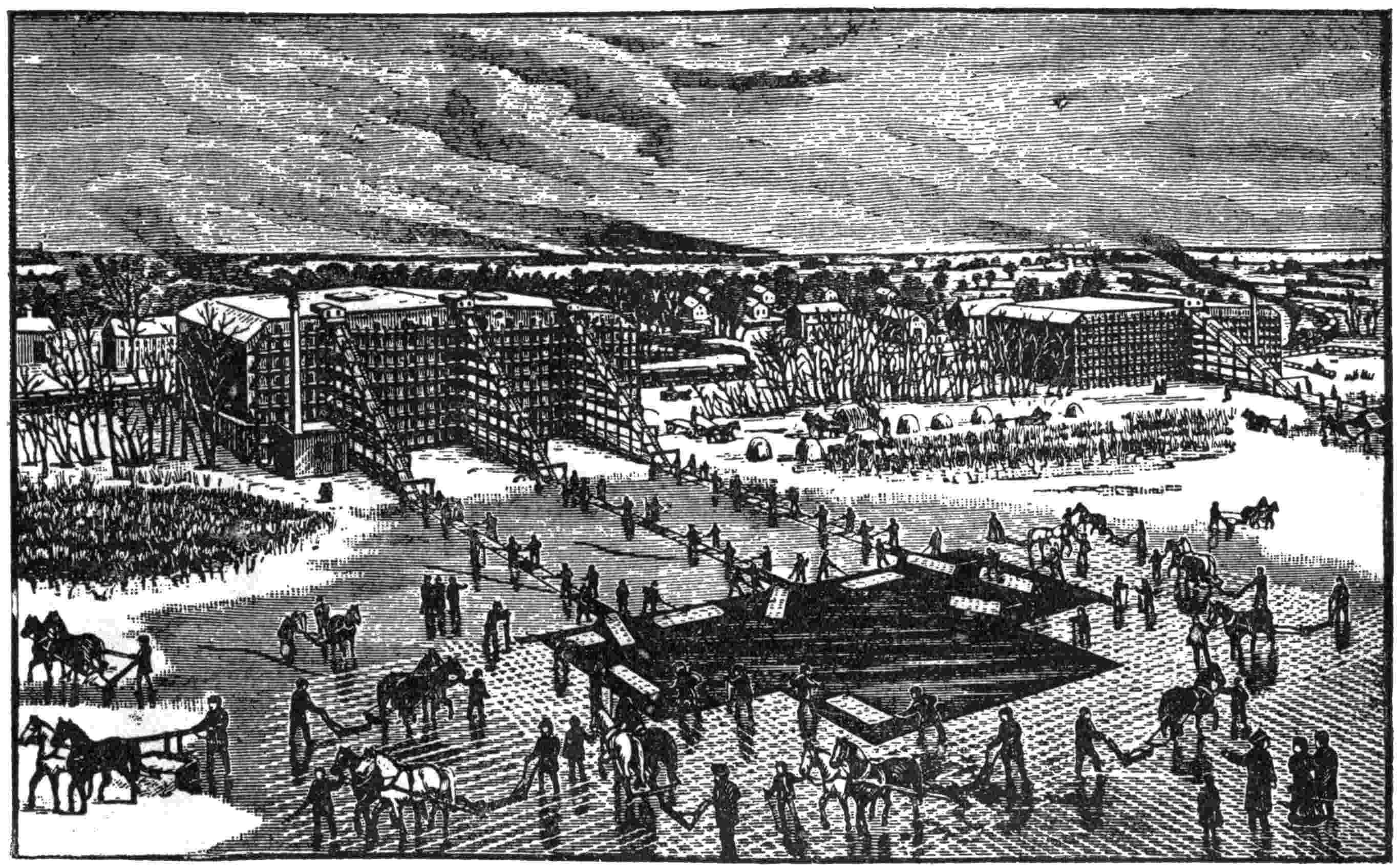
With the advent of a sharp freeze, attention is directed to
the ice field, from which a harvest is hoped for at no distant
day. The purification of the water has been given attention
before this time, together with all preliminaries relating to the
plant in its various and complex features. The weather now
determines the lot of the ice dealer. As the cold breezes
whistle over the water, stirring it into ripples, and breaking its
surface into waves, a wonderful change is rapidly transforming
its liquid pearls into flinty diamonds. Gradually the heat
in the water is radiated into the air. As fast as the surface
water is cooled, it is condensed, and sinks to the bottom, its
place being taken by the warmer and lighter water from
beneath. Gradually the entire mass reaches the point of maximum
density, at 39½° F. Below this temperature, until it
reaches 31° F., water expands as it is cooled. Now the surface
water no longer sinks as it grows colder, being rendered lighter
by expansion than the water beneath. Upon reaching 32°,
convection, or freezing, takes place, and the surface assumes
the solid form.
Care of the Ice Field.—From this time until the crop is
stored in the ice house, the ice dealer devotes his energies to
the care of the ice field. Special situations develop special
duties and requirements, which the alert dealer studies with
care. If the ice is on a running stream, the possible pollution
of its higher levels will be carefully guarded against, and also
all rubbish removed from the surface of the field. Sticks and
stones bedded in the ice hinder the work and damage the keen
edges of the cutting tools. Motion in the water is necessary to
promote the growth of the ice, and, when the ice is sufficiently
heavy, traveling over the surface, or other jarring, is beneficial.
It has been found that where a roadway has been opened
across an ice field, and the travel over it considerable, the ice
was thicker along the roadway than at other places on the field.
On inclosed lakes or mill ponds, a gentle current induced
in the water promotes the growth of the ice materially. The
air is expelled from the water during freezing, if opportunity
is found for it to do so. Unless this is done, the ice is cloudy.
Agitation of the water assists the escape of the air; hence it is
that ice from running streams is usually clearer and more
brilliant than pond or lake ice. An outlet afforded to the land-locked
ponds and lakes is often beneficial during ice-making
weather. Too rapid a current, however, will retard growth,
and a gentle motion diffused over the entire field produces the
best results.
The growth should be carefully noted under different conditions,
attention being given to the atmospheric influences
and other general effects, and the regulation of the motion,
based on ascertained results at the locality where applied. As
the ice thickens, its growth is slower at the same, or even a
lower, temperature than that which at first made ice very
rapidly. The earth at the bottom and sides of the ice field
radiate heat into the water. The heat rays of the sun pass
through the ice, if it is clear, into the water below, with very
little effect upon the ice itself. The ice, being a poor conductor
of heat, is, under these conditions, an obstacle to its own
growth. It shuts in the water from contact with the cooler
air, prevents agitation of its surface by passing breezes, and
retards the escape of air and heat.
On running streams, these conditions are much modified.
In passing over shallows or rapids, where the current is swift,
the water remains open and exposed to the air. At these
points in its course it parts with its accumulated air and heat
very rapidly, a thin vapor or mist being often perceptible in
the air at such places, owing to the rapid radiation. The tumbling
and turning of the water at rapid shoals materially assists
the growth of ice at points below where the current grows
gentle. Streams of this character, whose beds are free from
accumulations of vegetable mold, or other sources which generate
gases, produce clear and sparkling ice of greater thickness
than is found on still ponds or lakes in the same vicinity,
and exposed to the same temperature.
The Usefulness of Snow.—Snow, as it is well known, is
a great impediment to the inroads of frost into anything enveloped
by it. A covering of snow on an ice field is a great
impediment to the escape of heat from the water, as well as
protecting the ice from the direct action of the cold air, and
greatly retards the growth of the ice. It is essential to remove
this snow as early as practicable, as the ice harvester has always
in view a possible thaw or rain, and endeavors to secure his
crop at the earliest practicable moment.
Snow, however, in the event of soft or warm weather, is
an aid to the ice by protecting it from the direct heat of the
sun, and the force of a rain is largely expended in melting the
snow. The water and snow on the top of the ice freezes into
snow ice as soon as the weather turns cold again. This snow
ice is white, being very porous and filled with air, and detracts
from the quality of the crop, its thickness depending on the
depth of snow on the field, amount of water, and the temperature.
At the top of this snow ice, where it merges into the
snow, will be found a stiff, crusty layer, more or less firmly
united to the ice below, which adds to the difficulty of removing
the snow on top. An inch or two of snow ice will lessen
the loss by breakage of cakes, in stowing, and the ice also
comes out of the house in better shape, and will stand shipping
better. It is not so brittle as clear ice, and is homogeneous in
its structure, not being readily split in any direction.
Removal of Snow.—Various methods and appliances are
in use for the expeditious and economical removal of snow.
As soon as the field will bear the weight of a horse, scrapers of
various designs are placed at work. If the ice is too thin to
support a horse safely, flooding is resorted to. At intervals of
six feet, more or less, according to the freedom with which
the water rises through the openings, holes are cut through
the ice, and the water saturates the lower part of the snow.
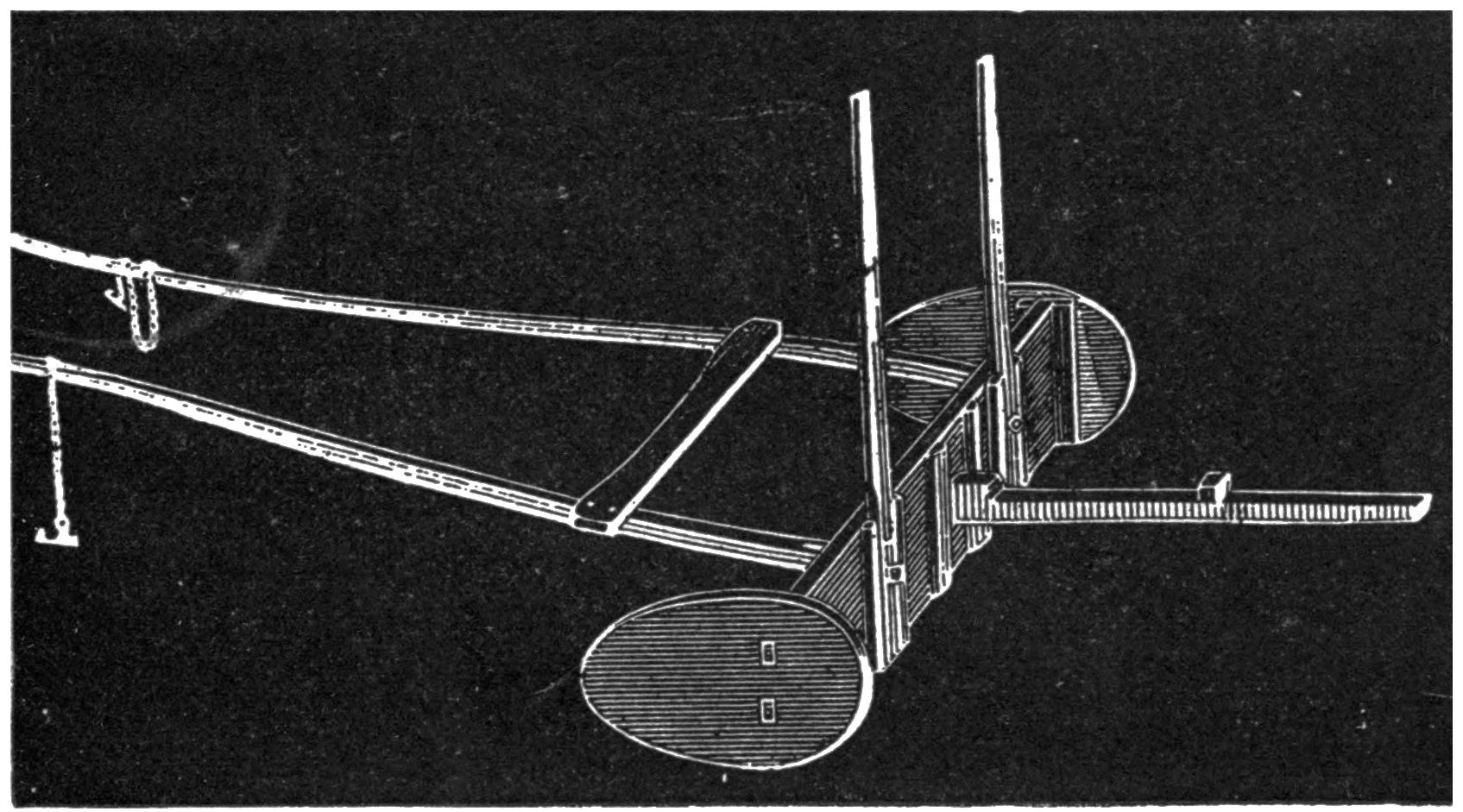
FIG. 1. CLEARING OFF SCRAPER.
This helps to thicken the ice rapidly, and, if the weather is
cold, it will very soon be heavy enough to support a horse. As
soon as this is the case, the scrapers are placed at work. The
snow ice thus formed is afterward gotten rid of by planing, if
more than an inch or two in thickness. If the snow is light,
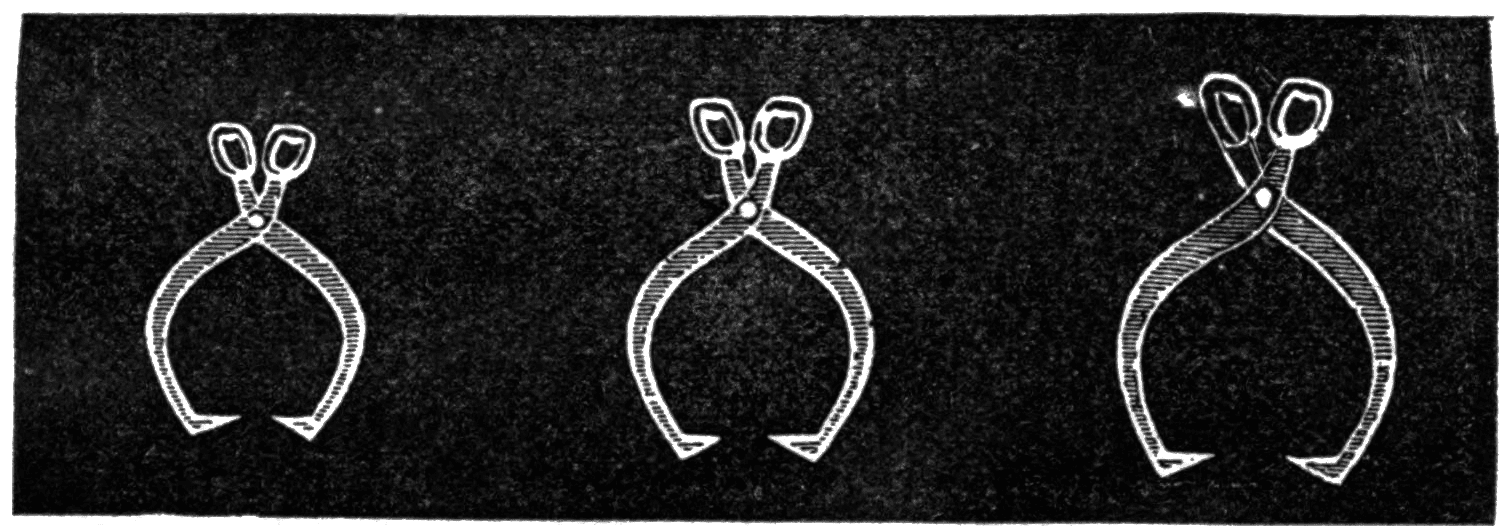
and not too deep, it is scraped into windrows, by scrapers
similar to those in Figs. 2, 3 and 4.
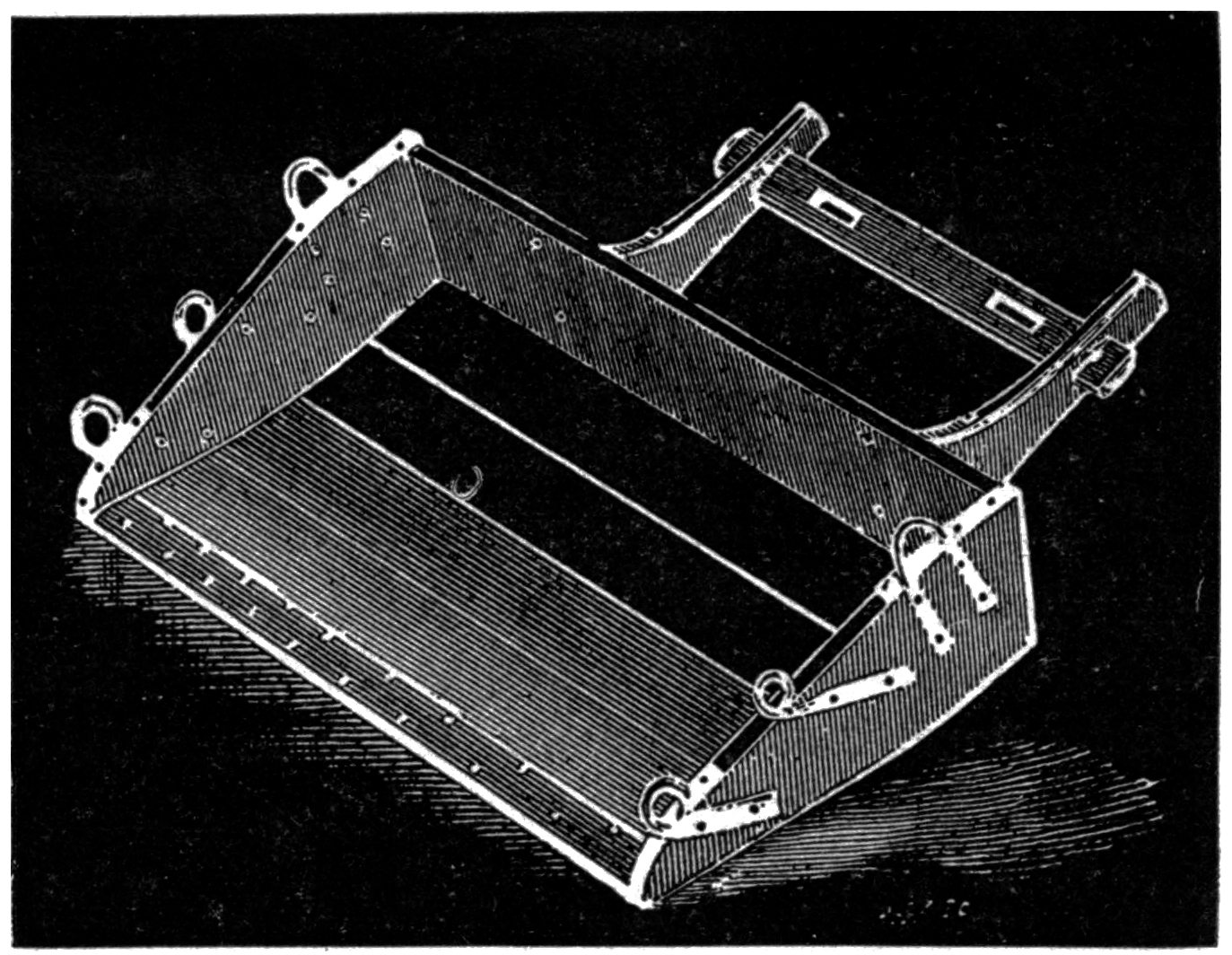
FIG. 2.
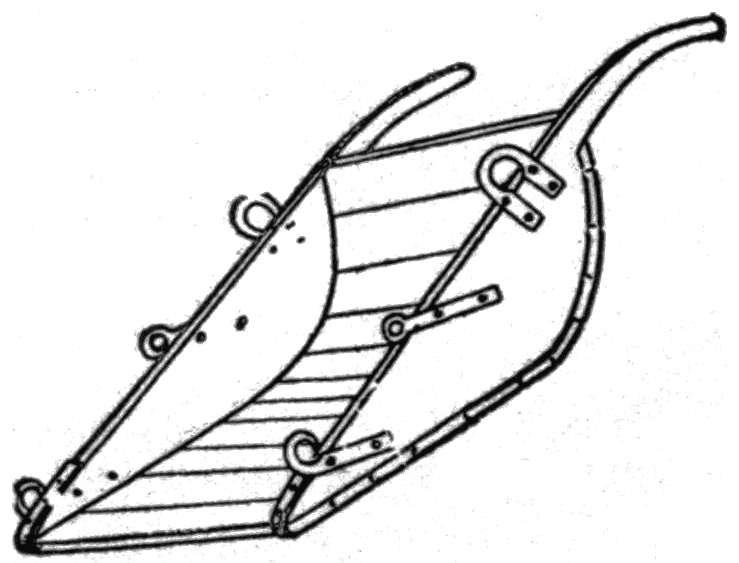
FIG. 3.
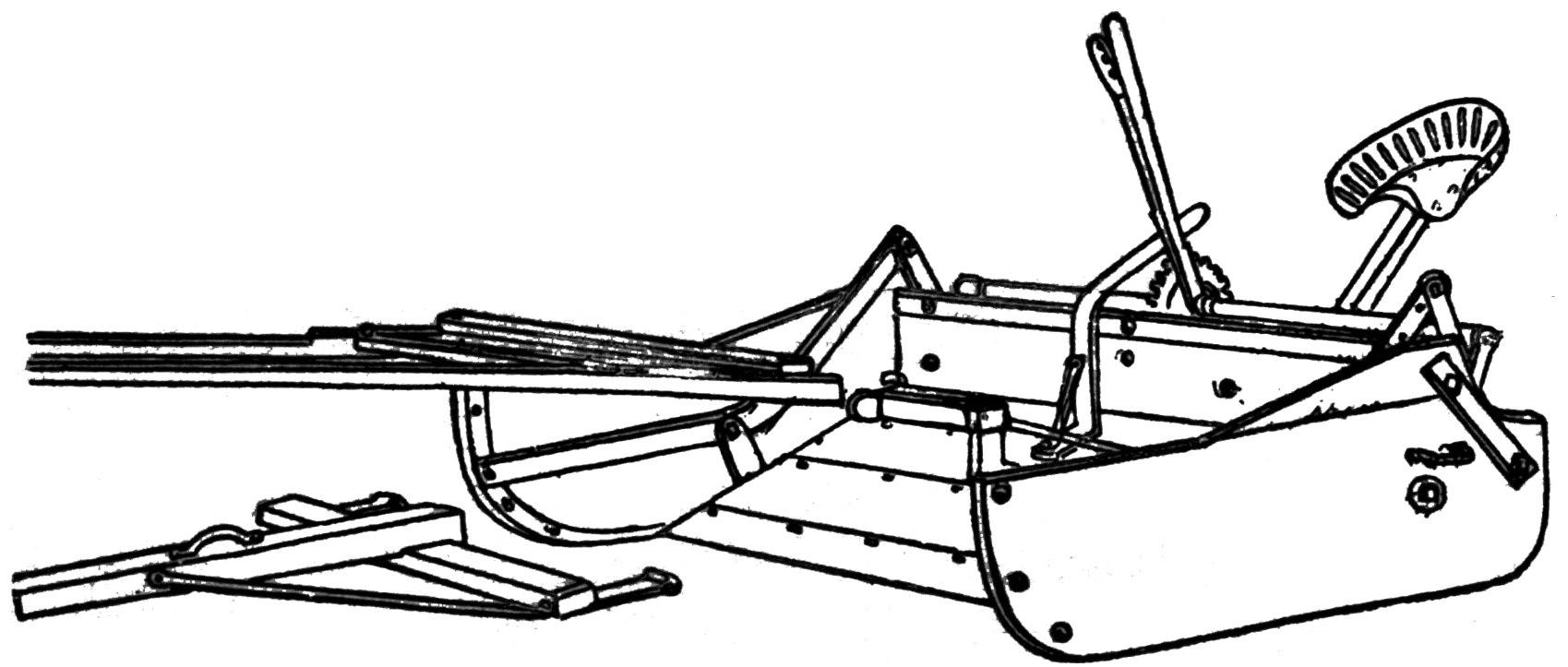
FIG. 4.
SNOW SCOOP SCRAPERS.
These windrows are distributed over the field, not being
made large enough to sink the ice at any point. Scoop scrapers
are now employed, which gather up the windrows and carry
the snow off to the shore, or to a distance from where the ice
is to be cut. If the field is very large, and the snow deep,
dumping points are selected on the field. The weight of the
snow will sink the ice at these points, and cracks will soon
loosen the dump from the main body of ice. A deep groove
plowed alongside of the dump will assist in loosening the dump,
and keeps the water off the field. Some of these scoop scrapers
are constructed with great care, and nicely adapted to the
needs of the ice harvester.
A Sudden Thaw during the winter, while the ice crop is
forming, is an annoyance to the ice dealer, and, if accompanied
by rain, the field will often suffer by being flooded with
water from the surrounding hills. Sand and earth may be
washed on to the ice, making it dirty and injuring its quality.
Water standing on top of the field will soon comb and rot the
ice. If only an inch or two of water is on the field and the
weather turns cold, it can be left to freeze and then be
planed off.
If it is deep it can be readily handled, by cutting holes
through the ice, or tapping the ice field in a number of places;
the water, being heavier than the ice, will sink and raise the
ice, if it has opportunity of so doing. Tapping should have
prompt attention, and the water removed without delay.
Even if the water freezes on top, the ice is not of good quality
and is not part of the ice below. It forms a layer which is
attached to the old ice, but yet is not solidly a part of it, and
gives trouble by splitting out in barring off. Ice expels the
air while freezing principally toward the bottom, and as it has
no chance for escape through the ice beneath, the top layer
will show a white streak.
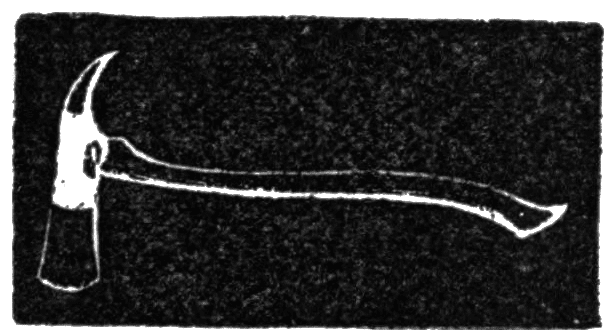
For tapping the field the auger and the tapping axe are
used. If the water is accumulating rapidly and despatch is
wanted, the axe will be found the more rapid-working tool.
The auger, however, makes neater work, and leaves the field
in better shape—often an important desideratum.
The Outfit for Harvesting.—Time is of great value in
handling ice in any of the various operations gone through
with on the field or in the house. Delays during harvesting
greatly increase the cost of getting ice prepared for the market.
Great care and much study have been devoted to perfecting
the paraphernalia by which the ice crop is handled, as
will appear as the reader follows the round of duties of the ice
harvester. In some emergencies the crop is only saved from
partial or complete loss by the despatch which modern development
of tools and machinery has placed at the command of
the enterprising ice dealer. The advent of warm weather during
the harvest demands the utmost celerity in all departments,
if the crop is secured.

FIG. 5. ICE AUGER.

FIG. 6. MEASURE.
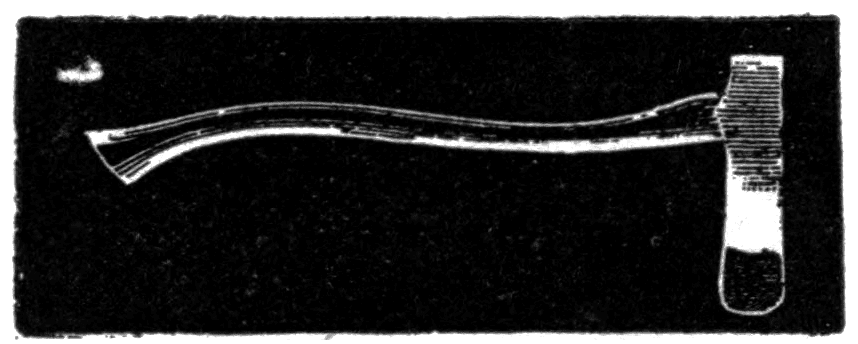
FIG. 7. TAPPING AXE.
More credit than is generally supposed to be warranted is
due to the splendid energy and managerial ability of the ice
harvester, during seasons when the home ice crop is a partial
or entire failure. No one, not practically familiar with the
business, can readily understand the extra strain and burden
imposed on the ice dealer who succeeds in securing supplies
sufficient to meet the requirements of his customers, by going
to the far north for this most beneficent and useful product of
nature. Enterprise pays in this, as in any business.
Having removed the snow the field is carefully inspected,
and quality and thickness of the ice ascertained in all parts.
The field is bored with the ice auger, and the measure indicates
the thickness. The auger is withdrawn and the appearance of
the ice noted before the auger reaches the bottom and water
fills the hole. If the snow ice is too heavy it must be removed.
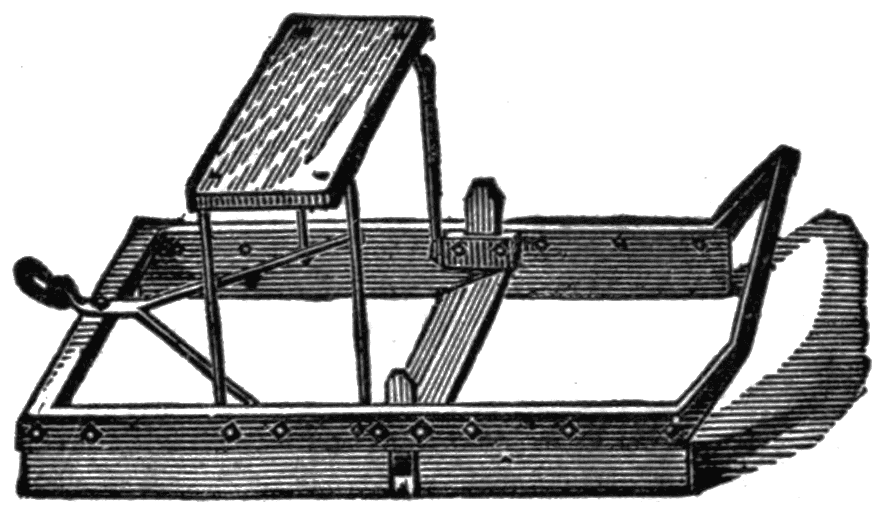
FIG. 8. FIELD PLANER.
Two methods for doing this are available. It can be cut
loose and broken into chips with the snow ice planer on the
field, the chips being afterwards
cleared with scrapers
and scoops; or it can be left
on the ice and cut away by
the elevator ice planer as the
ice cakes pass up the endless
chain ice elevator incline, on
their way into the ice house.
The first method is in use wherever the endless chain ice
elevator is not employed. When it is to be removed by the
field planer, the ice field is first laid out and plowed to the
depth of the snow or sap ice to be removed. The snow ice
planer follows the plowed grooves, cutting off the refuse ice.
Thickness of Ice.—Generally speaking, the ice is desired
at an average thickness of fourteen inches; this being convenient
for subsequent handling. In practice, the thickness of
the ice, as it is stored or shipped from the water, varies with
the exigencies of the season and the average thickness formed
at the locality.
In the latitude of Central and Southern Ohio six-inch ice
is often stored; in the vicinity of Chicago and Omaha, ten
inch; in Maine, sixteen inch, and in Minnesota, twenty inch.
Ice, thirty inches thick, has been cut and stored on Lake Superior,
in Northern Wisconsin, where ice forms equal in purity
and brilliancy to any found in this country. The ordinary
printing on the pages of a Chicago newspaper has been easily
read through a block of Lake Superior ice twenty-nine inches
thick. At Winnipeg, Manitoba, ice is cut forty inches in
thickness. Such thick ice keeps the year through.
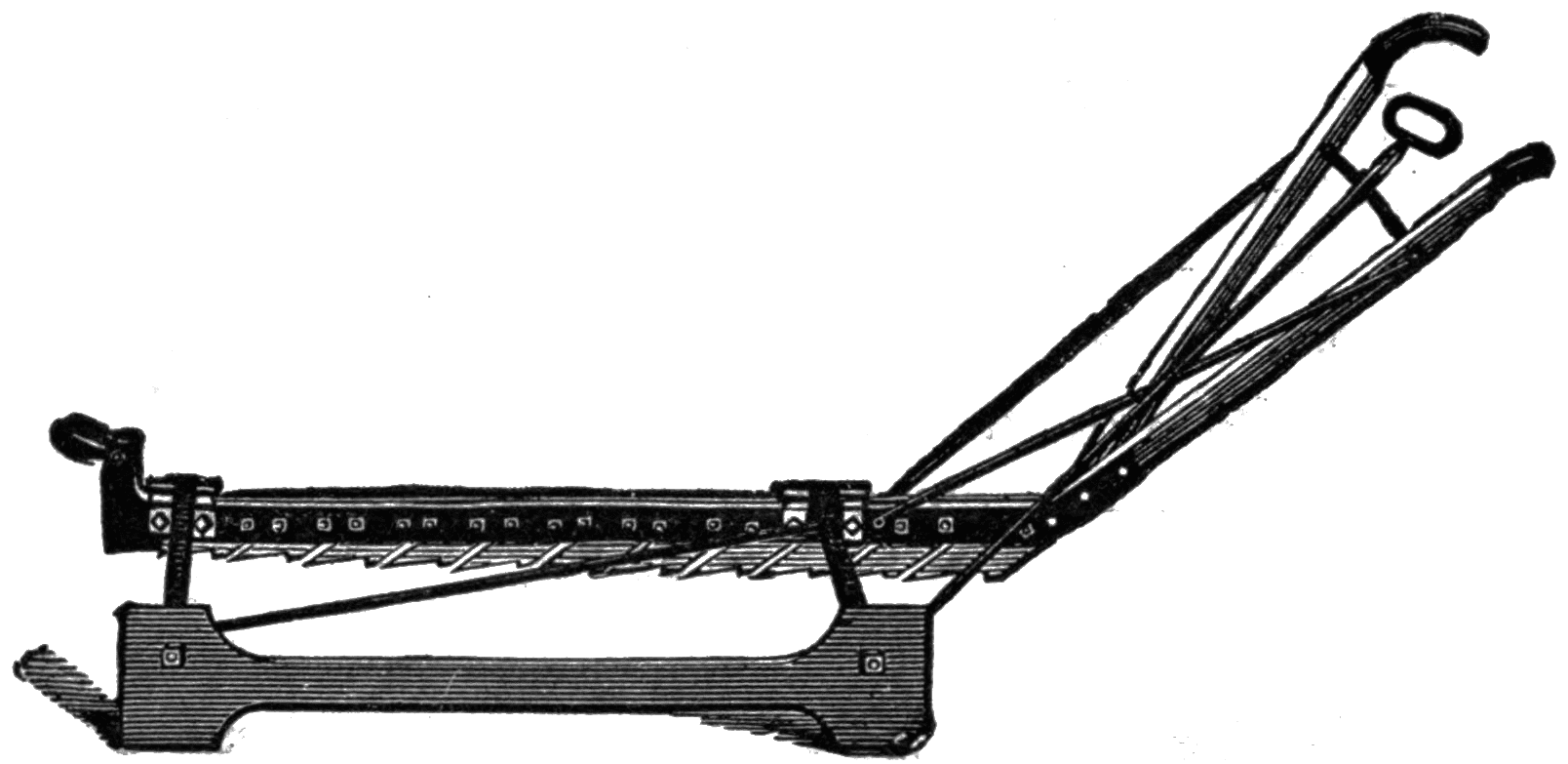
FIG. 9. MARKER, WITH SWING GUIDE.
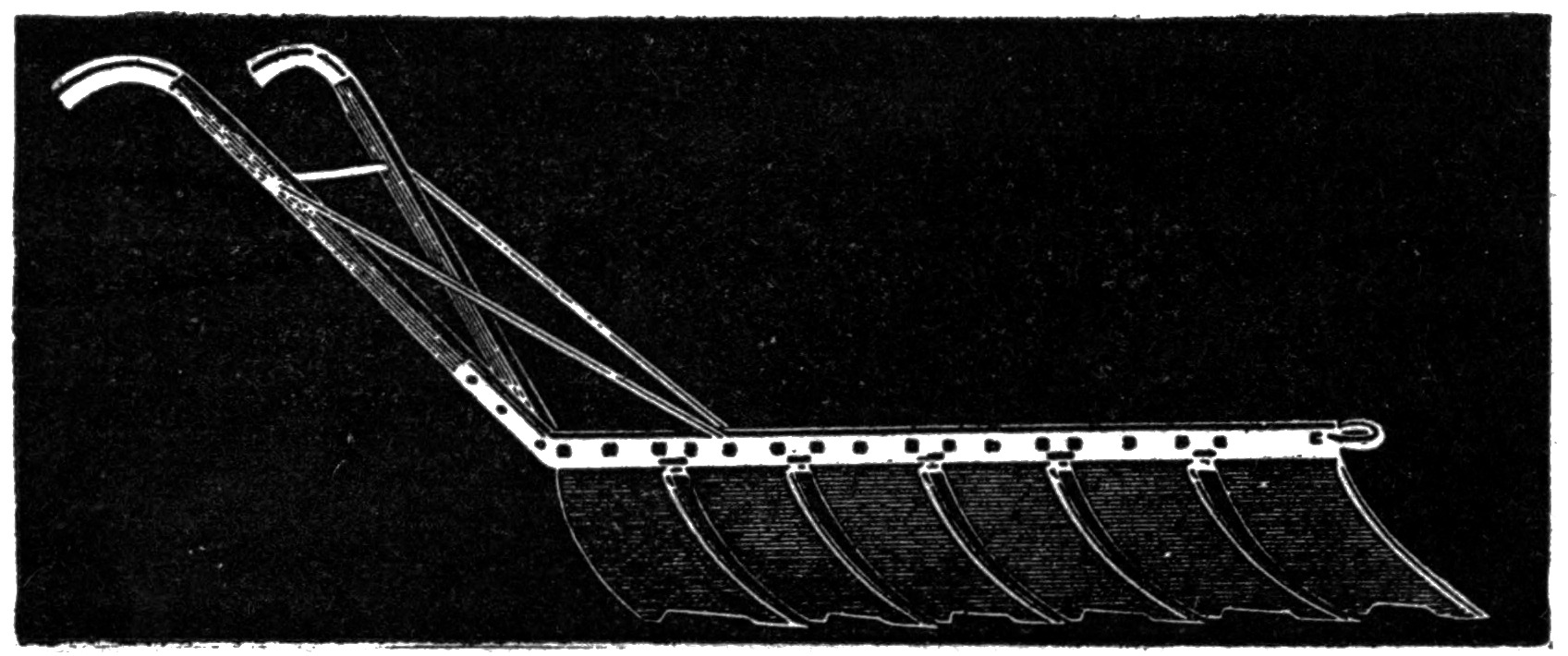
FIG. 10. FIELD PLOW.
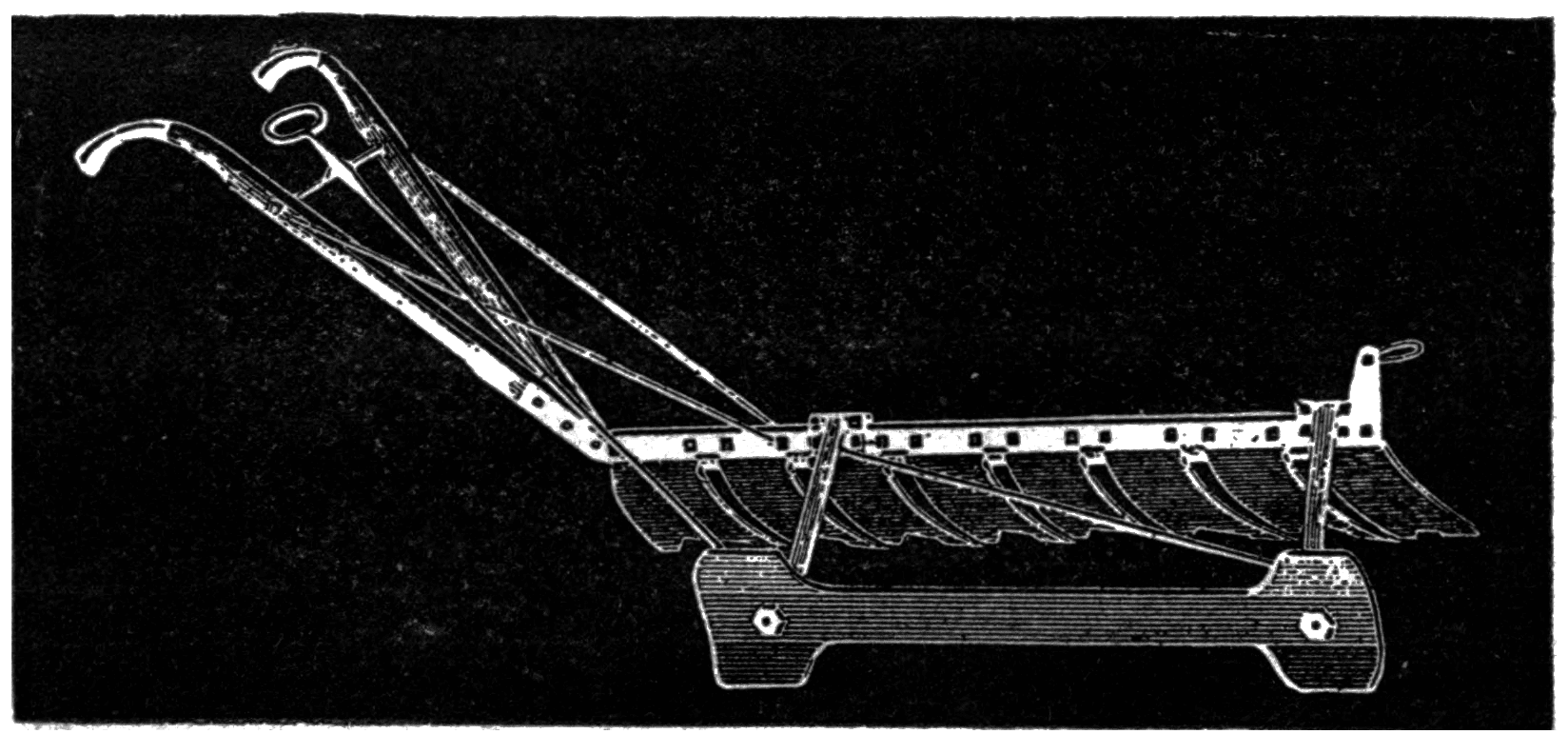
FIG. 11. SWING GUIDE PLOWS.
Laying Out the Ice Field.—As the ice field is inspected
and mapped out for plowing, all unsound places, air holes, or
shallow places where rocks or sand bars approach near to the
surface, are marked for avoidance. A convenient method is
to bore holes at such places, and plant pieces of brush in them.
Thin ice, formed where the ice has been removed during cutting,
is also marked in this manner, to give warning of the
danger of venturing upon it.
Like a good general, the ice harvester takes note of the
physical advantages of his position. If he can so lay out the
field that the current and prevailing winds are in his favor
and assist to float the ice toward the house, his strategy is not
without reward. Room for refuse ice is needed where it will
not impede the ice floating toward the house. The lay of the
shore line must not be overlooked, on streams where the current
is strong, in calculating for support for the shore ice.
The best ice in the field will always be secured as a prime
consideration.
Quality should always be of the first importance, and, in
these days of close competition, pure ice is necessary for success
in the ice business. Ice, for any purpose, should never be
cut from impure or contaminated water. Too much care can
not be given to securing clean, pure, healthful ice for all uses,
directly or remotely allied to preserving or curing food products.
Natural ice from pure crystal water is one of nature’s
purest productions.
Having gone over the field and determined the plan of
operation, the first task is to lay out the base lines from which
the marking and plowing are gauged. Stakes are planted at
either end of the line, and a heavy cord drawn taut between
them. The hand plow is now passed alongside the line, making
a score in the ice from end to end. Sometimes a long
board with sights is used for laying out the first line, and a
line marker is a cheap substitute for the hand plow. The
teeth of the horse marker are now set in the hand plow groove;
the guide is unlatched and runs along on top of the ice. Care
is taken to keep the marker upright, by firmly supporting the
handles. This cuts a groove three inches deep. The blade of
the guide is now placed in this groove, and the marker cuts a
new groove parallel with the first one.
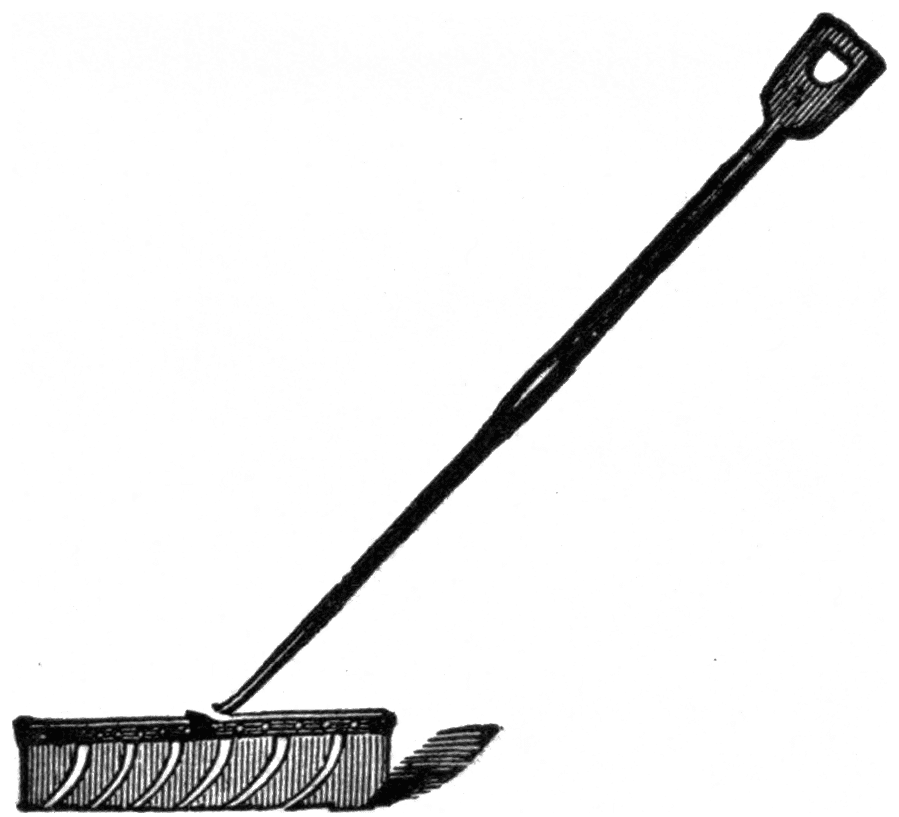
FIG. 12. HAND PLOW.
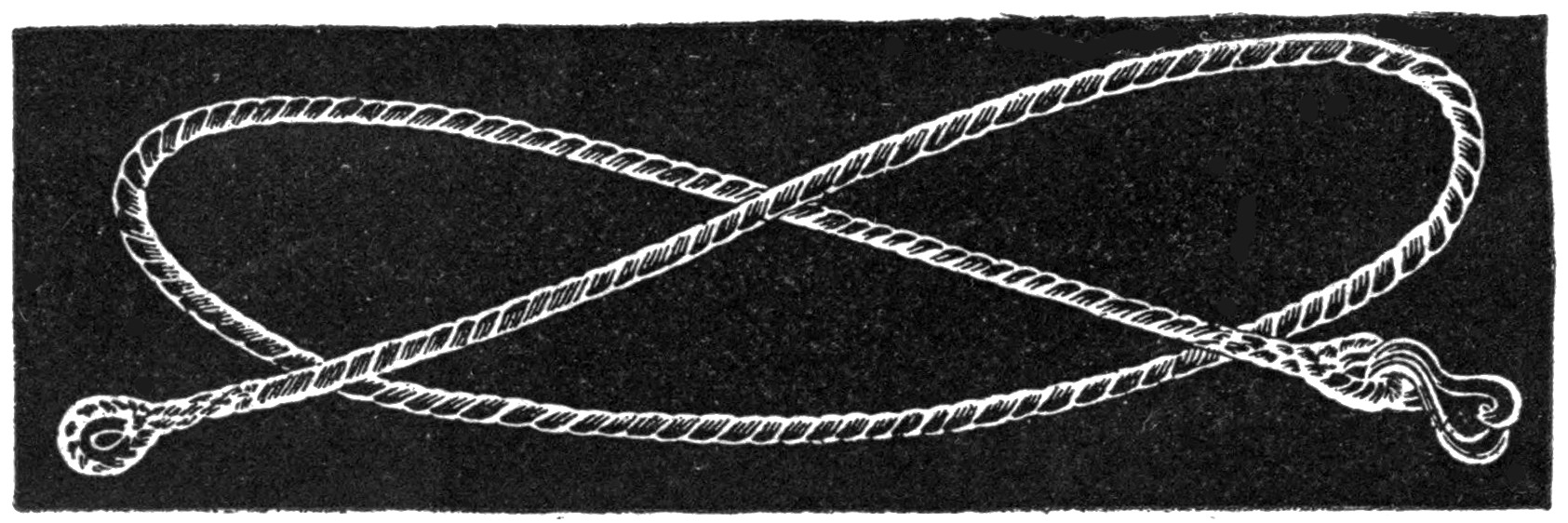
FIG. 13. PLOW ROPE.

FIG. 14. LINE MARKER.
This operation is continued until the field is grooved in
parallel lines over its surface in one direction. Plows are now
started in the marker grooves, and are run back and forth
until the grooves have been cut about two-thirds through the
ice, care being taken to leave not less than four inches of solid
ice below the bottom of the groove.
Meanwhile the marker is at work scoring the field in lines
at right angles to those first laid out. A large wooden square
with legs about fifteen feet long is used to square from, and
the field is marked and plowed in both directions.
When the snow ice plane is to be used, the field is marked
out in one direction only. The depth cut is regulated by a
planer gauge, attached to the marker, to the thickness of the
snow ice to be removed. The runners of the plane set in the
grooves and are guided by them.
Channels and Canals.—The marking and plowing being
well under way, the channels and canals require attention.
Where the current is gentle, and on ponds and lakes, the opening
of the channel and canals is not attended with much difficulty.
Where the current is swift, as on the large rivers,
practical skill is required in opening up the field. The pressure
of the current makes it difficult to open the channel and
canals, and the shore ice is in danger of giving way. Stays
and braces are sometimes employed to anchor the shore ice,
and to prevent the channels from closing.
In some instances it has been found advisable to have the
channel permanently fixed by piles driven into the bottom of
the river on either side. In others, braces are set in the ice,
at short intervals, before the channel is opened, as shown
in the illustration. The posts should be heavy, and the
cross struts may be ten or twelve inches square. The post
holes, if cut oblong, will allow short boards to be spiked to the
sides of the posts at their lower ends. When inserted through
the ice, a quarter turn of the post will bring the projecting
ears under the ice, and no trouble will be given by the post
raising out of its place. The cross strut should just allow the
ice to float beneath, and be well secured to the posts, which
require inclined braces, joining the posts opposite the ends of
the struts, with their feet planted in recesses cut into the ice.
Water should be poured around the braces, and when the
braces and posts are frozen in place a very strong support is
secured against the current, as the following cut shows.
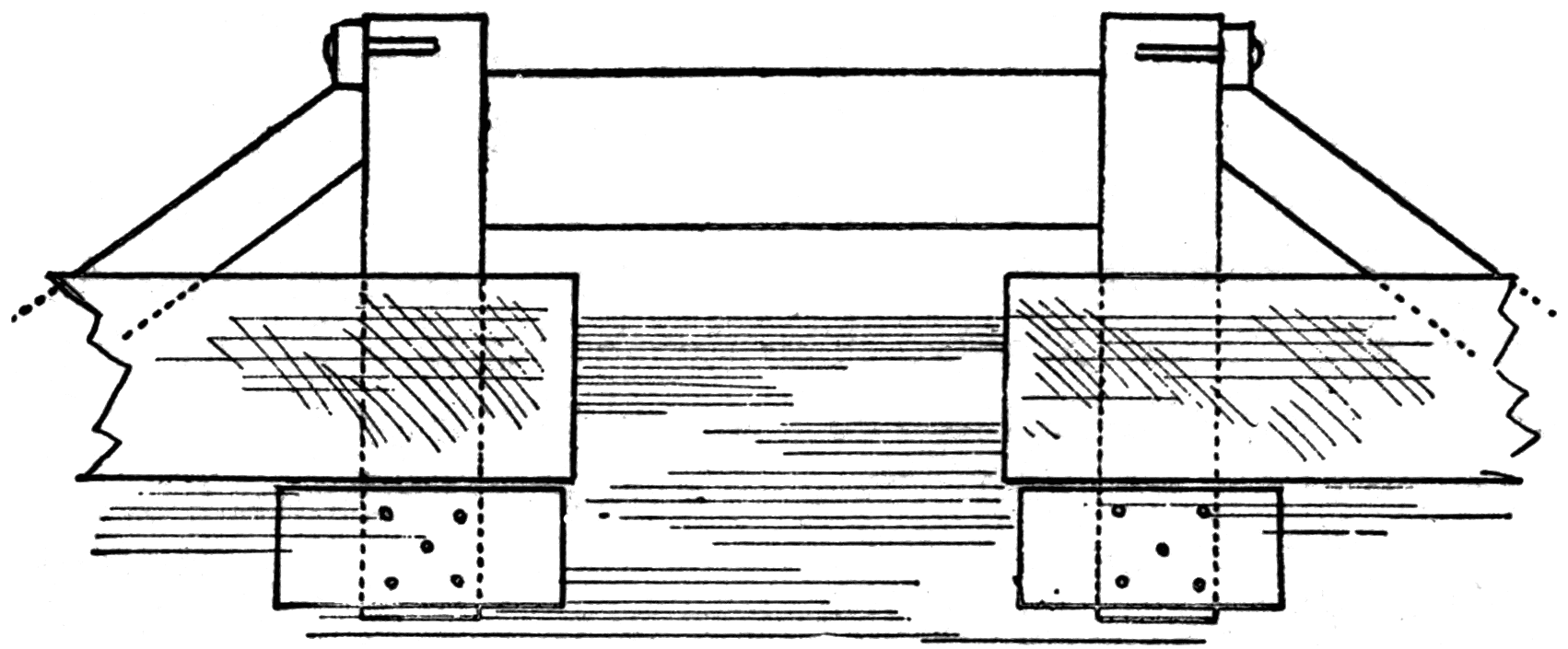
FIG. 15. BRACES FOR CHANNEL WITH SWIFT CURRENT.
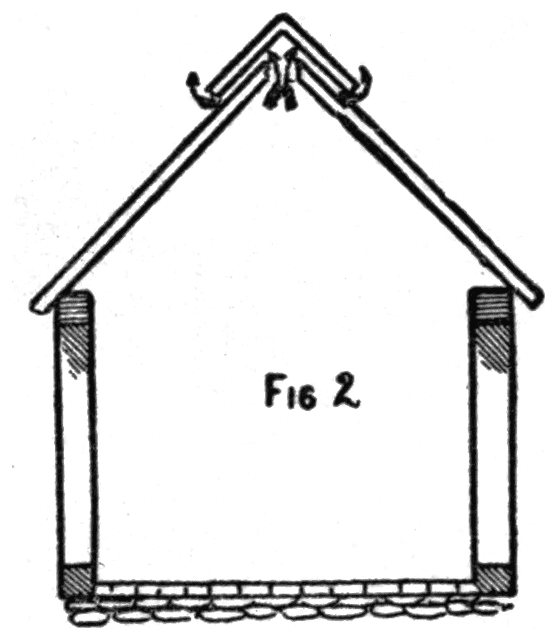
Where the current is not so strong, square frames may be
employed. They are placed in the channel where the ice
cake will float through freely; their sides should fill mortices
in the sides of the channel, and not project into the path of
the cakes, as shown in Fig. 16.
Various methods of dealing with cracks in the ice have
been tried. A good one is to take long planks and extend
them across the cracks laying flat on the surface. By boring
through the planks into the ice, and inserting wooden pins,
the loosened portion is firmly held, and the cracks will freeze
up. If the pins are inclined in opposite directions a firm hold
is secured on the ice.
When the channel has been located, if convenient, a deep
groove is plowed at either side, and the remaining ice is cut
away with the pond ice saws. Splitting chisels are now
brought into play, and the ice in the channel is split up into
cakes, which are sunk and floated under the ice. Canals
through the plowed field are similarly opened. The field is
now in readiness to furnish a supply of ice cakes for stowing
in the house.
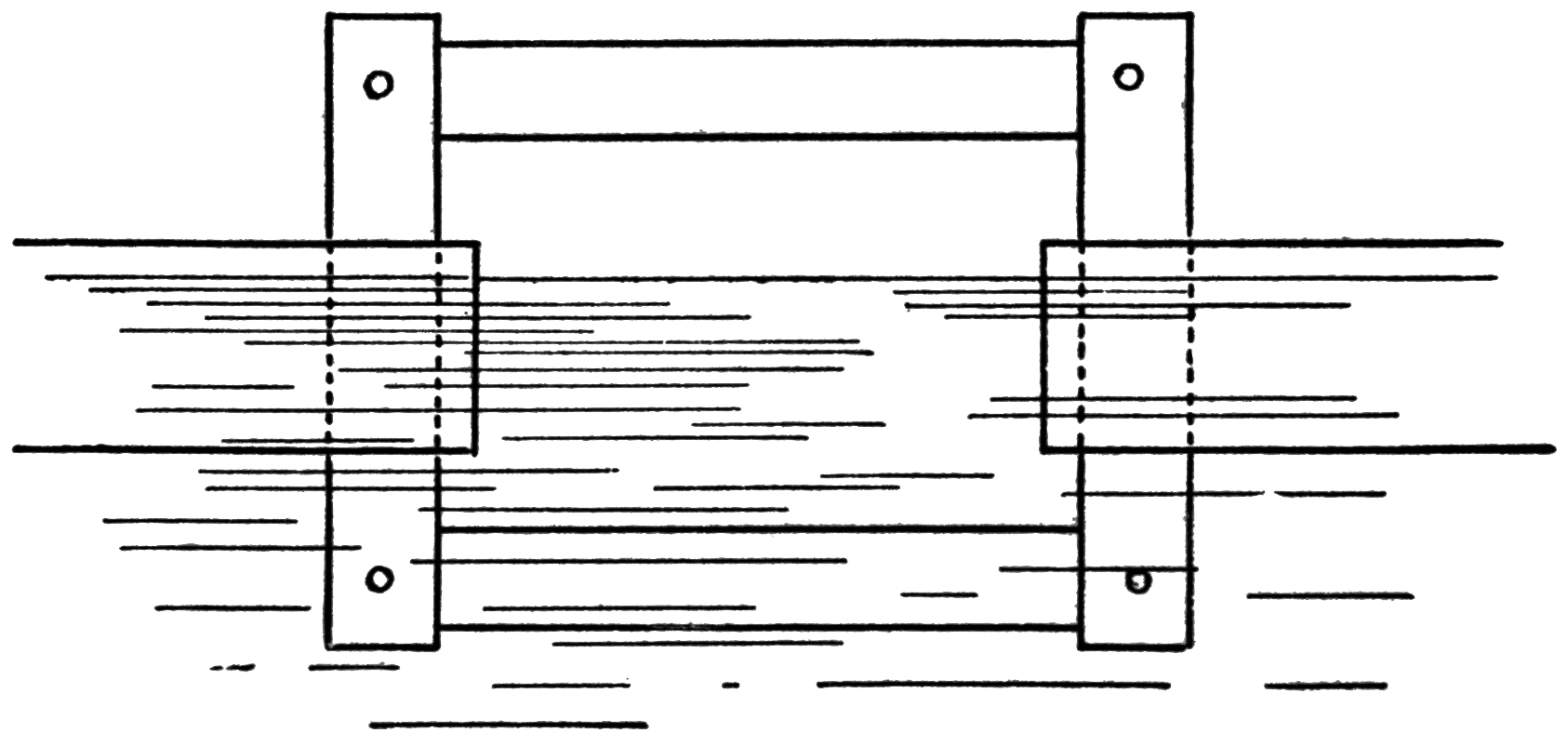
FIG. 16. BRACE FOR SLOW CURRENT.
A section is selected, and the grooves carefully double
calked with chips, from the plowing, to prevent the water running
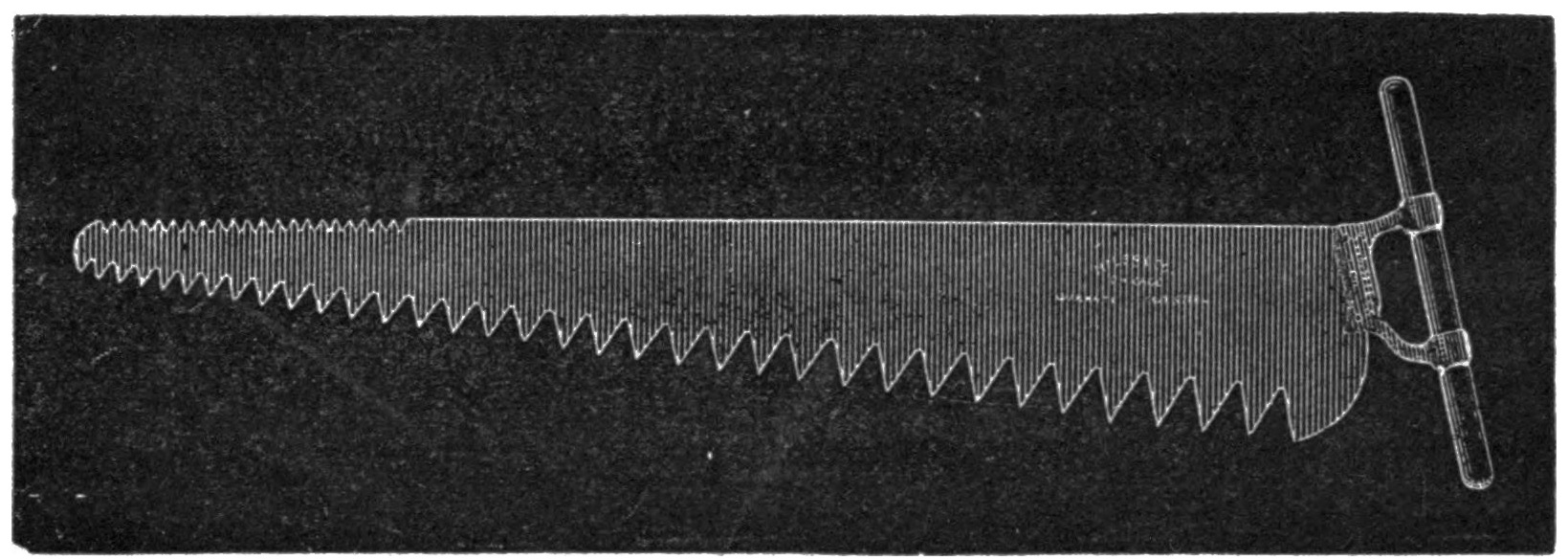
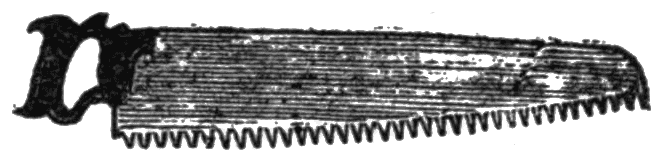
in. For this purpose a calking bar is used. Ice saws are
now brought into requisition, and the grooves at the ends of
the section are sawed through to the back. The groove at the
back is now struck into at several points with one or another
of the barring off tools provided for this work. A section
called a float, and containing one hundred to one thousand or
more cakes, is readily split off. The tools used for this work
vary with the thickness of the ice and the size of the floats.
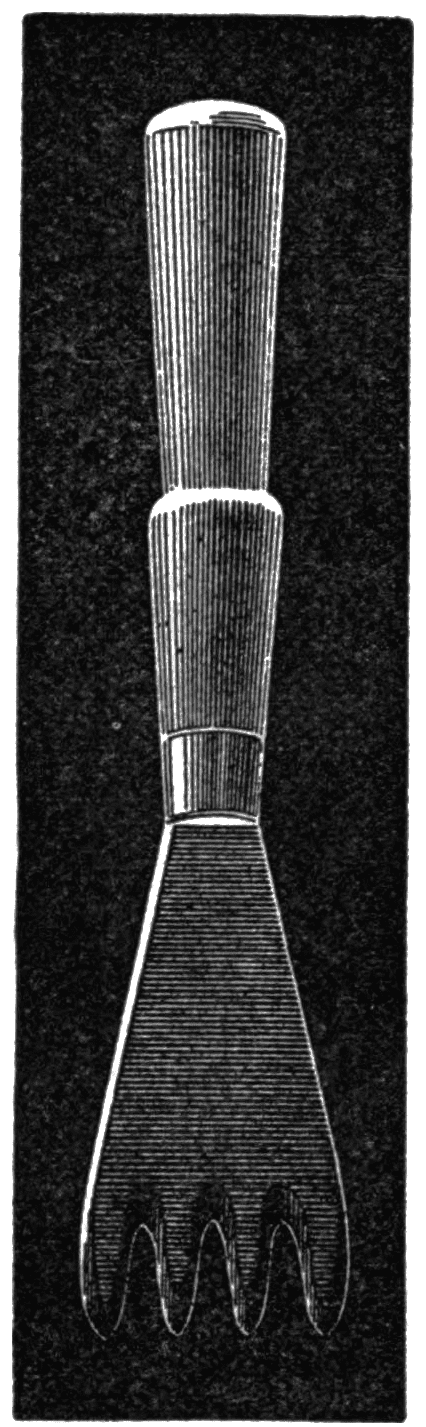
The fork bars are the most often used, the two-prong bar being
the favorite on heavy ice. If the first cuts with the saws are
so made that the ice cut away is a little wider on the bottom
than on the top, and the sides parallel, it will facilitate getting
out the first float cut away. By sinking the float a little all
pinching or binding at the sides is prevented.
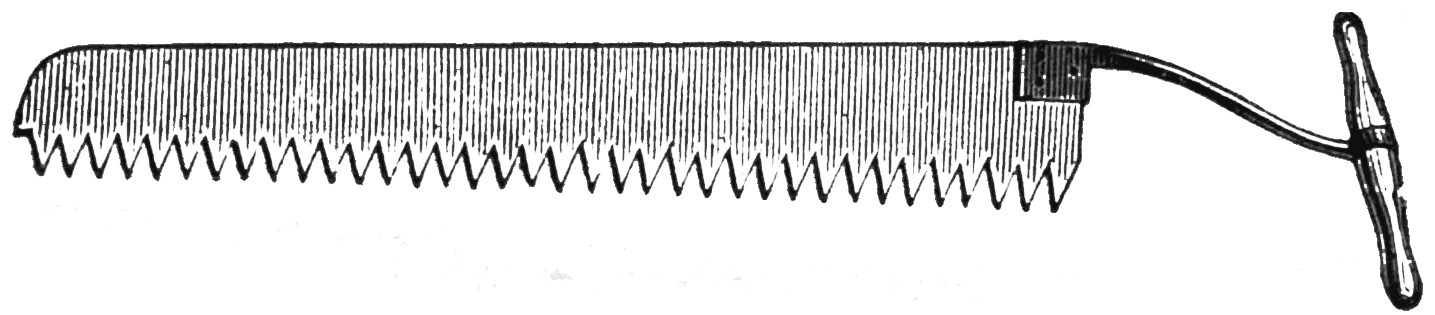
FIG. 17. BEST CAST STEEL ICE SAWS.

FIG. 18. TWO-PRONG FORK BAR.

FIG. 19. THREE-PRONG FORK BAR.

FIG. 20. FOUR-PRONG FORK BAR.

FIG. 21. CALKING BAR.

FIG. 22. BREAKING BAR.
The floats are split into rows of single or double cakes, as
they are floated near to the channel leading to the incline. As
the long rows are moved into the channel, a man, standing on
a bridge a few inches above the ice, strikes a needle or splitting
chisel into the plowed grooves as they are passed beneath
his feet. One or two dexterous thrusts will cleave the ice to
the bottom. In frosty weather, with the ice hard, it can be
split true and square, in most instances. Cakes not smoothly
split must be trimmed before they reach the incline, and the
bunches removed.
The work on the field is directed to secure a supply of ice
cakes at the foot of the incline, in advance of the requirements
of those whose duty is found in placing the cakes in position
within the ice house. No more than will be run into the house,
and also leave the channel full, with some floats near at hand
at quitting time, should be detached from the field.
Ice floats left too long before being broken up into single
cakes, are in danger of having the grooves flooded, and wholly
or partially frozen up. In this condition they are either worthless
or split up with much labor and great irregularity. The
single cakes left in the channel over night serve to prevent it
being closed with ice in the morning, and the delay incident
to opening it up is avoided.
Some early work, however, is always needed on the channels.
The single cakes will have a connecting web of new ice,
which must be broken up and trimmed from the sides of the
channel and the cakes. The broken ice and damaged cakes
which are not wanted must be kept clear of the channel at all
times. The larger pieces may be sunk under the ice, and the
smaller ones be removed by the scoop nets or sieve shovels. A
snowstorm during the harvest is attended with much discomfort
to the ice harvesters. The channels are filled with slush,
which packs around the floats and cakes, making their progress
slow and laborious. It eludes the scoop net and is very
hard to deal with. The field is soon buried out of sight, and
must be cleared and scraped with as little delay as practicable.
Housing the Ice.—There is room for large latitude for
variations in the methods employed on the ice field. The
situations are so different that the dealer is called upon to exercise
judgment and ingenuity, in determining what is best to be
done. On swift running streams the ice, after first forming,
may be broken by storms, and with a return of settled weather,
will freeze in rough and confused masses of broken ice in
places. At other points no floating ice has found lodgment,
and the second freezing is regular and of good quality. In
order to secure the ice from these favored spots, the harvester
may be obliged to open a channel several miles in length, and
float the ice down to where his storage houses are located.
At the foot of the incline at which the ice cakes are taken
from the water, and along the channel directly leading to it,
the ice is subject to much wear. The work necessarily done
on the cakes as they are floated through this channel, requires
the presence of a number of trimmers and bar men at this
point, as well as those who are feeding the cakes into the elevator,
or placing them in position for the grapple. The tools
used at the foot of the incline and near by channel are illustrated
on Pages 00–00.
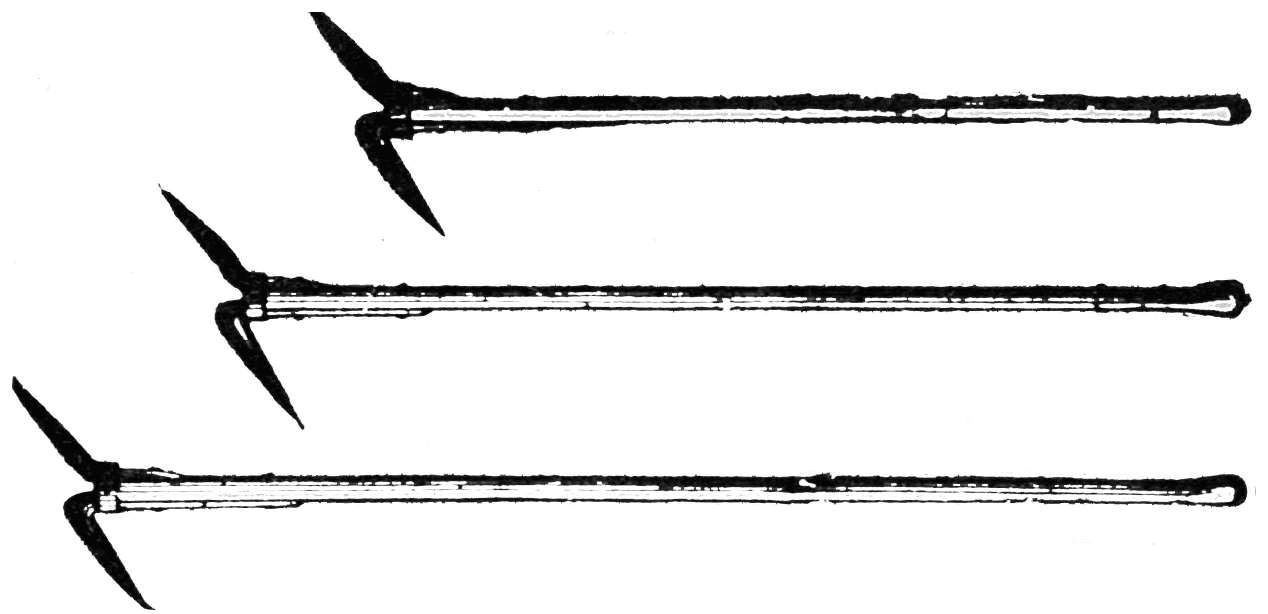
FIG. 23. ICE HOOKS.

FIG. 24. ELEVATOR FEEDING FORK.

FIG. 25. CHAIN SCOOP NET.
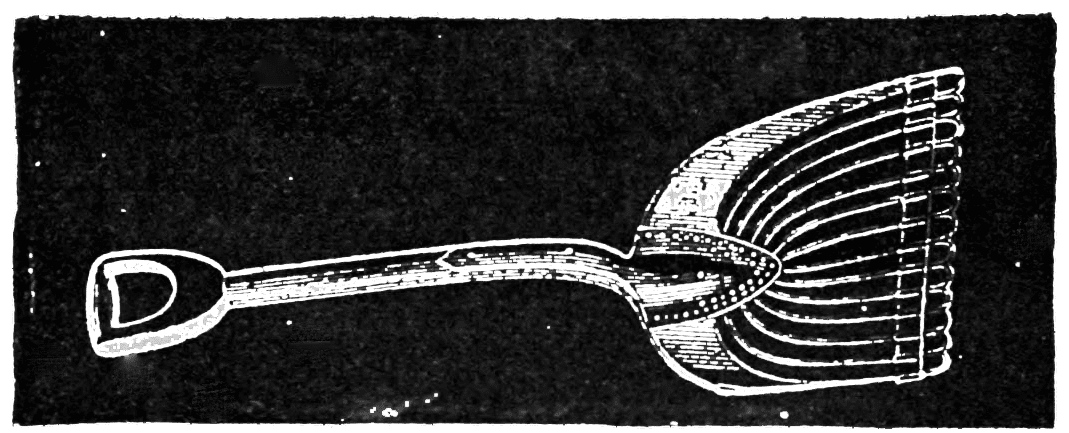
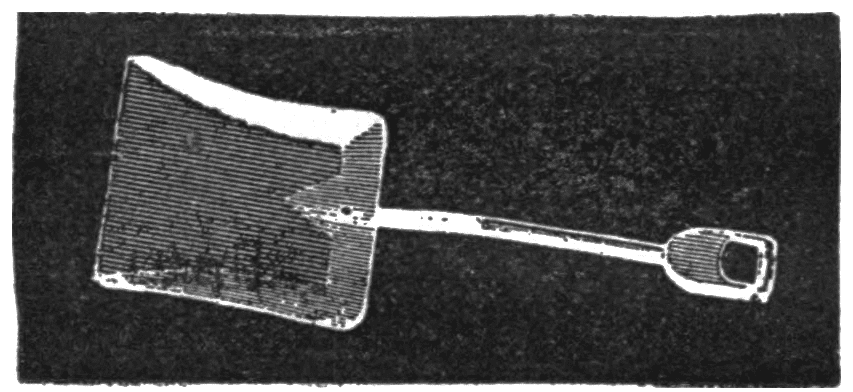
FIG. 26. SIEVE SHOVEL.

FIG. 27. RING HANDLE SPLITTING CHISEL.

FIG. 28. CHANNEL HOOK CHISEL.

FIG. 29. NEEDLE BAR.
There is often an accumulation of refuse ice taken from
the channel and thrown on the ice not far away. Ice cakes
sometimes slip from the grapples on their way up the incline,
and slide down, striking with great force at the foot of the
incline. All these, and other sources of wear, on the ice, make
it important to provide some protection to the sides of the
channel, and, as the edges soon dip below the surface of the
water, a footing or walk for the channel men. Where elevating
by means of grapples, it will be found a convenience, and
often the means of avoiding delays, to have a water box or
trough sunk in the channel, at a depth to admit the cakes
passing freely on to the lower end, and yet near enough the
surface to prevent the cakes ducking, or dodging under, when
pressed forward from the rear. The jackman, as the slack is
taken out of the line and the pull is felt, bears a firm grip on
the handle of his grapple, and, at the same time, bears down
heavily, and ducks the heel of the cake, engaged by the grapple,
under the water. The men who are placing the cakes for the
jacks, if the ice is heavy, bear down on the cake with their
pike poles at the same time, to prevent the last cake from
being ended over. The water box is necessary, at these times,
to steady the cake below, and prevent it sinking too deep.
Several cakes are usually run up at one trip. A sharp lookout
is necessary on the part of the jackman, and some experience
is required to become an adept at handling the grapple. Serious
accidents have resulted from careless or ignorant methods,
and caution should be observed by all who are employed about
the field, incline, or ice house. The construction of the water
box varies with the depth of water and amount of ice run
over it. Usually it is of a temporary character, and renewed
each year. Order and a thorough system should be carefully
adapted to the work on the field and in the house, by
every ice harvester. Details, fully worked out, and the plan
once in force, it should be strictly observed by the proprietor,
and exact compliance insisted upon from all employes. Unless
discipline is maintained, especially on large fields, much loss
of time and money will result, and life and limb be jeopardized.
Care of Ice Tools.—Provision for preserving the cutting
qualities of tools is of great importance. An inferior tool, or
one out of repair, will detract from the efficiency of the labor
employed to use it. The amount depends on the particular
kind of work under consideration, and the comparative condition
of the tool with which it is done. Attention to this matter
is often neglected, from a failure to properly estimate its
importance, or from a mistaken idea of the ease with which
an incompetent or ignorant man can spoil the best implement
which can be made. Ice saws, of the best type, will, when
new, cut rapidly and true; one or two dressings, done in the
wrong way, will detract from their cutting efficiency one-fourth
or more, and it will be impossible to cut true with them.
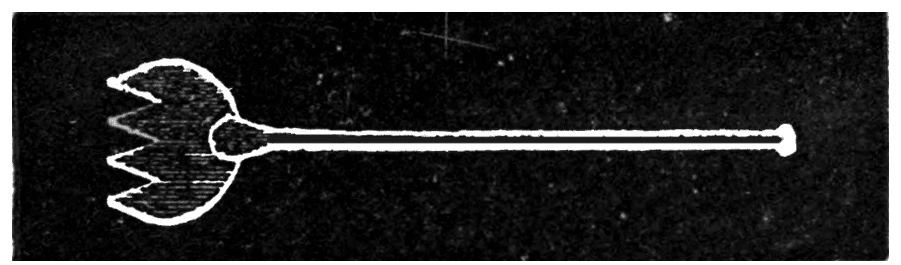
FIG. 30. TOOTHED TRIMMER BARS, IRON HANDLE.
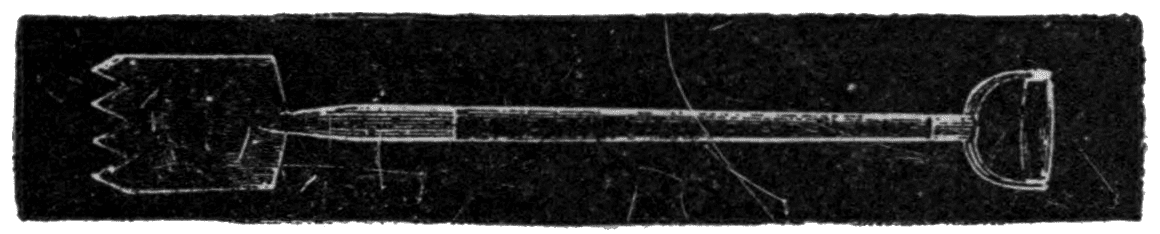
FIG. 31. TOOTHED TRIMMER BARS, D HANDLE.
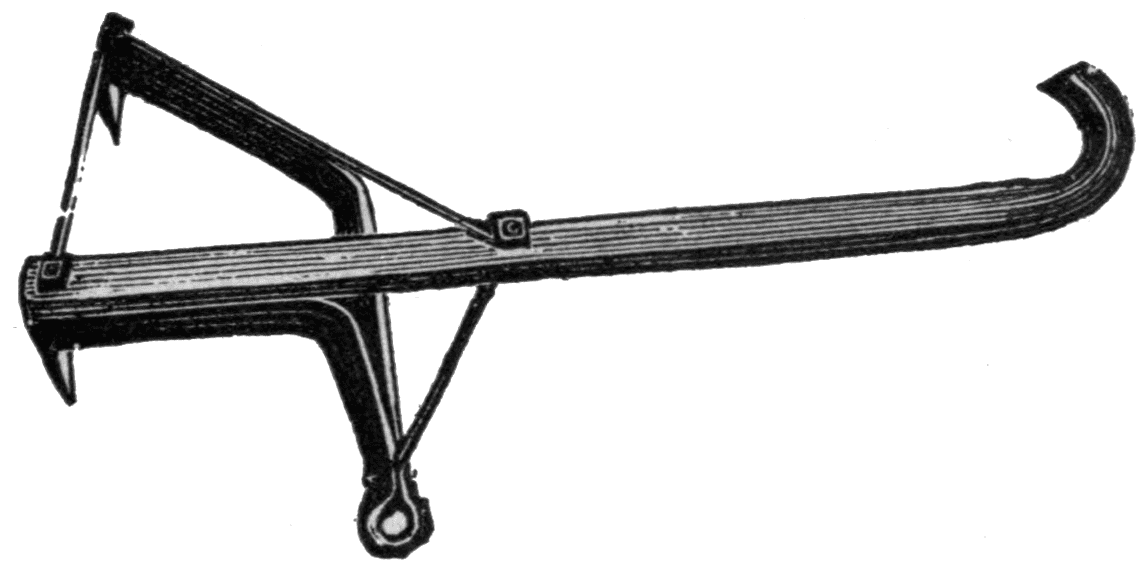
FIG. 32. JACK GRAPPLE.
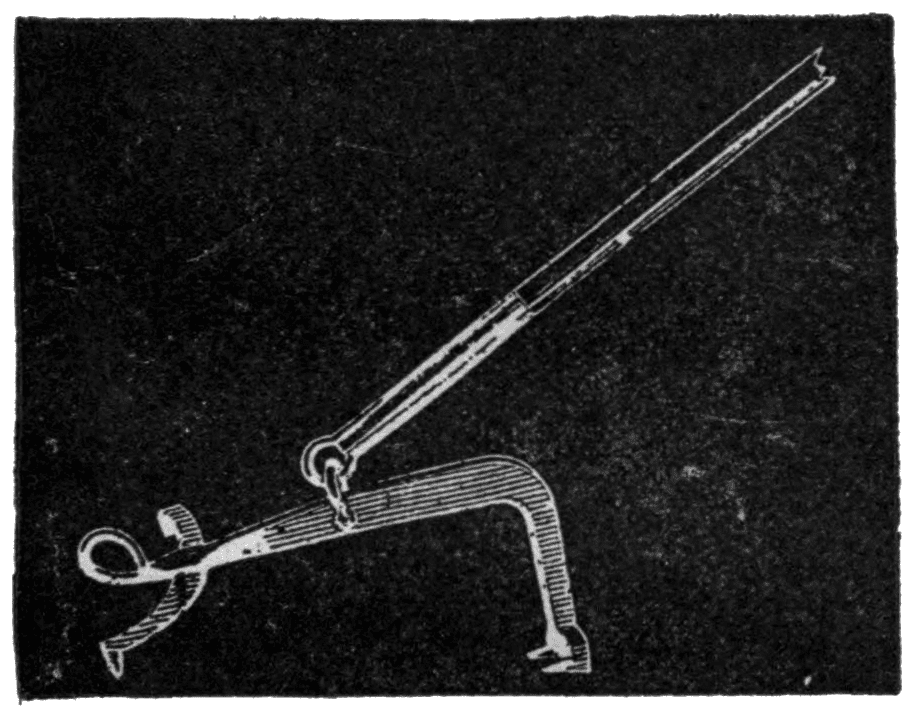
FIG. 33. HANDLE GRAPPLE.
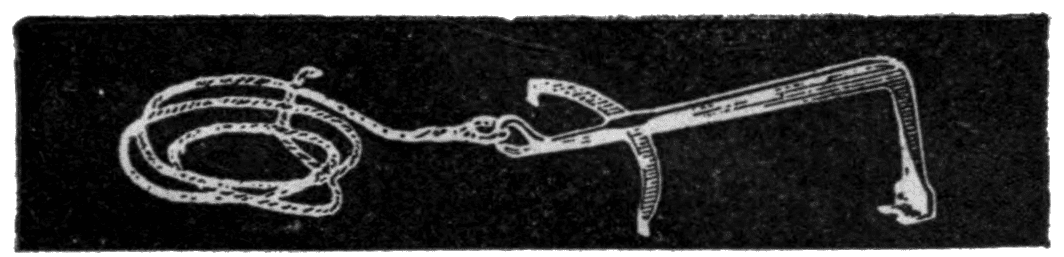
FIG. 34. CHANNEL GRAPPLE.
One man should be trained to correctly dress the saws, and
then be held responsible for their work. When the teeth are
worn short, or the saws are sprung, send them to the ice tool
manufacturer, to have the teeth gummed out to their correct
size and shape, and the blades straightened and stiffened. Ice
plows are frequently rendered useless by improper dressing or
careless handling. The range and proportion of the teeth, as
they are when new, must be kept up, and the cutting points
sharp and keen. The heels and bottoms must be dressed down
regularly with the points,—no more, no less. Only a man of
known ability should be allowed, under any pretext, to dress
the ice plows.
Any delay in plowing may involve the loss of part of the
crop, and any detention of the work of those detaching the
cakes from the field, from a lack of plowed surface to work
upon, may prove to be the cause of an hour or more time lost
or frittered away by nine-tenths of the entire force employed,
both on the field and in the house. Nine-tenths of the entire
wages, for an hour or more, is thus lost to the owner, and an
incompetent workman is the apparent cause. The lack of management
and system is, more likely, the source of this waste.
Plows which have been worn so they cut hard, need gumming
out, or reforging, or both. Plows and markers are the
chief cutting implements of the ice harvester. Too much care
cannot be taken to make a proper selection, originally. The
best plows are now made with steel beams and steel bolts.
They are superior to the old style iron plows. The guides used
on plows and markers should have no lost motion, at any
point, when the guide handle is latched in place. The latest
improvements are in the trussed form of guide, which is perfectly
rigid, and the double hinge and swivel method of securing
the handle to the guide, combined with the pin and mortice
latch. This construction produces a plow and guide which has
no looseness in any joint, and is so braced that the plow cannot
depart from a vertical position unless the guide is raised out of
its groove.
All ice cutters who have had their fields marked in curved,
instead of straight, lines, with the resulting wrenching or
breaking of plow teeth, will appreciate and welcome this
improvement. Bars, tongs, and hooks should be kept sharp,
and, when out of repair, sent to the maker, to be brought back
to a condition of efficiency. The close of the cutting season is
the best time to select and ship to the ice-tool maker all
implements which require overhauling.
A tool room should be provided, of sufficient size to store
all cutting tools, scoops, scrapers, and extras of all kinds that
are liable to breakage or rapid wear. Space should be reserved
for a filing bench, having a large north light, and a grindstone—driven
by power when practicable—for sharpening bars,
hooks, and tongs. Where the ice houses are large, and in
isolated positions, the tool house, if well fitted up, is of great
assistance, affording the means for making repairs of an
urgent character. A good set of millwright tools, together
with a well-chosen supply of seasoned timber, of such sizes as
are used in the various runs and connections, will often repay
their cost in a single season. Large boarding houses are often
found included in the ice harvester’s inventory. This is a
necessity where the storage houses are situated any distance
from towns or cities. Several hundred men are sometimes
thus accommodated.
Filling the House.—Ice should be housed during freezing
weather, if possible, as the cakes will then enter the ice house
dry and hard. In soft weather the ice is soft, and contains
some water; the cakes, being chilled in the house, are frozen
together, causing an increase of labor and breakage in getting
the ice out for shipment during the summer. When the ice is
heavy, of best quality, and stowed, during freezing weather,
in a well-constructed ice house, it can be kept for two or three
seasons, and then be taken out in good condition, with but
little extra loss by breakage. It should have attention at all
times, however, and be kept in perfect order.
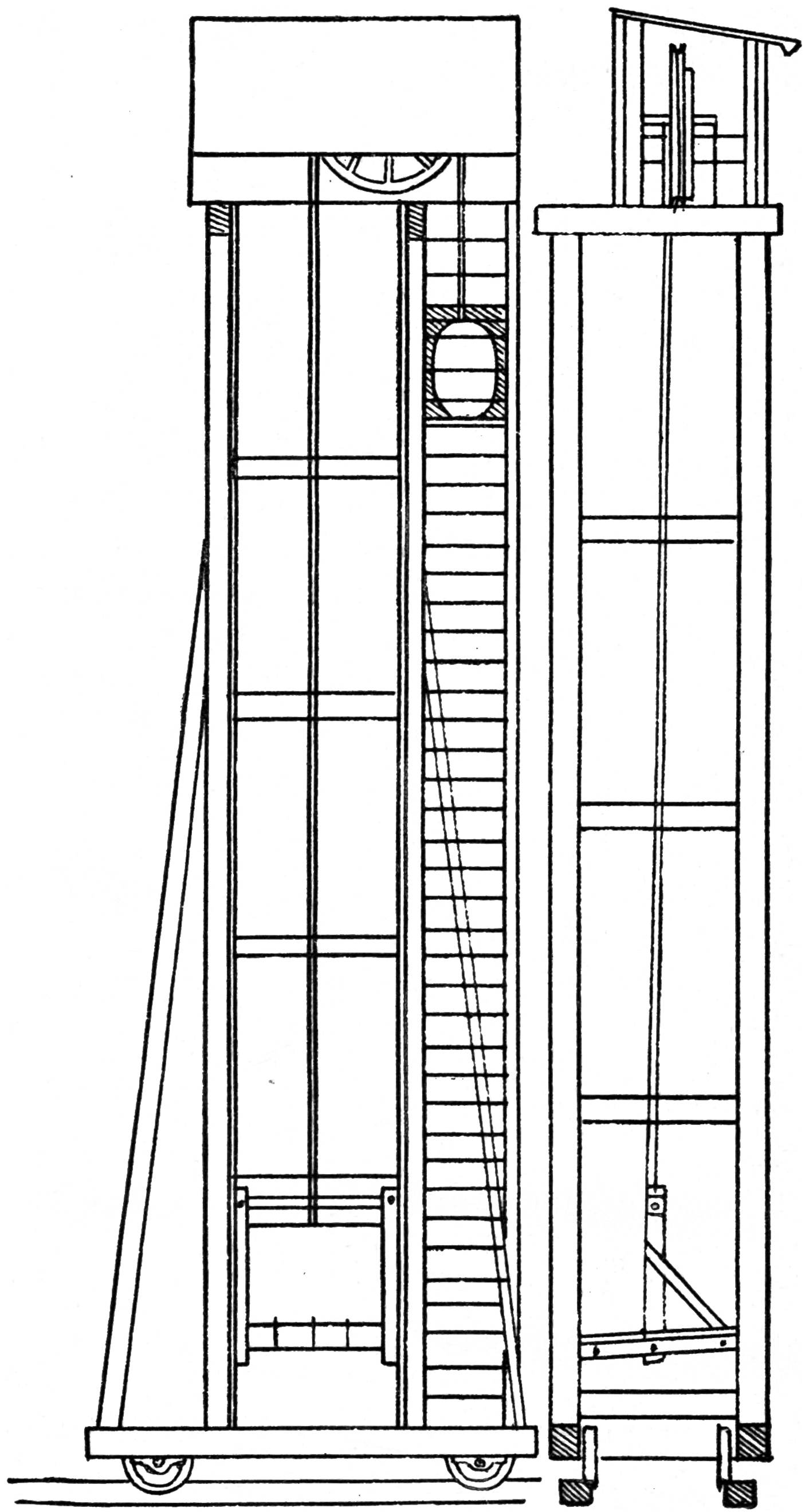
The various methods which are in use for elevating the ice
cake from the water into the ice house, or on to the platform,
will be noticed in detail, under a special chapter devoted to this
important branch of the mechanics of the natural ice trade.

FIG. 35. WOODEN SKID. NO. 1.
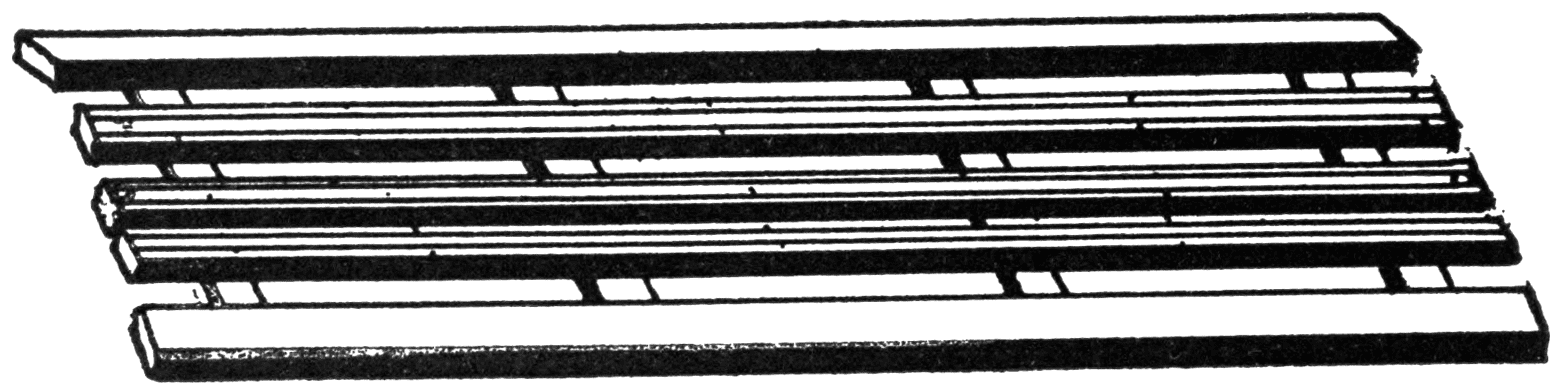
FIG. 36. WOODEN SKID. NO. 2.
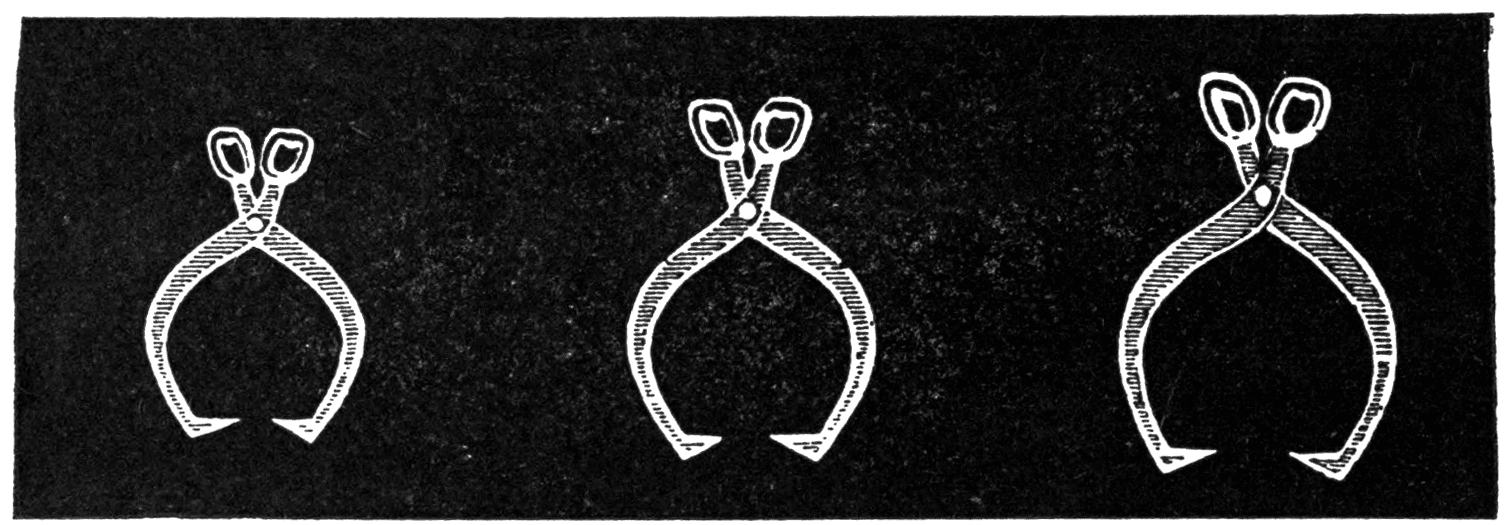
FIG. 37. WAGON AND LOADING TONGS.

FIG. 38. PACKING CHISEL.

FIG. 39. PACKING CHISEL.
The ice cake, as it enters the ice house, does so on a skid, or
run, which is placed at an inclination, the end nearest the
entrance higher than the end leading in toward the center of
the room. At its lower end the skid is connected with another
having the same general inclination, and thus a continuous
line of runs is formed, extending from the entrance to the farther
part of the room. The inclination of these runs is determined
by the distance the ice is to travel on them, and the
height of the galleries on the front of the ice house.
The runs are usually arranged with a rapid descent near
the entrance, and the further end, on a level with the intermediate
portion, graduated between these extremes. When the
inclination imparts too high a speed to the cakes, a break is set
into the runs. It usually consists of a board, in which a number
of large nails are driven, with their heads left projecting
above the surface. This board is set in the line of the runs, or
attached to one of them, so the under surface of the ice
scratches on the nail heads. The number of nails and the
depth of the scratches is easily varied to suit the velocity
required.
As the ice cakes are run into the ice house, they are stored
at the farther end first, and are gradually filled in toward the
front. Through the back and center of the room, stowing is
most rapidly performed. Filling the front end, and under the
runs, require more time and care. The ice cakes are moved
into place with ice hooks and tongs. As the cakes pass along
the runs, they are caught with the ice hook and guided off the
run, at either side, as desired. The runs are made flat, with
no projecting sides or rails. Two lines of the V-shaped run
iron are placed on the runs, and the ice will follow them, but
is readily slipped off when wanted. The accompanying cuts
show the common patterns of runs, and the tools used in the
house during packing.
The hooks, tongs, and runs are used in directing the cakes
to their final positions. The bars, chisels, and adze are used to
trim any inequalities off from the cakes, and, in some cases, to
level off each layer of ice as it is stored. This is not so often
done, when ice is stored for shipment from the house, as in
cooling rooms, when it is desired to pack as much ice as possible.
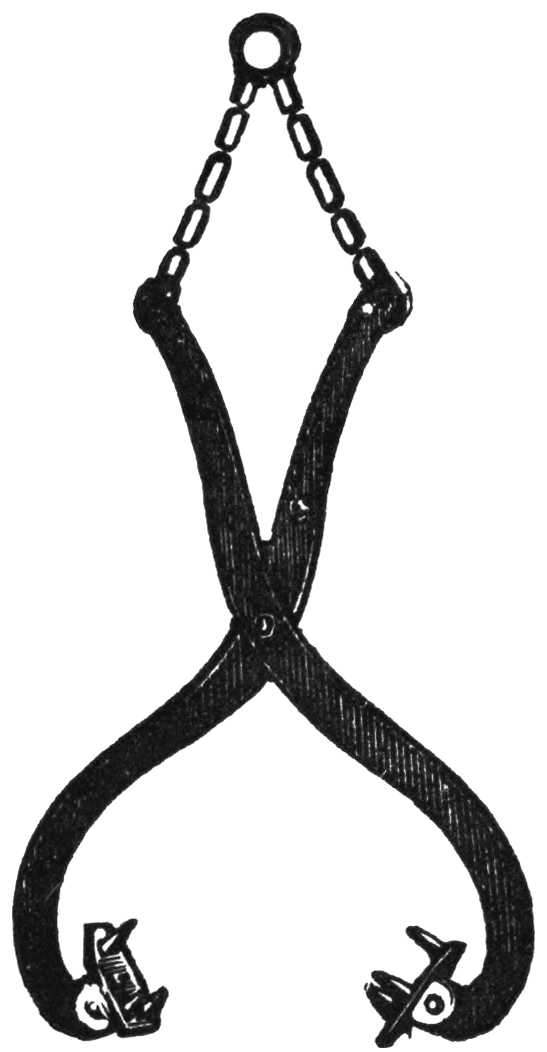
FIG. 40. HOISTING TONGS.
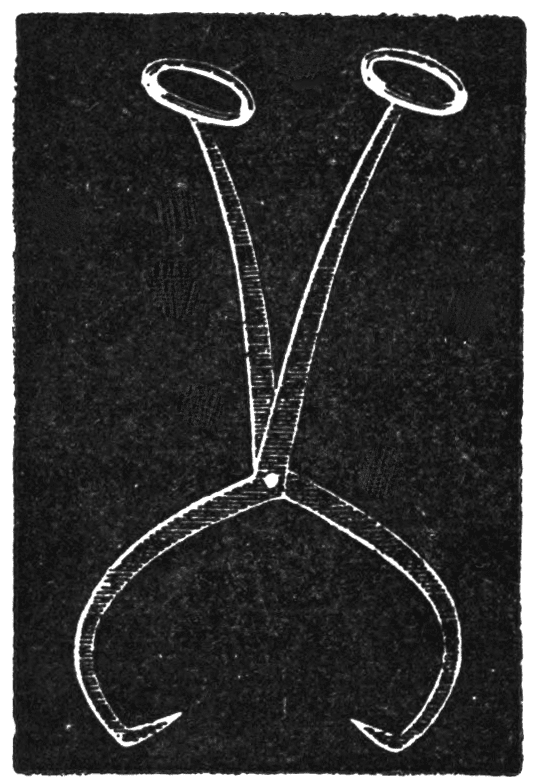
FIG. 41. DRAG TONGS.
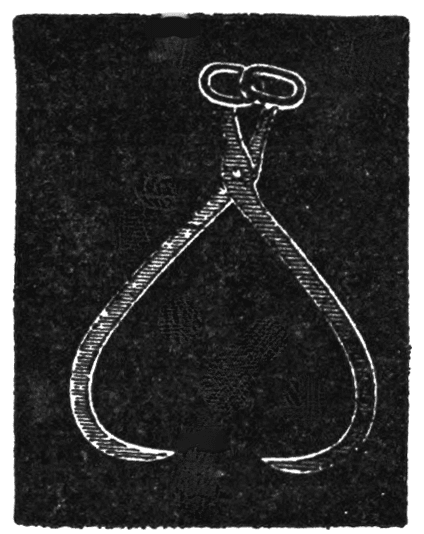
FIG. 42. EDGING TONGS.
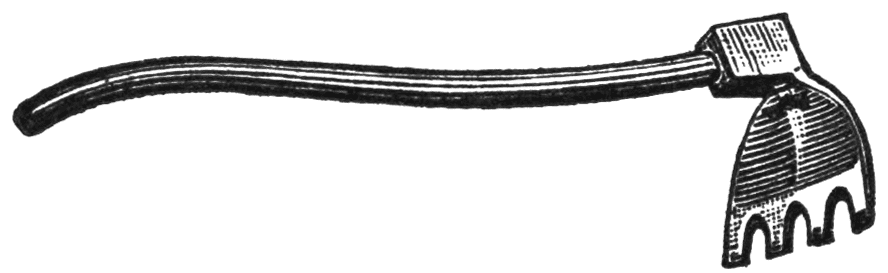
FIG. 43. ICE ADZE.
Packing Ice in the House.—The method employed in
arranging the ice cakes varies in different parts of the country.
The important thing to keep in mind is the amount of good,
merchantable ice possible to be gotten out of the house, as it is
shipped away during the warm season. This does not depend
upon how much can be crowded in, but upon the packing and
arranging of the cakes. Two things are to be observed in this,
prevention of waste by melting, and ease in loosening or
detaching the cakes, as they are taken out. The following
method may be taken as an example, and varied as good cause
is found for so doing.
If the ice is thin, place the two first courses on edge, and
pack as closely together as practicable. The succeeding courses
place in flat, or in the same position they occupy on the water.
Arrange the cakes one directly above the other, and leave a
space of two inches on all four sides or edges. In every five or
six courses, joints are broken. The last four or five courses on
top are placed, each one, to break joints, and closely placed at
edges. The reasons for this arrangement are, that the ice on
the floor of the house wastes rapidly, and, by placing the cakes
on edge, the minimum loss is obtained, and the succeeding
cakes, placed one above the other, and free on the edges, having
only the top and bottom surfaces in contact, the minimum
breakage and labor, in loosening cakes, is obtained; also, by
breaking the joints every few courses, the circulation of air
currents, which is very destructive to the ice, is shut off, and,
finally, the top courses close in the mass thoroughly, and
prevent the top covering from sifting down into the body of
the ice.
The chapters on loss of ice by wastage in the house, and
the construction of ice houses, will present more fully some of
the considerations bearing upon the methods of stowing the ice.
In some localities the ice cakes are all placed upon edge.
Among the advantages claimed for this method are, ease in
loosening and taking out the cakes, and the closer packing
secures more ice, where storage room is limited. There is a
risk of damage to the ice house, by the pressure of the ice
against the side walls, when packed in this manner. The
edges, being uneven, tend to throw the ice out of plumb, or to
give the whole mass an inclination in one direction. In stowing,
care is required to keep the spaces between the cakes free
from chips or broken ice.
No more trimming than is necessary should be done in the
house, and the crowding of cakes together on the runs, and in
sliding them to their places, should be avoided. Broken cakes
should not be allowed to come into the house, and, if cakes are
broken in placing, they should be thrown out of the house.
Experience and practice, in the handling of runs and managing
the progress of the stowing of the ice cakes, attest the
value of system in this department. To do the necessary work
with as much despatch as possible requires close attention to
details, and watchfulness, that the labor and efforts of the men
are properly directed and distributed.
The runs outside the house are permanent, and arranged in
galleries, about five feet apart, with connecting runs from each
gallery to the incline. The top run is placed well up to the
plate. At each intersection of the incline and runs to the galleries,
there is a gate, which may be removed from the face of
the incline, thus affording access from the incline to the runs.
The gate at the lower run being open, the ice cakes all pass on
to the first run, and enter the house at this height. When the
house has been filled with ice to the height of the first run, or
one or two courses higher, the level of the house is then too
high to handle the ice over the lower run. The incline gate
is now placed in position, shutting off the first run, and the
ice is raised upon the incline to the height of the second run,
and passes into the house at this level.
It is now necessary to rearrange the runs within the ice
house. They must be uncoupled from the first gallery, and
raised up and secured at the height of the second gallery. The
under blocking and bracing is removed, and the runs set to
one side. Before they are disturbed, a number of ice cakes
are run in, and left near the entrance, to be stowed in the
space the runs and staging occupied, directly in front of the
entrance. Unless care is taken, this filling in will be done with
irregularity, and more or less broken ice will be left among the
good cakes, causing loss by wastage and breakage, when the
house is opened up. This filling in under the runs suspends
the ordinary work of stowing, and is attended with some loss
of time.
After the cakes are all in place, the house runs are raised
up, blocked and braced in position, the connecting runs
coupled on, and a new line of runs conducts the ice from the
second gallery to the further part of the room.
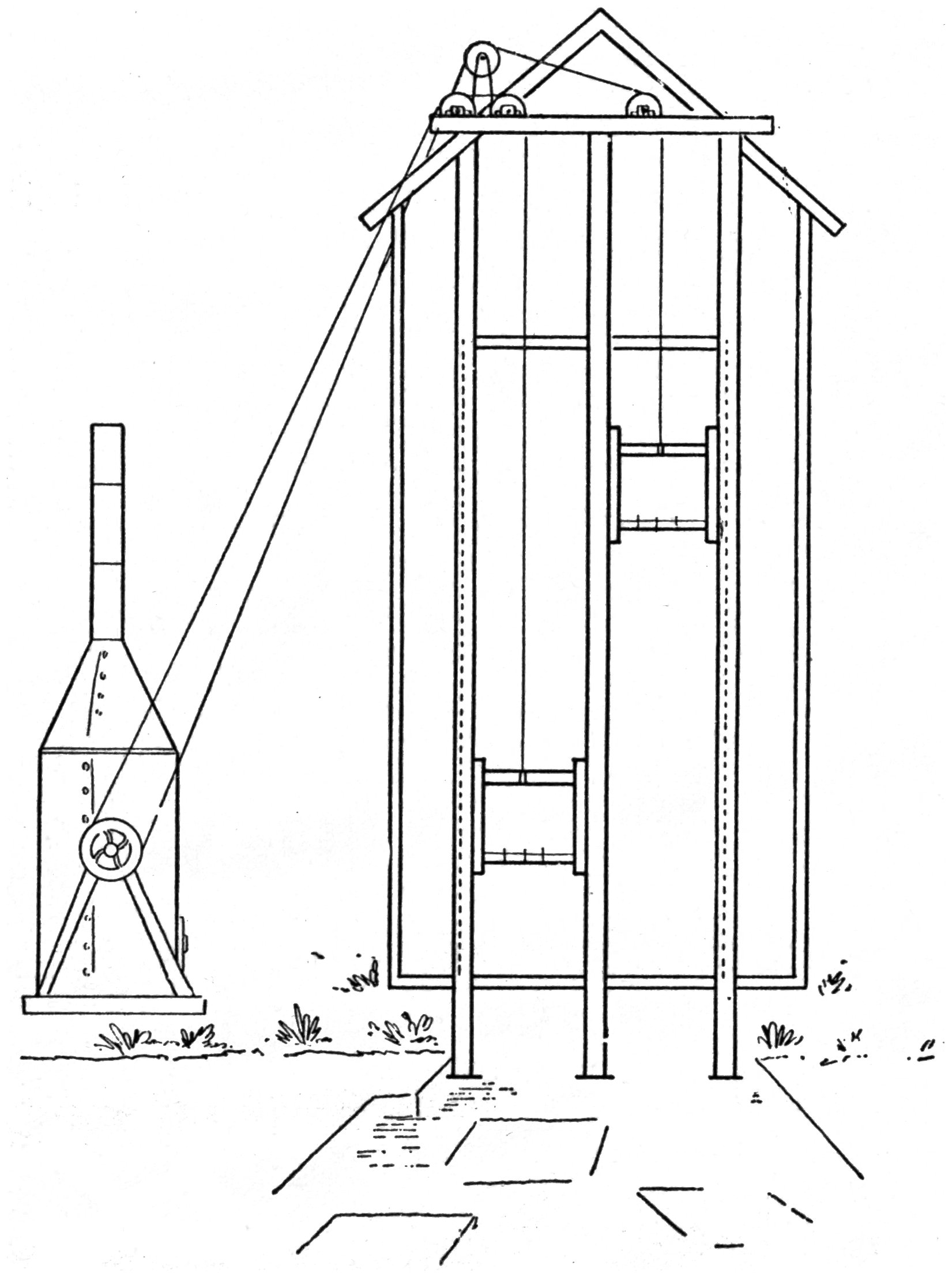
A system of winding drums, placed in the roof timbers,
with ropes attached to the runs, at either end, saves time and
labor, in adjusting the house runs to the levels of the different
galleries; also, in shifting them, as they are raised to the level
of the courses, as the cakes are placed.
Closing and Caring for the House.—When the room has
been filled to the level of the wall plate, the ice is covered with
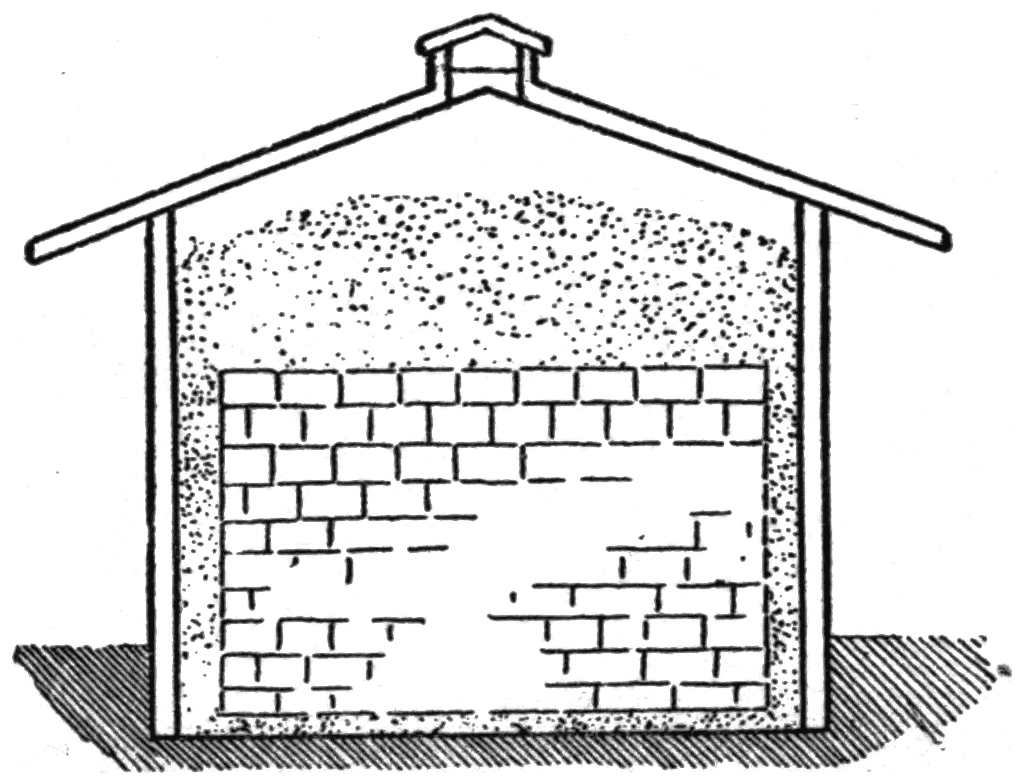
dry planing-mill shavings or sawdust, ten or twelve inches
deep. The entrance opening is closed, and filled in with sawdust,
or other packing.
The harvest being secured, the ice house carefully closed,
and all chance for circulation prevented by a top dressing, it
requires regular attendance once a day, to trim the top covering,
if any part of it should sink into the crevices between
the ice cakes.
As the warmer days and spring rains set in, the proper
ventilation of the ice house is important. All steam or vapor
arising from the ice should be gotten rid of as soon as possible.
The various plans which are in use to attain this end, will be
found in the chapter on wastage and care of ice in the house.
As soon as the tools for harvesting are no longer required
for use, they should be promptly gathered together, and
inspected. All that have been broken, or damaged, should be
bundled up and consigned to the manufacturer, to be put in
thorough cutting order, and returned to the ice house, in the
early fall. All other tools should be carefully cleaned, and all
bright or polished steel coated with oil, to preserve from rust,
cases strapped to plows and saws, and all neatly packed away
in tool house, which should be dry. Snow scoops and scrapers
are better for an occasional coat of paint, and, if stored in a
dry, cool place, sheltered from the weather, will last much
longer. It is a good plan to have all the tools inventoried
directly after the cutting season, and they should be marked
with the owner’s name or initials.
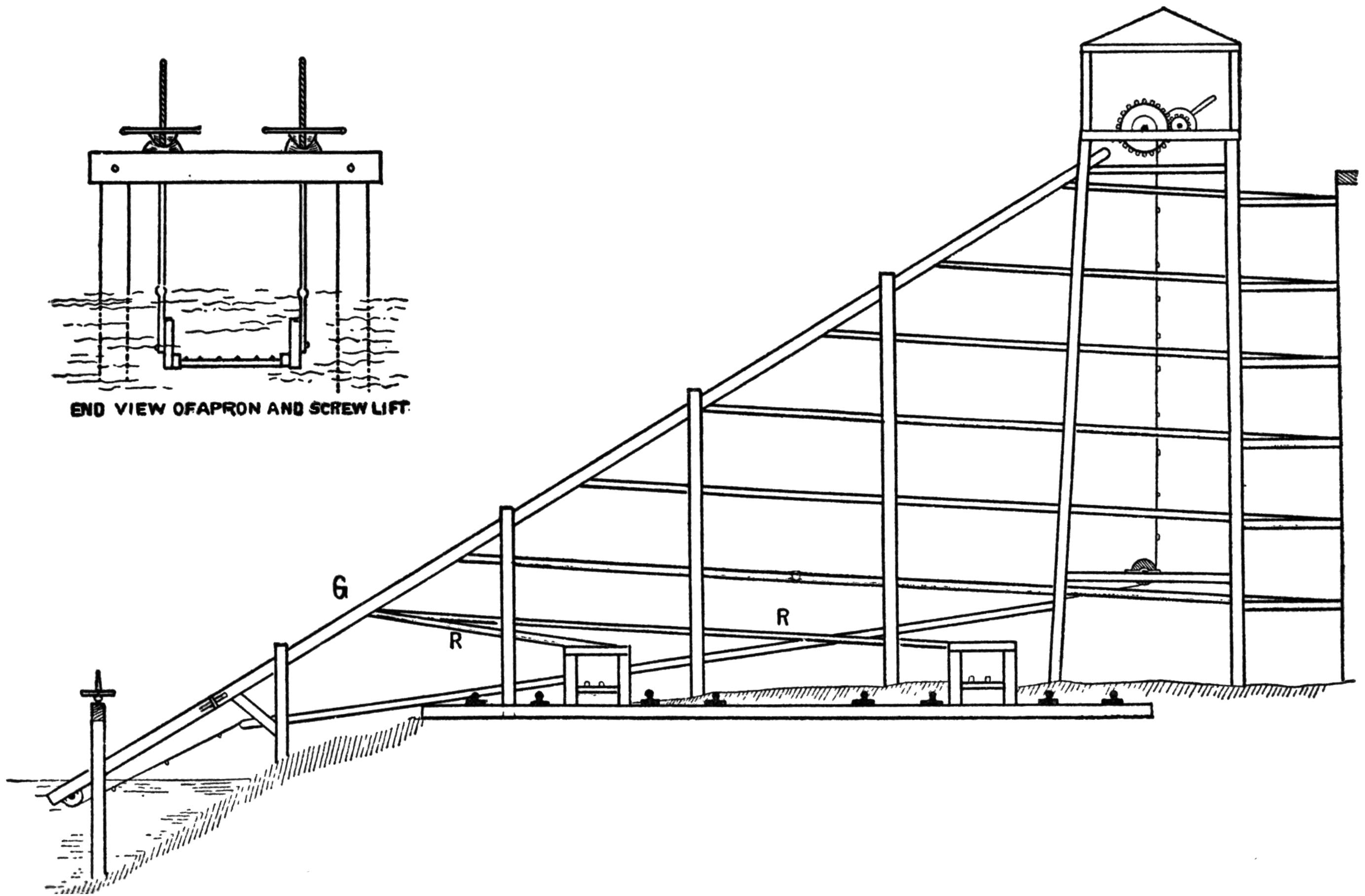
The elevator machinery should also be inspected, and any
defects noted, for early repair, the apron raised from the
water, and the water shaft and fittings cleaned, and thoroughly
oiled. The ice chain, if given a coat of slushing oil,
will take no harm. All machinery which is exposed to the
weather should be thoroughly coated with slushing oil. The
engine should have attention, and all working parts be preserved
from rust. All the brass trimmings on engines or boiler
should be taken down, boxed, and stored in a secure place.
Shipping Ice From the Field.—While the ice house is
being filled, winter shipments of ice may be made to points
where supply stations are maintained distant from any cutting
privilege. Large shipments are often made to points south of
the frost line, or where the crop is deficient. To accommodate
this traffic, loading platforms are built with connecting runs
from the lower incline run. A switch is arranged by which
the ice cakes can be directed, either on to the loading platform
or into the ice house. Long trains of cars can be filled daily.
At a single platform, ten to fifteen cars are loaded at one time,
while a double platform will accommodate double the number.
If the side tracks are placed at both sides of the platform,
no time will be lost while cars are being switched, a train
loaded on one track being switched out, and the track filled
with empty cars, while loading proceeds in the cars on the
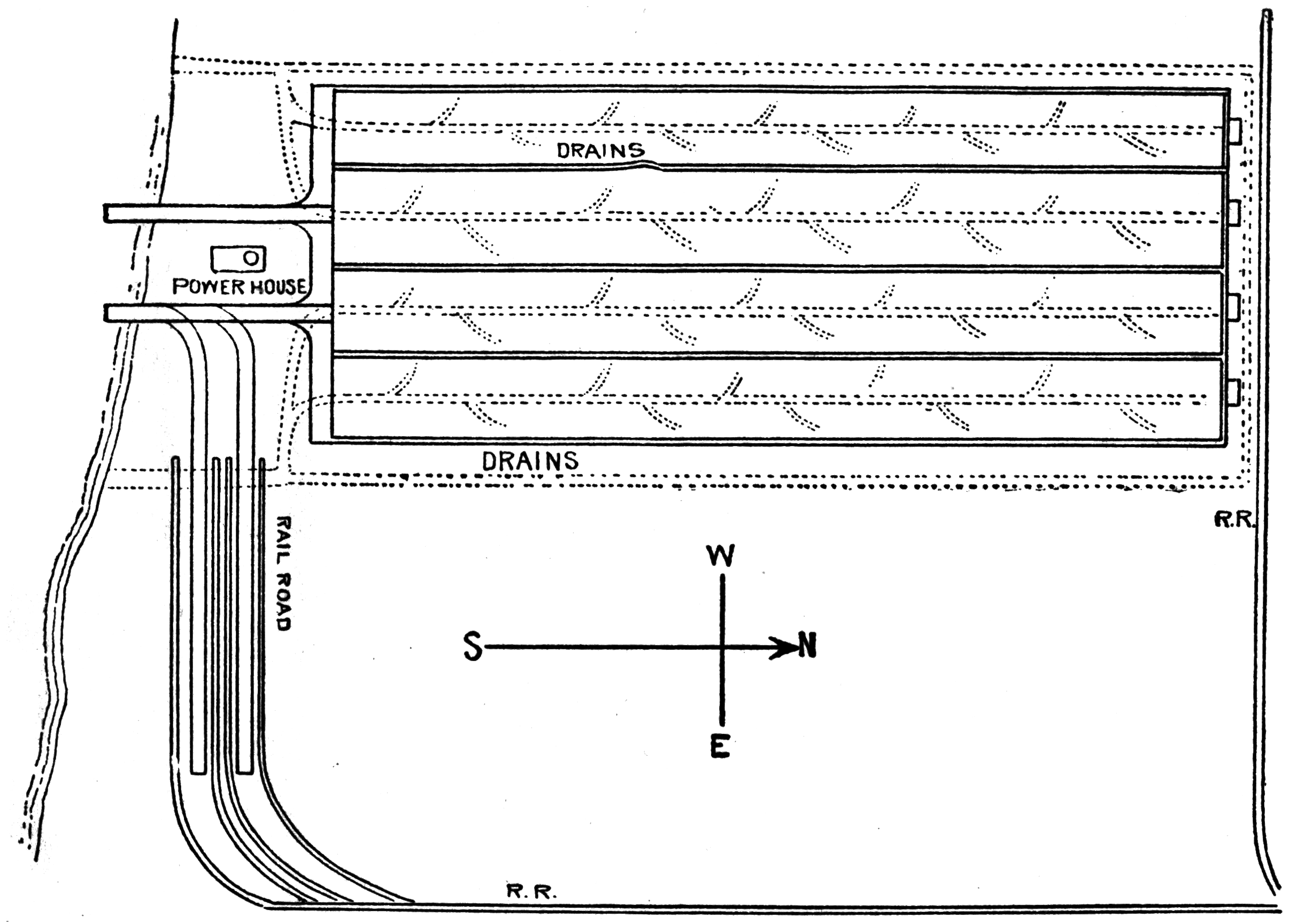
other track. Diagrams of these platforms are shown at Fig. 52.
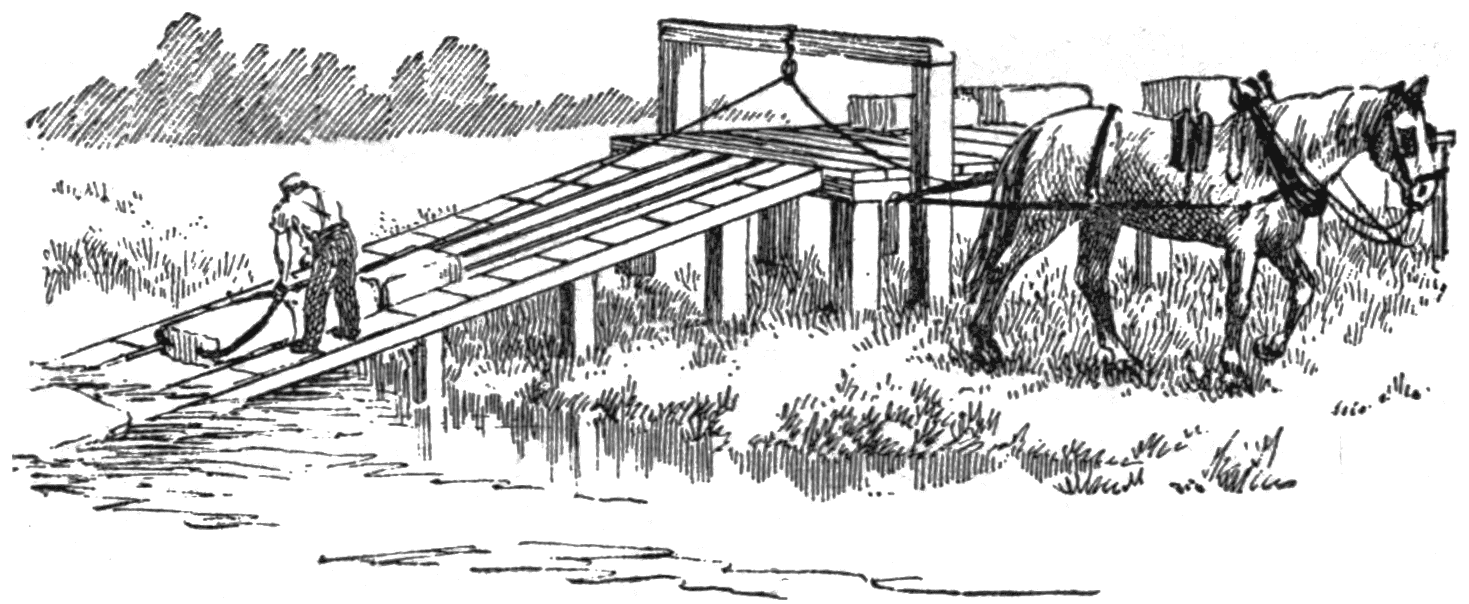
Endless chains, with bars at short spaces, pass along the
top of the platform, and carry a cake, at a regular speed,
before each bar. (See Fig. 51.) A short doorway slide is
placed between the car and platform, and a man, stationed at
the car door with an ice hook, slides the cakes into the car as
fast as the stowers can place them.