THE HUNTERIAN LECTURES ON COLOUR-VISION AND COLOUR-BLINDNESS
Transcriber’s notes:
The text of this e-book has been preserved as in the original, except
for the correction of a single typo (ests → test), the insertion of a
missing footnote anchor and the shifting of footnotes to the end of
the book. Hyperlinks have been added to assist the reader navigate the
book.
THE HUNTERIAN LECTURES
ON
COLOUR-VISION AND COLOUR-BLINDNESS
Delivered before the Royal College of Surgeons of England
on February 1st and 3rd, 1911
BY
PROFESSOR F. W. EDRIDGE-GREEN
M.D.Durh., F.R.C.S.Eng.
BEIT MEDICAL RESEARCH FELLOW
KEGAN PAUL, TRENCH, TRÜBNER &Co., Ltd.
43 GERRARD STREET, LONDON, W.
1911
PREFACE
As there are many who are interested in the
subject of vision and colour-blindness who are
not acquainted with the structure of the eye, I will
give a few details so that these persons may be
able to consider the problem from the point of
view of these lectures.
The eye is very similar to a photographic camera,
and an actual image is formed on the back of the
eye just as it is on the plate of the photographic
camera or on the view-finder. The eye possesses
a lens and also an iris which acts as an adjustable
stop and regulates the size of the pupil. The
membrane at the back of the eye upon which the
image is formed is called the retina. The retina
has several layers, but the sensitive layer consists
of two elements called, from their shape, rods and
cones. The problem therefore which has to be
considered is, how is the light which forms the
image on the sensitive layer of the retina transformed
into visual impulses?
Those who are interested in the subject will
find further details in my book on Colour-Blindness
and Colour-Perception in the International Scientific
Series. In that book there are three plates
which show how the colour-blind see colours.
I have been annoyed to find that unauthorised
persons have made lanterns professing to be mine
but grossly inaccurate. The sole makers are those
mentioned on page 53 in this book.
F. W. Edridge-Green.
The Institute of Physiology,
University College,
Gower Street, London.
CONTENTS
LECTURE I
THE THEORY AND FACTS OF COLOUR-VISION AND COLOUR-BLINDNESS
Gentlemen,—Colour-blindness is not a good name
for the condition to which it is applied, and still
worse is the use of the term red-blindness or green-blindness.
In the majority of cases of colour-blindness
there is no blindness to colours in the
ordinary acceptation of the term; a green, red, or
yellow light produces a very definite sensation of
colour. Those who confuse red and green do so,
not because they see red as green or green as red,
but because both give rise to a similar sensation of
colour. The word light must be used in the sense
of referring to those waves which excite the organ
of vision. Because two stimuli excite a sensation
of light, it does not follow that they are similar.
We cannot, for instance, distinguish by the eye
polarised light from non-polarised light. We have
to distinguish between the physical stimuli by
their physical properties apart from their effect on
the organ of vision. I propose to divide the
subject into two parts, and in this lecture to deal
with the theory and facts of colour-vision and
colour-blindness, and in the second lecture with
the detection of colour-blindness from a practical
point of view.
I. The Theory and Facts of Colour-Vision and Colour-Blindness — THE VISUAL PURPLE THE ESSENTIAL FACTOR IN VISION — THE EVOLUTION OF THE COLOUR-SENSE — THE FACTS OF COLOUR-BLINDNESS
The following is the theory which I have propounded
in order to explain vision and colour-vision.
A ray of light impinging on the retina
liberates the visual purple from the rods and a
photograph is formed. The rods are concerned
only with the formation and distribution of the
visual purple, not with the conveyance of light-impulses
to the brain. The ends of the cones are
stimulated through the photo-chemical decomposition
of the visual purple by light (very
probably through the electricity which is produced),
and a visual impulse is set up which is
conveyed through the optic-nerve fibres to the
brain. The character of the stimulus differs
according to the wave-length of the light causing
it. In the impulse itself we have the physiological
basis of the sensation of light, and in the quality
of the impulse the physiological basis of the
sensation of colour. The impulse being conveyed
along the optic nerve to the brain, stimulates the
visual centre, causing a sensation of light, and
then passing on to the colour-perceiving centre,
causes a sensation of colour. But though the
impulses vary in character according to the wave-length
of the light causing them, the retino-cerebral
apparatus is not able to discriminate
between the character of adjacent stimuli, not
being sufficiently developed for the purpose. At
most, seven distinct colours are seen, whilst
others see in proportion to the development of
their colour-perceiving centres, only six, five,
four, three, or two. This causes colour-blindness,
the person seeing only two or three colours instead
of the normal six, putting colours together as
alike which are seen by the normal-sighted to be
different. In the degree of colour-blindness just
preceding total, only the colours at the extremes
of the spectrum are recognised as different, the remainder
of the spectrum appearing grey. Though
my own opinion is that the ordinary form of congenital
colour-blindness is caused by a defective
development of the portion of the brain which has
the function of the perception of colour, we must
not exclude any portion of the retino-cerebral apparatus,
defect of which would have exactly the
same result. It will be noticed that the theory
really consists of two parts, one concerned with
the retina and the other with the whole retino-cerebral
apparatus. I shall in these lectures use
the word cerebral in this sense. I am not aware
of a single fact which does not support this theory,
and I have used it to predict facts which have
subsequently been rediscovered by others and
now form a part of our common knowledge.
I will now state very briefly the evidence which
supports the view that the visual purple is the
essential factor in the retina which enables it to
transform light into visual impulses.
1. Anatomical.—In the fovea of the retina only
cones are to be found. Immediately external to
this each cone is surrounded by a ring of rods.
The number of rings of rods round each cone
increases as the periphery is reached. The outer
segments of the cones are situated in a space
which is filled with fluid. The external limiting
membrane retains this fluid in its place. I find1
four depressions or canals which lead into the
larger depression of the external fovea. These
canals appear to have smaller branches, and serve
to conduct the visual purple into the part of most
acute vision. The cones which are present in the
fovea have very long outer segments which would
present a greater surface for photo-chemical
stimulation. The visual purple is only to be found
in the rods and not in the cones. I determined to
ascertain whether the visual purple could be seen
between the cones in the fovea. I have examined
under the microscope the retinas of two monkeys
which had been kept previously in a dark room for
forty-eight hours. The yellow spot was the
reddest part of the whole retina, and the visual
purple was seen to be between and not in the
cones.2
2. Physiological analogy with other body cells.—It
is far more probable that the rods should produce
a secretion which would affect other cells
rather than themselves. The liver cells do not
form bile in order to stimulate themselves, and the
internal secretions are produced to affect other
parts of the body. I am not aware of a single
instance in which a cell produces a secretion which
has the function of stimulating the cell producing
it. The visual purple is regenerated in the rods by
the pigment cells in connection with them.
3. The relation between the foveal and the extra-foveal
regions.—As the fovea only contains cones,
if any of the older theories of the relative functions
of the rods and cones were true we should expect
to find qualitative differences between the foveal
and extra-foveal regions. This is not the case,
but as we should expect if the visual purple were
the visual substance, all the phenomena which
have been attributed to the visual purple should
be found in the fovea. Von Tschermak, Hering,
Hess, Garten and others have found the Purkinje
phenomenon, the variation in optical white equations
by a state of light and dark adaptation, the
colourless interval for spectral lights of increasing
intensity, and the varying phases of the after-image
in the fovea only gradually diminished.
4. The varying sensibility of the fovea.—The
fovea is in some conditions the most sensitive part
of the whole retina, and with other conditions the
least. Helmholtz has recorded some of these facts
and regarded them as quite inexplicable. We have,
however, an easy explanation of the facts on the
assumption that when there is visual purple in the
fovea this is the most sensitive part of the whole
retina, but when there is none there time must
elapse before it can diffuse into the spot, and in
the meantime it is insensitive to light. I have
devised several experiments which show the
visual purple flowing into the foveal region. The
following simple experiment shows this very well.
If on awaking in the morning the eyes be directed
to a dull white surface, as for instance the ceiling,
the region of the yellow spot will appear as an
irregular black spot, and light will appear to invade
this spot from without inwards. If the eyes be
now closed and covered with the hands, purple
circles will form round the centre of the field of
vision and gradually contracting reach the centre.
When the circle reaches the centre it breaks up
into a star-shaped figure and becomes much
brighter. It then disappears and is followed by
another contracting circle. Now it will be noticed
that if one eye be opened when the circle has
broken up, a brilliant rose-coloured star much
brighter than any other part will be seen in the
centre of the field of vision. This has the exact
hue of the visual purple. If we wait until the
star has disappeared before opening an eye, the
macular region appears as a black spot as before.
This conclusively shows that the central portion
of the retina is sensitised from the peripheral
portions.
5. Chemical analogy.—The visual purple gives
a curve which is very similar to that of many other
photo-chemical substances. We know that with
photo-chemical substances the chemical effect is
not proportional to the intensity of the light. That
is, a different curve is obtained with weak light from
that which is formed with light of greater intensity.
It is reasonable, therefore, to suppose that the
visual purple which is formed by the pigment
cells under the influence of a bright light would be
somewhat different in character from that which is
formed in darkness. Again, from the chemical
analogy which I have just given, even if the
visual purple were of the same character, we
should not expect similar curves with different
intensities of light. It is probable that both
factors are in operation. This deduction gives an
explanation of the Purkinje phenomenon, or the
fact that when the eyes are adapted to darkness
the point of greatest luminosity is shifted more
towards the violet end of the spectrum. Some
dichromics who have shortening of the red end of
the spectrum have a luminosity curve which is very
similar to that of a normal-sighted person with
a spectrum of lesser intensity. We have only to
assume in these cases either that the receiving
nervous apparatus is less responsive, or that the
visual purple formed at one intensity of light is
similar to that formed at a lower intensity by a
normal-sighted person. We also have an explanation
of other conditions, such as erythropsia, or
red vision, white objects appearing more or less
red. If we suppose that the eye has remained
in a state of light adaptation, the visual purple
produced being more sensitive to the red rays,
objects appear of this colour. As we should
expect, erythropsia is frequently associated with
hemeralopia, or difficulty in seeing in the twilight,
the eyes being adapted to light and not to darkness.
In green vision the eyes have probably
remained in a condition of more or less adaptation
to darkness, and are therefore more sensitive
to the green rays.
6. Disappearance of lights falling upon fovea.—If
the cones are not sensitive to light, a ray of
light falling upon the fovea alone and not upon
the adjacent portion of the retina containing rods
should produce no sensation of light, provided that
there is not already any visual purple in the fovea.
It has been known to astronomers for a long time
that if a small star in a dark portion of the sky be
steadfastly looked at, it will disappear from view,
whilst other stars seen by indirect vision remain
conspicuously visible. The following simple experiment
shows the same thing. If a piece of black
velvet about three feet square on a door have a pin
put in the centre, and the source of light be behind
the observer, the pin will be brightly illuminated;
and on looking at it (the observer not being too
close) and keeping the eye quite still, the pin will
disappear, the visual substance diffused into the
fovea centralis being used up and not renewed.
When viewed by indirect vision it is impossible to
make it disappear in this way. When I have
taken great care to have very dark surroundings
and have used only one eye, I have made moderately
bright lights disappear in this manner.
These facts have been attributed to a defective
sensibility of the fovea for feeble light. The
important point, however, that the light is at first
most clearly seen by the fovea and only subsequently
fades, has been overlooked. If these facts
were due to a defective sensibility of the fovea, the
star or light would not be visible at first.
7. Illusion of moving light.—If a small light be
looked at fixedly in a dark room, it will appear
to move until it comes apparently so close that
it could be grasped. The reason of this is that
the eye moves so that the light falls upon a more
peripheral part of the retina. I find that the
movement takes place as if some photo-chemical
substance acted under the influence of gravity.
For instance, when standing the light appears to
travel upwards; resting the head on one side, it
appears to travel in the opposite direction. The
light appears as if we were looking straight at it,
and the eye, which is covered up, remains directed
straight at the object. When the second eye is
opened two images of the light are seen, and the
image which is seen with the periphery of the
first eye rapidly coalesces with that seen directly
by the second eye.
8. Purple after-image.—A positive after-image
of a purple (rose) colour can be obtained after
white light or any spectral colour. It will be
noticed that when there is little light during the
subsequent observation the colour of an after-image
inclines to blue or green, when there is
more light towards purple or red.
Fig. 1.
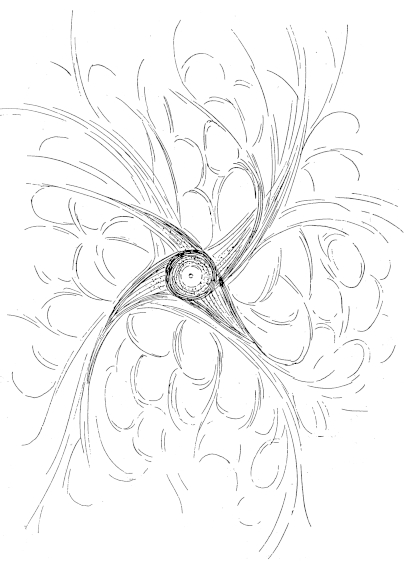
9. Currents seen in the field of vision not due to
the circulation.—It occurred to me that if there
were canals in the retina which promoted the easy
flow of the visual purple into the fovea, we ought
to obtain evidence of the currents flowing along
these channels entoptically. I found that this
was the case, and that the currents could be seen
in numerous ways.3 If one eye be partially
covered with an opaque disc whilst both eyes
are directed forwards in a not too brightly illuminated
room, and special attention be paid to the
covered eye, an appearance of whirling currents
will be seen with this eye (see Fig. 1). These
currents appear to be directed towards the centre,
and have a very similar appearance to a whirlpool
which is fed by four main branches. These
again are fed by smaller branches which continually
change their paths. On closing both
eyes all the portion in which the whirling currents
are seen appears as dull purple. These
currents cannot be due to vessels, because we
know that the centre of the retina corresponding
to the point where the greatest movement is seen
is free from vessels. The appearance is also very
different from that of the movement of blood in
vessels. The currents can also be seen in the
light, in the dark, through yellow-green glass, and
with intermittent light. The main branches form
a star-shaped figure with four rays. The currents
carry the visual quality, colour, and brightness
from whence they come into an after-image.
They also tend to move an after-image towards
the centre. The currents behave as if they ran
in definite channels, but could also overrun, on
any further stimulus, the banks of the channels.
For instance, a thin, bright line with a little more
light appears as a broad band, and the central
star figure will enlarge into a rhomboid, oval or
disc. Movements of the eyes affect the broad
currents in the outer part of the field of vision.
10. Pressure figure.—Pressure on the front of
the eye causes the star-shaped figure to be seen,
and this changes into a rhomboid with a little
more pressure.
11. Macular star.—It occurred to me that we
ought to obtain evidence of the canals in the
retina in cases where the outflow from the retina
is obstructed, as by tumour. I find this is the
case; the star-shaped figure given by Sir Victor
Horsley in his paper on tumour of the frontal lobe4
is almost exactly the same as that seen subjectively.
Fig. 2.
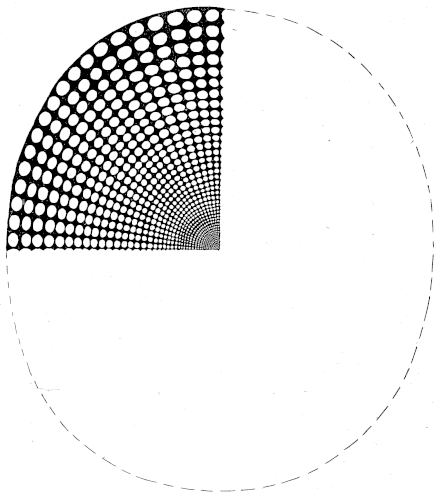
12. Entoptic appearance of cone mosaic.—Appearances
corresponding to the cone mosaic of
the retina may be seen in several ways5 (see
Fig. 2). The appearance seen corresponds to the
cone distribution of the retina as viewed from its
outer side, the portions occupied by rods appearing
as dark spaces.
13. Visual acuity.—Visual acuity is most acute
with the fovea, and diminishes from within outwards.
It corresponds very fairly with the cone
distribution of the retina. On the other hand,
there is not one single fact which points to the
rods as being light-sentient organs. This is well
recognised by those best qualified to judge.6 I
could give many more facts in support of the
view that the visual purple is the visual substance,
and I have not yet had brought to my notice
any fact which is not readily explicable on that
hypothesis. There may be other photo-chemical
substances in the retina, but there is not the
slightest evidence that such is the case. I regard
the visual purple as the sole visual substance.
We could, of course, split the visual purple into
innumerable simpler photo-chemical substances,
each of which has its own absorption curve,
having its maximum in some particular part of
the spectrum. It is difficult to say at present
exactly how the visual purple acts as a stimulus
transformer, but this is because so many plausible
hypotheses immediately occur to us. It is very
probable that light acting upon the visual purple
is, according to its wave-length, absorbed by particular
atoms or molecules, the amplitude of their
vibrations being increased. These vibrations may
cause corresponding vibrations in certain discs of
the outer segments of the cones, which seem
especially constructed to take up vibrations. We
know that when light falls on the retina it causes
an electric current. We know how the telephone
is able through electricity to convey waves of
sound, and something similar may be present
in the eye, the apparatus being especially constructed
for vibrations of small wave-length.
The current of electricity set up by light may
cause the sensation of light, and the vibrations of
the atoms or molecules the sensation of colour.
In all vital processes there is a condition of
katabolism or chemical change in the protoplasm,
and an anabolic or building-up process, in which
the protoplasm is restored to its normal state.
We have therefore to consider two definite processes
in the visual purple—namely, a breaking
down of the visual purple photo-chemically by
light and its restoration by the pigment cells and
rods. Under ordinary conditions of light, and
during the whole of the daytime, the visual purple
is continually being bleached and reformed. It
is obvious, therefore, that when the eye has been
kept in the dark and is then exposed to light, an
observation taken immediately will not be comparable
with one taken a few seconds afterwards,
because in the first observation we have only to
consider the katabolic change; whilst in the
second observation the anabolic change has to be
considered as well, as the visual purple has to be
reformed for subsequent seeing. There appears
to be very little evidence in ordinary circumstances
of this anabolic process; for instance, if we
fatigue the eye with sodium light in a dark room,
and then immediately examine a spectrum, we
find that though all the yellow has disappeared
there is no increase in the blue; in fact, the blue
seems rather diminished than otherwise. Again,
there is not the slightest diminution in either the
red or green, showing conclusively that yellow
cannot be a compound sensation made up by a
combination of red and green. We must therefore
explain in another way the apparent trichromatism
of normal colour-vision, which is so
well known to every photographer, especially
those who are concerned with colour photography.
If my theory of the evolution of the
colour-sense be the correct one, and we have
cases of colour-blindness corresponding to every
degree of the evolutionary process, we have an
explanation of the facts. In past ages all saw
the rainbow made up of only three colours—red,
green, and violet. When a new colour (yellow)
appeared between the red and green, it is obvious
that a mixture of red and green would give rise,
not to red-green, but to the colour which had replaced
it—namely, yellow. The retina, therefore,
corresponds to a layer of photo-chemical
liquid in which there are innumerable wires each
connected with a galvanometer. When light falls
upon a portion of this fluid the needle of the
galvanometer corresponding to the nearest wire
is deflected. The wires correspond to the separate
fibres of the optic nerve, and the galvanometers
to the visual centres of the brain.
Cases of colour-blindness may be divided into
two classes, which are quite separate and distinct
from each other, though both may be present in
the same person. In the first class there is light
as well as colour loss. In the second class the
perception of light is the same as the normal-sighted,
but there is a defect in the perception
of colour. In the first class certain rays are either
not perceived at all or very imperfectly. Both
these classes are represented by analogous conditions
in the perception of sounds. The first
class of the colour-blind is represented by those
who are unable to hear very high or very low
notes. The second class of the colour-blind is
represented by those who possess what is commonly
called a defective musical ear. Colour-blind
individuals belonging to this class can be
arranged in a series. At one end of this series
are the normal-sighted, and at the other end the
totally colour-blind. The colours appear at the
points of greatest difference, and I have classified
the colour-blind in accordance with the number
of colours which they see in the spectrum. The
normal-sighted may be designated hexachromic;
those who see five colours, pentachromic; those
who see four, tetrachromic; those who see three,
trichromic; those who see two, dichromic; and
those who see none, totally colour-blind. There
are many degrees included in the dichromic class.
There may or may not be a neutral band, and this
is widest in those cases approaching most nearly
to total colour-blindness. I have recorded a case
of a patient who was colour-blind with one eye.7
It is an interesting fact that for form vision the
colour-blind eye was much the better of the two,
and he could recognise fine lines in the spectrum
with this eye which were not visible to the other.
He saw the two ends of the spectrum tinged with
colour and the remainder grey. It will be noticed
that his colour sensations were limited to the extreme
red and the extreme violet—namely, those
colours which present the greatest physical contrast
to each other. Neither the red nor the
violet appeared of the nature of a primary colour,
but gave the impression that they were largely
diluted with grey. A theory of colour-vision
must account for a case of this kind, and also for
the other varieties and degrees of colour-blindness.
The trichromic are a very important class, and
any theory must account for the fact that they
see yellow as red-green, and blue as violet-green.
As we should theoretically expect, when there is
shortening of the spectrum the centres of the
colours are moved towards the unshortened side.
I will now show on the screen some representations
of pictures painted by colour-blind persons.
The upper picture is the copy, and the one below
is the one which has been painted by the colour-blind
artist. He has been given a selection of
colours on plates, and from them has selected the
one which he thought appropriate in each case.
It will be noticed that the mistakes made are
characteristic of the colour-perception of the
person painting them. Whenever I show these
pictures, I am asked why it is that these characteristic
mistakes should be made, and that
the true colour of the object is not used instead?
This undoubtedly would be the case if the artist
were allowed to match the colours by directly
comparing them. But he is not able to do this;
he looks at the copy and decides upon the colour
of an object, and then looks for the colour with
which to paint it.
A man rarely uses a hue which he does not see
as a definite colour, and therefore it has been
quite possible for me to pick out those who are
more or less colour-blind in the exhibitors of the
picture gallery. For instance, if a trichromic have
to paint a yellow object he will decide, after looking
at it, whether it be a red or green in his estimation,
and represent it accordingly. He will be
greatly influenced by the nature of colours in its
immediate proximity, because simultaneous contrast
is increased in the colour-blind. Thus he
will certainly represent a yellow which is adjacent
to a red as green, and a yellow which is adjacent
to a green as red.
There can be no doubt that an evolution of the
colour-sense has taken place: the only point is
how and when did this occur. It is obvious that
in those low forms of animal life in which the most
rudimentary sense of sight exists there can be
no sense of colour. The animal which can only
perceive light and shade can only discriminate in
a rough way between varying intensities of the
stimulus. It is obvious, therefore, that the sense of
light must have been developed first and then the
sense of colour. The sense of sight must have been
first developed for those waves which produce their
maximum effect upon the sensitive protoplasm.
The next process of development would be for the
protoplasm to become sensitive to the waves above
and below those which produced the primary
stimulus. In the physical stimulus which produces
the sensation of light there are two factors
to be considered, the length of the wave and its
amplitude: the greater the amplitude within
certain limits the greater the intensity of the
sensation. The wave-length of the physical
stimulus is the physical basis of the sensation of
colour. How did the sensations of colour first
arise? Let us suppose that the physiological
effect of the physical stimulus differed according
to the wave-length of the physical stimulus.
Let us consider that the eye has reached a stage
in which it has become sensitive to a fair range of
the spectral rays; that is to say, evolution has
proceeded to the extent of making the protoplasm
sensitive to rays of light considerably above and
below those which first caused a sensation of
light. We now have an eye which is sensitive
to the greater part of the rays which form the
visible spectrum. It is, however, an eye which is
devoid of the sense of colour; no matter from
what part of the spectrum the rays be taken the
only difference which will be appreciated will be
one of intensity. I however mentioned that in the
physical stimulus there were two variables, wave-length
and amplitude of the wave. Let us now
suppose that a fresh power of discrimination was
added to the eye and that it became able to discriminate
between different wave-lengths of light.
What would be the most probable commencement
of development of the sense of colour? Undoubtedly
to my mind the differentiation of
physical stimuli which were physically most
different. That is to say, the eye would first
discriminate between the rays which are physically
most different in the visible spectrum, the
red and the violet, that is presuming the eye had
become sensitive to this range. It is probable
that it had not, and there has been a steady
evolution as to the extent of the spectrum perceived
as well as to colour. We have examples of
this in those cases of defective light-perception
in which there is shortening of the red or violet
end of the spectrum.
Let us now work out the evolution of the colour-sense
on the assumption that the rays which are
physically most different, namely, red and violet,
were those which were first differentiated. We
know that the various rays differ in their effects on
various substances; the red rays are more powerful
in their heating effects, whilst the violet rays are
more active actinally, as is well known by the
readiness with which they act upon a photographic
plate, which is scarcely affected by red light. We
should now have an individual who would see the
spectrum nearly all a uniform grey of different
degrees of luminosity, but with a tinge of red at
one end and a tinge of violet at the other. There
is a great deal of evidence to show that this is how
the colour-sense was first developed. For instance,
in the degree of colour-blindness just preceding
total the spectrum is seen in this way. I have also
examined a woman who became totally colour-blind,
apparently through disease of the ear. I
examined her when she had recovered a certain
amount of colour sensation; her sensations were
confined to the extreme red and violet. As the
colour sense developed it was not necessary that
the rays should differ so much in refrangibility
before a difference was seen, and so the red and
violet gradually invaded the grey or neutral band,
until at a certain point they met in the centre of
the spectrum. Such cases are called dichromics.
The next stage of evolution of the colour-sense
is when the colour-perceiving centre is sufficiently
developed to distinguish three main colours in the
spectrum. The third colour, green, appears in the
centre of the spectrum, that is, at the third point
of the greatest physiological difference. In
accordance with the prediction of the theory, I
found a considerable number of persons who saw
the spectrum in this way, about 1·5 per cent of
men. The trichromic see three main colours in
the spectrum—red, green, and violet. They usually
describe the spectrum as consisting of red, red-green,
green, green-violet, and violet. They do
not see yellow and blue as distinct colours, and are
therefore in continual difficulty over them. There
are very few of the tests in general use which can
detect them, especially if names be not used.
They will usually pass a matching test with ease.
An examination with the spectrum shows that
their colour-perception is less than the normal in
every part, though the curve has the same general
shape. The three trichromics described in my
recent paper8 on “The Relation of Light-Perception
to Colour-Perception” each saw ten
consecutive monochromatic patches in the spectrum
instead of the eighteen or nineteen seen by
those who see six colours in the spectrum. It is
easy to show that the trichromic are dangerously
colour-blind. They will mark out with my colour-perception
spectrometer a patch containing
greenish yellow, yellow, and orange-yellow, and
declare that it is absolutely monochromatic.
When tested with coloured lights they find great
difficulty with yellow and blue. Yellow is continually
called red or green.
There are several other degrees of colour
perception, and it may be well to say a word or
two about them, though I class all above the
trichromic with the normal-sighted for practical
purposes, as they are not dangerously colour-blind,
and can always, in ordinary circumstances, distinguish
signal lights correctly. In the next stage
of evolution four colours are seen in the spectrum,
and the fourth colour appears at the fourth point
of greatest physiological difference, namely, at
the orange-yellow of the hexachromic or six-colour
people. These persons I have designated “tetrachromic,”
because they see four distinct colours in
the spectrum, that is, red, yellow, green, and
violet. They do not see blue as a definite colour,
and are continually classing blues with greens;
they usually prefer to call blue, purplish green.
In the next stage of evolution there appeared
those who see five colours in the spectrum—red,
yellow, green, blue, and violet, blue being now
recognised as a definite colour. These are the
pentachromic group. These people pass all the
tests in general use with ease. They, however,
have a definitely diminished colour-perception
compared with the normal, or those who see six
colours in the spectrum. They mark out in the
spectrum only fifteen monochromatic patches
instead of eighteen. They cannot see orange as a
definite colour; for instance, they can never tell
whether a strontium light, which is red, or a
calcium light, which is orange, is being shown
them.
In the next stage of evolution orange is recognised
as a definite colour, and thus we get the
hexachromic or normal group, and, as we should
theoretically expect, the yellow of the pentachromic
is now split up into two colours—orange
and yellow. The last stage of evolution which
we appear to have reached are those who see
seven colours in the spectrum, and the additional
one is called indigo. These constitute the heptachromic
group, and this seventh colour appears at
the exact point at which it should appear, according
to my theory, namely, between the blue and
violet. Persons belonging to this class have a
marvellous colour-perception and memory for
colours. They will indicate a certain shade of
colour in the spectrum, and then next day will be
able to put the pointer at precisely the same point,
a feat which is quite impossible to the ordinary
normal-sighted person. They see a greater
number of monochromatic patches in the spectrum
than the hexachromic, but the curve has the same
form. The marking out of the heptachromic does
not appear correct to those who see six colours;
for instance, the blue appears to invade the green,
and the indigo does not appear a definite colour
at all. If, however, we bisect the blue of the
seven-colour man, and then bisect his indigo, on
joining the centres we get the blue of the six-colour
man, showing most definitely that the blue
has been split up into two fresh colours. It will be
noticed that there is room for much further evolution,
and we could go on splitting up the spectrum
indefinitely if only we had the power to distinguish
these finer differences, but as a matter of
fact I have never met with a normal-eyed man
who could see more than twenty-nine monochromatic
patches in the spectrum, and there are
really millions, though by monochromatic patches
I do not mean twenty-nine separate colours. Not
only are all the details of the process of the evolution
of the colour-sense supported by all the facts
that we can obtain from literature and museums,
but the theory accounts for facts which were
previously inexplicable. The distinction between
light-sensation and colour-sensation is explained,
and all facts of colour-mixing, complementary
colours, and simultaneous contrast. We can
understand how, as in many cases which have been
recorded, a man may lose his colour-perception
and still have an unaltered sense of luminosity
and visual acuity.
The explanation of complementary colours is a
fundamental part of the theory. It is obvious
that the two colours of the dichromic are only
recognised as different because they are seen in
contrast to each other, and that when they are
mixed they neutralise each other. It is the same
with the other colour-sensations, when they are
developed they replace the colours occupying
their positions. Therefore green which replaces
the grey of the dichromic should be, and is,
complementary to the other two colour-sensations,
red and violet combined. In the same way when
the yellow sensation replaces the red-green of the
trichromic it should be possible to compound it of
both. Also, when the green sensation is in a
feeble state of development it will not have the
value that it has at a subsequent stage, and,
therefore, yellow will be a much redder colour to
those persons than the normal, and in a colour
match of red and green forming yellow, more
green will be required.
Simultaneous contrast is also explained. When
two colours are contrasted each appears to be a
colour higher or lower, as the case may be, in the
spectrum scale; that is to say, the close comparison
exaggerates the difference. As the colour-blind
have fewer colours, simultaneous contrast
should be greater with them, and this I have
found to be the case.
There may be some relation between the monochromatic
patches and the discs in the outer segments
of the cones. These are about sixteen in
number in the guinea-pig. As in photography,
the intensity of the light is a very important factor
in vision. With colours of moderate intensity,
the periphery of the retina is found to be colour-blind,
but this apparent colour-blindness disappears
when more intense lights are used. A
person may have shortening of the spectrum with
light of moderate intensity, but when the light is
increased be able to recognise the spectrum to its
normal limit. The change in steepness of gradation,
according to the intensity of the light, is
well known to photographers. The Purkinje
effect, a change in maximum sensitiveness of the
eye according to the intensity of the light, is, in
my opinion, a photo-chemical effect. I find that
the Purkinje effect is found for small portions of
the retina if a black object has been situated in the
corresponding part of the field of vision. The
yellow pigment which is found in the yellow spot
probably acts like the yellow screen in photography,
which, by absorbing the blue and violet
rays of the atmosphere, renders visible that which
would otherwise be invisible. This is further
borne out by the fact that hunters in India are
able to hunt later in the day than usual by using
spectacles glazed with golden yellow glass.
When we consider the path along which a
visual impulse has to pass, and that each cell
has probably some special function in connection
with that impulse, it is not surprising that we
meet with a large number of different defects of
colour-perception and light-perception. Defects
of light-perception are quite distinct from defects
of colour-perception.
1. Defects of light-perception.—The person
having the defect is placed in a similar position
to a normal-sighted person with those particular
rays removed or reduced to the same intensity.
Defects of light-perception may be caused by
absorption or by some defect in the visual purple
or cerebro-retinal apparatus. The chief defect of
light-perception which is found is shortening of
the red or the violet end of the spectrum. Let
us consider the influence of a shortened spectrum
upon colour-vision. The first evident fact is that
bodies reflecting only light, the rays of which
occupy the missing portion of the spectrum,
appear black.
Nearly all colours are compound; that is to
say, the coloured body reflects other rays than
those of the colour seen. Thus a blue-green glass
may transmit the green, blue, and violet rays of
the spectrum. Let us suppose that we have a
substance reflecting the green, blue, and three-quarters
of the violet, the colour of the body to
a normal person being green. Then if we had
another substance which reflected the whole of
the violet, it would appear blue. But with a
person who could not perceive the terminal fourth
of the violet the colour would look exactly the
same as the green one, and as he could not distinguish
between the two he would be in continual
difficulty with blues and greens. All
coloured objects reflecting rays occupying the
missing portion appear darker than they do to
the normal-sighted, and are always matched with
darker colours belonging to a point more internal.
Thus a dichromic with a shortened red
end of the spectrum matches a red with a darker
green.
It will be noticed that a shortened spectrum,
especially if one end only be affected, may interfere
very little with the general appreciation of
shade. If, for instance, we take a case in which
the red end of the spectrum is shortened, so that
only three-quarters of the red of the normal-sighted
is seen, then all bodies which equally reflect
or transmit these rays can be correctly compared,
because a similar portion of light has been
removed from each. It is only when one colour
reflects or transmits the rays occupying the
shortened portion, and the other does not, that
there is any definite interference with the appreciation
of shade. Again, if neither colour reflects
or transmits rays occupying the shortened portion
of the spectrum, there will obviously be no interference
with the appreciation of shade.
A very common mistake due to shortening of
the red end of the spectrum is the confusion of
pink and blue. If a person with considerable
shortening of the red end of the spectrum is
shown a pink which is made up of a mixture of
red and violet, the red consisting of rays occupying
the missing portion of the spectrum, only
the violet is visible to him, and so the pink appears
a violet without a trace of red. This pink is therefore
matched with a violet or blue very much
darker than itself.
Mistakes which are due to shortening of the
spectrum may be remedied if we subtract the
rays occupying the missing portion from the
colour of confusion. For instance, if we take a
blue and a pink which have been put together as
identical by a person with a shortened red end
of the spectrum, and look at them through a glass
which is opaque to the red, but transparent to
the remaining rays of the spectrum, both will
appear alike in hue and shade. A person with
considerable shortening of the red end of the
spectrum will look at a red light (which is so
dazzlingly bright to a normal-sighted person as
to make his eyes ache after looking at it closely
for a few seconds), at a distance of a few inches,
and remark that there is nothing visible, and that
the whole is absolutely black. It is obvious that
the light must consist only of rays occupying the
missing portion of the spectrum. The same remarks
which I have made for a shortened spectrum
apply to cases in which there is defect of
light-perception through absorption or any other
cause. The person having the defect is placed in
a similar position to a normal-sighted person
with those particular rays removed or reduced to
the same intensity.
Another effect of shortening of the spectrum
when it is sufficient to interfere with the difference-perception
which appears to be inherent in the
central nervous system, is that the colours appear
to be moved in the direction of the unshortened
portion. For instance, we find the neutral point
of the dichromic, with shortening of the red end
of the spectrum, in most cases further towards the
violet end of the spectrum in comparison with a
case in which the spectrum is of normal length.
In the same way a trichromic with a shortened
red end of the spectrum has the junction of the
red and green nearer the violet end than in a case
where there is no shortening.
The point that I specially wish to emphasise is
that, though every case in which there is defective
light-perception can be explained by a defective
sensibility to light of certain wave-length,
not a single case of the very large number of
persons that I have examined can be explained on
the older theories; that is, the defect of light-perception
cannot be explained on the assumption that
there is a defect in a light-perceiving substance
which is sensitive to rays of light from a considerable
range of the spectrum. A large number of cases
in which there is shortening of the red end
of the spectrum escape detection when only the
green test is used, as is usual according to Holmgren’s
instructions.
2. Defects of colour-perception.—The colour-blind
have a diminished hue-perception and see
a less number of colours than the normal. All
the symptoms of colour-blindness are such as we
should expect from want of development of the
retino-cerebral apparatus for the perception for
colour. This is evident even in the slighter cases
which show a diminished colour-perception compared
with the normal. We find that the colour-blind
are much more dependent on the luminosity
of the colour than the normal-sighted; they require
a stronger stimulus; they fatigue more
easily with colours than the normal-sighted; they
have a more marked simultaneous contrast; the
visual angle subtended by the coloured object
requires to be larger, and they have a very bad
memory for colours. The diminution of colour-perception
with a diminished visual angle evidently
depends upon several causes. It is very
marked when there is diminished light-perception
for those rays which are imperfectly seen. It is
also dependent upon certain retinal conditions,
as in scotoma and allied conditions. There are
colour-blind persons, however, who are able to
recognise colours under as small a visual angle
as the normal-sighted, and I have examined
one dichromic (said to be red-blind by a physicist)
who recognised red easily through the thickest
neutral glass of my lantern, and who had no
difficulty with this colour at a distance.
Apart from any other defect of light or colour-perception,
every case with which I have met has
fallen naturally into one of the classes I have
given; that is to say, every person is either
heptachromic, hexachromic, pentachromic, tetrachromic,
trichromic, dichromic, or totally colour-blind.
When I first gave this classification of
colour-blindness, the facts that I discovered were
so at variance with those generally stated that it
was very difficult for those who were not well acquainted
with the subject to compare the two
sets. The general knowledge of the subject has,
however, steadily increased, and the facts which
I had so great a difficulty in getting recognised
now form part of our common knowledge. It
would be well, therefore, to describe the two main
varieties of colour-blindness which are of chief
practical importance, and to show the relation
which they bear to the writings of other persons.
These two main varieties have dichromic and
trichromic vision.
1. Dichromic vision.—The cases which come
under this head form the class of the ordinary
red-green blind. It is under this head that nearly
every one of the recorded cases may be classed.
Vision, as far as colour is concerned, is dichromic,
the neutral point being situated in the green of
the normal-sighted at about λ 500. All the
colours on the red side tend to be confused with
each other; therefore red, orange, yellow and
half of the green are seen as one colour, the remainder
of the green, blue and violet as the
other. The luminosity curve in uncomplicated
cases is similar to the normal. There may be
shortening of the spectrum at either the red or
the violet end of a varying degree. All degrees
of shortening of the red end of the spectrum may
be found. Dichromics with normal luminosity
curves are those which were formerly designated
green-blind; but this designation is not in accordance
with the facts, because there is no
defect of light-perception in the green, and the
so-called diagnostic mistakes, as, for instance,
putting a bright green with a dark red, are not
made. Cases of so-called red-blind are dichromics
with shortening of the red end of the spectrum.
I have shown that the defective perception of
the red end of the spectrum will not account for
the dichromic vision which is found in these
cases. We may also meet with shortening of the
spectrum with otherwise normal colour-perception.
We also meet with dichromic cases forming
a series from almost total colour-blindness to
those bordering on the trichromic. Any theory
must account for the fact that there are varying
degrees of colour-blindness in dichromic vision,
and why there is a large neutral band corresponding
to the colours of the centre of the spectrum
in some cases, and in others the neutral band is
so small that the dichromic cannot mark it out.
The two colours seen by the dichromic are red and
violet, though where no distinction is seen between
yellow and red, and blue and violet, the brighter
colour will often be selected; that is why so many
dichromics say that they see yellow and blue in
the spectrum. Those who have had practical
experience of colour-blindness will know, however,
that many dichromics make no mistakes
with the red test. The following will give the
normal-sighted the best idea of colour-blindness,
and it is how the dichromic see the spectrum,
and explains why they are able to distinguish
between colours. Let him regard the dichromic
as a man who has two colours—red and violet
and white. The purest red is at the red end of
the spectrum; this becomes less and less saturated
as the violet is approached until the neutral
or white point is reached; then violet comes
into the white, and this increases in saturation
to the termination of the violet. The ordinary
dichromic therefore sees green as a much whiter
and less saturated colour than red.
2. Trichromic vision.—These persons see three
distinct colours in the spectrum—red, green and
violet. They describe the region intermediate
between red and green; that is to say, the orange
and the yellow as red-green, and blue as violet-green.
It will be seen, therefore, that their chief
difficulty is distinguishing yellows and blues. A
yellow, for instance, which is situated next to a
green will be called red, and the same yellow
when adjacent to a red will be called green.
There are various degrees of trichromic vision,
varying from those who are little better than
dichromic to those who are tetrachromic. The
trichromic rarely find any difficulty with their
three main colours—red, green and violet.
These cases have been described under the
name of anomalous trichromatics. This name is
one which has been given to those persons who
in making a match between a yellow corresponding
to the sodium flame and a mixture of thallium-green
and lithium-red make a mixture which is
different to that of the normal.9 A man who
puts too much green in the mixture is called a
green anomaly; whilst a man who puts too much
red in the mixture is called a red anomaly. The
red anomaly is only a trichromic with shortening
of the red end of the spectrum, and this may be
as extensive as in any case of dichromic vision.
I have, however, described trichromic cases which
had all the symptoms attributed to the anomalous
trichromatics, but they were not anomalous
trichromatics, as they made an absolutely normal
match.10
LECTURE II — The Detection of Colour-Blindness from a Practical Point of View — FOOTNOTES:
Delivered on February 3rd
I. Object of a test for colour-blindness.—Tests
for colour-blindness are of two kinds; namely,
those which are used for the purpose of ascertaining
the special phenomena of colour-blindness,
and those which are employed when the inquiry
is made for some practical purpose. As with
visual acuity, it is necessary to fix an arbitrary
standard. As we do not wish to exclude a greater
number than is absolutely necessary, the object of
the test should be to exclude dangerous persons
and dangerous persons only. These persons may
have other duties to perform which do not require
them to possess a perfect colour-sense. I should,
however, like to see those persons who are specially
qualified for a certain position, occupy it, for
instance, men who have to keep a look-out on our
most important ships being selected because of
their accurate colour-vision and visual acuity.
I do not mean that I would select only those men
and reject the others, but that I should like to see
a second object of a test, namely, to select those
who are specially efficient so that the Captain
might know on whom to rely in conditions of
exceptional difficulty.
II. The requirements of a test for colour-blindness.—A
test for colour-blindness, when it is to be
employed for some definite and specific purpose,
as, for instance, excluding dangerous persons from
certain callings, should be such as to show
definitely that the persons rejected are dangerous.
It is very useful to demonstrate to the men and
their fellows that a rejected candidate is dangerous.
The colleagues of a rejected candidate would
refuse to risk their lives with a man who before
their eyes called a red light, green. I was expressing
these views when a superintendent of a
railway company, who is using my lamp, told me
that he had adopted this method with great
satisfaction to himself and to the men. A man,
for instance, who has been working twenty years
on the railway has been rejected for colour-blindness.
He has complained bitterly to the superintendent,
at the same time declaring emphatically
that he is normal-sighted. The superintendent
has replied, “You know red?”—“Yes.” “You
know green?”—“Yes.” “You will therefore
agree that if you call green, red; or red, green,
you ought to be rejected. Bring two or three of
the other men in with you and I will test you.”
The man has readily agreed to this. The superintendent
has then tested him by asking him to
name various coloured objects in the room, and
knowing by experience exactly the coloured
objects which are miscalled by the colour-blind
readily exposes his defect. It is noteworthy that
on some occasions a colour-blind man has been
tested by another person in the same room without
making any of the mistakes which he subsequently
made, because none but coloured objects
which he could readily recognise were shown to
him. This is an example of the necessity of a
practical knowledge of colour-blindness in an
examiner. On account of the arrangement of
signals by sea and land, it is necessary that
persons employed in the marine and railway
services should be able to recognise and distinguish
between the standard red, green, and
white lights in all conditions in which they are
likely to be placed. An engine-driver or sailor
has to name a coloured light when he sees it, not
to match it. He has to say to himself, “This is
a red light, therefore there is danger”; and this
is practically the same as if he made the observation
out loud. Therefore, from the very commencement
we have colour-names introduced,
and it is impossible to exclude them. The engine-driver
is told that red is a “danger” signal,
green a “caution” signal, and white an “all
right” signal. Therefore, it is absolutely
necessary that he should know the meaning of
these colour-names. A test should be such as to
make it impossible for the examinee to be coached
through it. This is one of the most important
requirements of a test for colour-blindness and
one that is rarely fulfilled. Nearly every one of
the tests in general use fail on this account.
A test should be one which can be carried out
as rapidly as is possible with absolute efficiency;
of two equally efficient tests the one which takes
the least time must be selected. A test, therefore,
should have no unnecessary details which though
of theoretical interest are not concerned with the
object in hand. The test should be made as easy
and as little complicated for the examiner as
possible.
III. Persons to be excluded.—We wish to exclude
all those individuals who are included in the
following three classes: (1) Those who see three
or less colours in the spectrum. (2) Those who,
whilst being able to perceive a greater number of
colours than three, have the red end of the
spectrum shortened to a degree incompatible with
their recognition of a red light at a distance of two
miles. (3) Those who are unable to distinguish
between the red, green, and white lights at the
normal distance through defect or insensitiveness
of the cerebro-retinal apparatus when the image
on the retina is diminished in size.
I will now explain why these three classes of
persons should be excluded. The first class
includes the trichromic, the dichromic, and the
totally colour-blind, in accordance with the
facts previously stated. The trichromic never,
in ordinary circumstances, mistake green for red,
but confuse yellow with green or red. Colour is a
feeble quality of objects to them, and nervousness
or excitement may reduce them to the condition
of the dichromic. The dichromic are liable to
mistake a green light for red, and vice versa. It
is very important that persons belonging to the
second class should be excluded, and yet none of
the ordinarily used tests detect them. The rays
of red at the extreme left of the spectrum are the
most penetrating, as may be seen by looking at a
light or the sun on a foggy day, or through
several thicknesses of neutral glass. It is chiefly
by these rays that we recognise a red light at a
distance; and it is therefore of great importance
that a sailor or engine-driver should be able to
perceive them. The third class contains persons
who are able to distinguish colours easily when
they are close to, but fail to distinguish them at a
distance, owing to the nerve-fibres supplying the
central portion of the retina being impaired. As
a light at a distance occupies the central portion
of the visual field, it is essential that the corresponding
portion of the retina should be normal.
There are cases of central scotoma for colours with
perfect form-vision; these would, therefore, not be
detected by a test for visual acuity. This class
also includes those who without having a scotoma
are unable to distinguish between colours at the
normal distance when the image on the retina is
diminished in size.
IV. The construction of a test for colour-blindness.—In
the construction of a test for colour-blindness,
the facts of colour-blindness must be utilised so
that the object and requirements of the test are
fulfilled. The following facts are of practical
importance.
1. Most colour-blind make mistakes with certain
colours, but are correct with regard to others. This
may be illustrated in the following way. Let us
take an ordinary dichromic, and, having given
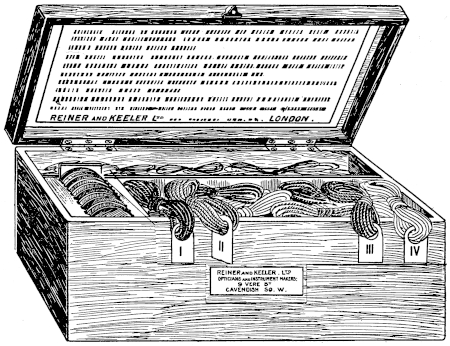
him the set of wools belonging to the Classification
Test, ask him to pick out all the reds. On examining
the pile of wools selected as reds, it will be
found that the majority are red, but in addition
there will be some browns and yellow-greens.
If he be then told to pick out the whole of the
greens the greater number of those selected will be
green, but there will be also greys, browns, and
reds. In each case, it will be seen that the
majority of wools are of the desired colour.
If another dichromic be examined in the same
way it will be found that, though he may not make
exactly the same mistakes, he will in all probability
pick out the same greens to put with the
reds, and the same reds to put with the greens.
The same result will be obtained if the colour-blind
persons be asked to name a large number of
colours. They will in most cases name the colour
correctly. It will be noticed that the greens which
were put with the reds when classifying the
colours, will be called red in naming them. It is
evident that the same idea has guided the colour-blind
in each case. This shows that, though a
person may be red-green blind, he is not absolutely
red-green blind in the sense of being totally
unable to distinguish between the two colours.
The fact that they are actually judging by colour
may be demonstrated by giving them coloured
materials of different kinds, or by asking them to
name a large number of coloured objects.
It will be seen that if we take a dichromic and
ask him to name a number of red and green wools,
in the majority of instances he will name them
correctly. But as, almost invariably, the same
wools are chosen, for all practical purposes the
same result would be obtained by asking a person
to name a few of these wools. What more decided
and brighter greens could we have than Nos. 76
and 94 of my Pocket Test? yet these are two of
the greens which are called reds by the dichromic.
We should have accomplished as much by asking
a colour-blind person to name Nos. 76 and 94 as if
we had asked him to name a large number of
greens. The colours in a test should, therefore, be
those which the colour-blind are particularly
liable to miscall. At the same time, their nature
should be unmistakable to the normal-sighted.
2. The colour-blind name colours in accordance
with their colour-perception, and thus show definitely
to which class they belong. I have not come
across a man who has guessed correctly when
examined with my test. A man who did guess
would know that he was incompetent. As the
colour-blind are often not aware of their defect
they answer as they see, only guessing when they
feel uncertain as to the nature of the colour shown.
There is probably more misapprehension on this
point than on any other in the practical testing of
colour-blindness.
3. Colours may be changed to the colour-blind,
whilst leaving them unaltered to the normal-sighted.
4. The phenomena of simultaneous and successive
contrast are much more marked for the colour-blind
than for the normal-sighted. Two colours, which
have not changed in the slightest degree to the
normal-sighted on being contrasted, have apparently
altered very considerably to the colour-blind.
As an example of this, let us take a pure deep
yellow, a bright red, and a bright green. To the
normal-sighted the yellow will be altered very
little by comparison with the red or the green, but
a trichromic would say that the colour was green
when contrasted with the red, red when contrasted
with the green. This principle of exaggerated
contrast must be borne in mind when examining a
candidate. Thus if a trichromic be doubtful about
a yellow, but seems inclined to call it green, he
should be given a pure green to compare with it.
In the same way, in showing the coloured lights,
the same colour produced in a different way
should often be shown. Thus an orange-red may
be shown immediately after a pure red. This will
not alter the colour to the normal-sighted, but
greatly facilitate the examination of the colour-blind.
5. Many colour-blind match correctly, but name
the principal colours wrongly. Therefore the test
must be a naming test, the examinee being
rejected if he confuse the colours which it is
essential he should distinguish between in his
occupation.
6. Many colour-blind recognise colours easily
when they are close to them, or the surface is large,
but fail to distinguish between them when they are at
a distance or the image on the retina is small. The
test must be constructed in conformity with these
facts.
7. The colour-blind are more dependent upon
luminosity than the normal-sighted, and are liable to
mistake a change in luminosity for a change of
colour. The test should have a means of rapidly
changing the luminosity of a colour.
8. The colour-blind find special difficulty with
faint and dim colours. The test should have
colours of this kind.
9. The colour-blind who have shortening of the
red end of the spectrum cannot see reds reflecting or
transmitting only rays corresponding to the shortened
portion. It is essential that reds of this kind
should form part of the test.
10. The colour-blind find more difficulty in
comparing colours when different materials are used,
than when the coloured objects are all of the same
nature.
11. Most colour-blind find more difficulty with
transmitted than with reflected light.
12. The colour-blind have a defective memory for
colours.
13. Colours may be changed to the normal-sighted
whilst leaving them unchanged to the colour-blind.
When three colours of the normal-sighted are
included in one of the colour-blind, it is obvious
that a change from one colour to another of the
three will make no difference to the colour-blind.
Also when the spectrum is shortened, the addition
or rays corresponding to the shortened portion to
another colour will not alter its appearance to the
person with the shortened spectrum. For instance,
to a person with shortening of the red end of the
spectrum, a blue will still remain blue, when so
many red rays from the shortened portion have
been added to it as to make it appear rose to the
normal-sighted.
14. The colour-blind may have a sense of luminosity
similar to that of the normal-sighted.
15. The dichromic distinguish between the colours
of the normal-sighted, which are included in
one of theirs by their relative luminosity and the
difference of saturation which is apparent to them.
A test should therefore have the means of presenting
colours of different saturation in succession.
16. Colour-blindness is frequently associated with
very high intelligence and exceptional ability.
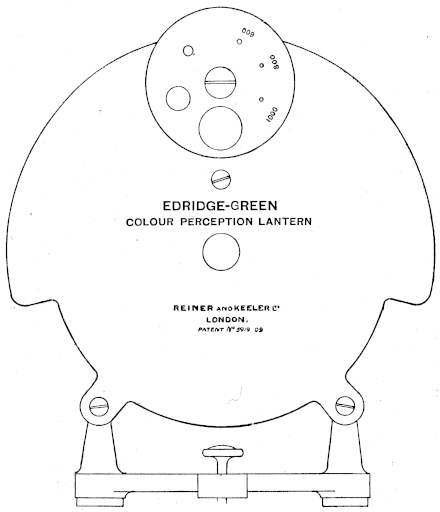
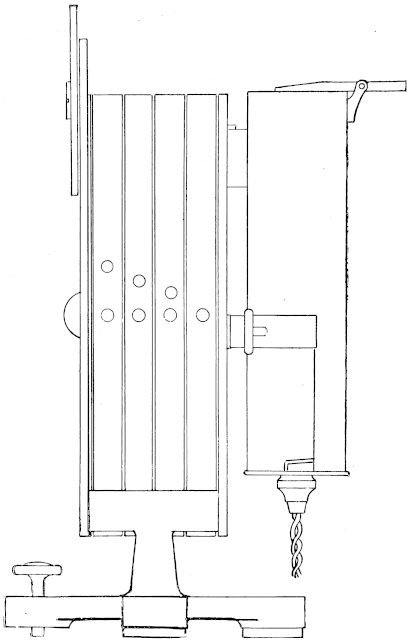
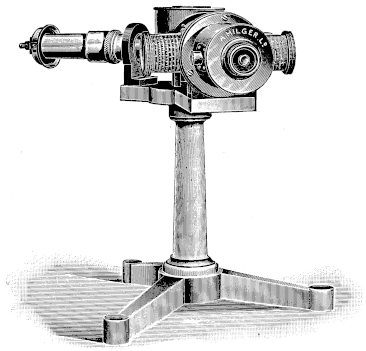
V. The Lantern Test.11—1. Description of apparatus.
The lantern contains four discs: three carrying
seven coloured glasses, and one with seven modifying
glasses. Each disc has a clear aperture. The
other mechanical details are: an electric or oil
lamp with projecting accessories, a diaphragm for
diminishing the size of the light projected, handles
for moving the discs and the indicator showing the
colour or modifier in use. The diaphragm is
graduated in respect to three apertures to represent
a 5 1/2‑inch railway signal bullseye at 600, 800,
and 1000 yards respectively when the test is made
at 20 ft. The glasses are as follows:—-
Coloured glasses.
Modifying glasses.
1.
Red (A and B).
7.
Ground glass.
2.
Yellow.
8.
Ribbed glass.
3.
Green.
9.
Neutral
(No. I).
4.
Signal Green.
10.
"
( " II).
5.
Blue.
11.
"
( " III).
6.
Purple.
12.
"
( " IV).
13.
"
( " V).
Fig. 3.
It will be noticed that three of the discs are
similar in every respect. In some of my lanterns
the two reds are put at the end of the series of
colours and numbered Red 1 and Red 2. This
makes no important difference, but the arrangement
given here is more convenient. It should be
noted that Red 1 corresponds to Red B and
Red 2 to Red A. If the electric lamp should
get broken the projecting apparatus can be
removed and an ordinary kerosene lamp placed
behind the aperture.
Fig. 4.
2. Reasons for special construction.—The lantern
has been constructed conformably with the requirements
and facts of colour-blindness. All the
facts I have given have been considered in
constructing the lantern.
The examiner, on possessing a lantern for the
first time, should carefully test himself with it and
ascertain how the different lights appear to him
with different conditions of general illumination.
It is probable that certain improvements may
suggest themselves to him, therefore, I think it
will be advisable to deal with certain of these
points, as it will help the examiner in the use of the
lantern. The colours have never been altered, and
I certainly should have altered them if I could
have improved the lantern by doing so. I have
never met a single colour-blind person who has
not been readily and easily detected with my
lantern, though I have examined many who have
passed other lanterns and in some cases a number
of other tests for colour-blindness. In most cases
one turn of the wheel will be sufficient to make a
colour-blind person disclose his defect.
The examiner may be dissatisfied with the
colour of the blue; let us, therefore, compare an
examination of a normal-sighted person with that
of an ordinary dichromic. The normal-sighted
person will name every one of the colours with ease
and certainty, with perhaps the exception of the
blue, with which he is in some doubt. Here is the
result of an examination of an ordinary dichromic:
he called the yellow, green; the green, red; the
signal green, no colour; the blue, blue; the
purple, green; red A, no colour or light; red B,
green. It will be noticed that the only colour
that he has correctly named is the blue. We can
try him again and again, and though he will mistake
all the other colours he will always name
the blue correctly. The examiner will have learnt
from this several important facts. He will see
that the colour-blind are really guided by their
sensations of colour, and that it is not simply a
matter of guessing. The more an examiner has
practical experience of colour-blindness, the more
will he recognise the fact that the colour-blind
are guided by their sensations of colour. He will
notice that the dichromic has readily recognised
the blue which was scarcely apparent to him (the
examiner), and therefore cannot have overlooked
as a matter of carelessness colours which are much
more apparent to the normal-sighted. The blue is
a valuable colour for other reasons, for though it is
not a colour on which I reject candidates, anyone
miscalling it must be very carefully examined
before he is passed. The trichromic generally
call this blue, green. If we wish to obtain a
purer blue, we can do so by combining the blue
or the purple with the signal green.
Again, the examiner may think that it might
be better to have an apparatus which showed
two or three lights instead of only one. I will
therefore give my reasons for adopting only one.
This point was one which occupied my attention
for a considerable time, especially in view of the
fact—which, as far as I am aware, I was the first
to discover—that simultaneous contrast is increased
to the colour-blind. I was naturally
anxious to turn this fact to account. I found,
however, that I gained nothing by increasing the
number of lights, and that in many cases it was
a source of error. A second or third light could
have been easily added to my lantern, but besides
unnecessarily complicating the apparatus
it would have served no useful purpose. All the
results which are obtained with simultaneous
contrast are obtained even more effectively with
successive contrast. It will be noticed that when
lights are seen in ordinary conditions they are
conditions of successive contrast, and not of
simultaneous contrast. An observer rarely keeps
his eyes definitely fixed on one light whilst he
names those adjacent to it, but moves his eyes
so that the images of the respective lights fall
successively on his foveas. When more than one
light is employed, all the disadvantages of matching
as against naming are introduced. It will be
seen that by presenting one light after another
we are fulfilling all the necessary conditions, only
that the light is moved instead of the eyes, sufficient
time being allowed to elapse to enable a
normal-sighted person to readily recognise the
true colour of the next light without being confused
by the after-image of the one he has just
seen. Many nervous normal-sighted would name
a yellow light seen between two red lights as
green, and it does look green to them from ordinary
physiological conditions. They look first at
one red light, then immediately at the yellow
light, then at the second red light, and then again
at the yellow light until they feel sure that the
centre light is a green light, and say so. I have
never met with a normal-sighted person who has
miscalled the unmodified light of my lantern, either
red or green. Many humble, nervous normal-sighted
persons are under the impression that they are
colour-blind, and yet would make perfectly efficient
officers. Many of these men have been told
by their wives or other persons that they are
colour-blind, and, believing this, try to see colours
which are not visible to them. I have examined
many persons of this description, and have noted
the ease and accuracy with which they have gone
through the tests for colour-blindness when they
have been assured by me that they were normal-sighted.
On the other hand, it is often very
difficult to convince a self-reliant, colour-blind
person that he is colour-blind. He is on the look-out
for the small differences which he notices
between colours, and the fact of having another
light for comparison gives him the desired clue,
and, though colour-blind, he passes the test.
The material is the best possible, as it will not
fade like all dyed substances, and therefore all
records made with one set of apparatus will be
uniform. Again, a coloured light has none of the
accessory qualities which enable the colour-blind
to pass through other tests. Thus many dichromics
will call the yellow glass red or green,
who would not think of putting a yellow with a
green or red wool, on account of the difference in
luminosity. He will, in the same way, if told to
pick out colours in the Classification Test to
match the colour of the light shown, have to
depend upon his colour-perception. This is a
useful method with nervous and undecided candidates.
The objection to it is that it cannot be
carried out in the dark or in a dark room. The
Test is not open to any of the objections which
may be urged against the method of simply
naming colours, because the character and intensity
of the colour may be changed at will.
The method is better than that of direct comparison,
because the candidate is forced to use
his colour-perception, and has to compare the
colour seen with previous impressions of colour
in his mind. By the use of neutral glasses, etc.,
I have obviated the fallacy of the method of
naming colours (namely, that these can be distinguished
by their saturation and luminosity),
and forced the individual to depend upon his
colour-perception, and not upon some other accessory
quality of the object seen.
No amount of coaching will enable a colour-blind
person to pass this test, whilst almost any
other may be passed in this way. I have tried
on many occasions to coach a man so as to pass
my lantern, and without success. The combinations
are so numerous that the only result is
to make the colour-blind man nervous and doubtful
and more easily detected than before. This
has occurred with men who could pass other tests
with ease.
The test also has a quality possessed by no
other—namely, that of enabling the examiner to
reject dangerous persons and dangerous persons
only, the lower degrees of colour-blindness being
allowed to pass.
3. Special directions for conducting the test.—(1)
The candidate should be seated at a distance
of twenty feet from the lantern. (2) He should
be asked to name the colour of the light produced
by a coloured glass (1 to 6) alone, or in combination
with another coloured glass or glasses,
or with the modifying glasses (7 to 13). (3) A
candidate should be rejected (i) if he call the red,
green, or the green, red, in any circumstances;
(ii) if he call the white light, in any circumstances,
red or green, or vice versa; (iii) if he call the red,
green, or white lights, black, in any circumstances.
(4) A candidate who makes mistakes,
other than those mentioned above, should be put
through a very searching examination. It is not
necessary to have the room absolutely dark; in
fact, I prefer a certain amount of light. The
examiner can, if he wish, make the test at night
in the open air.
The examiner should on no account conduct
the examination on any regular plan, because the
candidate, anxious to pass, finds out from persons
who have already passed the order and method
of the examination, and so, though colour-blind,
might obtain a certificate. Any one of the glasses
may be shown first, and the candidate required
to name the colour of the light. The following
will serve as an example of the method to be employed
in testing a candidate. A red being
shown, the candidate is required to name its
colour. Then a blue or green may be substituted.
It is best to use the largest aperture at first and
to show all the colours on one disc. This will
give confidence to the normal-sighted candidate,
whilst most of the colour-blind will be detected.
In the case of candidates who appear to be normal-sighted
and yet very nervous, there is no harm
in telling them after they have named all the
colours on the disc correctly that this is the case.
No comment should, however, be made on individual
answers. Then one of the neutral,
ground, or ribbed glasses should be inserted, not
the slightest intimation being given to the candidate
of the nature of the colour. He should be
asked to name or describe the light, and the
answer, if incorrect, together with his other replies,
carefully recorded. The other glasses may
then be shown, a combination of the neutral,
ground, ribbed, and coloured glasses being used
at irregular intervals.
When the candidate has been examined with
the largest aperture, the examiner can go through
the same procedure with one of the smaller apertures.
I have found the third aperture the one
which is most generally useful. On account of
the great diminution of total luminosity caused
by the diminished area of the light source, the
three smallest apertures can only be used in a
dark room.
If a candidate hesitate about a colour and
ultimately name it correctly, a second and, if
necessary, a third glass of the same colour should
be combined with the first. The fact that in one
case a single glass is used, and in another two or
three of the same coloured glass, makes very little
difference in the colour of the light to the normal-sighted.
This is not the case with the colour-blind;
a dichromic who has hesitated about a
green and then correctly named it may emphatically
call the light red when another green glass
is put in front of the first.
Care must be taken when the candidate is going
to be examined with two glasses at once, such as
one of the neutral, ground, or ribbed glasses, and
a coloured glass, that he does not see the light
until both are in position, or else he may see the
colour before it is modified in the necessary way.
If the candidate call the standard red, green;
or the standard green, red, in any circumstances—that
is, either alone or in combination with the
modifying glasses—he is to be rejected.
The examiner should ascertain for himself how
far the various colours are visible when modified
with the neutral glasses. If the red and green
be not visible with the thickest neutral in the
conditions of luminosity and external lighting
which the examiner is employing, he should use
the darkest neutral which allows the colours to
be plainly visible to the normal-sighted. In all
cases of doubt the examinee should be asked to
walk towards the lantern and told to say when
the light is visible, and asked to name its colour.
The distance at which the light is visible, and
then that at which the colour is visible, should
be noted and compared with the normal.
Particular attention should be paid to the
answers given to the combination of the thickest
neutral glass with the standard red and green
respectively.
The examiner should utilise the fact that successive
contrast is increased in the colour-blind,
as this is an easy method of detecting the trichromics.
The red having been shown, the light
should be quickly changed to yellow or clear,
the examiner’s hand being placed over the aperture
if there be any intervening colours. It is
necessary that the yellow should be shown immediately
after the red without any intervening
colours being first seen by the candidate. The
normal-sighted do not see any change in the
yellow or clear when they are shown after the red
light, but the trichromic call the yellow light,
green. The examinee should then be shown the
green light, and then the yellow or clear, in the
same way as mentioned for the red. The normal-sighted
will easily recognise the yellow, but the
trichromic will call it red. This portion of the
examination must never be omitted in any examination
in which the candidate is passed. The
two divisions of the test—that is, showing yellow
immediately after red and after green—may be
used at different periods of the examination, and,
if there be any doubt, repeated.
An examiner should, as far as possible, with
the exceptions given in the instructions, avoid all
conversation with the candidate, simply asking,
“What colour is this?” and recording the answer
without comment. If an examiner after each
answer say, “Quite right,” or some such expression,
the following is likely to occur. The
candidate after, say, six correct answers, makes a
mistake; the examiner says, “Are you sure?”
Then the candidate knows at once that he has
made a mistake, and makes a guess, very probably
a correct one. When a similar colour is
shown subsequently, he remembers the mistake
he made, and gives the second, and probably the
correct answer.
In addition to being an efficient test, it is a very
rapid test, as many men who have been certified
as normal after a lengthy examination with other
tests have at once disclosed their defect by calling
the green light of the lantern red. Many are
under the impression that in an examination with
the lantern the dichromics simply guess. This
is entirely wrong. A man who did guess would
know that he was incompetent. I find that men
have named the coloured lights in strict accordance
with their colour-perception. A man may,
however, guess if examined by an inexperienced
and ignorant examiner, who when the examinee
has made a mistake promptly corrects it in a
cross tone. A normal-sighted person will guess
when examined in this way. The examiner must
receive the examinee with a smiling face and
courteous manner, and appear pleased and satisfied
with the answers, no matter what they may
be. The candidate is then placed at his ease, and
answers according to his colour-perception. It
will be noticed that the lantern detects those who
have a slightly diminished colour-perception, as
well as the dangerous varieties of colour-blindness.
The former undoubtedly are not as efficient
as those who have a normal colour-perception, so
that a definite standard will have to be fixed, as
in the case of visual acuity. Further details will
be found in my book on Colour-Blindness.12
Summary of method of examination.—(1) Show
all the colours on one disc with the largest aperture.
(2) Show the reds, greens, and yellow modified
by the neutral glasses. (3) Show all the
colours on one disc with Number 3 aperture. (4)
Show red, then immediately afterwards yellow
with largest aperture. Then show green and
yellow immediately afterwards. (5) Test the
candidate with the red, green, and yellow with
the smallest aperture. (6) Show the neutrals or
ground glass alone. (7) Show blue made by combining
blue or purple with the signal green. (8)
Show a colour, for instance, green, and then combine
another glass of the same colour. (9) Show
the red produced by the combination of purple
with red A. (10) Give the combination of red A
and signal green.
VI. Other tests for colour-blindness.—I have
three other tests for colour-blindness: the Classification
Test, the Pocket Test, and the Colour-perception
Spectrometer. I have also devised an
instrument for estimating the exact amount of
red, at different wave-lengths, which is necessary
to neutralise the complementary in different
persons.
1. The Classification Test.—(a) Description.—This
test consists of 4 test colours and 180 confusion
colours; 150 coloured wools, 10 skeins of
silk, 10 small squares of coloured cardboard, and 10
small squares of coloured glass. The whole series
of colours is represented. In addition, there are
a large number of colours which have been chosen
by colour-blind persons as matching the test
colours. The test colours are Orange, Violet, Red,
and Blue-green, labelled I, II, III, and IV respectively.
The colours are chosen with the view
of presenting as much difficulty as possible to
the colour-blind, and as little as possible to the
normal-sighted. The colour-blind find especial
difficulty in matching or naming a colour lying
at the junction of two of their colours. As the
normal-sighted often find difficulty in saying
which colour predominates in a blue-green, so do
the tetrachromic with their purple-green, or the
trichromic with their red-green. A colour-blind
person may, however, match a colour correctly
which corresponds to the centre of one of his
colours. In addition to choosing those colours
for tests which are particularly liable to be mistaken
for other colours by the colour-blind, I have
used coloured materials of different kinds—wools,
silks, glass, and cards—so as to force the colour-blind
to judge by colour, and not by saturation
or luminosity. (See Fig. 5.)
Fig. 5.
(b) Method of examination.—The candidate
should be given the four test colours, and, having
named each, he should be told to select all those
which are similar in colour to the test colour.
He should be told to pay no attention to the fact
of a colour being lighter or darker; as long as it
is the same colour it should be put with the test
skein. The examiner should not go through the
test before the candidate first of all, neither
should one candidate be allowed to watch another
making his selection. A shrewd colour-blind
person might pass the test if he had seen a normal-sighted
person go through it previously. In order
to show the candidate the difference between a
shade and a colour, the examiner should take
one of the wools which is not a test colour—blue,
for instance—and pick out four or five shades of
the colour. The wools should be arranged without
the knowledge of the candidate, so that a
yellow or a grey is placed beside a red and the
examinee asked to name its colour. At another
period of the examination the yellow should be
placed adjacent to a green, and the examinee
again asked to name it.
The examinee may pick out a certain number
of colours correctly, and then stop, saying that
there are no more exactly like the test colour.
This may embarrass the examiner; he should,
however, examine any candidate who has omitted
any colours as carefully as if mistakes had been
made. He should ask the candidate to match
one of the omitted colours.
The examiner will soon find out from experience
those colours which are named and matched
wrongly by colour-blind persons; he should ask
the examinee to name some of these colours.
Any candidate should be rejected who calls an
orange or red, green or brown; black, red or vice
versa; or green, either purple, rose, red, grey,
brown, or violet. Similar mistakes in matching
necessitate objection. A candidate who puts
purple, rose, or blue with violet, or yellow-brown
with orange is most probably dangerously colour-blind
and should be very carefully examined.
There are cases which pass the Holmgren test
with ease that fail in the most conclusive manner
with my Classification Test. They put green with
orange, brown and black with red, and grey with
blue-green. This is due to a different selection
both of test colours and confusion colours. Orange
is by far the most important test colour, and its
confusion with green by the dichromics is very
conclusive. The three other test colours, violet,
red, and blue-green, represent both ends of the
spectrum and the neutral point in dichromic cases,
and practically these colours are those with which
most mistakes are made. This test can only be
regarded as supplementary to the Lantern Test.
2. The Pocket Test.—This consists of nineteen
cards, on nine of which are 112 single threads of
wool, and 14 pieces of twisted silk, similar to those
in the Classification Test. These are numbered
consecutively, with the exception of the first
thread of the first four cards, and the last thread
of the next four cards. The end threads of the first
four cards, I to IV, form the tests; they are
Orange, Violet, Red, and Blue-green. There are also
cards on which red, orange, green, blue, violet and
purple, and grey, respectively are to be found.
There are also two special cards marked “Without
Red” and two special cards marked “Without
Green.” (See Fig. 6.)
Fig. 6.
Many normal-sighted persons might object to the
inclusion of some of the colours on the orange card,
but this card clearly shows the colours which may
be taken as a match. Fine distinctions are not
wanted. The series of colours I have selected and
arranged so as to confuse the colour-blind and
force them to be guided by their colour-perception,
whilst the quantity of colour is amply sufficient
for the normal-sighted to pick out the colours
with the greatest ease. The cards should be
arranged irregularly on a white cloth in a good
light. The two most important tests colours are
the Orange and Violet, Nos. I and II. The person
examined should be asked to point out the shades
of colour similar to No. I (Orange). A piece of
paper rolled to a point should be used for this
purpose. If he do this correctly, he probably
possesses normal colour-perception. If, however,
he match the test with reds or pinks, he is more or
less colour-blind, at best belonging to the pentachromic
class. If, in addition, he match the
Violet test, No. II, with blue, he at least belongs
to the tetrachromic class. The trichromic, in
addition, may match the Blue-green test, No. III,
with brown and grey. The dichromic will match
the Orange test, No. I, with yellow-green and
yellow-brown. Similar mistakes will be made to
those described in connection with the Classification
Test. The examinee should be asked to name
all the colours on one of the cards. He should also
be asked to point out on which of the cards the
four test colours are to be found, and which
contain none of the test colour.
The examiner should continually change the
order of the cards. Most of the varieties of the
colour-blind will be readily detected in this way.
The special advantages of this test are: (1) The
colour-blind can be ranged definitely in their
proper classes. (2) Central scotoma can be
detected with its aid. (3) The series of colours are
arranged so as to confuse the colour-blind, whilst
the normal-sighted easily match the test colours.
(4) On account of the introduction of different
materials, the relative luminosity and saturation
of colours does not serve as a guide to the colour-blind.
(5) Portability. (6) The wools and silks are
kept clean. (7) An important colour is not likely
to be lost.
3. The Colour-Perception Spectrometer.13—(a)
Description of apparatus.—This instrument is a
spectrometer so arranged as to make it possible to
expose to view in the eyepiece the portion of a
spectrum between any two desired wave-lengths.
In the focal plane of the telescope are two adjustable
shutters with vertical edges; the shutters can
be moved into the field from right and left respectively,
each by its own micrometer screw, and to
each screw is attached a drum, the one being on
the right and the other on the left of the telescope.
On each of these drums is cut a helical slot in which
runs an index, and the drum is engraved in such a
manner that the reading of the index gives the
position in the spectrum of the corresponding
shutter in wave-lengths direct. (See Fig. 9.) Thus
it will be seen that if, for instance, the reading on
the left drum-head is 5320 and that on the right
drum-head is 5920, the region of the spectrum from
wave-length 5320 to wave-length 5920 is exposed
to view in the eyepiece.
Fig. 7.
Fig. 8.
Fig. 9.
(b) Directions for using the instrument.—It
should be used as far as possible with a known
quality and intensity of light. A small oil-lamp
is quite suitable for the purpose. The observer
should first ascertain the exact position of the
termination of the red end of the spectrum, the
left-hand shutter being moved across until every
trace of red just disappears. The position of the
pointer on the left-hand drum is noted, and the
wave-length recorded. The left drum is then moved
so that the shutter is more towards the middle of
the spectrum. The right-hand drum is then
moved, until the pointer indicates the wave-length
recorded as the termination of the red end
of the spectrum. The observer then moves the
left-hand shutter in and out until he obtains the
largest portion of red, which appears absolutely
monochromatic to him, no notice being taken of
variations in brightness, but only in hue. The
position of the index on the left-hand drum is
recorded. The left-hand shutter is then moved
towards the violet end of the spectrum, the right-hand
shutter being placed at the position previously
occupied by the left-hand shutter. In this
way the whole of the spectrum is traversed until
the termination of the violet end of the spectrum
is finally ascertained with the right-hand shutter.
The variation of the size of the patches and the
terminations of the spectrum with different intensities
of light can be noted. The instrument can
also be used for ascertaining the exact position
and size of the neutral patch in dichromics, the
position of greatest luminosity, and the size and
extent of pure colours. When it is used to test
colour-blindness, the examinee should first be
shown some portion of the interior of the spectrum,
and then asked to name the various colours which
he sees. In this way he will have no clue to the
colours which are being shown him.
Objections to other tests for colour-blindness.—The
tests which have been proposed for colour-blindness
are very numerous, but some are so
defective that it is rare to detect a single colour-blind
person with them. I have, for instance,
tested men whom I knew to be colour-blind with
certain lanterns with the result that not a single
one was detected. In these so-called tests all the
requirements of a test and facts of colour-blindness
have been neglected. I must, however, refer to
three tests constructed by exceptionally able men,
each with considerable knowledge of the subject.
I refer to the tests of Professor Holmgren, Professor
Stilling, and Professor Nagel.
All these tests can be passed at the first attempt
without coaching by certain dangerously colour-blind
persons, chiefly varieties not known to the
inventors, but the chief defect of each is that it is
very easy to coach a colour-blind person to pass it.
The surgeon to one of our largest railway companies
told me that when they used Holmgren’s
test they rejected one man in three hundred, but
with my lantern twelve in the same number. All
these three tests are much better tests when the
persons to be examined have not seen them before.
A colour-blind man may make only one mistake,
say for instance, as in a case I examined the other
day, with Nagel’s test (last edition), he passes the
test perfectly with the exception of one mistake,
that of calling a grey on one card, green. All he
has to do is to look for some distinguishing mark
on this card in order to go through the test with
the ease and certainty of a normal-sighted person.
It is the same with Stilling’s letters, he has only to
note the letter which he was not able to read and
the appearance of the card. A normal-sighted
man or woman would readily help him. The
confusion of green and grey does not appeal to the
average man as a serious defect, especially when
he sees his friend go through the rest of the test
perfectly. He says to himself, “I suppose he sees a
tinge of green in that grey.” The same man would
rightly regard it as a most iniquitous proceeding
to endeavour to coach his friend through a test
when he had seen him mistake a red for a green
light.
Holmgren’s test rejects a large number of
normal-sighted persons, as may be seen by the
reports of the Board of Trade; about 50 per cent
of those who appeal are found to be normal-sighted
and to have been rejected wrongly.
WILLIAM BRENDON AND SON, LTD.
PRINTERS, PLYMOUTH
ReinerandKeeler, Ltd.
OPTICIANS
——————AND——————
INSTRUMENT MAKERS
MANUFACTURERS OF
The Edridge-Green Colour Perception Lantern
The Edridge-Green Classification Test
The Edridge-Green Pocket Test
and other
Optical and Scientific Instruments
THE ABOVE COLOUR TESTS ARE CERTIFIED
BY PROF. F. W. EDRIDGE-GREEN