49. On the Morning of Christ's Nativity.
I.
This is the month, and this the happy morn,
Wherein the Son of Heaven's eternal King,
Of wedded Maid and Virgin-Mother born,
Our great redemption from above did bring;
For so the holy sages once did sing,
That he our deadly forfeit should release,
And with his Father work us a perpetual peace.
II.
That glorious form, that light unsufferable,
And that far-beaming blaze of majesty,
Wherewith he wont at Heaven's high council-table
To sit the midst of Trinal Unity,
He laid aside; and, here with us to be,
Forsook the courts of everlasting day,
And chose with us a darksome house of mortal clay.
III.
Say, heavenly Muse, shall not thy sacred vein
Afford a present to the Infant God?
Hast thou no verse, no hymn, or solemn strain,
To welcome him to this his new abode,
Now, while the heaven, by the Sun's team untrod,
Hath took no print of the approaching light,
And all the spangled host keep watch in squadrons bright?
IV.
See how from far upon the eastern road
The star-led wizards haste with odours sweet!
Oh! run, prevent them with thy humble ode,
And lay it lowly at his blessed feet;
Have thou the honour first thy Lord to greet,
And join thy voice unto the angel quire,
From out his secret altar touched with hallowed fire.
The Hymn.
I.
It was the winter wild,
While the heaven-born child
All meanly wrapt in the rude manger lies;
Nature in awe to him
Had doffed her gaudy trim,
With her great Master so to sympathize.
It was no season then for her
To wanton with the Sun her lusty paramour.
II.
Only with speeches fair
She woos the gentle air
To hide her guilty front with innocent snow,
And on her naked shame,
Pollute with sinful blame,
The saintly veil of maiden-white to throw,
Confounded, that her Maker's eyes
Should look so near upon her foul deformities.
III.
But he, her fears to cease,
Sent down the meek-eyed Peace;
She, crowned with olive-green, came softly sliding
Down through the turning sphere,
His ready harbinger,
With turtle wing the amorous clouds dividing;
And, waving wide her myrtle wand,
She strikes an universal peace through sea and land.
IV.
No war or battle's sound
Was heard the world around;
The idle spear and shield were high up hung;
The hooked chariot stood,
Unstained with hostile blood;
The trumpet spake not to the armed throng;
And kings sat still with awful eye,
As if they surely knew their sovran Lord was by.
V.
But peaceful was the night,
Wherein the Prince of Light
His reign of peace upon the earth began.
The winds, with wonder whist,
Smoothly the waters kissed,
Whispering new joys to the mild ocean,
Who now hath quite forgot to rave,
While birds of calm sit brooding on the charmed wave.
VI.
The stars, with deep amaze,
Stand fixed in steadfast gaze,
Bending one way their precious influence,
And will not take their flight,
For all the morning-light,
Or Lucifer that often warned them thence;
But in their glimmering orbs did glow,
Until their Lord himself bespake, and bid them go.
VII.
And, though the shady gloom
Had given day her room,
The sun himself withheld his wonted speed;
And hid his head for shame,
As his inferior flame
The new-enlightened world no more should need;
He saw a greater sun appear
Than his bright throne or burning axletree could bear.
VIII.
The shepherds on the lawn,
Or ere the point of dawn,
Sat simply chatting in a rustic row;
Full little thought they than
That the mighty Pan
Was kindly come to live with them below.
Perhaps their loves, or else their sheep,
Was all that did their silly thoughts so busy keep.
IX.
When such music sweet
Their hearts and ears did greet,
As never was by mortal finger strook;
Divinely-warbled voice
Answering the stringed noise,
As all their souls in blissful rapture took.
The air, such pleasure loth to lose,
With thousand echoes still prolongs each heavenly close.
X.
Nature, that heard such sound,
Beneath the hollow round
Of Cynthia's seat, the airy region thrilling,
Now was almost won
To think her part was done,
And that her reign had here its last fulfilling.
She knew such harmony alone
Could hold all Heaven and Earth in happier union.
XI.
At last surrounds their sight
A globe of circular light,
That with long beams the shame-faced Night arrayed.
The helmed Cherubim,
And sworded Seraphim,
Are seen, in glittering ranks with wings displayed,
Harping, in loud and solemn quire,
With unexpressive notes to Heaven's new-born Heir.
XII.
Such music—as 'tis said—
Before was never made,
But when of old the Sons of Morning sung;
While the Creator great
His constellations set,
And the well-balanced World on hinges hung,
And cast the dark foundations deep,
And bid the weltering waves their oozy channel keep.
XIII.
Ring out, ye crystal spheres!
Once bless our human ears,
—If ye have power to touch our senses so—
And let your silver-chime
Move in melodious time,
And let the base of heaven's deep organ blow;
And with your ninefold harmony
Make up full consort to the angelic symphony.
XIV.
For if such holy song
Enwrap our fancy long,
Time will run back, and fetch the Age of Gold;
And speckled Vanity
Will sicken soon and die,
And leprous Sin will melt from earthly mould;
And Hell itself will pass away,
And leave her dolorous mansions to the peering day.
XV.
Yea Truth and Justice then
Will down return to men,
Orbed in a rainbow, and like glories wearing;
Mercy will sit between,
Throned in celestial sheen,
With radiant feet the tissued clouds down steering;
And Heaven, as at some festival,
Will open wide the gates of her high palace-hall.
XVI.
But wisest Fate says No,
This must not yet be so,
The Babe lies yet in smiling infancy,
That, on the bitter cross,
Must redeem our loss;
So both himself and us to glorify:
Yet first, to those ychained in sleep,
The wakeful trump of doom must thunder through the deep.
XVII.
With such a horrid clang
As on Mount Sinai rang,
While the red fire and smouldering clouds outbrake,
The aged earth aghast,
With terror of that blast,
Shall from the surface to the centre shake;
When, at the world's last session,
The dreadful Judge in middle air shall spread his throne.
XVIII.
And then at last our bliss
Full and perfect is,
But now begins; for from this happy day
The Old Dragon under ground,
In straiter limits bound,
Not half so far casts his usurped sway,
And, wroth to see his kingdom fail,
Swinges the scaly horror of his folded tail.
XIX.
The oracles are dumb,
No voice or hideous hum
Runs through the arched roof in words deceiving.
Apollo from his shrine
Can no more divine,
With hollow shriek the steep of Delphos leaving.
No nightly trance, or breathed spell,
Inspires the pale-eyed priest from the prophetic cell.
XX.
The lonely mountains o'er,
And the resounding shore,
A voice of weeping heard and loud lament;
From haunted spring, and dale
Edged with poplar pale,
The parting Genius is with sighing sent;
With flower-inwoven tresses torn
The Nymphs in twilight shade of tangled thickets mourn.
XXI.
In consecrated earth,
And on the holy hearth,
The Lars and Lemures moan with midnight plaint;
In urns and altars round,
A drear and dying sound
Affrights the Flamens at their service quaint;
And the chill marble seems to sweat,
While each peculiar power forgoes his wonted seat.
XXII.
Peor and Baälim
Forsake their temples dim,
With that twice battered god of Palestine;
And mooned Ashtaroth,
Heaven's queen and mother both,
Now sits not girt with tapers' holy shine;
The Lybic Hammon shrinks his horn;
In vain the Tyrian maids their wounded Thammuz mourn.
XXIII.
And sullen Moloch, fled,
Hath left in shadows dread
His burning idol all of blackest hue;
In vain with cymbals' ring
They call the grisly king,
In dismal dance about the furnace blue;
The brutish gods of Nile as fast,
Isis, and Orus, and the dog Anubis haste.
XXIV.
Nor is Osiris seen
In Memphian grove or green,
Trampling the unshowered grass with lowings loud;
Nor can he be at rest
Within his sacred chest,
Nought but profoundest hell can be his shroud;
In vain, with timbrelled anthems dark,
The sable-stoled sorcerers bear his worshipped ark.
XXV.
He feels, from Juda's land,
The dreaded Infant's hand,
The rays of Bethlehem blind his dusky eyn;
Nor all the gods beside
Longer dare abide,
Nor Typhon huge ending in snaky twine.
Our Babe, to shew his Godhead true,
Can in his swaddling-bands control the damned crew.
XXVI.
So when the sun in bed,
Curtained with cloudy red,
Pillows his chin upon an orient wave,
The flocking shadows pale
Troop to the infernal jail,
Each fettered ghost slips to his several grave,
And the yellow-skirted fayes
Fly after the Night steeds, leaving their moon-loved maze.
XXVII.
But see! the Virgin blest
Hath laid her Babe to rest,
Time is our tedious song should here have ending;
Heaven's youngest-teemed star
Hath fixed her polished car,
Her sleeping Lord with handmaid-lamp attending;
And all about the courtly stable
Bright-harnessed angels sit in order serviceable.
Hence, loathed Melancholy!
Of Cerberus and blackest Midnight born,
In Stygian cave forlorn,
'Mongst horrid shapes, and shrieks, and sights unholy.
Find out some uncouth cell,
Where brooding Darkness spreads his jealous wings,
And the night-raven sings;
There, under ebon shades and low-browed rocks
As ragged as thy locks,
In dark Cimmerian desert ever dwell.
But come, thou Goddess fair and free,
In Heaven yclept Euphrosynè,
And by men, heart-easing Mirth;
Whom lovely Venus, at a birth
With two sister Graces more,
To ivy-crowned Bacchus bore;
Or whether, as some sager sing,
The frolic wind that breathes the spring,
Zephyr, with Aurora playing,
As he met her once a-maying,
There, on beds of violets blue,
And fresh-blown roses washed in dew,
Filled her with thee, a daughter fair,
So buxom, blithe, and debonair.
Haste thee, Nymph, and bring with thee
Jest, and youthful Jollity,
Quips, and Cranks, and wanton Wiles,
Nods and Becks, and wreathed Smiles—
Such as hang on Hebe's cheek,
And love to live in dimple sleek;
Sport, that wrinkled Care derides,
And Laughter, holding both his sides:
Come, and trip it as you go
On the light fantastic toe;
And in thy right hand lead with thee
The mountain-nymph, sweet Liberty;
And, if I give thee honour due,
Mirth, admit me of thy crew
To live with her and live with thee,
In unreproved pleasures free;
To hear the lark begin his flight,
And singing startle the dull night
From his watch-tower in the skies,
Till the dappled dawn doth rise;
Then to come, in spite of sorrow,
And at my window bid good-morrow,
Through the sweet-briar, or the vine,
Or the twisted eglantine;
While the cock, with lively din,
Scatters the rear of darkness thin,
And, to the stack or the barn-door,
Stoutly struts his dames before:
Oft listening how the hounds and horn
Cheerly rouse the slumbering Morn,
From the side of some hoar hill,
Through the high wood echoing shrill.
Sometime walking, not unseen,
By hedgerow elms, on hillocks green,
Right against the eastern gate,
Where the great Sun begins his state,
Robed in flames and amber light,
The clouds in thousand liveries dight;
While the ploughman, near at hand,
Whistles o'er the furrowed land,
And the milkmaid singeth blithe,
And the mower whets his scythe,
And every shepherd tells his tale,
Under the hawthorn in the dale.
Straight mine eye hath caught new pleasures,
Whilst the landscape round it measures;
Russet lawns, and fallows gray,
Where the nibbling flocks do stray,
Mountains on whose barren breast
The labouring clouds do often rest,
Meadows trim with daisies pied,
Shallow brooks, and rivers wide,
Towers and battlements it sees,
Bosomed high in tufted trees,
Where perhaps some Beauty lies,
The Cynosure of neighbouring eyes.
Hard by a cottage-chimney smokes
From betwixt two aged oaks,
Where Corydon and Thyrsis, met,
Are at their savoury dinner set
Of herbs and other country messes,
Which the neat-handed Phillis dresses;
And then in haste her bower she leaves,
With Thestylis to bind the sheaves;
Or, if the earlier season lead,
To the tanned haycock in the mead.
Sometimes, with secure delight,
The upland hamlets will invite,
When the merry bells ring round,
And the jocund rebecks sound,
To many a youth and many a maid,
Dancing in the chequered shade,
And young and old come forth to play
On a sunshine holiday,
Till the live-long daylight fail;
Then to the spicy nut-brown ale,
With stories told of many a feat,
How faery Mab the junkets eat;
She was pinched and pulled, she said;
And he, by Friar's lantern led,
Tells how the drudging goblin sweat,
To earn his cream-bowl duly set,
When in one night, ere glimpse of morn,
His shadowy flail hath threshed the corn
That ten day-labourers could not end;
Then lies him down, the lubber-fiend,
And, stretched out all the chimney's length,
Basks at the fire his hairy strength,
And crop-full out of doors he flings,
Ere the first cock his matin rings.
Thus done the tales, to bed they creep,
By whispering winds soon lulled asleep.
Towered cities please us then,
And the busy hum of men,
Where throngs of knights and barons bold,
In weeds of peace, high triumphs hold,
With store of ladies, whose bright eyes
Rain influence, and judge the prize
Of wit or arms, while both contend
To win her grace, whom all commend.
There let Hymen oft appear
In saffron robe, with taper clear,
And pomp, and feast, and revelry,
With mask and antique pageantry;
Such sights as youthful poets dream,
On summer-eves by haunted stream.
Then to the well-trod stage anon,
If Jonson's learned sock be on,
Or sweetest Shakespeare, Fancy's child,
Warble his native wood-notes wild.
And ever, against eating cares,
Lap me in soft Lydian airs,
Married to immortal verse,
Such as the meeting soul may pierce,
In notes with many a winding bout
Of linked sweetness long drawn out,
With wanton heed and giddy cunning
The melting voice through mazes running
Untwisting all the chains that tie
The hidden soul of harmony;
That Orpheus' self may heave his head,
From golden slumber on a bed
Of heaped Elysian flowers, and hear
Such strains as would have won the ear
Of Pluto, to have quite set free
His half-regained Eurydicè.
These delights if thou canst give,
Mirth, with thee I mean to live.
Hence, vain deluding Joys,
The brood of Folly without father bred!
How little you bested,
Or fill the fixed mind with all your toys!
Dwell in some idle brain,
And fancies fond with gaudy shapes possess,
As thick and numberless
As the gay motes that people the sunbeams,
Or likest hovering dreams,
The fickle pensioners of Morpheus' train.
But hail, thou Goddess sage and holy!
Hail, divinest Melancholy,
Whose saintly visage is too bright
To hit the sense of human sight,
And therefore to our weaker view
O'erlaid with black, staid Wisdom's hue;
Black, but such as in esteem
Prince Memnon's sister might beseem,
Or that starred Ethiop queen that strove
To set her beauty's praise above
The Sea-Nymphs', and their powers offended:
Yet thou art higher far descended.
Thee bright-haired Vesta long of yore
To solitary Saturn bore;
His daughter she; in Saturn's reign
Such mixture was not held a stain.
Oft in glimmering bowers and glades
He met her, and in secret shades
Of woody Ida's inmost grove,
While yet there was no fear of Jove.
Come, pensive Nun, devout and pure,
Sober, steadfast, and demure,
All in a robe of darkest grain,
Flowing with majestic train,
And sable stole of Cyprus lawn
Over thy decent shoulders drawn.
Come, but keep thy wonted state,
With even step, and musing gait,
And looks commercing with the skies,
Thy rapt soul sitting in thine eyes;
There, held in holy passion still,
Forget thyself to marble, till
With a sad, leaden, downward cast
Thou fix them on the earth as fast.
And join with thee calm Peace and Quiet,
Spare Fast, that oft with gods doth diet,
And hears the Muses in a ring
Aye round about Jove's altar sing;
And add to these retired Leisure,
That in trim gardens takes his pleasure.
But, first and chiefest, with thee bring
Him that yon soars on golden wing,
Guiding the fiery-wheeled throne,
The Cherub Contemplation;
And the mute Silence hist along,
'Less Philomel will deign a song,
In her sweetest, saddest plight,
Smoothing the rugged brow of Night;
While Cynthia checks her dragon-yoke,
Gently o'er the accustomed oak.
Sweet bird, that shunnest the noise of folly,
Most musical, most melancholy!
Thee, chantress, oft the woods among
I woo to hear thy even-song;
And missing thee I walk unseen,
On the dry, smooth-shaven green,
To behold the wandering moon,
Riding near her highest noon,
Like one that has been led astray
Through the heaven's wide pathless way,
And oft, as if her head she bowed,
Stooping through a fleecy cloud.
Oft, on a plat of rising ground,
I hear the far-off curfew sound,
Over some wide-watered shore,
Swinging slow with sullen roar;
Or, if the air will not permit,
Some still, removed place will fit,
Where glowing embers through the room
Teach light to counterfeit a gloom,
Far from all resort of mirth,
Save the cricket on the hearth,
Or the bellman's drowsy charm,
To bless the doors from nightly harm;
Or let my lamp, at midnight-hour,
Be seen in some high, lonely tower,
Where I may oft out-watch the Bear,
With thrice great Hermes, or unsphere
The spirit of Plato, to unfold
What worlds or what vast regions hold
The immortal mind, that hath forsook
Her mansion in this fleshly nook;
And of those demons that are found
In fire, air, flood, or underground,
Whose power hath a true consent
With planet, or with element.
Sometime let gorgeous Tragedy
In sceptred pall come sweeping by,
Presenting Thebes, or Pelops' line,
Or the tale of Troy divine,
Or what, though rare, of later age
Ennobled hath the buskined stage.
But, O sad Virgin! that thy power
Might raise Musæus from his bower,
Or bid the soul of Orpheus sing
Such notes as warbled to the string
Drew iron tears down Pluto's cheek,
And made Hell grant what love did seek;
Or call up him that left half-told
The story of Cambuscan bold,
Of Camball, and of Algarsife,
And who had Canacè to wife,
That owned the virtuous ring and glass;
And of the wondrous horse of brass,
On which the Tartar king did ride;
And if ought else great bards beside
In sage and solemn tunes have sung,
Of tourneys and of trophies hung,
Of forests and enchantments drear,
Where more is meant than meets the ear.
Thus, Night, oft see me in thy pale career,
Till civil-suited Morn appear,
Not tricked and frounced, as she was wont
With the Attic boy to hunt,
But kerchiefed in a comely cloud,
While rocking winds are piping loud,
Or ushered with a shower still,
When the gust hath blown his fill,
Ending on the rustling leaves,
With minute-drops from off the eaves.
And when the sun begins to fling
His flaring beams, me, Goddess, bring
To arched walks of twilight groves,
And shadows brown, that Sylvan loves,
Of pine, or monumental oak,
Where the rude axe with heaved stroke
Was never heard the Nymphs to daunt,
Or fright them from their hallowed haunt
There, in close covert by some brook,
Where no profaner eye may look,
Hide me from day's garish eye,
While the bee with honeyed thigh,
That at her flowery work doth sing,
And the waters murmuring,
With such concert as they keep,
Entice the dewy-feathered Sleep.
And let some strange, mysterious dream
Wave at his wings, in aery stream
Of lively portraiture displayed,
Softly on my eyelids laid;
And, as I wake, sweet music breathe
Above, about, or underneath,
Sent by some Spirit to mortals good,
Or the unseen Genius of the wood.
But let my due feet never fail
To walk the studious cloisters pale,
And love the high embowed roof,
With antic pillars massy-proof
And storied windows richly dight,
Casting a dim religious light.
There let the pealing organ blow,
To the full-voiced quire below,
In service high, and anthems clear,
As may with sweetness, through mine ear,
Dissolve me into ecstasies,
And bring all Heaven before mine eyes.
And may at last my weary age
Find out the peaceful hermitage,
The hairy gown and mossy cell,
Where I may sit, and rightly spell
Of every star that heaven doth shew,
And every herb that sips the dew;
Till old experience do attain
To something like prophetic strain.
These pleasures, Melancholy, give,
And I with thee will choose to live.
In this Monody the author bewails a learned friend,
unfortunately drowned in his passage from Chester, on the Irish Sea,
1637; and by occasion foretells the ruin of our corrupted clergy, then
in their height.
Yet once more, O ye laurels, and once more
Ye myrtles brown, with ivy never-sere,
I come to pluck your berries harsh and crude,
And with forced fingers rude
Shatter your leaves before the mellowing year.
Bitter constraint, and sad occasion dear,
Compel me to disturb your season due;
For Lycidas is dead, dead ere his prime,
Young Lycidas, and hath not left his peer.
Who would not sing for Lycidas? he knew
Himself to sing, and build the lofty rime.
He must not float upon his watery bier
Unwept, and welter to the parching wind,
Without the meed of some melodious tear.
Begin then, Sisters of the sacred well,
That from beneath the seat of Jove doth spring;
Begin, and somewhat loudly sweep the string.
Hence with denial vain, and coy excuse—
So may some gentle Muse
With lucky words favour my destined urn,
And as he passes turn,
And bid fair peace be to my sable shroud—
For we were nursed upon the self-same hill,
Fed the same flock by fountain, shade, and rill;
Together both, ere the high lawns appeared
Under the opening eyelids of the Morn,
We drove a-field, and both together heard
What time the grey-fly winds her sultry horn,
Battening our flocks with the fresh dews of night,
Oft till the star that rose at evening, bright,
Toward heaven's descent had sloped his westering wheel.
Meanwhile the rural ditties were not mute,
Tempered to the oaten flute;
Rough Satyrs danced, and Fauns with cloven heel
From the glad sound would not be absent long,
And old Damœtas loved to hear our song.
But oh! the heavy change, now thou art gone,
Now thou art gone, and never must return!
Thee, Shepherd, thee the woods and desert caves,
With wild thyme and the gadding vine o'ergrown,
And all their echoes mourn.
The willows, and the hazel-copses green,
Shall now no more be seen
Fanning their joyous leaves to thy soft lays.
As killing as the canker to the rose,
Or taint-worm to the weanling herds that graze,
Or frost to flowers, that their gay wardrobe wear,
When first the white-thorn blows;
Such, Lycidas, thy loss to shepherds' ear.
Where were ye, Nymphs, when the remorseless deep
Closed o'er the head of your loved Lycidas?
For neither were ye playing on the steep,
Where your old bards, the famous Druids, lie,
Nor on the shaggy top of Mona high,
Nor yet where Deva spreads her wizard stream.
Ay me, I fondly dream!
Had ye been there ... for what could that have done?
What could the Muse herself that Orpheus bore,
The Muse herself for her enchanting son,
Whom universal Nature did lament,
When, by the rout that made the hideous roar,
His gory visage down the stream was sent,
Down the swift Hebrus to the Lesbian shore?
Alas! what boots it with incessant care
To tend the homely, slighted shepherd's trade,
And strictly meditate the thankless Muse?
Were it not better done, as others use,
To sport with Amaryllis in the shade,
Or with the tangles of Neæra's hair?
Fame is the spur that the clear spirit doth raise
—That last infirmity of noble mind—
To scorn delights, and live laborious days;
But the fair guerdon when we hope to find,
And think to burst out into sudden blaze,
Comes the blind Fury with the abhorred shears,
And slits the thin-spun life. 'But not the praise,'
Phœbus replied, and touched my trembling ears.
'Fame is no plant that grows on mortal soil,
Nor in the glistering foil
Set-off to the world, nor in broad rumour lies,
But lives and spreads aloft by those pure eyes,
And perfect witness of all-judging Jove;
As he pronounces lastly on each deed,
Of so much fame in Heaven expect thy meed.'
O fountain Arethuse, and thou honoured flood,
Smooth-sliding Mincius, crowned with vocal reeds,
That strain I heard was of a higher mood.
But now my oat proceeds,
And listens to the herald of the sea,
That came in Neptune's plea.
He asked the waves, and asked the felon winds,
What hard mishap hath doomed this gentle swain?
And questioned every gust of rugged wings,
That blows from off each beaked promontory.
They knew not of his story;
And sage Hippotades their answer brings,
That not a blast was from his dungeon strayed;
The air was calm, and on the level brine
Sleek Panopè with all her sisters played.
It was that fatal and perfidious bark,
Built in the eclipse, and rigged with curses dark,
That sunk so low that sacred head of thine.
Next Camus, reverend sire, went footing slow,
His mantle hairy and his bonnet sedge,
Inwrought with figures dim, and on the edge
Like to that sanguine flower inscribed with woe.
'Ah! who hath reft,' quoth he, 'my dearest pledge?'
Last came, and last did go,
The pilot of the Galilean lake;
Two massy keys he bore of metals twain—
The golden opes, the iron shuts amain.
He shook his mitred locks, and stern bespake:
'How well could I have spared for thee, young swain,
Enow of such as, for their bellies' sake,
Creep, and intrude, and climb into the fold!
Of other care they little reckoning make,
Than how to scramble at the shearers' feast,
And shove away the worthy bidden guest.
Blind mouths! that scarce themselves know how to hold
A sheep-hook, or have learned aught else the least
That to the faithful herdman's art belongs!
What recks it them? What need they? They are sped;
And, when they list, their lean and flashy songs
Grate on their scrannel pipes of wretched straw;
The hungry sheep look up, and are not fed,
But, swollen with wind and the rank mist they draw,
Rot inwardly, and foul contagion spread;
Beside what the grim wolf with privy paw
Daily devours apace, and nothing said.
But that two-handed engine at the door
Stands ready to smite once, and smite no more.'
Return, Alpheüs, the dread voice is past,
That shrunk thy streams; return, Sicilian Muse,
And call the vales, and bid them hither cast
Their bells, and flowerets of a thousand hues.
Ye valleys low, where the mild whispers use
Of shades, and wanton winds, and gushing brooks,
On whose fresh lap the swart-star sparely looks;
Throw hither all your quaint-enamelled eyes,
That on the green turf suck the honeyed showers,
And purple all the ground with vernal flowers.
Bring the rathe primrose that forsaken dies,
The tufted crow-toe, and pale jessamine,
The white pink, and the pansy freaked with jet,
The glowing violet,
The musk-rose, and the well-attired woodbine,
With cowslips wan that hang the pensive head,
And every flower that sad embroidery wears;
Bid amaranthus all his beauty shed,
And daffadillies fill their cups with tears,
To strew the laureate herse where Lycid lies.
For so, to interpose a little ease,
Let our frail thoughts dally with false surmise,
Ay me! whilst thee the shores and sounding seas
Wash far away, where'er thy bones are hurled;
Whether beyond the stormy Hebrides,
Where thou perhaps under the whelming tide
Visitest the bottom of the monstrous world;
Or whether thou, to our moist vows denied,
Sleepest by the fable of Bellerus old,
Where the great Vision of the guarded mount
Looks towards Namancos and Bayona's hold....
Look homeward, Angel, now, and melt with ruth;
And, O ye dolphins, waft the hapless youth.
Weep no more, woful shepherds, weep no more,
For Lycidas, your sorrow, is not dead,
Sunk though he be beneath the watery floor.
So sinks the day-star in the ocean-bed,
And yet anon repairs his drooping head,
And tricks his beams, and with new-spangled ore
Flames in the forehead of the morning sky:
So Lycidas sunk low, but mounted high,
Through the dear might of Him that walked the waves,
Where, other groves and other streams along,
With nectar pure his oozy locks he laves,
And hears the unexpressive nuptial song,
In the blest kingdoms meek of joy and love.
There entertain him all the saints above,
In solemn troops, and sweet societies,
That sing, and singing in their glory move,
And wipe the tears for ever from his eyes.
Now, Lycidas, the shepherds weep no more;
Henceforth thou art the Genius of the shore,
In thy large recompense, and shalt be good
To all that wander in that perilous flood.
Thus sang the uncouth swain to the oaks and rills,
While the still Morn went out with sandals gray;
He touched the tender stops of various quills,
With eager thought warbling his Doric lay;
And now the sun had stretched out all the hills,
And now was dropped into the western bay.
At last he rose, and twitched his mantle blue;
To-morrow to fresh woods, and pastures new.
53. On His Blindness.
When I consider how my light is spent
Ere half my days, in this dark world and wide,
And that one talent, which is death to hide,
Lodged with me useless, though my soul more bent
To serve therewith my Maker, and present
My true account, lest He, returning, chide;
'Doth God exact day-labour, light denied?'
I fondly ask. But Patience, to prevent
That murmur, soon replies: 'God doth not need
Either man's work or his own gifts. Who best
Bear his mild yoke, they serve him best. His state
Is kingly. Thousands, at his bidding, speed
And post o'er land and ocean, without rest;
They also serve who only stand and wait.'
Keightley's Text.

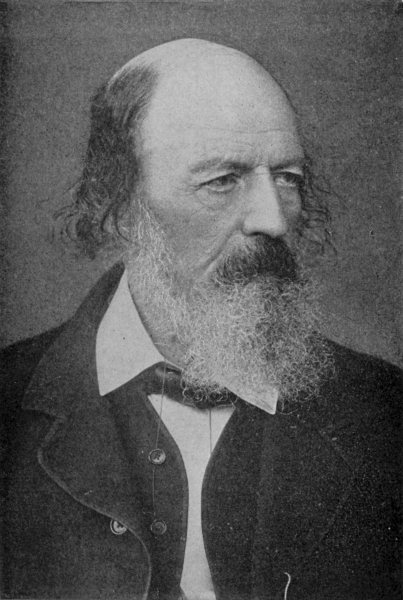 Alfred, Lord Tennyson.