Of all manifestations of literary genius humour is
the rarest, and I am not sure that it is not the
highest. Laughter is immortal. The sentimental
novels over which our grandfathers and grandmothers
shed floods of tears—the “Corinnas,” the
“Clarissas,” and the “New Heloises”—have become
for us soporifics of an almost irresistible strength.
But the world still laughs, and will laugh for ever,
over the masterpiece of Cervantes and the burlesques
of Voltaire. Who nowadays can read from beginning
to end Francesco Petrarca, and who can put down
Giovanni Boccaccio when once begun?
Then again, whilst the demand for refreshing,
invigorating laughter has been in all times the
greatest, the number of authors who have come
forward to dispense it is surprisingly small, even
in the richest literatures. The Italians, for example,
have had only one master of immortal laughter—the
above-mentioned Boccaccio. The great Manzoni
possessed the deep intrinsic qualities of a humorist
but had not the pungency. In the long list of
Italian authors of our century there is only one
humorist of first magnitude—Carlo Porta, who
xwrote not in literary Italian but in the Milanese
dialect.
Of all races the stern, sad English are by far the
richest in the beautiful gift of genuine humour. The
melancholy Slavonians come, I think, next to the
English. Melancholy does not exclude humour.
On the contrary, the richest pearls of humour are
gathered at the bottom of the sea of sadness. The
greatest humorists have never been men of cheerful
mood, and this seems to be as true of nations
as of men.
From the time when Russia first possessed a
literature worthy of the name, we have always had
eminent humorists, some of them, like Gogol and
Shchedrìn, belonging to those makers of divine
laughter who so rarely appear among the nations.
But although justly popular in their own country,
the Russian humorists are hardly known abroad.
This is certainly due not to want of opportunity
of knowing them. Gogol’s masterpieces, “Dead
Souls” and “The Inspector,” were translated years
ago into English. But he is not half so well known
in this country as any of the three great Russian
novelists. Humour is so eminently national, it is
so closely bound to the soil where it is born, that
it can rarely be transplanted to other climes and
skies. It certainly loses more in translation than
ordinary fiction, and it requires a peculiar gift on
the part of the translator that its distinctive characteristics
should not be lost altogether. However,
translators have had the courage to try their
skill upon Gogol, who is not only the greatest
but the most comprehensible of Russian humorists.
xiWith him the comical effect results neither from
the peculiar manner of description nor from the
contrasts presented, but from his unique gift of
bringing to the surface the comical traits of men’s
characters. His is the deepest and the most artistic
form of humour, which on this account becomes
sometimes international. Gogol’s heroes—some of
them at least—are as comprehensible to the English
as Charles Dickens’s Mr. Micawber and Mrs. Nickleby
are comprehensible to the Russians.
The present volume contains two beautiful examples
of Gogol’s art, which has not been yet translated into
English—“A Madman’s Diary” and “Marriage.”
The “Diary” is a fanciful sketch, presenting perhaps
the most typical sample of “Humour,” as
distinguished from other forms of the comical, which
can be found in any literature. It is an intensely
pathetic, and at the same time irresistibly droll, bit of
autobiography of a poor wretch of an official whose
life has been one of insufferable humiliation, and
whose mind, upset by a fatal passion for a fashionable
girl, seeks refuge in the dream of greatness ending in
total madness. “Laughter through tears,” that was
Gogol’s own definition of the character of his muse,
and in no other work has he shown so palpably what
he meant by that expression as in “A Madman’s
Diary.”
“Marriage,” although bearing the author’s heading,
“an utterly incredible story,” and viewed by him as
a mere joke, is recognised by all Russia as one of
Gogol’s truest and finest works. It contains two of
the best conceived and most delicately drawn characters
of our great character-maker, that of the hero,
xiithe old bachelor Podkolyòssin, an amusing type of
irresolution and pusillanimity, and of his friend
Kochkaryòv, the meddlesome busybody, who, just after
he has abused the professional matchmaker Fèkla
for having married him to a fool, becomes fired with
an irresistible longing to confer upon his bosom friend
Podkolyòssin the blessing of an alliance with another
fool of exactly the same type. As a comedy of
customs “Marriage” reproduces a patriarchal life so
remote from the modern English that some explanations
are necessary. Among the uneducated
part of the Russian middle-class, as well as among
the peasantry, marriages are arranged by the parents.
The young people being considered too ignorant to be
consulted upon a matter of such importance. In the
villages, among the peasantry, where everybody is
known by everybody else, no special intermediaries
are needed to arrange these matches. But it is
different with the middle-class living in large cities.
Here a class of professional matchmakers and go-betweens
exists. Naturally enough, it lends itself
very much to ridicule, and two samples of it appear
in the present volume—one in Gogol, the other in
Ostròvsky’s comedy.
Gogol, who was born in 1810 and died in 1852, is
the oldest of our great prose writers. To him we can
trace the origin of the Russian realistic novel as well
as drama. Ostròvsky, who is his successor in the
dramatic art, is our contemporary. He was born in
1824, and died four years ago. To him the Russians
owe their theatre: he left us thirty-seven dramas and
comedies, varying in merit and popularity, but all
keeping their place upon the stage.
xiii“Incompatibility of Temper”—one of the two of
his comedies that are given in the present volume—is
a sample of that pure and deep humour
which we admire in Gogol. Serafìma, the heroine,
with her extraordinary stupidity, sentimentality,
apparent whimsicalness, and practical pigheadedness,
is as living and striking a creation of Russian
humour as the best of Gogol’s types. But in the
next comedy the sunny, sympathetic humour changes
into the harsh laughter of the satirist.
The “Domestic Picture,” the second of Ostròvsky’s
dramas, is anything but a picture of Russian domestic
life. It is a bitter and merciless satire, exposing the
commercial dishonesty, the result of ignorance, which
prevailed in the bulk of our middle-class two generations
ago, and the shocking immorality nestling
secretly in those families where despotism has
destroyed all natural ties of affection and uprooted
all sense of honour.
With Shchedrìn (Saltykòv) we are in presence of
the greatest satirist the Slavonic race has produced.
He is a man of our time, Russia having lost him
only a few years ago. For about fifty years he was
the moral leader of liberal Russia, having devoted
his life to the awakening of the national conscience
by all the ways and methods which his incomparable
genius could suggest. He was the political chronicler
of his time, reproducing in rough caricatures, which
made the whole of reading Russia roar with laughter,
the principal events which took place in the country.
At the same time, in his more elaborate works, as the
“Story of the Golovlevs,” and others, he equals
Dostoyèvsky in the power of creating weird, gloomy,
xivstrikingly original figures, as well as in the subtle
delineation of the whole man from the inner side.
When the boldness of some idea or the virulence
of some attack rendered it impossible for Shchedrìn
(on account of the censorship) to speak plainly, he
resorted to what he himself used to call the “slave’s
language,” employing the Oriental form of the fable,
the allegory, the fairy tale.
The best of Shchedrìn’s works are not translated
into English, and probably will never be. His unrivalled
wit and humour are untranslatable, because
they depend chiefly upon the marvellous skill in
using the Russian language. This is not inferiority,
but difference in the quality of the talent. Rudyard
Kipling’s military stories, to quote an English example,
are certainly very fine samples of genuine
humour. But what would remain of them if stripped
of their racy idiom? And how many second and
third-rate authors are just as good (or as bad) in any
decent translation?
Our great satirist stands at the head of those
authors who must be read in their own tongue. The
translator has shown much discernment in choosing
as samples of Shchedrìn’s art three minor works
of his, in which the language is of lesser importance.
One is a burlesque, “The Recollections of
Onésime Chenapan,” which is an amusing caricature
of the Russian “administrators.” The other
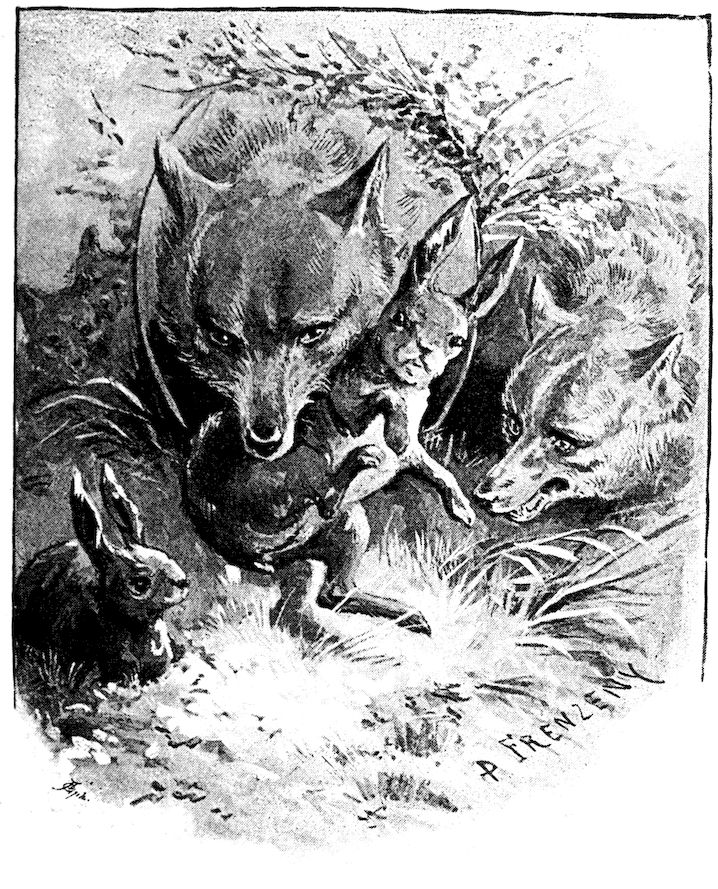
two are fables—“The Self-Sacrificing Rabbit,” in
which the satirist boldly ridicules nothing less than
the feeling of loyalty under a régime which consists of
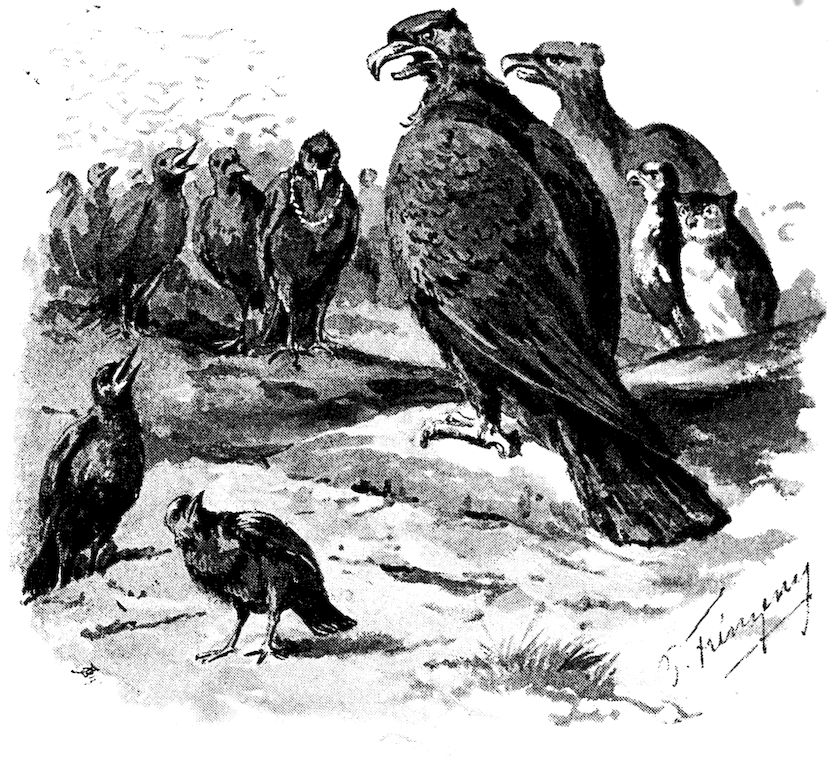
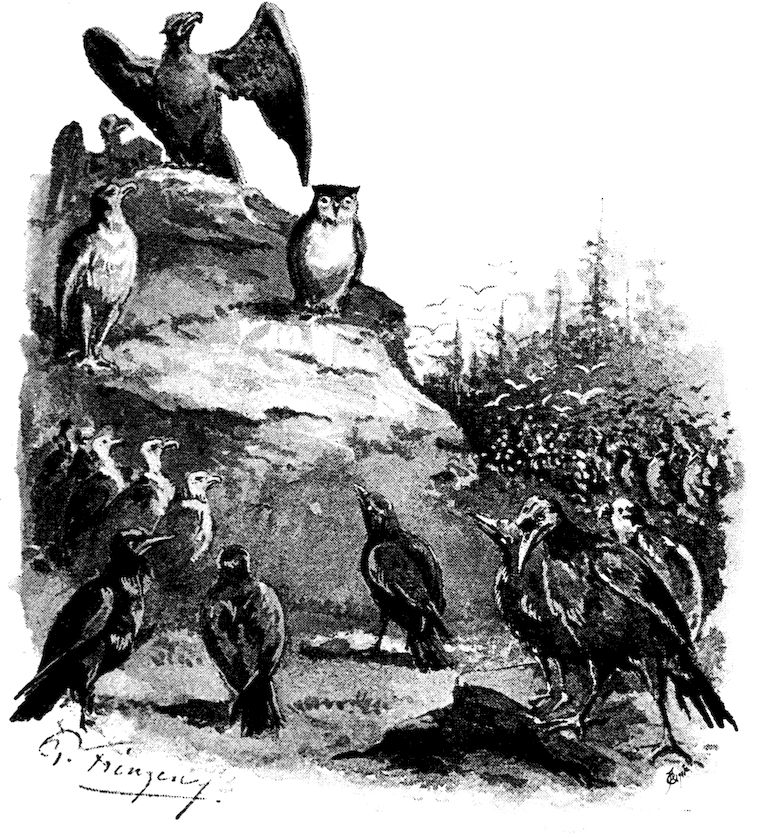
brutal violence erected into a system, and “The Eagle
as Mecænas,” a skit on the Tzar himself.
xvThe gloomy author of Crime and Punishment
once relieved his mind with a queer, semi-fantastic
little story, “The Crocodile,” which amuses by
its incongruities and contrasts. It has not been
before translated, so far as I know, into any foreign
language, and the English admirers of Dostoyèvsky
will be the first to read it.
But the object of the translator was not merely to
make a collection of the best humoristic works of the
best Russian authors. She wanted to give samples of
all kinds of Russian humour, and her list includes the
two Uspènskys, Glyeb and Nikolai, V. Slyeptzòv, and
even some sketches by Gorbounòv. There is hardly a
name worth mentioning that could be added to these.
As to translation, it is as good as it possibly could be.
Only a person with the translator’s exceptional knowledge
of the Russian language could have overcome
the difficulties inherent in a work of such a kind.
Yet, with all that, I doubt whether the English will
make a fair estimate of the above-mentioned authors,
though among them there is one—Glyeb Uspènsky—who
enjoys an enormous and well-merited popularity
among the very exacting and discriminating
Russian public.
What has been said about the untranslatableness
of Shchedrìn applies à fortiori to the
minor humorists. Their charm depends in a still
greater degree upon the language. The unique flexibility,
richness, and freedom of the Russian idiom
allows those few who have got the mastery over it to
obtain with it truly wonderful effects. Some authors
do this at the expense of more substantial qualities.
With our younger humorists the language runs riot.
xviThey are like those injudicious painters who, having
a great command over the colouring, neglect to give
the necessary correctness and fulness to the lines,
which alone know of no decay and are preserved
through time and space. The translation is like the
plain black and white reproduction of a picture.
Only the substantial, unperishable part of the
work is preserved, the rest being lost almost
entirely. And in regard to the examples taken here
from our minor humorists,—if English readers enjoy
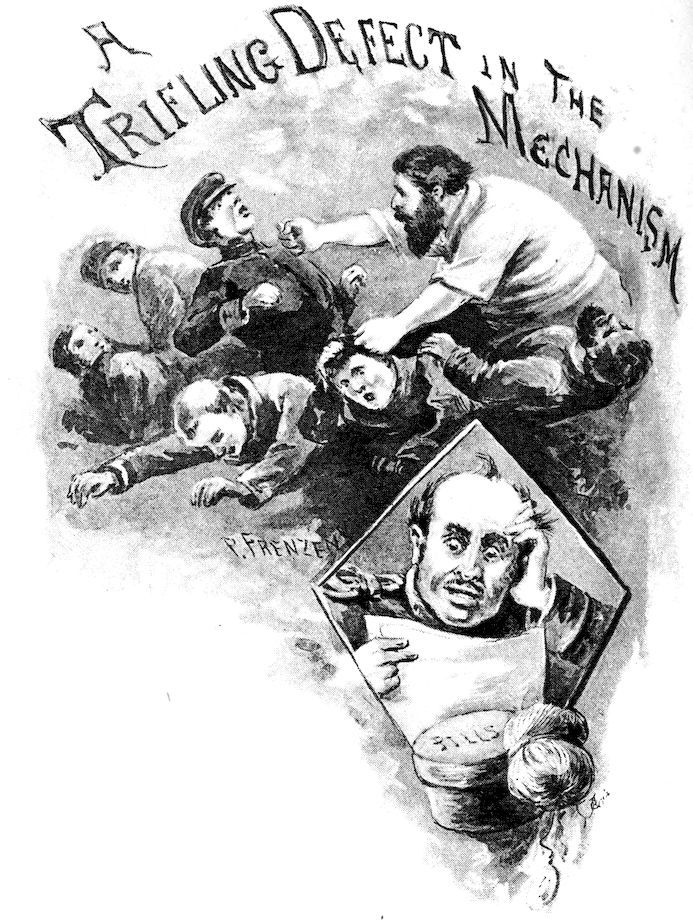
the humour of “A Trifling Defect in the Mechanism,”
or “The Porridge,” it will be as high a compliment to
the translator as to the authors.
A trifle of my own—“The Story of a Kopeck”—has
been kindly included by the translator in the present
collection. It is quite a youthful production, and
will not, I am afraid, be of much credit to Russian
humour. But in view of the catholicity of the
translator’s choice, which includes even Gorbounòv,
I thought it might stand where it is.
Whatever be the reader’s opinion of the merit of
separate stories, the translator, as well as the publishers,
deserve the thanks of the lover of Russian
literature for bringing out this collection.
The smile is the most characteristic trait of a
human face. We do not really know what a face
is like before we have seen it smiling. Now with
a nation its humour is what a smile is with an
individual.
S. STEPNIAK.
THE HUMOUR OF RUSSIA
DRAMATIS PERSONÆ.
Agàfia Tikhònovna, marriageable girl of the merchant class.
Arìna Pantelèymovna, her aunt.
Fèkla Ivànovna, professional matchmaker.
Podkolyòssin, aulic counsellor.
Kochkaryòv, his friend.
Yaìchnitza, usher.
Anoùchkin, retired infantry officer.
Zhevàkin, seafaring person.
Douniàshka, a girl in the house.
Starikòv, shopkeeper.
Stepàn, Podkolyòssin’s servant.
MARRIAGE. — Act I. Scene I. — Scene II. — Act II. Scene I.
1
AN UTTERLY INCREDIBLE INCIDENT.
IN TWO ACTS.
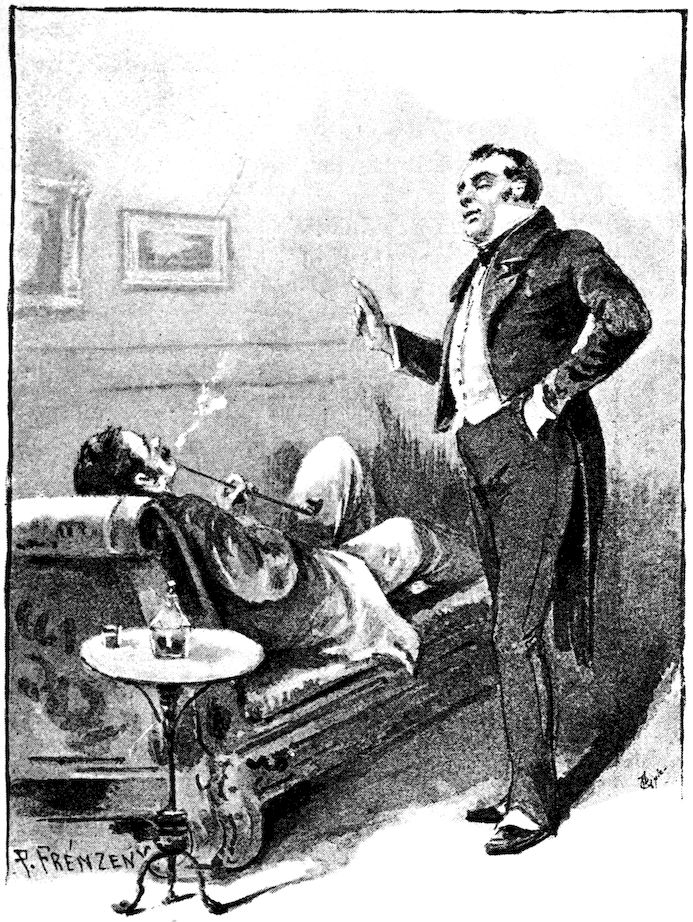
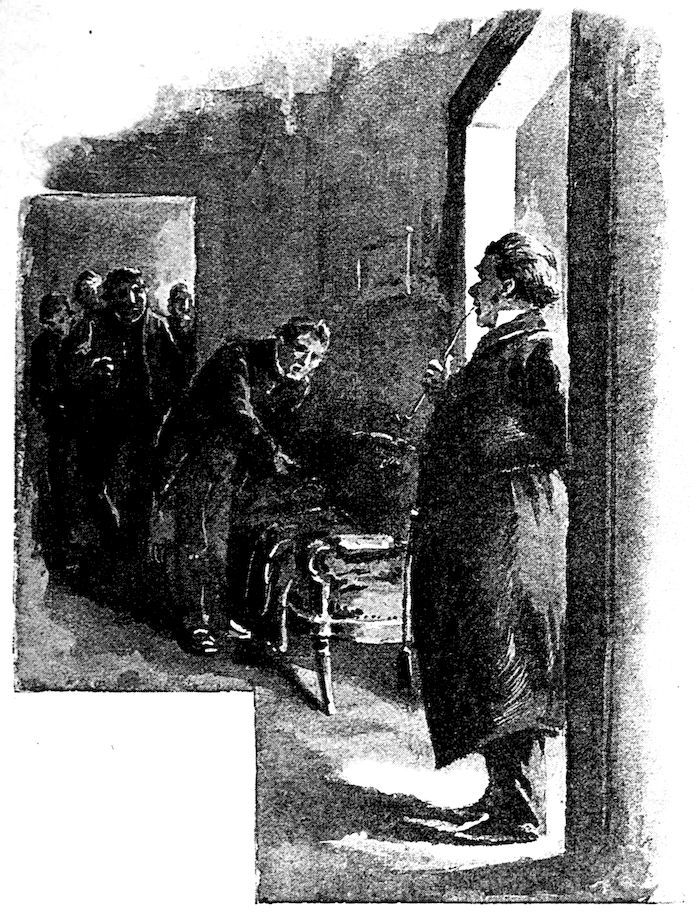
(A bachelor’s apartment.Podkolyòssin, alone, lying on the sofa smoking a pipe.)
Pod. Really when a man’s alone, and thinks about it
at his leisure, it does seem after all as if one ought to get
married. Indeed, if you think of it, here one goes on,
living and living; and one ends by getting quite disgusted
2with everything. There, I’ve let the time slip by once
more; and it’s holy season[1] again. It’s too bad! Everything’s
ready, and the matchmaker’s been coming for the
last three months. It makes me feel quite ashamed. Hi!
Stepàn! (EnterStepàn.) Hasn’t the matchmaker come?
Step. No, your honour.
Pod. Have you been to the tailor?
Step. Yes.
Pod. Is he making the dress-coat?
Step. Yes, sir.
Pod. How far has he got on with it?
Step. He is making the button-holes.
Pod. What do you say?
Step. I said he’s begun to make the button-holes.
Pod. And didn’t he ask you what your master wants
with a dress-coat?
Step. No, sir; he didn’t.
Pod. Perhaps he asked you whether your master wasn’t
going to get married?
Step. No; he didn’t say anything about it.
Pod. Did you see any other dress-coats in the workshop?
I suppose he makes for other people too?
Step. Yes; there were a lot of coats hanging up.
Pod. But I’ll be bound the cloth of them isn’t as good
as mine!
Step. No, sir; the stuff of yours looks nicer.
Pod. What do you say?
Step. I say the stuff of yours is nicer, sir.
Pod. That’s all right. Well, and didn’t the tailor ask
why your master wants a dress-coat of such fine cloth?
Step. No.
Pod. Didn’t he say anything about whether your master
thought of getting married?
3Step. No; he didn’t talk about it at all.
Pod. But I suppose you told him what my position is,
and where I serve?
Step. Yes, sir.
Pod. What did he say to that?
Step. He said, “I’ll do my best.”
Pod. That’s all right. Now you may go. (ExitStepàn.) I am inclined to think that a black dress-coat
is the most decorous. Coloured coats are all very well for
secretaries, and clerks, and all that small fry—they look
just fit for milksops. People higher up in the service
ought to observe what is called a—a—a—a——There!
I’ve forgotten the word! It’s a fine word; and I’ve forgotten
it! It’s all very well to put on airs, little father,
but an aulic counsellor takes the rank of colonel too; the
only difference is that he has a uniform without epaulettes.
Hi! Stepàn! (EnterStepàn.) Did you buy the blacking?
Step. Yes, sir.
Pod. Where did you buy it? In the shop I told you
about, on the Voznesènsky Prospect?
Step. Yes, that was the shop.
Pod. And is it good?
Step. Very good.
Pod. Did you try it on the boots?
Step. Yes, sir.
Pod. And does it shine?
Step. It takes a beautiful shine, sir.
Pod. And when you bought it, didn’t the man ask you
what your master wants with such good blacking?
Step. No.
Pod. Perhaps he asked you whether your master was
going to be married?
Step. No; he didn’t say anything.
Pod. All right; you can go. (ExitStepàn.) One
would think boots were a trifling thing; and yet if they
4are badly made, or not properly blacked, no one will
respect you in good society. It makes a great difference,
somehow.... Another horrid thing is, if one has corns.
I’d be ready to put up with almost anything rather than
have corns. Hi! Stepàn! (EnterStepàn.)
Step. What’s your honour’s pleasure?
Pod. Did you tell the shoemaker that the boots musn’t
give me corns?
Step. Yes, sir.
Pod. And what did he say?
Step. He said, “All right.” (Exit.)
Pod. The deuce take it all! It’s a difficult business,
this getting married. What with one thing and another—first
this has to be set right, and then that—the devil take
it all! it’s not half so easy as people say. Hi! Stepàn!
(EnterStepàn.) There’s another thing I wanted to
say——
Step. The old woman’s come.
Pod. Ah! she’s come? Send her in. (ExitStepàn.)
Yes; it’s a sort of thing—a sort of—a hard matter.
(EnterFèkla.) Ah! good-morning, Fèkla Ivànovna!
Well? What have you got to say? There’s a chair; sit
down and tell me about it. I want to hear all about her.
What’s her name? Melània——
Fèkla. Agàfia Tikhònovna.
Pod. Yes, yes, Agàfia Tikhònovna. I suppose she’s
some old maid of forty?
Fèkla. Well, then, you’re just wrong. I can tell you,
if you marry her, you’ll come to thank me and praise her
up every day of your life.
Pod. I suppose that’s a lie, Fèkla Ivànovna?
Fèkla. I’m old to tell lies, little father; lying’s a dog’s
work.
Pod. But the dowry? What about the dowry?
Fèkla. The dowry? Well, there’s a stone house in the
5Moscow borough,[2] two-storied; it brings in such a profit
that it’s a pleasure to think of: one corndealer pays seven
hundred for his shop; then there are wine-vaults that
attract plenty of customers; two wooden wings, one
entirely wooden and the other with a stone basement:
they bring in an income of four hundred roubles each.
Well then, there’s a market-garden on the Vỳborgskaya[3]
side. The year before last a merchant took it for cabbage-farming;
and such a good sober fellow—never touches a
drop of drink—and he’s got three sons; he has married
two of them, “but the third,” says he, “is too young; he
can stay in the shop and see after the business. I’m
getting old,” says he, “so it’s time for my son to
stay in the shop and see that the business goes on all
right.”
Pod. Well, but tell me what she’s like to look at.
Fèkla. Like sugar-candy! Pink and white, like roses
and cream.... Sweeter than honey; sweeter than I can
say! I tell you, you’ll be over head and ears in love
with her; you’ll go about to all your friends and enemies
and say, “I’ve got something to thank Fèkla Ivànovna
for.”
Pod. Well, I don’t know; she’s not a staff-officer’s
daughter.
Fèkla. No; but she belongs to the third guild. And
then she’s one that even a general needn’t be ashamed of.
Why, she won’t even hear of a merchant. “I don’t care,”
says she, “what my husband’s like; I don’t even care if
he’s ugly, but he must be a noble.” There’s a real lady for
you! And you should just see her on Sundays, when she
puts on a silk dress. Dear Lord! How it rustles! Like
any princess.
6Pod. Well, you see, that’s why I asked you, because
I’m an aulic counsellor; and so—you understand....
Fèkla. Of course I understand. There was an aulic
counsellor that tried for her already, but she refused him;
she didn’t like him. But then he had such a strange way
with him; he was all right to look at, but he couldn’t
speak a word without telling lies. It wasn’t his fault, poor
fellow; the Lord made him so. He was sorry enough
himself about it, but he just couldn’t help lying; it was
God’s will, that’s clear.
Pod. And is she the only girl you’ve got on hand?
Fèkla. Why, what do you want with another? She’s the
best you could possibly have.
Pod. You don’t really mean that?
Fèkla. If you look all over the world, you won’t find
another like her.
Pod. Well, little mother, we’ll think it over, we’ll think
it over. You’d better come again to-morrow. I’ll tell you
what: you come again, and we’ll have a comfortable time;
I’ll lie on the sofa, and you shall tell me about her.
Fèkla. Come, little father, that’s too much of a good
thing! I’ve been at your beck and call for more than two
months, and nothing’s come of it yet; all you ever do is to
sit in your dressing-gown and smoke a pipe.
Pod. I suppose you think to get married is no more
than to say “Hi! Stepàn, bring my boots!” and just put
them on, and go out. No, no! one must think it over, and
look about one.
Fèkla. Oh! there’s no harm in that. If you want to
look, who minds your looking? The goods are in the
market to be looked at. Call for your coat, and go off
now, without wasting the morning!
Pod. Now? Why just look how dull the weather is.
If I go out, I may get caught in the rain.
Fèkla. Dear me! What a misfortune! Why, little
7father, the grey hairs are coming on your head already. If
you wait much longer, you won’t be a marriageable man at
all. A fine prize! An aulic counsellor! I can tell you, we
can get hold of such grand suitors, that we shan’t care to
look at you!
Pod. What rubbish are you talking? What’s put it into
your head all of a sudden that I’ve got a grey hair?
Where’s a grey hair? (Feels his hair.)
Fèkla. Why shouldn’t you have grey hairs? Most
people do, when they live long enough. Take care, though;
you won’t have this girl, and you don’t like that girl—but
I can tell you, I’ve got a captain in my eye that’s a
head and shoulders taller than you, and he talks just like a
brass trumpet. He serves in the ammaralty....
Pod. It’s not true! I’ll look in the glass: you’re only
pretending there are grey hairs! Hi! Stepàn! Bring the
looking-glass!... No! wait—I’ll go myself. What next?
Heaven defend us! that’s worse than small-pox! (Exit into
adjoining room. EnterKochkaryòv, running.)
Koch. Where’s Podkolyòssin? (SeeingFèkla.) You
here! Ah! you!... Look here! What the devil did you
marry me for?
Fèkla. What’s the harm? It’s right and lawful.
Koch. Right and lawful! What do you suppose a man
wants with a wife? Did you suppose I couldn’t get on
without one?
Fèkla. Why, it was you yourself that wouldn’t let me
alone. It was always “Granny, find me a wife!”
Koch. Yah!... You old rat!... And what are you
here for, I should like to know! You don’t mean to say
Podkolyòssin wants to get married?
Fèkla. And why not? God has blessed him.
Koch. No! really? What a rascal! he never told me a
word about it! Now what do you think of that, if you
please? Isn’t he a sly rogue? (EnterPodkolyòssin,
8holding a mirror, and gazing into it intently. Kochkaryòvslips up behind, and startles him.)
Koch. Booh!
Pod. (cries out, and drops the mirror). Ah! you crazy
fellow! Now what is the use of doing that? Now what a
silly thing to do! You just brought my heart into my
mouth!
Koch. There, I was only joking!
Pod. Fine sort of joke! I can’t get my breath yet;
and there, you’ve smashed the looking-glass! And it was
an expensive one—I got it in the English shop.
Koch. There, never mind! I’ll buy you another looking-glass.
Pod. Yes, I dare say! I know what those other
looking-glasses are like! One’s face comes out crooked,
and they make one look ten years older.
Koch. Look here! it’s I that ought to be angry with you,
not you with me. You hide everything from me, your
friend. You think of marrying?
Pod. What nonsense! I never thought of such a
thing.
Koch. My friend, you’re caught in the act! (Points toFèkla.) There she stands; everybody knows what sort of
bird she is. Ah, well! never mind; there’s nothing to be
ashamed of; it’s a good Christian action—indeed, it’s
necessary for the good of the State. I don’t mind;
I’ll take the whole responsibility of it. (ToFèkla.)
Well, tell me who she is, and all about her. What class
does she belong to?—noble, official, merchant? And what’s
her name?
Fèkla. Agàfia Tikhònovna.
Koch. Agàfia Tikhònovna Brandakhlỳstova?
Fèkla. No, no! Kouperdyàgina.
Koch. Ah! she lives in the Shestilàvochna, doesn’t
she?
9Fèkla. No, she doesn’t, then! She lives near Peskì, in
the Mỳlny Row.
Koch. Oh, yes; in the Mỳlny Row; a wooden house,
next door to a shop, isn’t it?
Fèkla. No, it isn’t. It’s beyond the wine-vaults.
Koch. Beyond the wine-vaults! Then I don’t remember.
Fèkla. Well, when you turn into the Row, you see a stall;
and you pass the stall and turn to the left; and there,
straight in front of you, just right before your eyes, there’s
a wooden house, where a dressmaker lives; you don’t go
into the dressmaker’s, you go on to the next house but one;
it’s a stone house, and that’s where she lives—Agàfia
Tikhònovna.
Koch. All right, all right! now I can manage it all.
You can go now; we don’t want you any more.
Fèkla. What’s that? Do you mean to say that you
mean to settle a wedding yourself?
Koch. Yes, yes, myself—only don’t you interfere.
Fèkla. Oh, for shame! for shame! That’s not a man’s
business! Little father, keep out of it.
Koch. Be off! be off! you don’t understand anything
about it; don’t interfere; mind your own business, and get
along with you!
Fèkla. All you care for is to take the bread out of
people’s mouths;—you’re no better than an infidel! A man!
and to mix up in things like that! If I’d known, I
wouldn’t have told you a word. (Exit sulkily.)
Koch. Now, my lad, this business musn’t be put off—put
on your hat and come along.
Pod. Well, but I—I—I haven’t decided—I was only
thinking——
Koch. Fiddle-de-dee! Only don’t be bashful: I’ll get
you married as finely as you like. We’ll go straight off to
the lady now, and you’ll see how fast we’ll get it all
settled.
10Pod. What, go off now! What next will you want?
Koch. Bless my soul, man, what would you have? Now,
just think yourself what comes of not being married. Look
at the condition of your room—there’s a muddy boot—there’s
a washing basin—there’s a heap of tobacco on the
table; and here you lie on your side, the whole day long,
like a regular stick-in-the-mud.
Pod. It’s quite true; I know myself everything’s in a
muddle in this house.
Koch. Well now, when you have a wife everything’ll be
so different that you’ll hardly know yourself. Here there’ll
be a sofa, there a lap-dog, then a birdcage, and fancy-work
lying about.... And just imagine—you sit on the sofa,
and suddenly a little woman comes and sits down beside
you, a pretty little girl ... and puts up a little hand——
Pod. Ah! the devil take it! when one thinks of it,
what beautiful hands there are—just as white as milk!
Koch. How you talk! Anybody would think women
had got nothing but hands!... My lad, they’ve got——in
fact the deuce knows what they haven’t got!
Pod. Do you know—I confess it to you—I do like to
have a pretty woman sit beside me.
Koch. There now! there you see! Then all that’s
wanted is to make the arrangements. You needn’t take any
trouble about that, though; I’ll manage the wedding and
the dinner, and all that.... You can’t possibly do with
less than a dozen of champagne—that there’s no question
about. We must have half a dozen of Madeira too; I expect
the lady’s got a whole tribe of aunts and cousins and
all the rest of it, and they won’t want to be done out of their
share. Then there’s the Rhine-wine—what the devil do you
call it, eh? And as for the dinner, I’ll tell you what, old
chap: there’s a butler I know of that’ll settle it all for us;
the dog will give you such a feed as you never saw in your
life.
11
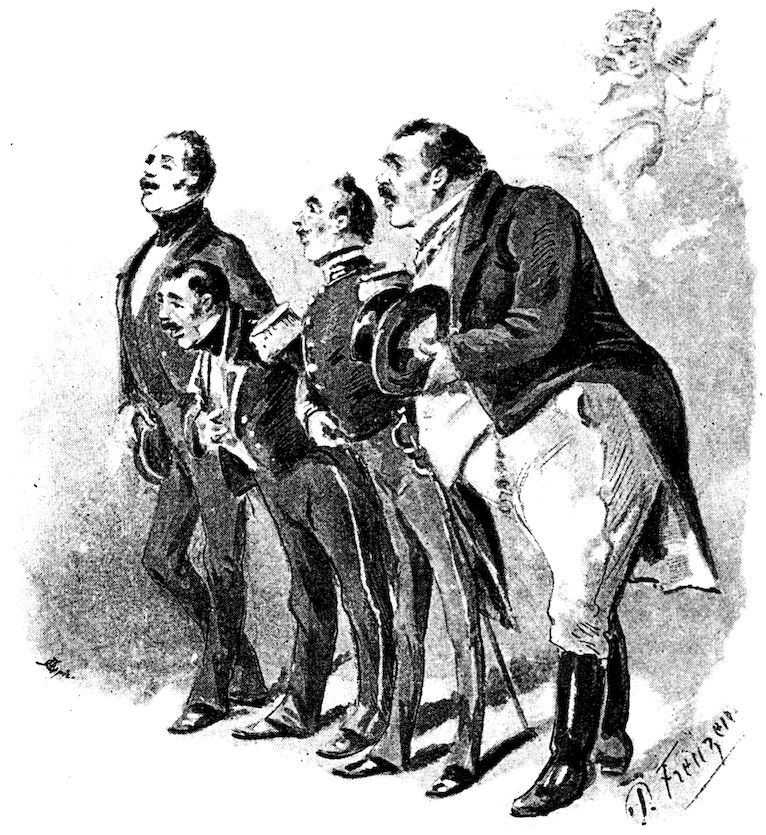
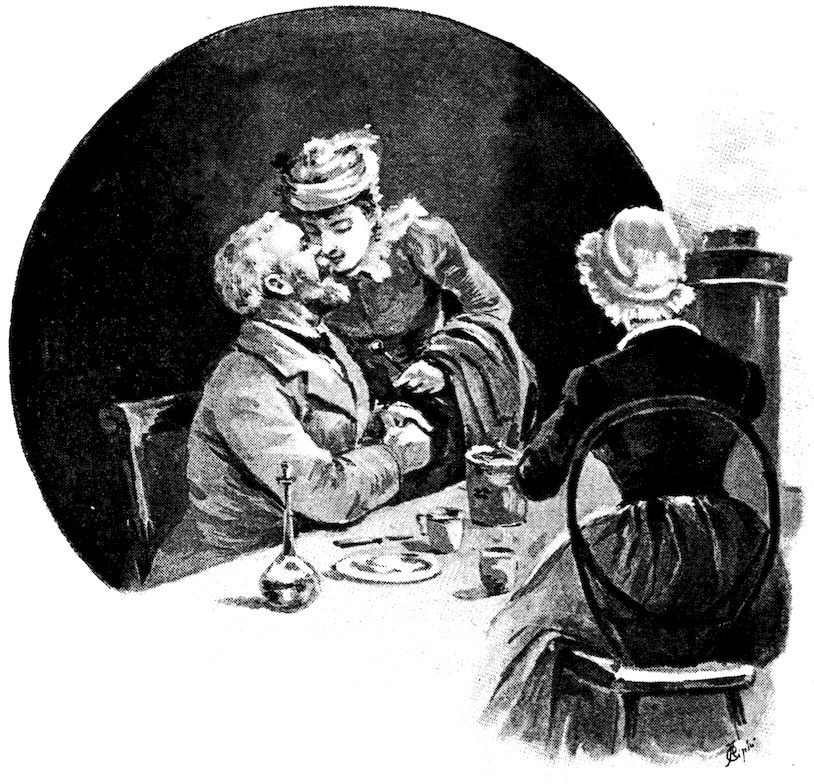
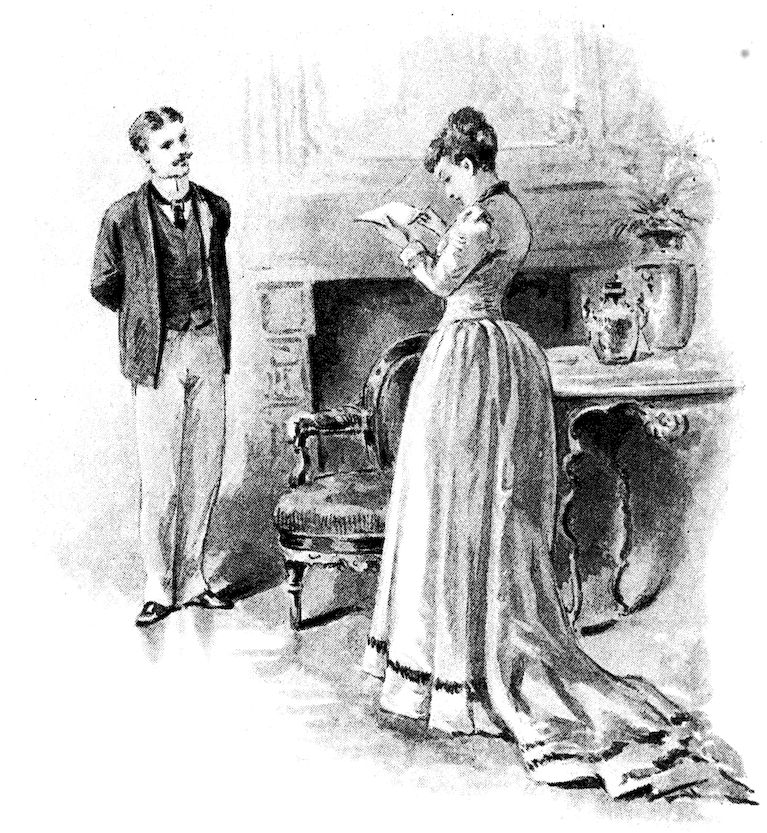
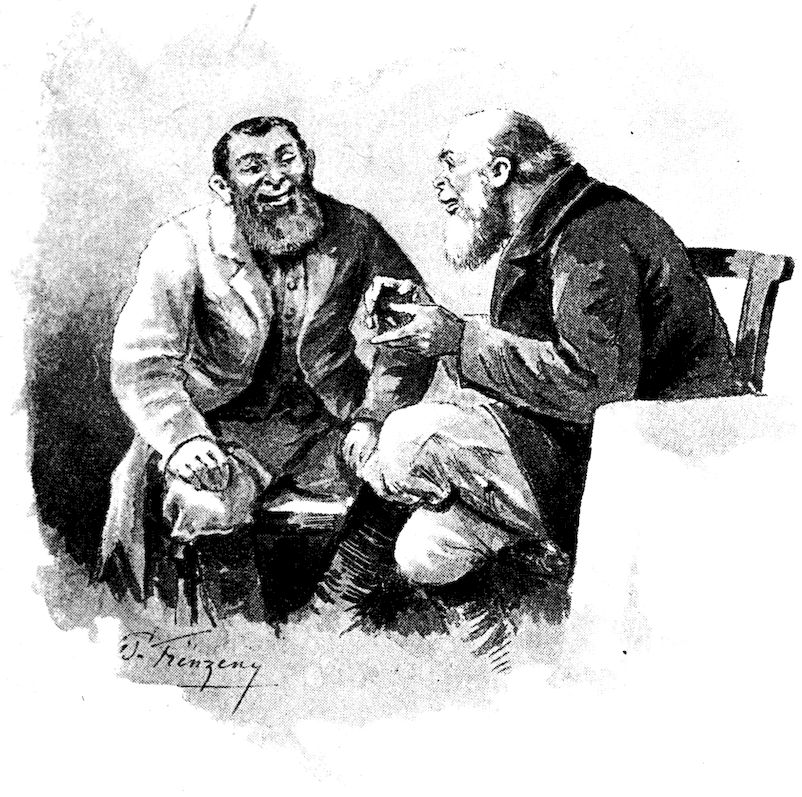
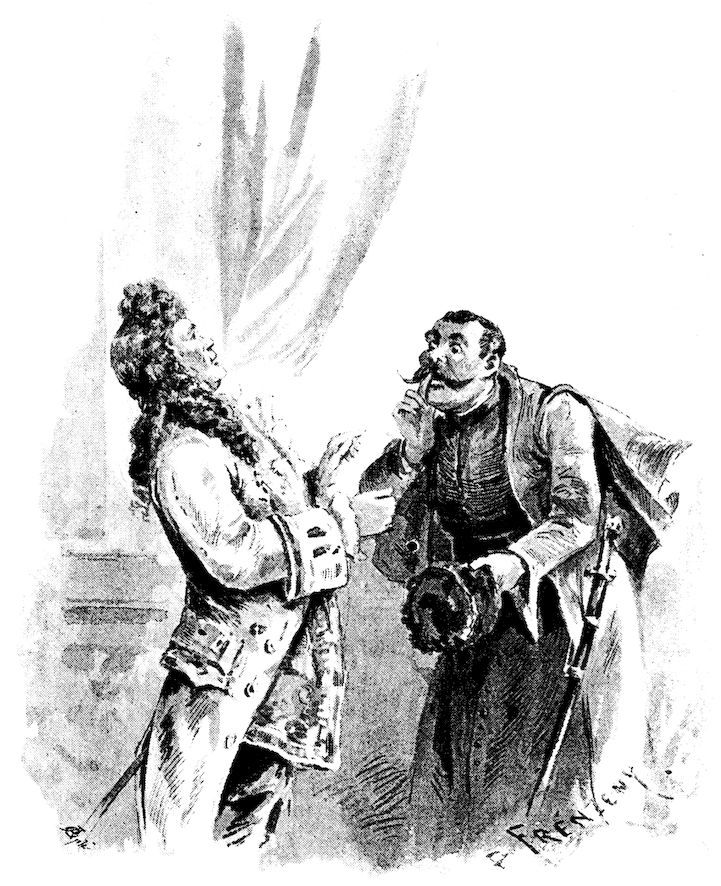
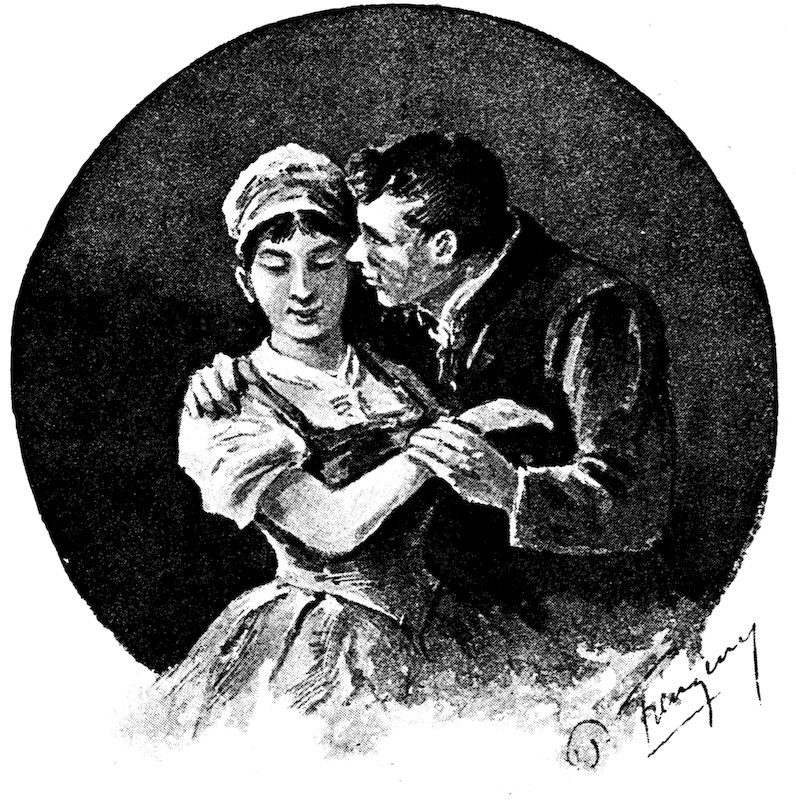
PODKOLYÒSSIN: “DO YOU KNOW—I CONFESS IT TO YOU—I DO LIKE TO HAVE A PRETTY WOMAN BESIDE ME.”
KOCHKARYÒV: “THERE NOW! THERE YOU SEE! THEN ALL THAT’S WANTED IS TO MAKE THE ARRANGEMENTS.”
12Pod. But my dear fellow! you set about the business as
if I were going to be married at once!
Koch. And why not? What’s the use of putting it off?
You’ve decided?
Pod. Me? Oh, dear no! I haven’t decided at all!
Koch. Well I never did! But you just said you wanted
to marry.
Pod. I only said it wouldn’t be a bad idea.
Koch. Well now, really! And we were just settling up
everything.... What’s come to you? Don’t you like the
idea of a married life?
Pod. Oh, yes, I like it.
Koch. Well then, what’s it all about? Where’s the
difficulty?
Pod. There isn’t any difficulty; only it seems so
strange....
Koch. What’s there strange about it?
Pod. Of course it’s strange. One’s always been a
bachelor, and now to be a married man——
Koch. Tut, tut, tut! I wonder you’re not ashamed of
yourself. No, my friend, I see I must talk to you seriously.
I’ll be quite frank with you, like a father with a son. Now
just look at yourself—look at yourself attentively and
seriously, just as you’re looking at me now—what do you
think of yourself? What are you like? You’re no better
than a log; you’re a mere cypher. Tell me what you live
for? Now just look in the glass and tell me what you see—nothing
but a very stupid face. Well now, suppose that
you’ve got children round you, not just two or three—you
know, but a whole half-dozen—and every one as like you as
two peas. Here you are alone, an aulic counsellor, or a
head of a department, or director of some kind—what do
you call yourself? But now just suppose yourself surrounded
with little directorkins, and tiny rascals and small
fry generally; and there they hold out their chubby little
13fists and tug at your whiskers; and you’ll play doggie with
them: Bow—wow—wow! Now, can you imagine anything
more delightful?
Pod. Ye-e-s, only you know they are such mischievous
little monkeys; they’ll spoil everything, and pull all my
papers about.
Koch. Oh! that doesn’t matter! But just think;
they’ll all be like you—that’s the beauty of it.
Pod. After all, it really is a deucedly funny notion—a
little white puff-ball of a thing—no bigger than a puppy-dog—and
yet it’s like you!
Koch. Of course it’s funny, tremendously funny; there,
make haste and come along!
Pod. All right; I don’t mind.
Koch. Hi! Stepàn! Come and help your master
dress.
(EnterStepàn.)
Pod. (dressing before the glass). I almost think, though,
that I ought to put on a white waistcoat.
Koch. Oh, nonsense! What does it matter?
Pod. (putting on his collar). Confound that washerwoman!
How badly she’s starched my collar! It won’t
stand up a bit, Stepàn! You tell the stupid woman that
if she’s going to do her work that way, I shall find another
washerwoman. I expect she spends her time philandering
with sweethearts instead of ironing clothes.
Koch. There! there! man, make haste! What a
dawdle you are!
Pod. All right—all right! (Puts on coat, and sits
down.) Look here, Ilia Fòmich, do you know what? I
think you’d better go alone.
Koch. What next! The man’s gone daft! I go?
Why, which of us is going to get married—you or I?
Pod. The fact is, I don’t feel inclined for it to-day; let’s
go to-morrow.
14Koch. Now, have you got one single grain of sense?
Now, are you anything in the world but a moon-calf? You
get ready, and then, suddenly, don’t want to go! Now be
so kind as to tell me, don’t you call yourself a pig and a
camel after that?
Pod. Look here—what’s the use of bad language? I
haven’t done you any harm.
Koch. You’re a booby, a perfect booby, any fellow will
tell you that. I don’t care if you are an aulic counsellor—you’re
nothing in the world but a fool. What do you
suppose I’m taking all this trouble for? Only for your
good. Don’t I see that you’ll let the prize slip through
your fingers? And there you lie, you confounded old
bachelor! Now just have the kindness to tell me, what do you
call yourself? You’re a dummy, a milksop, a nincompoop,
a—I’d tell you what you are if I could only
find a civil word for it. You’re worse than any old
woman!
Pod. Look here, that’s too much of a good thing.
(Softly.) Are you gone off your head? There’s a serf in
the room, and you let him hear you say bad words! Can’t
you find another place to quarrel in?
Koch. I should like to know who could help quarrelling
with you! Bad language! What else could anybody turn
their tongue to? You begin by behaving reasonably, and
arrange to get married, as any sensible man would; and
then, all of a sudden, without why or wherefore, you must
get a bee in your bonnet, and there’s no more sense in you
than in a wooden post....
Pod. There, that’ll do! I’ll come; why, you needn’t
fly at me like that!
Koch. Come? Of course you will—what else should
you do? (ToStepàn.) Give him his hat and cloak.
Pod. (at the door). What a queer fellow it is! There’s
no making him out at all. All of a sudden he sets to work
15and abuses you without rhyme or reason. Doesn’t understand
how to speak to a fellow.
Koch. There! I’m not going to scold you now.
(Exeunt.)
(A room inAgàfia Tikhònovna’shouse. Agàfia Tikhònovnaspreading cards for fortune-telling, Arìna
Pantelèymovnalooking over her shoulder.)
Agàfia. Why, auntie! there’s a journey again! Some
king of diamonds takes an interest in me; then there are
tears, and a love-letter; on the left-hand side the king of
clubs expresses great sympathy—but there’s a wicked
woman that stands between.
Arìna. Whom do you think the king of clubs stands
for?
Agàfia. I don’t know.
Arìna. I know who it is.
Agàfia. Who?
Arìna. A good, honest cloth merchant, my girl—Alexièy
Dmìtrievich Starikòv.
Agàfia. That I know it isn’t; I’m positive it isn’t he.
Arìna. You can’t get out of it, Agàfia Tikhònovna; I
can tell by the fair hair. There’s only one king of clubs,
you see.
Agàfia. Then you’re just wrong; the king of clubs
here means a nobleman—there’s a good deal of difference
between a tradesman and a king of clubs.
Arìna. Ah! Agàfia Tikhònovna! you wouldn’t talk
like that, my girl, if your poor papa, Tìkhon Pantlèymònovich,
were alive. I remember how he used to bang
his fist on the table and shout out—“I don’t care a rap
for any man that’s ashamed to be a merchant; and I won’t
give my daughter to an officer. Other people can do
that if they’re fools enough! And my son shan’t be an
16officer, neither,” says he; “isn’t a merchant as good a
servant of the State as any one else?” And he’d bang his
fist on the table again, and, my girl, he had got a fist of his
own! Indeed, if the truth must be told, your poor mother
would have lived longer if he hadn’t had such a heavy
fist.
Agàfia. There you see! And you think I’d put up
with such a brute of a husband? I won’t marry a merchant
for anything in the world!
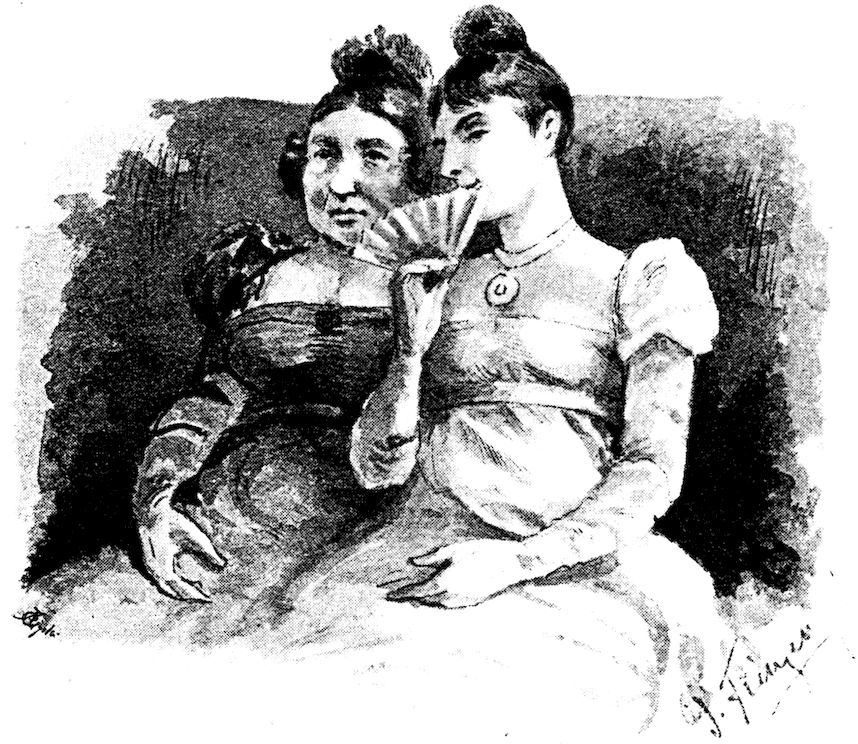
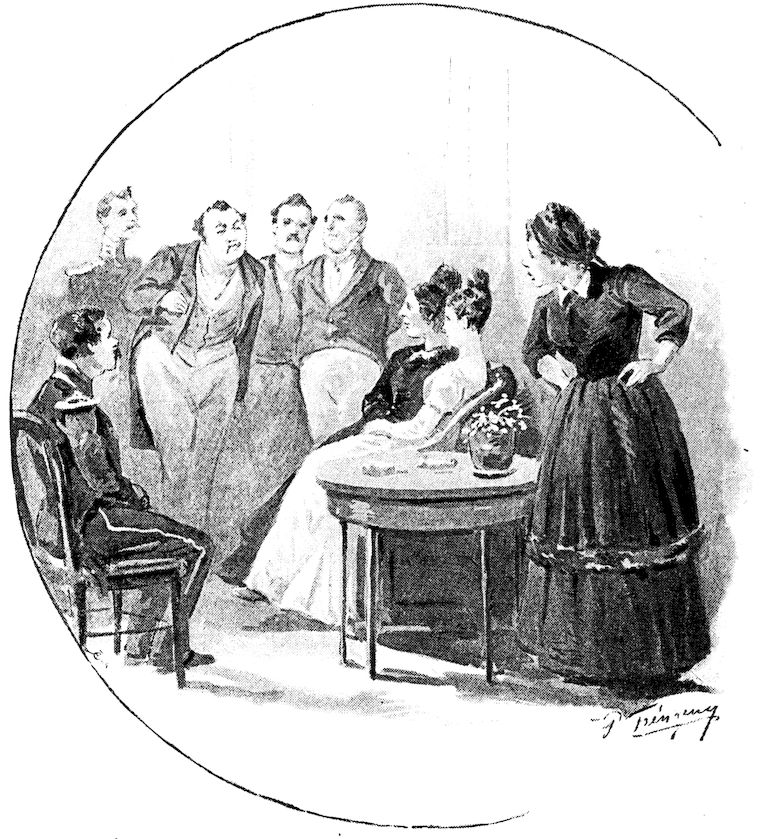
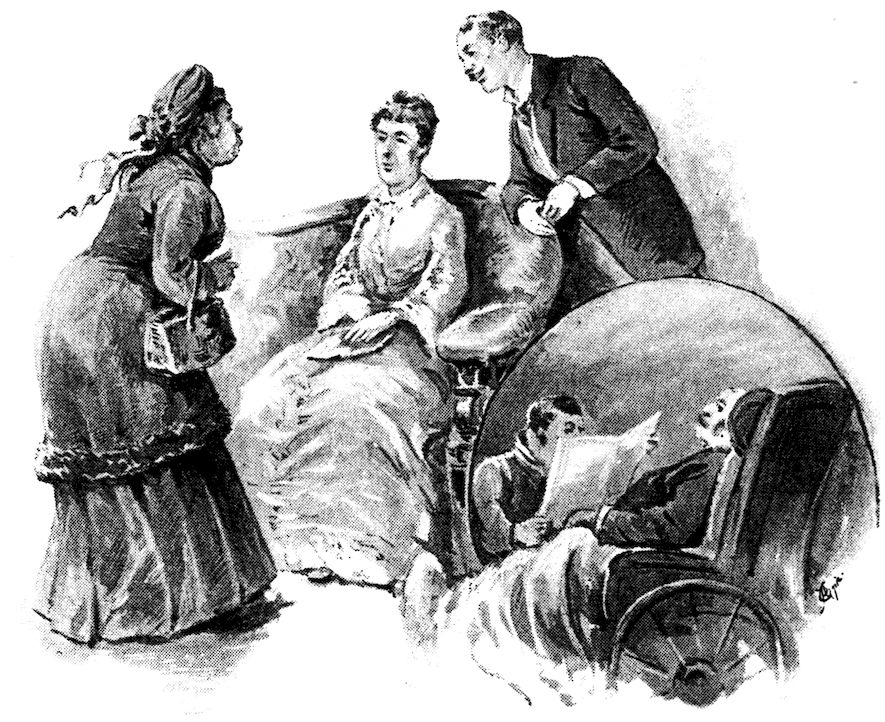
ARÌNA: “BUT WHERE ARE YOU GOING TO GET HOLD OF ANY NOBLE THAT’S WORTH HAVING?”
Arìna. But Alexièy Dmìtrievich isn’t one of that kind.
Agàfia. No, no! not for the world! He’s got a beard!
And when he eats soup, it’ll all run down his beard. No,
no, no! I won’t, I won’t!
Arìna. But where are you going to get hold of any
17noble that’s worth having? You can’t go and pick him up
in the street!
Agàfia. Fèkla Ivànovna will find me one; she promised
to find me a splendid one.
Arìna. But, my precious one, she’s a liar.
(EnterFèkla.)
Fèkla. Oh no, Arìna Pantelèymovna; it’s a sin to give
people a bad name for nothing.
Agàfia. Ah! Fèkla Ivànovna! Now then, tell me
quick, have you found any one?
Fèkla. Yes, yes; only don’t hurry me. I’ve been
tearing about so—let me get my breath! I’ve been all
over everywhere on your business—at the Departments, at
the Ministries, running all over the place.... Why, do
you know, little mother, I nearly got beaten on your
account—it’s true! That old woman that arranged the
Afèrov’s marriage—you know—she just flew at me.
“What are you after here?” says she, “taking the bread
out of other people’s mouths. Keep to your own quarter!”
says she. And I told her right out, “I’ll do anything for
my young lady,” says I, “so you needn’t put yourself out
about it.” However, I don’t mind the trouble; I’ve got
you a fine set of suitors. I can tell you there never were
such fine ones since the world began, and never will be.
Some of them will come to-day—that’s why I ran in to tell
you.
Agàfia. To-day! Oh, Fèkla Ivànovna, I’m afraid!
Fèkla. There’s nothing to be afraid of, little mother.
It’s a thing that’s got to be. They’ll only come and take a
look at you—nothing more. Then you can take a look at
them, and if you don’t like them they can go away.
Arìna. I hope you are bringing good, respectable
gentlemen?
Agàfia. And how many are there?
18Fèkla. Let me see—there are six of them.
Agàfia (screams). Oh!
Fèkla. Dear heart, you needn’t jump like that! It’s
best to have a choice; if you don’t like one you can take
another.
Agàfia. Are they of noble birth?
Fèkla. Every one! The very noblest birth that ever
was.
Agàfia. Well, what are they like?
Fèkla. Oh, regular good ones—nice and neat, all of
them. First there’s Baltazàr Baltazàrovich Zhevàkin—a
splendid gentleman—he used to serve in the fleet—he
would just do nicely for you. He wants a wife with a nice
plump figure—he hates bony women. Then there’s Ivàn
Pàvlovich—he’s a Court usher, and such a grand gentleman,
that one’s afraid to go near him. Big and stout, you know;
just grand to look at. And you should have heard him
shout at me—“I don’t want to hear any nonsense about
what the girl’s like; just tell me plainly how much moveable
and real estate she’s got.”—“So much and so much, little
father.”—“That’s a lie, you old hag!” and, a—a—he said
another word, little mother, that I don’t quite like to repeat.
I saw in a minute that he must be a real grand gentleman!
Agàfia. Well, and who else is there?
Fèkla. Then there’s Nikanòr Ivànovich Anoùchkin—he’s
a nice, fair, pretty gentleman; and oh! little mother,
such sweet lips, like cherries! “All I want,” says he, “is
that my bride should be pretty and refined; and that she
should be able to talk French.” He’s a gentleman with
a lot of breeding, and all sorts of fine Frenchified ways.
Oh! he’s mighty particular! And he’s got such slim little
legs.
Agàfia. N—n—no; somehow or other these overparticular
people ... I don’t know ... I can’t see
anything much in them
19Fèkla. Well, if you want a more solid husband, you’d
better take Ivàn Pàvlovich; you couldn’t make a better
choice; he’s a gentleman ... what you may call a real
gentleman; he could hardly get in at that door, he’s so big
and grand.
Agàfia. And how old is he?
Fèkla. Oh! he’s a young man still—about fifty, or not
quite fifty even.
Agàfia. Goodness gracious! What a funny name!
Why, Fèkloushka, supposing I were to marry him, I should
have to be called Agàfia Tikhònovna Yaìchnitza—it sounds
like I don’t know what!
Fèkla. Eh-h-h! little mother; there are such names
in Russia, that all you can do when you hear them is to
spit and cross yourself. But if you don’t like the name you
may as well take Baltazàr Baltazàrovich Zhevàkin—he’d be
a fine bridegroom.
Agàfia. What sort of hair has he got?
Fèkla. Very nice hair.
Agàfia. And his nose?
Fèkla. H-m-m ... his nose is all right; everything’s
in its right place, and he’s a very nice gentleman.
Only you musn’t mind one thing: there’s no furniture in
his rooms, only a pipe and nothing else at all.
Agàfia. And who else is there?
Fèkla. Àkinf Stepánovich Pantelèyev—he’s an official,
a titular counsellor.[5] He stutters a little; but then he’s
such a very modest gentleman.
Arìna. You always keep on “official” and “official”
you’d better tell us whether he doesn’t drink.
20Fèkla. Yes, he does drink; I wouldn’t tell you a lie—he
drinks. But then, you see, he’s a titular counsellor. And
then he’s so quiet and gentle.
Agàfia. No, no; I don’t want to have a drunkard for
a husband.
Fèkla. As you like, little mother. If you don’t care for
one you can take another. But after all, what does it
matter if a man takes a drop too much sometimes? He’s
not drunk the whole week round, you know; some days he’ll
come home sober.
Agàfia. And who else is there?
Fèkla. There is one more, only he’s not quite the sort....
Never mind him, the others will do better.
Agàfia. Well, but who is he?
Fèkla. Really, it’s not worth while talking about him.
He’s in a good position—aulic counsellor and all that—but
such a slow stick-in-the-mud, there’s no getting him out of
the house.
Agàfia. Well, and who else? You have only told us
about five, and you said there were six.
Fèkla. Surely you don’t want any more? Why, a
minute ago you were frightened at so many, and now
they’re not enough!
Arìna. What’s the use of all your noblemen? Even if
you have got half a dozen of them, one shopkeeper’s worth
the whole lot.
Fèkla. Oh, no, Arìna Pantelèymovna, a noble is more
distinguished, somehow.
Arìna. What’s the use of being distinguished? Just
look at Alexièy Dmìtrievich—what a beautiful sledge he can
drive in, and his cap is real sable!...
Fèkla. Yes, but a nobleman with epaulettes on can
drive past and call out, “Out of the road, counterjumper!”
or, “Show me your best velvet, shopman!” and then the
merchant will have to say, “Certainly, little father!” and
21the nobleman will say, “Take off your hat, you clown!”
That’s what he’ll say.
Arìna. And if the merchant likes, he won’t give him
the stuff; and there’s your nobleman in rags without a thing
to put on.
Fèkla. Then the nobleman will give the shopkeeper
a black eye.
Arìna. Well then, the shopkeeper will go and complain
to the police.
Fèkla. Then the nobleman will complain to the senator.
Arìna. And the merchant to the governor.
Fèkla. And the nobleman——
Arìna. Fiddlesticks! Fiddlesticks! You and your
noblemen! The governor’s grander than any senator!
You’re just off your head about noblemen! Don’t tell me—a
nobleman can take off his hat as well as any shopkeeper,
when there’s a reason why.... (Door-bell rings.)
There’s some one at the door.
Fèkla. Bless me! It must be they!
Arìna. Who?
Fèkla. They.... Some of the suitors.
Agàfia (screams). Oh!
Arìna. Holy Saints! Have mercy on us sinners! The
room’s in such a muddle! (Catches up all the things on the
table, and runs about the room.) And the table-cloth!
Just look at the table-cloth! It’s perfectly black. Douniàshka!
Douniàshka! (EnterDouniàshka.) Bring a
clean table-cloth—quick! (Pulls off table-cloth and rushes
about the room.)
Agàfia. Oh, aunt! What shall I do? I’m half undressed!
Arìna. Little mother! Run and dress, quick! (Rushes
frantically about room.Douniàshkabrings table-cloth.
Door-bell rings.) Run! Make haste! Say “Directly.”
(Douniàshkaexit, and calls without “Directly.”)
22Agàfia. Auntie, my dress isn’t ironed!
Arìna. Oh! Merciful Heaven! Spare us! Put on
another.
Fèkla (running in). What are you standing about
for? Agàfia Tikhònovna! Little mother! Make haste!
(Door-bell rings). There! there! he’s waiting all this time.
Arìna. Douniàshka! Let him in, and ask him to wait.
(Douniàshkaruns into hall and opens door. Voices
without: “At home?” “At home; come in, please.”
All stoop down and try to look through keyhole.)
Agàfia (screams). Oh! what a fat man!
Fèkla. He’s coming! he’s coming. (Exeunt in a headlong
rush. EnterDouniàshkaandIvàn Pàvlovich
Yaìchnitza.)
Doun. Wait here, please. (Exit.)
Yaìch. It’s all very well to say “Wait,” but I can’t
spend much time waiting about for her; I only got
a few minutes’ leave from the Department. Supposing the
General were to ask, “Where’s the usher gone?” “Gone
to look for a wife!” Tut, tut, tut! The general would
give her what for, I know.... I may as well look through
the list again. (Reads.) “Two-storied stone house.”
(Looks up and examines room.) Yes! (Reads.) “Two
wings—one wooden, one with stone basement.”... H’m....
The wooden one is not up to much. (Reads.)
“Carriage; carved two-horse sledge, with large and small
rugs.”... I daresay they’ll be only fit to break up.
However, the old woman declares they’re first-rate; well,
let’s suppose they are. (Reads.) “Two dozen silver
spoons.”... Of course one must have silver spoons for
the house.... “Two fox-fur cloaks.”... H’m....
“Four large feather-beds; two small ones.” (Compresses
lips expressively.) “Twelve silk dresses; twelve cotton
ditto; two dressing-jackets; two....” H’m.... those
are trifles. “Under-linen; table-cloths....” All that’s
23her business. However, I shall have to verify it all. It’s
very likely they’ll promise a house and carriage and all sorts
of things now, and when once you’re married, you find
there’s not a thing but feather-beds and pillows. (Door-bell
rings; Douniàshkaruns hastily through room into hall,
and opens door. Voices without, “At home?” “At
home.” EnterAnoùchkinandDouniàshka.)
Doun. Wait here, please; they’ll come presently. (Exit.AnoùchkinandYaìchnitzabow to each other.)
Yaìch. Your servant, sir!
Anoùch. Have I the honour to address the papa of the
charming lady of the house?
Yaìch. Certainly not, sir, I have not the pleasure of
having any children.
Anoùch. Oh! I beg your pardon! I really beg your
pardon!
Yaìch (aside). That man’s face looks to me very suspicious;
I shouldn’t wonder if he’s come about the same
business that I have. (Aloud.) You doubtless have some ... some ... business with the lady of the house?
Anòuch. N-n-no.... Oh, no! I have no business....
I just came in as I was taking a walk.
Yaìch (aside). He’s a liar! taking a walk, indeed! The
scoundrel wants to get married! (Door-bell rings, Douniàshkaruns through into hall and opens door. Voices without:
“At home?” “At home.” EnterZhevàkinandDouniàshka.)
Zhev. (toDouniàshka). Just give me a brush, will
you, my dear? One gets so dusty in the street. And take
off that cobweb, please. (Turns round.) That’s right;
thank you, my dear. Just look on the other side; I fancy
there’s a spider running up me. Are you sure there’s
nothing on the back of my collar? Thank you, child.
There! I’m sure there’s something! (Smooths coat-sleeve
with his hand, and looks atAnoùchkinandYaìchnitza.)
24It’s real English cloth. In ’95, when I was only a midshipman,
and our squadron was in Sicily, I bought it and had a
uniform made; in 1801, under his late Majesty, Paul
Petròvich, when I was made lieutenant, the cloth was as
good as new; in 1814, I went on an expedition round the
world, and it only began to get a little worn at the seams;
in 1815, when I retired from the service, I just had it
turned; and now I’ve worn it ten years, and it looks almost
new still. Thank you, my dear! My little beauty! (Kisses
his hand to her, goes up to mirror, and arranges his hair.)
Anoùch. If I may take the liberty to ask, Sicily....
You were just mentioning Sicily—it is a fine country, is it
not?
Zhev. Oh, beautiful! We spent thirty-four days there.
I can assure you it’s a most charming place—such mountains;
and the most beautiful trees ... what they call
granite trees. And the loveliest Italian girls—perfect little
rosebuds, ... one can hardly refrain from kissing them.
Anoùch. And are they well educated?
Zhev. Magnificently; as highly educated as any countess
here. I remember, when I used to go along the street,—well,
of course you know, a Russian lieutenant, epaulettes
here (points to his shoulder), gold embroidery, and all that,—well,
and these little black-eyed beauties,—I must tell
you, they have verandahs to every house, and roofs as flat
as this floor—well, you look up as you pass, and there sits
a little rosebud; and of course one must keep up one’s
reputation (makes a salute and waves his hand), and
she just answers like that (makes gesture with his hand).
Of course she’s always beautifully dressed—little silk cords,
and taffeta stuff, and earrings, and all sorts of feminine
trifles, ... in a word, the daintiest little sugar-plum——
Anoùch. Allow me to ask you one more question. In
what language do people converse in Sicily?
Zhev. Oh, always in French, of course.
25Anoùch. And do all the young ladies speak French?
Zhev. All, without exception. You perhaps will hardly
believe me; but we lived there thirty-four days, and in all
that time I never heard one of them speak a single word of
Russian.
Anoùch. Not a word?
Zhev. Not one. And mind, I am not speaking of the
nobles, and what they call the Signors—those are their
officers, you know—but just pick out any common peasant
that brings loads on his head, and try him; just say: “Dai,
bràtetz, khlyeba,”[6] he won’t understand—I assure you he
won’t understand. But if you say in French: “Dateci del
pane,” or “Portate vino,” he’ll understand you, and he’ll
run and bring it at once.
Yaìch. This same Sicily must be a very interesting
country, I think. You were talking about the peasants.
What are they like? Do they have broad shoulders, and
plough the land like our Russian peasants?
Zhev. That I can’t tell you; I didn’t notice whether
they ploughed or not. But about the question of taking
snuff, I can inform you that they not only smell snuff, but
even put it in their mouths. The carriage of goods is very
cheap there, too; you see there’s water everywhere, and
gondolas ... and in the gondola there’ll sit a sweet little
rosebud of an Italian girl, beautifully dressed, with the
daintiest little kerchief and camisole.... There were some
English officers with us—sailors like ourselves.... It
seemed so strange at first; we couldn’t understand each
other. But after a bit, when we got to know each other
well, we began to understand all right. You just point to a
bottle or a glass, you know, and the Englishman knows at
once that that means “Drink;” then you put your fist up
to your mouth, and just do so with your lips—“Puff, puff,”
and he knows you mean “Smoke a pipe.” Indeed, I
26assure you, it’s rather an easy language; the crews got to
understand each other in about three days.
Yaìch. Life must be very interesting in foreign parts.
It is a great pleasure to me to become acquainted with a
travelled gentleman. Allow me to ask whom I have the
honour of addressing?
Zhev. Zhevàkin, retired lieutenant. Permit me, on my
side, to ask with whom I have the pleasure to converse.
Yaìch. Ivàn Pàvlovich Yaìchnitza, government usher.
Zhev. (not hearing well). Thank you, I have already
lunched. It’s cold weather, and I knew I had a long walk
before me, so I had a marinated herring.
Yaìch. You have not quite understood me, I think; I
said my name is Yaìchnitza.
Zhev. (bows). Oh! I beg your pardon; I am a little
hard of hearing. I ... really ... understood you to say ... that you had lunched on an omelette.
Yaìch. Yes; it’s very unfortunate. I thought of asking
the General to allow me to change my name to Yaìchnitzyn;
but my friends dissuaded me; they said it would sound
like Sobachi Syn.[7]
Zhev. Yes, there are such cases. All our squadron,
both officers and crew, had the most extraordinary names:
Pomòykin,[8] Yarỳzhkin,[9] Lieutenant Pereprèyev;[10] and there
was one midshipman—a very good midshipman too—whose
name was just Dỳrka;[11] it was so odd; the captain would
call, “Come here, Dỳrka;” and we all of us used to tease
him, and call him stop-gap, and bung-hole, and all sorts of
things. (Door-bell rings, Fèklaruns across stage.)
Yaìch. Ah! Good-morning, little mother!
Zhev. Good-morning! How are you, my dear?
Anoùch. Glad to see you, little mother, Fèkla Ivànovna.
Fèkla (hurriedly). Thank you, thank you; same to you.
27(Exit into hall; opens door. Voices without: “At home?”
“At home.” Then several half-inaudible words; Fèkla’svoice answers angrily: “Just you take care!” EnterKochkaryòv, Podkolyòssin, andFèkla.)
Koch. (toPodkolyòssin). Now just keep up your courage—that’s
all that’s wanted. (Glances round, and salutes
the company with a surprised expression.) (Aside.) Oho!
What a lot of people! What’s the meaning of this? They
can’t all be suitors. (NudgesFèkla, and speaks to her
softly.) Where did all these crows come from, eh?
Fèkla (softly). There are no crows here; they are all
honest people.
Koch. (to her). There are plenty of them, but they’re
precious draggletailed.
Fèkla (softly). I doubt they’ll fly better than yours, for
all he’s so grand. ’Tisn’t fine feathers make fine birds.
Koch. (softly). Yes, every crow thinks her own children
the fairest. (Aloud.) What’s she doing now? I suppose
that door leads to her bedroom? (Approaches door.)
Fèkla. For shame! I tell you she’s dressing.
Koch. Well, dear me! there’s no harm in that! I’ll
only just look in—nothing more. (Peeps through keyhole.)
Zhev. Permit me to satisfy my curiosity too!
Yaìch. Let me have one little peep.
Koch. (continuing to look). There’s nothing to be seen,
gentlemen; there’s something white, but I can’t make out
whether it’s a woman or a pillow. (They all crowd round
door and try to peep through keyhole.)
Koch. There’s ... some one coming! (All start back.
EnterArìna PantelèymovnaandAgàfia Tikhònovna.
All bow.)
Arìna. To what are we indebted for the honour of this
visit?
Yaìch. I read in the newspapers that you wished to
enter into a contract to supply timber; and therefore, as I
28hold the post of usher in a Government Department, I
called to inquire what kind of timber you can supply, what
quantity, and at what date.
Arìna. We don’t take contracts; but we are very glad
to see you. Allow me to ask your name.
Arìna. Be so kind as to take a seat. (Turns toZhevàkinand looks at him.) And may I ask——
Zhev. I ... you know ... I saw an advertisement
about something.... I thought I might as well look in....
29It’s such fine weather to-day, and the grass is growing
so nicely along the road....
Arìna. And your name, if you please?
Zhev. Retired naval lieutenant Baltazàr Baltazàrovich
Zhevàkin, Number 2. There was another Zhevàkin in the
service, but he retired before I did; he got a wound in
the knee, and the ball went through it such an odd way—it
didn’t touch the knee itself, but it injured a vein, and
drew it all up, so that, if you were standing near him, it
always seemed as if he were going to kick you.
Arìna. Be so kind as to sit down. (ToAnoùchkin.)
May I ask the reason——
Anoùch. As a neighbour ... as I live so very near ... you see——
Arìna. Perhaps you live in widow Touloùbova’s house
opposite?
Anoùch. No—n—no; I live at Peskì just now, but I
have the intention of moving to this quarter of the town
sooner or later.
Arìna. Be so kind as to sit down. (ToKochkaryòv.)
Allow me to ask——
Koch. Why, surely you recognise me? (Turns toAgàfia.) And you, madam?
Agàfia. I—I—don’t remember ever seeing you.
Koch. Why, think a minute; I’m sure we’ve met somewhere.
Agàfia. I don’t know, really. Was it at the Biriòushkins’?
Koch. Of course it was!
Agàfia. Oh! do you know what’s happened to her?
Koch. Of course I do—she’s married.
Agàfia. Oh no! that would be nothing; but she’s
broken her leg.
Arìna. And very badly too. She was coming home
late at night in a drozhki, and the coachman was tipsy and
overturned it.
30Koch. Ah! yes; I remember, of course; I knew she’d
got married, or broken her leg, or something of that kind!
Koch. My name? Why Ilia Fòmich Kochkaryòv. We’re
almost relations, you know. My wife is always talking
about—but allow me, allow me. (Takes Podkolyòssin by the
arm and leads him forward.) My friend Ivàn Kouzmìch
Podkolyòssin, aulic counsellor, sub-director in a Department.
31It’s he that does all the business and manages everything in
the most admirable way.
Arìna. What is the gentleman’s name?
Koch. Podkolyòssin—Ivàn Kouzmìch Podkolyòssin.
The director is simply put there as a figure head: all
the business is done by Ivàn Kouzmìch.
Arìna. Indeed? Be so kind as to sit down.
(EnterStarikòv.)
Star. (bows to the company in a rapid, off-hand, business
manner, with one arm akimbo). Arìna Pantelèymovna, how
do you do, little mother? The lads on the Arcade told
me that you had some wool to sell.
Agàfia (turning her back contemptuously and speaking under
her breath, but so that he hears). This isn’t a stall in a bazaar!
Star. Oh, oh! Seems I’ve come at the wrong time! I
doubt you’ve settled your business without me.
Arìna. Sit down, sit down, Alexièy Dmìtrievich; we’ve
no wool to sell, but we’re glad to see you; please sit down.
(All sit down; silence.)
Yaìch. It’s very strange weather to-day. Early in the
morning it looked quite like rain, but now it seems to have
gone over.
Agàfia. Yes, indeed, this weather is quite extraordinary;
sometimes it’s bright, and then again it gets wet and rainy—it’s
very disagreeable.
Zhev. Ah, little mother! When our squadron was in
Sicily it was spring-time—with us it would be February—they
have the new calendar, you know—when we went out
into the street it would be quite sunny, and then it would
begin to rain, and it would be just like real ordinary rain.
Yaìch. The most disagreeable thing is to sit alone in
such weather. It’s all very well for a married man—that’s
quite another thing—but when one lives alone it’s really——
Zhev. Oh! it’s more than any one can stand!
32Anoùch. Yes, indeed, one may say——
Koch. Oh yes, it’s altogether unbearable—life’s not
worth having. Heaven defend anybody from such a position!
Yaìch. Now supposing, madam, that you were asked to
choose who should be the object of your affections. Allow
me to ask, what would be your taste? You will excuse my
directness. What ... occupation ... do you consider ... most ... worthy of respect in a husband?
Zhev. Would you choose, madam, a husband acquainted
with the storms of the ocean?
Koch. No! no! In my opinion the best sort of husband
is a man who has almost the whole management of a
Department in his hands.
Anoùch. Why anticipate? Why treat with contumely a
man capable of appreciating the social intercourse of high-class
society?
Yaìch. Madam, it is for you to decide! (Silence.)
Fèkla. Speak up, little mother! Tell them something.
Yaìch. What have you to say?
Koch. What is your opinion, Agàfia Tikhònovna?
Fèkla (aside to her). Make haste! say “Thank you,” or
“With the greatest pleasure,” or something.... It’s not
proper to sit like that!
Agàfia. I’m ashamed, I’m ashamed, really. I shall go
away. Auntie! stop here instead of me!
Fèkla. No, no, you musn’t go away; it’s improper,
it’s disgraceful. They’ll think ... I don’t know what!
Agàfia (aside). No, no, I can’t stand it, I can’t—I can’t!
(Runs away. Arìna and Fèkla follow her.)
Yaìch. Well, that’s a good one—everybody’s gone away.
What’s the meaning of that?
Koch. I expect something’s happened.
Zhev. Oh, no doubt it’s some little matter of feminine
toilet.... They want to pin something, or to put the
camisole straight, or—— (EnterFèkla.)
33All (crowding round her). What is it? What’s the
matter?
Koch. Has anything happened?
Fèkla. Of course not! What should happen?
Koch. Then why did she go away?
Fèkla. Why, you made the poor girl bashful, all of you—frightened
and upset her till she couldn’t stand it. She
sends you her excuses, and asks you to come in for a cup of
tea in the evening. (Exit.)
Yaìch. (aside). Oh! now they’re going to begin with cups
of tea! That’s what I hate about all this match-making
business—it’s such a worry. To-day won’t do; and come
again to-morrow; and the day after to-morrow a cup of tea;
and then they have to think it over, and can’t make up
their minds! But dear me! the matter’s simple enough;
there’s nothing to rack one’s brains over! Confound it all!
I’m a busy man, I’ve no time for this sort of thing!
Koch. (toPodkolyòssin). She’s a nice-looking girl, isn’t
she?
Pod. Yes, she’s nice-looking.
Zhev. I think the young lady is pretty.
Koch. (aside). The deuce take it, if that idiot hasn’t fallen
in love! He’ll be getting in the way! (Aloud.) I don’t
think she’s pretty at all, not at all.
Yaìch. Her nose is too big.
Zhev. Now, there I don’t agree with you: she’s a regular
rosebud.
Anoùch. I quite agree with you. The only thing is,
she’s not quite—I am inclined to doubt whether she is
acquainted with the manners of high-class society. Do you
think she knows French?
Zhev. If I may take the liberty of asking, why didn’t
you speak French to her yourself, and try?—very likely she
knows it.
Anoùch. You think I speak French? No, I did not
34enjoy such educational advantages. My father was an
eccentric personage, he never even thought of having me
taught French. I was a child in those days; it would have
been easy to teach me—a few good whippings were all that
was needed, and I should have known it perfectly well.
Zhev. Well, but as you don’t know French, why do you
particularly want——
Anoùch. Ah! no, no; it’s quite another matter with a
woman. It’s quite necessary that she should know it;
otherwise, one thing and another—(helps himself out with
gestures)—nothing is as it should be.
Yaìch. (aside). Well, those that like can care about that.
For my part, I shall go round the house and look at the
wings from the courtyard; if everything’s all right, I’ll settle
the matter this very evening. I’m not afraid of all these
suitors; they’re nothing but milksops, all the lot of them.
Girls don’t like that sort of men.
Zhev. I think I’ll go and have a smoke. Perhaps our
way lies in the same direction. May I ask where you live?
Anoùch. At Peskì; in the Petròvski Row.
Zhev. Yes; it’s a bit out of my way; I live on the
Island,[12] in the Eighteenth Line. But all the same I’ll walk
with you.
Star. No no; they’re getting too proud for me here.
Ah! you’ll remember your own folk some day, Agàfia
Tikhònovna! Your servant, gentlemen. (Bows and exit.
Exeunt all butPodkolyòssinandKochkaryòv.)
Pod. What are we waiting for?
Koch. Well, what do you think? She’s a charming girl,
isn’t she?
Pod. Do you think so? I’m bound to confess that she
doesn’t take my fancy.
Koch. Come now, that’s too much! You agreed with
me yourself a minute ago that she was pretty.
35Pod. Yes; but, you see ... her nose is too long; and
she doesn’t know French.
Koch. What next? What do you want with French?
Pod. After all, a girl ought to know French.
Koch. What for?
Pod. Why, because ... really I don’t know why. But
it isn’t the same if she doesn’t know French.
Koch. Well, you’re a simpleton! Somebody makes a
remark, and you get it into your head, and there it sticks!
She’s a beauty; she’s a downright beauty; you won’t find
another such a girl anywhere.
Pod. Well, I thought she was very pretty. But afterwards,
when they began to talk so much about her nose
being long, I thought it over, and I see she really has a
long nose.
Koch. Oh, you blind bat! Can’t you see through that
trick? They talked like that on purpose to get rid of you;
and I abused her too; one always does that. My lad, she’s
a splendid girl! Just you look at her eyes! There’s the
very devil in eyes like that; they can talk, and breathe,
and anything. And as for her nose, it’s an exquisite nose;
it’s as white as alabaster; there’s plenty of alabaster that
wouldn’t come up to it. You should look with your own
eyes, my man.
Pod. Yes; when I think of it, she really is pretty.
Koch. Of course she’s pretty. Look here—they’ve all
gone away now; let’s go to her and propose, and settle
it all up.
Pod. That I certainly sha’n’t do.
Koch. Why not?
Pod. It would be downright effrontery. There are a
lot of us; it’s for her to choose.
Koch. What’s the use of taking any notice of them?
You’re not afraid of rivals, surely; if you like, I’ll get rid
of them all in one minute.
36Pod. How can you get rid of them?
Koch. That’s my business. Only give me your word
that you won’t wriggle out of it afterwards.
Pod. I’ve no objection to that; I’m willing.
Koch. Your hand on it!
Pod. (gives hand). My hand on it!
Koch. That’s all I ask of you. (Exeunt.)
(Agàfia Tikhònovna alone.)
Agàfia. Really, it is a very difficult thing to have to
choose. If there were only one or two of them—but to
choose out of four!... Nikanòr Ivànovich is very nice-looking,
though he’s rather thin. Ivàn Kouzmìch is not
bad-looking either. Indeed, to say the truth, Ivàn Pàvlovich
is a very fine-looking man, too, although he’s fat. I should
just like to know what I am to do! Then Baltazàr Baltazàrovich
has great merits, too. Indeed, it’s so difficult
to decide that I simply don’t know what to do. If one
could put Nikanòr Ivànovich’s lips on to Ivàn Kouzmìch’s
nose, and then take a little of Baltazàr Baltazàrovich’s easy
way, and just a bit of Ivàn Pàvlovich’s stoutness—I’d make
up my mind at once; but now one keeps on thinking and
thinking ... really my head has begun to ache! I think
the best thing would be to cast lots. It must be as God
wills—whoever comes out shall be my husband. I’ll write
all their names on bits of paper, and roll them up tight, and
then, what must be, will be. (Goes up to table, takes out of
a drawer paper and scissors, cuts little slips, writes, and rolls
them up while speaking.) A girl’s position is a very trying
one, especially if she’s in love. No man can ever enter into
that; indeed, they don’t care to understand it. There!
now they’re all ready! I’ve only got to put them in my
37reticule, shut my eyes tight, and what must be will be.
(Places slips in reticule, and shuffles them with her hand.)
I’m afraid.... Oh! if God willed that Nikanòr Ivànovich
should come out! No; why? Better Ivan Kouzmìch!
They’re all so nice.... No, no; I won’t decide.... I’ll
take whichever one comes out. (Thrusts hand into reticule,
and takes out all together.) Oh! oh! they’ve all come out!
And my heart beats so! No; it won’t do; I must have
one! (Replaces slips in reticule, and shuffles again.Kochkaryòventers softly and stands behind her.) Oh! if it were
Baltazàr.... No; I mean Nikanòr Ivànovich.... No,
no; I won’t think; it’s as fate decides!
Koch. Take Ivàn Kouzmìch; he’s the best.
Agàfia. Ah! (Screams, and hides face with both hands,
not daring to look round.)
Koch. Why do you start so? Don’t be afraid, it’s I;
you’d much better take Ivàn Kouzmìch.
Agàfia. Oh! I’m ashamed! You’ve been listening.
Koch. Never mind; never mind; I’m like one of your
own family, you know; you needn’t be bashful with me.
Come now, let me see your pretty face.
Agàfia (half uncovering her face). Indeed I’m ashamed!
Koch. There now! Take Ivàn Kouzmìch.
Agàfia. Oh! (Screams, and hides face again.)
Koch. Really, he’s a splendid fellow; he manages that
Department wonderfully.... In fact he’s a marvellous
fellow!
Agàfia (gradually uncovering her face). Well, but what
about the other one, Nikanòr Ivànovich? He’s very nice, too.
Koch. Oh! he’s not fit to be mentioned in the same
breath with Ivàn Kouzmìch.
Agàfia. Why not?
Koch. The reason’s plain. Ivàn Kouzmìch is a man....
Well, what you may call a man ... such as you
won’t find again.
38Agàfia. And Ivàn Pàvlovich?
Koch. Ivàn Pàvlovich! He’s a regular good-for-nothing;
they’re all good-for-nothings.
Agàfia. Not all, surely?
Koch. Just look yourself; just compare them; there are
all sorts of people; but really, such a set—Ivàn Pàvlovich,
Nikanòr Ivànovich—they’re like, Heaven knows what!
Agàfia. Well, but really, they’re very ... modest.
Koch. Modest, indeed! They’re regular bullies and
roughs. I suppose you don’t want to be beaten the next
day after the wedding?
Agàfia. Oh, dear! Oh, dear! That’s such a dreadful
misfortune that there couldn’t be anything worse!
Koch. I should think not! One can’t imagine anything
worse.
Agàfia. Then your advice is that I should take Ivàn
Kouzmìch?
Koch. Of course you should take Ivàn Kouzmìch.
(Aside.) The business seems to go pretty smoothly. I’d
better run to the confectioner’s and fetch Podkolyòssin.
Agàfia. Then you think ... Ivàn Kouzmìch?
Koch. Certainly, Ivàn Kouzmìch.
Agàfia. And must I refuse all the others?
Koch. Of course you must.
Agàfia. But how am I to do it? I’m ashamed to.
Koch. What’s there to be ashamed of? Just tell them
that you’re too young to marry yet.
Agàfia. Well, but they won’t believe me; they’ll begin
asking why, and how, and all that.
Koch. Well, if you want to put an end to it at once,
you can simply say, “Get along with you, blockheads!”
Agàfia. But how am I to say that?
Koch. Well, just try. I assure you that, after that,
they’ll all run away.
Agàfia. But ... but it sounds ... so rude.
39Koch. Well, but you’ll never see them again, so what
does it matter?
Agàfia. Even so it doesn’t seem nice; ... they’ll be
offended.
Koch. What in the world does it matter if they are? If
they could do you any harm that would be another thing;
but the worst that can happen is for one of them to spit in
your face—that’s all!
Agàfia. There! you see!
Koch. Well, what harm? Why, some people are spat
at over and over again! There’s a man I know—such a
handsome, fresh-coloured fellow—he was always coaxing
and teasing his director to raise his salary, till at last the
director lost all patience, and turned round and spat in his
face. “There’s your salary!” he said; “let me alone, you
demon!” But for all that he raised the salary, and the
man was none the worse for having been spat at. What’s
there to mind in that? It would be another matter if you
hadn’t got a handkerchief near, but you have one in your
pocket—you’ve nothing to do but to take it out and dry
your face. (Door-bell rings.) There’s some one at the
door—one of them, I expect. I shouldn’t care to meet them
just now. Isn’t there another way out?
Agàfia. Oh, yes, down the back stairs. But, indeed,
I am trembling all over!
Koch. Only keep your presence of mind; everything
will be all right. Good-bye! (Aside.) I’ll run and fetch
Podkolyòssin. (Exit. EnterYaìchnitza.)
Yaìch. I purposely came rather early, madam, in order
to find you alone and talk with you at leisure. As regards
my position, madam, you are, I presume, acquainted with
it: I serve as collegiate assessor, I enjoy the good-will of
the authorities, and my subordinates are obedient ... only
one thing is wanting—a partner to share my life.
Agàfia. Y-yes....
40Yaìch. I have at last found that desired partner. It
is—yourself. Answer me plainly—yes or no? (Looking
at her shoulders; aside.) She’s not like those scraggy foreign
women; there’s something of her.
Agàfia. I am still very young.... I do not wish to
marry yet....
Yaìch. Don’t wish!... Why, what do you employ a
matchmaker for? Perhaps, though, you mean something
else—explain to me.... (Door-bell rings.) Confound the
people! They won’t let one settle one’s business in peace!
(EnterZhevàkin.)
Zhev. Pardon me, madam, if I have come too early.
(Turns round and seesYaìchnitza.) Ah! there’s one
already.... Ivàn Pàvlovich, my compliments.
Yaìch. (aside). You be hanged with your compliments!
(Aloud.) Well, madam, your answer? Say only one word—yes
or no?... (Door bell rings; Yaìchnitzaspits on
the floor.) Damn that bell!
(EnterAnoùchkin.)
Anoùchkin. Perhaps, madam, I have arrived earlier than
is becoming and consistent with good breeding. (Sees the
others, utters an exclamation, and starts back.) My respects,
gentlemen!
Yaìch. (aside). Keep your respects and be damned to
you! The very deuce brought your spindle-shanks here—if
you’d only tumble and break them!... (Aloud.) Well,
madam, how is it to be? Decide. I am a man in office;
my time is valuable—yes or no?
Agàfia. (confused.) Oh, no, please, ... I don’t want....
(Aside.) I don’t know a bit what I’m saying!
Yaìch. You don’t want?... In what sense do you
mean that?
Agàfia. Oh, I didn’t mean.... I.... Oh, indeed!...
41(Gathering up her courage.) Get along with you....
(Aside, clasping her hands.) Oh, dear! Oh, dear! what
have I said!
Yaìch. “Get ... along with you”?!... What does “get
along with you” mean?... Permit me to ask, what do you
mean by this? (Places arms akimbo, and advances towards
her threateningly.)
Agàfia (stares at him; then screams). Oh! oh! he’s
going to beat me! (Exit running.Yaìchnitzastands
open-mouthed; Arìna Pantelèymovna, hearing the noise,
runs in, looks at him, and screams.)
Arìna. Oh! he’s going to beat us! (Exit running.)
Yaìch. What’s it all about? What can have happened?
(Door-bell rings; voice heard without.)
Koch. (without). Go in; go in! What are you stopping
for?
Pod. (without). You go first; I’ll come in a minute; I’ll
just fasten my strap; it’s come undone.
Koch. (without). I know you’ll sneak away again.
Pod. (without). No, I won’t; I won’t, indeed!
(EnterKochkaryòv.)
Koch. What next! wants to set a strap right!
Yaìch. (to him). Be so kind as to tell me,—Is the young
lady an idiot?
Koch. What do you mean? Has anything happened?
Yaìch. Her behaviour is most extraordinary. All of a
sudden she ran away, screaming out, “He’ll beat me! he’ll
beat me!” It’s enough to mystify the devil!
Koch. Yes; she gets like that sometimes; she’s weak in
her head.
Yaìch. May I ask if you’re a relative of hers?
Koch. Oh! yes; I’m a relative.
Yaìch. What is your relationship to her, if I may inquire?
42Koch. A—a—a, really, I don’t know. Let me see—my
mother’s aunt was some relation to her father; or else her
father was related to my aunt; my wife knows all about it;
that’s a woman’s business, you know.
Yaìch. Has her mind been affected long?
Koch. Ever since she was a little child.
Yaìch. A—a—a, yes—of course it would be better
if she had more sense. But, after all, it’s not bad to have
a foolish wife—once the other considerations are all right,
you know.
Koch. But, my good sir, she hasn’t a sixpence!
Yaìch. What! But the stone house?
Koch. Oh! it’s only called stone; but if you knew the
way it’s built! It’s just coated over with stucco outside;
but the walls are made of all kinds of rubbish—chips, and
splinters, and rubble, and what-not.
Yaìch. You don’t say so!
Koch. Of course. Why, don’t you know the way houses
are built nowadays? They only build houses so as to be
able to mortgage them.
Yaìch. But this house isn’t mortgaged, surely?
Koch. How do you know that? It’s a good deal worse;
it’s not only mortgaged, but the interest hasn’t been paid
for the last two years. Then they’ve got a brother in the
Senate, who has his eye on the house. He’s the most
pettifogging hair-splitter that ever was born; the rascal
would fleece his own mother of her last petticoat!
Yaìch. But the old matchmaker told me.... Oh! the
old hag! A monster in human.... (Aside.) By the bye,
though, he may be making it all up. I’ll submit the old
woman to a strict interrogation. And, if it’s true, ...
oh! I’ll give her something she won’t forget in a hurry!
Anoùch. (to Kochkaryòv). Permit me, too, to trespass on
your time with a question. Not being myself acquainted
with the French language, I have great difficulty in discovering
43whether a woman knows French or not. Does the
lady of the house——
Koch. She doesn’t know A from B.
Anoùch. Is it possible?
Koch. Oh! I know that very well! She was at boarding-school
with my wife; and she was the idle one of the school—always
in the dunce’s cap. And as for the French master,
he used simply to beat her with a stick.
Anoùch. Just imagine! The first minute that I saw her
I had a sort of presentiment that she doesn’t know French.
Yaìch. French be hanged! But that confounded
matchmaker.... Oh! the old hag! the old brute! If
only you knew the way she described it all! Like a painter;
for all the world like a painter! “A house, wings, basements,
silver spoons, sledges, nothing to do but to get in
and drive!” One hardly ever comes across such a page
in a novel! Oh! you old harridan! once I get hold of
you!...
(EnterFèkla. All crowd round her and begin to speak at once.)
Yaìch. Ah—h—h! There she is! Just come here a
minute, you old——! Just come here a minute!
Anoùch. How could you deceive me so, Fèkla
Ivànovna?
Koch. Now then, my beauty, stand up to the scratch!
Fèkla. I can’t make out a word you say when you deafen
me like that.
Yaìch. The house is just built of stucco, you old hag,
you! And you told me lies! It’s nothing but garrets, and
the very devil knows what.
Fèkla. I don’t know; I didn’t build it. I suppose if
they built it with stucco it’s because they liked stucco.
Yaìch. And it’s all mortgaged too, is it? May the
devils eat you up, you damned old hag! (Stamps his foot.)
44Fèkla. Oh! for shame! using such words! Anybody
else would say “Thank you” for all the trouble I’ve taken.
Anoùch. Ah! Fèkla Ivànovna! and you deceived me
too; you told me she knew French!
Fèkla. So she does, dear heart, so she does! And
German; and all that outlandish gibberish. She can talk
all the ways you like.
Anoùch. No, no; I’m afraid she talks nothing but
Russian.
Fèkla. And what’s the harm of that? Of course she
talks Russian; because Russian’s easier to understand.
And if she could do all that heathen jabber, it would be
the worse for you, because you wouldn’t be able to understand
a word. What have you got against anybody talking
good, plain Russian? It’s the proper way to talk; all the
saints talked Russian.
Yaìch. Just come here a minute, confound you! Just
come here to me!
Fèkla (backing towards the door). Not I! I know you
too well! You’ve got a heavy hand; one never knows when
you may strike!
Yaìch. Ah, my dove! I’ll pay you out for this! When
I take you to the police-station you’ll get a lesson how to
deceive honest people. I’ll let you know! And tell the girl
from me that she’s a beast! Do you hear? Be sure you
tell her. (Exit.)
Fèkla. Well, I never did! He’s in a fine fury! Just
because he’s fat, he thinks there’s no one like him in the
world. And supposing I say that you’re a beast yourself,
what then?
Anoùch. I am bound to say, my good woman, that I did
not expect you to have deceived me so. If I had known
that the young lady is so uneducated, I ... I simply
would never have set foot inside the place. That’s the
truth! (Exit.)
45Fèkla. Is the man drunk or daft? These fine folk are
over hard to please! All that foolish learning has just
turned his head! (Kochkaryòvpoints to Fèkla with his
finger, and bursts into a roar of laughter.)
Fèkla. (angrily). What’s all that guffaw about? (Kochkaryòvgoes on laughing.) Well, you needn’t go into a fit!
Koch. Matchmaker! matchmaker! She knows her
business! she knows how to arrange marriages! (Continues
to laugh.)
Fèkla. You’re a wonderful one to laugh; I should
think your mother went daft the hour that you were born.
(Exit angrily.)
Koch. (continues to laugh). Oh! I can’t!... I can’t
really!... It’s too much!... I shall die of laughing!...
(Continues to laugh.Zhevàkinlooks at him and
begins to laugh too.)
Koch. (throws himself into a chair exhausted). Oh!...
Oh! dear!... I’m half killed!... If I laugh any
more I shall simply die!...
Zhev. I admire your merry character. When I was in
the navy, there was a midshipman in Captain Voldyrèv’s
squadron—Pyetoukhòv his name was, Antòn Ivànovich—he
was very merry too; sometimes, if you’d just lift up one
finger—so—he’d set off laughing, and he’d laugh the whole
day long. Really, just to look at him was enough to put
one into a laughing mood; and at last you’d begin to laugh
yourself.
Koch. (recovering his breath). Oh! Lord! have mercy
upon us sinners! What has the idiot got into her head?
As if she knew how to arrange a marriage! She, indeed!
Now, if I arrange a marriage, it’s another matter!
Zhev. Do you seriously mean that you can get people
married?
Koch. Of course I do. I can marry anybody to anybody.
46Zhev. In that case, marry me to the lady of this house.
Koch. You? What do you want to be married for?
Zhev. How “what for?” Allow me to remark that
is rather a strange question. What do people want to get
married for?
Koch. But you heard that she has no dowry.
Zhev. That can’t be helped. Of course it’s unfortunate;
but with such a very charming girl, so well brought up, one
can live even without a dowry. A modest room (gesticulating),
here a little entrance-hall, there a small screen or
some kind of partition, you know——
Koch. What’s there in her you like so much?
Zhev. To tell you the truth, she took my fancy because
she is plump. I’m a great connoisseur in feminine plumpness.
Koch. (looking askance at him; aside). The old mummy
may give himself airs; but he’s for all the world like a
pouch with the tobacco shaken out. (Aloud.) No; you
have no business to be married at all.
Zhev. Why so?
Koch. It’s plain enough why. Look what your figure’s
like! Between ourselves, you’ve got a leg like a chicken’s.
Zhev. A chicken’s?
Koch. Certainly. Just see what you look like.
Zhev. What do you mean, though, about a chicken’s leg?
Koch. Just simply a chicken’s.
Zhev. It appears to me, sir, that this approaches to a
personality....
Koch. I say this to you because I know you’re a sensible
man. I shouldn’t say it to everybody. However, I’ll
get you married, if you like, only to another woman.
Zhev. Thank you, no; I must ask you not to marry me
to another woman. If you will be so kind, I should prefer
this one.
Koch. As you like. I’ll arrange it for you, only with one
47condition—you musn’t interfere at all; you musn’t even let
the young lady see you; I’ll manage it all without you.
Zhev. I don’t quite understand. How “without me?”
Of course the young lady must see me.
Koch. Not at all; not at all! Just go home and wait;
it’ll all be done by this evening.
Zhev. (rubbing his hands). That’ll be splendid! That’ll
be capital! Don’t you think I ought to have my certificate,
though—my list of service? Perhaps the young lady would
like to see it; I’ll fetch it this minute.
Koch. You needn’t fetch anything; only go home; I’ll
let you know this very day. (ExitZhevàkin.) Yes; and
don’t you wish you may get it!... I wonder why on earth
Podkolyòssin doesn’t come! It’s very strange! He surely
can’t be setting his strap to rights all this time. I’d almost
better run and find him.
(EnterAgàfia Tikhònovna.)
Agàfia (looking around). Have they all gone? Is there
no one here?
Koch. There’s no one here; they’ve all gone.
Agàfia. Oh! if you knew how I shook and trembled!
I never felt like that in my life before. But what a dreadful
man that Yaìchnitza is! What a tyrant he would be to his
wife! I keep fancying every minute that he’s coming back!
Koch. Oh, no! he won’t come back. I’ll lay my head
on it that neither of the two will show his nose here again.
Agàfia. And the third?
Koch. What third?
Zhev. (Poking his head in at the door; aside). I’m
simply wild to know what she’ll say about me with that
little rosebud of a mouth!
Agàfia. I mean Baltazàr Baltazàrovich.
Zhev. (aside). Ah! that’s it! that’s it! (Rubs his
hands.)
48Koch. Oh! that creature! I was wondering who you
could be talking about. My dear lady, the man’s a complete
idiot—Heaven knows what!
Zhev. (aside). What’s that? That I confess I don’t
understand.
Agàfia. Do you know, he seems to me a very nice
person?
Koch. A drunkard.
Zhev. (aside). I really don’t understand this!
Agàfia. You don’t mean to say he’s a drunkard too?
Koch. Oh! dear me! yes; a thoroughpaced scoundrel.
Zhev. (aloud). Allow me; that I did not ask you to say.
If you had said something to my advantage, or in my
praise—that would be another matter; but to speak of me
in such a manner, to use such words—you may find some
one else who will consent, but not your humble servant.
Koch. (aside). Whatever has brought him back again?
(Softly toAgàfia.) Look! look! he can hardly stand on
his feet. He’s as drunk as a lord; and it’s the same thing
every day. Send him about his business and make an end
of the whole affair. (Aside.) Podkolyòssin doesn’t come,
and doesn’t come, the scoundrel! Oh! I’ll be even with
him! (Exit.)
Zhev. (aside). He said he was going to praise me, and
instead of that he began abusing me! Very queer man!
(Aloud.) Don’t believe him, madam.
Agàfia. Excuse me, I am not well; my head aches.
(Going.)
Zhev. It cannot be; there must be something about me
that displeases you. (Points to his head.) I hope you
don’t mind my having a little bald place here; it’s nothing,
really; it’s from fever; the hair will soon grow again.
Agàfia. It is all the same to me whether it grows or not.
Zhev. Madam! indeed.... If I were to put on a black
coat, my complexion would be much lighter.
49Agàfia. So much the better for you. Good-afternoon.
(Exit.)
Zhev. (Alone; calls after her.) Madam! tell me the
reason! Say why! What is your objection? Is there any
defect in me?... She’s gone! It is a most extraordinary
thing! This is the seventeenth time it has happened to me;
and always just in the same way. At first everything goes
all right; and then, when the critical moment comes, they
always refuse me. (Walks up and down the room, meditating.)
Yes, I believe this is really the seventeenth girl.
And what in the world is it that she wants? I should like
to know why ... on what grounds.... (Meditates.) It’s
mysterious, very mysterious! Now, if there were anything to
object to in me! (Inspecting himself.) I think nobody can
say that of me, thank Heaven! It’s very strange! I
wonder if I hadn’t better go home, and hunt about in my
trunk. I used to have some verses there that no woman
could stand against.... There really is no understanding
it! Everything seemed to be going all right.... I see I
shall have to alter my tack. It’s a pity; it really is a pity.
(Exit.)
Koch. He didn’t see us. Did you notice what a long
face he went out with?
Pod. She surely hasn’t refused him as well as the
others!
Koch. Point blank.
Pod. It must be dreadfully embarrassing to be refused!
Koch. I should think so!
Pod. I still can’t believe she really said straight out
that she prefers me to all the others.
Koch. Prefers indeed! She’s simply off her head about
you. If you’d heard all the sweet names she gave you—why,
she’s over head and ears in love!
Pod. (sniggering contentedly). And you know, really,
50when a woman likes, she can say such words to you as no
man would ever think of—“piggykin-snout,” “my own
little cockroach,” “blackie.”...
Koch. Oh, that’s nothing! Once you’re married you’ll
find out before two months are over what words a woman
knows how to use—enough to melt you all away, my lad!
Pod. (laughing). Really?
Koch. Word of honour! Look here, though, we must
get to business. Lay your heart bare before her this very
minute, and ask for her hand.
Pod. This very minute! My dear fellow, how can you!
Koch. This minute, certainly; and here she comes.
(Enter Agàfia.) Madam, I have brought to your feet the
mortal whom you see. There never was a man so
desperately in love—poor fellow, I wouldn’t wish an enemy
to be in such a state....
Pod. (nudging his arm; softly). I say, old fellow, don’t
lay it on too thick....
Koch. (aside to him). All right. (Aside to her.) Help
him out, he’s very shy; try to be as easy as possible. Make
the most of your eyebrows, or keep your eyes down and
then flash them at him suddenly—you know how!—or bend
your shoulder somehow and let the dog look at it! I’m
sorry, though, you didn’t put on a dress with short sleeves;
however, it’s no matter. (Aloud.) Well, I leave you in
agreeable company. I’ll just look into your dining-room
and kitchen a minute; I must make arrangements—the man
I ordered the supper from will be here in a minute; perhaps
the wine has come already.... Good-bye! (Aside to
Podkolyòssin.) Out with it; don’t be afraid! (Exit.)
Agàfia. Will you sit down, please? (They sit down;
silence.)
Pod. Do you like the water, madam?
Agàfia. How do you mean—the water?
Pod. I mean—to go boating in summer, in the suburbs.
51Agàfia. Yes, we sometimes make an excursion with
friends.
Pod. I wonder what sort of summer we shall have?
Agàfia. It is to be hoped it will be fine. (Silence.)
Pod. What is your favourite flower, madam?
Agàfia. The carnation; it smells so sweet.
Pod. Flowers are very becoming for ladies.
Agàfia. Yes, they make an agreeable occupation.
(Silence.) What church did you go to last Sunday?
Pod. To the Voznessénsky, and the week before to the
Kazansky Cathedral. But it is all the same—one can pray
in any church. (Silence. Podkolyòssin drums on the table
with his fingers.) The Ekaterinhof excursions will soon
begin now.
Agàfia. In a month, I think.
Pod. Even less than a month.
Agàfia. I expect there will be some pleasant excursions.
Pod. To-day is the eighth—(counts on his fingers)—ninth,
tenth, eleventh—in twenty-two days.
Agàfia. Dear me, how soon!
Pod. I don’t count to-day in. (Silence.) What a daring
race the Russians are!
Agàfia. How so?
Pod. The working men. They will stand right on the
top of anything.... I passed a house to-day that was
being plastered; and there stood the plasterer ... afraid
of nothing.
Agàfia. Indeed? And where was this?
Pod. On my way, where I always have to pass, going to
the Department. I attend regularly every day now.
(Silence. Podkolyòssin again drums on the table; at last
takes his hat, rises, and bows.)
Agàfia. Going already?
Pod. Yes.... Pardon me, I have perhaps bored you.
Agàfia. How could that be! On the contrary, I ought
52to thank you for causing me to pass the time so
pleasantly.
Pod. (smiling). Really, I am afraid I have bored you.
Agàfia. Oh no, indeed!
Pod. In that case, allow me to come in some other time—some
evening.
Agàfia. With the greatest pleasure. (They bow. Exit
Podkolyòssin.)
Agàfia (alone). What a superior person! I have only
now learned to know him well; it would be difficult not to
love him; he is at once modest and judicious. Yes, his
friend spoke truly of him; I am only sorry that he went
away so soon—I should have liked to hear him talk some
more. How delightful it is to talk with him! The best of
all is that he doesn’t talk small talk. I wanted to say two
or three words to him, but I suddenly felt so timid, and my
heart began to beat so.... What an excellent gentleman! ... I’ll go and tell auntie. (Exit.)
(EnterPodkolyòssinandKochkaryòv.)
Koch. Why go home? Whatever nonsense do you want
to go home for?
Pod. What should I stop here for? I’ve said all that’s
proper already.
Koch. Then you have made her an offer?
Pod. N—no, that’s the only thing—I haven’t done that
yet.
Koch. Well you really are—why didn’t you?
Pod. I should like to know how you expect me, without
talking about anything else first, to plump the question that
way—“Will you marry me, madam?”
Koch. And I should like to know whatever nonsense
were you talking about for a whole half-hour?
Pod. Oh, we talked about all sorts of things; and I acknowledge
that I’m delighted. I passed the time most
agreeably.
53Koch. Look here, man, think yourself; when are you
going to get it all done at that rate? It will be time to go
to church and be married in an hour.
Pod. Are you gone mad? Be married to-day!...
Koch. Why not?
Pod. To-day!
Koch. But you gave me your word; you said that as soon
as the other suitors were got rid of, you were ready to be
married at once.
Pod. I’m quite willing to keep my word—only not at
once. I must have at least a month breathing-time.
Koch. A month!
Pod. Of course.
Koch. Are you gone right off your head?
Pod. I can’t do with less than a month.
Koch. But, you wooden block, you, I’ve ordered the
supper!... Look here, Ivàn Kouzmìch, don’t be obstinate,
there’s a good fellow; get married at once!
Pod. My good man, what are you thinking of? How
could I do it at once?
Koch. Ivàn Kouzmìch, I ask it of you. If you don’t
care to do it for your own sake, do it for mine.
Pod. I tell you I can’t.
Koch. You can, my dear fellow, you can, perfectly well;
there now, don’t be so whimsical, don’t, please!
Pod. But indeed I can’t do it; just think how odd it
would seem!
Koch. What is there odd about it? Who’s been putting
that into your head? Now just be sensible and think it
over; you’re a clever fellow—I don’t say that to flatter you,
or creep into your good graces; I don’t say it because you’re
an aulic counsellor—I say it out of sincere affection for you....
There now, dear old chap—make up your mind—look
at the thing as a reasonable man should.
Pod. If the thing were possible I would——
54Koch. Ivàn Kouzmìch! My dear friend, my good
fellow! If you like I’ll go down on my knees to you!
Pod. But why?
Koch. (kneeling). There! I’m on my knees before you!
There now, you see, I entreat you! I’ll never forget it
if you’ll do me this one favour—give in, please; please
give in!
Pod. I tell you, man, I can’t.
Koch. (rising angrily). Pig!!
Pod. Oh, you can rant if you like!
Koch. Idiot! Blockhead! There never was such an
ass!
Pod. Rant away; I don’t care!
Koch. Who have I taken all this trouble for? Who
have I been working for? All for your good, you nincompoop!
I declare I’ll just throw it all up and leave you in
the lurch; what’s it to me?
Pod. Certainly, throw it up if you like. Who asked
you to give yourself so much trouble?
Koch. But you’ll come to grief altogether—you can’t
manage anything without me. If I don’t get you safely
married, you’ll be fooled for the rest of your days.
Pod. What’s that to you?
Koch. Oh, you dunderhead! It’s you I’m trying to help!
Pod. I don’t want your help.
Koch. Then go to the devil!
Pod. Very well, I will.
Koch. That’s the right end for you!
Pod. All right.
Koch. Be off with you! Be off! And I wish you may
break your leg! With all my heart I wish a tipsy cabman
would drive his shafts down your throat! You’re an old
rag, not an official! I give you my word that everything’s
over between us. Don’t you dare to show your face in my
house again!
55Pod. I shan’t. (Exit.)
Koch. (alone). Go to the devil—your old friend! (Opens
door and bawls after him.) Fool! (Walks up and down in
great agitation.) Now, did anybody in the world ever see
such a man? The blockhead! Indeed, to speak the
truth, I’m a precious fellow, too! Now just tell me, please—I
appeal to you all—am I not an ass and a dolt? Why
should I toil and moil for him and argue till my throat
aches? What’s he to me, please? He’s no kin of mine!
And what am I to him—nurse, maiden aunt, mother-in-law,
sponsor? Why, why, why the devil should I take all
this trouble and give myself no rest? And all for him—may
the foul fiend carry him away! The deuce take it all!
Sometimes there’s no making out what a man does a thing
for! What a scoundrel! What a sneaking, miserable cad!
Oh! you pig-headed brute, you! Wouldn’t I just like to
punch your nose and box your ears, and knock out your
teeth and——Ah! (Strikes at the air with his fist.)
This is the provoking thing about it—he just goes off, and
doesn’t care a rap; it all runs off him like water off a duck’s
back; that’s what I can’t stand! He’ll just go home to
his lodgings and lie on his back and smoke a pipe. Confounded
sneak! There are plenty of ugly brutes to be
seen, but such a hideous mug passes any man’s power to
imagine; you couldn’t invent anything worse if you tried—you
couldn’t, really! And he’s just mistaken. I’ll go and
fetch him back on purpose, the scoundrel! I won’t let
him give the slip like that; I’ll go and bring the sneak
back! (Rushes away. EnterAgàfia.)
Agàfia. Really, my heart beats so, I can’t make it out!
Whichever way I turn, Ivàn Kouzmìch seems to stand
before me. It seems as if one couldn’t escape one’s fate.
Just now I wanted to think of something altogether different,
but it’s all the same whatever I take up. I’ve tried to wind
off some silk and make a reticule, but Ivàn Kouzmìch
56keeps getting under my hand. (Silence.) And so now, at
last, a change of condition awaits me! They will take me,
lead me to the church. Then they will leave me alone with
a man—oh! I shudder from head to foot when I think of
it. Farewell, my maiden life! (Weeps.) All these years
I have lived in peace. I have just gone on living, and now
I must be married! And to think of all the cares of
marriage: children, boys—they always quarrel and fight—and
then there’ll be girls, and they’ll grow up, and one
must get them married. And one is fortunate if they find
good husbands. But supposing they marry drunkards, or
people that may any day gamble away anything they have!
(Gradually begins to sob again.) I haven’t had time to
enjoy my girlhood; I haven’t lived even twenty-seven years
unmarried. (Changing her tone.) I wonder why Ivàn
Kouzmìch is so long coming! (EnterPodkolyòssin,
Kochkaryòv’shands are seen at the door, shoving him
forcibly on to the stage.)
Pod. I have come, madam, to explain a certain matter—only
I should wish to know beforehand whether you will
not think it strange——
Agàfia (dropping her eyes). What is it?
Pod. No, madam; tell me first, will you think it strange?
Agàfia. I can’t. What is it?
Pod. But confess; I am sure what I am going to say
will seem strange to you.
Agàfia. How is that possible? It is a pleasure to hear
anything from you.
Pod. But you have never heard this thing from me.
(Agàfiadrops her eyes lower. Kochkaryòventers softly,
and stands behindPodkolyòssin.) It is about——But
perhaps I had better tell you some other time.
Agàfia. What is it?
Pod. It is——It’s true, I wanted to explain to you
now; but I still feel a little doubtful.
57Koch. (folding his arms, aside). Oh! Gracious
heavens! What a man! He’s an old woman’s flannel
shoe, not a man. He’s a parody of a man, a burlesque of
a man!
Agàfia. Why should you feel doubtful?
Pod. A sort of doubt keeps coming over me.
Koch. (aloud). Oh! how stupid! Oh! how stupid!
This is what it’s about, madam: he asks your hand, and
wants to tell you that he can’t live, can’t exist without you;
he wants to know—do you consent to make him happy?
Pod. (half frightened, excitedly nudging him). I say!
don’t!
Koch. Can you decide, madam, to render this mortal
happy?
Agàfia. I do not presume to think that I can give
happiness——However, I consent.
Koch. Of course, of course; ought to have been settled
long ago! Give me your hands!
Pod. In a minute. (Tries to whisper in his ear.Kochkaryòvshakes his fist and frowns at him. Podkolyòssingives his hand.)
Koch. (joining their hands). Well, may God bless you!
I consent, and I approve your union. Marriage is a kind
of thing——It’s not like just taking a sledge and going
for a drive; it’s of quite a different character; it’s an obligation——I
haven’t time now, but I’ll tell you afterwards
what sort of obligation it is. Well, Ivàn Kouzmìch, kiss
your bride; it is your right to do that now; it is your duty
to do it. (Agàfiadrops her eyes.) Never mind, madam,
it is quite right and proper; let him kiss you!
Pod. No, madam, you must permit me now. (Kisses
her, and takes her hand.) What a lovely little hand! Why
have you such a lovely little hand? Allow me, madam.
I wish that the wedding should be at once—at once, without
any delay.
58Agàfia. At once? Perhaps that will be too soon.
Pod. I won’t hear of anything! I should like to have
it this very minute.
Koch. Bravo! That’s good! That’s a noble fellow!
I always had great hopes of you in the future! Indeed,
madam, he’s quite right; you’d better go and dress at once.
To tell the truth, I’ve sent for the carriage already, and
invited the guests; they’re all gone straight to the church.
I know your wedding-dress is ready.
Agàfia. Oh! yes; ready long ago. I’ll dress in a
minute. (Exit.)
Pod. Well, I thank you, friend! Now I appreciate all
your kindness. My own father wouldn’t have done for me
what you have done. I see now that you acted from pure
friendship. Thank you, old chap! I’ll remember it all
my life. (With emotion.) Next spring I’ll certainly go and
visit your father’s grave.
Koch. It’s nothing, old man; I’m glad myself. There
now; let’s embrace. (Kisses him, first on one cheek, then on
the other.) May God give you happiness and prosperity
(they kiss), peace and plenty; may you have many
children.
Pod. Thank you, friend! Now, at last, only now, I
know what life is; a new world has opened before me.
Now I see, as it were; that everything moves and lives. I
feel, I seem to go off into a mist—I don’t know myself
what has come to me. Up till now I never saw or understood
all this; I was just like a man that knew nothing; I
never thought, never pondered over things; I lived just as
any ordinary man does.
Koch. I’m glad, very glad! I’ll just go and see how
they’ve set the table; I’ll be back in a minute. (Aside.)
All the same, I’d better take away his hat, in case of anything.
(Exit, taking hat.)
59
PODKOLYÒSSIN: “WELL, I DON’T KNOW; IT ISN’T SO HIGH; ONLY ONE STORY.”
60Pod (alone). Indeed, what have I been, until now?
Have I understood the meaning of life? No, I have
understood nothing. What has my bachelor life been
worth? What have I done? Of what consequence have
I been? I have lived and lived, served, gone to the
Department, dined, slept—in a word, I have been a quite
ordinary and frivolous man. It is only now I see how
foolish are all the people who do not marry. And yet, if
you think of it, what a number of people are in that state
of blindness! If I were a king anywhere, I would command
that everybody should marry, every single person,
that there shouldn’t be one bachelor in all my kingdom.
Really, to think of it, in a few minutes I shall be married!
Suddenly I shall taste such bliss as one only hears about in
fairy-tales—bliss that there is no describing, there are no
words to describe it. (After a short silence.) All the same,
put it how you like—but there’s really something almost
dreadful in it when you think it over. For all one’s life,
for ever—you can’t get over the fact that you’re tying yourself.
And once it’s done, no excuse will help you, no
remorse, nothing, nothing—everything’s finished; all is
over. Why, even now there’s no way out of it; we shall be
before the altar in a few minutes. I couldn’t go away if I
wanted to—the carriage is at the door; everything’s ready.
I wonder, though, couldn’t I go away? Why no, of course
not; there are heaps of people at the door, and everywhere,
and they’d ask me why. No, no, it won’t do! By
the by, there’s the window open; what if I jumped out.
No, no; oh, no; it wouldn’t do; it wouldn’t be proper—and
then, it’s so high. (Goes to window.) Well, I don’t
know; it isn’t so high; only one story, and that a low one.
Why, no, no, of course I can’t; I haven’t even got my hat;
I can’t go without a hat, it would seem so queer!
Couldn’t I manage without a hat, though, after all? What
if I were to try? H—’m. I might as well try. (Clambers
on to window-sill and crosses himself.) Lord, give Thy blessing![13]61(Jumps down into the street. Heard grunting and
groaning without.) Oh! oh! It’s a good height though!
Hi, drozhki!
Cabman’s voice (without). Drozhki, sir?
Pod. (without). To the canal, by the Semyònovsky
bridge.
Cabman (without). I don’t mind going for ten kopecks.
Pod. (without). All right! Make haste!
(Drozhki is heard to drive away. EnterAgàfiain her wedding-dress, walking timidly and hanging her head.)
Agàfia. I really don’t know what is come to me. I feel
ashamed again, and I am trembling all over. Oh! I wish
he weren’t in the room just this minute; I wish he’d gone
out! (Looking round shyly.) Why, where is he? There’s
no one here! Where can he be gone? (Opens door into
hall and calls.) Fèkla, where is Ivàn Kouzmìch gone?
Fèkla (without). He’s there.
Agàfia. Where?
Fèkla (entering). But he was sitting in this room!
Agàfia. Well, he isn’t here, you see.
Fèkla. He certainly hasn’t gone out of the room! I was
sitting in the hall.
Agàfia. Then where is he?
Fèkla. I’m sure I don’t know. He can’t have gone out
by the back door. I wonder if he’s sitting in Arìna Pantelèymovna’s
room?
Agàfia. Auntie! Auntie! (EnterArìna, dressed for
wedding.)
Arìna. What’s the matter?
Agàfia. Is Ivàn Kouzmìch in your room?
Arìna. No, he must be here; he hasn’t come into my room.
62Fèkla. Well, I know he didn’t go through the hall, for I
was sitting there.
Agàfia. But you see yourself he isn’t here. (EnterKochkaryòv.)
Koch. What’s the matter?
Agàfia. We can’t find Ivàn Kouzmìch.
Koch. Can’t find him? Has he gone out?
Agàfia. No, he hasn’t gone out either.
Koch. What do you mean? Not here and not gone
out?
Fèkla. I can’t think where he can have got to. I was
in the hall the whole time; never left it for a minute.
Arìna. Well, he certainly didn’t go out by the back
stairs.
Koch. Well, but, the devil take it, he couldn’t vanish
without going out of the room! I expect he’s hidden himself....
Ivàn Kouzmìch! Where are you? Leave off
fooling! Come out, quick! There’s no time for jokes;
we ought to be at church by now! (Looks into cupboard,
and peeps askance under chairs.) No making it out! But
he can’t have gone away; he can’t possibly have gone
away! He’s here; there’s his hat in the next room, I put
it there on purpose.
Arìna. We’d better ask the girl, she was standing at
the street door; perhaps she knows something about it....
Douniàshka! Douniàshka!... (EnterDouniàshka.)
Where’s Ivàn Kouzmìch? Have you seen him?
Doun. Please’m, the gentleman jumped out of window.
(Agàfiascreams and clasps her hands.)
All three together. The window?...
Doun. Yes’m. And if you please’m, when he was out
he took a drozhki and drove away.
Arìna. Are you speaking the truth?
Koch. It’s a lie! It can’t be!
Doun. No, it’s not then; he did jump out. And the
63man as keeps the general shop saw him too. He took a
drozhki for ten kopecks, and he drove away.
Arìna (advancing toKochkaryòv). I suppose, then,
little father, that you meant to play off a joke on us, to
make a laughing-stock of us? You’ve come here to disgrace
us, is that it? Sir, I’ve lived for more than fifty
years, and I’ve never been put to such shame as this. And,
little father, I’ll spit in your face if you call yourself an
honest man! You’re a villain and a scoundrel if you call
yourself an honest man! To shame a girl publicly—before
every one! I—a peasant wouldn’t do such a thing! And
you a noble! All the nobility you’ve got is good for
nothing but lies and cheating and rascally tricks!
(Exit, furious, taking the bride with her.Kochkaryòvstands as petrified.)
Fèkla. Well. So this is the gentleman that knows how
to manage things! This is the way you get on without a
matchmaker! It’s all very well to laugh at my suitors.
They may be draggletailed, and anything else you like, but,
whatever they are, they don’t jump out of the window. I
don’t have that sort, anyhow!
Koch. That’s all nonsense; it can’t be! I’ll run after
him and bring him back. (Exit.)
Fèkla. Yes, bring him back, I daresay. Much you know
about marriages! If he’d run out by the door it would
have been another thing, but when the bridegroom pops
out of window all I can say is—I wish you joy!
Curtain.
AT THE POLICE INSPECTOR’S.
64
By GORBOUNÒV.
PERSONS.
The Police Inspector.
Grigòriev, his servant.
A Shopkeeper.
Ivàn Anàniev, a factory hand.
Time: morning. The Inspector sits in his office reading documents.
Inspector (reads). “Therefore, the Moscow Administration
of Public Order——” Grigòriev!
Grigòriev. What is it, yer honour?
65Inspector. Tell the cook to do me a herring with apple
sauce.
Grigòriev. Yes, yer honour.
Inspector (reads). “To make all proper investigations——”
(Enter theShopkeeper.) Who’s that?
Shopkeeper. It’s only me, little father.
Inspector. And who are you?
Shopkeeper. An inhabitant of the town.
Inspector. What do you want?
Shopkeeper. I came, little father, to humbly beg a favour
of you.
Inspector. Well, what now?
Shopkeeper. It’s an odd business, little father.
Inspector. Odd? What sort of business?
Shopkeeper. Well, you see, it’s this way—don’t be
angry, your honour, just take three silver roubles for your
household expenses.
Inspector. Sit down, please.
Shopkeeper. Oh, I can stand, your honour; ... I don’t
mind standing.
Inspector. What’s your business?
Shopkeeper. Your honour is aware that I have a ’ouse in
your district, with a wooden fence....
Inspector. Yes.
Shopkeeper. Well, in that ’ouse I’ve got a factory—a
weaving factory.
Inspector. Well?
Shopkeeper. Well, you see, sir——
Inspector. Sit down, sit down....
Shopkeeper. Don’t trouble.... Well, on Saturday I
was in the town, and I was kept a bit late. Well, I tore off
home as hard as my legs would carry me—There! I
thought, my wife’ll be waiting—family matters, you know—and
the tea’ll all be kept about——
Inspector. Yes, yes, family matters....
66Shopkeeper. Well, there’s a hand in my factory—Ivàn
Anàniev——
Inspector. Well? I suppose he got drunk, or made a
row, or something?
Shopkeeper. It’s worse than that, sir—I’d ’ave put up
with that—he’s stolen my cutter.
Inspector. What’s a cutter?
Shopkeeper. Why, you see, sir, it’s a sort of thing, ...
for the stuff like that we weave, you know, in our line of
business....
Inspector. Ah! I understand.
Shopkeeper. So I said to him: “Ivàn Anàniev, you come
with me to the Police Inspector.” And what d’you think
he said? “I don’t care for your Inspector,” says he!
Inspector. What’s that!—Grigòriev!...
Shopkeeper. So I said to him: “What d’you mean?” I
says; “why, any gentleman can hit you over the head if he
likes, and you can’t do anything—let alone, his honour the
Inspector,” says I.
Inspector. Grigòriev!
Shopkeeper. You see, your honour, people like us can’t
pass over things of that sort, ’cause why?—we should just
lose all our capital....
Inspector. Gri—gòriev!
Shopkeeper. And I do say, sir, that for us the Inspector ... it’s like this, you see, ... as if——
(EnterGrigòriev.)
Grigòriev. What is it, yer honour?
Inspector. Blockhead!
Grigòriev. At your honour’s service.
Inspector. Fetch Ivàn Anàniev here.
Grigòriev (opening the door). Kondràtiev! Where’s
Ivàn Anàniev? Dost thou know who it is? Fetch him
to the master.... Ivàn Ana—à—aniev!
67(EnterIvàn Anàniev.)
Inspector. What is your name?
Ivàn Anàniev. Ha’nt got none; time to die soon.
Inspector. What do you say?
Ivàn Anàniev. Don’t know nothin’.
Inspector. Take him to the lock-up.
Ivàn Anàniev. Koùzma Petròvich ’as jes’ made it all
up agin me, ’cause I wouldn’t mix up in any o’ his fine
tricks.
Inspector. Take him away.
Grigòriev. Kondràtiev!...
Shopkeeper. Thank you very much, sir. Nothing more
to be done, I suppose?
Inspector. Just step into the other office and write out a
formal statement.
Shopkeeper. Certainly, sir. (Exit.)
Inspector. Grigòriev!
Grigòriev. What is it, your honour?
Inspector. Give me my uniform.
Grigòriev. Why, your honour, ’tis all mucky and spotty.
Inspector. What!
Grigòriev.I don’t know nothing about it!
Inspector. Can the spots be taken out?
Grigòriev. Oh ay, your honour.
Inspector. How?
Grigòriev. I don’t know.
Inspector. I think with turpentine?
Grigòriev. And I think with turpentine.
Inspector. Only I’m afraid it’ll smell.
Grigòriev. ’Twill stink, your honour.
Inspector. I don’t know, though—perhaps it won’t.
Grigòriev. Of course it won’t, your honour! (Brings
back the uniform.) ’Tis ready, your honour.
Inspector. What?
Grigòriev. Nothin’.
68Inspector. Does it smell?
Grigòriev. ’T stinks, your honour.
Inspector. Badly?
Grigòriev. Terrible bad, your honour.
Inspector. I don’t know—it’s nothing to hurt, I think;
one can’t smell it.
Grigòriev. Of course one can’t. Let me hold it, sir;
there you be!
BEFORE THE JUSTICE OF THE PEACE.
69
By GORBOUNÒV.
(The Justice’s Court. Before the table stand two shopmen from the Apràksin market.)
The Justice of the Peace. You are accused of smearing
mustard on the face of a waiter in the hotel Yàgodka.
First Defendant. We had a lark—that’s true enough.
Justice. You broke the mirror.
70First Defendant. There—all that’s paid for, and we have
given the boy his due.
Justice. Then you acknowledge yourselves guilty?
First Defendant. Guilty? What have I done wrong? If
I pay my money down——
Justice. You were together?
Second Defendant. Yes, your honour.
Justice. Do you acknowledge yourself guilty?
Second Defendant. Certainly not!
Justice. It is stated in the accusation that you——
Second Defendant. I dare say! I’d write you all the
accusations you like for 2¾d.
Justice. I cannot permit you to express yourself in this
manner.
Second Defendant. I wasn’t expressing anything at all!
Justice (to witness). State what happened.
Witness. I dun’no wot ever money they’re a-talkin’
about—I never got no money! They jes’ come in, an’
they was pretty well screwed, both on ’em, an’ they ordered
a stew, an’ a big decanter, an’ then a bottle o’ sherry. So
when they got very tight, they began blusterin’ away——
First Defendant. If I smeared your ugly face——
Justice. Silence!
First Defendant. Cert’nly sir, only he’s tellin’ a pack of
lies!
Advocate. I beg permission to put a question to the
witness.
Justice. Who are you?
Advocate. Retained for the defence.
Justice. Afterwards.
Witness. Well, they was blusterin’ away, an’ then they
set to an’ began a-cruelly ill-usin’ o’ me.
Justice. How “ill-using”?
Witness. By the air o’ the ‘ed, y’r worship.
Justice. Which of them?
71Witness. Why, them there, both on ’em.
First Defendant. That’s all rot.
Advocate. I beg permission to put a question to the
witness.
Justice. I told you—afterwards.
Witness. Well, then they begins smearin’ o’ mustard all
over me. One gent as was in the coffee-room, he up an’
says, “This is dis—graceful,” says ‘e; and they told ’im,
“We’ve paid our money down.”
Justice. Is this a true account?
First Defendant. Maybe; I was screwed pretty tight; I
don’t quite recollect. But, even if we did smear him a bit,
what’s there to make such a fuss about? It wasn’t turpentine
we smeared him with—and then, besides, we paid our
money down for it. Well, it’s all one to me; I’ll say
“guilty,” if you like.
Justice (to Second Defendant). And you?
Second Defendant. We keep to our former statement.
Advocate. May I speak now?
Justice. You may.
Advocate. May it please y’r worship! The heartfelt
repentance brought into court, in accordance with the
new statute, dimin’shes.... The law permits of moral
conviction, and I therefore beg you to judge my client
by moral conviction. I deny—a—any guilt in this case.
I have long served in the Administrash’n of Benevo——
Justice. Excuse me. In what condition are you?
Advocate. I beg y’r p—pard’n?
Justice. In what condition have you come here?
Advocate. In w w-what con-d-dish’n?
Justice. I must fine you three roubles. Please to leave
the Court.
Advocate. Prompt, just, and merciful.
INCOMPATIBILITY OF TEMPER. — Picture I. — Scene I. — Picture II. — Scene I. In Courtyard. — Scene II. On Gallery. — Scene III. In the Courtyard. — Scene IV. On Gallery. — Scene V. In the Courtyard. — Scene VI. On the Gallery. — Picture III. [14]
72
PICTURES FROM MOSCOW LIFE.
By A. N. OSTRÒVSKY.
DRAMATIS PERSONÆ.
Prèzhnev, an old man, completely in his dotage, official of high rank;
has lost the use of his limbs; is wheeled about in a chair.
Sòfia Ivànovna Prèzhneva, his wife, aged forty-five.
Paul, a young man, her son.
Oustìnya Filimònovna Pereshìvkina, an elderly woman, formerlyPaul’snurse; now a kind of toady and hanger-on in several
families.
A large drawing-room; very rich paper-hangings, grown old and
shabby, peeling off the walls. Polished parquet, sunk and uneven.
Windows, left, looking into garden. Door opening on wooden
73balcony, with pillars. At back of stage, a door leading to hall.
Door, right, to inner rooms. In narrow niches, little marble
tables with bronze legs; over them hang long narrow pier-glasses
with gilded frames. Furniture old, heavy, with gilding rubbed off.
Old bronze-work on tables. Glass chandelier with lozenge-shaped
drops. Two or three ivy-screens. A general appearance of former
luxury now become shabby.
(Prèzhnevasleep in wheel-chair beside window. Fur
dressing-gown; white woollen rug over feet. Madame
Prèzhneva, in elegant morning négligé, lies on sofa
with a book.)
Madame P. (lays down book). That is cruel! That is
dreadful! I would never have acted so! Nous autres
femmes ... we ... oh! we believe, we trust blindly, we
never analyse. No, I cannot finish this novel. A young
man of good birth, handsome, clever, an officer in the army,
declares his love to her in such exquisite language; and
she—she has the heart to refuse him! No; she is no
woman! Woman is a weak creature of impulse! We live
only through the heart. And how easy it is to deceive us!
We are willing to make all sacrifices for the man we love.
If men deceive us—which, alas! happens very often—the
blame lies not upon us, but upon them. They, for the most
part, are cunning and deceitful.... We women are so
loving, so trustful, so ready to believe everything, that only
after bitter (meditates)—yes, bitter—experience we realise the
immorality of the beings we adore. (Silence.) But, no!
Even after a betrayal, even after several betrayals, we are
ready again to yield to impulse, to believe once more in the
possibility of pure and honourable love! Yes! it is our
fate! All the more so, when the whole thing takes place
amid such poetical surroundings as in this novel: spring-time,
flowers, a beautiful park, gurgling streams; he came
74to her attired for the hunt, the gun upon his shoulder, the
hound at his feet, ah! But men ... how often do they
abuse the exquisite tenderness of our loving hearts; they
care not to know how much we suffer through them, we
poor women! (Silence.) Of course there are women
whose whole interest in life consists in vulgar, material
considerations and household affairs. But that is prose,
prose! Nothing shall make me regard it as anything but
prose. There are even women who discuss various learned
topics as if they were men; but I cannot recognise their
womanhood. They may be clever; they may be learned;
but instead of a heart they have a lump of ice. (Silence.)
When such ideas come into my mind, I always think of
my Paul. Oh! how successful he will be with women! It
is a joy to me in anticipation! How sweet is that thought
for a mother! Oh! children! children! (smells vinaigrette
and rings bell. Enter footman.)
Footman. Did madame ring?
Madame P. Has your master come in yet?
Footman. No, madame.
Madame P. When he comes, say I wish to see him.
Footman. Yes, madame. (Exit.)
Madame P. He is such a sensitive, nervous boy! He
has inherited my temperament. He should be watched
over and tenderly cared for. But what can I do? I have
no fortune! After receiving such a high-class education,
he is reduced to the necessity of serving in a Government
office! All those head-clerks.... They do wear such
extraordinary coats!... and he is so nervous, so nervous!...
I believe that they all persecute him out of
envy.
(EnterPaul.)
Paul (irreproachably dressed in summer costume, with an
exhausted and somewhat affected air). Bonjour, Maman!
75Madame P. (kisses his forehead). Bonjour, Paul! Where
have you been?
Paul (sits on sofa). Where! In that charming place to
which it pleased you to send me.
Madame P. What can we do, Paul?
Paul. I have come home on foot in this dreadful heat!
Madame P. It is charmingly cool in this room.
Paul. Yes; but what is it like in the winter? All the
walls are damp-rotted; the floor is sunk in.
Madame P. Yes, my dear one; our affairs are in a very
bad condition.
Paul. Your affairs! What affairs have you? There’s
papa only half alive; and you, too, have had your day, and
finished it. Look at my position!
Madame P. I know, my dear one. I can understand
how hard it is for you!
Paul. Hard! I should think so! Listen to me,
Maman. By birth, by education, by the circle in which I
move—in fact, by everything—I belong, every inch of me,
to the best rank of society.
Madame P. Oh, yes!
Paul. And what is wanting? It is shameful, infamous!
A fortune! And, indeed, what does it matter that I have
no fortune? All the same, I ought to live and do like
other people. Am I to go and register myself as an
artizan? A cobbler, perhaps! All because I have no
fortune! That amounts to an absurdity.
Madame P. We had a fortune once, Paul.
Paul. I know you had. And where is it now? I
know more than that.... I know that you squandered it.
Madame P. Ah, Paul! do not blame me! You know
that we women are so weak, so confiding. Before your
father’s illness we were considered very wealthy people; we
had a fine estate in the Simbìrsk country. He knew how
to manage all those things. Afterwards, when he was
76struck down with paralysis, I lived not at all luxuriously,
only respectably.
Paul. How much did Mons. Péché cost you? Confess,
Maman!
Madame P. Oh! my dear one, he was indispensable
for your education. Then I went abroad twice. But I
never ran into any heavy expense. And suddenly I was
informed that I had spent all the fortune, that we had
nothing left. It is dreadful! In all probability it was our
stewards and bailiffs that were to blame for the whole thing.
Paul.Canaille!
Madame P. What can we do, my dear one? People
are so wicked, so cunning; and you and I are so confiding!
Paul. It’s you that are confiding, Maman. If they got
into my hands, I would tell them quite another story!
One, two, ... (Makes gesture with his hand.) There’s
nothing else to be done with those creatures. It’s good
for them to get a thrashing sometimes. It really makes me
quite angry; just because of these scoundrels I have to go
every morning, on foot, to a miserable office of which I need
never have heard; and then either walk home, or jolt
along with a wretched cabman. I cannot live in the same
fashion as all these copying-clerks that I have to sit side by
side with. They buy onion-pies at the costermonger’s, and
stand eating them at the street door. They can do that
sort of thing—they are made that way—but I can’t. Now,
you see, I am in debt to every one—to the cabman, to the
tailor, to Chevalier: all our set go to Chevalier, and all the
young barristers.... You can hardly expect me to eat
onion-pies! And now, I’ve got to go through an examination
in some District Institution. It’s dreadful! You see,
if I had a fortune, I should never even hear of all these
things—Law Courts, and District Institutions, and copying-clerks,
with their onion-pies! What do I want with them
all?
77Madame P. Yes, yes, I understand.... With your
sensitive nature.... You are so nervous!
Paul. I really don’t know what to do! If there were a
chance, I should have no scruples about cheating some one
at cards.
Madame P. Well indeed, in your position——
Prèzhnev (waking up). Paul, have you been to the
theatre lately?
Paul. Quite lately.
Prèzhnev. Who plays the marquises now?
Paul. No one has done for some time.
Prèzhnev. I used to play marquises very well once.
(Madame Prèzhnevarings. EnterFootman.)
Madame P. Wheel your master out on to the balcony,
and take some old newspapers and read aloud to him.
(Footman takes newspapers and wheels Prèzhnev on to
balcony.)
Paul. Then there’s my amiable uncle. Just because he’s
been a judge somewhere, he puts on superior airs: “You
want too much,” he says. What do I want? Have I ever
asked for luxury and extravagance? I only want what is
necessary, what a man in my set cannot do without. Surely
that is plain enough. But no; my kind uncle tells me,
“You have no right to want all these things, because you
have no fortune.” Why! is it my fault that I have no
fortune? What sort of logic is that?
Madame P. No logic at all; it’s absurd.
Paul. He says, “You ought to work!” Many thanks!
Your humble servant! I’m not a horse, I suppose.
Madame P. Your uncle has no refinement.
Paul. No, Maman; it is a tragedy.
Madame P. A tragedy, indeed, mon cher!
Paul. And a terrible one! There’s no need of murder
and poison to make a tragedy.
78Madame P. Do you know, Paul, I think the best thing
would be for you to marry.
Paul. I’ve no objection. But whom should I marry?
Madame P. Ah, that is the question. I know you well,
Paul. Why are you so highly educated? Why have you
such a sensitive nature? It will make you unhappy all
your life long. There is no mate for you! To win your
love and make you happy, a girl would need too many
virtues.
Paul. You perhaps imagine, Maman, that domestic
felicity has attractions for me? I’m not a child; I am
twenty-one. That is too Arcadian! (Bursts out laughing.)
I simply want money.
Madame P. None the less, my dear one, I know your
character; I know that you would not care to marry any
sort of person.
Paul. Any one you like; I want money in order to be
comme il faut; in order to play my proper part in society—in
a word, to do that for which I am fitted. I do not
know how to save up money; I only know how to spend it
with elegance and dignity. For that I have all the necessary
gifts. I have tact, I have taste, I am fitted to take
a leading position in society.
Madame P. Still, my dear——(EnterFootman.)
Footman. Pereshìvkina asks to see madame.
Madame P. She always comes at the wrong time!
Paul. We shall have time to talk afterwards.
Madame P. Let her come in. (ExitFootman. EnterPereshìvkina.)
Madame P. What is it, Oustìnya Filimònovna?
Pereshìvkina (kissesPrèzhnevaon the shoulder, and then
stands a little back.) I came to ask after your health, little
mother; I never forget my benefactors.
Paul. Well, old vinegar face, where have you come
from?
79Pereshìvkina. Ah, Mr. Paul, you’re always full of your
jokes!
Paul. She actually expects one to talk seriously with
her!
Pereshìvkina. I have a friend, little mother, who makes
dimmy-tule. (Paul laughs.) Laugh away, little father; it’s a
fine thing to laugh at an old woman.... So I thought
perhaps you’d like to buy some; I get it cheap. It’s
capital quality, and very wide. Shall I bring you some?
You won’t get it for the same price down town.
Madame P. Very well; I’ll look at it.
Paul. How much money have you hoarded up, old hag?
Pereshìvkina. “Old hag,” now, is it!
Paul. Why, dear me! You’re not thinking of getting
married, are you?
Pereshìvkina. It’s not right of you, sir, to speak to me
like that! I’m an old woman; and I have carried you in
my arms.
Paul. She’s going to get offended now; that’ll be the
next thing.
Madame P. Let her alone, my dear.
Pereshìvkina. Never mind, little mother, never mind.
Let him do as he likes, he was always such a one to joke.
When he was quite a little fellow he set my cap on fire
behind.
Paul. Ah! so you haven’t forgotten.
Pereshìvkina. Not I. Why, you burnt off all my hair,
and even my face got scorched. But you needn’t laugh at
me, sir. Maybe I shall come in useful to you yet.
Paul. Why, what use can I make of you? Stick you
up in the kitchen garden for a scarecrow?
Pereshìvkina. Maybe I can do you a better service than
that, Pàvel Petròvich—who knows? Little mother, you
won’t get angry with my nonsense, will you? Maybe, after
all, I shall say something worth hearing before I’ve done.
80Madame P. Well, what is it?
Pereshìvkina. There’s a lady I know—Serafima Kàrpovna,
her name is. She always allows me into her house. You
see how it is, little mother. Her people are in trade, but
she’s been married to a very grand gentleman—Mr. Aslàmevich.
He was an official, you know. Why, little mother,
he was a general once.
Paul (laughing). How did that happen?
Pereshìvkina. Why, this way, sir. The general where he
served was away for a holiday, so he was general for a whole
month.
Paul. I daresay! Well, let’s hear some more lies.
Pereshìvkina. It’s the truth I’m telling you, sir. They
were only married one year, and now she’s been a widow
for more than a year.... But you won’t be angry with me,
little mother?
Madame P. Well, go on!
Pereshìvkina. She’s just a beauty to look at; and very
good and kind—and then so modest! It’s quite wonderful.
And she’s saving, too, and doesn’t throw away her money
on dresses and foolery.
Paul. That’s to say, she’s miserly.
Pereshìvkina. No, no, not miserly, only saving—just a
careful housewife. Now, you see, the dowry that she had
when she was married all belongs to her. She’s got a
hundred and fifty thousand in money alone.
Paul. A hundred and fifty thousand!
Pereshìvkina. I saw it myself, sir. She’s got all the
notes in her dressing-case; I saw her count it. Dear me,
what a silly old woman I am! You’d much better tell me
to hold my tongue, or it’ll get me into trouble. She’s a
good woman, and she’s been kind to me, but all the same
she’s not the first thing in the world to me. I don’t want
you to be angry with me because of her.
Madame P. and Paul. Never mind; go on, go on!
81Pereshìvkina. Well, I’ll tell you, if you wish it. You
see, little mother, it’s like—well, you know how it is with
women.... She’s young, and she’s been a widow for over
a year, and so you see ... and don’t think I’m telling you
lies—I’d count it a sin. I always wished you well, madame;
I haven’t forgotten! Of course, I’m only a poor woman,
but all the same, I don’t forget kindnesses. And if ever I
can do you a service——
Paul. There, there! (With an impatient gesture.)
Madame P. Well, but go on.
Pereshìvkina. Yes, little mother. Well, you see, she’s a
near neighbour of yours—it’s the white stone house on the
left-hand side. Pàvel Petròvich often passes.
Madame P. Well, what of that?
Pereshìvkina (whispers). She’s fallen in love.
Madame P. What?
Pereshìvkina (louder). She’s fallen in love. Yes; it’s
quite true.
Madame P. Well, what is there wonderful in that?
You’re very simple, my good woman. How could she
help falling in love with him? She’s not the only one!
Pereshìvkina. Oh! of course, of course, ma’am. Only,
you see, she’s rich.
Paul (sings). “La Donna e mobile.”
Pereshìvkina. “Oustìnya Filimònovna,” says she, “I’m
in love.” So I asked her, “With who, little mother?”
“You look,” says she, “he’ll pass in a minute.” So I
looked out of the window, and there was Pàvel Petròvich
going past, and she says to me, “That’s he,” says she. You
could have knocked me down with a feather.
Paul (sings). “La Donna e mobile.”
Pereshìvkina. Of course Pàvel Petròvich must look at
her himself, and see whether he likes her. And if you feel
any doubt you might go to the Warden Council and see
that the money’s all right; there’s no harm in making sure.
82Love’s all very well, but money’s money. You see, it’s for
all your life.
Paul (goes up to his mother). Maman, I’m going for a
walk.
Madame P. Good-bye, my dear. (Kisses his forehead.)
Paul (whispers). Try your hardest. (Exit.)
Madame P. You see, my dear Oustìnya Filimonòvna,
it’s not a very great stroke of fortune for my Paul that some
Madame Aslàmevich has fallen in love with him. However,
if he sees her she may possibly take his fancy.... Of
course, for my part, I shall make no difficulties, although
she’s only from the merchant class.... All I care for is
his happiness. (Rises.) Come with me; I’ll tell the
servants to give you some tea.... Only I beg you to
behave with discretion.
Pereshìvkina. Little mother, I’d as soon——(Exeunt.)
Oulìta Nikìtishna, his wife; an elderly woman, without any noteworthy
characteristics.
Serafìma Kàrpovna, Tolstogoràzdov’s daughter; widow; tall, slender,
remarkably handsome; walk and gestures of boarding-school
girl; often meditates; sighs and lifts her eyes to heaven when she
speaks of love; also when she counts her money; and sometimes
without any reason.
Matryòna, maid-servant; distant connection of the Tolstogoràzdov’s,
a young girl; plump, exquisitely white skin, red cheeks, black eyes
and brows. Costume: Pelisse, ornamental chemise, with muslin
sleeves, and coins woven into plait of hair.
First Coachman, Tolstogoràzdov’s.
Second Coachman, Serafima’s.
Courtyard, gallery of house, right. Garden in background. Stables,
&c., left. Two doors: one into cellar, one into hay-loft.
83
(First Coachmansits on cellar steps. EnterMatryòna.)
First Coachman (sings, falsetto).
“In my youth I knew of naught but pleasure,
Gold had I to spare and give;—
Now my joys are vanished with my treasure,
As a wretched slave I live.”
Matryòna. The master and mistress have waked up;
you might carry in the samovar, Ivànych.
First C. Oh! you’re a fine lady, I suppose. Why,
you’ve got so fat that one can’t pinch you anywhere; just as
if you’d been hammered on an anvil. (Sings.)
“Who has known a captive’s sorrow?
Who shall tell its bitterness?”
Matryòna. Talk about me being fat! Why, your own
cheeks are blown out like wind-bags! Can’t you take in
the samovar when I ask you?
First C. Come again to-morrow. (Sings.)
“In my youth I knew of naught but pleasure,
Gold had I to spare and give——”
Matryòna. Wait a bit! I’ll tell Oulìta Nikìtishna that
you’re an idle fellow, and one never can get you to do anything.
First C. I’m the coachman; do you understand that?
I have my own work to do. And what are you? A
beggarly fine lady! If you go so fine, you’ll freeze your
stockings. So you can just carry the samovar yourself.
Matryòna. Why, the thing weighs twelve stone, man;
how can a girl carry it?
First C. All I have to say is—it’s not my business.
Matryòna. Then you’re a brazen, shameless fellow! A
girl may break her back, for all you care!
(Lifts samovar with great difficulty, and carries it to gallery, turning her head away from the steam.)
84First C. (calls after her). Don’t romp in your earrings,
the gilding will come off!
MATRYÒNA: “THEN YOU’RE A BRAZEN, SHAMELESS FELLOW! A GIRL MAY BREAK HER BACK, FOR ALL YOU CARE.”
Matryòna (going up steps: looks back). Impertinence!
(Puts samovar on table.)
85First C. (sings).
“Who has known a captive’s sorrow?
Who shall tell its bitterness?”
(Enter on galleryKarp KàrpychandOulìta Nikìtishna. Coachmanstops singing, and exit.)
(Karp KàrpychandOulìta Nikìtishnasit down at
table.)
Oulìta (makes tea). Moiré antique is all the fashion now.
Karp. What do you mean by moiré antique?
Oulìta. It’s a kind of material.
Karp. Well, it’s all one to me.
Oulìta. Yes; I was only thinking.... Supposing Serafimochka
were to marry, I really think I’d have a dress
made of it.... All the ladies are wearing it.
Karp. And you call yourself a lady?
Oulìta. Well, what else am I?
Karp. You might have found out by now that I can’t
bear to hear you call yourself a lady. I hate the word!
Oulìta. What’s the matter with the word? There’s
nothing—(hesitates)—nothing to be ashamed of.
Karp. If I don’t like it, that’s enough, I suppose!
Oulìta. Well, Serafimochka’s a lady, anyway.
Karp. Of course she is! She’s had learning; and she
was married to a gentleman. But what are you? You
were always a goodwife like any other. And now, just
because your husband’s got rich, you must be a lady!
Climb on your own feet if you want to be so high!
Oulìta. No, no! But all the same ... you know——
Karp. If I tell you to hold your tongue, that’s enough.
(Silence.)
Oulìta. When was that battle fought?
86Karp. What battle?
Oulìta. Why, lately, you know. Don’t you remember?
Karp. And what about it?
Oulìta. Such a lot of common soldiers got made into
officers.
Karp. Why not? They weren’t women. Everybody
gets a fair reward for his services.
Oulìta. But, do you know, there’s a pedlar woman that
comes here; and she says that, when her nephew passes
his examination, she’ll be made a noble too.
Karp. When the sky rains potatoes!
Oulìta. But they say there are countries where they have
women for soldiers.
Karp (laughs). Life Guards, no doubt! (Silence.)
Oulìta. They say it’s sinful to drink tea.
Karp. What do you mean by that?
Oulìta. Because it comes from a heathen country.
Karp. Heaps of things come from heathen countries.
Oulìta. No; it’s quite true; now, bread grows on
Christian soil, and we eat it at the proper time; but when
do we drink tea? People go to mass, and we sit drinking
tea; now its vesper-time, and here we are drinking tea. So
you see it’s a sin.
Karp. Well, then, drink it at the proper time.
Oulìta. Yes; but still——
Karp. Yes; but still, hold your tongue. You haven’t
much of a headpiece, but you’re very fond of talking.
Just hold your tongue! (Silence.)
Oulìta. How lucky our Serafimochka is! She married
a gentleman, and that made her a lady; and now that she’s
a widow, she’s still a lady. Supposing she should marry a
prince now, perhaps she’ll be a princess.
Karp. Only through her husband.
Oulìta. Well, now, if she were to marry a prince, what
should I be? Surely, something; she’s my child.
87Karp. It’s enough to addle one’s head to talk half an
hour with you! I wanted to think about business, and
here you keep worrying me with your chattering and nonsense.
Life isn’t long enough to hear all you women have
got to say; I think the quickest way will be for you to hold
your tongue! (Meditates. Silence. EnterMatryòna,
hurriedly.)
Matryòna. Oulìta Nikìtishna! Little mother! Serafima
Kàrpovna has come.
Oulìta. Goodness gracious! (Rises hastily, and exit
withMatryòna.)
Karp. If one didn’t manage one’s women by fear, there’d
be no doing anything with them at all. They’ve got their
own business; and yet nothing will satisfy them but to
interfere in other people’s. And to see the way a woman
will get round her husband, to make him tell her all his
affairs and secrets, and work on him with her beauty and
her cunning ways, and make eyes at him; and it’s all
nothing but ruin and destruction. And if you tell them
your affairs, they interfere, and lead you astray, and make
you do everything their way instead of your own. Many
men have gone to ruin through women. Of course, a
young, inexperienced man can be led away by their beauty;
but when a man has reached years of discretion, and grown
serious and wise, a woman’s beauty is nothing to him at all,
it only disgusts him.
(EnterFirstandSecond Coachman.)
Second C. Why, there’s no comparing it; you’re a
thousand times better off. If you knew what my mistress
is like! She’s more of a Jew than a lady; she measures
the very oats out herself. (Exeunt into stable. Enter on
galleryOulìta, Serafìma, andMatryòna.)
88
(Karp Kàrpych.Oulìtasits down at her place and pours
out tea. Serafìma, in hat and cloak, with parasol and
green gloves. Matryònaplaces on table a figured china
cup which she has brought from the room, and stands a
little way off.)
SERAFIMA: “GOOD EVENING, PAPA.”
Serafima. Good evening, papa. (Goes up to him. They
kiss.)
Karp. Good evening. Sit down, my girl.
Serafima (sits down). And where’s my brother, Onesìme?
Karp. Where’s Onesìme? Off on the spree. He’s been
playing the devil for five days.
89Serafima. And Anna Vlàsyevna?
Karp. Well, you see, whatever we do, we can’t make
Onesìme leave off drinking. So your mother has sent your
sister round to the prisons to give out white bread; so perhaps
God will forgive us.
Oulìta. Yes, yes; I sent her to take round white rolls
to the prisoners.... You know they’ve most of them got
into trouble for nothing....
Karp. Oho! For nothing? They’re to rob and murder
to their heart’s content, and not get locked up for it!
Oulìta. Well, but the robbers and murderers are in the
great prison; what do people get put into the jail for?
Karp. For debt.
Oulìta. It’s all very well to talk about debt; they say
Kòn Kònych is in jail for interest.
Karp. For what—interest?
Oulìta. Yes, indeed; for interest. And it’s not right!
What a man borrows, he should give back; but interest is
a sin.
Karp. Going to begin your chattering again, now!
(Oulìtapours out tea; Matryònacarries cup on tray toSerafìma; she takes it with her gloves on.)
Oulìta. Serafimoushka, you’d better take off your hat
and cloak; and you might as well unlace your dress at the
back; there are no strangers here. Matryòna will do it for
you.
Serafima. Oh! mamma, how can you? I don’t feel the
heat. I just came to you for a minute to ask your advice.
Karp (blowing on his saucer). What about?
Serafima. I want to marry.
Oulìta (clasping her hands). Good gracious!
Karp. Well, why not? Why shouldn’t she? You might
do worse....
Oulìta (shaking her head, and folding both hands on her
breast). My beauty!
90Karp. Who is the man? I should like to hear that.
Serafima. He’s quite a young man, papa; he serves in
the Law Court; and, I ought to tell you, he’s not well off.
I wouldn’t marry a poor man, only that I am so very much
in love with him. (Raises eyes to heaven; sighs, and meditates.)
Oulìta (clasping her hands). Dear heart!
Karp. And who is he?
Serafima. His name is Prèzhnev. He’s a noble, of good
family; and may get a good situation. I’ve thought it over;
you see, I have my own fortune. If I am careful with the
money, there will be enough for me and a husband. I am
willing to deny myself many things rather than live without
him. (Raises eyes to heaven, and sighs.)
Karp. Perhaps there’s something remarkable about him?
Serafima. I haven’t heard of anything at all.
Karp. Well, Serafima, my girl, remember one thing:
you’re a cut-off twig; I shan’t give you any more money;
so mind you don’t run through what you’ve got.
Oulìta. The other one was old; but you say this one’s
young, so very likely you may have children; you must
keep the money for them.
Serafima. With my character, I can’t squander my
money. (Gives cup toMatryòna.)
Karp. H’m!——You say he’s young; and you’re a
widow, not a girl; I doubt you’ll feel a bit ashamed before
your husband; he’ll just make a fool of you and get hold of
your money.
Serafima (takes cup fromMatryòna). Do you think
that men love only for money? (Raises eyes to heaven, and
sighs.)
Karp. Why, what did you suppose? Everybody knows
that.
Serafima (suddenly waking out of meditation). I won’t
give him any money.
91Karp. That’s right; that’s capital; you do as I told
you.
Serafima. Of course I will, papa. You needn’t think
I’m going to be silly.
Karp. We’re going to have a wedding too, soon. Matryòna
was found in the garden with one of the shopmen;
so I’m going to marry them. (Matryònahides her face in
her sleeve.) I shall give him a thousand roubles, and have
the wedding at my cost.
Oulìta. It’s all very well for you to get up weddings;
you just want a chance to have a drunken spree.
Karp. Well, what now?
Oulìta. Nothing.
Karp (sternly). No; you say what you mean.
Oulìta. Nothing; really nothing.
Karp (very sternly). No; I will have you speak out; I
want to hear.
Oulìta. There’s no use speaking when you never listen.
Karp. What should I listen for? It’s not worth while
when you talk. Ah-h-h-, Oulìta Nikìtishna! (Threatens
with his finger.) You were told to hold your tongue! I
want the lass to feel what I’m doing for her; and here you
come in with your chattering!... (Matryònahides her
face with the other sleeve.) She’s only my second cousin
twice removed, and yet I give her a dowry. I’m the benefactor
of all my kindred. There’s another little one; I
shall take her in Matryòna’s place, and bring her up, and
settle her in life. (Silence.)
Oulìta. Are you quite sure he will love you, my dear?
Serafima. Why not, mamma? There’s nothing objectionable
in my character. The only thing is ... when I
was at boarding-school they used to say that I had no
comprehension of music whatsoever, and that I was dreamy,
and given to meditating about nothing; and then, I’m very
fond of sweets—perhaps he won’t notice that though.
92There is one thing more: I’m very bad at counting silver
money——
Karp. Oh, that’s nothing! You’ll soon get into it.
Serafima. Perhaps he won’t like my being economical;
but then, how could I manage otherwise? I only try to live
within my income, and not run into my capital. What
should I be without capital? I should have no value
at all!
Karp. Of course not!
Serafima. And I know how to add up interest—on
paper; I was taught that at boarding-school. I can’t do it
without paper, though. (Meditates.)
Oulìta. What are you thinking about, child?... Why,
what a silly I am! It’s not much wonder that you think,
poor girl! Such a change in your life! And there’s no
telling beforehand how it’ll turn out.
Serafima. No, mamma, it’s not that. I’ve just been
buying some ribbon—seven ells at eighty kopecks, paper
money; and I was just thinking how much that would be
in silver money, and how much change I ought to have
from three roubles. (Takes out purse and looks into it.)
Karp. There you are again! Everybody drinks nowadays.
Oulìta. I mean, you’d better ask what he’s like when
he’s drunk.
Karp. Ah! that’s another matter!
Oulìta. Because, you know, some people are so quiet in
drink that it really doesn’t matter. It’s just as if they weren’t
drunk.
Serafima. All right, mamma; I’ll ask. I must go now.
93Oulìta. Oh, no! You mus’n’t, indeed; stop a bit.
You’re so fond of sweet things.... We’ve got some
splendid fruit. Run and fetch it, Matryòna; it’s on my
bedroom window-sill. (Matryònagoes out, comes back with
fruit, offers it toSerafìma, and then places it on table.)
Take some, dear child; take some. Won’t you have some
liqueur?
Serafima. Really, mamma!
Oulìta. Have a glass of beer, darling.
Serafima. You know I never drink it.
Oulìta. Well then, mead?
Serafima. I can’t, really.
Oulìta. Jam, then?
Serafima. I’ll have some jam.
Oulìta (taking keys out of pocket). Go to the store-room,
Matryòna, and bring me two kinds.
Serafima. And tell my coachman to bring the carriage
round.
(Matryònacrosses stage, and exit.)
Oulìta. Have some more fruit, Serafimoushka. (Serafìmatakes some.) Won’t you have any, Karp Kàrpych?
Karp. What next? As if I were going to eat all sorts
of rubbish now! Put some aside for me, and have the
rest cleared away. I’ll eat an orange with my brandy.
(Oulìtaeats fruit. Silence.)
Matryòna (crosses stage with two plates, goes up to stable-door,
and pushes it with her foot). Here, you ragamuffins!
(EnterCoachmenfrom stable.) Bring the horses round;
Madame wants to go.
Second C. You see, at that time, my master was angry
with me about something, and wanted to sell me for a soldier.
First C. Bless my soul!
94Second C. So you see, my dear fellow, I’d got my head
just full of the war, and never talked about anything but
war with every man I met. And I got so worked up in my
feelings like, that I was ready to go at the Circassians themselves.
First C. I’ve got a neighbour here, a friend of mine;
he’s an officer’s servant, and he was with his master in the
Hungarian campaign; and you should just hear what he
can tell about the Austrians!
Second C. What about them?
First C. Why, my good fellow, they told him beforehand,
with the Frenchmen standing by—there were Frenchmen,
you know—“Do you think you can stand against
me? If I choose, I’ll tear you in pieces.”
Second C. And they can do it too!
First C. Ah! that they can!
Second C. Because they’re so strong, you see!
First C. Nothing can stand against them. It’s like
when they had the militia ... eleven vershkòv high, and
could lift fifteen poods. And there they’d advance on you!
Then, bang, bang, bang goes the big drum, and they all
shout, Forwards! March! Treason! And there they come
on and on, and what can you do?
Second C. In course they must get the better of them;
that’s plain.
First C. You see, the one that wins, that’ll be which
ever is strongest.
Matryòna. I’m perfectly tired of hearing you. You’re
fine soldiers ... do your fighting sitting by the oven.
War can’t be such a very dreadful thing after all.
First C. (glances sideways atMatryònawith absolute
contempt): Brazen hussy!
Matryòna. Madame’s waiting; do you hear?
Second C. (hangs whip on right arm, and gives left hand
to First C.). Good-bye!
95First C. Good-bye, my lad! (Exit behind house. Matryònagoes on to gallery.)
Oulìta. Serafimoushka! I’d almost forgotten! There’s
one more thing you must certainly do; now mind you
don’t forget. When you’ve found out all about your lover,
and are sure he’s not a spendthrift, or a drunkard, or a
gambler, go to the wise woman, Paràsha. You must go
in quietly, and ask: “Will God’s servant, Serafima, be
happy with God’s servant”——what’s his name?
Serafima. Paul.
Oulìta. “With God’s servant, Paul?” And whatever
she tells you, do accordingly.
Karp. Don’t you do anything of the kind.
Oulìta. Look here, Karp Kàrpych, I always obey you
in everything; but this is not your business; it’s woman’s
business! Don’t listen to him, Serafimoushka; do as I tell
you. I’m your mother; I shan’t advise you wrong.
Serafima. Very well. (Rises.) Good-bye, mamma;
good-bye, papa. (Kisses them.)
Karp. And listen here! You tell your lover that, if he
behaves to me respectfully and properly, I’ll give him a
good fur cloak; and if he doesn’t, I’ll take it away again.
(Exeunt.)
96
DRAMATIS PERSONÆ.
Paul.
Serafìma, his wife.
Madame Prèzhnev.
A Person Unknown, a friend of Paul, middle-aged, with Greek profile and gloomy expression of face.
A Maid-servant.
A Footman.
(A richly-furnished study.Paulsits at the table writing. EnterFootman.)
Foot. Pàvel Petròvich, the tailor and carriage-builder
are waiting.
Paul (turning round). Send them off!
Foot. They won’t go, sir.
Paul. Then tell them to come next week.
Foot. I told them; but they won’t go.
Paul. You surely don’t expect me to come out and
speak to them myself? Tell them anything you like.
You see I’m busy. You’re always disturbing me; be off
with you!
Foot. There’s a gentleman that asks to see you too, sir.
Paul. Turn him out too.
(The person unknown comes in at the door. TheFootmansees him, and exit.)
Unknown. Turn Nature out at the door, she’ll come in
at the window.
Paul (rises). Oh! my dear fellow! I didn’t know it was
you; I really beg your pardon.
Unknown. No; you didn’t know. (Inspects Paul from
head to foot; then begins examining the room.)
97Paul. Indeed I didn’t know. You don’t suppose I
should have refused to see you?
Unknown (smiling ironically). A cigar? And when am
I to have the money?
Paul. Very soon now.
Unknown. Which do you mean by that—now? or very
soon?
Paul. Soon; quite soon.
Unknown. You’ll pay it soon? (Looks intently atPaul.)
And supposing I don’t believe you?
Paul. How can you help believing, when the document
is in your hands?
Unknown. That’s just it! The date in the document is
up; and all this is not yours, but your wife’s.
Paul. That’s all the same.
Unknown. No; not all the same.
Paul. Well, then, what do you want?
Unknown. I’ll tell you. Either you give me all the
money to-morrow, or else we’ll re-write the document.
Paul. Certainly. We’ll re-write it now if you like.
Unknown. No; we’ll re-write it to-morrow; only then
your wife must sign her name as security.
Paul. What for?
Unknown. Oh! well, the broker will know what for;
otherwise I shall simply go to law. (Rises.)
Paul. All right; all right.
Unknown. Mind, then, to-morrow. (Goes to door.)
You’re not thinking of getting out of it anyway, are you?
You can’t do that with me. (Exit.)
Paul. This sort of thing is really quite annoying! Here
I am, as rich as you please, and yet I can’t get any money.
I shall have to ask my wife for it; it’s all the same now
whether the money is hers or mine; we have everything in
98common. It’s even better that it should be in my hands.
And what is the use of my putting it off so long? I only
get more and more entangled.
(EnterSerafìma. Paulwrites.)
Serafima. Leave off, Paul! Don’t write! (Embraces
him. He leaves off writing.) I am so happy! so happy!
What have I done to deserve such happiness! (Meditates.)
I have abundance of everything; I have such a dear husband!
(Kisses him.) So handsome! so clever! only one
thing distresses me: you are out so much. Now that we
are married, you ought to be always with me; I believe I
should love you still more then.
Paul. It’s impossible, my love; I have the office.
Serafima. Are you going to-day?
Paul. Yes; it’s time for me to start now.
Serafima. Take me with you.
Paul. Where? To the Senate House?
Serafima. Yes; why not?
Paul. What things you say! How could I?
Serafima. It’s always, “I can’t” with you! You simply
don’t love me; that’s why you don’t want to take me. If
you loved me, you’d take me! You’d say to every one,
“This is my wife.” You’ll never have cause to be ashamed
of me; I was educated at a boarding-school.
Paul. If you don’t believe me, ask any one you like
whether men take their wives to Government offices.
Serafima. They don’t take us because they don’t love
us; they would take us if they did. If you men loved us
as we love you, you’d fulfil every whim we have. We’re
ready to do everything in the world for you; and you don’t
care to do the merest trifle for us.
Paul. I, too, am willing to do anything you ask; only
this is impossible.
99Serafima. Well then, at least do me one kindness:
don’t go to-day; stop with me.
Paul (shrugs his shoulders). All right, if you like!
Serafima. No! Do you really mean you won’t go?
Paul. I won’t go, if you wish me not to.
Serafima. Dear Paul! How good you are! How you
spoil me! What is there in the world I wouldn’t do for
you! Now tell me—tell me what you would like! you
must tell me! (Caresses him.) Ask me for anything you
like—anything—anything in the world! Come now, tell
me what you would like; I’ll drive straight into town and
buy it for you.
(EnterMaid-servant.)
Maid. If you please, ma’am, the dressmaker has come.
Serafima. Paul, dear Paul! I will come back in a
minute. (Exit.)
Paul. What extraordinary fancies she has sometimes!
I really can’t make out whether it’s from stupidity or from
love for me. For that matter, it’s a very good thing that
she’s so much in love with me. The idea of her asking me
what I want! What I want? Why, money, of course. It
seems it’s quite a true saying that women’s hearts are much
tenderer than ours. I confess I used not to believe that;
but now I see that, once love has taken a firm hold upon
them, you can get anything you like out of them.... And
then, she’s so pretty! Even if you look at it from quite
another point of view—it’s delightful, there certainly is
nothing else to be said about it.... I’d better ask her for
a big sum at once; I must take advantage of her momentary
exaltation. (Re-enterSerafìma.) Ah! Serafima! I
wanted to speak to you.
Serafima. And I wanted to speak to you, Paul.
Paul. Very well; what is it?
Serafima. No, you speak first.
Paul. No, you, Serafima.
100Serafima. No, you.
Paul. I give the precedence to you, as a lady, Serafima.
Serafima. This is what I wanted to say, my Paul: you
change your shirt every day; that is rather extravagant.
Paul. Are you gone off your head! You can’t call that
an extravagance, in our position! No; I wanted to talk to
you about something altogether different.
Serafima. All the same, my dear (kisses him), we must
think about economy; there’s nothing unreasonable in that.
Paul. Forgive me, Serafima! I understand you, my
love; indeed it is a good thing that you are economical in
trifles. Trifles are an important matter in life. I am glad
that I have found in you such a housewife. But I want to
speak to you about more serious business.
Serafima. About what, Paul? No, no, stop! Why
should we talk about business? We haven’t done talking
about love, yet. We have nothing to do, now, as you didn’t
go to the office. Why should we talk about business? Let
us talk about love! (Sighs, and raises eyes to heaven.)
Paul. We can talk about love afterwards, whenever you
like; but I must speak about business now.
Serafima. Ah! Paul! you have stayed at home with me.
Indeed I don’t want to think of anything else now!
Paul. No, Serafima; I really must have a serious talk
with you.
Serafima (a little offended). Well, what is it you want?
Paul. How do you wish to employ your capital?
Serafima. What a question! I don’t want to employ it
anyhow. It can stop in the Council,[15] and we’ll live on the
interest.
Paul. But the interest is very little, my love; we had
better put the capital into circulation.
Serafima. Into what circulation?
Paul. We might buy an estate, for instance.
101Serafima. No, no, no! Not for the world! What
estate?
Paul. Why, a village in some good fertile province—Orèl,
or somewhere there.
Serafima. Not for anything on earth! The peasants
won’t pay; the village may burn down; or the crops will
fail five years running; what should we do then?
Paul. Crops don’t fail five years running.
Serafima. But they may do; you’re not a prophet, you
know.
Paul. Well then, let’s buy a house and put in tenants.
Serafima. But the tenants won’t pay.
Paul. How do you mean, they won’t pay? One can
prosecute if they don’t.
Serafima. And if the house burns down?
Paul. We must insure it.
Serafima. Then invaders will come and destroy everything!
No, no, not for the world!
Paul. Well, well, we won’t talk any more about it.
Serafima. Think of it yourself; you’re a young man
still; we may have children.
Paul. Of course we shall have children; but what of
that? The more money we get, the more there will be for
the children.
Serafima. No, no; I don’t want even to hear about it,
or I shall only get miserable; you musn’t put me out.
What’s the use of circulation? We can live as we are; we
have enough of everything. (Meditates.) You are free to-day;
you haven’t gone to the office.... (Embraces him.)
Paul (detaching himself from her arms). No, Serafima;
as you like, but I must have a talk with you.
Serafima (seriously). What now?
Paul. This, my dear: if you really love me, give me five
thousand silver roubles. I need the money pressingly for
a certain business. It is a very profitable business, Serafima;
102I won’t tell you what it is now; but we may get the amount
doubled, or perhaps even more. Indeed, I am almost sure
that it will be more.
SERAFIMA: “FIVE—THOUSAND—SILVER—ROUBLES! HOW MUCH WILL THAT BE IN PAPER MONEY?”
PAUL: “HOW SHOULD I KNOW?”
Serafima. Five—thousand—silver—roubles! How
much will that be in paper money?
Paul. How should I know?
103Serafima. Stop; I’ll calculate it. (Takes paper and
pencil out of pocket and calculates.) Ah! ah! (Rushes
away.)
Paul. What can be the matter now? What’s frightened
her? I can’t make it out! Does she suppose I’m going
to spend all my life in making love? That’s a good idea!
Is she miserly? or what is it? I must find out which she
loves best—me or money. If she loves me best, the
matter can be set right. But if she loves the money best,
I’ve run my neck into a halter.
(EnterMadame Prèzhnev.)
Madame P.Bonjour, Paul!
Paul.Bonjour, Maman!
Madame P. (sits down). I’ve just been into your wife’s
room. What is the matter with her? She’s crying, and
getting ready to go out.
Paul. We’ve had a little scene.
Madame P. Oh, Paul! already? So soon after the
wedding! Did you do anything to hurt her feelings?
Woman is such a frail and tender creature.
Paul. Why the devil should I hurt her feelings? I
only asked her for money.
Madame P. Were you gentle enough with her?
Paul. Why, dear me, I’ve been spooning with her a
whole month, like a turtle-dove. (Bursts out laughing.) I
never once asked her for money till just now. First of all,
she got as sentimental as you please: “Ask anything you
like; I’ll do anything in the world for you; I’ll go straight
to town and buy whatever you want.” What should she
buy me?—a china poodle? or a hussar in sugar? Well,
directly I asked her for five thousand, she just screamed
and ran away ... and now she’s in tears! The deuce
knows what to make of it!
Madame P. She has no heart, my dear. Women are
104ready to give up everything on earth for the man they love.
No, my Paul, she is no woman.
Paul. Oh, she’s a woman all right enough; only she
won’t give the money.
Madame P. Oh, Paul! I am convinced that she will
appreciate you in time, and will come to love you so much,
so much (with enthusiasm) that she will entirely give into
your keeping both herself and—and all her possessions.
Paul. Yes; but she hasn’t done it yet; and I can’t
wait.
Madame P. Wait a little, Paul! Think what bliss
awaits you in the future. (EnterMaid-servantand givesPaulletter and pocket-book.)
Paul. What is that?
Maid. Madame has gone away in the carriage, and
told me to give you these. (Exit.)
Paul. A pocket-book! That’s good! (Puts it in
pocket.)
Madame P. I told you so!
Paul. Now let’s read the letter. (Reads.) “Dear Paul—Much
as I love you, we must separate. My heart will
bleed all my life; and I shall weep for you day and night.
I wish to go and live with my papa, like a prisoner, and
bewail my fate; and I shall sell this house. You will never
see me any more. I love you with all my soul; but you
showed me to-day that you love me for my money’s sake.
In our merchant class, it is not the custom to give away
one’s money. Of what significance shall I be, if I have no
money? I shall be of no importance at all! If I have no
money, and I love a man, he will not love me. But if I
have money, and I love any one, he will love me, and we
shall be happy. I made a pocket-book for your birthday,
and embroidered it myself, and as I hoped that a present
from me would be a great pleasure to you, I send it to you
now. Don’t ever come to my papa’s house; he is very
105passionate, and will be very angry with you when he knows
all about it; and I cannot conceal anything. Farewell,
Paul! When you are in need of money I shall always be
glad to give you help without letting my relatives know;
but only small sums—a hundred roubles, not more. Be
happy. I shall pass all my life in tears. Yours for ever,
Serafìma.” What in the world is this? It’s so extraordinary
that I can’t even believe it. I expect she’s joking,
or wants to frighten me. Let’s see, though, what there is
in this pocket-book. I daresay there’s something in it.
(Takes out pocket-book.)
Madame P. I am almost sure of it, Paul. No doubt
she wanted to give you a surprise.
Paul. It’s a charming little pocket-book. (Opens and
examines it.) Empty!
Madame P. Look; perhaps there’s a secret compartment.
Paul. Here’s the secret compartment, but there’s
nothing in it either. (EnterFootman.) What do you
want?
Foot. Sir, sir, I never heard of such a thing! They’ve
taken away the fur cloak!
Paul. What fur cloak?
Foot. Yours, sir! Madame told us to put it in the
carriage with her, and took it away. Anyoùtka and I held
out as long as we could; but what could we do? I really
don’t know what to think of it!
Paul. Mamma, that’s more than a joke.
Foot. It’s a disgrace, sir! I’ve been in service for many
years (clasps his hands), but I never saw such a thing, never!
Paul Petròvich! Think of it!
Paul. There, get along with you!
Foot. And to have to say such a thing to people! It’s
enough to make one die for shame. I never heard of such
a thing, never! (Exit.)
106Paul. (Sits down and looks fixedly at his mother).
Maman!
Madame P. Women have no hearts nowadays, no
hearts at all.
Paul. Permit me, Maman, to thank you, now, for two
things: firstly, for squandering my fortune; and, secondly,
for bringing me up in such a way that I am fit for nothing.
I only know how to spend money. And where is the
money to spend? Where? (Passionately.) Where is the
money? Give it to me! You liked to see me, at eight
years old, in a velvet tunic, dancing better than all the
other children in Moscow, and knowing how to make love
to the little girls. You liked to see me at sixteen, looking
so well on horseback! You looked on proudly when I
used to gallop about our ancestral fields with my tutor,
your favourite! You enjoyed all that. After such an
education, one must have money, if one would play a leading
part in our society. Why did you squander everything?
Where are our estates gone? Where are our peasants
gone? What is to become of us now? Now, perhaps, you
will have the pleasure of seeing me dismissed from the
service, a vagrant, a card-sharper, and maybe even worse!
What am I to do? I can’t marry again, with a wife living!
(Covers his face with his hands.)
Curtain Falls.
A MADMAN’S DIARY.
107
October 3rd.
An extraordinary circumstance happened to-day. I got
up rather late, and when Mavra brought me my boots
I asked her what time it was. Hearing that it was long
past ten I dressed hurriedly. I confess I did not want
to go to the Department at all, knowing beforehand what
black looks I should get from the chief of our division.
For some time he’s taken to saying to me, “What ever sort
of rot have you always got in your head now, man? Sometimes
you tear about like a possessed creature; sometimes
you muddle the papers so that the very devil couldn’t make
them out; you write the titles without capital letters, and
leave out all the dates and numbers!” Hang the fellow!
He’s envious, of course, because I sit in the director’s study
and mend his excellency’s pens. In short, I shouldn’t
have gone to the Department at all if I hadn’t hoped to
meet the treasurer, and, perhaps, get the confounded Jew
to give me, anyway, a little of my salary in advance. I
never came across such a creature! For him to ever
advance one the money a single month—why, doomsday
will come before that happens! You can beg him, entreat
him—however hard up you are the old grey devil won’t
give it you. And yet at home his own cook boxes his ears.
She does—everybody knows that. I can’t understand what
advantage it is to serve in the Department. There are no
108resources whatsoever. Now, in the Provincial Administration,
or in the Common Courts, or Court of Exchequer—that’s
quite another thing; there sometimes you’ll see a
fellow squeezed up in the corner writing away, in a shabby
old coat, and such a fright to look at, and yet see what
a nice little villa he rents! You can’t offer him a gilded
china cup, for instance; he’ll say, “That’s a doctor’s
present.” No, you must give him a pair of carriage horses,
or a fine sledge, or beaver fur worth three hundred roubles.
He’ll look as meek as meek can be, and talk so sweetly—“May
I trouble you to lend me your penknife?” and then
he’ll fleece you—till he leaves nothing but the shirt on
your back. It’s true, though, our service is more genteel—everything’s
so clean, the tables are of red wood, and all
the directors say “you.” Indeed, but that it’s a genteel
service, I’d have left the Department long ago.
109
“I LOOKED ROUND AND SAW TWO LADIES UNDER AN UMBRELLA, AN OLD LADY AND A YOUNG ONE.”
I put on my old cloak and took my umbrella because
it was pouring with rain. There was no one in the streets;
I saw nothing but a few women with shawls over their
heads and some Russian shopkeepers with umbrellas.
There was no one of the upper classes about except an
official like myself. I saw him at a crossing, and said to
myself, “Aha! No, my friend, you’re not going to the
Department; you’re running after the woman in front of
you and looking at her ankles.” What a set of brutes our
officials are! They’re just as bad as any officer; can’t see
a woman’s hat at all without going for it. Just as I was
thinking that, I saw a carriage driving up to a shop I was
passing. I knew it at once; it was our director’s carriage.
“But he wouldn’t be going shopping,” I thought; “it must
be his daughter.” I stopped, and leaned against the wall;
a footman opened the carriage door, and she sprang out
like a bird. How she glanced round with those eyes and
brows of hers! Heaven defend me! I am done for!
And why ever should she drive out in this pouring rain?
And then people say that women are not devoted to
chiffons! She did not recognise me, and indeed I purposely
muffled myself up, because my cloak was very muddy
and old-fashioned too. Now they are worn with deep
capes, and mine had little capes one above the other; and
the cloth wasn’t good either. Her lap-dog didn’t get in
before the shop-door was shut, and was left out in the
street. I know that dog; it is called Medji. The next
minute I suddenly heard a little voice, “Good-morning,
Medji.” Why! what the deuce! Who said that? I
looked round and saw two ladies under an umbrella, an
old lady and a young one; but they went past; and suddenly
110I heard again, “Oh, for shame, Medji!” What the
devil! There were Medji and the ladies’ lap-dog smelling
each other. “I say,” thought I to myself, “I must be
drunk!” And yet it is a rare thing with me to be drunk.
“No, Fidèle, you are quite mistaken” (I actually saw
Medji saying that). “I have been—bow-wow-wow—I
have been—bow-wow-wow—very ill.” Well, there
now! I really was very much surprised to hear the lap-dog
talking in human speech. But afterwards, when I
thought it over, it didn’t astonish me. Indeed, there
have been many such cases in the world. It is said
that there appeared in England a fish that said two words
in such a strange language that the learned men have been
three years trying to make out what it said, and can’t understand
it yet. And I remember reading in the newspapers
about two cows that went into a shop and asked for a
pound of tea. But I was very much more astonished when
Medji said, “I wrote to you, Fidèle; Polkàn can’t have
brought the letter.” Well! may I lose my salary if ever
I heard in my life that dogs could write! It quite amazed
me. Lately, indeed, I have begun to see and hear sometimes
things that nobody ever saw or heard before. “I’ll
follow that lap-dog,” thought I, “and find out what it is
and what it thinks.” So I shut up my umbrella and followed
the two ladies. They went along Goròkhovaya Street, turned
into Myeshchànskaya, then into a carpenter’s shop, and at
last up to the Kokoushkin Bridge, and there they stopped
before a big house. “I know that house,” said I to myself;
“that’s Tvyerkov’s house.” What a monster! Just to
think of the numbers of people that live there—such a lot
of strangers, servant maids, and as for my fellow officials,
they are packed together like dogs! I have a friend living
there who plays the trumpet very well. The ladies went
up to the fifth story. “All right,” thought I, “I won’t
go in now, but I will mark the place, and take advantage
of the first opportunity.”
111October 4th.
To-day is Wednesday, so I have been on duty in the
director’s study. I purposely went early, sat down and
mended all the pens. Our director must be a very clever
man—all his study is fitted up with bookshelves. I read
the titles of several books, but they were all so learned, so
fearfully learned, that they are no use for a poor fellow like
me; they are all either in French or in German. And just
to look at his face! See the importance beaming in his
eyes! I have never even heard of his saying an unnecessary
word. Only, you know, when you hand him a paper he
will ask, “What’s the weather like?” “Damp, your excellency.”
Yes; we are not up to his level; he’s a statesman.
Nevertheless, I have remarked that he is peculiarly fond of
me. Now if only his daughter.... Confound it all!
Never mind; never mind; hush! I began to read The
Little Bee. What a stupid nation the French are! On
my honour, I’d take them and flog them all round. Well,
I was reading a charming account of a ball, written by
a country squire from Koursk. The Koursk squires write
very well. After that I observed that it was half-past twelve,
and that the director hadn’t come out of his bedroom. But
about half-past one there happened an occurrence that no
pen can describe. The door opened, and, thinking it was
the director, I jumped up with my papers; but it was—She;
She herself! Holy saints! how she was dressed! All in
white, like a swan, and so gorgeously! And how she
looked! like the sunlight, I swear. She bowed to me and
said, “Has papa been here?” Aï, aï, aï, what a voice!
A perfect canary bird! “Your excellency,” I would have
said, “have mercy on me. But, if I must die, let me die
by your august hand.” But, the devil take it, all that would
come on to my tongue was, “No, madam.” She looked at
me; she looked at the books; she dropped her handkerchief.
112I rushed for it, slipped on the confounded
polished floor, and nearly broke my nose. Still I managed
to get the handkerchief. Heavens and earth! What a
handkerchief! So fine; pure cambric; amber-scented;
exhaling the aroma of high rank. She thanked me, laughed
just a little, so that her sweet lips hardly moved, and went
away. I waited another hour, and then a lackey came in and
said, “You can go home, Aksèntyi Ivànovich. My master
has gone out.” I cannot endure the footman class; they
always lounge about in the ante-room, and don’t so much
as take the trouble to nod to you. Indeed, that’s not all;
once, one of these brutes had the insolence to offer me
some tobacco without getting up. Why, can’t you understand,
you stupid flunkey, that I am an official, that I am
of noble birth! Nevertheless I took my hat, put on my
cloak myself (these gentry never think of helping one), and
went out. At home I spent most of the day lying on my
bed. Then I copied out some charming verses:—
“An hour I had not seen my dearest,
That hour was as a year to me;
Oh life, how hateful thou appearest!
Oh let me die and cease to be!”
‘SHE DROPPED HER HANDKERCHIEF. I RUSHED FOR IT, AND SLIPPED ON THE CONFOUNDED FLOOR.’
113They must have been written by Poushkin. In the evening
I muffled myself in my cloak, went to her excellency’s doorstep,
and waited long on the chance of seeing her for a
moment coming out and getting into her carriage; but she
did not come.
November 6th.
I have infuriated the chief of the section. When I came
to the Department he called me into his room, and began
talking after this fashion, “Now just tell me, my man, what
you’re after.” “How? What? I’m not after anything,”
said I. “Now, think it over and be reasonable! Why,
you’re past forty; you ought to have come to years of discretion.
What have you got into your head? Do you
imagine I don’t know all you’re up to? Why, you are
dangling about after the director’s daughter! Now just
look at yourself, and think a minute what you are like.
114You know you’re a complete nonentity. You know you
haven’t got a farthing in the world. Look at your face in
the looking-glass—how can you think of such a thing?”
The devil take it! Just because he has a face something
like an apothecary’s drug-bottle and one little wisp of hair
on his head twisted up into a barber’s cock’s-comb, and
holds up his head and smears it with a bandoline stick, he
thinks he must be over everybody. But I understand, I
understand perfectly well why he’s so angry—he’s envious;
very likely he has noticed the signs of special favour shown
to me. But what do I care for him? How very important—a
D.C.L.! He’s got a gold watch-chain and pays thirty
roubles for his boots—and the devil take him! Does he
imagine that I am one of the common people; that I’m
the son of a tailor or a corporal? I am a noble! I, too,
may rise in the service; I am only forty-two—just the
proper age to begin one’s career. Wait a bit, my friend!
Perhaps we shall be a colonel some day, or higher up
than that even, by God’s grace; and we’ll have a better
reputation than yours is. I should like to know what
put it into your head that no one can be a decent fellow
except yourself. Give me a fashionably cut dress-coat and
a fine necktie like yours, and you won’t be fit to hold a
candle to me. I have no fortune, that’s the trouble.
November 8th.
I went to the theatre. They played the Russian fool,
Filàtka, and I laughed heartily. Then there was some
sort of vaudeville with very funny verses about lawyers,
especially about a certain collegiate registrar. They
were written in so free a style that I wondered at the
censorship passing them; and about shopkeepers it was
said, right out, that they cheat the public, and that their
sons are dissipated and always trying to get into the
nobility. There was a very comic verse about journalists—that
115they are always finding fault, and so the author begs
the public to take his part. Very amusing things are
written nowadays. I love the theatre; whenever I have
a few pence in my pocket I can’t resist going. Now, a
good many of our officials are regular pigs; they care no
more about the theatre than if they were peasants. Of
course, if you give them a ticket free, they’ll go. One
actress sang very well. I thought of Her.... Oh! hang
it all!... Never mind.... Hush!
November 9th.
At eight o’clock I went to the Department. The chief
of the section pretended not to notice my entrance at all.
For my part, I behaved as if nothing had happened
between us. I looked over a lot of papers, examined
them; and went away at four o’clock. I passed the
director’s house, but there was no one to be seen. After
dinner, I lay on my bed most of the time.
November 11th.
To-day I sat in our director’s study and mended
twenty-three pens for him, and four pens for Her—aï,
aï—for Her Excellency. He likes there to be plenty of
pens. What a head he must have! He never speaks;
but I suppose he is always thinking over things. I should
like to know what he thinks about most, what is going on in
that head. I should like to see more closely the life of these
grand people; all their little conventionalisms and court
tricks: how they live and what they do in their sphere,—that
is what I should like to know. I have often thought
of getting into conversation with his Excellency; but my
confounded tongue won’t do as I want; all I can say is
that the weather’s cold or warm—not another thing. I
should like to have a look at that drawing-room that one
sometimes sees the door of open; and at the room beyond
116the drawing-room. How richly it is all furnished. What
mirrors, what porcelain! I should like to see the part of
the house where Her Excellency lives! Oh! I know
where I should like to go! Into her boudoir, where
stand all the little toilet-trays and boxes, and flowers that
one dare not even breathe upon; and where her dress lies
flung down, more like air than a dress. I should like to
peep into her bedroom.... There must be wonders!
There indeed must be Paradise! Only to see the footstool
that she steps on when she gets out of bed, when she
draws the little stocking on to that snowy foot ... aï!
aï! aï! Never mind; never mind.... Hush!
To-day, however, a kind of light broke in upon me; I
remembered the conversation between the two lap-dogs
that I heard on the Nevsky Prospect. “All right,” thought
I to myself, “now I’ll know everything. I must intercept
the letters of those horrid little dogs. Then, of course, I
shall find out something.” Indeed, I once called Medji to
me, and said: “Now look here, Medji, we’re quite alone;
and, if you like, I’ll lock the door, so that no one shall see.
Tell me everything you know about your mistress—what
she is like, and all about her. I swear to you that I will
not repeat it to any one.” But the cunning little dog put its
tail between its legs, screwed itself all up, and went quietly
out of the room as if it hadn’t heard anything. I have
suspected for a long time that dogs are far cleverer than
people; indeed, I felt sure that they can speak, but for
some sort of obstinacy. They are wonderfully politic; they
notice everything a man does. No; whatever happens, I
will go to-morrow to Tvyerkov’s house, interrogate Fidèle,
and, if possible, seize upon all Medji’s letters to her.
November 12th.
At two o’clock in the afternoon I started to find Fidèle
and interrogate her. I can’t endure cabbage; and all the
117little provision shops in Myeshchànskaya Street simply reek
of it; and then there’s such a stench from the yard of
every house, that I simply held my nose and ran along as
fast as ever I could. And then those confounded artizans
send out such a lot of soot and smoke from their workshops,
that really there’s no walking in the street. When I
got up to the sixth floor and rang the bell, there came out
a girl, not bad-looking, with little freckles. I recognised
her; it was the same girl who had walked with the old
lady. She grew a bit red, and it flashed upon me at once,
“You want a lover, my dear.” “What can I do for
you?” “I must have an interview with your lap-dog.” The
girl was stupid; I saw at once she was stupid. At that
moment the dog ran out, barking. I wanted to catch her,
but the nasty little thing nearly snapped my nose off.
However, I saw her basket in the corner. Ah! that was
what I wanted. I went up to it, turned over the straw,
and, to my immense delight, pulled out a little packet of
tiny papers. Seeing that, the horrid little dog first bit me
in the calf of the leg; and then, realising that I had got
the papers, began to whine and fawn on me; but I said,
“No, my dear! Good-bye!” and rushed away. I think
the girl took me for a maniac, for she was terribly
frightened. When I got home I wanted to set to work
at once and read the letters, because my sight is not very
good by candle-light. But of course Mavra had taken it
into her head to wash the floor; these idiotic Finns are
always cleaning at the wrong time. So I went for a walk to
think over the occurrence. Now at last I shall find out
all their affairs, all their thoughts, all the wires they are
pulled by; these letters will disclose everything to me.
Dogs are a clever race, they understand all the political
relations; and so, no doubt, everything will be here—this
man’s portrait and all his affairs. And no doubt there
will be something about Her, who.... Never mind;
118silence! In the evening, I came home. I spent the time
lying on my bed.
November 13th.
Now let us see! The letter is fairly legible; but, somehow
or other, there is something a little bit doggish about
the handwriting. Let’s see:—
My dear Fidèle,—I still have not been able to accustom myself to
your vulgar name. Why couldn’t they find a better name for you?
Fidèle, Rosa, what bad taste! However, this is off the point. I am
very glad that we have agreed to correspond.
The letter is quite correctly written; there are no mistakes
in the stopping, or even in the use of the letter yat’.
Why, the chief of the section can’t write as well as that,
although he talks about having been educated in the University.
Let’s see further on:—
It appears to me that to share our thoughts, feelings, and impressions
with another is one of the greatest blessings in the world.
H’m.... That idea is cribbed from some work translated
from the German; I can’t remember the title.
I say this from experience, although I have seen little of the world
beyond the gates of our house. My life passes peacefully and joyously.
My mistress, whom papa calls Sophie, loves me passionately.
Aï! Aï! Never mind, never mind; silence!
Papa, too, often caresses me. I drink my tea and coffee with cream.
Ah! ma chère, I must tell you that I cannot understand what pleasure
there can be in the big gnawed bones that our Polkàn devours in the
kitchen. Bones are only good if they are from game, and if no one has
sucked the marrow out of them. It is a very good idea to mix several
kinds of sauce together, only there must be no capers or herbs; but I
know nothing worse than the custom of rolling bread into little balls
and giving it to dogs. Some gentleman, sitting at the table, who has
been holding all sorts of nasty things in his hands, will begin rolling a
119bit of bread with his fingers, and then call you and put it in your
mouth. It’s impolite to refuse, so you eat it, with disgust, of course,
but you eat it.
What the deuce is all this rubbish? As if they couldn’t
find anything better to write about. Let’s look at the next
page, perhaps it will be more sensible.
I shall have the greatest pleasure in informing you of all that happens
in our house. I have already spoken to you about the principal
gentleman whom Sophie calls papa. He is a very strange man.
Ah, now, at last! Yes, I knew it. They look at all
things from a politic point of view. Let us see what there
is about papa:—
... Strange man. He hardly ever speaks. But a week ago he
kept on constantly saying to himself, “Shall I get it or not?” Once
he asked me, “What do you think, Medji? Shall I get it or not?”
I didn’t understand anything about it, so I smelled at his boot and
went away. Then, ma chère, a week afterwards papa was in the
greatest state of delight. The whole morning long gentlemen in
uniform came to him and congratulated him on something or other.
At table he was merrier than I have ever seen him before.
Ah! so he’s ambitious; I must take note of that.
Good-bye, ma chère! I run ... &c. To-morrow I will finish
the letter.
Well, good-morning, I am with you again. To-day my mistress,
Sophie.——
Ah! now we shall see—something about Sophie. Oh!
confound it!... Never mind! never mind! Let’s go on:
My mistress, Sophie, was in a great muddle. She was getting ready
for a ball, and I was very glad she would be out, so that I could write
to you. My Sophie is perfectly devoted to balls, although she nearly
always gets cross when she’s dressing for them. I cannot conceive, ma
chère, what can be the pleasure of going to balls. Sophie comes home
120from them at six o’clock in the morning, and nearly always looks so
pale and thin that I can see at once they haven’t given the poor girl
anything to eat there. I confess that I couldn’t live like that. If I
didn’t get my woodcock with sauce, or the wing of a roast chicken, I—really
I don’t know what I should do. I like pudding with sauce, too,
but carrots or turnips or artichokes are no good at all.
What an extraordinarily uneven style! One can see at
once it wasn’t written by a human being; it begins all right
and properly, and ends in this doggish fashion. Let’s see
another letter. This seems rather a long one. H’m, and
it isn’t dated.
Oh, my dearest, how I feel the approach of spring! My heart beats
as if yearning for something. There is a constant singing in my ears,
so that I often raise one foot and stand for several moments listening
at the doors. I will confide to you that I have many suitors. Oh! if
you knew how hideous some of them are! Sometimes there’s a great,
coarse, mongrel watch-dog, fearfully stupid—you can see it written on
his face—who struts along the street and imagines that he’s a very
important personage and that everybody is looking at him. Not a bit
of it! I take no more notice than if I didn’t see him at all. Then
there’s such a frightful mastiff that stops before my window. If he
were to stand on his hind paws (which the vulgar creature probably
doesn’t know how to do) he’d be a whole head taller than my Sophie’s
papa, who is rather a tall man, and stout too. This blockhead appears
to be frightfully impertinent. I growled at him, but he took no notice
at all; he didn’t even frown. He lolled out his tongue, hung down
his monstrous ears, and stared in at the window—like a common
peasant! But do you imagine, ma chère, that my heart is cold to all
entreaties? Ah! no.... If you could see one young beau who jumps
across the fence from next door! His name is Trèzor.... Oh, my
dearest! what a sweet muzzle he has!
The devil take it all! What rubbish! And fancy filling
up one’s letter with nonsense of that kind. Give me a
man! I want to see a human being, I demand that
spiritual food that would satisfy my thirsting soul, and
instead of that, all this stuff.... Let’s see another page,
perhaps it’ll be better.
121Sophie was sitting at the table sewing something. I was looking
out of the window, because I like watching the passers-by. Suddenly
a footman came in and announced, “Teplòv.” “Ask him in,” cried
Sophie, and flew to embrace me. “Oh, Medji, Medji! if only you
knew who it is: a Kammerjunker,[16] dark, and with such eyes! Quite
black, and as bright as fire.” And she ran away to her room. A
minute afterwards there came in a young Kammerjunker, with black
whiskers. He went up to the mirror, set his hair straight, and looked
about the room. I growled and sat down in my place. Presently
Sophie came in, looking very happy. He clinked his spurs and she
bowed. I pretended not to notice anything, and went on looking out
of the window, but I turned my head a little on one side and tried to
overhear their conversation. Oh, ma chère, what rubbish they talked!
They talked about how, at a dance, one lady had made a mistake and
done the wrong figure; then about how a certain Bobòv, with a jabot
on, looked very like a stork and nearly tumbled down; then about how
a certain Lìdina imagines that her eyes are blue, whereas they are green—and
so on. I cannot think, ma chère, what she finds in her Teplòv.
Why is she so enchanted with him?...
It seems to me, too, that there’s something wrong here.
It’s quite impossible that Teplòv could bewitch her so.
What comes next?
Really, if she can like this Kammerjunker, it seems to me she might
as well like the official who sits in papa’s study. Oh, ma chère, if you
knew what a fright he is! Exactly like a tortoise in a bag....
What official can that be?
He has a most peculiar name. He always sits and mends pens. The
hair on his head is very much like hay. Papa always sends him on
errands instead of the servant....
I believe that beastly little dog is alluding to me. Now,
is my hair like hay?
Sophie simply cannot keep from laughing when she looks at him.
You lie, you confounded dog! What an abominable
122style! As if I didn’t know that this is simply a case of
envy; as if I didn’t know it’s an intrigue. It’s an intrigue
of the chief of the section. The man has sworn implacable
hate against me, and now he does everything he can to
injure me, to injure me at every step. Well, I’ll look at
just one more letter, perhaps the affair will explain itself.
Ma chère Fidèle,—Forgive me for having been so long without
writing; I have been in a state of absolute intoxication. It is perfectly
true what some writer has said, that love is second life. And
then there are great changes going on in our house. The Kammerjunker
comes every day now. Sophie is madly in love with him.
Papa is very happy. I even heard from our Grigòrii, who sweeps the
floors and almost always talks to himself, that there will soon be a
wedding, because papa is very anxious to see Sophie married, either to
a general, or to a Kammerjunker, or an army colonel.
Deuce take it all! I can read no more. A Kammerjunker
or a general! I should like to become a general
myself, not in order to obtain her hand or anything like
that—no, I should like to be a general, only to see them
put on all their airs and graces and show off all their Court
ways; and then tell them that I don’t care a brass farthing
for either of them. It really is annoying, confound it all!
I tore the silly little dog’s letters into bits.
December 3rd.
It cannot be; it’s impossible; there sha’n’t be a wedding.
What if he is a Kammerjunker! That’s nothing more than
a title; it’s not a tangible thing that you can pick up in
your hand. Why, his being a Kammerjunker doesn’t give
him a third eye in the middle of his forehead. After all,
his nose is not made of gold; it’s just like mine or anybody
else’s; after all, he has it to smell with, not to eat
with; to sneeze with, not to cough with. I have often
wished to understand what is the cause of all these
123differences. Why am I a Government clerk? And for
what purpose am I a Government clerk? Perhaps I am
really a count or a general, and only appear to be a Government
clerk. Perhaps I myself don’t know what I am.
There have been so many cases in history: some ordinary
man, not a noble at all, but some common artizan or even
peasant, will all of a sudden turn out to be a great lord or
baron, or what do you call it? Well, if a peasant can
turn out like that, what should a noble turn out? Now,
suppose I suddenly come in with a general’s uniform on, an
epaulette on the right shoulder and an epaulette on the
left shoulder, and a blue ribbon across—what will my
beauty say, then, ah? What will papa himself say, our
director? Oh! he’s a very ambitious man! He’s a Freemason;
I’m convinced he’s a Freemason; he makes all
sorts of pretences, but I noticed at once that he’s a Freemason;
if he shakes hands with you, he only puts out two
fingers. And does anybody suppose that I can’t be appointed
governor-general this very moment, or a commissary, or
something else of the kind? I should like to know why I
am a clerk? Why particularly a clerk?
December 5th.
I spent the whole of this morning reading the newspapers.
Most extraordinary things are going on in Spain. I can’t
even quite make them out. It is said that the throne is
vacant; that the statesmen in office are in a great dilemma,
having to choose an heir apparent; and that this has
resulted in disturbances. All this seems to me exceedingly
strange. How can the throne be vacant? They say that
some donna will succeed to the throne; but a donna cannot
be sovereign, it is quite impossible. There must be a
king on the throne. They say there is no king; but it
cannot happen that there is no king; a State cannot exist
without a king. Undoubtedly there is a king, only he is
124living incognito somewhere or other. It is very likely that
he is living there, only he is obliged to hide himself for
some family reasons, or on account of some dangers
threatened by neighbouring states—France and the other
countries. Anyway, there must be some reason.
December 8th.
I had quite made up my mind to go to the Department,
but was prevented by various causes and meditations. I
could not get the affairs of Spain out of my head. How is
it possible that a woman should become sovereign? It will
not be permitted. To begin with, England will not allow
it. And then the diplomatic affairs of all Europe; the
Emperor of Austria.... I acknowledge that these matters
have so upset and unnerved me that I have been utterly
unable to settle to anything the whole day. Mavra remarked
to me that I was extremely absent-minded at table.
And indeed I believe that, while absorbed in meditation, I
threw two plates on to the floor and smashed them. After
dinner I went for a walk by the hill. I couldn’t find out
anything worth knowing. Most of the time I lay on my
bed and meditated on the affairs of Spain.
Year 2000, April 48th.
This day is a day of great solemnity! There is a king
in Spain. He has been found. I am the king. It was
only to-day that I found it out. It suddenly flashed across
me like lightning. I cannot conceive how I could imagine
that I was a clerk! How could such a crazy notion get
into my head? It’s a good thing that nobody thought of
putting me into a madhouse. Now all is open before me.
I see all as from a mountain summit. But formerly—I
can’t understand it—formerly everything was in a sort of
fog before me. It seems to me that all this results from
125people imagining that the human brain is situated in the
head; that is not the case: it travels on the wind from the
direction of the Caspian Sea. First of all, I announced my
identity to Mavra. When she heard that before her stood
the King of Spain she clasped her hands and half died of
terror. The foolish woman had never seen a Spanish
king before. However, I did my best to quiet her; and
told her that I am not at all angry with her for sometimes
cleaning my boots badly. Of course she is one of the
common people, and you cannot talk to them of high
matters. The reason she was so terrified was because she
is quite convinced that all Spanish kings must be like
Philip II. But I explained to her that there is no resemblance
between me and Philip II. I did not go to the
Department. The devil take the Department! No, my
friends, you won’t catch me now; I am not going to copy
your nasty papers.
Marchober 86th,
Between Day and Night.
To-day our usher came to me to insist that I should go
to the Department; he said it was more than three weeks
since I had been there. I went, just for a joke. The chief
of the section thought that I should bow to him and make
excuses; but I glanced at him with indifference, neither
too sternly nor too graciously, and sat down at my place as
if I observed nothing. I looked round at all the rag-tag-and-bob-tail,
and thought, “Oh! if you knew who is sitting
with you.... Good heavens! what a fuss there would be!
And the chief of the section himself would begin bowing
and scraping to me just as he does now to the director.” They
laid some papers before me, telling me to make an extract;
but I did not so much as touch them with a finger. A few
minutes afterwards they all began bustling about, saying
that the director was coming. Several of the officials
126hurried out, one after another, to present themselves to
him; but I never moved. When he passed through our
section they all buttoned up their coats; but I took no
notice whatsoever. The director! What’s he? Do they
think I’m going to stand up before him? Never! What
sort of director is he? He’s a dummy, not a director; an
ordinary, common dummy, like a dummy in a barber’s shop,
and nothing else at all. The most amusing thing of all was
when they handed me a paper to sign. They thought I
was going to write at the very bottom of the sheet, “Clerk
So-and-so.” I daresay! I signed, in the most conspicuous
place, just where the Director of the Department signs,
“Ferdinand VIII.” It was worth while to see what a
reverential silence there was! However, I just waved my
hand to them and said, “You needn’t trouble about tokens
of allegiance,” and went away. I went straight to the
director’s house. He was not at home, and the footman
did not want to let me in, but I said something to him that
made him just collapse. I went straight into her dressing-room.
She was sitting before the looking-glass, but started
up and shrank away from me. I did not tell her, however,
that I am the king of Spain; I only told her that
there lies before her such happiness as she cannot even
imagine; and that, in spite of the snares of our foes, we
shall be together. I did not want to say any more than
that, and therefore went away. Oh! what a wily being is
woman! It is only now I have fully understood what woman
really is. Up till now no one has ever known with whom
she is in love. I am the first to discover it. Woman is in
love with the devil. Yes, it is a fact. Physiologists write
all sorts of nonsense; but really she loves no one and
nothing but the devil. There, you see, she sits in the dress-circle
with her opera-glass; do you think she’s looking at
that fat man with the star on his breast? Not a bit of it!
She’s looking at the devil behind his back. The devil is
127hidden in the fat man’s coat. There! he is beckoning to
her with his finger! And she’ll marry him—she’ll certainly
marry him! All that comes from ambition; and the cause
of ambition is a little blister under the tongue with a tiny
worm inside it no bigger than a pin’s head; and all that is
the doing of a certain hairdresser who lives in the Goròkhovaya.
I can’t remember his name; but I know positively
that he and a certain midwife are trying to spread Mahometanism
throughout the whole world; and it is said that in
France the greater part of the population has already
accepted the Mahometan faith.
“I SAID, ‘YOU NEEDN’T TROUBLE ABOUT TOKENS OF ALLEGIANCE,’ AND WENT AWAY.”
128No date at all; the day was
without any date.
I walked incognito along the Nevsky Prospect, giving no
sign at all that I am the king of Spain. I thought it would
be a breach of etiquette to disclose my identity to every
one now, because, first of all, I must present myself at
Court. The only thing that hinders me is the want of a
Spanish national costume. I must get hold of some sort
of mantle. I thought of ordering one, but the tailors are
such absolute donkeys; and then, besides, they have quite
neglected their work and taken to speculating. And now
they have gone in for paving the streets. I finally decided
to make a mantle out of my new uniform, which I have
only put on twice; but, for fear these scoundrels should
spoil my work, I decided to sit with the door locked, so that
no one should see me make it. I snipped the uniform all
to pieces with the scissors, because it must have quite a
different cut.
I don’t remember the day, and
there wasn’t any month. The
deuce knows what there was.
The mantle is made and quite ready. Mavra shrieked
out when I put it on. I cannot make up my mind, though,
to present myself at Court yet. There is still no deputation
from Spain; and to present myself without a deputation
would be a breach of etiquette. I think it would prejudice
my dignity. I expect the deputies every minute.
Date 1.
I am amazed at the tardiness of the deputies! What
can be the cause of their delay? Can it be France? Yes;
that is a most objectionable country. I went to the postoffice
to inquire whether the Spanish deputies had arrived;
129but the postmaster was exceedingly stupid, and knew nothing
about it. “No,” he said, “there are no Spanish deputies
here; but if you like to write a letter, we can forward it at
the ordinary postage rate.” The devil take it! What’s the
use of a letter? Letters are all nonsense! Apothecaries
write letters....
Madrid, February 30.
So I am really in Spain; and it all happened so quickly
that I can hardly realise it. This morning the Spanish
deputies presented themselves to me, and I got into the
carriage with them. I was surprised at the great speed
with which we travelled. We went so fast that in half an
hour we reached the Spanish frontier. For that matter, of
course there are railways all over Europe now; and the
steamers go tremendously fast. Spain is an extraordinary
country! When we went into the first room, I saw a lot of
people with shaven heads. I guessed at once that they
must be either grandees or soldiers, because they always
shave their heads. I was very much struck with the
behaviour of the Lord Chancellor, who led me by the hand;
he pushed me into a little room, and said, “You sit here;
and if you begin calling yourself King Ferdinand, I’ll knock
that rubbish out of you.” But I, knowing that this was
nothing more than a trial of my constancy, answered firmly.
Whereupon the Chancellor struck me on the back twice
with a stick so hard that I nearly cried out, but restrained
myself, remembering that in chivalry this was a custom on
a man’s entering any high office, and that the customs of
chivalry are still in force in Spain. Remaining alone, I
decided to occupy myself with affairs of State. I discovered
that China and Spain are all the same country; it is only
from ignorance that people suppose them to be different. I
advise every one, as an experiment, to write “Spain” on a
130piece of paper, and it will come out “China.” I was profoundly
grieved, though, at an event which is to happen to-morrow.
At seven o’clock to-morrow morning there will
occur a strange phenomenon: the earth will sit down on
the moon. The famous English chemist, Wellington, has
written about that. I confess that my heart throbbed with
anxiety when I pictured to myself the extreme delicacy and
fragility of the moon. The thing is that the moon is
generally made in Hamburg, and is very badly made. I
cannot understand why England takes no notice of the fact.
It is made by a lame cooper, who is quite evidently a fool,
and understands nothing about the moon at all. He puts
in tarred rope and cheap oil; and it makes such an awful
stink all over the earth that everybody has to hold their
nose. And this makes the moon itself so fragile that people
can’t live on it at all; and nothing lives on it but noses.
That is the reason why we cannot see our own noses,
because they are all in the moon. And when I thought
what a heavy substance the earth is, and how, by sitting
down, it may crush all our noses to powder, I was so overpowered
by anxiety that I put on my shoes and socks, and
ran into the State Council Chamber, to give orders to the
police not to let the earth sit down on the moon. The
shaven grandees, whom I found in the Council Hall in
great numbers, proved to be a very sensible people; and
when I said, “Gentlemen, we must save the moon, for the
earth is going to sit down on it!” they all instantly rushed
to fulfil my royal wish; and many tried to climb up
the walls to get at the moon. But at that moment the
Lord Chancellor came in; and when they saw him they all
ran away. I, as king, alone remained. But the Chancellor,
to my great amazement, struck me with his stick, and sent
me into my room. What an extraordinary power national
customs have in Spain!
131
“WHEN I SAID, ‘GENTLEMEN, WE MUST SAVE THE MOON, FOR THE EARTH IS GOING TO SIT DOWN ON IT!’ THEY ALL RUSHED TO FULFIL MY ROYAL WISH.”
132January in the same year; following
after February.
So far, I cannot make out what sort of country Spain is.
The popular customs and Court etiquette are altogether
extraordinary. I can’t understand them; I can’t understand;
I simply cannot understand. To-day they shaved
my head, although I shouted at the top of my voice that I
would not consent to be a monk. But what it was like,
when they began to drop cold water on to my head, I
cannot bear even to remember. I never suffered such a
hell in my life. I got into such a state of frenzy that they
could scarcely hold me. I can’t understand the meaning
of this strange custom. It’s an utterly stupid and senseless
custom! Nor can I make out the foolishness of the kings
who have not abolished it before now. Considering all the
probabilities of the case, it occurs to me that I must have
fallen into the hands of the Inquisition; and the person
whom I took for the Chancellor is, no doubt, the Grand
Inquisitor himself. Only it is quite incomprehensible how
a king can be subject to the Inquisition. It is true, that
might happen through the influence of France, and especially
of Polignac. Oh, that brute, Polignac! He has
sworn to persecute me to the death; and now he hunts and
hunts me down. But I know, my friend, whose puppet
you are. It’s the English that pull the wires. The English
are great diplomatists; they worm their way in everywhere.
For that matter, all the world knows that when England
takes snuff France sneezes.
Date 25.
To-day the Grand Inquisitor came into my room, but,
hearing his steps approaching, I hid myself under a chair;
and not seeing me, he began to call out. First of all he
called, “Poprìshchin!” I held my tongue. Then, “Aksèntyi
Ivànovich! Government official! Nobleman!”
133I remained silent. “Ferdinand VIII., King of Spain!”
I was just going to put out my head, but I thought, “No,
my friend, you won’t catch me that way. I know what
you are after: you’ll be pouring cold water on to my head
again.” However, he saw me, and drove me out from
under the chair with a stick. It’s most extraordinary how
that confounded stick hurts! Ah, well! my last discovery
repays me for all. I have found out that every cock has a
Spain of its own hidden away under its feathers. The
Grand Inquisitor went away very angry, and threatening me
with some kind of punishment; but I remained completely
indifferent to his impotent rage, knowing that he acts as a
mere machine, as the tool of England.
Da 34 te. Month yrae
February 349.
No; I can endure no more. Good God! what things
they do to me! They pour cold water on to my head!
They neither see, nor hear, nor understand me. What
have I done to them? Why do they torment me so?
Alas! what would they have of me? What can I give
them, I that have nothing? It is too much; I cannot bear
all this misery. My head burns, and everything whirls
before me. Save me! take me! Give me steeds swifter
than the hurricane. Come, come, my yamshchìk![17] Ring,
my sledge-bells! Bound, my noble steeds, and bear me
from this world! On, on, that I may see no more, no
more! See! the heavens whirl before me; a star gleams
in the distance; the forest rushes past, with the moon and
the dark trees; the blue mist is unrolled beneath my feet;
and through the mist I hear the vibration of a string. On
one side of me is the sea, on the other side is Italy....
Ah, and there are Russian cottages! Is that my house in
the blue distance? Is that my mother that sits beside the
134window? Oh, mother, save thy wretched son! Weep one
tear over his fallen head! See how he is wronged and
tormented! Clasp thy sad orphan to thy breast! He is
driven and hunted down! There is no place for him on
earth! Mother, have pity on thy weary child!... But
do you know that the Dey of Algiers has a wart just under
his nose?
PORRIDGE.
135
By NIKOLAI USPÈNSKY.
A cart drove in at the gate of a provincial town with
a village deacon[18] sitting in it, and in front, driving,
his legs dangling over the shafts, a peasant in a kaftan.[19]
“Well now, sir, who’s above the bishop?” the driver was
asking.
“Above the bishop is the archbishop,”[20] answered the
deacon. “It is all arranged on the model of the celestial
hierarchy, that I was telling you about in the posting
station.”
“And is there any sort of man above the governor?”
“Of course there is.... Look here, Yeremèi; when we
get to the inn, I’ll go into the Consistorium, and you order
dinner for yourself here; there is bread in the bag, so you
needn’t get any here.”
“As your honour likes; of course I’ll eat our own bread,
as if I didn’t know! ’Tis all the same to me. How much
oats shall I take? I doubt ’tis terrible dear in these
parts?”
“Take half a measure, not more; everything’s dear hereabouts.
That’s why it’s so dear to live in the town.”...
136“Lord bless you, yes, sir, ’tis all so dear, so dear, that it
is!”
When they reached the posting inn the deacon put on his
ecclesiastical dress, and went to the Consistorium; the
peasant, meanwhile, went straight into the kitchen, where
the dinner was cooking.
On the fire was a huge cauldron filled with pieces of beef,
boiling, and emitting clouds of steam; a workman in a
cotton shirt was ranging on a shelf steaming wheaten loaves,
and a woman was turning a whole leg of veal on the spit,
and sucking her fingers between whiles.
The peasant held his breath as he looked.
Meanwhile there came into the kitchen several travelling
merchants and well-to-do sledge-drivers in fur coats; they
were smoking their pipes and talking about the forthcoming
dinner.
At last the dinner was ready; Yeremèi sat down to table
with the travellers.
During the dinner (which lasted for three hours) Yeremèi
experienced a misty sensation in the head, and occasionally
a pain in the stomach; but he continued eating just the
same, though he still remembered the deacon.
On rising from table he sighed profoundly, said grace
with peculiar fervour, and lay down on a bench, but he
could not sleep. He kept thinking of how the deacon would
appear before him, and say, “Well, have you had your
dinner? How much is it?”...
Yeremèi began to regret that he had not left table directly
after the shchi (cabbage soup).
Two hours later the deacon arrived. He called the
peasant into the other room and began—
“Well, Yeremèi, it’s time to go home. God be thanked,
I have settled my business up all right, and had a bite of
something at a friend’s house. You’ve had dinner, I
suppose?”
137The peasant stood in the middle of the room, looking at
the floor.
“Have you had dinner or not?” said the deacon, standing
with the abacus[21] in his hand.
“Oh, ay, I had my dinner, ... only ’tis something ...
if I hadn’t eaten it....”
“What do you mean?”
The peasant held his tongue.
“I don’t understand; what did you have? Can’t you
tell me? I’ve got to pay the bill, you know. Well, what
was there? I suppose you had something to drink?”
“Oh, ay, something to drink, I had.”
“What was it—cider?” And the deacon lifted his
hand to mark it off.
“Ay, sir, there was cider, of course there was....”
“Plain cider? No, something in it, I dare say?”
“Ay, sir, ... there was cider....”
“Well, what else did they give you? Speak up, man!
Why, we shall stand here all day!... What else was
there?”
“Ah ... well, sir, there was a kind of quaking jelly
stuff, ... sort of sloppy mess it was, ... I don’t rightly
know....”
“Doesn’t matter to me whether it was sloppy or not; I
shall have to pay for it just the same. Well, and after the
jelly what? Shchi, no doubt. Did you eat shchi?”
“Oh, ay, I ate it up, sartain sure....”
“Well, then?”
“Only, you see, sir, ’tis almost as if I hadn’t eaten it,
like ...”
The deacon put on a stern expression and continued
gravely—
“Well, and what did you have with the shchi? I suppose
138there was some kind of soup-meat with it, wasn’t
there?”
“Ay, ay, there were a wee bit, for sure ... but ’twas
terrible fat—terrible fat, it was....”
“What’s that to me? You ate it, I doubt, even if it was
fat? Well, that’s all, I suppose. Or perhaps you had
porridge too?”
“No, there was something else ... the porridge come
arter that....”
“What then? Some kind of soup? Yes?”
“Ay, ay, sir! That’s just it ... and all sorts of trotter
things ... mucky stuff it was....”
The peasant scratched his head.
“Trotters! Well, you ate them, I suppose?”
“Ah ... sir! ’Twas the weest bit I ate ... tru-ly!”
“What—the—deuce do you think any one cares
how much you ate? Well, get on; porridge now, is
it?”
Silence.
“There can’t have been anything more? Something
with the porridge, was it?”
“Ay, sir, seems like as if there was something else besides
the porridge.”
“Pudding, was it?”
“Something of that kind.”
“And with what was the pudding served?”
“Eh, sir, they always do put that fancy bread ... cake
stuff ... you know, with pudding, but it was right old and
hard, it were like a stone....”
“H’m! and what did you have with the porridge?”
“Eh, no, the porridge come arter that....”
“After what?”
“Ah ... fecks, sir, I don’t rightly know ... kind of
mess ... the Lord knows what....”
“Well, what kind of thing?
139
“THE PEASANT SCRATCHED HIS HEAD.”
140The peasant began to help himself out by gesticulating
with his hands.
“You know, sir, kind of ... veal, isn’t? Veal ...
something of that like.... All white and flabby....”
“Con ... found the blockhead! And you gobbled
that up too, did you?”
“Of course, ... but ’twas all burnt to a chip....”
“Never mind that!... Well, is that all, at last?”
Silence.
“When are we coming to that porridge, I’d like to
know?”
“The porridge come arter that.”
“After what?”
Silence once more.
“Can’t you speak?”
“Eh-h! There was a turkey, or something of that like ...
I don’t rightly mind what it was ... or maybe the mutton
came first....”
“Anything else?”
“There was honey; only ’twas in the comb....”
“My stars! The landlord’ll bring me in a fine bill for
that! Is that all? Ah, no, the porridge!”
“No, no, the porridge come arter that.”
The deacon flung down the abacus, and, plunging his
hands into his pockets, began to pace the room. The
peasant moved away to the corner, so as not to disturb
him.
Presently the innkeeper came in.
“Landlord,” said the deacon, “what do I owe you for my
man’s dinner?”
“He had everything on the bill of fare, didn’t he?”
“Well ... I suppose he did.”
“Then it comes to a silver rouble.”
“Can’t you make it a bit less.”
“No, no, little father, we never bargain; we make all our
141little profit off the oats; the dinners cost us what we get for
them.”
The deacon discontentedly took a silver rouble out of his
pocket. Yeremèi, meanwhile, stood in the corner, equally
discontented.
They had passed the town boundaries and got out into
the open country two versts back, but the deacon remained
perfectly silent. Yeremèi, anxious to know whether his
master was still angry with him, ventured a question—
“And is there any kind of body grander than the
archbishop?”
The deacon turned his head away in silence.
A DOMESTIC PICTURE. A SCENE FROM MOSCOW LIFE.
142
By N. OSTRÒVSKY.
DRAMATIS PERSONÆ.
Antìp Antìpych Pouzàtov, merchant, 35 years old.
Matryòna Sàvishna, his wife, aged 25.
Màrya Antìpovna, Pouzàtov’s sister, a girl of 19.
Stepanìda Trofimovna, Pouzàtov’s mother, aged 60.
Paramòn Ferapòntych Shiryàlov, merchant, aged 60.
Dàrya, servant maid.
A room in Pouzàtov’s house, furnished in glaringly bad taste. Portraits
hanging above the sofa; Birds of Paradise painted on the ceiling;
bright-coloured window-curtains; bottles on the window-sills.Màrya Antìpovnasits by the window with an embroidery-frame.
Màrya (singing softly as she works).
“Black colour, sad colour,
Yet for ever dear to me.”
(Breaks off, stops working, and meditates.)
143
MÀRYA: “THERE! LOOK! OH! HE BOWED TO US! OH! THE WICKED MAN!”
144There! The summer’s nearly over; here we have
September already, and you just sit cooped up within four
walls, for all the world like a nun, and don’t dare to look
out of window. That’s an interesting life for a young
lady! (A pause.) I daresay! It’s all very well to shut
us up and turn the key on us; but I know what we’ll do!
We’ll ask leave to go to midnight mass at the convent, and
then we’ll put on our best things and go off to the park or
somewhere. There’s nothing for it, one has to do things on
the sly. (Goes on embroidering; a pause.) I wonder how
it is that Vasìli Gavrìlych hasn’t passed by once to-day?
(Looks out of window.) Sister! sister! There’s an officer
riding past! Sister! Quick! With a white plume!
Matryòna (runs into the room). Where, sister, where?
Màrya. There! Look! (They look out.) Oh! he
bowed to us! Oh! the wicked man! (They hide behind
the window-curtains.)
Matryòna. How handsome he is!
Màrya. Sister, let’s sit here; perhaps he will pass
again.
Matryòna. Oh! Màsha! how can you? You’ll just
encourage him, and he’ll take to passing half-a-dozen times
a day; and then we shall never be able to get rid of him.
I know what these military men are. Why, there was that
hussar that Anna Màrkovna encouraged so; he used to ride
past, and she’d look out of window and smile at him; and
do you know what he did, my dear? He rode his horse
right into the hall.
Màrya. Oh! how disgraceful!
Matryòna. I should think so! Nothing happened, you
know; but she was just the talk of Moscow. (Looks out of
window.) Màsha! there comes Dàrya. Oh! what message
will she bring?
Màrya. Oh! if mamma were to see her!
(EnterDàrya, hurriedly.)
Dàrya. Matryòna Sàvishna, little mother! I as near
as anything got caught! I was just running upstairs, and
who must come running slap against me but Stepanìda
145Trofimovna! Of course I said I’d been to shop for a skein
of silk. You know, she’s up to anything. Why, only yesterday,
our Petrùsha——
Màrya. Yes, yes! But what about them?
Dàrya. Yes, miss; they sent their respects. I went in,
ma’am, and there was Ivàn Petròvich lying on the sofa, and
Vasìli Gavrìlych on the bed.... Leastways, it was Vasìli
Gavrìlych as was on the sofa, and they’d been a-smoking,
ma’am, till you fair couldn’t breathe.
Matryòna. Yes; but what did they say?
Dàrya. Well, they said, ma’am, if you please, that you
was both of you to come this evening to Ostànkino at
vesper-time. And he said, “Dàrya,” says he, “tell them to
be sure and come, even if it rains.”
Màrya. Of course we’ll go, sister!
Matryòna. All right. Run back again, Dàrya, and say
we’ll come.
Dàrya. Yes’m. Anything else, please’m?
Màrya. Yes, Dasha. Tell them to bring some books
to read. Say the young ladies desired it.
Dàrya. Yes, miss; is that all?... Oh! ma’am! I
clean forgot! I was to tell you to bring some Madeira with
you; that was Ivàn Petròvich’s orders. “It’s so nice,” says
he, “in the open air.”
Matryòna. All right.
Dàrya (comes up toMatryònaand speaks softly). Matryòna
Sàvishna, Vasìli Gavrìlych was saying to Ivàn
Petròvich, “Of course,” says he, “it’s quite a different
thing for you,” says he. “Matryòna Sàvishna’s a married
woman ... and, of course ... But Màrya Antìpovna,”
says he, “she’s a young girl ... and it isn’t ... like as
if, you know ... and somehow or other,” says he, “’tis a
bad business. Why,” says he, “for all I know, they may
go and marry her to some shopkeeper with a beard; and
then what’s the use of my putting myself out?” says he.
146“Of course that don’t mean as I’m not”—there, you
understand me, ma’am.... “But I’m a poor man,” says
he.... “I’d be glad enough to marry her,” says he, “but,”
says he, “what’s the use of my going poking my nose in?”
It was Vasìli Gavrìlych as said this to Ivàn Petròvich, you
know, ma’am. “It’s quite a different thing for you,” says
he; “Matryòna Sàvishna’s a married woman ... any sort
of thing can happen with an official, you know.... Wintertime,”
says he, ... “Well, and a fine cloak of racoon fur....
Anyways”——
Matryòna. Oh! you silly girl! Why, you should have
said——
Dàrya (listening). Little mother! it’s the master hisself
come in! (Goes to the window.) Yes, it is; he’s going in
at the door.
Matryòna. Well, then, you take the message while we’re
at tea.
Dàrya. Yes’m.
Voice in the ante-room. Wife! I say! wife! Matryòna
Sàvishna!
Matryòna. What’s the matter?
Antìp (enters). Good evening, wife. Why, how you
jump! Who did you think it was? (Kisses her.) Give us
another kiss. (Caressing her playfully.)
Matryòna (shrinking away). That’ll do, Antìp Antìpych!
Let me alone! Oh! what a nuisance you are!
Antìp. But I want a kiss.
Matryòna. Oh! leave off, for goodness’ sake!
Antìp. I daresay! (Kisses her.) What a jolly little
wife it is! That’s the sort of wife to have! (Sits on the
sofa.) Do you know what, Matryòna Sàvishna?
Matryòna. What now?
Antìp. It would be jolly to have some tea now. (Stares
at the ceiling, and puffs.)
Matryòna. Dàrya!
147(EnterDàrya.)
Matryòna. Bring the samovar; and ask Stepanìda
Trofimovna for the keys. (ExitDàrya. Silence.Màryasits at her embroidery; Matryònabeside her; Antìplooks
about the room, sighing.)
Antìp (sternly). Wife! come here!
Matryòna. What now?
Antìp (striking the table with his fist). Come here, I tell
you!
Matryòna. Why, are you gone crazy?
Antìp (drumming on the table). What do you expect me
to do with you?
Matryòna. Whatever can it be? (Timidly.) Antìp
Antìpych?
Antìp. Eh? Frightened you? (Bursts out laughing.)
No, my lass! It was only my little joke. (Sighs.) Can’t
we have tea?
Matryòna. In a minute. Why, bless my heart, you
won’t die!
Antìp. Well, it’s so dull to sit and do nothing.
(EnterStepanìda Trofimovna; thenDàryacarrying the samovar.)
Stepanìda. Lord, save us! You’re in a mighty hurry,
my girl! What are you rushing about like a wild thing for?
Nothing is going to fall on our heads. And as for you,
little father, you must be gone clean daft! How many
more times in the day do you want to drink tea? This is
the third time at home; and I doubt you had some down
in the town too? (Pours out tea.)
Antìp. Well, dear heart! what does it matter? A fellow
can’t get tipsy on tea. Yes; I had some tea with Brioùkhov,
and again with Sàvva Sàvvich. What harm is there in
drinking tea with a jolly good fellow? I say, mamma, I
148did Brioùkhov out of a thousand roubles to-day. (Takes
teacup.)
Stepanìda. What next, child! Why, you get fleeced
yourself on all sides. You never keep an eye upon your
shopmen; you never look after the business. Why,
Antìpoushka, what sort of business man are you? All you
do is to sit from morning till night in a tavern and drink
tea. Ah! dear, dear! it’s just a grief to look at you;
there’s not a bit of method in you; even I can’t manage to
keep order in this house. The samovar stands on the table
till eleven o’clock in the morning; first the men have their
breakfast and go off to the shop; then you get up and
dawdle over your breakfast till goodness knows when; and
then your fine lady here comes down. And as for going
to mass before breakfast, why, you don’t so much as cross
yourselves, the Lord forgive you! Ah! Antìpoushka! if
you’d give up your new-fangled ways and live as all respectable
people should! You ought to get up at four in the
morning and see that everything’s in order, and go out into
the yard and look after everything there, and go to mass.
Yes, my dear, and rout your good lady here out of bed too,
and tell her it’s time to get up and look after the house;
that’s what you ought to do. Yes, you needn’t look at me
like that, Matryòna Sàvishna; I’ve said nothing but what’s
right and true.
Matryòna. I suppose you are going to begin and preach
now!
Stepanìda. Ah! little mother! And what would become
of the house if it wasn’t for me? You’re not much of
a housekeeper; you’re too young yet, little mother; you’ve
a good deal to learn yet! Why, just look at you—you
don’t get up till after ten o’clock—it’s a shame to say it, my
girl, but it’s the Lord’s own truth—and here I have to sit by
the samovar and wait till you please to come down; and
I’m older than you are, madam. You’re too much of a fine
149lady, Matryòna Sàvishna, too much by a long way! It’s
no use for you to give yourself airs, my lass; you’re naught
but a shopkeeper’s wife, and you can’t be a real lady,
however hard you try. Why, my good man, what’s the use
of her dressing herself up, and hanging herself all over with
gew-gaws and furbelows like a heathen savage, and making
a sight of herself, the Lord forgive us our sins! and rustling
about with a long tail like a peacock ... why, it’s a sin
and a shame, so it is! You can flaunt about in your
furbelows as much as you like, Matryòna Sàvishna; but
you’re none the more of a lady for that.... You can’t
make a silk purse out of a sow’s ear.
Matryòna. Yes; you’d like me to go about with an old
shawl over my head!
Stepanìda. You’ve no call to be ashamed of your own
class, my girl.
Antìp. Why, heart alive! Why shouldn’t she dress
herself up fine if the money’s there? There’s no harm in
it. And as for being a lady, hang me if she isn’t handsomer
than any lady when she’s dressed in her best things! By
your leave, mother, I don’t think all these fine ladies are
worth the trouble of looking at. But just see what my little
wife is like.... That’s to say, I mean, what a figure she’s
got!... and all that, you know.
Matryòna. Really, Antìp Antìpych, what things you do
say!
Màrya. I wonder you’re not ashamed of yourself,
brother! You always make one blush.
Antìp. What’s the matter now? I haven’t said anything
so dreadful. Another day a man may say worse
things than that, and nobody cares. Why, the other day,
before his Excellency the General, such a word slipped off
my tongue, I was quite frightened myself; but what can
a fellow do? A word isn’t a sparrow, that you can put salt
on its tail. And as for what you were saying, mother,
150I stick to my point. My wife shall dress as fine as she
likes; I don’t care if she isn’t a lady, all the same....
Stepanìda. Yes; I know, my boy, I know. When she
goes out with you dressed up like that, with a train two
yards long, what do you suppose she’s thinking about?
Well, I’ll tell you my son, she thinks—“Here have I got
to put up with a great clumsy husband with a beard, instead
of having a proper sort of beau that pomades his hair and
puts scent on his handkerchief!”
Antìp. Do you think she’d change me for any one else?
A handsome fellow like me! (Strokes his moustache.)
I say, wife, give us a kiss! (Matryònakisses him with
feigned tenderness.)
Stepanìda. Ah! my child! the enemy of man is
cunning. Look at the way my poor dear husband and
I lived. We were a happier couple than you are; and all
the same he kept me in fear and submission, as a man
should, the Lord rest his soul! However much he loved
and cherished me, he always kept a little whip hanging on
a nail in the bedroom, just in case of anything.
Matryòna. You’re always making mischief between me
and my husband! Why can’t you let me alone?
Stepanìda. You’d best hold your tongue, my good girl!
Matryòna. I’m to hold my tongue! What next! Anybody
would think I was the dirt under your feet. I’m
a merchant’s wife of the first guild!
Stepanìda. You and your guild! You needn’t talk like
that to me, my girl! I’ve had to do with your betters in
my time....
Matryòna. Even so, you’ve no right to shut me up.
I’m not going to hold my tongue for anybody.
Stepanìda. And what do you suppose I care? There!
go your own way; it’s all one to me; but when you drive me
to it I must speak out; it’s my way. I’m not going to
make myself over again for your pleasure. (Silence. They
151all sit and sulk.) You’ve just spoiled my Màsha between
you.
Antìp. I say, Màsha, shall I find you a husband?
Stepanìda. ’Twas time to think of that long ago. Seems
to me you’ve clean forgotten that you have a sister; and
she getting on, too.
Màrya. Really, mamma! Always “getting on,” and
“getting on”! I’m not so old as all that comes to.
Stepanìda. Don’t try your fine airs on me, miss! I was
married at thirteen; and you—I’m downright ashamed
to tell people of it—you’re twenty.
Antìp. Well, Màsha, shall I ask Kossolàpov?
Màrya. Well, really, brother! You know he smells of
onions all the year round; and in Lent it’s just dreadful!
Antìp. Well, then, Perepyàtkin; he’d be a fine lover.
(Laughs.)
Màrya. You just pick out all the frights on purpose.
Antìp. Well, they’re all right. I think they’re very fine
lovers, Màsha; first-rate lovers! (Bursts out laughing.)
Màrya (almost in tears). You’re just laughing at me!
Stepanìda. Come, leave off your foolishness! I’m
talking seriously, Antìp Antìpych! What do you mean
by all this rubbish? As for you, my girl, don’t be afraid;
you shall have suitors enough to choose from. Bless my
heart! You’re not a gipsy beggar-wench; you’re a marriageable
girl with a position. Only you needn’t think I’ll let
you marry a nobleman ... I won’t; so don’t imagine it.
Antìp. Why, mamma, any one would think there are no
decent folks among noblemen. Dear me! there are plenty.
(Laughs.)
Stepanìda. Of course there are, little father! there are
decent people in every class; only everybody should keep
to their own. Our grandfathers were no worse than we are,
and they weren’t always trying to get in among the nobles.
Antìp. I don’t see why you shouldn’t marry her to
152a noble. There’s no harm in it; why should you
mind?
Stepanìda. Eh! my lad! A real proper noble, that’s
worth having, wouldn’t take her; he’d want at the very least
a hundred thousand, or may be two or three; and as for
the others, they might as well not be there at all for me.
All they know how to do is to turn up their noses and give
themselves airs, as much as to say, “I’m a noble, and
you’re common people!” And after all, they’re nothing
but a lot of dressed up beggars! Goodness gracious! As
if I didn’t know! Look at Lopàtikha,[22] she married her
girl to a noble, without asking any respectable person’s
advice. I told her of it at the time. “Eh! Maxìmovna,”[23]
said I, “‘Don’t try to drive in strange sledges.’[24] You’ll
remember my words when it’s too late.” Well, of course
she began and answered me that she wasn’t going to stand
in her own child’s way, and all that. “I only want the
best,” says she; “after all,” says she, “he’s a gentleman,
not a shopkeeper; and maybe he’ll get on in the service
and get a handle to his name.” And now, you see what’s
come of it! Ah! it’s a poor tale when a frog will be
a bull! There’s many a slip ’twixt the cup and the lip!
Half her dowry he’s drunk away; and the rest he’s gambled
away, good man! (Sighs.) Yes; I was at the wedding;
such a set out as they had at the dinner, Lord save us!
“Where’s the bridegroom?” said I. And what do you
think, my lad? When I looked round, as it might be now,
a nasty little slimy toad buttoned up into a tight jacket with
the tails cut off, for all the world like a blind kitten that’s
been licked down. And there he was, wriggling and
twisting about, like any heathen flibberty-gibbet—Lord
153forgive us our sins!—as if he couldn’t find a place to sit
down. Nobody’d ever have known him for a bridegroom,
that they wouldn’t. He might just as well have been all
hung on wires. I thought to myself when I looked at
him, “You’ve made a fine choice, my friends!” (They all
laugh.) But, dear heart! What am I talking about?
Everybody knows that. And even if you do get one that
isn’t a drunkard—of course there are decent ones here
and there—he’ll only smoke you out of your own house
with his tobacco; or else he’ll bring deadly sin into your
house eating meat on fast days. (Spits.) Good Lord! it’s
just sickening to think of.... No doubt there are good
sensible people among them, that do their business
properly; only all I say is, we and they don’t belong
together, and we’re best apart. Now, a good, well-to-do
shopkeeper, Màsha——
Antìp. Plump and fresh-coloured, you know, Màsha,
like me. That’s the sort of fellow to love; not a dried-up
scarecrow, eh, Màsha?
Màrya. Really, brother, how should I know?...
(Casts down her eyes.)
Antìp. How should you know? Well, anyway, Matryòna
knows; I say, Matryòna, don’t you think I’m right?
Best have a shopkeeper, eh?
Matryòna. It’s always the same talk with you.
Stepanìda. He’s quite right, Màsha, my girl. At least
there’s some one worth kissing.
Màrya. Mamma! How can you! I declare I shall go
away! Come, sister! (Runs out of the room, Matryònafollows her.)
Antìp. Oho! my lass; it’s not much use to run away.
Stepanìda. You made her bashful, Antìpoushka; she’s
only a girl, you see.
Antìp. Well, I don’t mind if it’s a merchant. Give her
to a merchant, you may as well.
154Stepanìda (Moves nearer to him and speaks softly). By
the bye, Antìpoushka, I heard from neighbour Terèntyevna
that Paramòn Ferapòntych thinks of marrying again, and is
looking for a wife. That’s a chance we oughtn’t to miss,
you know. Of course I know he’s getting old, and a
widower, and all that; but he has plenty of money, Antìpoushka—heaps
of money. And then, you know, he’s
respectable and religious, and a capital business man.
Antìp. Ye—es, mamma; only he’s an awful cheat.
Stepanìda. Dear heart alive! What do you mean by a
cheat, I’d like to know? He goes to church on all the
holidays; and he always comes before any one else; he
keeps all the fasts; and in Lent he doesn’t even drink sugar
in his tea, only honey or raisins. Yes, my dear, you might
take example by him! And if he does play a trick sometimes,
like any business man, who’s the worse for it? He’s
neither the first nor the last. Why, there’d be no trade without
that, Antìpoushka. It’s a true saying—“No lies, no
sale.”
Antìp. That’s true enough! Why shouldn’t one trick a
chap if it comes easy? There’s no harm in that. Only you
see, mamma, ... a man must have a bit of conscience
sometimes. (Scratches his head.) After all, you know, ...
one must think of one’s latter end. (Silence.) I know I
can be as cunning as he is, when it comes in my way; but
I always tell a chap honestly afterwards. I always say:—“Look
here, friend, I fleeced you a little bit over such and
such a business.” Last year, for instance, I did Sàvva Sàvvich
out of five hundred roubles when we were settling up
accounts; but I told him about it afterwards:—“Sàvva
Sàvvich,” said I, “you’ve let a nice little five hundred slip
through your fingers; but it’s too late now, friend,” said I;
“only another time keep your eyes open.” He was a bit
riled up about it; but we’re the best of friends again.
There’s no harm in that!... Why, just lately I did that
155German, Karl Ivànych, out of three hundred roubles. That
was a good joke! Matryòna had been buying a lot of
furbelows and things in his shop, and he sent me in a little
bill for two thousand.
Stepanìda. What! I never heard of such a thing!
Antìp. There, that’s no harm! Let her dress up if she
likes! Well, so I thought to myself—“Surely I’m not
going to give the German all that money. No, no,” thought
I, “he may wait till he gets it.” So I gave him a little over
three hundred roubles short. “The rest, mounseer, afterwards,”
says I. “All right, all right,” says he, as polite as
you please. So after that, of course he began nagging at
me; every time I met him it was the same thing—“What
about the money?” I got just sick of it; and one day,
when I’d got my back up, that German must needs come
along. “What about the money?” says he. “What
money?” says I; “I paid you long ago, man; let me alone,
for the Lord’s sake!” Eh! there was my German in a
rage! “That’s dishonest,” says he; “that’s underhand
dealing,” says he; “it’s written down in my books,” says he.
And I said to him:—“The deuce knows what you’ve got
written down in your books; you’d have one always paying
you.” “Ah!” says he, “that’s the Russian way of doing
business; no German would do that. I’ll go to law,” says
he. Well, what can you do with a man like that? It’s for
all the world like a sick man and his nurse! (Both laugh.)
“All right,” says I; “much you’ll get from lawyering!”
Well, he went to law; and of course I simply denied it. I
stuck to my point, that I’d paid and knew nothing more
about it. Oh! what a laugh we had over that German!
He was just wild. “It’s dishonest,” says he. So after it
was all over, I said to him—“Karl Ivànych, I’d have given
you that money, only I couldn’t spare it.” You should have
seen how our shopkeepers shook their fat paunches with
laughing! (Both laugh.) For that matter, why should I
156pay up all his bill? That’s too much of a good thing. They
stick on any price they like; and people are silly enough
to believe them. I’d do the same thing again if a man
won’t give credit. That’s my way, mamma, and I see no
harm in it. But Shiryàlov—he’s no better than a Jew; he’d
cheat his own father! It’s true, mamma; and he’ll look
you right in the face and tell you lies—and then pretends
to be a saint! (EnterShiryàlov.) Ah! Paramòn Ferapòntych,
glad to see you; how do you do?
Shiryàlov. How do you do, neighbours? (Bows.)
Antìp Antìpych! Good evening, friend. (They kiss.) Little
mother, Stepanìda Trofimovna, good evening. (They kiss.)
Antìp. Sit down, Paramòn Ferapòntych.
Stepanìda. Sit down, little father.
Shiryàlov (sits down). Well, little mother, and how are
you getting on?
Stepanìda. Badly enough, little father; I’m getting old.
And how goes the world with you?
Shiryàlov. Ah! little mother! last week I was taken bad
all on a sudden. Good Lord I how sharply it did catch
me; I was downright frightened, I can tell you. First of all,
ma’am, I got a pain in my bones; I assure you, every little
bone and joint ached of itself; just ached as if it would all
go to pieces, ma’am. The Lord sends us these trials, little
mother, as a chastisement for our sins. And then, ma’am,
it went into the middle of my back.
Stepanìda. You and I are getting old, little father.
Shiryàlov. I turned this way and that, on one side and
the other; no use, ma’am; it would just leave off a minute,
and then catch me again. It seemed to go right to my
heart.
Stepanìda. Dear! dear!
Antìp. I say, Paramòn Ferapòntych, haven’t you been
going it rather too much with your chums?
Shiryàlov. No indeed, sir; I haven’t had a drop of
157liquor in my mouth; not for over a month, Stepanìda Trofimovna!
That is, I don’t say that I’ve given it up for altogether;
only for a little while. I won’t say I’ll never touch
it again; the flesh is weak, as the Holy Scripture says.
Stepanìda. Very true, little father!
Shiryàlov. I’ll tell you what I think, neighbours; I must
have caught cold, somehow; maybe going out in the street
without buttoning my coat, or standing out in the garden in
my shirt after dark.
Stepanìda. Yes, yes; it’s so easy to go wrong, little
father! Let me give you some tea, Paramòn Ferapòntych.
Shiryàlov (bows). Thank you, ma’am, thank you; I’ve
just had tea.
Stepanìda. Never mind, little father, have some more.
Antìp. With us, for company’s sake.
Shiryàlov. Just one cup, then. (Stepanìdapours out tea.
He takes his cup and drinks.) So this is what I did, ma’am.
I thought to myself—“All this doctor’s stuff is just rubbish!
it’s nothing but stealing people’s money.” And I never have
taken doctor’s stuff, little mother; it’s a sin that I’ve never
taken on my soul. So I thought to myself—“I’ll go to the
bath; that’s what I’ll do.” Well, I went to the bath, neighbour;
and then I sent out for a bottle of wine, and two or
three red peppers, ma’am; and I had them mixed in properly;
then I drank one half and made the bath-man rub
me down with the other half; and when I got home I had
some punch; and at night, ma’am, I came out all in a
sweat; and that threw it off.
Stepanìda. Yes, yes, little father! My Antìpoushka
always takes punch if he’s not well.
Antìp. That’s good stuff for every sort of illness, friend;
you remember my words. (Shiryàlovputs down cup.)
Stepanìda. Take another cup.
Shiryàlov (bows). Thank you, no more. Very grateful,
Stepanìda Trofimovna.
158Stepanìda. Without ceremony, little father. (Pours
out tea.) How’s your business getting on?
Shiryàlov (takes cup). Thanks be to God, Stepanìda
Trofimovna, fairly well. I’ve only one trouble: my Sènka’s
gone to the bad altogether. I can’t think what I’m to do
about it: it’s a real trial and affliction.
Antìp. Wild oats, I suppose?
Shiryàlov. Worse than that, Antìp Antìpych, worse than
that! I wouldn’t mind if he’d take to drinking; he
couldn’t throw away so much on that; but he runs over
head and ears into debt. Ah! little mother! what are
young people coming to nowadays?
Stepanìda. You’ve no one to blame but yourself,
Paramòn Ferapòntych; you’ve regularly spoiled the boy;
you should have broken him in when he was a child, it’s
too late now. He should have gone into town with your
shopmen, and learned to keep his eyes open and bring in
money.
Shiryàlov. Ah! little mother! you see, he’s my only
one. In these days a young man has to get into society.
It was very different when we were young: we whipped our
tops until we were eighteen; and then our elders took and
married us and started us in business. Nowadays, a young
man that’s had no schooling gets called a fool; the world’s
grown so wise! And then you see, neighbour, God has
blessed us; we’ve a tidy little fortune. What would people
say if I couldn’t manage to give an only son learning,
with all my capital? I don’t want to be worse than my
neighbours. One’s always hearing that So-and-So’s sent
his boy to a simminry and another’s sent his to the
Commercial ’Cademy. So I sent my Sènka to a simminry,
and paid my money down for a year in advance.
And if you’ll believe it, ma’am, before three months was
up, he cut an’ run; so I thought I’d eddicate him at home;
and I got a tutor, cheap. But I’d nothing but ill luck,
159ma’am; the tutor turned out wild, and Sènka took to
wheedling money out of his mother and going off on the
spree with his tutor, now to the drink-shops, now to the
gipsy wenches.... Well, of course I turned the tutor out
o’ doors; and now I’m left to get on with my Sènka how I
can. Dear Lord! dear Lord! how wicked the people are
grown nowadays!
SHIRYÀLOV: “LAST WINTER HE SPENT THREE HUNDRED ROUBLES ON GLOVES ALONE—THREE HUN—DRED ROUBLES!”
Antìp. He seems to have taken after his father!
Shiryàlov. And indeed you wouldn’t believe what he
costs me: a hundred here, two hundred there; just lately
160I paid his tailor a thousand roubles; it’s dreadful to think
of; I don’t wear out a thousand roubles’ worth in ten years.
I don’t know how it is; he can’t be content with a waistcoat
that’s just a waistcoat and a coat that’s just a coat.
Ah! it must be a judgment on me for my sins! (Almost in
a whisper.) Last winter he spent three hundred roubles on
gloves alone—three hun—dred roubles!
Stepanìda. Dear! dear! dear!
Antìp. Wh-whew!
Shiryàlov. The worst of it is that they give him credit
everywhere; they know that I can pay. He owes four
thousand now in some restaurant or other. No fortune in
the world would stand that sort of thing. (Drinks tea;
silence.) By the bye, Antìp Antìpych, did I tell you the
joke?
Antìp. What joke?
Shiryàlov. About the Armenian.
Antìp. No; what is it?
Shiryàlov. Eh! It’s as good as a play. (Laughs, moves his
chair nearer, and speaks in a whisper.) Last year, my good sir,
this Armenian came to the town with silk to sell; and he
got playing ducks and drakes with his money, just like my
Sènka. People began to talk about him in the town—you
know how ... and I’d got I O U’s of his for fifteen
thousand. It’s a bad business, thinks I. There was no
getting rid of them in the town; everybody smelled a rat.
Just about that time our manufacturer turned up; his
factory’s in a town some way off, you know. I went straight
to him, before he’d heard about it; and what do you think,
sir? Got rid of them all in a lump!
Antìp. Well, and what was the end of it?
Shiryàlov. Just twenty-five kopecks. (Laughs.)
Antìp. No? Really? That’s capital! (Laughs.)
Shiryàlov. But Sènka’s not like that; no, no, sir, not
that sort at all. Verily the Almighty chastises me in my
161son! He keeps company with the Lord knows what sort
of rag-tag-and-bobtail (puts down cup), with people not fit
to speak to....
Stepanìda. Another cup?
Shiryàlov. No more, little mother, no more.
Stepanìda. Without ceremony——
Shiryàlov. Can’t, little mother, can’t, indeed. (Bows.)
Stepanìda. As you like; but there’s plenty more.
Shiryàlov. Can’t, really. (Rises and bows.)
Stepanìda. Dàrya, clear away the tea. (Dàryaenters,
clears away tea, and goes out). Good-bye, little father.
Shiryàlov. Good-bye, little mother. (They kiss.)
Stepanìda. Don’t forget to look in on us.
Shiryàlov. Always a pleasure, ma’am; always a pleasure.
Antìp. I say, mamma, let’s have some brandy in; and
a bite of something, and a bottle of Madeira, or something
of that kind. Let’s have a drink, neighbour, eh?
Shiryàlov. Eh! Antìp Antìpych, that would be too
much trouble.
Antìp. Not a bit of it; there’s no trouble. (Stepanìdagoes out.)
Shiryàlov. Yes, neighbour; he keeps away from home;
he never goes near the shop. What does he care how his
father has to get the money? It’s time I should have a
little rest in my old age. But I’ve no one to depend on.
The other day I went and served in the shop myself;
I hadn’t done it for fifteen years. “I’ll just go and show
my lazy louts how to do business,” said I to myself. And
would you believe it, sir——(Draws his chair nearer.
Wine is brought in.)
Antìp. Have a drink, neighbour! (They drink.)
Shiryàlov. There was a piece of stuff that was left on
hand. Two years ago the price of it was two roubles forty
the arshin; but this year they’d marked it eighty kopecks.
Well, sir, as I sat in the shop there came in two ladies, and
162asked for some stuff for blouses to wear in the house. “Certainly,
ma’am,” says I. “Mìtya, bring that last new material.
Here’s a fine stuff,” said I. “And what’s the price?” said
the lady. “Two and a half roubles it cost me,” says I;
“and profit—what you please, ma’am.” “I’ll give one
rouble eighty,” says she. What do you think of that,
Antìp Antìpych? One rouble eighty. “Oh! no, ma’am,”
says I; “I couldn’t possibly let it go for that.” Well,
they haggled a bit, and said they’d give two roubles. Hear
that? Two roubles! (Laughs.) “How much do you
want?” says I. “Twenty-five arshin” “Can’t do it,
ma’am,” says I; “if you’ll take the whole piece, I don’t
mind letting it go at two roubles.” You see, the thing was
that I didn’t dare touch the stuff. (Laughs.) I was afraid
to lay a finger on it. For anything I knew, it might be all
rotten inside. Well, my ladies talked it over, and took the
whole piece. You should just have seen how the shopmen
stared. (Laughs.)
Antìp. Why, that’s capital! That’s first-rate! Have a
drink, neighbour. (They drink.)
Shiryàlov. But Sènka’s not that sort; oh, no! Sènka’s
not that sort at all. (Sighs.) My good sir, he goes to the
theatre every blessed day. He knows everybody there;
he’s made friends with them all; every sort of rabble comes
dangling after him. What do you think! The other day
I called in at Ostolòpov’s. “Just give me that money,”
says he. “What money?” says I. “For the shawl.”
“What shawl?” “Why, that your son bought.” I thought
to myself: “What in the world can he want with a shawl?”
Of course, I knew I shouldn’t get the truth out of him, so
I began making inquiries; and would you believe it, sir,
he’s got one of these actress girls!
Antìp. Well, I never did!...
Shiryàlov. What would you have me do with him? That’s
more than I can stand; I’m ashamed to acknowledge him.
163Antìp. The fact is, that it’s time to marry him. You
must find the boy a wife.
Shiryàlov. Wait a bit, Antìp Antìpych; that’s not the
worst of it; the worst is that there’s no end; it’s just like
pouring water into a sieve. It’s a shawl to-day, it’ll be a
sable cloak to-morrow; and for all I know a furnished
house next day; and then a carriage and pair; and
then heaven knows what; its worse than the horseleech!
Antìp. Very true.
Shiryàlov. And you know, when a man gets entangled
with them, he’s like one blind. That sort of company is
just ruin, Antìp Antìpych.
Antìp. You’re right there; a man loses his head
altogether. There’s only one thing to do, neighbor—to
get him married quick.
Shiryàlov. It’s easy to say, “Get him married”; but how
am I to do it?
Antìp. How are you to do it? Well, of course, I don’t
mean that you should tie him hand and foot. Just hunt
up a girl with a nice little dowry, you know; and I doubt
he won’t kick at it. Why should any one mind marrying?
It’s nothing but a pleasure!
Shiryàlov, Why, who do you think would have him?
No one but a mad woman would marry such a rake!
Antìp. You think the girls care for that? Bless my
soul, that’s nothing! Why man, young bachelors are always
like that. Do you remember what I was like as a bachelor?
I used to drink, and sow my wild oats, and be up to all
sorts of larks. My poor father just gave me up for good
and all. You talk about theatres! We didn’t go to theatres,
we used to be off to the dancing saloons, or to the gipsies
at Grouzìna; and go on spree, drinking, for a fortnight at
a time. Why, the factory hands at Preobrazhènskoye
nearly murdered me over a wench; all Moscow knew
164about it. None the less I got Matryòna Sàvishna. All
that’s stuff and nonsense; that doesn’t matter.
Shiryàlov. Ah! it’s all very well to say, “Marry him,
and find a girl with a dowry.” Why, my dear fellow, now
that he hasn’t got any money, he carries on like mad; but
if once he were to get money into his hands, heaven knows
what he’d do—he’d play old Harry with everything.
Antìp. He’d set the money in circulation. (Laughs.)
Shiryàlov. No, sir; the thing I think of doing is to
put a notice in the newspapers. Like this you know: “I
entrust no commissions to my son; and have no intention
of paying his debts in future.” Then I’ll sign it: “Manufacturer-Counsellor-Merchant-Temporarily-of-the-First-Moscow-Guild,
Paramòn, son of Ferapònt Shiryàlov.”
Antìp. Yes; that’s not a bad idea.
Shiryàlov. And another thing I think of doing to
punish him, is to get married myself and cut him out.
Antìp. Yes, why not? Marriage is a good thing.
Shiryàlov. It’s just possible, you know, that the good
Lord will hear my prayers and send me a son and heir to
comfort my old age. I’ll leave everything to him. The
other is like a stranger to me; and my heart turns away
from him. Only think of it; if I were to leave the fortune to
him, what would he do? He’d just squander my money, the
sweat of my brow, among his tailors and his actress wenches!
Antìp. Well then, marry; there’s no harm in that.
Have you got any girl in particular in your eye?
Shiryàlov. No, friend; that’s just my trouble.
Antìp. Would you like me to find you one? Let’s have
a drink first of all. (They drink.)
Shiryàlov. Are you in earnest?
Antìp. Quite. Why shouldn’t I find you one?
Shiryàlov (looks keenly at him). You’re fooling me!
Antìp. What should I fool you for? I haven’t got far
to look, man; I’ve got a marriageable sister.
165Shiryàlov. What did you say? Eh-h-h!
Antìp. Didn’t that occur to you? Well, you are a
simple minded fellow!
Shiryàlov. My dear lad, of course I thought of it.
(Lowers his eyes.) But I doubt she wouldn’t care to have me.
Antìp. What next. Why shouldn’t she? Never fear,
she’ll have you.
Shiryàlov (drops his eyes lower). She’ll say: “He’s old.”
Antìp. Old? What does that matter? There’s no
harm in that. Never fear, she’ll have you. And then, my
mother’s fond of you. Why, what more can the girl want?
A good respectable man: why shouldn’t she have you?—quiet
and peaceable in his cups.... By the bye, you are
quiet in drink, aren’t you? You don’t get fighting?
Shiryàlov. As quiet as any innocent babe, Antìp
Antìpych. Whenever I get a drop too much, it just sends
me off to sleep; I never get rowdy and wild.
Antìp. You didn’t used to come to blows with your
first wife, did you?
Shiryàlov. Never, so help me, God!
Antìp. Very well then, why should she object to a
decent fellow? Never fear, she’ll have you. You can send
the matchmaker. There now, let’s drink health and happiness
to you. (They drink.)
Shiryàlov. Antìp Antìpych, you’re my benefactor, my—I’ll
tell you what: we’ve had a little drink here; come
to me and we’ll make a regular jolly night of it. There’s
more room in my place, and there are no women-folk, and
we’ll fetch in the factory hands to give us a song.
Antìp. All right. You go on and get everything ready,
and I’ll come in a minute; I’ll just get my cap. (Shiryàlovgoes out.)
Antìp (alone, winks). What a beast it is! And such a
sly fox! To see the doleful ways he puts on. It’s all poor
Sènka’s fault. It’s very well for you to talk, my man, you’ve
166just got a sweet tooth in your old age. Well, for my part,
I don’t care; it’s all one to me. But I know one thing,
Paramòn Ferapòntych; when it comes to the dowry, who’ll
get the best of who—that’s quite another matter. Mamma
and I are not quite so green as you think. (Goes out.)
Matryòna. Off on the spree! What a nuisance it is.
He’ll disappear for two or three days now!
(Màryaenters, in her best clothes.)
Màrya. Come along, sister! Do you know how I got
leave?
Matryòna. How?
Màrya. Said I wanted to go to vespers! (They burst
out laughing; and exeunt.)
“ LA TRAVIATA. ”
167
(AS DESCRIBED BY A SHOPKEEPER).
By GORBOUNÒV.
One day I was out for a spree with my man Jack, that
serves in the shop, you know, and we passed a stone
theatre. Jack went up and began reading the advertisement
bill that they’d got stuck up, and says he, “I can’t understand
this; ’tisn’t written plain in our talk.” Well, a gent
came by and Jack says: “Please, mister, what’s written
here?” So he read it. “Frou-Frou” says he. “And
what does that mean?” “Oh,” says he, “that’s foreign
for any real good thing.” “Really now! thank you kindly,
sir.... Mister Policeman, you belong in these parts;
perhaps you can tell us what sort of thing a frou-frou is?”
“You’d better go to the ticket-office,” says he; “they’ll tell
you all about it there.” So we went to the ticket-office and
asked for two tickets, right up top, as high as you can go.
“For which performance?” “Frou-Frou.” “This is the
opera here,” says he. “Oh well, it’s all one to us; give us
two tickets; we don’t mind what you show us. Now Jack!
Hurry up!” So we went in and sat down and these
I-talian actor-folk were singin’ away as hard as they could
go. First of all, they were sitting at dinner, eating and
drinking and singin’ about how they was havin’ a jolly time
and was quite satisfied. Then Mrs. Patty poured out a
168glass of claret and gave it to Mr.
Canzelari, an’ says she: “Have a
drink, won’t you?” So he drank it
off and said: “My dear, I’m in love
with you!” “You don’t mean it?”
“True.” “Then if so,” says she,
“you can go off about your business
and I’ll sit and think
over my life, because
that’s the right and
proper thing for a
woman to do when she
thinks of takin’ a sweetheart.”
So Mrs. Patty
sat and thought over
all her life, and then
another man came in.
“Look here, ma’am,”
says he, “I haven’t the pleasure of knowing your
name, but I’ve come to talk to you about my lad;
he’s got himself into hot water, and now he’s hiding in
your house. Just you kick him out.” “Let’s go into
the garden, sir,” said she, “it’s nicer talking in the open
air.” So out they went into the garden, and there she says
to him, says she: “I tell you what I’ll do, sir; I’ll write
and give him a piece of my mind, and I’ll give it him so
plain that he won’t come hanging about me any more, because
I don’t hold with wildness and bad ways myself.”
So then we went out into a sort of passage place and had
some apples to cool our throats, for it was that hot that I
was just stifled. When we got back again I says to Jack:
“Now, mind you look at it and see all they do.” “I’m a-lookin’,”
says he. “What’s going to come of it all?”
“Why,” says he, “the young man’s come back to her—silly
fellah—to make his apologies and tell her it was none
of his doin’, an’ his guv’nor made the whole think up.”
So then she up an’ says to him: “You’ve not done the
genteel thing by me; you’ve put me to the blush before all
these people; but all the same,” says she, “I’m over head
and ears in love with you! An’ there’s my photygraph for a
keepsake, an’ I’m very sorry,” says she, “but it’s time for
me to die.”... She just went on singing for another half-hour,
and then she gave up the ghost.
A SEVENTEENTH CENTURY LETTER FROM EMS.
170
By GORBOUNÒV.
Most Orthodox Tzar! Thy faithful slave strikes the
earth with his brow before thy glory! In this present
year (377) received I the letter which Thou didst deign
171to write to me. In that letter is it written: “Go thou, oh
Ivàn, and journey through the towns of the realm of Germany,
and look upon the folk that dwell therein and write
of them to me, thy great master. And thou shalt take with
thee much goods and riches. And when thou journeyest
through the towns of the land of Germany, so shalt thou
neither rob nor steal, nor shalt thou drink of strong drink
to be drunken therewith, but thou shalt speak with the men
of Germany; softly and fair shalt thou speak with them,
and shalt give answer in soberness and truth, and in the
fear of my displeasure, that I chastise thee not in my wrath.
And if any man that is a chieftain among the men of Germany
shall ask of thee for what need has thy mighty lord
sent thee hither, thou shalt say unto him: ‘For State
matters of great moment.’ And gifts shalt thou not give
unto him. And if any man of Germany shall ask of thee
help, so shalt thou give unto him food that he may eat and
coins that he may have wherewithal to drink, even three
pennies unto every one.”
Therefore, oh Most Orthodox Tzar, by Thy command did
I go out from the borders of the land of Muscovy in the
month of May, on the seventeenth day of the month, even
the day of the memory of the holy Saint N.N. And on
my right hand I beheld the wide sea, and ships thereon,
and by the sea standeth the town which is called Königsberg.
And in the olden days that town and land were
ruled over by the King of Poland, but now all these men of
Poland are become changed into Germans, and are commanded
to live after the fashion of the Germans, but to
believe in the Catholic faith, even as their fathers before
them. Yet if any man of them shall turn to the Lutheran
faith, to that man shall be shown much honour. And the
town of Ems is but a little town, and it standeth in the
mountains, and the water therein is alive, and the water
hisseth and bubbleth, and the water floweth from a stony
172mountain and many trees grow thereon. And if any man
have a sickness in his entrails, or an evil, or any unsoundness,
then the doctors in their wisdom look upon his sickness
and command him that he drink the hissing waters,
and that he sit in them naked. But the men of the land of
Muscovy drink not of the water; they drink much Rhine-wine
and are whole and sound. And the wine of the
Rhineland is good, and every day do I drink to Thee, Most
Orthodox Tzar. And in that town is built a great stone
hall, and a German sitteth therein and turneth a foolish toy
like a wheel. And the German is small of stature and fair.
And around the German is a mighty multitude of people
from far-off lands, both Jews and Jesuits, and maidens and
matrons and aged women, and an evil folk of thieves and
robbers, and they lay coins of gold and silver before the
German, and the German gathereth up the coins and
turneth his wheel, ceasing not. And in the doorway is the
sound of trumpets and the beating of drums and the playing
of instruments, to tempt the people that they fall away
from righteousness.
“THEY LAY COINS OF GOLD AND SILVER BEFORE THE GERMAN.”
The Village School Master.
174
By N. Uspènsky.
An elderly gentleman, sitting on the verandah of his
house, called to a workman who was passing with a
water-cart—
“Hi! Prokòfyi! Prokòfyi!”
The cart stopped.
“Are you deaf?”
“The wheels makes such a noise, Grigòryi Naòmich; one
can’t hear anything. They wants greasing.”
“Oh, they’re all right. What have you got there?
water?”
“Yes, sir.”
“From the pond?”
“Yes, sir.”
“All right,” said the master after a moment’s pause,
“you can go.”
A soldier came up to the verandah.
“Wish your honour good-day!”
“Who are you?”
175“From Verkhogliàdov in the Merkoùlovsky district; perhaps
you know it?—by the river Kostra....”
“What d’ you want?”
“I’m looking for a place, sir, as doorkeeper, or bailiff.”
“What have you been up till now?”
“Well, when I served in the army, I used to be postillion
for the commander; then, in Mouràvki, I was cook for the
examining magistrate. I’m a Jack-of-all trades, your honour—gardener,
whipper-in, cook—anything you like!”
“Can you break stones?”
“Why, no, your honour, I can’t do that kind of work!”
“Why?”
“Well, you see, the army life breaks a chap down so; I
was in a line regiment, not in the guards, and a man never
gets over that.”
“Oh, you’re healthy enough, I can see that, and yet you
want to do such little fiddling work! What sort of career
is it to be a bailiff or a whipper-in?”...
“Surely, your honour, it’s better than stone-breaking!”
“I think stone-breaking a very fine occupation....
H’m.... Have you recommendations from your former
employers?”
“No, your honour.”
“I can’t take you without a character, my good man.”
“Yes, sir, you’re quite right, sir.”
“Perhaps you’re some good-for-nothing fellow—a thief or
drunkard for all I know....”
“Just so, your honour.”
“You must bring me a character.”
“Yes, sir; good-morning, sir.”
The soldier went away. Presently the steward came up
to his master and announced—
“If you please, sir, a strange gentleman came while your
honour was asleep; he calls himself a village schoolmaster.”
“Where is he now?”
176“Sitting in the office.”
“Let him in.”
There came on to the verandah a sunburnt man of about
forty, in a nankeen coat and high boots. The master of the
house offered him a chair.
“Who are you?”
“Schoolmaster from the Pobiràkhinsky district, from the
village of Bezzùbov. I humbly venture to trouble you with
a request; can I not obtain some kind of situation?”
“I don’t want a schoolmaster,” said the owner of the
house.
“I can take other situations. I have heard that you are
looking for a clerk?”
“Why did you leave your situation in Bezzùbov?”
“The school was destroyed by fire.”
“Long ago?”
“On All Soul’s day. The cause is not known—the whole
village was burnt down.”
“Yes, one is constantly hearing of fires nowadays. A
village close to us has been burnt down too.... Allow me
to ask, though, how did you become a teacher?”
“After completing my education I lived in my brother’s
house in the village of Khmyèlnoye. I did not work, but
he supported me. Then I took a situation as tutor in a
country gentleman’s house at Ogoùrtzov, at a salary of two
roubles a month. But I did not stop with him long, and
while there I served chiefly as coachman....”
“But why?”
“Because my pupil did not like studying, and his parents
let him have his own way, and employed me temporarily as
coachman....”
“That’s strange!”
“I did the work properly! I had no choice....”
“How much did you get for it?”
“Nothing! only board and lodging, and a cast-off
177dressing-gown that the gentleman gave me. In that
dressing-gown I went back to my brother, and he said:
‘What are you hanging about here for, doing nothing?
can’t you set to and learn something, if it’s only singing—you
might get to be choir-master in time.’ So I began to
study singing, and then my brother got tired of hearing me.
‘Confound it all!’ he said, ‘I’m sick of this; go home to
father.’ Well, then I went home. Of course my people
abused me:—‘Always hanging about in the way! We’ve
had enough of this!’ What would you have me do, sir,
when I couldn’t get a situation anywhere? I thought one
time of going into a monastery; but just then I got a letter
from my brother, telling me to come to him. I went, and
he said, ‘The prince’s steward wants to start a choir. You
must engage yourself as choir-master.’ I asked him how
did he suppose I was to do that when I don’t know how to
sing myself? But all he would say was: ‘Don’t be afraid!
you’ll learn in teaching your class.’ So I took the post.
They gave me a tuning-fork——”
“May I ask,” interrupted the gentleman, “whether you
were attired in the dressing-gown?”...
“No, in my mother’s cloak; the dressing-gown was worn
out.... It was a short cloak, ... home-made....”
“Well, and how did you get on?”
“Very well. There was quite a fair choir. My brother
sang tenor; Ivàn Alexèyich (at the present moment a
teacher of patrology and hermeneutics) bass; then there
were a few more volunteers. We got perfect in ‘Kol
Slàven,’[25] and two sort of ... a ... choral part-songs,
‘Vzỳde’ and’ Polozhìl yesi.’ The steward was quite surprised
at us; he was a critic in musical matters; and he
wrote a letter to Moscow, to the prince, about a salary for
the choir-master. Meanwhile we began to practice: ‘Kto
Bog?’ and ‘Kheruvìmskaya Razòrennaya’[26].... All of a
178sudden the prince wrote back, ‘I don’t want a choir; I am
going away for my health.’...
“So after that I got appointed at the village school at
Bezzùbov. The people there are very poor; many of the
peasants used to sleep in their ovens in winter-time.
One day the priest came into a cottage to bless the household;
he looked round, and there was no one there, so he
began to sing the tropar.[27] Suddenly the people crawled out
from the oven and came up to kiss the crucifix.... A
good many of my pupils went about begging. For all that,
though, a great gentleman from St. Petersburg passed
through our village, and he said the people were not averse
to education—really.”
“Do you mean that ironically?” asked the master of the
house.
“Oh dear no!”
“Of course, even a poor man may desire education;
just take the case of Lomonòsov: he was a peasant and became
an academician.”
“Exactly so.”
“Well, what else did the great gentleman from St. Petersburg
remark?”
“He said that it would be a good thing for our administration
to introduce a uniform for the scholars.”
“A capital idea!” exclaimed the master of the house;
“there ought to be discipline in a school. Without discipline
no institution can exist. H’m.... What subjects
were taught in your school?”
“We used the New Testament in the Russian and
Slavonic tongues, a hundred and four selections from the
Old and New Testaments, the ‘Elements of Christian
Doctrine,’ ‘Examples of Piety,’ and the Breviary, for the
children to learn by heart; the first hour’s division[28] of the
179Thirty-third Psalm, and the Book of Six Psalms, with ‘All
that has breath.’”...
“Is that all?”
“No, we had a library, containing the following books:
“Selected Passages from Schreck’s ‘Universal History.’”
“The Programme for Acceptance into the Military Service.”
“Food for the Mind and Heart.”
The Psalter, without red lettering.
The Breviary, with red lettering.
A work of Glinka, entitled, “Hurrah.”
“The Life of St. Prokopius the Natural.”
“Reader for the People.”
“Domestic Conversations.”
“The Clever Reader.”
And a few others.”
“The books are good,” remarked the gentleman; “I’ll
order ‘Domestic Conversation’ and the ‘Clever Reader’
myself. How long did you retain your post?”
“Eight years. I received no rise in my salary for the
whole time. One day the inspector came, and he asked
me, ‘How long have you been teaching here?’ ‘Eight
years,’ said I. ‘Has your salary been raised?’ ‘No,’ said
I; ‘I receive the minimum salary.’ ‘Why is that?’ ‘I
don’t know.’ Then he turned to the chief of the district
and said, ‘The teacher is to receive a rise in his salary.’
The inspector observed, too, that the school-house garden
was neglected, and ordered it to be put to rights, saying,
‘that it would then have a favourable moral influence
on the minds of the scholars, who would, in time, become
agriculturists.’”
“I agree with him. The bad tendencies must be
restrained in these people from the very tenderest years.”
“The inspector ordered flowers to be planted in the
garden——”
180“H’m, in my opinion that is superfluous. He should
have had birch trees planted; that would have influenced
the pupils more favourably.”
“There were birch trees already——”
“Ah! Birch trees are as valuable as the ‘Clever Reader’
and ‘Domestic Conversations.’ Are you married?”
“I SHOULD HAVE LIKED TO MARRY.”
“I should have liked to marry, but I was afraid to. The
parish clerk of Ogoùrtzov offered me his sister-in-law in marriage.
I knew her—she was a first-rate girl. I went to see
her.”
“Was she clever?”
181“A-a! Really, sir, I don’t know whether she was clever
or not.”
“But you talked with her?”
“Oh yes, of course! I said, ‘We are acquaintances, Olga
Mìtrevna.’”
“Oh yes,” she said, “I am quite aware of that.”
“I have been brought here,” said I, “to ask you in
marriage.”
“Indeed!” said she.
“Do you know where I have seen you? At a christening
at Ogoùrtzov,” said I, and she answered—
“Yes, I remember. And you are from Khmièlnoye?”
“Yes,” said I.
“Ah! the scenery is pretty round there.”
“And that was about all her cleverness!... Her father
kept on begging me to marry quickly, because a man can’t
live properly without some one to keep his house. ‘We
shall get on much better together,’ she used to say....
So we stayed up till dawn, singing and dancing.”
“Sacred songs?”
“No, sir, various—sacred and secular.”
“Well, and did your betrothed sing?”
“No; afterwards, when I left her—she sang that romance—you
know—
‘’Twas my fault for thus betraying
All too soon my love to thee;
Now thou hast beheld my weakness,
Ah! thou hast forsaken me.’”
“That’s to say, you jilted her?”
“I don’t know—anyway, I hadn’t anything to keep her
on.”
“H’m—so you say the school burned down?”
“To the ground.”
“And are all the books and things burnt too?”
182“No; they were saved. The fire was in the day-time,
and our people had time to get the books out.”
“That’s good. So I suppose it will soon be built again,
and you can go on being teacher?”
“I don’t wish to take that work.”
“Why not?”
“I’m sick of it! You wouldn’t believe me, I’ve often
thought of putting an end to myself.”
“So you prefer to be a clerk?”
“Yes, sir.”
“H’m’m—I am sorry that I can’t help you; it’s true
that I’ve just dismissed my clerk, but I don’t want another.
You see, in these times one must look after everything
oneself. I do all my accounts myself. Now, I have a
vacancy for a bailiff, but you wouldn’t care for that ... the
salary is so small ... three roubles a month.”
“That is very little,” said the teacher.
“There you see! and I don’t want a clerk. Besides, I
can’t understand why you don’t wish to be a teacher.”
“I can’t stand it, indeed I can’t!”
“It’s true that the root of learning is bitter, but, you see,
the fruits are sweet.... No, I would advise you to disseminate
instruction among the people.... At the
present time, when education has become a positive necessity,
we ought all of us to assist in the work, to the limit of our
powers. For my part, I am quite willing to do what I can.
I will make a donation of books to your school. Here!
Aliòshka! Fetch the hamper that stands under the ante-room
sofa.”
The footman brought in a hamper of books, gnawed all
over by rats.
183
“THE FORMER TEACHER, IT IS SAID, HAD HANGED HIMSELF.”
184“Now,” said the gentleman, “here’s a book for you;
‘Nature’s Vengeance,’ a capital book; I’ve forgotten what
it’s about. Ah! and here ... ‘The Oath, taken at the
Holy Sepulchre.’... In fact, you can have the whole
lot. When your new school is built, kindly range all these
works in your library with an inscription: ‘Presented by
Mr. Yàkov Antònovich Svinooùkhov,[29] the squire of
Prokhòrovka.’ Posterity will remember me.... I am
very glad that fortune brought you here, otherwise my books
would have lain by uselessly, but now they will do good;
and not to one generation only, but to future ages....
Hi! Aliòshka. Tell the man to harness a horse and conduct
these books and the schoolmaster with them to the
village of Bezzùbov.”
Two months later the new school was built. The educational
library had been enriched by the following works, the
gift of Mr. Svinooùkhov:—
“The Correspondence of the Nobility of Hell.”
“Hunting with the Hounds.”
“The Russian Theatre.”
“Nature’s Vengeance.”
“The Works of Bulgarin.”
“Political and Moral Fables.”
“The Moscow Gazette.”
“A New Latin Alphabet.”
“Words to Scholars, Concerning the Attributes of True Wisdom.”
“A Guide to Didactics.”
“A Short Dissertation upon the Rules of True Wisdom.”
&c., &c.
Nothing was wanting, except a teacher. The former
teacher, it is said, had hanged himself.
THE RECOLLECTIONS OF ONÉSIME CHENAPAN.
185
“Une triste histoire. Souvenirs d’un voyage dans les steppes du
Nord,” par Onésime Chenapan, ancien agent provocateur, ayant servi
sous les ordres de Monseigneur Maupas, Préfet de Police, 1853. Paris:
Librairie nouvelle, 1 vol.
From “Opinions of distinguished foreigners concerning Pompadours,”—(Appendix
to “Pompadours and Pompadouresses.”)
By “SHCHEDRÌN” (SALTYKÒV).
I take up my pen to show how one rash step may ruin
a man’s whole life, destroy all the fruits gained at the
cost of long-continued humiliation, and turn to dust all
hopes of further advancement in his special career—nay, it
may even rob from a man his dearest earthly right—the
right to be called a faithful son of the holy Roman Church!
All this was brought upon me by a worthless being who
called himself a Pompadour; he did it simply, calmly,
without an instant’s hesitation, leaving me without even the
faintest hope of obtaining any recompense whatsoever for
all the losses he caused me!
Oh, young man! Thou who readest these tear-stained
pages, consider them and ponder deeply. And if ever, in
the Closerie de Lilas, or any other such place, thou meetest
186with a man called a Pompadour, flee from him! For the
name of that man is frivolity and hardness of heart!
In the year 1852, not long after the famous coup d’état of
December, chance brought me together with the Prince de
la Klioukwà, a man still young although a little tarè, a man
whom I, seeing only his personal appearance and cheerful
manners, should never have guessed to be a high official.
It appeared, however, that such he was.
We met in one of the Parisian cafés chantans which I frequented
in the exercise of my professional duties, as these
agreeable places were the favourite resorts of those mistaken
young people who failed to show due unconditional confidence
in the changes of December 2nd. Here also were to
be found many foreigners, acquainting themselves with Paris
from the point of view of the dolce far niente.
Our conversation began à propos of the song, “Ah! j’ai
un pied qui r’mue,” which at that time had just come into
fashion, and was charmingly sung by Mdlle. Rivière. It
appeared that my neighbour (we were sitting at the same
table, in leisurely enjoyment of our petits verres) was not
only a fine connoisseur of genre, but himself performed
admirably the principal pieces of the Cascade repertoire. I
cannot explain how it was, but, to my sorrow, I experienced
a kind of blind, unreasoning attraction towards this man,
and, after not more than a quarter of an hour’s conversation,
I frankly acknowledged to him that I was an agent provocateur,
honoured by the peculiar confidence of Monseigneur
Maupas. To my astonishment, he not only did not
start up to strike me (as mistaken young people almost
invariably do), but he even held out both his hands to me,
and, in his turn, informed me that he was a Russian, occupying
in his native land the rank of Pompadour.
187
“WE MET IN ONE OF THE PARISIANCAFÉS CHANTANS.”
188“I will explain to you afterwards,” said he, observing the
perplexity expressed in my face, “what constitute the attributes
and jurisdiction of a Pompadour’s office; at present I
will only say that no other meeting could cause me such
pleasure as this meeting with you. I was just seeking to
make the acquaintance of a good, thoroughly reliable
agent provocateur. Tell me, is your business a profitable
one?”
“Monseigneur,” I replied, “I receive a regular salary of
1,500 francs a year, and, besides that, as encouragement,
extra pay for every denunciation.”
“Why ... that’s not bad!”
“If I were paid by the line, though only at the rate
of the newspaper penny-a-liners, it would really be not bad;
but the thing is, monseigneur, that I am paid by the job.”
“But, no doubt, at Christmas or Easter there are some
little perquisites?”
“No, monseigneur. All the perquisites go to Monseigneur
Maupas, and his most gracious Majesty the Emperor
Napoleon III. The only addition to the salary I told you
of consists in a special sum, reserved for cases of mutilation
and fatal injuries, which are very common occurrences in
my profession. On the 2nd of December I literally presented
the appearance of a mass of flesh streaming with
blood, so that in one day I earned more than a thousand
francs!”
“A thousand francs ... mais c’est très joli!”
“But I have an aged mother, monseigneur! I have a
maiden sister, whom I do my utmost to settle in life!”
“Oh! quant à cela ... the deuce take them!”
This exclamation was very noteworthy, and should have
served as a warning to me. But it pleased Providence to
darken my reason, doubtless in order that I might drain to
the very dregs the chalice of bitterness which this terrible
man was to bring to me.
“Well, and now tell me, has it ever happened to you—in
the exercise of your functions, s’entend—to open other
189people’s letters?” he continued, after a momentary silence,
which followed his exclamation.
“Very often, excellence!”
“Understand my idea. Formerly, when letters were
fastened down merely with sealing-wax, when envelopes
were not gummed at the edges, it was quite simple, of
course. All that was necessary was to insert a thin wooden
needle, roll the letter upon it and draw it out of the envelope.
But now that the envelope presents an unbroken,
impenetrable surface, what is one to do? I have repeatedly
tried the use of saliva, but I confess that my efforts have
never once been crowned with success. The persons who
received the letters have always observed it and made
complaints.”
“And yet nothing is simpler, excellence. Here, in
such cases, we take the following course: we approach the
letter to boiling water and hold in the steam that side of
the envelope on which are the gummed edges, until the
gum melts. Then we open it, take out the letter, read it,
and replace it in the envelope; and there remain no signs
of indiscretion.”
“So simple—and I never knew! Yes, the French are
in advance of us in all respects! Oh, generous nation!
How sad that revolutions so often disturb thee! Et moi,
qui, à mes risques et périls, me consumais à dépenser ma
salive! Quelle dérision!”[30]
“But does the opening of other people’s letters appertain
to your ... attributes, monseigneur?”
“Everything connected with internal policy appertains to
my duties, especially the opening of private letters and the
exaction of nedoimki.[31]
190“Do you know, my new friend, that you have helped me
out of a very great difficulty?”
He pressed my hand warmly, and was so generous as to
invite me to supper with him at the Café Anglais, where we
passed the time in the most agreeable manner till almost
morning. Finally, he very amiably proposed that I should
accompany him to his native Steppes, where, according to
him, a highly advantageous career was open to me.
“You will travel with me, and at my expense,” said he;
“your salary will amount to four hundred francs a month;
besides that, you will live with me and receive free board,
light, and fuel. Your duties will be as follows: to teach me
all the secrets of your profession and to find out all that is
said about me in the town. And, in order to attain my
purpose more easily, you will frequent society and the clubs,
and there abuse me right and left.”
I was bewildered and delighted. Oh, ma pauvre mère!
Oh, ma soeur, dont la jeunesse se consume dans la vaine
attente d’un mari!...[32]
Yet, notwithstanding my agitation, I observed a certain
inconsistency in his proposition, and instantly remarked it
to him.
“Permit me to make one respectful comment, monseigneur,”
said I. “You were so kind as to say that I should live
in your house, yet at the same time you desire me to malign
you. Although I fully understand that the latter measure
may be one of utility (for ascertaining the direction of public
191opinion), still, would it not be better if I were to live, not
in your house, but in a separate lodging—just in the character
of a distinguished foreigner living on his income?”
“That’s of no consequence,” he replied, with a fascinating
smile. “Please do not disturb yourself about that. In our
Steppes it is a customary thing to foul your own nest; when
you eat a man’s bread, you’re supposed to abuse him.”...
I decided.
Parting with thee, oh, my beloved France, I felt that my
heart was torn in pieces!
Oh, ma mère!
Oh, ma pauvre sœur chérie!
But I said to myself, “Oh, ma belle France! If only
the Steppes do not swallow me up, I will scrape together a
small capital, and will set up in Paris a matrimonial and
divorce agency. Then shall nothing ever separate us more,
oh, beloved—oh, incomparable native land!”
Looking forward to that longed-for moment, I decided to
give up all my salary to my poor mother. For myself, I
intended to live on casual gains, of which, by the exercise
on my part of a certain amount of skill and inventive capacity,
there would certainly be no lack.
On the journey the prince was exceedingly obliging. He
always permitted me to sit at the same table with him, and
gave me good food. Several times he attempted to explain
to me in detail in what consist the “attributes of a Pompadour”;
but I must confess that these explanations produced
on me no other effect than complete bewilderment. This
bewilderment was still further increased by the fact that
during these explanations his face wore so ambiguous an
expression that I never was able to make out whether he
was speaking seriously or romancing.
“The Pompadourical profession,” said he, “is almost
a superfluous one, but just that very superfluity is what
gives to it the piquante significance which it has in our
192country. It is unnecessary, and yet it is ... you understand
me?”
“Not quite, monseigneur.”
“I will try to express myself more clearly. A Pompadour
has no special business; it would be better to say no business,”
he added, correcting himself. “He produces nothing,
manages nothing directly, and decides nothing. But he has
internal policy and time to spare. The former gives him
the right to interfere in the affairs of others; the latter
enables him to vary that right without limit. I hope that
now you understand me?”
“Pardon me, excellence, but I am so imperfectly initiated
into the wire-pulling of the policy of the Steppes that there
is much which I cannot comprehend. Thus, for instance,
why do you interfere in other people’s affairs? Surely all
those ‘others’ are servants of the same bureaucratic principle
of which you are a representative. For, in so far as I
understand, the constitution of the Steppes——”
“First of all, we have no constitution whatever. Our
Steppes are free—as Steppes should be—or as the hurricane
that sweeps across them from end to end. Who shall
control the hurricane? I ask you, What constitution can
attain to it?”
He interrupted me so sternly that I became somewhat
embarrassed and felt it necessary to apologise.
“I expressed myself badly, monseigneur,” said I; “I used
the word ‘constitution’ in quite another sense from the one
you were pleased to give to it. According to the opinion
of scientific men, any state, when once constituted, by that
very fact declares itself to have a constitution. It is a
matter admitting of no doubt that there may be constitutions
which are pernicious, and others again which are
useful——”
“All that is very fine, but I beg of you not to employ in
our conversations the hateful word ‘constitution’—never!
193Entendez vous: jamais! Et maintenant que vous êtes
averti, continuons.”
I therefore explained that I could not understand of what
use the interference of one set of bureaucrats in the affairs
of another set could possibly be. I was just going to add:
“Possibly you share? In that case ... I understand.
Oh, comme je comprends cela, monseigneur!” But, not
being, as yet, quite intimate with my illustrious friend, I
refrained from that remark. Apparently, however, he
guessed my secret thought, for he grew as red as a boiled
lobster, and exclaimed, in an agitated voice—
“I protest with all my soul! Do you hear—I protest!”
“But, in that case, I really do not understand what is
the purpose of this constant interference.”
“You are stupid, Chenapan!” (Yes, he said that to me,
although at that time he was still very polite to me.) “You
don’t understand that the more interference there is on my
part, the more right I attain to the notice of the higher
authorities. If I put down one revolution a year, that is
well; but if I put down two in a year, that is excellent!
And you, who are in the service of the greatest of suppressors
of revolutions—you cannot understand that!”
“I understand—I understand that very well, monseigneur.
But I confess I had supposed that the condition of your
country——”
“All countries are in the same condition for a man who
desires to attract to himself the attention of the authorities—vous
m’entendez! But that is not all! I have my
personal amour-propre.... Sacrebleu! I have my internal
policy; I have my prerogatives! I wish to introduce my
view—sapristi! I wish that people should act in harmony
with my views, not in contradiction to them. It is my
right; if you like to put it so, it is my caprice. You lay a
responsibility on me; you demand of me this and that ...
allow me, too, to have my caprice. I hope that this does
194not amount to any monstrous pretentiousness on my
part?”
“But the law, monseigneur? How can you reconcile
caprices with the law?”
“La loi! Parlez moi de ça! nous en avons quinze
volumes, mon cher!”[33]
Here our conversation broke off. Although the administrative
theory expressed in the last exclamation of
my interlocutor was quite new to me, still I acknowledge
frankly that the coolness with which he spoke of the law
pleased me. Monseigneur Maupas had often said to me,
“In case of need, mon cher, even the law can alter,” but
he said it softly, as if afraid that any one should hear. And
now suddenly—this clearness, this daring, this élan—how
could one fail to be charmed by them! The Cossacks
are a bold race altogether, and inclined to see enemies
where we, people of an older civilisation, see only protection
and surety. These people are absolutely fresh, and are
free from all those prejudices which burden the life of a
Western. They look upon the so-called “moral duties”
with the most easy-going cheerfulness, but, on the other
hand, no one can compare with them in matters of physical
exertion; and as for their activity at table, with the bottle,
with women—there they are undoubtedly the first warriors
in the whole world. I, for instance, have never once seen
my amphytrion drunk, although the quantity of liquor consumed
by him before my eyes is, indeed, hardly credible.
Never once did he lay down his arms before the enemy,
and all the effect that wine ever produced on him consisted
in a change of colour and a certain extra animation in
romancing.
195
“I CANNOT REMEMBER HOW THE CEREMONY WAS PERFORMED.”
I am none the less bound to acknowledge that the
significance of Pompadours in Russian society continued
to appear to me wanting in clearness. I could not conceive
that there could exist anywhere an administrative caste, the
duties of which should consist in hindering (I consider the
word “intervene” too serious for such an occupation), and
which, when reminded of the law, could answer, “’Pristi!
nous en avons quinze volumes!” For the rest, I ascribed
my doubts, not to my own want of comprehension, but
196rather to the prince’s incapacity to formulate his thought
clearly. It was evident that he himself did not understand
in what his administrative rôle consists; and this is quite
comprehensible if we remember that in Russia up to the
present time[34] the corps of cadets are regarded as the
nurseries of the administration. In these institutions the
pupils are put through a detailed course of study in only
one science, which bears the name of “Zwon popêta razdawaiss”[35]
(the prince was in an exceedingly merry humour
when he told me this long name, and I am convinced that
in no other European country is there a science with such
a name); the other sciences, without which it is impossible
to get on in any human society, are passed over more than
superficially. It is, therefore, not in the least surprising
that persons who have received such an education prove
incapable of expressing their thoughts coherently and consequentially,
but get along how they can with such senseless
exclamations as “Sapristi!” “Ventre de biche!” “Parlez
moi de ça!” and so on.
Only when the inhospitable Steppe received us in its stern
embrace, that is to say, when we arrived at our destination,
did I even to some extent realise what my exalted amphytrion
meant by his prerogatives.
Until we entered the confines of that tract of country
over which the Prince de la Klioukwà’s Pompadourical sway
extended, his conduct was in some degree moderate. He
beat the drivers with a leniency of which I can only speak
with the greatest admiration (as for his behaviour when
abroad, of that I need not speak—it was the very pink of
courtesy). But no sooner did he see the boundary-post
197which marks the beginning of his jurisdiction, than he drew
his sword from its scabbard, made the sign of the cross,
and, turning to the driver, uttered a cry of gloomy significance.
We flew along like an arrow from the bow, and the
remaining fifteen versts to the posting station were taken at a
gallop. He, however, considered that we were not going
fast enough, for every five minutes he would encourage the
driver with violent blows of his sword.
I was unable to understand the cause of his anger, but I
have never seen any human being so enraged. I confess that
I was very much afraid the axle-tree of our carriage would
break, as, if that had happened, we should inevitably have
perished. But to persuade him not to hurry the driver was
impossible, for furious driving along the roads is one of those
prerogatives to which the Pompadours most passionately
cling.
“I’ll teach him how to drive—canaille!” he repeated,
addressing me, and appearing to enjoy the terror depicted
on my countenance.
And indeed we travelled more than two hundred versts in
twelve hours, and yet, notwithstanding this unheard of speed,
at the stations he used to order the drivers to be flogged,
remarking to me:
“C’est notre manière de leur donner le pourboire!”[36]
On arriving at the principal town we stopped at a large
state building, in which we were absolutely lost, as in a
desert. (The Prince had no family.) It was early morning,
and I was dying for want of sleep; but he insisted on having
the official reception at once, and despatched couriers in all
directions with the news of his arrival. Two hours later
the state-rooms of the house were filled with trembling
officials.
Although prerogatives play an important part in our fair
198France, yet I could never have conceived of anything like
what I saw here. Among us such words as “scoundrel”
(“vaurien,” “polisson” and—unfortunately—“Chenapan”)
constitute the severest reprimand which a guilty official can
possibly deserve from an angry superior. Here, on the
contrary, independently of plenteously-scattered personal
insults, it is customary to add emphatic remarks concerning
the genealogy of the person abused.
The prince was as scarlet as a boiled lobster, and hurried
on from one subordinate to another, pouring out deluges of
virulent abuse. He was especially hard upon a certain lame
major, whom he ironically introduced to me with the remark,
“This is my Maupas.” I at first imagined that this unhappy
man must have attempted to usurp the prince’s
power during his absence (which, of course, would have
justified his wrath), but it appeared that nothing of the
kind had happened. Up to this day I cannot explain to
myself what was the cause of those grievous scenes
which I witnessed on that memorable morning. The
prince explained them to me as resulting from a desire
to defend his prerogatives, but that reason appeared to me
insufficient, as no one, apparently, had infringed those prerogatives.
In a word, the official reception ended in a
complete victory for my exalted amphytrion, who paced
about the rooms, bridling like a spirited horse and proudly
rejoicing in his easily-won triumph.
It was only at dinner that I began to feel at ease. It
went off rather pleasantly, for there were present several
favourites of the prince, young men, evidently very well
educated. One of them, who had lately returned from St.
Petersburg, very cleverly mimicked Mdlle. Paget,[37] at her
soirées intimes, singing, “Un soir à la barrière.” This song,
199though far from new, and almost gone from my memory,
gave me the greatest pleasure.
That evening the prince introduced me to the lady of his
affections, whom he had taken away a short time before
from one of the local municipal counsellors.[38] This most
charming woman produced on me a profound impression,
which was still further strengthened when I felt under the
table the pressure of her foot against mine. Her husband
was present, and greatly amused us by his jests at the
expense of betrayed husbands, from which category the
simple-hearted man did not exclude himself. Some of these
jests, under the mask of naïveté, were so biting that the
Pompadour reddened and lost his temper; but his morganatic
friend, apparently, was accustomed to such scenes,
for she looked on as if she had been an unconcerned
outsider.
Our merry supper was drawing to a close, when suddenly
some one came running in to announce that a fire had
broken out at the end of the town.
“That is capital!” said the Pompadour to me. “Vous
allez me voir à l’œuvre!”[39]
But I, for my part, was far from glad, for I observed that
the prince, for the first time in our acquaintance, was quite
drunk. Whether the proximity of the object of his affections
acted on him as a stimulant, or whether it was the
direct result of the intoxication of power—be that as it may,
he could hardly keep on his feet. It turned out, however,
that even this was to his advantage. As a general rule, no
fire ever occurred without his beating somebody, but on
this occasion he slept through the whole affair, and only
woke up when the flames were fully extinguished.
As we returned home he startled me so distressingly that
200my heart seemed to contract as under the influence of some
dark presentiment.
“Well, Monsieur Chenapan” (he did not even conceal
the insulting double meaning that he put into my name),
“how do you (tu) like my place?” asked he.
However deeply I was wounded by this deliberate jest,
and by his unceremonious “thou,” addressed to a man who
was no subordinate of his, I nevertheless felt it wise to
submit.
“I am more than enchanted, monseigneur,” said I.
“H’m!... I should just like to see you not enchanted,
you hound!”
As he said that he laughed so strangely that I suddenly
understood—I was not a guest, but a captive!
Oh, ma France bien aimée! Oh, ma mère!
The prince very soon learned from me all the secrets of the
craft, but, as he became more sure and confident in them, I
fell lower and lower in his estimate. The first two months
he paid my salary punctually, but the third month he told
me right out that the whole of me was not worth two sous.
When I tried to move him with entreaties, referring to my
aged mother and my maiden sister, whose only treasure on
earth is her virtue, he not only refused to hear the voice of
generosity, but even permitted himself certain ambiguities
concerning the virtue of my poor dear sister.
201
“STROLLING ABOUT THE BOULEVARDS.”
202While waiting till God should soften his heart, I was
forced to be content with receiving my board and lodging.
Yet even this much cost me bitter insults. They took away
my former bed and replaced it by a thing for which in our
sweet language there is no name. At table they constantly
mocked and jeered at me, and took to habitually calling me
“rascal.” Unhappily, I was so imprudent as to let out on
one occasion that I had sometimes been beaten in Paris
when fulfilling my duties, and by this needless frankness I,
as it were, laid myself open to the most monstrous and
outrageous jests, in which these people (who have no inventive
capacity of their own) indulged at my expense. Moreover,
at every meal they would purposely leave me without
some particular dish (as a general rule, with a refinement
of cruelty, they would choose whichever dish I liked best);
and when I complained of hunger they would unceremoniously
send me into the servants’ hall. But what hurt
me most of all was the fact that they insulted in my presence
my most gracious sovereign and emperor, Napoleon III.,
and in his person my dear, beautiful France. Thus, for
instance, they would ask me was it true that Napoleon (they
purposely pronounced his name Napoleòschka—a contemptuous
diminutive) sold geese in London? or was it true
that he and Morny together had kept a house of tolerance
in New York? etc.... And all this frivolous jesting at
the moment when the terrible Eastern Question stood before
us!...
So it went on until autumn. The cold weather began,
but they neither put double windows into my room nor
heated it. I was never of a rebellious temperament, but at
the first cruel grasp of cold, even my self-abnegation broke
down. Only then did I become fully convinced that the hope
that God would touch the heart of my exalted amphytrion
was a hope in the last degree illusory and vain. Gathering
up my courage, I decided to brave the inhospitable Steppes
and appealed to the prince to grant me the necessary sum
to reach the banks of the Seine.
“I no longer demand the payment of what is due to me,
monseigneur,” said I; “the payment of what I have earned,
far away from my beloved country, while subsisting on the
bitter bread of exile....”
“You’re wise not to demand it—Chenapan!” he remarked,
coldly.
203“I beg for only one favour. Give me a sufficient sum to
enable me to return to my country and embrace my beloved
mother.”
“All right; I’ll think it over ... Chenapan!”
Day after day passed—still they did not heat my room,
and still he thought. During that time I reached the last
degree of prostration, and no longer complained to any one,
but my eyes shed tears of themselves. If any dog had been
in my position it might have aroused compassion—but he
was silent!
Afterwards I learned that such things are called in the
Russian language “jokes.” But if these are their jokes, what
must their cruelties be?
At last he sent for me.
“All right,” he said; “I will give you four hundred francs,
but only on condition that you become a convert to the
Greek faith.”
I looked into his eyes with amazement, but those eyes
expressed nothing, save an inflexibility that admits of no
reply.
I cannot remember how the ceremony was performed....
I am even not quite certain whether it was a real ceremony,
and whether the priest’s part was not played by the Pompadour’s
adjutant disguised.
Justice compels me to add, however, that, after the ceremony
was over, he behaved to me like a grand seigneur,
that is, he gave me not only the whole of the sum agreed
upon, but also two beautiful, hardly-worn suits, and ordered
that I should be driven free of expense to the boundary of
the next Pompadourdom. My hope did not deceive me.
God had touched his heart at last!
Twelve days later I had reached the banks of the Seine,
and, graciously received back into the service by Monseigneur
Maupas, was strolling about the boulevards, humming
merrily—
204“Les lois de la France,
Votre Excellence!
Mourir, mourir,
Toujours mourir!”
Oh, ma France!
Oh, ma mère!
THE CROCODILE. AN EXTRAORDINARY EVENT; OR, A PASSAGE IN THE PASSAGE.
205
(The true narrative of how a gentleman of a certain age and
a certain appearance was swallowed alive and whole by
the crocodile of the Passage, and of what were the
consequences.)
By FÈDOR DOSTOYÈVSKY.
“Ohè Lambert! Où est Lambert? As tu vu Lambert?”
On the 13th of this present month of January, 1865, at
half-past twelve in the day, Elyòna Ivànovna, the
spouse of my learned friend, fellow in office, and distant
connection, Ivan Matvyèich, desired to visit the crocodile
which is now to be seen for a certain price in the Passage.[40]
Ivan Matvyèich, having already in his pocket his ticket for
a foreign tour (it was more for interest than for his health
that he was going abroad), and therefore considering himself
as off duty, and perfectly free for the whole morning,
not only did not oppose his wife’s uncontrollable desire, but
even became fired with curiosity himself. “A splendid
idea,” he said contentedly; “we’ll go and see the crocodile.
Before starting for Europe it is well to make oneself
acquainted with its native population;” and with these
words he took his wife upon his arm and instantly started
206off with her for the Passage. I, as usual, went along with
them, in my character of family friend. I had never seen
Ivan Matvyèich in a more cheerful mood than on that
memorable morning. How true it is that we know not our
fate beforehand! The moment we entered the Passage he
went into raptures over the magnificence of the building,
and when we reached the shop in which the newly arrived
monster was on view, he even wished to pay the crocodile
keeper the twenty-five kopecks for my entrance out of his
own pocket—a thing which had never happened with him
before. On entering we found ourselves in a small room,
in which, besides the crocodile, were several cockatoos and
a collection of monkeys in a separate cage in the background.
To the left hand of the door, by the wall, stood a
large tin tank, something like a bath, covered with a strong
iron-wire netting, and at the bottom of it were two or three
inches of water. In this shallow puddle lay an enormous
crocodile, as still as a log, perfectly motionless, and appearing
to have lost all his powers in our damp and, for
foreigners, inhospitable climate. At first sight the monster
aroused no particular interest in any of us.
“So that’s the crocodile!” said Elyòna Ivànovna regretfully,
in a sing-song voice. “I thought he would be ...
quite different somehow.”
She probably expected him to be made of diamonds.
The German exhibitor, at once keeper and owner of the
crocodile, who had come into the room, looked at us with
an air of the greatest pride.
“He’s right,” whispered Ivan Matvyèich to me; “for he
knows that no one else in all Russia is exhibiting a crocodile.”
I attributed this utterly senseless remark to the particularly
pleasant humour that Ivan Matvyèich was in, as on
the whole he was a very envious man.
“I think your crocodile is dead,” said Elyòna Ivànovna,
207piqued by the ungraciousness of the German, and turning
to him with a fascinating smile, intended to “vanquish this
boor”—a peculiarly feminine manœuvre.
“Oh, no, madame,” answered the German in his broken
Russian, and, half-lifting the network of the tank, he began
to tap the crocodile on the head with a cane.
At this the perfidious monster, to show that it was alive,
slightly moved its paws and tail, raised its head and uttered
a sound resembling a prolonged snuffle.
“There, don’t be cross, Karlchen,” caressingly said the
German, whose vanity was flattered.
“What a horrid brute! I am quite afraid of him,” lisped
Elyòna Ivànovna still more coquettishly. “I shall dream
of him now at night!”
“But he not vill bite you at ze night, madame,” gallantly
rejoined the German, and burst out laughing at his own
joke, though none of us answered him.
“Come, Semyòn Semyònich,” continued Elyòna Ivànovna,
addressing herself only to me, “let’s go and look at the
monkeys. I am awfully fond of monkeys; some of them
are such little loves—but the crocodile is horrible.”
“Oh, don’t be afraid, my dear,” Ivan Matvyèich called
after us, showing off his bravery before his wife. “This
sleepy denizen of the realm of the Pharaohs will do us no
harm;” and he remained beside the tank. He even took
off one glove and began to tickle the crocodile’s nose with
it, in the hope, as he afterwards confessed, of making it
snore again. The keeper, out of politeness to a lady,
followed Elyòna Ivànovna to the monkeys’ cage.
Thus all was well, and there was no sign of coming misfortune.
Elyòna Ivànovna was so much fascinated with the
monkeys that she appeared completely absorbed in them.
She uttered screams of delight, talked incessantly to me, as
if wishing to ignore the keeper altogether, and went into fits
of laughing over resemblances which she found in the
208monkeys to her most intimate friends and acquaintances.
I, too, was greatly amused, for there could be no doubt as
to the likeness. The German did not know whether to
laugh or not, and therefore ended by scowling. At this
moment an appalling—I may even say supernatural—shriek
suddenly shook the room. Not knowing what to think,
I stood for a moment rooted to the spot; then, hearing
Elyòna Ivànovna shrieking too, I turned hastily round—and
what did I see! I saw—oh, heavens!—I saw the
unhappy Ivan Matvyèich in the fearful jaws of the crocodile,
seized across the middle, lifted horizontally in the air,
and kicking despairingly. Then, one moment, and he was
gone. But I will describe all in detail, for I was standing
motionless the whole time, and observed the entire process
with an attention and curiosity such as I do not remember
experiencing on any other occasion. For, thought I in that
fatal moment, “what if this had happened to me, instead of
to Ivan Matvyèich; how very unpleasant it would be for
me!” But to the point. The crocodile began by turning
poor Ivan Matvyèich round in its horrible jaws feet fore
most, swallowed first of all his legs; then let Ivan Matvyèich,
who all this while was clutching at the tank and trying to
jump out, protrude again a little, and sucked him back into
its throat to the waist. Again it let him protrude, and
gulped him down once more. In this manner Ivan
Matvyèich was visibly disappearing before our eyes. At
last, with a final gulp, the crocodile drew into itself the
whole of my learned friend, leaving nothing behind. On
the surface of the crocodile one could see how Ivan
Matvyèich, in his uniform, completely passed down its inside.
I was just going to cry out again, when suddenly
cruel fate played another jest upon us. The crocodile
swelled itself out (probably half stifled by the enormous
size of the mouthful), once more opened its fearful jaws,
and for the last time the head of Ivan Matvyèich, with
209a despairing expression on the face, was suddenly protruded
from them. At that instant the spectacles dropped
off his nose into the bottom of the tank. It seemed as if
this despairing head appeared only in order to cast one last
glance upon everything, and take a mute farewell of all the
pleasures of this world. But it had no time to carry out its
intention; the crocodile once more gathered up its powers,
gulped, and in a moment the head vanished, and this time
for ever. This appearance and disappearance of a living
human head was so dreadful, but at the same time, whether
from the rapidity and unexpectedness of the event, or
whether from the dropping of the spectacles from the nose,
so funny, that I suddenly burst into a quite unexpected fit
of laughter; but realising that for me, in my quality of
family friend, to laugh at such a moment was improper, I
instantly turned to Elyòna Ivànovna, and said to her with a
look of sympathy—
“It’s all up now with Ivan Matvyèich!”
I cannot even attempt to describe the agitation of Elyòna
Ivànovna during the whole process. After her first cry she
stood for some time as petrified, and stared at the scene
before her, as if indifferently, though her eyes were starting
out of her head; then she suddenly burst into a piercing
shriek. I caught her by the hands. At this moment the
keeper, who until now had also stood petrified with horror,
clasped his hands and raising his eyes to heaven, cried
aloud—
“Oh, my crocodile! oh, mein allerliebster Karlchen!
Mutter! Mutter! Mutter!”
At this cry the back door opened, and “Mutter,” a red-cheeked,
untidy, elderly woman in a cap, rushed with a yell
towards her son.
There began an awful row. Elyòna Ivànovna, beside
herself, reiterated one single phrase: “Cut it! Cut it!”
and rushed from the keeper to the “Mutter” and back to
210the keeper, imploring them (evidently in a fit of frenzy) to
“cut” something or some one for some reason. Neither
the keeper nor “Mutter” took any notice of either of us;
they were hanging over the tank and shrieking like stuck
pigs.
“He is gone dead; he vill sogleich burst, because he
von ganz Tchinovnik eat up haf!” cried the keeper.
“Unser Karlchen, unser allerliebster Karlchen wird
sterben!” wailed the mother.
“Ve are orphans, vitout bread!” moaned the keeper.
“Cut it! Cut it! Cut it open!” screamed Elyòna
Ivànovna, hanging on to the German’s coat.
“He did teaze ze crocodile; vy your man teaze ze crocodile?”
yelled the German, wriggling away; “you vill pay
me if Karlchen wird bersten; dass war mein Sohn, dass
war mein einziger Sohn!”
“Cut it!” shrieked Elyòna Ivànovna.
“How! You will dat my crocodile shall be die?” “No,
your man shall be die first, and denn my crocodile. Mein
Vater show von crocodile, mein Grossvater show von crocodile,
mein Sohn shall show von crocodile, and I shall show
von crocodile. All ve shall show crocodile. I am ganz
Europa famous, and you are not ganz Europa famous, and
do be me Straf pay shall!”
“Ja, ja!” agreed the woman, savagely; “ve you not let
out; Straf ven Karlchen vill berst.”
“For that matter,” I put in calmly, in the hope of getting
Elyòna Ivànovna home without further ado, “there’s no use
in cutting it open, for in all probability our dear Ivan
Matvyèich is now soaring in the empyrean....”
“My dear,” remarked at this moment the voice of Ivan
Matvyèich, with startling suddenness, “my advice, my dear,
is to act through the bureau of police, for the German will
not comprehend truth without the assistance of the police.”
These words, uttered with firmness and gravity, and expressing
211astonishing presence of mind, at first so much
amazed us that we could not believe our ears. Of course,
however, we instantly ran to the crocodile’s tank and
listened to the speech of the unfortunate captive with a
mixture of reverence and distrust. His voice sounded
muffled, thin, and even squeaky, as though coming from a
long distance.
“Ivan Matvyèich, my dearest, and are you then alive?”
lisped Elyòna Ivànovna.
“Alive and well,” answered Ivan Matvyèich; “and,
thanks to the Almighty, swallowed whole without injury.
I am only disturbed by doubt as to how the superior
authorities will regard this episode; for, after having taken
a ticket to go abroad, to go into a crocodile instead is
hardly sensible.”
“Oh, my dear, don’t worry about sense now; first of all
we must somehow or other dig you out,” interrupted Elyòna
Ivànovna.
“Tig!” cried the German. “I not vill let you to tig ze
crocodile! Now shall bery mush publikum be come, and I
shall fifety kopeck take, and Karlchen shall leave off to
berst.”
“Gott sei Dank!” added the mother.
“They are right,” calmly remarked Ivan Matvyèich;
“the economic principle before everything.”
“Dear friend!” I exclaimed; “I will fly at once to the
authorities and complain, for I feel convinced that we
can’t settle this hash by ourselves.”
“I also am of that opinion,” said Ivan Matvyèich; “but
without an economic remuneration it is hard, in our age of
financial crisis, to rip open the belly of a crocodile, and,
nevertheless, we are confronted with the inevitable question:
What will the owner take for his crocodile? With this there
is also another question: Who is to pay? For you know I
have not the means.”
212“Couldn’t you get your salary in advance?”... I
began, timidly; but the German instantly interrupted—
“I not sell ze crocodile. I tree tausend sell ze crocodile,
I four tausend sell ze crocodile! Now shall mush publikum
come. I fife tausend sell ze crocodile!”
In a word, he carried it with a high hand; avarice and
greed shone triumphantly in his eyes.
“I will go!” I cried, indignantly.
“And I! And I, too! I will go to Andrey Osìpych
himself—I will move him with my tears!” wailed Elyòna
Ivànovna.
“Don’t do that, my dear,” hastily interrupted Ivan
Matvyèich, who had long been jealous of Andrey Osìpych’s
admiration of his wife, and knew that she was glad of a
chance to weep before a man of refinement, as tears became
her very well. “And you, my friend,” he continued,
addressing me, “you had better go to Timofèy Semyònych.
And now take away Elyòna Ivànovna.... Be calm, my
love,” he added to her. “I am tired with all this noise and
feminine quarrelling, and wish to take a little nap. It is
warm and soft here, though I have not yet had time to look
about me in this unexpected refuge.”
“Look about you! Is there any light there?” cried
Elyòna Ivànovna in delight.
“I am surrounded by impenetrable darkness,” answered
the poor captive; “but I can feel, and, so to say, look
about me with my hands. Good-bye! Be calm, and do
not deny yourself recreation. You, Semyòn Semyònich,
come back to me this evening, and, as you are absent-minded
and may forget, tie a knot in your handkerchief.”
The respectable Timofèy Semyònych received me in a
hurried and, as it were, somewhat embarrassed manner.
He took me into his little study and carefully shut the door:
“So that the children shan’t disturb us,” as he explained
213with evident anxiety. He then placed me in a seat by the
writing-table, sat down in an armchair, gathered up the tails
of his old wadded dressing-gown, and put on an official,
even severe expression, although he was not in authority
over either Ivan Matvyèich or myself, but simply an acquaintance
and fellow-official.
“First of all,” he began, “remember that I am not an
authority; I am a mere subordinate, like yourself or Ivan
Matvyèich. I am an outsider, and do not intend to mix
myself up with anything.”
He evidently knew all, much to my astonishment. However,
I told him the whole story over again, with all details.
I spoke with emotion, for at that moment I was fulfilling
the duty of a true friend. He listened without any great
surprise, but with evident suspiciousness.
“Just imagine,” he said, when I had done; “I always
expected that this very thing would happen to him.”
“But why, Timofèy Semyònych—the case is a most exceptional
one?”
“Certainly. But during the whole term of his service
Ivan Matvyèich has been leading up to this result. He’s
too nimble—yes, and too conceited. Always ‘progress’
and new-fangled ideas—and that’s where progress ends.”
“Well, but this is an altogether extraordinary occurrence;
one can’t put it forward as a general rule for all progressists.”
“Yes, but that’s just how it is. You see, all this comes
of too much learning—it does, believe me, sir. People that
have too much learning always will poke their noses everywhere,
and particularly where they’re not wanted. However,
of course you know best,” he added, in a half-offended
tone; “I’m an old man, and not so well educated as you;
I entered the service from a school for soldiers’ children,
and my fifty-years’ jubilee was this year.”
“Oh no, indeed, Timofèy Semyònych, how can you! On
214the contrary, Ivan Matvyèich longs for your advice, for your
guidance. Even, so to say, with tears.”
“‘Even, so to say, with tears.’ H’m, indeed! Well,
those are crocodile tears, and mustn’t be too much believed
in. Now, just tell me, what put it into his head to go
abroad? And on what money? He has nothing, has he?”
“Only savings, Timofèy Semyònych,” I answered, sadly,
“from the last perquisites. He only wanted to travel for
three months—to Switzerland—to the fatherland of William
Tell.”
“William Tell. H’m!”
“And to Naples, to see the spring there. He wished to
see the museums, the life, the animals.”
“H’m, animals? In my opinion all that is nothing but
pride. What animals? Animals? Haven’t we animals
enough at home? We have zoological gardens, museums,
camels. There are wild bears quite near to Petersburg.
And now, you see, he went and tumbled into a crocodile.”
“Timofèy Semyònych, for mercy’s sake—a man in trouble—a
man comes as to his friend, as to an elder relative, imploring
advice, and you—reproach him. Have pity, at
least, upon the unhappy Elyòna Ivànovna!”
“You are speaking of his wife? A charming lady!” remarked
Timofèy Semyònych, evidently softening, and
taking a pinch of snuff with much gusto. “A person of
subtle refinement. So nice and plump, and the head just
on one side—just a leetle on one side. Very agreeable—yes.
Andrey Osìpych mentioned her again the day before yesterday.”
“Mentioned her?”
“Mentioned her, and in the most flattering terms. ‘Such
a bust,’ he said, ‘such a glance, such hair! A sugar-plum,’
he said, ‘not a lady!’ and he began to laugh. They are
both young people still.” (Here Timofèy Semyònych blew
215his nose loudly.) “And yet, you see, a young man, and
what a career he’s made for himself!”
“Yes; but this is quite another case, Timofèy Semyònych.”
“Oh, of course, of course!”
“Well then, Timofèy Semyònych, how is it to be?”
“Why, what can I do?”
“Advise us, guide us, as a man of experience—as a
parent! What shall we do? Go to the authorities, or——”
“To the authorities? On no account!” hastily exclaimed
Timofèy Semyònych. “If you want my advice, I say the
first thing is to hush up the matter, and act in the character
of a private person. It is a suspicious case, an unheard of
case. The worst is that it’s unheard of—there’s no precedent—indeed,
it looks very bad. So that the first of all
things is caution. Let him stop where he is a bit. He
must have patience, patience!”
“But how can he stop there, Timofèy Semyònych?
Supposing he chokes to death?”
“Why should he? Didn’t you tell me that he had made
rather a comfortable arrangement for himself there?”
I repeated all over again. Timofèy Semyònych
meditated.
“H’m!” he pronounced, holding his snuff-box in his
hands; “in my opinion it will be even a very good thing
for him to stop there a bit, instead of going abroad. He
can think at his leisure; of course it wouldn’t do to choke,
and he must take measures for the preservation of his
health.... I mean—he must take care not to get a
cough or anything.... And as for the German, my personal
opinion is that he is right—more so than the other
side, indeed; because, you see, Ivan Matvyèich got into
his crocodile without leave, and not he into Ivan Matvyèich’s
crocodile; indeed, so far as I remember, Ivan Matvyèich
had no crocodile of his own. Very well, then, a crocodile
216constitutes private property, therefore without remuneration
it cannot be cut open, as I take it.”
“To save a human life, Timofèy Semyònych.”
“Oh well, that’s the business of the police. You should
apply to them.”
“But then, again, Ivan Matvyèich may be needed. He
may be sent for——”
“Ivan Matvyèich needed? Ha, ha, ha! Besides, he is
supposed to be on furlough, therefore we can ignore the
whole matter and suppose him to be looking at European
lands. It will be another case if he doesn’t turn up at the
end of his furlough; then, of course, we must make inquiries.”
“Three months! Timofèy Semyònych, for mercy’s sake!”
“It’s his own fault. Who asked him to poke his nose in
there? I suppose the next thing will be there’ll have to be
a nursemaid hired for him at Government expense, and that’s
not stated in the regulations. But the main point is that
the crocodile is property, therefore what is called the economic
principle comes into play. And the economic principle
is before everything. Now, the day before yesterday,
at Loukà Andrèich’s evening, Ignàtyi Prokòfich was talking
about that. He’s a capitalist, a business man, and he put
it all so plainly, you know: ‘What we want,’ he said, ‘is
industry; we have too little industry. It must be created.
We must create capital; that is, we must create a middle-class,
we must create what is called a bourgeoisie. And as
we have no capital, we must import it from abroad. In
the first place, we must give full liberty to foreign companies
to buy up our land in lots, as is the accepted custom
now abroad. Communal property,’ said he, ‘is poison—it
is ruin!’ And you know he talked so hotly—of course,
such men as he have a right to—men of capital; ... and
then, he doesn’t serve. ‘With communal property,’ said
he, ‘neither industry nor agriculture will improve. What
217we need,’ said he, ‘is that the foreign companies should
buy up as much as possible of our land in lots, and then
divide, divide, divide it up into as many little pieces as they
can’—and you should have heard how positively he said it:
‘di-v-vide,’ said he—‘and then sell it for private property.
That is—not exactly sell it, but let it. Then,’ said he,
‘when all the land will be in the hands of the foreign
companies that will have been invited over, then, of course,
the rent can be put up to any figure you like. The result
of that will be that the peasant will work three times as
much as now, for bare bread, and we shall be able to do
anything we like with him. Undoubtedly he will feel, he
will be humble and submissive, and will do three times the
work for the same price. But now, with common property,
what can you do with him? He knows he won’t starve,
and so he gets lazy, and drinks. And then, besides all
that, money will come in, and capital will be created, and a
bourgeoisie will grow up. Now, the English political paper,
the Times, speaking of our finances, expressed the opinion
that the reason our finances do not grow is, that we have no
middle-class, no long purses, no submissive proletariat....’
Ah! Ignàtyi Prokòfich speaks well; he’s an orator. He is
going to send in a report to the authorities, and then have
it printed in the News. That’s a very different thing from
Ivan Matvyèich and his verses....”
“And what about Ivan Matvyèich?” I asked, when I
had let the old man talk to his heart’s content. Timofèy
Semyònych liked to talk this way sometimes, to show that
he knew everything and was not behind the age.
“Ivan Matvyèich? Well, that is just what I was leading
up to. As you see, we are making efforts to attract foreign
capital into the country, and now judge for yourself: the
capital of the crocodile-keeper (a foreigner attracted here)
has barely had time to become doubled by means of Ivan
Matvyèich, and we, instead of protecting the foreign possessor
218of property, are aiming, on the contrary, to rip open
the belly of the fundamental capital itself! Now, really, is
that consistent? In my opinion, Ivan Matvyèich, as a true
son of the Fatherland, should even be glad and proud that,
by the addition of himself, he has doubled, and maybe
trebled, the value of the foreign crocodile. That, sir, is an
essential feature in the attracting of capital. If one succeeds,
perhaps another will come with a crocodile, and a third will
bring two or three at once, and capital will collect round
them. And so you get your bourgeoisie. People must be
encouraged, my good sir.”
“But, Timofèy Semyònych,” I exclaimed, “you demand
almost supernatural self-abnegation of poor Ivan Matvyèich!”
“And who told him to get into the crocodile? A respectable
man, a man holding a certain position, living in lawful
wedlock, and suddenly—such a step? Now, is that consistent?”
“But the step was taken unintentionally.”
“How should I know that? And then, how is the
crocodile-keeper to be paid, eh? No, no, he had better
stop where he is; he has nowhere to hurry to.”
A happy thought flashed into my mind.
“Can’t we manage it this way,” said I. “If he is fated to
stay in the entrails of the monster, and if, by the will of
Providence, he remains alive, can’t he send in a petition
that he shall be regarded as serving during his sojourn there?”
“H’m; you mean, as on furlough, without salary?”
“No, I mean with his salary.”
“On what ground?”
“As being on an expedition, on Government service——”
“What expedition? Where to?”
“Why, into the entrails—the crocodile’s entrails.... So
to say, to collect information, to study facts on the spot.
Of course it is a new idea, but then it is progressive, and at
the same time it shows care for education.”
219Timofèy Semyònych meditated.
“To despatch an official,” he remarked, at last, “into a
crocodile’s entrails on a special commission, is, according to
my personal opinion, absurd. It is not in accordance with
the regulations. And then, what commission can there be
to fulfil there?”
“Well, you know, natural philosophy—I mean the study
of Nature on the spot, in the living organism. Natural
science is all the rage now, and botany and all that....
He could live there and give information.... Well, for
instance, about the digestion ... or even the general
habits. For the obtaining of facts.”
“That is to say, in the department of statistics. Well,
I’m not strong on that point, and then I’m not a philosopher.
You say—facts; as it is, we’re crowded out with
facts, and don’t know what to do with them all. And then
these statistics are dangerous things.”
“How so?”
“Very dangerous. And, moreover, you must admit that
he will have to communicate his facts while lying down at
his ease. How can a man be on Government service while
he’s lying down? That, again, is an innovation, and a
dangerous one; and for that, too, there is no precedent.
Now, if there were even any sort of precedent, then, in my
opinion, it might be possible to arrange a commission.”
“But up till now live crocodiles have not been brought
here, Timofèy Semyònych.”
“H’m, yes.”... He meditated again. “There is some
truth in your argument, and it might even serve as a basis
for the further development of the case. But again, on
the other hand, if with the introduction of live crocodiles
Government servants begin to disappear, and then, in consideration
of the fact that it is soft and warm inside there,
begin to demand commissions to live there, and then spend
their time lying down, you must acknowledge it’ll be a bad
220example. You see, if it were so, every one would be wanting
to get paid for nothing. Well, good-bye; I must go to
Nikìfor Nikìforych; are you coming?”
“No, I must go back to the captive.”
“Ah, yes, to the captive. Oh-h-h! That’s what frivolity
leads to!”
When I reached the Passage it was about nine o’clock,
and I had to enter the crocodile-room by the back door;
for the German had shut up his place earlier than usual.
He was walking about at his ease in a greasy old coat, and
was evidently three times more self-satisfied even than in
the morning. It was plain that he was troubled with no
fears, and that “bery mush publikum” had come. “Mutter”
came out, too, evidently for the purpose of keeping a watch
upon me. She and her son often whispered together.
Although the premises were shut up, the German took
twenty-five kopecks as entrance-fee from me. That seems
to me an excess of accuracy!
“You vill pay ebery time; ze publikum vill pay von
rouble, and you vill pay twenti-fife kopeck, vy for you are
von goot friend ob your goot friend, and I honour ze
friend.”
“Is he alive? Is my learned friend alive?” I cried,
loudly, approaching the crocodile.
“Alive and well,” he answered, as if from the far distance;
“but of that afterwards. What news?”
Pretending not to hear the question, I began hastily
and with sympathy to put questions in my turn. I asked
him how he was, how he got on in the crocodile, and what
the inside of a crocodile is like. But he interrupted me
irritably.
“What news?” he shouted, in his squeaky voice, which
sounded now peculiarly unpleasant.
221I related to him all my conversation with Timofèy
Semyònych, to the minutest detail. In relating it, I tried
to express that I was somewhat hurt.
“The old man is right,” said Ivan Matvyèich; “I like
practical people, and can’t bear sentimental milksops. Sit
down anywhere—on the floor if you like—and listen to me:
“Now, for the first time, I have leisure to think out how
to improve the lot of all humanity. Out of the crocodile
shall come forth light and truth. I shall now invent a new
theory, all my own, of new economic relations—a theory of
which I can be proud. Up till now my time has been occupied
with the service and with the frivolous amusements
of the world. Now I shall overthrow everything and become
a new Fourier. But to the point. Where is my
wife?”
I told him how I had left Elyòna Ivànovna; but he did
not even hear me out.
“I build great hopes upon her,” he said. “From next
week she must begin to throw open her drawing-room every
evening. I feel sure that the keeper will sometimes bring
me, together with the crocodile, into my wife’s brilliant
salon. I will stand, in my tank, in the splendid reception-room
and shower around me witty sayings, which I will
think out beforehand, in the mornings. I will confide my
projects to statesmen, with poets I will speak of verse, with
the ladies I will be amusing and fascinating (though strictly
moral), and I shall have the advantage of being quite
innocuous for their husbands. To the rest of society I will
serve as an example of submission to fate and to the will
of Providence.”
I confess that, though all this was something in Ivan
Matvyèich’s usual style, it came into my head that he was
feverish and light-headed. This was the ordinary, every day
Ivan Matvyèich twenty times magnified.
“My friend,” I asked him, “do you hope for a long life?
222Tell me about yourself: are you well? How do you eat,
sleep and breathe? I am your friend, and indeed you
must acknowledge that the case is altogether supernatural,
therefore my curiosity is altogether natural.”
“Idle curiosity and nothing more,” he answered, sententiously;
“but you shall be satisfied. You ask: How am I
domiciled in the entrails of the monster? In the first
place, the crocodile, to my great surprise, turns out to be
completely hollow. Its interior consists of what appears to
be an enormous empty sack, made of gutta-percha. If it
were not so, think yourself, how could I find room in it?”
“Is it possible?” I exclaimed in utter stupefaction.
“Can the crocodile really be quite empty?”
“Quite,” severely and dogmatically affirmed Ivan Matvyèich.
“In all probability it is so constructed in accordance
with the laws of Nature herself. The crocodile has
only jaws, furnished with sharp teeth, and, in addition to
the jaws, a rather long tail; and in reality that is all. In
the middle, between these two extremities, is an empty space,
enclosed in something which resembles indiarubber, and
which, in all probability, is indiarubber.”
“But the ribs, the stomach, the intestines, the liver, the
heart?” I interrupted almost crossly.
“There is nothing, absolutely no-th-thing of the kind, and
probably there never was anything of the kind. All those
things are the idle fancies of frivolous travellers. Just as
you swell out an air-cushion with air, so I now swell out the
crocodile with my person. It is elastic to an incredible
degree. For that matter, this hollow formation of the
crocodile is fully in accordance with natural science. For
supposing, for instance, you were commissioned to construct
a new crocodile, the question would naturally present itself
to you: What is the fundamental characteristic of the crocodile?
The answer is plain: To swallow people. How should
this aim—the swallowing of people—be attained in the
223construction of the crocodile? The answer is still plainer:
Make him hollow. The science of physics has long proved
that Nature abhors a vacuum. According to this law, the
interior of the crocodile must necessarily be empty, in order
that the crocodile may abhor a vacuum and may therefore
swallow everything that comes to hand, so as to fill itself
up. And this is the only reasonable cause that all crocodiles
eat men. Now, the construction of man is different: for
instance, the emptier is a human head, the less desire it
feels to fill itself up; and this is the only exception to the
general rule. All this has now become to me as clear as
day; all this I have comprehended out of my own intellect
and experience, being, as it were, in the entrails of Nature,
in Nature’s retort, listening to the beating of her pulse. Even
etymology agrees with my theory, for the very name of the
crocodile implies devouring greed. ‘Crocodile,’ ‘crocodillo,’
is an Italian word—a word contemporary, it may be, with
the ancient Egyptian Pharaohs, and evidently derived from
the French root, croquer, which means: to eat, to devour,
or in any way to use (any object) for food. All this I intend
to explain in my first lecture to the audience which will
assemble in Elyòna Ivànovna’s salon, when I am carried
there in my tank.”
“My dear friend, don’t you think you had better take
a—a cooling medicine?” I involuntarily exclaimed. “He’s
delirious, delirious!” I repeated to myself in horror.
“Fiddlesticks!” he replied, contemptuously; “moreover,
in my present position that would be not altogether convenient.
For that matter, I knew you would begin to talk
about cooling medicines.”
“Ivan Matvyèich,” said I; “it is hard to believe all the
wonders you speak of. And do you mean to tell me that
you really, really intend never to dine any more?”
“What silly things you think about, you frivolous rattlepate!
I tell you of great ideas and you.... Know then,
224that I am sufficiently nourished with the great ideas that
illumine the night which surrounds me. For the rest, the
good-natured keeper of the monster has talked the matter
over with his kind-hearted mother, and they have decided
together that every morning they will introduce into the
jaws of the crocodile a curved metallic tube, something
like a shepherd’s pipe, through which I am to suck coffee
or broth with white bread soaked in it. The tube has
already been ordered from a neighbouring shop, but I consider
that this is superfluous luxury. I hope to live, at the
least, a thousand years, if it be true that crocodiles live so
long (by the by, you had better look that up to-morrow in
some book on natural history and let me know, for I may
have made a mistake and confused the crocodile with some
other fossil). One consideration alone somewhat disturbs
me. As I am dressed in cloth and have boots on my feet,
the crocodile is, evidently, unable to digest me; moreover,
I am alive and resist the digesting of myself with all my
force of will; for, naturally, I do not wish to turn into what
all food turns into, as that would be too humiliating. But I
fear one thing: in the course of a thousand years the cloth
of my coat (which, unfortunately, is of Russian manufacture)
may decay, and I, remaining without clothes, may
then, notwithstanding all my indignation, begin to be
digested; and, although by day I shall not permit—shall not
under any circumstances allow this,—by night, in sleep, when
man is deprived of his free will, I may be overtaken by the
most humiliating doom of a mere potato, pancake, or slice
of veal. The thought of this drives me to frenzy. If only
on this ground the Revenue law must be changed in order
to encourage the importation of English cloth, which is
stronger, and therefore will resist nature longer in cases of
persons tumbling into crocodiles. I shall take the earliest
opportunity of communicating this idea to some statesman,
and also to the political critics of our St. Petersburg daily
225papers. They can cry it up. I hope that this will not
be the only idea they will take from me. I foresee
that every morning a whole assembly of them, armed with
editorial twenty-five kopeck pieces, will crowd around me,
to catch my thoughts upon the telegrams of the day before.
In short, the future appears to me in quite a rose-coloured
light.”
“High fever, high fever!” I whispered to myself.
“But, my friend, what about liberty?” I asked, wishing
to hear all he had to say upon that point. “You see, you
are, as it were, in a dungeon, whereas man should enjoy
freedom.”
“You are stupid,” he replied. “Savages care for independence,
but wise men love only order, and there is no
order——”
“Ivan Matvyèich, have a little pity on me!”
“Silence! Listen!” he screamed out in his rage at
being interrupted. “My spirit has never soared so high
as now. In my narrow retreat I have but one fear: the
literary criticism of the big magazines, and the gibes of our
satirical papers. I fear that frivolous visitors, fools, envious
persons, and nihilists generally, may hold me up to ridicule.
But I will take measures. I await with impatience to-morrow’s
expression of public opinion, and, above all, the
criticisms in the newspapers. Be sure and tell me about
the papers to-morrow. But enough; you are probably
sleepy. Go home, and don’t think of what I said about
criticism. I am not afraid of criticism, for it is in a critical
position itself. It is sufficient to be wise and virtuous, and
you are certain to be raised upon a pedestal. If you do
not become Socrates you will become Diogenes, or perhaps
both at once, and that is my future vocation as regards
humanity.”
“Your friend is von bery clefer man,” remarked the
German to me in an undertone, as he came up to let me
226out; he had been listening attentively to all our conversation.
“By the by,” said I; “so as not to forget;—how much
would you take for your crocodile, in case any one should
think of buying it?”
Ivan Matvyèich, hearing this question, awaited the
answer with interest. It was evident that he did not wish
the German to take too little; at any rate, he uttered a
very peculiar grunt when I put the question.
At first the German would not even listen; he grew quite
angry.
“No man not shall to buy my own eigener crocodile!”
he cried furiously, reddening like a boiled lobster. “I
not vill ze crocodile to sell! I for ze crocodile von million
thaler to take not vill! I von hondert treety thaler to-day
from ze publikum take, and to-morrow ten tausend thaler
take, and zen von hondert tausend thaler every day to
take vill. I not vill sell.”
Ivan Matvyèich even sniggered with pleasure.
Controlling my indignation, coldly and calmly—for I was
fulfilling the duty of a true friend—I suggested to the crazy
German that his calculations were not altogether correct;
that if he were to take 100,000 a day he would soon
exhaust the population of St. Petersburg, and then would
get no more money, that life and death are in God’s hands,
that the crocodile might somehow burst, that Ivan Matvyèich
might fall ill and die, &c., &c.
The German meditated.
“I to him from the apotheke drops vill bring,” he said,
after thinking it over, “and your friend shall not die.”
“Drops are all very well,” said I; “but also consider
that a law-suit may be started. Ivan Matvyèich’s wife may
demand her lawful husband. You intend to get rich, but
do you intend to settle any pension upon Elyòna Ivànovna?”
227“No, vot for I intent?” exclaimed the German, sternly
and decidedly.
“No, vot for ve intent!” repeated the mother, angrily.
“Very well, then; would it not be better for you to take
now, at once, a definite and certain sum, if even a moderate
one, than to plunge into uncertainty? I consider it
my duty to inform you that I put the question not from
idle curiosity.”
The German took his mother for consultation into the
corner where stood the cage containing the largest and
most hideous monkey of the whole collection.
“Now you’ll see,” said Ivan Matvyèich to me.
For my part, at that moment I was burning with the
longing, firstly, to cudgel the German soundly; secondly,
to cudgel the mother still more soundly; and thirdly, to
cudgel Ivan Matvyèich most soundly of all for his boundless
conceit. But all this was as nothing in comparison
with the greedy German’s answer.
After discussing the point with his mother, he demanded
in exchange for his crocodile: 50,000 roubles in tickets for
the latest internal loan lottery, a stone house in the
Goròkhovaya Street, with a pharmacy of his own, and, in
addition, the rank of a Russian colonel.
“There, you see!” cried Ivan Matvyèich, triumphantly;
“I told you so! Except for the last absurd demand to be
made a colonel, he is perfectly right, for he thoroughly
understands the present value of the monster he exhibits.
The economic principle before all!”
“Gracious heavens!” I exclaimed, turning furiously to
the German. “What do you want to be colonel for?
What feat have you performed, what service have you done,
what military fame have you attained to? Why, you must
be mad to say such a thing!”
“Mad!” shrieked the offended German; “no, I am
von very clefer man, and you are von very sheep-head! I
228haf merited ze colonel, vy for I did show ze crocodile, and
in him von life Hof-rath sit, and no Russian not did show
von crocodile, and in him von life Hof-rath sit. I am von
wunderbar clefer man, and I to be colonel much vill like!”
“Good-bye, Ivan Matvyèich!” I cried, quivering with
rage, and almost ran out of the house. I felt that in
another moment I should not be able to answer for myself.
The wild hopes of these two idiots were simply unendurable.
The cold air refreshed me and somewhat calmed
down my indignation, and at last I took a sledge, drove
home, undressed, and threw myself upon my bed.
Meditating, over my morning cup of tea, upon all the
occurrences of the preceding day, I decided to go at once
to Elyòna Ivànovna, on my way to the Department, as,
indeed, I was bound to do in my character of domestic
friend.
In a tiny room adjoining her bedroom, and called the
“little drawing-room” (though their “big drawing-room”
was little enough), on a little fancy sofa beside a little
tea-table, in a half-ethereal morning négligé, sat Elyòna
Ivànovna, sipping coffee out of a little cup, in which she
dipped the minutest of rusks. She looked distractingly
pretty, but also, I thought, somewhat pensive.
“Ah, it is you, bad boy!” she said, greeting me with an
absent smile; “sit down, you frivolous person, and drink
some coffee. Well, what did you do yesterday? Were
you at the masked ball?”
“Were you? I never go ... and then I spent the
evening visiting our captive.”
“Who? what captive?... Ah, yes, of course! Poor fellow!
Well, how is he? Very blue? By the by, I wanted to
ask you ... I suppose I can claim a divorce now?”
“Divorce!” I ejaculated indignantly, and nearly upset
229my coffee. “It’s that black-whiskered fellow,” I said to
myself, inwardly fuming.
There existed a certain person with black whiskers (he
served in the Building Department) who had taken to visiting
at the house rather too often, and who greatly amused
Elyòna Ivànovna. I acknowledge that I detested him,
and there could be no question that he had already contrived
to see her, either here or at the masked ball, and had
been talking all sorts of nonsense to her.
“Well, you know,” Elyòna Ivànovna began hastily, as if
she had learned her speech by heart, “very likely he’ll stop
in the crocodile all his life, and never come back at all,
and what’s the use of my sitting here and waiting for
him? One’s husband ought to live at home, not in a
crocodile!”
“But then this is an unforeseen case,” I began, in very
natural agitation.
“No, no, no! I won’t hear anything! I don’t want to!”
she cried out, suddenly firing up. “You always oppose
me, you horrid wretch! There’s no doing anything with
you, you never will advise one! Why, even strangers have
told me that I can get a divorce now, because Ivan
Matvyèich won’t get his salary.”
I began to relate to her all the plans expressed by Ivan
Matvyèich the day before. The idea of the evenings at
home pleased her greatly.
“Only I shall want heaps of new dresses,” she remarked;
“and so Ivan Matvyèich must manage to send me a lot of
money, and as soon as possible.... Only ... only, you
know,” she added, meditatively, “how about his being
brought to me in a tank? That is absurd. I don’t want
my husband to be carried in a tank. I shall feel ashamed
before my visitors. I don’t want that ... no, no.”
“By the by, did Timofèy Semyònych call on you yesterday
evening?”
230“Oh, yes; he came to console me, and do you know,
we played at trumps all the time. When he lost, he had to
give me sweets, and when I lost I had to let him kiss my
hands. What a rogue he is! And do you know, he very
nearly went to the masked ball with me. Really!”
“He’s bewitched,” I replied; “and whom can’t you
bewitch, you sorceress!”
“Oh, there, if you’re going to begin with your compliments!
Look here, I want to pinch you before you go.
I’ve learned to pinch most frightfully. There! What do
you think of that! Oh, by the by, did Ivan Matvyèich
often speak of me yesterday evening?”
“N—n—no, not very often ... in fact, he thinks more
just now of the destinies of humanity, and wishes to——.”
“There, there! Let him think! You needn’t finish;
I’m sure it’s something awfully dull. I shall run in and
visit him some time. I’ll be sure and go to-morrow. Only
not to-day; my head aches, and there will be such a lot of
people there.... They will say, ‘That’s his wife,’ and I
shall feel confused.... Good-bye. In the evening shall
you be there?”
“With him, of course. He asked me to bring him the
newspapers.”
“Oh, that’s capital. Go to him, and read aloud to him,
and don’t come to me to-day. I am not well, and perhaps
I shall go out to some friends. Well, good-bye, you bad
boy.”
“That black-whiskered fellow is going to be there this
evening,” I thought to myself.
At the Department I of course made no sign that I was
devoured with such cares and responsibilities. I soon
observed, though, that several of the most progressive daily
papers were on that morning passing unusually quickly from
hand to hand among my fellow officials, who read them
with exceedingly grave faces. The first which fell into my
231hands was the “Listòk,” a paper without any special tendency,
but on the whole very humanitarian—for which it
was generally despised in our set, although much read. It
was with a certain surprise that I read the following:—
“Yesterday our vast capital, enriched with its magnificent
buildings, was filled with extraordinary rumours. A certain
N., a well-known gourmand of the highest spheres of
society, wearied, no doubt, of the cuisine of our first-class
restaurants, entered the building of the Passage at that part
where an immense crocodile, just brought to the capital,
was on view, and demanded that the latter should be prepared
for his dinner. After bargaining with the keeper, he
instantly set to work to devour him (that is, not the keeper,
an exceedingly peaceable German with a taste for accuracy,
but the crocodile) alive, cutting off juicy morsels with a penknife
and gulping them down with extraordinary speed.
Gradually the whole of the crocodile disappeared into his
fat paunch, and he even set to work upon the ichneumon,
the constant companion of the crocodile, probably supposing
that it would be equally delicious. We have no objection
at all to this new product, already long familiar to foreign
gastronomists. We have even prophesied this beforehand.
In Egypt the English lords and travellers go out in regular
parties to catch crocodiles, and eat the monster’s back in
the form of steaks with mustard, onion, and potatoes. The
French followers of Lesseps prefer the paws, baked in hot
ashes, though, indeed, they do this merely to spite the
English, who make fun of them. Here both dishes will
probably be appreciated. We, for our part, gladly welcome
this new branch of industry, of which our great and varied
fatherland is so much in want. After the disappearance of
this first crocodile into the interior of the St. Petersburg
gourmand, it is probable that, before a year passes, they will
be imported by hundreds. And why should crocodiles not
232be acclimatised here in Russia? If the water of the Neva
is too cold for these interesting foreigners, we have reservoirs
within the capital and streams and lakes without.
Why, for instance, should crocodiles not be reared at
Pàrgolov or Pavlòvsk, or in Moscow, in the Prièssnensky
pools or the Samotyòk? While providing a delicate and
wholesome food for our refined gastronomists, they would
also afford amusement to the ladies strolling past these
pools, and would serve for our children as a lesson in
natural history. The skin of the crocodiles could be made
into étuies, travelling-trunks, cigarette cases, and pocket-books,
and perhaps many a thousand roubles—in the
greasy notes for which our commercial classes have so
strong a predilection—would find its way into crocodile-skins.
We hope to often return to this interesting subject.”
Though I had felt a presentiment of something of this
kind, the blunders in this article quite upset me. Turning
to the fellow-official sitting opposite me, I observed that he
was watching me and holding in his hand the paper Vòlos,
as if waiting to hand it on to me. He silently took the
Listòk from my hand, and replaced it by the Vòlos, in which
he had marked a particular article. This is what I read:—
“It is a matter of public notoriety that we are a progressive
and humane people, and are trying to catch up Europe in
this respect. But, notwithstanding all our efforts and the
energy of our newspapers, we are still far from mature, as
is shown by the disgraceful occurrence which took place
yesterday in the Passage, and which we had already prophesied.
A foreign entrepreneur comes to St. Petersburg,
bringing with him a crocodile, which he at once begins to
exhibit to public view in the Passage. We made haste to
welcome this new branch of useful industry, of which our
great and varied fatherland is so much in want. Yesterday,
at half-past four in the afternoon, there appeared in the
233foreigner’s shop a personage of enormous corpulence and in
an intoxicated condition, who paid the entrance-fee and
instantly, without any warning, forced his way into the jaws
of the crocodile, which was, of course, constrained by the
instinct of self-preservation to swallow him, in order not to
choke. Tumbling headlong into the interior of the crocodile,
the unknown instantly fell asleep. Neither the cries
of the foreign owner, nor the shrieks of his terrified family,
nor the threat of an appeal to the police have any effect.
From the entrails of the crocodile resounds only laughter,
and the unhappy mammal, forced to swallow so enormous a
body, sheds copious floods of tears. ‘An uninvited guest
is worse than a tartar’; but, in disregard of the proverb, the
insolent visitor refuses to come out. We do not know how
to explain such barbarous incidents, which bear witness to
our backwardness, and disgrace us in the eyes of foreigners.
The happy-go-lucky Russian temperament has led to a
worthy result. We would ask: What did the unwelcome
guest desire? A warm and comfortable dwelling? But
there are in this city many fine houses, with cheap and
exceedingly comfortable apartments, with Neva water laid
on, staircases lighted with gas, and often with a porter hired
by the landlord. We would also draw the attention of our
readers to the savage brutality of such treatment of a
domestic animal; the foreign crocodile is, of course, unable
to digest so enormous a mass at once, and now lies, frightfully
swollen and in intolerable agonies, awaiting death. In
Europe inhuman treatment of domestic animals has long
been punishable by law. But, notwithstanding our European
lighting-system, our European pavements, our European
house-building, we are still far from having shaken off our
ancient prejudices:—
‘The houses may be new, but the prejudices are old.’[41]
234Nay, even the houses are not new—at least, the staircases
of them. We have already several times mentioned in
our columns that on the north side of the river, in the house
of the merchant Loukyànov, the bottom steps of the wooden
stairs are rotten, fallen in, and a constant danger to his
servant, the soldier’s widow Afimia Skapidàrova, who is
often obliged to carry water or firewood up this staircase.
At last our warnings have proved true; yesterday evening,
at half-past eight o’clock, Afimia Skapidàrova fell through
the staircase with a soup tureen and broke her leg. We do
not know whether Loukyànov will mend his staircase now;
Russians are always wise when it is too late; but the
victim of this Russian has perhaps already been carried to
the hospital. In the same way, we still persist in maintaining
that the dvorniks, who clean the wooden pavements of
the Wyborg district of this town, have no right to splash the
legs of the passers-by, but should shovel the mud into heaps,
as is done in Europe, where boots are cleaned,” &c.
“But how’s this?” said I, looking in stupefaction at my
neighbour; “I never heard of such a thing!”
“How so?”
“Why, my dear sir, instead of pitying Ivan Matvyèich,
they pity the crocodile!”
“And why not? A mere animal—a mammal—and we
have pity even for it! Which way are we behind Europe
after that, eh? They’re very tender to crocodiles in Europe
too, you know. Ha, ha, ha!”
And my neighbour buried himself in his papers and
spoke not another word.
I put the Vòlos and Listòk into my pocket and took, in
addition to them, all the back numbers I could find, for the
evening recreation of Ivan Matvyèich, and, although it was
still early, slipped away out of the Department in order to
visit the Passage, to look on, if only from the distance, at
235what was taking place there, and to overhear various expressions
of opinions and views. I was convinced that there
would be a tremendous crowd, and drew up the collar of
my cloak to hide my face, for somehow I felt a little bit
ashamed—so unaccustomed are we to publicity. But I feel
that I have no right to dilate upon my personal, prosaic
feelings in presence of so extraordinary and original an
event.
The Steam-Chicken.
236
(A Story fit to be printed only in the Christmas holidays.)[42]
By GLYEB USPÈNSKY.
Although I cannot protest against the above observation,
which very truly characterises this little sketch,
I am bound to remark that the title—“A Story”—given to
this production by the editor in question, is entirely out of
character with both the subject under discussion and the
manner in which that subject is treated. The sketch contains
no coherent story at all, nor is it founded upon any
story in real life. A group of people were simply discussing
“the soul,” and one of the disputants, a poultry-farmer on
a journey, delivered a kind of lecture upon the subject,
bringing forward some very interesting facts concerning
gallinaceous psychology. That is all.
This is how it happened:—
I got tired of waiting for my train in the stuffy little
general waiting-hole of the most microscopic station on the
whole N—— Railway, so I went out to sit and smoke on
the platform. It was getting on for eleven o’clock on a
warm, dark autumn night. The only light on the platform
237came from three small paraffin lamps, placed at long distances
from one another, and giving so little light that I
was quite unable to see clearly the group of dark human
silhouettes collected on the platform close to me, and, like
myself, waiting for the train. I could see several black
shadows, but it was impossible to form an idea what sort of
people they were. The conversation that they were carrying
on together was, however, distinctly audible in the
motionless silence of the dusky, sultry night.
Unfortunately, this conversation was of a most gloomy
character. It referred to an unusual misfortune which had
happened early that morning at a neighbouring station, and
had been a subject of general conversation along the whole
line. A certain publichouse keeper, well known to every
one connected with the railway, had thrown himself in front
of the train. He had been a confirmed drunkard for some
years, and had arrived at absolute beggary.
“You see, mates, towards the last he went off his head
altogether,” said one of the black silhouettes, whom, from
the glittering of his badge when he moved, one could guess
to be the railway watchman. “He tried to do it five times
before ... but he always got frightened. He’d run up
to the train and then begin to yell.... The train would
come thundering along, and he’d just scream with terror,
and yet he’d run on, throwing up his hands. ‘Ah!—ah!—ah!—ah!’
and yet he’d run at it.... He was mortally
scared, and yet he couldn’t let it alone!... God always
saved him; the good Christian people didn’t want to let
him die; ... they’d catch him and take him home by
force; ... they put him in the hospital.... Well, it
seems this time he was too sharp for them.”...
“Did he call out? Did any one hear?”
“They said afterwards that somebody yelled like a wild
thing. They say they heard something crying and screaming....
But, you see, it was night-time; it was quite dark
238that’s plain!”...
“The devil’s will, you mean. In such business as that,
it’s the devil that’s lord and master, not God!” said a voice
from the group of silhouettes.
“True! true!” muttered several voices; and a short
silence followed.
The conversation was an unpleasant one; the subject
under discussion was gloomy and fearful, and the people
seemed ill at ease in talking of it. But maybe for that very
reason they were unable to free themselves from the haunting
idea, and enter into the ordinary small talk of chance-met
passengers. Unpleasant as it was to think and talk of
a suicide, the conversation about it started afresh.
“They do say it was all his wife’s doing that he got like
that; he took to drinking because of her.”
“Did the silly fellow care more for his wife than his
soul?”
“Ah! but then, you know, ... she ran away from him—and
he got lonely without her—and so——”
“Ran away! Why, the devil take her, let her run
away as far as she likes; there are plenty of women to be
got!”
“Plenty of women, but only one soul!”
“He’ll have to answer for his soul to God in the next
world!”...
“Ah! the soul! the soul!”... said the watchman, with
a sigh; and the conversation would probably have broken
off if the young assistant-stationmaster had not suddenly
appeared beside the group. No one had heard him come
up on account of his indiarubber galoshes.
He was a very cheerful young man; he had just got his
situation, just got married, just put on his new uniform,
and naturally felt that now he was “decently set up.” He
stopped, as he was sauntering past, to smoke a cigarette
239with the group, and, for want of anything to do, cheerfully
threw in a word.
“What’s the talk about? What soul?”
He had accidentally caught, in passing, the word “soul”;
his thoughts were altogether at the other end of the earth
from any stray conversations; he was going merrily home
to his young wife and his boiling samovar, and was altogether
thoroughly contented with himself.
“Why, we were just talking about the misfortune that
happened to-day ... about the publican.”...
“Well, what about him?”
He struck a match on his coat-sleeve, hardly listening to
what was said.
“We were just talking, sir; that’s all.... You see, the
poor fellow’s lost his immortal soul.”
“What soul?”
The cigarette lighted suddenly, and scattered little sparks
all round.
“What soul? What nonsense are you talking?”
“Why! your honour! his soul!”
“The man was simply a drunkard! It’s all nonsense!”
“But what about the next world?”
“What’s the use of talking rubbish? Don’t get drunk,
and you won’t be run over.... The deuce knows what
they’ll say next—a soul!”
His young wife and his boiling new samovar occupied
his thoughts so completely that they made his whole conversation
merry, and gave it a tone of “all fiddle-sticks!”
Having uttered his few remarks in a cheerful manner, he
walked away, also in a cheerful manner, along the platform,
and flung back at the group of silhouettes one last
word—
“Twaddle!”
He then disappeared in the darkness, humming “Strièlochka.”
240“No, it isn’t twaddle!” rather decidedly remarked one
of the silhouettes; and his dark figure moved forwards,
hiding all the other silhouettes. “It’s anything but twaddle—a
soul is!”
The appearance of the cheerful stationmaster had somehow
driven away the gloomy thoughts of the group, and,
not finding at the moment any pleasant theme for conversation,
they did not support the unknown orator by any
positive announcement at all. But their silence in no way
put him out of countenance, and he continued, in an impressive
tone of voice—
“Twaddle! It’s easy for him to talk!... The man
simply doesn’t believe in God—he’s a Nihilist, that’s what
he is!... If he believed in God he wouldn’t dare to talk
like that.... I used to be no better than a dead log myself
until I got conviction.... What can any of us understand?
We know how to say our prayers; we know how to put
candles before the altar; but what do we know about the
wisdom of the Lord?... And yet, if the Lord God should
call me now to the lot, first of a fish and then of a hen, and
should give me a talent and allow me to enter into it, I
tell you, mates, I understand all about it now!... Yes!
There is a soul, mates! there is indeed!... That’s what
I say—it’s true; it’s not twaddle!”
The audience had at first some difficulty in understanding
what this poultry-farmer was talking about. The most incompatible
images and ideas had got so mixed up together
in his speech—God, the soul, a fish’s lot, a hen’s lot—all
this was too hard for the silhouettes to digest at once.
Somebody tried how it would do to make one of the stock
remarks of the Russian citizen in difficulties: “Of course
it is!”—one of those phrases which will serve for an
answer at a pinch, but have no meaning in particular
(though they are constantly used in commerce); but he
said it in a timid whisper, and relapsed into silence.
241The silence was, however, of short duration. A
pleasanter topic had been started, and the conversation
grew lively.
“I don’t quite understand—allow me to ask, do hens
have souls?” slowly and deliberately inquired one of the
silhouettes, with the evident intention of starting a long
discussion. “Kindly explain to me on what you base that
opinion. A soul is bound to be Christian; and there is
surely nothing said in the Holy Scriptures about hens’ and
fishes’ souls.”...
“I grant you there is really nothing about it in the
Scriptures; but I, you see me, Selivèrstov, poultry-farmer—I
tell you—yes! You can believe me or not, as you like,
but I assure you that when I get to really understand the
affairs of fishes, and especially of poultry, then I began to
believe in the Almighty Creator. Up till then I was just a
dead log! You can think what you like. Yes!...”
There was great animation in the tone of the poultry-farmer’s
voice, but it was evident that the immensity of the
theme which so deeply interested him rendered his position
embarrassing and perplexed him in speaking.
“Yes,” he continued, repeating the words he had already
said, “it was through the poultry that I grew to recognise
the wisdom of God. You must make what you can of
that.”
There was a short silence.
“And do poultry have souls?” inquired one of the
silhouettes, in a tone of evident irony. The poultry-farmer
hesitated a moment, then, as it were, gave himself a little
shake, plucked up his courage, and growled, in a deep
bass—
“They do!”
“What! Hens have souls?”
“Yes, sir.”
This answer was evidently given in blind recklessness,
242and the poultry-farmer, seeing that he could no longer draw
back, continued loudly and rapidly—
“I tell you, positively, I would swear it before the Lord
Himself—fowls do have souls, may I die to-night if they
don’t! There!”
Silence.
“They do!” cried the poultry-farmer again.
Once more there was silence.
“Yes! They do, indeed they do!”
“There! there! friend.... It strikes me, my man,
that you ... you know....”
“Not, ‘you know,’ at all! What’s the use of ‘you
know’? It’s the truth I’m telling you; not ‘you know.’ ... Now I’ll just catechise you, and you see if you can
answer me.”
“Why shouldn’t I be able to answer you? If you talk
like a human being, I’ll answer you like a human being.”
“You didn’t suppose I was going to bark at you?”
“Well, if you don’t bark, I won’t cry: ‘cock-a-doodle-doo!’...
Fire away!”
“Very well, then; if you can answer me, I’ll put
questions to you.... First of all: we were just talking
about the destroying of souls.... Now, tell me, why did
the publican throw himself under the train?”
“’Twas the devil’s doing, and nothing else,” again interposed
the decided voice from the group of silhouettes,
before the person addressed had time to answer.
“Of course it’s the devil’s doing, I know that,” said the
poultry-farmer; “but what I want to know is, on what
pretence this same devil got him to go under the wheels;
that’s what I want to know!”
“Why, you heard what was said—that he got cut up
about his wife,” answered the other speaker. “Got upset
about a woman, took to drinking, and of course any sort of
thing can come of the drink....”
243“So that, if you look into the matter, it appears like as
if the first cause was trouble?”
“I s’pose so....”
“Very well, then; now you explain. What part of him
did the wheel go over?”
“I don’t know; you’d better ask him.... I say!
Mikhàilych! where did the wheel go over the publican?”
“It cut him right across the body,” answered the watchman—“like
this.”
“And of course it went over his back and all?”
demanded the poultry-farmer, like a regular expert.
“Of course it smashed every bit of him that came under
it....”
“That’s all right! Now, allow me to ask you, When
you say that it happened ‘from trouble,’ tell me whereabouts
in him was the trouble—was it in his back, or his
body, or anywhere in his bones?”
This question appeared to the audience so amazingly
incongruous, that, after a short silence, several persons
went off into fits of laughing; and the interlocutor of the
poultry-farmer, evidently not wishing to continue such an
idle conversation, remarked—
“Eh! friend! if one wants to talk with you, one must
hang a cloth tongue in one’s mouth; one’s own would soon
get wagged off.... Your head’s so empty, that one can
hear the wind whistle through it, even on a close night like
this!... The trouble was in his inside.”
“Do you mean the trouble about his wife was in his
inside?”
“There! shut up with your foolery!” exclaimed the
other, irritably; “I never heard a fellow rattle off such
stuff!...”
“All that is because you haven’t got any gift of reflection.”
“Reflection be hanged!”
244“Supposing a soldier’s foot is cut off, that means it was
his foot that was bad, not his back or his inside. Supposing
my hand is cut off, it must have been my hand
that was bad, and not my ear or my nose.... Very well,
then; if a man goes and breaks his back under a railway
train from grief, I should like to know where was his
grief—in his back, or in his inside?”
Silence.
“Now, you see, that’s just the whole point.... The
trouble was in his conscience, in his soul—not in his
bones or his ribs.... That’s why you should say: ‘He’s
lost his soul,’ instead of saying ‘Twaddle,’ as that grand
gentleman said.... It was his soul that was ill; and it was
his soul that went to pieces under the train....”
“It’s the devil’s work, and nothing else,” obstinately
growled the unseen bass in the group of silhouettes.
“The devil’s work? Of course it’s the devil’s work!
Only, the devil doesn’t pull you under the train by your leg,
but by your conscience, by your soul. That’s just the
whole thing. No, no, mates! There is a soul, there is
indeed!...”
“And what about the hen’s soul?” began again the
man who had just broken off his conversation with the
poultry-farmer.
“Hens have souls too.... It was a hen’s soul that
brought me to my senses.... You see my hamper of
chickens over there?”
The hamper was probably standing somewhere on the
platform, though it could not be seen in the darkness.
“Well, what about it?”
“Very well, then; I thought I’d take our women in
once more with a steam-chicken; but they were too sharp
for me. I thought I’d trick them, you see, and pay them
for their eggs with a steam-chicken, but I had tried it once
too often—they would not take it.”
245
“WELL, I LOOKED, AND I THOUGHT TO MYSELF, ‘HOW DID ALL THAT FIRE GET INTO THAT LITTLE GLASS GLOBE.’”
246“Why?”
“Because the steam-chicken has no soul! He has
no soul at all, and so he doesn’t breed. That’s just the
whole thing. I work on a steam-chicken farm. Well, you
see, at one time we used to exchange steam-chickens for
eggs. We’d give a woman a cock and hen—for that
matter, it was quite worth our while to give a cock and
two hens for a dozen or a dozen and a half eggs.... We
could always raise ten or fifteen out of two or three dozen;
so we made our profit. At first the women took them and
it was all right—and of course it was better for us than
paying in money. But after a bit we couldn’t get anybody
to take them; all the women came and made a row about
it: ‘Your machine-hens won’t lay!’ And there you are!
It’s no use, whatever you do; they won’t lay! And
it’s just the same with fish. All those machine-raised fish—you
know, you can rear them artificially now—but they
won’t breed.... Now, just you think of that—the wisdom
of it! The temperature’s there—’cause, you know, it’s done
with hot water and steam—but there’s no soul!”
“But it can run about, your machine-chicken—can’t it?
and eat?”
“It runs about and it eats, but it hasn’t any reason....
It doesn’t know how to think about life....”
“Strikes me, my man, you’re gone off the hooks!...”
“Off the hooks or not, there’s not much sense in your
talk either.... Runs about! What’s running to do
with it? There’s your steam-engine runs, better than any
horse; but just you go and tell it: ‘Turn to the
left,’ ‘Stop at the publichouse,’—d’ye think it’ll turn?...
Runs! ’Tis all the same thing as the ’lectric light.
I’ve got a neighbour that’s lamplighter in a theatre, and he
said to me, ‘Just look, this is the new fire they’ve
invented!’ Well, I looked, and I thought to myself:
‘How did all that fire get in that little glass globe (’twas
247made just like a flower) and not break it?’ So I said to
him, ‘Why doesn’t the glass crack with all that fire?’ and
my neighbour just burst out laughing. ‘It’s a very dreadful
sort of fire, that is,’ said he; ‘just you spit at it and
see how it will hiss.’ Well, I spat at that tulip-flower, and
it never hissed at all. ‘How’s that?’ says I. ‘Why,’
says he, ‘that fire’s just a made-up fire; it’s a heathen fire;
it’s as cold as ice.... Just take hold of the tulip.’ I
took it, and it really was like ice. But it’s fire all the same....
Now, how’s a man to know after that what’s God and
what’s Mumbo Jumbo?... It’s just the same with the
machine-fish and the steam-chicken—they’ve got a
temperature, but they haven’t got a conscience! There
you see; it was the same with the publican: it was his
conscience that ached; and if he went and broke his
back, it wasn’t his back that felt bad because his wife ran
away—it was his soul.”
“You put the cart before the horse again, my man!
Why doesn’t the steam-hen lay?”
“She doesn’t lay because she’s a machine invention, a
creature of temperature, not a creature of God. A steam-hen
has nothing but temperature; but a real hen has a
conscience. That’s why she lays. She lays because she’s
capable of mental reflections and considerations. There
aren’t any mental reflections in temperatures, but there are
in souls!...”
“Are there?”
“Of course there are!”
“And were you ever in a madhouse?”
“Never, thanks be to God!”
“Glad to hear it! I was just thinking, perhaps they
hadn’t looked after you properly and kept the door
locked....”
“No one can talk sense to a fellow like you, without being
taken for a madman.... What do you know about souls?”
248“As much as you know about hens’ consciences, I
dare say!”
“I know all about them!”
“Do you?”
“I tell you, yes! I understand the whole soul of a
hen! What’s the use of your cackling? Just you answer
me one thing: Do you know how to make a hen sit?”
“No, I don’t; and it’s not my business; I’m a wood
merchant.”
249
“TO THE ARCADIA AND MASKED BALLS.”
250“Then, if it’s not your business, hold your tongue and
listen.... The hen, my man, is none too fond of sitting....
All she cares for is just to lay her egg, and then go off
again to the café-restaurant to lark about with the cocks,
and sing songs, and make love.... Why, you may have a
hen so frivolous that if you keep her three days on the
eggs with a coop over her, you can’t make her sit on them;
she just wriggles away to one side; she thinks to herself,
like any fine lady, ‘If I take care of the children myself,
I may spoil the shape of my bust, and no one will love
me!’... And she wriggles away into a corner; and there
the poor eggs lie, out in the cold.... Well, then, when
you take off the coop,—up she jumps and off she runs,
and clucks and cackles for all the farmyard to hear; and
complains of how she was shut up and ill-treated; and the
cock comes running up at her bidding to take her part;
he’s sorry for her, you see! And off they go into the
bushes, to the Islands,[43] to the Arcadia, and masked balls.
Why, some hens are so larky that one doesn’t know how to
manage them! So this is what the women do with a gay
hen of that kind: they make little balls of bread, and dip
them in spirits and give them to her.... The gay young
hen eats them and gets tipsy; then they stick her on the
eggs and put a coop over her.... Of course while she’s
asleep she doesn’t think about dancing and masked balls;
and by the time she wakes up, she’s got familiar like with
the eggs.... Then, you know, the eggs get warm from
her, and she feels the warmth of the eggs.... And when
you take the coop off she can’t get up! She knows as well
as any one that it would be fun to go off on the spree; she
hears the cock calling her, and singing romances; she
knows he’s going off to the Islands; and yet she can’t get
up, her conscience won’t let her! She’s learned to pity
her little ones; her soul has waked up.... And there
she’ll sit, till she sits all the feathers off her body, and the
flesh gets raw; she’ll sit till she aches all over! And
why? Because of her conscience!... Her conscience
puts all kind of thoughts into her head. She thinks about
how she lived before she was married (she has so long to
sit, you know, she has plenty of time to think), and how
she went off on the spree, and what she saw, and how the
cock came up to her (she’ll remember every feather on his
body a hundred times over), and how it all happened, and
then how she fell ill, and then how her baby was born, and
how she cried when it was born—she’ll think over all that
while she’s sitting.... Now, you see, all these thoughts
go out of her soul into the chicken’s soul, like; and the
chicken begins to think and feel as she does.... He
gets all his soul from the hen, while he’s the least bit of a
thing,—and ideas, and everything.... They’re just like
little seeds, no bigger than a pin’s head, just stuck about
here and there in him; and then of course they grow with
him; and by the time he’s a grown-up fowl, they’re grown-up
thoughts.... No, no, mates! it isn’t a temperature of
fifty degrees, or whatever it is, that does it; it’s a soul
speaking to a soul!... It’s all the same with people. If
a woman with child gets frightened at a fire, and beats her
head with her two hands, her child is born with marks on
its head—it’s just the same thing here. The hen thinks it
251over, and sighs, and remembers all her youth, and everything
that happened afterwards; and all that enters into
the chicken’s soul.... Why are so many cocks
hatched? Because the hen thinks so much about the
cock, of course; she remembers all his feathers....
Everybody knows that if a peasant goes to the priest, or
the starshinà,[44] or the village clerk, he always take a cock
for a present. The hens think a great deal about cocks.
So, you see, all these thoughts and cares pass from the
hen’s soul into the chicken’s; and the chicken gets to
understand that it will have to be young and unmarried,
and then that cocks will come, and it will have to lay eggs....
All that passes into its soul while it’s in the egg....
But there is nothing of all that in hot water; there’s
nothing but temperature in it.... Do you suppose temperature
thinks about a hen’s life? Do you suppose
temperature thinks about cocks?—about how tired it is of
sitting, but how it must keep on for the baby’s sake? It
doesn’t think about anything at all! And that’s why the
chicken comes out without any soul, or mind, or conscience,
and doesn’t care for anything.... It’s just like
with the ’lectric light—it can’t make the grass grow....
That’s what God is!... It isn’t twaddle, mates; don’t
you believe it! A soul’s one thing, and a make-up’s
another. No, no, it isn’t twaddle; it’s a thing that takes a
lot of understanding!”
“I don’t know,” remarked the other man, indifferently;
“it’s a bit too learned for me.... Seems to me like as if
there aren’t any other souls except Christian souls....
And as for a hen’s conscience, I don’t know about that ... don’t see it at all!”
“That’s just what I say: you don’t know.”
The discussion was evidently finished. But as the train
had not yet come, and no one had anything to do, the company
252would have found it a little awkward to let the conversation
drop at the conclusion of the poultry-farmers
speech. Every one felt (as is the case at the meetings of
learned societies) the need of some kind of answer or continuation.
After a moment’s silence, therefore, one of the
silhouettes (I think, from his voice, it was the one who had
laid the suicide of the publican to the devil’s account)
suddenly remarked—
“You talk about inventions—you’re right there; there’s
no end to what they’ve invented nowadays! One day,
when I was in Petersburg, I was going along the
Isàkievskaya Square, and there was a grand sledge driving
past, with a beautiful horse; it must have cost thousands,
for harness and everything was splendid; and the driver
was just like a figure in a picture. And what do you think,
mates! they’d got stuck on to that driver, just here like—it’s
as true as I live ... just in this place....”
“Where?”
“Here, I tell you!... It’s the truth. What do you
think he’d got stuck on?... A watch!...”
“Stuck on to him there?”
“A great watch, half as big as my hand.... That’s
so the gentleman in the sledge can always see it. I should
have felt ashamed, if I’d been the driver.”
“I suppose the gentleman was so grand he couldn’t take
the trouble to unbutton his coat.”
“I s’pose he wanted to know, to a second, how long he
was driving; his time must have been precious! I dare
say he had a lot of business.”
“Well!” interposed the poultry-farmer, contemptuously;
“if that’s what you call an invention! There
are inventions of quite another sort nowadays, my friend!
People are getting too clever to live with their inventions.”
The tone in which these words were uttered plainly
253showed that the poultry-farmer was an ordinary hard-up
peasant who found a difficulty in paying taxes.
“When I lived, as a merchant’s driver, in Moscow, my
master used to pay me two roubles to go from Nikòlsk to
Nìzhegorod.... ‘Only make haste,’ he would say; ‘I
want to know if the goods have come in.’... But nowadays
he can just mumble something into a pipe, and it
goes along a wire, and there you are.... You can talk on
a wire to people in Nìzhegorod, or Smolensk, or anywhere
you like; and as for us poor drivers!”...
“That’s what they call a telephone,” remarked the
poultry-farmer.
“Agafòn, or Falalèï, or anything you like ... all their
inventions only make it worse for us poor peasants. Wherever
we go, there are always inventions in the way, taking
the bread out of our mouths! But it’s all one to the tax-gatherer.”
All the gloomy images called up by the tragedy of the
morning, and all the fantastic ideas suggested by the
lecture on souls, were put out of everybody’s head by
this peasant’s comment. His remark had brought back
the thoughts of all the group to the realities of life; and
thus put an end to this conversation of chance-met
strangers, in the right and proper manner—the manner in
which, in our days, all kinds of discussions end, no matter
how they begin.
The Story of a Kopeck.
254
BY
S. STEPNIAK.
PUBLISHED BY THE SECRET
PRESS.
Ah, my lads! it was a fine, free life in Russia when
there were neither landlords nor priests nor fat shopkeepers.
255But that didn’t last long, the old men say, for the devil
saw that the peasant was getting the better of him; there
was no stealing or lying on earth, because every one lived
happily; and the devil began to think—how could he spoil
the race of men. Seven years long he thought, never
eating, drinking, or sleeping—then he invented the priest.
Then he thought seven years more—and invented the
barine.[45] Then he thought seven years more—and invented
the merchant.
Then the devil was pleased, and chuckled till all the
leaves fell off the trees.
So the devil sent priest, barine, and merchant to the
peasant. But the silly peasant, instead of shaking them off,
clothed and fed them and let them ride on his neck.
So from that time on there were no more good days for
the peasant; priests and barines and shopkeepers tore
him in pieces.
Not with knives or swords they wounded him, but with
a copper kopeck. When the sun rose he thought: Where
shall I get a kopeck? When the sun set he thought,
Where shall I get a kopeck?
Then the peasant prayed to his Mother Earth: “Oh,
Mother Earth, tell me where to get a kopeck.”
And the Earth answered, muttering: “In me is thy
wealth.”
The peasant took a spade and began to dig. He dug
all the day long, and a second and a third day. He dug a
deep, deep pit, but still there was no kopeck. He dug
through the soil and came to sand, through the sand and
came to mud. He dug and dug and baled out the water.
At last he came to clay. His spade was all spoiled, and
yet there was no kopeck. Then he began to dig with his
hands, and dug and dug; then he came to stone and could
dig no further.
256The peasant fell down on the breast of his Mother Earth,
and asked her why she had jested with him so bitterly.
Suddenly he saw; under a clod lay a copper kopeck. It
was all green and spotted with damp, and as rough as the
earth itself.
The peasant seized it, kissed it, wrapped it up and put it
in his breast. Then he crawled out to God’s daylight and
went home with his kopeck.
As he went the birch tree with her thick tresses greeted
him and asked—
“Peasant, peasant, why is thy clothing like a fishing-net?”
“I have gained a kopeck,” he answered.
“Thy kopeck costs thee dear,” said the birch tree, shaking
her locks.
He went on further and the forest bird asked him—
“Peasant, peasant, why art thou all roughened and blistered
like oak-bark?”
“I have gained a kopeck.”
The bird whistled and flew away, saying to herself, “I’m
glad I’m not a peasant.”
He walked on, and the river fish asked him—
“Peasant, peasant, why art thou as thin as a herring?”
“I have gained a kopeck.”
The fish said nothing, she only whisked her tail and
dived right down to the river-bed to get away from the
world, for fear she should be made into a peasant too.
The peasant walked on and met a priest, so he took off
his cap and went to receive his blessing. The priest saw
that the peasant was coming home from work, so that he
very likely had a kopeck; and the priest thought he would
like to have that kopeck himself. So he came up to the
peasant and said—
“Open your mouth.”
The peasant opened it.
257“Put out your tongue.”
He put it out. The priest put his hand in his pocket,
took out some bread crumbs and sprinkled a little on the
peasant’s tongue. What was left he put by for another time.
“Now give me your kopeck,” he said.
The peasant gave it him and went home.
“Well,” said his wife, “did you get a kopeck?”
“Yes.”
“Where is it?”
“I gave it for the kingdom of heaven,” he answered.
“Thanks be to God,” said his wife; “and now come to
dinner.”
They said grace and sat down to dinner—fir-bark and
rain-water. When they had finished the peasant gave
thanks to God for these earthly blessings, and lay down to
rest.
Meantime the priest went home, thinking what he should
do with the peasant’s kopeck. He thought and thought; at
last he said, “I know!” and called the Ponomàr.[46]
The Ponomàr not only sang in the choir; he was not too
proud to drive bargains too.
So the Ponomàr came, and the priest said to him—
“Look here, long-mane! It’s a fast to-day, so I’ve had
no meat. Here’s a kopeck for you; roast me your sucking-pig,
and see you don’t blab to any one, or I’ll tear your hair
out. But if you manage it properly I’ll give you the tail to
pick.”
The Ponomàr went away. “What next, Fat-paunch,”
he thought. “No, no! You can pick the tail yourself,
and I’ll fatten up the sucking-pig and sell it to the Arkhierèy[47]
himself.”
And he took the kopeck to the village shopkeeper, and
said—
“Look here, gossip, here’s a kopeck for you; give the
258priest a sucking-pig for it and me a hive of honey for my
trouble.”
The shopkeeper laughed, but he took the kopeck. “I’ll
go to the peasant,” he thought.
So he went to the peasant and showed him the kopeck.
“Do you see this kopeck?” he said. “Well, you give
me for it your sucking-pig and a hive of honey and a wolf-skin
for a coat.”
“All right,” said the peasant, “I’m well rested now.”
First of all he gave the shopkeeper his sucking-pig, that
he had kept for a holiday—the greatest holiday in the
year.
“Well, never mind,” he thought. “When my little son
that lies in his cradle now grows up we’ll have a proper
holiday.”
Then he took a slice of bark-bread, put a knife into his
boot, and went to the forest. He walked on, sniffing; does
it smell of honey anywhere? No, not a bit. He went on
and on; he had eaten his bread, and had to live on roots
and acorns, and still no honey. At last he smelt it faintly
in the distance, and went on till he came to a great lime-tree,
with the bees swarming round it. But see! a huge
bear was standing by the hollow trunk, and just going to
put his paw in.
“Oh, Lord!” cried the peasant, “surely he is not going
to take the honey from me!”
He drew out his knife and rushed at the bear; the bear
turned round, drew himself up grandly, and came to meet
him. The peasant hastily tore off a lot of fine birch twigs,
twisted them round his left hand, and took the knife in his
right.
They met. The bear put out his paw, but the peasant
warded him off with the left hand, and with the right
plunged the knife up to its handle right into his heart.
Then he sprang back sharply, but unluckily he got tangled
259in a branch, so that the bear was able to catch him, and
they met in a hand-to-hand fight. First the bear hugged
him and nearly broke his bones; then he hugged the bear.
The blood rushed from the wound, and Mishka fell down
dead.
The peasant rubbed himself a little after the bear’s embrace,
and thought: “God is merciful even to peasants!
If He had not sent me the bear I should have had to go hunting
for a wolf heaven knows how long; but now, perhaps,
the shopkeeper won’t mind taking a bear’s skin instead of a
wolf’s.”
He skinned the bear, took the honey, and went home
with his prize. But when the shopkeeper saw the bear-skin
he shook his head and said—
“A bear-skin instead of a wolf-skin! What will you give
into the bargain?”
“Why, what can I give?” said the peasant; “my
breeches?”
“All right.”
The peasant took off his breeches and gave them to the
shopkeeper; then he received his kopeck and took it to the
barine to pay off his debt for last year’s cattle-drinking tax;
no doubt it was the barine’s prayers that made the water
flow in the river so that the peasant’s cattle could drink.
As he went the peasant looked at the kopeck that he
held in his hand. It had passed through many hands, and
was no longer so rough and rusty as when he had given
it to the priest for the kingdom of heaven. It was the
same kopeck, but the peasant did not recognise it, and
said: “All right. This is a nice kopeck, much cleaner
than my old one. I’ll give it to the barine now; it won’t
soil his honour’s hands.”
So he went up to the manor-house, took off his cap and
stood at the gate. But as ill luck would have it the barinya
was looking out of the window to see whether a young
260officer was coming, and when she saw the peasant without
breeches she cried out—
“Ah! ah! I shall die!” turned up her eyes, fainted
away, and dropped on the carpet, only just kicking a little.
The servants ran to tell the barine that the barinya was
graciously pleased to see a peasant without breeches and is
dying. The barine rushed out and stamped his foot at the
peasant and shouted at him, but when he heard that the
peasant had come to pay the tax he got quiet. He graciously
took the kopeck, and just wrote a note and gave it to the
peasant.
“Here, my man,” he said, “just take this note for me to
the Stanovòy.”[48]
The peasant took the note, gave it to the Stanovòy, and
was just going when he looked at the Stanovòy and stopped
short. The Stanovòy was clenching his fists and grinding
his teeth and panting with rage.
“How dare you!” he shouted to the peasant; “you
clown! how dare you insult the lady?”
The peasant tried to explain, but it was no use; the
Stanovòy grew more furious than ever.
“What? You want to deny it, you hound! I’ll send
you to Siberia! I’ll flay you alive!”—and so on, and so
on. And he flew at the peasant as if he wanted to toss him
or jump into his mouth.
The peasant’s wife heard the row, caught up a cock, ran
to the Stanovòy and dropped at his feet.
“Little father!” she cried, “there is a cock for you.
Take it, and welcome, but don’t kill my good man, or I and
all the children will starve.”
The Stanovòy almost choked with fury.
“A cock! How dare you offer me a cock! I’ve served
God and the Emperor for twenty years as Stanovòy and
261never suffered such an insult yet. Bring me your goat at
once, or I’ll have your cottage pulled down!”
There was nothing for it; they brought him the goat.
The Stanovòy grew calm and ordered the peasant to be only
flogged and then let go free. The peasant went home and
told his wife to make him new breeches, because he must
soon go to work in the barine’s garden to pay off a debt,
and perhaps the barinya might see him again.
The barine was walking about the manor thinking what
he should do with the kopeck. At last he sent for the
peasant.
“Look here, friend,” he said, “you said you wanted firewood.
There’s a stick in the kitchen-garden that you may
have, only you must do an errand for me. You must go to
my friend, Saffròn Kouzmìch—he lives only five hundred
versts off—and tell him that I send him my compliments,
and ask him to visit me.”
“All right,” said the peasant.
So he went to Saffròn Kouzmìch. He walked and walked
and walked. At last he got to the place and gave his
message.
Saffròn Kouzmìch came at once, for he and our barine
were great friends; when they were young they had served
the Tzar together. So he came to visit the barine, and
they played for the kopeck. Saffròn Kouzmìch won it, and
drove away very merry and sang all the way home. But
our barine was very angry, so he called the Sòtsky[49] and told
him to collect taxes from the peasant.
The Sòtsky came to the peasant and asked for the taxes.
“Where am I to get the money from?” asked the
peasant.
“Where you like. But you must get it somewhere, or
the barine will send for the Stanovòy again.”
The peasant scratched his head. However, there was
262nothing for it, he must get the money. So he went to look
for work. He went everywhere, and could find no work.
At last he came to the same gentleman who had won the
kopeck, and asked him for work. The gentleman called
his steward.
“Is there any work?” he asked.
“Certainly,” said the steward, “the dam is broken down,
and must be mended at once. But it’s very dangerous
work, for the workman may get carried away by the water,
and besides, it’s just under the mill-wheel. It will do nicely
for this peasant; any peasant will jump into the fire, let
alone the water, for a kopeck.”
“Very well,” said the gentleman.
The steward went to the peasant and said—
“Mend the mill-dam, and just build a cottage for me,
because I took your part and got you the job. You shall
have a kopeck. Only mind you do the cottage first, for we
are in the Almighty’s hands, and you may get drowned.”
“All right,” said the peasant.
He took an axe, cut down some trees, dragged them to
the steward’s yard and built a cottage. The steward came
and looked—a capital cottage.
“Very good,” he said, and gave the peasant a glass
to smell, out of which he had drunk vodka two days
before.
“Thank you,” said the peasant. “That was very kind.”
Then he went to mend the dam. The water was seething
like a boiling pot. He got the job done at last, but the
water swept him down right under the mill-wheel.
“He’s lost!” thought the steward; “the kopeck he has
earned remains with me.”
But the peasant dived, and so got out of the water safe
and sound, and the steward had to give him his kopeck.
The peasant walked home with the kopeck, thinking—
“God be thanked! Now the barine won’t demand the
263tax for a week. I shall have time to do some work for myself,
and to rest enough for the whole year as well.”
“‘VERY GOOD,’ HE SAID, AND GAVE THE PEASANT A GLASS TO SMELL, OUT OF WHICH HE HAD DRUNK VODKA TWO DAYS BEFORE.”
He went straight to the manor. All the court was
strewn with juniper—every one was in black clothes, and
there were two candles in the window.
“What has happened?” asked the peasant.
“The barine is dead,” they told him.
The peasant burst into tears. “God rest his soul!” he
thought; “he was a kind barine.”
He asked for the barinya to take her the kopeck, but she
264could not see him. She was broken-hearted about the
barine, and a young officer was consoling her in her grief.
So she would let no one in. The peasant went home, dug
a pit in the cellar, and put his kopeck into it, just so that
it should not get lost.
Some days afterwards, as he was going home, he heard
some one sobbing. He looked round and saw a little girl
sitting by the road and crying bitterly.
“What are you crying for, my lass?” he asked.
The child told him that her brother was very ill, so that
a priest had to be called, to dip his finger in oil and rub it
on the sick man’s lips. The priest would not come for
nothing, and they could not pay him.
The peasant laid his great rough hand on the child’s
head, ruffled her hair and said—
“Don’t cry, silly child! I’ll pay the priest.”
The little girl thanked him and ran to the priest; and the
peasant went down into the cellar, dug out his kopeck, and
brought it to the light. He looked at it and clasped his
hands: he had recognised his kopeck—the same that with
such toil he had won from the bosom of Mother Earth.
Lying in the earth again, it had become just as green and
rough as it was then.... And the peasant wept bitter
tears of anger and grief, for he understood that all his
labour had been in vain: he had gained nothing but this
same kopeck, which had been his already. Now it must go
to the priest again, and wander about the world once more,
and every one into whose hands it fell would ride upon
his neck. And if by chance it should come into his cottage
again, he must only give it away once more, either to the
barine or to the priest.
“I will give no one my kopeck!” the peasant decided.
265
“‘GIVE ME THE KOPECK! I’VE LISTENED TO ENOUGH OF YOUR NONSENSE!’”
266He went to the neighbour’s cottage, and saw that the
sick man’s lips were already smeared with oil, and in the
middle of the room stood the priest, who had collected all
kinds of things—cakes, eggs, flaxen threads—and was
looking round to see what more he could get. He saw
there was nothing more to give, and turned to the peasant.
“Well, now give me the kopeck.”
“Oh, little father, little father!” said the peasant; “do
not rob the Orthodox people!”
“You rascal!” cried the priest. “How dare you say
such things to your spiritual father!”
“Little father, little father! From my very soul I say it;—do
not rob the Orthodox people. Think what you are
doing, little father!”
The priest caught up the baby’s cradle, rushed at the
peasant and cried—
“Give me the kopeck! I’ve listened to enough of your
nonsense!”
The peasant answered, holding him by the hands—
“No, little father, go your way, and God go with you; I
will not give you the kopeck. It would be a sin to encourage
your sin.”
The priest lifted up the tail of his cassock and rushed
straight to the manor-house. He ran in and found the
barinya with the officer. The officer was merry, as merry as
could be, for he had just asked the barinya to be his wife,
and she had consented.
“Why, little father, what’s the matter with you?” he
asked, laughing. “Has your wife been thrashing you?”
“My wife! That would be nothing serious; we could
soon settle that. The peasant has mutinied, that’s what has
happened!” And he told them what the peasant had said.
“Well, you’re a fine fellow to call yourself a priest!
Your hair may be long, but your head’s short enough!
Couldn’t manage a peasant!”
“Bring him to me,” said the new barine to his lackey.
267“I won’t even speak; I’ll just look at him, and you’ll see
how tame he’ll get!”
The lackey went to fetch the peasant, and the barine
twirled his moustaches and waited to show off his courage
to the priest and the barinya. Presently the lackey came
back with the peasant, and stood at the door.
“Bring him here!” said the barine; “let me look at
him.” And he glanced sideways, now at the priest, now at
the barinya.
They brought in the peasant. The barine stood in the
middle of the room, with his left arm akimbo, his right
hand in his pocket, and his neck stretched out, clenching
his teeth and rolling his eyes. The peasant looked at him,
and got quite frightened.
“Little father!” he cried, “you must be ill! Wait a
minute, poor fellow, I’ll bring you some water to drink!”
Without waiting for an answer, he ran out into the yard,
took off his greasy cap, filled it from the water-tub, and
brought it to the barine.
“There, little father, drink!”
But the barine sat blinking his eyes; he was ashamed
before the priest and the barinya. The barinya flew at the
peasant; she was almost ready to tear his beard out.
“How dare you bring the barine water in your filthy
cap?” she cried.
He emptied the water out of the window and asked the
barine—
“What do you want with me?”
The barine had recovered himself; he leaned back in the
armchair, put his hands in his pockets, and said—
“What are you mutinying for, my friend?”
“Mutiny? It’s a sin for the priest to rob the people, and
to encourage him is a sin too; that’s all!”
“What do you mean, my friend? Why, the priest is
your spiritual father. Do you want him to live by his own
268labour, instead of yours? I suppose you’ll say next that I
ought to support myself too, instead of your working for
me!”
“You’re no fool, even if you are a barine,” said the
peasant. “You have just guessed it; I won’t pay you either.”
The barine started up as if he had been stung, rushed at
the peasant and demanded the kopeck of him; but it was
no use, the peasant would not give him the kopeck.
The peasant went home, but officer, priest, and barinya
sat thinking what they should do with him. They thought
and thought, and at last agreed to send a message to the
Stanovòy, that the peasant had mutinied, and would not
give up his kopeck, and that the Stanovòy must come and
manage him. The Stanovòy turned quite white when he
read the letter.
“Heavens!” he thought; “my end is come, the peasant
will murder me!”
However, he was an official, and must go. He put four
pistols into his belt, mounted his fleetest horse and rode off.
He rode slowly till he came to a hundred paces from the
peasant’s cottage, then started his horse at a furious gallop,
and rushed past the cottage like a whirlwind, crying out—
“Give up the kopeck! Give up the kopeck, you villain!
I will tear you in pieces if you don’t; I will sweep you off
the face of the earth!” And he lashed his horse
furiously.
There was a fearful hubbub in the cottage. The peasant
was not at home; but when the Stanovòy made such a
noise outside, the cow began to moo, the pig began to grunt,
the sheep began to bleat, and the dogs jumped over the
fence and rushed, barking, after the Stanovòy.
“I am lost!” he thought. He dropped the reins,
caught at the horse’s mane and closed his eyes, so as not to
see death, and the horse rushed on and knocked against a
huge stone. The Stanovòy was flung head over heels on to
269the ground, where he lay and thought: “I am killed! God
receive my soul!”
The dogs ran up, smelt him all over, and ran home
again, wagging their tails. He lay still, waiting for death.
He waited and waited, but it did not come; at last he
opened one eye, then the other. Then he cautiously
lifted his head and looked round. His horse lay beside
him with its legs broken.
“Oh, Lord!” thought the Stanovòy, “what shall I do?
The peasant will seize me and take me into captivity!”
He almost died of terror, but he plucked up his courage
and set off to run. He ran on,
stumbling and falling, now
among the brambles, now in
the mud, till he got so dirty
and scratched, that he looked
like a wild creature. At last
he reached the police-station,
and sat down at once to write
a report to the Governor, stating
that the peasant had mutinied
and refused to give up his
kopeck; that he, the
Stanovòy, had gone
to persuade him;
but that the peasant
would not listen, and
in answer had
bellowed like
a whole herd
of cattle.
Then the
peasant had
loosed upon
him a peculiar
270breed of dogs, which he had got for the purpose; these
dogs were fearful to see—the size of calves—and ran
like the wind. Then the peasant had flung a great stone
at him, as big as a bull, and broken the forelegs of his
horse.
The Governor read this report and said—
“The Stanovòy must be rewarded for his bravery with
St. George’s Cross!”
Then he ordered off a squadron of soldiers to fight the
peasant. Early next morning the Governor, the Stanovòy,
and the squadron of soldiers started off on their campaign
against the peasant. In the evening they reached the wood
where the peasant lived. The soldiers pitched their tent
and lay down to sleep, and the officers met in the Governor’s
tent to hold council and decide how they should capture
the peasant. Finally they agreed that a direct attack was
dangerous, so they must wait till dawn, when the peasant
would come out into the wood to wash in the spring, and
then surround and seize him.
The next morning they surrounded the spring, and hid
themselves in the bushes, so that the peasant should not
see them. Just as he was going to stoop down and wash,
they suddenly blew their trumpets and beat their drums
and shouted on all sides of him.
“What can it be?” thought the peasant, rubbing his
eyes. But the Stanovòy, fired with courage, rushed forwards,
like one possessed, waving his sword and shouting to
the soldiers—
“Courage, men! We will die for our father the Tzar,
and for the Orthodox faith!”
Then he caught up a banner and cried—
“Follow me! hurrah!”
“Hurrah! hurrah! hurra-a-ah!” yelled the soldiers, and
charged upon the peasant.
He tried to defend himself, but it was useless; in a
271moment they seized him, tied his hands and led him to the
Governor. But he had time to break several guns, and bite
through two bayonets.
“Give up the kopeck!” shouted the Governor.
“I won’t!” said the peasant.
So they put him in prison and tried him. They sentenced
him, for the crime of mutiny and obstinacy, to
receive twenty-five thousand lashes, and then to be sent back
to his former habitation. Further (in order that he might not
continue to hide his kopeck), to feed a squadron of soldiers,
who should be billeted upon him until he gave up the
kopeck. And for the bayonets that he had bitten
through, and the Stanovòy’s uniform that was spoiled, to
pay costs.
The punishment was inflicted, and the peasant sent
home. Then the soldiers arrived, and sat down to dinner.
The peasant killed them a sheep. They ate it and cried—“More!”
He killed a pig—“More! More!”
He killed a cow—“Why,” they cried, “we are hungrier
than before dinner!”
“If they go on like this,” thought the peasant, “they’ll
end by eating me.”
“Wait a minute, mates,” he said; “I’ll go to the beehives
and get you honey.”
“All right,” said the soldiers.
He took his cap and ran out of the cottage.
“Now sit and gnaw logs for honey, accursed brood!” he
thought; “and if you don’t like that, try bricks instead, but
I’ll not feed you any more!”
And he went away into the deep, dense forest. He walked
on for three days and three nights, till, in the evening of the
third day, he came to wild thickets, where no human foot
had ever trod. Then he sat down on a hillock, looked
around him, lifted his left foot and took from under his
272ankle-straps his kopeck—that same kopeck for which
he had suffered so much. He looked at it and said—
“I have suffered many griefs for thee, my kopeck, since
first I carried thee in my bosom, to bring down on me the
birds of prey. I know that without thee I shall be still more
unhappy; but they shall rather tear out my eyes than thou, my
kopeck that I have toiled for, shalt go to serve my enemies!”
And he dug a pit and buried his kopeck. Then he lay
down on the grave of his kopeck and thought in bitterness
of spirit—
“If thou hast no kopeck, lie down in thy coffin; if thou
hast a kopeck, drown thee in the river!”
And the peasant sighed heavily, heavily, and he fell down
upon the earth and prayed, saying—
“Oh, Mother Earth! teach me, for I know not, what I
shall do, that I may have not only sorrow and misery—that
even in my life there may be bright days!”
And the peasant fell asleep.
Sunrise is wiser than nightfall. Next morning the peasant
awoke, and, after pondering deeply, he broke off a strong
bough, cut it with a stone and made a spade; with this he
raised an earthen hut. And he covered it with brushwood,
and filled the chinks with moss, and roofed it over. Then
he closed the entrance with a stone and took up his dwelling
there.
Time passed on, and a household grew up about the
peasant, with fields and pastures and all things needful.
There he dwelt and passed his days in peace and joy,
praising God.
What then, my lads? If the good folk were but a bit
wiser and would stand up for themselves and their own,
maybe every man might live in peace and plenty, and never
need to slip away and hide his head in the forest. Think
of that!
Well, you see, once there was a man with an old
dog; and he took the old dog and turned him out
of doors, he did. So the dog up and says: “Give me a passport
that I lived with you.” So the man wrote him a passport,
and let him go his way—to the four winds. Well, the
dog went his way, and at last he came to another man as
hadn’t got a dog; and he just hung on and begged him to
let him bide. So the man took him, and he bided there one
day, and two days,—and all at once he saw the cat. And it
was a fine cat. And all their lives they two had never cast
eyes one on the other. So the dog says—“Who are you?”
and the cat says—“I am the cat, and I live here, and I look
after the master.... And who are you?” she says. “I
am the dog,” says he; “and I’ve got a passport; I live in
the back-yard, and look after the master.” “And where’s
the passport?” “Here it is, under my paw.” “Give it
to me; I’ll hide it away safe, or you will be getting it all
sopping wet when the rain comes.” “Well,” says the dog,
“take it, but give it me back when I tell you.” So those
two were right good mates together. Only one night the cat
274ran after a wee mousie, and she dropped the passport in the
old straw, and the gammer took it and burnt it up in the
fire, she did. Well, then the gaffer took the dog and turned
him out of doors, because he hadn’t got his passport; and
the dog called the cat. “Give back my passport!” “It’s
gone,” says she; “I lost it!” And that dog, it just
flew at the cat, and tore it into little wee bits.... There
now! If the cat hadn’t happened to have burnt the passport,
those two would have been mates like, and the dog would
have bided at home. Only think of that!
275
THE DOG’S PASSPORT.
A Trifling Defect in The Mechanism.
276
BY
GLYEB USPÈNSKY.
“What I think about
it is this: If a man
is altogether innocent, there
isn’t any need at all to
punish that man. But when you get a man that’s either a
criminal, or else what you may call a villain, or anything of
that kind, then you should punish him. That’s all.”
277The above reflections were uttered slowly, deliberately,
and significantly, by the steward of the little steamer Perch,
as he sat in his tiny crockery-filled pantry, cutting up a
wheaten loaf into thin slices on the window-sill. The
Perch, which travels once daily along the river Vỳdra, from
the railway station to the little provincial town of M., is
never very rich in passengers. Not many people care to
sit for several hours at a stretch in the cabin, awaiting the
moment when enough people shall have collected, “one at
a time,” to repay the owner of the Perch for the cost of the
fifty-verst journey. Impatient passengers, instead of waiting
for the steamer, prefer to drive in to M., or to go by the
branch railway which runs from the main line to the next
posting station. Thus the only passengers who travel on
the Perch are those who are in no hurry, who do not care
whether they reach the town to-day or to-morrow, and who,
indeed, even prefer to travel in a leisurely manner and at
their ease; there is always so much room on the Perch that
you can stretch yourself out at full length, undress, go to
sleep—anything. This state of things is very convenient
and profitable for the steward. The public saunters on to
the steamer, in a gradual, indefinite way; and it is really
not worth while ever to close the refreshment-bar, as it
would have to be opened twenty times a day. This refreshment-bar,
being constantly before the eyes of passengers
who have nothing to do and feel no desire to hurry anywhere,
can hardly fail to be in demand. Sometimes a man will
sit lazily looking at the various drinks exposed, and will
finally say: “Here, just pour me out some of that; I don’t
particularly want a drink, but the bottle takes my fancy;
what’s in it? Give me a glass.” And once the refreshment-bar
is resorted to, the passengers, who have been
waiting so long for the little mosquito of a steamer to
whistle, involuntarily slip into a chat; somehow or other,
all the people travelling on the Perch are sure to strike
278up acquaintance together and enter into a general conversation.
This was the case on the present occasion. In the
second-class cabin about a dozen people of various kinds
were sitting or lying on the sofas beside the tables and the
bar window. There were two army officers, who, from their
appearance and conversation, might have been shopkeepers
in disguise, so feeble, effeminate, and altogether unmilitary
was their manner; they were talking about their provisions,
about “comfort and good living,” about the minutest of
injustices and intrigues—intrigues over hay, and soldier’s
kvass, and one thing and another. There were shopkeepers,
artizans, and four money-lenders, evidently regular “skinflints,”
who sat apart, drinking tea together, and abruptly
snapping out broken phrases about their “business”:
“Two six and six.”—“One rouble five.”—“And the goods?”—“All
right.”—“Did you contract?”—“Yes,” &c....
In the intervals between these remarks they were affected
by sudden, loud hiccoughing, almost like a volley of guns
at a distance.
For some time the conversation among the passengers
rather flagged, and was in no way interesting. The officers
complained that every year they had to “make up out of
their own pockets,” and boasted, each to the other, of their
irreproachable character. The “skinflints” alternately
snapped and hiccoughed; altogether, it was rather dull.
In reference to what topic the steward uttered the sentence
quoted at the beginning of this sketch I have no recollection.
I did not hear all the previous conversation, and do not
know what had made the steward feel it necessary to express
his opinion about punishment; but that opinion somehow
aroused in me a desire to listen further.
Having cut the bread into thin slices, and carefully swept
up the crumbs into his fat hand, the steward began to cut
thin slices of cheese, and continued, as gravely as before—
279“That’s my opinion. If a man’s innocent and hasn’t
deserved any punishment, I should like to know why I
should ill-use him?”
“Very true,” remarked a shopkeeper, who was sitting with
a bottle of beer.
“On the other hand,” continued the steward, “if we
come across a regular scoundrel, then most certainly the
law should be obeyed.”
“Of course it should. There’s no need to pity a
scoundrel.”
“Then, again, you see, to punish a man is easy enough,
there’s nothing very clever in that; you just take him and
put him in the lock-up, or give him a thrashing—you don’t
need much work for that, or much brains either.... But,
first of all, you must find out, and go into the matter, and
get to the root of it, and find out whether the man really is
guilty or not; that’s the great thing. Supposing you’ve
flogged or locked up a man, and afterwards it turns out that
he was innocent, what then? It’s a bad business, that.
But once you’ve made it out, and know all about it, then
bury him alive if you like; that’ll be all fair and lawful....
But to go and ill-use a man before you know what it is
about yourself—any fool can do that. That’s what I think.
Will you have a sandwich?”
The plate of sandwiches was held out towards the two
officers who were sitting next to the bar.
“I don’t mind,” half-reluctantly said one of them,
adding, after a moment, “By the by, just pour me out
a glass of that stuff in the green bottle; I’ll try what it’s
like.... Won’t you have some?”
“Well, I don’t care if I do,” said the other officer, still
more reluctantly; “you can give me a glass.”
For want of anything else to do, they began to eat and
drink. The steward, for his part, started on some operation
on a piece of ham, beginning by blowing on it, and continued—
280“One ought to look into these matters, and not go into
them at random.... Why, there are cases when, if you
judge a matter properly, the man that everybody thought
was a villain can prove his innocence. Before you go into
it, you think he ought to be hanged; and then you go into
it, and think about it, and he’s done no wrong at all. But
to go and punish a man without ever knowing what it’s
about—I say there’s no justice in that at all! Why do
they have law courts, and trials, and judges, and all that
sort of thing? Why, because any jackass knows how to
knock a man about for nothing; but you have to go into
it first, and then say what’s to be done.... Why, there’s
a lad that serves on this very steamer. He’s been in
trouble—he killed a man. Now, what’s the law for that?
Why, a halter, or underground mines!... That’s so, isn’t
it? And yet the fellow’s all right and straight. And why
is that? Because they went into the matter, and made it
all out.... There, I’ll call the man himself, and he shall
tell you about it”
He went out on to the landing at the foot of the winding
staircase that led up to the deck, and shouted—
“Mikhàïlo![51] come here! Come here a minute!...
He’ll tell you himself....”
Mikhàïlo appeared at once. He had evidently been
gambling with some friends, for he was holding several
greasy cards in his hand. He was a sturdy young fellow,
with a peculiarly naïve, almost childlike face. He sprang
as lightly as a bird down the iron steps, with his strong, bare
legs sticking out from a pair of pink cotton trousers much too
short for him, and stood before his master, with his belt unfastened,
evidently in a hurry to go back to his game. His
whole figure and the expression of his face showed that the
game was in full swing and had reached an exciting point.
“What’s up?” he asked, hastily.
281“Come over here a minute.”
“Tell me what you want. I can hear you from here.”
“Come along into the cabin, you wooden figure head!
You’ll have time to finish your game afterwards. Come and
tell the gentlemen how you killed the old man.”
“What the plague!... What did you call me for? I
thought.... Is that all you’ve got to talk about? Catch
me!...”
He turned back to the staircase, but the steward caught
him by his shirt.
“Hold hard! What a jackass it is! Can’t you answer
when you’re asked civilly?”
“What’s the good of going over all that nonsense
again?”
“Who asked you to go over it?... I want you to tell
the gentlemen how it happened. You lived with a wood merchant
then, didn’t you?”
“No, I didn’t. He’d only just taken me on that very
day; and I’d never lived there at all——”
“All right; he’d just engaged you.... Well, what
happened next?”
“Nothing at all happened next.... He engaged me,
you see, to guard the timber.... He’d got a timber yard;
’twas worth hundreds and thousands.... He’s a millionaire,
he is.”
“Where did it happen? Where does the merchant live?”
“’Twas in Moscow, sir.... I came straight up from
the country to him.... How old was I? Don’t suppose
I was more than sixteen.... Well, he engaged me; and
says he, ‘Look here, boy, if you do your duty, I’ll reward
you for it; but if you go conniving with thieves, I’ll let you
know. I sha’n’t say many words about it, but I shall just
smash you into little bits. But if so be as you do your best,
I’ll raise your wages in a month. You keep your eyes open
all night; don’t go to sleep; and if you see a thief, just you
282punch his head!’ You see, sir, these here thieves were
always stealing that man’s timber; so, of course, I did as I
was told—what else should I do? A lad doesn’t come up to
town for his own pleasure. If you get a place, you must
try and do your best in it, and please your master, so that
he’ll raise your wages, and not swear at you or hit you over
the head. So I set my mind to do his bidding. I chose
a good cudgel—I pulled out a bit of timber, you know,
a stout heavy sapling, with the root on. Well, I cut and
trimmed it and made it all nice; and when it got dark, I
put on my coat and went out.... It was in autumn,
and a very dark night.... So I walked up and down,
up and down, and suddenly I heard some one move. I
called, and he didn’t answer. ‘He wants to hide,’ thought
I; so I went up and gave him a good one with my cudgel.
It must have caught him sideways; then I hit again, straight
down from the top, and he just gave a squeal like a hare.
We-ell, after that, I went to poke him a little with the butt-end;
I poked him a bit, but it was a dark night, and I
couldn’t see anything; I could only feel something soft,
and it didn’t give a sound.... Well, when I couldn’t
make him speak, I went to tell the master.... The
master hadn’t gone to bed yet.... So I came in, and I
said, ‘Please, I think I’ve done a mischief to a thief. He
was scrabbling about in the wood, and so I knocked him
down.... And I can’t make him speak,’ says I; ‘and he
only squeaked a bit, like a hare.’... Well, so then the
master called his coachman, and told him to take a lantern
and go and see what had happened.... So we went....
Well, and after all, it was only a beggar.... But it wasn’t
my fault. I was told to punch his head, and I did as I was
bid. Supposing he had stolen the timber, what then?
Then I suppose I should have got——”
“There, shut up!... Tell your story, and don’t argufy.
What was the next thing?”
283“The next thing was that when we looked at the man
his head was all smashed in and his arm was broken....
Lord! it makes me feel creepy-like just to remember!...
Well, we looked at him, and the coachman, he said: ‘The
master’ll have to be told.’ So I went to the master, and I
said: ‘Please, sir, I’ve smashed a man,’ and I told him all
about it.—‘Surely he isn’t dead!’—‘Yes, that he is.’—And
how he did swear at me! Then he told me to go and tell
the police. So off I went to find a police-station. I hunted
all over the place, and couldn’t find one, hang it all! And
when I did find one, everybody was asleep. However, I
waited and waited, and at last somebody came out and
asked me what I wanted. ‘I’ve smashed a man,’ said I,
and so on. Well, I told him all about it—why not? I
hadn’t done any wrong. I didn’t want to hit the man....
I told him everything. Well, he wrote it all down.—‘And
where’s the cudgel?’ said he.—‘I left the cudgel in the
kitchen,’ said I.—‘Go and fetch the cudgel,’ said he; ‘it’ll
be wanted.’—So I went and fetched it. Well, I gave them
the cudgel. Then they put me into a dark room. In the
morning they tied my hands and brought me into another
room. Then they began asking questions. Well, whatever
they asked me, of course I answered. Two months after, they
had a trial. It was the same thing all over again:—‘You
killed him?’—‘I did.’—‘How?’—So I told them: ‘First
I banged him in the side, and then I banged him on the
forehead.’—‘What with?’—‘A cudgel.’—You confess it?’—’Course
I do.’—‘You plead guilty?’—‘Which way am I
guilty? I was told to punch his head, and I punched it....
A servant’s business is to do as he’s bid.’... Well,
they thought about it, and they judged about it, and they
wrote, and they talked; and then they came out and said:—‘Here,
you’re not guilty; you be off!’—So I went....”
“And the merchant?”
“Yes, they called up the merchant, too; but all he would
284say was:—‘Of course the timber had to be watched. All
my capital’s in timber.... It’s always getting stolen....
The police are never there when you want them.... How
was I to know he was going to keep watch that way?’... Well, and how was I to know who was there? I heard
somebody scrabbling about, and I banged him.... So
that’s how it all ended: I wasn’t guilty; nor the merchant
wasn’t guilty neither.... Only he was a regular Jew, he
was—he wouldn’t take me back again afterwards. He
said:—‘You set about your work too much in earnest. I
only promised you six roubles, and you went and killed a
man straight off; if I were to pay you your wages, the Lord
knows what you’d do with your cudgel!’ So he took a
soldier, and gave me the sack.... Reg’lar Jew, he was!...
Well, what else do you want?”
“Is that the whole story?”
“That’s all.... Want anything else?”
“No, that’s all; you can go.”
The lad rushed up the steps like a whirlwind, and the
steward started afresh upon his dissertation:—
“That’s how it was,” said he; “when you come to think
of it, it seems as if the lad ought to be locked up; killed a
man and smashed his head in—that’s clear enough. But
when they came to look into the case, and understood all
about it, he turns out innocent.... That’s just what I was
saying: If so be as a man’s really guilty, you’ve got to
punish him; but, however much it looks as if a man was
guilty, if you can prove him innocent, you should; and if
you go and punish an innocent man, I say there isn’t any
justice in it.... That’s what I think....”
“Ye-e-es,” remarked the shopkeeper, to whom the steward
mainly addressed himself. Pouring out the remainder of
his bottle of beer, he added: “Of course, it would really
be fairer-like ... to do so ... that’s true. Give me
another bottle.”
285The steward uncorked a bottle, took the cork off the
corkscrew, put it back in its place, came out of his bar, and
brought the bottle to the shopkeeper. At that moment
there rose from one of the sofas, pulling down a print shirt
over an enormous paunch, another passenger, also a tradesman.
He was a man of gigantic height, with a good-natured
expression of face. He went up to the steward, and taking
him by the shoulder, asked, with a slight smile—
“But the peasant, most respected sir, what about him?
Is he guilty, or not?”
“What peasant?”
“Why, the one that came by his death—the old beggarman.... Whereabouts
are we to place him in the matter?
You see, you can put it how you like, but we can’t get over
the fact that there’s a man missing! He lived, and he
walked about, and said his prayers, and all the rest of it,
and all of a sudden he’s not there.... What about him,
then? What sort of position is he in?”
For a moment the steward was rather put out of countenance
by this unexpected question, which greatly perplexed
him. But his embarrassment was relieved by a general
burst of laughter, in which he joined.
“Oh, that’s what you’re talking about! I thought you
meant some other peasant.... Ye-e-es, that’s a sort of
thing that one may call sudden.”
“That’s just it!” continued the fat man; “that’s always
the way in these parts: everybody’s innocent, and before
you’ve time to turn round, somebody’s given up the ghost
in the middle of the scrimmage!”
“Yes, that’s very true; it does happen sometimes,”
meekly assented the steward, going back into the bar;
“it certainly happens sometimes.”
“It does, sir. And more than that happens sometimes—I
ought to know that!... After all, that old man had
made a mess of it, in one way, by going and hanging
286about the timber yard. You see, it wasn’t altogether at
random; people should keep away from timber.... But
sometimes it’ll happen this way: A man sits quiet, never
mixes up in anything, fears God and honours his rulers,
and does everything all right and proper, and all of a sudden,
without either why or wherefore, people come and begin
hitting him over the head and on the back, and boxing his
ears, and knocking him down, and banging his head again,
and giving him black eyes, and pitching him face downwards
on the floor, and turning him over and kicking him,
and poking his head into the gutter, ... and then afterwards,
here you come and say, ‘nobody’s guilty’! And it
turns out that the man who stuck your head in the gutter is
as innocent as a dove. And the man who dragged you
about face downwards is not guilty either!... And then,
at the end, the man that got all the knocks turns out to be
innocent, too.... ‘Go to your homes, good people; you’re
all innocent!’ And all the same, when a man goes home,
however much he’s proved innocent, his nose is broken and
his mug’s all swelled-up, just as if—. Doesn’t seem to me to
make much difference, whether he’s innocent or guilty; anyway,
three teeth are knocked out of his jaw, and his arm’s
broken, and he’s been shamed and disgraced, into the
bargain. What’s one to think about that, in your opinion?”
“Ah! yes,” said the steward, quite subdued, and not even
attempting to orate; “certainly that’s not good manners.”
“There you are! And yet nobody’s guilty.... One
says: ‘I’ve got papers!’ and the next one says; ‘I’ve got
papers!’ and the third one’s got papers, too.... But look
here, my good sirs, I’d like to know what all this means!
You’ve all got your papers, but I’ve got my own skin! I
can buy all the paper I like for three kopecks, but I
can’t buy a new jaw anyway.... Seems to me there’s a
difference.”
The giant tradesman spoke with evident excitement; he
287gesticulated with his hands, grew red in the face, and finally,
quite out of breath, sat down in the middle of his sofa.
“That’s the sort of thing that happens, gentlemen!”
“Yes, it does happen, of course,” assented one of the
skinflints; “a man gets half smashed, and nobody’s to
blame.”
“Exactly so,” said the tradesman; “maybe something of
that kind has happened to you?”
But the skinflint only growled, lifted his saucer to his lips,
and made no answer.
“Do you mean,” said one of the officers to the giant,
“that anything of that kind has happened to you?”
“Not only ‘that kind,’ but such a thing happened to me,
that I think if I’d given way to my feelings I should have
come to grief altogether....”
“What was it all about?”
“That’s just exactly what I can’t tell you!... What did
the lad smash the old man’s head about? There you are—it’s
the same thing here. You see, it’s a sort of thing——”
The giant broke off, and began more composedly:—
“The main reason.... First of all, I must tell you about
my illness. You see what sort of a stomach I’ve got!...”
“You surely don’t mean to say that a stomach could play
any part in an affair of that kind?” interrupted one of the
officers.
“Part! Such a part was played as I wouldn’t wish to a
Tartar!”
“Because of your stomach?”
“That’s just the very reason that I can’t explain the
whole thing properly to you. I’ll tell you just how it
happened, from the beginning.”
“Very interesting to hear!”
“Well, you see, it was this way: This same stomach of
mine was the root of all the mischief. It began to swell up
when I was a little child. There weren’t any good doctors
288in those days: and people of our sort went to wise women,
and soldiers, to be cured. We lived in the country, and
kept the mill—it was a big mill. Well, there was a sort of
barber fellow that set to work to cure me. He rubbed and
smeared me, and he gave me stuff to drink, and he pulled
me by the legs, and in fact he spoiled my inside altogether,
so that I’ve never got well of it to this day—I’ve got some
doctor’s stuff with me this very minute.... Very well, ...
I must tell you that I live, with my wife and children, near
Sousàlov—a district town it is—at the mill. I often go into
town. Well, about three years ago a new apothecary came
to the town, and I got to know him. So I thought: ‘I’ll
make friends with him, and perhaps he’ll give me some help
about this stomach of mine.’ Well, so I made acquaintance
with him. He was a good, kind-hearted young fellow. So
I told him all about it, and he thought it over, and gave me
a box of pills. ‘You take these,’ says he, ‘and do as I tell
you.’ And I wasn’t to eat this, and I wasn’t to drink that,
and so on; he was very particular. So I began to take the
pills, and I got better; and whenever I’d finished one box,
I had another. Only the next thing that happened was that
my inside got to want more and more of these pills; if ever
I was without them it just half killed me. At first a box
would last me a week; but, after a bit, I’d finish it up in
one day. I went and talked about it to the apothecary.
He thought it over, and, says he, ‘I’m afraid this is a bad
business’; but, all the same, he risked it and went on. And
at last he began making such pills for me that he’d put three
doses into one pill, and when he rolled it up it would be as
big as a walnut. However, I took them, and they did me
no harm. All of a sudden, gentlemen, my apothecary leaves
the town. ‘Where are you going?’ said I. ‘Can’t get on
here,’ said he; ‘no profit.’ I was sorry to lose him; he
was a good fellow, and then he’d helped me, too; but there
was nothing for it—he went away. So I had to get on as
289best I could, now with one doctor, now with another. So it
went on for about a year and a half; and my wife and I
thought we’d build a house for ourselves in the main-town.[52]...
Because, you see, our children were growing up, and
we had to put them to school. We wanted to do the best
for them, and we’re not badly off; thanks be to God, we’ve
money to pay with. We thought and thought it over, and
at last we went to the town, and bought a bit of land, and
started building. I used to go into town to see after the
building, sometimes for three days at a time, sometimes
for five. I often used to go into Moscow to buy materials.
The main-town is on the railway, and only eighty versts
from Moscow; it isn’t more than three hours in the train,
so I found it cheaper to buy what I wanted in Moscow—nails
and cramp-irons and all such things—for the house.
Well, one day I was going into Moscow for things, and who
should I meet in the train but my apothecary.... ‘Ah!
it’s you, old fellow! How do you come here? Where have
you been? Where are you going?’... We were right
glad to meet again. Well, we got talking, of course; he
told me about his affairs, and I told him about mine. He’d
been in some other town, and hadn’t got on there either;
and now he was going to Moscow. Then of course I told
him how we were building a house. And after a bit we got
talking of my illness. So I said to him: ‘For the Lord’s
sake,’ says I, ‘help me like a good fellow; little father, give
me some more pills! I’m half killed.’ ‘All right,’ says he,
‘if you like. When we get to Moscow,’ says he, ‘I’ll go
into a chemist’s and get all the things, and make the pills
at home, and give them to you.’ So we arranged where we
were to meet. ‘Come to the Patrìkyevsky Tavern,’ says
he, ‘the day after to-morrow. We’ll have some cabbage
salad together, and talk over old times; and I’ll give you
the pills.’ So that was all right....”
290The narrative was interrupted for a moment by the
entrance of the young fellow who had just told about the
manslaughter. He came running nimbly down the steps
and stopped at the door.
“What do you want?” asked the steward.
“Nothing; I just came.”
“I suppose you were beaten at cards?”
“I’ll beat them some day,” answered the lad, leaning
against the lintel of the door, and rubbing one bare foot
against the other.
“So that was settled,” continued the narrator, “I went
about Moscow and bought the goods, and arranged my
business properly, and at the time we’d agreed on I went to
Patrìkyev’s. I walked through all the rooms, but my friend
wasn’t there; so I sat down and waited, but he never came.
I waited two whole hours, till at last I felt quite ashamed;
so I ordered something, and ate it alone, and went away
without him. Stupid-like, I’d forgotten to ask his address.
‘I shall have to wait another day,’ thought I, for I can’t get
on without the pills. So I stopped another night, and next
day, at the same time, I went to the tavern again. Still he
wasn’t there! Well, there was nothing for it, I had to get
back home. I didn’t go straight home, I went into the
town, because I had bought some things—bottles, and
flasks, and one thing and another.... I thought I’d
manage to put up for the night there; the stove was all
finished in the kitchen, and the windows were put in; so I
went to the house. I’d got a peasant there for a watchman—Rodiòn
his name was; there were ten carpenters in the
house; they were just going to bed. I came in and told
Rodiòn to heat the samovar. I noticed that he looked at
me in a queer sort of way. He did what I told him, and
all that, but I could see there was something wrong; I
couldn’t rightly make it out.... He kept on looking at
me.... I told him—‘Put down that box, and see you
291don’t set it too near the stove; for if it should get too warm—the
Lord forbid!’... Because you see, I’d got varnish
and spirit in the box.... Well, when I told him that, he
just opened his eyes and stared at me. First he stared at
me, and then he stared at the box. He stared, and stared,
and then he went away. I sat and waited a quarter of an
hour, but he didn’t come back; so I went out into the
passage, and there stood the samovar, quite cold. ‘I
wonder if he’s gone for water,’ I thought. I called, and
called, and he didn’t answer. It was a wonderful sort of
business altogether. I went and got out some dried fish
(I’d brought two pounds of it from Moscow—good dried
sturgeon, at eighty kopecks a pound)—I got out some fish,
and cut a slice of white bread, and laid it on, and made a
sort of sandwich, you know, and crossed myself, and just
opened my mouth—the Lord make us truly thankful—when
all of a sudden there was such a crackling and howling and
blowing of whistles all round the house; and all the carpenters
ran to the windows and stared like stuck pigs....
I threw down my sandwich and ran to the door, and
knocked up right against a uniform. And there was
Rodiòn pointing at me, and saying ‘That’s he!’ Seven
or eight of them caught hold of me and began to drag
me along; and I, of course, yelled and shouted, ‘Hold
hard! What’s the matter?’—‘You’ll be told there!’—‘Anyway,
let me dress myself,’ says I; ‘it’s autumn; it’s
cold!’—‘We haven’t got any ladies!’... It was no
use, they’d got me tight. I didn’t know what it was all
about; I couldn’t make head or tail of it. And there they
began dragging me along. And there were the carpenters
and workmen and watchmen and doorkeepers—the Lord
defend us! And why, and what it was all about, I couldn’t
get the hang of it at all. ‘For mercy’s sake,’ I shrieked to
them; ‘I’m a tradesman; I’m a householder; I’m a man
of property; I’ve got a wife and children!’... And all
292the answer I got was: ‘Yes, by one of the stations in
Moscow there were householders living, too, and they’d got
their wives.’... When the people heard that, oho! you
should have seen how they squared up to me! I saw it
was a bad business; I’d got into hot water, and no mistake;
and didn’t even know what for.... When they said that,
I just felt my flesh creep.... I told them: ‘I’m innocent!
May the lightning strike me dead if I.... I’ve prayed for
him with tears.... I’d give my life for him!’... I was
innocent before God; and yet I just shook all over! I
began thinking: ‘Supposing there turns out to be some
evidence! There may be something.... God knows!
What will become of me then? What shall I do?’ My
very inside got cold. Then I began thinking: ‘Heaven
defend us! They’ll take my wife too; and it’ll kill her!
She’d die if they just looked at her! What will she do
when she hears about it?’ In fact, I lost my head altogether,
and got so I couldn’t remember or think of anything;
I just went on and on, shaking all over, and with no
hat.... All of a sudden, what should come into my head:
‘Supposing it’s all a trick? There was a case in Moscow,
at the Rogòzhskoye cemetery; they came in full uniform
and took a lot of money, and went away; and then it turned
out that they’d been only thieves.’ It just came into my
head, and it made my very heart jump; and I said to myself:
‘Why, what a silly fellow I am to let them trick me
like that! I left a lot of money in the house—over seven
hundred roubles.... What’s the use of being such a fool?’
And directly that came into my head, I thought: ‘I’ll see if
I can’t get myself out of the mess my own way;’ and I
think, gentlemen, you can see for yourselves that I’m not
much like a baby in arms.”... (The narrator here drew
up his gigantic form to its full height, squared back his
colossal shoulders, and, rolling up his sleeve, held out for
inspection a mighty fist.)... “I think I’ve got what you
293may call means of defence. And here, at a time like that,
I seemed all at once to gather up strength all over my body.
I felt it rush into my neck and my chest and my legs; and
into my arm there went such an iron strength of will that I
just squared up, and made them see sparks enough to last
their life-time; and hit and hammered, and banged and
boxed, and punched their heads, and flattened their noses,
and squeezed their ribs ... and when I looked round
there was an empty space all about me, and there I stood
alone in my shirt, like Mìnin and Pozhàrsky[53] in the Red
Square; and all the people kicking and wriggling about
like fish thrown up on the bank: there was one head-downwards
in a puddle; and another had got stuck fast in
the wattle-fence, and was kicking away and couldn’t get out.
In one word, I had scattered the might of the devil till it
melted away like wax! So there I stood alone in the
middle of the battle-field, and said: ‘What have you done
with me, you villains?’”
At this point in his story the giant was magnificent to
behold, but the lad who stood listening to him was still
more magnificent. When the miller told how he had
“hammered and banged,” accompanying the narration with
appropriate gestures, the arms and legs and whole body of
the lad were continually in motion. He was utterly unable,
while looking at the miller, to refrain from imitating his
gestures. He kept squaring his elbows, and thrusting his
fist into empty space, and more than once came into collision
with the thin red-wood door of the cabin.
“What are you smashing the door for, you heathen idol?”
exclaimed the steward, severely. But though the lad
glanced round at the words, he evidently did not understand
them; and the miller, for his part, had worked himself up
into such a state of fury that he paid no heed to either the
294lad or the steward or the audience, who could not refrain
from smiling.
“‘What have you done with me, you shameless
scoundrels?’” he continued, frantically. “‘What right have
you? Do you think the law allows such things? Why,
it’s robbery and violence! Come near me if you dare!
I’ll kill you outright! I’ll tear you in pieces!...’ There
I stood, blazing away at them, and never noticed that they
were getting back their senses and coming at me again.
Suddenly I looked back, and if there wasn’t the whole
squadron coming up behind me.... Up they came; and
if you’d seen the way they rushed at me from behind, and
the way they set off shouting—it’s just a wonder I’m alive!...
‘Ah! so we’re attacked in the discharge of our duty!
Ah! ah! ah! So that’s what you go in for!... You’ve
got a box!... If that’s it, my lads, give the great hulking
fellow what for!’”
Here the lad nearly choked with laughter, but restrained
himself.
“‘Hammer him black and blue!...’ And what came
next?... They blew their whistles, and sprang their
rattles, and banged their truncheons, and fire seemed to
come out of my head and out of my ears, and my neck
was just like red-hot iron.... I heard some one say,
‘There’s an important telegram about him; he’s got a box.’...
And I shouted to them, ‘There’s varnish in it—varnish!...’
‘Oho! Varnish! Pay him out, my lads, pay
him out well!’”
At this point the lad could restrain himself no longer; he
burst out laughing, turned to run out into the passage, and
striking his head violently against the lintel of the door,
literally tumbled down at the foot of the stairs in a fit of
laughter. The narrator looked severely at him, but continued—
“And my friends, they did pay me out! They paid me
295out in such a way that I lost my head altogether, and
couldn’t tell where I was or what was happening. I didn’t
even know whether I was alive or dead! I was just
altogether——”
Here the narrator shrank down, let his arms hang helplessly,
and began to speak in a kind of lifeless, almost
abdominal voice.
“I could hardly move.... O Lord!... Holy Saints!...
Holy Virgin!... I couldn’t even speak or breathe....
And I don’t remember whether I walked or whether
they carried me.... I only know that I found myself in
a dark place, and quite ill; all my bones ached, all my
joints throbbed—I just lay and waited for death.”
The narrator sank slowly down upon the sofa.
“Good Lord! it’s dreadful even to remember, let
alone—— Here, my good man, give me some lemonade
and a glass of brandy.”
He addressed the last sentence to the steward in a tone
of exhaustion; but, suddenly changing his manner, turned
to the lad, and said, somewhat irritably—
“I’d like to know what you find to laugh at! What’s
there to cackle about? Is there anything funny in an
honest tradesman being half murdered?... Oh! of course
it’s funny to you! You’re nothing but a baby, and anything
can amuse you.... He’s a harmless child——”
Here the narrator turned to the audience.
“But he can take a great club, for all that, and smash a
man at one blow! And then he’ll go back to his village as
an innocent child, and hop about on one foot, and play
skittles.... A fine sort of child you are! Pity no one’s
got time to thrash you nowadays!”
“Come now!” muttered the lad, in an injured tone, from
the passage.
“What do you mean by ‘come now’? Do you think I
didn’t see the way you cackled?”
296“What are you hanging about here for?” interposed the
steward, glancing at the lad, as he carried to the miller a
tray with lemonade. “You’ve no business here. Be off!”
“Where am I to go?”
“Be off, I tell you! You’ve smashed all the doors here!
Get along with you!”
The lad reluctantly lounged up the stairs, but instead of
going away, sat down on the top step.
“I should like to hear,” said one of the officers, “what
had become of your apothecary.”
The narrator drank some lemonade, wiped his beard and
moustache, and continued—
“The apothecary? He was in a bad way. The poor
fellow was tearing along the post-road with express horses.
They rushed him along like mad, and he didn’t know
himself what for! ‘What it was all about,’ said he, ‘I can’t
make out. I can’t understand anything about it.’ Those
are the very words he said to me afterwards.... ‘When I
got to Moscow,’ said he, ‘I went and took lodgings, and
settled my business, and bought some things, and made the
pills’; but something or other kept him, so that he couldn’t
come to the tavern to meet me. He missed seeing me, and
he hadn’t got my address; so he packed up the box of pills,
and wrote my name on the packet, thinking he’d send them
off next day. Just as he had finished doing that—it was
in the evening time—one of his friends came in and said—
“‘Let’s go and hear the harp-playing girls outside the
town.’
“‘All right.’
“So they took a drozhki, and off they went. Well, of
course they took some of these sewing-girls with them for
company, as any bachelors would.... So they drank, and
larked about, and enjoyed themselves; and my apothecary
came home as drunk as a lord. As soon as he got in, he
just threw himself down on his bed and snored. All of a
297sudden some one began banging and hammering at the door
as hard as they could; and as tight as he was, it woke him
up. Well, he woke up and opened the door; and in came
that very same Mediterranean squadron.[54]
“‘Come with us, please.’
“‘Where to?’
“‘You’ll see.’
“‘But why, for mercy’s sake? What about?’
“‘You’ll know when you get there.’
“My apothecary began blustering at them in his tipsy
way; but they only told him, ‘It’ll be the worse for you;
you’d better come quietly.’ So there was nothing for it;
he had to dress and go. He thought he’d best hide those
pills before he started; but they asked him—
“‘What’s that parcel?’
“‘That?’ says he; oh, that’s nothing!’
“They saw he wanted to hide something from them, and
caught hold of the parcel; but he was afraid to let them
have it. Supposing any one should analyze the pills!...
There was poison in them, and his name was written on
the box. ‘And I was afraid,’ he told me afterwards, ‘to
leave them in the lodgings either. Supposing anybody
should take a fancy to them and swallow them, there’d be
the devil to pay then!’ So he tried to hide the box up his
sleeve; but they didn’t give him the chance. The end of
it was that one of his visitors hit him on the shoulder, and
the box tumbled out of his sleeve; and they picked it up,
and marched him away. They took him to their central
office; and in less than half-an-hour’s time some one came
up to him, asked his name, bundled him into a troika,[55] and—off!”
298“What a disgraceful business! How could such a thing
happen?” exclaimed one of the officers. “It must have
been some absurd mistake.”
“Of course it was a mistake! Things like that always
are mistakes. But who it was that made the mistake, that
we don’t know to this day.”
“But no doubt it was afterwards proved to have been all
nonsense.”
“Certainly; the truth came out, never fear. Everything
was made clear enough afterwards, though even now we don’t
understand anything about it.... My poor apothecary
couldn’t make out what it was all about. He only just felt
for his liver, to see if they hadn’t squashed it to pieces;
and as for me, when I came to my senses, I couldn’t make
head or tail of the whole thing....”
“And how was it all explained?”
“Listen then; I’ll tell you all as it happened.... What
they did with me, and where they put me, after that fight, I
really can’t rightly tell you. I can only say one thing: I
suffered enough from mortal fear, that’s true, but they didn’t
do me any harm; I’m bound to say they treated me kindly
and politely, and altogether like real gentlemen.... I
thought it would be worse; but instead of that they soon
began to look into it, and clear matters up.”
“That’s just what I say,” interposed the steward; “they
should have looked into it first, and not go hitting people
right and left.”
“You’re right there,” assented the narrator; “and it all
turned out as you say.... When they called me up before
the Member[56]—and there I was with my broken head all
tied up in wet rags—he asked me—
“‘What’s the matter with you? Are you ill?’
“‘Why, your Excellency,’ says I, ‘they knocked me
about so!’
299“‘What!’ he cried; ‘how dare they? On what
ground?’
“So I told him they said they’d got a paper.
“‘Oh, the scoundrels!’ and you should have heard him
give it to them! He pitched into them hot and strong;
and at last he turned round to me and said—
“‘Just tell me what this is;’ and he showed me the box
of pills.
“At first I wouldn’t let on that I knew anything about it,
because I wasn’t sure what might be up. I thought to
myself, ‘How should I know? Maybe the apothecary’s
got into some mess or other. These are dangerous times;
I may get into trouble if I say I know him.’ So I said, ‘I
don’t know anything about it.’ Then he asked me, ‘Don’t
you know a person named Làptev?’ (Làptev was the
apothecary’s name, you know.) And I said again, ‘No, I
don’t!’ Then he pulled out the canvas that the box of
pills was done up in, and showed it to me, and there was
written on the canvas—
“‘Ivàn Ivànovich Popòv. Packet from Làptev; price 1
rouble.’
“‘You are Popòv, aren’t you?’ says he.
“‘Yes.’
“‘And the packet is to you?’
“‘It must be.’
“‘Then you must know Làptev?’
“I saw I’d put my foot in it, and so I told him—
“‘Very sorry, your Excellency—yes, I know him.’
“‘Why didn’t you say so at once?’
“‘I was afraid to, your Excellency.’
“‘What were your afraid of?’
“‘I don’t know.’
“‘That’s odd!’
“‘I’m afraid of everything, your Excellency! They
nearly killed me, and for the life of me I can’t make out why!’
300“Well, when I said that he began to laugh, and said—
“‘Don’t you be afraid; just tell me the truth.’
“‘I’ll tell everything I know,’ said I. And he asked
me—
“‘What did you want with poisoned pills?’
“‘Poisoned! Which way poisoned?’
“‘Why, there’s poison enough in those pills to kill a
man! A man! They would kill a horse! What did you
want with them?’
“‘I take them,’ said I; ‘my stomach’s out of order.’
“‘But they’re poison!’
“‘Not a bit of it! The Lord forbid! I’ve got into the
way of it, little by little, and they do me nothing but good.’
“‘H’m! And who made them?’
“‘The apothecary, my friend.’
“‘Tell me all about it.’
“So I told him all I knew. I said—
“‘He promised to bring me the pills at Patrìkyev’s
tavern, and he never came; and I don’t know where he went.’
“‘And where’s your apothecary now?’
“‘That,’ said I, ‘is more than I can tell your Excellency.’
“Well, he thought and thought, and he poked and poked
over his papers; and then he rang the bell. And presently
they brought in a young man; and his Excellency asked
me—
“‘Is this the gentleman who made your pills?’
“I looked at him, but it was quite a strange man.
“‘No, sir,’ said I; ‘I never saw the gentleman in my life.’
And the young man said the same thing. They showed
him the pills, and he looked at them, and said—
“‘I don’t understand anything about it.’
“So then his Excellency poked and poked over the
papers, and then he rang the bell, and whispered with somebody,
and then with somebody else, and then he sent away
the young man; and at last he said to me—
301“‘Yes, there’s been a mistake; I hope you will not take
it amiss.’
“‘God bless me!’ said I; ‘I’m glad enough to be
alive!’
“‘You see,’ said he, ‘it was this way: we’ve got another
Làptev, the young man you just saw; and he’s concerned
in a very bad business. We thought that he had made
those pills. And when the doctors declared that they were
poison, we thought of course there might be.... Then,
you see, the box was addressed in your name, and so we
sent word to have you arrested, ... and those blockheads
of gendarmes went and played the very deuce.’
“‘Yes, indeed, your Excellency,’ said I; ‘I shan’t forget
it in this life.’
“‘Well, really, you see, it can’t be helped; they’re stupid,
ignorant men, and you know yourself what dangerous times
we live in nowadays.’
“‘Yes,’ said I, ‘God knows the times are bad enough!’
“Well, so after that I felt a bit encouraged; and I asked
him—
“‘Please, your honour, where is my apothecary?’
“‘That’s just the very thing I’ve got to find out,’ said he.
‘There seems to have been another mistake made over
him.’ And he began telling me about it. ‘There must
have been a muddle at the head office.... This young
man’s name is Làptev too, and he was to be forwarded on;
and it seems that, instead of him, they forwarded on
your apothecary.... However, all that will be put straight.’
“‘And what’s to happen to me now,’ said I, ‘if you
please?’
“‘You may go.’
“‘Go quite away?’
“‘Wherever you like. It was nothing but an absurd
mistake.’”
“Why, yes, of course,” remarked the officer in a dignified
302manner, but in a certain tone of relief; “that was to be
expected.”
“Yes,” continued the narrator; “‘a mistake,’ says he.
‘Ah, well,’ thought I to myself, ‘may the Lord be praised
for that.’ I just gathered up my coat-tails, and off I went—it
was after dark—to the railway station. And when I
got to that cursed town of ours, I drove through it hiding
my face, and went straight to my own farmhouse. I didn’t
even go into the new house; and to this day I don’t care
to live in it, as I hope to be saved! If anybody cared to
buy it of me, I’d sell it at their own price. Well, I got to
the farm, and shut myself up under lock and key, and
wouldn’t let the workmen or clerks or any one come near
me; I wouldn’t even have my wife and children about me.
I couldn’t come to myself after it all; I wasn’t fit for anything;
it seemed as if I couldn’t move a limb. I just ate
and slept, ate and slept; that was all I cared to do.”
“That’s the way you took your recreation, I suppose,”
asked one of the skinflints.
“You’re in too much of a hurry—recreation! Just
hear what happened next.”
“You don’t mean to say anything more happened?”
asked the officer.
“Oh, dear me! yes. You see, it was always one mistake
after another; and we never could get to the root of the
thing. You’ll see how it all came out at last.”
“And where was the apothecary?”
“You’ll hear; only I must tell you from the beginning.
The apothecary’ll turn up if you wait a bit. Well, you see,
I stopped at the farm a month, eating and sleeping, and
unstiffening my joints in the bath; and I left the house in
town to my nephew to look after; and, my word, he did
give those scoundrels a lesson! He’s the lad to make the
sparks fly! But all that doesn’t belong to the story. Well,
as I said, I stopped there a month, resting and coming
303to my senses, when one day, who should come riding up
but a mounted gendarme! My heart just leaped into my
mouth! Lord have mercy upon us sinners! What could
it be? He handed me a paper—a summons to appear in
court ‘What for?’—‘It says there.’—So I read the
paper; it was a summons to appear and answer for insulting
the police in the discharge of their duty. Very good;
I read it, and signed my name. But it just made my heart
burn—that was really too much of a good thing! What
sort of duty do they call that? I’m hit over the head, and
I’m responsible! I can’t see much duty in promiscuous
fisticuffing. ‘No, no, my friends,’ thought I to myself, ‘I’ve
had enough of this; you’ve played your little game, and
that’ll do. If his Excellency himself took my part, and let
me go free as an innocent man, you needn’t think you can
get the better of me, not a bit of it!’ I had a troika
harnessed at once, went straight to the town, and telegraphed
to Moscow for an advocate: ‘Fisticuffing versus
Fisticuffing. Prosecution. Will pay 1,000 roubles.’ And
a fine kettle of fish they got ready! So when the trial was
to be, I went to Moscow with my wife. We got to the
court quite early, before nine in the morning; and the trial
wasn’t to begin till twelve; so we sat down in the porch to
wait. All of a sudden up comes my apothecary. He
came along dragging one foot after the other, all thin and
shabby, for all the world like a beggar.—‘Where have you
come from?’ I asked him.—‘That’s more than I know myself;
my health’s gone to pieces; I’ve got rheumatism in
both my legs; I’m half dead.’—And it was quite true; he
had a cough, and couldn’t get his breath. He sat down on
the step with us, and I said to him: ‘Well, well, friend!
your pills have cost me something; I shall remember them,
never fear!’—‘D’you think they didn’t cost me anything?’
says he.—And so he told me how it had all happened: how
he missed me at the tavern, and all that I told you before.
304‘To this day,’ he said, ‘I haven’t got back the use of my
arm, since they hit me on the shoulder when they took
away the pills,’
“HE CAME ALONG DRAGGING ONE FOOT AFTER ANOTHER.”
“‘But why didn’t you give up the pills?’
“‘I was afraid to; they were illegal pills. I made them
for you, as a friend, because I know your temperament.’
305So then I asked him how did the whole thing happen;
and he told me—
“‘That’s just what I can’t make out for the life of me.
They tore off with me to the other end of the world; and
then there came a telegram: ‘Send him back; its the wrong
man.’ So they brought me back; and I began asking at
the head office what it was all about. They poked and
muddled and fussed over their papers, and at last they got
to the root of the whole matter. And what do you think it
was? What do you suppose was the cause of it all?’
“‘How should I know? I’ve hardly got to the bottom
of my own case yet.’
‘Well,’ says he, ‘it was all because of that scoundrel
Lipàtkin.’
“Lipàtkin, I must tell you, is a shopkeeper in our town;
he’s just a regular bloodsucker, and nothing else. So I
asked him what Lipàtkin could have to do with it; and he
said—
“‘When I had the business at Sousàlov, I hired rooms
from him, and it was in the contract that I should repair
the roof. Well, if you remember, I didn’t get on; and so
I left the town and didn’t repair the roof, because, you see,
as I had paid beforehand, and went away four months
before the time was up, I didn’t see that I was bound to
do it. I gave up my business, and off I went. But old
Lipàtka[57] thought he’d screw some money out of me; so
he hunted up some pettifogging notary and scribbled off
a complaint to the Medical Department at St. Petersburg,
asking to have apothecary so-and-so forced to pay, and all
the rest of it. Well, in the Medical Department they didn’t
take the trouble to go into it; they just wrote off to the
administration in my province. And when it got to the
head office of the province, they mixed up one paper with
another; and they wrote to the district office: ‘Summon
306the apothecary to explain.’ So when the paper got to the
district, I wasn’t there, so they set to work and made up a
third paper: ‘Find and forward apothecary.’ And off they
sent it to Moscow. So in Moscow they hunted me up. As
soon as ever I got to Moscow and handed in my passport
to the police, of course they nabbed me. Well, then, of
course there were those unlucky pills; they wanted to take
them away, and I wouldn’t give them up, and tried to hide
them. And so they began to suspect all sorts of things.
And at last they got so muddled at the head office that they
mixed everything up together, and somehow the devil got
into the thing. And now that I’ve gone back to my lodgings,
all my luggage is stolen, and I don’t know what on
earth I am to do.’
“So I asked him what he was there for; and he said—
“‘Why, to answer that old bloodsucker’s summons.’
“‘About the roof?’
“‘Yes; still that confounded roof. He wants thirty-four
and a half roubles; but I shan’t give him a penny. And I
shall call him up for the four months’ over-payment. I’ve
begun a counter-suit against him. Two can play at that
game, my fine fellow! I’ve dug a little pit too! When
they’ve heard both our cases, you’d better come to my
lodgings to rest.’
“Well, the law-suits began. First of all they heard the
case of the apothecary and Lipàtkin, and found for the
apothecary, and Lipàtkin didn’t get a penny. So when that
was done, they took up my case. Dear heart! what a
business it was! I can tell you my great gun of a counsel
hit the right nail on the head; he didn’t leave them a leg
to stand on. At last the public prosecutor got up and
said—‘No,’ says he, ‘it’s no use; I give it up.’ But mine
never stopped; he just went on hammering and blazing,
and letting off fireworks at them; and the end of it was they
all got up and said: ‘He’s innocent!’ And there you are.”
307“There’s a statute about that,” interrupted one of the
skinflints: ‘In cases of reciprocal fisticuffing and mutual personal
insults, all parties are innocent.’
“That’s just it. ‘You’re innocent,’ said they, ‘because the
fisticuffing was reciprocal. You can go home.’ So we
went out into the street, all the lot of us: the Mediterranean
squadron, and the carpenters, and the doorkeepers, and I;
and there we stood in the street, fifty or sixty of us, like so
many green geese. You see, it was a bit strange; we’d
been banging and slashing at each other like the biggest
blackguards you could find; and here we come out as
innocent as new-born babes. So there we stood on the
pavement, as dumb as any stocks and stones. All of a
sudden up comes that knave Rodiòn, with his cap off.”
“‘I’ve come to ask your honour’s pardon.’
“‘I should just think you had, after what you’ve done,
you blockhead!’
“‘Well, I don’t know, sir.... We were told to let the
police know, because there was one of those papers. People
like us only have to do as we are told.... Just pass it
over this once, sir, and take me on again.... The Lord
will reward you for it.... It’s very hard on a poor man;
it all comes upon us.’ Of course as soon as Rodiòn had
done, a carpenter began—‘Forget and forgive, sir....’
You know yourself the times are so bad nowadays....
What could we do, when they said to us: “Mind you watch
him carefully; he’s mixed up in a bad business!” ‘Don’t
take it ill, sir.’... ‘So it was you, was it, you blockhead,’
I asked, ‘that got me into trouble?’ ‘If you please, sir, it
was all of us. But, if you please, sir, it seems to me that
we’re pretty well quits; for you’ve got a good-sized fist of
your own, and you let us know it.’—Well, as soon as the
carpenter had done, the gendarmes began: ‘It was all a
misunderstanding; we’re very sorry.’ So I told them:
‘It’s all very well to be sorry; but what did you give me
308so many bruises for?’ ‘Well,’ said one, ‘you laid my
cheek open.’ And then another put in: ‘We only obeyed
orders; we had a telegram.... And you knocked me down,
you know.... It was nothing but a misunderstanding....
We always.... As you’re a householder we’re very
sorry....’ Then it was just the same with the apothecary;
Lipàtkin came up and said: ‘Let’s make it up; don’t go to
law against me.’ And the clerk of the police-station began
excusing himself: ‘You know what troubled times we have
nowadays! If a fellow has to sit the whole day long,
from morning till night, writing Instantly, and Apprehend,
and Produce, it’s not much wonder if he makes a mistake....
Such dangerous times!’... And they all came
swarming round me together: ‘Such terrible times nowadays....
If it wasn’t for the times.... We’re very....
With the utmost respect.... Nothing but a mistake.’
And bless you! I understood that the blockheads only
wanted to be treated all round! You see, they’d all been
so very painstaking; and nobody was guilty; and yet there
was no drink going! They thought I ought to have a glass
with them. ‘No, no! my fine fellows,’ says I, ‘if you
weren’t such a set of dunderheads and blundering asses the
times wouldn’t be so dangerous. And the times would be
very different too, if all you knaves had got a bit of conscience
between the lot of you.’ And I just walked away
with the apothecary; and not a drop of drink did any of
them get.”
“Is that all?” asked the steward.
“Why, heart alive! isn’t it enough?”
THE SELF-SACRIFICING RABBIT.
309
By “SHCHEDRÌN” (SALTYKÒV).
One day, a rabbit incurred the displeasure of a wolf.
You see, he was running along not far from the
wolf’s lair, and the wolf saw him, and called out: “Little
bunny! Stop a minute, dear!” But the rabbit, instead of
310stopping, ran on faster than ever. So the wolf, with just
three bounds, caught him, and said—
“Because you did not stop when I first spoke, this is the
sentence I pronounce: I condemn you to death by dismemberment.
But, as I have dined to-day, and my wife
has dined, and we have stored up food enough to last us
five days, you sit down under this bush and wait your turn.
Then perhaps—ha! ha! ha!—I will pardon you!”
So the rabbit sat on his haunches under the bush, and
never moved. He thought of only one thing—how many
days, how many hours would pass before he must die. He
looked towards the lair, and saw the glittering eyes of the
wolf watching him. And sometimes it was still worse; the
wolf and his wife would come out into the field, and stroll
up and down close by him. They would look at him, and
the wolf would say something to his wife in wolf language,
then they would burst out laughing, “Ha! ha! ha!...”
And all the little wolf-cubs would come with them, and run
up to him in play, rub their heads against him, gnash their
teeth.... And the poor rabbit’s heart fluttered and bounded.
Never had he loved life so well as now. He was a highly
respectable rabbit, and had chosen for a bride the daughter
of a widowed lady-rabbit. At the moment when the wolf
caught him by the neck, he was just running to his betrothed.
And now she, his betrothed, would wait, and think, “My
squint-eyed one has forsaken me!” Or perhaps—perhaps
she has waited—waited ... and loved another, ... and ...
Or it may be ... she, too, ... playing, poor child, among
the bushes, caught by a wolf!...
Tears almost choked the poor fellow at this thought.
“And this is the end of all my warrens in the air! I, that
was about to marry, had bought the samovar already, looked
forward to the time when I should drink tea with sugar in
it with my young wife,—and now, instead, what has befallen
me!... How many hours now till death?”...
311One night he fell asleep where he sat. He dreamed that
the wolf had appointed him his special commissioner, and
while he was absent, performing his duties, the wolf paid
visits to his lady-rabbit.... Suddenly he felt some one
touching his side; he awoke, and saw the brother of his
betrothed.
“Your bride is dying,” said he. “She heard of your
misfortune, and sank at once under the blow. Her one
thought now is, ‘Must I die thus, and not say farewell to
my beloved?’”
At these words the condemned one felt as though his
heart would burst. Oh, why! How had he deserved his
bitter fate? He had lived honestly, he had never stirred
up revolutions, had never gone about with firearms, he had
attended to his business—and must he die for that? Death!
Oh, think what that word means! And not he alone must
die, but she too, his little grey maiden-rabbit, whose only
crime was that she had loved him, her squint-eyed one,
with all her heart! Oh, if he could, how he would fly to
her, his little grey love, how he would clasp his fore-paws
behind her ears, and caress her, and stroke her little head!
“Let us escape,” said the messenger.
At these words the condemned one was for a moment as
if transformed. He shrank up altogether, and laid his ears
along his back. He was just ready to spring, and leave not
a trace behind. But at that moment he glanced at the
wolf’s lair. The rabbit heart throbbed with anguish.
“I can’t,” he said; “the wolf has not given me permission.”
All this time the wolf was looking on and listening, and
whispering softly in wolf language with the she-wolf. No
doubt they were praising the rabbit’s noble-mindedness.
“Let us escape,” said the messenger once more.
“I can’t,” repeated the condemned.
“What treason are you muttering there?” suddenly
snarled the wolf.
312The rabbits stood as petrified. Now the messenger was
lost too. To incite a prisoner to flight—is that permitted?
Ah! the little grey maiden-rabbit will lose both lover and
brother; the wolf and the she-wolf will tear them both in
pieces.
When the rabbits came to their senses, the wolf and the
she-wolf were gnashing their teeth before them, and in the
darkness their eyes shone like lamps.
“Your Excellency, it was nothing: we were just talking; ... a neighbour came to visit me,” stammered the condemned,
half dead with terror.
“Nothing! I dare say! I know you! Butter won’t melt
in your mouths! Speak the truth. What is it all about?”
“It’s this way, your Excellency,” interposed the bride’s
brother. “My sister, his betrothed, is dying, and asks, may
he not come to say farewell to her?”
“H’m! It’s right that a bride should love her betrothed,”
said the she-wolf. “That means that they will have a lot
of little ones, and there will be more food for wolves. The
wolf and I love each other, and we have a lot of cubs.
Ever so many are grown up, and now we have four little
ones. Wolf! wolf! shall we let him go to take leave of his
betrothed?”
“But we were to have eaten him the day after to-morrow——”
“I will come back, your Excellency. I’ll go like a flash;
I—indeed.... Oh, as God is holy, I’ll come back!”
hurriedly exclaimed the condemned. And, in order to
convince the wolf that he could move like a flash, he
sprang up with such agility that even the wolf looked at
him admiringly, and thought—
“Ah! if only my soldiers were like that.”
And the she-wolf became quite sad, and said—
“See that, now! A rabbit, and how he loves his she-rabbit.”
313There was nothing for it; the wolf consented to let the
rabbit go on parole with the stipulation that he should
return exactly at the appointed time. And he kept the
bride’s brother as hostage.
“If you are not back the day after to-morrow by six in
the morning,” he said, “I’ll eat him instead of you; then if
you come I’ll eat you too; perhaps, though, I’ll—ha! ha!—pardon
you!”
The squint-eyed one darted off like the arrow from the
bow. The very earth quivered as he ran. If a mountain
barred his way, he simply dashed at it; if a river, he never
stopped to look for a ford, but swam straight across; if a
marsh, he sprang from tuft to tuft of grass. Not easy work!
To get right across country, and go to the bath, and be
married (“I will certainly be married!” he kept repeating
to himself), and get back in time for the wolfs breakfast....
Even the birds wondered at his swiftness, and remarked—
“Yes, the Moscow Gazette says that rabbits have no souls,
only a kind of vapour, and there it goes.”
At last he arrived. Tongue cannot speak, neither can
pen write the rapture of that meeting. The little grey
maiden-rabbit forgot her sickness at the sight of her beloved.
She stood up on her hind paws, put a drum upon
her head, and with her fore-paws beat out the “Cavalier
March”; she had been practising it as a surprise for her
betrothed. And the widowed lady-rabbit completely lost
her head with joy; she thought no place good enough for
her future son-in-law to sit in, no food good enough to give
him. Then the aunts and cousins and neighbours came
running from all sides, overjoyed to see the bridegroom,
and perhaps, too, to taste the good cheer.
The bridegroom alone was not like himself. While still
embracing his betrothed, he suddenly exclaimed—
“I must go to the bath, and then be married at once.”
314“Why should you be in such a hurry?” asked the
mother rabbit, smiling.
“I must go back. The wolf only gave me leave of
absence for one day.”
Then he told them all, and his bitter tears flowed as he
spoke. It was hard to go, and yet he must not stay. He
had given his word, and to a rabbit his word is law. And
all the aunts and cousins declared with one voice: “Thou
speakest truth, oh squint-eyed one. Once given, the spoken
word is holy. Never in all our tribe was it known that a
rabbit was false to his word!”
A tale is soon told, but a rabbit’s life flies faster still. In
the morning they greeted the squint-eyed one, and before
evening came he parted from his young wife.
“Assuredly the wolf will eat me,” he said. “Therefore
be thou faithful to me. And if children shall be born to
thee, educate them strictly; best of all, apprentice them in
a circus; there they will be taught not only to beat the
drum, but also to shoot peas from a pop-gun.”
Then suddenly, as though lost in thought, he added,
remembering the wolf—
“It may be, though, that the wolf will—ha! ha!—pardon
me!”
And that was the last of him they saw.
Meantime, while the squint-eyed one was making merry
and getting married, great misfortunes were happening in
the tract of country which divided him from the wolfs lair.
In one place heavy rains had fallen, so that the river, which
the rabbit swam across so easily the day before, overflowed
and inundated ten versts of ground. In another place
King Aaron declared war against King Nikìta, and a battle
was pitched right in the rabbit’s path. In a third place
315the cholera appeared, so that quarantine was established for
a hundred versts round. And, besides all that, wolves,
foxes, owls—they seemed to lie in wait at every step.
The squint-eyed one was prudent; he had so calculated
his time as to leave himself three hours extra; but when
one hindrance after another beset him his heart sank. He
ran without stopping all the evening, half the night; the
stones cut his feet, the fur on his sides hung in ragged tufts,
torn by the thorny branches, a mist covered his eyes, blood
and foam fell from his mouth,—and still he had so far to go!
And his friend, the hostage, haunted him constantly, as
though alive before him. Now he stands like a sentinel in
front of the wolfs lair, thinking: “In so many hours my
dear brother-in-law will return to deliver me.”... When the
rabbit thought of that, he darted on yet faster. Mountains,
valleys, forests, marshes—it was all the same to him. Often
he felt as though his heart would break; then he would
crush it down, by sheer force of will, that fruitless emotion
might not distract him from his great aim. He had no time
now for sorrow or tears: he must think of nothing but how
to tear his friend from the wolf’s jaws.
And now the day began to break. The owls and bats
slipped into their hiding-places; the air became chilly.
Suddenly all grew silent, like death. And still the squint-eyed
one fled on and on, with the one thought ever in his
heart: “Shall I come too late to save my friend?”
The east grew red; first on the far horizon the clouds
were faintly tipped with fire; then it spread and spread, and
suddenly—a flame. The dew flashed on the grass, the birds
awoke, the ants and worms and beetles began to move, a
light smoke rose from somewhere; through the rye and oats
a whisper seemed to pass—clearer, clearer.... But the
squint-eyed one saw nothing, heard nothing, only murmured
to himself again and again: “I have destroyed my friend,—destroyed
my friend!”
316At last, a hill! Beyond that was a marsh, and in the
marsh the wolf’s lair.... Too late, oh squint-eyed one,
too late!...
With one last effort he put forth all his remaining strength,
and bounded to the top of the hill. But he could go no
further; he was sinking from exhaustion. And must he
fail now?...
The wolf’s lair lay before him as on a map. Somewhere
far off six o’clock struck from a church steeple, and every
stroke of the bell beat like a hammer on the heart of the
agonized creature. At the last stroke the wolf rose from
his lair, stretched himself, and wagged his tail for pleasure.
Then he went up to the hostage, seized him in his fore-paws,
and stuck the claws into his body, in order to tear
him in two halves, one for himself, the other for his wife.
And the wolf-cubs surrounded their father and mother,
gnashing their teeth and looking on....
“I am here!—Here!” shrieked the squint-eyed one, like
a hundred thousand rabbits at once; and he flung himself
down from the hill into the marsh.
And the wolf praised him.
“I see,” he said, “that a rabbit’s word can be trusted.
And now, my little dears, this is my command: Sit, both
of you, under this bush, and wait till I am ready, and
afterwards I will ... ha! ha! ... pardon you!”
CHOIR PRACTICE.
317
BY
V. A. Slyeptzòv.
At about six in the evening the singers assembled at
the choir-master’s house. After rubbing their boots
on the mat in the hall, they went into the ante-room, which
318contained an old rickety sofa, a wardrobe, and a fat chest
of drawers. For want of room the out-of-door garments
were flung in a heap on the sofa or chest of drawers. Here,
too, there was a sort of mat on the floor, upon which the
singers were expected to rub their feet. At the door leading
into the inner room stood the choir-master himself—a man
of about forty, of middle height, with an expressive face and
short-cropped whiskers. He stood in his dressing-gown
with a pipe in his hand, watching to see that the singers
rubbed their boots properly. In the inner room, on the
table, burned one tallow candle, dimly lighting up a large
stove in the corner, a sofa, a piano covered with music, a
red wooden cheffonier, several chairs, and a violin hanging
on the wall. On the opposite wall hung a portrait of the
Metropolitan Filarèt, a clock, and a starched shirt-front.
The room was crowded and musty, smelling of stale tobacco,
and when any one coughed, the lack of resonance became
noticeable. On entering the room the singers bowed, blew
their noses (we will not inquire how), and sat down silently.
They came in not all together, but in little groups; and
every time that the rubbing of boots and blowing of noses
was heard in the ante-room, the choir-master would ask—
“Now, are you all here?”
Then a voice would answer from the dark ante-room—
“Not yet, sir.”
“Trebles and altos, don’t come in; stop outside till your
boots are dry,” said the choir-master, meeting at the door
a fresh crowd of boys.
The trebles and altos stopped outside, and instantly
began playing tricks. The tenors and basses either sat
smoking or walked up and down the room talking together
softly.
“Now then!” said the choir-master; “are you all
here?”
“All here, Ivàn Stepànych,”
319“Koulìkov, give out Berioùzov’s Credo.”
The singers began coughing, straightening their neckties,
jerking their trousers, and otherwise preparing for their
work. One of the tenors, who served as assistant to the
choir-master, handed round the music.
The boys, called in from the ante-room before they had
had time to finish their tricks, continued pinching each
other and treading on each other’s toes after their parts
had been handed to them. The choir-master scolded
them incessantly, but it was evident that they had not
much fear of him.
“Now then! Make haste and begin! Get to your
places!” said the choir-master. “Koulìkov, have you
tried through The Gates of Mercy with the trebles?”
“Yes, sir,” answered the pale, curly-haired tenor. “Only
I wanted to speak to you about Pètka; I simply can’t do
anything with him! He sings so flat that there’s no bearing
it. Indeed, he does nothing but put the others out.”
“Pètka, how much more trouble am I to have with you?
Take care, my boy; I shall have to take you in hand
soon!”
Pètka, a jolly-looking, sharp-eyed treble, put on a serious
face, and steadily perused his music.
“Place yourselves! Place yourselves!” shouted the
choir-master, sitting down to the piano. “Who’s that
smelling of whiskey? Mirotvòretz, is that you?—For
shame!”
“It’s what I use to rub my feet, Ivàn Stepànych; I’ve
caught cold, and I was advised to rub them with spirits.”
“Caught cold, indeed! At the funeral yesterday, I
suppose?”
“Yes, sir.”
“H’m, so I see.... Your face looks drunk enough.”
“No, sir ... indeed....”
“There, there! Never mind! Gentlemen, you’re
320placed all wrong! Basses, don’t you know you have to
stand by the stove?”
The basses sullenly went across to the stove.
“And you, Pàvel Ivànych? One might as well talk to
a baby as to you, for all the notice you take!”
Pàvel Ivànych, a gloomy, unshaven, deep-bass singer,
stared meditatively at the ceiling.
“Pàvel Ivànych!”
“What?”
“What did I say to you?—And all you answer is,
‘What?’ Confound it all, man, where’s your place?”
Pàvel Ivànych gazed meditatively at his music, and never
moved.
“Ivàn Stepànych, Pètka’s hitting me,” whimpered an
alto.
“Pètka!”
“Ivàn Stepànych, I didn’t——”
“Hold your tongue before I come and make you. Now,
then!”
The choir-master struck several chords.
“Now listen! You all begin piano: ‘I believe in one
God the Father Almighty,’ ... recitative, you know; and
mind every word is clear. The basses must get their
vowels out well.... Pàvel Ivànych! Where are you
looking?”
“I?”
“No, I, of course! What do you suppose I’m talking
to you for? Oh! good heavens, what a life! Well now,
you begin piano; and, trebles, mind you don’t drag! Do
you hear? ‘By whom all things were made!’ All the parts
break up here! Sforzando: ‘By whom all things!’ ...
D’you understand? Pètka, look at me! ‘And the third
day He rose again, according to the Scriptures.’... Forte.
‘And sitteth on the right hand.’ ... Fortissimo.... Do
you understand what it means? Do you? ‘From thence
321He shall come again with glory to judge both the quick and
the dead.’... Think what it means—the earth, the
heavens, everything, going to dust ... and the last
trumpet,—lightning,—thunder,—everything annihilated!...
‘Whose kingdom shall have no end.’... At ‘end’ you
have another diminuendo, and let the voices die away. You
have to express all that great—how do you call it?—wisdom,
and power, and eternity, ... don’t you see?
Basses lead. Bring out all the tone you can; it wants to
be like three hundred voices here! Tenors, change tone;
take the octave! Trebles and altos: tra-la-la-la-la....
Stop!”
The choir-master had got so absorbed in describing how
the Creed ought to be sung, that he had started up from
the piano, and, imagining that it was really being sung as
he said, began gesticulating and excitedly nudging the
tenors, who edged away as far as they could. The basses,
meanwhile, were taking snuff indifferently, while the trebles
and altos, hiding their faces behind their music, were
pinching each other and giggling. At last the singing
began in good earnest; they all coughed, shuffled their
feet, mumbled a little, and suddenly burst out in a roar:
“I believe in one God the Father Almighty.”... The
choir-master stood in the middle of the room, with his eyes
fixed on the ceiling, nodding his head and beating time
with his hand.
“Stop! Stop! Not that way!”
The singing broke off.
“What do you want to roar like bulls for? Basses!
Pàvel Ivànych, what did I say to you? Anybody would
think you were gone daft! Koustòdiev, where are you
looking? And you a clerical![58] How can you behave
so?”
Koustòdiev, a burly, red-eyed bass, with stubbly hair
322sticking up in disorder, frowned at his music and made
no answer.
“It’s no matter what one says to you people; you take
not a bit of notice. I wonder you’re not ashamed of
yourselves; you’re not children, I should hope—you might
have a little sense! Why, you’ve got children of your
own; it’s pardonable in them,” added the choir-master,
pointing to the trebles and looking reproachfully at the
basses.
Koustòdiev muttered something inaudible.
“What? Now then, begin again! Remember what I
said: recitative: and, basses, don’t roar!—Don’t roar!”
shrieked the choir-master when the singers began once
more: “I believe.”...
“Pàvel Ivànych, what are you bellowing for? Do you
want to frighten us all?—Mìtka, don’t snuffle!”
“Very God of Very God, begotten, not made.”...
“Legato! Hold the note.... Break off! Basses,
crescendo.... Ivàn Pàvlovich, as loud as you can. ‘By
whom all things were made.’... What do you stop for?
Oh, dear, oh, dear; what am I to do with you? Look
this way, I tell you; look this way! I didn’t tell you to
look at me; there’s nothing written on me!” cried the
choir-master desperately, tapping the music.
The singers looked at him in a languid, careless way,
and he began to lose his temper. Suddenly one of the
trebles pulled another’s ear, which instantly resulted in a
quarrel.
“Ivàn Stepànych,” said one of the most troublesome,
“I can’t sing with Mìtka; he keeps on snuffling all the
time.”
“Mìtka!”
“Yes, sir!”
“What are you doing?”
“I haven’t done nothing,” replied the injured alto.
323“Nothing! I’ll give you what for, my lad! Come and
stand over here; I won’t put up with much nonsense, I
can tell you! Oh, good Lord! what a dog’s life! What
do you come here for, if you please? To dance and sing
comic songs, eh? Oh, heavens, how much more of it?...
Pètka, find my pipe!”
Here the choir-master began tramping up and down the
room, ruffling up his hair in front. The trebles all
scrambled to pick up the pipe, and, of course, got fighting
again; the rest of the choir broke into little groups and
talked.
“Confounded idiot!” muttered the stubbly-haired bass,
rolling up a bit of music-paper into a cigarette. “He’s a
regular brute, that’s what he is!”
In a corner sat two basses and a thin, consumptive tenor.
“I’ve sung through four services this blessed day,” one
of the basses was saying, “and I’m downright tired of it;
my throat’s quite sore. First I sang at the early service,
then in another church at high mass, then at vespers at the
Holy Virgin’s church, and then at a funeral. I got
Kouznetzòv to come to the Holy Virgin’s, and we had a
rare lark with the deacon;—I told him we would! I tell
you, that deacon won’t forget us in a hurry—the way we
put him out! When he started on one note, we got on to
another. You know, he always tries to take ‘Give ear’ as
high as he can, so as not to have to take the octave—his
voice is fit for nothing;—so when we started ‘Glory be to
Thee’ a whole tone lower, he was just done for. ‘For ever
and ev——’ and there he stuck—couldn’t get a word out
for the life of him. And that scamp Kouznetzòv, there he
stood saying his prayers as if it wasn’t his doing a bit;
bowing and crossing himself, as pious as you please. I
nearly died of laughing. Oh, and what a rage the priest is
in—my word! After service the deacon came up to the
chancel, and says he: ‘Wait a bit, my fine fellow; I’ll
324serve you a trick.’... But that’s all nonsense. What can
he do to him?”
“But what did the priest say?” asked the consumptive
tenor.
“What’s it to him? He said, ‘I’m not going to take that
deacon’s part.’ So you see, we can do as we like.”
“Get to your places; make haste,” interrupted the choir-master’s
voice. “Koulìkov! ‘We sing to Thee.’ Trebles
hold your tongues!”
The singers once more ranged themselves in order; the
choir-master took his place at the piano.
“Do—mi—la. Pianissimo. One!”
“We sing to Thee, we bless——”
“Stop! How many times am I to tell you? What are
you doing? What sort of thing do you call that? Now
I ask you, what are you doing? Skvortzòv, what are you
doing?”
Skvortzòv meditated.
“What am I a-doin’? I’m a-singin’.”
“What are you singing?”
“Sing to Thee——”
“And I tell you that you’re hacking wood, not singing!”
Skvortzòv smiled.
“What’s there to laugh at? There’s nothing funny about
it. Who’s the first to ask for his salary? You. Eh—h—h—you
clumsy sledge-hammers! How many times have I
told you? Tenors, don’t bawl, take your vowels properly.
‘Weeee siiiiing tooooo Theeeeeee!’ You always make it
sound like, ‘Wwwwe sssssssingg tttto Ththththee!’ What
sort of music do you call that? Begin again. ‘We give
thanks to Thee.’ Tenors, just touch the note and break off.
Altos ought to ripple along like a brook. Trebles, die
away.”
At last they got into swing. The basses left off sledge-hammering,
the trebles died away, the altos rippled, the
325tenors “touched” their note and broke off, and the choir-master
accompanied. Suddenly, in the midst of the singing,
there resounded a smart box on the ear, given to one of the
altos for singing flat and not rippling properly, but that in
no way disturbed the music. The alto only blinked a little
and went on singing.
“AT LAST THEY GOT INTO SWING.”
“And we worship Thee,” roared the basses with the most
ferocious faces they could put on.
326“Oh-h-h Lo-o-rd,” quavered the tenors, throwing back their
heads and wagging their voices as a dog wags its tail.
“And wee-e-e wo-o-or-ship Th-ee-ee-ee,” bellowed, like an
ophicleide, the stubbly-haired bass, savagely rolling the
whites of his eyes and looking ready to tear some one in
pieces.
At this moment there was a knock at the door. The
singing broke off again.
“Who’s that?” shouted the choir-master, angry at being
interrupted.
The deacon came in; a short, thick-set man of about
forty-five, in a long-tailed coat, and with whiskers completely
surrounding his face, after the fashion of anthropoid apes.
He made a slow salute, and uttered the conventional
salutation: “My respects.”
“Ah, Vasìli Ivànych. Sit down, please. Won’t you
have a pipe?” The choir-master had suddenly become
very amiable.
“Thank you, don’t trouble, I have cigars. I am disturbing
you, am I not?”
“No. We were just going through the old things, so as
not to forget them. Sit down Vasìli Ivànych. Will you
have some tea? I’ll order it at once, in a minute.”
The choir-master half-opened a door leading into a bedroom,
thrust in his head and said softly to his wife, who was
lying on the bed—
“Vasìli Ivànych has come. Think yourself. You know
we can’t——”
“Yes, you’ll be inviting twenty people here next, and
giving them tea,” answered his wife.
“I didn’t invite him; he came.”
“There, there; get along with you.”
“Well, but, really, you might——”
“Shut up!”
“All right, I won’t, I won’t really.”
327And the choir-master returned into the sitting-room, and
sat down beside the deacon.
“Well, Vasìli Ivànych, and how are you getting on?”
“Pretty middling, thank you,” answered the deacon,
coughing.
“Won’t you really have a pipe?”
“No, thanks.”
“Ah, I forgot, you don’t smoke pipes; and I have no
cigars. Dear, dear, what a pity! And is your wife pretty
well, and the children?”
“Very well, thank you.”
“That’s all right.”
“And how’s the reverend father?”
“The father? Oh, as usual, you know.”
“Not well?”
“He doesn’t like this place; there’s such a lot of work,
and at his age it’s hard.”
“Yes, yes, he’s getting on. Yes, it’s a pity.”
Silence.
“Won’t you have some whiskey?” suddenly asked the
choir-master.
“Whiskey? Oh, no, thank you, no.”
“As you like. I’ll send for it, if you wish.”
“Why should you—trouble?”
“Oh, it’s no trouble. I’ll send, then.”
The deacon coughed again, much as if a crumb had got
into his throat, and carefully examined the ceiling.
“Fèkla!” called the choir-master rather timidly.
There was no answer.
Several minutes of embarrassing silence followed. The
tenors and basses cautiously seated themselves round the
walls, while in the bedroom the furniture creaked angrily;
the boys whispered in the ante-room. The choir-master
sat looking at the door, but, seeing that the servant did not
come, muttered to himself: “What’s come to her?” and
328went into the bedroom. There another whispered conversation
began.
“Can’t you understand?” exclaimed the choir-master,
trying to impress upon his wife the necessity of sending for
whiskey.
“There’s nothing to understand. I know you’re always
glad of a chance to get drunk with anybody. What’s the
use of trying to fool me?”
“Sh-sh! How am I trying to fool you? Can’t you see
that my reputation may suffer?”
“From the drink? Yes, I should think so. Be off with
you—be off!”
“Now, really, Màshenka, do be reasonable.”
Presently the choir-master returned, and after him came
the maid-servant, carrying a tray with a decanter and a plate
of cucumbers.
“Ah-h! Put it down here, my girl. Vasìli Ivànych, the
first glass is yours.”
“Won’t you drink too?”
“You first; you are a guest.”
“Properly, the master of the house ought to begin,” said
the deacon, modestly.
“No, no, you first, please. I’ll drink afterwards.”
“Well, if you will have it so....”
The deacon drained his glass, drew a long breath, snuffed
at a bit of bread, and began upon a cucumber.
“Yes, this music is a wonderful thing,” began the choir-master,
pouring himself out some whiskey. “It’s a thing
there’s no comprehending. Won’t you have another glass?”
“H’m. Well, I’m afraid it’ll be too much.”
“Oh, Vasìli Ivànych, no!”
“Well, then, you begin.”
And the former ceremony was gone through again.
“Your health!”
“Yours!”
329The deacon drank another glassful and gazed meditatively
at the cucumbers. The poor singers looked very miserable.
The stubbly-haired bass stared gloomily at the decanter; the
tenors tried to distract their minds from temptation by
talking together, but the conversation halted.
“Koulìkov!” said one.
“Well?”
“What time is mass to-morrow?”
“How should I know? What’s it to you?”
“Nothing.”
Another tenor was remarking to a friend—
“Look here, when you write out music, you ought to put
the sharps bigger. I always get wrong.”
“All right.”
“I shall go home and get to bed,” murmured one of the
basses, yawning.
The boys in the ante-room had started some game there
in the dark.
After the third glass the choir-master became sentimental
and embraced the deacon.
The whiskey was nearly all drunk—only two glassfuls were
left. The choir-master, holding on to the table with one
hand and leaning against the deacon, tried to snuff the
candle, but could not. The deacon had got upon his
dignity, and would listen to nothing.
“Vasìli Ivànych! Vasìli Ivànych!” cried the choir-master,
frowning.
“No, I won’t, then!” answered the irate deacon.
“Won’t you, my friend? Oho! Very well, you remember
that. I’ll remind you of it; I’ll remind you!” said
the choir-master, threatening him with something unknown.
Then, seeing that his menaces had no effect, he suddenly
became affectionate. The deacon, pacified, drank another
glass.
330“There now! There’s a good fellow! Kiss me, old
man, and let’s be friends. You and I are both ...
psalm singers.... We ought to be friends ... eh?” said
the choir-master, tapping the deacon on the chest. “I’m
not a common sort of man either, I can tell you; you
needn’t mind my looking a bit queer.... Just see what
a wife I’ve got, eh? She’s a civic councillor’s daughter.
D’you understand that?”
“’Course I do ... ’tisn’t a syntax ... nothing much
to understand.”
“Ah! I tell you that woman’s an angel. I’m not worthy
of her. I feel myself I’m not. I’ve held an officer’s rank
for fifteen years, and I’ve got a medal belonging to me, but
all the same I’m not worth her little finger.”
An angry murmur came from the bedroom.
“There! D’you hear? She’s angry. She doesn’t like
to be praised before people. She’s modest. I tell you I
never saw any one so modest.... You’ll hardly believe it....
Why, sometimes, when we’re alone——”
The sounds from the bedroom grew more threatening.
“Ivàn Stepànych, Missis is angry,” said the servant,
suddenly entering.
“Sh—sh! All right, all right, I won’t,” whispered the
frightened husband. “I’m very sorry. I won’t....”
The deacon got up to go home.
“Vasìli Ivànych! Where are you going? Listen, my
dear fellow.” He took the deacon mysteriously into a corner.
“What should I listen to? That’s all nonsense!”
“No, no. I’ll send for some more. One of the boys’ll
run for it quick. She won’t know. Secretly; d’you see?
There’s no difficulty. Own money.... Just see there,”
and the choir-master pulled a rouble note out of his waistcoat
pocket.
“Only do as I tell you! It’s all according to law....
D’you see?”
331The deacon nodded his head and laid down his hat. At
this the choir-master clapped him on the shoulder and
winked significantly.
“Pètia!” he whispered, going into the ante-room, and
shaking a slumbering treble. “Pètia, make haste! Like a
flash of lightning, you know—to the publichouse. Off with
you!”
Five minutes later the choir-master was pouring out a
sixth glass for the deacon. It was only then that he suddenly
remembered the tenors and basses, who, not able to endure
this sight any longer, had in sheer desperation made up their
minds to go home.
“Come along, come along! What are you afraid of?”
said the choir-master, with a faint attempt to keep up his
dignity in the eyes of his subordinates. The singers started,
and one after another came up to the table. Koustòdiev
took a glass, looked at it, held it up to the light, and suddenly,
as if struck with a new idea, turned it upside down into his
mouth, without eating anything.
“Pàvel Ivànovich, and you?”
Pàvel Ivànovich modestly declined.
“Why?”
“Thanks, I won’t take any.”
“Stuff and nonsense! Why not?”
“N—no, I ... really——”
“Rubbish!”
“No; you must excuse me. I have taken a pledge.”
“When?”
“More than a month ago.”
“As you like.”
Pàvel Ivànovich reddened and sat down; the other singers
began to make fun of him. The choir-master, meanwhile,
had worked himself up to such a condition of temerity that
he no longer took any notice of the ominous symptoms of
an approaching domestic storm which were plainly audible
332from the bedroom. By the time the second pint of spirit
was finished the singers had arrived at the stage of walking
unceremoniously up and down the room, and had begun to
talk so loud that their conversation sounded remarkably like
quarrelling. The room grew close and stifling, the candle
began to flare, the deacon’s cigar-smoke got into the people’s
eyes. The choir-master, holding the deacon by his coat-button,
assured him for the tenth time (à propos of nothing)
that his wife was an angel, and that but for her he should
have come to utter ruin. The conversation then jumped
with extraordinary rapidity back to music, and the deacon
affirmed that C sharp major and G minor are the same, and
that the whole thing depends upon how you breathe, and
finally proved to demonstration that “all these composers”
ought long ago to have been kicked down stairs. Notwithstanding
all this, the choir-master once more went into the
ante-room, waked Pètia, and sent him for a third pint.
“No, no; wait a bit! Just hear what I tell you!”
yelled the choir-master, holding the deacon by the coat.
“All that’s idle talk.”
“No, no; I’ll prove it,” shrieked the choir-master.
“See now! Where is my music got to? Ah, there now, I
forgot to send for the supper ... Fèkla!”
The angry face of the maid-servant appeared at the
door.
“Fèkla!” said the choir-master in a stern voice, trying
hard not to stagger; “go and fetch some cucumbers.”
“Missis told me not.”
“Then you won’t go?”
“No, I won’t.”
“Then you’re a pig. I’ll go myself.”
“Go then! Missis’ll give you what for.”
However, after thinking it over, the choir-master decided
not to go, and only shouted at her:
“Be off with you! Yah! Scandalmonger!”
333
“THE DEACON WENT HOME.”
334The servant went away. Presently a third pint was
brought in and the basses and tenors once more crowded
round the decanter. Suddenly the choir-master quite unexpectedly
sat down at the piano, struck a few chords, and
shouted: “Get to your places!” The sleepy boys came
in from the ante-room, and the whole choir stood in a crowd
together.
howled the tipsy deacon, swinging his legs under the table.
“In the name of law and order!” shrieked the choir-master.
“Basses, out with your tone! Crescendo! Crescendo!”
At about eleven o’clock at night the deacon was hunting
for his galoshes in the ante-room. For a long time he could
not find them; at last he stuck his foot into somebody’s
cap, which happened to be lying on the floor, and went
home.
The Eagle as Mecænas.
335
A FABLE.
BY
“Shchedrìn”
(Saltykòv).
A great deal is written by various poets about Eagles;
and always in praise of them. The Eagle has invariably
a form of indescribable beauty, piercing vision,
and a majestic flight. In fact, he does not fly like other
birds, but “sails” or “soars” through the air; moreover,
he can gaze upon the sun and battle with the thunders.
Some writers speak of the magnanimity of his soul. For instance,
336if you want to write an ode in praise of a policeman,
it is quite essential to compare him to an Eagle.
Thus: “Like the majestic Eagle, Police-sergeant No.
So-and-so looked on the suspected person, seized him,
heard his explanation, and magnanimously pardoned him.”
I, personally, long cherished a belief in these panegyrics.
I used to think: After all, it really is a grand idea! “Seized
him and ... pardoned!” Pardoned! That was what
really fascinated me. Whom did he pardon? A mouse!
A miserable mouse! And then I would rush off to some
one of my poetical friends to tell him of this new act of
magnanimity on the part of the Eagle. And my poetical
friend would strike an attitude, breathe hard for a moment,
and then ... would become affected with the sea-sickness
of versification.
One day, though, the idea occurred to me: What did
the Eagle “pardon” in the mouse? All that the mouse
had done was to run across the road on its own private
business; and the Eagle saw it, swooped, squeezed it half to
death, and ... pardoned it! Why in the world did the
Eagle pardon the mouse and not the mouse the Eagle?
Well, I began to look about me and take notice of
things; and the more I saw, the more muddled I got.
There certainly was something askew about the whole
business. In the first place, it is evident that the Eagle does
not catch mice for the purpose of pardoning them. In the
next place, even if the Eagle did pardon the mouse, I cannot
help thinking that it would have been still better if he
had taken no interest in its affairs at all. And, finally, in
the third place, granted he is an Eagle—an Arch-eagle for
that matter—all the same he’s a bird. Indeed, he is so
essentially a bird that, even for a policeman, a comparison
with him can be considered complimentary only in virtue of
a misunderstanding.
My present opinion concerning Eagles is as follows:—Eagles
337are Eagles—and that is the long and short of the
matter. They are simply carnivora, birds of prey; but, it
is true, they have this justification: that Nature herself made
them anti-vegetarians. As they are, moreover, powerful,
long-sighted, agile, and merciless, it is perfectly natural that,
whenever they appear, the entire feathered kingdom does
its best to hide itself away. This is simply the effect of
terror, and not at all of admiration, as the poets maintain.
Eagles habitually live in solitary and inaccessible places;
never exchange bread-and-salt with any one;[60] but live by
robbery; and, when not engaged in burgling, go to sleep.
There turned up, however, a certain Eagle who grew sick
of living in solitude. So one day he said to his mate:
“It’s a fearful bore to live in this fashion, tête-à-tête; if one
does nothing but gaze at the sun the whole day long, it
muddles one’s head.”
He set to work to meditate. The more he thought about
it, the more it seemed to him that it would be very nice to
live as the landed proprietors used to live in the old days.
He could get a whole suite of servants and be as happy as
the day is long. The rooks would provide him with
scandal; the parrot would turn upside down and do tricks;
the magpie would cook his porridge; the robins would sing
songs in praise of him; the owls and night-jars would serve
as watchmen and sentinels; and the hawks and falcons
would bring him food. For himself he would keep no
speciality but bloodthirstiness.
He thought and thought; and at last he made up his
mind. One day he called a hawk, a kite, and a falcon, and
said to them—
“Collect for me a staff of servants, such as the old landlords
used to have; they will amuse me, and I will keep
them in order. That will be pleasant for me and good for
them.”
338
“THEY DROVE IN A WHOLE FLIGHT OF ROOKS.”
So the birds of prey flew off in all directions to fulfil the
Eagle’s commands. No one can say they dawdled over
their business. First of all they drove in a whole flight of
rooks, registered their names, and gave them out passports.
The rook, you see, is a fertile bird, and puts up with everything.
Its best quality is that it admirably represents the
peasant class; and everybody knows that if once you have
got the peasants settled, all the rest is a matter of detail and
quite easily managed. And they certainly managed beautifully.
The corn-crakes and mud-suckers were trained for an orchestra;
the parrots were dressed up for acrobats; the white-feathered
magpie, being a notorious thief, was intrusted with the keys
339of the treasury; and the owls and night-jars were put on
duty as sentinels. In a word, the whole thing was arranged
in a manner that would have done credit to any nobleman’s
establishment. Even the cuckoo was not forgotten; employment
was found for her as fortune-teller to the female
Eagle; and a foundling hospital was instituted for orphan
cuckoos.
But before the whole arrangement was fairly in working
order the managing directors realised that something was
wanting. For a long time they could not think what it
could be; but at last they remembered that in all high-class
establishments Science and Art are supposed to be
represented, and they had made no provision for either the
one or the other. Three birds especially felt themselves
aggrieved by this omission—the robin, the woodpecker, and
the nightingale.
The robin was a smart little soul and had practised
whistling since his fledgling days. He had received his
earliest education in an ecclesiastical school; then he had
served as regimental clerk; and as soon as he had learned
the rules of correct punctuation he had begun to edit, without
preliminary censorship, a newspaper: The Forest Gazette.
But, somehow or other, he could never get it right: whenever
he touched upon a subject, it turned out to be
taboo; whenever he refrained from mentioning a subject,
that subject particularly ought to have been mentioned;
and for all these mistakes he used to get hard knocks
on his poor little head. So at last he decided: “I will
enter the service of the Eagle; all I shall have to do will be
to sing his praises every morning; and no one will punish
me for that.”
The thrush was a modest and studious person, who led a
strictly solitary life; he had no acquaintances (many even
believed him to be a drunkard, like all very learned persons),
but would sit for whole days alone upon a fir-branch,
340cramming up information. He managed to plod through a
perfect desert of historical investigations: “The Ancestral
Records of a Bogie,” “Was the old Woman who rode on a
Broomstick married?” “What Sex should be ascribed to
Witches in the Register-Papers?” and so forth. But, however
hard the poor bird crammed, he could not find a
publisher for his pamphlets. At last it occurred to him
too: “I’ll engage myself as Court-Historiographer to the
Eagle; perhaps he will print my investigations in rook’s
dung!”
As for the nightingale, he couldn’t complain of the
cruelty of fate; he sang so exquisitely that not only the
mighty fir-trees, but even the Moscow shopkeepers were quite
touched when they heard him. All the world adored him;
all the world held its breath to listen when he poured out
torrents of divine song from among the branches of some
silent grove. But the nightingale was ambitious beyond
measure, and desperately given to falling in love. He was
not content with making the forest ring with his wild
melodies, or filling sad hearts with the harmony of sound ... he kept on thinking how the Eagle would hang round his
neck a shining chain of ants’ eggs, and decorate his breast
with live beetles, and how the female Eagle would appoint
secret meetings with him by moonlight.... In short, all
three birds gave the falcon no peace till he undertook to
speak on their behalf.
The Eagle listened attentively to the falcon’s assurances
of the necessity of encouraging science and art; but did
not quite understand. He sat sharpening his claws, and his
eyes flashed back the sunlight like polished gems. He
had never seen a newspaper in his life; he had never taken
the slightest interest in either witches or the old woman
who rode on a broomstick; and about the nightingale he
had only heard that it was a little bit of a bird not worth
soiling one’s beak over.
341“I daresay you don’t even know that Buonaparte is
dead,” said the falcon.
“Who was Buonaparte?”
“There you are! And you certainly ought to know about
that. Supposing visitors come and begin a polite conversation;
they’ll say: ‘In Buonparte’s days so-and-so happened’;
and you’ll just have to sit and blink your eyes.
That won’t do.”
They called in the owl as adviser, and she agreed with
the falcon that science and art must be introduced into the
establishment; for they amuse Eagles, and it does ordinary
mortals no harm to enjoy them from a distance either.
Knowledge is light, and ignorance is darkness. Any fool
knows how to eat and sleep; but just try and work out a
problem; take the one about the flock of geese, for instance,
that’s a very different matter. In the old days the clever
landowners understood that; they knew that forewarned
was forearmed; they were sharp enough to see which
side their bread was buttered. Just take the case of the
finch: all the learning he has is how to draw water in a
little bucket, and yet see what a high price he fetches just
for that one trick! “I,” concluded the owl, “can see in
the dark, and I am called wise for that; now, you can stare
at the sun for hours together without ever blinking; and all
people say about you is: ‘That Eagle’s a bit of a blockhead.’”
“Well, I have no objection to science,” said the Eagle,
rather snappishly.
No sooner said than done. On the next day the
“Golden Age” began in the Eagle’s establishment. The
starlings set to work to learn by heart the hymn: “Let our
youth be fed with science”; the corn-crakes and mud-suckers
began practising the trumpet; the parrots invented new
tricks. A new tax was laid upon the rooks, to be called
“Public Instruction Tax.” A Corps des Cadets was founded
342for fledgling falcons and vultures; and an Academy of
Science for owls. They even went the length of buying a
farthing alphabet apiece for the baby rooks. Last but not
least, the oldest patriarch among the starlings was appointed
poet-laureate, with the honorary title of “Vasìli Kirìlych
Trediakòvsky,”[61] and commanded to prepare for a public
competition with the nightingale, to be held on the next
morning.
At last the great day dawned. The newly-elected
flunkeys were admitted into the presence of the Eagle, and
the tournament of arts began.
The most successful competitor was the robin. Instead
of reciting his compliments, he read aloud an article, so
clear and simple that even the Eagle fancied he understood.
The robin said that people ought to live in happiness and
prosperity; and the Eagle remarked, “Exactly so.” He
said that if he could make his paper sell properly he would
be quite indifferent to all other questions; and the Eagle
repeated, “Exactly so.” He said that the life of a servant
is preferable to that of a master; for the master has many
responsibilities, whereas the servant lives under his master’s
protection, free from care; and the Eagle again repeated,
“Exactly so!” He said that, in the days when he kept a
conscience, he could not get a pair of trousers to wear,
but, now that he had got rid of his conscience, he was in
the habit of putting on two pair at once; and the Eagle
once more repeated, “Exactly so!”
At last the Eagle began to get bored, and snappishly commanded:
“The next one.”
The woodpecker began by tracing the pedigree of the
Eagle back to the Sun, and the Eagle confirmed his statements
with the remark: “That’s just what I used to hear
from poor papa.” According to the woodpecker, the Sun
had three children: two sons, the Lion and the Eagle; and
343one daughter, the Shark. The Shark misconducted herself;
and her father, as a punishment, sent her to rule the depths
of ocean; the Lion turned aside from his father’s way, and
the father made him ruler of the deserts; but the Eagle was
a son after his father’s heart, and the father kept him nearest
to himself and gave to him the realms of air for a kingdom.
But before the poor woodpecker had got through even the
prosy introduction to his history, the Eagle called out impatiently:
“The next one! The next one!”
Then the nightingale began his song, and made a mess of
344it from the very first note. He sang of the joy of the flunkey
hearing that God has sent him a master; he sang of the
magnanimity of Eagles, and of their liberality in tipping
flunkeys.... But, however desperately he tried to pitch
his voice in the true flunkey tone, the art that dwelt
within his breast somehow or other would not be controlled.
He himself was a flunkey from beak to tail (he had even got
hold, somehow, of a second-hand white cravat, and had
ruffled up the feathers on his little head into a hairdresser’s
curl), but his art refused to be confined within flunkeyish
bounds, and kept on bursting forth in spite of all his
efforts. It wasn’t any use for him to sing; he could not
give satisfaction anyhow.
“What’s that booby droning about?” cried the Eagle;
“call Trediakòvsky!”
Vasìli Kirìlych was quite in his element. He chose just
the same toadyish subjects, but gave so clear an exposition
of them that the Eagle kept on all the time
repeating—
“Exactly so! Exactly so!”
When the competition was over, the Eagle hung upon
Trediakòvsky’s neck a chain of ants’ eggs, and flashed his
eyes at the nightingale, exclaiming—
“Take away that scoundrel!”
Thus ended the nightingale’s, ambitious dreams. He was
quickly hustled into a hen-coop and sold out of the way to
the tavern “Parting Friends,” where, to this day, he fills
with sweet poison the hearts of tipsy “meteors.”
Nevertheless, the work of public instruction was not
abandoned. The fledgling vultures and falcons attended
the gymnasium regularly; the Academy of Science began to
publish a dictionary, and got half through the letter A; the
woodpecker finished the tenth volume of “The History of
Bogies.” The robin, however, kept very quiet. From the
first day he had felt an instinctive conviction that all this
345educational rage would come to a speedy and grievous end;
and apparently his presentiments were well founded.
The troubles began with a grave mistake on the part of
the owl and falcon, who had accepted the management of
the work of education: they took it into their heads to teach
the Eagle himself to read and write. They taught him upon
the easy and agreeable phonetic system; but, notwithstanding
all their efforts, after a whole year’s training, instead of
“Eagle,” he signed his name “Agull”; the result of which
was that he could not get a single respectable financier to
accept his bonds. The owl and falcon also made another
great mistake: like all pedagogues, they never gave their
pupil any peace. Every minute of the day the owl would
follow at the poor Eagle’s heels, screaming out, “B-b-b-b;
Z-z-z; D-d-d; K-k-k;” while the falcon as incessantly dinned
into his ears that it is impossible to divide the prey one has
caught without knowing the first four rules of arithmetic.
“Suppose you have stolen ten goslings, of which you
have given two to the police-inspector’s clerk, and eaten one
yourself, how many have you left?” asked the falcon, in a
reproachful voice.
The Eagle was not able to work this problem, so he
remained silent; but anger against the falcon burned in his
heart more and more fiercely with every day.
All this resulted in a condition of general tension, which
was at once taken advantage of by intriguing adventurers.
The ringleader of the conspiracy was the kite; he enticed
over the cuckoo, who took to whispering in the ear of the
female Eagle—
“They are simply killing our dear master with their
learning.”
Whereupon the female Eagle began ironically calling her
mate “Wiseacre! Wiseacre!” The conspirators next
turned their energies to the business of arousing “evil passions”
in the vulture.
346One morning, just at dawn, and while the Eagle was still
sleepily rubbing his eyes, the owl, as usual, slipped behind
him and began her eternal buzzing in his ear—
“V-v-v.... Z-z-z.... R-r-r——”
“Oh! go away, you awful bore!” murmured the Eagle,
wearily.
“Be so good, your worship, as to repeat B-b-b....
K-k-k.... M-m-m——”
“I tell you, for the second time, go away!”
“P-p-p.... H-h-h.... Sh-sh-sh——”
“For the third time, go away!”
“S-s-s.... F-f-f.... J-j-j——”
With the quickness of lightning the Eagle turned upon
the owl and tore her in pieces. An hour later the falcon,
knowing nothing of what had happened, returned from the
morning hunt.
“Here is a problem for you,” said he. “We have
brought back 60 lbs. of game. Now, suppose we divide the
game into two equal parts, one half for you and the other
half for the remainder of the establishment, how much of
the 60 lbs. will fall to your share?”
“All of it,” replied the Eagle.
“No, no; answer properly,” persisted the falcon. “If
it had been “all,” I shouldn’t have asked you!”
It was not the first time that he had set his pupil such
problems; but on this occasion the tone in which the
question was asked struck the Eagle as quite intolerable.
All his blood boiled at the thought that, when he said
“all,” his slave should dare to answer “not all.” Now, it is
a well-known peculiarity of Eagles that, when their blood
begins to boil, they become incapable of distinguishing
pedagogical disquisitions from revolution. The Eagle acted
accordingly.
Nevertheless, after finishing up the falcon, the Eagle
announced—
347“The Scientific ’Cademy is to stop as it is.”
The choir of starlings once more repeated their hymn,
“Let our youth be fed with science.” But it was already
plain to every one that the “Golden Age” was drawing to
its close. In the near future darkness and ignorance were
at hand, with their inevitable train—civil war and general
confusion.
The disturbances began with the competition of two
candidates for the post of the defunct falcon—the vulture
and the kite. As the attention of the two rivals was
absorbed exclusively in their personal interest, the affairs of
the establishment were to some extent shoved aside and
gradually fell into a neglected condition. In a month there
remained not a trace of the “Golden Age.” The starlings
had grown lazy; the corn-crakes played all out of tune; the
white-feathered magpie took to stealing right and left; and
the rooks got so hopelessly behindhand with the taxes that
there was nothing for it but an “execution.”[62] Matters
went so far that the servants began to bring the Eagle and
his mate bad meat for dinner.
In order to exculpate themselves from responsibility in
all this mismanagement, the vulture and the kite, for the
moment, played into each other’s claws, and threw all the
blame upon education.
“Science,” said they, “is undoubtedly a useful thing, but
only under the right conditions. Our ancestors,” said they,
“managed to live without any science; and we can do the
same.”
And, to prove that all the troubles came from science, they
set to work to hunt up conspiracies, and particularly conspiracies
in which some book, if only a prayer-book, was
concerned. There began a perfect rain of searches, police-investigations,
and trials.
348“Drop it!” suddenly rang through the aerial heights.
It was the Eagle who said that. The process of education
broke off short. Throughout the whole establishment there
reigned such dead silence that one could even hear the
whispers of slander creeping along the earth.
The first victim of the new tendency of affairs was the
woodpecker. Indeed, indeed the poor bird was not guilty;
but he knew how to read and write, and that was quite
sufficient ground for an accusation.
“Do you know the rules of punctuation?”
“Not only the rules of ordinary punctuation, but even
those for extra signs, such as quotation marks, hyphens,
parentheses; on my conscience, I always put them right.”
“And can you distinguish the feminine from the masculine
gender?”
“I can. I should not make a mistake, even by night.”
And that was all. The woodpecker was chained and
placed in solitary confinement for life in a hollow tree. On
the next day, being devoured by ants, he gave up the ghost
in his prison. His sorrows were hardly over when the
thunderbolt fell on the Academy of Science.
The owls and night-jars, however, defended themselves
sturdily; they did not wish to be evicted from their cosy
free quarters. They said that they followed scientific pursuits,
not in order to popularise science, but to protect it
from the evil eye. But the kite instantly demolished their
arguments by asking—
“What’s the use of having science at all?”
This being an unexpected question, they could give
no answer. They were then separated and sold to market-gardeners,
who killed and stuffed them and set them up in
their nurseries for scarecrows. The farthing alphabets were
next taken away from the baby rooks, and mashed up in a
mortar, to form a homogeneous mass of pulp, which was
then made into playing-cards.
349Matters grew worse and worse. After the owls and the
night-jars came the turn of the starlings; then the corn-crakes,
parrots, and finches. Even the deaf heath-cock was
suspected of “a certain way of thinking,” on the ground
that he held his tongue all day and slept all night.
The staff of the establishment gradually dwindled away.
At last there was no one left to serve the Eagle and his
mate but the vulture and the kite. In the background there
remained, of course, a crowd of rooks, who multiplied at a
pace that was perfectly disgraceful; and the faster they
multiplied the more their arrears of taxes accumulated.
Finally the kite and vulture, having no one else to
intrigue against (of course you don’t count the vulgar
rooks), began to intrigue one against the other; and all on
the ground of science. The vulture denounced the kite as
reading the prayer-book in secret; and the kite invented
against the vulture the slander that he kept the “New Song-Book”
hidden in a hollow tree.
The Eagle began to grow uneasy.
But just at this moment an extraordinary thing happened.
Finding themselves left without supervision, the rooks suddenly
raised the question—
“By the by, what did the farthing alphabet say about all
this?”
And, without stopping to remember clearly what was
said, they all left their nests in a body and flew away.
The Eagle started off to pursue them, but it was no use;
the indolent life he had been living had so enervated him
that he could hardly flap his wings.
He returned to his mate, and uttered these words of
wisdom—
“Be this a lesson to Eagles!”
But in what exactly the “lesson” consisted—whether it
were that education is injurious to Eagles, or that Eagles are
injurious to education, or, finally, that each is injurious to
the other—that he never explained.
THE WALTER SCOTT PRESS, NEWCASTLE-ON-TYNE.
1. In Russia marriages cannot be solemnised during the weeks
appointed by the Greek Church as fasts.
2. The district of St. Petersburg in which stands the terminus of the
Moscow railway.
12. “The Island,” in the singular, means the Vasìlyevsky Island.
13. The pious ejaculation used, with the sign of the cross, by strict
members of the Orthodox Greek Church, on starting upon any enterprise,
great or small.
14. Interval of one month between the Second and Third Pictures.
30. And I, at what risks and perils, go and waste myself expending
saliva! What folly!
31. Extorsion des nédoymkàs, une espèce de peine corporelle, en
vigueur en Russie, surtout dans le cas où le paysan, par suite d’une
mauvaise récolte, n’a pas de quoi payer les impôts.—Chenapan.[63]
32. Oh, my poor mother! Oh, my sister, wasting her youth in the
vain hope of a husband!
33. “The law, good gracious, we have fifteen volumes of law!”
35. Mr. Chenapan has again made rather a muddle of his Russian.
“Zvon pobièdy, razdavaïsia!” (“Bells of victory, ring out!”) is the
opening line of one of Derzhàvin’s pompous, servile, and essentially
jingoish odes on the victories of Catherine II.—Translator.
50. The peasant is satirizing the Russian “Passport regulations,”
according to which it is a penal offence for a householder to take in any
inmate who cannot show police certificates.
54. A slang term for the gendarmes; probably because their uniforms
are “deeply, darkly, beautifully blue,” like the waters of the
Mediterranean.—Translator.
61. A flunkeyish poetaster at the Court of Catherine II.
62. “Exekoùtzia,” official term for wholesale flogging, in case of mutiny,
or inability to pay taxes, among the peasantry.
63. Mr. Chenapan has made a slight mistake. Nedoìmka is the Russian
word for debt; but he is so far right that “recovery of nedoìmki” is
the expression officially used for the extortion of taxes from a starving
population, and that such extortion is very often accomplished by means
of “une espèce de peine corporelle.”—Translator.
PROSPECTUS.
LIBRARY
OF
HUMOUR.
London: Walter Scott, Ltd., Paternoster Square.
SPECIMEN ILLUSTRATION
WHEN GREEK MEETS GREEK.
“The books are delightful in every way,
and are notable for the high standard of
taste and the excellent judgment that
characterise their editing, as well as for
the brilliancy of the literature that they
contain.”—Boston (U.S.A.) Gazette.
LIBRARY OF HUMOUR
Copiously Illustrated.
Cloth Elegant, Large Crown 8vo, Price 3s. 6d. per Vol.
Each volume deals with the humour of the literature
of a particular nation, the aim in making the
various selections being to produce volumes as representative
as possible in each case of the particular
national humour, as it appears throughout the literature
dealt with.
Illustrations to the different volumes by Dudley
Hardy, H. R. Millar, C. E. Brock, Arturo
Faldi, Paul Frénzeny, Oliver Paque, etc.
SPECIMEN ILLUSTRATION.
(FROM THE HUMOUR OF FRANCE.)
DOCTOR DECHAR: “AND YET YOU DECLARED THE OPERATION MUST BE DONE?”
DOCTOR RAPPASS: “OF COURSE. YOU MUST ALWAYS OPERATE.”
THE HUMOUR OF FRANCE.
Selected and Translated, with Introduction and Biographical
Index, by Elizabeth Lee. With 70 Illustrations by
Paul Frénzeny.
“From Villon to Paul Verlaine, from dateless fabliaux to newspapers
fresh from the kiosk, we have a tremendous range of selections.”—Birmingham
Daily Gazette.
“The work of translation
has been well done,
and the book sparkles
from beginning to end.”—Globe.
“Miss Lee has compiled
a very entertaining
volume, traversing the
whole world of French
literature from the thirteenth
to the nineteenth
centuries gleaning from
novelists, dramatists,
poets, essayists, writers
of fabliaux, newspapers.
The result is a very readable
and amusing volume.”—Birmingham
Post.
“A most agreeable and entertaining volume.”—Scottish Leader.
“There is not a dull page in the volume from beginning to end,
is a piece of praise too often lavished on a book by the indolent, unconscientious,
or over tender-hearted reviewer; nevertheless, at the risk
of ranking ourselves with him, we will make that assertion concerning
these specimens of ‘The Humour of France.’”—St. James’s Gazette.
SPECIMEN ILLUSTRATION.
(FROM THE HUMOUR OF GERMANY.)
“HE WAS TOO FOND OF DELIVERING LONG SPEECHES AT THE ALEHOUSE.”
“SIT THE GOOD TOWNSPEOPLE OF A SUMMER EVENING.”
THE HUMOUR OF GERMANY.
Selected and Translated, with Introduction and Biographical
Index, by Hans Müller-Casenov. With 60
Illustrations by C. E. Brock.
“It is an excellently representative volume, comprising selections from all
the best writers in the humoristic vein, whether high or low German. Of
course Heinrich Heine figures largely, and in addition are capital extracts
from Hauff, Zschokke, Ludwig Tieck, Chamisso, Fritz Reuter, and others.”—Daily
Telegraph.
“Can be recommended to all in quest of amusing literature. The illustrations
are delightful.”—Literary World.
“The book throws eloquent and entertaining side-lights upon the characteristics
of the German people. The text is amply and aptly illustrated.”—Manchester
Examiner.
“One of the brightest books that has come to this country.”—Boston (U.S.A.)
Herald.
“The reader may feel assured of having quite a treasury of novelty in each
volume of this beautiful series as it appears.”—Liverpool Mercury.
SPECIMEN ILLUSTRATION.
(FROM THE HUMOUR OF ITALY.)
PULCINELLA’S DUEL.
THE HUMOUR OF ITALY.
Selected and Translated, with Introduction,
Biographical Index, and Notes,
by A. Werner. With 55 Illustrations
by Arturo Faldi.
“Modern Italian light literature is very rich,
and those who cannot read the language easily,
and yet would like to obtain some notion of what
contemporary Italian writers are doing, cannot
do better than turn to these pages.... Will reveal
to English readers a whole new world of literature.”—Athenæum.
“The book contains some delightful modern
short stories and sketches. We may particularly
mention those by Verga, Capuana, and De Amicis.”—Literary
World.
“Most readers will think that it affords ample proof of the abundance
of genuine wit in the Italian literature of the nineteenth century. It
has plenty of capital stories, and the man who is not tickled by
Capuana’s ‘Rival Earthquakes,’ or Castelnuovo’s ‘Theorem of Pythagoras,’
can have little sense of the ridiculous.”—Morning Post.
SPECIMEN ILLUSTRATION.
(FROM THE HUMOUR OF AMERICA.)
“SHE SHRILLY OBSERVES, THOMAS JEFFERSON, COME RIGHT INTO THE HOUSE THIS MINIT.”
“KOSCIUSKO AND I FROLICKED AROUND.”
THE HUMOUR OF AMERICA.
Selected by James Barr. With an Introduction and
a Comprehensive Biographical Index of American
Humorists. Eighty Illustrations by Charles E. Brock.
“Certainly these 462 pages of queer stories and good illustrations
are as exceptional for amusing narration as they are for excellence of
printing and binding.”—Liverpool Mercury.
“Sparkles and ripples with good things.”—Manchester Examiner.
“Mr. Barr has made his volume as representative as it could well
be, and it would be difficult to mention any American writer having
a claim to be considered a humorist, who has not had that claim
recognised.”—Glasgow Herald.
“The selection is judiciously made, and displays a catholic taste....
The book is a really representative collection of humour, and what
passes for humour, in America.”—The Academy.
SPECIMEN ILLUSTRATION.
(FROM THE HUMOUR OF HOLLAND.)
“AND HE WAS QUITE SATISFIED.”
THE HUMOUR OF HOLLAND.
Translated, with an Introduction and Notes, by A. Werner. With numerous Illustrations by Dudley Hardy.
“Apart from the quality of humour, one is much struck by the
evidence that in Holland during the present day there is a genial literature,
of which we know nothing at all.”—Bookman.
“There are some quite irresistible pieces in the volume. The illustrations
are excellent, and the whole style in which the book is produced
reflects credit on the publishers.”—British Weekly.
“There are really good things in the book—things of quaint or
pretty fancy, things of strong or subtle satire.... Even Mark Twain,
in ‘Tom Sawyer’ and ‘Huck Finn’ does not show a finer knowledge
of the humours of imaginative boyhood than is displayed by Conrad
van der Liede in ‘My Hero.’”—Daily Chronicle.
“The new humour has grown wearisomely old, but here is something
to again stimulate.”—The Graphic.
“Interesting sketches of life and manners.”—Daily News.
“The pictures are numerous and good, the dramatic literature of
the people is well represented, and the work altogether is so truly
excellent that it will always be in season.”—Liverpool Mercury.
“Those who wish to compare the humour of several countries must
needs have in their possession such a rich storehouse as this is of the
Humour of Holland.”—Irish Times.
“KAPBLOK, THE BUTCHER’S MAN.”
SPECIMEN. (FROM THE HUMOUR OF IRELAND.)
LIBRARY OF HUMOUR
Cloth Elegant, Large Crown 8vo, Price 3/6 per vol.
VOLUMES ALREADY ISSUED.
THE HUMOUR OF FRANCE. Translated, with an
Introduction and Notes, by Elizabeth Lee. With
numerous Illustrations by Paul Frénzeny.
THE HUMOUR OF GERMANY. Translated, with an
Introduction and Notes, by Hans Müller-Casenov.
With numerous Illustrations by C. E. Brock.
THE HUMOUR OF ITALY. Translated, with an Introduction
and Notes, by A. Werner. With 50 Illustrations
and a Frontispiece by Arturo Faldi.
THE HUMOUR OF AMERICA. Selected with a
copious Biographical Index of American Humorists, by
James Barr.
THE HUMOUR OF HOLLAND. Translated, with
an Introduction and Notes, by A. Werner. With
numerous Illustrations by Dudley Hardy.
THE HUMOUR OF IRELAND. Selected by D. J.
O’Donoghue. With numerous Illustrations by Oliver
Paque.
THE HUMOUR OF SPAIN. Translated, with an Introduction
and Notes, by S. Taylor. With numerous
Illustrations by H. R. Millar.
THE HUMOUR OF RUSSIA. Translated, with Notes,
by E. L. Boole, and an Introduction by Stepniak.
With 50 Illustrations by Paul Frénzeny.
THE HUMOUR OF JAPAN. Translated, with an
Introduction, by A. M. With Illustrations by George
Bigot (from Drawings made in Japan). [In preparation.
London: Walter Scott, Limited, Paternoster Square.
SPECIMEN. (FROM THE HUMOUR OF SPAIN.)
PEPITA AND THE YOUNG PRIEST.
TRANSCRIBER’S NOTES
Silently corrected obvious typographical errors and variations in spelling.
Retained archaic, non-standard, and uncertain spellings as printed.
Re-indexed footnotes using numbers and collected together at the end of the last
chapter.