Now, I ask, what use is reason to a man, if it does
not make him take an umbrella when it rains? It is all
very well for you to think yourself superior to all other
created beasts,—to be proud of your learning, your science,
your experience, your laws, your noble blood, or your ample
income;—if you find yourself out in the rain without an
236umbrella, you will always be the most contemptible figure
in creation.
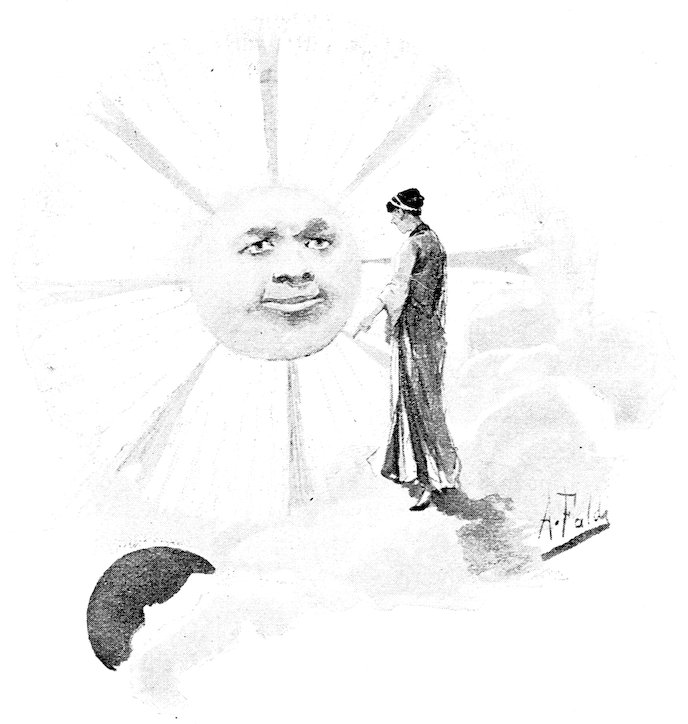
Let us be just;—humanity is not lovely when seen
through the falling drops of rain, by the cold, dull light of a
sunless day, under a dull, leaden, low, foggy sky, resting like
a cover on the circle of the horizon. All men wear faces
of portentous length; one can see that they bear an undying
grudge against meteorologic science, on account of that
phenomenon of aqueous infiltration which is so deadly to
new hats and old boots. They go their ways dripping
along the rows of houses, under the deluges from the water-pipes,
picking their way between the puddles, with countenances
cloudier than the skies, muttering the devil’s
litanies between their teeth with a muffled murmur like the
gurgling of a boiling saucepan. At every corner, such
accidents as making too close an acquaintance with the ribs
of an umbrella coming the other way, getting splashed with
liquid mud by a passing horse, or spoiling the freshness of
a new pair of trousers by means of an overflowing gutter,
provoke a glance which, if looks could kill, would be downright
murder,—a contraction of the facial muscles which
recalls the grin of the ancestral ape in a bad temper, and an
explosion of sotto voce ejaculations, expressing a pious desire
to see one’s neighbours in general attached to the muzzle of
a breech-loading mitrailleuse in full activity.
... Now, to orthodox minds there cannot be the slightest
doubt on the subject; rain is by no means a fitting and
necessary part of the order of things; it is rather of the
nature of a judgment. The Scriptures make no mention
of bad weather before the time of the Flood. Rain-water
was in nowise needed for the development of germs or
the ripening of the harvest. Adam had been condemned
to water the earth with the sweat of his brow, and this
irrigation would have been quite sufficient to raise maize
and beans over the whole surface of the globe....
1. That rain is not a necessity of Nature, but rather what
is commonly called a judgment of Providence.
2. That human beings, when it rains, are exceedingly
ugly.
Take these two conclusions and put them aside; for we
may draw from them later on the most curious and unexpected
consequences....
BIOGRAPHICAL INDEX OF WRITERS.
327
Edmondo de Amicis, born in 1846 at Oneglia (on the Genoa coast),
was educated at Cuneo, Turin, and the Military College of
Modena, which he left, with the grade of sub-lieutenant, in 1865.
In 1866 he was present at the battle of Custozza, and in 1867
edited a military periodical at Florence. After the Italian occupation
of Rome in 1870 he left the army, and devoted himself
entirely to literature. He is in a certain sense a follower of
Manzoni, who encouraged and directed his early efforts. His
“Sketches of Military Life” (one of which is translated in the
present collection) first saw the light in the pages of the Italia
Militare, and were followed by a collection of Novelle (or short
stories), which, however, are inferior to the first-named work.
The construction is defective, and the characterisation, though
vivacious, not very deep or subtle. Another fault which De
Amicis frequently falls into is a certain straining after pathos,
which defeats its own object—a fault which Dickens, in his desire
to draw tears, was not always exempt from. This is perhaps most
apparent in his later works, of which Cuore and another depicting
the life (a most wretched one, if De Amicis is to be believed)
of an Italian elementary schoolmaster, are examples. He has
travelled extensively, and given to the world several lively and
humorous volumes recording his experiences in Holland, Spain,
Morocco, and elsewhere—besides being well known as a lecturer.
We understand he is now resident at Turin, and has, quite
recently, proclaimed himself a convert to Socialistic ideas.
(Page 199.)
Lodovico Ariosto was born at Reggio (near Modena, not to be confused
with Reggio in Calabria) in 1474. He has written his own
autobiography in the Satires. He studied law at Padua, but
never had any taste for that profession, and never practised it. In
1503 he entered the service of the Cardinal Ippolito d’Este, who
employed him on various diplomatic missions, but left him leisure
to continue his studies. In 1516 he published his great poem, the
Orlando Furioso, which he had spent ten years in writing. After
the death of his patron in 1520, Ariosto transferred his services to
the cardinal’s brother, Alfonso, Duke of Ferrara, who, in 1522,
appointed him governor of the mountainous district of Garfagnana,
near Lucca—a post he has humorously described in his Satires.
In 1524 he returned to Ferrara, and spent the rest of his life in
328lettered leisure at Alfonso’s court. He now wrote his five blank
verse comedies (La Cassaria, I Suppositi, La Lena, Il Negromante,
and La Scolastica), which were acted before the court in a theatre
built for the purpose by order of the Duke. He died in 1533 of a
lingering illness. He was never married. The Orlando Furioso,
says one writer, “has been translated into most European languages,
but seldom successfully. Of the English translations, that
by Harrington is spirited, and much superior to Hook’s, but Rose’s
is considered the best, and is generally faithful.” A specimen
from the Satires has been given in T. H. Croker’s version. Of the
Orlando Furioso, it has been thought best, after consideration, to
give a free prose translation (selected and slightly adapted from
Stories from Ariosto, by H. C. Hollway-Calthrop[41]) of the passage
describing Astolfo’s visit to the moon, which is one of the best for
exhibiting the humorous side of Ariosto’s genius. The poem is a
gigantic one, with legions of characters, and a perfect maze of
episodes more or less closely connected with the main thread of
the story: the war between Charlemagne and the Saracens, ending
with the defeat of the latter and the death of their king, Agramante.
If those who are in at the death of Spenser’s Blatant Beast are very
few and very weary, we should imagine that those who have
followed Agramante to his bitter end must be fewer and wearier
still. (Page 30.)
Francesco Berni, a Tuscan, was born in 1490, and died in 1536 as
canon of the cathedral at Florence. He was a priest, and spent
the greater part of his life at the court of Rome, in the service of
various cardinals and prelates. A writer in the National Encyclopædia
says, “Berni is one of the principal writers of Italian jocose
poetry, which has ever since retained the name of Poesia Bernesca.
This style had been introduced before him” (see Note on Pucci),
“but Berni carried it to a degree of perfection which has rarely
been equalled since.... His satire is generally of the milder sort,
but at times it rises to a bitter strain of invective. His humour
may be said to be untranslatable, for it depends on the genius of
the Italian language, the constitution of the Italian mind, and the
habits and associations of the Italian people. His language is
choice Tuscan. The worst feature in Berni’s humorous poems is
his frequent licentious allusions and equivocations, which, though
clothed in decent language, are well understood by Italian readers.”
It is, perhaps, curious that another great offender in this respect—Casti—was
also an ecclesiastic. But we cannot help remembering
in this connection a remark made by a writer in an English magazine,
who had been invited to a wedding in an Italian country
town—viz., that of the congratulatory verses sent in by friends
(some of which were very far from being in accordance with our
notions of propriety) the most objectionable were written by
priests. Three volumes of Berni’s Poesie Burlesche were collected
and published after his death. He also wrote what he called a rifacimento
329of Bojardo’s Orlando Innamorata, altering the diction of
the poem into what he considered purer Italian, and adding some
stanzas of his own. More satisfactory productions, perhaps, are
La Catrina and Il Migliazzo, dramatic scenes written in the rustic
dialect of Tuscany. (Page 35.)
Giovanni Boccaccio was born at Paris in 1313. His father, a native
of Certaldo, near Florence, brought him to the latter city when quite
a child, intending to educate him for commerce, in which he was
himself engaged. He escaped from this life at the age of twenty
by promising to study canonical law, which, however, proved not
much more to his taste than business, and his principal pursuits at
the University of Naples were Greek (then beginning to be studied
in Italy), Latin, and mathematics. At Naples, too, he made the
acquaintance of Petrarch, and fell in love with the Princess Maria,
a natural daughter of King Robert, for whom he wrote his poem
of the Teseide, containing the tale of “Palaemon and Arcite,”
afterwards made use of by Chaucer. In 1350 Boccaccio returned to
Florence, and appears to have gradually changed his way of life, and
become known as a quiet and orderly citizen. In 1361 he retired
from the world altogether, and became a priest. He visited
Petrarch at Milan, and again (in 1363) at Venice, and kept up his
friendship with him to the end of his life. In 1373 he was
appointed by the Republic of Florence to give public readings, with
comments, of Dante’s Divina Commedia; but these lectures were
often interrupted by ill-health, and Boccaccio died in December
1375. His earliest work was in verse, but finding that he could
not hope to attain first-rate excellence in poetry he turned his
attention chiefly to prose. The Decameron was one of the earliest
prose works written in Italian, and is esteemed a classic for its
style. The plan, perhaps, suggested that of Chaucer’s Canterbury
Tales; the hundred tales of which it consists being supposed to be
told by ten persons on ten different days—hence the name (from
the Greek words for ten days). The introduction relates how the
narrators—seven ladies and three knights—having fled to the
country to escape from the plague which desolated Florence in
1348, enlivened the solitude of their villa by telling stories. Some
of these tales are lively and humorous, some pathetic and tragic.
Many of them, as is well known, are better left in oblivion; some,
indeed, being good comedy spoilt by that which renders it unquotable;
while others, if ever they were found amusing, must
have been so by reason of their coarseness, for they have no other
claim. Others, again, reach a very high level, as that of “Nathan
and Mithridanes”; or that other of the three rings, on which Lessing
founded his drama of Nathan der Weise. The story of “Calandrino
and the Heliotrope” is, we believe, one of the best farcical
ones. Buffalmacco and his practical jokes seem to have been the
common property of the comic writers of the period, and probably
all “burle” or “japes” which were thought more than commonly
amusing were indiscriminately fathered upon him. His real life is
330given by Vasari, from whom we have also culled one or two of the
more celebrated burle, which, however, belonging to popular
tradition, had previously been related by Sacchetti. In the same
way, at a later period, every witty saying and ridiculous adventure
current in Florence was attributed to the dramatist G. B. Fagiuoli
(1660–1742). Anecdotes of the latter may be picked up among the
Florentine populace even now; but the practical joke related of
him (we hope falsely) in Pitré’s collection of folk-tales will not bear
repetition. Other Joe Millers of Italy are the Florentine Piovano
Arlotto, Gonnella, and Barlacchia, various collections of whose
jests have from time to time been published. The translation
given (as also in the case of the selections from Parabosco and
Sabadino degli Arienti) is Thomas Roscoe’s. (Page 2.)
Luigi Capuana, Sicilian novelist and critic, born at Mineo, in the
province of Catania, May 27, 1839. His first published works
were poems, among others an imitation of Tommy Moore’s Loves of
the Angels. In 1864 he went to Florence, where he was for two
years dramatic critic to La Nazione. The best of the articles
written for that paper he afterwards published in volume form,
under the title, Teatro italiano Contemporaneo. In 1868 he
returned to his native place, and remained there till 1876. During
this time he was chosen Syndic of the district, and in 1875 published
an official report on The Commune of Mineo, which is really
worthy of the name of a contribution to literature. In 1877
he removed to Milan, and resumed his literary labours, writing
critical articles in the Corriere delle Sera, and also a number
of sketches, afterwards collected in volume form, under the
title, Profili di donne. Since then he has issued various works
of fiction, mostly collections of short stories—or rather character-sketches—for
some of them have scarcely any story to speak
of. The specimens in the present volume are taken from a
collection entitled Fumando. Capuana is a great admirer of
Émile Zola, and aims at his style and methods; but his Italian
(or perhaps Greek, since he is a Sicilian!) sense of beauty and
proportion preserve him from the grossest faults of the extreme
naturalist school. He needs, however, to guard against the dangers
of Impressionism; at least we suppose that is the name for the
tendency to give detached “bits” instead of pictures—a tendency
which appears to excess in his short stories. He has written two
complete novels, Giacinta, and Storia Fosca; and a charming
collection of popular fairy tales, retold for children under the
title of C’era una volta (“Once upon a time”). (Page 107.)
Enrico Castelnuovo, born at Florence, 1839, has passed the
greater part of his life at Venice, where he appears to be still
resident. From 1853 to 1870 he was engaged in business, but in
the latter year became editor of a political paper, La Stampa.
Since then he has published several novels and collections of short
stories, some of which have appeared in the Perseveranza. Some
331of the best known of them are: La Casa Bianca, Vittorina,
Lauretta (1876), Il Professõr Romualdo (1878), Nuovi Racconti,
Alla Finestra, and Sorrisi e Lacrime, from which the sketch in the
present volume is taken. Most of his stories deal with Venetian
life. (Page 191.)
Giovanni Battista Casti, 1721–1803, was an ecclesiastic, and the
author of many satirical works, of which the best known is Gli
Animali Parlanti (The Speaking Animals), which has, I believe,
been translated as The Court and Parliament of Beasts. He also
wrote a sequence of a hundred sonnets, entitled I Tre Giuli, which
is surely the most striking instance extant of an idea ridden to
death. The sonnets (of which one here and there is fairly amusing)
are all on the subject of a debt of about eighteenpence which the
author owed a friend. They hardly merit the extremely laudatory
language used about them by the translator, M. Montague (1841).
A much greater contribution to the gaiety of nations is the “opera
buffa” of Il Re Teodoro, for which Paisiello wrote the music, and from
which we have given an extract. Casti wrote other comic operas,
one of the best of which is Catiline’s Conspiracy, in which the famous
exordium of Cicero’s oration, Quousque tandem, is rendered (and
pretty closely too) into burlesque verse. Cicero is shown in his
study, preparing his oration with infinite pains. When at length
it is delivered, the interruptions of Catiline and others are faithfully
reported.
- Cicero.
- Fin a quando, o Catilina
-
- L’esterminio e la rovina
-
- Contro a noi mediterai?
-
- Fino a quando abuserai
-
- Con cotesta impertinenza
-
- Della nostra pazienza?
-
- Va, rubello, evadi, espatria,
-
- Traditore, della patria,
-
- Conciofossecosachè....
- Catil.
- Traditor rubello a me?
- Cic.
- Conciofossecosachè.
- People.
- Si ch è’ ver....
- Others.
- No chè non è!
- Cic.
- Conciofossecosachè...
This is pretty good fooling, and the compound conjunction (a
sort of double-barrelled Forasmuch as, often used in legal
phraseology), to which the orator clings desperately, when so rudely
thrown out in his speech, comes in with the happiest effect. But
the effect of the rapid rush of the double-rhymed octo-syllables
would be quite lost in a translation. They have somewhat the
character of the smart and fluent verse in Mr. W. S. Gilbert’s
operas. Besides verse, Casti wrote prose Novelle, to which Cantù
(Letteratura Italiana, vol. ii.) gives the worst character. Of the
332Animali Parlanti, the same author says that it “satirised Governments
with the liberalism of the café” (as we might say “of taproom
politicians”) “and in the style of an improvisatore.” It is
a somewhat long-winded work in six-line stanzas. (Page 57.)
Baldassare Castiglione, born in the Mantuan territory in 1478,
was attached, first to the court of Lodovico the Moor, at Milan;
afterwards, in succession to those of Francesco Gonzaga, Marquis
of Mantua, and Guidobaldo, Duke of Urbino. He was a polished
gentleman and brilliant scholar, “a perfect knight, second to none
either in intellect or culture.” Charles V. pronounced him “one
of the best knights in the world.” The court of Urbino, at that
time “a school of courtesy and valour, as well as of learning,” was
a fitting home for such a man. He took part in more than one
campaign, and was sent as ambassador to England, to Milan, and
to Rome. He died at Toledo in 1529, while on a diplomatic
mission to the Emperor Charles V., it is said, of grief at the sack
of Rome by the Spaniards under the Constable de Bourbon.
Raphael painted his portrait in life; Guido Romano designed his
tomb after his death, and Pietro Bembo wrote his epitaph. He
wrote many elegant and scholarly poems, both in Latin and
Italian; but his fame as an author rests entirely on the book
entitled Il Cortigiano (The Courtier). It consists of a series of
dialogues in which the qualities necessary to the character of a
perfect courtier are discussed. It seems to have been written at
Mantua, during the short period of his happy wedded life (his
wife, Ippolita Torelli, married in 1516, died three years
later). The style is courtly and polished, though with a certain
simplicity in its stateliness. The interlocutors sometimes relieve
their grave philosophy by humorous anecdotes, of which a few
specimens are given in the text. (Page 27.)
Francesco Cerlone lived during the latter half of the eighteenth
century, and wrote an immense number of plays of the Commedia
dell’ Arte type. His works were published, in a collected form,
at Bologna in 1787, and again (in twenty-two volumes) at Naples,
in 1825–29. Little seems to be known about him. Symonds
calls him “a plebeian poet of Naples.” The distinguished Italian
critic, Michele Scherillo, “discovered” him not many years ago.
(Page 49.)
C. Collodi is the pseudonym of a brilliant Tuscan writer, Carlo
Lorenzini, a frequent contributor to Fanfulla. He was for some
time theatrical censor to the Prefecture of Florence. He has also
written children’s books, and one or more volumes of short stories.
(Page 90.)
Napoleone Corazzini, born in Tuscany about 1840, had a natural
bent towards humorous writing, but was prevented by circumstances
from following it out, though a farce (or rather parody) of his,
333called The Duel, is sometimes acted. He spent some time in
Herzegovina as a newspaper correspondent, but was forced, on his
return, to forsake literature for commerce. (Page 103.)
Paolo Ferrari, writer of comedies, was born at Modena in 1822.
His father was an official in the service of the Duke, and young
Ferrari’s liberal sentiments were a great disadvantage to him at
the outset of his career. It is even said (with what truth I do not
know) that they induced the Duke to interfere with the granting
of his University degree, which was delayed for a long time. But
Ferrari’s legal studies had been pursued with so little ardour as to
suggest another reason for the action of the University authorities.
His first comedy was written in 1847, and was called Bartolommeo
the Shoemaker, a title afterwards changed to Uncle Venanzio’s
Codicil. After contending with many difficulties, he wrote his
Goldoni in 1852, but had to wait two years before it was produced,
when it was a signal success. Since then he has given to the
world a long series of works, chiefly comedies, and the Italians
consider him their first comic dramatist. Some of his greatest
successes are his dramas, drawn from Italian history, in which
the characters—unlike those in the ordinary historical drama—are
rather literary than political. Such are Dante a Verona, Parini e
la Satira, and the above-mentioned Goldoni e le sue Sedici Commedie.
He writes either in prose or in a kind of rhymed alexandrines
called Versi Martelliani. Of his other dramas the greatest
are Il Duello, Il Suicidio, Gli amici rivali, Cause ed effetti, Il
Ridicolo, Gli Uomini Serii. Nearly all of his plays which are
still on the stage have obtained the Government prize offered in
Italy for dramatic excellence. (Page 237.)
Piero Francesco Leopoldo Coccoluto Ferrigni, better known
under the name of “Yorick,” is a Tuscan writer; born at Leghorn
in 1836, though of Neapolitan descent. He began his literary
career in 1854 by contributing “correspondence” to some of the
Florentine papers. In 1856 he first adopted the pseudonym which
has become so famous—from Hamlet, not from Sterne. Indeed,
when he became acquainted with the latter’s works, he felt as if
he had been guilty of presumption, and thenceforth signed his
articles, Yorick, son of Yorick. He took a brilliant law degree at
Siena in 1857, and has made his mark as an advocate, though
his reputation is principally journalistic and literary. Florentine
newsboys may be heard using his name to enhance the attractions
of their wares. “C’è l’articolo di Yorick,” they will say, or more
briefly, “C’è Yorick!” (There’s Yorick in it). Like many living
Italian writers, he bore his part in the War of Liberation. He
volunteered in 1859, when, for some time, he acted as Garibaldi’s
private secretary, and in 1860 he was wounded at Milazzo. He is a
writer of great ease and fluency—and not in his own language only—sending
contributions in French to the Indépendance Italienne,
and in German to the Neue Freie Presse. He appears to be one
334of the few Italians who have found literature profitable. Many of
his newspaper articles have been collected in volume form. The
specimens here quoted are taken from “Cronache dei Bagni di
Mare” (part of which was reproduced in English by the Morning
Post), and “Su e giù per Firenze.” (Page 232.)
Antonio Ghislanzoni, son of a doctor at Lecco, on the Lake of
Como, was born in 1824. His father first wished him to become
a priest, and then sent him to study medicine at Pavia; but the
youth, finding that he possessed a splendid baritone, studied singing
instead, and in 1846 obtained an engagement at the Lodi
Theatre. In 1848 he took to journalism, and ran two papers at
Milan; the extreme political opinions advocated in which soon
landed him in prison. After the return of the Austrians he was
exiled, and, after another imprisonment in Corsica, continued his
musical career there and in Paris, till he lost his voice (in 1854) in
consequence of an attack of bronchitis, and returned to literature
and Italy. He edited various papers, wrote a variety of articles,
mostly of a comic character, and composed the libretti to several
operas, of which the best known is Verdi’s Aida. For some time
past he has resided in a little house of his own at Lecco. He
edited, and in great part wrote, the Rivista Minima, which
afterwards passed into the hands of his friend, Salvatore Farina.
(Page 94.)
Giuseppe Giusti, born at Monsummano, in Val di Nievole (Tuscany),
in 1809. He received his early education, between the ages of seven
and twelve, from a priest; its results being, to use his own words,
“sundry canings, not a shadow of Latin, a few glimmerings of
history, discouragement, irritation, weariness, and an inward conviction
that I was good for nothing.” He then attended a school
in Florence, where he came under the care of more intelligent and
sympathetic masters, and began to awaken to the love of knowledge.
He afterwards went to the University of Pisa, but (like our
own Wordsworth and others) made no special progress in the
studies proper to the place. In later life he lamented the idleness
and desultory habits of these years; but it is probable that, in following
the bent of his intellect towards popular and general literature,
and picking up songs and stories in the racy idiom of the Tuscan
hills, he was laying the best possible foundation for his future career
as a poet. His health was never good, and he died, comparatively
young, in 1850, thus disappointing the brilliant expectations his
friends had formed. What he did accomplish, however, is sufficient
to secure him a place in the first rank of modern Italian literature.
Besides the Poems (of which several collected editions have
been published) his principal works are a collection of Tuscan proverbs
(with introduction and notes) and a Discourse on the Life
and Works of Giuseppe Parini, the satirist. Since his death there
have been published a volume of his letters, and one of unpublished
pieces in prose and verse, the principal of which is a commentary
335on Dante’s Divina Commedia. His poems are peculiarly difficult
to translate, on account of their exceedingly idiomatic character, as
well as, in many cases, of their personal and political bearing. They
have a directness, vigour, and pungency rare in the literature of Italy
during the first half of this century. His political satire rises
sometimes into noble indignation, as in the fine poem beginning,
A noi, larve d’Italia, which has been translated into English, if we
mistake not, at least twice. His non-political satire is always
kindly and good-humoured, and the same spirit, along with an
irrepressible cheerfulness and boyish love of fun, comes out in his
letters—especially those to his intimate friend, Manzoni. (Page 74.)
Count Gasparo Gozzi, elder brother of Carlo Gozzi, the dramatist,
was a Venetian, and lived from 1713 to 1786. The Gozzi
family might be described as that of “a penniless laird wi’ a lang
pedigree,” and the Memoirs of Count Carlo contain a vivid account
of the straits and shifts to which they were put. Gasparo hoped to
retrieve the family circumstances by his marriage with a learned
lady given to poetry, Luisa Bergalli or Bargagli (who rejoiced in
the academic title of Irminda Partenide); but her extravagance
and shiftlessness only made matters worse, and he was forced
to do anonymous hack-work—translations from the French,
and the like—for a living; or, as he calls it, to wear himself
out “in unknown writings with the daily sweat of one’s
brow, and drag works—either insignificant or vile—out of the
Gallic idiom into the Italian language.” Notwithstanding this,
he contrived to do a tolerable amount of work which has lasted.
His style is simple, clear, and pure, though without much vigour;
and, as Cantù says, he has the gift of “coupling fancy with
observation, and wit with feeling.” He issued for some time
a paper called L’Osservatore on the plan of Addison’s Spectator.
He wrote a great many “Bernesque” poems—sonnets a coda, and
satirical pieces in blank verse. His letters also are excellent.
(Page 53.)
Giacomo Leopardi, born at Recanati, in the Duchy of Urbino, in
1798, suffered all his life from ill-health and real or fancied uncongenial
surroundings. He was heavily handicapped in the race
of life, being hunchbacked, as well as constitutionally diseased;
and thus the pessimistic doctrines which he imbibed from Pietro
Giordani fell on a fertile soil. His father was rich and possessed
a splendid library, and though he refused to allow Giacomo to go
away to school, the boy threw himself into his studies at home
with so much ardour that at fifteen he was a brilliant classical
scholar, and wrote an ode in Greek which competent critics
believed to be ancient. Yet he long remained unknown, thwarted
by his father’s harshness in all his efforts to obtain a wider culture
and more literary opportunities. At last he was able to escape
from his hated home to Rome, where he enjoyed the society of
literary men; but could not succeed, as he had hoped, in obtaining
336some professorship. He then, embittered and disgusted with the
world, retired to Milan, where he lived in the house of a publisher
and prepared his poems for the press. Here too he was unable
to escape from the misery which pursued him, and his health
became worse and worse. At last, in the autumn of 1831, he
took his last journey—to Naples, where Antonio Ranieri, his
untiring friend, received him into his house. There, worn out
by dropsy and consumption, he died on July 14th, 1837. Of
his philosophical works, and his splendid, gloomy verse, it is not
the place to speak. I have included him in this collection on
account of some of his dialogues, which are masterpieces of a
subtle irony which has the air of simplicity and bites to the bone.
It is keener and more delicate than Swift’s, but otherwise very
difficult to describe. One cannot easily imagine that Leopardi
ever laughed; but no one could read the “First Hour and the
Sun,” or the “Wager of Prometheus,” and think him wanting in
humour. (Page 63.)
Niccolo Machiavelli, a Florentine, lived from 1469 to 1527. His
place in this volume is due to his comedy of La Mandragola,
of which a scene is given; but this, of course, is not the work by
which he is best known in history. Macaulay’s well-known essay
gives a very good summary of his political and literary labours.
He first took part in public affairs in 1494; in 1498 he was
elected Secretary to the Florentine Republic, an office which he
resigned in 1512, after the return of the Medici. Some time afterwards,
being suspected of a conspiracy against the latter, he was
imprisoned and put to the torture, nearly dying under it. He was
included in the amnesty proclaimed by Giovanni di Medici, when
raised to the Papacy under the title of Leo X. Though restored
to liberty, he could take no part in politics, and finding himself
unable to serve Florence, and condemned to a hateful inaction,
he retired to his country-house, where he wrote the greater part
of his works. The last of these was the History of Florence,
written at the request of Pope Clement VII., and completed in
1525. In 1519 Leo X. consulted him about reforming the government
of Florence, but his advice was not followed. In 1526, when
the Constable Bourbon began to threaten Tuscany and Rome,
Clement VII. again consulted Machiavelli, and entrusted him
with the fortification of Florence, and with the precautions to be
taken for the safety of Rome; but these precautions came too late.
The Pope was taken prisoner, and the Medici once more driven
from Florence; and Machiavelli being now looked upon as a
partisan of that family, fell into neglect, and may be said to have
died of grief and disappointment. His chief works besides the
History, are the Prince, the Art of War, and the Discourses on the
First Decade of Livy. Besides this, he wrote two or three
comedies and a witty novella (somewhat extravagant, though, in
its satire), entitled Belphegor. It relates how one of the devils,
taking the form of a man, came to earth in order to try the experiment
337of matrimony; but was so very wretched in his married life,
that, after a short trial, he preferred returning to the region whence
he came. It is said that Machiavelli’s experiences in his own
home gave point to his descriptions of Madonna Onesta’s folly and
extravagance. The Mandragola, in spite of Macaulay’s high
praise, offers scarcely anything adapted for quotation. The play is
admirably constructed, but the story is one which would render it
“impossible” for a modern audience. We have been forced to
confine ourselves to a soliloquy of Fra Timoteo’s and one of the
lyrical interludes between the acts, which has the merit of brevity,
if no other. (Page 26.)
Alessandro Manzoni, born at Milan 1784, died 1873. One of the
leaders of the Romantic Movement in Italy, and the founder (in
that country) of the historical novel in the style of Scott.
The Promessi Sposi, published in 1827 (from which we have
quoted a scene or two), has probably been translated into every
European language. Less widely known are his tragedies, Adelchi
and Il Conte di Carmagnola, and his Odes (1815), the most
famous of which is that on the death of Napoleon—Il Cinque
Maggio. He was followed in the department of historical fiction
by his son-in-law, D’Azeglio, and by Grossi, Guerrazzi, Rosini,
Ademollo, and others. Though at first sight I Promessi Sposi
might seem anything but a humorous work, there are scenes
equal in this respect to some of the best in Scott’s novels. That
of the attempted irregular marriage (which we have chosen for
quotation) is especially good, and the character of Don Abbondio
is comically conceived throughout. Perhaps the book has been
somewhat neglected of late years—it has certainly, like many
other masterpieces, suffered undeservedly through being used as
a school-book. (Page 82.)
Filippo Pananti was born at Ronta, in the district of Mugello
(Tuscany), about 1776, and studied law at Pisa, but afterwards
gave himself up entirely to literature. He went abroad in 1799,
and after visiting France, Spain, and Holland, obtained a
position as libretto-writer to the Italian Opera in London. When
returning to Italy by sea he was taken prisoner by Algerine
pirates, but liberated through the intervention of the English
consul. “He then came to Florence, and published his works—viz.,
Il Poeta di Teatro, Prose e Versi, Viaggio in Algeria, in
which it may be said that he is often negligent rather than simple,
and that he makes use unnecessarily of foreign expressions, or of
such as are not yet accepted as current in the conversation of the
best educated persons; yet he pleases, nevertheless, and deserves
to do so, by his vivid and racy way of expressing himself, and his
ease and fluency. He died in 1837.”—(Ambrosoli.) Il Poeta di
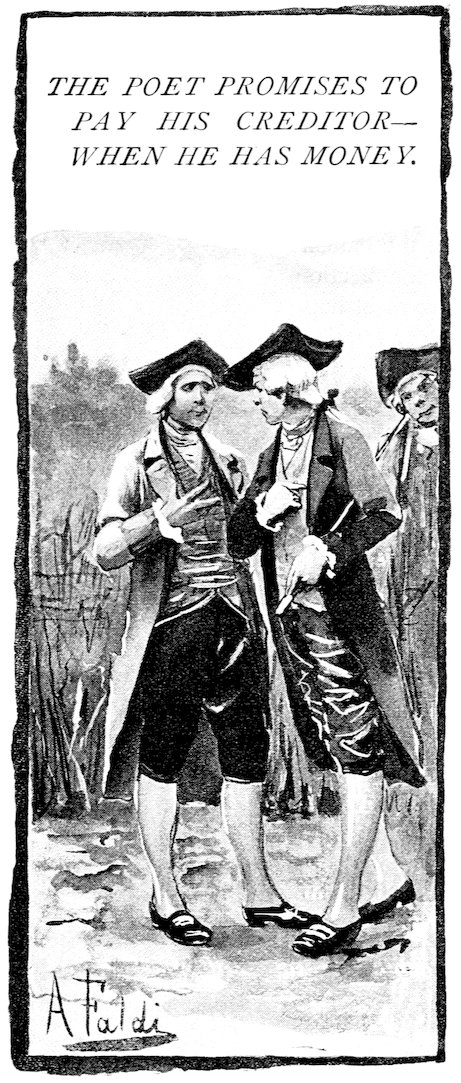
Teatro is a lively and amusing poem descriptive of the miseries
endured by a poet of small means. It is thoroughly good-humoured
throughout, and has no “Grub Street bitterness” about
it. We have extracted one or two passages. (Page 70.)
338Girolamo Parabosco, born at Piacenza about the beginning of the
sixteenth century, died at Venice, 1557. He wrote “Rime” and
prose comedies, and was, moreover, esteemed one of the best
musicians of his time. He was for some time organist and choirmaster
at St. Mark’s, Venice. But he is best known by I Diporti,
a collection of stories after the model of Boccaccio’s Decameron,
supposed to be told by a fowling-party weatherbound on an island
in the Venetian lagoons. (Page 14.)
Mario Pratesi, a Tuscan writer, was born at Santafiora, in the
district of Monte Amiata, in 1842. At eighteen he became a
clerk in a Government office, and remained at this distasteful
employment till 1864, when he returned to his studies, and in
1872 obtained an appointment as lecturer on Italian literature at
the Pavia Technical Institute, whence he passed to a similar post
at Viterbo, and thence to Terni. Most of his stories, since collected
in volume form, first appeared in the Nuova Antologia, and he has
contributed to the Diritto, the Rassegna Settimanale, and the
Nazione (Florence). He has also written poems. He is at his best
when describing the scenery of his native mountains. Monte
Amiata, it may be remembered, was the scene of the strange
religious revival led by the insane peasant-preacher, David
Lazzaretti, who was shot down by the gendarmes in August 1878.
It is a wild, lonely region, lying between the river Ombrone and
the Roman border—a land of craggy peaks and dark glens,
inhabited by simple, serious-minded people with a touch of gloomy
mysticism in their character, perhaps due to Etruscan ancestry.
The immediate neighbourhood of the district where the tragedy
took place is admirably described in “Sovana.” Pratesi is
intensely sympathetic in his manner of depicting life. He does
not aim at an “objectivity” which seems to glory in appearing
cold and heartless; but he does not dwell unnecessarily on his
pathetic scenes. He relates them with grim brevity, and leaves
them to produce their own effect. He has an eye for the ludicrous,
but it does not predominate in his view of life; he never laughs,
but he often smiles quietly, and sometimes grimly. Dottor Febo
is a good example of his subtle irony, and has been given entire, as
no detached passage would show to advantage. He is fully alive
to the great evils of priestcraft and ignorance from which Italy has
suffered in the past, but he is no radical of the type which is all
negation and no affirmation. His attitude towards the clergy is
impartial enough—he has drawn them of all sorts, good and bad.
In the story before us there are three, and those who have
resided any length of time in Italy must have met them all: the
spiteful, hypocritical preaching friar, the jovial, easy-going Arciprete
(who would have overlooked the sin of a bit of meat on Ash
Wednesday if that meddling rascal of a Franciscan had not put
his finger in the pie), and the chaplain of the Confraternità, in his
threadbare coat,—own brother to Chaucer’s Parson. Though in
the stories here translated I have usually left all proper names in
339their original form, I have in this instance departed from the rule,
in order to bring out the quaint incongruity of the hero’s name
with his pitifully sordid life and surroundings, Febo not being perhaps
readily recognisable at first sight as Phœbus. Names as classical
as this are by no means uncommon in the Roman and Tuscan
country districts. Romolo and its feminine Romola are frequently
met with, as also Belisario, Ersilia, Flaminia, etc. Naples and
the Adriatic coast show a greater preference for Church saints;
and a peculiarity of the latter district is the frequent occurrence of
Old Testament names, which are not usual in other parts. Perhaps
this is due to Byzantine influence, and the more comprehensive
calendar of the Eastern Church; thus we find Samuele, Zacchiele,
Elia, etc. The subject of Christian names in rural Italy is an
interesting one, and would well repay study, especially in villages
where reading is almost unknown, and the names in use must be
to a large extent traditional, and probably handed down from
remote antiquity. (Page 206.)
“Antonio Pucci, the son of a bell-founder, was a poet, although he
kept a shop; and had not a little of that easy, sparkling vein
which, a century later, was so abundant in Berni, as to make the
latter seem like the creator of a new style of poetry. He died in
Florence, his native city, some time after 1375.” This is all I can
find with regard to Pucci in Ambrosoli’s Manual of Italian Literature.
The sonnet in which he describes the persecutions to which
a poet is subject at the hands of his friends is a not unfavourable
specimen of what the Italians call poesia bernesca. This kind of
sonnet is called “sonetto a coda,” or “with a tail,” and is much
used in humorous and satirical writing, as being a kind in which
more licence is allowable metrically, when the idea cannot be
brought within the limits of the strict sonnet form. The “tail”
may be lengthened at pleasure, but always in sets of three lines—one
short and two long—and sometimes attains to a greater length
than the original sonnet. (Page 1.)
Francesco Redi, born at Arezzo, in Tuscany, in 1626, was a jovial
physician, no less famed for his wit than for his learning and
medical skill. He studied philosophy and medicine at the University
of Pisa, and was then invited to Rome by the princes of the
House of Colonna, in whose palace he lectured on rhetoric. He
was afterwards court physician to the Grand Dukes of Tuscany.
During the last years of his life he was afflicted with epilepsy, and
retired to Pisa, as being a healthier place than Florence. Here he
died suddenly on March 1st, 1698. His published works consist
of poems, scientific treatises, and a large collection of letters which
show his wide learning, his shrewd sense, and the merry, genial
spirit which could see a funny side to his own troubles. “To
judge from the praises of his countrymen,” says Leigh Hunt, “he
partook of the wit and learning of Arbuthnot, the science of
Harvey, and the poetry and generosity of Garth.” His humour is
340rather broad than subtle—but always sweet and kindly; his
laughter is the mellow mirth of one who enjoys life himself and
wishes others to enjoy it also. He was passionately fond of
natural history, and an acute and patient observer; his papers on
vipers, on the generation of insects, and on some other subjects,
were important contributions to the science of his time. His
replies (usually at great length) to the patients who consulted him
by letter have been preserved, and are printed among his works.
In medicine, he had a wholesome faith in the healing efficacy of
nature, and anticipated the modern revolt against the excessive use
of drugs, or, as he himself puts it, “that hotch-potch of physic
which physicians, out of sheer perversity, are accustomed to prescribe
to others, but would never dream of swallowing themselves.”
His poems are not numerous, nor of the most elevated kind of
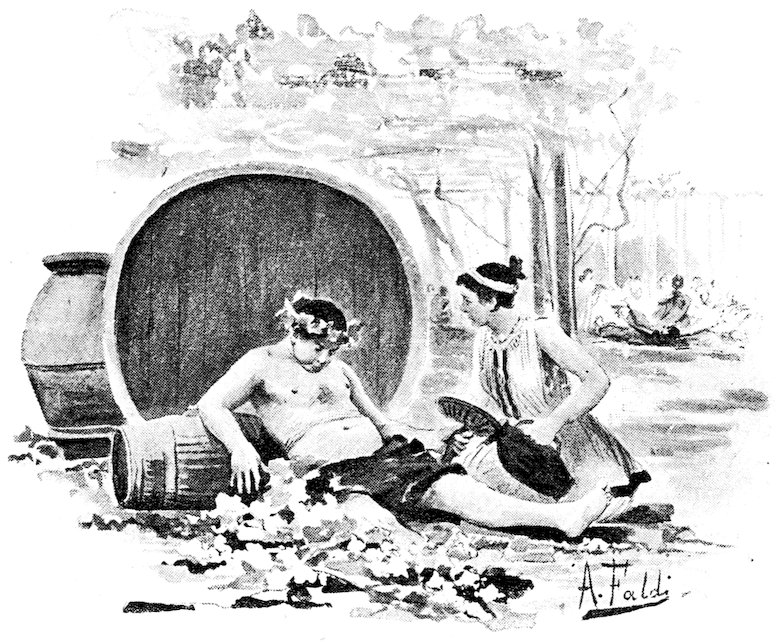
poetry; but the best known, the dithyrambus of “Bacco in
Toscana,” with its fiery swing and rush, leap, and lilt of melody,
is perhaps the most perfect thing of its kind ever done. It
awakened the enthusiasm of Leigh Hunt, from whose translation
we have extracted a passage, and whose critically appreciative
introduction is quoted below. “Bacco in Toscana” is not a poem
to be looked on with favour by total abstainers; but wine of
Montepulciano is not the most pernicious form of alcohol known to
the world (the wine on which the German cavalier in the ballad
drank himself to death was that of Montefiascone, on the other side
of the Roman border), and, moreover, the poem is no proof that
the poet really was in the habit of taking more than was good for
him. “The ‘Bacco in Toscana,’” says Leigh Hunt, “was the first
poem of its kind, and when a trifle is original even a trifle becomes
worth something.... That the nature of the subject is partly a
cause for its popularity, and that, for the same reason, it is impossible
to convey a proper Italian sense of it to an Englishman is
equally certain. But I hope it is not impossible to impart something
of its spirit and vivacity. At all events, there is a novelty in
it; the wine has a tune in the pouring out; and it is hard if some
of the verses do not haunt a good-humoured reader, like a new air
brought from the South.... It is observable that among the
friends of our author were Carlo Dati, Francini, and Antonio
Malatesti, three of Milton’s acquaintances when he was in Italy.
Redi was only twelve years of age when Milton visited his country;
but he may have seen him, and surely heard of him. It is pleasant
to trace any kind of link between eminent men. There is reason
to believe that our author was well known in England. Magalotti,
who travelled there with Cosmo, and who afterwards translated
Phillips’s Cyder, was one of his particular friends; and I cannot
help thinking, from the irregularity of numbers in Dryden’s nobler
dithyrambic, as well as from another poem of his (‘Dialogue of a
Scholar and his Mistress’), that the ‘Bacco in Toscana’ had been
seen by that great writer. Nothing is more likely; for, besides the
connection between Cosmo and Charles II., James II. made a
special request by his ambassador, Sir William Trumball, to have
341the poem sent him. When Spence was in Italy, many years
afterwards, the name of Redi was still in great repute, both for his
humorous poetry and his serious, though the wits had begun to
find out that his real talent lay only in the former. Crudeli, a
poet of that time, still in repute, told Spence that ‘Redi’s “Bacco
in Toscana” was as lively and excellent as his sonnets were low and
tasteless.’ And, after all, what is this ‘Bacco in Toscana’? It is
an original, an effusion of animal spirits, a piece of Bacchanalian
music. This is all; but this will not be regarded as nothing by
those who know the value of originality, and who are thankful for
any addition to our pleasures.... I wish that, by any process
not interfering with the spirit of my original, I could make up to
the English reader for the absence of that particular interest in a
poem of this kind which arises from its being national. But this
is impossible; and if he has neither a great understanding, nor a
good-nature that supplies the want of it; if he is deficient in
animal spirits, or does not value a supply of them; and, above all,
if he has no ear for a dancing measure, and no laughing welcome
for a sudden turn or two at the end of a passage—our author’s
triumph over his cups will fall on his ear like ‘a jest unprofitable.’
I confess I have both enough melancholy and merriment in me to
be at no time proof against a passage like—
‘Non fia già che il Cioccolatte
V’adoprassi, ovvero il Tè’—etc.
A great deal of the effect of poems of this kind consists in their
hovering between jest and earnest.... The ‘Bacco in Toscana’
partakes more or less of the mock-heroic throughout, except in the
very gravest lines of the author’s personal panegyrics. It is to the
Ode and the Dithyrambic what the ‘Rape of the Lock’ is to the
Epic, with all the inferiority which such a distinction implies....
The great fault of the poem is undoubtedly what his friend
Ménage objected to in it—namely, that Bacchus has all the talk to
himself, and Ariadne becomes a puppet by his side. Redi, partly
in answer to this objection, and partly, perhaps, out of a certain
medical conscience (for it must not be forgotten that his vinosity
is purely poetical, and that he was always insisting to his patients
on the necessity of temperance and dilutions), projected a sort of
counter-dithyrambic in praise of water, in which all the talk was to
be confined to Ariadne.... He wrote but a paragraph of this
hydrambic. The inspiration was not the same. As to his drinking
so little wine and yet writing so well upon it, it is a triumph for
Bacchus instead of a dishonour. It only shows how little wine
will suffice to set a genial brain in motion. A poet has wine in
his blood. The laurel and ivy were common, of old, both to
Bacchus and Apollo; at least Apollo shared the ivy always, and
Bacchus wore laurel when he was young and innocent,
‘What time he played about the nestling woods,
Heaping his head with ivy and with bay.’”
342Giovanni Sabadino degli Arienti, a Bolognese, was the author
of one of those collections of short stories so numerous in Italian
literature, which often furnished subjects to our Elizabethan playwrights.
The dates of his birth and death are uncertain, but the
former must have been before 1450, and the latter not earlier than
1506. Besides the Porrettane (so called because the stories are
supposed to be told by a holiday party at the baths of Porretta),
he wrote poems, treatises, and biographies. (Page 19.)
Franco Sacchetti was a Florentine, about contemporary with
Chaucer, being born in 1335. He was brought up to a commercial
life, but afterwards devoted himself to literature, and took
a considerable part in politics, being sent on various embassies
by the Florentine Republic. On one of them he was plundered
at sea by the Pisan war-ships; and, at a later date, the property
he possessed near Florence was laid waste in the war with Gian
Galeazzo Visconti. The date of his death is uncertain, but it
probably took place during the first few years of the fifteenth
century. He wrote sonnets, canzoni, madrigals, and other poems;
but his best known works are his Novelle or short stories. They were
originally 300 in number, but we only possess 258, the remainder
having been lost. They are not fitted into any framework, like
that of Boccaccio’s Decameron. The best of them are of a
humorous character; and the style is more simple and colloquial
than Boccaccio’s. The story given as a specimen probably exists
(under one form or another) in the folk-tales of every European
nation. We possess it in the ballad of “King John and the Abbot
of Canterbury.” (Page 10.)
Alessandro Tassoni was born at Modena in 1565, and died there in
1635, after many intermediate changes of abode. He belonged to
a noble family, but was early left an orphan, and his very moderate
patrimony was further diminished by law-suits, and by the dishonesty
of his guardians. The greater part of his life was spent
at court; he began his career by entering the service of Cardinal
Ascanio Colonna at Rome, and ended it at the Ducal Court of
Modena. He was, like so many Italians of that period, a skilled
politician as well as a finished scholar, and was entrusted with
various diplomatic missions. His principal works belong to the
departments of reflective philosophy and literary criticism, and he
was engaged in an acrimonious controversy wherein the chief
bones of contention were the poetry of Petrarch and the philosophy
of Aristotle, both which idols of the age he attacked
unsparingly; but he is best known to posterity by his heroico-comic
poem of “La Secchia Rapita” (The Stolen Bucket), said
to have been written in 1611. It is based on the tradition that,
during a war between Modena and Bologna, the Modenese forces
(in 1325) carried off a wooden bucket from a public well in the
hostile city. The trophy was hung up in the Cathedral at Modena,
and remained there as a witness to the truth of the story—which,
343as a matter of history, is somewhat doubtful, though none the
worse on that account, as the groundwork to Tassoni’s poem.
Many contemporaries of the author’s are introduced under fictitious
names; and, no doubt, the personal element (which is not the
exclusive property of the New Journalism) contributed largely to
the success of the work on its first appearance. But apart from
this, it is genuine burlesque, and good of its kind, the absurdity
being heightened by the introduction of the deities of Olympus in
comically modern guise, to represent (and parody) the “machinery”
which was considered an indispensable ingredient in a serious
epic poem—the “machinery” which, to a certain extent, spoils
the Jerusalem and the Lusiad. The passage describing the
assembly of the gods in order to deliberate on the fortunes of
Modena and Bologna, has been chosen for quotation. The
translation is by James Atkinson, and was published in two
volumes (London, 1825). After describing “the rape of the
bucket” by the Modenese, the poem goes on to narrate how the
Bolognese tried to recover it, and challenged the Modenese to
a war of extermination. The latter, though seeing their danger,
made no efforts to put their city in a state of defence by repairing
the ruined fortifications; but contented themselves with appealing
to the Emperor for help, and making alliances with Parma and
Cremona. Fame having carried the report of what had occurred
to Olympus, the Homeric gods assembled in council (as already
mentioned), with the result that Minerva and Apollo declared for
Bologna, as being a city given to arts and learning. Bacchus and
Venus took the part of the merry and pleasure-loving town of
Modena—Mars taking the same side for the love of Venus. These
incite the various terrestrial potentates to take sides in the feud—in
which, at length, the Pope himself interferes. In conclusion,
the bucket is left in possession of the Modenese, while the citizens
of Bologna keep Enzio, King of Sardinia—son of the German
Emperor—who, in fact, ended his days in captivity there. The
poem was defined by Tassoni himself as “a monstrous caprice,”
intended to make game of modern poets; and it is impossible to
give a concise summary of it, more especially as he wove into it
all the burlesque adventures which occurred to him, whether real
or fictitious. Tassoni was, according to an Italian writer, “of a
lively and grotesque fancy, of a cheerful disposition, and fond of
jesting, insomuch that he could not refrain from jokes even in his
will.” Moreover, he was “averse from the prejudices of literary
men, and a lover of novelty”—for which reason he advanced
the monstrous proposition that Petrarch’s Rime were not the sole
standard of poetry for all ages and all countries. (Page 39.)
Achille Torelli, dramatic author, born at Naples, 1844, is said to be
of Albanian descent. His first success was the comedy, After
Death, written at the age of seventeen, and acted at Naples and
then at Turin. This was succeeded by several comedies, most of
which were successful. La Verità, from which the scene given in
344this volume is extracted, was acted at Naples, Milan, and Turin in
1865. Torelli volunteered for the Italian army in the campaign of
1866, and was laid up for several months in consequence of a fall
from his horse at Custozza. Since then he has produced a long
list of plays, both tragedies and comedies, of which perhaps the
best is Triste Realtà (1871), which won the applause of the veteran
Manzoni. Angelo de Gubernatis (in the Dizionario Biografico
degli Scrittori Contemporanei, whence the main facts of this
notice are gathered) considers I Mariti Torelli’s masterpiece.
The play is a good one, but has about as much right to be called a
comedy as George Eliot’s Janet’s Repentance. He leads a very
retired life, seeing only a few friends, and spends most of his time
in study and writing. (Page 262.)
Giorgio Vasari, born at Arezzo, 1512. Studied drawing under
Michelangelo, Andrea del Sarto, and others. Between 1527
and 1529, driven by necessity, and having several relations in need
of help, he worked as a goldsmith at Florence, but afterwards
returned to painting. Like Ruskin in our own day, however, he
was rather a writer on art than an artist. He was the author of
several works on painting and architecture, of an autobiography,
and, above all, of the celebrated Lives of Famous Painters. The
anecdotes quoted in this volume were traditionally current in
Vasari’s time, and had already been recorded by Franco Sacchetti.
The translation quoted is from Stories of the Italian Artists, by
the author of Belt and Spur (Seeley & Co., 1884). (Page 21.)
Giovanni Verga, born at Catania, Sicily, in 1840. He wrote
Storia d’una Capinera, Eva, Nedda, Eros, Tigre Reale,
Primavera. He has also written two masterly collections of
stories and sketches from Sicilian life, entitled, Vita dei Campi,
and Novelle Rusticane, and a continued story, I Malavoglia,
which has recently been translated under the title, The House
of the Medlar. A Neapolitan journal describes him as “thin
and pale ... with iron-grey hair and moustache. His lips
are thin, chin somewhat too long, the mouth retreating, the
nose straight, the forehead spacious. He is not handsome, but
has a noble face, a little like that of Dante. His appearance is
that of a man of cold temperament. Some of his speeches—some
pages in his books—are those of a sceptic. As to the coldness,
I do not know whether it would be correct to apply the old
image of Etna—the fire under the snow, But as to the scepticism,
I would take my oath that—contrary to generally received opinion—it
is only apparent. Verga is not an effusive man—certainly
not. But he feels, and he respects—rather, he venerates feeling
even under its most formal manifestations. I met him at a time
when he had recently lost, first, a sister, and then his mother. His
grief was severe and restrained, but deeply felt and lasting. He is
not by any means a sentimental man. Sentimentalism in others
always contracts his lips in that fleeting, ironical smile which has
345given him the name of a sceptic.... He is a slow worker. He
observes at his leisure, reflects for a long time, and then retires
into the quiet of his own home to work; but he works not with
the fire of inspiration, but with the sure hand of an artist who has
his picture clearly traced in his mind.” Verga’s most successfully-drawn
characters are taken from the peasantry. Jeli, the horseherd;
Rosso Malpelo, the red-haired waif who had never had
any one to care for him save the father who was buried in the
sand-pits; poor Lucia in Pane Nero, slowly driven to throw herself
away by sheer dread of starvation; La Santa, bewitched by
the love of Gramigna the brigand,—these, and many more, are
living, breathing figures. But Verga, according to the critic above
quoted, “is ambitious of attaining a perfect knowledge of ‘high
life,’ and describing it truthfully. But in this he is not always
successful. If he draws from life, he certainly does not choose
the best models.” Certainly “Il Come, il Quando, e il Perchè,” is
not a happy effort, and “Jeli il Pastore” is worth a dozen of it.
(Page 137.)
THE WALTER SCOTT PRESS, NEWCASTLE-ON-TYNE.
The Contemporary Science Series.
EDITED BY HAVELOCK ELLIS.
Crown 8vo, Cloth, 3s. 6d. per vol.; Half Morocco, 6s. 6d.
I. THE EVOLUTION OF SEX. By Professor Patrick Geddes and
J. Arthur Thomson. With 90 Illustrations. Second Edition.
“The authors have brought to the task—as indeed their names guarantee—a
wealth of knowledge, a lucid and attractive method of treatment, and a
rich vein of picturesque language.”—Nature.
II. ELECTRICITY IN MODERN LIFE. By G. W. de Tunzelmann.
With 88 Illustrations.
“A clearly-written and connected sketch of what is known about electricity
and magnetism, the more prominent modern applications, and the principles
on which they are based.”—Saturday Review.
III. THE ORIGIN OF THE ARYANS. By Dr. Isaac Taylor. Illustrated.
Second Edition.
“Canon Taylor is probably the most encyclopædic all-round scholar now
living. His new volume on the Origin of the Aryans is a first-rate example of
the excellent account to which he can turn his exceptionally wide and varied
information.... Masterly and exhaustive.”—Pall Mall Gazette.
IV. PHYSIOGNOMY AND EXPRESSION. By P. Mantegazza.
Illustrated.
“Professor Mantegazza is a writer full of life and spirit, and the natural
attractiveness of his subject is not destroyed by his scientific handling of it.”—Literary
World (Boston).
V. EVOLUTION AND DISEASE. By J. B. Sutton, F.R.C.S. With
135 Illustrations.
“The work is of special value to professional men, yet educated persons
generally will find much in it which it is both interesting and important to
know.”—The Scottish Weekly.
VI. THE VILLAGE COMMUNITY. By G. L. Gomme. Illustrated.
“His book will probably remain for some time the best work of reference
for facts bearing on those traces of the village community which have not
been effaced by conquest, encroachment, and the heavy hand of Roman law.”—Scottish
Leader.
VII. THE CRIMINAL. By Havelock Ellis. Illustrated.
“An ably written, an instructive, and a most entertaining book.”—Law
Quarterly Review.
VIII. SANITY AND INSANITY. By Dr. Charles Mercier. Illustrated.
“Taken as a whole, it is the brightest book on the physical side of mental
science published in our time.”—Pall Mall Gazette.
IX. HYPNOTISM. By Dr. Albert Moll. Second Edition.
“Marks a step of some importance in the study of some difficult physiological
and psychological problems which have not yet received much attention
in the scientific world of England.”—Nature.
X. MANUAL TRAINING. By Dr. C. M. Woodward, Director of the
Manual Training School, St Louis. Illustrated.
“There is no greater authority on the subject than Professor Woodward.”—Manchester
Guardian.
XI. THE SCIENCE OF FAIRY TALES. By E. Sidney Hartland.
“Mr. Hartland’s book will win the sympathy of all earnest students, both
by the knowledge it displays, and by a thorough love and appreciation of his
subject, which is evident throughout.”—Spectator.
XII. PRIMITIVE FOLK. By Elie Reclus.
“For an introduction to the study of the questions of property, marriage,
government, religion,—in a word, to the evolution of society,—this little
volume will be found most convenient.”—Scottish Leader.
XIII. THE EVOLUTION OF MARRIAGE. By Professor Letourneau.
“Among the distinguished French students of sociology, Professor Letourneau
has long stood in the first rank. He approaches the great study of man
free from bias and shy of generalisations. To collect, scrutinise, and appraise
facts is his chief business.”—Science.
XIV. BACTERIA AND THEIR PRODUCTS. By Dr. G. Sims Woodhead.
Illustrated.
“An excellent summary of the present state of knowledge of the subject.”—Lancet.
XV. EDUCATION AND HEREDITY. By J. M. Guyau.
“It is a sign of the value of this book that the natural impulse on arriving
at its last page is to turn again to the first, and try to gather up and coordinate
some of the many admirable truths it presents.”—Anti-Jacobin.
XVI. THE MAN OF GENIUS. By Professor Lombroso. Illustrated.
“By far the most comprehensive and fascinating collection of facts and
generalisations concerning genius which has yet been brought together.”—Journal
of Mental Science.
XVII. THE GRAMMAR OF SCIENCE. By Professor Karl Pearson.
Illustrated.
XVIII. PROPERTY: ITS ORIGIN AND DEVELOPMENT. By Ch.
Letourneau, General Secretary to the Anthropological Society, Paris,
and Professor in the School of Anthropology, Paris.
An ethnological account of the beginnings of property among animals, of its
communistic stages among primitive races, and of its later individualistic developments,
together with a brief sketch of its probable evolution in the future.
XIX. VOLCANOES, PAST AND PRESENT. By Professor Edward
Hull, LL.D., F.R.S.
This volume will treat of the form and structure of volcanic mountains, the
materials of which they are composed; of volcanic islands; of tertiary volcanic
rocks of the British Isles, Europe, and America; recently extinct or dormant
volcanic areas; Etna, Vesuvius; causes of volcanic action and connection with
earthquakes, etc. Besides maps and plans, the volume will contain a large
number of illustrations showing structure of volcanic mountains, etc., etc.
XX. PUBLIC HEALTH. By Dr. J. F. J. Sykes. With numerous
Illustrations.
The increased knowledge of the internal and external influences upon health
obtained within recent years, and the practical applications of which it is
capable in the prevention of disease, gives rise to many interesting problems,
some of which are being solved, some are only partially touched, and others
remain unelucidated. In this volume an attempt will be made to summarise
and bring to a focus the essential points in evolution, environment, parasitism,
prophylaxis, and sanitation bearing upon the preservation of the public health.
The following Writers are preparing Volumes for this Series:—
Prof. E. D. Cope, Prof. G. F. Fitzgerald, Prof. J. Geikie, Prof. A. C.
Haddon, Prof. C. H. Herford, Prof. J. Jastrow (Wisconsin), Dr. J. B.
Longstaff, Prof. James Mavor, Prof. Aug. Weismann, etc.
IBSEN’S FAMOUS PROSE DRAMAS.
Edited by WILLIAM ARCHER.
Complete in Five Vols. Crown 8vo, Cloth, Price 3/6 each.
Set of Five Vols., in Case, 17/6; in Half Morocco, in Case, 32/6.
“We seem at last to be shown men and women as they are; and at first it
is more than we can endure.... All Ibsen’s characters speak and act as if
they were hypnotised, and under their creator’s imperious demand to reveal
themselves. There never was such a mirror held up to nature before. It is
too terrible.... Yet we must return to Ibsen, with his remorseless surgery,
his remorseless electric-light, until we, too, have grown strong and learned to
face the naked—if necessary, the flayed and bleeding—reality.”—Speaker
(London).
Vol. I. “A DOLL’S HOUSE,” “THE LEAGUE OF
YOUTH,” and “THE PILLARS OF SOCIETY.” With
Portrait of the Author, and Biographical Introduction by
William Archer.
Vol. II. “GHOSTS,” “AN ENEMY OF THE PEOPLE,”
and “THE WILD DUCK.” With an Introductory Note.
Vol. III. “LADY INGER OF ÖSTRÅT,” “THE VIKINGS
AT HELGELAND,” “THE PRETENDERS.” With an
Introductory Note and Portrait of Ibsen.
Vol. IV. “EMPEROR AND GALILEAN.” With an
Introductory Note by William Archer.
Vol. V. “ROSMERSHOLM,” “THE LADY FROM THE
SEA,” “HEDDA GABLER.” Translated by William
Archer. With an Introductory Note.
The sequence of the plays in each volume is chronological; the complete
set of volumes comprising the dramas thus presents them in chronological
order.
“The art of prose translation does not perhaps enjoy a very high literary
status in England, but we have no hesitation in numbering the present
version of Ibsen, so far as it has gone (Vols. I. and II.), among the very
best achievements, in that kind, of our generation.”—Academy.
“We have seldom, if ever, met with a translation so absolutely
idiomatic.”—Glasgow Herald.
AUTHORISED VERSION.
Crown 8vo, Cloth, Price 6s.
PEER GYNT: A Dramatic Poem.
By HENRIK IBSEN.
TRANSLATED BY
WILLIAM AND CHARLES ARCHER.
This Translation, though unrhymed, preserves throughout the various rhythms of the original.
“In Brand the hero is an embodied protest against the poverty of
spirit and half-heartedness that Ibsen rebelled against in his countrymen.
In Peer Gynt the hero is himself the embodiment of that spirit.
In Brand the fundamental antithesis, upon which, as its central theme,
the drama is constructed, is the contrast between the spirit of compromise
on the one hand, and the motto ‘everything or nothing’ on
the other. And Peer Gynt is the very incarnation of a compromising
dread of decisive committal to any one course. In Brand the problem
of self-realisation and the relation of the individual to his surroundings
is obscurely struggling for recognition, and in Peer Gynt it becomes the
formal theme upon which all the fantastic variations of the drama are
built up. In both plays alike the problems of heredity and the influence
of early surroundings are more than touched upon; and both alike
culminate in the doctrine that the only redeeming power on earth or in
heaven is the power of love.”—Mr. P. H. Wicksteed.
Foolscap 8vo, Cloth, Price 3s. 6d.
THE INSPECTOR-GENERAL
(Or “REVIZÓR.”)
A RUSSIAN COMEDY.
By NIKOLAI VASILIYEVICH GOGOL.
Translated from the original Russian, with Introduction and Notes, by A. A. SYKES, B.A., Trinity College, Cambridge.
Though one of the most brilliant and characteristic of
Gogol’s works, and well-known on the Continent, the
present is the first translation of his Revizór, or Inspector-General,
which has appeared in English. A satire on
Russian administrative functionaries, the Revizór is a
comedy marked by continuous gaiety and invention, full
of “situation,” each development of the story accentuating
the satire and emphasising the characterisation, the whole
play being instinct with life and interest. Every here and
there occurs the note of caprice, of naïveté, of unexpected
fancy, characteristically Russian. The present translation
will be found to be admirably fluent, idiomatic, and
effective.
London: Walter Scott, Limited, 24 Warwick Lane.
Crown 8vo, about 350 pp. each, Cloth Cover, 2/6 per Vol.; Half-Polished Morocco, Gilt Top, 5s.
Count Tolstoy’s Works.
The following Volumes are already issued—
A RUSSIAN PROPRIETOR.
THE COSSACKS.
IVAN ILYITCH, AND OTHER STORIES.
MY RELIGION.
LIFE.
MY CONFESSION.
CHILDHOOD, BOYHOOD, YOUTH.
THE PHYSIOLOGY OF WAR.
ANNA KARÉNINA. 3/6.
WHAT TO DO?
WAR AND PEACE. (4 vols.)
THE LONG EXILE, ETC.
SEVASTOPOL.
THE KREUTZER SONATA, AND FAMILY HAPPINESS.
THE KINGDOM OF GOD IS WITHIN YOU.
WORK WHILE YE HAVE THE LIGHT.
THE GOSPEL IN BRIEF.
Uniform with the above—
IMPRESSIONS OF RUSSIA. By Dr. Georg Brandes.
Post 4to, Cloth, Price 1s.
PATRIOTISM AND CHRISTIANITY.
To which is appended a Reply to Criticisms of the Work.
By Count Tolstoy.
1/- Booklets by Count Tolstoy.
Bound in White Grained Boards, with Gilt Lettering.
WHERE LOVE IS, THERE GOD IS ALSO.
THE TWO PILGRIMS.
WHAT MEN LIVE BY.
THE GODSON.
IF YOU NEGLECT THE FIRE, YOU DON’T PUT IT OUT.
WHAT SHALL IT PROFIT A MAN?
2/- Booklets by Count Tolstoy.
NEW EDITIONS, REVISED.
Small 12mo, Cloth, with Embossed Design on Cover, each containing Two Stories by Count Tolstoy, and Two Drawings by H. R. Millar. In Box, Price 2s. each.
Volume I. contains—
WHERE LOVE IS, THERE GOD IS ALSO.
THE GODSON.
WHAT MEN LIVE BY.
WHAT SHALL IT PROFIT A MAN?
THE TWO PILGRIMS.
IF YOU NEGLECT THE FIRE, YOU DON’T PUT IT OUT.
THE CONTEMPORARY SCIENCE SERIES.
Edited by HAVELOCK ELLIS.
NEW VOLUMES. Crown 8vo, Cloth, Price 6s.
A STUDY OF RECENT EARTHQUAKES.
By CHARLES DAVISON, D.Sc., F.G.S., Author of “The Hereford Earthquake of December 17th, 1896.”
The aim of the author, who is a leading authority on this subject, is to
provide a series of studies of a few earthquakes that have been investigated
recently by scientific methods—such as the Neapolitan earthquake of 1857, the
Ischian earthquakes of 1881 and 1883, the Charleston earthquake of 1886, the
Riviera earthquake of 1887, the Japanese earthquake of 1891, the Hereford
earthquake of 1896, the Indian earthquake of 1897, etc.
Crown 8vo, Cloth, Price 6s.
MORALS: Their Psycho-Sociological Bases.
Translated from the French of Duprat’s La Morale,
By W. J. GREENSTREET, M.A., Headmaster of Marling School.
The field of psychological research has been widened by the triple alliance
of psychology, physiology, and sociology—an alliance at once of the most
intimate and fundamental nature, and productive of far-reaching results. It
need, therefore, occasion no surprise that among the volumes of a scientific
series is to be found a treatise dealing with ethical questions. Recent works
on ethics have not been numerous, and the writers seem more anxious to soar
into the realm of lofty thought than to lay the foundations of work that will
be positive and lasting. It would seem that the time has come for a system of
ethics less ambitious in its aims, more restricted in its scope, and based on a
more rigorous method of treatment.
Crown 8vo, Cloth, Price 6s.
THE MAKING OF CITIZENS: A Study in Comparative Education.
By R. E. HUGHES, M.A., B.Sc., Author of “Schools at Home and Abroad.”
It is instructive and interesting to have a complete and comprehensive
account of both our own and foreign systems of education, based upon an
exhaustive study of authoritative and official data. Mr. Hughes has set himself
the task of showing in detail and by a series of pictures, so to speak,
what the four leading nations of the world—England, France, Germany, and
America—are doing in the way of manufacturing citizens. The primary and
secondary systems are described in detail, and the social problems of national
education are described and diagnosed.
Crown 8vo, Cloth, Price 6s. With 12 Portraits.
History of Geology and Palæontology to the end of the Nineteenth Century.
By KARL VON ZITTEL, Professor of Geology in the University of Munich.
Translated by MARIE M. OGILVIE-GORDON, D.Sc., Ph.D.
This work is recognised as the most complete and authoritative history of
geology. It is brought down to the end of the nineteenth century. With the
author’s advice and assistance the work has been slightly abridged by the
omission of the less generally interesting matter.
The Makers of British Art.
A NEW SERIES OF MONOGRAPHS OF BRITISH ARTISTS.
Each volume illustrated with Twenty Full-page Reproductions and a Photogravure Portrait.
Square Crown 8vo, Cloth, Gilt Top, Deckled Edges, 3s. 6d. net.
VOLUMES READY.
LANDSEER, Sir Edwin. By the Editor.
“This little volume may rank as the most complete account of
Landseer that the world is likely to possess.”—Times.
REYNOLDS, Sir Joshua. By Elsa d’Esterre-Keeling.
“To the series entitled ‘The Makers of British Art’ Miss Elsa
d’Esterre-Keeling contributes an admirable little volume on Sir
Joshua Reynolds. Miss Keeling’s style is sprightly and epigrammatic,
and her judgments are well considered.”—Daily Telegraph.
TURNER, J. M. W. By Robert Chignell, Author of
“The Life and Paintings of Vicat Cole, R.A.”
ROMNEY, George. By Sir Herbert Maxwell, Bart.,
F.R.S., M.P.
“Likely to remain the best account of the painter’s life.”—Athenæum.
WILKIE, Sir David. By Professor Bayne.
CONSTABLE, John. By the Right Hon. Lord Windsor.
RAEBURN, Sir Henry. By Edward Pinnington.
GAINSBOROUGH, Thomas. By A. E. Fletcher.
IN PREPARATION.
MILLAIS—HOGARTH—LEIGHTON—HENRY MOORE—MORLAND.
The Scott Library.
Cloth, Uncut Edges, Gilt Top. Price 1s. 6d. per Volume.
May also be had in the following Bindings:—Half Morocco, gilt top, antique; Red Roan, gilt edges, etc.
VOLUMES ALREADY ISSUED—
- 1
- ROMANCE OF KING ARTHUR.
- 2
- THOREAU’S WALDEN.
- 3
- THOREAU’S “WEEK.”
- 4
- THOREAU’S ESSAYS.
- 5
- ENGLISH OPIUM-EATER.
- 6
- LANDOR’S CONVERSATIONS.
- 7
- PLUTARCH’S LIVES.
- 8
- RELIGIO MEDICI, &c.
- 9
- SHELLEY’S LETTERS.
- 10
- PROSE WRITINGS OF SWIFT.
- 11
- MY STUDY WINDOWS.
- 12
- THE ENGLISH POETS.
- 13
- THE BIGLOW PAPERS.
- 14
- GREAT ENGLISH PAINTERS.
- 15
- LORD BYRON’S LETTERS.
- 16
- ESSAYS BY LEIGH HUNT.
- 17
- LONGFELLOW’S PROSE.
- 18
- GREAT MUSICAL COMPOSERS.
- 19
- MARCUS AURELIUS.
- 20
- TEACHING OF EPICTETUS.
- 21
- SENECA’S MORALS.
- 22
- SPECIMEN DAYS IN AMERICA.
- 23
- DEMOCRATIC VISTAS.
- 24
- WHITE’S SELBORNE.
- 25
- DEFOE’S SINGLETON.
- 26
- MAZZINI’S ESSAYS.
- 27
- PROSE WRITINGS OF HEINE.
- 28
- REYNOLDS’ DISCOURSES.
- 29
- Papers of Steele and Addison.
- 30
- BURNS’S LETTERS.
- 31
- VOLSUNGA SAGA.
- 32
- SARTOR RESARTUS.
- 33
- WRITINGS OF EMERSON.
- 34
- LIFE OF LORD HERBERT.
- 35
- ENGLISH PROSE.
- 36
- IBSEN’S PILLARS OF SOCIETY.
- 37
- IRISH FAIRY AND FOLK TALES.
- 38
- ESSAYS OF DR. JOHNSON.
- 39
- ESSAYS OF WILLIAM HAZLITT.
- 40
- LANDOR’S PENTAMERON, &c.
- 41
- POE’S TALES AND ESSAYS.
- 42
- VICAR OF WAKEFIELD.
- 43
- POLITICAL ORATIONS.
- 44
- AUTOCRAT OF THE BREAKFAST-TABLE.
- 45
- POET AT THE BREAKFAST-TABLE.
- 46
- PROFESSOR AT THE BREAKFAST-TABLE.
- 47
- CHESTERFIELD’S LETTERS.
- 48
- STORIES FROM CARLETON.
- 49
- JANE EYRE.
- 50
- ELIZABETHAN ENGLAND.
- 51
- WRITINGS OF THOMAS DAVIS.
- 52
- SPENCE’S ANECDOTES.
- 53
- MORE’S UTOPIA.
- 54
- SADI’S GULISTAN.
- 55
- ENGLISH FAIRY TALES.
- 56
- NORTHERN STUDIES.
- 57
- FAMOUS REVIEWS.
- 58
- ARISTOTLE’S ETHICS.
- 59
- PERICLES AND ASPASIA.
- 60
- ANNALS OF TACITUS.
- 61
- ESSAYS OF ELIA.
- 62
- BALZAC.
- 63
- DE MUSSET’S COMEDIES.
- 64
- CORAL REEFS.
- 65
- SHERIDAN’S PLAYS.
- 66
- OUR VILLAGE.
- 67
- MASTER HUMPHREY’S CLOCK.
- 68
- TALES FROM WONDERLAND.
- 69
- JERROLD’S ESSAYS.
- 70
- THE RIGHTS OF WOMAN.
- 71
- “THE ATHENIAN ORACLE.”
- 72
- ESSAYS OF SAINTE-BEUVE.
- 73
- SELECTIONS FROM PLATO.
- 74
- HEINE’S TRAVEL SKETCHES.
- 75
- MAID OF ORLEANS.
- 76
- SYDNEY SMITH.
- 77
- THE NEW SPIRIT.
- 78
- MALORY’S BOOK OF MARVELLOUS ADVENTURES.
- 79
- HELPS’ ESSAYS & APHORISMS.
- 80
- ESSAYS OF MONTAIGNE.
- 81
- Thackeray’s BARRY LYNDON.
- 82
- SCHILLER’S WILLIAM TELL.
- 83
- CARLYLE’S GERMAN ESSAYS.
- 84
- LAMB’S ESSAYS.
- 85
- WORDSWORTH’S PROSE
- 86
- LEOPARDI’S DIALOGUES.
- 87
- THE INSPECTOR-GENERAL
- 88
- BACON’S ESSAYS.
- 89
- PROSE OF MILTON.
- 90
- PLATO’S REPUBLIC.
- 91
- PASSAGES FROM FROISSART.
- 92
- PROSE OF COLERIDGE
- 93
- HEINE IN ART AND LETTERS.
- 94
- ESSAYS OF DE QUINCEY.
- 95
- Vasari’s Lives of Italian Painters.
- 96
- LESSING’S LAOCOON.
- 97
- PLAYS OF MAETERLINCK.
- 98
- WALTON’S COMPLETE ANGLER.
- 99
- LESSING’S NATHAN THE WISE.
- 100
- STUDIES BY RENAN.
- 101
- MAXIMS OF GOETHE.
- 102
- SCHOPENHAUER.
- 103
- RENAN’S LIFE OF JESUS.
- 104
- Confessions of Saint Augustine.
- 105
- PRINCIPLES OF SUCCESS IN LITERATURE (G. H. Lewes).
- 106
- WALTON’S LIVES.
- 107
- POLITICAL ECONOMY.
- 108
- RENAN’S ANTICHRIST.
- 109
- ORATIONS OF CICERO.
- 110
- REFLECTIONS ON THE REVOLUTION IN FRANCE (E. Burke).
- 111
- LETTERS OF THE YOUNGER PLINY. (Series I.)
- 112
- Do. (Series II.)
- 113
- SELECTED THOUGHTS OF BLAISE PASCAL.
- 114
- SCOTS ESSAYISTS.
- 115
- J. S. MILL’S LIBERTY.
- 116
- DESCARTES’ DISCOURSE ON METHOD, ETC.
- 117
- SAKUNTALA. BY KALIDASA.
- 118
- NEWMAN’S (John Henry Cardinal). UNIVERSITY SKETCHES.
- 119
- NEWMAN’S SELECT ESSAYS.
- 120
- RENAN’S MARCUS AURELIUS.
- 121
- FROUDE’S NEMESIS OF FAITH.
VAGABOND PAPERS.
By JOHN FOSTER FRASER.
Foolscap 8vo. Picture Cover, Price One Shilling.
The Canterbury Poets.
Edited by William Sharp. Cloth, Cut and Uncut Edges, 1s.; Red Roan, Gilt Edges, 2s. 6d.; Pad. Morocco, Gilt Edges, 5s.
A Superior Edition Bound in Art Linen, with Photogravure Frontispiece, 2s.
- 1
- CHRISTIAN YEAR
- 2
- COLERIDGE
- 3
- LONGFELLOW
- 4
- CAMPBELL
- 5
- SHELLEY
- 6
- WORDSWORTH
- 7
- BLAKE
- 8
- WHITTIER
- 9
- POE
- 10
- CHATTERTON
- 11
- BURNS. Songs
- 12
- BURNS. Poems
- 13
- MARLOWE
- 14
- KEATS
- 15
- HERBERT
- 16
- HUGO
- 17
- COWPER
- 18
- SHAKESPEARE’S POEMS, etc.
- 19
- EMERSON
- 20
- SONNETS OF THIS CENTURY
- 21
- WHITMAN
- 22
- SCOTT. Lady of the Lake, etc.
- 23
- SCOTT. Marmion, etc.
- 24
- PRAED
- 25
- HOGG
- 26
- GOLDSMITH
- 27
- LOVE LETTERS, etc.
- 28
- SPENSER
- 29
- CHILDREN OF THE POETS
- 30
- JONSON
- 31
- BYRON. Miscellaneous
- 32
- BYRON. Don Juan
- 33
- THE SONNETS OF EUROPE
- 34
- RAMSAY
- 35
- DOBELL
- 36
- POPE
- 37
- HEINE
- 38
- BEAUMONT & FLETCHER
- 39
- BOWLES, LAMB, etc.
- 40
- SEA MUSIC
- 41
- EARLY ENGLISH POETRY
- 42
- HERRICK
- 43
- BALLADES and RONDEAUS
- 44
- IRISH MINSTRELSY
- 45
- MILTON’S PARADISE LOST
- 46
- JACOBITE BALLADS
- 47
- DAYS OF THE YEAR
- 48
- AUSTRALIAN BALLADS
- 49
- MOORE
- 50
- BORDER BALLADS
- 51
- SONG-TIDE
- 52
- ODES OF HORACE
- 53
- OSSIAN
- 54
- FAIRY MUSIC
- 55
- SOUTHEY
- 56
- CHAUCER
- 57
- GOLDEN TREASURY
- 58
- POEMS OF WILD LIFE
- 59
- PARADISE REGAINED
- 60
- CRABBE
- 61
- DORA GREENWELL
- 62
- FAUST
- 63
- AMERICAN SONNETS
- 64
- LANDOR’S POEMS
- 65
- GREEK ANTHOLOGY
- 66
- HUNT AND HOOD
- 67
- HUMOROUS POEMS
- 68
- LYTTON’S PLAYS
- 69
- GREAT ODES
- 70
- MEREDITH’S POEMS
- 71
- IMITATION OF CHRIST
- 72
- NAVAL SONGS
- 73
- PAINTER POETS
- 74
- WOMEN POETS
- 75
- LOVE LYRICS
- 76
- AMERICAN HUMOROUS VERSE
- 77
- SCOTTISH MINOR POETS
- 78
- CAVALIER LYRISTS
- 79
- GERMAN BALLADS
- 80
- SONGS OF BERANGER
- 81
- RODEN NOEL’S POEMS
- 82
- SONGS OF FREEDOM
- 83
- CANADIAN POEMS
- 84
- CONTEMPORARY SCOTTISH VERSE
- 85
- POEMS OF NATURE
- 86
- CRADLE SONGS
- 87
- BALLADS OF SPORT
- 88
- MATTHEW ARNOLD
- 89
- CLOUGH’S BOTHIE
- 90
- BROWNING’S POEMS
-
- Pippa Passes, etc. Vol. 1.
- 91
- BROWNING’S POEMS
-
- A Blot in the ‘Scutcheon, etc. Vol. 2.
- 92
- BROWNING’S POEMS
-
- Dramatic Lyrics. Vol. 3.
- 93
- MACKAY’S LOVER’S MISSAL
- 94
- HENRY KIRKE WHITE
- 95
- LYRA NICOTIANA
- 96
- AURORA LEIGH
- 97
- TENNYSON’S POEMS
-
- In Memoriam, etc.
- 98
- TENNYSON’S POEMS
-
- The Princess, etc.
- 99
- WAR SONGS
- 100
- JAMES THOMSON
- 101
- ALEXANDER SMITH
- 102
- EUGÈNE LEE-HAMILTON
- 103
- PAUL VERLAINE
Ibsen’s Prose Dramas
Edited by WILLIAM ARCHER
Complete in Five Vols. Crown 8vo, Cloth, Price 3s. 6d. each.
Set of Five Vols., in Case, 17s. 6d.; in Half Morocco, in Case, 32s. 6d.
‘We seem at last to be shown men and women as they are; and at first
it is more than we can endure.... All Ibsen’s characters speak and act
as if they were hypnotised, and under their creator’s imperious demand
to reveal themselves. There never was such a mirror held up to nature
before; it is too terrible.... Yet we must return to Ibsen, with his
remorseless surgery, his remorseless electric-light, until we, too, have
grown strong and learned to face the naked—if necessary, the flayed and
bleeding—reality.’—Speaker (London).
Vol. I. ‘A DOLL’S HOUSE,’ ‘THE LEAGUE
OF YOUTH,’ and ‘THE PILLARS OF SOCIETY.’
With Portrait of the Author, and Biographical Introduction
by William Archer.
Vol. II. ‘GHOSTS,’ ‘AN ENEMY OF THE
PEOPLE,’ and ‘THE WILD DUCK.’ With an Introductory
Note.
Vol. III. ‘LADY INGER OF ÖSTRÅT,’ ‘THE
VIKINGS AT HELGELAND,’ ‘THE PRETENDERS.’
With an Introductory Note and Portrait of Ibsen.
Vol. IV. ‘EMPEROR AND GALILEAN.’ With
an Introductory Note by William Archer.
Vol. V. ‘ROSMERSHOLM,’ ‘THE LADY
FROM THE SEA,’ ‘HEDDA GABLER.’ Translated
by William Archer. With an Introductory Note.
The sequence of the plays in each volume is chronological; the complete
set of volumes comprising the dramas presents them in chronological order.
Great Writers
A NEW SERIES OF CRITICAL BIOGRAPHIES.
Edited by ERIC ROBERTSON and FRANK T. MARZIALS.
A Complete Bibliography to each Volume, by J. P. Anderson, British Museum, London.
Cloth, Uncut Edges, Gilt Top. Price 1s. 6d.
VOLUMES ALREADY ISSUED.
LIFE OF LONGFELLOW. By Professor Eric S. Robertson.
LIFE OF COLERIDGE. By Hall Caine.
LIFE OF DICKENS. By Frank T. Marzials.
LIFE OF DANTE GABRIEL ROSSETTI. By J. Knight.
LIFE OF SAMUEL JOHNSON. By Colonel F. Grant.
LIFE OF DARWIN. By G. T. Bettany.
LIFE OF CHARLOTTE BRONTË. By A. Birrell.
LIFE OF THOMAS CARLYLE. By R. Garnett, LL.D.
LIFE OF ADAM SMITH. By R. B. Haldane, M.P.
LIFE OF KEATS. By W. M. Rossetti.
LIFE OF SHELLEY. By William Sharp.
LIFE OF SMOLLETT. By David Hannay.
LIFE OF GOLDSMITH. By Austin Dobson.
LIFE OF SCOTT. By Professor Yonge.
LIFE OF BURNS. By Professor Blackie.
LIFE OF VICTOR HUGO. By Frank T. Marzials.
LIFE OF EMERSON. By Richard Garnett, LL.D.
LIFE OF GOETHE. By James Sime.
LIFE OF CONGREVE. By Edmund Gosse.
LIFE OF BUNYAN. By Canon Venables.
LIFE OF CRABBE. By T. E. Kebbel.
LIFE OF HEINE. By William Sharp.
LIFE OF MILL. By W. L. Courtney.
LIFE OF SCHILLER. By Henry W. Nevinson.
LIFE OF CAPTAIN MARRYAT. By David Hannay.
LIFE OF LESSING. By T. W. Rolleston.
LIFE OF MILTON. By R. Garnett, LL.D.
LIFE OF BALZAC. By Frederick Wedmore.
LIFE OF GEORGE ELIOT. By Oscar Browning.
LIFE OF JANE AUSTEN. By Goldwin Smith.
LIFE OF BROWNING. By William Sharp.
LIFE OF BYRON. By Hon. Roden Noel.
LIFE OF HAWTHORNE. By Moncure D. Conway.
LIFE OF SCHOPENHAUER. By Professor Wallace.
LIFE OF SHERIDAN. By Lloyd Sanders.
LIFE OF THACKERAY. By Herman Merivale and Frank T. Marzials.
LIFE OF CERVANTES. By H. E. Watts.
LIFE OF VOLTAIRE. By Francis Espinasse.
LIFE OF LEIGH HUNT. By Cosmo Monkhouse.
LIFE OF WHITTIER. By W. J. Linton.
LIFE OF RENAN. By Francis Espinasse.
LIFE OF THOREAU. By H. S. Salt.
LIBRARY EDITION OF ‘GREAT WRITERS,’ Demy 8vo, 2s. 6d.
COMPACT AND PRACTICAL.
In Limp Cloth; for the Pocket. Price One Shilling.
THE EUROPEAN
CONVERSATION BOOKS.
FRENCH
SPANISH
ITALIAN
GERMAN
NORWEGIAN
Hints to Travelers—Everyday Expressions—Arriving at
and Leaving a Railway Station—Custom House Enquiries—In
a Train—At a Buffet and Restaurant—At an Hotel—Paying an
Hotel Bill—Enquiries in a Town—On Board Ship—Embarking
and Disembarking—Excursion by Carriage—Enquiries as to
Diligences—Enquiries as to Boats—Engaging Apartments—Washing
List and Days of Week—Restaurant Vocabulary—Telegrams
and Letters, etc., etc.
The contents of these little handbooks are so arranged as to
permit direct and immediate reference. All dialogues or enquiries not
considered absolutely essential have been purposely excluded, nothing
being introduced which might confuse the traveller rather than assist
him. A few hints are given in the introduction which will be found
valuable to those unaccustomed to foreign travel.
NEW ENGLAND LIBRARY.
GRAVURE EDITION.
PRINTED ON ANTIQUE PAPER. 2s. 6d. PER VOL.
Each Volume with a Frontispiece in Photogravure.
By NATHANIEL HAWTHORNE.
THE SCARLET LETTER.
THE HOUSE OF THE SEVEN GABLES.
THE BLITHEDALE ROMANCE.
TANGLEWOOD TALES.
TWICE-TOLD TALES.
A WONDER-BOOK FOR GIRLS AND BOYS.
OUR OLD HOME.
MOSSES FROM AN OLD MANSE.
THE SNOW IMAGE.
TRUE STORIES FROM HISTORY AND BIOGRAPHY.
THE NEW ADAM AND EVE.
LEGENDS OF THE PROVINCE HOUSE.
By OLIVER WENDELL HOLMES.
THE AUTOCRAT OF THE BREAKFAST-TABLE.
THE PROFESSOR AT THE BREAKFAST-TABLE.
THE POET AT THE BREAKFAST-TABLE.
ELSIE VENNER.
ESSAYS AND OTHER WRITINGS.
WALDEN; OR, LIFE IN THE WOODS.
A WEEK ON THE CONCORD.
EVERY-DAY HELP SERIES
OF USEFUL HANDBOOKS. Price 6d. each, OR IN ROAN BINDING, PRICE 1s.
Contributors—J. Langdon Down, M.D., F.R.C.P.; Henry
Power, M.B., F.R.C.S.; J. Mortimer-Granville, M.D.;
J. Crichton Browne, M.D., LL.D.; Robert Farquharson,
M.D. Edin.; W. S. Greenfield, M.D., F.R.C.P.; and others.
- 1.
- How to Do Business. A Guide to Success in Life.
- 2.
- How to Behave. Manual of Etiquette and Personal Habits.
- 3.
- How to Write. A Manual of Composition and Letter Writing.
- 4.
- How to Debate. With Hints on Public Speaking.
- 5.
- Don’t: Directions for avoiding Common Errors of Speech.
- 6.
- The Parental Don’t: Warnings to Parents.
- 7.
- Why Smoke and Drink. By James Parton.
- 8.
- Elocution. By T. R. W. Pearson, M.A., of St. Catharine’s College, Cambridge, and
F. W. Waithman, Lecturers on Elocution.
- 9.
- The Secret or a Clear Head.
- 10.
- Common Mind Troubles.
- 11.
- The Secret of a Good Memory.
- 12.
- Youth: Its Care and Culture.
- 13.
- The Heart and Its Function.
- 14.
- Personal Appearances In Health and Disease.
- 15.
- The House and its Surroundings.
- 16.
- Alcohol: Its Use and Abuse.
- 17.
- Exercise and Training.
- 18.
- Baths and Bathing.
- 19.
- Health in Schools.
- 20.
- The Skin and Its Troubles.
- 21.
- How to make the Best of Life.
- 22.
- Nerves and Nerve-Troubles.
- 23.
- The Sight, and How to Preserve It.
- 24.
- Premature Death: Its Promotion and Prevention.
- 25.
- Change, as a Mental Restorative.
- 26.
- The Gentle Art of Nursing the Sick.
- 27.
- The Care of Infants and Young Children.
- 28.
- Invalid Feeding, with Hints on Diet.
- 29.
- Everyday Ailments, and How to Treat Them.
- 30.
- Thrifty Housekeeping.
- 31.
- Home Cooking.
- 32.
- Flowers and Flower Culture.
- 33.
- Sleep and Sleeplessness.
- 34.
- The Story of Life.
- 35.
- Household Nursing.
The Music Story Series.
A SERIES OF LITERARY-MUSICAL MONOGRAPHS.
Edited by FREDERICK J. CROWEST,
Author of “The Great Tone Poets.”
Illustrated with Photogravure and Collotype Portraits, Half-tone and Line Pictures, Facsimiles, etc.
Square Crown 8vo, Cloth, 3s. 6d. net.
VOLUMES NOW READY.
THE STORY OF ORATORIO. By ANNIE W. PATTERSON,
B.A., Mus. Doc.
THE STORY OF NOTATION. By C. F. ABDY WILLIAMS,
M.A., Mus. Bac.
THE STORY OF THE ORGAN. By C. F. ABDY
WILLIAMS, M.A., Author of “Bach” and “Handel” (“Master
Musicians’ Series”).
THE STORY OF CHAMBER MUSIC. By N. KILBURN,
Mus. Bac. (Cantab.), Conductor of the Middlesbrough, Sunderland,
and Bishop Auckland Musical Societies.
THE STORY OF THE VIOLIN. By PAUL STOEVING,
Professor of the Violin, Guildhall School of Music, London.
THE STORY OF THE HARP. By WILLIAM H. GRATTAN
FLOOD.
THE STORY OF THE PIANOFORTE. By ALGERNON S.
ROSE, Author of “Talks with Bandsmen.”
THE STORY OF HARMONY. By EUSTACE J. BREAKSPEARE,
Author of “Mozart,” “Musical Æsthetics,” etc.
THE STORY OF THE ORCHESTRA. By STEWART
MACPHERSON, Fellow and Professor, Royal Academy of Music.
THE STORY OF BIBLE MUSIC. By ELEONORE
D’ESTERRE-KEELING, Author of “The Musicians’ Birthday
Book.”
THE STORY OF CHURCH MUSIC. By THE EDITOR.
ETC., ETC., ETC.
THE WORLD’S GREAT NOVELS.
A series of acknowledged masterpieces by the most eminent writers
of fiction. Excellent paper, large type, handsomely and strongly
bound in Russia Red Cloth, these books are admirably suited either for
presentation or for a permanent place in the library, while the low
price brings them within reach of every class of readers.
Large Crown 8vo. Hundreds of Pages. Numerous Illustrations. 3s. 6d. per Vol.
Adam Bede. By George Eliot. With .nf b Full-page Illustrations
by S. H. Vedder and J. Jellicoe.
Anna Karenina. By Count Tolstoy. With Ten Illustrations
by Paul Frénzeny, and a Frontispiece Portrait of Count Tolstoy.
Chicot, the Jester (La Dame de Monsoreau). By Alexandre
Dumas. New and Complete Translation. With Nine Full-page Illustrations
by Frank T. Merrill.
Count of Monte-Cristo, The. By Alexandre Dumas. With
sixteen Full-page Illustrations by Frank T. Merrill.
David Copperfield. By Charles Dickens. With Forty Illustrations
by Hablot K. Browne (“Phiz”).
Forty-Five Guardsmen, The. By Alexandre Dumas. New
and Complete Translation. With Nine Full-page Illustrations by Frank
T. Merrill.
Ivanhoe. By Sir Walter Scott. With Eight Full-page Illustrations
by Hugh M. Eaton.
Jane Eyre. By Charlotte Brontë. With Eight Full-page
Illustrations, and Thirty-two Illustrations in the Text, and Photogravure
Portrait of Charlotte Brontë.
John Halifax, Gentleman. By Mrs. Craik. With Eight Full-page
Illustrations by Alice Barber Stephens.
Marguerite de Valois. By Alexandre Dumas. New and
Complete Translation. With Nine Full-page Illustrations by Frank T.
Merrill.
Misérables, Les. By Victor Hugo. With Twelve Full-page
Illustrations.
Notre Dame. By Victor Hugo. With many Illustrations.
Three Musketeers, The. By Alexandre Dumas. With
Twelve Full-page Illustrations by T. Eyre Macklin.
Twenty Years After. By Alexandre Dumas. With numerous
Illustrations.
Vicomte de Bragelonne, The. By Alexandre Dumas. New
and Complete Translation. With Eight Full-page Illustrations.
The Walter Scott Publishing Company, Limited,
LONDON AND NEWCASTLE-ON-TYNE.
- Silently corrected obvious typographical errors and variations in spelling.
- Retained archaic, non-standard, and uncertain spellings as printed.
- Re-indexed footnotes using numbers and collected together at the end of the last
chapter.