Variable spelling and hyphenation have been retained. Minor punctuation
inconsistencies have been silently repaired. A list of the changes made
can be found at the end of the book.
THE HUMOUR OF GERMANY.
INTERNATIONAL HUMOUR.
Edited by W. H. DIRCKS.
THE HUMOUR OF GERMANY.
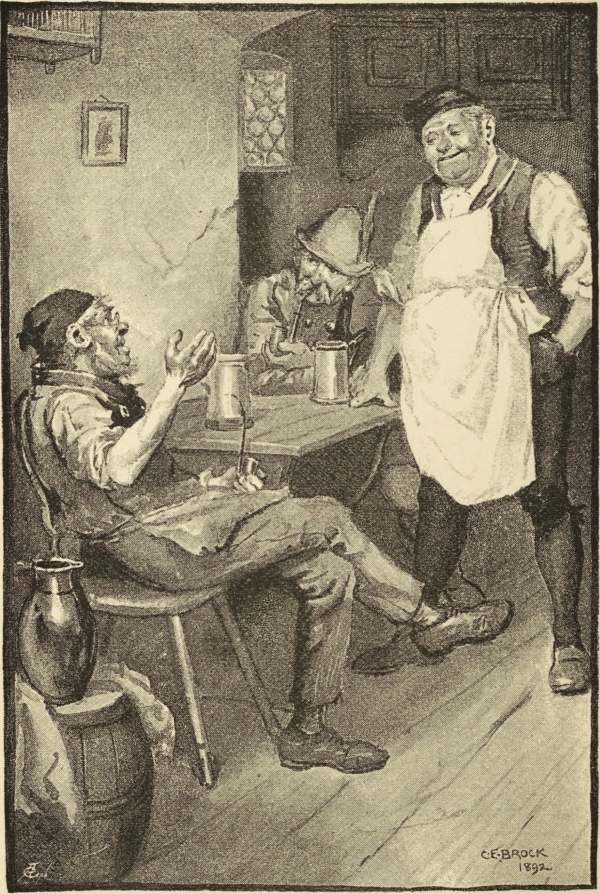
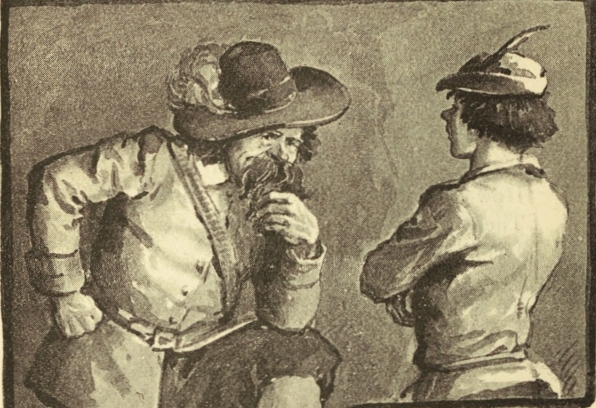
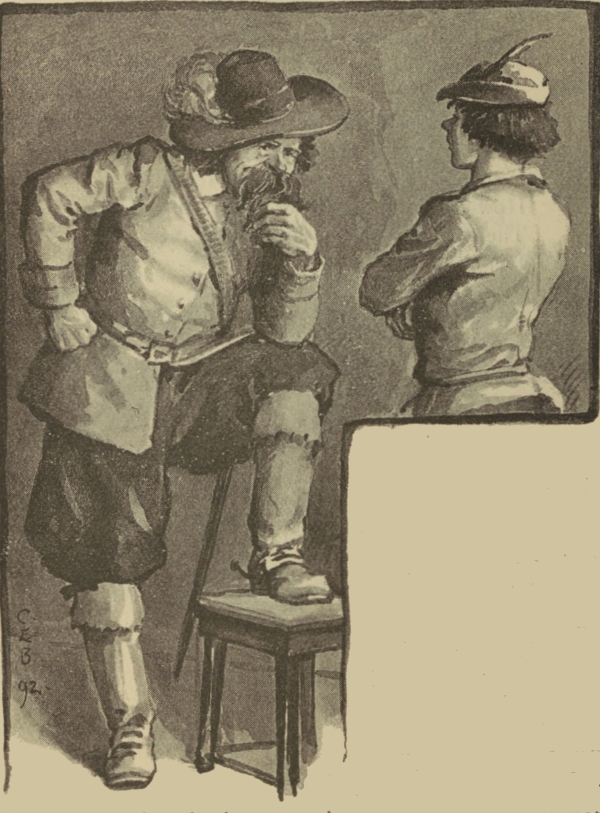
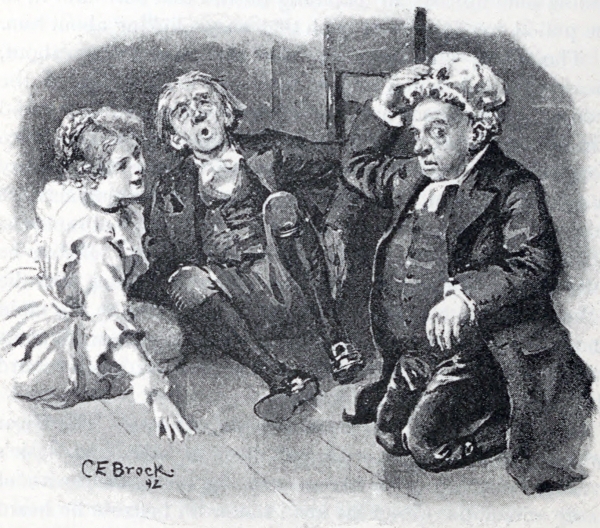
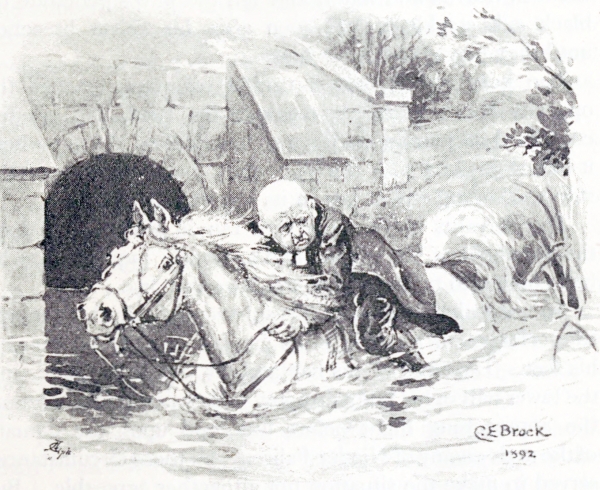
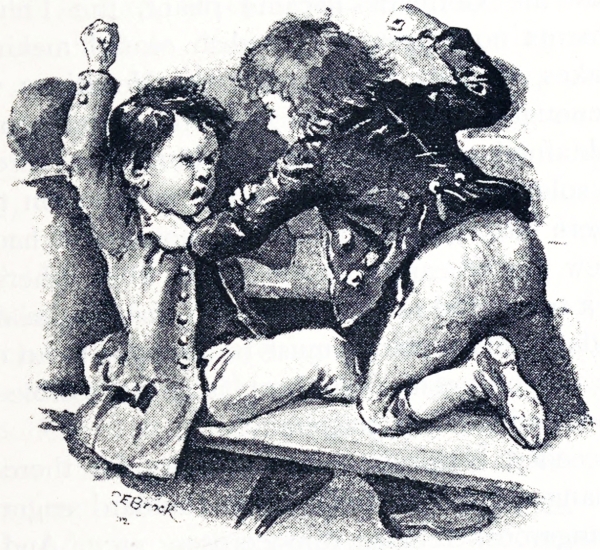
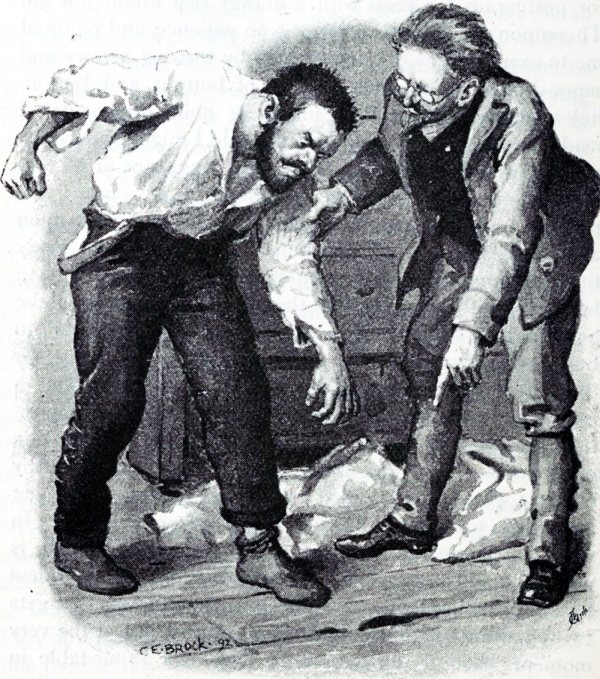
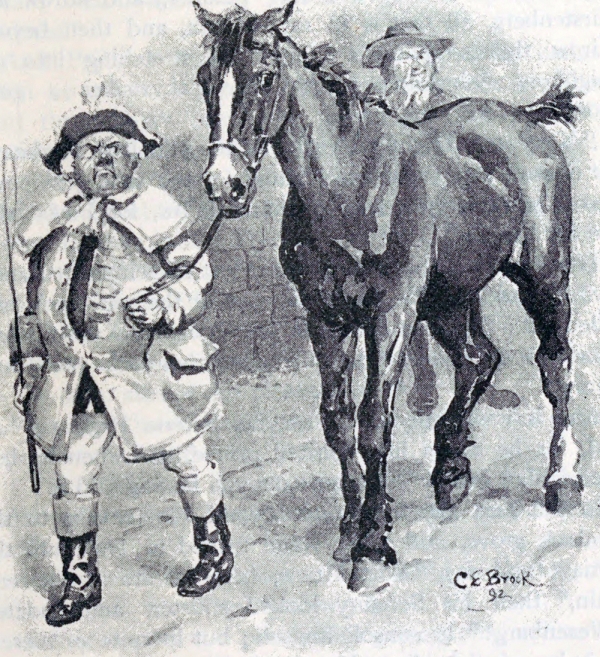
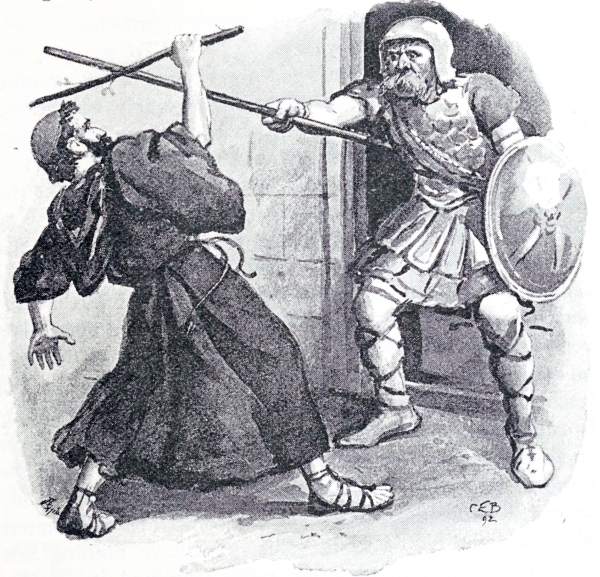
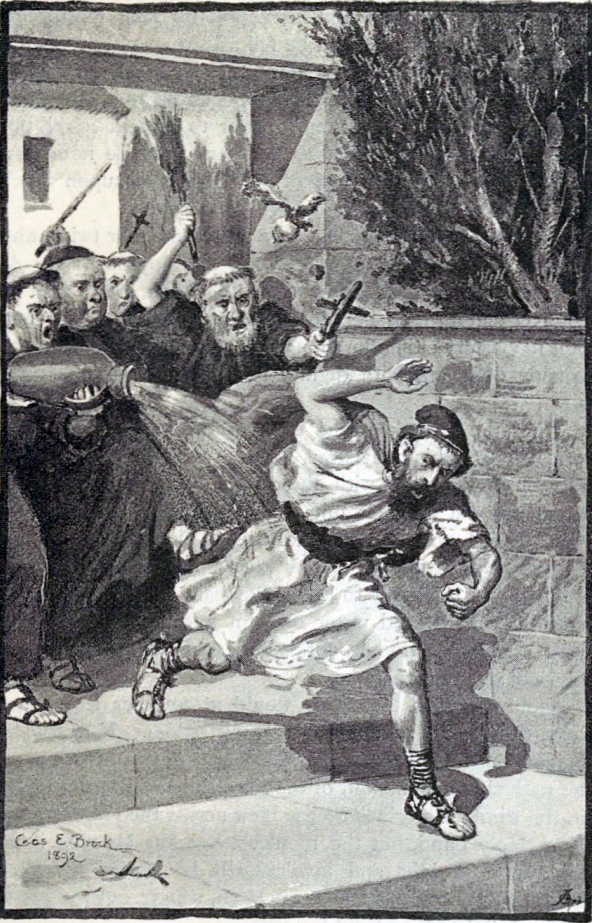
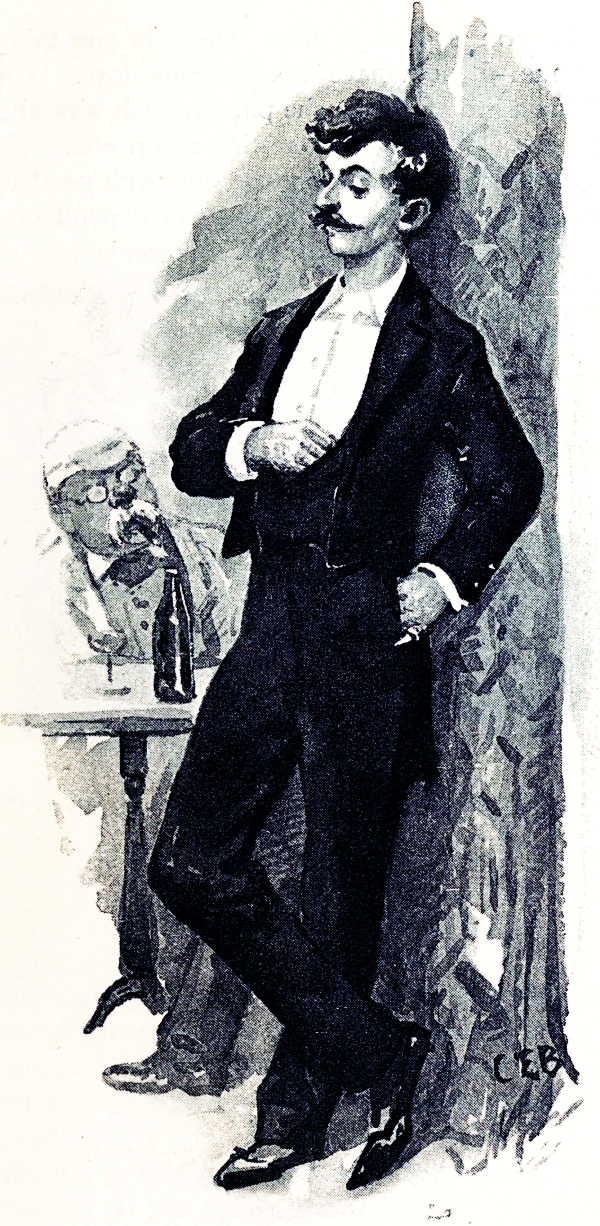
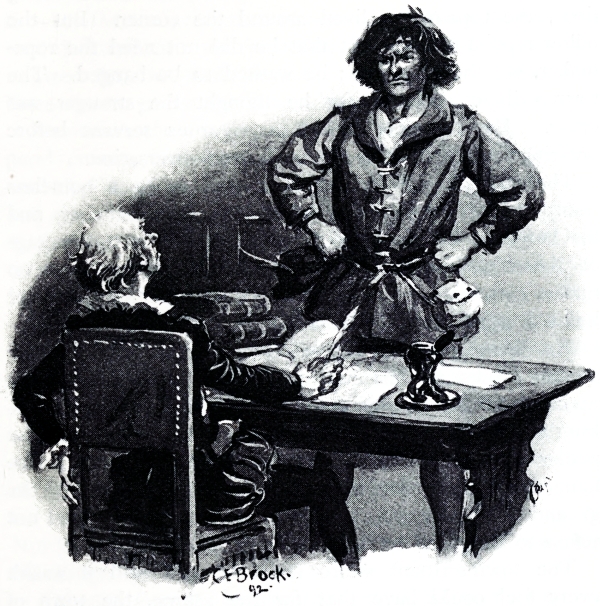
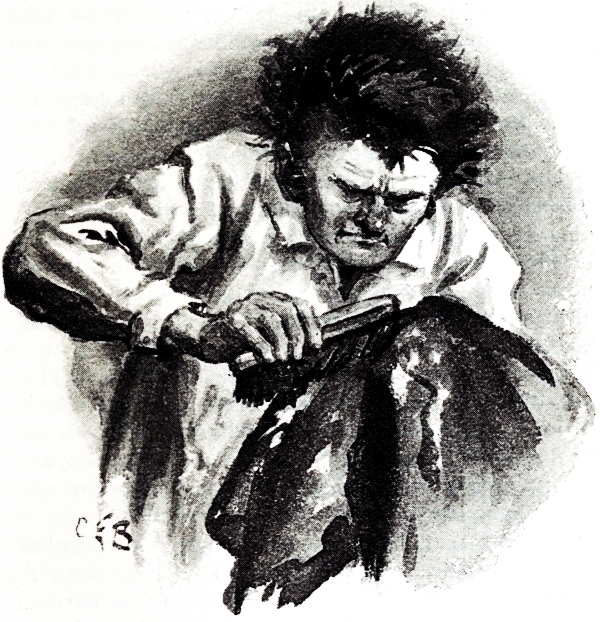
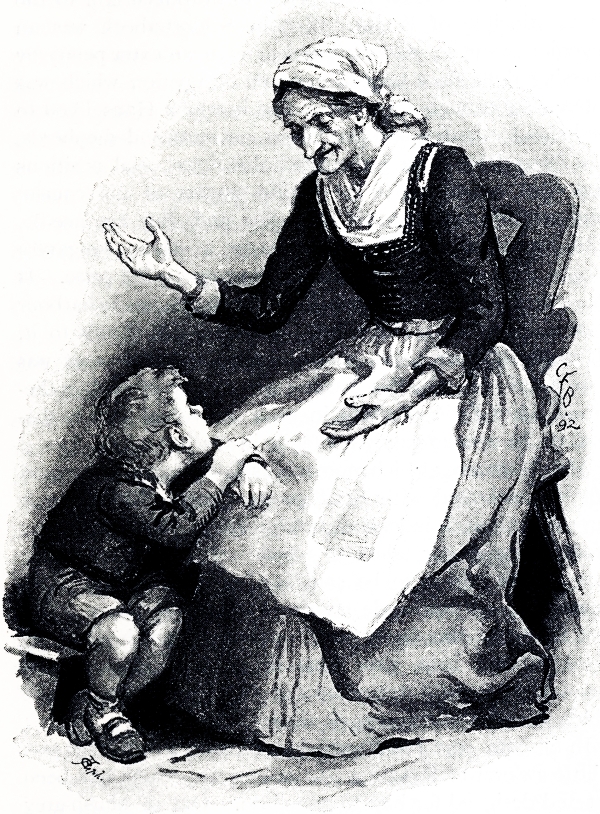
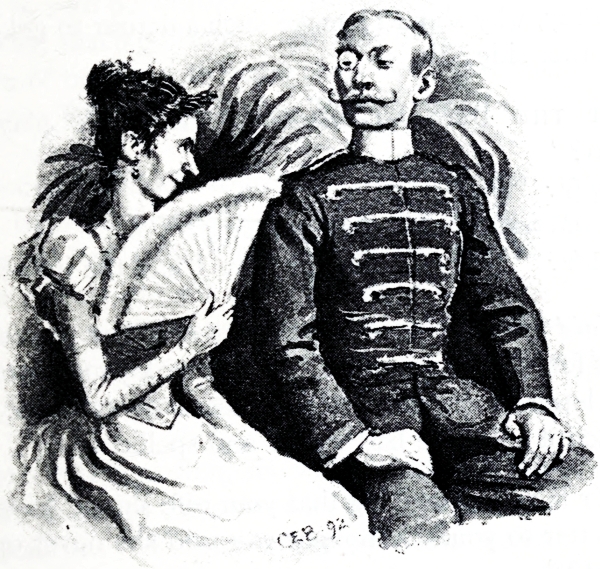
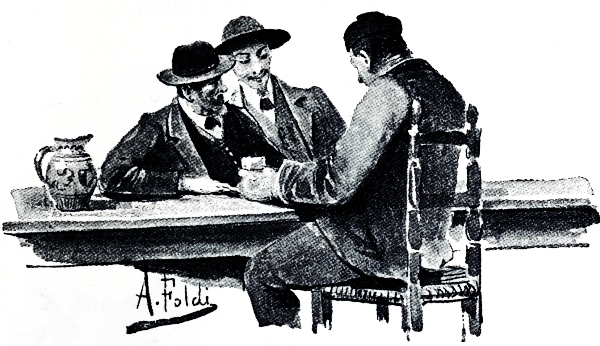
“HE WAS TOO FOND OF DELIVERING LONG SPEECHES AT THE ALEHOUSE.”
[See page 410.
THE
HUMOUR OF GERMANY
SELECTED AND TRANSLATED,
WITH INTRODUCTION AND
BIOGRAPHICAL INDEX, BY
HANS MÜLLER-CASENOV:
WITH ILLUSTRATIONS BY
C. E. BROCK.
In endeavouring to bring together examples of so significant and
at the same time elusive a phase of national character—literary
as well as psychological—as a nation’s humour, it were of course
vain to seek to make each selection typical in itself—typical,
that is, in the sense of referring to the broad basis of a nation’s
individuality in respect of its humour as distinguished from
other nations.
A general idea can only be obtained by scanning a broad
field; here, as elsewhere, details have little meaning unless
considered in their relation to the broader outlook. A constant
interplay of varied influences has to be taken into account.
The purely national aspect is obtruded upon by the individuality
of each author, which nowhere expresses with
such effect as in the literature of humour. The time of
writing, considered historically, with its political tendencies,
has also to be considered; its church dependence perhaps,
and the peculiar trend of its social interests. It is intruded
upon also by the time considered in its relation to literature as
a whole, to the tendencies of form and style predominant at
given periods.
Furthermore, there are strictly local peculiarities, subdividing
Germany itself. It is more especially these that the
student of literature, unless he be also a student of ethnological
influences, is likely to wrongly estimate, while it is of the
utmost importance that they be borne in mind to arrive at a just
view of qualities that oversway minor differences, which are
often the first to catch the eye. The more the Comic Muse is
bound within the narrow limits of place, time, and personality,
the more is she in her element. She of all muses is a painter
of detail, versed in the art of reproducing punctiliously those
petty traits which disengage her subject from all broader
problems, and make it effective in proportion to its unimportance
to the world’s general affairs.
Writers upon the theory of humour are apt to deplore the
absence of just such local land-marks in Germany as are
strongly characteristic and still recognisable to the foreigner.
It would appear to me that they have done so with some
injustice. The Volkscharacter of southern and northern Germany,
of the lowlands, and the Franco-Bavarian and Suabian
districts, even of the various centres of civilisation, the large
towns, is abundant in those differentiating qualities which go
to make up originality of manner. The modes of thought
and feeling characterising the population of different districts
bear a stamp so distinct that one is inclined to consider them
more strongly marked by provincial locality than by nationality.
In these days dialect proper, having gained the prestige of
comparative rarity, like a peasant’s national costume, or a bit
of bric-à-brac, has been favoured by the humorist, although its
reproduction in our literature has well-nigh insurmountable
difficulties to cope with. The Low German, one of the most
interesting of German dialects, because, historically, the most
intact, and the most incapable of amalgamation with the
language that has superseded it, had been left to grow rusty so
far as literature was concerned, until Fritz Reuter rescued it
from threatening oblivion, and made it the vehicle of a naïve
and spontaneous genre of humour, to which it lent itself with
singular charm and appropriateness.
The cause of the former neglect of Low German as a means
of literary expression was very obvious, and there was no gainsaying
the justice of it—viz., that it is used to-day only by the
lower classes of Northern Germany, and that among readers
there is but a very limited number to whom it is more comprehensible
than a foreign language would be. It is this fact
also which explains why Fritz Reuter, the most intimate and
sympathetic of German humorists, although extensively read,
has never attained the widest popularity.
Fundamentally, the German character appears to be averse to
humour. Its mirth does not come to it spontaneously, a gift
of the gods, arising out of the mere exuberance of being. This
nation shares the temperament of all northern races, it moves
more to the minor strains of feeling, to the Adagio which
Richard Wagner found so aptly expressive of its character. It
is quick to respond to things mystic, and yearns over the vague
grace of twilight moods. It worships at the shrine of the
hapless Prince of Denmark.—I say fundamentally, for, looking
at the life of the nation as it appears to-day, in those pleasures
of the lower and middle classes which have their scene of action
in the out-of-door world, there would appear to be in plenty a
spirit of merry-making and pleasure-seeking inherent in the
German character. The mere primitive love of a good time,
however, is inseparably connected with those classes representing,
in a manner, a child-like stage of intellectual development
the world over, and is not characteristic in any special
sense of the German people.
It is safe to admit that a certain lightness of disposition,
which seems indispensable to the humorous attitude, is absent
among those race-qualities which go to make up the German
nature pure and simple. If the nation has developed within
itself those germs which have blossomed into a sense of the
humorous; if it has passed through all those early stages of perception
and expression which have culminated in a humorous
literature of sturdy strength; if it has found at length a
humorous literature (with Gottfried Keller for its prophet, and
F. T. Vischer for its critic and exponent), it is due probably to
a complexity of influences somewhat difficult to determine.
However free in its purely literary aspect humour may be
from all ulterior purpose and aim, the tale of its growth with
us is largely interwoven with impulses received from outside
sources and sources didactic and philosophical. Outwitting
the devil, the theme that recurs again and again as the oldest
form of farcical expression in mediæval Germany, meant dealing
with the stresses of adverse circumstance. This was the first
step taken on the road to humour in Germany. The Powers
of Evil had all the brute force upon their side; there was no
coping with them, except by sharpening one’s wits and irritating
them by practical jokes until they might yield. The laugh
that followed had all the hard ring of the victor’s triumphant
scorn. Early satirical writings were imbued with a like spirit.
There was the lash to be swung at some enemy, and derision
at his downfall was tempered by no kindlier emotion. There
was a grim attitude of self-defence throughout it all. Indeed,
it is only in going back painfully step by step that one is
enabled to discern in this early literature the germs of humour
at all.
The farces and puppet-shows at country fairs and the
burlesques at the early theatre began to make room for the
idea of retaliation. It became a question of clown against
clown. The supremacy was never yielded long to one
side. Laying aside all personal interest in the matter for
the time being, there was an impartial shout of laughter at
him who got the most kicks and cuffs. The popular
mind began to rise above the situation, to put itself in the
position of an unbiassed spectator, and to take delight in merely
putting down whatever asserted itself. As an instance of this
may be counted the practice of granting the devil, or a person
disguised as such, a hearing in church on certain days of the
year instead of the parish priest.
Then the sense of discrepancy between things great and small,
things important and unimportant, the world of the senses and
the world of the spirit, began to enter the popular perception,
the impossibility of reconciliation, and, as a consequence, the
pleasure of turning this world topsy-turvy, and so demonstrating
the supremacy of the individual.
Side by side with this development, or partly perhaps
based upon it, went the philosophic development. Thinkers,
dreamers, and philosophers went on constructing a universe
according to the laws of their individual minds, a universe
containing nothing at all to be laughed at, and for many
decades scholars were deeply buried in obstruse problems
and finely-spun theories and systems, the lighter muse of
poetry and art for the most part following but humbly and
timorously from afar. But when philosophy and theology had
spoken at large, and the mystery and fatal contradiction at the
heart of things had not been unravelled, the pale brooding of
some turned to melancholy, with others it turned to boisterous
living and philosophic indifferentism.
Then it was that irony, directed upon the inordinate intellectual
ambitions of man, removed him half imperceptibly
into the sphere of the ludicrous. Self-irony may be the result
of misanthropy, but it is certainly the beginning of a cure.
One finds oneself to be made up of two absurdly contradicting
hemispheres, as well as the rest of the world; the sense of the
universal incongruity seems to make the case less tragic. To
pass through this stage into the clearer atmosphere of conscious
reconciliation with the actuality of things, of placid
acceptance of the ups and downs, the shortcomings inherent
in things, and in human nature withal,—into the atmosphere
of pure humour, unperturbed by the possibility of personal
disappointment, is a long step, easy to some, to others impossible.
And it would seem that German Humour—taking
the term in its widest sense as signifying subjective
apprehension on the one hand and artistic expression on
the other—is less the result of a temperamental predisposition
than the culmination of a development. With a turn for
flaccid sentimentalism, and by nature inclined to take themselves
very seriously, it was a reaction, a bankruptcy in metaphysical
methods that inaugurated and established something
of a humorous Weltanschauung. The often oppressively heavy
Zeitgeist has borne along its own corrective in the literature
of two centuries as on an ever-strengthening under-current.
There have been silent forces at play working imperceptibly
through the innate robustness of the national character. It
was this undeniable robustness which could not for long
brook the extravagancies of weak emotionalism. Revolt was
opened upon it on the one hand by the spirit of exact science,
on the other by the need of æsthetic equilibrium. These two
tendencies, the æsthetic and the scientific, are still contending
for the field with much ado and bustle in some quarters.
Though a nation counting Heine and Lichtenberg among its
own, it is not in the spielende Urtheil, as Jean Paul has called
inspired sallies of wit, that German humour specially distinguishes
itself; now and again there it has its moods of
riotous absurdity; but where it is most characteristic is in the
telling of the humorous tale, lovingly handled in its details, the
pathetic verging very near upon the comic, finally succumbing
in a ripple of good-natured laughter at somebody or other who
is really not so very bad, but only very human, and for whose
misfortunes—poor devil!—we may have a kindly feeling. Then
we have a mastership in spectral stories, uncanny and imaginative,
leaving the reader’s mind in a delightful condition of doubt
as to their actual meaning and significance; and we have also
the expression of the spirit of poetic adventure,—a determination
to have fun at all hazards, either with the public or else
at the public, if perchance it should prove too dull to be taken
into partnership. There is much of this in Chamisso’s Peter
Schlemihl, which, in the face of many dizzy structures of elucidation
that have been based upon it, remains so truly humorous
and so profoundly touching.
It is by no means always the funny element that predominates
in German writings of a humorous tendency. Their office
seems to be more to suggest the effect which these lighter
moods of fancy have upon the serious affairs of life, and in
studying the humour of Germany in a spirit of literary criticism
it is indispensable to take these two aspects in their action and
reaction upon each other. There is a psychical development
of the individual which runs parallel to that of the nation. In
confirmation of the theory of humorous development here
faintly outlined, it may be said that in Germany, humorous
perception is for the most part not the possession of youth. It
is not until the need of a corrective to a habit of speculative
brooding has been felt that imperceptibly and unconsciously
healthful minds rise to those dispassionate heights whence the
Occidental Brahmin gazes upon a motley world.
HANS MÜLLER-CASENOV.
[For Acknowledgments to Authors and Publishers,
see page 430.]
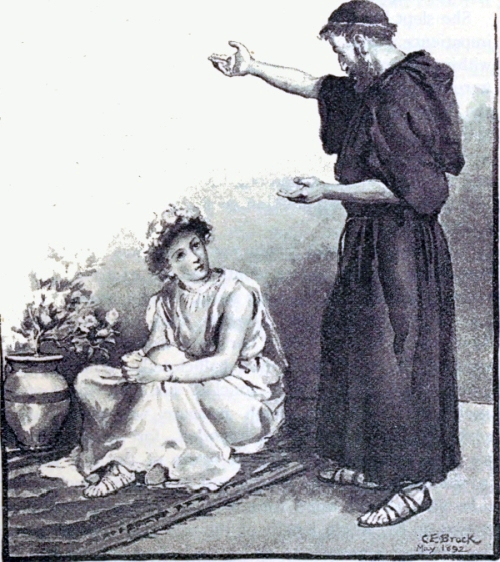
MASTER FOX, THE CONFESSOR.
THE HUMOUR OF GERMANY.
THEY overtook the Ass, and so
All three to Rome together go.
And when they saw the city near,
The Wolf said to his cousin dear:
“Reynard, my plan I’ll name to you:—
The Pope, we know, has much to do;
I doubt if he can spend his time
To hear our catalogues of crime.
’Twill spare some trouble for the Pope
(And also for ourselves, I hope,
As we may ’scape with penance less),
If to each other we confess.
Let each describe his greatest sin,
So, without preface, I’ll begin.
To notice trifles I disdain;
But one fact gives my conscience pain.
’Tis this—there dwelt beside the Rhine
A man who lived by feeding swine.
He had a sow who rambled wide
While all her pigs with hunger cried.
I punished her in such a way
That never more she went astray.
Her little ones, deserted now,
Oft moved my pity, I’ll avow;
I ended all their woes one night—
Now let my punishment be light!”
“Well,” said the Fox, “your sin was small,
And hardly can for penance call;
For such a venial transgression
You’ve made amends by this confession.
And now I’ll do as you have done—
Of all my sins I’ll name but one:
A man such noisy fowls would keep,
That no one near his house could sleep;
The crowings of his chanticleer
Disturbed the country far and near.
Distracted by the noise, one night
I went and stopped his crowing quite.
But this feat ended not the matter—
The hens began to crow and chatter;
And so (the deed I slightly rue)
I killed them and their chickens too.”
“Well,” said the Wolf, “to hush that din
Was surely no alarming sin;
Abstain from poultry for three days,
And, if you like, amend your ways.
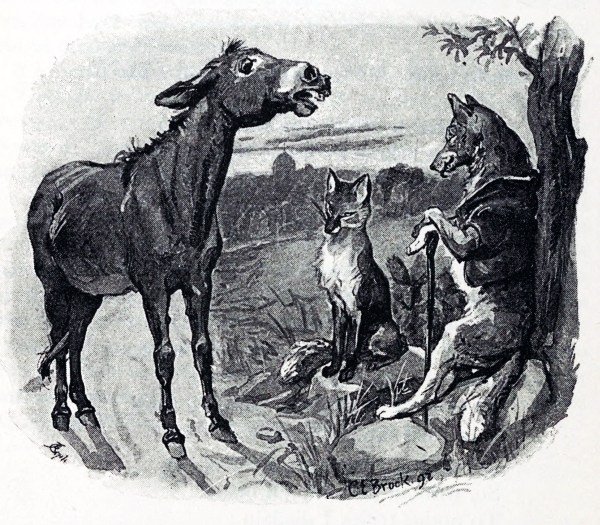
But now the Ass must be confessed.
Donkey! how far have you transgressed?”
“Ah!” said the Ass, with dismal bray,
“You know I have not much to say;
For I have toiled from day to day,
And done for master service good,
In carrying water, corn, and wood.
But once, in winter time, ’tis true,
I did what I perhaps must rue:
A countryman, to keep him warm
(We had just then a snowy storm),
Had put some straw into his shoes;
To bite it I could not refuse;
And so (for hunger was my law)
I took, or stole, a single straw.”
“There! say no more!” the Fox exclaimed;
“For want of straw that man was lamed;
His feet were bitten by the frost;
’Tis probable his life was lost.
’Twas theft and murder.—No reply!
Your penance is, that you must die.”
Hugo von Trimberg (1260-1309).
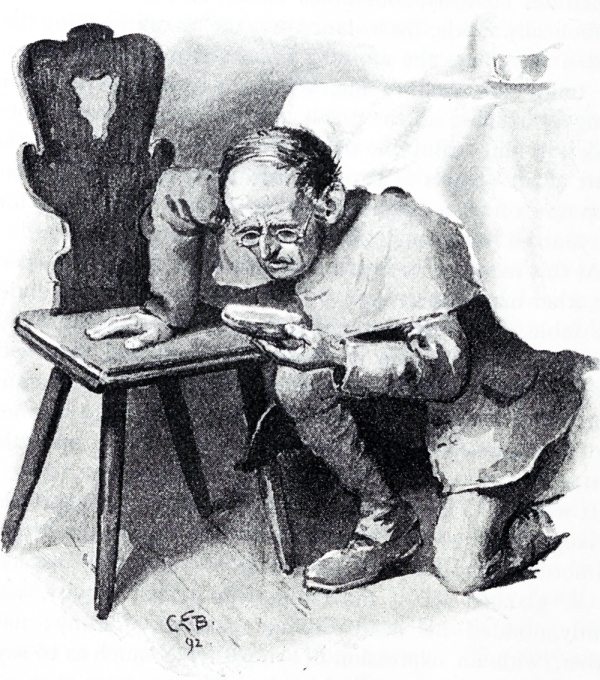
“BUT NOW THE ASS MUST BE CONFESSED.”
ST. PETER’S LESSON.
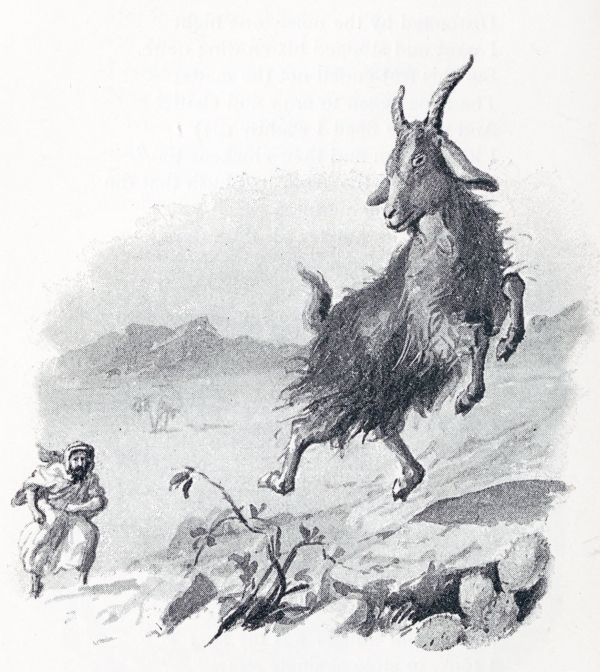
“THE GOAT RUNS ON AND NEVER TIRES.”
THE young goat had a playful mind,
And never liked to be confined;
The apostle, at a killing pace,
Followed the goat, in a desperate chase;
Over the hills and among the briers
The goat runs on and never tires,
While Peter, behind, on the grassy plain,
Runs on, panting and sighing, in vain.
All day, beneath a scorching sun,
The good apostle had to run
Till evening came; the goat was caught,
And safely to the Master brought.
Then, with a smile, to Peter said
The Lord: “Well, friend, how have you sped;
If such a task your powers has tried,
How could you keep the world, so wide?”
Then Peter, with his toil distressed,
His folly, with a sigh, confessed.
“No, Master! ’tis for me no play
To rule one goat for one short day;
It must be infinitely worse
To regulate the universe.”
Hans Sachs (1494-1576).
A RAID ON THE PARSON’S KITCHEN.
THE commandant
at Soest looked
at me with approval,
and said, “Tut, little
huntsman, you shall be
my servant, and wait
upon my horses.”
“Sir,” I replied, “I
should prefer a master
in whose service the horses wait upon me. As it is not
likely I shall find such a one, I am going to be a soldier.”
“Hoity-toity,” he said, “you have no more hair on your
lip than a tree-frog. You are too young.”
“Oh, no,” I replied, “I will venture to brave any man
of eighty. The beard does not make a man, else the
he-goats would be in high esteem.”
He said, “If you can show courage as well as you can
wag your tongue, so be it.”
I answered, “The first opportunity shall furnish the
proof.”
And so the commandant made over to me my dragoon’s
old trousers, in which my master had sewed a goodly
number of ducats. Out of their vitals I provided myself
with a good horse and the best fire-arms I could get; I
thereupon polished up my belongings to their utmost
possibility of brightness. I got me a new suit of green,
for I delighted in the name of “huntsman,” and gave my
old garments to my boy, as they had grown too short and
too tight for me. I sat on my horse like a young nobleman,
and did not think small beer of myself. I took
special delight in decorating my hat with a smart bunch
of feathers like an officer. There were enough to envy
me, and soon words and blows were the order of the
day. But no sooner had I given proof to two of my
enemies as to the nature of the thrusts I was skilled in,
than I was left in peace, and my friendship was much
sought for. In our raids upon the enemy I threw myself
forward like bubbles in a boiling kettle, to be always the
first in the fight. Whenever it was my good fortune to
lay hands upon a desirable bit of pillage I shared it freely
with the officers. The consequence was that I was allowed
to plunder even in forbidden places, and could be secure
of protection under all circumstances. So I was soon
looked up to by friend and foe, and my purse grew as
great as my name; even the peasants I managed to keep
upon my side by fear and love, for I took vengeance upon
those that tried to hinder me, and gave rich rewards to
all who were helpful. I did not confine myself to large
schemes, and never despised small ones if there was praise
and admiration to be won thereby.
At one time we had been vainly hoping for some waggons
with provisions to come into our way at the Castle of
Recklinkhausen, and the pangs of hunger were upon us.
And when I and my comrade, a student just run away from
school, were leaning out of one of the windows, and hungrily
gazing out into the country, my companion sighed after the
barley-soup of his dear mother, and said: “Ah, brother,
isn’t it a shame to think that after having studied all the
arts, I should not be able to supply food for myself?
Brother, I know for certain, if I were only allowed to visit
the parson in yonder village—you can see the church
steeple just beyond the poplars—I should find a most
excellent feast.”
After a short parley the captain gave us permission; I
exchanged my clothes with those of another, and the
student and I betook ourselves to the village on a very
roundabout way. The reverend gentleman received us
civilly. When my companion had greeted him in Latin,
accompanying his words with a profound bow, and briskly
conjuring up a fine array of lies how the soldiers had robbed
him, a poor student, of all his provisions, the parson gave
him bread and butter and a drink of beer. I passed myself
off as a painter’s apprentice, and acting as if my companion
and I had never met before, I told them both I should go
down the village street to the inn for refreshment, and
would then call for him, as we seemed to be going the same
way. So I went away in search of anything that might be
worth the trouble of coming for the following night, and I
was so fortunate as to meet a peasant who was plastering up
an earthen oven in which large loaves of brown bread were
to lie and bake for twenty-four hours. I thought, “Go
ahead; plaster away! I’ll find you a customer for these
delicious viands.” I made but a short stay at the inn,
knowing this cheaper way of getting bread, and returned to
my companion, who had eaten his fill, and had told the
parson that I was on my way to Holland to perfect myself
in my art. The parson asked me to go and see the church
with him, as he would like to show me some paintings that
were in need of restoration. As it would not do to spoil
the game, I consented. He conducted us through the
kitchen, and when he opened the night-lock on the strong
oaken door which led to the churchyard, I saw a wonderful
sight. From the black heavens of this kitchen violins,
flutes, and cymbals were pendent—in reality they were
hams, sausages, and slices of bacon. I looked at them
with happy forebodings, and they seemed to smile irritatingly
upon me. I wished them in the castle to my comrades,
but in vain; they were obstinate, and remained hanging
where they were. I mused on ways and means of bringing
them under my plan regarding the peasant’s loaves of bread,
but there were serious difficulties in the way, as the yard of
the parsonage was surrounded by a stone wall, and all the
windows were well protected with iron bars. Moreover,
there were two large dogs in the yard that certainly would
object to having that stolen the remnants of which was, in
the course of time, to be the reward due to their watchfulness.
Once in church, it appeared that the parson generously
intended to entrust me with the restoration of his old pictures.
As I was exerting myself to find some plausible subterfuge,
the sexton turned to me and said: “Fellow, you look more
like a disreputable soldier-lad than like a painter.” I was
no longer accustomed to such speeches, and yet there was
nothing for it but to swallow the taunt. I shook my head
softly and replied, “Oh, you knave! give me a brush and
colours, and I will paint a fool in a twinkling who shall
resemble you throughout.”
The parson made a joke of the matter, and reminded both
of us that it is not meet to tell each other unsavoury truths in
so holy a spot. Then he gave us another drink, and we
departed. But I left my heart with the sausages.
Returning to our people, I picked out six reliable fellows
to help me carry home the bread. About midnight we
entered the village and quietly took the bread out of the
oven, and as we were about to pass the parsonage I could
not bring myself to go on without the bacon. I stood still
and looked up and down to discover some way into the parson’s
kitchen, but there was no opening except the chimney.
We stored our guns and our treasured booty of bread in the
charnel-house of the churchyard, managed to get a ladder
and rope out of the barn, and I and my crony Springinsfeld
climbed up on the tiled roof. I twisted my long hair into a
top-knot, and let myself down by the rope to the objects of
my desire. Once there, I did not delay, and tied ham after
ham, and sausage after sausage to the rope. Springinsfeld
fished everything out skilfully from his post on the roof and
handed it down to the others. But, alack-a-day! as I was
just going to give myself a holiday and come out, the pole
that I was standing on gave way, and poor Simplicisimus
was suddenly precipitated, and found himself in as bad a
fix as need be—in fact, it was like a regular man-trap. Springinsfeld
tried to help me by letting down the rope, but that
also broke. I said to myself, “Now, huntsman, you are in
for a chase in which there will be small mercy for your hide.”
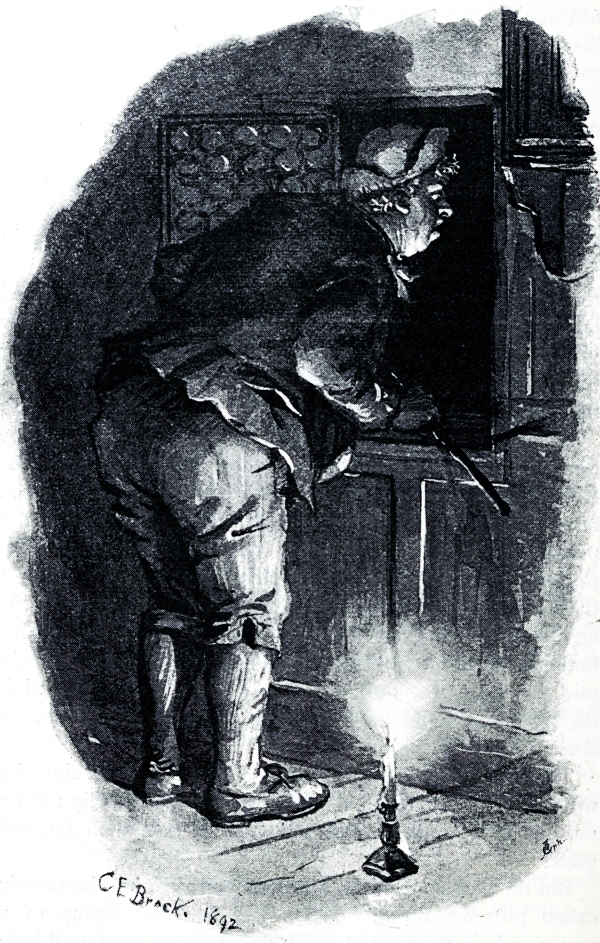
Sure enough, my fall had waked up the parson, and he
called his cook and bade her strike a light. She appeared
in night-attire, her petticoat around her shoulders, and stood
close beside me. She seized a coal from the hearth, held
her candle up close to it, and began to blow. At the same
time I blew much stronger than she, which frightened the
poor body so that she dropped both candle and coal, and
retreated near her master. Now the parson himself struck
a light, while the woman was telling him there was a horrible
two-headed ghost crouching in the kitchen; she had probably
mistaken my top-knot for a second head. When I
heard this I quickly rubbed my face and hands with ashes
and soot, until I doubtless bore small resemblance to the
angel I had figured for at the nunnery. And if the sexton
could have seen me thus occupied, he would certainly have
given me credit for being a rapid painter. Thereupon I
began to make as much noise as I possibly could, throwing
pans and kettles about. I hung the ring of the large kettle
about my neck, and took the poker in my hand, to have a
weapon in case of need. All this did not put out the pious
parson, who approached as if he were heading a procession,
his cook behind him, carrying two wax tapers and a stoup.
He was attired in his surplice, and had a book in one hand
and his holy-water sprinkle in the other. He read some
ritual of exorcism aloud before me, and then asked me who
I was, and what was my business here. Seeing that he was
labouring under the impression that I was the Evil One, I
thought it but fair that I should act in accordance with my
new rôle, and I answered him as I had once answered the
robbers in the woods, “I am the devil, and I have come to
turn your neck, and your servant’s as well.” He thereupon
tried his most potent charm, “All good spirits praise the
Lord! I conjure thee, return from whither thou comest!”
I replied that this was impossible, happy though I should be
to comply with his request.
Meanwhile my boon-companion Springinsfeld was indulging
in spectral revelries upon the roof. When he heard what
was going on in the kitchen below, and how I was passing
myself off for the devil, he began to hoot like an owl, then
barking like a dog, neighing like a horse, bleating like a
sheep, crying like a donkey, cackling down the chimney like
a hen about to lay an egg, and then again giving forth
unearthly music like a hundred serenading cats; for this
fellow was clever in imitating the voices of animals, and
could howl as naturally as if a pack of wolves were standing
about the house.
During the consternation of the parson and his charming
feminine choir-boy I had time to look about me, and, to my
joy, I made the discovery that the night-lock had not been
put on the back door. Quick as a flash I pushed back the
bolt, slipped out into the churchyard, where my companions
were standing with triggers drawn, and left the parson to
conjure devils as long as he pleased. And when Springinsfeld
came down from the roof, bringing my hat along, and
we had packed our spoils upon our shoulders, we returned
to our party, not having anything more to do in the village,
though I admit that we might have returned the borrowed
ladder and rope.
No, Sir Poet, say what you please, talk as you wish, make
as many objections as you can possibly make, it shall in no
wise alter my purpose, to listen to nothing, to consider
nothing, to insist upon having my own way,—so there!
POET.
Dear Scaramuccio!
SCARAMUCCIO.
I listen to nothing. Look, Sir Poet, how I am stopping
up my ears.
POET.
But the piece——
SCARAMUCCIO.
Nonsense! the piece! I am a piece too, and I have a
perfect right to say my say. Or do you suppose I have no
will of my own? Do you poets labour under the delusion
that a gentleman actor is called upon to do just as you say?
My dear sir, know you not that the times are changing?
POET.
But the spectators——
SCARAMUCCIO.
And because there are spectators in the world, would you
make me unhappy? Nice principles those!
POET.
Friend, you must listen to me.
SCARAMUCCIO.
Very well then, if I must. Here I sit; now talk like a
sensible man, if it is in your nature so to do. (Sits down on
the ground.)
POET.
Most esteemed Sir Scaramuccio! Your Grace has been
engaged at this theatre for a special rôle—in a word, to
express myself briefly, you are the Scaramuccio. It is not
to be denied that you have reached a degree of excellence
in this your speciality, and there is no man in the world
more willing than myself to do justice to your talents; but,
my dear sir, for all that you are not possessed of the qualities
fitting you for a tragedian; for all that you will never be
able to play a lofty character.
SCARAMUCCIO.
The impudence of it! By my soul, I’ll play you a loftier
character than you will be able to write. I take your
remark as a personal insult, and I challenge the whole
world to out-do me in the high and lofty.
SCAEVOLA (one of the spectators).
Oh, Sir Scaramuccio, we’ll all take up your challenge.
SCARAMUCCIO.
How so? What now? I confess I am struck dumb by
this insolence.
SCAEVOLA.
My dear sir, there is no cause for that. I am here for
my money, Sir Scaramuccio, and I can think what I please.
SCARAMUCCIO.
You are free to think as you see best, but you are not
allowed to speak here.
SCAEVOLA.
So long as you may speak, I don’t see why I shouldn’t.
SCARAMUCCIO.
Well, then, what have you done that was so noble?
SCAEVOLA.
The day before yesterday I helped my spendthrift of a
nephew out of his debts.
SCARAMUCCIO.
And yesterday I saved the prompter from talking himself
hoarse by leaving out a whole scene.
SCAEVOLA.
I was in a merry humour at table one day last week, and
gave a whole shilling in charity.
SCARAMUCCIO.
The day before yesterday I quarrelled with my tailor, who
came to dun me, and I had the last word.
SCAEVOLA.
A week ago I helped get a tipsy man home.
SCARAMUCCIO.
Sir, I was this tipsy man; but I had been drinking my
sovereign’s health.
SCAEVOLA.
I confess myself vanquished.
(Enter Pierrot in a state of excitement.)
POET.
What’s the matter, Pierrot?
PIERROT.
What’s the matter? I will not play to-day. On no
account will I play.
POET.
Why not?
PIERROT.
Why not? Because it’s high time for me to become a
spectator. I’ve been a mime long enough.
(Enter Wagemann, the manager.)
POET.
You are just in time, Herr Wagemann. There is confusion
abroad.
WAGEMANN.
How so?
POET.
Pierrot will not play to-day. He wants to be a spectator,
and Scaramuccio insists upon taking the rôle of Apollo in
my drama.
SCARAMUCCIO.
And am I not right, Herr Wagemann? I have played
the fool long enough, and I should like to try my hand at
the wise.
WAGEMANN.
You are too severe, Sir Poet. You must give the poor
fellows a little more liberty. Let them have it their own
way.
POET.
But the requirements of the drama, of art——
WAGEMANN.
Oh, all that will come right enough. Look you, my way
of thinking is this—the spectators have paid their money,
and with that the most important thing is regulated.
PIERROT.
Adieu, Sir Poet. I go to join the illustrious assembly of
spectators. I will venture the bold leap over the footlights,
to see if I can be cured of being a fool, and graduate to
a spectator. (Sings.) Fare-thee-well, thou old love; a new
life is dawning for me, and most sensible impulses are
moving my heart. No footlight shall affright me, no
prompter can hold me. Ah, I would taste the peaceful
bliss of being an auditor. Receive me, wild waves; stage,
fare-thee-well, my spirit yearns to be drawn beyond thy precincts.
(Jumps into the parterre.) Where am I? Oh
heavens! do I still breathe? Ah! is it possible I stand
here below? The rays of the footlights shine over yonder.
Ye gods, ye behold me surrounded by people. Who gave
me this life, this better life?
THE AUDIENCE.
Monsieur Pierrot is one of us. A hearty welcome to
thee, Spectator Pierrot. We greet thee, thou great man!
PIERROT.
Can it be, ye noble ones, that you will count me as your
brother? Ah, my gratitude will last as long as there is
breath within this bosom.
GRÜNHELM (one of the spectators).
Glorious, glorious! By my soul he speaks well! But as
for me, I should like to take a part on the stage for a
change; it would do my heart good. To be sure I tremble
and stammer, and my wit is not of the quickest, but I am
never so happy as when I am making a little joke. (He
scrambles up on the stage.) And so, Sir Scaramuccio, leave
your funny rôle to me, and then, for all I care, you may
play the Apollo.
POET.
And what then is to become of my excellent drama?
AUDIENCE.
Scaramuccio shall play the Apollo. It is a unanimous
decision.
POET.
’Tis well. I wash my hands of it. The audience may
bear the responsibility. I am deeply miserable. Ah, yes, it
is the fate of Art to be misunderstood and travestied, and it
is only then that it finds its public. In vengeance for
the judgment passed upon Marsyas, Poetry herself is flayed
alive to-day. My sorrow is greater than I can endure. Herr
Grünhelm, so you undertake to do the joking?
GRÜNHELM.
I do, Sir Poet, and I will hold my own against any rival.
POET.
How will you do it?
GRÜNHELM.
Sir, I have been one of those whose chief business it is to
be amused long enough to know what will please. The
people down there want to be entertained. At bottom that
is the only reason they stand there so quietly and patiently.
The good-will of the public is the principal thing, I know
that as well as you do. True art is to keep this good-will
on the surface.
POET.
Yes, of course, but by what means do you propose——?
GRÜNHELM.
Let that be my care, Sir Poet. (Sings:)
“A fowler’s trade is mine, heigh-ho,” etc.
AUDIENCE.
Bravo! bravo!
GRÜNHELM.
Are you pretty well amused, gentlemen?
AUDIENCE.
Excellently, most excellently!
GRÜNHELM.
Do you feel a longing for anything reasonable?
AUDIENCE.
No, no; but by-and-by we should like to have our feelings
worked upon.
GRÜNHELM.
Patience, you can’t have all good things in a lump. Do
you miss the genuine Apollo?
AUDIENCE.
Not in the least.
GRÜNHELM.
Well, Sir Poet, do you still object to granting the excellent
Scaramuccio’s request?
POET.
Not in the least. I withdraw all my objections.
AUDIENCE.
But we don’t want him to give us nothing but nonsense.
SCARAMUCCIO.
Mercy on us! We would not be guilty of such a sinful
thing. What kind of an Apollo were I if I should admit
of that? No, gentlemen, there shall be an abundance of
serious things—things to think about, things to train one’s
intellectual faculties.
SCAEVOLA.
Is it to be a tragedy?
PIERROT.
No, gentlemen, we actors have all sworn that we will not
die, so it won’t be a tragedy, whatever the poet may have in
his mind.
SCAEVOLA.
I am relieved to hear it, for I am possessed of a very soft
heart.
PIERROT.
Hang it, sir, neither are we made of stone and iron. I
have the honour of assuring you that my susceptibilities are
uncommonly delicate. The devil take all inelegancies.
SCAEVOLA.
That is what I say. There is nothing above being a
spectator. It is the highest thing one can be.
PIERROT.
Ay, that it is. Are we not more than all the emperors
and princes that are but acted?
SCARAMUCCIO.
Thunder and lightning! Where, in the hangman’s
name, is my Parnassus?
GRÜNHELM.
I will go and get it. (Exit.)
WAGEMANN.
Now all is in order. Adieu, Sir Scaramuccio.
SCARAMUCCIO.
Your humble servant. Beg you to express my respects to
Madam, your wife. (The manager exit. Three attendants
enter, carrying the Parnassus.) Put it down here,—a trifle
further to this side, so that I can hear the prompter. (He
climbs up and takes a seat.) A pleasant mount this. What
revenues does it yield? Can any one tell me? Send for
the treasurer.
(Enter the Treasurer.)
SCARAMUCCIO.
What does the mount bring me annually?
TREASURER.
Under your predecessor, the only profits derived were
those from the Castalian Spring.
SCARAMUCCIO.
What sort of a spring? Was it a mineral spring; a
sulphur spring, perhaps? Was there much demand for the
waters? What was the price per bottle?
TREASURER.
What little there was wanted was given away. Few
people liked the water. Your predecessor, the other
Apollo, was fond of it.
SCARAMUCCIO.
I hope there are no mortgages on the mount?
TREASURER.
No, your majesty.
SCARAMUCCIO.
Is it insured?
TREASURER.
Oh, yes.
SCARAMUCCIO.
There is some security in that. I shall have a brewery and
a bakery put up at the foot. The common pastures must
be otherwise disposed of; Pegasus and the other beasts
that belong to me must henceforth be fed in the stable.
TREASURER.
It shall be as you say.
SCARAMUCCIO.
Have the spectators paid for the play?
TREASURER.
Yes, your excellency.
SCARAMUCCIO.
I hereby decree that there shall be no complimentary
tickets in future.
TREASURER.
These are innovations not at all in accordance with the
institutions of Greece.
SCARAMUCCIO.
Hang Greece! Thank goodness we live in better times.
This is an age of enlightenment, and I reign supreme. Send
for the Muses. (Exit the Treasurer.)
(Enter the nine Muses, bowing profoundly.)
SCARAMUCCIO (lightly nodding to them).
Pleased to make your acquaintance, Mademoiselles.
Hope we shall get on finely together. Henceforth you shall
be my tenants on the Parnassus. Should you ever desire
to change your residence, quarterly notice is required.
What is your name, fair child?
MELPOMENE.
I am Melpomene.
SCARAMUCCIO.
You look so woe-begone.
MELPOMENE.
Oh, Herr Apollo! I am of a very good family. My father
had a high position at court, and the thane gave me a matchless
education. Ah, how happy I was in my parents’ house,
and what a dutiful daughter did I strive to be! I also had
a lover, but he jilted me, and my parents died of grief.
Our family physician, a worthy man, took an interest in me;
but he was too poor to marry me, so there was nothing for
it but to join the Muses. Have I no right to be sad?
SCARAMUCCIO.
Yes indeed, my child; but I will be as a father to
you.
SCAEVOLA (to another spectator).
Now see, for heaven’s sake, how the tears are flowing from
my eyes.
THE OTHER.
Why, neighbour, save them for the fifth act.
SCARAMUCCIO.
And who are you, pretty maid?
THALIA.
Thank you kindly, sir, for asking; I was christened
Thalia. I was a servant in the family of this excellent lady,
and I could not bring myself to leave her in her distress,
and followed her among the Muses.
SCARAMUCCIO.
When the last act comes your faithfulness will surely be
rewarded. Where is my groom?
(Enter the Groom.)
SCARAMUCCIO.
Saddle my Pegasus. I wish to go riding.
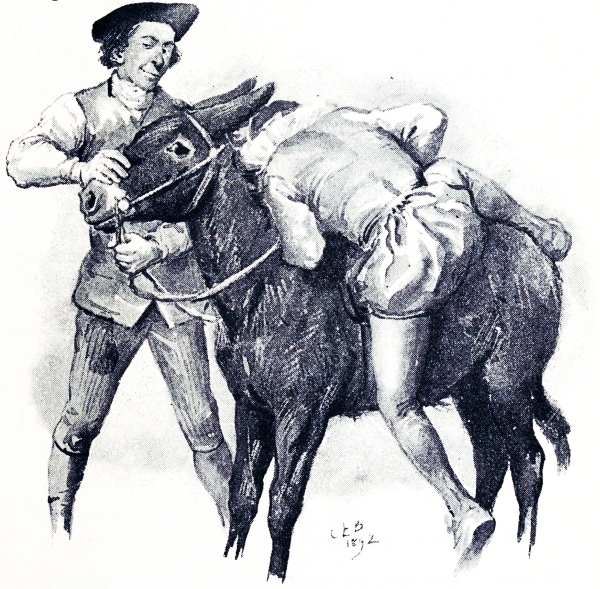
(Exit the Groom, coming back immediately with a bridled
donkey.)
Help me. (He gets in the saddle.)
THE MOUNTING OF PEGASUS.
GROOM.
By what rules of quantity does your Honour choose to
take his pleasure to-day?
SCARAMUCCIO.
Oh, fool! I will ride in plain, sensible prose. Do you
suppose I wish to be jolted in Alcaic measures, or break my
neck in Proceleusmatics? No, I am for sense and order.
GROOM.
Your predecessor was always flying in the air.
SCARAMUCCIO.
Don’t talk to me about the fellow. He must have been
a very clown, a most eccentric ass. To fly into the air!
No, the air has no pillars, I am all for the earth. Adieu,
my friends! I am only going to ride a short essay on the
value of family portraits. I shall be back presently. (He
rides slowly away.)
(The curtain drops.)
SCAEVOLA.
That was only the introduction.
PIERROT.
The first act is always of great importance for the lucidity
of the whole.
THE OTHER TO SCAEVOLA.
There is much morality in the piece.
SCAEVOLA.
Indeed there is; I feel myself growing better already.
PIERROT.
Music!
Ludwig Tieck (1773-1853).
THE UNACCOUNTABLE STRANGER.
(From Scene IV. of “A Topsy-Turvy World.”)
(The room of an Inn.)
INNKEEPER.
Few enough guests put up at my house nowadays. If
this goes on I might as well take down my sign. Dear me,
those were other times when there was scarce a piece performed
but had a tavern and a host in it. I well remember
in how many hundreds of pieces the foundations for the
finest plots were laid in this very room. Now it was a
prince in disguise, who spent his money here; now it was a
prime minister, or a wealthy count at the very least, who lay
in ambush here for some conspiracy. Yes, even in things
that were translated from the English, I always earned an
honest penny. Some drawbacks to be sure there were, when
I was required to be a disguised member of a band of
sharpers, and then be smartly rated by the moral characters;
but there was always healthy activity in it. But now!—Now
when a wealthy stranger returns from a journey, he
goes to stay with his relatives by way of doing something
novel and original, and does not drop his disguise until the
fifth act; others appear only upon the street, as if there
were no respectable house for them to stay at. All this
keeps the audience in a marvellous state of curiosity, but it
takes the bread out of our mouth.
(Enter Anne.)
ANNE.
You seem to be in low spirits, father.
INNKEEPER.
Yes, child, I’m out of sorts about my calling.
ANNE.
Would you like to be something finer?
INNKEEPER.
No, not exactly; but it vexes me more than I can tell
you that there is no more demand for my calling.
ANNE.
Surely in time all that will change for the better.
INNKEEPER.
No, dear daughter. The times do not tend that way.
Oh, why was I not a Hofrath! You may look at any play-bill
this day, it always says at the bottom: “The scene is
at the house of the Hofrath.” If things go on like this I’ll
study for a gaoler, for prisons, you know, still occur in
patriotic and mediæval pieces. But my son must see to it
that he gets to be a Hofrath.
ANNE.
Be comforted, dear father, and do not yield to your
melancholy.
INNKEEPER.
I’ve half a mind to turn poet myself, and invent a new
art of poetry which shall supersede the Hofrath pieces, and
in which the scene shall invariably play in a tavern.
ANNE.
Do so, dear father, and I will attend to the love-scenes.
INNKEEPER.
Hist! There is a diligence pulling up at the door.
Indeed it seems to be an express. Kind heavens, where
can the unsophisticated person come from who would put
up at this house?
(Enter a Stranger.)
STRANGER.
Good morrow, mine host.
INNKEEPER.
Your servant, your servant, noble lord. Who in the
world are you to travel incognito, and put up at my house?
Surely you are of the old school, eh? A man of the good
old times! Perhaps translated from the English!
STRANGER.
I am neither a noble lord nor do I travel incognito. Can
I lodge here this day and night?
INNKEEPER.
My whole house is at your disposal. But really, is there
no family in the vicinity you wish to make happy? Or do
you wish to marry suddenly, or find a sister?
STRANGER.
No, good friend.
INNKEEPER.
So you are only journeying as a simple, ordinary
traveller?
STRANGER.
Yes.
INNKEEPER.
Then you will have but little applause.
STRANGER.
The fellow must be crazy.
(Enter a Postillion.)
POSTILLION.
Here is your trunk, sir.
STRANGER.
And here is your fee.
POSTILLION.
Oh, that is very little. I drove down the hill so smartly!
STRANGER.
There.
POSTILLION.
Many thanks. (Exit.)
STRANGER.
Shall I succeed in finding her? Oh, how all my
thoughts turn to my beloved native shore! How can I
endure the sight, when once more I view it?—when the
past, with all its joys and pains, passes before my inner
vision? Ah, thou poor mortal! what callest thou the
past? For thee there is no present. Between the times
that are flown and the future thou clingest to a little
moment, and joys flit past thee, and do not so much as
touch thy heart.
INNKEEPER.
If I may be permitted to ask, I take it your grace is from
some old worm-eaten drama that some unknown author has
modernised a bit?
STRANGER.
What say you?
INNKEEPER.
I greatly doubt that you will have applause! I hope, at
any rate, that you have money? Or is it a part of the plot
that you should pretend to be poor?
STRANGER.
You are very inquisitive, good friend.
INNKEEPER.
That’s part of my trade, sir, as any schoolboy will tell
you. Old people must be old; Telephus must be a beggar;
the slave must chatter in keeping with his rôle. You can
look it up in the Ars poetica, to which I too am subject in
my office as host.
STRANGER.
Thank you for this graceful frenzy; I have not found so
rare a curiosity for a long time. Show me to my room.
(Exeunt.)
Ludwig Tieck.
VAN DER KABEL’S LAST WILL AND TESTAMENT.
EVER since Haslan was a duke’s residence there was no
record of anything having been looked forward to
with such curiosity—excepting the birth of a hereditary
prince—as the opening of Van der Kabel’s last will and
testament. Van der Kabel might have been called the
Crœsus of Haslan, and his life a comedy of coins. Seven
distant relatives of seven deceased distant relatives of
Kabel’s indulged in some little hope of a place in the testament,
the Crœsus having sworn to remember them there;
but the hope was a faint one, as he seemed not greatly to
be trusted, not only because he was in the habit of managing
his affairs in a grimly moral and unselfish manner—in
matters of morality the seven relatives were but beginners—but
also because he handled things in so cynical a spirit,
and with a heart so full of traps and snares that there was
no depending upon him. The continuous smile about his
temples and thick lips, and his shrill sneering voice, impaired
the good impression which his nobly-formed features and a
pair of large hands, dropping New Year’s gifts and benefits
every day, might have made; therefore the swarms of birds
declared this man, this living fruit-tree, which furnished
them with food and nests, to be a secret snare, and would
not see the visible berries for invisible nooses.
Between two strokes of paralysis he had dictated his
testament, and entrusted it to the magistrate. When in a
half-dying state he handed the receipt of deposit to the
seven heirs-presumptive, he said, in his old tone, that he
should greatly deplore it if this sign of his approaching
decease would strike down sensible men, whom he liked to
picture as laughing heirs rather than as weeping ones.
In due time the seven heirs put in an appearance at the
Rathhaus with their receipt of deposit. There was the
Right Reverend Glanz, the Police-inspector, the Court-agent
Neupeter, the Court-attorney Knoll, the Bookseller
Pasvogel, the Preacher Flachs, and Flitte from Elsass.
They urged the magistrate to produce the charte of the
deceased Kabel, and open the will with all the formalities
of the law. The high executor of the same was the ruling
burgomaster in person; the low executors were the town
councillors. Without delay the charte and testament were
fetched out of the private closet and deposited in the
court-room, passed around to the senators and heirs, that
they might gaze upon the printed town-seal. The directions
written upon the outside of the charte were read in a loud
voice by the town-scribent to the seven heirs, who were
therewith informed that the deceased had in truth deposited
the said charte with the magistrate, and entrusted it to the
same scrinio rei publicae, and that on the day when he had
thus deposited it he had been in his right mind; last, the
seven seals which he himself had placed thereon were
examined and found intact. After the town-scribent had
entered a registry of all these proceedings, the testament
was opened in God’s name, and read aloud by the ruling
burgomaster as follows:—
“I, Van der Kabel, herewith declare my last will and testament
this 7th day of May 179—, here in my house in Haslan
in the Hundgasse, without many millions of words, though I
was once a German Notary Public and a Dutch dominé.
But I believe I am still sufficiently conversant with the art
of a notary to be enabled to act the part of a testator and
bequeather in a proper and becoming manner.
“As for charitable legacies, so far as they are any concern
of the lawyer’s, I declare that the poor of this town, 3000
in number, shall receive as many light florins, for which
they may celebrate the anniversary day of my death next
year by pitching a camp upon the public common; make a
merry day of it, and then take the tents to make clothes out
of them. To all schoolmasters of our dukedom I bequeath
a Louis d’or apiece; and to the Jews of the place I bequeath
my pew in church. As I desire to have my testament
sub-divided into paragraphs, this may be considered as the
first.
“Paragraph 2.—Declarations of inheritance and disinheritance
are universally counted among the essentials of
a testament. I therefore bequeath to the Right Reverend
Glanz, the Court-attorney Knoll, the Court-agent Peter
Neupeter, the Police-inspector Harprecht, the Preacher
Flachs, the Bookseller Pasvogel, and Herr Flitte, nothing for
the present, not so much because the most distant relatives
can lay no claim to a Trebellianica, nor because most of
them have enough to pass on to future generations as it is,
but mainly because I know from their own assurance that
they esteem my humble person more than my large
fortune, of which I must therefore dispose otherwise.”
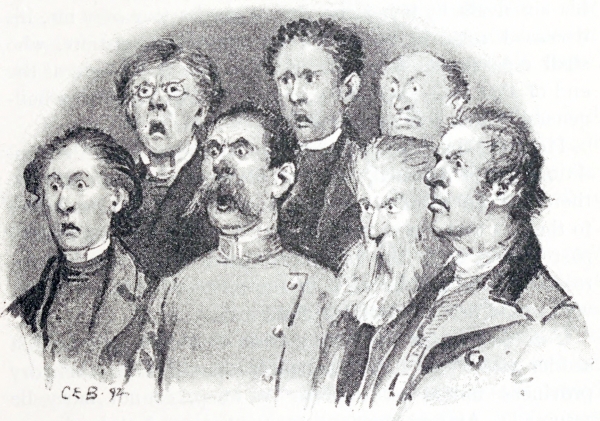
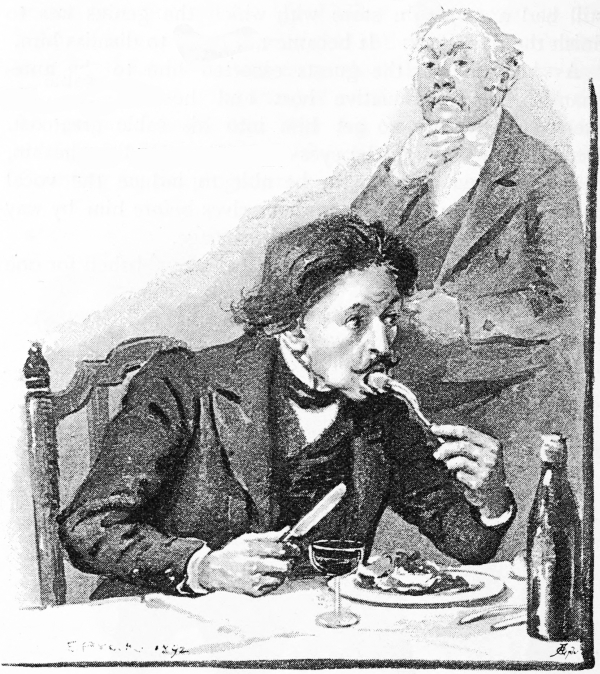
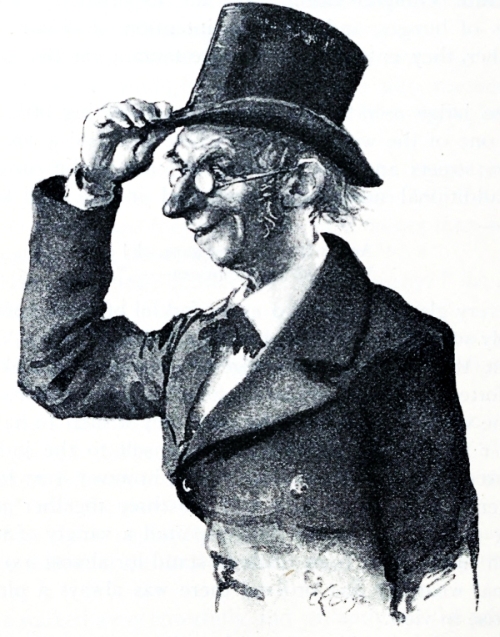
“SEVEN ELONGATED FACES HERE STARTED UP.”
Seven elongated faces here started up. Especially
did the Right Reverend Glanz, a young man noted
throughout Germany for his spoken and printed sermons,
feel himself keenly injured by such sneers. Flitte, from
Elsass, permitted a whispered oath to escape his lips; and
as for Flachs, the preacher, his chin grew longer and longer,
and threatened to grow into a beard. Many a whispered
ejaculation was overheard by the magistrate addressing the
late Herr Kabel by such appellatives as scoundrel, fool,
antichrist. But the ruling burgomaster waved his hand,
the court-attorney and the bookseller set all the elastic
springs in their faces as in a trap once more, and the
former continued reading albeit with affected seriousness.
“Paragraph 3.—Excepting my present residence in the
Hundgasse, which, according to this third paragraph, I
will leave, with all that pertains thereto, to that one of the
afore-mentioned seven gentlemen who, in one half-hour
(counting from the reading of the paragraph), shall outdo
his six rivals by being the first to shed a tear over me, his
deceased relative, before an honourable magistrate, who
shall register the fact. Should there be a drought at the
end of that time, then the property must accrue to my heir-general,
whom I shall forthwith name.”
Here the burgomaster shut the will, remarking the conditions
to be unusual, but not illegal, and in accordance
therewith the court would now proceed to award the house
to the first that wept; laid his watch, which pointed to half-past
eleven, upon the table, and sat down silently to note,
together with the lawyers, in his office of chief executor,
who would first shed the required tears.
That so long as this world exists there has ever been a
sadder and more ruffled assembly than this of seven dry
provinces united as it were to weep, cannot fairly be
assumed. At first precious moments were lost in dismay
and smiling surprise; it was no easy matter to be transported
so abruptly from cursing to weeping. Emotion
pure and simple was not to be thought of, that was quite
evident; but in twenty-six minutes something might be done
by way of enforcing an April shower.
The merchant Neupeter asked if that was not a confounded
affair and fool’s comedy for a respectable man to
be concerned in, and would have nothing to do with it;
but at the same time the thought that a house might be
washed into his purse on the bosom of a tear strangely
moved his lachrymal glands.
The Court-attorney Knoll screwed up his face like a poor
workman getting shaved and scratched by an apprentice on
Saturday night by the light of a murky little lamp; he was
greatly enraged at the misuse of testaments, and was not
far removed from shedding tears of wrath.
The sly bookseller at once proceeded to apply himself
assiduously to the matter in hand, and sent his memory on
a stroll through all the sentimental subjects he was publishing
or taking on commission; he looked much like a dog
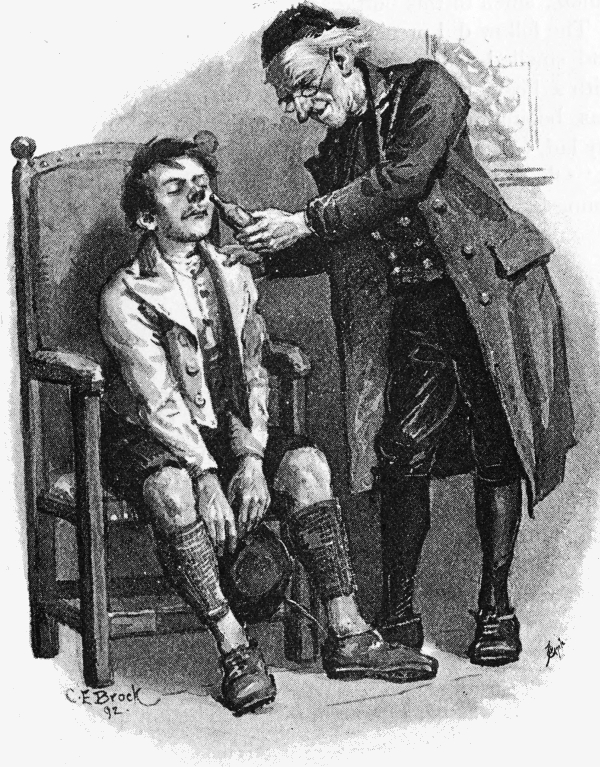
slowly licking off the emetic which the Paris doctor Demet
had spread on his nose; some time must necessarily elapse
before it could take effect.
Flitte, from Elsass, danced about the Session-room, looked
at all the mourners with laughing eyes, and swore, though
he was not the richest among them, he could not for the
whole of Strasburg and Elsass weep when there was such a
joke abroad.
At last the Police-inspector Harprecht looked at him very
significantly, and remarked that if Monsieur hoped to extract
the required drops from the well-known glands by means
of laughter, and fraudulently profit thereby, he begged to
remind him that he would gain as little as if he were to blow
his nose, for it was well known that the ductus nasalis caused
as many tears to take that direction as flow into a pew
under the most affecting funeral sermon. But the Elsassian
assured him that he was only laughing for fun without any
serious intentions. The inspector on his part tried to bring
something appropriate to the occasion into his eyes by opening
them very wide and looking fixedly at one spot.
The preacher Flachs looked like a beggar on horseback,
whose nag is running away with him; like the sun shining
on a dismal day, his heart, which was piled about with the
most suitable clouds of hardships at home and in church,
might easily have drawn water on the spot, but unfortunately
the house swimming in on the high-tide proved too pleasant
a sight, and repeatedly served as a dam.
The Right Reverend Glanz, who knew his nature from
his experience in New Years’ and funeral sermons, and who
was quite certain that he would be able to work upon his
own feelings if only he were granted an opportunity of
addressing himself in touching language to others, now
arose and said with dignity that he was sure every one who
had read his printed works would feel convinced that he
had a heart in his bosom, and that it was rather to be
expected of him to suppress such sacred symbols as tears,
so as to deprive no human brother, than to extract them by
force. “This heart has overflowed ere now, but it was in
secret, for Kabel was my friend,” he said, and looked about
him.
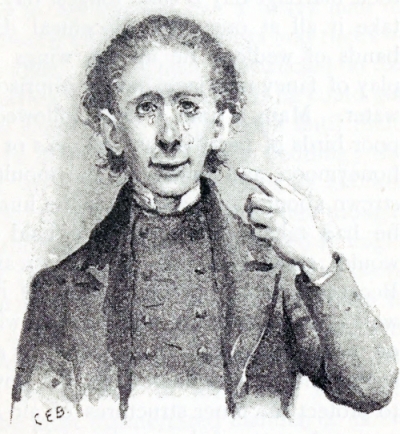
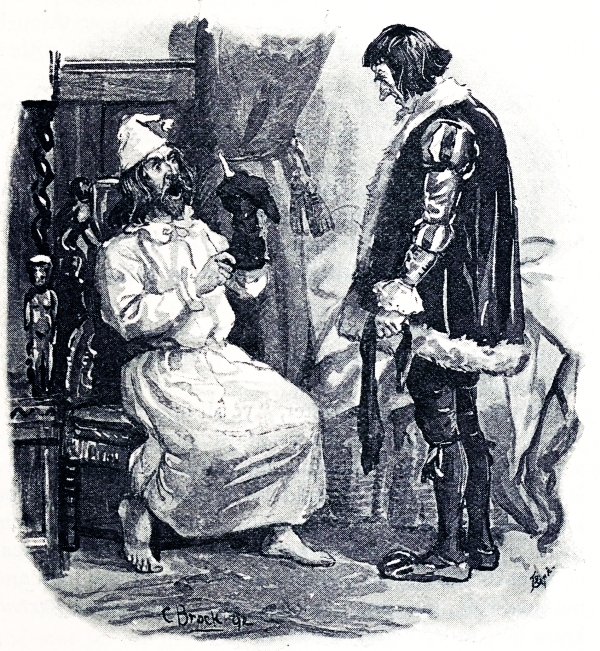
“I BELIEVE, GENTLEMEN, I AM WEEPING.”
With satisfaction he saw that they were all sitting there
as dry as so many sticks. As things stood now, crocodiles,
stags, elephants, and witches could have wept more easily
than the heirs, irritated and enraged by Glanz as they were.
Only Flachs had a turn of good luck. He thought of
Kabel’s good deeds and of the shabby dresses and grey locks
of his congregation at early service, then in haste he gave
a thought to Lazarus and his dogs and to his own lengthy
coffin, then to all the people who have been beheaded at one
time or other, the “Sorrows of Werther,” a battle-field;
and last he gave a pitiful thought to himself, how young
he was, and how he was working and slaving for a
miserable paragraph in a testament. Another good heave
with his pump-handle and it would fetch him water and a
house.
“Oh, Kabel, my Kabel,” continued Glanz, almost weeping
at the glad prospect of mournful tears, “when on some
future day, beside thy precious bosom now covered with dust,
my own lies mouldering——”
“I believe, gentlemen,” said Flachs, getting up sadly and
overflowing with tears, “I am weeping.” Thereupon he
sat down again and
allowed them to run
cheerfully down his
cheeks; he was high
and dry now; he had
successfully angled
the house away from
Glanz, who was very
much put out by his
efforts, because he
had talked away his
appetite all to no
purpose. Flachs’s
emotion was duly
registered, and the
house in the Hundgasse
was legally assigned to him. The burgomaster was
gratified that the poor devil should have it. It was the first
time in the dukedom of Haslan that the tears of a teacher
and preacher, like those of the goddess Freya, had changed
into gold. Glanz was profuse in his congratulations, and
jocosely reminded Flachs that he himself had perhaps been
instrumental in bringing about this happy consummation.
Jean Paul Friedrich Richter (1763-1825).
DIVISION OF LABOUR IN MATTERS SENTIMENTAL.
LOVE is the perihelion of women—ay, it is the transit
of such a Venus through the sun of the ideal world.
During this time of their highest refinement of soul they
love whatever we love, even though it be Science, and the
best world of beauty within us; and they despise whatever
we despise, even though it be dress and gossip. These
nightingales sing up to the date of the summer solstice;
their marriage-day is their longest day. The devil does not
take it all at once, but piecemeal day by day. The firm
bands of wedlock tie up the wings of poesy; to the free
play of fancy marriage means imprisonment on bread and
water. Many a time I have followed about one of these
poor birds of paradise or peacocks or Psyches during their
honeymoon, and picked up the moulted feathers that were
strewn about; and when later the husband complained that
he had taken unto himself a bald and unlovely bird, I
would show him the wasted treasure. Why is this?
Because marriage erects a crust of reality about the ideal
world; it is much the same case as with the sphere we live
on, which, according to Descartes, is a sun enveloped in an
earthy shell. A woman lacks the power which a man has
to protect the inner structures of air and fancy against the
encroachments of the rough outside. Where shall she seek
refuge? In her natural keeper. A man should ever stand
guard with a spoon over the fluid silver of the feminine
intellect, to remove the scum as it rises, that the regulus of
the ideal may shine the brighter. But there are two kinds
of men: the Arcadians or lyric poets of life, who love for
ever, like Rousseau when his hair was grey—such are not
to be comforted when the gilt-edged feminine anthology of
wit shows no gold as they turn the leaves, as is apt to be
the case in books bordered with gold; second, there are
the boorish shepherds of to-day, the plebeian poetasters and
practical men of business, who thank God when their
enchantress, like other enchantresses, changes into a growling
domestic cat, and keeps the house free from vermin.
No one suffers from greater ennui and anxiety than a fat,
weighty, slouching, bass-voiced man of business, who, like
the Roman elephants of former times, is called upon to
dance upon the slender rope of love, and whose amorous
pantomimes always remind me of dormice, that seem to be
at a loss about their every movement when sudden warmth
interrupts their dormant state. Only with widows, who care
less to be loved than to be married, can a heavy man of
business begin his romance where the novelists end theirs—viz.,
at the steps of the altar. Such a man, constructed on the
crudest style, would have a load off his mind if he could get
some one to love his shepherdess in his name until there
was nothing more to be done but to have the wedding; the
taking upon myself of such crosses and burdens for another
is just what I should feel a calling for. I have often thought
of advertising it in public papers (had I not feared it might
be taken for a joke), that I offer myself to serve as plenipotentiary
to any man of business who has no time to
properly make love to a girl. Provided only she be tolerable,
I should be willing to swear platonic everlasting affection,
make the necessary declarations of love, and, in short,
substitute myself in the most disinterested manner, or escort
her arm-in-arm through the ups and downs of the land of
love, until on the border I could make her over to the
prospective bridegroom in proper condition to be married.
Instead of marriage by proxy we should thus have love by
proxy.
Jean Paul Friedrich Richter.
A TENDER-HEARTED CRITIC.
HE composed reviews as others do prayers—only when
in straits; it was like the carrying of water of the
Athenian so that he might thus be free to devote himself to
his favourite studies without hunger. But his satirical sting
he would put in the sheath when writing reviews. “Petty
authors,” he said, “are always bitter, and great ones are
worse than their works. Why should I be less severe upon
the genius for his moral faults, such as vanity, than upon
the dunce? On the contrary. Poverty and ugliness not
self-incurred deserve no disdain; but neither do they deserve
it when self-incurred, though Cicero be against me.
For neither a moral fault nor its punishment can be
increased by a physical consequence which may follow or
may not follow. Is the spendthrift who is impoverished in
consequence of his way of living more to be blamed than
the spendthrift who goes free? On the contrary.”
Applying this to poor writers whose unconquerable self-conceit
hides their worthlessness to themselves, upon
whose innocent hearts the critic vents his just wrath over
their guilty heads, it is certainly permissible to scoff
bitterly at the type, but the individual should be more
gently dealt with. Methinks it would be the gold-test of a
morally immaculate scholar if he were called upon to
review a poor but celebrated book.
Jean Paul Friedrich Richter.
THE ACCIDENT OF THE DISTINGUISHED STRANGER.
(From Scene XII. of “Die Deutschen Kleinstädter.”)
(Scene in the Burgomaster’s home in a small town. News has
just been received of a traveller, whose carriage has met
with an accident in a quarry just outside the town.Frau Staar, the Burgomaster’s mother, is all in a flutter
as to the best way of doing honour to the distinguished
stranger, and has sent for all of her female relatives, to
obtain their advice in this difficult question.)
Frau Staar.Frau Brendel.
FRAU BRENDEL.
Here I am, most dear Dame Cousin. I ran so, I have
no breath left. I was but just drinking my seventh cup of
coffee, but I jumped up and left everything, at your message.
FRAU STAAR.
Greatly obliged, most esteemed Dame Cousin. Have
you heard——
FRAU BRENDEL.
I know everything! My maid had gone to market, and
the butcher told her his neighbour, the linen-draper, had
heard how the bailiff had said to his daughter: Mickey, he
said, out in the quarry there are a couple of counts lying,
who have broken their arms and legs, and will be here in a
minute. The watchman will blow a horn from the turret,
the children will strew flowers on their path, the magistrate
in corpore will go to meet them, and the bells will be rung.
FRAU STAAR.
It is only one, Dame Cousin; only one is lying in the
quarry, probably a gentleman of quality. He is to be our
guest. The Minister of State has written and has asked my
son. Now you can fancy, Dame Cousin, the excitement in
the house. And everything is on my shoulders! Everything
rests upon me!
(Enter Frau Morgenroth.)
FRAU MORGENROTH.
Your servant, most esteemed Dame Cousin. Only see
how my walk has heated me. I trust I am not too late?
With your permission be it said, I had scarce a thing on me,
was singing my morning hymn and combing my poodle-dog.
At the third stanza your maid came rushing in. My God, I
thought the house was on fire! Then and there I jumped up,
the poodle-dog dropped from my lap, the hymnal fell in the
coals where I was warming my coffee, the coffee was spilled,
and two stanzas of the hymn, “Awake, my heart, and sing!”
were burned up.
FRAU STAAR.
I regret it, exceedingly, worthy Dame Cousin——
FRAU MORGENROTH.
Oh, it’s of no consequence. I know all. Out in the
quarry lie three or four princes; one is dead, the other is
gasping a bit now and then. The coachman has broken
his neck, the horses are lying stiff and stark. I met the
Herr Assistant-Bailiff Balg on the street; his cook told
him; she knows it from the wife of the Lottery Inspector;
her husband’s barber told her all the details.
FRAU STAAR.
Tut, tut, it is not quite so bad as all that. A short time
ago a peasant came here from Kabendorf——
FRAU BRENDEL.
I know, he got a solid thaler for a tip.
FRAU MORGENROTH.
Far from it, Dame Cousin, a Louis-d’or it was.
FRAU STAAR.
He had run as fast as he could run.
FRAU BRENDEL.
They say it gave him a pain in his side.
FRAU MORGENROTH.
His nose bled too.
FRAU STAAR.
A person of quality met with an accident.
FRAU BRENDEL.
A count——
FRAU MORGENROTH.
Several princes.
FRAU STAAR.
That we do not know. He must be of noble extraction,
for he does not lodge in the “Golden Cat,” but at our
house, at the express desire of his Honour the Minister of
State. Now, as my son, the Burgomaster and Chief Alderman,
represents in his person the whole town as it were,
you will, of course, understand that he must do honour to
his position.
FRAU BRENDEL.
A banquet at the Town Hall——
FRAU MORGENROTH.
A dance at the archers’ guild——
FRAU STAAR.
To-morrow, as you know, is the great fête.
FRAU BRENDEL.
Oh yes, the woman that stole the cow nine years ago——
FRAU MORGENROTH.
To-morrow she goes to the pillory. I am looking forward
to it with a great deal of pleasure.
FRAU BRENDEL.
I have had a brand-new robe made for the occasion.
FRAU STAAR.
There have been many arrangements made to fitly celebrate
this event. But to-day the honour of the town is
wholly in our hands; to-day we must show what we can do,
and with the help of God we will. The tables shall bend
under His blessings. My worthy cousins are herewith
invited.
FRAU BRENDEL.
I look upon it as a great honour.
FRAU MORGENROTH.
Shall not fail.
FRAU STAAR.
Now, you see, I should like to make the distinguished
stranger acquainted with our people of quality. So I have
sent for you to ask your advice as to the persons to be
invited.
FRAU BRENDEL (meditating).
Ah, well, I think——
FRAU MORGENROTH.
You might perhaps——
FRAU BRENDEL.
Invite the Herr Convoy-and-Land-Excise-Commissary
Kropt——
FRAU STAAR.
No, Dame Cousin, he gave a banquet the other day on
his mother’s birthday, and did not ask us.
FRAU BRENDEL.
Ah, indeed!
FRAU MORGENROTH.
Perhaps the Herr Board-of-Revenue-Supernumerary-Secretary
Wittmann?
FRAU BRENDEL.
No, Dame Cousin; my husband, the late Herr Brendel,
had a law-suit with him about his drains.
FRAU MORGENROTH.
That alters the matter.
FRAU STAAR.
I thought of the Herr Post-Luggage-Inspector-General
Holbein?
FRAU MORGENROTH.
For heaven’s sake, Dame Cousin! he has a most insufferable
wife! There’s hardly a Sunday passes but she has a
new dress, and the way she goes rustling past my pew——
FRAU BRENDEL.
She carries her head higher than need be——
FRAU MORGENROTH.
And we all remember her so well——
FRAU BRENDEL.
Yes, when she wore a grey spencer with a green apron.
FRAU MORGENROTH.
There are strange rumours where she takes it from.
FRAU BRENDEL.
No, I would rather suggest the Herr
County-Tavern-Harvest-and-Quarter-Tax-and-Impost-Controller
Kunkel.
FRAU STAAR.
Don’t mention him, worthy Cousin; he is a rude fellow,
who has no manners! Would you believe it, he did not so
much as call upon us in a decent and proper manner, the
pert addle-head! He left his card, fancy! One might
sooner ask the Herr Penal-Raft-Commander Weidenbaum.
FRAU BRENDEL.
No, Dame Cousin, for heaven’s sake, no! You remember
how the wicked fellow was seen to talk to my brother-in-law’s
step-daughter three times, and how consequently he
intended to marry her? Now he holds himself aloof, and
has made the poor girl the talk of the town.
FRAU STAAR.
Goodness me, is there any one we can ask then?
FRAU MORGENROTH.
There comes Cousin Sperling.
(Enter Sperling, with a large bouquet.)
SPERLING.
Frau Under-Tax-Receiver, Frau Chief-Raft-and-Fishery
Master, Frau Town-Excise-Treasury-Secretary, your humble
servant! I was in my garden—the Herr Vice-Church-Superintendent
sent for me—I ran like a sunbeam!
Scarce did I take the time to cull these children of the
spring.
THE THREE LADIES.
Do you know already?
SPERLING.
I know all. A celebrated professor—carriage smashed
up—nose ditto—letter of recommendation from the
Minister of State.
FRAU STAAR.
A professor, you say?
FRAU BRENDEL.
Only a professor?
FRAU MORGENROTH.
Oh, my delicious coffee that was spilled in the fire!
FRAU STAAR.
Never believe it, Dame Cousin. All my life I have
heard that ministers take little interest in professors. No,
no, there is some misunderstanding.
SPERLING.
Nay, but I will stand up for my opinion that the man
who has had his nose smashed is a learned professor, on
his way from Egypt or Weimar, where he has either been
measuring the pillar of Pompey, or else seen Wieland put
his head out of the window. In short, there is no time to
be lost. Here are the flowers. Now get me some children.
Children I must have! Then he may come and see what
the town of Krähwinkel can do!
FRAU STAAR.
Gently, gently; they shall be here at once.
(Exit.)
(SPERLINGturns aside and mutely practises the pantomimes
of reception.)
FRAU MORGENROTH.
Have you noticed, worthy cousin, what ridiculous airs the
old lady is putting on?
FRAU BRENDEL.
Yes, indeed, Dame Cousin; she puffs herself up like
dough in the oven.
FRAU MORGENROTH.
Goodness me! Her husband was only Under-Tax-Receiver.
FRAU BRENDEL.
When he died he left a debt to the Treasury.
FRAU MORGENROTH.
Dear me, and I wonder what the banquet will be like?
Do you remember that joint eight weeks ago? It was
horribly burned.
FRAU BRENDEL.
And how she looks! what will she put on?
FRAU MORGENROTH.
Not much choice. She has but three gowns.
FRAU BRENDEL.
To be sure, the brown one——
FRAU MORGENROTH.
And the white one——
FRAU BRENDEL.
And her stuff gown.
FRAU MORGENROTH.
She had that made for the first christening at the burgomaster’s.
FRAU BRENDEL.
Begging your pardon, Dame Cousin, it was made when
the Vice-Church-Superintendent married his second wife.
FRAU MORGENROTH.
Who was another such fool.
FRAU BRENDEL.
You’re right there, quite right there.
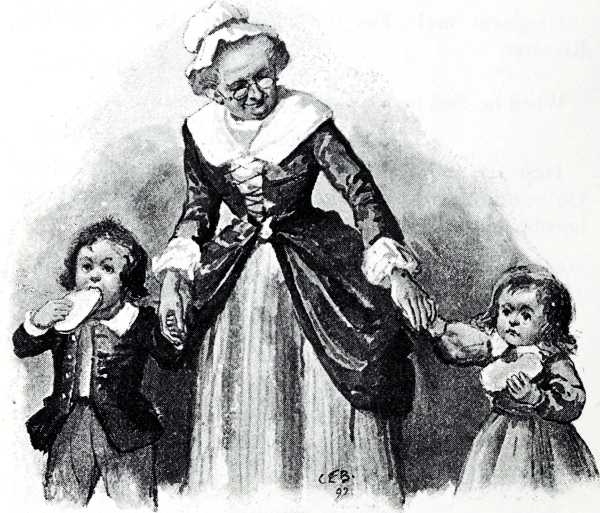
(Enter Frau Staar with two children, the latter eating
enormous slices of bread and butter.)
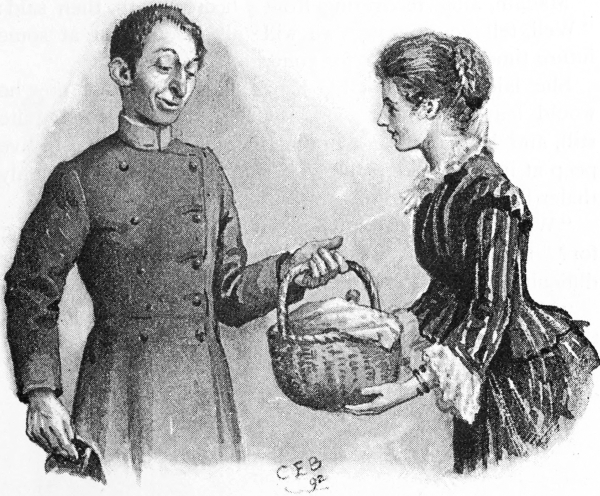
ENTER FRAU STAAR WITH TWO CHILDREN.
FRAU STAAR.
There are the children.
SPERLING.
Come along then!
FRAU STAAR.
Drop a curtsey to your dear Dame Cousin first, there’s
a good child! Now shake hands; that’s right!
FRAU BRENDEL (wiping the butter from her fingers).
Enchanting little creatures. God bless them!
FRAU MORGENROTH.
The very pictures of our dear Dame Cousin.
FRAU BRENDEL.
I trust they have had the pox!
FRAU STAAR.
Not yet. My son wished to have them inoculated, but
I will never give my consent. I would not forestall the
Almighty.
SPERLING.
Children, lay your bread and butter aside.
CHILDREN.
No, no.
SPERLING.
Well, then, take the flowers in the other hand.
(Enter Herr Staar and the Burgomaster.)
HERR STAAR (hastily).
They are just driving in through the gate. The street is
full of boys. They are running along by the carriage, and
yelling at the top of their voice.
BURGOMASTER (hastily).
He comes, he comes! The watchman is standing ready
with his trumpet.
SPERLING.
Goodness gracious! The children are so awkward——
HERR STAAR.
All you have to do is to strew your flowers and fling them
in his face.
(The blast of a trumpet very much out of tune.)
BURGOMASTER.
Quick, quick! All go to meet him!
HERR STAAR.
The children lead the way!
SPERLING (snatches the bread and butter out of their
hands and throws it on the table).
Leave your bread and butter here.
HERR STAAR (urging the children toward the door).
Quick, quick!
CHILDREN (crying).
I want my bread and butter! My bread and butter!
BURGOMASTER (following them).
Will you hold your tongues?
FRAU STAAR.
Frau Chief-Raft-and-Fishery-Master, you will have the
kindness to precede me.
FRAU BRENDEL.
Never, Frau Town-Excise-Treasury-Secretary. I most
urgently beg you——
FRAU MORGENROTH.
Frau Under-Tax-Receiver, the honour is due to you.
FRAU STAAR.
The heavens preserve me! I am at home in this house.
FRAU BRENDEL.
I know my place——
FRAU MORGENROTH.
I will not stir a step.
(The three begin to bow and curtsey, and all talk at the
same time.)
(THE CURTAIN DROPS.)
August von Kotzebue (1761-1819).
HOW THE VICAR CAME AROUND.
THE Frau Obersteuerrätin was “auntie” to the whole
world; and indeed she deserved the name, for she was
a motherly friend, counsellor, and helper to all who came
within her domain; she was the best and most charitable
of women, judging mildly of the weaknesses of others so
long as her own little weaknesses were respected. She over-looked
the eccentricities of her clerical brother, which he
committed in a state of absent-mindedness, and she did not
raise any objections to Susie’s marvellous naïveté, though
often enough it caused her bitter dilemmas.
It was a warm May day on which the Vicar entered the
room with his usual greeting: “Good morning, Auntie—good
morning, Susie.”
Auntie nodded pleasantly. Susie, who was sitting by her
on the sofa, knitting a white stocking, arose, dropped a little
familiar curtsey, and said: “Votre servante, Uncle.”
“But, Heaven preserve us, what is the matter with you
to-day, Vicar?” said Aunt Rosmarin.
“How so?” queried the Vicar, putting his hands in all
of his pockets in a vain search for a handkerchief with which
to wipe the perspiration from his brow.
“It’s very likely you have your wig in your pocket,” said
Auntie, “for your handkerchief is on your head.”
“On my head,” exclaimed the Vicar in surprise, and
putting his hand there he found it. “I shouldn’t be greatly
surprised if you were right, Auntie; it’s a hot, hot day; the
sun was burning, my back was burning; I came from town,
so I took off my wig to cool my head, spread my handkerchief
over the latter, and lay down in a corn-field.”
Again he began to search his pockets, while Susie made
room for him on the sofa, and went out to get him a refreshing
drink of water and raspberry syrup.
“What are you looking for, Vicar?” asked Auntie.
“If I mistake not, I brought a letter for you from town;
but what has become of it is more than I can tell. I think
it is from the Burgomaster. Seek and ye shall find.”
“But, Vicar, first of all, put on your wig—this is very
indecent. It is an insult to your congregation to walk
about bald-headed.”
“I should hope not. But in that case I trust that there
would be bears to obey me, like the prophet Elisha, and
devour all bad boys who would make bold to have a laugh
at me. But, ad vocem, my wig, Auntie; what did you do
with it?”
“What did I do with it? You did not entrust it to my
keeping. Perhaps you lost it on the way!”
“Heaven preserve us! It was my best wig. You are
right, Auntie; it is lying in the grass, together with the Burgomaster’s
letter, precisely on the spot where I myself lay a
quarter of an hour ago, in the shadow of the corn.”
Auntie seized her bell. The maid appeared; the Inspector
was called, and ordered to send for the wig and the
letter—as quick as possible. Auntie was quite as impatient
to hide the Vicar’s baldness as to read the Burgomaster’s
letter. The shape of the wig, as well as colour and address
of the letter, were explicitly described to the Inspector, and
he forthwith sent two grooms, four threshers, and one dairy-boy
out upon all roads, footpaths, and byways that run
between Nieder-Fahren and Waiblingen. He stationed
himself upon the hill by the wind-mill and reconnoitred the
field of action through a telescope. Such excellent arrangements
could not fail to bring about the desired result. In
half-an-hour the seven messengers returned to the house led
by the wig, the letter, and the Inspector.
Sure enough the letter was from the Burgomaster. It
contained nothing less than a formal invitation to the Frau
Obersteuerrätin, together with her brother and Fräulein
Susie and the Inspector Säblein, to the wedding of the
Burgomaster’s eldest daughter.
Although Auntie felt very much flattered by this attention
of the Burgomaster, with whom she was but slightly
acquainted, there were some difficulties in the way which
must needs be talked over in a family council.
Auntie was very much averse to bringing Susie into contact
in any way with the young gentlemen of Waiblingen.
First of all, Susie was seventeen years old—a fact which did
not seem at all portentous to the child, but all the more so
to her cautious aunt. Second, Susie was beautiful as any
Susanna, not excepting the one in the Old Testament.
Thirdly, she had the prospect of inheriting a considerable
fortune, and Auntie had no notion of giving up her darling
to the first-comer. Fourthly, Susie was exceedingly inexperienced,
though she was not wanting in the usual measure
of laudable curiosity.
The young men of Waiblingen were in no way suited to
be the companions of such a girl. First, because a great
many of them were handsome, which is a very bad thing;
and secondly, they were all great lovers of comedies and
novels; they kept up an amateur stage; and at Waiblingen
two booksellers made their living with circulating libraries—a
bad sign of our times! Thirdly, even though one
might have forgiven them their sleek faces and romantic
tendencies, few of them had a fortune that would weigh in
the scales against Aunt Rosmarin’s possessions, nor were
they of a rank to be compared with the title of Obersteuerrat.
Auntie had pondered this question long since in the
silence of her own heart, and she had come to the conclusion
that it was best to take defensive measures against
the elegant world of Waiblingen. Susie seldom went there,
and still seldomer were there any young guests invited to
Nieder-Fahren.
After ripe consideration it was decided in the family
council, in which the Inspector also took part, to go to the
wedding at the Burgomaster’s, but not without the utmost
caution.
Auntie undertook to call Susie’s attention to the dangers
arising out of the affections. The Vicar was to add spiritual
admonition, and the Inspector—who had the reputation of
having been a good waltzer in his younger years, while now
he was unfortunately a bachelor of fifty-six—promised to
renew Susie’s dancing-lessons. At the wedding all three
pledged each other to do their best, and not lose the damsel
out of sight.
Hereupon tailors, shoemakers, and milliners were put in
a fair way of getting a living. Auntie was desirous of
doing whatever was due to her rank, and she also had the
pardonable pride of showing off Susie’s beauty to the best
advantage.
Susie was delighted with the elaborate preparations—all
this was a new experience. She put her dancing-master
quite out of breath, and her only regret was that his feet
being fifty-six years old were not as flexible as hers being
seventeen. Joy and nature taught her to dance; but
Säblein took it all upon his account. He was nothing loath
to practise his noble half-forgotten art, the less so as the
family council had decreed that he alone should be Susie’s
partner at the wedding.
Unfortunately this plan miscarried, and the reason was
this. The day before the wedding all the dances were to
be reviewed once more under the supervision of the Vicar
and Auntie. Before the spectators came, Säblein exerted
himself more than was good for him to dance at least no
worse than his clever pupil. She floated about like a
butterfly, and in her rapture took many a step which was
no less graceful for not coming under any rule. Säblein, in
an ecstasy of delight, rashly undertook to show her the
acme of his art. Years ago he could dance entrechats,—ambition
pricked him to make a trial once more. His first
attempt was half a failure, his second was a whole one.
His lank, thin-whittled legs, which had never been a cause
of reproach to him, got so hopelessly and abnormally
entangled that, the rest of his body keeping in motion, a
disaster was inevitable. The unfortunate dancing-master
fell in a most unmasterly manner upon the floor, and as a
falling pine uproots all blooming bushes that surround it, so
he pulled down the little sylph that was frolicking about him.
The Vicar, just about to open the door from without,
heard the fall which shook the very foundations of the
house, and entered hastily. It was partly this haste and
partly the Vicar’s near-sightedness, which he was wont to
forget in his absent-mindedness, which became the cause of
a second accident. He stepped upon the dancing-master’s
leg, which the latter drew back with pardonable abruptness,
thereby robbing the Vicar of his equilibrium. Before he
had time to beg pardon he lay upon the floor along with the
others. While his powdered wig was propelled by the rapid
motion far under the sofa, his short legs performed some
wonderful antics, and at last turned up their soles toward
Heaven, as if imploring its aid.
The whole occurrence was a very short one. The Vicar
was the first to gather himself up, and, mistaking Susie’s
snowy, befrilled cap for his escaped wig, he seized it without
more ado, and covered his head therewith because he heard
the Obersteuerrätin at the door. Susie was on her feet too
before Auntie entered. But Säblein sat upon the floor
making horrible faces, for he had hurt his hip.
“Great heavens!” cried Aunt Rosmarin, clapping her
hands together, and looking now at the Inspector’s
painful grimaces, now at her brother’s head in a woman’s
cap. “Are you playing a farce? Are you forgetful of all
decency? Do you call this good breeding? and especially
you, Vicar?”...
“And pray, why is it especially I?” he asked with a
touch of sensitiveness, for he did not greatly like his sister’s
sermons.
Here Susie gained a hearing, and quickly restored peace
by giving her perplexed aunt the explanation to this riddle,
and laughingly exchanging her cap for the wig.
THE VICAR HASTENING TO COVER HIS BALDNESS.
This apparently unimportant occurrence was the firs
cause to all following misfortunes; for Säblein went
limping about for many days, and consequently could not
dance at the wedding.
Aunt Rosmarin had her suspicions when she saw Susie,
now swimming in bliss, now abject and mournful, or when
she heard how Susie went walking in the park evening after
evening, and when she herself, putting aside her dread of
rheumatism, secretly followed her there, but always found
Susie alone.
Auntie shook her head, and said to her brother: “I
believe, Vicar, our little baroness is in love.” She had hit
it, but wise Auntie never thought of the baron. “We
must keep our eyes on this marvellously mysterious child,
for she will confess nothing to me. It is a delicate task, I
know, and I myself am too old to run after her in the park
every day the Lord makes. And, of course, Vicar, it is not
a matter to be entrusted to the domestics; that were contrary
to all dignity and order. But at the same time she
must be watched, for these constant visits to the park for
the last fortnight must have some good reason.”
“Trust me, Auntie,” said the Vicar—“trust me; I will
guard the park like a spy. Murder shall out. This is just
the sort of thing that suits me.”
The plans were laid with great subtlety. The Vicar
looked unconcerned in Susie’s presence, and the following
day at sunset he started upon his errand.
He was indeed very lucky, for the Baron was really in
the park. He was twice lucky, for it so happened that he
entered the park from the side where it touched the woods,
and where the Baron was wont to enter it. He was in the
habit of leaving his horse there, and giving it to the servant
to hold.
The servant, finding his task decidedly dull, had to-day
tied the Baron’s horse to a young birch-tree and gone about
his own affairs. The Vicar looked at the elegantly-equipped
noble steed from all sides, and nodding his head thoughtfully,
unfastened it, saying to himself, “I’ll take it home to
our stable; the owner will no doubt apply for it, and all the
rest will follow. In truth, it’s a shrewd plan!”
But there was an unfavourable circumstance. There
seemed to be a secret understanding between the horse
and his master. He most decidedly objected to being
pulled along by the bridle; no amount of patting and
caressing had any effect; he planted his fore-legs firmly on
the ground and pulled his head back.
“Friend,” said the Vicar, “at best you are but a beast,
and you have no eyes behind your ears. I’ll wager you will
go willingly.” With that he climbed upon the noble animal’s
back, which stood as patient as a lamb. To be sure it was
thirty years or more since the good Vicar had been on horseback,
and, moreover, his legs were about two inches too
short for the stirrups; but then it was to be but a few
moments’ ride, and it was well to show Aunt Rosmarin
that he had not forgotten the chivalrous arts over his theology.
Over and above all this there was danger in delay.
So he belaboured the horse’s shanks with his boots, and
the steed, taken aback by such ill-treatment, at once began
to canter along the woody path, across the field into the
open road, having for weeks past traversed no other way
than this with the Baron. The Vicar, in danger of losing
his balance, with laudable precaution clasped his fingers in
the mane of his Pegasus. Finding himself upon the road,
however, instead of parading under Auntie’s window, he tried
to grasp the bridle. Over this attempt he came very near
losing both stirrups. Making sure of these once more, he
let the bridle alone. For a while these two purposes warred
with each other, and between times he admonished the
fiery horse with many caresses to stand still. But it was
all in vain; and when in his despair he pulled the line too
tight, at the same time clasping the horse’s sides firmly with
his legs, it forthwith rose upon its hind feet, and, to his
inexpressible horror, began to walk about like a human
being, and perform tricks which were positively not to the
Vicar’s taste just at that moment.
He now succumbed to fate and to his horse, clinging to
the latter with hands and feet while it sped along at a full
gallop till the poor Vicar was deaf and blind with dizziness.
“Out of the depths have I cried unto Thee,” he sighed.
“If this isn’t the very devil himself! Had I but left the
beast standing where I was how happy should I be!”
It so happened that right here the road had been barred
by peasants in honour of the grazing cattle.
“FELT THE WAVES PENETRATE HIS BLACK SILK STOCKINGS.”
“Te Deum laudamus!” cried the Vicar. “Here surely
this rascal of a horse will come to a stand.” But the steed
leaped over as if he had wings, so that the horseman’s hair
stood on end, and his hat and wig took flight in horror.
“I have learned to ride better than you, for I still hold
my seat,” said the good Vicar in Christian tranquillity to
the truants, not venturing to turn and look after them.
“Whither, in the Lord’s name? Twice four-and-twenty
hours at this rate and we shall have spanned this terrestrial
globe and come out on the other side at Nieder-Fahren.”
As he was saying this they approached a bridge. The
Vicar, in terror lest the horse in its blind rage might miss
the bridge and leap into the stream, tugged frantically at the
line on the side nearest to the bridge. But he tugged too
long; the provoking animal thereupon left the bridge lying
at the right, and jumped into the water. The Vicar came
very near fainting away when he became aware of floating
between heaven and water, and felt the waves penetrate his
black silk stockings, and soon after his velvet breeches,
until they played about his hips.
The horse, which was a capital swimmer, reached the
opposite shore in safety, regained the road, and jauntily
continued its journey until it reached Schloss Malzen, where
it darted joyfully with the Vicar into the open door of the
stable, standing still at last in its own familiar stall.
The servants in the courtyard ran in after him, helped
the rider out of the saddle, and anxiously inquired how he
had come into possession of the Baron’s horse.
An unspeakable sense of blissful security seized the much-tried
clergyman as once more he felt terra-firma beneath
his feet. Deprived of his hat and his wig, to be sure, and
the lower half of his body dripping with water, far from home,
the approaching night before him, and upon the domain
of the arch-enemy of Nieder-Fahren—all these circumstances
served to make the situation not altogether agreeable. But
what cared he so long as his life was saved?
While the servants were storming the breathless gentleman
with questions the Baron’s steward appeared upon the scene,
and hospitably urged him to come into the house. As upon
his request a carriage was promised him to take him back to
Nieder-Fahren, he consented to enter and rest before his
departure. Meanwhile nearly two hours passed; no carriage
appeared, and the Vicar began to wax suspicious lest he
was being treated as a prisoner for having run away with the
horse, although he had repeatedly affirmed that it was he
who had been run away with. He finally decided to take
flight. He arose, and was about to open the door, when
Baron Pompeius von Malzen entered, having arrived upon
his lackey’s horse while the despairing lackey was on a search
for the Baron’s steed through the whole of Ober and Nieder-Fahren.
The Baron, recognising the worthy uncle of his wife—the
tale concerning the arrival of the horse with a wigless and
decidedly damp clergyman had been related to him in the
courtyard—at once escorted him to a better room, ordered
dry clothing, and gave the Vicar time to change his garments.
His departure was quite out of the question for that night;
the Baron would not let the opportunity escape him to
heap coals of fire upon the head of one of his adversaries,
to entertain him sumptuously, and overwhelm him with
courtesies.
Susie’s uncle, surprised at the Baron’s cordial manner,
soon felt very comfortable behind smoking viands and
bottles of Burgundy. Still, however soft and firm he sat
upon the luxurious cushions of his chair, he could not for
the whole evening rid himself of the notion, as he said, of
having “the hellish beast” between his legs.
“At the same time I am more grateful to my good horse
than I can tell you,” said the Baron, “for bringing me the
uncle of my beloved wife. I have long wished for the
honour of your acquaintance, so that I might beg for your
kind intercession. I adore my wife, and a separation is
about to be forced upon us. My wife has forgiven me—nay,
more, she loves me; she does not desire a separation,
and yet——”
“Loves you? Does not desire a separation?” cried the
Vicar, shaking his head, which was adorned with the Baron’s
best cotton night-cap.
“Will you have proofs?” said the Baron. “Ah, I will
be frank with our dear uncle. You shall know all. This
hour may decide our life’s happiness.” He thereupon went
and fetched Susie’s letters.
And indeed from his niece’s letters the Vicar saw that
between her and the Baron there was eternal peace, and a
great deal more that is eternal.
He seemed greatly touched as he laid the letters down;
he stretched out his hand across the table, and said—
“Baron, I for my part will make peace with you. Susie
shall be yours, and the law-suit may go to the dogs. But
we must handle Aunt Rosmarin carefully. She is a dear,
good woman, but she has peculiar ideas about some things.
Up to this day I was a raging Saul, henceforth I shall be a
gentle Paul, and shall begin at once upon my work of
conversion.”
The Baron jumped up, embracing and kissing brave Saul
in a rapture of delight.
Meanwhile Aunt Rosmarin had heard her brother relate
the story of his adventure. When he told her how he
found the horse, her eyes sparkled with pleasure at the
discovery. The fact of his getting into the saddle she
accompanied with the remark: “You don’t know how to
ride. Every cobbler to his last!” When he came to his
aerial flight across the bar, and his swim through the
stream, she jumped up, nervously seized her brother’s two
hands and cried, “For heaven’s sake, what dangers were
you subject to!” And she did not regain her composure
until he halted before the horse’s crib. Then, as the Baron
came in, her face lengthened; the warmer the Vicar grew
in chanting his praises the cooler was Aunt Rosmarin.
And when he had the audacity to add, “Susie does not seem
to dislike the Baron; seems to me we had better let the law-suit
go, and let things take their course,” Auntie shook her
head, while she gazed at her brother from top to toe with
wide open eyes.
“Well, I never!” said she. “I fear me the ride and the
fright have done you some injury. If the Baron did not
turn you out into the pitch-dark night, giving you lodging
and food instead, he did no more than heathens and
barbarians would have done. You need not think I’ll give
him Susie for his roasts and his Burgundy. A weak sort
of man you must be to be willing to sacrifice your principles
and all the disgrace and sorrow our family has suffered
through the Baron for one poor supper.”
Then did the Vicar arise in indignation and say, “Why,
Aunt Rosmarin, has all Christian charity gone out of you?
I wish then that you had ridden the Baron’s horse in my
stead; I wish you had been called upon to fly through the
air, and to swim through the surging billows, to make the
acquaintance of an honourable man. Then you would
think different.”
Aunt Rosmarin thought her brother’s remarkable wish
very improper, as well as insulting. She thereupon gave
him a lecture lasting three hours, and having for its
perpetual refrain, “I will not hear another word about the
Baron. In future I shall act alone, in strict accordance with
my principles.”
Heinrich Zschokke (1771-1848).
THE MAN WHO SOLD HIS SHADOW.
WHAT was my horror to see the man in grey come
behind with the evident purpose of accosting me.
He raised his hat and bowed with a more profound obeisance
than I had ever been honoured with. I returned the
courtesy, and stood bare-headed in the sun as if rooted to
the ground. I stared at him in an agony of terror, like
a bird under the spell of a serpent. He seemed greatly
embarrassed, did not raise his eyes, bowed repeatedly,
approached me, and began to speak in a gentle, wavering
voice, with the tone of a mendicant.
“I trust your Honour will have the kindness to pardon
my presumption in venturing to address you, being a
stranger. I have a very particular request to make.
Graciously permit me, sir——”
“For heaven’s sake,” I cried in terror, “what can I do
for a man who——” We both stopped, and, as it seemed
to me, we blushed.
After a moment of silence he began again. “During the
short time that it was my good fortune to enjoy the presence
of your company, I have had occasion more than once to
gaze—if you will permit me to say so—with inexpressible
admiration upon the well-formed, handsome shadow which,
with an air of noble disdain, as if scorning to set any value
upon it, you cast behind you. It is a superb shadow you
have there lying at your feet. Pardon the temerity of the
suggestion; would it be possible to induce you to sell this
same shadow to me?”
He ceased speaking, and it seemed as if a wheel were
going around in my head. What was I to make of this
remarkable proposition? He must be crazy, I thought, and
in an altered voice, more suited to the humility of his tone,
I replied—
“Go to, good friend; have you not enough with your own
shadow? What you propose is a very strange bargain.”
He interrupted me with, “I have many a useful thing in
my pocket that your Honour might find convenient; for
this inestimable shadow there is no price I should deem too
high. To show my gratitude to you, sir, I would give you
your own choice of all the treasures I carry about with me.
I have miraculous wands of the witch-hazel, I have
Mercury’s cap and potent draughts, the dish-cloth of
Roland’s page, and a Homunculus, but best of all is the
magic purse of Fortunatus.” “A magic purse,” I interrupted
him, and great as was my horror, he had captured my
sensibilities with that word. A deathly giddiness came over
me, and rows of ducats seemed to twinkle before my eyes.
“Would your Honour have the goodness to examine the
purse?” He put his hand in his pocket and drew out a
medium-sized, strongly-made bag of leather, with heavy
leather cords for draw-strings, and handed me the same.
I put my hand in and pulled out ten golden coins, and ten
more, and ten more, and ten more. I held out my hand
to him: “It is a bargain; for the bag I’ll give you my
shadow.” He clasped my hand to seal the bargain, and
then quickly knelt down before me, and with marvellous
dexterity loosening my shadow from the grass, he lifted it,
rolled it up, folded it, and at last put it in his pocket. He
arose, bowed once more, and then vanished among the rose
bushes. Methought I heard him laugh softly to himself. I
held the bag tightly in my hands. Round about me the
earth was bright with sunshine, and within me there was as
yet no wisdom.
Meanwhile it had grown late, and, unnoticed, the dawn
preceding sunrise was brightening the sky. It was a very
unpleasant surprise when I looked up and saw the glory of
colour unfold in the east. There was no refuge on this open
plain that I was traversing from the approaching sun, and that
too at an hour when shadows sport their utmost extension!
And I was not alone! I glanced at my companion, and once
more I trembled. He was no other than the man in grey.
He smiled at my consternation, and continued, without
giving me time to speak: “Let us, true to the custom of
the world, be united for a while by the reciprocal advantages
to be derived from such a union; we have time enough to
separate later on. This road which you are taking happens
to be my road also. I see you turn pale before the rising
sun. I will lend you your shadow for the time of our companionship,
and in return I will ask you to tolerate me at
your side. You have lost your servant Bendel; I will yield
you as good service. You do not look upon me with favour;
this I greatly regret. I can be of service to you, nevertheless.
The devil is not as black as he is painted. It is true
you offended me yesterday; to-day I bear you no ill-will, and
I have shortened the way for you so far, as you yourself
must confess. Will you not give your shadow a trial?”
The sun had risen, early wayfarers came along the road;
however distasteful it might be, I accepted his proposal.
Smiling, he allowed my shadow to glide upon the ground. It
fell into place on the shadow of my horse, and cheerily trotted
along beside me. Strange feelings took possession of me.
I rode past a group of country people, who, with uncovered
head, respectfully made room for a person of quality. I rode on,
and looked with greedy eyes and a beating heart down from
my horse upon the shadow that once was mine, and which
I had now borrowed from a stranger, ay, from an enemy.
The latter walked unconcernedly beside me, whistling a
tune—he on foot, I on horseback! A tremor seized me;
the temptation was too great; I suddenly turned my horse’s
head, gave him the spurs, and off I went in a full canter
down a byway; but I did not succeed in bringing the
shadow with me; as the horse turned it slipped down, and
awaited its lawful master in the road. There was nothing
for it but a shamefaced admission of defeat. I rode back,
and the man in grey, first finishing the tune he was whistling,
laughed at me, pulled my shadow straight again, and informed
me that it would not stick to me, and be content to
stay with me, until it was once more my lawful property. “I
hold you by your shadow,” he added; “and you will not
escape me. A rich man like you cannot get on without a
shadow. You are to be blamed in so far as you did not
find that out before.”
“OFF I WENT IN A FULL CANTER.”
A. von Chamisso (1781-1838).
THE GHOST OF DR. ASCHER.
THE night I spent at Goslar something very remarkable
occurred. Terror seizes me even now as I think
back. I am not timid by nature, but I have a mortal terror
of ghosts. What is fear? Is it a product of the understanding
or of the soul? About this question I had many
a discussion with Dr. Saul Ascher in Berlin when we met
in the Café Royal, where I used to dine. He would have
it that we fear a thing because our reason recognises therein
due cause for terror. While I was eating and drinking to
my satisfaction he was fond of constantly demonstrating the
fine qualities of Reason. Toward the end of his demonstration
he would look at his watch, and he always ended with:
“Reason is the highest principle!” Reason! When I so
much as hear the word I see before me Dr. Ascher with his
abstract legs, his tight waistcoat of transcendental grey, and
his harsh bitter-cold face, which might have served as a
title-vignette to a book on geometry. The man was a
straight line personified. In his search after the Positive
the poor man had philosophised all grandeur out of life, all
sunbeams, all faith, and all flowers, and all that remained to
him was a cold, positive grave. He cherished a pet aversion
for the Apollo of Belvedere and for Christianity. He
even went so far as to write a pamphlet about the latter,
proving it to be unreasonable and untenable. Indeed he
wrote a host of books, in each of which Reason brags of
its own excellence. The poor Doctor was serious enough
about it, and in this respect they deserve esteem. But it
was just this which was the best joke of all—that he would
put on so fatuously serious a mien when he could not
understand what every child understands by very reason of
its childhood. I called upon this reasonable Doctor in his
own house once or twice, and I found beautiful women
there, for Reason does not forbid sensuality. Once when I
intended to call upon him his servant said: “The Doctor
has just died.” It did not impress me any more strongly
than if he had said: “The Doctor is gone out.”
But to return to Goslar. “The highest principle is
Reason!” I said consolingly to myself as I got into bed.
It did not answer the purpose, however. I had just been
reading that horrible story in Varnhagen von Ense’s
Deutsche Erzählungen, which I had brought with me
from Clansthal, how a son, whose father intended to
murder him, was warned at night by his mother’s ghost.
The marvellous effectiveness of the story caused me to
shiver with horror while reading. Then, too, ghost stories
excite the most uncanny sensations when read on a journey,
and especially at night in a town, in a house, in a room
where one has never been. How many horrible things
may have happened upon this very spot where I am now
lying? One cannot refrain from conjecturing. Moreover,
the moon shone so doubtfully into the room; all sorts of
uncalled-for shadows were moving along the wall, and
when I raised myself in bed to look closer, I saw——
There is nothing more weird than to come unintentionally
upon one’s own face in a mirror by the light of the moon.
At the same moment a lumbering sleepy clock began to
strike, and, moreover, it struck so long and so slowly that
after the twelfth stroke I verily believed twelve hours had
gone by, and it would have to begin over again and strike
twelve once more. Between the last beat and the last but
one, another clock struck very rapidly with a rasping shrillness,
put out of temper perhaps by the dulness of its kinswoman.
When at last both iron tongues subsided and the
silence of death reigned in the house, it seemed to me
suddenly as if I heard something slur and drag along the
passage just outside of my door like the unsteady gait of
a man. At last my door was opened, and slowly the late
Dr. Saul Ascher walked into my room. A cold chill passed
through my bones. I trembled like a leaf, and hardly did
I dare to look at the ghost. He looked just the same
as ever—the same transcendental grey waistcoat, the same
abstract legs, and the same mathematical face; only that
the latter was a little yellower than I remembered it, and
the mouth, which had always formed two angles of 22½
degrees, was tightly shut, and the circles of his eyes had a
longer radius. Wavering and leaning, as had been his
custom, upon a slender stick, he approached me, and in his
usual lazy dialect said pleasantly, “Do not be afraid, and
don’t believe me to be a ghost. It is an illusion of the
senses if you imagine you see a ghost. What is a ghost?
Give me a definition. Deduce the conditions for the
possibility of a ghost. In what reasonable relation to your
reason would such a phenomenon be! Reason, I say
Reason——”
And now the ghost proceeded to analyse Reason, quoting
Kant, Part 2, Division 1, Book 2, Proposition 3, “The distinction
between phenomena and noumena,” constructing
the problematic belief in ghosts, piling syllogism upon
syllogism with the logical conclusion that there is positively
no such thing as a ghost. All the while the perspiration
was cold upon my back, my teeth were chattering; in my
terror I nodded unqualified assent to every sentence in
which the spook-doctor had proved the absurdity of my
fears, and the latter was demonstrating so eagerly that in a
moment of abstraction, instead of his gold watch he pulled
a handful of worms out of his vest pocket, and discovering
his error he replaced them with ridiculous nervous haste.
“Reason is the highest——” The clock struck one, and
the ghost vanished.
Heinrich Heine (1799-1856).
TOURISTS AT THE BROCKEN.
UPON entering the Brocken-house a somewhat unusual
romantic mood came over me. After long and lonely
wanderings among rocks and hemlocks, one seems suddenly
transported to a house in the clouds. I found the house
full of guests; and as it becomes a man of wise foresight, I
thought of the night and of the discomfort pertaining to a
couch of straw. With a dying voice I ordered tea, whereupon
the Herr host was so reasonable as to be convinced
that an invalid like me must needs have a decent bed....
Having refreshed myself, I climbed up to the look-out, and
found a diminutive gentleman with two ladies, one young,
the other elderly. When I was a boy I thought of nothing
but of wondrous fairy-tales, and every pretty woman with
ostrich feathers on her head I took to be a fairy-queen. If
by good chance the hem of her dress was bedraggled, I took
her for a water-nymph. Had I looked upon the fair
one with those boyish eyes, had I seen her then upon the
Brocken, I should certainly have said to myself, this is
the sylph of the mountain, and she has just uttered the
charm which makes all below appear so wondrously beautiful.
What relation the very lithe gentleman bore to
the ladies whom he accompanied I could not ascertain.
His was a thin peculiar figure. His little head, sparsely
covered with grey hair, which fell over his low forehead
nearly to his pale greenish eyes; his clumsy nose far protruding;
his mouth and chin timidly drawing back in the
direction of his ears. This little face seemed to be modelled
out of a certain kind of delicate, yellowish clay, such as
sculptors use for their first design; and when his narrow
lips were shut tight, a thousand little folds, light and semi-circular,
covered his cheeks. The little man did not say a
word, only now and then, when the elder lady whispered
something kind to him, he would smile like a pug with a
cold in his head.... While we were speaking it began to
grow dusk; the air grew chillier, the sun sank lower, and
students, travelling journeymen, and a couple of honest
bourgeois with their wives and daughters, crowded upon the
platform to see the sunset. It is a marvellous sight, tuning
the soul to prayer. During a quarter of an hour we all
stood in solemn silence, and saw the gorgeous globe of fire
slowly sink in the west; our faces reflected the evening
glory, our hands were folded involuntarily; it seemed as if
we stood a silent congregation in the aisle of a cathedral,
and the priest was holding up the body of the Lord, and
from the organ sounded Palestrina’s immortal anthem.
As I stood thus enwrapped in the fervour of devotion, I
heard some one calling out beside me, “How beautiful is
nature on the whole!” These words proceeded out of the
overflowing breast of my room-mate, the young merchant.
I was at once landed thereby in my work-day mood, and
was now able to make a great many brilliant remarks to the
ladies about the sunset. I escorted them to their room
as if nothing had happened. I believe we talked about
Angora cats, Etruscan vases, Turkish shawls, macaroni,
and Lord Byron, from whose poems the elder lady recalled
some sunset passages, which she recited with a pretty lisp
and sigh. To the younger lady, who did not know English,
and expressed a wish to read these poems, I recommended
some excellent translations. Upon this occasion I did not
fail to declaim, as it is my custom to do when conversing
with young ladies, against Byron’s impiety, heartlessness,
hopelessness, and heaven knows what all.
It was the coffee’s fault that I had forgotten my pretty
lady. She was standing outside of the door with her
mother and companion, preparing to get into the carriage.
There was but just time for me to step up to her briskly
and assure her that it was cold. She seemed displeased
that I had not come sooner; but I smoothed the pettish
frown from her fair brow by bestowing a wonderful flower
upon her, which I had picked the day before from a steep
precipice at the danger of breaking my neck. Her mother
demanded the name of the flower, considering it improper
as it were for her daughter to wear a strange, unknown
flower upon her bosom. Her taciturn companion unexpectedly
opened his mouth, counted the stamens of the
flower, and dryly remarked that it belonged to the eighth
class. It aggravates me when I see how God’s dear flowers
are parcelled off into classes as well as we, and indeed,
according to a method no less superficial—viz., the difference
in the number of stamens. If there must be
subdivision, it would be well to follow the suggestion of
Theophrast, who would have flowers classified according to
their spirit—that is, their fragrance. So far as I am concerned,
I have my own system in natural science, and
according to it I classify all things—into those that are
good to eat, and those that are not.
Heinrich Heine.
MY APPRECIATIVE FRIEND.
HE called my attention to the utility and perfect adaptation
of nature. The trees are green, it seems, because
green is good for one’s eyes. I assented, and added that God
has created cattle, because broth is strengthening to men,
and that he has created asses that we might have a means
of comparison, and that he has created man himself to eat
broth and be no ass. My companion was enchanted to
have found a congenial spirit; his countenance beamed
happiness, and at parting he seemed deeply touched.
Heinrich Heine.
“ MADAM, DO YOU KNOW THE OLD PLAY? ”
“She was lovable, and he loved her. But he was not lovable, and
she did not love him.”—Old Play.
MADAM, do you know the old play? It is quite an
extraordinary play, only a little too melancholy. I
once played the leading part in it myself, so that all the
ladies wept; only one did not weep, not even a single tear,
and that was the point of the play, the whole catastrophe.
Oh, that single tear! it still torments my thoughts.
When Satan wishes to ruin my soul, he hums in my ear a
ballad of that unwept tear, a deadly song with a more deadly
tune. Ah, such a tune is only heard in hell!
You can readily form an idea, Madam, of what life is
like in heaven, the more readily as you are married. There
people amuse themselves altogether superbly, every sort of
entertainment is provided, and one lives in mere desire
and delight. One eats from morning to night, and the
cookery is as good as Fagor’s; roast geese fly round with
gravy-boats in their bills, and feel flattered if any one eats
them; tarts gleaming with butter grow wild like sunflowers;
everywhere there are brooks of bouillon and champagne,
everywhere trees on which napkins flutter, and you eat and
wipe your lips and eat again without injury to your stomach;
you sing psalms or flirt and joke with the dear, delicate
little angels, or take a walk on the green Hallelujah-meadow;
and your white flowing garments fit very comfortably;
and nothing disturbs the feeling of blessedness; no
pain, no vexation—even when one accidentally treads on
another’s corns and exclaims, “Excusez,” he smiles as if
enraptured, and assures, “Thy foot, brother, did not hurt
in the least; quite au contraire—a deeper thrill of heavenly
rapture shoots through my heart!”
But of hell, Madam, you have no idea. Of all the devils
you know perhaps only the little Amor, the pretty croupier
of hell, Beelzebub, and you know him only from Don Juan,
and doubtless think that for such a betrayer of innocence
hell can never be made hot enough, though our praiseworthy
theatre directors spend upon him as much flame,
fiery rain, powder, and colophoniam as any Christian could
desire in hell. But things in hell look much worse than
our theatre directors know, or they would not bring out so
many bad plays. For in hell it is infernally hot, and
when I was there in the dog-days it was past endurance.
Madam, you can have no idea of hell! We have very few
official returns from the place. Still, it is rank calumny to
say that down there all the poor souls are compelled to read
the whole day long all the dull sermons that are printed on
earth. Bad as hell is, it has not come to that; Satan will
never invent such refinements of torture. On the other
hand, Dante’s description is too mild on the whole, too
poetic. Hell appeared to me like a great kitchen, with an
endless long stove, on which stood three rows of iron pots,
and in these sat the damned and were cooked. In one
row were placed Christian sinners, and, incredible as it may
seem, their number was anything but small, and the devils
poked the fire up under them with especial good-will. In
the next row were Jews, who continually screamed and
cried, and were occasionally mocked by the fiends, which
sometimes seemed very amusing, as, for instance, when a
fat, wheezy, old pawnbroker complained of the heat, and a
little devil poured several buckets of cold water on his head,
that he might realise what a refreshing benefit baptism was.
In the third row sat the heathen, who, like the Jews, could
take no part in salvation, and must burn for ever. I heard
one of these, as a burly devil put fresh coals under his
kettle, cry out from his spot, “Spare me! I was Socrates,
the wisest of mortals. I taught Truth and Justice, and
sacrificed my life for Virtue.” But the stupid, burly devil
went on with his work and grumbled, “Oh, shut up there!
All heathens must burn, and we cannot make an exception
for the sake of a single man.” I assure you, Madam, the
heat was terrible, with such a screaming, sighing, groaning,
quacking, grunting, squealing—and through all these terrible
sounds rang distinctly the deadly tune of the song of the
unwept tear.
“She was lovable, and he loved her. But he was not lovable, and
she did not love him.”—Old Play.
Madam, that old play is a tragedy, though the hero
in it is neither killed nor commits suicide. The eyes of the
heroine are beautiful, very beautiful. Madam, do you smell
the perfume of violets?—very beautiful, and yet so piercing
that they struck like poignards of glass through my heart,
and probably came out through my back, and yet I was not
killed by those treacherous, murderous eyes. The voice of
the heroine was also sweet. Madam, did you hear a nightingale
just then?—a soft silken voice, a sweet web of the
sunniest tones, and my soul was entangled in it and choked,
and tormented itself. I myself—it is the Count of Ganges
who now speaks, and the story goes on in Venice—I myself
soon had enough of these tortures, and had thoughts of
putting an end to the play in the first act, and of shooting
myself through the head, fool’s cap and all. I went to a
fancy shop in the Via Burstah, where I saw a pair of
beautiful pistols in a case—I remember them perfectly well.
Near them stood many pleasant playthings of mother-of-pearl
and gold, steel hearts on gilt chains, porcelain cups
with delicate devices, and snuff-boxes with pretty pictures,
such as the divine history of Susanna, the Swan Song of
Leda, the Rape of the Sabines, Lucretia, a fat, virtuous
creature, with naked bosom, in which she was lazily sticking
a dagger; the late Bethmann, la belle Ferronière—all
enrapturing faces—but I bought the pistols without much
ado, and then I bought balls, then powder, and then I
went to the restaurant of Signor Somebody and ordered
oysters and a glass of Hock.
I could eat nothing, and still less could I drink. The
warm tears fell in the glass, and in that glass I saw my dear
home, the holy, blue Ganges, the ever-gleaming Himalaya,
the giant banyan woods, amid whose broad arcades calmly
wandered wise elephants and white-robed pilgrims; strange,
dream-like flowers gazed on me with meaning glance,
wondrous golden birds sang wildly, flashing sun-rays, and
the sweet, silly chatter of monkeys pleasantly mocked me;
from far pagodas sounded the pious prayers of priests, and
amid all rang the melting, wailing voice of the Sultana of
Delhi. She ran impetuously around in her carpeted
chamber, she tore her silver veil, with her peacock fan she
struck the black slave to the ground, she wept, she raged,
she cried. I could not, however, hear what she said; the
restaurant of Signor Somebody is three thousand miles
distant from the harem of Delhi, besides the fair sultana
had been dead three thousand years, and I quickly drank
up the wine, the clear, joy-giving wine, and yet my soul grew
darker and sadder—I was condemned to death.
As I left the restaurant I heard the “bell of poor
sinners” ring, a crowd of people swept by me; but I
placed myself at the corner of the Strada San Giovanni,
and recited the following monologue:—
In ancient tales they tell of golden castles,
Where harps are sounding, lovely ladies dance,
And gay attendants gleam, and jessamine,
Myrtle, and roses spread their soft perfume—
And yet a single word of sad enchantment
Sweeps all the glory of the scene to naught,
And there remain but ruins old and grey,
And screaming birds of night and foul morass.
Even so have I, with but a single word,
Enchanted Nature’s blooming loveliness.
There lies she now, lifeless, cold, and pale,
Just like a monarch’s corse laid out in state,
The royal deathly cheeks fresh stained with rouge,
And in his hand the kingly sceptre laid,
Yet still his lips are yellow, and most changed,
For they forgot to dye them, as they should,
And mice are jumping o’er the monarch’s nose,
And mock the golden sceptre in his grasp.
It is everywhere agreed, Madam, that one should deliver a
soliloquy before shooting himself. Most men on such
occasions use Hamlet’s “To be, or not to be.” It is an
excellent passage, and I would gladly have quoted it—but
charity begins at home, and when a man has written
tragedies himself, in which such farewell-to-life speeches
occur as, for instance, in my immortal Almansor, it is very
natural that one should prefer his own words even to
Shakespeare’s. At any rate, the delivery of such speeches
is a very useful custom; one gains at least a little time.
And so it came to pass that I remained a rather long time
standing at the corner Strada San Giovanni—and as I stood
there like a condemned criminal awaiting death, I raised
my eyes and suddenly beheld her. She wore her blue
silk dress and rose-red hat, and her eyes looked at me so
mildly, so death-conqueringly, so life-givingly—Madam,
you well know, out of Roman history, that when the vestals
in ancient Rome met on their way a malefactor led to death
they had the right to pardon him, and the poor rogue lived.
With a single glance she saved me from death, and I stood
before her revived, and dazzled by the sunbeams of her
beauty, and she passed on—and left me alive.
And she left me alive, and I live, which is the main point.
Others may, if they choose, enjoy the good fortune of
having their lady-love adorn their grave with garlands, and
water them with the tears of fidelity. Oh, women! hate
me, laugh at me, jilt me, but let me live! Life is all too
laughably sweet, and the world too delightfully bewildered;
it is the dream of an intoxicated god, who has taken French
leave of the carousing multitude of immortals, and has laid
himself down to sleep in a solitary star, and knows not
himself that he created all that he dreams—and the dream-images
form themselves in such a mad, variegated fashion,
and often so harmoniously reasonable—the Iliad, Plato, the
battle of Marathon, Moses, Medician Venus, Strasburg
Cathedral, the French Revolution, Hegel, the steamboat,
etc., etc., are single good thoughts in this divine dream—but
it will not last long, and the god awakes, and rubs his
sleepy eyes, and smiles—and our world has run to nothing—yes,
has never been.
No matter! I live. If I am but a shadowy image in a
dream, still this is better than the cold, black, void, annihilation
of Death. Life is the greatest good, and death the
worst evil. Berlin lieutenants of the guard may sneer and
call it cowardice because the Prince of Homburg shudders
when he beholds his open grave. Henry Kleist had, however,
as much courage as his high-breasted, tightly-laced
colleagues, and has, alas! proved it. But all strong men
love life. Goethe’s Egmont does not part willingly from
the “cheerful wont of being and working.” Immermann’s
Edwin clings to life “like a little child to his mother’s
breast,” and though he finds it hard to live by stranger
mercy, he still begs for mercy: “For life and breath is still
the highest.”
When Odysseus in the under-world sees Achilles as the
leader of dead heroes, and extols his renown among the
living, and his glory even among the dead, Achilles
answers—
“No more discourse of death consolingly, noble Odysseus!
Rather would I in the field as daily labourer be toiling,
Slave to the meanest of men, a pauper and lacking possessions,
Than ’mid the infinite host of long-vanished mortals be ruler.”
Yes, when Major Duvent challenged the great Israel
Lyon to fight with pistols, and said to him, “If you do not
meet me, Mr. Lyon, you are a dog;” the latter replied, “I
would rather be a live dog than a dead lion!” and he was
right. I have fought often enough, Madam, to dare to say
this, God be praised! I live! Red life pulses in my
veins; earth yields beneath my feet; in the glow of love I
embrace trees and statues, and they live in my embrace.
Every woman is to me the gift of a world. I revel in the
melody of her countenance, and with a single glance of my eye
I can enjoy more than others with their every limb through
all their lives. Every instant is to me an eternity. I do
not measure time with the ell of Brabant or of Hamburg,
and I need no priest to promise me a second life, for I can
live enough in this life, when I live backwards in the life of
those who have gone before me, and win myself an eternity
in the realm of the past.
And I live! The great pulsation of nature beats too in my
breast; and when I carol aloud I am answered by a thousandfold
echo. I hear a thousand nightingales. Spring has
sent them to awaken earth from her morning slumber, and
earth trembles with ecstasy. Her flowers are hymns, which
she sings in inspiration to the sun. The sun moves far too
slowly. I would fain lash on his steeds that they might
advance more rapidly. But when he sinks hissing in the
sea, and the night rises with her passionate eyes, oh! then
true pleasure first thrills through me, the evening breezes
lie like flattering maidens on my wild heart, and the stars
wink to me, and I rise and sweep over the little earth and
the little thoughts of men.
Madam, I have deceived you. I am not the Count of
the Ganges. Never in my life have I seen the holy stream,
nor the lotus-flowers which are mirrored in its sacred waves.
Never did I lie dreaming under Indian palms, nor in
prayer before the Diamond Deity Juggernaut, who with his
diamonds might have easily aided me out of my difficulties.
I have no more been in Calcutta than the turkey, of which
I ate yesterday at dinner, had ever been in the realms of
the Grand Turk. Yet my ancestors came from Hindustan,
and therefore I feel so much at my ease in the great forest
of song of Valmiki. The heroic sorrows of the divine
Ramo move my heart like familiar griefs; from the flower
lays of Kalidasa the sweetest memories bloom; and when
a few years ago a gentle lady in Berlin showed me the
beautiful pictures which her father, who had been Governor
in India, had brought from thence, the delicately-painted,
holy, calm faces seemed as familiar to me as though I were
gazing at my own family gallery.
Franz Bopp, Madam—you have of course read his Nalus
and his system of Sanscrit Conjugations—gave me much
information relative to my ancestry, and I now know with
certainty that I am descended from Brahma’s head, and not
from his corns. I have also good reason to believe that the
entire Mahabarata, with its two hundred thousand verses, is
merely an allegorical love-letter which my first fore-father
wrote to my first fore-mother. Oh, they loved dearly; their
souls kissed, they kissed with their eyes; they were both
but one single kiss.
An enchanted nightingale sits on a red coral bough in
the silent sea, and sings a song of the love of my ancestors;
the pearls gaze eagerly from their shells, the wonderful
water-flowers tremble with sorrow, the cunning sea-snails,
bearing on their backs many-coloured porcelain towers,
come creeping onwards, the ocean roses blush with shame,
the yellow, sharp-pointed starfish and the thousand-hued
glassy jelly-fish quiver and stretch, and all swarm and
listen.
Unfortunately, Madam, this nightingale song is far too
long to be set down here; it is as long as the world itself.
Even its dedication to Anangas, the God of Love, is as long
as all Scott’s novels; and there is a passage referring to it in
Aristophanes, which in German reads thus—
“Tiotio, tiotio, tiotinx,
Totototo, totototo, tototinx.”
“SIT THE GOOD TOWNSPEOPLE OF A SUMMER EVENING.”
No, I was not born in India. I first beheld the light of
the world on the shore of that beautiful stream on whose
green hills folly grows and is plucked in autumn, laid away
in cellars, poured into barrels, and exported to foreign lands.
In fact, only yesterday I heard some one speaking a piece
of folly, which in the year 1811 was imprisoned in a bunch
of grapes which I myself then saw growing on the Johannisberg.
But much folly is also consumed at home, and men
are the same there as everywhere; they are born, eat,
drink, sleep, laugh, cry, slander each other, are greatly
troubled about the propagation of their race, try to seem
what they are not, and to do what they cannot; never shave
until they have a beard, and often have beards before they
get discretion; and when they have at last discretion, they
drink it away in white and red folly.
Mon dieu! If I had faith, so that I could remove mountains—the
Johannisberg would be just the mountain which
I would carry with me everywhere. But as my faith is not
strong enough, imagination must aid me, and she quickly
sets me by the beautiful Rhine.
Oh, that is a fair land, full of loveliness and sunshine.
In the blue stream are mirrored the mountain shores, with
their ruined towers and woods and ancient towns. There,
before the house-door, sit the good townspeople of a
summer evening, and drink out of great cans, and gossip
confidentially about how the wine—the Lord be praised!—thrives,
and how justice should be free from all secrecy, and
how Marie Antoinette’s being guillotined is none of our
business, and how dear the tobacco tax makes tobacco,
and how all mankind are equal, and what a glorious fellow
Goerres is.
I have never troubled myself about such conversation,
and sat rather with the maidens in the arched window, and
laughed at their laughter, and let them throw flowers in
my face, and pretended to be ill-natured until they told
me their secrets, or some other important stories. Fair
Gertrude was half wild with delight when I sat by her.
She was a girl like a flaming rose; and once, as she fell on
my neck, I thought that she would burn away into perfume
in my arms. Fair Katharine flamed into sweet music when
she talked with me; and her eyes were of a pure, internal
blue, which I have never seen in men or animals, and very
seldom in flowers; one gazed so gladly into them, and
could then think such sweet things. But the beautiful
Hedwig loved me, for when I came to her she bowed her
head till her black curls fell down over her blushing face,
and her bright eyes shone like stars from the dark heaven.
Her bashful lips spoke not a word, and I too could say
nothing to her. I coughed, and she trembled. She often
begged me through her sisters not to climb the rocks so
rashly, and not to bathe in the Rhine when I was hot with
running or drinking wine. Once I overheard her pious
prayer before the Virgin Mary, which she had adorned
with gold leaf and illuminated with a lamp, and which
stood in a corner at the entrance. I plainly heard her pray
to the Mother of God to keep him from climbing, drinking,
and bathing. I should certainly have been desperately in
love with her if she had been indifferent to me; and I was
indifferent to her, because I knew that she loved me.
Madam, to win my love, I must be treated en canaille.
Johanna was the cousin of the three sisters, and I was
glad to be with her. She knew the most beautiful old
legends, and when she pointed with her white hand through
the window out to the mountains where all had happened
which she narrated, I became enchanted; the old knights
rose visibly from the ruined castles, and hewed away at
each other’s iron clothes, the Loreley sat again on the mountain
summit, singing adown her sweet, seductive song, and
the Rhine rippled so reasonably soothing—and yet so
mockingly horrible—and the fair Johanna looked at me so
strangely, with such enigmatic tenderness, that she seemed
herself one with the legend that she told. She was a
slender, pale girl, sickly and musing; her eyes were clear as
truth itself; her lips piously arched; in her face lay a great
story. Was it a love legend? I know not, and I never
had the courage to ask. When I looked at her long I
grew calm and cheerful; it seemed to me as though it was
Sunday in my heart, and the angels held service there.
In such happy hours I told her tales of my childhood,
and she listened earnestly, and strangely, when I could not
think of the names, she remembered them. When I then
asked her with wonder how she knew the names, she would
answer with a smile that she had learned it of the birds that
had built a nest on the sill of her window; and she tried to
make me believe that these were the same birds which I
once bought with my pocket-money from a hard-hearted
peasant-boy, and then let fly away. But I believed that she
knew everything, because she was so pale, and really soon
died. She knew, too, when she would die, and wished that
I would leave Adernach the day before. When I bade her
farewell she gave me both her hands; they were white,
sweet hands, and pure as the frost; and she said, “You are
very good, and when you are not, think of the little dead
Veronica.”
Did the chattering birds also tell her this name? Often
in hours of remembrance I had wearied my brain in trying
to think of that dear name, but could not.
And now that I have it again, my earliest infancy shall
bloom into memory again, and I am again a child, and play
with other children in the Castle Court at Düsseldorf, on
the Rhine.
Yes, Madam, there was I born, and I am particular in
calling attention to the fact, lest after my death seven cities—those
of Schilda, Krähwinkel, Polkwitz, Bockum, Dülken,
Göttingen, and Schöppenstadt[2]—should contend for the
honour of being my birthplace. Düsseldorf is a town on
the Rhine, sixteen thousand people live there, and many
hundred thousands besides are buried there; and among
them are many of whom my mother says it were better if
they were still alive—for example, my grandfather and my
uncle, the old Herr von Geldern and the young Herr von
Geldern, who were both such celebrated doctors, and saved
the life of so many men, and yet must both die themselves.
And pious Ursula, who carried me as a child in her arms,
also lies buried there, and a rosebush grows over her grave;
she loved rose-perfume so much in her life, and her earth
was all rose-perfume and goodness. And the shrewd old
Canonicus also lies there buried. Lord, how miserable he
looked when I last saw him! He consisted of nothing but
soul and plasters, and yet he studied night and day as
though he feared lest the warmth might find a few ideas
missing in his head. Little William also lies there—and
that is my fault. We were schoolmates in the Franciscan
cloister, and were one day playing on that side of the building
where the Düssel flows between stone walls, and I said,
“William, do get the kitten out, which has just fallen in!”
and he cheerfully climbed out on the board which stretched
over the brook, and pulled the cat out of the water, but fell
in himself, and when they took him out he was cold and
dead. The kitten lived to a good old age.
The town of Düsseldorf is very beautiful, and if you think
of it when in foreign lands, and happen at the same time to
have been born there, strange feelings come over the soul. I
was born there, and feel as if I must go directly home. And
when I say home, I mean the Volkerstrasse, and the house
where I was born. This house will be some day very remarkable,
and I have sent word to the old lady who owns it that
she must not for her life sell it. For the whole house she
would now hardly get as much as the present which the
green-veiled, distinguished English ladies will give the
servant when she shows them the room where I was born,
and the hen-house wherein my father generally imprisoned
me for stealing grapes, and also the brown door on which
my mother taught me to write with chalk. Ah me! should
I ever become a famous author, it has cost my poor mother
trouble enough.
But my fame still slumbers in the marble quarries of
Carrara; the waste-paper laurel with which they have
bedecked my brow has not yet spread its perfume through
the wide world, and when the green-veiled, distinguished
English ladies visit Düsseldorf, they leave the celebrated
house unvisited, and go direct to the Market Place, and
there gaze on the colossal black equestrian statue which
stands in its midst. This represents the Prince-Elector,
Jan Wilhelm. He wears black armour and a long hanging
wig. When a boy I was told that the artist who made this
statue observed with terror while it was being cast that he
had not metal enough, and then all the citizens of the town
came running with all their silver spoons, and threw them
in to fill the mould; and I often stood for hours before the
statue puzzling my head as to how many spoons were
sticking in it, and how many apple-tarts all that silver would
buy. Apple-tarts were then my passion—now it is love,
truth, freedom, and crab-soup—and not far from the statue
of the Prince-Elector, at the theatre corner, generally stood
a curiously constructed sabre-legged rascal, with a white
apron and a basket girt around him full of smoking apple-tarts,
which he knew how to praise with an irresistible
treble voice. “Apple-tarts! quite fresh, so delicious!”
Truly, whenever in my later years the Evil One sought to
win me, he always cried in such an enticing treble, and I
should certainly have never remained twelve hours by the
Signora Guilietta if she had not thrilled me with her sweet,
fragrant, apple-tart tones. And, in fact, the apple-tarts
would never have so enticed me if the crooked Hermann
had not covered them up so mysteriously with his white
apron; and it is aprons, you know, which—but I wander
from the subject. I was speaking of the equestrian statue
which has so many silver spoons in its body and no soup,
and which represents the Prince-Elector, Jan Wilhelm.
He must have been a brave gentleman, very fond of art,
and skilful himself. He founded the picture-gallery in
Düsseldorf, and in the observatory there they show a very
artistic piece of woodwork which he himself had carved in
his leisure hours, of which latter he had every day four-and-twenty.
In those days princes were not the persecuted wretches
which they now are; the crown grew firmly on their heads,
and at night they drew their night-caps over it and slept
peacefully, and their people slumbered peacefully at their
feet; and when they awoke in the morning they said,
“Good morning, father!” and he replied, “Good morning,
dear children!”
But there came a sudden change over all this. One
morning when we awoke in Düsseldorf and would say,
“Good morning, father,” the father had travelled away, and
in the whole town there was nothing but dumb sorrow.
Everywhere there was a funeral-like expression, and people
slipped silently to the market and read the long paper on
the door of the Town Hall. It was bad weather, yet the
lean tailor Kilian stood in his nankeen jacket, which he
generally wore only at home, and his blue woollen stockings
hung down so that his little bare legs peeped out in a
troubled way, and his thin lips quivered as he murmured the
placard. An old invalid soldier from the Palatine read it
rather louder, and at some words a clear tear ran down his
white, honourable old moustache. I stood near him, crying
too, and asked why we were crying. And he replied, “The
Prince-Elector has abdicated.” And then he read further,
and at the words, “for the long manifested fidelity of my
subjects,” “and hereby release you from allegiance,” he wept
still more. It is a strange sight to see, when an old man, in
faded uniform and scarred veteran’s face, suddenly bursts
into tears. While we read the Prince-Electoral coat-of-arms
was being taken down from the Town Hall, and everything
began to appear as anxiously dreary as though we were waiting
for an eclipse of the sun. The town councillors went
about at an abdicating, wearisome gait; even the omnipotent
beadle looked as though he had no more commands to give,
and stood calmly indifferent, although the crazy Aloysius
stood upon one leg and chattered the names of French
generals with foolish grimaces, while the tipsy, crooked
Gumpertz rolled around in the gutter singing ça ira! ça ira!
But I went home crying and lamenting, “The Prince-Elector
has abdicated.” My mother might do what she
would, I knew what I knew, and went crying to bed, and in
the night dreamed that the world had come to an end—the
fair flower-gardens and green meadows of the world were
taken up and rolled away like carpets from the floor; the
beadle climbed up on a high ladder and took down the
sun, and the tailor Kilian stood by and said to himself, “I
must go home and dress myself neatly, for I am dead, and
am to be buried this afternoon.” And it grew darker and
darker—a few stars glimmered on high, and even these fell
down like yellow leaves in autumn; men gradually vanished,
and I, poor child, wandered in anguish around, until before
the willow fence of a deserted farmhouse I saw a man
digging up the earth with a spade, and near him an ugly,
spiteful-looking woman, who held something in her apron
like a human head, but it was the moon, and she laid it
carefully in the open grave; and behind me stood the
Palatine soldier sobbing and spelling, “The Prince-Elector
has abdicated.”
When I awoke, the sun shone as usual through the
window; there was a sound of drums in the street; and as I
entered our sitting-room and wished my father, who sat in
his white dressing-gown, good morning, I heard the little
light-footed barber, as he made up his hair, narrate very
minutely that homage would that morning be offered at the
Town Hall to the Archduke Joachim. I heard too that
the new ruler was of excellent family, that he had married
the sister of the Emperor Napoleon, and was really a very
respectable man; that he wore his beautiful black hair in
curls; that he would shortly enter the town, and would
certainly please all the ladies. Meanwhile the drumming in
the streets continued, and I stood before the house-door
and looked at the French troops marching—those joyous
and famous people who swept over the world—singing and
playing, the merry, serious faces of the Grenadiers, the
bear-skin shakoes, the tri-coloured cockades, the glittering
bayonets, the voltigeurs full of vivacity and point d’honneur,
and the giant-like, silver-laced tambour major, who cast his
baton with the gilded head as high as the first storey, and
his eyes to the second, where pretty girls gazed from the
windows. I was so glad that soldiers were to be quartered
in our house—my mother was not glad—and I hastened to
the Market Place. There everything looked changed; it
was as though the world had been new whitewashed. A
new coat-of-arms was placed on the Town Hall; its iron
balconies were hung with embroidered velvet drapery,
French Grenadiers stood as sentinels, the old town
councillors had put on new faces and Sunday coats, and
looked at each other French fashion, and said, “Bon jour!”
Ladies peeped from every window, inquisitive citizens and
soldiers filled the square, and I, with other boys, climbed
on the shining Prince-Elector’s great bronze horse, and
looked down on the motley crowd.
Neighbour Peter and Long Conrad nearly broke their
necks on this occasion, and that would have been well, for
the one afterwards ran away from his parents, enlisted as a
soldier, deserted, and was finally shot in Mayence; while
the other, having made geographical researches in strange
pockets, became a working member of a public tread-mill
institute. But having broken the iron bands which bound
him to his fatherland, he passed safely beyond sea, and
eventually died in London, in consequence of wearing a
much too long cravat, one end of which happened to be
firmly attached to something just as a royal official removed
a plank from beneath his feet.
Long Conrad told us that there was no school to-day on
account of the homage. We had to wait a long time till
this was over. At last the balcony of the Council House
was filled with gay gentlemen, flags and trumpets; and our
burgomaster, in his celebrated red coat, delivered an oration,
which stretched out like india-rubber, or like a night-cap
into which one has thrown a stone—only that it was not
the stone of wisdom—and I could distinctly understand
many of his phrases; for instance, that “We are now to be
made happy”—and at the last words the trumpets and
drums sounded, and the flags waved, and the people cried
hurrah!—and as I, myself, cried hurrah! I held fast to the
old Prince-Elector. And that was necessary, for I began to
grow giddy; it seemed to me that the people were standing
on their heads while the world whizzed round, and the
Prince-Elector, with his long wig, nodded and whispered,
“Hold fast to me!” and not till the cannon re-echoed along
the wall did I become sobered, and climbed slowly down
from the great bronze horse.
As I went home I saw crazy Aloysius again dancing on
one leg while he chattered the names of French generals,
and crooked Gumpertz was rolling in the gutter drunk and
growling ça ira, ça ira—and I said to my mother that we
were all to be made happy, and so there was no school
to-day.
The next day the world was again all in order, and we
had school as before, and things were got by heart as before—the
Roman kings, chronology—the nomina in im, the
verba irregularia—Greek, Hebrew, geography, German,
mental arithmetic—Lord! my head is still giddy with it!—all
must be learnt by heart. And much of it was eventually
to my advantage. For had I not learnt the Roman
kings by heart it would subsequently have been a matter
of perfect indifference to me whether Niebuhr had or had
not proved that they never really existed. And had I
not learnt chronology how could I ever in later years have
found out any one in Berlin, where one house is as like
another as drops of water, or as grenadiers, and where it is
impossible to find a friend unless you have the number of
his house in your head. Therefore I associated with every
friend some historical event which had happened in a year
corresponding to the number of his house, so that the one
recalled the other, and some curious point in history always
occurred to me whenever I met an acquaintance. For
instance, when I met my tailor I at once thought of the
battle of Marathon; if I saw the well-dressed banker,
Christian Gumpel, I remembered the destruction of Jerusalem;
if a Portuguese friend, deeply in debt, of the flight of
Mahomet; if the University Judge, a man whose probity
is well known, of the death of Haman; and if Wadzeek, I
was at once reminded of Cleopatra. Ach, lieber Himmel!
the poor creature is dead now; our tears are dry, and we
may say of her with Hamlet, “Take her for all in all; she
was a hag—we oft shall look upon her like again!” As I
said, chronology is necessary. I know men who have nothing
in their heads but a few years, yet who knew exactly
where to look for the right houses, and are, moreover, regular
professors. But oh! the trouble I had at school with dates!—and
it went even worse with arithmetic. I understood
subtraction best, and for this I had a very practical rule—“Four
from three won’t go, I must borrow one;” but I
advise every one, in such a case, to borrow a few extra
shillings, for one never knows.
But as for the Latin, Madam, you can really have no idea
how muddled it is. The Romans would never have found
time to conquer the world if they had been obliged first to
learn Latin. Those happy people knew in their cradles the
nouns with an accusative in im. I, on the contrary, had to
learn them by heart in the sweat of my brow; but still it is
well that I knew them. For if, for example, when I publicly
disputed in Latin, in the College Hall of Göttingen, on the
20th of July 1825—Madam, it was well worth while to
hear it—if, I say, I had said sinapen instead of sinapim, the
blunder would have been evident to the Freshmen, and an
endless shame for me. Vis buris, sitis, tussis, cuiumis,
amussis, cannabis, sinapis—these words, which have attracted
so much attention in the world, effected this, because they
belonged to a determined class, and yet were exceptions;
on that account I value them highly, and the fact that I
have them ready at my finger’s ends when I perhaps need
them in a hurry affords me in many dark hours of life much
internal tranquillity and consolation. But, Madam, the
verba irregularia—they are distinguished from the verbis
regularibus by the fact that in learning them one gets more
whippings—are terribly difficult. In the damp arches of the
Franciscan cloister, near our schoolroom, there hung a large
crucified Christ of grey wood, a dismal image, that even yet
at times marches through my dreams, and gazes sorrowfully
on me with fixed, bleeding eyes—before this image I
often stood and prayed, “Oh, thou poor and equally tormented
God, if it be possible for Thee, see that I get by
heart the irregular verbs!”
I will say nothing of Greek; I should irritate myself too
much. The monks of the Middle Ages were not so very
much in the wrong when they asserted that Greek was an
invention of the devil. Lord knows what I suffered through
it. It went better with Hebrew, for I always had a great
predilection for the Jews, although they to this very hour
have crucified my good name; but I never could get so far
in Hebrew as my watch, which had an intimate intercourse
with pawnbrokers, and in consequence acquired many Jewish
habits—for instance, it would not go on Saturday—and
learned the holy language, and was subsequently occupied
with its grammar, for often when sleepless in the night I
have to my amazement heard it industriously repeating—Katal,
katalta, katalki; kittel, kittalta, kittalki; pokat,
pokadeti; pikat, pik, pik.
“MY SCHOOLFELLOWS FOUGHT WITH ESPECIAL VIGOUR.”
Meanwhile I learned much more German, and that is not
such child’s-play. For we poor Germans, who have already
been sufficiently plagued with soldiers quartered on us,
military duties, poll-taxes, and a thousand other exactions,
must needs over and above all this torment each other with
accusatives and datives. I learned much German from the
old Rector Schallmeyer, a brave clerical gentleman, whose
protégé I was from childhood. Something of the matter I
also learned from Professor Schram, a man who had written
a book on Eternal Peace, and in whose class my schoolfellows
fought with especial vigour.
And while thus dashing on in a breath, and thinking of
everything, I have unexpectedly found myself back among
old school stories, and I avail myself of this opportunity to
show you, Madam, that it was not my fault if I learned so
little geography that later in life I could not make my way
in the world. For in those days the French had deranged
all boundaries; every day countries were re-coloured—those
which were once blue suddenly became green, many even
blood-red; the old established rules were so confused and
confounded that no devil would recognise them. The
products of the country also changed—chickory and beets
now grew where only hares and hunters running after them
were once to be seen; even the characters of different races
changed—the Germans became pliant, the French paid
compliments no longer, the English ceased making ducks
and drakes of their money, and the Venetians were not
subtle enough; there was promotion among princes, old
kings obtained new uniforms, new kingdoms were cooked
up and sold like hot cakes; many potentates, on the other
hand, were chased from house and home, and had to find
some new way of earning their bread, while others went at
once at a trade, and manufactured, for instance, sealing-wax,
or—Madam, this sentence must be brought to an end, or I
shall be out of breath—in short, it is impossible in such
times to advance far in geography.
I succeeded better in natural history, for there we find
fewer changes, and we always have standard engravings of
apes, kangaroos, zebras, rhinoceroses, etc. And having
many such pictures in my memory, it often happens that at
first sight many mortals appear to me like old acquaintances.
I did well in mythology; I took real delight in the mob
of gods and goddesses who ruled the world in joyous
nakedness. I do not believe that there was a schoolboy in
ancient Rome who knew the chief articles of his catechism—that
is, the loves of Venus—better than I. To tell the
truth, it seems to me that if we must learn all the heathen
gods by heart, we might as well have kept them from the
first, and we have not perhaps made so much out of our
new Roman Trinity, or even our Jewish monotheism.
Perhaps that mythology was not in reality so immoral as
we imagine, and it was, for example, a very decent thought
of Homer’s to give the much-loved Venus a husband.
But I succeeded best of all in the French class of the
Abbé d’Aulnoi, a French émigré, who had written a number
of grammars, and wore a red wig, and jumped about very
nervously when he recited his Art poetique and his Histoire
Allemande. He was the only man in the whole gymnasium
who taught German history. Still French has its difficulties,
and to learn it there must be much quartering of troops,
much drumming in, much apprendre par cœur, and above
all, no one should be a bête allemande. Thus many bitter
words came in. I remember still, as though it happened
yesterday, the scrapes I got into through la religion. Six
times came the question: “Henri, what is the French for
‘the faith’?” And six times, ever more tearfully, I replied:
“It is called le crédit.” And at the seventh question, with
a deep cherry-red face, my furious examiner cried, “It is
called la religion,” and there was a rain of blows, and all
my schoolfellows laughed. Madam, since that day I can
never hear the word religion but my back turns pale with
terror, and my cheeks red with shame. And to speak truly,
le crédit has during my life stood me in better stead than la
religion. It occurs to me at this moment that I still owe
the landlord of the “Lion,” in Bologna, five thalers; and I
pledge you my word of honour that I would give him five
thalers more if I could only be certain that I should never
again hear that unlucky word la religion.
Parbleu, Madam, I have succeeded well in French. I
understand not only patois, but even aristocratic nurse-maid
French. Not long ago, when in noble society, I understood
full one-half of the conversation of two German Countesses,
each of whom could count at least sixty-four years, and as
many ancestors. Yes, in the Café Royal, at Berlin, I once
heard Monsieur Hans Michel Martens talking French, and
understood every word, though there was no understanding
in it. We must know the spirit of a language, and this is
best learned by drumming. Parbleu! how much do I not
owe to the French drummer who was so long quartered in
our house, who looked like a devil, and yet had the heart of
an angel, and who drummed so excellently?
He was a little nervous figure, with a terrible black
moustache, beneath which the red lips turned suddenly
outwards, while his fiery eyes glanced around.
I, a youngster, stuck to him like a cur, and helped him to
rub his military buttons like mirrors, and to pipe-clay his
vest, for Monsieur Le Grand liked to look well; and I
followed him to the watch, to the roll-call, to the parade.
In those times there was nothing but the gleam of weapons
and merriment—les jours de fête sont passés! Monsieur Le
Grand knew only a little broken German, only the chief
expressions—“Bread,” “kiss,” “honour,” but he could
make himself very intelligible with his drum. For instance,
if I did not know what the word liberté meant, he drummed
the Marseillaise, and I understood him. If I did not
understand the word egalité, he drummed the march,
“Ça ira ... les aristocrats a la lanterne!” and I understood
him. If I did not know what bêtise meant, he
drummed the Dessauer March, which we Germans, as
Goethe also declares, have drummed in champagne—and
I understood him. He once wanted to explain to me
the word l’Allemagne, and he drummed the all too simple
primeval melody, which on market days is played to dancing
dogs—namely, Dum-dum-dum. I was vexed, but I understood
him.
In the same way he taught me modern history. I did
not understand the words, it is true; but as he constantly
drummed while speaking, I knew what he meant. At
bottom this is the best method. The history of the storming
of the Bastille, of the Tuilleries, and the like, we understand
first when we know how the drumming was done.
In our school compendiums of history we merely read:
“Their excellencies the Baron and Count, with the most
noble spouses of the aforesaid, were beheaded. Their
highnesses the Dukes and Princes, with the most noble
spouses of the aforesaid, were beheaded. His Majesty
the King, with his most sublime spouse, the Queen, was
beheaded.” But when you hear the red guillotine march
drummed, you understand it correctly for the first time,
and you know the how and the why. Madam, that is
indeed a wonderful march! It thrilled through marrow
and bone when I first heard it, and I was glad that I
forgot it. One forgets so much as one grows older, and
a young man has nowadays so much other knowledge
to keep in his head—whist, Boston, genealogical tables,
parliamentary data, dramaturgy, the liturgy, carving—and
yet notwithstanding all jogging up of my brain, I could
not for a long time recall that tremendous tune! But only
think, Madam, not long ago I sat at table with a whole
menagerie of counts, princes, princesses, chamberlains,
court marshalesses, seneschals, upper court mistresses, court
keepers of the royal plate, court hunters’ wives, and whatever
else these aristocratic domestics are termed, and their
under domestics ran about behind their chairs and shoved
full plates before their mouths; but I, who was passed by
and neglected, sat without the least occupation for my
jaws, and I kneaded little bread-balls, and drummed for
ennui with my fingers, and to my astonishment I suddenly
drummed the red, long-forgotten guillotine march!
“And what happened?” Madam, the good people
were not disturbed in their eating, nor did they know that
other people, when they have nothing to eat, suddenly
begin to drum, and that, too, very queer marches, which
people thought long forgotten.
Is drumming, now, an inborn talent, or was it early
developed in me? Enough—it lies in my limbs, in my
hands, in my feet, and often manifests itself involuntarily.
I once sat at Berlin in the lecture-room of the Privy
Councillor Schmaltz, a man who had saved the State by his
book on the Red and Black Coat Danger. You remember,
perhaps, Madam, out of Pausanias, that by the braying of
an ass an equally dangerous plot was once discovered; and
you also know from Livy, or from Becker’s History of the
World, that geese once saved the capital; and you must
certainly know from Sallust that a loquacious putain, the
Lady Livia, brought the terrible conspiracy of Cataline to
light. But to return to the mutton aforesaid. I listened
to international law in the lecture-room of the Herr Privy
Councillor Schmaltz, and it was a sleepy summer afternoon,
and I sat on the bench and heard less and less—my head
had gone to sleep, when all at once I was wakened by the
noise of my own feet, which had stayed awake, and had
probably observed that the exact opposite of international
law and constitutional tendencies was being preached; and
my feet, which, with the little eyes of their corns, had seen
more of how things go in the world than the Privy Councillor
with his Juno eyes—these poor dumb feet, incapable
of expressing their immeasurable meaning by words, strove
to make themselves intelligible by drumming, and they
drummed so loudly that I thereby nearly came to grief.
Cursed, unreflecting feet! They once played me a
similar trick, when I on a time, in Göttingen, sponged
without subscribing on the lectures of Professor Saalfeld;
and as, with an angular activity, he jumped about here and
there in his pulpit, and heated himself in order to curse the
Emperor Napoleon in regular set style,—no, my poor feet,
I cannot blame you for drumming then; indeed, I would
not have blamed you if in your dumb naïveté you had
expressed yourselves by still more energetic movements.
How could I, the scholar of Le Grand, hear the Emperor
cursed? The Emperor, the Emperor, the great Emperor!
The Emperor is dead. On a waste island in the Atlantic
Ocean is his grave; and he for whom the world was too
narrow lies quietly under a little hillock, where five weeping
willows hang their green heads, and a little brook, murmuring
sorrowfully, ripples by. There is no inscription on his
tomb; but Clio, with a just pen, has written thereon
invisible words, which will resound, like spirit tones, through
thousands of years.
Britannia! the sea is thine. But the sea has not water
enough to wash away the shame with which the death of
that mighty one has covered thee. Not thy windy Sir
Hudson—no, thou thyself wert the Sicilian bravo with
whom perjured kings bargained that they might revenge on
the man of the people what he had once inflicted on one of
themselves. And he was thy guest, and had seated himself
by thy hearth.
Strange! A terrible destiny has already overtaken the
three greatest enemies of the Emperor. Londonderry has
cut his throat, Louis XVIII. has rotted away on his throne,
and Professor Saalfeld is still professor in Göttingen.
Heinrich Heine.
VERSES FROM HEINE.
IT makes a man happy, no doubt,
But it maketh him weary, i’fegs,
To have three lovely women about him,
And only a couple of legs.
With one I must walk of a morning;
At eve with another I rove;
And a third comes at noontide, and drags me
Right out of my quarters, by Jove!
Farewell, irresistible sirens!
I have but two legs of my own;
Henceforth in some rural seclusion
I’ll worship Dame Nature—alone.
These fine ladies, understanding
Honour must to poets be,
Bade me to a lordly luncheon—
My great Genius and me.
There was soup, ah! it was stunning;
There was wine no lip would spurn;
There was poultry, simply godlike,
There was hare cooked to a turn.
They talked I remember of poets,
And when I could eat no more,
I rose, and acknowledged the honour,
And bowed till I reached the door.
Frankly, this young man I honour,
He exhibits graces rare.
Often he has stood me oysters,
Also Rhine-wine and liqueurs.
And his clothes exactly fit him,
And his tie proclaims the swell;
And he turns up every morning,
And he hopes I’m pretty well,
Talks about my reputation,
And my wit, and grace of style;
And he’d do, if I would let him,
Oh, a thousand things the while!
And at nights, in rooms surrounded
By the fairest of the fair,
He declaims my ‘Heavenly’ poems
With a soft abstracted air.
Truly, is not this refreshing?
Such young men as him I praise
Are not common; they are growing
Rare and rarer nowadays.
A young man loves a maiden
Who other hopes has fed,
And her love loves another love,
And to his choice is wed.
The maiden marries straightway
The handiest man to be had,
And this is simple cussedness,
And her young man is mad.
It is an ancient drama,
But any time ’twill fit—
Don’t play “first gentleman” unless
You want your heart to split.
Laid on thy snow-white shoulder
My head is at rest;
And I listen—and know the unquiet
Desire of thy breast.
The gorgeous hussars have stormed it,
And entered without strife!
And, to-morrow, a woman will leave me
That I love as my life.
What tho’ in the morning she leave me,
To-night she is mine—
My head is at rest on her shoulder,
And her snow-white arms entwine.
Translated by Ernest Radford.
“BUT THOU WENT’ST ON WITH EVEN-STEPPING FEET.”
Thou wert a blonde-hair’d maid without a stain,
So neat, so prim, so cool! I stay’d in vain
To see thy bosom’s guarded gates unroll,
And Inspiration breathe upon thy soul.
A zeal and ardour for those lofty themes,
By chilly Reason scorn’d for airy dreams,
But wringing from the noble and the good
The toil of hand and heart, and brain and blood.
On hills with vineyards’ clambering leafage gay,
Glass’d in the Rhine we roamed one summer day;
Bright was the sun, and from the shining cup
Of every flower a giddy scent flew up.
A kiss of fire, a deep voluptuous blush,
Burn’d on each pink and every rosy bush,
Ideal flames in dandelions glow’d
And lit each sorriest weed that edged our road.
But thou went’st on with even-stepping feet,
Clad in white satin, elegant and neat;
No child of Netcher’s brush more trim and nice,
And in thy stays a little heart of ice.
Translated by Richard Garnett.
ABOUT MONEY.
THE world is divided into two kinds of human beings—those
that have money and those that have none.
But the latter are not human beings at all—they are either
devils, viz., poor devils; or angels, viz., angels of patience
and renunciation.
Without money, without teeth, and without a wife we
come into this world; and without money, without teeth,
and without a wife we go out of this world. What then
have we accomplished in the world? We have made
money, cut teeth, and taken unto ourselves wives! A
glorious destiny! There are fevers, pains, convulsions,
and sufferings of all kinds attendant upon the getting of
teeth and wives, and when one has them they hurt the
whole year round, and often the best one can do is
to have them extracted. Teeth and wives come to you
without your doing, and unless most carefully treated they
are liable to decay. But money does not come without
your doing, and often a man leaves this world without
having had money. It would be interesting to hear the
reply of such a person when asked on the other side,
“What did you do in the world?”
Who has money? The rich people! That is a
misfortune! If the poor people only had money then
we should see what poor devils these rich fellows are!
It is no art to be rich when one has much money, and
it is no merit to be poor when one has none.
What is money? Money is a goodly lump which the
Lord God attaches to insignificant people, so as not to
lose sight of them in his creation, as a good housekeeper
puts a big label on a little key.
What is money? Money is a figure which gains in
importance as there is a cipher attached to it.
What is money? Money is a metal heel under the
boots of little people to make them appear as tall as
others.
What is money? Money is an indemnity which God
gives to a certain number of persons on condition that
they will not make bold to acquire any such goods as
Intellect or Genius.
What is money? Money is the accent grave upon a
letter which would else be silent.
What is money? Money is the mysterious essence of
a being which defines its ego in the following words:—“If
I were not what I have, I should not have what I am.”
But what is no money? No money? No money?
No money is a thing of which all empty pockets are full.
No money is the alibi of a being which should testify to
our presence in this world.
No money is a disease aggravated by the continuous
obstruction of Fortune.
No money is a gentle invitation of nature to incur debts,
and a peremptory command not to pay them.
No money is an irresistible inclination to melancholy
on the part of our purse caused by hopeless love to
an unattainable object.
No money is an exposition of no money at all, a proposition
in abstract philosophy, a fit position for a minister of
finance, and a happy disposition for platonic love.
No money is a vulgar ballad which common people sing
aloud on the streets, but the more refined only hum between
their lips within doors.
No money is the watchword of extreme radicalism and
the art of making oneself popular at a low price.
Alas, what is man without money? A twice-told
anecdote, a song without a tune, a lost poodle-dog
without an honest finder, last year’s calendar, etc., etc.
Without money no prince can reign, no minister can
minister, no general can make war, no painter can paint,
no farmer can till the field; only the bards and poets sing
and make verses without money; the poet is true to his
muse even though he has no money; indeed he muses
more than ever—how to get some.
M. G. Saphir (1795-1858).
A NIGHT IN THE BREMER RATHSKELLER.
IT struck ten o’clock as I descended the broad steps of
the Rathskeller. There was a reasonable hope of
finding it empty, for a storm was howling without, the
weather-cocks were making strange music, and the rain
splashed upon the pavement. But the kellerdiener gave
me a questioning look when I told him my desire.
“What, so late, and to-night of all nights?” he exclaimed.
“It’s never too late for me before twelve,” I answered;
“and after that it is early enough in the day.”
“Are you expecting company?” asked the man.
“I am alone.”
“You might have some unasked,” he added, looking
about timorously at the shadows his lamp cast.
“What do you mean?” I asked in surprise.
“Oh, I was only thinking,” answered he, lighting a couple
of candles and setting a large beaker before me. “There
are all sorts of odd rumours about the 1st of September.
Indeed I can’t do it, sir! Not to-day, sir!”
I took this to be one of those common tricks wherewith
custodians, wardens, and the like work upon a stranger’s
purse, so I placed a generous coin in his hand, and took
him by the arm to make him come with me.
“No, that was not my intention, sir,” he said, trying to
give it back to me. “I’ll tell you frankly what my meaning
was—there’s nothing in the world would induce me to enter
the Apostles’ cellar this night, for it’s the 1st of September.”
“Well, and what of that?”
“In God’s name, then, you may think what you please,
but it isn’t as it should be there to-night, and that’s because
it is the anniversary day of the Rose.”[3]
I laughed till the walls rang again. “Well, I have heard
many a ghost-story in my life, but never one about a wine-ghost.
Aren’t you ashamed to talk such nonsense, you with
your white hair? But I have the permission of the Senate;
I may drink in this cellar to-night, wherever I please, and as
long as I please. Therefore, in the name of the Senate, I
bid you follow me. Unlock the cellar of Bacchus.”
This had the desired effect; unwillingly, but not venturing
to remonstrate, he took the candles and beckoned to me.
First we traversed one roomy vault, then a smaller one,
until we reached a long narrow passage. Our steps reverberated
with a hollow sound, and our breath striking against
the wall produced what seemed like distant whispering. At
last we stood before a door, the keys rattled, with a moan it
came yawning open, the light of the candles fell into the
cellar, and opposite to me sat Friend Bacchus upon a mighty
cask. Refreshing sight! They had not pictured him with
delicate grace, those old Bremen artists, not daintily as a
Grecian youth; they had not represented him old and
drunk, with a disgusting belly, leering eyes, and protruding
tongue, as the vulgarised myth profanely portrays him now
and then. Outrageous anthropomorphism; blind folly of
man! Because some of his priests, grown old in his
worship, walk about thus; because their belly swells with
satisfaction, their nose takes colour from the burning
reflection of the dark-red flood, their eyes turn up in
silent bliss—these things must needs be attributed to the
god, while they but adorn his worshippers.
Otherwise did the men of Bremen. How blithely and
cheerily does the old boy ride his cask! The round blooming
face, the merry little wine-enraptured eyes looking down
so knowingly, the broad smiling mouth that has tasted of
many a bumper, the short powerful neck, the whole little
figure teeming with health and good humour! Is one not
tempted to expect that in a gay mood, wine-inspired, he will
bend his little round knees, press his calves up close, and
stem his heels against the old mother-cask, setting her
off at a brisk canter, in which all the Roses, Apostles, and
common casks will join with a wild “halloo” through the
cellar?
“Lord of Heaven!” cried the custodian, clinging tightly
to my arm; “don’t you see him roll his eyes and swing his
legs?”
“Old fellow, you are crazy!” said I, casting a timid look
at the wooden god; “it is the light of the candles flickering
about him.” At the same time a queer feeling came over
me as I followed the old man out of the Bacchus-cellar. Was
it really the light of the candles, was it an illusion what I
saw? Did he not nod to me with his little round pate, did
he not put out one of his chubby legs and shake and writhe
with secret laughter? I ran after the old man and walked
close behind him.
“Now to the twelve Apostles,” I said to him. He did
not reply; shaking his head dubiously he walked on. There
were two or three steps to ascend from the large cellar into
a small one, into the subterranean heavens, the seat of the
blessed, where abide the twelve Apostles. What are ye,
vaults and sepulchres of royal families, beside these catacombs!
Place coffin by coffin, laud upon black marble the
merits of the man who sleeps below, employ a garrulous
keeper in garments of mourning, let him praise the unspeakable
greatness of this dust or of that, let him relate the marvellous
virtues of a prince who fell at such and such a battle,
the exquisite beauty of a princess upon whose sarcophagus
the virgin’s myrtle twines with the bursting rosebud—it will
remind you of mortality, it may cost you a tear; but can it
touch you like this bed-chamber of a century, this resting-place
of a glorious race? There they lie in their dark-brown
coffins devoid of ornament and frippery. No marble
boasts of their silent merits, their inconspicuous virtue, their
excellent character; but what man with a heart for virtue of
this sort does not feel himself stirred when the old custodian,
this keeper of the catacombs, this sexton of the subterranean
church, places his candles upon the coffins and lets the light
fall upon the illustrious names of the great dead! Like
royal heads, these too have no long title and surname; in
noble simplicity their names appear upon the brown coffins.
There is Andrew, here John, in yonder corner Judas, in
this Peter. Who is not touched when he is then told that
there lies the noble one of Nierenstein, born 1718; here he
of Rüdesheim, born 1726. To the right Paul, to the left
James, the good James!
“Good-night, ye old lords of the Rhine; good-night.
And if there is anything I can do for you, fiery Judas, or
you, gentle Andrew, or you, dear John, come, come to me.”
“Lord of Heaven!” the old man interrupted me, slamming
the door and turning the key. “Are you intoxicated
already by the few drops you had, that you should thus
tempt the devil? Don’t you know that the wine-spirits
arise this night, and visit each other, as they always do on
the 1st of September? And should I lose my place thereby,
I shall run off and leave you if you speak such words again.
It is not yet twelve o’clock, but at any moment one of them
might come creeping out of his cask and frighten us to
death with a hideous grimace.”
“Stop your foolish prattle, old fellow, and be comforted.
I will not say another word to wake your wine-spirits. But
now take me to the Rose.”
We walked on; we entered a vault, the rose-garden of
Bremen. There she lay, old Rose, bulky, tremendous, with
an air of commanding sovereignty. What an enormous
cask! and every bumper worth its weight in gold! 1615!
Where are the hands that planted thee? Where are the
eyes that revelled in thy bloom. Where are the happy folks
that exulted when thou, noble grape, wert cut upon the
heights of the Rhinelands, when thou wert pulled and thy
golden flood burst into the tub? They are gone, like the
waves of the river that bathed the foot of thy vineyard.
“There, and now good-night, Frau Rose!” said the old
servant pleasantly. “Now, good-night, and God bless you;
here, this way, sir, not around that corner; this is the way
out of the cellar. Here, come, do not run against those
casks; I will hold the candle.”
“No, indeed, old chap,” I said; “the joke is only just
beginning. All this was but a foretaste. Bring me two or
three bottles of your choicest of ’22 in the large room
yonder.”
He stood there with eyes wide open, the poor fool.
“Sir,” he said solemnly, “put it out of your mind. I will
not stay with you for love or money.”
“Who told you to stay with me? Put the wine where I
tell you, and, in God’s name, go along with you.”
“But I cannot leave you alone in the cellar,” he replied.
“I know, begging your pardon, that you wouldn’t steal anything,
but it is against my orders.”
“Well, then, lock the door behind me; put a padlock
on, as ponderous as you please, and to-morrow morning at
six come and wake me and get your fee.”
“TWO MEN WITH CEREMONIOUS POLITENESS URGING PRECEDENCE UPON
EACH OTHER.”
He tried to remonstrate, but it was in vain. At last he
put down three bottles and nine candles before me, wiped
out the beaker, and bade me good-night with a heavy heart
as it seemed. He locked the door, and out of tender
solicitude for me, as it would seem, more than for the
safety of his cellar, hung on a padlock. Just then the
clock struck twelve. I heard him mutter a prayer and
hasten away. The sound of his steps died away in the
vault, and when he shut the outside door of the cellar it
reverberated like a peal of thunder through the passages.
So I am alone with thee, my soul, far down in the womb
of the earth. Up on the earth they are all asleep and
adream, and down here, round about, they slumber in
their coffins, the spirits of wine. Do they dream, I wonder,
of their short childhood, of the distant hills where they
were bred, and of their old father Rhine who murmured
a gentle ditty by their cradle?
Hark! Was not that the sound of a door? Certainly
very queer; if I were not alone down here, if I did not
know that men can only walk the earth above, I should be
tempted to think that there are steps resounding through
the vaults. Ha! here they come, there is something
fumbling at the door; it shakes the latch, but the door
is locked and bolted; this night no mortal will disturb
me. Ha! What is that? The door opens. Holy
horrors!
Outside the door stood two men with ceremonious
politeness urging the precedence upon each other. The
one was tall and lean, adorned with a great black wig,
a dark-red coat, trimmed with gilt cording and gilt-spun
buttons; his legs, of abnormal length and thinness, were
attired in knee-breeches of black velvet with gold buckles.
His sword, with a heft of porcelain, he had stuck through
his trousers-pocket; when bowing he waved a little three-cornered
silk hat, while the flowing locks of his wig brushed
his shoulders. The man had a pale, sorrowful face, deep-set
eyes, and a large nose of fiery red. Quite different
was the smaller fellow, who had been specially obsequious
in urging the other to pass him at the door. His hair was
pasted to his head with the white of an egg, and on either
side it was fastened securely in two rolls like the holsters
of a pistol; a long pig-tail hung down his back; he wore
a little coat of grey faced with red; his lower parts were
adorned with large jack-boots, his upper with a richly-embroidered
vest of state, which fell over his well-rounded
little belly down to his knees; and he was buckled about
with an enormous sword. There was an expression of
exceeding good-nature in his fleshy face, especially in
his little eyes that stood out like those of a lobster. His
gestures were carried out with an enormous felt hat turned
up boldly on either side.
They hung their hats upon the wall, unbuckled their
swords, and sat down silently by the table without looking
at me. I was about to take heart and address them, when
there was a new sound outside. Steps approached, the
door was opened, and four other gentlemen, attired in the
same old fashion, entered.
“God greet ye, Lords of the Rhine!” said the tall one
of the red coat in a deep bass voice, getting up and bowing.
“God greet ye,” squeaked the little one; “it’s a long time
since last we saw you, James!”
“Hallo and good morning, Matthew,” replied one of
the new-comers; “and good morning to you too, Judas!
But what is this? Where are our bumpers, our pipes and
tobacco? Has the old knave not yet waked out of his
sinner’s sleep?”
“The lazy-bones!” cried the little one. “The heavy-eyed
rascal! He is still lying over yonder in the graveyard;
but, thunder and lightning, I’ll wake him up!” With that
he seized a large bell that was standing upon the table,
ringing it and laughing in a shrill, cutting voice.
As is the case with genuine old drinkers, so among these
guests the conversation would not flow without wine. Just
then a new personage appeared at the door. It was a little
old man, with shaking legs and grey hair; his head looked
like a skull over which a thin hide has been drawn, and his
eyes shone dimly out of deep hollows; he was tugging at a
large basket, and greeted the guests humbly.
“Ah, here’s our old kellermeister, Balthasar,” called out
the guests; “come on, old fellow, put down the beakers and
bring our pipes! Why did you tarry so long? It struck
twelve long ago.”
The old man gaped once or twice rather indecently, and
on the whole looked like a person who has overslept.
“Came near sleeping through the 1st of September,” he
grunted; “ever since they have paved the churchyard, I don’t
hear as well as I did. Where are the other gentlemen?”
he proceeded, taking beakers of strange shape and marvellous
size out of the basket, and putting them on the table.
“Where are the others? You are only six, and old Rose
hasn’t come yet.”
“Put the bottles down first,” exclaimed Judas, “that we
may get a drop of something to drink, and then go over
yonder—they are still asleep in their casks; tap them with
your dry bones and tell them to get up.”
But hardly had Judas ended, when there was a rush
and boisterous laughter at the door. “Spinster Rose, her
health, hurrah, and her sweetheart Bacchus!” The door
flew open, the ghostly fellows at the table jumped up and
cried: “It is she, it is she, Spinster Rose and Bacchus and
the others! Hurrah! Now we’re in for a jolly good time!”
and with that they touched beakers with a ringing sound
and laughed, and the fat one struck his belly, and the pale
kellermeister threw his cap skilfully between his legs and
up to the ceiling, and joined in with the shouts of the
others till my ears rang again. What a sight! The
wooden Bacchus, that I had but just seen astride the cask
in the cellar, had got down, naked as he was; with his
broad, smiling face, with his twinkling eyes, he greeted the
group and came walking skittishly into the room; by his
hand he led with much ceremony as his betrothed an elderly
dame of great height and of goodly roundness. I do not know
to this day how it was possible, but then and there it was
clear as daylight to me that this dame was no other than
old Rose, the enormous cask in the Rose-cellar.
And how gorgeously had she got herself up, the old
lady from the Rhine! In her youth she must have been a
comely lass, for even now, although the fresh colours of
girlhood had left her cheeks, although time had painted
some little wrinkles about her brow and her mouth, two
centuries could not efface the noble features of her fine
face. Her eyebrows had turned grey, and a couple of unseemly
grey hairs had sprouted upon her pointed chin, but
the hair brushed smoothly over her forehead was brown as
nuts, and only intermingled here and there with a little
silvery grey. Upon her head she wore a black velvet cap,
fitting closely above her ears; then she had on a jerkin
of finest black cloth, and the bodice of red velvet showing
beneath was fastened with silver hooks and chains. About
her throat she wore a broad necklace of glittering garnets,
fastened to which was a gold medal; an ample skirt of
brown cloth fell about her portly figure, and a little white
apron trimmed with white lace added a coquettish touch.
On one side there was a large pocket of leather, on the other
a bunch of tremendous keys—in short, she was as respectable-looking
a dame as ever walked across the street of
Cologne or Mayence in 1618.
And behind Dame Rose came six shouting fellows, swinging
their three-cornered hats, with their wigs on awry, attired
in broad-tailed coats and long embroidered vests.
With ceremonious courtesy did Bacchus lead his lady to
the head of the table, accompanied by the jubilations of his
companions. She bowed with becoming gravity, and sat
down. At her side the wooden Bacchus took a seat, after
Balthasar, the kellermeister, had put a big cushion under
him, for he had else seemed pitifully small and low. The
others also sat down, and then I saw that they were the
twelve Apostles from the Rhine, who at other times lie
sleeping in the Apostles’ cellar in Bremen.
“So here we are, altogether once more, we young people
of 1700,” said Peter, after the tumult had somewhat subsided.
“Your health, Dame Rose! You don’t look a day
older; you’re as comely and stately as you were fifty years
ago. Your health, and your sweetheart’s, Bacchus.”
“My humble thanks to you, esteemed Apostle,” answered
Dame Rose, bowing her appreciation. “Are you as much
of a tease as ever? I don’t know of no sweetheart, and you
mustn’t say such things to put out a modest lass!” She cast
down her eyes as she said it, and emptied a tremendous bumper.
“Love,” said Bacchus, looking tenderly out of his little
eyes, and taking her hand; “Love, don’t put on airs. You
know that my heart has inclined to you for two thousand
autumns, and that I
love you to-day before
all others; a
fiery kiss upon thy
rosy lips shall prove
it.”
“HE TOOK HIS TRIBUTE WITH INTEREST.”
He leaned tenderly
towards her. “If
only all the young
folks were not about,”
she whispered shamefacedly.
But under
the shouts and laughter of the twelve the wine-god took his
tribute with interest.
“You are a rogue,” he cried, laughing.
“You are a Turk, and make love to many at the same
time. Do you suppose I don’t know how you pay court
to the frivolous Frenchwoman, the Lady of Bordeaux, and
to the chalky pale-face of Champagne? Go away; you
have a bad character, and are not made for faithful German
love.”
“The devil, you carry your jealousy too far,” he cried
snappishly. “I can’t break off all of my old connections.”
“What is this I see?” said Dame Rose. “You are
thirteen at table. Who is that over there in strange
garments? Who brought him here?”
Heavens, how I started! They all looked at me with
surprise, and did not seem at all pleased at my intrusion.
But I took heart, and said: “Your humble servant, gentlemen.
I am nothing further than a mortal, graduated to a
Doctor of Philosophy.”
“But how dare you come here at this hour, mortal?”
said Peter very solemnly, shooting lightnings out of his eyes
at me.
“Your Excellency,” I replied, “there is good reason for
that. I am an enamoured friend of noble drink, and by the
kindness of your right worthy Senate I have received permission
to pay my respects to the twelve Apostles and to
Dame Rose.”
“And so you like to drink Rhine-wine?” said Bacchus.
“Well, that is one good quality, and is the more to be
praised at a time when mortals have grown more or less
cold toward this golden fountain. I believe the race feels
that it is no longer worthy of a noble drop, so they brew
some slip-slop stuff of syrup and whisky, call it Chateau-Margaux,
Sillery, St. Julien, and all sorts of pompous names,
and when they drink it they get red rings about their mouth
because the stuff is coloured, and headache the next day
because they have had vile gin.”
“Ah, it was a different life we led,” continued John,
“when our blood was young in the years ’19 and ’26. Nay,
as late as ’50 there were high times within these noble
vaults. Every evening, no matter whether the sun would
shine in spring or whether it would rain and snow in winter,
every evening these apartments were filled with happy
guests. Here, where we are sitting now, sat in state and
dignity the Senate of Bremen, splendid wigs upon their
heads, weapons at their side, courage in their heart, and a
bumper before each.”
“Yes, yes, children,” said old Rose; “it used to be quite
different from now say fifty, or one hundred, or two hundred
years ago. Then they brought their wives and daughters
with them to the cellar, and the handsome Bremen lasses
drank Rhine-wine, or of our neighbours’ from the Moselle,
and were noted far and near for their blooming cheeks, their
crimson lips, and for their lovely, sparkling eyes; now they
drink miserable stuff, tea and the like, which grows far away
where the Chinamen live, I am told, and which in my day
women drank when they had a little cough or other trouble.
Rhine-wine, genuine honest Rhine-wine, doesn’t agree with
them nowadays; for the land’s sake you wouldn’t believe it!
They put sweet Spanish wine with it to make it taste better;
they say it’s too sour.”
The Apostles burst into a perfect roar of laughter, which I
joined involuntarily, and Bacchus laughed so horribly that
old Balthasar had to hold him.
“Ah, the good old times!” cried fat Bartholomew.
“Our burghers used to drink two measures, and it seemed
as if they had drunk water, so sober were they; but now
one goblet throws them down. They are out of practice.”
There was a terrible bang that made the vault ring again,
the door flew open, and upon the threshold stood a tall
white figure. With measured, ringing steps, a ponderous
sword within his hand, in armour but without a helmet, did
this gigantic individual strut into the room. He was of
stone, his face was set and without expression. Nevertheless,
his stony lips parted and he said—
“God greet ye, beloved vines from the Rhine. I needs
must come and visit my fair neighbour on her anniversary-day.
God greet you, Dame Rose. May I sit down to your
carousal?”
They all turned in surprise upon the giant statue. Spinster
Rose broke the silence, clapped her hands together with joy,
and exclaimed—
“Goodness me! It’s stony Roland, who has stood for
many centuries upon the market-place of our dear Bremen
town. Oh, it is kind of you to do me the honour, sir
knight; lay down your shield and sword and make yourself
comfortable; won’t you sit here by my side? Gracious me,
how pleased I am!”
The Apostles had moved up closer and made room for
their guest on a chair by the ancient maiden. He laid his
shield and sword in a corner and sat down rather awkwardly
upon the little chair; but alas! this had been made for
respectable mortals but not for a stony giant; with a crash
it broke under him, and he lay full length upon the floor.
“Base generation, which fabricates such stools upon
which in my day no delicate maiden could have sat without
breaking through the seat!” grumbled the hero, slowly
getting up. The kellermeister rolled a cask up to the table,
and invited the knight to be seated. A couple of staves
cracked as he sat down, but the cask stood the test.
“How tastes the wine to you?” Bacchus asked the
new-comer. “It must be long since last you drank any.”
“It is good, by my sword! Very good! What growth
is it?”
“Red Ingelheimer, august sir!” answered the kellermeister.
The stony eye of the knight took life and fire when
he heard this; his chiselled features were softened by a
smile, and contentedly he looked into his cup.
“Ingelheim! Thou sweet, familiar name!” he said.
“Thou noble castle of my knightly emperor; so thy name
has outlasted the centuries, and the vines that Charlemagne
planted in his Ingelheim still blossom? Does this new
world know aught of Roland and of great Carolus, his
master?”
“That you must ask the mortal over yonder,” replied
Judas; “we have nothing to do with the earth. He is a
doctor and magister, and must be able to give an account
of his generation.”
The giant fixed his eyes inquiringly upon me, and I
replied: “Noble Paladin! Humanity has grown cold and
depraved; its shallow skull is nailed to the present, and looks
neither forward nor backward; but we are not yet so bad
that we should forget the glorious heroes that once walked
our earth, and threw their shadows into our times.”
The spirit of song seemed to have come over the company,
for no sooner had Andrew ended than Judas began
to sing unasked, and the others followed him. With a
resounding bass voice Roland sang a war-hymn of the old
Franconians, only a few words of which I understood, and
at last, when they had all sung, they looked at me, and
Rose nodded encouragingly. So I began—
“Am Rhein, am Rhein, da wachsen unsere Reben
Da wächst ein deutscher Wein.”
When I had finished, they all came crowding about me to
shake my hand, and Andrew breathed a kiss upon my lips.
“Do they sing that?” cried Bacchus. “Now then,
Doctor, I’m mighty glad to hear that; your race cannot
be so very frail if it sings such clear and cheery songs.”
“Ah, sir,” I said sadly, “there are many sentimentalists
who refuse to give such a song the credit of being poetry,
like some pietists who consider the Lord’s prayer not
mystic enough for devotion.”
“There have been fools at all times, sir!” replied
Peter. “But talking about your generation, tell us what
has happened on earth during the last year?”
“If it would interest the ladies and gentlemen,” I
replied.
“Go ahead,” cried Roland, and the others joining him,
I began—
“As regards German literature——”
“Hold on, manum de tabula!” cried Paul. “What do
we care about your miserable scribbling, about your puerile,
disgusting quarrels, about your poetasters and false prophets
and——”
I was dumfounded. If our wonderful, magnificent
literature had no interest for these people, what could I
tell them? I thought a while, and then continued: “It
is evident that Joco, so far as the theatre is concerned——”
“Theatre? Go away with you!” interrupted Andrew.
“Why should we hear about your puppet-shows and other
follies? Do you suppose it is aught to us if one of your
comedy-writers is hissed? Have you nothing interesting—no
great historical facts to tell us about?”
“Alack-a-day,” I cried, “we are quite out of historical
facts; in that line there is nothing but the Bundestag at
Frankfurt.”
The dance the two were performing was according to the
mode of two or three centuries ago. Dame Rose had
seized her petticoats in both hands, and spread them out so
that she looked like an immense cask. She walked trippingly
back and forth, bobbing up and down in a succession
of curtseys. Much greater vivacity did her partner display,
who whirled about her like a top, leaping boldly,
snapping his fingers, and shouting ho! and hallo! Odd
enough did he look, what with the dainty apron of Mistress
Rose, which Balthasar had tied around him, fluttering about
in the air; how his little legs jerked, and his round face
smiled for heartfelt pleasure and delight!
At last he was tired; he beckoned to Judas and Paul and
whispered something to them. They untied his apron,
took it by both ends, and pulled and pulled, until suddenly
it grew as large as a sheet. “Ah,” thought I, “now they
will most likely play a joke on old Balthasar. If only the
vault were not so low as it is; I fear me he’ll break his
skull.” Then came Judas and Bartholomew and caught
hold of me; Balthasar smiled maliciously; I trembled,
I resisted, all to no purpose. My senses threatened to leave
me as with shouting and laughter they laid me upon the
cloth. “Not too high, my honoured patrons,” I cried in
great trepidation; but they laughed and shouted the louder.
Now they began to rock the sheet, Balthasar blowing a
tune on a tunnel. Now it began to go up and down, first
3, 4, or 5 feet, then suddenly they gave a jerk, I flew up,
and the ceiling opened like a cloud; up, up higher I flew
through the roof of the rathhaus, higher than the steeple of
the church. “Well,” I thought, “it’s up with me now!
When I fall, I shall break my neck. Farewell, my life and
my love!”
I had now reached the highest point of my ascent, and
I fell as rapidly. Crash! Right through the roof of the
rathhaus, down through the ceiling of the cellar; but I did
not fall upon the sheet once more. I lighted on a chair
with which I fell over backward upon the floor.
For some time I lay stunned by the fall. A pain in my
head and the coolness of the ground woke me at last. At
first I could not think whether I had fallen out of bed at
home, or what was the matter. At last I remembered, that
I had fallen down from some very high region. With some
anxiety I examined my limbs; nothing was broken, only my
head pained me from the fall. I was in a cellar, the daylight
shone in dimly, the light of a candle was dying out
upon the table, there were bottles and glasses about, before
every chair a little bottle with a long label about its neck.
Ah, now I remembered everything. I was in Bremen, in
the rathskeller; I had come in here last night, had been
locked in, and then——. Full of horror I looked about me.
I ventured to cast shy glances into the corners of the room;
it was empty. Or was it possible I could have dreamed it
all?
Thoughtfully I walked around the table; the little sample-bottles
stood where my strange guests had sat. First Rose,
then Judas, James, and John. “No, a dream cannot be so
like reality,” I said to myself. “All this that I heard and
saw did actually occur!” But there was no time for further
reflections. I heard keys rattle in the lock, it was slowly
opened, and the old rathsdiener entered saying: “It has
just struck six.”
Wilhelm Hauff (1802-1827).
THE DUEL WITH THE DEVIL.
MEANWHILE something occurred which I[4] must not
pass over, as it may serve as a commentary to the
customs of this peculiar nation. I had been for some time
an ardent visitor at the anatomy-rooms, for I was anxious to
make the acquaintance of medical students. It happened
one day that I was busying myself about a corpse with several
friends, dissecting the organs of the mind, the brain, and
heart in order to deduce the absurdity of the belief in
immortality.
Suddenly I heard a voice behind me, “The devil, how
stifling!”
I quickly turned and saw a young student of theology,
who had already excited my wrath in a dogmatic lecture by
the ardour and gusto with which he had taken notes of the
ridiculous conjectures of the professor on the nature of the
diabolical. Hearing him make this remark, which at that
moment, and from him, I took as referring wholly to myself,
I told him pretty strongly that I objected to such personal
and insinuating expressions.
According to the ancient sacred law called “Comment,”
this was an insult which could only be obliterated with blood.
The theologian, a famous bravo, sent me his challenge the
next day. This was just such a lark as I had been hoping
for. Whoever cared for the good opinion of his fellow-students
was expected to have a duel on record, although all
of my friends admitted the custom to be utterly irrational
and unnatural. I had prevailed upon my opponent to have
the affair come off at a public resort, a couple of miles outside
the town, and both parties put in an appearance at the
designated place and time.
Solemnly each arrival was conducted into a room, where
his coat was removed and replaced by the “paukwichs,”
a sort of armour in which the duel was to be fought. This
“paukwichs,” or armour, consisted in a hat with a broad
brim sufficiently protecting
the face; an
enormously broad bandage
made of leather,
wadded and decorated
with the colours of the
society, to be strapped
over the abdomen; an
immense cravat standing
stiffly about the
neck, and affording
protection to the chin,
throat, part of the
shoulders, and the upper
portion of the chest.
The arms were covered
from the hands to the
elbows with gloves made
of old silk stockings. It
must be confessed a
figure in this unique
armour looked funny
enough. However, there
was great safety in it, for
only a part of the face,
the upper half of the
arm, and a part of the
chest were at the mercy of the opponent’s rapier.
“A FIGURE IN THIS UNIQUE ARMOUR.”
A strong impulse to laugh came over me as I examined
myself in the mirror. “The devil, in such attire, and about
to enter the lists on behalf of the odour in the anatomy-room!”
My companions took my hilarity as an expression of
courage and valour. Thinking, therefore, the right moment
had now come, they conducted me into a large hall where
the position of the enemy had been marked on the floor
with chalk. A freshman considered it a high honour to be
permitted to carry my rapier, as sword and sceptre were
carried before the ancient emperors. It was a well-made
weapon of finest steel, with a large hilt offering at the same
time a protection for the hand.
At last we stood facing each other. The student of
theology put on a fierce expression and looked upon me
with an air of disdain, which strengthened me in my
purpose of setting a right handsome mark upon him.
We put ourselves into the traditional posture, the blades
were crossed, the seconds yelled “Ready!” and our rapiers
whizzed through the air, and fell clinking upon the hilts.
I confined myself to parrying the really masterly and artistic
cuts of my opponent. I knew that my glory would be the
greater if I merely defended myself at first and then gave
him his deserts in the fourth or fifth round.
Applause followed each pass. Never had there been such
bold and decisive attacks, never such dignified and cold-blooded
self-defence. My skill in fencing was lifted up
into the seventh heaven by old hands, and there was much
curiosity and conjecture as to my tactics of retaliation. No
one dared urge me to the onset.
Four rounds had passed without one thrust that had
drawn blood. Before stepping forth for the fifth, I pointed
out to my comrades the spot on my theologian’s right cheek
where I intended to hit him. He seemed to get wind of
my purpose, put himself under cover as much as possible,
and carefully abstained from venturing an attack on his
part. I began with a superb feint, which was received with
an admiring “Ah!”, made a couple of regular thrusts, and
with a clap my rapier was in his cheek.
The honest theologian was very much taken aback. My
second and witness rushed up to him with a tape-measure,
examined the wound, and said in a solemn voice, “It is
more than an inch, and it gaps horribly, so ‘Abfuhr!’”
Which is as much as to say, the poor boy having a
hole in his face an inch long, his honour has been
vindicated.
Now my friends crowded about me; the elder grasped my
hands, the younger gazed with veneration upon the weapon
with which the deed, surpassing anything in history, had
been done. For who could boast of first having designated
the spot he intended to hit, and then hitting it with such
marvellous precision?
With a serious mien my opponent’s second stepped up to
me, and in the name of the former offered me amity. I
approached the invalid, whose wound was just being attended
to with needle and thread, and made friends.
“I am greatly indebted to you,” he said, “for having
marked me thus. I have been forced to study theology
against my will. My father is a country parson, my mother
is a pious lady, who would like above all things to see her son
in a surplice. But your decisive stroke has altered matters;
with a scar reaching from my ear to my mouth there is no
church that would have me.”[5]
The companions of the brave theologian looked upon him
sympathisingly. Who could measure his sad regrets at the
thought of the old parson’s grief, the pious mamma’s despair,
when the news of this disaster should reach them? But to
me it seemed like a great piece of good luck for the youth
to be given back to the world by so short an operation. I
asked him to what studies he would now devote himself,
and he frankly confessed that the calling of a cuirassier
or of an actor had always seemed chiefly attractive to
him.
I felt like embracing him for this happy thought, for it is
in these very professions that I have most of my friends and
adherents. I advised him urgently to follow the bend of
nature, and promised to supply him with the best recommendations
to distinguished generals and to the most
notable stages.
As for all the persons in any way connected with this
remarkable duel, I gave them an excellent dinner, in which
of course I included my opponent and his followers. I
then privately paid the debts of the quondam theologian,
and when he had recovered I supplied him with money and
letters, which opened a right jolly and brilliant career to him.
Neither the elegant conclusion of the duel nor my
unobtrusive charity remained a secret. I was now looked
upon as a being of a higher order, and I know many a
young lady who shed tears over my generous sentiments.
The students of medicine sent a deputation presenting me
with a superb rapier, because, as they thought, I had fought
on behalf of the faultless odour of their anatomy-room.
Wilhelm Hauff.
EDITORIAL CO-OPERATION.
“AS our paper must needs be very universal,” I said,
“and as there should be something in the title to
express this tendency, how would it do to call it ‘Literary
Provender’?”
“That would not be bad; there might be a vignette representing
the public as a bevy of fowls clustering about the
Muse, who is cutting up food for them; but it will not do.
Some might take offence at Provender; it might seem as if
only the leavings from the great dinner-table of literature
were to be served to the public. It won’t do!”
“Well, then,—‘Evening-Bells.’”
“‘Evening-Bells?’ Ah, indeed. That is an idea!
There is something so soft and soothing about the word.
I’ll make a note of the suggestion. But we should have to
have a critical supplement. I have been thinking we might
call it ‘The Distiller.’”
“It is very expressive,” I replied; “it is quite customary
in these times to subject books to a chemical process of
review or criticism; the distillation is carried on until the
spirit sought for has evaporated, or until the learned chemist
can announce to the world what all the different elements
were that combined in the decoction he analysed. But
with such a name the paper might appear to smell of the
gin-shop. How would it strike you to call it ‘The Critical
Chimney-Sweep’?”
The publisher gazed at me in silence for a moment, and
then embraced me with emotion. “An idea,” he cried; “a
remarkable idea! What a volume of meaning there is in
the word! German literature is the chimney, our reviewers
are the sweepers: they scrape down the literary soot, to
preserve the house from fire. It must be an extremely
radical paper; it must be striking, that is the first thing.
‘The Critical Chimney-Sweep!’ And we will bring the art
critiques under the promising title, ‘The Artistic Night-Watch.’”
Hastily putting down the names, he continued:
“Sir, my guardian-angel has brought you to my door; when
I sit by my table writing my mind seems blocked up,
but I have often noticed that when I once begin to
speak, my thoughts flow like a stream. So when you
were speaking of Walter Scott and his influence a glorious
idea arose within me. I will make a German Walter
Scott.”
“How so? Are you too going to write a novel?”
“I? Dear me, no; I have something better to do; and
one? no, twenty! If I only had my thoughts all ordered. I
am going to procure a great Unknown, and this mysterious
personage is to consist of a party of novel-writers; do you
understand?”
“It is not quite clear to me, I confess. How will
you——?”
“There is nothing that cannot be accomplished with
money; I shall address myself to, say, six or eight clever
men who have already made their mark in writing novels,
invite them here, and offer the proposal that they should join
to produce this Walter Scott. They choose the historical
subjects and characters, discuss the secondary figures to
be introduced, and then——”
“Ah, now I understand your glorious plan; then you
will erect a factory like the one at Scheeran. You will send
for cuts of all the most romantic scenery in Germany; the
costumes of old times can be procured at Berlin; legends
and songs can be found in the Boys’ Wonderhorn, and
other collections. You engage two or three dozen of aspiring
young men; your sexavirat, the great Unknown, gives
the general plot of the novels, here and there he models and
corrects an important character; the twenty-four or thirty-six
others write the dialogue, picture towns, scenes, buildings,
after nature——”
“And,” he interrupted me gleefully, “as the one has
more talent for the delineation of scenery, the other for
costumes, the third for conversation, the fourth or fifth for
comedy, others for the tragic——”
“Ah, I see; so the young poets will be divided into
painters of scenery, tailors of costume, leaders of conversation,
comedians, and tragedians, and the novel passes
through the hands of each, like the pictures at Campe’s in
Nuremberg, where one draws the sky, the other the earth,
this one roofs, and that one soldiers, where one paints green,
the other blue, the third red, the fourth yellow.”
“And in this way harmony and uniformity would be
reached, just as they are in Walter Scott, where all characters
have a striking family resemblance. And we’ll have a
pocket-edition as cheap as possible; we can count on forty
thousand.”
“And the title shall be: ‘The History of Germany, from
Hermann the Cheruskian to 1830, in one hundred historical
novels!’”
Herr Salzer shed tears of emotion. Having recovered,
he seized my hand. “Well, am I not as enterprising as
anybody?” he said. “Think of the talk it will make.
But to you, most excellent friend, I am indebted for aid
in bringing forth this giant thought. Pick out the handsomest
book in my shop, and in token of my gratitude I
name you to be—one of the twenty-four!”
Wilhelm Hauff.
MOZART’S JOURNEY TO PRAGUE.
“HE PUT THE ORANGE ON THE TABLE BEFORE HIM.”
IT was in the autumn of the year 1787 that Mozart,
accompanied by his wife, undertook the journey to
Prague to supervise the performance of Don Juan.
“The waggon drawn by three horses,” writes the Baroness
von T. to her friend, “a stately chaise of reddish yellow,
was the property of a certain old Frau Generalin Volkstett,
who was fond of setting her relations to the Mozart family,
and the kindnesses she bestowed upon the same in the
right light.” This hasty description of the vehicle in
question can easily be enlarged upon by any connoisseur
of the taste of those days. The reddish-yellow chaise was
decorated on each side with bouquets of flowers in their
natural colours; the edges of the doors bore narrow gilt
mouldings; the whole could not by any means boast the
glassy varnish of to-day’s Vienna mode; the body was
not fully rounded, though drawn in below with a bold,
coquettish curve; then there was a high top with stiff
leather curtains, which, for the time being, were pushed
back.
Regarding the attire of the two passengers there is
this to be said. With wise economy Frau Constanze
had packed her spouse’s new and splendid garments of
state and chosen modest ones for the occasion; with an
embroidered vest of somewhat faded blue there was his
common brown coat with a row of large buttons, so
fashioned that there was a layer of reddish gold-leaf
glimmering through a starry surface, black silk trousers
and stockings, and gilt buckles on his shoes. For the
last half-hour he has abandoned his coat on account of
the unusual heat, and sits gaily talking bare-headed, and
in shirt-sleeves. Madam Mozart wears a comfortable
travelling-dress, light green and white striped; a wealth
of light-brown curls, but loosely fastened, fall over her
neck and shoulders; as long as she lived they were never
disfigured by powder; her husband’s thick cue was also
more scantily supplied than usual owing to the ceremonial
freedom of travel.
The horses had just walked slowly up a gently sloping
hill between ripe fields that interrupted the long stretches
of woodland here and there, and now they had reached
the edge of the woods.
“Through how many miles of woods have we passed
to-day and yesterday and the day before,” said Mozart,
“and thought nothing of it, it never so much as occurring
to me to set my foot within them. Let us get down now,
darling mine, and get some of those dainty blue-bells over
there in the shade. Your poor beasts, postillion, will be
glad of a rest.”
As they both arose a little mishap came to light, which
brought upon the Meister something of a scolding.
Through his carelessness a flask of fragrant essence had
come open, and had poured its contents unobserved over
their garments and over the cushioned interior of the chaise.
“I might have known it,” lamented Frau Constanze;
“there was such a sweet odour all the time! Alack-a-day,
a whole flask of pure Rosée d’aurore quite empty! I was so
chary of it.” “Ah, little miser,” he comforted her, “take
thought, and consider that thus, and thus only, could your
divine smelling-whisky do us any good. At first we sat as
in an oven, for all your fanning, and then suddenly there
was a cool and refreshing atmosphere. You attributed it to
the drop or two I poured on my jabot; we were revived,
and conversation was once more animated and gay, whereas
before our heads had hung low like those of sheep on the
butcher’s cart; and this benefit will stay with us for all the
rest of the way. But now let us put our Vienna noses into
the green wilderness here.”
“ARM-IN-ARM THEY ENTERED THE DUSKY SHADE OF
THE FIR-TREES.”
Arm-in-arm they scrambled through the trench by the
side of the road and entered the dusky shade of the fir-trees.
The spicy freshness, the sudden change from the
sunny glow without, might have proved disastrous to the
reckless man but for the prudence of his companion. She
had some trouble in urging his discarded garment upon him.
“Ah, the glory of it,” he cried, gazing up the tall trunks;
“it is like being in church! Seems to me I never was in
the woods before, and it is only now that I can see what
this means, this assembly of trees! No man’s hands
planted them, they all came of themselves, and stand so
only just because it is jolly to live and labour together.
Fancy, when I was young I passed this way and that through
Europe; I saw the Alps and the ocean, the most beautiful
and most sublime things that were ever created; and now
here stands the fool in an ordinary forest of firs on the
boundary-line of Bohemia, astonished and enraptured that
such things should be, that it’s not just una finzione di poeti,
like the nymphs and fauns and all that, and no stage-forest;
no, it’s a genuine one, grown out of the earth, nourished by
its moisture and by the warm light of the sun.”
“To hear you talk,” said his wife, “one would think you
had never gone twenty steps into our Vienna Prater, which
surely can boast of similar wonders and rarities.”
“The Prater? Thunder and lightning! How dare you
name the word here! What with their carriages, and state
uniforms, and toilets and fans, and music, and all horrors
under the sun, there’s nothing to be seen beyond. And
even the trees, though they are big enough to be sure, I
don’t know how it is—beech-nuts and acorns lying on the
ground can’t for the life of them help looking like brothers
and sisters to the hosts of worn-out corks among them.
For miles it smells of waiters and sauces.”
“Was there ever such ingratitude!” cried she; “and all
this from a man who is deaf to all other delights when he
can dine on baked chickens at the Prater!”
When they were both seated in the chaise once more,
and the road, after running through a flat stretch, began to
fall again to where a laughing landscape unfolded, losing
itself in the distant hill-lands, the Meister began again after
a span of silence: “This world is truly beautiful, and no one
is to be blamed for wishing to stay here as long as possible.
Thank God, I feel as strong and hale as ever, and there are
a thousand things I should like to be up to as soon as ever
my new opus is done and on the stage. How much there
is out in the world and how much there is at home,—things
remarkable and things beautiful, that I do not even know of,
wonder-works of nature, science, art, and useful trades! The
black collier-boy yonder knows just about as much as I do
about some things, by my soul. I should like for the life
of me to take a look into this, that, and the other thing,
that doesn’t come within the narrow limits of my trade.”
“The other day,” she answered, “I came across an old
pocket calendar of yours; it was of ’85; there are three or
four memoranda in it. One of them, under-scored, is:
Professor Gattner, to visit him. Who is he?”
“Yes, yes, I know—the kind old gentleman at the observatory,
who has invited me there from time to time. I have
always wished you and I could take a look at the moon and
the man in it. They have a tremendous telescope up there
now; they say it seems as if you could touch the mountains
and valleys and rifts, and on the side where the sun doesn’t
shine the shadows that the mountains cast. It’s two years
now that I’ve wanted to see it, and I don’t manage to
get around to it, ridiculous and shameful though it
seems!”
“Ah, well,” said she, “the moon won’t run away. There
are many things we’ll make up for later. I have a presentiment.”
“Out with it!”
“I heard a little bird twitter that ere long the King of
Prussia would need a Capellmeister.”
“Oho!”
“General Musical Director, I would say. Let me spin a
dream! It is a weakness I have from my mother.”
“Go ahead! the wilder the better!”
“No, quite natural. First then take the time, a year
from date——”
“When the Pope marries Kate——”
“Hush, you clown! I say a year from to-day there must
be no such person as an Imperial composer named Wolf
Mozart to be found within the walls of Vienna.”
“Thank you kindly for that!”
“I hear our old friends talking about us and our fortunes.”
“Give us an example.”
“Well, say one morning, shortly after nine, our exubriant
old neighbour, Frau Volkstett, strutting straight across the
cabbage market. She had been absent for three months;
her great journey to visit her brother-in-law—her constant
theme since we knew her—had at last become a reality; and
now she has come back, and her full heart—bubbling over
with the joy of travel and the impatience of friendship, and
all sorts of delightful news—draws her irresistibly to the Frau
Oberst. Upstairs she goes, taps at the door, and, without
waiting to be bidden, walks in; you can imagine the delight
and the embracements from both sides! ‘Now, dearest, best
Frau Oberst,’ she begins, after some preliminaries, taking a
fresh breath, ‘I bring you a bagful of messages! Can you
guess from whom?’ ‘What? is it possible—did you pass
through Berlin? Did you see the Mozarts? Ah, dear,
sweet friend, relieve my impatience! How are our good
friends? Do they like it as well as they did at first?’ ‘Yes,
indeed! This summer the king sent him to Karlsbad.
When would his beloved majesty, Emperor Joseph, have
thought of doing such a thing? They had both but just
come back when I was there. He is beaming with health
and life, is growing stout and roundish, and is as lively as
Mercury.’”
And now the little woman proceeded to elaborate everything
in her assumed rôle in the most glowing colours. Of
their home Unter den Linden, of their garden and country-house,
of the brilliant effectiveness of his appearance in
public, and of the exclusive little gatherings at court, where
he accompanied the queen’s song on the piano, her description
taking life as she went on. Entire conversations, the
most charming anecdotes, she seemed to shake out of her
sleeve. At the same time she was roguish enough to supply
the person of our hero with a number of brand-new homely
virtues, which had sprouted out of the solid ground of
Prussian existence, and among which the said Frau
Volkstett had noted as the highest phenomenon and proof
of the marvellous potence of new surroundings the wee beginnings
of a most praiseworthy little trait of parsimony, which
proved a most graceful acquisition. “Yes, and only think,
he has three thousand thalers secure, and all that for what?
For leading a concert once a week and the opera twice.
Ah, I saw him, our dear, little precious Mozart, in the
midst of his kapelle. I sat with his wife in her box right
across from their majesties. And what did the handbill
say? Here it is; I brought it for you,—I wrapped it about
a little present I brought you from myself and the Mozarts;
here it is in plain letters!
“Heaven help us! Tarar! Ah, dear friend! To think
that I should live to see it! Two years ago, when Mozart
was writing his Don Juan, and that confounded villainous
Salieri was also making preparations to repeat the triumph
his piece brought him in Paris upon his own territory, and
when he and his boon-companions thought they had plucked
the Don Juan as they had Figaro, leaving it neither dead
nor alive to put it upon the stage,—don’t you remember, I
then and there took a vow not to go and see the infamous
piece, and I kept my word. When everybody rushed to
the show—you too, dear Frau Oberst—I sat down quietly
by my stove and took my cat upon my lap to spend the
evening. But now, think of it! Tarar on the Berlin stage,
the work of his bitterest enemy, directed by Mozart! ‘You
must come,’ he said to me, ‘though it were only to tell them
in Vienna that I do not hurt a hair of his head. I wish he
were here himself, the envious knave, to see that there is no
need for me to murder another fellow’s thing to remain what
I am!’”
“Brava! bravissima!” exclaimed Mozart with roaring
delight. He took his little wife by the ears, kissing and tickling
her, until this bright soap-bubble game of a dreamy
future—which, alas! never approximated this happy culmination—ended
in mirth and boisterous laughter.
Meanwhile they had reached the valley, and were
approaching a village which they had noticed from the hill-top,
and behind which a pleasant country-house in modern
style, the residence of the Count von Schinzberg, became
visible. It was their intention to rest and dine in the place.
The inn where they stopped was quite at the end of the
village, and close beside it a by-road planted with a row of
poplars led to the garden of the Count.
Mozart left the ordering of dinner to his wife, merely
signifying his intention of having a glass of wine in the
common room below, while she asked for a drink of water
and for a quiet spot in which to enjoy a peaceful hour’s sleep.
She was shown up a flight of stairs, her husband following,
humming and whistling a tune as he went. In a newly
whitewashed room, just aired, there was, among other old-fashioned
furniture of noble origin,—which had, no doubt,
wandered hither out of the possessions of the Count,—a
neat, airy bed, with a painted canopy resting on slender
green posts, the silk curtains of which had long ago been
replaced by some more common fabric. Constanze exacted
a promise from her husband to be waked in time, and bolted
the door behind him, he seeking amusement in the common
tap-room. There was not a soul there, however, except
the host; and, finding the conversation of the latter as little
to his taste as the wine, he thought to fill out the time
before dinner with a walk to the Count’s park. He was
told that respectable strangers were allowed to enter, and,
moreover, the family had gone out for a drive.
He went, and ere long he had reached the open gate,
and was walking slowly along under the stately limes until
he had the schloss in view. It was built in the Italian
style, light in colour, with a generous flight of steps lying
broadly to the front; the slate roof was decorated with
statues in the usual manner, gods and goddesses, and a
balustrade.
Turning away from the parterres of blooming flowers, the
Meister bent his steps toward the shrubbery, passing groups
of beautiful pines, and gradually approaching sunnier spots
once more, attracted by the merry sound of a splashing
fountain which he soon reached.
The large oval basin was set round with orange trees in
tubs, intermingled with laurels and oleanders; there was
a small arbour at one side, and a soft path of sand led
around to it. The arbour seemed a most attractive spot
for a rest; there was a seat and small table in it, and
Mozart sat down near the entrance.
Inclining his ear indolently to the gentle plash of the
water, his eyes resting upon an orange tree of medium size
standing apart from the others close by his side and covered
with exquisite fruit, our friend, under the influence of these
reminiscences of the South, fell to musing on a graceful
episode of his boyish travels. Smiling thoughtfully, he put
out his hand to touch the fruit and feel its delicious juicy
coolness in his hollow hand. In connection with the
youthful scene arising before him there was a half-forgotten
musical memory the uncertain trail of which he
was dreamily following. Now his eyes begin to shine,
they wander restlessly here and there; a thought had
seized him, and he is eagerly following it. Absentmindedly
he takes hold of the orange once more; it
breaks from the branch, and he holds it in his hand. He
does not see it; so far is he absorbed in his artistic
preoccupation that he turns and twirls the fragrant fruit
under his nose, moving his lips inaudibly to some newly-caught
melody. At last, without knowing what he does,
he takes a small enamelled case out of a pocket of his
coat, pulls out a silver-handled knife, and slowly cuts the
golden ball in two. Perhaps he was led by a vague feeling
of thirst, but the delicious fragrance seemed to satisfy his
stimulated senses. For moments he gazed fixedly at the
two inner surfaces, then gently put them together, very
gently separated, and joined them once more.
Suddenly he heard steps approaching; he started, and
the consciousness of where he was and of what he had
done dawned upon him. He was about to hide the orange,
but desisted immediately, impelled by pride or by the
knowledge that it was too late. A tall, broad-shouldered
man in a livery, the Count’s gardener, stood before him.
He had evidently seen the last suspicious motion, and
looked at him dubiously. Mozart was silent also, and
felt as if he were nailed to his seat; he glanced up with
a half-laugh and a visible blush, but at the same time
there was a look of undaunted frankness in his large blue
eyes; then with a petulant air of courageous audacity,
which would have been absurdly funny to an unconcerned
looker-on, he put the orange, apparently uninjured, in the
middle of the table before him.
“Begging your pardon,” said the gardener, now repressing
his indignation, after having inspected the unpromising garb
of the stranger, “I do not know with whom I have the
honour——”
“Kapellmeister Mozart from Vienna.”
“Doubtless you are an acquaintance of the Count?”
“I am a stranger here, passing through the village merely.
Is the Count at home?”
“No.”
“The Countess?”
“Is occupied, and it is unlikely she will see any one.”
Mozart arose and seemed about to go.
“I beg your pardon, sir,—by what right did you help
yourself in this garden?”
“What?” cried Mozart; “help myself? The devil! do
you believe I wanted to steal and eat that thing here?”
“Sir, I believe what I see. These fruits are counted,
and I am responsible. This tree is designed by the Count
to figure at an entertainment; just now it was to be carried
away. I cannot let you go before having made mention of
this affair, and before you explain how this happened.”
“Well, then, I will wait here. You may depend upon
it.”
The gardener looked around doubtfully, and Mozart,
thinking he might be manœuvring for a fee, put his hand
in his pocket, but there was not a coin in it.
Two lads came up now, lifted the tree upon a barrow, and
carried it away. Meanwhile our Meister had pulled out his
note-book, and while the gardener did not leave his side, he
wrote—
“Gnädigste Frau,—Here I sit, a poor unfortunate, in
your paradise, like Adam after having tasted the apple. The
evil is done, and I cannot even seek refuge by throwing the
guilt upon the shoulders of gentle Eve, for the latter is
sleeping the sleep of innocence at the inn guarded by the
Graces and Cupids of a four-post bed. You have but to
command, and I will personally give your Grace an account
of my incomprehensible offence. In sincere contrition,
your most obedient servant,
W. A. Mozart (on the way to Prague).”
While this was passing in the schloss, our prisoner, not
greatly concerned about the final result, had occupied himself
with waiting. But as no one appeared, he began to walk
up and down uneasily; then there came an urgent message
from the inn to tell him dinner was ready, and would he
please come at once, the postillion was anxious to get started.
He picked up his things, and was about to leave without
further ceremony, when the two gentlemen appeared before
the arbour.
The Count greeted him as he would an old acquaintance,
with a ringing, sonorous voice, did not listen to his apologies,
but at once expressed his desire to have the couple for his
guests. “You are, my dear maistro, no stranger to us;
indeed I may say that the name of Mozart is heard nowhere
more frequently and with greater fervour. My niece plays
and sings, spends nearly the whole day at her piano, knows
your works by heart, and has the greatest desire to approach
you personally, as she could not do in your concerts last
winter. As we are going to Vienna for a few weeks, her
relatives had promised her an invitation from Prince
Gallizin, where you are often to be found. But it seems you
are going to Prague, and there is no knowing when you will
come back. Rest with us for a day or two! We will send
your carriage back, and you will have the kindness to
permit me to see to the continuation of your journey.”
The composer, who was always willing to bring friendship
or pleasure any sacrifice ten times as great as was here
demanded, gladly complied for this half-day, at the same
time setting his departure most definitely for the next morning.
Count Max asked to be permitted to escort Frau
Mozart from the inn, and to give the necessary orders
there....
Edward Mörike (1804-1875).
A RABID PHILOSOPHER.
AT last I fell asleep, but it was only to be awakened at
dawn by resounding footsteps passing to and fro in
the adjoining room, intermingled with sounds from which I
judged that there was an impatient searching of drawers or
tables, and in every corner of the apartment. The hurrying
and rummaging grew more violent, a soliloquy which at
first softly accompanied the movements grew louder and
louder, and gradually passed into exclamations of rage, and
at last into a volley of oaths, which was not exactly in
a Christian spirit, and which was accompanied by a savage
stamping and bellowing. It seemed to me the man had
gone mad. I dressed myself hastily, knocked at the door,
and in my excitement, forgetting all form, I entered the
room without awaiting his call. With flashing eyes the
occupant darted at me as if about to seize me by my throat;
suddenly he controlled himself, stood stock-still before me,
gave me a penetrating glance, and said with quiet severity,
“Sir, an unconscious thirst for knowledge has brought you
to this room.” My conscience reproaching me for my
breach of good manners, I was disarmed, and merely said
“Yes,” in a dejected tone. I then asked him what for
heaven’s sake was the matter with him. A. E.—for brevity’s
sake I will henceforth call my fellow-traveller so—falling
back into his fit of violence, cried in a voice of thunder,
“My spectacles, my spectacles! They’ve seen fit to go and
hide themselves—to say nothing at present of the key, the
little devil!”
“So you are merely looking for your spectacles? Is this
an object worthy of such rage? Don’t you know what it is
to be patient?”
He was about to fly at me again, but, controlling himself
once more, he merely looked at me and said: “Screw-drivers?
cork-screws?”
“What do you mean by that?”
“I dreamed I had a wife—horrible to relate. I laughed
at her for reading papers without cutting the leaves, and
for putting up for years with a drawer that would not go.
Thereupon she gave me a sermon on patience, and required
me to exercise myself in that virtue by wearing screws and
screw-drivers on my coat instead of buttons and button-holes,
suggesting that they might be quite ornamental if
made out of oxidised metal; or she said I might have corks,
which I would be obliged to remove by means of a cork-screw
every time I wished to unbutton my coat. Ah,
pshaw! a woman is quite capable of putting a cover upon
a dressing-case in such a manner that it will catch every
time the upper drawer is opened and shut. Sir, a woman
has time for the struggle with the villain called matter; she
lives in this struggle, it is her element; a man has no
business to have time for this, he needs his patience for
things that are worthy of patience. It is an imposition to
expect him to waste either for what is worthless, an imposition
against which he may, can, and must rage! You
must know that. You must know that these unworthy
objects, these hooks and crooks of matter, never get
entangled with your destiny except when you are in
most desperate haste to complete something which is
necessary and reasonable! Miserable gimcrack, worthless
button or ball of twine, or string to my eye-glasses that gets
twisted about one of the buttons of my vest just at the very
moment when it is necessary to look over a time-table in
small type at the railway station, I have no time, no time
for ye! And if I were to set a thousand leeches on eternity,
they would not draw out a single moment of time for
ye!”
“But what is the use of all this bluster?”
“Oh, insipid! Was it of no use to Luther—if you are
going to talk about use—to rail at the devil? Don’t you
know what it is to disburden your poor soul? Have you
never heard of the precious balm that lies in a good round
oath?”
“I TOOK THE EXASPERATED MAN AND POINTED SILENTLY TO THE SPOT.”
The evil spirit took possession of him anew; he rushed
about the room in another paroxysm of rage pouring out a
volley of abuse upon his poor innocent spectacles. Meanwhile
I looked about the floor; I picked up a couple of
shirts that were clean, but terribly messed, and my eyes
fell upon a mouse-hole in the boards. It seemed to me
I saw something glitter there; I looked closer, and the
discovery was made. I took the exasperated man by his
arm and pointed silently to the spot. He gazed at it,
recognised his missing glasses, and remarked: “Look at
them well! Do you notice the sneer, the demoniac triumph
in that evil glassy leer? Out with the entrapped monster!”
It was not easy to pull the spectacles out of the hole;
the trouble was really out of proportion to the value of the
object. At last we succeeded; he held them out at arm’s-length,
dropped them from there, cried in a solemn voice,
“Sentence of death! Supplicium!” raised his foot, and
crushed them with his heel, shivering them to bits.
“That’s all very well,” I said, after a pause of astonishment;
“but now you have no spectacles.”
“No matter. At any rate this imp has met with a just
retribution after years of indescribable malignity. Look
you!” He pulled out his watch; it was a very common
one—in fact, one of the lowest products of the horological
industry. “In place of this honest, faithful creature,” he
continued, “I once had a gold repeater, which, I may truly
say, cost a deal of money. It requited this sacrifice for years
and years with untold malice; it never would go right; it
made a point of falling down and hiding; the crystals broke
constantly, thereby nearly reducing me to pauperism; at last
the monster conspired with the hook of my gold watch-chain,
and the two together entered into an intrigue against me.
As for the hook, sir, there is much that might be said on
that subject. The insidiousness of objects in general—I
should like to talk to you about that, sir, but I fear I should
discourse at some length—the insidiousness, I say, is
expressed so visibly in the villainous physiognomy of hooks
that one cannot be too much on one’s guard in having anything
to do with these fiendish features. One is apt to think:
‘I know you, the wicked crookedness of your outer form
betrays you, you shall not get the better of me;’ and then
this very sense of security misleads one into being unwary.
It is quite the reverse with other objects. Who, for instance,
would suspect a simple button of any evil design?”
I begged him to finish the tragic story about his watch
and hook.
“Ah, yes! Well, one night the hook crept softly across
the small table, upon which I had carefully laid my watch,
and artfully entwined itself into the seam of my pillow-case.
I did not want the pillow. I lifted it suddenly and flung it to
the foot-end of the bed, the watch of course going with it.
In a noble arch it went flying through the air, struck the
wall, and fell to the ground with a broken crystal. This was
the last straw. I crushed it in cold blood like these criminal
spectacles; the imp gave forth a sound, a hiss like a persecuted
mouse; I swear to you that it was a sound quite
outside the realm of physical nature. I then went and
bought this modest timepiece for an absurdly low sum. Look
at this faithful creature; note the expression of honesty in
these homely features; for twenty years it has served me
with steadfast fidelity; yes, I may say it has never given me
any cause for complaint. The gold watch-chain I gave to
my footman, the hook was condemned to die a shameful
death in the sewer, and I wear my faithful turnip on this
gentle silken cord.”
During this detailed account he had grown quite tranquil,
and now placidly continued——
“Now for the story of this black hour! Look at this key”—he
pulled out a small key, probably belonging to his
valise—“and then at this candlestick!”—he held up the
metal candlestick upside down close before my eyes, so that
I could see a hollow place in the foot—“what do you
think, what do you suppose, what do you say?”
“How am I to know?”
“For the space of a good half-hour I have looked for
that key this morning. I nearly lost my senses; at last
I found it, like this, do you see?”
He laid the key upon the little stand by his bed, and
set the candlestick down upon it; the key just fitted the
place under the foot.
“Now tell me who would suspect this, who would be
capable of such superhuman circumspection as to foresee
and avoid such infernal tricks on the part of the object!
And is this what I live for? Am I to waste the precious
bit of time I have in such a slavish search for a bagatelle?
To search and search, and to search again! One should
never say A. or B. has lived for such and such a time,—not
lived, but searched! And I am very, very punctual,
believe me!”
“Ah, yes, life is a perpetual search,” I said, with a sigh
which might be taken to refer to the trials of life, while
in truth it was called forth by the ennui which this detailed
occupation with the bagatelle had caused. This accounted
for my flat remark, the sole object of which was to change
the subject at all hazards.
I little knew to whom I was talking. “What, sir,
symbolic?” he said. “And I suppose you think that is
deeper! Ah, oh!”
“Well, what now?”
“You see, my dear sir, to search in a symbolical sense,
to think that all of life is but a searching, that is not what
I complain of, that is not what you should sigh about. The
ethical goes without saying. An honest fellow will search
and yearn and never complain, but be happy in the midst
of this misery of an ever-rising and never-terminating line.
That is our upper storey. But what we have to take along
with it, the vexation and bother we must put up with in
the lower storey of life, that is what I am talking of. There,
for instance, is the necessity of searching, which makes you
mad, nervous, insane. And, what is more, it strands you
in Atheism. The dear God sitting on high and counting
the hairs on our head, who sees me searching for my
spectacles for hours at a time, he sees the spectacles too,
knows just where they are,—can you bear it, the thought
of how he must laugh? A kind, omnipotent Being! Do
you think such a one would permit the curse of colds in
your head? Alas, we are born to search, to undo knots,
to sneeze and cough and spit! Man, with a proud world
within his arched brows, with his beaming eyes, his spirit
dipping into the depth and breadth of infinitude, with his
soul rising on silver wings into the heavens, with his
imagination pouring streams of golden fire over hill and
vale and transforming the image of mortality to God, with
his will, the flashing sword within his hand to adjust, to
judge, to conquer, with pious patience to plant, to cherish,
and watch over the tree of life that it may grow and flourish
and bear heavenly fruit of noble culture, Man with the
angelic image of the divine and beautiful within his longing,
yearning bosom,—yes, this same Man, changed to a
mollusc, his throat a grating-iron, a nest of devils, tickling
the larynx with finest needles for nights and nights, his eyes
dim, his brain heavy, dull, perturbed, his nerves poisoned,
and, with all that, not considered ill; and you say that
God——!”
Here our denier of the existence of God was seized
with so deplorable a fit of sneezing and coughing that I
repressed a remark I had upon my tongue.
Upon entering I noticed that he cast an uneasy glance all
about the floor of the dining-hall; he seemed much relieved
when in one corner he noticed a small object which may be
of service to coughing persons. In a tone of supreme content
he remarked, “This room is really very well furnished;”
and from that time he seemed to be in tolerably good
humour. As is common at the Swiss hotels, breakfast had
been placed upon the table awaiting whoever should come
to partake of it, and A. E., having pushed the butter and
honey aside with some violence, helped himself freely. We
were alone in the room, but soon another tourist entered.
He was a middle-aged man, attired in a duster of unbleached
linen, with a short cape hanging over his shoulders, and
carrying a knapsack of some weight on his back. There
were drops of perspiration visible upon his brow; it appeared
evident that he had walked for some hours that morning.
He laid down his burden, put his bulky umbrella in a
corner, sat down at the other end of the table, pulled his
chair up, took out his glasses, carefully looked at everything
that had been set upon the table, seemed to quite approve
of the completeness of things that go to make up an English
breakfast, and then, with all the appearance of a soul
conscious that the body belonging thereto had severely
earned its breakfast, began the enjoyable task of cutting and
spreading some slices of bread. It was easy to see that the
man belonged to the class of scholars, and his pale complexion
led me to judge that he was one of those tourists
who strive to make up by pedestrian exertions for the harm
they have done their bodies throughout the year by sedentary
habits.
A. E., who had meanwhile appeased his appetite, seemed
to be in no special haste to depart. He lit a cigar, and
said to me, “You admit, then, that physics is at bottom
synonymous with metaphysics, the science of the spiritual.
That is, I take for granted that you admit it, although I
have not yet proved it to you philosophically, for you have
surely recognised the universal insidiousness, ay, animosity
of matter, what physical science has heretofore insipidly
named the law of gravity, statics, etc., while it is in truth
to be explained merely as demoniacal possession.”
Meanwhile the stranger had split a long roll lengthwise
with dexterity and precision, and was occupied in spreading
on the butter with great regard to perfect smoothness
and evenness; he made a moment’s pause at the last
words, casting a peculiar glance from under his bushy eye-brows
over to our end of the table, and then thoughtfully
continued his plastic occupation, wagging his head now and
then with an expression of ironical surprise. The thought
came to me that A. E. had designs upon the stranger. But
I concluded that it was not the case. He had given him
but a cursory glance as he entered, though it was a glance
which might be supposed to grasp the personality before
him, for his eye was wont to seize what it looked upon as if
there were a strong hand within it; at the same time there
was no sign of his paying any attention to the unknown.
“Friend,” he continued, “have you noticed how a piece
of falling paper will mock us? Are they not graceful, the
sneering motions with which it flutters back and forth?
Does not every turn tell you with elegant, voluptuous nonchalance
that you are beaten? Oh, matter lies ever in
waiting. I sit down cheerfully after breakfast to begin my
work, never suspecting the enemy. I dip in my pen, there’s
a hair in it; that is the way it begins. The fiend will not
come out; I get ink on my fingers, the paper gets stained.
I look for another sheet, then for a book, and so on; in
short, my blessed morning is gone. From early dawn until
late at night, so long as there is a human being about,
matter is on the alert to play him a trick. The only way to
do is to treat it as the lion-tamer does the beast whose cage
he has ventured to enter—he meets its gaze and the beast
meets his. To talk about the moral power of a human being
is all nonsense, a mere fairy-tale; no, the steady gaze only
tells the brute that the man is on his guard, and gaze
against gaze the monster lurks to see if for one single
moment he will forget himself. So lurks all matter, lead-pencils,
pens, inkstand, paper, cigar, glass, lamp—all, all
for the moment when you are not watching. But, ye
saints! who can ever do it? Who has time? And like the
tiger that leaps upon its unfortunate victim the moment he
knows himself to be unnoticed, so does matter, drat it!
sometimes clumsily, sometimes subtly, as the case may be.
Diabolically subtle, for instance, was the bit of iron filing that
landed in my eye the morning I was about to start out on
my tour. Oh, believe me, when a respectable person is
going a-travelling all the devils hold an œcumenical council
to defeat him. But one of the favourite tricks dear to the
heart of all objects is to creep stealthily to the edge, and
drop down from a height to slip out of your hand—you forget
yourself but a single moment and there goes——”
At this moment we heard a slight sound at the end where
the other man was sitting; we saw him dodge hastily under
the table, and then emerge with an object in his hand,
which he looked upon in evident distress, and then with
deep dejection. It was his roll, spread first with butter and
then with honey in the most accurate and approved manner,
and, “of course,” as A. E. would say, it had fallen upon the
buttered side.
It was with a great effort that I overcame a strong desire
to laugh, for it seemed exactly as if there had been a mystic
primordial relation between his words and the disaster.
A. E. glanced across the table with perfect gravity, and
gently nodded his head without a vestige of irony; nay,
rather, with an expression of sympathy, as much as to say:
we poor mortals know all about it. The stranger shot not
only one but a whole battery of venomous glances over to
our side, and sullenly set to work to produce a fit successor
to the incurable roll.
A. E. continued quietly: “Then too I don’t like that
business about that thing, or rather the two things, that Kant
called the pure form of à priori perception.”
“Space and time?”
“That’s it. What is space but an impertinent arrangement
by means of which I am forced to remove A before
putting B here” (he illustrated it with cups, dishes, and
bottles, which were rather closely set upon the table), “and
to make room for A put C somewhere else, and so on ad
infinitum——? And time? That is what you never have
for anything. For, ye gods and little fishes! is that what
we live for to have need of ten motions for things that are
not worthy of one!”
“WE SAW HIM EMERGE WITH AN OBJECT IN HIS HAND.”
The stranger now shook his head with more violence,
laughing petulantly, and a vague unrest seemed to take
possession of his legs.
A. E. rambled on. “At other times,” he continued, “the
reverse action takes place. Things go together that don’t
belong together. Do you know one of the most pestiferous
forms of going along? When a precious sheet belonging to
manuscript A manages to become attached to manuscript
B, and slips into the wrong drawer, and declines to be
found for days and weeks and years, while you are searching
for it in rage and despair and impotent frenzy. Compared
to that such a thing as the well-known slipping under
your chair of a lady’s dress is but a little playful pleasantry
on the part of the devil-ridden object, albeit it is interesting
as a fact sufficient to defeat our nonsensical science of
physics, for who could ever explain such a thing mechanically?”
Here the stranger jumped up with the exclamation, “This
is too much!” came upon us with heavy strides, planted
himself firmly before A. E., and cried in a voice of thunder,
“Sir, I would have you to know that I am a Professor of
Physics! And, moreover, you have, so to speak, knocked
my roll out of my hand!”
A. E. gave the man a long, contemplative look and was
silent. Who could tell how this was coming out? Suddenly
a crimson flush came into his face, his eyes sparkled, he
jumped up, and I, not knowing my man very well as yet,
was beginning to fear for the peace, when he with enormous
strides, ay, with leaps like a panther, rushed straight across
the room towards the corner which held the article before
delicately referred to, and now followed a fit of coughing
and sneezing intermingled with strange, wild, gurgling
sounds, a perfect storm of rasping, rumbling, rattling, snarling,
groaning, and barking tones; it was like a chorus of
infernal spirits. It took considerable time for this terrific
natural phenomenon to pass over; then the sufferer feebly
raised his head, seized his hat, bag, and cane, and said to
me in a pitiful, broken treble, “Will you have the goodness
to appease the gentleman? Good morning to you both.”
Friedrich Theodor Vischer (1807-1889).
HIS SERENITY WILL BUILD A PALACE.
“HIS HIGHNESS ADOLF FRIEDRICH IV. TREMBLED FROM TOP TO TOE.”
IT was in the year 1700 and something or other, on a
pleasant May day about bed-time, that his Serene
Highness the Duke of Mecklenberg-Strelitz, Adolf Friedrich,
fourth of the name, and his dear sister, the Princess Christel,
were sitting side by side in their palace telling each other
true ghost stories, thrilling yarns that nobody under the sun
would have believed if they hadn’t really happened; and
they both sat shivering, more especially his Serenity Adolf
Friedrich.
Suddenly through the still summer evening there came a
sound across the lake, a most uncanny sound, a sound that
none but the most masculine ghost would be guilty of to
frighten a poor mortal out of his seven wits. With a hollow
cadence long drawn out did it pass over the whole of Neu-Strelitz,
and the princely pair could not for the life of them
say whether it came from up in the air or from underneath
the earth. It was all the same anyhow, it was gruesome
enough either way. His Highness Adolf Friedrich IV.
trembled from top to toe, and Princess Christel, who was
confoundedly resolute for a woman, had just enough presence
of mind left to catch hold of a silver bell and ring and
storm with might and main. Why she did it she couldn’t
have told you, but at any rate it brought human aid to the
spot. Rand, the valet de chambre, and Von Knüppelsdörp,
the gentleman of the bed-chamber, came rushing in to ask
the why and wherefor. Princess Christel was just able to
motion the two to a chair, and so the four of them sat staring
at each other in dead silence, and none of them knew
what was the matter except that they saw his Serenity had
the shivers. All at once the sound came again, and as it
was dying away over Neu-Strelitz in its hollow weirdness
Adolf Friedrich IV. clapped his hands over his most serene
ears and cried, “There it is again!” Von Knüppelsdörp,
gentleman of the bed-chamber, took the words out of the
mouth of Rand, the valet, on the strength of the Mecklenborgian
regulations concerning rank, and remarked, “Your
Highness, it’s the bittern.” And the Princess Christel had
just enough presence of mind to ask what new kind of spook
that might be. And the gentleman of the bed-chamber said
it was no spook at all, it was only a bird that took a devilish
sort of delight in frightening honest folk by putting his beak
in the swampy ground and then bellowing like a good one.
I’m sure I don’t know whether he was right, but he ought
to have known, for he was also page of the hunt. But his
Serenity did not take much stock in what he said, and after
having meditated a bit he remarked, “All good spirits praise
the Lord; and as for you, Rand, I want you to sleep with
me this coming night.” With that he left the room.
Princess Christel sat a bit longer with the gentleman of
the bed-chamber, discussing the question what potent charms
she should employ to banish the ghost for the coming night,
and who should sleep with her, for her lady-in-waiting,
Caroline Soltmanns, was an old superstitious chatterer, and
at last she came to the conclusion that it would be by far
the best thing she could do to invite the scrubbing-maid
Wendula Steinhagens for the night. Wendula was a d—d
plucky person, who was not afraid of the devil nor of his
Serenity the Duke, for she had been known to say, “Hallo
there, your Highness; get out of the way, will you!” And
had flourished her broom in his face.
So the princely pair had passed the night safely under the
tender care of Rand and Wendula, and were sitting at the
breakfast table next morning drinking chocolate. Then did
his Serenity come forth with his deep thoughts and remark,
“Sister Christel, you are a woman, and you know I don’t
think much of ’em; but you are a member of our most
serene house, and for this reason, and on this account, I will
make known to you the measures of my government.
Would you know the news? I’ll build me a new palace on
some pleasant spot in my domains.”
“That’s right, your Grace,” said she. “You are lord of
the whole; but how will the money hold out?”
“Oh, I’ve thought of all that,” said his Serenity; “but what
have I got my bailiffs for? They must help me out of the
lurch, and the workmen can wait awhile for their pay; for it
is scandalous that Serenissimus Streliziensis should have to
endure a spook under his very nose. To be sure, that fool
Knüppelsdörp says it’s a bittern,—but what is a bittern?
I’ll believe anything, but to believe an explanation like that
is more than can be expected of me in my quality as
sovereign lord.”
“Rand,” he said to his valet de chambre, “tell Jochen
Boenhas to hitch up the gilt coach, three footmen on
behind, and the two runners to run ahead; the coachman
and the footmen to put on their best livery with the gilt
tassels, and the two runners shall wear their new flowered
hats from Paris—à la Pompadour,” he added aside to his
sister—“for I am going on a journey through my estates.”
“Dear me, your Honour,” said Rand, “I’m afraid that
won’t do, for our old mare that goes as the off-horse has the
spavin, and can’t set one foot before the other.”
“Confound the mare!” exclaimed his Serene Highness
in a burst of displeasure. “If the mare can’t go, all you
have to do is to go to our Burgher Sachtleben and borrow
one of his horses.”
“Dear me, your Honour, he won’t let us have it. This
is just the busiest time for carting manure, and it’s no wonder
he can’t spare his team.”
“Do as I bid you, Rand; we are sovereign lord.”
And Rand went, and Sachtleben gave him his old stiff
bay horse to harness on the resplendent state chariot.
Jochen Boenhas pulled up before the door with his gilt
coach, three lackeys jumped up behind one after the other,
the two runners floated along the street; Rand sat on the
box, and his Serene Highness and sister Christel sat inside
the coach.
“Where to?” asked Jochen Boenhas.
“Straight ahead,” said Rand; “over beyond Stargard, up
to our boundary-line; but don’t for the life of you drive
over the line, for we are only going to travel through our
own domain.”
And Jochen Boenhas drove through Stargard and through
Frieland up to the Prussian line, and pulled up his horses:
“Whoa, whoa I say! Here we are at the end!”
“SACHTLEBEN GAVE HIM HIS OLD STIFF BAY HORSE.”
And his Serene Highness gave orders to drive to the
east over Woldegk; and when they had passed Woldegk
and reached Wolfshagen, Jochen Coachman turned around
once more on his old horse and said, “Rand, here’s the
end again, we can’t go any further.”
And Princess Christel, who had overheard it, said:
“Your Grace, this is the first time I have travelled
through our estates; I’d never have thought it was such
a short way.”
“Christel,” said his Serene Highness, “you’re a woman,
and you don’t know much. What do you suppose? There’s
a good lot more toward noon. Feldberg and Mirow and
Fürstenberg, all that is in my domain, and then beyond
Mirow there’s quite a lengthy bit stretching into our
neighbour Schwerin’s possessions that makes a good
show.”
“Nay, your Highness,” said Rand, who had overheard,
“it doesn’t make much of a show, for the sand just pours
into a person’s eyes, as I ought to know, for I was born
and bred there.”
His Serene Highness very nearly lost his temper at Rand’s
foolish twaddle. He leaned far out of the gilt coach, and
called out: “Jochen Boenhas, we’ll go home now! And
to-morrow we’ll take the Fürstenberg hemlock grove and
Mirow.”
And it was done exactly as his Serene Highness had
said, for he was a high-spirited prince, and when he had
once said, “I say!” then sure enough he had said it.
So the next day they went beyond Fürstenberg to the
hemlock grove, and when Rand turned to look into the
carriage and say, “Your Grace, here we are at the end
again,” then his Serenity looked sinister, and shouted
“Wesenbarg!” to console himself; but in spite of Wesenbarg,
he came back to Neu-Strelitz in an utterly discontented
spirit, and Rand and sister Christel stood in the hall
together, shaking their heads and saying, “Where will this
end?”
And the evening and the morning were the third day,
and his Highness did not reign during that night, for he
slept. The bitterns kept silent, and all the ghosts that had
of late taken to haunting the palace at Neu-Strelitz had
their off-night.
The next morning the valet de chambre came down to
the princess and said: “Thank goodness! we have slept
in peace for one night, and reigned right along without let
or hindrance, and to-day we are going to travel westward,
toward Neu-Brandenburg, and that finishes up the whole
business.”
And Princess Christel said, “The Lord be praised!
Then he will have peace; he is too ambitious a prince.”
And three hours later they passed the inn near Neu-Brandenburg,
and Sachtleben’s old bay horse, having got to
the end of his rope, one of the innkeeper’s horses was
hitched up, and his Serene Highness walked up and down
before the door, and looked across the sunny lake over to
the woods of Broda, and said to his sister Christel in High
German—for the innkeeper’s wife stood near, and he must
needs show her his Serenity at its finest—
“What say you, Princess? Shall we build our Belvedere
on the other side of this pleasant lake?”
Princess Christel was about to reply, but Rand intercepted
her and said—
“Your Highness is always right; of course we’ll have a
Bellmandur! All people of degree have a Bellmandur
except us!”
And his Serene Highness said: “Rand is right.” And
so they drove into Neu-Brandenburg.
Having reached this pearl of his possessions, and coming
up in fine style on the market-place, he called out of the
gilt carriage: “Rand, tell Jochen Boenhas to stop!”
And with that he and his sister Christel descended from
the coach, and Rand from the box, and the three lackeys
from their seat, and the two runners stood panting.
And then said his Serene Highness Adolf Friedrich IV.:
“This suits us right well, and here we will build our palace!”
Her Highness Sister Christel opened her mouth to say
something, but his Highness the liege lord took the words
out of her mouth and said: “Princess Christel, what more
would your Grace have? Are you still critical? Look
yonder.” For the time being he was surrounded by a
circle of his most devoted subjects, and though these were
mostly small street urchins, he felt constrained thereby to
speak High German to his sister. “Look, yonder, by the
side of the mansion-house, we’ll put it up.”
And Princess Christel said: “Cela me convient! And I
hope your Highness will have a couple of wings put on,
and I will go and live in one of them.”
“That’s just what you won’t do, Sister Christel,” said
his most Serene Highness, turning on his heel. “Don’t
make plans, and then they won’t miscarry! I don’t want
any womankind with their chit-chat and nonsense in this
new palace. I’ve had a deal too much of that at Neu-Strelitz.
Rand!” he called; “go and find the two Burgomasters;
and you,” he said to two of the footmen, “go and
cite the aldermen; tell them I wish to consult them, I,
their liege lord. You are to stay here,” he said to the
third lackey; “it will not do to strip ourselves entirely of
attendance.”
And thereupon he walked up and down with his sister,
and did not so much as notice that she made a wry face
and protruded her nether-lip; and the lackey trotted behind
them.
Fritz Reuter (1810-1874).
HIS SERENITY AND THE THUNDER-STORM.
ON his way to school the Konrektor felt so cheery and
good-natured that his pupils might have expected to
have a good day. As he stepped into the schoolroom he
had the pleasant surprise of seeing a complete Roman battle
before him, which his precious boys were carrying out in
honour of Livy, and probably to give him an unexpected
pleasure, and the noise they made was as natural as if the
room were full of genuine Roman soldiers and genuine
horses.
It was all very well for the boys, but it was not quite
befitting the quiet which is supposed to reign in a schoolroom;
nor was it the best means of allaying the flushed
spirits of a schoolmaster who had his own private troubles
to contend with. The Herr Konrektor sat down on his
platform, opened his Homer, and when the noise had somewhat
subsided, he gave vent to his ire: “Now listen, you
dunces; first learn something, then you’ll be better able to
play heroes! Last time we stopped just before the splendid
passage where Hector said good-bye to his dear wife
Andromache, and she exhorts him—
“Δαιμόνιε, says she; φθισει σε τὸ σὸν μένος, οὐδ’ἐλεαιρεις, says
she; but it’s hardly worth while to read anything so fine to you
scatterbrained dolts. παῑδά τε νηπίαχον, says she; και ἒμ ἂμμορον,
ἣ τάχα χὴρη, says she. Karl Wendt, confound you, if you don’t stop
talking I’ll stand you up by my platform, and then it’ll be my turn to
have a talk with you. σεῦ ἔσομαι, says she, τὰχα γάρ σε κατακτανέουσιν
Ἀχαιοὶ πάντες ἐρορμηφθέντες, says she; ὲμοὶ δέ κε κέρδιον εἴη σεῦ
ἀραμαρτοῦση, and so on, says she.—Langnickel, you begin.”
And Langnickel cleared his throat once or twice and
nudged his neighbours right and left with his elbows, as
much as to say: “Fellows, help me; I’m in an awful fix.”
“Well,” said the Konrektor, “how long before you’re ready?
Δαιμόνιε—what does that mean?”
“Oh, thou monster!” said Langnickel, looking at the
Herr Konrektor very doubtfully to see what he would say.
“It’s more likely you are a monster. The next, go on,”
said the Konrektor, pointing to Karl Siemsen. “Well,
Karl! Eh? the word’s not easy; how do we call a fellow
that can do more than ordinary folks?”
“A Tausendsasa,” said Karl.
“Well, I never! We may say that for a joke, but do you
suppose Hector’s wife felt much like joking just then? Nay,
she is scolding him. You madcap you, says she, bridle
your pluck! says she. Have you no pity for your little
boy—she means her little Astyanax that she has on her
arm,—and for poor luckless me, says she, who will soon
enough be a widow? For how long will it be? says she,
before the Archæans pitch in on you and kill you, and
what is left to me but sorrow when I sit here without you?
says she. Well, here I am translating the whole of Homer
for you. Go ahead, Karl Siemsen!” he exclaimed, then
the door was opened, and one of his Serene Highness’s
lackeys came in.
“Herr Konrektor, his Highness wants to know if you
think we’ll get a thunder-storm to-day?”
Now this was the last straw for the Konrektor’s patience.
He turned upon the fellow in a mad choler and shouted,
“Yes! Go and tell his Highness we’ll get seven.”
“Seven?” asked the lackey, looking blank and walking
toward the door, and the Konrektor called after him:
“Yes, seven! Tell him we’ll get seven!”
The first lesson was over and the second had begun; it
was Latin, and there was Virgil’s Bucolica to translate.
The Herr Konrektor had in the meantime taken a look
at the weather, and now he was quite sure there was a storm
coming up; his pupils had taken a look at his face, and
they also knew for sure that there was a storm brewing;
they were only doubtful where the lightning would strike.
This question was about to be solved in a drastic manner
when his Serenity sent the lackey once more:
“Herr Konrektor, his Highness wants you to come to
him at once. The storm is coming mighty fast.”
“Tell his Highness,” cried the Konrektor in a rage, and
was about to add, “to remember me to his grandmother,”
but he recalled himself and said: “First I must be through
school, then I’ll come.”
At the palace things had gone on queerly enough for
a while; his most Serene Highness walked up and down in
his apartments with pale cheeks, as if he were the walking
ghost of the deceased Henry of the Three Oaks; the footmen
stood in the corners and along the walls silent and
fearful like the stage mimes when Dame Macbeth walks
about washing her hands; the gentleman of the bed-chamber,
Von Knüppelsdörp, carefully bolted all the
windows and doors, and looked as if he were gagged.
“Rand,” called his Highness in an undertone, “smoke
is a good conductor. Are all the fires put out?”
“Yes, your Highness, all except the kitchen—you know
the dinner has to be cooked.”
“We shall not dine to-day. Tell them to throw water on
the fire.”
“Dear me, your Highness,” Rand began, for fast-days
were not much to his taste, not even when there was a
thunder-storm.
“Do you hear what I say?” cried his Highness with
such alacrity that he frightened himself.
“And there shall be no bells pulled; the sound is a good
conductor,” he added in a lower tone.
“The sound, your Highness?”
“Confound you, fool! I—I say! It might draw, you
know!” whispered his Highness snappishly.
“Humph,” said Rand to himself, looking out of the
window with one eye, “we can afford to be cross; the storm
isn’t high yet; later on we’ll be more polite.”
“Goodness me,” said his Highness nervously, “why
doesn’t the Konrektor come?”
“Good gracious! what good is the Konrektor? He’s
no more able to——”
“He must be able to, he must! Here, get these buckles
off from my shoes; metal is a good conductor. Is all in
order in my cabinet?”
“Yes,” growled Rand, looking at the floor while trying to
take the buckles off, “we’ve put up all the mummery, and
the carpenter says it looks for all the world like a birdcage.”
“Gracious goodness! Did you hear that? Did you
hear it, I say? It’s here already! Where can the Konrektor
be? I am going into my cabinet. Send for the
Konrektor. Don’t go so fast! Don’t go so fast! The
lightning will catch. Oh, goodness me!” he said quite
tremulously; “and here I am calling so loud!”
The lackey met the Konrektor on the market-place, the
door was opened, just a trifle, according to the Duke’s
orders, so that there should be no draught, and the Konrektor
crowded in with his fox-tail and the rest of it. He now
entered his Highness’s cabinet, and the sight he saw put
him at first quite out of countenance. For a moment he
stood bewildered in the door, and stared into the cabinet
open-mouthed, then all at once he broke into a perfect roar
of laughter.
“What the devil have we here? Begging your Grace’s
pardon! But what in the name of goodness can this
mean?”
“HE BROKE INTO A PERFECT
ROAR OF LAUGHTER.”
And Rand
laughed too, and
said, “Ay, you
may well say so!”
I don’t know but what I should have forgotten the dutiful
respect I owed his most Serene Highness if I had been
called upon to behold what the Konrektor beheld. Right
in the middle of the room there was a small platform resting
on the necks of bottles, on top of that a sort of pavilion
made of glass that came down to the floor, and roofed over
with a light-blue silk tent, that looked like a parasol for
fifteen persons, and in this remarkable affair sat his Highness
in his innocent terror, clothed in a yellow silk dressing-gown,
with a green silk nightcap on his head, and with a
pair of shoes on his feet varnished with red sealing-wax.
He looked for all the world like a handsome canary with a
green top-knot, that had been put in a cage to sing a sweet
song; and he might have begun singing at any moment if
only he had felt less down at the mouth.
In his quality as sovereign lord he would doubtless have
sung a right testy little song at the Konrektor for laughing,
the more so as he had a crow to pick with him anyway for
his matrimonial intentions,[6] had not a sudden stroke of
lightning interrupted his Highness’s sing-song. “What
nonsense are you——?” and now came the lightning, and
he clapped his silk handkerchief over his eyes—“Mercy
on us!” and he peeped out from behind the handkerchief,
listening for the thunder, and when it came he stopped up
his ears and exclaimed again, “Mercy on us!”
The Konrektor had stopped laughing by this time, and
examined the cage from before and behind, and his Highness
looked at him in an uncertain way, and asked at last—
“Well, what do you say? Will it do? Glass, silk, and”—here
he raised one of his legs—“here is sealing-wax; and
I have had everything taken out that’s made of metal.”
“Ay,” said the Konrektor, “I dare say it’s all right,
your Highness; what man can do has been done; but,
begging your pardon, the gold ducal crown that’s up on top
of the throne you are sitting on you’ve forgotten.”
“Didn’t I tell you so? Didn’t I tell you so? That ass,
Rand. Oh, mercy on us!” for it lightened again.
“Sheep-headed fool, you! bring another chair! I don’t
want any ducal honours. When there’s such a storm as this
I’m no more than another man—mercy on us!” and he held
his hands over his ears. “Eh, Konrektor?”
The Konrektor said he believed it; but the throne with
the crown on it might stay there; they could wrap up the
crown in a silk handkerchief.
After that his Highness ordered Rand to go out and
take a look at the weather. Rand did it, and came back:
“The storm is over, but there’s another one all ready to
burst, and it looks mighty grim.”
“Rand, bring another chair in my weather-temple for the
Konrektor.”
“Oh, your Highness,” said the Konrektor, “I don’t need
to come in.”
“Ay, but I need you in here; but you can’t come in like
that; you’ll drag in the lightning. Rand, another silk
dressing-gown and nightcap, and the red-waxed shoes!”
Resistance was useless, he had to give in; and in a short
time he stood there in a black nightcap and a bright orange
bed-gown and red shoes; and he stood like a sorcerer in
olden times, who might be supposed to have changed an
unfortunate prince into a canary-bird, and put him into a
glass-box, where it was likely he would have to stay for ever,
for naught but the sweet kiss of a beauteous fairy upon his
beak could ransom him, and his Highness was possessed
of a holy horror of kissing, and there was no beauteous fairy
near, for Rand, who was the only other person about, could
not possibly figure as such.
When the old sorcerer sat beside his enchanted victim,
his Highness ordered Rand out, because the exhalations of
so many persons might draw the lightning, but told him to
put his head in at the door from time to time and give the
news concerning the weather; and Rand was quite willing,
for now he could run over to the baker’s wife and have some
talk.
“What say you, Konrektor? Is it safe now?” asked his
Highness.
“Ay, so far as I can see.”
“But is it quite safe?”
“Well, your Highness, what man can do has been done;
but what are mortal measures against the will of our Lord
God?”
“That’s what I say,” exclaimed his Highness; “that
fool the carpenter was to have made it round, and he made
it square. Corners always draw lightning.”
“What good would that do? If our Lord God sees best
He can blow away the whole of Neu-Brandenburg in a
moment. Think of Sodom and Gomorrah.”
“Goodness gracious! Yes, I know it, I——” Just
here Rand put his head in at the door: “There’s another
one coming, and the baker’s wife says——”
“Fool, I don’t want to know what that impertinent
woman says.”
Rand retired. “That woman has a lot to say; she says
too—goodness gracious! she says you are going to get
married, Konrektor. But I forbid you. I’ll never set eyes
on you again. I’d banish you from court.”
“I esteem your Highness as my liege lord,” said the
Konrektor, quietly getting up, “but whether I marry or
don’t marry ought to be all the same to you, and I wont
brook interference from any man. If you want to banish
me from court you can do it, that’s in your power; but I can
also go of my own free will, that’s in my power. I have the
honour of bidding you farewell.”
“Mercy on us! Do stay here; you’re the only comfort I
have. Oh, goodness gracious!”
Here Rand put his head in at the door.
“Your Highness, this one is going to be pretty bad; the
storm can’t come across the lake, and the baker’s wife
says——”
“You hare-brained dolt, I don’t want to know what she
says. Shut the door and bolt it on the outside, so that he
can’t get out.”
“Well, your Highness,” said the Konrektor, taking off
his sorcerer’s habit and donning his own honest coat, “you
can hold me by force—that was a terrific clap!”
“Mercy on us!—yes, that it was. Do come in here
again.”
“Nay, your Highness, I’m not afraid of lightning,” said
the staunch old fellow, and gave his liege lord a quiet look.
“I fear God, my judge, when I stand before Him as a
miserable sinner, but I do not fear God, my father, for He
knows what is good for me, and if He calls me to Himself
by a stroke of lightning and without any suffering, then I
know that it was an act of mercy, and I thank Him for it.”
There was another awful clap, lightning and thunder
falling almost simultaneously, and his Serene Highness
screamed aloud.
“Konrektor, I’ll grant ye a favour. What shall it be?”
“I need only God’s favour; I don’t need any man’s
favour, for all he may be a prince. Princely favour is the
crutch that lame justice leans on, and when princes are
gracious they are either trying to make up for past injustice
and reap thanks for it, or they are about to commit some
new injustice.”
“You’re growing mighty bold. I’ll show you what princely
disfavour is!” shouted his Highness in sore ire, for there
had been no thunder for some time. “I’ll show you——”
Then Rand put in his head. “Your Highness, the
lightning struck a poplar on the embankment, the baker’s
wife says, and there’s another storm coming up.”
“Konrektor, do think up something that will help us!”
“How can I think up anything, your Highness. At such
times when our Lord God is nearer than at others it is best
to examine ourselves closely, and think of all the wrong one
has done, and firmly resolve to undo it—that will give us
courage and comfort.”
“There is no man I have ever wronged,” exclaimed his
Highness hastily; but the storm was drawing nigh, and
he covered his face with his handkerchief once more, and
cried, “Goodness gracious!”
“Well, your Highness, I imagine it’s much the same with
you as it is with the rest of us; or is that no wrong when
you imprison your courier Halsband for no fault of his?”
“My courier? He is my servant; how can a prince—mercy
on us!—how can a prince be in the wrong against
his own servant?” And again there was a flash of lightning,
and his Highness disappeared behind his handkerchief.
“Mercy on us! Let him go! Let the fellow go!”
“Ay, your Highness, that’s all very good; but you must
take the disgrace off from his shoulders as well.”
“Mercy on us!” cried his Highness, stopping his ears
because of the thunder. “I’m to ask his pardon, am I?
No, no! The fellow——”
Rand appeared. “This will be a good one.”
“Run and let Halsband out of prison,” said his Highness.
“And,” said the Konrektor, “give me pen and ink, and
some paper.”
“Here is paper and pen; but our ink is dried up. We’re
not much given to writing, except when the cashier is here.”
“That’s a fact,” said his Highness. “Mercy on us!
Go and buy some ink immediately.” The ink came, and
the Konrektor wrote.
“Good gracious,” said his Highness to himself, “how
can the fellow write in this storm!”
The Konrektor got him to sign it.
“Don’t you feel a vast deal better,” he said, “after this
good deed?”
“Not a bit of it,” said his Highness; “first the storm
must be over.”
The sky was clearing. Rand’s head appeared again.
“Now it’s all over; the baker’s wife says we had seven
storms.”
His Highness took breath once more, and said to himself,
“Seven storms! And he knew it before, the insolent
old fellow, with his confounded speeches! What becomes
of the deference due to the prince from his subject, I’d like
to know? But I can’t do without him; he’s too well posted
about the weather.”
Fritz Reuter.
THE LIEUTENANT’S DINNER.
COMING home to his bachelor quarters one day, Lieutenant
Karfunkelstein found a note of invitation upon
his library table. As he took it up and examined it, his
chagrin was almost too great for his dignified self-possession.
Frau von Diamant was known all over the town for her good
dinners, and he, poor fellow, had orders to march in an
hour. Moreover, to aggravate matters, the widow was the
lady of his heart. He would have liked nothing better than
to spend an hour or two in her company, and have the
added gratification of dining most sumptuously. But there
was no help for it. Love and hunger must both be set aside
as a malignant fate had decreed. He must march, and no
amount of railing at destiny would improve matters, however
it might ease his much-enduring temper. So he called
his man Joching, and entrusted to him his painful message
of regrets to the widow. “And Joching, are you sure you
understand?” “To be sure I do, sir!” replied good
Joching dutifully, departing therewith on his errand. It
occurred to the lieutenant then that before his march he
might partake of a meal to be sent from his hotel. Opening
the window hastily, he called after the departing Joching,
“When you come back bring my dinner with you.”
And Joching reached the lady’s house. “Well, Joching,
what have you to tell me?” “Best compliments from my
master to your gracious ladyship. And as for the Herr
Lieutenant, he cannot come to dine to-day, for in little more
than an hour the troop must march to Woldegk.”
“Ah, what a shame. I’m sorely grieved!”
And Joching still did not move from the spot; he stood
twisting his cap and wringing it between his knuckles.
The lady asks him why he does not go. “The dinner,”
says he; “I was to take it with me.” Well, she was a right
jolly woman who did not take a joke amiss, and quickly
said, “Stay, in a minute you shall have it.” And in less
time than it takes to tell it, she had a portly basket filled and
placed on Joching Pacsel’s arm. He trotted off therewith,
nothing loath. The Herr Lieutenant was waiting for
him, and sat down with a surly look. “Well,” he said,
“now for it. The everlasting pork and mutton, I suppose.
Ah, to be invited to dine most exquisitely with a superb
woman, and then to be condemned to eat hotel stuff!”
But soon his humour took another turn. The dinner truly
was not bad, what with meats and pastry, ices and dainties,
not to mention a bottle of champagne. It was a dinner fit
for any man, and most especially for a man about to march
and meet pale Death. With vain surmises did he try to
solve the riddle of this unlooked-for excellence, and turning
to his servant, asked if there were a wedding or a christening
at his wonted eating-house. “Nay,” says good Joching,
“that’s from her.” “Where did you say you got it?”
asked the Herr Lieutenant. “I got it from Frau von
Diamant, sir, as you bade me do.” It was worth something
to hear the Herr Lieutenant then; to hear him rave and
tear, and swear that honest Joching was the greatest ass that
ever walked upon two legs. As time goes on, however,
even a lieutenant’s rage blows over, and he, being quite
cooled down by this time, drew his purse, and taking three
thalers therefrom, spoke thus to Joching, “Here are three
thalers; do you see them, lout? Take the money and go at
once to the nearest pastry-cook’s. Do you understand me,
fool?” “Yes, Herr Lieutenant,” said honest Joching.
“And there you buy a tart, the finest that the shop holds,
and then you go and take it to the house where I was
asked to dine. Tell Madam Diamant that you are noted
for a fool, and would she kindly overlook your error; and if
the tart but taste one-half as good to her as did her roast
and confects to me, ’twill give me pleasure more than I
can tell. Now, do you understand it, stupid fellow?”
“SHE HAD A PORTLY BASKET FILLED.”
“Ay, sir,” said Joching Pacsel.
And Joching went and brought the tart to the lady.
“Best compliments from the Herr Lieutenant to the
gracious Frau von Diamant——”
“What is it you bring me now?”
“And says he’s long been noted for a fool——”
“Tut, tut,” the lady said, “we know all that.”
“So please forgive him then, and here’s a tart, and eating
it will give you pleasure more than you can tell.”
Madam, after recovering from a hearty laugh, then said:
“Well, tell your master we will talk about that at some
future time, and here is for your trouble.”
She laid a thaler in his hand, and hoped that now he
would leave her in peace. But no, Joching stood quite
still, and held his hand up to his face, and gave a furtive
peep at it again and again, as if this were the first and only
thaler he had ever seen.
“Why do you stand there? What is it you are waiting
for?” the lady asked, at last struck by his manner. “Your
difficulties are all straightened now.”
“Nay,” said good Joching doubtfully, “this is but one;
the tart alone cost three.”
Fritz Reuter.
THE HIGHER ALTRUISM.
“GOOD morning to you, apothecary. Tell me now, do
you know of aught that’s good for headache day?”
“SMELL OF THIS BOTTLE AS HARD AS E’ER YOU CAN.”
“My lad, it is a sore complaint that; one of the worst of
ills that flesh is heir to. Well, sit you down a bit. Are
you from the manor?”
“Yes, sir; I’m one of the farm-servants there.”
“And do the headache days come often?”
“Well, no, but when they do they come bad.”
“We’ll soon manage them, my lad. Come here now,
and first shut both your eyes. There, that is right. Now,
quick; smell of this bottle as hard as e’er you can.”
The fellow did precisely as he said. First shut his eyes
and smelled right heartily of what was in the bottle; and
with a heavy thud he fell from off his chair. And as he
was beginning to come to, says the apothecary, “Now,
my lad, tell me is your headache day now gone?”
“Oh, sir, it’s not of me that I was talking. It’s our
young lady has her headache day.”
Fritz Reuter.
MY PICTURES. [7]
SO I took to painting, and particularly to making portraits.
My old friend G—— was the first to have his turn. I
sketched him from the right and from the left, from the
front and from the back, in lead-pencil and in black crayon,
and then in colours, once with a sky-blue background, once
with clouds wrapped about him, and once in a lovely pink
light, as if the sun were setting. That piece made me a lot
of trouble, and when it was done it didn’t look like it.
When G. was used up it was the Herr Inspector’s turn.
The likeness was to be for his betrothed, so I had to
idealise him a bit, and put a pleasant and winning expression
on him. It was hard enough, but I fetched it at last. As
good luck would have it, he had a long nose, which is
always a piece of luck for a beginner. I seized him by that,
and when I had it, all the rest
had to come after whether it
would or no. But how about
the pleasantness and the
winning expression? I
managed that beautifully; I
screwed up his eyes a bit,
puffed out his cheeks in
one place, pulled up the
corners of his mouth a
quarter of an inch, and
made a couple of regular
little folds there, so that it
looked like a button-hole
that a careful tailor has
fastened well at the right
and left.
“AS GOOD LUCK WOULD HAVE IT,
HE HAD A LONG NOSE.”
The portrait brought me much honour. In the delight
of his heart the Inspector showed it to my comrades, and
now they all wanted to be painted. With all sorts of
devices we wheedled the Inspector into letting one or two
of my friends come in to me. My painter’s work-shop was
as good as any other; the light came from above, and it
was the coolest north-light a painter could wish to have.
Besides, I had an advantage over and above my colleagues
in the art: the people that sat to me were used to sitting
still, and could stand it for any length of time, and when I
shoved my table up close upon them, and G. moved his
chair to within half a foot of theirs, they sat as in a vice,
and there was no escaping; they had to bear it.
Here I’ll have to confess that during this time I sinned
more than once against the image of God; I painted faces
that never were, and never could be, and I painted them
with colours that don’t occur anywhere else in life. The
black-headed ones I managed to do to my satisfaction, but
when a flaxen-head happened along then it was pretty bad.
I had got the habit—more’s the pity—of shading flaxen
hair with green, and as I was given to working over the
face pretty freely with sienna, my flaxen-haired portraits
seen at a little distance looked for all the world like a
pine-apple, especially when it so happened that there was
a green coat below.
My pictures were mostly sent to old fathers and mothers,
or sisters and brothers, for their birthday or for Christmas;
and if any of these good folks should be alive now, I
will take this opportunity of asking their forgiveness if I
gave them a fright for the holidays about the looks of their
relatives. I know that my old father wrote me, when I
sent him my own portrait, which was very like, that it gave
him a heart-sinking to see how horribly I had changed.
Be that as it may, it gave us the opportunity of visiting
each other, and though D. did not take kindly to this
innovation, and threw a wet blanket over our enterprise
whenever he could, he always relented a little after a fresh
pound of tobacco; and when I caught him helping himself
from the box of cigars that a good friend in Lübeck had
sent to my friend G., and when the Major in person
wanted to be painted by me, then his severity disappeared,
and he walked up and down the long corridor like a
cherubim that has put his flaming sword into the sheath
for fear he might scorch his wing-feathers.
Painting the portrait of the Major was the crown of my
artistic activity at M. I was invited to leave my cell and
betake myself to the Inspector’s room, for here the great
feat was to be accomplished. I came with all of my artistic
belongings. I had mounted a sheet that had a remarkably
fine greenish tint, and all my pastels were sharp; but as I
stepped into the room I stood aghast, for my fine skylight
that I had grown accustomed to was missing—the room had
a large natural window. I began by taking the Major
around into all the corners to find the right light, but it
was all wrong until we tied the blanket from off the
Inspector’s bed to the lower part of the window.
Unfortunately the Major had flaxen hair and no eyebrows,
and I, poor fellow, had a way of always beginning with the
eyebrows. What now? At other times I would daub in a
pair of eyebrows first and then hitch on the nose, long or
short, as it might happen to be. But what now? He had
no eyebrows, and I had nothing to begin on, and his nose
was, from an artist’s point of view, but so-so at best. I had
measured all the proportions, but there seemed to be no
way of getting out of my difficulty. I must needs begin,
and I must needs have something hairy to begin on. I was
too completely wedded to the habit, so I began with the
moustache.
I never regretted it; and if one of my colleagues in the
trade should ever find himself in a similar fix he may confidently
follow my example, for it was not long before the
Inspector, who was looking over my shoulder all the time,
said that it was going to be very like, and the man was
something of a connoisseur, and had trustworthy opinions on
the subject, for he had often watched me, and had been
educated up to the point by my pictures.
In a short time the face was all done, very handsome too,
only with a peculiar green light, but it may be that was in the
paper. Now came the uniform, blue with a red collar, and
then the gilt epaulets and the bright buttons. Any one who
has never tried his hand at that will find it no easy job, I can
tell him. That was the way I felt. I had French blue and
chrome yellow in my box, and I was in for it. Having read
somewhere or other, “The accessories of a portrait should
be treated with a certain sketchy cleverness,” I acted
accordingly. Sketchy enough it was, but as far as the
cleverness was concerned I got stuck; for when I was
through with it they both said, the Inspector and the
Major, that it was no good. The French blue for the coat
might possibly do, but the epaulets and the buttons looked
as if they hadn’t been polished up for seven years; and as
for the collar, they said it was no major’s collar, but an
ordinary Prussian postmaster’s collar. I was dreadfully put
out, of course, but it was true; it did look sort of yellowish.
I must have been cheated with the vermilion; it was
unadulterated red lead, and I had been at the shadows
again with that confounded sienna.
But I had learned enough of the art not to let them snub
me, and so I said I would take the picture with me, and in
a day or two we would talk about it again. And then I
tried one kind of light after another, and polished up the
Herr Major’s epaulets and buttons until G. was moved
to pity and told me they were bright enough. But that
collar! To this hour, when I see one of those collars of
the Prussian infantry, I remember my sins. It wasn’t right,
and it wouldn’t come right! At last an accident put me
on the right track; G.’s canary spattered a drop of his
water down upon the collar, and on the spot where it fell it
immediately turned a bright scarlet. If I could get a kind
of varnish over it to make it look like that, I said to myself.
But no, varnish is too oily; it might make it look like a
grease spot. How would gum arabic do? But I didn’t
happen to have any handy. I mused and mused, and at
last I hit upon sugar. That might do. I melted a couple
of lumps of sugar in a little water, and began cautiously
testing it along the edges. Beautiful! I struck out boldly,
and it wasn’t long before the collar would have passed
muster for a first-rate Prussian soldier’s collar.
G. said, to be sure, that the collar was too bright for the
rest of the picture, but what did G. know about painting?
I stood my major on the table, went to bed, and lay looking
and looking at him until it struck nine and the sentinel
shouted, “Lights out!” I shouldn’t wonder if Raphael
looked at his Madonna for a long time when she was done,
but I don’t believe that he was as much in love with her as
I was with the Herr Major. I lay awake for ever so long.
I couldn’t sleep for delight. A Prussian officer in full
uniform; that is something to be proud of, gentlemen!
At last I fell asleep, and slept far into the next day.
And when I woke up—ye gods, what did I see! G.
had not acted as a friend by me. He might have hindered
it. Thousands of flies were eating up the Herr Major’s
collar, and there were little black specks in my highest
lights.
That’s what I call a misfortune. And what now? There
was nothing for it but to varnish it up again and keep off
the flies so long as I had it on my hands. I got rid of it
as soon as I could. But what the Herr Major’s gracious
lady said about the likeness, and whether the Herr Major
hung it up in his room to remember me by, I have not
heard to this day. So much I know, I was in his and the
Inspector’s good graces after this, and that was a good thing
not only for me but for all of us.
Fritz Reuter.
LISZT EXPECTED AT AN EVENING PARTY.
IT is enough to say that Liszt had come. The whole town
spoke of him and of nothing else.... Not only was
it considered an inevitable requisite for a person of culture
to have heard at least one of his concerts, but for those of
musical proclivity it was a question of life and death to have
seen the virtuoso at their own house. A salon was greatly
in danger of losing its painfully acquired reputation if Liszt
had not honoured it with a visit. Much higher than the
musical treat, which was easily attainable for two thalers,
stood the consciousness of being able to say at the proper
moment, with apparent nonchalance, but with the blessed
assurance of crushing a less fortunate rival: “Do you know,
my dear, Liszt was with us on Thursday? We had only a
few friends to meet him. He played the Erlkönig!” Thereupon
your rival would go home, lie down on the sofa, and
have ice and cologne applied to her throbbing forehead.
When the excitement in town had reached its height I
found, one evening after coming home exhausted by a round
of lessons to untalented beginners, an invitation from Frau
Medicinalräthin Pfeffermünze. She asked me to put in an
appearance at her salon that very evening at eight o’clock;
something very unusual must have occurred. Her instrumental
and vocal clients were in the habit of assembling on
a Saturday, once a fortnight; this was evidently an extra
under difficulties. We had never before been asked so late.
The note bore signs of haste; Frederick the Great and
Napoleon had granted themselves more time to sign the
orders of cabinet than had the Frau Medicinalräthin. I
pitched into my dress-coat head over heels, for there was not
a moment to spare, and hastened to the Charlotten Strasse.
The first storey was illuminated with an unreasonable
profusion of oil and wax. A gentle shiver passed over my
back; in the little reception-room, the inviolable sanctuary
of the Medicinalrath in the eyes of young and giddy
musicians, glittered the lights of a chandelier. The hall
door stood wide open with that philosophically resigned
hospitality which in general confines itself to funerals with
four horses. At such supreme moments the lesser laws of
life become void, and each sympathetic soul, who would
never be asked to a place at the family table, is made
welcome.
“Heavens!” I exclaimed in a whispered monologue, “it
cannot be that the Medicinalrath has died an unexpected
death!” The absurdity of the supposition immediately
became apparent, for, passing through the reception-room,
the head of the house appeared before me in person, at the
right of the gilded mirror, surrounded by satellites, and
saluted me graciously with a mild wave of his hand. As
long as we could remember he had not condescended to
receive any ordinary musicians, such as we were personally,
for we were never invited to the higher esoteric fêtes. To
make his presence more emphatically imposing, he had
adorned himself with three or four little badges of honour
instead of wearing merely the ribbons belonging thereto.
What had occurred? What was about to occur?
The Medicinalrath was to me an unapproachable entity.
I dared not ask him. Etiquette demanded that I should
confine myself to replying if he should address me. His
lady might be looked upon as more condescending, but to-day
I should have to forego any polite advances. Like the
vestal High Priestess in Spontini’s opera, she stood in the
centre of a group of maidens festively arrayed. Man, at any
other time a much-sought-for article, had evidently fallen
in price. The young gentlemen, even the boldest lions of
society, stood close together, and did not venture above a
whisper.
What had occurred? What was about to occur?
My vague forebodings became certainty as I heard a
pale and criminally lean gentleman, one notorious for his
festive odes, say to his neighbour: “He is coming! You
will see the godlike youth face to face.” The person
addressed like the contrite Brahmin stared at the tip of his
nose, and preserved a worshipful silence. “I breakfasted
with him yesterday. A most delightful companion! The
very picture of unpretentious simplicity,” continued the
other. Ah, could he but breakfast with him every day, life
had looked brighter to him!
Among the bards near by a wild state of excitement
made itself felt. Their leader distributed printed leaflets
among them, and the poet stepped nearer to designate
a certain passage in the third stanza which required a
decided crescendo. Just then the Frau Medicinalräthin
came rustling into the circle.
“Would it not be better,” she said, smiling benignly,
but struggling with a nervous tremor, “if the chorus were
to retire into the adjoining room, so as to have the
music come from a greater distance?”
“Frau Medicinalräthin is right,” exclaimed the poet
encouragingly, urging the youths of Berlin into the next
room. “The chant should impress him as coming from
another, purer world. Then in the third and last stanzas
the angels descend and greet the genius here below as
a brother. Carry out my suggestions, gentlemen, and go
into the other room.”
The chorus would greatly have preferred to be present
from beginning to end, after the fashion of its antique
prototypes in Sophocles and Euripides, but there was
nothing for it but to yield. It took a covered position,
attentively re-read the melodious lyric made to fit a well-known
tune, and cleared its throat.
The clock on the mantel struck nine; the Medicinalrath
still stood sentinel at the right of the mirror, conversing
with the aristocratic element. In the background preparations
for a sacrificial offering of tea seemed to be going on,
but no one ventured to begin the solemn ceremony. My
conjecture was that the hostess feared thereby to offend the
august spirit of the expected genius.
It struck a quarter, it struck half-past—still no Liszt!—
The Medicinalrath and his æsthetic wife moved nearer
to the windows, and convulsively started every time a
carriage passed near enough to give one reason to suspect
it of an intention of stopping. The assembled guests had
said everything they had to say, and the need of an impetus,
physical or psychical, was making itself sadly felt.
“We certainly cannot have tea served now. He may
come at any moment. The effect would be quite lost!”
whispered the Frau Medicinalräthin as her husband
approached her, reminding her of the bodily needs of
her guests.
A general restlessness took possession of those assembled.
“Punctuality is the politeness of kings, but not of
geniuses!” a young lawyer, who was at other times
the Aristophanes of these receptions, ventured to remark
with some bitterness.
“Liszt did not name the hour, I should say by way
of vindication; he merely promised to come. You know
that his time is tasked to the utmost. A king may
seclude himself from his worshippers, but a virtuoso has
not an hour of the day to call his own,” said the Medicinalrath,
soothingly.
A carriage came rattling wildly up to the door and stopped.
“It is he!” cried an academic youth, whom the master of
the house had stationed as a sentry at the first window.
The moment was overwhelming. As fast as circumstances
would permit the guests grouped picturesquely. The
Medicinalrath took the centre at the right of the mirror;
his lady, our gracious patroness, seized the white silk
ribbons on which the ode had been printed in gilt letters.
The chorus of priestesses arranged itself artistically about
her; the chorus of Berlin youths began to sing in the
adjoining room; we mutes sent greedy eyeshots to meet the
expected.
A nimble young man put his small, coal-black head
through the door, and seemed undecided to whom to turn.
“Pfeffermünze,” whispered an old gentleman to the
Medicinalrath, “that is not Liszt!”
“That is not the blond head of our Samson.
Avaunt, venal slave!” muttered the manufacturer of
festive odes. The black-headed little fellow was actually
one of the secretaries of the genius sent out to calm the
assembly on account of his late arrival; perhaps, also, if I
rightly judge the much-enduring virtuoso, to ward off the
boisterous ovations in store for him. The inhabitants of
dangerously-situated Alpine villages erect plough-shaped
stone walls as a security against avalanches; the mass of
snow is disrupted, and falls powerless on either side.
There was a universal disappointment; the chorus of
youths was hushed with difficulty, the gilt-illumined ode was
laid aside, the secretary was surrounded, and by way of
reward for his good news that his master was following, he was
made much of. The commotion was so turbulent that no
one noticed the entrance of a slender young man, stooping
perceptibly, with lank arms and long yellow hair, who had
been peeled out of a magnificent sable greatcoat in the
reception-room by a servant. But he did not escape the
eagle eye of our patroness.
“Mein Gott, Liszt!” she exclaimed in a broken voice,
and then she sank into the arms of two robust alto singers,
who, always on the alert for such unaccountable tricks of
destiny, were ever at her side. There was a sympathetic
movement among the guests, only the one most nearly
concerned, the Medicinalrath, retaining a posture of stoic
composure. The master of tone also did not seem quite
inexperienced in the treatment of such misadventures. He
rapidly approached the invalid, seized the right hand of the
lady overcome by the magnitude of her feelings, ordered
“things strengthening and refreshing,” like Mozart’s Don
Ottavia, and raised her spirits with marvellous speed.
So Liszt was come; but all the effects arranged for his
reception had failed. But his tortured soul was not
spared the ode. He was compelled to sit down between
two ladies and listen to the song. Then the artistic hostess
presented the silk ribbon. It was entwined about a fresh
laurel wreath.
During this offering of gratitude I had been making some
remarks of condolence to the secretary. Since nightfall his
liege lord had been visiting five families of distinction.
The Erlkönig had been wrung from him at four places.
The burden of pianoforte fame weighs heavy; at the
thought the trials of teaching dwindled. Was the genius to
escape the Erlkönig here? From out of the music-room
the concert-grand loomed forth majestically like the heavy
cannons in forts that are used to practise recruits.
The illustrious one bore all of the trials inflicted upon
him with rare firmness; he deported himself somewhat as a
prince humouring a company of persons of little estate,
permitted aspiring instrumentalists and singers, professionals
and amateurs, to be presented, said something
apt and encouraging to each, jested with the ladies in a
courtly manner, and endured the aged with a philosophic
resignation rare in one of his years. He escaped
from tea, it probably having been urged upon him five
times already. The whole company was intoxicated by
the charm of his manner. More than twenty album-leaves
had been clandestinely introduced by the ladies, and he
wrote his name on each without a groan. I feared in
secret that one of the fair Delilas might stealthily draw
a pair of scissors out of her pocket and clutch the lion’s mane
as a signal for the lurking envy which began to show signs
of being abroad. But the god of the muses watched over
his precious head; he kept his locks and his titanic
strength, and he permitted himself to be persuaded to play.
Counting by the programmes of previous concerts, and the
receipts consequent upon the high price of admission, he
magnanimous fellow played, at a modest estimate, for
375 thalers.
“HIS APPRECIATIVE HOST AND HOSTESS EXERTED THEMSELVES TO GET
HIM INTO HIS SABLE GREATCOAT.”
The Frau Medicinalräthin would have given a great deal
to induce him to finish the fourth hundred, and she did
her very best to force the poor unfortunate to give her the
Chromatic Gallop. It was not possible. Inexorable fate
still had a souper in store with which the genius was to
finish the day’s task. It became necessary to dismiss him.
As he went all the guests escorted him to the ante-chamber,
his appreciative host and hostess personally
exerted themselves to get him into his sable greatcoat.
Deep sorrow shone in the eyes of the Frau Medicinalräthin,
perhaps at her inability to be able to induce the vocal
youths of Berlin to prostrate themselves before him by way
of a musical carpet to the master’s carriage.
The reputation of her salon had been established for one
generation.
E. Kossak (1814-1880).
A PRINCE IN DISGUISE.
“IN SHORT, IT WAS A LIVELY INNINGS.”
ON a dismal November day a poor devil of a tailor was
walking along the country-road to Goldach, a little
wealthy town but a few miles from Seldwyla. The tailor
carried nothing in his pocket but his thimble, which in lieu
of coin he was incessantly twirling between his fingers; it
was so cold that he was obliged to keep his hands in the
pockets of his trousers, and his fingers began to ache
smartly, what with this eternal twirling and twisting. He
had lost his pay and his work at the same time, because
some head-tailor at Seldwyla had failed, and there was
nothing for it but to take to the road. A couple of snow-flakes
that had blown into his mouth were the only breakfast
he had had, and there was as little prospect for any dinner.
Begging was made difficult, ay, seemed quite out of the
question; because over his black Sunday suit, which was the
only one he had, he wore an ample dark grey mantle faced
with black velvet, which gave its wearer a noble and
romantic exterior, the more so as his long black hair and
little moustache were well cared for, and he was the
happy possessor of pale, regular features.
Attire of the sort described had become a necessity to
him, and he indulged in it with no evil or deceitful purpose;
he was quite contented when he was not interfered with and
left in peace to do his work, but he would sooner have
starved than give up his mantle and Polish fur-cap, which he
managed to wear with an inimitable grace.
For this reason he could work only in good-sized towns,
where he did not become too conspicuous; when on the
road and without savings he was in a sorry enough plight.
Did he approach a house, he was looked at with surprise
and curiosity, and there was nothing farther from the
thoughts of the inhabitants than that he would beg; so
the words died on his lips, the more so as he was not a
possessor of many words, and he became in truth a martyr
of his mantle, and suffered hunger as dark and dismal as the
latter’s velvet lining.
As he was wearily ascending a rise of ground he came
upon a new and comfortable carriage, which a gentleman’s
coachman had fetched from Basle for his master, a foreign
count who was awaiting it somewhere in Switzerland on an
old estate he had bought or leased. The carriage was
designed for travelling, and had all sorts of arrangements to
hold luggage, so that it seemed to be heavily loaded,
although it was empty. The coachman was walking by his
horses on account of the steepness of the road. When he
reached the top of the hill he got up on the box again, and
asked the tailor if he would not have a ride; for it was
beginning to rain, and he saw at a glance that the poor
fellow was faintly and sorrowfully trudging along.
He gratefully and humbly accepted the offer, whereupon
the carriage took him at a rapid pace over the rest of the
road, so that in one short hour they passed, with a hollow,
thundering sound, through the town gate of Goldach.
Before the best hotel, called Zur Wage, the elegant turnout
stopped, and at once the groom pulled the bell
violently, so that the wire nearly broke. Down came the
host and his people and pulled open the carriage door;
the children and neighbours came crowding about the
splendid carriage, full of curiosity to see what kernel
could be contained in this marvellous shell, and when
the dumfounded tailor came forth in his mantle, pale
and handsome, gazing pensively upon the ground, he
seemed to them to be a mysterious prince or count at
the very least. The space between the carriage and the
door of the hotel was narrow, and the rest of the pavement
pretty well blocked by the curious crowd. It may
have been due to a certain lack of presence of mind, or
possibly of courage, that he did not break through the
rabble and simply go on his way; he did not, but
weakly allowed himself to be escorted into the house
and upstairs, and did not become fully conscious of his
new and remarkable position until he found himself in
a comfortable dining-room, and his portentous mantle
was being officiously removed.
“The gentleman wishes to dine?” said a voice. “Dinner
will be served at once; it is nearly ready.”
Without waiting for a reply the host rushed for the
kitchen, and cried: “In the name of three devils! now
we have nothing but beef and a mutton joint! I dare
not cut the partridge-pie, because that was ordered for
the gentlemen coming this evening. Isn’t this a shame?
The only day when we don’t expect any such person, and
when there is nothing in the house, so fine a gentleman must
turn up! And the coachman has a coat-of-arms on his
buttons, and the carriage is good enough for a duke! And
the young man is so grand that he doesn’t so much as open
his mouth!”
And the phlegmatic cook said: “Well, there is nothing to
grumble about, sir. Of course he shall have the partridge-pie;
he won’t eat it up! We’ll serve it on small plates
for the gentlemen this evening. We can get out six
platefuls!”
“Six platefuls? You must forget that the gentlemen
are accustomed to eat their fill at my hotel!” answered the
host; but the cook looked unmoved, and continued: “And
so they shall! We must send for half-a-dozen of cutlets;
we need them for the stranger as it is; and what he leaves
I’ll cut up into little squares and mix it in the pie. Just
leave all that to me!”
But the honest host said, with a serious mien, “Cook, I
have told you before that such things cannot be in this town
and in this house! I wish to be respectable and honourable,
and can afford to be so.”
“Ye saints!” cried the cook, at last getting somewhat
excited, “if there is no help for it, one must do the best one
can! Here are two snipes that I have bought from the
hunter this minute; I’ll put them in the pie. A partridge
pie adulterated with snipe will be good enough for your
gluttons! And then there are some trout; the biggest I
threw into the water as that remarkable carriage came to the
door; and there is some soup in that little pan. So then we
have fish, beef, cutlets with vegetables, the joint, and the
pie. Just give me the keys now, so that I can get out the
sweetmeats and the dessert! And, by the way, you might
do me the honour, sir, to entrust the key to me once for all,
so that I wouldn’t have to run after you for it and get into
awful straits.”
“Good woman, you must not bear me a grudge for that.
I promised my wife on her deathbed never to give the key
out of my hands, so it’s a matter of principle, not of mistrust.
Here are the cucumbers, and here are the cherries; here are
the pears, and here the apricots; but this old, stale pastry
cannot be used. Quick! send Lise to the pastry-cook’s to
get fresh cakes, three dishes full, and if he has a good tart
he may send it also.”
“Dear me, sir! you can’t put all that on one gentleman’s
bill. It will cost you more than it is worth!”
“Never mind that. It’s all for the honour! It won’t kill
me, and when a grand swell like that passes through our
town he shall be able to say he dined well, though he was
not expected, and it was in winter! I won’t have it said of
me as they say of the hosts of Seldwyla, that they eat everything
good themselves and leave the bones for their
customers. Go ahead, then, all of you, and do your
best!”
Without further delay he was asked to table, a chair was
placed for him, and as the fragrant odour of the savoury soup,
the like of which he had not smelled for many a day, robbed
him completely of his will, he sat down in God’s name and
at once dipped his heavy spoon into the golden brown
liquid. In deep silence did he refresh his wearied spirits,
and he was waited upon in respectfully hushed awe.
When he had emptied his plate, and the host saw how he
had relished it, he encouraged him politely to have another
spoonful; it would do him good, the weather being so
inclement. Now the trout was served adorned with greens,
and the host helped him to a generous piece. But the
tailor, tormented by anxiety, did not venture in his shyness
to boldly use his knife, but coyly and shamefacedly dabbed
at it with his fork. The cook, who was watching behind
the door to see the grand gentleman, noticed it, and she
said to her subordinates, “Praised be our Lord Jesus
Christ! There is one who knows how to eat a fine fish, as
he should; he does not saw the delicate thing with his
knife as if he were butchering a calf. That is a person of
quality. I’d swear to that if it were not wicked! And how
handsome and sad he is! There isn’t a doubt of it, he
is in love with some grand lady whom they won’t let him
have. Ah yes, grand people have their troubles as well as
others!”
Meanwhile, the host seeing that his guest left his glass
untouched, said deferentially, “My table wine is not to
your honour’s taste. Permit me to bring you a glass of
good Bordeaux, which I can greatly recommend.”
And then and there did the tailor commit his first
spontaneous fault by obediently saying yes instead of no;
and thereupon did the landlord of the “Woge” betake himself
in person to his cellar to pick out a choice bottle; for
he was greatly concerned to have it said that there was
something first-class to be had in the place. When his
guest, suffering under the torments of an evil conscience,
ventured only to sip faint-heartedly of the contents of his
glass, the host ran exulting into the kitchen, smacked his
tongue, and cried: “The devil take me, there’s one to the
manner born; there’s a judge of good wine for you. He
takes it on his tongue as one would lay a ducat on the gold
scales!”
So dinner took its course, very slowly indeed, for the poor
tailor ate and drank very coyly and undecidedly; and the
host, to give him time, left everything on the table for
longer than ordinary. For all that, what the guest had
eaten up to this time was not worth speaking of; but now
his hunger, which was constantly being tempted in so
dangerous a manner, began to conquer his terror, and when
the partridge-pie appeared the mood of the tailor suddenly
changed, and one fixed thought began to master him.
“Things are as they are,” he said to himself, warmed and
incited by a new glass of wine. “I were a fool now if I
should bear the brunt of the coming shame and persecution
without having eaten my fill for it! So look to it while it
is time. This is likely to be the last dish; I will devote
myself to this, come what may! What I once have in
my stomach no king can rob me of!”
No sooner said than done. With the boldness of despair
he attacked the savoury pie, with no thought of stopping,
so that in less than five minutes it was half gone, and the
cause of the gentlemen who had ordered it was sadly in
want of support. Meat, mushrooms, balls, crust, and top
he swallowed without distinction, only anxious to bag it all
before a cruel destiny should overtake him. He drank his
wine in a hearty draught, and put enormous bits of bread
into his mouth; in short, it was a lively innings, as when
before a storm the hay from the near meadow is cast into
the barn with a pitch-fork. Again the host ran to the
kitchen and cried: “Look, he is eating up the pie, while he
scarcely touched the roast! And the Bordeaux he drinks
by glassfuls!”
“Let him,” said the cook. “He knows a partridge when
he sees it! If he were a common fellow, he would have
gorged on the roast!”
“That’s what I say,” remarked the host; “it doesn’t look
very genteel; but I have often seen generals and the high
clergy eat so!”
Meanwhile the coachman had had his horses fed, had
eaten a substantial meal himself in the servants’ room, and
as he was in haste, he had ordered his horses to be
harnessed again. The menials could not resist asking him,
before it was too late, who his master was and what was his
name. The coachman, a jolly and sly fellow, said, “Has
he not told you himself?”
“No,” they said; and he replied, “It is no wonder. He
doesn’t have much to say from morning till night. Well, he
is Count Strapinsky! He is going to stay here all day,—perhaps
longer, for he told me to take the carriage home.”
He perpetrated this vicious joke to take revenge on the
tailor, who had, as he thought, without giving him a word
of thanks for his kindness, gone into the hotel to play the
false rôle of a gentleman. Carrying his waggishness still
further, he got up on his box without so much as asking
what there was to pay for himself and his horses, cracked
his whip, and drove out of town, no one interfering, for
it was all put down on the bill of our friend the tailor.
Gottfried Keller (1815-1887).
A DISREPUTABLE SAINT.
ABOUT the beginning of the eighth century there lived
at Alexandria an eccentric monk called Vitalis, who
had set himself the special task of luring away the lost
souls of women from the path of sin, and restoring them
to virtue. But his methods were so singular, and the
infatuation with which he untiringly followed his aim was
mixed with such remarkable self-renunciation and hypocrisy,
that the world has scarcely seen his like again.
In his cap he carried about with him a small silver case
containing a parchment scroll with the names of those
to be converted. This he took out again and again to
add some new-discovered suspicious name to the list, or
to count over those he already had, and to decide which
one of their owners should be the next to be regenerated.
As a matter of fact, his reputation was of the worst. For
while in secret he touched the heart of many a lost one
with his burning words of exhortation and the sweet
whisperings of his fervid prayers, and was the means of
leading them into virtuous ways, in public he gave
himself the air of being a lascivious, sinful monk, gaily
paddling in the pool of the world, and making his cowl
a flag of shame.
Finding himself at dusk of evening in respectable company,
he would suddenly exclaim, “Ah, what am I thinking
of? I had well-nigh forgotten that brown-eyed Doris. My
little friend is awaiting me! The deuce! I must begone
at once, lest she should pout!”
Returning at dawn to his cell, he would cast himself
down before the Mother of God, to whose honour and
glory alone he undertook these adventures and bore the
world’s reproaches; and if he had been successful in
leading back one lamb that had gone astray, and placing
it safe in the same holy monastery, he thought himself
more blessed in the sight of the heavenly queen than
if he had converted a thousand heathens. For this was
pre-eminently to his taste, to bear the martyrdom of appearing
before the world as a libertine, while our purest Lady in
Heaven well knew that he had not so much as touched a
woman’s hand, and that he wore an invisible crown of white
roses upon his reviled head.
Once he heard of a particularly alluring young person,
whose beauty and unusual charms had wrought much
mischief and even bloodshed, as a noble and ferocious
warrior kept guard at her door, making short work of
any one who made bold to enter into dispute with him.
Vitalis resolved to attack this hell and to conquer it. He
walked straight to the disreputable house, and at the door
encountered the soldier attired in bright scarlet, and walking
haughtily up and down, spear in hand.
“Get thee gone, holy father!” he cried scornfully at the
sight of pious Vitalis. “How canst thou venture to crawl
about my lion’s den? Heaven is for thee, the world is for
us!”
“Heaven and earth and all that is therein,” cried Vitalis,
“belong to the Lord and to his jolly servants! Begone,
thou gaudy fool, and let me go where it pleases me!”
“THE MONK PARRIED THE BLOW.”
Enraged, the warrior raised the shaft of his spear to bring
it down upon the monk’s head, but the latter pulled out an
olive branch from beneath his habit, parried the blow, and
hit the ruffian’s forehead with such force as nearly to rob
him of his senses, whereupon the valiant ecclesiastic gave
him some smart raps under his nose until the soldier,
wrathful and cursing, made room for him.
Vitalis entered the house as a conqueror. At the head of
a narrow staircase stood a woman holding a lamp, and
listening to the noise and shouting. She was above the
ordinary height, and firmly built, with handsome though
insolent features, surrounded by rich wild waves of reddish
hair, like a lion’s mane.
Scornfully she looked down upon the approaching monk,
and said, “Where are you going?” “To see you, my
dove!” he replied. “Have you never heard of the amorous
monk Vitalis?” But she answered brusquely, barricading
the staircase, “Have you any money, monk?” Taken
aback, he replied, “Monks do not carry money!” “Then
begone,” she cried, “or I will have you flogged out of the
house with firebrands!”
Vitalis scratched his head at this new dilemma; the
creatures he had converted hitherto had of course not
thought of demanding the wages of sin, and the unconverted
were content to punish him for wasted time with
venomous words. But here he was excluded from the field
on which to begin his pious deed; and still there was a
fascination in taming this reddish-golden daughter of Satan,
because large and beautiful specimens of humanity again
and again betray the senses into imputing a higher human
value to them than they possess. Feeling about his habit,
he came across the little silver case, which was decorated
with an amethyst of some value. “I have nothing but
this,” he said. She took the case, examined it closely,
and then allowed him to enter. True to his custom, he
went into a corner of her room and prayed in a loud
voice.
The woman, thinking he was about to begin his worldly
enterprise with a Christian introduction of prayer, burst into
uproarious laughter, and sat down to look at him, being
vastly amused by his gesticulations. Soon, however, she
tired of the sport, and walking up to him she put her strong
white arms about him, and pressed his tonsured head so
vigorously against her bosom, that he was in danger of
choking, and began to blow and sputter as if he were in
purgatory. He beat about him like a young horse at the
blacksmith’s until he had freed himself from the hellish
embrace. He then took the long rope that was tied about
his body, and seized the woman to tie her hands upon her
back. It was a hard struggle before he bound her and
threw her down with a heavy thud, returning thereupon to
his corner and continuing his prayers as if nothing had
happened.
The fettered lioness threw herself about angrily and
uttered a hundred curses; then she grew more quiet, while
the monk did not cease praying, preaching, and exhorting,
and toward morning sighs became audible, followed by
a sound of bitter sobbing. In short, when the sun rose
she lay as a penitent Magdalene at his feet, and bathed
the hem of his garment with tears. With serene benignity
Vitalis laid his hand upon her head, and promised to return
the following night to tell her in which monastery her
contrite soul might find refuge.
What was his horror, coming back at the appointed hour,
to find the door fast locked, and the woman looking out of
the window in gay and stately attire.
“What wilt thou, priest?” she called down, and greatly
surprised, he replied in an undertone, “What means this,
my lamb? Remove this sinful frippery and let me in, that
I may prepare thee for repentance!” “Thou would’st
come in to me, wicked monk?” she said smiling, as if she
had misunderstood him. “Have you money, or money’s
worth, with you?” Vitalis gazed at her open-mouthed,
then he shook the door despairingly, but it remained
locked, and the woman was gone from the window.
The jibes and sneers of the passers-by drove the
apparently corrupt and shameless monk away from the
house; but his one thought was to conquer the Evil One,
who had taken possession of this woman by every means
within his power.
Occupied by this thought he entered a church, and instead
of praying, he pondered ways and means of accomplishing
his purpose. His eyes fell upon a chest containing
gifts of charity, and no sooner was the church empty than
he knocked it open with his powerful fist, and gathering up
his gown, threw the contents of the chest, consisting of a
quantity of small silver coins, into it, and with more than a
lover’s speed, hastened to the house of the sinner.
He threw the stolen money upon the table and said,
“Sufficeth it for this night?” Silently she counted it over,
and saying, “It suffices!” she put it aside.
The two stood facing each other with peculiar sensations.
Repressing a laugh, she looked as if she knew of nothing,
and the monk measured her with uncertain and sorrowful
glances, not knowing how to call her to account. But as
she was about to put her hand in his lustrous black beard,
the storm of his spiritual indignation broke forth. Angrily
he struck her hand, then threw her down with a mighty effort,
and kneeling upon her and holding her hands, untouched
by her charms, he began to plead with her soul until her
stubbornness seemed to melt.
The storm of his eloquent indignation changed to a soft
and transcendent compassion, and his words flowed soothingly,
like a mild spring-breath over the broken ice of this heart.
With a lighter heart than the sweetest of earthly happiness
could have brought him he hastened away, not to get an
hour’s sleep upon his hard couch, but to pray for the poor
repentant soul at the altar of the virgin far into the early
dawn; for he vowed not to close his eyes in sleep until
the stray lamb was safe behind the protecting walls of a
monastery.
As the morning advanced he set out once more for her
house; at the same time he saw the ferocious warrior
advancing upon him from the other end of the street. He
was half intoxicated, and after a night of dissipation was on
his way to win the harlot once more.
Vitalis was nearer to the fatal door, and he dexterously
leaped to reach it, when the soldier threw his spear at him,
which, in the twinkling of an eye, was lodged with quivering
shaft in the door, close by the monk’s head. But ere it
ceased to quiver the monk wrenched it out of the wood with
all his might, turning it against the warrior, who was advancing
with his sword drawn, and quick as lightning he pierced
his breast; the man dropped down dead, and at the same
moment Vitalis was arrested by a troop of spearmen returning
from a night-watch, who bound him and led him away
to prison.
For many days he was kept there, but at the end of his
trial he was dismissed free of punishment, because he had
killed the man in self-defence. At the same time there
was the stain of manslaughter upon him, and every one
exclaimed that it was high time to deprive him of his
religious orders. But Bishop John, who was at that time
the ecclesiastical head of Alexandria, must have had an
inkling of the true facts of the case; certain it is he
refused to expel the ill-reputed monk, and gave orders
to let him go his own eccentric way for a while.
Without delay he sped to his converted sinner, who
in the meantime had again vacillated, and did not give
the sorrowful Vitalis entrance until he had again possessed
himself of some valuable and brought it to her. She
repented and suffered herself to be converted for the
third time, and soon after for the fourth and fifth times,
as she found these conversions more profitable than anything
else, and, moreover, the evil spirit within her took
a fiendish delight in hoodwinking the poor priest with
changing arts and inventions.
The latter was now a martyr in a deeper sense. The
more he was deceived, the more firmly did he cling to his
aim, and it seemed to him as if his own salvation depended
upon the conversion of this particular person. He was now
a murderer, church-robber, and thief; but he would not
for the world have given up one iota of his shameful
reputation, and if at times this weighed heavy upon his
heart he devoted himself with renewed ardour to keep
up this discreditable exterior with ribald words. For this
specialty of martyrdom was his free choice. He grew
pale and thin over it, and began to creep about like a
shadow on the wall, but always with laughing lips.
Opposite the house of trial lived a wealthy Greek
merchant, who had an only daughter named Jole. Being
at liberty to do whatever she pleased, she was often at
a loss how to spend her day. Her father read Plato, and
when he was tired of that, composed neat xenia about the
antique cameos, of which he had collected a great number.
Jole, when she had laid aside her lyre, knew no outlet for
her vivid thoughts, and restlessly gazed into the heavens,
and into the distance, wherever there was an opening.
So she discovered the doings of the monk upon the
street, and through her slave, who was on confidential
terms with the slave of the wicked courtesan, she heard the
truth about him. She meditated for a while, growing more
and more dissatisfied, while her sympathy for the monk
increased, though it was intermingled with an odd feeling
of indignation.
Suddenly she resolved that if the Virgin Mary had not
enough common sense to lead the wandering one back upon
a respectable road, she herself would undertake to do so.
She thereupon went to her father, complained bitterly
about the improper neighbourhood, and begged him to
remove the objectionable person.
A certain sum being offered for the house, the courtesan
left it that very hour, while the old Greek returned to his
Plato and gave the matter no second thought.
Not so did Jole. She had everything removed from the
little house which bore any relation to its former occupant,
and when it had been swept and cleaned it was perfumed
with incense, and clouds of fragrant smoke poured from the
windows.
Then she had the empty room furnished with nought but
a rug, a potted rose-bush, and a lamp, and when her father,
who was wont to retire at sunset, had gone to sleep, she
went over there herself, with a wreath of roses on her head,
and sat down on the rug, while two trusty servants guarded
the outside door.
They concealed themselves as Vitalis approached, and
allowed him to enter. What was his surprise as he stepped
into the room to find it emptied of all the tawdry finery of
the red lioness, and instead of the latter a slender and
graceful little person sitting upon the rug, with the little
rose-bush opposite!
“Where is the lost one that dwelt here?” he cried, looking
about him, and then fixing his eyes upon the lovely apparition
before him.
“She has gone into the desert,” replied Jole, without
looking up, “where she will lead a hermit’s life, and do
penance.”
“Praised be the Lord and His gracious Mother!” cried
Vitalis, folding his hands with pious cheerfulness, while it
seemed as if a stone rolled from his heart; at the same time
he gave a curious glance at the girl and her wreath of roses,
and said—
“And who art thou? From whence comest thou, and
what is thy purpose?”
Sweet Jole lowered her dark eyes still more, while deep
blushes covered her face, for she was greatly ashamed of the
wicked things she was about to say to this man.
“I am an orphan,” she said, “and this rug, this lamp,
and this rose-bush is all that is left me of my possessions.
So I have resolved to begin life where the other woman left
it who was here before me!”
“The deuce you will!” cried the monk, beating his hands
together. “Alack-a-day, how busy Satan is! And this
harmless little creature tells me the thing as dryly as if I were
not the monk Vitalis! Well, tell me again, pussy, what is it
you will do?”
“I will give my life to love and serve men so long as this
rose blooms!” she said, pointing lightly to the bush; but
she could scarcely speak the words for shame, and cowered
down low upon the floor, and this natural shame served the
rogue very well to convince the monk that here he had to
do with an innocent child possessed of the devil. He
stroked his beard with pleasure at having appeared upon the
scene just at the nick of time, and said slowly, and with a
twinkle of fun—
“And then later, my dove?”
“Then my poor soul will go to Hell, where beautiful
Madam Venus is; or perhaps if I find a good preacher, I
will go into a monastery and do penance!”
“Better and better,” he cried. “As regards the preacher,
he is here already, and stands before you, you black-eyed
child of Hell! And the monastery is awaiting you like a
mouse-trap, and I will see to it that you walk in there before
sinning, do you hear? Before sinning, except for the laudable
purpose which shall serve you to do penance on.
And now,” he added in a serious tone, “down with the roses
and listen to me!”
“No,” said Jole, growing bolder, “I will listen first, and
then see about taking down the roses. Having once overcome
my feminine modesty, words do not suffice to hold me
back before knowing sin, and without sin I shall know no
repentance.”
Now Vitalis began the most beautiful sermon he had ever
preached. The girl listened with a charming raptness, which
in its turn influenced the choice of his words, the beauty
and grace of the object to be converted imperceptibly calling
forth a higher eloquence. But as she was not at all serious
in the frivolous speeches she had made to him, she could not
be very deeply impressed by his words; a sweet smile floated
about her lips, and when he had finished, Jole said, “I am
but half touched by your words, and cannot give up my
project; I am too curious
to know the joys of this
world!”
“NOW VITALIS BEGAN THE MOST BEAUTIFUL SERMON HE HAD EVER PREACHED.”
It was the first time
that his art of conversion
had met with so complete
a failure. With
contemplative sighs he
walked back and
forth in the
room, and then glanced at the little candidate for perdition.
The power of the Devil seemed to have made a strange
compact here with the power of innocence.
“I will not leave this room,” he cried at last, “until you
repent!”
“That would but make me more stubborn,” replied Jole.
“I will ponder your words, and the coming night I will
hear you again!”
“So be it then!” cried Vitalis; whereupon he left her,
and Jole slipped quietly back into her father’s house.
She slept but a short time, and awaited the evening with
impatience. She had seen what an ecstatic fire beamed
within the eyes of the monk; she had seen how manly
were his motions in spite of his ecclesiastical dress. When
she thought of his self-renunciation, of the steadfastness
with which he followed his chosen aim, she could not but
wish that these good qualities might serve her own use
and pleasure, in the shape of a loving and faithful husband.
Hence it seemed her mission to make a good martyr into
a better husband.
The following night Vitalis was at his post betimes, and
with undiminished ardour continued his exertions for her
virtue. He was obliged to stand, except when he was
kneeling in prayer. Jole, however, took her ease; she lay
down upon the rug, folded her arms under her head, and
watched the monk with eyes half-closed. Whenever she
quite closed them Vitalis touched her with his foot to
awake her. But this rough measure was always more
gentle in the end than he intended, for no sooner did
his foot approach the slender figure of the girl than it
involuntarily slackened speed, and but softly touched her
side, and, at the same time, a most wonderful sensation
passed up the whole length of the tall monk—a sensation
the remotest approach to which he had never experienced
near any of the fair sinners he had had to do with.
Toward morning an angelic smile flitted across her face,
and she said: “I have listened attentively, and I now hate
sin; the more so, because it is so hateful to you, and nothing
can henceforth please me that displeases you!”
“Is it true?” he said rapturously. “Have my efforts
been crowned with success? Now, to make sure of you,
come quick to the monastery!”
“You misunderstand me,” replied Jole with a blush,
fixing her eyes upon the ground; “I am in love with you.
Now you must convert me of this new evil, and banish it;
and I hope you will succeed!”
Vitalis, without a word, turned and rushed out of the
house. He ran out into the silvery grey morning, and
considered whether he should leave this suspicious young
person to her fate, or try to rid her of this last whim, which
was the most fatal one of all, and, perhaps, not without
danger to himself. An angry flush rose in his face at the
latter thought; but then he remembered that the devil
might have set this trap for him, and now was the time
to flee. But supposing the poor little creature really
meant well, and by a few vigorous words might be cured
of this last unhealthy fancy? In short, Vitalis could arrive
at no decision; the less so, because deep within his heart
great waves had arisen and set his little ship of reason
all a-rocking.
He slipped into a church by the wayside, where a fine
old marble statue of Juno, supplied with a gilt halo, had
been made to do service as the Virgin Mary. Before this
Mary he threw himself down, and ardently unfolded all his
doubts, and begged his mistress to give him a sign. If she
nodded her head he would finish the conversion; if she
shook it, he would desist.
The statue, however, left him in a state of cruel uncertainty
and did neither the one nor the other. But as the pink
glory of a passing cloud flitted across the marble, the face
appeared to smile most benignantly, perhaps it was that the
ancient goddess, the protectress of married love and faith,
declared her presence, or else that the new Queen of
Heaven felt constrained to laugh at the plight in which her
worshipper found himself.
At the same time Jole’s father was walking under the
cedars of his garden. He was lost in the contemplation of
some new stones he had acquired. One was a beauteous
amethyst, upon which Luna was pictured driving her chariot
through the heavens, unaware that Cupid was catching
a ride behind her, while little love-sprites flitting about her
shouted out in Greek, “There’s a chap on behind!” A
magnificent onyx had Minerva engraved upon it, with Cupid
in her lap, polishing her breast-plate with his hand to see
his image therein.
These scenes tempted the old man to write some
verses about them, and while he was choosing which
to begin on, his little daughter Jole came into the garden.
He showed her his treasures and explained them to
her.
She sighed deeply, and said: “Ah, if all these great
Powers, Chastity, Wisdom, and Religion, cannot war with
Love, how shall I?”
These words took the old gentleman by surprise.
“What is this I hear?” he said; “has the arrow of the
all-powerful Eros touched you?”
“It has pierced me,” she replied, “and if within another
day I am not in the possession of the man I love, I shall
die!”
“Shall I then,” cried the old man, “take upon myself
that most wretched of parental duties—shall I go and find
the chosen one, the man, and bring him back by main force
to the most precious of my possessions, and courteously ask
him to take it for his own? Here is a pretty little woman,
dear sir; I beg that you will not despise her! I should
greatly prefer to box your ears, but my daughter would
die, and I must be polite!”
“We are spared all that,” said Jole, “for if I have your
permission I hope to get him to come and ask for my
hand.”
“And what if, not knowing him at all, he should prove
to be a rascal and a good-for-nothing?”
“Then you may turn him from your door! But he is a
saint!”
“Go, then, and leave me alone with the Muses!” said
the good old man.
Another Vitalis came up the steps that evening than had
come down the morning before, though he himself least
understood the change. The notorious monk and girl-converter
did not even know the difference between the
smile of a courtesan and that of an honest woman.
As he entered the room it was richly decorated, and bore
a homelike aspect. The delicate breath of flowers filling it
was quite in keeping with a certain respectable worldliness;
upon a snowy couch, the silk of which showed not a fold,
sat Jole like a meditating angel. The folds of her dress
were turbulent as a storm in a cup of milk, and though her
beautiful white arms gleamed as she crossed them over her
bosom, all those charms had an air of lawfulness which
silenced the monk’s wonted eloquence.
“You are surprised to find all this pomp and show here,”
began Jole. “Know, then, that this is my farewell to the
world and to the love which I have unfortunately conceived
for you. You must help me to put it from me as far as lies
in your power, and in the manner which I shall designate.
When you speak to me in your present attire and in your
clerical function I am unmoved, for a priest cannot convince
me, who am of this world. A monk cannot cure me of love,
as he knows not the passion, and is ignorant of that of
which he speaks. If, then, it is your earnest wish to give
me peace and turn my heart toward heaven, go into yonder
chamber, where worldly attire is awaiting you. Exchange
your monkish cowl for the garb of a worldly man, and
then return and partake of a small repast with me, during
which you may bring all your wits and mental force into
play to turn my heart away from you and set it toward
heaven!”
Vitalis considered for a moment; then he decided to
parry the devil of this world with his own weapons, and
concede to Jole’s proposal.
He betook himself into the adjoining chamber, where
servants were awaiting him with gorgeous apparel of linen
and purple. No sooner had he donned them than he
appeared to be a head taller, and with a noble bearing he
walked back to Jole, who clapped her hands for joy.
A miracle occurred then and there, for no sooner did he
sit in worldly pomp by the side of this sweet woman than
his immediate past seemed wafted away out of his brain,
and he quite forgot his purpose. Instead of saying a single
word he listened eagerly to Jole’s prattle, who had seized
his hand and was now telling him her true story—viz., who
she was and where she lived, and how it was her most
ardent wish to make him abandon his eccentric mode of
life and ask her father for her hand, and become a good
and God-fearing husband. She said many other marvellous
things in well-set words about a happy and virtuous love,
adding with a sigh that she well knew how vain was her
longing, and how she hoped he would convince her of the
folly of it all as soon as he had refreshed himself at her
table.
Thereupon Jole mingled some wine in a bowl for the
silent monk, and lovingly fed him with sweets, so that his
mind wandered back to his childhood to the time when his
mother tenderly cared for the little lad. He ate and drank,
and then it seemed to him that he must needs rest as after
a time of sore distress, and thereupon his head fell toward
the side where Jole sat, and he fell asleep.
“THEY DROVE HIM OUT OF THE MONASTERY.”
When he awoke he was alone. He jumped up hastily,
terrified at the sight of his gorgeous attire. He sped
through the house from top to floor to find his cowl, but
there was no vestige of it to be seen, until he noticed a
small courtyard, with a heap of coal and ashes, upon which
lay a half-burned sleeve of his priestly garment.
He put his head out into the street once or twice, and
drew it back as soon as he saw any one approaching. At
last he threw himself down upon the silken couch with as
negligent an air as if he had never lain upon the hard bed
of a monastery; then he jumped up, suddenly tore open the
outside door, and with dignity stepped out into the open
air.
He did not look to the right nor to the left, but went
straightway to his monastery, where it so happened that all
the monks together with their prior had just decided to
expel him out of their midst, because the measure of his
sins was full, and he was a disgrace to the church. When
they saw him approach in his pompous worldly attire that
seemed the last straw to break the back of their Christian
charity; they poured water on him and hooted him, and
with crucifixes, brooms, forks, and soup ladles they drove
him out of the monastery.
Such infamous treatment would at another time have
been the greatest triumph of his martyrdom. Now too he
laughed silently, but it was in a different sense. Once more
he walked about the wall of the town, his red coat fluttering
in the wind; a glorious breeze blew across the glittering sea
from Holy Land, but the monk’s heart was growing more
and more worldly, and involuntarily he turned his steps
back to the noisy streets of the town, sought out the house
where Jole lived, and did her will.
He now grew to be as excellent and complete a man of
the world and husband as he had been a martyr. The
church, hearing the true facts of the case, was inconsolable
to have lost such a saint, and did all within her power to
win the truant back to her bosom. But Jole held him fast,
and said she thought he was well enough where he was.
Gottfried Keller.
MILITARY INSPECTION.
THE officers stood about the right wing of the battalion,
two young lieutenants and—yes, it was he—my friend
and patron in former times, the Premier-Lieutenant von
Schwenkenberg. There was no mistaking him, he was
quite the same; the endless stretch of neck, which made
the low collar of his uniform look quite childish, the tall
and lank figure with the formidable-looking sword at the
hip, which almost grazed the ground, and was in constant
collision with his heels. Now he went to meet the
sergeant a few steps. Oh, I should have known him
among thousands by his gait! He leaned forward a trifle,
and swung from side to side as he stepped.
“Be—sure—you—don’t—forget—Sergeant Möller,” said Lieutenant von
Schwenkenberg,
“that—we—are—to—have—an—artillery-drill—on—the—bastion—this—afternoon.
Pick—out—the—weakest—of—the—men;
a—bit—of—exercise—will—be—just—the—thing—for—them. Lieutenant
Schwarz—will—have—the—goodness—to—take—charge—of—this matter.”
Lieutenant Schwarz was a young second-lieutenant,
whom, of course, I did not know. It was evident that
he was fresh from the artillery school. His face still
retained that indescribable expression of supreme astonishment
with which young officers just entering practical
military life are wont to regard things. Everything about
him was new—his uniform, his epaulettes, his way of dressing
his hair, his beard; while Lieutenant von Schwenkenberg
looked as if he had just passed through a hazardous
winter campaign.
Shyly I walked about the battalion and looked at the
Captain, who was standing by a fine horse fully equipped
for battle, which one of the soldiers was holding. The
Captain’s was a short but very agile figure, never keeping the
same position for two seconds at a time. Now he went
tripping from the right side of the horse to the left, then
darting behind it for a more thorough inspection.
“The parade doesn’t agree with him,” he exclaimed,
“doesn’t agree with him at all. But there’s no help for
it. Misdemeanour must be followed up by punishment.
Sergeant Möller, how often has Cæsar been to parade? If
I am not mistaken, it was eight times. I want him to come
four more times. Let’s have the dozen full, by all means.
Confound him! We’ll teach him better manners than to
get up on his hind legs and caper. All I could do to keep
him from falling. Did I tell you all the details of the story,
Lieutenant von Schwenkenberg?”
“I—had—the—good—fortune—to—be—an—eye-witness,”
leisurely remarked the lieutenant.
“Ah, presence of mind, presence of mind, there’s nothing
like having presence of mind in an emergency. The deuce!
the very last thing we’d want on the battle-field would be a
nag that stumbles and falls.—Keep right on, Sergeant
Möller,” he added, turning to the latter, who had stopped
calling the roll to listen to the Captain’s speech, and looked
up to his superior with unbounded reverence. “Keep right
on; never mind me. I always take this time to examine
not only the battalion within and without, but the barracks
as well—yes, the barracks.” Saying these words, he had
twice pranced round about the battalion, casting many a
glance into an open door which, as the emerging smoke
would indicate, marked the entrance to the regimental
kitchen.
“What is the story about the horse?” the young lieutenant
asked his superior.
The latter shrugged his shoulders gently to and fro, and
then replied, “The—horse—behaved—rather—badly,—the—Herr—Captain—thought—best—to—chastise—him,—and
when—the—horse—took—it—ill,—they—parted company,—you—see.
As—a—well-deserved—punishment—Cæsar—is—to—come—to—parade—for—twelve—consecutive—days—saddled—and
packed with—the—full—equipment—for—battle.”
“Seems to me that is harder on the groom than it is on
the horse.”
“Does—it—strike—you—so?” remarked Lieutenant von
Schwenkenberg with imperturbable tranquillity.
Now the voice of the Captain was heard again. “Lieutenant
Schwarz, will you have the goodness to look at this
man of your column.” He had ordered a man in the left
wing to turn around, and was standing close before him.
“I have told you, no doubt, that it takes a practised eye;
look closely at the man, will you? Well? What is it?
What do you see that’s wrong about him?”
The young officer inspected him carefully from all sides,
but he was bound to confess, with a shrug of his shoulders,
that he saw nothing unusual.
The Captain smiled with evident satisfaction. Then he
said in a gratified tone, “Ah yes, a practised eye is not a
thing to be acquired in a day or two. Just look at the
buttons on his jacket.”
“They are not polished as brightly as they might be,” the
young officer remarked timidly.
“It’s not that, Lieutenant Schwarz. Ye saints, it’s not
that,” replied the Captain, raising his left hand like a mason
holding a plumb-line. “Imagine a line drawn from the
hook of his collar to the middle seam of his trousers. Do
you discover nothing? Nothing whatever? Well, my dear
Herr Lieutenant, it would really be expecting too much,
altogether too much. All that will come to you in good
time, no doubt. I have not served in the army for twenty-five
years for nothing. Well now, I’ll tell you. The fourth
button counting from the top is about half a line too far to
the left. You think it is the tailor’s fault, do you? No, sir;
I never make the tailor responsible for such things in my
regiment. Saints preserve us! I always test them with a
plumb-line. Tell that fellow to unbutton his jacket, and if
you don’t find a manœuvre de force at the fourth button then
I’m very much mistaken.”
The cannoneer unbuttoned his jacket, and sure enough it
was just as the Captain had said. Instead of being sewed
on, the fourth button was fastened with a small stick, which
set it slightly awry, and brought its owner under the ban of
the penal code.
F. W. Hackländer (1816-1877).
THE KING OF MACCAROONIA.
“WITH HORROR HE SEIZED THE STOCKING.”
THE King of Maccaroonia, who was just in the prime of
life, and in fact had been there for some time past,
arose one morning and sat himself down in his night attire
upon a chair by the side of his bed. His Minister of State
stood before him holding his stockings, one of which had a
large hole in the heel. Although he carefully turned the
stocking in such a way that the king should not perceive
the hole, and although it was much more in the king’s line
to have an eye for dainty boots than for well-mended stockings,
the hole had not escaped his royal penetration. With
horror he seized the stocking, put his fore-finger through
the hole up to his knuckles, and then remarked with a
sigh—
“What good is there in being a king, so long as I have
no queen! What think you of the project of taking a
wife?”
“That, your Majesty, is indeed a sublime idea,” replied
the Minister; “an idea which I am confident I, your
humble subject, should have made bold to conceive, had
I not felt that your Majesty himself would deign to utter it
this very day.”
“Very well then!” answered the king; “but do you
think it will be an easy matter for me to find just the
right kind of a wife?”
“Pooh!” said the Minister, “you’ll find a dozen!”
“Do not forget that I am very fastidious. To please me,
a princess must be beautiful and clever. And then there
is another point that I would lay special stress on. You
know how fond I am of ginger-nuts. In my whole kingdom
there is not a person who knows how to bake them—that
is, to bake them as they should be baked, not too hard and
not too soft, but just nice and crisp. She must partout
know how to bake ginger-nuts.”
When the Minister heard this his heart fell. But he
soon recovered, and replied: “A king like your Majesty
will, without doubt, be able to find a princess who can
bake ginger-nuts.”
“Well then, we will look about us!” said the king; and
that same day he set out accompanied by his Minister on
a journey to such of his neighbours as had princesses to
dispose of. But it so happened that only three princesses
were discovered whose beauty and cleverness were sufficient
to satisfy the king, and none of the three could bake ginger-nuts.
“I am sorry to say I can’t bake ginger-nuts,” said the
first princess, in answer to the king’s question, “but I can
bake delicious little almond-cakes. Wouldn’t those do?”
“No!” replied the king, “nothing short of ginger-nuts
will do!”
The second princess snapped her fingers when he asked
her, and said pettishly, “Go away with your nonsense!
There is no such thing as a princess who can bake ginger-nuts.”
But the king fared worse than this even with the third,
who was, alas! the fairest and cleverest. She gave him no
opportunity to ask his question; before he could do so, she
confronted him with a query on her part asking him if he
knew how to play on the Jew’s-harp. When he answered
in the negative she rejected him, politely expressing her
regrets. She liked him well enough, she said; but she
had a particular fancy for the Jew’s-harp, and it was her
firm intention to marry no man unable to play upon that
instrument.
So the king and his minister drove home again, and as
he was getting down from the carriage he said quite
dejectedly, “So this was a wild-goose chase!”
But a king must needs have a queen, and some time later
he sent for the minister once more, and informed him that
he had given up finding a wife who could bake ginger-nuts,
and resolved to marry the princess they had visited first.
“It is the one who knows how to bake little almond-cakes,”
he added. “Go and ask her if she will be my wife.”
The next day the minister came back, and narrated to
him how the princess was quite out of the reach of such
offers, having married the king of the land where capers
grow.
“Well, then, go to the second princess!” But this time
too the minister came home again without having accomplished
his errand. The old king, he said, regretted
exceedingly that it was quite out of his power to gratify
him, his daughter having unfortunately died.
The king was very thoughtful for a while, but being
quite determined to have a queen, he ordered his minister
to go once more to the third princess, as there was no knowing
but she too might have changed her mind. And the
minister yielded to his orders, although his own inclination
was quite averse to the project, and although his wife told
him it would be quite useless. The king awaited his return
in some trepidation. He was thinking of the question
concerning the Jew’s-harp, and the recollection was no
agreeable one.
But the third princess received the minister very graciously,
and told him that once she had been quite determined to
have only such a husband as could play on the Jew’s-harp;
but that now, after all, she had come to the conclusion that
dreams are flighty, especially the dreams of youth. She saw
now, she said, that the realisation of her wish was quite out
of the question, and as she had taken a fancy to the king
she was willing to have him.
Then the minister drove home as fast as his horses would
go, and the king embraced him, and gave him a tremendous
medal to wear about his neck. Bright flags decorated the
town, garlands were hung from house to house across the
streets, and altogether the wedding was such a splendid
affair that nothing else was talked of for the next fortnight.
The king and the young queen lived in a state of bliss
and rapture for the space of an entire year. The king never
thought of ginger-nuts, and that little matter of the Jew’s-harp
had quite slipped out of the queen’s mind.
“WITHOUT ANOTHER WORD THEY BOTH WALKED AWAY.”
But one morning the king got up with his wrong leg first,
and everything went wrong. It rained the whole day long;
the imperial globe fell down, and the little cross on top of it
broke off; then the court painter came and brought the new
map of the kingdom, and when the king looked at it he
found that the land was painted red instead of blue, as he
had ordered it; and besides all this, the queen had a
headache.
So it happened that the couple had their first quarrel;
what it was all about they themselves did not know next
morning, or if they did know it they did not want to say.
In short, the king grumbled and the queen pouted and
would always have the last word. After they had wrangled
for some time, the queen shrugged her shoulders contemptuously
and said—
“It seems to me you might be silent, and stop finding
fault with everything you set your eyes on, when you yourself
don’t even know how to play on the Jew’s-harp.”
But no sooner were the words out of her mouth than the
king petulantly interrupted her with the words, “And you
cannot so much as bake ginger-nuts!”
Thereupon the queen for the first time had no repartee
upon her tongue’s end, and succumbed into silence, and
without another word they both walked away. The queen
sat down in a corner of her sofa in her own room, weeping
bitterly, and thinking, “What a foolish woman I am!
Where did I have my senses? That was the silliest
thing I could have done!”
The king walked up and down in his room, gleefully
rubbing his hands, and saying, “What a piece of good
fortune it is that my wife doesn’t know how to bake ginger-nuts!
If she did, I should have been sadly put to for an
answer when she reproached me for being unable to play on
the Jew’s-harp!”
After he had repeated this three or four times his mood
brightened visibly. He began to whistle a favourite tune,
then he went and looked at a large likeness of the queen
hanging on the wall. He got up on a chair and took out
his handkerchief to brush off a cobweb hanging down
straight over the queen’s nose, and at last he said—
“She must have been very much put out, the dear little
woman! I will go and see what she is doing!”
With that he went out into the hall, into which all the
rooms opened. But this being a day on which everything
went wrong, the valet had forgotten to light the lamps,
although it was already eight o’clock, and moreover pitch
dark.
So the king put out his hands before him so as not to
bump his royal head, and cautiously felt his way along
the wall. Suddenly he came upon something. “Who is
there?” he asked.
“It is I,” answered the queen.
“What are you looking for, my love?”
“I was coming to ask your forgiveness,” replied the
queen, “because I hurt your feelings.”
“You needn’t do that!” said the king, putting his arms
about her neck. “The fault was more mine than yours,
and I don’t give it another thought. But I’ll tell you
one thing: two words shall be forbidden on pain of death
in our kingdom, Jew’s-harp and——”
“And ginger-nuts,” the queen interrupted him, laughing
and secretly wiping a tear from the corner of her eye; and
that is the end of the story.
Professor Volkmann (1830-1891).
THE SAD TALE OF SEVEN KISSES.
IT is quite a while ago, I think, since one day the dear
God called the angel Gabriel to him, as he often does,
and said, “Thou Gabriel, go and open the slide and look
down! Methinks I hear some crying!” Gabriel went and
did as the dear God said, put his hand up to his eyes
because the sunlight dazzled him, looked all around, and
finally said, “Down there is a long green meadow; at
one end sits Barbelie pasturing her geese, at the other
sits Christoph pasturing his pigs, and both of them are
weeping to melt a heart of stone.”
“Indeed!” said the dear God; “go away, you tall
fellow, and let me see.”
When he had looked he found it was just as Gabriel had
said.
And this was how it came that Christoph and Barbelie
were weeping so pitifully. Christoph and Barbelie loved
each other dearly; one of them took care of the geese and
the other took care of the pigs, and so it was a very suitable
match, there being no disparity of rank. They made
up their minds to be married, and they thought being fond
of each other was a good enough reason. But here their
employers differed from them. So they were obliged to
be content with a betrothal. Now, as it is well to be
methodical in all things, and as kissing plays an important
part in betrothals, they had come to an agreement to the
effect that seven kisses in the morning and seven kisses
in the evening would be quite the proper thing. For a
while all went well, the seven kisses being duly given and
received at the appointed time. But on the morning of the
day when this story occurred it came about that, just as
the seventh kiss was coming around, Barbelie’s pet goose
and Christoph’s pet pig had a falling-out over their breakfast,
threatening to end in a serious melée. To settle this
difficulty it was necessary for the two to stop short of the
proper number. Later, when they were sitting lonely and
far apart by the edge of the meadow, it occurred to them
how very bad a thing this was, and they both began to
weep, and were still weeping when the dear God looked
down.
The dear God thought at first that in the course of time
their sorrow would subside of itself; but when the sound of
weeping waxed louder and louder, and Christoph’s pet pig
and Barbelie’s pet goose began to grow sad for sympathy,
and to make woe-begone faces, he said, “I will help them!
Whatever they wish for this day shall come true.”
But as it was the two had but one thought; as each
looked in the direction where the other one sat, and neither
could see the other, for the meadow was long and there was
a bush in the middle, Christoph thought, “If I were but
over where the geese are!” and Barbelie sighed, “Oh,
could I but be near the pigs!”
All at once Christoph found himself sitting by the geese,
and Barbelie was with the pigs; but for all that they were
not together, and there was still no possibility of correcting
that wrong number.
Then thought Christoph: “Barbelie very likely wanted
to make me a little visit;” and Barbelie thought, “No doubt
Christoph has gone around to see me!” “Oh, if I could
but be with my geese!” “Oh, if I could but be with my
pigs!”
So Barbelie sat once more beside her geese, and Christoph
sat beside his pigs, and so it went turn and turn about all
day, because they always wished past each other. And so
to this day they are short of that seventh morning kiss.
Christoph, to be sure, was all for making it up that same
evening when they both came home tired to death with
wishing, but Barbelie assured him it wouldn’t do a bit of
good, and that there was no possibility of getting things
straightened out again.
And when the dear God saw how the two had been wishing
themselves away from each other, he said: “Well, this
is a nice kettle of fish. But what I have once said I have
said! There is no help for it!” He made up his mind
then and there never to grant lovers’ wishes rashly in future,
before having made careful inquiries as to what it was they
wanted. Later, I am told, he once told Gabriel confidentially
that it was really a great pity that their wishes were so
very rarely of a kind that he could grant them; and a long
long time ago, when I applied to him in a similar affair, he
did not so much as give me a hearing. Later Gabriel told
me this story, and then I ceased to wonder.
Professor Volkmann.
A COUNTRY COMEDY.
IN the open door of the house the dark figure of a woman
stood out distinctly against the brilliant snow—it was
Eva Barbara. Without a word she seized his hand and
drew him after her; he felt her pulses beat, and her quick
breath betrayed her excitement. At a rapid pace she
drew him along the silent streets, retarding her steps only
as she approached her father’s farmyard, where she dropped
his hand, and with a shiver wrapped herself closer in her
little shawl.
Suddenly the girl raised her head as if listening, and with
a sob she said, “I am the most unhappy lass on God’s
earth!” Then with a sudden start: “Hark! they are
coming. I am yours, Paul, whatever may come. Sure you
can depend on me. Don’t you hear them? For God’s
sake, Paul, don’t stay here. It would be death to me to
think you might fall into the hands of the Rottenstein lads!
Be quick and away—why do you stand and look at me?
If you care for me, go! God knows what a hard time I
shall have of it with the old folks, without having to tremble
for your safety!”
“Eva Barbara—my own Eva Barbara! I will turn over
a new leaf; I——”
“Oh, my God, don’t you hear how they are surrounding
the house? Away with you, before it is too late!”
Paul turned to fly—it was too late! Logs of wood came
crashing into the farmyard, and were shivered into bits against
the house. With a leap Martin, who was far ahead of his
comrades, came bounding around the corner, and with a
cry of rage he threw himself upon his hated rival. But in
the face of danger Paul had regained his self-possession;
cleverly evading the attack, he seized Martin and threw
him down. Then he felt his hand seized, he dipped into
deep darkness, a door was thrown to—at the same time
there was a fearful crash upon the threshold, making the
silent house resound. Eva Barbara quickly fastened the
bolts and hooks, and for the time being Paul was safe.
For the time being!
A thrill of suppressed rage passed through the lad standing
in the dark, icy-cold entry beside the weeping girl,
while his enemies raged about without the house, now
shaking the doors, now demanding admission. What an
ill-fated, miserable sort of scrape was this he was in! He
felt like a grain of wheat between two mill-stones. He
dared not go out; his life, or at least his future bodily welfare,
was at stake. But if he stayed, and the farmer found
him in his house—and there was not the slightest doubt
that the peasant would soon find him, what with the
unearthly din without—what would await him then he
faintly divined!
Again there were heavy thumps against the door, and
Martin’s voice was heard crying, “Open it quick! Open
it, peasant, or by the devil we’ll smash the door! Open it—Paul
Schülzle is in your house—deliver him over, or we’ll
open fight!”
“My God, my God! how shall this end?” moaned
the trembling girl. “Hark! Don’t you hear anything?
Sure enough——Oh, goodness me, father is awake!
Come upstairs. I can’t let you into the barn because the
door creaks, and you can’t stay here by the stairs. Come,
find a hiding-place upstairs, in the hall or in the kitchen—come
quick! Oh, blessed Saviour, turn this misfortune!
Come! father will be here with a candle in a minute; if
he finds us together—you know what his temper is!”
Paul’s hand was seized again, and he was drawn upstairs;
fortunately the resounding blows against the door smothered
his stumbling steps. In the sitting-room the peasant was
swearing about the matches that would not catch fire; the
girl trembled. “Straight ahead you’ll find the kitchen-door!
God be with you; I can help you no further. If
father finds me here all is lost.”
A ray of light falling through the key-hole frightened the
girl away. Paul was alone. Cautiously he felt his way in
the direction she had indicated, but he found no door; in
fact, he did not have much time left to feel for it, for just
then the sitting-room door was opened. Paul bounded
into the shade and then behind the door, which the farmer
in his excitement forgot to shut. Again Paul was safe for
the moment, although he feared the beating of his heart
might betray him.
A new attack upon the door put the peasant beside
himself; he put his candle on the floor, then pulled open the
hall window, and a very excited interview took place between
him and the men without. Hot words fell between the
peasant and Martin, until finally Martin declared that if the
peasant did not deliver over Paul at once he would storm
the house in good earnest; whereupon the peasant replied
he certainly would not have that rogue of a trumpeter in his
house for a minute, but as for doing a thing because Martin
said so, there was nothing further from his mind, and if
there was one more blow upon the door he would not be
slow to reply.
The lads actually stepped back, and the peasant shut the
window. He approached the door—Paul bit his lip; if he
moved it, it would bring him face to face with the old
man!
But the peasant paid no attention to the door—he merely
called into the room, “Wife, they say that scamp of a
musician is in the house! Get up! strike a light, and help
me wake the servants; the fellow shall not go unpunished!”
“AN EXCITED INTERVIEW TOOK PLACE.”
“I’ve been up this long while,” replied a faint woman’s
voice trembling with cold; “but there’s no finding those
matches!”
“I don’t wonder! I was so flurried I threw them in the
wash-bowl,” replied the peasant. “Strike a light in the
kitchen, and hurry up.”
The peasant disappeared with his candle in the narrow
passage-way which passed through the entire depth of the
house; in the dusk a figure flitted past Paul; he heard a
rustling sound beside him, and then a ray of faint bluish
light streamed through a half-open door. So that was the
kitchen! If the woman came out now the light would first
fall into that nook between the wall and the door which
harboured him—discovery was inevitable. He could not stay
where he was—but whither should he turn? The approaching
steps of the farmer’s wife startled him. He must away—just
then there was only one exit possible—with one
bound he was in the sitting-room behind the stove.
Again he was safe for the moment—but he was more
securely than ever in the trap. Where should he go when
the farmer came back with his servants?
The woman shut the door of the room and walked away
along the passage to the back of the house. Paul stepped
up to one of the frost-painted windows, thawing it with his
breath, and looked out.
A leap into the garden was hazardous, but it was not
impossible. By the pale light of the moon he saw how the
men from Rottenstein were surrounding the house. This
cut off all possibility of escape for the present.
He heard steps approaching; he heard the peasant’s wife
talk soothingly to his weeping sweetheart, Eva Barbara, the
maid-servants also endeavouring to comfort her. So then
he might expect all the feminine inmates of the house to
enter the room at any moment—where should he find
refuge?
Other sounds became audible throughout the house. He
heard the farmer rail, the men-servants laugh and swear—whither,
oh whither? In the room there was no nook, no
hiding-place.
Nearer and nearer came the women; desperately, with a
curse between his lips, he ran out into the bed-chamber of
the worthy couple. It was a narrow room, a so-called
rafenetle; two thin panels of wood, about six feet high,
connected with the ceiling above by carved lattice-work,
just enclosed two broad beds, leaving merely a passage
between them. The panelled walls were closely hung
with wearing apparel, under which Paul quickly crept,
squeezing himself tightly into a corner and resigning himself
with a sigh to his fate.
It was a tragic situation! How could he ever hope to
leave this prison unnoticed? The only window was barred,
and there was no other exit except through the room and
across the hall! It was horrible! More than once did
Paul scratch his head. As a measure of precaution he
began to take off his boots, and, together with his trumpet,
he hung them across his shoulders in order to have his
arms and hands free in case of need.
His situation was the more painful for the proximity of
his beloved; he saw her shadow on the wall and ceiling,
he heard her pitiful sobs, which showed him how helpless
were the words of her mother and of the maids to comfort
her—he knew only too well why Eva Barbara would not be
comforted. How despicable he seemed to himself, crouching
in his corner!
Meanwhile the uproar in the house continued; by the
zeal with which all nooks and corners were searched he
could judge what store the farmer set upon his discovery,
and at the same time how hot a reception was awaiting
him if he were found. Time seemed endless until the
peasant came back into the room shivering with cold, and
declared—to Paul’s infinite relief, “Those Rottenstein
fellows shall pay dearly for this hubbub! Thunder and
lightning! Those fools! It’s clear as day that Paul
Schülzle is not in this house. Like as not he got away
from them while they were thumping on the door for dear
life! He can’t crawl into a rat’s hole, I take it, and he’s
not invisible—we should have found him sure as pop if he
were in the house. Every corner has been searched—every
room except the rafenetle, and there he can’t—humph,
the devil! There is no knowing! Never say die!”
Terror took Paul’s breath away—whither, oh whither?
He heard the old man’s wife say fretfully, “Go along with
you! Have you lost your senses? How could anybody
get into this room, not to mention the rafenetle?”
But he did not wait to hear the result of this intervention,
and with an alacrity worthy of a better cause he crawled
under the bed nearest him. This was no easy thing to do;
first his boots and his trumpet hindered him, and then he
found under the bed a collection of band-boxes, jars, and
baskets filled with eggs, which he cautiously pushed aside,
arranging them in such fashion that in case of need they might
serve as a barrier to screen him from view. One round
basket of eggs he very nearly knocked over; the eggs were
still rolling and rumbling about in their receptacle as the
farmer entered the rafenetle saying, “That’s all very well,
but there is no knowing!”
The farmer examined the clothing hanging along the
panels, then, sure enough, he put his candle on the floor
and looked under the beds—but for the boxes and baskets
the poor devil had been lost. So the farmer went back
into the sitting-room grumbling, and Paul heard him say,
“There’s nothing to be seen of him! Now I’ll have a
word to say to those Rottenstein lads!”
Thereupon a heated debate took place in the hall and in
the courtyard, which Paul could not understand. At last
the farmer clapped the window to, sent the servants to bed,
and came back into the room panting with ire.
“So there!” he roared, “we are well rid of the
musician, and of that fellow Martin as well! It is well—quite
well so! About Martin I am rather sorry, but you
never cared for him much, Eva Barbara, so let him go—there’ll
be no lack of suitors. And now, stop crying, child!
Go to bed and sleep! But there’s one thing you must
promise me, Eva Barbara: be sure you don’t so much as
look at that trumpeter again,—that’s all over, d’ye hear me?
Eh, will you promise me that?”
“Now hush, don’t say another word, and leave the poor
lass in peace!” interrupted his wife. “Have you forgotten
that this whole business is your fault? Now go to bed,
dear child. Don’t you be troubled; I’ll let no harm
come to ye! Go now, the Lord will turn it all to a
blessing!”
To lose no word of this conversation, which made Paul’s
heart beat faster, he had kept quite still, and now it was too
late to leave his uncomfortable place under the bed. The
maids left the room and the old people hastened to get into
bed.
Shame, rage, fear, and contrition joined to raise Paul’s
bitter indignation against himself. So this was what his
stubbornness had brought him—to lie in fear and trembling,
shaking with cold, under the bed of the man whose son he
might have been! To hide like a thief, to be so disgracefully
situated that he dared not stir for fear of discovery.
Paul ground his teeth. Suppose to-night’s adventures
should become known! Holy Virgin! to think of the
laughter and the scoffs!
The peasant threw himself from side to side in a restless
manner, greatly to the discomfort of his guest, who was
vastly alarmed every time the bedstead creaked. And
when his wife on the other side began to sigh audibly,
the farmer said, “I say, old woman, I can’t sleep. I can’t
for the life of me get that vile affair out of my head!”
“It’s just the same with me!” was the troubled answer.
“A most provoking piece of business it is, confound it!”
“Swearing don’t make it any better! Don’t be foolish!
The lass likes him better than Martin; there’s no denyin’
it! It’s not so very dreadful that he walked home with
her!”
“That’s not what I mean!” growled the peasant. “The
lass will not be willing to let Paul slip; and, to tell the
truth, for all I’m so enraged with the fellow, I like him
better now than all the other lads. That’s where the trouble
lies!”
“Good gracious! If that is what you mean——”
“I might have known what was coming!” interrupted
the farmer angrily. “There’s no such thing as talking
sensible to you women-folks. It’s all over between the
lass and Paul Schülzle, now and forever, I tell you. Don’t
you say another word about that, whatever you do!”
Except the sighs of the woman and the creaking of the
peasant’s bedstead, it was now quiet in the chamber. Paul
did not stir. Although the frost was shaking him, and he
was biting his fur-cap so that the chattering of his teeth
might not betray him, there was a fire raging within him.
He was very unhappy under the bed!
In feverish excitement he waited for the couple to fall
asleep. After a while the sighs died away, the bedstead
ceased to creak, but it was in vain he waited for the reassuring
sound of healthy snoring. At Paul’s slightest
movement the peasant would lift his head and ask, “Old
woman, don’t you hear anything?”
“Be quiet, it’s only mice a-chattering!” was the answer
every time; but Paul was obliged to resign himself to
keeping very quiet, so as to raise no suspicions.
He suffered the pangs of hell under that bed. It was
not only that he was growing stiff and stark with cold—every
limb pained him from his uncomfortable position.
Now and then he would consider the question of leaving
his hiding-place, even at the risk of a fight, and so escaping
by main force. What was there to fear? To overpower
the old man was child’s-play to him, and before the servants
could be roused he would be well out of the way. He
would do it—yes, he would! When he had reached this
point a tremor seized him. Should he lay hands on a man
who had never harmed him, in his own house—ay, in his
own bed-chamber? Paul cursed and raved, then he set
his teeth more firmly in his fur-cap, and stayed where he
was.
His only hope was that in the morning the peasant and
his wife would leave the chamber to wake the servants.
This movement should serve him to leave his undignified
retreat, and seek a transient hiding-place in the hall or
kitchen, from whence to slip out of the house later on, when
the farm-work had begun.
This hope also was made futile by no less a person than
Eva Barbara! Anxiety for Paul had robbed the poor child
of sleep; his mysterious disappearance filled her mind with
horrible fancies. What if he had come to grief by a fall!
Or perhaps in his distressed search for a hiding-place he
had wedged himself into some tight place which would not
let him escape! There was no doubt to her that he was
still in the house; she had seen only too well how the
Rottenstein men had surrounded the house; an attempt
at flight would have caused a great tumult at the least.
Where could he have hidden? She wept bitterly, and each
passing hour laid a new burden upon her soul. At last the
deep, unbroken stillness in the house grew unendurable to
her. How could she rest while he was in danger, suffering
pain and distress perhaps? Softly she arose, and walked
stealthily through the house, wringing her hands, and
whispering his name. There was no reply; everywhere
the same deep and fearful silence. Without, the Rottenstein
men were still guarding the house. Where could he
be? Overpowered by grief and despair, she fell upon her
knees.
But there was no help or satisfaction in that. If Paul
was still in the house, he was in need of aid and succour.
Above all she must master the situation, and gain a free
hand to act in his favour. Rousing herself, she hastened
to her parents’ bedroom, asked them to remain in bed to
make up for the night’s rest they had lost, and saying that
she would wake the servants and look after the household.
Had she but known in what a despairing rage her lover
close beside her was biting his cap and clenching his fists!
The old people were greatly touched by this tender
filial attention after the storms of the previous night; they
praised the girl, and gladly assented to her proposal. The
house now grew lively; a shrill whistle in the courtyard told
Paul that his opponents had given up their plan and were
about to disperse. Holy Virgin!—and he was still under
the bed! Every moment lessened the chances of escape.
How should this end?
At last the family sat about the breakfast-table, on which
an enormous dish of sourkraut was steaming. Eva Barbara
came in, and without ceremony turned out a large potful of
boiled potatoes directly on the table-cloth round about the
sourkraut-dish. While the men and maids eagerly seized
the potatoes, blowing them, and often shaking their burned
fingers, the farmer shook his head thoughtfully, and said,
“Lass, lass, if I but knew what’s the matter with ye! You
look like a ghost, and there’s still water in your eyes! Do
be sensible! Come, wipe off your tears and eat. Sit
down; my breakfast swells in my mouth when I see you so
woful!”
“I cannot eat, not the least bit. There’s nothing the
matter. I’ll be all right again, ere long!” replied Eva
Barbara softly. The mother shook her head, the father
growled; but they let the girl have her own way, and Eva
Barbara walked slowly away to make up the beds in the
rafenetle.
“A PALE FACE EMERGED.”
Suddenly something began to stir in the clothing on
the wall, a pale face emerged, and a pair of lips, trembling
with cold, whispered, “Eva Barbara, help me!” With a
scream the girl retreated.
The face disappeared, and immediately the good mother
put her head through the door, and cried, “For the Lord
Christ’s sake—what is it?”
Eva Barbara began to grow dizzy; rapture to find Paul
still living, terror to find him so dangerously near discovery,
nearly robbed her of her senses. Covering her face with
her apron, she stammered, “Oh, dear—I don’t know—I
shouldn’t wonder if it was a mouse!”
“How you did frighten me, you silly girl. I am
trembling in every limb!” cried the mother indignantly.
“Is that all? The mice made a deal of noise the whole
night long. I’ll tell you what, you’d better take out the old
straw, and fill the ticks with new at once.”
Eva Barbara was unable to reply; she only nodded her
head. When her mother was gone, she whispered, “Keep
quiet, I’ll help you!” and she hastened away. Before long
she returned with a huge basket, removed the bedding, and
began to fill in the straw.
Eva Barbara was an uneducated girl; she had never heard
of the women of Weinsberg, but in the simplicity of her
heart she hit upon the same expedient. It was a difficult
piece of work that she undertook; while she was panting
under her load it seemed as if her heart would break, for
she was deeply conscious of the fact that she was now
bearing away her life’s happiness on her back.
Hanehret, one of the servants, thoughtfully remarked,
“It’s queer how that basket creaks, and how hard it seems
for Eva Barbara to carry it, and there’s naught but straw in
it!”
Eva Barbara started, and tried to walk faster, when there
was a sudden crash! All of a sudden her load grew
horribly light, and there was a muffled thud behind her!
She did not dare to look about her; with a cry of despair,
“God have mercy upon us!” she rushed out of the room.
The heap of straw in the middle of the room began to
stir, a dark figure arose—slowly Paul emerged out of the
cloud of dust, and sitting down with the resignation of
despair upon the bench behind the stove, he put his
hand under his fur-cap, scratching his head, and saying
dejectedly, “Good-morning to you all! Here I am—do
what you will with me.”
Heinrich Schaumberger (1843-1874).
HOW BLINDSCHLEICHER WENT COURTING.
“SHE GAVE THE FELLOW A RESOUNDING BOX ON THE EAR.”
BLINDSCHLEICHER was a handsome lad, but dull-witted.
One would think therefore that he must have
been a great favourite with the women. But the village
lasses of Zesendorf were not that sort. They would not
“put up with a fellow whom nature had but half-finished,”
as one of their spokeswomen had it.
“But nature did not leave me half-finished!” said Blindschleicher.
“She did,” exclaimed the girl, “because she did not put
a head on you.”
He immediately seized that member in both of his hands,
thereby proving the truth of what she had said.
The fact was corroborated later by the military commission.
He was nearly six feet high, but they dismissed
him with the verdict, “too short by a head.”
But there was one thing Blindschleicher knew—viz., that
women-folks are to be prevailed upon mainly by flattery;
and that a good head is not a necessary equipment for
flattery and courtship is a well-known fact. But the handsome
gardener’s apprentice had nothing that was at all
available in his curly pate, and it must be admitted that
nothing at all is too little. He was sweet as a fig-pudding.
When he went out most of his button-holes were decked
out with roses and rosebuds. If it looks pretty to wear
one rose, as others do, he would argue, it must improve the
effect to wear a number. His hair was made smooth and
shiny with lard, and above each ear he would plaster it on
each temple in a delicate crescent, like a Vienna dandy.
He always chose bright and striking colours for his neckties,
and tied them into knots, with long ends gracefully flowing.
This as an indication of originality, and to attract the girls.
But instead of the girls, the turkeys ran at him, and chased
him with cackling vindictiveness through the village.
In associating with men, he was rather helpless, and he
avoided them as much as might be, because they either
chaffed him or ignored him, according as their mood was
frolicsome or serious. Toward women he put on his most
gracious mien, and oftentimes he would secretly sigh, “Ah,
if I had a wife! if I only could get a wife!” For a long
time he could not make out the reason for his desire, but at
last his feeling consolidated into a point, and then it grew
into a thought, and he gradually became conscious why it
was that he wanted a wife. He could then say to his
tormentors, “You may laugh as much as you please. Here
is one who will have me!” And there was one in particular
before whose countenance he would melt like butter in the
sun.
That was Liese, the farm-maid. She was the most
blooming lass in the valley, and he set a wistful eye upon
her.
And Blindschleicher confided his troubles to his friend
the watchman, as they walked through the silent village one
night. “Man,” he lamented, “never was there such ill
luck as mine. You wouldn’t believe it. I’m head over ears
in love with the lass, and there’s no help for it.”
“Why don’t you take her, then?” said the watchman.
“Take her, fool! when she won’t so much as look at
you!”
“She needn’t look at me. My old woman is firmly yoked
to me.”
“But it is at me that she might look,” said Blindschleicher.
“When I think of all the trouble I go to to make myself
agreeable! And as for her—when I say to her, ‘Liese,
good morning, Liese!’ she turns on her heel; and when I
say, ‘How bonny you are, Liese!’ she says, ‘How clever
you are, lad!’”
“Well, don’t that please you?” said the watchman.
“How can it please me, when she goes on to say ‘she
will only take a fool.’ She’s a vixen, is Liese! And when
I give her a rose, and say, ‘You look just like it, you are as
pink, and you are as sweet, and you are as thorny!’ she
takes the pretty blossom out of my hand, and gives it to the
goat to eat.”
“Blindschleicher,” said the watchman in a low tone,
“you’re on the wrong track to get a wife.”
“I am sick at heart,” said the gardener’s apprentice, and
he looked it and hung his head. “Time and time again have
I said to her, ‘Precious Liese, darling Liese, you are like
butter and honey; I could eat you up for love. I will kiss
your feet, and you may tread upon me. There is nothing
you could do that would hurt me,’ I said. ‘You may put
your arms tight around my neck, and smother me with your
cheek; it would not hurt me. You are like a heavenly
paradise to me. I can do a great deal of fine talking when
I once get started. Think of the ardour of my youthful
blood,’ I said.”
“And what did she reply?”
“‘Go to the barber and get bled,’ she answered. ”Oh,
she is a stone, man; she is a stone.”
“Be comforted, lad,” said the watchman, who was a kind
and experienced man. “If she is a stone, we will manage
her. Stones cannot be raised by whining and pining, good
friend. When there is a stone on the ground you must
loosen it first by a sharp knock, then you can lift it. Do
you understand?”
“What do you mean? Shall I run into her to shake her
loose?”
“Not so fast, my lad. There is such a thing as a simile
you must know. Supposing, for instance, I say you are an
ass, you must not take it in dead earnest, but merely as a
means of comparison.”
“Yes, yes,” said Blindschleicher. “When I hear you
talk like that I understand you well. You are not rude like
the others, and you are my best friend. But if I could but
have Liese!”
“Women,” said the watchman with an air of superior
knowledge, standing still and leaning upon his long staff,
“women are the most peculiar among God’s creatures. The
first human being did sorry credit to his creator, as is apt to
be the case when you’re a new hand at making things. It
turned out a plain wooden man. But the second human
being—the second, you see, was much more of a success.
It turned out to be something very different from the man,
much finer, so much finer. The truth is, man is the job of
an apprentice; woman shows the touch of a master. I
understand women; ah, I understand them! An old
watchman like me, who has his eyes open every hour of
the night, knows a thing or two, good friend. If you cannot
win them with dainties and fine manners, remember that it
isn’t every bird that can be caught with sugar. Try some
other way; do something to offend her. Not in any faint-hearted,
playful way, but seriously and thoroughly; do
something to her that will make her think of you, and that
will give her pain when she thinks of you. Soon she will
stop teasing you and looking upon you with disdainful
indifference. Perhaps she will hate you; but, my friend,
you must know that hatred is a good deal nearer to love
than indifference is. There is many a tale I could tell you
of how love began with anger and pain. That’s what I
meant about loosening the stone. There is nothing like
the harsh, reckless deed of a man to make an impression.
Try it; you can’t lose anything.”
Blindschleicher went his way and made extensive preparations
to think out this new idea. For hours he walked by
the side of the brook, but how can we catch hold of an idea
when the water is making so much noise! He stole across
the fields, but there the crickets disturbed him, or a dark,
mysterious figure would rise up in front of him which, for
all he knew, might be a ghost. To be sure the schoolmaster
had said to him, “Blindschleicher, I pledge you my word,
you are safe from ghosts!” But then, who knows! It
seems wicked enough to be thinking out something in the
silent night wherewith to offend one’s beloved. “Wicked
or not wicked, if I could but make her have me!”
It was not until he was pulling off his boots in his own
room that various more or less attractive devices occurred
to him by means of which he might offend her. When he
was in bed he discarded them one by one. He thought he
could hurt her most deeply by going up to her and saying,
“Liese, you do not love me; farewell for ever, I go to die!”
He was quite stupefied by the power of this thought. It
gave the poor fellow a headache, and the next morning when
he got up, and the sun shone brightly upon the flowers of
the garden, he felt that this would not do, and he said to
himself, “Best say nothing about dying.”
This selfsame day was a Sunday, so he donned his tight
grey pantaloons, a yellow flowered vest, with the ends of a
cherry-coloured necktie fluttering over it, put rosebuds in all
of the button-holes of his blue jacket, arranged the two little
greased crescents of hair neatly upon his cheeks, bestowed
due care upon his sprouting moustache, and a look in the
mirror convincing him that he was irresistible, his heart
swelled with happy forebodings.
It was with solemn feelings that he walked through the
shady alley to church; this very afternoon he would try
to meet Liese, and would carry out his purpose of mortally
offending her. She would weep, she would pout; he would
ask her forgiveness, and then their relation would appear
altogether in a new light. Should these extremest measures
prove unsuccessful, then he would put her out of his mind
and offend some other girl. If that was all that was required,
why love was easy play.
“There goes the girl-hunter!” called out a giggling urchin
as Blindschleicher was passing a group of lads with a mien
half haughty and half self-conscious.
As he reached the church the bells were just ringing for
High Mass, and the people were crowding through the door,
and he joined them like a good Christian as he was.
Turning once to see who it was that was in such a mighty
hurry behind him, whom should he discover quite near his
side but Liese. She was giggling with some lads, who
pressed close about her. Blindschleicher saw the vessel for
holy water wherein each dipped his fingers in passing. At
that moment the gardener’s apprentice was seized with a
sudden impulse. Dipping his hollow hand in the water, and
crying, “Here is one whose devil I would expel!” he threw
the entire handful into fair Liese’s face.
Liese caught her breath, said loud and distinctly, “He is
out already!” and gave the fellow a resounding box on his
ear.
And that is how Blindschleicher went courting, and what
it brought him.
P. K. Rosegger.
“ WHOM FIRST WE LOVE. ”
May 1.—I love him! Only thou, my journal, shalt know
it, thou silent confidant of all my sorrows and my hopes.
Without it is spring-time, and the nightingales warble and
the lilacs are in bloom. What a lovely time for one’s first
love!
May 2.—All night I lay awake and thought of him, and
made poetry. It seems like the bitterest irony of fate that
I must go to school to-day, as if I were a child!
May 3.—He is perfectly heavenly, handsome, raven-locked,
with dark, glowing eyes, and a pale Roman face;
his moustache is simply enchanting. There is certainly
something demoniacal about him. I adore demoniacal
men. They are so exciting and interesting. He looks
marvellously like Lord Byron. Perhaps he is a poet, or a
Polish prince in exile. He looks so melancholy and aristocratic.
I imagine Max Piccolomini looked like that as
Mortimer in Mary Stuart.
May 4.—How he looked at me as he passed me on the
way to school to-day! I put that provoking school-bag
behind my back. I trust he did not see it.
May 6.—I have confided my secret to Lina. She is my
most intimate friend; our hearts are joined for now and
eternity. We wept together for hours. Lina understands
me perfectly. She too has loved and has suffered unspeakably,
poor girl! He was an officer of the Dragoons, I
believe, and came to their house a great deal; at last he
came nearly every day. Lina expected his declaration from
hour to hour, but he went and proposed to her elder sister.
Lina thought her heart was broken. I should never have
survived such perfidy. Men are very wicked and false.
Lina has read Faust. He reminds her of Faust a little,
she says. I must try to get the book. Lina raves over it,
although she says it is very immoral.
May 7.—I have seen him again, and am in a state of
unbounded felicity. Lina and I were sitting in the park, eating
candy and talking of him, of course, when he came walking
up the path. I pinched Lina’s arm; I could not speak, but
she understood me. Oh, heavens! he sat down on the
seat beside us! I felt my blood rush to my heart. Lina
blushed too, which was very silly of her. I studied his
noble profile; he was rapt in thought, and did not
move. Lina talked and laughed quite loud; she is really
very much of a flirt. Of course he paid no attention to
her.
May 8, Sunday.—The whole afternoon I read in the
“Book of Songs.” Heinrich Heine is simply sweet. What
a pity it is he wrote so many things they won’t let me read!
Mamma does not like him at all, but then mamma is so very
matter-of-fact. I wonder if I could ever grow to be so
prosaic? At his side surely not.
May 9.—No one knows him here. I have made some
cautious inquiries. He is probably spending some time
here incognito. I feel pretty sure he is a political exile from
Russia perhaps, or Siberia. Perhaps he is a revolutionary hero
like Lafayette, or Brutus, or Kosciusko. Maybe he has killed
somebody in a duel—he always looks so sad and unhappy;
or he is the captain of a band of robbers, like Carl Moor,
awfully noble and gallant of course. Heavens! what if his
pursuers should come upon him! But I love him all the
same; it is not a matter of choice or volition. “Man
cannot loose what heaven binds,” says Schiller. I think
that is quite well put. We went through the “Bride of
Messina” to-day. I find a great deal in it that applies to
me nowadays. I think Dr. Strempel saw me blush once or
twice.
May 10.—I have taken him for my hero. All the girls
in the class have a hero. Alexander the Great, or Nikolaus
Lenau. Before this I had Count Adolar, in “The Pearl of
Venice.” I call him Lohengrin, that sounds so poetic and
unusual; and I too do not know where he comes from, like
Elsa von Brabant.
May 11.—Mamma looks at me so queerly sometimes. She
does not want me to sit in my room alone so much instead
of taking a share in her household cares. It is very sad to
think that parents so often have little sympathy with the
deepest emotions of their children’s hearts.
May 13.—All is over. My ideals are broken, my faith in
humanity is gone for ever. Would I could die or enter a
convent! I can write no more to-day—I have naught but
tears and sighs to record. I only ate two apple-dumplings
for dinner; they all noticed it.
May 14.—No one knows what I suffer. This terrible
secret of my poisoned youth shall follow me to my grave.
Lohengrin! How absurd the name sounds now, like a
cruel irony of Fate.
What would the girls at school say if they knew that
Lohengrin, my interesting exiled Count, my Knight of the
Swan—oh, horrors!—is nothing but a waiter?
May 16.—Did ever maiden’s heart suffer like mine?
Ophelia or Margaret? Hamlet was at least a prince, and
Faust had his college-degree, entitling him to social distinction.
Ah, if he were but a shepherd or a hunter! There
are such pretty poems about such with princesses and noble
ladies—but a waiter? It is too horrible!
It was on the 12th of May, the most tragic day of my
life. Can I ever be happy again, can I ever forget it?
Aunt Hedwig was visiting us, and in the evening papa and
I went with her to the winter garden of the Victoria Hotel.
Papa and auntie were talking together, and I sat quite still,—I
have grown very quiet of late,—and as I was sipping my
iced lemonade my thoughts hovered tenderly about my
beloved. A mysterious power suddenly constrained me to
look up. Near me, leaning against the trunk of a palm-tree,
stood Lohengrin. How distinguished and elegant he
looked! His dress-coat fitted him like a glove, the one
softly-curled lock of hair falling over his brow gave him an
air of classic grace. A heavy ring of gold gleamed on his
slender hand. Thank God, it was no wedding ring!
“Waiter!” called papa—I heard it as in a dream. His
eyes grew larger and more lustrous, a beam of light seemed
to flit across his countenance. My heart almost stood still.
He approached our table. Does he not see papa and Aunt
Hedwig? Does he not see all the people about us? He
bows, he says: “Do you require anything, sir?”
“A bottle of Médoc,” says papa. I hear his voice as if
it came from a great distance. I felt as if something within
me had snapped asunder at that moment.
“What a nice-looking fellow!” remarked Aunt Hedwig.
“A Pole,” said my father. “He looks like the veriest
fashion plate. Dear me, little girl, how pale you are! The
wine will do you good, and you must order your iron pills
again to-morrow. Here waiter, the rest is for you!”
Lohengrin, my Lohengrin, and twopence for his tip!
Even now it is a mystery to me that I did not faint away.
Three days later.—I have scratched out the last nine
pages of my journal word for word. The occupation did
me good. This episode is wiped out from the pages of my
life. Lohengrin is dead to me. There is one thing that
comforts me—I now have an unhappy love. I always
envied Lina a little for hers, she put on such airs about it.
Unhappy loves are so very interesting and poetic.
“HOW DISTINGUISHED AND ELEGANT HE LOOKED.”
P.S.—In future I shall fall in love only with gentlemen in
uniforms. You have something you can depend on then,
and the world is so false and deceitful nowadays.
H. von Kahlenberg.
WOOING THE GALLOWS.
“PLANTED HIMSELF SQUARELY BEFORE THE SCRIBENT, AND STARED
AT HIM IN SILENCE.”
IN the year 1594 the town-scribent of Nördlingen had an
extraordinary visitor. A herculean lad of about twenty,
unkempt and ragged, came to the court-room one morning,
planted himself squarely before the scribent, and stared at
him in silence.
Unto the gruffly put question, “What do you want?”
he answered no less gruffly, “A rope!”
The town-scribent told him he had come to the wrong
door, the rope-maker lived around the corner. But the
fellow replied to the effect that he did not need the rope-maker,
but the hangman; he wanted to be hanged. The
town-scribent shivered, for he thought the stranger was
crazy. He therefore called a vigorous servant before
entering further into this extraordinary conversation.
The stranger now confessed himself to be a homeless
tramp, called by his companions Jörg Muckenhuber, and
his language being pieced together out of as many rags
of dialect as his coat was of rags of cloth, there was no
further certificate required to make it evident that he was at
home everywhere and nowhere.
He then proceeded to relate briefly and coldly how
several weeks ago he had murdered a travelling pedlar
upon the precincts of Nördlingen, and also between Augsburg
and Kaufbeuern a foreign Jew. Both the Jew and the
pedlar gave him no peace at night, so he wanted to be
hanged, and as the last murder had been perpetrated on the
ground of Nördlingen, so the senate of that town could not
refuse to hang him on the Nördlingen gallows.
The town-scribent swore furiously, and said it wasn’t
every fool could have that for the asking, the town of
Nördlingen had built its gallows for its own citizens and not
for villainous vagrants; at the same time Muckenhuber was
taken into custody, and the scribent presented the affair to
the senate.
The senators put their heads together without coming to
any definite conclusion as to whether the lad was a fool or a
desperate villain. As it was customary, however, in those
days to cast the insane into the same dungeon as thieves
and murderers, Jörg Muckenhuber was put in safe keeping
in the tower, and the business was getting under way in a
most correct manner, whatever further details might be
brought to light.
The executioner, the parson, and the barber, who went in
turn to visit the prisoner and sound him each in his own
way, declared with one voice that the fellow was rough and
uncared for, but that his mind was very clear, and that
there was no gainsaying him in his confession.
Meanwhile the news was scattered through town, and the
good citizens had lively quarrels as to whether a person
could be hanged upon the strength of his mere confession
and urgent demand, even though there was no further proof
of the deed of which he accused himself; for nowhere was
there to be found a trace of the travelling pedlar and the
murder perpetrated on him.
And when Muckenhuber was taken out, well guarded and
followed by a curious crowd, to show them the exact spot
where he had murdered the pedlar and buried his corpse,
he managed to confuse and puzzle his judges by fine-spun
evasions and equivocations, but there was no actual evidence
of the crime to be found. The prisoner, however,
clung with tenacity to his previous declaration, that
he had murdered the pedlar upon the precincts of
Nördlingen, and must therefore be hanged on the
Nördlingen gallows.
Although German burghers of provincial towns were as
well accustomed to highly-spiced criminal dramas in those
days as they were to their daily bread, the sensation about
this unusual case grew from day to day; especially was the
reply of the Augsburg and Kaufbeuern magistrate anxiously
looked forward to, to whom the acts had been submitted
with a neighbourly request to have inquiries made concerning
the murder said to have been perpetrated between those
two towns upon a foreign Jew. But here too there was not
a vestige of a Jew or a murder to be found.
But in the scrupulous proceedings of the sixteenth century,
confession of crime was considered a proof by far
superior to any other, and so the judges refused to be
satisfied, the more so as the prisoner continued to bring
forth reasons to explain the absence of all testimony.
It was deemed best to fall back upon that most unrelenting
test of truth, the rack. How often had people
who objected to being criminals been tortured into a
confession; why should it not be possible to reverse the
method and torture a man, who had set his mind on being
a criminal, into a confession of his innocence?
But in the torturing-chamber the senate of Nördlingen got
out of the frying-pan into the fire. For when the thumb-screws
were applied Jörg Muckenhuber persisted in piping
his old song, and when the effect was heightened by forcing
him into the Spanish boots, he proceeded at once to add to
his original offence by confessing a list of robberies, each of
which alone would have brought him to the gallows. The
inquisitor had also a ride upon the sharp-edged ass upon his
programme, but fearing lest the invincible Jörg should add
two or three cases of arson into the bargain he did not
press the point, and the triumphant rogue was conducted
back into his dungeon, while the senate was writhing in an
agony of impotent rage.
To the more sagacious it became more and more evident
that Jörg Muckenhuber was making game of the town
authorities, but at the same time a joke of such ghastly
grimness was unprecedented. Then too, no one could hit
upon a possible motive why the churlish fellow should subject
his neck to the rope and his limbs to the rack with an
amount of courage and power of will that was worthy of a
better cause. This seemed too much for the most vicious
facetiousness. Moreover, not only the acknowledged crime
but the whole person of this Muckenhuber seemed to have
sprung up out of the ground over-night as it were. For his
sudden appearance in Nördlingen was surrounded with as
much mystery as his crime. There were some who
confidentially affirmed that he was the devil, who was out
for a lark and had chosen this method of twitting the whole
of Nördlingen by the nose.
However, this did not help solve the difficult question of
what was to be done with the vagabond.
Public opinion in those days generally inclined to the
assumption that where the case was doubtful it was better to
hang three innocent men than let one guilty one get away.
And, moreover, Jörg Muckenhuber was guilty any way you
might look at it. For if he had committed the murder in
question then he deserved the gallows, and if he had not
committed it, then he deserved the gallows more than ever,
because by reason of his iniquity the senate of the town had
made a confounded fool of itself. But as there was no
unanimity in court in which of these two ways he had
deserved the gallows, he was left for the present quietly in
the dungeon.
It was not exactly attractive there. The cell was half
above ground and half below, in a small tower, which upon
three sides faced a swampy bog; there was no surplus of
light, but a narrow little window let in a bit of chiaroscuro,
which would have enabled one to distinguish a chair from a
table on a sunny noon-day—that is, if there had been any
such objects of luxury at hand. There was more pleasure
to be derived from outside. Under the window the frogs
sang in a varied and full chorus. At one side there was
another dungeon, occupied by an old hag, who obstinately
refused to confess to being a witch. Her so-called window
also faced the bog, and when the two neighbours
looked out of the window they could converse with facility,
although it was without seeing each other, and no one
excepting the frogs overheard their conferences.
Jörg had received the first intimation of his neighbour’s
presence by hearing her pray aloud one day. It was no
soft, humble prayer; it was passionate, almost as if the old
woman were storming the Almighty with commands rather
than petitions. Jörg had never learned to pray, and at first
the devotions of the old woman struck him as very odd;
gradually it came to look very grand to him that an old hag
should venture to address herself to God with such vehemence,
and he came to the conclusion she must be a giant
in strength and able to hold her own against ten men.
He did not open the conversation, but waited until his
neighbour should discover his proximity and address him.
Even heroic women like to talk. Soon an intimacy sprang
up between these two comrades in distress who had never
seen each other. At first Jörg often interrupted his neighbour’s
kind words with many a scornful and dogged remark,
but she always answered him so mildly, and at the same
time with so much quiet superiority, that Jörg’s insolence
was soon tamed.
In the course of a few days Jörg knew the history of his
neighbour by heart, but he obstinately kept silence about
his own.
The old woman was the well-to-do, childless widow of an
innkeeper. In her sixtieth year she had the misfortune to
be accused of witchcraft. A wealthy witch is a rarity. But
it so happened that during the last five years all ugly poor
women had been burned up in Nördlingen, and as every
witch was called upon to name accomplices, and as the zeal
of the judges increased with each execution, at last it came
to be the turn of young, handsome, and rich women as well.
There were enough of these unfortunate women, but none
was so unfortunate, and at the same time so heroic, as Maria
Hollin. She had been in the rack fifty-eight times, and had
confessed nothing. She was indeed, as Jörg had rightly
judged from her prayer, able to hold her own against ten
men. The judges were in despair; it was out of the question
to acquit a person who had been tortured fifty-eight times,
and it was equally so to condemn her without a confession.
Moreover, the rumour of her firmness had gone among
the populace, and there was much sympathy with her, and a
threatening murmur of displeasure against the much-feared
judges. Up to now everything had gone smoothly and comfortably.
Thirty-two women had been accused, put on the
rack, convicted, and burned; not one of them had made
any trouble. At the worst, the one or the other had to be
left hanging with weights on her feet until the judges had
had some refreshments. But when they came back from
lunch the fullest confession had always rewarded them.
And now, through the obstinacy of this woman, the smooth
course of events had been most aggravatingly interrupted.
And then, too, there was that provoking affair with
Muckenhuber.
The one would not confess her guilt, while they were
hankering to condemn her; the other they would have been
only too happy to let go, but even the rack was powerless to
extract the confession of his innocence. The town-scribent
thought if Jörg Muckenhuber were only a woman, then by a
bold strategy he might be burned, as it were by mistake,
instead of Maria Hollin, and she might be dismissed in his
stead, so that each should have his heart’s desire, and the
court should preserve its authority.
But the worst of all for the senate was the prospect of a
diplomatic storm that was brewing at the horizon in the
direction of Regensburg. Maria Hollin had well-to-do
relatives at Ulm, and the magistrate of that town, convinced
of her innocence, had applied for her release. But that
did her little good. The town-scribent thought it would
endanger the reputation of a court to put a person on the
rack for fifty-eight times and then not even to have the satisfaction
of singeing her a little, not to speak of burning. But
the burghers of Ulm would not be silenced. At Regensburg
there was an important Reichstag that year, and the
Emperor, Rudolph II., was present in person. The ambassador
from Ulm received orders from his town to intercede
for the accused, and as he was not given a hearing he
threatened to set the Emperor and the Reich against the
law-court of Nördlingen.
The history of Maria Hollin made a deep impression
upon Jörg Muckenhuber. Until now he had looked upon
himself as a hero before his judges, but by the side of this
true heroine he appeared to himself to be playing the part of
a bad boy. Out of stubbornness and pride he had kept silent
about his true history before his judges; before this woman
he kept silent for shame. But finally he could not resist
the firm, sympathetic voice of his invisible companion.
So he was tame at last, and began to confess his tale to
the old woman. At first he asked her if she had ever seen
a pair of fighting dogs that had locked teeth, and so held
each other as in a vice, for all the cuffs they got to make
them let go. He and his judge, he said, were like such
dogs. From a child he had led a bold vagabond life; he
had enjoyed all the pleasures of a restless, adventurous
rover, and had suffered all the deprivations and distress and
shame of such. He had never murdered or robbed, only
taken along what he needed. He was tired of the whole
business. Life was a burden to him, but to take his own
life, and be found later in the water or in the woods like a
beast, was not to his taste.
He had often heard death on the gallows lauded as the
best, and when his companions spoke of their “heroes,” it
was always of such persons as had reached the highest
point of their career on the upper round of the ladder leading
to the gallows.
To put a showy end to life, which had lost its attraction
for him, Jörg went to Nördlingen, a town which was then
notorious for its hasty justice.
Dame Hollin thereupon gave Jörg a most terrific lecture.
To judge by the tone of her voice, he thought of her as
standing in her dark cell like the angel with the flaming
sword. For all that her sermon did not touch him specially.
He was much more deeply contrite when in the silent
night he compared her heroic courage and disdain of death
with his own sorry tale, making his invincible obstinacy
look like the caricature of her bravery. He admitted the
justice of everything she said when with a firm hand she
shook his conscience; but he did not admit the justice of
what the others said. And when Dame Hollin condemned
him it frightened him as much as damnation at the last
judgment might; but before that day came he was determined
to play his joke upon the senate of Nördlingen, and
hang on their gallows.
Months passed. The two neighbours grew to be more
and more to each other. The hardened witch succeeded
in implanting a little bit of Christianity upon him, at least
as much as could be crowded through the narrow-barred
window. Jörg accepted her dogmas willingly enough, but
would not let go of his own dogma, that he must be hanged
on Nördlingen ground.
Jörg had locked teeth with the senate, but the senators
had also locked teeth with each other because of this same
Jörg.
Two parties formed and quarrelled so heartily that they
quite forgot the object of their quarrel. One side, as before
mentioned, wished to hang him because he had committed
murder; the other, because he had not committed murder.
Only the town-scribent constituted, in silence and all by
himself, a third party of mediation. He wanted to let Jörg
get away. For, he said to himself, if he had been put on
the rack the first day, the truth would most likely have
come to light; now it is too late. If we wait until both
parties agree as to which offence Muckenhuber shall be
hanged for, he may meanwhile die of old age in the tower.
This would be a clear loss to the town, which supplies the
vagabond with food and lodging all for nothing. The
town-scribent further concluding with subtle psychological
insight that Jörg would probably by this time be mellow
and tired of the poor fare of prison, it seemed to him to be
the best plan to leave the door open by accident, so that
the fellow could run away.
So he gave orders to have the door of his cell left
unbolted from time to time. Jörg noticed it, but did not
stir; he was determined to be hanged on Nördlingen
ground.
But when he told his neighbour of the growing carelessness
of his gaoler, things took a new turn. With the
knowledge of the open door, though it was not that of her
cell, the mighty love of freedom awoke in Dame Hollin.
“If I could get out!” she cried, “it would not be to
escape; I should but go to come back—go to tell my
friends at Ulm of the disgrace I have suffered, and come
back with witnesses and testimonials of my innocence. I
do not want freedom; I want my honour and reputation——!”
She did not finish what she wanted to say,
but Jörg understood her.
For some time he had been at work breaking through the
thin partition between the two cells. His only tool was a
small piece of iron, and the work progressed but slowly.
After these words of Dame Hollin he worked day and night
with the utmost exertion of his strength, and in the third
night he could manage to crawl through the small hole.
There was no time to be lost. This same night Jörg’s
door was left unbolted again, so there were a few hasty
words of farewell spoken. Dame Hollin crept through into
her neighbour’s cell. Thus Jörg, trembling from head to
foot, threw his arms about the old woman’s knees, and, as
if he wanted to throw the fulness of his obedience and
gratitude into one word, he cried, “Mother!” and she
passed her hands gently over his face, feeling his features in
the darkness, and crying, “My poor, unhappy son!”
Dame Hollin hid in the house of a faithful friend, to
escape to Ulm the next day. Jörg slipped over into the
deserted cell, and when his gaoler came to the door in the
morning to push in a dish of humble fare, he crouched
down in a corner, wrapped in the cloak of the old woman,
and when the man passed on to his cell, he slipped nimbly
through the hole in the wall, and in the garb of Jörg
Muckenhuber received his own ration. He kept this up
for about a week with much skill and secret delight, if
sorrow for the loss of his faithful comrade had not choked
his pleasure.
But one day the door was opened wide enough to admit
the town-scribent, together with the gaoler, the former
ordering Dame Hollin to follow him to the court-room.
Jörg played his rôle as long as he could, crouched down in
terror in the darkest corners, and repelled his tormentors
with silent gestures. But when the town-scribent cried
reassuringly, “Woman, come boldly forth; I lead thee not
to the rack, but to freedom,” then Muckenhuber forgot his
mask, threw his cloak from his shoulders in impotent rage,
started up indignantly and cried, with his clenched hands
in his side, “You will do no such thing; I want to be
hanged, and I won’t let you off!”
The town-scribent tore his hair in despair and rage when
he perceived that the witch was gone and the vagabond was
left. He had intended to conduct Dame Hollin to freedom,
but it was to have been freedom under weighty conditions;
and now she had disappeared without any conditions whatsoever.
Jörg, however, who was to have disappeared and
no questions asked, sat once more firmly upon the neck of
the senate. “Fellow, there’s no putting an end to you!”
cried the town-scribent, foaming at the mouth. But
Muckenhuber replied coldly, “It is this I complain of, that
you won’t even try!”
The senators poured bitter reproaches upon each other,
at first in a low tone, then louder, until the storm grew, and
there was a wild confusion of voices. Then the town-scribent
silenced them all with his deep bass, and united
the disputants with a word. He cried, “The cause of all
this trouble is only Jörg Muckenhuber. Hang him at once
if he does not recant his old confessions!” Jörg replied,
“I do not recant!” and when the town-scribent asked him
for the second time, “Now, I certainly shan’t recant,” and
the third time ...
There stood old Dame Hollin as if she had grown out of
the ground, conducted by two of the most respectable
burghers of Nördlingen and Ulm. She looked sharply at
Muckenhuber, and said in a firm tone, “Jörg, you will
recant your false confession!” The voice struck the
insolent fellow like a peal of thunder. He was silent and
lowered his eyes. There was no sound, one could hear the
laboured breathings; then he spoke, “No other power on
earth could have made me recant, but I cannot lie in the
face of this woman;—I recant!”
Meanwhile the tumult of the populace without was
increasing. The air was filled with wild threats, and with
demands for the immediate release of Dame Hollin. The
gentlemen saw that there was danger in delay. After a
short, whispered debate the town-scribent read aloud the
writ the old woman was to swear to. But Dame Hollin
replied that she did not want mercy but demanded her
right. The gentlemen of the senate made very wry faces
and began to try persuasion, but they had learned ere this
that there was little to be gained in that way with Dame
Hollin.
After a moment’s thought, she said to her judges, “You
have tried to make a bargain with me. Having done so,
you are no longer my judges, and cannot give me my right.
Well then, I too am ready to offer you a bargain. Release
that wicked lad yonder, I will adopt him in child’s stead,
and take him to Ulm with me, and see if I can do better by
him than you have done. My property has lain dead while
you kept me in the tower. You should refund the usury I
have lost; instead of that give me this wicked lad. On this
condition will I sign your writ.”
Already the populace clamoured outside the door. The
senate would have had no choice, even though she had
demanded much more than this.
As she signed the writ, she found a bill appendixed for
her fare during the time of her custody. She returned the
leaf with a courteous smile to the town-scribent, and as the
rabble was knocking at the door he plucked the interesting
supplement into bits as fast as possible, and strewed the
pieces under the table.
Meanwhile the chains had been removed from Jörg; he
looked about him as in a dream. Dame Hollin took his
hand, and went to the door with him, where both were
received by the gratified shouts of the shuffling crowd.
The old woman kept her word. In her house Jörg
became an honest, valiant man, who in the Thirty Years’
War did great service to Ulm, the town of his adoption,
and his name was never spoken but in honour and gratitude.
But the witch’s counsel was forced to resign office, and after
those five years of terror followed a better decade, during
which law and justice reigned once more in the old
Reichstadt.
W. H. Riehl.
ELECTIVE AFFINITIES.
I.
Highly-esteemed Madam,—I venture to write these lines
to you in the firm belief that you, like all women of mental
distinction, love the unusual, and hate to the utmost the
commonplaces of ordinary conventionality....
Having left the company, and wending my lonely way
through the streets of Berlin, I felt myself to be in a state
of lively excitement. The events of the evening passed
once more before me, and ere long I was in that incomprehensible
mystical mood, which comes so suddenly we know
not how or whence. I was quite capable of calling to the
spirits that seemed to float about me: “Answer me, if ye
hear me!” when the sound of a passing carriage called
me back to reality, and my gaze turned from the stars of
heaven to a pair of star-like earthly orbs whose mild light
shone for a passing moment with full radiance into my
soul.
These starry eyes belonged to a young lady who was
seated by your side in the carriage. At that moment I was
seized with the purpose I am now carrying out.
I herewith enclose an unsealed letter to the lovely
possessor of those gleaming stars, and I leave it to your
never-erring tact to decide, after having read the letter,
whether you will hand it to the young lady, who is doubtless
one of your intimate circle of acquaintances, or consign it
to the atoning flames of your grate.—Yours most sincerely,
Von Sch.
II.
Highly-esteemed Miss,—If Frau von B. should decide
to give these lines into your hands, I shall consider it as a
mark of confidence in me which encourages me in a
measure to express to you a very singular request, as I
am about to do. Perhaps you would have the goodness
to look upon this mark of confidence on the part of so
admirable a lady as a sort of pledge of my character, on
the strength of which you will kindly permit me to conceal
my name and social functions. At the same time I shall
endeavour, dear Fraulein, to remain in complete ignorance
so far as you are concerned.
After these preliminaries touching the scenic arrangement,
permit me to come to the point.
I am sure you, as well as most persons possessing a lively
imagination, have had occasion in life to observe the following
occurrence. We stroll through the crowd of a large
town thinking of nothing in particular, and indifferently
passing a thousand faces that meet ours with the same
indifference....
And in the midst of this placid, colourless mood we are
suddenly surprised and fascinated by a pair of eyes that
unexpectedly emerge out of the senseless crowd to meet
ours for a second and then to disappear again. But
what a wealth of experience lies in that passing moment!
We know for certain that never in our past life has that face
crossed our path, but the sight has touched us with an
electric thrill. And as our soul rises into our eyes to greet
that other soul, a hundred questions and answers fly back
and forth with the rapidity of lightning.
“Who art thou? I have so much to say to thee. Secrets
I scarce dare whisper to myself, I would entrust to thee.
I feel that there is an invisible band between us.”
“Ah, I feel it too! It would bind us closer than all
other human bands.”
And then comes the fear of making oneself ridiculous,
and all the tame considerations that hamper every pure and
fresh impulse. And all this, dear Fraulein, you and I have
experienced. Our souls have met and recognised each other.
This is a mighty fact, which you felt as well as I three
days ago as your carriage crossed the Kurfürsten Bridge.
If we were to meet now in society, the ordinary conventional
preliminaries of getting acquainted would take away our
naïve impression, we should be bereft of that elemental
undeviating conviction which constituted the mysterious
charm of our meeting. Let us then remain strangers to
each other outwardly, trusting only to these first glowing
intuitions.
Let us exchange a few letters, freely and without a thought
to conventionality. Their contents shall bind us to nothing
in real life, and should we meet by some strange accident,
they shall be but a memory.
Do not, I beg of you, listen to the faint-hearted criticism
of reason, but follow the first hearty impulse of your soul.
It will lead you aright.
With warm sympathy,
The Unknown of the Kurfürsten Bridge.
III.
Dear Sir,—I have decided to answer your interesting
letter. Frau von B. is to read all letters that pass between
us, so that I can enter upon this correspondence with a
happy sense of freedom from responsibility.
I am weary of the dryness of ordinary intercourse, and
there is nothing I should like better than to talk to a man
for once without reserve. I drop my worsted-work as the
prisoner drops his chains, and dip my pen into the ink with
the thrilling rapture of dawning freedom.
Do you know what it is to do worsted-work? Have you
ever thought about this last reminiscence of mediæval
times, this glaring anachronism in a time of steam and
electricity and enlightenment?...
Liberty flows and surges about us, and life brings forth
thousands of rich blossoms, and we sit imprisoned and—do
worsted-work, or drum on the piano, murdering Chopin, or
if we are very clever, sing Schumann’s songs with the pathos
of dilettantism.
When I met you on the Kurfürsten Bridge, Frau von B.
and I were just coming home from a ladies’ party, to
which all the guests had brought their worsted-work. I had
really suffered under the unendurable weight of conversation
on topics of the utmost indifference, under a hypocritical
interest in things which cannot possibly interest anybody.
My heart was full of bitterness, and on the way home I was
considering the question whether such a life was worth
living, whether it would not be wiser to run away, to adopt
the garb of a man, and try one’s powers boldly in the stream
of life.
At that moment I saw you, and I felt all that you speak
of in your letter. In that short second in which our eyes
met, pictures clearly defined and wondrously bright arose
before me.
Dressed as a youth, I seemed to descend from my carriage
and seize your hand, and you knew all. Silently we walked
through the streets, hand in hand, until we reached your
house. There, I told you everything about my lonely childhood,
my joyless youth, and the world of dreams and ideals
within me. You spoke earnest words of duty and work,
called me your friend, and said we would go along part of
the way side by side....
After a winter of severe work came bright, sunny days of
spring, and I felt at last that in the arms of nature, at her
pure altar, I had received a “purer life, and the glad
courage of hopeful youth.”
I hope you will return my frankness in full. When we
end our correspondence, and return after this bold aside
into the track of everyday life, perhaps we shall bring back
some new, fresh courage, and the graceful memory of
having been for once in our lives as foolish as we pleased.
Kind greetings from your
Unknown.
IV.
Highly-esteemed Unknown Friend,—Your amiable
letter made me supremely happy. Now I know without a
doubt that the mysterious quality of reading the soul of a
being akin in spirit is no empty illusion. In that deeply
mystical moment I recognised your charming self just as
you describe it with winning simplicity. What you write
me in many pages I have read word for word out of your
eyes. And now that I know how near you are to me in
sympathy and in intuitive understanding, now I have so
much to say to you, so much to receive from you, that it
were a crime not to tear down the paper barriers between
us and to replace the dead letter by the living word.
I only await your permission. I promise myself a great
deal from this meeting, perhaps a friendship for life, and I
warmly beg you to look upon the unusual beginning as an
earnest of a happy end.
Hoping impatiently for a gracious reply, I am, your truly
devoted,
Unknown.
V.
Dear Friend,—Allow me to tell you that, in spite of
your somewhat too lively imagination, I have always looked
upon you as a person of much sense, and that there is
nothing that moves me more to pity than to see a sensible
man attacked by a fashionable craze like spiritualism. I
am always seized by the desire to heal the patient, which
seems the more difficult the absurder—forgive the word,
but I know no better—the cause of the attack.
“THE UNUTTERABLE EXPRESSION IT PRODUCED UPON MY VISAGE.”
I hope you will laugh heartily over the following story,
and have a healthful feeling of convalescence when you
have bravely conquered the first bitter taste of the medicine.
A young widow, living in great seclusion, allows an old
friend of her husband’s to persuade her to make a concession
to him and to the carnival, and visit a masked
ball at his house, in company of her brother, a comely
school-boy.
The latter, dressed as a young lady looks charming,
makes countless conquests at the ball, and rides home at
night in an open carriage with his sister, wrapped in a
charming evening-cloak of hers, flushed with champagne,
and with the triumphs of the evening.
And lo and behold, upon the Kurfürsten Bridge the
glowing eyes of the lad make, as it seems, a deep and
lasting impression!
A few days later the widow receives a very remarkable
letter from a friend, which tempts her irresistibly to give
him a lesson, which I am sure he will have the kindness to
take in good part.
She put herself as far as possible in the mood of her
ecstatic friend, rummaged among her youthful reminiscences,
and composed an answer which puts her friend quite beside
himself, and convinces him that there is such a thing as
mysterious sympathy of soul, electric glances, mystic bands,
spirit kisses, etc., etc.
And now—what do you say?
In a gay carnival-humour, your old friend,
Alexandra von B.
VI.
Dispatch.
Frau Alexandra von B——, H—— St.
Had a photograph taken immediately upon receipt of
your letter, to preserve the unutterable expression it produced
upon my visage.
Shall take the liberty of presenting you with a specimen
ere long. Acceptance to be looked upon as an act of penal
justice. In abject humility at having made an everlasting
fool of himself, your friend,
Von Sch.
Franz von Schönthan.
HOT PUNCH.
THERE is one thing that is beginning to strike me as
very odd in life. It is how you make experiences
without knowing it, and time goes on, and suddenly it
dawns upon you that such and such an event was an experience.
For instance, you spend an evening out of doors,
because the weather is inviting, and you don’t in the least
suspect the gentle breeze that is caressing you of any evil
design, and then the next day, when the rheumatism sets in,
or a toothache, or a stiff neck, or something or other of a
surgical nature, which is best met by an application of spirits of
camphor, then you know for certain that you were in a draught,
and you are the wiser for the experience. You promise yourself
solemnly that you will not be caught that way again, but
the next time maybe it is not the draught, but sour milk, or
beer that was too cold, and instead of a swollen cheek you
find yourself in possession of the native semicolon bacillus,
which luckily is unable to exist in hot punch, as they have
discovered at the Imperial Health Office. This is a great
thing, for when Frenchmen raise diseases in their undrained
seaport towns, we in Berlin don’t have to confine ourselves
to drinking carbolic lemonade, as we once feared, when we
had lent Dr. Koch to France, and the papers were so full
of cholera that one hated to touch them.
Hot punch is a scientific discovery, which is efficient
against the very fear of the disease, as I had occasion to
observe in the case of Frau Postlieutenant, who was so
moved by reading the papers that she was once affected
in a peculiar manner, and could not find her pulse when she
felt for it, which put her in an indescribable state of mind;
for when the pulse is gone the last stage is approaching, and
it is time to give a thought to one’s funeral. A glass or two
of hot punch allayed the symptoms immediately, and before
fifteen minutes were gone Frau Postlieutenant could feel
her pulse all over. She assured us that it was hammering
in her toes quite as strongly as in her temples. She was
saved.
“Frau Buchholz,” said she, “if you had not happened to
come in just now, who knows but the black omnibus would
have had to be harnessed for me by this time?”
“It did look bad enough,” I replied, “but not so bad as
all that. It was enough, though, to frighten a person out of
her seven wits.”
“I shan’t read another paper until the fruit season is
over,” said the Frau Postlieutenant.
“There you are right,” said I. “A juicy pear in one
hand, and in the other thrilling accounts of the cholera
would be more than Goliath could stand.”
So this was an experience once more, to the effect that
not everything that the papers bring is good for people, and
that there is no better thing to bring one’s pulse back than
a glass of punch, provided it is good and hot.
The Frau Postlieutenant does not belong to that class of
persons who try to give themselves an air by being ungrateful;
who, when they have visited anywhere, talk about the discomfort
of the beds, and, when they have been asked out,
run to tell their neighbour the next day that it is quite
beyond them to understand how any one can venture to
offer such poor refreshments. No, she is not that sort, for
when she had quite recovered she sent around to invite me
to take a ride with her to the Grunewald, and drink coffee
at Paulsborn, and then back again by way of Schildhorn.
She had hired a very swell turn-out for the afternoon, first-class,
with a coachman in livery, whose coat-tails, gorgeous
with buttons, hung down from the box like a yard and a
half of starry sky.
It is not to be denied that the further end of the Kurfürstendamm,
where there are no more houses, is pretty sandy,
and the dust is given to flying about at a great rate; but as I
had on my potato-coloured dress, trimmed with light brown
satin, I did not suffer perceptibly, but the Frau Postlieutenant,
in her black gown all covered with fine braiding, soon looked
as if she had been done up in packing paper. Every vigorous
breath of air brought some of the landscape between our
teeth, where it gave a horribly rasping sound, but we bore
up bravely, knowing that in Paulsborn the coffee-pot was
awaiting us with its soothing contents.
Our conversation was of a very refined strain, chiefly about
the lack of really cultured society, which naturally led us to
talk about the Bergfeldts. Frau Postlieutenant admitted
that Frau Bergfeldt might have many excellent qualities, but
she for her part should certainly never be willing to ride
through the Grunewald with her in an open carriage.
“Do you see, Betty,” I said, “what delicate distinctions
the Frau Postlieutenant makes? This afternoon will be one
of our proudest memories.”
Mila also said that the weather was exquisite, and there
were so few common people on the road. They never went
anywhere on Sundays, she said, because the company was
so promiscuous.
Betty, who had been reading a good deal lately about
human rights and the equality of the classes, was going to
reply, but fortunately the carriage stopped just then before
the lodge at Paulsborn. I am sure there is no class or rank
that I despise, and I respect everybody that gets an honest
living; but for all the books in the world, and all the talk
about equality, I don’t feel in the least inclined to give a
thé dansant to the milkman and the chimney-sweep.
Julius Stinde.
WOMAN.
IN his relation to women man is always more or less of
a fool, whether he be their husband, lover, counsellor,
or friend. He explains the same thing to them over and
over again; he declares, he demonstrates with a will; he
would have it thus and so, because only in this wise, and
at such a time, will it fulfil his purpose; he points the
argument and he grounds it with such explicitness that a
very sign-post would strike root at listening to him; he
accents the casus quæstionis with all possible pantomime,
and with all logical emphasis. For a moment the lady fears
the threatening storm; but as for the mental effect, the
effect which the argument should make as such, which
truth should make as truth,—for that her ladyship has
no respect; indeed she does not even respect law and
justice with all her heart, but only under compulsion, and
driven thereto by despair.
Man may talk as much as he pleases; the spoken word
exerts no potent influence over a genuine woman. So long
as her emotions are strongly affected, the whole line of
argumentation to which the word gives expression seems
to her but a piece of academical man-invented pedantry—the
learned twaddle of the schools. She inclineth not her
ear to reasons; she considers them an intolerable imposition,
an encroachment upon the realm of her sentiment and the
supremacy of her feminine intuition. Her logic is passion;
she feels but her mood, her interest; she sees things and
relations but as they regard her personally. Whether there
is an injustice to others implied, and what is the true
import of things per se, all that is rarely comprehended and
retained by a woman where her interest or her antipathy
comes into play. In the entire course of the clearest and
concisest exposition the fair listener is occupied only with
her excitement and opposition, and never with the subject
in question and its importance. The spoken word, as soon
as she is required to acknowledge its office as bearer and
representative of spirit, to value its absolute potency, is to
her but empty sound. At the last she yields to pathos—to
emphasis, to oratory, as she might do in a play. The
dialectics affect her possibly by their eloquence, diction,
and plastic qualities, rarely by the force of conviction.
When all his arguments are exhausted, and the speaker
looks forward to the effect for the sake of which he has
marshalled all his rhetorical art and logic, and taken his
eloquence into both hands as it were, Madam comes
back to the same fatal point, to the same nonsense from
whence she started; and all the forces of rhetoric, all the
concentrated reasoning goes for nothing.
Now the man’s temper rises, and he waxes indignant;
a piece of copper is finally persuaded by the hammer to
become a tea-kettle; words can be engraved on stone and
steel, why not upon the tabula rasa, the blank daguerreotype-plate
of a woman’s mind?
The quietest, most serene of men must despair when
there is no appealing to human reason. But Madam
shall be convinced. He counts again the serried syllogisms
on trembling fingers, with flashing eyes and tremulous
lips, with a voice half suppressed by rage; every word
is accentuated as if it were to conjure up spirits and
wake the dead. Arguments are applied like thumb-screws,
the entire demonstration is held up menacingly like a pistol
with trigger drawn; she is accused of reason, and in the
next moment it is demanded of her, as one demands the
evidence of his five senses from a person suspicious of
insanity. Madam is asked to declare, brief and plain,
whether she had understood; she is not to say what she
will do or not do; the matter under discussion and its fulfilment
is to remain secondary; the man wants naught but
the satisfaction of an acknowledgment that he is right, that
his better-half possesses and respects human reason. All
material interest is to be set aside; her ladyship shall have
quite her own way; it is only demanded that there be a
declaration in the interest of truth, of logic, of human
dignity; but of this the fair sufferer in the cause of Reason
is not capable, it is asking too much of her feminine nature,
it breaks her heart. She feels herself ill-treated; in her
excitement she has heard nothing but words, and like a
tragedy-queen, she has been occupied only with her grief.
She comprehends naught but her boundless misery, and the
axiomatic barbarity of the genus man. And the tears she
has long repressed burst forth, washing away demonstrations,
syllogisms, and all; that is a woman’s logic. Nature
will not be forced, and least of all woman-nature. Dosed
with argumentation and logic, it loses appetite, fulness, wit,
complexion, grace, amiability, and vivacity. A platonic
friend of the ladies is, as a rule, an unmanly creature; that
is, quite as unreasonable and weakly constructed as the
female to whom he feels sympathetically drawn. Manly
differences and manly reconciliations are quite out of the
question in so unnatural a relation. Especially is there one
case which calls for commiseration—viz., when a genuine
man is called upon to be the dependant, the counsellor, and
the gallant friend of a vain old hag abandoned of all graces;
when, for instance, a son-in-law is condemned to manage
the affairs of madam his mother-in-law. Either the lady is
ungently set to rights, or else his unbounded respect for old
age brings the son-in-law to an untimely grave. With the
most uncongenial male one can discuss a question, and
there is a possibility of arriving at an understanding or
compromise; with every man some manœuvre will catch,
but never with a woman who thinks her interest and
the authority of her wilfulness endangered. In this
desperate case she is destitute of reason and character,
without method and consistency, without understanding
and common justice, an enemy of all business
principles and all promptness, ay, even without conscience
and pity.
She would like to make a bargain but not risk anything;
yes, she will risk but not lose anything; yes, she will lose
but it must not cost her anything. All old ladies are
parsimonious; they have a passion for playing cards, but
there is always the one condition that their cavalier, with
dutiful politeness, lets them win his money. Dull are all
old ladies, and hard to entertain if they cannot indulge in
weather-worn flirtations, or if they do not perceive themselves
to be the objects of devotion and attention.
Ignorant of affairs are all ladies, the old and the young; but
the old never to their disadvantage where money plays
a part. Suspicious are they all by unalterable right, and
curious because they are suspicious, if for no other reason.
In some cases they are compassionate—i.e., in cases of
illness, of which they have more innate knowledge and
power of subtle diagnosis than an experienced physician
gets to his dying day; but toward their creditors they are
worse than barbaric, they persecute them without sense or
reason.
Women are always mixing up the most insignificant
things with the most important; the details with the
principal points, the person, and the cause.
Neither an old barrister nor a young lawyer can bring
them to see the punctum juris, for they have as little sense
of right and justice as a Hottentot, or an Englishman
making a bargain.
Of two evils women cannot choose the lesser until the
greater is hard upon them.
They want to build a large house, for instance, but are
unwilling to lay a deep foundation; it is to have three
storeys, but without the inconvenience of stairs, and there
must be a cellar in each storey; else what is the use of
having an architect for your lover, or indulgent husband, or
friend? They want to go a-travelling, but at the same time
things must be more comfortable and cheaper than at
home; there is to be no luggage-waggon, but of course they
must have twelve trunks and a half, and by dint of much
coaxing they will spare you the half. Their goal is toward
the north, but they wish to drive in a south-westerly
direction, because it blows into the carriage from the other
side.
A woman has leased her farm, and is afterwards indignant
at the good harvest which she might have had instead of
her tenant. At last she has sold the estate, and has the
money safe in her pocket, but she is quite taken by surprise
at the thought of moving and giving up the old homestead.
A woman is always greatly disconcerted to hear that she
cannot sell things and keep them at the same time.
Bogumil Golz (1801-1870).
A CHRISTMAS TALE.
IT is a most charming thing to compose fairy-tales at
Christmas-time. But there are difficulties to contend
with, take my word for it, dear reader. I am an honest sort
of fellow, who never makes a murderer’s den of his heart,
as the proverb says. So I will confess that I have a strong
aversion to telling any particularly preposterous lies to the
good people who may chance to read this, by relating
wonderful, supernatural tales, and calling forth an impression
as if I had elves to black my boots every day of my
life. Ah no! sooner than do that I will give up the whole
secret as to how the following story came to me, and at best
I cannot swear that it is a pretty one. I said to myself,
“Good friend, you must cultivate a certain mood; conjure
up the breath of the woodlands about you, and all the rest
will follow.” This was not so very difficult. I bought a
little fir-tree, and set it up among the folios of the oaken
table in my study.
It was a nice little tree, and I pictured to myself the spot
in the forest where it came from: a snow-covered opening,
enclosed by tall dark pines, the edges thickly set with
various young evergreens which must needs be thinned out.
I smelled of the tree until my nose burned under its prickly
needles. Ah, how sweetly aromatic! Like shades out of
the lap of eternity, the Christmas-eves of long ago rose up
before me, with many sweet memories interesting only to
myself, with hosts of fairy-tales which Grimm and Ludwig
Bechstein have long since put into charming books. But
soon I perceived that the breath of the fir-tree would not
suffice for my purpose, and that my mood required to be
worked upon by means of other aids. I thereupon pulled
down the blinds, although it was noon, and lit my large
lamp, thinking of a well-known Vienna novelist, who is in
the habit of putting himself into the bloodthirsty and
terrible train of thought which serves his purpose by means
of a piece of black cloth and four burning tapers, upon
which he gazes in the pauses between his work. My large
lamp sings, moreover, which is a quality that cannot be
prized too highly, for oil-lamps do not as a general
thing feel called upon to yield sweet music. As the
lamp burned and hummed, I took great pains to start up a
rousing fire. It roared and sputtered with a will, for the
wood was somewhat damp. But this was all the better, for
a good, noisy fire plays a great part in literary difficulties.
Hereupon I made myself some tea in my little tea-urn,
which puffs and spits like a furious cat, and lit my cigar.
The scene now comprised—
A fragrant fir-tree.
A burning and singing lamp.
A roaring and sputtering fire.
A puffing and spitting tea-urn.
A glowing and smoking cigar.
A meditating poet.
I will not deny the fact that at this point I addressed some
words of stern exhortation to myself.
“Carl Pfründner,” I said, “if you don’t catch hold of a
brilliant idea now, you never will. Such a comfortable state
as you are in would inspire a chimney-sweep to write poetry.
Suppose you get up something about an “Enchanted
Sparrow,” or a “Bewitched Harlequin,” or a “Noodle in
Luck””? As I was still pondering, my eye-lids grew heavy,
and I fell asleep. I scorn to make use of the threadbare
artifice of telling you that a brilliant thought came to me in
my sleep. On the contrary, my nap was dreamless, and I
awoke only strengthened in my dearth of ideas. The fir-tree
was as fragrant as ever, the lamp and the fire still burned,
and all the other aids to my imagination were still there. I
now lit a second lamp, placing it upon the antique desk,
and gazed thoughtfully into the hollow space between the
drawers of the upper part, which can be shut off by a little
sliding door. Thousands of times before had my eyes
rested on that very spot, as if all possible subjects were contained
therein, and my pen had but to choose before
transferring them to paper. But never before had I looked
with such particular interest at the small carved bar running
across the partition.
This bar is removed about a hand’s-breadth from the
back of the ancient desk, which came down to me from
the last century. I had always taken it to be nothing but
an ornament to hide the rough board at the back. This
time I suppose I held my head a little lower than usual, for
I suddenly beheld a bolt behind the carved bar, which,
when pushed back, fitted exactly into a groove cut into the
upper edge of the bar. It was this circumstance which
drew my attention to the said bar. I pushed the bolt back
and forth, but it was back so far in the dark that I could
not see how it influenced the bar. A couple of matches,
used with great caution near the rotten wood, only showed me
that the position of the bar remained unchanged. While I
was pondering the object of the bolt, I made a second discovery.
Far back behind the bar there was a narrow slit in
the wood, like those which one sees on children’s earthen
savings-banks. This was the more curious as the edges of
the slit, as I approached it with a candle, appeared to be
whetted off as if, in times past, they had frequently come in
contact with hard objects. The resemblance to the slit of
a savings-bank tempted me to drop in a coin. Of course I
sacrificed only a kreuzer to this experiment, pushing it
slowly through the hole, and then letting it drop.
Heavens! what was that? The kreuzer fell first upon
wood, judging by the sound, then it seemed to roll down
some distance, and fell with a metallic sound. There was
no doubt then that the desk contained a secret drawer, the
existence of which I had never even suspected; and over
and above this, it was evident that this secret drawer was
designed especially to harbour coins, as the opening was not
suited to paper-money or documents. The metallic ring
gave good reason to suppose that the kreuzer had not
fallen into an empty wooden drawer, but had joined the
society of other coins filling the secret partition up to a
certain height.
I beg the reader to put himself in my position. Here I
have a desk dating from the last century, my rightful property,
and containing a secret drawer, which harbours, in all
probability, a treasure of gold coins. I had often wondered
at the tremendous weight of the old desk, and sometimes
the motion of writing at it seemed to call forth a softly
ringing sound. And now in this prosaic age my hand was
destined to come upon a hoarded treasure, a treasure of gold
and mayhap some other rare valuables! I trembled with
excitement, and would have knocked down any one who in
this supreme moment had asked me to think of that confounded
fairy tale, not to mention writing it. My one
thought was how to open the secret drawer.
At first I tested the carved bar. It was immovable. I
threw in another kreuzer, and, aided by the sense of hearing,
tried to locate the secret drawer. Plainly I heard the
metallic ring once more. It seemed to come from behind
the carved bar, but the latter would not budge.
I will not tire the reader, as I did myself, with my labours
of research. For two hours I worked in the sweat of my
brow, taking the old desk to pieces, so far as that was
possible, without coming any nearer to the solution of the
mystery. Furious at last, I ran out to get a hatchet, and
swung it with might to crush all obstacles, when once more
my eyes fell upon the left-hand set of drawers that I had put
upon the floor during my search, and I laid the axe aside.
Both of the drawers showed grooves along the sides, which
were evidently there for some purpose, probably in order
that they might be fastened from the side, frustrating any
attempt to draw them out. Mastering my excitement, I put
the drawers back in place, and saw now that the carved bar
exactly corresponded to the position of the grooves. I tried
to push it to the left, a thing I had of course not thought of
before—it moved, and fitted as snugly as need be. Now,
treasure, your last hour is come; that’s what I call a
Christmas present worth having! Two seconds later the
drawers were out, I pushed the carved bar around further,
and behold, two small, dust-stained drawers were revealed.
I put out my trembling hand——
I would say here that there must have been infamous
rascals in the past century, who, not content with wantonly
causing great excitement to honest people of these modern
times, steal away their time, which they might have spent in
writing a tolerable fairy-tale. Is there any one that can tell
me why in the world one of those ancient fellows should
have put the key of his street-door into a secret drawer? I
wish it were the key to paradise which he had forgotten!
The vicious old sinner might roast in purgatory so long as I
lived, for of course I left the rusty key, together with my
two kreuzers in the secret drawer, adding my curse.
Every sympathetic Christian soul will understand that
after this heavy disappointment I was not in the mood to
spin out the graceful fairy-tale I promised. Indeed the
holidays were quite spoiled for me that year!
Eduard Pötzl.
THE CASE OF MINCKWITZ.
IN the course of the past month I have been called upon
to bear the most acute sorrow, dear friend, of which a
fine-strung soul like mine is capable. Indeed, my friend,
terrible things have occurred! I am misunderstood! And
misunderstood by whom? You will scarce believe me
when I tell you, but it is even so: misunderstood by
Professor Johannes Minckwitz,[8] of Leipsic, the great epic
poet and literary connoisseur, for whom I feel the deepest
reverence and the most tender affection.
Hear the sad news. One morning as I was innocently
turning the leaves of my “Neuhochdeutschen Parnass,”[9]
my thoughts naturally enough wandering somewhat, my
faithful maid-of-all-work stepped over the threshold of my
door with weeping eyes.
“What in the world has happened to you?” I asked in
great consternation. “Has your lover proved faithless,
Thrine?”
“I shall have to leave this place, sir,” sobbed the honest
creature.
“I don’t understand you, Thrine; express yourself more
explicitly.”
“You are dishonoured! And sooner will I starve than
serve a dishonoured master, for folks do say that ‘a servant
is no better than his master,’ and I am a respectable woman.
Here is the paper, you’d better read and see for yourself!”
Thrine sobbed bitterly, and handed me a number of the
Leipsic local paper, containing an article heavily marked
with a red pencil, and thereby recommending itself specially
to my attention.
No sooner had I glanced over the first lines of the terrible
article than I grew dizzy, and therewith began to tremble
convulsively. Thrine fainted away. Picture the scene to
yourself, dear friend. Without raged the storm. Ah, the
situation was dramatic. From the paper I gathered that
Professor Johannes Minckwitz, in just indignation over the
last of my harmless letters, had sued the editor of the
Salon for misuse of his name, and for literary forgery, and
had entrusted Dr. Coccius, a lawyer in Leipsic, with the
impeachment.
“I GLANCED OVER THE FIRST LINES OF THE TERRIBLE ARTICLE.”
“Thrine,” I began, after an effective pause, “I begin to
understand that we must part! You knew me in happy
days of yore, do not forget me now when sorrow is breaking
in upon me. One service I would ask of you before parting,
it is the last. Do me the favour to accept the “Neuhochdeutschen
Parnass” as a token of remembrance from me.
You always need paper to clean the windows, I know.
Fare-thee-well, Thrine!”
I was left alone with my anguish. Dishonoured, I cried,
dishonoured! Misunderstood, indicted! How different
was it, oh Kleinstädter, when you glided innocently through
the pages of the Salon in the company of better wits than
Minckwitz! Johannes turns from me, and
“Wo ich ihn nicht gab,
Ist mir das Grab.”
So “The Death of a Youthful Hero” did not flow from
the pen of the great poet! Never was I more surprised
than over this discovery. I am to stand before the jury;
I shall be condemned to dishonourable penalties—in a
word, like the knapsack of the lieutenant, I am perdu.
The Kleinstädter before the jury? Since I have heard
that in the “Lawyer Hamlet” the jury are brought upon
the stage to do nothing at all, I have a very clear impression
of this horrible situation. In this “Lawyer Hamlet,” which,
by the way, has been very scantily advertised (indeed scarce
thirty papers devoted more than five columns to a detailed
account of the piece), there is a certain Baron von Sonne
who defends all poor people, and takes this opportunity of
speechifying on various topics. This Baron von Sonne is
the man for me; I shall turn to him in my extremity.
And as I need not fear that the unknown author of “Lawyer
Hamlet” will impeach me for misuse of his name—a guilt
which he himself has been careful to avoid—I will herewith
give the last act of the play, that is to say, the last
act as it would have read if the accused had been the
Kleinstädter instead of Stella.
Here goes then—
LAWYER HAMLET.
Fourth Act.
(The court-room. At the left the benches of the jury. In
the middle a table for the judge. At the right two
small tables for the Crown solicitor and for the defendant.
To the front a bench for the accused. As the curtain
rises the judges are seen to enter. The jurymen take
the seats appointed. The Kleinstädter, with his hands
and feet securely fettered, is dragged into the room by
gens d’armes. The defendant, Lawyer Hamlet, exchanges
some words with the accused. The court solicitor
breathes revenge.)
First and Last Scene.
Chairman Lehmann. I request the audience to remain
quiet; at the first signs of applause or displeasure all
persons occupying the gallery will be turned out. The
accused will rise from his seat. (The Kleinstädter rises,
his chains clash, the audience shudders.) What is your
name? (The Kleinstädter looks perplexed, and does not
reply.) Do you hear what I say? I asked you what your
name is?
The Accused (greatly embarrassed). Oh, Mr. Chairman——
Chairman. Well now, go ahead! What is your name?
The Accused. My name’s Lehmann too.
Chairman. You are accused of having published a poem
in the Salon under the name of our honoured and esteemed
Professor Johannes Minckwitz, and so to have passed off
your own production for his. What have you to say for
yourself?
Lawyer Hamlet. Gentlemen of the jury, I beg that you
will note this “nix”; it is of the greatest importance.
Chairman. I must request the defendant not to interrupt
the proceedings. Prisoner, no doubt you are aware of the
fact that it is culpable to assign to Professor Minckwitz the
name of poet—that is, of course I mean poet of verses
which he did not make.
Accused. I did not know it, Mr. Chairman; I am
innocent.
Lawyer Hamlet. Gentlemen of the jury, I beg that you
will note these words; they are of the utmost importance to
the following transactions.
Chairman. I wish to ask whether the accused has ever
read the poems of Professor Minckwitz.
The Accused (in violent excitement). Never, Mr. Chairman,
never! My record is spotless.
Chairman. Why did you not read the poems?
The Accused. All my efforts to obtain the volume were
fruitless. I called upon three of my friends who possess a
well-equipped library; two of them threatened to impeach
me for libel, the third kicked me down stairs.
Chairman. You may sit down. (To the jury.) A
number of witnesses have been summoned before the
court whose names the Kleinstädter is also charged with
having forged. It seems indeed that forgery of names has
been systematically indulged in by the prisoner. (To the
bailiff.) Bid the witnesses enter.
(General tumult. Chairman’s bell.)
Chairman (to first witness). What is your name?
Witness. Dr. Max Hirsch.
Chairman. Not related to the accused? Not in his
service?
Witness. No.
Chairman. In the Kleinstädter’s second letter a speech
is quoted which purports to have been delivered by you in
Parliament, beginning, “In England ... Sheffield ...
partnership ... etc.” Is that correct?
Witness. No. (Sits down.)
Chairman. Second witness: His Majesty the Emperor
of Siam. In his fourth letter the Kleinstädter relates how
your most serene Highness said to your Highness’ servant
among other things, “Ra-phra, how could my predecessor
condemn a man of your integrity?” Is that true?
Witness. Never a word of it, by Jove. (Sits down.)
Chairman. Third witness: His Excellency the Imperial
Chancellor Freiherr von Beust.
Lawyer Hamlet. I protest against the examination of this
witness. Mr. Chairman and Judges, without venturing to
impute motives not strictly impersonal to the witness, I feel
it my duty to call attention to the fact that the relations
between the accused and the witness are too close to assure
an unbiassed testimony. Both are countrymen, both are
great men; in the name of my client I move that this
witness should not be cross-examined.
(The judges put their heads together. After some
time the Chairman announces that the court
rejects the arguments of the defence as irrelevant,
and demands the cross-examination of the
witness.)
Chairman. Freiherr von Beust! Not related to the
accused?
Witness. No.
Chairman. Not in his service?
Witness. No.
Chairman. In his fifth letter the Kleinstädter quoted a
long telegram with the signature of your Excellency, which
your Excellency was said to have addressed to the diplomatic
representatives at the Journalistentag. Will your
Excellency have the kindness to inform us as to the precise
facts?
Witness. Well, now, good friend, I’m afraid I’ll not be
able to help you. I have sent a good many telegrams in
my day.
Chairman. Thank you. (Witness leaves the stand.
Chairman addresses the jury.) Provided the gentlemen
of the jury have no objections to offer, I will cross-examine
the other witnesses all together. Fourth, fifth, and sixth
witnesses: Victor Hugo, public writer on the Isle of
Guernsey; Richard Wagner, musician in spe, and just now
in Switzerland; and third, the man who wrote the prize
novel! Gentlemen! in the letters of the Kleinstädter he
quotes, or pretends to quote, from your writings; from you,
Victor Hugo, a chapter from an unprinted novel about
Barbara Ubryk, entitled, “La nonne qui ne rit pas—mais
pas du tout.” The chapter to be headed, “Naxos, nix, nox,
nux,” and beginning, “Night. Deep night, gloomy, dark.
Upon the ground rotten straw. Husks and stems without
fruit. In a word, straw.” From you, Mr. Wagner, he
quoted verses from Rheingold—
“Winselnde Winde
Wagalaweia!
Oh Eselinde,
Oh Eseleia!”
From you, prize-crowned poet, the novel, The Bloody
Tragedy at the Churchyard. Are these quotations authentic—are
you the authors of the same?
Witnesses (in concert). No. (They sit down.)
Chairman. Has the accused anything to say for himself?
The Accused. Nix.
Chairman. The list of witnesses is exhausted; the
representative of the plaintiff, the Crown Solicitor, has
the floor.
Crown Solicitor. Never, gentlemen of the jury, did I
fulfil the serious and difficult function of my office with a
more quiet conscience or a lighter heart. There is not the
faintest doubt stirring within me, no shadow of uneasiness
falls upon me; the guilt of the accused is clear as day! We
have here before us a hardened villain, a sinner of the deepest
dye. What has occurred? A well-known magazine brings
out a poem under the name of “Minckwitz.” The poem
is not by Minckwitz; the forgery is evident. Taken alone,
the fact of choosing this form of criticism would not be
criminal; but, gentlemen, when this misuse of a writer’s
name has the result of lowering him in public opinion
it is decidedly culpable. And here this is the case. If
Minckwitz were a poet of distinction, criticism would do
him no harm; but as the Kleinstädter’s criticism is just in
all points, it does harm Herr Professor Minckwitz, and
lowers him in public opinion. The defendant might
perhaps say that there is no penal law in the world which
forbids criticism of a poet, and that the satire in question
did not attack Minckwitz the man, but Minckwitz the poet.
Do not permit yourself to be influenced by such sophistry.
It is impossible to attack the poet Minckwitz, because there
is no such person; whoever attacks Minckwitz attacks the
man. I would be the last to restrain the freedom of speech.
I admit the value and the necessity of criticism. But the
chosen subject must be worthy of criticism. If Minckwitz
takes pleasure in tripping up the great ones of literature with
the utmost nonchalance in his “Neuhochdeutschen Parnass,”
there is no reason why he should not indulge himself; but
to criticise Minckwitz in his quality of poet is quite another
matter; such a gross misuse of the function of criticism
should be interfered with by a court of justice in the interest
of the public.
There is another argument which the defence will doubtless
bring, to which I should like to reply right here. You
will be told, gentlemen of the jury, that the degradation of
an author in public opinion can be effective only if the
verses published in the Salon, under the name of Minckwitz,
are poorer than his authentic ones, and that this is
decidedly not the case. Well, it strikes me that the contrary
is true! It is just because the verses in the Salon—as
I must gladly admit—are much better than any
Minckwitz verses; it is for this very reason that public
opinion is unfavourably influenced. For, gentlemen, when
Minckwitz brings his epos before the public, all the world
will say, “The verses in the Salon were much more
amusing,” and it seems to me this will not have the effect of
heightening the author’s reputation. I have done, gentlemen
of the jury. I believe I have proved to your satisfaction
that the accused is guilty of the crime with which he was
charged, and in consideration of the frequent repetition of
literary forgery, as shown by the witnesses, I move that
sentence be pronounced for the most severe penalty of the
law—viz., confinement in intellectual pursuits to the works
of Professor Minckwitz.
(Sensation. Chairman’s bell.)
Chairman. The defendant has the floor.
Lawyer Hamlet. Gentlemen of the jury! We do not
come before you with witnesses from the most distant
confines of this globe, we do not come with ringing words;
no, we are simple, harmless, plain, and true. We need no
witnesses; the facts speak for us. Gentlemen of the jury,
cast a glance upon the accused, look well at his stolid
face, his fixed eyes, his enervated lips; and this innocent
creature you would declare guilty of the heinous crime
charged to him? Never, if I can help it! The representative
of the Crown has told you that literary forgery in
a legal sense is only possible where public reputation is
endangered. I admit that in a merely human sense the
name of Minckwitz was forged, but certainly not in the
sense of the law. It strikes me that Professor Minckwitz
would do well to get down on his knees and thank the
Kleinstädter for occupying himself so minutely with his
small person; by means of the article in question Professor
Minckwitz is not only not lowered in public opinion, on
the contrary he is given more honour than he deserves.
Granting, however, that the Kleinstädter could be convicted
of forgery, would this be sufficient cause to pronounce
sentence upon him? No, gentlemen of the jury, a
thousand times no! I asked you just now to note my
client’s physiognomy; I repeat my request. In these
flaccid muscles, in these dim eyeballs, lurks idiocy. Far
be it from us to avenge where we should pity. Yes, gentlemen,
this Kleinstädter is an idiot, his physiognomy shows
it, and still more evident does it become when you look
back upon his conduct during these proceedings—when you
remember the imbecility of that perpetual “nix,” and, most
of all, by the deed of which he stands accused. There
might be some sense in misusing the name of Goethe,
Schiller, Heine, Geibel, Heyse, Lenau; I can understand
that, though I would not condone it; but to misuse the
name of Minckwitz as a poet, that, gentlemen of the jury,
cannot be accounted for otherwise than by presupposing
complete paralysis of the intellectual functions on the part
of the accused. My client is a poor, irresponsible creature;
his mental condition annuls his penalty. Gentlemen of the
jury, I appeal to your heart. You all have children, rosy-cheeked,
blooming, happy; imagine what would be your
grief if one of your children should suddenly lose his reason;
would you punish that child? No, you would not do so,
you could not do it, and you will prove it now by fully
acquitting my unfortunate client!
(Sensation and weeping. Bell.)
Chairman. Prisoner, is there anything you have to say
for yourself?
The Accused. Nix.
Chairman (recapitulates the proceedings and closes). There
are these questions then to be submitted to your judgment—
First: Is the accused guilty of having with malice aforethought
forged the name of Minckwitz in such manner as
to thereby injure Professor Minckwitz’s public reputation?
Second: Is the accused sane?
(The jury retire. After a short time they return, and
their foreman declares in a strong voice that the
jury answered both questions unanimously in the
affirmative. Great excitement. The court solicitor
repeats his proposition; the defendant does
the same. After a half-hour’s debate the bell of
the Chairman is heard.)
Chairman. Considering that the accused has been convicted
of the penal offence with which he had been charged,
considering further that the mental condition of the accused
gives cause for leniency, the Court sentences the accused to
the penalty of finding Minckwitz’s poetry excellent reading.
Paul Lindau.
STUDENTS’ SONGS. — OLD ASSYRIAN-JONAH. — HEINZ VON STEIN. — BRIGAND SONG. — A FARTHING AND A SIXPENCE. — THE TEUTOBURGER BATTLE. — THE LAST PAIR OF BREECHES. — ENDERLE VON KETSCH. — GOD AND THE LOVER.
IN the Black Whale at Ascalon
A man drank day by day,
Till, stiff as any broom-handle
Upon the floor he lay.
In the Black Whale at Ascalon
The landlord said: “I say,
He’s drinking of my date-juice wine
Much more than he can pay!”
In the Black Whale at Ascalon
The waiters brought the bill,
In arrow-heads on six broad tiles,
To him who thus did swill.
In the Black Whale at Ascalon
The guest cried out: “O woe!
I spent in the Lamb at Nineveh
My money long ago!”
In the Black Whale at Ascalon
The clock struck half-past four,
When the Nubian porter he did pitch
The stranger from the door.
In the Black Whale at Ascalon
No prophet hath renown;
And he who there would drink in peace
Must pay his money down.
Joseph Victor Scheffel.
Out rode from his wild, dark castle,
The terrible Heinz von Stein:
He came to the door of a tavern
And gazed at the swinging sign.
He sat himself down at a table,
And growled for a bottle of wine;
Up came, with a flask and a corkscrew,
A maiden of beauty divine.
Then, seized with a deep love-longing,
He uttered, “Oh, damosell mine,
Suppose you just give a few kisses
To the valorous Rotter von Stein.”
But she answered, “The kissing business
Is entirely out of my line;
And I certainly will not begin it
On a countenance ugly as thine.”
Oh, then the bold knight was angry,
And he cursed both coarse and fine;
And asked: “How much is the swindle
For your sour and nasty wine?”
And fiercely he rode to the castle,
And sat himself down to dine;
And this is the terrible legend
Of the terrible Heinz von Stein.
Air—Von Weber’s “Dernière Pensée.”
’G giebt kein schönres Leben
Als das Rauberleben
In dem düstern, düstern Wald.
There’s no life is nobbier
Than to be a robbier
In the gloomy, gloomy, gloomy wood.
Always blood a-drinkin’,
Killin’ folks like winkin’,
Little hinfants murderin’ all we could.
Comes a carriage glidin’,
Or a feller ridin’,
Or a tinker travellin’ with his cram,
Then each jovial rover
Holloas out, “Shell over!
For your life we do not care a d—n!”
A farthing and a sixpence,
And both of them were mine;
The farthing went for water,
And the sixpence went for wine.
The landlord and his daughter
Cry, both of them, “Oh woe!”
The landlord when I’m coming,
And the daughter when I go.
My shoes are all in pieces,
My boots are torn, d’ye see;
And yonder, on the hedges,
The birds are singing free.
And if there were no taverns,
I’d never wish to roam;
And no bung-hole in the barrel,
Then I couldn’t drink at home.
Count Albert von Schlippenbach.
“IN A SWAMP HE FELL—HOW SHOCKING!”
When the Romans, rashly roving,
Into Germany were roving,
First of all—to flourish, partial—
Rode ’mid trumps the great field-martial,
Sir Quintilius Varus.
But in the Teutoburgian forest
How the north wind blew and chor-rused;
Ravens flying through the air,
And there was a perfume there
As of blood and corpses.
All at once, in sock and buskins,
Out came rushing the Cheruskins
Howling, “Gott and Vaterland!”
They went in with sword in hand
Against the Roman legions.
Ah, it was an awful slaughter,
And the cohorts ran like water;
But of all the foe that day
The horsemen only got away,
Because they were on horseback!
O Quintilius! wretched general,
Knowest thou not that such our men are all?
In a swamp he fell—how shocking!
Lost two boots, a left-hand stocking,
And, besides, was smothered.
Then, with his temper growing wusser,
Said to Centurion Titiusser,
“Pull your sword out—never mind,
And bore me through with it behind,
Since the game is busted.”
Scaevolo, of law a student,
Fine young fellow—but imprudent
As a youth of tender years,
Served among the volunteers—
He was also captured.
E’en his hoped-for death was baffled,
For ere they got him to the scaffold
He was stabbed quite unaware,
And nailed fast en derrière
To his Corpus Juris.
When this forest fight was over,
Herman rubbed his hands in clover;
And to do the thing up right,
The Cheruscian did invite
To a first-rate breakfast.
But in Rome the wretched varmints
Went to purchase mourning garments;
Just as they had tapped a puncheon,
And Augustus sat at luncheon,
Came the mournful story.
And the tidings so provoked him,
That a peacock leg half choked him,
And he cried—beyond control—
“Varus, Varus! d—n your soul!
Redde legiones!”
His German slave, Hans Schmidt be-christened,
Who in the corner stood and listened,
Remarked, “Der Teufel take me wenn
He efer kits dose droops acain,
For teat men ish not lifin.”
Now, in honour of the story,
A monument they’ll raise for glory.
As for pedestal—they’ve done it;
But who’ll pay for a statue on it
Heaven alone can tell us.
J. V. Scheffel.
“OLD CLO’,—TAKE THEM, THEY ARE THINE!”
Air—“’Tis the last Rose of Summer.”
’Tis my la-a-st pair of bre-e-eches
Le-e-ft sa-a-dly a-lone;
Ah—and she too with her riches,
With another hence has gone.
Oh, they seemed in one piece knitted,
Such a pair is seldom matched;
Winter buckskin, how they fitted!
Large plaid pattern, never patched!
Strutting proudly as a turkey,
With those breeks I first sailed in;
In my pocket to the door-key
Rang such lots of lovely tin.
Ah, we fall as we have risen—
Soon no specie showed its face;
And the Heidelberg town-prison
Is a dark and silent place.
Soon I pawned all things worth pawning,—
Dress-coat, frock, and mantle light.
You too, now, ere morrow’s dawning,
My last trousers, good—good-night!
Day of trial, with what sorrow
Do I feel thy pain at last;
Nothing earthly bides the morrow,
And the pledge-laws travel fast.
All must go, though strictly hoarded,
Oh, last trousers, last of mine!
Elkan Levi, gloomy, sordid,
Old clo’,—take them, they are thine!
Boots!—of all my friends the truest,
Come and prop my suffering head;
But one pint, and that of newest,
May’st thou bring—enough is said!
Then abed, from this sad hour,
I’ll not rise, though all should ring,
Till a heavy golden shower
Through the roof comes pattering.
Then begone, for we must sever;
Greet thy fellows in their cell.
Ah! my legs already shiver;
My last breeches,—fare ye well!
J. V. Scheffel.
[This ballad is founded on an incident narrated in the description of
the Palatinate by Merian (1645), where, speaking of the village Ketsch,
he tells us that “The Counte Palatine Otto Heinrich, afterwards
Kurfürst, sailed in the yeere 1530 to the Holie Lande and to Jerusalem.
Returning thence, hee came over the greate open sea, where a shipp
from Norwaie mett him, and from it there came this cry: ‘Flye, flye,
for ye fatt Enderle von Ketsch cometh!’ Now the Counte Palatine
and his Chancellor Mückenhäuser knew a godless wretche of this name
who dwelt at Ketsch, and therefore whenn they returned home they
inquired of ye fatt Enderle and of the tyme of his deathe, and observed
that itt agreed with the tyme whenn they did heare the crye upon ye
sea, as whilom a professor of Heidelberg hath narrated in divers
wrytings which hee left behinde.”]
“THERE A GHOST IN HIS SHIRT-SLEEVES WAS STANDING,
AND HOWLING A HORRIBLE SONG.”
Chorus.
“Away—along! Away—along!
With trembling, your jaws on the stretch.
Away—along! We sing the song
Of Enderle von Ketsch!”
Solo.
Old Heinrich, the Pfalzgrave of Rhine—oh!
Spoke out of a morning, “Rem blem!
I’m tired of the sour Hock wine—oh!
I’m off for Jerusalem.
“Far lovelier, neater, and nicer
Are the maids there who give you the cup;
Oh, Chancellor! oh, Mückenhäuser,
Five thousand gold ducats pack up.”
And as before Joppa they anchored,
The Chancellor held up his hand:
“Now drain to the dregs your last tankard,
For the ducats are come to an end.”
Old Heinrich said, “Well, and no wonder;
Rem blem! what remains to be seen!
We’ll paddle for Cyprus out yonder,
And make a small raise on the Queen.”
But just as the galley was dancing
By Cyprus, in beautiful night,
A storm o’er the billows came prancing,
With thunder and flashes of light.
In a ghastly wild glare, by the landing,
A black ship came rushing along;
There a ghost in his shirt-sleeves was standing,
And howling a horrible song.
Chorus.
“Away—along! Away—along!
With trembling, your jaws on the stretch.
Away—along! I sing the song
Of Enderle von Ketsch!”
Solo.
The thunder grew calmer and wiser,
Like oil lay the water below;
But oh, the old brave Mückenhäuser
The Chancellor felt sorrow and woe.
The Pfalzgrave stood up by the rudder,
And gazed on the billowy foam;
“Rem blem! all my soul’s in a shudder,
Oh, Cyprus—I travel for home!
“God spare me such terrible menace—
I’m wiser through trial and pain;
Back, back on our course to old Venice—
I’ll never borrow money again.
“And he who ’mid heathens at table
His cash to the devil has slammed,
Let him hook it in peace while he’s able,—
It sounds like all hell and be damned!”
J. V. Scheffel.
Then full of longing hieing,
Straight I sought the Father, sighing:
O may I, may I, may I,
May I love the girl?
“You blackguard!” he outswore,
“If you want your back beat sore,
Then you may love the girl.”
Then full of longing hieing,
Straight I sought the good Priest, sighing:
O may I, may I, may I,
May I love the girl?
“My dear son, by my soul,
If you seek for Hell’s deep hole,
Then you may love the girl.”
Then full of longing hieing,
Straight I sought the Lord God, sighing:
O may I, may I, may I,
May I love the girl?
“My boy,” laughed he, “go take her:
Why the devil did I make her?—
Faith, you may love the girl!”
Old German.
UNINTENTIONAL WITTICISMS OF THE ABSENT-MINDED GERMAN PROFESSOR.
IN the day of Achilles the Greeks had no books except
Homer.
A panic seized the Persians at Marathon, and crying,
“Lord Jesus, there are the Athenasians,” they rushed for
the sea.
Alexander would undoubtedly have subjugated the whole
of Asia, but he will soon die.
Alexander was poisoned twenty-one years before his
death.
The death of Alexander was felt by all Asia, but not
until after his death.
Demetrius was the son of his father, and had an army of
100,000 Reichsthalers.
Charilaus was born very young.
This is a common incident in Roman history, which,
however, does not occur often.
Servius came to Rome and was born there.
At the battle of Cannæ the Roman army consisted of
30,000 men, 20,000 were made prisoners, 40,000 fell, and
120,000 escaped.
If Cæsar had not crossed the Rubicon there is no knowing
where he would have gone.
Brutus and Cassius murdered Cæsar in a manner very
detrimental to his health.
His brother, whom he had caused to be murdered, he at
last proscribed.
Varus was the only Roman general who succeeded in
being conquered by the Germans.
Gallus was murdered in the presence of the populace, and
he met the same fate once more at the hands of an assassin.
Julianus first killed himself, then his father, and then
himself.
Tacitus says the ancient Germans were as tall as our
Gardes du Corps.
The Cimbers and Teutons are descended from each other.
Alfons was two years old when he was born.
So did King Alfons surrender the eastern part of his
career.
Returning from Spain, the roads were so poor that it was
necessary to take eight waggons to one horse.
Richard III. murdered all his successors.
After the execution of Mary Stuart, Elizabeth appeared in
Parliament, in one hand a handkerchief, in the other a tear.
It is unnecessary to say anything about Newton except
that he died.
Danton was not executed until he had cut his own throat.
To be sure Marat was murdered, but he died first of a
disease so virulent as to rob him of life.
Maximilian I. had hopes of seeing the throne upon his
head.
After the battle of Leipsic there were a large number of
horses that had lost three or four or more legs running
about without a master.
Gustavus Adolphus, King of Sweden, lived until shortly
before his death.
Stanislaus was not yet in existence when his father was
born.
Suwarow marched at so rapid a pace with his army that
neither the infantry, nor cavalry, nor artillery could keep up
with him.
The Polish army was beaten by Suwarow because it
ran away and fled.
A bitter war ensued on page 94.
The earth like all bodies has parallel circles, which intersect,
and this is mathematical geography.
He drew his sword and shot him.
Gotha is not much farther from Erfurt than Erfurt is from
Gotha.
I am unable to give you the titles of books about Africa
just now. I have them in my head, but not on paper.
Among the most excellent products of Egypt the climate
must be counted.
The sources of the Nile are much farther south than
where Bruce discovered them.
The eye-sight of the Hottentots is so well developed that
they can hear the tramp of a horse at an incredible distance.
The walls of Babylon were so broad that four waggons
could go on top of each other.
North America consists of a great number of large and
small islands, very few of which are surrounded by water.
When Humboldt ascended Mount Chimborazo he found
the air so thin that he could not read without glasses.
There is so much coal-smoke in London that even when
the sun does not shine you cannot see the sky.
There would be far less leather produced by the English
if they tanned only their own hides.
There are many propositions in mathematics that can
only be proved by beginning over again.
The theory of parallel lines explains itself, for it tends
toward infinity.
Professor: “That impertinent fellow, Sustorf, must be
reported.” Pupil: “Herr Professor, his name is not Sustorf;
it is Thomas.” Professor: “Well, then, we will not
report him.”
It must strike four soon, for it struck a quarter-to half-an-hour
ago.
I see a great many pupils who are absent.
If any of you would like to read up this subject, you will
find something to the point in a book the title of which I
have forgotten. It is in the forty-second chapter.
THE INCARCERATION OF THE HERR PROFESSOR.
“WITH A SINGLE BOUND HE WAS OUTSIDE THE DOOR.”
WHEN he got to the hall before the door of the schoolroom,
the Herr Director heard a tremendous uproar.
Forty boyish voices were shouting “Encore,” and “Da
capo!”
Professor Samuel Heinzerling began to frown.
Now there was a lull in the wild chorus, and a clear,
penetrating voice was heard in a tone of absurd magniloquence—
“That will do faw to-day, Heppenheimer. It ith vewy
evident you’ve come to clath unprepared. I’m vewy much
put out by thuch conduct. Thit down!”
Thundering applause.
The professor seemed turned to a stone.
By all the gods of Greece, that was his voice, his manner,
and no mistake. To be sure, there was an exaggeration of
caricature, but the likeness was so evident that none but a
connoisseur would be able to distinguish the slight shade of
difference. It was little short of sacrilege. To think that
one of his pupils should have the audacity to ridicule him,
the sovereign authority over all school matters; him, the
author of “A Latin Grammar for use in schools, specially
adapted to the higher classes;” him, the renowned follower
of Kant, from the hallowed heights of his own platform!
Proh pudor! Honos sit auribus! This was a prank such as
none but the soul of the arch-rogue Wilhelm Rumpf could
bring forth.
“Will you take a pathage, Möwicke,” the voice of the
godless pupil continued. “What, you are indithpothed?
Deaw me, when I heaw young men of your age thay they
are indithpothed that lookth ill, it lookth vewy ill indeed.
Knebel, put down in the clath-book: Möwicke, being called
upon to tranthlate, wath indithpothed.”
The professor was unable to control his temper longer.
With a sudden movement he opened the door, and
stepped in among the startled boys.
His intuition had been correct.
It was indeed Wilhelm Rumpf, the greatest good-for-nothing
the class could boast of, who had committed the
unpardonable offence against the majesty of his person.
For four weeks only this lad had been one of Samuel
Heinzerling’s pupils, and already there was no scamp in
class from first to last who did not own his superiority. His
collar drawn up high in front, an immense pair of paper
spectacles upon his nose, in his left hand a book, in his
right the traditional tiny lead-pencil, there he stood upon
the platform, just about to commit himself further when the
indignant professor crossed the threshold.
“Wumpf!” said Samuel with dignity, “Wumpf! you
will go to the cawcer[11] faw two dayth. Knebel, put down
in the clath-book: Wumpf, condemned to two dayth in the
cawcer faw childith and unworthy conduct. Heppenheimer,
call the pedell!”
“Why, Herr Professor,—I did not—I only——” stammered
Rumpf, putting the paper spectacles in his pocket,
and walking back to his seat.
“Not another word!”
“I thought——”
“Be thtill, I tell you!”
“But won’t you permit me——”
“Knebel, put down: Wumpf hath one day added to the
owiginal penalty faw obthtinathy. I am tiwed of fighting it
out with you. You ought to be athamed to the vewy depth
of your thoul!”
“Andiatur et altera pars, Herr Professor. This is a
precept to which you have always called our attention!”
“Vewy good! You thall not thay that I am untrue to
my printhipleth. What have you to thay faw yourthelf?”
“I can only assure you, sir, that it was not my intention
to do anything disrespectful. I was only exercising myself
in the art of mimicry.”
“It would have been better to exerthithe yourthelf in Latin
thtyle and in Greek compothition.”
“I do that also, Herr Professor. But aside from those
branches of knowledge, art also has her privileges.”
“Thertainly, I have never denied that. Do you pretend
to call your nonthenthe, art? It ith an art that you will
never be able to live on.”
“There’s no knowing, Herr Professor!”
“Be thtill, I tell you! If you go on at this wate you
will be shipwecked soonaw or lataw in life. Knipke, go
and see why Heppenheimer doeth not come back with
the pedell.”
“Oh, just this once, Herr Professor,” whispered Rumpf
coaxingly. “You might let me off just this once.”
“No indeed! You go to cawcer. But we will not let
thith dithagreeable affair intewupt our work. Hutzler, begin
the wepetition.”
“Herr Professor, I was ill when we translated this. Here
is my certificate.”
“Indeed! So you were ill, ath uthual. Do you know,
Hutzler, it stwikes me that you are oftener ill than well.”
“Unfortunately, Herr Professor, my delicate constitution——”
“Delicate? Eh, delicate? You don’t thay tho, Hutzler!
I with every man under the sun were ath delicate ath you
are. Lathy, that’s what you are, but not delicate——”
“Lazy? When I have a high fever you don’t expect me
to——”
“I know all that! Dare thay you dwank too much beer.
You twanthlate, Gildemeister.”
“Absent!” cried a number of voices at once.
Samuel shook his head sadly.
“Doeth nobody know what ith the matter with Gildemeister?”
“He has a cold!” replied one of the lads.
“Cold! When I wath hith age I never had a cold. But
why don’t Knipke and Heppenheimer come back? Schwarz,
you go and thee if you can’t find them, but mind you come
wight back!”
Schwarz went, and returned after ten minutes with the
pedell and the others.
“Herr Inaddler was occupied with papering his wall,”
said Heppenheimer in a respectful tone; “he had to change
his coat.”
“Ah, indeed! And doeth it take you half-an-hour to do
that? Inaddlaw, theemth to me you are beginning to neglect
your offith!”
“I beg your pardon, Herr Professor; the young gentleman
came to my door just two minutes ago.”
“Oh!” cried three indignant voices.
“Well, it theemth witheth to let thith matter wetht! Here,
take Wumpf to the cawcer. Wumpf, you will behave yourself
and not be continually calling the pedell ath you did the
latht time you were there. Inaddlaw, don’t let anything
induthe you to let him come out into the hall.”
“Very good, Herr Professor.”
Wilhelm Rumpf bit his lip, turned to go, and disappeared
with Inaddler in the dim twilight of the hall.
“What is it you did, Herr Rumpf?” asked the pedell
sympathetically, as they were passing upstairs.
“Nothing.”
“Oh, but, begging your pardon, you must have done
something?”
“I only did what the professor does all the time.”
“You don’t say so! How is that?”
“Well, you just listen to me. Don’t you thee, dear
Inaddlaw, this fellow Wumpf is a pawfect scapegwace, and
there ith no penalty severe enough faw him.”
“Good gracious!” stammered the pedell, clasping his hands
above his head. “To think that such things are possible!
It’s positively uncanny, Herr Rumpf, that it is! Heaven
knows if I didn’t see you right here before me with my own
eyes I’d swear that it’s the Herr Professor in person whose
voice I hear this minute. You’ll make your fortune with
such a gift as that some day, sir. Why, once when I was
drinking my beer over at Lotze’s there was a magician who’d
imitate anything you wanted him to, twittering birds and
neighing horses, barking dogs and ranting priests. But it
didn’t come up to your performance!”
“Yeth, yeth, dear Inaddlaw! I dare thay you’re wight!”
replied Rumpf, still continuing in the voice and tone of the
professor.
“You don’t mean to say you kept this thing up in his
presence? Well, I must say, Herr Rumpf, there’s a time
for everything. No wonder the Herr Professor was very
much put out.”
“Now weally! Do you think tho?”
“I shall have to ask you to stop this now. You see, it’s
not compatible with the dignity of my office. Will you
please walk into this room?”
“Thertainly——”
“Herr Rumpf, I shall tell the Herr Professor that your
punishment is altogether too lenient.”
“What bithiness ith that of yours, you abthurd old
fellow? I can do what I pleathe.”
“That you cannot do.”
“You will thee that I can. I can talk ath it thuits me,
and whoever doeth not like it can thtop up hith ears.”
“You wait and see.”
“Wait for what?”
“I shall inform the Herr Professor.”
“Give him my compliments.”
Inaddler turned the key and slowly walked away.
Inaddler, having done what was incumbent upon him,
devoted himself lustily to his interrupted occupation. He
dipped his brush into the tremendous pot of paste and
supplied strip after strip of wall paper with the faintly
fragrant liquid.
Wilhelm Rumpf sat yawning upon the seat of his prison,
and assured himself in a soliloquy that he was heartily
sick of the gymnasium and of the uncalled-for restrictions
of school life.
Herr Samuel Heinzerling scratched his head, pushed his
large round-eyed spectacles up high on his nose and shook
his pedagogical head three or four times.
“A mithewable boy, thith fellow Wumpf,” he murmured,
“but I half believe I could win him by gentler methodth
more weadily than I can by severity. I will make one more
attempt to appeal to hith conscienthe. It ith a pity to let him
go on like thith. He ith one of my motht gifted pupilth!”
He touched the bell.
After two minutes Annie appeared, Inaddler’s daughter.
She was evidently about to go out, for a tiny hat surmounted
by feathers was perched jauntily upon her curly
head.
“What can I do for you, Herr Professor?” she asked with
a dainty curtsey.
“Where is your father?” whispered Samuel, with a
remarkably pure pronunciation for him.
“He is papering. Is there anything you wish him to do,
Herr Professor?”
“Ah, he ith papawing. Well, then, I will not dithturb
him. It ith of no consequenth, Annie; I dare thay the key
is on the cawcer?”
“I will run and ask, Herr Professor.”
She ran down the stairs like a deer, and was back in a
few seconds.
“Yes, sir; the keys are on the hall door as well as on
the cell. Is there anything else?”
“No; I thank you.”
Annie turned to go, while Samuel looked after her with a
smile. He passed his hand once or twice over his closely-shaved
chin, then he took his hat from the table and
ascended the stairs to the carcer.
Wilhelm Rumpf was greatly surprised when after so short
a time of imprisonment the door turned on its hinges.
His astonishment reached its climax when he recognised
Professor Samuel Heinzerling.
“Well, Wumpf?” said that philosopher with dignity.
“What do you wish, Herr Professor?” responded the
pupil in a tone of resolute obstinacy.
“I have come to athk if you are not beginning to thee
that thuch puerilenetheth are out of plathe altogether in a
gymnathium, and that——”
“I am not at all aware of having done——”
“What, Wumpf? I did not expect to find you tho
thtubborn! I wish you would put yourthelf in my plathe.
I am sure you would be much more thevere with thith
unmanageable Wilhelm Wumpf than I have been, eh?”
“Herr Professor——”
“Surely thuch childish conduct ith not what one would
expect of a young man of good family. You’d betht be on
your guard, for the next time I catch you in a thcwape I
shall expel you!”
“Expel me?”
“Yes, Wumpf, expel you. So you would do well to turn
over a new leaf, and let your dithgratheful nonthenthe go.
I wepeat it, put yourself in my place!”
Wilhelm Rumpf lowered his head. He felt that his
expulsion was only a matter of time. Suddenly a diabolical
thought took possession of his brain.
“If I must get expelled,” he said to himself, “it shall be
with flying colours.”
He smiled like the villainous hero of a sensational novel
after some dark deed, and said in a tone of simulated
humility—
“You say, sir, I should put myself in your place?”
“Yes, Wumpf, that ith what I thay.”
“Well then, seeing you will have it so,—I wish you much
pleasure!”
And with a single bound he was outside the door, turned
the key, and left the poor professor to his deplorable fate.
“Wumpf! what ith thith you are up to? I’ll exthpel
you thith vewy day! Open the door at onthe! At onthe, I
thay!”
“I give you two hours’ cawcer,” replied Rumpf with
dignity. “You told me to put mythelf in your plathe!”
“Wumpf! you will thee what will happen! Open the
door; I inthitht upon it!”
“You have no wight to talk to me in that tone. Jutht at
pwethent I am the Herr Profeththor! You are merely the
pupil Wilhelm Wumpf. Be thtill! I will not bwook
oppothition!”
“Dear Wumpf! I will fawgive you thith onthe. Pleathe
open the door like a good fellow. Your penalty shall be a
vewy slight one. I give you my word faw it, you shall not
be exthpelled. Do you hear what I thay?”
Dear Rumpf did not hear. He had crept stealthily along
the hall and was now hastening downstairs to complete his
escape.
As he was passing the pedell’s door a tempting idea took
possession of him.
He put his eye to the keyhole. Inaddler was standing
upon a ladder, his back to the door, and was just attempting
to put a heavily-pasted strip of paper in place. Wilhelm
Rumpf just lifted the latch, and called out with the purest
Heinzerling accent of which he was capable—
“I am going now, Inaddlaw. Keep an eye on that fellow
Wumpf. The lad is cawying on at a gweat wate. He ith
thtill keeping up hith impertinent nonthenthe. You keep
wight on with your work. All I want to thay ith that you
are not to open the door faw him on any conthideration.
The fellow ith quite capable of knocking you down and
wunning away. Do you hear what I thay, Inaddlaw?”
“Very good, Herr Professor. Excuse me for not getting
down——”
“Thtay wight where you are, I thay, and finish your
papawing. Good mawning.”
“Your servant, Herr Professor.”
Wilhelm Rumpf went upstairs again, and once more
entered the hallowed precincts of the carcer. Samuel Heinzerling
was raging terribly. Now he seemed to have discovered
the bell, for just as Rumpf sought refuge behind an
enormous linen chest belonging to the Inaddler family, it
resounded shrilly through the hall like the yell of indignant
demons.
“Help!” moaned the professor. “Help! Inaddlaw; you
will lothe your plathe thith very day, if you don’t come up
thith minute! Help! Fire! fire! Murder! Wobbers!
Help!”
The pedell, recalled to his duty by the uninterrupted
sound of the bell, left his private occupation and put in an
appearance before the door of the prison. Deceitful Wilhelm
Rumpf crept deeper into his hiding-place. Samuel
Heinzerling, utterly exhausted from calling and crying,
threw himself down upon his seat. His bosom was palpitating;
his nostrils worked like a pair of good bellows.
“Herr Rumpf,” said Inaddler, giving a warning knock on
the door, “look out, I’m making a note of all your doings!”
“The Lord be praithed that you are here, Inaddlaw!
Open the door, I thay! Thith mithewable thcoundwel hath
locked me in. Thuch conduct ith unheard of!”
“Let me tell you, Herr Rumpf, you’d better stop your
joking. You may be quite sure I’ll tell the Herr Professor
how you called him a miserable scoundrel!”
“Have you lotht your wits, Inaddlaw?” shouted Samuel in
a tone of supreme indignation. “The devil! don’t you hear
me thay how Wumpf, the knave, hath locked me in here when
I came to thee him, and talk like a father to him! I thay,
don’t keep me waiting! Open the door at onthe!”
“You must take me to be very stupid, Herr Rumpf. The
professor was at my door this moment, and has my word for
it that I won’t let you out. And now I advise you to behave
yourself, and stop ringing that bell, else I’ll take it down,
sure as fate!”
“Inaddlaw, I’ll thee to it that you are thent to gaol for
depriving me of my freedom!”
“Now just you listen to me, will you? It’s positively
childish this everlasting imitating of the Herr Professor.
There is no denying that the professor lisps a bit, and pronounces
his r’s in a funny way, but never so long as I knew
him was he guilty of such a silly twaddle as you are indulging
in. And now then, for the last time, all I can say is, be
quiet, and conduct yourself like a gentleman——”
“But I wepeat to you, upon my honour, that confounded
scoundwel turned the key behind me, before I knew what he
wath about! Inaddlaw! Knave, ass! You must know me!
Have the goodneth to considaw!”
“What? You call me an ass? You call me a knave?
I’d have you to know it’s a question who is the greatest ass
or the greatest knave, you or I! Well I never in all my
born days! The impudence! A green boy like you calling
an honest old man an ass! You are an ass yourself!
Do you understand! But you’ll get your deserts!”
“You are an ass and a fool!” moaned Heinzerling in
despair. “So you wefuse to open the door?”
“I’d never think of doing such a thing.”
“Good, vewy good!” groaned the philosopher with a dying
voice. “Vewy good! I’ll stay wight here in the cawcer then!
Do you hear, Inaddlaw? Wight here in the cawcer!”
“I am glad to hear you are beginning to come around to
common sense. And now I hope you’ll let me alone. I’ve
no more time to listen to your farce!”
“Inaddlaw!” cried Samuel, getting enraged once more.
“Hour by hour I’ll thit here, do you understand? Hour by
hour. Like a thcamp of a thchoolboy I’ll bear the dithgwace
of it! Do you hear me, Inaddlaw?”
“I’m going now. You’d better do your translation.”
“Holy heavens, I’m lothing my weason! Am I cwathy?
Man, won’t you look through the keyhole. Then at leatht
you might thee——”
“You don’t catch me. I haven’t forgotten how you blew
in my eyes the other day!”
“Well, then, go to the devil by all meanths. There’s no
wawing with such pawverse thtupidity. Just wait till I
come out of thith. You won’t have thith plathe of pedell
much longer, I’ll pwomithe you that!”
Inaddler felt his way downstairs in a very ill humour.
This lad Rumpf was surely the most impertinent fellow he
had ever come across. An ass did he call him? Thunder
and lightning! Ever since the decease of Mrs. Inaddler
the like had not occurred to him——!
These miserable schoolboys!
Meanwhile Samuel Heinzerling passed up and down his
cell with long steps. His whole appearance bore a certain
resemblance to an African lion condemned to imprisonment
by human sagacity without losing thereby any of the original
pride and strength of his noble nature. His hands crossed
on his back, his head with its grey mane inclined wofully
toward one shoulder, his lips tightly shut—so he walked
back and forth, back and forth, the darkest and most
misanthropic thoughts in his bosom.
Suddenly a broad smile flitted across his features.
“Most abthurd thith ith!” he muttered to himself.
“Weally, though thith ith a very disagweeable affair for me to
be in, there ith no denying the humour of the thituation——”
He stood still.
“Ith there weally any dithgwace in being outwitted by a
thchoolboy? Go to, Thamuel! Did not a thelebrated
king hold the ladder faw a thief to thteal his watch? Wath
not even Pwince Bithmarck locked in by wuthless hands?
Not to name a hundred other cases. And thtill hithtory
treath thith king with rethpect. And thtill Bithmarck hath
lotht none of hith reputation ath the betht diplomatitht in
Europe. No, no, Thamuel! Your dignity ath thchool-mathter,
ath thitizen, ath philothopher, need not thuffer by
thith mortifying thituation. Retht assured, Thamuel——”
He continued his walk in a self-satisfied mood; but soon
he interrupted himself anew.
“But thothe boyth!” he stammered, turning pale.
“When thothe boyth hear how I wath impwithoned at the
cawcer! Fearful thought! I might ath well give up my
authowity ath a teacher at onthe. And they will hear it.
There ith no help faw it! Ye godth, ye godth, why do ye
thmite me thus?”
“Herr Professor,” whispered a familiar voice at the door
of the cell, “you are not yet dishonoured. Your authority
is as unassailable as ever——”
“Wumpf!” muttered Samuel; “you godleth fellow you!
Open that door, I thay, thith minute! Conthider your
earth boxed! Conthider yourthelf expelled!”
“Herr Professor, I’ve come to save you! Do not insult
me!”
“To thave me? What impertinenthe! Open the door,
or I’ll——”
“Will you hear me speak, Herr Professor? I assure
you all will end well.”
Samuel considered.
“Vewy well,” he said at last; “I’ll condethend to hear
you. Thpeak——”
“I only wanted to show you that my art is not quite
without practical import. Forgive me if in doing so I
have seemingly left out of consideration the very high
esteem and respect in which I am happily conscious of
always having held you!”
“You are a wogue, Wumpf!”
“Herr Professor! suppose you dispense me from the
carcer penalty, withdraw your threat regarding expulsion,
and permit me to guard the most complete silence over
what has passed!”
“It would never do, Wumpf. You mutht hold out your
time——”
“Yes? Well, then, good-bye to you, Herr Professor!
Don’t ring the bell too often!”
“Wumpf! hear what I thay to you! Wumpf!”
“Well——?”
“You are in many wespects an extwaawdinawy lad,
Wumpf; and tho I am quite willing to make an extheption
in your favour,—open the door!”
“Will you dispense me from carcer?”
“Yeth.”
“Do you intend to expel me?”
“No, in the devil’th name.”
“Give me your word of honour, Herr Professor!”
“Wumpf, how dare you?”
“Your word of honour, Herr Professor!”
“Vewy good, you have it!”
“Jupiter Ultor is witness.”
“What?”
“I call upon the gods for witnesses.”
“Open the door, I thay!”
“Presently, Herr Professor. You are sure you bear me
no grudge?”
“No, no, no! Will you open that door?”
“You give me full absolution?”
“Yes, under the condition that you tell nobody a word
of your guilty conduct. I have told you that I take you to
be an extwaawdinawy lad, Wumpf——”
“Thank you for your good opinion. My word of
honour then that so long as you are in your present position
at the town gymnasium no word shall pass my lips!”
With that he turned the key and opened the door.
Like the king in Uhland’s ballad did Samuel Heinzerling
step out into the pure air of heaven. He took a deep
breath; then, brushing his hair from his brow as if trying to
remember something, he said—
“Wumpf, I can take a joke ath well ath any man; but I
wish you would do me the favour not to mimic me in
future. You—you weally do it too well!”
“Your wish is my law!”
“Vewy good! And now you’d betht hathten down to
the clath-woom. It’th not yet a quarter to—you’ll be just
in time!”
“But how can I do that, Herr Professor? They all
know that you have given me three days!”
“Vewy good! I’ll go with you.”
They quickly walked downstairs.
“Inaddlaw!” called the professor into the basement door.
The pedell appeared at once and officiously asked what
was his behest.
“I have dithpenthed Wumpf fwom his penalty faw sevewal
weasons,” said Samuel.
“Ah! that is what you came back for. Well, all I wish
to say is that Herr Rumpf was not at all quiet in his cell.
It’s none of my business, I suppose, but he shouted and
swore like a good ’un——”
“Well, never mind, Inaddlaw; I have thpecial motiveth
faw dealing leniently with him thith time. You may
wemove the key to the cawcer.”
Ernest Eckstein.
OUR WAR-CORRESPONDENT.
THE natural and justifiable mistrust which the reading
public brings to bear upon published reports from
military headquarters has caused us to send our extra
special correspondent, Herr Wippchen, whose presence has
already graced several official festivities at the porter brewery,
as well as two general assemblies of the architects’ club, to
be an eye-witness upon the field occupied just now by the
oriental question.
No sooner was our intention made public than four
managers of the most renowned life insurance companies
applied to us, declaring their willingness to insure the life of
our Wippchen against all the dangers of war upon the most
reasonable conditions.
Yesterday, at eleven o’clock in the forenoon, Herr
Wippchen set out on his journey, favoured by the most
glorious weather. In the evening we had his first report
from Bernau,[12] which we here publish:—
Bernau, May 3, 1877.
After travelling for two hours I arrived here, and in this
friendly little town I found rooms far from the deafening
noise of the railway, where I can devote myself with leisure
to my task. It is my purpose to give you a battle of some
dimensions every day. Certain it is that the position of
Bernau is decidedly favourable to my enterprise, for not
only is it possible to take the train for the battle-field twice
a day, but also to write to Berlin much more frequently.
On the train it was the opinion of many that the die had
fallen, and that the temple of Janus would not be sheathed
again for weeks to come. Indeed, at the “Kaiserhof,” the
night before we left, we were quite unanimous about that.
I am sorry to say that I am not supplied with the
necessary maps. The geography I had when I went to
school is rather old, and the map of Turkey is partly torn
out.
It was a capital idea to send me here. There is no denying
the fact that a war-correspondent should not be constantly
seen in the streets of the town where his reports are printed.
The most important thing to-day seems to me to be the
fact that this oriental war is not the first in history. There
is no denying that there have been several others, none of
which have ended with the annihilation of Russia or Turkey.
Both arose again like Aphrodite out of the ashes.
To be sure, Russia says the beard of the prophet must
be shaved from the earth, because Turkey persecutes and
torments Christianity. But how if Turkey should suddenly
turn and say that in Russia too the Christians sigh under
the bed of Procrustes, and that the lash of civilisation must
be applied to the Russians! What then?
And as for England, there is no denying that England
will never look on and permit the aggrandisement of Russia
from without. But with all its Armada it will never be
able to hinder its aggrandisement within.
Where is Ariadne’s thread to guide us out of the Scylla
of this Augean stable?
I enclose my first letter from the battle-field, and at the
same time I would ask you to send me a couple of those
new gold 5-mark pieces, which the inhabitants of Bernau
are curious to see.
Leowa, April 24.
Rosy-fingered Eos had but just struck five when I
arose from the naked earth and betook myself to the
Pruth to see the Russian troops cross it. There is no denying
that there may have been about 13,000 men; Tschetschentians,
Svanetians, Zaporopian Kossaks, Lesghians,
mostly adults, were all marching towards Glatz. They sang
a song which I should like to call “The Watch on the
Pruth.” When General Strobelew saw me he declared me
to be a spy, and condemned me to the knout for life. At
that, of course, I turned my back upon him; but even as I
did it, I lay upon the bench, and two Kossaks raised the
knout of Damocles above me to execute the stroke of death,
when the general declared I should be let off this once with
a black eye. One of the Kossaks proceeded to strike me
one, and the general shook my hand heartily, assuring me
that soon no Christian should sigh at the hands of the Turk.
I saluted him by laying two fingers of my right hand upon
my injured eye, and the general turned to continue his way.
The Roumanians who had hastened to the spot to witness
the passage of the Pruth cursed with ringing hurrahs, and
waved their hats with clenched fists.
I hastened to Kars, where there is a skirmish going on.
Batum, April 26.
The Russians and Turks had pitched into each other
near Batum. I stood upon a pile of corpses where I had
a good view. The Turks struck to the right and left with
such vehemence that all their crooked swords were soon
fully straightened out. The Russians did not wait to be
told twice, and knew no mercy. The thunder of the
cannons was terrible. Boom! boom! only a good deal
louder. Ill-luck would have it that I came to stand right
between a Russian and a Turk, and they both shot at me at
the same moment. I stooped down quickly, and both fell
down lifeless, each having been pierced by the other’s ball.
It was a marvellous escape. The scythe of Charon spared
me by a miracle, as it were.
For hours the battle raged. Finally it was left undecided.
The Russians, as well as the Turks, were victorious.
Exhausted with hardships, and with the display of courage,
I at last fell asleep upon a drum, and did not awake until a
Russian beat the retreat upon me. C’est la guerre!
Soon there will be more or less more.
To Herr Wippchen at Bernau.
Since the 3rd you have not sent us a single skirmish, for
we presume you do not expect us to look upon your request
for a further remittance, with which we unfortunately complied,
in the light of a war report. You seem to take the
oriental complication as an opportunity to live in the
country at our expense. Do you think this is acting like
our own correspondent? If so, you mistake. If we do not
receive one of the bloodiest battles by return post, we shall
look about for another war-correspondent. It was only
yesterday that one of the profession offered his services,
declaring his readiness to furnish us with war at 5-pfennige
a line. We wish to bring this to your notice, saluting you
in the firm expectation of a desperate conflict.
Yours cordially, The Editor.
Paris, May 14, 1878.
Here I sit in my cosy pro doma, which I have rented
with my hard-earned savings on the bulwarks of the temple
(Boulevard du Temple). It was so hot at the exhibition that
it seemed as if Helios had poured out all the tropics upon
it, and when at last I turned to leave I found that all the
cabs were filled with weary visitors.
The soirée at Minister Waddington’s was a very brilliant
affair. The entire aristocracy and plebeocracy of Paris was
present. Especially the Prince of Wales. He looks for all
the world exactly like his mother. When I was presented
to him, he at once got entangled in a lengthy toast. It is
well known that the prince is a connoisseur in delicately
done slices of bread. He closed with the words, “In this
sense I seize the empty glass and fill it to the alliance
between Germany and England.” I answered with, “God
save the Queen,” in which I joined with fervour. I then
added, “In this toast every German will join so long as he
calls his soul his own upon this terrestrial globe.”
“To be, or not to be,” replied the prince, and thereupon
he toasted on the alliance between England and the
terrestrial globe. I recommended the prince to the favour
of heaven, whereupon he toasted the alliance between
England and heaven. He then joined other groups, and
toasted every one of them. Presently he left the soirée, not
without having favoured the footman in the ante-chamber,
who helped him on with his overcoat, with a toast. When
he was in his carriage, he was overheard to pronounce
several toasts to the Paris vehicles, the driver, the moon
and stars, and the institution of street-gas.
No wonder the prince is very popular in Paris society!
Yesterday His Serenity the Shah left. A few hours before
his departure I saw him at the exhibition standing before a
piece of soap (savon). “How much is this letter-weight?”
he inquired, and thereupon bought it.
Julius Stettenheim.
SCHNORPS’ SWALLOW-TAIL.
HE played the bass viol in the orchestra of the
theatre.
The bass viol had come to be the hereditary instrument
for all the male members of the Schnorps family, who were
invariably musical, and I remember an anecdote from the
life of Aegidius Schnorps, the grandfather of my hero, which
well deserves to be handed down to posterity.
Of course Aegidius played the hereditary instrument.
But he did not play it at the Royal Theatre; he had not
yet arrived at such distinction. Instead of that he was a
member of a rather obscure band which used to gather its
laurels at country dances on Sundays and special holidays.
The leader was supposed to furnish the bass viol, but the
Schnorpses had always had their own instrument, and prided
themselves not a little upon this family possession. Although
the peasants were not at all particular about any involuntary
variations that might perchance find their way into the tune,
for ’tis easy to pipe to those that want to dance, it so
happened that one day Father Aegidius produced tones of
such singular impurity that the leader, whose week-day occupation
was that of an honest shoemaker, called out, greatly
enraged, “Confound you, Aegedi, why don’t you play right?”
“Hold your tongue, shoemaker!” replied the indignant
Schnorps. “I can play as I please; this bass belongs to
me.”
Ah yes, they were always very self-sufficient, were the
Schnorpses, and had little respect for the rest of the world.
They were always trying to force their square heads through
thick and thin.
After Aegidius came Sebastian Schnorps, who of course
also devoted himself to the grumbling bass, and who was
gathered unto his fathers in the very midst of his professional
activity, inasmuch as he and his instrument fell down
together from a high ladder, by means of which he had
intended to reach a place in a barn which should furnish
him the necessary acoustic conditions for evolving seraphic
tones, and properly affecting the crowd of dancing peasants
beneath him.
Peace be unto his ashes!
After him came Gottlieb Schnorps, the man who is to
occupy our attention to-day. It were really needless to say
that the hereditary proclivity had come down to him, if it
were not incumbent upon me to do justice to him by mentioning
the fact that he was a musician of a better sort
than his ancestors. He had worked his way up from a
country fiddler, had studied a little, and though in his
general manner and bearing he had remained true to the
family traditions of the Schnorpses, he had struck out a new
path in going to see something of the world, and one day he
came back with the contract of a court engagement in his
pocket, and with a wife whom the dear God must have
created for his special convenience, so well were her characteristics
adapted to his.
They arranged their life as they thought best. Either he
quarrelled with his wife or she with him, or both of them
with the children, or the latter among each other—between
times the bass viol grumbled, for Schnorps was always hard
at work developing his musical faculties—in short, their
home life was a lively one.
If Schnorps had only been a little neater in his personal
appearance!—but in this respect he did little honour to the
Royal Orchestra. His shabbiness had grown proverbial.
He had a special predilection for an enormous cravat to
conceal the doubtful purity of his linen from the eyes of the
curious. His coat was seldom brushed, and the lower part
of his coat-sleeves shone like a mirror.
The pride of his heart was a dress-coat, which he donned
only on extraordinary occasions. He had brought himself
to purchase this piece of wearing apparel only by dint of the
rigorous etiquette of the Royal Theatre, which authoritatively
demanded the use of a dress-coat on certain days. It never
occurred to him to have a new one, and he wandered
from junk-shop to junk-shop until he found a specimen at
Solomon Hoffa’s, which he purchased for one thaler and
some odd groschens, and which he thereafter wore to the
horror of all respectable people, and to the annoyance of the
entire orchestra.
It was really too shabbily old-fashioned. In fact, it was a
disgrace to the corporation. The collar was of such goodly
size as to almost completely hide the square head of
Schnorps; the sleeves were so tight that Gottlieb could
only with difficulty properly belabour his bass viol, and the
broad tails stood out like the arms of a windmill from the
lank legs of the wearer.
One morning he received a formidable-looking square
letter, with the well-known official green seal, in which he
was notified in the politest of language, but with all possible
decision, that when taking part in the orchestra in future he
was to appear in a coat which was more in harmony with
the dignity of a Royal Theatre, and less likely to excite the
risibility of the audience.
This left no room for doubt, it was certainly plain enough.
Schnorps raged—talked about tyranny, interference with
personal freedom, scolded his wife, and flogged all the
young Schnorpses; but there was no help for it—the acquisition
of a new coat loomed upon the horizon as an inexorable
necessity.
And now occurred what had never occurred before. For
several days in succession the townspeople saw the bass
violinist Schnorps and his spouse walk about from one
clothing shop to another. In each one they entered into
lengthy negotiations, only to pass on after a time grumbling
and scolding about the outrageous prices, until at last the
firm of J. M. Lindenfeld had the good fortune to come to
terms with Herr and Frau Schnorps about a new and handsome
swallow-tail coat.
“IT WAS A DISGRACE TO THE CORPORATION.”
“I’ll tell you what, Sally,” said the bass violinist one
day to his better-half; “though I’ve been forced by pure
tyranny to spend a sinful lot of money on that new dress-coat,
there’s no earthly reason why I shouldn’t get all the
good I can out of the old one. I wish you’d just send for
old Peter and tell him to make Michel a jacket out of it; it
will last the boy many a year.”
Old Peter was a tailor whose chief art lay in mending and
patching up old garments, and Michel was the eldest sprout
and heir pretendent to the bass viol of the Schnorpses.
The tailor came, made a very close and conscientious
examination of the old swallow-tail by the aid of a pair of
enormous horn spectacles, and finally declared, with great
decision, that the article in question had had its day, and
that there was not the slightest possibility of renovating it.
This was a terrible shock for Schnorps, for Peter’s
judgment was considered quite incontrovertible, and when
there was anything to be made out of an old garment he did
it. This he had proved time and time again in the wardrobe
of the Schnorpses. So there was nothing for it but to
stow away the old dress-coat among other venerable relics,
and it might have stayed there to this day if Frau Sally
Schnorps had not hit upon a brilliant plan.
Hoods were quite the fashion just then, and why not
make a hood out of a dress-coat? It might be trimmed
with a quantity of ribbons and laces to conceal the shabbiness
of the cloth, which latter could still further be improved
upon by being turned. She was very proud of this idea,
and forthwith called upon a deaf old seamstress, who often
worked for her, and who was quite noted for her stupidity,
but aside from that was a poor, unassuming woman who
patiently worked for her living without expecting any
generous remuneration. This last quality had served to
gain her the good will of Frau Schnorps, into the mysteries
of whose housekeeping she was thoroughly initiated.
She came and found the wife of the bass violinist at the
door, about to go out, while Schnorps was rehearsing for the
opera. In brief words Frau Sally explained to her that in
the big wardrobe upstairs there was a dress-coat of her
husband’s which was quite worth the trouble of making over,
and which she wished to be metamorphosed into a hood for
herself.
“Very well, very well, I’ll see to it all right, Frau
Schnorps,” replied the old woman; and while Frau Sally
Schnorps went to market, her mind quite at rest, she entered
the house where the youngest of the Schnorpses, who had
been left to guard the domestic hearth, handed over the
dress-coat, which she thereupon took home to “make over.”
And she did it. When she came back, after a day or two,
the old dress-coat had become a new head-covering, which,
to be sure, was rather heavily decorated with lace and
various trimmings, but for this very reason exactly suited the
taste of Madam Schnorps. It is true, her husband said,
that now you could see that the dress-coat had really not
been so bad, and that the money which went for the new
one might have been put to some better use, but there was
no use crying over spilt milk, the tyrannical intendant had
decreed that it should be so, and he philosophically added —
“For every evil under the sun
There is a remedy or there’s none.
If there is one, try and find it,
If there isn’t, never mind it.”
When autumn came the wife of the musician walked forth
proudly in her new hood, and about the same time her
husband received an invitation to spend the evening at the
house of an old general, who was a great lover of music,
and famous for his bachelor’s suppers, which added a great
attraction to his musical evenings. The old gentleman had
a high opinion of Gottlieb Schnorps as a musician, and
would have liked to ask him long ago, but he had never
been able to bring himself to do so on account of Schnorps’s
shabbiness, and the bass violinist was indebted for this
invitation chiefly to his new coat.
Schnorps was highly elated to receive it, and his mouth
watered at the thought of all the culinary delights which
would await him after the music.
When the auspicious day came he devoted an unusual
amount of care and attention to his toilet. Although it was
only Thursday, he permitted himself the luxury of a clean
shirt, bought himself—and this was the rarest of extravagances—a
pair of white cotton gloves, even went so far as to
brush his black trousers with a certain amount of energy,
a thing he never did on ordinary occasions, so as not to
wear out the cloth.
“Get my dress-coat out, Sally,” he said in the evening,
and she went upstairs in obedience to his behest.
Now it was that something horrible occurred!
As Schnorps’s spouse opened the door of the wardrobe
and put her hand in behind all the ancestral garments,
she screamed aloud, for there, like a ghost of bygone days,
the old swallow-tail grinned at her in the full glory of its
invulnerable perfection. She turned it about again and
again, and thought she was losing her reason—there was not
a particle of doubt of it, it was undeniably the same coat
which she had fondly believed she had been wearing on her
head in the elaborated and decorative shape of a new hood.
In wild excitement she turned the contents of the wardrobe
topsy-turvy; trousers and coats were flung about to the right
and to the left, but there was no vestige to be seen of the
new dress-coat, and with convincing force the certainty came
to her that the stupid old seamstress had cut up the new
garment instead of the old to manufacture her head-gear
therefrom.
So that was the reason it looked so well! Ah, now
everything was clear.
“If Schnorps gets wind of this he’ll murder me,” sighed
Frau Sally, and so much was certain, this affair must be
hushed up for the time being.
But how was she to accomplish this?
She glanced out of the window at the neighbouring house,
and a saving idea flitted through her mind. Stealthily she
crept downstairs and out at the back door, and hastily
entering the house across the way she poured out the sad
tale of her misfortunes into the sympathetic ear of her
neighbour, imploring her to help her out of her difficulties
by lending her the dress-coat of her husband just for this
one night.
The good-natured woman was easily won, and an hour
later Schnorps, happily unconscious of the state of affairs, and
attired in his neighbour’s dress-coat, was on his way to the
general, the servant of the latter walking behind him and
dragging along his heavy bass viol.
The coat was somewhat tight, which fact caused its wearer
to remark, as he was putting it on, that he was really growing
stout in spite of his moderate way of living.
Poor innocent Schnorps!
The musical performance had passed off greatly to the
satisfaction of the old general, and the ensuing excellent
supper was no less to the satisfaction of his guests. The
bass violinist indulged himself most freely in the good things
set before him, and manifested a degree of steady perseverance
as if he had fasted for a fortnight to fitly prepare himself
for this special feast. He left nothing undone, plateful
after plateful vanished, one glass of delicious wine after
another disappeared in the bottomless pit of his eating
apparatus, and whenever he thought himself unobserved he
helped himself freely to generous handfuls of sweets, depositing
them in the voluminous pockets of his dress-coat.
Ah, he was a kind father, when he had nothing to lose
thereby, and he was quite willing to be a bringer of dainties
to his dear ones at home.
The guests remained until very late, and of course
Schnorps was the last to go. It was somewhere near two in
the morning when he reeled home in a condition which
really put every well-intentioned cab-driver under the moral
obligation of turning out for him.
Arrived at the door of his house, he indulged in some profoundly
philosophical reflections about the preposterous size
of keys, and the smallness of the corresponding keyholes—so
profound, in fact, that he sat for a long, long time upon
the stone-steps, his head buried in his hands, and his eyes
closed, until at dawn a cool breath of air roused him from
his meditations, so that he rose shivering and passed into
the house.
After several hours of refreshing sleep he awoke in no very
enviable condition. He looked about him with wondering
eyes, and suddenly he opened them to abnormal width as if
to pierce the object upon which they fell.
It was the new swallow-tail. Merciful heavens, how it
looked! During his siesta on the door-steps he had sat
upon the cream-filled candies he had in his pocket, and the
mixture of chocolate, sugar, and fruit had formed into a sticky
crust on the tails of his coat which was truly horrible to
behold.
The bass violinist jumped out of bed at a single
bound, and examined the luckless coat, which in the very
flower of its youth had been called upon to endure such
hardships.
“When my old woman sees that, there’ll be a row,” he
muttered, passing his hand desperately through his bristling
locks. He seized a brush and began to belabour the
swallow-tail with an amount of energy such as he had
never before displayed; but although his perseverance was
rewarded by the disappearance of some of the smaller stains,
the large blurs which had been caused by the crushed
chocolate-drops would yield to no amount of brushing, the
less so as they were still moist, and by rubbing acquired a
more formidable appearance.
Meanwhile he heard his wife beginning to stir in her room,
and poor terrified Schnorps, who at times quaked in his
shoes before his fair spouse, puzzled his head to find some
remedy for his trouble. Suddenly it occurred to him that
years ago he had bought a bottle of benzine which he knew
must be somewhere in his room.
“HE SEIZED A BRUSH AND BEGAN TO BELABOUR THE SWALLOW-TAIL.”
He found a dozen bottles on top of the wardrobe, but how
was he to know which was the one he wanted? He rummaged
until he discovered one at the sight of which the
certainty dawned within his dizzy brain that this was it. He
spread out the unfortunate coat upon the table, poured a
generous supply of the liquid supposed to be benzine upon
it, and was about to rub it in with his handkerchief when a
horrible sight appeared before him.
Wherever a drop of the fluid had fallen, the cloth turned
red; and before the perplexed violinist could find an
explanation for this remarkable metamorphosis, there
appeared upon the coat an infinite number of large
and small holes which sealed its doom for now and
eternity.
It so happened that instead of benzine, Schnorps had
laid hold of a bottle of sulphuric acid, which he had once
used to clean the screws of his instrument.
When he realised what had happened, he certainly
expected to go mad, and he weakly fell back in his chair,
gazing fixedly upon his murdered swallow-tail. His head
whirled—the new coat—his wife—the 15 thalers—the intendant—sulphuric
acid—all was swallowed up in one wild
eddy, and it was some time before he regained any self-possession.
Ye saints! it would never do to have his wife get hold of
this! The first thing to do was to remove the article in
question. Hastily he dressed himself, slipped on his felt
slippers, hid the dress-coat beneath his dressing-gown, and
stealthily crept upstairs, where he hid it, with many misgivings,
in the utmost depths of the old wardrobe.
It was high time, for when he came back his better-half
appeared upon the scene. Never had she inspired him with
such terror as at this moment, and yet never since the days
of their honeymoon had he bidden her good-morning as
tenderly as he did to-day. She too was unusually amiable,
a fact which only weighed the more upon his guilty
conscience.
“Well, did you have a pleasant evening?” she asked.
“Oh yes, very nice—yes—quite nice!” he replied, in an
embarrassed tone of voice.
“Oh, indeed!” she said, glancing about her as if she
were looking for something, which caused poor Schnorps to
tremble again.
“What are you looking for, dear?”
She gazed at him in surprise. Dear? He had only called
her so once before, and that was when he asked her if she
would have him.
“Nothing—that is—where’s your new coat?”
“The coat,” he answered, shaking in his shoes; “what do
you want it for?”
“I should like to put it away,” she said very gently.
“You needn’t do that. I put it where it belongs.”
“Where it belongs?” she asked in great excitement.
“Why yes,” replied Schnorps; “upstairs in the wardrobe.”
“Ah, so,” she remarked, greatly relieved—“in the wardrobe!
Yes, yes! Well, come and have your breakfast,
Gottlieb; I am coming down in a minute.”
With these words she walked out, and now it was
Schnorps’ turn to take a deep breath of relief.
He finished dressing and gradually became more tranquil—but
it was the tranquillity that precedes a mighty storm.
The reader can readily imagine what followed.
After a pause of ten minutes, the shrill voice of Frau
Sally rang through the house in a manner which made all
the inmates start and tremble. Intending to return the
borrowed coat to its rightful possessor, she had discovered
the catastrophe, and raged like a lunatic.
At first Schnorps tried to defend himself and to comfort
her, but when he began to understand all the details and
complications of the hapless tale,—when he heard that he
had ruined his neighbour’s coat, and that his own had long
ago gone to perdition by means of his wife’s thoughtlessness
and the old seamstress’s stupidity, then his wrath knew no
bounds.
It was really too much. To have to pay for two new
dress-coats, and to have none! it was death to him, it would
bring him to an untimely grave.
I will cast the mantle of Christian charity over the ensuing
scene; but to this day the neighbours talk about the row
that took place at the house of the Schnorpses after the
general’s party.
Fritz Brentano.
THE MAN OF ORDER.
SO far as I am concerned, I must confess that I am not
greatly interested either in painted Empresses, or in
Cardinals, or in Pashas. My attention was riveted upon a
lank, lean man, who must have been of unusual length when
he was standing up, a man with white hair and a grey
beard, round blue glasses before his eyes, beneath them a
nose shaped like a potato, and a thin-lipped mouth drawn
down at the corners in a sardonic smile. On his head
there was a straw hat, the brim of which was of a width
such as I had never before met with. This person sat upon
a camp-stool, holding with his left hand a parasol lined with
green over the afore-mentioned straw hat, and with his
right hand guiding a small telescope screwed to a stick,
which was fastened in the ground. There is no need to
say that the ruler and guider of this telescope was reconnoitring
the châlet across the way. What pleased me best
was the fussiness, the apparatus, and the intensity of research
which served the man’s curiosity. Surely this was
the last of the Mohicans, one of the last original characters
which are disappearing more and more out of the insipid
level of our most modern mediocrity and uniformity. Who
was the man? The dear old village of Ragaz has, by no
means to the delight of everybody, grown into a “fashionable”
resort, and one meets queer enough figures there every
summer. But one like the man with a telescope and camp-stool,
who had improvised an observatory on the spur of the
moment, is an exotic plant, even in the Ragaz of to-day,
and is well worth the trouble of observation.
“WHO WAS THE MAN?”
What a pity, I thought, that Amadeus Hoffmann is no
more among the living, or Edgar Poe. For either of them
this fellow would have been a find.
Gradually the spectators dispersed, as neither the empress,
who had been turned out of her empire, nor the cardinal, who
had taken the hint that he was superfluous, condescended
to show themselves, and as it was getting rather dull to gaze
upon the red fez of the pasha, which was just visible above
the railing of the verandah at the right. At last there were
only two left: the telescope man, who continued his
observations, and my worthy self observing the obdurate
observer.
Finally, we both accomplished our purpose—he in seeing
Madonna Eugenia and the Prince-Cardinal leave the house
in quick succession, I in being a witness to the geometrical
correctness with which the discoverer took down his
observatory.
His motions were as measured as if he felt it incumbent
upon him to keep time to the music of the spheres. His
very manner of getting up showed a man who never puts
one foot before the other without having incontestably
assured himself where he was about to tread. When his
long bony figure had drawn itself out to its full length his
first object was to see clearly. For this purpose he
cautiously removed his spectacles from his potato-shaped
nose and wiped the large, round blue glasses emphatically
with a piece of soft leather he produced out of his right vest-pocket.
Having put back the piece of leather and the
spectacles to their original place, he commenced the work of
packing up, without haste and without delay. At first the
telescope was unscrewed, reduced to its smallest dimensions,
wiped on all sides with a large red silk handkerchief, and
enclosed in a leather case, out of which he had carefully
blown the dust, and which he now laid down gently
upon the camp-stool. Hereupon he pulled out the stick
which had served as a holder for his telescope until now, but
which, upon nearer acquaintance, proved to be a perfect
miracle, a very encyclopædia of a stick, so to say. It was
evidently the pride and joy of its happy possessor. There
could be no doubt of that from the satisfaction with which
he touched the various springs of the complicated apparatus
to display the countless metamorphoses which made the
stick appear in turn as a common cane, as an umbrella, as a
hoe, as a geological hammer, as a pocket-dagger, as a candle-snuffer,
as a reading-desk, as a corkscrew, as a cup, as a
chisel, as an inkstand, and as various other things. At last
I should really not have been surprised if this Chinese
puzzle had suddenly put on the garb of a speaker in
Parliament.
The man could read open admiration, the most unselfish
of human sympathy, from my countenance, and consequently
felt impelled to say, as he pointed to his stick,
having reduced it to its most primitive form: “It is the
result of five years of theoretic studies and three years of
practical constructive experiments. Ay, sir, with genius
and order one can accomplish some pretty good things
upon this disorderly earth.”
With that he leaned his miraculous staff carefully against
a tree, buckled his telescope-case to a broad strap which
hung across his right shoulder like a bandoleer, took up
his camp-stool, devoted himself assiduously to reducing it to
infinitesimal dimensions, and buckled the object, which in
its present shape no person would ever have suspected of
being a chair, to his strap. He then took up his encyclopædic
stick, lightly pricked the ground with the point, and
remarked, in the full consciousness of work well done:
“All’s in order! Cardinal, Pasha, Ex-empress, all done
up in good order.”
“Heilige Ordnung, segensreiche,” I began, quoting
Schiller.
“Yes, sir; that is the wisest word ever the immortal
Marbach sage pronounced. To say that, he must have
been a man of order himself. And that he was so is
proved to-day by his printed note-book. Unfortunately
his collection of pill-bills has not yet been published. Nor
Goethe’s Rhine-wine bills. Neither, I am sorry to say,
have we as yet any printed proofs of the number of pipe-lighters
which were twisted for Johann Heinrich Voss by
his prudent housewife Ernestine. At the same time I
must admit that gradually we are reducing our history of
literature to something like order. There is nothing like
a basis of scientific research. This alone will bring light
into chaos. When we have once succeeded in establishing
the relation of Goethe’s digestion to his poetic production,
then we may set to work to discover the relation of the
first part of Faust to the second. Happily there are men
living and working who know that the so-called minutiæ
and bagatelles of life are in reality the most important
things. I know a Leipsic professor who has brought
together scientific proof to show that true literature is
that which has been contemptuously dubbed waste-paper-basket-literature.
I know another Alexandrian ditto of
Leipsic who is to edit a work which his friends have
signalled in advance as about to create a new epoch in
literature, the title of which will be, ‘The Wash-bills of
our Classic and Romantic Poets, being a Collection of
Records and Documents for a Prospective Inductive
Analytical History of German Literature of the Eighteenth
and Nineteenth Centuries.’ I know a third Byzantian of
Leipsic, who plans to bring the art of writing diplomatic
history up to the acme of perfection. He has made the
different kinds of snuff which Frederick the Great indulged
in the objects of his preliminary investigations, in order to
be able to furnish proof of the effect which each individual
sort had upon the brain-nerves of said Frederick, and
consequently upon the destiny of the human race. Do
you see, sir, that is what I call a truly scientific spirit, a
healthy realism that, a spirit of sterling accuracy! Three
groans for anything like disorder! It is incredible what a
mischief-maker disorder is in these days! There was a
fellow the other day had the audacity to spell Goethe
G-ö-t-h-e throughout an entire book! Would you believe
it? Fortunately he got his fingers whacked right heartily
with the academical rattan. ‘Göthe’! what do you think
of it? Of course it is idiotic in German to write the
diphthongs ä, ö, ü as if they were æ, œ, ue—I’ll admit
that, and I dare say Goethe himself would to-day save
himself the trouble of putting in the extra e, but the orthography
of G-o-e-t-h-e has once been established, and in the
interest of order I would advise none but anarchists and
rebels to be so godless as to leave out the e. The law of
order is supreme, in great and in the greatest, in small and
in the smallest.”
He stopped exhausted and gasped for breath. “On earth
and in the heavens,” I added at haphazard.
“In the heavens? Not that I know of!” he said,
drawing down the corners of his mouth. At the same time
he touched his lifted cane, allowing the candle-snuffers to
protrude for a moment, as if he were about to snuff out all
anarchic stars in the firmament. “Do you know, in the
so-called heavens there is not much order? The disorderly
conduct of the comets should have been interfered with
long ago. And then this transit of Venus, what do you say
to that? Do you call that order? Venus should go in a
decent and orderly manner above or below the sun, but
certainly not straight before his Majesty’s very nose. Why,
it is like snapping his fingers at the sun; it’s disrespectful,
it’s opposed to all decorum, to all order.”
So saying he darted away from me—we had meanwhile
reached the hotel “Hof Ragaz,” and entering the right
wing had walked upstairs—and like a whirlwind he
pounced upon a table standing in the hall, about which
evidently there was something not in order.
“There it is again!” he muttered, slowly passing the tip
of his fore-finger over the top of the table until upon the
dusty surface the word “Dust” appeared in large type
capitals.
“Hang those women!” grumbled the owner of the
magic staff. “Will you believe me when I tell you that
yesterday I wrote the same cry of warning upon the top of
this table? All in vain!”
And setting down his elaborately-constructed cane with
well-tempered force upon the first step of the staircase
leading to the third storey, he continued: “Tell me, dear
sir, did you ever in the course of your experience meet with
a person of the feminine sex, be it child, girl, or matron,
who could ever be prevailed upon by means of exhortation,
kindness, severity, diplomacy, or force to fully shut the
latch of a door, or turn down the bolt of a window-sash?”
“No, to tell the truth, I have never met a feminine person
of that description.”
“I thought so!” he continued, with a triumphant smile.
“Oh, if you knew all the trouble, all the untold trouble, I
have taken for years to teach the women-folks at home to
properly shut doors and windows. All in vain! But do
you know how I punish the disorderly batch at home?
Whenever I find a door left upon the latch, or a window
with the bolt but half-turned, I at once lift the door or the
sash out of the hinges and lean it against the wall. This
has the desired effect of vexing the women and giving them
additional work, especially in winter. There’s nothing like
the law of order. But do you call that order, eh?”
And with a degree of moral indignation he pointed to a
row of milk-stains upon the stairs. One of the chamber-maids,
hastening up or down stairs with a breakfast-tray, had
not kept an eye properly upon the milk-pitcher.
What did our fanatic in the cause of order? Something
I had never seen before. He pulled a piece of chalk out of
his pocket, and step by step he marked a neat circle round
about each drop of milk.
“You see,” he said, “this is the way I do at home to
call the attention of the women to such offences against all
sense of decency and modesty, which of course they never
see and correct of their own accord. Oh, disorder, thy
name is woman.”
Johannes Scherr.
THE LUXURY OF GOING ABOUT INCOGNITO.
FOR six years the couple had lived in a very small town,
in which each inhabitant could furnish a detailed
biography of his neighbour, possessed an intimate knowledge
of his daily menu, and knew just when the post
delivered a package to him—the size and shape of which
package being made the subject of conversation at the
next coffee-party, where also unfailing conclusions were
arrived at as to the contents and sender of the object in
question. Judge Schwarz, being a person of distinction in
town, naturally suffered more than others under the zealous
observation of his neighbours, and was quite sure that he
could not have a button sewed on his coat without having
his friends mention the fact to each other and make their
comments upon it;—ay, he went so far as to believe himself
particularly favoured by good fortune if the local paper
did not get hold of the important event and retail it to its
readers the next morning in a sprightly editorial.
This consciousness had in the course of years reached
such a stage in the judge’s mind as to become utterly
unendurable; and as in certain individuals painful inner
experiences seek to become personified in some external
object, so all this small-town gossip, this puerile mutual
observation and control, seemed to concentrate itself in
the person of the Apothecary Lebermann, a good-natured
but essentially prosy person, possessed of an insatiable
curiosity, who was interested in the whole world, and
wanted to know everything—on the other hand taking
for granted that others had as lively a concern about him
and the experiences of his daily life.
On the day on which our story begins the judge was
returning from court in rather an irritable mood, and his
face darkened perceptibly as he saw the apothecary coming
to meet him.
While it was, as we have said, Herr Lebermann’s justifiable
peculiarity to desire to know everything, and with a
rare toughness of purpose to work upon his neighbour with
queries until the other would fling the desired information
at his head in a fit of uncontrollable indignation, the judge
was the most uncommunicative of mortals. It was his
intention that no one should know what he did, or where
he bought his things, or with whom he kept up a correspondence—ay,
even his Christian name was to him a
matter of deep secrecy; in fact, a sharp altercation between
him and his wife had once been brought about by no other
cause than that she had failed to fully understand his
feelings in this respect, and unadvisedly addressing him
one day on the railroad with the harmless remark, “See
the charming view, Karl!” had unmasked him before his
fellow-travellers.
Here these two gentlemen, as unlike as possible in their
peculiarities, met upon the street, and while the judge was
as nimble as an eel in trying to escape the apothecary, the
latter was equally assiduous in his efforts to detain him,
and opened the conversation with the apparently unnecessary
question, “Coming from court so early to-day,
Herr Schwarz?”
“No!” replied the judge unkindly.
“No?” repeated Herr Lebermann, in a tone of surprise.
“This is the way I generally see you come. Where have
you been, then?”
Apparently the judge was deaf.
“Seems to me you generally come from court at this
time of day,” persisted Herr Lebermann; “Ah, I see, you
don’t care to tell me,” he added pleasantly, “but I know all
about it just the same!”
“If you know it there’s no need of asking,” growled the
judge.
“And now you’re on your way home,” remarked Herr
Lebermann, with the blissful serenity of a man who has
accomplished his purpose of knowing all about the aims
and intents of other people. “I’ll walk along with you a
bit. I am always out for a constitutional at this time of
day!”
“That’s a wise thing to do!” remarked Herr Schwarz
with fatal indifference.
“And when I get home I eat my sandwich,” the apothecary
confidentially informed him; “only one, you know,
so as not to take away my appetite for dinner! By the
way, that reminds me—how does it agree with you to dine
so much later?”
The judge gave him a scathing look. “How do you
know that I dine later than usual?” he asked indignantly.
“You see, your cook is the sister of our maid, and she
told her about it. You dine at half-past two, don’t you?”
“Sometimes,” cried the irritated judge, struggling to control
his temper; “here we are at my house—good morning,
Herr Lebermann!”
“One moment!” said the apothecary, taking possession of
the judge’s button-hole while the latter was angrily seeking
to escape; “there seems to be company at your house.”
“Why?” asked Schwarz, trembling with ire—he had
fetched his sister-in-law from the station twelve hours ago,
long after nightfall, and had hoped that the fact of her
presence was as yet unknown.
“Well, I saw your maid buy three little tarts at the
pastry-cook’s this morning,” said the apothecary innocently;
“she generally takes only two—so I thought, perhaps——”
The judge darted a glance of utter contempt at his
companion.
“Why did you not take it for granted I might desire to
eat two tarts to-day?” he said with alarming politeness, and
then walked into the house full of wrath.
Weighty decisions were ripening within him, and the
result of his deliberation became apparent as he sat down to
lunch with his ladies, and suddenly delivered himself of the
astonishing words: “We’ll start for Berlin this evening!”
Helen dropped her fork and gazed at her husband with
wide-open eyes. “This evening?”
“When I say this evening I don’t mean next year,”
growled the paterfamilias. “That’s just like a woman!
Here you’ve always been talking and begging to go and
travel—to go and leave this miserable little place for awhile,
and now when I offer to go, you raise objections!”
“My dear Karl!” began his wife soothingly, “I was
only taken by surprise at your sudden resolve. What can
have occurred to bring it about?”
“I’m tired of this small town gossip, and more especially
of the apothecary!” said Karl, energetically. “Confound
it—I can’t blow my nose but that Lebermann sends to
inquire if I have a cold! I want to go and see what life is
like in a large town, where I can go about incognito. I can
just manage to get away over Sunday. We’ll take three
round-trip tickets and go to Berlin this evening. Go and
pack your things!”
He folded his napkin and got up. A low exclamation
from Annchen interrupted him.
“Three?—shall I go too?”
“HELEN WAS SOFTLY CARESSING ON ONE SIDE, HIS LITTLE SISTER-IN-LAW
PATTING HIS SHOULDER ON THE OTHER.”
There was such an unmistakable expression of rapture
upon her charming face that a smile stole across the features
of her growling brother-in-law.
“Well, I should think so,” he said; “did you suppose we
would leave you at home?”
“Thank you, Karl—thank you!” cried Annchen, in a
state of bliss; and while Helen was softly caressing her
“bear” upon one side, his little sister-in-law was patting his
shoulder upon the other, crying, “Thank you, Karl,—I think
you are perfectly lovely!”
“Well, you’re the first person that has told me so since I
was two years old,” remarked the judge, whose dudgeon
was melting under the beams of the rapture he had been
the cause of, like snow before the summer’s sun. “Now I
know how to tame such shy little birds. What, Helen?
Perfectly lovely, am I?”
And with a half-ironical, half-flattered shrug of his
shoulders he left the room to devote himself to assiduous
studies of the time-table, which to him, as to most people
who rarely travel, was a book of seven seals.
The day on which this memorable resolution was formed
was a cold, windy autumn day, making it imperative to
choose warm clothing for the night journey. All day the
ladies were occupied with putting their wearing apparel in
order, which, in the face of this journey, proved to be
inadequate in many respects.
“We’ll buy all that in Berlin,” said Helen consolingly to
her sister, who was putting on her plain little straw hat with
a look of deep concern, quite unconscious of the fact how
charmingly becoming it was to her rosy face. The judge
walked up and down in the room, casting brief remarks at
his ladies from time to time. “Don’t take your entire
outfit along just for two or three days,” he remarked
warningly.
Evening came fast enough; every moment was made the
most of, and when the lamps were lit there was still this and
that waiting to be attended to. At the last moment—they
were just sitting down to tea—a thought struck the paterfamilias;
he touched the bell.
“Did you attend to what I told you this morning?” he
asked the maid in his mystifying fashion.
Pauline looked at her master with no very intelligent
expression in her face.
“What do you mean, sir?”
“Did you get what I told you?” queried the judge.
Pauline was silent, thereby giving most decided expression
to her bewilderment.
“Why, Karl, do tell her what you mean,” implored
Helen; “there’s no time to be lost—we must be going!”
“Very well,” replied the judge discontentedly; “of course
it is more than you can endure not to know what I am
referring to! Did you go and fetch my fur-lined great-coat
from the furrier’s?”
Pauline blushed guiltily.
“Oh, dear me, I forgot all about it, sir—I’ll run there
now as fast as I can!”
“Yes, and you’ll run back no doubt when we are in the
cars,” said her master contemptuously. “Well, then, I shall
take my death of cold on the journey—at any rate I shall
be spared the trouble of telling Lebermann just how my
funeral came off!”
“Well, well, Karl,” said Helen, soothing his dismal forebodings;
“seems to me there might be some other way out
of your difficulty. Pauline can fetch the great-coat to the
station and hand it to you there. Do you understand,
Pauline?”
Pauline nodded humbly and departed, while the judge
arose and took up the leather bag containing the money
and tickets, and enjoined his ladies to make haste.
“Put on your things, children—I think the carriage is
coming!”
As the party reached the station their happy mood was
somewhat dampened, for Pauline and the great-coat were
not in sight. All in vain did eager eyes pierce the darkness
of night, and all were about to succumb to fate and take
their seats in the car, when the long-expected one, like
Schiller’s diver, appeared breathless upon the scene, holding
the coat on high, and swinging it like a triumphal banner.
The judge without delay slipped into the warmer garment,
and indeed it was high time, for already the conductor
was slamming to the doors of the other compartments,—a
sharp whistle, and the train started.
Our three travellers were in the rosiest mood imaginable.
Helen, who had not set foot outside of the provincial town,
which was now her home, since her marriage, pictured to
herself the glories of Berlin in the brightest of hues, and
Annchen dreamed vague, golden dreams, and indulged in
exquisite air-castles, in which at the decisive moment her
unknown hero was always seen leaning out of some
window.
The judge was gleefully rubbing his hands.
“Now then—at last we are free of that miserable place,”
he said, making himself comfortable in his corner of the
compartment. “Now let us all go to sleep and open our
eyes to-morrow morning in Berlin!”
The train sped through the night air; and it was not until
it had reached Berlin that the Schwarzes awoke with the
proud consciousness of being in the Imperial Capital.
The judge put his somewhat dishevelled head out of the
window.
“See the hurry and bustle of the crowd,” he said cheerfully.
“This is rather different from the streets of Solau!
Here the individual disappears like a drop in the ocean,
and no one knows or cares what his neighbour is about.
Come, children, we must get out!”
He stretched himself with lazy ease, and took his hand-luggage
down out of the net, then jumped down himself
after his ladies.
“Look you, there’s not a person knows us here,” he continued;
“we can do exactly as we please for three days—it’s
like being at a grand masquerade!”
“Good morning, Herr Judge!” a voice cried at that
moment behind him. “Shall I fetch you a cab?”
The addressed started perceptibly. A porter quite unknown
to himself or his ladies stood before him and held
out his hand for the luggage, with a peculiar, knowing smile
upon his features, then quickly piled them upon his back
with skilful dexterity.
“How do you know who I am?” asked the judge, somewhat
irritated at this unexpected violation of his incognito.
His unknown friend, however, had already turned upon
his heel in search of a cab, and was now storing his burden
upon the top.
A glorious autumn morning was dawning over town, and
the unknown splendour before them beckoned invitingly to
our unsophisticated friends.
“Look here, Karl,” began Helen, who had meanwhile
conferred with Annchen as to their mutual wishes, “what do
you say to going on foot to the hotel? As we are only to
be here for so short a time, we should make the most of
every moment, and seems to me, after last night’s journey,
a walk would be much more refreshing to us than a ride in
a close cab!”
“Oh, yes!” cried Annchen, whose beaming eyes gazed
upon the new world of wonders as a child might gaze upon
fairyland.
“All right, go a-head!” replied the judge, whom the air
of the metropolis had suddenly changed into a jovial fellow.
“I’ll run and buy a map of Berlin, and then join you!”
He paid for the cab while the ladies were walking
slowly a-head, and gave a fee to make sure that the charioteer
would safely deposit the trunks at the hotel; but as he
was turning back to the station to buy the map the cab-driver
called out—
“Thank you kindly, Herr Judge!”
That good gentleman was perceptibly taken aback; he
cast a suspicious glance behind him,—there stood the porter
who had addressed him in like manner, and the two men
were grinning diabolically.
“Aha,” said the judge to himself, “that fellow noticed
that his foolish speech vexed me, and now they are having a
laugh at me in company. I suppose that’s Berlin humour,
and it has got to be endured!”
In possession of a Berlin town-map, which rivalled a
moderate-sized bed-screen in size, the judge hastened to join
his ladies, who had been caught by a shop window in the
Friedrichstrasse as securely as flies caught in a fly-trap.
“That’s right,” said the judge indulgently, “take your
time looking at these things. Where you are as utterly
unknown as we are here, there is no harm in looking at
show-windows.”
He thereupon gave the objects in the window a close
inspection.
“Well, Herr Schwarz, what is it that’s taking your fancy?”
suddenly cried a shrill voice, and a shoemaker’s apprentice
with undisguised mirth in his rogue’s visage slipped by him
laughing.
The judge was speechless.
“This is getting worse and worse!” he exclaimed; “there’s
something wrong here! Come, children, this is positively
uncanny. This looks like the artful device of some
scoundrel. Let us hurry up and go to the hotel. The next
time any one calls me Herr Judge or Herr Schwarz, it will
be the worse for him!”
The sisters were growing nervous also.
“Yes, yes,” assented Helen, “we’ll go to the hotel—it is
very unpleasant here in the streets! I don’t understand
how it is, Karl,” she added; “you must bear a striking resemblance
to some popular town celebrity, whose name
happens to be Schwarz into the bargain!”
“And who happens to be a judge as well?” asked Karl
sarcastically. “That’s very probable, my child! I have
always said that no sooner do you set out to have a good
time than immediately something occurs to frustrate your
plans!”
They had walked on, eagerly discussing the possible cause
of this unusual occurrence, and suddenly they discovered
that they had lost their bearings.
“Where are we, anyway?” asked Annchen with a trembling
voice. “I thought we were to be in Unter den Linden by
this time?”
“That is so, Karl,” added Helen; “you are taking us
nobody knows where! These streets are not at all attractive,
and I am tired out!”
Karl forthwith produced his tremendous map of the town.
“Wait one moment,” he said with dignity; “I’ll tell you
immediately.”
And he then and there unfolded the enormous sheet. A
playful morning wind, however, mercilessly jerked it hither
and thither, and there was nothing for it but to beg the
ladies to stand on either side as banner-holders, and help
him save it from destruction. But it took Karl longer than
he thought to find his way about, and while he was still
engaged in the effort, a tall, elegant-looking man walked
down the street, and, with evident amusement, glanced at
the conspicuous group, especially noting the charming person
of little Annchen. The face of the stranger wore a pleasant,
good-humoured expression, and, moreover, was so handsome
and attractive that there was no perceptible reason why
Annchen, raising her eyes at that moment, should suddenly
blush to the roots of her hair, her hand at the same time
trembling so that she could scarcely hold the map over
which Karl and Helen were still chanting a woful duet in
search of their hotel.
The stranger, evidently struck by the appearance of the
lovely, embarrassed girl, walked on slowly and then turned
and came back. There was undisguised merriment and
a half-controlled laugh upon his lips as he passed around
behind Karl and before the fair banner-holders.
“Good morning, Herr Judge Schwarz,” he said, taking
his hat off low to the ladies, and turned to pass on his
way.
But he had reckoned without his host. In a paroxysm
of rage the judge darted after him.
“Sir, what does this mean? How do you know my
name and title?” he cried, panting with indignation, while
Helen vainly tried to appease him.
Karl shook off her hand impatiently.
“How can you have the effrontery to address me by my
name?” he repeated in a tone of thunder.
“My dear sir,” replied the stranger, laughing, “if your
name is to be kept secret, allow me to call your attention
to the fact that it would be the part of wisdom not to wear
it plainly upon your back!”
Karl gazed upon the stranger in speechless astonishment.
Helen turned her husband dexterously around. Ah, here
was the solution of the riddle! That benighted furrier had
forgotten, in the press of business, to remove the slip of paper
from the judge’s great-coat, by which that valuable garment
had been distinguished from others entrusted to his keeping,
and poor Karl had been walking about for an hour in
Berlin with an enormous placard on his back bearing the
inscription, “Herr Judge Schwarz!”
While Helen and Anna were occupied in removing this
enemy of the much-desired incognito from the back of their
liege lord and master, Annchen found time to whisper to
her sister, “That was Kurt!”
“Nonsense!” cried Helen in surprise, now giving Karl’s
tormentor a scrutinising glance, while the latter was vainly
endeavouring to pacify the enraged Karl—more likely, I
regret to say, for the sake of the pretty damsel than for
brotherly love. But Karl was obstinate, and would have
nothing to do with forgiveness, and even the kind offer of
the unknown to show him the way had no further effect
than to extract a surly reply, “You may, for all I care!”
“WALKING ABOUT FOR AN HOUR IN BERLIN WITH A PLACARD ON HIS BACK.”
“We want to go to the R—— Hotel,” added the judge
reluctantly, “if you know where that is?”
The stranger laughed again.
“Oh yes, I know perfectly well,” he said; “it is not at all
out of my way, if you will allow me to escort you there.”
“No, thank you,” said Karl curtly; “just tell me the way
to go. My bump of locality is very well developed, but in
this confounded town there’s no finding one’s way about.”
“Allow me to mention my name,” said the stranger
after he had given brief directions as to the way, lifting his
hat.
“Don’t trouble yourself, thank you,” growled the judge;
“it is not my habit to make acquaintances upon the street.
Come along, children.”
And after a brief and not very reassuring farewell to the
young man, he gave an arm to each of his ladies, and drew
them along after him.
The stranger, thus brusquely dismissed, looked after the
three departing figures for a moment, gave a low whistle,
and went on his way still laughing.
Meanwhile Helen, touched by the look of disappointment
on her sister’s face, had smartly reproached her husband for
showing so little politeness to the stranger.
“I don’t understand you, Karl,” she said. “How could
you be so rude to the young man? It was only too natural
that, under the circumstances, he indulged in the harmless
joke of addressing you!”
“The impudence of it!” cried Karl in a rage.
“In fact, you ought to be grateful to him,” Helen added
boldly, “for without him and his explanation you would still
be walking about with the slip on your back, like a book
from the circulating library. The young fellow looked very
nice!” Karl stood stock-still.
“I’ll tell you what, children,” he said energetically, “now
leave me in peace about your unknown friend! That’s the
way all women are—that’s what a woman’s opinion is worth!
Looked nice, did he? And such creatures are all for
equality with men! If you are on the jury, and a convicted
murderer has blue calf’s eyes, every one of you would acquit
him! I’d have you to know that it is my firm conviction
the man was a sharper!”
“Shame on you, Karl!” cried Anna, her just ire getting
the better of her shyness. Her hero a sharper,—this was
too bad!
Her brother-in-law gave her a penetrating look.
“What business is it of yours, if I may be permitted to
ask?”
“Annchen has seen him at D——!” said Helen, endeavouring
to hide her sister’s embarrassment.
“What?” asked Karl suspiciously, “you know the fellow?
What’s his name?”
That, as we know, was a very inconvenient question.
That the unknown was called Kurt would scarcely suffice to
satisfy the judge by way of personal information, and that
was all Annchen knew about him. So she was silent, and
confined herself to blushing once more, which, however
pretty it might look, could scarcely be regarded as a satisfactory
explanation, at least not to this unsentimental
brother-in-law and judge.
“Aha!” said Karl, with a lordly air, “you are so well
acquainted that you do not so much as know his name!
Take my word for it, the man was a sharper—that is my
firm opinion. Such fellows always look very elegant and
well-bred. Not another word about him!”
Meanwhile they had safely reached the hotel, and it was
time to yield to the imperious need for rest and sleep. This,
to be sure, was not indulged in for long, for excitement and
the wish to enjoy Berlin to the full soon drove the pleasure-seekers
out again.
In the dining-room the question, “What now?” was
discussed at length by the couple, while Annchen listened
to everything that was proposed with unmistakable indifference.
To her Berlin had grown to be nothing but an
enormous frame to hold the likeness of the adorable, who
had crossed her path once more this morning in so surprising
a fashion, and, alas! seemed utterly unconscious
of the fact that he had ever seen her before.
The unknown, whom we will herewith introduce to our
readers as Dr. Rüdiger, had meanwhile also reached the
R—— Hotel, at which he too, as good luck would have it,
had put up.
Himself unnoticed, he observed how the judge and his
ladies, after a short parley with the portier, left the hotel,
and no sooner had they turned the next corner than he too
approached that personage.
“Has Herr Judge Schwarz gone out already?” he asked
nonchalantly.
“Yes, sir, Herr Schwarz and the ladies have just gone,”
replied the portier, who in his person united the dignity of
a Spanish grandee with eely suavity.
“That’s too bad!” remarked the wily Rüdiger. “We
were going to make an engagement for this evening!”
“Herr Schwarz ordered tickets to the opera for to-morrow
night,” said the portier.
“Ah! that’s capital,” replied Rüdiger. “You may procure
a ticket for me in the same box; I will come and ask
you for it.”
He walked away cheerfully, and patiently did the principal
sights of Berlin, in the secret hope that fortune would
favour him and bring about a meeting between him and the
Schwarz family. But for the present this hope came to
naught.
Meanwhile our party had set out on their trip of pleasure.
First they had devoted themselves to show-windows, and
with many an admiring ejaculation had come to the conclusion
that Berlin was the only place worth sojourning in.
Then they pantingly followed two closed Imperial carriages,
and endeavoured to make each other believe that they had
caught a sight of the persons within. Finally, after the
museum had been hurried through with profound awe and
moderate comprehension, they all experienced decided
pangs of hunger, and, with the intention of dining cosily
together, they entered a superb restaurant on the ground
floor.
The judge escorted his ladies to an inviting little table
near one of the windows, from where one had a fine view
of the streets and the busy crowds—not, to be sure, with
the additional advantage mentioned in the well-known
song—
“Across the lands we gaze, oh!
While we are all unseen——,”
for every glass of wine and every forkful of meat could be
closely scrutinised by the passers-by.
But the pleasing knowledge of being quite unknown
comforted the judge for this drawback of his position.
The waiter’s question as to what they wished to have for
dinner might have appeared as an insult to the judge in
his exceeding love of secrecy; being, however, very hungry
he generously forgave him, and the three together assiduously
studied the menu, which sported a variety of names
which might have been made to stand for almost anything,
so that whatever one ordered there was always a pleasant
surprise in view.
Soon a bottle with a promising silvery cork stood upon
the table in a dainty cooler, and the judge was just raising
his glass to drink the ladies’ health: “Children,” he said,
“I can’t tell you how delightful this is, to feel that one is
sitting here free of all good friends and neighbours. Here’s
to our incognito!”
There was a playful tap at the window. Karl, poor
fellow, started as if he had beheld a ghost—indeed I know
not but a ghost even would have been a more welcome
sight at that particular moment than the smiling face of
Herr Lebermann, who, with the unmistakable consciousness
of giving the judge and his family a great and
unexpected pleasure, pressed his nose flat against the
window-pane.
“THE SMILING FACE OF HERR LEBERMANN.”
The judge dropped his fork. “For heaven’s sake—Lebermann!”
he stammered with difficulty.
A further critical remark was suppressed, for the good
Lebermann, with a happy smile upon his face, stood before
our pleasure-seekers.
“Well now, you’d never have supposed you’d find me
here, would you?” he asked, full of rapture.
“No—that is the last thing I should have thought of,”
replied Karl mildly. “What brought you here?”
“I’ll tell you all about it in a minute,” replied Herr
Lebermann, having given a chivalrous greeting to the
ladies and proved himself thoroughly well-informed by
looking at Annchen with the words, “Ah, this, I suppose,
is your visitor that came the other night!”
He drew a chair up to the table and ordered a beef-steak.
The judge looked about him wildly, and was apparently
so greatly in danger of indulging in unwary remarks, that
Helen, to avert the storm, imprudently reminded the
apothecary of his promised narrative.
“Well, you see,” began the interesting arrival, “I noticed
some time ago that there was something wrong with my
molar tooth—the third in the upper row,” he added, to
expel every doubt. “I believe I mentioned it to you once,
Herr Judge?”
“It’s quite possible!” sighed Karl brokenly.
“Yes, yes, I remember it quite well! We were sitting at
König’s in the restaurant—it is not very long ago! Well,
never mind! So, then, the day before yesterday, in the
afternoon, that tooth began to hurt me.”
“Too bad!” said Helen pitifully, feeling it incumbent
upon her to say something polite.
“It wasn’t very bad,” said Herr Lebermann consolingly,
“but still I felt it, you know! Yesterday, in the morning,
the head-man had left open the back-door to the shop, and
then there is always a draught; you have no idea how it blows.
Time and time again I have said to him: ‘Herr Semmler,’
says I, ‘don’t leave that back-door unlatched,’ but he can’t
get over the habit! You will say, you wouldn’t be put
upon!”
He looked at his victims expectantly.
“I don’t say any such thing!” growled Karl, his soul
burning within him. “Hurry up, children—we must be
going!”
“I shall be through in a minute,” said Herr Lebermann.
“Where did I stop? Ah yes, I know! That miserable
Semmler. When I tell him courteously it has no effect, and
I don’t like to be curt to him, for he is a decent enough
fellow, and it’s hard to find such another nowadays. He
is quite to be depended upon. He has a little property
too——”
“Yes, but Herr Lebermann,” interrupted Helen, who
already saw her husband in spirit rush at him with a
knife, “you were going to tell us what brought you to
Berlin!”
Herr Lebermann cut up his beef-steak with much
deliberation.
“I was just about to tell you,” he said with a courteous
bow to Helen. “Well, you see, last night the door was left
open again. I was somewhat heated. I had on a heavy
over-coat,—perhaps I had walked faster than usual,—I
shouldn’t at all wonder if I had!—I entered the shop—and
there was a tremendous draught! You really have no idea
how bad it was—and at that very moment my tooth was at
it again! I was quite beside myself, went upstairs to talk to
my wife. It is really very convenient to have our lodgings in
the same house now. ‘Clara!’ says I, ‘my tooth!’ ‘The
one that was stopped?’ says she. ‘Yes,’ says I. Do you
know my Clara, Frau Schwarz?”
Helen gave an affirmative nod—she felt her eyelids
growing heavy. Karl nervously drummed on the table, and
Annchen was the only one who was not bored, for she was
looking out upon the street in feverish excitement, hoping
to catch a glimpse of her unknown hero, and hearing never
a word that was spoken about her.
“Well,” continued Lebermann, “my wife, resolute as
she is, said ‘Lebermann’—she always calls me Lebermann
now, since our youngest is not called Fatty any more, but
Robert, and you know my name is Robert too, and there
was everlasting confusion—Robert—Robert—there was no
knowing which Robert was meant. Well, to make a long
story short, she said, ‘Lebermann,’ says she, ‘this is a
serious matter. You’d best go to the right man at once!’
No sooner said than done. I went and got a round-trip
ticket—took the cars—came here—went to the dentist the
first thing this morning—and now I’m free of all that, and I
have had the rare good fortune of meeting you! This is
delightful—really delightful!”
“So it is,” said Karl, who was on the utmost verge of
human endurance. “And now we must be going! Good-day
to you, Herr Lebermann!”
“Where do you put up?” asked the apothecary.
“Nowhere as yet,” lied Karl, with a bold brow, appeasing
his conscience with the thought that they had not yet spent
a night at the hotel. “Waiter—what’s to pay?”
“And where shall we meet again?” asked this kind
neighbour, who seemed fully determined to dog the steps
of his countrymen like a fearful nightly apparition.
“Well, that’s the last thing—I mean to say we haven’t
any definite plans as yet,” said Karl, taking his hat from the
hook, while the ladies, much cast down by the turn their
happily-begun travels had taken, were also getting ready
to go.
Annchen was struggling with her mantelet, when suddenly
she heard a very engaging voice behind her: “Permit me
to be of assistance,” and Dr. Rüdiger stood before the
group with the happiest face in the world.
As far as the judge’s expression at that particular moment
was concerned, it is only to be regretted that there was no
photographer on the spot. He gave the uncalled helper a
crushing look, offered his arm to his wife, beckoned Annchen
to his side, and without a word, bowed coldly to Lebermann
and left the restaurant.
This was really too bad! After several hours’ chase
Rüdiger had at last succeeded in finding his lovely heroine
once more, and at that very moment she was taken from
him again. The only straw of refuge for him to cling to
was Herr Lebermann, whom he had found in the company
of the Schwarz family, and who might therefore be expected
to give him some information.
“The judge was in a great hurry,” he said, turning with
an assumed air of placidity to the apothecary, who at once
made room for the new-comer at his table.
“Yes, that’s just like my friend Schwarz,” he said
deliberately, “he’s always excited—always on the go. I’m
not at all like him. I am much more quiet, and that’s the
very reason we get on so famously! My wife always says:
‘Lebermann,’—my name is Lebermann, Apothecary Lebermann,
from Solau——”
“Dr. Rüdiger!” remarked his new friend with a bow.
“Happy to meet you! Well, my wife says: ‘Lebermann,
you are the most imperturbable man I ever saw.’ So you
know my friend Schwarz, Dr. Rüdiger? Ah, by the way, I
did not understand exactly whether he has found a hotel—do
you know where he is staying?”
“At the R—— Hotel,” replied Rüdiger innocently,
thereby doing the worst service he could to the family
to which he wished to make himself agreeable.
“Ah, I am glad to hear it; I shall go and order a room
immediately,” said Lebermann joyously; “he will be so
pleased, I know.”
The judge and his ladies had taken up their wanderings
again not in the best of spirits. The fact that the world
is round had never struck them as so vexatious as now,
when, in consequence of this dire roundness, Herr Lebermann
was always rolling towards them.
“What with this bad luck we are having,” remarked the
judge bitterly, “it’s quite likely the fellow will cross our
path again. After to-day’s experience I am confident I
could climb up on Mount Vesuvius to escape from men,
and when I reach the top the volcano would be sure to
spit out Lebermann. Hello! where are we now?” he
added discontentedly. “We are always losing our way in
this wretched town. In this respect really I prefer Solau!”
He disappeared once more behind his large map and
began to search diligently for his hotel, or rather for the
street that it was in.
A small street urchin, with a bright, saucy face, at this
moment came singing and skipping along the side-walk.
At sight of the deeply-absorbed family an expression of
unalloyed bliss passed over his face, and with the exclamation,
“Who lives behind there?” he put his finger
straight through the map; thereupon he took flight with a
perfect shriek of laughter ere the judge had recovered from
his consternation sufficiently to take up the chase with any
hope of success.
Helen and Annchen looked at their protector with some
misgivings, in the uneasy expectation of seeing him beside
himself with ire; but, lo and behold, he was quite the
contrary! Herr Schwarz, who had been steadily regarding
the injured map, strangely enough looked very well pleased,
and taking a deep breath he said, “This is a good thing,
now—if the lad hasn’t punched a hole in the spot I have
always had such a deal of trouble to find. This really
simplifies matters greatly.”
Hans Arnold.
THE INNER LIFE OF THE SECOND-CLASS CAB-DRIVER.
“A WRITER who would describe things that he has not
seen with his own eyes is a feeble rhapsodist; his
characters are unreal, and his productions will never touch
the hearts of his readers!” Amen! My friend Otto put his
glass down on the table with such vehemence that the red
wine in it spattered on the table-cloth. I am very shy by
nature; people who talk loud and set down their glass
energetically, looking at me at the same time, as much as
to say, “Any objections?” always awe me. That is the
reason my friend Otto awed me. We sat opposite at the
table in the Italian wine-room; while he was speaking he
looked firmly at me; there was no doubt of it, he counted
me in with these blameworthy authors. Our other friends
who sat at table with us gazed at me in silence; it was
evident that I was expected to say a weighty word in self-defence.
I myself felt it incumbent upon me,—but unfortunately
nothing appropriate occurred to me. After a
lengthy pause I mildly remarked, “Quite true, one should
dip down into the fulness of human life.” My friend Otto
laughed scornfully into his glass, our friends gave me a look
of pity—I had undoubtedly made a fool of myself.
At the same time, the words of my friend Otto would
never have made such an impression upon me if my conscience
had not troubled me. A plan was ripening within
me for a great social novel, delineating the life of the lower
classes in Berlin. Realism—that was my programme. In
spirit I saw my likeness in all the illustrated papers; behind
my name I read, “The German Zola,” in a parenthesis. I
had not yet fully decided upon the contents of the novel;
but so much was sure, the hero should be a second-class
cab-driver,—if that didn’t take, I didn’t know what would.
“KEPT ME WAITING AT THE DOOR WHILE HE WAS AMUSING HIMSELF
WITH HIS ADORED.”
As I was walking home, I was tortured with tormenting
doubts called forth by the words of my friend. “So you
would delineate a second-class cab-driver?” I said to myself.
“What do you know about a second-class cab-driver?
That in summer he wears a coat trimmed with galloons, and
a cocked hat, and in winter a mantle, high boots lined with
straw, and a fur cap—everybody knows that. But have
you ever listened to the conversation with which at the
stopping-places he makes time pass for himself and his
colleagues? Have you ever followed him into the gin-shops
where he refreshes himself with a glass of half-and-half
and a sandwich? Do you know aught about his likes
and dislikes? Or of the mutual relation between him and
his horse? In a word, have you any knowledge of the
inner life of a second-class cab-driver? Be honest with
yourself, you have none; and here you are going to write a
social novel about him! Well I never!” The last word I
said half-audibly to myself while I was opening the street-door
in a very ill humour.
I did not sleep well that night. I was perpetually
pondering over the inner life of the second-class cab-driver.
When I arose, sighing, the next morning, I perceived
that I should accomplish nothing by going on in this way,
and I resolved to devote myself to practical studies. Armed
with my note-book, I stepped out into the street.
It was a glorious spring morning, but I was indifferent to
the fact; my eyes were riveted upon second-class cabs and
their charioteers. At the next corner there was a stopping-place
for six such; my heart beat faster as I beheld them.
Heretofore these fellows had appeared to me in the light of
ordinary mortals; now it struck me that there was a sly
smile upon their faces, as if they were conscious of the fact of
possessing something which they would take care not to
divulge—the inner life of the second-class cab-driver.
I jumped into the foremost cab; it was open, and
sported cushions of red plush. The driver sat nodding
upon the box, and for the present his inner life was hidden
by the sound of a tremendous snoring.
“Thou shalt be my hero!” spoke a voice within me.
After some fruitless efforts, I at last succeeded in waking
him. I named some street at random, where he was to
take me, and resolved to enter into conversation with
him.
“Been on many trips to-day?” I asked in a winning
voice, while he was putting his horse in motion. He did
not seem to hear me, at least he paid no attention to my
remark.
“Been on many trips to-day?” I repeated, still more
pleasantly.
He turned his head about. “You’re right there,” he
said. “It’s a double trip.”
I was taken back by this unexpected result of my speech.
“Double trip?” I asked.
“Well, don’t you believe it?” he asked indignantly. I
was vexed that I had unwisely entered upon a double trip,
and subsided.
“Pronounced faculty for justice,” I put down in my note-book,
“which occasionally amounts to unbending doggedness.”
As the note seemed too scant, I added, “Brusque
and uncommunicative.”
We had reached a part of the town which offered no
possible attractions to me; so there was nothing for it but
to drive back again. I jumped into the first cab I saw, and
as I was just about to open conversation with the driver I
perceived that it was a first-class cab. What was a first-class
cab-driver to me? Besides, it cost me a shilling. I was
terribly vexed with myself.
I now resolved to be more cautious in my choice of cabs.
Long I strolled about the streets, keeping an eye on all the
stopping-places I passed, until at last I beheld a young
second-class cab-driver, who, as soon as he saw my gaze
fixed upon him, leaped with jerky haste upon his box.
“At last,” I said to myself while getting in, “this
is a genuine wide-awake Berlin cab-driver, such as I
want.”
I tested his conversational powers with two or three
casual remarks—my efforts were crowned with success. I
told him to drive to the Thiergarten, as the most favourable
place to listen undisturbed to his communications.
As we Were jolting along the streets I silently gazed at
my charioteer, who was enthroned with more audacity than
grace side-wise upon his box, so that I could see his profile;
I noticed certain dark shadows in his face, which looked as
if he had inadvertently come into close contact with a boot-brush.
As soon as we had reached the shady precincts of the
Thiergarten the sluices of his eloquence were opened, and
indeed this worthy youth repaid me for all that I had heretofore
missed.
“How is business going on?” I asked.
“Well, it’s only just going so-so,” he replied, “but up to
last week it was going fine; we’ve had the whole town to
sweep.”
“Sweep?” I asked, somewhat puzzled.
“Well yes, you see,” he said, “that’s because all winter
folks had to sit at home and have a fire, and now, you see,
it’s warm again——”
“Aha,—I understand,” I interrupted; a rare point this
for my note-book: “The second-class cab-driver manifests
a surprising aptitude for simile; when the awaking spring-time
entices men to leave their dark houses and entrust
themselves to his vehicle, he expresses this by saying that
he has swept the whole town.”
In the joy of my heart I offered him a cigar; he did not
decline, at the same time remarking that he preferred snuff
to tobacco, which, as he said, was better adapted to his
calling.
Again I opened my note-book: “The second-class cab-driver
does not disdain tobacco, preferring however to
indulge in snuff.”
“You see,” I said, after having secured this important fact
in writing for all future times, “how it is always well to open
one’s eyes to learn new things; up to this day I have never
seen a cab-driver use snuff.”
“Oh, as for them fellows——,” he replied, shrugging his
shoulders, “why should they snuff? I was talking about
our business.”
“How so?” I stammered, with a puzzled look. He
leaned down to me. “I’m only taking this cab out to-day,
because my father don’t feel just right; the old hurdle
belongs to him.”
The trees in the Thiergarten began to dance before my
very eyes.
“What is your calling?” I shrieked in mortal agony.
With a smile he looked down upon me: “I’m a chimney-sweep,”
he said.
“Stop!” I called out to him in a voice of thunder; “I
want to get out here!”
That afternoon I returned to my rooms with a bowed
head; I had the feeling that everybody must know I had
been out riding with a chimney-sweep.
As I entered the house I noticed that there was a gateway
beside the street-door bearing the inscription: “Cabs
and carriages by the hour.” I had only lived in that particular
house for a few days, and so had paid no attention
to this before. Now, as my eyes were resting thoughtfully
upon this sign, I made the observation that it is in hours of
deep contrition that the soul of man ripens to grand purposes;
for a thought arose within me, the boldness of which
almost made me grow dizzy.
In my unhappy experience with the chimney-sweep I had
seen that one can be a cab-driver on time,—how would it
be if for twenty-four hours I myself were to fill such a
post?
I seized my hat, so that the sacred fire of my first decision
should not be cooled off by pedantic considerations, entered
the yard below, and the office of the cab-owner.
At first he was little inclined to favour my plan; then
gradually it dawned upon him that I should certainly be a
very cheap cab-driver, who would cost him nothing, and
moreover put thirty shillings into his pocket, a sum which
I then and there counted upon the table. He began to
treat me with a certain air of gentle indulgence, such as one
bestows upon a person who is not fully in his right mind,
and whom it is best not to irritate. One favourable circumstance
was that he had just had a new coat and a new
pair of trousers made for one of his drivers; provided these
garments fitted me, I should put them on to-morrow. As
far as the hat was concerned, he would let me take the one
belonging to Gustav, the driver whose place I was to take.
“So then,—to-morrow morning at five o’clock,” he said,
“right here in the yard!”
“I shall be here to-morrow morning at five o’clock,” I
replied with an easy air, as if it were a daily habit of mine
to get up at five. I was turning to go, when he called after
me, “But you must leave your eye-glasses at home!” and
he pointed to my nose; “that will never do for a cab-driver!”
“You are right,” I rejoined; “I shall get me a pair of
steel spectacles.”
With that I left him, and partook myself to a masquerade-shop,
where I procured a large beard to cover the lower
part of my face, and a wig; beside my original object of
disguising myself as far as possible, the thought of Gustav’s
cocked hat made a special head-gear seem desirable. Beard
and wig were sprinkled with grey, and must needs give me
an air of homely dignity. In the shop of an optician I
completed my outfit, looking through his entire stock of
clumsy, old-fashioned spectacles. I could not find the
desired steel spectacles, but there was a pair of horn ones
with enormous circular glasses, by means of which my face
gained an owl-like expression. That was what I wanted.
Putting my treasures in my pocket, I stepped out upon the
street, very well satisfied with myself. The energetic way
in which I had seized upon this great enterprise pleased
me; all my arrangements struck me as being exceedingly
practical; I had a happy presentiment as to the success of
my undertaking; this success I involuntarily carried into
my thoughts of the novel that was to be, and I began to
conjecture what remuneration I should demand. “I can’t
let you have it cheap, gentlemen,” I said half-audibly with
a triumphant smile, as I opened the door of the wine-room
where I expected to meet my friends.
To evade every possibility of being recognised by them,
I meant to tell them that I should be going out of town
to-morrow.
This part of my programme also ran off smoothly. My
friend Otto and all my other friends were present, and while
my heart was leaping within me for proud joy over my
new-discovered talent for adventure, I unfolded my fictitious
plan of travel as coolly as possible.
The only person who seemed to be interested was my
friend Otto.
“Going out of town?” he said. “Is it certain?”
“Quite certain,” I replied; “I shall be leaving to-morrow
morning.”
“Where to?”
“Humph—a short trip to the country—to visit some
relatives.”
“For how long?” he queried further.
“That depends; two or three days at the most.” It was
really strange that he should be so inquisitive—and withal
there was a peculiar look in his eyes. “He can’t know?”
I asked myself involuntarily, but I did not complete my
sentence. “That is all nonsense,” I said to myself; “he
doesn’t even know anything about the novel—how could he
guess anything?” Indeed, he seemed quite satisfied at
last, and when I had left them all I walked home with the
consciousness that things were going finely.
“Are you the gentleman?” asked a deep, grumbling
voice, when in the grey dawn of morning I entered the yard
next morning.
Without breakfast, for I had not wished to betray myself
to my landlady, with a false beard on my face and a wig on
my head, and an enormous pair of horn spectacles on my
nose—my feelings can readily be imagined. And with all
that I felt it incumbent upon me to feign a cheerful manner
to keep Gustav—for I judged him to be the possessor of
the bass voice—in good spirits.
“The weather will be gorgeous to-day,” I said, apparently
in the best of humour, while my teeth were chattering with
cold. Gustav grunted like a bear disturbed in his winter’s
sleep.
“Can I put on the things?” I asked.
Gustav pointed to the office. “In there,” he said; “I’ll
be hitching up while you’re about it.”
Soon after I came forth attired as a cab-driver.
In the middle of the yard stood the cab with a horse
before it, which in the light of early dawn looked like some
antediluvian animal. Gustav was occupied with the harness,
and seemed disinclined to take notice of me.
“Here we are,” I said in a tone of assumed gaiety, which
was not at all in keeping with my inmost mood. I seemed
unspeakably ridiculous to myself.
Gustav looked at me askance, and made some inarticulate
ejaculation. His conduct was not particularly encouraging.
Upon the box I saw some sort of a receptacle with an
open top.
“Aha,” I said, stepping up to it, “I presume this is the
fodder-chest?”
Gustav looked at the receptacle and then at me. “That
there?” he said; “sure, that’s my hat.”
“Ah, so——” I stammered in embarrassment; “your
hat? Permit me.”
It was with strange feelings that I took the hat from the
box and held it in my hand.
“Number twelve thirty-two,” said Gustav laconically.
“Twelve thirty-two,” I repeated. It was the first time in
my life that I felt I had a number.
“At noon you have to feed him the first time,” Gustav
informed me.
“Feed whom?” I asked involuntarily; my thoughts were
occupied with the hat, and I thought that was what he was
referring to.
Gustav seemed to consider it beneath him to answer my
insipid question.
“Between four and five,” he continued, “he gets his
fodder again; do you know how to go to work to feed a
horse?”
He held the nose-bag in his hands and looked at me as
if he had strong doubts as to my efficiency.
“I have sometimes seen it done at the stopping-places,”
I replied dejectedly, “but we might as well make a
trial.”
“Well, then, go ahead,” he said, handing the receptacle
to me.
It was with some difficulty that I got the strap which held
the bag adjusted around the horse’s neck; Gustav stood
behind me with a critical air.
“That ain’t right,” he said; “take the bit out first.”
He now showed me how to take the bit out of the horse’s
mouth, and then made me do it.
The horse put his nose in the bag, and when he observed
that there was nothing in it, he shook his ears, as much as
to say, “I don’t think much of such practical jokes!” The
horse seemed to share his master’s opinion of me, for Gustav
was anything but satisfied, as his grunting tones proved.
“Well now, go ahead!” he said at last, scanning me
once more from head to foot. From under the seat he
produced a dark bundle, which upon being unfolded proved
to be his mantle; he thereupon proceeded to put it around
my shoulders.
“Bless us! This is heavy,” I said, groaning under the
burden.
As I seized the lines Gustav imparted his final instructions.
“Here is the check,” he said, putting a piece of
metal with the number of my cab into my hand; “now
drive to the Schlesische Bahnhof and wait there; maybe
you’ll get a job when the early train comes in. Give the
check to the policeman; do you understand?”
“Yes, yes,” I said; “I have often arrived by that station
myself.”
“And then when you’re ready to start give him a good
whack with your whip,” he continued.
“Whom?” I was about to ask once more, for I thought
he was still talking of the policeman, but fortunately I
suppressed my dulness.
“For when he has been standing awhile,” explained
Gustav, “the nag gets awfully lazy and his bones get stiff;
but when he’s going he does very well, and then all you
have to do is to let him jog along.”
“Very well,” I said, seizing the whip, which he handed to
me; “I’ll do precisely as you say.”
Gustav opened the gateway preparatory to setting out. I
jerked the reins and called out—“Go along!”
The steed in my cab, however, did not pay the least
attention to my manipulations; so far as I could see, he
had fallen asleep again.
I now began to belabour his back with the whip; even
that was but half successful; he gave a little shrug of disdain,
and stood still as if fastened to the ground.
“You must hit around further to the front!” cried Gustav
from the gate; “he don’t feel anything on his back any
more!”
So I whipped him on the neck, but, lo and behold, he
did not seem to approve of such treatment. He threw his
head back, shook his ears as much as to say, “Have the
goodness to desist from such foolishness!” And when I
paid no attention to his objections, he suddenly lifted his
hinder part and “thump” went his hoofs against the cab,
making me shake and tremble upon my box.
Now Gustav came walking up to me slowly.
“Give it to me,” he said, taking the whip out of my hand;
“I’ll have a talk with him.”
The way Gustav “talked to him” seemed to make a
decided impression upon the steed, for before I knew it he
started in a canter, so that I was obliged to seize the reins
convulsively in both hands.
“My hat,” I shrieked, for I felt that the cocked hat was
parting company with my head in a graceful curve. It was
not until I was out on the street that I succeeded in quieting
the excited nag.
“Dear me, this—is—a—malicious beast!” I called out
breathless to Gustav, who was running after us with the hat
and whip.
“He’s only a bit ticklish,” he replied consolingly.
I replaced the cocked hat upon the spot assigned to it.
Gustav turned to go.
I passed along the quiet streets with my vehicle on the
way to the Schlesische Bahnhof. I now had time to
examine my steed more closely. He was white, with a
tinge of yellow, corresponding to the colour a white beard
assumes if its owner frequently moistens it with beer.
“THE WAY GUSTAV ‘TALKED TO HIM’ SEEMED TO MAKE A DECIDED
IMPRESSION UPON THE STEED.”
So we reached the Schlesische Bahnhof, where I joined
the row of waiting cabs.
I had now reached my first station, and I sat upon my
box with attentive ears, so that no word of the conversation
of my new colleagues should escape me.
For the present there was little hope of accomplishing my
purpose, for the only thing I heard was a grand snoring-chorus—the
assembled drivers were making up for their
interrupted morning’s sleep.
I tried to reason myself into the belief that the situation
was very original and interesting, but the thought of my
orphaned bed at home, and its discarded warmth and softness,
would not be banished, and all at once the consciousness
that I was cold and hungry and bored beyond endurance
was borne in upon me with unrelenting sternness.
A vender of small sausages appeared upon the scene, and,
although under ordinary circumstances the possibility of
horse-meat would have caused me to abstain, I hastily came
down from my box and purchased a pair of his charges.
“Can you give me some paper,” I said, “to wrap them
up in?”
The sausage-man looked at me in surprise. “Bless my
buttons,” he said,—“paper?”
I perceived that I was betraying myself. So I turned
quickly away, and seeing the policeman at that moment, I
handed him my check. Then I scrambled up on the box
once more, and devoured the sausages. I thereupon moved
into a corner of the box, wrapped myself up close in my
mantle, and fell asleep. A tremendous uproar awoke me.
The train had arrived; the cabs from the right and left were
set in rattling motion; in the portico stood a man bellowing,
“One thousand two hundred and thirty-two,” at the top of
his voice. He seemed to have been occupied in this way
for some time, for his face was purple with the exertion.
“Very good,” I said, smiling to myself; “there is a
passenger who can’t find his cab; probably it will come to
an altercation between him and the driver, and some of the
most characteristic of Berlin phrases and expressions will
come to light. Novelist, prick up your ears; don’t let anything
escape you.”
“IN THE PORTICO STOOD A MAN BELLOWING, ‘ONE THOUSAND TWO
HUNDRED AND THIRTY-TWO!’”
“One thousand two hundred and thirty-two!” called out
the man once more. I looked at him closely; he seemed to
be a travelling merchant; a medley of trunks, bandboxes,
and travelling-bags were lying about him on the ground.
I looked about me smiling. “One thousand two hundred
and thirty-two seems to be sleeping as sweetly as need be,” I
said to myself.
At that moment a voice struck my ear: “Twelve thirty-two—what’s
the matter, old noodle-head? Are you sitting
on your ears?”
Quick as a flash I turned around. One of the small boys
that hang around stations to help passengers find their cabs
had pulled open the door of my cab.
My stars! It occurred to me then that I myself was
number one thousand two hundred and thirty-two.
Before I had time to reprove the impudent lad, the
passenger, who was quite blue in the face, began to fly
at me.
“Look ye here,” he cried in a loud voice, “it’s likely
you left your ears at home! Here I’ve been standing an
hour injuring my lungs by yelling out your confounded
number!”
I was trembling with rage. “Sir,” I said, inclining my
head to him from my box, “I must politely request you to
address me in a more befitting manner!”
“I don’t want any of your impudence,” bellowed the
azure-hued merchant. “It’s your business to prick up your
ears, that’s all; and if you don’t do it, I’ll ask you to
accompany me to the police-station!”
My blood was boiling with indignation, and, what was
worse, I dared not reply, for fear my language would betray
me.
“Boys, fetch my things!” the merchant called out to the
lads who were clustering about, and all the trunks, handbags,
and bandboxes were set in motion.
Meanwhile my colleagues—as many of them as had not
driven away—gathered about us, and I now heard my fill of
the peculiarities of the Berlin vernacular that I had previously
longed for.
“Better put your spectacles on your ears, so you’ll hear
better,” cried one.
I tried to keep silent—but could I let such a brutal
speech pass unchallenged? “It is very bad taste,” I
replied with dignity, “to reproach a person for physical
infirmities; if my near-sightedness enjoins the necessity of
wearing spectacles——”
“Don’t lose your breath, cabby,” cried a second, and a
general laugh interrupted my speech.
“Cabby sees with his ears and hears with his eyes,”
shrieked one of the wretched boys. There was a laugh
again; I was perspiring with indignation.
“Take that up on the box,” cried my passenger in an
insolent tone, thumping a heavy brass-nailed trunk down on
my feet.
I was about to recommend greater caution when he
handed me a couple of curtain-poles wrapped in paper and
tied together with a cord.
“Take that too,” he commanded, “and see that it doesn’t
slip down.”
So it was a provincial upholsterer who was treating me
thus! In spite of that, there was nothing for it but to obey
his orders. I set the curtain-poles up on end and put my
left arm around them.
Now there was an uproar among the boys once more.
“Cabby, hold the crow-bars tight!” cried one. “Cabby
with the crow-bars!” yelled the boys, shrieking, bellowing,
and whistling in a diabolical chorus.
“To the tavern ‘Green Tree’ in the Klosterstrasse!”
cried the overbearing voice of the upholsterer. He got into
the cab, and shut the door with a bang.
I seized the reins, the nag stood still, as if it were none
of his concern.
“Go along with ye, you wretched beast! Hello there!
Skip along!” I muttered between my teeth; the abominable
quadruped persisted in stubborn indifference. I
brought the whip down upon him “toward the front,” as
Gustav had advised me, and, sure enough, suddenly the cab
quivered, struck with the hoofs of the balking steed.
An infernal concert of wild jubilations arose about me.
I sat upon my box in a state of wretched helplessness, and,
to make matters worse, the travelling merchant put his head
out of the cab.
“How long is it going to take you to get started?” he
called out, following up his words with a perfect volley of
oaths. “Did anybody ever see the like of this?”
One of my colleagues of the box was moved with
brotherly pity, seized the malicious steed by the head, and
put him in motion.
The other drivers sat on their boxes taking a nap, and
there was no opportunity of entering into conversation with
them. I was very much depressed, took off my mantle, for
it was growing warm, climbed up into my seat, and drove
away to try my luck elsewhere.
As we were jolting slowly across the Schlossplatz, there
came straight across the square from the red Schloss a
figure, the sight of which made my blood run cold—it was
my friend Otto.
Supposing he should recognise me,—I dared not think
the thought, I felt myself blush and then turn pale under
my beard. I turned my head to the other side, toward the
Schloss, but as I involuntarily looked at him askance, it
seemed to me that he was standing still. In fact so he was,—he
stood there beckoning to me! I was seized with
horror! “Beckon away as hard as you please,” I said to
myself, driving on. Now I heard his voice: “Hello there,
cabman!” I pretended not to hear, and still drove on.
Then he came rushing with tremendous strides across the
square.
“Confound you!” he cried. “Don’t you hear me?”
There was no further possibility of escape; I must needs
pull up.
Like a criminal over whom sentence of death has just
been passed, I hung my head; with the corner of my left
eye I saw that my friend Otto had on his best suit, and
was carrying his summer overcoat over his arm.
“Kanonierstrasse No.——,” he said, jumping airily into
the cab. I started involuntarily. What did he want to go
to the Kanonierstrasse for? I knew that he did not live
there—none of our boon companions lived there, I knew
that also,—but some one dwelt within that house whom I
knew very well, and that was Emma, my friend of the ballet,
my Emma! That Emma was true, true as gold, I knew,
thank Heaven! At the same time a vague unrest took
possession of me, and in flying haste did I urge my steed in
the direction of the Kanonierstrasse.
I riveted my eyes upon the house long before we reached
it. Did my suspicion deceive me? Up there between the
hyacinths did I not see some one look out? The wheels of
my cab came rattling up before the door, no further mistake
was possible; out of Emma’s window inclined a head with
raven curls—it was hers! At the same moment my friend
Otto impetuously pulled open the door of the cab, jumped
out, and threw kisses to her. Then he put his hand to his
mouth and called out: “I’ll wait for you down here with
the cab. Come down, and we will have a drive in the
Thiergarten.”
I fell back into the corner of my seat. This was too
much! The wretch! My own faithless beloved I was to
take on a drive in the Thiergarten!
Through my horn spectacles I cast one annihilating
glance above; it fell upon no one, for Emma had left the
window.
For a moment I considered—should I tear the wig,
spectacles, and beard from off my face, and so drop my
disguise before the traitors? But the ridicule, the eternal
ridicule! It seemed to me the whole Kanonierstrasse
would stand on its head in appreciation of the joke.
“Turn the top down,” commanded my friend Otto. “It
is stifling in here.”
Worse and worse! But what could I do? I scrambled
down and began to do as I was bid. Meanwhile the street-door
opened and Emma floated across the threshold. A
sombre oath escaped me.
“Now drive to the Thiergarten,” said my friend Otto.
“Very well,” I replied, with terrible irony in my savage
voice.
The wretched couple behind my back seemed to be in
the best of spirits, and as the cab was now open I could
understand every word they spoke.
“Did you receive my post-card?” asked the villain.
“Of course I did,” replied the faithless one. “I did not
know he was going out of town. Are you quite sure he’s
gone? I’m in mortal terror.”
“Never fear, my love,” he replied; “I was in his rooms
this morning. He must have left very early.”
I was furious. So this was the meaning of his interested
questions the night before!
Full of wrath I brought down my whip upon my horse.
“Don’t beat that horse so!” cried my friend Otto from
the cab; “we are in no particular hurry.”
I burst into a roar of hysterical laughter. The villain!
he was pitiful toward the horse, more than toward his
friend. Again the nag was called upon to bear the brunt
of my indignation at my friend Otto.
“The fellow must be mad,” said my friend Otto.
“Don’t talk so loud,” begged Emma.
“Nonsense,” he replied. “I told you that he is as deaf
as a poker; moreover, look at him. I believe he has false
hair!”
My wig had evidently become dislocated. I heard them
giggle. For a moment I considered the propriety of
turning my whip to good purpose behind me—but that of
course would have betrayed me.
The noise of passing carriages on Leipzigerstrasse made
it impossible for me to hear what was passing between the
couple; it was not until we had reached more quiet streets
that I again caught some bits of their conversation. I
perceived that I was again the subject thereof.
“How do you get along with him?” asked my friend
Otto.
“Oh well,” responded Emma, “he’s a good enough
fellow.”
Whack,—the nag caught it again then, for the tone in
which she said it roused my ire.
“That’s so,” continued my friend Otto; “but he is a
bore, an intolerable bore.”
The knave! With bated breath I listened to hear what
she would reply to this calumny.
Emma giggled; that was as much as to say, “You are
right.”
I was in a fever of wrath.
“Does he ever read any of his things to you?” asked
my friend Otto.
“Does he write?” she queried in surprise. The uneducated
goose! The superficial hussy! Did she not
know that I had already published two volumes of lyrical
poetry? And she asks if I write!
“I should think so,” replied my friend Otto, with an
infamous roar of laughter. “Every little while he hatches
a new poem a yard or two long, and reads it to his friends.”
Emma shook with laughter.
“So far he has spared me,” she observed.
“Never fear, my love, never fear,” I muttered into my
false beard; “you shan’t have any more opportunity to be
bored by me!”
In my mind I was composing the crushing farewell-note
I intended to write to the faithless one on the morrow.
After a time which seemed endless to me we reached the
garden restaurant called “Charlottenhof.”
“Hold on, driver!” bellowed my friend Otto, who, taking
me to be deaf, considered it necessary to address me in his
loudest tones. Then he turned to Emma.
“Come, sweetheart,” he said, “we will have a glass of
beer.” He helped her get down. “Wait till we come
back,” he said to me. At the gate stood a waiter: “Fetch
a glass of beer for the driver,” he added, and before I had
time to enter protest he had stepped into the garden, arm-in-arm
with his lady-love.
Fully an hour and a half did my friend Otto see best to
keep me waiting at the door, while he was amusing himself
in the garden with his adored.
I occupied myself with writing my obituary in spirit, and
tears of emotion over my sad fate trickled down my beard.
“By the fickleness of a heartless woman”—thus read the
last page of my obituary—“and the depravity of a man
whom he took to be his friend, was this poet’s heart broken,
and this glorious possibility of immeasurable promise for
Germany was nipped in the bud.”
Ernst von Wildenbruch.
BON-MOTS.
EVERYBODY is a genius, at least once in his life. The
only difference is that the so called geniuses have their
good ideas thicker. This shows how wise it is to put
everything on paper.
It always grieves me when a man of talent dies, for earth
has more need of him than heaven.
This book had the effect which all good books have: it
made the dull duller, the wise wiser, and the other millions
remained unchanged.
One of the greatest discoveries which human reason has
made in modern times is, in my opinion, the art of judging
books without having read them.
He had a couple of warts on his nose in a position
which made them likely to be mistaken for the heads of
nails, by means of which that feature might have been
fastened to his face.
It is no art to say a thing in few words when you have
something to say, like Tacitus. But when you have nothing
to say, and write a big book, that’s what I call merit.
He combined the qualities of the greatest men in history:
he carried his head on one side like Alexander the Great,
he was always scratching his head like Cæsar, he could
drink coffee like Leibnitz, and when he was comfortable in
his easy-chair he would forget to eat and drink like Newton,
and like him it was often necessary to wake him.
“Our forests are growing thinner, the supply of wood is
declining, what shall we do?” Oh, when our forests are
used up there is surely nothing to hinder our burning books
until there is a new supply.
Of all commodities in the market there is none more
remarkable than books. Printed by persons who do not
understand them; sold by people who do not understand
them; bound, reviewed, and read by people who do not
understand them; and, best of all, written by people who do
not understand them.
He was a most meritorious boy: before he was six years
old he could say the Lord’s Prayer backwards.
I have found throughout life that when all other means
fail there is nothing that will give you a surer clue to a
man’s character than a joke which he takes amiss.
I suppose there is no man in the world who, if he turns
thief for a thousand thalers, would not for half the money
have preferred to remain the honest fellow he was.
Whosoever says he hates all kinds of flattery, and says
it in good faith, has surely not become acquainted with all
kinds, in matter or in form. To be sure, people of sense
hate ordinary flattery, because they must necessarily feel
mortified at the amount of credulity with which the flatterer
credits them. That is, they hate ordinary flattery, because
to them it is no flattery. According to my experience, there
is no very great difference in human nature. Each has his
own coin for which he will sell himself. It is human invention
to differentiate between human beings; it is pride which
supports these distinctions. Nobility of soul is very much
of a piece with nobility of birth.
To make persons of discernment believe that you are
somewhat which you are not is as a general thing more
difficult than to become what you would appear to be.
If you would know what other people think about an
affair which concerns you, consider what you would think
of them under like circumstances. Do not take any one
for more moral in this matter than you are, or for more
credulous. This remark is more than half true, and this
is saying a great deal for a maxim which a person lays down
in his thirtieth year, as I do this one.
One may rail at the faults of a great man, but one must
not rail at the man for all that.
It is safe to take it as a sure sign that you are growing
better when paying your debts gives you as much pleasure
as making money.
Virtue which is the result of good intention is not worth
much. Impulse or custom is the thing.
That a false hypothesis is often to be preferred to the
true one is shown by the theory of the freedom of human
volition. Certainly we are not free, but it requires a very
profound study of philosophy not to be misled by this
knowledge. Freedom is the easiest explanation, and will
remain the most popular one because appearances are for it.—Lichtenberg.
The story was told how St. Dionysius, after he had been
beheaded, walked two miles with his head in his hand. “Two
miles?” asked one of the company. “Yes, two miles;
there is not the least doubt of it,” was the reply. “I will
gladly believe you,” said a lady, wittier than the others;
“on such occasions it is only the first step which is difficult.”
The French ambassador came to Charles V. with the
request that Milan should be ceded to his master the king.
Whereupon the emperor merely replied, “The wish of my
brother, the King of France, is my own.”
The Duchess of Klingston desired to be admitted to the
court circle at Berlin. She requested the Russian minister
to take occasion to assure the king of her high esteem, and
to tell him that she had been heard to say her fortune was
in Rome, her fleet at Venice, and her heart in Berlin.
When the king heard this he quickly responded with,
“My compliments to the Duchess, and tell her I greatly
fear she has favoured us with the least of her possessions.”
A great gentleman said to his servant in a moment of
caprice, “Tell me, John, supposing the devil should come
to get one of us, which one do you think he would take?”
“He’d take me, without a doubt, your honour.”
“Why so, you absurd fellow?”
“Because he has some chance of losing me, but he is
quite sure of you,” was the reply.
A witty king, in travelling through his lands, passed a
small provincial town in which great honour was shown
him by the magistrate and burgomaster, the latter greeting
the monarch in a solemn address. The most conspicuous
thing about the portly little man was the well-rounded
expansion of his spotless white vest. The day was very
cold, and the speech was interminable. Suddenly the king
interrupted the speaker, and, as if concerned about his
health, pointing to the snowy vest, he graciously remarked,
“My dear sir, I fear your Mont Blanc will catch cold!”
The presence of a university makes the country stupid
for miles about.—Börne.
With them (the troubadours) it is always the winter that
goes and the spring that comes, and the ennui that
remains.—Schiller.
If called upon to choose between the pangs of conscience
and the pangs of toothache I should unhesitatingly choose
the former.
In other countries when a citizen becomes dissatisfied
with his government he emigrates, in France he requests
the government to emigrate.—Heine.
THE EARLY DAYS OF A GENIUS.
THE ancients considered it as a piece of rare good fortune
if the gods permitted a person to be born in a
celebrated town. As, however, this good fortune has not
befallen some very celebrated men, since Bethlehem, Eisleben,
Stratford, Kamenz, and Marbach were not originally
brilliant points in the thoughts of men, I trust Hans
Unwirrsch was not put out by the fact of first seeing the
light of day in a small town called Neustadt. There are
not a few towns and boroughs bearing the same name; but
they have never quarrelled over the honour of counting our
hero among their citizens. Johannes Jakob Nikolaus
Unwirrsch did not make his birthplace any more celebrated
in the world.
Ten thousand inhabitants did this poor little town have
in 1819; to-day it has one hundred and fifty more. It lay,
and still lies, in a broad valley, surrounded by hills and
mountains, down the sides of which the forest comes
straggling into the precincts of the town. In spite of its
name it is no longer new; painfully has it struggled
along through stormy centuries, and is now enjoying a
peaceful, sleepy old age. The hope of making a mark in
the world it has gradually given up, and feels none the less
contented for this. The sound of its church-bells makes an
agreeable impression upon the wanderer, as he steps out
of the woods on the nearest hill-top; and when it so happens
that the sun is mirrored in the windows of the two
churches and the houses, this same wanderer seldom remembers
that all is not gold that glitters, and that evening-bells,
fruitful fields, green meadows, and a pretty little town in a
valley, is not enough by far to make an idyl. Amyntas,
Palæmon, Daphnis, and Doris often lead anything but an
idyllic life in the valley below. As the fleecing of lambs
and sheep had gone somewhat out of fashion, people were
reduced to pitching into each other’s wool, and sometimes
fleeced each other with a will. But there was much marrying
and giving in marriage, and altogether people passed
through life with a measure of comfort; that they found
living not particularly dear, bore a part in this happy
consummation. The devil take things when fruit and cider
fail, and milk and honey is rare in Arcadia!
But we shall probably have further opportunity to lose
words about this here and there, and if not it is no matter.
For the present we must turn back to the young Arcadian,
Hans Unwirrsch, and see how he finds his way about in
life.
A very uneducated woman was the wife of the shoemaker.
She could read and write in an exigency, but her philosophical
education had been completely neglected; she
wept easily, and with pleasure. Born in darkness, she
remained in darkness; suckled her child, set him on his
feet, and taught him to walk—put him on his feet for life,
and taught him to walk for life. That is great praise, and
the most cultured mother can do no more for her child.
In a low, dark room, into which but little fresh air and
still less sunshine came, did Hans awake to consciousness;
and that was well in one respect. Later on he was not too
much afraid of the caves, in which by far the greater part
of humanity partaking of the blessings of civilisation are
obliged to spend their lives. All his life he took light and
air for what they are, luxuries which fate gives or denies,
and which it seems to deny more willingly than to give.
The room on the street-side, which had at the same time
been Meister Anton’s workshop, was kept unchanged in its
former condition. With anxious care did the widow see to
it that none of the tools belonging to the deceased were
moved. Her uncle Grünebaum had declared his willingness
to purchase all the unnecessary implements at an
acceptable price; but Frau Christine could not bring herself
to sell a single piece. In all her leisure hours she sat at her
wonted seat beside the shoemaker’s work-table, and in the
evening it was, as we know, only by the light of the glass-ball
that she could knit or sew or read her hymnal.
The poor woman worked hard to gain an honest living
for herself and her child. In the little bedroom, the windows
of which looked out into the yard, she lay many a
night wakeful and anxious, while Hans Unwirrsch in his
father’s large bedstead was dreaming of the large rolls
and buttered slices of bread that the neighbours’ happy
children enjoyed. Wise Meister Grünebaum did what he
could by his relatives, but he was not very successful in his
trade; he was too fond of delivering long speeches at the ale-house;
and his customers were more willing to give him a
pair of shaky boots to be mended than to order a new pair
of him. It was with difficulty that he kept his head above
water; but he was never chary about giving advice, indeed
he gave it gladly and in large quantities, and unfortunately
we must call attention to the not unusual fact that the
quantity stood for the most part in no proper relation to the
quality. Cousin Schlotterbeck, though by no means so wise
as Meister Grünebaum, was more practical, and it was upon
her advice that Frau Christine became a washerwoman,
getting up in the morning between two and three, and
returning at night tired and aching, to still the primary,
physical hunger of her child, and translate his dreams into
reality.
Hans Unwirrsch retained faint, odd, and uncertain
memories of this period of his life, which he has reported
to his nearest friends. He had a light sleep from early
youth, and so he often awoke by the light of a match, with
which in cold, dark nights of winter his mother lit her lamp
to prepare for her early walk. He lay in his warm pillow, and
did not stir until his mother bent over him to see if she had
awakened the little sleeper by the pattering of her slippers.
Then he would throw his arms about her neck and laugh,
while she gave him a kiss and an exhortation to go quickly
to sleep again, for the day was far distant. This exhortation
he would obey at once, or else later. In the latter
case he looked at the burning lamp through his half-closed
eye-lids, and at his mother and the shadows on the
wall.
Strange it is that all his recollections seem to be of
winter; there was a misty atmosphere about the flame of the
lamp; his breath made a cloud between him and the light;
the frozen window-panes glittered, it was bitter cold, and
the comfort he felt in his safe, warm bed was intermingled
with terror of the bitter cold without, which made him pull
the blanket over his nose.
He never could understand why his mother got up so
early, while it was so dark and so cold, and while such
queer, black shadows were gliding along the wall, nodding,
rising, and bending. Still more vague were his thoughts
about the places his mother went to; in accordance with
his momentary mood, he pictured them more or less
pleasantly, mingling in all sorts of details taken from fairy-tales,
and fragments out of the conversations of grown
persons that he had overheard, and which in these misty
moments between sleeping and waking took on more and
more of a gaudy colouring.
At last his mother was dressed, and once more she bent
over the child’s bed. Again he received a kiss, a great deal
of good advice, and many enticing promises, if he would lie
still, not cry, and go to sleep again. The assurance was
added that the morning, and with it Cousin Schlotterbeck,
would be coming ere long; the lamp was blown out, the
room grew dark, the door creaked, the steps of his mother
passed away; soon he was fast asleep, and when he awoke
again Cousin Schlotterbeck was generally sitting by his bedside,
and in the adjoining room he could hear the fire
crackle in the stove.
Cousin Schlotterbeck, although she was not much older
than Frau Christine Unwirrsch, had always been Cousin
Schlotterbeck. No one in the Kröppelstrasse knew her
by any other designation, and she was as well known in
the Kröppelstrasse as the “old Fritz,” as the Emperor
Napoleon, and old Blücher, although she had no further
resemblance to these celebrated heroes than that she used
snuff like the Prussian king, and had a hooked nose like
the “Corsican bloodhound.”
Of right she should have filled a chapter by herself in this
book, for she had a gift of which not every one can boast:
to her the dead had not departed this earth; she saw them
walk the streets, she met them on the market-place as one
sees the living, and comes upon them unexpectedly around
the corner. There was nothing weird about this to her;
she spoke of it as of something quite natural and unsurprising,
and to her there was no difference whatever between
the Burgomaster Eckerlein, who had died in the year 1769,
and often met her in his wig and red velvet coat near the
apothecary’s shop, and the grandson of this man, who
owned this same apothecary’s shop in the year 1820, and
who was now looking out of the window with no faculty for
seeing his grandfather walking below.
Even in the minds of Cousin Schlotterbeck’s acquaintances
this strange “gift” of hers no longer awakened horror.
The unbelieving ceased scoffing at it, and the believing—of
whom there was a goodly number—did not cross themselves
any more. Upon the character of the good little woman
this high favour had no perverting influence. She was not
made supercilious by her marvellous seer’s gift; she took
it as an undeserved favour of God, and remained more
humble than many other people who did not see nearly as
much as the oldish spinster in the Kröppelstrasse.
As far as her external appearance is concerned, Cousin
Schlotterbeck was of medium height, but she stooped perceptibly,
and walked with a far-protruding head. Her clothes
hung about her like something that does not belong there,
and her nose was, as we have said, very sharp and very
hooked. It would have impressed one disagreeably, this
nose would, if it had not been for the eyes. But her eyes
did penance for every sin her nose committed; they were
remarkable eyes, and saw remarkable things. Clear and
beaming they were up to her old age,—blue, young eyes in
an old, old, dried-up face! Hans Unwirrsch never forgot
them, although he looked into much more beautiful eyes in
his life.
To learning, Cousin Schlotterbeck was devoted in a naïve
way. She had a tremendous admiration for wisdom, and
particularly for theological wisdom; little Hans was indebted
to her for an introduction to all the erudition of which he
made himself more or less a possessor in later times. She
could tell fairy-tales which would have delighted the hearts
of the Brothers Grimm, and when the wicked queen put the
golden pin into her stepdaughter’s head, Hans Unwirrsch
felt the point of it piercing through to his very diaphragm.
Hans and the cousin were inseparable during the first
years of the boy’s life. From early morning till late at night
the ghost-seer took the part of a mother to the child; without
her advice and help did nothing occur which related to
him; many a time did she appease his hunger, and many a
more subtle hunger did she awake in him.
Hans Unwirrsch was a precocious child, and learned to
talk almost before he walked; reading was to him but play.
Cousin Schlotterbeck understood this difficult art very well,
and managed to stumble through the most incomprehensible
big words.
She liked to read aloud, and indulged in a nasal eloquence
which was very impressive to the child. Her library consisted
principally of a Bible, a hymnal, and a long row of
almanacs standing in unbroken line from the year 1790,
each of which contained a touching, or comic, or sensational
narrative, as well as a goodly stock of receipts and nostrums,
and a fine collection of funny anecdotes. For a susceptible
childish imagination there lay a world of rare wonder in these
old pamphlets, and spirits of all kinds arose out of them,
smiling, grinning, threatening, and leading the young soul
through various horrors and delights. A still greater impression,
however, did the “book of books,” the Bible, make
upon the boy. With shuddering rapture did Hans sit at the
feet of his cousin, and dive into the mysteries of chaos; the
earth was void and empty, until the light came dividing the
darkness and the water under the land from the water over
the land. When sun, moon, and stars began their dance, and
signs, times, days, and years appeared, then he breathed
anew; and when the earth brought forth grass, and leaves,
and fruit-trees, and when the water, and the air, and the
earth began to be peopled with moving and living animals,
then he clapped his little hands, and felt ground under him
once more.
“WITH SHUDDERING RAPTURE DID HANS SIT AT THE FEET OF HIS COUSIN.”
But his days did not pass only with reading and listening
to stories. As soon as Hans Unwirrsch did not throw his
hands about aimlessly any more, or put them into his mouth,
his mother and cousin made haste to introduce him to the
great principle of labour. Cousin Schlotterbeck was an
ingenious woman, who managed to earn an extra penny by
dressing dolls for a large factory, an occupation which was
interesting enough for a child, and in which Hans liked to
be helpful. Ladies and gentlemen, peasants and shepherds,
and many other little personages of various social positions
and ages, arose under the skilful fingers of his cousin,
who worked away bravely with glue and with her needle,
with bright bits of cloth and gilt paper, of which she gave a
proper share to each, in exact proportion to the price. It
was a philosophical occupation, which left one free to harbour
a great many ideas, and Hans Unwirrsch took kindly to it,
although, of course, his childish pleasure in the toys was
soon lost. He who has grown up in a shop of Jack-in-the-boxes,
takes little pleasure in each individual Jack-in-the-box,
be he ever so gaudy and agile in turning up his toes.
After Martinmas, which momentous day unfortunately could
not be celebrated with roast goose, Cousin Schlotterbeck
devoted herself to independent fabrication. She could very
profitably apply her talent to plastic art; she formed little
men out of raisins, to be sold at Christmas, and for more
humble minds she made churls out of dried plums. The
first fellow of this latter kind, who was manufactured by
Hans without help, gave him as much pleasure as the
hopeful art student experiences at the sight of the picture
which gained him the prix de Rome.
In his fifth year Johannes Jakob Nikolaus Unwirrsch was
a little awkward fellow, in a pair of breeches which had been
cut and designed for him to grow into. Out of bluish-grey
eyes he looked merrily into the world and into the Kröppelstrasse,
his nose had nothing characteristic as yet, his mouth
promised fair to grow very large, and kept its promise. The
yellow hair of the boy curled naturally, and was the prettiest
thing about him. He had in every respect an excellent
stomach, like all people who are designed to hunger a great
deal in life; he got through with his A B C with no more
difficulty than with the biggest slice of brown bread and with
the fullest soup plate. The two women, his mother and his
cousin, spoiled him, of course, to the best of their ability,
and honoured him as crown-prince, hero, and world’s wonder,
so that it was well when the Government interfered, and
declared him old enough to go to school. Hans Unwirrsch
set his foot on the lowest round of the ladder, which stands
by the fruitful tree of knowledge, the door of the poor-school
opened to him, and Silberlöffel, the schoolmaster, promised
Cousin Schlotterbeck at the door that her “precious boy”
should neither be murdered by himself nor by the hundred
and sixty good-for-nothings who were subject to his rule.
“Cousin” departed with a corner of her apron up to her
eyes, and would not be comforted, until near the town well
she met the pastor Primarius Holzapfel, who had died
in the year eighteen hundred and fifteen, attired in his black
surplice, with an enormous ruff about his neck, and a Bible
in his hand. “Cousin” had been well acquainted with the
pastor and his parents. His father had been a woodcutter,
and his mother had died in the Hospital of the Holy Spirit;
Primarius the pastor, with whose praise the town still rung,
had occupied the very place in the poor-school to which
Silberlöffel was taking little Hans.
In a dark street, in a one-storey building, which had once
been an engine-house, the community had instituted a school
for poor children, after having refused for a long time to give
up any building for so superfluous an object. It was a damp
hole; almost at any time of day you could see the water run
down the walls; fungi flourished in the corners and under
the teacher’s desk. The tables and benches were moist and
sticky, and during vacation they were always covered with a
thin coating of mould. The windows it would be best not
to mention; it was no wonder if in their vicinity there were
also interesting growths of fungus. Neither was it a wonder
if in the extremities of the teacher rheumatic knots formed,
and in his lungs the most exquisite tubercles. It was no
wonder if at times half of the pupils were ill with a fever.
If the community had been called upon to put a marble
monument on every child’s grave which was dug in the
churchyard by its guilt, it would soon have supplied a new
building for the school.
Karl Silberlöffel was the name the teacher signed to the
receipts for the enormous sums which he received quarterly
from the State. Alas, the poor fellow had received this
name as it were by the irony of fate; he had not been born
with a silver spoon in his mouth. How can the Government
be expected to bother about the schoolmaster Silberlöffel so
long as the question as to what is the smallest possible
amount of knowledge that may be permitted to the lower
classes without harm and discomfort to the higher is still
unsolved? For a long time to come the gentlemen puzzling
over this question will consider the common schoolmasters
as their enemies, and will look upon it as an absurd and
altogether preposterous demand when dangerous and revolutionary
idealists require them to do good unto their
enemies, and at least dress them decently and feed them
tolerably well.
Later in life our hero often invited the country schoolmaster
at Grunzenow to his Sunday dinner or his Christmas
punch, remembering these first school-days and the poor-teacher
Silberlöffel. Neither did he object when the schoolmaster
on the Baltic put some of the good, nourishing things
set before him into his pocket for his seven boys at home;
he himself would fetch him an old paper to wrap them in,
and help him crowd the bundle into his coat pocket.
In the engine house at Neustadt the girls sat on the right-hand
side and the boys on the left. Between these two
divisions there was a passage from the door up to the
teacher’s desk, and in this passage Silberlöffel walked,
coughing, up and down, without one of his charge being
moved thereby to pity. Long, very long, was the poor
fellow; thin, very thin, was he; very melancholy did he
look, and he had good cause.
Another in his place would have raised his spirits, and
warmed himself in the damp, cold room by lustily whipping
the boys; but he was beyond that even. His faint ventures
in this line were considered as a good joke merely; his
authority was below zero. A pitiful reproach to all well-dressed
people were the garments of this worthy man;
especially the hat acted a perfect tragedy with its possessor.
The point between the two was which should survive the
other, and the hat seemed to know that it would carry the
prize. A diabolical taunt seemed to grin from out of its boils
and scratches. The villain knew that it would also survive the
successor of the consumptive man; it was utterly indifferent
to the mould and the dampness of the engine-house.
“COUPLING TWO AND TWO OF THEM TOGETHER BY FIRMLY TWISTING
THE ENDS OF THEIR HAIR INTO A KNOT.”
Hans Unwirrsch entered the swarm of poor scholars by no
means with sentimental feelings. After having conquered
the first surprise and embarrassment, after having made himself
at home in his new surroundings, he proved himself to
be no better than any other scapegrace, and to the best of
his ability took part in the pleasures and pains of this
praiseworthy public institution. Friends and enemies among
the boys were soon discovered; congenial spirits attached
themselves to him, the uncongenial tried to pull him out of
his views of life by the hairs of his head, and in single
combat as in general skirmish he often came to grief,
which, however, he bore like a manly chap, without seeking
refuge behind his teacher. As a manly chap he also had, at
this period of his life, a healthy aversion toward the female
sex upon the benches at the right of the passage.
He was fond of putting shoemaker’s wax on the
girls’ seats, and of coupling two and two of them
together by firmly twisting the ends of their hair into
a knot; he looked upon them with sovereign disdain as
inferior creatures, who knew no other means of defence than
shrieking, and through whom the schoolmaster was better
informed about the left half of his school than the boys
relished. At first there was not the least trace of chivalrous
impulses and feelings within his bosom, but the time which
was to hail the first awaking dawn in this respect was not
far distant, and soon there was one little creature on the
other side of the school who made her influence felt upon
Hans Unwirrsch. There came a time when he could
not bear to see one little fellow-pupil cry, and when he
felt a nameless longing, which was not directed toward
the great slices of bread and butter and hunches of
cake which he saw other children devour upon the street;
but for the present he impudently put his hands in
the pockets of his baggy breeches, set his legs far apart,
put himself firmly on his feet, and sought to emancipate
himself as far as possible from the absolutism of
womankind. No more now did he sit quiet and patient at
the feet of Cousin Schlotterbeck and listen reverently to her
teachings and exhortations, her fairy-tales and almanac
stories, and her Bible readings. To the great discomfort of
the good old lady did he daily manifest a more critical
spirit. The almanac stories he knew by heart; no sooner
did the “Cousin” begin a fairy-tale than he interrupted
her to suggest emendations and ask impertinently ironical
questions; to her kind exhortations he always offered confusing
objections, which more than once put the good lady
quite out of countenance. When, as was her custom, the
good soul got entangled in a long-breathed genealogical row
of biblical names, Hans took a truly diabolical pleasure
therein, and tried to drive the poor creature deeper into the
thorns, so that she at last with angry virulence would clap
the book to and call her quondam “little lamb” a “saucy
good-for-nothing.” Behind her back he was up to all sorts
of trickery; yes, he went so far as to caricature her person
before a select audience in the Kröppelstrasse, consisting of
persons of his own age. In short, Hans Jakob Nikolaus
Unwirrsch had now reached that stage in life during which
loving relations with darkly melancholy looks and warning
gestures prognosticated to this hopeful scion or youthful
acquaintance a dark future, the beggar’s staff, prison, penitentiary,
and at last, as an agreeable conclusion, a disgraceful
death on the gallows. It is well that prophecies usually are
not fulfilled.
Naturally Hans now felt more drawn to his Uncle Grünebaum
than to his mother and cousin. The original cobbler
had much about him that was attractive to the youthful
mind. To Hans, when in the company of this worthy man,
time seldom seemed to drag.
“READING THE ‘TOWN AND COUNTRY HERALD’ WITH A
LOUD VOICE TO HIMSELF AND HIS BIRDS.”
Very dirty
and neglected
did the household
and surroundings
of Uncle Grünebaum
look to
any respectable
woman. In his
workshop it
looked as if
brownies had
made their
home, not with
kindly intentions,
but in the
most bitter ire.
A wilder topsy-turvy
can scarcely
be pictured.
Uncle Grünebaum
spent the
greater part of
his day and of
his work-hours in hunting for something or other. The tool
he was in search of was never to be found, and rummaging for
it did not benefit the general aspect of things. Over and
above all there was a perpetual noise of whistling, singing, and
screeching birds in large and small cages upon the walls; a
tree-frog in a glass by the window foretold the weather.
But as for the political weather, Meister Grünebaum foretold
it to himself, reading the Town and Country Herald
with a loud voice to himself and his birds, an occupation
which also took up a good deal of his work-time. The
worthy Uncle Grünebaum did only just so much cobbling
as was necessary to keep him and his birds alive, and to
pay for the Herald. His glass at the alehouse was oftener
scored than is good for a respectable citizen and shoemaker.
During this period of his restless life Hans decidedly
preferred the street and its details to domestic happiness, to
the quiet undisturbed peace of his own home. Oh, thou
blessed time of dirty hands and bleeding noses, of torn
jackets and rumbled hair! Woe to the man who has never
known thee! It were better for him if he had not known
some other things which loving relations and friends with
the darkly melancholy look blandly praised and recommended!
Wilhelm Raabe.
NEWSPAPER HUMOUR.
Shoemakers Apprentice (passing by a baker’s stand):
“Got any stale rolls?”
Baker: “Yes, my lad.”
Apprentice: “Serves you right. You should have sold
’em when they were fresh.”
In Court.—Judge: “How is it that you picked up a
number of comparatively worthless articles, and left the
money, which was close at hand, untouched?”
Criminal: “I hope your honour won’t find fault with
me for that. My wife has been hard enough on me
about it.”
Restaurant-keeper (to guest reading his paper): “I am
very sorry, sir, to be obliged to ask you not to lunch here
in future. You shake your head all the time. I know it’s
the politics, but others don’t know it, and it’s hurting my
reputation.”
At a Restaurant.—“This beefsteak is so tough the
knife won’t go through.”
Restaurant-keeper: “Waiter, another knife for the gentleman.”
“GOODNESS, HOW YOU LOOK, CHILD!”
Father: “Goodness, how you look, child!”
Frankie: “I fell into the canal.”
Father: “What! With your new trousers on?”
Frankie: “I didn’t have time to take ’em off.”
“Allow me, Mademoiselle, to present this to you.”
“No, no, I do not wish to accept a present.”
“It is a volume of my poems.”
“Ah, that is different. I could not have permitted you
to give me anything valuable.”
Judge (to an individual notorious for thievish proclivities):
“I was told you stole wood the other day. That is
not true, is it, Peter?”
Peter: “Nay, Herr Judge.”
Judge: “The policeman says he found the wood at your
house. That can’t be so?”
Peter: “Nay, Herr Judge.”
Judge: “Well, Peter, I’ll sentence you to six weeks in
gaol. That’s not too much, is it?”
Peter: “Nay, Herr Judge.”
“I wonder why that gentleman over there is holding the
paper up before his face for such an interminable length
of time?”
“The explanation is very simple. Because his tailor
happens to be sitting at our table.”
A Considerate Youth.—Aunt: “Well, Fritz, I hear
you were flogged in school to-day?”
Fritz: “Yes, but it didn’t hurt.”
Aunt: “I thought I heard you cry.”
Fritz: “I did that to please the teacher.”
“You advertise your socks to have fast colours, and now
I had on a pair for two days, and for a fortnight I have not
been able to get the colour off from my feet.”
“Well, don’t you call that a fast colour? What more can
you wish?”
At the Livery Stable.—“How much do you ask for
this horse by the hour?”
“One thaler.”
“That is, I trust, counting up to the time when the horse
returns? It is quite likely I shall be here somewhat
later!”
Doctor: “I know just what will help you. You must
drink two cups of very strong tea every morning.”
Patient: “Why, that is just what I have done for years.”
Doctor: “Then you must stop it.”
“Henry, my cigars are disappearing at a great rate. Is
it possible that within the short time you have been in my
service——”
“Never fear, sir; I have three boxes full left from my
last master.”
Lieutenant A. (relating his gallant adventures at the ball):
“A crowd of ladies stood about me, waiting for me to say
something very brilliant.”
Lieutenant B.: “Of course you kept them in suspense.”
Lieutenant A.: “Most certainly I did.”
New Burgomaster: “No celebrity ever been born in
this town?”
First Citizen: “Not yet, unfortunately; but all that will
be different under your administration.”
A. (to a young doctor): “How many rooms have you?”
B.: “First, there is a waiting-room.”
A.: “Pardon me for interrupting you. What do you
call a waiting-room? Is it a room in which your patients
wait for you, or one in which you wait for patients?”
A.: “Dr. Krampel has saved my life.”
B.: “I did not know that you were ever in his treatment.”
A.: “No, when I consulted him he advised me to go to
another physician.”
Poetry and Prose.—“Tell me what it was that
inspired you to write this glorious poem?”
Poet: “My youngest needed a new suit of clothes.”
Lady (roguishly to her partner): “So you too are a
conductor on the road to Hades?”
Young Physician: “You mistake, I am less than that—in
fact, merely a brakesman!”
Baroness: “Your daughter will find a kind mistress in
me. I trust she is accustomed to work and to early rising?”
Peasant: “That she is, ma’am. She can serve you as an
example.”
COQUETRY AVENGED.
Coquetry Avenged.—Lady: “Ah, Herr Lieutenant, I
have rejected many addresses!”
Lieutenant: “Is that so? Well, you have had time to
do so!”
Judge: “Prisoner, do you confess your guilt?”
Prisoner: “No. The words of my counsel have convinced
me of my innocence.”
Lady: “And so you are a friend of my son Edward? I
shall be delighted to hear what news you can tell me about
him. Is he enjoying his studies at the university, and has
he grown accustomed to the intricacies of town-life? Has
he learned to find his way about?”
Student: “Oh yes, he is all right so far as that is concerned.
Only he has some difficulty in finding his way
home from the tavern.”
“Come, John, get up on the mare!”
“Pray, why should I make such a detour to get around to
the other side?”
At the Ball.—Gentleman: “Do you play on the
piano?”
Lady: “No.”
Gentleman: “Ah, then you sing?”
Lady: “No, sir,—neither have I had the influenza.”
Maid (to her young mistress, who has written a love-letter
for her at her request): “Oh, thank you so much, Miss!
The letter is beautiful. But please don’t forget to put a
postscript: Excuse bad writin’ and spellin’!”
“It is very provoking that your wife should have read my
last letter to you. I thought you said she never opens your
letters?”
“She doesn’t generally, but you committed the folly of
writing ‘Private’ upon the envelope.”
If you ask a man for the date of his birth, he tells you
only the year; if you ask a woman, she never tells you more
than the day.
Custodian of the Schloss at Heidelberg (explaining the
functions of his office to stranger): “What the professors
are to the university, that we are to the Schloss.”
In Court.—Defendant: “Gentlemen, I have much to
say in favour of my client. First——”
Prisoner (interrupting him): “You’d better not give
yourself any trouble trying to pull me through, Herr Doctor.
I take it the gentlemen haven’t much faith left in either
of us.”
A.: “I wish I knew something to give my uncle for his
birthday. He is such an old miser that no matter what I
buy him, I’m sure he will not use it.”
B.: “Why, that’s glorious! All you have to do is to fill
half-a-dozen of bottles with water, cork and seal them well,
and stick on a label, ‘Old Rhine Wine, 1780.’”
Frederick, a tailor’s apprentice, has lent a shilling to
Henry, a barbers journeyman. To show his gratitude,
Henry says: “Frederick, if you should ever get into straits,
if all your friends should fall off from you; if your father
and mother, your sister and brother, should leave you in
the lurch, then come to me, and take my word for it, I’ll
shave you, and never charge you a penny!”
Stranger: “Beg pardon, sir, will you tell me which road
I must take to get to the university?”
First Student: “I don’t know precisely myself. It is
only two years since I came here. It is more likely you
know, Bummer—you’ve been here for eight years.”
Second Student: “I? I have forgotten long ago.”
NOTE.
Acknowledgments are here tendered to Herr Wilhelm
Raabe, for his kind permission to include the translation from
Hunger-Pastor; to Herr Julius Stinde, for his kind permission
to translate from the Familie Buchholz; to Herr W. H.
Riehl and his publisher, to translate from Jörg Muckenhuber;
to Herr Friedrich Theodor v. Vischer, and to the Deutsche
Verlagsanstalt, Stuttgart, to translate from Herr v. Vischer’s
Auch Einer; to Herr Ernst Eckstein, to translate from Besuch
im Carcer; to Messrs. Kegan Paul, Trench, Trübner, & Co.,
Limited, and to Mr. Leland, for their kind permission to include
Mr. Leland’s translations of Scheffel and others (see Gaudeamus,
published by Messrs. Kegan Paul). Best thanks are also to
be accorded to various German authors and publishers, who
have so courteously sanctioned translated extracts.
BIOGRAPHICAL INDEX OF WRITERS.
Hugo von Trimberg is said to have been the rector of a school
near Bamberg, 1260-1309. He wrote several books of a didactic
and satirical type, including The Runner and The Gatherer, the
latter of which he tells us was lost during his lifetime. He
severely denounces everything and everybody pertaining to the
younger generation, and chants the praises of the “good old
times.” His writings are somewhat desultory, and their chief
interest lies in the inserted fables which serve him to spin out a
moral.
Hans Sachs was born at Nuremberg, on 5th November 1494. In
his fifteenth year he was apprenticed to a shoemaker, and was
instructed in the elements of “master-singing” by the linen-draper
Nunnenbeck. As a travelling journeyman in his trade he
visited the schools of all the celebrated master-singers of Germany.
Returning after five years to his native town, he devoted himself
to his calling of shoemaker and to the art of song. His first
poetic production was a hymn which he composed in Munich in
1514. The Reformation inspired him to an allegorical ode in
honour of Luther, entitled “Die Wittembergisch Nachtigal,”
which was followed by a great number of short religious poems.
He died at Nuremberg in 1576, his last years having been clouded
by insanity. He was an extraordinarily prolific writer of songs,
plays, and farces.
Christoffel von Grimmelshausen (1620-1676) was born at Gelnhausen.
During his youth he served in the army, and his
experiences of life as a soldier in the Thirty Years’ War are related
in the romance of Simplicius Simplicissimus. During his later
years he was mayor of the small town of Renchen, in the Black
Forest. In his various writings he made use of a whimsical collection
of noms-de-plume, thereby somewhat complicating the task
of literary research.
Ludwig Tieck (1773-1853) was the son of a rope-maker in Berlin.
In his studies at the universities of Halle, Göttingen, and Erlangen,
he devoted special attention to the Romanic languages, and later,
at Berlin, to the history of art, Old German poetry, and modern
literature. He soon found himself in opposition to the views of
poetry then popular. After his marriage, he lived for a while in
Jena on intimate terms with the two Schlegels, removing with
them to Dresden, and later publishing an “Almanac of the Muses”
in company with A. W. Schlegel. After 1840 he received a
pension from Frederick William IV. of Prussia; he took up his
residence at Berlin, where he died. He contributed a great
deal to the Shakespeare literature of Germany, with the aid of
historical and literary studies on this subject made during a visit
to London in 1818, and wrote many dramas, lyrics, and novels, as
well as works of severe literary criticism.
Jean Paul Friedrich Richter, commonly called Jean Paul, was
born in 1763 at Wunsiedel, in the Baireuth district. His writings
abound in pleasing recollections of his youthful days, though these
were spent in poverty. After passing through the gymnasium at
Hof, and pursuing a course of studies at Leipsic, he made some
attempts in satire, but without success. He was for some time
employed as private tutor in several families, and after the publication
of an incomplete romance entitled The Invisible Lodge,
gained a reputation as a humorist. His later works include
Hesperus, The Life of Quintus Fixlein, Titan, Siebenkäs, Wild
Oats, and several other discursive romances. He was induced
by his friendship for Herder to revisit Weimar in 1798, remaining
there until 1800, when he went to Berlin. A few years afterwards
he received a pension, which enabled him to live in modest and
comfortable circumstances at Baireuth, where he died in 1825.
August Friedrich Ferdinand von Kotzebue (1761-1819) was
born at Weimar, where his father held a high position at court.
He studied at Jena, and subsequently held several political offices
in Russia, as well as Germany. His first writings did much to rob
him of public respect. In 1798 he went to Vienna to take charge
of the court theatre. Soon after, when on his way to St. Petersburg,
he was sent to Siberia. He continued to write during his
exile, was recalled, and came to live at Jena, which place he left,
however, because of his perpetual animosity for Goethe. He was
intensely unpatriotic, and indulged himself repeatedly in his writings
in pouring out invectives upon German Liberal politicians on the
one hand, and upon the Romantic school and the reform of the
drama attempted by Schiller on the other. His motives in
literature, as in politics, were purely mercenary. So venomous
was he in his attacks upon the ideals of the German “Burschenschaften”
that he aroused the fanaticism of a young student,
Ludwig Sand, who, moreover, suspecting him of acting as a Russian
spy, assassinated him at Mannheim.
Johann Heinrich Daniel Zschokke (1771-1848), born in Magdeburg,
and educated at the gymnasium connected with the monastery
at that place. In 1788 he left his native town, and joining a
company of actors, he roamed about as a playwright. He then
studied philosophy, theology, history, and art at Frankfort-on-Oder,
and became a tutor there. He filled several responsible political
positions in Switzerland, until he retired in 1841 to his country-house
near Aarau, where he died. He wrote a number of dramas,
Aballino, the Great Bandit, The Iron Mask, etc., as well es countless
romances, novels, and books of travel.
Louis Charles Adelbert von Chamisso (1781-1838) was a member
of the old and aristocratic French family Chamisso de Boncourt,
who were expelled from France by the Revolution, in which they
lost their estates. Adelbert lived with his parents in Berlin, where
he subsequently entered the Prussian army, accompanied the
navigator Otto von Kotzebue on a voyage round the world, and
then held for some years an appointment at the Botanic Garden
in Berlin, where he died. He was a very versatile writer.
Besides his lyrics and the fantastic story of Peter Schlemihl, which
gained him a name in German literature, he wrote De animalibus
quibusdam e classe vermium Linnæi, Über die Hawaiisprache, and
Bemerkungen und Ansichten auf einer Entdeckungsreise unter
Kotzebue.
Heinrich Heine (1799-1856) was born at Düsseldorf, of Jewish
parents. He devoted himself to a mercantile calling at Hamburg
for a while, then studied law at Berlin, Bonn, and Göttingen,
adopted Christianity in 1825, edited the Political Annals in
company with Murhard, lived at Berlin, Munich, and Hamburg,
and finally in Paris, where he received a pension for his literary
services up to his death.
Moritz Gottlieb Saphir was born in 1795 at a small Hungarian
town, where his grandfather, under the decree of the Emperor
Joseph II. compelling the Jews to take family names, had adopted
the name of Saphir. Intending at first to become a merchant, this
idea soon grew distasteful to him. He went to Prague to
study the Talmud; then began to devote himself entirely to literature,
and soon wrote some verses, which showed his satirical talent.
At Vienna his satirical muse made him so many enemies that he went
to Berlin, where he wrote and edited a great many humorous
books. He was obliged to leave Berlin also, and going to live at
Munich, he got into trouble on account of some satirical passages
which were supposed to refer to the King of Bavaria, and which
resulted in his imprisonment. He died at Baden, near Vienna, in
1858.
Wilhelm Hauff was born at Stuttgart in 1802, studied theology at
Tübingen, became tutor in a private family at Stuttgart, and
subsequently edited a paper in that town. He aimed at improving
the public taste, which had been greatly influenced by H. Clauren.
With this object he wrote a novel, The Man in the Moon, purporting
to be written by Clauren. Having lost the ensuing law-suit,
Hauff wrote his celebrated Controversy about the Man in the Moon.
He also wrote Die Memoiren des Satans, Lichtenstein, Die
Bettlerin von Pont des Arts, Die Phantasien im Bremer Rathskeller,
etc. He died at Stuttgart, September 18th, 1827.
Eduard Mörike (1804-1875), born at Ludwigsburg, studied at
Tübingen, was pastor at Keber-Sulzbach, near Heilbronn, then
teacher at Stuttgart. He belonged to the Suabian school of
poets, wrote verses and novels, among the latter, Das Stuttgarter
Hutzelmännlein, Iris, Idylle am Bodensee, etc.
Friedrich Theodor von Vischer (1807-1889), a celebrated writer on
Æsthetics of the Hegelian school. He was born at Ludwigsburg,
studied theology, and accepted a position as vicar at Harrheim.
He went to Tübingen in 1833, and became first an extraordinary
and then ordinary professor of æsthetics and German literature.
On account of the too great liberality of his inaugural address he
was at once suspended for two years. In 1848 he entered the
Frankfort Parliament, where he occupied a position as an extreme
radical. In 1855 he was called to the Polytechnical Institute at
Zürich, and later filled a similar position at Stuttgart. Besides his
greatest work, entitled Æsthetics, or the Science of the Beautiful,
he wrote The Sublime and the Comic, and a third part to Goethe’s
Faust, a parody of Goethe’s second part, as well as a great deal of
prose and verse in a satirical and aphoristic vein, and many critical
works on æsthetics.
Fritz Reuter (1810-1874), born at Stavenhagen, in Mecklenburg-Schwerin,
studied law at Rostock, went to Jena in 1832 and joined
the Burschenschaft, which was then in very ill favour with the
strongly Conservative government as promulgating Liberal tendencies.
He was imprisoned, and after being in custody a year
was sentenced to death. This sentence was modified by the
king to lifelong imprisonment. He was taken to Fort Dömitz,
and remained there until 1840, when he was released in
consequence of the Prussian amnesty. He took charge of his
father’s estate at Stavenhagen, later going to Treptow as a tutor
in a private family; later he devoted himself exclusively to
literature at Neubrandenburg and then at Eisenach, where he died.
His novels, comedies, and poems were all written in the Low-German
dialect. Some of the best known are Seed-Time and
Harvest, Olle Kamellen, Ut mine Festungstid (Aus meiner Festungszeit),
Die Reis’na Constantinopel.
Ernst Kossak (1814-1880), born at Marienwerder, and died at Berlin.
Wrote Aus dem Wanderbuch eines litterarischen Handwerksburschen,
Historietten, Berliner Silhouetten, etc.
Gottfried Keller (1815-1887), born at Zürich, took up landscape-painting,
and went to Vienna to continue his art studies. Returning
to his native town in 1842, he gave up painting and devoted himself
entirely to literary pursuits. Receiving some pecuniary aid from
the Zurich Senate, he went to Heidelberg in 1848, and to Berlin in
1850, to study philosophy and dramaturgy. He then returned to
Zürich. Among his novels, Der grüne Heinrich and Die Leute
von Seldwyla are best known.
Friedrich Wilhelm von Hackländer (1816-1877), novelist and
comedy-writer, born at Burtscheid, near Aachen. Entered
the mercantile profession, left it for the army, which he soon
found distasteful. Discovering a talent for story-telling, he wrote
many novels and sketches about military life, and some more
ambitious works of fiction, as Europäisches Sklavenleben.
Richard Volkmann (nom-de-plume Richard Leander), 1830-1891,
son of the celebrated physiologist Alfred Wilhelm Volkmann,
resided at Halle, in the office of President of the Chirurgical
Hospital and Medical Professor at the University. Besides a
number of scientific works he wrote Poems, Aus der Burschenzeit,
and Träumereien an französischen Kaminen.
Heinrich Schaumberger (1843-1874), born at Neustadt-a-d-Heide,
was a Common school-teacher; he was consumptive, and died at
Davost. Wrote Volkserzählungen, Vater und Sohn, Im Hirtenhaus,
etc.
Petri Kettenfeier Rosegger, born at Alpl in Obersteiermark, in
1843. He was the son of peasants, and received only a
most elementary education. Being too delicate for a yeoman, he
was apprenticed to a tailor in his seventeenth year. During the
time of his apprenticeship he became interested in books, and tried
his hand at literature. The editor of a paper to whom he
had sent some of his work became interested in him, and through
his intercession he was admitted to the Mercantile Academy
at Graz. He subsequently received a stipend enabling him to
complete his education. He then went to Graz, where he
edited a monthly magazine and devoted himself to literary work.
His novels, under the title of Ausgewählte Schriften, comprising
twenty-three volumes, are published at Vienna.
Wilhelm Heinrich Riehl, born 1823, at the little town of Biebrich
on the Rhine. Studied at Marburg, Tübingen, Bonn, and Giessen.
Edited several papers, and after having been made a member
of the Deutsche Nationalversammlung founded the Nassauische
Allgemeine Zeitung, at the same time undertaking the musical
management of the Wiesbaden Theatre. In 1854 he was made
Professor of Jurisprudence and Science of Government at Munich.
Later he became a member of the Academy of Science, and
Director of the Bavarian National Museum. His books, published
at Stuttgart, are mostly on historical subjects—Civilised Society,
Natural History of the German People, etc.
Franz von Schönthan, born at Vienna in 1849, entered the navy,
which he left after four years to go on the stage. After having
written a number of novels and comedies he was engaged as
comedy-writer for the Wallner Theatre at Berlin. He subsequently
filled a position at the Vienna Theatre.
Julius Stinde, born 1841, at Kirch-Michel, in Holstein. Studied
natural science. Occupied a position as chemist in a factory at
Hamburg. Subsequently took charge of the Hamburg Gewerbeblatt,
and devoted himself solely to literature, more especially to
the popularisation of science. Later he wrote comedies in Low-German,
which were very well received. Among his humorous
writings, the Familie Buchholz has contributed most to his international
popularity.
Bogumil Goltz (1801-1870), humorous and didactic writer, born
at Warsaw; studied at Breslau. Bought several estates, in the
management of which he was unsuccessful. Lost the greater part of
his fortune and settled down at Thorn, to live the life of a literary
recluse, though he often travelled. Wrote Typen der Gesellschaft,
Der Mensch und die Leute, Zur Physiognomie und Charakteristik
des Volkes, etc.
Eduard Pötzl, born 1851, at Vienna. Editor of Neues Wiener
Tageblatt. Wrote humorous novels and sketches, dealing with
Vienna life and the Austrian courts of justice.
Paul Lindau, born in 1839, at Magdeburg. Editor of the well-known
review, Nord und Süd; dramatic writer. Lived at Paris for
several years as a literary correspondent to a number of German
papers. Founded the Gegenwart. Has written many dramas and
novels in a vein of caustic satire and wit. Also well known as a
translator of French comedies.
Ernst Eckstein, born 1845 at Giessen. Wrote many satirical epics
and literary essays. Founded the humorous paper Der Schalk.
Well known through his comedies and dramas, and as a prolific
novelist.
Julius Stettenheim, born at Hamburg, 1831, now living at
Berlin. Editor of the Wespen and of Humoristisches Deutschland.
Wrote numberless humoresques, of which Wippchen’s sämtliche
Kriegsberichte is best known.
Johannes Scherr, born 1817, at Hohenrechberg. After studying at
Zürich and Tübingen, he taught for a while at Stuttgart, and took a
prominent part in Liberal politics. In 1849 he fled to Switzerland
on account of political difficulties, and in 1860, after an interval
of literary activity, was made Professor of History and Literature
at Zürich. His most prominent works are a number of histories
dealing with certain tendencies and developments of civilisation.
He also wrote humorous and other stories.
Babette von Bülow (contemporary) writes under the nom-de-plume
of Hans Arnold. Born at Warmbrunn, in 1850. Has written
a number of stories, the subjects being mostly of child-life.
THE WALTER SCOTT PRESS, NEWCASTLE-ON-TYNE.
Cloth Elegant, Large Crown 8vo,
Price ³⁄₆ per vol.
INTERNATIONAL
HUMOUR.
EDITED BY W. H. DIRCKS.
Each Volume will contain from 50 to 70 Illustrations and
from 350 to 500 pages.
In each of these volumes the object will be to
give an anthology of the humorous literature
of the particular nation dealt with. France,
Germany, Italy, Russia, Spain, and Holland
will each have their respective volumes; England,
Ireland, and Scotland will each be represented,
as will also America and Japan. ‘From China
to Peru’ the globe will be traversed in search of its jokes, in
so far as they have recorded themselves in literature. The
word Humour admits of many interpretations; for the purposes
of this Series it has been interpreted in its broadest
generic sense, to cover humour in all its phases as it has
manifested itself among the various nationalities. Necessarily
founded on a certain degree of scholarly knowledge, these
volumes, while appealing to the literary reader, will nevertheless,
it is hoped, in the inherent attractiveness and variety
of their contents, appeal successfully and at once to the interest
of readers of all classes. Starting from the early periods
of each literature—in Italy, for instance, from the fourteenth
century, with Boccaccio, Sacchetti, and Parabosco; in France
with the amusing Fabliaux of the thirteenth century; in Germany
from Hans Sachs; characteristic sketches, stories, and extracts
from contemporary European and other writers whose genius is
especially that of humour or esprit will be given. Indicating
and suggesting a view and treatment of national life from a
particular standpoint, each volume will contain matter suggestive
of the development of a special and important phase of national
spirit and character,—namely, the humorous. Proverbs and
maxims, folk-wit, and folk-tales notable for their pith and humour,
will have their place; the eccentricities of modern newspaper
humour will not be overlooked. Each volume will be well and
copiously illustrated; in many cases artists of the nationalities of
the literatures represented will illustrate the volumes. To each
volume will be prefixed an Introduction critically disengaging and
marking the qualities and phases of the national humour dealt
with; and to each will be appended Notes, biographical and
explanatory.
INTERNATIONAL HUMOUR.
Cloth Elegant, Large Crown 8vo, Price ³⁄₆ per vol.
Among the early Volumes will be the following:—
THE HUMOUR OF FRANCE. Translated, with an Introduction
and Notes, by Elizabeth Lee. With numerous Illustration by
Paul Frénzeny.
THE HUMOUR OF GERMANY. Translated, with an
Introduction and Notes, by Hans Müller-Casenov. With numerous
Illustrations by C. E. Brock.
THE HUMOUR OF ITALY. Translated, with an Introduction
and Notes, by A. Werner. With 50 Illustrations and a Frontispiece
by Arturo Faldi.
THE HUMOUR OF RUSSIA. Translated, with Notes, by
E. L. Boole, and an Introduction by Stepniak. With 50 Illustrations by
Paul Frénzeny.
THE HUMOUR OF HOLLAND. Translated, with an Introduction
and Notes, by A. Werner. With Numerous Illustrations.
THE HUMOUR OF SPAIN. Translated, with an Introduction
and Notes, by S. Taylor. With numerous Illustrations.
THE HUMOUR OF AMERICA. Edited, with an Introduction
and Notes, by J. Barr (of the Detroit Free Press). With numerous
Illustrations by C. E. Brock.
To be followed by volumes representative of England, Scotland,
Ireland, Japan, etc. The Series will be complete in about
twelve volumes.
London: WALTER SCOTT, Ltd., 24 Warwick Lane.
SPECIMEN ILLUSTRATION.
DOCTOR DECHAR: “AND YET YOU DECLARED THE OPERATION MUST
BE DONE?”
DOCTOR RAPPASS: “OF COURSE. YOU MUST ALWAYS OPERATE.”
London: WALTER SCOTT, Ltd., 24 Warwick Lane.
AUTHORIZED VERSION.
Crown 8vo, Cloth, Price 6s.
PEER GYNT: A Dramatic Poem.
By HENRIK IBSEN.
TRANSLATED BY
WILLIAM AND CHARLES ARCHER.
This Translation, though unrhymed, preserves throughout the
various rhythms of the original.
“In Brand the hero is an embodied protest against the poverty of
spirit and half-heartedness that Ibsen rebelled against in his countrymen.
In Peer Gynt the hero is himself the embodiment of that spirit.
In Brand the fundamental antithesis, upon which, as its central theme,
the drama is constructed, is the contrast between the spirit of compromise
on the one hand, and the motto ‘everything or nothing’ on
the other. And Peer Gynt is the very incarnation of a compromising
dread of decisive committal to any one course. In Brand the problem
of self-realisation and the relation of the individual to his surroundings
is obscurely struggling for recognition, and in Peer Gynt it becomes the
formal theme upon which all the fantastic variations of the drama are
built up. In both plays alike the problems of heredity and the influence
of early surroundings are more than touched upon; and both alike
culminate in the doctrine that the only redeeming power on earth or in
heaven is the power of love.”—Mr. P. H. Wicksteed.
London: Walter Scott, Limited, 24 Warwick Lane.
Foolscap 8vo, Cloth, Price 3s. 6d.
THE INSPECTOR-GENERAL
(Or “REVIZÓR.”)
A RUSSIAN COMEDY.
By NIKOLAI VASILIYEVICH GOGOL.
Translated from the original Russian, with Introduction and
Notes, by A. A. SYKES, B.A., Trinity College, Cambridge.
Though one of the most brilliant and characteristic of
Gogol’s works, and well-known on the Continent, the
present is the first translation of his Revizór, or Inspector-General,
which has appeared in English. A satire on
Russian administrative functionaries, the Revizór is a
comedy marked by continuous gaiety and invention, full
of “situation,” each development of the story accentuating
the satire and emphasising the characterisation, the whole
play being instinct with life and interest. Every here and
there occurs the note of caprice, of naïveté, of unexpected
fancy, characteristically Russian. The present translation
will be found to be admirably fluent, idiomatic, and
effective.
London: Walter Scott, Limited, 24 Warwick Lane.
IBSEN’S FAMOUS PROSE DRAMAS.
Edited by WILLIAM ARCHER.
Complete in Five Vols. Crown 8vo, Cloth, Price ³⁄₆ each.
Set of Five Vols., in Case, ¹⁷⁄₆; in Half Morocco, in Case, ³²⁄₆.
“We seem at last to be shown men and women as they are; and at first it
is more than we can endure.... All Ibsen’s characters speak and act as if
they were hypnotised, and under their creator’s imperious demand to reveal
themselves. There never was such a mirror held up to nature before: it is
too terrible.... Yet we must return to Ibsen, with his remorseless surgery,
his remorseless electric-light, until we, too, have grown strong and learned to
face the naked—if necessary, the flayed and bleeding—reality.”—Speaker
(London).
Vol. I. “A DOLL’S HOUSE,” “THE LEAGUE OF
YOUTH,” and “THE PILLARS OF SOCIETY.” With
Portrait of the Author, and Biographical Introduction by
William Archer.
Vol. II. “GHOSTS,” “AN ENEMY OF THE PEOPLE,”
and “THE WILD DUCK.” With an Introductory Note.
Vol. III. “LADY INGER OF ÖSTRÅT,” “THE VIKINGS
AT HELGELAND,” “THE PRETENDERS.” With an
Introductory Note and Portrait of Ibsen.
Vol. IV. “EMPEROR AND GALILEAN.” With an
Introductory Note by William Archer.
Vol. V. “ROSMERSHOLM,” “THE LADY FROM THE
SEA,” “HEDDA GABLER.” Translated by William
Archer. With an Introductory Note.
The sequence of the plays in each volume is chronological; the complete
set of volumes comprising the dramas thus presents them in chronological
order.
“The art of prose translation does not perhaps enjoy a very high literary
status in England, but we have no hesitation in numbering the present
version of Ibsen, so far as it has gone (Vols. I. and II.), among the very
best achievements, in that kind, of our generation.”—Academy.
“We have seldom, if ever, met with a translation so absolutely
idiomatic.”—Glasgow Herald.
LONDON: Walter Scott, Limited, 24 Warwick Lane.
Crown 8vo, about 350 pp. each, Cloth Cover, 2s. 6d per vol.
Half-polished Morocco, gilt top, 5s.
COUNT TOLSTOÏ’S WORKS.
The following Volumes are already issued—
A RUSSIAN PROPRIETOR.
THE COSSACKS.
IVAN ILYITCH, and other Stories.
MY RELIGION.
LIFE.
MY CONFESSION.
CHILDHOOD, BOYHOOD, YOUTH.
THE PHYSIOLOGY OF WAR.
ANNA KARÉNINA. 3s. 6d.
WHAT TO DO?
WAR AND PEACE. (4 Vols.)
THE LONG EXILE, and other Stories for Children.
SEVASTOPOL.
THE KREUTZER SONATA, AND FAMILY. HAPPINESS.
Uniform with the above.
IMPRESSIONS OF RUSSIA.
By Dr. Georg Brandes.
London: Walter Scott, Limited, 24 Warwick Lane.
FOOTNOTES: — Corrections
NEW TWO-VOLUME SETS,
IN NEW BROCADE BINDING.
4s. PER SET, IN SHELL CASE TO MATCH.
MALORY’S HISTORY OF KING ARTHUR
2 Vols.
ENGLISH FAIRY TALES
}
”
IRISH FAIRY TALES
HEINE’S PROSE
}
”
HEINE’S TRAVEL-SKETCHES
WHITE’S SELBORNE
}
”
MITFORD’S OUR VILLAGE
WHITMAN’S SPECIMEN DAYS
}
”
WHITMAN’S DEMOCRATIC VISTAS
London: Walter Scott, Limited, 24 Warwick Lane.
NEW EDITION IN NEW BINDING.
In the new edition there are added about forty reproductions
In fac-simile of autographs of distinguished singers and instrumentalists,
including Sarasate, Joachim, Sir Charles Hallé,
Paderewsky, Stavenhagen, Henschel, Trebelli, Miss Macintyre,
Jean Gérardy, etc.
Quarto, cloth elegant, gilt edges, emblematic design on
cover, 6s. May also be had in a variety
of Fancy Bindings.
THE Music of the Poets:
A MUSICIANS’ BIRTHDAY BOOK.
EDITED BY ELEONORE D’ESTERRE KEELING.
This is a unique Birthday Book. Against each date are
given the names of musicians whose birthday it is, together
with a verse-quotation appropriate to the character of their
different compositions or performances. A special feature of
the book consists in the reproduction in fac-simile of autographs,
and autographic music, of living composers. Three
sonnets by Mr. Theodore Watts, on the “Fausts” of Berlioz,
Schumann, and Gounod, have been written specially for this
volume. It is illustrated with designs of various musical
instruments, etc.; autographs of Rubenstein, Dvorâk, Greig,
Mackenzie, Villiers Stanford, etc., etc.
London: Walter Scott, Ltd., 24 Warwick Lane.
[1] Scaramuccio and Pierrot represent species of buffoons of the early
theatre.—Ed.
[2] This was a thrust at Göttingen, which town Heine here couples
with six others, notorious as the local scenes in comic literature.
[3] The name of a gigantic cask of wine of 1624, one of the special
sights of the Bremen Rathskeller. It is tapped only on great occasions,
and in 1870 the town of Bremen sent a number of bottles of this wine to
the Emperor William and Prince Bismarck at Versailles, as a valuable
gift of honour.—Ed.
[5] Even at the present day persons conspicuously marked in a student’s
fray are not allowed to enter the theological profession, unless there is a
fair prospect that the scar may be hidden under a prospective beard.
[6] The Duke was a pronounced woman-hater, and objected most
vehemently to the contraction of marriages by persons in any way
connected with his little court. The Konrektor intended to profit by
this interview as a means of influencing the Duke in favour of a young
runner who had been imprisoned for the crime of making love.
[7] Reuter and his companions were at this time political prisoners at
the fort of Dömitz, in Mecklenburg, his sentence of death having been
converted into one of thirty years’ imprisonment.
[8] In a previous number of the Salon Lindau had published a keenly
satirical article on Professor Minckwitz’s writings, culminating in a
parody on his style, entitled, “The Death of a Youthful Hero,” and
purporting to be an extract from the professor’s epic poem.
[9] A modern German Literature written by Professor Minckwitz.