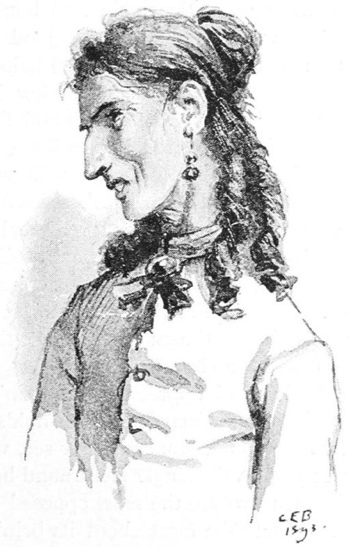
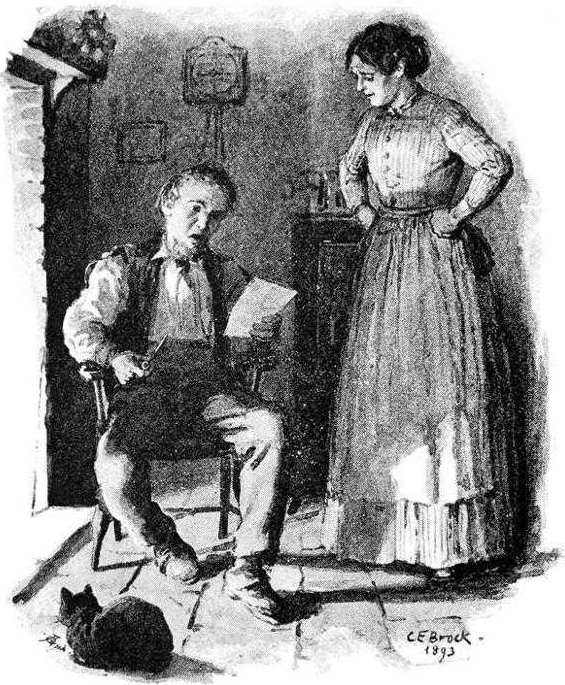
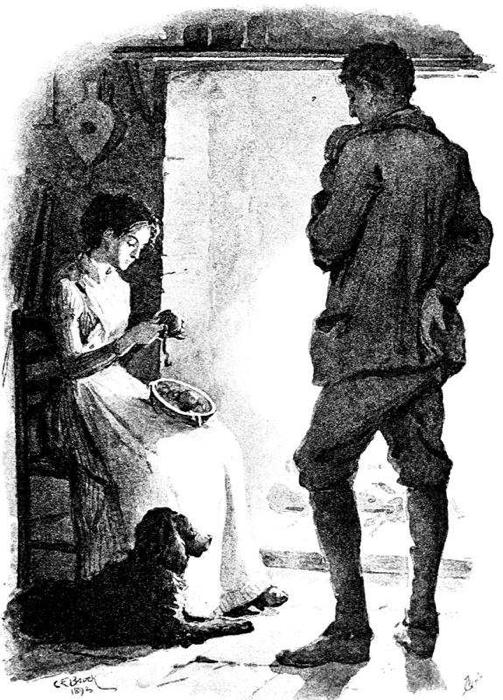
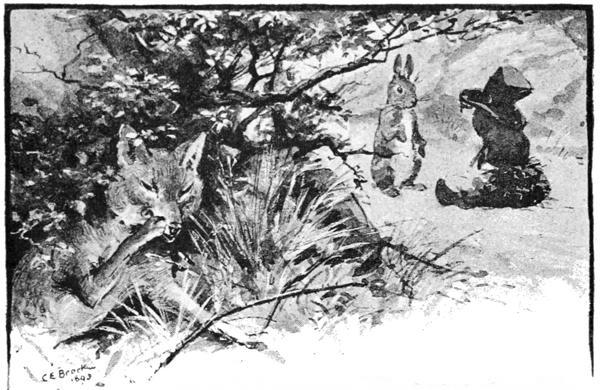
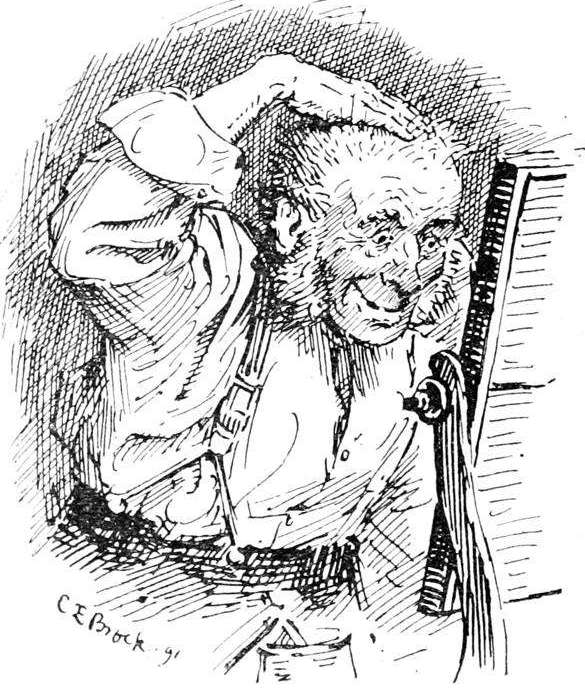
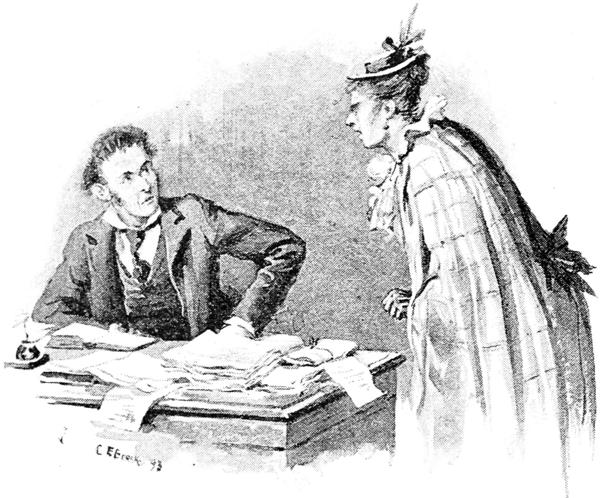
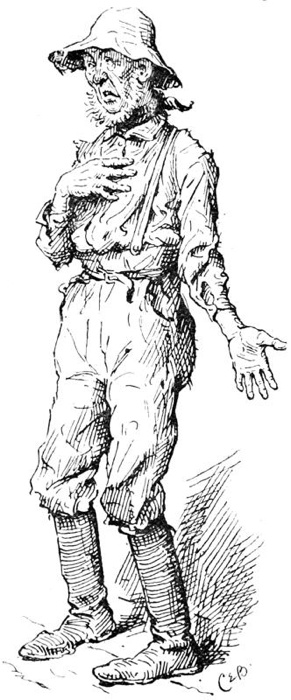
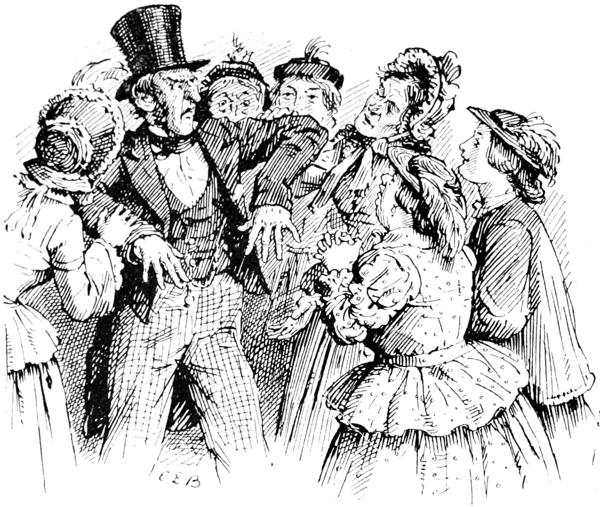
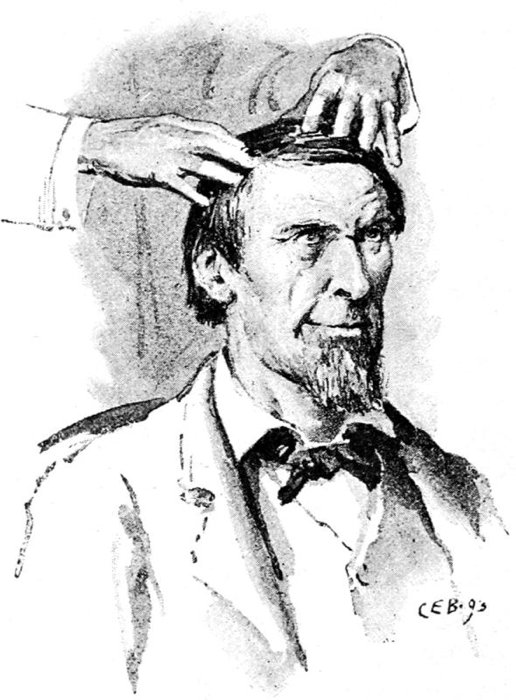
MY naburs is mourn harf crazy on the new-fangled idear
about Sperrets. Sperretooul Sircles is held nitely
& 4 or 5 long hared fellers has settled here and gone into
the sperret biznis excloosively. A atemt was made to git
Mrs. A. Ward to embark into the Sperret biznis but the
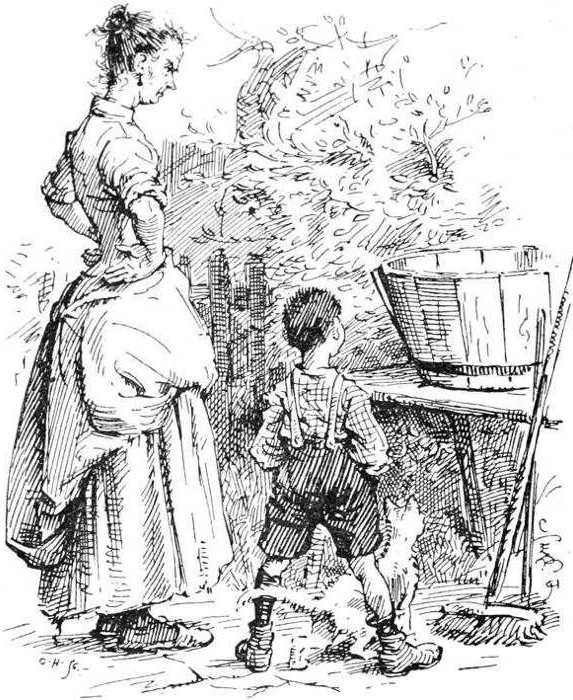
atemt faled. 1 of the long hared fellers told her she was a
ethereal creeter & wood make a sweet mejium, whareupon
she attact him with a mop handle & drove him out of the
house. I will hear obsarve that Mrs. Ward is a invalerble
womun—the partner of my goys & the shairer of my sorrers.
In my absunce she watchis my interests & things with a
Eagle Eye & when I return she welcums me in afectionate
stile. Trooly it is with us as it was with Mr. & Mrs.
Ingomer in the Play, to whit—
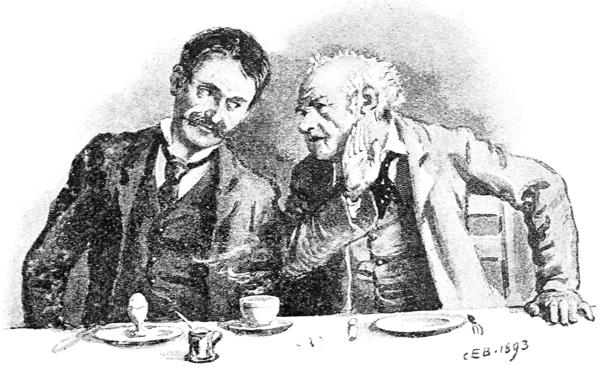
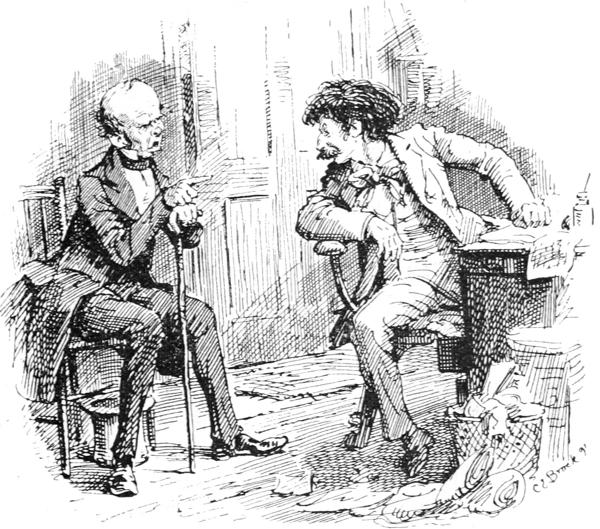
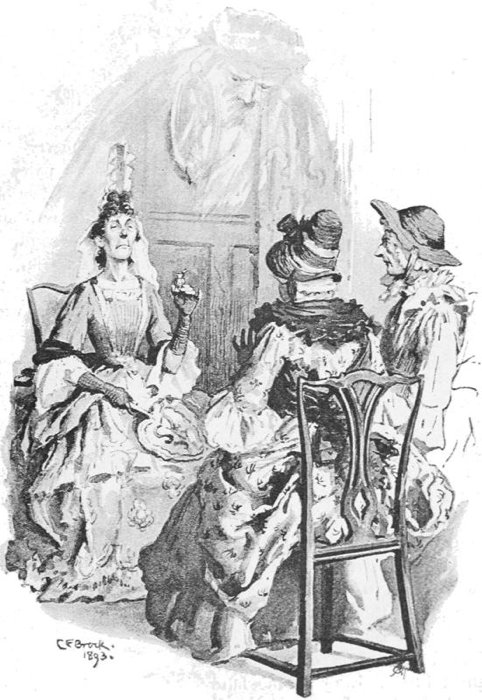
My naburs injooced me to attend a Sperretooul Sircle at
Squire Smith’s. When I arrove I found the east room
423chock full includin all the old maids in the villige & the
long hared fellers a4sed. When I went in I was salootid
with “hear cums the benited man”—“hear cums the
hory-heded unbeleever”—“hear cums the skoffer at trooth,”
etsettery, etsettery.
1 of the long hared fellers riz up and sed he would state
a few remarks. He sed man was a critter of intelleck &
was movin on to a Gole. Sum men had bigger intellecks
than other men had and thay wood git to the Gole the
soonerest. Sum men was beests & wood never git into the
Gole at all. He sed the Erth was materiel but man was
immateriel, and hens man was different from the Erth.
The Erth, continnered the speaker, resolves round on its
own axeltree onct in 24 hours, but as man haint gut no
axeltree he cant resolve. He sed the ethereal essunce of
the koordinate branchis of superhuman natur becum mettymorfussed
as man progrest in harmonial coexistunce &
eventooally anty humanized theirselves & turned into reglar
sperretuellers. [This was versifferusly applauded by the
cumpany, and as I make it a pint to get along as pleasant
as possible, I sung out “bully for you, old boy.”]
The cumpany then drew round the table and the Sircle
kommenst to go it. Thay axed me if thare was anbody in
the Sperret land which I wood like to convarse with. I sed
if Bill Tompkins, who was onct my partner in the show
biznis, was sober, I should like to convarse with him a few
periods.
“Is the Sperret of William Tompkins present?” sed 1 of
the long hared chaps, and there was three knox on the table.
“Pretty ruff, old hoss,” he replide.
That was a pleasant way we had of addressin each other
when he was in the flesh.
He sed he was. He sed he & John Bunyan was travelin
with a side show in connection with Shakspere, Jonson &
Co.’s Circus. He sed old Bun (meaning Mr. Bunyan)
stired up the animils & ground the organ while he tended
door. Occashunally Mr. Bunyan sung a comic song. The
Circus was doin middlin well. Bill Shakspeer had made a
grate hit with old Bob Ridley, and Ben Jonson was delitin
the peple with his trooly grate ax of hossmanship without
saddul or bridal. Thay was rehersin Dixey’s Land &
expected it would knock the peple.
Sez I, “William, my luvly frend, can you pay me that 13
dollars you owe me?” He sed no with one of the most
tremenjis knox I ever experienced.
The Sircle sed he had gone. “Are you gone, William?”
I axed. “Rayther,” he replide, and I knowd it was no use
to pursoo the subjeck furder.
I then called for my farther.
“Becawz you hav gone to writin for the noospapers, my
son. Bimeby you’ll lose all your character for trooth and
verrasserty. When I helpt you into the show biznis I told
you to dignerfy that there profeshun. Litteratoor is low.”
He also statid that he was doin middlin well in the
peanut biznis & liked it putty well, tho’ the climit was
rather warm.
When the Sircle stopt thay axed me what I thawt of it.
Sez I, “my friends I’ve bin into the show biznis now
goin on 23 years. Theres a artikil in the Constitooshun of
the United States which sez in effeck that everybody may
think just as he darn pleases, & them is my sentiments to a
425hare. You dowtlis beleeve this Sperret doctrin while I
think it is a little mixt. Just so soon as a man becums a
reglar out & out Sperret rapper he leeves orf workin, lets
his hare grow all over his fase & commensis spungin his
livin out of other peple. He eats all the dickshunaries he
can find & goze round chock full of big words, scarein the
wimmin folks & little children & destroyin the peace of
mind of evry famerlee he enters. He don’t do nobody no
good & is a cuss to society & a pirit on honest peple’s corn
beef barrils. Admittin all you say abowt the doctrin to be
troo, I must say the reglar perfessional Sperret rappers—them
as makes a biznis on it—air abowt the most ornery
set of cusses I ever enkountered in my life. So sayin I put
on my surtoot and went home.”
BIOGRAPHICAL INDEX OF AMERICAN HUMORISTS.
437
Aby, Joe C., “Hoffenstein,” born 1858. A humorist who made his
reputation on the New Orleans Times-Democrat. His “Hoffenstein”
sketches have been issued in book form.
Adams, Charles Follen (1842). “Leedle Yawcob Strauss,” a
short poem bubbling over with quiet, kindly, pathetic humour,
given in quaint German-American vernacular, first brought Mr.
Adams before the public. “Leedle Yawcob Strauss” has been
followed by many sunny pieces in similar dialect. Mr. Adams has
published Leedle Yawcob Strauss and other Poems, Dialect Ballads,
etc.
Adams, John Quincy (1767-1848), sixth President of the United
States, first attracted public attention by his writings, and principally
on account of his pen he was appointed to many honourable
posts by President George Washington. He wrote a number of
humorous pieces of verse, the most popular being “The Plague in
the Forest” and “The Wants of Man.”
Alcott, Louisa May (1832-1888). Author of Little
Women, Little Men, Moods, An Old-Fashioned
Girl, Eight Cousins, etc. Most popular with the young
people of America and Great Britain.
Alden, William L., born 1837. Author of Domestic
Explosives, Shooting Stars, Moral Pirates, A Lost
Soul (Chatto & Windus), and a host of volumes of facetious short
stories. He was admitted to the bar, but took to journalism; made
himself famous as the “fifth-column man” on the New York Times;
was appointed consul-general at Rome, the king decorating him with the
cross of Chevalier of the “Crown of Italy” at the end of his
consulship. He introduced canoeing as a pastime into the United
States, and founded the first canoe club. He is now (1893) writing
humorous “stories” for the Idler and other English
publications, and his work has lost none of his old-time flavour.
Aldrich, Thomas Bailey, born 1837. Mr. Aldrich, who for many
years was looked upon as one of the most promising younger
writers of America, has now attained the first rank in American
438poetry. His first great success was the Ballad of Babie Bell,
published in 1856, and this induced him to adopt literature as a
profession. In March 1881 he was appointed editor of the
Atlantic Monthly. Since Babie Bell appeared he has given to
the public much work of a high order. Pampinea and other Poems,
1861; Poems (two collections), 1863 and 1865; Cloth of Gold,
1874; Flower and Thorn, 1876; Lyrics and Sonnets, 1880, in
verse; and Marjorie Daw and other People, 1873; Prudence
Palfrey, 1874; The Stillwater Tragedy, 1880; Mercedes, 1883,
in prose, are well known in Great Britain and America. Messrs.
Macmillan & Co. publish his works in England, and Houghton,
Mifflin, & Co. in America.
Alsop, George, born 1638. When twenty years old he sailed to
Maryland, and for four years laboured as a servant. At the
restoration of King Charles he, a warm Royalist, returned to
England, and whether he returned to America or not is uncertain.
He published A Character of the Province of Maryland, a volume
of prose and verse, absurdly humorous from beginning to end.
Alsop, Richard (1761-1815). Founder of a society of literary-inclined
individuals known as the “Hartford Wits.” Alsop was the chief
writer of the Echo, a series of burlesque essays published between
1791 and 1795. He also published The Enchanted Lake of Fairy
Morgana, Monody on the Death of Washington, The Natural
and Civil History of Chili, and edited the Captivity and Adventures
of J. R. Jewett among the Savages of Nootka Sound. He was
an accomplished linguist.
Ames, Nathaniel (1708-1764), commenced publishing in 1725 a
yearly calendar—the great-grandfather of the present weekly
paper. He was a shrewd wit, and his almanac, which obtained
marked popularity, was full of quaint and wise sayings.
Anderson, Mrs. Arestine (1855). A writer of humorous newspaper
verse. Contributor to many of the humorous papers in America.
André, Major John (1751-1780). This unfortunate soldier wrote a
humorous piece entitled “The Cow Chase,” which, strangely
enough, appeared in Rivington’s Royal Gazette the same day that
the author was captured.
Arnold, George (1834-1865). Author of McArone Papers, The
Jolly Old Pedagogue, and other Poems.
Austin, William (1778-1841). His “Peter Rugg, the Missing Man,”
published in the New England Galaxy, made a great hit, and his
“Letters from London” are full of quiet humour and quaint
information. He was also the author of “Oration on the Anniversary
of the Battle of Bunker’s Hill,” and “Essay on the Human
Character of Jesus Christ.”
439Bagby, George William (1828-1883). Took his degree in medicine,
adopted journalism as a profession, was appointed (1870) state
librarian for Virginia. His humorous articles were published under
the pen-name “Mozis Addums,” and after his death his sketches
were collected and published by Mrs. Bagby in three volumes.
Bailey, James Montgomery, born 1841. In 1873 and 1874 America,
from the Atlantic to the Pacific, was laughing at the “Danbury
News-Man’s” funny articles. His work was to be found copied in
every paper in the land, and the Danbury News, which up to that
time had claimed only local attention, soon rose in circulation,
until it had readers in every state in the Union. Mr. Bailey,
whose laughable sketches made this sensation, began life as a
carpenter, served in the ranks during the war, and then entered
journalism. His humorous sketches have been collected and
published. Life in Danbury and England from a Back Window
are the best compilations.
Bangs, J. K. Has published the Tiddledywink Poetry Book. His
verse is in much request by the better-class humorous papers and
magazines in America.
Barlow, Joel (1754-1812). After serving with the Revolutionary
army as chaplain, he, in 1783, settled at Hartford, studied law,
and was admitted to the bar. He joined the “Hartford Wits,”
founded a paper, and began writing satirical verse. In 1791 he journeyed
to England to take part in the political movements of the day,
and published his Advice to the Privileged Orders, which the Government
proscribed. He took refuge in France, and while there
wrote “Hasty Pudding,” his most popular poem. After serving
his country diplomatically on a number of trying occasions, he,
while acting as minister to France, set out to visit Napoleon,
then on his Russian campaign, and died of cold in the famous
retreat from Moscow.
Barr, John, born in Canada 1858. Taught school, sailed the great
lakes, appointed marine editor of the Detroit Free Press, and is
now commercial editor of the paper. Has written under the
pen-name “Baron Joe.” The extract given is from The White
Feather, a farcical opera.
Barr, Robert (1851), co-editor of the Idler (1892),
and for many years connected with the Detroit Free Press. His
humorous sketches and short stories, both humorous and dramatic, under
the nom de guerre of “Luke Sharp,” first made him known to the
readers of the United Kingdom and America, but lately he has taken to
writing under his proper name. His published works are In a Steamer
Chair, and other Shipboard Stories (Chatto & Windus), From
Whose Bourn, Strange Happenings, One Day’s
Courtship, Jones and I, etc. Although inseparably connected
440with American humour, and having made his first success in
America and on an American paper, he was educated in
Canada.
Bartlett, Joseph (1762-1827), graduated at Harvard, studied law,
and travelled to England to spend his money, which he easily succeeded
in doing, and as a result found himself in prison for debt.
In prison he wrote a play, and with the money obtained for it
bought his release. Trying the stage for a while and not making
headway, he obtained a cargo of goods on credit for sale in America,
set sail, and was shipwrecked. In Boston he started in business,
failed, opened a law office in Woburn, and removed to Cambridge.
There he wrote “Physiognomy,” a poem lampooning
celebrities of the day, and afterwards “The New Vicar of Bray.”
He died penniless.
Bayles, Mather (1706-1788), humorous verse-writer.
Beers, Henry Augustin, born 1847, Professor of English at
Yale. Has published Odds and Ends, The Thankless Muse,
volumes of verse, and Life of N. P. Willis, A Century of
American Literature, and An Outline Sketch of English
Literature. Has written a few facetious poems.
Belknap, Rev. Jeremy (1744-1798), a New England historian, and
author of The Foresters, an American Tale, a work rich in humour.
Bellaw, Americus W., humorous verse-writer, contributor to most
of the humorous papers of America. He is well-known to readers
of newspaper humour in the United States.
Benjamin, Park (1809-1864), a Boston attorney, who drifted into
magazine writing, and being equally at home in verse or prose,
published a great amount of matter. For a time he was associated
with Horace Greeley as editor of the New Yorker, and in
1840 he founded the New World, and, with others, edited it for
five years. His principal works are Infatuation and Poetry, both
satires in verse.
Beveridge, John, a Scotsman by birth, who in 1758 was appointed
Professor of Languages in Philadelphia College; published some
Latin verse of a humorous description, with their English translations
by his students.
Bolton, Mrs. Sarah Tittle (1815). She wrote “Paddle your
own Canoe.”
Brackenridge, Hugh Henry (1748-1816). Born in Scotland and
taken to America while still a child, he earned enough money to
put himself through Princetown, graduating in 1771, and rose to
441be one of the Justices of Pennsylvania Supreme Court (1799).
Modern Chivalry, or the Adventures of Captain Farrago and
Teague O’Regan his Servant, published in Pittsburg, 1796, a
political satire, established his reputation as a humorist.
Brainard, John Gardiner Calkins (1796-1828). Studied law, but
on being called to the bar he forsook his profession for that of
editor of a weekly paper. He wrote a number of ballads, and
his “Sonnet to a Sea-Serpent” is humorous.
Brougham, John, born in Dublin, 1810; died in America, 1880. A
prolific writer of comedies and farces, and was editor and proprietor
of the Lantern, a comic paper published in 1852. Two
collections of his writings have appeared, A Basket of Chips and
The Bunsby Papers.
Browne, Charles Farrar (1834-1867), “Artemus Ward.” When
fifteen years old he contributed comic articles to the Carpet Bag, a
Boston weekly. Subsequently he secured the situation of reporter
on the Cleveland Plaindealer, a paper of good standing, and while
acting in that position commenced his showman articles. The
first of these were written in a careless style, more as a “fill up”
than anything else, but finding that they met with extraordinary
success Mr. Browne began taking greater pains with them, and the
result is a series of as clever and humorous articles as America has
produced. He was a successful lecturer, and in this capacity
visited England in 1866, but his health, which had long been
failing, became so poor that he was forced to cancel engagements.
He died in Southampton, England.
Browne, John Ross (1817-1875), author of Yusef, American
Family in Germany, Land of Thor, and other records of his
travels in Europe, well worth reading. He was a great traveller,
visiting every quarter of the globe, and his pen was never idle.
Bunner, Henry Cuyler (1885), present editor of Puck
(1892). He is a writer of graceful verse and short stories, which are
overflowing with refined humour. Airs from Arcady, a volume of
short verse, Short Sixes and The Zodac Pines, volumes of
short stories, and A Woman of Honour, a novel, are his
principal published works. He is one of the best of the many brilliant
short-story writers America of to-day possesses. Charles Scribner’s
Sons and Ogilvie & Co., publishers, America.
Burbank, “Major,” editor New Orleans
Piccayune, a humorous writer and lecturer.
Burdette, Robert Jones (1844), first attracted attention by his
humorous articles to the Burlington Hawkeye. These sketches
have been collected and published in book form under the titles of
442The Rise and Fall of the Moustache, Hawkeyes, Sumach
Garden, and other comic sketches. His humour is of the evanescent
quality, and suited better to the columns of a daily or weekly paper
than to publication in book form.
Burton, William Evans, born in England, 1804; died in America,
1860. In 1834 he emigrated to America, and for a time was the
leader of the dramatic profession in America. In 1858 he
published the Cyclopædia of Wit and Humour (2 vols.).
Butler, William Allen, born 1825. A lawyer of New York who
has been a frequent contributor to the periodical literature of the
country. His Nothing to Wear, first published in 1857, is to be
found in most collections of American humour.
Byles, Dr. Mather (1707-1788), more famous for his jokes in
conversation and in the pulpit than for his writings.
Byrd, Colonel William (1674-1744). Founder of Richmond, Va.,
three times agent for the colony in England, and for thirty-seven
years member of the King’s Council. His Westover Manuscripts
were published in 1841. They are “A Journey to the Land of
Eden,” “A Progress to the Mines,” and “History of the Dividing
Line.” He wrote verse, and was considered a great wit.
Carleton, Will, born 1845. Without doubt the most popular
humorous verse-writer of the day in America. His versification is far
from being irreproachable, but he takes the everyday occurrences of
life and treats them in a simple humorous style which appeals to the
great public. His works are, Farm Ballads, Farm Legends,
Young Folks’ Rhymes, Farm Festivals, City
Ballads, City Legends, all published by Harper’s, New York,
and most of them by Sampson Low, Marston, & Co., London. For pictures
of rural life his work is invaluable.
Cheney, John Vance (1848), public librarian of San Francisco.
He has published two dainty books of fascinating, graceful, and
wayward verse, Thistledrift and Wood Blooms. See also Poems
of Wild Life, “Canterbury Poets.”
Clark, Lewis Gaylord (1810-1873). Appointed editor of the
Knickerbocker Magazine in 1834. He brought the magazine into
fame, and gathered around him as contributors, Longfellow,
Irving, Bryant, Halleck, Morris, and other well-known men. His
published works in book form are Knickerbocker Sketch-Book, and
Knick-Knacks from an Editor’s Table.
Clark, Will W., the “Frisbee” and “Gilhooley” of the Pittsburg
Leader.
443Clemens, Samuel Langhorne, born 1835. A true citizen of the
United States, he began at the bottom of the ladder and has
worked his way to the top. After receiving a meagre education at
a village school, he was apprenticed to a printer at the age of
thirteen, and for three years “stuck type.” In 1851 he took to
the Mississippi, earning his living as a pilot, and later on tried
mining and editing. Under the pseudonym “Mark Twain” he
began to publish the work which has earned for him the right to
be considered the greatest humorous writer of the century. The
Jumping Frog and other Sketches was his first book, appearing
in 1867, and this he has followed with a splendid line of successes
down to The American Claimant, which has just appeared.
Messrs. Chatto & Windus publish his works in England, and
Webster & Co. in America.
Clifton, William (1772-1799), a satirical writer of prose and verse.
Author of The Group, The Rhapsody of the Times, and an
unfinished poem, “Chimeriad.”
Cotes, Mrs. E. C., “Sarah Jeannette Duncan” (1863). Miss
Duncan, a native of Brantford, Ontario, Canada, did her first
literary work on the Toronto Globe, and, after occupying positions
on the staff of the Globe and Washington Post, spent a session at
Ottawa as special correspondent of the Montreal Star. This newspaper
training is clearly shown in her two clever books, A Social
Departure and An American Girl in London. The first is an
original and wholly unconventional account of travel, telling how
she, in company with another girl, went round the world. The
other book is an equally bright description of her doings in
London.
Cox, Samuel Sullivan (“Sunset Cox”), born 1824, and
died 1889. A lawyer, journalist, and politician. He served the United
States as diplomatist in Peru and Turkey, and wrote and spoke much
that was witty. He published The Buck-Eye Abroad, Why We
Laugh, A Search for Winter Sunbeams, Arctic
Sunbeams, Orient Sunbeams, and The Isles of the
Princes—the last three bright and laughable accounts of his
travels in many lands. They are published by G. P. Putnam’s Sons, New
York and London.
Cox, William, died about 1851. Author of Crayon Sketches. He
wrote under the pseudonym “An Amateur.”
Cozzens, Frederick Swartout (1818-1869), author of The Sayings
of Dr. Bushwhacker and other Learned Men, and The Sparrowgrass
Papers. A genuine humorist and graceful writer. Some of his
work was published under the pen-name “Richard Haywarde.”
Curtis, George William (1824-1892). As the “Easy Chair” in
Harper’s Magazine, Mr. Curtis’ work was familiar to a wide circle of
444readers throughout the English-speaking world. His writings are
all brightened by a vein of refined and genial humour. His chief
works are Nile Notes, The Howadji in Syria, Lotus-Eating,
Potiphar Papers, Prue and I, and Trumps.
Derring, Nathaniel (1791-1881), a playwright of note and humorous
story writer. Author of Bozzaris and The Clairvoyants.
De Mille, James, Canadian (1837-1880). He began his career as a
humorous writer while still at school, his writings appearing in
New Brunswick papers. In 1860 he was appointed to the Chair
of Classics in Acadia College, and four years later that of history
and rhetoric in Dalhousie College, Halifax, holding the position
till his death. He published, during his comparatively short lifetime,
more than twenty books, of which The Dodge Club found
the most readers.
Dennie, Joseph (1768-1812), a lawyer who thought better of it,
and adopted literature as a profession. In 1801 he became editor
of the Portfolio, and, under the nom de plume “Oliver Old
School,” edited and wrote for it till his death. His Short Sermons
for Idle Readers are rich in humour.
Depew, Chauncey Mitchell, born 1834. He entered politics
before 1860, and has stayed in ever since. He is President of the
New York Central Railway, the right-hand man of the Republican
party, and America’s most famous facetious after-dinner speaker and
story-teller.
Derby, George Horatio (“John Phœnix”), 1823-1861, a graduate
of West Point, and served in the war with Mexico, receiving a
severe wound in the battle of Cerro Gordo. He explored Minnesota
territory in 1849, and after holding many important government
positions, was made captain of engineers. He died from
effects produced by sunstroke. Under the pseudonym “John
Phœnix,” he wrote the first of what may be called newspaper
humour. His Phœnixiana and The Squibob Papers have been
published on both sides the Atlantic.
Diaz, Mrs. Abby (1821), a humorous writer for the young;
author of Chronicles of the Stimpcett Family, The William
Henry Letters, etc.
Dodge, H. C., a writer of newspaper verse, ready with his rhymes,
but whose chief ingenuity is displayed in the typographical
arrangements of his verse.
Douglass, William, a Scotsman who made America his home in
1718. He was a famous satirist in his day.
445Dowe, Mrs. Jennie, E. T. Her best work is to be found in the
Century Magazine, where she, every now and again, fills a page or
two with graceful and fantastical verse, usually employing a slight
dialect of one sort or another. Her poems are full of life and
music, and are decidedly clever.
Drake, Joseph Rodman (1795-1820), co-author with Halleck of the
Croaker Papers, and author of The Culprit Fay.
Drummond, Dr. W. H., a resident of Montreal, Canada. He is a
master of the French-Canadian dialect, and in verse has the field
pretty much to himself. His Wreck of the Julie Plante is the
most popular humorous song Canada has produced.
Duncan, Sarah Jeannette. See Cotes, Mrs.
Dunlop, William, born in Scotland 1795 (?), died in Canada 1848.
He contributed to Blackwood’s Magazine “The Autobiography of
a Rat,” founded the Toronto Literary Society, and represented
Huron County in the first parliament after the union of Upper and
Lower Canada.
Dwight, Timothy (1752-1817), President of Yale College, and
hymn-writer of note. Among his many published works is Triumph of
Infidelity, a satire.
Edwards, Edward E., the author of “Facts and Fancies” in the
Boston Transcript.
Fay, Theodore Sedgewick, born 1807, an associate of Morris and
Willis in the New York Mirror. Mr. Fay, about 1830, joined the
diplomatic service, and was stationed at Berlin and Berne
for years. He published many works of a quietly humorous
character.
Fessenden, Thomas Green (1771-1837). When at Dartmouth
College he wrote “Jonathan’s Courtship,” a ballad which became
popular, and was reprinted in England. He studied law and
wrote humorous verse until 1801, when he was sent to England
with a newly-patented hydraulic machine which proved a failure.
This and other patents in which he experimented ruined him.
Returning to America, he edited for a time the New York Weekly
Inspector, and from this time till his death was connected with one
paper or another. His published works include Democracy
Unveiled, “Pills, Poetical, Political, and Philosophical, prescribed
for the purpose of purging the Public of—Philosophers,
Penny Poetasters, of Paltry Politicians and Petty Partisans. By
Peter Pepperbox, Poet and Physician, Philadelphia.”
446Field, Eugene (1850). During the year 1891 Mr. Field made
a successful début before the reading public of Great Britain with
his Little Book of Western Verse, and Little Book of Profitable
Tales, published by Osgood, McIlvain, & Co. For many years
past Mr. Field has been the chief humorist of Chicago, and in
verse and prose holds an honoured place among the present-day
writers of America. He is equally at home in prose and verse.
Field, Matthew C. (1812-1844), a contributor to many southern
journals from 1834 till the time of his death.
Fields, James Thomas (1817-1881). He edited the Atlantic
Monthly for eleven years, and wrote several volumes of prose and
clever humorous verse. He was partner in the publishing house of
Ticknor & Fields.
Finn, Henry J. (1782-1840), an actor, miniature painter, and
humorist. He was lost in the burning of the steamer Lexington.
Folger, Peter (1617-1690), grandfather of Benjamin Franklin,
published a satirical attack on the follies of the day, under the
extensive title of A Looking-glass for the Times; or, the Former
Spirit of New England Revised in this Generation.
Foss, Sam Walter (1858), editor of the Yankee Blade. Although
his poems are as widely quoted on one side the Atlantic as the
other, they have not yet appeared in book form in England.
Franklin, Benjamin (1706-1790) It is difficult to say what
Franklin was not, and there can be no question of his being the
best-informed man of his day. Along with his other virtues,
he was a humorist, and sparkling witty in conversation and
writing. He was the first American to achieve cosmopolitan fame
as a writer.
Freneau, Philip (1752-1832). He commenced to write poetry
before he left college, and continued to do so all his life. As a
consequence, his published works are many. His reputation as a
humorist rests to a great extent on “A Journey from Philadelphia
to New York, by Robert Slender, Stocking-Weaver,” published
1787.
Goldsmith, Jay Charlton, the “P.I. Man” of the New York
Herald, and the author of the “Jay Charlton” papers which
appeared in the Danbury News.
Graydon, Alexander (1752-1818). Graydon served in the War of
Independence, was taken prisoner; when peace was restored was
appointed to a government office, which he held for many years.
He wrote his memoirs, and was an epigrammatist of note.
447Green, Joseph (1706-1780), a writer of verse, chiefly parody. His
“Poet’s Lament for the Loss of his Cat, which he used to call
his Mews,” published in the London Magazine, 1733, and “The
Wonderful Lament of Old Mr. Tenor,” are the most notable of his
productions. He died in England.
Greene, Albert Gorton (1802-1868), founder of the Providence
Athenæum, and president of the Rhode Island Historical Society
from 1854 till his death. His poem, “Old Grimes,” has appeared
in almost every collection of American humour published.
Gregory W. H., working editor of Judge, and a
brilliant paragraphist.
Griswold, A. Minor (nom de guerre, “The Fat
Contributor”), first made his name on the Cincinnati Enquirer,
and afterwards became identified with Texas Siftings. In 1889
he started on a lecturing tour à la Artemus Ward, and died in Michigan.
Habberton, John, born 1842. The author of Helen’s Babies. He
served through the war, and after an unsuccessful attempt to establish
himself in business he took up journalism. In 1876, after
several refusals, he found a publisher for Helen’s Babies, and the
result was a sale of close on half a million copies in the United
States alone. Since that time he has published a dozen or more
books, most of them successes.
Hale, Lucretia Peabody, born 1820. Her Peterkim
Papers, published in America by Osgood & Co., Boston, made her
famous with the young folk of America, but the reader must be young to
enjoy the skits.
Haliburton, Thomas Chandler (1797-1865), Canada’s most
famous humorist. Was admitted to the bar in Nova Scotia at the
age of twenty-three, and nine years later was made Chief Justice of
the Court of Common Pleas, and in 1840 Judge of the Supreme
Court. In 1842 he resigned this office and settled in England,
sitting in Parliament as Conservative member for Launceston from
1859 to 1865. It was in the year 1835 he commenced writing his
humorous works that made the name of “Sam Slick” famous the
world over. His first production was The Clockmaker; or, The
Sayings and Doings of Sam Slick; and this he followed up with
Bubbles of Canada, Letter Bag of the Great Western, Yankee
Stories, Nature and Human Nature, etc.
Halleck, Fitz-Greene (1790-1867), a descendant of John Eliot,
“The Apostle of the Indians.” In 1819 he and John Rodman
Drake published the Croaker Papers, humorous and satirical, which
attracted much attention at the time. These papers he followed
with “Fanny,” his longest poem, hitting off the follies of the day.
These are his chief contributions to humorous literature.
448Halpine, Charles Graham (1829-1868), “Miles O’Reilly,” a verse-writer.
Established with “Mrs. Partington” a humorous paper
called The Carpet Bag, which proved a failure. He enlisted
during “the war,” and worked his way up until he finally became
a colonel. He issued Life and Adventures, Songs, Services, and
Speeches of Private Miles O’Reilly, 47th Regiment, New York
Volunteers, and A Collection of Essays, Poems, Speeches, and
Banquets by Private Miles O’Reilly. Collected, Revised, and
Edited, with the Requisite Corrections of Punctuation, Spelling,
and Grammar, by an ex-Colonel of the Adjutant-General’s Department,
etc.
Harris, Charles H., “Carl Pretzel,” born 1833. Author of
Pretzelisms, My Book of Expressions, etc., humorous compilations
in Dutch dialect.
Harris, Joel Chandler, born 1848. The greatest exponent of
the negro dialect. In the columns of the Atlanta Constitution, of
which he is editor and part proprietor, his Uncle Remus sketches
first saw the light, and proved enormously successful. His humour
is delicate and fascinating, and as a consequence the Remus
series of books have had a world-wide circulation. No lover of
the humorous should overlook Mr. Harris’s work. American
publishers, Appleton & Co.
Harte, Francis Bret, born 1836. Taking full advantage of his
unique acquaintance with the West of America during the stirring
days of ’49, when, in California, he was in turn gold-digger,
express-rider, printer, and editor, Bret Harte has given to the
world volume after volume of short stories which picture in an
inimitable way the manners and men of the gold days. No writer
is more characteristically American than he; his style is vivid and
beautiful, and he has a wonderful fund of humour, which appears in
every line he writes. His published works, prose and verse, are
many. Messrs. Chatto & Windus have recently published a complete
edition of his writings. American publishers, Houghton,
Mifflin, & Co.
Hawthorne, Nathaniel (1804-1864). Like most men of exceptional
worth in literature; he found great difficulty at first in getting
his work published. After writing and destroying many tales, he
published, at his own expense, a novel entitled Fanshawe, which
proved a failure; and it was not until 1837 that he, or rather
a friend, induced a publisher to bring out Twice-told Tales. In
the spring of 1850 appeared The Scarlet Letter, which raised the
author from obscurity to the front rank of American literature,
and the works which followed established his position in the
letters of his country.
449Hay, Colonel John, born 1838, one of President Lincoln’s private
secretaries during the war, and has since in collaboration written
a history of the martyr-president. His reputation for humour was
made by a small volume of verse entitled Pike Country Ballads.
Best known of these ballads are “Little Breeches” and “Jim
Bludso,” both strong pieces of verse.
Henderson, William James, born 1855, a New York journalist
who has written much pleasant verse and prose.
Holland, Josiah Gilbert (1819-1881). For some time editor of
Scribner’s Monthly (now the Century), and a writer who, though
judged from a literary point of view is quite second class, still is
popular with the reading public of America. He wrote a number
of articles under the nom de plume of “Timothy Titcomb.”
Holley, Marietta. Under the pseudonym of “Josiah Allen’s
Wife” she wrote a great deal of humorous matter. Author of
My Opinions and Betsey Bobbet’s, My Wayward Partner, Josiah
Allen’s Wife as a P. A. and P.I., etc.
Holmes, Dr. Oliver Wendell, born 1809, physician, novelist,
essayist, and poet, began literary work at an early age, and for
more than half a century has written industriously and with consistent
success. The Breakfast-Table series is among the most
read of all America’s humorous writings, and various short poems
of a humorous nature, such as “The One-Hoss Shay,” “Contentment,”
“The Spectre Pig,” etc., are in every compilation of
humour. His chief works are The Autocrat at the Breakfast-Table,
The Professor at the Breakfast-Table, The Poet at the
Breakfast-Table, Songs of Many Seasons, Songs in Many Keys.
He is one of the small band of humorists who are as carefully read
and highly appreciated in the United Kingdom as in their native
land. American publishers, Houghton, Mifflin, & Co.
Hooper, Johnson, J. (1815-1863), a native of North Carolina,
studied law in Alabama, was made a judge, and in 1861 appointed
Secretary of the Provisional Confederate Congress. He published
Widow Rugby’s Husband and Adventures of Captain Simon Suggs.
Clever, but somewhat broad in humour.
Hopkins, Lemuel (1750-1801), one of the “Hartford Wits,” and
co-author and projector of The Anarchiad, a poem on State
Rights, cuttingly sarcastic. He also wrote The Echo, The
Political Greenhouse, and New Year’s Verses, all full of
sarcasm.
Hopkinson, Francis (1737-1791), a telling, sarcastic writer, widely
read in his lifetime, and author of the poem, “The Battle of the
Kegs,” which remains famous. He was one of those who
signed the Declaration of Independence. His son wrote “Hail,
Columbia.”
450Howard, Bronson (1842). The most successful American dramatist
of the day, and almost the only American whose plays command
attention in England. His plays, Saratoga, Truth, The Old
Love and the New, Young Mrs. Winthrope, The Henrietta, and
others are full of humour, and have been successful on both sides the
Atlantic.
Howells, William Dean, born 1837. He is now America’s representative
novelist, and has qualified for representation in a
humorous book by his comedies, Out of the Question, A Counterfeit
Presentment, The Parlour Car, The Sleeping Car, etc. He
is an industrious writer. D. Douglas, Edinburgh, in his American
author series, has included twenty-five of Mr. Howells’ works.
The extract given in this book is from A Chance Acquaintance.
American publishers, Houghton, Mifflin, & Co., and Osgood & Co.
Hoyt, Charles, humorous paragraphist of the Boston Post, the
paper, by the way, which is credited with having originated the
column of witty paragraphs now so popular with American and
British papers.
Humphreys, David (1752-1818), served as aide-de-camp to
Washington, and wrote lyrics of a patriotic nature for the good of
the cause. He was an intimate friend of the first president,
residing with and being treated as a member of the Washington
family, and held many positions of trust. He was one of the
famous “Hartford Wits.”
Hunter-Duvar, Lieutenant-Colonel John (1830), one of the
principal literary men of Canada, his work polished, bright, and
full of imagination. His “Emigration of the Fairies,” a poem of
117 stanzas of six lines each, is quite the best piece of verse as
regards light, fantastical, imaginative humour that Canada has
produced. Many of his lyrics are dainty and sweet, with a seventeenth
century ring about them. He has published in verse De
Roberval, a drama dealing with early life in Canada, The Triumph
of Constancy, The Enamorado, and for private circulation, John a’
Var, his Lays.
Huntley, Stanley. In 1881 Mr. Huntley joined the staff of the
Brooklyn Eagle, to which paper he contributed his famous
“Spoopendyke” articles. He died before he had the opportunity
of following up his success.
Irving, John Treat (1778-1838), a writer of sarcastic political verse.
Irving, Washington (1783-1859), author of those undying works of
delightful and quaint humour, Rip Van Winkle, Sketch Book,
History of New York by Diedrich Knickerbocker, etc. A hospitable,
vivacious, good-natured, humorous man, who, at the
451opening of his career, was much harassed by business worries, and
it was not until his books had scattered his fame broadcast, and
the revenue from his writings began to accrue to him, that he
could lead the life of hearty hospitality and freedom he loved.
He was one of the small band of American authors which first
attracted attention outside of their own country, and established
the literary reputation of America.
Ike Marvel. See Mitchell, D. G.
James, Henry (1843). His stories are slight in plot, but worked
out gracefully, and full of character delineation, vivacious, and
witty.
Johnston, Richard Malcolm, born 1822, a native of Georgia,
author of The Dukesborough Tales and Mark Langston.
Josiah Allen’s Wife. See Holley.
Keeler, Ralph (1840-1873). Mr. Keeler had an adventurous career,
running away from home when a lad, serving as cabin-boy on a
lake steamer, train-boy on a railway, joining several bands of
strolling minstrels, worked in a post-office, visited Europe, and
supported himself by correspondence with newspapers and lecturing.
He published Three Years a Negro Minstrel, A Tour of Europe on
$181, Gloverson and his Silent Partners (from which “A Breach
of Promise Case” in this volume is taken), and Vagabond Adventures.
He mysteriously disappeared while doing newspaper work
in Cuba, and it is supposed he was murdered and thrown overboard
from a steamer.
Kelly, Andrew W. (“Pharmenas Mix”), died 1888. A writer
of humorous poetry, which appeared in the Century Magazine,
Detroit Free Press, etc.
Kerr, Orpheus C. See Newell.
Kimball, Mather Dean (1849), a Wisconsin journalist who has
written some dialect pieces of merit.
Landon, Melville D., “Eli Perkins,” born 1840. In 1871 he
published his first book, a detailed history of the Franco-German
war, and afterwards began writing in a lighter vein for various
publications, among them the Chicago Tribune.
Lanigan, George Thomas (1845-1886), a Canadian journalist
who drifted across the borders, and who, after filling important
positions on the staff of many of the great American newspapers,
died in Philadelphia. He was a brilliant and versatile journalist,
452and his poems, “The Ahkoond of Swat” and “Dirge of the
Moolta Kotal,” are masterpieces of oddness of theme and
wording.
Leland, Charles Godfrey (1824). Best known to lovers of the
humorous as the author of the laughable Breitmann Ballads.
Since fifteen years of age Mr. Leland has been busy with his pen,
and there is no greater authority on folk-lore, superstition, and
legend than he. He has written many volumes of verse, sketches
of travel, etc., and is still (1893) hard at work.
Lewis, Charles B., “M Quad,” born 1842. The creator of His
Honor and Bijah, his first great success; The Lime Kiln Club,
with all its comical darkey characters; Carl Dunder, the unsophisticated
Dutchman who is always being “shwindled”; The
Arisona Kicker, whose editor keeps a private graveyard; and Mr.
and Mrs. Bowser. “M Quad” is without question the greatest
newspaper humorist of America. His style is deliciously original;
he can write weekly for years on the same subject without wearying
the reader. “Quad” is popularly known as the Detroit Free Press
man, from his long connection with that weekly.
Lighthall William Douw, born 1857. His Songs of the Great
Dominion, a collection of verse by various Canadian writers,
attracted considerable attention in this kingdom. His works are, An
Analysis of the Altruistic Act, Sketch of a New
Utilitarianism, Thoughts, Moods, and Ideas (a collection of
verse), and a novel, The Young Seigneur. He has paid little
attention to humorous writing.
Locke, David Ross, “Petroleum V. Nasby” (1833-1888). A
political humorist and satirical writer, whose works have left their
impression on American political life. He was editor of the Toledo
Blade. His principal published works are, Swinging Round the
Circle, The Moral History of Americans Little Struggle, and A
Paper City.
Logan, John E., a Canadian who, under the nom de guerre of
“Barry Dane,” has written some clever humorous pieces. See
Lighthall’s Songs of the Great Dominion.
Longstreet, Augustus Baldwin (1790-1870), in turn a lawyer,
legislator, judge, editor, Methodist minister, college president, and
farmer. He was a ready and brilliant speaker, and an industrious
writer of humour and pathos. His Georgia, Scenes, Characters,
and Incidents, first published in periodicals, and afterwards collected
in book form, were widely read. The papers are full of humour,
rather broad, but it is said by those who know, truly characteristic
of the place and period.
453Low, Samuel, born 1765. Author of two volumes of poetry, containing
many pieces of a humorous character.
Lowell, James Russell (1819-1891), poet, essayist, and
diplomat. One of the foremost literary geniuses of America. His first
volume of poems was published in 1838, under the title of Class
Poems. In 1841 followed A Year’s Life, consisting mainly of
love poems, only a few of which the author in later years considered
worth republishing. In the year 1846 the Biglow Papers began
appearing in the columns of the Boston Courier, and it was not
until 1848 that what is probably the most remarkable series of
satirical poems which ever appeared were furnished. For wit, insight
into human nature, and finish, these poems, in the peculiar dialect of
the “down-easter,” must be considered nothing short of perfect. These
poems had an instantaneous effect on America, and raised the question
of slavery and corruption in politics to the eyes of the people in a
way they had never before been presented. Mr. Lowell was an
out-and-out democrat and a fearless exponent of democracy of the kind
established by the founders of American independence. His works, of
which a complete and excellent edition is published by Messrs.
Macmillan & Co., London, are numerous, the best known being Class
Poems, A Year’s Life, Poems (1844), The Vision of
Sir Launfal (1848), Conversations on some of the Old Poets
(1945), Poems (1848), The Biglow Papers, A Fable for
Critics, Poems (1849), Life of Keats, Mason and
Slidell, Fireside Travels, The President’s Policy,
Biglow Papers (second series), Under the Willows,
Among my Books, Democracy, and other Addresses. Messrs.
Houghton, Mifflin, & Co. have published a complete edition of his
works in America.
MacClurg, Dr. James (1747-1825), a writer of the dainty vers de
société, which has since become so popular with a school of
modern writers.
MacDowell, Mrs. Kate (1853-1883), a writer of humorous
sketches in vernacular, and published by Harper’s. Pseudonym,
“Sherwood Bonner.”
M’Lennan, William, Canadian. His French-Canadian dialect
sketches and stories are full of humour, and the dialect is perfect.
See Lighthall’s Songs of the Great Dominion.
Miles O’Reilly. See Halpine.
Miller, Cincinnatus Hiner, “Joaquin” (1841). The most
American of all America’s poets. In his youth he took to gold-mining
in California, afterwards acting as express-rider, later on drifted
into journalism, and began his literary career while judge of Grant
county, Oregon. His best-known works are Songs of the Sierras,
Songs of Sunland, Songs of the Desert, Songs of the
Mexican Seas,
454and In Classic Shades. He has not written much in a humorous
vein, but his “William Brown of Oregon,” “That Gentle Man
from Boston Town,” and “Saratoga and the Psalmist,” all
humorous verse, have been widely read.
Mitchell, Donald Grant, born 1822. His delicate health compelled
him to abandon the study of law, and he has spent most
of his time in landscape gardening, writing, and travelling. His
first book, Fresh Gleanings, or a New Sheaf from the Old Field of
Continental Europe, was published in 1847, and in 1850 his
widely-read work, Reveries of a Bachelor, appeared. In the
sixties appeared the “Edgewood” series of books from his pen.
Most of his humorous work appeared under the pen-name of “Ike
Marvel.”
Mitchell, Dr. Samuel Latham (1764-1831), a valuable and
voluminous writer on scientific subjects. He was a humorist in
his way.
Moore, Clement Clarke (1779-1863). He wrote the famous piece
of verse beginning—
“’Twas the night before Christmas, when all through the house
Not a creature was stirring, not even a mouse.”
Morris, George P. (1802-1864), began writing for the press when
but fifteen years of age, and during his lifetime saw many of his
poems attain international celebrity. In 1823, he, in conjunction
with Samuel Woodworth, established the New York Mirror, and
in 1843, with N. P. Willis, the New Mirror; and in 1845 himself
founded the National Press, afterwards the Home Journal. The
Little Frenchman and his Water-Lots, a volume of prose sketches,
published in 1839, was widely read; but his greatest hits were
made by the songs, “Woodman, spare that Tree,” “We were
Boys together,” “My Mother’s Bible,” and “Whip-poor-will.”
Morton, Thomas, born in England about 1575; died in America,
1646. During his adventurous life he caused Miles Standish and
his Puritan followers a great deal of trouble, being many times
imprisoned for misdeeds. He wrote a book, of which the following
is a copy of the title-page:—“New English Canaan or New
Canaan, containing an abstract of New England, composed in
three Bookes. The first Booke setting forth the originall of the
Natives, their Manners and Customs, together with their tractable
Nature and Love towards the English. The second Booke setting
forth, what people are planted there, their prosperity, what remarkable
accidents have happened since the first planting of it,
together with their Tenents and practise of their Church. Written
by Thomas Morton of Clifford’s Inne gent, upon Tenne years knowledge
and experiment of the country. Printed at Amsterdam by
455Jacob Frederick Stain in the yeare 1637.” This book is full of
ridicule of all things pertaining to the Puritans.
M Quad. See Lewis.
Mrs. Partington. See Shillaber.
Munkettrick, Richard Kendall (1853), a writer of prose and
verse, full of subtle and refined humour. He contributes to all the
standard publications of America.
Nash, Thomas, born 1840, came into public notice during the Civil
War by his strong caricatures, and has ever since been considered
one of America’s best caricaturists.
Neal, John (1793-1876). “Yankee Neal,” as he was called, at the
age of thirty, set sail for England, determined that the British
people should no longer be able to say that no one reads an
American book. This pioneer of American literature began
writing in London, and was successful beyond his expectation.
Among the twenty volumes from his pen are Brother Jonathan,
The Down Easters, One Word More, and Keep Cool.
Neal, Joseph Clay (1807-1847). In 1831 he edited the
Pennsylvanian, and a few years later established the
Saturday Gazette, a humorous and satirical publication, which
was widely read. His Charcoal Sketches were republished in
London under the auspices of Charles Dickens.
Newell, Robert Henry (1836). His “Orpheus C. Kerr” papers,
humorous and satirical, met with great success during the days
of the Civil War, and still continue popular. After these papers,
The Palace Beautiful and Versatilities are his best-known works
Some of his verse is clever, and “The Great Fight” is to be
found in most collections of American humour.
Nye, Edgar Wilson, born 1850. One of the most popular newspaper
humorists of America. He studied law in Wyoming territory, but
the farcical sketches which he contributed to different newspapers
soon took the public fancy, and he removed to New York, where
he now (1893) resides. He has published a number of collections
of his sketches.
Orpheus Junior. See Vaughan.
Page, Thomas Nelson, born 1853. Brought up on a Southern
plantation; educated at Washington, and is now practising law
at Richmond, Virginia. His negro dialect stories, full of the
kindly humour of the South, have attracted much attention. His
first volume, In Ole Virginia, was published in 1887.
456Paulding, James Kirke (1779-1860). Making the acquaintance of
Washington Irving, the two formed a strong liking for each other,
and in 1807, Salmajundi, their joint production, was issued, and
its success was great. In 1812 Mr. Paulding published The
Diverting History of John Bull and Brother Jonathan, and this
was followed by The Lay of the Scottish Fiddle, Letters from the
South, John Bull in America, Chronicle of the City of Gotham,
The Dutchman’s Fireside, Westward Ho, The Book of St. Nicholas,
and many other works of exceptional merit.
Peck, George W., author of the “Peck’s Bad Boy” series of articles,
began life as a printer’s devil, entered the army in 1863, and when
peace was declared returned to Wisconsin and made his name as a
humorous writer in the columns of Peck’s Sun, Milwaukee. Since
the famous articles were published Mr. Peck has entered politics,
and for some years held the position of Governor of Wisconsin.
Pete Pareau. See Wright.
Peters, Samuel (1735-1826), author of General History of
Connecticut, a satire.
Petroleum V. Nasby. See Locke.
Pharmenas Mix. See Kelly.
Pomeroy, Marcus Mills, born 1833. After an apprenticeship to
journalism in the West, he founded in New York, 1868, the Brick
Pomeroy Democrat, which for sensationalism was unsurpassed in the
history of American journalism. He has the reputation of being able to
tell a plainer lie—professionally, of course—than any man in America.
His principal books are Sense, Nonsense, Brick
Dust, Home Harmonies, and Perpetual Money.
“Porte Crayon.” See Strother.
Riley, James Whitcomb (1854). Mr. Riley is writing the typically
American verse of the day, and his work is now read by a
larger public than any other American poet finds. His poems,
humorous or otherwise, are full of tender feeling, and in them
the tear invariably accompanies the smile. He has a perfect
command of the country dialects, and pictures as no other writer
seems able to do, the humorous and the pathetic side of American
life. A number of his books have been published in England.
Old Fashioned Roses, by Messrs. Longmans, Green, & Co., and
other volumes by Messrs. Gay & Bird. In America the Bowen-Merrill
Co., Indianapolis, publish The Old Swimmin’-Hole, and
’Leven More Poems; The Boss Girl, and other Sketches and
Poems; and Afterwhiles. Mr. Riley’s verses, “Old Man and
Jim,” and “Little Orphant Annie,” are popular with reciters on
both sides the Atlantic.
457Roche, James Jeffrey (1847), editor of the Boston
Pilot, and author of Songs and Satires. Has written a great
deal of humorous verse.
Russell, Irwin (1853-1879). According to Joel Chandler Harris,
Mr. Russell was the first Southern writer to appreciate the literary
possibilities of the negro character. Mr. Russell’s short life was
one of hard work and disappointments, and it was not until after
his death that his poems were collected and published. “Christmas
Night in the Quarters” is the best of his poems.
Sanderson, John (1783-1844). The American in England and
The American in Paris are works which attained wide circulation
at the time of publication.
Saxe, John Godfrey (1816-1887), a humorist whose command of
rhyme was as complete as that of “Ingoldsby.” He was a prolific
writer of humorous verse, and also wrote much that is in a
serious vein. Mr. Saxe was an ardent politician, holding the
position of State Attorney for Cheltenden, co. Vt., and in 1859,
and again in 1860, was the unsuccessful Democratic candidate for
governor of that state. Many of his poems saw original publication
in Harper’s Magazine and the Atlantic Monthly.
Scollard, Clinton (1860), a writer of fanciful and sparkling
verse. His books of verse, Pictures in Song, With Reed and
Lyre, and Old and New World Lyrics, have been successful.
Seccomb, John (1708-1793). Educated at Harvard, and settled as
a minister at Chester, Nova Scotia, where he died. Author of
“Father Abbey’s Will,” a humorous piece of verse, published in the
Gentleman’s Magazine, May 1732.
Shanly, Charles Dawson (1811-1875), born in Ireland and died
in Florida. He is claimed as a Canadian, he having held a
government office for fifteen years in Canada before going to New
York to engage in journalism. He was editor of Vanity Fair and
Mrs. Grundy, New York publications, and contributed to the
New York Leader, Atlantic Monthly, and other periodicals. He
wrote “A Jolly Bear and his Friends,” “The Monkey of Porto
Bello,” “The Truant Chicken,” and “The Walker of the
Snow,” a well-known poem. See Lighthall’s Songs of the Great
Dominion.
Sharp, Luke. See Robert Barr.
Shaw, Henry Wheeler, 1818-1885 (“Josh Billings”). In compilations
of American humour “Josh Billings” has always been
popular. His pungent paragraphs are very convenient to fill the
chinks between longer articles. A great deal of his humour is
in the spelling; but his “sayings” are full of philosophy and
458wisdom, to which the orthography gives a certain quaintness.
His publications are Josh Billings his Sayings, Josh Billings on
Ice, Every Boddy’s Friend, and Josh Billings’ Spice Box.
Shelton, Frederick William (1814-1881), author of The
Trollopiad, Rector of St. Bardolph’s, Peeps from the
Belfry, etc. Mr. Shelton was a clergyman who found authorship more
congenial and profitable, and so devoted himself to writing.
Sherman, Frank Dempster (1860), author of Madrigals and
Catches and Lyrics for a Lute, volumes of dainty verse.
“Sherwood Bonner.” See MacDowell.
Shillaber, Benjamin P. (1814-1890). No series of newspaper articles
in the humorous vein attracted greater attention than that written
by Mr. Shillaber under the nom de guerre “Mrs. Partington.”
These short articles were full of good-natured humour, and never
failed to draw a smile from the reader.
Sill, Edward Rowland (1841-1887). His poems contain a few
pieces of pleasant fancy.
Small, Samuel W., born 1851, a Southern humorist who published
articles under the pseudonym “Old Si.”
Smith, James (1720-1806), a signer of the Declaration of Independence.
Alexander Graydon, in his Memoirs, says that Smith was accounted
a consummate humorist by those who knew him.
Smith, Major Charles H., “Bill Arp,” born 1826. His humorous
sketches, published in the Atlanta Constitution, have long been
popular reading in the Southern States. He served in the Confederate
army during the war.
Smith, Rev. William Wye (1827), a Canadian writer whose poems
are popular in his native country. See Lighthall’s Songs of the
Great Dominion.
Smith, Seba, nom de guerre, “Major Jack Downing” (1792-1868). A
journalist who, after editing the Eastern Argus, Family Recorder,
and Portland Daily Courier, wrote during the presidency of Jackson
the famous series of satirical letters which made the name
“Jack Downing” celebrated in America. In 1842 he removed
from Portland to New York city, and published Powhatan, New
Elements of Geometry, Way Down East. He was all his life a
journalist.
Spoopendyke. See Huntley.
459Steel, Richard, famous paragraphist of Chicago from about 1870 to
1882.
Stockton, Francis Richard, born 1834. Educated in Philadelphia,
he first became an engraver, but abandoned this for journalism.
After some experience in newspaper work he joined the staff of
Scribner’s Monthly, and subsequently was appointed assistant-editor
of St. Nicholas. His first great success was made with the
Rudder Grange stories, and few short stories have attracted such a
reading public as “The Lady or the Tiger.” All his writings
are rich in quiet and quaint humour, and no writer can tell a more
genial and interesting story. A convenient-sized and inexpensive
edition of his works, including Rudder Grange, from which
“Pomona’s Novel” is taken, The Lady or the Tiger? and other
Stories, and A Borrowed Month, and other Stories, is published
by David Douglas, Edinburgh. American publishers, Charles
Scribner’s Sons.
Strother, David Hunter (1816-1888), an artist as well as a
humorous writer. He wrote under the nom de guerre of “Porte
Crayon,” and illustrated his own work. Published works, The
Blackwater Chronicle and Virginia Illustrated.
Sweet, Alexander Edwin, Canadian, born 1841. After an
adventurous youth he became editor of the San Antoine Express
in 1869, and later, with Colonel Knox, conducted Texas Siftings.
For a time the weekly was published in Texas, but afterwards the
office was moved to New York.
Thompson, Benjamin (1640-16—). A native of Massachusetts, a
graduate of Harvard, and generally credited with being the first
poet born in America. He wrote in satirical vein New England’s
Crisis.
Thompson, Daniel Pierce (1793-1868). Began his literary career
with a satirical novel entitled, The Adventures of Timothy
Peacock, Esq.; or, Freemasonry Practically Illustrated, which
caused quite a stir among Freemasons and others in 1835.
Thompson, Maurice (1844), author of Songs of Fair Weather,
By-Ways and Bird Notes, Sylvan Secrets, etc. An intense lover
of nature and out-door life, as his poems show. See Professor
Roberts’ Poems of Wild Life, “Canterbury Poets.”
Thompson, Mortimer H. (1830-1875). Wrote under the nom de
guerre “Q. K. Philander Doesticks.” His work for a time was
popular in the newspapers of “the States.” Author of The
Dodge Club.
460Thompson, William Tappan (1812-1882). He wrote a number of
articles known as the “Major Jones’ Series,” in which the humour
is plentiful. He was the first white child born in the Western
Reserve.
Thoreau, Henry David (1817-1862), one of the best known of the
New England “transcendentalists.” He has a fine vein of ironic
humour. His Walden and A Week on the Concord and Merrimac
Rivers have had a wide circulation in England.
Timothy Titcomb. See Holland.
Trowbridge, John Townsend (1827). The most popular writer of
stories for boys in America. His work usually appears in the
Youths’ Companion, Boston. His pathetically humorous poem,
“The Vagabonds,” is a favourite with reciters in England as well
as America.
Trowbridge, Robertson, a verse-writer whose work has appeared
in the Century Magazine.
Turnbull, John (1751-1831), author of The Progress of Dulness
and MacFingal.
Tyler, Royall (1757-1826), a lawyer who in 1794 was made Judge
of the Supreme Court, and in 1800 Supreme Justice. He was the
first to use the Yankee dialect in literature, and his play, The
Contrast, has the distinction of being “the first American play
ever acted on a regular stage by an established company of
comedians.” May-Day, or New York in an Uproar; The
Georgia Spec., or Land in the Moon; and The Algerine Captive,
are from his pen.
Vandegrift, Margaret, a frequent contributor of humorous verse
to the Century and other publications.
Vaughan, Sir William (1577-1640), who established a small settlement
in Newfoundland early in the seventeenth century, published
in London, 1626, under the pseudonym of “Orpheus Junior,” a
humorous poem, entitled “The Golden Fleece.” He was a
Welsh physician, and died in Newfoundland.
Ward, Nathaniel, born between 1578-80, died 1652. He was a
Puritan minister whose convictions got him into trouble with Archbishop
Laud, and in 1633 he was deprived of his living. The next
year he sailed for America and settled at Ipswich, and there compiled
for Massachusetts the “Body of Liberties,” which was adopted in
1641. In 1645-46 he wrote “The Simple Cobbler of Aggawam
in America,” a witty, stinging pamphlet, partisan and patriotic.
This was published in England, and during the year 1647 four
editions were sold. He returned to England and died at Shenfield,
in Essex.
461Warner, Charles Dudley (1829), a prolific writer of sketches and
stories, through all of which runs a graceful vein of refined
humour. He now does the “Editor’s Study” in Harper’s Magazine.
His best-known books are, My Summer in a Garden, Back-Log
Studies, Mummies and Moslems, Baddeck, and in collaboration
with Mark Twain, The Gilded Age. London publishers,
Sampson Low, Marston, & Co. American publishers, Houghton,
Mifflin, & Co., and Henry Holt & Co.
Webb, Charles Henry (1834), a successful inventor as well as writer
of humorous verse and prose. Some of his earlier work was published
under the nom de guerre of “John Paul.” American
Humorous Verse (“Canterbury Poets”) contains some of his best
work.
Webb, George, an Englishman by birth, contemporary of Benjamin
Franklin, author of Bachelors’ Hall. He studied at Oxford, took
to the stage, failed, and, joining the army, was sent to America,
where he deserted, and worked as a printer in Philadelphia.
Weems, Mason Locke (1760-1825), an eccentric character: clergyman,
story-teller, fiddler, and historian and book agent. In the
latter capacity, and with his fiddle always within reach, he
travelled through the rural districts of America, present at every
merry-making, and always pressing his wares on the people. He
wrote much in the way of history, in which a little fact suffices to
carry a great deal of entertaining fiction; and it is on his doubtful
authority that the famous story of Washington and his hatchet has
been given to the world.
Whitcher, Mrs. Frances Miriam, “Widow Bedott”
(1812-1852). Her “Widow Bedott” papers, although not of a high type of
humour, were immensely popular in her lifetime, and are still read.
Widow Bedott. See Whitcher.
Wilcox, Ella Wheeler (1845?), a prolific writer of verse; one
of the chief literary women of America. Author of Drops of Water,
Maurine, Shells, Poems of Passion (which caused a great stir at
the time of publication), and Poems of Pleasure.
Williams, John H., “The Norristown Herald Man.” His
humorous writings were widely quoted during the “seventies.”
Willis, Nathaniel Parker (1806-1867). He edited the New York
Mirror, and under his care that weekly became the foremost literary
paper of America, and continued to hold that position while Mr.
Willis continued with it. He was the author of a large number of
religious poems as well as many that were of a humorous turn.
462Wood, William, born in England about 1580, died in America 1639.
After paying a visit to Massachusetts in 1629, he finally settled at
Sandwich in that state, and became town clerk in 1637. In
London was published his book; the following is a copy of the
title-page:—“Nevv England’s Prospect. A true, lively, and experimentall
description of that part of America commonly called
Nevv England; discovering the state of that countrie, both as it
stands to our new-come English Planters; and to the old Native
Inhabitants. Laying downe that which may both enrich the
knowledge of the mind-travelling Reader, or benefit the future
Voyager, by William Wood. Printed at London by Ro. Cotes for
Iohn Bellamie, and are to be sold at his shop, at the Three
Golden Lyons in Corne-hill, neere the Royall Exchange, 1634.”
Wright, Robert Wm. (1816-1885). His Vision of Judgment and
The Church Knaviad are strong in satire.
Wright, Robert H. (1868), author of the “Pete Parean”
papers, written in the French-Canadian patois. The dialect is not
first-class, but the papers are humorous.
Wyoming Kit held a position on the Detroit Free Press for a few
months, during which time he contributed verse that was quoted
all over “the States.” He suddenly disappeared, and it is not
known where he is now. His name was Adams.
THE WALTER SCOTT PUBLISHING CO., LIMITED, FELLING-ON-TYNE.
- Transcriber’s Notes:
- Missing or obscured punctuation was corrected.
- Unbalanced quotation marks were left as the author intended.
- Typographical errors were silently corrected.