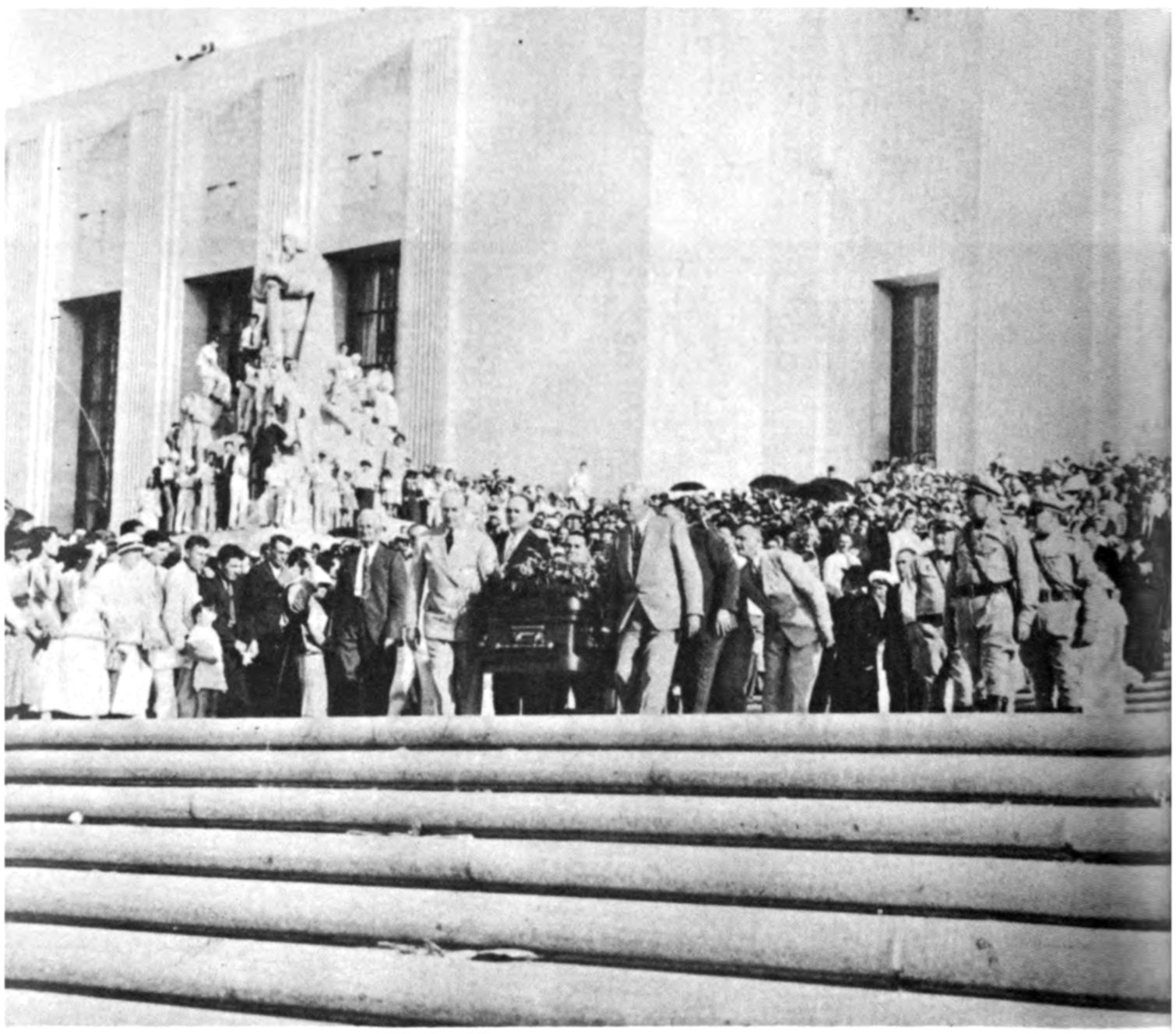
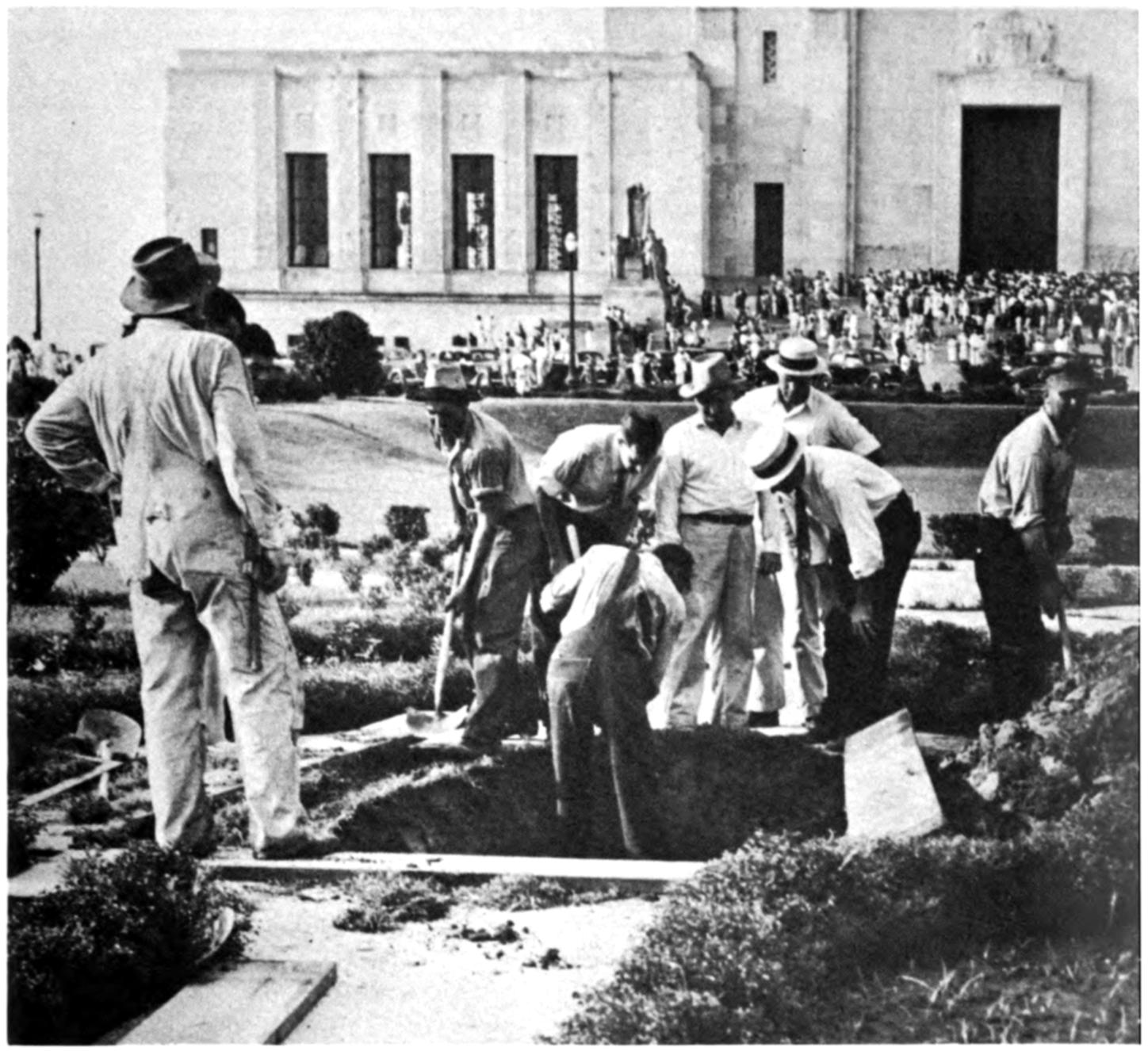
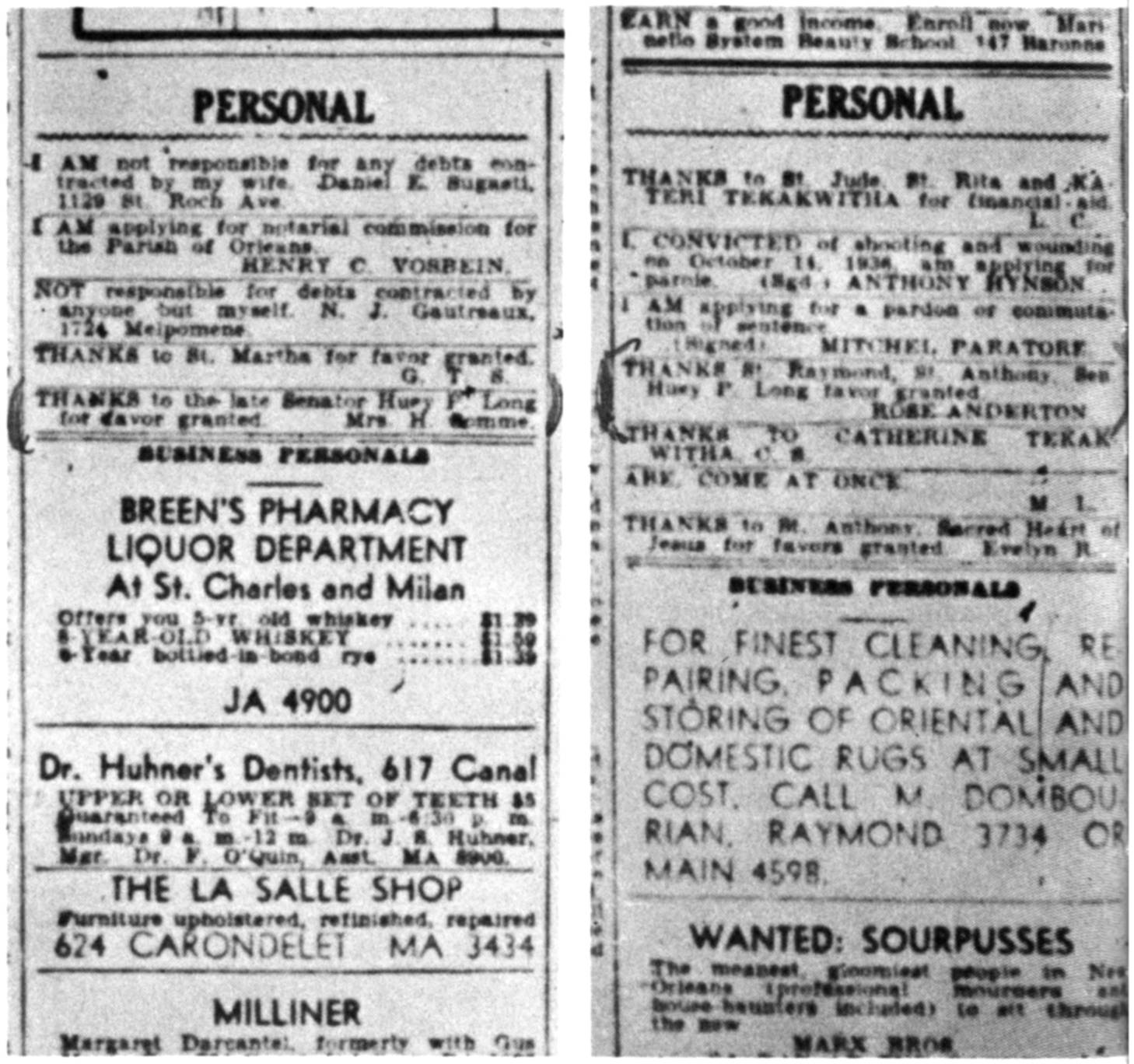
“He that cuts off twenty years
of life cuts off so many years
of fearing death.”
——SHAKESPEARE
Among the first of the Long hierarchs to reach the hospital to
which Jimmie O’Connor had rushed the fallen Kingfish were
Dr. Vidrine, Justice Fournet, and Acting Lieutenant Governor
Noe. As a matter of fact, O’Connor had not yet left the
capitol’s porte-cochere when Fournet and Noe reached it.
“I heard Huey and Jimmie O’Connor talking before I saw
them in the darkness there,” Justice Fournet relates. “Jimmie
asked: ‘Where did he hit you?’ and Huey said: ‘Hell, man,
take me to the hospital.’ I reached them just as they got into
the car of a man—his name was Starns, I think—and I tried to
get into the car with them, but it was just a two-door affair,
and I could not get in. By that time Jimmie Noe had come
down, so he and I managed to get to the hospital in another
of the cars around there. They had Huey sort of strapped to a
wheeled table, an operating table, I suppose, by the time we
got there and found out what floor he was on.
“Dr. Vidrine was there, and starting to take off some of
the Senator’s clothes; but I took out my pocket knife and
said: ‘Here, cut it off.’ He slashed through the clothes and laid
them back. I saw a very small bluish puncture on the right
side of Huey’s abdomen, and it was not bloody. And I saw
Dr. Vidrine lift up the right side of Huey’s back, but he did
not lift it very far. Dr. Vidrine put us in a room with a nurse,
then, and gave instructions to let no one else come in.
“Meanwhile other doctors were taking his blood pressure
and pulse rate. Huey asked one of them what it was, and he
told him. Naturally, I don’t remember the figures, but I do
remember Huey saying: ‘That’s bad, isn’t it?’ and Vidrine
or one of the others”—[it was Dr. Cecil Lorio]—“answered
him, saying: ‘Well, not too bad, yet.’ Vidrine asked him what
doctors he wanted called, and he said Sanderson from Shreveport,
and Maes and Rives from New Orleans. While they
were waiting for their arrival, Joe Bates came in. He was allowed
to come there so he could tell Huey who had shot him.
He said it was a young doctor named Weiss.
“‘What for?’ Huey asked. ‘I don’t even know him.’
“‘He’s a fanatic about you,’ Bates replied. ‘But he is
friendly with a lot of others in the administration.’”
Pending the arrival of surgeons from New Orleans, some
semblance of order was being restored about the hospital.
Highway motorcycle officers unsnarled the traffic jam in the
Sanitarium’s small parking lot, set up guarded barriers, and
thereafter admitted to the grounds no one who did not have
a special permit.
It was during this interlude, too, that Ty Campbell finally
brought Murphy Roden from the capitol to the hospital for
treatment.
“One of the interns washed my eyes out first,” Roden remembers.
“They were smarting and there must have been
some powder residue in them. There were powder burns on
the skin of my back, burns that had gone through my coat,
my shirt, and my undershirt. These were cleaned and swabbed
with antiseptic. But it was not until several weeks later, after
a place on my back kept festering, that I went to my family
doctor in Baton Rouge, and he finally removed a small fragment
of the copper jacketing of a bullet, from where it had
lodged just under the skin.
“After the interns finished with me, Ty went to the Istrouma
Hotel and brought me back some clothes, and I changed
in the hospital. After that we went back to the capitol
with General Guerre, who took me to the office of the governor’s
executive counsel where General Ray Fleming, head
of the National Guard, had set up his headquarters, and we
talked nearly an hour or so, with me telling all I could recall.
From there I went to my quarters and to bed.”
When he returned to the capitol with Roden, General
Guerre had the State House hallways cleared.
“Once I satisfied myself that the Senator had been taken to
the hospital and was in the hands of physicians,” he explains,
“I gave orders to my men to clear the capitol’s lower floor as
quickly as possible, and allow no one else to come in without
special authorization from me. I put officers in charge to see
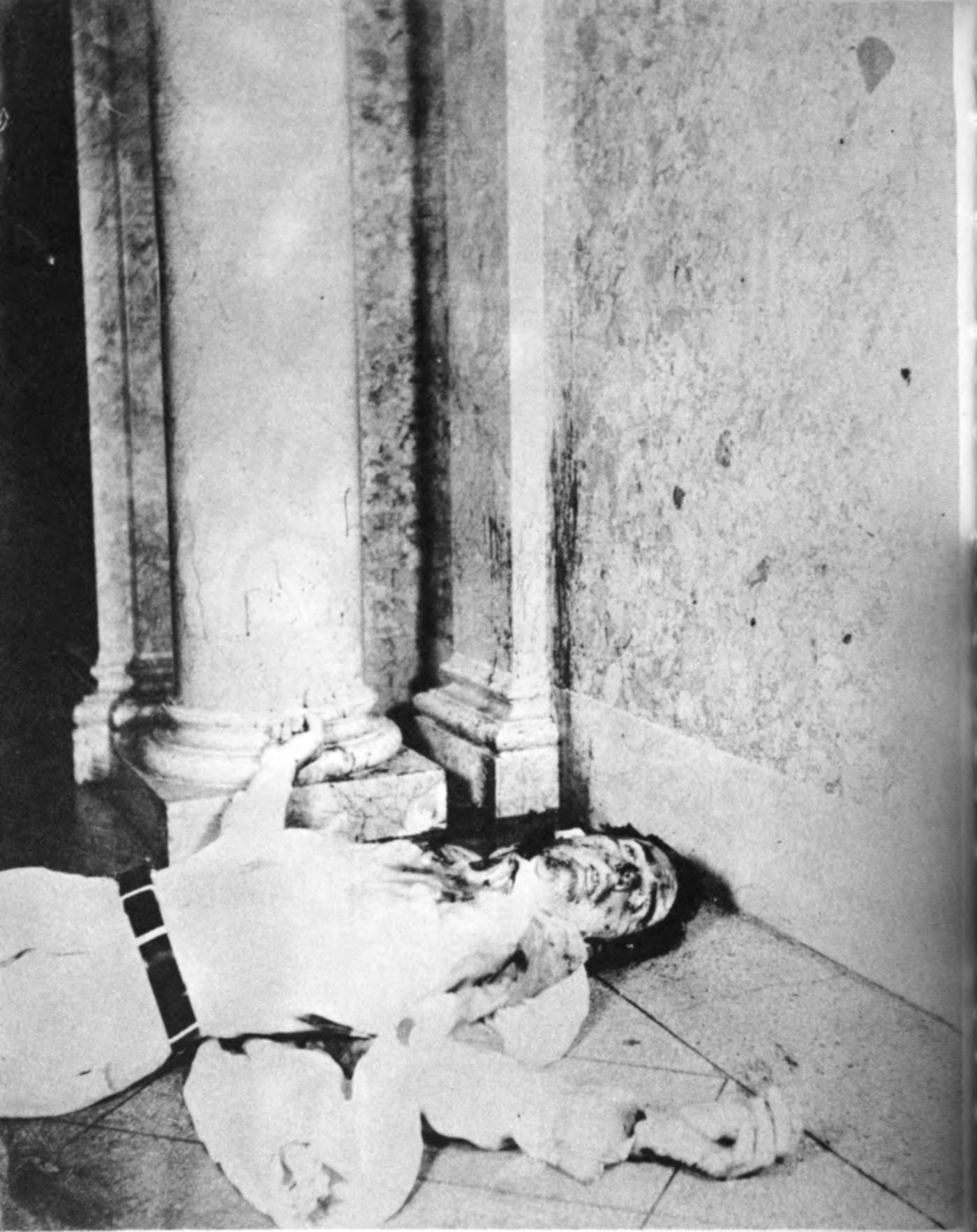
that the body of the assassin was not touched until the coroner
got there. Even Dr. Bird did not know who the man was
till they removed his wallet and saw his identification there.”
Unaware of what had taken place in Baton Rouge, Earle
Christenberry reached his New Orleans home shortly after
9:30, having driven in from the capitol without special haste.
His neighbors, seeing the car turn into the Christenberry
driveway, flung open a window and told him someone in
Baton Rouge was trying to get in touch with him. His phone
had not answered, whereupon the caller secured from the telephone
company the number of the adjoining house, asking
that when Earle arrived he be requested to call back immediately.
Then, adding a bit of news they had heard a short time
earlier over the radio, they told him Huey Long had been shot.
Christenberry did not pause to call Baton Rouge. Without
leaving his car, he backed out of the driveway and headed for
the capitol. He made but one stop en route. That was at
Lousteau’s combination sandwich counter and automobile
agency, where the Airline Highway cut across the government’s
newly completed Bonnet Carre Spillway over a bridge
a mile and an eighth long, spanning the dry channel through
which the Mississippi River’s flood waters could be diverted
into Lake Pontchartrain. Final inspection of the structure had
not yet been made; hence it was not open to general traffic.
Wooden highway barriers blocked entry to it.
However, Christenberry directed the highway patrolman on
duty there to open the barriers for him, since this would save
at least six miles on the road to Baton Rouge. After ascertaining
that Mrs. Long and the three children had not yet
passed this point, he instructed the motorcycle man to remain
on watch for their car, and open the barrier to let it pass
over the bridge too.
Approximately seventy minutes after leaving his home, he
parked at Our Lady of the Lake Sanitarium.
Earlier that afternoon, in New Orleans, General Ray Fleming,
Adjutant General of Louisiana, had taken part at Jackson
Barracks in a polo game between teams representing the 108th
Cavalry and the famed Washington Artillery. During one of
the late chuckers a hard-hit ball had banged against the General’s
left foot, inflicting an injury not in itself serious, but so
painful that before retiring for the night he borrowed a pair
of crutches from the post infirmary and secured a left shoe he
could cut to accommodate the swelling which had followed
the mishap.
“Hardly had I retired,” he relates, “than I received a phone
call from Governor Allen, who in a very excited voice said to
me: ‘Huey has been shot!’ Realizing that I must have certain
information to deal with such a situation, I demanded that
the Governor stay on the telephone at least long enough to
answer one question before I took action.
“The question was: ‘Is this an action involving many persons
or is it the act of just one individual?’ This I had to know
in order to determine what troops, if any, were needed to
handle the situation.
“Governor Allen immediately informed me that it was the
spontaneous action of just one individual. With this information
in hand, I started almost at once for Baton Rouge. In a
remarkably short time I reached the capitol, where I immediately
set up headquarters in the office of the executive
counsel. From then until about 2 A.M. I talked to a great
many persons regarding events leading up to, during, and
after the assassination.
“One of the reasons for this inquiry was that I had to make
a decision as to whether or not we were faced with the necessity
of dealing with an armed insurrection on the part of a
considerable number of individuals.”
Early that Sunday night Judge Leche, still inclined to make
light of his conversation with Senator Long some hours before,
was leaving Baptist Hospital, where his physician, Dr.
Wilkes Knolle, had just changed the dressing of the airplane
splint in which his left arm was immobilized.
“Our chauffeur was driving Tonnie [Mrs. Leche] and me
home from the hospital,” his account of the day’s events continues,
“and as we drew up in front of my house in Metairie I
could hear the phone ring. I tossed my keys to the chauffeur
and said: ‘Hurry up and answer it, and tell whoever it is I’ll
be there as soon as I can work my way out of the car.’ He did
so, and I got out awkwardly, my left arm being held rigidly
horizontal at shoulder height with the elbow bent, and when
I got to the phone it was Abe Shushan telling me Huey had
just been shot. I called out to the chauffeur not to leave, we
were going to Baton Rouge right away, and I told Tonnie I
would send the car back for her and she could come up the
next day, if that seemed indicated.
“I went directly to the governor’s office, and Oscar Allen
was there, very nervous and visibly shaken. He was talking on
the telephone and picked up a sheet of paper while holding
the other hand over the mouthpiece, and said: ‘This is what
I am going to release to the press.’ At the time I thought he
said he had already released it. In brief, the statement said
for everyone to remain calm, this had been merely the irresponsible
act of one individual, and that it did not mean
more than just one individual’s crazed action.
“I tore the paper up and handed the pieces back to him,
saying: ‘Huey has been charging in Louisiana and in Washington
that there was a plot on foot to kill him, and that he
surrounded himself with bodyguards for that reason. He conducted
a formal investigation into a murder plot with witnesses
who said they had won their way into the confidence
of the plotters, and named them, and carried on an investigation
in New Orleans for days.... How in the world can
you take it on yourself to proclaim officially that this was
all twaddle, and that only one individual was responsible for
what happened?’
“He said very excitedly: ‘You’re right, you’re right, you’re
right!’ I left, and was driven over to the hospital, but by that
time the operation was either over or in progress, so I did not
see Huey. I stayed in the hotel, and Tonnie joined me there
the next day.”
The operation was begun at 11:22 P.M., but Drs. Maes and
Rives were not present. What happened is told by Dr. Rives
in the following account:
“Dr. Maes had been called, I have forgotten by whom, and
he was asked to fly to Baton Rouge as Huey Long had been
shot; a chartered plane would be waiting for him at the New
Orleans airport, and a highway car at the one in Baton Rouge.
He asked me to go with him to assist him if he had surgery to
do, and I told him there was no sense in flying to Baton
Rouge, because I could drive him there in the time it would
take to drive out to the New Orleans airport, and then, after
the flight, from the Baton Rouge airfield to the hospital.
This proved to be not right.
“We were in my car and I was driving. The road then ran
beside the old O-K Interurban Line tracks, and just outside of
Metairie an S-curve crossed the tracks, a black-top road with
graveled shoulders. Just before we entered this S-curve another
car, coming from the opposite direction, swept through
it and put its bright lights right into my eyes. I was going
about forty-five or fifty. I was not racing, in other words, but
I got my right wheel into the loose gravel of the shoulder,
and ended up skidding completely around and facing back in
the direction of New Orleans on the old gravel road beyond
the S-curve.
“My differential housing was caught on the high center of
this old gravel road, with only one rear wheel on the ground.
We did no damage to the car, but with only one wheel on
the ground, a car is helpless. We finally flagged someone driving
back toward New Orleans and asked him to send a
wrecker to pull us back on the road. Actually they sent only
a truck, but it took us off the high center and then we went
on. I should say we lost not more than half an hour, but
I think we would not have reached Baton Rouge until after
the operation even if we had not met with this accident.
“We did not have permission to use the completed but
not yet opened Airline Highway beyond Kenner, so I took the
old River Road. As we finally drove into Baton Rouge, there
wasn’t a soul in sight, aside from a policeman or two. No one
was abroad on the streets; lights in the houses, yes, but no
people or cars on the streets. To outward appearances, it was
the most deserted community I ever saw, and going to Our
Lady of the Lake Sanitarium we had to drive right through the
center of town.
“At the hospital we were met by highway police, identified
ourselves, which was required, and then we were conducted to
the entrance where someone else took us up to the ward
where Huey had been placed....”
Word of the shooting of Huey Long had spread through
the capitol’s corridors and offices with almost explosive speed.
The minute she heard the report, Lucille May Grace (Mrs.
Fred Dent in private life), Register of the State Land Office,
tried to telephone Dr. Clarence Lorio, who, though not Senator
Long’s physician, was one of his closest friends in the
Baton Rouge area. Mrs. Dent (since deceased) was devoted
to Huey Long, for he had supported her father for re-election
to the office of Land Register, a post which he held for more
than thirty years. Upon her father’s death Long appointed
her to serve in Mr. Grace’s stead for the unexpired balance of
his term, since she had been his principal assistant almost
from the very day she was graduated from Louisiana State
University.
Since she had retained, and even added to, her father’s
tremendous personal following among the voters, Huey decided
at the end of her term of office in 1932 to put her name
on the Allen slate, which would carry his imprimatur as the
“Complete-the-Work” ticket. Hoping to induce Long to rescind
this decision, one or another of the rival aspirants spread
a completely baseless rumor to the effect that Mrs. Dent’s
ancestry was tainted with a touch of Negro blood.
Huey Long’s almost obsessive response to this sort of aspersion
was a matter of common knowledge; it is only because
what ensued may have some bearing on the motive behind
the assassination that this particular incident is worth giving
in some detail.
Though he had already consented to put the name of Lucille
May Grace on the slate that would carry his endorsement,
he lost no time in retracting this agreement, and made
it crystal clear forthwith that unless she could show to his
complete satisfaction that the rumor which had gained considerable
circulation was without even the semblance of a
foundation, he would place another’s name on the ticket for
the position she, and before her her father, had held.
Miss Grace, the niece of an Iberville parish priest, enlisted
the latter’s aid and that of the late John X. Wegmann, a
universally respected New Orleans insurance man and perhaps
the foremost Catholic layman in Louisiana at the time.
Thus birth and baptismal records going back for generations
along the Grace family tree were produced, and they conclusively
demonstrated the utter falsity of the canard. Satisfied,
Long restored her name at once to his personally approved
“Complete-the-Work” ticket of candidates, headed
by the name of Oscar K. Allen for governor.
Miss Grace (she did not become Mrs. Dent until a year
later) had attended Louisiana State University with both
Clarence and Cecil Lorio, and knew how close the former’s
friendship with Senator Long was. She began at once to call
him, but he was not at his farm in nearby Pointe Coupee
parish, and the telephone at his Baton Rouge residence was
apparently out of order. So she called his brother, Dr. Cecil
Lorio.
“Suppose you let me tell the whole story, exactly as I recall
it,” the latter began, when asked about his recollections of
what took place in the operating room of Our Lady of the
Lake Sanitarium when Huey Long was admitted there as a
patient that September night. Dr. Cecil Lorio and Dr. Walter
Cook were, at the time of this inquiry, the only surviving
physicians who were present throughout all the ensuing surgical
procedure.
“When she failed to reach my brother Clarence,” Dr. Lorio
continued, “Lucille May Grace called me at my home, and I
left at once for Our Lady of the Lake Sanitarium. Huey’s
clothing had been removed by the time I got there, and he
was in bed in his room at the east end of the third-floor corridor.
He was fully conscious and we talked quietly from
time to time during the next hour. He was particularly distressed
by the thought that he might now be unable to carry
out his plan to screen students for L.S.U., so as to make it
possible for all exceptionally bright high-school graduates,
however needy their families, to receive the advantages of
college education.
“I took his blood pressure and pulse every fifteen minutes;
he had evidently learned something about the significance
of this, for when he asked me what the readings were, and I
told him his pulse rate was getting faster and his blood pressure
was dropping a bit, he said: ‘That’s not good, is it?’ and I
answered him by saying: ‘No, but it isn’t too bad yet, either.’
‘It means there’s an internal hemorrhage?’ he then asked. I
said he was probably hemorrhaging some, but that the relation
between blood pressure and pulse rate was one that could
also be attributed to shock. He was very curious about who
had shot him, saying it was someone he had never seen before.
“He had visibly a small blue puncture on the right side of
his abdomen, and another on the right side of his back where
the bullet emerged. Both were very small. But it was obvious
some emergency surgery would have to be performed sooner
or later. I was told that Dr. Sanderson had been summoned
from Shreveport, and that Drs. Urban Maes and James Rives
were already en route from New Orleans. Dr. Maes had been
appointed to the chair of surgery at L.S.U.’s new medical
college, of which Dr. Vidrine, also present in Baton Rouge at
the time, was dean, along with his position as superintendent
of Charity Hospital. He was in general charge of the patient’s
case. At some point in the proceedings word was brought to
us that a motoring accident had forced Dr. Rives’s car off the
road, and that they would be delayed some time by the difficulty
of securing service at that time of night to have their
car dragged back to the highway. When informed of this, Dr.
Vidrine decided not to wait any longer.”
Huey’s very close friends, Seymour Weiss and Conservation
Commissioner Robert Maestri, had reached Baton Rouge
some time prior to this. It is Mr. Weiss’s clear recollection
that the decision to wait no longer before performing an
emergency operation was reached “by all of us” before word
was received of the mischance encountered by Drs. Maes and
Rives.
“As I recall the circumstances,” Seymour Weiss says,
“Huey’s condition was getting worse by the minute. Dr.
Vidrine insisted that any further delay was progressively lessening
the Senator’s chances. The other physicians present
agreed that the outlook was not hopeful. Vidrine was the
physician in charge and the rest of us were laymen. The time
came when we either had to agree to let the operation be
performed at once, or take upon ourselves the risk of endangering
the man’s life. Mrs. Long and the children had not yet
reached Baton Rouge, but in view of the medical opinions,
the rest of us—all being individuals who were close to Huey—were
just about unanimous in agreeing that the doctors
should proceed.”
Amid the almost inconceivable confusion in and out of the
hospital, one person seems to have kept her head, and that
was Miss Mary Ann Woods, now Mrs. Arthur Champagne,
the supervisor of nurses. Assigning floor nurses and trainees
to duties so as to make the best possible disposition of available
personnel, she set out to provide four special attendants
for the critically injured Senator, two to serve at night and
two by day.
The first one she called from the register was Theoda Carriere,
who responded at once, even though she had just come
off a twelve-hour tour of duty. The other three were Loretta
Meade, Helen Selassie, and Mrs. Hamilton Baudin. Miss
Carriere was one of the first to reach the hospital, as she lived
nearby; and since by that time Senator Long had been taken
from his third-floor sickroom to the operating theater on the
floor above, she scrubbed up at once and reported for duty
there.
According to her recollection, Dr. Cook was working on
the patient, who was anesthetized by the time she arrived.
Being short of stature, she had difficulty in seeing the operating
table, and therefore placed a stool so that, by standing
on it, she could look over the shoulders of those surrounding
the patient.
Dr. Cook said to her: “This is a gunshot wound; get me
some antitetanus serum.” Miss Carriere left the room for the
pharmacy section downstairs where such supplies were stored,
and when she returned with the desired serum, and gave it to
Dr. Cook, Dr. Vidrine was just entering the operating room.
“Dr. Cook looked up,” she relates, “and said: ‘Well, my
relief has arrived,’ and left the operating room. Dr. Ben Chamberlain
assisted Dr. Vidrine during the balance of the operation.”
In this respect Miss Carriere’s recollections are in direct
conflict with those of every physician who was present, and
with the operation report attached to the hospital chart, as
well as with the statement of Dr. Cook himself, when he
testified later that he assisted at the operation.
As operating procedure was begun in the Sanitarium, neighbors
of Dr. Clarence Lorio, seeing his car parked in front of
his home, and realizing that under normal circumstances he
of all men would have been at the hospital with his gravely
wounded friend, managed to rouse him.
“I had been working for thirteen hours straight,” he explained
subsequently, “and I was bone tired. When I got
home I not only went to bed, but took the telephone off the
hook so as not to be disturbed. I had come to the point where
I simply had to rest. Naturally, when some of my neighbors
woke me and told me what had happened, I lost no time in
dressing and rushing off to the Sanitarium, but the operation
was already under way when I got there.
“Let me say this about Arthur Vidrine: that man faced one
of the toughest decisions that night anybody ever confronted.
If he sat idly by, waiting for someone else to take over the
case, while Huey bled to death, his associates and Huey’s
friends would never forgive him, and he would never forgive
himself, either. On the other hand, if he performed an emergency
operation, and it was discovered later that the critically
wounded patient would have had a better chance for recovery
if some other procedure had been followed, he would still be
blamed for a great man’s death. No one could confront a
more harrowing choice.”
On the other hand, it can be taken for granted that Arthur
Vidrine must at least momentarily have entertained the
thought of the rewards and renown that would be his portion
if by timely, courageous, and skillful surgery he, rather than
others, saved the life of the Kingfish of Louisiana. Be that as
it may, the decision to operate at once was made; when it was
submitted to Senator Long, he concurred in it; in fact, according
to a monograph by Dr. Frank L. Loria of New Orleans,
Huey himself said: “Come on, let’s go be operated
upon.”
Dr. Cecil Lorio described the incident more prosaically in
the following terms:
“Someone told him that it had been decided to operate and
that Dr. Vidrine would perform the operation if Huey had
no objection. He indicated that he was willing for this to be
done. Dr. Vidrine selected Dr. William Cook to assist him,
and Dr. Henry McKeown as the anesthetist. It was this latter
choice that brought me back into the operating room and
kept me there, for I am a pediatrician, not a surgeon.
“Baton Rouge—in fact, all Louisiana—was bitterly divided
into Long and anti-Long factions at this time. One of the
most violently partisan anti-Long individuals in all Baton
Rouge was Henry McKeown. He really hated Huey, though
he had many friends among the people who were close to the
Senator.
“Only two or three nights earlier, he and I were both sitting
in at a poker game in the Elks’ Club, when someone said
something or other about Long—probably something in connection
with the special session of the legislature that might
be called any day. Dr. McKeown said in jest, the way any
person might in the course of a sociable card game: ‘If ever
he has to have an operation, they better not let me give the
anesthetic, for I’ll guarantee he’d never get off that table.’
Let me say again, and with emphasis, that this was not a
threat, but a jest, something to underscore the man’s uncompromising
anti-Long partisanship.
“Naturally, when within a matter of days he actually was
summoned to serve as anesthetist for an operation to be performed
on Huey Long, he demurred. He pointed out that
Huey was a bad operative risk in any case, and for all anyone
knew to the contrary, might already be dying from a wound
which was in itself mortal. ‘If the man dies during the operation,’
Dr. McKeown pointed out, ‘many of those who have
heard me pop off about him might actually think I killed
him.’ No one who knew Henry McKeown, of course, would
think any such thing. Finally he agreed to serve, provided I
watched and checked every move he made.
“I told him I would do so, but while I looked now and then
across the operating table to its head, where he was standing,
and saw what he was doing, I really paid no attention to it,
nor did he stop to see whether or not I was checking on him.
“Later, while the operation was in progress, Dr. Clarence
Lorio, my brother, came in and stood beside Dr. McKeown to
the end of the operation. On the side of the table at Huey’s
left stood Dr. Vidrine. Opposite him was his assistant, Dr.
Cook. Beside Dr. Vidrine at his left, I stood, handing him
instruments and materials as he called for them. As I said, I
am not a surgeon, but a pediatrician.
“The operating room was a strange sight. All sorts of people,
mostly politicians, I assume, had crowded into the small
room. It was not an amphitheater, and they ranged themselves
all along the walls, not even being suited up. As Mother
Henrietta, the head of the hospital, said later, after she had
vainly tried to keep all who were not physicians or properly
gowned out of the operating chamber, it was anything but
normal surgical procedure.”
It is indeed a pity the original chart, such as it was, could
not have been preserved. But as in the case of most hospitals,
the time came when the absolute limit of storage capacity
was exhausted, and the charts on file were microfilmed. In
making these microfilms it was customary in many hospitals
not to include the nurses’ bedside notes in the filmed record.
Hence these do not appear in the film of the chart of Huey
Long at Lady of the Lake.
But even what does remain is fragmentary, and in many
cases unsigned. As Dr. Rives observed many years later: “The
situation that night, even after I arrived, which was after the
operation was completed and Huey was back in his room,
could only be described as chaotic. Several physicians seemed
to be on hand, and in the case of a critically injured patient,
when no one of the attending doctors is actually in command
and giving the orders to the crew of which he is the captain
... well, all I can say is that even during the four hours or
so when I was there between about 1 A.M. and the time I
started back for New Orleans which I reached at daybreak,
the situation was nothing short of chaotic.”
A transcript of the microfilm was made by Dr. Chester A.
Williams, the present coroner of East Baton Rouge parish.
According to this document, the admitting note, set down on
a plain sheet of paper, is not even signed; obviously the last
two lines were added by someone else after the operation was
concluded. It is preceded on the record by a standard summary
form which reads:
The unsigned “admitting note” on its plain sheet of paper,
which follows the foregoing summary, reads:
“Pt. admitted to O.R. at 9:30 P.M. Dr. Vidrine present.
Exam made by Dr. Vidrine shows wound under ribs rt. side,
clothes and body with blood. Pulse volume weak and faint.
Fully conscious, very nervous. Given caffeine and sodium
benzoate 2 cc by hypo. Dr. Cook present. Put to bed in 314
at 9:45 P.M. Foot of bed elevated. M.S. gr. 1⁄6 by hypo for
pain. Asked for ice continuously. Dr. Cecil Lorio present.
External heat, Pt. in cold sweat. After consultation, patient
to O.R. at 11:20, pulse weak and fast, still asks for ice.”
Then follow the words, obviously added after the operation:
“Dr. Vidrine, C. A. Lorio, Cecil and Dr. Cook present,
and put to bed in 325 at 12:40 A.M. Foot of bed elevated.”
The Operating Room record of the chart reads:
In the monograph previously referred to, Dr. Loria of New
Orleans compiled a more detailed technical description of the
surgical procedure. This was published in 1948 by the International
Abstracts of Surgery (Volume 87) as a treatise dealing
with 31,751 cases of abdominal gunshot wounds admitted
to Charity Hospital during the first forty-two years of the
present century. Dr. Loria appended to it a series of reports
on notable personages in American history who had succumbed
to such wounds, including President Garfield, President
McKinley, and Senator Long. Referring to the Senator’s
case, he wrote in part:
“The bullet which struck Senator Long entered just below
the border of the right ribs anteriorly, somewhat lateral to
the mid-clavicular line. The missile perforated the victim’s
body, making its exit just below the ribs on the right side
posteriorly and to the inner side of the midscapular line,
not far from the midline of the back.
“... At the hospital, arrangements were made for an emergency
laparotomy with Vidrine in charge.... Under ether
anesthesia the abdomen was opened by an upper right rectus
muscle splitting incision. Very little blood was found in the
peritoneal cavity. The liver, gall bladder and stomach were
free of injury. A small hematoma, about the size of a silver
dollar, was found in the mesentery of the small intestine. The
only intra-peritoneal damage found was a ‘small’ perforation
of the hepatic flexure, which accounted for a slight amount
of soiling of the peritoneum. Both the wounds of entry and
of exit in the colon were sutured and further spillage stopped.
The abdomen was closed in layers as usual.”
About one o’clock that morning Drs. Maes and Rives arrived,
and somewhat later Dr. Russell Stone, another noted
New Orleans surgeon. None of these saw any part of the
operative procedure, all surgery having been completed before
their arrival. But a sharp difference of opinion between
Dr. Vidrine and Dr. Stone was followed by the latter’s prompt
return to New Orleans without so much as looking at the
patient. Dr. Stone told some of his New Orleans associates
and close friends that Vidrine had given him the details of
the abdominal operation and had also said that the kidney
was injured and was hemorrhaging.
“Did you see the kidney?” he asked Vidrine, and added
that the latter replied: “No, but I felt it.” An acrimonious
interchange followed and at its climax Vidrine said something
to the general effect of “Well, go on in and examine
him for yourself.” Stone replied: “Not I. This isn’t my case
and he isn’t my patient. Good night.” Thereupon he returned
at once to New Orleans.
Dr. Rives’s account of his experiences clearly illustrates on
what he based his opinion that the procedure was “chaotic.”
“Dr. Maes and I were taken into a room next to the one
Huey was in,” he related, “and there I stopped. Dr. Maes was
taken on into the patient’s room, while I got off into a corner,
making myself inconspicuous. At this time there was still no
suggestion that anyone but Dr. Weiss had shot or even could
have shot Huey Long. Meanwhile, people were going in and
out of the sickroom, apparently at will. I did not know many
of them, and certainly most of them were not physicians.
Finally someone, and I think it was Abe Shushan, asked me
had I been in the room where Huey was, and I said no, I was
only there to assist Dr. Maes in the event there was any surgery
he had to perform. He said: ‘In something like this we
want the benefit of every doctor’s advice,’ and led me in there.
“I did not see the wound of entrance, and I was told by
one of the nuns or one of the nurses that the wound of entrance
was beneath the clean dressing on his belly; and from
the location of this dressing it was clear to me that there was
a good chance the bullet might have hit a kidney.
“I asked the nurses if there were any blood in his urine.
That was the only contribution I could make. Whoever it
was, she said she did not know. I said that if they did not
know, he ought to be catheterized at once. Later that night,
some time before I left for New Orleans, I was told he had
been catheterized and that there was blood in his urine. That
was an absolute indication of injury to the kidney. It was not
necessarily a critical injury, or a hemorrhage that would not
stop. But it did mean that there was an injury, and that if
hemorrhage continued, that was the place to look for it.”
Dr. Maes said there would be no further surgery, and hence
while he would stay through the day, Monday, there would
be no need for Dr. Rives to do so. The latter thereupon drove
back to New Orleans.
According to Dr. Loria’s monograph, the “postoperative
course of the case continued steadily on the downgrade. Evidence
of shock and hemorrhage appeared to become steadily
worse ... the urine was found to contain much blood. At
this time [Dr. Russell] Stone’s opinion was that another
operation to arrest the kidney hemorrhage would certainly
prove fatal....”
Whether it was Dr. Rives or Dr. Stone who first suggested
catheterization is immaterial. The fact remains that until one
or the other of these physicians, neither of whom was directly
connected with the case, proposed this procedure, nothing of
the sort seems to have been done; according to the progress
notes on the microfilm chart, it was not done until 6:45 A.M.,
almost nine hours after the shooting, and six hours after the
emergency operation had precluded the possibility of further
surgery. Even after it was discovered that the kidney hemorrhage
was massive and continuing, medical opinion was
unanimous on the point that additional surgery would unquestionably
prove fatal.
Control of such hemorrhage involved removal of the injured
kidney, in order to tie off the vessels supplying it with
blood. This in turn would mean the cutting of ribs to make
room for the requisite mechanics of kidney removal. Such an
operation on a patient already in shock from a bullet wound
and from the major abdominal surgery which followed,
would, it was agreed by all, inevitably bring about the patient’s
death. All that remained was to hope for a miracle—and
none manifested itself. In the words of Dr. Cecil Lorio:
“The patient never really recovered consciousness. He was
in shock, and under sedation, until he died. As the day [Monday]
wore on, and Huey’s blood pressure continued to fall, a
transfusion was ordered. It may have been earlier that the
transfusion was given. The hospital records would show.”
Unfortunately, the hospital record shows only one transfusion,
given at 8:15 Monday night, nearly twenty-four hours
after the shooting. However, it must be borne in mind that in
those days, long before blood and plasma banks had been
established as standard hospital facilities, transfusions were
by no means the routine procedure they are today. In the
case of Huey Long, a chart note signed by Dr. Roy Theriot
records the fact that five hundred cubic centimeters of citrated
blood were given, that before transfusion approximately three
hundred cubic centimeters of normal saline solution were
given intravenously at a time when the pulse was very thready,
and that the transfusion was followed by a continuous intravenous
drip of glucose in normal saline. Even after this the
patient’s blood pressure was only 114 over 84, while the pulse
rate was still a frightening “170-plus.”
Almost as soon as Senator Long had been brought to the
hospital, volunteer blood donors were typed, and their blood
cross-matched with that of the patient. According to the
laboratory report incorporated in the hospital chart, J. A.
Vitiano, Eddie Knoblock, Colonel Rougon, J. R. Pollett,
M. E. Bird, George Castigliola, and Paul Voitier were marked
“incompatible”; C. J. Campbell, John Kirsch, “no name,” Joe
Bates, Senator Noe, Bill Melton, and a Mr. Walker were
found to be compatible. In addition, “no name,” Bates, Noe,
and Melton were also marked with an “O.K.”
Senator Noe was the first and apparently only donor, and
it is my recollection that we met in the Heidelberg Hotel
elevator Monday night when he told me he had “just given
blood to Huey.” Mrs. Noe was with him at the time, said
she was sure Senator Long would recover, and expressed the
hope that future installments of the Saturday Evening Post’s
biographical portrait would “do him proud.”
A little after two o’clock that afternoon Dr. Maes had
prescribed a rectal instillation of laudanum, aspirin, brandy,
and normal saline solution. Once this was given, the chart
notes: “Resp. less labored, less cyanosis, P 148 Temp. 1034⁄5
axilla. Quieter.” During the handling that was incident to the
instillation, Senator Long awoke and asked Dr. Maes whether
he would be able to take the stump in the approaching campaigns.
“It’s a little early to tell, yet,” the physician replied.
As before, the patient lapsed into drugged slumber the moment
the handling that had roused him came to an end.
As concerns the one transfusion recorded on the hospital
chart, Dr. Cecil Lorio reports:
“I recall clearly the fact that the young physician who was
to give the transfusion was so nervous, and his hands were
shaking so, that he was having difficulty placing the needle
in the vein that was to receive the blood; and my brother
Clarence said to me, knowing that I frequently gave transfusions
to children: ‘Dr. Cecil, haven’t you your equipment
here so that you might assist in transfusing the Senator?’ I
said I had, and of course to me, accustomed to performing
this with the small veins of children, it was child’s play to
place the needle in the large vein of a man. A number of
volunteers—everybody wanted to volunteer—had already been
typed, and one of those whose blood matched was State
Senator James A. Noe. He was the first donor.
“But as the day wore on it became evident that the patient
was losing blood about as fast as we were transfusing it into
him, and while there were no external evidences of bleeding,
the conclusion was that he must be hemorrhaging from the
apex of the right kidney. So Dr. T. Jorda Kahle of New Orleans
[head of the urology department of Louisiana State
University’s College of Medicine] was sent for. He got to
Baton Rouge Monday night and thrust a needle just under
the skin of the kidney region and drew out a syringeful of
blood. That made it evident the Senator’s case was hopeless,
barring a miracle. The only way to stop such a hemorrhage
would have been to remove the kidney, and that would certainly
have killed him.
“At the end, the dying man threshed wildly about the
oxygen tent that had been put over him. A little after four
in the morning his breathing stopped.”
Mrs. Long and the three children—Rose, Russell, and
Palmer—did not reach Baton Rouge until after the operation
was over, in spite of the fact that the Airline’s new bridge
across the Bonnet Carre Spillway was opened to the passage
of their car, thanks to Earle Christenberry’s directions to the
highway guards at Lousteau’s. Since the Senator was never
really conscious after he left the operating room, the members
of his family had little or no communion with the man who
to them was not merely a public figure, but husband and
father.
They were given rooms directly across the hall from the
one in which physicians strove unremittingly to save Huey
Long’s life. He had not been a very devoted family man. He
was away from home too much in the pursuit of objectives
it seemed impossible for him to share with the Rose McConnell
he had met when he was a brash young door-to-door
salesman of Cottolene.
Those days were now so long in the past, the happy days
of shared trial when every penny had to be stretched to the
uttermost. Success had come so quickly—the big ornate home
in Shreveport, the new Executive Mansion at Baton Rouge of
which Rose had been the first chatelaine, the elaborate residence
on Audubon Boulevard, the days of triumph and rejoicing
that followed the effort to impeach him....
All of it was now slipping away forever, while Huey Long’s
blood seeped slowly but relentlessly out of his body, with no
possibility short of a miracle of halting its ebb as some physician,
now forever anonymous, made on his hospital chart a
final entry to the effect that even “the oxygen tent discontinued
as pt. grew very restless under it—delusions of photographers,
etc.”
Once hope for the patient had been abandoned, it was Seymour
Weiss who was the nuncio bringing to the members of
Huey’s family, in the room across the hall, tidings of great
grief. Himself emotionally shaken to the depths of his being,
he told Mrs. Long and the three children as gently as possible
that the end was very near. They followed him across the
hall to the bed where the dying man, barely conscious, was
drawing in and expelling shallow, noisy breaths. He made no
effort to speak; but as each of the four laid a hand on the bed
beside him, he managed weakly to pat it in a final, caressing
gesture of farewell.
They returned to their room to await the end. Seymour
Weiss accompanied them, giving voice to whatever comforting
phrases he could muster, and then returned to the sickroom.
One vital point remained to be cleared up.
“Huey, Huey, can you hear me?” he asked.
There was a faint stir of response.
“Huey, you are seriously hurt. Everything that can be done
to help you is being done, but no one can ever say how such
things will turn out. Now is the time to tell me where you
put the papers and things that you took out of the bank vault.
Where did you put them? Tell me where they are, Huey.
Please don’t wait any longer.”
Thus the final thoughts he carried with him out of his life
concerned a political campaign, his campaign for the presidency
of the United States. Hardly audible was the faint
breath that whispered:
“Later—I’ll—tell—you—later....”
They were his last words. The secret of what became of
the affidavits, the other documents, and the campaign funds
that were to provision his presidential race was one he took
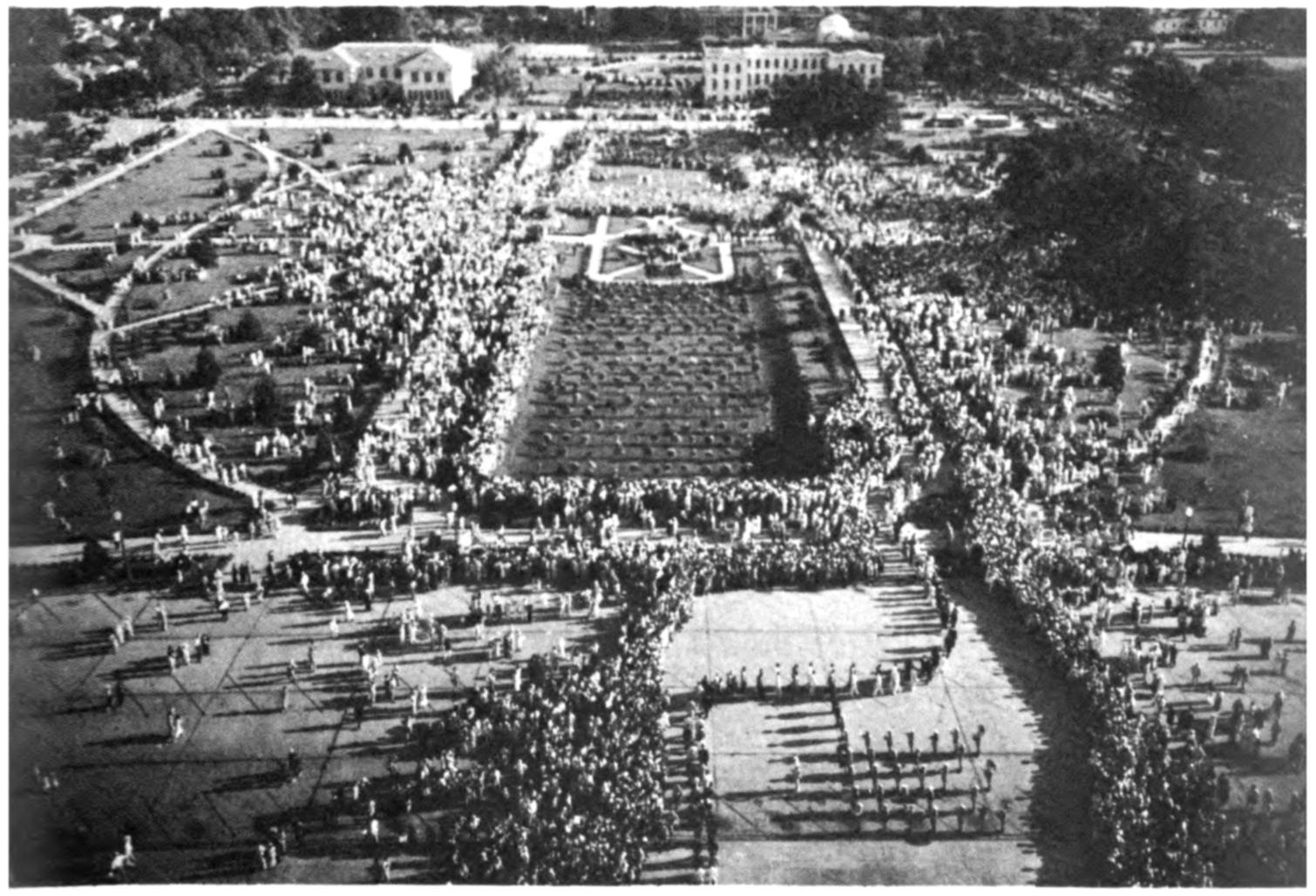
with him to an elaborate tomb newly constructed in the very
center of the landscaped park around the capitol he had built
for Louisiana.