Chelsea, June 18th.
On asking Mr. Gunnel to
what Use I should put
this fayr Libellus, he did
suggest my making it a
Kinde of family Register,
wherein to note the more important of
our domestick Passages, whether of Joy
or Griefe—my Father's Journies and
Absences—the Visits of learned Men,
theire notable Sayings, etc. "You are
ready at the Pen, Mistress Margaret,"
he was pleased to say; "and I woulde
humblie advise your journalling in the
same fearless Manner in the which you
framed that Letter which soe well
pleased the Bishop of Exeter, that he
sent you a Portugal Piece. 'Twill be
well to write it in English, which 'tis
expedient for you not altogether to
negleckt, even for the more honourable
Latin."
Methinks I am close upon Womanhood....
"Humblie advise," quotha!
to me, that have so oft humblie sued for
his Pardon, and sometimes in vayn!
'Tis well to make trial of Gonellus his
"humble" Advice: albeit, our daylie
Course is so methodicall, that 'twill afford
scant Subject for the Pen—Vitam continet
una Dies.
... As I traced the last Word, methoughte
I heard the well-known Tones
of Erasmus his pleasant Voyce; and, looking
forthe of my Lattice, did indeede beholde
the deare little Man coming up from
the River Side with my Father, who, because
of the Heat, had given his Cloak to
a tall Stripling behind him to bear. I
flew up Stairs, to advertise Mother, who
was half in and half out of her grogram
Gown, and who stayed me to clasp her
Owches; so that, by the Time I had followed
her down Stairs, we founde 'em
alreadie in the Hall.
So soon as I had kissed their Hands,
and obtayned their Blessings, the tall Lad
stept forthe, and who should he be but
William Roper, returned from my Father's
Errand over-seas! He hath grown hugelie,
and looks mannish; but his Manners
are worsened insteade of bettered by
forayn Travell; for, insteade of his old
Franknesse, he hung upon Hand till
Father bade him come forward; and
then, as he went his Rounds, kissing one
after another, stopt short when he came
to me, twice made as though he would
have saluted me, and then held back,
making me looke so stupid, that I could
have boxed his Ears for his Payns.
'Speciallie as Father burst out a-laughing,
and cried, "The third Time's lucky!"
After Supper, we took deare Erasmus
entirely over the House, in a Kind of
family Procession, e'en from the Buttery
and Scalding-house to our own deare
Academia, with its cool green Curtain
flapping in the Evening Breeze, and
blowing aside, as though on Purpose
to give a glimpse of the cleare-shining
Thames! Erasmus noted and admired
the Stone Jar, placed by Mercy Giggs on
the Table, full of blue and yellow Irises,
scarlet Tiger-Lilies, Dog-Roses, Honeysuckles,
Moonwort, and Herb-Trinity;
and alsoe our various Desks, eache in its
own little Retirement,—mine own, in
speciall, so pleasantly situate! He protested,
with everie Semblance of Sincerity,
he had never seene so pretty an Academy.
I should think not, indeede! Bess, Daisy,
and I, are of Opinion, that there is not
likelie to be such another in the World.
He glanced, too, at the Books on our
Desks; Bessy's being Livy; Daisy's, Sallust;
and mine, St. Augustine, with Father's
Marks where I was to read, and where desist.
He tolde Erasmus, laying his Hand
fondlie on my Head, "Here is one who
knows what is implied in the Word
Trust." Dear Father, well I may! He
added, "there was no Law against laughing
in his Academia, for that his Girls
knew how to be merry and wise."
From the House to the new Building,
the Chapel and Gallery, and thence to
visitt all the dumb Kinde, from the great
horned Owls to Cecy's pet Dormice. Erasmus
was amused at some of theire Names,
but doubted whether Duns Scotus and
the Venerable Bede would have thoughte
themselves complimented in being made
Name-fathers to a couple of Owls; though
he admitted that Argus and Juno were
goode Cognomens for Peacocks. Will
Roper hath broughte Mother a pretty
little forayn Animal called a Marmot, but
she sayd she had noe Time for suchlike
Playthings, and bade him give it to his
little Wife. Methinks, I being neare sixteen
and he close upon twenty, we are too
old for those childish Names now, nor am
I much flattered at a Present not intended
for me; however, I shall be kind to the
little Creature, and, perhaps, grow fond of
it, as 'tis both harmlesse and diverting.
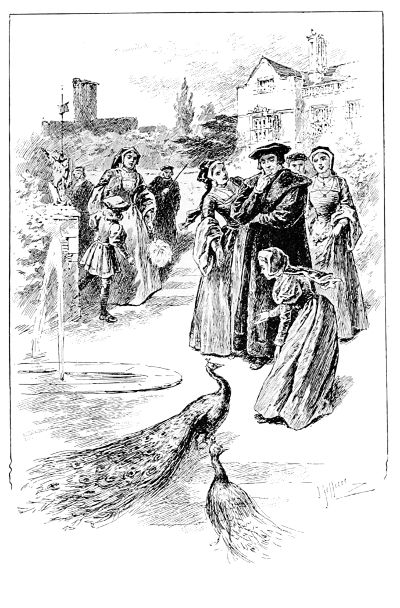
To return, howbeit, to Erasmus; Cecy,
who had hold of his Gown, and had
alreadie, through his familiar Kindnesse
and her own childish Heedlessness, somewhat
transgrest Bounds, began now in her
Mirthe to fabricate a Dialogue, she pretended
to have overhearde, between Argus
and Juno as they stoode pearcht on a
stone Parapet. Erasmus was entertayned
with her Garrulitie for a while, but at
length gentlie checkt her, with "Love
the Truth, little Mayd, love the Truth,
or, if thou liest, let it be with a Circumstance,"
a Qualification which made
Mother stare and Father laugh.
Sayth Erasmus, "There is no Harm in a
Fabella, Apologus, or Parabola, so long
as its Character be distinctlie recognised
for such, but contrariwise, much Goode;
and the same hath been sanctioned, not
only by the wiser Heads of Greece and
Rome, but by our deare Lord Himself.
Therefore, Cecilie, whom I love exceedinglie,
be not abasht, Child, at my Reproof,
for thy Dialogue between the
two Peacocks was innocent no less than
ingenious, till thou wouldst have insisted
that they, in sooth, sayd Something like
what thou didst invent. Therein thou
didst Violence to the Truth, which St.
Paul hath typified by a Girdle, to be
worn next the Heart, and that not only
confineth within due Limits, but addeth
Strength. So now be Friends; wert
thou more than eleven and I no Priest,
thou shouldst be my little Wife, and
darn my Hose, and make me sweet
Marchpane, such as thou and I love.
But, oh! this pretty Chelsea! What
Daisies! what Buttercups! what joviall
Swarms of Gnats! The Country all
about is as nice and flat as Rotterdam."
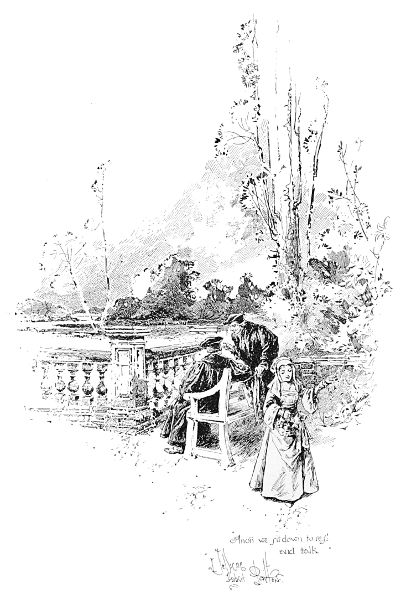
Anon, we sit down to rest and talk in
the Pavilion.
Sayth Erasmus to my Father, "I marvel
you have never entered into the
King's Service in some publick Capacitie,
wherein your Learning and Knowledge,
bothe of Men and Things, would
not onlie serve your own Interest, but
that of your Friends and the Publick."
Father smiled and made Answer, "I
am better and happier as I am. As
for my Friends, I alreadie do for them
alle I can, soe as they can hardlie consider
me in their Debt; and, for myself,
the yielding to theire Solicitations
that I would putt myself forward for
the Benefit of the World in generall,
would be like printing a Book at
Request of Friends, that the Publick
may be charmed with what, in Fact,
it values at a Doit. The Cardinall
offered me a Pension, as retaining Fee
to the King a little while back, but
I tolde him I did not care to be a
mathematical Point, to have Position
without Magnitude."
Erasmus laught and sayd, "I woulde
not have you the Slave of anie King;
howbeit, you mighte assist him and
be useful to him."
"The Change of the Word," sayth
Father, "does not alter the Matter; I
should be a Slave, as completely as if
I had a Collar rounde my Neck."
"But would not increased Usefulnesse,"
says Erasmus, "make you happier?"
"Happier?" says Father, somewhat
heating; "how can that be compassed
in a Way so abhorrent to my Genius?
At present, I live as I will, to which
very few Courtiers can pretend. Half-a-dozen
blue-coated Serving-Men answer
my Turn in the House, Garden, Field,
and on the River: I have a few strong
Horses for Work, none for Show, plenty
of plain Food for a healthy Family,
and enough, with a hearty Welcome, for
a score of Guests that are not dainty.
The lengthe of my Wife's Train infringeth
not the Statute; and, for myself,
I soe hate Bravery, that my Motto
is, 'Of those whom you see in Scarlet,
not one is happy.' I have a regular
Profession, which supports my House,
and enables me to promote Peace and
Justice; I have Leisure to chat with
my Wife, and sport with my Children;
I have Hours for Devotion, and Hours
for Philosophie and the liberall Arts,
which are absolutelie medicinall to me,
as Antidotes to the sharpe but contracted
Habitts of Mind engendered by
the Law. If there be aniething in a
Court Life which can compensate for
the Losse of anie of these Blessings,
deare Desiderius, pray tell me what it
is, for I confesse I know not."
"You are a comicall Genius," says
Erasmus.
"As for you," retorted Father, "you
are at your olde Trick of arguing on
the wrong Side, as you did the firste
Time we mett. Nay, don't we know
you can declaime backward and forwarde
on the same Argument, as you
did on the Venetian War?"
Erasmus smiled quietlie, and sayd,
"What coulde I do? The Pope changed
his holy Mind." Whereat Father smiled
too.
"What Nonsense you learned Men
sometimes talk!" pursues Father. "I—wanted
at Court, quotha! Fancy a
dozen starving Men with one roasted
Pig betweene them;—do you think
they would be really glad to see a
Thirteenth come up, with an eye to a
small Piece of the Crackling? No;
believe me, there is none that Courtiers
are more sincerelie respectfull to than
the Man who avows he hath no Intention
of attempting to go Shares;
and e'en him they care mighty little
about, for they love none with true
Tendernesse save themselves."
"We shall see you at Court yet," says
Erasmus.
Sayth Father, "Then I will tell you
in what Guise. With a Fool's Cap
and Bells. Pish! I won't aggravate
you, Churchman as you are, by alluding
to the Blessings I have which you
have not; and I trow there is as much
Danger in taking you for serious when
you are onlie playful and ironicall as
if you were Plato himself."
Sayth Erasmus, after some Minutes'
Silence, "I know full well that you holde
Plato, in manie Instances, to be sporting
when I accept him in very Deed
and Truth. Speculating he often was;
as a brighte, pure Flame must needs
be struggling up, and, if it findeth no
direct Vent, come forthe of the Oven's
Mouth. He was like a Man shut into
a Vault, running hither and thither,
with his poor, flickering Taper, agonizing
to get forthe, and holding himself
in readinesse to make a Spring forward
the Moment a Door should open. But
it never did. 'Not manie Wise are
called.' He had clomb a Hill in the
Darke, and stoode calling to his Companions
below, 'Come on, come on! this
Way lies the East; I am avised we
shall see the Sun rise anon.' But they
never did. What a Christian he woulde
have made! Ah! he is one now. He
and Socrates—the Veil long removed
from their Eyes—are sitting at Jesus'
Feet. Sancte Socrates, ora pro nobis!"
Bessie and I exchanged Glances at this
so strange Ejaculation; but the Subjeckt
was of such Interest, that we listened with
deep Attention to what followed.
Sayth Father, "Whether Socrates were
what Plato painted him in his Dialogues,
is with me a great Matter of
Doubte; but it is not of Moment.
When so many Contemporaries coulde
distinguishe the fancifulle from the fictitious,
Plato's Object could never have
beene to deceive. There is something
higher in Art than gross Imitation. He
who attempteth it is always the leaste
successfull; and his Failure hath the
Odium of a discovered Lie; whereas,
to give an avowedlie fabulous Narrative
a Consistence within itselfe which permitts
the Reader to be, for the Time,
voluntarilie deceived, is as artfulle as it
is allowable. Were I to construct a
Tale, I woulde, as you sayd to Cecy, lie
with a Circumstance, but shoulde consider
it noe Compliment to have my
Unicorns and Hippogriffs taken for live
Animals. Amicus Plato, amicus Socrates,
magis tamen amica Veritas. Now, Plato
had a much higher Aim than to give a
very Pattern of Socrates his snub Nose.
He wanted a Peg to hang his Thoughts
upon——"
"A Peg? A Statue by Phidias," interrupts
Erasmus.
"A Statue by Phidias, to clothe in the
most beautiful Drapery," sayth Father;
"no Matter that the Drapery was his
own, he wanted to show it to the best
Advantage, and to the Honour rather
than Prejudice of the Statue. And,
having clothed the same, he got a Spark
of Prometheus his Fire, and made the
aforesayd Statue walk and talk, to the
Glory of Gods and Men, and sate himself
quietlie down in a Corner. By the
Way, Desiderius, why shouldst thou not
submitt thy Subtletie to the Rules of
a Colloquy? Set Eckius and Martin
Luther by the Ears! Ha! Man, what
Sport! Heavens! if I were to compound
a Tale or a Dialogue, what
Crotchets and Quips of mine own
woulde I not putt into my Puppets'
Mouths! and then have out my Laugh
behind my Vizard, as when we used to
act Burlesques before Cardinall Morton.
What rare Sporte we had, one Christmas,
with a Mummery we called the
'Triall of Feasting'! Dinner and Supper
were broughte up before my Lord Chief
Justice, charged with Murder. Theire
Accomplices were Plum-pudding, Mince-pye,
Surfeit, Drunkenness, and suchlike.
Being condemned to hang by the Neck,
I, who was Supper, stuft out with I
cannot tell you how manie Pillows,
began to call lustilie for a Confessor,
and, on his stepping forthe, commenct
a List of all the Fitts, Convulsions,
Spasms, Payns in the Head, and so
forthe, I had inflicted on this one and
t'other. 'Alas! good Father,' says I,
'King John layd his Death at my Door;—indeede,
there's scarce a royall or
noble House that hath not a Charge
agaynst me; and I'm sorelie afrayd'
(giving a Poke at a fat Priest that sate
at my Lord Cardinall's Elbow) 'I shall
have the Death of that holy Man to
answer for.'"
Erasmus laughed, and sayd, "Did I
ever tell you of the retort of Willibald
Pirkheimer? A Monk, hearing him
praise me somewhat lavishly to another,
could not avoid expressing by his Looks
great Disgust and Dissatisfaction; and,
on being askt whence they arose, confest
he could not, with Patience, heare
the Commendation of a Man soe notoriously
fond of eating Fowls. 'Does he
steal them?' says Pirkheimer. 'Surely
no,' says the Monk. 'Why, then,'
quoth Willibald, 'I know of a Fox who
is ten times the greater Rogue; for,
look you, he helps himself to many a
fat Hen from my Roost without ever
offering to pay me. But tell me now,
dear Father, is it then a Sin to eat
Fowls?' 'Most assuredlie it is,' says
the Monk, 'if you indulge in them to
Gluttony.' 'Ah! if, if!' quoth Pirkheimer.
'If stands stiff, as the Lacedemonians
told Philip of Macedon; and 'tis
not by eating Bread alone, my dear
Father, you have acquired that huge
Paunch of yours. I fancy, if all the fat
Fowls that have gone into it could raise
their Voices and cackle at once, they
woulde make Noise enow to drown
the Drums and Trumpets of an army.'
Well may Luther say," continued Erasmus,
laughing, "that theire fasting is easier
to them than our eating to us; seeing
that every Man Jack of them hath to
his Evening Meal two Quarts of Beer,
a Quart of Wine, and as manie as he
can eat of Spice Cakes, the better to
relish his Drink. While I ... 'tis
true my Stomach is Lutheran, but my
Heart is Catholic; that's as Heaven
made me, and I'll be judged by you
alle, whether I am not as thin as a
Weasel."
'Twas now growing dusk, and Cecy's
tame Hares were just beginning to be
on the alert, skipping across our Path, as
we returned towards the House, jumping
over one another, and raysing 'emselves
on theire hind Legs to solicitt our Notice.
Erasmus was amused at theire Gambols,
and at our making them beg for Vine-tendrils;
and Father told him there was
hardlie a Member of the Householde
who had not a dumb Pet of some Sort.
"I encourage the Taste in them," he
sayd, "not onlie because it fosters Humanitie
and affords harmlesse Recreation,
but because it promotes Habitts of Forethoughte
and Regularitie. No Child
or Servant of mine hath Liberty to
adopt a Pet which he is too lazy or
nice to attend to himself. A little
Management may enable even a young
Gentlewoman to do this, without soyling
her Hands; and to negleckt giving
them proper Food at proper Times
entayls a Disgrace of which everie one
of 'em would be ashamed. But, hark!
there is the Vesper-bell."
As we passed under a Pear-tree, Erasmus
told us, with much Drollerie, of a
Piece of boyish Mischief of his,—the
Theft of some Pears off a particular Tree,
the Fruit of which the Superior of his
Convent had meant to reserve to himself.
One Morning, Erasmus had climbed the
Tree, and was feasting to his great Content,
when he was aware of the Superior
approaching to catch him in the Fact;
soe, quickly slid down to the Ground,
and made off in the opposite Direction,
limping as he went. The Malice of this
Act consisted in its being the Counterfeit
of the Gait of a poor lame Lay Brother,
who was, in fact, smartlie punisht for
Erasmus his Misdeede. Our Friend mentioned
this with a Kinde of Remorse,
and observed to my Father,—"Men laugh
at the Sins of young People and little
Children, as if they were little Sins;
albeit, the Robbery of an Apple or
Cherry-orchard is as much a breaking
of the Eighth Commandment as
the stealing of a Leg of Mutton from
a Butcher's Stall, and ofttimes with far
less Excuse. Our Church tells us, indeede,
of Venial Sins, such as the Theft
of an Apple or a Pin; but, I think,"
(looking hard at Cecilie and Jack,) "even
the youngest among us could tell how
much Sin and Sorrow was brought into
the World by stealing an Apple."
At Bedtime, Bess and I did agree in
wishing that alle learned Men were as
apt to unite Pleasure with Profit in theire
Talk as Erasmus. There be some that
can write after the Fashion of Paul, and
others preach like unto Apollos; but this,
methinketh, is scattering Seed by the Wayside,
like the Great Sower.
Tuesday.

'Tis singular, the Love that
Jack and Cecy have for
one another; it resembleth
that of Twins.
Jack is not forward at
his Booke; on the other Hand, he hath
a Resolution of Character which Cecy
altogether wants. Last Night, when
Erasmus spake of Children's Sins, I observed
her squeeze Jack's Hand with alle
her Mighte. I know what she was
thinking of. Having bothe beene forbidden
to approach a favourite Part of
the River Bank which had given way
from too much Use, one or the other of
'em transgressed, as was proven by the
smalle Footprints in the Mud, as well
as by a Nosegay of Flowers, that grow
not, save by the River; to wit, Purple
Loosestrife, Cream-and-codlins, Scorpion-grass,
Water Plantain, and the like.
Neither of 'em woulde confesse, and Jack
was, therefore, sentenced to be whipt.
As he walked off with Mr. Drew, I observed
Cecy turn soe pale, that I whispered
Father I was certayn she was guilty.
He made Answer, "Never mind, we cannot
beat a Girl, and 'twill answer the
same Purpose; in flogging him, we flog
both." Jack bore the firste Stripe or
two, I suppose, well enow, but at lengthe
we hearde him cry out, on which Cecy
coulde not forbeare to doe the same, and
then stopt bothe her Ears. I expected
everie Moment to heare her say, "Father,
'twas I;" but no, she had not Courage
for that; onlie, when Jack came forthe
all smirched with Tears, she put her
Arm about his Neck, and they walked
off together into the Nuttery. Since
that Hour, she hath beene more devoted
to him than ever, if possible; and he,
Boy-like, finds Satisfaction in making her
his little Slave. But the Beauty lay in
my Father's Improvement of the Circumstance.
Taking Cecy on his Knee that
Evening, (for she was not ostensiblie in
Disgrace,) he beganne to talk of Atonement
and Mediation for Sin, and who it
was that bare our Sins for us on the Tree.
'Tis thus he turns the daylie Accidents
of our quiet Lives into Lessons of deepe
Import, not pedanticallie delivered, ex
cathedrâ, but welling forthe from a full
and fresh Mind.
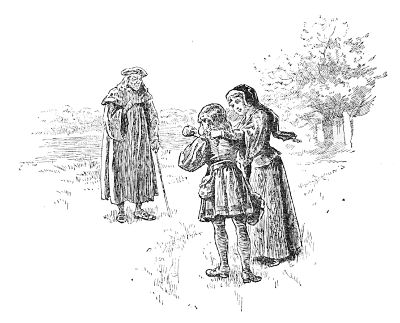
This Morn I had risen before Dawn,
being minded to meditate on sundrie
Matters before Bess was up and doing,
she being given to much Talk during
her dressing, and made my Way to the
Pavilion, where, methought, I should
be quiet enow; but beholde! Father and
Erasmus were there before me, in fluent
and earneste Discourse. I would have
withdrawne, but Father, without interrupting
his Sentence, puts his Arm rounde
me and draweth me to him; soe there I
sit, my Head on 's Shoulder, and mine
Eyes on Erasmus his Face.
From much they spake, and othermuch
I guessed, they had beene conversing on
the present State of the Church, and how
much it needed Renovation.
Erasmus sayd, the Vices of the Clergy
and Ignorance of the Vulgar had now
come to a Poynt, at the which, a Remedie
must be founde, or the whole Fabric
would falle to Pieces.
—Sayd, the Revival of Learning seemed
appoynted by Heaven for some greate Purpose,
'twas difficulte to say how greate.
—Spake of the new Art of Printing,
and its possible Consequents.
—Of the active and fertile Minds at
present turning up new Ground and ferreting
out old Abuses.
—Of the Abuse of Monachism, and of
the evil Lives of Conventualls. In special,
of the Fanaticism and Hypocrisie of the
Dominicans.
Considered the Evills of the Times
such, as that Societie must shortlie, by a
vigorous Effort, shake 'em off.
Wondered at the Patience of the Laitie
for soe many Generations, but thoughte
'em now waking from theire Sleepe. The
People had of late begunne to know theire
physickall Power, and to chafe at the
Weighte of theire Yoke.
Thoughte the Doctrine of Indulgences
altogether bad and false.
Father sayd, that the graduallie increast
Severitie of Church Discipline concerning
minor Offences had become such as to
render Indulgences the needfulle Remedie
for Burthens too heavie to be borne.—Condemned
a Draconic Code, that visitted
even Sins of Discipline with the extream
Penaltie. Quoted how ill such excessive
Severitie answered in our owne Land,
with regard to the Civill Law; twenty
Thieves oft hanging together on the
same Gibbet, yet Robberie noe Whit
abated.
Othermuch to same Purport, the which,
if alle set downe, woulde too soon fill my
Libellus. At length, unwillinglie brake
off, when the Bell rang us to Matins.
At Breakfaste, William and Rupert were
earneste with my Father to let 'em row
him to Westminster, which he was disinclined
to, as he was for more Speede, and
had promised Erasmus an earlie Caste to
Lambeth; howbeit, he consented that they
should pull us up to Putney in the Evening,
and William should have the Stroke-oar.
Erasmus sayd, he must thank the
Archbishop for his Present of a Horse;
"tho' I'm full faine," he observed, "to
believe it a Changeling. He is idle and
gluttonish, as thin as a Wasp, and as
ugly as Sin. Such a Horse, and such a
Rider!"
In the Evening Will and Rupert had
made 'emselves spruce enow, with Nosegays
and Ribbons, and we tooke Water
bravelie;—John Harris in the Stern, playing
the Recorder. We had the six-oared
Barge; and when Rupert Allington was
tired of pulling, Mr. Clement tooke his
Oar; and when he wearied, John Harris
gave over playing the Pipe; but William
and Mr. Gunnel never flagged.
Erasmus was full of his Visitt to the
Archbishop, who, as usuall, I think, had
given him some Money.
"We sate down two hundred to
Table," sayth he; "there was Fish,
Flesh, and Fowl; but Wareham onlie
played with his Knife, and drank noe
Wine. He was very cheerfulle and
accessible; he knows not what Pride
is; and yet, of how much mighte he
be proude! What Genius! What Erudition!
what Kindnesse and Modesty!
From Wareham, who ever departed in
Sorrow?"
Landing at Fulham, we had a brave
Ramble thro' the Meadows. Erasmus,
noting the poor Children a gathering the
Dandelion and Milk-thistle for the Herb-market,
was avised to speak of forayn
Herbes and theire Uses, bothe for Food
and Medicine.
"For me," says Father, "there is manie
a Plant I entertayn in my Garden and
Paddock which the Fastidious woulde
caste forthe. I like to teache my Children
the Uses of common Things—to
know, for Instance, the Uses of the
Flowers and Weeds that grow in our
Fields and Hedges. Manie a poor
Knave's Pottage woulde be improved,
if he were skilled in the Properties of
the Burdock and Purple Orchis, Lady's-smock,
Brook-lime, and Old Man's
Pepper. The Roots of Wild Succory
and Water Arrow-head mighte agreeablie
change his Lenten Diet; and
Glasswort afford him a Pickle for his
Mouthfulle of Salt-meat. Then, there
are Cresses and Wood-sorrel to his
Breakfast, and Salep for his hot evening
Mess. For his Medicine, there is
Herb-twopence, that will cure a hundred
Ills; Camomile, to lull a raging
Tooth; and the Juice of Buttercup to
cleare his Head by sneezing. Vervain
cureth Ague; and Crowfoot affords the
leaste painfulle of Blisters. St. Anthony's
Turnip is an Emetic; Goose-grass
sweetens the Blood; Woodruffe is good
for the Liver; and Bindweed hath nigh
as much Virtue as the forayn Scammony.
Pimpernel promoteth Laughter;
and Poppy, Sleep: Thyme giveth
pleasant Dreams; and an Ashen Branch
drives evil Spirits from the Pillow. As
for Rosemarie, I lett it run alle over
my Garden Walls, not onlie because my
Bees love it, but because 'tis the Herb
sacred to Remembrance, and, therefore,
to Friendship, whence a Sprig of it
hath a dumb Language that maketh
it the chosen Emblem at our Funeral
Wakes, and in our Buriall Grounds.
Howbeit, I am a Schoolboy prating in
Presence of his Master, for here is John
Clement at my Elbow, who is the best
Botanist and Herbalist of us all."
—Returning Home, the Youths being
warmed with rowing, and in high Spiritts,
did entertayn themselves and us with
manie Jests and Playings upon Words,
some of 'em forced enow, yet provocative
of Laughing. Afterwards, Mr. Gunnel
proposed Enigmas and curious Questions.
Among others, he woulde know which
of the famous Women of Greece or
Rome we Maidens would resemble. Bess
was for Cornelia, Daisy for Clelia, but I
for Damo, Daughter of Pythagoras, which
William Roper deemed stupid enow, and
thoughte I mighte have found as good a
Daughter, that had not died a Maid.
Sayth Erasmus, with his sweet, inexpressible
Smile, "Now I will tell you, Lads
and Lasses, what manner of Man I would
be, if I were not Erasmus. I woulde
step back some few Years of my Life,
and be half-way 'twixt thirty and forty;
I would be pious and profounde enow
for the Church, albeit noe Churchman;
I woulde have a blythe, stirring, English
Wife, and half-a-dozen merrie Girls
and Boys, an English Homestead, neither
Hall nor Farm, but betweene both;
neare enow to the Citie for Convenience,
but away from its Noise. I
woulde have a Profession, that gave me
some Hours daylie of regular Businesse,
that should let Men know my Parts,
and court me into Publick Station, for
which my Taste made me rather withdrawe.
I woulde have such a private
Independence, as should enable me to
give and lend, rather than beg and
borrow. I woulde encourage Mirthe
without Buffoonerie, Ease without
Negligence; my Habitt and Table
shoulde be simple, and for my Looks
I woulde be neither tall nor short, fat
nor lean, rubicund nor sallow, but of
a fayr Skin with blue Eyes, brownish
Beard, and a Countenance engaging and
attractive, soe that alle of my Companie
coulde not choose but love me."
"Why, then, you woulde be Father
himselfe," cries Cecy, clasping his Arm
in bothe her Hands with a Kind of Rapture;
and, indeede, the Portraiture was
soe like, we coulde not but smile at the
Resemblance.
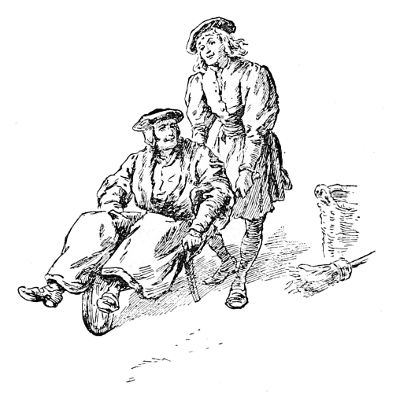
Arrived at the Landing, Father protested
he was wearie with his Ramble;
and, his Foot slipping, he wrenched his
Ankle, and sate for an Instante on a
Barrow, the which one of the Men had
left with his Garden-tools, and before he
could rise or cry out, William, laughing,
rolled him up to the House-door; which,
considering Father's Weight, was much
for a Stripling to doe. Father sayd the
same, and, laying his Hand on Will's
Shoulder with Kindnesse, cried, "Bless
thee, my Boy, but I woulde not have thee
overstrayned like Biton and Cleobis."
June 20.
T
his Morn, hinting to Bess
that she was lacing herselfe
too straitlie, she brisklie replyed,
"One would think
'twere as great Meritt to
have a thick Waiste as to be one of the
earlie Christians!"
These humourous Retorts are ever at
her Tongue's end; and albeit, as Jacky
one Day angrilie remarked when she had
beene teazing him, "Bess, thy Witt is
Stupidnesse;" yet, for one who talks
soe much at Random, no one can be more
keene when she chooseth. Father sayd of
her, half fondly, half apologeticallie, to
Erasmus, "Her Wit hath a fine Subtletie
that eludes you almoste before you have
Time to recognize it for what it really
is." To which Erasmus readilie assented,
adding, that it had the rare Meritt of
playing less on Persons than Things, and
never on bodilie Defects.
Hum!—I wonder if they ever sayd as
much in Favour of me. I know, indeede,
Erasmus calls me a forward Girl. Alas!
that may be taken in two Senses.
Grievous Work, overnighte, with the
churning. Nought would persuade Gillian
but that the Creame was bewitched by
Gammer Gurney, who was dissatisfyde last
Friday with her Dole, and hobbled away
mumping and cursing. At alle Events,
the Butter would not come; but Mother
was resolute not to have soe much good
Creame wasted; soe sent for Bess and me,
Daisy and Mercy Giggs; and insisted on
our churning in turn till the Butter came,
if we sate up alle Night for 't. 'Twas a
hard Saying; and mighte have hampered
her like as Jephtha his rash Vow: howbeit,
soe soone as she had left us, we turned
it into a Frolick, and sang Chevy Chase
from end to end, to beguile Time; ne'erthelesse,
the Butter would not come; soe
then we grew sober, and, at the Instance
of sweete Mercy, chaunted the 119th
Psalme; and, by the Time we had
attained to "Lucerna Pedibus," I hearde
the Buttermilk separating and splashing in
righte earneste. 'Twas neare Midnighte,
however; and Daisy had fallen asleep on
the Dresser. Gillian will ne'er be convinced
but that our Latin brake the Spell.
21st.
Erasmus went to Richmond
this Morning with Polus,
(for soe he Latinizes Reginald
Pole, after his usual
Fashion,) and some other
of his Friends. On his Return, he made
us laugh at the following. They had
clomb the Hill, and were admiring the
Prospect, when Pole, casting his Eyes aloft,
and beginning to make sundrie Gesticulations,
exclaimed, "What is it I beholde?
May Heaven avert the Omen!" with
suchlike Exclamations, which raised the
Curiositie of alle. "Don't you beholde,"
cries he, "that enormous Dragon flying
through the Sky? his Horns of Fire?
his curly Tail?"
"No," says Erasmus, "nothing like it.
The Sky is as cleare as unwritten
Paper."
Howbeit, he continued to affirme and
to stare, untill at lengthe, one after another,
by dint of strayning theire Eyes and theire
Imaginations, did admitt, first, that they
saw Something; next, that it mighte be
a Dragon; and last, that it was. Of
course, on theire Passage homeward, they
could talk of little else—some made serious
Reflections; others, philosophicall Speculations;
and Pole waggishly triumphed in
having beene the Firste to discerne the
Spectacle.
"And you trulie believe there was a
Signe in the Heavens?" we inquired
of Erasmus.
"What know I?" returned he smiling;
"you know, Constantine saw a Cross.
Why shoulde Polus not see a Dragon?
We must judge by the Event. Perhaps
its Mission may be to fly away with
him. He swore to the curly Tail."
How difficulte it is to discerne the
supernatural from the incredible! We
laughe at Gillian's Faith in our Latin;
Erasmus laughs at Polus his Dragon.
Have we a righte to believe noughte but
what we can see or prove? Nay, that
will never doe. Father says a Capacitie
for reasoning increaseth a Capacitie for
believing. He believes there is such a
Thing as Witchcraft, though not that
poore olde Gammer Gurney is a Witch;
he believes that Saints can work Miracles,
though not in alle the Marvels reported
of the Canterbury Shrine.
Had I beene Justice of the Peace, like
the King's Grandmother, I would have
beene very jealous of Accusations of
Witchcraft; and have taken infinite Payns
to sift out the Causes of Malice, Jealousie,
&c., which mighte have wroughte with
the poore olde Women's Enemies. Holie
Writ sayth, "Thou shalt not suffer a
Witch to live;" but, questionlesse,
manie have suffered Hurte that were
noe Witches; and for my Part, I have
alwaies helde ducking to be a very uncertayn
as well as very cruel Teste.
I cannot helpe smiling, whenever I
think of my Rencounter with William this
Morning. Mr. Gunnell had set me Homer's
tiresome List of Ships; and, because of
the excessive Heate within Doors, I took
my Book into the Nuttery, to be beyonde
the Wrath of far-darting Phœbus Apollo,
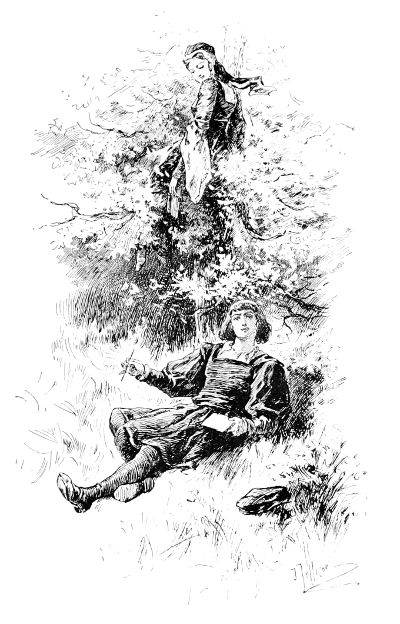
where I clomb into my favourite Filbert
Seat. Anon comes William through the
Trees without seeing me; and seats
him at the Foot of my Filbert; then,
out with his Tablets, and, in a Posture
I should have called studdied, had
he known anie one within Sighte, falls
a poetizing, I question not. Having
noe Mind to be interrupted, I lett him
be, thinking he would soone exhaust the
Vein; but a Caterpillar dropping from
the Leaves on to my Page, I was fayn,
for Mirthe sake, to shake it down on his
Tablets. As ill Luck would have it, however,
the little Reptile onlie fell among
his Curls; which soe took me at Vantage
that I coulde not helpe hastilie crying,
"I beg your Pardon." 'Twas worth a
World to see his Start! "Why!" cries
he, looking up, "are there indeede Hamadryads?"
and would have gallanted
a little, but I bade him hold down his
Head, while that with a Twig I switched
off the Caterpillar. Neither coulde forbeare
laughing; and then he sued me to
step downe, but I was minded to abide
where I was. Howbeit, after a Minute's
Pause, he sayd, in a grave, kind Tone,
"Come, little Wife;" and taking mine Arm
steadilie in his Hand, I lost my Balance
and was faine to come down whether or
noe. We walked for some Time juxta
Fluvium; and he talked not badlie of his
Travels, insomuch as I founde there was
really more in him than one would think.
—Was there ever Aniething soe perverse,
unluckie, and downrighte disagreeable?
We hurried our Afternoone Tasks,
to goe on the Water with my Father;
and, meaning to give Mr. Gunnel my
Latin Traduction, which is in a Booke
like unto this, I never knew he had my
Journalle insteade, untill that he burst
out a laughing. "Soe this is the famous
Libellus," quoth he.... I never waited
for another Word, but snatcht it out
of his Hand; which he, for soe strict a
Man, bore well enow. I do not believe
he could have read a Dozen Lines, and
they were towards the Beginning; but I
should hugelie like to know which Dozen
Lines they were.
Hum! I have a Mind never to write
another Word. That will be punishing
myselfe, though, insteade of Gunnel. And
he bade me not take it to Heart like the
late Bishop of Durham, to whom a like
Accident befel, which soe annoyed him
that he died of Chagrin. I will never
again, howbeit, write Aniething savouring
ever soe little of Levitie or Absurditie.
The Saints keepe me to it! And, to
know it from my Exercise Book, I will
henceforthe bind a blue Ribbon round it.
Furthermore, I will knit the sayd Ribbon
in soe close a Knot, that it shall be worth
no one else's Payns to pick it out. Lastlie,
and for entire Securitie, I will carry the
Same in my Pouch, which will hold
bigger Matters than this.
22nd.

This Daye, at Dinner, Mr.
Clement tooke the Pistoller's
Place at the Reading-desk;
and, insteade of continuing
the Subject in Hand, read
a Paraphrase of the 103rde Psalm; the
Faithfulnesse and elegant Turne of which,
Erasmus highlie commended, though he
took Exceptions to the Phrase "renewing
thy Youth like that of the Phœnix,"
whose fabulous Story he believed to have
beene unknowne to the Psalmist, and,
therefore, however poeticall, unfitt to be
introduced. A deepe Blush on sweet
Mercy's Face ledd to the Detection of the
Paraphrast, and drew on her some deserved
Commendations. Erasmus, turning
to my Father, exclaymed with Animation,
"I woulde call this House the
Academy of Plato, were it not Injustice
to compare it to a Place where the
usuall Disputations concerning Figures
and Numbers were onlie occasionallie
intersperst with Disquisitions concerning
the moral Virtues." Then, in a graver
Mood, he added, "One mighte envie you,
but that your precious Privileges are
bound up with soe paynfulle Anxieties.
How manie Pledges have you given to
Fortune!"
"If my Children are to die out of the
Course of Nature, before theire Parents,"
Father firmly replyed, "I would rather
they died well-instructed than ignorant."
"You remind me," rejoyns Erasmus,
"of Phocion; whose Wife, when he was
aboute to drink the fatal Cup, exclaimed,
'Ah, my Husband! you die
innocent.' 'And woulde you, my
Wife,' he returned, 'have me die
guilty?'"
Awhile after, Gonellus askt leave to see
Erasmus his Signet-ring, which he handed
down to him. In passing it back, William,
who was occupyde in carving a Crane,
handed it so negligentlie that it felle to
the Ground. I never saw such a Face
as Erasmus made, when 'twas picked out
from the Rushes! And yet, ours are renewed
almost daylie, which manie think
over nice. He took it gingerlie in his
faire, Woman-like Hands, and washed
and wiped it before he put it on; which
escaped not my Step-mother's displeased
notice. Indeede, these Dutchmen are
scrupulouslie cleane, though Mother calls
'em swinish, because they will eat raw
Sallets; though, for that Matter, Father
loves Cresses and Ramps. She alsoe mislikes
Erasmus for eating Cheese and Butter
together with his Manchet; or what he
calls Boetram; and for being, generallie,
daintie at his Sizes, which she sayth is an
ill Example to soe manie young People,
and becometh not one with soe little
Money in 's Purse: howbeit, I think 'tis
not Nicetie, but a weak Stomach, which
makes him loathe our Salt-meat Commons
from Michaelmasse to Easter, and
eschew Fish of the coarser Sort. He
cannot breakfaste on colde Milk, like
Father, but liketh Furmity a little spiced.
At Dinner, he pecks at, rather than eats,
Ruffs and Reeves, Lapwings, or anie
smalle Birds it may chance; but affects
Sweets and Subtilties, and loves a Cup
of Wine or Ale, stirred with Rosemary.
Father never toucheth the Wine-cup but
to grace a Guest, and loves Water from
the Spring. We growing Girls eat more
than either; and Father says he loves to
see us slice away at the Cob-loaf; it does
him goode. What a kind Father he is!
I wish my Step-mother were as kind. I
hate all sneaping and snubbing, flowting,
fleering, pinching, nipping, and such-like;
it onlie creates Resentment insteade of
Penitence, and lowers the Minde of either
Partie. Gillian throws a Rolling-pin at
the Turnspit's Head, and we call it Low-life;
but we looke for such Unmannerlinesse
in the Kitchen. A Whip is onlie
fit for Tisiphone.
As we rose from Table, I noted Argus
pearcht on the Window-sill, eagerlie
watching for his Dinner, which he looketh
for as punctuallie as if he could tell the
Diall; and to please the good, patient
Bird, till the Scullion broughte him his
Mess of Garden-stuff, I fetched him some
Pulse, which he took from mine Hand,
taking good Heede not to hurt me with
his sharp Beak. While I was feeding
him, Erasmus came up, and asked me
concerning Mercy Giggs; and I tolde him
how that she was a friendlesse Orphan,
to whom deare Father afforded Protection
and the run of the House; and tolde
him of her Gratitude, her Meekness, her
Patience, her Docilitie, her Aptitude for
alle goode Works and Alms-deeds; and
how, in her little Chamber, she improved
eache spare Moment in the Way of Studdy
and Prayer. He repeated "Friendlesse?
she cannot be called Friendlesse, who
hath More for her Protector, and his
Children for Companions;" and then
woulde heare more of her Parents' sad
Story. Alsoe, would hear somewhat of
Rupert Allington, and how Father gained
his Lawsuit. Alsoe, of Daisy, whose
Name he tooke to be the true Abbreviation
for Margaret, but I tolde him how
that my Step-sister, and Mercy, and I,
being all three of a Name, and I being
alwaies called Meg, we had in Sport given
one the Significative of her characteristic
Virtue, and the other that of the French
Marguerite, which may indeed be rendered
either Pearl or Daisy. And Chaucer,
speaking of our English Daisy, saith
"Si douce est la Marguerite."
23rd.
Since the little Wisdom I
have Capacitie to acquire,
soe oft gives me the
Headache to Distraction,
I marvel not at Jupiter's
Payn in his Head, when the Goddess of
Wisdom sprang therefrom full growne.
This Morn, to quiet the Payn brought
on by too busie Application, Mr. Gunnel
would have me close my Book and ramble
forth with Cecy into the Fields. We
strolled towards Walham Greene; and she
was seeking for Shepherd's Purses and
Shepherd's Needles, when she came running
back to me, looking rather pale. I
askt what had scared her, and she made
answer that Gammer Gurney was coming
along the Hedge. I bade her set aside
her Feares; and anon we came up with
Gammer, who was pulling at the purple
Blossoms of the Deadly Nightshade. I
sayd, "Gammer, to what Purpose gather
that Weed? knowest not 'tis Evill?"
She sayth, mumbling, "What God
hath created, that call not thou evill."
"Well, but," quo' I, "'tis Poison."
"Aye, and Medicine too," returns
Gammer. "I wonder what we poor Souls
might come to, if we tooke Nowt for
our Ails and Aches but what we could
buy o' the Potticary. We've got noe
Dr. Clement, we poor Folks, to be our
Leech o' the Household."
"But hast no Feare," quo' I, "of an
Over-dose?"
"There's manie a Doctor," sayth she,
with an unpleasant Leer, "that hath
given that at first. In Time he gets
his Hand in; and I've had a Plenty o'
Practice—Thanks to Self and Sister."
"I knew not," quoth I, "that thou
hadst a Sister."
"How should ye, Mistress," returns she
shortlie, "when ye never comes nigh us?
We've grubbed on together this many
a Year."
"'Tis soe far," I returned, half ashamed.
"Why, soe it be," answers Gammer;
"far from Neighbours, far from Church,
and far from Priest; howbeit, my old
Legs carries me to your House o'
Fridays; but I know not whether I
shall e'er come agayn—the Rye Bread
was soe hard last Time; it may serve
for young Teeth, and for them as
has got none; but mine, you see, are
onlie on the goe;" and she opened her
Mouth with a ghastly Smile. "'Tis
not," she added, "that I'm ungratefulle;
but thou sees, Mistress, I really
can't eat Crusts."
After a Moment, I asked, "Where lies
your Dwelling?"
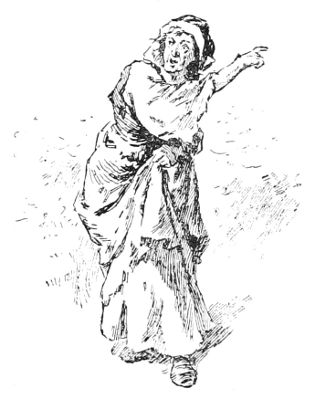
"Out by yonder," quoth she, pointing
to a shapeless Mass like a huge Bird's
Nest in the Corner of the Field. "There
bides poor Joan and I. Wilt come and
looke within, Mistress, and see how a
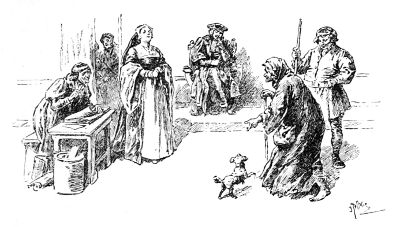
Christian can die?"
I mutelie complyed, in spite of Cecy's
pulling at my Skirts. Arrived at the
wretched Abode, which had a Hole for
its Chimney, and another for Door at
once and Window, I found, sitting in a
Corner, propped on a Heap of Rushes,
dried Leaves, and olde Rags, an aged sick
Woman, who seemed to have but a little
While to live. A Mug of Water stoode
within her Reach; I saw none other
Sustenance; but, in her Visage, oh, such
Peace!... Whispers Gammer with an
awfulle Look, "She sees 'em now!"
"Sees who?" quoth I.
"Why, Angels in two long Rows, afore
the Throne of God, a bending of themselves,
this Way, with theire Faces to
th' Earth, and Arms stretched out afore
'em."
"Hath she seen a Priest?" quoth I.
"Lord love ye," returns Gammer, "what
coulde a Priest doe for her? She's in
Heaven alreadie. I doubte if she can
heare me." And then, in a loud, distinct
Voyce, quite free from her usuall
Mumping, she beganne to recite in English,
"Blessed is every one that feareth
the Lord, and walketh in his Ways,"
etc.; which the dying Woman hearde,
although alreadie speechlesse; and reaching
out her feeble Arm unto her Sister's
Neck, she dragged it down till their Faces
touched; and then, looking up, pointed
at Somewhat she aimed to make her see
... and we alle looked up, but saw
Noughte. Howbeit, she pointed up three
severall Times, and lay, as it were, transfigured
before us, a gazing at some transporting
Sighte, and ever and anon turning
on her Sister Looks of Love; and, the
While we stoode thus agaze, her Spiritt
passed away without even a Thrill or a
Shudder. Cecy and I beganne to weepe;
and, after a While, soe did Gammer;
then, putting us forthe, she sayd, "Goe,
Children, goe; 'tis noe goode crying;
and yet I'm thankfulle to ye for your
Teares."
I sayd, "Is there Aught we can doe
for thee?"
She made Answer, "Perhaps you can
give me Tuppence, Mistress, to lay on
her poor Eyelids and keep 'em down.
Bless 'ee, bless 'ee! You're like the
good Samaritan—he pulled out Twopence.
And maybe, if I come to 'ee
To-morrow, you'll give me a Lapfulle
of Rosemarie, to lay on her poor Corpse....
I know you've Plenty. God be
with 'ee, Children; and be sure ye
mind how a Christian can die."
Soe we left, and came Home sober
enow. Cecy sayth, "To die is not soe
fearfulle, Meg, as I thoughte, but shoulde
you fancy dying without a Priest? I
shoulde not; and yet Gammer sayd she
wanted not one. Howbeit, for certayn,
Gammer Gurney is noe Witch, or she
would not soe prayse God."
To conclude, Father, on hearing Alle,
hath given Gammer more than enow for
her present Needes; and Cecy and I are
the Almoners of his Mercy.
June 24th.
Yesternighte, being
St. John's Eve, we went
into Town to see the
mustering of the Watch.
Mr. Rastall had secured
us a Window opposite the King's Head,
in Chepe, where theire Majestys went in
State to see the Show. The Streets were
a Marvell to see, being like unto a
Continuation of fayr Bowres or Arbours,
garlanded acrosse and over the Doors
with greene Birch, long Fennel, Orpin,
St. John's Wort, white Lilies, and such
like; with innumerable Candles intersperst,
the which, being lit up as soon
as 'twas Dusk, made the Whole look
like enchanted Land; while, at the same
Time, the leaping over Bon-fires commenced,
and produced Shouts of Laughter.
The Youths woulde have had Father goe
downe and joyn 'em; Rupert, speciallie,
begged him hard, but he put him off
with, "Sirrah, you Goose-cap, dost think
'twoulde befitt the Judge of the Sheriffs'
Court?"
At length, to the Sound of Trumpets,
came marching up Cheapside two Thousand
of the Watch, in white Fustian,
with the City Badge; and seven hundred
Cressett Bearers, eache with his Fellow
to supplie him with Oyl, and making,
with theire flaring Lights, the Night as
cleare as Daye. After 'em, the Morris-dancers
and City Waites; the Lord Mayor
on horseback, very fine, with his Giants
and Pageants; and the Sheriff and his
Watch, and his Giants and Pageants. The
Streets very uproarious on our way back
to the Barge, but the homeward Passage
delicious; the Nighte Ayre cool; and
the Stars shining brightly. Father and
Erasmus had some astronomick Talk;
howbeit, methoughte Erasmus less familiar
with the heavenlie Bodies than Father is.
Afterwards they spake of the King, but
not over-freelie, by reason of the Bargemen
overhearing. Thence, to the ever-vext
Question of Martin Luther, of whome
Erasmus spake in Terms of earneste, yet
qualifyde Prayse.
"If Luther be innocent," quoth he, "I
woulde not run him down by a wicked
Faction; if he be in Error, I woulde
rather have him reclaymed than destroyed;
for this is most agreeable to
the Doctrine of our deare Lord and
Master, who woulde not bruise the
broken Reede, nor quenche the smoking
Flax." And much more to same
Purpose.
We younger Folks felle to choosing
our favourite Mottoes and Devices, in
which the Elders at length joyned us.
Mother's was loyal—"Cleave to the Crown
though it hang on a Bush." Erasmus's
pithie—"Festina lente." William sayd he
was indebted for his to St. Paul—"I
seeke not yours, but you." For me, I
quoted one I had seene in an olde Countrie
Church, "Mieux être que paroître,"
which pleased Father and Erasmus much.
June 25th.
Poor Erasmus caughte colde
on the Water last Nighte,
and keeps House to-daye,
taking warm Possets. 'Tis
my Week of Housekeeping
under Mother's Guidance, and I never
had more Pleasure in it; delighting to
suit his Taste in sweete Things, which,
methinks, all Men like. I have enow of
Time left for Studdy, when alle's done.
He hathe beene the best Part of the
Morning in our Academia, looking over
Books and Manuscripts, taking Notes of
some, discoursing with Mr. Gunnel on
others; and, in some Sorte, interrupting
our Morning's Work; but how pleasantlie!
Besides, as Father sayth, "Varietie
is not always Interruption. That
which occasionallie lets and hinders our
accustomed Studdies, may prove to the
ingenious noe less profitable than theire
Studdies themselves."
They beganne with discussing the Pronunciation
of Latin and Greek, on which
Erasmus differeth much from us, though
he holds to our Pronunciation of the
Theta. Thence, to the absurde Partie of
the Ciceronians now in Italie, who will
admit noe Author save Tully to be read
nor quoted, nor any Word not in his
Writings to be used. Thence to the
Latinitie of the Fathers, of whose Style
he spake slightlie enow, but rated Jerome
above Augustine. At length, to his Greek
and Latin Testament, of late issued from
the Presse, and the incredible Labour it
hath cost him to make it as perfect as
possible: on this Subject he so warmed
that Bess and I listened with suspended
Breath. "May it please God," sayth he,
knitting ferventlie his Hands, "to make
it a Blessing to all Christendom! I
look for noe other Reward. Scholars
and Believers yet unborn may have
Reason to thank, and yet may forget
Erasmus." He then went on to explain
to Gunnel what he had much felt in want
of, and hoped some Scholar might yet
undertake; to wit, a Sort of Index Bibliorum,
showing in how manie Passages of
Holy Writ occurreth anie given Word,
etc.; and he e'en proposed it to Gunnel,
saying 'twas onlie the Work of Patience
and Industry, and mighte be layd aside,
and resumed as Occasion offered, and
completed at Leisure, to the great Thankfullenesse
of Scholars. But Gunnel onlie
smiled and shooke his Head. Howbeit,
Erasmus set forth his Scheme soe playnlie,
that I, having a Pen in Hand, did privilie
note down alle the Heads of the same,
thinking, if none else would undertake
it, why should not I? since Leisure and
Industrie were alone required, and since
'twoulde be soe acceptable to manie,
'speciallie to Erasmus.
June 29th.
Hearde Mother say to Barbara,
"Be sure the Sirloin is
well basted for the King's
Physician;" which avised
me that Dr. Linacre was
expected. In Truth, he returned with
Father in the Barge; and they tooke a
Turn on the River Bank before sitting
down to Table. I noted them from my
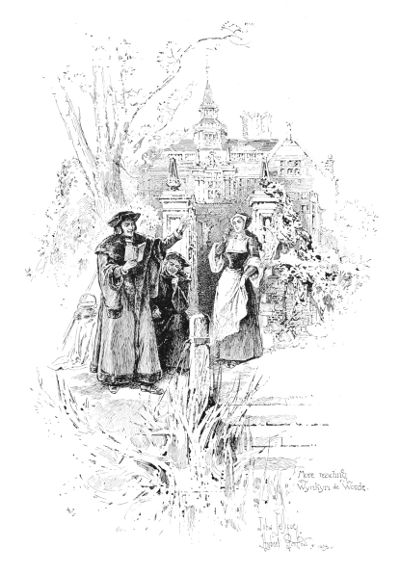
Lattice; and anon, Father, beckoning me,
cries, "Child, bring out my favourite
Treatyse on Fisshynge, printed by
Wynkyn de Worde; I must give the
Doctor my loved Passage."
Joyning 'em with the Booke, I found
Father telling him of the Roach, Dace,
Chub, Barbel, etc., we oft catch opposite
the Church; and hastilie turning over
the Leaves, he beginneth with Unction
to read the Passage ensuing, which I love
to the full as much as he:—
He observeth, if the Angler's Sport
shoulde fail him, "he at the best hathe
his holsom Walk and mery at his Ease,
a swete Ayre of the swete Savour of the
Meade of Flowers, that maketh him
hungry; he heareth the melodious Harmonie
of Fowles, he seeth the young
Swans, Herons, Ducks, Cotes, and manie
other Fowles, with theire Broods, which
me seemeth better than alle the Noise
of Hounds, Faukenors, and Fowlers can
make. And if the Angler take Fysshe,
then there is noe Man merrier than he
is in his Spryte." And, "Ye shall not
use this foresaid crafty Disporte for no
covetysnesse in the encreasing and sparing
of your Money onlie, but pryncipallie
for your Solace, and to cause the
Health of your Bodie, and speciallie of
your Soule, for when ye purpose to goe
on your Disportes of Fysshynge, ye will
not desire greatlie manie Persons with
you, which woulde lett you of your
Game. And thenne ye may serve God
devoutlie, in saying affectuouslie your
customable Prayer; and thus doing, ye
shall eschew and voyd manie Vices."
More reading Wynkyn de Worde.
"Angling is itselfe a Vice," cries Erasmus,
from the Thresholde; "for my Part
I will fish none, save and except for
pickled Oysters."
"In the Regions below," answers
Father; and then laughinglie tells Linacre
of his firste Dialogue with Erasmus, who
had beene feasting in my Lord Mayor's
Cellar:—"'Whence come you?' 'From
below.' 'What were they about there?'
'Eating live Oysters, and drinking out
of Leather Jacks.' 'Either you are
Erasmus,' etc. 'Either you are More
or Nothing.'"
"'Neither more nor less,' you should
have rejoyned," sayth the Doctor.
"How I wish I had!" says Father;
"don't torment me with a Jest I might
have made and did not make; 'speciallie
to put downe Erasmus."
"Concedo nulli," sayth Erasmus.
"Why are you so lazy?" asks Linacre;
"I am sure you can speak English if you
will."
"Soe far from it," sayth Erasmus, "that
I made my Incapacitie an Excuse for
declining an English Rectory. Albeit,
you know how Wareham requited me;
saying, in his kind, generous Way, I
served the Church more by my Pen
than I coulde by preaching Sermons in
a countrie Village."
Sayth Linacre, "The Archbishop hath
made another Remark, as much to the
Purpose: to wit, that he has received
from you the Immortalitie which Emperors
and Kings cannot bestow."
"They cannot even bid a smoking
Sirloin retain its Heat an Hour after
it hath left the Fire," sayth Father.
"Tilly-vally! as my good Alice says,—let
us remember the universal Doom,
'Fruges consumere nati,' and philosophize
over our Ale and Bracket."
"Not Cambridge Ale, neither," sayth
Erasmus.
"Will you never forget that unlucky
Beverage?" sayth Father. "Why, Man,
think how manie poor Scholars there
be, that content themselves, as I have
hearde one of St. John's declare, with a
penny piece of Beef amongst four, stewed
into Pottage with a little Salt and Oatmeal;
and that after fasting from four
o'clock in the Morning! Say Grace for
us this Daye, Erasmus, with goode Heart."
At Table, Discourse flowed soe thicke
and faste that I mighte aim in vayn to
chronicle it—and why should I? dwelling
as I doe at the Fountayn Head? Onlie
that I find Pleasure, alreadie, in glancing
over the foregoing Pages whensoever they
concern Father and Erasmus, and wish
they were more faithfullie recalled and
better writ. One Thing sticks by me,—a
funny Reply of Father's to a Man who
owed him Money and who put him off
with "Memento Morieris." "I bid you,"
retorted Father, "Memento Mori Æris, and
I wish you woulde take as goode Care to
provide for the one as I do for the other."
Linacre laughed much at this, and sayd,—"That
was real Wit; a Spark struck
at the Moment; and with noe Ill-nature
in it, for I am sure your Debtor
coulde not help laughing."
"Not he," quoth Erasmus. "More's
Drollerie is like that of a young Gentlewoman
of his Name, which shines without
burning," ... and, oddlie enow,
he looked acrosse at me. I am sure he
meant Bess.
July 1st.

Father broughte home a
strange Guest to-daye,—a
converted Jew, with
grizzlie Beard, furred
Gown, and Eyes that
shone like Lamps lit in dark Cavernes.
He had beene to Benmarine and Tremeçen,
to the Holie Citie and to Damascus, to
Urmia and Assyria, and I think alle over
the knowne World; and tolde us manie
strange Tales, one hardlie knew how to
believe; as, for Example, of a Sea-coast
Tribe, called the Balouches, who live on
Fish and build theire Dwellings of the
Bones. Alsoe, of a Race of his Countriemen
beyond Euphrates who believe in
Christ, but know nothing of the Pope;
and of whom were the Magians that
followed the Star. This agreeth not with
our Legend. He averred that, though
soe far apart from theire Brethren, theire
Speech was the same, and even theire
Songs; and he sang or chaunted one
which he sayd was common among the
Jews alle over the World, and had beene
soe ever since theire Citie was ruinated
and the People captivated, and yet it was
never sett down in Prick-song. Erasmus,
who knows little or nought of Hebrew,
listened to the Words with Curiositie,
and made him repeate them twice or
thrice: and though I know not the
Character, it seemed to me they sounded
thus:—
Adir Hu yivne bethcha beccaro,
El, b'ne; El, b'ne; El, b'ne;
Bethcha beccaro.
Though Christianish, he woulde not
eat Pig's Face; and sayd Swine's Flesh
was forbidden by the Hebrew Law for
its unwholesomenesse in hot Countries
and hot Weather, rather than by way
of arbitrarie Prohibition. Daisy took a
great Dislike to this Man, and woulde
not sit next him.
In the Hay-field alle the Evening.
Swathed Father in a Hay-rope, and made
him pay the Fine, which he pretended
to resist. Cecy was just about to cast
one round Erasmus, when her Heart
failed and she ran away, colouring to
the Eyes. He sayd, he never saw such
pretty Shame. Father reclining on the
Hay, with his Head on my Lap and his
Eyes shut, Bess asked if he were asleep.
He made answer, "Yes, and dreaming."
I askt, "Of what?" "Of a far-off
future Daye, Meg; when thou and I
shall looke back on this Hour, and this
Hay-field, and my Head on thy Lap."
"Nay, but what a stupid Dream, Mr.
More," says Mother. "Why, what
woulde you dreame of, Mrs. Alice?"
"Forsooth, if I dreamed at alle, when I
was wide awake, it shoulde be of being
Lord Chancellor at the leaste." "Well,
Wife, I forgive thee for not saying at
the most. Lord Chancellor, quotha!
And you woulde be Dame Alice, I trow,
and ride in a Whirlecote, and keep a
Spanish Jennet, and a Couple of Greyhounds,
and wear a Train before and
behind, and carry a Jerfalcon on your
Fist." "On my Wrist." "No, that's
not such a pretty Word as t'other! Go
to, go!"
Straying from the others, to a remote
Corner of the Meadow, or ever I was
aware, I came close upon Gammer Gurney,
holding Somewhat with much Care.
"Give ye good den, Mistress Meg," quoth
she, "I cannot abear to rob the Birds of
theire Nests; but I knows you and
yours be kind to dumb Creatures, soe
here's a Nest o' young Owzels for ye—and
I can't call 'em dumb nowther, for
they'll sing bravelie some o' these Days."
"How hast fared, of late, Gammer?"
quoth I. "Why, well enow for such as
I," she made Answer; "since I lost the
Use o' my right Hand, I can nowther
spin, nor nurse sick Folk, but I pulls
Rushes, and that brings me a few Pence,
and I be a good Herbalist; onlie, because
I says one or two English Prayers,
and hates the Priests, some Folks thinks
me a Witch." "But why dost hate the
Priests?" quoth I. "Never you mind,"
she gave Answer, "I've Reasons manie;
and for my English Prayers, they were
taught me by a Gentleman I nursed,
that's now a Saint in Heaven, along
with poor Joan."
And soe she hobbled off, and I felt
kindlie towards her, I scarce knew why—perhaps
because she spake soe lovingly
of her dead Sister, and because of that
Sister's Name. My Mother's Name was
Joan.
July 2nd.
Erasmus is gone. His
last Saying to Father was,
"They will have you at
Court yet;" and Father's
Answer, "When Plato's
Year comes round."
To me he gave a Copy, how precious!
of his Testament. "You are an elegant
Latinist, Margaret," he was pleased to
say, "but, if you woulde drink deeplie
of the Well-springs of Wisdom, applie
to Greek. The Latins have onlie
shallow Rivulets; the Greeks, copious
Rivers, running over Sands of Gold.
Read Plato; he wrote on Marble, with
a Diamond; but above alle, read the
New Testament. 'Tis the Key to the
Kingdom of Heaven."
To Mr. Gunnel, he said smiling, "Have
a Care of thyself, dear Gonellus, and
take a little Wine for thy Stomach's
Sake. The Wages of most Scholars
now-a-days, are weak Eyes, Ill-health,
an empty Purse, and shorte Commons.
I neede only bid thee beware of the
two first."
To Bess, "Farewell, Bessy; thank you
for mending my bad Latin. When I
write to you, I will be sure to signe
myselfe, 'Roterodamius.' Farewell, sweete
Cecil; let me always continue your
'desired Amiable.' And you, Jacky,—love
your Book a little more."
"Jack's deare Mother, not content
with her Girls," sayth Father, "was
alwaies wishing for a Boy, and at last
she had one that means to remain a
Boy alle his Life."
"The Dutch Schoolmasters thoughte
me dulle and heavie," sayth Erasmus,
"soe there is some Hope of Jacky yet."
And soe, stepped into the Barge, which
we watched to Chelsea Reach. How dulle
the House has beene ever since! Rupert
and William have had me into the Pavillion
to hear the Plot of a Miracle-play
they have alreadie begunne to talke over
for Christmasse, but it seemed to me downrighte
Rubbish. Father sleepes in Town
to-nighte, soe we shall be stupid enow.
Bessy hath undertaken to work Father a
Slipper for his tender Foot; and is happie,
tracing for the Pattern our three Moorcocks
and Colts; but I am idle and
tiresome.
If I had Paper, I woulde beginne
my projected Opus; but I dare not ask
Gunnel for anie more just yet; nor have
anie Money to buy Some. I wish I had
a couple of Angels. I think I shall write
to Father for them to-morrow; he alwaies
likes to heare from us if he is twenty-four
Hours absent, providing we conclude not
with "I have Nothing more to say."
July 4th.
I have writ my Letter to
Father. I almoste wish,
now, that I had not sent it.
Rupert and Will still
full of theire Moralitie,
which reallie has some Fun in it. To
ridicule the Extravagance of those who,
as the Saying is, carry theire Farms and
Fields on theire Backs, William proposes
to come in, all verdant, with a reall Model
of a Farm on his Back, and a Windmill
on his Head.
July 5th.
How sweete, how gracious
an Answer from Father!
John Harris has broughte
me with it the two
Angels; less prized than
this Epistle.
July 10th.
Sixteenth Birthdaye.
Father away, which made
it sadde. Mother gave me
a payr of blue Hosen with
Silk Clocks; Mr. Gunnel,
an ivorie-handled Stylus; Bess, a Bodkin
for my Hair; Daisy, a Book-mark; Mercy,
a Saffron Cake; Jack, a Basket; and
Cecil, a Nosegay. William's Present was
fayrest of alle, but I am hurte with him
and myselfe; for he offered it soe queerlie
and tagged it with such ... I refused
it, and there's an End. 'Twas unmannerlie
and unkinde of me, and I've cried
aboute it since.
Father alwaies gives us a Birthdaye
Treat; soe, contrived that Mother shoulde
take us to see my Lord Cardinal of York
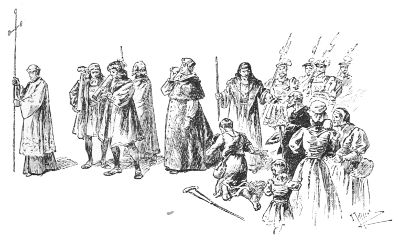
goe to Westminster in State. We had a
merrie Water-partie; got goode Places
and saw the Show; Crosse-bearers, Pillar-bearers,
Ushers and alle. Himselfe in
crimson engrayned Sattin, and Tippet
of Sables, with an Orange in his Hand
helde to 's Nose, as though the common
Ayr were too vile to breathe. What a
pompous Priest it is! The Archbishop
mighte well say, "That Man is drunk
with too much Prosperitie."
Betweene Dinner and Supper, we had
a fine Skirmish in the Straits of Thermopylæ.
Mr. Gunnel headed the Persians,
and Will was Leonidas, with a swashing
Buckler, and a Helmet a Yard high; but
Mr. Gunnel gave him such a Rap on the
Crest that it went over the Wall; soe
then William thought there was Nothing
left for him but to die. Howbeit, as
he had beene layd low sooner than he
had reckoned on, he prolonged his last
Agonies a goode deal, and gave one of
the Persians a tremendous Kick just as
they were aboute to rifle his Pouch.
They therefore thoughte there must be
Somewhat in it they shoulde like to see;
soe, helde him down in spite of his
hitting righte and lefte, and pulled therefrom,
among sundrie lesser Matters, a
carnation Knot of mine. Poor Varlet, I
wish he would not be so stupid.
After Supper, Mother proposed a Concert;
and we were alle singing a Rounde,
when, looking up, I saw Father standing
in the Door-way, with such a happy
Smile on his Face! He was close behind
Rupert and Daisy, who were singing from
the same Book, and advertised them of
his Coming by gentlie knocking theire
Heads together; but I had the firste
Kiss, even before Mother, because of my
Birthdaye.
July 11th.
It turns out that Father's
Lateness Yester-even was
caused by Press of Businesse;
a forayn Mission
having beene proposed to
him, which he resisted as long as he
could, but was at length reluctantlie
induced to accept. Lengthe of his Stay
uncertayn, which casts a Gloom on alle;
but there is soe much to doe as to leave
little Time to think, and Father is busiest
of alle; yet hath founde Leisure to concert
with Mother for us a Journey into the
Country, which will occupy some of the
Weeks of his Absence. I am fulle of carefulle
Thoughts and Forebodings, being
naturallie of too anxious a Disposition.
Oh, let me caste alle my Cares on
another! Fecisti nos ad te, Domine; et
inquietum est cor nostrum, donec requiescat
in te.
May 27th, 1523.

'Tis soe manie Months agone
since that I made an Entry
in my Libellus, as that my
Motto, "Nulla Dies sine
Linea," hath somewhat
of Sarcasm in it. How manie Things
doe I beginne and leave unfinisht! and
yet, less from Caprice than Lack of
Strength; like him of whom the Scripture
was writ,—"This Man beganne to
build and was not able to finish." My
Opus, for instance; the which my Father's
prolonged Absence in the Autumn, and
my Winter Visitt to Aunt Nan and Aunt
Fan gave me such Leisure to carrie
forward. But alack! Leisure was less
to seeke than Learninge; and when I
came back to mine olde Taskes, Leisure
was awanting too; and then, by reason
of my sleeping in a separate Chamber,
I was enabled to steale Hours from the
earlie Morn and Hours from the Night,
and, like unto Solomon's virtuous Woman,
my Candle went not out. But 'twas not
to Purpose that I worked, like the virtuous
Woman, for I was following a Jack-o-Lantern;
having forsooke the straight
Path laid downe by Erasmus for a foolish
Path of mine owne; and soe I toyled,
and blundered, and puzzled, and was
mazed; and then came on that Payn
in my Head. Father sayd, "What makes
Meg soe pale?" and I sayd not: and,
at the last, I tolde Mother there was
somewhat throbbing and twisting in the
Back of mine Head, like unto a little
Worm that woulde not die; and she made
Answer, "Ah, a Maggot," and soe by
her Scoff I was shamed. Then I gave
over mine Opus, but the Payn did not
yet goe; soe then I was longing for
the deare Pleasure, and fondlie turning
over the Leaves, and wondering woulde
Father be surprised and pleased with it
some Daye, when Father himself came
in or ever I was aware. He sayth,
"What hast thou, Meg?" I faltered and
woulde sett it aside. He sayth, "Nay,
let me see;" and soe takes it from
me; and after the firste Glance throws
himself into a Seat, his Back to me,
and firste runs it hastilie through, then
beginnes with Methode and such Silence
and Gravitie as that I trembled at his
Side, and felt what it must be to stand
a Prisoner at the Bar, and he the Judge.
Sometimes I thought he must be pleased,
at others not: at lengthe, alle my fond
Hopes were ended by his crying, "This
will never doe. Poor Wretch, hath this
then beene thy Toyl? How couldst
find Time for soe much Labour? for
here hath beene Trouble enow and to
spare. Thou must have stolen it, sweet
Meg, from the Night, and prevented
the Morning Watch. Most dear'st!
thy Father's owne loved Child;" and
soe, caressing me till I gave over my
Shame and Disappointment.
"I neede not to tell thee, Meg," Father
sayth, "of the unprofitable Labour of
Sisyphus, nor of drawing Water in a
Sieve. There are some Things, most
deare one, that a Woman, if she trieth,
may doe as well as a Man; and some
she cannot, and some she had better
not. Now, I tell thee firmlie, since
the firste Payn is the leaste sharpe, that,
despite the Spiritt and Genius herein
shewn, I am avised 'tis Work thou
canst not and Work thou hadst better
not doe. But judge for thyselfe; if
thou wilt persist, thou shalt have Leisure
and Quiet, and a Chamber in my new
Building, and alle the Help my Gallery
of Books may afford. But thy Father
says, Forbear."
Soe, what coulde I say, but "My
Father shall never speak to me in vayn."
Then he gathered the Papers up and
sayd, "Then I shall take Temptation out
of your Way;" and pressing 'em to his
Heart as he did soe, sayth, "They are as
deare to me as they can be to you;"
and soe left me, looking out as though I
noted (but I noted not) the cleare-shining
Thames. 'Twas Twilighte, and I stoode
there I know not how long, alone and
lonely; with Tears coming, I knew not
why, into mine Eyes. There was a
Weight in the Ayr, as of coming Thunder;
the Screaming, ever and anon, of Juno
and Argus, inclined me to Mellancholie,
as it alwaies does: and at length I beganne
to note the Moon rising, and the
deepening Clearnesse of the Water, and
the lazy Motion of the Barges, and the
Flashes of Light whene'er the Rowers
dipt theire Oars. And then I beganne to
attend to the Cries and different Sounds
from acrosse the Water, and the Tolling
of a distant Bell; and I felle back on
mine olde heart-sighinge, "Fecisti nos ad
te, Domine; et inquietum est cor nostrum,
donec requiescat in te."
Or ever the Week was gone, my Father
had contrived for me another Journey to
New Hall, to abide with the Lay Nuns,
as he calleth them, Aunt Nan and Aunt
Fan, whom my Step-mother loveth not,
but whom I love and whom Father loveth.
Indeede, 'tis sayd in Essex that at first he
inclined to Aunt Nan rather than to my
Mother; but that, perceiving my Mother
affected his Companie and Aunt Nan
affected it not, he diverted his hesitating
Affections unto her and took her to wife.
Howbeit, Aunt Nan loveth him dearlie
as a Sister ought: indeed, she loveth alle,
except, methinketh, herself, to whom,
alone, she is rigid and severe. How holie
are my Aunts' Lives! Cloistered Nuns
could not be more pure, and could scarce
be as usefulle. Though wise, they can
be gay; though noe longer young, they
love the Young. And theire Reward is,
the Young love them; and I am fulle
sure in this World they seek noe better.
Returned to Chelsea, I spake much in
Prayse of mine Aunts, and of single Life.
On a certayn Evening, we Maids were
sett at our Needles and Samplers on the
Pavilion Steps; and, as Follie will out,
'gan talk of what we would fayn have to
our Lots, shoulde a good Fairie starte up
and grant eache a Wish. Daisy was for
a Countess's Degree, with Hawks and
Hounds. Bess was for founding a College,
Mercy a Hospital, and she spake soe
experimentallie of its Conditions that I
was fayn to goe Partners with her in the
same. Cecy commenced, "Supposing I
were married; if once that I were married"—on
which, Father, who had come
up unperceived, burst out laughing and
sayth, "Well, Dame Cecily, and what
State would you keep?" Howbeit, as
he and I afterwards paced together, juxta
Fluvium, he did say, "Mercy hath well
propounded the Conditions of an Hospital
or Alms-house for aged and sick
Folk, and 'tis a Fantasie of mine to sett
even such an one afoot, and give you
the Conduct of the same."
From this careless Speech, dropped as
'twere by the Way, hath sprung mine
House of Refuge! and oh, what Pleasure
have I derived from it! How good is
my Father! how the Poor bless him!
and how kind is he, through them, to
me! Laying his Hand kindly on my
Shoulder, this Morning, he sayd, "Meg,
how fares it with thee now? Have I
cured the Payn in thy Head?" Then,
putting the House-key into mine Hand,
he laughingly added, "'Tis now yours,
my Joy, by Livery and Seisin."
Aug. 6th.
I wish William would give
me back my Testament.
'Tis one thing to steal a
Knot or a Posie, and another
to borrow the most
valuable Book in the House, and keep it
Week after Week. He soughte it with
a kind of Mysterie, soe as that I forbeare
to ask it of him in Companie, lest I
should doe him an ill Turn; and yet I
have none other Occasion.
Alle Parties are striving which shall
have Erasmus, and alle in vayn. E'en
thus it was with him when he was here
last,—the Queen would have had him for
her Preceptor, the King and Cardinall
prest on him a royall Apartment and
Salarie, Oxford and Cambridge contended
for him, but his Saying was, "Alle these
I value less than my Libertie, my Studdies,
and my literarie Toyls." How
much greater is he than those who woulde
confer on him Greatnesse! Noe Man of
Letters hath equall Reputation, or is soe
much courted.
Aug. 7th.
Yester-even, after overlooking
the Men playing
at Loggats, Father and I
strayed away along Thermopylæ
into the Home-field;
and as we sauntered together under
the Elms, he sayth with a Sigh, "Jack
is Jack, and no More ... he will
never be anything. An' 'twere not for
my beloved Wenches, I should be an
unhappy Father. But what though!—My
Meg is better unto me than ten
Sons; and it maketh no Difference at
Harvest-time whether our Corn were put
into the Ground by a Man or a Woman."
While I was turning in my Mind what
Excuse I might make for John, Father
taketh me at unawares by a sudden Change
of Subject; saying, "Come, tell me, Meg,
why canst not affect Will Roper?"
I was a good while silent, at length
made Answer, "He is so unlike alle I
esteem and admire ... so unlike alle
I have been taught to esteem and admire
by you."—
"Have at you," he returned laughing,
"I wist not I had been sharpening
Weapons agaynst myself. True, he is
neither Achilles nor Hector, nor even
Paris, but yet well enough, meseems,
as Times go—smarter and comelier than
either Heron or Dancey."
I, faltering, made Answer, "Good Looks
affect me but little—'tis in his better
Part I feel the Want. He cannot ...
discourse, for instance, to one's Mind
and Soul, like unto you, dear Father, or
Erasmus."
"I should marvel if he could," returned
Father gravelie, "thou art mad,
my Daughter, to look, in a Youth of
Will's Years, for the Mind of a Man
of fifty. What were Erasmus and I,
dost thou suppose, at Will's age? Alas,
Meg, I should not like you to know
what I was! Men called me the Boy-sage,
and I know not what, but in my
Heart and Head was a World of Sin
and Folly. Thou mightst as well expect
Will to have my Hair, Eyes, and
Teeth, alle getting the worse for Wear,
as to have the Fruits of my life-long
Experience, in some Cases full dearly
bought. Take him for what he is,
match him by the young Minds of his
owne standing: consider how long and
closelie we have known him. His Parts
are, surelie, not amiss: he hath more
Book-lore than Dancey, more mother
Wit than Allington."
"But why need I to concern myself
about him?" I exclaymed; "Will is
very well in his way: why should we
cross each other's Paths? I am young, I
have much to learn, I love my Studdies,—why
interrupt them with other and
less wise Thoughts?"
"Because nothing can be wise that is
not practical," returned Father, "and I
teach my Children Philosophie to fitt
them for living in the World, not above
it. One may spend a Life in dreaming
over Plato, and yet goe out of it
without leaving the World a whit the
better for our having made Part of it.
'Tis to little Purpose we studdy, if
it onlie makes us exact Perfections in
others which they may in vayn seek for
in ourselves. It is not even necessary or
goode for us to live entirelie with congeniall
Spiritts. The vigourous tempers
the inert, the passionate is evened by
the cool-tempered, the prosaic balances
the visionarie. Woulde thy Mother suit
me better, dost thou suppose, if she
coulde discuss Polemicks like Luther or
Melancthon? E'en thine owne sweet
Mother, Meg, was less affected to Studdy
than thou art,—she learnt to love it for
my Sake, but I made her what she was."
And, with a suddain Burste of fond Recollection,
he hid his Eyes on my Shoulder,
and for a Moment or soe, cried bitterlie.
As for me, I shed, oh! such salt Teares!...
Aug. 17th.
Entering, o' the suddain,
into Mercy's Chamber, I
founde her all be-wept and
waped, poring over an old
Kirtle of Mother's she had
bidden her re-line with Buckram. Coulde
not make out whether she were sick of
her Task, had had Words with Mother,
or had some secret Inquietation of her
owne; but, as she is a Girl of few
Words, I found I had best leave her
alone after a Caress and kind Saying or
two. We alle have our Troubles.
Wednesday, 19th.
Trulie may I say soe.
Here have they ta'en a
Fever of some low Sorte
in my House of Refuge,
and Mother, fearing it may
be the Sicknesse, will not have me goe
neare it, lest I should bring it home.
Mercy, howbeit, hath besought her soe
earnestlie to let her goe and nurse the
Sick, that Mother hath granted her Prayer,
on Condition she returneth not till the
Fever bates ... thus setting her Life
at lower Value than our owne. Deare
Mercy! I would fayn be her Mate.
21st.

We are alle mightie glad that
Rupert Allington hath at
lengthe zealouslie embraced
the Studdy of the Law.
'Twas much to be feared
at the Firste there was noe Application
in him, and though we alle pitied him
when Father first broughte him Home,
a pillaged, portionlesse Client, with none
other to espouse his Rightes, yet 'twas a
Pitie soone allied with Contempt when
we founde how emptie he was, caring for
nought but Archerie and Skittles and the
Popinjaye out o' the House, and Dicing
and Tables within, which Father would on
noe Excuse permitt. Soe he had to conform,
ruefullie enow, and hung piteouslie
on Hand for awhile. I mind me of Bess's
saying, about Christmasse, "Heaven send
us open Weather while Allington is here;
I don't believe he is one that will bear
shutting up." Howbeit, he seemed to
incline towards Daisy, who is handsome
enow, and cannot be hindered of Two-hundred
Pounds, and soe he kept within
Bounds, and when Father got him his
Cause he was mightilie thankfulle, and
woulde have left us out of Hand, but
Father persuaded him to let his Estate
recover itself, and turn the mean Time
to Profitt, and, in short, soe wrought on
him, that he hath now become a Student
in righte earneste.
22nd.
Soe we are going to lose
not only Mr. Clement, but
Mr. Gunnel! How sorrie
we alle are! It seemeth
he hath long been debating
for and agaynst the Church, and at length
finds his Mind soe stronglie set towards
it, as he can keep out of it noe longer.
Well! we shall lose a good Master, and
the Church will gayn a good Servant.
Drew will supplie his Place, that is,
according to his beste, but our worthy
Welshman careth soe little for young
People, and is soe abstract from the
World about him, that we shall oft
feel our Loss. Father hath promised
Gonellus his Interest with the Cardinall.
I fell into Disgrace for holding Speech
with Mercy over the Pales, but she is
confident there is noe Danger; the Sick
are doing well, and none of the Whole
have fallen sick. She sayth Gammer
Gurney is as tender of her as if she
were her Daughter, and will let her doe
noe vile or paynfull Office, soe as she
hath little to doe but read and pray for
the poor Souls, and feed 'em with savourie
Messes, and they are alle so harmonious
and full of Cheer, as to be like Birds in
a Nest. Mercy deserves theire Blessings
more than I. Were I a free Agent,
she should not be alone now, and I
hope ne'er to be withheld therefrom
agayn.
30th.

Busied with my Flowers
the chief o' the Forenoon,
I was fayn to rest in the
Pavilion, when, entering
therein, whom shoulde I
stumble upon but William, layd at length
on the Floor, with his Arms under his
Head, and his Book on the Ground. I
was withdrawing brisklie enow, when he
called out, "Don't goe away, since you
are here," in a Tone soe rough, soe
unlike his usuall Key, as that I paused
in a Maze, and then saw that his Eyes
were red. He sprung to his Feet and
sayd, "Meg, come and talk to me;" and,
taking my Hand in his, stepped quicklie
forthe without another Word sayd, till
we reached the Elm-tree Walk. I marvelled
to see him soe moven, and expected
to hear Somewhat that shoulde displease
me, scarce knowing what; however, I
might have guest at it from then till
now, without ever nearing the Truth.
His first Words were, "I wish Erasmus
had ne'er crost the Thresholde; he has
made me very unhappie;" then, seeing
me stare, "Be not his Council just now,
deare Meg, but bind up, if thou canst,
the Wounds he has made.... There
be some Wounds, thou knowest, though
but of a cut Finger or the like, that
we cannot well bind up for ourselves."
I made Answer, "I am a young and
unskilled Leech."
He replyed, "But you have a quick
Wit, and Patience, and Kindnesse, and for
a Woman, are not scant of Learning."
"Nay," I sayd, "but Mr. Gunnel—"
"Gunnel would be the Last to help
me," interrupts Will, "nor can I speak
to your Father. He is alwaies too
busie now ... besides,—"
"Father Francis?" I put in.
"Father Francis?" repeats Will, with
a Shake o' the Head and a ruefulle Smile;
"dost thou think, Meg, he coulde answer
me if I put to him Pilate's Question,
'What is Truth?'"
"We know alreadie," quoth I.
Sayth Will, "What do we know?"
I paused, then made Answer reverentlie,
"That Jesus is the Way, the Truth, and
the Life."
"Yes," he exclaymed, clapping his
Hands together in a strange Sort of
Passion; "that we doe know, blessed be
God, and other Foundation can or ought
noe Man to lay than that is layd, which
is Jesus Christ. But, Meg, is this the
Principle of our Church?"
"Yea, verily," I steadfastlie replied.
"Then, how has it beene overlayd,"
he hurriedlie went on, "with Men's Inventions!
St. Paul speaks of a Sacrifice
once offered: we holde the Host to be
a continuall Sacrifice. Holy Writ telleth
us, where a Tree falls it must lie; we are
taughte that our Prayers may free Souls
from Purgatorie. The Word sayth, 'By
Faith ye are saved;' the Church sayth,
we may be saved by our Works. It is
written, 'The Idols he shall utterly
abolish;' we worship Figures of Gold
and Silver...." "Hold, hold," I sayd,
"I dare not listen to this.... You are
wrong, you know you are wrong."
"How and where?" he sayth; "onlie
tell me. I long to be put righte."
"Our Images are but Symbols of our
Saints," I made Answer; "'tis onlie the
Ignorant and Unlearned that worship
the mere Wood and Stone."
"But why worship Saints at alle?"
persisted Will; "where's your Warrant
for it?"
I sayd, "Heaven has warranted it by
sundrie and speciall Miracles at divers
Times and Places. I may say to you,
Will, as Socrates to Agathon, 'You may
easilie argue agaynst me, but you cannot
argue agaynst the Truth.'"
"Oh, put me not off with Plato," he
impatientlie replyed, "refer me but to
Holie Writ."
"How can I," quoth I, "when you
have ta'en away my Testament ere I had
half gone through it? 'Tis this Book,
I fear me, poor Will, hath unsettled
thee. Our Church, indeed, sayth the Unlearned
wrest it to theire Destruction."
"And yet the Apostle sayth," rejoyned
Will, "that it contayns alle Things necessarie
to our Salvation."
"Doubtlesse it doth, if we knew but
where to find them," I replied.
"And how find, unlesse we seeke?"
he pursued, "and how know which Road
to take, when we find the Scripture
and the Church at Issue?"
"Get some wiser Head to advise us,"
I rejoyned.
"But an' if the Obstacle remains the
same?"
"I cannot suppose that," I somewhat
impatientlie returned, "God's Word and
God's Church must agree; 'tis only we
that make them at Issue."
"Ah, Meg, that is just such an Answer
as Father Francis mighte give—it solves
noe Difficultie. If, to alle human Reason,
they pull opposite Ways, by which
shall we abide? I know; I am certain.
'Tu, Domine Jesu, es Justicia mea!'"
He looked soe rapt, with claspt Hands
and upraysed Eyes, as that I coulde not
but look on him and hear him with
Solemnitie. At length I sayd, "If you
know and are certayn, you have noe
longer anie Doubts for me to lay, and
with your Will, we will holde this Discourse
noe longer, for however moving
and however considerable its Subject
Matter may be, it approaches forbidden
Ground too nearlie for me to feel it
safe, and I question whether it savoureth
not of Heresie. However, Will, I most
heartilie pitie you, and will pray for
you."
"Do, Meg, do," he replyed, "and say
nought to any one of this Matter."
"Indeede I shall not, for I think
'twoulde bring you if not me into
Trouble; but, since thou haste soughte
my Council, Will, receive it now and
take it...."
He sayth, "What is it?"
"To read less, pray more, fast, and use
such Discipline as our Church recommends,
and I question not this Temptation
will depart. Make a fayr Triall."
And soe, away from him, though he
woulde fain have sayd more; and I have
kept mine own Worde of praying for
him full earnestlie, for it pitieth me to
see him in such Case.
Sept. 2nd.
Poor Will, I never see him
look grave now, nor heare
him sighe, without thinking
I know the Cause of his
secret Discontentation. He
hath, I believe, followed my Council to
the Letter, for though the Men's Quarter
of the House is soe far aparte from ours,
it hath come rounde to me through
Barbara, who had it from her Brother,
that Mr. Roper hath of late lien on the
Ground, and used a knotted Cord. As
'tis one of the Acts of Mercy to relieve
others, when we can, from Satanic Doubts
and Inquietations, I have been at some
Payns to make an Abstracte of such
Passages from the Fathers, and such Narratives
of noted and undeniable Miracles
as cannot, I think, but carry Conviction
with them, and I hope they may minister
to his Soul's Comfort.
Tuesday, 4th.
Supped with my Lord
Sands. Mother played
Mumchance with my
Lady, but Father, who
saith he woulde rather feast
a hundred poor Men than eat at one rich
Man's Table, came not in till late, on
Plea of Businesse. My Lord tolde him
the King had visitted him not long agone,
and was soe well content with his Manor
as to wish it were his owne, for the
singular fine Ayr and pleasant growth of
Wood. In fine, wound up the Evening
with Musick. My Lady hath a Pair of
fine-toned Clavichords, and a Mandoline
that stands five Feet high; the largest
in England, except that of the Lady Mary
Dudley. The Sound, indeed, is powerfull,
but methinketh the Instrument ungaynlie
for a Woman. Lord Sands sang us a new
Ballad, "The King's Hunt's up," which
Father affected hugelie. I lacked Spiritt
to sue my Lord for the Words, he being
soe free-spoken as alwaies to dash me;
howbeit, I mind they ran somewhat
thus....
"The Hunt is up, the Hunt is up,
And it is well nigh Daye,
Harry our King has gone hunting
To bring his Deere to baye.
The East is bright with Morning Lighte,
And Darkness it is fled,
And the merrie Horn wakes up the Morn
To leave his idle Bed.
Beholde the Skies with golden Dyes,
Are...."
—The Rest hath escaped me, albeit I
know there was some Burden of Hey-tantara,
where my Lord did stamp and
snap his Fingers. He is a merry
Heart.
1524, October.
Sayth Lord Rutland to
my Father, in his acute
sneering Way, "Ah, ah,
Sir Thomas, Honores mutant
Mores."
"Not so, in Faith, my Lord," returns
Father, "but have a care lest we translate
the Proverb, and say Honours change
Manners."
It served him right, and the Jest is
worth preserving, because 'twas not premeditate,
as my Lord's very likely was,
but retorted at once and in Self-defence.
I don't believe Honours have changed
the Mores. As Father told Mother, there's
the same Face under the Hood. 'Tis
comique, too, the Fulfilment of Erasmus
his Prophecy. Plato's Year has not come
rounde, but they have got Father to
Court, and the King seems minded never
to let him goe. For us, we have the
same untamed Spiritts and unconstrayned
Course of Life as ever, neither lett nor
hindered in our daylie Studdies, though
we dress somewhat braver, and see more
Companie. Mother's Head was a little
turned, at first, by the Change and Enlargement
of the Householde ... the
Acquisition of Clerk of the Kitchen,
Surveyor of the Dresser, Yeoman of the
Pastrie, etc., but, as Father laughinglie
tolde her, the Increase of her Cares soon
steddied her Witts, for she found she had
twenty Unthrifts to look after insteade of
half-a-dozen. And the same with himself.
His Responsibilities are soe increast,
that he grutches at everie Hour the Court
steals from his Family, and vows, now
and then, he will leave off joking, that
the King may the sooner wearie of him.
But this is onlie in Jest, for he feels it
is a Power given him over lighter Minds,
which he may exert to usefull and high
Purpose. Onlie it keepeth him from
needing Damocles his Sword; he trusts
not in the Favour of Princes nor in the
Voyce of the People, and keeps his Soul
as a weaned Child. 'Tis much for us
now to get an Hour's Leisure with him,
and makes us feel what our olde Privilleges
were when we knew 'em not. Still, I'm
pleased without being over elated, at his
having risen to his proper Level.
The King tooke us by Surprise this
Morning: Mother had scarce time to
slip on her Scarlett Gown and Coif, ere
he was in the House. His Grace was
mighty pleasant to all, and, at going,
saluted all round, which Bessy took
humourously, Daisy immoveablie, Mercy
humblie, I distastefullie, and Mother delightedlie.
She calls him a fine Man;
he is indeede big enough, and like to
become too big; with long slits of Eyes
that gaze freelie on all, as who shoulde
say, "Who dare let or hinder us?" His
Brow betokens Sense and Franknesse, his
Eyebrows are supercilious, and his Cheeks
puffy. A rolling, straddling Gait, and
abrupt Speech.
T'other Evening, as Father and I were,
unwontedly, strolling together down the
Lane, there accosts us a shabby poor Fellow,
with something unsettled in his Eye....
"Master, Sir Knight, and may it please
your Judgeship, my name is Patteson."
"Very likely," says Father, "and my
Name is More, but what is that to the
Purpose?"
"And that is more to the Purpose, you
mighte have said," returned the other.
"Why, soe I mighte," says Father,
"but how shoulde I have proved it?"
"You who are a Lawyer shoulde
know best about that," rejoyned the
poor Knave; "'tis too hard for poor
Patteson."
"Well, but who are you?" says Father,
"and what do you want of me?"
"Don't you mind me?" says Patteson;
"I played Hold-your-tongue, last Christmasse
Revel was five Years, and they
called me a smart Chap then, but last
Martinmasse I fell from the Church
Steeple, and shook my Brain-pan, I
think, for its Contents have seemed
addled ever since; soe what I want
now is to be made a Fool."
"Then you are not one already?" says
Father.
"If I were," says Patteson, "I shoulde
not have come to you."
"Why, Like cleaves to Like, you
know they say," says Father.
"Aye," says t'other, "but I've Reason
and Feeling enow, too, to know you
are no Fool, though I thoughte you
might want one. Great People like
'em at their Tables, I've hearde say,
though I am sure I can't guesse why, for
it makes me sad to see Fools laughed
at; ne'erthelesse, as I get laughed at
alreadie, methinketh I may as well get
paid for the Job if I can, being unable,
now, to doe a Stroke of Work in hot
Weather. And I'm the onlie Son of
my Mother, and she is a Widow. But
perhaps I'm not bad enough."
"I know not that, poor Knave," says
Father, touched with quick Pity, "and,
for those that laugh at Fools, my
Opinion, Patteson, is that they are the
greater Fools who laugh. To tell you
the Truth, I had had noe Mind to take
a Fool into mine Establishment, having
alwaies had a Fancy to be prime Fooler
in it myselfe; however, you incline me to
change my Purpose, for as I said anon,
Like cleaves to Like, soe, I'll tell you
what we will doe—divide the Businesse
and goe Halves—I continuing the Fooling,
and thou receiving the Salary; that
is, if I find, on Inquiry, thou art given to
noe Vice, including that of Scurrillitie."
"May it like your Goodness," says
poor Patteson, "I've been the Subject, oft,
of Scurrillitie, and affect it too little to
offend that Way myself. I ever keep
a civil Tongue in my Head, 'specially
among young Ladies."
"That minds me," says Father, "of a
Butler who sayd he always was sober,
especially when he only had Water to
drink. Can you read and write?"
"Well, and what if I cannot?" returns
Patteson, "there ne'er was but one, I
ever heard of, that knew Letters, never
having learnt, and well he might, for
he made them that made them."
"Meg, there is Sense in this poor
Fellow," says Father, "we will have
him Home and be kind to him."
And, sure enow, we have done so and
been so ever since.
Tuesday, 25th.
A glance at the anteceding
Pages of this Libellus
me-sheweth poor Will Roper
at the Season his Love-fitt
for me was at its Height.
He troubleth me with it noe longer, nor
with his religious Disquietations. Hard
Studdy of the Law hath filled his Head
with other Matters, and made him infinitely
more rationall, and by Consequents,
more agreeable. 'Twas one of those Preferences
young People sometimes manifest,
themselves know neither why nor
wherefore, and are shamed, afterwards, to
be reminded of. I'm sure I shall ne'er
remind him. There was nothing in me
to fix a rational or passionate Regard. I
have neither Bess's Witt nor white Teeth,
nor Daisy's dark Eyes, nor Mercy's Dimple.
A plain-favoured Girl, with changefulle
Spiritts,—that's alle.
26th.
Patteson's latest Jest was
taking Precedence of Father
yesterday with the Saying,
"Give place, Brother; you
are but Jester to King
Harry, and I'm Jester to Sir Thomas
More; I'll leave you to decide which
is the greater Man of the two."
"Why, Gossip," cries Father, "his
Grace woulde make two of me."
"Not a Bit of it," returns Patteson,
"he's big enow for two such as you are,
I grant ye, but the King can't make
two of you. No! Lords and Commons
may make a King, but a King can't
make a Sir Thomas More."
"Yes, he can," rejoyns Father, "he can
make me Lord Chancellor, and then
he will make me more than I am
already; ergo, he will make Sir Thomas
more."
"But what I mean is," persists the
Fool, "that the King can't make such
another as you are, any more than all
the King's Horses and all the King's
Men can put Humpty-dumpty together
again, which is an ancient Riddle, and
full of Marrow. And soe he'll find,
if ever he lifts thy Head off from thy
Shoulders, which God forbid!"
Father delighteth in sparring with
Patteson far more than in jesting with
the King, whom he alwaies looks on as
a Lion that may, any Minute, fall on
him and rend him. Whereas, with
t'other, he ungirds his Mind. Their
Banter commonly exceeds not Pleasantrie,
but Patteson is ne'er without an Answer;
and although, maybe, each amuses himselfe
now and then with thinking, "I'll
put him up with such a Question,"
yet, once begun, the Skein runs off the
Reel without a Knot, and shews the
excellent Nature of both, soe free are
they alike from Malice and Over-license.
Sometimes theire Cuts are neater than
common Listeners apprehend. I've seene
Rupert and Will, in fencing, make theire
Swords flash in the Sun at every Parry
and Thrust; agayn, owing to some
Change in mine owne Position, or the
Decline of the Sun, the Scintillations
have escaped me, though I've known
their Rays must have been emitted in
some Quarter alle the same.
Patteson, with one of Argus's cast
Feathers in his Hand, is at this Moment
beneath my Lattice, astride on a Stone
Balustrade; while Bessy, whom he much
affects, is sitting on the Steps, feeding her
Peacocks. Sayth Patteson, "Canst tell
me, Mistress, why Peacocks have soe
manie Eyes in theire Tails, and yet can
onlie see with two in theire Heads?"
"Because those two make them soe
vain alreadie, Fool," says Bess, "that
were they always beholding theire owne
Glory, they woulde be intolerable."
"And besides that," says Patteson, "the
less we see or heare, either, of what
passes behind our Backs, the better for
us, since Knaves will make Mouths
at us then, for as glorious as we may
be. Canst tell me, Mistress, why the
Peacock was the last Bird that went
into the Ark?"
"First tell me, Fool," returns Bess,
"how thou knowest that it was soe?"
"Nay, a Fool may ask a Question
would puzzle a Wiseard to answer,"
rejoyns Patteson; "I mighte ask you, for
example, where they got theire fresh
Kitchen-stuff in the Ark, or whether
the Birds ate other than Grains, or the
wild Beasts other than Flesh. It needs
must have been a Granary."
"We ne'er shew ourselves such Fools,"
says Bess, "as in seeking to know more
than is written. They had enough, if
none to spare, and we scarce can tell
how little is enough for bare Sustenance
in a State of perfect Inaction. If the
Creatures were kept low, they were all
the less fierce."
"Well answered, Mistress," says Patteson,
"but tell me, why do you wear two
Crosses?"
"Nay, Fool," returns Bess, "I wear
but one."
"Oh, but I say you wear two," says
Patteson, "one at your Girdle, and one
that nobody sees. We alle wear the
unseen one, you know. Some have
theirs of Gold, alle carven and shaped,
soe as you hardlie tell it for a Cross
... like my Lord Cardinall, for Instance
... but it is one, for alle that.
And others, of Iron, that eateth into
their Hearts ... methinketh Master
Roper's must be one of 'em. For me,
I'm content with one of Wood, like
that our deare Lord bore; what was
goode enow for him is goode enow for
me, and I've noe Temptation to shew
it, as it isn't fine, nor yet to chafe at it
for being rougher than my Neighbour's,
nor yet to make myself a second because
it is not hard enow. Doe you take me,
Mistress?"
"I take you for what you are," says
Bess, "a poor Fool."
"Nay, Niece," says Patteson, "my
Brother your Father hath made me
rich."
"I mean," says Bess, "you have more
Wisdom than Witt, and a real Fool
has neither, therefore you are only a
make-believe Fool."
"Well, there are many make-believe
Sages," says Patteson; "for mine owne
Part, I never aim to be thoughte a
Hiccius Doccius."
"A hic est doctus, Fool, you mean,"
interrupts Bess.
"Perhaps I do," rejoins Patteson, "since
other Folks soe oft know better what
we mean than we know ourselves.
Alle I woulde say is, I ne'er set up for
a Conjuror. One can see as far into
a Millstone as other People, without
being that. For Example, when a Man
is overta'en with Qualms of Conscience
for having married his Brother's Widow,
when she is noe longer soe young and
fair as she was a Score of Years ago,
we know what that's a Sign of. And
when an Ipswich Butcher's Son takes
on him the State of my Lord Pope, we
know what that's a Sign of. Nay, if
a young Gentlewoman become dainty
at her Sizes, and sluttish in her Apparel,
we ... as I live, here comes Giles
Heron, with a Fish in's Mouth."
Poor Bess involuntarilie turned her
Head quicklie towards the Watergate;
on which, Patteson, laughing as he lay
on his Back, points upward with his
Peacock's Feather, and cries, "Overhead,
Mistress! see, there he goes. Sure, you
lookt not to see Master Heron making
towards us between the Posts and
Flower-pots, eating a dried Ling?"
laughing as wildly as though he were
verily a Natural.
Bess, without a Word, shook the
Crumbs from her Lap, and was turning
into the House, when he withholds her
a Minute in a perfectly altered Fashion,
saying, "There be some Works, Mistress,
our Confessors tell us be Works of
Supererogation ... is not that the
Word? I learn a long one now and
then ... such as be setting Food
before a full Man, or singing to a
deaf one, or buying for one's Pigs a
Silver Trough, or, for the Matter of
that, casting Pearls before a Dunghill
Cock, or fishing for a Heron, which is
well able to fish for itself, and is an
ill-natured Bird after all, that pecks
the Hand of his Mistress, and, for all
her Kindness to him, will not think of
Bessy More."
How apt alle are to abuse unlimited
License! Yet 'twas good Counsel.
1525, July 2.
Soe my Fate is settled.
Who knoweth at Sunrise
what will chance before
Sunsett? No; the Greeks
and Romans mighte speake
of Chance and of Fate, but we must not.
Ruth's Hap was to light on the Field
of Boaz: but what she thought casual,
the Lord had contrived.
Firste, he gives me the Marmot.
Then, the Marmot dies. Then, I, having
kept the Creature soe long, and being
naturallie tender, must cry a little over
it. Then Will must come in and find
me drying mine Eyes. Then he must,
most unreasonablie, suppose that I could
not have loved the poor Animal for its
owne Sake soe much as for his; and,
thereupon, falle a love-making in such
downrighte Earneste, that I, being alreadie
somewhat upset, and knowing 'twoulde
please Father ... and hating to be perverse,
... and thinking much better of
Will since he hath studdied soe hard, and
given soe largelie to the Poor, and left off
broaching his heteroclite Opinions ...
I say, I supposed it must be soe, some
Time or another, soe 'twas noe Use hanging
back for ever and ever, soe now there's
an End, and I pray God give us a quiet
Life.
Noe one woulde suppose me reckoning
on a quiet Life if they knew how I've
cried alle this Forenoon, ever since I got
quit of Will, by Father's carrying him
off to Westminster. He'll tell Father, I
know, as they goe along in the Barge,
or else coming back, which will be soone
now, though I've ta'en no Heed of the
Hour. I wish 'twere cold Weather, and
that I had a sore Throat, or stiff Neck, or
somewhat that might reasonablie send me
a-bed, and keep me there till to-morrow
Morning. But I'm quite well, and 'tis
the Dog-days, and Cook is thumping the
Rolling-pin on the Dresser, and Dinner is
being served, and here comes Father.
1528, Sept.
Father hath had some
Words with the Cardinall.
'Twas touching the Draught
of some forayn Treaty which
the Cardinall offered for
his Criticism, or rather, for his Commendation,
which Father could not give. This
nettled his Grace, who exclaimed,—"By
the Mass, thou art the veriest Fool of all
the Council." Father, smiling, rejoined,
"God be thanked, that the King our
Master hath but one Fool therein."
The Cardinall may rage, but he can't
rob him of the royal Favour. The King
was here yesterday, and walked for an
Hour or soe about the Garden, with his
Arm round Father's Neck. Will coulde
not help felicitating Father upon it afterwards;
to which Father made Answer,
"I thank God I find his Grace my very
good Lord indeed, and I believe he
doth as singularly favour me as any
Subject within this Realm. Howbeit,
son Roper, I may tell thee between
ourselves, I feel no Cause to be proud
thereof, for if my Head would win him
a Castle in France, it shoulde not fail
to fly off."
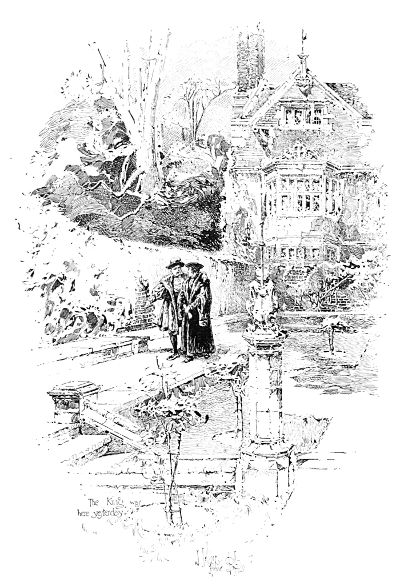
—Father is graver than he used to
be. No Wonder. He hath much on
his Mind; the Calls on his Time and
Thoughts are beyond Belief; but God is
very good to him. His Favour at home
and abroad is immense: he hath good
Health, soe have we alle; and his Family
are established to his Mind, and settled
alle about him, still under the same
fostering Roof. Considering that I am
the most ordinarie of his Daughters, 'tis
singular I should have secured the best
Husband. Daisy lives peaceablie with
Rupert Allington, and is as indifferent,
me seemeth, to him as to alle the
World beside. He, on his Part, loves her
and theire Children with Devotion, and
woulde pass half his Time in the Nurserie.
Dancey always had a hot Temper,
and now and then plagues Bess; but she
lets noe one know it but me. Sometimes
she comes into my Chamber and
cries a little, but the next kind Word
brightens her up, and I verilie believe
her Pleasures far exceed her Payns. Giles
Heron lost her through his own Fault, and
might have regained her good Opinion
after all, had he taken half the Pains for
her Sake he now takes for her younger
Sister: I cannot think how Cecy can favour
him; yet I suspect he will win her, sooner
or later. As to mine own deare Will, 'tis
the kindest, purest Nature, the finest Soul,
the ... and yet how I was senselesse
enow once to undervalue him!
Yes, I am a happy Wife; a happy
Daughter; a happy Mother. When my
little Bill stroaked dear Father's Face just
now, and murmured "Pretty!" he burst
out a-laughing, and cried,—
"You are like the young Cyrus, who
exclaimed,—'Oh! Mother, how pretty
is my Grandfather!' And yet, according
to Xenophon, the old Gentleman was soe
rouged and made up, as that none but
a Child woulde have admired him!"
"That's not the Case," I observed,
"with Bill's Grandfather."
"He's a More all over," says Father,
fondly. "Make a Pun, Meg, if thou
canst, about Amor, Amore, or Amores.
'Twill onlie be the thousand and first
on our Name. Here, little Knave, see
these Cherries: tell me who thou art,
and thou shalt have one. 'More!
More!' I knew it, sweet Villain. Take
them all."
I oft sitt for an Hour or more, watching
Hans Holbein at his Brush. He hath a
rare Gift of limning; and has, besides, the
Advantage of deare Erasmus his Recommendation,
for whom he hath alreddie
painted our Likenesses, but I think he
has made us very ugly. His Portraiture
of my Grandfather is marvellous; ne'erthelesse,
I look in vayn for the Spirituallitie
which our Lucchese Friend, Antonio
Bonvisi, tells us is to be found in the
Productions of the Italian Schools.
Holbein loves to paint with the Lighte
coming in upon his Work from above.
He says a Lighte from above puts Objects
in theire proper Lighte, and shews
theire just Proportions; a Lighte from
beneath reverses alle the naturall Shadows.
Surelie, this hath some Truth if we spirituallize
it.
June 2d.
Rupert's Cousin, Rosamond
Allington, is our Guest.
She is as beautiful as ...
not as an Angel, for she
lacks the Look of Goodness,
but very beautiful indeed. She
cometh hither from Hever Castle, her
Account of the Affairs whereof I like
not. Mistress Anne is not there at present;
indeed, she is now always hanging
about Court, and followeth somewhat
too literallie the scriptural Injunction to
Solomon's Spouse—to forget her Father's
House. The King likes well enow to be
compared with Solomon, but Mistress Anne
is not his Spouse yet, nor ever will be,
I hope. Flattery and Frenchified Habitts
have spoilt her, I trow.
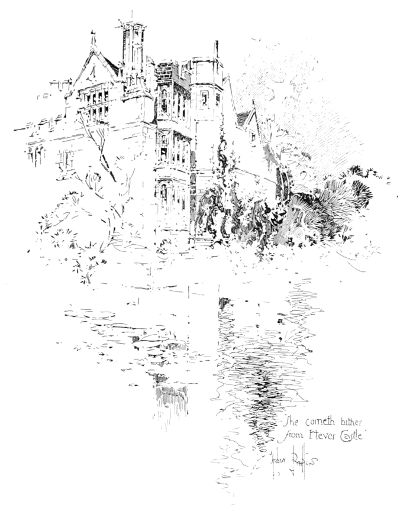
"She cometh hither from Hever Castle."
Rosamond says there is not a good
Chamber in the Castle; even the Ball-room,
which is on the upper Floor of
alle, being narrow and low. On a rainy
Day, long ago, she and Mistress Anne
were playing at Shuttlecock therein, when
Rosamond's Foot tripped at some Unevennesse
in the Floor, and Mistress Anne,
with a Laugh, cried out, "Mind you goe
not down into the Dungeon"—then
pulled up a Trap-door in the Ball-room
Floor, by an iron Ring, and made Rosamond
look down into an unknown Depth;
all in the blacknesse of Darkness. 'Tis
an awfulle Thing to have onlie a Step
from a Ball-room to a Dungeon! I'm
glad we live in a modern House; we
have noe such fearsome Sights here.
Sept. 26.
How many, many Tears have
I shed! Poor, imprudent
Will.
To think of his Escape
from the Cardinall's Fangs,
and yet that he will probablie repeat the
Offence! This Morning Father and he
had a long, and, I fear me, fruitless Debate
in the Garden; on returning from
which, Father took me aside and sayd,—
"Meg, I have borne a long Time with
thine Husband; I have reasoned and
argued with him, and still given him
my poor, fatherly Counsel; but I perceive
none of alle this can call him
Home agayn. And therefore, Meg, I
will no longer dispute with him." ...
"Oh, Father!" ... "Nor yet will I
give him over; but I will set another
Way to work, and get me to God and
pray for him."
And have not I done so alreadie?
27th.
I feare me they parted
unfriendlie; I hearde
Father say, "Thus much
I have a Right to bind
thee to, that thou indoctrinate
not her in thine owne
Heresies. Thou shalt not imperill the
Salvation of my Child."
Since this there has been an irresistible
Gloom on our Spiritts, a Cloud between
my Husband's Soul and mine, without a
Word spoken. I pray, but my Prayers
seem dead.
Thursday, 28th.
Last Night, after seeking
unto this Saint and that,
methought, "Why not
applie unto the Fountain
Head? Maybe these
holie Spiritts may have Limitations sett
to the Power of theire Intercessions—at
anie Rate, the Ears of Mary-mother are
open to alle."
Soe I beganne, "Eia mater, fons
amoris." ...
Then methoughte, "But I am onlie
asking her to intercede—I'll mount a
Step higher still." ...
Then I turned to the greate Intercessor
of alle. But methought, "Still he intercedes
with another, although the same.
And his owne Saying was, 'In that Day
ye shall ask me nothing. Whatsoever ye
shall ask in my Name, he will give it
you.'" Soe I did.
I fancy I fell asleep with the Tears on
my Cheek. Will had not come up Stairs.
Then came a heavie, heavie Sleep, not
such as giveth Rest; and a dark, wild
Dream. Methought I was tired of waiting
for Will, and became alarmed. The
Night seemed a Month long, and at last
I grew soe weary of it, that I arose, put
on some Clothing, and went in search of
him whom my Soul loveth. Soon I
founde him, sitting in a Muse; and said,
"Will, deare Will?" but he hearde me
not; and, going up to touch him, I was
amazed to be broughte short up or ever
I reached him, by Something invisible
betwixt us, hard, and cleare, and colde,
... in short, a Wall of Ice! Soe it
seemed, in my strange Dreame. I pushed
at it, but could not move it; called to
him, but coulde not make him hear: and
all the While my Breath, I suppose, raised
a Vapour on the glassy Substance, that
grew thicker and thicker, soe as slowlie
to hide him from me. I coulde discerne
his Head and Shoulders, but not see down
to his Heart. Then I shut mine Eyes
in Despair, and when I opened 'em, he
was hidden altogether.
Then I prayed. I put my hot Brow
agaynst the Ice, and I kept a weeping
hot Tears, and the warm Breath of Prayer
kept issuing from my Lips; and still I
was persisting, when, or ever I knew
how, the Ice beganne to melt! I felt it
giving Way! and, looking up, coulde in
joyfulle Surprize just discerne the Lineaments
of a Figure close at t'other Side;
the Face turned away, but yet in the
Guise of listening. And, Images being apt
to seem magnified and distorted through
Vapours, methought 'twas altogether bigger
than Will, yet himself, nothingthelesse;
and, the Barrier between us having sunk
away to Breast-height, I layd mine Hand
on's Shoulder, and he turned his Head,
smiling, though in Silence; and ...
oh, Heaven! 'twas not Will, but——.
What coulde I doe, even in my Dreame,
but fall at his Feet? What coulde I doe,
waking, but the same? 'Twas Grey of
Morn; I was feverish and unrefreshed,
but I wanted noe more lying a-bed. Will
had arisen and gone forthe; and I, as
quicklie as I coulde make myself readie,
sped after him.
I know not what I expected, nor what
I meant to say. The Moment I opened
the Door of his Closett, I stopt short.
There he stoode, in the Centre of the
Chamber; his Hand resting flat on an
open Book, his Head raised somewhat up,
his Eyes fixed on Something or some One,
as though in speaking Communion with
'em; his whole Visage lightened up and
glorifide with an unspeakable Calm and
Grandeur that seemed to transfigure him
before me; and, when he hearde my Step,
he turned about, and 'steade of histing
me away, helde out his Arms.... We
parted without neede to utter a Word.
June, 1530.

Events have followed too
quick and thick for me to
note 'em. Firste, Father's
Embassade to Cambray,
which I shoulde have
grieved at more on our owne Accounts,
had it not broken off alle further Collision
with Will. Thoroughlie homesick, while
abroad, poor Father was; then, on his
Return, he noe sooner sett his Foot a-land,
than the King summoned him to Woodstock.
'Twas a Couple o' Nights after he
left us, that Will and I were roused by
Patteson's shouting beneath our Window,
"Fire, Fire, quoth Jeremiah!" and the
House was a-fire, sure enow. Greate
Part of the Men's Quarter, together with
alle the Out-houses and Barns, consumed
without Remedie, and alle through the
Carelessnesse of John Holt. Howbeit,
noe Lives were lost, nor any one much
hurt; and we thankfullie obeyed deare
Father's Behest, soe soone as we received
the same, that we woulde get us to Church,
and there, upon our Knees, return humble
and harty Thanks to Almighty God for
our late Deliverance from a fearfulle Death.
Alsoe, at Father's Desire, we made up to
the poor People on our Premises theire
various Losses, which he bade us doe, even
if it left him without soe much as a Spoon.
But then came an equallie unlookt-for,
and more appalling Event: the Fall of
my Lord Cardinall, whereby my Father
was shortlie raised to the highest Pinnacle
of professional Greatnesse; being made
Lord Chancellor, to the Content, in some
Sort, of Wolsey himself, who sayd he was
the onlie Man fit to be his Successor.
The unheard-of Splendour of his Installation
dazzled the Vulgar; while the
Wisdom that marked the admirable Discharge
of his daylie Duties, won the
Respect of alle thinking Men, but surprized
none who alreadie knew Father.
On the Day succeeding his being sworn
in, Patteson marched hither, and thither,
bearing a huge Placard, inscribed, "Partnership
Dissolved;" and apparelled himself
in an old Suit, on which he had
bestowed a Coating of black Paint, with
Weepers of white Paper; assigning for't
that "his Brother was dead." "For
now," quoth he, "that they've made
him Lord Chancellor, we shall ne'er see
Sir Thomas more."
Now, although the poor Cardinall was
commonlie helde to shew much Judgment
in his Decisions, owing to the naturall
Soundness of his Understanding, yet, being
noe Lawyer, Abuses had multiplied during
his Chancellorship, more especiallie in the
Way of enormous Fees and Gratuities.
Father, not content with shunning base
Lucre in his proper Person, will not let
anie one under him, to his Knowledge,
touch a Bribe; whereat Dancey, after his
funny Fashion, complains, saying,—
"The Fingers of my Lord Cardinall's
veriest Door-keepers were tipt with Gold,
but I, since I married your Daughter,
have got noe Pickings; which in your
Case may be commendable, but in mine
is nothing profitable."
Father, laughing, makes Answer,—
"Your Case is hard, Son Dancey, but I
can onlie say for your Comfort, that, soe
far as Honesty and Justice are concerned,
if mine owne Father, whom I reverence
dearly, stoode before me on the one
Hand, and the Devil, whom I hate
extremely, on the other, yet, the Cause
of the latter being just, I shoulde give
the Devil his Due."
Giles Heron hath found this to his Cost.
Presuming on his near Connexion with my
Father, he refused an equitable Accommodation
of a Suit, which, thereon, coming
into Court, Father's Decision was given
flat agaynst him.
His Decision agaynst Mother was equallie
impartiall, and had Something comique in
it. Thus it befelle.—A Beggar-woman's
little Dog, which had beene stolen from
her, was offered my Mother for Sale, and
she bought it for a Jewel of no greate
Value. After a Week or soe, the Owner
finds where her Dog is, and cometh to
make Complaynt of the Theft to Father,
then sitting in his Hall. Sayth Father,
"Let's have a faire Hearing in open Court;
thou, Mistress, stand there where you
be, to have impartial Justice; and thou,
Dame Alice, come up hither, because
thou art of the higher Degree. Now
then, call each of you the Puppy, and
see which he will follow." Soe Sweetheart,
in spite of Mother, springs off to the
old Beggar-woman, who, unable to keep
from laughing, and yet moved at Mother's
Losse, sayth,—
"Tell 'ee what, Mistress ... thee
shalt have 'un for a Groat."
"Nay," sayth Mother, "I won't mind
giving thee a Piece of Gold;" soe the
Bargain was satisfactorily concluded.
Father's Despatch of Businesse is such,
that, one Morning before the End of
Term, he was tolde there was noe other
Cause nor Petition to be sett before him;
the which, being a Case unparalleled, he
desired mighte be formally recorded.
He ne'er commences Businesse in his
owne Court without first stepping into
the Court of King's Bench, and there
kneeling down to receive my Grandfather's
Blessing. Will sayth 'tis worth
a World to see the Unction with which
the deare old Man bestows it on him.
In Rogation-week, following the Rood
as usuall round the Parish, Heron counselled
him to go a Horseback for the
greater Seemlinesse, but he made Answer
that 'twoulde be unseemlie indeede for
the Servant to ride after his Master going
afoot.
His Grace of Norfolk, coming yesterday
to dine with him, finds him in the Church-choir,
singing, with a Surplice on.
"What?" cries the Duke, as they walk
Home together, "my Lord Chancellor
playing the Parish-clerk? Sure, you
dishonour the King and his Office."
"Nay," says Father, smiling, "your
Grace must not deem that the King,
your Master and mine, will be offended
at my honouring his Master."
Sure, 'tis pleasant to heare Father taking
the upper Hand of these great Folks: and
to have 'em coming and going, and waiting
his Pleasure, because he is the Man
whom the King delighteth to honour.
True, indeed, with Wolsey 'twas once
the same; but Father neede not feare the
same Ruin; because he hath Him for
his Friend, whom Wolsey said woulde not
have forsaken him had he served Him
as he served his earthly Master. 'Twas
a misproud Priest; and there's the Truth
on't. And Father is not misproud; and
I don't believe we are; though proud of
him we cannot fail to be.
And I know not why we may not be
pleased with Prosperitie, as well as patient
under Adversitie; as long as we say,
"Thou, Lord, hast made our Hill soe
strong." 'Tis more difficult to bear with
Comelinesse, doubtlesse; and envious Folks
there will be; and we know alle Things
have an End, and everie Sweet hath its
Sour, and everie Fountain its Fall; but
... 'tis very pleasant for all that.
Tuesday, 31st, 1532.
Who coulde have thoughte
that those ripe Grapes
whereof dear Gaffer ate
soe plentifullie, should
have ended his Dayes?
This Event hath filled the House with
Mourning. He had us all about his Bed
to receive his Blessing; and 'twas piteous
to see Father fall upon his Face, as Joseph
on the Face of Jacob, and weep upon
him and kiss him. Like Jacob, my
Grandsire lived to see his duteous Son
attain to the Height of earthlie Glory,
his Heart unspoyled and untouched.
July, 1532.
The Days of Mourning for
my Grandsire are at an
end; yet Father still goeth
heavilie. This Forenoon,
looking forthe of my
Lattice, I saw him walking along the
River Side, his Arm cast about Will's
Neck; and 'twas a dearer Sight to my
Soul than to see the King walking there
with his Arm around Father's Neck.
They seemed in such earnest Converse,
that I was avised to ask Will, afterwards,
what they had been saying. He told me
that, after much friendly Chat together on
this and that, Father fell into a Muse, and
presently, fetching a deep Sigh, says,—
"Would to God, Son Roper, on Condition
three Things were well established
in Christendom, I were put into a Sack,
and cast presently into the Thames."
Will sayth,—
"What three soe great Things can
they be, Father, as to move you to such
a Wish?"
"In Faith, Will," answers he, "they
be these.—First, that whereas the most
Part of Christian Princes be at War,
they were at universal Peace. Next,
that whereas the Church of Christ is at
present sore afflicted with divers Errors
and Heresies, it were well settled in a
godly Uniformity. Last, that this Matter
of the King's Marriage were, to the Glory
of God, and the Quietness of alle Parties,
brought to a good Conclusion."
Indeed, this last Matter preys on my
Father's Soul. He hath even knelt to
the King, to refrain from exacting Compliance
with his Grace's Will concerning
it; movingly reminding him, even with
Tears, of his Grace's own Words to him
on delivering the Great Seal, "First look
unto God, and, after God, unto me."
But the King is heady in this Matter;
stubborn as a Mule or wild Ass's Colt,
whose Mouths must be held with Bit
and Bridle if they be to be governed at
alle; and the King hath taken the Bit
between his Teeth, and there is none
dare ride him. Alle for Love of a brown
Girl, with a Wen on her Throat, and
an extra Finger.
July 18th.
How short a Time agone
it seemeth, that in my
Prosperity I sayd, "We
shall never be moved;
Thou, Lord, of Thy goodness
hast made our Hill soe strong!
... Thou didst turn away thy Face,
and I was troubled!"
28th.
Thus sayth Plato: of Him
whom he soughte, but
hardly found: "Truth is
his Body, and Light his
Shadow." A marvellous
Saying for a Heathen.
Hear also what St. John sayth: "God
is Light; and in him is no Darkness at
all." "And the Light was the Life of
Men: and the Light shineth in Darkness,
and the Darkness comprehended
it not."
Hear also what St. Augustine sayth:
"They are the most uncharitable towards
Error who have never experienced how
hard a Matter it is to come at the
Truth."
Hard, indeed. Here's Father agaynst
Will, and agaynst Erasmus, of whom he
once could not speak well enough; and
now he says that if he upholds such and
such Opinions his dear Erasmus may be
the Devil's Erasmus for what he cares.
And here's Father at Issue with half the
learned Heads in Christendom concerning
the King's Marriage. And yet, for alle
that, I think Father is in the Right.
He taketh Matters soe to Heart that
e'en his Appetite fails. Yesterday he put
aside his old favourite Dish of Brewis,
saying, "I know not how 'tis, good
Alice; I've lost my Stomach, I think,
for my old Relishes" ... and this,
e'en with a Tear in his Eye. But 'twas
not the Brewis, I know, that made it
start.
Aug.
He hath resigned the Great
Seal! And none of us
knew of his having done
soe, nor e'en of his meditating
it, till after Morning
Prayers to-day, when, insteade of one of
his Gentlemen stepping up to my Mother
in her Pew with the Words, "Madam,
my Lord is gone," he cometh up to
her himself, with a Smile on's Face, and
sayth, low bowing as he spoke, "Madam,
my Lord is gone." She takes it for
one of the manie Jests whereof she misses
the Point; and 'tis not till we are out
of Church, in the open Air, that she fully
comprehends my Lord Chancellor is indeed
gone, and she hath onlie her Sir Thomas
More.
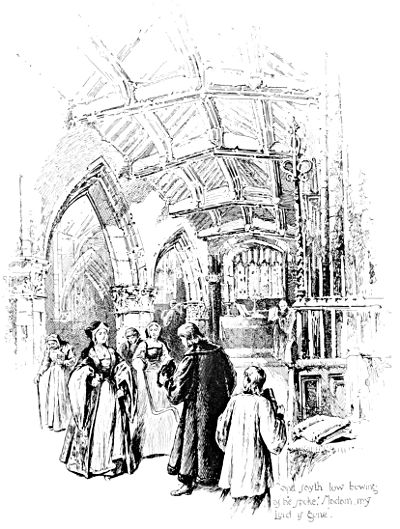
"and sayth, low bowing as he spoke, 'Madam, my Lord is gone.'"
A Burst of Tears was no more than
was to be lookt for from poor Mother;
and, in Sooth, we alle felt aggrieved and
mortyfide enough; but 'twas a short
Sorrow; for Father declared that he had
cast Pelion and Ossa off his Back into the
bottomless Pit; and fell into such funny
Antics that we were soon as merry as
ever we were in our Lives. Patteson, so
soon as he hears it, comes leaping and
skipping across the Garden, crying, "A
fatted Calf! let a fatted Calf be killed,
Masters and Mistresses, for this my
Brother who was dead is alive again!"
and falls a kissing his Hand. But poor
Patteson's Note will soon change; for
Father's diminished State will necessitate
the Dismissal of all extra Hands; and
there is manie a Servant under his Roof
whom he can worse spare than the poor
Fool.
In the Evening he gathers us alle about
him in the Pavilion, where he throws
himself into his old accustomed Seat, casts
his Arm about Mother, and cries, "How
glad must Cincinnatus have been to
spy out his Cottage again, with Racilia
standing at the Gate!" Then, called
for Curds and Cream; sayd how sweet
the soft Summer Air was coming over the
River, and bade Cecil sing "The King's
Hunt's up." After this, one Ballad after
another was called for, till alle had sung
their Lay, ill or well, he listing the While
with closed Eyes, and a composed Smile
about his Mouth; the two Furrows between
his Brows relaxing graduallie till
at length they could no more be seene.
At last he says,—
"Who was that old Prophet that could
not or would not prophesy for a King
of Judah till a Minstrel came and played
unto him? Sure, he must have loved,
as I do, the very lovely Song of one that
playeth well upon an Instrument, yclept
the Human Heart; and have felt, as I
do now, the Spirit given him to speak
of Matters foreign to his Mind. 'Tis
of res angusta domi, dear Brats, I must
speak; soe, the sooner begun, the sooner
over. Here am I, with a dear Wife
and eight loved Children ... for my
Daughters' Husbands and my Son's
Wife are my Children as much as any;
and Mercy Giggs is a Daughter too ...
nine Children, then, and eleven Grandchildren,
and a Swarm of Servants to
boot, all of whom have as yet eaten
what it pleased them, and drunken what
it suited them at my Board, without its
being any one's Businesse to say them
nay. 'Twas the dearest Privilege of my
Lord Chancellor; but now he's dead and
gone, how shall we contract the Charges
of Sir Thomas More?"
We looked from one to another, and
were silent.
"I'll tell ye, dear ones," he went on.
"I have been brought up at Oxford, at an
Inn of Chancery, at Lincoln's Inn, and
at the King's Court; from the lowest
Degree, that is, to the highest; and yet
have I in yearly Revenues at this Present,
little above one Hundred Pounds
a-year; but then, as Chilo sayth, 'honest
Loss is preferable to dishonest Gain:
by the first, a Man suffers once; by the
second for ever;' and I may take up my
Parable with Samuel, and say: 'Whose
Ox have I taken? whose Ass have I
taken? whom have I defrauded? whom
have I oppressed? of whose Hand have
I received any Bribe to blinde mine Eyes
therewith?' No, my worst Enemies
cannot lay to my Charge any of these
Things; and my Trust in you is, that,
rather than regret I should not have
made a Purse by any such base Methods,
you will all cheerfully contribute your
Proportions to the common Fund, and
share and share alike with me in this
my diminished State."
We all gat about him, and by our Words
and Kisses gave Warrant that we would.
"Well, then," quoth he, "my Mind
is, that since we are all of a Will to
walk down-hill together, we will do
soe at a breathing Pace, and not drop
down like a Plummet. Let all Things
be done decently and in order: we
won't descend to Oxford Fare first, nor
yet to the Fare of New Inn. We'll
begin with Lincoln's Inn Diet, whereon
many good and wise Men thrive well;
if we find this draw too heavily on the
Common-Purse, we will, next Year,
come down to Oxford Fare, with which
many great and learned Doctors have
been conversant; and, if our Purse
stretch not to cover e'en this, why, in
Heaven's Name! we'll go begging together,
with Staff and Wallet, and sing
a Salve Regina at every good Man's Door,
whereby we shall still keep Company,
and be merry together!"
Sept. 22d.
Now that the first Surprise
and Grief, and the first
Fervour of Fidelity and
Self-devotion have passed
off, we have subsided into
how deep and holy a Quiet!
We read of the Desertion of the World,
as a Matter of Course; but, when our
own Turn comes, it does seem strange, to
find ourselves let fall down the Stream
without a single Hand outstretched to
help us; forgotten, in a Moment, as
though we had never been, by those who
lately ate and laughed at our Table. And
this, without any Fault or Offence of
ours, but merely from our having lost the
Light of the King's Countenance. I say,
it does seem strange; but how fortunate,
how blessed are those to whom such a
Course of Events only seems strange, unaccompanied
by Self-reproach and Bitterness!
I could not help feeling this,
in reading an affectionate Letter deare
Father writ this Forenoon to Erasmus,
wherein he sayd, "I have now obtained
what, from a Child, I have continually
wished! that, being entirely quit of
Businesse and all publick Affairs, I
might live for a Time only to God and
myself."
Having no Hankering after the old
Round he soe long hath run, he now,
in Fact, looks younger every Day; and
yet, not with the same Kind of Youth he
had before his Back was bowed under the
Chancellorship. 'Tis a more composed,
chastised Sort of Rejuvenescence: rather
the soft Warmth of Autumn, which sometimes
seems like May, than May itself:
the enkindling, within this mortal Tabernacle,
of a heavenly Light that never
grows dim, because it is immortal; and
burns the same yesterday, to-day, and for
ever: a Youthfulness of Soul and Mind
characterised by Growth; Something with
which this World and its fleeting Fancies
has nothing to do: Something that the
King can neither impart nor take away.
... We have had a tearfull Morning
... poor Patteson has gone. My Father
hath obtained good Quarters for him with
my Lord Mayor, with a Stipulation that
he shall retain his Office with the Lord
Mayor for the Time being, as long as he
can fill it at all. This suits Patteson, who
says he will sooner shift Masters year by
year, than grow too fond of any Man
again, as he hath of Father; but there
has been sad blubbering and blowing of
Noses.
Sept. 24th.
This Afternoon, coming
upon Mercy seated in the
Alcove, like unto the
Image of some Saint in
a Niche, her Hands folded
on her Lap, and her Eyes steadfastly agaze
on the setting Sun, I could not but mark
how Years were silentlie at work upon
her, as doubtless upon us alle; the tender,
fearfulle Girl having thus graduallie
changed into the sober, high-minded
Woman. She is so seldom seene in
Repose, so constantly astir and afoot in
this or that kind Office, mostly about
the Children, that I had never thought
upon it before; but now I was alle at
once avised to marvel that she who had
so long seemed fitter for Heaven than
Earth, shoulde never literallie have vowed
herself the Spouse of Christ; more in
especiall as all Expectation of being the
Spouse of anie else must long since have
died within her.
I sayd, "Mercy, thou lookst like a
Nun: how is't thou hast ne'er become
one in Earnest?"
She started; then sayd, "Could I be
more usefull? more harmless? less exposed
to Temptation? or half so happy
as I am now? In sooth, Meg, the
Time has been when methought, how
sweet the living Death of the Cloister!
How good that must needs be which
had the Suffrages of Chrysostom the
golden-mouthed, and holy Ambrose, and
our own Anselm! How peacefull, to
take Wing like the Dove, and fly away
from a naughty World, and be at Rest!
How brave, to live alone, like St.
Antony, in the Desert! only I would
have had some Books with me in my
Cave, and 'tis uncertayn whether St.
Antony had Knowledge of Letters, beyond
the heaven-taught Lesson, 'God
is Love,' ... for methought so much
Reflection and no Action would be too
much for a Woman's Mind to bear—I
might goe mad: and I remembered
me how the Dove that gladly flew away
from the Ark, gladly flew back, and
abode in the Ark till such Time as a
new Home was ready for her. And
methought, cannot I live apart from
Sin here, and now; and as to Sorrow,
where can we live apart from that?
Sure, we may live on the Skirts of the
World in a Spiritt as truly unworldlie,
as though we were altogether out of
it: and here I may come and go, and
range in the fresh Air, and love other
Folks' Children, and read my Psalter,
and pore over the Sayings of the wise
Men of old, and look on the Faces I
love, and sit at the Feet of Sir Thomas
More. Soe there, Meg, are my poor
Reasons for not caring to be a Nun.
Our deare Lord is in himself all that
our highest, holiest Affections can seek
or comprehend; for he made these our
Hearts; he gave us these our Affections;
and through them the Spirit
speaks. Aspiring to their Source, they
rise up like the white Smoke and bright
Flame; while, on Earth, if left unmastered,
they burn, suffocate, and destroy.
Yet they have their natural and
innocent Outlets even here; and a
Woman may warm herself by them
without Scorching, and yet be neither
a Wife nor a Nun."
Sept. 28th.
Ever since Father's Speech
to us in the Pavilion, we
have beene of one Heart
and one Soul; neither have
any of us said that aught
of the Things we possessed were our own,
but we have had all Things in Common.
And we have eaten our Meat with Gladness
and Singleness of Heart.
This Afternoon, expressing to Father
my gratefull Sense of our present Happiness
... "Yes, Meg," returns he, "I
too, am deeply thankful for this breathing
Space."
"Do you look on it as no more, then?"
I sayd.
"As no more, Meg: we shall have a
Thunder-clap by-and-by. Look out on
the Thames. See how unwontedlie clear
it is, and how low the Swallows fly.... How distinctlie we see the green
Sedges on Battersea Bank, and their reflected
Images in the Water. We can
almost discern the Features of those
poor Knaves digging in the Cabbage
Gardens, and hear 'em talk, so still is
the Air. Have you ne'er before noted
these Signs?"
"A Storm is brewing," I sayd.
"Aye, we shall have a Lightning-flash
anon. So still, Meg, is also our moral
Atmosphere just now. God is giving
us a breathing Space, as he did to the
Egyptians before the Plague of Hail,
that they might gather their live Stock
within Doors. Let us take for Example
them that believed and obeyed him;
and improve this holy Pause."
Just at this Moment, a few heavie
Drops fell agaynst the Window Pane, and
were seene by both. Our Eyes met; and
I felt a silent Pang.
"Five Days before the Passover," resumed
Father, "all seemed as still and
quiet as we are now; but Jesus knew
his Hour was at hand. E'en while he
yet spake familiarly among the People,
there came a Sound from Heaven, and
they that stood by said it thundered;
but he knew it for the Voice of his dear
Father. Let us, in like Manner, when
the Clap cometh, recognise in it the
Voice of God, and not be afraid with
any Amazement."
Nov. 2d.
Gammer Gurney is dead,
and I must say I am glad
of it. The Change, to her,
must be blessed, and there
seemed some Danger lest,
after having escaped being ducked for a
Witch, she shoulde have been burnt for
a Heretic. Father looked on her as an
obstinate old Woman; Will counted her
little short of a Saint and Prophetess, and
kept her well supplied with alle she could
need. Latterly she was stone deaf; so
'tis a happy Release.
The settled Purpose of Father's Soul,
just now, is to make up a Marriage
between Mercy and Dr. Clement. 'Tis
high Advancement for her, and there
seems to have been some old Liking
between 'em we never knew of.
1533, April 1.
Though some Months
have passed since my
Father uttered his warning
Voice, and all continues
to go quiet, I
cannot forbear, now and then, to call his
Monition to Mind, and look about for
the Cloud that is to bring the Thunder-clap;
but the Expectation sobers rather
than saddens me.
This Morning, leaning over the River
Wall, I was startled by the cold, damp
Hand of some one from behind being laid
on mine. At the same Time a familiar
Voice exclaimed, "Canst tell us, Mistress,
why Fools have hot Heads and Hands
icy cold?"
I made Answer, "Canst tell me, Patteson,
why Fools should stray out of
Bounds?"
"Why, that's what Fools do every
Day," he readily replied; "but this is
All Fools' Day, mine own special Holiday;
and I told my Lord Mayor overnight,
that if he lookt for a Fool this
Morning, he must look in the Glass.
In sooth, Mistress Meg, I should by
Rights wear the Gold Chain and he the
Motley; for a proper Fool he is, and I
shall be glad when his Year's Service
to me is out. The worst o' these Lord
Mayors is, that we can't part with 'em
till their Time's up. Why now, this
present one hath not so much Understanding
as would foot an old Stocking;
'twas but yesterday when, in Quality
of my Taster, he civilly enough makes
over to me a half-eaten Plate of Gurnet,
which I wave aside, thus, saying, I eat
no Fish of which I cannot affirm, 'rari
sunt Boni,' few are the Bones ... and I
protest to you he knew it not for Fool's
Latin. Thus I'm driven, from mere
Discouragement, to leave prating for
listening, which thou knowest, Mistress,
is no Fool's Office; and among the
sundrie Matters I hear at my Lord's
Table ... for he minds not what he
says before his Servants, thereby giving
new Proof 'tis he shoulde wear the
Motley ... I note his saying that the
King's private Marriage will assuredlie
be made publick this coming Easter, and
my Lady Anne will be crowned ...
more by token, he knows the Merchant
that will supply the Genoa Velvet and
Cloth of Gold, and the Masquers that
are to enact the Pageant. For the Love
o' Safety, then, Mistress Meg, bid thy
good Father e'en take a Fool's Advice,
and eat humble Pie betimes, for doubt
not this proud Madam to be as vindictive
as Herodias, and one that, unless
he appease her full early, will have his
Head set before her in a Charger. I've
said my Say."
April 4th.
Three Bishops have been
here this Forenoon, to
bid Father to the Coronation,
and offer him twenty
Pounds to provide his
Dress; but Father hath, with Courtesie,
declined to be present. After much
friendly pressing, they parted, seemingly
on good Terms; but I have Misgivings
of the Issue.
April 9th.
A ridiculous Charge
hath beene got up 'gainst
dear Father; no less than
of Bribery and Corruption.
One Parnell complaineth of
a Decree given agaynst him in favour of
one Vaughan, whose Wife, he deponeth,
gave Father a gilt Flaggon. To the noe
small Surprise of the Council, Father admitted
that she had done soe: "But, my
Lords," proceeded he, when they had
uttered a few Sentences of Reprehension
somewhat too exultantlie, "will ye list
the Conclusion of the Tale? I bade
my Butler fill the Cup with Wine, and
having drunk her Health, I made her
pledge me, and then restored her Gift,
and would not take it again."
As innocent a Matter, touching the
offering him a Pair of Gloves containing
Forty Pounds, and his taking the first and
returning the last, saying he preferred his
Gloves without Lining, hath been made
publick with like Triumph to his own
good Fame; but alack! these Feathers
show which way sets the Wind.
April 13th.
A heavier Charge than
either of the above hath
been got up, concerning
the wicked Woman of Kent,
with whom they accuse him
of having tampered, that, in her pretended
Revelations and Rhapsodies, she might
utter Words against the King's Divorce.
His Name hath, indeed, been put in the
Bill of Attainder; but, out of Favour, he
hath been granted a private Hearing, his
Judges being, the new Archbishop, the
new Chancellor, his Grace of Norfolk, and
Master Cromwell.
He tells us that they stuck not to the
Matter in Hand, but began cunningly
enow to sound him on the King's Matters;
and finding they could not shake him, did
proceed to Threats, which, he told 'em,
might well enow scare Children, but not
him; and as to his having provoked his
Grace the King to sett forth in his Book
aught to dishonour and fetter a good
Christian, his Grace himself well knew
the Book was never shewn him save for
verbal Criticism when the Subject-matter
was completed by the Makers of the same,
and that he had warned his Grace not to
express soe much Submission to the Pope.
Whereupon they with great Displeasure
dismissed him, and he took Boat for
Chelsea with mine Husband in such gay
Spiritts, that Will, not having been privy
to what had passed, concluded his Name
to have beene struck out of the Bill of
Attainder, and congratulated him thereupon
soe soone as they came aland, saying,
"I guess, Father, all is well, seeing you
thus merry."
"It is, indeed, son Roper," returns Father
steadilie; repeating thereupon, once or
twice, this Phrase, "All is well."
Will, somehow mistrusting him, puts
the Matter to him agayn.
"You are then, Father, put out of the
Bill?"
"Out of the Bill, good Fellow?" repeats
Father, stopping short in his Walk,
and regarding him with a Smile that Will
sayth was like to break his Heart....
"Wouldst thou know, dear Son, why I
am so joyful? In good Faith, I have
given the Devil a foul Fall; for I have
with those Lords gone so far, as that
without great Shame I can ne'er go
back. The first Step, Will, is the worst,
and that's taken."
And so, to the House, with never another
Word, Will being smote at the Heart.
But, this Forenoon, deare Will comes
running in to me, with Joy all bright,
and tells me he hath just heard from
Cromwell that Father's Name is in sooth
struck out. Thereupon, we go together
to him with the News. He taketh it
thankfully, yet composedly, saying, as he
lays his Hand on my Shoulder, "In faith,
Meg, quod differtur non aufertur." Seeing
me somewhat stricken and overborne, he
sayth, "Come, let's leave good Will awhile
to the Company of his own select and
profitable Thoughts, and take a Turn
together by the Water Side."
Then closing his Book, which I marked
was Plato's Phædon, he steps forthe with
me into the Garden, leaning on my
Shoulder, and pretty heavilie too. After
a Turn or two in Silence, he lightens his
Pressure, and in a bland, peaceifying Tone
commences Horace his tenth Ode, Book
second, and goes through the first fourteen
or fifteen Lines in a kind of lulling
Monotone; then takes another Turn or
two, ever looking at the Thames; and in
a stronger Voice begins his favourite
"Justum, ac tenacem Propositi Virum
Non Civium Ardor," etc.
on to
"Impavidum ferient Ruinæ;"
—and lets go his Hold on me to extend
his Hand in fine, free Action. Then,
drawing me to him agayn, presentlie
murmurs, "I reckon that the Sufferings
of this present Time are not worthy
to be compared with the Glory which
shall be revealed in us.... Oh no,
not worthy to be compared. I have
lived; I have laboured; I have loved.
I have lived in them I loved; laboured
for them I loved; loved them for whom
I laboured; my Labour has not been
in vayn. To love and to labour is
the Sum of living, and yet how manie
think they live who neither labour nor
love! Agayn, how manie labour and
love, and yet are not loved; but I have
beene loved, and my Labour has not
been in vayn. Now, the Daye is far
spent, and the Night is at hand, and
the Time draweth nigh when Man
resteth from his Labours, even from his
Labours of Love; but still he shall love
and he shall live where the Spiritt sayth
he shall rest from his Labours, and
where his Works do follow him, for
he entereth into Rest through and to
Him who is Life, and Light, and
Love."
Then looking steadfastlie at the Thames,
"How quietlie," sayth he, "it flows on!
This River, Meg, hath its Origin from
seven petty Springs somewhither amongst
the Gloucestershire Hills, where they
bubble forthe unnoted save by the Herd
and Hind. Belike, they murmur over
the Pebbles prettily enough; but a great
River, mark you, never murmurs. It
murmured and babbled too, 'tis like,
whilst only a Brook, and brawled away
as it widened and deepened and chafed
agaynst Obstacles, and here and there
got a Fall, and splashed and made much
Ado, but ever kept running on towards
its End, still deepening and widening;
and now towards the Close of its Course
look you how swift and quiet it is,
running mostly between Flats, and with
the dear blue Heaven reflected in its
Face." ...
1534, April 12.
'Twas o' Wednesdaye was a
Week, we were quietly
taking our Dinner, when,
after a loud and violent
Knocking at the outer
Door, in cometh a Pursuivant, and summoneth
Father to appear next Daye before
the Commissioners, to take the newly-coined
Oath of Supremacy. Mother utters
a hasty Cry, Bess turns white as Death,
but I, urged by I know not what suddain
Impulse to con the new Comer's Visage
narrowly, did with Eagerness exclaim,
"Here's some Jest of Father's; 'tis only
Dick Halliwell!"
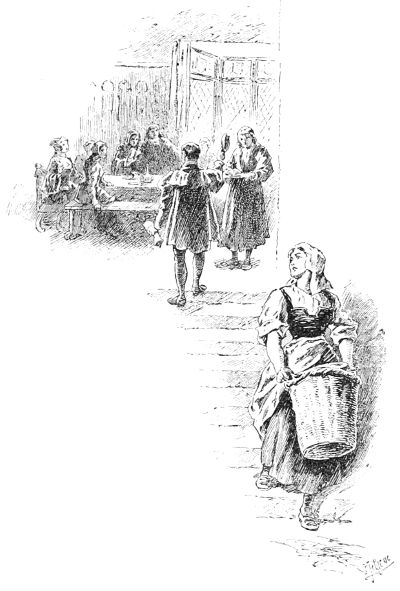
Whereupon, Father burst out a-laughing,
hugged Mother, called Bess a
silly Puss, and gave Halliwell a Groat
for's Payns. Now, while some were
laughing, and others taking Father prettie
sharplie to Task for soe rough a Crank,
I fell a muzing, what could be the
Drift of this, and coulde only surmize
it mighte be to harden us beforehand,
as 'twere, to what was sure to
come at last. And the Pre-apprehension
of this soe belaboured my alreadie
o'erburthened Spiritts, as that I was
fayn to betake myself to the Nurserie,
and lose all Thought and Reflection in
my little Bess's prettie Ways. And, this
not answering, was forct to have Recourse
to Prayer; then, leaving my Closett,
was able to return to the Nurserie, and
forget myselfe awhile in the Mirth of
the Infants.
Hearing
Voyces beneathe
the
Lattice,
I lookt
forthe, and
behelde his
Grace of Norfolk
(of late a
strange Guest)
walking beneath
the Window in
earnest Converse
with Father; and, as
they turned about, I
hearde him say, "By the
Mass, Master More, 'tis perilous striving
with Princes. I could wish you, as a
Friend, to incline to the King's Pleasure;
for Indignatio Principis Mors est."
"Is that all?" says Father; "why
then there will be onlie this Difference
between your Grace and me,
that I shall die to-daye, and you to-morrow;"—which
was the Sum of
what I caught.
Next Morning, we were breaking our
Fast with Peacefullnesse of Heart, on the
Principle that sufficient for the Daye is
the Evill thereof, and there had beene a
wordy War between our two Factions of
the Neri and Bianchi, Bess having defalked
from the Mancheteers on the Ground
that black Bread sweetened the Breath
and settled the Teeth, to the no small
Triumph of the Cob Loaf Party; while
Daisy, persevering at her Crusts, sayd,
"No, I can cleave to the Rye Bread as
steddilie as anie among you, but 'tis vayn
of Father to maintain that it is as toothsome
as a Manchet, or that I eat it to
whiten my Teeth, for thereby he robs
Self-deniall of its Grace."
Father, strange to say, seemed taken at
Vantage, and was pausing for a Retort,
when Hobson coming in and whispering
Somewhat in his Ear, he rose suddainlie
and went forthe of the Hall with him,
putting his Head back agayn to say,
"Rest ye alle awhile where ye be,"
which we did, uneasilie enow. Anon he
returns, brushing his Cap, and says
calmlie, "Now, let's forthe to Church,"
and clips Mother's Arm beneathe his owne
and leads the Way. We follow as soon
as we can; and I, listing to him more
than to the Priest, did think I never
hearde him make Response more composedlie,
nor sing more lustilie, by the
which I founde myself in stouter Heart.
After Prayers, he is shriven, after which
he saunters back with us to the House;
then brisklie turning on his Heel, cries
to my Husband, "Now, Will, let's toward,
Lad," and claps the Wicket after him,
leaving us at t'other Side without so
much as casting back a parting Look.
Though he evermore had beene avised
to let us companie him to the Boat, and
there kiss him once and agayn or ever
he went, I know not that I should have
thoughte much of this, had not Daisy,
looking after him keenly, exclaymed somewhat
shortlie as she turned in Doors, "I
wish I had not uttered that Quip about
the Cob-loaf."
Oh, how heavilie sped the Day! The
House, too big now for its Master's diminished
Retinue, had yet never hitherto
seemed lonesome; but now a Somewhat
of drearie and dreadfull, inexpressible in
Words, invisible to the Eye, but apprehended
by the inner Sense, filled the
blank Space alle about. For the first
Time, everie one seemed idle; not only
disinclined for Businesse, but as though
there were Something unseemlie in addressing
one's Self to it. There was nothing
to cry about, nothing to talk over, and
yet we alle stoode agaze at each other in
Groups, like the Cattle under the Trees
when a Storm is at hand. Mercy was the
first to start off. I held her back and
said, "What is to do?" She whispered,
"Pray." I let her Arm drop, but Bess
at that Instant comes up with Cheeks as
colourless as Parchment. She sayth, "'Tis
made out now. A Pursuivant de Facto
fetched him forthe this Morning." We
gave one deep, universal Sigh; Mercy
broke away, and I after her, to seek the
same Remedy, but alack, in vayn....
15th.
How large a Debt we owe
you, wise and holie Men
of old! How ye counsel
us to Patience, incite us to
Self-mastery, cheer us on
to high Emprize, temper in us the Heat
of Youth, school our Inexperience, calm
the o'erwrought Mind, allay the Anguish
of Disappointment, cheat Suspense, and
master Despair.... How much better
and happier ye would make us, if we
would but list your Teaching!
Bess hath fallen Sick; no marvell.
Everie one goeth heavilie. Alle Joy is
darkened; the Mirthe of the House is
gone.
Will tells me, that as they pushed off
from the Stairs, Father took him about
the Neck and whispered, "I thank our
Lord, the Field is won!" Sure, Regulus
ne'er went forthe with higher Self-devotion.
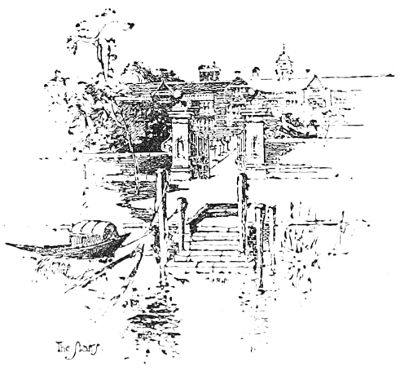
The Stairs.
Having declared his Inabilitie to take
the Oath as it stoode, they bade him,
Will tells me, take a Turn in the Garden
while they administered it to sundrie
others, thus affording him Leisure for
Re-consideration. But they might as
well have bidden the Neap-tide turn
before its Hour. When called in agayn,
he was as firm as ever, so was given in
Ward to the Abbot of Westminster till the
King's Grace was informed of the Matter.
And now, the Fool's wise Saying of vindictive
Herodias came true, for 'twas the
King's Mind to have Mercy on his old
Servant, and tender him a qualifyed Oath;
but Queen Anne, by her importunate
Clamours, did overrule his proper Will,
and at four Days' End, the full Oath
being agayn tendered and rejected, Father
was committed to the Tower. Oh,
wicked Woman, how could you?...
Sure, you never loved a Father....
May 22d.
In Answer to our incessant
Applications throughout
this last Month past,
Mother hath at length
obtayned Access to dear
Father. She returned, her Eyes nigh
swollen to closing with weeping....
We crowded round about, burning for
her Report, but 'twas some Time ere she
coulde fetch Breath or Heart to give it us.
At length Daisy, kissing her Hand once
and agayn, draws forthe a disjoynted Tale,
somewhat after this Fashion.
"Come, give over weeping, dearest
Mother, 'twill do neither him, you, nor
us anie Goode.... What was your
first Speech of him?"
"Oh, my first Speech, Sweetheart, was,
'What, my Goodness, Mr. More! I
marvell how that you, who were always
counted a wise Man, should now soe
play the Fool as to lie here in this
close, filthy Prison, shut up with Mice
and Rats, when you mighte be abroade
and at your Liberty, with the Favour
of King and Council, and return to
your righte fayr House, your Books and
Gallery, and your Wife, Children, and
Household, if soe be you onlie woulde
but do what the Bishops and best
learned of the Realm have, without
Scruple, done alreadie.'"
"And what sayd he, Mother, to
that?" ...
"Why, then, Sweetheart, he chucks
me under the Chin and sayeth, 'I
prithee, good Mistress Alice, to tell
me one Thing.' ... Soe then I say,
'What Thing?' Soe then he sayeth,
'Is not this House, Sweetheart, as nigh
Heaven as mine own?' Soe then I jerk
my Head away and say, 'Tilly-valley!
Tilly-valley!'"
Sayth Bess, "Sure, Mother, that was
cold Comfort.... And what next?"
"Why, then I said, 'Bone Deus, Man!
Bone Deus! will this Gear never be
left?' So then he sayth, 'Well then,
Mrs. Alice, if it be soe, 'tis mighty
well, but, for my Part, I see no greate
Reason why I shoulde much joy in my
gay House, or in Aniething belonging
thereunto, when, if I shoulde be but
seven Years buried underground, and
then arise and come thither agayn, I
shoulde not fail to find Some therein
that woulde bid me get out of Doors,
and tell me 'twas none o' mine. What
Cause have I, then, to care soe greatlie
for a House that woulde soe soone
forget its Master?'"
"And then, Mother? and then?"
"Soe then, Sweetheart, he sayth,
'Come tell me, Mrs. Alice, how long
do you think we might reckon on living
to enjoy it?' Soe I say, 'Some twenty
Years, forsooth.' 'In faith,' says he,
'had you said some thousand Years, it
had beene Somewhat; and yet he were
a very bad Merchant that woulde put
himselfe in Danger to lose Eternity for
a thousand Years ... how much the
rather if we are not sure to enjoy it one
Day to an End?' Soe then he puts me
off with Questions, How is Will? and
Daisy? and Rupert? and this one? and
t'other one? and the Peacocks? and
Rabbits? and have we elected a new
King of the Cob-loaf yet? and has Tom
found his Hoop? and is the Hasp of
the Buttery-hatch mended yet? and
how goes the Court? and what was the
Text o' Sunday? and have I practised
the Viol? and how are we off for
Money? and why can't he see Meg?
Then he asks for this Book and t'other
Book, but I've forgot their Names,
and he sayth he's kept mighty short
of Meat, though 'tis little he eats,
but his Man John a Wood is gay an'
hungry, and 'tis worth a World to see
him at a salt Herring. Then he gives
me Counsell of this and that, and puts
his Arm about me and says, 'Come, let
us pray;' but while he kept praying
for one and t'other, I kept a-counting of
his gray Hairs; he'd none a Month
agone. And we're scarce off our Knees,
when I'm fetched away; and I say,
'When will you change your Note, and
act like a wise Man?' and he sayth,
'When? when?' looking very profound;
'why, ... when Gorse is out of Blossom
and Kissing out of Fashion.' Soe
puts me forthe by the Shoulders with
a Laugh, calling after me, 'Remember
me over and over agayn to them alle,
and let me see Meg.'"
... I feel as if a String were tied tight
about my Heart. Methinketh 'twill burst
if we goe on long soe.
July 25th.
He hath writ us a few Lines
with a Coal, ending with
"Sursum Corda, dear Children!
up with your
Hearts." The Bearer
was dear Bonvisi.
Aug. 16th.
The Lord
begins to cut us
short. We are now on
very meagre Commons,
dear Mother being obliged
to pay fifteen Shillings a
week for the Board, poor as it is, of Father
and his Servant. She hath parted with
her Velvet Gown, embroidered overthwart,
to my Lady Sands' Woman. Her Mantle
edged with Coney went long ago.
But we lose not Heart; I think mine
is becoming annealed in the Furnace, and
will not now break. I have writ somewhat
after this Fashion to him....
"What do you think, most dear Father,
doth comfort us at Chelsea, during this
your Absence? Surelie, the Remembrance
of your Manner of Life among
us, your holy Conversation, your wholesome
Counsells, your Examples of Virtue,
of which there is Hope that they do not
onlie persevere with you, but that, by
God's Grace, they are much increast."
I weary to see him.... Yes, we shall
meet in Heaven, but how long first, O
Lord? how long?
Aug 20th.
Now that I've come back,
let me seek to think, to
remember.... Sure, my
Head will clear by-and-by!
Strange, that Feeling
shoulde have the Masterdom of Thought
and Memory, in Matters it is most concerned
to retayn.
... I minded to put the Haircloth and
Cord under my Farthingale, and one or
two of the smaller Books in my Pouch,
as alsoe some Sweets and Suckets such as
he was used to love. Will and Bonvisi
were a-waiting for me; and deare Bess,
putting forthe her Head from her Chamber
Door, cries piteously, "Tell him, dear
Meg, tell him ... 'twas never soe sad to
me to be sick ... and that I hope ...
I pray ... the Time may come ..."
then falls back swooning into Dancey's
Arms, whom I leave crying heartilie over
her, and hasten below to receive the confused
Medley of Messages sent by every
other Member of the House. For mine
owne Part, I was in such a tremulous
Succussion as to be scarce fitt to stand or
goe; but Time and the Tide will noe
Man bide, and, once having taken Boat,
the cool River Air allayed my fevered
Spiritts; onlie I coulde not for awhile
get ridd of the Impression of poor Dancey
crying over Bess in her Deliquium.
I think none o' the three opened our
Lips before we reached Lambeth, save, in
the Reach, Will cried to the Steersman,
"Look you run us not aground," in a
sharper Voyce than I e'er heard from
him. After passing the Archbishop's Palace,
whereon I gazed full ruefullie, good Bonvisi
beganne to mention some Rhymes he
had founde writ with a Diamond on one
of the Window-panes at Crosby House,
and would know were they Father's? and
was't the Chamber Father had used to
sleep in? I tolde him it was, but knew
Nought of the Distich, though 'twas like
enow to be his. And thence he went on
to this and that, how that Father's cheerfulle,
funny Humour never forsook him,
nor his brave Heart never quelled; instancing
his fearlesse Passage through the
Traitor's Gate, asking his Neighbours
whether his Gait were that of a Traditor;
and, on being sued by the Porter for his
upper Garment, giving him his Cap,
which he sayd was uppermost. And
other such Quips and Passages, which I
scarce noted nor smiled at, soe sorry was
I of Cheer.
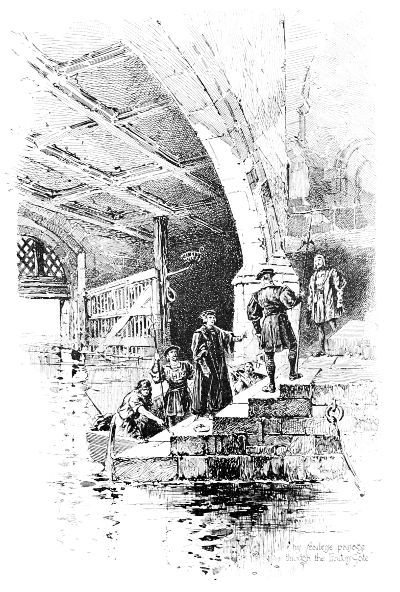
"his fearlesse passage through the Traitor's Gate"
At length we stayed rowing: Will lifted
me out, kissed me, heartened me up; and,
indeede, I was in better Heart then, having
been quietlie in Prayer a good While.
After some few Forms, we were led
through sundrie Turns and Passages; and,
or ever I was aware, I founde myself quit
of my Companions and in Father's Arms.
We both cried a little at first; I
wonder I wept noe more, but Strength
was given me in that Hour. As soone
as I coulde, I lookt him in the Face, and
he lookt at me, and I was beginning to
note his hollow Cheeks, when he sayd,
"Why, Meg, you are getting freckled;"
soe that made us bothe laugh. He sayd,
"You shoulde get some Freckle-water of
the Lady that sent me here; depend on
it, she hath Washes and Tinctures in
Plenty; and after all, Meg, she'll come
to the same End at last, and be as the
Lady all Bone and Skin, whose ghastlie
Legend used to scare thee soe when
thou wert a Child. Don't tell that
Story to thy Children; 'twill hamper
'em with unsavoury Images of Death.
Tell them of heavenlie Hosts a-waiting
to carry off good Men's Souls in fire-bright
Chariots, with Horses of the Sun,
to a Land where they shall never more
be surbated and weary, but walk on
cool, springy Turf and among Myrtle
Trees, and eat Fruits that shall heal
while they delight them, and drink the
coldest of cold Water, fresh from the
River of Life, and have Space to stretch
themselves, and bathe, and leap, and
run, and, whichever Way they look,
meet Christ's Eyes smiling on them.
Sure, Meg, who would live, that coulde
die? One mighte as lief be an Angel
shut up in a Nutshell as bide here.
Fancy how gladsome the sweet Spirit
woulde be to have the Shell cracked!
no matter by whom; the King, or
King's Mistress.... Let her dainty
Foot but set him free, he'd say, 'For
this Release, much Thanks.' ... And
how goes the Court, Meg?"
"In Faith, Father, never better....
There is Nothing else there, I hear, but
Dancing and Disporting."
"Never better, Child, sayst thou?
Alas, Meg, it pitieth me to consider
what Misery, poor Soul, she will
shortlie come to. These Dances of
hers will prove such Dances that she
will spurn our Heads off like Footballs;
but 'twill not be long ere her Head
will dance the like Dance. Mark you,
Meg, a Man that restraineth not his
Passions, hath always Something cruel
in his Nature, and if there be a Woman
toward, she is sure to suffer heaviest
for it, first or last.... Seek Scripture
Precedent for't ... you'll find it as
I say. Stony as Death, cruel as the
Grave. Those Pharisees that were, to
a Man, convicted of Sin, yet haled a
sinning Woman before the Lord, and
woulde fain have seene the Dogs lick
up her Blood. When they lick up
mine, deare Meg, let not your Heart be
troubled, even though they shoulde hale
thee to London Bridge, to see my Head
stuck on a Pole. Think, most dear'st,
I shall then have more Reason to weep
for thee than thou for me. But there's
noe weeping in Heaven; and bear in
Mind, Meg, distinctlie, that if they send
me thither, 'twill be for obeying the
Law of God rather than of Men. And
after alle, we live not in the bloody,
barbarous old Times of Crucifyings and
Flayings, and immersing in Cauldrons
of boiling Oil. One Stroke, and the
Affair's done. A clumsy Chirurgeon
would be longer extracting a Tooth.
We have oft agreed that the little Birds
struck down by the Kite and Hawk
suffer less than if they were reserved to
a naturall Death. There is one sensible
Difference, indeed, between us. In our
Cases, Preparation is a-wanting."
Hereon, I minded me to slip off the
Haircloth and Rope, and give the same
to him, along with the Books and Suckets,
all which he hid away privatelie, making
merry at the last.
"'Twoulde tell well before the Council,"
quoth he, "that on searching the Prison-cell
of Sir Thomas More, there was
founde, flagitiouslie and mysteriouslie
laid up ... a piece of Barley-sugar!"
Then we talked over sundrie Home-matters;
and anon, having now both of
us attayned unto an equable and chastened
Serenitie of Mind, which needed not any
false Shows of Mirth to hide the naturall
Complexion of, he sayth, "I believe, Meg,
they that have put me here ween they
have done me a high Displeasure; but
I assure thee on my Faith, mine owne
good Daughter, that if it had not beene
for my Wife, and for you, my dear
good Children, I woulde faine have
beene closed up, long ere this, in as
strait a Room, and straiter too."
Thereon, he shewed me how illegal
was his Imprisonment, there being noe
Statute to authorize the Imposition of
the Oath, and he delivered himself, with
some Displeasure, agaynst the King's ill
Counsellors.
"And surelie, Meg," quoth he, "'tis
pitie that anie Christian Prince shoulde,
by a flexible Council readie to follow his
Affections, and by a weak Clergy lacking
Grace to stand constantly to the
Truth as they have learned it, be with
Flattery so constantly abused. The
Lotus Fruit fabled by the Ancients,
which made them that ate it lose all
Relish for the daylie Bread of their own
Homes, was Flattery, Meg, as I take
it, and Nothing else. And what less
was the Song of the Syrens, agaynst
which Ulysses made his Sailors stop
their Ears, and which he, with all his
Wisdom, coulde not listen to without
struggling to be unbound from the
Mast? Even Praise, Meg, which,
moderately given, may animate and
cheer forward the noblest Minds, yet
too lavishly bestowed, will decrease and
palsy their Strength, e'en as an Over-dose
of the most generous and sprightlie
Medicine may prove mortiferous. But
Flattery is noe Medicine, but a rank
Poison, which hath slayn Kings, yea,
and mighty Kings; and they who love
it, the Lord knoweth afar off; knoweth
distantlie, has no care to know intimatelie,
for they are none of his."
Thus we went on, from one Theme to
another, till methinketh a heavenlie Light
seemed to shine alle about us, like as when
the Angel entered the Prison of Peter.
I hung upon everie Word and Thought
that issued from his Lips, and drank them
in as thirsty Land sucks up the tender
Rain.... Had the Angel of Death at
that Hour come in to fetch both of us
away, I woulde not have sayd him nay,
I was soe passively, soe intenselie happy.
At length, as Time wore on, and I knew
I shoulde soone be fetcht forthe, I
coulde not but wish I had the Clew to
some secret Passage or Subterraneal, of
the which there were doubtless Plenty
in the thick Walls, whereby we might
steal off together. Father made Answer,
"Wishes never filled a Sack. I make
it my Businesse, Meg, to wish as little
as I can, except that I were better and
wiser. You fancy these four Walls
lonesome; how oft, dost thou suppose,
I here receive Plato and Socrates, and
this and that holy Saint and Martyr?
My Gaolers can noe more keep them
out than they can exclude the Sunbeams.
Thou knowest, Jesus stood
among his Disciples when the Doors
were shut. I am not more lonely than
St. Anthony in his Cave, and I have
a divine Light e'en here, whereby to
con the Lesson, 'God is Love.' The
Futility of our Enemies' Efforts to make
us miserable was never more stronglie
proven to me than when I was a
mere Boy in Cardinall Morton's Service.
Having unwittinglie angered one of
his Chaplains, a choleric and even
malignant-spirited Man, he did, of his
owne Authoritie, shut me up for some
Hours in a certayn damp Vault, which,
to a Lad afeard of Ghosts and devilish
Apparitions, would have beene fearsome
enow. Howbeit, I there cast myself on
the Ground with my Back sett agaynst
the Wall, and mine Arm behind my
Head, this Fashion ... and did then
and there, by reason of a young Heart,
quiet Conscience, and quick Phansy,
conjure up such a lively Picture of the
Queen o' the Fairies' Court, and alle the
Sayings and Doings therein, that never
was I more sorry than when my Gaoler
let me goe free, and bade me rise up
and be doing. In place, therefore, my
Daughter, of thinking of me in thy
Night Watches as beating my Wings
agaynst my Cage Bars, trust that God
comes to look in upon me without
Knocking or Bell-ringing. Often in
Spiritt I am with you alle; in the
Chapel, in the Hall, in the Garden;
now in the Hayfield, with my Head on
thy Lap, now on the River, with Will
and Rupert at the Oar. You see me
not about your Path, you won't see my
disembodied Spiritt beside you hereafter,
but it may be close upon you once and
agayn for alle that: maybe, at Times
when you have prayed with most Passion,
or suffered with most Patience, or performed
my Hests with most Exactness,
or remembered my Care of you with
most Affection. And now, good Speed,
good Meg, I hear the Key turn in the
Door.... This Kiss for thy Mother,
this for Bess, this for Cecil, ... this
and this for my whole School. Keep
dry Eyes and a hopefull Heart; and
reflect that Nought but unpardoned Sin
shoulde make us weep for ever."
September.
Seeing the Woodman fell
a noble Tree, which, as it
went to the Ground, did
uptear severall small Plants
by the Roots, methoughte
such woulde be the Fall of dear Father,
herein more sad than that of the Abbot
of Sion and the Charterhouse Monks, inasmuch
as, being celibate, they involve
noe others in theire Ruin. Brave, holie
Martyrs! how cheerfully they went to
theire Death. I'm glad to have seene how
pious Men may turn e'en an ignominious
Sentence into a kind of Euthanasy. Dear
Father bade me note how they bore themselves
as Bridegrooms going to theire
Marriage, and converted what mighte
have beene a Shock to my surcharged
Spiritts, into a Lesson of deepe and high
Comfort.
One Thing hath grieved me sorelie.
He mistooke Somewhat I sayd at parting
for an Implication of my Wish that he
shoulde yield up his Conscience. Oh no,
dearest Father, that be far from me! It
seems to have cut him to the Heart, for
he hath writ that "none of the terrible
Things that may befall him touch him
soe nearlie as that his dearly beloved
Child, whose Opinion he soe much
values, shoulde desire him to overrule
his Conscience." That be far from
me, Father! I have writ to explayn
the Matter, but his Reproach, undeserved
though it be, hath troubled my Heart.
November.

Parliament will meet
to-morrow. 'Tis expected
Father and the good Bishop
of Rochester will be attainted
for Misprision of Treason
by the slavish Members thereof; and
though not given hithertoe unto much
Heede of Omens and Bodements while
our Hearts were light and our Courage
high, yet now the coming Evill seemeth
foreshadowed unto alle by I know not
how many melancholick Presages, sent,
for aught we know, in Mercy. Now
that the days are dark and short, and the
Nights stormy, we shun to linger much
after Dusk in lone Chambers and Passages,
and what was sayd of the Enemies of
Israel may be nigh sayd of us, "that a
falling Leaf shall chase them." I'm
sure "a going in the Tops of the Mulberry
Trees" on a blusterous Evening,
is enow to draw us alle, Men, Mothers,
and Maids, together in an Heap.... We
goe aboute the House in Twos and Threes,
and care not much to leave the Fireside.
Last Sunday we had closed about the
Hearth, and little Bill was a reading by
the Fire-light how Herodias' Daughter
danced off the Head of St. John the
Baptist, when down comes an emptie
Swallow's Nest tumbling adown the
Chimnie, bringing with it enow of Soot,
Smoke, and Rubbish to half smother us
alle; but the Dust was nothing to the
Dismay thereby occasioned, and I noted
one or two of our bravest turn as pale as
Death. Then, the Rats have skirmished
and gallopped behind the Wainscoat more
like a Troop of Horse than a Herd of
such small Deer, to the infinite Annoyance
of Mother, who coulde not be more firmly
persuaded they were about to leave a
falling House, if, like the scared Priests
in the Temple of Jerusalem, she had
heard a Voyce utter, "Let us depart
hence." The round upper Half of the
Cob-loaf rolled off the Table this Morning;
and Rupert, as he picked it up, gave
a Kind of Shudder, and muttered somewhat
about a Head rolling from the
Scaffold. Worse than this was o' Tuesday
Night.... 'Twas Bed-time, and yet
none were liking to goe, when, o' suddain,
we hearde a Screech that made every
Body's Heart thrill, followed by one or
two hollow Groans. Will snatches up
the Lamp and runs forth, I close following,
and alle the others at our Heels;
and after looking into sundrie deserted
Cup-boards and Corners, we descend the
broad Stone Steps of the Cellars, half way
down which Will, stumbling over something
he sees not, takes a flying Leap to
clear himself down to the Bottom, luckily
without extinguishing the Lamp. We
find Gillian on the Steps in a Swoon; on
bringing her to, she exclayms about a
Ghost without a Head, wrapped in a
Winding-sheet, that confronted her and
then sank to the Ground as she entered
the Vaults. We cast a fearfulle Look
about, and descry a tall white Sack of
Flour, recently overturned by the Rats,
which clears up the Mystery, and procures
Gillian a little Jeering; but we alle
return to the Hall with fluttered Spiritts.
Another Time I, going up to the Nurserie
in the Dark, on hearing Baby cry, am
passed on the Stairs by I know not what,
breathing heavilie. I reache forthe my
Arm, but pass cleare through the spirituall
Nature, whatever it is, yet distinctlie feel
my Cheek and Neck fanned by its Breath.
I turn very faint, and get Nurse to goe
with me when I return, bearing a Light,
yet think it as well to say nought to
distress the rest.
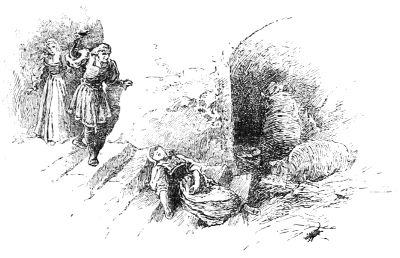
But worst of alle was last Night....
After I had beene in Bed awhile, I minded
me that deare Will had not returned me
Father's Letter. I awoke him, and asked
if he had broughte it up Stairs; he
sleepily replied he had not, soe I hastily
arose, threw on a Cloke, took a Light,
and entered the Gallery; when, half-way
along it, between me and the pale Moonshine,
I was scared to behold a slender
Figure alle in white, with naked Feet and
Arms extended. I stoode agaze, speechlesse,
and to my Terror made out the
Features of Bess ... her Eyes open,
but vacant; then saw John Dancey softly
stealing after her, and signing to me with
his Finger on his Lips. She passed without
noting me, on to Father's Door, there
knelt as if in Prayer, making a low sort
of Wail, while Dancey, with Tears running
down his Cheeks, whispered, "'Tis
the third Time of her thus sleep-walking
... the Token of how troubled a
Mind!"
We disturbed her not, dreading that a
suddain Waking might bring on Madness;
soe after making Moan awhile, she
kisses the senseless Door, rises up, moves
towards her own Chamber, followed by
Dancey and me, wrings her Hands a little,
then lies down and graduallie falls into
what seems a dreamlesse Sleep, we watching
her in Silence till she's quiet, and
then squeezing each other's Hands ere
we part.
----Will was wide awake when I got
back; he sayd, "Why, Meg, how long
you have beene! coulde you not lighte
on the Letter?" ... When I tolde
him what had hindered me by the
Way, he turned his Face to the Wall
and wept.
Midnight.
The wild Wind is abroad,
and, methinketh, nothing
else. Sure, how it rages
through our empty Courts!
In such a Season, Men,
Beasts, and Fowls cower beneath the
Shelter of their rocking Walls, yet almost
fear to trust them. Lord, I know that
thou canst give the Tempest double Force,
but do not, I beseech thee! Oh! have
Mercy on the frail Dwelling and the Ship
at Sea.
Dear little Bill hath ta'en a feverish
Attack. I watch beside him whilst his
Nurse sleeps. Earlie in the Night his
Mind wandered, and he told me of a
pretty pyebald Poney, noe bigger than a
Bee, that had golden Housings and Barley-sugar
Eyes; then dozed, but ever and
anon kept starting up, crying, "Mammy
dear!" and softlie murmured, "Oh!"
when he saw I was by. At length I gave
him my Forefinger to hold, which kept
him ware of my Presence without speaking;
but presentlie he stares hard towards
the Foot of the Bed, and says fearfullie,
"Mother, why hangs yon Hatchet in the
Air, with its sharp Edge turned towards
us?" I rise, move the Lamp, and say,
"Do you see it now?" He sayth, "No,
not now," and closes his Eyes. After
a good Space, during the which I hoped
he slept, he says in quite an altered Tone,
most like unto soft, sweet Music, "There's
a pretty little Cherub there now, alle
Head and noe Body, with two little
Wings aneath his Chin; but, for alle
he's soe pretty, he is just like dear
Gaffer, and seems to know me ... and
he'll have a Body agayn too, I believe,
by and by.... Mother, Mother, tell
Hobbinol there's such a gentle Lamb in
Heaven!" And soe, slept.
17th.
He's gone, my pretty...!
slipt through my Fingers
like a Bird! upfled to his
own native Skies; and yet,
whenas I think on him, I
cannot choose but weepe.... Such a
guilelesse little Lamb!... My Billy-bird!
his Mother's owne Heart!—They
are alle wondrous kind to me....
27th.
How strange that a little
Child shoulde be permitted
to suffer soe much Payn,
when of such is the Kingdom
of Heaven! But 'tis
onlie transient, whereas a Mother makes
it permanent, by thinking it over and over
agayn. One Lesson it taughte us betimes,
that a naturall Death is not, necessarilie,
the most easie. We must alle die....
As poor Patteson was used to say, "The
greatest King that ever was made, must
bed at last with Shovel and Spade,"
... and I'd sooner have my Billy's Baby
Deathbed than King Harry's, or Nan
Boleyn's either, however manie Years they
may yet carry Matters with a high Hand.
Oh, you Ministers of Evill, whoever ye
be, visible or invisible, you shall not build
a Wall between my God and me....
I've Something within me grows stronger
and stronger, as Times grow more and
more Evill; some woulde call it Resolution,
but methinketh 'tis Faith.
Meantime, Father's Foes ... alack
that anie can shew 'emselves such! are
aiming, by fayr Seemings of friendlie
Conference, to draw from him Admissions
they can come at after noe other Fashion.
The new Solicitor Generall hath gone to
the Tower to deprive him of the few
Books I have taken him from Time to
Time.... Ah, Master Rich, you must
deprive him of his Brains afore you can
rob him of their Contents!... and,
while having 'em packt up, he falls into
easie Dialogue with him, as thus, ...
"Why now, sure, Mr. More, were there
an Act of Parliament made that all the
Realm shoulde take me for King, you
woulde take me for such with the
Rest."
"Aye, that would I, Sir," returns
Father.
"Forsooth, then," pursues Rich, "we'll
suppose another Act that should make
me the Pope. Woulde you not take
me for Pope?"
"Or suppose another Case, Mr. Rich,"
returns Father, "that another Act shoulde
pass, that God shoulde not be
God,
would you say well and good?"
"No, truly," returns the other hastily,
"for no Parliament coulde make such
Act lawful."
"True, as you say," repeats Father,
"they coulde not," ... soe eluded the
Net of the Fowler; but how miserable
and unhandsome a Device to lay wait for
him thus!
... I stole forthe, ere 'twas Lighte,
this damp chill Morning, to pray beside
the little Grave, but found dear Daisy
there before me. How Christians love
one another!
Will's Loss is as heavie as mine, yet
he bears with me tenderlie. Yesternighte,
he sayth to me half reproachfullie, "Am
not I better unto thee than ten Sons?"
March, 1535.
Spring comes, that brings
Rejuvenescence to the
Land, and Joy to the
Heart, but it brings none
to us, for where Hope
dieth, Joy dieth. But Patience, Soul;
God's yet in the Aumry!
May 7.
Father arraigned.
July 1.

By Reason of Will's minding
to be present at the Triall,
which, for the Concourse
of Spectators, demanded
his earlie Attendance, he
committed the Care of me, with Bess,
to Dancey, who got us Places to see
Father on his Way from the Tower to
Westminster Hall. We coulde not come
at him for the Crowd, but clambered on
a Bench to gaze our very Hearts away
after him as he went by, sallow, thin,
grey-haired, yet in Mien not a Whit cast
down. Wrapt in a coarse woollen Gown,
and leaning on a Staff; which unwonted
Support when Bess markt, she hid her
Eyes on my Shoulder and wept sore, but
soon lookt up agayn, though her Eyes
were soe blinded, I think she coulde not
see him. His Face was calm, but grave,
as he came up, but just as he passed he
caughte the Eye of some one in the
Crowd, and smiled in his old, frank Way;
then glanced up towards the Windows
with the bright Look he hath soe oft
cast to me at my Casement, but saw us
not. I coulde not help crying "Father,"
but he heard me not; perchance 'twas soe
best.... I woulde not have had his Face
cloud at the Sighte of poor Bessy's Tears.
... Will tells me the Indictment was
the longest ever hearde; on four Counts.
First, his Opinion on the King's Marriage.
Second, his writing sundrie Letters to the
Bishop of Rochester, counselling him to hold
out. Third, refusing to acknowledge his
Grace's Supremacy. Fourth, his positive
Deniall of it, and thereby willing to deprive
the King of his Dignity and Title.
When the reading of this was over,
the Lord Chancellor sayth, "Ye see how
grievouslie you have offended the King
his Grace, but and yet he is soe mercifulle,
as that if ye will lay aside your
Obstinacie, and change your Opinion,
we hope ye may yet obtayn Pardon."
Father makes Answer ... and at
Sounde of his deare Voyce alle Men
hold their Breaths; ... "Most noble
Lords, I have great Cause to thank your
Honours for this your Courtesie ...
but I pray Almighty God I may
continue in the Mind I'm in, through
his Grace, until Death."
They coulde not make goode their
Accusation agaynst him. 'Twas onlie on
the Last Count he could be made out a
Traitor, and Proof of't had they none;
how coulde they have? He shoulde
have beene acquitted out of hand, 'steade
of which, his bitter Enemy my Lord
Chancellor called on him for his Defence.
Will sayth there was a generall Murmur
or Sigh ran through the Court. Father,
however, answered the Bidding by beginning
to expresse his Hope that the Effect
of long Imprisonment mighte not have
beene such upon his Mind and Body, as
to impair his Power of rightlie meeting
alle the Charges agaynst him ... when,
turning faint with long standing, he
staggered and loosed Hold of his Staff,
whereon he was accorded a Seat. 'Twas
but a Moment's Weakness of the Body,
and he then proceeded frankly to avow
his having always opposed the King's
Marriage to his Grace himself, which he
was soe far from thinking High Treason,
that he shoulde rather have deemed it
Treachery to have withholden his Opinion
from his Sovereign King when solicited
by him for his Counsell. His Letters to
the good Bishop he proved to have been
harmlesse. Touching his declining to
give his Opinion, when askt, concerning
the Supremacy, he alleged there coulde
be noe Transgression in holding his Peace
thereon, God only being cognizant of our
Thoughts.
"Nay," interposeth the Attorney Generall,
"your Silence was the Token of a
malicious Mind."
"I had always understoode," answers
Father, "that Silence stoode for Consent.
Qui tacet, consentire videtur;" which
made Sundrie smile. On the last Charge,
he protested he had never spoken Word
against the Law unto anie Man.
The Jury are about to acquit him,
when up starts the Solicitor Generall, offers
himself as Witness for the Crown, is
sworn, and gives Evidence of his Dialogue
with Father in the Tower, falselie adding,
like a Liar as he is, that on his saying
"No Parliament coulde make a Law that
God shoulde not be God,"
Father had rejoyned,
"No more coulde they make the
King supreme Head of the Church."
I marvell the Ground opened not at
his Feet. Father brisklie made Answer,
"If I were a Man, my Lords, who regarded
not an Oath, ye know well I
needed not stand now at this Bar. And
if the Oath which you, Mr. Rich, have
just taken, be true, then I pray I may
never see God in the Face. In good
Truth, Mr. Rich, I am more sorry for
your Perjurie than my Perill. You
and I once dwelt long together in one
Parish; your manner of Life and Conversation
from your Youth up were
familiar to me, and it paineth me to tell
ye were ever held very light of your
Tongue, a great Dicer and Gamester,
and not of anie commendable Fame
either there or in the Temple, the Inn
to which ye have belonged. Is it
credible, therefore, to your Lordships,
that the Secrets of my Conscience touching
the Oath, which I never woulde
reveal, after the Statute once made,
either to the King's Grace himself, nor
to anie of you, my honourable Lords,
I should have thus lightly blurted out
in private Parley with Mr. Rich?"
In short, the Villain made not goode
his Poynt: ne'erthelesse, the Issue of this
black Day was aforehand fixed; my Lord
Audley was primed with a virulent and
venomous Speech; the Jury retired, and
presentlie returned with a Verdict of
Guilty; for they knew what the King's
Grace woulde have 'em doe in that
Case.
Up starts my Lord Audley;—commences
pronouncing Judgment, when—
"My Lord," says Father, "in my
Time, the Custom in these Cases was
ever to ask the Prisoner before Sentence,
whether he coulde give anie Reason
why Judgment shoulde not proceed
agaynst him."
My Lord, in some Confusion, puts the
Question.
And then came the frightful Sentence.
Yes, yes, my Soul, I know; there were
Saints of old sawn asunder. Men of
whom the World was not worthy.
... Then he spake unto 'em his
Mind; and bade his Judges and Accusers
farewell; hoping that like as St. Paul was
present and consenting unto St. Stephen's
Death, and yet both were now holy Saints
in Heaven, so he and they might speedilie
meet there, joint Heirs of e'erlasting Salvation.
Meantime, poor Bess and Cecilie, spent
with Grief and long waiting, were forct
to be carried Home by Heron, or ever
Father returned to his Prison. Was't
less Feeling, or more Strength of Body,
enabled me to bide at the Tower Wharf
with Dancey? God knoweth. They
brought him back by Water; my poor
Sisters must have passed him.... The
first Thing I saw was the Axe, turned with
its Edge towards him—my first Note of his
Sentence. I forct my Way through the
Crowd ... some one laid a cold Hand
on mine Arm; 'twas poor Patteson, soe
changed I scarce knew him, with a Rosary
of Gooseberries he kept running through
his Fingers. He sayth, "Bide your Time,
Mistress Meg; when he comes past,
I'll make a Passage for ye; ... Oh,
Brother, Brother! what ailed thee to
refuse the Oath? I've taken it!" In
another Moment, "Now, Mistress, now!"
and flinging his Arms right and left,
made a Breach through which I darted,
fearlesse of Bills and Halberds, and did
cast mine Arms about Father's Neck. He
cries, "My Meg!" and hugs me to him
as though our very Souls shoulde grow
together. He sayth, "Bless thee, bless
thee! Enough, enough, my Child;
what mean ye, to weep and break mine
Heart? Remember, though I die innocent,
'tis not without the Will of
God, who coulde have turned mine
Enemies' Hearts, if 'twere best; therefore
possess your Soul in Patience. Kiss
them alle for me, thus and thus ..."
soe gave me back into Dancey's Arms, the
Guards about him alle weeping; but I
coulde not thus lose Sight of him for
ever; soe, after a Minute's Pause, did
make a second Rush, brake away from
Dancey, clave to Father agayn, and agayn
they had Pitie on me, and made Pause
while I hung upon his Neck. This
Time there were large Drops standing on
his dear Brow; and the big Tears were
swelling into his Eyes. He whispered,
"Meg, for Christ's Sake don't unman me;
thou'lt not deny my last Request?" I
sayd, "Oh! no;" and at once loosened
mine Arms. "God's Blessing be with
you," he sayth with a last Kiss. I
coulde not help crying, "My Father, my
Father!" "The Chariot of Israel, and
the Horsemen thereof!" he vehementlie
whispers, pointing upwards with soe passionate
a Regard, that I look up, almost
expecting a beatific Vision; and when I
turn about agayn, he's gone, and I have
noe more Sense nor Life till I find myself
agayn in mine owne Chamber, my Sisters
chafing my Hands.
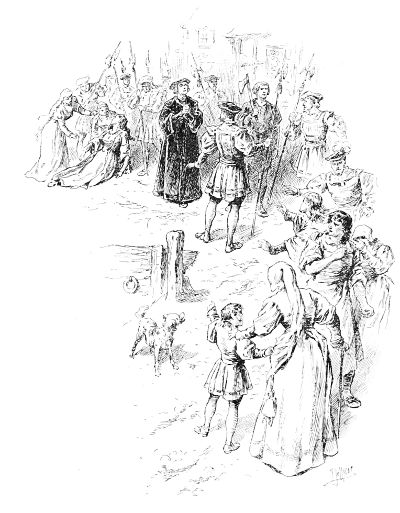
July 5th.
Alle's over now ... they've
done theire worst, and
yet I live. There were
Women coulde stande aneath
the Cross. The Maccabees'
Mother— ... yes, my Soul, yes; I know—Nought
but unpardoned Sin.... The
Chariot of Israel.
6th.
Dr. Clement hath beene with
us. Sayth he went up as
blythe as a Bridegroom to
be clothed upon with Immortality.
Rupert stoode it alle out. Perfect Love
casteth out Feare. Soe did his.
17th.
My most precious Treasure is
this deare Billet, writ with
a Coal; the last Thing he
sett his Hand to, wherein
he sayth, "I never liked
your Manner towards me better than
when you kissed me last."
19th.
They have let us bury his
poor mangled Trunk; but,
as sure as there's a Sun
in Heaven, I'll have his
Head!—before another
Sun hath risen, too. If wise Men won't
speed me, I'll e'en content me with a
Fool.
I doe think Men, for the most Part,
be Cowards in theire Hearts ... moral
Cowards. Here and there, we find one
like Father, and like Socrates, and like
... this and that one, I mind not theire
Names just now; but in the Main, methinketh
they lack the moral Courage of
Women. Maybe, I'm unjust to 'em just
now, being crost.
July 20th.
I lay down, but my Heart
was waking. Soon after
the first Cock crew, I
hearde a Pebble cast
agaynst my Lattice, knew
the Signall, rose, dressed, stole softlie
down and let myself out. I knew the
Touch of the poor Fool's Fingers; his
Teeth were chattering, 'twixt Cold and
Fear, yet he laught aneath his Breath as
he caught my Arm and dragged me after
him, whispering, "Fool and fayr Lady
will cheat 'em yet." At the Stairs lay
a Wherry with a Couple of Boatmen, and
one of 'em stepping up to me, cries, "Alas
for ruth, Mistress Meg, what is't ye
do? Art mad to go on this Errand?"
I sayd, "I shall be mad if I goe not,
and succeed too—put me in, and push
off."
We went down the River quietlie
enow—at length reach London Bridge
Stairs. Patteson, starting up, says, "Bide
ye all as ye are," and springs aland and
runneth up to the Bridge. Anon, returns,
and sayth, "Now, Mistress, alle's readie
... readier than ye wist ... come
up quickly, for the Coast's clear."
Hobson (for 'twas he) helps me forth,
saying, "God speed ye, Mistress....
An' I dared, I woulde goe with ye."
... Thought I, there be others in that
Case.
Nor lookt I up till aneath the Bridge-gate,
when casting upward a fearsome
Look, I beheld the dark Outline of the
ghastly yet precious Relic; and, falling
into a Tremour, did wring my Hands
and exclaym, "Alas, alas, that Head hath
lain full manie a Time in my Lap,
woulde God, woulde God
it lay there
now!" When, o' suddain, I saw the
Pole tremble and sway towards me; and
stretching forth my Apron, I did in an
Extasy of Gladness, Pity, and Horror,
catch its Burthen as it fell. Patteson,
shuddering, yet grinning, cries under his
Breath, "Managed I not well, Mistress?
Let's speed away with our Theft, for
Fools and their Treasures are soon
parted; but I think not they'll follow
hard after us, neither, for there are
Well-wishers to us on the Bridge.
I'll put ye into the Boat and then
say, God speed ye, Lady, with your
Burthen."
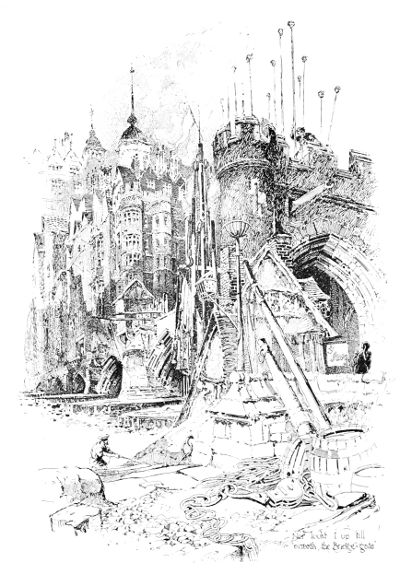
Nor lookt I up till aneath the Bridge-gate
July 23rd.
Rizpah, Daughter of Aiah,
did watch her Dead from
the Beginning of Harvest
until the latter Rain, and
suffered neither the Birds
of the Air to light on them by Day, nor
the wild Beasts of the Field by Night.
And it was told the King, but he intermeddled
not with her.
Argia stole Polynices' Body by Night
and buried it, for the which, she with
her Life did willingly pay Forfeit. Antigone,
for aiding in the pious Theft, was
adjudged to be buried alive. Artemisia
did make herself her loved one's Shrine,
by drinking his Ashes. Such is the Love
of Women; many Waters cannot quench
it, neither can the Floods drown it. I've
hearde Bonvisi tell of a poor Italian Girl,
whose Brothers did slay her Lover; and
in Spite of them she got his Heart, and
buried it in a Pot of Basil, which she
watered Day and Night with her Tears,
just as I do my Coffer. Will has promised
it shall be buried with me; layd upon
my Heart; and since then, I've beene
easier.
He thinks he shall write Father's Life,
when he gets more composed, and we are
settled in a new Home. We are to be
cleared out o' this in alle Haste; the King
grutches at our lingering over Father's
Footsteps, and gazing on the dear familiar
Scenes associate with his Image; and
yet, when the News of the bloody Deed
was taken to him, as he sate playing at
Tables with Queen Anne, he started up
and scowled at her, saying, "Thou art
the Cause of this Man's Death!"
Father might well say, during our last
precious Meeting in the Tower, "'Tis I,
Meg, not the King, that love Women.
They belie him; he onlie loves himself."
Adding, with his own sweet
Smile, "Your Gaffer used to say that
Women were a Bag of Snakes, and that
the Man who put his Hand therein
woulde be lucky if he founde one Eel
among them alle; but 'twas onlie in
Sport, Meg, and he owned that I had
enough Eels to my Share to make a
goodly Pie, and called my House the
Eel-pie House to the Day of his Death.
'Twas our Lord Jesus raised up Women,
and shewed Kindnesse unto 'em; and
they've kept theire Level, in the Main,
ever since."
I wish Will may sett down everie Thing
of Father's saying he can remember; how
precious will his Book then be to us!
But I fear me, these Matters adhere not
to a Man's Memory ... he'll be telling
of his Doings as Speaker and Chancellor,
and his saying this and that in Parliament.
Those are the Matters Men like to write
and to read; he won't write it after my
Fashion.
I had a Misgiving of Will's Wrath,
that Night, 'speciallie if I failed; but he
called me his brave Judith. Indeed I
was a Woman bearing a Head, but one
that had oft lain on my Shoulder.
My Thoughts beginne to have Connexion
now; but till last Night, I slept
not. 'Twas scarce Sunsett. Mercy had
been praying beside me, and I lay outside
my Bed, inclining rather to Stupor than
Sleep. O' suddain, I have an Impression
that some one is leaning over me, though
I hear 'em not, nor feel theire Breath. I
start up, cry "Mercy!" but she's not
there, nor anie one else. I turn on my
Side and become heavie to Sleep; but or
ere I drop quite off, agayn I'm sensible or
apprehensive of some living Consciousness
between my closed Eyelids and the setting
Sunlight; agayn start up and stare about,
but there's Nothing. Then I feel like
... like Eli, maybe, when the Child
Samuel came to him twice; and Tears
well into mine Eyes, and I close 'em
agayn, and say in mine Heart, "If he's
at Hand, oh, let me see him next Time
... the third Time's lucky." But
'steade of this, I fall into quiet, balmy,
dreamlesse Sleep. Since then, I've had
an abiding, assuring Sense of Help, of a
Hand upholding me, and smoothing and
glibbing the Way before me.
We must yield to the Powers that be.
At this Present, we are weak, but they
are strong; they are honourable, but we
are despised. They have made us a
Spectacle unto the World, and, I think,
Europe will ring with it; but at this
present Hour, they will have us forth
of our Home, though we have as yet no
certayn Dwelling-Place, and must flee as
scared Pigeons from their Dove-cot. No
Matter; our Men are willing to labour,
and our Women to endure: being reviled,
we bless; being persecuted, we suffer it.
Onlie I marvell how anie honest Man,
coming after us, will be able to eat a
Mouthful of Bread with a Relish within
these Walls. And, methinketh, a dishonest
Man will have sundrie Frights
from the Lares and Lemures. There'll
be Dearth o' black Beans in the
Market.
Flow on, bright shining Thames. A
good brave Man hath walked aforetime
on your Margent, himself as bright, and
usefull, and delightsome as be you, sweet
River. And like you, he never murmured;
like you, he upbore the weary, and gave
Drink to the Thirsty, and reflected Heaven
in his Face. I'll not swell your full
Current with any more fruitless Tears.
There's a River, whose Streams make
glad the City of our God. He now rests
beside it. Good Christian Folks, as they
hereafter pass this Spot, upborne on thy
gentle Tide, will, maybe, point this Way,
and say—"There dwelt Sir Thomas More;"
but whether they doe or not, Vox Populi
is a very inconsiderable Matter. Who
would live on theire Breath? They hailed
St. Paul as Mercury, and then stoned him,
and cast him out of the City, supposing
him to be dead. Theire Favourite of
to-day may, for what they care, goe
hang himself to-morrow in his Surcingle.
Thus it must be while the World lasts;
and the very Racks and Scrues wherewith
they aim to overcome the nobler Spiritt,
onlie test and reveal its Power of Exaltation
above the heaviest Gloom of Circumstance.
Interfecistis, interfecistis Hominem omnium
Anglorum optimum.
FINIS
Printed by Ballantyne, Hanson & Co.
Edinburgh & London
In the html and e-book versions without illustrations, the caption from the
List of Illustrations has been provided as an
alternative.
Some words have been represented
in the print version as the first three letters of the word followed
by the last letter as a superscript and with a dot underneath.
The dot has been left out in the html and e-book versions in order to
be compatible with most devices and browsers.
On p. 59, a presumed printer's error has been
corrected:
"She seems 'em now!" (as printed in the original) has been changed to
"She sees 'em now!" (in this version)
On p. 201, the date 1543 has been changed to 1534.
This can be fairly presumed to be the intended date based on historical occurrences
referred to and based on the continuity of entries.
Spelling and use of italics is inconsistent throughout the text. These
inconsistencies have been retained in this version.