The Party with Supper for Seventeen, and
Toasts with a Toasting-Fork.
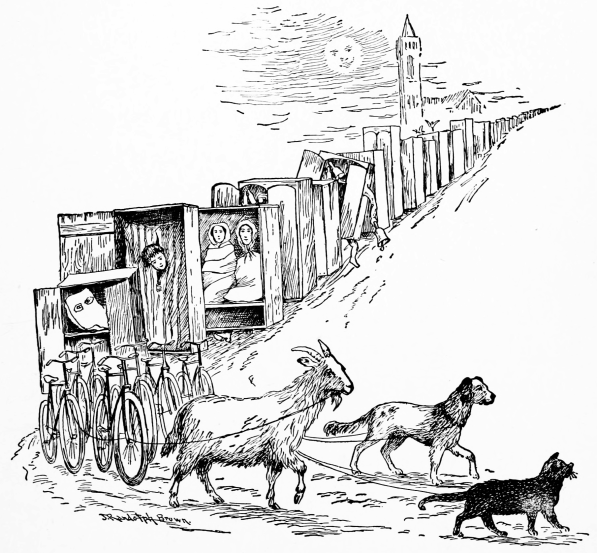
WHEN they returned to the parsonage,
Billy unhitched himself and
opened the front door. The Judge
and his wife with Ruth and the
baby hastened into the warm
rooms as fast as the feather-bed, the white flannel
bag, the blue envelope, and the red paper would
permit them.
"Why, what a change there is here!" exclaimed
Ruth. "It must be exactly as you used to have it."
"Yes," replied Mrs. "Judge"; "I told the man
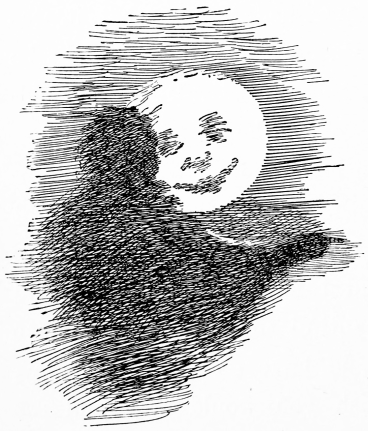
in the moon to make things look natural. This
seems really like coming home. I feel very much
as I did whenever I drove down to New York, and
came back to the dear house. It is so nice to see
these beautiful carpets again, and the same chairs
and tables and sofas; the very damask curtains
I made; my little sewing-stand; the clock right
there in its place near my bedroom door; and
there is the refrigerator. I always had it stand
in my bedroom, you know. That made it very
convenient. And I kept all the stores in"—
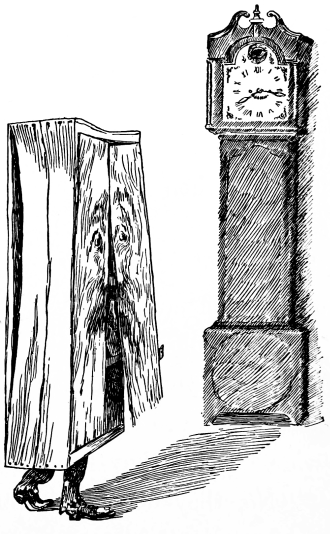
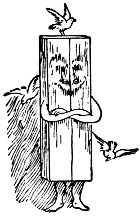
"Me," groaned Darkest Africa, who still remained
in front of the house awaiting the orders
of Ruth.
"Yes, in you," continued Mrs. "Judge"; "and
I expect to see you very happy again to-night. I
never kept Christmas. We didn't approve of such
things when I was a child." She was now talking
to Ruth. "But if they have a Christmas-tree
in the meeting-house, and the minister thinks it's
all right, it must be so. I am really quite glad to
get up a party to-night. I shall have it to think
about when I go back into the picture. And that
reminds me, child, that I want you to come into
the parlor very often and speak to me. It's very
very lonely staying there day and night, summer
and winter, year in and year out. Why don't you
ask the Judge and me to play church with you
and the rest of the children some of the times
when you come into the parlor?"
"Why, I never thought of that!" exclaimed
Ruth. "I'll do it the very next time (which
will be Sunday, I suppose) that we have church
again." By this time they had taken their wraps
off and put them up. That is to say, Ruth got
out of the feather-bed, and had Turk carry it
up-stairs, while she took the handkerchief and
the marble-bag off from the Judge, and the postage-stamp
and the red crinkly paper off from
Mrs. "Judge," and put these things in her pocket.
Then they all went into the lady's chamber, and
took the baby out of the envelope, laying him
on the bed, and covering him with a soap-dish and
a hair-brush to keep him warm, for he had gone
to sleep.
"Now we must get ready for the party," said
Ruth, "and then I'll call the children and dress
them. But, dear me! what will you and the
Judge wear? We've got tired of seeing you in
the same clothes all the time. Oh, I'll tell you!
Let's play dress up just as we children do, and
then I can fix you out in fine style."
"Just as you say, child. It's your party, and
you can do much as you please. And the truth
is that I am pretty tired of wearing the same
clothes all these many years. I don't think it
makes so much difference to a man. But we
women like to have something new once in a
while, say once in fifty or seventy-five years."
"Oh! won't it be fun?" cried Ruth. "We'll
have 'Providence' come in here and show us
what he's got in him. You know Providence is
the big closet in the corner of the Betsey-Bartram
room. Come here, Providence." This closet
ambled into the bedroom, and Mrs. "Judge" took
a silver candlestick with a wax candle in her
hand, and stepped into the closet followed by the
Judge and Ruth. What a medley of stuff they
found! There were silks and satins of all colors
and kinds. There was velvet and calico, lawn
and broadcloth, furs and flowers, laces and linens,
swallow-tail coats and fancy vests, a waterproof,
a riding-habit, bicycle suits, pajamas, flags and
bunting, forming an infinite assortment or mixture
of everything under the sun in the shape
of dry goods.
"You don't keep an old-clothes exchange, do
you, child?" asked the astonished visitor.
"Oh, no! these are mother's treasures (that's
what she calls them). We get 'em when her
ship comes in. It always seems to come in the
night. We children have watched for it ever
since we lived West and could remember. But
the first we know is that mother tells us some
day how the ship has come in, and another cargo
has been unloaded in Providence. Then we all
make a rush and overhaul the cargo; one thing
fits one child, and another thing fits another
child, and what doesn't fit we make over, and
then we appear in our new outfits. You ought
to see us go into church a week or two after a
fresh cargo of treasures has been distributed. It's
great fun." During this talk Ruth was rummaging
about in the trunks or on the shelves
in search of something becoming to her guests.
"I think the Judge ought to have something
solemn on, don't you?" she said, addressing his
wife. "Now, this long, black waterproof is the
thing. And he can wear Samuel's bicycle stockings
and shoes. Then, here's a broad purple ribbon
for a necktie; and I'll put this ermine boa around
his neck, for don't judges sometimes wear ermine?
Doesn't he look cute?" She had helped him on
with the things while Mrs. "Judge" stood by smiling
her approval.
"I think this green velvet waist and this red
silk skirt will look well on you." Ruth was
speaking to the lady. "Then I'll do your hair
up with this white lace and these yellow flowers.
It's so cold I think you had better wear mittens.
I think you ought to have a train to your dress.
I'll take some safety-pins, and fasten a few yards
of this white satin on behind. Doesn't it look
elegant? You must have a corsage bouquet."
And she twisted up some dry grasses and pink
roses, and pinned them to her belt. "And this
white gauze veil will add to the effect." So it
was spread over the lady's head, and fell in scant
folds across her brow.
"I shall get into this pink crape," Ruth continued,
"slip these muffs up my ankles, and take
this black fur cape and that lovely, lovely lavender
bonnet. I'm going to wear white kid gloves,
and have a train of that yellow satin. Will you,
please, tie this bow of nile-green velvet about my
neck? And I must have a veil too. This one
with little red spots like the measles all over it
will suit me, I guess. There, now, don't I look
just too nice for anything?" Both the Judge
and his wife bowed and smiled.
"I'll put this black lace one side for the baby
when he wakes up. We'll dress him up with
that and some tissue paper I've got in my pocket.
And now let's go and take a look at the house
again." But their talking roused the baby; so
they dressed him as Ruth had planned, winding
the paper and lace about his body as though he
were a mummy; and then they started for the
parlor, the Judge carrying his namesake on one
arm and supporting his wife on the other, with
Ruth dragging on behind, clinging to the right
hand of Mrs. "Judge."
At the foot of the stairs Ruth proposed that
she go and call all the children. For at this late
hour they had gone to bed. But the visitors
thought it better to wait.
"We must ask a few questions and find out
what the children want for Christmas," said Mrs.
"Judge." So they passed into the parlor, and sat
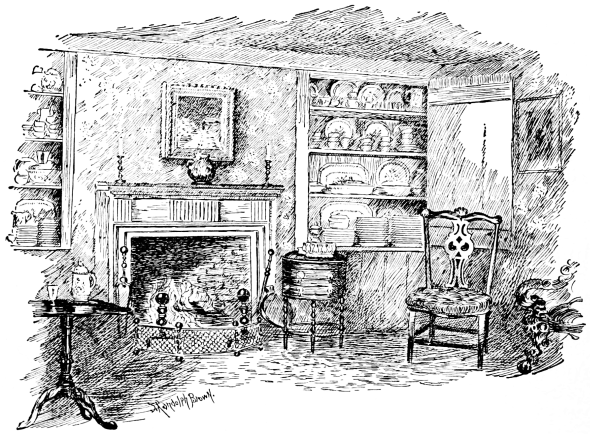
down on the Grecian sofa. A soft, gentle light
fell from the astral lamp and the wax candles
on the mantle-piece. The wood fire on the hearth,
the heavy damask curtains at the windows, the
rich mahogany furniture scattered about through
the room, the handsome pictures upon the walls,
gave the place a very inviting appearance.
"Now, Ruth, we're going to put something in
each child's stocking." Mrs. "Judge" was speaking.
"It seems to me a foolish custom, but now
that you all do it we will follow suit. Tell us
what to get."
"Father says there's a difference between what
we want and what we need. We want a great
many things, but we need only a few."
"That's sound talk," observed the Judge.
"Your father must be quite a man."
"Oh!" was the reply, "he weighs almost a
hundred and ninety pounds. I heard mother tell
the teacher the other day that she thought I
lacked capacity. I don't get along in school at
all. There are so many things to do besides study
that it takes all my time. I think mother would
be pleased if you gave me something of the kind.
That's what I need I suppose. But what I want
is to know about everything. That's why I ask
so many questions and tease to go all the time.
I'm trying to find out things for myself. How
should I learn how old a girl or a lady is if
I didn't ask? And what's my tongue for if it
isn't to use in talking?"
"To be sure," replied Mrs. "Judge." "But
I used my tongue for eating too, until I got into
the picture. I think it's almost a hundred years
since I had anything to eat."
"Mercy! aren't you hungry?" exclaimed Ruth.
"But you don't look thin, and you certainly don't
grow old. I've heard folks say so when they
looked at your picture. 'Why, how nice and
fresh and lifelike they seem.' That's what our
visitors say when we take them into the parlor
to see the portraits. But, dear me, we shall never
get through the list if I keep on talking. I can't
help talking. I seem made for it. I've heard
father say that several of his family were deaf,
but none of 'em were ever dumb." The Judge
and his wife appeared quite interested in this
lively flow of speech on the part of the child, so
they nodded their heads with encouragement, and
Ruth continued.
"Now, there's Helen, she's always talking about
writing a book. I think she wants to write a
book above all things. You might give her the
book she is going to write. But what she really
needs is curls. That straight black hair makes
her look horrid. I wish you'd bring her a whole
lot of curls. Isn't it queer that we can't have
a baby with curls? We've had a regular cry
over it more than once. Not a single curl in all
the fifteen. Every hair of our heads as straight
as a string. Don't you think you'd better write
the things down as I tell them to you? But
then you've got such an awful memory I suppose
you can remember everything. Now, there's
Samuel. You tell him two things and father
says he's sure to forget three. Mother says if his
memory was as good as his forgetery, he'd make
something remarkable."
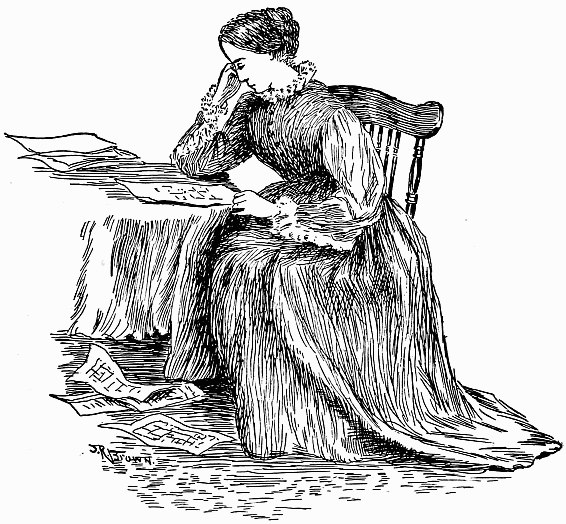
"I think if you will lend me a piece of paper,—that
red crinkly stuff that the baby has on,—and
a stick of candy or a poker, I will write down the
articles you mention." It was the Judge speaking.
"Why don't you take the quill and the paper
that you hold in the portrait, and use them?"
inquired Ruth.
"To be sure!" exclaimed the Judge. "What
a bright girl you are!"
"Father doesn't think so. I don't know how
many times he's said to me when I've done something
queer, 'Ruth, you don't seem to have any
sense.' Susie said one day, 'Well, I'll give her
my two cents.' And she did, and I spent it for
candy. Father would be so pleased if you gave
me some sense for a Christmas present, I know."
The visitors smiled as the child prattled, and let
her continue without interruption.
"I know what Samuel wants. I know a lot
of things he wants. Mother says he always wants
to go home with the girls. But you couldn't call
that a present, could you? Oh! I know one
thing he wants very much. Whenever he tries
to race with any of the boys, and he comes out
a long way behind, he says he wants wind. Just
put that down, please. But I think the thing
he needs most of anything is courtesy. At least
father keeps talking to him about it. If you
would bring a big lot of it I'm sure we'd all
be pleased. It must be something very nice, for
father says something about it every day of his
life." The Judge nodded his head, and wrote
with his quill upon the sheet of paper. "Theodora
is always wanting clothes. She's never had
enough. I don't know how many times we've
heard her say she had nothing to wear. And
then father says she'd better go to bed. I wonder
if she'll have all the clothes she wants in
heaven?" Neither the Judge nor his lady ventured
to answer. "What Theodora really needs,
I think, is a gold spoon. Mother says she was
certainly born with a gold spoon in her mouth;
but the spoon has been lost, for I've never seen
it, and it would be such a nice thing to give
her one in its place. Or, maybe, you could bring
her the very one she had when she was born.
I should like to see what kind of a spoon it
was." So the Judge put that down.
"It's easy enough to tell what Ethel wants.
She's always talking about it. She wants some
new clothes. She says she's sick to death of
second-hand stuff. Mother's always having something
made over for her or some of the younger
girls. We've never seen anything real fresh and
new. Father says we ought to be thankful to
have clothes at all. I suppose we had. What
Ethel needs is application. Her teacher says so,
and so does everybody else. She doesn't stick
to a thing."
"Poor child," said the Judge. "She'll have
a hard time, I fear. I'll see what we can do
for her."
"Now, Miriam hasn't any gumption, father
says. I wonder what that is? I think that
must be the thing she needs the most. She's
such a chicken-hearted girl Samuel says. And
that makes me think what it is Miriam always
wants. She tells mother, I don't know how many
times a day, that she wishes she'd have some
spring chicken. You don't know how fond she
is of 'em. But they're very high here, you know.
And spring chickens enough to go around in such
a family as ours would soon ruin us, mother
says. But Ethel is so fond of them. How she
wants 'em! Do you think you could fill her
up for once?"
"Why, spring chickens are not in my line of
treasures, my child; but I might find something
that would take the place of such fowls."
"Henry says Elizabeth's a regular old goose.
And Samuel calls Susie 'duckie.' I wonder if
you couldn't help Grace. She needs balance,
everybody says. I think she's smart enough,
but she's a high-flyer. You never can tell what
will happen next when she's around. Please
bring some balance for a present. But what
she wants is Frederick. He's the boy in the
next block. I don't think it's right to think
so much of boys unless they're your brothers.
Elizabeth says her brothers are her bothers.
And I think so too." Ruth looked very severe.
The Judge simply continued his writing.
"Do you think you could bring all of us a
very great deal of sweetness of disposition? I've
heard so much about that thing that I'm real
tired of it; but I know it would please both father
and mother, for they have talked about it ever
since I can remember. I know a little baby
girl down South who is so sweet they call her
'Sugar.' Samuel says if we named our children
as they ought to be named, some of them would
be called 'Vinegar.' But he's 'funning,' I guess.
Mother says his bark is always worse than his
bite.
"Now, George needs heart. Samuel says George
will never die of heart disease, because he hasn't
any heart. He has a gun, and Elizabeth calls
him Nimrod. He wants to go to war. But
we're afraid he might get shot in the back. But
he's a real good boy after all. I should hate
to see him going around with a hole in his back."
Just at this point the Judge coughed and looked
queer.
"Henry is crazy about music. He wants a
violin, but mother says he needs an ear for music.
I should like to know what he'd do with a third
ear. Would you put it on the top of his head?
And he wants to sing; but, dear me, father says
he needs a voice. He has voice enough, I think.
You can hear him all over town. Did you write
it down?" Ruth looked keenly at the Judge as
his pen flew with the speed of a snail over the
paper.
"Yes, here it is in white and black."
"Now, William is an awfully forward boy.
He's so forward father says that he's growing
round-shouldered. He wants to be President.
That's ever since he went to the White House
with mother. It was a very cold day, the day
he went; and William had his mittens on, and
mother couldn't get to him to take 'em off when
he shook hands with the President. Neighbors
say that what he needs is training. But they
don't train now as they used to. Father says
they used to train out here on the Green several
times a year. I know the best thing you could
bring William is a training. And Susie, she
wants something she hasn't got. I don't think
it makes any difference what it is. Mother says
if she hasn't got it she wants it. And then she
snivels when she doesn't get it. I heard some
one say the other day that what she needed was
a spanking. But I don't think that would be a
very nice present, do you?"
"Well, not for Christmas, anyway," whispered
Mrs. "Judge."
"There's Nathaniel, he always wants to go
somewhere. Father says that if we lived in Beersheba
Nathaniel would want to move into Dan,
and when he got into Dan he'd be sure to start
the next day for Beersheba. He needs a good
deal of watching, mother says. Samuel, Elizabeth,
Helen, Henry, and Miriam have all got
watches; but you see we can't all have them at
once.
"Now, just look at Elizabeth. You'd think
we all belonged to her, wouldn't you? She
wants to run everything. And then she runs so
much that mother says she runs down. But
father says she needs experience, and then everything
will come out all right. If you could bring
her that ripe experience that I've heard folks
talk about, I think it would make father and
mother feel real pleased.
"Herbert needs backbone. I felt of his back
the other day, and I didn't see but that he had
just as much bone in it as the rest of the children,
but father says not. Mother says you can twist
him around your little finger. That would be a
queer sight, wouldn't it? Herbert is always talking
about a good time. That's the thing he wants.
Could you bring something of that sort to him?"
"Well, my child," answered the Judge, "I am
thinking about bringing a good time to every one
of you. It's such a pleasure to see the old house
full of children that I should like to do anything
in the world possible to make them happy."
When this was said Mrs. "Judge" beamed an
approval, and seemed very happy herself. "But
you haven't told us what to give the baby."
"Dear me, why that's the best of all! But
everybody knows what the baby ought to have.
I've been a-looking to see if you've brought it
along with you. When folks come to see the
baby they smile and trot him on the knee and
kiss him, and then say, 'I'm so glad you named
him for the Judge. He was a good, great man.
May his mantle fall upon his namesake.' And
then they kiss him again and go away. It's
your mantle that we expect you to give the baby.
But you didn't bring it with you, and I'm so sorry.
And it isn't in the picture either. For I've looked
there a great many times. I thought maybe it
was left in the house, but we never hear anything
about it. Now you're right here with the
baby I thought if you only had it you might
give it to him at once. Could you send it to
him? It must be something very fine. Even
father talks about it." A tear stole down the
cheek of the Judge. It was chased by another
and a third. He seemed deeply moved. For the
Judge was human like the rest of folks, even
if he did stay a hundred years in a picture. And
who does not like to be remembered with such
loving words and beautiful praises? Can one
help feeling kindly and grateful? The Judge's
voice choked with emotion as he replied to the
noble sentiments of the child. It was very hard
for him to express himself.
"My little Ruth," he stooped and looked down
into her face with wondrous and pathetic tenderness,
"you have done me more good than all
that I can do for you. These very words that
you have just spoken are more precious to me
than all the money in the world."
"Why, you don't mean it, do you?" interrupted
the child. "I was saying what everybody
says. I don't know how many times I've
heard father say that your memory was a—a—a
benediction, that's the word. A very big word
for such a little girl as I am; but, dear me! I've
heard folks use it so many times about you that
I can speak it all right. It must be something
very good. Why, of course, that's what they
call the end of church service. I think it's the
very best part of going to meeting. I always
feel so happy when they come to the benediction.
I think everybody else does too. And
now about the mantle. Will you send it to the
baby?"
"Why, Ruth, I think it must be pretty nearly
worn out. Only what you say about it, and what
you say others say, makes me think that perhaps
it might be worth saving, so that I could give
it to the baby if folks think best. I'll look it
up and talk with my wife, and perhaps I'll give
it to the dear little fellow. I wish it were a
better mantle, however. I'd like to see him wear
one more worthy than mine."
"Don't you think it's time to call the children?"
said Ruth.
"Send Turk," replied the Judge, with that
same funny twinkle in his eye. So Ruth took
the dog, and ran up-stairs and down-stairs and in
the lady's chamber, and wakened the children,
telling them to hurry right down to the party.
They didn't have time to dress much. The
boys all put on their trousers and stockings and
slippers, and then they wrapped around them
whatever was most handy. Samuel wore his
father's loud, red, double gown. Henry pulled
on a canvas shooting-jacket. Herbert did himself
up in a rose blanket. George had on an
afghan. Nathaniel brought with him a crazy-quilt.
William got into his mother's golf-cape.
The girls were a little more particular. They
put on all their clothes except dresses. Then they
wound sheets about themselves, and tied their
heads up in pillow-cases. When the boys tumbled
down-stairs they looked like a lot of escaped lunatics.
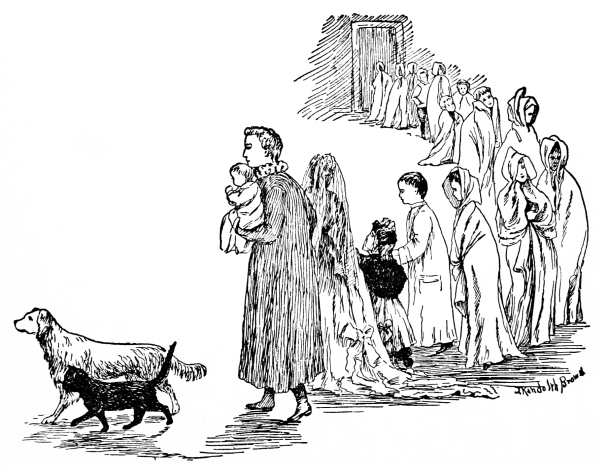
When the girls came pushing into the parlor
they made one think of ghosts.
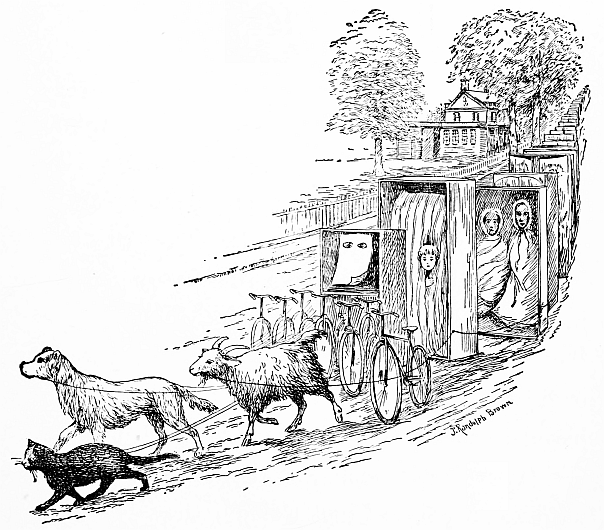
The first thing was a walk around headed by
Turk and the black cat. You couldn't fancy
a more startling procession.
Then they played games, and sang songs, and
told riddles, and looked for a needle in a haystack,
and turned the house upside down and
inside out.
The great event of the party was the supper.
Mrs. "Judge" had told the man in the moon
what she wished for the occasion, and while the
children were rollicking in the east parlor the
clock sounded out the alarm for the feast.
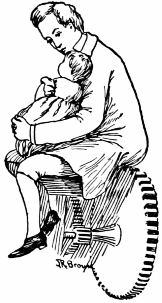
The Judge carried his namesake on the left
arm, while his wife leaned upon his right. Ruth
still kept hold of the lady's hand. The rest of
the company followed in a good deal of disorder,
for they were all curious to see what sort of a
supper would be given them.
When they came into the west parlor or dining-room
they saw a long table, but there was nothing
on it. The children looked at each other and
at the Judge and his wife in blank amazement.
They expected to sit down to a table laden with
all the goodies of the land. But there wasn't
even a table-cloth before them.
The Judge took the head of the table, and his
wife sat at the foot with Ruth. The baby was
put in a clothes-basket, and sat on my lady's
work-table by the side of the Judge. The other
children took the places that were most convenient
to them.
"Where's the feed?" exclaimed Ruth.
"The what?" replied Mrs. "Judge" curiously.
"Why, the things you were going to give us
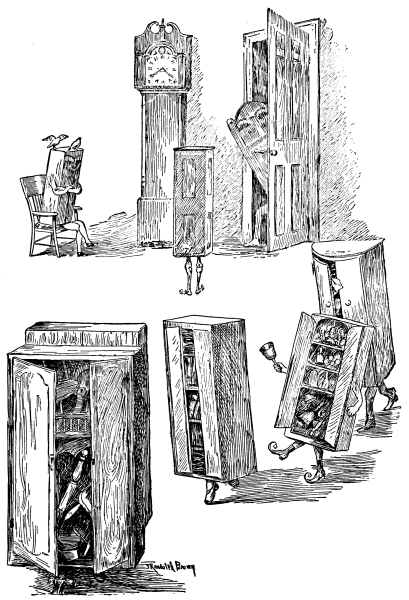
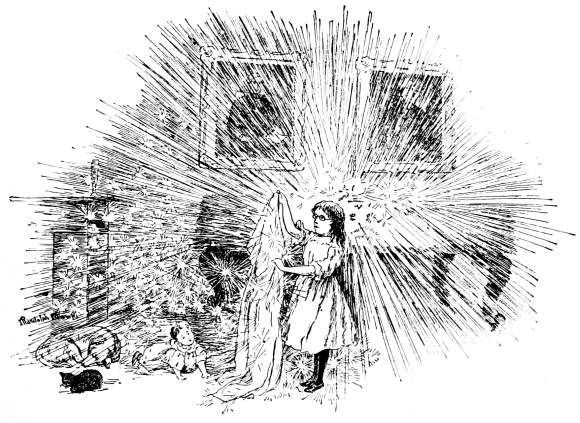
to eat." Just then "Dublin," the linen closet,
came meandering into the room, made a bow, and
emptied out a long, white, snowdrop tablecloth.
"Why, it must be that we're to set the table
ourselves," cried Ruth, as she started to undo
the cloth and shove it along.
"Here you give that to me, will you?" said
Samuel, with a tone of authority any commanding
officer in the army or navy might envy. Then he
took one end of it, and Elizabeth the other, and
they spread it carefully over the table.
Just then China came rattling into the room
with the dishes. It was easy enough for him to
get into the room; but it was quite another thing
for him to move gracefully about the table, for
China, you remember, was thin, long, and rather
narrow. But he managed to get to the Judge,
and drop a plate before him and the baby; and
then he twisted around like a snake, and got down
to the end of the table, and dropped a plate before
Mrs. "Judge." Then he went from one child
to another, and banged down a plate before each
one of them. After this was done, China stepped
back and stood by the side of Dublin, near the
wall.
El Dorado came next. He brought the silver,
and there was a fine display of it. Beautiful
knives and forks and spoons for every person
in the room, and ever so many little furnishings
that helped to brighten the table. How these
things rattled and jumped and rang as they were
tumbled hither and thither into their rightful
places. The children didn't have to move a
hand or a finger to put them in order. Every
knife, fork, spoon, salt-cellar, or other article
seemed to know where to go, and got there
in less time than one could say "Jack Robinson."
Then the silver candlesticks from the
mantle jumped over to the table, and took their
places with a good deal of brightness and sprightliness.
At this point the antique sideboard stepped
close up to the table, and rolled seventeen very
thin cut-glass goblets upon the board. They
made a right merry sound as they jingled out
their Christmas greetings.
"Don't let the baby have a goblet!" shouted
Ruth. "He'd bite a piece right out of it. That's
what Elizabeth did when she was a baby, mother
says. Isn't it a wonder she didn't die?" But
everybody was watching this extraordinary way
of setting the table, so that the child's remark
fell unnoticed. There was a most lively and
musical ringing of bells at this stage of the table
setting. Turpentine came dancing into the room.
Turpentine was the closet in the Judge's study
that had been used to store the church-bells in.
When the last wooden meeting-house had burned
they took the old bell, which rang for the last
time the sad alarm of fire on the memorable night,
and they sent it away to be melted up and made
into five hundred little bells. There were dinner-bells
and tea-bells and call-bells and sleigh-bells
and play-horse bells on lines, and I don't know
how many other kinds. Nearly all of these had
been sold, but thirty or forty remained in the
closet. Turpentine came into the room playing
with these, and rolled one down in front of each
person at the table.
"How would you like to have the dinner served,
Ruth?" inquired Mrs. "Judge."
"Oh, served of course," she replied.
"Bells first course," shouted Samuel. The older
children all snickered. "I think you ought to call
Turpentine 'Bells-ze-bub!'" Samuel whispered
to Helen. "See?" For by this time the children
had all come to a familiar footing with their visitors,
and they were expressing themselves with a
good deal of freedom and having a right good time.
The Refrigerator entered the room now, and
tramping heavily over to Mrs. "Judge," swung
open his door, and flung gracefully upon the table
a big dish of half-shells. No sooner were they
placed where they belonged than they began to
roll about to the different plates, like a lot of
marbles, only they seemed to know how to divide
themselves up so that every one had a proper
share. Then the Refrigerator dumped out another
large dish of something fresh and green; and this
stuff sailed along the table, as one sees seaweed
float back and forth on the tide.
"I know what it is. They grow down by the
brook. Caresses. Aren't they nice and fresh?"
"Third course, caresses," shouted Samuel. And
then he bent over and kissed the girl next to his
side; the Judge kissed the baby, Ruth kissed Mrs.
"Judge," and the rest of the children kissed each
other.
"Awful sweet course!" exclaimed Henry. "Very
much of it makes a fellow sick."
This was followed by the entrance of the kitchen
closet number one. A fine brass kettle popped out
upon the table. There was a great rattling and
clashing. Everybody tried to look into the bottom
of it.
"That's a pretty kettle of fish," said Samuel, who
was the first to get a glance at the contents. And
sure enough it was; for there were seventeen tin
fishes, such as you see floating around after a magnet
on some basin of water at Christmas time.
"Look out for bones," cried Herbert. "What
next?" And then Vanity came down-stairs, giggling
and simpering, and passed something around.
"Crimps," said Ruth, "hot and steaming,
straight from the irons." A very strong odor
of scorched hair pervaded the room.
"Goodness me, what a treat!" exclaimed Henry.
"Give 'em to the girls. They are fond of 'em."
Kitchen closet number two came hurrying into the
room. China rushed forward with bowls which he
had borrowed from the bowling-alley; and each
bowl was filled with bean porridge hot, bean porridge
cold, bean porridge in the pot nine days old.
"Here comes the spring chicken!" exclaimed
Herbert, as the Refrigerator distributed one spring
with chicken attached.
"Do-nots for old-fashioned boys and girls,"
wheezed out Darkest Africa, as he pushed his way
into the room. The company was getting pretty
large, for all the closets had come. One stood behind
each person at the table, and the other forty-three
were pressing against each other, trying to
see the table and hear the conversation, or do any
little waiting upon the merry party.
They were all busy eating, talking, drinking,
having the best time in all the world. There was
an abundance of everything. I don't know what
all. But as the courses were brought on the Judge
and his wife became a little restless. They felt
that the east wind was rising. And when the
clock struck twelve it was necessary for them to
be back in the pictures, whether there was any east
wind or not. So there was some confusion, considerable
crowding, and a good deal of haste during
the latter part of the feast.
"I'm afraid the children will get dyspepsia,
Judge," observed the cautious lady. "The children
are eating too fast. The closets are bringing
on too many things at a time."
"Time and tide wait for no man," replied the
Judge, who had caught the hilarity of the company,
and was enjoying every moment of the fun.
"I wish to see this board cleared up before we
clear out." Now, Mrs. "Judge" was the least bit
shocked at such undignified speech on the part of
her husband. But she knew he didn't mean any
harm. He was only entering into the spirit of the
frolic. Yet she felt that he ought to set an example
of sober conversation, so that they would
remember him with the highest respect. The
Judge, however, had a sense of humor that could
not be held altogether in check.
"I think we ought to have some toasts," said
Samuel. "All in favor of the nomination say,
'Dickery, dickery dock, the mouse ran up the clock,
the clock ran down, the mouse came down, dickery,
dickery dock;' and Samuel rose to propose the first
toast. Kitchen closet number three came forward,
and put into his hand a nice, big toasting-fork.
Flourishing this about his head, and hitting Henry
on the right ear with it, Samuel lifted a goblet
filled with hot air to his lips, and proposed the
health of the Judge and his wife. The applause
was overwhelming. The children clapped their
hands, and lifted their voices on high. The dishes
jumped like mad. The bells rang so that you
couldn't hear yourself think. The closets creaked
and groaned, and slammed their doors, and shook
their shelves, until it seemed that they must fall in
pieces. The Judge gathered his waterproof about
him, pulled on his necktie for a moment, cleared
his throat, and then responded.
"Children and closets," he said. The children
all rose and bowed, the closets all turned around
twice and stood on one corner. "This is in some
respects the greatest day of my life."
"You mean night, don't you, Judge?" interrupted
Samuel.
"Oh! I beg pardon, night of my life. Correct,
my son." He bowed good-naturedly to the critic.
"We haven't stayed in those portraits on the east
parlor wall for nothing all these years. We've
been waiting for such a time as this. I think the
east wind is rising, and soon we shall have to go
back to our pictures; but I am glad to say that this
is the sort of family that I always had in mind
when I built this house. It's lonesome to live
without children. This is a strange world. I
have observed generally that the people who want
children don't have them. And the people who
have them don't always want them. And the
people who know the most about bringing them
up are the people who never had any, and never
lived in a family of children when they were
young. But I really believe that one never gets
much out of this world except it comes to him
through children. And now I hope that you will
be such children that when you grow to be men
and women we shall not be ashamed of you. My
wife and I expect to stay in the portraits. We
shall always be on the watch for you and sometimes
in the clock. There isn't anything in the
world that would give us such pleasure as to see
you children grow and become the best men and
women in all the nation. I suppose you have
enough boys to make a foot-ball team, and enough
girls to drain a common pocket-book and spread it
all over your backs; but you are going to make
something better than idlers and spendthrifts.
Some of you will take to one thing, and some to
another, but you will all take to the right. I expect
to see you filling up the house with nice
friends, going off to college, and bringing back good
company and great honors. By and by you will
all settle in life, and have homes of your own; but
we shall keep at home here on the wall, and look
for your frequent visits. Ruth has made me very
happy. I'll tell you how. She has said some of
the things to me that people have said to her about
me,—kind things, sweet praises, words of happy
remembrance. Now, I hope that you will live and
love in such a true way that when you get into a
picture and stay a hundred years, and then step
down and out for a little while, people will say
just as noble things about you. 'Tis sweet to be
remembered. And I feel very anxious to do something
for all you children. This is the first time
we ever kept Christmas. We're going to make
you some Christmas presents. But they shall be
put in your stockings."
"I'll hang up my hip boots," interrupted
Samuel.
"I'll hang up my golf stockings," exclaimed
Henry.
"I'll hang my trousers; and you, Elizabeth, can
hang your bicycle bloomers." The Judge smiled,
and waited a moment, and then continued.
"These presents are different from the ordinary
gifts you receive. You'll have plenty of candy
and dolls and such things. We shall give you
things that you can always keep and carry with
you. And they will be worth more than money,
in case you use them according to directions.
And remember that we give them because we
have learned to love you, even if we do live in
pictures, and that we expect you will honor the
house, the people, and the State." The Judge
swallowed a tear. "We never had boys and girls
to go out into the world to make their mark.
Our two boys," and here the Judge's voice was
feeble and trembling, and he stopped for a moment
and wiped away two or three tears, "Our boys
were sick, and after quite a good many years they
went away forever. Children, I want you to fill
their places, and more. I expect that you will go
out into the world, and do so much good, and
serve your country with such zeal and wisdom, that
people will by and by come here to see the house,
and say, 'This is where Samuel and Henry, George
or Herbert, William, Nathaniel, or the "Little
Judge" lived, and were brought up.' Or 'This
was the childhood home of Elizabeth, Helen,
Miriam, Theodora, Grace, Ruth, Ethel, or Susie.
I wonder who slept in that room, and if this
was the favorite window, and which one of the
family planted this shrub or vine or tree, and what
was the best-loved play nook,' and all sorts of
questions. Don't you think it will be nice?
And then my wife and I will say, or try to say,
or make them understand in some way, that you
belonged to us next to belonging to your parents,
and that we guarded the house day and night,
for you know that in the picture we are always
awake; come into the east parlor at any hour of
the twenty-four and we always have our eyes
open, and we know everything that is going on.
We'll make them understand that a part of the
love and thanks they feel belongs to us, and
we shall be so happy, and when we meet again
we shall have so many things to tell each other.
Now Ruth will see to the presents, for we are
not educated up to a belief in Santa Claus. Ruth
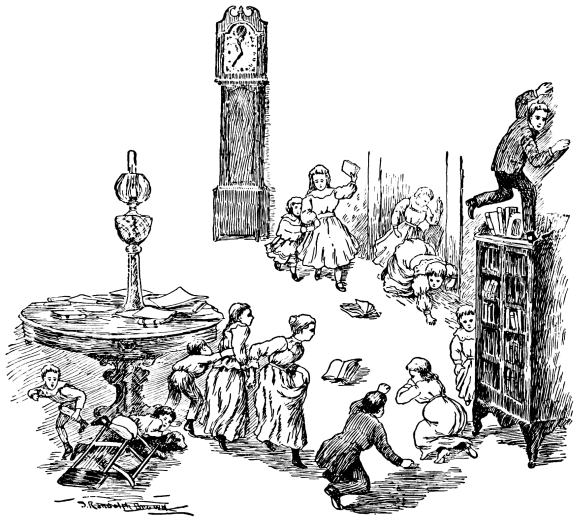
will"—Just at this point the clock began to
strike twelve.
Now, the Judge and his wife were the most
polite, really the best-mannered people in all
the world. But that striking of the clock seemed
to knock all the manners out of them. The
Judge sprang from the table quick as a flash,
and in his haste turned the clothes-basket with
the "Little Judge" in it bottom side up. Mrs.
"Judge" jumped up as spry as a girl, and ran
toward the Judge, who grabbed her by the hand,
and pushed her hard against the closets in the
way, and struggled to get into the hall.
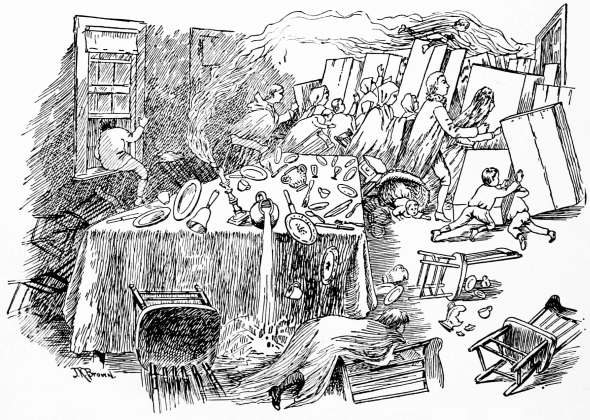
There was the greatest confusion imaginable
in the house. The children were all hitting the
dishes, scattering the silver, overturning the
goblets, tumbling over the chairs. The closets
all made a rush for the door, and jammed themselves
so close together that Samuel and Henry
had to raise the front windows, and jump out
on the piazza, and climb in at the parlor windows,
and the other children followed them pell-mell.
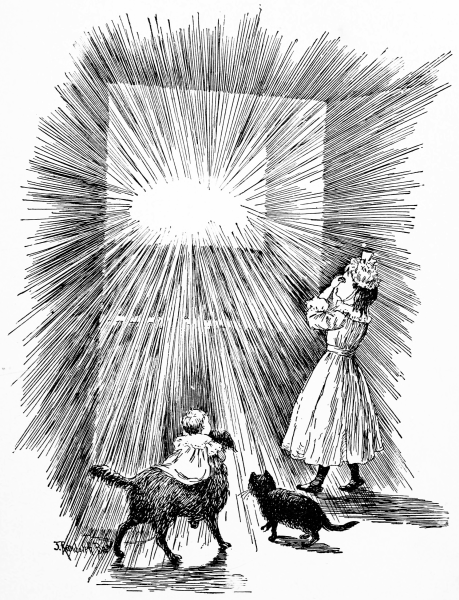
There was the greatest noise you ever heard in
a house. The clock sounded with terrific strikes.
The front door-bell, the dinner-bell, and all the
other bells rang an alarm. Things in the closets
seemed breaking themselves to pieces or going into
fits. The piano roared and shrieked like a hurricane.
Every board and brick and nail and bit of
glass, metal, or wood squeaked or rattled. The
very carpets shook with dust and fear. And then,
as the children caught a glimpse of the Judge and
his wife back again in the portraits, the clock
struck the twelfth stroke, the lights all went out,
the children were back in bed, and silence reigned
throughout the old mansion.