Obvious typographical errors have been silently corrected.
Variations in hyphenation and spelling and punctuation remain
unchanged.
Original picture captions are shown in sentence case italics, as
in the original. Captions that are not in italics were added by the
transcriber, generally to deal with text within the picture.
The chapters all start with illustrated capitals. Where the capital
is Incorporated into the illustrated chapter heading it has been
extracted by the transcriber.
Many chapter heading illustrations extend substantially down the side
of the page. Most of these extensions have been curtailed or removed
since consistent replication amongst various e-reader types has proved
impossible.
THE HOUSE WE LIVE IN
OR The Making of the Body
A Book for Home Reading, intended to Assist
Mothers in Teaching their Children
How to Care for their Bodies,
and the Evil Effects
of Narcotics and
Stimulants.
VESTA J. FARNSWORTH
“For we know that if our earthly house ... were dissolved, we have a building
of God, an house not made with hands, eternal in the heavens.” 2 Cor. 5:1
“What? know ye not that your body is the temple of the Holy Ghost which is in
you, ... and ye are not your own?” 1 Cor. 6:19
Pacific Press Publishing Company
OAKLAND, CALIFORNIA SAN FRANCISCOKANSAS CITY NEW YORK
Entered according to Act of Congress in the year 1900, by Pacific Press Publishing Company
In the Office of the Librarian of Congress at Washington
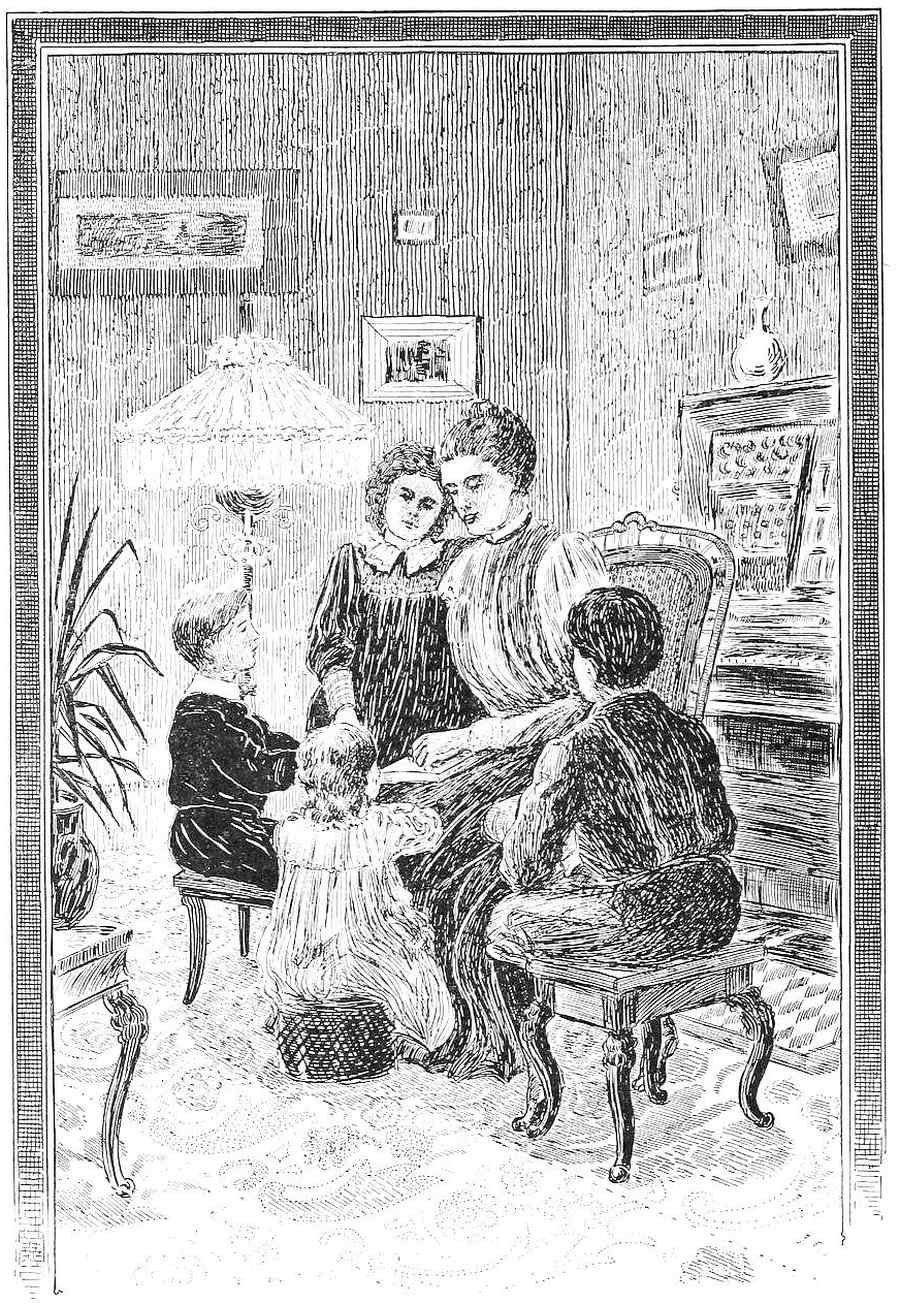
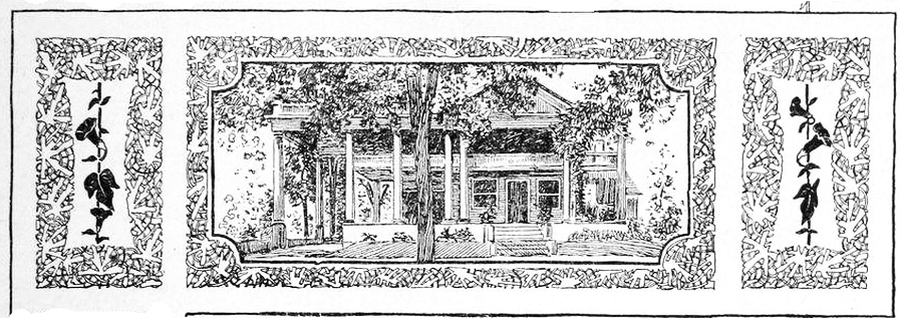
ELEN: See this picture, mother. How
pretty the house looks, with its wide windows
and porches!
Mother: Yes, it is a fine picture, and
such a house would make a lovely home.
Men build better dwellings now than they
did many years ago.
Percy: Do people build the same kind of
houses in all countries?
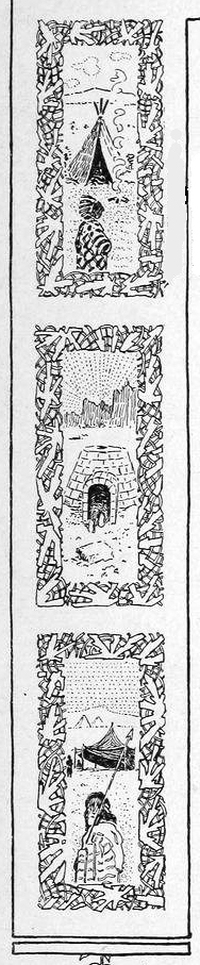
Mother: Oh, no! If we should visit the
Indians, we would find them living in rude
tents called wigwams, or teepees, made of mats
and the bark of trees. In some countries
people live in tents. Where it is very warm
they build so they may keep cool. In cold
climates they make their houses warm. Can
you tell me some things which are used in
building houses?
Elmer: Stone, brick, iron, wood, paper, earth, and straw.
The Esquimau lives in a house made of large blocks of snow
and ice.
Mother: You would not think such a house very warm,
but it is the best he can make. Perhaps you have noticed
that some houses are large
and some are small. Some
have many rooms, others
but few. They are made
in many shapes and colors,
and in some countries there
are hardly two which look
alike.
Amy: Here is another
picture. What kind of a
house is this, mother?
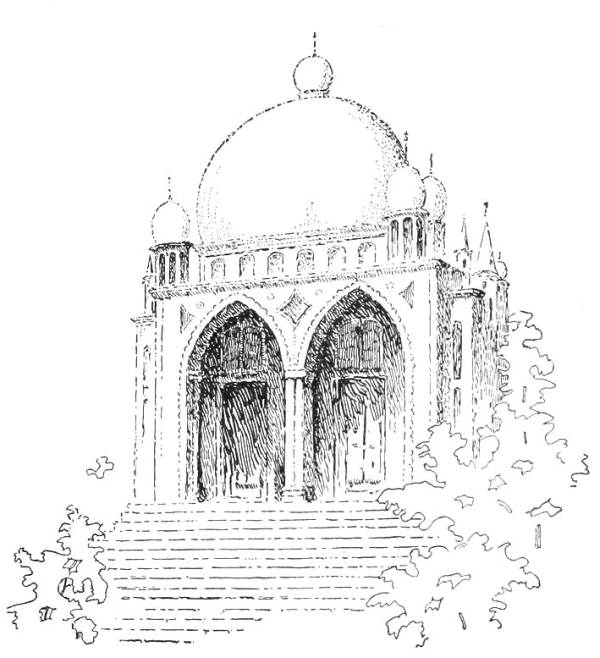
Mother: That is called
a temple. It is built for the
purpose of worship.
Helen: Is a meeting-house
a temple?
Mother: It might be called by that name, for it is the
house of God, where His people worship Him. But as
we were looking at these pictures I have been thinking of
another kind of house in which we all live, which is more
wonderful than any building ever made by men. There are
a great number of these houses. All are made of the same
things, all have the same kind of frame, all have the same
number of rooms, and, though there are thousands of them
in every country, they are all lighted, heated, finished, and
furnished the same way.
Percy: Oh, I know what you mean! You are thinking
of our bodies.
Mother: Yes; and if you study this house God made
for you to live in, you will be ready to say, with King David,
“I will praise Thee; for I am fearfully and wonderfully made;
marvelous are Thy works; and that my soul knoweth right
well.” The more men study this body of ours, the more
they find to make them wonder at the wisdom of its Maker.
If a man invents a useful machine, such as a watch or an
engine, he is praised and called a great man. But how few
ever praise and thank the Lord for the body He has given
them, and try to learn the best way to care for it!
Helen: I should like to know how to care for mine, but
I never thought of my body as a house before.
Mother: We may call it a house, because the Bible calls
it so; and, more than that, it says it is a temple. Listen to
this verse: “What? know ye not that your body is the
temple of the Holy Ghost which is in you, which ye have
of God, and ye are not your own?”
Amy: Then this house or temple of the body does not
belong to us, mother, for it says, “Ye are not your own.”
Percy: I see how it is. You know people sometimes
build houses to rent, and the One who made the house we
live in gives it to us for a home as long as we live, and He
wants us to take good care of it.
Mother: That is right. The house is loaned or “rented”
to us, as Percy says, for us to live in and care for. God
cares for it too, and if it wasn’t for that it would have been
destroyed long ago. Before any of us were old enough to
know we had such a gift as our bodies, kind friends cared
for them for us, and every moment our heavenly Father
watches over us, for “in Him we live, and move, and have
our being.” When we go to sleep He still keeps the heart
engine pumping, and the parts which become worn out
during the day are nicely mended without our thought
or care.
Elmer: I want the house I live in to be like that pretty
temple we saw in the picture.
Mother: Then my boy must be very careful to keep it
clean, not only outside but inside as well. You know we
sometimes see houses painted nicely outside, and we think
what good homes they would make; but when once inside
we find the rooms so dirty we want to get away. So boys
and girls may be nicely dressed and look well outside, but
if they do not eat good food and have good habits, their
body-house is not fit to live in.
Percy: Adam and Eve must have had fine, large houses.
Helen: And they lasted a long time, too. Adam lived
in his for over nine hundred years.
Mother: It is said that men keep building better houses
all the time, but the first body-house God made was the
best ever seen in this world.
Amy: But why are they not made good and lasting now,
mother?
Mother: One reason is because we do not use them
well. Many persons would do better in caring for themselves
if they knew better how to do it. If I gave you a
costly watch, Percy, what is the first thing you would want
to know about it?
Percy: How to take care of it.
Mother: Yes, you would find out how and when to
wind it, and just how to use it so it would keep good time.
We should be even more careful to learn all we can about
our bodies. We should learn for what each part was made,
and how to keep it in good order. Men have taken bodies
like ours apart, just as a watchmaker takes out all the wheels
of a watch, and they have found out many things about them
in this way. We should learn all we can about how to keep
well and strong. If we are ill we make much trouble for
others, and must suffer ourselves. If we are well we shall
be a help and blessing to all around us. Not long ago I
read this prayer of a little girl for her body:—
“Dear God, bless my two little eyes, and make them
twinkle happy. Bless my two ears, and help me to
hear mother call me. Bless my two lips, and make them
speak kind and true. Bless my two hands, and make them
good and not touch what they mustn’t. Bless my two
feet, and make them go where they ought to. Bless my
heart, and make it love God and my father and mother
and everybody. Please let ugly sin never get hold of
me—never, never!”
“The Lord my body did prepare
My dwelling-place to be,
And still it is a temple where
He daily meets with me.
“My head, my hands, my heart are His;
He knows my being well;
And all its many mysteries
My Lord alone can tell.
“To walk in ways of wickedness
My feet can not afford;
For all the powers I possess
Are holy to the Lord.
“I’ll pray to Him from day to day
To lead my steps aright,
That I along His heavenly way
May be a shining light.
“And He will keep my temple free
From every touch of sin;
He truly saves and cleanses me,
That He may dwell within.
“My eyes must see the good and true;
My ears must hear His voice;
My hands be ever glad to do
My heavenly Father’s choice.”
—C. M. Snow.
THE OUTSIDE OF THE BODY
OTHER: Let us look at the outside
of our house before we try to
see how it is made and furnished
inside. I think you know now
that when I am talking about a
house or temple I mean the body.
In some ways our bodies are like
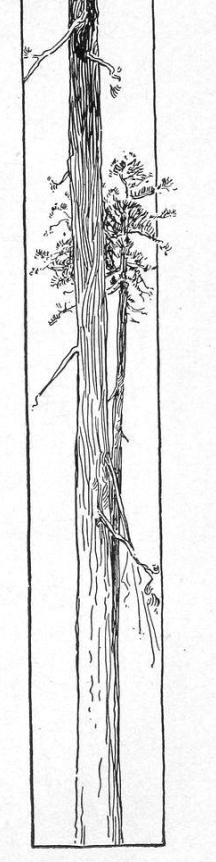
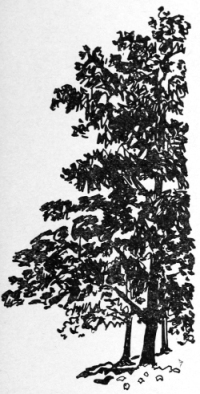
trees as well as houses. Look at this picture
and tell me what you see.
Percy: A tree with a straight stem or trunk.
It also has branches, called limbs, and is covered
with bark.
Amy: And it has roots, which hold it fast
in the ground.
Mother: Yes, trees are made to stand in
one place while they live, and so they have
roots. We have limbs like the tree, but our
lower limbs are used to carry us from place to
place, for we were not made to stand still.
Can you think of another way in which we
are like the tree?
Helen: Oh, I know! The middle part of the body
is called the trunk.
Mother: Can you think of any other kind of trunk
than the trunk of a tree or the trunk of the body?
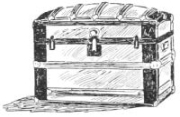
Amy: A trunk in which to put
clothes.
Mother: Yes, such trunks are
useful to carry clothes. The upper
part of the trunk of the body, or
the part between the arms, is called
“the chest.” Sometime we will try
to learn what is packed away so nicely in the chest, or
trunk, of the body, but we will only look outside now.
What is on top of the trunk?
Helen: A strong, shell-shaped box made of bones,
called the head.
Mother: This is what we might call the jewel-case, or
the best part of all, for without it all parts of the body
would be useless. Here we find the eyes, nose, mouth, and
ears; and the head is fastened to the trunk of the body by
the neck. How many limbs have we?
Percy: We have two arms and two legs, and these
are called our limbs.
Mother: Now I think you can name the main parts
of the body. What are they?
Helen: The head, trunk, and limbs.
Mother: You said the tree was covered with bark.
Look at your hand. With what is it covered?
Amy: With skin.
Mother: Yes; we will talk more about this soft covering
of the body at another time. We found these body-houses
of ours are made to walk, work, run, jump, and do many other
things. How are our limbs different from those of a tree?
Percy: They have joints so they can move many ways.
Mother: You may all put your arms out straight. Now
raise them above your head and then touch your head without
bending them.
Helen: We can’t do it, mother.
Mother: Let us see, then, how many joints, or bending-places,
we have. We will call them the hinges of our house,
for they help us to use our limbs, just as the hinges of a door
help us to open or close the door. Please bend your arm
and tell me how many parts it has.
Percy: My arm has two parts.
Mother: What do you think would be a good name
for the part near your shoulder?
Amy: The top arm, or upper arm.
Mother: I think upper arm is best. Now if that part
is the upper arm, what would you call the other part?
Elmer: The lower arm.
Mother: It is also called the forearm. Now move
your elbow joint backward and forward, and tell me what
kind of joint it is.
Helen: It is like a door hinge, for I can move it only
two ways.
Mother: Yes, the elbow joint unites the upper and
lower arm, and it can swing only one way. What shall
we call the joint that joins the upper arm to the shoulder?
Percy: The shoulder joint.
Mother: Is this joint like
the one in your elbow?
Helen: No, for I can
swing my arm backward or
forward or any way I like.
Mother: That is because
it has a different joint than
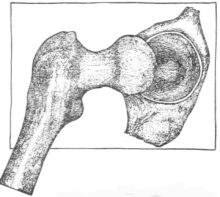
your elbow. It is called a “ball-and-socket” joint;
that is, one end of the bone is shaped like a ball, and this
fits into a hole shaped like a cup in another bone, like the
one you see in the picture. This shows the hip joint, which
is also a ball-and-socket joint, the same as we found in the
shoulder. Now what is the joint called at the lower end
of the forearm?
Amy: It is called the wrist.
Mother: The wrist is a joint that moves very easily in
many different ways. Now how many joints, or bending-places,
have we found in the arm?
Percy: The arm has three joints.
Mother: Elmer, you may take this ball. With what
do you hold it?
Elmer: With my hand.
Mother: Tell me some ways in which we use our hands.
Helen: We hold, push, pull, lift, catch, and feel with
our hands.
Mother: The inside is called the palm of the hand.
What do you find at the ends of your hands?
Amy: Fingers.
Mother: Look at your fingers. Are they all alike?
Percy: One is much shorter than the others; all are
different in length, and one is very small.
Mother: What do you call your short finger?
Elmer: My thumb.
Mother: You would find it hard to button your clothes
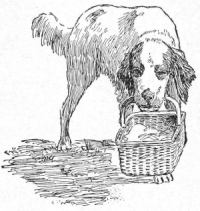
and do many other things if you had no thumbs. A dog
has no fingers, and if he wishes to hold or carry anything,
he does it with his teeth. The first finger is called the
forefinger, or index finger, because
it comes first, and we
use it to point with. The
second is the middle finger;
then we have the third finger;
and the fourth is called the
little finger, because it is the
wee, tiny one of all. Open and
shut your hands quickly. What
do you call the parts of your
fingers where you bend them?
Helen: Finger joints and knuckles.
Mother: You see there are many joints in the hands,
so we can move them easily and quickly. What do you
find on the ends of your fingers?
Amy: Finger-nails.
Mother: These hard, horny nails protect the ends of
the fingers, and give them strength. Our hands were given
us to help ourselves and others, and we should keep them
neat and clean. They were not made to strike or steal.
Amy: I read this verse about our hands not long ago:—
“Hands were made to be useful,
If you teach them the way;
Therefore for yourself or neighbor
Make them useful every day.”
Percy: You haven’t told us about the lower limbs
yet, mother.
Mother: No; and any boy or girl who enjoys running
and jumping would think theirs a hard lot if they had
no legs.
Elmer: I saw a boy with only one not long ago.
Mother: It is a great loss when a person loses an arm
or a leg. Such people are called cripples. How many
parts has each leg?
Amy: Each one has two parts.
Mother: And how many joints has the leg?
Helen: Three joints.
Mother: That is right. The one at the hip, as I have
said, is a ball-and-socket joint; the one at the knee is a
hinge joint, and the ankle is quite like the wrist. Then
we have the foot, with a number of small joints, like
the hand.
Percy: But we have toes on our feet instead of fingers;
still there is the same number.
Mother: Yes, and some people can use their toes to
draw pictures, write, and do many other things. Now we
have found what our body-house is like on the outside,
and we see how well each part is made for the work given
it to do.
SUBSTANCES IN THE BODY
SUBSTANCES IN THE BODY
OTHER: Percy, do you remember what men
use in building houses?
Percy: They use stone, wood, brick, iron,
glass, lime, and paper.
Helen: And some houses are made of
earth and straw.
Mother: Yes, and some of these things
are found in the body-house.
Amy: Why, mother, we are not made of wood, stone,
glass, or lime!
Mother: That is true; yet some of these very things
are in your body. Those who have studied the blood tell
us it is iron, partly, that gives it its rich red color. You
saw what a pretty red it is when you cut your finger
to-day, Helen. Some of the things of which glass is made
are in our hair and finger-nails, and our bones would soon
become useless if we did not give them plenty of lime.
Percy: But how do the iron and lime get inside of
us? That is what I would like to know.
Mother: It does seem strange, but the houses we live
in are made of what we eat. I once knew a young lady
who thought she needed more iron in her blood, so she
put some nails in water and let them stay till it was full
of iron rust, and then she drank it. Perhaps if she had
thought her bones needed lime, she would have taken lime
water; but this is not the proper way to get iron and lime
“inside of us,” as Percy says. We can not eat iron and
lime, but grains and fruits can, and we eat the grains
and fruits. Iron is found in apples, tomatoes, and strawberries.
We get lime in wheat, peas, beans, and other
foods. Have you noticed how the men are building that
brick house across the street?
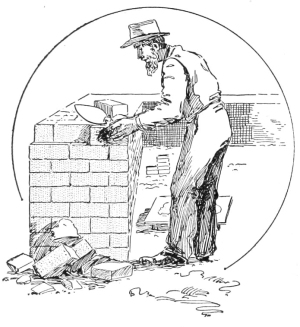
Amy: They put one brick
on top of another, till thousands
of them are used in making one
house.
Mother: Well, that is the
way the house we live in is built,
only instead of bricks it is made
up of what are called “cells.”
These cells are little bags filled
with something that looks like
jelly. They are so very small we
can not see them at all unless we look through a glass
which makes them seem much larger than they really are.
Some of these powerful glasses make a speck of dust look
as big as a large rock.
Elmer: I wish we could see some cells.
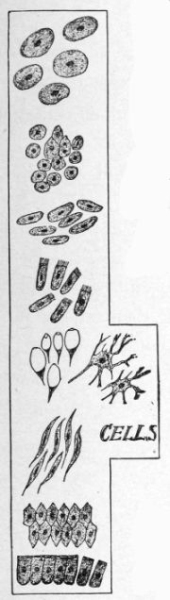
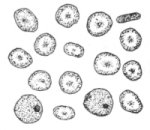
Mother: Here is a picture of some kinds. You see
they are not all alike. Some are round, others are flat, or
narrow, or long, or short; so you see they are of all shapes
and sizes. Some are so very tiny it would take three or
four thousand to make a row an inch in length. Others
are large enough so we can almost see them without a
glass. Some have no color at all; others are
light colored, and some are quite black. There
are millions of cells in one drop of blood.
Your skin seems like one piece, yet it, too,
is made of layers of cells. If we should look
through a strong glass at a tiny piece of
potato, wheat, and some oatmeal, we would
find they are all made of cells.
Percy: And do the cells last as long
as we live, mother?
CELLS
Mother: No, they keep changing all
the time. When we walk, run, talk, think,
or do anything, some of these cells die,
and others take their places. The new
ones are just like the old; for if they
were not, our appearance would so
change that our best friends would not
know us. While boys and girls are
growing, they are putting many new cells into
the house they live in. This is the reason
auntie said the other day that she hardly knew
you when she had not seen you for a year.
Amy: What are the cells made of, mother?
Mother: They are made of the food we eat. This
shows we should be careful to put the very best things we
can get into our body-building—I mean such as the body
can use, for what we like best is not always what is needed
to build up and strengthen us. When you get hungry,
that is the call of the body for food to make more cells,
just as the mason calls, “More mortar,” or, “More brick,”
so he can build his wall higher and stronger. If his mortar
has but little lime, or is badly mixed, or he has only broken,
badly-shaped brick, the wall will not be strong or beautiful.
So if we give the body wrong kinds of food, it can not
build such a house as you and I wish to live in.
Helen: If moving about kills the cells, will they live
longer if we keep still?
Mother: No, they are made to live just so long, and
will die anyway. If we should not work or play, the dead
cells would stay in the body, and make no end of mischief;
but when we move about, it helps to carry them away, and
new ones take their places. So you need not be afraid to
run and jump, play and work; for the cells will take care
to keep the house you live in all right, if you only give
them the right kind of food, and not too much of it.
OUR FRAME
OUR FRAME
OTHER: Every building must have a foundation
and a frame of some kind to make it
strong and give it shape. It is the same with
the house we call our
body. The frames
of houses which men
build are made of wood or iron;
but the framework of the body is
built of bones. Perhaps you have
noticed that in the frames of buildings
some pieces of timber are
short, and some are long, and they
are cut into many different shapes
and sizes. So it is with the bones
of the body. How many do you
think it takes to make our frame?
Helen: About fifty.
Percy: I guess one hundred.
Mother: Not quite right, for
there are over two hundred. All
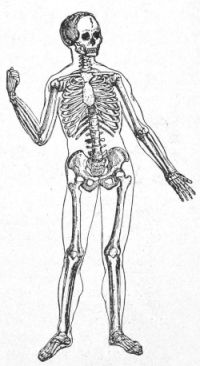
the bones together are called the skeleton. The frame of
a house divides it into rooms, and on it are fastened the
boards, laths, and shingles. In the house in
which we live the flesh is fastened to the bones,
and the whole is covered with skin. This
framework also protects the curious rooms
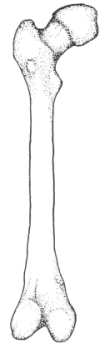
inside the trunk of the body. The largest
bone in our frame is the leg bone, which
reaches from the hip to the knee. It is called
the femur, or thigh bone.
Elmer: Are the bones solid, mother?
The thigh bone.
Mother: No; I have brought some pictures
to show you how they look, for we can
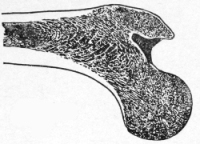
not see our own bones. One of them shows
a bone that is sawed through lengthwise. You
see the larger part at the end is full of little
holes, like a sponge. This makes it light and
strong. There is a hollow place in long bones
filled with marrow. It also fills the spongy
parts. Marrow is made of fat and cells.
You must not think that live bones look like one which
has been lying out-of-doors
a long time.
Live bones are full
of blood and have a
pinkish color. They
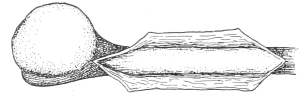
also have an outside
skin, which can be peeled off, as you see in this picture.
A bone with the outside skin partly peeled off.
Amy: What are the bones made of?
End of a bone
sawed open.
Mother: Of animal and
earthy matter. You can take
the animal matter out of a
bone by burning it in the
fire. It will then be white
and brittle. If you soak a
bone in a kind of acid, the
earthy matter will come out,
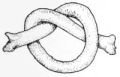
and it will then be so soft you can tie it in a knot like this.
When children are very young, their
bones are soft and easily bent. This
is because there is more animal than
earthy matter. Children sometimes
get hard falls, and their bones bend
but do not break. Some, when
very young, have legs that are bent
like a bow. This is caused by standing
and walking before the bones are strong enough to bear
the weight of the body, or by disease.
A bone tied in a knot, after the earthy matter
has been removed by an acid.
In very old people the bones contain more earthy matter,
and they break easily. Grand´fa-ther and grand´moth-er
must be careful not to fall, for if they break a bone it will
take a long time to heal.
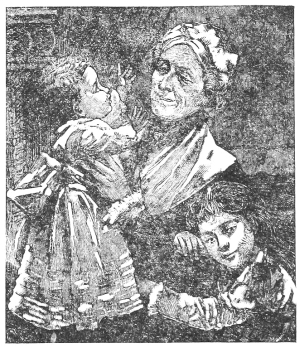
When we take a baby, we should not lift him by his
arms, and we must hold him so his bones will not grow out
of shape. As he grows older, enough earthy matter will
go into his bones to make them hard and strong.
Percy: But you said there was lime in the bones,
mother.
Mother: Yes, the earthy
matter is partly lime. The
blood goes into the bones
through tiny blood-vessels,
and at all times of day and
night the bones keep eating
their breakfasts, dinners, and
suppers of lime, which
they find in the blood.
“We should not lift him by his arms.”
Helen: What kind of
food is best for the bones?
Mother: Good whole-wheat
bread will furnish
them all they need. Peas and beans are also good.
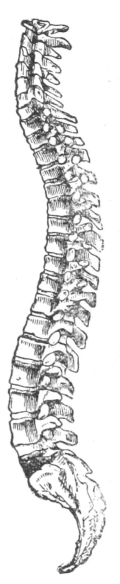
Back-bone.
We will now look at the largest bones of our body
frame, and see if we can learn something of their size and
shape. We will not try to learn their hard names now,
but will leave that till we are older.
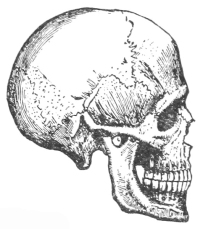
We will begin with the bones of the head. They
form what is called the skull. It is made of a number
of bones, joined like two saws with the teeth hooked
together. The “chin bone,” or jaw bone, is one of the
bones of the head.
Skull.
Let me show you a picture of one of
the most wonderful bones of the body.
It is called the spine, or spinal column.
Perhaps you can feel some little knobs or
ridges in your back. The back-bone is
made of twenty-four little bones piled one
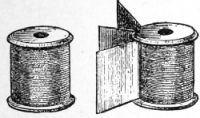
on top of another. Suppose you had twenty-four spools or
reels of cotton, and you should run a string through
them. When you hold them upright, you see you can
bend them any way you wish, or keep them straight.
Now if each spool had three wings like the one in the picture,
they would be shaped very much like the bones that form
the spine. The string is like the marrow, or “spinal cord,”
which passes through the spinal column from top to bottom.
The bones which make up the
lower part of the spine are much
larger than those at the top.
Little soft cushions are placed between
all these bones, something
like India-rubber. These cushions
are to keep the body and brain
from being jarred, just as the springs in our carriage help
you to ride easily. They also help us to bend the body
backward or forward as we choose. You see if the spine
was one long straight bone we could not bend at all. If
we keep bending over while walking or working, after
a time the cushions will get used to that position and
we shall have a bad figure.
Reels of cotton.
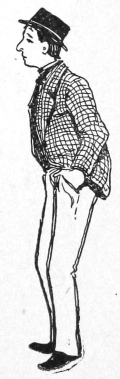
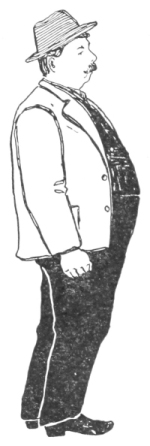
Elmer: The boy with his hands in his pockets
does not have a good figure.
Mother: No; and if he were to go into the
army, the first thing he would have to learn would
be to “straighten up,” and give his spinal column
a chance to grow the right way.
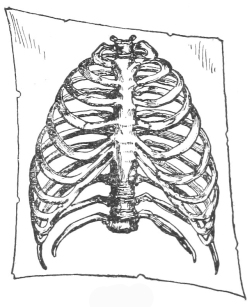
Now we will look at the ribs. They are
fastened to the spinal column at the
back, and all but four are fastened to
the breast-bone in front. There are
twelve ribs on each side. There are
two bones on the upper part of the
back, which seem to dance every time
you move your arm. These are the
“shoulder blades.” They are thin, flat
bones, which help
make the shoulder joint. You can feel
two bones near your neck in front, which
are called “collar bones.” They are
shaped much like the letter f, and serve
to preserve the shape of the shoulders.
Ribs.
Amy: How many bones do we have
in our arms, mother?
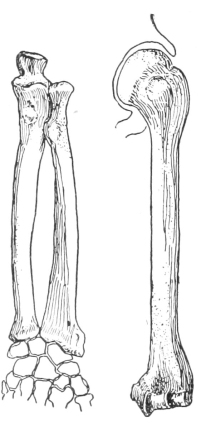
Bones of the arm.
Mother: There are three in each
arm,—one from the shoulder to the elbow,
and two from the elbow to the wrist.
There are a large number of bones in the
wrist and hand.
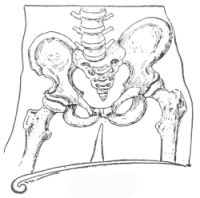
The pelvis.
The middle part of the body below
the spinal column is called the
pelvis. In this picture we see two
curious bones. These are the hip
bones. They are like the sills of a
house, which, you know, are large
and strong. There is a deep hole in
each one as large as a toy teacup,
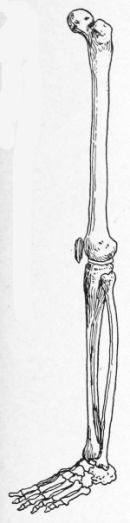
which holds the round head of the leg bone. There are three
bones in each leg, the same as in the arm, one from the
hip to the knee, and two from the knee to the
ankle, besides a funny little bone or cap which
covers the knee. Then we come to the ankle
bones and bones of the feet.
Helen: How do the bones stay in their
proper places, mother? I should think they would
fall apart.
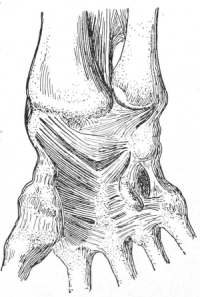
Mother: They would if they were not tied
together.
Elmer: But what are they tied with?
Bones of the
leg and foot.
Mother: With strong white bands or cords
called lig´a-ments. Perhaps you have seen them on
the leg of a chicken. When a joint is “sprained,”
that means the lig´a-ments are stretched or hurt
in some way.
Amy: I should think the bones would get
dry so they would squeak and
rub hard against one another.
Wrist bones tied together.
Mother: So they would if the
Maker of the body-house had not put
soft cushions of gristle or car´ti-lage between
them. A soft, thin skin covers
them, which pours “joint water” over
the ends, and keeps them oiled just
right, so they bend easily, and never
squeak at all. You have seen the
driver of an engine oiling it so it
would run easily and not wear out; but think of a machine
which will mend and oil itself for seventy years without
wearing out! We have a most wonderful frame. The Bible
says, “Thou hast fenced me with bones and sinews,” and,
“He knoweth our frame.” Sometimes if we are ill a long
time “the bones that were not seen stick out;” but when
we are well, flesh covers them over so we hardly know we
have any bones at all.
I once read a poem which I will repeat for you. It
may help you to remember how many bones we have and
where they are:—
“How many bones in the human head?
Eight, my child, as I’ve often said.
How many bones in the human spine?
Twenty-six, like a climbing vine.
How many bones in the human chest?
Twenty-four ribs, and four of the rest.
How many bones in the human arm?
In each one, two in each forearm.
How many bones in the human wrist?
Eight in each if none are missed.
How many bones in the fingers ten?
Twenty-eight, and by joints they bend.
How many bones in the human hip?
One in each; like a dish they dip.
How many bones in the human knees?
One in each, the knee-pan, please.
How many bones in the ankles strong?
Seven in each, but none are long.
How many bones in the toes, half a score?
Twenty-eight, and there are no more.
And now altogether these many bones fix,
And they count in the body two hundred and six.
And now and then a bone I should think
That forms on a joint, or to fill up a chink,
A ses´a-moid bone, or a wormian, we call,
And now we may rest, for we’ve told them all.”
PROPER CARE OF THE BONES
PROPER CARE OF THE BONES
ELEN: What’s the matter with this house,
mother? It seems to be all out of shape.
Mother: Perhaps it is very old and the
frame has decayed so it leans far over to one
side. It is unsafe to live in such houses, for
they may tumble down if a strong wind comes
along. I have seen some body-houses
which look very much like this to me.
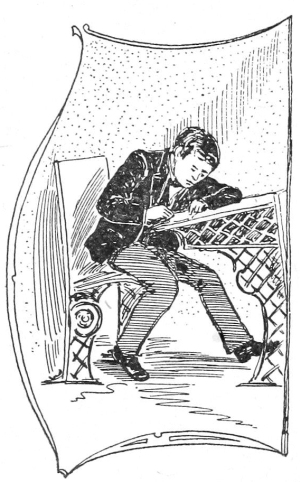
Here is one of them. See how this
boy’s shoulders are bent forward, and
his whole body is wrong. If some
disease, as consumption, should come
along, like a strong wind, I fear his
house would go down. Some one
should say to him, “Straighten up,
young man; throw your shoulders
back, and you will look more manly
and will live much longer.”
“See how this boy’s shoulders
are bent forward.”
Percy: I have seen some boys
at school bending over their desk when studying and
writing. Is that good for the bones?
Mother: No; boys and girls should sit straight, stand
straight, and walk straight. If they do not, after a time
the cushions between the bones in the spine will grow
thicker on one side than on the other, and the back-bone
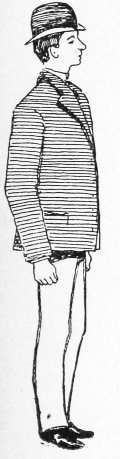
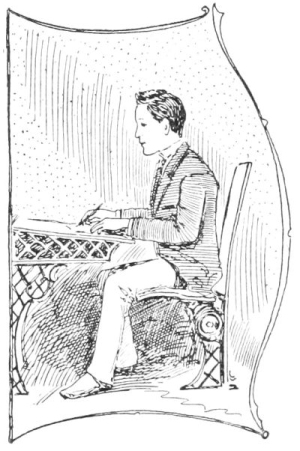
will become crooked. You know soldiers stand erect and
have fine forms. How much better
this man looks than the one who
bends over! Do not form the habit
of bending forward while sitting or
standing. The one who made the
body “made man upright,” and in
this he is different from the birds,
beasts, or fishes.
Elmer: Can the bones be broken,
mother?
“Boys should sit straight.”
Mother: Yes, and it is a sad
thing for one to get broken, for it
is very painful and takes a long time
to heal. Children should be careful when jumping, when
climbing trees, or when they go in any place where they
may fall and break their bones.
Many persons give the bones of the feet a wrong shape
by wearing tight boots or shoes. This causes “corns” to
grow, which become very sore and painful. Perhaps you
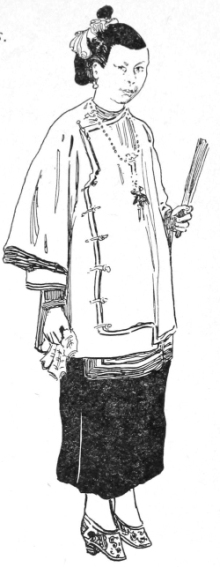
have heard how the Chinese women bind the feet of their
little girls, and pinch them up, till they look more like clubs
than like feet. The little one often cries and moans for
days, but the mother and father pay no attention to her
sufferings, for they think it would never do for their girl
to have big feet.
“See her tiny shoes!”
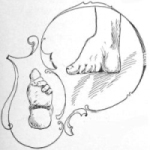
Amy: O, yes, mother; here is the picture
of a woman with little feet! See her
tiny shoes! They are no longer than a
baby’s. In the other picture you see one
of her feet with all the toes doubled under.
I don’t see how she can walk at all.
Helen: She must be silly. I think
God knew how big to make our feet, as
well as other parts of the body.
Mother: That is true, but the poor
Chinese women do not know better, and
they think Christian women are more
foolish than Chinese women, and that
they bind the bones in a way they themselves
would never dream of doing.
Helen: How, mother?
“All the toes doubled under.”
Mother: They say Christian women
and girls squeeze the waist so tight it
gives no room for some of the most important
parts of the body-house. I think
you said, Helen, that God
knew how big to make our
feet. Do you think He
knew how big to make the
waist?
Helen: I suppose so,
but a small waist looks so
much better than a large
one.
Mother: And the Chinese lady thinks her little feet
are so much prettier than large ones, and she would rather
suffer the pain, and hobble around all her life leaning on a
servant, than be out of fashion. The Christian woman
thinks a small waist is pretty, so she makes her clothes
tight, and suffers all kinds of aches,
rather than let the body remain as
God made it. What is the difference?
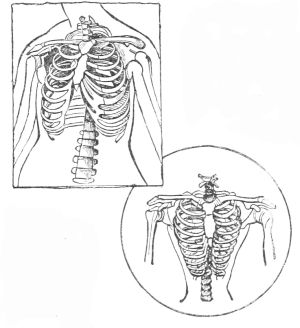
Here is a picture of the ribs as God
made them, and here is one after
the waist has been bound around
with tight dresses.
“Here is a picture of the ribs as God
made them, and here is one after the waist has been bound
around with tight dresses.”
If we saw a man putting
iron bands around
his house we would think
the one who built it had
made some mistake or it
would not need anything
to hold it together. If people feel as though they would
“fall to pieces,” or if they have the backache, when their
clothes are loose, it shows they have abused the muscles
of the body and made weak that which God made strong.
Amy: Is it wrong to wear tight clothing, mother?
Mother: Yes; it is very hurtful for girls to wear their
dresses even a little tight, for the bones are soft and easily
pressed out of place. We should wear warm, loose clothing
on all parts of the body, and never, never squeeze the
feet, waist, or any other part out of shape. Your arm
would be very painful with a tight band around it, but that
would not do as much harm as tight shoes or tight bands
around the waist. It is better to be healthy than to be in
fashion.
You remember that the blood flows through the bones
to feed and make them grow. Good blood will make them
strong and healthy. Children sometimes have a disease
called the “rickets.” This shows that their bones are soft
and need more lime. They should eat plenty of good
brown bread.
No boy who wishes to grow large and strong should
touch beer or tobacco. These poisons in the blood will
make the bony framework of the body small and weak.
The size of the man depends on his frame. Many boys
are making their bodies and minds very small by smoking
cigarettes. By using strong drink or tobacco the house we
live in is defiled. The blood and all the body, inside and
out, becomes soiled and filthy. “If any man defile the
temple of God, him shall God destroy; for the temple of
God is holy, which temple ye are.” If one should go into
a beautiful temple and break the windows, stain the white
marble walls, and cover the floor with filth, we would think
they did wrong. How much worse to destroy the wonderful,
living temple which God Himself has built!
THE WALLS
THE WALLS OF OUR HOUSE
LMER: I don’t like to look at pictures
of bones and skeletons, mother.
Mother: No; like the framework
of a house, they are not pretty, and
yet they give shape to what we do
like to see. When your father built this
house, do you remember how he made
the walls?
Percy: The spaces between the timbers
were filled with bricks, so there was
a solid wall.
Mother: Well, it is that way in the
body-house. The bones are all covered over and
filled in between with muscles. It is these which
make the cheeks so plump, and give the whole body its
round, pleasing form. It is the muscles which move the
bones.
Amy: But what is a muscle?
Mother: You have seen lean meat, have you not?
That is muscle. When boiled it seems to be made up of
little bundles of tiny threads of fibers, each wrapped in its
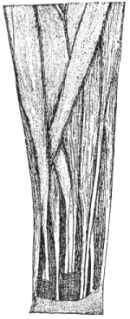
own thin blanket. Here is a picture of a muscle. These
small threads are not twisted together, but are laid side by
side. It takes one thousand seven hundred of them to
make a muscle an inch thick in children,
but in grown people it takes only five
hundred.
Helen: Are the muscles fastened to
the bones, mother?
“Muscles of the arm, with
their tapering tendons at
the wrist.”
Mother: Yes; many muscles are joined
to the bones by strong cords, called tendons.
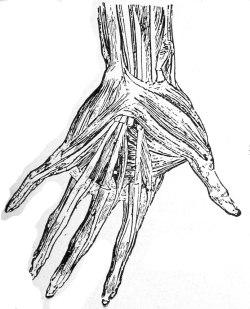
The picture shows the muscles of the
arm, with their tapering tendons at the wrist.
You see our muscles end in these little
ropes, or cords, to save room. What a large
wrist we would have if the muscles were as
large there as in the arm! Now grasp your
right arm and open and shut the fingers of
your right hand. What do you feel?
Percy: The flesh moves.
Muscles of the hand.
Mother: That is because the muscles
of your arm pull back when you shut your
fingers, and stretch out when you open them.
They are some like this piece of India rubber.
If you pull it out, it gets thinner, and if you
let go, it snaps back and becomes short and
thick. Perhaps you have seen the leg of
a fowl cut off at the joint, and know if
you take hold of the strong cords you
can move the toes up or down. So the
muscles and tendons move in our feet
and hands in the same way. Every step we take, one
muscle lifts the toes in front, and another pulls up the
heel behind.
If a person sits still much of the time, he will have
weak, small muscles, because he does not use them. That
is one reason why people are so very weak after being ill.
When we use our muscles, they grow large and strong.
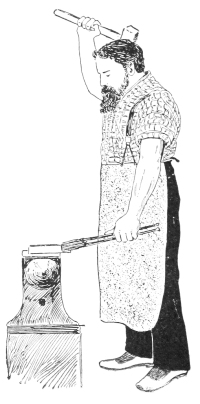
You have seen the blacksmith’s arm and noticed how large
and strong it is. To use our muscles does not wear them
out, but does them good.
Elmer: I should think the muscles were our servants,
to do whatever we wish done.
Mother: Yes; and better servants no person ever had.
If the brain says, “I want a book,” the muscles of the legs
carry the body where the book is; those
of the eye look for it; those in the arm
and hand lift it; and the master of the
house gets what he wants. We can not
move or do anything without these servants
to help us.
Amy: It must take a good many to
serve one who wants as many things as
I do.
Helen: I read not long ago there
were about five hundred of them, big
and little, and that they have many
shapes and sizes.
Mother: That is true; and one who
has so many servants as that, ought to
be able to wait on himself, and help other people, too.
Some of these servants, those in the feet, legs, arms, and
hands, wait to be told what to do. Others go to work
and keep at it without telling, and they will work even
though the one living in the house should tell them to
stop. When you wink, you do it without thinking, for
the little muscles over the eye know it is their duty to
keep the eye clean and bright, and they keep at their work
even though you should tell them to keep still. Your
heart is a hollow muscle, and it works faithfully night
and day as long as you live. The stomach is made of
muscles, which take care of your breakfast and dinner without
a word from you; and there are many more of these
faithful servants who work to keep our house in order.
Percy: But don’t the muscles get tired, mother?
Mother: Yes; and when they ask for rest, we should
give it to them. We do not need to sit still and do
nothing in order to rest the muscles. If we have been
studying, it rests them to sweep the floor, hoe in the
garden, or work or play. If we have been playing or working
hard, it rests us to sit down and read or study. Change
of work is better than to be idle. Walking, running, or
working makes the muscles grow large and strong.
We must also have plenty of sleep. A boy or girl
who works and plays out in the fresh air and sunshine,
will be strong and well, while those who sit in the house
will be weak and sickly. But it is not best to work the
muscles till they are “all tired out,” for using them too
much is nearly as bad as not using them at all.
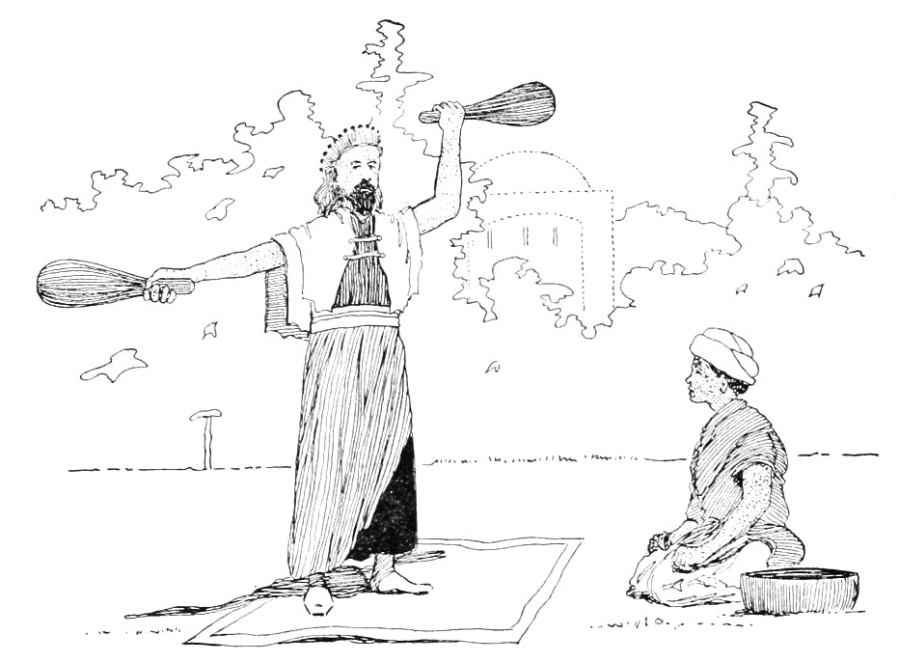
Helen: I read a story not long ago about the king of
a tribe in Africa. He did not move about or work, so he
became ill. He sent for his doctor, who saw that all he
needed was to use his muscles, but he did not dare tell
him to go to work, so he made two large clubs, and told
the king the medicine which would make him well was in
the handles, and if he would swing the clubs each day till
his body was moist, the medicine would go from the clubs
into his hands, and make him strong and well. The king
did as the doctor said. Each day he swung his clubs in
the open air, and he soon became strong. He thought he
had a very skilful doctor, and praised him for his great cure.
“Giving his muscles exercise.”
Mother: And yet it was only giving his muscles exercise
which helped him so much. This shows the importance
of using them.
Elmer: Do we need anything else to make the muscles
strong, mother?
Mother: Yes; one of the best things to make them
strong is plenty of good, plain food. As the muscles are
used, they wear out, and must have new timber to build
themselves up. You would think it strange if a carpenter
brought brick, mortar, glass, and timber to mend a house,
and without his help each part should take just what it
needed, putting in half a dozen bricks in the chimney, a
board in the floor, a new pane of glass in the window, and
some mortar in the right place. But this is what the house
we live in is doing day and night. When we sleep, the
mending goes on better than when we are awake, and it
is done so well we do not hear or think of the busy little
workmen inside. All they ask is the right kind of food,
not too much or too little of it, and they will take the
right thing to the right place, and keep the house in good
order.
Helen: I have read of some men “training” their
muscles. What did they do to train them?
Mother: They were very careful to take only that kind
of food which is good for the muscles. They can not use
wine, beer, whisky, or tobacco, for these make bad blood
and weak muscles. Then they work all they can bear,
but not too much.
Percy: But Mr. Blank says it makes him strong to
have a glass of beer or whisky.
Amy: And Mr. Blank is such a big man he must have
strong muscles.
Mother: To be big is not to be strong. It is well
to have some soft cushions of fat between the muscles,
but, as a rule, those who have much fat are not as
strong and well as those who have less fat and more
muscle. Whisky does not make the muscles grow, nor
does it make any one strong. Would you like to have
me tell you why this is so?
Elmer: Please do, mother.
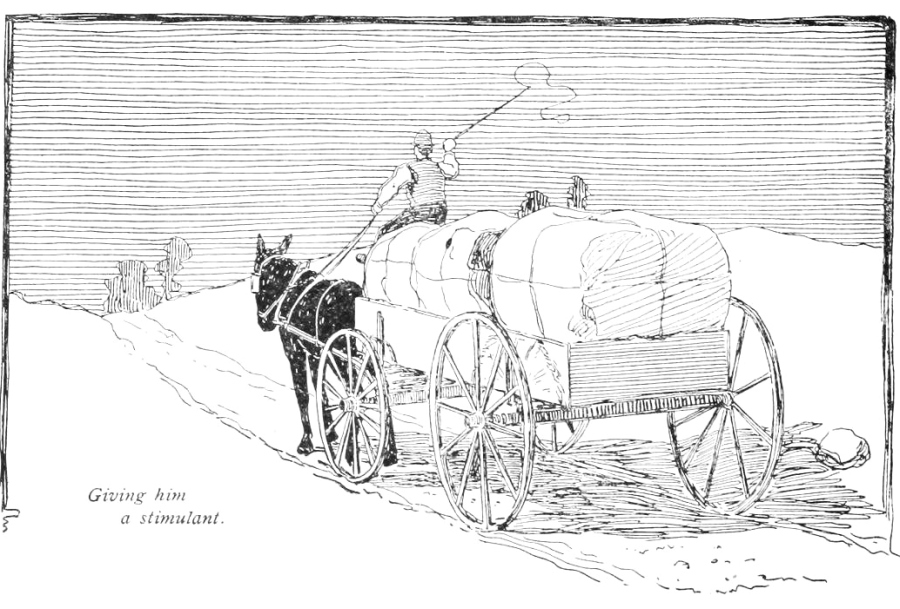
Mother: Do you remember when we were driving
up that long hill yesterday how tired the horse seemed till
he was struck with a whip? After that he went much
faster, and did not seem tired at all for a little while. The
whip was a stim´u-lant to the horse. Whisky and beer are
stim´u-lants, too. Mr. Blank works till his muscles are tired,
and then, instead of giving them food and rest, he gives
them beer, which makes him think he is stronger when he
is really weaker. The whip made the horse forget he was
tired, but don’t you think if he had rested an hour and
eaten some good oats and sweet hay, he would have had
more strength than he had after he was struck with the
whip?
Percy: I think so; for if we had given the horse no
rest and had kept whipping him, after a time he could not
work at all.
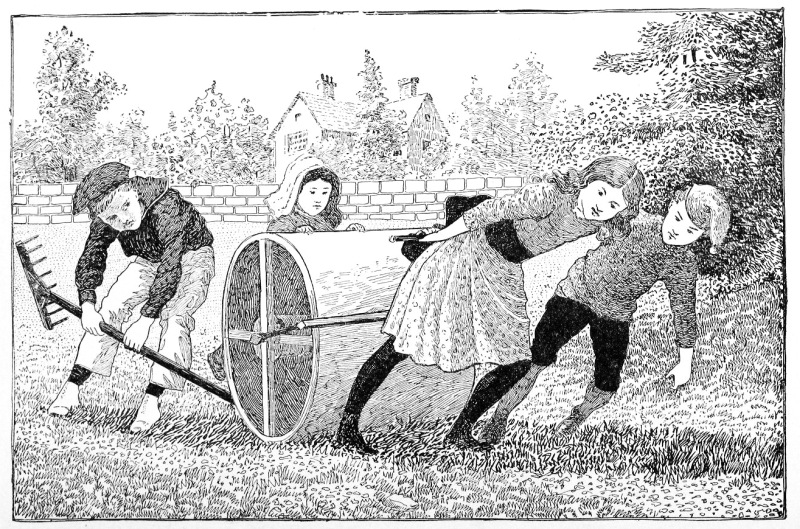
“LIFT, BROTHER, LIFT.”
Mother: And that is just what happens to the man
who drinks beer. Perhaps you have seen a man stumbling
along the sidewalk. He is first on one side and then on
the other, and we say he is drunk. This means that the
alcohol he has taken has poisoned his body so the muscles
will not do their work properly. The man can not make
his servants do as he tells them; for he has made them all
sick, and he is sick. It is a sad sight to see any one drink
this poison, and make himself helpless.
Amy: I never knew before that strong drink hurt the
muscles.
Mother: And there is another poison about as bad
for them, and that is tobacco. If a boy wishes to grow to
be a large, noble man, with an active mind, a clean mouth,
sweet breath, clear eyes, and strong muscles, he will not
touch tobacco. In some countries there is a law against
boys using it, because it does them so much harm. Tobacco
makes the muscles weak and unsteady. Like alcohol,
it makes a person feel stronger when he is really weaker.
WEATHER BOARDS AND ROOFING
WEATHER-BOARDS AND ROOFING
OTHER: After your father had filled the framework
of his house with bricks, can you tell me,
Elmer, how the outside was covered?
Elmer: The walls were covered on the outside
with boards, and the roof with shingles.
Mother: That would do very well for a wooden
house, but for one that can walk, run, jump, and
skip about, such a stiff covering would be sadly out
of place. We sometimes smile because the snail
carries his house around on his back; but the house we
live in must move itself and carry the one who lives in
it. How are boards and shingles fastened onto common
houses so they will stay?
Percy: With nails.
Mother: Just think of driving nails into muscles! Yet
you see our body-houses must have some kind of a covering.
It must be thin and strong and one that will stretch.
Look at your hands and see if they do not have the very
best covering that could be made. Pinch up the skin, and
see how thin it is, and yet how well it fits every part of
the body.
Amy: And the skin stretches, mother. See, I can bend
my knee and elbow, and move my fingers as I please.
Mother: Yes, it is like a close-fitting garment. What
we call the skin is really two skins. You see I can put a
pin through the outer skin in the palm of my hand, and I
feel no pain, and you see no blood.
Helen: Isn’t that all the skin we have?
Mother: No; for under this thick, outer skin is what
is called the true skin. It has such fine blood-vessels that
if you could see them, they would look like fine network.
If you should prick this inner skin it would hurt, and the
blood would flow. This shows it has nerves as well as
blood. Under the true skin is a layer of fat. This is like
a warm woolen garment to keep the body warm. Between
the outer skin and the true skin there is some jelly-like
coloring matter, which gives it color.
Helen: Is that why some persons are very dark and
others are light, mother?
Mother: Yes; your true skin is just the same color as
that of the negro and the Indian. The coloring matter
under the outer skin is all that makes the difference. This
outer covering is made of little horny scales laid one over
another, much as a roof might be if it had ten or twelve
layers of shingles. The outer scales keep wearing away
all the time, and new ones take their places. You know a
snake sheds its skin and crawls away with a new one.
We shed our skin, too, little by little, but the scales are
so small we can hardly see them. If you should wear
your under-clothing several days, and then shake it in the
sunlight, you would see little scales floating about in the
air like dust.
Amy: Isn’t the skin thicker in some parts of the body
than others?
Mother: Yes; on the palms of your hands and the
soles of your feet it is quite thick, while on the lips and
some other parts of the body it is very thin indeed. Have
you noticed how the skin looks if it is scratched and then
heals up?
Elmer: Just the same as it did before.
Mother: But if there is a deep cut or a severe burn,
how does it look after it heals?
Helen: There is a scar left.
Mother: This shows that the outer skin and the coloring
matter will come back as they were before if they are
hurt; but when the true skin is injured, the blood makes
a kind of patch, which we call a scar. Another curious
thing about the true skin is that it has tiny muscles, and
when the body is cold, they draw up and make little hillocks,
which we call “goose-flesh.”
But the skin is very useful, besides being a covering for
the body. When we were getting dinner to-day, what did
we do with the potato parings and other things we did
not wish to keep?
Percy: We put them in the garbage box.
Mother: Why did we do that?
Amy: Because they were not fit for food.
Mother: And what do we call that which we do not
wish to keep, and so throw away?
Helen: We call it waste.
Mother: What do we do with waste matter? Do we
let it stay in the house?
Elmer: No; we throw it away.
Mother: Why would it not be best to let it remain
in the house?
Percy: Because it would decay and make us ill.
“One inch square.”
Mother: Well, it is the same way in the house we live
in. All the food we eat can not be used, and some parts
of the body are wearing out all the time. If the waste
stayed inside, we should become ill. In the skin there are
thousands and millions of little tubes called pores, which
help carry away the waste. If you become very warm,
you say you are “sweating,” or per-spir´ing; that is, drops
of water come out all over your body. They come through
the pores, or little holes in the skin. But we sweat, or
perspire, all the time, whether we can see it or not. If the
pores of the skin were stopped up, a person would soon
die. If the skin is very dirty, the sweat can not get out,
and it stays inside. To show you how many pores there
are, you may look at this little piece of
paper, which is just one inch square. In
such a space on the limbs there are five
hundred pores. On the trunk of the body,
forehead, back of the hand, and on the
foot, one thousand; and on the palm of the
hand and sole of the foot there are twenty-seven hundred.
Each of these little waste-pipes is one-fifth of an inch long.
If they were placed one after another, wise men tell us we
would have two or three miles, and perhaps even more, of
waste-pipes for the body. What do you suppose would
happen if they were choked up, and all the waste should
remain inside?
Amy: We would become ill.
Mother: We surely would. Sometimes we call it
“taking cold.” If we cool off too quickly when warm,
or get our clothes wet and do not put on dry ones, or in
a warm spring day put on thin clothes, all these things
stop the waste-pipes, and we “catch cold,” have a sore
throat, and we may have a fever, which shows that the
waste is being burned up inside; and the house becomes
burning hot.
Percy: Then the pores must be kept open all the time
if we would be well.
Mother: Yes; but there is another way than those I
have told you by which they get choked up. The waste-pipes
leave the dirt they carry out of the body on the skin,
for that is as far as they can carry it. The master of the
house must see that the skin is kept clean, so the pipes
will not be choked.
Elmer: Then he ought to wash it often.
“A thorough scrubbing.”
Mother: I think so, and not only some parts, but the
whole house needs a good scrubbing with soap and warm
water as often as twice a week, and if he will then take a
bath of some kind each day, that will keep the skin clean
and healthy. Even rubbing the whole body once a day
with a damp towel and then with a dry one, will keep the
waste-pipes open, so they can do good work, if there is a
thorough scrubbing twice a week, as I have said. We
should also be careful to wear clean clothing next to the
skin, for there
is about a quart
of waste matter
carried through
the pores every
day. Can you
think of any
other ways in
which the skin
is useful besides
being a covering
and carrying
away the
waste?
Helen: It
helps us feel different
objects.
Those who are
blind learn to
do many useful
things by the
sense of touch.
Mother: Yes, we learn many things by this sense.
You know when you show anything to a baby it stretches
out its little hands to “feel” of the object. How do you
think such poisons as alcohol and tobacco affect this covering
of the body?
Amy: They must make more waste in the body, and
so the skin has more to do.
Percy: I think it must fill it full of poison.
Elmer: Does alcohol make the skin look red, mother?
Mother: Yes; that is why a man who drinks beer or
other drinks containing alcohol, has such a red face. Sometimes
his nose is called a “rum blossom.” The alcohol
makes the blood-vessels larger than they should be, and so
his nose and face become very red. Bad food is also
hurtful to the skin, for it can not be clear and healthy if
the blood is not clean. Pimples and sores are caused by
bad blood, and they show that better food is needed in
the body.
Amy: But you haven’t told us what the roof of the
body house is, mother.
Mother: Have you ever seen a house with a thatched
roof—I mean one covered with hay or straw instead of
iron or shingles?
Elmer: Oh, yes, we saw some when we were out in
the country!
Mother: Well, the roof of the house we live in is
more like that than like a shingled roof.
Percy: Now I know what you mean: the body-house
has a roof of hair.
Mother: And it is a most beautiful covering, too.
Each hair grows in a little pocket, which is furnished with
a tiny bag of coloring matter and a bottle of hair oil.
These give color to the hair, and keep it soft and smooth.
If we put much oil on the hair, it causes the oil bottles in
the skin to dry up. There is no dressing so good as that
which is made in the skin. We should brush and comb
the hair carefully, to keep it shining and healthy.
People sometimes lose this beautiful thatch, and we say
they are “bald-headed.” In very old people it turns gray
or white, and it is like a beautiful, silvery crown. The Bible
says that “a hoary head is a crown of glory.” Very small,
new houses sometimes have no thatch at all, but as they
get larger and older, one grows, and at first it is fine as
softest silk. The Bible says that even the hairs of our
head are all numbered or counted by our heavenly Father.
From this we may see how much He loves and cares
for us.
THE CUPOLA
THE CUPOLA
LMER: Have you seen the cupola on the new
house in the next street, mother?
Mother: Yes; it is very pretty. It is quite
common now to build cupolas on large houses. But
I was thinking, as you came in, of the cupola, or tower, on
the house we live in. Can you think what it is?
Percy: It must be the head.
Mother: That is right, but, unlike the cupola of a
common house, which is used but little, the head is the
best room of all, and the others would be of little worth
without it. It is here we find the master, the one who
gives orders to his servants, the muscles, and directs all
they do.
In large business houses you sometimes see a room
having on the door the word “Office,” and you know if
you have business there, that is the place for you to go to
find the manager. We might call the head the office room
of the body, for it is here the manager is always found if
at home.
While you know there is a master to our house, yet you
can not see him. He may peep through the windows, you
may hear him speak, and you can talk to him. Perhaps
you will love him very much, or you may dislike to be near
him. You may see his work, but still you can not see him.
Amy: You must mean that the mind is master of the
body, is it not, mother?
Mother: It surely ought to be; but I am sorry to say
that in some houses the servants get the master to do as
they like, and then the body-house has a bad time, for
“whether one member suffer, all the members suffer with
it.” The apostle Paul said, “I keep under my body, and
bring it into subjection,” and this is the work given to the
master of every body-house. The mind should know what
is good for the body, and, though the servants may ask
many times to do as they like, he should firmly say, “No,”
whenever they wish to do wrong. Can you tell what the
mind is?
Helen: It is the part of me that thinks and remembers.
Mother: And it also wills, that is, we “make up our
mind,” as we say. Why do you think our mind is in the
head?
Percy: Why, if our hands, arms, or feet were cut off,
we could still think.
Mother: Do you remember the name of the organ
inside the head with which we think?
Amy: The brain.
Mother: Yes; and since the brain is such an important
part of the body, it is put in the strongest room of all. It
sometimes becomes ill if not used right, so we should learn
how to keep it well. The worst sickness in the world is
mind sickness, and it is hardest to cure.
The brain has six coverings in all. The outside coverings
are the hair and scalp, or skin. Then we find the
strong bones, fitted closely together with saw-teeth edges.
Inside the bones the brain has three coverings: first, a
tough, strong skin; then a very thin covering, hardly thicker
than a spider’s web; and the third is made up of many little
blood-vessels, which feed the brain.
Amy: I wish we could see how the brain looks, mother.
Percy: I have seen brains at the butcher shops. Do
ours look like that?
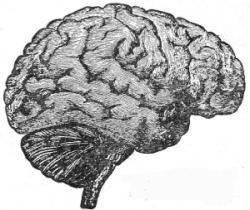
The brain is full of
ridges and creases.
Mother: Yes, quite the same.
You have all seen the marrow in
the bones. The brain looks some
like that, too. It is made of jelly-like
matter, and seems to be all
crumpled up, so it is full of ridges
and creases, as you see in this picture.
It is said a baby’s brain is
quite smooth, but the more a person thinks, the more
ridges and furrows his brain will have and the deeper they
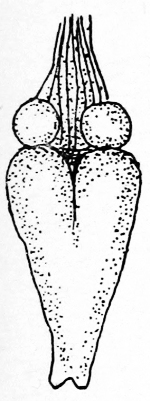
are. A frog’s brain is smooth, like this.
“A frog’s brain is smooth.”
Elmer: But I don’t see how the brain thinks.
Mother: That is one of the things we can never understand.
God gave men life, and when we are alive we think.
“In Him we live, and move, and have our being,” and to
be able to think is one of the best gifts that comes with
life. It is the life God gives us which makes the body-house
worth more than the most costly palace in the world.
If we look carefully into the brain, we see that the outside
is gray, and the inside is white. Wise men tell us
this matter is made of cells, called nerve cells, or brain cells.
The gray matter tells the muscles what to do, and the
white part sends the orders to all parts of the body through
the nerves.
Elmer: Have we more than one brain, mother?
Mother: I might say no, and yes. It is really one,
and yet it is in several parts. One is the big brain, which
is found above the ears in the top of the head. It is with
this part we think and reason. Then there is a little brain,
in the back part of the head under the large brain. It is
about as big as a medium-sized orange. Each brain has
two parts, a right and left half, so we really have two
brains. It might be said we are “left brained” when we
are “right handed,” for the right hand is ruled by the left
half of the brain.
Amy: How large is the brain, mother?
Mother: That of a man weighs about three pounds.
An elephant’s weighs eight or ten pounds, and that is
the heaviest of any we know. The brain must be used, the
same as the muscles, if we would have it do its work well.
It makes it grow and does it good when we study and
think. As it was made to think about something, we
should give it good things to think about. If it is lazy, it
will lose the power to work, just as the muscles do, and if
used, it will grow stronger and can do still harder work.
Helen: And does it ever need rest?
Mother: Certainly; it must rest, the same as the muscles.
People sometimes hurt the brain by working it very
hard and letting the muscles do nothing.
Percy: But how can it rest? We can’t stop thinking.
Mother: No; we think of something all the time we
are awake, so the best way to rest the brain is to take
plenty of sleep. Sometimes a part of it keeps awake while
the body is asleep, and then we say we had a dream.
Another way to rest the mind is to set the muscles at
work after we have been reading or studying. Boys and
girls in school should spend part of each day working, or
in some way using their muscles in the open air.
Elmer: I should think the master of the body-house
would want to look outside of his little room sometimes.
Mother: Yes, he does; and the cupola of which we
have been talking has two wonderful windows.
Amy: Oh, I know what they are! They are our eyes.
Mother: Yes, and through them the master looks out
and sees all that is passing around him.
Helen: I should think there ought to be windows on
all sides of his room. He can look out only one way.
Mother: But you see this cupola is placed on top of
a tower we call the neck, which turns easily and quickly,
and, besides, the whole house can “face about” in an instant,
so he can look other ways than straight ahead, with no
trouble.
Percy: Why do you call the brain the master of the
house, mother?
Mother: Because it tells the feet, hands, tongue, eyes,
and all other parts of the body what to do, and they obey
it. Sometimes we find a bad master in one of these beautiful
houses. He tells the feet to go to a saloon. He tells
the tongue to ask for beer and other kinds of strong drink.
He tells the hand to lift the glass to his lips. It may be
he knows he is taking poison into the house, which will
make his servants, the muscles, unfit for work. Perhaps
he knows, too, that the drink will hurt himself more than
any other part of the body-house, for it puts him to sleep
when he ought to be awake telling his servants what to
do, yet he does it, and often suffers all the rest of his life
for his folly.
Elmer: Does alcohol hurt the brain?
Mother: Surely it does. It makes the blood impure,
so it can not furnish good food for the brain. It causes
more blood to go to the head than ought to be there. It
makes people mad, crazy, or insane.
Sometimes it brings that awful disease, delirium tremens,
and then the poor master thinks his best friends are his
enemies, that serpents and horrible creatures are crawling
over his body, and he dies a terrible death, and goes into
a drunkard’s grave. He ruins the house God gave him to
live in, and finds it is true that “at the last it biteth like
a serpent, and stingeth like an adder.”
Children, never touch these poison drinks.
“Never put them in your mouth,
To steal away your brains.”
OUR TELEPHONE SYSTEM
OUR TELEPHONE SYSTEM
ERCY: Ting-a-ling! There’s the telephone
bell. How strange it seems to talk to people,
and hear them talk, when they are miles
away!
Mother: But the most wonderful telephone
in the world is found in the house we
live in.
Helen: Why, mother, you don’t mean to
say we have wires all through our bodies, do
you?
Mother: Not wires, but something that
answers the same purpose, only it is far more
perfect. You know the brain is the master of
the house, and there are hundreds of muscles
waiting to do what he bids them. But the
brain is upstairs, safe in his own strong little
room. How can he tell the fingers how to
work, and the feet where to walk?
Amy: Please tell us, mother. I’m sure I
don’t know.
Mother: Well, instead of wires we have
thousands of little lines called nerves, reaching from the
brain to every part of the body. They are made of matter
like that in the brain, and they are so close together that
you can touch no place on your body, even with the point
of a pin, without touching a nerve. Messages
are sent over them to the brain, and
back again to the muscles. With the nerves
we feel. We call it the sense of
touch.
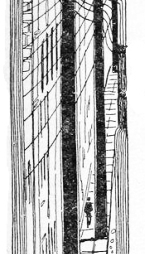
We might call the brain the
“central office,” from which messages
are sent, and where they
come back. In the city you have seen
many wires stretched on poles. Sometimes
they are bound up together and covered
over, making a cable like a big rope. You
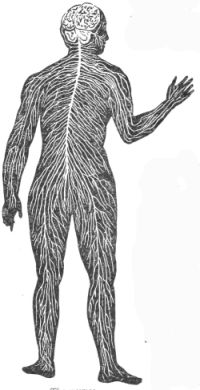
remember I told you there is a spinal cord
or marrow running through your backbone.
This is made up of many nerves, as the
cable is made of many wires. There are
sixty-two branch lines coiled up in it. By
looking at the bottom part of the picture
of the brain you will see where this large
cable enters the central office. Really,
the top part of the cord is a little brain itself, with a long
name, which we will not trouble now to learn.
The nerves.
Elmer: If all the nerves come from the backbone, how
do any get to the face?
Mother: There are some little holes in the skull, and
through these twenty-four branch lines pass, carrying the
nerves all over the face and head. One pair find their way
to the nose, and they tell the master of the house how
things smell. Another pair reach to the eyes, and tell him
how things look. They are nerves of sight. There are
three pairs to tell the muscles of the eye how to move. One
pair passes to the ears, and are called nerves of hearing.
The others are scattered all over the face, passing to the
teeth, tongue, and throat, and even to other parts of the
body. This picture shows the brain as the main office, the
cord or cable in the back-bone, and how the branches extend
to all parts of the body. Still there are thousands of smaller
lines which can not be seen at all.
Helen: And what sends the messages to and from the
brain over the nerves, mother?
Mother: The power which sends them is called “nerve
force,” though what it is even the wisest men do not know.
We can stop it by pressing on the nerves, just as you can
stop the current of the telegraph. We sometimes say that
our leg or arm is “asleep.” If we try to move, it gives us
pain, or it may be we can not move at all. One nerve
runs along the back side of the arm over the elbow. If
we hit the elbow, it makes the arm and hand feel numb.
We say the “funny bone,” or the “crazy bone,” is hurt, but
it is not the bone at all, but the nerve.
Amy: I heard a lady who is ill say she wished she
had no nerves. Why do we have them?
Mother: I think we have already learned how useful
they are to carry messages for us. We would be quite
helpless without them, for the brain sends word over them
every time we move any part of the body. Another reason
is they watch for our welfare. If we are cut or burned, it
gives us pain. We don’t like the pain, so we are more
careful when we use sharp tools or go near the fire.
“Tell your mother about it.”
If you touch the hot stove, you jerk away your hand.
“I’m burnt,” the finger sends word to the brain. The
brain sends back the message, “Get off the stove,
quick.” And to the nerves of the eye it says, “See
if it is blistered.” To the face muscles, “Make up
a wry face to show how badly it hurts.” To
the feet and hands, “Get some cold water to put
the burned finger in.” To the tongue, “Tell
your mother about it.” All these messages
are sent at the rate of one hundred
feet a second, and the eye, face,
hands, feet, and tongue all feel
sorry for the burnt finger, and do
all they can to help it.
Every part of the body,
the bones, muscles, stomach,
heart, and lungs, has these
useful little nerves to let the
master know when anything
is wrong with them.
Elmer: Do the nerves
ever get sick, mother?
Mother: Oh, yes, very
often! Sometimes they are
so ill that no message can pass over them to the brain. Then
we say the person is paralyzed. A lady had her limbs paralyzed.
She could not walk, or move her feet at all. One
day she took a foot bath. She could not tell whether the
water was cold or hot, and soon the nurse found the skin
on her feet blistered, because the water was too warm. The
nerves were dead, and she felt no pain at all. Pain is hard
to bear, but if there were no pain, the house we live in
would soon be ruined. It tells us when danger is near,
and because we do not like the pain, we take care of the
body. The nerves are more wonderful than any telephone
or telegraph, and when you get older, you must learn all
you can about them.
Helen: The brain must have a lot of work looking
after the nerves and sending so many messages over them.
I don’t see how it can think of anything else.
Mother: Perhaps I can explain it to you. Suppose
there is a family who have much to do. The father
does the hardest work of all. When his wife sees how
much he has to do, she tries to help him all she can,
so she does many things without saying anything to her
husband about it. They have one son, a strong, upright
young man, and he takes part of the work, because he
wishes to help his parents. We will call the large brain
the father, because it does so much of our thinking. As
you say, Helen, if he looked after all parts of the body,
there would be but little time for study and helping other
people. Besides, he falls asleep sometimes, so the little
brain, which we will call his wife, takes the work that must
be done all the time, as good wives and mothers do, such
as keeping the heart beating, the lungs breathing, and
other parts of the body at work which can not stop to
rest. Then there is the spinal cord, which we will call the
son, and he takes charge of the feet and hands when they
have common kinds of work to do. When you went to
school this morning, I saw you reading a book while you
walked. Your brain did not send word to each muscle
what to do every time you took a step, but you walked
“without thinking,” as we say. The spinal cord took
charge of your feet, so we know it can do an easy kind of
thinking. When you were learning to skate, Percy, you
kept thinking all the time how to move your feet and what
to do to keep from falling. But after you had learned
how, Father Brain gave his son, Spinal Cord, charge of you,
and he thinks of something else most of the time while
you skate. It is the same with anything we have learned
to do well by doing it over and over, such as playing the
piano, riding a bicycle, and many other things we keep
doing again and again.
Percy: Does alcohol harm the nerves, mother?
Mother: Yes, indeed. Alcohol seems to like the
nerves better than any other part of the body, and it does
them more harm than any other, except the brain. When
alcohol touches a nerve, it dries it up and makes it hard, as
though it had been burned. It causes that dreadful disease,
paralysis, of which I have told you. The nerves get so
stupid and sleepy they do not know what the brain says
to them. They can not tell the muscles what to do, and
this is why a drunken man staggers. A drunkard has
trembling hands, because the poison has made his nerves
sick. Sometimes those wonderful nerves of the eye and
ear tell him lies, and he believes what they say. Sometimes
the poor nerves and brain are so nearly dead that
the man falls down, and people say he is “dead drunk.”
“The little boy is forming a bad habit.”
Elmer: I have heard people say tobacco was good for
the nerves, that
it made them
feel rested, and
they could think
better.
Mother: Tobacco
is a poison,
and is as
hurtful to the
nerves as alcohol.
One who
uses it thinks
he is rested, but
the reason he feels so is because the poison has put his
nerves to sleep. Tobacco also creates an appetite for strong
drinks. It is very bad for boys to use tobacco in any way.
Amy: What should we do to keep the nerves well?
Mother: Give them good food, plenty of fresh air, and
no poisons of any kind. They must also have rest to keep
them strong. It helps the nerves to be happy and cheerful.
The little boy in this picture is forming a bad habit,
which will not only make him unhappy but unhealthy.
Hateful, unpleasant thoughts make poisons in the body and
cause sickness in the brain and nerves. People sometimes
drop dead by becoming very angry. “A merry heart doeth
good like a medicine.” Yes, it is much better than any
medicine men can make. Children should form the habit
of being happy and hopeful. The brain and nerves will
form good or bad habits, and the master of the body-house
should use all his power to have them good instead of bad.
Every evil habit leaves a scar on the brain.
THE HALL OR PASSAGE
THE HALL OR PASSAGE
OTHER: I once read a book called “Uncle
Tom’s Cabin,” and in it a story was told of
how a lady was once talking with a little
negro girl named Topsy.
“Who made you?” she asked the child.
“Nobody, as I knows on. I s’pect I grow’d,” was the
answer.
Now we know God made the body-houses we live in,
for “it is He that hath made us, and not we ourselves;”
yet in one way Topsy was right, for we all “grow’d.”
God made us grow, and it is He only that can make
anything grow.
Elmer: But we must have food to make us grow.
Mother: Yes, everything that has life must have food
of some kind. You remember I told you we had iron,
lime, and other things to build the body-house, just as a
man must have wood, brick, iron, and glass when he wishes
to build. We have looked at the outside of the house we
live in, and we have learned some things about its frame,
its servants, the telephone system, and the master who lives
inside. Now we will look through some of the wonderful
rooms in the house, and I am sure you will enjoy learning
how they are made, and the work that is done in them.
The door, or entrance, is so small we can not possibly
go inside ourselves, so here is a slice of good whole-wheat
bread we will send, and I will tell you what it finds within.
As it has no tongue, I will speak the words it would say
if it could talk, and you may ask any question you wish.
Now listen:—
I was made from the wheat that grew in a farmer’s
field. After the miller had ground me into flour, your
mother made me into a loaf, and I was baked in a hot
oven till I was brown all over outside. As she put me
away to cool, she said, “That will make the children grow.”
She left me alone a whole day, for she knew I was unfit to
be eaten while so warm. After that I was cut into slices
and made ready to help mend and build up the body-house.
I started on my way to the kitchen, where much of
the work is done, and to get there passed through a pair
of front doors, which were a pretty red color. These
doors, I have been told, can do wonderful things besides
opening to let visitors pass in. They can sing, whistle,
and talk. They look best when the corners turn up; if
they turn down, one does not care to go near them.
Helen: Oh, I see! You mean our lips.
Mother: Yes, I think that is what you call them.
When I passed inside the doors, I found a double row of
thirty-two servants, all dressed in clean white dresses, waiting
for me. Children have only twenty-eight of these servants,
I am told. It was their work to make me ready for the
kitchen downstairs. If the house is very new, you will
find only three or four, or perhaps none at all.
“WHEAT THAT GREW IN A FARMER’S FIELD.”
Percy: The servants must be the teeth. I didn’t know
there were so many.
Amy: And I think the bread we eat doesn’t always find
them wearing clean white dresses, either. There is Uncle
John; his teeth are all stained with nasty tobacco juice.
Mother: But they should be dressed as I have said,
and they need careful brushing and washing every day.
They should not be used to crack nuts, for they may get
broken. If they are not well cared for, the dresses wear
out, and great holes can be seen in them. Sometimes they
can be mended, and again they cause the master of the
house much trouble, and he is obliged to get some one
to take them away, because they give him so much pain.
I was quite surprised at the way these servants treated
me, though I suppose they knew best what to do. Some
of them cut me in two. Others tore me into pieces and
ground me till I thought I was passing through another
mill. As I had a chance, I looked around, and then I
saw the room I was in had a beautiful arched ceiling of a
pale pink color.
There was a large servant behind those dressed in white,
and he wore a pink uniform. You should have seen the
way he rolled me over and over in that room. The servants
in white dresses never stirred from where they were
standing, but the one wearing the pink uniform jumped
from one side of the room to the other, and seemed to be
a very lively fellow. I don’t know what he would have
done had he not been fastened to the floor. Sometimes,
I am told, he peeps out between the folding doors to see
what is going on outside, or to tell what kind of work is
being done inside. I have heard that sometimes his dress
becomes a dirty yellow or brown, and a man with a wise
look comes and asks this servant to step outside a moment,
till he can see how his uniform looks.
Helen: How funny to think of our teeth and tongue
as our servants!
Mother: But that is what they are. There is another
group of servants in this passage, called glands. They have
little rooms opening into the passage near the floor, and
also in the back part of the room. If you ever visited a
cave, you remember the walls were wet, and water was
dropping from them. You know the skin on the outside
of your body feels dry. Some parts of the body have
skin inside, but it is wet instead of dry. It is that way in
this hall. That which makes it so is called saliva, and it
is the duty of the servants called glands to pour saliva
over the food as soon as it comes through the front doors,
while the tongue rolls it about, and the teeth grind it.
Elmer: But what good does that do?
Mother: It moistens the food and makes it slippery,
so it can pass on to the kitchen. Perhaps you know bread
is partly made of starch. Another thing the saliva does is
to turn starch into sugar, and this makes less work in the
kitchen downstairs, as the cook down there has but little
to do with starch.
Amy: How may we know when the starch in bread
or biscuit is changed to sugar?
Mother: If you let the teeth chew your food a long
time, until it becomes well mixed with saliva, you will find
that it tastes sweet. This is because the starch has become
sugar, though you must not think this kind of sugar is as
sweet as the sugar which you buy.
Helen: If the walls in this room moisten the food,
why should we drink while eating?
Mother: It is not best to drink much when you eat,
and not at all unless your food is very dry. The glands
furnish from one to three pints of saliva a day. If you
drink much, the saliva is not well mixed with the food,
and it is hurried down to the kitchen before the servants
have finished their work. This makes extra work for the
cook downstairs.
OUR KITCHEN
OUR KITCHEN
OTHER We will now let Bread proceed with
its story. Remember I am telling you what it
would say if it could talk. Now listen. While
I was in the passage and the servants were
making me ready to go to the kitchen, I saw a
small pink curtain in the back end of the room,
and I wondered what was behind it. I soon
found out. After the tongue had pulled and
pushed me around and rolled me over as long
as he wished, he pushed me back toward the
curtain, and I found myself in a room with no floor. I
saw a passage which opens into the nose, but as soon
as I came in sight, a curtain fell back and closed it, so I
knew I was not wanted there. Then I saw another door,
which I afterward learned led to the bath-room in the
lungs, but as I was about to go in, a little trap door
closed tightly, and so I found that was not the way to the
kitchen. There was still another passage, for this room
seemed to be filled with doors, even though it was so
small, but that led to the ear. I began to think I was
not wanted at all, for every door I came to was shut in
my face, as it were.
Helen: I don’t wonder Bread didn’t know which
way to go, do you, mother? and it was a stranger in the
house, too.
The stomach.
Mother: I was just thinking about going back through
the folding doors through which I came, when a door
opened in the back part of the throat, and I began to slide
downstairs. Such queer stairs you never saw. They
seemed to grow larger as I
went down, and smaller at the
top, so they kept pushing me,
and I could not go back if I
would.
Percy: I suppose it was
the same way when I swallowed
a button the other day.
I wanted it back badly enough,
but it wouldn’t come.
Helen: That shows you should never put such things
as pins and buttons in your mouth.
Elmer: And what did the kitchen look like?
Mother: Like no room you ever saw in your life. I
looked around for the corners, but there were none. It is
shaped some like an egg. Here is a picture, which will
help you to understand the shape of the room.
You see it has two doors, or openings,—one at which
to go in, and the other to pass out. The walls are a pale
pink color and are full of wrinkles if the room is empty.
When the master of the house sends down so much bread
or other food that it fills the kitchen full, the walls become
smooth and the room is larger, but when the food first
begins to go down, it finds the room quite small, and the
walls full of folds, or wrinkles.
This room is very strong, as there are really three walls,
one inside the other. The pink lining inside is made of
wet skin, something like that found in the room upstairs.
The middle wall is made of muscles, which cross one another
in different ways; for the kitchen has many of these useful
servants. The outer coat, or “overcoat,” of the stomach
has for its work to pour out a kind of water to keep the
walls moist so they will not stick to other things which are
packed so closely in the trunk of the body. I am sure no
person could ever pack so many things in a trunk the same
size without crowding some of them or getting them out
of order.
Helen: But I would like to know who acts as cook
in this curious kitchen.
Mother: The name of the head cook is Di-ges´tion.
There is a whole family of helpers, named Juice, whose
work it is to assist Di-ges´tion. Of course they do not boil
and bake, as we do, but they take the food and make it
ready for the use of the body. Perhaps you would call it
di-gest´ing it.
The chief helper is a very important person, called Gastric
Juice. When the kitchen is empty, Gastric Juice stays
in some tiny bags or bottles which cover the walls of the
kitchen all over, but as soon as anything comes into the
room from the stairway at the top, she comes out and goes
to work. She pours a fluid which looks like water, over
the food, which dissolves, or melts it. If you could look
inside you might think the stomach was “sweating;” but
it is only Gastric Juice coming out to care for the food you
have sent down to build and mend the body. Several
quarts come from the walls of the kitchen every day.
Were you ever in a ship at sea? If so, you know that
everything in the boat was shaking and moving. As soon
as Bread comes into the kitchen, it finds the room moving
like that, and it is thrown from one side to the other, and
churned up and down, over and over, till, if you could see
it, you would never think it was bread at all. Gastric
Juice melts and mixes it, and it becomes so changed it
looks very much like paste. After Bread comes downstairs,
some potatoes, fruit, and other things “come tumbling
after,” but after all has been in the kitchen two hours, you
could not tell which is bread, fruit, or potatoes; for they
are all mixed together.
I expect you are wondering how the food would ever
get out of the kitchen. After it was shaken and churned
several hours, the walls gave it a push, and it came to the
door where visitors pass out. Such a queer door it was,
too, but it opens and shuts like the one at the entrance to
the passage. This door has neither hinges nor rollers. It
was kept tightly closed while the food was churned about
and melted, and it looks quite like a boy’s lips when he is
going to whistle. As Bread came near, the door opened,
and part of the food paste passed through into another
room. Strange as it may seem to you, this door seems to
do a kind of thinking, and if food tries to get through
before it is made as fine as it should be, the door seems to
say, “No, sir; you can not go through here;” and it shuts
so close together that not another thing can pass out. So
when the food came the first time, the door seemed to think
part of it was too big to go through, and it was sent back,
to be churned and squeezed again before it could go into
the next room with the rest of the food.
Elmer: I didn’t know it took so much work and such
a long time to digest what we eat.
Mother: This should teach us to use care in what we
send into the stomach. Let me tell you a few other things
about the stomach, which we call the kitchen of the body.
The helper, Gastric Juice, does her work perfectly if she is
used well; but when the master of the house is unkind, she
always makes him suffer for it. Sometimes he sends down
a lot of cold water, ice-cream, or some other kind of ice,
when she is just ready to begin her work. This makes
her kitchen so cold that she is obliged to wait till it
gets warm again. She doesn’t like much water when she
has work on hand; for she thinks Saliva and herself can
moisten the food as much as it needs.
Amy: Does Di-ges´tion like hot drinks, mother?
Mother: No; they burn the tender walls of the stomach
and make them weak. Tea and coffee are hurtful to
the stomach, as well as to the nerves and other parts of the
body. Another thing Di-ges´tion likes is to have all the
food she is going to work on at once. That means we
should eat what we need and then stop. If the master of
the house sends down a good-sized dinner, and, after waiting
an hour or two, sends some more, the poor cook has a
hard time, and it is no wonder that she gets sulky. It
is as though you had been at work during the day, and
then I should ask you to work all night, and give you no
time to rest.
The cook in our kitchen is willing to work hard, and then
she wants a rest, and this she ought to have. She hates
to work at night after working all day, but some masters
are so unkind as to even call her up after she has gone to
bed, thinking her day’s work is done; and she works and
works away while other parts of the body have rest.
Helen: I suppose that is when we eat between meals
or late at night.
Mother: Yes; and another thing the cook dislikes is
to have her kitchen filled so full that no more can get in.
She must have room to work.
Elmer: That means we should not eat too much.
Mother: That is right. We should never eat till we feel
so full we can take no more. If a builder was beginning
to build or mend a house and you should pile bricks, timber,
stones, and lime around him till he had no room to work,
he would say, “Please take part of this out of my way,
and then I can do something.” So the stomach wants just
enough, but no more, and we should not make the cook cross
by abusing her in this way. She also dislikes hot things,
such as mustard, pepper, and spices. How would your eye
feel if you should get some pepper or mustard in it?
Elmer: It would smart.
Percy: It would look red.
Mother: That is the effect they have on the stomach,
too. Neither does the cook like to have much fat or
sugar. Sometimes she gets so provoked when the master
of the house sends down things she can not use, or too
much even of that which is good, that the doorway to the
stairway opens by which they came down, and she throws
them back in his face. He has a sorry time of it then,
and it may be quite a while before she is pleased again.
But she only does this after she has suffered a long time,
and when she knows it is for the good of the body-house.
Amy: What a long time it takes to fix up the food we
eat so it can be used in the body! I would like to know
where the food goes after the cook in the kitchen has
digested it.
Mother: We will finish this part of the story in the
next chapter.
THE EATING ROOM
THE EATING ROOM
OTHER While waiting for the door to open
to let the food pass from the stomach kitchen,
let me tell you that the walls of the kitchen are
covered with hundreds of little mouths; for you
must remember this room is like no other that
was ever made. These tiny mouths keep drinking
the food which is digested, and it is taken into the blood
through the tiny blood-vessels which cover the stomach.
At last comes the food which could not pass the door
again, and this time it passes through into a long, narrow
room, with walls quite like those of the kitchen. Sometimes
a plum pit gets into the kitchen; the cook is unable
to use it, and when it goes up to the door, it closes quickly,
so it must stay where it is. Sometime after the door will
open and let it through.
Helen: That is the same as though you should tell
me I should not do a thing, and then, because I teased
or coaxed, you should let me do what you had before said
I should not.
Mother: Yes, that is the way with this door-keeper.
But sometimes the door closes very tightly, and then there
is trouble, for that which can not get through the second
door must find its way back through the first. We should
be very careful about swallowing large seeds of fruit, buttons,
or anything that is hard and can not be digested. People
are sometimes made very ill in this way. But now we
will learn what is done in the second room.
Perhaps it might be called the “serving room;” for
it is here the food is made ready for the eating room.
Here we find two assistant cooks. The name of one is
Pan-cre-at´ic Juice, and the other is called Bile. Each
one has a room of his own. Pan-cre-at´ic Juice has his
home in a room back of the kitchen, which is called the
pancreas. Bile lives in the largest room in the body-house,
which is called the liver.
The liver might be called a factory; for it has hundreds
of little rooms in which Bile is made. It has a waiting
room, called the gall, where Bile stays when he is not wanted.
This tiny room is close to the liver, and from that Bile goes
to the serving room. On the way he meets Pan-cre-at´ic
Juice, and they go on to their work together.
Bile, like some other servants, is hard to please, and
he will do only one kind of work. It is the duty of these
cooks to finish up the work that Gastric Juice has begun.
Bile will work with hardly anything but fats, and it is his
work to make them into such tiny drops that they can
be used in the body. He must also furnish part of the
fuel to keep the body warm. He sometimes gets lazy or
angry if the master of the house gives him too much
work, or if he sends too much fat or sugar into the serving
room. The master of the house tells his friends he is
“bilious,” which means that Bile is out of temper and
wants less hard work and more rest.
Percy: Is Pan-cre-at´ic Juice so particular as Bile?
Mother: No; he is much more obliging, and is willing
to do anything that needs to be done. Together these
helpers work over the food after it comes from the kitchen
till it is very fine and creamy.
Amy: Does this room look like the kitchen?
Mother: The walls are very much the same, and they
keep eating or sucking up the food that is wholly digested,
much as a sponge sucks up water. A part is taken up this
way and goes into the blood-vessels at once, but part is
sent on to the eating room, where hundreds of little people
are waiting for their breakfasts and dinners.
Helen: How does the eating room look?
Mother: This room is very narrow and about twenty
feet long. You must not think it is a straight room twenty
feet long, for it is not. At one side it is fastened to a thin
band, and the band is gathered like a frill or ruffle, so the
room, though it is folded over and over, never gets tangled.
Perhaps I might say it is like a tube more than a room.
The little folks who eat here do not sit at tables as
you do. They are fastened to the walls, so they are
always in the same places. Another name for this room
is the “small intestine.”
Elmer: I would like to see some of the little folks
who eat there. How large are they?
Mother: They are so very, very small you could not
see them unless you had a strong glass to help you. They
stand up straight, like the soft, silky part of velvet or
plush. They are called Villi.
As the food comes in from the serving room, another
helper, called In-tes´ti-nal Juice, takes any part which the
other servants have not finished as it passed through their
rooms, and thus digestion is complete. The Villi soak the
food up as it passes them, as a plant draws water and food
from the ground.
Helen: But how does it all get into the blood?
Mother: I was just about to tell you that part of the
story. You have seen little creeks, and you know they
flow into larger ones, which form small rivers, and they,
in turn, flow in some broad river toward the sea. So this
creamy fluid which is sucked up by the Villi goes into tiny
veins; these open into larger ones, till all flow in one
stream about as big as a slate-pencil up to a large vein
near the neck, and from there to the heart, where the
stream is changed to blood, and is ready for use in the
body. Part of the food takes another way to get to the
heart. It goes first to the liver, which takes the part it
needs, and the rest goes on to the heart.
Helen: Then all we eat finally gets into the blood.
Mother: No; there is always some part that can not
be used. Passing through the eating room the waste is
carried into a garbage box, called the colon, which should
be emptied every day.
Now let us see if we can give the names of the different
rooms a slice of bread passes through before it reaches
the heart and becomes blood.
Elmer: First, the passage, which is the mouth, down
the steep stairs or gullet, through the stomach kitchen,
through the serving room, the eating room, or small intestine,
and from there straight to the heart, or else by another
road through the liver to the same place.
Mother: Very good. Now what juices make the bread
ready to become blood.
Percy: First, the saliva in the mouth.
Amy: And gastric juice in the stomach.
Helen: Then bile from the liver, and pan-cre-at´ic
juice from the pancreas.
Elmer: The last was the in-tes´tin-al juice.
Mother: That is right, and let me tell you that in
our bodies about twenty pounds of juices are made every
day. Now I think we can remember that the food passes
through five rooms, and it takes five juices to make it into
blood. Two of the juice family, which have the long
names, in-tes´tin-al and pan-cre-at´ic, are willing to work
on all parts of the food. The others work chiefly on one
part only. Saliva digests starch. Bile works on fats.
Gastric juice takes the part which is called al-bu´men.
“Behind the bread, the snowy flour;
Behind the flour, the mill;
Behind the mill, the growing wheat
Nods on the breezy hill;
Over the wheat is the glowing sun,
Ripening the heart of the grain;
Above the sun is the gracious God,
Sending the sunlight and the rain.”
FOOD AND FUEL
FOOD AND FUEL
OTHER: See that engine. Can you tell me
what gives it the power or strength to draw
its heavy load?
Helen: Steam gives it power.
Mother: And what makes the steam?
Elmer: The fire in the furnace makes the
water boil, and steam comes from the boiling water.
Mother: Then the engine can do nothing unless it
has fuel to burn and water to boil. It might be the best
ever made, and yet do no work and have no power even
to move itself. Do you suppose the engineer is careful to
take plenty of the best fuel he can get, and to have a
good supply of water, when he has a long journey and
a heavy train?
Percy: I am sure he would be. I have read that it
is counted one of the worst things an engineer can do to
let his boiler get dry.
Mother: Well, in some ways our bodies are like the
engine. Can you guess what the fuel is we must have?
Amy: Oh, I know! It is the food we eat.
Elmer: And we must have water to drink, too.
Mother: Yes; but what would you think of an engine
driver who would fill the furnace of his engine with stones
or sand, and fill the boiler with beer or whisky?
Percy: I think he wouldn’t have much steam, and his
engine would soon be ruined.
Mother: Then what shall we say about food and drink
for the body, which is a hundred times more perfect in all
its parts than the best engine men ever built, and so is
much more apt to be injured?
Helen: We ought to give it the very
best food and drink we can get.
“The engine takes water without stopping.”
Mother: I think so, too. You know an
engine works several hours, and is then sent
to an engine house to be made ready for
another trip, and, while it is running, the
driver steps out at every station, almost,
with his oil-can in one hand and something
to clean with in the other, and he keeps
cleaning it, oiling it, feeding it, and letting
it drink till he comes to the end
of his journey. Can you think how the
body is different from this?
Elmer: When the body-machine
starts running in the journey of life,
it never stops to rest till it is worn
out and can work no more.
Mother: Yes, and we must
remember that some parts work
night and day, summer and winter,
as long as we live. Yet they are wearing out all the time,
and must be fed and cleaned and cared for while they are
working. There are some railroads made with tanks or
ditches between the rails, and the engine takes water without
stopping. So our bodies must take food, drink, and all
they need without stopping the living machinery.
It is true some parts must rest every day; but
others never stop working till we die. We
should study, then, to know
what we ought to eat and drink
to make up the waste and keep
the body well. Some kinds of
birds and animals live on flesh.
Others eat only grass and grains.
The squirrel and the monkey eat
nuts and fruits. Can you tell
me some of the different things that men use as food?
Amy: They eat flesh, grains, and fruits.
Elmer: And we eat other things, such as salt, sugar,
and milk.
Mother: Yes, while people can eat all these things, yet
all of them are not the very best food, and, like the careful
engineer, we should learn just what is good for the human
machine, and give it only the best of what it can use.
What do you think was given to men to eat at first?
Amy: Where can we find out, mother?
Mother: In the first chapter of the Bible. Perhaps
Helen will read it for us.
Helen: “And God said, Behold, I have given you
every herb bearing seed, which is upon the face of all the
earth, and every tree, in the which is the fruit of a tree
yielding seed; to you it shall be for meat.”
Mother: The word “meat” means food. This was
spoken before God had cursed the earth on account of sin,
and so everything that grew was “good,” as He had said.
We see from this that all kinds of plants bearing seed, and
all kinds of fruit, were good for food. No doubt if God
had thought meat was good for man, He would have had
a butcher shop somewhere in the garden of Eden, and
some beef or mutton hanging from the limb of a tree.
Percy: But what made the people begin to eat flesh,
mother?
Mother: After a time the flood came and destroyed
everything on the earth except what Noah had in the ark
with him, and when he came out of the ark, God told him
that people might eat the flesh of animals, and they have
kept on eating it ’til the present time.
Elmer: But is it the best food, mother?
Mother: No, we can not say it is the very best; for,
as time has passed, the animals have become sickly, and
many wise doctors say it is unsafe to eat their flesh. Cattle
which have been killed to eat have been found with diseased
lungs, livers and kidneys. People sometimes become
very ill and many have died from eating their flesh.
Helen: I should think if they choose such food it
would be like the engine driver filling his furnace with
poor coal when he could get plenty that was better.
Mother: Perhaps so. When we can get good vegetables,
grains, and fruits, it is much safer to use them for
fuel in the body than to run the risk of giving it anything
which might put the delicate machine out of order.
I saw a poem not long ago, written by Dr. J. H. Kellogg,
which you might like to have read to you. It is called
A VEGETARIAN SONG.
“You may talk of mutton-chop,
You may say it is tip-top
For a man who wants to live both well and long;
But you’re much behind the time,
As I’ll show you in this rhyme;
For there’s better food than flesh to make one well and strong.
”Chorus——
“On the glorious trees! on the glorious trees!
There the fruits and nuts, the fruits and nuts do ever grow.
This is heaven’s own food,
God pronounced it very good;
Yes, upon the trees, kissed by the breeze, the best foods grow.
“There are pippins rich and rare,
There are plums and peaches fair,
There are huckleberries, raspberries, and pears so sweet;
There are grapes upon the vine,
Never made for use as wine,
All of which with one accord invite us, ‘Come and eat.’
“There’s the orange and the lime,
Lemons, too, for summer-time,
Which so often do refresh us in the toil and heat;
There are nectarines so bright,
There are cherries, red and white,
All of which with one accord invite us, ‘Come and eat.’
“There are English walnuts rich,
And delicious almonds, which
All alone supply us cream and milk, how rich a treat!
There are coconuts and pine,
Pecans, hickory-nuts so fine,
All of which with one accord invite us, ‘Come and eat.’
“There’s the ox, an honest beast,
See him served up at a feast,
Notwithstanding he has been a faithful, true helpmeet
To the farmer in his task;
Yet he never once has asked
More than humblest fare, and now his blood cries, ‘Do not eat.’
“There’s that scavenger, the pig,
Grown to be so fat and big
That he scarce can stand or walk upon his clumsy feet;
Though he lives a life of ease,
He is full of dire disease,
And he surely is of all things most unfit to eat.
“There’s the sheep with fleece so warm,
Never did a bit of harm,
But for cruel man provides good clothing, warm and neat;
Ere you raise the sharpened knife,
Cut his throat, and take his life,
Listen to his sad though mute appeal, ‘Don’t slay to eat.’
“There’s the oyster in his bed,
Eating everything that’s dead;
He’s the scavenger that cleans the bottom of the sea;
He lives in the mud and slime,
Catching microbes all the time,
And his occupation surely says, ‘Oh, don’t eat me!’
“There are turkeys, daily fed
On the best of household bread,
So that they’ll be fat and toothsome for Thanksgiving day;
What a sin it is and shame,
Crime without a proper name,
For a man these gentle creatures first to feed, then slay!
“There are birds that sing a lay
Full of joy at break of day,
That will silent be forever at the set of sun.
Some will slay the songsters sweet
On pretense that they would eat,
While a thousand more admit they kill them just for fun.
“List and hear these creatures all,
Mighty beasts as well as small,
With a thousand, thousand voices, loud and long repeat,
We beseech you, let us live;
Take not life you can not give;
Only kill ferocious creatures; never slay to eat.
“It was God’s appointed plan,
Given long ago to man,
That no creature of another creature’s flesh should eat,
But that all alike should dine
On the fruit of tree and vine
And the toothsome grains, which heaven has given man for meat.
“Better far it is to be
A vegetarian, don’t you see?
As thus we take our daily food direct from heaven’s own hand.
When we eat another’s flesh,
We’re not taking food that’s fresh,
But are living on a diet that is second hand.
“Oh, then, let us all resolve
That, while earth and years revolve,
We will never more pollute our mouths with bloody meat,
But will choose a diet pure,
From disease and germs secure,
And of fruits and nuts and grains so wholesome ever eat!”
Helen: I’m glad you read it to us, mother. It does
seem, when the cattle eat the grass and grain, and then
we eat them, as though we were eating second-hand food.
Percy: I don’t propose to do that way any longer. I
think I should have what I eat first-hand, as well as the
sheep and ox.
Mother: I am sure if you carry out your resolve you
will have pure blood and a more healthy body. I saw
some pictures of children not long ago who had never
tasted meat in their lives, and they were as happy and
hearty as you could wish to see. I want you each to act
for yourselves in this matter, and do what you think will
be the best for your health.
Elmer: Is salt a food, mother?
Mother: No; salt is a mineral, yet it is found in all
parts of the body. It is also found in nearly all our foods.
We add it to some things when cooking to give them
flavor, but it is hurtful to eat much of it.
Amy: Are mustard, pepper, spices, ginger, and hot
sauces good to eat?
Mother: No; some people think they taste good, but
they are bad for the body. If you put some mustard on
your skin, it makes it red, and may cause a blister. You
know a very little pepper in your eye makes it smart.
These hot things in the kitchen of our body-house make
the walls red, and the cooks get very cross. When people
eat such things, they become thirsty, and sometimes, instead
of drinking water to cool the heated walls and put out the
fire these hot things have made, they pour down beer,
whisky, and other drinks, which makes the mischief worse.
When once the habit is formed of using such things, they
keep wanting them hotter and stronger, till nothing tastes
good unless it is highly seasoned. Many become ill, and
this is one way drunkards are made.
Helen: But how do they make drunkards, mother?
Mother: These hot things which people sometimes
put in the stomach make them thirsty, as I have said, and
so they think they must have beer or something stronger.
Such drinks do not quench thirst, and so they keep on
drinking more and more. If you want the walls of your
body-kitchen to be a pretty pale pink color, you will keep
the doors shut tight against mustard, spices, pepper, and
all hot sauces. You can teach your taste to like the fine
flavors which are in our foods already, and which do no
harm to the body.
Amy: But sugar is a good food, isn’t it, mother?
Mother: I thought my little girl who is so fond of
sweet things would ask this question. It is true sugar is
a food, but to use much of the kind we buy is hurtful to
the body. Nearly all the foods we eat, such as flour, oatmeal,
pease, beets, and milk, have sugar in them. Some
fruits, such as figs and grapes, have a large amount. It is
not well to eat food made very sweet with sugar, such as
rich cakes, jams, and preserves. It is also harmful to eat
candies and lollies, for many are made from a poor kind
of sugar, and the coloring matter used to make them look
pretty is hurtful. Besides, as the body-house has a sugar
factory of its own, you see it gets too much sugar when
we eat many sweet things.
Helen: But where is the sugar factory, mother?
Mother: The liver, the largest worker in the house we
live in, makes a kind of sugar, as well as the bitter bile.
How it is done I can not tell, but it is true that in the
hundreds of little rooms of which the liver is made, all the
sweet things we eat are changed to liver sugar before they
can be used in the body. The liver, also, makes starch
into sugar, I mean the starch found in bread, potatoes, and
other foods. Now if the fireman on an engine should
shovel so much coal into his furnace that it was filled full,
what would happen?
Elmer: The furnace would be choked up so the fire
would go out, or else it would burn very slowly.
Mother: That is just what takes place in this wonderful
sugar factory. Since the liver makes sugar out of
starch which is found in our foods, if we swallow a big
piece of cake, a lot of jam, some syrup, and some candy,
such treatment makes the liver cross. When all those little,
living kettles are full of sugar already, how can they hold
any more?
Percy: How does the liver show it is cross, mother?
“He has a sorry time.”
Mother: It goes to work to punish the master of the
house. It gives
him a nasty taste in
his mouth, and he
feels so sick that
he thinks he wants
nothing to eat.
Perhaps the liver
sends word to the
stomach that it
has “struck work,”
and it will have
nothing to do
with such messes
as are sent it to
work over. Then
the stomach, not
knowing what
else to do, sends
all there is in it
back upstairs out
through the passage, and the master of the house tells his
friends who come to visit him, that he is “bilious,” or that
he has a “bilious attack,” and you may be sure he has a
sorry time. There may be a dreadful aching up in the
cupola; perhaps there is pain all over the house, all because
the right kind of food and the right amount were not sent
in to build up the body. The same thing is likely to
happen if the master of the house sends a lot of pastry,
fat meat, and fried or greasy foods into the kitchen. Bile
is the one to care for them all, and he will bear such
treatment awhile without complaining; but when once his
temper is up, he will not be kind to anything the master
may send him. Like other good servants, he makes a bad
master. Perhaps he will try to do some work in a lazy
sort of way; but he keeps grumbling all the time, till he
makes the other servants as cross as himself.
Percy: I think I will try to keep Bile good-natured,
and send the right things and the right amount down to
the sugar factory.
Mother: You may be sure you will not be happy
unless you do; for, though strange, yet ’tis true that when
things go wrong in the stomach and liver, it makes the
master of the house very cross and unhappy.
Not long ago I visited a lady who has a pleasant home
and all she could wish to make her comfortable. I found
her face gloomy, and she was crying. She said she was
not well; that a skin disease was troubling her; that her
children did not do right; and that she was very miserable.
“I think it is my liver,” she added; “for when my
blood is right and my liver works well I am not troubled
this way.”
Poor woman! She thought she was not a Christian,
and she made herself and her friends unhappy by her
fault-finding. Her liver was to blame, or rather she was
to blame for giving it so much work to do that it made
her life hard, when it ought to have been most pleasant.
Helen: But, mother, you make us feel as though we
hardly ought to eat at all, for fear of making somebody
sour down-stairs.
Mother: Oh, no; I don’t want you to feel that way,
but I wish you to use these servants in your body-house
so well that it will be a pleasure to them to serve you!
We should eat plenty of good, plain food at proper times.
We are made so we will get hungry and want to eat; and
it is well that we do, or we might forget that fuel is needed
in the body. Not only should we eat proper kinds of
food, but we should be careful not to eat too much. You
remember that Di-ges´tion must have plenty of room in
which to do her work, or she gets peevish and does her
task poorly.
Amy: How much should we eat in order not to eat
too much?
Mother: Some persons need more food than others,
and no one can tell another just how much he should eat;
but it is safe to say that we should not put into the stomach
all it will hold, nor eat just for the pleasure of eating. In
very cold countries people can eat more without harm to
themselves than they can in warmer climates. I once read
of a traveler in the frozen north who saw an Esquimau eat
thirty-five pounds of meat and several tallow candles in one
day; but such a story seems almost too big to be true, and
we would certainly hardly feel able to take such an amount
of food in the same time. Children should have plenty of
good, simple food while they are growing.
Elmer: I think I will take a little food at a time, and
take it often. That’s the way the fireman feeds his engine.
Mother: That may do for an engine, but not for a
stomach. It must have rest as well as food. We should
eat what we need, give the stomach time to digest it, let it
rest after it has finished its work, and then give it more to
do. One great cause of illness among people now is that
they eat too often and too much. Three meals a day at
regular times are enough, and the last should be a light
one and taken early, to allow the cooks time to do their
work before the master goes to bed. Then all will be
quiet in the body-house, and the servants can rest after
their toil. If treated in this way, the morning will find
them fresh and ready for their duties.
Helen: Should our food be cooked or eaten raw?
“Lay the table in a neat, pleasing way.”
Mother: I am glad you asked that question. Most
kinds of foods are better cooked, but many things are made
unfit for food at all by being badly cooked. To be able to
prepare healthful food in a neat, tasteful way is the best and
most useful knowledge a
girl can obtain. Every
one should know how to
make good, light bread,
how to prepare vegetables,
cook grains and
fruits, and lay the table
in a neat, pleasing way.
Amy: Will you teach us how, mother?
Mother: Certainly; we will begin this very
day. I think we will form a class of four; for
the boys will wish to learn too. I am sure you
will soon be able to prepare food very nicely.
Elmer: Then we shall not always need to
have a cook when we go out camping, but we can
do our own cooking and care for ourselves.
Mother: There is still one other thing that I
wish you never to forget, and that is that many
men become drunkards because they do not have
the right kind of food. It may be it is made so
hot with pepper, mustard, and spices that it creates
thirst, or it may be but half cooked, so they feel
poorly fed. Such men are much more apt to go
to the bar-room than the man who sits at a neatly-spread
table furnished with plain, healthful food.
Percy: But isn’t alcohol a kind of food, mother?
I have seen drinking men who looked so fat and
strong it seems as if it must build up the body.
Mother: No, my son, it is a great mistake to
think there is any food in alcohol or in any drink
that contains it. A noted doctor in England says
this about it: “There is more nourishment in the
flour that can be put on the point of a table knife
than in eight quarts
of the best beer.”
Elmer: But why do people who drink beer look so
fat, then?
Mother: It is true many who drink it increase in flesh,
and so they think the beer makes them large and strong.
Fat men are not always strong men. The alcohol in the
beer changes the muscles of the body into
fat. It pushes the skin out and makes the
face look round and plump.
“People who drink
beer look fat.”
Amy: And red, too.
Mother: Yes; and all the time the man
is growing weaker instead of stronger. His
liver changes into a mass of fat, and it crowds
other rooms of the body-house so they can
not properly carry on their work. The fleshy
body of the beer-drinker is a diseased body,
and you will find that it does not have firm
muscles, a strong heart, or a healthy liver.
Percy: But you have not told us what
we should drink, mother.
Mother: Water, pure water, is the best
drink for every one. Sometimes people become
very ill from drinking bad water, so care should be
taken to have it clean and pure. Bad water may be made
harmless by boiling it, and this should always be done if
it is not known that it is harmless. It may look all right,
and yet cause sickness and death.
The well should never be near a pig-sty, barn-yard, or
other filthy place. The seeds of sickness, which the doctors
call “germs,” may travel through the ground a long distance
and so get into the water in the well. This is more likely
to be the case if the ground is sandy or slopes toward
the well.
“Water, pure water, is the
best drink for every one.”
Elmer: Wouldn’t it be better to
drink tea or coffee than bad water?
Mother: Tea and coffee are not
foods, and both contain poisons which
are hurtful to the body. It does not
make bad water better to put poison
into it. Besides, these drinks are often
taken with food, and we have found
that the cook down-stairs can do nothing
while a lot of liquid is pouring
down over her. It is also true that
hot drinks weaken the walls of the
stomach. It is better to drink pure
water, and to take it before eating or
some time after, and then we shall not
be tempted to swallow our food without
properly chewing it. Alcohol, tea, and coffee are stimulants.
Helen: And I think you said once, mother, that a
stimulant is like a whip to a tired horse.
Mother: Yes; to stimulate means to prick, or goad, to
excite, or rouse to action. When a horse is very tired from
climbing a steep hill his driver strikes him with a whip.
That stimulates but it does not strengthen him. At first
it takes but one blow to make him go faster, then two or
three, and he finally becomes so weak that he does not
respond to the whip at all.
That is just what happens when a person uses tea,
coffee, tobacco, beer, or whisky. At first only a little will
make him feel rested and as though he were stronger.
But soon he wants more, and does not feel as strong as
before he took the stimulant the first time. These drinks
stimulate, but do not give strength. When a horse is tired
he does not need a whip, but food and rest. The same is
true of a man or woman when tired. Instead of putting
poison in the stomach they need good food and rest, and
these will make them really stronger.
Giving him
a stimulant.
Percy: I am glad that I know why all those things
are called stimulants.
Mother: And I must tell you one more thing about
the liver which will help you understand what a wonderful
part of the body-house it is, and why we should treat it
kindly. As you already know, it is the largest room in the
body. We might call it the store-room; for after the fuel
is ready to use, it is stored up in the liver, where it is kept
till needed, just as the tender carries a supply of coal for
the engine.
We can not always be eating, and the body needs fuel
when we are asleep as well as when we are awake, so the
liver stores it away and sends it out when needed. Now
if the master of the house sends a lot of alcohol to his
liver, at first the little rooms fill up with fat, so they can
not do their work or store up food for the body. If he
keeps sending more and more whisky to his liver, it finally
becomes small and hard, and when he goes to the doctor
to find out what disease he has, the wise man tells him he
has “the drunkard’s liver.”
Helen: What a pity it is that men should abuse the
liver so!
Mother: Yes, it is a pity, but some women are as bad,
though not as many of them as of the men take alcohol.
Some of them who would never think of doing that, think
that their liver is too big, and that it makes the waist too
large, so they gird it up with tight clothing and do not
give it room to work. One doctor found a woman who
had squeezed her waist so long that the liver was cut in
two; and she died for her folly.
When Liver finds his room growing smaller, he gets
cross, and says, “We’ll see about this;” and he gives the
young lady a pain in her side. Her skin begins to look
yellow and dirty, and the silly girl goes to the doctor for
some medicine to make her well, when all she needs is to
give Liver room to do his work, and give her body the
right kind of fuel. Perhaps she is so foolish that she would
rather be ill than let her waist grow as large as God made
it; and, if so, she and her friends have a sorry time.
Amy: My liver shall never scold because it can’t have
room enough in which to work.
Mother: That’s like my sensible girl, and I wish every
other in the land would say the same.
Helen: But, mother, I have heard girls say that their
dresses were not a bit tight, when I am almost sure they
were.
Mother: The only safe way is not to wear corsets or
tight bands at all, and the clothing should be so loose that
it will not compress the body when one draws a deep, full
breath.
Percy: I should think there was enough sickness in the
world without people eating, drinking, and dressing to make
themselves ill.
Mother: Many people do not know that it is what
they do that makes them ill. They think people must be
sick sometimes, and they do not study to know how to
care for themselves in such a way that they may keep well.
For this reason I wish you to learn how to care for the
holy temple of your body while you are children, and we
must also do all we can to help others by living right
ourselves.
A PUMPING ENGINE
A PUMPING ENGINE
OTHER: When we visited the water-works
what did you admire most of all the things
you saw, Elmer?
Elmer: The great engines that kept pumping
all the time and never stopped to rest.
How strange it seemed to think that they
pump enough water for all the people in this
great city! The houses on the hillsides as well as those on
low ground have all they need.
Mother: But you would hardly think the house we
live in has the most wondrous little pumping engine you
ever saw, would you? Day and night it pumps “the river
of life,” as the blood has been called, to every part of the
body. If it should once stop, we would die, and the body-house
could never be used again.
Helen: Do you mean the heart, mother?
Mother: Yes. Can you tell me where your heart is?
Amy: I can. It is on my left side.
Mother: Not quite right, little girl. The lower point
is felt on the left side, it is true; but most of the heart is
higher up and nearer the center of your body. Who can
tell how large it is?
Percy: About the size of the fist of the person in
whom it is found.
Amy: Then the baby’s heart is about as big as his dear
little hand.
Mother: Can you describe its shape?
Helen: I think it is something like that of a pear or
a strawberry, with the small end down.
The heart.
Mother: Here is a picture that will help us in learning
its shape. I think I have not yet told you that the
trunk of the body is divided into two
large rooms. There is a partition running
crosswise, called the di´a-phragm
(di´a-fram). This gives us a large upper
room, where we find the engine and
bath room. The kitchen, eating room,
store room, and waste rooms are in the
lower part of the trunk, below the di´a-phragm.
But we want to talk about the
heart now. We have found about how
large it is and what it is shaped like; let us next take a
peep inside and learn, if we can, how it does its work.
Elmer: Didn’t you tell us once that the heart was
made of muscles?
Mother: Yes; the outside walls are made of little
strong muscles, and the inside is hollow. It is divided into
four rooms. Each has its own name, but we will not try
to learn them now. There is a wall reaching from top to
bottom, and as it has no door, nothing can pass through
from one side to the other. Then there are cross walls, or
partitions, with folding doors in them, so there is an up-stairs
and down-stairs room on each side. There are big pipes,
or tubes, leading in or out from each room. They are
called veins, or ar´ter-ies. The veins carry the blood to
the heart, while the arteries carry it away.
Helen: But, mother, what makes the heart beat?
Mother: I thought that would be about the first thing
you would wish to know, and I will explain the best I can.
When the muscles which make up the heart draw together, the
rooms inside become small, and the blood in them is squeezed
out. When the muscles slacken, the rooms become larger,
and the blood rushes in and fills them again. So the blood
keeps coming in and going out of the heart all the time,
and it causes it to make the movement which we call beating.
Amy: How fast does it beat?
Mother: In very little children it beats from one hundred
and twenty to one hundred and forty times a minute.
In grown people it beats sixty or seventy times, and when
the body-house has grown old and feeble, it beats slower
still. Percy, you may run up and down stairs and then tell
us if you see any difference in your heart-beats.
Percy: I believe they are twice as many as they were
when I was sitting still.
Mother: Hardly as many as that, but the heart beats
much more quickly. Can you think of anything else that
makes the action of the heart faster?
Helen: When I was frightened this morning I could
hear my heart go thump, thump, and I am sure it seemed
to be in a hurry.
Mother: Yes; moving quickly, fright, anger, or joy
makes this busy pump work more quickly. Sadness and
grief cause it to work slowly. It beats faster when we
are standing than when we sit still, and the motion is slower
when we lie down than when we are sitting.
Elmer: Why did the doctor put his finger on my wrist
when I was sick, mother?
Mother: He wanted to know how your heart was
working, so he felt your pulse. Sometimes when people
are ill it beats very, very fast, and sometimes it moves
more slowly than it should.
Amy: What is the pulse?
Mother: If I use any words that you do not understand
you must ask what they mean. The pulse is the beating
or throbbing of the arteries caused by the blood flowing
through them from the heart. Have you noticed how the
water sometimes goes in jerks as it is pumped through the
hose pipe in the garden? It is that way with the heart.
Each beat sends the blood through the arteries in jerks,
and when we place our fingers on them, we can tell how
fast the heart is beating. That is called the pulse.
Amy: Sometimes I think that I can hear my heart
beating.
Mother: Each time it beats it makes two sounds, and
they can be heard if the ear is placed over the heart. The
doctor can tell by these sounds whether the heart is working
all right.
Percy: But I should think it would get tired out if it
keeps at work all the time.
Mother: So it would if it had no rest. Every part
of the body must rest. Between the heart-beats there is
just a little rest, and, though the time is very short, yet if it
were all put together it would amount to six or eight hours
a day.
Helen: If the heart beats sixty or seventy times a
minute, I wonder how many times it beats in a day.
Mother: You may do a little figuring to
find out. Seventy beats a minute, sixty minutes
an hour, and twenty-four hours a day.
Elmer: I have it. It would be more than
one hundred thousand.
70 60 ———- 4,200 24 ———- 16800 8400
———-
100,800
Mother: And this means hard work, too;
for if all it does in twenty-four hours were done
at once, it would be equal to lifting one hundred and twenty
tons of stone one foot from the ground.
Percy: Whew! I should think this was a powerful
little force-pump, sure.
Mother: But what would you think of a man who
made his heart beat six thousand times more in twenty-four
hours, which means that it must lift seven tons more than
it should?
Amy: But I thought the heart kept working of itself.
Then how could any one make it do more?
Mother: By taking only two ounces of alcohol in a
day the heart would be overworked as I have said. It
would not only have its regular work to do, but it would do
that amount extra to throw out the poison it finds in the
blood; for it knows it is an enemy. See, I have taken
the pendulum off the clock for a minute. Now what has
happened?
Elmer: It ticks much faster, and will soon run down.
Mother: It is much the same way with the heart of a
person who takes drink with alcohol in it. His heart beats
faster; his face gets red, and he can think and talk fast. It
is like an engineer putting on steam and sending his train
at lightning speed down a steep grade. If nothing worse
happens, he will find when he comes where the track is up-grade
that his power is gone and he has wasted his steam.
The clock runs fast with the pendulum off, but it soon
“runs down,” we say, and it is the same with the boy or
the man who drinks. There are nerves which act on the
heart as brakes do on the train. They keep it steadily at
work and do not let it beat too fast. There is another way
that alcohol hurts the heart.
Helen: Please tell us how.
Mother: It changes the strong muscle walls into fat.
The heart grows larger than it should be, and becomes so
weak that it can not send the blood over the body as it
should. The man has hard work to breathe. He gets
the dropsy and other ailments, and perhaps dies of “heart
failure.”
Percy: Does tobacco affect the heart, mother?
Mother: Yes; it makes its beat unsteady, and sometimes
causes an illness which doctors call “tobacco heart.”
It also makes it work harder than it ought.
Amy: What can we do to keep the heart well and
strong?
YOU “CAN RUN, JUMP, AND SWING.”
Mother: Be sure to give it good blood to send over
the body. You need not keep still for fear that you will
break this curious little pump; for, like the engines in ships,
it is made to be tumbled about. Boys and girls can run,
jump, and swing, yet the little engine keeps on with its
steady hub tub against the walls of the house, and we would
hardly know it was there. Good, honest labor makes the
heart work better, and sends the blood running swiftly to
every part of the body. We say when we are cold that a
brisk walk will “start the blood;” that is, the heart beats
more quickly, and soon the whole body becomes warm.
We might say that the heart is like a clock, as well as an
engine. If I do not wind the clock, what happens?
Percy: It runs down.
Mother: Does some one need to wind up your heart
each day to keep it beating?
Helen: Oh, no; it just keeps going itself!
Mother: God keeps it beating, sometimes for a hundred
years, without our help. I read a little poem not long
ago about the heart, which I will repeat for you:—
THE CLOCK OF LIFE.
“Oh, did you ever think, my child,
That in your body dwells
A tiny clock, that verily
All other clocks excels?
“It needs no key to wind it up,
No oiling of the wheels,
No jeweler to make repairs;
With such it never deals.
“Near seventy ticks a minute is
Its normal race to go;
Just place your thumb against your wrist,
And you will find it so.
“This little clock was made to be
A faithful sentinel,
To give alarm of any change
Within its prison cell.
“If you are healthy, then its ticks
Are even, full, and strong;
By this you know that, in its cell,
Nothing is going wrong.
“When sickness comes, it works so hard,
And is so feeble, too,
It can not keep the perfect time
Its Maker meant it to.
“Now, would you help this little clock
The best of time to keep?
Then always mind the rules of health,
And thus their blessings reap.”
—Mrs. Julia Loomis.
THE CARETAKER
THE CARETAKER
MY: Just see, mother! I have cut my
finger. See how fast the blood runs
out! Oh-h!
Mother: Suppose we let a drop fall
on this glass and then try to find out what
it is made of, what it does in the body, and about
the different rooms it visits. You may ask questions
and I will try to answer them; but first we will bind
up the cut finger in this bit of soft cloth. We have
already learned how blood is made, but we want to learn
what it does for us.
Blood is made from the food you eat and the water
you drink. If you eat good food it makes good blood.
Bad food and drink make bad blood. It might be called
the caretaker, or the housekeeper of the body. Without
it your body-house would go to ruin; for the Bible says,
“The life of all flesh is the blood.” After passing through
the kitchen, serving room, and dining room, the blood enters
a dark tunnel and comes to your heart.
Helen: But what makes it such a bright red color?
Mother: Because it has millions of little red bodies
called cor´pus-cles. Really it is a pale yellow, but there are
so many of these tiny folk floating around that they make it
look red, just as a river would if it were packed full of tiny
red fishes, or as water would if you should fill a bottle with
very small red beads and then cover them with water.
Percy: But are all the cor´pus-cles red?
Mother: No; some are white, but there are many
more red than white.
Corpuscles.
Amy: What do they look like?
Mother: You can not see them
at all unless you should look through
a mi´cro-scope. The red cor´pus-cles
are shaped like a little biscuit with a
dimple in the middle. The white ones
keep changing their shape in a very wonderful way. First
they are round, then square, then three-cornered, and they
take on ever so many other shapes. There are several
millions of these little red and white fellows in a single drop
of blood.
Elmer: But you said it went through a dark tunnel
to get to the heart. Please tell us about that.
Mother: The tunnel is round, like a tube, and I must
tell you that these tubes are in every part of your body.
Some are quite large, some are small, and some are so tiny
that you could not see them if you should try. They are like
a tree with its trunk dividing into large branches, and these
into smaller ones, till at last they become little twigs. The
largest tubes for carrying blood through the body are called
arteries. The smaller ones are called veins. The arteries
carry fresh, bright, clean blood to every part of your body-house.
It bounds along with a hop, skip, and jump, as
though it were in a hurry to get to work. The arteries
have very strong walls, and, as I told you, the blood soon
finds itself in the heart.
Helen: Which room did it go into first?
Mother: When the blood is fresh and clean it goes
into the top room on the left side. It keeps coming in
until the room is filled full. Then the little folding doors
open, and the blood is crowded into the lower left room,
the doors fly back, and—
Amy: But please tell us about the doors.
Mother: They are made so that the blood could not get
back into the top room if it wished; for they never swing
but one way, and some small cords hold them in place.
These doors are called valves. When the lower room is
filled, the walls press together, and the blood is forced into
the largest blood tube in the body, the walls of which are
so very smooth, that the blood passes along with a merry
bound. The tube keeps growing smaller the farther we go
from the heart, and branches into many smaller tubes.
Percy: And how far does the blood go?
Mother: Perhaps it first takes a trip through the trunk
of your body, down through your right leg, and on to the
end of your big toe. The tubes at last become very small,
and there are so many of them that they are like a network
of the finest lace. A hair would seem like a big rope beside
them. They are so very tiny that you can not see them.
Their walls are thinner than tissue paper, and they are so
close together that you can not touch your skin with the
point of a needle without touching some of them. When
the blood comes to these tiny tubes, it does not travel so
fast as at first, and as it passes along, the muscles pick
it to pieces, take the part they want as food, and load the
blood down with waste which they can not use. When
they are so hungry, the blood is glad to feed them and
give them the oxygen, which makes them warm.
Amy: Did it stay long in those little tubes?
Mother: No; it went through as quickly as it could,
and on its way back found itself in bigger tubes, which keep
growing larger; for it is now on its
way back to the heart. This picture
will help you to see the road it
travels. It is now a dark red color,
and unfit to work longer till it is
washed. Back it goes to the heart,
the tubes through which it travels
growing larger all the way until it
tumbles into the right top room of
the heart, which, as you have learned,
always has dirty, worn-out blood in it. But it is not allowed
to stay there; for between this room and the lower right
room there are three folding doors kept in place like the
two on the left side, and through them it passes. The
walls of the rooms on the right side of the heart are not
as thick as those on the left side. I think that must be
because the left side sends the blood farther than the right.
Helen: Does the blood stop to rest in the lower right
room?
Mother: Oh, no; it never rests as long as there is
any life in it! The heart squeezes it out into another
big tube, and it soon finds itself in the bath room, where it
is washed through and through, and its color becomes as
bright red as when new.
Amy: And where does the blood then go?
Mother: Straight back to the left side of the heart,
where it is pumped out the same as before; and this time
we will say it goes to the kitchen of the house you live in,
and helps the cook get the dinner you have eaten ready to
be made into more blood. The old blood eats some of the
good things, and again it is sent to the right side of the
heart and back through the bath room.
Percy: And what then?
Mother: Its next trip may be taken to the brain, to
help a little girl learn her lessons in school. The brain
takes what it can use, and back the blood goes to the right
heart, around through the bath room again, and the next
time it may be sent to the liver, where it finds sugar and
bile-making going on, as usual.
Elmer: But how can the blood be of any use there?
Mother: I think you would not ask such a question if
you could go there to see. It “takes all the starch out of
it,” as you sometimes say, and some other things besides, to
make into sugar. It also uses part of it to make into bitter
bile, so you may well believe that when it goes back to the
heart there is not much left that is of value. But after a
good wash in the bath room the blood goes back to the
heart, and this time may be sent to the bones in your fingers,
and they take what lime it has. This drop was just
making its way back to the heart again when Amy cut her
finger and let it out.
Percy: But I should have thought the blood would
have been worn out making so many trips.
Mother: So it would if it was not made new by the
food you eat. It keeps taking as well as giving as it goes
round and round through the body. You would not expect
a housekeeper to keep everything tidy and clean in a house,
and not give her what she needed to make her strong and
able to work; and so the master of the house gives the
blood plenty to eat; and it makes no complaint as long as
it can do its work well. It is a very busy person, we might
say, and, as there is no end of things to do in the house
in which you live, the blood works night and day.
Elmer: But I don’t see how the blood can take with it
all that is needed to mend the different parts of the house.
Mother: It is supposed to carry with it a supply of
everything that is needed to keep the house in order as it
goes, so that when a bone says, “I want some lime,” or a
muscle says, “Please give me some al-bu´men,” each part
gets what it calls for if it is in the blood. Whether it has
what every part needs depends on what the master of the
house sends into the kitchen to make blood. Have I told
you about the filters in the body?
Amy: I’m sure you have not. Please tell us now.
Mother: There are two of them in the lower part of
the trunk close to the back, one on each side. They are
the shape of a bean, and are called the kidneys. The
blood passes through them, and some of the poisons it has
picked up are strained out and sent to a storeroom, called
the bladder, where they are kept till the brain gives an
order to send them away.
A kidney.
Helen: But there is one thing
I would like to know. I can see
how blood can run down-hill into
our fingers and toes, but I can’t
see how it can climb back up to
the heart again. Will you please
tell me?
Mother: The heart is the
power that sends it through the
arteries to every part of the body, whether it is up-hill or
down. Now when the blood has come to the end of its
journey, and has reached the tiny hair-like veins of which
I told you, more blood keeps coming down and pushes it
on till it starts back through the larger veins.
The blood keeps crowding behind, and the veins
are made in such a way as to help it climb up.
Percy: But how are they different from the
arteries?
“Veins have tiny
pockets in them.”
Mother: Did you ever see little watch-pockets
hung in bedrooms in which to put
watches? Well, the veins have tiny pockets in
them, as you see in the picture.
Amy: But I don’t see how that helps the blood in
climbing.
Mother: It is this way: If you had a tube with little
pockets and should hold it so the top of the pockets was
down, you could pour anything through it and they would
not stop it from passing. But turn the tube the other way,
with the pockets up, as you see in the picture, and they
would catch and hold anything you tried to pour through
the tube. It is the same way with the veins and the blood.
If the blood should try to go back, the pockets would fill
full and hold it, but when it is passing up toward the heart,
they let it slip by without holding it back.
Elmer: Then the blood keeps going round and round
in the body, and never stops.
Mother: Yes; and this “going round and round,” as
you say, is called the cir-cu-la´tion. This drop of blood
would have kept going until it was used up in mending
your body and helping keep it alive, if it had not slipped
out through the cut in Amy’s finger into the world in
which you live and move.
I know you have all enjoyed hearing how the blood
travels through the body. Let me tell you a little story I
read of what a boy said in school. His teacher asked him
to tell the class how the blood cir´cu-lates, or goes round
and round.
“Please, sir,” said the lad, “the blood goes down one leg
and up the other.”
“Very clever of it, I am sure,” said the teacher. “How
does it get across?”
Perhaps that was something the boy had not thought
of, and I am sure you would never give such an answer as
that since you have heard the story of a drop of blood.
Let us see the cut finger where it came out.
Amy: It doesn’t bleed at all now, mother.
Mother: No; and that makes me think to tell you
something else about this wonderful caretaker. If we had
a quart of blood and should let it stand awhile, it would
become thick like jelly. But if you should take a bundle
of twigs and keep stirring it round and round, it would not
get thick at all. If you looked at your bundle of twigs
after stirring the blood with it, you would find the twigs
covered with a sticky substance. If you should wash them,
you would wash away the red color, and would have left a
soft, stringy mass all matted together.
Helen: But what is it good for?
Mother: It is called fibrin, and if it were not in the
blood, you would bleed to death if you cut yourself. So
long as the blood stays in the body, the fibrin goes quietly
with it wherever it goes; but if it begins to run away,
as it did from Amy’s finger, the fibrin goes to work at
once to cork up the place so it can not get out.
Percy: How long does it take the blood to go from the
heart through the body and back again, mother?
Mother: I am sure you will be surprised when I tell
you that the heart sends it with such force that it will go
to the farthest part and get back in from three to eight
minutes, and some say it takes even less time than that.
Elmer: What! so quickly as that! It does not seem
possible.
Mother: And though one-eighth of the body is blood,
yet it will all pass through the heart in about the same time.
Helen: How wonderful! But I don’t see how all these
little things in the blood, called cor´pus-cles, can get through
the tiny, hair-like veins, which are so small.
Mother: We can learn a useful lesson from them, and
you would be pleased, I know, to watch them, if they were
only large enough so you could. They seem to know just
what they want to do, and where they ought to go. When
the little veins are too small for more than one to go in at
a time, they do not push or crowd one another. One row
waits as politely as can be till the others have passed in,
and then they follow. How wonderful it is to think of this
river of life flowing round and round, and we feel nothing
of it but the gentle tap, tap of the heart as it sends it
bounding through every part of the body! Should it stop,
we would die; for “the blood is the life.”
Percy: But how did people find out that the blood
goes around as it does?
Mother: A doctor in England, named Harvey, first
discovered it. Before his time people thought air went
around through the body in the arteries. Men have studied
the subject since Dr. Harvey lived, and they keep learning
more about it all the time.
Amy: Does water go into the blood, mother?
Mother: Yes; it very quickly finds its way there, and
it is the same with strong drinks, such as beer and whisky.
It only takes a very few minutes for anything we drink to
get into the blood stream.
The walls of the veins and arteries are governed by
the nerves of our telephone system. They let just the
right amount of blood flow through them all the time.
When alcohol gets into the blood, it puts the nerves to
sleep, and so too much blood goes into the little veins.
You know a man who drinks has a red face. If he drinks
a long time, his nose gets so red that it is called a “rum
blossom.” This is because so much blood goes to his nose
that it becomes large and red. Alcohol also makes the
walls of the arteries weak, so they sometimes burst open
and the person dies.
Now that we have learned a few things about the blood,
we must be careful what we give this care-taker of the body
to eat. We have learned very little of what there is to
know, and as you grow older I hope you will study and
learn more.
THE BATHROOM
THE BATHROOM
ELEN: I have been thinking of what
you said about the blood being washed
every time it made a trip to any part
of the body. Where is the bath room
in the body-house, mother?
Mother: It is a large double room,
and it is found in the top part of the
trunk, each side of the heart.
Percy: Why, I thought that was
where the lungs are.
Mother: So it is; and it is in them
that the blood is made clean after every
journey it takes through the body.
Amy: But is there water in the
lungs in which to wash the blood?
Mother: No; and the blood could not be washed in
water if there was. It takes air to wash blood. Let us try
to learn how it is done; but first we will take a peep into
the bath room. There are two ways to get in. One is
through the folding doors, the way that our food goes to
the kitchen; for you remember there are four or five doors
back of the pink curtain. In this place the air finds a door
standing wide open, and it passes through a passage, called
the windpipe, which is about three-fourths of an inch wide,
and about four and one-half inches long in grown people.
After going through the windpipe it comes to two passages,
leading to the two parts of the bath room. While we might
call it a double bath room, yet it is really two rooms.
Elmer: That must be the right and left lungs.
The lungs.
Mother: That is right. But I must
not forget to tell you that there is another
way to reach the lungs, and that is through
two little doors, always standing
open, just above the folding doors
which lead to the kitchen. The
air finds a long, curved passage
to go through, and this
is much the better way to go,
because if it goes in cold, it
passes some places where it
gets warm before reaching the
bath room. You know it would
be rather hard to wash clothes
in cold water, and so it is much better to have warm than
cold air in which to cleanse the blood.
Helen: You mean it passes through the nostrils in
the nose.
Mother: Yes; and another reason why this is the
best way for it to go is because the air is filtered or strained
through some little hairs, which do their best to keep any
dirt or dust which may be in the air from going further.
These passages open back of the pink curtain, and it goes
down through the windpipe the same as though it had
passed through the mouth.
Percy: But I should think our food would go into the
bath room instead of the kitchen.
Mother: It would, only that, as soon as it starts for
the kitchen, there is a little trap-door which feels it coming,
and it shuts down quickly over the air passage, so nothing
can get through. Suppose the trap-door does not do its
duty quickly enough, and food “goes the wrong way,” as
we sometimes say, the person chokes and has a bad time
till the food is out of the way. I once saw a fowl eating
corn, and in some way a kernel got into her windpipe. She
began hopping about in great distress, and died as quickly
as though her head had been cut off. It sometimes happens
that people are choked to death in the same way.
Helen: But how does the bath room look?
Mother: It is a pretty pink color and seems much
like a very fine sponge. If we could go inside we should
find the passages divided again and again, till there are
thousands and thousands of tiny air tubes, each ending in
a little pouch quite like a bunch of grapes,
only you should think of the grapes as being
as small as a grain of sand. When
the lungs are full of air, they grow
larger, and when we breathe it out,
they grow small.
Elmer: That is like a pair
of bellows.
Mother: Very much the same, and the bellows will
help us understand how we breathe. Try to think of a
little tree with its trunk, limbs, and leaves all hollow. If
air were blown through the trunk, it would make every leaf
puff out, and when no air was blown in, they would fall
together again. It is the same with our lungs. They keep
swelling out and falling together about eighteen times every
minute.
Amy: But how is the blood washed in air, mother?
Mother: Perhaps it would be better to say it is aired,
the same as we hang a garment in the sunshine and wind
to make it fresh and sweet. You will remember that the
blood takes oxygen, which is a part of the air, to every
part of the body-house, and this makes it warm. In
exchange the muscles give the blood a poison called carbonic
acid gas. This gives the blood a dark, purplish
color, and it must carry away the gas and get more oxygen
before it can do any more work in mending the body.
Percy: But I would like to know how it gets into the
bath room.
Mother: The right side of the heart, which has nothing
but soiled blood in it all the time, sends it to the lungs
in a hurry, and it fills the thousands of hair-like veins which
are in every part of the lungs. The walls of the veins are
so thin that the oxygen in the lungs soaks through into
the blood, and the poison in the blood goes through into
the air, and is breathed out of the body. Do you understand
it now?
Percy: I think so.
Mother: If I should tie a piece of bladder over a glass
of milk and place the glass in a bucket of water, the milk
would come through into the water, and the water would
pass into the milk, even though they were in separate
dishes. Another way to show how the blood is cleansed
would be to say that blood and air keep running near
together, each in its own room, and as they pass they say,
“Good-day;” air washes blood so it becomes bright and
clean, and blood makes air very dirty with its poison gas;
and, after trading in this way, both hurry along as fast as
they came in.
Elmer: It must be that good air is needed more than
good food.
Mother: Why, yes; for while we need to eat only two
or three times a day, we must take in air more than twenty-five
thousand times. If we could not breathe for six or
seven minutes, we would die, while we could live without
food quite a number of days. How thankful we ought to
be for pure, fresh air! And there is so much of it that
we can have it without money and without price.
Helen: Which is best, to breathe through the nose
or the mouth?
Mother: Through the nose; for that was made for
the air to pass through. Serious sickness of the throat
and lungs is sometimes caused by breathing through the
mouth. When the air goes this way, the person makes a
very strange noise when asleep. The air seems to be
trying to wake somebody up to shut the folding doors so
it can go the right way. We call it snoring.
Percy: I should think when there are so many people
and animals, and all must have air to breathe, that it would
soon become unfit to use.
Mother: We live in an ocean of air, as fishes live in
the sea. The winds sweep it round and round, and everything
that grows helps to make it pure.
“As fishes live in the sea.”
Amy: How can that be?
Mother: It may be said that plants breathe, as well
as people, only they need the poison gas we breathe out,
and they give out the oxygen we need to breathe in.
There is no danger but we can get all the air we need if
we will let it into our rooms.
Elmer: But isn’t night air bad to breathe, mother?
Mother: No; for when it is night we can get nothing
but night air. It is true that if air is shut up in a room it
soon becomes unfit to breathe, whether it is night or day.
Percy: On frosty mornings my breath looks like steam
as it comes out. Is that the poison gas, mother?
Mother: No; we can not see the gas, but what you
see is the water we breathe out. We take in about a pint
of air at every breath, and it is said that every time we
breathe out we spoil half a barrelful of air, making it unfit
to breathe. I will let you find out how many barrelfuls
of fresh air we would need in an hour.
Percy: Why, that would be over five hundred barrels!
Who ever thought that we needed such a lot of fresh air
in just one hour!
Mother: And who, then, would think of using only
one roomful in a whole night! It is no wonder that many
people have a headache when they wake in the morning.
Helen: But, mother, we can’t get clean air always,
even when we are not in the house. This very day a man
puffed tobacco smoke into my face as I was passing him.
Amy: But do you think it is right, mother, for any
one to poison the pure, fresh air God has given us, with
tobacco smoke, and make it unfit to use?
Mother: No; I do not; and a true gentleman will not do
it. It is both rude and wrong. He not only wrongs others
but harms himself. You know how it feels to get smoke
into your eyes, and it is just as bad for the throat and
lungs. Bad smells of any kind poison the air, making it
unfit to breathe, so we should be careful to keep our rooms
and everything about the house sweet and clean.
Percy: I met a man in the street, and I could smell the
whisky he had drunk. Did that come from his lungs?
Mother: Yes; just as soon as strong drink is swallowed,
every part of the body tries to get rid of it. The
alcohol in such drinks makes the thin walls of the lungs
hard, so they can not make the blood clean, and they try
to throw out the poison. Sometimes it causes that dreadful
disease, consumption, which can not be cured.
Helen: Don’t a great many people die of consumption?
Mother: Yes; it kills more people than any other disease;
so every one should take good care of their lungs,
and give them plenty of room to grow. They should also
breathe pure, fresh air at all times.
Elmer: But you can’t squeeze the lungs. We must
have room to breathe.
Mother: But we can squeeze the stomach and liver so
that the lungs do not have room, and by stooping over
when sitting or walking, we get round shoulders and narrow
chests, and this causes the lungs to become small and
diseased.
Amy: I once read how some people on a ship suffered
for fresh air.
Mother: Please tell us about it.
Amy: One night when there was a storm the captain
told the sailors to send the people down into a large room
below deck so they would not be in the way. After they
had gone, the doors were fastened, so they could not get
out. When the storm was over, the sailors took a candle
and opened the door, but when they went in, the candle
went out. At last enough fresh air got in so the candle
would burn. They found the poor people lying on the
floor, and quite a number of them were dead.
Mother: I suppose they had no air to breathe only
that which had been used over and over again, and as
that was not fresh, it poisoned them so they died. We
should learn from this sad story to keep the lungs well
filled with good air; for the blood can not be well cleansed
if it is impure.
HOW THE HOUSE IS HEATED
HOW THE HOUSE IS HEATED
OTHER If you touch a stone, Amy, how does
it feel?
Amy: It is cold.
Mother: Yes, wood, iron, glass, and all the
things around us which do not have life, are cold.
If you touch your head, how does it feel?
Percy: It is warm.
Mother: We sometimes see a little glass tube called a
thermometer, with figures telling us how warm or how cold
the air is. Here is a smaller one that you may hold in your
mouth under your tongue, Elmer, and we will see if it will tell
us how warm the house you live in is inside. That will do.
The glass says it is about ninety-eight degrees. How many
degrees will the larger glass record on a hot summer day?
Elmer: It is very warm when it is over eighty or
ninety in the shade.
Mother: Yet you see that inside the body-house it is
nearly one hundred degrees, yet you do not feel too warm.
Are all animals warm?
Helen: If they are alive, they are. If their bodies are
cold, we say they are dead.
Mother: Some birds and animals have more heat in
their bodies than we do. The horse has one hundred
degrees, the ox one hundred and one, the dog one hundred
and two, the sheep one hundred and four, and the
duck and pigeon have one hundred and eight. The bodies
of some creatures, such as fishes and frogs, are much cooler
than our own, and we call them cold-blooded. The frog
has only seventy degrees of heat.
Fever thermometer.
Helen: But what makes us warm, mother?
Mother: Do you remember that we talked a good
deal about our food as fuel not long ago?
Percy: But, mother, fuel is something
to burn, and there is no fire inside of us.
Mother: That is true in one way;
but let us see if we can find out where
the heat in our bodies comes from. It
may be a little hard to understand, but
we will try. Here is a candle. If lighted,
it burns brightly. Now I will fasten a
wire around it and lower it into this glass
jar and cover it tightly. Now watch it.
What is the matter?
“Now watch it.”
Amy: It is going out. Now it just flickers and hardly
burns at all. Why does it go out, mother?
Mother: Because all fire must have a part of the air
called oxygen to make it burn. When the candle can have
plenty of air, it burns brightly, but when shut up closely,
where it soon uses all the oxygen, it will not burn at all.
Now our bodies are much like the candle. We eat food,
and when it is made into blood, it mixes with the oxygen
we breathe, and as it goes round and round in the body, it
makes heat. The difference between us and the candle is
that the burning does not go on as fast in our bodies as
in the candle, so there is no flame, and it would take much
longer to make the same amount of heat. If you throw
a piece of fat into the fire, it will burn. If you eat the
fat, it will make just as much heat in your body, but it
will last a long time.
Percy: How queer to think we are burning, bit by bit,
just like a candle!
Mother: Yes; just as long as we live, the fire is kept
going.
Amy: But I shouldn’t think that blood going around
with oxygen in it would keep us warm.
Mother: If that was the only way to heat the body,
it would not. Where it is very cold, some houses have a
grate; there may also be a furnace, and perhaps a stove
besides. So there are three ways of heating the house we
live in. The first, as I have told you, is by the blood
carrying oxygen to every part of the body. That is like
the grate. We will call the liver the furnace. We have
found that all the starch and sweet things we eat are
changed into liver sugar, and it is supposed this is used in
the lungs to keep the body warm.
Helen: In what other way is the house heated?
Elmer: I think I know. It is by exercise. When I
run or play ball I become very warm.
Mother: Yes, when we move quickly, we breathe
faster, and the blood goes bounding through every part
of the body, so the fire inside burns brightly. Sawing
wood is a good way to warm a cold boy, and a broom
is a fine helper to warm a cold girl.
“A good way to warm a cold boy.”
Amy: When it is frosty, we can see our
breath. Is that the smoke coming from the
fire inside, mother?
Mother: You may call it that if you
like. When a candle burns, it gives off
what we call carbonic acid gas, and we
breathe out some of the same kind of
gas. Water also comes out in the
breath like steam from an engine, half
a pint or a pint each day.
Elmer: Do some kinds of food
make more heat than others?
“A fine helper to warm a cold girl.”
Mother: Yes; all kinds of
fatty foods make heat. In very
cold countries people can eat
more fat and keep well than in warm climates.
Esquimaux eat a great deal of fat.
A little Esquimau child would eat a tallow
candle and enjoy it as much as you would an
orange. I once read of some sailors who
made a Christmas tree for some of those
children in the frozen north. The tree was
made of walrus bones tied together, and, instead
of popcorn, fruit, and sweetmeats,
they hung balls of fat on the tree. The
children thought it a great treat, and ate them as quickly
as you would eat peaches.
Amy: How funny! But, mother, are not our bodies
warmer in summer than in winter?
Mother: You feel warmer, it is true; but, no matter
how hot or cold the weather may be, the body has always
about the same warmth. I said always, but I mean when
we are well. Sometimes we put the wrong
kind of fuel into the furnace, and it makes
a big fire, the house gets very hot, and
we say we have a “fever.”
If we get two or three degrees
cooler than we should
be, that shows that something is wrong, too.
Helen: But what keeps us the same whether it is hot
or cold?
“We have a ‘fever.’”
Mother: You know some stoves have dampers to govern
the heat. When the body is in danger of becoming
too warm, that is, when the body is well, all the little waste-pipes
in the covering of our house pour out water so the
skin is damp or moist, and if very warm it is wet. We
might say we have thousands of little “dampers” to keep
the heat just right. As the sweat dries, the body becomes
cool; so in summer and in hot climates the people sweat
much. In winter and in cold countries they perspire but
little, and the tiny waste-pipes close as tightly as they can
to keep the cold out and the heat inside.
Percy: But when I had a cold my skin was hot and
dry. Why did not the little dampers make me cool, then?
Mother: Because they were clogged so they could not.
After a warm foot-bath and a hot lemon drink, you began
to sweat and soon became well. If nothing had been done
to open the waste-pipes, you might have had a serious illness.
Elmer: Does alcohol make the body warm? I once
heard a man say it was so cold that he must take something
to keep him from freezing, as he had a long journey
before him.
Mother: I am sure he did not know the effect of wine
or alcohol or he would not have said that. When first
taken, these stimulants drive the blood to the skin, and we
feel warmer; but soon the blood goes back, after being
chilled, and the whole body becomes colder. No, alcohol
in any of its forms will not “keep out the cold,” as people
sometimes think. Men in frozen countries endure the cold
much better when they take no strong drink of any kind.
Helen: I once read of a party of twenty-six men who
lost their way as night came on. It was very, very cold,
and they had no way of making a fire. Each man had
two blankets and plenty of food and whisky. Their leader
told them to let the whisky alone; to eat supper, and then
wrap up in their blankets and lie closely together. But
only two besides himself did as he said, and, though they
were cold, they did not suffer or freeze. The others thought
the whisky would keep them warm. Three drank a very
little, and they did not freeze. Seven others, who drank
more, had their toes and fingers frozen. Six, who drank
still more, were so badly frozen that they never got over it.
Four, who became drunk, were frozen so that they soon
died; and three, who drank so much that they became
“dead drunk,” were dead in the morning.
Mother: That was surely a good test, showing how
much alcohol can do toward keeping the body warm.
Percy: Why do we need clothes to keep us warm?
The birds and animals don’t wear any?
“Birds have a cloak of feathers.”
Mother: I think they do. The birds have a cloak of
feathers, which they puff out to keep them warm when it is
cold. The horse and cow have coats of hair. The sheep
has a thick woolen dress. Animals living where it is very
cold have warm suits of fur. Our skin is not covered as
theirs is, and our bodies would lose much heat if exposed
to the air. Food makes heat, and our clothes keep us from
losing it. We need clothing to keep us warm.
Helen: But people do not need clothing in warm
countries.
Mother: And they do not wear much; but we would
need it if there, to keep the hot sun from scorching the
skin. We should never wear heavy clothing, and it should
be made so loose that it will not hinder the growth or
movements of the body. The shoulders should carry its
weight. When the warm days of spring come, it is not
best to be in a hurry to leave off our warm under-clothing.
Many persons have died because of doing so.
Amy: Should our clothes be changed often?
Mother: At least those worn next the skin should be,
in order that we may keep neat and clean. Clothes worn
in the daytime should not be worn at night, and nightclothes
and bedclothes should be kept fresh and well aired.
If the clothing we are wearing gets wet, it should be
changed at once. Never wear wet shoes or stockings or
wet clothing of any kind. Which part of the body do you
think should have the warmest clothing?
Amy: The part farthest from the heart; for that would
get colder than any other.
Mother: Yes, the limbs should be warmly clad; for
the blood often gets chilled before it reaches the fingers
and toes, and that is why they get cold sooner than do
other parts of the body. Yet I have seen many little boys
and girls with warm coats and furs around the chest, where
there is the most heat, and a part of the tender limbs had
no clothing. That is like trying to keep the furnace warm,
and letting the rooms farther away have no heat at all.
Percy: I should think children dressed in that way
would be ill.
Mother: Many of them are. They often have bad
colds, and sometimes the lungs get so much blood, because
it is chilled away from the parts to which it should go, that
they can not do their work properly; the throat becomes
sore, and the poor child may lose its life because the
mother did not know how to dress it. Your father,
though he is a strong man, would suffer if clothed in that
way. Let us see if we can not make some good rules for
clothing the body.
Elmer: I will make the first, which is, Wear loose,
light clothing.
Amy: Then don’t be in a hurry in the spring to change
warm clothes for those that are cooler.
Helen: We should keep all our clothing neat and clean.
Percy: That which is worn in the daytime should not
be worn at night.
Amy: That makes me think of another: Nightclothes
and bedclothes should be fresh and well aired.
Elmer: And we should change our wet clothes for
dry ones.
Percy: The limbs should be as warmly dressed as any
part of the body.
Mother: Well done. I think these are all good rules.
Let us see how well we can keep them.
THE MUSIC ROOM
THE MUSIC ROOM
OTHER: Do you think of any
musical instruments which need air
when they make a sound?
Percy: The cornet, flute, and horn.
Amy: And the organ, too.
Mother: Yes; all of these and others
as well must have air to make sound. But
I wanted to tell you that in the wonderful
house we live in there is the most perfect
organ you can imagine. I am sure there
is none like it, none that can make such
sweet music, and I have seen many, and
heard the largest pipe-organ in the world.
Helen: Where can it be?
Mother: And it not only makes the
finest, sweetest music, but it can laugh and
talk. Sometimes its tone is soft and sweet,
but it can be made loud and harsh if the
master wishes. This curious little organ
has a room all to itself, and—
Elmer: Do you mean the voice?
Mother: There! you guessed it the first time.
Amy: Where is the organ, mother?
Cornet.
Mother: In the top of the windpipe, in the throat. It
is really a part of the windpipe itself, and this curious little
room has walls at the sides,
but no floor. The little trap-door
which keeps food from
going to the bath room forms
the top of the music room.
Percy: How large is it?
Flute.
Mother: It is larger in men than in women, and you
can see the front part in a boy’s throat. Sometimes it is
called “Adam’s apple.” I once read that perhaps the reason
it has this name is because when Adam was eating his apple
he was in such a hurry to blame Eve for giving it to him
that a quarter stuck in his throat. We know that he laid
the blame on Eve for his eating the forbidden fruit, but
whether it was apples or some other kind of fruit I do not
know, so you need not believe this story.
Elmer: But I would like to know what causes all the
different sounds which are made by the voice.
Mother: I will try to make it as plain as I can. Near
the top of this room two cords are stretched across from
front to back. These cords stretch like India-rubber, so
they can be made tight or loose. There is an open space
between them, where the air can pass through, but the
other space is filled up. Did you ever see the little piece
of brass in an organ called a “reed”?
Helen: I saw one when our organ was cleaned.
Mother: Here is a picture of one. You see it has a
little tongue, and when air is blown through the opening
in the reed, the tongue vibrates, that is, it goes up
and down so fast that you can hardly see it, and this
makes the sound. The smaller the tongue, the faster
it will vibrate, and the tone will be higher.
Amy: But how is it that we can speak and sing
low or high?
Organ reed.
Mother: Our lungs are like the bellows of the
organ, and the voice cords are like the reeds. When
the master of the body wants to speak
low, he sends an order to some muscles
in the throat to let the cords
hang loose. If he wishes a high
tone, he tells them to stretch the cords
tight. If he would make no sound, the
cords hang loosely, and the air passes
between them without making any sound.
Elmer: How strange that, with only two cords, we can
make nearly all tones made by the piano, which has so many!
Organ.
Mother: That shows how much better God can make
anything than men can. Perhaps the violin is more like
the voice; for it can make more tones on fewer cords; but,
though it can be made to produce very sweet sounds, it can
not be compared to a trained voice, which can speak words
and make music at the same time.
Helen: I’m glad I can talk and sing.
Mother: The voice is a gift of God. How we pity
a person who is dumb! Every one should learn to speak in
a clear, gentle voice. A harsh word wounds the one to
whom it is spoken; and the tone often strikes deeper than
the words. We have all felt soothed and comforted by
kind, pleasant words. All who can should learn to sing.
“If you have a pleasant thought,
Sing it, sing it;
Like the birdies in their sport,
Sing it from the heart.”
“It is not so much what you say,
As the manner in which you say it;
It is not so much the language you use,
As the tones in which you convey it.
“‘Come here,’ I sharply said,
And the baby cowered and wept;
‘Come here,’ I cooed, and he looked and smiled,
And straight to my lap he crept.
“The words may be mild and fair,
And the tones may pierce like a dart;
The words may be soft as the summer air,
And the tones may break the heart.
“For words but come from the mind,
And grow by study and art;
But the tones leap forth from the inner self,
And reveal the state of the heart.
“Whether you know it or not,
Whether you mean or care—
Gentleness, kindness, love, and hate,
Envy, and anger are there.
“Then, would you quarrels avoid,
And in peace and love rejoice,
Keep anger not only out of your words,
But keep it out of your voice.”
THE HEARING PASSAGE
THE HEARING PASSAGE
OTHER: While we have but one voice room,
we have two hearing rooms or passages, and
they are the most wonderful of any you ever did
see. One is placed on each side of the head.
Elmer: Those are the ears, I know. Please let us
send a sound through them, mother, and you tell us what
it finds.
Mother: Very well; and we will suppose this sound
has eyes as well as a tongue, and it will tell us what it
sees. Now listen:—
All sounds are made of such tiny waves, so very, very
small, that you can never see them, yet they are something
like those you see when you throw a stone into the pond.
The first thing a sound finds when it wishes to visit the
master of the body-house, is a pretty porch just
outside of the passage made for it to enter.
“Something like a shell.”
Amy: What does it look like?
Mother: Something like a shell, and it is
a pretty, pale pink color. I suppose it was made
this shape so it can catch and hold sound; for
I have seen some people living in old houses
put up their hand to make the porch larger so they could
hear better.
Percy: I have often seen grandfather do that, but
I never knew why before.
Mother: Each sound finds a little door, which always
stands open, and, though it is very small, the sound finds no
trouble to get inside. This part of the passage is covered
with sticky yellow wax, which is there to keep out anything
which should try to go in except different kinds of sounds.
Elmer: How long is the passage?
Mother: Only about an inch, and it seems quite like
a tunnel dug in a rock, only this is made in bone instead
of stone. At the end there is a round curtain, which is
drawn close and tight, like the head of a drum, so nothing
but sound can get through.
Percy: But what I would like to know is how the
sound can get inside.
Mother: Oh, there is nothing hard about that! It
may seem quite like a fairy story, but all it has to do
is to knock, and then it is on the other side.
Helen: How strange! And what does
it find there?
Anvil, Hammer, Stirrup
Mother: Things you would never expect
to see, I am sure: First, a hammer, that
strikes with its handle end on the curtain,
or ear-drum, as soon as sound gives a
knock, and with the other end it strikes
a little anvil, and the anvil kicks against a tiny stirrup.
Here is a picture of them. They are all made of bone.
Elmer: Well, this beats anything we have heard yet.
Mother: I don’t wonder you say so; for the wisest
men, who have studied the body-house for years, say the
ear is one of the most wonderful parts of the body.
When boys or girls have two drums, two hammers, two
anvils, and two stirrups in their heads, it is no wonder
that it takes plenty of noise to make them happy.
It makes me think of two little fellows I saw playing
with a toy engine a few days ago. They had their
mother’s knitting-needles in the smoke-stack, and as they
dragged the toy over the floor, it made a fine jingle. The
mother, however, wished to talk with a lady friend, and
asked them to take out the needles, so they would not
disturb her. “But it won’t make any n-o-i-s-e then,” said
the older boy in a whining tone. I suppose the noise was
a delight to all the tiny hammers and anvils in his ears;
and it is much the same with every boy.
But I forgot to tell you that there is a way to reach
the inside of the ear without going through the ear-drum.
Amy: Please tell us how.
Mother: By going the same way that air takes to go
to the lungs; you will find a little door just before you
come to the music room, which leads to the ear.
Percy: But why should there be two passages to get
to the inside?
Mother: For the very good reason that air is so
heavy; if it should press against the ear-drum, it would
break it, unless there was something to press just as much
against the other side. So some nice, warm air goes up
from the throat, and as it is just as heavy as the air outside,
it makes the weight alike on both sides.
I once heard of a girl who was asked how air could
get inside of the drum of the ear, and she said, “Through
the other ear.” Her mates in school all laughed at such
a thoughtless answer. You will now know better than
to make such a statement if the question were asked you.
Percy: But I would like to know what else a sound
finds in the ear besides hammers, anvils, and stirrups.
Section of ear showing bones,ribbon loops, shell tube and rhroat passage.
Mother: I think you can
understand what I say better
if you look closely at this picture.
This is very much larger
than the ear inside your own
head. You will see that there
are tiny tunnels running every
way, some shaped like loops, and one of them very much
like the inside of a shell which winds round and round.
Helen: And are all these little tunnels empty?
Mother: No; they are filled with clear water. If
you had a very strong mi´cro-scope you would see some
things in the ear which would fill you with wonder. First
of all we find a little bag floating in the water, made of
fine skin, that just fits into all the loops and tunnels.
What do you suppose is in this tiny bag?
Amy: I’m sure I don’t know. Please tell us.
Mother: It is full of water, too, but it takes only a
drop to fill it. Though this dainty bag is so small, yet
there is room for some little stones in it, which we will call
ear-stones. The picture shows the road sound travels, only
this is much larger than the ear really is.
Percy: I should think it would get lost before it finds
the end of all these winding passages.
Mother: It has no trouble in finding its way, and finding
it quickly, too. Suppose we start now from the outside
porch again, so you will not forget the road. First,
it goes through the ear passage and knocks against the
ear-drum. This makes the handle inside strike the drum,
and the other end hits the anvil; the anvil makes the
stirrup tremble; and as sound passes along, that makes the
water with the little ear-stones in it tremble also.
Elmer: But what I want to know is how the sound
gets into the brain so the master knows what it has to
tell him. I don’t see any use of its going through all
those tunnels and staying there.
Mother: You may be sure it does not stay there
unless there is something wrong with the ear. One of the
wires from your telephone system, which you call nerves,
passes through a little hole in the skull, and it spreads out
on the inside of the tunnels, and all sounds are carried by
these nerves into the brain. As soon as one goes in, the
master knows what kind of sound it is.
Amy: I don’t see why it should go through so many
tunnels.
Mother: I suppose He that formed the ear knows
why, but I don’t. A very high sound goes through the
shell tube. A very loud sound travels through the loops.
Helen: I suppose sweet sounds please the master of
the house most, such as good music.
Mother: Yes; he does not often like loud, harsh
sounds. Pleasant tones please him so much that he will
sometimes sit for hours listening to them. People talk
much about the in´stru-ments of music they have made;
but they are nothing when compared with the in´stru-ment
God made for hearing them.
This shows us that we should be very careful of our
ears, that they may not be injured and we lose our hearing.
We should never strike a child on the head or ears; for
it may make him deaf. I know a young man whose grandfather
“boxed his ears” when he was a little child, and
from that time he began to lose his hearing. When we
think what the world would be to us if we were not able
to hear the songs of the birds, the voices of those we
love, and all the other sounds which give us pleasure, it
should cause us to guard our ears from the slightest injury.
SOME WONDERFUL WINDOWS
SOME WONDERFUL WINDOWS
other: I told you some
time ago that the body-house
has two windows through
which the master looks at what
is going on around him; for he
never goes outside as long as he lives.
Helen: Oh, I remember! Those are the eyes.
Mother: Yes; and you may be sure that the One who
made the house did not forget to make it to enjoy the light.
The Bible says, “The light of the body is the eye.” Most
dwelling-houses have quite a number of windows, but
though ours has but two, they are so made and placed in
such a way that the master can see in every
direction. Of what shape is the eye?
Amy: It is nearly round, like a ball.
Mother: Now see how many ways you
can look without moving your head.
Elmer: Up and down, to either side, and in a circle.
It would not be well to have
eyes shaped like these.
Mother: And by turning the body we can look any way
we please. There is a fly which is said to have twenty-five
thousand eyes, but even with so many it can not see more
than we can with two, if we turn the head. Another thing
which shows the wisdom of our heavenly Father is the
position of our eyes. How strange it
would seem if they were in the palms of
our hands, or in the side or back of
the head, or any other place in the body
than just where they are!
Percy: Just think of it! Why, they
would get hurt, and how strange we
would look!
Mother: But we can see only the
front part of the eye. Why would it
not be as well to have eyes shaped like
these?
Percy: We could not roll them every
way, as we can now, and they would
not look well.
Mother: Then you think they have
the very best shape they could have. I
think so, too. Now you may each feel
around your eyes and tell what you find.
Amy: There is hard bone all around
them.
Helen: They seem to be in a hollow
place in the skull.
Mother: Yes; and this hollow place
is called a socket. They are placed this
way to protect them from harm, as we
would place precious jewels in a strong
casket. The eye, like a round ball, fills
the socket or cave in which it lives
and moves, and behind and around it is a soft cushion
of fat.
Elmer: A ball hit my eye to-day, and it just seemed
to go in, so it didn’t hurt much. This must be because it
was resting on such a soft cushion.
Mother: And we see how the eyes are kept from
in´ju-ry, too, by the little porches, or eyebrows, above. The
stiff hairs, like a hairy arch, keep the sweat from running
into them, and they also add beauty to the face. Then
there is a pair of curtains for each one.
Amy: I know what they are,—the eyelids.
Mother: And like a double curtain, or shutter, they
close to keep the eyes from harm whenever danger is near.
Quick as thought they shut tightly together; and each one
has a hairy fringe to keep out dust or other objects hurtful
to the eyes. Each of these curtains, or awnings, is placed
in charge of two servant muscles, one to raise, the other to
lower it, and they play up and down without noise or a
hitch anywhere.
Helen: And when we go to sleep, they softly close the
window until we wake again.
Eye showing tear factory and drain
Mother: These windows in our house
also wash and keep themselves clean. There
is a tiny factory above the eye, where tears
are made. Perhaps you have often wondered
where tears came from, and now you know. As the eyelids
move up and down, the tears keep running over the
eye, which makes it move so easily in the socket that it
does not ache or wear out, and they keep it clean and
bright. There is a little drain-pipe opening on the inner
side of each lower eyelid, which carries away the tears into
the nose after
they are used.
If we are sad
or unhappy,
sometimes so
many tears
are made that
they can not
pass through
these drains,
and then they
run over the
eyelids down
the cheeks.
There are also
some little
factories in
the eyelids
which make
an oil for the
edges of the
lids, so they
will not stick
together, and
to keep the tears from running over the face.
This little boy’s tears have “come unfastened.”
Percy: I never knew before where the tears came from,
and that they were being made and used all the time.
Helen: Nor I. Not long ago I read about a little girl
named Margie who never cried when any small mishap
came to her. But one day her best-loved dolly fell and
got a dreadful bruise on her nose. Margie winked hard a
few minutes, and then buried her face in her mother’s lap,
sobbing, “O mama, I don’t want to cry, but all my tears
have come unfastened!”
Mother: Poor child! she was nearer the truth than
she thought; and no doubt many folks, big and little, would
be glad sometimes if they could keep their tears fastened
up better. Have you ever thought why your
eyes do not fall out when you bend over?
Amy: They must be fastened in tight.
Muscles of the eye.
Mother: That is true; for they are
held by six little muscles, whose work it is
to keep them in place and move them about.
Elmer: But what is inside of the eye, mother?
Mother: Let us look at the outside a little longer
before we talk of the inside. Because the colored part of
the eye is round, it is called the eyeball. It is with this
part we see. The white part of the eye is filled with a
clear substance, quite like jelly, and it has several strong
coats or coverings outside. What part of the eye do you
think we see through?
Helen: The black spot in the center.
Mother: What is it called?
Percy: The pupil.
Mother: Now look into each other’s eyes. What do
you see around the pupil?
Elmer: There is a blue ring in Amy’s eyes.
Mother: This is called the iris, which means a rainbow.
You know we all like to see pretty curtains hung
before windows, and such beautiful curtains you never saw
as these in the eye. They are only half an inch wide,
but they open or draw together around the pupil so the
eye has just the right amount of light. When you are
where it is very light, this wee round curtain draws up
very small. If you are in a dark room, it opens wide, so
the eye can have all the light there is. Sometimes these
curtains are brown, gray, or blue, just the color which will
match the outside of the house best.
Amy: But won’t you please tell us, mother, how we see
with our eyes.
Eye showing optic nerve, cornea, pupil and iris
Mother: I will try, and perhaps we
can find out some things about it. Here
is a picture which may help us. You
see the front of the eye bulges out like
a watch crystal, and it has a strong, glassy covering, called
the cornea, which lets the light through. Passing through
the pupil we come to the lens, which is shaped as you see
in the picture. You have seen old persons wear spec´ta-cles
to help them see. The glasses in the frames are lenses;
but you must not think from this that the lens in your
eye is made of glass. It is because of the shape that it is
called a lens. A picture of people, houses, trees, or anything
else you look at, is made by the lens on the inner
part of the eye, which is called the ret´i-na. It is almost
wholly made up of the little branches of the nerve of sight.
Helen: And is that the way we see?
Mother: Partly. The picture passes through the clear,
jelly-like substance of the eye to the back, where it is
spread out, and the nerves of sight carry it into the brain,
for the master to see. We may have perfect eyes, but if
anything is wrong with the eye nerve, we can not see; so
we really see and hear with our brain instead of our eyes
and ears.
Elmer: Isn’t the eye something like the camera used
to take photographs?
Mother: Yes, in some ways. One curious thing about
it is that it turns its pictures upside down before they
strike the nerves of sight, and in this
it is like the camera.
Pictures upside down.
Helen: I am so glad that we
all have good eyes.
Mother: And well you may be. We should always
take the very best care of our eyes. Alcohol makes them
red and bloodshot; for it makes too much blood go into
them, just as it does all over the surface of the body.
Tobacco injures them by making the nerves weak. It is
a dreadful thing to be blind or have weak sight, and while
we prize our eyes we will never take such poisons to
injure them.
Percy: I wish I could get a peep at the master when
he looks through the windows.
Mother: You may at any time. We know just how
he feels by the “look” of his eyes. When he is displeased
and angry, they look so hard that it almost seems as
though sparks flew from them. When he is pleased, they
light up with kindness and pleasure, and you wish to be
near him, he seems so happy, and it makes you glad, too.
When he is loving and kind, there is such a tender feeling
shines through that it seems like a warm, comforting fire,
and you love him better than ever before. So the eyes
“speak,” though they never say a word.
MY TWO WINDOWS.
“Two wonderful windows
The Lord gave me;
And through these windows
His wonders I see.
“The beautiful flowers,
The grass and the trees,
The hills and the valleys,
The birds and the bees,
“The faces of parents
So dear to me,
The stars in the sky,
The fish in the sea,—
“All these through my windows
Most gladly I see,
And praise my Creator
For giving them me.”
—C. M. Snow.
A GOOD SERVANT
A GOOD SERVANT
OTHER: A little boy
was once asked to repeat
his Bible verse, and he
said, “I don’t remember just
what the words are, but it is
the one where Paul said he kept
his soul on top.”
Elmer: I think this must
have been the one he meant,
“But I keep under my body,
and bring it into sub-jec´tion.”
Mother: Yes, and the child
no doubt thought if his body
was “under,” his soul must be
“on top.” I think it means that
the mind should be the master
of the body, doing only that
which will be for its good. The
master, when he knows what is
best, will not let one of his servants be master instead of
himself.
Helen: I should think every one would want to do
what is best to keep the body well.
Mother: We would all think so, but there is one of
the servants who often gets control
of the master and coaxes him till he
gets his own way. But, though he
may be a good servant, he is a very
bad master, and the body has a sorry
time when this servant has his own
way.
Amy: What is the servant’s name?
The tongue.
Mother: He is called Taste. His
room is the passage where we found
so many servants dressed in white.
He wears a pink dress, and stays in
the house most of the time, but once
in a while he peeps out between the
folding doors.
Amy: That is the tongue, I know.
Mother: Yes, that is where we find Taste at home.
Sometimes when he has his own way, his dress becomes a
dirty yellow or brown color, and if the master finds himself
quite ill, he sends for a doctor, who comes, and about the
first thing he does is to ask the tongue to step outside a
moment, and as soon as the wise man looks at its dress,
he knows whether Taste has been doing his duty or not.
Percy: But what is his duty?
Mother: To tell the master what is good to build and
mend the body, and to help him enjoy his food. If some
good whole-wheat bread, oatmeal, or some fresh fruit passes
the guards, Taste rolls it over and over and sends word to
the master through some of the little telephone wires: “This
is very good. I think we will have more of this.” Then
the servants in the kitchen are pleased, and all goes well.
You have heard that
“Little Jack Horner sat in a corner,
Eating a Christmas pie,”
but I have read of another boy, who bore the same name,
and this is what is said of him:—
“Little Jack Horner
Sat in a corner,
Eating a morsel of nice brown-bread.
‘Have some pie or some cake?’
‘Nay, not I,’ with a shake
And a toss of his wise little head;
‘For this bread will make bone,
And teeth white as a stone,
That neither grow soft nor decay;
But rich cake and rich pie
Sure will break by and by
My good health, and that never will pay.’”
Helen: But does Taste not ask for more than the
body needs sometimes?
Mother: Yes, very often; and that is one of the times
when he needs a firm master. At other times he gets in
such a hurry that he lets the food go down to the kitchen
before it is half ready.
Whether therefore ye eat or drink or
whatsoever ye do, do all to the glory of god.
1 COR. 10:31
Elmer: But does Taste ever want
things which are not good for the body?
Mother: Yes, many, many times.
He coaxes so hard that I have seen some
boys and girls even cry for that which
would make them ill. If given a good
piece of bread, they wanted pie or cake
or some other hurtful thing. One thing
I must tell you about Taste: If he has
nothing at all given him when he gets
the sulks, after a while he is very well
pleased to get even plain food, and as he
rolls it over and over, he says by his
actions, “It tastes much better than I
thought it did.”
Amy: A lady once asked me if I had
a sugar tooth, mother. What did she
mean?
Mother: When one’s taste calls for
a great many sweet things, people sometimes
say of such a person that they have
a “sugar tooth,” but it is Taste, and not
the teeth, who wants to be pleased that
way. Candies, lollies, and sweet foods are
bad for the teeth as well as the stomach;
but Taste often begs for them, even
though they do harm in the body. He
sometimes learns to like what he dislikes
very much at first, so you see it is the
master’s duty to give him only that which
he knows is best.
He often does great harm by asking
the master for things to taste when the
kitchen is full and the cook does not wish
to be disturbed in her work. Really I
think you will agree with me that he is
a very selfish fellow, and cares more for
his own pleasure than for the comfort of
others or the welfare of his master. If
he has his own way, it makes the master
cross, and everything seems to go wrong.
Blessed art thou, O land, when thy king is the son of nobles, and thy
princes eat in due season, for strength, and not for drunkenness.
ECC. 10:17.
Helen: I shall try to teach my Taste
to call for only those things that will
make my body well.
Mother: If you do, you will sometimes
have a quarrel with him, but all
the other servants will be glad that you
do not let him master you. That is one
way the Bible means we should keep our
bodies under. Sometimes we have to take
Taste by the throat, as it were, and when
we have him down, let him know that
we are his master, and that we intend to
rule our own house.
Percy: Isn’t that the way people do
when they leave off drinking wine and
beer, and stop using tobacco?
Mother: Yes; and sometimes they
have a terrible fight with Taste before they convince him
that they intend to be master. Sometimes he gets them
down, and again they put him under; many have fought
the battle for weeks, it may be for months, night and
day, and at last Taste gives up and the master wins.
Helen: Wouldn’t it be better if they did not let him
have his own way at first?
Mother: Surely it would. That is why I wish you,
while children, to train your Taste, or appetite, so he will
only call for the things which are best for your bodies, and
so you will form no bad habits of eating and drinking.
Then you will not have the battles of which we have been
speaking; for, as I have said, Taste is a good servant. All
he needs is to be taught that he must keep his proper
place, and that he is not to rule the house. If boys and
girls begin to eat between meals; if their Taste calls for
rich food and sweetmeats; if they want spices, pepper,
mustard, and hot sauces with their food, they are letting
Taste become their master, and it will be easy for them to
begin to use cigarettes and to drink beer. When they
open the gate for Taste to become master, they know not
where they will end. They have entered the path to death
and ruin.
Elmer: I should think that this servant has more power
to do harm than any of the others.
“The bits turn the horse.”
Mother: He has. Next to the master himself, he
holds the most important position of all. Not only does
Taste live in the tongue, but it is with the tongue that we
talk. It is such an unruly fellow that it is fastened to the
floor so that it can not get away; there are strong walls
all around it; a double row of servants stand in front to
guard it; and the double doors are made to shut closely,
to keep out anything that should not
go in, and to keep back anything that
should not come out. Yet for all that
it is so unruly that it often puts the
master to shame, and wounds his best
friends. The Bible says that if any
one can control the tongue, which
means, I suppose, their taste and talk,
he can govern his whole body.
Amy: Who would think that such
a little fellow could do so much harm!
Mother: Little things may do
much good or evil. A bridle is a
small thing, yet the bits turn the horse any way we wish
him to go. I was once on a great ship at sea. There
was a fearful storm. In the ship there was a little helm,
which turned it any way the captain wished it to go. So
it is with the tongue; life and death
are in its power.
“A great ship at sea.”
Percy: But isn’t it a good thing
to taste and talk, mother?
Mother: Yes, indeed.
Animals can taste, but they
can not talk, or laugh. This
is one thing that makes us of
a higher order of beings than
they. What a blessing kind, gentle words are! How thankful
we should be for a keen Taste, which helps us to enjoy
our food! On the other hand, what pain and sorrow come
when angry words are spoken, and how much sickness and
death are the result of letting Taste have his own way!
What we want is that the master of the body-house should
keep this servant as with a bit and bridle; for he will obey
if he must.
Helen: I shall be more careful of my tongue after this.
Mother: But the Bible says again, “The tongue can
no man tame.” We can never master it in our own
strength. We must ask God to help us; for we can never
control our Taste or our talk without His aid.
A FAITHFUL WATCHMAN
A FAITHFUL WATCHMAN
MY: Here are some violets for you, mother.
I just gathered them in the garden. See how
fragrant they are.
Mother: They are indeed, and I thank
the little girl who was so kind and thoughtful. Did you
ever think of the sense which makes us enjoy the flowers
and all pleasant perfumes?
Amy: Why, yes; we smell them, do we not?
Mother: Yes; and now let us see if we can learn a
few things about this sense which gives us so much
pleasure. You may each take a few of these violets.
How shall we find out where Smell lives?
Percy: He must be in the nose.
Mother: I suppose you think so because you do not
put the violets to your ears, eyes, or mouth to enjoy their
odor, but hold them near your nose. Now hold them
quite close to it and breathe out.
Elmer: But we can’t smell anything when we do that
way.
Mother: No; then when we enjoy the sweet flowers,
we place them near the nostrils and draw a deep breath,
and we say, “Ah, how sweet!” We do this so that more
air will touch the nerves of Smell, which are in the upper
part of the nose. These little nerves form the tiniest
branches you can think of, and all unite in one large nerve,
which goes to the brain. They quickly tell us about things
we can neither taste nor see. They are thickly spread
over this room of Smell, which is indeed a wonderful
place. Here is a picture of the
nerves of which I have been
telling you.
Percy: I think in a dog Smell
must have good nerves.
Nerves of Smell.
Mother: Yes; for some dogs
will follow the footsteps of their
master, though he has been out
of sight for hours, and Smell is
so keen that they use him in tracking
game while hunting. Some Indians in South America
can tell if a stranger comes near them, even in a dark
night, by the use of Smell alone. They can also tell if
a stranger is black or white. In some people Smell is
much keener than in others.
Elmer: When I had a cold last week, I couldn’t smell
at all.
Mother: Sometimes when one has a very bad cold,
the opening into Smell’s room gets filled up so that odors
can not get in. People having a disease called ca-tarrh´
often can not smell at all.
Helen: But of what use is Smell to us?
Mother: First, he helps us to eat proper food. We
are not apt to eat anything which has a bad odor; at least
we should not do so. Smell might be said to be a twin
brother to Taste, and part of his duty is to help Taste in
selecting proper food for the body. Sometimes when
dinner is cooking, I hear you say: “Oh, how good it
smells! It makes me feel hungry.”
“Dogs will follow the footsteps of their master.”
Percy: I have often felt that way, but I didn’t know
it was Smell giving me an invitation to eat.
Mother: Another way Smell cares for the body is by
giving us warning against bad air. Sometimes a lot of
tiny folk called “germs” get into the air and make it unfit
to wash the blood. These germs are “seeds of sickness,”
and should never be allowed to get inside the body.
Sometimes they make the air smell bad, and then Smell
sends word to the brain: “Look out! Don’t come here;
for this bad air will make you ill.”
Amy: And does that mean that the master should take
the body away?
Mother: Yes; or if we go into a room which is close
and musty, and the air is full of germs, it means to open
the doors and windows, and let the clean, pure air come
in. Sometimes Smell gets so used to bad odors that he
does not give warning as he should; so we should always
heed his counsel at first. Any place or thing which has
bad odors should never be near the house.
Helen: I think Smell must find some sleeping-rooms
rather unpleasant places for him to stay in.
Mother: He cer´tain-ly does. Sometimes he gives the
one who sleeps in such rooms quite a scolding. After he
has been out in the fresh air, and comes back into the
room, I im-ag´ine I hear him talking something like this:
“Don’t you know it is a dreadful thing for you to breathe
air like this? How would you like to drink the water
your face or your clothes had been washed in? But you
have done worse than that: you have kept washing your
blood in the same air, over and over again, all night. It is
no wonder that you have a headache and feel all tired out
this morning. Now open the windows, and give this room
a good airing, and if you sleep here another night, see that
there are places where the good air can come in and the bad
air go out, and I promise you I will not talk like this again.”
Percy: If the master of the house knew no better than
that, he ought to have a lecture.
Mother: I think so, too. When air costs nothing,
and comes whistling around every corner, begging to come
in, we should never go without a good supply. There is
one more way in which Smell is useful to us.
Elmer: How is that?
Mother: It gives us pleasure. When God made us,
He desired that we should be happy; so He gave us eyes
to see the beautiful things He has made, ears to hear the
music of the birds, taste to enjoy the fine flavors He
placed in our foods, and smell to breathe in the fragrance
of the violet and the rose. We ought to be very thankful
for all these senses, which make us happy.
A GENTLE NURSE
A GENTLE NURSE
OTHER: You remember I told you
that the body-house is all the time wearing
out. Every time we think, move,
play, or work, some part becomes worn,
and must be mended. Blood, the care-taker,
passes swiftly around every part, first up,
then down; and every trip she makes, the bones take
something to mend them; the flesh takes its part; the skin
must have a share; the hair and finger-nails take something
to make them grow; and so, while we study, work,
or play, the mending goes on, and we hardly stop to think
that it is done at all.
Helen: This seems to me one of the most wonderful
things about the body.
Mother: But there is another wonderful thing of
which we have not yet spoken. When we are tired with
the work of the day, and the sun goes down in the west,
a gentle nurse steps in and says to the master of the
body-house: “Please give me the care of your house
awhile. I will rest you, and while I have you in charge
Blood can do her work better, and in a few hours you
will feel as good as new.”
Amy: And does the master do as she says?
Gentle sleep.
Mother: Sometimes he is not willing at first, but at
last he is glad to hand everything over to her. Then she
quietly draws the curtains down over the windows, shuts
the doors in the hearing passages, and the muscles of the
arms and legs stop their
work, the engine slows
down, air goes into the
bath room more slowly,
all becomes quiet in the
body-house, and the first
thing the master knows
he knows nothing at all.
Elmer: How strange
to think that way of going
to sleep!
Amy: Is Sleep the
nurse, mother?
Mother: Yes, Amy;
and a better one never
lived. Sometimes when
the house is all out of
order, and the father and
mother watch over some
little body moaning with pain
and tossing with fever, Sleep comes in and gives the dear
child a long, sweet rest, and the good doctor says: “I am
so glad! She will get better now.” He knows that if he
can get Sleep to nurse his sick people, they will all “do
well.” She is so kind that she comes of herself, takes us
in her arms, comforts us, and when we are quite rested,
she leaves us to do as we will till she is needed again.
She never asks pay for her services, and the most skilful
nurse never had such success as she in taking away care
and worry, and in building up the house we live in.
Percy: But why must we sleep, mother?
Mother: Because when we are awake, the body wears
out faster than Blood can mend it, but if we go to sleep,
she can mend faster than it wears out. We need sleep
as much, and I sometimes think more, than we need food
and drink. When we feel tired and drowsy, that is the
call of the nurse for us to give ourselves into her care.
Amy: Should we sleep in the daytime?
Good-night.
Mother: Very young children should; for their body-houses
are building fast, and so they
need much sleep. Very old people
sometimes need sleep in the daytime,
because their houses are wearing out
fast; but, as a rule, we should sleep
during the night, and keep awake
during the day.
Elmer: How long should we sleep?
Mother: Some need more than
others do. Grown people need seven
or eight hours and children should
have still more. When we wake up,
we should get up. The Duke of Wellington
once said, “When it’s time to
turn over, it’s time to turn out.”
Helen: How can we get to sleep
if wakeful when we go to bed?
Mother: Those who can not sleep well should spend
much time out-of-doors during the day. One should not
eat for several hours before going to bed; for if the stomach
must work, it often keeps the rest of the body awake.
Every one should have a clean bed, and sleep where he
can have plenty of pure air. To work till one is tired, if
not carried too far, will also help. But, even though a
person does all these things, if he tries to sleep when the
mind is worried or excited, the gentle nurse will not come.
One of the best helpers to sound sleep is a clear conscience,
and the knowledge that one has done his best in
everything.
Helen: I heard a lady say that she drank a cup of
tea and it kept her awake half the night.
Mother: It often has this effect. If one has not been
using it, this is more apt to be the case, and this shows
that tea contains poison, and that it is not good for the
body. When a person can not sleep, he should know that
danger is near. The master of the house we live in must
have rest. Sweet sleep is the best rest for a tired brain;
for while Sleep has charge of the body, she cleans the
brain and makes it bright and ready to do more work.
If it does not get rest, it becomes ill, and sometimes
people lose the right use of the mind; then we say they
are insane, or crazy. That means that they do not know
what they are doing. They may try to kill themselves or
other people, and they must be locked up in strong rooms,
so they can not get away and do themselves or others
harm. Sometimes they get well, but many live for years
in this sad con-di´tion. It often comes because people
injure their brains with strong drink.
Percy: Do not people who sell such drinks often stay
up late at night?
Mother: I think they nearly always do. The people
who are at the saloons should be in their beds, letting
their brains and bodies rest. When at last they go to
bed, the brain is stupid because of the strong drink they
have taken. They lie in bed long after the sun is up,
and when they rise, they feel worn out instead of rested.
The poor brain bears such treatment for a time, but at
last reason is gone, and the person is ruined for life.
Elmer: What a shame! I know one lad who will
never go where beer and whisky are sold, and who will
have his sleep at night if he can get it.
Percy: And I know another.
Mother: I trust that my boys will never do anything
to hurt the brain and drive sleep away.
“Go to bed early—wake up with joy;
Go to bed late—cross girl or boy.
Go to bed early—ready for play;
Go to bed late—moping all day.
Go to bed early—no pains or ills;
Go to bed late—doctors and pills.”
—St. Nicholas.
A WICKED THIEF
OTHER: You know all houses are in danger
from thieves. When no one is watching, in
the dark night, they come and steal our
money and the most precious things we
have. There is also a bold thief who takes
delight in robbing the body-house.
Elmer: But who can it be? I’m sure no one would
want to steal me.
Amy: Nor me.
Mother: You know thieves always try to find some
way to get into a house when they wish to steal, and
this robber is just like the rest. It is a little over three
hundred years old, and it grows more bold and cunning
every year.
Percy: Please tell us its name, mother.
Mother: It is called Tobacco. It was first found in
America when the country was discovered, but it did not
begin to steal from white men for nearly one hundred years.
Sir Walter Raleigh, of whom you will learn in your history,
took it from America to England. It is said that Sir
Walter one day sent his servant for some beer, and he
came back sooner than was expected. He was greatly
frightened to see smoke coming out of the mouth and
nose of his master, and at once threw the beer into his
face to put the fire out, calling
loudly for help, and saying that
his master was on fire inside, and
would surely burn up.
Tobacco.
Helen: It is a pity there are
not more such servants now, for
they might cure some people of
this filthy habit.
Elmer: But why do you call
tobacco a thief, mother?
Mother: Because it steals.
Percy: But what does it
steal? I thought people just
chewed, smoked, and snuffed it,
and I can not see how that is
stealing.
Mother: It steals health. Its first effect is to cause sickness
and vomiting. Every servant in the body-house rises
up in arms against it, and there is a great uproar as they
try to defend their master from the deadly poison. The
servants in the kitchen throw all there is in that room out
at the front door. The lungs throw it out headlong in the
breath. All the little waste-pipes in the skin work as hard
as ever they can to push it out that way. The kidneys,
bowels, and, in fact, every servant in the house, shows it
the door, and will not let it stay inside if he can help it.
Elmer: But can’t the master keep it out?
Mother: Yes, if he would. That is the trouble. But
tobacco pretends to be such a good friend, and makes so
many good promises, that the master believes its lies, and
lets it in. Boys think they are almost men if they can
only smoke cigarettes. Some men say “a good smoke”
rests them when they feel tired. Others say they must
have it “to keep their food down.” Many smoke or chew
because others do. And so tobacco deceives them all.
Percy: But doesn’t tobacco do some good, mother?
Mother: I have never heard of it if it does. The
nicotin of tobacco is such a deadly poison that one drop
will kill a cat in about three minutes. It does not take a
large amount to kill a man in five minutes. If a tea is
made from it, it will cause death in three hours. Sometimes
soldiers who do not wish to do their duty will put
a leaf of tobacco under the arm or over the stomach to
make them sick.
Amy: I should think if it is such a poison it would
kill people to use it.
Mother: It would if they took enough of it. You
know arsenic is a deadly poison, yet some people take it
in small doses and live a long time. When the servants
of the body-house find that their master will use it whether
it hurts them or not, they give up making so much trouble
as they did at first; but they still keep turning it out as
quietly as they can, and say but little about it.
Percy: But I heard an old man say he had used
tobacco for fifty years, and it never did him any harm.
Mother: Perhaps he did not know how much it had
harmed him. Alcohol does not seem to hurt some people,
and yet we have learned that it works mischief in every
part of the body; and it is the same with tobacco. If
such men do not suffer themselves, their children often
suffer in their stead. Because a few can use these poisons
without seeming injury, it does not make it safe for
others to do so. While we are learning how to care for
the body, we should not ask, “Will this do me harm?”
but, “Will this habit do me any good?” Let us see what
good tobacco does.
Percy: It is good to kill sheep-ticks and plant-lice.
Mother: That shows how deadly it is, and how unfit
for any human being to use in his body.
Helen: I do not think there are many persons who
would say it does them good.
Mother: We find that its first effect is to take away
the appetite; and it hurts the stomach. Second, it does
harm in the throat, making the voice coarse and husky,
and men sometimes have a disease known as “smoker’s sore
throat.” Third, it hurts the nerves, the wonderful telephone
system; the tobacco-user is nervous, cross, and hard to please.
Fourth, it weakens the eyes, and causes buzzing sounds in
the ears. Fifth, it makes the heart weak, so a doctor can
tell by feeling a man’s pulse whether he uses tobacco or
not. His hands become unsteady, and they tremble, and
his heart trembles just as his hands do.
Percy: I think that is enough, mother, to show that
tobacco does no good, but a great deal of harm.
Mother: There is one more thing I wish you to know
about this poison, and that is that it makes the master of
the house weak. He feels so happy and rested while he
is taking his smoke, that he thinks surely tobacco does
him good and not evil. But the reason he feels rested
is because his nerves have been put to sleep by the poison.
Our nerves are like a faithful watch-dog. The first thing
tobacco does is to put the nerves to sleep, just as a thief
would kill a dog that would warn its master of his
coming. You can see, I think, what a foolish thing it is
for a boy or man to do anything which would put the
faithful nerves to sleep so they can not warn him of
danger.
Elmer: But, mother, do not the nerves wake up after
a time?
Mother: Indeed they do, and then if the man can
not get his tobacco, you will see how unhappy he can be;
all his good nature and rested feelings have passed away.
He soon finds this out if he tries to leave off the poison.
He feels “all gone,” and thinks that he must have something
to brace him up. He becomes thirsty, and so the
temptation comes to use strong drink. A doctor who
knows, has said, “Nine out of ten of the boys and young
men who become drunkards, have first learned to smoke
or chew tobacco.”
Tobacco makes that part of the mind which is called
the “will” so weak that thousands who use it have no
strength to resist the temptation to drink when it comes
to them. Besides, the mind is so weakened that they
can not stop using tobacco even when they know it is
hurtful to them, but they say—
“For thy sake, tobacco, I
Would do anything but die.”
And many even die because they have no strength to let
it alone. Boys think it makes them manly to smoke and
chew. Manly, indeed! I wish I could speak to every
boy in every land to whom tobacco comes, and tell them
that if they wish to grow up clean, noble, unselfish, manly
men, they will never taste tobacco. It does more to harm
boys than men. One doctor has said, “Boys and young
men who use tobacco lose one-fifth of the enjoyment and
value, and at least one-tenth of the length of their lives.”
Percy: But cigarettes are not very bad, are they,
mother? I know many of the boys in school smoke them.
Mother: Bad! Indeed, they are very bad! They are
made of the stumps of old cigars picked up in the streets,
and from other vile, filthy things. Even the paper they
are wrapped in, which seems so harmless, is steeped in
deadly drugs, which makes them still worse. They are
made and sold by millions, and thousands of boys are
being ruined in mind and body because of using them.
I often read in the papers of the death of some boy,
caused by smoking cigarettes. I have no words to tell
you the mischief they do; and yet thousands of people
think them harmless.
Amy: I wish Uncle John wouldn’t kiss me, for he
uses tobacco.
Helen: You are like the little girl it tells about in
the verses I learned. I will repeat them for you:—
“‘What ails papa, mother?’ said a sweet little girl,
Her bright laugh revealing her teeth white as pearl;
‘I love him and kiss him and sit on his knee,
But the kisses don’t smell good when he kisses me.
But, mama’—her eyes opened wide as she spoke—
‘Do you like his nasty kisses of ’bacco and smoke?
They might do for boys, but for ladies and girls
I don’t think them nice,’ and she tossed her bright curls.
‘Don’t somebody’s papas have moufs nice and clean,
With kisses like yours, mama—that’s what I mean?
I want to kiss papa, I love him so well,
But kisses don’t taste good that have such a smell.
It’s nasty to drink, and smoke ’bacco, and chew;
The kisses ain’t good and ain’t sweet, ma, like you.’
And her blossom-like face wore a look of disgust,
As she gave out her verdict, so earnest and just.
‘Yes, yes, little darling, your wisdom has seen
That kisses for daughters and wives should be clean;
For kisses lose something of nectar and bliss
From mouths that are stained and unfit for a kiss.’”
Mother: Yes, I read this poem in the last number of
the Prohibitionist, and I think every girl, big and little,
should feel just as this one has expressed it. When
Horace Mann was asked where gentlemen should smoke,
he said, “Gentlemen never smoke.” Billy Bray said, “If
God had intended man to smoke, he would have put a
chimney at the top of his head to let the smoke out.”
By giving up every bad habit we may help others to
do the same. I must tell you a short story about a friend
of mine who helped a young man stop using tobacco.
Amy: Please tell it now, mother.
Mother: She had often asked him not to use tobacco,
but the habit was so strong that he felt that he could not
give it up. At last he said one day: “I think you are
as much a slave to tea as I am to tobacco. If you will
stop drinking tea, I will use no more tobacco.” That put
the matter in a new light, and she told him she would
think about it. She knew that tea contained a poison, and
that it did her no real good, but only harm; so she finally
decided to drink it no more. When she next met her
friend, she told him that she would use no more tea, and
in a short time he left off using tobacco.
Elmer: That must be what the Bible means when it
says that we should “provoke one another to good works.”
Mother: Yes, that is one way. You know I said
when we began talking that tobacco was a thief. I will
now tell you of something it steals from the master of the
house besides his health.
Percy: I wonder if it is money. I know that is what
thieves almost always try to get.
Mother: You guessed it at once. Let us see how
much this robber will take from a man if he once lets it
into the house. One who is a very moderate smoker will
spend about forty dollars a year for cigars. People in
England would call that sum seven or eight pounds. Suppose
a man should smoke thirty years. Here
is an example for you, Amy.
Amy: Twelve hundred dollars. How much
would that be in English money?
$40 30 ———- $1300
Mother: About two hundred and forty-six
pounds. That would buy him a nice little home, would it
not? Or if he was a lover of books, he could get a good
library for that sum. And you must remember that this
is for a moderate smoker. A merchant said that by saving
the money he would have spent for cigars, he laid up
twenty-nine thousand dollars, or nearly six thousand pounds.
If he had spent it for tobacco, what would he have had
for his money?
Percy: Smoke.
Amy: A dirty mouth and bad breath.
Elmer: A weak heart and weak nerves.
Helen: He might not have lived to smoke so long,
and he might have been a drunkard.
Mother: Not very much that is good, for spending
such a large sum of money, I must say.
Percy: I once heard grandmother say that when she
saw a man with a lighted cigar, the thought came into her
mind, “A fire at one end and a fool at the other.” It
does seem foolish to waste money that way. I wish I had
some of it that goes up in smoke to send me to college
when I am ready to go.
Mother: Here is a picture which I think shows this
matter in about the right light.
Helen: Why, what are those people burning in that
big fire?
Mother: Money, money—nothing but money. Here
is a rich man; he is throwing in one thousand dollars;
and here is another, who is bringing one hundred pounds.
Others are throwing in different sums, some less, some
more. See how many young men there are who need
that money for something else.
Elmer: And see the workingmen, too.
Mother: Yes; and
many of them have no
homes, and they wear poor
clothes, and eat very plain
food. They need many things. It
may be the wife at home has not had
a new dress for years, and the children
have no shoes.
Amy: And just see the little boys
burning up their money, too!
Mother: How very sad! They are only
children, and yet they throw away their pennies
and dimes. What are all these people
getting for their money?
Helen: Smoke—nothing but smoke.
Mother: They get smoke, it is true, but they also get
pains and aches. Tobacco laughs as it takes their money,
and grows larger and stronger every day.
Percy: But, mother, can nothing be done to stop their
burning up money like that?
Mother: You think some one should call out, “Stop,
thief!” do you? Perhaps that was what King James, of
England, thought; for when people began using it in that
country, he wrote a book, in which he said that smoking
was “loathsome to the eye, hateful to the nose, harmful
to the brain, and dangerous to the lungs.” The Russian
Government tried to put a stop to smoking by saying that
if a person were caught using tobacco, his nose should be
cut off. Perhaps it was thought that people who abuse
smelling that way had no right to have a nose. The sultan
of Turkey once put to death those who smoked, or
used snuff.
Percy: I should think such laws would have stopped
its use in a little while.
Mother: They did not; for people can not be made to
do right in that way. They used it more than they had
before. I think the best way is for the master of every
body-house to say, “I will never, no, never, touch it; and
I will do my best to let others know how hurtful it is,
so they will not use it.” Many, very many, do not know
how much harm tobacco does in the body, nor what a sinful
waste of money it causes. They spend it a few pennies
at a time, and do not stop to think how much it
amounts to in a year or a lifetime. More money is spent
for tobacco than for bread. One hundred times as much
money goes up in tobacco smoke as is given to missions.
Let us do all that we can to prevent this waste. No bird
or animal would ever be guilty of taking into its body anything
so harmful.
MINNIE AND HER CANARY.
MINNIE’S REBUKE.
“You were a naughty bird to-day;
It shocked me, do you know,
To see you fly from brother Frank,
And pick at cousin Joe.
“Now tell me why you acted so;
There, don’t begin to sing,
But tell me why you were so rude,
You saucy little thing!”
THE BIRD’S REPLY.
“I had to leave your brother Frank,
Or else to stay and choke;
He had a nasty cigarette;
I could not stand the smoke.
“And with your cousin Joe—oh, dear!
He put his mouth to mine,
And, oh! I thought I’d faint away,
For he’d been drinking wine.
“The little birds don’t do such things;
No crow, or paroquet,
Or other bird, would swallow wine
Or smoke a cigarette.”
A CRUEL MURDERER
A CRUEL MURDERER
OTHER: Bad as it is to steal, it is worse to
kill. Dreadful as it may seem, yet it is true
that a murderer watches to get into the body-house;
and unless it is kept out, sooner or later
it will ruin the house and kill the master. It has
different names, but the most common are Cider,
Beer, Wine, Ale, Brandy, and Whisky; but its real name
is Alcohol. I have some here in this bottle.
Elmer: Why, it looks like clear water!
Mother: So it does. Let us see if we can find out
how it is different from water. I will pour a little into this
saucer. Percy, you may light a match and hold close to it.
Amy: Oh, it burns!
Mother: Will water burn?
Helen: No, water puts out fire.
Mother: Here is a tester. I will pour a little whisky
in it and boil it over this spirit lamp. Now the steam
comes out. Percy, you may light a match and hold it
close to the steam.
Percy: Oh, see it burn!
Mother: Will steam from the teakettle burn?
Amy: No, mother.
Mother: So you see the American Indians gave it a
very good name when they called it “fire-water.” Another
difference between water and alcohol is that water
will freeze, but alcohol never freezes. I will show
you one thing more. Here is some oil in this bottle.
If I should pour in some water, would it mix with
the oil?
Alcohol, firewater
Percy: No; the oil would stay on top.
Mother: But alcohol will mix with oil.
Let us try again. Here is a fresh egg
broken into a glass. If I should pour some
water over it and stir them together, it would
not change the looks of the egg. Instead of water, I will
pour in some alcohol. Now watch the mixture as I stir
them together.
Elmer: Why, the egg looks as though it were cooked!
It is getting hard.
Mother: Yes, and if I should put a little piece of lean
meat in alcohol, it also would become hard. Now the
reason that the egg or a piece of meat becomes hard is
because alcohol has such a liking for water that it draws
the water out, leaving the egg or meat hard and dry.
Alcohol does the very same thing in our bodies; that is,
it takes up the moisture in the nerves, muscles, and other
parts; and I think that must be why it creates such a
terrible thirst, which can not be satisfied. The poor man
who drinks, thinks that he wants more alcohol, when it is
really for water, water, that every part of his body is calling.
I think you already see that alcohol is so different
from water, the drink that God made for man, that it was
never intended that we should drink it.
Percy: But how is alcohol made?
Mother: Alcohol comes from death. Something must
decay and die to produce it. We do not find it in wheat
or any other grain. Peaches, plums, pears, apples, and
grapes say, “It is not in me,” yet it can be made from all
of them. Do you remember when I was canning fruit
how I put it boiling hot into glass jars, and put the cover
on as quickly as I could, to keep the air out?
Helen: But why did you do that?
“Ferments.”
Mother: Because there are little
germs, or “ferments,” in the air, and if
they should get into the fruit, it would
decay, ferment. I once had a jar of fruit
spoil, and before I noticed it, it had
turned to wine. In wine and cider the
ferments are not shut out, and they make
it “work,” ferment, or turn to alcohol.
Amy: Is beer made in the same way?
Mother: Very much the same. When a brewer
makes beer, he takes some corn, wheat, rye, or barley,
puts it in a dark place, and wets it. Soon it begins to
sprout, or grow. The grain is dead. He dries it in an
oven to stop its growing, and the grain is then called malt.
After this he mashes the malt, soaks it in water, and
drains off the liquid, boils it, and puts in some yeast,
which you know is made of millions of little ferments.
They are like seed; and millions more grow from them.
A dirty scum rises to the top, and alcohol has come to
stay in the liquid. It is the alcohol that makes it taste
good to those who like beer.
Elmer: But where does alcohol like this you have
shown us come from?
Mother: By dis-til´ling wine or
beer.
Amy: What does “distil” mean?
Mother: To distil means to fall
in drops. See the drops of water gather
and fall as I hold this glass of ice-water
in the steam coming from the teakettle.
The drops are distilled water.
Helen: Is that the way they distil
wine and beer?
See the drops fall.
Mother: They could hardly do it in this way, but men
found that by boiling beer or any liquid having alcohol in
it, and letting the steam pass through a long tube called
a “worm,” they got stronger alcohol. You see the alcohol
comes out in the steam, and as it passes through the long
tube, or coil, it is cooled, and drops into a cask. The
oftener it is distilled, the stronger it grows, that is, the
more pure alcohol there is in it.
Elmer: But why do you call alcohol a murderer?
Mother: Because it kills. Strong alcohol will kill
any living thing. Dr. Richardson, of England, has said:
“There is no animal that may not be affected by alcohol.
A pigeon will take opium enough to kill several men, and
receive no harm; but alcohol will poison it. A goat can
take enough tobacco to kill several men, but it can not
take alcohol.”
The goat would not touch it.
Helen: I once read of a minister in Wales who was
drinking in an ale-house,
and he gave some of the
drink to a tame goat.
The animal drank until
it became drunk and fell
down. The minister,
too, became so drunk
that he had to be carried
to his home. He
was very sick the next
day, but the third day
he again went to the
ale-house and began
drinking. The goat was
there, and he offered it
more ale, but it would
not touch it. When the
minister saw that a goat
was wiser than himself,
he was so ashamed that he gave up drinking.
Mother: That was a sensible goat surely. There are
many stories which might be told about animals that have
drunk alcohol, but, having learned its effect, would never
touch it again. It is a pity men are not as wise.
Amy: I do like stories, mother. Won’t you tell us
one, please?
“This coon is trying to get a drink of beer.”
Mother: Here is a picture taken from life. This coon
is trying to get a drink of beer. A coon, like a man who
gets an appetite for strong drink, will do almost anything
to satisfy his taste. I once read
of a man who had two tame
coons. One, I am glad to say,
was a temperance coon, and,
though his owner had barrels
of beer, he never tried to get
a drink. The other by tasting
learned to like beer, and he
would do many strange tricks
to get it. One of his tricks
was to go to a beer barrel, and
when he had partly unscrewed
the tap, he would lie on his
back under it and drink till he was dead drunk.
Elmer: I should think that was bad enough for a
coon; he did not have as much sense as the goat; but
I think it is very much worse when a man fills himself
with beer.
Percy: But, mother, how do we know that alcohol is
a poison?
Mother: By the results which come from using it.
Its first effect is to make the body feel warm, and the
extra blood sent to a man’s brain makes him sing, talk,
and feel very gay. He says things he would be ashamed
to say if sober. He thinks he is rich when he is poor,
and that he is very strong when he is really weaker than
before. If he drinks still
more, his feet begin to go
wrong; but I need not
tell you how a drunken
man walks.
Amy: He staggers.
Mother: Now let us
see why he staggers. The
poison in the drink he has
taken has put his small
brain and the cord in his
spinal column to sleep.
As they control the legs
and the feet, he stumbles
along, and wonders why
the sidewalk is so narrow
and crooked, and why
he can not go where he
wishes to. This is the
second effect.
If you should hold
a little alcohol in your
mouth a few minutes, it
would feel numb. That
is because the nerves in
the mouth and tongue
are put to sleep so they
can not taste or feel. If
the man takes still more
drink, all his brain goes to sleep. When men are drunk,
the nerves all over the body are asleep, so they do not
know when they are in danger. A man may fall down
on a railroad track, and he will not hear the train coming
which will crush him to death. He may walk off into
a river from a bridge; but he sees no danger in taking
the step. He does terrible things that he would never
think of doing if he had not taken this poison. He will
beat his wife, kill his children, or he may commit other
crimes that will cause him to be taken to prison. When
the effect of the poison has passed, sometimes he remembers
nothing that he has done, and knows not when he
came or why he is there.
Elmer: I should think men would know better than
to take so much drink.
Mother: There is no safety in even tasting it. When
once this murderer has them in its grasp, they have no
power to help themselves. One glass calls for two; two
must be followed by four. The awful craving can not be
satisfied till the man can drink no more.
Helen: But proper food and drink do not make us
feel that way. If I eat two potatoes to-day, I don’t want
six to-morrow; or if I take two glasses of milk or water,
it does not make me thirsty so I want four more.
Mother: That is true; and it shows that alcohol is
neither food nor drink. It is only such poisons as alcohol,
tobacco, opium, and those related to them, that create such an
appetite. Alcohol finally brings its victim to the last stage.
Amy: What is that?
Mother: The man becomes “dead drunk.” He is
not quite dead, but he is next door to it. He can not
feel, hear, or see. His body is cold, much like a corpse.
If it were not for his heavy breathing, we would say he is
dead. Every part of the man he himself can control, has
been handed over to the murderer, alcohol. But his faithful
heart stands by him still. It suffers, too, but with painful
effort it slowly beats, and the air comes and goes in
gasps.
Amy: And does he gets well?
Mother: Sometimes, and at other times he really
dies. It is an awful sight when a man by his own act
brings himself so near to death. Not long ago I read of
a young man in this town who drank until he became
dead drunk. His friends who were with him put him in
an old shed, and in the morning he was found dead. This
murderer alcohol had gained one more victim. But there
are other things this murderer brings to men. A doctor
was talking not long ago to a crowd of school-children,
and he asked them what would finally come to a man
if he kept on drinking.
“He will have the D. T.’s,” shouted one boy.
Percy: What did he mean by “D. T.’s,” mother?
Mother: He meant de-lir´i-um tre´mens.
Helen: What is that?
Mother: It is a sickness caused by alcohol. You have
sometimes had bad dreams when asleep; but in this disease
the man has dreadful dreams when he is awake. He
thinks snakes and other creatures are crawling over him.
I once saw a little boy, not over ten years old, the son
of a drunkard, who had had de-lir´i-um tre´mens. He had
his father’s craving for strong drink; for a boy’s head
inside is often like the father’s, just as his hair, eyes, and
features are like his.
Elmer: What a dreadful thing alcohol must be!
Mother: But it is guilty of other wrongs than these.
Nearly all the people who go to the insane asylums are
sent there by it. It fills the prisons with men and women,
because it makes them unsafe to go free. It sends people
to the poor-house, and brings poverty, sickness, distress,
and broken hearts to thousands of people. No tongue can
tell the misery, sorrow, suffering, and agony it brings.
Helen: And isn’t more money spent for alcohol than
for tobacco?
Mother: Yes; the flames rise higher from the money
thrown into this fire than from the other. Nine hundred
million dollars, or about one hundred and eighty-six million
pounds, are spent each year for this murderer. Twice
as much money is spent for alcohol as is used to buy
bread. Just think of it! But we can not even imagine
this great waste in money alone. Then add to that the
sickness, tears, broken hearts, ruined homes, the many
deaths caused by it, and we can only wonder that alcohol
has not been banished from the world, never to return.
It is such a monster of evil that we can not understand it.
Percy: But, mother, if people only knew how much
it costs, and how much harm it does, would they not let
it alone?
Mother: Many would, and we must do all that we
can to help and teach them. Every one who suffers from
alcohol should have our pity. You have learned in our
past talks how it does harm to the stomach, the liver, the
muscles, and the lungs, and, most of all, to the brain and
nerves. Just as this alcohol hardened the meat and egg,
so alcohol works in our bodies to hurt and destroy the
wonderful living rooms of which the body-house is made.
Alcohol is a liar. Listen to what the wisest man who
ever lived says about it: “Wine is a mocker, strong drink
is raging; and who-so-ev´er is deceived thereby is not wise.”
Alcohol says, “I am a food, and will make your body
warm.”
Truth says: “It’s a lie. You do not feed any part of
the body. It is true that you make it feel a little warmer
for a time, because all the servants work so hard to throw
you out; but the whole body is colder afterward than at
first.”
Alcohol says, “I will make your body so plump and
fat that you will look very healthy.”
Truth says: “It is true that you make the body fat.
The liver ought to weigh about four pounds, and you have
made it sometimes weigh as much as fifty. The fat you
give is disease, not strength.”
Alcohol says, “I will help you digest your food.”
Truth says, “You hinder di-ges´tion, and make the food
unfit to make good blood.”
Alcohol says, “Let me come in, and I will make you
merry.”
Truth says: “Who hath woe? who hath sorrow? who
hath con-ten´tions? who hath babbling [foolish talk]? who
hath wounds without cause? who hath redness of eyes?
They that tarry long at the wine; they that go to seek
mixed wine. Look not thou upon the wine when it is red,
when it giveth his color in the cup, when it moveth itself
aright. AT THE LAST IT BITETH LIKE A
SERPENT, AND STINGETH LIKE AN ADDER.”
“Take a drink? No, not I!
Reason teaches better
Than to bind my very soul
With a galling fetter.
Water, sweet and cool and free,
Has no cruel chains for me.
“Take a drink? No, not I!
I have seen too many
Foolish men by taking drinks
Stripped of every penny.
Water, sweet and cool and clear,
Costs me nothing all the year.
“Take a drink? No, never!
By God’s blessing never
Will I touch, or taste, or smell,
Henceforth and forever!
Water, sweet and clear and cool,
Makes no man a slave or fool.”
—S. S. Times.
CHARACTER OF THE MASTER
CHARACTER
OF THE MASTER
OTHER: We have now taken a hasty look at
the larger rooms in the body-house. I hope
that the short visit we have made to each will
create in you all a wish to know more about
them. Do not think you have learned it all;
for we have only begun to study its beauties
and wonders.
Helen: But why do we need to know so much about it?
Mother: That you may be able to care for it properly,
and “glorify God in your body, and in your spirit, which
are God’s.” We are not our own, and some day we must
give account for the way in which we have treated this holy
temple given into our care. “Whether therefore ye eat, or
drink, or whatsoever ye do, do all to the glory of God.”
The house we live in was not made for us simply to look
at and admire its beauty. It was made to be useful, as well
as beautiful. We have brains, to think and plan. We have
eyes, to see what needs to be done, and ears, to hear what
we are told to do. We have two hands, with ten fingers,
which makes it easy for us to handle different objects; and
they must be taught to be skilful. We also have two feet,
to carry us wherever work needs to be done. A doll may be
pretty, but it is not very useful, for it can not do anything.
Percy: And there seems to be plenty of work to be
done everywhere.
Mother: There certainly is! Just think of how many
houses must be built, how many clothes must be made, how
many breakfasts and dinners must be cooked, how many
schools there are to teach, how many fields to plow, sow,
and reap, how many books and papers to be made that we
may have something to read, and ever so many other kinds
of work to be done to make ourselves and others comfortable
and happy.
Amy: Can we children help?
Mother: Yes, indeed; there is something for every boy
and girl to do in lifting burdens, and making the world better
and brighter because they have lived in it.
Elmer: What can boys do?
Mother: One of the best things which can be said of
any boy is that he is a real help at home. Of course he
should go to school and learn many things there; but he
should also learn to work. A boy can learn to drive a team,
plow, hoe, plant, rake, and do the different kinds of work
to be done on a farm or in a shop. He should learn how
to use tools, the hammer, saw, plane, and others; for almost
every man at some time in his life needs to have knowledge
of this kind.
Percy: Should boys ever do housework, mother?
Mother: It is no disgrace to them to know how to
wash dishes, make a bed, sweep a floor, or to set the table.
If they can do such things they will be a help to mother as
well as to father. They may bring in the wood and coal,
and so save many steps for mother and sister. Nothing
that a boy can do in the house makes him unmanly. It
rather marks as a true gentleman one who is able and
willing to do whatever needs to be done, no matter what
it is. There is one other thing that he should not fail
to learn.
Helen: What is that?
Mother: To keep his own room in order. He should
hang up his clothes, and have a place in which to keep his
things, and see that they are kept there. There is no reason
why a boy’s sister should hang up his coat and hat, put away
his books, or keep his room in order. He can do all these
things for himself. I once went into a boy’s room after he
had dressed to go for a visit. It looked as though a small
cyclone had passed through it. Soiled clothes were on the
table and under the bed. A muddy boot was on a chair,
and his jacket and trousers were thrown in a heap in a
corner. The bed was unmade. Dirty water stood in the
wash-basin. The comb was on the floor. All was confusion
and disorder. A dis-or´der-ly boy makes a dis-or´der-ly man.
Elmer: But you haven’t told us what the girls should do.
Mother: Some girls seem to think that if they can
have a pale face, white hands, and a slender form, this makes
them ladies. But a girl can be healthy, strong, and useful
without being rough, coarse, or unladylike. Perhaps you
have seen girls who thought it was all right for their mothers
to cook, wash, scrub, and do all that must be done in a home,
but who seemed to think that their own hands were too
pretty and were not made to do that kind of work. Some
one ought to whisper to such girls that their hands are no
better than their mother’s. Their hands have ten fingers,
just as hers have. They were made to work, just as hers
were; and they should
be trained to be so
loving and helpful that
those persons for whom
they care most will not
stop to ask if they are
white or brown.
Learning to sew.
Helen: I am not
afraid to use my hands,
mother. What shall
they be taught to do?
Mother: How to
wash, to sweep, scrub,
cook, and sew; how to
make a bed, and sweep
in the very best way;
how to wash and iron
well. It may be that
girls who do this kind
of work will get tired,
and their backs and arms will ache, but it will not hurt them.
A night’s sleep will rest the muscles and make them ready
for another day’s work. It is right for girls to excel at
school; but while studying their books, they should learn
to be useful and lighten the burdens at home.
Amy: But should girls work out-of-doors, mother?
Mother: If they live where they can, it is well for
them to do so, at least to learn how to do some of the
lighter work that comes to father and brothers. They
should be able to milk a cow, harness a horse, make a
garden, and do some of the lighter kinds of farm-work.
Miss Frances Willard was taught this when a girl, and it
proved to be a lifelong blessing. But in this, our last talk,
we will take just a peep at the rooms in which the master
of the body-house lives. In these rooms no one may enter
but the master himself.
Percy: But where shall we find these rooms?
Mother: They are in the mind. I must tell you before
we go further that they are our thoughts. I can not tell
what you think about, and you can not tell what is in my
mind, only as we put our thoughts into words. I wish I
could help every boy and girl to feel how important it is
to have clean, good thoughts. “As he thinketh in his heart,
so is he;” that is, a person is no better than his thoughts
are, and he is just as good. If the thoughts are wrong, the
person is all wrong, no matter how good he may appear
to be.
Helen: I found a little poem about our thoughts and
put it in my scrap-book. May I read it, mother?
Mother: Please do; I know we all want to hear it.
Helen: Here it is:—
“There were idle thoughts came in at the door,
And warmed their little toes,
And did more mischief about the house
Than any one living knows.
“They scratched the tables and broke the chairs,
And soiled the floor and wall;
For a motto was written above the door,
‘There’s a welcome here for all.’
“When the master saw the mischief done,
He closed it with hope and fear,
And he wrote above, ‘Let none
Save good thoughts enter here.’
“And the good little thoughts came trooping in,
When he drove the others out;
They cleaned the walls, they swept the floor,
And sang as they moved about.
“And last of all an angel came,
With a kindly, shining face,
And above the door he wrote, ‘Here
Love has found a dwelling-place.’”
Mother: That is very good. Let us all take for our
motto, “Let none save good thoughts enter here.” Now
I think you understand that as we are talking of passing
through different rooms, we mean that we are in the
“chambers of the mind,” and we imagine that we are
looking at a person’s thoughts. We will look inside of just
a few rooms, and from them we can form an idea of the rest.
Elmer: Where shall we go first?
Mother: I think you will like to look in here, where
the master keeps his pets. He is fond of birds, cats, dogs,
and all kinds of animals; and where this room is large in
the mind, you will find the master kind to them all. He
will not give them pain if he can help it, and takes pleasure
in making them happy.
Amy: I think I should like to visit this room often.
Mother: In this smaller room he keeps his money.
Sometimes this room is so small, and he cares for it so
poorly, that he wastes about all that he gets, and keeps
very little. In some houses this room is very large, and
the master lives here nearly all the time. His greatest
delight is to shut himself in and count his money over and
over. He becomes very selfish by doing in this way, and
he will not part with what he has either for his own comfort
or that of others. People who have such large rooms, and
use them in this way, are called misers.
Percy: I don’t want to be one.
Mother: I am glad you do not. It is best to have
only a medium-sized room of this kind. Here is the room
where Taste sends his messages. If the room is very large,
you may be sure that the master enjoys nothing so much
as something good to eat. This is not a good room in
which to spend much of one’s time, though every one should
visit it several times each day. There are quite a number
of small rooms not far from this one. In one the master
goes to study his a-rith´me-tic. In another, he measures
things. In another, he has a pair of scales to weigh them.
In another, he keeps samples of all shades of colors. But
we can not stop in these small rooms.
Ah, here is Memory Hall! Many persons like to spend
most of their time here. See what a great number of
pictures are hanging on the wall.
Helen: O mother, let us stop and look at some of them!
Mother: Perhaps I should first tell you that the master
of every house is all the time making pictures, whether he
is an artist or not. His acts, good and bad, make pictures
in the mind. When they are finished, he hangs them in this
hall. Some are in dark corners, and he hardly ever looks
at them after they are made; he even forgets that he made
them. The masters of some houses spend many happy
hours in this hall. Others do not like to go near it. Their
pain or pleasure depends on the kind of pictures they have
made. I have seen some who would weep in sorrow of
heart as they looked over the different pictures that they
had hung there, and some they would not for anything have
any one see. There is only One who can take away these
sinful pictures, but He can make them white as snow.
Elmer: Then we ought to have all our actions such
that pleasant pictures will be hung in our hall of memory.
Mother: I think so; but we will pass on to some of
the higher, more important rooms. Here we find the place
where the master receives the poor, and where his acts of
kindness are done. In some houses this is the smallest room
of the whole. In others, it is large and lofty, and the master
spends much time there. He is so good and kind that people
can not help loving him when this is the case.
Amy: This next room looks like a church.
Mother: We might call it the chapel; for it is here
that the master goes to pray, and worship God. Some use
this room a great deal; others, very little. It is the highest,
best room in the house, and the master ought to visit it many
times each day.
Percy: And what is this large room?
Mother: This is where the master thinks things over,
and “makes up his mind,” as we say. This is the “will”
room; that is, the person decides what he will or will not
do. This is an important room indeed. It is a good thing
to have a good, strong will if we only will to do the right
thing, for it helps any one in doing right; but if he is
doing wrong, it causes him to do more wrong.
To show what I mean, we will say that a man who has
been drinking beer or cider learns that the reason he likes
these drinks is because there is alcohol in them, and he sees
that they will do him harm, and that the more he drinks
them, the more he will want them. He doesn’t want weak
muscles, a bloated body, a fatty liver, or a weak brain and
nerves. He does not wish to go to the insane asylum, to
the jail, to the poor-house, or into a drunkard’s grave. But
he likes the alcohol. It is hard to give it up, and his friends
will call him a “temperance man,” and will jeer at him, and
say that he is a coward. Now what will he do? He goes
into his “will room,” and he says to himself: “I have been
a slave long enough. From now on I will be master of
this body-house. It makes no difference how loudly Taste
may call, nor how badly I want him to have his own way,
I WILL NOT give up, God helping me, and I am going
to put my will on the right side of this question.”
Elmer: Couldn’t he overcome any other bad habit in
just the same way?
Mother: Yes; whether he wants food that is not good,
or too much of that which is good; whether he wishes to
leave off using tobacco, or other bad habits of any kind,
when he gets his will on the right side, the battle is more
than half over.
Amy: Then a person can not have too much will.
Mother: Not if he wills to do right; but if he places
his will on the wrong side, it is a sad thing. Sometimes
he wills to have his own way, no matter how it may affect
himself or others, and that is bad for him and for his friends.
Here is a room where the master measures people.
We can imagine that they stand about like statues, and
some he places high in his esteem, and the others lower
down. I think about the worst thing he could do would
be to place himself higher than any one else. Boys and
girls are sometimes in danger of doing this, even thinking
that they know more than their father and mother. It is
well to have a fair-sized room of this kind, but bad to
have one which is large. We shall not have time to visit
more of the rooms to be found in the mind, though there
are many others that we might visit.
Helen: I wish we might hear about all of them.
Mother: You may, as you grow older. You must
be very careful to have the master of your own house live
in the best and highest rooms. Strange as it may seem,
yet it is true that the rooms he stays in most will grow
larger the more they are used. Some live in the lower,
poorer rooms all their lives. The people we love best
spend most of their time in the highest rooms.
Percy: Is there any way by which we can tell where
the master spends most of his time?
Mother: Yes; clean, kind thoughts make marks on
our faces, and wicked, cruel thoughts leave their print also.
Our thoughts pull up or draw down the corners of the
mouth, and they make little wrinkles under the eyes and in
the forehead. Sometimes they make little holes in the
cheeks, which we call dimples. If our thoughts are kind,
pleasant, happy thoughts, they draw the corners of the
mouth upward; the wrinkles are smoothed out of the
forehead, and there are some merry ones which gather
round the eyes and make the face look so pleasant that we
want to get near its owner and become better acquainted.
Amy: I didn’t know that our thoughts looked out in
our faces.
Mother: If either good or bad thoughts come to live
in your mind all the time, they will print themselves on
your face and change your looks. The good thoughts
will make your face beautiful, though your hair may be as
straight as an Indian’s, your nose crooked, and your mouth
large. On the other hand, though your hair may curl,
your skin be as fair as a peach blossom, your features
be perfect, yet if you let bad thoughts live in the mind,
your face will no longer look lovely to others. It is only
a kind, unselfish heart that can give true beauty.
Helen: I have often wished that I might be pretty,
like some of the girls at school, but I know now how to
be lovable if I am not beautiful.
Mother: There are a few other things which will
help you to have a good-looking face. First, keep it
clean. Then the next thing is to eat good food, that
you may have a clear, healthy skin and bright eyes. You
should also be careful to brush your teeth, that these little
guards may always be dressed in the cleanest of white
uniforms. Then keep your hair in good order. Brush it
often, and keep the whole head sweet and clean. If you
do these things, you will always be pleasant to look at.
I was reading not long ago about a little girl who was
told of the wrinkles that smiles leave on our faces, and
the wrinkles that scowls leave, as well as those left by
pain, thought, and care. The child listened, and then said
brightly, “My grandma has lots of wrinkles, but they’re all
smile wrinkles, every one of them.”
So, my children, as the days pass by, see that your
mind is pleasant, and your body-temple kept clean and
pure. Thus you will live useful lives, and be a blessing to
yourselves and others.
“If I knew the box where the smiles are kept,
No matter how large the key
Or strong the bolt, I would try so hard,
’Twould open, I know, for me.
Then over the land and the sea, broadcast,
I’d scatter the smiles to play,
That the children’s faces might hold them fast
For many and many a day.
“If I knew a box that was large enough
To hold all the frowns I meet,
I would like to gather them every one,
From nursery, school, and street;
Then, folding and holding, I’d pack them in,
And, turning the monster key,
I’d hire a giant to drop the box
To the depth of the deep, deep sea.”
BOOKS FOR THE YOUTH
A quarter of a million copies of
The Gospel Primer
Have been published.
This book has found favor in thousands of
Christian homes.
The present edition has been carefully revised,
and new and interesting features have been
added.
By the simplest methods, and by carefully
graduated steps, the child is taught to read, and
at the same time the mind is educated in Bible
story and Christian principles.
Invaluable text book for every parent and teacher.
Profusely illustrated.
PRICES Cloth50 cents Board25 cents
The Children’s Favorite
The Gospel Reader
A new book for the young.
Carefully written and beautifully illustrated.
Contains 35 chapters, 22 engravings, and
192 pages.
Full of practical lessons and Bible incidents.
This book is written in such an entertaining
manner that it will create a desire in the mind
of the youth for further scriptural reading and
Bible study.
It should be secured for every home and Sabbath-school
library.
PRICES Cloth75 cents Board, cloth back50 cents
The “Theme of Themes”
The “Old, Old Story of the Cross”
is beautifully presented in the
Story of Redemption
From Paradise Lost to Paradise Restored.
About 250 pages, printed in colors, well illustrated,
and attractively bound.
New and beautiful truths are brought to light
by the author, adding luster and pathos to the
wonderful story of salvation.
Of intense interest to young and old.
This is a beautiful presentation or library volume.
It is highly valued by those who have secured
copies.
PRICES Cloth, gilt edges$1.25 Cloth, colored edges1.00
BOOKS FOR THE YOUTH
The
Young People’s Library
Reduced in Price to 50 cents per volume.
The following books of this favorite series are
attractively bound in cloth, and nicely illustrated:
JACK THE CONQUEROR
FIJI AND SAMOA
LIFE ON THE KONGO
MARTIN LUTHER
LEFT WITH A TRUST
AMONG THE NORTHERN ICEBERGS
TONGA ISLANDS
NATIVE LIFE IN INDIA
SAVONAROLA
JOHN OF WYCLIFFE
LETTERS FROM THE HOLY LAND
TWO CANNIBAL ARCHIPELAGOES
The paper-covered volumes have been reduced to 25 cents.
Pacific Press Publishing Company, Oakland, California
39 Bond Street, New York City 18 West Fifth Street, Kansas City, Mo.