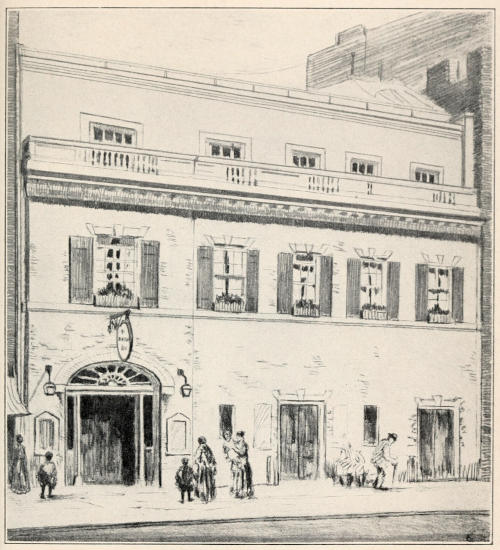
With Illustrations from Etchings and Drawings by
Abraham Phillips and from Photographs
NEW YORK
HENRY HOLT AND COMPANY
Copyright, 1915,
BY
HENRY HOLT AND COMPANY
November, 1938
Printed in U. S. A.
TO
THE COMRADES
WHO HAVE BUILT THE HOUSE
PREFACE
Much of the material contained in this book
has been published in a series of six articles
that appeared in the Atlantic Monthly from
March to August, 1915. And indeed it was
due to the kindly insistence on the part of the
editors of that magazine that more permanent
form should be given to the record of
the House on Henry Street that the story was
published at all.
During the two decades of the existence of
the Settlement there has been a significant
awakening on matters of social concern, particularly
those affecting the protection of children
throughout society in general; and a
new sense of responsibility has been aroused
among men and women, but perhaps more
distinctively among women, since the period
coincides with their freer admission to public
and professional life. The Settlement is in
itself an expression of this sense of responsibility,
and under its roof many divergent groups
have come together to discuss measures “for
the many, mindless, mass that most needs
helping,” and often to assert by deed their
faith in democracy. Some have found in the
Settlement an opportunity for self-realization
that in the more fixed and older institutions
has not seemed possible.
I cannot acknowledge by name the many
individuals who, by gift of money and through
understanding and confidence, through work
and thought and sharing of the burdens,
have helped to build the House on Henry
Street. These colleagues have come all
through the years that have followed since
the little girl led me to her rear tenement
home. Though we are working together as
comrades for a common cause, I cannot resist
this opportunity to express my profound personal
gratitude for the precious gifts that have
been so abundantly given. The first friends
who gave confidence and support to an unknown
and unexperimented venture have remained
staunch and loyal builders of the House.
And the younger generation with their gifts
have developed the plans of the House and
have found inspiration while they have given it.
In the making of the book, much help has
come from these same friends, and I should
be quite overwhelmed with the debt I owe
did I not feel that all of us who have worked
together have worked not only for each other
but for the cause of human progress; that is
the beginning and should be the end of the
House on Henry Street.
A sick woman in a squalid rear tenement,
so wretched and so pitiful that, in all the
years since, I have not seen anything more appealing,
determined me, within half an hour,
to live on the East Side.
I had spent two years in a New York training-school
for nurses; strenuous years for an
undisciplined, untrained girl, but a wonderful
human experience. After graduation, I supplemented
the theoretical instruction, which
was casual and inconsequential in the hospital
classes twenty-five years ago, by a period of
study at a medical college. It was while at
the college that a great opportunity came
to me.
I had little more than an inspiration to be
of use in some way or somehow, and going
to the hospital seemed the readiest means of
realizing my desire. While there, the long
hours “on duty” and the exhausting demands
of the ward work scarcely admitted freedom
for keeping informed as to what was happening
in the world outside. The nurses had no
time for general reading; visits to and from
friends were brief; we were out of the current
and saw little of life save as it flowed into the
hospital wards. It is not strange, therefore,
that I should have been ignorant of the various
movements which reflected the awakening of
the social conscience at the time, or of the birth
of the “settlement,” which twenty-five years
ago was giving form to a social protest in England
and America. Indeed, it was not until
the plan of our work on the East Side was well
developed that knowledge came to me of other
groups of people who, reacting to a humane or
an academic appeal, were adopting this mode
of expression and calling it a “settlement.”
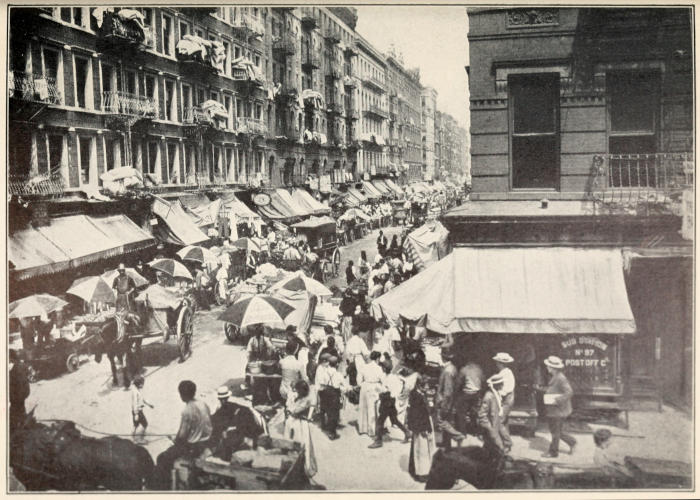
Two decades ago the words “East Side”
called up a vague and alarming picture of
something strange and alien: a vast crowded
area, a foreign city within our own, for whose
conditions we had no concern. Aside from its
exploiters, political and economic, few people
had any definite knowledge of it, and its literary
“discovery” had but just begun.
The lower East Side then reflected the popular
indifference—it almost seemed contempt—for
the living conditions of a huge population.
And the possibility of improvement seemed,
when my inexperience was startled into
thought, the more remote because of the dumb
acceptance of these conditions by the East
Side itself. Like the rest of the world I had
known little of it, when friends of a philanthropic
institution asked me to do something
for that quarter.
Remembering the families who came to
visit patients in the wards, I outlined a course
of instruction in home nursing adapted to their
needs, and gave it in an old building in Henry
Street, then used as a technical school and now
part of the settlement. Henry Street then as now
was the center of a dense industrial population.
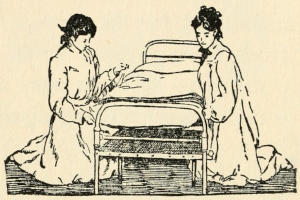
From the schoolroom where I had been giving
a lesson in bed-making, a little girl led
me one drizzling March morning. She had
told me of her sick mother, and gathering from
her incoherent account that a child had been
born, I caught up the paraphernalia of the
bed-making lesson and carried it with me.
The child led me over broken roadways,—there
was no asphalt, although its use was
well established in other parts of the city,—over
dirty mattresses and heaps of refuse,—it
was before Colonel Waring had shown the possibility
of clean streets even in that quarter,—between
tall, reeking houses whose laden fire-escapes,
useless for their appointed purpose,
bulged with household goods of every description.
The rain added to the dismal appearance
of the streets and to the discomfort of the crowds
which thronged them, intensifying the odors
which assailed me from every side. Through
Hester and Division streets we went to the end
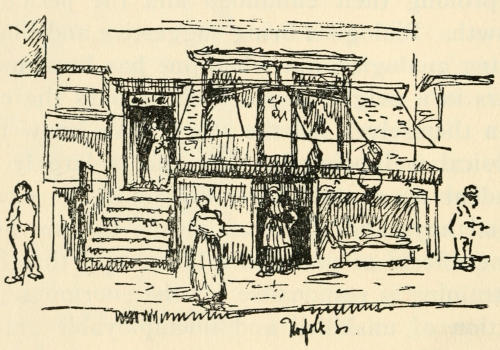
of Ludlow; past odorous fish-stands, for the
streets were a market-place, unregulated, unsupervised,
unclean; past evil-smelling, uncovered
garbage-cans; and—perhaps worst of all, where
so many little children played—past the trucks
brought down from more fastidious quarters
and stalled on these already overcrowded
streets, lending themselves inevitably to many
forms of indecency.
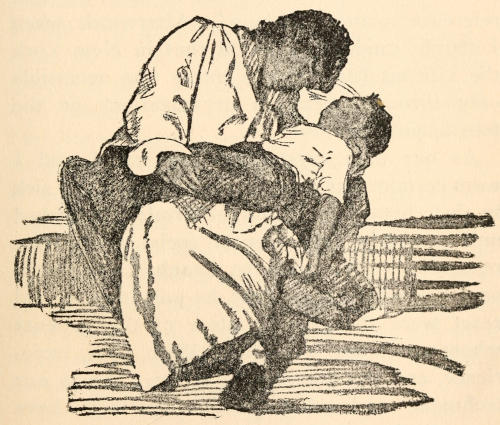
The child led me on through a tenement
hallway, across a court where open and unscreened
closets were promiscuously used by
men and women, up into a rear tenement, by
slimy steps whose accumulated dirt was augmented
that day by the mud of the streets,
and finally into the sickroom.
All the maladjustments of our social and
economic relations seemed epitomized in this
brief journey and what was found at the end
of it. The family to which the child led me
was neither criminal nor vicious. Although
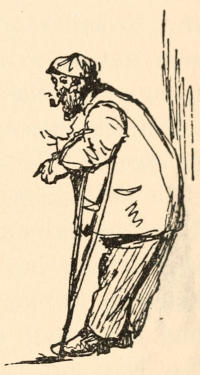
the husband was a cripple, one of those who
stand on street corners exhibiting deformities
to enlist compassion, and masking the begging
of alms by a pretense at selling; although the
family of seven shared their two rooms with
boarders,—who were literally boarders, since
a piece of timber was placed over the floor for
them to sleep on,—and although the sick
woman lay on a wretched, unclean bed, soiled
with a hemorrhage two days old, they were
not degraded human beings, judged by any
measure of moral values.
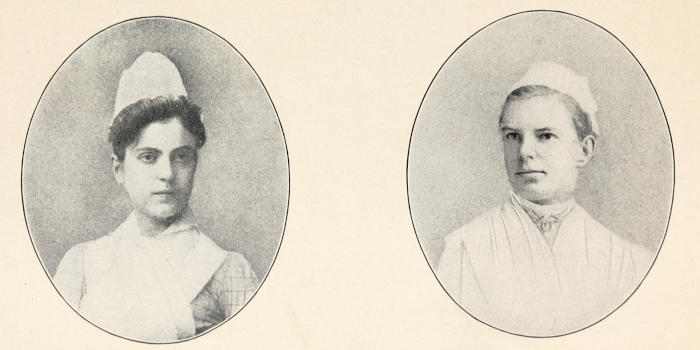
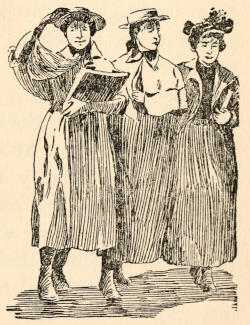
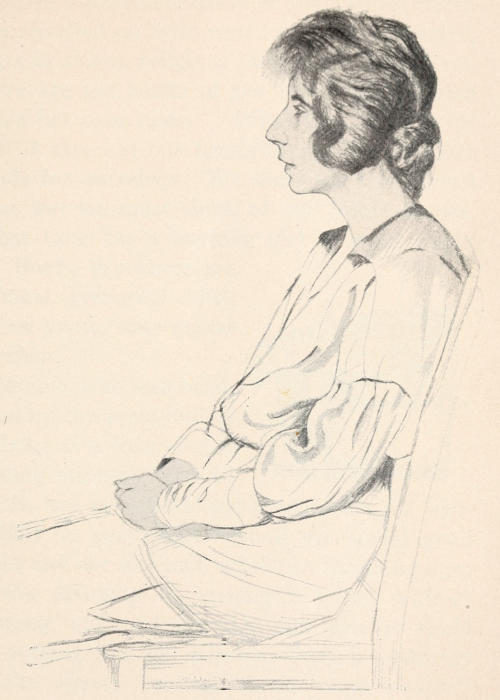
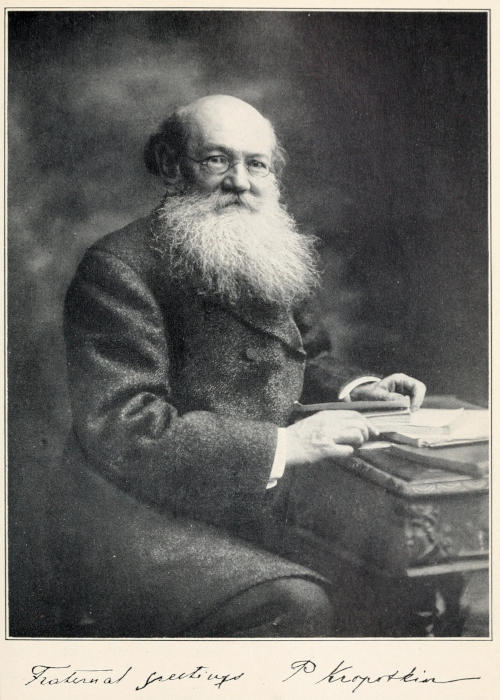
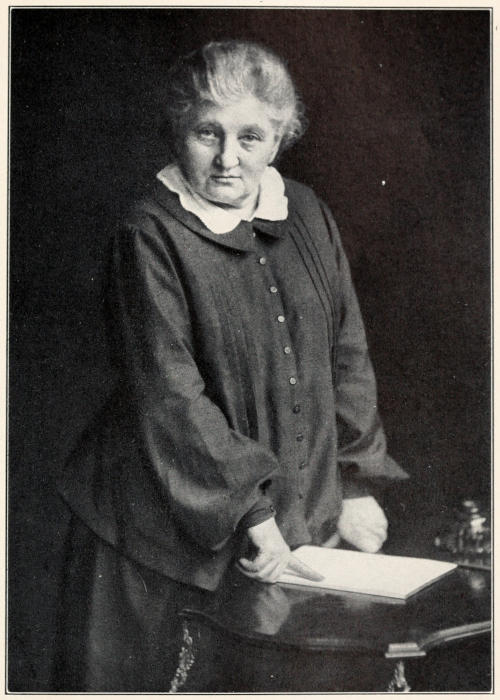
Lillian D. WaldMary M. Brewster
In hospital uniform, 1893
In fact, it was very plain that they were
sensitive to their condition, and when, at the
end of my ministrations, they kissed my hands
(those who have undergone similar experiences
will, I am sure, understand), it would have
been some solace if by any conviction of the
moral unworthiness of the family I could have
defended myself as a part of a society which
permitted such conditions to exist. Indeed,
my subsequent acquaintance with them revealed
the fact that, miserable as their state
was, they were not without ideals for the family
life, and for society, of which they were so
unloved and unlovely a part.
That morning’s experience was a baptism of
fire. Deserted were the laboratory and the
academic work of the college. I never returned
to them. On my way from the sickroom
to my comfortable student quarters my
mind was intent on my own responsibility. To
my inexperience it seemed certain that conditions
such as these were allowed because
people did not know, and for me there was a
challenge to know and to tell. When early
morning found me still awake, my naïve conviction
remained that, if people knew things,—and
“things” meant everything implied in the
condition of this family,—such horrors would
cease to exist, and I rejoiced that I had had a
training in the care of the sick that in itself would
give me an organic relationship to the neighborhood
in which this awakening had come.
To the first sympathetic friend to whom I
poured forth my story, I found myself presenting
a plan which had been developing almost
without conscious mental direction on my part.
It was doubtless the accumulation of many
reflections inspired by acquaintance with the
patients in the hospital wards, and now, with
the Ludlow Street experience, resistlessly impelling
me to action.
Within a day or two a comrade from the
training-school, Mary Brewster, agreed to share
in the venture. We were to live in the neighborhood
as nurses, identify ourselves with it
socially, and, in brief, contribute to it our citizenship.
That plan contained in embryo all the
extended and diversified social interests of our
settlement group to-day.
We set to work immediately to find quarters—no
easy task, as we clung to the civilization
of a bathroom, and according
to a legend current
at the time there
were only two bathrooms
in tenement houses below
Fourteenth Street. Chance
helped us here. A young
woman who for years
played an important part
in the life of many East
Side people, overhearing
a conversation of mine
with a fellow-student, gave me an introduction
to two men who, she said, knew all about the
quarter of the city which I wished to enter. I
called on them immediately, and their response
to my need was as prompt. Without stopping
to inquire into my antecedents or motives, or to
discourse on the social aspects of the community,
of which, I soon learned, they were
competent to speak with authority, they set
out with me at once, in a pouring rain, to scour
the adjacent streets for “To Let” signs. One
which seemed to me worth investigating my
newly acquired friends discarded with the explanation
that it was in the “red light” district
and would not do. Later I was to know
much of the unfortunate women who inhabited
the quarter, but at the time the term meant
nothing to me.
After a long tour one of my guides, as if by
inspiration, reminded the other that several
young women had taken a house on Rivington
Street for something like my purpose, and perhaps
I had better live there temporarily and
take my time in finding satisfactory quarters.
Upon that advice I acted, and within a few
days Miss Brewster and I found ourselves
guests at the luncheon table of the College Settlement
on Rivington Street. With ready hospitality
they took us in, and, during July and
August, we were “residents” in stimulating
comradeship with serious women, who were
also the fortunate possessors of a saving sense
of humor.
Before September of the year 1893 we found
a house on Jefferson Street, the only one in
which our careful search disclosed the desired
bathtub. It had other advantages—the vacant
floor at the top (so high that the windows
along the entire side wall gave us sun and
breeze), and, greatest lure of all, the warm
welcome which came to us from the basement,
where we found the janitress ready to answer
questions as to terms.
Naturally, objections to two young women
living alone in New York under these conditions
had to be met, and some assurance as
to our material comfort was given to anxious,
though at heart sympathetic, families by compromising
on good furniture, a Baltimore heater
for cheer, and simple but adequate household
appurtenances. Painted floors with easily removed
rugs, windows curtained with spotless
but inexpensive scrim, a sitting-room with pictures,
books, and restful chairs, a tiny bedroom
which we two shared, a small dining-room
in which the family mahogany did not
look out of place, and a kitchen, constituted
our home for two full years.
The much-esteemed bathroom, small and
dark, was in the hall, and necessitated early
rising if we were to have the use of it; for, as
we became known, we had many callers anxious
to see us before we started on our sick
rounds. The diminutive closet-space was divided
to hold the bags and equipment we
needed from day to day, and more ample store-closets
were given us by the kindly people in
the school where I had first given lessons to
East Side mothers. Any pride in the sacrifice
of material comfort which might have risen
within us was effectually inhibited by the constant
reminder that we two young persons
occupied exactly the same space as the large
families on every floor below us, and to one
of our basement friends at
least we were luxurious beyond
the dreams of ordinary
folk.
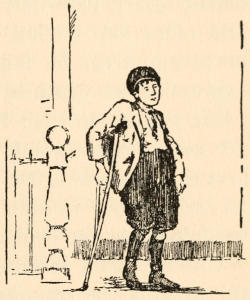
The little lad from the
basement was our first invited
guest. The simple but
appetizing dinner my comrade
prepared, while I set the
table and placed the flowers.
The boy’s mother came up
later in the evening to find
out what we had given him,
for Tommie had rushed down with eyes bulging
and had reported that “them ladies live
like the Queen of England and eat off of solid
gold plates.”
We learned the most efficient use of the fire-escape
and felt many times blessed because of
our easy access to the roof. We also learned
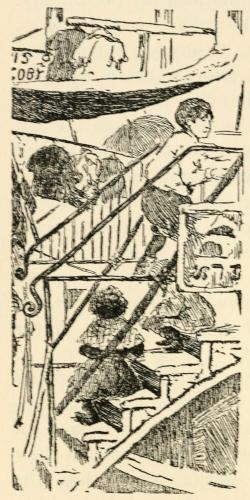
the infinite uses to which stairs can be put.
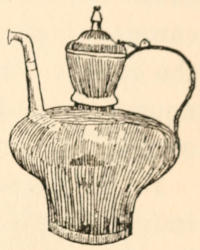
Later we achieved “local color” in our rooms
by the addition of interesting pieces of brass
and copper purchased from a man on Allen
Street whom we and several others had “discovered.”
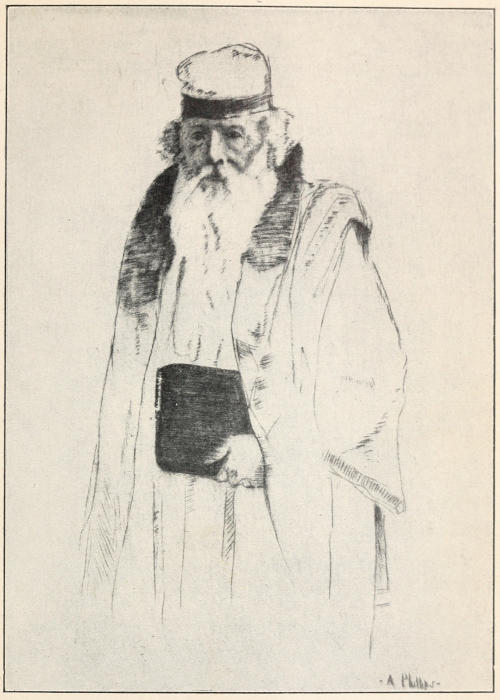
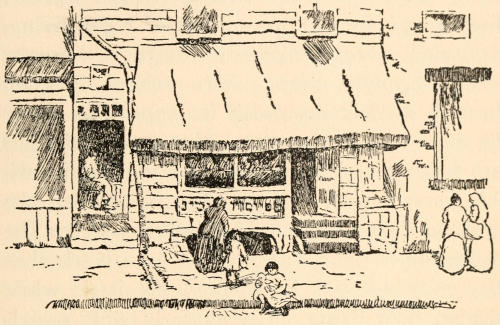
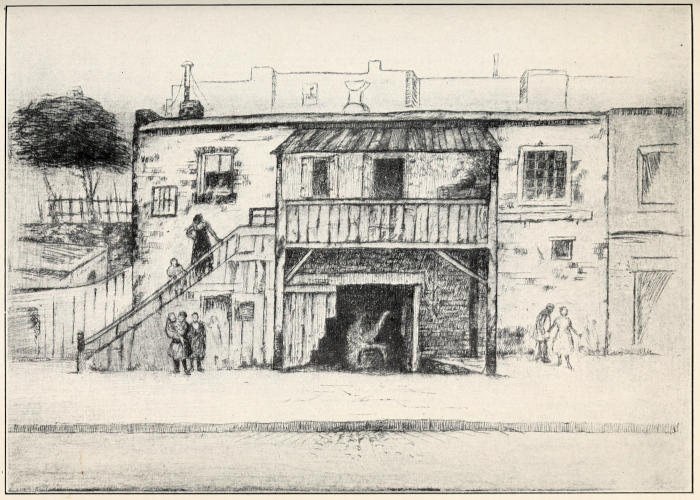
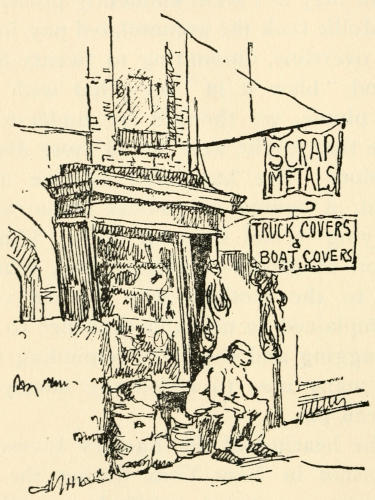
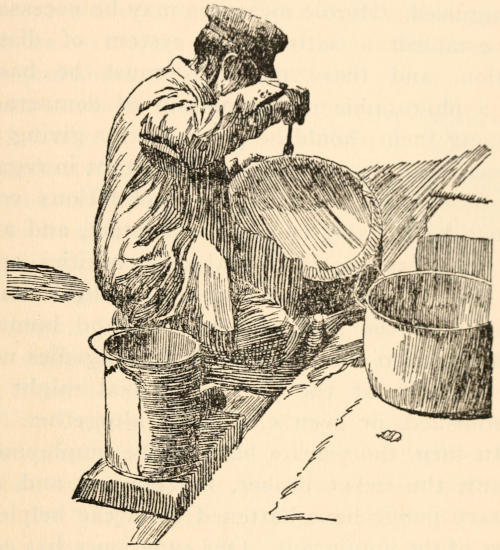
His little dark shop under the elevated
railway was fitfully illuminated by the
glowing forge. On our first visit the proprietor
emerged from a still darker inner room
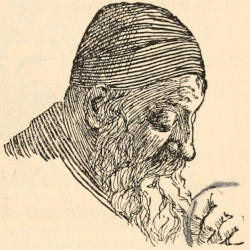
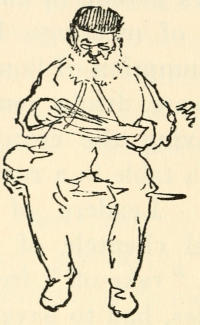
with prayer-shawl and phylactery. He became
one of our pleasant acquaintances and lost no
occasion of acknowledging what he considered
his debt to the appreciative customers who had
helped to make him and his wares known to a
wider circle than that of the neighborhood.
The mere fact of living in the tenement
brought undreamed-of opportunities for widening
our knowledge and extending our human
relationships. That we were Americans was
wonderful to our fellow-tenants. They were
all immigrants—Jews from Russia or Roumania.
The sole exception was the janitress,
Mrs. McRae, who at once dedicated herself and
her entire family to the service of the top floor.
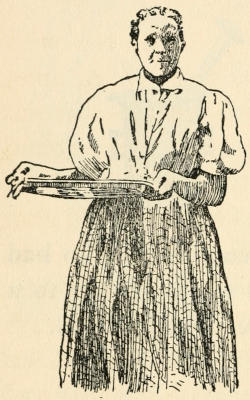
Dear Mrs. McRae! From her basement home
she covered us with her protecting love and
was no small influence in holding us to sanity.
Humor, astuteness, and sympathy were needed
and these she gave in abundance.
It was vouchsafed us to know many fine personalities
who influenced and guided us from the
first few weeks of residence in the friendly college
settlement through
the many years that
have followed. The two
women who stand out
with greatest distinction
from the first are this
pure-souled Scotch-Irish
immigrant and Josephine
Shaw Lowell. Both, if
they were here, would
understand the tribute in
linking them together.
Occasionally Mrs. McRae would feel impelled
to reprove us for “overdoing” ourselves,
and from our top story we were hard pushed
to save visitors from being sent away when she
thought we needed to finish a meal or go to
bed. Cautious as we were not to make any
distinctions in commenting upon the visitors
who came to see us, she made her own deductions.
At whatever hour we returned, she
would be at the door to welcome us and to
report on the happenings during our absence.
“So-and-so was here”: shrewd descriptions
which often enabled us to identify individuals
when names were forgotten. “Lots of visitors
to-night,” she would report. “Were messages
left, or names?” we would naturally inquire.
“No, darlints, nothing at all. I know sure
they didn’t bring you anything.”
The key to our apartments, usually left with
her, was one day forgotten, and when, upon
unlocking the door, we saw a well-known society
woman seated in our little living-room,
we were naturally puzzled to know how she
had arrived there. Mrs. McRae explained that
she had taken her up the fire-escape!—no
slight venture and exertion for the inexperienced.
We suggested that other ways
might have been more agreeable and safer.
“Whisht,” said Mrs. McRae, with a smile and
a wink, “it’s no harm at all. She’ll be havin’
lots of talk for her friends on this.”
When her roving husband died at home,
the funeral arrangements were given a last
touch by Mrs. McRae, who placed on the casket
his tobacco and pipe and ordered the procession
to pass his tenement home twice before driving
to the cemetery, “So he’d not think we were
not for forgivin’ him and hurryin’ him away.”
Her first love went to my comrade, whose
beauty and humor and goodness captured her
Celtic heart. During our second year in the
tenement Miss Brewster was taken seriously
ill, and one evening we had at last succeeded
in forcing Mrs. McRae to go home and had
locked the door. Unknown to us the dear
friend remained on the floor outside all through
the night, trying to catch the sound of life
from the loved one.
Bringing up a large family, with no help
from the “old man,” and with stern ideals of
conduct and integrity, was not easy. Some
of her children, endowed with her character,
gave her solace, but she was too astute not
to estimate each one properly.
When we moved from the tenement to our
first house Mrs. McRae and her family gave up
the basement rooms, which were rent free because
of her janitor service, in order to be near
us, and she spread her warmth over the new
abode. When, some years later, she was ill and
we knew that the end was near, one close to
me in my own family claimed my attention.
Torn between the two affections, I was loath
to leave the city while Mrs. McRae was so
ill. She guessed the cause of my perturbed
state and advised me to go. “Darlin’, you
ought to go. You go. I promise not to die
until you come back.”
Letters kept up this assurance and the
promise was fulfilled.
Times were hard that year. In the summer
the miseries due to unemployment and rising
rents and prices began to be apparent, but the
pinch came with the cold weather. Perhaps
it was an advantage that we were so early
exposed to the extraordinary sufferings and the
variety of pain and poverty in that winter of
1893-94, memorable because of extreme economic
depression. The impact of strain, physical
and emotional, left neither place nor time
for self-analysis and consequent self-consciousness,
so prone to hinder and to dwarf wholesome
instincts, and so likely to have proved an
impediment to the simple relationship which
we established with our neighbors.
It has become almost trite to speak of the
kindness of the poor to each other, yet from
the beginning of our tenement-house residence
we were much touched by manifestations of it.
An errand took me to Michael the Scotch-Irish
cobbler as the family were sitting down to the
noonday meal. There was a stranger with
them, whom Michael introduced, explaining
when we were out of hearing that he thought
I would be interested to meet a man just out
of Sing Sing prison. I expressed some fear of
the danger to his own boys in this association.
“We must just chance it,” said Michael. “It’s
no weather for a man like that to be on the
streets, when honest fellows can’t get work.”
When we first met the G⸺ family they
were breaking up the furniture to keep from
freezing. One of the children had died and
had been buried in a public grave. Three times
that year did Mrs. G⸺ painfully gather together
enough money to have the baby disinterred
and fittingly buried in consecrated
ground, and each time she gave up her heart’s
desire in order to relieve the sufferings of the
living children of her neighbors.
Another instance of this unfailing goodness
of the poor to each other was told by Nellie,
who called on us one morning. She was evidently
embarrassed, and with difficulty related
that, hearing of things to be given away at a
newspaper office, she had gone there hoping
to get something that would do for John when
he came out of the hospital. She said, “I drew
this and I don’t know exactly what it is meant
for,” and displayed a wadded black satin “dress-shirt
protector,” in very good condition, and
possibly contributed because the season was
over! Standing outside the circle of clamorous
petitioners, Nellie and the woman next her
had exchanged tales of woe. When she mentioned
her address the new acquaintance suggested
that she seek us.
Nellie proved to be a near neighbor. There
were two children: a nursing baby “none so
well,” and a lad. John, her husband, was “fortunately”
in the hospital with a broken leg, for
there were “no jobs around loose anyway.”
When we called later in the day to see the
baby, we found that Nellie was stopping with
her cousin, a widower who “held his job
down.” There were also his two children, the
widow of a friend “who would have done as
much by me,” and the wife and two small
children of a total stranger who lived in the
rear tenement and were invited in to meals because
the father had been seen starting every
morning on his hunt for work, and “it was
plain for anyone with eyes to see that he never
did get it.” So this one man, fortunate in having
work, was taking care of himself and his
children, the widow of his friend, Nellie and
her children, and was feeding the strangers.
Said Nellie: “Sure he’s doing that, and why
not? He’s the only cousin I’ve got outside of
Ireland.”
Mrs. S⸺, who called at the settlement a few
days ago, reminded me that it was twenty-one
years since our first meeting, and brought
vividly before me a picture of which she was a
part. She was the daughter of a learned rabbi,
and her husband, himself a pious man, had
great reverence for the traditions of her family.
In their extremity they had taken bread from
one of the newspaper charities, but it was evidently
a painful humiliation,
and before we arrived
they had hidden the loaf in
the ice-box. My visit was
due to a desire to ascertain
the condition of the families
who had applied for this
dole. Both house and people
were scrupulously clean.
It was amazing that under
the biting pressure of want
and anxiety such standards
could be maintained. Yet,
though passionately devoted
to his family, the husband refused advantageous
employment because it necessitated work on
the Sabbath. This would have been to them
a desecration of something more vital than
life itself.
We found that winter, in other instances,
that the fangs of the wolf were often decorously
hidden. In one family of our acquaintance
the father, a cigarmaker, left the house
each morning in search of work, only to return
at night hungrier and more exhausted by his
fruitless exertions. One Sabbath eve I entered
his tenement, to find the two rooms scrubbed
and cleaned, and the mother and children prepared
for the holy night. Over a brisk fire fed
by bits of wood picked up by the children two
covered pots were set, as if a supper were being
prepared. But under the lids it was only water
that bubbled. The proud mother could not
bear to expose her poverty to the gossip of the
neighbors, the humiliation being the greater
because she was obliged to violate the sacred
custom of preparing a ceremonious meal for
the united family on Friday night.
If the formalism of our neighbors in religious
matters was constantly brought to our
attention, instances of their tolerance were also
far from rare. A Jewish woman, exhausted by
her long day’s scrubbing of office floors, walked
many extra blocks to beg us to get a priest for
her Roman Catholic neighbor whose child was
dying. An orthodox Jewish father, who had
been goaded to bitterness because his daughter
had married an “Irisher” and thus “insulted
his religion,” felt that the young husband and
his mother were equally wronged. This man,
when I called on a Sabbath evening, took one
of the lights from the table to show the way
down the five flights of dark tenement stairs,
and to my protest,—knowing, as I did, that
he considered it a sin to handle fire on the
Sabbath,—he said: “It is no sin for me to
handle a light on the Sabbath to show respect
to a friend who has helped to keep a family
together.”
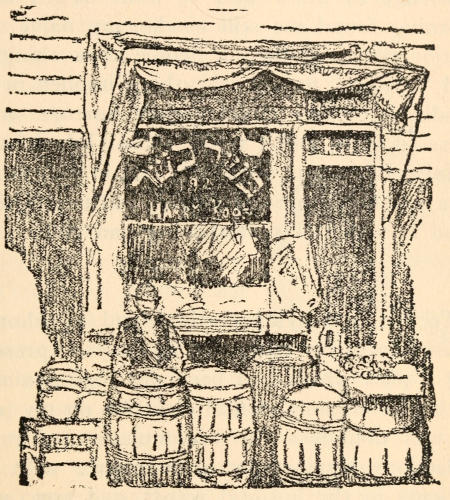
With Prayer-shawl and Phylactery
There was the story of Mary, eldest daughter,
as we supposed, of an orthodox family. When
we went to her engagement party we were surprised
to see that the young man was not of
the family faith. The mother told us that
Mary, “such a pretty baby,” had been left on
their doorstep in earlier and more prosperous
days in Austria. “The Burgomeister had made
proclamation,” but no one came to claim her,
and the husband and wife, who as yet had no
children of their own, decided to keep her.
“God rewarded us and answered our prayers,”
said Mrs. L⸺, for many children came afterward;
but Mary, blonde and blue-eyed, was
always the most cherished, the first-comer who
had brought the others. When she was quite
a young girl she was taken ill—a cold following
exposure after her first “grown-up” party,
for which her foster-mother had dressed her
with pride. It seemed that nothing could save
her, and the foster-mother in her distress
thought with pity of the woman who had borne
this sweet child. Surely she must be dead. No
living mother could have abandoned so lovely
a baby. And if she were dead and in the Christian
heaven, she would look in vain there for
her daughter. “So I called the priest and told
him,” said Mrs. L⸺, “and he made a prayer
over Mary, and said, ‘Now she is a Krist.’ The
doctor, we called him too, and he said to get
a goat, for the milk would be good for Mary;
and she get well, but no so strong, as you see,
and that is why she don’t go out to work like
her brothers and sisters. We lose our money,
that’s why we come to America, and Mary,
now she marry a Krist.”
Gradually there came to our knowledge difficulties
and conflicts not peculiar to any one
set of people, but intensified in the case of our
neighbors by poverty, unfamiliarity with laws
and customs, the lack of privacy, and the frequent
dependence of the elders upon the children.
Workers in philanthropy, clergymen,
orthodox rabbis, the unemployed, anxious parents,
girls in distress, troublesome boys, came
as individuals to see us, but no formal organization
of our work was effected till we moved
into the house on Henry Street, in 1895.
So precious were the intimate relationships
with our neighbors in the tenement that we
were reluctant to leave it. My companion’s
breakdown, the persuasion of friends who had
given their support and counsel that there was
an obligation upon us to effect some kind of
formal organization without further delay,
finally prevailed. As usual the neighborhood
showed its interest in what we did; and though
my comrade and I had carefully selected men
from the ranks of the unemployed to move our
belongings, when all was accomplished not one
of them could be induced to take a penny for
the work.
From this first house have since developed
the manifold activities in city and country now
incorporated as the Henry Street Settlement.
I should like to make it clear that from the
beginning we were most profoundly moved by
the wretched industrial conditions which were
constantly forced upon us. In succeeding chapters
I hope to tell of the constructive programmes
that the people themselves have
evolved out of their own hard lives, of the ameliorative
measures, ripened out of sympathetic
comprehension, and, finally, of the social legislation
that expresses the new compunction of
the community.
CHAPTER II ESTABLISHING THE NURSING SERVICE
When I first entered the training-school my
outpourings to the superintendent,—a woman
touched with a genius for sympathy,—my
youthful heroics, and my vow to “nurse the
poor” were met with what I deemed vague
reference to the “Mission.” Afterwards when
I sought guidance I found that in New York
the visiting (or district) nurse was accessible
only through sectarian organizations or the
free dispensary.
As our plan crystallized my friend and I
were certain that a system for nursing the sick
in their homes could not be firmly established
unless certain fundamental social facts were
recognized. We tried to imagine how loved
ones for whom we might be solicitous would
react were they in the place of the patients
whom we hoped to serve. With time, experience,
and the stimulus of creative minds our
technique and administrative methods have
naturally improved, but this test gave us vision
to establish certain principles, whose soundness
has been proved during the growth of the
service.
We perceived that it was undesirable to condition
the nurse’s service upon the actual or
potential connection of the patient with a religious
institution or free dispensary, or to
have the nurse assigned to the exclusive use of
one physician, and we planned to create a
service on terms most considerate of the dignity
and independence of the patients. We
felt that the nursing of
the sick in their homes
should be undertaken
seriously and adequately;
that instruction
should be incidental
and not the primary
consideration; that the etiquette, so far
as doctor and patient were concerned, should
be analogous to the established system of private
nursing; that the nurse should be as
ready to respond to calls from the people themselves
as to calls from physicians; that she
should accept calls from all physicians, and with
no more red-tape or formality than if she were
to remain with one patient continuously.
The new basis of the visiting-nurse service
which we thus inaugurated reacted almost immediately
upon the relationship of the nurse
to the patient, reversing the position the nurse
had formerly held. Chagrin at having the
neighbors see in her an agent whose presence
proclaimed the family’s poverty or its failure
to give adequate care to its sick member was
changed to the gratifying consciousness that
her presence, in conjunction with that of the
doctor, “private” or “Lodge,”[1] proclaimed
the family’s liberality and anxiety to do everything
possible for the sufferer. For the exposure
of poverty is a great humiliation to
people who are trying to maintain a foothold in
society for themselves and their families.
My colleague and I realized that there were
large numbers of people who could not, or
would not, avail themselves of the hospitals. It
was estimated that ninety per cent. of the sick
people in cities were sick at home,—an estimate
which has been corroborated (1913-14)
by the investigation of the Committee of Inquiry
into the Departments of Health, Charities,
and Bellevue and Allied Hospitals of
New York,—and a humanitarian civilization
demanded that something of the nursing care
given in hospitals should be accorded to sick
people in their homes.
The Nurse in the Tenement
Ninety per cent. of the sick of the city remain at home
We decided that fees should be charged when
people could pay. It was interesting to discover
that, although nominal in amount compared
with the cost of the service, these fees
represented a much larger proportion of the
wage in the case of the ordinary worker who
paid for the hourly service than did the fee paid
by a man with a salary of
$5,000, who engaged the full
time of the nurse. Our plan, we
reasoned, was analogous to the
custom of “private” hospitals,
which give free treatment or
charge according to the resources
of the ward patients.
Both private hospitals and visiting
nursing are thereby lifted out of “charity”
as comprehended by the people.
We felt that for economic reasons valuable
and expensive hospital space should be saved
for those for whom the hospital treatment is
necessary; and an obvious social consideration
was that many people, particularly women,
cannot leave their homes without imperiling,
or sometimes destroying, the home itself.
Almost immediately we found patients who
needed care, and doctors ready to accept our
services with probably the least amount of friction
possible under the circumstances; for those
doctors who had not been internes in the hospitals
were unfamiliar with the trained nurse,
whose work was little known at that time outside
the hospitals and the homes of the well-to-do.
Despite the neighborhood’s friendliness, however,
we struggled, not only with poverty and
disease, but with the traditional fate of the
pioneer: in many cases we encountered the inevitable
opposition which the unusual must
arouse. It seems almost ungracious to relate
some of our first experiences with doctors. No
one can give greater tribute than do the nurses
of the settlement to the generosity of physicians
and surgeons when we recall how often paying
patients were set aside for more urgent non-paying
ones; the counsel freely given from the
highest for the lowliest; the eager readiness to
respond. Occasionally sage advice came from
a veteran who knew the people well and
lamented the economic pressure which at times
involved, to their spiritual disaster, doctors as
well as patients.
The first day on which we set out to discover
the sick who might need a nurse, my comrade
found a woman with high temperature in an
airless room, more oppressive because of the
fetid odor from the bed. Service with one of
New York’s skilled specialists had trained the
nurse well and she identified the symptoms immediately.
“Yes, there was a Lodge doctor.—He
had left a prescription.—He might come
again.” With fine diplomacy an excuse was
made to call upon the doctor and to assume
that he would accept the nurse’s aid. My colleague
presented her credentials and offered to
accompany him to the case immediately, as she
was “sure conditions must have changed since
his last visit or he would doubtless have
ordered” so-and-so,—suggesting the treatment
the distinguished specialists were then using.
He promised to go, and the nurse waited patiently
for hours at the woman’s bedside.
When he arrived he pooh-poohed and said,
“Nothing doing.” We had ascertained the
financial condition of the family from the evidence
of the empty push-cart and the fact that
the fish-peddler was not in the market with his
merchandise. Five dollars was loaned that
night to purchase stock next day.
My comrade and I decided to visit the patient
early the next morning, to mingle judgments
on what action could be taken in this serious
illness with due respect to established etiquette.
When we arrived, the Lodge doctor and a “Professor”
(a consultant) were in the sickroom,
and our five dollars, left for fish, was in their
possession. Cigarettes in mouths and hats on
heads, they were questioning husband and
wife, and only Dickens could have done justice
to the scene. We were not too timid to allude
to the poverty and the source of the fee, and
felt free when we were told to “go ahead and
do anything you like.” That permission we
acted upon instantly and received, over the
telephone, authority from the distinguished
specialist to get to work. We were prudent
enough to report the authority and treatment
given, with solemn etiquette, to the physician
in attendance, who in turn congratulated us
on having helped him to save a life!
Not all our encounters with this class of
practitioner were fruitful of benefit to their
patients. Heartbreaking was the tragedy of
Samuel, the twenty-one-year-old carpenter, and
Ida, his bride. They had been boy and girl
sweethearts in Poland, and the coming to
America, the preparation of the clean two-roomed
home, the expectation of the baby,
made a pretty story which should have had
happy succeeding chapters, the start was so
good. Samuel knocked at our door, incoherent
in his fright, but we were fast accustoming ourselves
to recognize danger-signals, and I at
once followed him to the top floor of his tenement.
Plain to see, Ida was dying. The midwife
said she had done all she could, but she was
obviously frightened. “No one could have
done any better,” she insisted, “not any doctor”;
but she had called one and he had left
the woman lacerated and agonizing because
the expected fee had been paid only in part.
It was Samuel’s last dollar. The septic woman
could only be sent to the city hospital. The
ambulance surgeon was persuaded to let the
boy husband ride with her, and he remained at
the hospital until she and the baby died a
few hours later.
Here my comrade and I came against the
stone wall of professional etiquette. It seemed
as if public sentiment ought to be directed by
the doctors themselves against such practices,
but although I finally called upon one of the
high-minded and distinguished men who had
signed the diploma of the offending doctor, I
could not get reproof administered, and my
ardor for arousing public indignation in the
profession was chilled. Later, when I heard
protests from employers against insistence by
labor organizations on the closed shop, it occurred
to me that they failed to recognize analogies
in the professional etiquette which
conventional society has long accepted.
However, many friendly strong bonds were
made and have been sustained with a large
majority of the doctors during all the years
of our service. We have mutual ties of personal
and community interests, and work together
as comrades; the practitioners with high
standards for themselves and ideals for their
sacred profession comprehend our common
cause and strengthen our hands. It is rare
now, although at first it was very frequent,
that the physician who has called in the nurse
for his patient demands her withdrawal when
he himself has been dismissed. He has come
to see that although the nurse exerts her influence
to preserve his prestige, for the patient’s
sake as well as his own, nevertheless, emotional
people, unaccustomed to the settled relation of
the family doctor, may and often do change
physicians from six to ten times in the course
of one illness. The nurse, however, may remain
at the bedside throughout all vicissitudes.
The most definite protest against the newer
relationship came from a woman active in many
public movements, who was a stickler for the
orthodox method of procuring a visiting nurse
only through the doctor. To illustrate the importance
of freedom for the patients, I cited
the case of the L⸺ family. A neighbor had
called for aid. “Some kind of an awful catching
sickness on the same floor I live on, to the
right, front,” she whispered. A worn and haggard
woman was lifting a heavy boiler filled
with “wash” from the stove when I entered;
on the floor in the other room three little children
lay ill with typhoid fever, one of them
with meningitis. The feather pillows, most
precious possession, had been pawned to pay
the doctor. The father dared not leave the
shop, for money was needed, and all that he
earned was far from enough. The mother,
when questioned as to the delay in sending for
nursing help, said that the doctor had frightened
her from doing so by telling her that, if
a nurse came, the children would surely be
sent to the hospital. No disinfectant was found
in the house, and the mother declared that no
instructions had been given her.
The nurse who took possession of the sickroom
refrained from mentioning the hospital;
but when the mother saw the skilled ministration,
and the tired father, on his return from
work, watched the deft feeding of the unconscious
child, they awoke to their limitations.
The poor, unskilled woman, bent with fatigue,
then exclaimed, “O God, is that what I should
have been doing for my babies?” When the
nurse was about to leave them for the night
the parents clung to her and asked her if a hospital
would do as much as she had done.
“More, much more, I hope,” she said. “I
cannot give here what the little ones need.”
Late at night three carriages started for the
children’s ward of the hospital; the father, the
mother, the nurse, each with a patient across
the seat of the carriage.
Said the critic when I had finished my story:
“I think the nurse should have asked permission
of their doctor before she granted the request
of the parents.”
All the social agencies combined have not
been able to dislodge permanently the quack
who preys upon ignorance and superstition.
One day a teacher in a nearby school asked us
to visit a pupil who was highly excited and uncontrollable.
The mother, when questioned,
confessed that she had employed the “witch
doctor” to exorcise the devil, who, he said, had
taken possession of the girl. In our efforts to
free the girl from this man’s control I invoked
the aid of the parish priest, suggesting that
his powers were being usurped. The County
Medical Society finally secured conviction of
the “doctor” on the charge of practicing without
a license.
In the Italian quarter this species still preys
upon the superstitious fears of some of the people,
and the secrecy involved in his “treatment”
makes permanent riddance extremely difficult.
The people on the whole, however, give remarkable
response to the “American” custom of
employing a regular practitioner and the visiting
nurse.
In this country, unfortunately, we have little
data on morbidity. Statisticians desirous of
obtaining figures for study have found interesting
material in our files, and it has been possible
to make comparison of the results of
hospital and home treatment. Those who
are familiar with the discussion upon papers
presented by children’s specialists in recent
conferences on the saving of child life have
had their attention drawn to the disadvantage
of institutional treatment. Discussion of this
subject is recent, and the laity do not always
know that certain complications incident to the
hospital care of children are obviated by keeping
them at home. Among these are cross-infections,
while the high mortality among infants
in hospitals has long been recognized and
deplored as unavoidable.
We soon found that children’s diseases, particularly
those of brief duration, lent themselves
most advantageously to home treatment.
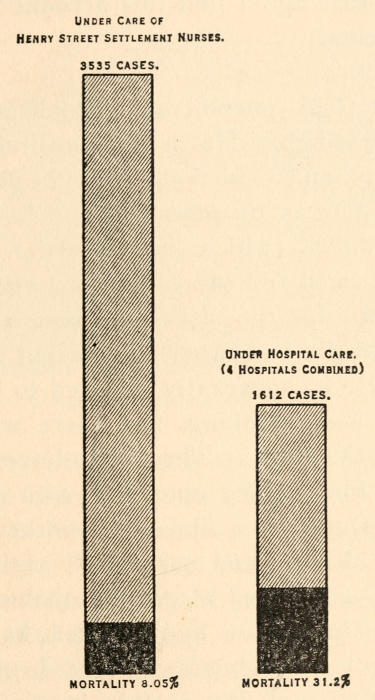
Our records show that in 1914 the Henry
Street staff cared for 3,535 cases of pneumonia
of all ages, with a mortality rate of 8.05 per
cent. For purposes of comparison four large
New York hospitals gave us their records of
pneumonia during the same period. Their combined
figures totaled 1,612, with a mortality
rate of 31.2 per cent. Among children under
two—the age most susceptible to unfortunate
termination of this disorder—the mortality rate
from pneumonia in one hospital was 51 per
cent., and the average of the four was 38 per
cent., while among those of a corresponding
age cared for by our nurses it was 9.3 per cent.
Doctors and nurses highly trained in hospital
routine are apt to be hospital propagandists
until they learn by experience that there
is justification for the resistance, on the part of
mothers, to the removal of their children to institutions,
and that even in homes which, at
first glance, it seems impossible to organize in
accordance with sickroom standards, the little
patients’ chances for recovery are better than
when sent away. Diseases requiring climatic
or operative treatment, or peculiar apparatus,
must usually be excluded from home care.
In a letter written to a friend more than
twenty years ago I find this account of one of
our patients:
“Peter had pneumonia, complicated with
whooping-cough. He is a beautiful yellow-haired
boy, and even if the hospital could have
admitted him, or his mother would have agreed
to his removal (which she wouldn’t), I should
not have liked to send him. The sense of responsibility
for the sick child seemed a force
that could not be spared for rousing an erring
father. He is, apparently, devoted to the child,
but had been drinking, and there was not a
dollar in the house. The child, desperately ill,
clung to him, calling upon him with endearing
names. During the illness he worked all day
(he is a driver) and sat up all night, and I
think he will never forget his shame and remorse.
The doctor had ordered bath treatments
every two hours. These I gave until
eight o’clock and the mother continued them
after my last visit, but when the temperature
was highest she was worn out, and active night-nursing
seemed imperative. This Miss S⸺
willingly undertook—a service more difficult
than appears in the mere telling, for the vermin
in these old houses are horribly active at
night, and this sweet girl ended her first vigil
with neck and face inflamed from bites. Yet
the people themselves were clean, and in this
were not blameworthy. There is nothing
harder to endure than to watch by a night sick-bed
in these old, worn houses and see the
crawling creatures and the babes so accustomed
to them that their sleep is scarcely disturbed.
Peter has had a beautiful recovery, rewarding
his nurses by a most satisfactory return to a
normal state of good health.”
Convalescent Home—“The Rest.”
The staff, which in the beginning consisted
of two nurses, my friend and myself, has been
increased until it is now large enough to answer
calls from the sick anywhere in the boroughs
of Manhattan and the Bronx, and the calls in
the year 1913-14 came from nearly 1,100 more
patients than the combined total of those
treated during the same period in three of the
large hospitals in New York—a comparison
valuable chiefly as measuring the growing demand
of the sick for the visiting nurse.
The service, though covering so wide a territory,
is capable of control and supervision. The
division into districts, with separate staffs for
contagious and obstetrical cases, may be compared
to the hospital division into wards.
Like the hospital, it has a system of bedside
notes, case records, and an established etiquette
between physicians, nurses, and patients.
Those that can best be cared for in the
hospitals are sent there, the sifting process
being accomplished by the doctors and nurses
working together. Approximately ten per
cent. of our patients are sent to the hospitals.
Serious nurses are gratified that the former
casual and almost sentimental attitude of the
public toward them and their work has been
replaced by a demand for standards of efficiency.
Enthusiasm, health, and uncommon good
sense on the part of the nurse are essential,
for without the vision of the importance of
their task they could not long endure the endless
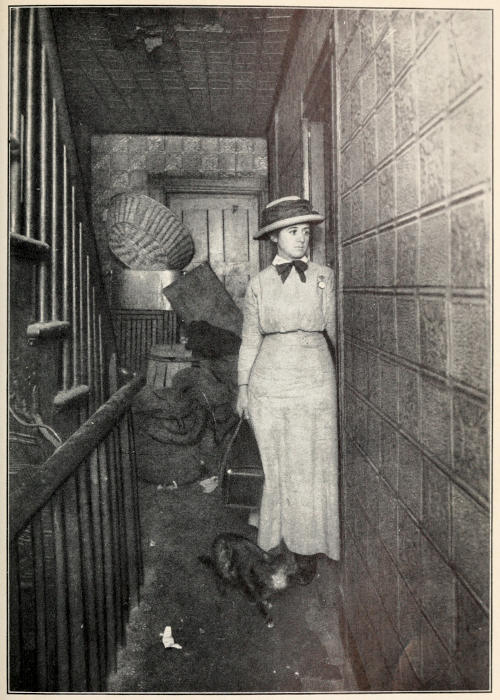
stair-climbing, the weight of the bag, and
the pulls upon their emotions.
There has been an extraordinary development
of the visiting-nurse service throughout
the country since we began our rounds, and
the practical arguments for sustaining such
work would seem irresistible. It requires
imagination, however, to visualize the steady,
competent, continuous routine so quietly performed,
unseen by the public, and its financial
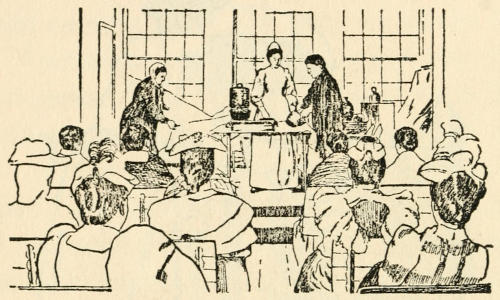
support is the more precarious because there
can be no public reminder of its existence by
impressive buildings and monuments of marble.
CHAPTER III THE NURSE AND THE COMMUNITY
The work begun from the top floor of the
tenement comprised, in simple forms, those
varied lines of activity which have since been
developed into the many highly specialized
branches of public health nursing now covering
the United States and engaging thousands of
nurses.[2]
In trying to forestall every obstacle to the
establishment of our nursing service on the
East Side, it seemed desirable to have some
connection with civic authority. Through a
mutual friend I met the President of the Board
of Health and, I fear rather presumptuously,
asked that we be given some insignia. Desirous
of serving his friend and tolerant of my
intense earnestness, he sanctioned our wearing
a badge which had engraved on its circle, “Visiting
Nurse. Under the Auspices of the Board
of Health.”
As it transpired, we did not find it necessary
or always felicitous to utilize this privilege,
but our connection with the Board of Health
was not a perfunctory or merely complimentary
one. We found from the beginning an inclination
on the part of the officials of the department
to treat us more or less like comrades.
Every night, during the first summer, I wrote
to the physician in
charge, reporting the
sick babies and describing
the unsanitary
conditions Miss
Brewster and I found,
and we received many
encouraging reminders
that what we were
doing was considered
helpful.
In the new activity for the promotion of public
health many campaigns have been waged
to popularize the study of social diseases. Education
is the watchword, and where emphasis
is laid upon the preservation of health rather
than upon the treatment of disease, the nurses
constitute an important factor. Appreciation
of this is recorded by the Commission which
drafted the new health law for New York
State (1913). “The advent of trained nursing,”
says its report, “marks not only a new
era in the treatment of the sick, but a new era
in public health administration.” This Commission
also created the position of Director
of the Division of Public Health Nursing in
the state department of health.
I had been downtown only a short time when
I met Louis. An open door in a rear tenement
revealed a woman standing over a washtub, a
fretting baby on her left arm, while with her
right she rubbed at the butcher’s aprons which
she washed for a living.
Louis, she explained, was “bad.” He did
not “cure his head,” and what would become
of him, for they would not take him into the
school because of it? Louis, hanging the offending
head, said he had been to the dispensary
a good many times. He knew it was
awful for a twelve-year-old boy not to know
how to read the names of the streets on the
lamp-posts, but “every time I go to school
Teacher tells me to go home.”
It needed only intelligent application of the
dispensary ointments to cure the affected area,
and in September I had the joy of securing the
boy’s admittance to school for the first time in
his life. The next day, at the noon recess, he
fairly rushed up our five flights of stairs in the
Jefferson Street tenement to spell the elementary
words he had acquired that morning.
It had been hard on Louis to be denied the
precious years of school, yet one could sympathize
with the harassed school teachers. The
classes were overcrowded; there were frequently
as many as sixty pupils in a single
room, and often three children on a seat. It
was, perhaps, not unnatural that the eczema
on Louis’s head should have been seized upon
as a legitimate excuse for not adding him to
the number. Perhaps it was not to be expected
that the teacher should feel concern for
one small boy whom she might never see
again, or should realize that his brief time for
education was slipping away and that he must
go to work fatally handicapped because of his
illiteracy.
The predecessor of our present superintendent
of schools had apparently given no
thought to the social relationship of the school
to the pupils. The general public, twenty years
ago, had no accurate information concerning
the schools, and, indeed, seemed to have little
interest in them. We heard of flagrant instances
of political influence in the selection
and promotion of teachers, and later on we
had actual knowledge of their humiliation at
being forced to obtain through sordid “pull”
the positions to which they had a legitimate
claim. I had myself once been obliged to enter
the saloon of N⸺, the alderman of our district,
to obtain the promise of necessary and
long-delayed action on his part for the city’s
acceptance of the gift of a street fountain,
which I had been indirectly instrumental in
securing for the neighborhood. I had been
informed by his friends that without this attention
he would not be likely to act.
Louis set me thinking and opened my mind
to many things. Miss Brewster and I decided
to keep memoranda of the children we encountered
who had been excluded from school for
medical reasons, and later our enlarged staff
of nurses became equally interested in obtaining
data regarding them. When one of the
nurses found a small boy attending school
while desquamating from scarlet fever, and,
Tom Sawyer-like, pulling off the skin to startle
his little classmates, we exhibited him to the
President of the Department of Health, and I
then learned that the possibility of having
physicians inspect the school children was
under discussion, and that such evidence of its
need as we could produce would be helpful in
securing an appropriation for this purpose.
I had come to the conclusion that the nurse
would be an essential factor in making effective
whatever treatment might be suggested for
the pupils, and, following an observation of
mine to this effect, the president asked me to
take part, as nurse, in the medical supervision
in the schools. This offer it did not seem wise
to accept. We were embarking upon ventures
of our own which would require all our faculties
and all our strength. It seemed better
to be free from connections which would make
demand upon our energies for routine work
outside the settlement. Moreover, the time did
not seem ripe for advocating the introduction
of both the doctor and the nurse. The doctor
himself, in this capacity, was an innovation.
The appointment of a nurse would have been
a radical departure.
In 1897 the Department of Health appointed
the first doctors; one hundred and fifty were
assigned to the schools for one hour a day at
a salary of $30 a month. They were expected
to examine for contagious diseases and to send
out of the classrooms all those who showed
suspicious symptoms. It proved to be a perfunctory
service and only superficially touched
the needs of the children.
In 1902, when a reform administration came
into power, the medical staff was reduced and
the salary increased to $100 a month, while
three hours a day were demanded from the
doctors. The Health Commissioner of that administration,
an intelligent friend of children,
now ordered an examination of all the public
school pupils, and New York was horrified to
learn of the prevalence of trachoma. Thousands
of children were sent out of the schools
because of this infectious eye trouble, and in
our neighborhood we watched many of them,
after school hours, playing with the children
for whose protection they had been excluded
from the classrooms. Few received treatment,
and it followed that truancy was encouraged,
and, where medical inspection was most thorough,
the classrooms were depleted.
The President of the Department of Education
and the Health Commissioner sought for
guidance in this predicament. Examination by
physicians with the object of excluding children
from the classrooms had proved a doubtful
blessing. The time had come when it
seemed right to urge the addition of the nurse’s
service to that of the doctor. My colleagues
and I offered to show that with her assistance
few children would lose their valuable school
time and that it would be possible to bring
under treatment those who needed it. Reluctant
lest the democracy of the school should
be invaded by even the most socially minded
philanthropy, I exacted a promise from several
of the city officials that if the experiment were
successful they would use their influence to
have the nurse, like the doctor, paid from public
funds.
Four schools from which there had been
the greatest number of exclusions for medical
causes were selected, and an experienced
nurse, who possessed tact and initiative, was
chosen from the settlement staff to make the
demonstration. A routine was devised, and the
examining physician sent daily to the nurse all
the pupils who were found to be in need of
attention, using a code of symbols in order that
the children might be spared the chagrin of
having diseases due to uncleanliness advertised
to their associates.
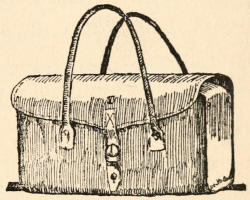
With the equipment of the settlement bag
and, in some of the schools, with no more than
the ledge of a window or the corner of a room
for the nurse’s office, the present system of
thorough medical inspection in the schools and
of home visiting was inaugurated. Many of
the children needed only disinfectant treatment
of the eyes, collodion applied to ringworm, or
instruction as to cleanliness, and such were returned
at once to the class with a minimum
loss of precious school time. Where more
serious conditions existed the nurse called at
the home, explained to the mother what the
doctor advised, and, where there was a family
physician, urged that the child should be taken
to him. In the families of the poor information
as to dispensaries was given, and where
the mother was at work, and there was no one
free to take the child to the dispensary, the nurse
herself did this. Where children were sent to
the nurse because of uncleanliness, the mother
was given tactful instruction and, when necessary,
a practical demonstration on the child
himself.
A Short Cut over the Roofs of the Tenements
One month’s trial proved that, with the exception
of the very small proportion of major
contagious and infectious diseases, the addition
of the nurse to the staff made it possible to
reverse the object of medical inspection from
excluding the children from school to keeping
the children in the classroom and under treatment.
An enlightened Board of Estimate and
Apportionment voted $30,000 for the employment
of trained nurses, the first municipalized
school nurses in the world, now a feature of
medical school supervision in many communities
in this country and in Europe.
The first nurse was placed on the city payroll
in October, 1902, and this marked the beginning
of an extraordinary development of the
public control of the physical condition of children.
Out of this innovation New York City’s
Bureau of Child Hygiene has grown.
The Department of Health now employs 650
nurses for its hospital and preventive work.
Of this number 374, in the year 1914, were
engaged for the Bureau of Child Hygiene.
Poor Louis, who all unconsciously had
started the train of incidents that led to this
practical reform, has long since moved from
his Hester Street home to Kansas, and was
able to write us, as he did with enthusiasm,
of his identification with the West.
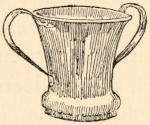
Our first expenditures were for “sputum cups
and disinfectants for tuberculosis patients.”
The textbooks had said that Jews were practically
immune from this disease, and here we
found ourselves in a dense colony of the race
with signs everywhere of the white plague,
which we soon thought it fitting to name
“tailors’ disease.”
Long before the great work was started by
the municipality to combat its ravages through
education and home visitation, we organized
for ourselves a system of care and instruction
for patients and their families, and wrote to the
institutions that were known to care for tuberculosis
cases for the addresses of discharged
patients, that we might call upon them to leave
the cups and disinfectants and instruct the families.
Since 1904 the anti-tuberculosis movement
has been greatly accelerated, and although it is
pre-eminently a disease of poverty and can
never be successfully combated without dealing
with its underlying economic causes—bad
housing, bad workshops, undernourishment,
and so on—the most immediate attack lies in
education in personal hygiene. For this the
approach to the families through the nurse and
her ability to apply scientific truth to the problems
of human living have been found to be
invaluable.[3]
Infant mortality is also a social disease—“poverty
and ignorance, the twin roots from
which this evil springs.” There is a large
measure of preventable ignorance, and in the
efforts for the reduction of infant mortality the
intelligent reaction of the tenement-house
mother has been remarkably
evidenced.
In the last analysis
babies of the poor are
kept alive through
the intelligence of the
mothers. Pasteurized
or modified milk in
immaculate containers
is of limited value
if exposed to pollution
in the home, or if it is fed improperly and
at irregular periods.
The need of giving the mother training
seemed so evident that, in the course of lessons
given on the East Side antedating our nursing
service, I had demonstrated with a primitive
sterilizer a simple method of insuring “safe”
milk for babies.
The settlement established a milk station in
1903, when one of its directors began sending
milk of high grade from his private dairy. Following
our principle of building up the homes
wherever possible, the modification of the milk
has always been taught there. The nurses report
that it is very rare to find a woman who
cannot learn the lesson when made to understand
its importance to her children.
Children under two years who show the
greatest need are given the preference in admission
to our clinic.
Excellent physicians
practicing in the
neighborhood have
contributed their services
as consultants,
and conferences are
held regularly. In
1914 the number of
infants cared for was
518 and the mortality 1.8 per cent. The previous
year, with 400 infants, the mortality was
one-half of one per cent.
The Health Commissioner of Rochester,
N. Y., a pioneer in his specialty, founded municipal
milk stations for that city in 1897. He
states that the reduction of infant mortality
that followed the establishment of the stations
was due, not so much to the milk, but to the
education that went out with the milk through
the nurse and in the press.
In 1911 New York City authorized the municipalization
of fifteen milk stations, and so
satisfactory was the result that the next year
the appropriation permitted more than the
trebling of this number. A nurse is attached
to each station to follow into the homes and
there lay the foundation, through education,
for hygienic living. A marked reduction in
infant mortality has been brought about and,
moreover, a realization, on the part of the city,
of the immeasurable social and economic value
of keeping the babies alive.
The Federal Children’s Bureau in its first
report on the study of infant mortality in the
United States showed that, in the city selected
for investigation, the infant death rate, in those
sections where conditions were worst, was more
than five times that in the choice residential
sections.
This report constitutes a serious indictment
of society, and should goad civic and social
conscience to aggressive action. But there are
evidences (and, indeed, the existence of the
Bureau is one) that the public is beginning to
realize the profound importance in our national
life of saving the children that are born.
Perhaps nothing indicates more impressively
our contempt for alien customs than the general
attitude taken toward the midwife. In
other lands she holds a place of respect, but in
this country there seems to be a general determination
on the part of physicians and departments
of health to ignore her existence
and leave her free to practice without fit preparation,
despite the fact that her services are
extensively used in humble homes. In New
York City the midwife brings into the world
over forty per cent. of all the babies born there,
and ninety-eight per cent. of those among the
Italians.
We had many experiences with them, beginning
with poor Ida, the carpenter’s wife, and
some that had the salt of humor. Before our
first year had passed I wrote to the superintendent
of a large relief society operating in
our neighborhood, advising that the society
discontinue its employment of midwives as a
branch of relief, because of their entire lack
of standards and their exemption from restraining
influence.
To force attention to the harmful effect of
leaving the midwife without training in
midwifery and asepsis free to attend women
in childbirth, the Union Settlement
in 1905 financed an investigation under the
auspices of a committee of which I was chairman.
A trained nurse was selected to inquire into
and report upon the practice of the midwives.
The inquiry disclosed the extent to which habit,
tradition, and economic necessity made the
midwife practically indispensable, and gave
ample proof of the neglect, ignorance, and
criminality that prevailed; logical consequences
of the policy that had been pursued. The
Commissioner of Health and eminent obstetricians
now co-operated to improve matters, and
legislation was secured making it mandatory
for the Department of Health to regulate the
practice of midwifery. Five years later the
first school for midwives in America was established
in connection with Bellevue Hospital.
Part of the duty assigned to nurses of the
Bureau of Child Hygiene is to inspect the bags
of the midwives licensed to practice, and to
visit the new-born in the campaign to wipe out
ophthalmia neonatorum, that tragically frequent
and preventable cause of blindness among
the new-born.
These are a few of the manifestations of
the new era in the development of the nurse’s
work. She is enlisted in the crusade against
disease and for the promotion of right living,
beginning even before life itself is brought
forth, through infancy into school life, on
through adolescence, with its appeal to repair
the omissions of the past. Her duties take her
into factory and workshop, and she has identified
herself with the movement against the
premature employment of children, and for the
protection of men and women who work that
they may not risk health and life itself while
earning their living. The nurse is being socialized,
made part of a community plan for the
communal health. Her contribution to human
welfare, unified and harmonized with those
powers which aim at care and prevention, rather
than at police power and punishment, forms
part of the great policy of bringing human
beings to a higher level.
With the incorporation of the nurse’s service
in municipal and state departments for the
preservation of health, other agencies, under
private and semi-public auspices, have expanded
their functions to the sick.
I had felt that the American Red Cross Society
held a unique position among its sister
societies of other nations, and that in time it
might be an agency that could consciously provide
valuable “moral equivalents for war.” The
whole subject, in these troubled times, is revived
in my memory, and I find that in 1908
I began to urge that in a country dedicated to
peace it would be fitting for the American Red
Cross to consecrate its efforts to the upbuilding
of life and the prevention of disaster, rather
than to emphasize its identification with the
ravages of war.
The concrete recommendation made was that
the Red Cross should develop a system of visiting
nursing in the vast, neglected country
areas. The suggestion has been adopted and
an excellent beginning made with a Department
of Town and Country Nursing directed
by a special committee. A generous gift
started an endowment for its administration.
Many communities not in the registered area
and remote from the centers of active social
propaganda will be given stimulus to organize
for nursing service, and from this other medical
and social measures will inevitably grow. It
requires no far reach of the imagination to visualize
the time when our country will be districted
from the northernmost to the southernmost
point, with the trained graduate nurse entering
the home wherever there is illness, caring
for the patient, preaching the gospel of
health, and teaching in simplest form the essentials
of hygiene. Such an organization of national
scope, its powers directed toward raising
the standard in the homes without sacrifice of
independence, is bound to promote the social
progress of the nation.
In the year 1909 the Metropolitan Life Insurance
Company undertook the nursing of its
industrial policyholders—an important event in
the annals of visiting nursing. I had suggested
the practicality of this to one of the officials
of the company, a man of broad experience,
and he, immediately responsive, provided opportunity
for me to present to his colleagues
evidence of the reduction of mortality, the
hastening of convalescence, and the ability to
bring to sick people the resources that the community
provides for treatment through the institution
of visiting nursing.
The company employed our staff to care for
its patients, and the experiment has been extended
until a nursing service practically covers
its industrial policyholders in Canada and the
United States. The company thereby gave an
enormous impetus to education and hygiene in
the homes and treatment of the sick on the
only basis that makes it possible for persons
of small means to receive nursing without
charity—namely, through insurance.
The demand for the public
health nurse coming from all
sides was so great that for a
time it could not be adequately
met. Women of initiative
and personality with
broad education were needed,
for much of the work required
pioneering zeal. Instructive
inspection, on the nurse’s part,
like other educational work,
requires suitable and sound
preparation, a superstructure of efficiency upon
woman’s natural aptitudes.
The Henry Street Settlement and other
groups with well-established visiting nursing
systems responded to the need by offering opportunities
for post-graduate training and experience
in the newly opened field of public
health nursing, and sought co-ordination with
formal educational institutions for instruction
in social theories and pedagogy. In 1910 the
Department of Nursing and Health was created
at Teachers College, Columbia University, embracing
in its completed form the Department
of Hospital Economics established there in
1899 by the efforts of training-school superintendents.
This department is in affiliation with
the settlement. At least four important training-schools
for nurses are now working under
the direction of universities, and other provision
has been made to give education supplementary
to the hospital training.
Nurses themselves have taken the initiative
in securing the means for equipping women in
their profession to meet the new requirements.
They are providing helpful literature and finding
stimulating associations with others enlisted
in similar efforts for human welfare. I
had the honor to be elected first president of
the National Organization for Public Health
Nursing. At the conference held in 1913 (less
than a year after the formation of the society)
an assemblage of women gathered from all
parts of the country to seek guidance and inspiration
for this work, and something that was
very like religious fervor characterized their
meetings.
The need of consecration to the sick and the
young that has touched generation after generation
with new impulse was manifested in
their eagerness to serve the community. From
the root of the old gospel another branch has
grown, a realization that the call to the nurse
is not only for the bedside care of the sick,
but to help in seeking out the deep-lying basic
causes of illness and misery, that in the future
there may be less sickness to nurse and to cure.
A pleasant indication that the academic
world reached out its fellowship to the nurses
in their zeal for public service was given some
months later when Mt. Holyoke College, at
the commemoration of its seventy-fifth anniversary,
honored me by conferring on me the
LL.D. degree.
CHAPTER IV CHILDREN AND PLAY
The visitor who sees our neighborhood for the
first time at the hour when school is dismissed
reacts with joy or dismay to the sight, not
paralleled in any part of the world, of thousands
of little ones on a single city block.
Out they pour, the little hyphenated Americans,
more conscious of their patriotism than
perhaps any other large group of children that
could be found in our land; unaware that to
some of us they carry on their shoulders our
hopes of a finer, more democratic America,
when the worthy things they bring to us shall
be recognized, and the good in their old-world
traditions and culture shall be mingled with
the best that lies within our new-world
ideals. Only through knowledge is one fortified
to resist the onslaught of arguments of the
superficial observer who, dismayed by the
sight, is conscious only of “hordes” and “danger
to America” in these little children.
They are irresistible. They open up wide
vistas of the many lands from which they
come. The multitude passes: swinging walk,
lagging step; smiling, serious—just little children,
forever appealing, and these, perhaps,
more than others, stir the emotions. “Crime,
ignorance, dirt, anarchy!” Not theirs the
fault if any of these be true, although sometimes
perfectly good children are spoiled, as
Jacob Riis, that buoyant lover of them, has
said. As a nation we must rise or fall as we
serve or fail these future citizens.
Their appeal suggests that social exclusions
and prejudices separate far more effectively
than distance and differing language. They
bring a hope that a better relationship—even
the great brotherhood—is not impossible, and
that through love and understanding we shall
come to know the shame of prejudice.
Instinctively the sympathetic observer feels
the possibilities of the young life that passes
before the settlement doors, and sincerity demands
that something shall be known of the
conditions, economic, political, religious, or, perchance,
of the mere spirit of venture that
brought them here. How often have the conventionally
educated been driven to the library
to obtain that historic perspective of the people
who are in our midst, without which they cannot
be understood! What fascinating excursions
have been made into folklore in the effort
to comprehend some strange custom unexpectedly
encountered!
When the anxious friends of the dying Italian
brought a chicken to be killed over him,
the tenement-house bed became the sacrificial
altar of long ago; and when the old, rabbinical-looking
grandfather took
hairs from the head of
the sick child, a bit of
his finger-nail, and a
garment that had been
close to his body, and
cast them into the
river while he devoutly
prayed that the little
life might be spared, he declared his faith in
the purification of running water.
It is necessary to spend a summer in our
neighborhood to realize fully the conditions
under which many thousands of children are
reared. One night during my first month on
the East Side, sleepless because of the heat, I
leaned out of the window and looked down on
Rivington Street. Life was in full course there.
Some of the push-cart venders still sold their
wares. Sitting on the curb directly under my
window, with her feet in the gutter, was a
woman, drooping from exhaustion, a baby at
her breast. The fire-escapes, considered the
most desirable sleeping-places, were crowded
with the youngest and the oldest; children
were asleep on the sidewalks, on the steps of
the houses and in the empty push-carts; some
of the more venturesome men and women with
mattress or pillow staggered toward the riverfront
or the parks. I looked at my watch. It
was two o’clock in the morning!
Many times since that summer of 1893 have
I seen similar sights, and always I have been
impressed with the kindness and patience, sometimes
the fortitude, of our neighbors, and I
have marveled that out of conditions distressing
and nerve-destroying as these so many
children have emerged into fine manhood and
womanhood, and often, because of their early
experiences, have become intelligent factors in
promoting measures to guard the next generation
against conditions which they know to be
destructive.
Before I lived in the midst of this dense child
population, and while I was still in the hospital,
I had been touched by glimpses of the life revealed
in the games played in the children’s
ward. Up to that time my knowledge of little
ones had been limited to those to whom the
people in fairy tales were real, and whose games
and stories reflected the protective care of their
elders. My own earliest recollections of play
had been of story-telling, of housekeeping with
all the things in miniature that grown-ups use,
and of awed admiration of the big brother who
graciously permitted us to witness hair-raising
performances in the barn, to which we paid admittance
in pins. The children in the hospital
ward who were able to be about, usually on
crutches or with arms in slings, played “Ambulance”
and the “Gerry Society.” The latter
game dramatized their conception of the famous
Society for the Prevention of Cruelty to Children
as an ogre that would catch them. The
ambulance game was of a child, or a man at
work, injured and carried away to the hospital.
Many years’ familiarity with the children’s
attempts to play in the streets has not made
me indifferent to its pathos, which is not the
less real because the children themselves are
unconscious of it. In the midst of the push-cart
market, with its noise, confusion, and jostling,
the checker or crokinole board is precariously
perched on the top of a hydrant, constantly
knocked over by the crowd and patiently
replaced by the little children. One tearful
small boy described his morning when he
said he had done nothing but play, but first the
“cop” had snatched his dice, then his “cat” (a
piece of wood sharpened at both ends), and
nobody wanted him to chalk on the sidewalk,
and he had been arrested for throwing a ball.
A man since risen to distinction in educational
circles, whose childhood was passed in
our neighborhood, told me how he and his companions
had once taken a dressmaker’s lay figure.
They had no money to spend on the
theater and no place to play in but a cellar.
They had admired the gaudy posters of a melodrama
in which the hero rescues the lady and
carries her over a chasm. Having no lady in
their cast, they borrowed the dressmaker’s lay
figure—without permission. Fortunately, and
accidentally, they escaped detection. It is not
difficult to see how the entire course of this
boy’s career might have been altered if arrest
had followed, with its consequent humiliation
and degradation. At least, looking back upon
it, the young man sees how the incident might
have deflected his life.
The instruction in folk-dancing which the
children now receive in the public schools and
recreation centers has done much to develop a
wholesome and delightful form of exercise, and
has given picturesqueness to the dancing in the
streets. But yesterday I found myself pausing
on East Houston Street to watch a group of
children assemble at the sound of a familiar
dance from a hurdy-gurdy, and looking up I
met the sympathetic smile of a teamster who
also had stopped. The children, absorbed in
their dance, were quite unconscious that congested
traffic had halted and that busy people
had taken a moment from their engrossing
problems to be refreshed by the sight of their
youth and grace. For that brief instant even
the cry of “War Extra” was unheeded.
Touching as are the little children deprived
of opportunity for wholesome play, a deeper
compassion stirred our hearts when we began
to realize the critically tender age at which
many of them share the experiences, anxieties,
and tragedies of the adult. I cannot efface from
my memory the picture of a little eight-year-old
girl whom I once found standing on a chair to
reach a washtub, trying with her tiny hands
to cleanse some bed-linen which would have
been a task for an older person. Every few
minutes the child got down from her chair to
peer into the next room where her mother and
the new-born baby lay, all her little mind intent
upon giving relief and comfort. She had been
alone with her mother when the baby was born
and terror was on her face.
I think the memory never left her, but it may
be only that her presence called up, even after
the lapse of years, a vision of the anxious little
face inevitably contrasted in my mind with the
picture of irresponsible childhood.
At about the same time we made the acquaintance
of the K⸺ family, through nursing one
of the children. The mother was a large-framed,
phlegmatic, seemingly emotionless
type, although she did show appreciation of our
liking for her children. The father was only
occasionally mentioned. We assumed that he
was away seeking work, a common explanation
then of the absence of the men of the families.
One afternoon I stopped at their house to make
arrangements for the children’s trip to the country.
Early the next morning, awakened by
a pounding on the door, I opened it to find little
Esther beside herself with excitement, repeating
over and over, “My mother she die! My mother
she die!” Following fast, it was not possible
to keep pace with her. When, breathless, I entered
their rooms it was to see the mother’s
body hanging from a doorway. She had been
brooding over a summons to testify in court that
morning against her husband, who had been arrested
for bigamy, and this was her answer to
the court and to the other woman.
The frightened little children were scattered
among different institutions. From one of these
Esther was sent West, to a home that was
found for her. Possibly she was so young
that the terrible picture faded from her mind.
At least there was no mention of it in the first
letter which she wrote, announcing that her
new home was a farm and that they had “six
cows, eighty chickens, eleven pigs, and a
nephew.” The nephew Esther eventually married.
In the first party of children that we sent to
the country were three little girls, daughters of
a skilled cobbler. The mother, a complaining,
exacting invalid, spent a large proportion of her
husband’s earnings for patent medicines. Annie,
not quite twelve, was the household drudge,
and the coming of the settlement nurse lifted
only part of her burden. The new friends, determined
to get at least two weeks of care-free
childhood for the little girls, procured an invitation
for them, through a Fresh-Air agency,
from a farmer in the western part of the state.
It was necessary to secure the mother’s admission
to a hospital during the time the children
would be absent from home—not an easy task,
as she was not what is termed a “hospital
case.” When we met the children at the railroad
station on their return, their joyousness and
bubbling spirits attracted the attention of the on-lookers;
but as Annie neared home its responsibilities
fell like a heavy cloud upon her, and
before we reached the tenement she was silent.
Her quick eye discerned the absence of the
brick which had kept the front hall door open,
and in a second she had darted into the yard
and replaced it. Before we left, with sleeves
rolled up she was beginning to wash the pile
of dishes that had accumulated in her absence.
Gone was the gayety. The little drudge had
resumed her place. Later, when the child swore
falsely to her age, and the notary public, upon
whose certificate employment papers could at
that time be obtained, affixed his signature to
her perjury, the position she secured as cash
girl in the basement of a department store was,
to her, emancipation from hateful labor and an
opportunity for fellowship with children.
Recalling early days, I am constantly reminded
of the sympathy and comprehension of
those friends who, though not stimulated as my
comrade and I were by constant reminders of
the children’s needs, from the beginning promoted
and often anticipated our efforts to provide
innocent recreation. We had not thought
of the possibility of giving pleasure to large
groups of children in picnics and day parties,
when a friend, a few days after our arrival in
the neighborhood, asked us to celebrate his sister’s
birthday by giving “fun” to some of our
new acquaintances. I yet remember the thrill
I felt when I realized that this gift was not for
shoes or practical necessities, but for “just what
children anywhere would like.”
Two memories of this first party stand out
sharply: the songs the children sang,—“She’s
More to be Pitied than Censured,” and “Judge,
Forgive Him, ’Tis His First Offense,”—painfully
revealing a precocious knowledge, and their
ecstasy at the sight of a wonderful dogwood
tree. Now, when the settlement children go
on day parties, they have another repertory, and
the music they learn in the public schools reflects
the finer thought for the child.
During the two years that Miss Brewster and
I lived in the Jefferson Street house we frequently
made up impromptu parties to visit the
distant parks, usually on Sunday afternoons
when we were likely to be free. After a while
it was not difficult to secure comradeship for
the children from men and women of our acquaintance,
and the parties were multiplied. In
the winter, rumors of “a fine hill all covered
with snow” on Riverside Drive would be a
stimulus to secure a sled or improvise a toboggan,
and we found that, given opportunity and
encouragement, the city tenement boys threw
themselves readily into venturesome sport.
And their Ecstasy at the Sight of a Wonderful
Dogwood Tree
Happily some of the early prejudice against
ball-playing on Sunday has vanished. We were
perplexed in those days to explain to the lads
why, when they saw the ferries and trains convey
golfers suitably attired and expensively
equipped for a day’s sport, their own games
should outrage respectable citizens and cause
them to be constantly “chased” by the police.
The saloons could be entered, as everybody
knew, and I remember a father, defending his
eight-year-old son from an accusation of theft,
instancing as proof of the child’s trustworthiness
that “all the Christians on Jackson Street
sent him for their beer on Sundays.”
In our search for a place where the boys
might play undisturbed, one of the settlement
residents, a never-failing friend of the young
people, invoked the Federal Government itself,
and secured for them an unused field on Governor’s
Island.
Now, in summer time, many of the organized
activities of the settlement are removed from
the neighborhood. Early in the season the
“hikers” begin their walks with club leaders.
I felt a glow of happiness one Sunday morning
when I stood on the steps of our house and
watched six different groups of boys set off for
the country, with ball and bat and sandwiches,
each group led by a young man who had himself
been a member of our early parties and
had been first introduced to trees and open
spaces, and the more active forms of healthful
play by his settlement friends.
The woeful lack of imagination displayed in
building a city without recognizing the need of
its citizens for recreation through play, music,
and art, has been borne in upon us many times.
New Yorkers need to be reminded that the
Metropolitan Museum of Art was effectually
closed to a large proportion of the citizens until,
on May 31, 1891, it opened its doors on Sundays.
It is interesting to recall that of the
80,000 signatures to the petition for this privilege,
50,000 were of residents of the lower East
Side and were presented by the “Working People’s
Petition Committee.” The report of the
Museum trustees following the Sunday opening
notes that after a little disorder and confusion
at the start the experiment proved a success;
that the attendance was “respectable, law-abiding,
and intelligent,” and that “the laboring
classes were well represented.” They were
also obliged to report, however, that the Sunday
opening had “offended some of the Museum’s
best friends and supporters,” and that
it had “resulted in the loss of a bequest of
$50,000.”
When we left the tenement house we were
fortunate to find for sale, on a street that still
bore evidences of its bygone social glory, a
house which readily lent itself to the restorer’s
touch. Tradition says that many of these fine
old East Side houses were built by cabinetmakers
who came over from England during
the War of 1812 and remained here as citizens.
The generous purchaser allowed us freedom to
repair, restore, and alter, as our taste directed.
Attractive as we found the house, we were even
more excited over the possibilities of the little
back yard. Our first organized effort for the
neighborhood was to convert this yard and one
belonging to an adjacent school, with, later, the
yard of a third house rented by one of our residents,
into a miniature but very complete playground.
There was so little precedent to guide
us that our resourcefulness was stimulated, and
we succeeded in achieving what the President
of the National Playground Association has
called the “Bunker Hill” of playgrounds.
Along the borders we planted bright-colored
flowers—which were not disturbed by the children.
An old wistaria vine on a trellis covered
nearly a third of the playground, and two ailanthus
trees, usually regarded with contempt by
tree lovers, were highly cherished by those who
otherwise would have lived a treeless life. Window-boxes
jutted from the rear windows of the
two houses controlled by the settlement, and in
one corner, shaded by a striped awning, we put
the big sand-pile. Joy-giving “scups” (the
local name for swings) were erected, and some
suitable gymnastic apparatus, parallel bars and
overhead ladder placed. Baby hammocks were
swung, their occupants tenderly cared for by
little mothers and little fathers. Manual training
was provided by a picturesque sailor from
Sailors’ Snug Harbor, who, at a stretching
frame, taught the making of hammocks.
In the morning under the pergola an informal
kindergarten was conducted, and in the afternoon
attendants directed play and taught the
use of gymnastic apparatus. Later in the day
the mothers and older children came, and a
little hurdy-gurdy occasionally marked the
rhythm of the dance. So interested in the playground
were the household and their visitors
that at odd moments an enthusiast would rush
in from other duties and give the hurdy-gurdy
an extra turn, to supplement the entertainment.
At night the baby hammocks and chairs were
stored away and Japanese lanterns illuminated
the playground, which then welcomed the
young people who, after their day’s work, took
pleasure in each other’s society and in singing
familiar songs.
It Has Been Called the “Bunker Hill” of Playgrounds
The Children Play on Our Roof
On Saturday afternoons the playground was
used almost exclusively by fathers and mothers,
but it was a pretty sight at all times, and the
value placed upon it by those who used it was
far in excess of our own estimate. It was something
more than amusement that moved us
when a young couple, who had been invited to
one of the evening parties, stood at the back
door of the settlement house and gazed admiringly
at the little pleasure place. Gowned in
white, we awaited our guests, and as I rose from
the bench under the pergola to cross the yard
and give them welcome, the young printer said
with enthusiasm, “This must be like the scenes
of country life in English novels.”
It was a heaven of delight to the children,
and ingenuity was displayed by those who
sought admittance. The children soon learned
that “little mothers” and their charges had
precedence, and there was rivalry as to who
should hold the family baby. When (as rarely
happened) there was none in the family, a baby
was borrowed. Six-year-olds, clasping babies
of stature almost equal to their own, would
stand outside, hoping to attract attention to
their special claims. Once, when the playground
was filled to capacity, and the sidewalk
in front of the house was thronged, the Olympian
at the gate endeavored to make it clear
that no more could enter. One persistent small
girl stood stolidly and when reminded of the
condition said, “Yes, teacher, but can’t I get
in? I ain’t got no mother.”
There was much illness, unemployment, and
consequent suffering the next winter. One day,
when I visited a school in the neighborhood,
the principal asked the pupils if they knew me.
She doubtless anticipated some reference to the
material services which the settlement had rendered,
but the answer to her question was a glad
chorus of, “Yes, ma’am, yes, ma’am, she’s our
scupping teacher.” “Teacher” was a generic
term for the residents, and nothing that the settlement
had contributed to the life of the neighborhood
impressed the children as had the playground.
It is worth reminding those who are
associated with young people that the power to
influence is given to those who play with,
rather than to those who only teach, them. Our
children on the East Side are not peculiar in
this respect. To this day I receive letters from
men and women who try to recall themselves to
my memory by saying that they once played in
our back yard.
An organized propaganda for outdoor gymnasia
and playgrounds crystallized in 1898 in the
formation of the Outdoor Recreation League,
in which the settlement participated. The tireless
president of the League eventually succeeded
in obtaining the use of a large space in
our neighborhood, originally purchased by the
city, during a brief reform administration, for a
park. Some very undesirable tenement houses
had been destroyed, and when a Tammany administration
returned to power a hot summer
was allowed to pass with nothing done to accomplish
the original purpose. Unsightly holes,
once cellars, remained to fill with stagnant
water, amputated sewer- and gas-pipes were
exposed, and among these the children played
mimic battles of the Spanish-American War,
then in progress.
The accident that the Commissioner of
Health, a semi-invalid, felt gratitude to a
trained nurse who had cared for him, gave me
an opportunity to approach him on the subject.
He promised (and he kept his promise) to use
his influence to get an appropriation on the score
of the menace to the health of the city. The appropriation
was sufficient to fill in the space and
surround it with a fence, and the Outdoor Recreation
League was able to demonstrate the value
of playgrounds. In 1902 the Board of Estimate
and Apportionment of Mayor Seth Low’s
reform administration, at its first meeting, appropriated
money for the equipment and maintenance
of Seward Park, as it was named,—the
first municipal playground in New York City.
So much interest had been aroused in this phase
of city government that two city officials left
the board meeting while it was in progress to
telephone to the settlement that the appropriation
had been passed.
Many friends of the children combined to
urge the use of the public schools as recreation
centers, and in the summer of 1898 the first
schools were opened for that purpose. Those of
us who had practical experience helped to start
these by acting as volunteer inspectors. The
settlement then felt justified in devoting less
effort to its own playground, and deflected some
of the energies it required to meet other pressing
needs.
It is a delight to give the children stories
from the Bible and the old mythologies, fairy
tales, and lives of heroes, and we mark as
epochal Maude Adams’s inspiration to invite
our children and others not likely to have the
opportunity to see Peter Pan. She has given
joy to thousands, but it is doubtful if she can
measure, as we do, the influence of “the everlasting
boy.” Through him romance has
touched these children, and not a few of the
letters spontaneously written to Peter Pan from
tenement homes have seemed to us not unworthy
of Barrie himself. Protest against
leaving the big, familiar farmhouse at one of
our country places, when an overflow of visitors
necessitated a division of the little ones at
night, was immediately withdrawn when the
children were told that the annex, perched on
high ground, was a “Wendy House.”
The need of care for convalescents was early
recognized, and the settlement’s first country
house was for them. It was opened in 1899,
and its maintenance is the generous gift of a
young woman, a member of the early group
that gathered in the Henry Street house. We
soon felt, however, that it was essential that
children and young people as well as invalids
should have knowledge of life other than that
of the crowded tenement and factory; and from
the time of the establishment of our first kindergarten
we longed to have the children know
the reality of the things they sang about, the
birds and animals which so often formed the
subject of their games. A little girl in one of
the parties taken to see Peter Pan turned to her
beloved club leader when the crocodile appeared
and asked timidly if it was a field-mouse! A
recent lesson had been about that “animal.” It
seems almost incredible that the description,
probably supplemented by a picture, should not
have made a more definite impression upon the
child’s mind; but I am inclined to think that
little children can form no accurate conception
of unknown objects from pictures or description.
A neighborhood teacher took her class to
the menagerie in Central Park just after a lesson
on the cow and its “gifts”—milk, cream,
butter. She hoped that the young buffalo’s resemblance
to the cow might suggest itself to
the children who, of course, had never seen a
cow. In answer to her question an eager little
boy gave testimony to the impression the lesson
had made on his mind when he answered,
“Yes, ma’am. I know it. It’s a butterfly.”
We value the “day parties” for incidental
education as well as for the pleasure they afford.
Each year as spring approaches a census is
taken of the surrounding blocks, that the new
arrivals may be included in the excursions. The
most treasured invitations for these parties
come from friends whose country estates are
near enough to offer hospitality, and to whose
gardens and stables the children are taken.
The larger parties, composed of women and
children, usually go to the seashore in chartered
cars, and these excursions, purely recreative,
compete, and not unsuccessfully, with the clam-bakes
and outings of the old-time political
leaders.
The Kindergarten Children Learn the Reality
of the Things They Sing About
The beautiful country places presented to the
settlement for vacation purposes, and the comparative
readiness with which money for equipment
and maintenance for non-paying guests
has been given, indicates the favor with which
this development of neighborhood work is
regarded. Opportunities for confidence and
mutual understanding, not always possible in
the formal relationships of clubs and classes,
are afforded by the intimacy of country-house
parties. The possibility of giving direction at
critical periods of character-formation, particularly
during adolescence, and of discovering
clews to deep-lying causes of disturbance, makes
the country life a valuable extension of the organized
social work of the settlement. “Riverholm,”
overhanging the Hudson; “Camp
Henry,” on a beautiful lake; the “House in the
Woods,” “Echo Hill Farm,” and a commodious
house in New Jersey, lent by friends during
the summer months, give us the means whereby
some of the plans we cherish may be carried
out.
“House in the Woods.”
It would be inconsistent with settlement
theories if these country places did not express
refinement and beauty,—the beauty that belongs
to simplicity,—not only in the buildings, but
also in the service and housekeeping. It has
seemed to us, therefore, worth the additional
expenditure of effort to have small, distinct
household units wherever practicable. People
who live in crowded homes, walk on crowded
streets, ride on crowded cars, and as children
attend crowded classrooms, must inevitably acquire
distorted views of life; and the settlement
is reluctant to add to these the experience
of crowded country life. Valuable training in
housekeeping is possible in a household even
of from fifteen to twenty-five persons,—a small
unit according to New York standards,—and
tactful direction can often be given toward acquiring
those manners generally recognized as
“good.” Many of the children who come to
us know only foreign customs and foreign table-manners;
and the extreme difficulty of maintaining
orderly home life in the tenement makes
it important to supplement the home-training
or to supply what it can never give. Indeed,
we recognize in this desire to protect our children
from being marked as peculiar or alien
because of non-essential differences the same
reason that urges the careful mother to insist
on “manners,” that her children may not be
discredited when they mingle with the fastidious.
The ideal of limitation as to numbers cannot
always be carried out, and naturally it does not
apply to the camp, where a freer and less conventional
life attracts and satisfies boys and
young men.
The older members of the settlement, who
are earning money, use the camp and country
places as clubs, paying for the privilege and
conforming to the regulations which they have
had a share in establishing.
Those who have promoted the various Fresh-Air
agencies throughout the country may not
realize that physical benefit is not all that has
been secured. We are persuaded that opportunity
to know life away from the city is in
part the explanation of the increasing number
of city boys who elect training in agriculture
and forestry. Formerly, when careers were
discussed, the future held no happiness unless
it promised a profession—law or medicine.
If I appear to lay too much stress upon the
importance of play and recreation, it may be
well to point out that it is one way of recognizing
the dignity of the child. The study of
juvenile delinquency shows how often the young
offender’s presence in the courts may be traced
to a play-impulse for which there was no safe
outlet.
Perhaps nothing more definitely indicates the
changed attitude toward children and play than
the fact that last summer (1914) the police officers
of the precinct called to enlist our co-operation
in carrying out the orders of the city
administration that during certain hours of the
day traffic was to be shut off from designated
streets, that the children might play there. The
visit brought to mind years of painstaking
effort to secure the toleration of harmless play,
and the hope we had dared to express, despite
incredulity on the part of the police, that some
day the children might come to regard them as
guardians and protectors, rather than as a fear-inspiring
and hated force. One captain of the
precinct, at least, had proved the practicability
of our theory, and when he was transferred we
lost a valuable co-worker. The Governor of
New York, campaigning for re-election in the
fall of this year (1914), advocated that public
schools should be surrounded by playgrounds
at “no matter what cost.”
Tremendous impetus has been given to the
playground movement throughout the entire
country by individuals and societies organized
for the purpose. Wise men and women have
expounded the social philosophy of play and
recreation, pointing out that these may afford
wholesome expression for energies which might
otherwise be diverted into channels disastrous
to peace and happiness; that clean sport and
stimulating competition can replace the gang
feud and even modify racial antagonisms. The
most satisfactory evidence of this conviction is,
of course, the recognition of the child’s right to
play, as an integral part of his claim upon the
state.
CHAPTER V EDUCATION AND THE CHILD
Perhaps nothing makes a profounder impression
on the newcomer to our end of the city
than the value placed by the Jew upon education;
an overvaluation, one is tempted to think,
in view of the sacrifices which are made, particularly
for the boys,—though of late years the
girls’ claims have penetrated even to the Oriental
home.
One afternoon a group of old-world women
sat in the reception-room at the settlement while
one of the residents sang and played negro
melodies. With the melancholy minor of “Let
My People Go,” the women began crooning a
song that told the story of Cain and Abel.
The melody was not identical, but so similar
that they thought they recognized the song as
their own; and when a discussion arose upon
the coincidence that two persecuted peoples
should claim this melody, the women, touched
by the music, confessed their homesick longing
for Russia—for Russia that had dealt so unkindly
with them.
“Rather a stone for a pillow in my own
home,” said one woman on whom life had
pressed hard. “Would you go back?” she was
asked. “Oh, no, no, no!” emphasizing the
words by a swaying of the body and a shaking
of the head. “It is not poverty we fear. It is
not money we are seeking here. We do not
expect things for ourselves. It is the chance
for the children, education and freedom for
them.”
The passion of the Russian Jews for intellectual
attainment recalls the spirit of the early
New England families and their willingness to
forego every comfort that a son might be set
apart for the ministry. Here we are often witnesses
of long-continued deprivation on the part
of every member of the family, a willingness
to deny themselves everything but the barest
necessities of life, that there may be a doctor, a
lawyer, or a teacher among them. Submission
to bad housing, excessive hours, and poor working
conditions is defended as of “no matter because
the children will have better and can go
to school—maybe college.” Said a baker who
showed the ill-effects of basement and night
work and whose three rooms housed a family
of ten: “My boy is already in the high school.
If I can’t keep on, the Herr Gott will take it
up where I leave off.”
A painful instance was that of a woman who
came to the settlement one evening. Her son
was studying music under one of the most
famous masters in Vienna, and she had exiled
herself to New York in order to earn more
money for him than she could possibly earn at
home. Literally, as I afterwards discovered,
she spent nothing upon herself. A tenement
family gave her lodging (a bed on chairs) and
food, in return for scrubbing done after her
day’s work in the necktie factory. The Viennese
master, not knowing his pupil’s circumstances,
or, it is possible, not caring, had written
that the young man needed to give a
concert, an additional demand which it was
utterly impossible for her to meet. She had
already given up her home, she had relinquished
her wardrobe, and she had sold her
grave for him.
One young lad stands out among the many
who came to talk over their desire to go through
college. He dreamed of being great and, this
period of hardship over, of placing his family
in comfort. I felt it right to emphasize his
obligation to the family; the father was dead,
the mother burdened with anxiety for the numerous
children. How reluctant I was to do
this he could not realize; only fourteen, he had
impressed us with his fine courage and intelligence,
and it was hard to resist the young
pleader and to analyze with him the common-place
sordid facts. He had planned to work all
summer, to work at night, and he was hardly
going to eat at all. But his young mind
grasped, almost before I had finished, the ethical
importance of meeting his nearest duties.
He has met the family claims with generosity,
and has realized all our expectations for him
by acquiring through his own efforts education
and culture; and he evinces an unusual sense of
civic responsibility.
Those who have had for many years continuous
acquaintance with the neighborhood have
countless occasions to rejoice at the good use
made of the education so ardently desired, and
achieved in spite of what have seemed overwhelming
odds. New York City is richer for
the contributions made to its civic and educational
life by the young people who grew up
in and with the settlements, and who are not
infrequently ready crusaders in social causes.
A country gentleman one day lamented to me
that he had failed to keep in touch with what
he was pleased to call our humanitarian zeal,
and recalled his own early attempt to take an
East Side boy to his estate and employ him.
“He could not even learn to harness a horse!”
he said, with implied contempt of such unfathomable
inefficiency. Something he said of the
lad’s characteristics made it possible for me to
identify him, and I was able to add to that unsatisfactory
first chapter another, which told of
the boy’s continuance in school, of his success
as a teacher in one of the higher institutions
of learning, and of his remarkable intelligence
in certain vexed industrial problems.
Such achievements are the more remarkable
because the restricted tenement home, where the
family life goes on in two or three rooms,
affords little opportunity for reading or study.
A vivid picture of its limitations was presented
by the boy who sought a quiet corner in a busy
settlement. “I can never study at home,” he
said, “because sister is always using the table
to wash the dishes.”
Study-rooms were opened in the settlement in
1907, where the boys and girls find, not only
a quiet, restful place in which to do their work,
but also the needed “coaching.” The school
work is supplemented by illuminating bulletins
on current topics, and the young student is provided
with the aid which in other conditions is
given by parents or older brothers and sisters.
Such study-rooms are now maintained by the
Board of Education in numerous schools of the
city,—“Thanks to the example set by the settlement,”
the superintendent of the New York
school system reported.
The settlement children are given instruction
in the selection of books before they are old
enough to take out their cards in the public
libraries. Once a week, on Friday afternoon,
when there are no lessons to be prepared, our
study-room is reserved for these smallest
readers. The books are selected with reference
to their tastes and attainments, and fairy tales
are on the shelves in great numbers. Of course,
no settlement could entirely satisfy the insatiable
desire for these.
One day when the room was being used for
study purposes a wee neighbor sauntered in and
said to the custodian, “Please, I’d like a fairy
tale.” Although reminded that these books
were not given out excepting on the special
day, the child lingered. She saw a boy’s request
for “The Life of Alexander Hamilton”
and a girl’s wish for “The Life of Joan of
Arc” complied with. Evidently there was a
way to get one’s heart’s desire. The child went
out, reappeared in a few moments, and with an
air of confidence again addressed the librarian,
this time with, “Please, I’d like the life of a
giant.”
It is easy to excite sympathy in our neighborhood
for people deprived of books and learning.
One year I accompanied a party of Northern
people to the Southern Educational Conference.
We were all much stirred by the appeal of
an itinerant Southern minister who told how
the poor white natives traveled miles over
the mountains to hear books read. He pictured
vividly the deprivation of his neighbors, who
had no access to libraries of any kind. When I
returned to the settlement and related the story
to the young people in the clubs, without suggestion
on my part they eagerly voted to send
the minister books to form a library; and for
two years or more, until the Southerner wrote
that he had sufficient for his purpose, the clubs
purchased from their several funds one book
each month, suited to different ages and tastes,
according to their own excellent discrimination.
The first public school established in New
York City (Number 1) is on Henry Street.
Number 2 is a short distance from it, on the
same street, and Number 147 is at our corner.
Between their sites are several semi-public and
private educational institutions, and from
School No. 1 to School No. 147 the distance is
not more than three-quarters of a mile.
It is not unnatural, therefore, that the school
should loom large in our consciousness of the
life of the child. The settlement at no time
would, even if it could, usurp the place of
school or home. It seeks to work with both
or to supplement either. The fact that it is
flexible and is not committed to any fixed programme
gives opportunity for experimentation
not possible in a rigid system, and the results
of these experiments must have affected school
methods, at least in New York City.
Intelligent social workers seize opportunities
for observation, and almost unconsciously develop
methods to meet needs. They see conditions
as they are, and become critical of systems
as they act and react upon the child or fail to
reach him at all. They reverse the method of
the school teacher, who approaches the child
with preconceived theories and a determination
to work them out. Where the school fails, it
appears to the social workers to do so because
it makes education a thing apart,—because it
separates its work from all that makes up the
child’s life outside the classroom. Great emphasis
is now laid upon the oversight of the
physical condition of children from the time of
their birth through school life; but the suggestion
of this extension of socialized parental control
did not emanate from those within the
school system.
Cooking has been taught in the public schools
for many years, and the instruction is of great
value to those who are admitted
to the classes; but
appropriations have never
been sufficient to meet all
the requirements, and the
teaching is given in grades
already depleted by the
girls who have gone to
work, and who will perhaps
never again have
leisure or inclination to
learn how to prepare meals for husband and
children,—the most important business in life
for most women.
The laboratory method employed in the
schools never seemed to us sufficiently related
to the home conditions of vast numbers of the
city’s population; and, therefore, when the settlement
undertook, according to its theory, to
supplement the girls’ education, all the essentials
of our own housekeeping—stove, refrigerator,
bedrooms, and so on—were utilized. But
neither were single bedrooms and rooms set
apart for distinct purposes entirely satisfactory
in teaching domestic procedure to the average
neighbor; and the leader finally developed out
of her knowledge of their home conditions the
admirable system of “Housekeeping Centers”
now sustained and administered by a committee
of men and women on which the settlement
has representation.
A flat was rented in a typical Henry Street
tenement. Intelligence and taste were exercised
in equipping it inexpensively and with
furniture that required the least possible labor
to keep it free from dirt and vermin. Classes
were formed to teach housekeeping in its every
detail, using nothing which the people themselves
could not procure,—a tiny bathroom, a
gas stove, no “model” tubs, but such as the
landlord provided for washing. Cleaning, disinfecting,
actual purchasing of supplies in the
shops of the neighborhood, household accounts,
nursing, all the elements of homekeeping, were
systematically taught. The first winter that the
center was opened the entire membership of a
class consisted of girls engaged to be married,—clerks,
stenographers, teachers; none were
prepared and all were eager to have the homes
which they were about to establish better organized
and more intelligently conducted than
those from which they had come. When
one young woman announced her betrothal,
she added, “And I am fully prepared because
I have been through the Housekeeping
Center.”
Other centers have been established by the
committee in different parts of the city. Dr.
Maxwell, Superintendent of Schools, always
sympathetic and ready to fit instruction to the
pupils’ needs, has encouraged the identification
of these housekeeping centers with the schools.
Whenever an enterprising principal desires it,
the teachers of the nearby housekeeping center
are made a part of the school system. Perhaps
we may some day see one attached to every
public school; and I am inclined to believe that,
when institutions of higher learning fully
realize that education is preparation for life,
they too will wonder if the young women graduates
of their colleges should not, like our
little girl neighbors, be fitted to meet their great
home-making responsibilities.
Out of the experience of the originator of
the housekeeping centers “Penny Lunches”
for the public schools have been inaugurated,
and provide a hot noonday meal for children.
The committee now controlling this experiment
has inquired into food values, physical effects
on children, relation to school attendance, and
so on.
The schools in a great city have an additional
responsibility, as many of the pupils are deprived
of home training because of extreme poverty
or the absence of the mother at work, and
a measure of failure may be traced to an imperfect
realization of the conditions under
which pupils live, or to a lack of training on
the part of some of the teachers. The Home-and-School
Visitor, whose duties are indicated
in her title, is charged to bring the two together,
that each may help the other; but there
are few visitors as yet, and the effect upon
the great number of pupils in attendance
(over 800,000 in New York) is obviously
limited.
We are not always mindful of the fact that
children in normal homes get education apart
from formal lessons and instruction. Sitting
down to a table at definite hours, to eat food
properly served, is training, and so is the orderly
organization of the home, of which the
child so soon becomes a conscious part. There
is direction toward control in the provision for
privacy, beginning with the sequestered nursery
life. The exchange of letters, which begins
with most children at a very early age, the
conversation of their elders, familiarity with
telegrams and telephones, and with the incidents
of travel, stimulate their intelligence, resourcefulness,
and self-reliance.
Contrast this regulated domestic life with the
experience of children—a large number in New
York—who may never have been seated around
a table in an orderly manner, at a given
time, for a family meal. Where the family is
large and the rooms small,
and those employed return
at irregular hours, its members
must be fed at different
times. It is not uncommon
in a neighborhood such as
ours to see the mother lean
out of the fourth- or fifth-story
window and throw
down the bread-and-butter
luncheon to the little child
waiting on the sidewalk below—sometimes to
save him the exertion of climbing the stairs,
sometimes because of insufficient time. The
children whose mothers work all day and who
are locked out during their absence are expected
to shift for themselves, and may
as often be given too much as too little money
to appease their hunger. Having no more discretion
in the choice of food than other children
of their age, they become an easy prey
for the peddlers of unwholesome foods and candies
(often with gambling devices attached)
who prowl outside the school limits.
Even those students who are better placed
economically, or who have the perseverance to
go on into the higher schools, may have had
no experience but that of a disorganized tenement
home. Emil was an instance of this. He
supported himself while
attending school by
teaching immigrants at
night. We invited him
to a party at one of our
country places and instructed
him to call in
the morning for his
railroad ticket. He
failed to appear until
long after the appointed
hour, not realizing that trains leave on schedule
time. Apparently he had never consulted
a time-table or taken a journey except with
a fresh-air party conducted by someone else.
Next morning he returned the ticket, and
I learned that he had not reached the farm
because he did not know the way to it from
the station. Somewhat disconcerted to learn
that he had taken fruitlessly a trip of something
over an hour’s duration, I asked why he
had not telephoned to the farm for directions.
This seventeen-year-old boy, in his third year
in the high school, had not thought of a telephone
in the country. Moreover, he had never
used one anywhere.
Happily, there is a growing realization among
educators of the necessity of relating the school
more closely to the children’s future, and it is
not an accident that one of the widely known
authorities on vocational guidance has had long
experience in settlements.[4]
A friend has recently given to me the letters
which I wrote regularly to her family during
the first two years of my life on the East
Side. I had almost forgotten, until these letters
recalled it to me, how often Miss Brewster
and I mourned over the boys and girls who
were not in school, and over those who had
already gone to work without any education.
Almost everyone has had knowledge at some
time of the chagrin felt by people who cannot
read or write. One intelligent woman of my
acquaintance, born in New York State, ingeniously
succeeded for many years in keeping the
fact of her illiteracy secret from the people with
whom she lived on terms of intimacy, buying
the newspaper daily and making a pretense of
reading it.
We had naïvely assumed that elementary
education was given to all, and were appalled
to find entire families unable to read or write,
even though some of the children had been
born in America. The letters remind me, too,
of the efforts we made to get the children we
encountered into school,—day school or night
school, public or private,—and how many different
people reacted to our appeals. The Department
of Health, to facilitate our efforts,
supplied us with virus points and authority to
vaccinate, since no unvaccinated child could be
admitted to school. We gave such publicity as
was in our power to the conditions we found,
not disdaining to stir emotionally by our
“stories” when dry and impersonal statistics
failed to impress.
Since those days, New York City has established
a school census and has almost perfected
a policy whereby all children are brought into
school; but throughout the state there are communities
where the compulsory education law
is disregarded. The Federal Census of 1910
shows in this Empire State, in the counties
(Franklin and Clinton) inhabited by the native-born,
illiteracy far in excess of that in the counties
where the foreign-born congregate.
Wonderful advance has been made within
two decades in the conception of municipal
responsibility for giving schooling to all children.
Now the blind, the deaf, the cripples, and the
mentally defective are included among those
who have the right to education. When in
1893 I climbed the stairs in a Monroe Street
tenement in answer to a call to a sick child, I
found Annie F⸺ lying on a tumbled bed,
rigid in the braces which encased her from
head to feet. All about her white goods were
being manufactured, and five machines were
whirring in the room. She had been dismissed
from the hospital as incurable, and her mother
carried her at intervals to an uptown orthopedic
dispensary. A pitiful, emaciated little
creature! The sweatshop was transfigured for
Annie when we put pretty white curtains at
the window upon which she gazed, hung up a
bird-cage, and placed a window-box full of
growing plants for her to look at during the
long days. Then, realizing that she might live
many years and would need, even more than
other children, the joys that come from books,
we found a young woman who was willing to
go to her bedside and teach her.
Nowadays children crippled as Annie was
may be taken to school daily, under the supervision
of a qualified nurse, in a van that calls
for them and brings them home. One of these
schools, established by intelligent philanthropists,
is on Henry Street; the instructors are engaged
and paid by the Department of Education.
There are also classes in different sections
of the city equipped for the special needs of
cripples, to give them industrial training which
will provide for their future happiness and economic
independence.
CHAPTER VI THE HANDICAPPED CHILD
Educators have only recently realized the existence
of large numbers of pupils within the
schools who are unequal to the routine class-work
because of mental defects. It was one of
our settlement residents, a teacher in a Henry
Street school, who first startled us into serious
consideration of these children. In the year
1899 she brought to us from time to time reports
of a colleague, Elizabeth Farrell, whose
attention was fixed upon the “poor things”
unable to keep up with the grade. She had, our
resident declared, “ideas” about them. We
sought acquaintance with her, and we felt it a
privilege to learn to know the noble enthusiasm
of this young woman for those pupils who, to
teachers, must always seem the least hopeful.
The Board of Education permitted her to
form the first class for ungraded pupils, in
School Number 1, in 1900, and the settlement
gladly helped develop her theory of separate
classes and special instruction for the defectives,
not alone for their sakes, but to relieve
the normal classes which their presence retarded.
We provided equipment not yet on the
School Board’s requisition list, obtained permission
for her to attend children’s clinics, secured
treatment for the children, and, finally, and not
least important, made every effort to interest
members of the School
Board and the public
generally in this class of
children.
The plan included the
provision of a luncheon.
For this we purchased
tables, paper napkins,
and dishes. The children
brought from home
bread and butter, and a
penny for a glass of milk, and an alert principal
made practical the cooking lessons given to
the older girls in the school by having them
prepare the main dish of the pupils’ luncheon—incidentally
the first to be provided in the
grade schools. Occasionally the approval of
the families would be expressed in extra donations,
and in the beginning this sometimes
took the form of a bottle of beer. Every day
one pupil was permitted to invite an adult
member of his family to the luncheon, which led
naturally to an exchange of visits between
members of the family and the teacher.
Among the pupils in this first class was Tony,
a Neapolitan, impossible in the grade class because
of emotional outbursts called “bad temper,”
and an incorrigible truant. When defects
of vision were corrected the outbursts became
less frequent, and manual work disclosed a
latent power of application and stimulated a
willingness to attend
school. Tony is now a
bricklayer, a member of
the union in good standing,
and last spring he
and his father bought a
house in Brooklyn.
Another was Katie.
Spinal meningitis when
she was very young had
left her with imperfect
mental powers. Careful
examination disclosed impaired control, particularly
of the groups of smaller muscles. She
has never learned to read, but has developed
skill in clay-modeling, and sews and embroiders
very well. She makes her clothes and is a
cheerful helper to her mother in the work
about the house. Last Christmas she sent to
the school warm undergarments which she had
made, to be given to the children who needed
them. Her intelligent father feels that but
for the discriminating instruction in the ungraded
class her powers would have progressively
deteriorated and Katie “would be in
darkness.”
The teacher who thus first fixed our attention
upon these defective children has long been
a member of the settlement family. She has
carried us with her in her zeal for them, and
we have come to see that it is because the
public conscience has been sluggish that means
and methods have not been more speedily devised
toward an intelligent solution of this
serious social problem.
From the small beginnings of the experimental
class in Henry Street a separate department
in the public schools was created in 1908,
and this year (1915) there are 3,000 children
throughout the city under the care of specially
trained teachers who have liberty to adapt the
school work to the children’s peculiar needs.
All these ungraded classes are under the direction
of Miss Farrell.
Looking back upon the struggles to win formal
recognition of the existence of these children,
who now so much engage the attention
of educators and scientists, we realize that our
colleague’s devotion to them, her power to excite
enthusiasm in us, and her understanding of
the social implications of their existence, came
from a deep-lying principle that every human
being, even the least lovely, merits respectful
consideration of his rights and his personality.
Much is required of the public school teachers,
and many of them rise to every demand; but
naturally, in so great a number, there are some
who do not recognize that theirs is the responsibility
for discovering the children who are not
normal. Harry sits on our doorsteps almost
every day, ready to run errands, and harmless
as yet. Obviously defective, a “pronounced
moron,” he was promoted from class to class,
and when one of his settlement friends called
upon the teacher to discuss Harry’s special
needs, the teacher, somewhat contemptuous of
our anxiety, observed that “all that Harry
needed was a whipping.”
From one-half of one per cent. to two per
cent. of children of school age are, it is estimated,
in need of special instruction because of
the quality or the imperfect functioning of their
mental powers. The public school has the
power, and should exercise it, to bring within
its walls all the children physically and mentally
competent to attend it. If children are
under intelligent observation, departures from
the normal can in many instances be recognized
in time for training and education according to
the particular need. Long-continued observation
and record of the child are essential to intelligent
treatment of abnormalities concerning
which there is even
now very little accurate
information.
Cumulative experience
and data, such
as can be obtained
only through the
compulsory attendance
at school of the
multitudes of children
of this type,
will finally give a
basis for scientific
and humanitarian action
regarding them.
Up to a certain period
the child’s helplessness
demands
that every opportunity
for development
be given him,
but that is not the whole of society’s responsibility.
The time comes when the child’s own
interests and those of the community demand
the wisest, least selfish, and most statesmanlike
action. Society must state in definite terms
its right to be protected from the hopelessly
defective and the moral pervert, wherever
found. This constitutes the real problem of
the abnormal. At the adolescent period those
unfit for parenthood should be guarded—girls
and boys—and society should be vested with
authority and power to accomplish segregation,
the conditions of which should attract and not
repel.
Because so much needs to be said upon it, if
anything is said at all, I am loath to touch
upon the one great obstacle to the effective
use of all the intelligence and the resources
available for the well-being of these children,
the most baffling impediment to their and the
community’s protection, namely, the supreme
authority of parenthood, be it never so inefficient,
avaricious, or even immoral.
The breaking up of the family because of
poverty, through the death or disappearance of
the wage-earner, was, until comparatively recent
years, generally accepted as inevitable.
In the first winter of our residence on the
East Side we took care of Mr. S⸺, who was
in an advanced stage of phthisis; and we daily
admired the wonderful ability of his wife, who
kept the home dignified while she sewed on
wrappers, nursed her husband, and allowed
nothing to interfere with the children’s daily attendance
at school. When her husband died it
seemed the most natural thing in the world
to help her to realize her own wishes and to
approve her good judgment in desiring to keep
the family together. The orphan asylum would
doubtless have taken the children from her, leaving
her childless as well as widowed, and with
no counterbalancing advantage for the children
to lighten her double woe. A large-minded
lover of children, who gave his money to
orphans as well as to orphanages, readily agreed
to give the mother a monthly allowance until
the eldest son could legally go to work. It was
our first “widow’s pension.”
Our hopes in this particular case have been
more than realized. The eldest boy, it is true,
has not achieved any notable place in the community;
but his sisters are teachers and most
desirable elements in the public school system
of the city,—living testimony to the worth of
the mother’s character.
In no instance where we have prevented the
disintegration of the family because of poverty
have we had reason to regret our decision. Of
course, the ability of the mother to maintain a
standard in the home and control the children
is a necessary qualification in any general recommendation
for this treatment of the widow and
orphan, and competent supervision is essential
to insure the maintenance of these conditions.
At the famous White House Conference on
Children, held at the invitation of President
Roosevelt, there was practical unanimity on
the part of the experts
who gathered
there that institutional
life was undesirable
and that wherever possible
family life should
be maintained. Testimony
as to this came
from many sources;
and keeping the family
together, or boarding
the orphan with a normal family when
adoption could not be arranged, became the
dominant note of the conference.
The children, in this as in many other instances,
led us into searching thought many
years ago. Forlorn little Joseph had called upon
me with a crumpled note which he reluctantly
dragged from a pocket. It was from the admitting
agent of an orphanage, explaining that
Joseph could not be taken into the institution
until his head was “cured”; and it gave some
details regarding the family, the worthiness of
the mother, and her exceeding poverty. The
agent hoped that I might relieve her by expediting
Joseph’s admission.
I tried to make the child’s daily visit to me
interesting. The treatment was not painful, but
the end of each visit—he came with patient regularity
every day—left me as dolorous as himself.
One day I tried, by promise of a present
or of any treat he fancied, to bring out some
expression of youthful spirit—all unavailingly.
“But you must wish for something,” I urged;
“I never knew a boy who didn’t.” For the
first time the silent little lad showed enthusiasm.
“I wish you wouldn’t cure my head, so I
needn’t go to the orphan asylum.”
Unscrupulous parents, I am well aware, often
try to shift the responsibility for their children
upon public institutions, but there are many
who share Joseph’s aversion to the institutional
life, and we early recognized that the dislike
is based upon a sound instinct and that a poor
home might have compensating advantages
compared with the well-equipped institution.
There have been great changes in institutional
methods since I first had knowledge of them,
and much ingenuity has been shown in devising
means to encourage the development of individuality
and initiative among the orphans. The
cottage plan has been introduced in some institutions
to modify the abnormal life of large
congregations of children. But at best the life
is artificial, and the children lose inestimably
through not having day by day the experiences
of normal existence. Valuable knowledge is
lost because the child does not learn from experience
the connection between the cost of necessities
and the labor necessary to earn them.
It was somewhat pathetic, at another conference
on child-saving, to hear one of the speakers
explain that he tried to meet this need by having
the examples in arithmetic relate to the cost
of food and household expenditures.
The lack of a normal emotional outlet is of
consequence, and as a result astute physiognomists
often recognize what they term the
“institution look.” Maggie, an intelligent girl,
who has since given abundant evidence of spontaneity
and spirit, spent a short time in an excellent
orphanage. She told me the other day,
and wept as she told it, that she had met no
unkindness there, but remembered with horror
that when they arose in the morning the “orphans”
waited to be told what to do; and
that feeling was upon her every hour of the
day. In fact, Maggie had stirred me to make
arrangements to take her out of the institution
because, when I brought her for a visit to the
settlement, she stood at the window the entire
afternoon, wistfully watching the children play
in our back yard, and not joining them because
no one had told her that she might.
One is reluctant to speak only of the disadvantages
of institutional life, for there are
many children rescued from unfortunate family
conditions who testify to the good care they
received, and who, in after life, look back upon
the orphanage as the only home they have
known. For some children, doubtless, such care
will continue to be necessary, but the conservative
and rigid administration can be softened,
and the management and their charges delivered
out of the rut into which they have fallen, and
from the tyranny of rules and customs which
have no better warrant than that they have
always existed.
Perhaps these illustrations are not too insignificant
to record. Happening to pass
through a room in an asylum when the dentist
was paying his monthly visit, I saw a fine-looking
young lad about to have a sound front
tooth extracted because he complained of toothache.
No provision had been made for anything
but the extraction of teeth. An offer to
have the boy given proper treatment outside
the institution was not accepted, but it needed
no more than this to insure better dentistry in
his case and in the institution in future. The
reports stated that corporal punishment was not
administered. When a little homesick lad displayed
his hands, swollen from paddling, a request
for an investigation, and that I be privileged
to hear the inquiry, put a stop, and I am
assured a permanent one, to this form of discipline.
These are the more obvious disadvantages
of institutional life for the child. The
more subtle and dangerous are the curbing of
initiative and the belittling of personality.
An intelligent observer of the effects of institution
life on boys, a Roman Catholic priest,
established a temporary home in New York to
which they could come on their release from the
institution until they found employment and
suitable places to board. His insight was shown
by his provision for the boys during their brief
sojourn with him of a formal table service, and
weekly dances to which girls whom he knew
were invited. As he astutely observed, the boys
often went into common society, or society
which made no demands, because, from their
lack of experience, they felt ill at ease in a circle
where any conventions were observed.
Where life goes by rule there is little spontaneous
action or conversation, but the children
occasionally give clews to their passion for
personal relationships. In an institution which
I knew the children were allowed to write once
a month to their friends. More than one child
without family ties took that opportunity to
write letters to an imaginary mother, to send
messages of affection to imaginary brothers and
sisters, and to ask for personal gifts. They
knew, of course, that the letters would never
leave the institution.
An unusual instance of intense longing for
family life and the desire to “belong” to someone
was given by Tillie, who had lived all her
life in an orphan asylum. Sometimes she
dreamed of her mother, and often asked where
she was. When she was ten years old the wife
of the superintendent told her that her mother
had brought her to the asylum, but that all she
could remember about her was that she had
red hair. From that day the child’s desire to
re-establish relations with her mother never
flagged. In the files of the asylum a letter was
discovered from an overseer of the poor in an
upstate town, saying that the woman had wandered
there. At Tillie’s urgent request he was
written to again, and after a search on his
part it was learned that she had been declared
insane and taken to the hospital at Rochester.
The very day that Tillie was released from the
orphan asylum she secured money for the trip
and went to Rochester. The officials of the hospital
received her kindly and took her into the
ward where, although she had no memory of
having seen her, she identified her mother—doubtless
by the color of her hair. The mother,
alas, did not recognize her. Two years later
the girl revisited the hospital and found her
mother enjoying an interval of memory. Tillie
told me that she learned “two important
things”—that she had had a brother and my
name. How I was connected with the fortunes
of the family the poor, bewildered woman could
not explain, and I have no recollection of her.
Tillie followed these clews, as she has every
other. She has learned that the brother was
sent West with orphans from an Eastern institution,
and that he has joined the army. The
devoted girl is making every effort to establish
a home to which she can bring the mother
and brother, utterly regardless of the burden
it will place on her young shoulders.
We must turn to the younger countries for
testimony as to the wisdom of the non-institutional
care of dependent children. In Australia
the plan for many years in all the provinces
has been to care for them in homes, and in
Queensland and New South Wales the laws
permit the children to be boarded out to their
own mothers. It is encouraging to note the
increasing number of responsible people in
America who are ready to adopt children. It
may not be possible to find a sufficient number
of suitable homes to provide for all who
are dependent; but once the policy of decentralization
is established, other methods will
be evolved to avoid large congregations of boys
and girls. Two of my colleagues and I have
found much happiness
in assuming responsibility
for eight
children. Quite apart
from our own pleasure
in taking to ourselves
these “nieces” and
“nephews,” we believe
that we shall be
able to demonstrate
convincingly the practicability
of establishing
small groups of
children, without ties
of their own, as a family
unit. Our children
live the year round in
our country home, and are identified with the
life of the community; and we hope to provide
opportunity for the development of their individual
tastes and aptitudes.
On the Farm
Education and the child is a theme of widest
social significance. To the age-old appeal that
the child’s dependence makes upon the affections
has been added a conviction of the necessity
for a guarded and trained childhood, that
better men and women may be developed. It
is a modern note in patriotism and civic responsibility,
which impels those who are
brought in contact with the children of the
poor to protect them from premature burdens,
to prolong their childhood and the period of
growth. Biologists bring suggestive and illuminating
analogies, but when one has lived many
years in a neighborhood such as ours the children
themselves tell the story. We know that
physical well-being in later life is largely dependent
upon early care, that only the exceptional
boys and girls can escape the unwholesome
effects of premature labor, and that lack
of training is responsible for the enormous proportion
of unskilled and unemployable among
the workers.
The stronghold of our democracy is the public
school. This conviction lies deep in the
hearts of those social enthusiasts who would
keep the school free from the demoralization
of cant and impure politics, and restore it to
the people, a shrine for education, a center for
public uses.
The young members of the settlement clubs
hear this doctrine preached not infrequently.
Last June the City Superintendent, addressing
a class graduating from the normal school,
made an appeal for idealism in their work. He
spoke of the possibilities in their profession for
far-reaching social service, and named as one
who exemplified his theme the principal of
a great city school, once one of our settlement
boys.
CHAPTER VII CHILDREN WHO WORK
Bessie has had eight “jobs” in six months.
Obviously under sixteen, she has had to produce
her “working papers” before she could
be taken on. The fact that she has met the
requirements necessary to obtain the papers,
and that her employer has demanded them, is
evidence of the advance made in New York
State since we first became acquainted with the
children of the poor. Bessie has had to prove
by birth certificate or other documentary evidence
that she is really fourteen, has had to
submit to a simple test in English and arithmetic,
present proof of at least 130 days’ school
attendance in the year before leaving, and,
after examination by a medical officer, has had
to be declared physically fit to enter shop or
factory.
No longer could Annie, the cobbler’s daughter,
by unchallenged perjury obtain the state
sanction to her premature employment. Gone
are the easy days when Francesca’s father, defying
school mandates, openly offered his little
ones in the labor market. Yet we are far from
satisfied. Bessie, though she meets the requirements
of the law, goes out wholly unprepared
for self-support; she is of no industrial value,
and is easily demoralized by the conviction of
her unimportance to her “boss,” certain that
her casual employment and dismissal have
hardly been noted, save as she herself has been
affected by the pay envelope. Her industrial
experience is no surprise to her settlement
friends, for she is a type of the boys and girls
who, twice a year, swarm out of the school and
find their way to the Department of Health
to obtain working papers. Bessie’s father is a
phthisis case; her mother, the chief wage-earner,
an example of devotion and industry. The
girl has been a fairly good student and dutiful
in the home, where for several years she has
scrubbed the floors and “looked after” the children
in her mother’s absence.
Tommy also appeared at the office with his
credentials and successfully passed all the tests,
until the scale showed him suspiciously weighty
for his appearance. Inquiry as to what bulged
one of his pockets disclosed the fact that he
had a piece of lead there. He had been told
that he probably would not weigh enough to
pass the doctor. Talking the matter over with
Mrs. Sanderson, I learned that the immediate
reason for taking Tommy out of school was
his need of a pair of shoes. The mother was
not insensitive to his pinched appearance. A
few days later Tommy was taken to visit our
children at the farm, and it was pleasant to
see that the natural boy had not been crushed.
He devoured the most juvenile story-books and
was “crazy” about the sledding. The self-respecting
mother was not injured in her pride
of independence by a little necessary aid carefully
given; and though I have not seen Tommy
recently, I am sure that neither he nor his employer
lost anything because of the better physical
condition in which he entered work after
his happy winter at the farm.
This attempt to cheat the law by the very
children for whose protection it was designed,
and the occasional disregard of the purposes of
the enactments by enforcing officials, suggest
Alice’s perplexity when she encountered the
topsy-turvy Wonderland.
It was about twelve years ago that a group
of settlement people in New York gathered to
consider the advisability of organizing public
sentiment against the exploitation of child
workers. The New York Child Labor Committee
thereupon came into existence, under
the chairmanship of the then head of the University
Settlement, and that committee has
since been steadily engaged in advancing standards
of conditions under which children may
work. Through legislative enactment and publicity
it has endeavored to form public opinion
on those socially constructive principles inherent
in the conservation of children.
Of necessity child labor laws approach the
problem from the negative side of prohibition.
To meet the problem positively, the Henry
Street Settlement established in 1908 a definite
system of “scholarships” for children from
fourteen to sixteen, to give training during what
have been termed the “two wasted years” to as
many as its funds permitted.
A committee of administration receives the
applications which come from all parts of the
boroughs of Manhattan and the Bronx, and
preference is given to those children of widows
or disabled fathers whose need seems greatest.
Careful inquiry is made by the capable secretary
to discover natural inclinations or aptitudes,
and these are used as guides in determining
the character of the instruction to be
given. Three dollars a week—somewhat less
than the sum the children might have been
earning—is given weekly for two years, during
which time they are under continual supervision
at home, at school, and through regular
visits to the settlement. They are looked after
physically, provided with occasional recreation,
and, in the summer time, whenever possible, a
vacation in the country. The committee keeps
in close touch with the educational agencies
throughout the city, gathers knowledge of the
trades that give opportunity for advancement,
and, to aid teachers, settlement workers, parents,
and children, publishes from time to time
a directory of vocational resources in the
city.[5]
Approval of this endowment for future efficiency
comes from many sources, but no encouragement
has been greater than the fact
that, while the plan was still in its experimental
stage, my own first boys’ club, the members of
which had now grown to manhood, celebrated
their fifteenth anniversary by contributing
three scholarships; and that the Women’s
Club, whose members feel most painfully the
disadvantage of the small wage of the unskilled,
have given from their club treasury or by
voluntary assessment for this help to the boys
and girls.
The children who show talent and those
whose immaturity or poverty of intellect makes
their early venture into the world more
pitiful, have equal claim upon these scholarships.
Pippa was one of the latter. She was scorned
at home for obvious slowness of wit and “bad
eyes”; her mother deplored the fact that there
was nothing for her to do but “getta married.”
Pippa’s club leader’s reports were equally
discouraging, save for the fact that she had
shown some dexterity in the sewing class. At
the time when she would have begun her patrol
of the streets, looking for signs of “Girls
Wanted,” the offer of a scholarship prevailed
with the mother, and she was given one year’s
further education in a trade school. After a
conference between the teachers and her settlement
friends, sample-mounting was decided
upon as best suited to Pippa’s capacities. She
has done well with the training, and is now
looked up to as the one wage-earner in the
family who is regularly employed.
One of the accompanying charts compares
the wage-earning capacity of the boys and girls
who have had the advantage of these scholarships
with that of an equal number of untrained
young people whose careers are known
through their industrial placement by perhaps
the most careful juvenile employment agency
in the city.[6] The deductions that we made from
the experience of the Henry Street children
were corroborated by an inquiry made by one
of our residents into the industrial history of
one thousand children who had applied for
working papers at the Department of Health.
The employment-record chart was compiled
from data obtained in that inquiry.
Comparative Weekly Wages of 72 Children Who Have Worked Four Years without Previous
Training, from the Record of ⸺ Employment Bureau; and of Scholarship
Children Who Have Had Two Years of Vocational Training.
Our connections in the city enable us occasionally
to coax opportunities for those boys
and girls for whom experience in the shop itself
would seem best. Jimmy had lost a leg “hooking
on the truck,” and his mother supposed that
“such things happen when you have to lock
them out all day.” In the whittling class the
lad showed dexterity with the sloyd knife, and
he was thereupon given special privileges in the
carpentry and carving classes of the settlement.
When he reached working age, one of our
friends, a distinguished patron of a high-grade
decorator, induced the latter to give the boy
a chance. Misgivings as to the permanency of
his tenure of the place were allayed when
Jimmy, aglow with enthusiasm over his work,
brought a beautifully carved mahogany box and
told of the help the skilled men in the shop
were giving him. On the whole, he concluded,
“a fellow with one leg” had advantages over
other cabinetmakers; “he could get into so
many more tight places and corners than with
two.”
The Typical Employment Record of One Child between the Ages
of 14 and 16.
Bessie and Jimmy and Pippa and Esther and
their little comrades stir us to contribute our
human documents to the propaganda instituted
in behalf of children. In this, as in other experiments
at the settlement, we do not believe
that what we offer is of great consequence unless
the demonstrations we make and the experience
we gain are applicable to the problems
of the community. On no other single interest
do the members of our settlement meet with
such unanimity. Years of concern about individual
children might in any case have brought
this about, but irresistible has been the influence
exercised by Mrs. Florence Kelley, now
and for many years a member of the settlement
family. She has long consecrated her energies
to securing protective legislation throughout
the country for children compelled to labor and,
with the late Edgar Gardner Murphy, of Alabama,
suggested the creation of the National
Child Labor Committee. In its ten years’ existence
it has affected legislation in forty-seven
states, which have enacted new or improved
child labor laws. On this and on the New
York State Committee Mrs. Kelley and I have
served since their creation.
Though much has been accomplished during
this decade, the field is immensely larger than
was supposed, and forces inimical to reform, not
reckoned with at first, have been encountered.
Despite this opposition, however, we believe
that the abolition of child labor abuses in
America is not very far off.
In Pennsylvania, within a very few years,
insistence upon satisfactory proof of age was
strenuously opposed. Officials who should have
been working in harmony with the committee
persisted in declaring that the parent’s affidavit,
long before discarded in New York
State, was sufficient evidence, despite the fact
that coroners’ inquests after mine disasters
showed child workers of ten and eleven years.
The Southern mill children, the little cranberry-bog
workers, the oyster shuckers, and the boys
in glass factories and mines have shown that
this disregard of children is not peculiar to
any one section of the country, though Southern
states have been most tenacious of the
exemption of children of “dependent parents”
or “orphans” from working-paper requirements.
In the archives at Washington much interesting
evidence lies buried in the unpublished
portions of reports of the federal investigation
into the work of women and children. The
need of this investigation was originally urged
by settlement people. One mill owner greeted
the government inspectors most cordially and,
to show his patriotism, ordered the flag to be
raised above the works. The raising of the
flag, as it afterwards transpired, was a signal to
the children employed in the mill to go home.
In the early days of child labor reform in New
York the children on Henry Street would
sometimes relate vividly their experience of
being suddenly whisked out of sight when the
approach of the factory inspector was signaled.
It is perhaps unnecessary to mention the
obvious fact that the child worker is in competition
with the adult and drags down his
wages. At the Child Labor Conference held in
Washington in January, 1915, a manufacturer
in the textile industry cited the wages paid to
adults in certain operations in the mills as
fourteen cents per hour where there were prohibitive
child labor laws and eleven cents an
hour where there were none.
The National Child Labor Committee now
asks Congress through a federal bill to outlaw
interstate traffic in goods produced by the
labor of children. Such a law would protect
the public-spirited employer who is now obliged
to compete in the market with men whose business
methods he condemns.
Sammie and his brother sold papers in front
of one of the large hotels every night. The
more they shivered with cold, the greater the
harvest of pennies. No wonder that the white-faced
little boy stayed out long after his cold
had become serious. He himself asked for admission
to the hospital, and died there before
his absence was noted. After his death relatives
appeared, willing to aid according to their
small means, and the relief society increased
its stipend to his family. At any time during
his life this aid might have been forthcoming,
had not the public unthinkingly made his
sacrifice possible by the purchase of his papers.
Opposition to regulating and limiting the
sale of papers by little boys on the streets is
hard to overcome. A juvenile literature of more
than thirty years ago glorified the
newsboy and his improbable financial and social
achievements, and interest in him was
heightened by a series of pictures by a popular
painter, wherein ragged youngsters of an
extraordinary cleanliness of face were portrayed
as newsboys and bootblacks. In opposition
to the charm of this presentation, the
practical reformer offers the photographs, taken
at midnight, of tiny lads asleep on gratings in
front of newspaper offices, waiting for the early
editions. He finds in street work the most
fruitful source of juvenile delinquency, with
newsboys heading the list.
I am aware that at this point numerous
readers will recall instances of remarkable
achievements by the barefoot boy, the wide-awake
young news-seller. We too have known
the exceptional lad who has accomplished marvels
in the teeth of, sometimes because of, great
disadvantages; but after twenty years I, for
one, have no illusions as to the outcome for the
ordinary child.
When the New York Child Labor Committee
secured the enactment of a law making it
mandatory for the schoolboy who desired to
sell papers to obtain the consent of his parents
before receiving the permissive badge from the
district school superintendent, we sent a visitor
from the settlement to the families of one hundred
who had expressed their intention to secure
the badge. Of these families over sixty
were opposed to the child’s selling papers on the
street. The boy wanted to “because the other
fellows did,” and the parents based their objections,
in most cases, on precisely those grounds
urged by social workers,—namely, that street
work led the boys into bad company, irregular
hours, gambling, and “waste of shoe leather.”
Some asserted that they received no money
from the children from the sale of the papers.
On the other hand, a committee of which I
was chairman, which made city-wide inquiry
into juvenile street work, found instances of
well-to-do parents who sent their little children
on the streets to sell papers, sometimes in violation
of the law.
The three chief obstacles to progress in protection
of the children are the material interests
of the employers, many of whom still
believe that the child is a necessary instrument
of profit; a sentimental, unanalytical feeling of
kindness to the poor; and the attitude of officials
upon whom the enforcement of the law
depends, but who are often tempted by appeals
to thwart its humane purpose. A truant officer
of my acquaintance took upon himself discretionary
power to condone the absence of a
little child from school on the ground that the
child was employed and the widowed mother
poor. Himself a tender father, cherishing his
small son, I asked him if that was what he
would have me do in case he died and I found
his child at work. Oddly enough, he seemed
then to realize for the first time that those who
were battling for school attendance for the
children of the poor and prevention of their
premature employment, even though the widow
and child might have to receive financial aid,
were trying to take, in part, the place of the
dead father.
To meet cases where enforcement of the new
standards of the law involves undeniable hardship,
another form of so-called “scholarship”
is given by the New York Child Labor Committee.
Upon investigation a sum approximating
the possible earnings of the child is furnished
until such time as he or she can legally
go to work. An indirect but important result
of the giving of these scholarships has been
the continuous information obtained regarding
enforcement of the school attendance law. Inquiry
into the history of candidates disclosed,
at first, many cases in which, although the
family had been in New York for years,
some of the children had never attended
school, and perhaps never would have done
so had they not been discovered at work
illegally. The number of these cases is now
diminishing.
Allusion to these two forms of “scholarships”
should not be made without mention of
one other in the settlement, known as the “Alva
Scholarship.” The interest on the endowment
is used to promote the training of gifted individuals
and to commemorate a beloved club
leader. The money to establish it was given
by the young woman’s associates in the settlement,
and small sums have been contributed
to it by the girls who were members of her
own and other clubs.
CHAPTER VIII THE NATION’S CHILDREN
Few people have any idea of the extent of
tenement-house manufactures. There are at
present over thirteen thousand houses in
Greater New York alone licensed for this purpose,
and each license may cover from one to
forty families. These figures give no complete
idea of the work done in tenements. Much of
it is carried on in unlicensed houses, and work
not yet listed as forbidden is carried home. To
supervise this immense field eight inspectors
only were assigned in 1913. Changing fashions
in dress and the character of certain of the seasonal
trades make it very difficult for the Department
of Labor to adjust the license list.
This explains, to some extent, the lack of
knowledge concerning home work on the part
of officials, even when the Department of Labor
is efficiently administered. Nevertheless, home
work has greatly decreased.
Twenty years ago, when we went from house
to house caring for the sick, manufacturing was
carried on in the tenements on a scale that
does not exist to-day. With no little consternation
we saw toys and infants’ clothing, and
sometimes food itself, made under conditions
that would not have been tolerated in factories,
even at that time. And the connection of remote
communities and individuals with the
East Side of New York was impressed upon
us when we saw a roomful of children’s clothing
shipped to the Southern trade from a tenement
where there were sixteen cases of measles.
One of our patients, in an advanced stage of
tuberculosis, until our appearance on the scene,
sat coughing in her bed, making cigarettes and
moistening the paper with her lips. In another
tenement in a nearby street we found children
ill with scarlet fever. The parents worked as
finishers of women’s cloaks of good quality, evidently
meant to be worn by the well-to-do.
The garments covered the little patients, and
the bed on which they lay was practically used
as a work-table. The possibility of infection is
perhaps the most obvious disadvantage of home
work, and great changes have been wrought
since the days when we first knew the sweatshop;
but we are here discussing only its connection
with the children.
When work is carried on in the home all the
members of the family can be and are utilized
without regard to age or the restrictions of the
factory laws. One Thanksgiving Day I carried
an offering from prosperous children of my
acquaintance to a little child on Water Street
whose absence from the kindergarten had been
reported on account of illness. He had
chicken-pox, and I found him, with flushed face,
sitting on a little stool, working on knee pants
with other members of the family. They interrupted
their industry long enough to drag
the concertina from under the bed and to join
in singing Italian songs for my entertainment,
but the father shrugged his shoulders in dissent
from my protest against the continuance
of the work.
Examination of the school attendance of children
who do home work bears testimony to its
relation to truancy. Josephine, eleven years
of age, stays out of school to work on finishing;
Francesca, aged twelve, to sew buttons on
coats; Santa, nine years old, to pick out nut
meats; Catherine, eight years old, sews on
tags; Tiffy, another eight-year-old, helps her
mother finish; Giuseppe, aged ten, is a deft
worker on artificial flowers.
It is painful to recall the R⸺ family, who
lived in a basement, all of the children engaged
in making paper bags which the mother sold
to the small dealers. Something, we know not
what, impelled one of the five children to come
for help to the nurse in the First Aid Room
at the settlement. His head showed evidence
of neglect, and when our nurse inquired of
him how it had escaped the school medical
inspection, the fact was disclosed that he had
never been in school. Immediate inquiry on
our part revealed the basement sweatshop and
the fact that none of the children, all of whom
had been born in America, had ever been to
school. When the mother was questioned, she
answered that she did not like to ask for more
aid than she was already receiving from the
relief society, and when we reproved the other
children in the tenement for not having drawn
our attention to their little neighbors, they answered
that they themselves had not known
of the existence of the R⸺ children because
“they never came out to play.” The stupidity
of the mother and the circumstances of the
family have continually tested the endurance
of their well-meaning friends; nevertheless, at
this writing the eldest boy is in high school
and supporting himself by work outside school
hours at a subway news-stand.
What I have written thus far has been in
large measure confined to the lower East Side
of New York; but it may not be amiss to remind
the reader that through the nursing service and
other organized work our contact with the
tenement home workers extends over the two
boroughs of Manhattan and the Bronx. The
settlement has never made a scientific study
of work done in the homes, but our information
regarding it is continuous and current.
This cumulative knowledge is probably the
more valuable because it is obtained incidentally
and naturally, and not as the result of a
special investigation, which, however fair and
impartial, must be somewhat affected by the
consciousness of its purpose.
In 1899 a law was passed in New York State
licensing individual workers in the tenements
for certain trades. In 1904 this law was superseded,
primarily at the instigation of the settlement,
by one licensing the entire tenement
house, thus making the owner of the house responsible.
In 1913 a law recommended by the
New York State Factory Investigating Commission
was passed by the legislature; this law
brought under its jurisdiction all articles manufactured
in the tenements, prohibited entirely
the home manufacture of food articles, dolls or
dolls’ clothing, children’s or infants’ wearing
apparel, and forbade the employment of children
under fourteen on any articles made in
tenements.
All our experience points to the conclusion
that it is impossible to control manufacture in
the tenements. Restrictive legislation (such as
the law forbidding the employment of children
under fourteen) is practically impossible of enforcement,
for it is a delusion to suppose that
any human agency can find out what manufactures
are going on in tenement-house homes.
The inspectors become known in the various
neighborhoods; and at their approach the word
is passed along, and garments on which women
are working may be hidden, or the work taken
from children’s hands. The more painstaking
and conscientious the attempts at enforcement,
the more secretive the workers become, and
one is forced to the conclusion that the only
practical remedy is to prohibit this parasitic
form of industry outright. More of the men
in these families would go to work if it were
not so easy to employ the women and children;
and many of the women would be able
to work regular hours in establishments suitably
constructed for manufacturing purposes
and under state inspection and supervision.
During the period of transition, suffering will
doubtless come to some families whose poor
living has been maintained by this form of
industry, and relief measures must carry them
over the time of adjustment. Most families
working at home are already receiving aid from
societies, which thus indirectly help to support
the parasitic trade.
In 1913, 41,507 children of Greater New York
secured working papers. But the record for
1914 shows a decrease of about 10,000 in the
applications for papers, and consequently so
many more children in school, because of the
amended statute which raised the minimum educational
requirement. A public sentiment which
keeps boys and girls longer in school emphasizes
the need of more educational facilities
adapted to industrial pursuits. The children
least promising in book studies may often become
adepts in manual work, and respond
readily to instruction that calls for exercise of
the motor energies. The armies of children
who go to work immature, unprepared, uneducated
in essentials, with no more than a superficial
precocity, are likely to be thrown upon
the scrap-heap of the unskilled early in life,
and yet many of these have potentialities of
skill and efficiency.
It is not surprising that with increasing
knowledge of the children’s condition plans for
their guidance, training, and reasonable employment
should have made advance in the last
decade. The settlement is now interested in
promoting an inquiry for New York City that
should lead to the establishment of a juvenile
bureau intended to combine vocational guidance
and industrial supervision,—a bureau associated
with an educational system and dissociated
from the free employment exchanges
which as yet do not inquire into the character
of employment offered.
One outcome of this inquiry has been the formation
of a society of employers designed to
bring about scientific consideration of the
present misemployment of children and adults,
underemployment, and other wastes of industry.
We believe that continuation schools are necessary
for all boys and girls engaged in shop
or factory work, and that expert vocational
guidance and educational direction should be
offered those who leave school to become wage-earners.
It is inevitable that to people at all
socially minded close contact with many children
should exercise the humanities. The stress
that we lay on the enforcement of these protective
measures comes from a conviction that
the children of the poor, more than all others,
need to be prepared for the responsibilities of
life that so soon come upon them.
The great majority of the boys and girls
accept passively the conditions of the trade or
occupation into which chance and their necessities
have forced them. The desire for something
different seldom becomes articulate or
strong enough to impel them to overcome the
almost insuperable barriers. Occasionally, however,
the spirit of revolt asserts itself. “I work
in a sweatshop,” said a young girl who brought
her drawings to me for criticism, “and it
harasses my body and my soul. Perhaps I
could earn enough to live on by doing these,
and my brother bids me to display them”;
and she added, “I could live on three dollars
a week if I were happy.” The drawings were
promising, and the temperamental young
creature, in answer to my questioning, admitted
that she had illustrated David Copperfield for
pastime and had “given David a weak chin.”
The difficulty of proper placement in industry
experienced by the ordinary boy and girl is
intensified in the case of the colored juveniles.
It is now nine years since a woman called at
the Henry Street house and almost challenged
me to face their problem. She was what is
termed a “race woman,” and desired to work
for her own people. It was not difficult to
provide an opening for her. The devoted
daughter of a man who had felt friendship for
the colored people made it possible for us to
establish a branch of the settlement on the
west side of the city in that section known
as San Juan Hill. At “Lincoln House,” with
the co-operation of representatives of the race
and their friends, a programme of social and
educational work adapted to the needs of the
neighborhood is carried on. To find admirably
trained and efficient colored nurses was a comparatively
simple matter; and the response of
the colored people themselves in this respect
was immediately encouraging. Necessity for
patient adherence to the principle of giving
opportunity to the most needy children, that
they may be better equipped for the future, is
emphasized in the case of the colored children
in school and when seeking work; but difficulties,
mountainous in proportion and testing the
most buoyant optimism, loom up when social
barriers and racial characteristics enter into
individual adjustments. The restricted number
of occupations open to them discourages ambition
and in time reacts unfavorably upon character
and ability; and thus we complete the
vicious circle of diminishing opportunities and
lessening vigor and skill. Colored women are
often conspicuously good and tender mothers,
and when I have watched large groups of them
assembled in their clubrooms, exhibiting their
babies with justifiable pride, I have felt a wave
of unhappiness because of the consciousness of
the enormous handicap with which these little
ones must face the future.
Uses of the Back Yard in One of the Branches of the Henry Street Settlement
A distinguished musician told me not long
ago that he gave specially of his time and talent
to the colored people of New York because of
a debt he owed to a gifted colored neighbor.
When he was a boy, his attempts to play the
violin attracted the man’s attention; the latter
offered his services as instructor when he
learned that the boy could not afford to take
lessons. The colored man had great talent and
had studied with the best masters in Europe,
but when he returned to America he was unable
to obtain engagements or procure pupils, and
in order to earn his living was obliged to learn
to play the guitar. Discouraging as was his
experience, there is, I believe, relatively freer
opportunity for the exceptionally gifted of the
colored race in the arts and professions than
for the ordinary young men and women who
seek vocational careers.
Experience in Henry Street, and a conviction
that intelligent interest in the welfare of
children was becoming universal, gradually
focused my mind on the necessity for a Federal
Children’s Bureau. Every day brought to
the settlement, by mail and personal call,—as
it must have brought to other people and
agencies known to be interested in children,—the
most varied inquiries, appeals for help and
guidance, reflecting every social aspect of the
question. One well-known
judge of a children’s
court was obliged
to employ a clerical staff
at his own expense to
reply to such inquiries.
Those that came to us
we answered as best we
might out of our own experience
or from fragmentary
and incomplete
data. Even the available
information on this
important subject was
nowhere assembled in
complete and practical form. The birth rate,
preventable blindness, congenital and preventable
disease, infant mortality, physical degeneracy,
orphanage, desertion, juvenile delinquency,
dangerous occupations and accidents,
crimes against children, are questions of enormous
national importance concerning some of
which reliable information was wholly lacking.
Toward the close of President Roosevelt’s administration
a colleague and I called upon him
to present my plea for the creation of this
bureau. On that day the Secretary of Agriculture
had gone South to ascertain what danger
to the community lurked in the appearance of
the boll weevil. This gave point to our argument
that nothing that might have happened
to the children of the nation could have called
forth governmental inquiry.
The Federal Children’s Bureau was conceived
in the interest of all children; but it was fitting
that the National Committee on which I serve,
dedicated to working children, should have become
sponsor for the necessary propaganda for
its creation.
It soon became evident that the suggestion
was timely. Sympathy and support came from
every part of the country, from Maine to California,
and from every section of society. The
national sense of humor was aroused by the
grim fact that whereas the Federal Government
concerned itself with the conservation of material
wealth, mines and forests, hogs and lobsters,
and had long since established bureaus
to supply information concerning them, citizens
who desired instruction and guidance for
the conservation and protection of the children
of the nation had no responsible governmental
body to which to appeal.
Though the suggestion was approved by
President Roosevelt and widely supported by
press and people, it was not until the close
of President Taft’s administration that the
Federal Children’s Bureau became a fact, and
the child with all its needs was brought into
the sphere of federal care and solicitude. The
appointment of Miss Julia Lathrop, a woman
of conspicuous personal fitness and adequate
training, to be its first chief was a guarantee
of the auspicious beginning of its work. In
the brief time of its service it has had continuous
evidence that the people of these United
States intelligently avail themselves of the opportunity
for acquiring better understanding of
the great responsibility that is placed upon
each generation.
The Federal Children’s Bureau would not
fulfill the purpose of its originators if its service
were limited to the
study and record of the
pathological conditions
surrounding children. Its
greatest work for the nation
should be, and doubtless
will be, to create
standards for the states
and municipalities which
may turn to it for expert
advice and guidance. With the living issues
involved it is not likely to become mechanical.
The Children’s Bureau is a symbol of the
most hopeful aspect of America. Founded in
love for children and confidence in the future,
its existence is enormously significant. The
first time I visited Washington after the establishment
of the Bureau I felt a thrill of the
new and the hopeful, and I contrasted its bare
office with the splendid monuments that had
been erected and dedicated to the past. Some
day, I thought, a lover of his country, understanding
that the children of to-day are our
future, will build a temple to them in the seat
of the Federal Government. This building will
be more beautiful than those inspired by the
army and navy, by the exploits of science or
commemoration of the dead. As my imagination
soared I fairly visualized the Children’s
Bureau developed, expanded, drawing from all
corners of the land eager parents and teachers
to learn not only the theory of child culture, but
to see demonstrations of the best methods in
playgrounds, clinics, classes, clubs, buildings,
and equipment. The vision became associated
with a memory of the first time I saw the Lucca
della Robbias on the outer wall of the Florentine
asylum and felt the inspiration of linking
a great artist with a little waif. But those
lovely sculptured babes are swathed. Some
day, when the beautiful building of the Federal
Children’s Bureau is pointed out in Washington,
I have it in my heart to believe that
the genius who decorates in paint or plastic
art will convey the new conception of the child,—free
of motion, uplooking, the ward of the
nation.
CHAPTER IX ORGANIZATIONS WITHIN THE SETTLEMENT
The settlement, through its preservation of
several of the fine old houses of the neighborhood,
maintains a curious link with what, in
this city of rapid changes, is already a shadowy
past. The families of some of the residents
once lived nearby, and recall, when they visit
us, the schools and churches they attended, their
dancing classes, and the homes where they were
entertained. One visitor told of the scandal
in the best society, more than half a century
ago, at the extravagance of a proud father,
then an occupant of one of the settlement
houses, who gave his young daughter a necklet
of pearls on the day of her “coming-out”
party. Old men and women for whom the
names of the streets evoke reminiscences delight
to revive the happy memories of their
youth and to identify the few buildings,
greatly altered as to their uses, that still remain.
Cherry Street and Cherry Hill, a short distance
away, call up traditions of a great orchard
to which we owe their names, its beauty in the
blossoming time, the quaint, clean houses, each
in its garden, all the pleasant, comfortable life
of a bygone time. There is nothing pleasant
or comfortable about Cherry Street to-day.
Legends of the daring deeds of the Cherry Hill
gang lend a dubious glamour to some parts of
it, but for the rest it is dingy and dull.
We met Lena in one of the dull houses where
we had been called because of her illness. The
family were attractive Russians of the blond
type, and the patient herself was very beautiful,
her exceeding pallor giving her an almost
ethereal look. The rooms were as bare as the
traditional poor man’s home of the story-books,
but the mother had hidden the degradation of
the broken couch with a clean linen sheet, relic
of her bridal outfit.
Here and There Are Still Found Reminders of Old New York
After convalescence Lena was glad to accept
employment and resume her share of the family
burden. One day she rushed in from the tailor’s
shop during working hours, and, literally upon
her knees, begged for other work. She could
no longer endure the obscene language of her
employer, which she felt was directed especially
to her. The story to experienced ears signaled
danger, but to extricate her without destruction
of the pride which repelled financial aid was
not simple. Readjustments had to be made to
give her a belated training that would fit her
for employment outside the ranks of the unskilled.
Fortunately, the parents needed little
stimulus to comprehend the humiliation to their
daughter, and they readily agreed to the postponement
of help from her, although they were
at a low tide of income.
The very coarseness of this kind of attack
upon a girl’s sensibilities I have learned in
the course of years, makes it easier to combat
than the subtle and less tangible suggestions
that mislead and then betray. Sometimes these
are inherent in the work itself.
A girl leading an immoral life was once sent
to me for possible help. She called in the
evening, and we sat together on the pleasant
back porch adjoining my sitting-room. Here
the shrill noises of the street came but faintly,
and the quiet and privacy helped to create an
atmosphere that led easily to confidence.
It was long past midnight when we separated.
The picture of the wretched home that
she had presented,—its congestion, the slovenly
housekeeping, the demanding infant, the ill-prepared
food snatched from the stove by the
members of the family as they returned from
work,—I knew it only too well. The girl herself,
refined in speech and pretty, slept in a
bed with three others. She had gone to work
when she was eleven, and later became a demonstrator
in a department store, where the display
of expensive finery on the counters and
its easy purchase by luxurious women had evidently
played a part in her moral deterioration.
Her most conscious desire was for silk underwear;
at least it was the only one she seemed
able to formulate! And this trivial desire, infinitely
pathetic in its disclosure, told her
story. As I stood at the front door after
bidding her good-night, and watched her down
the street, it did not seem possible that so
frail a creature could summon up the heroism
necessary to rise above the demoralization of
the home to which she was returning and the
kind of work open to her.
During that summer she came each day to the
settlement for instruction in English, preliminary
to a training in telegraphy, for which she
had expressed a preference. Nothing in her
conduct during that time could have been criticised,
but subsequent chapters in her career
have shown that she was unable to overcome
the inclinations that were the evil legacy of
her mode of life.
The menace to the morals of youth is not
confined to the pretty, poor young girl. The
lad also is exposed. I could wish there were
more sympathy with the very young men who
at times are trapped into immorality by means
not so very different, except in degree, from
those that imperil the girl. The careless way
in which boys are intrusted with money by
employers has tempted many who are not naturally
thievish. I have known dishonesty of
this kind on the part of boys who never in
after life repeated the offense.
An instance of grave misbehavior of another
character was once brought to me by our own
young men, three of whom called upon me, evidently
in painful embarrassment. After struggling
to bring their courage to the speaking
point, they told me that L⸺ was leading an
immoral life, and they were sure that if I
knew it I would not allow him to dance with
the girls. They had been considering for some
time whether or not I should be informed.
Heartily disliking the task, one of the young
men had consulted his mother and she had
made it plain that it was my right to know.
Fortunately the district attorney then in office
had from time to time invoked the co-operation
of the settlement in problems that could not
be met by a prosecutor. A telephone message
to him brought the needed aid with dispatch.
When all the facts were known, I felt that the
young man had been snared exactly as had been
the young girl who was with him. Both were victims
of the wretched creature whose exile from
New York the district attorney insisted upon.
The three had met in a dance-hall, widely advertised
and popular among young people.
The inquiry of the famous Committee of
Fifteen, as New Yorkers know, was given its
first impetus by the action of a group of young
men of our neighborhood, already distinguished
for the ethical stand they had taken on social
matters, and every one of them members for
many years of clubs in another settlement and
our own. They comprehended the hideous cost
of the red-light district and resented its existence
in their neighborhood, where not even the
children escaped knowledge of its evils.
Although in the twenty-one years of the organized
life of the settlement no girl or young
woman identified with us has “gone wrong”
in the usual understanding of that term, we
have been so little conscious of working
definitely for this end that my attention was
drawn to the fact only when a woman distinguished
for her work among girls made the
statement that never in the Night Court or
institutions for delinquents had she found a
girl who had “belonged” to our settlement.[7]
I record this bit of testimony with some hesitation,
as it does not seem right to make it
matter for marvel or congratulation. One does
not expect a mother to be surprised or gratified
that her daughters are virtuous; and it
would be a grave injustice to the girls of character
and lofty ideals who through the years
have been connected with the settlement if we
assumed the credit for their fine qualities.
But as in ordinary families there are diversities
of character, of strength, and of weakness,
so in a large community family, if I may so
define the relationship of the settlement membership,
these diversities are more strongly
marked; and it is a gratification that we are
often able to give to young girls—frail,
ignorant, unequipped for the struggle into
which they are so early plunged—some of the
protection that under other circumstances
would be provided by their families and social
environment.
All classes show occasional instances of girls
who “go wrong.” The commonly accepted
theory that the direct incentive is a mercenary
one is not borne out by our experience. The
thousands of poor young girls we have known,
into whose minds the thought of wrong-doing
of this kind has never entered, testify against it.
However, a low family income means a poor
home, underfeeding, congestion, lack of privacy,
and lack of proper safeguards against the emotional
crises of adolescence for both boys and
girls. Exhaustion following excessive or monotonous
toil weakens moral and physical resistance;
and as a result of the inadequate
provision for wholesome, inexpensive recreation,
pleasures are secured at great risk.
In the summer of 1912 a notorious gambler
was murdered in New York, and the whole
country was shocked by the disclosure of the existence
of groups of young men organized for
crime and designated as “gunmen.” There is
not space here for a discussion of this tragic result
of street life. It is probable that the four
young men who were executed for the murder
were led astray, in the first place, by their
craving for adventure. They were found to
have been the tools of a powerful police officer,
and it was generally believed that they were
mentally defective, and were thus made more
readily the dupes of an imposing personality.
They had not suffered from extreme poverty,
nor had they been without religious instruction.
Two of them, in fact, came from homes of
orthodox strictness; but it was plain from their
histories that there had been no adjustment of
environment to meet their needs. There was
no evidence that they had at any time come
in contact with people or institutions that recognized
the social impulses of youth.
At the time of the murder I was in the
mountains recovering from an illness. The
letters I received, following the disclosure of
the existence of the “gunmen,” particularly
those from young men, carried a peculiar
appeal. Our own club members urged the need
of the settlement’s extending protection to
greater numbers of boys. Some of the young
men wrote frankly of perils from which they
had barely escaped and of which I had had no
knowledge. They all laid stress upon the importance
of preventing disaster by the provision
of wholesome recreation which, as one correspondent
wrote, “should have excitement also.”
Their belief in the efficacy of club control is
firmly fixed. A few evenings ago one of the
young men of the settlement conversant with
conditions, speaking to a new resident, defined
a “gang” as “a club gone wrong.”
Mothers from time to time come to the Henry
Street house for help to rescue their erring
sons. They come secretly, fearing to have their
sons or the police trace disclosures to them. A
poolroom on a nearby street, said to have been,
at one time, a “hang-out” of the gunmen, and
its lure evidently enhanced by that fact, was
reported to us as “suspicious.” The police and
a society organized to suppress such places told
me that the evidence they could secure was
insufficient to warrant hope of conviction.
Mothers who suspected that stolen property
was taken there, made alert by anxiety for their
sons, furnished me with evidence that warranted
insistence on my part that the Police
Commissioner order the place closed.
Formal meetings with parents to consider
matters affecting their children are a fixed part
of the settlement programme, and the problems
of adolescence are freely and frankly discussed.
An experienced and humane judge, addressing
one such meeting, spoke simply and directly
of the young people who were brought before
him charged with crime, showing his understanding
of the causes that led to it and his
sympathy with the offenders as well as with
their harassed parents. He begged for a revival
of the old homely virtues and for the
strengthening of family ties. A mother in the
group rose and confessed her helplessness. She
reminded the judge of the difficulty of keeping
young people under observation and guarding
them from the temptations of street life when
the mothers, like herself, went out to work.
Ordinary boys and girls, she thought, could
not resist these temptations unaided; and speaking
of her own boy, who had been brought
before him, she summed up her understanding
of the situation in the words: “It’s not that my
son is bad; it’s just that he’s not a hero.”
I do not know who originated the idea of a
“club” as a means of guidance and instruction
for the young. Our inducement to organize
socially came from a group of small boys in
the summer of 1895, our first in the Henry
Street house. We had already acquired a large
circle of juvenile friends, and it soon became
evident that definite hours must be set aside
for meeting different groups if our time was
not to be dissipated
in fragmentary visits.
When these
boys of eleven and
twelve years of age,
who had not, up to
that time, given any
evidence of partiality
for our society,
called to ask if they
could see me some
time when I “wasn’t busy,” I made an appointment
with them for the next Saturday evening,
whereupon the club was organized.
It is still in existence with practically the
original membership; and the relationship of
the members of this first group to the settlement
and to me personally has been of priceless
value. Many of its members have for
years been club leaders. They contribute generously
to the settlement and in a variety of
ways enter into its life and responsibilities.
Clubs formed since then, for all ages and almost
all nationalities, have proved to be of great
value in affording opportunity for fellowship,
and, during the susceptible years, in aiding the
formation of character; and the continuity of
the relationship has made possible an interchange
of knowledge and experience of great
advantage to those brought together.
The training of club leaders is as essential
as the guidance of the club members. Brilliant
personalities are attracted to the settlement,
but it can use to good purpose the moderate
talents and abilities of more ordinary people
whose good-will and interest are otherwise apt
to be wasted because they find no expression
for them.
Given sincerity, and that vague but essential
quality called personality, in the leaders, we
do not care very much what the programme of
a club may be. I have never known a club
leader possessing these qualifications who did
not get out of the experience as much as it
was possible to give, if not more. An interest
in basic social problems develops naturally out
of the club relationship. Housing conditions,
immigration, unemployment, minimum wage,
political control, labor unions, are no longer
remote and academic. They are subjects of
immediate concern because of their vital importance
to the new circle of friends.
A Settlement Interior.
The leaders of the clubs meet regularly for
inspiration and guidance. Their conferences
might be likened to serious faculty meetings,
only here the social aspects of life and individual
problems are discussed. We ask them
to bear in mind the necessity of encouraging
the altruistic impulses inherent in normal
human kind, but, like other faculties, needing
to be exercised. Where the material needs
challenge the sympathies one must be reminded
that “where there is no vision the people
perish.” In our neighborhood there are traditions
among the people that readily lend themselves
to the reaffirmation of this message.
Esther
The girls’ and children’s department has long
had the inspiration of a gifted young woman
who, though a non-resident, has contributed
in equal measure with those who have found it
possible to detach themselves sufficiently from
their family obligations to reside in the settlement.
Among the leaders are young men and
women who themselves have been members of
the clubs, some of them now occupying positions
of trust and authority in the city.
The classes have more definite educational
programmes, but in the settlement they are interrelated
with the clubs and made to harmonize
with their purpose. For children attending
school the manual training is planned to demonstrate
the value of new experiments or to
supplement the instruction the school system
affords. The art classes are limited and informal,
and without studio equipment as yet, but
interested teachers have given their time to
students who show inclination or ability, and
effort is made to bring out not conventional,
imitative work, but the power to see and to
portray honestly the things about us. All the
settlement family felt that for this reason, if
for no other, it was fitting to have the story
of “The House on Henry Street” illustrated
by one who had found his art expression there.
The dramatic instinct is very strong in the
Jewish child, and musical gifts are not uncommon.
With encouragement
a high degree of
talent is often developed.
Perhaps the most impressive
evidence of this
has been given in the
cycle of Hebrew ritual
festivals, poetical interpretations
of the ceremonies
cherished by the
Henry Street neighborhood.
The value of
these is not limited to
the educational effect
upon the young people. They interpret anew
to the community the rich inheritance of our
neighbors, and the parents of those who participate
give touching evidence of their appreciation.
When a beautiful pageant based on the incident
of Miriam and her maidens was in
rehearsal an intractable small boy was dismissed
from the cast. In the evening his
father, a printer, called and expressed the hope
that if his son’s behavior was not unforgivable
we would take him back. He wished the boy
might carry through life the memory of having
had a part in something as beautiful as this
festival. After a performance a woman who
had suffered bitterly in her Russian home
blocked for a moment the outgoing crowd at
the door while she stopped to say how beautiful
she thought it, adding with deep feeling, “I
thank most for showing respect to our religion.”
The dramatic club has attempted serious
work, and “The Shepherd,” by Olive Tilford
Dargan, and Galsworthy’s “Silver Box” were
two of their performances given at Clinton
Hall that, in the judgment of the critical,
reached a high level of excellence.
The Neighborhood Playhouse
The Neighborhood Playhouse, opened in
February, 1915, is the outcome of the work of
the festival and dramatic groups of the Henry
Street Settlement. For nine years gifted
leaders have devoted themselves to this interest,
and the building of the well-appointed little
theater was necessary for the further development
of the work. In addition to the education
incident to performing parts in good plays under
cultured instructors, and the music, poetry,
and dance of the festival classes, the playhouse
offers training in the various arts and trades
connected with stage production. Practically
all the costumes, settings, and properties used
in the settlement performances have been made
in the classes and workshops.
“Jephthah’s Daughter,” a festival, opened
the playhouse. We were pleased to believe
that the performance gained in significance because
the music, the dance, and the color were
a reminder of the dower brought to New York
by the stranger. Seventy-eight young people
were in the cast, and many more had a share
in the production. Children belonging to the
youngest clubs in the settlement pulled the
threads to make the fringes; designers and
makers of costumes, craftsmen, composers,
painters and musicians, seamstresses, directors,
and producers, all contributed in varying degrees,
showing a community of interest, service,
and enthusiasm only possible when the purpose
lies outside the materialist’s world.
From “Jephthah’s Daughter.”
It is our hope that the playhouse, identified
with the neighborhood, may recapture and hold
something of the poetry and idealism that belong
to its people and open the door of opportunity
for messages in drama and picture and
song and story. In its first brief season, beside
the productions of the groups for whose development
the theater was constructed, there
have been special performances for the children
at which famous story-tellers have appeared.
Important anniversaries have been impressively
celebrated. Ellen Terry, of imperishable charm,
gave Shakespearean readings on the poet’s
birthday, and Sarah Cowell Le Moyne gave the
readings from Browning on his day. Ibsen and
Shaw and Dunsany have been interpreted, and
distinguished professionals have found pleasure
in acting before audiences at once critical
and appreciative.
CHAPTER X YOUTH — WHITHER? (To a Young Girl)
We remind our young people from time to
time that conventions established in sophisticated
society have usually a sound basis in
social experience, and the cultivation of the
minor morals of good manners develops consideration
for others.
We interpret the
“coming-out” party as
a glorification of youth.
When the members of
the young women’s
clubs reach the age of
eighteen, the annual
ball of the settlement,
its most popular social
function, is made the
occasion of their formal
introduction and
promotion to the senior
group. As Head Resident I am their hostess,
and in giving the invitations I make much
of the fact that they have reached young
womanhood, with the added privileges, dignity,
and responsibility that it brings.
Intimate and long-sustained association, not
only with the individual, but with the entire
family, gives opportunities that would never
open up if the acquaintance were casual or the
settlement formally institutional. The incidents
that follow illustrate this, and I could add many
more.
Two girls classified as “near tough” seemed
beyond the control of their club leader, who
entreated help from the more experienced. On
a favorable occasion Bessie was invited to the
cozy intimacy of my sitting-room. That she
and Eveline, her chum, were conscious of their
exaggerated raiment was obvious, for she
hastened to say, “I guess it’s on account of
my yellow waist. Eveline and me faded away
when we saw you at dancing class the other
night.” It was easy to follow up her introduction
by pointing out that pronounced lack
of modesty in dress was one of several signs;
that their dancing, their talk, their freedom of
manner, all combined to render them conspicuous
and to cause their friends anxiety. Bessie
listened, observed that she “couldn’t throw
the waist away, for it cost five dollars,” but insisted
that she was “good on the inside.” An
offer to buy the waist and burn it because her
dignity was worth more than five dollars was
illuminating. “That strikes me as somethin’
grand. I wouldn’t let you do it, but I’ll never
wear the waist again.” So far as we know,
she has kept her word.
Annie began to show a pronounced taste in
dress, and gave unmistakable signs of restlessness.
She confided her aspirations toward the
stage. The young club leader, with insight and
understanding, used the settlement influence to
secure the coveted interview with a manager.
Promptly at the appointed hour on Saturday,
when the girl’s half-holiday made the
engagement possible, Miss B⸺ went to the
factory to meet her. In the stream of girls that
poured from it Annie, who had dressed for
the occasion, was conspicuous. It required
some fortitude on the part of her settlement
friend to adhere to their original programme,
but they rode on the top of a Fifth Avenue
stage, ate ice cream at a fashionable resort,
and finally met the theatrical authority, who
gave most effectively the discouragement
needed.
When Sophie’s manner and dress caused
comment among her associates, her club leader,
who had been waiting for a suitable opportunity,
called to see her on Sunday morning,
when the girl would be sure to be at home.
Sitting on the edge of the bed in the cramped
room, they talked the matter over. As for
the paint,—many girls thought it wise to use
it, for employers did not like to have jaded-looking
girls working for them; and as for the
finery,—“Lots of uptown swells are wearing
earrings.”
Contrasted with the girl’s generosity to her
family the cost of the finery was pathetically
small. She had spent on an overcoat for her
father the whole of the Christmas gratuity given
by her employer for a year of good service, and
her pay envelope was handed unopened to her
mother every week.
Sophie finally comprehended the reason for
her friend’s solicitude, and at the end of their
talk said she would have done the same for a
young sister.
It is often a solace to find eternal youth expressing
itself in harmless gayety of attire,
which it is possible to construe as evidence of
a sense of self-respect and self-importance. It
is, at any rate, a more encouraging indication
than a sight I remember in the poor quarter
of London. I watched the girls at lunch time
pour into a famous tea-house from the nearby
factories, many of them with buttonless shoes,
the tops flapping as they walked; skirts separated
from untidy blouses, unkempt hair,—a
sight that could nowhere be found among working
girls in America.
In a Club-room
The settlement’s sympathy with this aspect
of youth may not seem eminently practical, but
when Mollie took the accumulated pay for many
weeks’ overtime, amounting to twenty-five dollars,
and “blew it in” on a hat with a marvelous
plume, we thought we understood the
impulse that might have found more disastrous
expression. The hat itself became a white
elephant, a source of endless embarrassment,
but buying it had been an orgy. This interpretation
of Mollie’s extravagance, when presented
to the mother, who in her vexation
had complained to us, influenced her to refrain
from nagging and too often reminding the girl
of the many uses to which the money might
have been put.
At the hearing of the Factory Investigation
Commission in New York during the winter
of 1914-15 a witness testified regarding the
dreary and incessant economies practiced by
low-paid working girls. This stimulated discussion,
and an editorial in a morning paper
queried where the girls were, pointing out that
the working girls of New York presented not
only an attractive but often a stylish appearance.
I asked a young acquaintance, whose
appearance justified the newspaper description,
to give me her budget. She had lived on five
dollars a week. Her board and laundry cost
$4. She purchased stockings from push-cart
venders, “seconds” of odd colors but good
quality, for ten cents a pair; combinations,
“seconds” also, cost 25 cents. She bought
boys’ blouses, as they were better and cheaper.
These cost 25 cents. Hats (peanut straw) cost
10 cents; tooth-paste 10 cents a month. Having
very small and narrow feet, she was able to
take advantage of special sales, when she could
buy a good pair of shoes for 50 cents. Her
coat, bought out of season for $7, was being
worn for the third winter. Conditions were exceptional
in her case, as she boarded with
friends who obviously charged her less than
she would otherwise have been compelled to
pay; but there was practically nothing left for
carfares, for pleasure, or for the many demands
made upon even the most meager purse; and
few people, in any circumstances, would be
able to show such excellent discretion in the
expenditure of income.
In the tenements family life is disturbed and
often threatened with disintegration by the
sheer physical conditions of the home. Where
there is no privacy there is inevitable loss of
the support and strength that come from the
interchange of confidences and assurance of
understanding. I felt this anew when I called
upon Henrietta on the evening of the day her
father died. The tie between father and
daughter had been close. When I sought to
express the sympathy that even the strong and
self-reliant need, so crowded were the little
rooms that we were forced to sit together on
the tenement-house stairs, amid the coming and
going of sympathetic and excited neighbors,
and all the passing and repassing of the twenty
other families that the house sheltered. It
would have been impossible for anyone to offer,
in the midst of that curious though not ill-meaning
crowd, the solace she so sadly needed.
Emotional experiences cannot be made public
without danger of blunting or coarsening the
fiber of character. Privacy is needed for intimate
talks, even between mother and daughter.
The casual nature of the employment of the
unskilled has also its bearing upon the family
relationship. The name or address of the place
of employment of the various members of the
family is often not known. “How could I
know Louisa was in trouble?” said a simple
mother of our neighborhood. “She is a good
girl to me. I don’t know where she works. I
don’t know her friends.”
And the wide span that stretches between the
conventions of one generation and another
must also be reckoned with. The clash between
them, unhappily familiar to many whose experiences
never become known outside the family
circle, is likely to be intensified when the
Americanized wage-earning son or daughter
reverses the relationship of child and parent
by becoming the protector and the link between
the outside world and the home. The service
of the settlement as interpreter seems in this
narrower sphere almost as useful as its attempts
to bring about understanding between separated
sections of society.
One evening an eloquent speaker addressing
a senior group dwelt upon the hardships of
the older people and
the obligations of
their children to
them. The young
women lingered after
the speaker had
gone, discussing the
lecture and applying
it to themselves.
Though sensitive to
the appeal, they were
loath to relinquish
their right to self-expression. One girl thought
her parents demanded an impossible sacrifice
by insisting on living in a street to which she
was ashamed to bring her associates. The parents
refused to leave the quarter where their
countrymen dwelt, and although the daughter
willingly gave her earnings and paid tribute
to her mother’s devotion and housekeeping skill,
she said she felt irritated and mortified every
time she returned to her home.
Quite naturally it came about in the beginning
of our understanding of the young people
that we should take some action to protect
them from the disastrous consequences of their
ignorance; for it is difficult for the mothers to
touch upon certain themes of great import.
They are not indifferent, but rather helpless,
in the face of the modern city’s demands upon
motherhood. Rarely do they feel adequate to
meet them. Yet they desire that their girls,
and the boys too, should be guarded from the
dangers that threaten them.
Years ago we invited the school teachers of
the neighborhood to a conference on sex problems
and offered them speakers and literature.
The public has since then become aroused on
the subject of sex hygiene, and possibly, in
some instances, the pendulum has swung too
far; but we are convinced that this obligation to
the young cannot be ignored without assuming
grave risks. Never have I known an unfavorable
reaction when the presentation of this
subject has been well considered. It is impossible
to give directions as to how it should
be done; temperament, development, and environment
influence the approach. The girl
invariably responds to the glorification of her
importance as woman and as future mother,
and the theme leads on naturally to the miracle
of nature that guards and then creates; and
the young men have shown themselves far from
indifferent to their future fatherhood. Fathers
and mothers should be qualified, and an increasing
number are trying to take this duty upon
themselves; but where the parents confess their
helplessness the duty plainly devolves upon
those who have established confidential relations
with the members of the family.
At Riverholm.
Say whither, whither, pretty one?
The hour is young at present!
How hushed is all the world around!
Ere dawn—the streets hold not a sound.
O whither, whither do you run?
Sleep at this hour is pleasant.
The flowers are dreaming, dewy-wet;
The bird-nests they are silent yet.
Where to, before the rising sun
The world her light is giving?
“To earn a living.”
O whither, whither, pretty child,
So late at night a-strolling?
Alone—with darkness round you curled?
All rests!—and sleeping is the world.
Where drives you now the wind so wild?
The midnight bells are tolling!
Day hath not warmed you with her light;
What aid canst hope then from the night?
Night’s deaf and blind!—Oh, whither, child,
Light-minded fancies weaving?
“To earn a living.”
[From “Songs of Labor” by Morris Rosenfeld, translated
by Rose Pastor Stokes and Helena Frank.]
CHAPTER XI YOUTH AND TRADES UNIONS
The portrayal of youth in a neighborhood such
as ours cannot be dissociated from labor conditions,
and it was not incongruous that some
of the deeper implications of this problem
should have been brought to us by young
women.
In the early nineties nothing in the experience
or education of young people not in
labor circles prepared them to understand the
movement among working people for labor
organization. Happily for our democracy and
the breadth of our culture, that could not be
so sweepingly said to-day. Schools, colleges,
leagues for political education, clubs, and associations
bring this subject now to the attention
of pupils and the public.
Our neighbors in the Jefferson Street tenement
where we at first lived had, like ourselves,
little time for purely social intercourse. With
the large family on the floor below we had established
a stairway acquaintance. We had remarked
the tidy appearance of a daughter of
the house, and wondered how, with her long
hours of work, she was able to accomplish it,—for
we knew our own struggle to keep up a
standard of beauty and order. We often saw
her going out in the evening with books under
her arm, and surmised that she attended night
school. She called one evening, and our pleasure
was mingled with consternation to learn
that she wished aid in organizing a trades union.
Even the term was unknown to me. She spoke
without bitterness of the troubles of her shop-mates,
and tried to make me see why they
thought a union would bring them relief. It
was evident that she came to me because of
her faith that one who spoke English so easily
would know how to organize in the “American”
way, and perhaps with a hope that the
union might gain respectability from the alliance.
We soon learned that one great obstacle
to the organization of young women in the
trades was a fear on their part that it would
be considered “unladylike,” and might even
militate against their marriage.
The next day I managed to find time to visit
the library for academic information on the
subject of trades unions. That evening, in a
basement in a nearby street, I listened to the
broken English of the cigarmaker who was
trying to help the girls; and it was interesting
to find that what he gave them was neither
more nor less than the philosophic argument
of the book I had consulted,—that collective
power might be employed to insure justice for
the individual himself powerless.
The girls had real grievances, for which
they blamed their forewoman. One or two
who tried to reach the owner of the factory
had been dismissed,—at the instance of the
forewoman, they believed. It was determined
to send a committee to present their complaints
and to stand by the girls who were appointed
on it.
The union organized that night did not last
very long, for the stability of the personnel of
the trades union, particularly among women,
cannot always be reckoned on. People as yet
step from class to class in America with ease
as compared to other countries, and this has
obvious democratic advantages; but it is not
so fortunate for the trade organizations or for
the standardization of the trade itself, which is
thus continually recruited from the inexperienced.
There is a flux among the workers, the
union officials, and the employers themselves.
Among women, the more or less ephemeral
character of much of their work, their frequent
change of occupation, and marriage, all
operate against permanency. The girl who
knocked at our door that night, to invite us
to our first trades union meeting, is now in a
profession.
Later, when we moved to Henry Street,
Minnie, who lived in the next block, enlisted
our sympathy in her efforts to organize the
girls in her trade. She based her arguments for
shorter hours on their need of time to acquire
knowledge of housekeeping and home-making
before marriage and motherhood came to them,
touching instinctively a fundamental argument
against excessive hours for women.
After the Long Day
We invited Minnie to a conference of philanthropists
on methods for improving the condition
of working girls, in order that she might
give her conception of what would be advantageous.
Representatives of the various societies
reported on their work: vacations provided,
seats in stores, religious instruction, and so on.
“We are the hands of the boss,” said Minnie
when her turn came. “What does he care for
us? I say, Let our hands be for him and our
heads for ourselves. We must work for bread
now, but we must think of our future homes.
What time has a working girl to make ready
for this? We never see
a meal prepared. For
all we know, soup grows
on trees.”
Minnie, who was headlined
by the press during
a strike as a Joan of Arc
leading militant hosts to
battle, had no educational preparation for leadership;
no equipment beyond her sound good
sense and her woman’s subtlety. Speaking once
of the difficulty of earning a living without
training, she told me that her mother could
do nothing but sell potatoes from a push-cart
in the street, “among those rough people.”
Then, repenting of her harshness, “Of course,
some of those people must be nice, too, but it
is hard to find a diamond in the mud.”
Frequent and prolonged conferences at the
settlement with Minnie and Lottie, her equally
intelligent companion, and with many others,
inevitably led to some action on our part; and
long anticipating the Women’s Trades Union
League, we took the initiative in organizing a
union at the time of a strike in the cloak trade.
The eloquence of the girl leaders, the charm of
our back yard as a meeting-place,
and possibly our
own conviction that only
through organization
could wages be raised and
shop conditions improved,
finally prevailed, and the
union was organized. One
of our residents and a brilliant
young Yiddish-speaking
neighbor took upon
themselves some of the
duties of the walking delegate.
When the strike
was settled, and agreements
for the season were about to be signed
by the contractors (or middlemen) and the
leader of the men’s organization, I was invited
into a smoke-filled room in Walhalla Hall
long after midnight, to be told that the girls
were included in the terms of the contract.
Though its immediate object was accomplished,
this union also proved to be an
ephemeral organization. For years I held the
funds, amounting to sixteen dollars, because the
members had scattered and we could never
assemble a quorum to dispose of the money.
When, in 1903, I was asked to participate in
the formation of the National Women’s Trades
Union League, I recognized the importance of
the movement in enlisting sympathy and support
for organizations among working women.
To my regret I cannot claim to have rendered
services of any value in the development of the
League. It was inevitable that its purpose, as
epitomized in its motto—“The Eight-hour
Day; A Living Wage; To Guard the Home”—should
draw to it effective participants and
develop strong leaders among working women
themselves. Those who are familiar with factory
and shop conditions are convinced that
through organization and not through the
appeal to pity can permanent reforms be assured.
It is undoubtedly true that the enforcement of
existing laws is in large measure dependent
upon watchful trades unions. The
women’s trades union leagues, national and
state, are not only valuable because of support
given to the workers, but because they make it
possible for women other than wage-earners to
identify themselves with working people, and
thus give practical expression to their belief
that with them and through them the realization
of the ideals of democracy can be advanced.
The imagination of New Yorkers has been
fired from time to time by young working
women who have had no little influence in helping
to rouse public interest in labor conditions.
My associates and I, in the early years of the
settlement, owed much to a mother and daughter
of singularly lofty mind and character, both
working women, who for a time joined the settlement
family. They had been affiliated with
labor organizations almost all their lives. The
ardor of the daughter continually prodded us
to action, and the clear-minded, intellectual
mother helped us to a completer realization of
the deep-lying causes that had inspired Mazzini
and other great leaders, whose works we
were re-reading.
More recently a young capmaker has stimulated
recognition of the public’s responsibility
for the well-being of the young worker. Despite
her long hours, she found time to organize
a union in her trade, not in a spurt of enthusiasm,
but as a result of a sober realization that
women workers must stand together for themselves
and for those who come after them.
The inquiry that followed the disastrous fire
in the factory of the Triangle Waist Company
in March, 1911, when one hundred and forty-three
girls were burned, or leaped from windows
to their death, disclosed the fact that the
owners of this factory, like many others, kept
the doors of the lofts locked. Hundreds of
girls, many stories above the streets, were thus
cut off from access to stairs or fire-escapes because
of the fear of small thefts of material.
The girls in this factory had tried, a short time
before the fire, to organize a union to protest
against bad shop conditions and petty tyrannies.
After the tragedy, at a meeting in the Metropolitan
Opera House called together by horrified
men and women of the city, this young
capmaker stood at the edge of the great opera-house
stage and in a voice hardly raised, though
it reached every person in that vast audience,
arraigned society for regarding human life so
cheaply. No one could have been insensitive to
her cry for justice, her anguish over the youth
so ruthlessly destroyed; and there must have
been many in that audience for whom ever after
the little, brown-clad figure with the tragic
voice symbolized the factory girl in the lofts
high above the streets of an indifferent
metropolis.
Before the fire the “shirt-waist strike” had
brought out a wave of popular sympathy. This
was due in part to the youth of a majority of
the workers, to a realization of the heroic sacrifices
some of them were making (an inkling of
which got to the public), and in part also to
disapproval of the methods used to break the
strike. Fashionable women’s clubs held meetings
to hear the story from the lips of girl
strikers themselves, and women gave voice to
their disapproval of judges who sentenced the
young strikers to prison, where they were associated—often
sharing the same cells—with
criminals and prostitutes. Little wonder that
women who had never known the bitterness of
poverty or oppression found satisfaction in picketing
side by side with the working girls who
were paying the great cost of the strike. Many,
among them settlement residents, readily went
bail or paid fines for the girls who were arrested.
Cruel and dramatic exploitation of workers
is in the main a thing of the past, but the more
subtle injuries of modern industry, due to overstrain,
speeding-up, and a minimum of leisure,
have only recently attracted attention. It is
barely three years (1912) since the New York
Factory Law was amended to prohibit the employment
of girls over sixteen for more than
ten hours in one day or fifty-four hours a week.
The legislation reflected the new compunction
of the community concerning these workers,
though unlimited hours are still permitted in
stores during the Christmas season.
Few people realize what even a ten-hour day
means, especially when the
worker lives at a distance
from the shop or factory
and additional hours must
be spent in going to and
from the place of employment.
And in New York
travel during the rush hours
may mean standing the entire
distance.
Working girls, in their
own vernacular, have “two
jobs.” Those who have
long hours and poor pay
must live at the cheapest
rate. Often they are not
able to pay for more than
part use of a bed, and however generous may be
the provision of working girls’ hotels, the low-paid
workers are not able to avail themselves
of these. The girl who receives the least wage
must live down to the bone, cook her own
meals, wash and iron her own shirt-waists, attend
to all the necessary details for her home
and person, and this after the long day. The
cheapest worker is also likely to be the overtime
worker, a fact that is most obvious to
the public at Christmas time.
The Factory Investigating Commission, appointed
after the Triangle fire to recommend
measures for safety, was continued for the
purpose of inquiry into the wages of labor
throughout the state and also into the advisability
of establishing a minimum wage rate.
The reports of the commission, the public
hearings, and the invaluable contributions to
current periodicals are enlightening the community
on the social perils due to giving a wage
less than the necessary cost of decent living;
and as the great majority of employees concerning
whom this information has been gathered
are young girls, the appeal to the public
is bound to bring recommendations for safety
in this respect. The dullness of life when pettiest
economies must be forever practiced has
also been well pictured in the testimony brought
out by the commission.
In these chapters I have sought to portray
the youth of our neighborhood at its more conscious
and responsible period, when the age of
greatest incorrigibility (said to be between thirteen
and sixteen) has been passed. Labor discussions
and solemn conferences on social problems
may seem an incongruous background for
a picture of youth. Happily, its gayety is not
easily suppressed, and comforting reassurance
lies in the fact that recreation has ever for
the young its strong and legitimate appeal;
that art and music carry their message, and
that the public conscience which recognizes the
requirements of youth is reflected in the increasing
provision for its pleasures. “Wider use of
school buildings,” “recreation directors,” “social
centers,” “municipal dances,” are new
terms that have crept into our vocabularies.
Though the Italians have brought charming
festas into our city streets, it was not until I
admired the decorations that enhance the picturesque
streets of Japan, and enjoyed the sight
of the gay dancers on the boulevards of Paris
on the day in July when the French celebrate,
that it occurred to me that we might bring
color and gayety to the streets—even the ugly
streets—of New York. For years Henry Street
has had its dance on the Fourth of July, and
the city and citizens share in the preparation
and expense. The asphalt is put in good condition
(once, for the very special occasion of
the settlement’s twentieth birthday, the city
officials hastened a contemplated renewal of the
asphalt); the street-cleaning department gives
an extra late-afternoon cleaning and keeps a
white uniformed sweeper on duty during the
festivity; the police department loans the
stanchions and the park department the rope;
the Edison Company illuminates with generosity;
from the tenements and the settlement
houses hang the flags and the bunting streamers,
and the neighbors—all of us together—pay
for the band. Asphalt, when swept and cleaned,
makes an admirable dancing floor, and to this
street dance come all the neighbors and their
friends. The children play games to the music
in their roped-off section, the young people
dance, and all are merry. The first year of the
experiment the friendly captain of the precinct
asked what protection was needed. We had
courage and faith to request that no officer
should be added to the regular man on the
beat, and the good conduct of the five or six
thousand who danced or were spectators entirely
justified the faith and the courage.
An Incident in the Historical Pageant on Henry Street,
Commemorating the Twentieth Anniversary of the Settlement
The protective legislation, the new terms in
our vocabulary, and the dance on the street are
but symbols of the acceptance by the community
of its responsibility for protecting and
nurturing its precious possession,—the youth of
the city.
CHAPTER XII WEDDINGS AND SOCIAL HALLS
When we came to Henry Street, the appearance
of a carriage before the door caused some
commotion, and members of the settlement returning
to the house would be met by excited
little girls who announced, “You’s got a wedding
by you. There’s a carriage there.” It
was taken for granted in those days that nothing
short of a wedding would justify such magnificence.
In one way or another we were continually
reminded of the paramount importance of the
wedding in the life of the neighborhood.
“What!” said a shocked father to whom I expressed
my occidental revolt against insistence
upon his daughter’s marriage to a man who
was brought by the professional matchmaker
and was a stranger to the girl; “let a girl of
seventeen, with no judgment whatsoever, decide
on anything so important as a husband?”
But as youth asserts itself under the new conditions,
the Schadchen, or marriage-broker, no
longer occupies an important position.
When we first visited families in the tenements,
we might have been misled as to the
decline in the family fortunes if we judged
their previous estate by the photographs hung
high on the walls of the poor homes, of bride
and groom, splendidly arrayed for the wedding
ceremony. But we learned that the costumes
had been rented and the photographs taken,
partly that the couple might keep a reminder
of the splendor of that brief hour, and also
that relations on the other side of the water
might be impressed with their prosperity.
Since those days the neighborhood has become
more sophisticated, and brides are more likely
to make their own wedding gowns, often exhibiting
good taste as well as skill; though the
shop windows in the foreign quarters still display
waxen figures of modishly attired bride
and groom, with alluring announcements of
the low rates at which the garments may be
hired.
We were invited to many weddings, and often
pitied the little bride who, having fasted all day
as required by orthodox custom, went wearily
through the intricate ceremony, reminiscent of
tribal days. One bride to whom we offered our
congratulations accepted them without enthusiasm,
and added, “’Tain’t no such easy thing
to get married.”
The younger generation, born in America,
whose loyalty and affection for their elders is
unimpaired by the changed conditions, but for
whom the old symbols and customs have no
longer a religious meaning, often submit to the
orthodox wedding ceremony out of deference
to the wishes of the parents and grandparents.
The Older Generation
The ceremony in the rented hall (where it
takes place owing to the physical limitations of
the home) loses some of its dignity, however
much it may have of warmth and affection. To
the weddings come all the family, from the aged
grandparents to the youngest grandchildren.
Before the evening is over the babies are asleep
in the arms of their parents or under the care
of the old woman in attendance
in the cloak-room.
At a typical wedding of twenty
years ago the supper was spread
in the basement of one of the
public halls, and the incongruities
were not more painfully obvious
to us than to the delicate-minded
bride. The rabbi chanted the
blessings, and the “poet” sang old Jewish legends,
weaving in stories of the families united
that evening. We were moved almost to tears
by the pathos of these exiles clinging to the
poetic traditions of the past amid filthy surroundings;
for the tables were encompassed by
piles of beer kegs, with their suggestion of drink
so foreign to the people gathered there; and
men and women who were not guests came and
went to the dressing-rooms that opened into
the dining-hall. Every time we attended a wedding
it shocked us anew that these sober and
right-behaving people were obliged to use for
their social functions the offensive halls over or
behind saloons, because there were no others to
be had.
An incident a few days after my coming to
the East Side had first brought to my attention
the question of meeting-places for the people.
As usual in hard times, it was difficult for the
unhappy, dissatisfied unemployed to find a place
for the discussion of their troubles. Spontaneous
gatherings were frequent that summer, and
in one of them, described by the papers next
morning as a street riot, I accidentally found
myself.
It was no more than an attempt of men out
of work to get together and talk over their situation.
They had no money for the rent of a
meeting-place, and having been driven by the
police from the street corners, they tried to
get into an unoccupied hall on Grand Street.
Rough handling by the police stirred them to
retaliation, and show of clubs was met by missiles—pieces
of smoked fish snatched from a
nearby stand kept by an old woman. Violence
and ill-feeling might have been averted by the
simple expedient of permitting them to meet unmolested.
Instinctively I realized this, and felt
for my purse, but I had come out with only
sufficient carfare to carry me on my rounds,
and an unknown, impecunious young woman in
a nurse’s cotton dress was not in a position to
speak convincingly on the subject of renting
halls.
Later, when I visited London, I could understand
the wisdom of non-interference with the
well-known Hyde Park meetings. It is encouraging
to note that common sense is touching
the judgment of New York’s officials regarding
the right of the people to meet and speak
freely.
Other occurrences of those early days pointed
to the need of some place of assemblage other
than the unclean rooms connected with saloons.
Walhalla Hall, on Orchard Street, famous long
ago as a meeting-place for labor organizations,
provided them with accommodations not more
appropriate than those I have described. When
from time to time a settlement resident helped
to hide beer kegs with impromptu decorations,
we pledged ourselves that whenever it came into
our power we would provide a meeting-place
for social functions and labor gatherings and a
forum for public debate that would not sacrifice
the dignity of those who used it. Our
own settlement rooms were by that time in
constant service for the neighborhood; but it
was plain that even if we could have given them
up entirely to such purposes, a place entirely
free from “auspices” and to be rented—not
given under favor—was required. Prince Kropotkin,
then on a visit to America, urged upon
me the wisdom of keeping a people free by
allowing freedom of speech, and of respecting
their assemblages by affording dignified accommodations
for them.
It was curious, when one realized it, that
recognition of the normal, wholesome impulse
of young people to congregate should also have
been left to the saloon-keeper, and the young
lads who frequented undesirable places were
often wholly unaware that they themselves
were, to use their own diction, “easy marks.”
A genial red-haired lad, a teamster by trade,
referred with pride to his ability as a boxer.
In answer to pointed questions as to where and
how he acquired his skill, he said a saloon-keeper,
“an awful good sport,” allowed the
boys to use his back room. Fortunately the
“good sport’s” saloon was at some distance;
and, suggesting that it must be a bore to go
so far after a day’s hard work, I offered to provide
a room and a professional to coach them
on fine points if James thought the “fellows”
would care for it. A call next morning at the
office of the Children’s Aid Society resulted in
permission to put to this service an unused part
of a nearby building, and during the day a
promising boxer was engaged. James had not
waited to inquire if I had either the room or
trainer ready, and appeared the next evening
with a list of young men for the club.
Some weeks later a “throw-away,” a small
handbill to announce events, came into my
hands. It read:
EAT ’EM ALIVE!
Grand Annual Ball of the ⸺ of the
Nurses’ Settlement.[8]
The date was given and the price of admission
“with wardrobe”;[9] and to my horror the
place designated for this function was a notorious
hall on the Bowery, its door adjacent
to one opening into “Suicide Hall,” so designated
because of several self-murders recently
committed there. There was a great deal of
mystery about the object of the ball, and the
instructor, guileless in almost everything but the
art of boxing, reluctantly betrayed the secret.
They had in mind to make a large sum of money
and with it buy me a present. They dreamed
of a writing-desk. It was a difficult situation,
but the young men, their chivalrous instincts
touched, reacted to my little speech and seemed
to comprehend that it would be embarrassing
to the ladies of the settlement to be placed under
the implication of profiting by the sale of liquor,—though
this was delicate ground to tread
upon, since members of the families of several
of the club boys were bartenders or in the
saloon business; but the name of the settlement
had been used to advertise the ball, and
“there was something in it.”
To emphasize my point and to relieve them
of complications, since they had contracted for
the use of the place, I offered to pay the owner
of the hall a sum of money (one hundred dollars,
as I recall it) if he would keep the bar
closed on the night of the dance; and I pledged
the young men that we would all attend and
help to make the ball a success if we could
compromise in this manner. The owner of the
hall, however, as some of the more worldly-wise
members had prophesied, scoffed at my
offer.
Public halls are the most common way of
making money for a desired end. Sometimes
ephemeral organizations are created to “run”
them and divide the profits that may accrue.
At other times, like the fashionable “Charity”
balls, the object is to raise money for a beneficent
purpose. It required some readjustment of
the ordinary association of ideas to purchase
without comment the tickets offered at the door
of the settlement for a “grand ball,” the proceeds
of which were to provide a tombstone for
a departed friend.
It was soon clear to us that an entirely innocent
and natural desire for recreation afforded
continual opportunity for the overstimulation
of the senses and for dangerous exploitation.
Later, when the question could be formally
brought to the notice of the public, men and
women whose minds had been turned to the
evils of the dance-halls and the causes of social
unrest responded to our appeal, and the Social
Halls Association was organized.
Clinton Hall, a handsome, fireproof structure,
was erected on Clinton Street in 1904. It provides
meeting-rooms for trades unions, lodges,
and benefit societies; an auditorium and ballroom,
poolrooms, dining-halls, and kitchens,
with provision for the Kosher preparation of
meals. In summer there is a roof garden, with
a stage for dramatic performances. The building
was opened with a charming dance given
by the young men of the settlement, followed
soon after by a beautiful and impressive performance
of the Ajax of Sophocles by the Greeks
of New York.
The stock was subscribed for by people of
means, by the small merchants of the neighborhood,
and by settlement residents and their
friends. A janitress brought her bank book,
showing savings amounting to $200, with which
she desired to purchase two shares. She was
with difficulty dissuaded from the investment,
which I felt she could not afford. When I explained
that the people who were subscribing
for the stock were prepared not to receive any
return from it; that they were risking the money
for the sake of those who were obliged to frequent
undesirable halls, Mrs. H⸺ replied,
“That’s just how Jim and me feel about it.
We’ve been janitors, and we know.” The Social
Halls Association is a business corporation,
and has its own board of directors, of
which I have been president from the beginning.
Clinton Hall has afforded an excellent illustration
of the psychology of suggestion. The
fact that no bar is in evidence, and no white-aproned
waiters parade in and out of the ballroom
or halls of meetings, has resulted in a
minimum consumption of liquor, although, during
the first years, drinks could have been purchased
by leaving the crowd and the music
and sitting at a table in a room one floor below
the ballroom. Leaders of rougher crowds
than the usual clientele of Clinton Hall, accustomed
to a “rake-off” from the bar at the
end of festivities, had to have documentary evidence
of the small sales, so incredible did it
seem to them that the “crowd” had drunk so
little.
It has been a disappointment that the income
has not met the reasonable expectations of those
interested. This is due partly to some mistakes
of construction,—not surprising since there was
no precedent to guide us,—largely to the competition
of places with different standards which
derive profit from a stimulated sale of liquor,
and also partly to the inability, not peculiar to
our neighbors, to distinguish between a direct
and an indirect charge. In all other respects
the history of this building has justified our
faith that the people are ready to pay for decency.
It is patronized by five to six hundred
thousand people every year.
CHAPTER XIII FRIENDS OF RUSSIAN FREEDOM
If spiritual force implies the power to lift the
individual out of the contemplation of his own
interests into something great and of ultimate
value to the men and women of this and the
generations to come, and if, so lifted, sacrifices
are freely offered on the altar of the cause, it
may truly be said that the Russian Revolution is
a spiritual force on the East Side of New York.
People who all through the day are immersed
in mundane affairs, the earning of money to provide
food and shelter, are transfigured at its
appeal. Back of the Russian Jew’s ardor for
the liberation of a people from the absolutism
that provoked terrorism lies also the memory of
pogroms and massacres.
Though I had agonized with my neighbors
over the tales that crossed the water and the
pitiful human drift that came to our shores,
I did not know how far I was from realizing
the depths of horror until I saw at Ellis Island
little children with saber-cuts on their heads
and bodies, mutilated and orphaned at the
Kishineff massacre. Rescued by compassionate
people, they had been sent here to be taken into
American homes.
The procession of mourners marching with
black-draped flags after the news of the Bialystok
massacre, the mass-meetings called to give
expression to sorrow at the failure of Father
Gapon’s attempt to obtain a hearing for the
workingmen on that “Bloody Sunday”[10] when,
it will be remembered, the priest led hosts of
men, women, and children carrying icons and
the Emperor’s picture to his palace, only to be
fired upon by his order, are some of the events
that keep the Russian revolutionary movement
a stirring propaganda in our quarter of New
York, at least.
Our contact with the members of the Russian
revolutionary committee in New York is
close enough to enable us to be of occasional
service to them, and some report of our
trustworthiness must have penetrated into the
prisons, as the letters we receive and the exiles
who come to us indicate.
A volume might be written of these visitors.
The share they have taken in the revolutionary
movement is known, and their coming is often
merely an assurance that hope still lives. The
young women, intrepid figures, are significant
not only of the long-continued struggle for political
deliverance, but of the historical progress
of womenkind toward intellectual and social
freedom.
When Dr. W⸺ called upon me he was on
his way to Sakhalin to join his wife after nearly
twenty years’ separation. For participation in
an act of violence against an official notorious
for his brutality and disregard even of Russian
justice she had been sentenced to death, but
the sentence had been commuted to imprisonment
in the Schlüsselburg fortress, whither she
was conducted in heavy chains, and where she
remained thirteen years. Later she was rearrested
and sentenced to exile for life. She had
been for five years in the frozen Siberian village
of Sakhalin, when, in 1898, her husband,
having seen their only son established in life
and settled his own affairs, obtained permission
from the government to join his wife in her exile.
In imagination I followed this cultured, impressive-looking
man on his long journey with a
hope that was almost a prayer that the reunited
husband and wife would find recompense in
their comradeship for all that had been given
up and that the woman’s fine spirit would make
up for whatever she might have lost through
deprivation of stimulating contact with her own
circle in the world.
My interest caused me to follow their subsequent
history. A few years after Dr. W⸺
had joined his wife they were permitted to remove
to Vladivostok. In 1906, after the October
manifesto, there was a military revolutionary
movement in Vladivostok. The governor
gave the order to fire and Madame W⸺, who,
with her husband, was watching the crowd,
was killed by a stray bullet. Her son is now
a lawyer in Petrograd. Although separated
from his mother nearly all his life he shows
his devotion to her memory and his sympathy
with the cause by defending the “politicals”
who come to him.
The settlement from time to time affords
occasions for conference on Russian affairs
between influential Americans and visiting Russians
who entertain hopes of reform by other
than active revolutionary methods and it has
also given a hearing and found sympathetic
friends for other unhappy subjects of the
Czar.
Echoes came to us of the persecution of the
Doukhobors, a Russian religious communistic
sect, whose creed bears resemblance to that of
the Friends. Like the active revolutionists,
these people had suffered flogging, imprisonment,
and exile, but in their case for espousing
the doctrine of non-resistance.
In 1897, upon their refusal to take up arms,
persecution again became active. The Russian
press was forbidden to allude to the subject,
but a petition was said to have been thrown
into the carriage of the Empress when she was
traveling in the Caucasus, where the Doukhobors
had been banished, and her interest was
aroused. By 1900 Tolstoi had succeeded in
fixing attention upon their plight, and arrangements
were finally made, chiefly through the
efforts of Friends in England and America and
the devotion of Aylmer Maude, for their settlement
in Canada.
In order to raise funds for the emigration
of these peasants to Canada, Tolstoi was persuaded
to depart from his established principle
and accept copyright for “Resurrection,” but
the Doukhobors refused to benefit by the
sale of a book which they did not consider
“good.”
During the first years of their life in Manitoba
things did not go well with them, and the
House on Henry Street became the headquarters
for some of their friends as they came and went
from England. A young man who, under the
influence of Tolstoi, had given up his commission
in the army spent a winter in Canada
helping them to lay out their farm lands.
When he visited us he paid full tribute to
the sincerity of their religious convictions, but
somewhat ruefully lamented the fanatical extremes
to which they carried them. The Doukhobors,
who believed that all work should be
shared, voted against one person milking their
single cow. “But the cow,” said the young
ex-captain, “was not a communist, and went
dry.”
Fraternal Greetings P Kropotkin
My association with the fortunes of the
Doukhobors ended with a slight incident some
time later. A peasant, unable to speak any
language or dialect that we could command in
the house or neighborhood, presented a card at
our door on which were written these three
words, “Kropotkin, Crosby, Wald.” When an
interpreter was secured from Ellis Island we
learned that, hearing of the pilgrimage of the
Doukhobors to Canada, he had decided to follow
them, and for clews had only the remote connection
of Kropotkin’s sympathy with Russian
peasants, Ernest Crosby’s devotion to Tolstoi,
and some rumor of his and my interest in these
people. That he should have succeeded in finding
me seemed quite remarkable. He was sent
to Canada, and subsequent letters from him gave
evidence of his contentment with the odd sect
to which he had been attracted.
After rather serious conflict between their religious
practices and the Canadian regulations,
the Doukhobors are reported to have settled
their differences and to have established flourishing
communistic colonies where thousands
of acres have been brought under cultivation.
The Friends of Russian Freedom, a national
association with headquarters in New York, is
composed of well-known American sympathizers,
and, like the society of the same name in
England, recognizes the spirit that animates
Russians engaged in the struggle for political
freedom, and is watchful to show sympathy
and give aid.
An occasion for this arose about eight years
ago, when the Russian Government demanded
the extradition of one Jan Pouren as a common
criminal. The Commissioner before whom the
case was brought acceded to Russia’s demands
and Pouren was held in the Tombs prison
to await extradition. Then this insignificant
Lettish peasant became a center of protest.
Pouren, it was known, had been involved in the
Baltic uprisings, and acquiescence in Russia’s
demands for his extradition would imperil thousands
who, like him, had sought a refuge here,
and would take heart out of the people who
still clung to the party of protest throughout
Russia. A great mass-meeting held in Cooper
Union bore testimony to the tenacity with
which high-minded Americans clung to the
cherished traditions of their country. Able
counsel generously offered their services, and it
was hoped that this and other expressions of
public protest would induce the Secretary of
State to order the case reopened.
My own participation came about because of
a request from the members of the Russian
Revolutionary Committee in New York that I
present to President Roosevelt personally the
arguments for the reopening of the case. An
hour preceding the weekly Cabinet meeting was
appointed for my visit. I took to the White
House an extraordinary letter sent by Lettish
peasants, now hard-working and law-abiding
residents of Massachusetts and New Hampshire.
It read: “We hear Jan Pouren is in prison,
that he is called a criminal. We called him
‘brother’ and ‘comrade.’ Do not let him fall
into the hands of the bloodthirsty vampire.” To
this letter were appended the signatures and addresses
of men who had been in the struggle in
Russia and who, by identifying themselves with
Pouren, placed themselves in equal jeopardy
should the case go against him. They offered
to give sworn affidavits, or to come in person
to testify for the accused. With the letter
had come a considerable sum of money which
the signers had collected from their scanty
wages for Pouren’s defense. I also had with me
a translation of the report to the second Duma
on the Baltic uprisings wherein this testimony,
in reference to the attempt of the Government
to locate those involved in the disturbances, was
recorded: “They beat the eight-year-old Anna
Pouren, demanding of her that she should tell
the whereabouts of her father.”
The President and the Secretaries concerned
discussed the matter, and I left with the assurance
that the new evidence offered would
justify the reopening of the case. At the second
hearing the Commissioner’s decision was reversed
and Russia’s demands refused, on the
ground that the alleged offenses were shown
to be political and “not in any one instance
for personal grievance or for personal gain.”[11]
George Kennan, who first focused the attention
of Americans upon the political exiles
through his dramatic portrayal of their condition
in the Siberian prisons, is still the eager
champion of their cause. Prince Kropotkin,
who thrilled the readers of the Atlantic Monthly
with his “Autobiography of a Revolutionist”;[12]
Tschaikowsky, Gershuni, Marie Sukloff[13]—a long
procession of saints and martyrs, sympathizers,
and supporters—have crossed the threshold of
the House on Henry Street and stirred deep
feeling there. Katharine Breshkovsky (Babuschka,
little grandmother)[14], most beloved of
all who have suffered for the great cause, is to
many a symbol of the Russian revolution.
Who of those that sat around the fire with
her in the sitting-room of the Henry Street
house can ever forget the experience? We knew
vaguely the story of the young noblewoman’s
attempt to teach the newly freed serfs on her
father’s estate in the early sixties; how her religious
zeal to give all that she had to the poor
was regarded as dangerous by the Czar’s government,
and how one suppression and persecution
after another finally drove her into the
circle of active revolutionists. Her long incarceration
in the Russian prison and final sentence
to the Kara mines and hard labor was known
to us, and we identified her as the woman whose
exalted spirit had stirred Mr. Kennan when
he met her in the little Buriat hamlet on the
frontier of China so many years ago.
And then, after two decades of prison and
Siberian exile, she sat with us and thrilled us
with glimpses of the courage of those who answered
the call. Lightly touching on her own
share in the tragic drama, she carried us with
her on the long road to Siberia among the
politicals and the convicts who were their companions,
through the perils of an almost successful
escape with three students to the Pacific, a
thousand miles away. She told of her recapture
and return to hard labor in the Kara mines;
of the unspeakable outrages, and the heroic
measures her companions there took to draw
attention to the prisoners’ plight, and how,
despite these things, she looked back upon
that time as wonderful because of the beautiful
and valiant souls who were her fellow-prisoners
and companions, young women who had given
up more than life itself for the great cause of
liberty.
Her visit to America in 1905 was made at a
time when the long-cherished hopes of the revolutionists
had some promise of realization. It
was deemed necessary to gain the utmost sympathy
and support from the comrades here, and
she did indeed reawaken in the hearts of our
neighbors their most passionate desire for the
political emancipation of a country so well beloved
from a government so well hated.
I accompanied Madame Breshkovsky to a
reception given in her honor by her fellow-countrymen,
and her approach was the signal
for a great demonstration. They lifted her from
the floor and carried her, high above the heads
of the people, to her chair. They sang “The
Marseillaise,” and the men wept with the
women. Love and deference equally were accorded
to her noble character and fine perceptions.
In addition to her clear and far-sighted
vision, her gift of quick and accurate decision
and her extraordinary ability as an organizer
gave her, I was told, remarkable authority in
the councils of her party.
When I last saw her, at the close of her stay
in this country, she implored me never to forget
Russia and the struggle there, and said, as we
separated after a lingering embrace: “Should
you ever grow cold, bring before your mind
the procession of men and women who for
years have gone in the early dawn of their
lives to execution, and gladly, that others might
be free.”
Upon returning to Russia she was arrested,
and after almost three years’ imprisonment in
the Fortress of Peter and Paul, “that huge
stone coffin,” was sent to Siberia “na poselenie,”
as a forced colonist. The first letters that came
to her friends from Siberia told of the journey
to the place of her exile in the Trans-Baikal,
two or three hundred miles northeast of Irkutsk.
They traveled by train, on foot, in primitive
carts, or “crowded like herrings in a barrel”
in boats that floated with the current, having
no other means of propulsion, and, finally, after
nearly three months spent on the way, reached
the little island town of Kirensk, surrounded
by two rivers, “the immense and cold Lena and
the less majestic Kyrenga.”
A letter from a fellow-exile, written in August,
1910, tells of her passing through his
village in a company of two hundred and fifty
political exiles and criminals, surrounded by a
numerous guard. “Among the crowd in gray
coats, under gray skies and rain, her imposing
figure struck everyone.” He notes how her first
thought, after days of travel through the pouring
rain in a miserable cart, and nights spent in
barracks or around a bonfire in the open air,
was for others, “our unfortunate comrades.”
“Their sufferings,” he adds, “do a terrible sore
at her heart.... She formed the center of the
party and the object of general attention, not
only of her political comrades, but also of the
criminals and the soldiers of the convoy. When
I had traveled under escort to our exile some
months before everywhere we heard ‘Babuschka
is coming. God grant us to see her!’ The
prisoners and the exiles in Siberia waited with
reverence to see the miracle woman. She
kissed us all and cheered us all.”
Her attempted escape from Kirensk, recapture,
and sentence to the Irkutsk prison in the
winter of 1913 are known to all the world. Her
letters to American friends from her Siberian
exile revealed the heroic soul. Her physical
sufferings were only incidentally alluded to, as
in one letter where, in the quaint English acquired
in America and by study during her last
imprisonment, she said: “My gait is not yet
sure enough, and it will take some time before
my forces and my celerity rejoin me to the
point as to let me exercise my feet without the
aid of anyone.” Nevertheless, she continues
quite undaunted, “I hope to restore my health
and to live till the day I see you again.”
“Babuschka, Little Grandmother”
The sufferings and deprivations of the young
political exiles caused her the greatest sorrow.
It was, indeed, the only suffering she acknowledged,
although she deplored that reasonable
conversation was impossible, with the spies
always within sight and hearing, and expressed
her “disgust” that they accompanied her whenever
she went out.
In Kirensk there are over a thousand exiles
forced to live on their earnings and the small
stipend received from the government. There
is little work to be had, and that little is rendered
more uncertain by the fact that the police
shift the exiles about, seldom allowing them to
remain in one place for more than six months.
Most of them are thus kept in a state of semi-starvation.
The magazines, books, and picture
post cards which Madame Breshkovsky received
were used by her to extraordinary advantage.
Of some periodicals that I had caused to be
sent her she wrote: “They make a great
parade in Siberia, going as far as Irkutsk and
Yakutsk, and some of them find resting-place in
the libraries and museums.” She taught English
to the young “politicals” and reading and
writing to the illiterate native Siberians. “You
understand my situation,” she wrote: “an old
mother who would serve every one of them. I
aid, I grumble, I sustain, I hear confessions
like a priest, I give counsel and admonition,
but this is a drop in the ocean of misery.” And
of herself again: “How happy I am; persecuted,
banished, and yet beloved.”
From the letters that have come to America
and are shared by the circle of her friends here
I select one, written in answer to a request that
she send a message of her philosophy to the
students of a women’s college who had asked
me to tell the story of the Russian revolution as
personified in her:
“October 20, 1913, Kirensk.
“Very dear and well-beloved Lillian:—
“Your letter, as well as the postal cards which
you were good enough to send me, were received
by me several days ago, and perhaps it
is with the last mail that I send you this reply.
Snow already covers the mountainous borders
of the superb Lena, and frost will soon fill the
waters with masses of ice, which will interrupt
all communications for two or three weeks,
leaving us isolated on our little island, entirely
engulfed by cold, badly treated by the north
wind. I hasten, therefore, to thank you for
your indefatigable attention towards the old
recluse who, habituated as she is to pass her
days now and again imprisoned or exiled, rejoices,
nevertheless, to find herself loved—to
feel that the most noble hearts beat in unison
with hers.
“It is strange! Every time that I am asked
to speak about myself I am always confused
and find nothing to say. It is very likely that
if I paid more attention to the exterior circumstances
of my life there would be enough to
talk about that would fill more than a book.
But ever since my childhood I have had the
habit of creating a spiritual life, an interior
world, which responded better to my spiritual
taste. This imaginary world has had the upper
hand over the real world in its details, over all
that is transient.
“The aim of our existence, the perfecting of
human nature, was always present to my vision,
in my mind. The route, the direction that we
ought to take in order to approach our ideal,
was for me a problem, the solution of which
absorbed the efforts of my entire life. I was
implacable for myself, for my weaknesses, knowing
that to serve a divine cause we must sincerely
love the object of our devotion, that is
to say, in this case, humanity.
“These meditations, and a vigorous imagination,
which always carried me far beyond the
present, permitting me to inhabit the most
longed-for regions, combined to attract very
little of my attention to daily circumstances.
“Without doubt, I have had suffering in my
life, as I have had moments of joy, of happiness
even. It is also true that the struggle
with my failings, with the habits engrafted by
a worldly education, have cost me more or less
dearly. The misery of those near to me tore
my heart to the extreme. In a word, life has
passed in the same way as a bark thrown upon
the mercy of a sea often stormy. But as the
ideal was always there, present in my heart
and in my mind, it guided me in my course, it
absorbed me to such a degree that I did not
feel in all their integrity the influences of passing
events. The duty to serve the divine cause
of humanity in its entirety, that of my people in
particular, was the law of my life,—the supreme
law, whose voice stilled my passions, my desires,
in short, my weaknesses....
“Since I live in my thoughts more than by
emotion, it is my thoughts that I have to confess
more than the facts of my life. These
facts, to tell the truth, are sufficiently confused
in my memory, and often I would not be able
to relate them in all their details. Also, in
conversing with those who care to listen to me,
I feel that I am monotonous, for it is always
my ideas and my abstract observations that I
want to communicate to my listeners. I have
studied a great deal in order to understand even
ever so little of the origin of the human soul,
in order to understand more or less its complexity
of to-day. There lies my only strength,
so to speak, and I continue my study, knowing
how complex my object of study is, and what an
innumerable quantity of different combinations,
of types, of low types, have been formed during
the long history of the laboratory where is prepared
the supreme fusion called the human soul.
“The esteem for the individual of the human
species, and the adoration of the intellectual
treasure of this individual, ought to form the
center of all religion, of all knowledge, of all
ideal. It is only in venerating the human being
as the most beautiful creation of the world, it is
only in understanding the beauty and the indestructible
grandeur of an intelligence illuminated
by love and knowledge, that the education of
the young generations will bring the desired
fruits....
“Lillian, my friend, I hope to be understood
by you ... I embrace you. I kiss your two
hands and thank you for your noble and dear
existence. To your entire settlement I send
greetings.
“Your
“Katharine Breshkovsky.”
Madame Breshkovsky’s friends are to be
found in every civilized nation, and her influence,
from an exile’s hut in an isolated village
in the Arctic Circle, has radiated to remote
quarters of the globe. From her prison at
Irkutsk this woman, nearing her seventieth
birthday, sends messages of hope and cheer,
proclaiming her unquenchable faith that the
cause is just, and therefore must prevail.
I would not have our profound interest in the
Russian revolution entirely explained by the fellowship
we have had with those who have participated
in it, by the literature which has
stirred hearts and minds everywhere, or by
our actual experience with innocent victims of
outrages. The continuance of a policy of suppression
of freedom infiltrates the social order
everywhere, destroys the germination of new
forms of social life, and he who has not sympathy
with the throbbing of the human heart,
and who does not revolt against injustice anywhere
in the world, who does not see in the
gigantic struggle in Russia a world movement
for freedom and progress that is our struggle
too, will not comprehend the significance of the
sympathy of the many Americans who are
friends of Russian freedom.
CHAPTER XIV SOCIAL FORCES
It would be impossible to give adequate presentation
of those forces termed social which have
hold upon our neighborhood.
People with an ephemeral interest in the social
order and some who are only seeking new
thrills are prone to look upon the East Side as
presenting a picturesque and alluring field for
experimentation, and they are, at times, responsible
for the confused conception of the
neighborhood in the public mind.
The poor and the unemployed, the sick, the
helpless, and the bewildered, unable to articulate
their woes, are with us in great numbers.
These, however, comprise only a part of our
diverse, cosmopolitan population. There are
many men and women living on the East Side
who give keen scrutiny to measures for social
amelioration. They are likely to appreciate the
sincerity of messages whether these relate to
living conditions, to the drama, or to music.
Not only the East Side “intellectuals,” but the
alert proletariat, may furnish propagandists of
important social reforms.
The contrast between the character of the religious
influences of the remoter past, or even
of twenty or thirty years ago, in our part of
the city, with those of the present day, is marked
in the church edifices themselves.
Across from the settlement’s main houses on
Henry Street stands All Saints’, with its slave
gallery, calling up a picture of the rich and
fashionable congregation of long ago. For
years after their removal to other parts of the
city, sentiment for the place, focusing on the
stately, young-minded, octogenarian clergyman
who remained behind, occasionally brought old
members back, but now he too is gone, and the
services echo to empty pews. The Floating
Church, moored to its dock nearby, was removed
but yesterday. Mariners’ Temple and the
Church of the Sea and Land still stand, and
suggest an invitation to the seafaring man to
worship in Henry Street.
“All Saints’,” on Henry Street.
Occasionally a zealot seeks to rekindle in the
churches of our neighborhood the fire that once
brightened their altars, and social workers hailed
one as “comrade” who ventured to bring the
infamy of the red-light district to the knowledge
of his bishop and the city. That bishop, humane
and socially minded, came down for a
short time to live among us, and in the evenings
when he crossed the crowded street to call or
to dine with us he dwelt upon the pleasure he
had in learning to know the self-respect and
dignity of his East Side parishioners. He spoke
with gratification of the fact that during his
stay downtown no begging letters had come to
him from the neighborhood, nor had anyone
belonging to it taken advantage of his presence
to ask for personal favors. The neighborhood
took his presence quite simply, regretting, with
him, the spectacular featuring of his visit by the
newspapers. Indeed, the only cynical comment
that came to my ears was from a young radical,
who, hearing of the bishop’s tribute, said:
“That’s nothing new. It’s only new to a
bishop.”
In the Roman Catholic churches the change
is most marked by the dwindling of the large
Irish congregations and the coming of the
Italians. Patron saints’ days are celebrated
with pomp and elaborate decoration. Arches of
light festoon the streets, altars are erected on
the sidewalk, and the image of the saint is enshrined
on the church facade high above the
passer-by. Threading in and out of the throngs
are picturesquely shawled women with lovely
babes in arms, fakirs and beggars, venders offering
for sale rosaries, candles, and holy pictures.
Mulberry, Elizabeth and even Goerck
Streets’ sordid ugliness is then transformed for
the time, and a clew is given to the old-world
influence of the Church through drama.
The change from the Russian pale where the
rabbi’s control is both civil and spiritual to a
new world of complex religious and political authority,
or lack of authority, accentuates the
difficulties of readjustment for the pious Jew.
The Talmudic students, cherished in the old
country and held aloof from all questions of
economic needs because of their learning and
piety, find themselves without anchor in the
new environment and precipitated into entirely
new valuations of worth and strength.
Freedom and opportunity for the young
make costly demands upon the bewildered elders,
who cling tenaciously to their ancient religious
observances. The synagogues are everywhere—imposing
or shabby-looking buildings—and the
chevras, sometimes occupying only a small room
where the prescribed number meet for daily
prayer. Often through the windows of a dilapidated
house the swaying figures of the devout
may be seen with prayer-shawl and phylactery
and eyes turned to the East. At high festivals
every pew and bench are occupied and additional
halls are rented where services are held for those
men, women, and young people who, indifferent
at other times, then meet and pray together.
But though the religious life is abundantly in
evidence through the synagogues and the Talmud-Torah
schools[15] and the Chedorim, where
the boys, confined for many hours, study
Hebrew and receive religious instruction, and although
the Barmitzvah, or confirmation of the
son at thirteen, is still an impressive ceremony
and the occasion of family rejoicing, there is
lament on the part of the pious that the house
of worship and the ritualistic ceremonial of the
Jewish faith have lost their hold upon the spiritual
life of the younger generation.
For them new appeals take the place of the
old religious commands. The modern public-spirited
rabbi offers his pulpit for the presentation
of current social problems. Zionism
with its appeal for a spiritual nationalism, socialism
with its call to economic salvation, the
extension of democracy through the enfranchisement
of women, the plea for service to humanity
through social work, stir the younger generation
and give expression to a religious spirit.
The Synagogues Are Everywhere—Imposing or Shabby-Looking
Buildings
Settlements suffer at times from the criticism
of those who sincerely believe that, without
definite religious propaganda, their full measure
of usefulness cannot be attained. It has seemed
to us that something fundamental in the structure
of the settlement itself would be lost were
our policy altered. All creeds have a common
basis for fellowship, and their adherents may
work together for humanity with mutual respect
and esteem for the conviction of each when
these are not brought into controversy. Protestants,
Catholics, Jews, an occasional Buddhist,
and those who can claim no creed have lived
and served together in the Henry Street house
contented and happy, with no attempt to impose
their theological convictions upon one
another or upon the members of the clubs
and classes who come in confidence to us.
During any election campaign the swarming,
gesticulating, serious-looking street crowds of
our neighborhood are multiplied and intensified.
Orators, not a few small boys among them,
appear on nearly every street corner, and an
observer might almost measure the forces that
influence the people by the number and character
of the orators, the appeals upon which
they base their hope of approval at the polls,
and the reaction of the crowds that surround
them.
Pleas supported by reasonable show of argument
are likely to find intelligent response,
although, as is but natural, the judgment of a
temperamental people is at times not clearly
defined. During the recent almost riotous support
of a Governor who had been impeached (it
was generally believed at the behest of an irritated
“boss” to whom he had refused obedience)
many New Yorkers who had come to
count upon the East Side for insight and understanding
were perplexed at what seemed hero-worship
of a man against whom charges of
misappropriation of funds had been sustained.
Those who knew the people discerned an emotional
desire for justice mingled with some gratitude
to the man who,
while in Congress, had
kept faith with his constituents
on matters vital
to them. Stopping
at a sidewalk stand on
Second Avenue, I asked
the owner what it was
all about. “Oh,” said
he, “Sulzer ain’t being punished now for bein’
bad. Murphy’s hittin’ him for the good he
done.”
Our first realization of the dominating influence
of political control upon the individual and
collective life of the neighborhood came, naturally
enough, through the gossip of our new
acquaintances when we came to live downtown,
and we were not long oblivious to the power
invested in quite ordinary men whom we met.
Two distinguished English visitors to America,
keen students and historians of social movements,
expressed a desire to learn of the
methods of Tammany Hall from someone in its
inner councils. A luncheon with a well-known
and continuous officeholder was arranged by a
mutual friend. When my interest was first
aroused in the political life of the city this man’s
position in the party had been cited as an example
of the astuteness of the “Boss.” He had
revolted against certain conditions and had
shown remarkable ability in building up an opposition
within the party. Ever after he had
enjoyed unchallenged some high-salaried office.
Under the genial influence of our host, and
perhaps because he felt secure with the English
guests, the “Judge” (he had at one time presided
in an inferior court) talked freely of the
details about which they were curious,—how the
organization tested the loyalty of its members
and increased their power and prestige as their
record warranted it, giving, incidentally, an interesting
glimpse of the human elements in the
great political machine. His own success as
judge he attributed to the fact that he had used
common sense where his highly educated colleagues
would have used textbooks, and with
keen appreciation of the humor of the situation
he told how, when he was sworn in, a distinguished
jurist said he had come to his court “to
see Judge ⸺ dispense with justice.” He defended
the logic, from the “Boss’s” point of
view, of efficiently administering such patronage
as was available, and made much of the kindness
to the poor that was possible because of
the district control. Comparing their own with
what he supposed to be my attitude to the poor,
he added with a smile of comprehension, “It’s
the same thing, only we keep books.”
A political organization watchful to capture
personal loyalty makes dramatic appeal, the
potency of which cannot be ignored. The
speedy release of young offenders from jail was,
years ago, the most impressive demonstration of
beneficent influence, and it was whispered that
district leaders were notified by the police of
arrests, that they might have an opportunity to
get the young men out of trouble. Certain it is
that several times when anxious relatives
rushed to us for help we found that the leader
had been as promptly notified as the families
themselves.
So much genuine kindness is entwined with
the administration of this district control that
one can well comprehend the loyalty that it
wins; and it is not the poor, jobless man who,
at election times, remembers favors of whom we
are critical.
Opposed to the solidarity of the long dominant
party are the other party organizations and numerous
cliques of radicals, independents, and
reformers. These, when the offenses of the
party in power become most flagrant, unite, and
New York is temporarily freed from “boss”
rule, to enjoy a respite of “reform administration.”
Into such “moral campaigns” the House
on Henry Street has always entered, and sometimes
it has helped to initiate them, though
steadily refusing to be brought officially into a
political party or faction. Indeed, it would be
impossible to range residents or club members
under one political banner. As is natural in
so large a group, nearly every shade of political
faith is represented.
A large proportion of the young people who
come to the settlements are attracted to the
independent political movements, and are likely
to respond to appeals to their civic conscience.
While serving on a State Commission I heard
an upstate colleague repeat the rumor that Governor
Hughes, then a candidate for re-election,
was to be knifed by his party. We had seen
in our section of the city no active campaign on
his behalf. Posters, pictures, and flattering references
were conspicuously absent. Governor
Hughes had made a profound impression upon
all but the advocates of rigid party control because
of his high-minded integrity and emancipation
from “practical” political methods. I
telephoned two or three of our young men that
the time seemed ripe for some action in our
neighborhood. In an incredibly short time a
small group of Democrats, Republicans, and
Socialists gathered in the sitting-room of the
Henry Street house, and within twenty-four
hours an Independent League was formed to
bring the Governor’s candidacy before the
neighborhood. Financial and moral support
came from other friends, and before the end
of the week he addressed in Clinton Hall an
enthusiastic mass-meeting organized by this
league without help from the members of his
own political organization.
The sporadic attempts of good citizens to organize
for reform have, I am sure, given practical
politicians food for merriment. One election
night, dispirited because of the defeat of
an upright and able man, I was about to enter
the settlement when one of the district leaders
said: “Your friends don’t play the game intelligently.
You telephone them to-night to begin
to organize if they want to beat us next election.
You got to begin early and stick to it.”
However, every sincere reform campaign is
valuable because of its immediate and far-reaching
educational effect, even when the candidates
fail of election. It is gratifying to those
who are socially interested to watch the evolution
of political platforms. Every party now
inserts human welfare planks and pledges devotion
to measures that in the days of our initiation
were regarded as dreams and ridiculed as
beyond the realm of practicality. Settlements
have increasing authority because of the persistency
of their interest in social welfare
measures. They accumulate in their daily routine
significant facts obtainable in no other way.
Governors and legislators listen, and sooner or
later act on the representations of responsible
advocates whose facts are current and trustworthy.
The experience of the social worker
is often utilized by the state. At the twentieth
anniversary of our settlement the Mayor drew
public attention to the fact that no less than
five important city departments were intrusted
to men and one woman who were qualified
for public duty by administration of or long-continued
association with the settlements.
Soon after our removal to Henry Street in
1895 messengers from the “Association,” the
important political club of the district, brought
lanterns and flags with which we were requested
to decorate in honor of a clambake to be given
the next day. The event had been glaringly and
expensively advertised for some time. The
marchers were to pass our house in the morning
and on their return in the evening. The young
men glowed with the excitement of their recital,
and I can still see the blank look of non-comprehension
that passed over their faces
when I tried to soften refusal by explaining—lamely,
I fear—our reasons for avoiding the implications
of participation. The courteous district
leader of the other great party was equally
at sea when, a short time after, he brought flags
and decorations for their more humble celebration
and met with the same refusal. The
immediate conclusion appeared to be that we
were enemies or “reformers,” and the charge
was held against us.
The gay and spirited clambake parade, with
its bands and flying banners, the shooting
rockets and loud applause of the friends of the
marchers, had passed by when we were drawn
to the windows to gaze upon another procession.
Straggling, unkempt, dispirited-looking
marchers returned our scrutiny and held aloft
a banner bearing the legend “Socialist Labor
Party,” the portrait of a man, and beneath it
the name “Daniel De Leon.”
It was our first intimation of the socialist
movement in America, and students of its history
will be able to identify this leader and
recall the pioneer part he played in its early
phases, his alliance with the once-powerful
Knights of Labor, and the progress and decline
of his society now overshadowed by the present
Socialist Party.[16]
Meeting a neighbor on the Bowery one day
about two years later, he stopped to explain
that he was on his way to an interesting performance,
and invited me to accompany him.
Together we walked along until we reached the
Thalia Theater, famous under its old name of
the Bowery in the annals of the American
stage. In this theater Charlotte Cushman made
her first appearance in New York, and here
the elder Booth, Lester Wallack, and other
great players delighted the theatergoers of
their day.
Venders of suspenders, hot sausages, and
plaster statuettes surrounded the building, and
placards on the Greek columns advertised the
event as “The Spoken Newspaper.” A huge
audience was listening to editorials and special
articles read by the authors themselves, and the
atmosphere was charged with intense purpose.
Acquaintances gathered quickly, and eagerly explained
to me that members of labor organizations
and “intellectuals” of the neighborhood
had united for the purpose of publishing a newspaper
for socialist propaganda and to help the
cause of the working classes. They had little
money; in fact, were in debt. The men had
contributed from their scanty wages; those who
possessed watches had pawned them, and they
were using this medium (“The Spoken Newspaper”)
to raise money to pay the printer and
other clamorous creditors, a charge of ten cents
being made for admission to the theater. A
charter had been obtained under the name of
“The Forward Association,” but I was made to
understand that this was not a stock corporation
and was not organized for profit.
The genuinely social purpose of the organization
held the men together during the lean
years that were to follow. Finally, in 1908, the
Association became self-supporting, and in 1911
the charter was amended to meet the enormously
extended field. The Forward Association
now publishes a daily paper in Yiddish,
with a regular circulation of 177,000, and a
monthly periodical, and holds property estimated
to be worth half a million dollars. From
its funds it has aided struggling propagandist
newspapers and has given help to labor organizations.
The hope of a more equal distribution of
wealth bites early into the consciousness of the
proletariat. Even the children, who cannot be
excluded from any discussion in a tenement
home, have opinions on the subject. Happening
one day upon a club of youngsters, I interrupted
a fiery debate on socialism. Its twelve-year-old
defender presented his argument in this
fashion: “You see, gentlemen, it’s this way:
The millionaires sit round the table eating
sponge-cake and the bakers are down in the
cellars baking it. But the day will come,”—and
here the young orator pointed an accusing
finger at the universe—“when the bakers will
come up from their cellars and say, ‘Gentlemen,
bake your own sponge-cake.’”
Mixed with my admiration for the impressive
oratory was the guilty sense that the settlement
was probably responsible for the picture
of licentious living manifested by the consumption
of sponge-cake,—our most popular refreshment,
with ice cream added on great occasions.
However one may question the party socialists’
claim that an economic and social millennium
is exclusively dependent upon their dominance,
few acquainted with those active in the movement
will deny the sincerity of purpose, the
almost religious exaltation that animate great
numbers of the party. The first socialist member
from the East, and the second in the
United States, has been elected to Congress
from our district; a man universally esteemed
for his probity, with a record of many years’
unselfish devotion to the workingmen’s cause.
A copious literature and widespread propaganda
proclaim the willingness of the American
people now to give socialism a hearing. It
seems a far cry from that first unimpressive
little parade that drew the settlement family to
the windows twenty years ago.
Years ago the lads in one of the settlement
clubs debating the subject of woman suffrage
declared it to be “a well-known fact that when
women had the vote they cut off their hair,
they donned men’s attire; their voices became
harsh.”
I cannot say that even to-day the ardent advocates
of woman suffrage come in great numbers
from among the male members of the
settlement clubs, but, on the whole, the tendency
is to accept women in politics as a necessary
phase of this transitional period and the readjustment
of the old relations. The conviction
that the extension of democracy should include
women has found free expression in our part
of the city, and Miss L. L. Dock, a resident of
many years, has mobilized Russians, Italians,
Irish, and native-born, all the nationalities of
our cosmopolitan community, for the campaign.
When the suffrage parade marched down Fifth
Avenue in 1913, back of the settlement banner,
with its symbol of universal brotherhood, there
walked a goodly company carrying flags with
the suffrage demand in ten languages. The cosmopolitanism
of our district was marked by the
Sephardic Jewish girl who bore aloft the Turkish
appeal. The Chinese banner was made by a
Chinese physician and a Chinese missionary.
There are four American-born Chinese voters
in our part of the city.
The transition is significant from the position
of women among orthodox Jews to the
motherly looking woman who stands on a soap-box
at the corner of Henry Street and makes
her appeal for the franchise to a respectful
group of laboring men. The mere fact that
this “mother in Israel” is obliged to work in
a factory six days of the week is an argument
in itself, but intelligently and interestingly she
develops her plea, and her appeal to the men’s
reason brings sober nods of approval.
The Russian revolution owes much to the
valorous women who from the formation of the
Tschaikowsky circles in the early ’70s have
worked as comrades for the cause, and this is
well known to the “intellectuals” of the East
Side. I doubt whether a single man or woman
could be found among them opposed to granting
the franchise to women. If they seem indifferent,
it is doubtless because they think it a
matter of course and strenuous effort to secure
votes for women unnecessary. From the party
organization men there is not so much encouragement.
A Mother in Israel
Commissioner of Corrections Katherine Davis
testifies that the inmates of the girls’ reformatory
disapprove of women voting as “unladylike,”
and it may surprise those who do not
know the thought of these poor women to learn
that they cling to orthodox ideals. I understand
that I shocked one girl, who had been sentenced
to the “Island” from the Night Court,
by advocating the appointment of women
police. The probation officer who called upon
her asked her opinion of my recommendation,
which was then sufficiently novel to attract
newspaper attention. “Oh,” said the girl, “it’s
not right. Woman’s place is the home.”
CHAPTER XV SOCIAL FORCES, Continued
The drama is taken seriously in our neighborhood,
particularly among the people whose
taste has not been affected by familiarity with
plays or theaters classed as typically “American.”
In the years of our residence on the
East Side there have been several transitions in
the Yiddish drama[17] from classic to modern and
realistic. Feeling has at times run high between
the advocates of the different schools,
and discussions in the press and disputes in the
cafés have reflected a very lively popular interest.
Jacob Gordin, the Yiddish playwright, contributed
an important chapter to the history of
the stage, and his art was, I think, a factor in
drawing intelligent attention to the East Side.
The Yiddish drama, before his time, had not
been looked upon with great favor, and there
was in this, as in other instances, an implication
of the contempt that Americans not infrequently
feel for the alien, and also a fear, on
the part of members of the older Jewish communities,
that the Yiddish theater might retard
the Americanization of the immigrant.
Mr. Gordin was one of our early friends, and
we found pleasure in our theater parties. The
audiences seemed scarcely less dramatic than
the performers, and we took sides, perhaps not
illogically, with the new school. Upon our
appearance interpreters from various parts of
the house were sure to offer their kind services.
The acting was of high grade, and the fame of
some of the performers has now gone far beyond
the neighborhood and the city. The stage
during this period performed its time-honored
function of teaching and moralizing. One of
Gordin’s plays that had many seasons of popularity
was “The Jewish King Lear.” It depicted
the endless clashing between the generations.
The Shakespearean Cordelia, on the
Bowery stage, is the daughter of character who
longs for self-expression and becomes a physician.
Another impressive play was “God, Man,
and the Devil.” Here was preached the story
of man’s fall, not because of poverty, but
through the possession of riches. The pious
Jewish scribe resists the worldly man and his
enticements, but having come into the possession
of money he becomes grasping, eager for
power, susceptible to flattery. The portrayal
of his spiritual downfall gave the playwright
opportunity for remarkable delineation of Jewish
character. I also found it interesting to
take William Archer, the English critic, on his
first visit to America, to see Ibsen metamorphosed
in “The Jewish Nora,” which was then
playing at a nearby theater.
The Italians have now almost abandoned the
marionette theater, and we can no longer find
on Mott, Elizabeth, and Spring Streets the
stuffy little theaters filled with workingmen (and
an occasional woman), sitting enthralled night
after night while from the wings the fine voice
of the reader continued the story of Rinaldo
and other popular knights.
The puppet theater was usually a family affair.
Its members slept and cooked behind the
scenes, alternating in reading the story or operating
the puppet figures of knights and ladies.
One hot night we strolled from the settlement
to a marionette theater nearby to show our
guests (among them a theatrical producer) the
simplicity of the primitive stage still to be
found in the great city.
The Dramatic Club Presented “The Shepherd”
During the story that was then being enacted
a doll, representing the infant heir, was dropped
in a miniature forest to be rescued by the valorous
knight. At that moment the naked baby
of the proprietor walked out from the wings,
crossed the stage, and snatching up the doll,
clasped it tight in her little arms and disappeared.
The audience gave no sign that the current
of their enchantment had been broken, nor
did the reader or the manipulator of the rescuing
knight pause for a second in their rôles.
The theaters on the Bowery and in its vicinity
advertise Italian opera and occasional revivals
of serious drama, but more obvious at present
are the lurid advertisements of sensational
melodrama. We are plainly under the influence
of Broadway and the “movies,” but at the
Metropolitan Opera House our neighbors can
always be seen in great numbers among the
“appreciators” at the top of the house.
A short time ago an unselfish and well-beloved
member of the older circle of Russian
revolutionists asked me to help him establish
a comrade on some self-supporting basis, and
began by saying, “Being a literary man, he
wants to open a restaurant.” The fact of his
being “literary” would immediately bring him
custom, and I foresaw another meeting-place
for philosophers, poets, and revolutionists, graduates
of universities or gymnasia, writers and
publicists, students familiar with Kant and
Comte and Spinoza.
In these little East Side cafés, over a steaming
glass of tea or a
temperate meal, endless
discussions take place.
In the groups that gather
there are many men
of education who, during
their first years in
this country, worked as
cloakmakers, tailors, or
factory operatives until
they were able to obtain
employment more
suited to their aptitudes or talents.
The cafés and the bookshop where the interesting
proprietor specializes in radical literature
are the meeting-places for the “intellectuals,”
centers from which radiate influences that are
not insignificant. As they prosper, many of
these men move their families to other parts of
the city, but they continue to be East Siders
at heart, and find congenial atmosphere in their
old haunts. So they come back for the fellowship
they miss in their new habitations.
The saloons of the neighborhood touch the
life of an entirely different set. They are informal
club-houses for many men, some of
whom have for years been members of the same
political organization. Not that the organization
trusts to the saloon alone. All through
our neighborhood are the club-houses maintained
for members of the party who are kept
together through social intercourse.
However, among workingmen, the saloon may
be patronized for other reasons than refreshment
and sociability. When I expressed to a
sober man, long out of work, my surprise that
he should have been seen going into a saloon,
he explained that if a man did not sometimes
go there he was likely to be out of work a
longer time. “The fellows just kind of talk
about jobs when they’re sittin’ round in the
saloons, and sometimes you pick up something.”
His reasoning reminded me of a friend who
professed indifference to the numerous expensive
clubs to which he belonged, but found them
useful in his business. “Often a chance conversation
or a meeting with men develops into
something big.”
When the Empress of Austria was assassinated
in 1898 newspaper reporters, seeking
“color,” asked the settlement’s direction to
anarchists who, in the excitement of the time,
were believed to form a considerable portion
of the East Side population.
I recalled two men who, in a cellar in Grand
Street, had a few rows of books for sale which
advertised them as “Dealers in Radical Literature.”
One partner proclaimed himself a State
Socialist, the other a Philosophic Anarchist.
The latter, mild and gentle, devoted disciple
of Prudhon, with whose writings he was familiar,
was almost pathetically grateful, and
showed not altogether complimentary surprise
when we purchased Kropotkin’s “Fields, Factories,
and Workshops,” Tolstoi’s “My Life,”
and Walt Whitman’s poems. In his naïve simplicity
he assumed that only those unsure of
food and shelter found interest in such literature,
and later he and his partner, in all seriousness,
proposed, with our co-operation, to reform
society.
They had decided, after much thought, that
the reason the people they met at the settlement
seemed to sympathize and understand
was because of the books they read. They felt
sorry for the people on Fifth Avenue who, living
so far away from the poor, could not know
how things might be remedied. Their plan was
that I should rent a store opening on the avenue,
place comfortable chairs and tables upon
which books could be spread. These books the
merchants would loan,—their whole stock, if
necessary,—and then people passing on foot or
driving by could stop and read.
Such naïveté could hardly be met with to-day,
for education and discussion of themes of
social interest have widened the minds of the
community and contact with people of different
positions in life is much more general.
Police interference with free speech and free
assemblage in our country has stirred vigorous
protest from sober people and has had the effect
of kindling enthusiasm for propaganda
of ultraradical philosophies among those who
might otherwise never have given thought to
them. In some quarters mere radicalism has
become perilously popular. The spirit of adventure,
a kind of generous devotion not always
balanced with knowledge of definite issues or
the constructive processes that are under way,
deflect forces that might be employed for immediate
advances in social welfare.
I recall the indignation of a young man, just
graduated from one of our universities, when
chance took him into an East Side hall where a
well-known anarchist was addressing a large
and attentive audience and reading selections
from Thoreau. Without any obvious provocation
the police jumped upon the platform,
arrested the woman and those who sat with
her, refused them permission to call a cab, and
drove them in the patrol wagon to the police
station. At the time there was no limit to
which this man would not have gone to show
his resentment against the injustice of the proceeding,
and it was some relief to his chivalrous
spirit to testify against the police and to use
the settlement’s experience in giving publicity
to the occurrence.
Something of this menace to cherished American
institutions lay in the occurrences at Lawrence,
Massachusetts, during the winter of 1912.
Unsatisfactory labor conditions gave the Industrial
Workers of the World an opportunity
to capture the loyalty and devotion of the discontented
operatives. Reports of the unwarranted
action of police and militia during a
strike that ensued, the imprisonment of the
strike leaders, and the difficulty of securing for
them an impartial hearing were incidents too
serious to be lightly dismissed from the mind.
I went to Lawrence at that time, and came away
reflecting with sadness on the manifestations
there of how slight is our hold upon civilization,
how insecure our reliance upon the courts
for justice when feelings run high.
The operatives’ story had not reached the
general public, and I offered the House on
Henry Street as one medium for informing people
in New York who had no link with the
working people.
A participant in the strike came to us to
tell the story, and her presentation, on the
whole, seemed fair and reasonable. It was no
less an indictment of the leaders of the established
labor organizations for failure to unionize
the workers, and thereby secure better wages
and shorter hours, than of the capitalist, who,
the speaker thought, should be held responsible
for creating the conditions.
The reaction of the audience was definite—that
the workers should have tangible assurance
of the existence of an American sentiment for
justice, and money came spontaneously to the
settlement to be sent to the strikers and toward
the cost of the defense of the prisoners. The
New York press, on the whole, gave fair interpretation
of the causes of discontent and the
disturbing consequences to society of what
appeared to some observers to be anarchistic
methods on the part of those in authority.
The Social Reform Club, organized in 1894,
was a factor in helping to stimulate a more general
public interest in matters of social concern.
The club aimed at the immediate future, and
labored solely for measures that had a fair
promise of early success. Its members, wage-earners
and non-wage-earners in almost equal
numbers, were required to have “a deep active
interest in the elevation of society, especially
by the improvement of the condition of wage-earners.”
Ernest Crosby, Tolstoian and reformer, was
the first president, and the original membership
comprised distinguished men and women, courageous
thinkers who fully met the requirements
of the society, and others, like myself,
who were to gain enlightenment regarding
methods and theories for the direct improvement
of industrial and social conditions.
Father Ducey, whose support of Father
McGlynn[18] during his time of trial was then still
referred to; Charles B. Spahr, and others no
longer living were among the organizers. On
the club’s weekly programmes can be read the
names of men and women who were then and
still are bearers of light for the community.
Devoted members of the club testified to their
indebtedness to the Knights of Labor as “a
great educational force for social reform,” and
a younger generation gained immeasurably from
association with men and women who had
given themselves unselfishly to the early labor
movements in this country.
It was at the time of excessive sweatshop
abuses, and from the windows of our tenement
home we could look upon figures bent over the
whirring foot-power machines. One room in
particular almost unnerved us. Never did we
go to bed so late or rise so early that we saw
the machines at rest, and the unpleasant conditions
where manufacturing was carried on in
the overcrowded rooms of the families we
nursed disquieted us more than the diseases we
were trying to combat.
Our sympathies were ready for enlistment
when working people whom we knew, and
whose sobriety of habits and mind won confidence
and esteem, discussed the possibility of
improving conditions through organization. In
another place I have told how the young girls
first led us into the trades union movement, but
now where the standard of the entire family was
involved through the wage and working conditions
of its chief wage-earner, it became to us
a movement of greater significance.
We were accorded a doubtful distinction by
acquaintances who had no point of contact with
working people when we acknowledged friendship
with “demagogues” and “walking delegates”
(terms which they used interchangeably),
and, inexperienced though we were, it
was possible for us, in a small way, to help
build a bridge of understanding.
Research was not then a popular expression
of social interest. Discussions developed the
need of a formal investigation into conditions,
and a distinguished economist of Yale was asked
to send someone academic and “without feeling
for either side,” while we chose a labor
leader, well informed from the workers’ point
of view, to make the inquiry. The paraphernalia
of cards, filing cabinets, et cetera, was
provided, and a room set apart in the settlement,
but the investigation ended before it was
fairly begun with mutual scorn on the part of
the two men.
Through the years that have followed the settlement
has from time to time been the neutral
ground where both sides might meet, or has
furnished the “impartial third party” in industrial
disputes.
One such conference lingers in my memory
because of the open-mindedness shown by a man
whose traditions and training were far removed
from wage-earners’ problems. A friend and
generously interested in all our undertakings,
he questioned my judgment in espousing the
workingmen’s side in a threatened strike, believing
that a compromise on disputed hours
and pay during that unprosperous time was better
than interrupted employment. We believed
that the “half loaf” might prove too costly.
The wage was already below a living minimum,
and the workers’ contention that at the beginning
of the season the market could be made
to meet a fair charge for labor seemed to us
an entirely reasonable one. My friend agreed
to bring representatives of the manufacturers
and contractors if I would bring an equal number
of workers to a conference in the Henry
Street house, over which he would preside. No
agreement was reached, but when the strike
was finally declared this friend, whose wisdom
and experience have placed him high in the
councils of the nation, had come to see that
the workers could not do otherwise, and
throughout the strike he aided with money and
sympathy.
Since those days cloaks are no longer made
in New York tenement homes, and the once
unhappy, sweated workers, united with other
garment-makers, have been lifted into eminence
because of the unusual character of their organization.
In 1910, after a prolonged strike, peace was declared
under a “protocol,”[19] wherein were combined
unique methods devised for the control of
shops and adjustment of difficulties between the
association of progressive manufacturers and
the trades unions. New terms—“a preferential
union shop” and the “Joint Board of Sanitary
Control”—were introduced. Under the latter,
for the first time in the history, of industry,
sanitary standards were enforced by the
trade itself. On this board, the expense of which
was shared equally by the association of manufacturers
and the trades unions, were representatives
of both organizations, their attorneys, and
three representatives of the public unanimously
elected by both parties to the agreement.
When I was asked to be one of the three
representatives of the public, already laden with
responsibilities I was loath to accept another,
but the temptation to have even a small share
in the socializing of industries involving in
New York City alone nearly 100,000 people
and several hundred millions of dollars was
irresistible.
High sanitary standards and a living wage,
with reasonable hours of employment, were assured
so long as both parties submitted to the
terms of the protocol. Whatever changes in
the administration of the trade agreement may
be made, the protocol has established certain
principles invaluable for the present and for
future negotiations. The world seemed to have
moved since we shuddered over the long hours
and the germ-exposed garments in the tenements.[20]
CHAPTER XVI NEW AMERICANS AND OUR POLICIES
Illuminating anecdotes might be told of the
storm and stress that often lie beneath the surface
of the immigrant’s experience from the
time he purchases his ticket in the old country
until the gates at Ellis Island close behind him
and the process of assimilation
begins. That he has so often
been left rudderless in strange
seas forms a chapter in the
history of this “land of opportunity”
that cannot be
omitted.
The confusion of the stranger,
unable to speak the language
and encountering unfamiliar
laws and institutions,
often has tragic results. Once
in searching for a patient in
a large tenement near the
Bowery I knocked at each door in turn. An
Italian woman hesitatingly opened one, no wider
than to give me a glimpse of a slight creature
obviously stricken with fear. Her face brought
instantly to my mind the famous picture of the
sorrowing mother. “Dolorosa!” I said. The
tone and the word sufficed, and she opened the
door wide enough to let me enter. In a corner
of the room lay two children with marks of starvation
upon them.
Laying my hat and bag upon the table, to
indicate that I would return, I flew to the nearest
grocery for food, taking time, while my
purchases were being made ready, to telephone
to a distinguished Italian upon whose interest
and sympathy I could rely to meet me at the
tenement, that we might learn the cause of this
obvious distress.
My friend arrived before I had finished feeding
the children, and to him the little mother
poured forth her tale. She, with three children,
had arrived some days before, to meet the
husband who had preceded her and had prepared
the home for them. One bambina was
ill when they reached port, and it was taken
from her, why she could not explain. She was
allowed to land with the other two and join
her husband, and the following day, in answer
to their frantic inquiries, they learned that the
child had been taken to a hospital and had died
there. Then her husband was arrested, and she,
unacquainted with a single human being in the
city, found herself alone with two starving
children, too frightened to open the door or to
venture upon the street. She thought her husband
was imprisoned somewhere nearby.
My friend and I went together to the Ludlow
Street jail, and here a curious thing occurred.
We merely inquired for the prisoner; we asked
no questions. His cell door was opened and he
was released. Later I learned that he had
been arrested because of failure to make a satisfactory
payment on a watch he was buying on
the installment plan. There must have been
gross irregularity in the transaction, judging
by the willingness to release him and the fact
that his creditor failed to appear against him.
It was hinted, at the time, that there was collusion
between the installment plan dealers and
the prison officials.
A pleasanter story is that of the B⸺ family.
One evening two neighborhood women, shawls
over their heads, called to ask if I would contribute
to a fund they were raising to furnish
quarters for a family just arrived from Ellis
Island. When I expressed wonder that they
should have been permitted to land in a penniless
condition the women shrugged their
shoulders in characteristic fashion and said,
“Well, they’re here, and we must do something.”
Not wishing to refuse, or to participate
blindly, I asked for the whereabouts of the man
of the family. I found him in a basement, a
very dignified, gray-haired cobbler, between 40
and 45 years of age. When I asked how it
happened that the first step of his family in
America should be to claim help in this way he
explained the complications
in which they
had been involved.
He had preceded his
family to make a
home for them, and
after some years had
sent money for steamer
tickets for them.
When they arrived at
the frontier, owing to some technicality, they
were sent back. He had sent more money to
defray the additional expenses; then himself had
been compelled to undergo an operation for appendicitis,
which took all he had hoarded to furnish
the home. He was just out of the hospital
when wife and children arrived.
Appreciating the importance of having the
family begin life in their new environment with
dignity and self-respect, an offer was made to
loan him money if he would recall the women
who were begging for him. Together we figured
out the minimum sum needed, and within
an hour the twenty-five dollars was in his hands
and he had recalled the women with joy. He
took the loan without exaggerated protest or
gratitude, merely saying: “As there is a God
in heaven you will not regret this.”
He was a skillful cobbler and the wife a good
housekeeper, and in six months they brought
back the twenty-five dollars. It was pleasanter
not to think of the pinching in the household
that made this prompt repayment possible.
Some time later he brought me forty dollars
which the family had saved, saying he knew
it would give me pleasure to start the savings-bank
account which they would need for the
education of the children. The subsequent history
of this family, like many another known
to us in Henry Street, shows the real contribution
brought into American life by immigrants
of this character.
In discussions throughout the country of the
problems of immigration it is significant that
few, if any, of the men and women who have
had extended opportunity for social contact
with the foreigner favor a further restriction of
immigration.
The government’s policy regarding the immigrant
has been negative, concerned with exclusion
and deportation, with the head tax and
the enforcement of treaties and international
agreements. By our laws we are protected from
the pauper, the sick, and the vicious; but only
within recent years has a hearing been given to
those who have asked that our government assume
an affirmative policy of protection, distribution,
and assimilation.
The need of constructive social measures has
long been indicated. The planting of roots in
the new soil can best be accomplished through
an intercourse with the immigrant in which the
dignity of the individual and of the family is
recognized. Heroic measures may be necessary
to establish a satisfactory system of distribution,
and these measures must be based
on a philosophic understanding of democracy.
Among them should be provision for giving instruction
to the prospective immigrant in regard
to those laws, customs, or prohibitions with
which he is liable to come in contact, and also
in regard to the industrial opportunities open
to him. Then, with competent medical examination
at the port of departure and humane
consideration there and here, the tragedies now
so frequent at the port of arrival might be
diminished, or even eliminated altogether.
In turn, the private banker, the employment
agent, the ticket broker, the lawyer, and the
notary public have battened upon the helplessness
of the immigrant. Our experience has convinced
us that in the interest of the state itself
the future citizens should be made to feel that
protection and fair treatment are accorded by
the state. The greater number of immigrants
who come to us are adults for whose upbringing
this country has been at no expense. It would
seem only just to give them special protection
during their first years in the country, to encourage
confidence in our institutions, and to
promote assimilation. From an academic point
of view, it might be said that all institutions
for the citizen are available to the immigrant,
but the statement carries with it an implication
of equal ability on the part of the
latter to utilize these institutions,
and this is not borne out by the
experience of those familiar with
actual conditions.
Such thoughts as these lay
back of an invitation to Governor
Hughes to dine and spend
an evening at the settlement and there meet
the colleagues who could speak with authority
on these matters.
The Governor left us armed with maps and
documentary evidence. A few months later the
legislature authorized the creation of a commission
to “make full inquiry, examination, and
investigation into the condition, welfare, and
industrial opportunities of aliens in the State
of New York.” Among its nine members were
two women, Frances Kellor and myself. Upon
the recommendation of that commission the
New York Bureau of Industries and Immigration
of the Department of Labor was created.[21]
Miss Kellor, the first woman to be head of a
state bureau, became its chief.
Pending the enactment of legislation, she and
I, with a photographer and a sympathetic companion
interested in questions of labor, motored
over the state examining the construction
camps of the barge canal (a state contract),
the camps connected with the city’s great new
aqueduct, and some of the canning establishments.
In the latter we found ample illustration of
indifference on the part of private employers.
In the camps surrounding the canneries were
large numbers of idle children who should have
been in school. The local authorities were, perhaps
not unnaturally, indisposed to enforce the
compulsory education law upon these children
whose stay in the community was to be a transient
one. In the public work the New York
City contracts, with few exceptions, showed
carefully thought-out and standardized conditions
for the men; but examination of the state
contracts showed that while elaborate provision
had been made for the expert handling of every
other detail connected with the work, even to
the stabling of the mules, nowhere was any
mention made of the men.
In a shack that held three tiers of bunks,
occupied alternately by the day and night
shifts, with a cook-stove in a little clearing in
the middle, we found a homesick man, who
chanced not to be on the works, reading a book.
When we engaged in conversation with him
he pointed contemptuously to the bunks and
their dirty coverings, and said, “This America!
I show you Rome,” and produced from
under his bed a photograph of the Coliseum.
The commission exposed many forms of exploitation
of the immigrant, and subsequent
reports have corroborated its findings. Some
safeguards have now been established, and the
reports of the Bureau of Industries and Immigration
in the first years of its existence bore
interesting testimony to its practical and social
value. The significance of the indifference of
the state to its employees, as it appeared to the
investigators, was given publicity at the time,
and roused comment and discussion. I quote
from it as follows:
“The state, as employer, alone determines the
terms upon which its new canal shall be built.
It defines in great detail its standard of materials
and workmanship, but takes no thought
for the workmen who must operate in great
transient groups. It does not leave to chance
the realization of its material standard, but
sends inspectors to make tests and provides a
staff of engineers. It does leave to chance (in
the ignorance and cupidity of padroni) the quality
and price of foods and care of the men. It
takes great care to prevent the freezing of
cement, but permits any kind of houses to be
used for its laborers. It is wholly indifferent
as to how they are ventilated, lighted, or heated,
how many men sleep in them, or whether the
sleeping quarters are also used for cooking and
eating and the bunks as cupboards. Neither
does it care whether the men can keep themselves
or their clothes clean.
“The simplest standards which military history
shows are essential in handling such artificial
bodies of people are grossly violated.
Sanitary conveniences are sometimes entirely
omitted; the men drink any kind of water they
can obtain, and filthy grounds are of no evident
concern. The state does not inquire whether
there are hospitals or physicians, medicine,
emergency aids, or anything of the kind. Notice
is taken of gambling, drunkenness, and immorality
only when they impair the efficiency
of the men.... Men left alone in these miserable,
uninspected shacks, where vermin and
dirt prevail ... must inevitably deteriorate.
The testimony of contractors themselves is that
many of the laborers become nomads, drifting
from camp to camp, drinking, quarreling, and
averse to steady work.
“We commend this responsibility in all its
phases to the various state departments charged
with education, health, letting of contracts, payment
of bills, supervision of highways and
waterways, and protection of laborers. We ask
the state as employer to consider its gain from
the men at the most productive periods of their
lives; we ask the state to measure the influence
of this life upon its future citizens during their
first years in the country when they are most
receptive to impressions of America.”[22]
Quite recently the Public Health Council of
the New York State Department of Health has
adopted a sanitary code for all labor camps.
It is impossible to compute the sums that
have been lost by immigrants through fake
banks, fake express companies, and irresponsible
steamship agencies. In New York State these
were practically legislated out of existence
through the efforts of the Commission of Immigration
of 1909 just referred to, yet in the
winter of 1914-15 approximately $12,000,000
was lost on the lower East Side by the failure
of private banks, sweeping away the savings
and capital of between 60,000 and 70,000 depositors.
Happily, the postal savings bank has
come, and is already much used by immigrants,
incidentally keeping a large amount of money in
this country. In important centers the stations
might be socialized to the still greater advantage
of the depositors and the service by having
someone assigned to interpret, to write addresses
and give information. These favors
have been the bait held out to the timid
stranger by the private agencies.
A Region of Overcrowded Homes
Perhaps an even greater loss has come to us
through the land-sale deceptions. Farms cultivated
in New York State are actually decreasing,
while the population increases. The census
of 1900-1910 shows 4.9 per cent. decrease of
farms and 25.4 per cent. increase of population.
Great numbers of the immigrants are peasants,
and land-hungry, and if there was a policy
throughout the states of registration of land for
prospective settlers, and if severe penalties
attached to land frauds, I have little doubt
that valuable workers might be directed to the
enormous areas that need cultivation. “I am
an agriculturist,” said a man who found his way
to the settlement to tell his troubles, “and I pull
out nails in a box factory in New York.” His
entire family have followed him to the land that
he is now cultivating.
One winter a number of peasants from the
Baltic provinces found themselves stranded in
New York. It was a period of unemployment,
and they could find no work. Unaccustomed to
cities, they eagerly seized upon an opportunity
to leave New York. At the settlement, where
they were assembled, a state official told
them of wood-cutters needed—in Herkimer
County, as I remember it. An advertisement
called for forty men, and the responsibility of
the advertiser was vouched for by the local
banker.
“Who can cut trees?” I asked. A shout
went up from these countrymen—“Who cannot
cut trees?” Forty to go? Everyone was
ready. So we financed them in their quest for
work, and bade good-by to a radiant, grateful
group. Alas! only four men were needed. The
contractor preferred to have a larger number
come, that he might make selection. And this
is not an exceptional instance. Ask the itinerant
workers, the tramps even, how much faith
can be placed in the advertisements of “Hands
Wanted” in the East and in the West at the
gathering of the crops.
The possibility of deflecting people to the
land has been demonstrated by Jewish societies
in New York, and with proper support other
organizations interested in this phase of the
immigrant’s welfare might repeat their success.
Such programmes of distribution, however, cannot
be carried out without effective co-operation
from the people in the rural regions,
and assimilative processes will not be wholly
successful until the native-born American is
freed from some of his prejudices and provincialism.
An unsocial attitude in the country naturally
drives the stranger to an intensive colony life
which accentuates the disadvantages of the barriers
he and we build up.
An experience in Westchester County illustrates
this very well. We were seeking lodgings
for two intelligent and attractive young Italians
who were working on a dam at one of our settlement
country places. Incidentally, the work
they were doing was quite beyond the powers
of any native workers in the vicinity of whom
we could hear. We asked an old native couple,
squatters on some adjacent land, to rent an unoccupied
floor of their house to the two young
men. The man, despite their extremely indigent
condition (the wife went to the almshouse a
short time after), absolutely refused, fearing the
loss of social prestige if they “lived in the
house with dagoes.”
Perhaps, having little else, they were justified
in clinging to their social exclusiveness, but
their action in this case illustrates the almost
universal attitude toward the immigrant, particularly
the more recent ones, and perhaps
only those who have felt the isolation and loneliness
of the newcomer can comprehend its
cruelty.
An educated Chinese merchant who once
called at the settlement apologized for the
eagerness with which he accepted an offer to
show him over the house, explaining that although
he had been thirty years in this country
ours was the first American home he had been
invited to enter.
We need also to analyze the philosophy of
much of the discrimination against aliens in the
matter of employment, and it is not pleasant
to remember that until recently a state employing
an enormous number of foreign workers
forbade the bringing of suit by the non-resident
family of the alien, although he might have
lost his life in an accident through no fault of
his own.
Scorn of the immigrant is not peculiar to our
generation. A search of old newspaper files
will show that the arrival of great numbers of
immigrants of any one nationality has always
been considered a problem. In turn each nationality
as it became established in the new
country has considered the next-comers a danger.
The early history of Pennsylvania records
the hostility to the Germans—“fear dominated
the minds of the Colonists”—despite the fact
that the German invaders were land-owning and
good farmers.
An Irish boy observed to one of our residents
that on Easter Day he intended to kill
his little Jewish classmate. Having had long
experience of the vigorous language and kind
heart of the young Celt, she paid little attention
to the threat, but was more startled when
the soft-eyed Francesco chimed in that he was
also going to destroy him “because he killed
my Gawd.” “But,” said the teacher, “Christ
was a Jew.” “Yes, I know,” answered the
young defender of the faith, “He was then, but
He’s an American now.”
Despite its absurdity, was not the boy’s conception
an exaggerated illustration of that surface
patriotism which is almost universally
stimulated and out of which soul-deadening
prejudices may grow—may take root even in
the public schools?
Great is our loss when a shallow Americanism
is accepted by the newly arrived immigrant,
more particularly by the children, and their
national traditions and heroes are ruthlessly
pushed aside. The young people have usually
to be urged by someone outside their own group
to recognize the importance and value of customs,
and even of ethical teaching, when given
in a foreign language, or by old-world people
with whom the new American does not wish
to be associated in the minds of his acquaintances.
This does not apply only to the recent
immigrant, to whom his children often hear
contemptuous terms applied. I remember attending
a public hearing before the Department
of Education of New York City at which Germans
vigorously urged the study of their native
tongue in the public schools, because of the impossibility
of persuading their children to learn
or use the language by any other means than
that of having it made a part of the great
American public school system.
It is difficult to find evidence of any serious
effort on our part to comprehend the mental
reaction upon the immigrant of the American
institutions he encounters. Indeed, gathering
up the story of the immigrant, I sometimes wonder
if he, like the fairies, does not hold up a
magic mirror wherein our social ethics are reflected,
rather than his own visage.
What we are to the immigrant in our civic,
social, and ethical relations is quite as important
as what he is to us. We risk destruction of
the spirit—that element of life that makes it
human—when we disregard our neighbor’s personality.
Recent discussion of immigration bills focuses
attention on two points deemed of
fundamental importance by the settlement
groups.
Three Presidents have vetoed bills for the
restriction of immigration by means of a literacy
test or by conditions that would virtually deny
the right of asylum for political refugees. Once,
in addressing a committee of the House on
such proposed legislation, I protested against a
departure from our tradition and reminded the
members of the committee of the splendid
Americans who would have been lost to this
country had the door been so closed upon them.
A young physician of Polish parentage followed,
and his cultured diction and attractive appearance
lent emphasis to his story. “My father,”
he said, “came an illiterate to this country because
the priest of his parish happened not to
be interested in education, not because my
father was indifferent. He has struggled all his
life to give his children what he himself could
never have, and has worshiped the country that
gave us opportunity.”
In his veto of the bill President Wilson admirably
formulated his reasons for opposing
restriction of this character, and as these are
exactly the arguments upon which social workers
have based their objections, I cannot do
better than quote him here:
“In two particulars of vital consequence this
bill embodies a radical departure from the traditional
and long-established policy of this
country, a policy in which our people have conceived
the very character of their government
to be expressed, the very mission and spirit of
the nation in respect of its relations to the
peoples of the world outside their borders. It
seeks to all but close entirely the gates of
asylum, which have always been open to those
who could find nowhere else the right and opportunity
of constitutional agitation for what
they conceived to be the natural and inalienable
rights of men, and it excludes those to
whom the opportunities of elementary education
have been denied without regard to their
character, their purposes, or their natural
capacity.”
The immigrant brings in a steady stream of
new life and new blood to the nation. The unskilled
have made possible the construction of
great engineering works, have helped to build
bridges and roadways above and under ground.
The number of skilled artisans and craftsmen
among immigrants and
the contribution they make
to the cultural side of our
national life are too rarely
emphasized. Alas for our
educational system! we
must still look abroad for
the expert cabinet-maker
or stone-carver, the weaver
of tapestry, or the artistic
worker in metals,
precious or base.
In another place I have spoken of the rise
of certain needle trades from those of sweaters
and sweaters’ victims to a standardized industry,
with an output estimated at hundreds of
millions yearly. The industry of cloak- and suit-making
has been to a large extent developed
by the immigrants themselves. When the
stranger looks upon the loft buildings in other
parts of the city, gigantic beehives with the
swarms of workers going in and out, he seldom
comprehends that great wealth has been created
for the community by these humble workers.
The man who now stands at the gates of Ellis
Island turns his socially trained mind toward the
development of methods for the protection and
assimilation of the immigrant after the gates
have closed upon him. But the best conceived
plans of this Commissioner of Immigration
and others who have long studied the question
will be fruitless unless, throughout the country,
an intelligent and respectful attitude toward the
stranger is sedulously cultivated.
In the early glow of our enthusiasm, when we
were first brought in contact with the immigrant,
we dreamed of making his coming of
age—his admission to citizenship—something of
a rite. Many who come here to escape persecution
or the hardships suffered under a militaristic
government idealize America. They
bring an enthusiasm for our institutions that
would make it natural to regard admission to
the rights and responsibilities of citizenship
with seriousness. Years ago we urged the use
of school buildings, that registration and the
casting of the ballot might be dignified by
formal surroundings. This has been done in
several cities, although not yet in New York.
The foreign press, particularly the Yiddish,
has a distinct Americanizing influence. Many
adults never learn the new language and, indeed,
acquire here the habit of newspaper-reading.
The history of the United States, biographies
of George Washington, Abraham Lincoln, and
other distinguished Americans appear in the
pages of these papers, and one Italian daily published
serially the Constitution of the United
States. Effective, too, as an educational and
assimilating measure have been the lectures in
foreign languages conducted for many years by
the Educational Alliance on East Broadway and
by the various settlements, and included, for
some years past, in the evening courses of the
Department of Education.
In our neighborhood the physical changes of
the last twenty years have been great. Since
that first disturbing walk with the little girl
to the rear tenement on Ludlow Street asphalt
has replaced unclean, rough pavements; beautiful
school buildings (some the finest in the
world) have been erected; streets have been altered,
and rows of houses demolished to make
room for new bridges and small parks. Subway
tubes take the working population to scattered
parts of the greater city; piers have been built
for recreation purposes, and a chain of small
free libraries of beautiful design. A Tenement
House Department has been created, charged
with supervision and enforcement of the laws
regulating the housing of 80 per cent. of the
city’s population, and so far assaults upon this
protective legislation have been repulsed, despite
the tireless lobby of the owners year after year.
At Ellis Island
There is a stream of inflowing life
As our neighbors have prospered many have
moved to quarters where they find better houses,
less congestion, more bathtubs; but an enormous
working population still finds occupation
in the lower part of the city. Carfare is an
expense, and time spent in overcrowded cars,
which scarcely afford standing-room, adds to
the exhaustion of the long day, and these considerations
keep many near the workshop. Despite
the exodus, we still remain an overcrowded
region of overcrowded homes. Through the
tenements there is a stream of inflowing as well
as outflowing life. The newcomer finds a lodging-place
most readily in this vicinity, and the
East Side is the shore of the harbor.
The settlements have been before the public
long enough to have lost the glamour of moral
adventure that was associated with their early
days. Many who were identified with them
then have steadfastly remained, although realizing,
as one of them has said, that high purpose
has often been mocked by petty achievement.
A characteristic service of the settlement to
the public grows out of its opportunities for
creating and informing public opinion. Its
flexibility as an instrument makes it pliant to
the essential demands made upon it; uncommitted
to a fixed programme, it can move with
the times.
Out of the enthusiasms and out of the sympathies
of those who come to it, though they
be sometimes crude and formless, a force is created
that makes for progress. For these, as
well as for the helpless and ignorant who seek
aid and counsel, the settlement performs a function.
The visitors who come from all parts of
the world and exchange views and experiences
prove how absurd are frontiers between honest-thinking
men and women of different nationalities
or different classes. Human interest and
passion for human progress break down barriers
centuries old. They form a tie that binds closer
than any conventional relationship.
FOOTNOTES
[1] The “Lodge” doctor is the physician provided by a mutual benefit
society or “Lodge” to attend its members.—The Author.
[2] “Visiting Nursing in the United States,” by Y. G. Waters
(Charities Publication Committee).
[3] The National Association for the Study and Prevention of
Tuberculosis in its report for 1915 states that the tuberculosis death
rate in the registration area of the United States has declined from
167.7 in 1905 to 127.7 in 1913 per 100,000 population; a net saving to
this country of over 200,000 lives from this one disease.
[4] “The Vocational Guidance of Youth,” by Meyer Bloomfield
(Houghton Mifflin Co.).
[5] Because of economic conditions in New York during the
winter of 1915 and the compulsory idleness of many unskilled workers,
the Scholarship Committee of the Henry Street Settlement,
among other efforts for relief, rented a loft in a building near a
trade school, and thus made it possible for 160 untrained girls to
receive technical instruction, the Board of Education providing
teachers and equipment.—The Author.
[6] That the ephemeral character of work available for children of
fourteen to sixteen years of age is not peculiar to New York City is
shown by the following figures from the report of the Maryland Bureau
of Statistics for the year 1914. In Maryland, working papers
are issued for each separate employment. The number of original
applications in one year was 3,580 and the total of subsequent applications,
4,437. Of the 3,580 children 2,006 came back a second
time, 1,036 a third time, 561 a fourth, 363 a fifth, 194 a sixth,
116 a seventh, 53 an eighth, 29 a ninth, 18 a tenth, and one child
came back for the eighteenth time in a twelvemonth, for working
papers. Many of the children told stories of long periods of idleness
between employments.—The Author.
[7] While writing this we learn that a child attending a settlement
club has been involved in practices that indicate a perversion, but she
cannot properly be included in the above classification because of her
extreme youth.—The Author.
[8] We have been popularly known as the Nurses’ Settlement, but
our corporate name is The Henry Street Settlement.—The Author.
[11] U. S. Commissioner S. M. Hitchcock’s decision, delivered March
30, 1909.
[12] Now published, with considerable additions, as “Memoirs of a
Revolutionist” (Houghton Mifflin Co.).
[13] See “The Life Story of a Russian Exile,” by Marie Suldoff
(The Century Co.).
[14] See the sympathetic sketch, “Katharine Breshkovsky,” by Ernest
Poole (Charles H. Kerr & Co., Chicago).
[15] Report of the Federal Bureau of Education for 1913 shows
500 of these schools in New York City.
[16] See “History of Socialism in the United States,” by Morris
Hillquit (Funk and Wagnalls).
[17] The early Hebrews possessed a few mystery plays, “The Sale
of Joseph,” “Esther and Haman,” and “David and Goliath,” and
at the Jewish carnival of Purim (Feast of Esther) merrymakers
went from house to house giving performances of song and
mimicry, but the Yiddish theater is new and was first introduced
in Rumania not more than thirty-five years ago. Transplanted
to Russia, the actors, said to have been selected from the original
strolling companies, played a brilliant brief part until, under government
order, the Yiddish theaters were closed there.
[18] Dr. Edward McGlynn was suspended in 1884 under charge of
advocacy of Henry George and of holding opinions regarding the
rights of property not in accord with Catholic teaching, and later
excommunicated. He organized the famous Anti-Poverty Society in
1887. In 1892 he was reinstated, his position being judged not
contrary to the doctrine of the Church as confirmed by the
Encyclical Rerum Novarum issued by Leo XIII on May 15, 1891.
[19] See reports and bulletins of the Joint Board of Sanitary Control
(Dr. George Price, Director), also Bulletins Nos. 98. 144, 145,
and 146 of the U. S. Department of Labor, and “Sanitary Control
of an Industry by Itself,” by L. D. Wald, in the report of the
International Congress of Hygiene and Demography, 1913.
[20] In August, 1915, the protocol was succeeded by a time agreement
of two years. This agreement contains the main principles of
the protocol, with some modifications in the machinery of adjustment.
[21] Report of Commission on Immigration of the State of New
York transmitted to the legislature in April, 1909.
[22] “The Construction Camps of the People,” by Lillian D. Wald
and Frances A. Kellor (The Survey, January 1, 1910).