"Good-morning, Belle-Isle! Is it good-morning?
What news from the royal apartments?"
"None."
"None! Ah! Then madame—"
"Is still on guard; sees none but her own
servants, and—"
"Richelieu, of course. Then it is unchanged."
"I fear not. There fly rumors—that his Majesty grows
hourly worse. If this continues, the army will be in revolt,
the women will be mobbed, and—Quesnay may be permitted
to prolong the reign."
"Madame is playing a losing game. She is daring
France. I am going to seek Richelieu, if he is accessible.
This suspense cannot continue."
"I return to Saxe and the council."
"Au revoir, then."
"Au revoir! I wish you fortune with du Plessis. You
are one of the few who can risk his anger."
The two marshals uncovered ceremoniously. Jules de
Coigny passed into the Château de Metz, and Belle-Isle
continued on his way to the camp.
It was August in the same year of 1744, and the heart
of France, her army, her Court, her King, and—her
Châteauroux, was at Metz, in Alsace, a resting-place sought
after Dettingen and the long summer campaign. And
here at Metz, whence all had thought to depart a week
before for Nancy, on the road to Strasbourg, Louis
XV. fell ill. That had been upon the 8th day of the month.
Now, on the 14th, slow-gathering consternation was
spreading through city, Court, and camp, though, since
the morning of his seizure, not a single soul save
Mme. de Châteauroux, her sister Mme. de Lauraguais, their
personal servants, and Louis Armand de Richelieu had
seen the King. Dim rumors that the illness was feigned
at first circulated through the château. Then, latterly,
more vivid and more startling theories, originating none
knew where, but spreading with the conviction of truth,
voiced the insistence that Louis was ill, worse than any
one knew, and that the favorite, coercing Richelieu into
her service, desperate with the fear of dismissal from
Court when his Majesty's condition came to be discovered,
was at Louis' side, keeping at bay the army, the Court,
and the kingdom. Marie Leczinska and her dauphin
were still at Versailles, praying and fasting, along with
the Jesuit fathers and the wearied dames du palais, who,
in the absence of la Châteauroux, had not a single crumb
of gossip with which to comfort their souls till the return
of the Court.
Marshal Coigny, much disturbed by his short conversation
with Belle-Isle, yet anxious for confirmation
of his fears before taking any possible rash steps, hurried
into the morning-room of the château, temporary residence
of Majesty. The place was crowded with familiar
faces, mostly men, for the women who took part in the
campaign had learned that their proper place in it was
background. Two or three, however, had been drawn
hither from curiosity. Among them was a certain pretty
Mme. Lenormand d'Etioles, who, to the displeasure of la
Châteauroux, had, for the past year, figured often in
royal hunts, and, latterly, played a very conspicuous
part in certain thanksgiving services at Lille after the
first siege. So far as it could be surmised she had never
been addressed by the King, but she was well enough
known at Court to obtain bows from most of the men and
one or two of the women. This morning she remained
beside her husband at one side of the room, watching the
throng that eddied about the young Duc de Chartres,
who, as son of the pious d'Orléans, was at this time sole
representative of the blood in Metz, and, consequently,
was vested with a power which made him of the highest
consequence. He alone, of all these nobles and courtiers,
had the right to proceed to extreme measures, and force
an entrance to the royal apartments when such were
closed to the world. He might also, if he dared, demand
of Majesty's self, in the face of a created Duchess, his
wife's friend, whether such Duchess alone were Majesty's
will and pleasure. But the man who did this, though
he were of King's blood, must have grave reason ere he
should so risk the royal anger.
As d'Orléans' son perceived, from the midst of the throng
of courtiers, the openly curious anxiety with which he
was regarded on all sides, the expression of care and
responsibility in his youthful face deepened. Looking
about him uneasily, while he talked, he perceived that
de Coigny had entered the room and was coming towards
him with rapid steps and preoccupied manner.
"What news of his Majesty's condition?" asked the
marshal, abruptly and aloud, with a directness that
startled the room.
The throng about Chartres pressed silently closer, and
the salon waited breathlessly for reply. The young Duke
turned a shade paler, and did not open his lips.
"His Majesty is worse," muttered de Coigny, half to
himself.
"His Majesty is worse," responded a sudden voice from
behind.
The entire company turned sharply around. De Richelieu,
who had entered from an inner door, stood before
them, snuff-box in hand. His face was nearly as pale as
his wig. His eyes were heavy. He looked haggard and
anxious.
"Monseigneur de Chartres—if I might be granted the
honor of a word with you?"
"But too gladly, monsieur. Come."
Chartres hurried forward through the respectful but
eager throng, seized Richelieu's arm with a whispered
sentence, and drew him out of the salon to a room
inaccessible to courtiers.
Behind they left a tumult of excitement. Above them,
back of closed doors, Marie Anne de Mailly-Nesle,
together with her sister, leaned over the bedside of the King
of France, alone with a great fear, yet unspeakably
dreading company.
Ah, Marie! Marie Anne de Mailly—a dangerous, a
desperate game hast thou played for six days—six ages,
rather—past! On the one hand Louis' prayed-for recovery;
on the other, banishment, perhaps worse, for you; what
for him—the Almighty knows. Here in this sultry August
morning, in the second story of the ancient Château de
Metz, you stand at the bed of the King; not thinking of
much, it must be confessed, anxiety and sleeplessness
having taken the poignancy from thought. These last
days have been very wearing ones.
On the morning of Saturday, the 8th, that morning
when headache had driven the King from prospective
gayeties to the solitude of his own apartment, he
summoned his Duchess to his side to bear him company. The
morning was tedious. He could not be amused. In the
afternoon, together with fever, came Richelieu, and
graceful, caustic-tongued Elise de Lauraguais. And upon
that afternoon, when no one dreamed how ill Louis
already was, and madame and the Duke were alone with
him, Richelieu the daring, now owing half his prestige
to the favorite whose sponsor he had once been, and who,
without her, would have found his Court life infinitely
difficult, had thought, foreseen, dreaded, decided, and
easily drawn the woman into his plan. The admission
of any other to the rooms must mean, eventually, the
confession, absolution, and unction of his Majesty. Before
the performance of this last, Louis must repent of his
irregular life, and as proof of repentance madame must
receive her congé—for such was only customary at the
great Court of France.
"And so, Anne," Richelieu said to her, in a low, menacing
tone, "we keep our places here, you and I. If the
King recovers, our power is unlimited."
"If he is worse?"—she looked.
"It is destiny. When we play for lives, we must risk
them."
So madame stayed. She thought of that momentous
little conversation now, as she sat watching the sunlight
play over the drawn bed-curtain. She and her sister had
removed from their rooms in the Abbaye St. Arnold beside
the château, where they had lodged at first, and taken
possession of the royal suite. Their own servants
prepared the sick man's food, their own hands smoothed
the hot pillow. They had shut the clamorous Court
away, letting rumor fly as she would. During the first
three days Louis, for the most of the time, sat bravely
up, in satin lounging-robe, cap, and slippers. None
could have striven more anxiously to distract and please
him than the two favorites and the sister. Notwithstanding,
upon the fourth day, Wednesday—now the day before
yesterday—his body had mastered his will, and he
did not rise. Since then time had not moved; eternity
seemed settling down upon the trio of watchers. The
King wanted no amusement now. He was perfectly
content to lie, half sleeping, through the whole day,
smiling faintly when madame brought his food, accepting a
few mouthfuls with an effort, because they came from
her fingers; otherwise unmoved, unspeaking, unthinking.
Thursday was the same, ay, longer than ever; and as the
three sat silent in the dusk, beside the open window, they
had not much cared to talk. Only madame, with what
composure she could gather, asked of Richelieu, who had
for a moment that day seen de Gêvres:
"What are the people saying, good uncle?"
And Richelieu, nervously smoothing his knee, looked
at her with grim significance. "We stake high," he
said.
The Duchesse de Lauraguais gave a little cough.
Then silence fell again, while the lips of la Châteauroux
closed more firmly, and a rarely seen light came into her
eyes. Richelieu's expression, however, did not change.
Was it possible that her courage in desperation was greater
than his? No. It was this. Richelieu was not yet
desperate. There was, for him, still one move that was
not left to her. He would not necessarily be banished
from Court if it came to a point of extreme unction and
madame. But if the King of France were to expire here
alone, with them, then Louis Armand du Plessis might,
indeed, tremble for what happiness life held for him. He
said nothing, however, yet. Twilight mingled with the
dark. From many windows glimmered forth the city
lights, and madame finally swallowed a cup of chocolate
and sought her rest. Richelieu was left to watch alone,
in the darkness, by the King.
Louis XV. slept, now and then restless with fever, but
for the most part quietly. The Duke sat in his chair by
the window, the sultry night air stealing in to him, not
asleep, but thinking of many things, of much history known
to him alone of Court, of camp, of street, and of the lives
of real men. All men, beneath their masks of manners,
are very real! What a little game these courtiers played!
How lives were broken and intellects stunted for the sake
of being, for one little hour, associated with that single
man born, willy-nilly, to immortality in history! This
very King, for whom he, Richelieu, was living a life envied
and unenviable, what was he but a disagreeable fellow,
handsome, rather sulky, either really or unaffectedly
stupid, lazy, unutterably weary of himself and his
business, with more of a taste for turning and cookery than
for governing a kingdom or managing an army? After
all, these Bourbons might have made an excellent line of
workmen, all but Louis XIV., who would have been the
ne'er-do-weel of them. Not one but had his taste and real
talent for an honest profession. And how were France
to-day, we wonder, had Louis XV. turned chef and Louis
XVI. cultivated to its utmost his no mean ability for locks
and clocks? The night grew hotter as it advanced, and
rain was promised for the morrow.
At midnight, suddenly, the King woke, and demanded,
in a voice much changed, something to drink. Richelieu
hastily brought wine and water, not too cool. His Majesty
drank thirstily, and lay back once more, but with eyes
open, till the Duke had put away the glass. Then, with
unusual directness, he said:
"Here, du Plessis, sit by the bed. I want to talk with
you."
"Will you have light, Sire?"
"No. It disturbs my eyes. Listen to what I shall say.
You are here? Yes. Well, then, I am going to die."
"Sire! For God's sake—let me call some—"
"Chut! I want no one. It'll be a comfort to go in peace.
I am going to die. I have always feared the thought; but
when one really arrives at the time—it is not much. I am
not afraid, du Plessis. I wish to express to you my
gratitude for having kept the Court and the doctors and the
Orléans lot away from me. They are bores. What I would
say is this: When I am really gone, there will, of course,
be a scandal concerning my sickness and death, having
none but you and—her—to attend me. You'll get through
it, du Plessis. Parbleu! There is no nation that can
withstand your manner. My dear Dauphin—ought to love
you. But Anne—Anne! Where will she go? What to
do for her? Richelieu, I love her. Yes, truly, as no
woman before. Take her, then, under your protection. I
leave her to your care. Get her from here safely. Send
her for a little to her estates, or one of yours. Say that I
command her title to remain to her. But, my friend, do
not let her marry. Keep her from that. Par le ciel! If I
dreamed that she would—d'Agenois, or that de Mailly, or
any other—promise, du Plessis!"
"Your will, always, Sire!"
"More wine, then. Diable! My head is on fire! More
wine, and I sleep again."
Richelieu refilled the glass, which his master drained to
the last drop. Then he sank back to the pillows, turned
restlessly half a dozen times, whistled a bar or two in the
darkness, and so dozed again, while the Duke, with a new
and very heavy weight upon his heart, returned to the
window. The King had frightened him more than he dared
confess to himself. Certainly Louis' words had been
unmistakably sincere. He believed that he was going to die.
The King's fear of danger to his favorite Duchess was well
founded, unquestionably. But the King's confidence in
Richelieu's ability to rise again in the world, Richelieu
himself held in very decided doubt. If matters were come
to this pass, it were well to act. When a man's Damocles
has actually got to the single-hair state, that man, if there
be any way in which to move, does very well to get from
under it, though he must leave a companion behind, helpless,
in his place. The King must live till morning, must
absolutely live till morning, and then—Richelieu would
once more prove himself a wise man. He must turn traitor
to his personal trust with madame and the King, too, for
the sake of the safety of the King, and, therefore, his own.
If he regretted the inevitable consequences in the career
of la Châteauroux, he was philosopher enough to wave
them aside without difficulty. Something one must lose in
such a place. It should be as little as possible.
On Friday morning the King awoke to find his three attendants
all beside him, and what repast he might take—chocolate,
a roll, a jelly—not too well prescribed, waiting.
From his manner one could not have told whether or not
he recalled that midnight conversation with du Plessis.
Certainty he looked ill enough this morning. His flushed
face was haggard, his lips cracked, his blue eyes dull, his
brain feeble, but half working. Madame looked upon him
with a pang of grief and fear. While she smoothed out his
bright yellow locks, freed from their wig, and bathed his
unpainted face and dry hands with scented water, her sister
holding the silver basin, Richelieu disappeared. An hour
later, when the room was again still, a fly or two buzzing at
the window, Mme. de Lauraguais purfling, Marie Anne
beside the drowsy King, the Duke had not yet returned.
It was the longest absence that he had made from the bedside,
except for sleep. That he was not asleep now, madame
knew very well. His bed in the royal suite had been made.
He had let himself quite out of these rooms, and was
gone—to whom? Whither? And Mme. de Châteauroux,
though she trusted Richelieu as she did herself, became,
after a little, nervous with anxiety for his return.
Presently she moved over to Mme. de Lauraguais, her
puppet-shadow.
"Elise, du Plessis is absent still. I am disturbed.
Why should he be so long away? Do you think—do you
think—"
"I think that he has gone to de Gêvres. He will bring
us back some news of the Court. It will be something to
divert his Majesty this afternoon, and something for us to
listen to this morning. Heigh-ho!"
At this moment the King's hand slipped through the
bed-curtains and drew one of them aside till his face was
visible. Smiling faintly at the Duchess, he motioned her
to him with a peculiar glance. "Du Plessis is out, you
say?"
Madame nodded.
"Send for him, then. Recall him at once. He—"
"He is here," interrupted Elise.
The door from the broad hall to the anteroom had opened.
For an instant madame's heart stood still. Then Richelieu,
patch-box in hand, came leisurely in.
"Ah!" The relief in the sigh was very apparent. "You
have been absent so long, we became anxious."
The Duke smiled pleasantly and shrugged. "His Majesty
is awake?" he asked, seeing that madame was by the
bed.
"He—"
Louis suddenly dropped the curtain, hid himself from
view, and so signified that he was not to be disturbed.
"He has just been speaking with us," whispered la
Châteauroux, moving again across to her sister.
Richelieu nodded. "You have not yet dined?" he asked,
idly.
"It is still an hour to one."
"Ah, true! I had not noticed the clock."
"You are exhausted from having watched all night.
Go and rest. I will call you when dinner is served."
A long, slow smile stretched itself over Richelieu's
imperturbable features. "I go, then; but it is on condition
that madame calls me when dinner is served." With
which enigmatically spoken commonplace, he forthwith
disappeared.
"It is his habit to make significance of manner count
for wit," observed Elise, turning to the window.
For half an hour there was silence, perfect, drowsy.
Mme. de Lauraguais' hands fell passively into her lap.
The King, under his great canopy, was still. None could
tell whether he slept or no. La Châteauroux, her eyes
half closed, watched the sunlight play over the roofs of
the houses in the town, and listened absently to the noon
murmur that rose from its streets. Only Richelieu, in
the room beyond, was alert, waiting, as he lay on his
extemporized couch. At half-past twelve the King
demanded wine. Madame poured it out and carried it to
his side. He had not taken it from her hand when the
door to the anteroom opened vigorously, and four men
appeared on the threshold of his Majesty's bedroom. The
glass dropped from the suddenly nerveless fingers of
madame, and crashed down upon the wooden floor. Elise,
with a low exclamation, rose from her chair, her face
colorless. La Châteauroux, leaving the King's side, moved
slowly over to her sister, and stood facing the intruders.
After the first instant calmness came to her. M. de Chartres
had forced the consigne at last. With him were the King's
chaplain, Bishop of Soissons, Fitz-James, Père Perusseau
the confessor, and M. de Maurepas, possibly as representative
of de Berryer. These four men stood facing the
Duchess, who regarded them steadily, death knocking at
her heart.
"Why—do you come?" she asked, dully, knowing well
enough the reason.
"It is time, I think, madame," returned Maurepas,
with something ill-advised in his tone.
"His Majesty is here?" interposed Chartres, sternly.
"Naturally," she replied, with curling lip.
"And M. de Richelieu?"
"I have the honor, Monseigneur."
Richelieu spoke from the doorway of his bedroom, where
he stood, quite still, a little stiffer than usual, eyeing de
Chartres as though he would have impressed something
upon him. Perhaps Monseigneur understood. At any
rate, the hesitation became a pause, and the pause grew
into a hopeless stillness as the Duchesse de Châteauroux
turned slowly about and faced the companion of these
last days.
"Du Plessis—you—" she faltered, actually unsuspecting,
speaking as if to a companion in trouble.
"Madame," he responded, brokenly.
"Can you—do nothing? Have you no help?" she
whispered.
Richelieu bent his head. "Nothing."
Maurepas smiled sarcastically, but no one noticed it.
Fitz-James of Soissons advanced into the room, his robes
trailing, his manner lofty and severe.
"Mme. Marie, and you—Mme. de Lauraguais—are
requested to retire to the apartment which you have
occupied since quitting the abbaye. There—later—some
one will go to you."
He raised his hand and pointed to the door which led
into the antechamber, and so to the corridor. For the
shadow of an instant madame hesitated, her eyes passing
in a long glance from Richelieu's unreadable face to the
great, silent bed. Then, with a slight gesture to her
sister, she moved slowly, unsteadily, towards the door
which the bishop designated. In silence the five men
saw them go. Louis XV., closed in by his curtains,
silent, passive, heard all, and guessed the unspoken;
surmised Richelieu's loyal treachery, read madame's heart
from her steps, realized that his time for repentance
approached, deplored the necessity, thought of his dinner,
and rather hoped that existence might not be too much
prolonged.
While Falconet* was hastily summoned to attend the
King, while Monseigneur made humble explanation to
his relative, and Richelieu adroitly assisted in carrying
out the bishop's ideas for the forthcoming confession,
absolution, and unction of his Majesty, the two sisters
had gained their apartment. Elise, by this time on the
way to hysterics, threw herself desperately on the bed.
The sister watched her with pale, silent scorn. Her arms
were folded. Her foot tapped nervously on the floor. She
said not a word.
"Madame," whispered Antoinette, at last, "what shall
I do?"
Madame's eyes turned towards her for an instant.
"Nothing," she said, shortly.
Elise's woman was busy over her with sal-volatile,
tears, entreaties, and a fan. By degrees she grew quieter,
forgetting herself sufficiently at last to look at her sister.
"Marie—why do you look so? What are you doing?"
she asked.
"I? I am waiting."
"Waiting! For what?"
The Duchess, who had studied well the ways of courts,
and who knew each step of an affair like this, did not
answer. Her lips straightened into a bitter smile.
Mme. de Lauraguais might read it if she would.
Matters were at this juncture when the waiting was
ended conventionally. In response to a rap Antoinette,
having received the nod of permission from her mistress,
opened the door and admitted Marc Antoine Voyer, Comte
d'Argenson, a man closely associated with Maurepas,
and hence not loved by the favorite. He entered the
apartment with perceptible hesitation, and stopped not very
far inside to turn to madame. She sat regarding him
like a sphinx, immovable, unspeaking. Poor d'Argenson
had been in few less happy situations. Here were four
pairs of feminine eyes fixed upon him in dread anticipation.
How near to explosion from one of them matters
had gone, the young man did not know. He perceived
by the expression of la Châteauroux that there had been
no going to pieces yet. Even while he faced her, fumbling
for words, she put out her hand to him, saying:
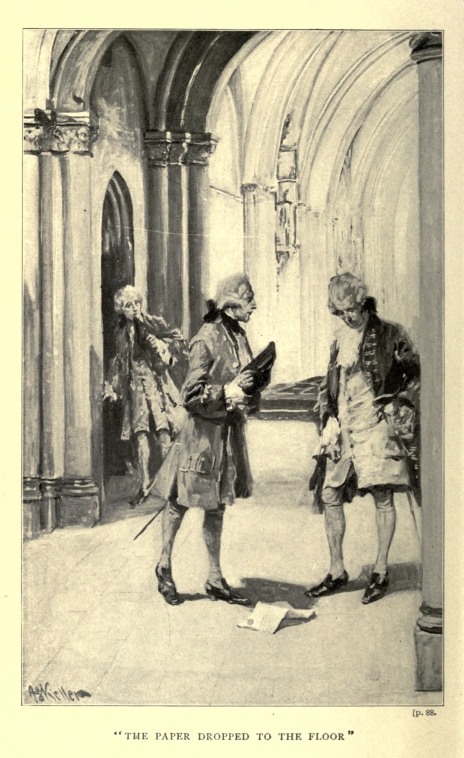
"Give me your letter, monsieur, or—" the hand dropped—"or
was it in words that the order was given?"
"No, madame. Here is the paper."
He took it from under the hat which he carried in the
left arm, and gave it to her. It was not long, and the ink
upon it was scarcely dry. Yet its seals—those of Orléans
and France—precluded any possibility of disobedience of
the command it expressed. As her sister read it through,
Mme. de Lauraguais sat up on the bed, a growing sense
of terror coming over her. Not the smallest expression
crossed the face of la Châteauroux. Her mouth was
firmly set. She read slowly, as one who forced herself
to see written out something of which she was already
thoroughly cognizant. When she had finished the last
line, madame opened her fingers, and the paper fluttered
to the floor.
"That is all, monsieur? Have the goodness to retire."
"Pardon, madame; it is not quite all."
"What further, then? What insult can be added?"
"It is no insult, but an offer of assistance."
"From whom? For what?"
"From the Marshal de Belle-Isle, of his carriage to
convey you as far as Nancy, where you may obtain a
post-chaise."
"Ah! Coward! So he would patronize me now!"
Madame's nerve was failing her at last. Her face had
grown suddenly scarlet, and from her attitude d'Argenson
believed that she would gladly have flung herself upon
him to end the matter after the fashion of the Court of
Miracles. But young d'Argenson was a diplomat, educated
in a famous school, and he had a manner of steel
that would not melt before the white-hot fire of a woman's
wrath. Eye for eye he met the gaze of the Duchess, and,
as her quivering muscles grew still under the spell of his
calm, he said, quietly:
"Pardon me, madame. I think that you do not quite
comprehend your situation. If you but reflect, you will
instantly perceive how much of wisdom there would be in
making the departure of yourself, of madame your sister,
and of your two women as quiet as possible."
Whether it was his air or his eminently unemotional
words that impressed the woman before him, d'Argenson
never knew. It was enough that, after a long and troubled
silence, la Châteauroux finally raised her head and
answered, in a tone but little above a whisper:
"I thank you, Monsieur le Comte. If—the Marshal de
Belle-Isle will have his coach at the abbaye door at four
o'clock, I—we—will take our departure as quietly as
possible."
D'Argenson breathed deeply with relief. Bowing low,
he backed towards the door, pausing only an instant to
repeat, musically: "At the abbaye door, madame.
That is most wise. At the abbaye door."
While Mme. de Lauraguais lived she remembered
the journey from Metz to Paris as the
most utterly wretched affair of her life. For
the Duchess, she expressed no opinion on the
matter one way or the other. On leaving the
coach of M. de Belle-Isle at Nancy, where they were to
engage their own post-horses and chaise, they found that not
only word of the King's illness, but also news of the
dismissal of the favorite, had preceded them, and was in every
one's mouth. Moreover all France was in a state of the
wildest grief and anxiety over the bien-aimé, as he was
commonly known. All churches were open, and in them
masses, repeated by priests actually weeping with excited
sorrow, were continually said. Men and women of every
class left their business and pleasure to join in the universal
prayers for the recovery of the King; and the Queen and
dauphin set out together from Versailles with a company
of Jesuits, to hasten to Louis' side. It was when news of
his Majesty's danger was carried to the Queen that the
eldest son, boy as he was, bethought him nimbly and made
that intensely priggish and uncalled-for remark—the one
reason that France really had for rejoicing that their Louis
did recover:
"Poor people! You have, then, only me!"
It was said that he had a catalogue of similar phrases
for various occasions written down for him by Père Griffet,
and dutifully learned by heart.
At Epernay the carriages of her Majesty and la Châteauroux
passed each other. By that time madame, in terror
of the people who had threatened to mob her along the way,
was travelling incognito in the humblest possible manner,
changing places, when going through towns, with Antoinette.
Even as it was, their progress was extremely difficult.
Four women journeying alone, with no man but an attendant
valet seated on the box, to manage for them, were treated
with none too much respect in the France of those days.
Ere they reached Paris, however, and before the Queen had
arrived at her lord's side, a triumphant courier tore along
the road on his way to the metropolis with the word that
Louis' danger was over, that he would recover. Mme. de
Châteauroux had arrived at Meaux, and was resting there
overnight, when the news spread through the town. Mme. de
Lauraguais had doubted its effect on her sister. When
it was told her, however, the Duchess said, very quietly:
"I thank the good God that it is so!" and lapsed again into
that silence which she had persistently maintained since
leaving the King. Later in the night, however, she
despatched to Richelieu one of those strange, bourgeois
epistles that have come down to us to be marvelled at as
written by a gentlewoman.*
Meaux is not a great distance from Paris, but it was
almost the 1st of September before the sisters reached their
destination. They did not go to the Hôtel de Mailly, for
the reason that Henri's wife, never fond of her superb
sister-in-law, would very possibly fail to know her now in the
time of her adversity. Rather, Mesdames de Lauraguais
and Châteauroux retired to a small hôtel in the Rue du Bac,
which the favorite had inhabited before. On August 28th
they arrived, travel-stained, weary, but mightily relieved
in heart at being safe at their journey's end. The little
house was desolate enough when they entered it, but, with
the combined efforts of the two maids, the valet Fouchelet,
and the concièrge, a supper was contrived, some beds prepared,
and a little fresh air, hot as it was, let through the
musty rooms.
At one o'clock of the next day Mme. de Lauraguais,
much refreshed by her sleep and revived by her chocolate,
entered her sister's bedroom. Marie Anne was still in bed,
wide-awake, however, and meditating on getting up.
"Good-morning, Anne. Here is the latest Nouvelles à
la Main from Mme. Doublet's. Jeanne obtained it for me,
I don't know where, possibly at Henri's."
"And what does it say? What—of—Louis?"
Elise's expression changed. "Oh—there is little of him."
"Tell me at once. What has been done now? I am,
perhaps, no longer Duchess?"
"No, no! You mistake. There is only his 'expression
of regret for the flagrancy of my former life, the bad
example I have set my people—a promise to amend for the
future, God granting me a life to lead with justice and
righteousness.'* That is all."
Mme. de Châteauroux's lip curled, but she said nothing.
After an instant's pause she struck a little gong at her side,
and, at Antoinette's quick appearance, observed, languidly:
"I rise now. My garments at once." As the maid
disappeared, she turned again to her sister. "Is that all your
news?"
"No. Here is something which you will wish to hear.
The Duc d'Agenois, arrived in Paris a month ago, is suffering
an attack of fever at his hôtel in the Rue de l'Evêque."
"Ah! François again!" Again the Duchess was silent,
and presently a curious smile came to play about her lips.
Elise interrupted the reverie.
"I do not understand this, Anne. His exile—"
"Was for two years. It is ended. He served me well
before, Elise. It is an omen. Through him I shall rise
again. I tell you so."
"Be considerate this time, then. Do not banish him a
second time. Tell me, how are you going to occupy
yourself to-day? One will perish of ennui here."
"One must expect it. Let us become philosophers. I
am going to write presently to du Plessis. If Claudine de
Tencin is in the city, we will go to her. She will not refuse
to receive me. To-morrow—I think that I will go to
François. Yes, I mean it. Do not be shocked. To-day I
despatch Fouchelet to Versailles with a billet to Mme. de
Boufflers to send me my furniture, my toys, the rest of my
wardrobe, the dogs, and—my servants. If we must live
here, Elise, we will do so. I am a little tired of camps and
of being continually interested in guns and armaments;
this will be a rest, a relief, for a time. And after—when
the Court returns—"
"Peste! That will be monstrous."
"Yes," responded la Châteauroux, with a vague smile,
"that will be hard. We shall see, however. There will
be—always—François. Send now to the Hôtel de Mailly
and have Henri come to dine with us—off what we have!"
Half an hour later Mme. de Châteauroux sat in the salon
of her hôtel composing, with some difficulty, the epistle to
Mme. de Boufflers, who, as mistress of the palace of the
Queen, was obliged to remain at Versailles during the
Queen's absence. It was not an easy thing to make
acknowledgment of her disgrace to the woman who, next
to herself, was the haughtiest at Court. But the letter was
written in some way, and Fouchelet directed to depart with
it as soon as he had finished serving dinner. Then
Mme. de Lauraguais rejoined her sister, and they sat quiet,
together, listening to the hum of the city, the city of the world,
around them. Presently a bell sounded below. Some
one was admitted. The two listened for a moment, and
then Elise rose as the salon door opened and Henri de
Mailly-Nesle came in.
"Dear Henri! You are so good!"
"Elise! You are well?"
The Marquis embraced the Lauraguais with some
affection, and then turned to his youngest sister, who had
not risen.
"Madame, you wished me to come, I believe?" he asked,
gravely.
"But certainly! It is three months that we have not
seen each other. Is it so unusual that I wish to behold
you again?" she asked, loftily. It was not often that Henri
attempted to reprove her even by a tone, and she would not
permit it now.
Her manner gave her brother his cue, and, with a mental
shrug, he accepted it. His manner was entirely different
as, after certain conventional remarks, he asked: "You
have not heard, perhaps, of the return of M. d'Agenois
after his exile?"
"I learned it this morning," she responded, indifferently.
"He is ill, it seems. The air of Paris still does not
agree with him." Henri took a meditative pinch of snuff.
"Apropos of d'Agenois, Anne, have you heard from
Claude?"
"Claude! No. Surely he is not also returned?"
"Not he. He is in one of the English colonies at a town
with some impossible Homeric name."
"Ah! I warned him that he would perish of ennui
among those savages."
"On the contrary, he would appear, from a letter which
I have received, to be very well amused. From his
accounts he has met there some delightful people—a
charming girl—by name—peste! I forget the name—"
"It is no matter. Claude among the bourgeois! Who
could fancy it? Eh bien, let us dine."
The dinner was not protracted, for none of the three
found it very comfortable. At its end Mme. de Châteauroux
rose abruptly, snapping a finger for Fouchelet, and
turning to her brother with the dismissing command,
"Summon our chairs, Henri."
Mailly-Nesle went off obediently to see that the chairs
and link-boys were ready, while the sisters adjusted their
scarfs and caps. The brother handed them out, gave
directions as to their destination, and himself started to
return on foot to his hôtel. The ladies were going to
Mme. de Tencin, who lived near by, not far from the
Orleans Palais Royal. Though they had dined at an
unconventionally late hour, it was not yet dark, the sunset
just fading into a twilight that played in softening shadows
about the old streets, with their high, gabled wooden houses,
and the occasional buildings of stone. The streets were
quiet, for all Paris was at supper. A few chairs, a chaise
or two, and now and then a coach with some familiar
coat-of-arms on its panels passed them. Foot-passengers
were few. In crossing the Place du Palais Royal, however,
Mme. de Châteauroux, looking out of the open window
of her chair, encountered the glance of a priest going the
opposite way. She bowed, and he uncovered with a
respect less marked than usual, walking on without any
attempt to speak to her. It was the Abbé de Bernis.
"Victorine is here, then," concluded madame. "I
wonder how she will receive me?" And at the question
a pang smote the Duchess's heart. Her fall was
accomplished; but its consequences she had not yet endured.
Twilight rose rapidly now, and it was dark enough for
the torches of the link-boys to be lighted by the time the
slow-moving chairs stopped at their destination. The Hôtel
de Tencin was not imposing from the outside. It was
narrow and high, with a larger building close on either hand.
Inside, however, it was furnished like a palace, and,
indeed, most of the guests who entered it spent the greater
part of their lives in or about the abode of royalty.
Claudine Alexandrine Guérin de Tencin, the foremost
figure in the salon life of the day, was a devoted friend
to Mme. de Châteauroux. The favorite's grand manner
and unapproachable bearing were after her own heart,
and, since Marie Anne's accession to the highest post at
Court, the leader of the salons had actually curbed her
wit on behalf of her friend, and refrained from two excellent
epigrams that would have seemed to slur the favorite's
beauty and taste. It was but this afternoon that, in her
small boudoir, Mme. de Tencin, with Victorine de Coigny
and François de Bernis, had carried on a very animated
discussion relative to the recent affair at Metz. After
tea the abbé returned to the Lazariste, while Victorine,
who had no life left after his departure, promised to
remain with her friend during the evening.
Paris was empty at this season, and the regular salons
were closed. The Duchesse du Maine had carried off all
her pet philosophers and literati to Sceaux. That small
portion of the Court which had not contrived to follow the
army was scattered over France. The very Opera was
shut. And thus Mme. de Tencin and Victorine resigned
themselves to the most stupid of evenings after their small
supper. At something after seven o'clock, however, the
first valet appeared on the threshold of the small
white-and-gold room, with the announcement:
"The Duchesse de Lauraguais. The Duchesse de
Châteauroux."
Mme. de Tencin sprang to her feet. From just outside
came the stiff rustle of feminine garments.
"Marie!"
"Claudine!"
The two women flung themselves into each other's arms,
touched cheeks, first on one side, then on the other, and
finally Mme. de Tencin held the Duchess off at arm's-length,
gazed at her through a river of tears, and murmured,
in a transport of grief: "My poor Anne!"
"Claudine! Cl—audine!"
Thereupon Mme. de Châteauroux closed her eyes and
gracefully fainted away. Elise screamed. Mme. de
Tencin, with moans of compassion, supported her beloved
friend, and Victorine, shaking with inward laughter,
ran away for sal-volatile, a glass of wine, and a fan.
When she returned with these necessaries, la Châteauroux,
reclining upon a satin sofa, was aristocratically reviving.
After a few moments' application of the fan and salts,
coupled by the consumption of the cordial, she was
sufficiently restored to greet Victorine affectionately, and to
recount, with a thousand airs and as many variations, her
own story. It was a pathetic recital. Elise wept
unrestrainedly, and even Mme. de Coigny became absorbed
before the climax was reached.
"And so, actually, it was Maurepas, Anne, who betrayed
you?"
"Actually, ma chère. There is no doubt of it. I have
vowed his ruin."
"If any one could accomplish that, you are certainly
the one to do so. But he is called indispensable to the
ministry."
"He is the most implacable enemy in the world. But—I
also am implacable, Claudine."
Mme. de Tencin shook her head and reflected mournfully.
"What will you do?" inquired Victorine, with some
curiosity.
"I? I have a plan. It turns upon—whom do you think?"
"I never think. Tell us at once. I burn to know."
"François d'Agenois."
"Marie!"
"Again!"
The latter exclamation came from Victorine. The
Duchess smiled at her. "Yes, again. The first time he
was a complete success. I will make him so this time."
"Poor boy!"
"Yes—he will be banished for life. But there is no one else."
"What a pity that your cousin, Count Claude, is still away."
"Ah, yes. Henri says that he is in America. Imagine
it. However, Claude was less useful. I had more
feeling for him—my cousin, you understand."
"When do you visit the Duc d'Agenois?"
"Really, I do not know. I had thought of to-night.
That would be a romance, would it not? But I am too
fatigued. Our journey from Metz was frightful. You
cannot conceive it."
"My poor darling! But do let us have some amusement.
Victorine is in despair. There are no men in the
city."
"I saw M. de Bernis in the Place du Palais,"
observed Elise.
Victorine colored delicately. "Dear Duchess, he is
not a man. He is a priest," she said, lightly.
"And M. de Coigny—he is no longer a man, but a
marshal," retorted madame.
This time the little Marquise made no reply. She
suddenly turned serious, and a pause crept upon the four.
Mme. de Tencin, after waiting nearly a minute for some
one to speak, herself exclaimed: "Come, let us play at
piquet. It is the only thing left. Cavagnole is
impossible. Mme. de Lauraguais, I leave you to the Maréchale.
Victorine, you will be becoming a second Mirepoix soon.
Marie, you shall play with me. Come—the tables are
here."
La Châteauroux sighed. She intensely disliked cards.
"Ah, well—I will play till I have lost ten louis.
That—since I have already lost one—is all that I can afford.
Then we will go home. François must wait till to-morrow."
"Poor man!"
Mme. de Tencin led the way to the gaming-room, which,
to tell the truth, was a principal feature in her hôtel; and
here the four ladies seated themselves at two tables. It
took Mme. de Châteauroux a little more than an hour to
lose her stipulated sum, for stakes among women are not
high. That being done, true to her word, she rose.
"It is necessary to depart, dear Claudine. I am
frightfully sleepy. You have given us the most delightful
evening possible. Come, Elise, finish your hand. How
much have you won? Come, we must really go."
"And I also," rejoined Victorine, rising from her place.
"There is wine in my boudoir. We will drink to you,
Marie Anne, and your great success with the d'Agenois."
So they all rustled back to the little salon, adjusted
their very light wraps, partook of the liqueur and cakes
prepared, and then departed, each to her chair, with many
affectionate adieus. Victorine, yawning mentally, went
her way to her lonely abode in the Rue Fromentin, while
the others returned to the Rue du Bac, where madame
was greeted with news that made her furious with
mortification. Fouchelet had returned from Versailles with
the word from Mme. de Boufflers that Mme. de Châteauroux's
wardrobe and dogs should be despatched to her
on the following day. As to the furniture and toys in
her apartments, and her private chef and footmen, they
had belonged to Mme. de Châteauroux not as woman,
but as favorite of his Majesty. They were really the
insignia of office, and no longer belonged to one who had
been publicly dismissed from her post.
The letter in which these things were said was perfectly
cold, perfectly polite, and perfectly unreasonable. Its
tone, however, was not to be mistaken. It was the first
deep wound given to the deposed sub-queen, and its
sensation was too fresh to be easily borne. At something
after two o'clock in the morning she fell into an unquiet
sleep, and then Mme. de Lauraguais, who had attended
her, crept away to her own room, too tired to scold her
maid.
On the following morning la Châteauroux had, apparently,
recovered from her chagrin. She ate an egg
with her chocolate, laughed at her sister's clouded face,
sent Alexandre to a furniture house with orders to refurnish
completely her present abode, advised her sister to make
a round of the toy-shops that morning, and at eleven
o'clock re-dressed herself preparatory to the forthcoming
visit to her old-time lover.
François Emmanuel Frederic, Duc d'Agenois, returned
from a long Italian exile to Paris and fever, had left his
bed this morning for the second time, and, wrapped in
silken dressing-gown and cap, with a couvre-pied to
correspond, reclined upon a small couch in his most
comfortable salon, indulging in a profound fit of melancholy.
His history certainly warranted an occasional turn of
despair. Unfortunate enough to have fallen in love with
her who was destined to become favorite of France; unwise
enough to have kept his passion alight in defiance of the
King of this, his adopted country; unforeseeing enough
to have offered the woman marriage; by all these things
winning a two-years' banishment; he had now been absurd
enough, after the exile, to return again to the very den of
the lion. More than this, having, even in illness, learned
the story of the disgrace of the favorite and her return
to Paris, he was now capping the climax of folly by daring
to wish—that she would come to him. What benefit he
could possibly derive from such a proceeding, the rash
youth did not stop to consider. He only lay upon his
couch, very weak in body and very flushed of countenance,
hoping one moment, utterly despairing, as was sensible, the
next. Really, according to Fate's usual laws, the idea of
her coming was utterly absurd. And yet she came. About
noon d'Agenois heard, with sharpened ears, the great
front door open and close. Then there was silence again,
while he nervously fingered the tassels of his gown and
stared at the ceiling—more hopeless than ever. Presently
his valet hurried in, with an anxious expression on his
lively face. Passing to his master's side, he whispered
a question in the Duke's ear.
"See her!" cried d'Agenois, leaping up. "Nom de
Dieu, Jean, fly! Fly, I tell you! Admit her—admit
her—admit her—"
Jean ran back across the room, pushed open the door,
and stood aside. Mme. de Châteauroux, clothed in clouds
of white muslin that floated about her in fold after fold,
luminous, filmy, her golden hair unpowdered, curling upon
her shoulders, her eyes lustrous, an expression of tender
melancholy on her face, appeared on the threshold, framed
in the bright sunshine that streamed through the windows.
"Anne!" The man gave a faint cry and began to
move towards her, dizzily, both arms outstretched. He
had loved her faithfully throughout the two years. Had
he not a right to tremble now, at their reunion?
The Duchess smiled slowly into his eyes, and moved
towards him in a fashion peculiar to herself, not walking,
floating rather.
"Anne, you are not changed—you are not changed at
all. You are just as I have thought of you. You are
my angel. You came—you did not forget—I have been
so ill, have suffered so. Ah, you are adorable!"
With nervous eagerness he drew her to the sofa beside
him, and sat looking into her face, delightedly noting every
feature, every shining hair tendril, counting the very
breaths that passed her lips. Madame, who had known
him so well in the old days, who thought of him always
as one much younger than herself, ran her fingers through
his dark hair, smoothed the forehead that was so hot,
and insisted on his lying down again. This being
accomplished, she seated herself near him, one of his
hands fast holding hers, his eyes smiling up at her.
"You know my story—that I am nothing, now,
François?" she asked.
"I know only that you are my angel, Anne. What
more could I wish?"
Thus this first visit passed off to the highest
satisfaction of madame. D'Agenois had always pleased her,
was ever obedient to her way of thinking, was singularly
unselfish and unsuspicious, and his blind devotion to
her was perhaps the only reason why she did not care for
him as she had seemed to care for Louis of France. The
young Duke was, moreover, still far from well; and la
Châteauroux was enough of a woman to have a taste for
humoring a patient who threw himself, utterly regardless
of consequences, upon her mercy. The first, then, became
the beginning of an infinite series of visits, none of which
was short. Madame had not been in Paris a week before
she discovered that nothing but the boldest possible course
was open to her now. The story of her dismissal from
Metz, exaggerated in every way, was discussed from
palace to fish-market. She was pointed out in the streets
and accosted with insulting remarks. The haute
bourgeoisie itself sneered at her, and as for the noblesse, those
who in the old days had schemed for weeks to obtain an
invitation to her salon, could now have seen the moons of
Saturn with the naked eye more easily than they would
behold Mme. de Châteauroux in her chair. Mme. de
Mailly-Nesle refused to admit either sister to her hôtel.
Henri at intervals went to the Rue du Bac out of duty,
not pleasure. Mme. de Tencin, while she frequently
summoned both sisters to her side when she was alone, was
always singularly unable to receive Madame la Duchesse
during one of her evenings. Of all the former friends
and sycophants, Victorine de Coigny was the single person
who allowed herself to be seen in all places, at all hours,
with the deposed favorite, without finding her popularity
thereby lessened. But the little Maréchale was a peculiar
case. It was her role to be unusual, unconventional;
and this one thing added to her risqué list could not harm
her. Even had there been danger in it, Victorine would
have clung to the other woman, for the sake of their old
friendship. But Victorine had a rash nature.
Amid her little turmoil Marie Anne moved with apparent
serenity. Certainly her world, what part of it was still in
Paris, must at first have suspected the pangs of mortification
that they daily caused her. But, so far as outward
evidence was concerned, there was none. A woman who
had had the wit and the unscrupulous fortitude to attain to
the position once occupied by Marie Anne de Mailly-Nesle,
possessed enough strength of character to accept the
circumstances attendant on her fall with excellent philosophy.
She was the talk of all Paris, of Versailles, and of Sceaux.
Her attitude was unceasingly watched and commented on;
and, after two weeks, a new idea began to dawn in the
various salons. It was the startling one that madame had
found a new string for her straightened bow. The idea
originated when, one evening at the Hôtel du Tours, the
discovery was made that five people, on five consecutive
days, had seen the chair of Mme. de Châteauroux waiting
in the Rue de l'Evêque at the door of the d'Agenois hôtel.
Three of these people, moreover, had seen her herself issue
from the hôtel door, had refused recognition to her, and
gone their ways. The salon of M. Vauvenargues gasped.
What a plan of action! How daring! How truly like the
whilom favorite! Was she in love with him, after all?
What were the arms of Châteauroux and d'Agenois? Were
the quarterings harmonious? By the middle of September
the wedding was discussed as a surety, and many a grande
dame wondered if she might not throw hauteur to the winds
and go. Who would not wish to study the bridal dress?
And then—after—question of questions!—what would
accrue when his Majesty returned? The salons gasped
again, wondered, and waited.
Matters also waited for some time. There occurred one
of those aggravatingly hopeless stand-stills when society
purfled and shrugged and created tireless smoke at a rate
which science could not easily measure. No wedding
announcement was made; neither did his Majesty return to
Paris. Fribourg had proved to be a city possessed of rather
better resources of defence than the Court before its walls
had of amusement. After two weeks of cannonading
and unsuccessful sorties on the part of the besieged, the
Court grew very bored indeed, and most of the ladies
followed her Majesty back to France. If the Queen had
wished to stay longer at Louis' side, she did not voice the
wish, for her husband entertained a different notion. Among
the few departing gentlemen was a certain M. Lenormand
d'Etioles, a nonentity to history, who very joyfully
accompanied his wife away from the occasional sight of his
Majesty, to an estate at Meudon, where madame deigned
to reside for one month.
The last siege of the campaign was at last triumphantly
concluded on the 28th day of October, and three days
later came the first rumor of the King's approaching
return to Paris. France received the news with hysterical
joy. It was odd, considering his ways, how universally
adored throughout his youth this King was. To his people
he was a warrior hero. And, indeed, his personality,
since the first time that he had appeared in public, in a
golden robe one yard long, with violet leading-strings
about his little shoulders, had been beautiful enough to
inspire worship. The portraits of his old age are hideous
enough; but that of Vanloo, which the great painter
declared he could not do justice to, is the one which should
stand out above all others as the true picture of this King
of lotus-eaters. Preparations were made to give his
Majesty, and what of the army was with him, a magnificent
reception. An evening procession was arranged, during
which all Paris and her river were literally to roll in fire.
The Faubourg St. Antoine turned out en masse for the
occasion, and, stranger still, not a noble in the city but
contributed certain louis d'or for fireworks, and arranged
windows and a party to view the procession.
Mme. de Châteauroux was addressed by no one on the
subject of these preparations. The royal coach would
pass neither the Rue du Bac nor the Rue de l'Evêque.
Mme. de Mailly-Nesle did not dream of asking her
sister-in-law to sit at her windows overlooking the Pont Royal,
which Louis must cross on his way to the Tuileries. But
even had the invitation been given, the Duchess would
have refused it. It was not in her plan that the King
should find her face among those of the throng; but
eagerly she prayed that its absence might be felt.
"François, upon the 13th of November I shall stay
all day here with you. Nay, better, you shall come to me,
and I will serve you such a little supper as—"
"Anne! Who could touch food in thy presence?"
Madame smiled at him, and they ceased to speak. They
could sit silent now for uncounted minutes, madame
knowing every thought that flitted through the brain of the
young man; d'Agenois fancying, perhaps, that he knew
as much of the Duchess. If this were not so, what
mattered it? He was supremely happy. He had lost all
jealousy, even of royalty, for he willingly believed what she
told him with every look: that she loved him, only, at last.
At the time of their short conversation relative to the
home-coming of the King, they were in the Hôtel d'Agenois,
returned half an hour before from a drive. The Duke
lay upon a couch, idly watching his companion, who sat
toying with a bit of découpure, her back to the windows,
a soft light falling upon her hair and shoulders. It had
been a quiet half-hour, and madame was beginning to be
tired. She was contemplating a return to her own hôtel,
when an interruption occurred. Some one was admitted
below. Some one came hurriedly up-stairs, and
Mme. de Lauraguais, unannounced, ran into the room.
"My dear Elise! Your breath is quite gone! Is there
a fire—a scandal—a death?"
"None of them. Wait!" She sank into a chair to
regain her breath, while François sounded a gong,
intending to order wine.
"It is only Henri, who sends us an urgent note to come
at once to his hôtel. I received it, and came for you. The
coach is outside. He sent it."
Madame shrugged. "What startling thing can have
happened?" she said, smiling. "Perhaps Laure is dying,
and wishes for me. However, I come."
And, after a gentle farewell for the day to d'Agenois,
madame went. The Mailly-Nesle coach bore the two
ladies at a rapid pace across the Rue St. Honoré, out upon
the quay and on to the Pont Royal, on the opposite side of
which, just across from the Théatins, was the Hôtel de
Mailly. During the drive the sisters scarcely spoke.
Mme. de Châteauroux certainly did not seem curious as to the
reason for Henri's imperative summons. To tell the truth,
she was not thinking of it. She was finishing a dream.
Henri himself met them at his door, smiled at Marie
Anne's languid greeting, refused to reply to the eager question
of Elise, but conducted them rapidly up-stairs into the
grand salon. Here stood the Marquise, Henri's wife, with
two people, a man and a woman. As she caught sight of
the man's face, Mme. de Châteauroux gave a little cry,
and turned suddenly colorless.
"Claude!" she said.
Claude came forward, raising her hand to his lips, and
saluting Mme. de Lauraguais, who was staring at him as
at one raised from the dead.
Then de Mailly went back, and took the woman by the
hand. A slight, straight, girlish figure she had, a fair
complexion, and a pair of large grayish eyes, that were
presently lifted to the face of la Châteauroux.
"Anne," said Claude, quietly, "let me make known to
you my wife."
"Your wife!"
Deborah, with rather a pathetic little smile, courtesied
low.
It was thus that Claude brought home his
wife. Two months before he had been married
to her in Dr. Carroll's chapel by Aimé
St. Quentin, with all Annapolis to witness;
and next day he left America on the Baltimore,
in company with Deborah, and her very modest
little travelling coffer. Truly bridal weather was theirs.
The skies were fair, seas calmly blue, and continuous
light western winds, sent by the very gods themselves,
carried them straight to the English coast. All told, they
were on the ship but six weeks—six strange, half-terrible
weeks to the colonial girl. She was learning to know
her husband, and he her. In a way, not always, but by
spells, Deborah was happy. She loved the sea, and she
grew to be very fond of the ship, clinging to it during the
last days of the voyage as she had not clung to her far
Maryland home. She had become dimly apprehensive
of the life into which she was going, of which Claude had
lately told her so much more than he could do during their
comradeship in Annapolis. He also made her speak
with him much in the French tongue, which she did readily
enough at first, in a manner caught from St. Quentin, her
first instructor. But when it came to using no English,
to hearing none from Claude, her tongue faltered, and
she would remain silent for hours at a time rather than
appear awkward before him. Claude was very gentle.
He made her finally understand, however, how much
easier it would be for her to make mistakes now, than to
do so in the land to which they were going. He told her
the story of Marie Leczinska, who had acquired all her
knowledge of the language of her adopted country from a
waiting-maid who spoke a Provençal patois, and how the
Queen was ridiculed by all the Court till she studied secretly,
many hours a day, with her confessor, and was now, when
she chose to exert herself, one of the most excellent linguists
in France. So Deborah took heart, and tried more bravely,
until, by the time they had crossed the English Channel
and landed in Calais, none but a close observer could have
found a flaw in her ordinary conversation.
Claude de Mailly himself passed a very contented six
weeks on the Atlantic. A day or two after his marriage
the realization of that marriage, its haste, its rashness,
its short-sightedness, the fact that his wife had not one
drop of blue blood in her veins, came over him in such a
wave that he was half drowned. What was it that he had
done? Who was he carrying back with him to the most
fastidious, the most critical Court in Christendom? A
bourgeois! A Provençal! A child! And Claude, with
angry, anxious injustice, for three days avoided his wife,
and barely saw her except at meals. The thing that
reattracted his attention to her was the fact that, during
this time, Deborah never made the slightest attempt to
force her presence upon him. If she were unhappy, he
did not know it. He never saw her weep; he heard no
word of complaint. And this unusual thing piqued his
interest. On the fourth morning he found her sitting alone
in the stern of the vessel, gazing back at the western
horizon with far-off eyes. Seating himself beside her, he
leaned over and took one of her hands in his. She turned
towards him instantly, looked at him for a moment, and
then drew it quietly away.
"You needn't do that," she said.
And then it was that Claude knew how glad he was to
do it—to have the right to do it. And thereupon he threw
care to the winds and became her slave. He, too, regretted
the end of the voyage, when it came. Nevertheless, he had,
in the past, suffered severely from homesickness, and
Paris, Versailles, Henri, Elise, and, more than all of them
together, his other cousin, were constantly in his mind.
He dreamed and talked of them when he slept, and, if
Deborah had been proficient enough in French to make
out the half-coherent sentences that passed her husband's
lips at night, she would probably have learned still more
about her approaching life in this way.
Unquestionably, Deborah dreaded the new life. She
had reason to; not alone because of the natural shyness
attendant on a country girl's first appearance at a great
Court. She knew that Claude's whole existence was
bound up there. She believed that he cared rather more
than he actually did about this life that she had never lived.
In consequence, upon the drive of several days from Calais
to Paris, Deborah grew more and more silent, more and
more definitely apprehensive, with each new stage. On
the evening of November 8th they arrived at Issy,
and there spent the night. Next morning Claude rose
with the sun, some time before Deborah even awoke. He
went outside of their post-house and walked delightedly
through the familiar streets, listening to his own language
spoken with his own accent on every hand, discovering
well-known shops and buildings, and returning in the
highest spirits to Deborah at nine o'clock. They had
their chocolate and rolls together, Deborah eating little
and silently, Claude jesting and laughing continually till
she was roused out of her apathy by his thoughtlessness
towards her. It was not, however, till they were rolling
along the Paris road that she spoke—in English:
"Well, Claude, you have brought your Madame the
Countess home to the King. He'll be satisfied, I hope."
Apparently both the allusion and the bitterness were
lost upon him. He only answered with a bright smile:
"I am satisfied, my Deborah. What the King thinks
is not my concern. Oh, I had not told you, had
I?—that the King is not here. He is coming home with
the army next Saturday, the 13th, from Strasbourg. You
know he has been fighting all summer. They are going
to give him a triumph on his return. There will be a
procession through the street, and the King will ride in it.
You will see him then, Deborah. Shall you like it all?"
"I—don't know. I never saw a king," responded the
girl, interested in spite of herself in the anticipation of
these hitherto scarcely dreamed-of glories.
At half-past eleven o'clock their chaise passed the
barrier, and they rolled down the narrow street towards the
river, in Paris at last. Claude himself was quiet now.
He was a little anxious; he could not be sure just what
he should find "at home." Moreover, the familiar streets
and sounds no longer raised his spirits. Instead, they
came so near to bringing tears to his eyes, that he was
relieved when Deborah asked:
"Where are we going? To another inn?"
"I am not sure. I have directed the man to the Hôtel
de Mailly. But, if no one is there, we must go to an
inn. Look, Deborah, there is the Seine, there is the Pont
Royal, and there, just ahead, is Henri's house, where
we are going. Are you glad—little one?"
* * * * * * *
It was half-past ten o'clock that night before Claude
and his wife were again alone together. They had left
the salon thus early through weariness, leaving the rest
of the family party to disband as it would. Neither the
Count nor Deborah spoke till the suite of apartments
assigned them on the second floor had been gained and
the door to their antechamber closed. Deborah was going
on to what she supposed must be their bedroom, when
Claude caught her hand.
"Surely you are going to say good-night?" he asked,
smiling.
"Good-night! Why—I don't understand," she said,
quickly.
Of a sudden the smile left Claude's face. He had not
thought of this before. "There, Debby, is your room—on
this side is mine. A maid whom Mme. de Mailly-Nesle
has kindly lent you is waiting for you. Henri's
valet is there—where I sleep. We do not occupy the same
room. It—it is not the custom. Therefore sit here with
me for a few moments, and tell me—how you like them
all—my family?"
Deborah stared at him in bewilderment during the
explanation; but, true to her nature, she accepted it
without comment, permitting herself to be drawn down upon
the little sofa where he sat, and passively leaving her
hands in his.
"Tell me now—do you like them?"
Deborah hesitated. "What mistakes did I make?" she
asked, finally.
"Not one, my Deborah, save that you were not insolent
enough."
She smiled faintly. "I like Monsieur le Marquis."
"And he you! Yes, you must love him for my sake.
He is more than my brother. And his wife?"
"Is she his wife, Claude? Why does he always call her
madame? Why did you call me madame? And she treated
him so—so formally."
"Parbleu! you are right; they do not know each other
very well, else she could hardly help loving him; and she
would not be so bourgeois as that! Do you like her?
She was kinder to you, Debby, than I have ever seen her
to any woman. Answer me—dost like her?"
"Yes—I liked her. She never looked at me when she
spoke, and she scarcely spoke to any one else."
"True. She does not approve them. But Elise—Mme. de
Lauraguais—"
"Yes, she is very pleasant, and a little pretty, too."
"And now—now—you met Mme. de Châteauroux. What
do you think of her?" Claude asked the question firmly,
after a struggle with himself.
Deborah turned crimson, and started to rise from her
place, but de Mailly gently held her back. He would have
his answer; and it was given him. After all, he had
married a woman, and one whose feelings, though often
unexpressed, were none the less acute. She voiced them now.
"Claude—I hate her! She is not pretty. Her face is
hideous! She was rude to me, to her sister, to the Marquise,
to every one but you. And you sat beside her almost the
whole afternoon. Ah! I cannot bear her! Mme. de
Mailly told me why she was in Paris, how she had been
made to leave the King. Claude, are you not ashamed
that she is of your blood?"
Deborah was on her feet now, and flung her words straight
at her husband. He sat silent, quite still, rather pale,
through the outburst. After it he did not answer her
question, but only murmured to himself, "Why do women
so seldom like her?" Then, looking up at his wife, he
said, kindly:
"Deborah, you know that I have always been fond of
my cousin. I—have been very proud of her. So have we
all. Was it unnatural that she should wish to talk with
me after we had been separated for so long?"
Deborah jerked her head impatiently. "I do not like
her," she reiterated, with dogged displeasure.
Claude rose, with a faint sigh. "Your French was
wonderfully good. I was very pleased, dear. To-morrow—you
shall have some costumes ordered. Naturally, yours
are a little ancient in mode. Good-night."
"Good-night."
He kissed her upon the forehead, and would have turned
away, but that suddenly she flung her arms about his neck
passionately, and, raising her lips to his ear, whispered:
"Claude—Claude—I am a stranger here. You are all I
have of—the old life. Be—be kind to me."
It was almost the first emotion that he had ever seen her
display, and his heart was warm as he took her tenderly
into his arms again, whispering such words as only lovers
know. Five minutes later Deborah crept away to her room
happier than she had been before upon the soil of France;
and not even the somewhat terrifying stiffness of madame's
maid, nor the loneliness of this strange room, had power
to banish the memory of her husband's good-night.
The four succeeding days passed both rapidly and
slowly. From late morning till late night Deborah's
hours were filled. She and Claude were to remain at the
Hôtel de Mailly till the return of the King, after which
they would take an apartment in Versailles. For the
purpose of selecting one, they went together to the little
city on Thursday. In the Rue Anjou, near the pièce des
Suisses, they discovered a very pretty abode in the
second floor of a house—rooms once occupied by the
Chevalier de Rohan, of duelistic fame, furnished and hung in
perfect taste, with precisely the number of rooms desired.
Then Deborah went to see the monstrous, silent palace and
park; after which she and Claude dined together at a café
in the open air, quite à la bourgeois, somewhat to the
unspoken apprehension of Claude, who was not pleased with
the unconventional affair, which, however, unduly delighted
his wife. They returned to Paris in the early evening
by coach, well satisfied with the day. To Deborah's
consternation, Claude next engaged a maid for her, a woman
whom she was supposed to command at will, who was to
dress and undress her, arrange her coiffure in the absence
of the regular hair-dresser, care for her wardrobe, and
conduct madame's affairs of the heart with discretion.
To the little Countess's great delight, however, her first
person in this line left her service after three days, for the
reason that Mme. de Mailly seemed too devoted to monsieur
the husband, and, in consequence, there were no chances
for fees of secrecy such as she was accustomed to count
upon as among her perquisites of office. By the time of
their removal to Versailles, another attendant had been
found who pleased her mistress better. Julie was lively,
young, rather pretty, and not long from the provinces. If
her modes for hair and panniers were not so Parisian as
those of her predecessor, at least she and young Mme. de
Mailly took a fancy to each other from the first, and
Deborah was more than content. Meantime Claude had
happily discovered and re-engaged his former valet, and thus,
with the addition of a chef and scullion and two lackeys,
their little ménage would be complete. Before all these
matters were arranged, however, the Marquise de Mailly-Nesle,
who had taken an unaccountable fancy to Claude's
wife, accompanied Deborah to a milliner, to whom was
intrusted the task of preparing a wardrobe for the Countess.
Deborah watched the selections with delight and a secret
consternation. Could Claude afford such things, and
such an infinite variety of them? Finally, unable to
hold her peace about the matter, she drew the Marquise
one side, and stammered out the question of prices with
pretty embarrassment.
"Mon Dieu! child, why should I ask prices? If the bill
is reasonable, be assured that Claude will pay. If it is too
large—pouf!—he will refuse to look at it! That is all.
Do not be alarmed."
Deborah, surprised and disturbed, felt that she must stop
proceedings at once, for the Maryland school of economy
had been strict. But a shimmering blue satin, with cloth
of silver for petticoat, and ruffles of Venice point, was now
under consideration. Blue was her own color. She had
never worn satin in her life—and dearly she loved its
enticing swish. Why, unless Claude forbade, should she
refuse it? And Claude did not forbid. When she confessed
her doubts during their anteroom conference that evening,
he laughed at her, cried that she should live in blue satin
if she chose, and asked what she was to wear on the
morrow at the royal procession.
"Oh—it is something that madame got at once—white
silk brocaded with pink flowers, and a petticoat with lace.
And I am to have a lace cap with pink ribbons."
"Charming—and good-night. Sleep late to-morrow, in
preparation."
Upon this Saturday, the 13th of November, Paris did not
wake up until afternoon. By two o'clock, however,
St. Antoine had left its domicile and was dispersing itself in
unkempt groups along those streets which, as it had been
posted, his Majesty would ride through in his triumphant
home-coming, on his way to the Tuileries. Marie Leczinska
and the Dauphin spent the morning in prayer, and
were off together, after a hurried dinner, to join their lord
at the southeastern barrier. On the previous day Louis
had been at Meaux, but left that town in the afternoon, and
spent the night at no great distance from Paris. To tell
the truth, he was not too well pleased at the information that
his metropolis was desirous of giving him a heroic welcome.
Certainly his title of bien-aimé was anything but his own
choice. Nothing bored him so thoroughly as affection
taken in the abstract. All through his early life he seemed
to be unfortunate in having about him people to whom he
was totally indifferent, yet who persisted in blindly
worshipping him. In the case of his wife, it had not always
been so. As a boy he had been devoted to her. But for
the Dauphin, with his Jesuitical manners and phrases for
all occasions, his father had never pretended to care. The
daughters were more amusing. This afternoon Louis
would have been very well pleased to see them when her
Majesty's coach came up with the royal staff, in the midst
of which Louis sat on horseback. The Queen, after alighting,
stood looking at her husband with wistful yearning;
but young France, dropping on one knee in a dry spot in
the road, cried out, with very good expression:
"Sire, regard me as the representative of that nation
which, with tears of devotion and thanksgiving, greets
its Father, its Hero, and its King!"
There was a little pause. Then Louis remarked,
casually, "You will catch cold without your hat, child,"
after which he turned to one of his marshals with some
remark upon the day.
How the Dauphin arose from his knee is not recorded.
Like all much-prepared-for cavalcades, this one was
slow in starting. His Majesty objected to the length
of the route planned. He was anxious to be at home
again; and he was tired of people. Had somebody sent
for his turning-lathe? He would do a bit of work when
he reached the Tuileries. Why could not Richelieu take
his place as representative, and let him get quietly through
the city in a public coach? It was nearly dark now. Only
after an endless series of expostulations was he at last
persuaded to conform to the wishes of his people, and
show himself in all the real beauty of his manhood.
Paris had waited very patiently through the bleak
November afternoon, shivering and laughing in anticipation
of its pleasure. Now the windows of every house
along the way were gleaming with candles and dotted with
heads. On either side of the street torches began to be
lighted among the standing throngs. Presently, as the
heavy twilight fell lower, officers of the police began, here
and there, to illumine the long chains of lanterns that
were strung along the walls of houses, and, at short
intervals, across the streets; for Paris would admit no night
yet. Every now and then, down among the standing
throngs, dashed the coach of some nobleman on the way
to his own view-point. The drivers of these vehicles took
no heed of the people in their paths. They were allowed
to scramble away as best they might, or left to be crushed
beneath the horses' hoofs if they chose. No one murmured,
for the affair was quite usual.
By half-past five o'clock a goodly company was assembled
in the salons of Mme. de Mailly-Nesle; ladies who,
in their eagerness to behold the return of their King, were
very willing to forget the fact that they had ever failed
to recognize the Marquise, for reasons connected with a
relative Duchess. Upon their arrival at their hostess'
hôtel they found awaiting them a new sensation in the
person of Claude, and a two-weeks' subject of gossip and
discussion in Claude's foreign wife.
Deborah, arrayed in her brocade, her rebellious hair
fastened stiffly in place with a thousand pins, the
enormous hoops of her overdress annoying her as much as
possible, patches and powder upon her face and hair,
with the customary rouge on her cheeks, stood beside
Victorine de Coigny, the only new-comer with whom she
did not feel ill at ease. Mesdames de Mirepoix, Rohan,
and Châtelet stared at her unceasingly, found her dress
in good style, and her face, on the whole, not bad. L'Abbé
de Bernis, who, to Henri's fruitless rage, had accompanied
Victorine hither, looked upon Deborah approvingly. As
to Claude, he did not approach his wife, but he watched her,
quietly, from wherever he chanced to be, involuntarily
admiring her presence, but undeniably dreading possible
faux pas. Of these there had been as yet no signs.
Deborah certainly was frightened, but she did not show it.
Obeying her husband's last behest, she kept her head
well up and her eyes on a level with those of the person
to whom she talked. Mme. de Coigny, lively,
good-natured, bored, but never supercilious, conversed with
the little Countess for some moments upon her journey,
upon Paris, and upon the return of the King. Deborah
bravely answered her questions, and, less uncertain of her
French than she had been a week ago, even hazarded a
few remarks of her own with which the little Maréchale
seemed pleased. Their tête-à-tête, however, was checked
in its early stages by the beginning of a general
conversation opened by one of the dames d'étiquette, Mme. de
Rohan, who cried to her hostess, from across the room:
"Truly, Mme. de Nesle, you have here all the world
but two people."
"And who are those?" responded the Marquise, graciously,
while the salon grew suddenly quiet.
"Those?—why, the Duc d'Agenois and your cousin,
Mme. de Châteauroux. Where, if one may ask, are they?"
There was a vaguely indefinite murmur of interest
from every part of the room. Then from la Mirepoix
came another remark, one such as only she was capable
of making: "M. de Mailly—oh, I mean the Count—you
were formerly always cognizant of the whereabouts of the
dear Duchess. Can you not inform us of them now?"
The company lifted its brow and a dozen glances were
cast at Deborah—this new little creature from the
Americas. "She does not comprehend the allusion," was the
general thought, when they saw her attitude of large-eyed,
inattentive innocence. Only Claude, as he came
forward a little, snuff-box in hand, turned white.
"Ah, Madame la Maréchale, you speak of by-gone days.
I know the engagements of Mme. de Châteauroux?
Impossible! Am I my cousin's keeper?"
"Perhaps," murmured the Marquise de Châtelet, sweetly,
"she is to form part of his Majesty's escort."
Silence followed this remark. Mme. de Rohan glared
with displeasure at her companion, and the Marquise
flushed a little beneath her rouge. It was too much, for
once. Mme. de Mailly-Nesle, with commendable haste,
turned to her near neighbor and reinstated the tête-à-têtes.
"Ah!" murmured Mme. de Coigny to Deborah, "these
dames d'étiquette are insufferable. They should be
stricken with a plague!"
Deborah smiled very faintly, and could make no reply.
One of her hands was tightly clenched. Otherwise she
appeared unconcerned enough.
At this moment M. de Bernis, having decided the new
Countess to be rather presentable at a distance, drew
nearer, with intent to converse with her. The abbé was,
to-day, in his clerical dress, and thus Deborah acknowledged
Mme. de Coigny's introduction with great gravity.
When Victorine presently turned aside to Coyer, de Bernis
began his conversation:
"Come to the window, here, madame, and look at the
crowd upon the quay. In your country I dare swear you
have no such canaille."
"Poor things! How dirty and ragged they look in all
the light," murmured Deborah, in English.
"You should one day drive through the Faubourg where
they live; it would interest you," returned the abbé, in
the same tongue.
Deborah looked at him with a quick smile. "English
sounds very dear to me. Thank you vastly for speaking it."
"One would learn Sanscrit to gain a word of praise
from your lips, madame," was the abbé's unnecessary
reply, whispered, not spoken.
The young girl was embarrassed. How could a priest
say such things? Turning her head uneasily, she found
Mme. de Coigny close to her, and beheld a new expression
on that childlike, fretful face. It was as well that,
at this moment, the distant shouting of the throng
proclaimed the advance of the royal procession. Under cover
of the general hastening to the lantern-hung windows,
Victorine took occasion to murmur in de Bernis' ear:
"Why are you always cruel, François? Why will you
continually torture me so? This child, now! Have pity
on her."
De Bernis shrugged impatiently. "You are silly,
Victorine. It is not my fault that you are jealous every
time I speak to a woman."
They were silent for a moment. Then Mme. de Coigny,
as she stared into the torchlit street below, sighed. "Those
faces—the rags—the dirt—François, do they not remind
you of our first days together in the Court of Miracles?"
For reply the abbé silently kissed her hand.
All of Mme. de Mailly-Nesle's guests were by this time
arranged in the windows along the front of the hôtel.
Claude, escaping from the women who would have
questioned his heart away, sought Deborah's side. She
received him with a friendly little smile that relieved him
of many fears. A silence of expectation had fallen now
over the room, for the distant sounds of shouting and
cheering were increasing in clearness.
To his intense relief, Louis' long ride was nearly over;
and, almost at its end, when there should remain only a
bridge to be crossed to the Tuileries, he was hoping for
something that should repay him for all his sacrifice of time
and comfort. Since the day of the dismissal from Metz
the name of la Châteauroux had never crossed the King's
lips. But silence is not indicative of forgetfulness. On
the contrary, with every passing day Louis felt his life
more intolerably lonely, in the absence of her for whom
he really cared more than any one else. Now, as he drew
near to the Hôtel de Mailly, which he knew well, expectation
and hope increased his speed, and he passed the
Théatins at a lively trot.
"See, Deborah, here is the royal regiment. Those,
there, at the head, just coming under the lights, are the
marshals—ay, that is Coigny!"
"Madame, your husband," murmured de Bernis in
Victorine's ear.
"—And there are the Court pages in uniform, look—on
the white horses—Richelieu, d'Epernon, de Gêvres, de
Mouhy, Trudaine—Heavens, how familiar they all are!
And here is the Queen's coach. Voila! She looked out
just then, at the shouts. The Dauphin is with her—they
would not let the child ride. He's all of fifteen now—is
he not, de Bernis? And now, Deborah—there, alone—in
front of the corps—with the torches around him—that
is the King."
Deborah Travis bent her head forward towards the
window till the light from the lantern that hung above her
shone full in her face. In the street, directly below, she
beheld a great sorrel charger caparisoned in white and
silver, bearing a rider also in white, with laced coat, cloth
breeches, shining black riding-boots, white hat à la Garde
Française, and across his breast a wide blue ribbon,
fastened with three orders. The eyes of Claude's wife flashed
over the figure and to the face, which was markedly distinct
in the light of the torches.
"Is that the King?" she whispered to herself, unconscious
of speaking.
At the instant that Louis passed beneath the string of
lamps across the way, Deborah's eyes fell upon his bright
blue ones. As though she possessed magnetic power,
the King responded to the look. It was not the face that
he had hoped to find here, but it was one—as fair. The
royal hat came off, the royal figure bent to the saddle-bow.
And then he was gone. Deborah's cheeks were redder
than her rouge. Every woman in the room had turned to
look at her, but some eyes, perhaps, stopped at sight of
Claude. His face was deathly, and upon it was plainly
written new, quickening dread; while both of his white
hands were tightly clenched over his polished nails.
The Nouvelles à la Main of the 15th of
November announced, among many things,
that the Count and Countess de Mailly had
entered their apartment in the Rue d'Anjou
at Versailles. Deborah, who for some time
had been secretly caressing the thought of "home," went
into the little suite of rooms with a glorified, colonial sense
of mistress-ship. Madam Trevor's method of housekeeping
was familiar to her in every detail, from candle-dipping
to the frying of chickens; and, while she felt rather
helpless, having no slaves at her command, she determined
to do what she could with the two liveried lackeys, and to
demand others of Claude if she found it necessary. She
and Claude had never discussed housekeeping together,
for the reason that Claude had no conception of the
meaning of the word.
They arrived and were served with dinner in their little
abode on Monday. Tuesday afternoon found Deborah
seated helplessly in the boudoir, with her husband, rather
pale and nervous, before her. He had found her, utterly
oblivious of the consternation of the chef, the lackeys,
and the scullion, washing Chinese porcelain teacups in
the kitchen. And it was then that Deborah received her
first lesson in French great-ladyhood, by whose iron laws
all her housewifely instincts were to be bound about and
imprisoned. She must never give an order relative to the
management of their ménage. She must never purchase
or arrange a single article of food that was to be prepared
for their table. She must never dream of performing
the smallest act of manual labor. She might designate
the hour for meals, or inform the first lackey how many
were to be served, or what beverage should be passed at
her toilette. She might keep her appointments with
costumers, milliners, hair-dressers, furriers, jewellers,
toy-men; and she might see that her engagement-book was
filled. That was all that was expected of her in the way
of labor. She had made a great false step to-day, and it
must not occur again.
And Deborah listened to Claude's explanation in silence,
with her pretty new world all tumbling about her ears.
"We might, then, as well have stayed at your cousin's
house. This is only our tavern, kept for our convenience,"
she said, at last.
Claude nodded, and paid no attention to the sarcasm.
"This is where we sleep, where we change our clothes,
where we receive our friends."
"We've no home?"
"On the contrary, we make all Paris, all Versailles,
our home."
Deborah folded her hands, and her face grew suddenly
helpless in expression. "I don't like it," she said, faintly.
"Dear, you do not know it. Wait. You will soon be
too much occupied to think of it. Why is your coffer still
here? Has not Julie unpacked it? You must not permit
laziness."
"She has done all that I would allow. I will finish it
myself. Claude, may I have something?"
"What? You shall have it."
"You know in our salon there is, near the mantel, a
little cabinet against the wall—a little cabinet with two
shelves, and a door and key."
"Yes, yes. 'Tis for liqueurs, if we want to keep them.
Well?"
"I want that—I want the cabinet to use for myself."
"Just Heaven! Have you then so many valuables,
or so many secrets?" He laughed, but there was curiosity
also in his tone.
"You know that I have neither, Claude. But I want
the cabinet."
Claude shrugged, never dreaming what she intended the
place for. It was but a little thing to ask; and besides,
curiously enough, Claude, who had been brought up
among the most unreliable class of women in the world,
had yet been so little affected by their ways that, ten weeks
after their marriage, he was beginning to trust his wife.
She was as honest as a man when she did not like a thing,
or when she wanted one; she was not talkative; she did
not make scenes; he had beheld her angry, but it was not
with a malicious anger; and, more than all, she never
complained. So far Claude had found nothing to regret in
his marriage. He realized it now as he stood there in her
dressing-room, while she sat looking at him expectantly.
"Eh, well—the cabinet and its key are yours. You'll
not forget what I have been telling you this afternoon?"
"No."
He smiled again, went to her side and kissed her. "Good-bye,
then. I am going out. You will not be lonely? Mme. de
Coigny may come. After your presentation to the
Queen, you know, there will be no idle moments."
He left her with a little nod and smile, and, donning hat
and cloak, departed towards the Avenue de Sceaux, from
which he turned into the Rue des Chaniers, bound for a
little building at the end of it, not far from the deer-park,
which was much in favor as an afternoon assembling place
for gentlemen of the Court during the unoccupied hours of
the afternoon. Here one might gamble as he chose, high
or low; drink coffee, rum, or vin d'Ai; fight his duel, if
need be; or peruse an account of the last one in a paper, if
he did not want to talk. It was a comfortable and ugly
little place, kept by M. Berkley, of fame somewhat
undesirable in London, but of gracious personality here.
To-day, for the first time in months, the little place was
creditably filled with its customary patrons, noblemen and
lords to whom camp-life had lately become more familiar
than the Court. Here were assembled all those gentlemen
who, two days ago, had ridden into Paris with Louis; and
a good many more who mysteriously reappeared out
of the deeps of lower Paris, where they had been hidden
from salon gossip and too many women. That morning
Richelieu, d'Epernon, and de Gêvres left the Tuileries
in despair. The King, clad in a stout leathern suit, was
shut into an empty room with his friend the carpenter,
making snuff-boxes with all his might, and admitting neither
silk, velvet, his wife, nor the Dauphin into his presence.
His gentlemen were now less harmlessly occupied. De
Gêvres was opposing d'Epernon on the red. Richelieu,
in a mood, played solitaire à la Charles VI. against
himself, the sums that he lost being vowed to go to
Mlle. Nicolet of the Opéra ballet. De Mouhy, d'Argenson, de
Coigny, de Rohan, Maurepas, Jarnac, and half a dozen
others were grouped about the room, drinking, betting,
and gossiping. The conversation turned, as it was some
time bound to do, on la Châteauroux and d'Agenois.
"The King has not yet, I believe, discovered the renewed
relationship," drawled d'Epernon, mildly.
"Perhaps not. But in a week—imagine it! Madame
la Duchesse is fortunate in having gentlemen scattered
over most of the civilized world on whom she may cast
herself for protection in case of need!" returned Richelieu,
crossing glances with Maurepas.
There was a little round of significant looks and nods.
Evidently the Duke's sang-froid had not deserted him.
Every one knew very well that the deposed favorite and
her former preceptor were soon bound to be at opposite
ends of the scales, and that her rise now meant his
fall.
"I wonder—" began Coigny, thoughtfully, when again,
for the twentieth time, the door opened, and some one
entered whose appearance paralyzed the conversation.
"Well, gentlemen, I am thankful only that I am not a
débutante at the Opéra. Such a reception would ruin me.
Am I forgotten?"
"Forgotten!" It was a chorus. Then one voice
continued: "When one sees a ghost, Claude, one fears to
address it hastily. It might take offence."
"'I think it is a weakness of mine eyes that shapes—'"
"'This monstrous apparition'? Thanks, truly!"
observed de Mailly.
Richelieu then strode forward and seized his hand.
"He's in the flesh, messieurs. I am delighted, I am charmed,
I am somewhat overcome, dear Claude. I should have
pictured you at this moment flirting in Spain, storming a
seraglio at Constantinople, toasting some estimable
fräulein in beer, drowning yourself in tea and accent in
London, or—fighting savages in the West. Anything but
this! Your exile is over, then?"
Claude smiled, but, before he spoke, Maurepas had come
forward:
"My faith, gentlemen, you seem to be but slightly
informed of the last news. Monsieur has been in Paris for
a week with Madame the Countess his wife, and—"
"His wife! Diable!"
"Come, come, then, I was not far wrong. Is she Spanish,
Turkish, German, English, or—by some impossible
chance—French? Speak!"
"I have not before had the chance, my lord," returned
Claude, bowing. "However, my tale is not so wonderful.
When I went upon my little journey the King was so
gracious as to express the hope that I would return to
Versailles when I should be able to present to him madame
my wife. Well—in the English Americas I was so happy
as—to have engaged the affections of a charming daughter
of their excellent aristocracy there. We were married
nearly three months ago in a private chapel by the Father
Aimé St. Quentin; and so, madame being pleased to return
with me to Court, we set sail shortly after the wedding,
and—behold me!"
"Bravo—bravo! You have been making history!
Madame, of course, is not yet presented?"
"Scarcely, Chevalier, since her Majesty is barely
returned."
"Are you stopping in Paris?"
"We have Rohan's former apartment in the Rue d'Anjou
here."
"Aha! Madame possibly brought a worthy dot—is it
not so?"
If the question displeased Claude, he did not show it.
Shrugging and smiling with some significance, he moved
towards a card-table, and instantly the estimate of Mme. de
Mailly's prestige went up a hundred thousand livres. The
room was now all attention to Claude. He ordered cognac,
and his example was followed by a dozen others. De
Gêvres and d'Epernon ceased their play. Even Richelieu
seemed for a moment to be on the point of leaving the
interests of Mlle. Nicolet, but eventually he continued
his amusement, only stopping occasionally to glance
around at the group of new sycophants, biding his own
time.
"Of course, you have seen la Châteauroux, Claude?"
questioned Rohan, a little intimately.
De Mailly stared at him. "Of course, as you say, I have
seen her."
"D'Agenois' reign will be short, then," muttered Coigny
to Maurepas.
Claude heard, flushed, and turned again to Rohan:
"Chevalier, will you dice?"
"With pleasure."
Cups were produced, and the rest began betting among
themselves on the outcome of the first throws. Odds were
not in Rohan's favor.
"A thousand louis, Chevalier, that my number is less
than yours."
This was an unusual stake. Rohan's eyebrows twitched
up once, but he took the wager calmly. Deborah's
reputed fortune went up another hundred thousand francs,
and advanced still further when Claude won his throw;
for they only win who do not need to do so. De Rohan
made an effort to retrieve himself, but failed. Then the
stakes diminished, for Claude had had his revenge for
an impertinent question, and did not desire to gain a new
reputation for wealth. However, he was three thousand
louis to the good when Richelieu came over and touched
him on the shoulder.
"Enough, Claude, enough for the time. Come with me.
I need you now. M. Berkley will be always here to welcome
you. I—well, I shall not be here every day. Come."
Claude rose, good-naturedly. "Certainly I will come,
du Plessis. Au revoir, gentlemen."
"Au revoir! Au revoir! When do you present us to madame?"
"We shall be delighted to see you as soon as Mme. de
Mirepoix has bestowed a card upon us."
A few further good-byes, and de Mailly and his old-time
friend left the house together and moved slowly down the
street, the Duke leading. Claude did not speak, for it was
for his companion to open conversation. This Richelieu
seemed in no haste to do. They had proceeded for some
distance before he remarked, suddenly:
"It is cold."
"Most true. What hangs upon the weather?"
"This. It is too chilly to wander about outside. Take
me to your apartment and present me to the Countess."
"With pleasure, if you wish it."
"Many thanks." They turned into a cross street that
led towards the little Rue Anjou, when Richelieu, after a
deep breath, began quickly, in a new strain: "Claude—do
you know—that my fall is imminent?"
"What!"
"Oh, it is true. My fall is imminent. I am frank with
you when I say that never before has my position been so
beset with difficulties. You would learn soon, at any rate,
and I prefer that you hear now, from me, what every
member of the Court save Mme. de Châteauroux herself
knows—that it was I who, beside myself with anxiety for the
King, was the instrument of her dismissal from Metz."
Claude opened his mouth quickly as if to speak. Thinking
better of it, however, he remained silent and waited.
"As I have said, madame, now out of touch with Court
circles, has not yet heard of what she would term my
treachery. But during the first conversation she holds
with a courtier she must learn the truth. Of course, you
perceive that, if she comes again into favor—I—am
dismissed. Of course, also, her every nerve is strained
towards the natural object of reattaining to her former
position. My dear Claude, I am speaking to you in my own
interests, but they are yours as well. Your cousin is just
now playing with d'Agenois in order to rouse the possible
jealousy of the King. It is her method. It may, for the
third time, prove successful. But if the success does
come, it will be over my fallen body. I shall oppose her
as I have opposed nothing before, because never before
have I been so deeply concerned. I would ask you, Claude,
which side you will espouse—hers or mine?"
Claude was silent for a few steps. Then he said,
musingly: "A battle between my cousin and my friend.
You ask me a difficult question. Perhaps you are thinking
that, if a d'Agenois alone fails with his Majesty, a
d'Agenois and a de Mailly might do her work. Is that
your notion? Hein?"
"Your astuteness is as perfect as of old. That is my
notion. And I would beg of you that you do not allow
yourself to be played with again."
"As a de Mailly—I might be willing. As the husband
of my charming wife—I do not need your pleading to
decide me."
Richelieu laughed, and there was relief in the tone.
He had secured himself from one danger, and, out of
gratitude, he should befriend this unknown wife if she were
in the smallest degree possible. "And now for Mme. de
Mailly!" he cried, gayly, with lips and heart, as they
approached the house in the Rue d'Anjou.
"She will be delighted. I fancy her afternoon so far
has been lonely."
In this Claude was wrong. Deborah's afternoon had
been far from dull. Quite without her husband's
assistance she was learning something more of this Court life,
this atmosphere in which he had lived through his youth.
When he left her, early in the afternoon, after the
gentle lecture on manners, Deborah's first move had been
to take from her trunk those articles which Julie had been
forbidden to touch, to carry them into the empty salon,
and place them in the little black cabinet by the mantel,
where she stood regarding them for some moments absently.
They were ten crystal phials, of different sizes,
filled with liquids varying in tone from brown to limpid
crystal. Upon each was pasted a paper label, covered
with fine writing, which told, in quaint phraseology and
spelling, the contents of the bottle, and the method of
obtaining it. Beside the flasks was a small wooden box
with closed lid, containing a number of round, dry, brownish
objects, odorless, and tasteless, too, if one had dared
bite into them. They were specimens of amanita muscaria
and amanita phalloides which Deborah, still catering
to her strange delight, had brought to her new home,
together with the best of her various experiments in
medicinal alkaloids. To her profound regret, she had been
unable to pack Dr. Carroll's glass retort. But here, some
time when Claude was in humor, she would ask him to
get her another; for surely, in this great city of Paris, such
things might be obtained. Then, even here, in her own
tiny dressing-room, she would arrange a little corner for
her work, and so make a bit of home for herself at last.
Poor Deborah was young, heedless, enthusiastic, and in
love with her talent, as, indeed, mortals should be. She
did not consider, and there was no one to tell her, since
she did not confide in Claude, that no more dangerous
power than hers could possibly have been brought into
this most corrupt, criminal, and intriguing Court in the
world. Reckless Deborah! After a last, long look at
her little flasks, she closed the cabinet door upon them,
locked it, and carried the key into her dressing-room,
where she laid it carefully in one of the drawers of her
chiffonier, From this little place she did not hear the
rapping at the antechamber door, nor see her lackey go
through the salon. It was only when, with a slight cough,
he announced from the doorway behind her, "The Maréchale
de Coigny," that Mme. de Mailly turned about.
"Oh!" she said, in slightly startled fashion. It was
very difficult for her as yet to regard white servants as her
inferiors. As she entered the little salon with cordial haste,
Victorine, cloaked and muffed, rose from her chair.
"You are very kind to come. Cl—M. de Mailly is out.
I was quite alone."
"That is charming. We shall get to know each other
better now—is it not so? May I take off my pelisse?
Thank you. M. de Coigny and I have just come out—to
Versailles, you know—for the winter. Later, we may be
commanded to the palace. If so, I shall have to be under
that atrocious Boufflers; and, in that case, life will be
frightful."
While Victorine spoke she had, with some assistance
from Deborah, removed all her things and thrown them
carelessly upon a neighboring chair, after which she seated
herself opposite her hostess, smiling in her friendliest
manner.
"I should like to be able to offer you something,
madame," said Deborah, hesitatingly, unable to banish the
instinct of open hospitality. "What—would you like?"
Victorine smiled again, with a quick pleasure at the
unaffected offer. "Thank you very much. A dish of
thé à l'anglais would be delightful."
Deborah's heart sank. In Maryland tea was a luxury
drunk only upon particular occasions. She had not the
slightest idea that there was such an article in her kitchen
here. Bravely saying nothing, however, she struck a little
gong, and, at the appearance of Laroux, ordered, rather
faintly, two dishes of Bohea. Laroux, receiving the
command with perfect stoicism, bowed and disappeared, to
return, in a very short space of time, with two pretty
bowls filled with sweet, brown liquid. These he deftly
arranged on a low stand between the ladies, placing beside
them a little plate of rissoles. Madame la Comtesse
decided at once that such a servant as this should not soon
leave her.
"Ah—this is most comfortable. I am going to remain
with you during the whole afternoon. It is wonderful
to find some one who is neither a saint, an etiquette, nor a
rival. My faith, madame, one might say anything to you!"
Deborah smiled, sipped her tea, and could find nothing
to reply. Her face, however, invited confidence; and the
Maréchale sighed and continued:
"You seem to be almost happy! The look on your face
one sees only once a lifetime. It is youth, and—innocence,
I think. How old are you? Oh, pardon! I am
absurdly thoughtless! But you look so young!"
"I am eighteen," responded Deborah at once.
"And I—nineteen. Beside you I appear thirty. It
is because I have lived here for three years. Ah! How
I have been bored!"
"It must have been very lonely all the summer. But
now, with Monsieur the Marshal returned, it will be better."
"Oh, you are right! It will be more difficult now, and
so, more absorbing. But Jules lets me do almost as I
please. If he were but more strict, less cold, François
would have more interest. He is growing indifferent.
Dieu! How I have worked to prevent that! But—it is
imbecile of me! I care so much for him that I cannot
behave as I should!"
"I do not understand," said Deborah, indistinctly,
with a new feeling, one of dread, stealing over her.
Instinctively she feared to hear what this pale, big-eyed
little creature was going to say next.
For an instant Victorine stared at her. Then, leaning
slowly forward and looking straight into Deborah's honest
eyes, she asked, in a low tone, "You did not know—that
de Bernis—that—I—"
Deborah sprang up, the empty tea-bowl rolling unheeded
at her feet. She had grown suddenly very white, and,
as she returned Victorine's own look, searchingly, she
found in the other face what made the horror in her own
deepen, as she backed unconsciously towards the wall.
"You don't know!—Mon Dieu!—Why, Claude—was
mad, mad, to have brought you here!—Why,
madame—Deborah—we're all alike! You mustn't look at me
like that. I am not different from the others. Henri
de Mailly—the Marquise—the Mirepoix—Mme. de
Rohan—Mme. de Châteauroux—child, it is a custom. The
King—Claude himself—before—"
"Ah!" Deborah made a sound in her throat, not a scream,
not an articulate word, but a kind of guttural, choking
groan. Then she covered her face with her hands. For
a moment that seemed an eternity she stood there repeating
to herself those last cruel, insensate words, "'Claude
himself—before—'"
And then Victorine, looking at her, came to a realizing
sense of what she had done. Moved by a half-impulse,
she started up unsteadily, swayed for an instant,
and then fell back upon her chair, covering her head with
her hands and arms, and bursting into a passion of sobs
so heart-broken, so deep, so childlike forlorn, that they
roused Deborah from herself. Letting her hands fall,
she looked over towards her visitor. There was a note in
the Maréchale's voice, and a line of utter abandon in her
position, that brought a pang of woman's sympathy into
the heart of the woman-child who regarded her. Putting
away from her all selfishness, even that miserable thought
of Claude, forgetting the brutal openness with which
Victorine had spoken, she suddenly ran across the room
and took Victorine into both her strong, young arms.
Victorine's head found a resting-place on her shoulder;
Victorine's aching, hopeless, impure heart beat for an
instant in unison with that other one; Victorine's racking
sobs ceased gradually. She gave a long, shivering sigh.
There was a quickening silence through the room. Then
the frail little figure loosed its grasp on Deborah,
straightened quickly up, and turned to move to the chair where
her wraps lay. Dully, Deborah watched the Maréchale
tie on her hood and pull the cloak about her shoulders.
Then, picking up gloves and muff, the visitor turned again
and moved back to where Deborah stood. In front of
her she stopped, and her eyes, in which shone two great
tears, rested in dim pity and sorrow upon Deborah's white
face. The look lasted for a long moment. Then, slowly,
without a word, the Maréchale picked her handkerchief
from the floor where it lay and began moving towards the
door. Before she had reached it Claude's wife spoke
again, more steadily:
"Mme. de Coigny—you must not go—yet."
The Mare'chale paused, with her back to Deborah, and
stood hesitating.
"You must not go yet," repeated the voice. "You
must tell me, first—about Claude."
A little moan came from Victorine's lips. "Claude—Claude—I
c-cannot tell you about him. I know nothing!
I—I lied to you. He is not like the rest."
"No, madame; that is not so. You try to be—kind.
Was it—tell me—Mme. de Châteauroux? Yes. Now I
know. That is true."
Victorine faced quickly around, the tears coming again
into her eyes. Mme. de Mailly had begun to walk up and
down the room, speaking in a monotone, twisting and
untwisting her fingers as she went.
"I see. I know. Claude was exiled because the King—did
not like him." Here she turned about and looked
her companion squarely in the face. "Claude married
me so that he might return to Court. In his letter the
King said that he might return when he could present his
wife at Versailles. Yes. Claude read that letter to me,
and still—I married him. Oh, madame—" a nervous
laugh broke from her—"did M. de Coigny do that to you?"
Victorine stared at her in horror of her tone.
"Deborah—Deborah—don't look so! Claude isn't like that. And
you—you are good. You are pure. Ah—I cannot forgive
myself while I live for what I have done! Is there
anything that I can do? Tell me, is there nothing—nothing
that I can do?"
"Oh, madame, may we not help also? Is it a new costume, or—"
It was Claude who spoke. He and Richelieu had entered
the antechamber just in time to hear the last phrase.
Mme. de Coigny faced about sharply. She knew that
Deborah must have time to recover herself.
"It was not a garment—but a secret, messieurs. Monsieur
le Duc, I am offended that I meet you for the first
time since your return in the apartment of a friend.
Have you struck me from your list?"
"Ah, madame, one does well to keep from your side,
since one does not fight an abbé. M. de Bernis has more
enemies from jealousy than any man about the Court,"
returned Richelieu, a trifle maliciously.
Claude, much displeased with the Duke's ill-timed
pleasantry, glanced anxiously at his wife. Her manner was
composed, but her expression he did not know.
"Madame, allow me to present to you M. de Richelieu,
of whom I have so often spoken. Monsieur, Mme. de
Mailly."
Deborah courtesied, and Richelieu bowed profoundly.
For some unaccountable reason, the Duke's ready
gallantry suddenly deserted him, and he could conjure up no
fit compliment for this girl with the unrouged cheeks
and the calm, frigid self-possession. Deborah's mood was
new to Claude, and he regarded her with amazement,
as she stood perfectly silent after the introduction, her
glance moving slowly from Richelieu's immaculate shoes
to his large brown eyes and the becoming curls of his
wig. Once more it remained for Victorine to save the
situation. She was wondering anxiously if her eyes
were very red, as she asked:
"Gentlemen, you have been to—Berkley's—that
name!—have you not?"
"Yes, madame, and we left your husband there. He
lost to Claude here, I think. Mordi, Claude! The gods
are too good to you. If you would not have Mme. de
Mailly carried off by some stricken gentleman, you should
keep her locked in a jewel-case. Are you to be presented
soon, madame, and by whom?"
Deborah blankly shook her head. "I do not know,
monsieur."
Claude looked at her, more puzzled than ever, and
Richelieu commented mentally: "Beauty and presence,
without brains. It is as well."
"Mme. de Mailly-Nesle may present her, is it not so?"
asked Victorine, again ending the pause.
"Certainly—I believe so. She has been a lady of the
palace."
"I should advise Mme. de Conti, Claude. Her price
is about two thousand francs, but she does it with an
unequalled manner. She will direct the courtesies, the train,
the kiss, the retreat, everything—perfectly. Besides
that, you have her patronage forever after, particularly
if you supplement the two thousand with a small jewel, or
some such gift. Her rents are mortgaged, and she lives
now on her presentations."
"When does the King leave Paris?" asked Claude,
contemplatively.
Richelieu shrugged. "On Wednesday, we trust. He
is now making snuff-boxes by the score, and if a fit of
cooking succeeds that—Heaven knows! He may remain
at the Tuileries till Christmas."
Deborah stared at this information, and Victorine turned
to her, laughing nervously: "Has not monsieur told you
what an excellent cook his Majesty is? He rivals Marin;
and it is said that, could he win a cordon bleu, he would
wear no other order. His bonbons are delicious. I once
ate some of those that he sent to—" she stopped suddenly.
"Mme. de Châteauroux," finished the Duke, fearing
that her hesitation was for him.
Victorine nodded hastily. "Well, dear madame," she
continued, turning to Deborah, "I must go, I have been
with you an eternity. It grows late."
"Do you return to Paris, madame?" inquired Richelieu.
"No. We are already living here. My chair is below."
"Permit me, then, to escort you," said Claude, seeing
that Deborah did not press her to remain.
"My dear Count, you must resign that happiness to me,"
observed Richelieu. "I am to sup with the King, and I
have just time to reach Paris. Mme. de Mailly, I trust that
our first meeting may prove our shortest."
"That is safe gallantry, monsieur, since one could scarce
be shorter," returned Deborah, with something of her usual
manner.
"Ah! That was better. Perhaps it is only embarrassment,"
thought Richelieu, as he made his farewells to
Claude and bowed to Deborah's courtesy.
A moment later de Mailly and his wife were alone
together. The sound of steps in the outer hall had died
away. The little salon was quiet. Then the man and
woman faced each other, Deborah mute, heavy-eyed,
expressionless, her husband curious and expectant. After
two minutes of uncomfortable silence he spoke:
"What is the matter, Debby? What has Victorine de
Coigny said to you?"
Then, to his utter amazement, for he had never imagined
her doing such a thing, he saw the girl's lip tremble, her
face work convulsively with effort at control, and finally,
as an ominous drop suddenly rolled over her eye and down
her cheek, she turned from him sharply and ran into her
boudoir, shutting the door after her.
Before Deborah consented to come forth from her retreat,
his Grâce de Richelieu had arrived at the Tuileries, made a
necessary alteration in his dress, and was admitted to the
presence of the King, who, in company with de Gêvres and
Maurepas, awaited him in the small supper-room. The
Duke made proper apologies for tardiness, which Louis
graciously accepted on condition that, during the
entremets, he should recount the adventure that had kept
him.
"Ah, Sire, it has been my fortune to encounter the lady
whom you deigned to salute on Saturday, in the window of
the Hôtel de Mailly."
There was a murmur of interest from the other two as
the King looked up. "By my faith, du Plessis, you are
phenomenal! Who is she?—what is she? Is she
eligible—or not?"
"Ah!" A sudden thought crossed Richelieu's mind.
He answered very slowly, crumbling a bit of bread the
while, "She is the Countess de Mailly, Claude's wife, and
so a cousin to Madame la Duchesse de Châteauroux."
There was a pause. The atmosphere was dubious.
De Gêvres and Maurepas rejoiced to think that they had
been wise enough to voice no curiosity. Richelieu,
perfectly calm, inwardly calculating, finished his soup.
Suddenly Louis's mouth twitched, his eyes twinkled, and he
permitted himself to laugh.
"Parbleu! he has taste in women, this Claude! Have
her presented, du Plessis, and de Mailly shall have back
his place. Her Majesty holds a salon on Sunday—the
21st, hein? Have her presented at all hazards. By my
faith, the fellow has a taste in women!"
Upon the 18th of November their Majesties, the
dauphin, the royal suites, and, in a word,
the French Court, returned to Versailles and
took up its abode in palace or town for the
winter. The little city was alive with nobility
and nobility's servants. Every fourth person one met bore
with him, as a mantle of dignity, some fifteen generations
of ancestry; and every third man with whom one came in
contact was one whose forebears, for fifteen misty and not
wholly glorious generations, had been accustomed to the
honor of adjusting nobility's wig and helping him on with
his coat.
The great park of Versailles, with its leafless bosquets,
its bare avenues, its deadened terraces, its lifeless
fountains, was forlorn enough. But within the monster
palace hard by everything hummed with preparation for
the gayest of winters. Here was a hero-King returned
from the scene of his heroisms, bored with doughty deeds,
waiting to be entertained with matters strained to less
heroic pitch. There on the second floor, behind the court
of the grand staircase, with a little private stair of its own,
empty and desolate behind its locked doors, lay the deserted
suite of the favorite's rooms. And who shall say how many
a great lady, honorable to her finger-tips, with some honor
to spare, cast a mute, curious glance at that closed door, in
passing, and went her way with a new question in her
heart? Who shall tell the germs of intrigue, struggling
jealousy, rivalry, hatred, ambition, and care that were
fostered in this abode of kings during that third week in
November, when the "season" was budding, and would,
on Sunday night, at the Queen's first salon, open into a
perfect flower?
During that week, ever since Richelieu's visit on
Monday, one would scarcely have thought that Deborah de
Mailly had had time for thinking. There was never an
hour when she could be alone. Claude's words were proven
true. She had known nothing of what this life would
mean; and she possessed not one leisure moment which
she could have given to the care of their abiding-place.
Slightly to her husband's surprise, certainly much to her
own amazement, she had become a little sensation; and
almost every member of the Court followed the speedy
example of Mme. de Mirepoix and called upon her during
that first week. The tale of the King's salute, of her
forthcoming presentation, and, more than all, a story whispered
behind Richelieu's hand of a possible favoritism, had
wrought this result.
Deborah bore herself very well at the innumerable
afternoon visits. Claude was always with her; but, after the
first two days, she ceased to watch his eye, and found
herself able to pay some little attention to the characteristics
of the different people. She had small fancy for the
Maréchale de Coigny, and an equally accountable dislike
for de Bernis, who, for some reason of his own, paid her
assiduous attention.
Each morning Deborah went to Paris, to her milliner's,
where the presentation dress was being made. Claude
almost always accompanied her on these trips, and during
the long drives there should have been more than enough
opportunity for them to discuss her first impressions of the
new life. Though Claude could not tell why, such
conversations never occurred. He felt, vaguely, that his wife
was holding aloof from him. She was perfectly courteous,
sometimes merry, in his company; but she was never
confiding as she had been. At home there was no longer any
necessity for them to linger in an antechamber before
retiring, for the sake of being alone together. After eleven
at night they had their apartment to themselves. But,
oddly enough, they now never saw each other alone. Deborah
was occupied, was too tired, was not in the mood—any
of a thousand things. Claude wondered, and was
disappointed, but never pressed the point. Not once did it occur
to him to connect her present impenetrability with the
singular crying-spell on Monday evening, after her afternoon
alone with Victorine de Coigny. He put her new
manner down rather to the growing influence of the Court
customs. And perhaps, to some extent, he was right.
Just now Claude's attention, like that of the rest of the
Court, was concentrated upon the approaching Sunday
evening. He was ambitious for Deborah. He wanted
to make her success as great as possible. The danger
of success he knew, perhaps, but the other alternative was
worse; and, besides, not a hint of Richelieu's careful gossip
had reached his ears. As to the royal salute which had,
at the time, so annoyed him, he had now all but forgotten
it in the renewal of his old connections, his old
associations with every foot of this ground that was home to
him. He had played a good deal during the week, to
such purpose that there was now small cause to fear the
necessary expenditures for the winter; and out of his
first day's winnings at Berkley's he could pay for
Deborah's entire wardrobe. Claude took more interest than
his wife herself, perhaps, in the presentation dress, which
had been especially designed to emphasize her freshness,
her youth, and her slender figure. She was to wear very
small hoops, which articles of dress were now in their
largest possible state, preparatory to a long-needed collapse
to the graceful puffs of the Pompadour era. Her petticoat
was of white India crépe, embroidered in white. Her over-dress
was of lace, made en princesse, with the train falling
from the shoulders and flowing behind her for more than
a yard, like a trail of foam in the wake of a ship.
The busy week ended almost too soon, and Sunday
dawned—about an hour before his Majesty rose. During
the morning Versailles was deserted. Not a lady had risen,
and the gentlemen went shooting, after mass, with his
Majesty. Deborah, greatly to her displeasure, had been
commanded to stay in bed till three in the afternoon, at
which hour she might begin her toilet. Claude was with
the hunting-party, however, and his wife rose at ten o'clock
and had her chocolate in the dining-room, to the bland
amazement of the first lackey. A little later, however,
Madame la Comtesse regretted her wilfulness, for she had
nothing to do. Despite Mme. de Conti's reassuring
instructions, she was extremely nervous as to the evening.
She had already practised the presentation at home, with
Julie for her Majesty, chairs for the ladies of honor, and
the King rather inadequately represented by her
dressing-table. This morning, however, Deborah was not in the
mood for the tiresome manoeuvres, but instead sat
disconsolately at the window, rigorously keeping her thoughts
from home, and trying to fasten them, for want of a better
subject, on the lady who was also to be presented that
evening by Mme. de Conti. This, as history would have
it, was a person of somewhat humbler birth than
Deborah herself, styled in the beginning Jeanne Poisson,
later wedded to solid Lenormand d'Etioles, and at some
day now neither dim nor distant to become that Marquise
de Pompadour whom an Empress of Austria should salute
as an equal. Deborah mused for some time on this
unknown lady, ate her solitary dinner without appetite, and
lay on her salon sofa for two hours more, thinking
unhappily of Maryland, before Julie roused her to begin the
momentous toilet.
Evening drew on apace. Claude, returning at something
past five from his royal day, found the hair-dresser
at his task, and so proceeded to dress before he visited his
wife. Supper was served to monsieur and madame in
their rooms. Claude ate heartily and gossiped with his
valet while his wig was being adjusted, his face powdered,
and his suit, the most costly that he had ever worn, together
with his diamonds, put on. When all was to his taste, he
despatched Rochard to inquire, with much ceremony, if
madame would receive her lord. Madame would. And
so Claude, with a smile of anticipation, drew from a little
cabinet a large, flat, purple morocco box, and, with this
in his hand, crossed the passage and tapped gently at
the door of Deborah's boudoir.
Julie opened it. Within, facing him, her back to the
toilet-table, stood his wife. The room was not very light.
Only four candles burned in it, and the disorder of the
little place was but dimly exposed. Deborah was quite
dressed. Her figure looked taller than usual, from the
smallness of her hoops; and, in her delicate, misty robes,
with the uncertain light she appeared like some shadowy
spirit. Claude stopped upon the threshold and looked at
her in silence. She did not speak. And Julie, who had
rightly thought her mistress the most beautiful woman in
France, stood back in quick chagrin that Monsieur le
Comte did not go into ecstasies of delight over madame.
"More light, Julie. She is very well so, but there will
be a trying glare in the Queen's salon," was his first
remark.
Deborah herself felt disappointed, and turned aside as
her maid hastily lit the various waxen tapers in the brackets
on the walls. When the little place was as bright as it
could be made, Claude went to his wife, placed a hand
upon her shoulder, and drew her gently about till she once
more faced him. Then he stood off a little, critically
examining her, and carefully refraining from any expression
of his pleasure. Finally, when he had decided that art
could do no more, he merely said, with a little smile, "You
wear no jewels, Debby."
She was silent with displeasure, knowing him to be well
aware that she possessed none. He passed behind her,
however, picked up the box that he had brought in with
him, and put it into her hands.
"It is my presentation gift," he said, a little wistfully.
"Claude!" she whispered, without lifting the cover.
"Open it—open and put it on. It is growing late."
Quite breathless now, she opened the box, and gave a
low exclamation. Julie shrieked with rapture, and Claude,
reading his wife's expression, was satisfied with the
reception of his gift.
"Oh, they are much—much more beautiful than Virginia's!"
murmured Deborah, as, half afraid to touch
them, she lifted the jewels from the box. They consisted
of three rows of white pearls, clasped with a larger one,
the first string passing just comfortably about her throat,
the second somewhat longer, and the third touching the
lace edge of her dress. The ornament was simple enough,
but the stones needed no pendants to set them off. In size,
evenness, and purity they were incomparable. Deborah's
heart was touched. He was very kind to her—as kind
as any real lover could be. Why must she always
remember that she was a secondary object to him? Why
could she never forget that he had only brought her here
that his exile might be ended?
"Well then—you are pleased?" he asked, still wistfully.
"Oh yes! You are too good to me, Claude."
"A kiss, then?"
As she kissed him gently upon the forehead he seized
one of her hands, clasped it tightly for an instant, and then,
putting it quickly away from him, let her go. Julie
approached with her wraps, and the lackey announced that
the coach was waiting.
The apartments of the Queen in the palace of Versailles
were on the south side of the rez-de-chaussée, in the body
of the palace, looking out along the south wing. They
consisted of five rooms, the Salon de la Reine, where
so many royal functions were held, being between her
Majesty's bedroom and the Salle du Grand Couvert; while
a third door on the north side opened into the antechamber
which led out to the Court of the Staircase. This last
small room was, to her Majesty's circle, what the
Œil-de-Bœuf was to the general court.
The reception planned for this evening of Sunday,
November 21st, was to be rather more ceremonious than
such affairs became later in the season. There would be
six presentations—a large number; and, to the Queen's
delight, not only her usual small circle of friends, but the
entire Court, had assembled here for the first time in
more than a year. Judging from her smiling appearance,
it was not probable that the Queen guessed that the reason
why her rooms were so frequented was that certain tongues
had set afloat the rumor that a new candidate for the
favorite's post was to be presented to-night to Queen and
Court, to be judged by them as eligible or not.
At one side of her salon, upon a raised dais, beneath a
golden canopy, sat Marie Leczinska, royally dressed, looking
only like the gentle Polish woman that she was, talking
in low tones with Mme. de Boufflers, who would have liked
very well to escape for a few moments into the throng. In
two semicircular lines, from the throne to the door of the
anteroom, leaving between them an open space, stood the
dames d'étiquette, or, more properly, the ladies of the
palace of the Queen, among whom, magnificently dressed,
with the proceeds of her forthcoming task, was the
Princess de Conti. Behind these formidable rows the rest of
the Court stood, packed in such close masses that many
a hooped toilet was threatened with collapse. About the
throne were gathered the Queen's immediate friends, the
"Saints," as they were termed by members of the King's
set; Mme. de Boufflers, from necessity; the Duc and
Duchesse de Luynes; M. and Mme. de la Vauguyon;
the Duc and Duchesse de Luxembourg; the Cardinal de
Tencin; the Cardinal de Luynes; Mme. d'Alincourt; the
inevitable Père Griffet; and President Hénault. One
person, however, who was becoming a very familiar figure
to the Queen's household, was not with them to-night.
This was the Abbé François de Bernis, whose connection
with Mme. de Coigny had never been discussed in that part
of the palace.
M. de Bernis was not, however, absent from Court on this
interesting occasion. At the present moment he was in
the antechamber, conversing in his peculiarly charming
manner with a lady to whom he had just been presented by
Richelieu, and who was to be presented to the Queen by
Mme. de Conti—Mme. Lenormand d'Etioles. An extremely
pretty woman she was, thought the abbé; and well
dressed also, in her white satin, with stately hoops, and
her neck covered with the sapphires that matched her eyes.
While chatting with de Bernis she eyed Richelieu or
made close scrutinies of the half-dozen other ladies in the
room, with one of whom her stout husband was talking
nervously.
"Are all the women here, Monsieur l'Abbé?" she asked,
presently.
De Bernis glanced about him. "I have not yet seen
Mme. de Mailly. She is late."
"Ah, Mme. de Mailly—the new Countess, is she not?
I am curious to see her. She is a cousin of Mme. de
Châteauroux."
"Her husband is the cousin. His wife—" de Bernis
shrugged—"ended his exile for him, and so brought him
back to his famous Marie Anne. However, they say that
he never sees her now, so furious is the jealousy of his fair
colonial. You know it has been whispered, madame, that
his Majesty is less insensible than the young de Mailly."
"Ah! She is not lost yet, then?" inquired
Mme. d'Etioles, hastily.
"Not yet. But—when you have been presented,
madame—" and de Bernis finished the tactful sentence with a
look which completed it admirably.
Mme. d'Etioles smiled with affected indifference; and her
next remark was interrupted by the entrance of some one
whose arrival at the anteroom created a small sensation.
Deborah, with Claude beside her, carrying her cloak, and
Henri de Mailly a step behind, with her fan and scarf,
floated delicately in, her laces trailing noiselessly about her,
apparently unconscious of her beauty, or of the fact that
every eye in the little place was upon her. Richelieu,
abruptly leaving de Mouhy, hurried to her side, inwardly
delighted with her appearance. To Claude's surprise,
and perhaps a little to Deborah's also, he paid her no
compliment whatever, but merely began a flying conversation
on the people, the evening, and the season's promise of
gayety.
"So that is the Countess de Mailly," observed
Mme. d'Etioles, after a long scrutiny. "How very—a—colonial
she appears, and how inelegant she is with those small
hoops! Her manner is bourgeois, one can perceive at once.
Present her to me, Monsieur l'Abbé."
De Bernis, with an inward smile and very willing obedience,
crossed over to Mme. de Mailly, and, after his
salutation and some murmured phrases that made Deborah
flush, informed her of the request of Mme. d'Etioles. Deborah
assented readily, for she hailed with no little relief the
prospect of talking to a woman. She was not fond of the
conspicuousness that Court ladies struggled for, and which
resulted from being surrounded with men. A Maryland
training was not that of Versailles.
In the end it was Richelieu who performed the introduction
between the women. After their courtesies, Mme. d'Etioles
addressed Deborah very cordially, and with so many pretty
words about her toilet that de Bernis nodded to himself at
her display of one of the traits which promised a Court
success. While the little group stood talking in one corner of
the anteroom the first lady was summoned for presentation.
No one but the abbé took any notice of the exit. He,
however, whispered to Richelieu:
"They say that the King will not be present this evening.
Is it so?"
The Duke took snuff, slowly. "My dear abbé, if I could
read his Majesty's mind I should be first minister in a
week."
De Bernis smiled, but looked unsatisfied as he turned
again to the ladies. Presently, however, Richelieu
continued in his ear: "The King had supper with Monseigneur,
who made certain dutiful remarks regarding his fiancée,
the Infanta Marie. These, since they might be construed
into casting a slur on his Majesty's devotion to the Queen,
threw Louis into a—well, a temper. One cannot tell whether
he will recover or not. I, like the rest of the Court, shall
infinitely regret it if he does not receive these charming
women."
"Ah, my lord, has it ever occurred to you—beneath the
rose—that Mme. de Mailly almost, in beauty and charm,
approaches her—cousin, the Duchesse de Châteauroux?"
A quick frown passed over Richelieu's face, and he
glanced sharply about him. Seeing no one who could
have overheard the remark, however, he nodded shortly,
saying in a tone that finished the matter:
"Approaches—perhaps. That, Monsieur l'Abbé, many women might
do."
By this time, in the salon, the first four presentations
were over. They had been utterly uninteresting, the
costumes commonplace, the courtesies only passably
executed, and, worse than all, the King had not appeared.
It was already long after ten o'clock, and there was small
chance now of his entering on the scene. The Court
yawned, not even behind its hand, and the very "saints"
began to long for some better amusement. Rumor of
interest to be found in such functions was certainly false.
After the fourth presentation came a pause.
"Are they finished?" inquired the Queen, hopefully, of
the first lady.
"Mme. de Conti announces still two more, your Majesty."
"Two! That is not quite customary. However, bid her
hasten them. This is very fatiguing."
A moment later the Princess de Conti passed into the
antechamber, the pages at her side. Two or three moments
after came the clear announcement from the chamberlain,
at the door:
"Mme. de Conti has the honor to present to her Majesty
the Comtesse de Nesle de Mailly."
At that moment a small, tapestried door cut in the wall
beside the throne, and designed for unceremonious escape
or arrival of royalty, was pushed quietly open, and Louis
appeared. He was not instantly perceived, for every eye
in the room was just then fixed on Deborah, who, with
Mme. de Conti at her side and a royal page bearing her
train, entered and passed slowly up the salon towards the
Queen. Half-way up the aisle, at a slight sign from her
conductress, she made the first reverence. They were
not simple to perform, these presentation courtesies. One
was obliged to stop short in the walk, and, without any
perceptible break in movement, sink slowly to the floor,
rise again, and proceed. Many had been the nervous
débutante who overbalanced in going down, and had to
be rescued from disgrace by the skill of her lady of honor.
The barest murmur—approval from the gentlemen and
assent from the ladies—floated through the room as
Deborah went gracefully down a second time. And the
murmur continued, changed into one of surprise, when,
Marie Leczinska being perceived to have risen, the King
was discovered beside the throne, his whole attention
concentrated on Mme. de Mailly in her laces. Deborah
herself was extremely nervous. She alone, of all the roomful,
had witnessed the entrance of the King. And now, as she
finished the progress, her eyes, unconscious of what they
were doing, remained fixed on Louis' face. The King was
delighted. He answered the gaze with a slight smile, and
beheld the young woman's eyes quickly fall, while the color
rushed into her cheeks. The Queen, owing to the presence
of her husband, stood, while Deborah made the last of the
three grand courtesies. Her Majesty was greatly pleased
with the youthful innocence of Mme. de Mailly's face and
the odd simplicity of her costly dress. Therefore, when
Deborah made the motion of kissing the hem of her garment,
she extended her hand instead, and afterwards
murmured, graciously:
"It is with delight, madame, that we receive you in our
salon."
And as Claude's wife repeated the formula of her gratitude
and devotion, his Majesty gayly advanced, and, with
a "Permit me, Madame la Comtesse," kissed her, as was
his custom, upon the left cheek.
Deborah had not been informed of this possible part of
the ceremony, and would have backed away in horror had
not Mme. de Conti vigorously pinched her arm. A moment
later they began the retreat. This time all the ladies of
the palace must be included in the semi-courtesies which
occurred with every four or five backward steps. It was
a difficult performance for all three of the party, the
presented, the presenter, and the train-bearer. Moreover, it
was generally done under a running fire of whispered
comments, some of which generally reached the ears of
the débutante. Only one speech, however, was audible to
Deborah as she passed; and over this she pondered, at
intervals, for some days after, so that, when its full meaning
was apparent to her, the shock of it was lessened.
"Positively, my dear," observed Mme. Crequy to Mme. de
Grammont, "I begin to believe that the post is
hereditary in this family."
It was with a sigh of perfect relief that Deborah saw
the portière of the antechamber fall before her, blotting
out the view of the salon, and, as she turned to Claude,
Mme. de Conti said to her, graciously:
"Madame, permit me to make you my compliments on
a most successful début. It is a pleasure to have been
your conductress."
Mme. d'Etioles, hearing this from the corner wherein
she still talked with de Bernis, at once advanced to her:
"Mme. de Mailly, you put me in a difficult position. How
am I to equal your success?"
Deborah looked a little nonplussed, for the insincerity
of the remark was perfectly apparent to her. Claude,
however, said at once, "Mme. d'Etioles, you have but
to enter the room, when any one who appeared before you
will be utterly forgotten."
Mme. Lenormand was satisfied, and responded to her
summons without any apparent embarrassment. She was
so complete a contrast to Mme. de Mailly that the two
were not compared. Her manner, her bearing, her dress,
all were perfectly conventional, all were of Court make,
and of such extreme elegance that they defied criticism.
There was neither affectation nor particular modesty in her
air as she made her three graceful courtesies, was addressed
by the Queen, and saluted by the King. Neither were
there many comments while she performed the retreat. She
was more or less a familiar figure to the Court, where, though
the fact of her low birth hampered her at every turn, she
was secretly a good deal admired by many. On her
return to the antechamber her husband received her, she
exchanged a few cool words with him, a jest with de Bernis,
and then, leaning upon the arm of the latter, returned to
the salon, which was now a lively and informal scene.
The presentation of Mme. d'Etioles having been the
last of the evening, her Majesty descended from the dais,
the lines of the ladies of the palace were broken, and the
promenade began. Richelieu, taking a flattering leave
of Claude and Deborah, made his way as rapidly as possible
to his Majesty, who, by a coincidence, was hurrying
towards him.
"Ah, du Plessis, I find that I did well to come. Where
is d'Argenson?"
"Just behind us, Sire. He is talking with the Count
de Mailly."
"Come with me, then. I must speak to them both, but
separately. You understand? You will occupy one,
while—"
"I understand, Sire."
Claude and young Marc Antoine ceased their conversation
as the King approached. After saluting both gentlemen,
his Majesty turned to Claude. "Monsieur," he
said, heartily, "we welcome your return with the greatest
satisfaction. You read our letter well. Oh, we have not
forgotten, you see. And we—compliment you, monsieur,
upon having won the most charming of ladies. She is
English, Monsieur le Comte?"
"From the colonies, Sire."
"A pity they are so far away. One would like to visit
them."
Claude forced a smile, while Louis turned next to
d'Argenson. Upon this Richelieu at once crossed to the
Count and opened conversation with him so adroitly that
the King's next remarks were happily inaudible.
"And, by-the-way, my dear Voyer—put Mme. de Mailly,
the new Countess, on the supper-list for Choisy."
D'Argenson bowed profoundly, to conceal his expression.
"And—Mme. d'Etioles, Sire?" he ventured.
Louis hesitated. "Not—not as yet," he said, finally.
It was the afternoon of November 22d, ten
days after the King's return to Paris, not
yet twenty-four hours since her Majesty's
first salon at Versailles. The Abbé de
Bernis, companionless, was proceeding slowly
out of the grand entrance of the palace and down
the broad avenue towards the first fountain. It was
a raw day, gray and bleak, with a northeast Austrian
wind, and an atmosphere resembling the relations
between France and England. Nevertheless, the Abbé
François was not walking hurriedly. If he were going
into the town of Versailles, he was taking a circuitous
route. The dress that he wore was decidedly non-clerical,
being a rich costume of cramoisie satin, with very
presentable Mechlin ruffles, and a heavily embroidered
waistcoat. The wig was the only thing about him that
proclaimed his calling, and even that, just now, was concealed
by his hat and the high collar of the black cloak in which
he was muffled.
De Bernis was on his way to spend an hour or two with
Mme. de Coigny, whom of late he felt that he had neglected;
and as he walked he reflected upon certain objective
but important things. In the Court circles, as they stood
to-day, and as he carefully reviewed them, there were
infinite possibilities for advancement. It was a time
when no level-headed man could fail to take certain
advantages of the present situation for the betterment of his
position. For the first time in ten years, the Court was
open. No favorite ruled the King, and, by consequence,
the kingdom. And here the way was almost as clear for
the ambitious among men as among women. For he
who should be the one to bring to the notice of the King
of France his next more than queen might, by his own
unaided effort, obtain all the honor, glory, and left-handed,
subtle power now divided among half a dozen ministers
and courtiers.
By the time de Bernis got so far in his meditations
he had reached the Star, and was about to enter the
grand park, with its love-named allées, and the gloomy
bosquets, so enticing in summer, now so grimly gray.
The bare, black trees and shrubs, the frozen ground, the
unshaded statues, poetic only when set in plumy foliage,
hideous and indelicate now—all suddenly flashed over the
abbé's senses as being like the remains of a dead passion,
stripped of all the softening graces and secret beauty lent
by love when love is hot. The simile turned his mind
again to the woman whom he was going to see—Victorine,
the little Victorine, whose whimsicalities had won his
heart, but who was as tiresome as any other woman when
she became to him devoted, submissive, content to obey,
without even the desire to rouse jealousy in him. Was he
tired of Victorine? Was her influence gone? Was she no
longer of any use? De Bernis paused for an instant and
thought. Of use? There was only one usage to which he
could put a woman of Mme. de Coigny's position. That
was—make, or at least attempt to make, her the greatest
lady at Court. Would Victorine de Coigny be capable
of filling that place at his request? Had she influence
enough in high places? Would she be fresh enough to
his Majesty to please? Should he make the attempt?
By the time the abbé reached his temporary destination
he had made shift to answer his not very creditable
questions and come to a kind of hazy determination
concerning his course.
Mme. de Coigny was at home and would receive him.
He was shown directly from the antechamber to the little
salon off her boudoir. Here he seated himself by the
heavily curtained window, after throwing hat and cloak
upon a chair beside the tall escritoire. Madame kept him
waiting. He crossed his knees, and pulled from one of
his pockets a little article wrapped in a feminine
handkerchief. Returning the wrapper to the pocket, he sat
idly examining what he held. It was a cross of golden
filigree, apparently of Eastern workmanship, and set
with red stones. The sun, at the moment, was near to
breaking through the clouds, and he held the little thing
up to watch the light play over the garnets, when the
boudoir door opened and Victorine came quietly in.
"What have you there, François?"
He rose, looked approvingly at her toilet, and held out
the cross.
"I found this, by chance, two or three days ago among
some old possessions of mine sent from Tours. Would
you care for it? I offer it—not as a symbol, you
understand. Merely an ornament. It is not valuable."
"Thank you. It is valuable to me. I will keep it
always—like all of your gifts."
He smiled slightly as she seated herself at a little
distance from him. She was even paler than usual, and
looked as though she might have been suffering physically.
"You are not well to-day?" he asked, gently.
"Oh yes; perfectly. I am never ill. I scarcely saw
you last night. What did you think of the presentations?
Is not Mme. de Mailly lovely?"
The abbé shrugged. "Very pretty. Parvenu, however.
I prefer Mme. d'Etioles; but you—before them all,
Victorine."
A smile broke over her face, and, for a moment, transfigured
it. "Ah, François, that is as you were. Lately,
sometimes, I had thought you changed towards me."
He saw here an approaching opportunity for his difficult
proposition. Rising, he drew another chair close
to her, seated himself in it, and negligently took one of
her hands into both of his. "Dear Victorine, I shall never
change towards you," he said, in a low voice. "But there
are some things—some things which you do not quite
consider."
"What things? Tell me, François. Indeed, I will
consider them. Only tell me all that is in your heart.
I belong to you. You know that," she whispered.
De Bernis moved uneasily. Tell what was in his heart?
He was wiser than that; but his way was not easy. "You
know, little one, that I am not a powerful man—not an
influential one. Yet I am ambitious. I have but a small
place to keep. There is a great one which I wish to win.
A—cardinal's hat, Victorine! That is my dream! You
see, I am opening my heart to you."
"Ah, if I could make you a cardinal—if I could make
you Pope, François! If I could make you the greatest
man in the world!"
"You have made me the happiest," he answered,
tenderly, touched a little by her unselfishness.
"Then, if that is true, François, what more can you
desire? The beretta could do no more for you."
"I am caught, my philosopher. And yet—and yet
ambition does remain. I am not quite the happiest of
men. I would wish to give you a higher place. I wish
to be worthy of you. I would give you, for your slave,
the most powerful man in France."
"Ah," she said, smiling, "I could love him no better
than I love you. My dear, if I were given my choice
between you and the King of France, do you not know which
I should choose?"
He bent over her quickly. "Which would you choose?"
"How can you ask? You do not doubt me?"
"Nay, but, Victorine, if, by being favorite of the Court,
of the King, you could further your own interests, if you
could further mine—if I asked it of you—"
He broke off suddenly. Her face was changing.
"What do you mean?" she demanded, and there was
something in the tone which made him thankful that he
had gone no further. "Are"—she breathed convulsively,
but went on in a lighter manner—"are you testing me?
Are you trying to learn my nature—how far I would sink?
Ah, François, you, who have given me such joy, the only
happiness that I have known, have given me also my
greatest sorrow. Do not think, because I renounced
everything for you, that I am like the women of the Court. I
loved you—I love you—you always—more dearly than—honor.
But, François, it was only for love. I am proud
that you had no position to give me. I swear to you, by
what I still hold sacred, that if the post won by Mme. de
Châteauroux were offered me by his Majesty, on his
knees, I would prefer to die than to accept such a thing." She
passed her hand over her forehead, and lay back again
in her chair, smiling a little at his earnest frown. "I do
not censure Mme. de Châteauroux, François, you
understand. She loved the King—as I love you."
The actual veracity of this last statement was an
immaterial thing. It was Victorine's belief in it that did
her honor. François did not remark upon it, neither did
he voice any further confessions of ambition. Mme. de
Coigny was singularly blind to her interests and his. She
was not the type of woman that belonged to a court. True,
had her position been rather more influential, no man
need have desired better things than would have fallen
to the lot of the sagacious abbé. But, being only the
wife of a Marquis field-marshal, and too single-hearted
for wisdom, she was a luxury undesirable for a rising man.
For an instant de Bernis' thoughts were directed to the
husband. After all, his position as one of the favorite
courtiers, and one really esteemed, would have been
difficult to overcome in order that madame might be installed
alone in the palace. It was as well, perhaps, that her
trend of mind was such as he had discovered it to be. It
was also as well that, in the midst of the reflective pause,
the antechamber door should unexpectedly have opened,
and M. de Coigny himself have entered the room.
"Ah! Pardon me, madame. I was unaware that you
were engaged."
Victorine rose quickly, looked at her husband, saw his
eyes meet those of the abbé, and remained silent. De
Coigny was about to turn upon his heel and leave them,
to her great relief, when François spoke:
"I beg, monsieur, that you will not let me deprive you
of madame's society. I am just on the way to Paris, and
was taking my leave as you came."
He finished, quite heedless of Victorine's imploring
glance, which, however, de Coigny caught.
"If you are going to the city, you must first have
something—a glass of wine. Yes, yes! It will not be long.
I will order at once."
In spite of de Bernis' earnest protestation, Victorine
summoned the valet and ordered wine and rissoles for all
three.
"You will, then, allow me to partake with you?" asked
the Maréchal, with a quizzical scrutiny of his wife, who
merely nodded, saying, dully:
"We are delighted, monsieur."
De Bernis was displeased. It was never agreeable to him
to face Jules de Coigny, and he would have been glad to
escape at once after that destructive silence of Victorine's.
He had all his ideas to readjust, a fresh plan to make, and
a verse or two to compose for extemporaneous use during
the evening. However, he made better show of being at
ease for the next quarter of an hour than did madame;
and he managed to carry on a very creditable conversation
about the Vauvenaigues salon while sipping his wine and
crumbling the pâtê. He took his departure, without undue
haste, at just the right moment, kissed madame's hand
with ceremony, and bowed himself away from the Maréchal,
feeling that he should not often see that small salon
again. It would not be wise.
When the abbé was gone, and Jules and his wife were
left alone together, Victorine looked uneasily about her,
hoping for a means of escape.
"I must ask your pardon, madame, once more, for having
been so stupid as to have intruded upon you. Gérome did
not inform me—"
"It is of no consequence, monsieur. As you heard, the
abbé was on the point of departure. Did you, by some
chance, wish to speak with me?"
"The matter was not of great importance. However, I
thought that it might please you to learn that Mme. de
Châteauroux is likely soon to be reinstated. This
afternoon his Majesty was good enough to talk with me freely
en tête-à-tête. He misses the Duchess very much. He is
preparing, quietly, to place her at her post again. She is
your friend. I thought that it might give you pleasure to
know. Of course, what I have told must not be repeated."
"Thank you, Jules. I am very glad. Marie has been
my good friend always."
"It was she, I believe, who presented to you M. de
Bernis?"
"Yes," replied Victorine, looking up at him in surprise.
There was a pause. De Coigny should have been making
his departure. Yet still he stood there, as awkwardly
as possible, half turned from his wife, who sat regarding
him in some astonishment, and without the desire to say a
word. The marshal's head drooped a little. He put one
hand to his forehead, and seemed to be going through an
inward struggle. Several moments passed. Madame
moved restlessly. Finally she said:
"What is it, Jules? What have you further to say to me?"
Coigny shook his head and passed his hand over his eyes.
"It is immaterial, Victorine. I have already said it once.
I will not repeat myself. It is—immaterial, I say.
Good-afternoon."
"Good-afternoon."
And thus it was to the vague relief of the woman that
he left her there, in her small salon, alone.
The first part of the foregoing conversation might have
proved very serviceable, at this time, to the Abbé de Bernis.
He was not, however, so fortunate as even to chance upon
the idea of such a thing as the reinstallation of la
Châteauroux. As he drove towards Paris he continued his
meditations on the topic which had occupied him all day.
They had now taken a surer trend. One doubtful possibility
was done away with. He found himself left with two
others, less dubious, but, had he the wit to surmise it,
possibilities which half the men of the Court were quietly
planning, even as he himself, to make their own.
De Bernis dined at the Café de la Régence, a popular and
fashionable resort; and thereafter, being now happily
independent of the Lazariste and all such houses, betook
himself to his rooms in the Rue des Bailleuls, not a great way
from the Hôtel de Ville, and near the old Louvre. After
adding, here, a few touches to his toilet, he took a chair to
the Hôtel de Tours, where M. de Vauvenargues held his
brilliant salons.
It was a night when nothing was happening at Versailles.
The Queen, satisfied for the time with her success of the
previous evening, played cavagnole with Hénault, and
prepared for an extra hour in her oratory. His Majesty
had claimed de Berryer for the night, and gone off on one
of those strange expeditions in which he occasionally
indulged. The great palace thus being desolate, all the
world bethought itself of Paris, and, in the same instant,
of the Hôtel de Tours and its host. The rooms there were
crowded by the time de Bernis arrived. Every possible
circle, from the Court to the philosophical, was in evidence.
In the first room, where Monsieur was obliged to receive
till a late hour, the lesser and most professional lights of
society mingled in a heated throng. In the second salon,
connected with the first by a small, yellow-hung ante-chamber,
the gaming-tables were set, around which, talking
or at play, were grouped the aristocratic dwellers of
Versailles. Among these was Claude, sunk in piquet, and
Deborah, conducted by Mme. de Jarnac, and hence claiming
place with the bluest-blooded dames of the day; which
fact, however, incredible as it seemed, failed to make her
happy.
While the crowded and uncomfortable devotees were
circling in slow masses through the larger apartments,
there had been gradually collecting, in the yellow
antechamber, a small group of gentlemen who, as it happened,
had more at stake than gold. The tacit subject of their
apparently superficial conversation was the decision of the
next ruler of Versailles and the consequent determination
of their own forthcoming influence in Court circles. Here,
foremost of all, with most at stake, was Richelieu—Richelieu
in violet satin and silver, with pearls, point de Bruxelles,
and snuff-box. Next to him, upon a tabouret, apparently
half asleep, indolent, smiling, was de Gêvres, with
opposition to Richelieu coursing in fiery determination
through every vein. Yonder sat d'Epernon and
Penthièvre; while, completing the group, were Holbach, who
had left Montesquieu at the point of interaction between
body and soul, and François de Bernis, swelling with
vanity at being seen in such company. All about this
impenetrable band, during their conversation, incomprehensible
to him who should catch but a syllable or two of it,
wandered men and women of various degrees, curious, envious,
anxious, one and all willing to have given half a fortune to
have been able to join this party, which represented the
dwellers in sacred, nearest places to royalty, to France's
King. Possibly these men were unconscious of their
greatness. Certainly they were too interested in themselves
and their plans to enjoy, for the moment, the apparent
adulation of outsiders. It was like a meeting of the
Council of Ten held in the middle of St. Mark's Square of
an afternoon.
Penthièvre had finished an anecdote of the far-off
days of Gabrielle d'Estrées, containing a clever
apologue, for which he was mentally applauded by the
group.
"A clever woman!" murmured Richelieu, dreamily.
"I cannot help thinking that if Sully had taken her part,
instead of opposing her—"
"Marie de Médicis would have made less difficulty."
Richelieu stared at de Gêvres, who had interrupted
somnolently, and remarked, with some insolence: "You miss
the point, I think. Her Majesty is scarcely included in
the affair."
"Noailles—Sully. Marie de Médicis—Fate," was the
retort.
Richelieu shrugged. "It was too vague, Jacques."
"Let us return to the present. We shall find it less
complicated," suggested Holbach, quietly.
The others acquiesced with alacrity. Their problem
was too important to trust to forgotten history for
solution. At this moment Richelieu, with serious intent, took
snuff, raising the cover of his box in so significant a manner
that it was impossible that all should not perceive its
miniature to have been removed, leaving the tarnished gold
alone visible under the pearl-surrounded glass.
"Ah!" murmured d'Epernon, "what has become of the
Duchess?"
"I shall present the picture, as a mark of my high
esteem," said Richelieu, "to M. d'Agenois."
There was a general smile. Then de Gêvres remarked,
slowly: "I will purchase that miniature of you for my
own use, du Plessis."
"What! Have you not one of her?" cried de Bernis.
De Gêvres pulled out his own box and handed it to the
abbé. In it was an exquisitely painted portrait of Marie
Anne de Nesle, done just before she was created Duchesse
de Châteauroux.
"What, then, would you do with another?"
"I should present it, in a few weeks' time, to the King."
"Diable! You are not stupid enough to believe that
she is to be reinstated?"
"I am sufficiently stupid—to believe exactly that."
Richelieu looked seriously annoyed. For a long time
he and de Gêvres had, from policy, been the best of friends
and strong allies. They, together, one summer evening,
on the terraces of Versailles, had first presented the
Marquise de la Tournelle to the King. And since then they
had worked constantly on her behalf. De Gêvres, however,
having been the more moderate of the two, was now
in a position which Richelieu had recklessly forfeited—sure
of favor in any case.
Baron d'Holbach, seeing the situation a little
uncomfortable, broke the pause by producing his own
snuff-box and displaying its cover. "Messieurs," he said,
"we are carrying with us to-night the history of France.
Behold!"
All leaned forward to look upon the delicately painted
features. They were those of Pauline Félicité de
Vintimille, the sister and predecessor of Mme. de Châteauroux.
"It is old-fashioned, gentlemen, but I have always
liked the face—so young—so gentle—so sad beneath the
smile," observed the philosopher.
"I can complete the trio," said Penthièvre, laughing,
and producing another round lid. "I was reminiscent
to-night, and selected this from my collection."
"Parbleu! it is entertaining," remarked d'Epernon,
while the others were silent, thinking a little, perhaps, of
days not long past; for the third miniature was of Louise
Julie de Nesle, Comtesse de Mailly, Claude's cousin and
sister-in-law.
"D'Epernon and de Bernis, let us see yours. Perhaps
they will have a new bearing on the subject, and will bring
a prophecy."
D'Epernon shook his head. "My top is merely amber,
without decoration."
"And you, Monsieur l'Abbé?"
De Bernis flushed. "Mine is—personal, gentlemen. I
shall change it."
"Let us see—ah! Mme. de Coigny. Did you take it
from Mailly-Nesle?"
"No, M. de Gêvres. Mme. Victorine was so good as
to present it," was the slightly haughty reply.
"But you are going to change it, you know. Tell us,
what new face is to displace this?"
"I will tell you, M. de Richelieu, when you have
confessed what one is to fill your empty space."
"Ah, yes—make your prophecy, du Plessis," drawled
de Gêvres.
"Well then, if you will know," Richelieu lowered his tone,
"the post is going to continue for a fourth turn in the
family de Mailly. Within three months I shall place here the
face of—Count Claude's wife."
"Ah!"
"Really!"
"The colonial?"
"Perhaps!"
"And now you, abbé?"
"I differ from M. de Richelieu. I should rather
suggest—the lady now standing behind M. d'Epernon."
The party glanced discreetly about to behold a pretty
woman in pink brocade, who was laughing at some
remark from the Abbé Coyer.
"What! The last débutante? Mme. d'Etioles?"
"Bah! Pardon, de Bernis, but she is of the bourgeoisie."
"And is Mme. de Mailly of higher birth?"
There was a moment of unexpected silence. Then
Richelieu said, slowly: "I had understood that she was
of excellent blood. Six generations, it has been said."
Penthièvre and d'Epernon nodded agreement. Such,
certainly, had been the rumor. De Bernis looked a little
nonplussed.
"Then Mme. de Mailly is—your choice?" he asked of
Richelieu.
"Oh," the Duke shrugged, "that is a little direct,
Monsieur l'Abbé. I much admire Mme. de Mailly. His
Majesty admires her."
"She is on the supper-list for Choisy," murmured
Penthièvre.
"Ah! Where did you hear it?"
"From young d'Argenson. The King was pleased with
her appearance at the presentation."
"And it was not by his arrangement, either."
"I wonder," asked d'Holbach, musingly, of the air,
"if Claude de Mailly will let her go, without expostulation,
to one of the Choisy suppers."
"It is doubtful," replied de Gêvres, yawning.
Richelieu said nothing, but under his languid exterior
was a fierce determination that Mme. de Mailly, Claude
or no Claude, should go to a Choisy supper, and the first
to which she was asked.
"And now, Monsieur l'Abbé, what attributes for the post
has your pretty bourgeoise, Mme. d'Etioles?" inquired
d'Epernon.
Softly, as he answered, the abbé tapped Victorine's
miniature. "One attribute, Monsieur le Duc, which I think
that Mme. de Mailly lacks, and without which a woman
is—to be frank—useless. Mme. d'Etioles has ambition
to win the place."
"You know that? She confesses it?" asked Richelieu,
leaning suddenly forward, and betraying more interest
than, considering the proximity of de Gêvres, was
dignified.
"Confessed it? Not in words. There was but her eye,
her animation, her color, the quivering of the nostril—an
air hard to describe, easy to read, which you all know,
messieurs."
"But yes!"
"And she has the tact to compliment a rival. That is
excellent."
"True. But Mme. de Mailly is a far newer type. She
is young, ingenue, naïve; would not understand even
that compliments were required. And novelty, gentlemen,
novelty, is what we all, not less than his Majesty,
require."
"That is true. I feel it necessary at this moment.
Supper must surely have been announced by this time.
I go to seek 'la Poule',"* observed de Gêvres, rising.
"Is Mme. de Flavacourt here?" whispered d'Epernon of
Penthièvre as, the conference over, the little group broke up.
"Yes. She has just passed into the other room with
d'Hénin."
"Gêvres follows her."
"Of course, since he is avowedly for la Châteauroux."
"And Richelieu approaches the little American. Behold,
he is going to be her supper companion."
"Now it is only left for the abbé to seek Mme. d'Etioles."
"Dastard! He deserts his colors. See, he is coming
with Mme. d'Egmont. Coigny not being here, it seems
he lays siege to the second lady of that family."
"Hein? It is very warm here. Au revoir. I am going
to seek the Marquis de Mailly-Nesle—you see, I am on
two sides so."
Penthièvre disappeared in the throng which had begun
to move more rapidly to the supper apartment in the rear.
"It now behooves me," murmured d'Epernon to himself,
"to take pity on de Bernis' choice. But that will be an
effort. No. I will be original. I will go in alone. I will
be the only man of all Versailles to-night who has no
woman in his brain!"
Notwithstanding de Richelieu's confidence
in the rising of the new de Mailly star
in the Versailles heavens, and François de
Bernis' more reserved and more diffuse
plans, it appeared, after all, that de Gêvres'
stubborn loyalty to the old favorite was not misplaced. To
the vast chagrin of most of the court, and the strong
anxiety of a small portion of it, his Majesty, attended by his
private suite and Jean Frédéric Phélippeaux de Maurepas,
went from Versailles back to the Tuileries on the
afternoon of November 23d.
M. de Maurepas had the honor of driving alone with the
King. The roads were bad, and the royal coach grievously
heavy, so that the poor minister came to be in difficulties
for entertaining conversation towards the last stages of the
three-hour journey. Louis listened good-naturedly to his
various remarks, but at length took occasion to switch
the topic round to that one of all others which Maurepas
had been trying to avoid.
"'Tis said, Phélippeaux," observed the King, blinking,
"that our dear friend the Duchesse de Châteauroux, and
you, our other dear friend, are not amicably disposed
towards one another. How is this?"
"Sire, believe me—the—little difficulty began through
no fault of mine, if through the fault of any one."
"Relate it to me."
Maurepas coughed. The situation was undeniably
disagreeable, but an effort must be made. The less hesitation,
at all events, the better. "Your Majesty, it had to
do with a house, the Hôtel Maurepas, which three years
ago was the Hôtel Mazarin, but fell to me at Mme. de
Mazarin's death, thus obliging Mme. de la Tournelle to leave
it on the demise of her grandmother. We are connected,
you know, Sire."
For a moment or two the King remained silent, and his
companion sat dreading an outbreak of displeasure.
Presently, however, Louis remarked, without much expression:
"Since her leaving the Hôtel de Mazarin was the occasion
of her appearance at Versailles, one might imagine that
madame would strive to modify her anger. Is that all the
reason, monsieur?"
"Latterly, Sire, it has been intimated to me that madame
thought me her opponent—a—politically. Need I assure
your Majesty that my only political interest is yours, and
that in so far as Mme. de Châteauroux has been essential
to your good pleasure, in so far she has been esteemed by
me. Unfortunately, however, it is whispered that madame
believes me the instrument of her departure from Metz.
This, indeed, is utterly false, I as—"
Louis, who was looking slightly amused, raised his hand:
"Enough, Phélippeaux. I am aware of some things. We
shall try, during the forthcoming week, to give you the
opportunity of proving to madame your entire innocence
in that regrettable affair. I wish you to become reconciled
to madame, Phélippeaux, for, to be plain, I can do without
neither of you."
Maurepas acknowledged this high compliment with some
little pleasure; but, as the horses hurried forward, and
silence fell between the two, the Marquis found himself at
liberty to think some by no means agreeable thoughts.
It was quite true that, even in former times, when there
was no open rupture between them, love had never been
lost between the King's minister and the favorite.
Maurepas found his Court path very much smoother when the
Duchess was not moving just ahead of him, and, despite
his loyalty to the King's wishes, he had small desire that
the King's well-beloved should return to Versailles. For
that reason this present journey to the Tuileries, its object
now becoming perfectly plain, began to assume a decidedly
unpleasant appearance. Maurepas was well able to cope
with the favorite in his own way; but his way was not
that of the King. How, then, was he to gain his point,
satisfy himself, and, at the same time, please that difficult
pair, Marie Anne de Mailly and Louis de Bourbon, equally
well, as he needs must?
During this soliloquy the royal coach passed the barrier
and entered the dark streets of the city. After twenty
minutes of silent and rapid driving, Louis touched his
minister's arm.
"Look, Phélippeaux, there is the very house towards
which, to-morrow, I take my way."
Whether by accident or by order, they were passing
through the little Rue du Bac on their way from the bridge
to the palace. Maurepas obediently leaned out of the
window and gazed up at the narrow house now inhabited by the
most celebrated woman in France. The lower story of the
building was dark. The upper one was lighted brilliantly,
in front.
"Possibly she is ill," muttered Maurepas, under his
breath.
And Maurepas' surmise was right. La Châteauroux
was ill. A long and fruitless course of d'Agenois, of
repining for her lost position, of battling for herself,
single-handed, against the drawn ranks of the dames d'étiquette,
with but a momentary glimpse of the King on his way to
mass after his return, with the news of the beginning of the
winter fêtes, and, finally, more than all, the possibility
that she had been effaced from Louis' memory by the
appearance of a rival—these things had preyed upon her
woman's nature till they threw her into a nervous fever
which medicine but increased, and for which there was
but one remedy. Sad weeks, indeed, these were. Her
brave defiance was broken. Day after day, through the
long gray hours, she would lie in her bedroom, silent,
impatient, answering sharply if spoken to, otherwise mute,
uncomplaining, and melancholy. Young d'Agenois was
with her constantly, and now importuned marriage till at
times she was near consent. What frayed strand of hope
still held her back it were difficult to surmise. How had it
been with her had she accepted this young man's eagerly
proffered self? Had the tragedy of Versailles been doubled
or avoided? Had de Bernis or Richelieu won his wager?
Useless to guess. At eleven o'clock on this night of the
23d of November young d'Agenois left his lady's fauteuil,
and the light in the top story of the Rue du Bac went out
for a little time.
At twelve o'clock on the following day, while madame
was meditating another struggle with the clothes that so
tortured her fevered body, Fouchelet, down-stairs, was
called to the door. At the entrance stood a muffled man,
bearing in his hand a note—for the Duchesse de Châteauroux.
Fouchelet was well trained. He gave no sign, but
his heart grew big, for his own position's sake, when he
recognized the sharp features of Bachelier, the King's
confidential valet.
"There is no answer?" queried madame's man, peering out.
"Yes," was the reply. And so Bachelier waited in the
lower hall.
In ten minutes the lackey returned. Bachelier rose.
"Well?" he asked.
"At nine o'clock this evening," was the message. And
with it, and a nod of satisfaction, the royal servant left the
house.
He left much behind him that may be easily enough
imagined. Enough to say that the designated evening
hour found the once gloomy little hôtel in a most unwonted
condition. The whole lower floor was lighted softly, with
not too many candles, for Mme. de Châteauroux's face bore
the ravages of anxiety and illness. The salon, in perfect
order, was empty. Not so the little dining-room, a
charming place, with elaborate decorations of palest mauve
and gold, a crystal chandelier, and a tiny round table in its
centre, heaped with a profusion of flowers, and the most
delicate collation that Mme. de Flavacourt and the chef
together could devise. No wines had been brought up, for
they were kept cooler below. But here, upon her
chaise-longue, no rouge upon her flaming cheeks to-night, hair
elaborately coiffed for the first time in many days, swathed
all in laces, covered with a piece of pale, embroidered satin,
arms and hands transparent in the light, her whole form
more delicate than ever before, reclined Marie Anne de
Mailly—waiting.
Minutes passed and the hour drew near. Madame
moved nervously, her hands wandering over the shadowy
garments. The whole hidden household breathed
uneasiness, anticipation. Clocks chimed nine. The hour
was past. He was late—no! Mme. de Châteauroux sat
up. There had been the faintest knock at the door.
Fouchelet hurried through the hall. For an instant the
Duchess tightly clenched her hands. Then her face changed
utterly in expression. All anxiety and eagerness slipped
away from it. It had become calm, cool, indifferent,
showing strong marks of physical suffering. The eyes
burned with determination, but her mouth wore a peculiar,
disdainful smile that few women, in her place, would have
dared to use.
Now a black-cloaked figure hurried through the salon,
stopping on the threshold of the room where madame lay.
Here the protecting hat and coat were rapidly thrown
aside, and the new-comer hastened to madame.
"Anne!" cried the King, gazing down at her in delight.
The cheeks of la Châteauroux grew a little redder, her
eyes a little more brilliant. "Your Majesty will pardon
me that I do not rise?" she said.
"Bachelier told me of your illness. I am sincerely
sorry," he returned, examining her closely.
"Will your Majesty be pleased to sit?"
"'Majesty,' Anne? 'Majesty?' What nonsense is
this? Have you become a waiting-maid? It is 'Louis'
when we are together, you and I."
Madame drew away a little. "You wish that?" she
asked, looking at him keenly.
"'Tis what I have come for. Ah, madame—Versailles
is empty now! I have been bored—they have bored me
to death." He turned away with one of those abrupt
transitions from tenderness to fretfulness which were
so characteristic of him as a king. He yawned as he
drew a small chair up to his Duchess, and seated
himself heavily thereon. "I wish you to return to
Versailles," he said, with an air of putting an end to the
matter.
Mme. de Châteauroux glanced at him and slightly
shrugged her shoulders. "That will not be so easily
arranged."
"What! You do not wish to return?"
"Why should I? Life there was not at all easy. Many
changes would be necessary before I should consent to
live again inside its walls."
"What changes? Do you want larger rooms? More
servants? A cabriolet added to the berline? Your cook
was always very good."
"Ta! Ta! Ta! Rooms!—coaches! It is people I
mean, Sire."
"Oh!" Louis' face grew more grave. Madame lay
perfectly still, watching him. He was obliged, after a
moment or two of painful silence, to ask, sulkily, "What
people do you want—dismissed?"
"Your Majesty might easily surmise that."
"I? How am I to surmise your rancors, Anne?"
"My dismissal from Metz—"
"It was against my wishes, I swear to you!" he put in,
hastily.
"Then your—repentance for scandal," she murmured,
quickly, smiling beneath her lids. As the King flushed
she was wise enough to waive the point. "I am aware
that you were so—generous as to wish me to remain there,"
she observed. "But the man who did cause my departure,
my dis—"
"Was Chartres, madame. I am unable to dismiss a
prince of the blood from Versailles even for you."
"I did not refer to Monseigneur. It is Maurepas that
I want sent off."
"Maurepas! Mordi! Do you fancy he had anything
to do with it?"
"He had all to do with it. He hates me, that man. I
vow that until he has left Versailles I will not show my
face there at any cost."
Louis grew red with irritation. "You are absolutely
wrong, Anne. De Maurepas had no more to do with your
going than I. I swear it!"
"Then who was the man that instigated Monseigneur
to force his way into your apartment?"
The King hesitated. Richelieu was a great favorite
with him. Were it possible he would have kept the truth
of the matter from madame. If it were not possible—he
sighed, mentally—Richelieu must go. He could, at all
events, be spared better than Maurepas, who had the
invaluable ability of steering the water-logged ship of state
very skilfully between the oft-threatening Scylla of debt
and Charybdis of over-taxation.
Presently Louis rose and moved over to the table. Here,
after looking absently about, he picked up an egg filled
with cream (a new and delicate invention). Taking up
a knife, he struck off the egg's head. This was a favorite
trick of his, and one which he performed with unerring
daintiness. "Look, Anne. Had it been Maurepas who
forced our consigne, this is what we should have done
to him." He smilingly held up the end of the shell for
her to see, and then, putting it down, began to eat the
cream.
"I had not heard that any one had been beheaded of
late. I thought it was out of fashion," observed madame,
with apparent interest.
"True enough. I'll send Maurepas to tell you about
everything. But, look you, if I have that person—exiled,
if I present you with a list of courtiers for you to do as you
wish with, if I reinstate you mistress of Versailles, will
you in turn grant me two requests?"
"Let me hear them."
"You must see no more of d'Agenois—the creature whom
I once exiled. And Phélippeaux and you must be reconciled.
I will not have quarrels in my household. Will you
agree to these things?"
He looked at her sharply, and she returned the glance
with one that he could not read. "The first—d'Agenois—pouf!
You may have him. He wearies me inexpressibly,"
she said, after a pause. "But Maurepas— Besides,
I have not yet signified a wish to return to Versailles. A
month ago I wrote to Richelieu that I never should."
"Really! To Richelieu! And what was his reply?"
"Nothing. He did not reply."
"A pity. Well then—you refuse to come back?"
"No. That is, I would not refuse, but that—I am not
fond of M. de Maurepas."
She had carried her stubborn insolence too far at last.
The King frowned, threw away his egg, and marched
steadily over to where he had thrown his hat and cloak.
"It is as well. I gave you your choice, madame. Maurepas
is no Comtesse de Mailly. Neither you nor any woman
can drive him from my court."
At the tone of Louis' voice madame's heart had suddenly
ceased to beat. She saw her mistake. Was it too late?
No. On the threshold of the doorway the King, after a
hesitation and struggle with himself, turned. She seized
her final opportunity without a pause. Holding out her
arms with exaggerated feebleness, she said, slowly:
"Send Phélippeaux to me to-morrow. He shall plead
his cause."
And thus her danger must have ended, and Louis'
point have been satisfactorily gained; for it was past
midnight when France left the Rue du Bac, to proceed
by chair to the Tuileries. "Maurepas will be with you
at noon; and may the god of friendship preside at the
meeting!" were his parting words to the Duchess, who
nodded and smiled her approval. Then, while Fouchelet
and the second valet cleared the remains of the feast from
the little, disordered table, the mistress of Versailles, pale,
burning with fever, and exhausted with fatigue, every
nerve quivering with excitement at the life reopening to
her, dragged herself to her bedroom, where Mme. de
Lauraguais and the round-eyed maid awaited her arrival.
On Thursday morning, which was the 25th of November,
the King broke fast with Maurepas at his usual
hour. Louis was sleepy, and slightly, very slightly,
inclined to be sharp of temper. When he informed his
companion of the impending visit for that day's noon,
Maurepas made no objection in words or manner. Nevertheless,
he was intensely displeased. He knew very well his
master's ways, and he realized that the tone in which he
was bidden to come to a full and cordial understanding with
her Grace was not to be disregarded. Therefore, at five
minutes to twelve, with official punctuality, M. Jean
Frédéric Phélippeaux, Marquis de Maurepas, carefully but
not elaborately garbed, arrived in his chair at the hôtel
in the Rue du Bac. He was admitted there without delay,
and Fouchelet's answer to the suave inquiry for Mme. de
Châteauroux was:
"Will Monsieur le Marquis do madame the honor to
ascend to madame's bedroom?"
The Marquis, very much put out, did madame that honor.
Mme. de Châteauroux was dressed and lying back in a
deep arm-chair. To accentuate her pallor and the fever-flush,
she wore a négligé of red, and over her knees was
thrown a velvet robe of the same color. In his first
glimpse of her the minister noted all of this, and
distinguished the affectation from the reality. He perceived
his disadvantage, and began at once to calculate how far
he might try her strength without inducing tears, before
which he was as helpless as any man.
"Monsieur, I am charmed to behold you again."
"And I, madame, am desolated to find you not perfectly
well."
There was a little pause. The Marquis anticipated
being asked to sit down. Madame seemed to forget this
courtesy. So, to his chagrin, Maurepas continued to
stand, concealing his awkwardness and his ill-humor as
best he might. At least the Duchess took no notice of
his discomfort.
"Madame, his Majesty commanded my appearance
before you. Doubtless there was a reason, of which,
however, I am entirely ignorant. There was a hint on
the King's part of a reconciliation necessary between us.
I did not understand the use of the word. Have we, then,
need for reconciliation?"
He spoke with a smile which annoyed madame, not for
the first time. "Monsieur, last evening his Majesty was
here to request my return to Versailles, and the resumption
of my duties as lady of the palace of the Queen.
This, on certain conditions, I am willing to do. You
will, however, readily perceive how impossible it would
be for me to return while at Versailles dwells the man who
brought about my dismissal from Metz, in August. Do
you not agree with me?"
"And if I do?" queried Maurepas, warily, doubtful of
her point.
"If you do, monsieur! Will you, then, exile yourself
on my arrival?"
"Exile myself? Pardon me, I do not understand you."
"I ask you, monsieur, if it was not you who wrote the
letter of dismissal from Metz—that one delivered to me
by d'Argenson?"
"Ah! I understand now. No, madame, I can freely
say that I had nothing to do with your dismissal in any
way. I had not dreamed that I was suspected of it."
Madame lay back, knitting her brows. The man before
her had unquestionably told the truth. She knew that
as much from his indifferent manner as from the lack of
protestations in his denial. At first disappointed, the
Duchess became, after a moment's reflection, intensely curious.
"Who, then, was it?" she cried, at last.
A smile broadened Maurepas' lips. His eyebrows
went up, and his shoulders were lifted a hair's-breadth.
"Madame—how should I know?"
"Ah, peste! In the same way that the whole court
must know! Truly, I should be a fool to go back to
Versailles ignorant of the name of him who had sought to
ruin me. Every one would be laughing behind my back.
Monsieur le Marquis, you may either answer my question
or return to the King the message that I shall, after
all, remain here."
"Madame—this is beyond my province. I am quite
innocent of evil intent towards you. What others have
done is not my concern." Maurepas spoke urgently.
He saw himself getting into such difficulties as a
diplomatic man dreads most.
Madame was angry. "You have heard what I say.
You shall abide by it. Tell me—or go."
Maurepas sought his snuff-box agitatedly, and took
a large pinch. On one side stood the anger of the King;
on the other the life-enmity of a man who had before
climbed gallantly out of deeper difficulties than the one into
which the reinstallation of madame would throw him—Louis
Armand du Plessis, grand-nephew of the greatest
cardinal. And now was he, Maurepas, reduced to trusting
to a woman's word? Must he sue for that? Twice
he paced the room from door to windows and back again,
saw no help during the distance, and finally, disgusted
with himself, waived lack of invitation, drew a chair to
the Duchess' side, and sat carefully down.
"Mme. de Châteauroux—listen. I am unfortunately
placed. I am anxious to do you the favor you ask; and
yet, for political reasons, I am unwilling to incur the
displeasure of a powerful man by allowing it to be known
that it was I who informed you of his lack of devotion to
your cause. You perceive this?"
The Duchess looked thoughtful. The words had been
crisply spoken, and had betrayed none of Maurepas' real
discomfiture. "Certainly," said she.
"Well, then, regretfully but necessarily, I must impose
certain conditions under which, only, will I consent to
divulge this matter to you."
"What are the conditions?"
"Ah! They are neither unreasonable nor difficult,
madame. As soon as you re-enter Versailles his Majesty
will send to you—as he informed me himself—a list of
the courtiers' names, which you will have the privilege of
revising. Now, madame, if you will give me your word
that this man whose identity I am going to reveal shall
be dismissed from Versailles simply by means of that list
and not with any marked indignity, if you will also assure
me that I shall never be mentioned as concerned in the
affair in any way, then, madame, I am but too delighted to
enlighten you."
There was a pause. La Châteauroux considered.
Maurepas, his undiplomatic proposition made, philosophically
took snuff. Fortunately, the times when one must
place confidence in a woman were rare. They— His
incipient meditations were, however, interrupted.
"Monsieur le Marquis—"
"Madame!"
"I agree to your conditions. I give my word."
"You have reflected well?"
"I have reflected. Quick! The man!"
"Richelieu, madame."
"Oh!—Ah!—Why did I not see it before!"
With such speed did madame run the whole gamut
of evidence: the last morning at Metz; Richelieu's absence
from the rooms; his imperturbability before Chartres;
her letters since dismissal scantily answered, and, some
of them, not at all; his failure to visit her since the return;
and then, last night, Louis' uneasiness at her curiosity.
Yes. It was but too plain. Richelieu, King's favorite,
her own mentor, had turned traitor at last.
"Ah! The villain! The wretch! The traitor! The
imbecile! Never again shall he see me at Versailles!
Monsieur, will you pour me a glass of water there?"
Upon the little table at her side stood a high pitcher and
a small silver goblet. Maurepas hastened to comply
with the request, and, as he handed her the cup, he noted
how eagerly she drank, how bright was the flush on her
cheek, how transparent the hand that she held to her face;
and then the rather grim question came to him whether,
after all, Richelieu's banishment would endure very long.
But the thought was only transitory. After all, a woman
of twenty-seven, strong of body and stronger of spirit, is
not carried off at the very summit of her career by an
intermittent fever. Thus, when she returned the empty
cup to the King's minister, and their glances met for
a second, he read in her face resolution and to spare to
carry her through much more than such a sickness as her
present one.
"Have no fear of me, monsieur. I shall not betray
you. Will you accept my gratitude?"
Maurepas bowed courteously. "When shall we at
Versailles have the opportunity of welcoming you and
Mme. de Lauraguais back again?"
The Duchess looked quickly up with a flicker of amusement
in her eyes at his elaborate tone. "I do not know.
I am, at present, as you may perceive, scarcely able to be
moved so far or to enter upon my week of duties as lady
of the Queen, even should I reach Versailles safely. I
must wait here till I am stronger. Till that time—M. de
Richelieu may relieve the King's ennui. Must you retire
so soon?"
Maurepas was evidently upon the point of departure.
"My—the affair between us is concluded, is it not? May
I take to his Majesty the word of our renewed friendship?"
Mme. de Châteauroux held out her hand, and, while
the minister bent over to kiss it, she smiled down on the
powdered head with a look in her eyes that he, could he
have seen it, would have considered with something like
apprehension. "Our friendship is ratified, M. de
Maurepas. Au revoir."
"I shall be the first to welcome you at Versailles."
"Thank you. With Maurepas for one's friend, who
could dread anything?"
"You flatter me too much. Au revoir."
So, with a final salute, and a grim smile at himself for
his undeniable defeat at a woman's hands, Maurepas
concluded his task, and, with relief at his heart, crossed
the threshold of the dwelling of the favorite of France.
The King and his companion returned to
Versailles on Friday, as quietly as they had left
it three days before; and it was probable
that most of the court was unaware that his
Majesty had been invisible for any but usual
reasons—exclusive hunting, and intimate suppers,
somewhere, with some one. The little circle of royal
companions who selected what details of gossip might cross the
threshold of the Salle du Conseil or the Petits Cours
Intérieurs into the Œil-de-Bœuf were extremely discreet.
For days Rumor, always with the name of la Châteauroux
as a refrain for her verses, flapped over Paris and
Versailles, chanting vigorously. Keepers of journals,
d'Argenson and the worthy de Luynes, wrote wildly, contradicting
one day all that had been said on the day before, and
which, in turn, would be falsified to-morrow. Was Madame
la Duchesse really to be reinstated, or, like her sister
predecessor, to be kept on there in Paris in sackcloth and regret
ever after? This question no one definitely answered.
Mme. d'Etioles, now and then in the palace, more often away
under the close surveillance of her husband, trembled
between anticipation and despair. There was another at
court in much the same way. This was Richelieu, who,
for the first time since his début, living as he did at the very
door of the kingdom's adytum, was still outside the pale of
knowledge. Daily he scanned the face of Maurepas, a
suavely blank space, which hinted tantalizingly at how
much lay behind it. The King's demeanor was no less
incomprehensible. He was generally sulky; seemed to
have settled down into a routine; attended four war councils
and two of finance, to Machault's terror, in one week;
ate little; drank much; was seen often in unofficial but
very private conference with Maurepas; and now and then
treated Richelieu with such open and kindly affection that
fainting hope revived in the Duke's heart, and he ceased
numbering days.
As a matter of fact, la Châteauroux continued to be ill;
for a king's favor will not banish malaria in one day.
Mme. de Lauraguais was growing intensely anxious to be safe
at Versailles again. The Duchess, curiously enough, was
infinitely less impatient. Perhaps she knew too well what
Versailles meant to experience unmixed joy at the prospect
of the return. Not till physical strength was hers
again did she care to go into the inevitable maze of
intrigue, enmity, and deceit which one entered by the door
to the little apartments. Dr. Quesnay, of Méré, a friend
of Mme. d'Etioles, none the less a good physician and a
bluffly honest man, attended her in Paris assiduously.
Under his care the favorite certainly improved, day by day,
till, on the 4th of the last month of the year, four
messages flew over the road, two from Paris to Versailles, and
two from the palace there to the Rue du Bac. And that
night the King did not sleep, but was, nevertheless, late to
mass on the morning of the fifth, when a new day and a new
era dawned for the Œil-de-Bœuf and for the history of
France.
The 5th of December fell on Sunday, and proved a day
dull enough for all the court. For once their Majesties
dined together in the Salle du Grand Couvert, as Louis
XIV. would have had them do. But the King did not appear at
his consort's salon in the evening. He merely informed
her that it was his pleasure that she should hold a special
reception two nights later, on the evening of the 7th,
at which he would be present; why, he did not explain.
Though it would be the evening before the Feast of the
Conception, and therefore a time for extra devotions, Marie
Leczinska gratefully acceded to her husband's request,
delighted at anything which should bring him into her
rooms. In the evening Louis supped in the small apartments
with a select company of privileged gentlemen, his
pages of the Court, Maurepas, and d'Argenson.
"It is a feast of nine, my friends—the old Roman number.
Let us, then, be classic in our drinking and our
conversation," observed his Majesty, with unusual loquacity.
"And is it to gods or goddesses that we chant our praises,
Sire? Do we look to Olympus or—Cythera?" demanded
Maurepas, slyly.
The King did not at once reply. Finally, with a smile
peculiar to himself, he glanced at his favorite. "You shall
choose the toast, du Plessis. Jove or Venus?"
Richelieu, ignorant of a cause, was at a loss to read the
subtlety. "Venus, Sire," he replied, raising a glass to the
candle-light before he drank.
"Merely the goddess in abstract?" murmured de Sauvré.
"Surely her present living counterpart were better worthy
the wine."
"Sire, will you not christen the toast?"
"Is it necessary? There is but one." The King
negligently lifted his glass, while only de Coigny of all the
tableful breathed normally. "Marie Leczinska, your
Queen, gentlemen!"
Each face fell slightly. Glasses were emptied without
a word, and the silence continued as the dishes of the first
course were passed.
"These birds are very fine, but there is no venison,"
remarked Louis, helping himself to his favorite fillet of
partridge.
"The last hunt was four days ago," observed Penthièvre.
The King looked quickly up. "Quite true. The councils
have demanded me. But I am arranging a hunt—a
large hunt. What meetings to-morrow, d'Argenson?"
"An important one, Sire, at which M. Machault reads a
report of the taxes of the Navarraise clergy during the last
quarter—"
"Ah, yes. You and Machault are diligent enough there.
But the day after—the 7th? I do not wish to be at
council on that day."
"There will be none, Sire," responded the young man,
obediently, the interest dying out of his eyes; and
Maurepas, with some amusement, watched him begin to crumble
his bread.
"That is very well. On Tuesday, gentlemen, we will
follow the hounds through Sénart, retire to Choisy in the
afternoon, and return to Versailles in time for her Majesty's
salon in the evening. At Choisy, gentlemen, I shall
myself prepare a dish, an especial one, which Mouthier* has
created for me, and in the making of which the greatest
delicacy is necessary. It is to be a vol-au-vent royal, à
la—the last of the name is not important. It will be a triumph
of art."
"Shall you prepare it for the company, or—for one
person, Sire?" queried de Gêvres.
"There will be more for the party. This one—is—particular."
"For her Majesty, without doubt," murmured d'Epernon,
smiling.
Maurepas and the King exchanged glances, and Richelieu,
intercepting the look, started suddenly, not recovering
his poise till de Gêvres had read into his mind.
"Sire, this one person whom you so honor returns in
the party to Versailles—is it not so?" asked de Sauvré,
bravely.
"Naturally her Majesty returns to Versailles."
"She holds a salon that evening," muttered de Gêvres
to de Coigny, who sat next him.
"Who?—The Queen?" whispered the marshal in his turn.
"I don't know. We are not really speaking of the Queen?"
"D'Argenson, you hold the supper-list for Choisy.
I—a—would speak with you about invitations later this
evening. You will be in the Salle des Pendules at an early
hour."
D'Argenson bowed.
The supper-list? Deborah was upon that. Richelieu
breathed deeply. Was he wrong in his fears? And yet,
was it possible that this secrecy should be used in the
installation of a new favorite? Certainly none at that
table except Maurepas was any more enlightened concerning
this affair than he was himself. He scanned the
faces around him. De Sauvré and Coigny were unconcerned.
Veiled curiosity was perceptible in the eyes of
d'Epernon and Penthièvre. D'Argenson, like a very
young diplomat, appeared reflective, and inclined to
conjecture by analysis the real object of his forthcoming
interview with the King. And de Gêvres, whose face
was invariably set in an expression of bored indifference,
had now something in the line of mouth and eyes
that gave his countenance a suggestion of alertness and
satisfaction. Richelieu concluded his scrutiny with even
less hope than he had begun it. However, since the table
were eating with good appetite, he made shift to follow,
and forget himself as far as might be in a well-seasoned
ragout of pigeon.
"Vol-au-vent is certainly a charming dish!" cried Louis,
presently, harking back to his favorite pursuit.
"And of what is it made, Sire? Is it—sweet?"
"Ah, Sauvré, that is a secret. You shall learn it on
Tuesday. Bring an appetite with you from the hunt.
Perhaps you may even assist in its manufacture. I told
Mouthier that I would have no cooks meddle with my
dish, but that my good friends would assist me in the
kitchen."
"We are honored," came the little chorus.
Louis inclined his head.
"Your Majesty has—a—been making candies, of late,"
observed d'Epernon, with intended malice.
The King coughed. "A few—chocolates. I have been
experimenting with a new fondant. It is delightful."
"Who gets them?—the de Mailly?" whispered de
Sauvré to Richelieu.
The Duke shook his head helplessly. "I have never
seen any there. I do not think that it is she." Again
he looked round the circle, and again was Maurepas'
the only intelligent face present. Richelieu bit his lip
in anger; but, as the second course and much wine now
made its appearance, the conversation turned to less
ambiguous topics, and the drinking, with all its conviviality,
began. Many were the ladies to whom Louis deigned
to raise his glass, the Countess de Mailly being among
the first of them. And when, an hour later, the nine
gentlemen rose from the table, the cares and fears of all
of them were lighter. After a bottle of old Tokay, a tender
partridge, and a successful epigram, who would not rise
above a dread of the intrigues of a fickle, unhappy King,
whose best hours were spent with men, and to whom, at
such times, women seemed unimportant enough?
On being dismissed from their liege, several of the
gentlemen departed towards the salon of the Queen, to
join the promenade and see the newly presented ladies.
One or two left the palace for appointments in the town.
Richelieu, out of spirits, and glad to be alone, went off
to the King's bedroom, where, as first gentleman of the
chamber, he ousted Bachelier, and himself prepared the
room for the grand couche. Next to this bedroom, towards
the front of the palace, its windows opening upon the
little Court of Marbles, was the Salle des Pendules. Here,
after the supper, according to his Majesty's command,
came young d'Argenson, with the list of courtiers eligible
for Choisy suppers in his pocket. The King did not
keep his youthful minister waiting. After a few smiling
words with Maurepas, who was now blessing Fate for
that past interview and "reconciliation" in November,
Louis hurried from the Salle des Croisades up the corridor,
into the Salle du Jeu, and so to that of the clocks.
"Ah! You await me, monsieur. Your promptness is
gratifying."
D'Argenson made obeisance.
The King passed across to the window, and stood with
his hand on the sill, looking out across the court at the
lights in the opposite rooms. "D'Argenson, have you,
beside the Choisy list, one of the entire Court and all the
families here represented?"
"There is such a list, Sire, but it is in the keeping of
M. de Berryer. At your command, I will obtain it from him."
The King hesitated, seemed to reflect for a moment,
and then, with his eyes still fixed outside the room,
answered: "Yes, that were as well. De Berryer is in
Paris, I believe. And, well, Monsieur le Comte—" the
King turned and faced him—"I have a mission for you
to-morrow."
D'Argenson bowed.
"You will leave for Paris, at an hour as early as you
find convenient. Arrived at the city, go at once to the
Prefecture, obtain the written list of the Court from de
Berryer—I will send you an order to-night—and proceed
with that to the Rue du Bac, numéro—."
In the candle-light young d'Argenson started violently.
His Majesty smiled. "Yes. You will find there Mme. de
Châteauroux; and to her you will present the list. She
will be so gracious as to read it through and to strike from
it the names of those who have not the happiness to please
her. In the afternoon you will return to me with the
revised list, which—um—I shall put into execution on
Wednesday, probably. That is all, monsieur. I wish you
good-evening."
The Count was about to leave the apartment, when
the King himself turned upon his red heel and abruptly
left the room. D'Argenson, with a new horizon to his world,
moved weakly to the side of the room, and sank upon a
tabouret just as the door opposite to him swung open,
and Richelieu, his task completed, appeared from the
King's bedroom.
"Hola, Marc! What is the matter? You need rouge,"
he said, wearily.
"I should prefer a glass of Berkley's English gin,"
responded the Count, without animation.
"What is it? You have seen his Majesty?"
"Yes."
"Well—your news?"
D'Argenson looked about him nervously. Then, rising,
he moved over and spoke in Richelieu's ear. "The
new dish—vol-au-vent—is to be à la Châteauroux.
To-morrow she revises the Court list."
"Mon Dieu!" Richelieu whispered the exclamation, and
raised one of his slender hands to his forehead. "What
to do? You—you also are in dread, Marc?"
D'Argenson shrugged, with a pitiful attempt at
indifference. "I carried her the message of dismissal from
Metz."
"Ah!" Richelieu hesitated for a second. Then he
said, softly: "When will the revisal of the list be carried
into effect at Court? Do you know?"
"On Wednesday."
"There is, then, a day—of grace."
"One. The King hunts. We shall all be at Choisy.
Madame joins us there, you know, and returns with
us—for the salon of the Queen."
"Naturally."
"What shall you do? Resign your post now?"
Richelieu was silent, and his face looked drawn. This
sensation of helplessness was very new to him. He
seemed to hesitate. Then, after a few moments he said,
slowly: "No, I shall wait. One thing—will you do me a
favor?"
"What is that? There are few enough in my power now."
"To-morrow evening, when you return from Paris,
show me the list."
"Monsieur, I cannot seek you. If we should meet—by
chance—"
Richelieu bowed. "Certainly. It is all I ask. If we
should meet by chance."
"In that case, I will do so. At any rate, I will—tell you."
"My thanks are yours."
Both bowed. Thereupon d'Argenson would have turned
away, but Richelieu suddenly held out his right hand.
"It is no ordinary affair," he said.
The young Count frankly accepted the offer. Their
hands clasped firmly for an instant, and the moment of
brotherhood did both good.
"Do you go, now, to the salon of her Majesty?"
"I had thought not, to-night; but I have changed my
mind."
"I will come with you."
"And to-morrow morning," added the Duke, as they
left the room together—"to-morrow morning, after mass,
I shall go to the Œil-de-B[ce]uf and remain there till you
return in the evening."
"Why do that? You will gain nothing there."
"I shall gain atmosphere. It reeks of the Court, as a
chandler reeks of tallow. I shall like—to take it away with
me."
D'Argenson smiled faintly; and then in silence they
passed into the Queen's antechamber.
Marie Leczinska's salon was not so brilliant as the one
of two weeks before. It was, however, sufficiently filled
to put one in proper mood, without danger of ruining hoops;
which, after all, was a slight relief. Both Claude and
Deborah were here to-night, never together, but also never
very far apart. Mme. de Mailly had become one of the
most-sought-after persons in the Court, and her husband,
while he conformed always to the conventions by not
approaching her in public, was, nevertheless, aware of every
person who spoke to her of an evening, heard every
compliment paid her by men, and a good many of the enviously
malicious speeches that were beginning to be made about
her by the women. To-night Richelieu, on entering the
salon, made his way at once to Deborah's side. She had
been speaking with the Marquis de Tessé, while the Prince
de Soubise hovered near, thinking up a suitable
gallantry with which to pounce upon her. Richelieu adroitly
forestalled him, however, and reached her first, well pleased
at being able to do so. The Duke was moving at random,
for he had found no plan of possible salvation yet. There
only lay in his mind a dim notion that, if safety should be
his at the eleventh hour, it would come to him through
this same Deborah. The idea was surely instinctive, for
it had small reason in it. What could a little colonial,
what could any woman—the poor, pale Queen herself—do
against Claude's cousin, the reinstated favorite, the great
Duchesse de Châteauroux, and that gently spoken, inflexible,
indomitable "Je le veux" which Louis of France had
used? True, Deborah had become a de Mailly, had been
much noticed by the King, and was talked of in peculiar
whispers by all the Court. Nevertheless, what so
precarious as her position? What favors might she ask?
None. And yet, here was falling Richelieu hurrying to
no Maurepas, no Machault, or Berryer, or any powered
man, but to the side of her who had been born, eighteen
years before, in a wide-roofed Virginia farm-house.
"Madame, do you go to the Opéra to-morrow night?" he
asked, idly.
"I do not know, Monsieur le Duc. What is it to be?"
"'Jephté,' I have heard—Montclair, you know. Pélissier
and Thévénard are to sing, and the ballet in that
piece is delightful. Sallé and Nicolet will lead it."
"Oh, I should like to go! I have seen Mlle. Sallé—last
week. And Mme. Pélissier also. She has such a voice!"
"Will you, then, you and monsieur, do me the honor to
occupy my box? We will have Mme. de Coigny and the
abbé—"
"Oh no! Please—" Deborah began, impulsively, but,
realizing what she was doing, stopped short in
embarrassment.
"Pardon me, I did not know that you and the little
Victorine were—uncongenial. Whom shall I ask?"
"Any one—any one, of course. Mme. de Coigny, by all
means, monsieur."
Richelieu looked at her curiously, and might have spoken
his thought had not Claude at that moment moved somewhat
closer to them, and the Duke, therefore, turned to him.
"I am just praying Madame la Comtesse to arrange a
party for me for the Opéra to-morrow evening. Will you not
join us?"
"Thank you, I am engaged to St. Severin for a supper
and the Français. Madame, if she has no other engagement,
will be delighted to accept your kindness, I do not
doubt," returned Claude, pleasantly.
Deborah turned a half-wistful glance towards her husband,
but was met with a gentle smile of refusal that
suddenly changed her manner.
"Monsieur le Duc, I shall be but too happy to accompany
you, if you will arrange the party. I do not think that I
know—quite how."
Richelieu bowed his thanks, and looked long into her
honest gray eyes. "I will call for you in my coach at
seven, madame, if you will permit. I bid you—au
revoir." With a bow such as he would have given to a superior in
rank, he moved away, making room for M. de Soubise, who
had settled upon his compliment, and was itching to have
it out before it should lose flavor with silent rehearsal.
Richelieu did not remain much longer in the room.
Towards the end of the promenade his Majesty, his dog
Charlotte under one arm, unexpectedly made his appearance,
negligent in manner, intent, as it seemed, on speaking
with Deborah. Richelieu saw the King with a new feeling.
It was the first time that he had ever thought of Louis as
holding interests foreign to his own. Hitherto they had
been allies in every council, in every amusement. Now,
at last, in desire and intention, they were separated, and
it was a woman who stood between them. Richelieu shook
himself. His thoughts were becoming bitter. Cutting
short an exchange of graces with Mme. de Mirepoix, he
left the rooms, and, informing the grand chamberlain that
he would be unable to assist at the royal couche that
evening, sought his own apartment, and was put to bed by his
valet, not to sleep, but to plan, to twist, to turn, and still,
with a new, unconquerable dread, to anticipate the morrow.
Morning came late. Richelieu, in fact, rose with the
dawn, for the King was always roused at eight, and it was
the duty of the first gentleman, since he had been absent
on the previous evening, to bring water in which his
Majesty should wash, and to put the royal dressing-gown
about the royal shoulders. Louis was in a quizzical mood,
and tried, rather unkindly, to play with the feelings of his
favorite courtier. Richelieu's sang-froid was imperturbable,
however. He was now bound in honor to his own code to
exhibit no trace of the feeling which, last night, he had
almost been guilty of betraying, through nervous uncertainty.
The King dressed, he completed his prayers, despatched
the early entries, and, when he was finally installed with
his chocolate and eggs in the council-hall, where the matter
of the Navarraise taxes was later to be taken up, Richelieu
himself partook of a light breakfast, and then made a dignified
progress towards the room of rooms—the Œil-de-Bœuf—where,
possibly, his fate might, by accident, be already
known. On his way through the halls of the gods and the
grand gallery, he met not a few with the same destination
in mind. Certainly none could have told, from his measured
morning greetings, his offers or acceptance of snuff,
his lightly witty words, what a tumult of anxiety raged
within him. By this time d'Argenson must be entering
Paris. Did any besides himself know that errand on which
he went? More, did any surmise its result? How long had
he still to remain in this, his home? Hours? Years? Was
his dread, after all, reasonable? Had any one divulged
to her his part in the Metz affair? True, it was Court
property; but—ah! he had been very rash in the Alsatian
city. Never should he forget the morning when he had
cried out, before all the salon there, the news that Louis
had grown worse in the last hours. Here, even now, like a
ghost conjured up by memory, was young Monseigneur
de Chartres, coming out from the Bull's-eye. Du Plessis,
as he saluted, quivered. Then, with a gallant recuperation,
he smiled to himself, and passed on into that little room
of fate.
Considering that the hour was before morning mass, the
Œil-de-Bœuf was unusually thronged. Both men and
women were there, and the place hummed with conversation.
For the first moment or two Richelieu held off from the
company, judging, by means of his trained ear and his long
experience, the nature of the gossip from the key of the
conglomerate sound. It varied to-day, now high with
laughter, now more ominous, again medium with uncertainty.
The omen was good. It boded no definite evils of
knowledge—yet. Thereupon the Duke permitted himself to be
accosted by M. de Pont-de-Vesle, of the King's formal
household, an old man, tall and lean, wearing his wig à la
Catogan, and with a miniature of Ninon de l'Enclos in his
snuff-box.
"Good-morning, Monsieur the Grand-Nephew! Whom
does the King receive to-day during the little
hours?" With the question he proffered snuff.
"Thank you. Ah! You use civet. The King does
not receive to-day. He is in council. Machault reads
the report," returned Richelieu, very civilly, considering
the fact that Pont-de-Vesle had addressed him in the form
which, of all others, he most disliked.
"Ah! When his Majesty has not hunted for a week
we are all forlorn. When he takes to council—Ciel!—it
is like the beginning of a reign of Maintenon. How do
you perfume your snuff?"
"Oh, it is something aromatic, composed for me by
Castaigne, of Paris. Sandalwood, cinnamon, attar—I
forget the rest. Do me the honor to try it."
With ceremonious solemnity Pont-de-Vesle accepted a
pinch, just as young d'Aiguillon came smilingly up to
them. "Good-morning, Monsieur le Duc! Do you bring
news, or come for it?"
"I come for it, my dear Count," returned Richelieu.
"What do they talk of in the Œil to-day?"
"One subject only."
"So bad as that? Who has committed it? I am all
ignorance!"
"You mistake. There is no fresh scandal. It is—"
"Women," put in Pont-de-Vesle, sourly.
"Oh! What women?"
"That is more difficult. There are many rumors. It
is said in Paris that—Mme. de Châteauroux is to come
back."
The Duke raised his eyebrows. "Paris! That is a
curious news-mart. What says Versailles?"
"Oh!—" Young d'Aiguillon stopped, assuming a
mysterious expression.
"We say," interrupted the other, quickly, "that there
are other candidates who would please better."
"For instance?"
"Well, for one, the little American, Mme. de Mailly.
But, parbleu! the post must not remain forever in one
family! I think that this girl should never have been
taken up. What is her blood? Her husband swears to
five generations; but—the husband!—Pouf!"
"But the Queen was delighted with her, and—the King
will be," cried the young Count, pleasantly.
"Who is your candidate, monsieur?" demanded Richelieu
of Pont-de-Vesle.
"Mine? Oh—that is a delicate question. Nevertheless,
I think 'tis time we had a woman of station. Now,
Mme. de Grammont—"
"Heavens!"
"An étiquette? You are mad, monsieur!"
"Not at all. I protest—"
"Is she, then, so willing to accept the post?"
Pont-de-Vesle stiffened. "Oh, as to that—I cannot
say. She is spoken of—not to."
"Ah, well," decided d'Aiguillon, sagely, "after all, it will
be the ladies, not we, who will settle matters for themselves."
"As for me, I should like to find a woman who would
refuse the post."
And with this Richelieu, who could see no advantage
in continuing the conversation, saluted his companions
of the moment and passed on to others, whose talk,
however, did not much vary from the foregoing style. By
the time that the hour for mass arrived, and the Court
wended a leisurely way towards Mansard's chapel, the
favorite Duke was comforted in mind and heart. He
hoped; though why, and on what grounds, he could not
have told. The Œil-de-Bœuf was densely ignorant of
the King's real project. He, Richelieu, knew it only
too well. La Châteauroux was to come back. Paris
knew. How, then, had he any right, or any reason, to
hope? And, with this logic, the shadow of despair came
over him again, and through it, as through a veil, he heard
the melancholy intoning of priests' voices and the
monotonous chanting of the choir.
Dinner passed, it were difficult to say how, and the
afternoon began. There was attendance on his Majesty,
who alternately played with three dogs and sulked
because there was nothing further to do; a few moments
at English tea with the circle of Mme. de Boufflers; an
enforced interchange of polite hostilities with de Gêvres,
in the Salle d'Apollo; and then, some little time after dusk
began to fall, Richelieu made his way down to the landing
of the Staircase of the Ambassadors, out of sight of the
Suisses and the King's guards, in the great vestibule
below. He was intensely nervous. With each beat of
his heart a new shock thrilled unpleasantly over him.
D'Argenson must be returning soon now, and must come
in this way. Minutes only remained before he should
know the end. The lights in the great candelabra at the
stair-top illumined the vast, lifeless ascent but dimly.
Dreamily Richelieu thought of the pageants that he had
seen upon this stair; wondered, indeed, if he should see
such again. Before great dread, time itself flies. It seemed
no half-hour, but a few seconds only, to the waiting
man before a darkly cloaked figure entered into the
vestibule, passed the Suisses in silence, and came, with wearily
dragging steps, up the stairs. Half-way up, the candle-light
gleamed for an instant into his pallid face. Richelieu's
heart quivered downward as he stepped out from
his sheltering pillar and stood before young d'Argenson.
"Well, then—you return."
D'Argenson shot a look into the other's face. "For a
day," he replied, without much expression, his lip curling
slightly.
"Then she—"
"Struck me off at once."
Richelieu drew a heavy breath. "And I?" he asked,
softly.
"And you—also."
It had come, then. The two men stood still on the stairs,
facing each other for an unnoted time. Then Richelieu
smiled. "You are wet with the rain, Marc. When you
leave the King, come to my rooms. There you will find
Grachet and some hot rum. I must make my toilet
now. I have a party to-night—for the Opéra."
D'Argenson stared. "Mon Dieu!" he muttered to
himself, "we diplomats have not such training!"
Something over an hour after d'Argenson's
return, Richelieu, in full dress, glittering with
jewels and orders, left the palace in his coach,
bound for the Rue d'Anjou. He was committing
the curious faux-pas of being too early.
It was barely half past six when he left the Boulevard de
la Reine, whence it was less than five minutes to his
destination. But Richelieu, under his gayety, his frequent
laughs, and his flood of brilliant conversation, so witty
that d'Epernon, seeing him in his rooms, fancied that
he had been drinking, was desperate. Until a month
ago he had not realized how much his life meant to
him. He was now forty-eight years old, and, since his
fourteenth year, he had never lived out of the atmosphere
of the Court. That atmosphere was part of him. It clung
about his every gesture and about his speech, punctuated
as that still was with the low patois in which he had
delighted as a young rake. His garments and his wigs
were of set and fashion so inimitable that the Jew to whom
he sold them realized a profit equal to their original cost
in selling them to members of the haute bourgeoisie
with Court ambitions. It was Richelieu who had made
Louis XV. and his Court what they were. It was Richelieu
who was at all times King of the King's house. To
the last inch of what soul he had, he was imbued with
Court manners, Court love, Court lordliness. And
now—now, at the simple word of a woman of yellow hair
and twenty-seven years—his name was struck from the
Court list! He had been in straits before, but never one
wherein he was so apparently helpless. This was incredible,
monstrous, impossible—true. Yes, the great Richelieu
was falling. Whom to turn to? Berryer? Machault?
The King himself? No. Instinct, with one of its
incomprehensible turns, was leading him, unresisted, to that
house in the Rue d'Anjou where dwelt a little girl from
the American colonies, with her husband, the cousin of the
woman who thought to ruin him.
Unable to rid himself of this curious notion, Richelieu
alighted from his vehicle in the Rue d'Anjou, was admitted
by the porter, and proceeded up the stairs to the de Mailly
apartment. Claude was not there. Richelieu knew that
from his own statement. Madame alone was within.
How much depended on the next few moments the Duke
could not surmise. Nevertheless, he gently tried the door
from the hall, without knocking. It was open. Noiselessly
he entered the antechamber, and, crossing it, would
have passed into the salon but for a sight which halted
him on its threshold, in the shadow of the hangings.
The room before him was half lighted, and contained
one person, who stood motionless, her back towards the
antechamber, on the other side of the room. It was
Deborah, fully dressed for the evening, if Richelieu judged
correctly; but in an attitude which threatened to destroy
the elegant simplicity of her coiffeur. She was in front
of a little cabinet which stood against the wall beside the
mantel-piece, her two elbows, in their cloudy lace ruffles,
resting upon one of the shelves. Her powdered head lay
upon her arms; and now and again her slight frame could
be seen to quiver with the depth of a long-drawn sob. What
was the matter? What was she doing? What was it
that the cupboard contained? Richelieu wondered and
waited. Then he was struck with a welcome notion.
Here was she in a sorrowful, therefore tender, mood. He
alone was near her. Their growing friendship—why
not cement it with a delicate passage, delicately arranged?
Who so able to manage this successfully as Richelieu?
For Richelieu believed that he knew all women.
Silently, then, though without especial effort to make
no sound, he began moving towards her by leisurely
degrees. She heard nothing, and seemed to feel no presence
near her. Indeed, at that moment she was very far away,
among the memories which the bottles had conjured up
for her—ghosts of many things and people: home,
Virginia, Dr. Carroll, Sir Charles, black Sambo, the warm
sunlight, the river, and the free, wild woods that were
her own.
"Chère Comtesse!"
The words were so delicately murmured that they could
not startle her. She only lifted her head like one awaking
from sleep and looked slowly about. Seeing Richelieu
at her side, and remembering the evening, she suddenly
straightened, forced herself back into the present, and
began, with an effort: "Pardon, I beg of you, mons—"
"Ah! You to demand pardon of me? Impossible!
I am early to-night, dear friend. We have much time.
See—you grieve for something—some one. You will
confide the grief to me? You will accept my sympathy?"
As Deborah looked for an instant into the large, limpid
brown eyes of the man before her, her own fell. Her
mood also changed. She was suddenly inclined to be on
her guard with this man, whom she knew best as Claude's
mentor.
"My grief was for many persons and things. 'Twas
for home, my own people, my old friends—there—across
the water—" and she pointed whimsically into the cabinet
at her former treasures.
Richelieu, with unfeigned curiosity, moved towards the
shelf. Picking up one of the bottles, with its neatly
written label, he examined it, not very closely, his eyes
questioning the girl before him. Deborah, with an absent
smile, looked at the crystal phial and its white, oily
contents, with the inch of gray sediment at the bottom.
"That is from the Spartium scoparium," she said.
"Really?" muttered Richelieu, considerably puzzled.
The turn which the scene was taking, if not as he had
planned it, was none the less interesting. "And is this
some new cordial or liqueur which you and Claude have
discovered together?"
"Heaven forbid!" was the half-laughing, half-serious
reply.
"Eh!—You mean—"
"Thirty drops have been fatal. M-medicine and—alkaloids
were my tastes, sir, when I had my still-room."
"And these," the Duke pointed to the contents of the
shelf—"all these are—medicines—or alkaloids?"
"They are both," she replied, with a hint of troubled
hesitation in her tone.
"Tell me of them. I am interested," he asked, quietly.
She shook her head. "There is not time. Besides—"
"Ah! And these!—Now these are, indeed, curious,
Mme. de Mailly! What are they?"
In the rear of the shelf he had spied the box of fungi.
Drawing it towards him, he took from it one of the shrivelled
brown things and examined it on all sides. Deborah
watched him in silence, her feeling of uneasiness growing.
"What is it?" he repeated, smiling.
"It is the Amanita muscaria—poison mushrooms, that
we use sometimes in Maryland for fly-poison."
"And how do they kill?"
"Monsieur, will you not put them up? I think it is
time to go."
"Instantly, madame; but—tell me first how they kill."
He was regarding her in such apparent amusement that,
for the moment, she was nettled by the suspicion of mockery.
"They are now five months old—what I have there. But
two of them would kill a grown man to-day. There is
no perceptible effect till from four to nine hours after eating.
Then—then, monsieur," she said, dryly, "the agony is
not pretty to behold."
"Um—and do they taste?"
"No. They are like leather now. Will you replace
them in the cupboard, monsieur?—and we will speak of
other things."
Without further protest Richelieu obeyed her, putting
the fungi carefully away, replacing the scoparium among
the other bottles, and closing the little door of the cabinet
after him. Its key was in the lock. He turned it. And
then—then—Deborah was wrapping a cloudy veil about
her head; she was turned from him—he suddenly drew the
key from the lock and slipped it into his pocket. It was
instinct that bade him do it—perhaps. Five minutes later
a coach rolled away from the house in the Rue d'Anjou
and entered upon the Paris road.
"Who—are to be with us this evening?" asked Deborah,
as she settled back in a corner of the roomy vehicle.
"Marshal Coigny, Mme. d'Egmont, Mme. de Chaulnes,
and d'Aiguillon will join us at the opera. Afterwards
supper will be served us in my salon at Versailles. These
long drives—I trust they will not fatigue you. Were it
not for the hunt to-morrow, we might have remained
overnight in Paris. As it is, however, it will be necessary to
return. Will you be at Choisy to-morrow afternoon, when
the hunt goes there for its famous refreshment?"
"I was asked to go. Claude—" She stopped suddenly.
"He did not wish it?" asked Richelieu, gently.
"I am going," was the unexpected reply.
In the darkness Richelieu smiled.
"Jephté" proved to be a decided success. The opera-house
was crowded, both Queen and Dauphin were present,
and most of Versailles were gathered into the badly lighted
and wretchedly aired building. Richelieu's party were
found to be fairly congenial, and the Duke, who had exerted
himself almost beyond his powers, during the drive, to
banish from Deborah's thoughts the incident of the cabinet, now
allowed d'Aiguillon to hold full sway over the conversation,
and himself sat almost entirely silent during that part of the
evening. How try to imagine the gradual trending of his
thoughts? How surmise their final concentration? It is
something that no mortal of inexperience has ever been
able to conceive, no anthropologist capable of analyzing—that
secret, stealthy working of the brain faculties round
and round one point; how they approach it nearer and
nearer, retreat a little, hesitate, advance again, till the point
has suddenly been reached; the idea and the will are one;
determination is born.
The party of six returned, after the opera, to Versailles,
in one wide-seated coach. Arrived at the palace and
Richelieu's apartment within it, supper was found awaiting them;
and the evening progressed with all possible gayety. Later
the Maréchal de Coigny escorted Mme. de Mailly home;
and, at four o'clock in the morning, long before the
December dawn, Deborah Travis slept.
His Grâce de Richelieu was not so happy. Before his
salon was cleared of the remains of supper and set to rights
again, Grachet, his valet, had put him gently to bed, all
pomaded, perfumed, silken-gowned, and capped. But the
warming-pan had made the sheets too hot; and the champagne
had more than usually heated his head. He turned
and tossed and twisted like any mortal, the great Richelieu,
for the two heavy hours which constituted his night; and
it was during that time that the Determination was born.
The idea and the will—the little bronze key and the
desire to use it—had met. Crime, or the planning of crime,
hovered there in the darkness over the heavy canopy.
Satan, cloven-hoofed, laughing, reclined in a chair near his
new friend. Richelieu fell gradually into a drowsy state.
Strange whispers poured from his lips. Such a night he
had not spent before, such would never spend again.
Morning came, finally. The Duke rose, with relief, at a
little past six, and dressed by candle-light. Grachet
wondered in sleepy silence as he prepared the chocolate at such
an unheard-of hour, but came near to the unpardonable
false step of an exclamation, when his master, toying idly
with an egg, said, suddenly: "Grachet, go and ask
Mouthier—his Majesty's chef—to come to me at once if he can.
Rouse him, if he is not yet up."
When the man had left the room upon his unprecedented
errand, Richelieu flung down his napkin and sprang to his
feet. To have seen his face and heard his hoarse breathing
would have been to judge him physically in pain. He
walked in great strides up and down the apartment,
refusing to struggle against his impulses, crushing out the
final prompting of a long-weakened Other Nature. Presently
he came to a halt before his chamber door, just as
Grachet re-entered, bringing with him an imposing
personage, somewhat dishevelled as to wig, but attired in a
very neat black suit, with waistcoat of cherry silk, and the
blue ribbon of his order elaborately arranged thereon.
"M. Mouthier, my lord."
"Good-morning, Mouthier—good-morning—good-morning,"
observed the Duke, staring hard at the new-comer,
and monotonously repeating his words. "You're early,"
he added, at length.
"Your Grace, in one hour, in company with my staff, I
depart for Choisy," responded the great cook, with
reproachful respect and something of the manner of a
world-famed general announcing the opening move of the
campaign to his sovereign.
"Ah—Choisy." Richelieu smiled as he drew out his
words.
Grachet stared at his master, and Mouthier instantly
resolved to be eccentric of a morning—if possible.
"Mouthier, you are, to-day, going to allow his Majesty
to create a vol-au-vent royal à la Châteauroux—is it not
so?"
"His Majesty has informed your Grace?"
"No. The gods whispered it. But, Mouthier, the gods
refused to go further than the name. Therefore I come to
you, that I may learn more of a dish which a king will
prepare for a duchess. Tell me, oh, prince of thy art, is this
dish of kings sweet or sour, thick or thin, cold or hot?
I would match my coat to its consistency. What ingredients
does it contain? Of what is it compounded?"
"Your Grace—" The cook hesitated painfully, but found
his professional instinct stronger than his reverence for
rank. "Your Grace—if I might be assured that Marin—had
nothing to do with this affair—"
"Marin? Oh! I see! But you cannot deem Marin
your rival? Mouthier, between us, Marin is a no one, a
second-rate man, unfit even for the taste of M. de Soubise.
How the cordon bleu ever came to be delivered to him—bah!
Mouthier, you would not imagine me as intriguing
with—with a Marin, eh?"
"Ah, Monseigneur, Monseigneur, forgive! My suspicions
were base, false. Monseigneur, the vol-au-vent royal
à la Châteauroux is a pâtê, a round pastry case, filled
with a delightful compound of—of chicken, of sweetbreads,
of truffles, of cock's-combs, of mushrooms—"
"Ah! You may go, Mouthier. You may go, I say!"
Grachet stole a terrified glance at the Duke. Mouthier,
cut short at the very beginning of a recitation delicious to
his creative soul, looked with pathetic appeal at the great
man, saw him point relentlessly to the antechamber door,
with unmistakable command in his face, and so, thoroughly
disappointed, and scarcely, in that disappointment, finding
time to wonder, began reluctantly backing, and, still
murmuring raptly, "seasoned with salt, with black butter,
delicate spice, with bay-leaves, and covered with the sauce
à—la—," disappeared through the doorway and was visible
no more.
"Ah! That is settled, then. Grachet, a cloak and hat."
"M—M—Monsieur?"
"A cloak and hat! Diable! What has got you?"
The valet, stumbling with awkward haste, obeyed him.
Richelieu wrapped himself in the cloak, took up the hat,
and, before he left the room, tossed his man a louis d'or.
"There. I am not mad, Grachet—except in giving you
that, perhaps. But be silent about Mouthier. You
understand?"
Gold quickens the understanding. Grachet's eyes grew
bright again as he murmured quickly: "Mouthier was
never here, Monsieur le Duc."
Richelieu laughed. "Very well. Have a good hunting-suit
out when I return, and I will ride Graille to the
meet."
Then Richelieu left his apartment and strode away
through the dim, deserted corridors, carrying along with him
a hollow, dreary echo. Descending the grand staircase where
yesterday he had waited for d'Argenson's return, he passed
the drowsy guards in the vestibule, and entered into the
gray, chilly morning. It was very cold. In the night the
rain had turned to snow, and the Great Cross Canal lay
before him frozen to ice. The esplanade, the star, and the
park were covered with soft white, still unbroken, for it was
too early as yet for marring footprints. With blood
quickening in his veins, and breath smoking in the frosty air,
Richelieu hurried into the desolate park, emerging at length
on the Avenue de Paris, on the edge of the town of
Versailles. The little city was barely awake. The
dwelling-streets were still. Nevertheless, two or three men whom
Richelieu knew, and who took as much pains as he could
have wished to avoid notice, were moving dismally, on foot
or in chairs, to their respective rooms. Shutters of shops
were being taken down, and a single church clock boomed
a quarter to eight when the Duke halted before the house
in the Rue d'Anjou.
Richelieu had some difficulty in rousing the concièrge.
When the door was finally opened to him by a man in a red
nightcap, he pulled his own hat so far over his face and his
cloak so much about his ears as to be unrecognizable, and
hastened up-stairs. At the door of the de Mailly apartment
he stopped, hesitating. Was any one up within? He
was, perhaps, ruining himself by coming so early; yet it
was the only thing to be done. From an inner pocket he
pulled the little bronze key to the cabinet in the salon so
near at hand. The sight gave him courage, and he tapped
at the door. There was a pause. His heart beat furiously
now. Presently he tapped again. Thereupon, as much
to his surprise as to his relief, the door was thrown open by
a tired-looking lackey. Richelieu walked swiftly into the
antechamber, passed through it, and paused in the salon,
where the servant, astonished and mistrustful, came up
with him. Here the Duke removed his hat.
"Your Grace! Pardon!" muttered the man. "Monsieur
le Comte is risen," he added. "Shall I announce
you?"
"By no means! I have simply come to ask Mme. de
Mailly if this—which was found in my salon this
morning—could have been dropped by her during supper last
evening. It is somewhat valuable, I believe. Will you
inquire of her maid?"
Richelieu held out to the man a pearl pin containing
stones of some rarity, which, as a matter of fact, belonged
to himself. The servant looked at it and slightly shook his
head, but, catching a peremptory glance from the Duke,
he went off, wondering why such a man as Richelieu had
not sent a servant on his errand.
The moment that he was left alone, the man who bore the
family name of Louis XIII.'s great minister turned sharply
towards the little black cabinet by the wall. With a cold
hand, his limbs stiffened, all apprehension stifled by his
eagerness, he unlocked the door, thrust his hand inside
to that little box that lay just where he had placed it on
the night before, extracted therefrom four of the small,
round, dry mushrooms, placed them in an inner pocket of
his coat, closed the door again, relocked it, put the key on
the mantel, in the shadow of a porcelain vase, and was
sitting down, tapping the floor impatiently with his foot, when
the lackey returned—empty-handed.
"The pin does belong to madame, Monsieur le Duc.
Her maid tells me that she wore it for the first time last
evening, and will thank you much for returning it."
Richelieu came very near to laughing. Only by making
a strong effort did he control his expression. "I am
delighted that it was found," he murmured; and thereupon
he rapidly departed from that small apartment where, it
seemed, dwelt more people than M. and Mme. de Mailly.
After all, du Plessis could not have disposed of his pearls
to better advantage. He had not been designed by nature
for such a part as he was playing now; and the affair could
scarcely have been conducted with less prudence.
Providence—or Satan—had favored him in a most unexpected
way; for who was there now to tell of his early and
unwonted visit to the de Mailly household? Certainly not
the clever person who had made five or ten thousand livres
out of it. On his return walk towards the palace,
Monsieur le Duc mused appreciatively on the past incident.
"I wonder if it behooves me quietly to signify to Claude
that such a man as his first lackey is wasting a valuable
life in his present position? No. On the contrary, I will
let Claude discover that for himself. When that man is
discharged, I should very much like to employ him.
Twelve miles from Versailles, or fourteen by
the Sceaux road, nearly eight from Paris,
situated upon the bank of the Seine, shaded
with woods and flanked by a tiny hamlet,
stood the most famous retreat of Louis XV.,
the château or palace called Choisy-le-Roi. As Marly, with
its rows of cold salons, its stiff corridors and great suites of
rooms, was Louis XIV.'s ideal of a private house, so Choisy,
with its tiny apartments, cosey fireplaces, little, circular
reception-room, and miniature salle-à-manger, with ample
kitchen and magnificent appurtenances on the first floor in
the rear, was the present Bourbon's great delight. Here
for ten years, now, ever since the first months of Louise de
Mailly's reign, Louis, in increasing fits of ennui or weariness,
and, later still, perhaps, during periods of regret, had
been accustomed to seek relief from the formality of his
existence in parties taking different degrees of freedom,
which, more often than not, rose towards their end to a
pitch of positive rowdyism. Only a certain set of the
Court was ever asked here; and nothing, perhaps, could
more plainly illustrate the difference in the characters of
Louis XV. and of his grandfather than the contrast
between the list for Marly in the old days and that for
Choisy half a century later.
The gayety to be attained by this party of the 7th of
December, however, promised to be less notable in several
respects than was usually the case. First, the whole thing
must take place in the afternoon, since the King was to
return to her Majesty's salon at Versailles in the evening.
Secondly, the gentlemen of the company would have been
all day in the saddle, and were certain to be weary and
inclined to eat, rather than talk. Thirdly, according to
general rumors, his Majesty, and, in consequence, the pages
of the Court, would be occupied in the kitchen till refreshments
were served, thus leaving the lesser lights alone to
entertain the women for an hour or more. After the repast
it would be necessary to depart speedily for Versailles, in
order to be in time to make a toilet for the Queen's salon.
As a matter of fact, this entire affair had been planned
with the greatest care by Louis himself, who, with purpose
very different from usual in visiting Choisy to-day, had
taken care to leave no loophole for impropriety, which, in
its wholesale form, was the most distasteful thing that
Mme. de Châteauroux ever had to endure.
At eleven o'clock in the morning Mouthier, with his staff
and extra train of servants to assist those regularly
installed at the château, arrived, and entered immediately
upon his duties. In a box which he himself had borne all
the way from Versailles on his knee, reposed twelve cases
of fresh pastry, with elaborate scroll-work patterns upon
their sides and covers. One of these, smaller by half
than the rest, was a work of art such as only Mouthier
could have contrived. These were the foundations for the
dish of the day; and the special case was to be filled with
a composition of the King's own, for the delectation of
the—so-called—most beautiful, certainly the most
far-famed, lady in France.
At something after two o'clock in the afternoon there
arrived at the grand entrance of the château a panelled
coach, the first of a little procession of vehicles, each bearing
a costly burden of petticoated beings, in great pelisses and
hoods, with muffs for their hands that were very much
larger than any three of their heads put together—and had
as much in them, perhaps. By half past two the circular
hallway was a fluttering mass of panniers, silks, brocades,
and satins; while the adjoining salons echoed to the hum
of light conversation and feminine laughter. No dames
d'étiquette in this gay company! No sheep of Père Griffet's
flock here; and only one among them to whom this was
the first of Choisy.
The one was Deborah, who, in direct disobedience to
Claude's angry commands, after a sharp quarrel with
him, had had her own headstrong way and come hither,
to see, forsooth, what it would all be like. As yet she
had found nothing, certainly, that could drive from her
thoughts the unhappy image of her husband, with the
love-light gone out of his eyes; and she was waiting with
intense eagerness for the arrival of the hunting-party.
The rest of the company being in the same state of
anticipation, her restlessness called forth only one whisper
from Mme. de Gontaut, to the effect that it was shockingly
bad taste to watch openly at the windows for the arrival
of his Majesty. The companion lady sniffed slightly, but
presently rustled over herself to join the group of dames,
who were looking out upon the snowy driveway and the
black, bare-branched trees before them. Presently there
came from this little company a quick murmur of
exclamations, which occasioned an instantaneous general
movement towards them.
"I hear no horns. Have they shot nothing to-day?"
cried one who could not see.
"My dear, it is not the King. It is a coach."
"Ah!"
"Mon Dieu!"
"What is it? Who is it? Who is so late? Are not
all here?"
Deborah had watched the arrival of the coach with some
indifference. A liveried footman leaped down from
behind and opened the door. Thereupon a woman, hooded
and cloaked in scarlet velvet, sable-lined, her huge panniers
managed with graceful ease, her great fur muff held high
in both hands, stepped forth, alone.
"It is the Duchesse de Châteauroux," said Deborah, in
a curiously quiet voice, her words being utterly unheeded
in the babel rising round her. This, then—was this why
Claude had angrily forbidden her to come? Was he riding
here simply to meet this woman—for whose sake he had
been exiled from France? Naturally she—his wife—the
American colonial—was not wanted at the meeting. And
thus Deborah leaned back against the wall, having
suddenly become very white.
"Look at the de Mailly!" whispered Mme. de Gontaut
to Victorine de Coigny. "His Majesty's arrival will be
different now."
"You belie her. Mme. de Mailly is not in love with
the King," returned the little Maréchale, quietly.
The Gontaut did not reply. She had no more time to
waste upon Deborah, who had ceased to be observed
in the general tumult. The chorus of exclamations fell
now to a series of whispers, for la Châteauroux was in
the house. How to receive her? After so many months
of utter disgrace was she at once, without protest, to step,
with all her old, disdainful insolence, into the second seat
at Versailles? Certainly it must have been at royal bidding
that she came here. The hopeless daring of the otherwise
was not conceivable. Nevertheless, this was a shock
difficult to recover from. The whispers, which, during the
anticipation, had almost ceased, began to run again round
the room.
"The Duchess is long enough in removing her wraps."
"She is disconcerted to find herself before the King."
"Nevertheless—soon or late—she must face us."
"Ah, if we but dared—all of us—to refuse recognition!"
"It is impossible. Besides—the King would banish
the whole Court."
"Here she is."
At last, amid a perfect stillness, Marie Anne de Mailly-Nesle
re-entered that Choisy room which she had seen last
nine months before. Then, her exit had been the signal
for the cessation of pleasure. Her rule was unthreatened,
absolute. Now, as she came in—silence. She passed
slowly across the room, glancing now and then, to the
right and left, at the frozen groups of women who, a year
ago, would have risked the ruin of their costliest garments
for the sake of the first word with her. Yet now, still,
silence.
The costume of the Duchess was a marvel to see. But
her face received most mental comments: it was so thin,
the eyes were so large, the cheeks hotly flushed even
through the regulation rouge, the patches emphasizing
strongly the marble whiteness of the temples and lower
part of her face. An ordeal like this, however, might
have turned any woman pale. Deborah realized it, as,
dully, she watched Claude's cousin. A kind of pity,
mingled with anger at the women about her, came over
her own unhappiness. These women—what had they
to lose by the arrival of madame? Not a husband's love.
Only a possible smile from the master of a miserable,
helpless Queen. And so they stood here, like statues,
torturing a woman, for the pure malice of it. Faugh!
These Court ways were not Deborah's. A moment more
and two women, out of the twenty, had started suddenly
forward to the Châteauroux. The first was Victorine de
Coigny; the second was Deborah Travis of Maryland.
As she courtesied to the favorite, and felt one of her hands
taken into the cold palm of that golden-haired cousin, a
sudden fanfaronade of hunting-horns and a cutting of
hoofs through the crisp snow to the road broke the
stillness. The great Duchess drew a long sigh. Her ordeal
was over. In five minutes a stream of gentlemen was
pouring into the room after Louis, their King, who moved
straight to the side of his lady, raised her hand to his
lips, and then said, in a ringing tone:
"We learn of your recovery from illness with the greatest
happiness, madame, and it is our pleasure to welcome
you again to our Court, where we trust that you will
to-morrow resume your former duties, as usual."
Then his Majesty, dropping the Majesty and his voice
together, whispered a few words that brought a smile to
the curved lips; after which he stepped back to make way
for the press of men and women, who were fairly struggling
with each other for the opportunity of speaking to their
dear Duchess.
Louis, on retiring from madame's side, found himself
near Deborah. Her piquant face had always pleased him.
He bent over her now with a gallant compliment. The
girl, quickening with pleasure, dropped a courtesy,
murmuring, a little confusedly, "Your Majes—"
"Not Majesty—never Majesty here—dear madame.
I am simple Chevalier, to be addressed only by those who
love me. Will you now allow me to continue our
conversation?" and Louis smiled slyly.
"Yes, Chevalier," was the demure response. "For it is
the duty—the du—" she stopped speaking, suddenly, her
eyes fixed on something across the room. Louis, seeing
her expression, at once followed the gaze, and himself
presently encountered the look of Claude, who, with face
set and pale, was staring at them, oblivious of
surroundings, time, and place.
The King shrugged. "Peste! It is the husband. He
is an annoyance—that man! Well, then—I retire, Madame
la Comtesse, to prepare refreshments for our company." Smiling
at her astonishment, Louis bowed and left her,
making his way to the side of Richelieu, who was talking
with Penthièvre.
"Come, gentlemen, I retire to the kitchen. See that
d'Epernon, de Coigny, de Gêvres, and Sauvré follow us
immediately."
Thereupon the King, obstructed by nothing more serious
than the wistful glances of the women, passed over to a
small tapestried door, which led out of the salon and
through a long passage into the celebrated apartment where
Mouthier and a reverend staff awaited him.
"Ah, my good Mouthier! All is ready? Hein? Excellent!
What menu is there besides our famous pâtê?
My garments, Clement!"
While the chef, with many bows, recited with great
unction the enormous quantity of dishes which were to
be served as "light refreshment" for the distinguished
company, a young valet of the King's household
approached with a set of white linen garments which the
King, his hunting-coat and waistcoat removed,
proceeded to don with great satisfaction. The toilet made,
and the white cap set over his wig, he turned to the
chef:
"And now, Mouthier, for the great dish. How does
it go? What do we need for it?"
"Upon this table, Chevalier, are arranged all the
ingredients. They are not, however, prepared as
yet." Mouthier waved his hand over the special table which
was covered with a variety of utensils and the materials
necessary for the composition of the vol-au-vent. Louis
went over and began examining them with interest.
"How long does it take in the cooking, Mouthier?"
"In half an hour the dish might be completed. Here
is the case of pastry which was prepared beforehand."
"Yes—certainly. Ah, gentlemen! You are in time!"
The last words were addressed to the six men who now
entered the kitchen in a body. They were at once
furnished with garments duplicating those of the King, which
they proceeded to don with much real or forced merriment.
For all the pages, it must be confessed, did not share their
sovereign's love for this plebeian art. No one noticed
when Richelieu made a deft removal of something unseen
from the pocket of his hunting-coat to that of his
cooking-jacket; for Louis was fussing over the chicken, and the
others still jested with each other, or looked, with some
distaste, over the large room, with its rough stone walls
and chilly floor, and at the great, open fireplace, with its
iron hooks and bars for kettles, its spits for roasts, and
iron pots swinging on chains or placed in the ashes, from
which already fragrant steam was rising. About this great
place, which resembled a volcanic crater tipped to one side,
clustered a group of Mouthier's assistants, busied over
various dishes under preparation.
"Come, my friends, come! To work! We must not
keep the ladies too long waiting; and there is also the
return to Versailles to-night. I am famished now.
Mouthier, once again read to us the rules for vol-au-vent."
Mouthier took a slight pause for breath and mental
concentration, and then, with joyful obedience,
commenced: "Your Majesty will find before him, in proper
quantities, which I have myself unerringly measured, the
cooked chicken, the uncut sweetbreads and mushrooms,
truffles whole, selected cocks'-combs, essence of chicken
jellied, wheat flour of the most delicate variety, fresh
butter, cream, an onion, a carrot, salt, pepper, mace, ground
spice, and a fine lemon. Now in this small kettle the flour
and butter must first be warmed together and stirred to a
cream; and when it boils we will add one-half the salt,
pepper, and jelly of chicken, together with a suspicion of
carrot and onion, which must boil in a tout ensemble for
some moments—"
"Yes, yes, yes! I will do it at once!" cried Louis,
seizing the kettle.
Mouthier sprang towards him. "Sire, I beg—I plead—one
moment! This must not be begun till the sweetbreads
are chopping, the mushrooms and truffles cut in cubes,
the lemon grated and its juice pressed out."
"Certainly. Let us begin! Mouthier, you shall direct
us all as we proceed. De Gêvres, you shall prepare the
sweetbreads—"
"And I, Chevalier, will cut mushrooms, while d'Epernon,
who is on tiptoe with enthusiasm, does the truffles!"
suggested Richelieu, smiling.
"Very well—very well! Marshal, you shall slice the
carrot. You may imagine that it is an English army.
Sauvré—weep over the onion!—ah! That progresses now!"
While he flung these rapid phrases about him, the King,
with a by no means unskilful hand, had thrown the flour
and butter into his kettle, and hurried to the fire, while an
attendant made ready a bed of red embers in a corner,
where the hottest flames might be avoided. Here, over the
first part of his preparation, squatted the grandson of the
Sun King, spoon in hand, stirring vigorously, puffing with
heat, and mightily enjoying himself. No casual observer,
looking into the room at this moment, could have
distinguished born cook from Marquis, scullion from Duke, chef
from King. M. de Gêvres, his delicate brow damp with
the sweat of toil, sat gloomily upon a wooden stool, a flat
board on his knees, a villanous knife in his hands, hacking
vindictively at the helpless sweetbreads. De Coigny,
with a light touch, sliced carrots and carried on a laughing
conversation with M. de Sauvré, who, with nose tilted
in the air, demolished a very large onion with a very bad
grace; while d'Epernon, near by, his usual blasé manner
gone, worked laboriously at the truffles, proving so slow
at the business that Penthièvre, after watching him for
a moment or two, obtained an implement from Mouthier,
and went to his assistance. De Richelieu was more
exclusive. He, with board, bowl, knife, and four dark
mushrooms, had crossed the room and seated himself in a
distant corner. Who was to note any change in the
appearance of four of his fungi? Who suspicious enough and
discourteous enough to question such a man about the
contents of his earthen bowl when the King, after much
measuring, stirring, boiling, and adding, finally called in
excited tones for the mushrooms, truffles, and cocks'-combs,
announcing to the anxious de Gêvres that for five minutes
still he must work at the sweetbreads?
The three Dukes, each with his tribute, approached the
fireplace, where Louis knelt over the savory mixture,
which had by now been transferred to a larger kettle.
"The truffles, d'Epernon—slowly—with care— Voilà!
'Tis done."
Louis stirred vigorously, and d'Epernon, with a sigh
of relief, returned to the table, his task completed.
"The cocks'-combs, Penthièvre—so! That is well. That
goes charmingly. And now, du Plessis—the mushrooms.
They are finely cut?"
"I trust so, Chevalier."
The King glanced into the dish, but the flames which
danced before his eyes made it impossible to notice the
slight trembling of Richelieu's hands. Slowly the
contents of his bowl streamed into the rich mixture.
"That is all now. Your linen will burn," observed
Louis, as the Duke remained standing before him.
Richelieu started. "Pardon, Sire," he said, absently,
as he moved off towards the table.
"And now the sweetbreads and the chicken!" cried his
Majesty.
"The vol-au-vent is nearly completed. When shall we
announce refreshment?" asked Mouthier, as he bent over
and sniffed his invention.
"In fifteen minutes. It is really delightful, Mouthier.
Du Plessis, my coat!"
As the Duke helped his sovereign again into the green
hunting-coat, he took occasion to whisper, with
well-concealed anxiety: "Will your Majesty grant me a favor
for the afternoon?"
"What's that?"
"Permit me to sit at table at some distance from—Mme. de
Châteauroux."
The King shot a swift look into his gentleman's eyes,
and it seemed as though he would speak. Richelieu knew
from the glance that the fatal list had already been seen,
though not executed, by the master of Versailles. "Sit
where you choose. It will be as usual—hors d'étiquette,"
he said, at length, with indifference. And then, when the
others came up, after recoating themselves, his Majesty
led the way back to the salons.
The re-entrance of the royal group apparently made no
stir in the drawing-room. No one rose; but a new, more
open note crept into the conversation, and there ensued
a short, interested silence as the King, speaking on the
way to various ladies and gentlemen, made his way slowly
to the side of the Châteauroux, seated himself by her, and
told her companion, d'Egmont, by a very readable look,
to depart—which the Count did. Five minutes later the
repast, which could be called neither dinner nor supper,
was announced.
In a slow, rustling stream the gayly dressed dames,
and the gentlemen in their disordered hunting-suits,
poured into the delightful little supper-room, with its
panels by Watteau and Lancret, its great crystal
chandeliers in which candles already burned, and with its two
long tables covered with flowers, silver, glass, and decanters
of glowing wine. Places were chosen indiscriminately,
for no order of rank was observed. Madame and the
King seated themselves on the left side of the first table.
Richelieu was at the far end, with Mme. d'Egmont.
Deborah and M. d'Aiguillon sat across from the King, not
a great distance down from him; and Claude, with a
persistent Marquise, managed to face his wife. At the other
table Mme. de Coigny was in an awkward situation, with
Henri de Mailly-Nesle upon her right hand, and her
husband, the Marshal, on the other side. Messieurs
d'Epernon and Penthièvre also, to their disgust, had been
obliged to retreat to the second table; but de Gêvres,
always lazily fortunate, was at the right hand of la
Châteauroux, as the King sat at her left.
His Majesty inaugurated the meal and an era with a
toast to "Our dear friend, Marie Anne de Châteauroux,
and her happy recovery from recent illness."
Every glass was promptly raised and the toast drunk
after a murmur of concurrence. Madame smiled slightly,
in her peculiar way. She was wondering with what heart
certain gentlemen near her would have drunk could they
have foreseen the morrow. Her eyes travelled to
Richelieu's place. No doubt he still deemed her ignorant of
the Metz treachery. He should discover, later, his
mistake.
At the conclusion of the toast the room was invaded by
six footmen, bearing, on silver platters, the first dish of the
afternoon—the long-awaited vol-au-vent. Just inside the
door, however, they halted in two lines. There followed a
pause, an instant of delay, and then Mouthier himself
entered from the kitchen, bearing in his hands a round, golden
plate, on which, delicately smoking, was the King's pâtê.
As it was placed before Mme. de Châteauroux a murmur of
polite interest rose from every side.
"This is for me—alone?" inquired the Duchess, smiling
languorously at her liege.
"For you alone. I made it myself, Anne. Like it, then,
for my sake!"
His words were audible to many around them, and from
all sides came little murmurs of applause and praise for
such devotion. The favorite's heart throbbed. Her
misery was at an end. The old days had at last returned.
The waiting had not been in vain. As a footman from the
right presented one of Mouthier's pâtês to Louis, her Grace
slid the pastry cover of her own dish off, and, with a
spoon of the same metal as her platter, dipped the hot
and creamy filling into her plate. It was not such food as,
in her debilitated condition, she should have had. This
she was well aware of, and determined that no morsel of
any of the other complicated entrêes served hereafter
should pass her lips. This one thing it was her place to
eat. As, for the first time, she raised the fork to her lips,
she was conscious of the fire of many eyes. It was
wonderful, indeed, that the gaze of Louis de Richelieu did not
burn her through all the others, so steadily fixed, so dilating
with dire prophecy was it. However, it was the big gray
glance of Deborah de Mailly that she caught, as the fork
was lowered to the plate again. Deborah was watching,
with fascinated curiosity, this woman whom she saw for
the second time—this woman for whom Claude had been
exiled.
Madame turned to the King. "It is a marvel—the most
truly delicious thing that I have ever tasted," she said.
And her remark was not utterly untrue. The dish was
good.
"Mouthier shall have fifty louis from the treasury
to-morrow," observed France. "He invented it."
"I shall eat nothing else this afternoon," she added.
And the King was quite satisfied with his success.
She was true to her word, steadfastly refusing to try
the numberless dishes that followed the first. Richelieu,
talking rapidly and brilliantly with Madame d'Egmont,
watched the golden spoon return to the plate again
and again, till that which he had helped the King to
make was gone, and his die and hers were finally cast,
though the cups would remain over them still for a little
while.
The meal only endured for the space of an hour. Louis
had become visibly impatient and restless. His dish once
made, served, and praised, he was satisfied with his day,
and would have been glad to start at once upon the return
to Versailles. Since this could not be, he made the tedium
as brief as possible. Certainly the affair was anything
but lively. Deborah wondered more and more why Claude
had forbidden her coming here. Her first suspicion that it
was his plan to meet his cousin had been gradually
dispelled. Perceiving the King's intentions, he had had
nothing at all to do with her. The matter was puzzling.
To be sure, much champagne and vin d'Ai were being
consumed by every one. The conversation flowed easily
on the edge of questionable topics, and the broadness of
her neighbor's compliments annoyed her. But Deborah
had seen all this, and more, in many other places. In fact,
it was the common tone of Court society. The bugaboo of
Choisy and its wild carousings was rapidly being driven
from her belief.
At a little past five o'clock the King gave the signal for
the breaking up of the party, and, after a few moments of
lingering in the halls over wraps and hoods, coaches began
to drive away from the royal retreat into the dark direction
of Versailles. The first vehicle to depart was that of the
Duchesse de Châteauroux; and in it, beside her, sat the King.
Louis was very happy. Marie Anne de Mailly was more
to him, infinitely more, than either of her sisters had been.
Her type of character, her quiet hauteur, her indifference
to many things usually prized, the few demands that she
made upon him, her long periods of silence, the hours when
he knew her to be suffering as much from ennui as he was
himself—all of her moods, in fine, were sympathetic to him;
and for this he had made her what she was. Both of them
were intensely cold-blooded. He knew that he lacked in
feeling. He divined her to be like himself. And this fact,
which might have repelled many men, pleased him, as
he realized that it put him beyond all danger of rivalry, so
long as she was sure of an undivided sway over him.
It was a curious drive from Choisy to Versailles. They
traversed almost the whole distance in silence. The road
was dark, save for what faint light the carriage lamps and
the postilion's lantern cast ahead, and the horses plunged
rapidly over the frozen road, dragging the heavy coach in
and out of deep ruts, and over many stones embedded in the
snow. Occasionally Louis spoke in a low voice, and
madame made effort to answer him; but the effort was
apparent. She felt strongly disinclined towards conversation,
though her brain worked feverishly enough. When finally,
about seven o'clock, the town of Versailles was gained, and
there were but ten minutes left of the drive, Louis broached
a necessary subject.
"Your old apartments are ready for you, Anne; and I
have also had prepared for you two extra rooms in the little
interior courts. In the absence of Elise, our good Hen
will be your companion. Your servants are already
installed; and I have commanded d'Argenson to meet you
at the chapel entrance. We shall not arrive publicly."
Madame tried to speak, but was obliged to make two or
three efforts before the muscles of her throat responded.
"D'Argenson—goes to-morrow?" she said, finally, with a
dull intonation.
"For your sake—yes. He is hard to spare. I was going
to make him Minister of Foreign Affairs."
Madame saw no necessity for replying to this; but
presently she observed, "So her Majesty is not yet informed
of my return?"
"She is unaware that her salon to-night is held in your
honor. The Court also is ignorant of that. I have planned
it so that your appearance may be that of a meteor in the
heavens—the rising of an unlooked-for star, a new
planet."
"You treat her—your wife—very badly, France."
"Mordi! She is only a machine for prayers. She does
not think."
Silence fell on this remark, for the coach was rolling
up the approach to the palace. Passing the Court of
Ministers, where was the grand entrance, it entered
another long, narrow court, a kind of cleft between the main
building and the north wing, halting before a little private
door leading into the hallway between the vestibule
supérieure and the chapel itself. This door was open, and
by the light of the lantern hanging from an iron projection
above it might have been seen a man in household livery,
watching. As the King alighted from the coach the
servant called softly, "Monsieur!"
Out of the darkness beyond came a man, who appeared
in time to behold la Châteauroux step from the vehicle.
"D'Argenson—conduct madame to her suite."
"Madame—I have the honor," muttered young Marc
Antoine, faintly.
With a small, cruel smile, visible in the lantern-light,
Marie Anne de Mailly extended her hand. D'Argenson,
inwardly quivering, lifted it to his lips.
Something more than an hour later Claude and Deborah,
in chairs, arrived at the grand entrance of the palace,
and went in together. They were a little late for the
Queen's salon, which fact was due to Claude's fastidiousness.
Both he and his wife had made fresh and elaborate
toilets, and, as Deborah was very much more rapid in her
operations than her lord, she had had nearly half an hour
to wait for him at their apartment. Debby Travis never
was noted for great patience, save in still-room processes;
and though she made no comments, when Claude finally
signified his readiness to proceed, it was just as well that
a lady's panniers took up all the room in one chair, so
that custom obliged him to be carried in another.
They went up the Staircase of the Ambassadors together,
in perfect (apparent) amicability, ascended the left side
of the second flight, stopping to speak to two or three more
belated couples, hurried through the marble room at the
top, and so passed into the Queen's antechamber, in which
stood half a dozen gentlemen. From the salon beyond
came a subdued murmur of conversation; and Deborah,
as soon as a servant had taken her cloak, passed into it.
Claude, however, was detained by M. de Pont-de-Vesle,
who seized him by the coat-lapel.
"My dear Count—what is the world here for? Why
is his Majesty in the next room there? Why do we wait?
What is the news?"
"You speak like a catechism, monsieur. How should
I know the news?"
"Humph! You are—a de Mailly."
"Confessed! What does it betoken?" asked Claude,
smiling.
"These rumors—that la Châteauroux is on her way
back to Versailles—are they true?"
"Am I my cousin's keeper?"
"You were."
"But am not."
"Then do you know nothing?" persisted the old fellow,
disappointedly.
"Nothing, monsieur."
"Ah, peste! I am still in every one's boat. I, also,
know nothing. What is one to do?"
"Here is du Plessis. Ask him."
Richelieu was just entering from the salon. As the
light from the candles in the antechamber fell upon his
face Claude saw the expression, and wondered a little.
It was like that of a harassed animal who has been goaded
too far. Going up to de Mailly, he seized him by the arm,
and, adroitly avoiding the importunities of the other man,
pulled him roughly to one side.
"Claude, where is the Duchess? She is late. The King
is becoming irritated at the delay. The Court knows
nothing, and waits to learn. There are all sorts of rumors.
Have you seen her?"
"Mordi! You hurt my arm! What in the world is the
matter? How should I have seen her? Do you think—here
she is."
The Duchesse de Châteauroux was at the threshold of
the antechamber; stood there, quite still, for a moment,
perhaps that those within the room might see her. She
was worth looking at, attired as she was in royal purple
velvet, her neck and waist girt with diamonds, her cheeks
much rouged, but her temples as white as her powdered
hair. Her sister, Mme. de Flavacourt, a foil in white,
followed at train's-length.
"Ah, Claude!" observed Marie Anne, in a voice hoarser
than usual, "I have come to life again, you see!" She
smiled, extending her hand. Claude took it, wondering
at its burning heat. There was no opportunity for
replying to her; for, the instant that she began to move
forward, the few who were in the small room pressed
towards her, eager for a first word.
"You have returned—returned to us forever?" croaked
Pont-de-Vesle, as Richelieu slipped quietly away behind
him.
"Yes, yes. I am making my re-entrance before her
Majesty now. Al—allow me—to pass!"
Those who saw her suddenly gasp thought it, perhaps,
excess of emotion. She made her way through the group
in a quick, uncertain, almost tottering way. She gained
the threshold of the salon, seeing once more, with failing
eyes, that room, as she had dreamed of it so many times.
All were before her—Court, Queen, King. Yes. Louis'
eyes met hers, and held them for an instant. She must
begin the advance now. But—but—this pain—this new,
hideous, torturing pain—this burning of her throat—this
frightful thirst! She had been uncomfortable for an
hour past. This was unendurable. Walking—standing—were
impossible. Her clothes pressed her as though they
were of iron. The Court stood staring at her hesitation.
One or two men started forward a little as if to go to her.
Suddenly from her lips broke a harsh, guttural cry,
followed by a fainter one—"Au secours!" They saw her try
one step. Then, as the sweat of agony broke out, cold
and dripping, over her whole body, she sank, in a
reckless heap, down upon the polished floor.
Deborah lay in bed—thinking. It was two
hours now since she and Claude, with the
rest of the frightened Court, had received
a sharp command from the ushers to depart
instantly to their various apartments, in the
palace or out of it. That the ushers' voices were the
echo of the King's was beyond doubt; and that fact was
reason sufficient for the prompt obedience given to the
bidding.
Thus Deborah, like every other witness of the evening's
sensation, had retired, to lie wide awake, and go, over and
over again, through the little chain of incidents which
had passed before her eyes. Her meditations were more
involuntary, less purposive, than most, however. The
sight of a human being in great suffering had roused in
her that keen instinct which had lain nearly dormant now
for so many months. After the fall, she had been one of
the first to reach the side of Claude's cousin. She recalled
the press of fluttering women and excited men. The
King himself had been obliged to force his way to her.
The Queen, supported on either side by Mesdames de
Boufflers and de Luynes, remained in her chair, making
frightened, unanswered inquiries as to the Duchess' state.
And through it all madame had lain prostrate, writhing
and shuddering, in her long velvet robes. It was finally
Mirepoix, with d'Argenson, white-lipped, Maurepas, very
stern and still, and Marshal Coigny, who, at a sign from
their sovereign, lifted the woman from the floor and
carried her away from the eager, gaping throng to her own
rooms. The King, having despatched two messengers,
one for Falconet, the other for Quesnay, and having left
the whispered command with the ushers, himself departed
after la Châteauroux, taking with him his usual companion
in all things, Richelieu. Hereupon followed the dispersal
of the Court, and here, later, was where the recollections
and meditations of the common courtiers ended, and
only a fresh beginning could be made and gone through,
for future gossip and reference. It was different with
Deborah. Her heated brain had reflected the whole
kaleidoscopic picture in a flash, as a single impression, again,
and once again. But it was not upon small incidents,
the acts or words of others, that her later imagination
halted. Instead, she was reviewing, moan by moan,
shudder by shudder, wild look and desperate closing of
the eyes, the strange illness that had so suddenly seized
the woman Claude had loved. That guttural cry, as if
the throat had contracted suddenly—the fever-flush,
visible to a keen gaze beneath the rouge—the growing
dulness of the eyes that contradicted the theory of natural
fever—the incessant, useless retching—the paroxysms
that had wrung a groan of pity from Louis himself—all
these, incomprehensible to those about her, Deborah had
noted. And she found two things, two little points, which
seemed to convey, as out of some past, a shred of memory,
a suggestion that she had been witness of another such
struggle—somewhere—at some time. The first fact was
that la Châteauroux, as the pain, after a second's cessation,
reattacked her with new fury, suddenly threw up her arms
and clutched, with stiffening fingers, at the air. Secondly,
just after this, a bright sweat broke out upon her forehead,
and, as a great drop rolled down her face, Deborah saw the
body quiver as if with cold.
Such things—where had she seen them before? Who
was it that had passed through her life undergoing such
experience? No shadow of grief clung about the memory.
No. There had been no death, then. Who had been with
her? Carroll! Sambo! The amanita muscaria pitted
against the atropa belladonna! It had all come back now.
She had seen the symptoms of poisoning by the deadly
fungus again, here, in this France. She, even here,
possessed the means of saving life again, perhaps; if—if—if
there was only time!
Simultaneously with that last thought Deborah leaped
out of bed, and, holding up her long white gown, ran swiftly
through her quiet boudoir and into the salon, which was,
as usual, faintly lighted with a night-lantern. Seizing
this from the table where it stood, she opened its door,
snuffed the candle within to greater brilliancy, and carried
it over to the mantel-piece, where she set it down. An
instant more and the cabinet was open before her. Inside,
in their even rows, stood her bottles of liquids, and near
them—near them—the box of amanita muscaria. Deborah's
eyes fell instantly upon this object. Strangely enough,
the thought had not heretofore struck her that she possessed
some of these things. The blood around her heart
suddenly grew cold. Who was it that had seen them not
three days ago? Who was it that had stood beside her
here, had taken that box down from its place, and asked her
about its contents? How much had she told him about
them? Had—could he— No! Suspicion was carrying
her too far. The thing was preposterous—impossible.
Nevertheless, with a hand that shook, and fingers numb
with cold, she took down the white box. In it there had
been—ten—of the—things. Now—she must look. Could
she? Her eyes, that should have sought the box, were
raised for a moment. She saw that the room was lighter.
Behind her another candle burned. She faced about.
Then, seeing some one in the doorway, Deborah's
over-wrought nerves gave way, she shuddered convulsively,
dropped the box and its contents to the floor, put both hands
pitifully out towards the figure, and swayed where she stood.
Claude sprang forward, and caught her just in time. For
a moment or two she leaned heavily upon him. Placing
his light upon the mantel near the lantern, and taking her
in both arms, he carried her over to a small sofa near the
dark window. There, smoothing the tangled, half-powdered
curls back from her face and neck, and taking both
the cold hands in his to chafe warmth back to them again,
he asked, gently:
"What is it, Deborah? What is the matter? What were
you doing here?"
The figure in his arms trembled and stiffened. Deborah
sat up, and then rose to her feet. Drawing one hand away
from his, she put it over her eyes. "Claude," she said, in
a-low voice, "pick up for me those—those things on the
floor and put them into the box. Hunt well—don't let any
of them escape you. Then—tell me—how many—there—are."
Claude wondered, looked at her intently for a moment,
and finally obeyed her without a word. He picked up the
small black objects that lay about the box, searching the
floor carefully to get them all, and counting them as he
replaced them, with a kind of interest.
"Look well," she repeated. "As you believe—in
God—do not miss a single one!"
"They are all here."
"How many?"
"Six."
Silence followed that word; and Claude, watching his
wife, could not see that a muscle in her body moved.
Nevertheless, he dared not break the stillness. When she spoke
at last, it was in a normal tone.
"Claude, we must go to the palace at once."
"Child! You are mad! What do you mean?"
"Claude, you must trust me. I know the sickness of
your cousin. I can—perhaps—save her life. Come with
me now, at once."
"No."
"Claude! For the sake of mercy, you must come!"
Claude de Mailly sent towards his wife a glance that cut
her like a knife. "What do you know?" he asked.
"Everything."
"Tell me."
"No; I cannot do that. You must wait. Mme. de
Châteauroux has been poisoned. I know how—by whom—but
not why. By making me wait, you are killing her. Claude,
you love her. I will save her life for you. Do you hear?
I will save the woman you love! Come!"
Claude looked about him feverishly. "I love her!" he
muttered. Then aloud he asked: "Who was it—that
tried—to kill her?"
"Claude! Claude! Be still! Come with me!"
Claude de Mailly strode over to his wife's side and
grasped one of her wrists so tightly that she bit her lips
with pain.
"Answer me. Who was it? What do you know?"
Deborah cast at him a look which had in it a kind of
despair, but which held neither fear nor dread. "You will
be her murderer if you delay longer. Claude, the coma will
come. We shall be helpless then. Let me go—I am going
to the palace!"
Claude released her and stepped back. Something in the
expression of her clear eyes had brought him boundless
relief. There was no guilt in her face, none in her manner.
"Dress yourself. I will go!" he said, sharply; and
then, after seeing her fly away towards her room, he retreated
to his own, to don heavy cloak, hat, and rapier, for he had
not yet undressed for the night. When, after some
moments, he returned to the salon, his wife, in her heavy
pélisse and hood, with muff under her arm, was standing in
front of the still open cabinet, looking at the bottles within.
At last, from among them, she took one that was half filled
with clear liquid. Fixing its cork in tightly, she slipped
the flask into her muff, and turned to Claude.
"I am ready now. How long you were!" she said.
They passed together out of their rooms, through the
dark passage, and down the stairs. It was scarcely yet
midnight. The front doors of the house were still
unlocked, and the concièrge was just reflecting on bed.
"How shall we go?" whispered Deborah, as they stepped
into the frozen night.
"It may be possible to find a coach. Otherwise, we must
walk."
They had gone but twenty yards up the street when,
luckily enough, an empty vehicle, which had just left a
party of roystering nobles at a gambling-house, came
rattling towards them. Claude called out to the driver,
who stopped on hearing his voice.
"A louis d'or if you get us to the palace in ten minutes,"
cried young de Mailly.
The coachman opened his eyes. "We shall do it in seven,
Monseigneur," he said, eagerly.
Claude opened the door and Deborah sprang in before
him. There was a snap of the whip, a plunge of the horses,
and for something like the time designated they fairly flew
through the darkness, from the Rue Royale to the Avenue
de Sceaux, and down St. Miche to the Boulevard de la
Reine. When they finally crossed the second Avenue
St. Antoine, Claude drew a deep breath.
"We are nearly there," he said.
In another moment they had drawn up before the grand
entrance on the Court of Ministers.
If Claude had been wise, he would have entered the palace
by the chapel, and so avoided the guards. But this
adventure was not of his planning. Deborah's desires he
could only conjecture, for she had not spoken during the
drive. Therefore, tossing the coachman his golden coin,
he helped his wife from the coach, and with her entered the
great vestibule, which was filled with Suisses and extra
King's guards. These saluted respectfully enough as the
couple entered the doorway; but, when Claude proceeded
towards the staircase, a musqueteer barred his way.
"Your order, monsieur?" he said, respectfully.
"My order? I have none!"
"It is not permitted to pass without, to-night. His
Majesty's commands, monsieur," said the man.
Claude turned to his wife. "You hear?" he said.
For answer, Deborah herself turned towards the soldier.
"We may wait here—in the vestibule?" she asked.
"Certainly, madame," answered the guard, at once moving
out of the way.
Claude and Deborah turned reluctantly and walked
towards the other side of the great vestibule. As they
went Claude accosted another member of the royal guard.
"My good man, I am a cousin of Mme. de Châteauroux.
We come on a matter of the greatest importance. Will
you not permit us to ascend?"
The man stared at them keenly, with a kind of smile.
"Mme. de Châteauroux is not in the palace," said he.
Deborah looked aghast. "Not in the palace!" she murmured.
"Sh! It is the usual method. It means nothing. She
is here. Listen, Deborah; I am going to ask Michot,
yonder, whom I know very well, if you may retire to the
little chambre-à-manteaux to wait. From there we can
get into a passage which will take us to the little
staircase. Remain here for a moment."
Deborah watched him go towards a Suisse, who addressed
him by title as he approached. She perceived that he
thrust something into the man's hand, and, when he returned
to her side, it was with relief in his face. "That
was better," he whispered. "Come now—here."
He drew her hurriedly into a narrow room off the vestibule,
and from there, three minutes later, through a small,
panelled door that led into the south wing of the palace.
Here they were safely beyond the provinces of guards;
and, after passing through a long series of dimly lighted
rooms, they came presently upon a small staircase just
off what is now the Cour de la Surintendance. Up one
flight of these, through two deserted rooms and a short
hallway at the end of the King's state apartments, and
they halted before a tapestried door.
"This is her antechamber," said Claude.
Deborah put out her hand and pushed it open. They
entered. The room was brightly lighted, but empty.
"The boudoir," muttered de Mailly. He hurried across
the room to another door, Deborah close at his heels. It
was he who opened this. As they crossed the threshold
of the Persian-hung room they faced two people, a man
and a woman—Antoinette Crescot and his Grâce de
Richelieu.
"Madame!"
Claude had never heard so strange an intonation from
his friend's lips. He saw his wife start nervously and
stand perfectly still, while the King's gentleman took
two or three steps backward towards the door which
led into the bedroom. Silence followed the exclamation.
Antoinette, the maid, astonished at this appearance of
the young man whom she had once known so well, together
with a companion, a woman, whom she had never seen,
dared not, by reason of her place, voice curiosity. She
whom Richelieu had addressed simply as madame remained
as if petrified, her large grayish eyes burning into
Richelieu's, her face colorless, her expression inscrutable.
And the Duke's eyes shifted—a thing that no one had ever
seen before—shifted from Deborah's feet to her face, from
her to Claude, and then stared away at nothing, while
his white hands were clenched, and his graceful body
stiffened. Finally, after uncomfortable minutes, Claude
lifted his hand and pointed.
"Marie Anne is there?" he asked.
Richelieu drew back yet more closely against the door.
"No one—is permitted to enter," he said, in a low, dogged
voice.
His tone seemed to break the spell under which Deborah
had been standing. "I will enter!" she said, moving
swiftly towards him.
Du Plessis did not stir.
"Let me pass," she whispered.
"By what right, madame? Have you his Majesty's order?"
"Let me pass!" she repeated, lower than before.
"Why?"
For answer she looked straight into his eyes; but he,
though every muscle in his body quivered, steadily held
his own. Then she said, rapidly: "I can save her life
if only—there is time."
Thereupon, a little more stubbornly, a little more
relentlessly, he shrank against the door.
Deborah drew a sharp breath, and suddenly seized both
his large white wrists with her own hands. For an
instant, by reason of the suddenness of her move, it seemed
as though he must yield. With an effort he regained
his equilibrium; and then all the strength which
desperation might have put into her could not have moved him
one inch.
"Deborah, what are you doing?" came Claude's clear,
sharp voice.
"Claude—help me!—I must pass that door. I
must—I will pass that door! Help me!"
Claude gazed at his wife as though she had gone
demented; and Antoinette, also astounded, stepped forward.
"Pardon, madame, but his Majesty is in that room,
together with the doctors, Mme. de Flavacourt, and Père
Ségand. Monsieur le Duc had orders to allow none to
pass to-night."
This explanation had apparently no effect upon Mme. de
Mailly. For a bare instant she turned to look at the
girl, and then shook her head impatiently. "I tell you
I can save the life of Mme. de Châteauroux. I am the only
person who can do so, for only I—"
Suddenly she stopped. The door opened from the inside.
Richelieu straightened himself and stepped forward,
as out of the bedroom came a man, tall and stoutish,
in square wig and loose black suit which made him appear
old. This was Quesnay. Closing the door behind him,
he stood looking in some astonishment at the new-comers.
Presently recognizing Claude, however, he bowed slightly.
Claude returned the salute; and no one stirred as the doctor
crossed the room and flung himself upon a chair with the
manner of one who has made up his mind on an important
point. It was Richelieu, who, after a doubtful glance at
Deborah, asked, gently: "She is—worse?"
Quesnay hesitated. Then, with a shrug, he replied,
gruffly: "She's lost. I say so. She's lost. That fool
Falconet—would continue his insane bleedings and
cuppings. He no more knows her sickness than I do. Let
her rest in peace now, say I—till the end."
Despite his abrupt phrases, there was a good deal of
feeling in Quesnay's voice; for the Duchess had been his
friend. He now turned his back on the little party, and
strode over to one of the windows, where he stood looking
into the black gulf of the Court of Marble, below. So for
many minutes no one within the room spoke; no one moved.
The silence was finally broken by the reopening of the
bedroom door. This time it was Louis of France who
left the bedroom of the dying woman. He entered the
boudoir with head bent, brows knitted, one hand nervously
brushing his forehead, the other hanging limp at his side;
and no one had ever before beheld the expression that
now rested upon his face. To Deborah he looked in some
way more kingly; to the rest he was more human, older,
more cognizant than before of the deep under-life of things
and of people. As for him, if he beheld the new-comers in
the room, he evinced no surprise at their presence, nor had
he taken any notice of the reverent lowering of heads as
he came among them.
"Richelieu, go to the little apartments and bring back
with you Bachelier, Maurepas, and Marc Antoine d'Argenson.
Speak to no others if you can possibly avoid it.
If forced, you will say that the Duchess of Châteauroux
is not in the palace."
Richelieu bowed low. Nothing could have expressed
his secret terror at leaving that room, which contained
Deborah de Mailly and the King, together—with none to
prevent her speaking if she would. Nevertheless, he
departed on his errand without protest. After the exit
Louis seated himself in the chair that Quesnay had left,
his head bowed on his hands, his attitude precluding any
idea of speech on the part of any one present. Thus the
four—Quesnay, Claude, Antoinette Crescot, and
Deborah—stood there for ten long minutes about their master, like
him waiting for Richelieu's return.
When the Duke re-entered the apartment, Bachelier was
alone with him. Maurepas and d'Argenson, neither of
them dressed, were to follow presently. On seeing his
valet, the King beckoned the little man to his side, whispered
to him inaudibly for several seconds, and then dismissed
him on some errand. Just without, in the antechamber,
Bachelier encountered the two ministers. There was no
speech between them, but looks, in a Court, are
capable of astonishing development. When Maurepas and
d'Argenson appeared in the Persian boudoir they were
prepared for many things. Neither made any sign at
sight of Claude and Deborah. The King, bowed and
deeply troubled, was before them, in his chair. After the
salute there was a short silence, which Louis, with an effort,
broke:
"Gentlemen, we shall have need of you—later. Meantime
you will remain in this room. While you are here
we forbid you in any way to address any of those about
you. And upon those who have, we know not how, been
admitted here, we also impose silence. Hereafter this night
must be by all of you forgotten. Any violation of my
command will mean—understand well, messieurs and
mesdames—will mean—imprisonment—for life."
With these final words the King, after glancing solemnly
around the semicircle of mute figures, rose slowly
and moved towards the bedroom door. As he opened it
all behind him saw Falconet, the royal physician, turn
and face his Majesty, whispering something. Louis
started back for a second, and covered his face with his
hands. Then, turning about, he raised one hand in a
summons that was understood by all those who stood in the
adjoining room. The little party moved forward into
the sleeping-chamber of her who had ruled Versailles.
Maurepas and d'Argenson stood aside for Deborah and
her husband to enter; then they followed, with Quesnay
close behind. Antoinette Crescot, waiting to be last, saw
Richelieu, whose face had grown ghastly white, falter to
the threshold of the door. There he stopped, hesitating,
struggling with himself. Finally, with an effort that
cost him all that remained of his nerve force, he stepped
quickly into the bedroom and halted just inside, his back
to the wall. Antoinette, who had sent one glittering look,
like a dart, through the man in front of her, followed him
into the bedroom, and passed him, as he stopped beside
the wall.
Around the great bed of the third of the de Nesle sisters
stood those who had just entered into that room, the spell
of the hour, the flickering candle-light, and the terrible
scene before them weaving a spell of slow fear about them
all. The heavy velvet bed-curtains had long ago been
pulled down, to give madame air in her agony. Up near
the pillows, to the left, her face hidden in her hands, utterly
exhausted with the horror of what she had seen, knelt
Mme. de Flavacourt. At the other side was Père Ségand,
the confessor, who had administered the last sacrament
two hours before. Beside him stood Quesnay's superior,
M. Falconet. Directly behind was the King, his eyes,
like those of the rest, fixed upon the face of the woman
he had loved.
Marie Anne de Mailly-Nesle lay rigid on her bed. Her
golden hair, shaken free from powder in the last four hours,
framed, in shining waves, her face. That face! Dusky,
wrinkled, gray; the eyes, half-open, catching the candle-light,
and glittering, glassy black, beneath their frozen
lids; the shapeless lips, two drawn, gray lines, from
beneath the upper of which the white teeth peered forth;
was this visage that which once had been the peerless
countenance of the most superb woman of her time?* And
one thing more there was, which seemed a mark put on her
by some master will to stamp the life which she had led
unmistakably on her in death. Below the left corner of
her mouth, unloosened in her life-struggles, was a black
patch, cut in the shape of a crescent, named by the Court
fop who had originated it, the "coquette."
And so, through these December midnight hours, the
little circle remained about that bed, gazing, in tremulous
fascination, at what lay before them. Maurepas knew,
now, why they had been admitted here. Who, ever after,
would voluntarily gossip of such a scene as this? Who
would willingly recall it to memory? Prudent-wise with
a terrible wisdom was this King of theirs become!
Maurepas, standing here, recalled, even as Claude was doing,
another death which had taken place in this palace of
Versailles: that of little Pauline Félicité de Vintimille, sister
of this woman, seventeen years old, a mother, who had
also left her bright world behind because of the unhallowed
infatuation of the unapproachable man who stood here
now—Louis Bourbon, King of France.
Long, endlessly long, was the train of hapless recollections
called up by this scene; and when at last a whisper
fell upon the silence, its words were an echo of other
thoughts. Antoinette Crescot, forgetting everything save
the unknowable face of her former mistress, muttered,
softly, half to herself, "Is she dead?"
And in the room six, like her, waited for some reply.
It came; not from the lips of Quesnay or of Falconet, but
as an articulate breath from Deborah de Mailly, "Not
yet—not yet—but soon."
Again the silence and the chilling spell, to be broken,
this time, by the voice of the little golden clock from the
mantel across the room. Two strokes rang out. The
winter dawn was yet many hours away. Then, as if she
had been waiting for a sound, the corpse-like figure on the
bed suddenly, without apparent effort, sat up. The
sightless eyes opened and were turned towards him whose scene
this was. Louis shuddered under the look. Mme. de
Châteauroux stretched out her gray lips in a long, slow
smile. Then, in the voice of one speaking from the
hereafter, she said, audibly, with uncanny lack of
expression, "Thou—knowest—if—I have—wished—thy—glory."
It was the end. Père Ségand caught the body as it fell,
and laid it gently upon the pillow and sheet. Then, high
over her, he raised the crucifix that hung suspended from
his waist. Those in the room sank to their knees.
Mme. de Flavacourt's sobs were the only ones heard. Minutes
passed, and Deborah felt hot drops from her eyes trickle
slowly down her clasped hands and fall to the floor. Then
came to her ears the tones of a hard, monotonous voice,
in which all tears had long since been petrified to stone.
"Mesdames and messieurs—you have not witnessed
the—death—of Mme. de Châteauroux; for Mme. de
Châteauroux has not been in Versailles since the month of
June. Mme. de Châteauroux died four days ago, on the
morning of the 4th of December, in Paris, at her hôtel in
the Rue du Bac—of—a—malignant—fever."*
It was the voice of a King; and of such was the glory of
Versailles.
"Henri—Henri—why are you questioning me?
I know nothing! Mon Dieu! I know less
than nothing!"
Claude and his cousin sat together in
the Marquis' salon in the Hôtel de Mailly.
Before them, on a table, were various liqueurs and some
untasted cakes. The two young men had returned from
a visit to the Ursuline convent in the old city, where lived
and repented Henri's sister, Claude's sister-in-law, Louise
Julie de Mailly, once queen of the little apartments in
Versailles. Four days ago the funeral of la Châteauroux
had taken place, with quiet unostentation, in the Rue
du Bac, the body being carried to St. Cyr. Henri and
Claude were now in black, though their period of mourning,
according to Court etiquette, could last but a short
time.
The Marquis sipped his cordial tentatively. "Claude,"
said he, after the pause which had followed his cousin's
foregoing exclamations, "we have not been much together
since you came home."
"No. Of course, it is very different from the old days.
One is so much more bound when one is married."
"I have not found it so," was the dry response.
"Oh—but you married into a French family of our
station. Naturally, Madame la Marquise conformed more
easily to our customs than—Deborah."
"And yet," said Henri, contemplating a panel, "yet
the Countess has not been backward in comprehending
the forms. Do you think so?"
Claude's face flushed quickly. "What do you mean?"
he asked, playing nervously with his glass.
Henri's eyes fell from the picture and sought his cousin's
face. His look was very kindly, but he made no reply to
Claude's question.
"What do you mean? Do not hide from me what you
know. We have been as brothers always. Nom de
Dieu, Henri, speak!"
The Marquis perceived Claude's great agitation with
some surprise. Emotion from Claude was not usual.
"What shall I say?" he asked, quietly.
"The truth about Deborah. What do you hear about
Deborah?"
Henri passed a hand over his forehead before he said,
slowly and with weariness: "What one hears of—most
women."
"Ah!" The exclamation was like a sharp cry. Henri
had a glimpse of Claude's face grown very white, and then
Claude's head sank forward till it rested on the table,
encircled by both arms.
The Marquis sat and looked for a little on the bowed
figure. Then he rose gently, moved to his cousin's side, and
laid a hand upon the black shoulder. "Forgive me, Claude;
forgive me. It was brutal. It is probably untrue. Gossip
from the Œil-de-Bœuf! Who credits that? Claude—Claude—"
Claude shook his shoulders impatiently. Then he sat
up again, ashamed of having betrayed his feelings. The
line of his lips grew hard. "No, it is true," he said,
harshly. "The King means her for the next; while I—I—the
fool—I love! I love! I love!"
"Ah, yes—so do we all. But 'tis not worth what we give
for it. I am growing older, Claude. I see many things
differently from what I did in youth. I should deeply
rejoice at peace, honesty, fidelity, truth; but, since those
things are not, and cannot be, I am satisfied with what
I have—money, life, clothes, wines, dinners, a good
bed, and a man who really knows how to prepare
perfect snuff. I let women alone. I am wiser than
you."
Claude looked sharply at his cousin. Certainly, if this
were his creed, he was changed. The words and tone,
however, served for the moment to still his own growing
disquietude. He leaned dully back in his chair. "I should
like to go down for a week or two to my estate—to
Languedoc—if I dared leave," he observed. "It is an entire
year since I was there."
"I went in July. They were doing well with it. Take
madame, Claude, and live there for a month or two. It
would be an idea."
"In all the cold? With a wolf-pack between us and
every neighbor? Peste! What are you dreaming of? We
should die. No. Some time Henri—some time, soon,
now, when Versailles has become unbearable to me, I shall
sell my ancestral possessions in la belle France, and with
the proceeds I will sail away, over seas, to King George's
colonies, perhaps; and there take up my abode among the
good colonials, in the honorable capacity of tobacco-planter;
a king in my own right, my plantation the kingdom,
and the serfs all of ebony hue; with an overseer for intimate,
and—not a little apartment in all my red brick palace."
Claude spoke half bitterly, half in jest. To his
astonishment, Henri answered, seriously: "That would not be
an unwise plan. When you wish to carry it out, I—will
buy the estate from you."
De Mailly laughed shortly. "Well, I return to Versailles
to-night. I must leave you presently."
"I am sorry. I should have liked to keep you here for
the night."
"A thousand thanks. It is impossible."
"Before you go, tell me something of the Court. What
occurs? How is the King? What is—said of the death?"
De Mailly rose and began to pace the room. He did not
speak at once, but, after a thoughtful pause, began,
soberly: "I have not been at the palace till yesterday since
the night—of her death. Yesterday Deborah and I were
in the Œil-de-Bœuf for fifteen minutes. It was extremely
dull. Only such creatures as old Pont-de-Vesle, la Vauguyon,
Charost, two or three petty Chevaliers, and some of
the Queen's women were there. His Majesty has not
appeared, even in the circle of the Queen, of an evening, since.
Marie Anne is never spoken of. She is forbidden as a
topic. You know—they say—she died here, in Paris. All
the journals—d'Argenson's, the Boufflers', Maurepas',
de Luynes'—as many as were known—were examined,
and the entries changed. I had that from Coigny. The
Nouvelles à la Main for the week was suppressed. In the
next, it is said, there will be an officially 'authentic'
account. Berryer or Maurepas, of course, will write it.
Richelieu has gone away for a time—on what business no
one knows. It is not for the King; for it seems that
d'Argenson has written him, at royal command, that his Majesty
misses him frightfully. Of course, there are a thousand
conjectures, one as absurd as another. I have heard that
he was going to marry. Meantime the younger women
of the Court are preparing fresh and elaborate costumes.
You know what the struggle will be. But—but—"
"Why, then, are you fearing for your little Countess?"
"I—cannot tell. I see her looked at, whispered after,
sought by men, shunned by women. Her invitations to
suppers, to the Opéra, the Français, are numberless. I,
Henri, am not included in them. Mordi! I will not
think! Next month the King must wake from his lethargy
for the marriage of the dauphin."
"Ah, yes! The Infanta will soon be leaving Madrid."
"She is expected to arrive here by the day of the feast of
the Conversion of St. Paul."
"The 25th, then."
Claude nodded. "They say Monseigneur is busy learning
mottoes for her, and—it is not pretty—practising for
the abominable night ceremony with Père Griffet as the
bride."
Henri burst into a laugh, in which Claude, after an
instant, joined.
"Well, then, I will part from you in laughter, after all.
Good-bye—or, au revoir, cousin. Come to us when thou
canst."
Claude seized cloak and hat, and hurried towards the door.
Henri followed him. They clasped hands in silence.
Claude sent a deep look into his cousin's eyes. The
Marquis smiled, bitterly. "Were I you, Claude, my friend, I
should trust the wife. She—has honest eyes."
This same afternoon was spent dully enough by Deborah,
who sat for two hours in her salon, drinking tea and
being entertained by a somewhat incompatible couple,
arrived together by chance, and remaining through
perverseness—M. de Bernis and the Duc de Gêvres.
These were exciting days for the fertile-minded abbé.
The imminent danger of the reaccession of la Châteauroux
had not troubled him, because he had known nothing of it
till all was over. Just now his curiosity on that subject
was insatiable. But, had it been never so moderate, it
must have starved outright in the end, for nothing from
any one could he learn. To every question, subtle or
frank, the inevitable, instantaneous reply was given:
"Madame la Duchesse died in her hôtel in Paris of
malignant fever, on December 4th—or 8th—whichever day he
pleased."
"But—mordi!" stammered the bewildered François to
old Pont-de-Vesle, "they say that on the 7th she was at
Choisy; that the King—"
"Chut! Then it must have been on the 8th, dear
abbé," was the lean and grinning response. "And let me
suggest, monsieur, that you do not discuss the matter with
imprudent ones. There have been whispers of Bastille for
those who waste too much breath—in speech."
And Pont-de-Vesle, delighted at being able to mystify
some one as much as he himself was mystified, leisurely
took snuff and turned away.
De Bernis, thus warned, grasped enough of the situation
to keep him out of difficulties. Meantime, all doubt about
the future of some new favorite being now removed, he
employed himself during the days of the royal retirement in
a most thoughtful manner. He visited the Comtesse de
Mailly at her own apartment with some frequency. This
was in great measure the result of the conversation of the
snuff-boxes on the evening of M. Vauvenargues' salon.
If Richelieu himself considered Mme. Deborah so eminently
qualified for the post, she was certainly a person to
be treated with consideration. The abbé might be, with
prophetic instinct, rather stubborn in his ideas concerning
Mme. d'Etioles, to whom he clung loyally; but he was none
the less broad-minded enough to be very thankful for two
new strings to his bow.
The old string, the first which he had used at Court, that
which had shot his first keen arrow into an inner circle of
the great Court target, had become unsafe now, frayed at
the ends. He dared use it but little. He felt that it kept
him from trying his real strength. He was tired of treating
it with care. He meditated on how he should take it off
the wood and throw it entirely away. Some day, not far
distant, that must be done. Yet, as the cord had served him
long and faithfully, and he had once been very proud of it,
perhaps some touch of sentiment, rather than a wish of
appearing freshly equipped at just the right moment in the
contest, prompted him still to hesitate in being rid of it.
Poor little Victorine! These days of hers had become
endlessly forlorn. Her face grew pale and pinched. She
lost the piquant, fretful prettiness that had been hers a
year ago. A year ago she had not yet lived. Now—she
had lived too long. After that first meeting with de Bernis
in her woman's dress, had followed eight months of fierce,
golden happiness, as beautiful to her as they were wrong.
Then, with the first, faintest suspicion of weariness on his
part, the first breath of fear, of unhappiness, crept over her.
Its growth had been gradual. It was none the less sure.
From the beginning Mme. de Coigny had been very quiet
about her love. Now she was still more quiet in her growing
misery. She spoke of it to no one, least of all to the abbé.
But he was not so blind as to be unaware that the misery
was there; and the knowledge was not pleasant to him. He
was acting according to the strongest quality of his
nature—ambition. Nevertheless, there were occasional rebellions
from the side of humanity that caused him sleepless
nights and wearisome days. At such times he would,
perhaps, spend a morning at Victorine's side. But the
afternoon was sure to find him, conscience appeased, either
on his way to the château of Sénart or to the apartment
in the Rue d'Anjou.
The dull December days passed, and Christmas week,
with its religious festivities, drew near. The Court roused
itself into interest. At last the King must come forth
from his retreat, and then— And then? This was the
indefinite and suggestive question which most of the young
women of the Court were asking themselves, as they
devised fresh ways of expending gold—or credit—upon
already priceless toilets. In many families it was impossible
that madame and monsieur should dress with proper
magnificence. Thus, at this period, there sprang to life
certain Paris houses, backed with good capital, where single
garments or entire costumes of any design, color, or
elaboration might be rented for a day or evening, at from five
to fifty louis. Each costume was guaranteed unique, and
no article was ever worn twice at any time by any one. It
was the most madly extravagant period of the most
extravagant reign in the history of France. Monseigneur
de Chartres appeared one evening in a coat which was
valued at thirty thousand livres. He was not particularly
marked in it. But, when he was guilty of wearing the
thing just as it was a second time, he excited the sneers
and the malicious wit of the Œil and of every salon in
Paris—prince of the blood though he was.
Of all the women who hoped and planned to entrap royalty
in royal Versailles, none was supposed to have more
justifiable hope of success than Claude's colonial wife, the
last eligible de Mailly. She was watched, commented on,
envied. Wherever she was seen, a train of followers was
to be found. Her style in dress, which still, though none
but Claude knew it, was an adumbration of Maryland
fashions, began to be copied. Extremely curly hair, and
great neatness as to bodices and petticoats, with a
lessening of hoops, became gradually more and more common.
Deborah was unaffectedly demure. It had been instilled
into her from babyhood as the proper manner for a
gentlewoman. The French notion of simplicity, which was no
more than a new form of coquetry, became something which
was practised everywhere. Despite imitative flattery,
however, Deborah was not sought after by many women. She
had more than one bitter enemy at Court, had she known
or cared for it; and many were the spiteful whispers
current about Mme. de Mailly's dull stupidity.
True, Deborah lacked French verve. Nor did she possess
French deceitfulness. But, as Louis de Richelieu
had disastrously discovered, she was neither heavy nor
stupid. During the days that followed the death of
Mme. de Châteauroux, while the King lived in retirement, the
Countess de Mailly existed dully, as in a dream. It seemed
as though the night that followed the return from Choisy
had blunted her sensibility. She could not understand
her apparent want of feeling; and Claude was no more
surprised at her than was she at herself. They had never
afterwards discussed the incidents of that night, though
both had intended to open the subject—some time. Yet,
had Claude questioned her again as to her discovery, and
the manner of it, Deborah could not be sure that she would
have told him. They seemed now to be growing always
further apart. Claude, unhappy and lonely, went his own
way. Deborah permitted herself to be tossed, unresistingly,
on the waves of circumstances. Only two things she
dreaded. One was the sight of that cabinet in the wall,
wherein still stood the row of bottles and the white box.
The second was the return of Richelieu to Versailles. How
would the great Duke meet her, and how was she to treat
him upon that inevitable return? A difficult question,
this last. And yet Deborah need not have worried upon
it, for it was Richelieu himself who would determine the
affair; and, though it seemed impossible that he should
ever reap as he had sown, yet the two weeks that he spent
away from Versailles were two which, in later years, he
never permitted himself to contemplate in memory.
Richelieu, after gaining a surprised and peevish
permission from his King, left Versailles at six o'clock on
the morning of December 9th. He was perfectly aware of
the comment which this conduct would excite; but for
once he was beyond the dread of gossip. He could not
remain in that palace. His insouciance—his nerve—had
left him. He departed in search of it. The impedimenta
which accompanied him were not ostentatious. He went
post, in a series of coaches, his valet in front, his
travelling-coffer behind, he alone in the body. In this way, by dull
stages, they reached Chalons-sur-Marne. Here he had
intended to remain for a little, when he chanced to
remember that Mme. de Châteauroux had written him from
here, after her flight from Metz. It seemed that France
had been created to remind him of her. He hurried on
to Vitry, and there sought rest. Quiet enough were the
long, frozen days passed incognito at a village inn.
Monsieur le Duc would have fared infinitely better at one of
his three châteaux. He could now almost smile at himself for
not having gone to them. But when he left Versailles it
seemed that he was a man who must hide, and that to go to
one of his own estates would have meant to remain there
for life—exiled by some sudden order of Louis. Truly,
had any one prophesied to him six months before what an
absolutely paralyzing shock his nervous system was to
undergo, he—well acquainted with that blasé structure—would
have laughed at it as an impossibility. But this
present species of accident—necessary accident—had not
been foreseen. He forbade himself now, rigidly, to
consider the matter, or to encourage memory in any form.
But memory would come back, sometimes, in the form of
some one of whom he must beware. Mme. de Mailly—what
to do concerning her? She knew—had surmised—everything.
But she had no proof. Court gossip was well
checked; for the Duke had stayed long enough at the
palace to make sure of that. Mme. de Mailly, were she
wise, would, for her own sake, say nothing. Was she
wise? If not—he was ruined—unless—he could ruin
her. A counter-accusation might certainly be possible,
however undesirable it would prove. After carefully
balancing the matter for many nights, his Grace decided
upon a middle course. If Deborah kept her silence, she
might take her course with the King, unhindered—secretly
helped, perhaps, by her former champion. Richelieu
would advance no other candidate, and the de Mailly might
be very sure of the post. Then, when she was installed,
would it be so difficult to ingratiate himself once more, he
who, out of good-will to her, by her own methods, had
forever disembarrassed her of her only rival? Ah, Richelieu
was a diplomat—a true French diplomat! But he had
studied France only, and was moving along well-known
ways. The American colonies were his unknown world.
For three days Vitry was amusingly dull. For three
more it was endurable. And for seventy-two hours after
that Richelieu and his suffering Grachet remained in their
impossible inn. Under a diet of salt meat, hard black
bread, a rare egg or two, and milk soup, the Duke's
gout-twinges left him, he found himself able to leave off half
his usual rouge, and his conscience became stifled under
the fiercer pangs of ennui. Then, into this wilderness,
there came a letter—from Marc Antoine d'Argenson, in
reply to one of Richelieu's.
"Why do you bury yourself, my friend? Surely your
mourning cannot be as heartfelt as that of the King. Our
poor master wears a look which makes us tremble for his
life."*
Then followed entreaties, innumerable and eloquent,
to return to the King's side. There were reminders of
Christmas fêtes, of the approaching marriage of the
Dauphin, and the necessity that Louis make a speedy
reappearance among his gentlemen, or he would die of
the vapors on Bachelier's hands.
Richelieu smiled as he read. This was better.
Evidently Mme. Deborah had been very wise, indeed. She
really deserved what she would attain to. His Grace
considered his nervous system for some minutes, pictured
to himself certain ordeals through which he must pass,
found that his nonchalance had returned, and so
summoned his faithful Grachet to pack his things and order
out a post-chaise at once. Needless to say, Grachet
worked with delight. A court valet suffers as much from
court-fever as any noble of them all; and no better proof
of Richelieu's position could be put forth than the fact that
his servant was content to stay with him through such
days as had just passed, for the sake of still being known
as "Richelieu's man." However, this very day, the 20th
of December, saw the two once more upon their homeward way.
On the afternoon of the 23d the King walked the
length of the great gallery with M. de Chartres and
the Cardinal de Luynes, permitting himself to be seen by
the whole Œil-de-Bœuf. That night, for the first time
since December 8th, he slept in the small bedroom,
removing from the state apartments in which he was always
so forlorn. On the following day, to his great delight,
Richelieu reappeared, and was the first of the little entries
to be admitted between breakfast and mass. The Duke
seemed perfectly well, and in better spirits than ever
before. Louis brightened under his very glance, and kept
him talking for an hour, to the displeasure of the ministers
in the antechamber. When Richelieu finally emerged
from the cabinet he was seized upon by d'Argenson, and
accompanied that gentleman willingly enough into the
empty Salle du Jeu, where, with a desire for mutual
conversation, they sat down opposite each other at one of the
square tables.
"Well, then, Monsieur le Duc—"
"Well, then, my dear Comte.—"
And thereupon, for some reason, they burst into laughter,
When it had subsided d'Argenson's eyes still twinkled.
"Well, du Plessis, we are still here."
Richelieu grew a shade more serious. "Let us thank
the gods," he said, dryly.
"And—the 'malignant fever.' What do you think of
the King?"
"He is pale. He looks ill. We must rouse him, amuse
him, get rid of this ennui. In that case he will forget soon
enough."
"We intrust the task to you, then. None of us has been
successful."
"We shall see. Now, put me in touch with events. What
has happened? Who is turned devotee? Who is the last
unfaithful? Also, and principally, what is the last
development in the contest for the post of King's lady?"
"First, it is said that Mme. de Boufflers and the Vauguyon
have quarrelled. When one is in the Queen's circle,
the other leaves it. Her Majesty is in great distress. The
Cardinal de Tencin has insulted Maréchal Saxe by
referring slightingly to the Marshal's mother. Trudaine
is d'Hénin's rival in the direction of Mme. de Chambord.
And Mme. de Grammont is utterly furious with—the little
de Mailly."
"Ah! And why?" asked the Duke, softly.
"Can you ask? Mme. de Mailly is to replace her cousin.
Every one says it. The King talks of her, her youth, her
naïveté, her freshness, continually. You are to be
congratulated. She was your choice, was she not, from the
first?"
Richelieu made an effort. "Yes—yes—from the first,
as you say. What of the other, the bourgeois,
Mme. d'Etioles?"
"Oh—his Majesty sees her sometimes, I think. She is
pretty, but—bourgeois, of course. M. de Gêvres is
following in your lead. He is to be seen at all times with
the Countess."
"And what of Claude? Does he say nothing?"
"Nothing, I believe. The King seems fatal to him."
"Well, let us depart now for the Œil. I am anxious to
behold all the gossips once again."
The two rose and passed together into the corridor, which
opened on the great gallery. "Ah! By-the-way," observed
d'Argenson, as they went, "his Majesty has begun
to cook again."
"To cook!" Richelieu's heart quivered suddenly.
"What—"
"M. de Richelieu! Good-morning—a thousand
congratulations on your return to us. You go to the Œil?
I will return there with you. Charming—charming—the
Court has been empty without you. You will reawaken
his Majesty. Doubtless Monsieur le Comte has been giving
you the details of our deplorably dull state. Voyons!"
At any other time de Tessé would have annoyed Richelieu
excessively with this shower of familiarity; but at
the moment he was grateful for it, since it brought him to
himself again. During the walk down the gallery they
encountered half a dozen more ladies and gentlemen, all of
whom greeted the Duke with effusive warmth, and enabled
him to reach a very suitable frame of mind for his appearance
in the famous Bull's-Eye, which was presently reached.
The small room was crowded. Every one went there for
the hour preceding mass—a service which had lately
become highly popular, it being the only place where his
Majesty was visible. Richelieu was given but an instant's
survey of the throng before a group closed in upon him.
But in that instant he had found what he sought—the
figure of Deborah, who stood under the Bull's-Eye, de
Gêvres on her right hand, Penthièvre on her left, de Sauvré in
front, and Claude ten feet away, against the wall,
talking abstractedly to d'Argenson's impossible and still
unmarried cousin.
It took Richelieu ten minutes to reach the centre of the
room, and even such speed necessitated not a few curt
replies to questions, and some very brief salutations to several
ladies who had hoped for much more. Mme. de Grammont,
receiving from him only a bow, glared angrily; and half
a dozen others sniffed with envious significance as de
Sauvré made room for his friend before the unconscious
Deborah.
"Mme. de Mailly, I have the honor to make you my
compliments," came in cool, smooth, smiling tones from this
master of situations.
The color fled, to the last drop, behind the rouge on
Deborah's face. Her knees shook, and her hands became
suddenly cold and moist. The Duke was bowing
profoundly—giving her time. When he raised his head again
she also had straightened, and her face was well under
control.
"I congratulate Versailles upon the return of Monsieur
le Duc," she said, after a strong effort.
"Thank you," he replied, and then paused, as if waiting
for something further.
To cover the strain of the moment she made herself extend
her hand. He took it on the back of his, felt its icy
coldness, and muttered "Brava!" to himself while he lifted
it to his lips. Then, as he moved closer to her, the other
gentlemen, with reluctant politeness, drew to one side.
"You will be visible this afternoon in the Rue d'Anjou?"
he asked.
"No, monsieur."
"To-morrow?"
"No."
"I beg, madame, that you will grant me an audience at
any time."
"No, monsieur.
"We are friends?" he ventured.
"You need have no fear," was her reply, as she looked
him steadily in the face, her poise regained. "In the
world—we are friends."
It was the man who was disconcerted. Her presence,
her self-possession, amazed him; though no more, indeed,
than they did her. Her behavior had been an inspiration.
Happily, at this moment, an usher appeared.
"Messieurs and mesdames—his Majesty descends to mass."
There was an instantaneous movement towards the door
of the grand gallery. As Claude advanced to his wife's
side, Richelieu, with a nod to him, turned from her and
sought out de Gêvres, in whose company he entered the
chapel.
After mass, at which their Majesties sat together, the
Court, much relieved in conscience, scattered for dinner.
The de Maillys, having no engagements for the next two
hours, returned by coach to their apartment. The drive
was accomplished in silence, neither having anything new
to say; both, for different reasons, avoiding any remark
upon the return of Richelieu, which was the only thing
offering field for discussion. On reaching home they
retired to their separate rooms to make some slight preparation
for the tête-à-tête dinner. As usual, Deborah was ready
first, and seated herself in the salon to await her husband.
Almost immediately upon her entrance her first lackey
appeared and advanced hesitatingly into the room, carrying
something in his hand. At a little distance from madame
he coughed discreetly.
Deborah looked towards him. "What is it, Laroux?"
"Madame "—he came closer—"madame, at noon to-day
something was delivered for you."
"For me? What is it? I have lost nothing."
The servant grinned, and held out to her a box—a carved
sandal-wood box—on top of which was fastened a
half-blown rose.
Deborah took it from him. "What is it? Who brought
it here?"
"Madame," whispered the valet, mysteriously, "it was
brought by Bachelier, the confidential valet of his Majesty.
It is from the King."
"From the King!" cried the Countess de Mailly, open-eyed.
"The King!" echoed a hoarse voice beside her. "The
King!" Then, suddenly, the box was furiously struck
out of her hands. The lid fell open. Deborah and Claude,
both pale, both trembling, the one with dread, the other
with uncontrollable passion, stood facing each other, the
box between them, and a shower of chocolate candies
rolling upon the polished floor.
For the next seven weeks life in the de Mailly
ménage was anything but agreeable.
Monsieur and madame addressed each other,
when necessary, in rigidly polite terms.
Ordinarily there was silence between them.
Claude's jealousy was very real, and, if one judged by
Court gossip and the manner of the King, instead of
Deborah's acts, it was by no means unfounded. Claude
always knew where his wife was and to what solemn
functions and small parties she went. If questioned
absolutely, he would have admitted that he believed her
true—as yet. But he lived upon the extreme edge of a
volcanic crater, and the existence was not tranquil. He
grew morose, irritable, and habitually silent. Rarely
was he to be found in his usual haunts, in his usual
company; but remained at home, or in Paris with Henri, when
he was not, with all too palpable anxiety, following his
wife. His new manner was speedily remarked by the
Court.
"De Mailly is showing execrably bad taste," observed
the Marquis de Tessé to the Comte d'Egmont, one evening
at Marly.
"Poor fellow! It is a pity he has such good taste in
women. He courts his wife like a lover."
"Bah! He watches her like a duenna. He courts
something different."
"And what is that, my dear Marquis?"
"When the King is quite ready—a new exile."
"Ah!"
But the King was, at any rate, not ready yet. When
he came out of his retirement he found many things
demanding immediate attention; and the chief of these was
something which promised great and brilliant gayety
for the Court. It was the approaching marriage of the
Dauphin, whose betrothal to the Infanta Maria Theresa
Antoinette Raphaelle, daughter of Philip V. of Spain, had
been arranged to obliterate the memory of the insult to
the younger sister of the Princess, who, designed for the
wife of Louis XV. himself, and brought up in France,
had been returned with thanks to Spain, at the instigation
of Mme. de Prie, who had fancied herself, for a little while,
a successful creator of queens. Preparations for the
celebration of the Dauphin's wedding were therefore begun
on the most elaborate scale which the King and Richelieu
together could devise; and with the beginning of the new
year came a series of entertainments given at Versailles,
or by great families in Paris hôtels, which allowed the
Court no time for anything but thoughts of the splendor
of existence and the details of new costumes.
It was not till February, however, that the Dauphiness
Infanta arrived in France; and on the 20th day of
that month the King rode to Etampes to meet her. She
and her sixteen-year-old Dauphin were married in the
Chapel of Versailles on February 23d, in the presence
of their Majesties and as many persons of blue blood
as the place would hold.
"My Heaven, but she is homely!" whispered the
Maréchale de Mirepoix to Mme. de Boufflers.
"All princesses are, my dear. It is one of their duties
to be hideous. The good God could not give them too
much. They say she is sympathetic."
"One would need to be with that countenance. Poor
Dauphin."
"Oh—he does not know a pretty woman when he sees
one, thanks to the good Père Griffet and his mamma."
"And shall you go on Tuesday to the Hôtel de Ville?"
"Certainly. The world will be there. They say that
it will be a finer ball than that in the Galerie des Glaces
on Saturday."
"It will be more lively. Some of the bourgeoisie are
asked."
"Ah! Then we shall have that Madame—what do you
call her?—d'Etioles there. She is mad over the King,
they say."
Mme. de Mirepoix leaned forward over the ribbon and
gazed down the aisle to the altar, where the King was
standing, close to his son. "I do not wonder at her. His
Majesty is the handsomest man in France. See him
now—beside Monseigneur! Were I the Dauphine, I should
have managed to marry the father instead of the son."
"Yes, truly! She is nearer his Majesty's age!"
The two smiled and crossed themselves. The ceremony
was over.
Mme. de Boufflers was right in her conjecture that
Mme. d'Etioles would be at the ball at the Hôtel de Ville. Much
to the pretty woman's discomfiture, she and her stout
husband had not been bidden to any of the festivities in
Versailles, thus proving that one needed sometimes
something more than Mme. de Conti to secure a foothold
among the noblesse. Some half-dozen ancestors had
served better. Nevertheless, at this, her first opportunity,
Mme. d'Etioles had determined to accomplish wonders.
It was to be a bal masqué, and the choice of costume,
therefore, was perfectly unrestrained. Madame designed
her dress without consulting monsieur. She would go as
the huntress Diana, with Grecian drapery of China silk,
falling in folds scant enough to show all the pretty,
rounded lines of her figure. Over her left shoulder
hung a golden quiver, and she would carry the classic
bow in her hand. It needed but little imagination
to picture all the possibilities for coquetry which these
accessories to her toilet would open to her. Lancret himself
consented to design her Greek coiffeur, and to designate
the exact spot from which her crescent must shine. And
in the end Mme. d'Etioles was able to regard herself with
high satisfaction, when she stood before her mirror fully
dressed, at nine o'clock on the momentous evening of the
last of February.
An hour later the Hôtel de Ville presented a gorgeous
spectacle. Its great hall, where the dancing was to take
place, was hung from floor to ceiling with priceless
tapestries. Above these, as a frieze, were festooned the old
battle-flags of France, tattered banners of many a sturdy
knight and many a long-past warrior-king. On the west
wall, in the place of honor, just above the royal platform,
hung the flag and pennants of Louis XV.'s own guard, used
in the last campaign. The dais below these formed a
centre of interest to the throngs of glittering and perfumed
men and women who were by now pouring, in a steady
stream, into the room. The platform was raised considerably
above the floor, and was mounted by a little flight
of six steps that extended across the front of the raised
space. This was entirely covered with a carpet of white
silk and gold, draped and fastened on the sides with golden
rosettes, while over the whole hung a voluminous canopy
of purple velvet, in the fashion of Louis XIV.'s time.
Below, in the centre of the platform, stood the throne, a great
gilt chair, with cushion and footstool of purple, around
which were grouped the stars of the evening, twelve of
the prettiest women of the bourgeoisie. All of these ladies
were in the classic garb which had been wont so to delight
the heart of the great Louis; and among them, conspicuous
alike for beauty of figure and of dress, was Jeanne Poisson
d'Etioles, a little chagrined at the thought that her place
proclaimed her class, but pleased with the assurance that
the King must perceive her as soon as he entered the room.
Like her companions, and, indeed, every one else in the
room, she wore a small mask—of stiff, white silk. And
with masks, as with everything else, much may be done.
It was understood that the twelve goddesses were to
remain on their Olympus until Jove, otherwise his
Majesty, made his appearance in the room. But it had
occurred to no one that, in all probability, the King's
entrance would be unobserved, since he, also, was to be
disguised. This, unfortunately, was the case. Louis had no
idea of ascending to a purple-and-gold position this evening.
Thus the twelve dames posed upon their platform for an
hour or more, speaking but seldom, keeping their eyes
fastened close on the grand entrance, and longing mightily
to join the gay throng about them, where they also might
enter into all the little intrigues and mysteries that formed
the amusement of such an affair.
Mme. d'Etioles was, whether by nature or cultivation, a
remarkably graceful woman. As she moved slowly about
the dais, each step was a classic pose, each movement as
studied as it seemed careless. From her manner one
would have imagined her as tranquilly happy as was the
goddess whom she represented. In reality her heart
palpitated with anger and mortification. She realized that
the King must have arrived long before this. He was
somewhere in that company which she looked upon, and
from which, by means of this silly display, she was
debarred. In gazing leisurely over the crowd, she was able
to recognize many of the women and not a few of the men
merely by their figures and their manner of walking.
There was the Comtesse de Mailly, her all-but-successful
rival, fluttering beside a warrior of Clovis' time. Diana
shrugged enviously at Deborah's costume. It was made
to represent a large white butterfly, or moth, perhaps. The
vestment was of white silk crepe, figured with yellow. On
her back were two huge wings of grayish gauze, faintly
patterned in yellow, and glittering with silver spangles.
Her head was crowned with a silver circlet, from which, in
front, sprang two long, quivering "feelers" tipped with
tiny diamonds that flashed like fireflies as they swayed up
and down. The butterfly was presently approached by a
slender figure in star-spangled, black gauze draperies, her
head ornamented with a larger crescent than that which
Diana wore. Mme. d'Etioles did not recognize this
black-masked figure, but it was Victorine de Coigny who had
chosen the sombre, commonplace raiment. Mme. d'Etioles
beheld these two women accosted by a monk—Richelieu—who,
later, with a humor of his own, exchanged his Capuchin
dress for the red-and-black one of a devil. The
helmeted warrior had turned to Mme. de Mailly with an
evident invitation to dance. Mme. d'Etioles saw them go off
together, and then brought her gaze slowly back towards
the platform, encountering, as she did so, a pair of blue
eyes that were looking earnestly at her from a white mask.
Diana smiled graciously. The owner of the blue eyes
emerged from the passing throng and advanced to the edge
of the dais. He proved to be a tall, slender person, in the
garb of a miller. On arriving at the platform he looked
up at Diana, and said, pleasantly: "Surely the old
Olympus never knew so fair a goddess."
Jeanne Poisson started. She recognized instantly that
peculiar and undisguisable voice. Quickly taking command
of the situation, she drew from her quiver a golden
arrow, and, pointing it at him over her bow, began slowly
to descend the steps.
"Beautiful huntress," cried the King, advancing nearer
to her, "the arrows you discharge are fatal!"
Mme. d'Etioles returned the little missile to its place.
Louis XV. was close beside her. With a quick, catlike
movement, she raised one hand to her face. The white
mask came off.
"Ah!" murmured his Majesty.
"Au revoir, Sire!" cried the audacious huntress.
The mask was slipped into place again. Diana, free at
last, slipped into the throng, leaving her handkerchief (a
serious bit of anachronism, considering her character) at
the feet of the powdery miller.
Louis looked rather quizzically down at the lacy thing.
He had hunted and been hunted many times before, but
never just in this way. However, he was not a king
to-night. Stooping down, he picked the costly offering from
the floor and stood for a moment examining it. It bore no
mark, but he needed none to assure him of the identity of
its owner. Neither, perhaps, was he unaware of the light
in which she regarded him. Ah, well! Generally a king
is a king. Sometimes he is a miller. Smiling to himself,
Louis tied a loose knot in the handkerchief and then hurried
into the crowd in pursuit of the Diana, who had left Olympus
for good. He was not obliged to go very far. She stood
upon the outer edge of the open floor, watching the dancers.
Between him and her was an open space of twenty feet.
He raised his hand.
"Take care, your Majesty!" cried a daring voice from
one of the sets. It was from the lips of a tall Capuchin
monk.
The King flushed. Every eye in the room was upon
him now, he felt. The heart of madame beat furiously.
Yet—no—the royal arm was not lowered. Louis, with a
bow, tossed the handkerchief to her feet. A dozen hands
sought to give it to her. Again from the irrepressible
dancer came a cry which was echoed in laughter from
every part of the throng.
"The handkerchief is thrown!" Which were more truly
translated, "The die is cast!"
Nevertheless, the significance of that prophecy even
Mme. d'Etioles herself did not realize until, in after-years,
she had come to know too well that it had been a
warning.
Deborah, meantime, found the evening flying all too rapidly.
Masked balls were by no means such hackneyed affairs
to her as they appeared to be to most of the Court. That
given at Versailles three nights before was the first in which
she had participated; and the little mysteries occasioned
by unguessed partners during the promenades amused
her greatly. To-night she was able to pierce the disguises
more easily; and yet, all unknowing, she had danced with
Richelieu, who was well pleased with this opportunity of
being with her. She, like all the others, recognized the
King by his voice. Nevertheless, at the throwing of the
handkerchief, she laughed, and cried the catch-word with
the others, evincing so little concern at the success of her
rival that de Gêvres' admiration for a self-control that was
not hers rose high.
Deborah danced the fourth minuet with a Turk, who
persisted in carrying on conversation by signs. When,
however, in the midst of the dance, her companion was
obliged to laugh at one of her observations, she understood
his reason. It was the King again. Evidently Claude
had pierced this new disguise when she did. He, in a plain
white domino, had followed her all evening, danced in the
sets with her, and rendered her as uncomfortable as she
was to be made by his surveillance. The King himself
noticed, without recognizing, this watcher. After the fourth
dance, therefore, he made inquiries of de Gêvres, who
happened to be at hand:
"The man in white, who is always near Mme. de Mailly?"
"Who should it be, Sire, but—the husband? I understand
that Monsieur le Comte is exceedingly fearful of
madame's reputation."
"Peste! That man is a nuisance. There will come a
time, de Gêvres, when Count Claude will be quite de trop."
"Again?" ventured the Duke.
"Again," responded his liege, turning on his heel and
walking away.
"Alas! poor Claude!" And de Gêvres stood still for an
instant, musing, with a philosophic smile, on the history,
past and present, of this house of de Mailly, whose women
were all too fair—and too femininely weak.
Deborah was now accosted by a black domino with a
silver mask, who had just left the side of Mme. d'Etioles.
She granted his request for a dance, and then joined him in
the promenade. He proved to be very complaisant and
very gallant. Deborah quickly recognized his style of
compliment, and the pretty couplets, with their epigrammatic
turns, which flowed as easily from his lips as wine
would have run into them. It was none other than the
man of many strings—the Abbé de Bernis. He was in
high spirits with his evening, with Mme. d'Etioles' odd
experience, and the quick popularity which it had
engendered among a certain set pleased him nearly as much
as it did Diana herself.
The abbé had not approached Victorine that evening.
He of course recognized her at once, by her thin arms
and slight figure; and he was aware that she would know
him by the silver mask, which he had worn on a previous
occasion. She had even danced in the same sixteen with
him while he was with Deborah, a fact which rendered de
Bernis not a little uneasy for fear Mme. de Coigny should
have seized some opportunity of addressing him with the
conventional reproaches. His fears were not realized.
Victorine made no attempt to waylay him. He only felt
the steady gaze of her big eyes through the mask, and his
nonchalance was proof against that. He began to congratulate
himself on a possible happy issue from a disagreeable
situation. But the good abbé was too quick to hope.
Victorine was in a dull maze of thought. She was
living far away, to-night, in a land where it seemed as
though she could look back upon herself and her past
life. She suffered neither mentally nor physically; and
she did not realize how she was pressing towards a great
mental climax, presaged by this calm. Nevertheless,
in the midst of the commonplace throng, she thought
much. While she watched, now from one point, now
another, the movements of the black domino, and while
she talked with intelligence, even with wit, to a series of
partners, she was reviewing, with calm, methodical
precision, the history of the single human connection which
had brought happiness into her child's life. From its
inception to the present moment every scene in the drama
which they two, de Bernis and herself, had acted, passed
now before her mental eyes. She recalled, with a wondering
thrill, the great, perfect happiness of the first months;
and she perceived, with slow, sure precision, the later
undeniable lessening of her hold upon his affections.
The reason for this? That question she had never asked
before. Now the answer came at once, quite plainly. It
was not jealousy that made reply. No, no. She saw
truly. It was only—ambition. She could not help him
higher. She had given all that was hers to give, and more,
perhaps. Had he quite ceased to profit by it? Was it quite
finished? Victorine caught her breath and looked around
her. De Bernis, drawn by accident, was just beside her,
still talking to Deborah, towards whom the King was again
advancing. At the same moment Victorine beheld a
gentleman of Henry IV.'s time approaching her. His
walk resembled that of the Marquis de Mailly-Nesle.
Divining his purpose, she frowned with displeasure to
think that he might keep her from her newly formed
project.
"Madame," said Henri, bowing, "may I ask your hand
for the next dance?"
"Monsieur," she returned, with a slight courtesy, "I
remember that the King of Navarre was wont to enter into
mad dances with Night. If you have not M. de Sully to
accompany us, I am afraid to venture."
De Bernis, from whom the King had taken Deborah,
caught this remark, and, without turning to the speaker,
stood still, listening.
"Madame, in my old life Night was never cruel; though
I admit that she was never half so fair."
"Ah, you are wrong! The stars are very pale, to-night."
"The moon is over them, and they faint with envy."
Victorine shrugged, rather impatiently.
"Well—your hand, Madame la Maréchale?" repeated
the Marquis, gently, abandoning the pleasantry.
"I greatly regret, monsieur, that I am already engaged."
"Indeed! To whom? Shall I seek your recreant knight?"
"He is here," responded Victorine, calmly. "This
black domino has my hand."
De Bernis started.
"Then, monsieur, you should claim it at once to avoid
further mistake!" observed the Marquis, rather irritably.
And, bowing to the lady, he turned upon his heel and
walked away.
Mme. de Coigny and the abbé faced each other. Victorine
did not speak. De Bernis, after a moment, did so
from necessity. "Madame has done me the honor to
make me a convenience. Does she wish, in reality, to
dance?"
"It has been your custom, François, to dance with me
during the evening. Can you not recall the time when
you begrudged me a single minuet, a single promenade,
with another?"
"One may remember many useless things, madame." If
the Fates gave opportunity so soon, de Bernis was not
the man to refuse to take it. If he broke with her to-night,
the morrow would be free.
"Give me your arm. I wish to walk," she said, in a
quiet imperative.
He offered it silently, and they joined the moving
procession.
"You are very quiet, madame," he observed presently.
"Let us go, then, to where we may speak freely."
They crossed the room to the now deserted dais, and
here, behind the purple folds of the canopy's drapery, they
halted and stepped apart. In this recess they were well
screened from the throng, which they could see passing,
repassing, mingling, circling in the space before them. And
here, safe from curious eyes, Victorine removed the mask
from her pallid face, and turned to the man. De Bernis
also pulled off his silver disguise, breathing with relief as
the air, hot though it was, touched his cheeks.
"And now, François, here, at last, we will talk together,
as we should have done many weeks ago."
"What are we to say?" he asked, warily.
"You shall answer my accusation."
"What is that?" There was an expression very like a
sneer upon his face.
"That you are tired of me. That you—intend—to
desert me."
He smiled slowly. "Desert you? Impossible! You
are married."
Her breath was caught by a sob, and her throat contracted
spasmodically before she could make reply. "Spiritually,
it is the same thing. I have loved—only you."
De Bernis did not speak now. Perhaps he was thinking.
"What have I done to turn you away? I have never
wept before you, never complained to you, never showed
jealousy of any one connected with you. What have I
done?"
"Nothing, Victorine."
"Then why, François?"
Her calmness was disconcerting. He could have
endured an outbreak very well, but this was beyond him.
He only answered, awkwardly, "I do not know."
"But you are tired of me?"
There was a moment's silence. The woman waited.
The man, with a physical effort, gathered himself together.
At length, stepping a little back from her, and looking,
not into her eyes, for that he could not do, but at her low,
white forehead that was crowned with the dusky hair
and the bright crescent, he spoke: "Victorine—Victorine—you
are mistaken in this matter. Well as you believe that
you know me, after the long months that you have had in
which to study me, you can no more judge me or my
motives than you can read the mind of monsieur your
husband. You say that you have never shown jealousy to
me. You were right not to do that, for there has never
been need of it. You are probably the only woman for
whom I shall ever care enough to regret having injured.
You, I do regret. Believe it. It is true. But, madame,
our connection is over. It has been over for me, as you
surmise, for some weeks. I love no other woman. But
there is something which I do value above all things,
yes, above you. I am very frank, because it is necessary.
My ambition, my desire for place, is what I live for. There
is no room for you in that life of mine. You force me to
say it. After to-night, Mme. de Coigny, after to-night,
do you understand that I wish to meet you only as an
acquaintance, as a woman of the world, of Paris, Versailles,
the salons? I would have you quite understand this,
now, since we are speaking together, alone."
Victorine heard him without interruption, her eyes
fixed upon his finely featured face. When he ceased to
speak, those eyes closed for an instant. She passed her
hand across her forehead. Then she said, in a tired voice:
"After to-night, François. Yes. I understand."
He watched her refasten her mask. Then she turned
to him with a little inclination of the head. "Au revoir."
He started forward. "Let me accompany you."
"Thank you, no. I shall find an escort." And she
walked away.
De Bernis stared after her in amazement. How splendidly
she had behaved! In what a wretched light she
placed him! After all, she was not an ordinary woman.
Never before had he witnessed such self-command; never
had he hoped to pass through the scene so easily, without
a single reproach, without a tear. He could scarcely
yet understand.
Leaving the little recess, he stood for a moment or two
undecidedly watching the throng before him. The noise
of mirth was louder than ever, though the crowd was not
so great. De Bernis' head ached with the heat. He
would leave the Hôtel de Ville and seek his own rooms
for sleep. Making his way slowly to the dressing-rooms,
he removed his domino, donned a black cloak and hat,
and, leaving the great building, turned his steps wearily
towards his apartment in the Rue Bailleuls. Twenty
minutes later a slight, black-robed, closely hooded figure
also left the Hôtel de Ville, and, as she stepped into the
waiting coach, gave an unusual order to the stolid footman:
"To the Rue Bailleuls, the house at the corner of the
Rue Jean Tissin."
The Abbé de Bernis did not keep a regular
body-servant, for the excellent reason that his
somewhat slender means did not admit of
one. This fact was wont to pique his vanity
not a little, and numberless had been his unheard
sighs of envy when Monseigneur This and Monsieur
That raised their voices in lofty protestation that a perfect
valet was worth more than a perfect woman, but that no
valet in the kingdom, save Bachelier himself, deserved
butter for his bread. There are, however, certain times
when solitude is a boon to every one. Such a time to de
Bernis were the last hours of this last night of winter,
after his return from the brilliant evening at the Hôtel de
Ville. He was in a mood that did not admit of company.
His swift walk homeward had, in some way, stirred his
blood more than all the dancing had done; and when he
reached his rooms he found himself in no mood for sleep.
Leisurely, then, by the flickering light of the two candles
on his table, he removed the black satin suit which he had
worn beneath his domino, took the wig from his aching
head, put on a somewhat worn dressing-gown, and seated
himself before the mirror of his dressing-table.
A very different man was this François de Bernis from
what he appeared to be in company. The affectation, the
disguise, were dropped. Here, at last, was the actual man,
whom only one other besides himself had ever seen: the
peculiar head, with its clipped crop of bristling black hair
encircling the tonsure; the dark, Southern face, with its
straight brows, keen eyes, long nose, and firm, straight,
stubborn mouth, with an anomalous curve of weakness
somewhere lurking in it. And his hands, unpowdered and
unsoftened now by the falling ruffles of lace, showed for
what they were—bony, dark, long-fingered, and cruelly
strong. Not so handsome, not so elegant a man, after all,
was M. François en négligé.
For some time he sat looking at himself, thinking—less
of himself, for once, than of the woman who had so easily
accepted her dismissal. After all, the want of a scene had
hurt his vanity. Could she be as weary of him as he was
of her? Was there some other—to her? The night outside
grew blacker. It lacked more than an hour to dawn.
The candle-flames flickered in the darkness. The hour
was dreary enough. It were as well to get to bed. De
Bernis rose slowly, intending to finish his laggardly
preparations for the night. He had not yet taken a step when
there came a light, quivering knock on the door of the outer
room, his salon. He stood perfectly still, listening. The
knock was not repeated, however, and he decided that it
had been a mistake. Ah! What was this? The handle
of his bedroom door was being turned; the door was pushed
slowly open. There, in the space, stood a slight figure,
cloaked, hooded, and masked in black. Two white hands
were raised to the stranger's face. The mask dropped to
the floor.
"Victorine!" muttered the man.
"That goes without saying."
"Grand Dieu! Did you think that I expected you?"
"Why not?" The lips parted slightly, and he caught
a gleam of teeth. "You could not have imagined that
that—at the ball—was the last?"
"So I did think. Well, what do you come for?"
"Not that tone, please. You have no right to use it—to
me."
"What do you come for?"
She made a sound in her throat which he took for a laugh.
Afterwards, shivering slightly, she moved nearer to him,
and at sight of her face he started back into an attitude of
defence. He would have repeated his question, when
suddenly she answered it.
"You gave me to-night. 'After to-night,' you said.
Well, it is not morning yet. We shall finish to-night."
"What do you mean?" He stared at her figure, at her
working hands, as though he expected to discover weapons
about her.
Then her voice and her face both changed from reckless
hardness to a kind of pitiful, childlike pleading: "Why,
François, are you so unkind? You gave me this time.
You must not be cruel yet—till I am ready."
In spite of himself he softened before the helplessness of
the little, delicate creature. "What do you want,
Victorine?" he asked, gently.
She was silent for some time, till he thought she had not
heard him. When he was about to repeat his words, however,
she said, with the faintest hesitation: "I want—to
pray—here, if you will listen. I can never pray alone,
because I need you—I need you when I am before God." She
saw him shudder, and went on, imploringly: "Oh,
François, let me pray here, once, for the last time! Is it so
much to ask? Let me set myself a little more
right—before you."
"Will you not be setting yourself more wrong? Can
you pray?" he asked, sternly, after a troubled pause.
Her answer was to fall upon her knees before a chair
near which she had been standing. The seat of this she
grasped painfully with both her thin, delicate hands.
When she began to speak her voice was so low that the
man could barely hear it. Gradually, however, it became
more distinct:
"O God! merciful Father! Mary, Mother of Jesus!—our
Saviour—Christ—behold, I am come to you! Look
down upon me where I am, and, in the name of Justice, no
more, judge me! You, who know all things, know also
my heart. You know my sin, but you know its reason.
Oh, Thou who hast said, in pity, 'Because she has much
loved, much shall she be forgiven,' behold me, pity me, also!
"O God, thou knowest this French Court, thou knowest
its life, how they take us, who do not yet know, into the
midst of it. We are children at first—so young!—so young!
And we cannot foresee the end. We do not know the prices
here for—happiness. Is it, then, true that happiness is
never to be found on earth? If we find it for a little while,
are we not punished enough after to—expiate? Why were
we not told all at first? We heard that such a thing as
happiness there was. We wanted it—we hoped for it—we
thought we found it. But we pay too high. Why do you
ask so much for so little? Will you condemn us for our
youth, our ignorance? Why must we pay? Why should
we pay—with those years and years and endless years of
sorrow? If I say that I will not pay—what then?
"God, thou art called merciful. Hast thou mercy for
me, who have wronged none but myself? Ah, why was I
decreed to be born and grow to womanhood? It has been
useless. You will see. I—I—will not—I can—" She
was beginning to gasp, sobbingly. The abbé, who had
heard her in silence, came forward.
"Victorine, rise. This is a useless blasphemy."
"I know. I know. I cannot pray. God—will not—let
me!" Her words came convulsively, and she shivered
with cold. He picked her up in his arms and carried her
over to the largest chair in the room. Here she remained,
helpless and passive; and he left her, to return presently
with a glass of cordial. In obedience to a look from him
she took it, without protest. When he had set aside the
empty glass, he turned to her and spoke:
"Madame, it is nearly morning. You must go."
Looking up at him, she smiled—as she had sometimes
used to do. "Not yet," she said, with pretty decision.
"Not yet! Mon Dieu! what can you do? Why do you stay?"
"Because in my last hours I wish to be with you," she
said, softly and lightly, with old-time playful tenderness.
In spite of himself this manner influenced him as no other
would have done. He shrugged his shoulders slightly,
and returned, with a gallant air: "Madame, I should wish
to assist you with your cloak and mask; but if you have
anything to ask of me, first—"
She sprang lightly to her feet, went to him, and placed
her hands on his shoulders. He felt the force in her merely
by her touch. It seemed as though fire from her fingers
were trickling down through his flesh to his heart.
"Yes, you are right; I have something to ask, something
to tell. You have heard it before, but this last time
you must learn it well, and must remember it. François—I
love you. In heaven or in hell, wherever I go, I shall
love you. I will not forget—and you shall not. This
is the last night here. But—out, somewhere—in the
infinite—I wait for you. Now, sit here."
She pushed him, gently, inflexibly, over to the chair
whence she had risen. Then she passed to the table,
where stood the two candles that lighted the room. Her
great gray eyes fastened themselves burningly, steadily,
upon those of de Bernis. Under the gaze he sat still,
fascinated. "Victorine—you are mad," he murmured
once, vaguely.
Hearing the words, she smiled at him, but never moved
her eyes. At length, when he had become passively
expectant, she lifted her hand. "Remain there—do not
move—" she whispered. Then her fingers moved over
the candle-flames. They flared and went out. There
was a sound of rustling garments, a faintly murmured
word from the man, a long breath, and then silence, heavy,
absolute, in the thick darkness.
It lasted long. All about that room, for miles in the
blackness, the great city lay sleeping through the hour
before dawn. The lights of the Hôtel de Ville were out.
King and valet alike rested. Mme. d'Etioles and Marie
Leczinska had forgotten triumph and trouble. Richelieu,
devil and monk, lay abed like an honest man.
And Deborah de Mailly, under her canopy, dreamed,
in the Versailles apartment, of the fresh quiet of her room
at Trevor Manor, the golden dawn over the Chesapeake,
and the lapping of the river against the banks that were
lined with drooping willows and peach-trees.
The first sound that broke the stillness in the room of
the Rue Bailleuls was the same as that on which silence
had fallen—the long-drawn sigh of a woman. Then de
Bernis whispered, imperatively: "Madame—you must go.
Morning dawns."
A second after came the gentle reply: "Yes, François.
Have no fear. I go."
As the gray dawn came up at last over the eastern horizon,
a coach rattled through the city streets upon its way
to the Sèvres barrier. Inside, upon the cushions, her
reclining figure covered with a heavy velvet robe, her
drawn face showing paler than the day in its frame of
disordered hair, covered with the black hood, lay
Mme. de Coigny. Her eyes wandered aimlessly from one window
of the coach to the other. Without thought, without
feeling of any kind, she beheld the tall, narrow houses
with their wooden galleries and crazy, outer staircases;
the shuttered shops, the narrow, lifeless streets. As they
neared the barrier they passed the first market carts, laden
with butter, milk, eggs, cheese, and meat. There were
no green things at this time of year. And yet—it was
the first day of March, the first day of spring. The long
winter was at an end. Summer would presently be back.
The panelled coach passed out of the city without
difficulty, and entered, upon the country road. The pale
yellow light along the end of the distant horizon grew
brighter. Victorine regarded it dully. The coach jolted
and jarred over the frozen ruts in the road. Bare-branched
trees swayed in the biting morning wind. The inhabitants
of the rude houses and taverns along the way still
slept. The sweet, frosty air of very early morning came
gratefully to the lips of the woman; but, as she breathed
it in, she shivered, and drew her coverings a little closer.
Presently they drew near to Versailles, and smoke began
to rise lazily from the chimneys of the houses and to drift
slowly upward. A few moments more, and the cumbrous
vehicle stopped before a house of stone. It was
Victorine de Coigny's "home." A footman leaped from
the back of the coach to the ground and opened the door
for her. With a strong effort she alighted, leaning heavily
on the servant's arm.
At her knock the concierge, just dressed for the day,
bowed her into the house, looking sharply the while at
her pinched, expressionless face. She did not see him.
Before her were the stairs. By the strength of her will
she ascended them, and was presently admitted to the
apartment on the first floor. To the slight surprise of
the waiting valet, she forbade him to call her maid; and
then, without further commands, passed into her own
room. Here she flung off her hood and pelisse. Then,
with quiet, stealthy steps, she crossed the passage into her
husband's room.
Marshal Coigny, weary with the long night at Paris,
whence he had returned an hour or two since, conscience-free,
careless, from long training, of his wife's whereabouts,
lay in a sound sleep, dreaming of her, perhaps. He had
not heard her return to the house; and he was perfectly
unaware of her quiet entrance into his room.
She passed him without a look, and went straight to
the cabinet where he kept papers, orders, medals, trophies
of the last campaign, his sword, and his duelling pistols.
One of these last, silver-mounted weapons, loaded for
possible use, Victorine took, weighing it in her hand a
second before she began her retreat. She could not leave
the room as she had entered it, without a glance at him
whose name she had borne for three years. For an instant
she paused beside his bed, looking a little wistfully
at the face that was half turned from her.
"Jules," she said, so softly that de Coigny, had he been
awake, could not have heard her, "Jules, I have been
very wicked, very cruel to you. May God put it into your
heart that I tell you so—now. Perhaps, somewhere, some
time, you will find a good woman who will love you as I
did—him. When that time comes, Jules, try to think a
little kindly of me—sometimes."
Then, with a faint, tired sigh, she turned from him and
went back into her own room.
Three or four minutes later the Marquis de Coigny was
roused from his sleep by the sharp crack of a pistol-shot.
Opening his eyes dreamily for an instant, he rolled over
again, murmuring, "Magnificent—your Majesty!"
Then there came the sounds of a man's sharp cry and
a hurrying of feet in the passage, and the Maréchal started
up as a lackey rushed into his room.
"Nom de Dieu, Gérome, what—"
"Monsieur—monsieur—madame—madame la Maréchale—"
"What is it? Speak, fool!"
"It was—madame's—shot!"
For three days it was the supreme topic in the
Œil-de-Bœuf, and the Maréchal gave
another day's interest by himself taking her
unconsecrated body back to the château
where she had spent sixteen of her nineteen
little years, for burial. No one of the Court had caught
so much as a glimpse of de Coigny before his departure;
but certain valets, news scavengers of Versailles, spent
much time with the Marshal's servants, and learned from
them that their master's hair was gray beneath his wig,
that he was starving himself, and that none save old
Gérome could make him speak.
"I always said that he had the bad taste to be in love
with her," observed de Gêvres, with a superior shrug.
"Will the abbé be called out, or did the affair lie in
another direction?"
Again the Duke shrugged. "Really, my friend, I
know nothing. The Maréchal has never honored me with
domestic confidences."
This, in substance, together with the complete story of
her death, and endless conjectures as to its immediate
cause, was all that was anywhere repeated, in Bull's-Eye
or salon. Naturally enough, then, people began to grow
weary of the subject, and at length little Victorine, with her
hopeless tragedy, was laid aside, to become one of that
company of ghosts who, as memories, haunted the
corridors of the great palace, to be recalled occasionally
from oblivion upon a dull and rainy day.
And now another topic, one by no means new, but
freshened in interest, was introduced, by hints, to the general
room from the King's cabinet, for the entertainment of
the scandal-mongers. This was the de Maillys once
more. For many weeks, now, his Majesty had purposely
suspended the long-awaited choice, and had paid his court
with equal gallantry to half a dozen women. After the
incident of the "throwing the handkerchief," a topic long
since threadbare in the salons, Mme. d'Etioles, bourgeoise
though she was, seemed to stand a fair chance for the
post. Thereafter, periodically, she had been rumored as
being separated from her husband, of living now at Paris,
now at Sénart, again at Versailles—perhaps in the palace
itself. Nothing definite was known in the Œil or the
Queen's circle. D'Argenson looked wise, and Bachelier
blinked occasionally, but the matter got no further, and
nothing was proclaimed. All this, however, was later,
through the last of March and the beginning of April.
Some time since, during the first week in March, indeed,
the Cabinet du Conseil learned something of royal
intentions in another quarter. On a certain Friday some
orders were given, a paper made out at Majesty's
command by de Berryer, and from Maurepas certain others
demanded, the subject of which made even that
imperturbable person start with surprise. Such papers were
expected to be in readiness by Saturday afternoon.
Upon the momentous Friday young d'Argenson and
Phélippeaux de Maurepas encountered each other, by
chance, in the vaisselier. These two, who were never to
be found talking together in the public rooms, were of
necessity so intimate in private that the one could fairly
read the other's thoughts by the curve of the lips or the
shape of the brow. To-day, both minds being on the same
subject, both mouths formed into the same peculiar smile
of greeting as the two found themselves alone in this inner
room. Maurepas was on his way to the grand gallery.
D'Argenson, to his great disgust, was at work enumerating
candlesticks (the King being prone to periodic spells
of household economy). At one end of the table
Maurepas stopped, looking down in some amusement at his
comrade's task.
"You would make a woeful housekeeper, Marc. Now
I—have been occupied in a more engrossing way."
"Eh? Oh, something apropos of the little de Mailly."
"Your astuteness is unsurpassed. Can you guess the
next thing—the subject of my labors?"
"I thought that I had guessed it," was the reply.
"Oh, no. Mme. de Mailly is their object."
"I am, then, at a loss."
"I have been occupied, my dear Count, in making the
estates of Châteauroux, together with the duchy, fall,
by a peculiar line of heredity, from the deceased Duchess
to her living cousin-german, Mistress Deborah Travis,
otherwise the Comtesse de Mailly."
"Mordi! You have my compassion. My task is as
nothing to yours."
"Oh, you are wrong. The matter is nearly arranged.
We shall see, my dear Count—we shall see—"
"When?"
"At no later period than to-morrow evening."
"Ah! Then his Majesty is to escape from the levee?"
"Yes, probably. Monseigneur the Dauphin will be
asked to take his place after the fourth minuet. And
you, Marc—do you know what part in the affair is to fall
to you?"
"Alas, yes—I can conjecture it. I had not feared that
it would come so soon. The husband—Claude—will be
my task."
"I am, indeed, sorry for it. Once before, you remember,
he fell to me. Mon Dieu! He took it manfully enough
then; but this is worse. Unhappily, he is fond of his wife."
"Monsieur le Ministre—you of the school of
Montesquieu—have you ever been able to picture to yourself an
honest woman—one who would refuse the—post?"
"Never, Monsieur of the Interior. In heaven there
may be such. But then, in heaven, I am told, there are
no kings."
With which regretfully sincere bit of pessimism de
Maurepas passed on, leaving his friend to mingle thoughts
of Claude and Deborah and the King's way with bronze
pairs and single silvers.
Saturday evening saw the great Gallery of Mirrors filled
with its customary brilliant throng. Claude and his
wife were present as a matter of course, and were able to
dance the second minuet together, since in that their
Majesties were companions. Thereafter they were separated,
probably for the remainder of the evening. Deborah was
surrounded by many would-be partners, for she had long
since been able to choose as she liked from the men of the
Court. But the one who might command a dance, he whom
she expected to be seen with at least once during the
evening, did not, apparently, look at her to-night. The Court
perceived this as quickly as she did; and, in consequence,
certain gentlemen left her side. Richelieu, who dared not
approach her, smiled cynically at their want of foresight,
and saw, with a nod of approval, that de Gêvres, d'Epernon,
de Sauvré and Penthièvre became more than ever assiduous
in their attentions. If Deborah were disappointed,
certainly none could have guessed it. Her manner was
just as usual—quiet, eminently unaffected, and punctiliously
gracious. It was becoming the best manner in the
kingdom, de Gêvres observed to his neighbor, d'Epernon,
as she entered the King's set with Penthièvre. D'Epernon
weakly tapped his snuff-box, but said nothing for a time.
"De Bernis is across the room," he observed, finally.
"Yes, and there will soon be thrushes in the bosquet
of the Queen!"
The other smiled and shifted his position. "It is more
apropos than you think. Observe—there is de Coigny
returned."
"Ah! True! He is accepting snuff from the abbé!"
"We shall not be seconds after all, then. Let us go and
speak with Jules."
"I cannot now. I wait here for Mme. de Mailly."
"Au revoir, then."
"Au revoir. The Maréchal looks well in black."
Thus the evening wore on in customary fashion, and,
as the hour for supper approached, a little quiver of
expectation fell upon the hearts of certain people in the great
room, who, so far as an outsider could have determined,
were in no way connected with each other. D'Argenson
had been missing during the early part of the evening, but
made his appearance at eleven o'clock. De Berryer and
Maurepas, during the ensuing quarter of an hour, each
approached and casually addressed him. De Gêvres did
not go near him, but received a nod from across the room
that seemed to be satisfactory to both. The King himself,
during a promenade, paused for an instant on his way to
whisper something that his partner herself could not hear,
into the ear of Marc Antoine. The answer was simply,
"Yes, Sire," but the King moved on with new gayety after
hearing it.
Shortly afterwards supper was announced, and the brilliant
company leisurely prepared to get them to table. During
the recessional from the salon there were likewise three
or four incidents, which, put properly together, formed an
intricate little drama. Claude, who had just relinquished
his last partner, Mme. de Grammont, to her new escort,
was looking, somewhat half-heartedly, for an unattended
dame, when, to his great satisfaction, Henri appeared beside
him and held him back for a moment or two of conversation,
it being some days since they had met. For an instant
the cousins eyed each other in silence. Then, as
they drew aside from the doorway, Claude observed:
"Henri, you are not well."
The Marquis gave a slight, cynical smile. "On the
contrary, dear Claude, I have now lost my last excuse for
worry, care, or melancholy. What more could the gods
devise for me?"
"Ah! I know!" returned the other, very gently, as he
laid one hand upon Henri's shoulder. "You must
think—only—that she is happier now."
Henri quivered suddenly and shook the hand away.
"Stop, Claude. I—I—no, not even from you," he
ejaculated, harshly.
"Forgive me."
"Good-evening, gentlemen."
Henri faced quickly about as Claude bowed to the man
who had approached them. It was d'Argenson.
"You look very serious, Monsieur le Comte. What is the
matter? Do the powers of Europe threaten the last treaty,
or is one of the King's lapdogs dead?" inquired Claude,
with his most catching smile, and anxious to give Henri a
moment to change his thought.
D'Argenson's expression did not brighten. Rather, it
grew still more gloomy. It seemed difficult for him to
answer the laughing question. At this moment, in fact, he
would have preferred being in the thick of Dettingen to
standing here, where he was about to inflict a merciless
blow on a defenceless head. "Monsieur le Comte," he
began, looking steadily at Claude, "I wish you to believe
me when I say that never before, in all my life, have I so
regretted my duty. In speaking to you I am obeying
an absolute command. Monsieur—my friend—Claude—I
have been this evening to the Rue d'Anjou. I left
there—a letter—from the King—which you—"
He stopped. Maurepas had told him that this man
would behave well. It was not so. Claude had turned
deathly white. Both hands had flown to his head, and he
reeled where he stood. Henri sprang forward and caught
him about the body.
"Let me alone," muttered Claude, thickly. "I sha'n't
fall."
"I will bring some wine," said d'Argenson, gently.
"No. I will have nothing." For a moment the three
stood motionless and silent. Then Claude opened his eyes
and looked upon the King's minister. "The letter—invites
me—to travel?"
D'Argenson bowed.
Claude slowly drew a handkerchief from his pocket and
wiped his lips with it. "May God damn to hell the King
of France! All the armies in his kingdom shall not drive
me from it till I've got back my wife!"
"Claude! Claude! Come away!" said Henri, sharply.
"No. Not till I have Deborah to go with me."
"Monsieur—monsieur, that is not possible," whispered
d'Argenson, anxiously. "Mme. de Mailly will be granted
her choice. She will not be in any way forced. His
Majesty will merely offer."
After he had spoken these words d'Argenson was not
sure that Claude had heard them. The young man stood
for a minute or two staring at him stupidly, with a look of
heavy indifference. Then his body began to straighten, he
breathed sharply two or three times, and d'Argenson's
muscles stiffened as he prepared to avoid an attack. Claude's
hand opened and shut convulsively, but he made no move
forward. After a long time, when the tension had grown
almost past bearing to his cousin and the minister, de
Mailly, with a dignity that Louis himself could not have
equalled, said, measuredly: "Well, messieurs, I go home
to await my wife. If her choice is free, if she is not forced,
she will return to me. This is inevitable. Henri, let
us go."
The Marquis, with a melancholy glance at d'Argenson's
astonished face, grasped his cousin's arm. Before they
went away, however, Claude turned once more to the
Count.
"Monsieur, if Mme. de Mailly does remain, all the bolts,
all the bars and walls of the Bastille will not be enough to
save Louis of France from death at my hands. Tell him so."
D'Argenson bowed low, and Claude, stumbling in his
walk like a drunken man, left the room on Henri's arm.
In the mean time Deborah had not reached the supper-room.
De Gêvres was her escort from the Hall of Mirrors,
supposedly to the Salle du Grand Couvert; but, when they
stood upon the threshold of the first corridor, he bent over
her, saying, in a low voice: "Madame, the public room
will be crowded and disagreeable. In the Salle des
Pendules there is to be a little supper, to which I am instructed
to invite you. Will you do me the honor to accompany me?"
And Deborah, to whom these private parties so frequently
arranged for six or eight in some courtier's suite were
far preferable to the general feast, accepted the invitation
with cordial good-will. Thereupon they turned from
the procession and passed through various courts, halls,
and antechambers till they reached the Grande Galerie.
Down the still, empty length of this, into the long corridor
opening out of it at the other end, and finally into the
passage of the Salle du Jeu, they walked.
"It must be a small party, or are we the first?" asked
Deborah, as they entered the room and paused before a
closed door.
De Gêvres did not answer. Instead, he knocked twice
upon the panel.
"Enter," came a voice from within.
The Duke pulled open the door, and Deborah passed before
him. The door closed again, softly, behind her. She
was alone with the King.
"Sire!" she cried, with a little gasp.
Louis, who stood at the end of the room, his back to the
fire, smiled at her. "Oh, there are no terms of etiquette
to-night. We are only very good friends, you and I, my
dear little Countess. Do you see? Now let us sit down
together at this little table, where Mouthier has prepared a
most delicate repast; and as we eat and quaff together
some of the golden wine of Champagne, we will talk. Will
you not thus honor me, madame?"
Deborah, who had grown very white during the King's
speech, looked anxiously about her.
"We are utterly alone. None can hear us," observed his
Majesty again, with the idea of being reassuring. He did
his companion unguessed injustice. She had been thrown
into a sudden panic of fear.
"Pardon, your Majesty, I—I do not desire to eat. I am
not hungry. When M. de Gêvres conducted me here, I did
not understand what he meant. If you will grant me
permission, I will go."
This speech pleased the King incredibly. Here at last
was a woman who would not fall at his feet, whom it were
worth his while to win. Her fear was certainly genuine.
She was actually moving towards the door. He did not stir
from his place, wishing not to alarm her further.
"My dear Mme. de Mailly, how cruel to leave me quite
alone! As your sovereign, I might command. As a man,
however, I only entreat. Try, for me, one of these
rissoles, which I myself assisted in making. Ah! That is
better."
Deborah, something reassured by the quiet tone and
the apparent liberty which was hers, looked doubtfully
over to the little table whose glass and gold shone brightly
under the great chandelier. The King was holding a chair
for her. Flight now, were there really nothing intended by
this gallantry, might be a little awkward to explain next
day. After a moment's thought, Deborah went slowly
over and sat down at the table. Louis, with a sigh of
comfort and relief, placed himself beside her; and, taking
her plate, filled it with portions from a number of dishes.
The girl looked down at them with a troubled expression.
She was thinking of Choisy.
"Madame—pledge me in this," murmured the King,
filling her broad-bowled glass with the sparkling wine
which she did not very much like. Wetting her lips with
it, however, she said, demurely: "To your Majesty."
"Oh—that is a cold toast indeed. See, I will do better." He
lifted his glass. "I drink to Deborah de Mailly, lady
of the palace of the Queen, and beloved comrade of his
Gracious Majesty the Fifteenth Louis of France. Eh,
little one, is it not better?"
"Lady of the palace of the Queen," repeated Deborah,
slowly, her large eyes fixed upon the King's face.
"Yes, I have said it. Your appointment is here," he
replied, tapping the breast of his coat. "Now tell me
what else there is in the world that you wish for.
Ah—there is something, I know. Estates—money—servants—what
will you have, my little one?"
Deborah shivered with cold. She realized the situation
now, and the nerves beneath her flesh were quivering.
Pulling herself together with a strong mental effort, she
sat up, rigid and stiff, before her untouched food. Her
mind was quite clear, her path well defined.
"What is it that you want? I read desire in your eyes,"
repeated the King, thinking to win his suit more easily
than he had at first believed.
"No, no. There is nothing. I—thank your Majesty
for your kindness. There is nothing that I want.
Indeed, indeed, there is nothing."
"Happiest of humankind! To want nothing! Yet
there is something that I desire. I, King of France, am
not like you. Can you guess, Deborah, what it is that I
long for more than I wanted my crown?"
"Another rissole, Sire, I think."
He was put out, and yet there was a little twinkle in her
eyes that became her wonderfully, and seemed, too, to give
him hope. After an instant he felt that anger was
unnecessary, and thus recovered his ardent dignity as best he
could. "I beg of you—be serious. Since you will name
for me nothing that you wish, I will at least tell you in
what you are lacking. When you hear these things—desire
will be born. Madame—read this."
From his coat Louis took a broad paper, folded and
royally sealed. Deborah, her face troubled and her hands
shaking slightly, rose to receive it, and, after a moment
of hesitation, at a most impatient nod from the King,
broke the seals, and found the inside of the document
covered with the neat, legible writing of Maurepas. She
glanced quickly over its lines:
"The right to confer titles of honor being one of the most
sublime attributes of supreme power, the Kings, our
predecessors, have left us divers monuments of the use they
have made of it in favor of persons whose virtues and merits
they desired to extol and make illustrious. Considering
that our very dear and well-beloved cousin, Deborah Travis,
wife of the Comte de Mailly, issues from one of the greatest
families of a nation closely allied to us, whom we delight
to honor; that she is attached as lady of the palace to the
Queen, our very dear companion; that she is united by
marriage to one of the most ancient and illustrious families
in our realm, whose ancestors have, for several centuries,
rendered important services to our crown; and that she
joins to all these advantages those virtues and qualities
of heart and mind which have gained for her a just and
universal consideration, we take the highest satisfaction
in proclaiming her succession to the title and estate of that
esteemed and honored lady, her cousin, Marie Anne de
Mailly, and we hereby invest her with the Duchy of
Châteauroux, together with all its appurtenances and
dependencies, situated in Berry,"*
Deborah, having finished the perusal of this document,
let it float from her fingers to the floor, while she stood
perfectly still, staring at the face of the man seated before
her. Her expression, first of amazement, then of horror,
was changing now to something puzzled and undecided,
which the King beheld with relief.
"Madame," he observed, "you should thank me. I
make you first lady of the Court. I give you title, wealth,
power. I place a Queen below you in my own esteem.
I give you ministers to command, no one to obey. I make
your antechamber a room more frequented than my own
cabinet. I leave it for you, if you wish it, to rule France.
And what is it that I ask in return? Nothing! Nothing
that your own generosity will not grant without the asking.
Think of what you are, and of what you will become.
Have you, then, no word in which to thank me?"
He also had risen now, and was looking at her, as she
stood, with a mixture of curiosity, admiration, and
impatience.
Deborah was still—so still that she might have been
taken for a man-made thing. And by the expression
of her face Louis knew that he must not speak more now.
She was fighting her battle; his forces must win or lose
as they stood, augmented no further. Before her had risen
the picture of two lives, the one that was opening to her
and the one that she had thought to live. As she thought,
the real life, for a little, grew dim, distant, unimportant.
The other, with its scarce imaginable power, glory, position,
became clearer and still more clear till she could see
into its inmost depths. Adulation, pleasure, riches, ease,
universal sway, a court at her feet, a King to bar malice
from her door, an existence of beauty, culture, laughter,
light, founded on—what? ending—how? Yes, these
questions came, inevitably. To answer the first, she looked
slowly over the man before her, as he stood in all the beauty
of his young manhood and majesty. Nevertheless, through
that beauty his true nature was readable, showing plainly
through his eyes, in the expression of his heavy lower
lip, in his too weak chin—that sullen, morose, pettish,
carnal, warped nature, best fitted for the peasant's hut,
destined by Fate, lover of grim comedy, for the greatest
palace of earth. This man, who had no place in her soul-life,
must build her pedestal, must place her thereon. And
the end of all—when end should come—ah! Now Deborah
saw again the bed of Marie Anne de Châteauroux, with
the Duchess upon it, as she had lain there for the last
time. And Marie Anne de Mailly had been Claude's
cousin—Claude's—
"Mme. de Châteauroux, will you examine to-night your
apartments in the little courts? Will you take possession
at—"
"Oh!—O God!—Help me!"
"What are you saying!" uttered the King, sharply.
Then she turned upon him with that which for the
moment she had let lie dormant in her heart, now all awake
and quivering with life—her love for Claude. It was,
perhaps, God, who was helping as she asked.
"I am saying that I refuse to listen any more to your
insults. I am saying that I am ashamed—utterly
ashamed—that you should so have thought of me that you dare
offer them. I am not Duchess of Châteauroux!" She
placed her foot on the fallen paper, and stammered over the
French words as she spoke, for she was thinking in
English now. "God save me from it! I am no lady of the
palace of the Queen—I am not of Versailles, nor of France.
I owe allegiance to no French King. I come from a country
that is true and sweet and pure, where they hate and
despise your French ways, your unholy customs, your
laws, your manners, your dishonoring of honest things,
your treatment of women. I am honest. I hate myself
for having lived among you for months as I have done.
I am going away, I will leave here, this place, to-night.
If my—my husband will not take me—I shall go back
alone, by the way I came, to my country, where the men,
if they are awkward, are upright, if the women have not
etiquette, they are pure.—Let me go!—Let me go!"
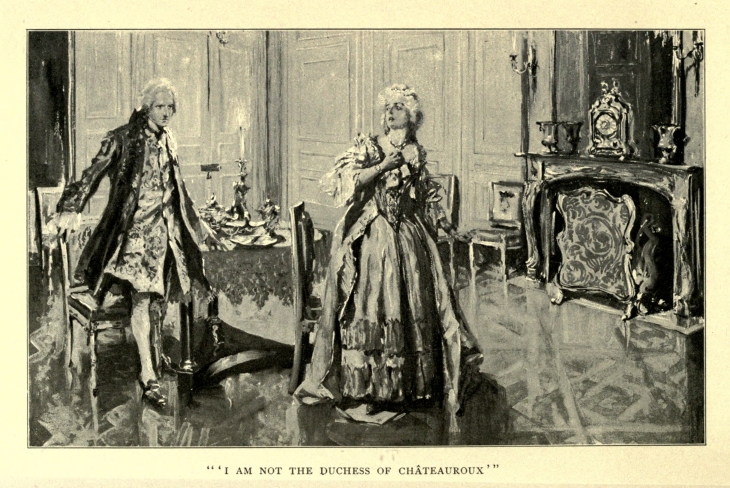
"'I AM NOT THE DUCHESS OF CHATEAUROUX'"
Louis, in a sudden access of fury, had sprung forward
and seized her by the wrists. Deborah's temper was fully
roused at last; her blood poured hotly through her veins.
Her life had become a little thing in comparison to the laws
for which she was speaking, the sense of right which seemed
to hold no part in this French order of things. Bracing
herself as she might in her high-heeled slippers, she
suddenly threw all her weight forward against the man, taking
him off his guard, and so forcing him back that he was
obliged to loosen his hold of her in order to regain
equilibrium. The instant that she was free Deborah turned
and fled to the door. She flung herself bodily against it.
It was locked from the outside.
"Good Heaven!" muttered the girl, in English.
"What is it you say, dear madame?" inquired the King,
smiling in amused triumph as she turned to him, still
grasping the handle of the door.
"You are unfair! This is unlawful! I am not to blame!"
she said, her voice quivering.
"Madame—my dear Deborah—who could be unfair with
you?" He came towards her, looking not too well pleased
that she shrank back as far as possible at his approach.
When she was close against the immovable door, and he just
before her, he stopped, looked at her for a long moment with
a peculiar, half-patronizing smile, then suddenly fell upon
his knee at her feet, and captured one of her unwilling hands.
"Deborah—my Deborah—quel drôle de nom!—let us now
forget locked doors, let us forget Majesties and riches and
favors, and let us think only that here am I, Louis, thus
before you, declaring my love. Let us make as though we
were two peasants. I swear to you that to me you are all
in all. Without you I cannot live. All the days of my
life I will work for you, will cherish you. Now tell me if
you will not accept such love?"
Deborah looked into the uplifted face of the King.
Certainly it was marvellously handsome—beautiful enough to
have turned the heads of many women. Perhaps, after
all, there was excuse for those poor creatures, the three
sisters, who had yielded to him. Perhaps, after all, pity
was their only just measure. But she—Deborah
Travis—had known handsome faces before. Indeed, she had
come near to life-long unhappiness through that which
she had known best. Suddenly, as in a picture, she beheld
there, beside the King, the head of Charles Fairfield. Yes,
Louis was the finer-featured of the two. Nevertheless, all
temptation was gone.
"Monsieur le Roi," she said, clearly, and with a kind of
cynicism even through her nervousness, "you are too late.
I have been courted before, and I've plighted my troth and
given my heart into some one's keeping. You are too late."
"Diable! Dix milles diables!" cried his Majesty,
scrambling awkwardly to his feet and backing away from her.
"Do you know who I am?—what I can do, madame? Do
you know that, with one word, I can exile you? Bah!
Who—who—is the man you prefer to me?"
"My husband," was the demure reply.
"Oh! It is an insult! Already your husband has his
commands. He leaves Versailles to-night, forever. Do
not be afraid."
"Leaves to-night!" A dark flush spread over Deborah's
face. "Leaves to-night! Mon Dieu! When—where—how?
Oh, I will go now! You shall let me go to him, do
you hear? At once! Why, I shall be left here alone!
I—I—shall be like Mme. de Coigny. Your Majesty—"
suddenly she grew calm, and her voice gently
sweet—"Your Majesty, let me go."
"As you have seen, the door is locked."
"Open it, then, or—there is another!" she pointed across
the room to the door in the opposite wall which led into the
royal suite.
The King moved about quickly, placing himself in front
of it. The act was sufficient. It showed Deborah that she
had neither pity nor mercy to hope for, nothing but her own
determination on which to depend. And, as the knowledge
of helplessness became more certain, so did her will become
stronger, her brain more alert. She looked about the room.
Was there a weapon of defence or of attack anywhere
within reach? On the supper-table were knives and forks of
gold—dull, useless things. On one side of the room was a
great clock; on the mantel stood another. There were
also stiff chairs, tabourets, an escritoire, and the
table—these were all. What to do? She must get home, get to
Claude, as rapidly as possible. Would he be there? Would
he have trusted and waited for her? If not—what? She
would not think of that now. She must first escape through
that unlocked door guarded by the King. How to do it?
Strategy, perhaps.
"Well, madame, have you decided?" inquired the King,
coolly.
Deborah gave a slight, pretty smile. "I have only decided
that I should like to finish Mouthier's comfits. We
have not even touched the cream," she said, coquettishly.
Louis laughed. "Ah! That is well, that! Let us sit
down."
Pardonable vanity, considering his experiences
heretofore, had thrown him easily off his guard. So the two
seated themselves again at the little table, Deborah, for an
added bit of flattery, as he thought, taking the chair which
he had used before, and which was nearest the door of
escape. The King helped her bountifully to the smooth
cream, which she began upon with apparent avidity.
"Louis," she said, suddenly, looking at him with a
significant smile and eyes half closed, "pick up for me the
paper that I dropped upon the floor. I—have not finished
reading it."
The King was enchanted. She was surrendering at
last. If she chose to make it easier for her vanity by
treating him like a servant—why, he was willing. He rose at
once and went back to the spot where Maurepas' document
had fallen and been spurned by Deborah's heel. He
stooped to pick it up. There was a crisp rustle of stiff,
silk petticoats. He looked up just in time to behold his
prize fling open the north door and hurry through it into
the room beyond. This was the King's bedroom, and in it,
at this hour, were only Bachelier, Levet, and two
under-footmen. These four, in open-mouthed amazement,
beheld the flying figure of a lady burst in from the Salle des
Pendules, run across the royal room, and escape into the
council-chamber, just as the King, purple with anger,
shouted from the doorway: "Beasts! Fools! Idiots!
Could you not hold her?"
Bachelier started up. "Shall I follow, your Majesty?"
"No, imbecile! Should the King's valet be seen
chasing a woman through the corridors of Versailles at
midnight? Ah! It is abominable!"
Thereupon his gracious Majesty threw himself into an
arm-chair with an expression on his royal countenance
which plainly told his valet that it would be many days ere
an unnecessary word again passed the master's lips.
Once more, as a year ago, Henri de Mailly-Nesle sat in
Claude's bedroom, on the eve of that young man's
departure from Versailles. But the situation was
different enough this time. Now it was Henri who, with a
strong effort, sat trying to calm the feverish excitement
and anxiety of the other. Upon the floor an open coffer
stood ready; but nothing had yet been put into it. Claude
would not admit a servant to the room. He was pacing
rapidly up and down, up and down the apartment, talking
sometimes wildly to Henri, sometimes silent, sometimesfx
muttering incoherently to himself. His dress was
disordered, his wig awry; one slipper and his sword had been
tossed together into a corner. He was for the time bereft
of reason. It was now half an hour since the return from
the palace. D'Argenson's letter had been found awaiting
them, but Claude had not read it. What need was there to
do so?
"Henri, two hundred thousand is too much for the
estate. The château is impossible—you are giving me
money. I'll not have it—"
"Chut, child! Do you think—"
"Ah! She has not come—she does not come—she
does not come! I shall go mad. I shall shoot myself if
she does not return! Mon Dieu!—Mon Dieu!"
"Claude, be calm. There is time. She could not yet
have got away. Be calm. She will come, of course."
Henri spoke soothingly, but, as the minutes passed, and
still Deborah delayed, his heart sank. What to do with
his cousin? Claude would, in a little time, be actually
unbalanced, he feared.
"Henri, the château might be repaired. I should like
to live in it again. I should like to be buried there. Ah,
if she is not here in ten minutes, I shall use my pistol.
Then I will be buried there, in the vault, beside Alexandre.
Poor Alexandre! You remember—he never knew her.
He knew what it meant to lose his—Deborah!—Deborah!—Deborah!
Mon Dieu, Henri, I have been brutal to her.
She will not come back. The time is come—the time is
come—I will put an end to myself!"
Claude made a quick dash for the table, on which, amid
a pile of varied articles, were his duelling pistols. He
picked one of them up. Henri sprang from his place and
seized his cousin round the shoulders.
"Idiot!—Put it down!—Stop!"
Claude was struggling to free himself from the grasp.
The strength of a madman seemed to be in his arms.
Henri felt his hold weakening. He was being repulsed.
"Armand!" shouted the Marquis hoarsely. "Armand!
A moi! Au secours! Monsieur le Comte—"
"Mordi! you shall not!" growled Claude, furiously.
"I tell you she is not coming! I will kill myself! Let
me—let me go!"
With a mighty wrench Claude pulled himself free,
overbalancing his cousin, who fell heavily to the floor. Claude
had the pistol in his hand. The valet had not appeared.
For just the shade of an instant de Mailly hesitated.
"Claude!" came a tremulous, quivering voice from the
doorway.
The weapon clattered to the floor. Claude held out both
arms, and Deborah, dazed, weary, utterly happy, went into
them and was clasped close to his heart.
"Claude—we must go away," she whispered, her lips
close to his ear.
"We will go,"
"Where—where—Claude?"
"I have no longer a country, my wife. But I know
that which is there for us over the sea—that wherein I
found you first."
Deborah gave a little sob of relief; and, as her lips met
those of her husband, Henri de Mailly, who had kept him
for her, sharply turned away.
And thus at last we come down to the sea—black,
murmurous waste—rolling vastly under the
evening sky, and against the far golden horizon.
In this swift approaching night all that
has been, all the base dishonesty, the foulness,
the little-visible much-felt, shall be washed away, for
it is the world that was. When the dripping sun flashes
up again out of the east, 'twill be to send a shower of golden
beams down the wind that is bearing a white-winged bark
westward over the blue expanse. What two souls this
vessel bears, whence—from what darkness of the Old—whither—to
what brightness of the New—need scarce be told.
The trial of their faith and love is over. Obedient to the
victory call, out of the depths that have so long surrounded
them, the future, star-crowned, rises up at last.
THE END