The Archipelago.
As the eagle stirs up her nest upon the
crags and forces her young over the confines
of the inadequate abode, it is then that they
spread their wings and soar away to freedom
and independence. So is it with the great
river of rivers, the St. Lawrence. Born among
the Northwest Lakes, and sheltered there for
a time, resenting intrusion, it steals away unnoticed
from the watershed expanse. Threading
its course through the marshes and lowlands,
it gathers momentum as it speeds onward,
till, the volume growing too great for
its confining banks, its waters rebel, and
breaking from control, spread forth into the
boisterous storm-tossed Erie. Here they are
disrupted and buffeted about, driven by the
winds and carried onward by a terrible undertow.
Now drawn through a narrow,
deep channel, swiftly they pass the cities on
the shore. Too quickly they are speeding
to heed or be disturbed longer by the warring
of the elements. Down to the very brink of
the awful precipice ahead they charge with
ever-increasing speed, then over the Niagara,
pouring far beneath into the seething,
boiling caldrons.
After surging still onward through jagged,
walled raceways, then emerging into a lake of
whirling eddies, till finally fought out to exhaustion,
the once rampant waters of the tumultuous
Erie flow peacefully into the haven
of the Lake of Ontario. Here at rest, landlocked
by the grape-bearing vineyards of the
Niagara and the peach groves of the Canadian
Paradise of the West, the St. Lawrence is again
reinforced, and again its voyage onward to the
sea is begun, this time marked by the dignity
of a well-organized body. The blue
waters, through their separate channels, glide
majestically down their course, passing the
islands in their midst with a happy smile and
ripples of sunlight laughter. Touching at the
wharfs of the numerous cottagers and lapping
the white shining sides of the pleasure craft
among the Thousand Islands, onward heedlessly
flows the beautiful river increasing in
strength.
Once more before reaching the haven of
the Archipelago, the water channels of the
great river are bidden to struggle with one another,
to fight for supremacy and swiftness,
and demonstrate to the other creatures of nature
the mighty forces hidden at other times
beneath the tranquil surface of her smiling
face. The rapids of the Sioux are now left
behind and we come to that part of the majestic
river included in these sketches, which
territorial lines have placed within the borders
of our friendly Canadian ally, the Lake St.
Francis. Beginning immediately after the subsiding
of the waters from their turbulent passage
through the rapids of the Sioux, the
river spreads out till its confining banks are
in places ten miles apart. There in this wide
expanse stretching across toward the blue irregular
mountain line of the Adirondacks, far
to the southward, then eastward till the vision
meets the water line, lie the islands
grouped for beauty by nature’s gardener,
called by the writer the Arcadian Archipelago.
The very atmosphere of this enchanted region
compels the thoughts of peace and freedom.
A restful idleness pervades the life of
its people; and while they fish and row about
through the islands of the group, picnicking
with their friends of the Cameron or McDonald
Clan from the “Gore,” little do they care
for the tending of the farm, the harvesting of
the crops, or the speeding of time. The only
“walking delegate” whose ruling they recognize,
is the rising or setting sun. Upon the
interval of time, for them there are no restrictions.
Free from the cares of business, ignorant of
the affairs of political intriguing, and shielded
by happiness from all social strife, these primitive
inhabitants of the Archipelago live on as
does the flowering plant-life of the district.
They bask in the sun of the Spring and Summer
seasons, only to hide away again for
months from the Winter’s snows and the icy
winds of December and March. As life among
the people of Glengarry and the settlers at
the “Front” over on the mainland, goes happily
on, unchanged by the passing social fads
of the century, so also upon the St. Francis
Islands nature still retains her original tenants
and social customs. The Indians from
the tribe of St. Regis at the reservation on
the mainland guard with a jealous care their
coveted hunting grounds from possession by
the white men; and neither thus far has the
woodsman’s axe nor the painted cottage of
the “first settler” succeeded in gaining an entree
into the sacred confines of the St. Francis
Archipelago.
Along the Front.
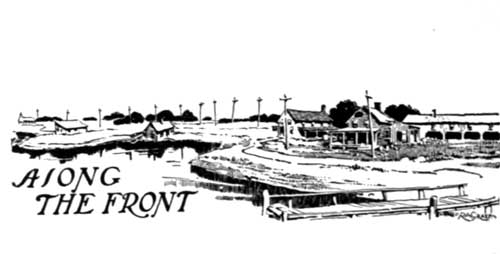
Along The Front the north bank of the river
skirting the Arcadian Archipelago is high and
terraced up from the water’s edge to the roadway,
which follows the indentations of the
shore line westward to the county seat of Glengarry.
Over this road the country folk from the
interior townships make their weekly pilgrimages
to market the products of their farms.
Facing this road also, and looking out upon
the broad river, dotted with wooded islands,
are the farm-houses, the small church, and
the dilapidated remains of what was once a
prosperous boat landing called The Front. In
the palmy days of river freighting this little
weather-beaten hamlet had some excuse for
a hope of life, but now that river navigation
all over the world has been paralleled with the
modern steel-winged carriers, time and neglect
have stamped their impress upon the deserted
buildings and docks, which at one time
in the long ago had shown fair signs of a
prolonged life.
From Castle Island, as we look across the
boat channel and over the intervening strips
of rush banks to the mainland, the remains of
the business part of The Front present a
deserted and uninviting appearance.
First we see the dilapidated dock; then a
disheveled freight building; near by in a small
bay, is a broken-down boat house, sadly
twisted by the “ice shoves” in the Spring of
the year. Next we can see the old brown,
weather-discolored tavern with an extension
reaching out toward the east. A dance hall
it was, and below, the beaux of old Glengarry
stabled their horses, while they danced
overhead to the music of the bagpipes until
dawn of day. Sad, as he views the scene,
must be the thoughts of one of these gallants
returning to his native home. In the palmy
days of The Front he had proudly escorted
the farmer’s comely lassie through the corridors
of the tavern and up the broad stairs
to the dance hall, pleased with his choice of a
partner and happy in the simplicity of his
surroundings. To-day, the name on the
sign-board over the entrance is no longer
readable. The plank steps, once strong
and unbending, have rotted away at the
ends and the centre, until now, for the use
of the laborer’s family who occupy the
old shell as their living apartments, broken
pieces of plank for steps are held up by stones
placed one upon the other. The dance hall in
the extension presents the sorriest appearance
to the visitor approaching from the water’s
side. A woodyard with jagged, uncut logs and
little heaps of chips picked up here and there
from the chopper’s axe, fills the yard and what
was once the stabling-shed for the chafing
steeds of the Glengarry lads. The gable end
of the hall is all awry; the archways beneath
and the supporting posts have leaned over,
tired as it were, of the long, weary wait against
the time when they will be no longer asked to
support their useless burden. Doves, unmolested,
fly in and out through the broken
panes of the windows, and strut and coo along
the weather-checked vane of the roof. Where
once the droning of the bagpipes re-echoed
through the full length of the building, it is
now the buzzing of the bumble-bee and the
tenor singing wasps that we hear as they
swarm around their hive-nests suspended from
the rafters. Gone forever from the old tavern
are the good times of yore, and like the
business prosperity at the landing, they have
followed the noisy rivermen down the stream
to return again no more to The Front.
To describe the surviving enterprises at
The Front—there are, first, the government
post-office; then the buckboard stage line plying
between The Front and the station to the
railway two miles inland; and, lastly, the boat
builder’s plant in the bay. It would seem
that the traveling public were charitably inclined
toward the ancient buckskin mare and
the driver of the mail coach, for daily the
old nag is hitched to the buckboard; the canvas
mail-sack is rolled up and tucked into
the pocket of the driver’s linen-dusterlike
coat, and without ever a passenger to tax
the strength of the old mare or the
comfort of the driver, they jog along together
to the station, then back. The return
pouch is extracted from the folds of the accommodating
coat, handed over to the official
postmaster, and the business event of the day
at The Front is closed.
Down by the water’s edge, with one corner
of its base, as if from a misstep, dipping down
into the stream, is the plant of the boat
builder. Across at Castle Island each season
his couple of boats, the result of his Winter’s
employment, are disposed of; then after re-calking
the two which he had sold the previous
season, and had re-purchased at secondhand
prices, he awaits through the long Summer
days, the arrival of trade.
Each day as I looked across at The Front,
my field glasses refused to change the sameness
of the scene or setting by even discovering
a venturesome pedestrian sauntering
down the dusty road, or a child running an
errand for an industrious housewife to the
post-office or general store. Curiosity had
about decided me to make a visit of investigation,
but before an opportunity to act came,
I was told a caller wished to see me.
“I am from The Front, aye, sir, just yonder
acrost, and three farms up from the post-office
is where I live. Jimmie MacPherson—James
T. MacPherson is my right name, but
they call me Jimmie around here. Of course,
I mean,” he added apologetically, “they do
over at the cheese factory and the wheelwright
shop. You city folks here on the island, from
New York, don’t know me, so I’m telling
you my full name, but you can call me Jimmie,
too, if you like that better.”
“All right, Jimmie,” said I, “that sounds
more like getting on together. Have a seat
here on the veranda, or we will go down on the
dock, just as you say.” I thought the presence
of ladies near by might interfere with the
free discussion of the subject about which
Jimmie had thought it necessary to call.
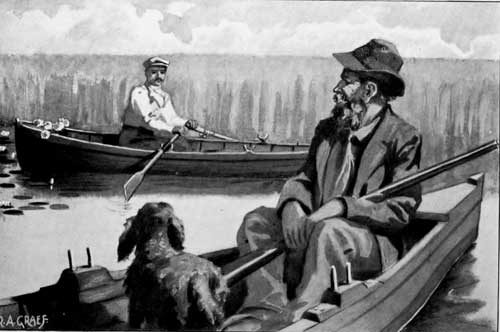
“I had run across Jimmie, one day, while prospecting
for water lilies.”
“On the veranda,” replied Jimmie, and a
mischievous twinkle was in his eyes, as he
shaded them from the glare of the morning
sun with the rough fingers of his right hand.
“You will see by my complexion,” he continued
in a humorous strain, “that I am not
used to being out in the sun. The field corn
grows so fast along The Front that we are
constantly in the shade while out promenading.”
Then he turned his shining countenance
on me to confirm what he had said. An
honest face it was, covered with an unkempt,
fiery red beard. His skin was burned and
blistered in spots extending from the shade
mark on the forehead made by his greasy felt
hat till lost in perspective in the dense undergrowth
of the lower chin and neck.
I had run across Jimmie one day while prospecting
for water lilies, at the mouth of a
small creek which emptied its waters by a circuitous
route into one of the channels of the
large river, to be found over in the region of
Hoag Island and the Dead Channel. Jimmie
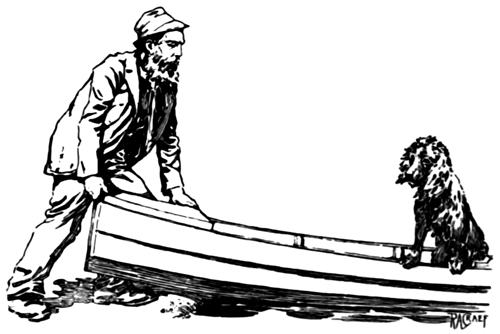
on that morning was cocked up in the stern
seat of his flat-bottomed punt. Two wooden
pins acting as oar locks, stuck into the sides of
the boat and recently whittled to a whiteness
of the wood, were the only relief in color to
that of the boat and crew. Jimmie was the
captain and the crew consisted of the spaniel
dog, whose brown coat corresponded so
closely to the coloring of the metal and stock
of the beautiful modern shot gun, and the entire
costume of Jimmie and his river craft,
that as he lay alongside of a reed-bank filled
with dried cat-tail I had nearly run him down
before making the discovery.
“Good morning, stranger,” said Jimmie, in
a calm, well-inflected voice. A smile seemed
to be playing all about his face. Bristling in
the sun was his red kinky beard, shining
his face as though rubbed to a polish, the
shabby felt hat reaching out modestly to the
line in the middle of his forehead. He was
perched on the seat, crowded back into the
stern of the boat, and the water spaniel, proud
and important, moved with ease between the
rowing seat and the perch upon which his master
sat making observations. Looking more
closely at my discovery before making any reply
to his salutation, I saw on his feet a pair of
“contract-made” shoes, rivets and buckles
prominently in sight, which had from long
usage taken on a shape resembling an elephant’s
foot in miniature, all instep and few
toes; a pair of blue jeans, a negligee shirt, a
leather strap making upward and diagonally
across the chest for a wire nail on the band of
the trousers at the back, and a four-in-hand tie
of undefinable pattern, the quilting of which
had suffered a sad displacement and was clinging
in shreds to the original band encircling his
neck, which had been tenderly preserved by
the spinach-fringe of unfading brightness.
“Hello,” said I, in return of salute. “Shooting
out of season?”
At that instant I was not conscious of the
significance of my remark, which had popped
out spontaneously with my first sight of Jimmie
and his crew.
“No,” he replied. “I heard up along The
Front that there were some good dory holes
in this channel, so I thought I would come up
in here and see if I could find the fish weeds.
Then I would know for myself.”
“Oh, I see!” said I. “Good scheme, isn’t
it?” Then we each laughed a little and seemed
to understand each other better after that.
My boat had drifted up alongside, and curiosity
led me to ask permission to examine
the modern gun of beautiful finish and workmanship,
a striking contrast to the attire, at
least, of the owner.
“A good gun, stranger,” remarked Jimmie.
“Yes, and an expensive one, I should think,
any way. What use have you for such a gun?”
I said, as I returned it to him.
“Well, you see,” began Jimmie, “a gun is
like some other things. When you need one,
you need it pretty bad, and then you can’t
have too good a one, and that’s why I have
one like this.” For an instant I imagined I
was out in the Pan Handle country of Texas
and that the advice of my friend would be
good to follow. But, no! Here I was in a
boat in Arcadia on the peaceful Lake St.
Francis. Then looking again quickly toward
the boat and crew at my left, I was met by a
broad grin from its occupant.
“Jimmie,” I said, “you’re the sort I always
want to know. Come over to Castle Island to-morrow
and we will ‘talk it over.’”
Since meeting Jimmie down in the rush
banks, I had heard more about him from the
guides on the Island, and I knew his call this
morning would prove both interesting and
entertaining.
Jimmie, they told me, had at one time directed
the political affairs of the County Glengarry.
That is, he had been employed as
secretary by the representative in Parliament
from his district. This gentleman could neither
read nor write nor compose a speech to be
delivered before his constituents. With him
Jimmie spent several months at the Canadian
Capital, where in his capacity as secretary, he
had been writing speeches for his chief which
were supposed to be delivered before the representatives
in Parliament, but which instead,
his wily employer had directed should be sent
home for publication in the county newspaper
for the edification of the voters who
had made him their representative. Jimmie
had schooled his charge “The Member”
in the civilities and court etiquette necessary
to be employed toward his brother “members.”
He had also trained him, the while exercising
great tact and patience, how to make
use of the most approved mannerisms and figures
of speech while addressing the speaker of
the house. The extent of the oratorical effort,
Jimmie insisted with his pupil, must not exceed
the few phrases necessary for the seconding
of a motion put by a colleague, or a perfunctory
motion to adjourn.
Then with the “spread-eagle” speeches he
had prepared for the press agents of the counties
which he and his employer were representing,
affairs at the Capital, Jimmie had congratulated
himself, were going on swimmingly.
One night, however, as the Quixotic member
came to Jimmie’s room for final directions
as to his movements in Parliament for
the next day’s session, he found his instructor
boisterously delivering before an imaginary
audience, one of his pet political
speeches. Paying no attention to his caller,
Jimmie proceeded with the speech—the needed
appropriations which he demanded from
the government to benefit the industries situated
in the great manufacturing town, The
Front, which he had the honor to represent,
and the extensive dredging operations which
were necessary to widen the channel to accommodate
the lake and river craft, constantly
increasing their volume of business, which
could be proven by the congested condition of
the docks, to be seen any day in the boating
season at The Front, etc.
Poor Jimmie! The strain on his mental
faculties had been too great. “Crazy,” the
doctors were cruel enough to say. So they
took him back to The Front, gentle of manner,
but the enlarged idea he had created in
his brain of the condition of the business affairs
at The Front never parted company with
him.
“I have come over this morning,” began
Jimmie, after we had seated ourselves by
the woodbine, “to extend to you a welcome
and the courtesies of the people of The
Front. I have been instructed by the members
of the Board of Trade to offer you and
your friends the free use of the docks of the
port opposite here. The use of the Assembly
Hall attached to the Hustings has been
unanimously granted by the members of the
Town Council, and also arrangements have
been consummated whereby passes can be secured
to visit the extensive boat-building plant
situated directly opposite on the mainland. I
am also authorized to say that between the
hours of ten and twelve, morning, the cheese
manufacturing industry, during week days,
and the church at Glen Water, Sundays, will
be open to visitors from the Island. Now, my
friend,” continued Jimmie, rising and placing
his hand upon the back of the chair for good
oratorical effect, “come over to The Front.
You are welcome, we are not too busy a people
to miss seeing you when you do come. In
fact, I can assure you that you will feel well
repaid for the effort. Why, stop and think,
my dear sir,” he went on, his eyes snapping
with excitement and his features twitching
with nervousness, “progress and prosperity
are within our grasp. The grandest water-way
of the whole world passes our very door.
Manufactories are already at work in our
midst, and the eye of Capital is upon us.
Great, I say, yes, wonderful are the inducements
we offer for visitors coming among us.
Again I say, come over to The Front. You
will not find yourself alone. Leading capitalists
from all over the world have been to
see us. The truth is you can’t tell whom you
may meet while you are over there.”
“Thank you, Jimmie, thank you. Good
morning,” I said. “You can expect me.”
Then bowing and hesitating as though he had
received an unexpected check from the
Speaker of the House of Parliament, he
seemed to wish to say more, but with a rare
courtesy of manner, he bowed himself out
of my presence, then joining his brown spaniel
dog, who awaited his master on the shore,
they got into their boat and rowed back to
The Front.
CHAPTER I.
The Camerons at the Front.
On a rise of ground at “The Front” called
the “Nole” stands the Cariboo House, conspicuously
alone.
There, fronting the river channel which
separates Castle Island from the mainland, its
tinned mansard roof and the golden ball on the
summit of the flag-staff blazing in the morning’s
sun, the marble castle of the Archipelago
shares with the mighty St. Lawrence, the
admiration of the tourists.
Then as the guests at the Island gather
upon the quay at sunset, the tall marble columns
and overhanging gables of the House
of Cariboo, frown down upon the waters of
the placid river, casting shadows of ugly proportions
that reach across to the very pier
upon which the spectators are standing, and as
they linger, fascinated by the glories of nature,
they look again, and behold! outlined
against the gold and copper edged clouds
strewn over the horizon, they see projecting
itself heavenward, the green-latticed observatory,
and from its vane reaching up into the
clouds is the gilded sphere on the flag-pole
still blazing from the setting sun, while all
else on earth below has grown dark and silent.
Years have passed since the older inhabitants
of Glengarry paused and looked in bewilderment
as they traveled the roadway on
The Front past the House of Cariboo. Even
now, after listening to the preceding generation
tell and retell stories of Aladdin interest
of the House of Cariboo, the children of the
countryside pass hurriedly on their way to
the district school, never once turning to gaze
at the mansion, brought as if from fairyland
and put down in the midst of their unpretentious
rural surroundings, till at a safe distance,
when they loiter and, looking backward,
unconsciously relieve their disturbed little
minds by breaking off the heads of the bobbing
daisies, till urged further along on their
way by the passing of time.
There are in Glengarry County, as you
might reasonably suppose, many families
whose direct ancestors, if you cared to trace
them, would lead you at once to the lochs,
lowlands or mountain passes of the Scottish
Isle. The Clans of the McDonalds, the Camerons
and the MacPhersons, have each sent a
goodly representation to sustain in the new
land of the Canadas the glory of their families
in the Scottish hills of their fathers.
There were in the beginning, at The Front
in Glengarry, one Andy Cameron, and his
two brothers, called “Andy’s Dan,” and
“Laughing Donald Cameron.” Many another
family of Camerons lived in Glengarry,
but there was no mistaking these three brothers.
Dan, who made his home with Andy
Cameron and his wife, never left the premises
of the little farm on the “Nole” unless Andy
and his wife went along too, and this becoming
the understood thing among the neighbors
at The Front and the storekeepers at the
county town of Glengarry, Dan Cameron
came to be known as Andy’s Dan. The distinction
was understood, his pedigree was recorded
in the minds of the people of the
neighborhood, and he was forever out of danger
of being confused with the other Dan
Camerons of his neighborhood. Simple Dan,
kind-hearted Dan, and most of all Andy’s
Dan.
Laughing Donald had taken up a small
farm from the government when he and his
timid, frail wife first came to Glengarry, and
poor Donald never seemed to be any more
successful in getting clear from the taxes levied
each year upon him than he was in clearing
the few acres he possessed of the tree
stumps, that were the bane of his life during
seed-time and harvesting.
A few years of land holding by Laughing
Donald in Glengarry had been an added expense
to Andy, who loaned from his own little
store of savings each year to keep his brother
from the long-reaching clutch of the county
tax gatherer; but always laughingly indifferent
when he knew his crop yield was miserably
poor, Donald became known to the country
people, and at the village where he and
his sickly wife went to trade their dried apples
and carpet-rags for groceries, as Laughing
Donald Cameron. He laughed if he was
greeted kindly, and he also laughed with the
same apparent degree of happiness if a hard-hearted
merchant told him his produce was
not worth the buying. So Laughing Donald
filled a niche, whose personality was all
his own, and neither was he ever confounded
with others of his name in the County Glengarry.
Tilling the ground on his small farm on
The Front seemed very hard work to Donald
Cameron. His gentle wife, since their coming
to the new land of the Canadas, had pined
for the associations of her Scottish hills; her
health had failed with the broken spirit till
she was now pronounced an invalid. For
her, the delicacies of life could not be provided,
and sickness and misfortune speedily
came to their humble home. Soon two of the
children of Laughing Donald were buried in
the churchyard at The Front and the illness
of his wife continued.
Andy Cameron had noted with increasing
solicitude the inroads being made by sickness
and death into the home of his brother.
Unpaid bills were accumulating and the hand
of misfortune was close upon the head of the
luckless Donald. Andy had seen his lawyer
friend up at the county village, then consulting
his wife Barbara, a mortgage was first
made on his own farm at the “Nole,” and
Donald’s obligations were paid in full. But
then the doctor’s bill came next to Donald,
for weeks and months of medical attendance
upon his invalid wife, and, still laughing in
his childish way, he brought it, as if amused
at the impossible amount, and handed it to
Andy.
“Go back home, Donald,” was Andy’s reply.
“Take good care of your poor wife. The
doctor must be paid.” And then Andy made
another trip up to the village. At the lawyer’s
he arranged for the money and then for
the mortgage which was this time to be placed
upon Donald’s little farm.
That night, as Andy journeyed homeward
from the town, he recalled how he and his wife
and Dan, his simple-minded brother, had
struggled to clear their little farm of debt;
how they had stumped the land and builded
barns and stables, and fenced in the meadows
for their cattle; how happy they had
been when they had paid off the last of the
tax debt; and how proudly he walked up the
church aisle upon a Sunday, and sat in the
end of the pew at the head of his little family
and afterwards greeted his neighbors around
the church door, as they stood gossiping after
service. But now to think what he had been
compelled to do. Donald was his brother,
though, and was not poor Donald in trouble?
And his invalid wife—Andy well knew that if
a few of the luxuries of life and the tender
care which her timid, shrinking nature cried
out for, could only be given to her in ever
so slight a degree, she would no longer be a
suffering invalid.
“Two years,” Andy remarked to himself,
“was the time set before the lawyer could foreclose
on his own homestead, and the same
time was set for his brother, Laughing Donald.”
Andy recalled as he rode slowly homeward,
that the storekeeper hesitated as he gave
him the pound of tea to be charged as before,
and when he had asked for a dollar’s worth
of brown sugar, he had only been given half
that amount. It was to be charged also.
“Who were they that dared to think a Cameron
would not pay a just bill! Was not he
a Cameron, the eldest of his brothers, and
from the proudest clan of all the Highland
Tartans?”
Andy felt as he had never felt before. The
latent pride of his forefathers was stirred within
him. Should they take the farm from his
brother Donald? Should they take his farm
and that of his wife and the home of his
simple-minded brother Dan? “No, never!” determined
Andy, “not while I live to protect
the innocent,” the cry went up from his very
soul. There was money to be had, wealth
to be gotten, for life must be preserved. To
the gold fields of California, to the mountain
passes of the Rockies, or the far British Columbias,
he would go, and before the expiration
of the mortgages he would return, and in
the eyes of his neighbors in Glengarry and
among the storekeepers of the town, the name
of Andy’s Dan, Laughing Donald or Andy
Cameron would stand good for a great deal
more than the pound of tea or the paltry dollar’s
worth of sugar they had refused him
this very night upon which he had made his
resolve.
A day or two following the last trip Andy
had made to the county town in the interest
of procuring more money, he thought it next
important that he consult his loyal but none
too assertive spouse concerning the execution
of the resolve he had settled upon, through
which he hoped to clear the good name of
Cameron in the county from the insults which
had been offered him, even so slightly, by
the storekeepers in the town.
Barbara Cameron, the faithful wife to whom
Andy went for encouragement when he found
that the burdens heaped upon him by the unfortunate
members of his family were greater
than the resources of the combined farms
could support, listened with a heart full of
sympathy while her husband unfolded the plan
by which he hoped to retrieve their waning
fortunes. Quietly, at first, he began to tell of
the circumstances which compelled him to
place a mortgage upon their own little farm
and homestead. Then, arising in his excitement,
he proceeded to relate to her the cruel
indignities heaped upon his unfortunate
brother by the avaricious tax gatherer, who
seemed to take a special delight in hunting
him to earth; and how, to satisfy his demands,
and to meet the bills of the doctors
and druggists, he had last of all been compelled
to mortgage Donald’s home. For, he
explained, as he sadly looked from the window
over in its direction, he could not remain
a passive onlooker while the cruel hand
of fate still pursued the family of the helpless
Donald, and a low fever slowly burned
out the wick of life in the feeble frame of
his gentle wife.
Finally, with a rising inflection in his voice
and a righteous indignation of manner, Andy
explained to his wife the nature of the insults
which he had had offered to him in the
town, and that he, as a Cameron, and the head
of their little colony must resent the wrongs,
and maintain the dignity and pride of his forefathers.
He would leave her for perhaps two
years, he said—he was going to the gold fields
of the Canadian Rocky Mountains. There in
the Cariboo Hills, in the Canons of the Rockies
and in the shifting river beds of the melting
glaziers, he would dig for gold. He would
hunt the shining flecks of dust, the gold colored
nuggets, seeking the wealth by which he
hoped to retrieve his darkening fortunes.
“We will sell our cows, Barbara.” His
voice was lowered almost to a whisper. “You
and Dan shall have the money. The team of
roans we must part with, too, Barbara. Laughing
Donald and his frail wife, you will be
kind to—and poor Dan, tell him always, Barbara,
that Andy is coming back soon—coming
soon.”
With confiding faith, though she did not
quite understand, Barbara felt that if her husband
said all this, it must be right for her to
believe it. Andy had brushed away with the
back of his hand the tears upon his weather-beaten
cheeks awaiting her reply. She in her
characteristic way, made only this comment:
“When will you start, Andy, think ye?”
CHAPTER III.
On the Way to the Gold Fields.
A year passed and no word came to the anxious
hearts in the home Cameron left behind
when he went to hunt for gold in the far western
wilds of the British Columbias.
Taking from the small store of money received
from the sale of the farm stock, just
enough to pay his passage to the terminus of
the railroad, still a few hundred miles distant
from the mountain ranges across which he was
to make his way, he soon found himself thrown
upon his resources face to face with the difficulties
of the undertaking. Arriving at the
mountain pass of Ashcroft from Winnipeg,
whence he and several other venturesome companions
bent upon the same mission had come
by wagon train over the prairies of Northwestern
Canada, his meagre supply of money
nearly gone, it looked as if he was about to
experience a defeat from the very first set of
difficulties which arose to beset his way in
reaching the gold fields.
At Ashcroft, the most arduous and dangerous
mountain climbing of the entire trail presents
itself. A supply of food for days must
be carried along, and pack mules and guides at
an enormous wage are an absolute necessity.
Among the party of gold seekers which included
Cameron, was a young man of apparent
culture and refinement, also from one of the
Eastern provinces. His reason for being found
as a member of such a daring and reckless band
of prospectors, may have been simply for the
love of adventure, perhaps the healing of a
broken heart, or for the committing of a youthful
indiscretion considered by his family a sufficient
reason for sending him to the undiscovered
gold fields of the far West. Thrown together
during the tedious voyage of the pack
train across the plains, a natural inclination, a
bond of sympathy, had brought this young, inexperienced
adventurer and Andy Cameron,
the tender hearted but determined emigrant
farmer, into a congenial acquaintance, and later
into forming a partnership. The personal capital
of the new concern when inventoried
showed these assets: that put up by the latter,
courage, strength, determination and honesty,
against that of his companion, money, mules,
provisions, supplies, and himself as a volunteer
prospector. With this understanding, the
somewhat remarkable partnership was formed,
and after the mules were packed, the climb
over the mountains began.
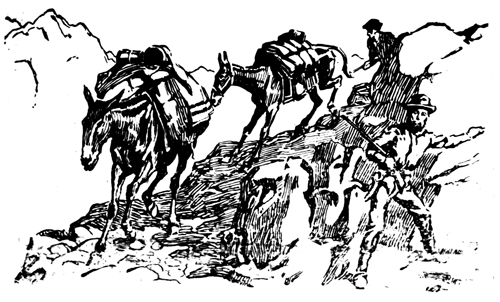
Following the leadership of the guides, the
small company made their way slowly over the
mountain trails and around the edges of the
precipices, avoiding only by careful footing a
plunge to certain death below. Sore of foot
and wearied from climbing, the two prospectors
arrived at Quesnell Forks, the first station
in the long tramp to the Cassiar district of the
Cariboo Mountains. Joining here a wagon
train, they pushed on again through the Chilcoten
country. Passing Horse Fly, a village of
a vascillating population, they then proceeded
up Soda Creek till the aid of the caravan came
abruptly to an end. Travel by that method
being no longer possible, Cameron and his
companion shouldered their rough mining kit
and taking with them what provisions they
could carry, struck off into the mountains for
a hundred miles more, down through ravines
and along Slate Creek bottoms, always heading
for the Cariboo. Buoyed up by the secret
motive which had driven each to endure such
hardships in their hunt for the golden reward
they hoped to find in quantities when they
should reach the land filled with Aladdin
riches, they struggled fearlessly onward. At
the head of Soda Creek they had labeled
their surplus supplies and stored them with a
friendly native, promising to pay for the shelter,
should they ever return that way again.
CHAPTER IV.
Into the Cariboo Mountains.
Four days distant from this camp, Cameron
and his companion unloosed their mining kit
for the first time. Nowhere had they found
any evidences that human beings had ever
before penetrated into this region. They
climbed the steep mountain sides only to
descend again through the darkest ravines.
Unaccustomed to the points of the compass,
they were obliged to watch their course by the
sun. Each with his secret burning within his
heart, they encountered bravely the difficulties
of their task. Many times on this hazardous
journey they were almost overcome by fatigue,
and often saved from instant death over the side
of some unseen precipice by only the margin
of a step. Finally, as they emerged from the
forest-clad mountains upon a slight plateau,
they reached the first slate bottoms, which gave
the well-nigh disheartened prospectors new
courage, and the first view of the uninterrupted
rays of the sun that they had encountered since
their hunt through the wilderness. Here on
this promontory, which sloped gently down
westward to what seemed to be a dried-up
water course, Andy and his companion built
their miners’ cabin. Water they had discovered
trickling down the face of a steep rock at
one side of the site they had chosen for their
home. And game they knew in the mountains
was plentiful, for at their approach the flight of
the wild fowl had shaken the overhanging
branches of the evergreens and strange-looking
animals scudded beneath the underbrush and
sprang into hiding behind the rocks and
boulders.
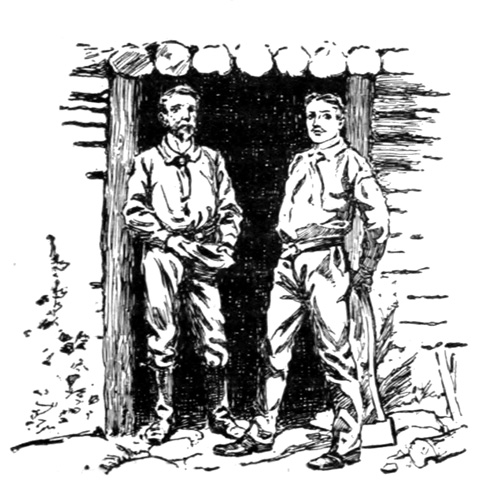
Here at the close of the day, standing before
the door of their rudely-constructed hut, the
two hopeful miners, already fast friends, silently
watched the setting of the sun. Neither
had told of the friends left at home; Andy had
kept sacred within his heart the need, the incentive,
which drove him forward facing the
desperate chances of death by starvation or
sickness, to discover the hidden treasures of
this almost impenetrable region, and his companion
was equally reticent as to his own counsels
of the past. Willing to lead in the trail
where almost certain death seemed ahead, he
had proved himself many times in their short
acquaintance a man of reckless daring. The
look each encountered in the other’s eyes upon
this eve, as they watched the sun go down behind
the opposite hills, plainly said: “My secret
is a sacred one; ask me nothing.”
On the morrow they were to begin their task
of digging for the yellow nuggets, in the search
for which thousands of others had gone into the
same ranges, many to join the bandit gangs of
roving miners, never again to return to their
loved ones, others to sicken and die with the
malignant fevers of camp life, and a few—a
very few—to realize their dreams, and return
again to their homes, bearing with them the
shining golden nuggets, at the sight of which
a new army of inspired prospectors would soon
be started upon its way to repeat the same acts
in the great drama entitled “The Hunt for
Gold.”
And here we leave for the present, Andy and
his youthful partner to dig for the elusive golden
specks which had drawn them onward with
a terrible fascination for thousands of miles.
They are now securely hidden away in the
mountain fastnesses where never a human
voice nor the tread of man had yet fallen.
CHAPTER V.
At the Four Corners.
In the Arcadian neighborhood of our story,
as is true of all rural sections, there are at the
four corners of the road the indispensable
blacksmith’s shop, the general store, the
wheelwright’s place and the creamery or the
cheese factory. As places of business they always
flourish, not because of the enterprise or
business tact of the proprietors, but because,
for the most part, of the natural demand
created by the wear and tear of implements
used in pursuit of the absolute necessities for
the maintenance of life by the populace of the
district.
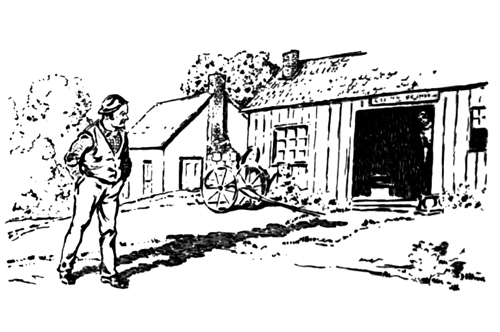
First, at the four corners of the road at The
Front, and a short distance from the Cameron
farms, is Davy Simpson’s blacksmith shop.
Adjoining this is the wheelwright’s place. The
front of this building when new had been partly
painted a dull red color, and then left, as
though the workman had become disgusted
with the color effect, and had abandoned the
task as an artist might a shapeless daub on a
half-finished canvas. The general store, with
its lean-to porch, up to which the farmers’
wagons drive and unload their produce to exchange
for merchandise, occupies at the four
corners a conspicuous frontage on the main
road.
Another industry of even greater moment to
the community at The Front is the cheese factory,
which stands just past the corners and
fronting the road, jagged up on the side of a
steep embankment, and resting unsteadily upon
crazy-looking standards. At the foot of the
incline, winding in its very uncertain course, is
a small stream. Into this the whey, escaping
from the cheese vats, filters down the abutment
spiles, reeking in the Summer sun, to be gathered
finally into the stream, whose waters push
quietly along beneath the overhanging weeds,
then crossing the roadway extending along its
course, passes in the rear of the farms of the
adjoining township, The Gore.
Unpretentious and surely uninviting is the
cheese factory at The Front, but in local history,
in the stories of the feuds waged between
the clans of the farmers at The Front and those
at The Gore, it plays a vitally important part,
for through the lands of the latter flow the
waters of the whey-tainted creek, endangering
the products of their dairies by polluting the
source of the cattle’s water supply.
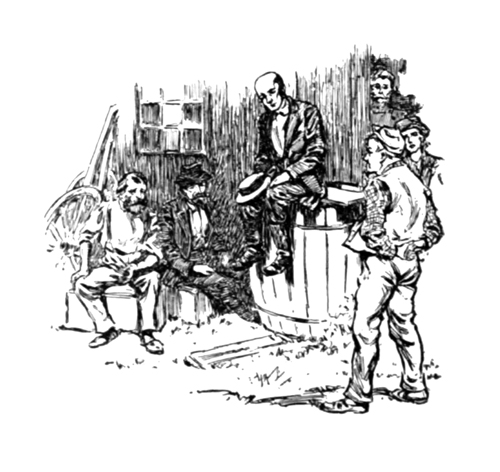
At the close of each Summer’s day, regularly
assembled in front of the door to Davy
Simpson’s blacksmith shop, the official gossips
of the neighborhood.
Easy is the task to picture in one’s mind this
group of characters. Seated around the doorway
of the smithy, and perched upon the cinder
heap, an accumulation of years from
Davy’s forge, they discussed the affairs of their
neighborhood. There in his accustomed place
was William Fraser, the country carpenter, a
bent-over, round-shouldered little man with a
fringe of red whiskers extending from ear to
ear and a mustache chopped off even with the
mouth as if done by a carpenter’s adze; a pair
of blue eyes peered out at you from overhanging
eyebrows, and when in motion he glided
along with a walk of meekness. A long service
among the families in Glengarry, while
building for them a new barn or stable, had
taught him that an agreeable opinion to whatever
were their politics or views would greatly
facilitate his comfort and pleasure. He listened
intently to all that was told him of the
family troubles of his employers, and with
equal interest retailed for their entertainment
the latest gossip of their neighbors. It was
because of this accomplishment that William
Fraser, the carpenter, could always be relied
upon to add a few words of interest to any
subject up for discussion at the shop.
Another familiar figure was Angus Ferguson,
he who had bought the McDonald place,
next to the cheese factory, a well-meaning and
very respectable man, whose wife insisted that
he be back at the house each night at eight
o’clock, and she never hesitated, when he failed
to obey, to go out into the middle of the road
fronting their house, and, with her arms
akimbo, call to him to “come away home.” Angus
was tall, slender and awkward. His features
were kindly and the mutton-chop cut to
his whiskers and his high, bald forehead gave
him more the look of a clergyman than of a
Glengarry farmer. Angus Ferguson was at
all times a listener only in the councils before
the blacksmith’s. If he had opinions, he never
expressed them, and when his time would arrive
to go, without a good-night wish to his
companions he slid down from the plank
placed upon the coal barrels, which was his
particular seat, and, crushing his straw hat
down upon his head, started up the road, his
long, awkward arms and legs as he retreated
through the darkness making a pantomime
figure in the gathering shadows.
Old Bill Blakely was the unique figure in
these nightly councils of the gossips. He came
originally from no one knew where; was not of
any particular descent; knew no religious creed
and respected no forms of social etiquette. His
remarks at the discussions held before the
blacksmith’s shop were always emphatic and
punctuated with copious expectorations from
tobacco, followed by a line of adjectives admitting
of no uncertain meaning. Old Bill
lived at quite a distance from the meeting place
of the gossip club and was always late in putting
in an appearance. He was never counted
upon, though, as one of the “regulars,” and
only came when he thought there might be a
chance of picking a row with some visitor happening
along from The Gore. He would walk
deliberately into the councils of the assembled
habitues at the shop, and, totally ignoring the
courtesy due from a late arrival, would proceed
to act in direct violation of the club’s established
rules. Looking down upon the group
of loungers, his blue eyes twinkling and his
tobacco-moistened lips quivering with a cynical
smile, he would steady himself by placing his
legs at a wide angle apart, the yellow-stained
goatee of his chin bobbing an accompaniment
to the twitching of his tightly-compressed
mouth.
“Well,” he would begin, “hae ye lied all
there is to tell aboot your neighbors, William
Fraser? And you, Angus,” motioning with
his head toward down the road, “had better
gang your way home, fer I’m goin’ to lick the
first red-head that comes over from The Gore;
the night.”
Then Bill would let go a string of oaths that
invariably brought the frowning face of Davy
Simpson from out of the darkness of the shop
to greet the newcomer. Dave at such times
had nothing more to say than, “Bill, that’s you,
I see,”—but all was in the way he said it. The
two men appeared to understand each other
very well, at least they did since the time Dave
ducked the incorrigible Bill head-first into the
puncheon of water by the side of the forge,
just to show, as he said, that there was no ill-feeling
between them.
Bill’s hair was as white as that of any patriarch
the county could boast; as an excuse for
a cap he wore a faded brown affair, whose
shapeless peak was as often pointed sidewise
and backward as it was straight ahead. Always
blinking with a mischievous twinkle in
his eyes, his lips moistened with the tobacco
he was so fond of chewing, and quivering as
though he were about to address a remark to
you, his hands pushed down deep into his
pockets, his square shoulders and well-rounded
body supported by a stocky pair of legs,—imagine
all this, and you will see Bill Blakely.
For many Summers the feud of the creek
existing between the men of the two towns
required the personal attention and made frequent
claims upon the fistic powers of Blakely.
All the trouble had been caused by the whey-tainted
waters of the creek, which menaced the
dairies of the men at The Gore. Chuckling
with great glee, old Bill would listen to his
neighbors repeat the story current over at The
Gore, how upon a certain dark night he
(Blakely) had pulled the plug from the whey-tank
at the cheese factory on The Front and
allowed its soured contents to course slowly
down through the stream. In the controversies
with his enemies following the perpetration
of these midnight escapades at the four
corners Bill Blakely had heretofore by his convincing
arguments successfully combatted
their charge. After one of these discussions
with him the men from The Gore returned to
their clansmen bearing to them, besides a pair
of discolored optics, the best wishes of the men
at The Front.
But of late the tables seemed to be turning.
A new condition of affairs had developed, and
the arguments which hitherto had stood Blakely
in critical times successfully failed now to
give him the same degree of satisfaction over
his foes from The Gore.
CHAPTER VI.
Donald Visits the Gossip Club.
Up to this time the absence of Andy Cameron
from The Front formed only a topic of
minor discussion before the smithy’s. It was
on one of the evenings which marked the end
of the outdoor sessions of the gossip club
when Laughing Donald presented himself
shyly at the outskirts of the group. Weeks had
elapsed since he had appeared there before.
Until of late, each night of the weary months
and years of waiting for the return of the absent
brother, he had haunted the blacksmith’s
shop, where the group of news-gatherers met
to exchange notes. At first they welcomed
him as a valuable addition to their circle.
William Fraser, the carpenter, found in him an
attentive listener to the “small talk” he gathered
from the country side. The remarks
Donald overheard upon his early visits at the
four corners concerning his family he carried
to his invalid wife, and then to Barbara and
Dan up at the Nole.
Upon this night he came slowly down the hill
along the road which partially hid the blacksmith’s
shop from view. The group around
the smithy’s door was surprised at his coming.
The timid nature of the man showed itself in
each hesitating step, while in his large, fawn-like
eyes was an appealing look, as if he were
a pet animal wishing to be taken by his master
from the tormenting pranks of a gang of
youthful bandits. In his nervous excitement
Donald always laughed—not loudly, but in
showing his perfect, white teeth, he gurgled
softly the sound which was responsible for the
distinguishing feature of his name in Glengarry,
Laughing Donald.
“Well! if here ain’t Laughing Donald,” exclaimed
Fraser, the carpenter, in an insinuating
whisper, and a hush fell upon the group. “I
wonder if he would like to know,” he continued,
in an undertone, “that Nick Perkins,
the tax collector, says all the Camerons on The
Front will be working the ‘county farm’ in six
months’ time?” At that moment a large, curly
head, crowned by the remnants of a straw hat,
was protruded through the jamb of the half-opened
door of the shop.
“Well, now, you just be the first to tell that
to Donald,” drawled out Davy, the blacksmith,
looking straight at the cringing little carpenter,
“and I’ll crimp your red whiskers with the
hot tongs of my forge.” Here was a friend to
Donald and the missing Andy, till now unannounced.
No end of gossiping by the tattler
of the neighborhood had failed to prejudice the
mind of the honest smith.
Angus Ferguson had already humped off
from his seat upon the coal puncheon, and with
his awkward strides was making rapidly toward
the scared Donald, extending his hand
in such an enthusiastic welcome that the poor
fellow nearly mistook the demonstration for
one of unfriendliness. “How de doo, Donald!
I am a-goin’ to tell you I am a-comin’ over to-morrow
to help ye draw in that grain over
yonder by the woods. It’s been there now
nigh onto two weeks in the sun.”
“Is it dry, Angus, think ye?” inquired Donald,
brightening at the show of friendship.
Then an awkward silence followed.
“Got a new horse, Donald,” blurted out
Angus.
“Aye,” returned Donald, the broad grin covering
his face.
“Want to see him?” urged Angus. Then
they both started down the road like the two
overgrown country lads that they were. This
spontaneous act of kindness by Ferguson was
prompted by his heart’s sympathy, which had
been penned up for weeks, rebelling constantly
against the insinuating remarks repeated by
the carpenter.
Fraser nursed his displeasure alone. Angus
Ferguson, the silent, had outwitted him. Davy
Simpson had exposed his deceitfulness, and in
a short time his supposed strength as a member
of the gossip club had crumbled in a humiliating
climax.
At that moment, as he was regretfully acknowledging
to himself the failure he had
made in gaining the confidence and respect of
his associates, his attention was drawn to a
familiar vehicle which had approached silently
in the gathering darkness, and now stood in
the roadway before the blacksmith’s shop.
“Good-evening, William Fraser,” began Nicholas
Perkins (for it was the polite tax gatherer,
who lived near The Gore), and Fraser
walked out with his meekest walk to the side
of the wagon. Perkins patronized the shop
over at The Gore, and like all the rest from
his town, halting before Davy’s place, kept
upon neutral ground, remaining in the middle
of the road.
“Fraser, I am told,” continued Perkins, as
he hitched himself along to the end of the
wagon seat and leaned out over the wheel, to
strike a confidential attitude, “that there is no
news from Cameron.”
“Well, that’s about true, Mr. Perkins; no
news, and they say that the mortgage time is
about up, too.” A little more encouragement,
and the carpenter’s sympathies were at once
enlisted with the newcomer.
“Well, it’s very bad, isn’t it, Fraser? They
have been left to go to the poorhouse. We
didn’t think that of Cameron over at The
Gore, but, then, the expense will fall on your
town, on The Front, of course,” said Perkins,
turning to get the full effect of his wise remark
upon Fraser.
The two deceitful maligners were unconscious
of the presence of a figure which had
come stealthily upon them in the darkness, and
standing in the shadow of the vehicle, was now
listening to the conversation.
“Well, you ought to know, Mr. Perkins,”
replied the carpenter in a patronizing tone.
“You will probably have the say in what will
have to be done,”—but before he could finish
his remark, he had leaped into the air, precipitated
upon the toe of a heavy boot.
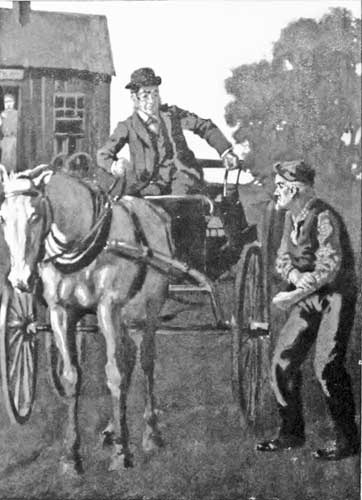
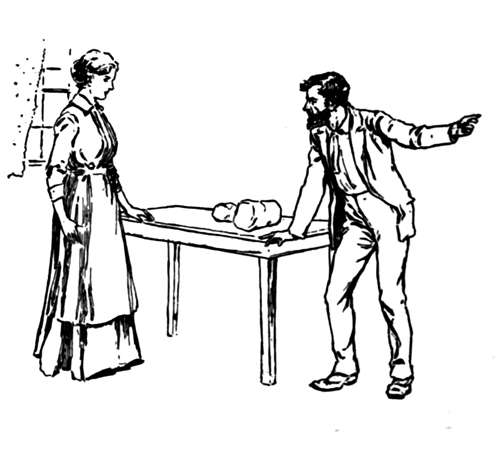
“‘Now, Nick Perkins, if you have
got anything to say to me personally, just come down here in the road
and I’ll talk to you.’”
“Oh, he will have the say about whom they
take to the county farm, will he!” and Bill
Blakely danced in a howling rage around the
wagon of his hated foe. “You hypocrite! You
prowling tax-gatherer! You hunter of the
weak and homeless!” he yelled, and half climbing
into the wagon, he shook his fist in the
face of the surprised tax collector, shouting
right into his ear, “Not while Bill Blakely lives
and Andy Cameron is away from The Front
will you ever hitch your ring-boned and spavined
outfit to a post before the home of a
Cameron on The Front! Now, Nick Perkins,
if you have got anything to say to me personally,
just come down here in the road and
I’ll talk to you.” Bill was rolling up his gingham
shirt sleeves and again dancing around
bear fashion, while the discomfiture of the astonished
Perkins was being hugely enjoyed by
the group, now enlarged by the return of Angus
Ferguson and Laughing Donald. Davy
Simpson stood in the door of his shop watching
the proceedings over the rims of his spectacles.
“Oh, you ain’t a-comin’ down, be you! Well,
I didn’t expect you,” retorted Bill. “Your kind
fight the women only. You’re sneaking
around now to see if they ain’t a-gettin’ hungry,
some on ’em over here. But we’ll fool
you, Perkins. Laughing Donald is a better
man dead than anything you can produce alive
in your hull county at The Gore. And Andy
Cameron won’t let the wind blow a whiff of ye
to the lee side of his place when he comes back,
neither. And that won’t be long from now,”
and old Bill threw his quid of tobacco after
the retreating wheels of the vehicle as Perkins
drove away amid the jeering laughter of the
group.
As soon as the tax gatherer was out of hearing
distance, Bill turned to Donald, and in a
tone serious for him, said, “Donald, I am a-speakin’
fer you. The Camerons are from
The Front. Your brother Andy is a good
man; he is a friend of mine. He will be back
soon, for that I am telling ye. William Fraser,
the carpenter, he’s been telling ye what
‘they say.’ Tell yer wife, Donald, when ye go
home, what I say, what Davy says, and what
Angus’ wife says for him to say, and don’t
you worry about the mortgage.” Then Bill
went over to the shop door, and they thought
he was going to confide something to Davy, but
he hesitated, finally bit off an enormous quid of
tobacco and sauntered slowly down the road
homeward.
Donald climbed the little hill by the shop,
going away happier than he had been in
months. Angus Ferguson still stood in the road
watching him; then, looking behind him and
catching sight of the carpenter closing the door
to the wheelwright shop, he turned his face to
the open meadow at the opposite side of the
road, and slamming his straw hat down upon
his head, struck into his rapid circular gait
down the road, past the cheese factory toward
his home.
The quietness outside seemed unusual. Davy
looked out of his shop door, scanned the cinder
heap, glanced at the puncheon seat, then
at the wagon parts: nothing was moving, nothing
was doing, all was darkness. The club
had gone. He closed the door, put the bar
across the staple, inserted the padlock, turned
the key, then climbed the hillside to the back
door of his house; his day’s labors were done.
CHAPTER VII.
In the Mining Camp.
Time has sped all too swiftly at the little
mining camp in the Cariboo Valley. There is
now only a month left of the two years set by
Andy Cameron for his return to his family,
and all indications thus far point to a tragic
ending for the ambitions and loves of the unfortunate
Glengarry farmer.
All this while the two persistent miners had
worked with an unlessened zeal at their unproductive
diggings. Each night, by turn, one
took from the sluices the ore while the other
climbed the hill overlooking the scene of their
daily toils and cooked before the cabin door the
simple evening meal. Many times since their
coming into this mountain-locked valley had
the prospectors shifted the site of their gold
diggings, but to the little cabin, which stood
at the foot of the steep rock looking down into
the gulch, they clung, held fast by many endearing
associations. Edmond LeClare,—for
that was the name of Cameron’s associate—had
made a few excursions up the valley to another
camp of prospectors, who had come into
the hills farther to the north, soon after he and
Cameron had settled upon their claim, now
safely marked from intruders by the evidence
of their active operations. With these new
friends LeClare arranged that for an exchange
in gold dust he was to obtain from them the
needed supplies of bacon and flour to replenish
from time to time the cuisine department of
their household.
Each night before the door of their cabin
the miners discussed the possibilities of their
undertaking. Perhaps it was that they builded
their hopes upon the returns from a certain
new lead they had struck in the mountain’s
side. The deposits of gold taken from the
sluices that day, if they should continue to be
found, would surely bring to them the wealth
each sought so diligently. But alas, upon exploiting
to the finish each newly discovered
vein of ore, the hopes of the unlucky miners
tumbled as did the castles builded by them with
the toy blocks of their childhood.
Not a word of complaint was uttered by
Andy in the presence of his companion. His
disappointment over the failure to obtain the
coveted wealth with which he had hoped to redeem
his home and the happiness of his wife
and family was hidden within the recesses of
his own breast, though to the watchful eyes of
the sympathetic Edmond the wretched straits
into which his friend had been thrust by the yet
unprofitable workings of their gold diggings
were as easy to read as though they had been
in print upon the pages of an open book.
While Andy toiled to live and preserve his happiness,
LeClare worked and courted hardships
and discouragements to deaden the misery
of his soul. He had hidden his secret well,
but with Andy, as the end of the time of their
compact approached, the heart-breaking lack of
success, the fading hope of his cherished
dream of wealth, the thought of having only
a bitter tale of failure to bear back to his faithful
wife, Barbara,—each one of these emotions
had stamped their relentless impress upon his
honest, bronzed face, and while not a word had
passed between the two prospectors on the subject
ever uppermost in the thoughts of each, yet
for Edmond LeClare, the unhappy plight of his
companion was now the daily inspiration which
drove him on in renewed efforts.
A few days more, thought Cameron, and he
should tell his friend all. Then they must
divide the paltry store of gold dust between
them, and sadly at their parting and with a
broken heart he would retrace his steps as best
he could to his home at The Front, and there
tell of his disappointment.
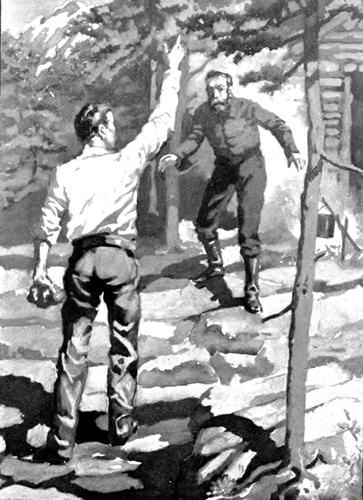
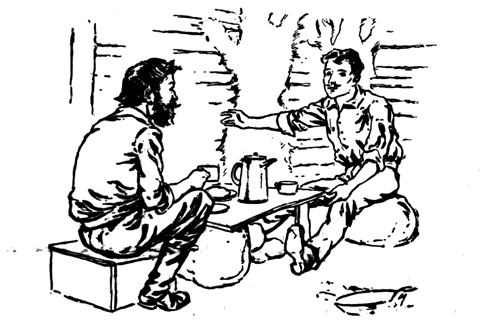
“‘Speak. Edmond!’ gasped Cameron. ‘What have you behind your
back?
It’s gold! gold!—I know it!’”
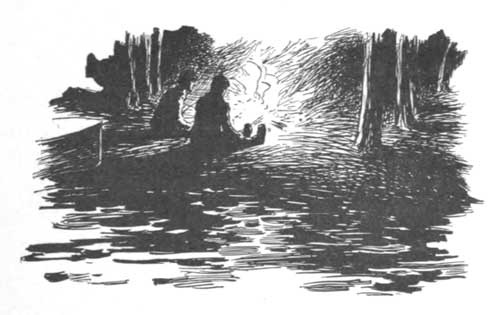
Thus Cameron argued as he sat upon the
wood block before the cabin stirring the fire,
cooking the evening meal. He had thrown
upon the coals some dry branches, and through
the gray smoke which enveloped him he saw
the figure of his companion coming toward him
up the hill. “He is early,” thought Andy, and
he looked again, stepping aside out of the
blinding smoke. Edmond had paused down
the hill a few rods from the cabin, his right
hand behind him, his head thrown back and
eyes wide open, glaring with excitement.
“Speak, Edmond!” gasped Cameron. “Speak
to me, boy. My God, speak! What have you
behind your back? It’s gold! gold!—I know
it!” Rushing together, the two companions
sobbed in each other’s arms.
“Look, Andy!” cried LeClare, through his
tears of joy. “There are two of them,” and
he held up nuggets of gold larger than their
combined fists, “and there are plenty more of
them in the same spot where these came from.”
Poor Andy sobbed in his happiness upon the
shoulder of his mining partner, and then,
clutching him by the arm as though
awakening from a dream, he half sobbed, half
cried: “He won’t get them now, Edmond; he
won’t get them now! Laughing Donald stays
on where he is, and his invalid wife will have a
servant to wait on her. And Barbara—my
wife, Edmond, my wife, do you hear?—she
shall have a new silk dress, a new straw bonnet,
Edmond, with red posies in it, and a new yarn
carpet to put in the parlor, my boy. And you
shall come and live at The Nole. You and
Dan can go fishing, rain or shine, and I will
get my lawyer friend from the village to come
out and see us; I’ll hire a carriage for him,
too, Edmond. And Nick Perkins, the tax collector——”
Then, at the mention of that name,
Cameron slowly regained his composure, and a
stern, cold look passed over his features.
“What day of the month did you say it was,
Edmond?” He had lowered his voice almost
to a whisper. Then, as LeClare answered, he
continued: “The time will soon be up. To-morrow,
Edmond, to-morrow we must start for
home—to-morrow we must go.”
LeClare half carried his companion, who was
exhausted by the excitement over the discovery,
to the seat by the cabin door. The sun had
now gone down behind the mountain opposite,
and in the autumn glow of this golden sunset,
alone with their Maker, they offered a silent
prayer over their evening meal.
The miners sat facing each other at their
scant repast. Their menu, at all times limited,
had now become stale and unappetizing. The
salted meats and hard, dried breadstuffs, to
which was added the badly mixed coffee, would
no longer suffice.
“We are rich, Andy,” laughed LeClare.
“We haven’t much to boast about on top of
the table, but there’s a hundred thousand beneath
it, old fellow, and in the morning I will
show you a crevice in the rocks down there on
the side hill where there’s twice as much more
as we have here waiting for you to take it out.”
Cameron was at once happy and sad. Now
that the great wealth in gold had been found,
his thoughts of home were strangely affecting
him. “Two years,” he murmured over and
over again to himself. “Could his wife, Barbara,
have kept their little colony together
during his absence? Had Nick Perkins, the
money lender, harassed his brother Donald or
annoyed Barbara for the payment of interest
money, or could any of his beloved have died?”
A shudder at this thought shook his frame.
Looking across the table he encountered the
kind, inquiring smile on the face of his companion.
“You are coming with me, my boy.
Edmond, this is no place for you;” but he saw
the smile on the handsome, youthful face before
him fade into an expression of sorrow. “Cheer
up,” he continued. “I have no fine words for
telling you what it’s in my heart to say, but,
though you never have told me why you came
out here, I know you could never have done
wrong to anybody, and to Barbara’s home and
mine you are welcome as long as you can find
it comfortable.” Tears were in the eyes of the
two strong men, but the darkness had hidden
the signs of their emotions.
“Why, Andy, my old friend, I have never
told you, have I?” suddenly exclaimed
LeClare.
“No, I guess you never did,” replied Andy.
CHAPTER VIII.
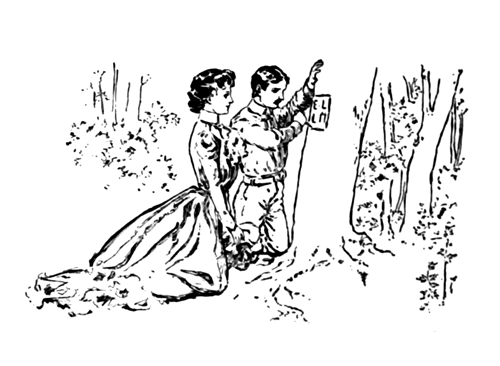
LeClare’s Story: The Initialed Tree.
“It’s only a boy and girl story, but, all the
same, that’s why I’ve been a gold digger. At
our first meeting on the plains I said I was
from the Eastern provinces. That was all right
for the time. The truth happens to be, though,
that our native homes are separated only by
the fifteen miles of intervening water channels
of the Archipelago. When you look to the
southward from your farm on The Front,
across the great expanse of water, dotted here
and there with wooded islands, and then extend
the view to the sloping sides of the irregular
mountain range which meets the eye, you
may perhaps see there, reposing sleepily upon
the banks of the winding Salmon, a small
American village. Four miles down the river,
after traversing for the full distance the cranberry
marshes of Arcadia, its waters are
gathered into one of the nearest channels of
the St. Lawrence. The approach is so unpretentious
that the coming of its added volume
is only recognized by the idler drifting in his
canoe along the shores of the Archipelago
from the blue and gray color line made by the
mingling of the waters. For it is just here at
this line that the now docile mountain cataracts
of the Adirondacks are greeted by the turquoise-blue
waters flowing seaward from the
Great Lakes.
“In Darrington, this village on the Salmon,
lived Lucy Maynard. Two miles to the eastward,
upon one of the fertile farms in the valley
of the St. Lawrence, was my home. There
I was taught the law of the Ten Commandments,
living in the midst of sunshine and
happiness and blest with the love of a devoted
father and mother. This is only a childish romance,
Andy, and perhaps you don’t care to
hear it.”
“Go on, Edmond,” came the reply. “You
know my story. Now tell me yours.”
“At the age of seventeen I had been considered
by my parents a graduate from the district
school, and at the beginning of the Autumn
term I was entered in the intermediate grade
of the high school up in the village of Darrington.
This was an auspicious event in my
hitherto uneventful career. Living always
upon the farm, my playmates and acquaintances
were of the neighboring farm children.
Tramping the same way to the district school-house,
we had pelted the croaking frogs in the
ditches by the roadside, and fired stones at the
rows of swallows swinging upon the telegraph
wires, and in the season we picked the daisies
from the nearby fields, handing them roughly,
almost rudely, to the girl of our choice amongst
the strolling group of school children; while in
the Autumn, in the groves by the roadside, we
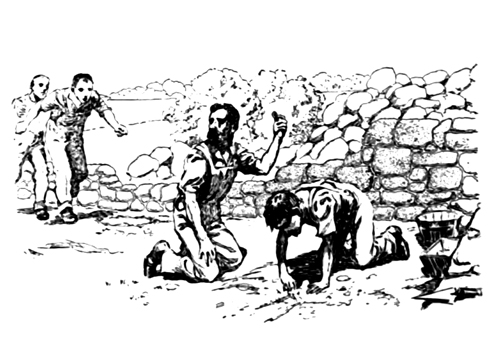
hurled sticks high into the chestnut trees, then
scrambled upon our hands and knees at a
lucky throw we had made, each to pocket his
catch. Simple and healthful were our sports.
Barefooted we stubbed our toes in the game
of ‘tag’ and at ball games in ‘Three Old Cats,’
where ‘over the fence is out.’ We were each
a star player of the national game. Happy
children of the country, Andy, primitive in
thought, with gentle rural manners, acquired
in the religious homes of a Scotch Presbyterian
settlement. Once a week upon the Sunday,
since childhood, I attended with my father and
mother the church at Darrington, and there
wistfully, shyly, I looked across the high backs
of the family pews at the children of the villagers.
In my childish mind their lot in life
was greatly to be envied and admired, compared
with mine. Their ‘store’ clothes and
their pert, familiar manner placed them in my
estimation so far above my station in the social
scale that my deference toward them amounted
to something like worship.
“In one of the family seats, across and several
pews advanced from ours, moving restlessly
about between her father and mother,
was a handsome, large-eyed child, forever looking
backward, and, of course I fancied, often
glancing in my direction. She was Lucy Maynard.
For years, and until I entered the village
high school, we had seen each other upon
Sundays, across the backs of the seats, never
a word from either, nor a smile of recognition,
Lucy’s large, brown eyes looking toward me as
she knelt on her knees upon the seat; then, as
I returned her wistful gaze, she would sink
slowly down upon her mother’s shoulder, burying
her face from view. I saw her grow to be
a young lady, a village lady; she saw me an
awkward country boy. In childhood I dared
to return her glances. As a boy of seventeen,
when I found myself that autumn in the village
high school, in the same class with the girl
always before me in my youthful day dreams,
I had not the courage even to look in the direction
of the seat which she occupied.
“Everything seemed strange to me, Andy. I
knew nothing in common with the village boys.
They played ball differently; they called their
game of ‘hide and seek’ by another name, and
they didn’t even throw stones at a mark as we
had done in the country. Some of the boys
tolerated my backwardness and others turned
up their noses at my awkward attempts at being
agreeable. But one silent champion I felt I
always had during those first weeks of my introduction
into that school. Standing near in
the hallways, with others girls in our class, at
recess, Lucy Maynard, with that soulful look
from those large, brown eyes, reproved the boy
whose rude remark was aimed at the defenseless,
or the one slowest at repartee in the gossip
under discussion.
“A few weeks of the Autumn term had
passed, and the class in mathematics had been
requested to remain after the grades had been
dismissed, to receive further instruction from
the professor. A board walk extends the full
length of the campus from the school-house,
ending in a turnstile at the street. The class
dismissed, I hurried out of the building.
Rustling behind me in a quick step came a
young lady. I knew instinctively it was Lucy.
“‘Don’t you think it is about time you had
something to say to me, Mr. LeClare?’ she said,
as she came beside me. ‘I won’t think you are
a bit nice if you go on like this.’ I felt my face
turning red, and I forgot everything I had
learned a thousand times before to say to her.
Then I begged her pardon for nearly stepping
upon her, and I felt that I was about to collapse.
The turnstile came to my assistance,
and, as Lucy lived in an opposite direction
from that in which I had to go, we parted. I
had regained enough of my scattered senses,
though, to thank her for having spoken to me.
“The Winter term of school had come and
gone, and the Summer closing was at hand.
The other boys in my class had soon overlooked
my misfortune, as they considered it, of having
lived in the country, and I was proud of the
devotion of Lucy, whose name was now paired
off with mine, as were the other boys and girls
paired off in our same class. To celebrate the
close of the school, the class proposed a basket
party to be held upon the bank of the St. Lawrence,
each male member of the party offering
to row his share of the ladies in his separate
boat down the winding Salmon, a five miles
jaunt. With Lucy at the helm, my craft sped
down stream propelled by a youthful spirit of
pride and enthusiasm.
“Dinner under the trees on Tyno’s Point
was quickly over, and the young admirers soon
found some interesting object to engage their
attention in pairs. Lucy and I, always quieter
when alone, had realized that very shortly we
would not see each other as often, and that perhaps
in the next year we should be sent away
to different colleges.
“And thus it came about that as we knelt
carving our initials, one above the other, on the
trunk of a basswood tree, we queried: ‘Shall we
always grow up together in life as our names
will always remain together on this tree?’
Lucy said: ‘I will cut one stroke in the frame
to inclose our names which says we will,’ and
she cut a strip in the bark over the initials.
Then she looked into my eyes with that soul-pleading
look, and I at once cut a line down
one side. Lucy immediately cut the mark for
the opposite side, and three sides of the frame
were then formed. It was my turn, and I
hesitated, for I knew what it meant to both of
us. I thought it too early for an engagement.
Lucy sank slowly down by the side of the tree,
as she used to do from the back of the seat in
church upon her mother’s shoulder, and waited
for me to say something. I was wrong, Andy.
I said we’d better wait before we made the
other stroke to complete the frame. There
was an awkward silence; Lucy toyed with the
penknife she held in her hand, but looked no
more at the initials cut into the bark of the tree.”
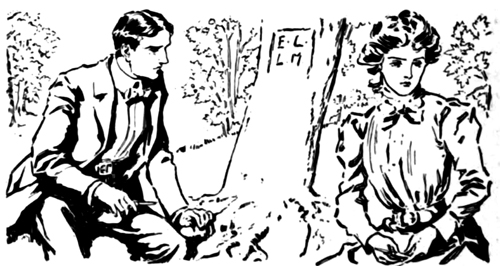
CHAPTER IX.
LeClare’s Story: The Christmas Tree.
“The next Autumn she went away to the
State Normal School, and at vacation time a
strange young man visited her at her home in
Darrington. Then, at the end of the Spring
term, when she returned, one of the boys in
my class of the year before wrote me to the
city where I had gone to acquire a business
training, that Lucy was engaged, and was to
be married in the fall. How many times I
cannot tell you during my first year in the
city I had composed the letter to Lucy which I
never sent. At night, seated at the small stand
I used as a writing table, in the hall room,
top floor, back, I went over for the thousandth
time the thought uppermost in my mind.
Should I write to her and say, ‘Wait for me,
Lucy. I am working hard for the position in
business which will give me the right to claim
you from the comfortable home of your parents.
You are my constant inspiration. For
you I toil the whole day with ceaseless energy.
For you, to claim as my prize at the end, I
have sacrificed the associations of home, accepted
the challenge thrown down before me
by the ambitious who, like myself, are striving
to gain that same position which would give to
them the opportunity to say, “I have won the
race, I have reached the goal first, now I am
entitled to the prize.” For you, Lucy, one day
I hope to return, and then to the music of the
old church organ, which we both have known
from childhood, to walk arm in arm from the
scene of our innocent love-making to brave
together life’s voyage.’
“But no, Andy, I never sent this letter. Was
it pride, I wonder,—were my acts of silence
dictated by an over-cautious mind, or were the
subtle workings of my heart’s emotions stayed
by the reports which had reached me that
Lucy, my loved one, my ideal, could so doubt
my integrity, could so disregard the sacred ties
of our friendship, hallowed by the memories of
sweet, childish innocence, as to accept the attentions
of another? I could not return at the
Christmas holiday and see another at the side
of my beloved. At the summer vacation I still
clung to my work, mastering the details of the
business with such an alarming rapidity that
the management would soon be forced to place
me in control of more important affairs. My
incentive now for greater efforts had changed
from that which first had inspired me. Now
I worked to accomplish great successes, that,
indirectly, Lucy might come to hear my name
mentioned, that she might be proud to say, if
only in her own heart, that she had once known
me, and as boy and girl we had been sweethearts.
“True enough, Andy, she was married that
Autumn. My invitation to their wedding came,
and with it a short note saying to try and come
if possible, and if not, she wished me all success
in business, and that my share of happiness
might be as great as she had heard my career
was proving successful. Love with pride was
contending in my heart. I should not attend
the wedding, I finally decided. She had heard
about my success. Did she not know I had
done all this for her sake? Why, then, could
she not have waited a short two years?
“Then love would steal quietly to the door
of my troubled heart and say, ‘You never told
her of your resolves. You have never explained
the reason why you wished to postpone
the carving of the line which would have fully
inclosed the initials in the bark upon the basswood
tree at Tyno’s Point. You have asked
her to guess too much. You have been unreasonable.’
“But pride would return, and, roughly pushing
love out of the door, proclaim in a loud,
harsh voice, ‘She took up with another while
I have been true to her, and I am through. I
have no care. One day she shall hear, she shall
know of my prominence, of my success.’ Then
pride was joined by selfishness within the
chambers of my heart. The door closed, and
there they held control for a whole year.
“Lucy and her husband were now living in
Darrington, at the home of her parents.
Mother wrote me that the Sunday school to
which I had belonged all the years I had spent
at home would celebrate the eve of Christmas
with the unloading of a Christmas tree, and
wouldn’t I come home for that and gladden the
hearts of my father and mother, now growing
old so fast without me? That evening, the
same day upon which I had received the letter,
love came tapping again at the door of my
heart. This time I opened to welcome the timid
caller. ‘We are going home together,’ it said,
‘to mother and to father, to Lucy and her husband.
We will bring the good words of cheer.
This Christmas shall see a reunion at the
old home. It will seem good to be there, and to
meet Lucy with her husband at the church,
and to see them happy in their love for each
other will put my soul at rest, and give me another
chance to meet happiness should the fates
favor me.’
“A three years’ absence from the old place
had made changes, and most of all in myself.
The change of dress from country to city, the
mannerisms acquired by constant mingling
with strangers, had given me the air which in
the country is interpreted as being akin to presumptuousness.
My school friends approached
me with an uneasiness of manner, while the
conversation with the older members of families
was limited to a few questions concerning
my arrival and departure. The ladies of the
committee in charge of the entertainment flitted
about the Christmas tree, which was placed in
front of the pulpit at the head of the main aisle
and at the end of the edifice opposite the entrance.
I had not yet removed my great coat,
and, hat in hand, was strolling with mother up
the aisle to the family pew. We were very
early, and but a few had taken their seats.
Some one of the group of ladies surrounding
the tree had called the attention of her co-workers
to the approaching stranger. At the
instant one of their number darted down the
aisle. A cry of joy had escaped her lips, and
in a frenzy of hysteria she fell into my arms.
It was Lucy Maynard. Tenderly I placed her
in the very pew from where I had so often
stolen the childish glances at the same brown,
curly head and beautiful eyes of my Lucy, who
now lay in a dead faint upon the cushions.
“‘You must care for her, mother,’ I said, as
I turned hastily to leave. ‘I am going away;
and, now that you know my secret, you must
always pray that my happiness may some time
be returned.’”
CHAPTER X.
Adieu to the Mining Camp.
“Soon after I gave up my position in the city.
The money which I had accumulated I determined
to spend in trying to forget, to stamp
out of my life the truth of the love which existed
between Lucy and me. She was married—I
was a gentleman. It was too late.
God might right the wrong which had been
done, but in the meantime two souls were to
suffer apart. For another two years I kept
away from home, my dear old parents never
urging me to return. I was successful in my
business ventures. Then sad news again came
to me. A fatal illness had attacked my father.
I reached his bedside in time to hear him say,
‘Edmond, I would have done the same were I
in your place.’ We buried him in a plot by
the church, in the shadow of the steeple at the
bidding of whose bell he had so many years
come to meeting, and now from the old belfry
tower it tolled the last sad notes for the departed.
“Lucy and her husband had been traveling
for her health, under the advice of the old village
doctor. A change of scene, he told her
husband, would do her good. A month I spent
at the old homestead. Mother had taken my
hand in hers one evening, as we sat under the
porch, I in the same chair where, at the same
time of the evening, father read the weekly
paper, and many a time, with his spectacles
pushed up on his forehead, and in his shirt
sleeves, had engaged in a heated discussion
with mother over some editorial comment favorable
to his views on one of his pet subjects.
‘Stay with me, Edmond,’ she said. ‘It won’t be
long now. For nearly sixty years we have
never been separated for more than a day—your
father from me. It—won’t—be—long.’
I felt her grasp of my hand loosen, and she sank
back into her chair. Her left hand lay limp
in the folds of her dress, an ashy whiteness had
suffused her face, a sweet, heavenly smile rested
over her features. Then I knew she had joined
my father. Side by side their bodies rest in the
shadow of the village church, while their spirits
have joined the angels and are looking down at
us now.
“No one at the homestead nor in the village
of Darrington knows of my whereabouts, and
to them I am as though I had joined my father
and mother. Now, Andy, you know my story.
If you think I should return with you to your
home, I will—but on one condition—that my
secret, my identity, be sacred between us.”
Andy promised. They arose to seek their
couch of cedar boughs, but a strange gray light
was creeping through the valley. “Look,
Andy,” cried LeClare. “It’s morning!”
LeClare at once piloted his partner down to
the cave-like opening in the cliff. There he
drew from a ledge in the shelving rocks at his
side, the loose earth and small stones he had
placed there the night before, covering from
sight the rich deposits which were now plainly
to be seen fastened to the solid rock in great
pockets of nearly pure gold. Cameron was
stunned at the sight. Wealth of such magnitude
he could not comprehend. Two days
they worked to take from the ledge their treasure.
Then, having made ready, they bid adieu
to the scenes of their recent struggles and hastened
on their way. They chose the same direction
through the mountains as that by which
they had reached the Cariboo Valley, heading,
of course, for the house of the native at the
head of Soda Creek with whom they had left a
part of their belongings upon entering the
ranges nearly two years previous.
Cameron had explained to his friend the necessity
that haste govern their every act in their
exit from the mountainous district, that even at
great inconvenience to themselves they must
hurry with all possible speed, first to overtake
the wagon trains going down through the valley
on the western side of the range to the
passes at Ashcroft; then, after crossing the
Rockies to the eastern slope, to join the pack
train, this to carry them farther homeward, till
at Winnipeg they would reach the railway.
Then upon fleeing steeds of winged steel they
would soon reach home.
CHAPTER XI.
Nick Perkins the Money Lender.
There is in every rural community one individual
who in himself represents an institution
hated alike by the rich and poor, a necessary
evil, so to speak, and one for whom the law
has had to define the limits to which he may
carry his questionable practices. The going
and coming of such a man in the community
in which he lives is tolerated by one class of
residents who are familiar with his tactics, because
of the fear that some day they may be
compelled to ask assistance from him.
There is yet another class of the same populace
by whom he is called a great and good
man; it is because of the power and influence
the possession of wealth has put in his hand,
which he uses for his own selfish advancement.
Although these same people may at the very
time be paying him usury rates upon a valuation
not half the true worth of security, should
they ask for a further advance, this suave citizen,
parading under the guise of a public benefactor,
refuses them, and continues subtly after
the blight is upon them to weave his drag net
closer about the unwary victims, strangling
them at last; then with a well-feigned show of
reluctance, he gathers in their property, which
he has obtained at one-half its correct value.
Nicholas Perkins was the worthy exponent
of this system in the Arcadian district of which
we are writing, and it was from him, through
his friend, the lawyer, that Cameron secured the
loans of money for which both his farm and
that of his brother were pledged.
Perkins lived over at The Gore, and through
his office, as Government tax collector for the
county, he was afforded an excellent opportunity
to know of the business affairs of the
people within his jurisdiction. As a farmer at
The Gore he was known to be prosperous. As
a money lender, there were many, both in his
own town and through the county, who had
occasion to know of his shrewd bargaining,
and as a Government agent for the collection of
the land-holders’ dues, his promptness and diligence
were unquestioned. He drove about the
county in an open-back light wagon, drawn by
a bob-tailed, cream-colored nag. Behind the
seat a rope halter was traced diagonally across
from side to side, fastening to the iron braces
which gave it support. A slightly corpulent
man was Perkins, and while jogging along the
country roads his favorite position was on the
edge of the seat, one hand grasping the reins at
which he tugged at frequent intervals, and the
other holding the iron braces surmounting the
seat’s back. He wore a faded brown derby
hat, and a few scattered reddish side-whiskers
adorned his face. There was no mustache
which should have been there to hide the
stingy, straight lips, and an insinuating smile
from which the children invariably shrank
played at the corners of his mouth.
A social call from Nick Perkins was not
taken as a pleasant surprise in any of the homes
throughout the county, and least of all in those
of the families at the rival town to his own,
The Front. Perkins had a very bad way about
him, the neighbors said, because of the circumstance
that when a note he held—or it might be
a mortgage upon a farm—was overdue, they
were sure to see the cream-colored, bob-tailed
nag and its owner driving slowly past, taking
note of the condition of the land and out-buildings.
They said he counted the fence-rails so
that he would be sure they were all there when
he got possession. Close with his family and
servants, a gift for charity’s sake would have
been considered a huge joke with him. A diversion
in which he seemed most to delight was
that of keeping alive the dissensions existing
between the farmers of his own village and
those whose lands met the river at The Front.
He was not a participator in any of their
Saturday night brawls,—not he,—and but for
the suave, insinuating remarks he dropped artfully
in the hearing of certain ones at the two
towns, their feuds would long before have died
out for lack of fuel.
The rebuff administered to Perkins by Bill
Blakely before the smithy had smouldered in
his mind, not dying out, but fanned by more
recent reverses to his plans till it had now
blazed upward, determining to consume for his
personal satisfaction and the discomfiture of
The Front, the Camerons’ homesteads. With
the head of the family away, and no news of
him in nearly two years, Laughing Donald unable
at any time to contend against him for his
rights, and the stock and dairy sold from the
farms, he had figured, despite the fact that
Barbara, the wife of Andy Cameron, had paid
the interest money promptly, that there could
be very little money left, and in a month more
he himself would be in possession. Thus he
argued, but he reckoned alone and without a
friend of the absent Cameron, who lived a short
distance from the smithy, and to whose words
of caution the self-important Perkins had given
no hearing.
Almost daily now since the beginning of the
month which marked the end of the two years
of the mortgage and the absence of Cameron,
Nick Perkins and his horse and buggy, known
to every school child in the country, drove
along The Front. Turning upon the edge of
his seat, his disengaged arm extended along the
brace surmounting its back, he would deliberately
look about him with that insolent proprietary
air so common among men of his class.
Barbara Cameron witnessed this scene for
about a week. Laughing Donald, in his innocent
way, had come over from his place and inquired
of her if she had any business with Nick
Perkins, because, he said, he drove past so
often, he thought he might have some “dealin’s
with her.”
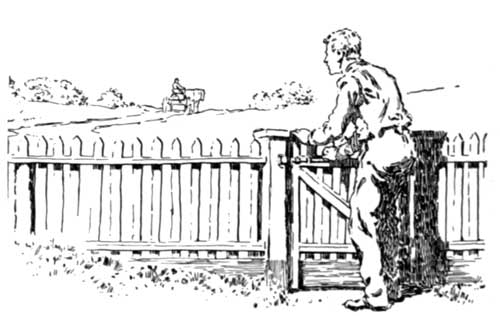
The next day Andy’s Dan, simple-minded,
but scenting trouble when he saw Perkins drive
past, hurried down to the gate at the road, and
closed and latched it securely. Inside of the
house at the kitchen table sat the silent figure
of Barbara. Spread out before her was a map
of the British Columbias, showing the ranges
of the Rocky Mountains. Two years before,
her husband had studied the same map, and
hundreds of times within the last few weeks
she had pointed out to herself the mountain
passes through which he said he would journey
in going to the gold fields. For the thousandth
time the thought came to her, Was he dead?
If he were alive and had found the hidden
treasures he would have returned to her before
now. The cruel rumors which had reached her
from the neighbors that her husband had deserted
her, she never allowed a place in her
troubled mind. If dead, she argued, then she
could not live there and see the poverty which
must come to their families. She would be happier
to live anywhere else. Yes, happier to
know for a certainty that he was dead.
Then the thought had come into her mind in
a more definite form,—Why not go to him?
Perhaps, too, Andy were sick. A new thought
this. A strange light was now in the eyes of
Barbara. Sickness she herself had ever known,
but the possibility of her husband’s robust constitution
succumbing to disease she had never
imagined. Again she said over in her mind.
“He may have been on the way home. He may
be lying with a fever in one of those camps in
the mountain passes he told me about, which is
here on the map.”
In her excitement she arose and paced the
floor: her features, set and always stern, were
now drawn hard. Looking from the window
down to the road, there she saw Nick Perkins
passing, and looking, as she was able to tell her
husband later, as though he owned the farm already.
She stopped in the middle of the floor.
With a quick movement she untied the strings
to her gingham apron, hung it on the peg by
the kitchen stove, told Dan to watch the biscuits
baking in the oven, then retired to her
room. Soon she reappeared. Dan saw she
had put on her Sunday bonnet and her best
frock. She held a tightly-rolled bundle under
her arm. Glancing quickly at the clock, as
though her time was short, she hurriedly told
Dan to care for their one cow, and when he
needed more biscuits, to go down to Laughing
Donald’s. Then, casting another hasty glance
around the rooms of the house, she went out
at the back door and down the road which led
to the station.
Dan did not watch her going. He knew
where she had gone.
CHAPTER XII.
Barbara in the Chilcoten Valley.
The Autumn rains had now set in, and all
the way up through the Chilcoten Valley from
Quesnel, the wagon train groaned and pitched
from side to side. The wheels rolled in mud
up to the very hubs, and the horses lagged in
their traces, wearied by the excessive burden
they were urged to drag. Sandwiched in with
the baggage, providing for their comfort as
best they could, were the several passengers.
Upon the front seat with the driver sat the
only woman passenger of the company. A
figure tall and spare, a face thin and drawn,
lines that were deep cut, marked the features
of a determined character. Her manners were
not engaging, and her fellow travelers soon
understood that she preferred to be left alone,
not to talk. But they had observed through
the tedious journey up from Quesnel to the
terminus at the head of Soda Creek, that she
had at intervals questioned the driver, each
time making him confirm his answer by repeating
it a second time.
“Yes,” said he, “I am sure that I brought
your husband up this valley. It must be nigh
two years ago this Fall, and if I ain’t mistaken,
him and another man left some truck
over at Dan Magee’s place, across the bridge at
the head of the trail. If ye want, mum, I’ll
take ye over that soon as I put the horses up.”
They had now reached the end of the wagon
route and the passengers had dismounted in
front of the building which served as a lodging
house, but Barbara sat awaiting the return of
the driver, who by his positive answers to her
questionings, had kindled the dying flame of
hope in her heart, and already through her
weak frame new life coursed with a quickened
throb. Up to this time, over the trails by
which she had come no definite information
could she obtain that her husband had passed
that way. No encouragement had she received
to inspire within her that fortitude which
would aid her to withstand all fatigue, knowing
that at the end of the journey she should meet
her beloved; and now she sat transfixed, afraid
to discover the truth of the report, fearing
there might be a sudden ending of the hopes
she had allowed to spring up in her heart, that
soon she should see her husband, and the longing
of her soul to be at his side would be satisfied.
She was presently rejoined by the driver of
the van, which was left standing at the side of
the hotel, the team of four horses having been
detached for stabling. Together they went toward
the home of Magee. The dim lights were
beginning to show through the gathering darkness
from the cabins of the scattered settlement.
A thin mist was rising from the dampness,
and but for the feeble rays which filtered
through nothing would have been visible to
mark the exact location of the house. To one
of those lights, coming as if from out the side
of the hill, Barbara and her guide came.
“This is the place, mum. Dan Magee is a
friend of mine, so you needn’t be afraid to tell
him what you have come about.” The door
opened cautiously in answer to the knock. “It’s
all right, Dan,” said the driver of the stage
wagon. “Here’s somebody wants to see you.”
The door opened wide. Barbara and her friend
advanced into the light.
Seated around a table at the side of the room
opposite the door were two men, one young,
bronzed, but handsome, the other older and
weather beaten, his beard untrimmed and hair
unkempt. They looked toward the door as the
strange visitor of the night entered, then quickly,
as if from a sudden impulse, the older man
stood up. His hand shook, as it rested upon
the table, and his eyes stood out as if they
would leap from their sockets. The tall figure
of this silent woman had advanced to the middle
of the room, her eyes fastened upon the man
standing by the table. Slowly her two arms
were raised, and stepping quickly forward, in
a dreadful whisper she ejaculated, “Surely,
Andy, it is ye!” Cameron also had recognized
his wife, but he caught her in his arms only to
lay her tenderly upon the couch, for she had
swooned away.
CHAPTER XIII.
The Mortgage Comes Due.
On the first of October—at least so they said
back at The Gore—Nick Perkins was to take
over as his own the Cameron farms at The
Front.
Since the flight of Barbara early in September
Perkins had patrolled the roadway almost
daily, surveying from his wagon, as was his
custom, the home of Laughing Donald. Then
continuing his round of inspection, he would
ride along past the farm at The Nole. There
at the closed gate, mute but defiant, guarding
the house like a faithful dumb animal in the
absence of his master, Perkins found Andy’s
Dan each time that he passed.
The cool evenings of the approaching Autumn
had broken up the meetings of the Gossip
Club before the smithy, but the depression
weighing upon the sympathizers of their luckless
neighbors at The Front was like the ominous
quiet preceding a storm which leaves disaster
and despair in its wake.
Angus Ferguson had frequently lent a helping
hand in the putting away of the Winter’s
supply up at Laughing Donald’s, and of late
the silence existing between Davy the blacksmith
and Bill Blakely, and their intense
thoughtfulness whenever they met at the shop,
was proof positive to the observer that they understood
that the responsibility of averting the
approaching trouble to their neighbor—which
was also an indignity aimed at the clans at
The Front—devolved wholly upon them. As
the days passed the confident look on the face
of Perkins so asserted itself that at length
while passing the shop he stared into the blackness
of the open door with the insinuating
smile of the hypocrite. Davy watched him
from the grimy window nearest the forge, and
by one of his severe quieting looks he persuaded
Bill Blakely to let him drive on unmolested.
After Perkins and his cream-colored
nag had disappeared up the roadway along
The Front, Bill walked uneasily around the
shop, kicking about the floor the loose horse-shoes
and fire tongs lying at the foot of the
anvil. Davy glanced at his friend over the steel
rims of his spectacles, awaiting an expression
on the subject each had silently argued for
weeks, as he rounded the while on the anvil’s
arm the curve of a shoe to fit the farm horse
lazily resting in the corner. During the last
minute before leaving Davy, the frowning
wrinkles in the face and forehead of Old Bill
had disappeared, and encountering the smith
as he carried in the tongs, grasping by the red
hot toe cork the shoe to fit to the mare in the
corner, his lips were copiously moistened from
the weed to which he was a pronounced slave.
His goatee was moving rapidly up and down,
and Davy halted, for he knew a decision had
been reached.
“To-morrow is the last day, Davy,” said
Bill. “I’ll be on my way to the town in the
morning. If there’s no news from Andy Cameron
it won’t take you long to tell it to me when
I’m passing.” Then he looked Davy straight
in the eye, winked his own blue eyes a few
times, drew out from his trousers pocket the
plug of chewing tobacco, and was gone in an
instant. Davy made no remark to the neighbor
who was the onlooker at this little episode, the
termination of a month of silent conferences
held between these two men, sturdy types of
rural loyalty.
“I thought Bill would do it,” mused the
smith to himself. “He’s got the heart, and a
whole lot of other things that the people round
here don’t know much about. But Bill knows
I know it, and that’s why he’s been a-hanging
around here a-wantin’ of me to say something.
But I knowed he’d say it all right,” and in his
pleasure Davy hammered the nail-clinches with
double energy into the hoofs of the docile mare.
Next morning, before the rays of the Autumn
sun had changed the whiteness of the
hoar frost, shining like a coat of silver upon
the shingled roofs of the buildings, and covering
with a mantel of gray the green shrubbery
and grass by the roadside, the smith unlocked
the door to his place, and stepped within its
darkness. At the same early hour, coming
along by the cheese factory, down the side hill
and through the hollow, then over the plank
bridge which crossed the whey-tainted creek,
the innocent cause of so much contention, now
past the store at the four corners, steadily there
sounded in the early morning quiet the echoing
thump, thump, thump of the tread of Old Bill’s
cowhide boots on the hard roadbed. Davy
recognized the step as it came nearer. Now it
was past the wheelwright’s place—he could
see his old friend in the roadway.
“He’s not a-goin’ to stop,” thought Davy,
but when nearly up to the rise of ground just
to the west of the shop, Bill half turned, and
with his hands deep into his trousers pockets,
the peak of his faded cloth cap pushed to one
side, he stood half listening, half looking for a
sign from Davy. Anticipating the man, the
smith had in his characteristic way upon critical
moments thrust his head around the side
of the open door, and with a nod motioned Bill
onward. There was no word from Cameron.
Later in the day, driving along the road
which turned at the four corners into that
which passed the smithy, was the familiar sight
of Nick Perkins and his bob-tailed horse. He
sat as usual upon the edge of the seat, his disengaged
arm grasping the brace which formed
its back. He had put on his Sunday coat, and
as he passed the door of the shop Davy could
see from his window by the forge the insolent
smile of triumph which Perkins cast in his direction.
“When he meets Bill Blakely up there at
the lawyer’s,” thought Davy, “perhaps he’ll
change that smile.”
CHAPTER XIV.
Blakely Consults Cameron’s Lawyer.
In rooms upon the second floor of a business
block, whose windows looked down on the
main thoroughfare of the country town, were
the offices of Cameron’s lawyer friend. The
ground floor of this building was occupied by
firms in various lines of business, and for the
accommodation of the occupants overhead
there was on the outside of the building a stairway
leading up from the street. Standing
upon the landing at the head of this stairway,
outlined in shadow by the morning sun against
the whitewashed bricks of the wall, was the
picturesque figure of Bill Blakely, awaiting the
lawyer’s arrival.
“Ah, good morning, Bill!” said the latter as
he reached the landing, curiously eyeing his
early caller.
“Mornin’, Donald Ban,” returned Bill, as he
followed him through the door. Donald Ban
was curious as to the nature of the business
which prompted this unexpected call from Bill.
Often, to the discomfort of Blakely, this same
lawyer had opposed his counsel in the settlement
in court of the encounters he had figured
in while disposing of the men who came over
from The Gore to argue the cause for the
tainted condition of the creek. Donald Ban
had many times convinced the judge and jury
that Blakely had been the offender and must
pay the costs, at least, of the litigation. The
lawyer had been impressed with the candid,
matter-of-fact way in which Bill had accepted
these verdicts. His manner upon each occasion
seemed to indicate,—“Well, if the judge
and jury say so, I’m willing to pay the fees of
a lawyer smart enough to make them say so.
Besides, I have had my fun out of it, too.”
Then he paid up without an objection.
“Sit down, Bill,” said the lawyer in an encouraging
tone, for down in his heart he liked
the man. Bill had removed his peaked cloth
cap, showing an intelligent head, covered with
a heavy crop of unkempt, straight, white hair.
Donald Ban moved about the room making
comments on general topics, calculated to put
his visitor at ease, but still he was at a loss to
account for the appearance of Bill at his office.
Suddenly Bill blurted out this question: “You
are a friend of Andy Cameron, ain’t you, Donald
Ban?”
“Yes,” replied the lawyer. “He is a client,
and a friend of mine, also.”
“Well, so am I a friend of Cameron, and
you can write that in the papers, too, when
you make them out,” and Bill turned in his
chair facing the lawyer, who had now seated
himself at the opposite side of the office table.
“Nick Perkins from The Gore,—you know
him, too, I suppose, don’t ye?”
“Yes, I know him,” answered the other, still
waiting for his clue to the situation. Bill
during his last question had reached down into
the lining of his vest and had taken therefrom
an oblong package, inclosed in a wrapping
which showed the signs of much handling and
tied about with a soiled string. He laid it on
the table before him, then continued: “Donald
Ban, you are a good lawyer, and for that reason
I never wanted you on my side. Mine was
always the wrong side, and I was a-feared that
you would make the jury say it was the right
side, when I knew all the time it wasn’t. This
is the time, though, Donald Ban, that I am here
to see you the first thing.” Bill had risen and
was leaning forward, his two hands resting
upon the table. “In these papers,” he continued,
“these papers that Nick Perkins holds
against Andy Cameron, do they mention ‘on or
before,’ or only mention that it is ‘on’ the certain
day they are due?” The lawyer, noting
the intense earnestness and excitement of
Blakely, answered at once that the form of the
mortgage held by Perkins against the Cameron
properties read that “on or before the first day
of October of that year, they were due and
payable, and——”
“That’s enough, Donald Ban—all I wanted
to know. It is now one day before, and you
write it down in the papers and tell Andy
when he comes back that a friend of his—you
needn’t mind putting it down there as who it
was—put up the cash and beat the hypocrite
Perkins out at his own game. Count out what
you want from that package, Donald Ban, and
give the rest to me. Perkins will be along
pretty soon now, and when he comes I want
you to have it all ready for him to sign off his
claim against the Camerons on The Front.”
The lawyer, taken so completely by surprise,
was at a loss to know what to say. “Cameron
will be back soon, mark what I am telling
you,” Bill continued, “and if he has made nothing,
I will be a safer man for him to owe money
to than Nick Perkins.”
CHAPTER XV.
Cameron’s Resolve.
It was the end of September. The wind
blew violently, the faint light of the pale moon,
hidden every other instant by the masses of
dark clouds that were sweeping across the sky,
whitened the faces of the two silent watchers
in the chamber of the sick. Under the same
hospitable roof where Barbara had fallen exhausted
at the feet of her husband, she now lay
prostrated by a raging fever. Standing near
the foot of the couch, alert for a sign of returning
consciousness, Cameron watched by turns
with his friend the passing of the life of his
devoted wife, which now hung in the balance
by only a slight thread. In her rational moments
during the days when the burning fever
would be lowest, Barbara had told the story of
the persecution of the Cameron family by Nick
Perkins, the insinuating gossip set afloat by
Fraser, the carpenter, the defense in their behalf
made by Bill Blakely and the kindnesses
offered them by Angus Ferguson and Davy
Simpson, the blacksmith. LeClare had divined
the truth long before his friend Cameron,
that the relentless fever raging in the
brain and body of the proud, determined
woman must soon burn her life’s taper to the
end.
All the available medical skill and the tenderest
nursing would not arrest the progress
of the fever, and Cameron, too, at last despaired
of the life of his beloved. The doctors
had told him that the end was nearing, and
now he sat by the side of the couch, never for
a moment removing his gaze from the face of
the sick one. As the hour of midnight approached,
the eyes of the patient opened slowly,
and the look of intelligence brought a ray
of joy to his heart. Feebly she murmured as
he bent over her to catch every precious syllable.
“I am going now, Andy,” she whispered.
“Say good-bye to Dan for me. I loved you too
much to hear them say you had deserted me,
and that’s why I came to find you. You won’t
blame me, will you?” and he answered her by
smoothing her feverish brow. “Make me only
this promise, Andy,” she continued with great
difficulty, for her strength was quickly going,
“that you take me back with you. And if Nick
Perkins has taken our home from us, then go
direct to the graveyard by the little church.”
Then the soft love light in her eyes faded out
as she sank quietly away into the pillows, her
lips slightly parted and the long eyelashes
drooping from the half-closed lids. The proud
spirit had taken its flight. It was in the twilight
of that mysterious country called Death,
and for a moment, as Cameron stood by the
side of the cot, the veil seemed to part from
before the throne of Glory, and beckoning to
him to follow, he saw the spirit of his loved
one borne safely hence by the angels of peace.
A great sob shook his frame, and as he stood
up, gazing at the lifeless form of his devoted
wife, he exclaimed in indignant agony: “Murdered!
Their infernal gossip has done this,
and here, in the presence of the angel of death,
I vow that I shall live to avenge this innocent
soul.”
Together they journeyed homeward. LeClare
was greatly concerned over the change
which had taken place in his friend. The
transformation so suddenly accomplished in
the man reminded him of the instances told of
how, from a terrible fright at the sudden approach
of danger, reason had been restored to
the unbalanced mind. In the case of Cameron,
however, where before he had been content to
follow, acquiescing without objection or comment
to the conditions which surrounded him,
awaiting always a suggestion from his partner
to act out the inclination which had arisen in
his own mind, he had now suddenly assumed
the rôle of leader, and so naturally, it appeared,
that no indecision was manifest because of his
recent acquirement of the office. That primitive
charm of manner, that honest, simple style
of the Glengarry farmer, which had so won the
confidence of LeClare when traversing the
same route in going to the gold fields, had now
upon their return trip given place to personal
traits of even greater significance. The new
development of character in his friend showed
LeClare at every turn the master mind awakening.
Grief had rudely torn away the mask
from the uncharitable, had laid bare the deceit
of the untrue and the wickedness of the hypocrite.
The death of his wife, Barbara, had removed
the object of his unselfish love, and to
LeClare it was very evident that the future had
in store for those who figured in the events
consequent to Cameron’s leaving The Front, a
destiny more or less happy, according as they
should be judged upon the return of the prospector
to his home.
CHAPTER XVI.
The Return of the Gold Diggers.
They were now nearing the station at a mile
back from The Front. Cameron had acquainted
LeClare with the simple funeral arrangements
he wished carried out as soon after their
arrival as possible. One precaution he insisted
must be taken, and that was, to allow no indication
to appear of their possession of wealth.
The significance of this request LeClare well
understood. At the call of the station stop for
The Front, the two men alighted, and hurrying
forward, superintended the removal of the
copper-lined casket beneath whose sealed cover
was the body of the courageous woman that so
lately had gone in search of the husband who
now would live to do for those in kind who had
done for the departed.
Cameron stood by the side of the rough box
upon the platform, as the noise from the fast
disappearing express train grew faint and died
away in the distance. For a moment he was
lost in thought. Knowing him to be in the
company of Cameron, the keeper of the small
depot approached LeClare, and with a jerk of
his head toward a farm wagon and driver cautiously
nearing, as if fearing to obtrude, he said
in a hushed voice,—
“It’s Andy’s Dan. He’s been a-waitin’ fer
’im.”
Twice a week and sometimes oftener during
the October month, so Cameron was afterward
told by the neighbors, Andy’s Dan was seen
regularly to drive back to the railroad station,
and there remaining at a respectful distance,
watch for a passenger who might alight from
the through train from the West. Then seeing
no familiar face to reward his coming, he
would turn away and drive back to the farm at
The Nole to come again another day.
Startled from his reverie by the remark of
the station master, Cameron turned to see the
conveyance drawn up by the platform at his
side. Andy’s Dan alighted from the vehicle
and clasped the outstretched hand of his bereaved
brother in silence. Still without exchanging
a word, they walked over to the side
of the long box. Then, as if suddenly remembering,
Dan looked into his brother’s face, a
sad smile playing upon his features.
“We can take her home, Andy,” he said.
“Bill Blakely told me to tell ye that when you
come.”
In the centre of the burying-ground, set back
from the roadway and raising its spire heavenward
above the tombstones at either side, the
church at The Front reposes among the graves.
One by one these monuments had been reared,
till now they marked a place where a loved one
had been taken to rest from each of the families
at The Front.
A mound of freshly dug earth, thrown up
upon the sod in one corner of the inclosure,
told of a newly made grave. A cold November
rain had been falling, accompanied by a chilling
wind, which came in fitful gusts. The over
ripe, deadened stalks of the golden-rod beat
against the board fence, rapping at intervals
like the weather strips upon a deserted house.
The drops of water fell aslant from the eaves
of the church roof, and a horse, meagrely covered,
shivered beneath the shed at the rear.
Bill Blakely had placed in a convenient corner
of the shed the pick and shovel he had been
using, then backing his horse from under
cover, he drove over to the farm at The Nole.
Information had spread among the neighbors
that Cameron had returned to The Front
bringing with him the remains of his wife. No
further news were they able to gather, but to
Davy Simpson, Angus Ferguson, Bill Blakely
and a few others, Cameron had sent a special
message, saying that as friends to himself and
the departed he wished them to be present at
the funeral to take place from The Nole the
following afternoon.
Meanwhile Cameron had also dispatched his
friend LeClare with Dan as his driver, bearing
a note to his lawyer friend up at the county
village. To them the import of the note appeared
to be nothing more than a request for
his friend to attend upon the following day,
but later, at the farm, as he saw the lawyer
place upon the coffin in the front room a beautiful
wreath of the purest white lilies, LeClare
knew that Andy’s orders had been telegraphed
to the city. The best undertaker the county afforded
was in charge of the details, with instructions
to slight nothing in the arrangements
and the assurance that his bill of expenses
would be promptly met.
Cameron greeted his friends by a cordial
grasp of the hand. A new dignity of manner
impressed itself upon his old neighbors. His
bearing at this time was that of a man of a
great reserve force, softened through the medium
of sorrow. Kindly he thanked the few
friends who had come to him, and together
upon the arrival of the clergyman they assembled
in the front room to fulfill the last request
of the departed—that, surrounded by her
friends and family, her pastor should offer a
prayer, and then in the graveyard by the small
church near her home they should lay her at
rest.
CHAPTER XVII.
Cameron Outlines His Policy.
The Winter drew on apace. At Laughing
Donald’s carpenters and workmen had been
busily employed within and without the house
for weeks. Soon the premises took on a finished
look, and the workmen departed as mysteriously
as they had come. In the new home, the
wife of Laughing Donald presided, directing
her servants with that natural grace and dignity
which is the certain indication of a lady
born. Andy Cameron since his return had not
spent a night at his house at The Nole, and
now LeClare and Dan also joined the family
at Laughing Donald’s.
Soon after the return of Cameron, Bill
Blakely and he drove to the county town and
to Donald Ban’s, the lawyer’s. Together they
climbed the stairway to the office each had
sought before. Bill leading the way.
“Morning to ye, Donald Ban,” said Bill, in
a voice unusually soft for him. The lawyer
asked his callers to be seated. “You know,
don’t ye,” continued Bill, as he clutched his
cloth cap, “that I said he’d be back soon,”—nodding
toward Cameron, who had seated himself
comfortably by the table, apparently having
no uneasiness about the outcome of the
consultation.
“Yes, Bill,” answered Donald Ban. “You
have the right stuff in you to make any man
proud to be called your friend, and you not
only outwitted your old acquaintance, Nick
Perkins from The Gore, causing him the most
bitter disappointment of his unenviable career,
but you performed a service which, at the time,
you did for a poor but honest neighbor. We
have all understood your motives thoroughly,
and in acting for Mr. Cameron, when I return
to you the amount of money which you advanced
to save for him his home and good
name, I can truthfully say that with it you
have the gratitude of the wealthiest and most
distinguished citizen of the County Glengarry.”
Blakely looked from one to the other, not
knowing whether he had heard or understood
aright. Cameron smiled assuringly as he
slapped his old fighting friend upon the shoulder.
“Bill,” he said, “we will be very busy
this Winter and all next Summer, you and I.
We will let the waters of the creek flow on to
The Gore unmolested. We will let Fraser, the
carpenter, go on with his tattling about the
neighbors. We will keep them all guessing,
Bill. My friend LeClare and I want to see
you very soon at Laughing Donald’s—and, by
the way, Bill, don’t mention the remark you
heard Donald Ban make about some friend of
yours having a little spare money.”
Bill looked at Andy with the old mischievous
twinkle in his eye, his goatee began to move
up and down, and he was in his old time mood
again. “Well, Andy,” he replied, “they say
these lawyers often tell more than the truth,
but anyhow, when you and your friend run a
little short, you know where Bill Blakely lives,”
and he went out of the door, telling Cameron
he could find him at the grocery when he was
ready to return.
Cameron and his friend were left to themselves
for the first time since their home-coming.
His visit to the lawyer was for a twofold
purpose: the first, to fulfill the legal requirements
necessary in discharging his money obligations
to Blakely; that disposed of, he proceeded
to lay before the lawyer the plans he
intended at once to put into execution.
“Donald Ban, with your approval and under
your suggestion, and also urged by necessity,
I made the venture against overwhelming odds
which fate has seen fit to reward by giving me
the possession of a great wealth in gold. You
also know that in the obtaining of one coveted
means by which I am enabled to relieve the suffering
and discomfort of others, I have sacrificed
the companionship of her through whom
the blessing to accrue from this new-found
wealth would have been dispensed; and now
that my life has been clouded by sorrow, and
I shall no longer enjoy the home where together
we strove in an atmosphere hallowed
by an unselfish love to help carry the burdens
of our fellow beings, this same injustice of
things—the uncharitableness, the unkindness
from those of whom we expect comfort while
in reverses, only to be by them the most neglected—has
aroused within me emotions that
have been the means of bringing before you
to-day a different Andy Cameron from the
one who before was acting merely by the suggestion
of others. My purpose in the future
at The Front and in Glengarry will be to see
justice charitably dispensed: the weak shall be
made strong, and from him at The Gore, who
has grown powerful by his artful practices
against the unfortunates in our community, I
will take and return to them whom he has so
oppressively wronged.”
Donald Ban was astonished at the change in
the man before him, but he was quick to recognize
the genius of a quickly developing brain.
“I presume, Cameron, you have made reference
to Nick Perkins, who has been more or
less successful in bringing a great deal of unhappiness
into the families residing in your
neighborhood.”
“Remarkably true you have guessed, Donald
Ban, and as my legal adviser, you are entitled
to my confidence in so far as it pertains to the
expenditures I have in contemplation at my
homestead on The Nole and among some of
my neighbors at The Front. Roughly speaking,
you have deposited for me in the several
banks down in the city three hundred thousand
dollars. As nearly as LeClare and myself can
figure, that amount represents our individual
worth. Donald Ban,” continued Cameron,
thoughtfully tapping the leathern topped desk
at which they sat, “Nick Perkins has extracted
from the people of our town at The Front in
the neighborhood of thirty thousand dollars.
That amount he shall pay back to these same
farmers during the present Winter and the
coming Summer. With fifty thousand dollars
I can erect a mansion upon the site of my
farmhouse at The Nole. Upon its completion
Nick Perkins will buy this palace. He shall
buy it, Donald Ban!”—Cameron banged the table
with his clenched fist—“and eighty thousand
dollars will be my price. At that time
thirty thousand of the amount will already be
in the pockets of the people whom he has
harassed for years, and the actual cost of the
house you will deposit for me again in the bank
from which we will draw for expenses during
construction. This much you are to know
from me, and I am aware my confidence in you
leaves it a secret between us. I will bid you
good morning, and thank you, Donald Ban.
My home is with Laughing Donald.”
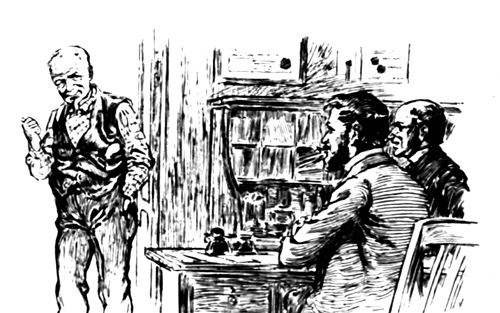
You know
where Bill Blakely Lives.
CHAPTER XVIII.
The Ice Raft.
The beginning of Winter found Cameron
and LeClare comfortably settled in the refitted
home of Laughing Donald; and under
the gentle yet queenly direction of his wife the
members of the new household lived amidst
surroundings of comfort and domestic happiness.
In one end of the house a small room with
windows looking out upon the great river had
been furnished as an office for business. In
this room many conferences with strangers to
The Front had been held of late, and here
LeClare and the architect from the city carefully
examined the plans from which would be
builded the House of Cariboo. To his friend
Cameron had given in charge that part of his
project which required the experience of one
who was familiar with the accompaniments of
homes builded for beauty of architecture, displaying
a refinement of taste; but for himself,
as he explained, he wished to reserve the
privilege of dispensing among his neighbors
the expenditures for materials which could be
supplied from their farms while building the
mansion as proposed.
In this same little room during the Winter
days Cameron and LeClare often visited together.
They talked of their plans for the
future, of the task before them in the Springtime,
but never of the camp in the Cariboo,
nor their returning, which so sadly had been
ended. At one of these conferences, on a
stormy day of early Winter, as LeClare, seated
before the fire in the grate, was reading from a
selection of new books he had bought while
upon one of his recent trips to the city, he was
suddenly interrupted by his friend, who till
then had been idly standing, one hand upon
the window pane, the other fumbling the
watch chain at his vest.
“I have just thought, Edmond,” he began,
“as I have looked out upon this icebound expanse,
this great river which for months of the
year is the busy highway of so much traffic,
that now it is bound, like ourselves, to await
the pleasure of the season, inactive, only waiting.
Perhaps you may think my deductions
commonplace, Edmond; but hear me through.
Since the beginning of Glengarry’s history
there have been, to my knowledge at least, no
innovations to disturb the serenity of the established
customs of our people, and these
customs are few to relate. In the Summer we
labor a little and house our crops, that in the
Winter we may comfortably live to consume
them. The following year, and the years to
come, the same highly exciting programme is
certain to be followed. For the coming Summer
we have provided the diversion of the
building of our mansion, but for the lonesome
days of our snowbound season we have not
provided. Why not advertise our Summer
engagement at The Nole, and interest our
friends in advance?”
Soon after the conversation held in the
library at Laughing Donald’s a team hitched
to a farmer’s sled was slowly passing in the
roadway. The driver, carefully selecting an
opening between the deep snowdrifts piled
high on the river embankment, turned his
horses abruptly to the left and drove them
down the incline and out upon the frozen
river. Quickly he dumped the load of cobblestones
in a heap upon the snow and ice. Thus
returning at intervals of an hour each day, Bill
Blakely was engaged throughout the week, till
irregular lines of stone heaps covering a considerable
area of the river fronting Cameron’s
house stood as monuments to his labors.
Since Cameron and LeClare had taken up
their residence with Laughing Donald speculation
over their reported doings was at fever
heat in the neighborhood. Fraser, the carpenter,
was frequently called on by his friends
from The Gore, but his own lack of information
concerning Cameron’s future plans
aroused to a greater curiosity the contingent
from the adjoining town, of which Nick
Perkins was the acknowledged leader. Still
smarting from the humiliating blow over his
failure to secure the Cameron homestead,
Perkins nursed his wrath in silence. A resolve
had already formed in his evil mind to pursue
even to the finish the destinies of the Camerons
at The Front, and already his machinations
could be seen at work in the questions he directed
at those he met as he drove along the
snow-heaped roads.
It was on a Saturday, and Perkins was on
his way to the county town, when he met Bill
Blakely coming up into the roadway, after having
deposited a load of stones upon the ice.
Filled with wonderment at what he saw, he inquired
of Bill in his blandest tones what he
was drawing the stones for.
“Well, Perkins,” replied Bill, “to be truthful
with you, it’s for a dollar a load I am doing
it principally, but another good reason is that
Cameron has asked me to do it. If you think
you’d like the job, go ask Cameron. They say
his credit is good. Even you ought to know
that, Mr. Perkins,” and Bill passed on without
saying good-day to him. Perkins bit his
lip and made no reply, but drove on to the
village.
Other farmers from the neighborhood soon
began hauling to the dumping grounds on the
river facing the farm at The Nole. Angus
Ferguson had hauled to Cameron’s ice raft, as
he called it, the old stone wall which had for
so long disfigured the view in front of his
house. Stopping each evening at the little office
at Laughing Donald’s, he received, like the
rest, a dollar a load for the number of trips he
had made during the day.
The work of the farmers whom Cameron
had seen fit to employ, and who seemed to vie
one with another in quickly disposing of the
useless materials collected about their farm-yards
and disfiguring their homes, progressed
so rapidly that ere long whole acres of the
frozen river front resembled a congested lumber
yard. The fabulous prices paid to them
by Cameron for the worthless accumulations of
their farm-yards, which he had placed upon the
ice to be carried away with the floods in the
Spring, caused a storm of comment, the echo
of which came over from The Gore in volumes
of inquiries.
“Where did Cameron get his money?” they
queried. “And why can’t we get a share of it
while it lasts?” For Nick Perkins was heard
to remark that “a fool from his money was
soon parted.”
While the commotion among those engaged
in hauling at The Front was still in progress,
Bill Blakely and Cameron were paying their
respects to certain residents of The Gore. To
many of these gentlemen favored by a call Bill
was attached by tender recollections of former
fistic encounters at the four corners. His
welcome, of course, was not always the most
cordial, but when Cameron announced very
quietly that Mr. Blakely wished to buy a few
thousand of their best cedar fence posts at a
price which could not be disputed, they soon
became more communicative. “Deliver the
posts at Mr. Blakely’s, beginning to-morrow,”
said Cameron, continuing without any further
parleying: “You will be paid by the hundred.
We will drive, Bill,” and Cameron was
through with the bargaining.
During the next week or two, from his old-time
enemies at The Gore, Blakely had purchased
for himself, for Angus Ferguson and
for Davy Simpson a supply of the best fence
posts the county could boast. “Enough,” as
Bill said, “to keep Nick Perkins busy for three
months a-countin’ them, the next time he
found a mortgage due on a Cameron’s farm
over by the way of The Front.”
In all the transactions of Cameron thus far
since his return Nick Perkins was able to discover
a piercing dart, truly thrown at the
hypocrisy of his own career. The subjects he
had chosen from among the people upon whom
to lavish such expenditures of money were
always certain to be those who had either been
oppressed by him in the past or else considered
themselves his natural enemies. Perkins
knew of the housebuilding to commence in the
Spring at The Nole, for already Blakely was
completing the contract he held to supply the
stone for the masonry of the foundation walls.
Another fact which galled Perkins to madness
was that the farmers who had been kept constantly
employed were, in every case, those
against whom he himself held a mortgage, and
he saw very plainly his prospects for eventually
gaining their property daily slipping more
surely from his grasp.
The Spring season had now arrived, and up
at The Nole a small army of workmen were
engaged in removing the buildings which had
once been occupied by Cameron as his home.
The return of April’s hot sun and warm winds
had loosened the grip which for months held
the icebound river captive between the islands
and shore, and suddenly one day, as the workmen
had quit for midday lunch, the long-delayed
alarm was sounded that the river was
breaking up. Down the main boat channel, as
far as the eye could see, a forward movement
was on. Great squares and chunks of ice
lunged and dipped, then plunged forward
again like the wheeling and turning of an army
of soldiers. Over on the shores of Castle
Island mammoth cakes the size of the roofs of
the buildings climbed upward till they broke
and toppled over by their own weight, crunching
and thumping and groaning, till a dull,
rumbling noise like the approach of an earthquake
could plainly be heard.
Opposite to The Nole, extending in a zig-zag
course through the piles of debris, ran gaping
cracks in the ice. All the Winter the
irregular heaps of ugliness which composed
the freight on what was now called “Cameron’s
Charity Raft” had reminded those who
passed that way of the original methods employed
by one man to relieve the condition of
his brother workers. The useless stone heaps
served no purpose upon the farms from
whence they were taken, and the discarded
wagon parts and dilapidated farm implements
which Cameron had purchased from his neighbors
had served them only as an encumbrance
and nuisance. Now they soon would be beyond
annoying the sight, and their last opportunity
for usefulness had brought joy and
peacefulness into many a home along The
Front. As the immense ice floe passed almost
intact down the channel, beating its way amidst
the warring, jamming ice cakes, a ringing
cheer, led by old Bill Blakely and joined by
the company of workmen, went up for the
man who had brought fortune and good cheer
into their midst.
CHAPTER XIX.
LeClare to Prospect in Arcadia.
In the early months of Spring, LeClare was
busily engaged with the architects and builders
at work upon the mansion at The Nole. He
viewed the undertaking from day to day, which
for weeks seemed but a shapeless pile of board
and scantling; but, as the work progressed,
from out the chaos and confusion could be
seen the growing outlines of the stately
columns and the extending roofs of many
gables.
Nature had spread her mantle of green
abroad, and from the islands of the Archipelago
nearest the shore LeClare saw each
evening, as he strolled along The Front, the
shadows of the dense foliage mirrored upon
the placid waters of the river. Then, as the
sun sank lower in the west, and in the gathering
twilight, as the evening advanced, the
boats of the fishermen stole out from their
sheltered coves and headed for the spearing
grounds away upon the shoals to the southward.
Andy’s Dan was little concerned about the
building operations going on upon the site of
his former abode. He held aloof from the
workmen, who were strangers to him, and in
his silent, reticent way he resented the intrusion
upon the quiet and primitiveness of
the neighborhood. In LeClare, however, he
had found a congenial companion, and upon
several occasions he had confided to his new
friend, whom he bound over to secrecy, the
exact spot over by the dead channel where he
hooked the shining maskinonge as he rowed
near the rushes by the deep waters.
At this time in their undertaking LeClare
was finished with the details of the work upon
the mansion which he had agreed with his
friend to superintend. A few days since a
beautifully designed river skiff had come up
from the city, and as Cameron and LeClare
stood talking upon the veranda at Laughing
Donald’s, they could see at a distance of a few
boat lengths from the shore Andy’s Dan rowing
the new craft up and down the channel.
Now it flew through the waters in answer to
the long, low sweep of the spoon-shaped oars,
and now like a race-horse, responding to the
spurs in his side, it sprang ahead in quick
bounds as the short strokes of the oarsman
grappled with the surface of the water. After
they had viewed for a time the skill of the
aquatic sportsman, LeClare turned to his
friend Cameron and thoughtfully said:
“Andy, should you wander over there to
the southward, past the islands of the Archipelago
and the shoals of the marshes, and then
follow the mountain streams up their circuitous
windings, you will come at last to their
head, the fountain from which continually
spring the waters, clear and pure, which unite
to form the rivers. Down the course toward
the finish of their run sometimes the sparkling
clearness of these streams has become changed
to a dullness of color by the conditions of the
country through which they have passed, and
their life and transparency are gone. So it
must be with the streams of life. At first the
waters down which we glide are clear and
bright, but later our course perchance may lie
through a troubled country, and in the shallows
we encounter the snags which wreck our
pleasures in passing. For a time we endeavor
to clear the stream down which we have been
floating by throwing about us on every side
that panacea to unhappiness, speculation or
adventure. With me, Andy, the fountain of
my happiness lies in the direction of the brooks
from the mountains. You are at home, and
you have been drinking each day of the clear
waters from the springs of true life, and now
it’s my turn. I’m going back, following the
stream up to that fountain where my first
happiness began. Out there on the river my
craft awaits me, and with your Dan and mine
we will prospect this time in Arcadia.”
CHAPTER XX.
Lucy Visits the Archipelago.
As the best laid plans of man fail often to
succeed against the inevitable, so, too, it is
often that the intervention of time makes possible
what before Fate had willed otherwise.
Lucy Maynard still resided with her parents
in the village of Darrington. Her married existence
had been punctuated by the fatal illness
of her husband, leaving her widowed
while yet in the first year of her wedded life.
Seeking no new acquaintances, she sweetened
the atmosphere of her home, while her presence
spread an angelic glow among the circle
of her friends. Hers was now a sad, sweet
face, illumined by a smile which ever quickly
sprang to her lips and as fitfully died away.
In those large, hopeful eyes, so frankly turned
upon you, was a look of sadness, as of a love
unrequited.
Early Summer had come again, the schools
were closing, and with the returning of friends
who had been at colleges in distant cities a
flood of sweet recollections of years not so
long past came to Lucy.
“It was down the winding Salmon,” she
mused to herself. “Oh, how well I remember,
Edmond at the oars and I in the stern of
the boat, trailing my fingers in the water and
thinking of the future—yes, that same future
which has brought me so much unhappiness
already. But it was of my own bringing.
Pique and disappointment, they, too, played
their share in my short drama. That love
which was the cause of urging me on into the
bonds that restrained me from turning back
again to the object of my only true affection is
the same love which now is fanned into a new
life as often as the incidents arise which bring
back the memories of the past. On the morrow
I will indulge my longing. It will be the
anniversary of that day when cruel fate
changed love into foolish resentment, so that
we drifted apart, Edmond from me. With
Caleb, our old family servant, my confidant,
my trusted friend, I will follow the winding
Salmon to the same point of land, and there,
resting within the basswood grove, as we did
on that day, I will look to find again the tree
upon which we carved our initials as we sat
beneath its shade.”
The sun shone bright upon this day in June,
and as Caleb rounded the point of land which
lay in the shoals by the marshes he looked
backward over the shoulder nearest shore,
carefully selecting a landing. Lucy the while
watched intently a boat pushing out from a
bay farther up the shore. A swiftly gliding
boat it was, long and set low in the water.
Graceful lines swept from the bow, and, touching
the waves at the oar-locks, rose again to
gently curve into the rudder posts at the stern.
Two men were occupants of the boat, which
Caleb assured Lucy was new in those waters.
The man at the oars bent to his work, and in
response to his long, swinging strokes the
boat quickly disappeared from sight, passing
through a line of thin rushes and making for
an island across the Schneil Channel.
Lucy appeared strangely affected. Caleb
had now beached his skiff in a sheltered cove,
and was waiting, after having called to his
mistress the second time to step ashore. The
man lounging in the boat of the strangers, and
guiding at the stem the craft as it stole swiftly
away from shore, Lucy followed, held by a
strange fascination, till he was lost to view.
Upon Tyno’s Point there was a small tavern
run for the accommodation of people fishing
and hunting thereabouts, and a few cottages
were set back from the shore fronting out
upon the expanse of water looking toward the
north bank of the Archipelago. Caleb went
to exchange gossip with the fishermen standing
about the shore, while Lucy strolled alone
toward the basswood grove.
Still and quiet was everything in Nature.
The bright beams of the noonday sun fell in
quivering rays across the sight. Out upon the
river not a ripple disturbed its glassy surface.
From up the Schneil Channel came the chattering
noises of a water hen, and the piping of
snipes, who called from the rush beds farther
up the river. Overhead in the trees a pair of
golden robins sang as they builded their nest
far out on an overhanging limb. The bumblebees
hurried past on their way to the blossoming
clover patch, and the distant call of a
loon came from over the waters. Lucy stood
beneath the high branching trees, and in the
distance, toward the village of Darrington, she
saw the weather-vane of the church steeple
glistening in the sun.
“It must be near here,” she thought. “Yes,
it was at a tree-trunk like the one in yonder
clump,” and thither she went, trailing her leghorn
hat by the ribbon strings through the tall
grasses. Sweet was the picture of grace and
beauty left alone with her thoughts of love.
“Yes, it was here. Yes, yes, this is the tree,
for there are the marks, the initials we cut.”
Suddenly she paused in her delight, for she
had made another discovery. Some one had
been before her. Around the foot of the very
tree, and leading away from it toward the river
bank, the grass had been recently trampled.
Still in her surprise, curiosity led her to follow
the path through the grass to the shore. There
she saw the fresh imprints upon the sand. Immediately
she recognized the small bay, whose
extending bank had partially concealed the
strangers as they rowed away earlier in the
day.
A wistful, excited look had come over the
childlike face of Lucy. One hand pressed her
heaving bosom, while with the other she clung
for support to a bending alder tree. Thoughts
were in her mind that she dared not entertain—an
apprehension that she had but just missed
seeing the lover of her childhood, who possibly
had returned like a spirit from heaven to renew
the anniversary of a time long past, but
ever fresh in memory. It was then as she
stood, her frail figure swayed to and fro by the
flood of passionate recollections, that coming
from behind her sounded the voice of Caleb,
her protector.
“We will row away by the Schneil Channel,
Lucy,” he said, “and, going by the rush banks,
touch at the Caristitee Island. The old chief
of the tribe of the St. Regis will be glad at
our coming, and once more he will say to us
that he is the friend of the palefaces.”
Caleb True lived quietly on in his way,
which called for no criticism, aroused no comment,
enjoying the while the respect of those
who knew him. He might have been the
miller, the town gardener or an unassuming
deacon in one of the churches, but, as it was,
he had lived very long in the family of Lucy’s
father, tended the garden and cared for the
household during the week, and upon the
Sunday he proudly officiated as sexton in one
of the village churches. To Lucy he had been
a second father, and to him in childhood she
went for sympathy as she grieved over some
fancied injustice done her. Caleb had known
the romance of her school days, and he was
now in full possession of the innermost
thoughts of her soul, although she had not
confided to him that the longing of the returned
love of her girlhood was driving her
forward in a mad desire to discover his
whereabouts.
While Caleb chatted with the fishing guides
and river men at Tyno’s Point he gained the
information that for several days past the
same quickly speeding boat observed by Lucy
had passed and re-passed among the islands,
going from place to place with a restlessness
and uncertainty of route altogether unusual
among the frequenters of the perch banks or
the haunts of the wily pike. Once they had
touched at the Point, but only to inquire of the
landlord for a lodging should they wish to return.
“Handsome and strong,” they said that
he was, “and with the air of a city stranger;
but again swiftly they glided away, and into
the nearest rushes, where soon was hid from
them the beautiful skiff of the boatmen, but
they saw over the tops of the swaying reeds the
heads of the wandering oarsmen as they
crossed to the Caristitee, and from there later,
as the darkness came upon them, the light of
their camp fire shone on the point of the
island.”
At once Caleb confided to Lucy the hopes
which had risen within him, and together they
hurried to pursue them. Soon they had
crossed the Schneil Channel. Onward they
sped, in their haste going through the narrow
passes cut by a current of swift running waters
feeding the expanse of a broad lagoon.
Meanwhile Caleb, a poor match for the fleet-winged
oarsmen who unconsciously fled away
in the distance, was fast exhausting his
strength.
CHAPTER XXI.
Under the Initialed Tree.
Coming at last to the island, they saw the
remains of a camp fire, and fluttering by the
side of the charred rocks Lucy discovered
among the ashes the remains of a half-burnt
parchment, upon which had been written an
address, and still upon the fragment, but discolored,
was a name which to Lucy had been
lost but never forgotten. To Caleb in breathless
haste she ran with the paper.
“Look,” she cried, “‘tis the name of LeClare,
of my Edmond! My heart tells me
truly, he is here in the lakes of St. Francis.
Among the islands of the Archipelago we must
go search for him. True love will seek out
the path of his wanderings, and before the
passing of another sun two thirsting spirits
shall unite, to wander no more in darkness.”
Among the trees on the point of the island,
curling upwards in ringlets of blue, rose the
smoke from the tepees of the Indians. Old
and decrepit, but ever a friend to the white
man, their chieftain, Caristitee, sat in the
smoke of his camp fire.
“Two suns gone by, my daughter, he sat
where you are now reclining, a paleface
wearied of rowing, another sad-hearted and
restless. At dawn very early they departed.
Down past the islands and marshes their boat
glides on like a phantom, and only at night
are they seen, by the blazing camp fires, as they
rest from their endless going.”
Lucy listened, her heart filled with sweetness,
to the sayings of the good Caristitee.
Overhead the skies shed a lustrous light, and
out on the waters around them a stillness had
come with the darkness. Filled was her heart
with sweet dreams of love, and till the dawn of
the coming day Lucy slept, her head upon the
shoulder of Caleb, not awakening till the sun
in the east came up in the midst of Arcadia.
At this early hour in the hazy light of dawn
they saw a column of smoke away on a distant
island. Thither they headed their course.
Drawing nearer among the cluster of islands,
they watched for the camp of the strangers.
Quickly the day was passing; no sight had
they caught of the boatmen, and Caleb had
tired of the rowing. Lucy scanned closely
every island in passing, piercing with a
searching look the rush banks that lined the
channels through which the boat silently
glided. Hopefully she encouraged poor Caleb,
saying love would reward his exertions
and lighten the way of their going. At last
they turned their boat homeward, through
lakes where myriads of water lilies swayed
and dipped with the waves as they came, then
reaching the shoals of the Salmon, the sand
bars across which they were passing shone
white through the clear, limpid waters. Soon
Caleb, wearied of rowing, threw himself down
at last to rest himself upon the banks of the
Point of old Tyno.
Restless, still following her heart’s longing,
Lucy sought out again the grove and the
tree where before she had missed her lover by
only a minute too late. In a moment of passionate
abandon she threw herself at the foot
of the tree, held by memories strong, so closely
were they linked with the past.
Into the same bay, coming nearer, ever
nearer, darted the boat which moved so swiftly,
urged on its course by the sinewy arms of
the oarsman. Lightly from the seat in the
stern sprang the athletic figure of the stranger.
Hurriedly he looked about the shore, then
leisurely sauntered toward the grove, where
upon another day he had come and gone so
mysteriously. Not far had he been when before
him he saw, extended at the foot of a
basswood tree, the figure of a girlish maiden.
One arm encircled the tree trunk, while the
other lay limp at her side.
At a respectful distance stood the stranger.
“She is asleep—it is Lucy,” he stammered,
“and under this tree! What can it mean?
Lucy, I love you! My darling! why can’t I
tell it you now?” he exclaimed, and unconsciously
he outstretched his arms.
By the angel of love she had been awakened
and told that her lover was near. In an instant
his manly form was before her. “It is I,
Lucy. Be not afraid, but first tell me, why
are you here?”
“I am free, Edmond,” she cried, “and I love
you, and I came here to tell it alone, that I
should wait for you now and forever.” With
a great flood of joy, Edmond clasped to the
heart his Lucy. Then they knelt as on that
day of yore, and the stroke which then was
omitted now they cut in the frame on the tree.
CHAPTER XXII.
The Mystery of the Corner Stones.
Blakely, with the neighbors whom he employed,
had completed the excavations for the
foundation walls and hauled the stone and
mortar in readiness for the masons. Four
squares of granite had been drawn to The
Nole from the railroad station, and it was
whispered among the workmen that their employer
would personally direct the setting of
the corner stones.
For several days, four of the master masons
were engaged in carefully cutting into the center
of each of the squares of granite a bowl-shaped
cavity. Cameron, who had usually
busied himself in other things which kept him
away from The Nole, came frequently now to
inspect the mysterious hollows being made in
the granite boulders.
Soon the work of the masons was completed;
then by the aid of crane and derrick,
they lowered into position the corner stones
just as the hour arrived for labor to cease.
Cameron remained till the last man had gone,
examining the granite blocks, which he found
were placed securely in position, resting upon
their cement foundation.
Next morning when the men came to resume
work, they saw two others there before them,
Cameron and the tall, erect figure of Donald
Ban, his lawyer friend. The wonder at finding
their employer so early at the works was
quickly followed by a second surprise, more
startling than the first. The cavities in the
corner stones had been filled during the night
and a layer of cement covered the tops of the
hollow openings and was spread evenly with
the surface of the granite rock.
“Lay the wall, men,” Cameron ordered in his
calm, inflexible voice. “We wish to remain
here till the corner stones have been walled
under.”
At noon hour the burden of the discussion
among the assembled laborers
was to ascribe a reason for Cameron
and the lawyer being among them in
the morning. In the midst of the debate,
an exclamation of delight came from one of
their number, who had been apart from his
fellows in the basement, and he held up to view
a ten-dollar gold piece he had found in the dirt
at his feet. Immediately a mad hunt was in
progress around the foundation walls, and particularly
at the corner stones. Other gold
pieces were discovered, and among them a
twenty-dollar gold piece was taken from the
miniature gold diggings.
When the excitement had abated somewhat,
the foreman of the gang of laborers, with a
wise and important look on his face, the while
assuming a dramatic pose, pointed to the corner
stones, and in tragic tones, he said: “Boys,
they are full of ’em!” and a quiet akin to that
resting over a haunted house fell upon the
superstitious laborers.
The trick had worked well, for very soon the
whole county would hear that their mysterious
neighbor had buried a fortune in gold in
each corner stone of the House of Cariboo.
Cameron quickly heard of the gold finds made
up at the works at The Nole and he smiled
with great pleasure when he thought of the
look of blank despair which would come over
the face of Nick Perkins, on his finding that
the worthless bits of scrap iron which filled the
cavities of the four corners of the mansion
were all that represented the vast sums in gold
that he imagined reposed in the foundation
walls of his purchase.
CHAPTER XXIII.
Fraser Confers with Perkins.
The eccentric methods which Cameron had
employed since his return to The Front had
put the people of Glengarry into a state of excitement
and wild speculation, which was
greatly interfering with the wonted quiet and
decorum of its peaceably inclined citizens.
While the House of Cariboo, as it was now
generally called, neared completion, and the
majestic columns which supported the high
arched domes of its rotunda stood out in bold
relief against the scaffolding surrounding the
unfinished parts, extravagant reports were
being circulated abroad in Glengarry, even
reaching to the distant city, of the enormous
expenditures made by Cameron on the mansion
he was about to occupy.
As the undertakings of Cameron assumed
form, and the motive for many of his peculiar
trades with his neighbors became apparent,
another individual of whom we have frequently
spoken also began to figure conspicuously
before the people of the county.
The purposes of Nick Perkins for the past
few months had suffered so many humiliating
defeats before his constituents at The Gore and
his enemies at The Front, that even his sympathizers
and old time henchmen of his town,
of late had shunned meeting him as he went
about at his home. Every note and mortgage
which he held against the farmers and neighbors
of the two towns had been paid back to
him with interest to date, and in every case the
proceeds had come to his debtors through the
liberal wages paid by Cameron for work upon
the undertakings he had put under way.
Thirty thousand dollars had been paid out for
various kinds of work done, either directly by
Cameron, or through his friends, Blakely,
Simpson or Ferguson. Happiness reigned supreme
in the families of the two towns, and
each neighbor felt that he could look the other
full in the face with a frankness which meant
freedom from the depressing coils of debt.
Perkins, they said, could no longer impose
himself upon them. His money-getting,
money-lending and hypocritical pose among
the people of the two towns would no longer
be tolerated. By Cameron, the man whom he
had sought so diligently to enclose in his net,
he had been thrown from his pedestal of deceit,
and at present he was the object of ridicule
throughout the county.
William Fraser, the carpenter, still continued
to employ himself in the capacity of the official
gossip of Glengarry, but the interested listeners
among his neighbors who would bid him welcome
had become so few that like his patron,
Nick Perkins, he found the vocation which
once had placed him in popular demand, was at
present in rank disfavor. His neighbors had
remarked that even though great activity was
apparent in the building trades at The Front,
Fraser remained unemployed. Bill Blakely
sarcastically queried of him one day, as a number
of men of a like occupation from an adjoining
town stood about the door to Davy
Simpson’s busy forge, “Whether he didn’t
think that in balancing on the top rail, speculating
on the return of Cameron from the gold
fields, he had jumped off upon the wrong side
of the fence? Of course,” Bill added with a
chuckle as his goatee moved up and down,
“you had the hull county with you, for Perkins
had jumped the same way before you.”
As near as could be observed, the shrine to
which Fraser had come with his troubles, and
the confession of the failure of his accomplishments
to charm as of yore his susceptible
hearers, was the Court of Perkins. Deserted
as he knew it to be, nevertheless here we find
him come again, but this time a smile, a grin,
covered his face, for he had a choice bit of
gossip for Perkins—a pretty little ambush arranged
by Cameron into which Fraser and Perkins
fell without the least suspicion. Perkins
bade his caller welcome, and in his usual cringing,
insinuating manner, noiselessly sliding in
his peculiar gait about the room, he finally sat
down on the edge of his chair, tipping it
forward.
“Mr. Perkins,” he said, rubbing his hands
together in glee, “our time has come. It’s all
up with Cameron. Just as you said, Mr. Perkins,
just as you always said, a fool from his
money is easy to part, and that’s what it’s come
to now, and I come right over to tell you, Mr.
Perkins, for I knew they would have to come
to you yet.”
Meanwhile Perkins drew a chair to the centre
of the room and seated himself before his
caller. Every movement he made showed the
intense interest Fraser had aroused. “Is it
something about Cameron’s finances giving
out, you have heard, Fraser, or is it something
else we both ought to know? We are alone in
this, Fraser—alone, you understand.”
“Yes, yes, Mr. Perkins,” eagerly replied the
tattling carpenter. “I heard it by a mere
chance. Why, they don’t think I know a word
about it. You see,” he went on, leaning farther
forward toward his eager listener, “I heard
that some mouldings for the new house were
coming up from the city last night, and I
thought I would go back to the station and see
what they looked like. Well, a couple of tall
city men got off the train, and while I was
looking over the cabinet work which come up
to the station, one of them comes over and
reads the tag on the bundles, and says he to the
other one, ‘Well, here is some more of our
firm’s stuff sent up for this job of Cameron’s,
but I guess we will cabbage this lot,’ says he,
‘till we see the color of his money for what he’s
already put into that house,’ and the other chap
up and says, ‘The best thing we can do is to get
this man Cameron to consent to a public sale
of this house to satisfy the claims of his creditors.
There will be no one here except a few
of the largest creditors who will have money
enough to bid on the property, and some one of
us will get a beautiful house cheap. We can
keep this thing quiet, and there will be at least
thirty thousand dollars to divide up between
us.’”
“Where did they go?” asked Perkins,
eagerly.
“Well, they come over to The Front in one
of Cameron’s wagons and the last I see of them
was down by Laughing Donald’s. They
weren’t there this morning, so I guess they
went up to the town last night.”
CHAPTER XXIV.
Perkins Again Outwitted.
For several minutes after Fraser the carpenter
had finished telling his story, Perkins
was silent. From force of habit he ran his
fingers upward through the scant growth of
reddish side whiskers upon his face, and by the
changes in expression passing continually over
his countenance, Fraser was aware that the information
he brought had greatly interested
him.
“There can be no doubt, I suppose, Fraser,”
began Perkins, very slowly pronouncing his
words, “about there being a large amount of
gold deposited in the foundations of the
house?”
“There is no doubt of it, Mr. Perkins,”
eagerly answered Fraser, again tipping forward
upon the front legs of the chair. “Cameron
didn’t want it known, you see, but it’s the
gold pieces they lost in the cellar that spoiled
his plan, and now it seems he isn’t worth the
half he thought he was.”
“That’s it, Fraser, about as I thought it
would be,” continued Perkins, well satisfied
with the turn Cameron’s affairs seemed to have
taken. “His gold that he brought back from
the Cariboo Mountains has not turned out at
the government mint to be near what he
thought, so his creditors in the city are going
to close in on him quick and get what they
can. That’s about the case as I see it, Fraser,
and I think our turn has come, just as you have
said. Oh, by the way, Fraser,” as if suddenly
recollecting, “where is the young friend of
Cameron—LeClare—the city chap who came
back with him?”
“Oh, he’s gone. Went away to see his people,
they say over at The Front, but I guess
he’s a wise one, eh, Perkins? Saw what was
coming and got out in time.”
“It has been pretty rough sailing for us,
Fraser, since Cameron returned, and although
I have gotten back through him from the farmers
around here over thirty thousand dollars,
yet I am poorer by not being able to let the
loans rest. You understand?”
“Yes, I see, Mr. Perkins. Bill Blakely says
you have lost fifty thousand by being beat out
on foreclosing, and they all seem to be laughing
about it.”
“Yes, and they think they had a big joke on
you and me, eh, Fraser? Well, now we will
see who will laugh loudest and the last.”
With this last thrust Perkins bounded up,
and hurrying to the door in his waddling gait,
he shaded his eyes with his hands and scanned
the cloudless sky. Turning again to Fraser,
he said: “I will have that Cameron house
before the week is out. My reputation has
been hurt by Cameron. My business is gone,
and he has made me a joke for the
whole county. Now I’ll turn the laugh on
him. I will go up to the county clerk at once,
and if there have been arrangements made for
a sale of the property or a transfer to his creditors,
I will soon know it. Now you go back to
The Front, Fraser, and find out what you can.
I will meet you at the four corners on my return.”
The twilight of the June evening had faded
into the darkness of night and Fraser still
waited by the door to his shop. Presently a
familiar rattle of the wheels of an approaching
wagon announced the coming of Perkins.
Fraser advanced from the door of his carpenter
shop and met the tardy Perkins in the road.
“Ah, good evening, Fraser,” began the
money lender in his blandest tones, and Fraser
knew his trip to the county town had placed
him in possession of favorable facts concerning
the supposed financial embarrassment of
Cameron. “Anything new, Fraser?”
“Nothing much, Mr. Perkins, but more
strangers were hanging about The Nole to-day.
I couldn’t get near enough to hear what
was up. They looked over the new house and
then went down the road to Laughing Donald’s.
They are staying there to-night.”
“Very good, very good, Fraser. Now about
LeClare. Have you seen him, or do you know
where he is?”
“I don’t know exactly, Mr. Perkins, but I am
told that Andy’s Dan is away with him.”
“There is a doubt there, Fraser, the only
weak spot in our scheme. Up at the county
seat I see where they have arranged for
a quick sale. They were to do it on
the quiet. They have advertised according
to law, and with the consent
of Cameron’s lawyer, Donald Ban, the city
creditors are to meet at The Nole, and by an
arrangement among themselves, will bid in the
house, and just enough to cover current bills
on hand. Now Cameron is in a pinch. They
have sprung this thing on him suddenly. He
can’t locate his friend LeClare, and these city
chaps are after his house at half the cost. Here
is our plan, Fraser. Say not a word of what
we know. The sale is on Thursday at ten in
the morning. This is Tuesday. I want the
house. These men from the city want about
thirty thousand between them as their share of
their slick game. I can afford to overbid that
amount because it is in the foundation and
they don’t know it. I have found that a receipt
is on file in the government mint down in
the city, that this amount was drawn out by
Cameron and we have evidence that it was
placed there. It is a sure thing, Fraser, that I
get Cameron’s house Thursday morning. His
only hope is that his friend LeClare may turn
up before the sale. You must be careful and
quiet, Fraser, and leave the rest to me. I will
meet you at The Nole Thursday morning a few
minutes only before ten.”
They bade each other a half-whispered good
night, but as their shadows retreated in the
darkness, another dark object jumped up out
of the ditch at the opposite side of the roadway.
It was the figure of a man, cloth cap in
hand, who, waiting only long enough to take
an enormous chew out of a plug of tobacco,
then sauntered at a safe distance from the
others down the roadway, past the store, the
cheese factory, and on toward home.
CHAPTER XXV.
Donald Ban at The Front.
Meanwhile, at Laughing Donald’s, Cameron
had carefully concealed the accomplices he had
brought up from the city to aid him in fulfilling
the most delicate part of his whole undertaking.
Through Bill Blakely he knew
positively of the moves to be made by Perkins
that morning at the sale, and further, he had
arranged with LeClare, who, accompanied by
Andy’s Dan, was spending the night upon the
accommodating banks of Castle Island, opposite
The Front in the Archipelago about a
quarter of a mile distant from the mainland.
By a signal from Blakely, displayed at The
Nole, LeClare was to pull over in haste to The
Front or remain where he was till the sale had
been completed.
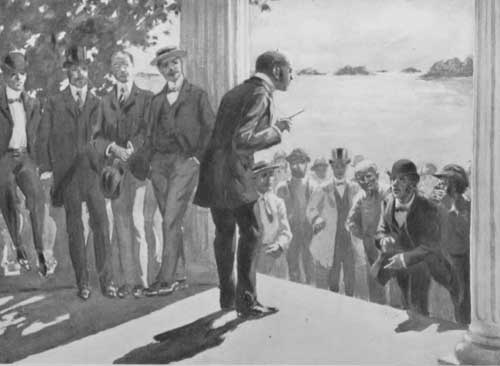
“As the hour of the sale approached, they assembled at
the east end of the broad veranda.”
Thursday morning had arrived and the
strangers from the city, representing the supposed
creditors who had forced Cameron into
premature bankruptcy, were roaming at large
over the House of Cariboo. Then as the hour
of the sale approached, they assembled at the
east end of the broad veranda, from whence an
uninterrupted view of the river and islands of
the expanse of the Lake St. Francis stretches
away to the eastward.
Gathered about the house and standing in
groups around the veranda were the workmen
who were still engaged at The Nole. They
talked in a hushed undertone, and as Cameron
and the tall, erect figure of Donald Ban came
slowly up the hill, the hum of their voices died
away entirely. A few of the near neighbors
were present, and as Donald Ban, who was to
act as the referee agreed upon by both sides,
took up his position upon the veranda, he saw
nearing the outskirts of the assembled group
our worthy friend Nicholas Perkins and his
companion Fraser, the carpenter. Mr. Cameron
had selected an inconspicuous place from
where he could easily witness the proceedings
without himself being too much in evidence.
Baring his head, beginning his introductory
remarks, Donald Ban spoke quietly: “Gentlemen,
neighbors, and friends:—I am here before
you in the capacity of my profession as a
lawyer. I am here also as the confidant of one
of the most interested parties to this proceeding,
and I am also come to see justice fairly
dispensed. We in Glengarry are more familiar
with the circumstances which have led up to
the building of this magnificent structure, than
those among us who are recently come from
a distant city. The motives which my worthy
friend Cameron may have had in mind while
rearing before the public gaze this house of
stately proportions, he has succeeded pretty
well in keeping to himself. However unfortunate
and disappointing the termination of his
project may seem, we, who have carefully
watched the workings of the heart which has
dictated the directions in which these expenditures
have gone, must easily have discovered
the philanthropic intent of Mr. Cameron, who
has been to us the greatest benefactor our
county has ever known. Now, gentlemen, the
facts I have the honor to put before you this
morning I hope will inspire within you the
spirit of fairness and of charity toward a brother.
I am authorized to sell this house to the
highest bidder. For the benefit of those wishing
to bid I will read the following inventory:
For material, labor, trucking, etc., expended in
Glengarry for the constructing of this house,
and which has been paid, thirty thousand dollars.
For fixtures, decorating and furnishing,
forty thousand dollars. One-half of this
amount has also been paid. You will readily
see, gentlemen, that Cameron has a paid-up
equity of fifty thousand dollars in this property,
and you are easily secured on the twenty thousand
dollars unpaid amount, and we hope your
bidding will indicate that you have this fact in
mind. Now, what is your first bid?”
“Forty thousand,” came in a clear set voice
from the centre of a group of strangers on the
left, and a stillness settled upon the group of
men surrounding the lawyer. As soon as Donald
Ban had allowed sufficient time to pass in
which to recover naturally from what ought to
seem an unexpectedly high offer, he continued:
“It is to be presumed, gentlemen,
that a figure covering the indebtedness of the
individual firms which you represent should
satisfy your employers.”
“Fifty thousand,” yelled the man with the
high silk hat standing over in the midst of an
excited group, and Perkins again drew up his
shoulders as at the first bid and moved out to
the edge of interested bidders. Almost immediately
another bid was recorded, a new
contestor with a sixty thousand offer, and Perkins
looked badly discouraged, for he pulled
his side whiskers continually. Then sixty-five
and seventy, and seventy-five thousand were
finally recorded from the same three strangers,
and the bidding seemed to be over. A slight
commotion in the neighborhood of Perkins was
noticed by Donald Ban, and inclining his head
in his direction, the lawyer forced out his first
bid, making it now seventy-six thousand. An
excited movement was noticeable throughout
the assembled company. Donald Ban repeated
the offer, and while the crowd surged about the
money lender, Donald Ban added a few remarks
to stimulate the interest already at the
snapping tension.
“Gentlemen, to those of us who know, this
property is exceedingly cheap at eighty thousand
dollars.” Perkins and Fraser had caught
at once the trend of Donald Ban’s remarks, and
they feared the disclosure of the contents of
the corner stones. “Another unfortunate happening
at this time is the absence from The
Front of the former partner and friend of Mr.
Cameron, whose presence here would be an assurance
of this house never passing under the
hammer for less than a hundred thousand.”
Another thousand was added by the man wearing
the high silk hat. Seventy-eight quickly
followed from his rival bidder, and the lawyer
turned again to Perkins.
At that instant Fraser had pushed quickly
through the crowd and whispered something
in the ear of Perkins. Blakely had displayed
the signal, and coming across the Channel,
speeding on toward The Nole, was seen the
long, low, swiftly-going boat of LeClare making
straight for the landing.
“Eighty thousand, gentlemen, we must have.
Who says the price, and the house goes to
him!”
“I do,” came in a defiant voice, and Perkins
pranced into the space about the end of the
veranda where stood Donald Ban, and the
crowd fell back from him in awe. “Here’s
your deposit, and I’ll sign the bill of sale at
once. Now then, who is there here to oppose
Nicholas Perkins again at The Front?” He
turned with this challenge to survey the crowd,
and for his answer he met a chill of distrust
which struck at the very vitals of life, for he
saw there, smilingly before him, standing
shoulder to shoulder, as if greatly pleased at
the outcome of the sale, his tormentors, Blakely,
Cameron and LeClare.
CHAPTER XXVI.
Cameron’s Task Completed.
No sooner had the lawyers completed the legal
details for the transfer of the House of
Cariboo to the purchaser, Nick Perkins, than
rumors were afloat that all was not as it seemed
about Cameron’s having to sell the mansion to
satisfy his creditors. Strange, if it were so,
mused Fraser the carpenter, for the day following
the sale he saw from his wheelwright’s
place the strangers from the city grouped before
the door of the smithy, around Bill Blakely
and Laughing Donald. The jesting and laughter
which he could plainly hear were joined in
by Blakely and even Davy Simpson, who left
his blazing forge to appear at the door of the
shop to witness the pleasure of his friends.
A feeling of uneasiness took possession of
the little undersized carpenter, and he drew
back from the door and shuffled around among
the shavings upon the floor of his workshop.
Fear and apprehension had closed in around
him so surely that there was no chance of evading
the awful certainty of the truth that Perkins
had been most artistically duped, and that
he had been the one through whom the scheme
was so successfully worked. Nick Perkins
had acted entirely upon the information he had
carried to him, and now as he looked through
the dimmed window panes of his workshop and
recognized the same men who had so flippantly
discussed the affairs of Cameron back from
The Front at the station, the extent of the humiliation
and expense he had forced upon Perkins,
and the extreme satisfaction he had
given his enemies, dawned unmercifully upon
him.
Again he squirmed in his peculiar sliding
fashion around the extent of his place. Stopping
at the carpenter’s bench, he took up his
plane and tried to forget his predicament in
violent muscular exertions. Soon a knock came
at the door. At first he paid no attention to it,
thinking Bill Blakely had come over to poke
fun at him in his very provoking manner.
Another knock followed, and the door opened
to admit the short, officious personage of Perkins.
At sight of his caller, Fraser collapsed
into a frightened, shrinking heap, sorrowful to
see. Slamming to the door, Perkins glared
at the cringing object before him.
“A nice mess you have made of it, Fraser!
It’s a wonder you were not in the trick with
the rest of them, but they wanted you where
you were to do just what you have done—to
ruin me, to put every dollar I am worth in the
world into that useless house, a monument to
Cameron. Every dollar I ever made in the
county I have given to Cameron, and he has
paid it back to the same people I got it from.
The entire cost of that house is not more than
fifty thousand. I have paid that back to
Cameron. He did not owe a cent to those people
you said were representing his creditors in
the city, and what is more, I am satisfied now
that the talk of the gold in the corner stones is
a hoax, like all the rest put up by Cameron to
use me in carrying out his philanthropy, which
has not cost him a dollar. Yet he has the glory,
while I am ridiculed!”
Poor Fraser, confronted by such a terrible
arraignment of what he knew to be facts, was
utterly confounded. He made no answer, but
as Perkins turned in resentment and disgust to
go, Fraser, in a weak, thin voice, like a wail of
despair, said: “I thought I was doing you a
service, Mr. Perkins.” Again Perkins turned,
but with a look of dark hatred and disgust cast
in his direction, he went out, slamming the
door to after him.
It was possibly a week or ten days later
when Cameron and LeClare stood again upon
the veranda at Laughing Donald’s. Andy’s
Dan awaited his passenger at the boat landing
for the leave taking of the two friends.
“Lucy and I will expect you, Andy,” earnestly
pleaded LeClare. “With you present
we shall want for nothing to make our wedding
a union of complete happiness.”
Mr. Cameron grasped the extended hand of
his faithful associate and friend, saying in his
quiet, determined way, “LeClare, we have
faced disappointment together, we have endured
hardships of a kind to test the merits of
our friendship many times before. Defeat we
have never acknowledged; sorrow we have
borne together side by side in the valley of
death. Success and wealth are ours, and happiness,
sweetest happiness, Edmond, is yours.
Wherever I may be at the call of your wedding
bells I will go to add one more good wish for a
long journey of life and joy to you.”
At another conference held in the office of
Donald Ban, Mr. Cameron had told of his plans
for the future. Addressing his friend the lawyer,
he had said: “My mission at The Front
is finished. The death of Barbara has been
avenged. The hypocrites, her tormentors,
have been brought very low, the weak are
much stronger in person, and justice at last has
prevailed. I ask for no thanks or recognition
but from our children in Arcadia; in the generations
to come may they look awe-inspired as
they pass the strange mansion, and be mindful
of the moral which was taught when we builded
the House of Cariboo.”
THE GROWING MASKINONGE
It was Sunday morning at the “Point.” And
over across the bay the last of the phantoms in
“Ghost Hollow” had crept up the lampless
posts of the walk through “Spook Grove,” and,
vaulting in an uncanny way, reached cover in
the branches of the birch trees that were
thickly clustered around the cottages lining
“Spirit Lane” west to the bowling alley. It
was through “Ghost Hollow” that the cottagers
living to the westward passed while going
to and returning from the boat landing and
the hotel over at the Point.
At the misty dawn on this Sunday morning
the forlorn spectres of the spirits which frequented
the small bay were stalking from the
water, answering from the hidden abode
among the dark cottages of the lane the homing
call of the doleful strains of a “chella.” In
obedience to their spirit queen they wafted
wearily through the rushes and ferns upon the
bank; borne by the receding shades of darkness,
they sought their resting places under the
rafters and the eaves of the gruesome roof of
the bowling alley, which crouched along by the
vine-covered wall at the brow of the hill. It
was then an Indian, from the tribe of St. Regis,
on the mainland, stole unnoticed upon the scene
and beached his canoe upon the east shore of
the bay. He looked about for signs of the
awakening day, then stealthily he dropped on
his knees, and from beneath a covering in the
bow of his “dug-out” dragged up upon the
bank a forty-pound maskinonge.
“Hi! hi!” he cackled in the weird voice of
his race. “Hotel man like much Injun.” Then
disappearing to the rear of the out buildings,
life to him soon became brighter by visions of
“fire water” and a warm breakfast—he had
sold the fish.
There was an ominous quiet hanging upon
the early sunlight. The suppressed calm was
something greater than that inspired by the
sight of a few devout people starting out upon
the yacht for early mass. The guests were appearing
singly upon the broad verandas of the
hotel. Each in turn as he appeared seemed
possessed of the same apprehension, a nervousness
of manner. The sleep of this Sunday
morning was the closing of a week of wild and
reckless dissipation among the guests. Such
intense excitement at the island had not been
experienced in many summers. From the
wharf of the castle across the bay at the other
side of “Ghost Hollow” the gramophone had
sung “coon songs” and recited at length for
several evenings in succession, and a music
box in the main corridor of the hotel had given
a continuous performance from twelve to
twelve, till the nerves of the martyred guests
had reached a state fit to be recited in a patent
medicine advertisement.
“What’s that I don’t know, a big fish?” And
Mr. Hot Water, dressed in his new bicycle suit,
strode excitedly a few steps forward on the
veranda, then backed up, balanced himself and
side-stepped a little to get a fresh start. Then
he came on again, with his meerschaum pipe
tightly grasped in his right hand.
“By Gum! That’s a terror. If it isn’t a
pickerel it’s a maskinonge. It’s either one,
anyway, if it isn’t a maskinonge. Who caught
it?” Then he looked at the three individuals
before him for the first time. What he saw
made him change the meerschaum quickly from
the right to the left hand, and then he blinked
his eyes till recalled by Mr. Du Ponté. When
Mr. Hot Water (a regular patron of the hotel,
known to be threatened musically, and also as
a local weather authority) comprehended the
outfit before him he saw a large fish, of the
maskinonge family, strung on an inch pole suspended
between two trees eight feet apart. He
saw, also, three of his fellow guests at the
Point strangely arrayed before him, one
dressed in white duck trousers, with a red silk
scarf tightly knotted above the knee, another
with hand and fore-arm wound with linen
handkerchiefs and hung in a sling across his
breast, while the third, Mr. Du Ponté, was,
aside from his loquaciousness, apparently in his
normal condition, i. e., he had escaped from the
terrible catastrophe that had overtaken his
friends with no severe injuries to his person.
Mr. Hot Water, being somewhat of a “sport”
himself, was led to inquire for the particulars
of the landing of the large fish. After stepping
cautiously around the group for a few
minutes, he placed the meerschaum between his
teeth again and began to mutter questions
which showed him to be in a credulous state of
mind. “By Gum! I don’t know, by Gum!
Now, I have been here, and I’ve been down to
my club fishin’, fishin’; I’ve been down to Kitskees
Island, too. That’s right. My guide—my
guide rowed me down there and all the way
back, too. I had out a thousand feet of line, but I
never caught anything like that.” He looked
cunningly out of the corner of his eye toward
Mr. Du Ponté and inquired again what the fish
weighed. Three other guests filled with curiosity
had now joined the group, and Ponté
began to explain.
“Fifty-seven pounds is the weight of this
fish. He has just been weighed in the ice-house
around there back of the hotel, near the
landing.” (Thirty-seven pounds had been the
original quotation.) “You see, Mr. Hot Water,
this is no ordinary maskinonge. Take, for
instance, the back extension from shoulder to
shoulder, which denotes a terrible propelling
force, and then if you notice these spots (pointing
with a twig he had cut for the purpose)
they are not the marks of a common fish. This
‘ere fish was a leader of his tribe; a king, so to
speak, among his fellows.”
“Perhaps he’s a ‘King Fish’,” suggested Mr.
Hot Water, with apparent concern, at the same
time winking both eyes at the “cottager” with
the red handkerchief tied about the trousers at
the knee.
“No,” returned Du Ponté; “we have looked
him up and we find that having those spots, and
the second bicuspid tooth being black, prove
him to be a regular ‘King Filipino’ maskinonge.”
“By Gum! that’s funny—I wonder how he
got here. Must have followed the ‘line boat’
up the Suez Canal, I guess, or p’raps he didn’t.
He must weigh more than fifty-seven pounds—though
I don’t know. I guess not, though
those fish grow, those Filipino fish grow very
fast. They say they do, though I couldn’t say
myself. I should think he would weigh more,
though, being a king. Here’s Mr. Mac, he
ought to know a ‘King Filipino,’ he goes to
the market every day,” continued Mr. Hot
Water. Again he blinked both eyes at the
“cottager” with the red handkerchief about the
knee, and the laugh didn’t seem to be on Mr.
Hot Water.
Mr. Mac was another weekly visitor at the
Island, spending the half holiday about the
rush beds and channels in quest of the sly
“Wall Eye.” For many seasons he had been
doing this sort of thing. The distinguishing
mark of the pickerel, the pike and the maskinonge
were as familiar to him as were the
quotations on the Exchange, upon which he
was an active operator six days of the week.
The responsibility of Mac’s habit of listening
courteously to what a fellow had to say, for the
time carefully concealing his final verdict, dates
back for its origin to the conservative atmosphere
of old Glengarry County, where he had
spent the days of his boyhood.
“Good morning, gentlemen,” said Mr. Mac,
in a slow, deliberate voice, slightly pitched, as
he reached the inner circle surrounding the fish
suspended between the two small hickory trees.
The peak of his blue yachting cap was pulled
well down over his nose, which shielded from
the principals in the “fish game” the twinkle
in the eye which would have been the only clue
detectable upon his imperturbable features to
indicate his belief, skeptical or otherwise, concerning
the proceedings. “Well, now, that is a
pretty good morning’s catch, that one fish is.
Where did you get him, might I ask?” and
Mac raised his head slowly backward till his
eyes from under the shield of his cap rested
on the level of the faces of the three bandaged
principals guarding the fish. “Must have had
some trouble, too, in landing him,” and he indicated
with an inclination of the yachting cap
toward the red bandage around the white duck
trousers at the knee of the “cottager.”
“Yes,” quickly responded Du Ponté, “I
hooked him on a small perch line out there,”
indicating the spot near shore, “in front of my
friend’s cottage, not more than three rods from
shore. He can tell you”—nodding to the “cottager”—“he
saw me from his gallery, which is
over the small dock near where I was fishing,
throw the pole overboard and heard me shout
for help. Now, friend,” nodding to the man
with the wounded limb, “tell Mr. Mac how we
got him ashore.”
“There isn’t much to say about what we
did,” began the “cottager,” “but it’s what the
fish did to us. Look at Ribbon Gibbon! His
hand lacerated to the wrist; Du Ponté, here,
with a dislocated shoulder, while I have a
jagged wound at the knee.” Mac viewed them
as requested, his features at the time screwed
up as though a bright sunlight were shining on
his face.
“I had just finished dressing,” the “cottager”
continued, “and had stepped out on the balcony
to see what the weather was to be, before
I went into the tower to run up the flag. Then
it was I saw Du Ponté at his regular trick of
fishing the perch bank dry before anybody else
was up and stirring. The next instant I heard
a despairing yell, and, looking in the direction
from whence it came, I saw Du Ponté making
frantic efforts to raise the stone anchor to his
boat, and calling at the same time for help to
capture his fishing pole, which was making
down stream in a zig-zag course at lightning
speed. As I watched the pole it came, now
and then, to the surface. I saw that its mysterious
kidnapper was making for the small
bay which lay where you see, there, between
my cottage and the hotel here. An idea seized
me, and, with swiftness born only of excitement,
I sped down the stairs, out into the roadway
which leads through ‘Ghost Hollow,’
shouting as I ran to Ribbon Gibbon, who had
just emerged from the hotel, to meet me at the
bend of the bay in ‘Ghost Hollow.’
“‘Who’s drowning?’ said Ribbon.
“‘Nobody,’ said I, all out of breath with excitement;
‘Du Ponté has hooked a sturgeon,
and he made off into the bay here with his pole
and line. Look!’ says I. ‘There it goes again,’
and the bamboo pole shot inward a couple of
rods nearer shore. Ribbon saw the pole this
time, and we set out together to capture the
fish.
“‘Let’s take that boat lying over there on
the other shore,’ said he, and we made a run
for it. I jumped at once into the boat in my
haste to reach the runaways, but Ribbon
stopped to push off from the rocks. I lost my
balance and fell over the sharp end of the oar-lock,
and that’s how I cut my leg. Before I
had got righted up again I heard a terrible
splashing, and, looking over the end of the
boat into the bay, I saw Ribbon with an oar
striking wildly at something in the water, a
boat length from shore. ‘We’ve got him, we’ve
got him!’ he wailed, hysterically, but suddenly
losing his footing he fell full length upon the
monster as he lay struggling to free himself
from the maze of twisted fishlines with which
he found himself securely tied. Immediately a
cry of pain came from the water, and Ribbon
held up a bleeding hand. In his fall he had
encountered the sharp teeth of the fish you see
here before you in full view.”
At this point in the narrative Ribbon
groaned, and, holding his injured arm at the
elbow, turned slowly away. “Stunned by the
beating he had received from Ribbon with the
oar,” continued the “cottager,” “and exhausted
by his efforts to free himself from the coils of
the line, Mr. Fish gave up the struggle, and
with the aid of Ponté, who had now reached
the shore, we rolled him up upon the beach.
We have weighed him over at the ice-house,
and he tips the scales at exactly eighty-seven
pounds and one-quarter.”
The “cottager” then limped to the side of Du
Ponté, Ribbon Gibbon edged up beside the
“cottager,”then Mac, after placing his thumbs
in the sleeve-holes of his vest and elevating his
head till his eyes had a chance from under the
peak of his cap, a cunning smile o’erspreading
his face, spoke quietly and deliberately.
“Well, gentlemen,” said he, “it is remarkable,
and only that I have the honor of knowing
you three chaps, and know you to be
absolutely truthful, I might say to you that
you are the best trio of liars I have ever met.”
Then he made a catlike grin at the “cottager,”
and, keeping his thumbs in the arm-holes of his
vest, he turned and sauntered out of the group.
The number of people who now stood gaping
with undisguised wonder pictured on their
faces edged in closer, forming a compact circle
surrounding the terrible monster of the deep,
and viewing the disabled subjects of his vicious
attack.
Du Ponté was about to order the fish returned
to the ice-house, when he espied emerging
from the doorway of the stairs leading to
the sleeping apartments in the annex the tall,
graceful figure of Harry Weiner Sneitzel.
“Here is a rare chance,” thought Du Ponté to
himself. “Why, boys,” in an undertone, aside,
“the fun is only beginning; now, Ribbon, it’s
your turn. Give it to him good.”
Harry Weiner Sneitzel was a general favorite
at the “Point.” He was endowed with a
liberal share of good looks, a fine form, with
graceful movements, and possessed of a rare
interpretation of what a courteous manner
should be. His bearing, too, was further dignified
by a three years’ course at a medical college.
When Harry stepped out upon the gravel
walk in front of the hotel that Sunday morning,
his white canvas shoes shining with a
fresh coat of pipe clay, and his tall, erect figure
swaying to his easy strides, he truly looked “a
winner.”
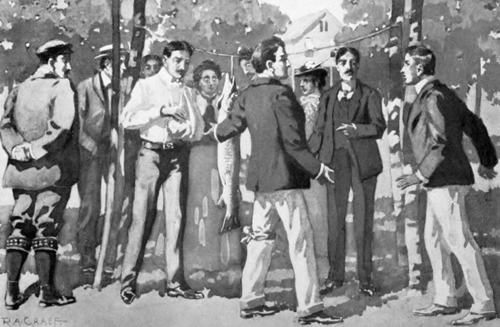
“‘Well, it’s pretty bad,’ said Du Ponté, ‘but Ribbon
needs you the worst of any of us.’”
As he turned toward the group surrounding
the suspended fish and saw his friends in such
evident distress, he hastened his steps in their
direction. An expression of deep sympathy
and concern had o’erspread his classic features,
and he elbowed himself quickly to the side of
his companions. “By Jove, old man, it’s pretty
tough! Where have you been?” Ribbon was
speaking in an accusing tone, holding his bandaged
arm tenderly to his breast. Harry
quickly looked from Du Ponté to the “cottager”
for an explanation. “Well, it’s pretty
bad,” said Du Ponté, “but Ribbon needs you
the worst of any of us; his hand is in a bad
shape.”
“Oh, you don’t tell me!” replied
Harry, sorrowfully. “Can I do anything for
you?” he eagerly inquired.
“By Jove, old chap,” went on Ribbon, with
apparent difficulty, “I thought you had gone
away last night on the ‘liner,’ or I would have
been after you sooner. I’m all done up. My
hand is in a bad way. This confounded fish
has chewed me up. The fellows here tied this
bandage all about, but it hurts like the deuce,
and I’m afraid of blood poisoning.” “Better do something for him,”
muttered Du Ponté.
Harry was deeply impressed with the responsibility
that was being heaped upon him. He
placed the palms of his hands over his hips
and drew up his shoulders till they rested
akimbo, and then he was completely confused
by the suddenness of the call upon his professional
skill. “Quick, Harry,” snapped the
“cottager,” “that hand needs to be dressed immediately,
then afterward you can take a look
at the cut in my leg.” “Say, old chap,” complained Ribbon,
“mother will be down here in a minute; then there will be a deuced row if
she sees this.” And he gingerly handled the
bandaged arm for effect. “But I have no—no
medicines,” stammered Harry, just recovering
his composure. “Medicine!” shouted Du
Ponté. “Don’t need medicines; get some cotton
batting, get lint, get any old thing—but
hustle; there’ll be trouble here soon!”
“That’s right, Harry,” spoke the “cottager” assuringly.
“Find the cotton batting; then we’ll get to
work.” “Cotton batting will be good for that—first
rate for a wound,” replied Harry, suddenly
awakening. “Why, we had some yesterday
over at your cottage, fixing up your rig for
the masquerade. It’s in the extension; I know
where to get it,” and he bolted through the
crowd over the side hill and down through
“Ghost Hollow,” up again on the opposite rise
of ground, and fled through the white birch
grove, disappearing into the grounds of the
castle across the bay. Before the arch conspirators
could hold a conference as to their
further conduct of the “fish case,” which was
now assuming an alarming aspect, Harry was
flying back through “Spirit Lane,” his arms
flapping up and down, his long legs dangling,
in his haste resembling the flight of a water
crane startled from a reed bank.
“Spread it out here,” suggested Du Ponté,
and he guided Harry to the edge of the
veranda, where he unfolded the roll of cotton.
The “cottager” had limped to the veranda and
seated himself. Ribbon followed him reluctantly.
“Go lightly now, old chap; I am afraid
it’s pretty bad,” said Ribbon. “Better dampen
that cotton in witch hazel or Pond’s extract,”
suggested the “cottager,” “for, if it’s blood
poison you need an antiseptic.” “Excuse me, old chap,
won’t you,” interrupted Ribbon; “this
is quite serious, I fear. Would you mind getting
that bottle of Pond’s extract up on your
dresser? It would be safer for you to use it,
don’t you know.” “Oh, of course, I never thought
of that.” And Harry was off again,
up the stairway this time, four steps at a bound,
out again on the gravel walk, the bottle of extract
clinched in his excited grasp. As Harry
hurried to the side of his suffering patient to
proceed with the bandaging, Mr. Mac had
quietly reached the front. “If you will allow
me to offer a suggestion,” he began, in his
cautious, convincing way, “my family physician
will arrive here in half an hour from
the city; he will have all the necessaries, which
I believe you require for this job, and it might
be safer all around to postpone this operation
till he comes.” “Quite right, quite right,” Du Ponté
replied at once. “Mind you,” continued Mac,
“I only wish to suggest; I am not interfering
with your case, Harry.” “Oh, that’s all
right, Mr. Mac,” said Harry; “the doctor probably
has antiseptics, and that will be very necessary
in this case.” “You had better go in to
your breakfast, Harry,” suggested Ribbon; “I
can stand this for half an hour, and the other
doctor will need you when he comes.” Harry,
still under the mesmeric spell, obeying orders,
hurried into the hotel for breakfast.
The principals fell back, again surrounding
the maskinonge, which was now stiffening in
the sun. They were considering the plan of
their escape from the Island in whispered consultation.
In the meantime Harry Weiner
Sneitzel had swallowed his first cup of coffee,
and began to think. At the second thought he
looked out of the window toward the suspended
fish, then he sank back in his chair; an expression
of fear and incredulity was forming
upon his countenance.
“Scamps,” he was heard to remark, as he
gazed for the second time out through the window
at the group upon the lawn. Then, quickly
rising, he headed for the office. Hatless he
sprang out upon the veranda. Grabbing up a
sabre which was thrown aside by a masquerader
of the night before, he bore down
upon the three conspirators who had made him
the victim of their practical joke. As he leaped
in one mad stride from the piazza to the ground
his long, thin front locks stood straight up in
the wind like the scalp feathers of an Indian.
“Sneak!” yelled Du Ponté. In a flash the
conspirators were out of the crowd which surrounded
the fish. Over the side hill they
scampered, Harry in pursuit, swinging the
flashing sabre in the air. Down through the
Hollow they sped, and in their flight, as did the
ghost spirits of the bay, they mysteriously disappeared
into the mazes of the dark cottages,
amidst the white birch grove in “Spirit Lane.”