John Scott would not perhaps have slept so well in a hole in the snow if
he had not been inured to life in a trench, reeking in turn with mud,
slush, ice and water. His present quarters were a vast improvement, dry
and warm with the aid of the blankets, and he had crisp fresh air in
abundance to breathe. Hence in such a place in the Inn of the Hedge and
the Snow he slept longer than he had intended.
His will to awake at the rising of the sun was not sufficient. The
soothing influence of warmth and the first real physical relaxation that
he had enjoyed in three or four days overpowered his senses, and kept
him slumbering on peacefully long after the early silver of the rising
sun had turned to gold on the snow.
He had dug so deep a hole and he lay so close under the hedge that even
a vigilant scout looking for an enemy might have passed within a dozen
feet of him without seeing him. Another drift of snow falling after he
had gone to sleep had covered up his footsteps and he was as securely
hidden as if he had been a hundred miles, instead of only a scant two
miles, from the double French and German line.
No human being noticed his presence. A small brown bird, much like the
snowbird of his own land, hopped near, detected the human presence and
then hopped deliberately away. Nobody was in the snowy fields. They were
within range of the great German guns, and the peasants were gone. Had
John been willing to search longer he could easily have found an
abandoned house for shelter. As he had made mental notes before, Europe
was now full of abandoned houses. In some regions rents must be
extraordinarily low.
While he slept, firing was resumed at points on the long double line.
Rifles flashed, and incautious heads or hands were struck, and somewhere
or other the cannon were always muttering. But it was all in the day's
work. Months of it had made his whole system physical and mental so used
to it that it did not awaken him now.
Nevertheless the hosts of the air were uncommonly active while he slept.
The wireless, sputtering and crackling, was carrying the news from
general to general that a smart little action had been fought at
Chastel, where another smart little action had been fought not long
before, that the Germans had been overly daring and had paid for it.
Yet it was only an incident on a gigantic battle front that extended its
mighty curving line from Switzerland to the sea, and soon the wireless
and its older brother the telephone, and its oldest brother the
telegraph, talked of other plans which would cause a much greater
slaughter than at Chastel. Chastel itself, unless its beautiful Gothic
cathedral brooding unharmed over the ruins could win it a word or two,
would have no place at all in history. John himself was only one among
eight or ten million armed men, and not a single one of all those
millions knew that he lay there in the snow under the hedge.
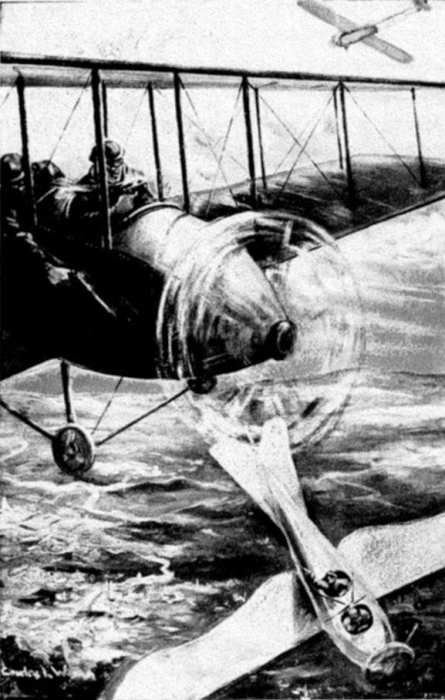
The aeroplanes came out in the clear frosty blue, and both German and
French machines sauntered lazily up and down the air lanes, but they did
not risk encounters with one another. They were scouting with powerful
glasses, or directing the fire of the batteries. One French machine
circled directly over John, not more than two or three hundred feet
away, but the man in it, keen of eye though he was, did not dream that
one of the bravest of the Strangers lay asleep under the hedge beneath
him.
The fleets of flyers were larger than usual, as if they were anxious to
take the fresh air, after days of storm. But the most daring and
skillful of all the airmen, Philip Lannes, was not there. He still lay
in a hospital a hundred miles to the west, with a bullet wound in his
shoulder, and while the time was to come when the Arrow under his
practiced hand would once more be queen of the heavens, it was yet many
days away.
The sun rose higher, suffusing the frosty blue heavens with a luminous
golden glow, but John slept heavily on. He had not known how near to
exhaustion was his nervous system. Perhaps it was less physical
exhaustion than emotion, which can make huge drains upon the system. Now
he was in the keeping of nature which was restoring all his powers of
both mind and body, and keeping him there until he should again have all
his strength and all the keenness of his faculties, needful for the
great work that lay before him.
It was halfway toward noon when he awakened, remembered dimly in the
first instant, and then comprehending everything in the second. He
unrolled the blankets, slipped out of his lair and knew by the height of
the sun that he had slept far beyond the time appointed for himself. But
he did not worry over it. Barring a little stiffness, which he removed
by flexing and tensing his muscles, he felt very strong and capable. The
fresh air pouring into his lungs was so different from the corruption of
the trenches that he seemed to be raised upon wings.
He resumed his walk toward the hills, and ate breakfast from his
knapsack as he went along. Presently he noticed a large aeroplane
circling over his head, and he felt sure that it was observing him. It
was bound to be French or other French machines would attack it, and,
after one glance, he walked slowly on. The machine followed him. He did
not look up again, but he saw a great shadow on the snow that moved with
his.
The knowledge that he was being watched and followed even by one of his
own army was uncomfortable, and he felt a sensation of relief when he
heard a swish and a swoop and the aeroplane alighted on the snow beside
him. The man in the machine stepped out and asked:
"Who are you and where are you going?"
John did not altogether like his manner, which in his own idiom he
styled "fresh."
"I've a name," he replied, "but it's none of your business, and I'm
going somewhere, but that's none of your business either."
"They're both my business," said the man, drawing a revolver.
"Read that," said John, producing his passport.
The document stated simply that Jean Castel was engaged upon an
important mission for France, and all were commanded to give him what
help they could. It was signed by the fat and famous general of brigade,
Vaugirard, and therefore it was a significant document.
"I apologize for brusqueness," said the aviator handsomely, "but the
times are such that we forget our politeness. What can I do for you,
Monsieur Jean Castel, who I am sure has another and more rightful name
at other times."
"Just now Castel is my right name, and all friends of mine will call me
by it. Thank you for your offer, but you can do nothing—"
John stopped suddenly as he glanced at the aeroplane poised like a huge
bird in the snow.
"Yes, you can do something," he said. "I notice that your plane is big
enough for two. I want to reach the mountains to the eastward without
all this tremendous toiling through the snow. You can carry me there in
an hour or two, and besides this passport I give you a password."
"What's the password?"
"Lannes!"
"Lannes! Philip Lannes, do you know him?"
"I have been up with him in the Arrow many times. I've fought the
Taubes with him. I helped him destroy both a Zeppelin and a
forty-two-centimeter gun."
"Then I know you. You are his friend John Scott, the American. I thought
at first that you had the accent of North America. Oh, I know of you! We
flying men are a close group, and what happens to one of us is not
hidden long from the others. Your password is sufficient."
"You know then that Lannes is in a hospital with a bullet wound in his
shoulder?"
"I heard it two days ago. A pity! A great pity! He'll be as well as ever
in a month, but France needs her king of the air every day. My own name
is Delaunois, and I'll put you down in those hills at whatever point you
wish, Monsieur Jean Castel of America."
John smiled. Delaunois was a fine fellow after all.
"I can't give you an extra suit for flying," said Delaunois, "but your
two blankets ought to protect you in the icy air. I'll not go very high,
and an hour or a little more should put us in the heart of the hills."
"Good enough, and many thanks to you," said John.
They gave the machine the requisite push, sprang in and rose slowly
above the snowy waste. It was a good aeroplane, and Delaunois was a
good aviator, but John missed the Arrow and Philip. He knew that the
heavens nowhere held such another pair. Alas! that Lannes should be laid
up at such a time with a wound!
But he quickly called himself ungrateful. Delaunois had come at a most
timely moment, and he was doing him a great service. It was very cold
above the earth, as Delaunois had predicted, and he wrapped the blankets
closely about himself, drawing one over his head and face, until he was
completely covered except the eyes.
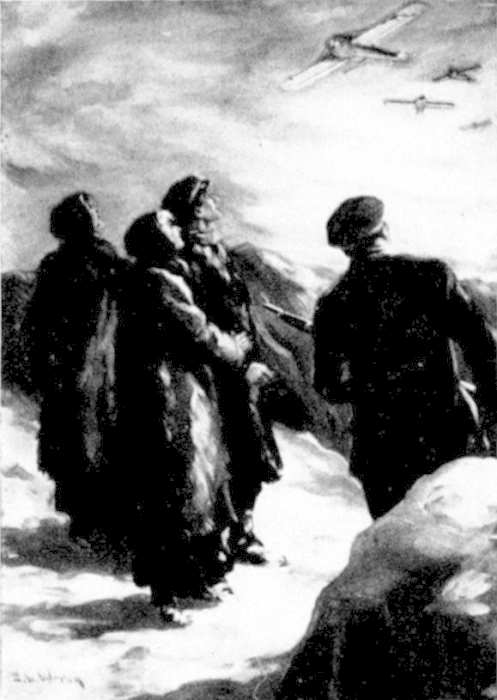
To the westward several other planes were hovering and to the eastward
was another group which John knew to be German. But the flying machines
did not seem disposed to enter into hostilities that morning, although
John saw the double line of trenches blazing now and then with fire,
and, at intervals, the heavy batteries on either side sent a stated
number of shells at the enemy.
Seen from a height the opposing trenches appeared to be almost together,
and the fire of the hostile marksmen blended into the same line of
light. But John did not look at them long. He had seen so much of foul
trenches for weary months that it was a pleasure to let the eye fill
with something else.
He looked instead at the high hills which were fast coming near, and
although covered with snow, with trees bare of leaves, they were a
glorious sight, an intense relief to him after all that monotony of
narrow mud walls. He knew that trenches or other earthworks ran among
the hills also, but the nature of the ground compelled breaks, and it
would be easier anyhow to pass through a forest or a ravine.
"Where do you wish me to put you down?" asked Delaunois.
"At some place in those low mountains there, where the German lines are
furthest from ours."
"I think I know such a point. You won't mind my speaking of you as a
spy, Mr. Jean Castel of America, will you?"
"Not at all, because that's what I am."
"Then don't take too big a risk. It hasn't been long since you were a
boy, and I don't like to think of one so young being executed as a spy."
"I don't intend to be."
"It's likely that I may see Philip Lannes before long. I go westward in
two or three days and I shall find a chance to visit him in the
hospital. If I see him what shall I tell him about a young man whom we
both know, one John Scott, an American?"
"You tell him that his sister, Mademoiselle Julie Lannes, came to the
village of Chastel to meet him, in accordance with his written request,
and while she was waiting for him with her servants, Antoine and Suzanne
Picard, not knowing that he had been wounded since the writing of his
letter, she was kidnapped and carried into Germany with the Picards by
Prince Karl of Auersperg. Prince Karl is in love with her and intends to
force her into a morganatic marriage. Otherwise she is safe. The
American, John Scott, in addition to his duties as a spy for France, a
country that he loves and admires, intends, if human endeavor can
achieve it, to rescue Mademoiselle Lannes and bring her back to Paris."
Delaunois took one hand from the steering rudder and turned glistening
eyes upon John.
"It's a knightly adventure," he said. "It will appeal to Frenchmen when
they hear of it, and yet more to Frenchwomen. I should like to shake the
hand of this American, John Scott, and since he is not here, I will, if
you will let me, shake the hand of his nearest French relative, Jean
Castel."
He opened his gloved palm and John's met it in a strong grasp.
"I'm glad," said Delaunois, "that I saw you, and that I am able to give
you this lift. We're over the edge of the mountains now, and presently
we'll cross the French lines. I think I'd better go up a considerable
distance, as they won't know we're French, and they might give us a few
shots."
The machine rose fast and it grew intensely cold. John looked down now
upon a country, containing much forest for Europe, and sparsely
inhabited. But he saw far beneath them trenches and other earthworks
manned with French soldiers. Several officers were examining them
through glasses, but Delaunois sailed gracefully over the line, circled
around a slender peak where he was hidden completely from their view,
and then dropped down in a forest of larch and pine. "So far as I know,"
he said, when the plane rested on the snow, "nobody has seen our
descent. We're well beyond the French lines here, but you'll find
German forts four or five miles ahead. As you see, this is exceedingly
rough ground, not easy for men to occupy, and so the French stay on one
side of this little cluster of mountains while the Germans keep to the
other. And now, Monsieur Jean Castel, I leave you here, wishing you
success in your quest, success in every respect."
Again the two strong hands met. A minute later the aeroplane rose in the
air, carrying but one of the men, while Jean Castel, peasant of
Lorraine, was left behind, standing in the snow, and feeling very
grateful to Delaunois.
John watched the aeroplane disappear over the peak on its return
journey, and then he walked boldly eastward toward the German lines.
Modesty kept him from accepting Delaunois' tribute in full, but it had
warmed his heart and strengthened his courage anew. Delaunois had
considered it not a reckless quest, but high adventure with a noble
impulse, and John's heart and spirit had responded quickly. Great deeds
come from exaltation, and that mood was his.
He followed what seemed to be a little path under the snow, leading
along the side of the mountain toward the eastward, the way he would go.
Here portions of the earth were exposed, where the snow had already
melted much under the heat of the high sun. Three or four hundred feet
below a brook ran noisily over stones, but that was the only sound in
the mountains. He felt though that the Germans must be somewhere near.
Men with glasses might be watching him already.
He decided at once upon his rôle. In Europe peasants were often heavy
and loutish. It was expected of them, and none would be heavier or more
loutish than he. He thrust both hands in his pockets, and began to
whistle familiar German songs and hymns, varying them now and then with
a chanson or two that might have been sung for centuries in Lorraine.
The path led on across a little valley and then along the slope of
another ridge. Under the increasing heat of the sun the snow was now
melting much faster, and streams ran in every ravine. But the stalwart
young peasant, Jean Castel of Lorraine, was sure of his footing, and he
advanced steadily toward his goal.
Germans in rifle pits saw the figure coming their way, and several
officers examined it critically with their glasses. All pronounced the
stranger obviously a peasant, and they were equally sure that he could
do them no harm. He was coming straight toward their pits and so they
awaited him with some curiosity.
John presently caught the shimmer of sun on bayonets, and he knew now
that he would soon reach the German earthworks. His first care after
Delaunois left him, had been to destroy the passport that General
Vaugirard had given him and there was not a scratch of writing about him
to identify him as John Scott.
Whistling louder than ever, and looking vacant of countenance, he walked
boldly toward the first rifle pit, and, when the sharp hail of the
German sentry came, he promptly threw up his hands. An officer whom he
took to be a lieutenant and four or five men came toward him. All wore
heavy gray overcoats and they were really boys rather than men; not one
of them, including the officers, seeming to be more than twenty. But
they were large and muscular, heavily tanned by wind and snow and rain.
John had learned to read character, and as he walked carelessly toward
them he nevertheless watched them keenly. And so watching he judged that
they were honest youths, ready to like or hate, according to orders from
the men higher up, but by nature simple and direct. He did not feel any
fear of them.
"Halt!" said the officer, whom John judged to be a Saxon—he had seen
his kind in Dresden and Leipsic.
John stopped obediently, and raised his hand in a clumsy military
fashion, standing there while they looked him over.
"Now you can come forward, still with your hands up," said the officer,
though not in any fierce manner, "and tell us who you are."
John advanced, and they quickly searched him, finding no weapon.
"You can take your hands down," said the officer. "Unarmed, I don't
believe you'd be a match for our rifles. Now, who are you?"
"Jean Castel, sir, of Lorraine," replied John in German with a strong
French accent.
"And what have you been doing here between our lines and those of the
French?"
"I took some cattle across the mountains for the army and having sold
them I was walking back home. In the storm last night I wandered through
the lines into this very rough country and got lost."
"You do look battered. But you say you sold your cattle. Now what have
you done with your money?"
The officer's tone had suddenly become suspicious, but John was
prepared. Opening his heavy blouse he took from an inside pocket a
handful of German gold and notes. The young lieutenant glanced at the
money and his suspicions departed.
"It's good German," he said, "and I don't think a peasant like you could
have got it unless he had something valuable to sell. Come, you shall go
back with us and I'll turn you over to a higher officer. I'm Lieutenant
Heinrich Schmidt, and we're part of a Saxon division."
John went with them without hesitation. In fact, he felt little fear.
There was nothing to disprove his statements, and he was not one of
those who looked upon Germans as barbarians. Experience had shown him
that ordinary Germans had plenty of human kindness. He sniffed the
pleasant odors that came from the kitchen automobiles near by, and
remarked naïvely that he would be glad to share their rations until they
passed him on.
"Very well, Castel," said Lieutenant Schmidt, "you shall have your
share, but I must take you first to our colonel. He will have important
questions to ask you."
"I'm ready," said John in an indifferent tone. But as he went with the
men he noted as well as he could, without attracting attention to
himself, the German position. Rifle pits and trenches appeared at
irregular intervals, but the mountains themselves furnished the chief
fortifications. In such country as this it would be difficult for either
side to drive back the other, a fact which the enemies themselves seemed
to concede, as there was no firing on this portion of the line. But at
points far to the west the great guns muttered, and their faint echoes
ran through the gorges.
The path led around one of the crests, and they came to a little cluster
of tiny huts, which John knew to be the quarters of officers. Snug, too,
they looked, with smoke coming out of stovepipes that ran through the
roofs of several of them. A tall man, broad of shoulder, slender of
waist, blue of eye, yellow of hair, and not more than thirty, came
forward to meet them. John recognized at once a typical German officer
of high birth, learned in his trade, arrogant, convinced of his own
superiority, but brave and meaning to be fair.
"A peasant of Lorraine, sir," said Lieutenant Schmidt. "He says that his
name is Jean Castel, and that he has been selling cattle. We found him
wandering between the lines. He was unarmed and he has considerable
money."
"Come closer," said the officer to John. "I'm Colonel Joachim Stratz,
the commander of this regiment, and you must give a thorough account of
yourself."
John advanced willingly and saluted, feeling that the glance Colonel
Stratz bent upon him was heavy and piercing. Yet he awaited the result
with confidence. It was true that he was American, but he had been with
the French so much now that he had acquired many of their tricks of
manner, and his French accent was impeccable.
"You are a seller of cattle?" said Colonel Stratz, suddenly in English.
The words of reply began to form, but John remembered himself in time.
He was a French peasant who understood no English, and giving Colonel
Stratz a puzzled look he shook his head. But he wondered what suspicion
had caused the German to ask him a question in English. He concluded it
must be a mere chance.
Colonel Stratz then addressed him in German, and John replied to all his
queries, speaking with a strong French accent, repeating the tale that
he had told Lieutenant Schmidt, and answering everything so readily and
so convincingly that Colonel Joachim Stratz, an acute and able man, was
at last satisfied.
"Where do you wish to go now, Castel?" asked the German.
"To Metz, if it please you, sir."
"Wouldn't it be better for you to stay, put on a uniform, take up a
rifle and fight for our Kaiser and Fatherland?"
John shook his head and put on the preternaturally wise look of the
light-witted.
"I'm no soldier," he replied.
"Why weren't you called? You're of the right age."
"A little weakness of the heart. I cannot endure the great strain, but I
can drive the cattle."
"Oh, well, if that is so, you serve us better by sticking to your trade.
Lieutenant Schmidt, give him food and drink, and then I'll prepare for
him a pass through the lines that will take him part of the way to Metz.
He'll have to get other passes as he goes along."
John saluted and thanked Colonel Stratz, and then he and Lieutenant
Schmidt approached one of the great German kitchen automobiles. It was
easy to play the rôle of a simple and honest peasant, and while he drank
good beer and ate good cheese and sausage, he and Lieutenant Schmidt
became quite friendly.
Schmidt asked him many questions. He wanted to know if he had been near
the French lines, and John laughingly replied that he had been
altogether too near. Three rifle bullets fired from some hidden point
had whizzed very close to him, and he had run for his life.
"I shall take care never to get lost again," he said, "and I intend to
keep well behind our army. The battle line is not the place for Jean
Castel. Why spoil a first-class herder to make a second-class soldier?"
He winked cunningly at Schmidt, who laughed.
"You're no great hero," said the German, "but if a man wants to take
care of his skin can he be blamed for doing so? Still, you're not so
safe here."
"How's that?" asked John in assumed alarm.
"Now and then the French send shells over that mountain in front of us
and when one is fired it's bound to hit somewhere. We haven't had any at
this point yet, but our time is sure to come sooner or later."
"Then I think I'll be going," said John, willing to maintain his new
reputation as a timid man.
Schmidt laughed again.
"Oh, no, not yet," he said. "Your passport isn't ready, and without it
you can't move. Have another glass of this beer. It was made in Munich,
and puts heart into a man."
John drank. It was really fine beer, and the food was excellent, warm
and well cooked. He had not realized before how hungry and thirsty he
was. It was a hunger and thirst that the cold meat and bread in his
knapsack and snow water would not have assuaged. Many Germans also were
refreshing themselves. He had noticed that in both armies the troops
were always well fed. Distances were short, and an abundance of railways
brought vast quantities of supplies from fertile regions.
While he was still eating he heard a shriek and a roar and a huge shell
burst two or three hundred yards away. Much earth was torn up, four men
were wounded slightly and an empty ambulance was overturned, but the
regular life of the German army went on undisturbed.
"I told you that we had French messengers now and then," said Lieutenant
Schmidt, holding a glass of beer in his right hand and a sausage in his
left, "but that message was delivered nearer to us than any other in
three days. I don't think they'll fire again for a half-hour, and the
chances are a hundred to one that it will fall much further away. So why
be disturbed?"
Lieutenant Schmidt was beginning to feel happy. He had a sentimental
German soul, and all the beer he wanted brought all his benevolence to
the surface.
"I like you, Castel," he said. "Your blood is French, of course, or it
was once, but you of Lorraine have had all the benefits of German
culture and training. A German you were born, a German you have
remained, and a German you will be all your life. The time is coming
when we will extend the blessings of our German culture to all of
France, and then to England, and then maybe to the whole world."
Lieutenant Schmidt had drunk a great deal of beer, and even beer when
taken in large quantities may be heady. His tongue was loose and long.
"And to that distant and barbarous country, America, too," said John.
"Aye, and to the Americans also," said Lieutenant Schmidt. "I hear that
they don't love us, although they have much of our blood in their veins.
There are many people among them bearing German names who denounce us.
When we finish with our enemies here in Europe we'll teach the barbarous
Americans to love the Kaiser."
"A hard task," said John, with meaning.
"So it will be," said Lieutenant Schmidt, taking his meaning
differently, "but the harder the task the better we Germans love it.
And now, Castel, here comes your passport. Its little winged words will
bear you safely to the headquarters of General Osterweiler thirty miles
to the north and east, and there you'll have to get another passport, if
you can. Auf wiedersehen, Jean Castel. Your forefathers were French,
but you are German, good German, and I wish you well."
Lieutenant Schmidt's cheeks were very red just then, not altogether with
the cold, and his benevolence had extended to the whole world, including
the French and English, whom he must fight regretfully.
"Oh," said John, as an afterthought, although he was keenly noting his
condition, "while I was wandering in the snow of the big storm, I heard
from a sentinel that one of our great generals and beloved princes.
Prince Karl of Auersperg, had passed this way with his train."
Perhaps if Lieutenant Schmidt had not taken so much good Munich beer
after a long fast he might have become suspicious, because it was not
the question that an ordinary peasant and cattle-herder would ask unless
the previous conversation had led directly to it. But as it was he
fairly exuded trust and kindness.
"Not here," he replied, "but at a point further toward the west and
north. So great a figure as Prince Karl of Auersperg could scarcely go
by without our hearing of it. Colonel Stratz himself spoke of it in my
presence."
"I saw him once in Metz before the war. A grand and imposing figure.
Perhaps I shall behold him there again in a few days."
"I think not. It was said that the prince was going to his estates in
the east. At least, I think I heard something of the kind, but it
probably means that he was on his way to the eastern frontier. Prince
Karl of Auersperg is not the man to withdraw from the war."
John's heart dropped suddenly. Would he be compelled to follow the
prince halfway across Europe. Oh, why had he left the Hôtel de l'Europe
even for a moment? With Picard's help he might have been able to hold
off Auersperg and his followers, or a lucky shot might have disposed of
the prince. He felt it no crime to have wished for such a chance. But
strengthening his heart anew he took up the burden that had grown
heavier.
"Auf wiedersehen, Lieutenant Schmidt," he said, and whistling softly
to himself he began his passage through the German lines, showing his
passport more than a dozen times before he passed the last trench and
rifle pit, and was alone among the hills behind the German lines. He
might have reached the railroad and have gone by train to Metz, but he
preferred, for the present at least, to cling to the country, even at
the risk of much physical hardship and suffering.
He still carried his blankets, and he was traveling through a region
which had been much fought over in the earlier stages of the war. Since
the German lines were still in France some peasants had returned to
their homes, but many houses were yet abandoned, their owners probably
thinking that the tide of battle would roll back upon them, and that it
was better to wait.
He turned presently from the hilly path into a good road, paved almost
like a street, and breaking from a bush a stout stick, which he used
peasant fashion as a cane, he walked briskly along the smooth surface,
now almost clear of the snow which had fallen in much smaller quantities
in the lowlands.
He met a battery of four twenty-one-centimeter guns with their numerous
crews and an escort of cavalry, advancing to the front, and he stepped
to one side of the road to let them pass. The leader of the cavalry
hailed him and John's heart gave a sudden alarming throb as he
recognized von Boehlen. But his courage came back when he saw that he
would not have known the Prussian had he remained twenty feet away. Von
Boehlen was deeply tanned and much thinner. There were lines in his face
and he had all the appearance of a man who had been through almost
unbearable hardships.
John had no doubt that a long life in the trenches and intense anxiety
had made an equal change in himself. The glass had told him that he
looked more mature, more like a man of thought and experience. Moreover,
he was in the dress of a peasant. After the first painful heartbeat he
awaited von Boehlen with confidence.
"Whence do you come?" asked the colonel of Uhlans—colonel he now was.
John pointed back over his shoulder and then produced his passport,
which Colonel von Boehlen, after reading, handed carefully back to him.
"Did you see anything of the French?" he asked glancing again at John,
but without a sign of recognition.
"No, sir," replied John in his new German with a French accent, "but I
saw a most unpleasant messenger of theirs."
"A messenger? What kind of a messenger?"
"Long, round and made of steel. It came over a mountain and then with a
loud noise divided itself into many parts near the place where I stood.
One messenger turned itself into a thousand messengers, and they were
all messengers of death. Honored sir, I left that vicinity as soon as I
could, and I have been traveling fast, directly away from there, ever
since."
Von Boehlen laughed, and then his strong jaws closed tighter. After a
moment's silence, he said:
"Many such messengers have been passing in recent months. The air has
been full of them. If you don't like battles, Castel, I don't blame you
for traveling in the direction you take."
John, who had turned his face away for precautionary measures, looked
him full in the eyes again, and he found in his heart a little liking
for the Prussian. Von Boehlen seemed to have lost something of his
haughtiness and confidence since those swaggering days in Dresden, and
the loss had improved him. John saw some signs of a civilian's sense of
justice and reason beneath the military gloss.
"May I pass on, sir?" he asked. "I wish to reach Metz, where I can
obtain more horses for the army."
"Why do you walk?"
"I sold my last horse and the automobiles and trains are not for me. I
know that the army needs all the space in them and I ask nothing."
"Fare on then," said von Boehlen. "Your papers are in good condition and
you'll have no trouble in reaching Metz. But be sure you don't lose your
passport."
The injunction was kindly and John, thanking him, took up the road. Von
Boehlen and his Uhlans rode on, and John looked back once. He caught a
single glimpse of the colonel's broad shoulders and then the long column
of horsemen rode by. There was no military pomp about them now. Their
gray uniforms were worn and stained and many of the men sagged in their
saddles with weariness. Not a few showed wounds barely healed.
The cavalry were followed by infantry, and batteries of guns so heavy
that often the wheels sank in the paved road. Sometimes the troops sang,
pouring forth the mighty rolling choruses of the German national songs
and hymns. The gay air as of sure victory just ahead that marked them in
the closing months of summer the year before had departed, but in its
place was a grim resolution that made them seem to John as formidable as
ever. The steady beat of solid German feet made a rolling sound which
the orders of officers and the creaking of wagons and artillery
scarcely disturbed. The waves of the gray sea swept steadily on toward
France.
John showed his passport twice more, but all that day he beheld marching
troops. In the afternoon it snowed a little again and the slush was
everywhere, but he trudged bravely through it. Having escaped from the
trenches he felt that he could endure anything. What were snow, a gray
sky and a cold wind to one who had lived for months on a floor of earth
and between narrow walls of half-frozen mud? He was like a prisoner who
had escaped from a steel cage.
Toward dark he turned from the road and sought refuge at a low but
rather large farmhouse, standing among trees. He modestly made his way
to the rear, and asked shelter for the night in the stable, saying that
he would pay. He learned that the place was occupied by people bearing
the German name of Gratz, which however signified little on that
borderland, which at different times had been under both German and
French rule.
Nor did the proprietor of the house himself, who came out to see him,
enlighten him concerning his sympathies. If he liked France obviously it
was no time for him to say so when he was surrounded by the German
legions. But John could sleep on the hay in the stable, and have supper
and breakfast for certain number of marks or francs which he must show
in advance. He showed them and all was well.
John, after carefully scraping all the mud and snow from his boots was
allowed to go in the big kitchen and sit on a stone bench beside the
wall, while two stout women cooked at a great furnace, and trim maids
came for the food which they took upstairs.
When he sank down upon the bench he realized that he was tired through
and through. It was no light task even for a hardened soldier to walk
all day in bad weather. One of the cooks, a stout middle-aged woman whom
the others called Johanna, gave him a glance of sympathy. She saw a
young man pale from great exertion, but with a singularly fine face, a
face that was exceedingly strong, without being coarse or rough. Johanna
thought him handsome, and so did the other cook, also stout and
middle-aged, who bore the French name of Nanine.
"Poor young man!" said one and, "Poor young man!" repeated the other.
Then they filled a plate with warm food and handed it to him. While he
ate he talked with them and the passing maids, who were full of interest
in the handsome young stranger. He told them that he was a horse-trader,
and that he had been in no battle, nor would he be in any, but he saw
that he was not believed, and secretly he was glad of it. These were
trim young maids and a young soldier likes admiration, even if it comes
from those who in the world's opinion are of a lower rank than he.
They asked him innumerable questions, and he answered as well as he
could. He told of the troops that he had seen, and they informed him
that German forces had been passing there at times all through the
winter. Princes and great generals had stopped at the farmhouse of Herr
Gratz or Monsieur Gratz, as he was indifferently called. The war had
ruined many others, but it brought profit to him, because all the guests
paid and paid well.
John in a pleased and restful state listened, and he was soothed by the
sound of their voices. He had often heard old men at home, veterans of
the Civil War, tell how grateful to them was the sight of a woman after
months of marching and fighting. Now he understood. These were only
cooks and housemaids, but their faces were not roughened like those of
soldiers, and their voices and footsteps were light and soft. Moreover,
they gave him food and drink—for which he would pay farmer Gratz,
however—and made much over him.
"We had royal guests last night," said the youngest of the maids, whom
they called Annette, a slender blond girl.
"Going to the battle front?"
"Oh, no. They were going the other way, toward Metz, and perhaps only
one was a real prince."
"Maybe this prince had seen enough of battles?"
"I cannot say. I saw him only once. He was a large man, middle-aged, and
he had a great brown beard."
John's whole body stiffened. Questions leaped to his lips, but he
compelled his muscles to relax and by a great effort he assumed a tone
of indifference.
"What was the prince's name?" he asked with apparent carelessness.
"I don't know, but the people around him were as respectful to him as
if he were a king. There were two women with him, but the master himself
served these two alone in their room."
"But you caught a glimpse of one of the women, the younger, Annette?"
said Johanna.
"So I did, but it was only a glimpse."
"What did she look like?" asked John, who was trying to keep down the
beating of his heart.
"It was only a second, but I saw a face that I will never forget. She
was very pale, but she had beautiful blue eyes like stars, and the most
lovely golden hair that ever grew in the world."
"Julie! My Julie!" groaned John under his breath.
"What did you say?"
"I was merely wondering who she was."
"I wondered, too, and so did all of us. We heard a tale that she was a
princess, a niece or a daughter, perhaps, of the great prince, with whom
she traveled, and we heard another that she and the woman with her were
French spies of the most dangerous kind who had been captured and who
were being taken into Germany. And the face of the beautiful young lady,
which I saw for only a moment, was French, not German."
John felt hot and then cold from head to foot. Julie a spy! Impossible!
Spies were shot or hanged, and sometimes women were no exceptions. How
could such a charge be brought against her? And yet anything could
happen in such a vast confused war as this. Julie, his Julie of the
starry blue eyes and the deep gold hair to be condemned and executed as
a spy! A cold shiver seized him again.
Then came sudden enlightenment. Auersperg was medieval. In his heart he
arrogated to himself the right of justice, the upper, the middle and the
low, and all other kinds, but he had ability and mingled with it an
extreme order of cunning. Julie of the Red Cross, a healer of wounds and
disease, would not be held a prisoner, but Julie, a spy, would be kept a
close captive, and her life would be in the hands of the general
commanding those who had taken her. Oh, it was cunning! So cunning that
its success seemed complete, and he thrilled in every vein with pain and
anger.
"Are you ill?" asked the good Johanna, who had noticed the sudden
deepening of his pallor.
"Not at all, thank you," he replied, forcing himself to speak in a level
tone. "I feel splendidly. All of you are too kind to me. But that was an
interesting story about the prince and the girl whom he brought with
him, who might be either a relative or a captive."
"I'm thinking she must have been his niece," said romantic Annette, "but
I'm sure she didn't love him. Perhaps she wanted to run away with some
fine young officer, and he caught her and brought her back."
"When did they leave?"
"Very early this morning. They came in automobiles, but neither when
they arrived nor when they departed was the lady in the machine with the
prince. She and the woman with her, who must have been her servant,
were in a small machine alone, except for the chauffeur."
"It's a strange tale. Which way did they go?"
"Toward Metz. We know no more. The prince did not look like a man who
would tell his intentions to everybody."
"The story has in it the elements of romance," said John. "I think with
you, Annette, that the young lady who must certainly have been of high
birth, was being carried away from some young man who loved her well."
A lively discussion followed. John's voice had decided the opinion of
the kitchen. It had been divided hitherto, but it was not now. The
beautiful young lady with the starry eyes and the golden hair had
certainly been torn away, and the sympathy of cooks and maids was
strongly for her. While they talked John tried to collect his thoughts.
After the first shock, he was convinced that Julie's life was in no
danger, but her liberty certainly was. Auersperg would use the charge
that she was a spy to hold her, and he was a powerful man. The pressure
upon her would grow heavier and heavier all the time. Could she resist
it? He might make her think that the fate of a spy would be hers, unless
she chose to marry him.
In all the world, since Philip would lie long in the hospital with a
wound, there was but one man who could help her. And it was he, John
Scott. Out of the depths of his misery and despair a star of hope shot
up. His own strong heart and arm, and his only, would rescue her. Some
minds gather most courage when things are at the worst, like steel
hardening in the fire, and John's was markedly of this type. Since
chance had brought him on this road, and to the very house in which
Julie had slept, the same kindly chance would continue to guide him on
the right way. It was a good omen.
The twilight outside, cold and gray, was deepening into night. His
appetite was satisfied and he felt buoyant and strong. Had he obeyed his
impulse he would have started on the road to Metz in pursuit. But he
knew that it was folly to exhaust himself in such a manner for nothing.
Instead he told Johanna that he would go to the stable now and sleep.
Jacques, a stalwart hostler, was called to show him his quarters, and he
departed with all their good wishes.
Jacques was a large brown peasant, and as he led the way to the stable
he said:
"They told me your name was Jean Castel from Lorraine?"
"Yes, back of Metz."
"And the house is full of German officers."
He pointed to the windows of the dining-room, which were ruddy with
light. Young men in tight-fitting uniforms, their blond hair
pompadoured, were outlined vividly against the glow.
"Will they go forward or will they come back?" asked Jacques in a hoarse
whisper. "Is the work of Bismarck to stand or is it to undo itself?"
John believed Jacques to be a French sympathizer, anxious for an opinion
that would agree with his hopes, but one could not be sure in such
times, and it behooved him above all, with Julie at the end of his
journey, to be careful. So he merely shrugged his shoulders and replied:
"I know not. I'm a simple buyer and seller of horses. I'm a much better
judge of a horse than of an army. I've no idea which side is the
stronger. I don't love war, and I'm going away from it as fast as I
can."
Jacques laughed.
"Perhaps it will follow you," he said. "There is war everywhere now, or
soon will be. I hear that it's spreading all over the world."
John shrugged his shoulders, and followed Jacques up a ladder into a
loft over the horses. But it was not a bad room. It had two small iron
beds and it was secure from wet and cold.
"You take that," said Jacques, pointing to the bed on the right. "It
belonged to Fritz who was the hostler here with me. He went to the army
at the first call and was killed at Longwy. Fritz was a German, a Saxon,
but he and I were friends. We had worked together here three years. I'd
have been glad if the bullets had spared him. The horses miss him, too.
He had a kind hand with them and they liked him. Poor Fritz! You sleep
in the bed of a good man."
"My eyes are so heavy that I think I'll go to bed now."
"The bed is waiting for you. It's always welcome to one who has walked
all day in the cold as you have. I have more work. I have the tasks of
that poor Fritz and my own to do now. It may be an hour, two hours
before I'm through, but if you sleep as soundly as I do I'll not wake
you up."
John sank into deep slumber almost at once and knew nothing until the
next morning.