When ladies began to hunt—Hunt subscriptions—In the field—Cub-hunting—Blood—Coming
home—Rider’s Physical Condition—Tips
and thanks—The Horn—Hirelings—Farmers and Wire—Pilots—Propriety—Falls.
Although the hunting field is nowadays graced by the presence of many
good horsewomen who ride well to hounds and are capable of taking care
of themselves and their mounts, it is only within about the last seventy
years that ladies have ridden across country. Mr. Elliott in his book
Fifty years of Fox-hunting tells us that in 1838 “Mrs. Lorraine Smith
and her two daughters, with Miss Stone from Blisworth, were the only
ladies who hunted then. The Misses Lorraine Smith rode in scarlet
bodices and grey skirts. The improved side-saddle was not then invented
to enable a lady to ride over fences.” We learn from the same writer
that in 1841 “a lady named Miss Nellie Holmes was out, topping the
fences like a bird to the admiration of all; and when she came to the
brook, over she went.... That was the first lady whom I saw go over a
country. There is one certainty about ladies, what one does another will
do, if it be worth the doing. Very soon others were at the game, and
many have played it well since.” In a pleasant little book entitled The
Young Ladies’ Equestrian Manual, written by a lady and published in
1838, we read, “No lady of taste ever gallops on the road. Into this
pace the lady’s horse is never urged, or permitted to break, except in
the field; and not above one among a thousand of our fair readers, it
may be surmised, is likely to be endowed with sufficient ambition and
boldness, to attempt the following of hounds.” The saddle given in a
drawing in this book has no leaping head, but the writer mentions, as I
have previously noted, that movable crutches were being introduced to
enable a lady to ride on either side of her horse. The leaping head (p.
33), third crutch, or third pommel, as it was first called in England,
came into use in this country in the forties, and with its aid ladies
felt themselves endowed with sufficient ambition and boldness to follow
hounds. Captain Elmhirst, writing in 1877, says: “It will, I think, be
admitted by everyone that the number of ladies who hunt now is at least
tenfold as compared with a dozen years ago,” and every year since that
was written, has seen a steady increase in the ranks of hunting women.
Perhaps it may not be out of place to say something about what a lady
should do if she desires to join a hunt and has no menkind to arrange
such business matters for her. Every woman who hunts should (and usually
does, I believe,) contribute her share of payment towards the sport in
which she participates. If a lady is well off, and intends to hunt
regularly, she would probably not give less than £25; but the Quorn and
some other fashionable hunts lay down no hard and fast rule concerning
the amount to be subscribed, which varies according to individual
circumstances. The minimum subscription to the Pytchley is £25 for a man
and £10 for a lady. Lord North, who is Chairman of the Committee of the
Warwickshire Hunt, states (The Field, 20th December, 1902), in a very
generous manner, that “fox-hunting must never be allowed to become the
sport of the rich alone. It is a national sport, and must be open to
all—to rich and poor alike.” There is, however, a recognised sum which
qualifies the donor for hunt membership; for instance: the Craven
minimum subscription, with membership, is £10; the Crawley and Horsham,
15 guineas; while subscribers of £25 to the Meynell hunt are privileged
to wear the hunt button. In several hunts—Lord Fitzwilliam’s, Mr.
Bathurst’s, the Belvoir, when hunted by the Duke of Rutland, and
others—the Master hunts the country at his own expense, subscriptions
being accepted only for Covert, Wire, Poultry, or Damage Funds, as the
case may be. The Vale of White Horse (Cirencester) requires a
subscription from ladies of “£5 per day, per week.” Strangers who hunt
occasionally with a subscription pack where capping is not practised,
are expected to contribute towards the Poultry or Damage Fund. In some
hunts a cap is taken from non-subscribers, from whom a certain fixed sum
is expected; the Essex and Suffolk requires five shillings a day, the
Burstow a sovereign, and the Pytchley and Warwickshire two pounds. The
usual “field money” in Ireland is half-a-crown. The Blackmore Vale,
although a subscription pack, does not fix any sum, but sensibly expects
people to subscribe according to the number of horses they keep, and the
amount of hunting they do. An old and sound rule is £5 for each horse.
As subscriptions vary in different hunts, the best plan for a lady who
has to arrange her own business matters, is to write to the secretary of
the hunt which she desires to join, and obtain from him the required
information. She will find Bailey’s Hunting Directory a most useful
book of reference.
Under this heading, I shall try to give practical advice to those who
are commencing their hunting career, and explain several things that I
would have liked to have known myself when I first rode to hounds. As we
may learn something from the failings of others before entering the
expensive school of experience, it would be wise, before we hunt, to
study certain complaints which experienced hunting men have published
anent our sisters in the field. Mr. Otho Paget says: “I am not one of
those who think that women are in the way out hunting, and in my
experience I have always considered they do much less harm than the men,
but the time when they do sin is at a check. They not only talk
themselves, but they encourage men to talk as well, and I have
repeatedly seen a woman lead a whole field over ground where the pack
intended to cast themselves. The woman, instead of attending to what
hounds are doing, enters into a conversation with a man and together
they talk on without paying heed to the damage they may do. My dear
sisters, forgive me for calling you to order, but if you would only keep
silent when hounds are at fault, and stand quite still, you perhaps
might shame your admirers into better behaviour, and thereby be the
means of furthering the interests of sport.” This rebuke means that when
a gallop is suddenly stopped by hounds losing the scent of their fox and
being obliged to puzzle out the line, the ladies of the hunt should
remain silent, should pull up and not impede the huntsman who will do
his best to aid his hounds in recovering the lost scent. Mr. Paget’s
remark about the lady who led the field over ground where the pack
intended to cast themselves, means that the hounds were trying to
recover the lost scent without the assistance of the huntsman, but
their efforts had been spoiled by the people who rode over the ground
and thus foiled the line. It is obvious that to spoil the sport of
others in this negligent manner is to cover ourselves with humiliation,
and other unbecoming wraps.
It must be remembered that hunting, unlike other forms of sport, has no
written rules of its own for the guidance of the uninitiated. Every
indulgence should therefore be shown to the hunting tyro who innocently
commits errors; for in nine cases out of ten it is probable she does so,
from ignorance of the unwritten laws which govern the conduct of the
experienced hunting man and woman. On this subject Mr. Otho Paget
writes: “The lady novice comes in for her share of blame, and though she
may not get sworn at, black looks will soon explain the situation. For
her I would also crave indulgence, and if she becomes a regular
offender, you can ask her male friends to tell her in what way she is
doing wrong. In whatever way we may treat them, there is no excuse for
the novice, male or female, embarking on a hunting career, without
having ascertained the customs and observances which are considered
necessary by those who have had considerable experience.... Anyone who
comes out hunting without knowing the rules of the game, is a constant
source of danger to those who are near.” This is all very true of
course; but the aspiring Diana may well ask “what are these said rules,
and where can I obtain them?” I feel sure that all hunting novices
would greatly appreciate and study an orthodox code of hunting laws, as
it would be far pleasanter for a lady to avoid mistakes by their
guidance, than to have “her male friends to tell her in what way she is
doing wrong,” possibly after she has received “black looks” from the
whole of the field. Hunting is a science which has to be learnt, and
every game of science should have its published code of regulations, or
it cannot be played without grave blunders by those who have to pick it
up at haphazard.
In justice to my sex it must be allowed that they do not holloa on
viewing a fox, a fault that is often committed by men, especially in the
Provinces. Colonel Alderson quoting from an old pamphlet on hunting
which was reprinted in 1880 by Messrs. William Pollard and Co., Exeter,
says: “Gentlemen, keep your mouths shut and your ears open. The fox has
broken cover, you see him—gentlemen, gentlemen, do not roar out
‘Tally-ho’! do not screech horribly. If you do, he will turn back, even
under your horses’ feet, in spite of the sad and disappointed look on
your handsome or ugly faces. Do not crack your infernal whips, be
silent.”
Whyte Melville says: “I do not say you are never to open your mouth, but
I think that if the inmates of our deaf and dumb asylums kept hounds,
these would show sport above the average and would seldom go home
without blood. Noise is by no means a necessary concomitant of the
chase, and a hat held up, or a quiet whisper to the huntsman, is of
more help to him than the loudest and clearest view holloa that ever
wakened the dead, ‘from the lungs of John Peel in the morning.’”
As this chapter is written with the desire to help the inexperienced
huntress, she will, I feel sure, be grateful to the writers who have
advised her what not to do, so we will study the next complaint which
comes from that experienced sportsman Captain Elmhirst, who describes a
hunting run better, I think, than any other writer on the subject. He
says: “When ladies cast in their lot with the rougher sex, lay
themselves out to share in all the dangers and discomforts incidental to
the chase, and even compete for honours in the school of fox-hunting,
they should in common fairness be prepared to accept their position on
even terms, nor neglect to render in some degree mutual the assistance
so freely at their command, and that men in a Leicestershire field so
punctiliously afford to each other. The point on which they so
prominently fail in this particular is, to speak plainly, their
habitual, neglect—or incapacity—at gateways. Given the rush and crush
of three hundred people starting for a run and pressing eagerly through
a single way of exit—to wit, an ordinary gate swinging easily and
lightly, and requiring only that each passer through should by a touch
hinder its closing after him or her. Of these three hundred, in all
probability thirty are ladies; and I commit myself to the statement that
not more than five of that number will do their share towards
preserving the passage for those who follow them. The bulk of them will
vaguely wave what they, forsooth, term their hunting-whips towards the
returning gate; while others merely give their mounts a kick in the ribs
and gallop onwards, with no look behind at the mischief and
mortification they have caused. The gate slams, the crowd press on to
it, a precious minute or two is lost and scores of people are robbed of
their chance in the forthcoming gallop. And yet these are our sisters
whose arms and nerves are strong enough to steer an impetuous horse over
a most difficult country and who turn away from nothing that we can dare
to face. The intense annoyance entailed by a gate being dropped into its
intricate fastenings through want of ability or of consideration on the
part of the fair Amazon immediately preceding him, has brought into the
mouth of many a chivalrous sportsman a muttered anathema of the feminine
taste for hunting that scarce any other provocation would have availed
to rouse. It is only quite of late that a certain number of ladies have
supplied themselves with whips at all capable of supporting a gate; and
not many of these can use them even now. I make bold to say that not
only every lady who hunts should be armed with a sufficient hunting-crop
(with of course a lash to guard against its loss in a gateway), but that
no lady ought to deem herself qualified to take her place in the field
until she has learned how to use it. Were such a rule adhered to, we
should hear none of the sweeping remarks indulged in by sufferers who
have over and over again writhed under disappointments, that if
inflicted by our own sex, would have quickly called forth direct charges
of inconsiderateness and want of courtesy.”
From this admonition the tyro may learn two things which will be of
great service to her in hunting. First, the necessity of providing
herself with a strong hunting crop, which should be sufficiently long
and stiff to stop a gate easily, with a good handle to it capable of
opening or stopping a gate, and the orthodox thong and lash attached to
prevent the whip from falling on the ground if she loses her hold of it
at a gateway. Provided with this serviceable crop, a lady, before she
appears in the hunting field, should ride through as many different
varieties of gates as she can find, and should thoroughly master the art
of opening and shutting them herself, and of giving the necessary push
with her crop as she passes through for the assistance of imaginary
riders behind her. In Leicestershire there are so many bridle roads that
a lady may obtain any amount of this practice when hacking. It would be
well for her to ride the horses on which she intends to hunt, as she
will be teaching them to go steadily through gates while she is
perfecting herself in the art of opening and shutting them, and her
hunters will also learn the important accomplishment of being able to
push a gate when it opens from her. She should be careful to securely
shut every gate through which she may pass, because farm stock are apt
to stray through gates which are left open and cause great
inconvenience to their owners. If a lady is the last to pass through a
gate when hunting, she should always remember to shut it. Men are often
far greater culprits than women at gates, apart from their holloaing
propensities. Many men seem to regard the sport as provided for them
alone, and look upon my sex as being in the hunting field on sufferance.
Most of us have met the entirely selfish male who gallops up to a gate,
rushes through it and lets it bang behind him, well knowing that a lady
is making for the same means of exit, and is only a few lengths away.
Considering that women pay for their hunting and are not on the free
list, it seems rather superfluous for men to assure them that they do
not object to their presence in the hunting field, an announcement which
appears in print so often that it sounds like protesting too much. We
never hear of hunting women recording the fact that they do not object
to the presence of men: even ladies who carry the horn themselves are
free from prejudice in this respect. Hunting men, in assuring us of
their distinguished toleration, almost appear to copy each other in
their charming manner of expressing that fact. For instance, Whyte
Melville says: “Far be it from me to assert that the field is no place
for the fair; on the contrary, I hold that their presence adds in every
respect to its charms.” Then why does he suggest such a thing? Captain
Elmhirst assures us that he is “one of those who, far from cavilling
selfishly at their presence, heartily admit the advantages direct and
indirect in their participating in a pursuit in which we men are too
often charged with allowing ourselves to be entirely absorbed.” Mr. Otho
Paget says: “I am not one of those who think that women are in the way
out hunting, and in my experience I have always considered they do much
less harm than the men.” Nice, truthful man, and great favourite as he
deserves to be. The celebrated Beckford appropriately gives as a
frontispiece, in his Thoughts on Hunting, a portrait of Diana, the
goddess of hunting, having her sandals girded on for the chase, and
explains the picture by saying: “You will rally me perhaps on the choice
of my frontispiece; but why should not hunting admit the patronage of a
lady? The ancients, you know, invoked Diana at setting out on the chase,
and sacrificed to her at their return; is not this enough to show the
propriety of my choice?” How much nicer the ancients must have been than
many moderns are! They often provoke poor Diana when setting out for the
chase, and sacrifice her to their bad tempers on their return! According
to Jorrocks, hunting men must be vainer than we are, for we do not wear
pink. That great sportsman found that “two-thirds of the men wot come
out and subscribe, wouldn’t do so if they had to ride in black!”
Another admonition which should receive the serious attention of the
hunting tyro comes from Whyte Melville, who says: “Now I hope I am not
going to express a sentiment that will offend their prejudices and
cause young women to consider me an old one, but I do consider that in
these days ladies who go out hunting ride a turn too hard.... Let the
greatest care be taken in the selection of their horses; let their
saddles and bridles be fitted to such a nicety that sore backs and sore
mouths are equally impossible, and let trustworthy servants be told off
to attend them during the day. Then, with everything in their favour,
over a fair country fairly fenced, why should they not ride on and take
their pleasure?
“But even if their souls disdain to follow a regular pilot (and, I may
observe, this office requires no little nerve, as they are pretty quick
on a leader when he gets down), I would entreat them not to try ‘cutting
out the work,’ as it is called, but rather to wait and see at least one
rider over a leap before they attempt it themselves.... What said the
wisest of kings concerning a fair woman without discretion? We want no
Solomon to remind us that with her courage roused, her ambition excited,
all the rivalry of her nature called into play, she has nowhere more
need of this judicious quality than in the hunting field.” Possibly the
writer was thinking of two rival Dianas who ride to cut each other down,
and who are a nuisance and danger to the entire field. One, if not both
of them, has generally to be picked up as the result of this jealous
riding.
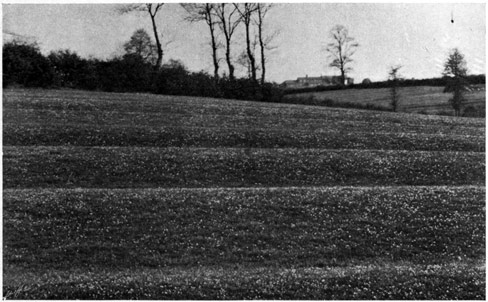 Fig. 130.—Ridge and furrow.
As it is in Leicestershire that many of our finest horsewomen may be
seen, I would strongly recommend the lady who has done some preliminary
hunting with harriers, can ride well, and who is supplied with
suitable hunters which she can thoroughly control, to learn to hunt in
that country. She will there get the best possible instruction in hunt
discipline and see the game correctly played, which is far better for
her than graduating in a country where people ride to holloas, where the
Master is unable to control his field, and where hounds are interfered
with in their work by ignorant or careless sportsmen. Besides, if she
made her debût in a country which is badly hunted, she would learn a
great deal that she would have to unlearn, if she should ever desire to
hunt in Leicestershire. A Leicestershire field may be divided into four
classes: the first flight people who show the way, ride comparatively
straight and require no lead; the second flighters, who use the first
flighters as their skirmishers and follow them as straight as they can;
the third flighters (to which class the hunting tyro ought to belong
while getting to know the country), who ride through gates and gaps and
over small fences; and the fourth flighters, or macadamisers, who, like
Jorrocks, “are ’ard riders, because they never leave the ’ard road.”
The lady who is a capable horsewoman, which I need hardly say she ought
to be before she attempts to hunt in any country, should, if she wishes
to ride in Leicestershire, get as much practice as possible over ridge
and furrow (Fig. 130), in order that she may be able to gallop easily
and comfortably over it when hunting; for those who are unaccustomed to
deep ridge and furrow are apt to tire themselves and their horses
unnecessarily. The lines of snow in Fig. 131 show the presence of ridge
and furrow in the distance. As it is requisite for a lady to know how to
ride on the flat and over fences, it is equally important that she
should obtain all the practice she can in negotiating difficult ground,
so that the hunting field may have no unpleasant surprises in store for
her. A very steep incline will stop many people. There is one in the
North Cheshire country, near Church Minshull I think, which is like
riding down the side of a house to get to the valley below. The passage
from the high ground to the Belvoir Vale is also quite steep, enough to
give us pause. The best and safest way to ride down such places is for
the rider to lean back and take her horse very slowly and perfectly
straight down the incline. He should never be taken sideways; because if
he makes a mistake and his hind quarters are not under him, he will be
very liable to roll over on his rider. If he is kept perfectly straight
and misses his footing, he will try to save himself by putting his
weight on his hind quarters, and will probably find himself sitting on
his haunches until he recovers his balance. The rider, by leaning back,
removes weight from his forehand and is prepared for any mistake he may
make. She should remember to lower her head in passing under trees and
not hurry her mount in the least, even though she may see the whole
field streaming away from her in the valley below. In going up hill, if
the ascent be very steep, the rider would do well to lean forward and
catch hold of her horse’s mane, if he has one, or of the breastplate, so
as to avoid letting her weight make the saddle slip, and also to put her
weight well forward and thus assist the horse. She should let him take a
zigzag course, and should on no account interfere with his head by
pulling on the reins. We may notice that a waggoner with a heavy load
always takes his horse in a zigzag direction up a steep hill, as it is
easier for the animal, and allows him occasional intervals for rest, if
necessary. We should ride slowly and save our mount as much as possible
on such occasions.
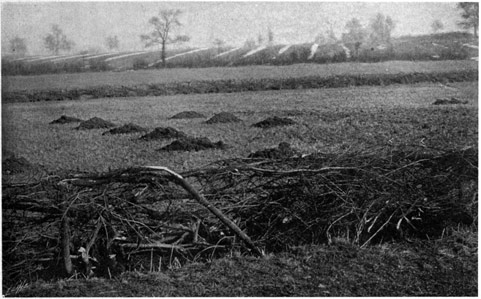 Fig. 131.—Ridge and furrow in the distance.
When we go a-hunting we should not forget to provide ourselves with a
pocket-handkerchief of a useful size; for a dab of mud on the face is a
common occurrence. Our noses and often our eyes require “mopping” on a
cold day, and as the small square of lace bedecked or embroidered
cambric which usually does duty as a handkerchief, is totally unable to
meet the various calls made upon it, it is ridiculously out of place. If
a watch is needed, it is most conveniently carried in a leather wristlet
made for the purpose, as it can then be consulted at any moment, by
merely raising the hand, without having to fumble for a watch-pocket.
I must not omit mention of the necessary flask and sandwich case, which
are generally given into the charge of the second horseman; but if a
one-horse lady goes home at the change of horses, she will not require a
“snack.”
As one of the first principles of hunting is to spare both ourselves and
our horses any unnecessary fatigue, a lady should, if possible, always
drive to the meet, or go by rail. If she has to ride, she should
undertake no distance beyond ten miles. I have ridden twelve, but I
think that is too far. If she rides her hunter, she should take him
quietly, alternating the pace between a walk and a slow canter on the
soft side of the road, the orthodox pace being six miles an hour. She
should trot as little as possible, in order to avoid the risk of giving
her mount a sore back; for trotting, if she rises in the saddle, is the
pace most likely to cause trouble in this respect. On arriving at the
meet, she should never neglect the precaution of having her girths
tightened as may be required, for her horse will have thinned down
somewhat from exercise, and the girths will allow of another hole or two
being taken up. One of the most fruitful causes of sore back is
occasioned by thoughtlessly hunting on a horse which is slackly girthed
up, as the friction of the saddle will soon irritate the back, with the
result, generally, of a swelling on the off side of the withers, and on
the off side of the back, near the cantle. I wish to draw particular
attention to the necessity of tightening the girths of a side-saddle,
even when a horse has been led to a meet; because I have found from long
experience of riding young horses with tender backs, as well as hunters
in hard condition, that, given the most perfectly-fitting saddle,
trouble will arise sooner or later if this precaution is neglected. Some
ladies are so careful about the fit of their saddles, that they have a
separate saddle for each of their hunters. I know of a lady who has
fourteen hunters so equipped.
When hounds move off to covert, a lady should be sufficiently watchful
to secure a good place in the procession, as it sometimes happens that a
field is kept waiting in a road or lane while a covert is being drawn,
and, if she be at the tail end of it, she will get a bad start. In
taking up her position she should, of course, be careful not to
interfere with others. Mr. Otho Paget gives the following good advice,
which we should all endeavour to follow: “When we go a-hunting, I think
we should forget all the petty squabbles with our neighbours, and meet
for the time on terms of cordiality. Anything approaching a quarrel will
spoil the day’s sport for you. Everyone should try to be genial and
good-tempered, so that, even if there is only a moderate run, you return
home feeling happier for the exercise and the good fellowship. There are
many things to try one’s temper in the hunting field, when everybody is
excited, but one should control one’s feelings and be invariably
courteous in speech. You should apologise, even when you think you are
in the right, for the other man may be equally certain he is in the
right, and it would be difficult to say who was in the wrong. At the
same time, when a man apologises and is evidently sorry, you ought to
accept his apologies in a kindly spirit, even though he has jumped on
the small of your back.” It is almost superfluous, perhaps, to tender
advice of this kind to my gentle sex, but still, sometimes—very
rarely, of course—we find ourselves uttering impatient remarks in the
excitement of the chase, which we feel, on mature reflection, that we
would have preferred to have left unsaid.
A lady will require to keep a very clear head when the fox breaks covert
and the huntsman sounds the well-known “Gone away,” which is the signal
to start. In a field of three or four hundred horsemen and women all
galloping off at once with a whiz like the sound of a flock of startled
birds, there must be neither hesitation nor recklessness on the part of
the young Diana, who should ride with discretion and judgment in order
to steer clear of danger, especially at the first fence. There are
generally a few left on the wrong side of it, and the chances are that
there will not be so great a crowd at the next one. At the start, a
judicious use of the curb will doubtless be necessary for keeping an
excited hunter under control, and allowing the rider in front plenty of
room to jump and get clear away from his fence. When horses have settled
down to the required pace, which will be regulated by the hounds and
according to scent, a lady should ride on the snaffle, keep her hands in
a steady fixed position, as low down as comfortable, and should maintain
a good look out in front of her, so that she may, after jumping into one
field, see the shortest and best way into the next. Jorrocks speaks
truly in saying “to ’unt pleasantly two things are necessary—to know
your ’oss and know your own mind.... Howsomever, if you know your horse
and can depend upon him, so as to be sure he will carry you over
whatever you put him at, ’ave a good understanding with yourself before
you ever come to a leap, whether you intend to go over it or not, for
nothing looks so pusillanimous as to see a chap ride bang at a fence as
though he would eat it, and then swerve off for a gate or a gap.” If
there is a crowd at the only practicable place in a fence, a lady must
wait her turn, and should her horse refuse, she must at once give place
to any rider who may be behind her, and wait until her turn comes again
before having a second attempt to clear the obstacle. As precious time
is lost by refusing horses, it is generally wiser if possible to find
some other means of exit than to argue with a refuser. Remember that
there is always a gate which can be opened, near a haystack, as the
farmer places his hay where he can easily get at it (Fig. 132). A lady
should save her horse as much as possible, jump only when she is
obliged, for hunting is not steeplechasing, and try to keep within sight
of hounds. She should remember to shut any gate she may use, and to
carefully avoid riding over winter beans, wheat, clover, roots, turnips,
or any crops, or ground newly sown with seed.
A lady should take a pull at her horse when going over ploughed land or
down-hill in order to keep him well collected, and should always ride
slowly over ground that is deep and holding, if she values her hunter’s
soundness.
Ladies who know every fence and covert in a country have a great
advantage over strangers, because foxes frequently make a point from
one covert to another, and experienced hunting women will generally have
a good idea where they are going. Like Surtees’ Michael Hardy, they know
their country and the runs of its foxes. There are people that have
hunted in Leicestershire all their lives, who manage to keep
comparatively near hounds and see good sport without jumping a single
fence. They know the country, generally ride to points, and act as
admirable pilots to the uninitiated. I owe them a deep debt of gratitude
for showing me the way, when I rode young horses who were getting their
first lessons in hunting. Croppers never came to me under their wise
guidance, but only when tempted by the keenness and excitement of my
over-sanguine youngster, I essayed lepping experiments which were not
always successful.
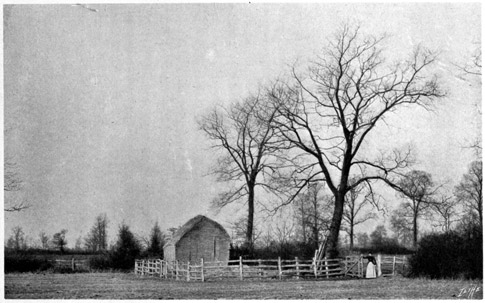 Fig. 132.—Haystack and gate.
A lady should never put her mount at a fence which she is not certain he
is able to jump, for it is better to be a coward than a corpse, and even
if she is pounded and loses a run, both she and her horse have plenty
more good hunting days in store. Some hunters will refuse a fence at
which they see the horse in front of them come to grief, and as it is
only natural that any horse with brains should feel more or less
frightened at such times, his rider should sympathise with him and
encourage him to make an effort, in much the same way as we would coax a
child to take a dose of medicine. Few horses like jumping. Whoever saw
animals at liberty larking over fences from sheer delight in leaping? It
takes a deal of time and patience to make a good fencer, although, of
course, some horses learn the art much more quickly than others.
Although few horses enjoy jumping, they, luckily for us, detest falling,
and I feel sure that if people would only leave their mouths alone and
regard the use of the curb at fences as a death-trap, we should hear of
far fewer falls in the hunting field. Captain Elmhirst truly says:
“Horses are very sage at saving themselves and consequently you. They
care little for the coward on their back; but for their own convenience
they won’t fall if they can help it.” To prove this I may relate the
following interesting and instructive fact: Some years ago I was giving,
at Ward’s Riding School, Brompton Road, London, practical demonstrations
of riding over fences without reins, my husband driving on foot a horse
which he had taught to jump, with the long reins. When my part of the
show ended, a single pole was raised to a height of five feet, and
Gustave, which was the name of this amiable grey horse, was asked to go
and jump that fence by himself. He was allowed only a short run at it,
as the school is not a large one, but in his desire to obey orders he
would canter up to the pole, and if he considered that he had misjudged
his correct distance for taking off, he would go back of his own accord
and take another run at it. My husband was as much surprised as I was
when we first saw the horse do this, as we had not credited him with so
much intelligence. Therefore, when I hear people talking about
“lifting” and “assisting” horses over their fences, I cannot help
thinking that if they lifted themselves off their backs they would see
how much better horses are able to jump without their assistance. Many
of my readers doubtless saw the Grand National of 1900, and how poor
Hidden Mystery, who, after he had fallen and had unshipped his rider,
jumped the fences with safety to himself and the field. Such sights must
show how necessary it is for us to interfere as little as possible with
our horses when riding them over fences.
If most horses dislike jumping, it is certain that they love hunting and
will exert every effort to keep in touch with hounds. Those who doubt
this should ride a young horse, and note how anxious he is to try and
keep with hounds and how, with the fearlessness of ignorance he would
charge any fence and probably kill both himself and his rider, if he
were permitted to urge on his wild career. Blow a hunting horn near a
stable where there are hunters, and then listen to the snorting, kicking
and excitement which your action has aroused; but it is unwise to repeat
the experiment, for the chances are that the excited war horses inside
may do some damage in their frantic efforts to get out and follow the
music. Watch farmers’ horses loose in a field when hounds are in the
vicinity, and you will see them careering madly up and down, as if they
too would like to join in hunting the fox, although their avocation in
life dooms them to the placid work of drawing a plough or heavy cart.
As in horses so in men, and those who possess the sporting instinct
will run many miles in the hope of catching a glimpse of a hunt, even
though they may never be able to follow hounds on horseback. These foot
people are not welcomed in any hunting field, but there is no denying
that they are keen on the sport, or they would not tire themselves as
they do, in their efforts to see something of it. Jorrocks says: “I
often thinks, could the keen foot-folks change places with the
fumigatin’ yards o’ leather and scarlet, wot a much better chance there
would be for the chase! They, at all events, come out from a genuine
inclination for the sport, and not for mere show sake, as too many do.”
If a lady has the misfortune to own a hunter who, on refusing a fence,
shows an inclination to rear on being brought up to it again, my advice
would be to sell him, as rearing is of all equine vices the most
dangerous, and a woman in a side-saddle is unable to slip off over the
tail of a horse who is standing on his hind legs, a feat I have seen
accomplished by men. Besides, a horse who will try to rear at a fence
instead of jumping it, will be sure to revert to the same form of
defence, whenever the will of his rider does not coincide with that of
his own. It is very unwise to lend a hunter to anyone who is not a
thoroughly good rider. I had in Calcutta a clever Australian horse which
I used to ride in the paper-chases that are run over a “made” course. He
had never refused or made the slightest mistake with me until I lent
him to a friend. When I again rode the horse, he refused with me at the
first fence. I spoke to him, took him again at it and he jumped it, but
I had a similar difficulty at another obstacle, and was entirely out of
the chase. I was subsequently told by those who knew the horse that the
man to whom I had lent him was very noisy, had cut the animal about with
his whip, and had treated the surprised onlookers to scenes with him at
every fence. The horse had a light snaffle mouth, and would quickly
resent any undue interference with it. It is unwise, also, to lend a
hunter to even an expert rider, if he or she is afflicted with a bad
temper. I heard of a case of a brilliant hunter being lent to an
accomplished horsewoman who returned him after a day’s hunting with
large wheals on his body, showing how cruelly she had used her whip on
him. The lady to whom the animal belonged was greatly distressed on
seeing the condition of her favourite hunter, who was one of the best
that ever crossed Leicestershire. A whip, as I have said, should never
be used with the object of inflicting pain, but as an “aid.” It is a
good plan to always give a hunter a touch with the whip when sending him
at an exceptionally big fence, as a reminder that he must exert his best
efforts; but in order that the horse may thoroughly understand its
meaning, it should be used only at stiff fences; the touch should not be
so severe as to hurt him, and should be given on his off flank. A horse
must bring his quarters to the right before he can run out to the left,
and a touch on the off flank will help to keep him straight.
If a lady finds herself on dangerous or difficult ground, as for
instance, land intersected with rabbit holes, her best plan will be to
slacken the pace into a trot or walk, if necessary, and leave the rest
to her horse, who will do his best to keep a firm footing. Parts of the
South African veldt are dangerous to ride over because of meerkat holes,
but the horses in that country are marvellously clever in avoiding them,
if they are left alone. Rabbit holes are responsible for many bad
accidents in hunting. I was out one day with the Belvoir on a young mare
who put her foot into one while going at a smart pace over ridge and
furrow. She wrenched off a fore shoe and pecked so badly that I thought
she must fall, but I had the sense to lean back and leave her mouth
alone, and she appeared to save herself with a spare leg at the last
moment, recovering her balance by the aid of the ridge which she had
breasted. Minus a fore shoe, I had to take her home at a walk, and I
smiled to myself when I saw her make a vicious stamp at a rabbit who was
in the act of disappearing into another hole.
A lady should send her horse at a good pace at a brook (Fig. 133), but
not at top speed, as he will not be able to collect himself to take off
at a long jump if he is sent at it at full gallop. We may see in jumping
competitions, especially at the Agricultural Hall, that a clever horse
can clear a fair expanse of water when allowed a run of only a few
lengths. The water jump at the Richmond Show is placed in such a
position that a horse cannot be given a long run at it, and yet many
horses clear it easily. It measures, I believe, about 14 feet, and is so
narrow that a horse I once rode over it showed his sense by clearing the
width instead of the length, and landing near the stand. I do not think
that out hunting it is usual to expect a horse to negotiate a water jump
of say over 12 feet in width. Some horses, like some men, possess a
special aptitude for jumping width, although they would doubtless be
poor performers at height, the style of jumping being entirely
different. The hunter who is equally proficient at both styles of
fencing, is as rare as he is valuable. Captain Elmhirst records an
instance of “a whole Leicestershire field pounded by 12 feet of water,”
and how the difficulty was at last overcome by a shallow spot being
discovered, a rail broken down and the field “slink pitifully
through.... How we hug ourselves as we gallop under a railway arch, to
find we have bridged a bit of water that would frighten no one outside
the vaunted Midlands.” I believe the reason why the majority of hunting
people dislike water is that they do not care to ride fast at it, for
fear of being crumpled in a fall. I do not agree with the statement that
a hard funker rushes at his fences. Ignorance and enthusiasm may lead
people into doing that, but funk oftener than not either pilots them
away from fences entirely, or incites them to pull their horses off
them, and then abuse the animals for refusing! When the funky rider
does make up his mind to take a jump, he generally lets everybody near
know it by the noise he makes, ostensibly to encourage his horse, but in
reality to keep his heart in the right place, and not in his mouth. The
ignorant horsewoman, as pointed out by the Duchess of Newcastle, rushes
her horse at difficult obstacles, because she is fearless of dangers
unknown to her; but a wholesome fall generally teaches her to temper
valour with discretion. If a lady finds herself on a horse which is
pulling too hard to be within perfect control, she should stop him as
soon as possible and take him home, for very obvious reasons. If there
is difficulty in stopping him, the best way is to try and keep him on
the turn until he obeys the rein.
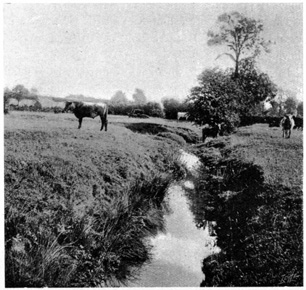 Fig. 133.—Brook.
The presence of a line of pollard willows in the distance (Fig. 134) is
a certain sign that a brook is flowing past their roots.
In going through woodland country, a lady should be careful to lower her
head in passing under trees and to ride slowly. It is essential for her
to decide at once the direction which she intends to take, to keep her
horse well collected, and not allow him to deviate from it by going the
wrong side of a tree or opening, or to take the initiative in any other
way. A good horsewoman is seen to great advantage in riding through
woodland country.
A lady intending to hunt should obtain as much practice in the
cub-hunting season as she possibly can; for she will be helping to get
both herself and her hunters into condition, and, as the season goes on,
will gain experience of what fox-hunting will be like. In the early days
she must not look forward to having a gallop, for hounds are being
taught to hunt and kill a cub in covert, and the most useful service she
can render at such times is to stand by the covert side and prevent any
foxes from breaking away. I believe that only people who are really fond
of hunting take part in the morning and dress by candle, lamp, or
gas-light. When they are ready to ride perhaps a long distance to
covert, there is often only sufficient daylight to see with, rain
drizzling down steadily and everything looking cheerless. A light meal,
if it be only a cup of cocoatina and a slice of bread and butter, should
be taken before starting, and if it is wet or threatening, a good rain
coat should be worn. Towards the end of September and throughout October
there will be galloping and jumping, and often the pace will be fast
enough for the condition of both horse and rider, as we may see by
steaming animals and flushed faces at the end of a run. I have so
greatly enjoyed these cub-hunting runs with their freedom from crowding
and crush, that I can heartily endorse the opinion of Captain Elmhirst,
who says: “Call it cub-hunting, or call it what you like, there will be
few merrier mornings before Xmas than that of the Quorn on the last days
of September.” It seems like the breaking up of a family party when the
cubbing ceases and all the pomp and circumstance of fox-hunting
commences. I often wonder if people who take no interest whatever in
cub-hunting, but who regularly appear on the opening day of the season,
really ride to hunt, or hunt to ride? Jorrocks tells us that, “Some come
to see, others to be seen; some for the ride out, others for the ride
’ome; some for happetites, some for ’ealth; some to get away from their
wives, and a few to ’unt.” Our tyro who is enjoying her cubbing will be
wise to take a back place on the opening day of the season, and thus
avoid being jostled by the mighty crowd she will see on a Kirby Gate
day. She will doubtless find her mount far more excited and difficult to
manage than ever before, and will require to exert a good deal of tact
and patience in restraining his ambition to catch the fox. The opening
day is always the most trying one of the season. All the world and his
wife seem to be at the meet. There are people in vehicles of every kind,
on foot, on bicycles and tricycles, as well as about four hundred
horsemen, and many things happen on this day of crowding and discomfort
which must sorely tax the patience of the most angelic tempered Master.
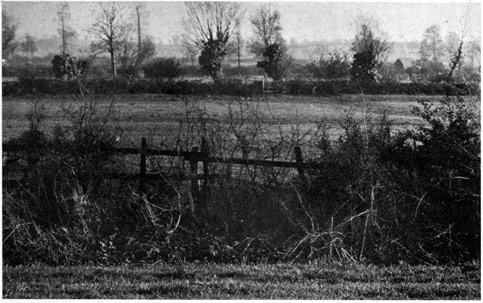 Fig. 134.—Pollard willows in the next field.
A lady who has had a good season at cub hunting, ought to be able to
take her place among the third-flight people, where she will gradually
gain experience and a knowledge of the country, which will enable her to
pass into the second rank, and finally into the first; but she must work
her way up by degrees, and remember that no one can ride safely over
Leicestershire in the first flight who is not mounted on an accomplished
performer, and is not thoroughly well acquainted with the country.
Unless a lady is perfectly certain that her mount will not lash out at
hounds, she should keep well away from them, and should never ride into
a covert where they are. I once had a mare of this description who never
kicked horses, but who would try to get a sly kick at even our own
wow-wows during a hacking ride. We had some foxhound puppies at walk,
but I never allowed her to get near them, and our own dogs got so artful
that they always managed to evade her kicks. I do not believe that mare
would ever have been safe with hounds, so I took good care to give her
no opportunity of disgracing the pair of us in the hunting field. In
every other respect she was most amiable. As there are inconsiderate
people who ride kickers, a lady should carefully avoid getting near a
horse whose tail is adorned with a red bow. If this is impossible, and
it often is in crowds, she should try and keep to the left of the
kicker, so that if he lashes out he may not be able to break her legs.
Scrutator in his book on Foxhunting points out that “the risks men
encounter in the chase are great enough without being subjected to the
chance of having their legs broken by a bad-tempered brute at the covert
side.” I once had the misfortune to see a man’s leg broken by a vicious
kicker in Leicestershire. Another case happened while I was in Cheshire,
and yet these dangerous be-ribboned animals can still be seen in almost
every hunting field.
We must here draw a sharp line of distinction between horses which kick
from vice, and those, especially young ones full of corn and short of
work, which throw up their heels from exuberance of spirits. Many mares,
particularly in springtime, are apt to kick from causes which I need not
discuss. Hence, geldings are more free from this baneful habit than
their female relations, and are consequently, as a rule, more reliable
mounts. Great care should be observed in gradually accustoming a young
horse to placidly bear the excitement of being surrounded by a large
number of his equine companions, and he should thoroughly learn this
part of his education before he is required to quit the outskirts of the
field, and take his place as a hunter. This preliminary training of
course comes under the heading of breaking and not of hunting. A young
horse “turned out” in the open, not unfrequently gives a companion a
playful kick, which very seldom inflicts any injury, because it has no
“venom” in it, and the hoof that administers the tap is unshod. I have
even seen mares with a foal at foot, give the young one a slight push
with the hind hoof, to make him get out of the way. The motives of such
taps are of course entirely different from the dangerous malevolence
that prompts a confirmed kicker to “lash out” at horse or man who comes
within striking distance. We should bear in mind that a touch behind is
very apt to provoke a kick, whether of the vicious, playful or
get-out-of-the-way kind. Hence a rider should always be careful never to
allow her horse’s head to touch the hind quarters of an animal in front,
which is a precaution that is of special application in crowds of
pulled-up horses. Also, on such occasions, she should keep him straight
and should prevent him from reining back. Any man or woman who knowingly
rides a kicker in a large hunting field, is guilty of disgraceful
conduct; because it is impossible for everyone to get out of reach of
this bone-breaker’s heels, during the frequent stoppages which occur out
hunting. Some persons have a red bow put on their animal’s tail, or they
place a hand at the small of their back, with the palm turned to the
rear, as a sly device to get more elbow-room in crowds. It is evident
that such artful tricks are unworthy of imitation.
With full consideration of the importance of blood for making hounds
keen, I must say that the digging out of foxes is a phase of hunting
that I greatly dislike to witness. I do not think that any writer has
put this question more fairly than Captain Elmhirst, who says:—“We must
grant that hounds are glad to get hold of their fox; but we cannot grant
that it is at all necessary that they should do so. In a well-stocked
country he must be a very bad huntsman who cannot find them blood enough
by fair killing; while in a badly stocked one it is very certain you
cannot afford wanton bloodshed. Moreover, it is almost an allowed fact
that hounds well blooded in the cub-hunting season do not require it to
any extent afterwards; and many authorities maintain that a good ‘flare
up’ of triumph and excitement over the mouth of an earth is just as
effectual and satisfactory to hounds as an actual worry.
“And what do the field think of it? They hate and abominate it, each and
every one of them. They neither sympathise with the feeling that prompts
the act, nor hold with the expediency of its commission. To them it
represents no pleasure, and certainly coincides with none of their
notions of sport. They would find much greater fun in seeing rats killed
in a barn, and derive from the sight a much higher sense of
satisfaction. Condemned, probably, to stand about in the cold, unwilling
witnesses of what they heartily detest, they spend the time in giving
vent to their annoyance and contempt.... Finally, fox-digging, in the
sense we refer to, is a crying enormity, a disgrace to a noble sport,
and should be put down as rigorously as vivisection.”
Tearing a poor fox to pieces is a sight which very few women would care
to watch, except those manly ones who take a delight in killing wild
animals themselves. Such persons would be able to look unmoved at a
bullock being pole axed, without losing a particle of their appetite for
a cut off his sirloin.
We are accustomed to associate hunting with pleasant runs; but there are
days when covert after covert is drawn blank and a fox not found until
late. Sometimes, but very rarely, we have an entirely blank day. A lady
with only one hunter out should use her own judgment about participating
in a late run. A great deal would depend on the distance the animal has
travelled and the length of the journey home. Some people ignorantly
imagine that a hunter should be kept out until he has had a run, unless
the day proves entirely blank, however tired he may be. If it is
necessary for people who stay out all day to ride second horses, it is
equally important that the one-horse lady should know when her mount has
had enough. It is always a safe plan for her to retire at the “change of
horses”; for there is no pleasure in continuing to hunt on a tired
animal, and there is certainly danger in so doing. Old-time sportsmen
were content with one horse a day. “Scrutator” tells us that in the time
of Mr. Meynell “it was not the fashion to have second horses in the
field.” If I may express an opinion, I think that many ladies are
inclined to regard horses as machines, and expect too much from them.
This is probably due to that unfortunate saying “as strong as a horse,”
estimating the standard of mechanical power as “horse power,” and so
forth. I have no doubt that our domestic cat would dislike the person
who said that cats have nine lives. A horse is, in reality, by no means
as strong as many of us imagine, and his legs are a continual source of
anxiety. Ladies who hunt should get a veterinary book, preferably
Veterinary Notes for Horse-owners, and when they have read it through,
they will not be likely to overtax the powers of their hunters. I once
saw in an old Graphic a picture of Lady Somebody’s mare which that
worthy dame had ridden to death. The animal had, it was explained, gone
brilliantly with her ladyship that day and had fallen dead while passing
through a village. The artist had drawn the poor mare stretched out,
surrounded by an inquisitive field, and the owner posed as the heroine
of a great achievement, instead of one who had rendered herself liable
to prosecution for cruelty to animals. I feel sure that no woman would
knowingly commit such a heartless action. When a horse begins to show
signs of distress, his rider should instantly pull up, and, if
necessary, walk him quietly home. His “state of condition” should always
be taken into account at such times. The hurried and distressed state of
a horse’s breathing, and his laboured action, are sure signs to the
experienced horsewoman that the animal has had enough. To persons who
know little or nothing about horses, the fact of their usually
free-going mount ceasing to go up to his bridle and to answer an
encouraging shake of the reins or touch of the whip, are valuable
indications that he should be pulled up, either into a trot or walk. If
he is in hard condition, a respite from exertion, for ten minutes or a
quarter of an hour, will make him all right for another gallop, which
should be given with due circumspection. If the horse is not in thorough
galloping condition he should be taken home at a quiet walk. Keeping a
horse standing, especially in a cold wind, after a fatiguing run, is not
an unfrequent means of giving the animal congestion of the lungs. A wise
woman will take care of a good hunter, for such animals are not easy to
replace, and, as Jorrocks says, “We know what we ’ave, but we don’t know
what we may get.” If a lady intends to ride her hunter home, it would
greatly conduce to his comfort, and possibly her own, especially if she
has been several hours in the saddle, to dismount for, say, a quarter of
an hour, have her horse quietly led about, and then ride him home at a
walk. If she is using a second horse, it is always wise to get her
second horseman to take the saddle off her first horse and rub his back
well with the hand, especially at the off side of the withers and of the
back, under the cantle, in order to restore the circulation of the part
before taking him home. The animal ought to be given an opportunity of
refreshing himself by drinking at a brook or trough on his homeward way.
No harm can arise from a horse drinking cold water when at work, however
hot he may be, if his exercise be continued at a slow pace for a short
time.
A lady’s hunter should always be examined, if possible by his mistress,
or by one of the male members of her family, on his return from a day
with the hounds, and his back and legs should receive special attention.
The chief accidents which are liable to happen by such work, are sprains
of tendons and ligaments below the knees, over-reaches, cuts, punctures
from thorns, and injuries from the saddle. It is not within the province
of this book to deal with such subjects, and few ladies would go through
the bother of studying them. Nevertheless, there are some exceptions, as
we may see by the comparatively large number of lady doctors, and by the
fact that only the narrow-minded policy of the Royal College of
Veterinary Surgeons prevented Miss Custance, who had studied at the
Edinburgh New Veterinary College, from obtaining her diploma, to which
she was fully entitled by her scientific attainments and practical
experience. Those of my readers who wish to understand the treatment of
horses in health and disease, cannot do better, as far as books are
concerned, than to study my husband’s Stable Management and Exercise,
and Veterinary Notes for Horse-owners.
One point about the examination of a hard-ridden hunter which is within
the comprehension of even an inexperienced girl, is the detection and
proper treatment of lumps on his back which have been produced during
the ride by hurtful pressure of the saddle, and which almost always
appear on the off side of the withers, and on the off side of the back,
near where the cantle rested. If these swellings be neglected, they will
probably become developed into abscesses, which will incapacitate the
animal from work for a month or longer. An admirable way of treating
them, as soon as the saddle is removed, is to pour some whiskey, brandy
or other spirit into the hollow of the hand, apply it to the lump, and
rub the swelling briskly with the palm of the hand for at least five
minutes. I have often seen a large swelling of this kind visibly
decrease in size during this process, which, in the many cases I have
witnessed, always caused the lump to disappear by the following morning.
In applying this form of massage, no delay should occur, after removing
the saddle, which should always be taken off the moment the animal
returns to his stable, and his back well rubbed with the hand or with a
dry whisp of straw or hay. When entrusting the carrying out of this
treatment to the groom, care should be taken that the spirit is
administered externally to the horse, and not internally to the man. If
spirit be not available, careful friction with the palm of the hand will
generally be sufficient to ensure the desired result. This treatment
should not be applied, if the skin over the part is broken, for in that
somewhat rare case the friction would irritate the wound.
The young or old Diana, especially if she is not in hard riding
condition, is very apt to get rubbed, generally by the cantle of the
saddle. If the skin is cut, a dry dressing of tannoform, which is a
powder that can be got from a chemist, will be found a good and speedy
remedy; and is also useful for cuts in horses. It would be injudicious
to ride again, or to have an injured hunter ridden again, until such an
abrasion has healed.
It is essential for a lady who intends to hunt, to be able to ride a
fast gallop without becoming “blown.” Some hunting ladies do preparatory
work cubbing or with the Devon and Somerset Staghounds. Those who are
obliged to forego these pleasant methods of “getting fit,” would do well
to get into fairly good condition by long walks or bicycle rides. I
would warn my young readers that all fast exercise should be taken
gradually and in moderation, and that they should never disregard
symptoms of fatigue; because when muscles are tired, they are unable to
act with strength and precision.
We should always remember to carry some small change in our pockets to
be given as tips to gate-openers and any poor persons whose services we
accept.
And now, gentle ladies, let me remind you never to forget to render
thanks to every person, gentle or simple, who may, by the performance of
some kindly act, have helped to contribute towards your day’s enjoyment.
We should also try to be as useful as possible to each other; for we all
admire that “nice pleasant woman” who, instead of attempting to hold us
up to ridicule if our “back hair” is falling down, or anything has
happened which ruffles our appearance, rides up and quietly brings the
fact to our notice. I have heard female voices audibly “picking holes”
in a lady’s mount, which is very unkind; for their poorer sister was
doubtless riding the best horse she could get, and the hearing of such
rude remarks may entirely spoil her day’s pleasure.
Mr. J. Anstruther Thompson in his most instructive book, Hints to
Huntsmen, gives the following horn notes and explanation of their
meaning. Ladies who intend to hunt should study the music of the horn in
order that they may understand what hounds are doing in covert (Fig.
135), and be ready to start off as soon as they hear the recognised
signal.
“To call hounds on when drawing a covert.”
“A prolonged swelling note to call them away.”
“A long single note when all are away.”
“A double note when on a scent (called doubling the
horn).”
“Two short notes and a long one for ‘Gone away.’”
“‘Tally-ho! back,’ on horn and crack of whip.”
“A rattle for ‘Whoo, whoop.’”
From the foregoing it will be seen that it is necessary to be on the
alert for short notes, because they mean business, while the long ones
denote a covert drawn blank.
The large majority of hunting women ride their own animals, or mounts
lent them by friends; but some less fortunate ones have to content
themselves with hirelings, many of which are unreliable conveyances,
because they pass through so many hands, that they run a great risk of
being spoiled by bad riders, and in that respect, horses have
unfortunately very retentive memories. From two to three guineas is the
usual charge for a day; and from £12 to £20 for a month. In both cases,
the job-master has to bear all reasonable risks. A person who hires a
horse for longer than a day, has to keep the animal and pay for his
shoeing. £15 a month is a reasonable charge for the loan of a good
hunter. When wishing to hire by the month, it is well to go to a
job-master who has a large collection of hirelings, like Mr. Sam Hames
of Leicester, so that the hirer may get a change of mounts, in the event
of the first not being suitable.
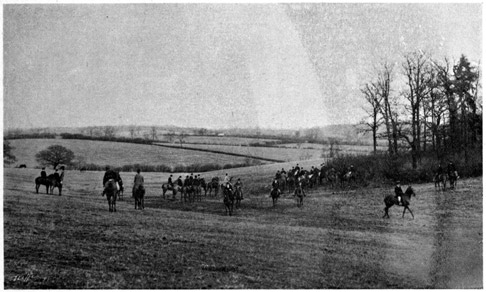 Photo. from] [“Country Life.”
Fig. 135.—The Cottesmore drawing a covert.
I have ridden a few hirelings, but hunting on them gave me no pleasure;
because I was entirely ignorant of their capabilities, and it is not a
pleasant feeling to ride at a nasty fence with a big note of
interrogation sticking in one’s heart. “Scrutator” in his interesting
book, Foxhunting, says he “never could find any pleasure in riding
strange horses. They neither understand your way of doing business, nor
you theirs, so there must of necessity be doubts and drawbacks until
both become more intimately acquainted.” I have seen so many bad
accidents happen to men who were riding hired hunters, that I cannot too
strongly impress on my readers the necessity of letting caution mark the
guarded way, by testing a strange mount at small fences to see how he
shapes, before taking unwise risks. Last season, a young man who was
hunting with the Pytchley on a hireling came a cropper at the first
fence, staked his mount and got a kick in the head. He was greatly
distressed about the poor horse which the dealer had assured him could
“jump anything,” a feat that no hunter in the world can perform. An
accident of this kind with a hired hunter is a most unpleasant
occurrence; because, if the bruised and mud-stained horseman happens to
be a stranger to the dealer, the latter will naturally blame his riding,
while the injured one who has to break the news as gently as possible,
will consider that he has been misled concerning the animal’s jumping
capabilities. Jorrocks’s advice, “know your horse,” should be engraved
in capital letters on the heart of everyone who hunts, as its observance
would prevent many distressing accidents both to humans and equines.
There is very little wire in Leicestershire, though it is far too common
in other parts of the Shires. Fences where the warning red board (Fig.
136) or red rag (Fig. 137) is seen, should be avoided, as these signals
denote the presence of wire. As these death-traps bear no warning notice
in some places (Fig. 138), it behoves people hunting in such countries
to keep a sharp look-out for unmarked wire and iron hurdles (Fig. 139).
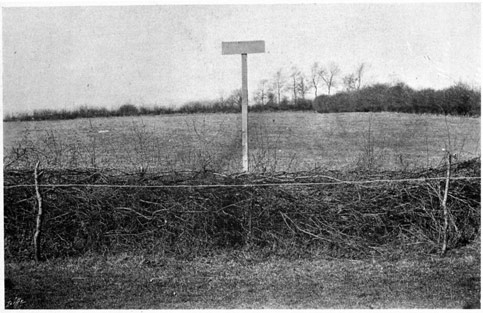 Fig. 136.—Wire board.
Some farmers appear to use wire in an unnecessary manner. For instance,
placing it on the top of a gate (Fig. 140) seems to have no raison
d’être, except to hurt unfortunate hunters which in breasting such a
gate to push it open, are apt to get badly pricked and run suddenly back
to avoid it, with the possible result of injury to both horses and
riders behind them. Also, I have seen wire put up in fields in which
there were no cattle, and removed after the hunting season, to duly
appear again in the following one. Other tricks, such as sending
sheep-dogs to head foxes, and stationing farm hands to shout “wire!”
where there is none, have also come under my personal notice. Indeed it
is impossible to live in the country, without observing such acts of
hostility on the part of farmers towards “hunting people.” I cannot help
thinking that much of this tension might be removed, if every hunt
secretary followed the example of Colonel Francis Henry, the Hon.
Secretary of the Duke of Beaufort’s Hunt, of whom we read in Baily’s
Magazine of March, 1902:—“Colonel Henry, who, in the opinion of his
numerous friends, seems to possess the secret of eternal youth,
contrives to enquire personally into every complaint that is sent to
him, whether relating to damaged fences, loss of poultry or, rarely,
‘wire offences.’ There is no better known figure in Gloucestershire than
that of Colonel Henry on his hack, one of his own breeding by the way,
which carries him on his long rides; he is wont to say that in dealing
with a grievance ‘one visit is worth a dozen letters.’ His geniality,
and the painstaking care with which he investigates every matter to
which his attention is called, dissipate at their beginning many
difficulties which, handled with less sympathetic diplomacy, would ‘come
to a head’ and produce the friction which tells against sport.
Landowners, farmers, and business men alike in the Badminton country are
keen supporters of fox-hunting, and their attitude towards the sport is
due in no small degree to the unremitting attention and care for their
interests displayed by the honorary secretary both in winter and
summer.” The truth of Colonel Henry’s remark that one visit is worth a
dozen letters, was exemplified to me the other day by an old lady, a
farmer’s wife, who regretted the sad change in “hunting people” since
her young days, when they “used to come in and chat with me as affable
as could be.” She mentioned the name of Mr. Wroughton, who partook of
some of her “cowslip wine,” and so much was she impressed with the visit
that every small detail of it, even the year, month, day and hour, and
also where he sat in her parlour, remains a treasured memory. He made a
friend who will always speak of him in the highest terms, because he was
nice and civil to her, and it seems to be a matter for regret that this
friendly feeling is not more generally cultivated than it is in hunting
districts.
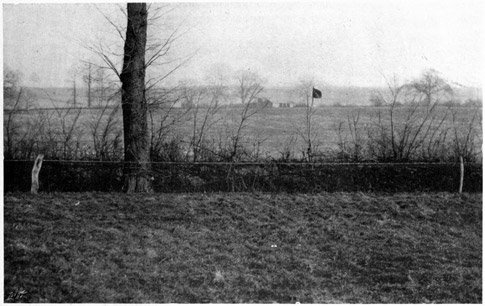 Fig. 137.—Red flag.
Unfortunately, the old-fashioned motherly, hardworking farmer’s wife is
a type of woman which is rapidly dying out, and the modern specimen
belongs to that large and useless brigade of “perfect ladies” who are
above their position and who regard work as undignified. I recently saw
an advertisement from a farmer’s daughter who said in it that she had
offers of plenty of mounts, but wanted some lady to give her a riding
habit! Surely it would have been far better for her to have worked and
earned one, instead of cadging in such a manner for her amusement?
Proverbially bad as our fresh butter in the Midlands is, I fear the time
is approaching when butter making will entirely cease, for, with few
exceptions, farmers’ daughters are not trained to do dairy work. A
modern “young lady” from a farm, who had been educated in a Board
school, applied to a well known lady of title for a situation as
governess; but her ladyship pointed out that her educational attainments
did not qualify her for such a post, and suggested that she should
obtain employment as a parlourmaid. Needless to say that the farmer’s
daughter scorned the idea of thus “lowering” herself! Even the daughters
of farm labourers nowadays ride their bicycles, instead of going out to
service as their mothers and grandmothers did before them, and dress
themselves ridiculously out of keeping with their position and
surroundings. It seems very incongruous to see such girls living in
indolence in country villages, while the daughters of their parson,
as frequently happens in large families, turn out and earn their own
livelihood.
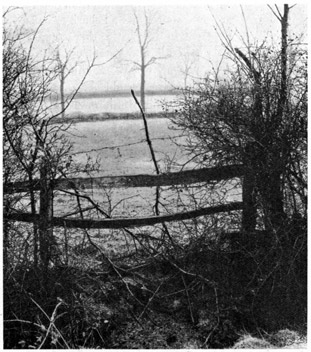 Fig. 138.—“’Ware wire.”
It would cost very little to give an annual ball, say, after the Hunt
ball and before the decorations were taken down, to farmers and their
wives and any local residents who help towards the support of hunting,
and I feel sure that an entertainment of this kind would be productive
of beneficial results. In order to make it a success, it would have to
be attended by some of the members of the local Hunt, and not in any way
bear the stamp of a charity ball; for untravelled middle-class people in
this country are, as a rule, very “select,” and eaten up with social
ambition, and many who would not think of attending a subscription
dance, would be attracted by “an invitation Hunt ball.” Besides, after
all, even if local residents and farmers pay their guinea to be present
at an annual Hunt ball, they feel themselves rather “out of it,” if they
are not personally acquainted with anyone in the room, and wisely avoid
such dreary functions. It is recorded of Mr. Conyers that he once
presented every farmer’s wife in his hunting district with a silk dress,
saying that the ladies must be propitiated if hunting is to flourish.
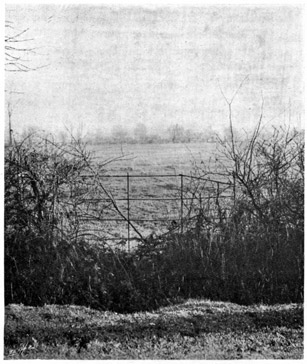 Fig. 139.—Iron hurdle.
One of the reasons why hunting is unpopular among farmers is the selfish
and reckless manner in which many followers of a hunt ride over arable
land; the greatest sinners in this respect being those who reside in
towns, and who, knowing nothing about agriculture, err more from
ignorance than indifference. Unless vegetation stares them in the face,
they evidently think there is no harm in riding over ploughed land, no
matter how distinctly the smoothly-harrowed surface and carefully
prepared drains indicate the presence of seed underneath. In such a
case, our best plan would be to skirt along, as near as possible, the
hedge or other boundary, even if we have to go a little out of our way.
Riding over cultivated “heavy” (clay) land, especially if its surface is
wet, is particularly hurtful to the crop, because each imprint of a
horse’s foot will form a small pool of water, which will rot the seed
inside it. In “light” (sandy) land, the water in such holes will
quickly drain off, and little or no injury will be done. While hoping
that young horsewomen will not allow their enthusiasm for hunting to
outweigh their sense of prudence when steering their horses over
farmers’ land, I would entreat them to also “hold hard” when approaching
allotment ground, for this land is rented, as a rule, by the poorest of
the poor, who have no gardens in which to grow vegetables, etc., for
their use, and a small field of, say, a few acres may be cultivated by
several villagers and their children in their “spare time of evenings.”
Each tenant has his own patch of allotment land on which he grows what
he requires for his use. In winter we may frequently see the entire
field under wheat cultivation, as many poor families grow their own
grain, which the local miller grinds into flour, and in this way they
save the baker’s bill, as they make their own bread. To ride over and
destroy their small crops is a sin which I am sure no lady would
knowingly commit, and, therefore, it behoves us all to exercise due
circumspection when we find ourselves on arable land.
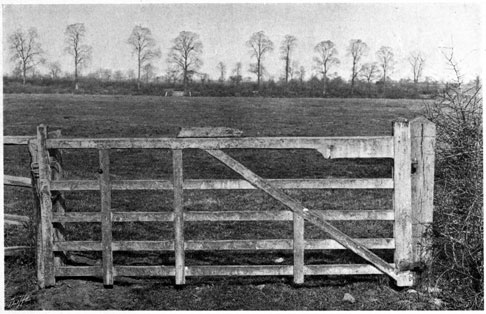 Fig. 140.—Wire on top of gate.
Also, on pasture land we have need to temper valour with discretion, and
especially after Christmas, when ewes and cows are heavy with young, and
are not in a fit state to safely endure the dual evil of fright and
violent exercise. Later on, when lambs have appeared, it is cruel to
gallop so near these mothers and their young, as to cause suffering.
Sheep are such stupid animals that they appear to have no idea of
evading a crowd; and cattle, as a rule, lose their heads from fright,
and career madly about their fields, sometimes for two or three days
after the sudden passing of a hunt. When a gate is negligently left
open, and the terrified animals avail themselves of this method of
escape, the unfortunate farmer will generally have great trouble in
finding and bringing them back, because they often go long distances,
and he has seldom any means of knowing what route they have taken.
Horses give him far more trouble than cattle in this respect, because
they can travel faster and farther. I have seen ladies who have the
interests of hunting deeply at heart—Mrs. James Hornsby, for
instance—ride back and fasten gates which have been carelessly left
open.
One grievance which lies very near the heart of a farmer, because I
suppose it frequently touches his pocket, is the damage done to his
fences, especially during a check, by people who unnecessarily potter
through small gaps, which, after they have finished, resemble open
spaces. The farmer who has to get them mended speaks very bitterly about
fox-hunting, especially if he has to do the repairing at his own
expense, as he argues that if it was necessary to work a passage in this
manner through his hedge, the field might have been content with one
open door instead of making several. A farmer in the North Cheshire
country was so irate on this point that on one occasion when the hunt
wanted to cross his land, he and his men gave us a welcome with
pitchforks!
A kind of farmer whom I despise is the man that hunts on the free list
and pretends to support fox-hunting, while he keeps his land encompassed
by wire during the entire season! I have known some of these men enjoy
unmerited popularity with the Master, and even take charge of Hunt wire
boards. Their non-hunting neighbours who take down wire and over whose
land they ride with safety, are obviously the better supporters of
hunting, although they may not be able to afford a nag, even if they had
time to devote to the sport. The farmer who takes down his wire is
naturally displeased with a Hunt which favours an individual who keeps
it up; but I think if all Hunt secretaries were like Colonel Henry, such
delinquents would soon be brought to book, for no Master would care to
see with his hounds, a farmer who kept his land wired during the hunting
season. Some of the illustrations of wired fences in this book have been
photographed on the land of so-called “hunting farmers.” An even worse
class of man than the double-dealing farmer is the wealthy landowner who
preserves his coverts, shoots foxes, lets his shooting at a big profit,
and then goes off to hunt in some fashionable centre, like Melton
Mowbray. In Leicestershire he would be regarded as a hunting man, while
in his own district he is known as a vulpicide, for Reynard is seldom,
if ever, found in his coverts. One has only to live in the country, and
pretend indifference about fox-hunting, to see the tricks which some
farmers perform in order to prevent people from riding over their land.
I remember in the North Cheshire country a big covert, which was always
considered a certain find, being drawn blank, much to the huntsman’s
surprise. As he called off his hounds, after a thorough investigation, a
farmer said, with a smile: “I knew they wouldn’t find a fox here, for
Mr. ——’s foxhound puppy, which he is walking, has been rummaging
about this covert all morning!” It appears that Mr. Blank was a farmer
whose land adjoined the said covert, and who had found his foxhound
puppy more useful in driving away foxes than his sheepdogs.
Instead of doling out compensation to farmers as a form of charity, it
would be much better for our hunting authorities to meet them on a level
footing, get them to appoint a committee of their own, and pay that
official body, every year, a certain proportion of the hunt
subscriptions, to be applied according to the wishes of the Farmers’
Committee.
I have not enlarged on the subject of hunting pilotage, because, truth
to tell, I have never indulged in the luxury of a pilot, as I have
preferred to know the capabilities of my mount and to see and act for
myself. I believe that any woman who can ride and manage her horse with
intelligent forethought, has no more need of a paid pilot than has the
small boy who takes his chance on his pony. If a lady has no male
companion to remain with her during the day’s hunting, she should
provide herself with a groom, whose services will be very useful to
her, in the event of anything going wrong, and in helping her in various
ways. It would be absurd for her to expect casual aid at every turn, in
a large field composed chiefly of strangers, especially when its giver
would be deprived of his place in a run.
Pilots seem to be going out of fashion, if we may judge by the large
number of women who hunt safely without their assistance. The
inexperienced huntress generally has her father, brother, husband, or
some male friend or servant to show her the way, which is the safest and
best method of learning to hunt, because they would know both the
capabilities of the young lady and her mount, and could be trusted to
keep her out of harm’s way. If a paid pilot is engaged, his horse should
not be a better fencer than that of his charge. He should also know her
riding form, and over what kind of jumps she intends him to lead her.
I would strongly impress on an inexperienced lady the necessity of
learning to judge pace, that is to say, to know at what speed her horse
is going. The chief duty of a pilot is to set the pace for her, and to
select such fences as he knows her horse is capable of jumping, the
former being more important than the latter, as it is far more difficult
to learn. She should see that her pilot is safely over a fence before
sending her horse at it. Only practice and natural aptitude can teach a
lady to judge pace: it cannot be learnt from any book.
A lady should not deceive her pilot, any more than we should withhold
the truth from our doctor or lawyer. If she feels more in skirting trim
than in hard hunting nerve, she should not hesitate to say so; for we
all like to take things easy at times, whether it be in hunting or in
anything else, according as we feel fit or otherwise. There is no
gainsaying that the human barometer is regulated to a great extent by
the weather, as we may see by the big fields which greet the Master on a
fine hunting morning.
The unpleasant disclosures which have been recently made in our Law
Courts, concerning the free and easy conduct of a certain set of hunting
men and women, may prejudice many mothers against hunting as a fitting
pastime for their daughters; but the indiscretions of a few idle fast
people should not be taken as a sample of the behaviour of an entire
field. In the crowd and bustle of hunting, the large majority of the
people are seriously engaged in the business of the day, and have no
time to indulge in flirtations. Certainly no sane man would choose a
meet or covert side, where he is surrounded by a crowd of people, to do
his love-making. If the usual discretion is observed in the choice of a
companion for a young lady going to and returning from a hunt, she would
have far less opportunity for “frivol,” than in any ordinary ball room
or theatre. We need only watch hunting men and women passing through a
crowded gateway, to see that each one goes in turn, and that there is
very little consideration for sex.
Although the subject of falling is not a pleasant one to discuss, still
we cannot ignore it, for even the best horsewoman occasionally gets hurt
by her horse falling with her. Accidents sometimes occur over the most
trivial obstacles, and when least expected; and are not confined to
jumping, for some of the worst falls have happened on the flat. I
remember Captain King-King breaking three ribs and a collar-bone—a
pretty good dose in one gulp—by his mount coming down with him on the
flat when hunting in Leicestershire. The late Whyte Melville met his
death by a similar accident; and poor Archbishop Wilberforce was killed
while quietly hacking, by his horse putting his foot in a hole and
throwing him on his head. Unfortunately, we are unable to learn the art
of falling correctly, because we have only one neck, and, if we break
that, our experiments must abruptly cease. We may, however, minimise the
danger of its fracture by leaning well back at our fences, and by
ducking our chins into our chests when we feel ourselves coming the
inevitable cropper. The worst kind of fall is when a horse breasts a
stiff fence and either turns a complete somersault, or falls violently
on to his head. In the former case, the accident generally means severe
internal injuries, to say the least of it; in the latter, a broken
collar-bone or concussion of the brain. Such bad accidents are happily
rare; for, if a horse can jump, he will certainly do his best to clear
an obstacle with his fore legs, and if he catches his hind ones and
comes down, our chances of either being killed, or crippled for life,
are far smaller. In Leicestershire I once saw a stranger send his mount
at a posts and rails fence about five feet high, which the animal
breasted and went over with a sickening fall; but I could not help
thinking that the man must have been either riding a hireling, or must
have imagined that his horse was a wonderful jumper to have sent him at
such a forbidding thing, especially as it had been avoided by the first
flight people, and what they can’t jump, strangers may be perfectly
certain ought to be left alone. In this case, the animal, which may have
been easily able to take the jump, went at it unwillingly, for he saw it
was not the line taken by other horses, and he was doubtless annoyed at
being asked to incur what must have appeared to him an unnecessary risk.
A similar thing occurred when a well-known Leicestershire lady broke her
collar-bone. Horses were filing through the gate, and the lady, who was
anxious to get forward, put her horse at a stiff posts and rails by the
side of it. He apparently regarded the act as unnecessary, for he went
at it in a half-hearted fashion, struck the fence, fell, and hurt his
rider. It is the custom to say that the first flight people who ride
safely over Leicestershire are mounted on the best horses that money can
buy; but at the same time, we should remember that they seldom deceive
their mounts by asking them to jump anything which is either impossible
or unnecessary. Mr. Hedworth Barclay, who is one of the finest horsemen
in Leicestershire, always rides with great judgment. If he did not, he
would not have been safely carried for fourteen seasons by his brilliant
hunter Freeman, and for an almost equally long time by Lord Arthur and
Franciscan.
A great deal of ignorant nonsense has been written about people (and
even horses!) taking “their own line,” but such scribes ought to go to
Leicestershire and show how that can be done! Ladies who try to follow
the teaching of such people, do so at great personal risk; for it is
absurd for a stranger, however well she may ride or be mounted, to think
that she can safely take her own line over an unknown country, and
especially such a one as Leicestershire, which is in many parts entirely
unjumpable. As it requires several seasons to learn the “lie of the
land,” most people wisely prefer to hunt in a county they know. Some
ladies make a great boast of their numerous falls. One recently told me
that she had had fourteen croppers in a hunting season; but when I hear
such talk, I cannot help thinking that there is something radically
wrong with their riding, for our best horsewomen very seldom fall.
I have noticed that horses have been staked in hunting, through being
taken sideways instead of straight, at their fences. It is most
dangerous to ride an animal in this manner; because, if he makes a
mistake and falls, he will come down on his side and may roll over on to
his rider in his efforts to regain his feet. We may observe that when a
horse is lying on his side he invariably makes a preparatory half roll
in rising from that position.
The first thing to do when a horse comes down, is to try to get clear as
soon as possible, and to let go the reins, unless the rider can retain
them without any risk. She is so encumbered by her skirt, even if it is
only an apron, that she will probably get kicked or trodden on, if she
hangs on to the reins. “Scrutator” wisely remarks that “so long as there
is a chance of holding him together, the pigskin should not be
abandoned, but when that chance is gone, by your horse’s fore-legs
getting into the ditch on the other side, throw yourself clear of him to
avoid a pommelling.” In such times of difficulty and danger, a lady
should remember to leave her horse’s mouth alone, and not frighten him,
at a moment when her life may depend on his remaining quiet. Whatever
happens, she should never utter a startled cry, for that will do no good
and may lead to disastrous results. Professor Sample, the American
“Horse Tamer,” once found himself underneath a cart, while breaking a
horse to harness with the long reins. Enveloped as he was in his driving
reins, a bad accident might have resulted if he had not kept his
presence of mind, while his faithful “Jo,” whom he called to his
assistance as if nothing had happened, came and helped him out of his
dangerous position. He then turned to the audience and calmly told them
that he was showing them “how not to do it!” When a lady gets a bad fall
out hunting, and we see her attended by men only, we should at once go
to her assistance, whether we know her or not; because it is always
better for a woman to have one of her own sex to help her and, if
necessary, unloosen any garments which are matters that men know nothing
about.