THE ONLY PRACTICAL METHOD OF EDUCATING THE HORSE AND
ERADICATING VICIOUS HABITS, FOLLOWED BY A VARIETY OF VALUABLE RECIPES, INSTRUCTIONS IN FARRIERY, HORSESHOEING,
THE LATEST RULES OF TROTTING, AND THE RECORD OF
FAST HORSES UP TO 1876.
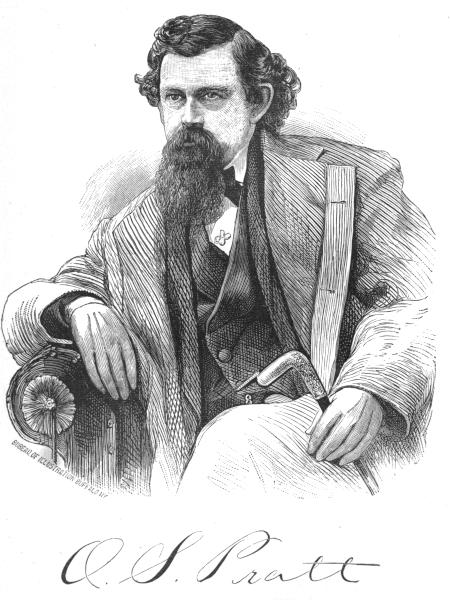
By Prof. O. S. PRATT.
TENTH THOUSAND.
Illustrated by over One Hundred and Forty Elegant Engravings.
BUFFALO:
PUBLISHED FOR THE AUTHOR.
1876.
Entered according to act of Congress, in the year 1875, by
O. S. PRATT,
In the Office of the Librarian of Congress at Washington, D. C.
Entered according to the act of the Parliament of Canada, in the year 1876, by
O. S. PRATT,
In the Office of the Minister of Agriculture.
The Electrotyping, Printing and Binding, by The Courier Company, Buffalo, N. Y.
The Drawing and Engraving, by the Bureau of Illustration, Buffalo, N. Y.
DEDICATION.
To His Excellency, Ulysses S. Grant, President of the
United States; to the members of the two houses of Congress,
and to the gentlemen connected with Foreign Legations,
who have belonged to my private classes, in connection
with the thousands in all the principal cities and towns of
the United States and Canada, who have been members of
my various classes, this work on The Education of The
Horse, is respectfully dedicated. Cheered by their presence,
and encouraged by their approbation during the eight
years in which the author has been engaged in diffusing a
knowledge of his system of Equine Education, their generous
appreciation continues to fill the present with treasured
memories of the past, amongst the most prized of which is
that of the friendship it has been his happiness to secure
from gentlemen distinguished alike in the walks of politics,
religion, science, literature and art.
INTRODUCTION—EARLY LIFE—THIRST FOR KNOWLEDGE—FIRST
ATTEMPTS IN BUSINESS—SUCCESS—MARRIAGE.
In the social interchanges of life it is always
pleasant to possess some knowledge of the antecedent
history of the ones we meet; to know
who and what they are; while to one who feels
that there is something in his own career not
unworthy of notice, there is a satisfaction in
recounting the steps by which his success has
been attained; especially, if in gaining it he has
been called to contend with difficulties and
vanquish obstacles which opposed his progress.
Such narratives may prove helps and encouragements,
as they show what energy and perseverance
have achieved, and thus stimulate others
to stronger and more successful endeavors.
This was taught by the greatest of our American
poets in his well-known lines:
“Lives of great men all remind us
We may make our lives sublime;
And, departing, leave behind us
Foot-prints on the sands of time.”
Although few men may lay claim to greatness
in its military, political or literary sense, there is
something in every earnest life which will interest
and instruct other men, and which may prove
an assistance to some, who, with failing hearts
are engaged in life’s stern battle. With this
brief explanation of his design, the author of
the following pages trusts to receive the favorable
attention of his readers as he proceeds to
recount the leading incidents of a somewhat
eventful career.
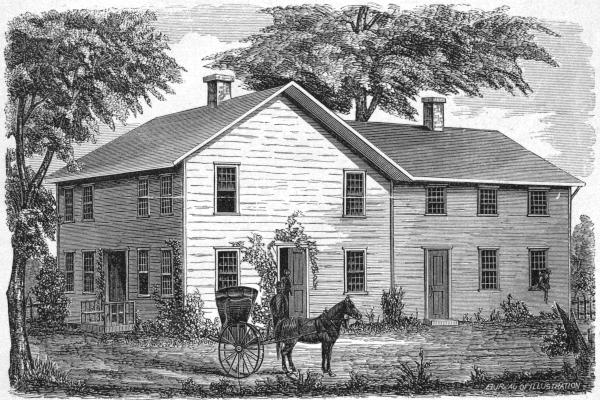
I was born in the town of Darien, Genesee
County, in the State of New York, on the
seventh day of December, A. D. 1835. There,
amidst the quiet and elevating influences of
nature, the bright days of my infancy and childhood
were passed, until my boyhood’s days were
over, and my fifteenth year of life was reached.
My father owned the farm on which we lived,
besides being the proprietor of several mills, and,
like many other purely practical men, he had a
higher appreciation of material than of intellectual
advantages. As a consequence, he was
more desirous that I should early engage in the
active business of the farm, than that I should
employ hours, which might be made profitable
in work, in studies which paid no immediate
profit.
At the age of eight years I was often sent
after the cows, barefooted, and a distance of
nearly a mile through the woods, coming home
after the shades of night had fallen, and being
obliged to trace my way by following the cows
in the narrow path made by them. Day after
day, in my great desire to secure an education,
I would beg my father to send me to school, but
always he had work for me to do, and thus my
endeavors were foiled. But such was my determination
to secure an education, that I resolved,
at all hazards, to go to school, and often did I
jump from my bed-room window and run a distance
of half a mile to the school-house. My
greatest ambition was to be a merchant, and I
knew that I must procure at least a limited
scholastic education to enable me to succeed in
my anticipated calling. But, while I was laying
my youthful plans for the future, my father would
lay plans for work, and often, on returning at
night from school, I would hide in the barn
till after dark, dreading the punishment which
awaited me for having gone to school in place
of working.
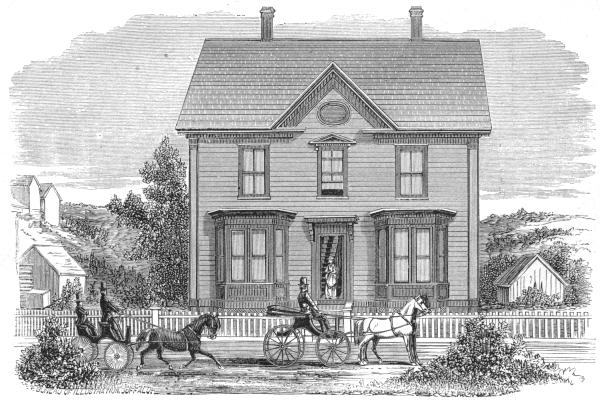
THE OLD HOMESTEAD, DARIEN, GENESEE CO., N. Y.
At the age of ten years I have taken a team,
gone alone into the woods and loaded saw-logs
on a sleigh, using the horses to draw up the logs.
As my father owned a saw-mill as well as a farm,
it seemed to him necessary that every effort
should be put forth to keep both branches of
business going; therefore, no time was allotted
to his children for securing an education. Many
times have I approached him, timidly and with
tears, humbly requesting to be allowed to go to
school, when, instead of responding to my desire,
he would send me to the saw-mill to work; and
at the age of twelve or thirteen I ran the mill
alone, though, while doing so, I have had to
mount on the lever and load it with extra weight,
as I was not heavy enough to raise the water-gate.
Thus I labored on from month to month,
until I was fourteen, in the meantime going but
little to school. Many times I would lay plans
to run away, believing that I could do for myself,
and make my own mark in the world.
Money, in those times and in that region, was
not plentiful, and I was early taught its value, a
lesson of great practical value to a youth who
has to hew his own path through life. Many
times I have traveled miles on a special errand for
a neighbor, or for some traveler, and received as
compensation a single penny. Money, so hardly
acquired, was not to be expended lightly, and
I saved my little earnings till the accumulated
sum amounted to four dollars. This seemed
to me like quite a fortune. I now felt myself to
be a capitalist, and, naturally, the desire to use
my riches to advantage led me to seek some
profitable investment which would increase my
wealth. My earliest speculation was the purchase
of a gun; but after the first pleasure of
its possession had passed, I saw my mistake in
having expended money for something that
would yield me no increase, and began to look
around for an opportunity to retrieve my error.
Soon a chance occurred for me to trade the gun
off for a cow. I saw there was “money in it,”
and closed the bargain, thus turning my first
mistake into a profitable investment. Having
become the owner of a cow, my ambition was
awakened to increase my stock, and I kept my
attention fixed in that direction until I was the
sole proprietor of three cows. I had now entered
on my fifteenth year, and having learned
one day, in conversing with my father, that his
intention was soon to sell his farm and stock,
and remove to the Far West, I proposed to him
to allow me to carve my own way in the world.
I felt ambitious to strike out for myself, and
“paddle my own canoe.” To this my father consented,
when, after selling my cows and receiving
the money, with all my fortune in my pockets, I
bade farewell to the parental roof and its many
pleasant associations, looking for the last time
upon the
“Old family Bible that lay on the stand,”
and taking that decisive step by which I was to
become the architect of my own fortune.
Having an uncle who resided in the town of
Byron, I turned my steps in that direction, and
for the ensuing winter found a home beneath his
roof. During that season I devoted myself to
study, attending the village school under the
superintendence of Mr. Bennum, whom I greatly
esteemed, and whose many acts of kindness linger
in my memory to the present hour.
On the opening of spring my thoughts turned
towards commercial life, and I devoted my time
to becoming better acquainted with various business
avocations, intending to adopt some profitable
employment. After reflecting well, I took
the money I had accumulated and with it purchased
a horse, wagon, and harness. Then,
through the kindness of a dear friend, who became
responsible for me, I was loaned one hundred
dollars, and with this as my working capital
I commenced traveling over the country, buying
produce and shipping it to Buffalo and New
York.
I continued in this business until the year
1855, when, having arrived at the age of twenty,
I began to think of enlarging my operations.
Influenced by this desire, I directed my course
to the beautiful and flourishing town of Batavia,
where I secured a store and became a dealer in
all kinds of produce, shipping it, as before, to
Buffalo and New York.
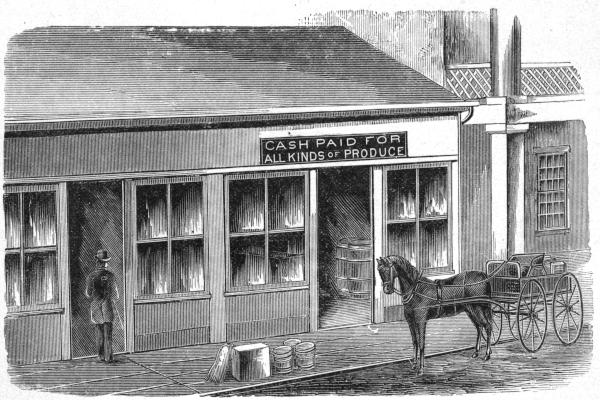
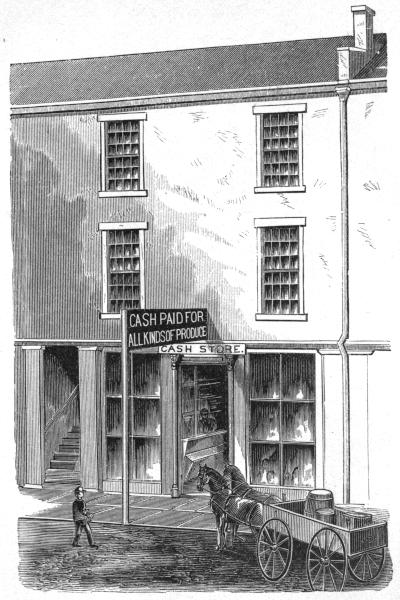
FIRST STORE IN BATAVIA, N. Y.
The cut here given is an accurate representation
of my first place of business, and speaks for
itself in regard to the size and general appearance
of the place. It was, however, as it proved,
insufficient for the business which flowed in upon
me and increased so greatly that soon I found it
necessary to secure larger and more commodious
premises. At the time of doing this I determined
to still further extend my business by
opening a wholesale and retail grocery and provision
store. Fortune smiled on my endeavors,
and all evidences encouraged the belief that I
was on the direct road to wealth.
Having thus attained a good position in business,
my mind began to make excursions in
another direction. The wisest of men has said
that “Whoso findeth a wife findeth a good thing,”
and, having a natural liking for “a good thing,” I
found my thoughts led to the important subject
of marriage, until I finally determined to try the
experiment of trading in the matrimonial market.
After thus deciding, it took me but a short time
to reach the important object contemplated, for,
it would seem, I was specially directed in my
course. I formed the acquaintance of Miss
Northrop, an estimable and accomplished young
lady, the only daughter of the late Dr. Northrop,
and soon the fair one was led to the hymeneal
altar and became the wife and partner of O. S.
Pratt.
CHAPTER II.
ENLARGING BUSINESS—ATTACHMENT TO THE HORSE—VISITS TO BATAVIA
OF RAREY AND HAMILTON—MY OWN SYSTEM—GOING BEFORE
THE PUBLIC—EARLY SUCCESSES.
Having now made myself a home and feeling
permanently settled, I desired to still further
increase my business, but finding my capital
somewhat too limited for the amount I wished
to transact, I sought assistance from an esteemed
friend, Elandus Dotey, Esq., banker. The aid
I sought was given with a cheerfulness that
added to its value, and enabled me to carry into
execution the plans which I had formed. The
accommodations I received frequently amounted
to from ten thousand to twenty-five thousand
dollars, thus placing ample means in my hands
for extended operations and enabling me to do
a large and remunerative business in which I
continued up to the year eighteen hundred and
sixty-seven.
BRICK STORE.
During these business years in Batavia my
attachment for that noble animal, the horse,
gradually increased, and learning that a horse
trainer by the name of Rarey, intended visiting
the town, I was one of the first to seek for and
obtain what knowledge I could from him; but
finding his system to be not at all practical, I
applied myself to the investigation of the subject,
and began experimenting with a view to the
discovery of a better, simpler and more certain
system.
Some years later it was rumored that a gentleman
named R. P. Hamilton, who was self-announced
as “the great renowned horse trainer,”
would give instruction on the subject. He soon
made his appearance, and, with others, I attended
his lectures. Mr. Hamilton advanced some valuable
ideas which I gladly adopted and added to
my former knowledge, and when I had grasped
all that was valuable in his instructions, and
united it to the results of my own experiments,
I felt assured that, ere long, I should reach the
height of my ambition and develop a system of
educating the horse far in advance of anything
then known, and by which my name would be
handed down to coming generations as one who,
more than any other, had befriended that noble
but greatly abused animal. Often in my retired
moments my thoughts would go forward to the
time when I should be able to present my perfected
system to the public, and as I looked
down the vista of time to the period when I
should announce my system, my mind pictured
to itself the success I since have realized. I was
fully conscious of its value to the world, and
thousands have since then freely acknowledged
the practicability and excellence of my system
of educating the horse.
In the autumn of eighteen hundred and sixty-seven
I felt myself sufficiently master of my
new and unequaled system to commit myself
unreservedly to its public advocacy: so, after
selling out my stock in trade, I made my preparations
to travel for the purpose of bringing
it before the world. Previous to leaving Batavia
I had purchased from a perambulating horse
dealer my favorite horse, “Tom Thumb,” then
partly trained.
Feeling now tolerably well equipped, I came
before the public with my new and perfect system,
confident that it needed only to be known
to be welcomed with pleasure by every intelligent
friend of the horse. In the month of
January, eighteen hundred and sixty-eight, I
made my debut at the town of Geneva, erecting,
at considerable cost, an academy for the exhibition
of my system of training. My success was
immediate; friends and well-wishers clustered
about me; the hand of encouragement was extended
on every side, and in a little while my
class in that place numbered seventy-five members.
The reader can scarcely conceive the
feelings of gratification that were excited in my
breast by such prompt and flattering success.
It confirmed my own judgment of the superiority
of my system, and inspired a full confidence in
its success.
After leaving Geneva, I visited the pleasant
town of Waterloo, where I built another academy
and formed a class of about eighty members,
whose hearty appreciation of the ideas embodied
in my system of training afforded me great
pleasure.
Leaving that place, I next proceeded to the
beautiful village of Penn Yan, where also I built
an academy and met with brilliant success, my
class numbering over ninety members.
Such gratifying success, and at so early a
period, was very encouraging to me. Both myself
and my system were new to the public, and,
coming before them almost unheralded and
without the prestige of great names to give it
support, its progress and the general approval
it met, could be attributed only to its own merits,
which were everywhere conceded.
The next point visited by me was the beautiful
and highly picturesque village called Watkins,
so well and widely known to pleasure-seekers as
an attractive summer resort; its famous “Glen”
having an almost national reputation for romantic
beauty. Here I formed an interesting class of
about sixty persons, many of whom gave unmistakable
evidences of confidence in the superiority
of my rapidly spreading system for rightly
educating the horse.
Cheered by my continued success, I pursued
my journey to the city of Ithaca, where I built
an academy much larger than any I had previously
erected. Here I remained about a week,
and had the pleasure of forming a class of one
hundred persons.
Finding it somewhat inconvenient to build
academies in many places, I now purchased
canvas for a movable tent, which I had constructed,
and this I carried from place to place,
erecting academies only where my tent was
insufficient to accommodate the audiences. On
the fourth of July I pitched my tent at the city
of Elmira, and soon had the satisfaction of
enrolling the names of one hundred and fifty
persons, who eagerly sought information, and
expressed the greatest gratification with the
instruction they had received.
After this, I continued my tour, exhibiting
and lecturing in many towns and villages during
that summer and the autumn following. My
success was everywhere of the most gratifying
character, and exceeded my most sanguine expectations.
In bringing my system to the attention of the
public, I employed that great engine of power,
the Press to call attention alike to the cruelty of
most of the previous modes of training the
horse, and the superiority of my new and rational
system. As an illustration of this, it may not
be out of place to give a single one of my many
addresses to the public through the medium of
the press:
Professor O. S. Pratt to the Public.—Probably
not one person in a thousand has any adequate idea of
the wonderful intelligence displayed by the noblest of
the brute creation, the horse. Patient, affectionate, sensitive
and faithful, possessing wonderful powers of endurance
and a capacity for education far exceeding any animal extant,
a study of his characteristics is ennobling, and commands
the attention of every intelligent person. But how
often do we see him abused, through ignorance, compelled
to draw tremendous loads for hours on a stretch, whipped,
clubbed, and cursed, until patience ceasing to be a virtue,
and through sheer exhaustion, panting, trembling, and discouraged,
he stops to breathe, and men call him balky, apply
the whip again, put sand in his ears, gravel in his mouth,
twist his tail, and goad him to desperation by a system of
barbarous inflictions unworthy of even the first stages of
civilization. Trotting over slippery pavements, imperfectly
shod, twitched to the right or left as a sudden emergency
seems to demand, he stumbles and falls. No compassion is
excited by this mishap. Hastily assisted to arise, and reharnessed,
crack goes the whip. O, lash him, cut him, until
the great ridges of swollen flesh stand out upon his back to
testify to man’s superiority over the brute. Left standing
for hours while the master attends to business or pleasure,
impatient to change his position, he starts before the man is
comfortably seated in the vehicle; crack again goes the
whip, until his nerves are strung to their highest tension.
Crazed almost beyond endurance, he leaps forward, suddenly
a bolt gives way, something strikes his heels, he
becomes frightened, and then, “O! he’s a runaway!” Confined
in a dungeon, poorly ventilated, called a stable,
improperly fed, driven fast, compelled to draw heavy loads,
with very little attention paid to his requirements, it is a
wonder that he lives even a year. The question naturally
arises, Why is this? Simply because the great masses of
humanity are ignorant of the disposition of the horse. They
do not understand how to manage or educate him. They do
not think and therefore do not care. Now any one who
succeeds in ameliorating the condition of this noble animal,
is a public benefactor, deserving of the highest praise.
Prof. O. S. Pratt has made this the study of his life. Slowly,
but steadily, he has progressed in his investigations respecting
the management of the horse, until the press, the pulpit
and the public acknowledge him to be the “Great Horse
Educator of the World.” In fact he rules the horse by a
system so comprehensive, and at the same time so simple,
that a child of ordinary intelligence can understand it.
His pupils are numbered by the thousand in almost every
State, and they all endorse the system heartily. No matter how
badly the horse has been abused, no matter how disagreeable
his disposition may be, no matter if he kicks, strikes, bites,
or is a runaway, in a few minutes the most delicate lady or
timid child can manage him with ease by using Prof. Pratt’s
system. Ladies and gentlemen throughout the land! nearly
every one has had a friend or relative injured or killed by
some unmanageable horse. It is within the power of every
person to prevent a like occurrence. “Knowledge is power.”
Do not neglect the opportunity of acquiring this knowledge.
We ask it in no selfish spirit. We urge it that a recurrence
of the accidents that are every day filling our land with sorrow
may be prevented.
CHAPTER III.
VISIT TO MONTROSE—LARGE CLASS AT SCRANTON—DIPLOMA—WILKESBARRE—ENTHUSIASTIC
RECEPTION—COMPLIMENTARY NOTICE—TESTIMONIAL.
As the winter had now set in I found it
necessary, on reaching the beautiful town of
Montrose, to lay aside my tent. At this place I
received so enthusiastic a reception that I was
induced to erect a large academy, of capacity
sufficient to contain at least one thousand persons.
I remained at Montrose about three
weeks, my efforts meeting with such appreciation
that my class numbered five hundred and two
persons, amongst whom were many who became
my warm friends, and whose cordial greetings
and good wishes attended me on my departure
from the town.
My course next led me to the flourishing city
of Scranton, at which place I received a cordial
reception, and formed the acquaintance of many
noble-hearted men. I at once entered on the
duties of my profession, and early found that
my system was appreciated, the class which I
here gathered numbering four hundred and four
members. On the last day of my stay in Scranton
my class presented me with what I may
justly call a diploma, in the following complimentary
language:
The undersigned, citizens of Scranton, Luzerne County,
Pa., take this method of assuring all whom it may concern
of the practicability, as well as the certainty, with which the
most vicious and dangerous habits so common to the horse
can be overcome by Prof. O. S. Pratt’s system of training,
in evidence of which we cite but one or two of the numerous
cases which have come under our observation as members
of his class: A kicking horse, owned by Jos. Utley,
of Greenfield, and brought twenty-two miles, was handled
about twenty-five minutes, after which he was driven from
the arena with the vehicle rattling behind his heels. This
horse would bite, strike and kick. A vicious mule, that
could not be shod, and had to be brought to him by force,
being chained between two other mules, after being handled
by the Professor about forty minutes, was perfectly subdued,
and his feet could be handled with safety. On the last day
of his exhibition here, a horse ran away near the amphitheatre,
who proved to be a most ferocious kicker. The owner
was induced by a number of his class to let the Professor
handle him, and after twenty minutes’ training he was driven
out of the tent, the whole length of the street, with the cart
rattling against his heels, without manifesting the slightest
disposition to repeat his unruly conduct.
These, and numerous other evidences, we think, are sufficient
to entitle Prof. Pratt to the encouragement and patronage
of all interested in the management of the horse.
This testimonial was followed by the names
of seventy-six prominent members of the class,
headed by the mayor of the city, Hon. E. S. M.
Hill, and embracing many of the leading citizens
of Scranton.
After leaving that thriving city, I passed over
a beautiful country for a distance of twenty-five
miles, until I reached the town of Wilkesbarre,
situated in the Susquehanna Valley. Through
this city flows one of the most beautiful of all
the charming rivers which adorn our land. The
pencil of the artist and the pen of the tourist
have often been employed in sketching its picturesque
charms and extolling its matchless
beauty. At this important town my success surpassed
any previously attained. The exhibitions
of my power over the horse, and of my simple
yet certain method of instructing and controlling
him created wide-spread interest and excitement.
Ministers, doctors and lawyers, together
with others of the most respectable classes of
society, thronged my academy. The press resounded
with the praises of my system, and with
many who learned my plan of educating the
horse the interest rose to enthusiasm. A leading
paper of the place, referring to my consenting
to prolong my visit, used the following
language:
Prof. Pratt announces that he will remain in this place two
weeks longer, agreeably to the wishes of the very large class
which he has formed here. The Professor’s success in this
county has been of a most gratifying character, and yet not
more than has been fully deserved. In Waverly his class
numbered one hundred and twenty-nine in five days; Scranton
furnished a class of four hundred and one in thirteen
days, and Wilkesbarre, thus far, has given him three hundred
and twenty-three seekers after information in relation to the
horse and his management. The Professor is a perfect
adept in the art which he assumes to teach.
As that article announced, in view of the popular
interest, I prolonged my stay in Wilkesbarre,
and I have the pleasant recollection that
over FIVE HUNDRED persons there secured the
knowledge of properly educating the horse, and
before taking my leave I was presented with a
diploma that would have cheered the heart of a
statesman. The following, from A. Ricketts,
Esq., will show how even incredulity was convinced,
and strongly-rooted prejudices were overcome:
Wilkesbarre, Pa., April 23, 1869.
Dear Sir: Permit me to introduce Prof. O. S. Pratt,
teacher of doubtless the best system of horse-training yet
discovered, and to add my unqualified recommendation of
the same to any of you that may care to know how to be
master of the horse. When Prof. Pratt first came here, I,
in common with others, passed and repassed his amphitheatre
daily, thinking no more of it than that it was something
pertaining to horse-jockeyship, and therefore did not think
it worth while to turn aside to see the “free exhibition” he
advertised; but one day the representations of a friend induced
me to purchase a ticket for his instructions. I was
at once so impressed with the utility of the system that I advised
all my friends to become members of his class. The
satisfaction expressed by all gave me full reason to be glad
that I had adopted this course, which, by the way, was
adopted on the principle of doing to others as I would
they should do to me. I thought I had found a good thing,
and wished others to share it. It is upon the same principle
that I write this letter, for I know of nothing so well calculated
to prevent cruelty to this excellent animal, the horse,
as the general diffusion of the knowledge of his proper management.
The simplicity and practicability of Prof. Pratt’s
system are among its chief recommendations, being such
that any ordinary man of common-sense can practice it as
well as the Professor, and without costly appliances. Our
best and leading men here became members of his class,
and I have heard but one opinion, and that of approbation.
You will find Prof. Pratt courteous and gentlemanly, and,
should you become a member of his class, I doubt not you
will agree with me that the trifling cost of his tickets is a
very small consideration for the benefits received.
Very respectfully,
A. Ricketts
CHAPTER IV.
ACROSS THE MOUNTAINS—EASTON—HAMBURG—LANCASTER—TESTIMONIALS—WESTCHESTER—DIPLOMA—PHILADELPHIA—CLASS
OF 2,523—CANE.
It was now my purpose to pursue my journey
eastward, in order to do which it was necessary
for me to cross a wild and mountainous tract of
country, fifty miles in extent; but, inspirited by
my success and the good fortune which hitherto
had attended my way, I entered on the journey
with a stout and hopeful heart, attended by my
men and horses. Before traveling many miles
we reached the foot of Pokeno Mountain, and as
I gazed upon the distant heights which stood
out against the sky, I could see that the elevation
extended a distance of at least ten miles.
Up the rough road and along steep acclivities
we pressed on until, when the summit was
reached, I found a keen appetite had been awakened
by the mountain air and exercise, and I
sought for some abode of man where we might
secure rest and food for man and beast. Keeping
up the search, after a few miles, I discovered
a rude old log house, quite in keeping with the
wild region through which we were passing.
Approaching the door, I knocked for admission,
when it was opened by an old veteran of seventy
winters, who invited us to enter. After making
known my wants, he assured me that they should
be supplied as best he could, and at once he
summoned the hostess who, though like himself,
advanced in years, moved across the rustic floor
with almost youthful agility, manifesting a disposition
to relieve our hunger without delay.
We partook of the repast she spread with appetites
quickened by the pure mountain air, and,
when the meal was over, after rewarding them
for the hospitality they had displayed, we resumed
our journey through dreary solitudes and
along the rough mountain roads until, at length,
we reached the city of Easton, in the State of
Pennsylvania.
This beautiful little city is situated near the
Delaware River, and is an enterprising and
flourishing place. The inhabitants are chiefly
Germans, or descendants from that stock. Here
we pitched our tent and met with good success,
my class numbering over one hundred persons.
From Easton we continued our journey,
through valleys and over hills, reaching Harrisburg,
the capital of Pennsylvania, quite late in
the evening; the silver moon shedding her light
upon us as we moved along, made our journey
pleasant and lighted our way to the city. Here
again we planted our stakes, pitched our tent
and announced our intention of giving a public
exhibition and of imparting instruction to those
who desired, and once more I met with a hearty
response from the public. It was at the time of
the annual State Fair, and thousands from all
parts of the commonwealth had gathered. Taking
advantage of the occasion to display the
results of my system of training, I built a platform,
elevated about ten feet above the ground,
led my horses up a rude stairs, made for the
occasion, and exhibited my trained animals to
the gaze and admiration of thousands of wondering
spectators. Here I formed a class of
over one hundred and fifty.
My next effort was made at Lancaster, a city
of no small magnitude or interest, as I there
formed a class of nearly two hundred, the major
portion of whom were Germans, or of German
descent. On the last day of my stay in that
city I received a testimonial from a leading
banker of the place, which I give below:
Lancaster, Pa., October 16, 1869.
Prof. O. S. Pratt:
Dear Sir: I take pleasure in testifying to the success of
your system of controlling vicious horses as applied to my
colt. Since you handled and drove him without backing-strap,
I have driven him twice without his showing the least
fear or disposition to return to his dangerous habit of
kicking.
I believe you have perfectly taught him to work without
kicking, and that he will not forget the impression your
treatment made on him. Your system is so easily learned
and can be so quickly applied, that it is the owner’s fault if
his balky, runaway, or kicking horse, ever forgets what you,
or any member of your class can teach him in half an hour.
Every one who owns or drives a horse ought to join
your class.
Yours,
B. J. McGraun,
President First National Bank.
I next stopped at a nice country town called
Westchester, the inhabitants of which seemed
alive to the great cause I had espoused, as my
class there numbered two hundred and fifty. I
was happily surprised, just before leaving, by
receiving a diploma which greatly cheered, at
the same time that it stimulated, me to add more
and more to my store of knowledge.
Having now had two years’ experience in the
practice of my system, my confidence in it, and
its superiority over any other known system,
was so thoroughly established that I had no fear
of submitting it to any test nor of subjecting it
to any criticism. I, therefore, decided upon visiting
the great city of Philadelphia. I fortified
myself as best I could, and on the 28th of
November, 1869, I made my debut there. Whatever
solicitude I might have felt would have
been speedily removed by the cordial and flattering
reception I received from the people of
the Quaker City. One academy being insufficient
to accommodate those who flocked to listen
to my instructions, I built a second, and as the
time rolled on and my success constantly enlarged,
I felt as if the summit of my ambition
had been almost attained. The limit of time I
had fixed for remaining was one month, but as
the end of that period drew near I was strongly
solicited by many friends to extend my visit, to
which, as the interest was daily augmenting, I
consented. Month after month passed, during
which time my class was constantly increasing
until, by the close of the fourth month, it had
swelled to the number of four thousand eight
hundred and eighty-six members! At the end
of that time my preparations were made to
depart, but I was not allowed to leave before
receiving the most conclusive and gratifying evidence
of the high estimation which my system
had secured and of the friendship I had been
so fortunate as to win.
The evening of the 21st of February, 1870,
had arrived; a free exhibition of the power and
beauty of my system was in progress in the great
tent, when, most unexpectedly to myself, Elmer
Ruan Coates, Esq., a well-known citizen and
poet of Philadelphia, entered the ring. This
seeming intrusion on the business of the evening
somewhat surprised me, while, as I turned
towards him, every eye in the vast assembly was
fixed on the well-known poet who, cane in hand,
advanced towards me. A brief moment of suspense
ensued, during which the question which
ran through every mind was “what does it
mean?” Then, amidst the profound silence
which prevailed, Mr. Coates held up to view the
magnificent, gold-headed cane he carried and, in
an eloquent address, presented the elaborately-chased
and beautiful testimonial as a memento
given by my Philadelphia class.
The gratification which I experienced in this
unexpected compliment may be conceived by
my readers but can scarcely be described by
my pen.
Mr. Coates began his address by saying that
All nations, in all ages, have delighted to honor the meritorious.
The analytic mind of Greece was promoted to
the Academy and Groves of that classic land while bright
intellects gave their homage as they gathered the gems of
thought and poesy which enriched their varied lore.
The school-boy-quoted Roman, if a victor, passed under
the triumphal arch, bowing to popular plaudits. If a poet,
he was laureated; if philosophic, oratoric, or mechanical,
he had his meed of honor from proper sources. Even the
Tartars were grateful, and Tamerlane, the great Usbeck,
was elevated in proportion to merit.
The American Indian who exhibits military strategy, is
chosen chief pro merito, and leads the painted warriors. The
highly-cultured United States never forgets the truly great.
Here the statesmen, poet, orator, lawyer, divine, artist, man
of science or mechanism, is both courted and remunerated.
Our worthy dead live in hearts, monuments, statues, statuettes,
and oil. The living, acting man of the day is recipient
of both newspaper glory and material recognition.
Taking me by the hand, he continued:
My friend, a full consideration of gratitude has timely and
most heartily determined your large class to offer this El-Dorado-headed
cane. Sir, we recognize you as the greatest
equestrian educator in the world. Your humble servant is
proud of his recent acquisition. You have enabled the
palsied old man to ride in safety; you allow the old lady to
drive minus the fear of a broken neck; the young lady or
horse-loving master can now indulge saddle pleasures, knowing
the animal thoroughly subdued by some member of your
class.
Every vicious trait a horse can possess is thoroughly cured
by your unequaled skill. You are a practicalist, a utilitarian,
an educator in one of the most necessary and recreative
branches of polite culture. Indeed, a logical lawyer could
raise a fine issue relative to the comparative merits of your
skill and that of the statesman. Disparaging no sphere, I
would say that the live, practical, successful man in any
avocation, is the person we need and the individual we
will honor.
Your grateful class, at this date numbering two thousand
five hundred and twenty-three, are of my sentiments, and
now delegate me to tender this beautiful present—not as a
quid pro quo, but merely as a memento. My dear sir, I trust
it will be very long ere you require this as a physical staff,
but when that period does come, may it equally subserve the
mental and heart-man and aid in happy retrospect of Philadelphia,
Philadelphians, and your admiring class, a class that
mainly hails you as both a high-toned, social gentleman and
the horse educator of the age.
As Mr. Coates closed his address the great
tent resounded with applause. It was an hour
and a scene never to be forgotten by me. But
as the applause subsided every eye turned to
me for the expected response. I had received
the cane from the hands of the gentleman who
had so fittingly and eloquently presented it, but,
as I bowed in acknowledgement, my heart was
too full for many words. The papers of the following
day, in describing the event, spoke of my
voice as having been “somewhat tremulous with
emotion,” and it may well have been so, all I
could say was to express the surprise and gratitude
I felt as follows: “What! gentleman, can
it be that, after your many kind attentions, I am
to receive a further testimonial of your regard,
and another reminder of pleasant times passed
with you—times that certainly I never can forget.
Words cannot express my feelings on this
occasion, therefore I sincerely return you thanks.”
Again the great tent rang with thunders of
demonstration, and the affair, so gratifying to
all, terminated amidst feelings so warm and kind
that in one heart, at least, they were almost
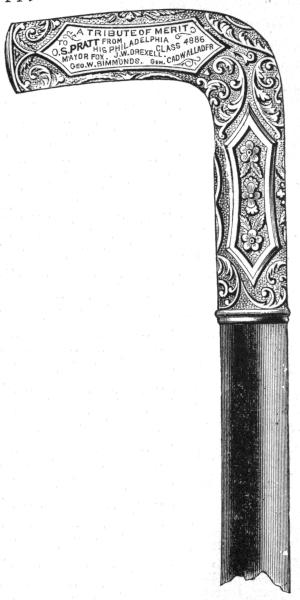
overpowering. The cane bears the following
inscription: “A tribute to merit. To Professor
O. S. Pratt, from his Philadelphia class, numbering
2,523.”
The cut, which follows, will give but a partial
idea of the beauty of this testimonial, which I
prize as much as being expressive of the friendship
I was so happy as to secure, as I value it
as a testimony
to the superiority
of my system.
It will be seen that it is accompanied
by a card, signed by
leading members of my class, urging
me to revisit Philadelphia and
pledging their aid and influence in
making such a visit successful.
A TRIBUTE OF MERIT TO O.S. PRATT FROM HIS PHILADELPHIA CLASS 4886
MAYOR FOX, J.W. DREXELL, GEO. W. SIMMONDS, GEN. CADWALLADER.
Prof. O. S. Pratt, the Horse Educator:
Dear Sir: The undersigned, members
of your horse educating school, have learned
with deep regret that you are forced, by various
engagements, to leave Philadelphia in a
few days. The knowledge we have received
by your lucid and simple system of educating
the horse is invaluable to us and all who
have been pupils in your class. We think
that your system of educating the horse is
far superior to any known before. It prevents
cruelty to animals, and is effective in
all cases if rightly applied and persisted in.
Your system is as yet far too little known
in Philadelphia. We, therefore, request you to open your
school in Philadelphia again during the fall and winter
months, and we do assure you that we will do our utmost
to make your school a successful one.
By urging you to revisit Philadelphia, we express the
wishes of a great number of our fellow-citizens who are
anxious to become members of your class.
J. W. Drexel, Banker in Phil., New York and London,
Albert Fiske, M. D.,
D. M. Fox, Mayor,
Henry M. Fox,
Lewis Ladimus,
Hoopes & Townsend,
M. Baird & Co.,
Powers & Weightman, Chemists,
Chas. F. Grosholz,
A. L. Vansant,
W. F. Potts,
Adam Steinmetz,
Jos. E. Werner,
James Darrach, M. D.,
Jas. Stelwagon,
Wm. Chapin, and many others.
Other testimonials I received from individuals,
a single one of which is given below; it is
from a well-known gentleman of wealth whose
name is as familiar in business as it is in social
circles, W. F. Potts, Esq., and was addressed to
friends of his own:
Philadelphia, Sept. 14, 1870.
Messrs. Morley & White,
Gent’n: My coachman and myself attended Mr. Pratt’s
lectures, last winter, in this city, and I think it paid me well.
I bought a young horse this spring, as bad a kicker as I ever
saw, and by putting him through a course of Pratting I am
using him every day. I do not know what some persons
could do, but I know what I have done; it is well worth all
I paid.
Yours, etc.,
Wm. F. Potts.
I was greatly pleased with the ancient Quaker
City as well as its noble-hearted people. The
neatness and quiet pervading so large and populous
a city produce a pleasing effect on the
visitor from abroad. The beautiful parks, with
their grand old trees and delightful walks, which
are to be met in all quarters, form a very pleasing
feature in that city. The bright flowers,
filling the air with fragrance; the leafy branches
arching over the nicely-arranged walks, with the
merry songs of the birds which sport amidst the
foliage, combine to invite the tired pedestrian to
rest his weary feet, as they charm the eye, the
ear and sense alike.
To the patriot and the lover of relics of “the
times that tried men’s souls,” when amidst the
battle-storm our fathers planted the fair tree of
liberty, Philadelphia offers special attractions,
and hours may be pleasantly and profitably
spent in the well-known “Independence Hall.”
Here time seems almost turned back on its
track as one stands amidst the relics of those
days of old. We see the very chair once occupied
by him whom we have learned to revere as
“the Father of his country”—the illustrious
Washington, and the thoughts are borne backward
to the time when, seated in the chair before
us, his hand held the destinies of a nation in its
grasp. Near by we see the pew in which that
great man sat and listened to that gospel whose
power and principles controlled his life. It is
taken from the old Gothic church which the
General attended and is preserved amongst the
relics of those revolutionary times. Mementos
are there also of the period when the Declaration
of Independence was signed and the eye
rests on the autographs of the illustrious signers.
There is also the great bell which rang out the
glorious notes of freedom and on which is inscribed
that grandest of words, “Liberty.” After
having became cracked, it was taken down from
its tower and placed on a table in the hall. The
National motto, “E Pluribus Unum,” is arranged
in a circle at the top of the bell. But pleasant
as it is to linger amongst these reminiscences of
the past, I must leave the good old Quaker City
with the single remark that my recollections of
the place and its people are all of the most
pleasant kind.
CHAPTER V.
YORK—PORT DEPOSIT—BALTIMORE—SUCCESS—DIPLOMA—GETTING
WHIPPED—CLASS OF 3,500.
Early in the spring of 1870, I entered the
city of York. The roads were bad, making traveling,
outside of the city, difficult and unpleasant,
so that few came in from the surrounding
country. Notwithstanding this, I met with encouraging
success, and during the three days of
my stay I formed a class of one hundred and
thirty members. Amongst my pupils was an old
man who had numbered a hundred and five
years of life. After studying my system he declared
that, during the short period of my stay,
he had received more valuable instruction relating
to horse education than in all his previous
life.
I next pitched my tent in the beautiful village,
Port Deposit, and was gratified by receiving
a good “deposit” from the hands of the people,
as nearly one hundred of them joined my class.
It was at this place that I achieved a victory
which spread my name far and wide. A horse,
notoriously vicious, was brought for me to educate.
He was an animal who, as I was credibly
informed, had killed his former owner, eaten the
leg nearly off his son and fearfully mangled the
arm of the groom. I applied my system in all
its force, knowing that he would require decided
treatment to subdue him, and, to the amazement
of the spectators, in a little while the ferocious
steed became gentle as a lamb. He stood in
the presence of that gazing multitude entirely
subdued. When the excitement had somewhat
subsided, some of the leading and influential
citizens were so impressed with the value of my
system as to exert themselves in getting up a
testimonial which, after being numerously signed,
was presented to me, and which I have since had
the pleasure of exhibiting to thousands. The
following description of the horse referred to
and of the success with which I trained him may
prove interesting to the reader:
Port Deposit, Md., August 31, 1870.
We, the undersigned, residents of this place and vicinity,
were induced to enter Prof. Pratt’s class for instructions in
educating the horse. At first many of us doubted the superiority
of his system, especially from the low price he charges
for instructions, believing it impossible to learn so much in
a short space of time for so little money; suffice it to say,
we went in and all were more than satisfied. Illustrative of
which we give a brief description of the “Biting Horse,”
owned by Mr. Snyder, near this town. This horse is a brown
stallion, 15½ hands high, closely built, and an animal of great
endurance, for which he is highly valued by Mr. Snyder, who
purchased him of a farmer in New Jersey for a very low
price on account of his most pernicious habit of biting, the
horse having bitten out two ribs of the farmer and broken
the leg of the son. Whilst in possession of his present owner
he has bitten off the arm of his groom, who brought him
into the Professor’s pavilion. We saw and conversed with
this groom. The horse had on a strong iron muzzle, a pine
stick was inserted in the mouth, which he seized with madness;
upon its removal he gritted his teeth most fiercely. In
twenty minutes or less, Prof. Pratt had the muzzle off, his
hand in the horse’s mouth pulling out the tongue. In a few
minutes after he drove the same horse in the street without
holdbacks. When he said “whoa,” the horse stopped.
When he said “go,” the horse went. Thus proving to two
hundred that his system is no fraud, but of all others
“excelsior.”
The scholars in this place numbered in three days 87,
among whom were the following named gentlemen:
W. E. England, pastor M. E. Church, Port Deposit, Md.;
J. B. Ramsay, cashier Cecil National Bank; Edward West;
N. W. Nolan; Eli Cosgrove, ex-sheriff Cecil County; F. M.
Alexander; Wilbur Kidd; Thomas D. Foran; Anthony S.
Davis; J. Tome, president Cecil National Bank; Wm. M.
Long; Thos. E. Davis, etc.
Baltimore, the Monumental City, noted for its
beautiful parks, pleasure grounds and monuments,
was my next field of labor. After viewing
the city over and receiving introductions
to many of its influential citizens numbers of
whom afterwards became warm friends, I betook
myself to labor.
As on some former occasions, I found it necessary
to build two academies, and so erected one
in the old and one in the new town. At first
there seemed a backwardness on the part of the
people, and a week passed without the manifestation
of much interest; but soon the indifference
gave way and from that point the interest
increased daily until, before the close of the
seventy days I remained in Baltimore, I had the
great pleasure of enrolling the names of three
thousand five hundred of her citizens as members
of my class.
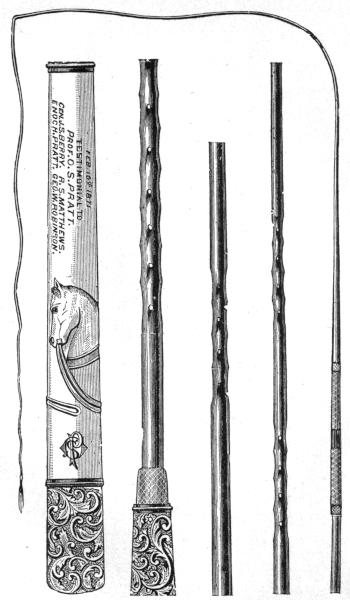
WHIP PRESENTED BY BALTIMORE CLASS.
My stay in Baltimore was especially marked
by kindnesses from numerous members of my
large class, many of whom it would give me
pleasure to name, associated as numbers of them
are with pleasant seasons of enjoyment, but lest
I should become prolix, I will content myself
with saying that most unexpectedly to me my
class presented me with a flattering address
accompanied by an elegant whip mounted with
gold and inlaid with pearl—a gift both beautiful
and useful. How it occurred is described by the
pen of another as follows:
How Professor Pratt was Whipped by the Baltimoreans.—The
Amphitheatre of Prof. Pratt, the Horse Educator,
at the corner of Green and Pratt streets, was crowded
on Thursday night, by an appreciative audience, to witness
the education of a number of horses. Near the close of the
free exhibition, an interruption occurred by a Mr. Murdock,
introducing F. P. Stevens, Esq., a member of the Baltimore
Bar, who made the following eloquent and pithy speech, in
presenting an elaborate whip to Prof. Pratt: “On behalf of
the members of your class in this city, numbering over 3,000,
I have been requested to present to you, on parting with us,
some memento of our high regard for you personally, and of
our estimation of your most admirable system of Horse
Education. That the instructions you have imparted to us
have been valuable and useful, no one of us who own
horses would hesitate to testify, not only your instructions
as to the Management, Education and Treatment of
the Horse, but in developing to us in the numerous Lectures,
the disposition and nature of the noble animal; that your
course of instruction has been popular among us, the numerical
strength of the class announces you, and I take great
pleasure in presenting you this token of friendship and good
will and hope that you may ever recur with pleasure to your
visit to the Monumental City, and as soon as your engagement
will permit, we may have the pleasure of seeing you
again.”
Gen. J. S. Berry,
Alec. Brown,
R. Stockhart Mathews,
Ichabot Jean,
Marshall Goldsborough,
Enoch Pratt,
Geo. W. Robinson,
Henry Tyson,
F. L. Lawrence,
F. P. Stevens,
Committee.
Class numbers 3,504.
During the continuance of my classes in Baltimore,
I received many favorable notices from the
press of that city. As showing the popular feeling
I may be allowed to give an article from the
Baltimore Sun, one of the most able and widely
circulated journals of the entire South. It appeared,
as will be seen, before my class had
reached its full dimensions.
Horse Training at Prof. Pratt’s Amphitheatre.—The
exhibitions of Professor Pratt’s skill in training refractory
horses continues to interest a large number of the people
of Baltimore. Every night his Amphitheatre on Linden
avenue is filled with an appreciative audience, including a
large number who are members of his school. During one
of our recent visits the Professor, after some remarks in reference
to his systems, introduced the little educated pony
called “Dollie Dutton,” well up in a few tricks. On her exit
“Fire Fly,” mate of the Professor’s “Tom Thumb,” made
his appearance, at the crack of a whip. “Fire Fly,” made
excellent time with his heels in the air, and by the word,
walked on his hind legs. The attempt by three persons to
ride the horse the longest afforded much amusement to the
audience, as not one of the three could remain on a minute.
“Gray Eagle, Jr.,” Marshall Goldsborough’s thorough-bred
stallion, which had not received over ten minutes’ instruction,
acted in a manner which gave credit to the Professor
and his system. Prof. Pratt then exhibited a massive gold-headed
cane, richly mounted and appropriately engraved,
which was presented him on the night of February 22d, 1869,
in Philadelphia, by his class which numbered 4,886, among
whom were Mayor Fox, General George Cadwalder, J. W.
Drexel, banker, who were on the committee of presentation,
and who gave the testimonial as a token of the appreciation
of his efforts with the horse and a proof of the value of the
system to them. After a lecture explanatory of his plan of
education which lasted nearly an hour, the Professor ordered
a horse to be brought in which was afraid of a robe. In less
than fifteen minutes after he came in, he was walking over
the robe, had it thrown over his head and in his face, but
the scare was gone. His education in robes being pronounced
completed, he was taken away and a horse that
would not back brought in. He however, soon proved very
tractable, backing while in and out of harness at the words.
The next Animal to claim the Professor’s attention was a
large stiff-neck mule furnished by Mr. S. S. Blair, of the
Northern Central Railway. As was expected the mule was
far more difficult to handle, yet in less than three minutes
after he was subjected to proper treatment and followed the
Professor, and after the system was entirely applied he was
mounted and ridden off by an attendant, going quietly as
any one could desire. Thus closed an evening at Professor
Pratt’s. On conversing with this worthy gentleman, we learn
he is from Buffalo, N. Y. Has been giving the system to
the public five years. He probably handled more horses
than any other man living. Was in Philadelphia five months,
having there a class of 4,886. In less than three weeks’ sojourn
among us he has secured over 1,000 members to his
class, and we saw such men as M. B. Clarke, Henry Tyson,
Drs. McNamus and Whitridge, George Robinson, George
Small, Gen. W. E. Ross, J. Riddlemoser, Jr., Gen. J. S. Berry,
J. Howard McHenry, R. Stockhart Mathews, all of whom
highly endorse Prof. Pratt’s system of educating the horse.
Mr. Mathews, who has seen Rarey, Rockwell, and others,
says this is far superior to all of them.
After closing my labors in Baltimore, I took
a few days of rest. My mind was in search of
new knowledge to add to and improve my system,
and to that object I devoted my time while
relieved of more active duties. I thoroughly revised
my system of educating and mode of treating
the horse; after which I invited the criticisms
of a number of men of intellect and experience,
to whom I submitted my views and asked them
for their candid verdict, when, to my great satisfaction,
they expressed their unqualified approbation.
If anything had been needed to confirm
my opinion of the perfection of my now completed
system, such an endorsement might justly
have done so; and, as the succeeding chapters
will show, my triumphant successes in the largest
cities and before the most exalted personages of
the land, demonstrated the justice of that favorable
verdict.
CHAPTER VI.
WASHINGTON—A LARGE CLASS—THE PRESIDENT A PUPIL—THE WHITE
HOUSE—HALLS OF CONGRESS—DIPLOMA—DR. NEWMAN’S ADDRESS—GOLD
MEDAL.
In the latter part of the year 1871 I determined
to visit the capital of the nation—that
renowned emporium of knowledge and wisdom—the
city of Washington. Fortified by previous
success, I determined on such an effort here as
should signalize my profession, and effectually
silence those who sought to stigmatize my system
and lessen confidence in myself by speaking
lightly of both. Themselves pretenders to knowledge,
and ignorant of what I taught, I have found
them ever ready to insinuate that all is “humbug”
which does not emanate from their would-be
fruitful brains. And now I ask a careful
attention to the narrative of my unexampled
success while sojourning in this city, in connection
with the character and intelligence of the
gentlemen who united in endorsing me, and in
commending my system.
I entered Washington about the middle of
February and speedily secured a site on which
to erect an academy. The place selected was
on Pennsylvania avenue, and the building I
erected was of capacity sufficient to contain
three thousand persons. I announced a public
exhibition, and on this, the first day of opening,
the place was filled to the utmost. At the close
of the exhibition I invited those of the audience
so disposed, to unite in forming a class. A large
number responded to this call, and, as I entered
on my work, I was encouraged by finding the
numbers increasing by hundreds. This nerved
me to the utmost, and at length, in sixty days,
my class had reached the gratifying number of
two thousand five hundred and five persons!
President Grant intimated his desire to take
private lessons, and requested me to organize a
class to meet in the forenoon of each day. This
I did, and I soon had the honor of imparting instruction
to such a class of distinguished men as
have rarely, if ever beside, been gathered together
for a similar purpose. The President invited
some special friends to join him in acquiring the
knowledge he desired, and soon I numbered in
my class men distinguished in the pursuits of
arms, politics, literature, and theology, many of
whom would rank with the foremost men of the
world. Amongst them were President Grant,
General Sherman, Surgeon General Barnes, General
Fremont, General Porter, General Babcock,
General Mechler, Judge Advocate General Holt
(the highest position in the army), General Eli
Parker, Count Catacazy, the Russian Minister;
Count Turenne, of the French Legation; P. H.
Le Poor, French Legation; H. S. Le Strange, of
the British Legation: Commodore Ammen, Commodore
Pickering, Senator McDonald, Senator
Stockton, Hon. W. H. Hooper, Rev. Dr. Newman,
Chaplain to the Senate; Senator Sprague,
Governor Cooke, and many others of high rank
and standing.
As is well known, in the national capital may
be found learned and talented men from almost
every nation, and as there are gathered objects
of interest to all, a brief sketch of what met my
eyes may not prove out of place.
First of all is the renowned “White House,”
the home of the honored head of our nation,
and now occupied by President Grant and his
family. It has been said that
“Uneasy lies the head that wears a crown,”
and a similar declaration might be made of the
occupant of the Presidential chair; few have
found it to be an easy seat. The servants of a
public jealous of their rights and privileges, and
exposed to the adverse criticism of selfish and
disappointed opponents, even the most generous
and well-meant movements of those filling that
high position are liable to misconception and ridicule.
There may be no personal dislike, yet the
public, ever on the qui vive for news of those in
high life, are seldom disposed to scrutinize a spicy
story, whoever it may strike. In this land every
man who deserves them has his friends, and none,
however deserving, are without some enemies.
The external appearance of the “White
House” somewhat disappointed me; yet it is a
magnificent structure, with massive pillars in
front, while the interior does credit to the good
taste of those in charge.
The Red Room, being generally selected for
the receptions held by the President and his
wife, is very handsomely furnished in velvet and
drapery, the color of which corresponds with the
name of the room. I must, however, express
my preference for the Blue Room; its light
shade of satin damask, with gold, is so chaste
and elegant that one could scarcely dream of a
fairy-land more beautiful; and at “morning receptions,”
from two till five P. M., the guests being
received in this room, it is rendered doubly
beautiful by the elegant toilettes of our American
and foreign ladies, who crowd it with the
beauty and fashion of the metropolis.
The large East Room, which occupies that
entire end of the building, is elegantly furnished,
while the walls are hung with life-size portraits,
in oil, of Washington, Abraham Lincoln, and
others who have formerly filled the highest national
office, but who now have passed away.
It was my pleasure to pass an evening, with
my wife, in the private parlor of President Grant
and family, who gave me a cordial reception.
Among those who shared in this social interview
were Rev. Dr. ——, L.L. D., from England,
his wife and daughter, and our much-esteemed
friends, Rev. Dr. N—— and wife,
of the Metropolitan Church, D. C.
We were shown through some of the pleasant
apartments of the Presidential mansion, and,
among others, the private dining-room. In this
the arrangements for meals are perfect and tasteful.
A small bouquet of choice flowers, selected
from the conservatory, which abounds with rare
exotics, is placed at the side of every plate at
dinner, and, that no interruption may interfere
with the arrangement of the table, a plate is always
provided for a casual visitor.
On entering Washington, the first building to
attract the eye of a stranger is the Capitol, which
is built on a prominent height, and forms the
most conspicuous object as one enters the city;
especially is this so when the magnificent dome
is lighted; one then gazes with delight on the
beauty of its perfect architecture.
On entering the Capitol by its massive marble
portico, the visitor first views the reception
rooms, then passes to the rotunda, the walls of
which are adorned with paintings, many of which
are commemorative of important events in the
early history of America, and some of a later
date. Statuary also meets the eye, and prominent
amongst it is the life-size statue of the martyred
President, Abraham Lincoln, from the
chisel of Vinnie Ream. As one looks on this
work, which has been so severely criticised, he
will feel the injustice done her, and be likely,
with the writer, to believe that the attacks were
prompted by the fact that it was a lady who secured
the contract. I enjoyed the pleasure of a
visit to the studio of the gentle sculptor, where
we found the lady, surrounded by specimens of
her wonderful skill in this noble art.
To return to the Capitol—that general resort
of strangers—one must visit the dome, and
thither we go, laboring up—up—till it seems almost
as though the top would never be reached,
though pleasant company served to beguile the
time as we mounted the hundred and eighty feet
of ascending steps. When, at length, we reached
the top, and stood in the presence of the paintings
which completely decorate the upper portion
of the dome, all else was forgotten, and it
seemed as though we had passed into another
sphere, away from all the cares of ordinary life!
Books can be obtained, explaining the historical
paintings, and in the study of these, days might
be profitably employed. The brief time a visitor
can give is far too short, to satisfy the eye, which
desires to still gaze on, reluctant to depart. From
the outer side of the dome a view of unparalleled
beauty is presented: Georgetown, General Lee’s
old homestead, in the distance, and the Potomac
River, together with the elegant public buildings,
are among the many objects included in the panoramic
view.
As we descend again, and come amongst the
sights and sounds of daily life, a sudden awakening
to reality occurs. We now pass to the wings
on either side of the main building devoted to
the use of the two Houses composing our American
Congress. On visiting the House of Representatives,
when in session, the visitor is directed
to the gallery which surrounds and looks
down upon the hall; and, should he be a favored
one, he is shown to a seat in that portion of the
gallery reserved for the diplomatic corps, friends
of members and distinguished visitors. There
one can sit at ease, apart from the crowds which
fill the other portions, and may listen to the
speeches of representatives from every State in
the Union, as they deliberate on the laws by
which the country is to be governed; may note
the voting, and sometimes hear the exciting contest
as the dignity of debate is lost in some partisan
wrangle.
The Treasury Building is a beautiful edifice,
and is always the scene of busy life, the activity
extending from the topmost floor to the furnace
in the cellar, where the mutilated currency is
burned. It is in this building that the paper
money of the country is prepared, after which it
is sent to the banks for circulation. It is customary
for visitors to exchange a note for one
that has never been in circulation, to be kept as
a souvenir.
The elegant Smithsonian Institute, with its
numerous objects of interest, and the Agricultural
Buildings, with their beautiful grounds, offer
their attractions to the visitor, while the Patent
Office, with its multitude of models, showing the
inventive genius of our countrymen, is of equal
interest. Here, while admiring the ingenuity
displayed by the inventors, we learn by the number
of rejected models how many have spent
perhaps the best years of their lives only to reap
disappointment at the last.
While in Washington I was favored with several
gratifying testimonials. The first one was
at the great National Carnival, where I received
the prize for the best four-in-hand turn-out, a
gold-mounted whip. The second testimonial was
a life-size portrait of President Grant, which was
presented to me at one of the gatherings of the
society attending the Metropolitan Memorial
Church, and was accompanied in its presentation
by the following address by Rev. J. P. Newman,
D. D., the eloquent and distinguished pastor of
the church:
Ladies and Gentlemen: Mine is a pleasing task. The
ladies of this church desire me to present this elegant portrait
of our honored President to Prof. Pratt, whose public
spirit and great liberality prompted him to give the proceeds
of his academy for one week towards the purchase of a
chime of bells for this church. We much regret that sickness
has detained the Professor from being present on this
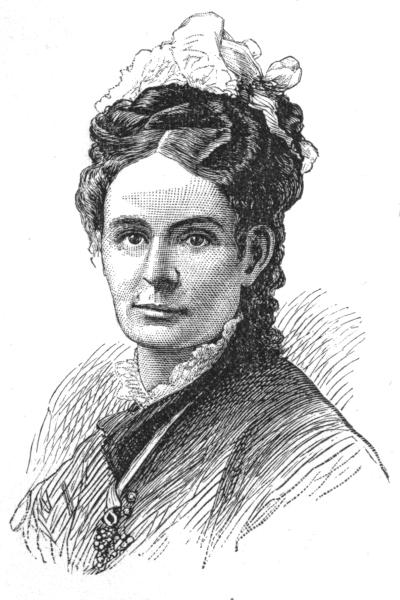
occasion, but we are happy to know that Mrs. Pratt is here.[1]
The donation on his part is the more commendable because
he came here a stranger, yet such is his appreciation of the
beautiful and useful that he cheerfully gives his large sum
for an object which will be, when achieved, the pride of the
Capital.
His mission is eminently humane, for he not only educates
the horse to obey the intelligence of his master, but
also educates the master to treat the noblest of beasts with
humanity.
[1] Her many friends will doubtless be gratified by finding, on the
opposite page, a portrait of this lady—the life-long companion of the
author.
The address, which was received with loud
applause, was, in my absence, responded to by
the Member of Congress from Batavia.
The third testimonial I received was presented
on the day of closing my lectures, which had
been so regularly attended by the citizens, officials,
and members of the foreign legations, who
deemed it proper to encourage my enterprise by
presenting me with a diploma, engrossed on
parchment, over their own signatures, and which
was accompanied with a gold medal. The following
is a copy of the diploma presented by
the Washington class, the original of which is
now in my possession, on parchment:
To Prof. O. S. Pratt:
We, the members of your Washington class, appreciate
the value of the very necessary knowledge which you
have imparted to us during your sojourn in the national
metropolis; and we are convinced that your method of educating
the horse, and reforming his vicious habits, is the
only true system. As a mark of our estimation of the service
rendered us, we beg your acceptance of the accompanying
testimonial, and our sincere wishes for your continued
success, health and happiness.
General W. T. Sherman,
Gen. O. E. Babcock,
General Banks,
Count De Catacazy,
Mayor Matthew G. Emory,
W. S. Shepherd,
Surgeon Gen. Barnes,
Commodore Ammen,
Gen. Horace Porter,
Gen. J. C. Fremont,
Senator Wm. Sprague,
Commodore Pickering,
Brevet Maj. Gen. Allen,
Gen. Ely S. Parker,
Mayor Emory,
H. A. L’Astrange, of the British Legation,
Rev. Dr. Newman, Chaplain to the Senate,
Wm. W. Belknap, Secretary of War,
Gen. Meichler,
Governor Cooke,
P. H. la Poor, of the French Legation.
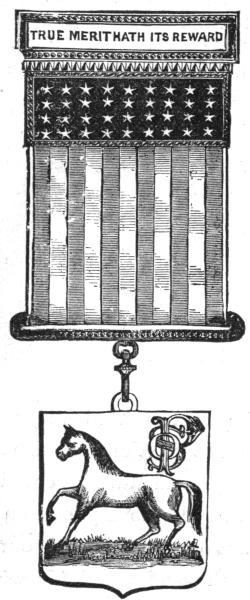
On the next page the reader will find a correct
cut of the gold medal which accompanied
the diploma.
On the following day the Metropolitan Church
arranged an excursion to Mount Vernon. The
day was beautiful, and the company all that could
be desired. The sail down the lovely stream,
with its wooded banks, was delightful. On our
arrival at the spot the laugh was hushed, for we
felt ourselves on sacred soil as we neared the
tomb of Washington. After lingering for a time
by the dust of the illustrious dead, we ascended
the hill on which stands
the house which was once
the home of the Father
of his Country. The furniture
having been removed,
we saw little more
than the halls, a few relics
enclosed in a case, and
the marble mantel, which
has been so much coveted
by strangers on account
of its rare carving, representing
a farm-yard scene.
This choice relic has been
defaced in several places
by unscrupulous visitors,
who have broken off
pieces to carry away as
relics. We also visited
the spot where Washington
and Lafayette met, under a tree, to reconcile
their difficulties.
During our return to the city, which we reached
the evening of the same day, speeches were
made on the boat by the Mayor, ministers and
bankers. We arrived in time to take the cars
on our way to Long Branch, at which popular
resort I passed most of the summer in visiting
and recreation, before again resuming the duties
of my profession.
CHAPTER VII.
ANNAPOLIS—DELAWARE—NEW JERSEY—NEW YORK STATE—THE GREAT
EMPORIUM—CHICAGO IN FLAMES.
After my period of relaxation, I re-entered
the active duties of my profession feeling greatly
invigorated. I visited the pleasant city of Annapolis,
the capital of Maryland, where I met a
cordial reception from many whose warm appreciation
of my system of educating the horse was
coupled with marks of personal friendship. Here,
as in other places on former occasions, my endeavors
were crowned with a gratifying success.
It is at this place that the United States Naval
Academy is situated, an institution which sustains
the same relation to the navy that West
Point bears to the army of our country. In the
extent of its bounds, covering, as it does, an area
of about twenty acres, and in the completeness
of its appointments, this academy is unequaled
in the United States. Here I was introduced
to General Bovey, who is a lover of that noble
animal, the horse, and is the owner of some of
the finest that America can boast. He manifested
much interest in my welfare, and kindly
invited me to dine with him; after spending a
long and pleasant hour in his society, I took my
leave, and when, shortly after, I left Annapolis,
I bore with me a grateful recollection of the
many kindnesses I had received from the inhabitants
of that beautiful city.
I will here claim the indulgence of the reader
while I give a brief sketch of my journey from
this point to New York. It was about the middle
of May, 1871, when I started on my tour,
intending to arrive at New York in the month
of October. In passing through the State of
Maryland, I found it a beautiful, level country,
with a soil of great fertility. It is well known
to have been one of the slave States, and, as a
result, the population is made up largely of colored
people, many of whom I found to be very,
very poor; their houses, within and without, bespoke
wretchedness and want, and many of them
seemed on the verge of starvation. Often was
my heart moved to compassion as I viewed their
dilapidated clothing, many of them being almost
naked, while in their countenances want and misery
were depicted. As I passed the settlements
and, prompted by pity, gave them some donations,
I saw their faces brighten as I placed the
money in their tawny and wrinkled hands, while
their expressions of thankfulness more than rewarded
me for the gifts bestowed. In passing
through this State I formed many classes, meeting
with even better success than I anticipated.
Leaving Maryland, I entered the little State
of Delaware, renowned for the extent of its
orchards and the excellence of its peaches, which
fruit forms the most profitable crop of the State,
and is unequaled by any grown elsewhere. The
country here also is level, but in many parts so
sandy as to weary the traveler, whose animals
often labor through sand to the depth of six
inches, while the scorching rays of the sun, reflected
from the sand, add much to the discomfort
of a journey through this State.
At Dover, the capital of the State, I formed
an interesting class, of which the Governor and
many distinguished citizens became members.
The buildings in Dover are mostly of wood, there
being none of stone and but few of brick.
After leaving Dover I crossed Delaware Bay,
and entered the State of New Jersey. This,
also, in its more southern portions, may be described
as a level country, but the lands there
are clothed with dense forests of pine, where
human habitations are rarely met, and even the
sound of the woodman’s axe is seldom heard.
These “pine barrens” are in places destitute of
traveled roads, and the one journeying through
them sees his course marked out by “blazed”
trees. I wended my way along until I reached
the city of Trenton, the capital of the State,
where I formed a class. Thence I passed to the
city of Rahway, then to Elizabeth, and afterwards
to the town of Long Branch, forming interesting
classes at each place. The last-named
place is well known as a favorite and much-admired
watering-place, being the summer resort
of thousands who annually seek its pure sea-breezes,
and regale themselves in the pleasures
it abundantly affords. I visited many other
places in the State, forming classes and receiving
the congratulations of numbers who appreciated
the knowledge it was my aim to impart.
Passing some twenty miles across a pleasant
though sandy country, I reached the village of
Red Bank, at which place I took the steamboat,
and, after sailing through the magnificent Bay of
New York, passed up the Hudson River to Sing
Sing, at which place I met with success, and
formed a class composed mainly of the first citizens
of the town. I devoted my first leisure to
visiting the State Prison, which is situated in the
suburbs, on the bank of the Hudson, and, after
being conducted through the different departments,
I was permitted to see a record of the
names of the inmates and the crimes for which
they were incarcerated, and I record it as my
conviction that many there have laid a foundation
for after crime by early cruelty to the noblest
of all animals save man. One step of
cruelty leads inevitably to others, and thus the
disposition may have grown that has led, finally,
to the crime which deprived them of liberty and
condemned them to years of servitude in that
dreary abode of felons.
Retracing my steps down the Hudson, I next
pitched my tent at Peekskill, which is situated
on the east bank of the river, and where I met
a gratifying reception, and succeeded as at other
places.
Before leaving the place, I strolled about a
mile back from the river, and saw there the farm
and summer residence of Rev. Henry Ward
Beecher, the great biblical expounder and platform
orator, who has since passed through an
ordeal far from pleasing or profitable, though
there are indications that from all he will yet
come out as “gold tried in the fire,” and perhaps
to shine as a star of still brighter lustre.
My next visit was to the city of Poughkeepsie,
where, at my first public exhibition, I was greeted
by the presence of a large number of influential
citizens, whose appearance there augured well
for my success. I was pleased with my brief
visit to this place, as my class soon swelled to
the number of three hundred and fifty. I here
formed the acquaintance of Prof. Eastman, of
Eastman College, who solicited me to give an
exhibition, on the grounds in front of his splendid
mansion, to the Sabbath-school children of
the city. I consented, and gave an exhibition
which was received with delight by a multitude
of youth of both sexes.
I now determined to direct my course down
the beautiful Hudson to the great commercial
emporium of the country, the city of New York.
There I built an academy, at a cost of nearly
three thousand dollars, capable of accommodating
about four thousand persons. I opened, with
brilliant prospects, about the middle of October,
1871, and as the days rolled by I had ample evidence
of the appreciation of my efforts in the
daily increase of my class, until, on the 15th of
January, 1872, I had the pleasure of numbering
on my register the handsome amount of three
thousand names, representing amongst them
many of the first men of the city.
I had intended to remain in New York until
the opening of spring, but about this time an
event which spread consternation through the
land blighted my fair prospects. Along the wires
of the telegraph, flashed eastward with lightning
speed, came the doleful tidings that Chicago, the
Queen City of the West, was in flames! As
message after message came, telling of the progress
of the devouring element, all hearts were
filled with sympathy, till the final tidings came
that for many square miles the once beautiful
city was a vast plain of smouldering ruins, and
that thousands of human beings, thus rendered
homeless and penniless, were in almost a starving
condition. At once the hearts of the people
of New York were moved to compassion.
Business was well-nigh suspended. The single
topic which engaged all minds was the great disaster
which had befallen a sister city, and how to
devise means for relief to the destitute and suffering.
In this absorbing feeling the interest in
my lectures naturally abated; so much so, that
I closed my academy and joined with my countrymen
in the active measures which were at
once inaugurated for extending relief to the
needy. I attended the meetings held for that
purpose, and heartily co-operated in sending the
greatly needed aid to suffering humanity. I remained
in New York till the excitement had
somewhat abated, and then decided on visiting
some of the New England States; but, before
leaving the Great Emporium, I received a diploma
attesting the high value placed on my
instructions by those who had received them.
CHAPTER VIII.
BRIDGEPORT—FALL OF ACADEMY—PROVIDENCE—BOSTON—CLASS OF
3,000—LYNN—PURCHASE OF A RESIDENCE—PORTLAND—BANGOR.
BRIDGEPORT ACADEMY.
On entering New England, my first stop was
at the beautiful town of Bridgeport, somewhat
celebrated as the home of the renowned sensationalist,
P. T. Barnum, who has, during quite an
eventful career, acquired and lost many fortunes.
As the winter had not yet passed, I here erected
an academy, which became the scene of an incident
which will forever remain fixed on my
memory. The people of Bridgeport turned out
nobly, filling my academy to its utmost capacity,
when, hearing a noise, I looked in the direction
whence it proceeded, and, to my horror, saw the
seats falling, with their occupants, precipitating
them to the ground! Of course all for a time
was confusion and affright, but, strange to say,
not one of the immense crowd was injured by
the accident.
After the excitement had somewhat subsided,
I proceeded to form a class, which numbered
about three hundred, who seemed delighted
with the knowledge they acquired under my
instructions.
When my labors had ended I took an opportunity
to view the town, and was greatly interested
in visiting some of its principal manufactories.
Amongst these one of special note is
the immense establishment for the manufacture
of the Howe Sewing Machines, said to be one
of the largest in the world.
I subsequently visited Providence, the capital
of Rhode Island, where I found it necessary to
build another academy, which I erected very
near the public thoroughfare of the city. At
this place my most sanguine expectations were
realized, as I met with signal success; nearly
one thousand persons became members of my
class, and the financial results were greatly beneficial
to me, as at this time my expenses were
great. My troupe consisted of some eight men
and twelve horses, the expenses of which were
large, besides the cost of extensively advertising,
that I might give wider publicity to a system
which had gained general favor wherever it was
known.
The far-famed city of Boston was my next
resting-place. Here, as at other places, I found
it necessary to exhibit in an academy, and, having
fitted it up, I entered on my work with
renewed hope and energy, believing, from the
usefulness and practicability of my system of
educating the horse, that a failure was impossible.
Nor was I disappointed; the shrewd
minds of the Bay State saw the value of the
knowledge I imparted, and, cheered on by growing
favor, I put forth every effort, and was
rewarded by the most gratifying success, as my
class reached the large number of three thousand
persons.
With the close of my labors in Boston the
winter had passed away, and I decided on a trip
reaching northward as far as Portland, in Maine,
making short stops at the several towns between
Boston and that place, first stopping at a beautiful
town called Lynn, where I purchased a nice
family residence, a good representation of which
is given in the cut.
In this charming town and its vicinity there is
much to attract and please the visitor. Among
the favorite resorts is a delightful watering-place
known as Nahant Beach, to which, during the
summer, thousands come to enjoy the invigorating
breezes of the ocean. Here the invalid seeks
the coveted boon of health, while the healthy
come to reinvigorate their systems. Mrs. Pratt
and myself christened the place the “green spot
of earth,” as often, attended by our servants, we
drove in our carriage around the beach, for the
time forgetting the toils of the past, and almost
fancying ourselves in the land of Paradise.
NAHANT BEACH RESIDENCE.
I may be allowed, at this point, to give a letter
addressed to me by a well-known gentleman,
a citizen of that pleasant town.
Lynn, July 12, 1872.
Prof. O. S. Pratt.
Dear Sir: I regret your departure from our city. I have
received a great benefit by joining your school. Your system
of educating horses is far ahead of any now in use. I
belong to Rockwell’s class. In nothing has there been
greater improvement. Its advantage is its simplicity. In
no exhibition during your short stay have I failed to find
some new point. There is no deception, no trickery, no
unfairness. What you say I’ve found you willing to back
up with your money; your goods are no humbug. Why will
people be so skeptical. People ask me every day, “Can you
do it?” My answer is, “Yes.” Why sir, I would not take
five hundred dollars for what I’ve learned of your system.
If people would be more willing to join your class and get
the system, we should have less accidents by that noblest
of animals, the horse. When you were educating Lannan’s
horse the other evening, a skeptic stood by my side. I said,
“Pratt will drive that horse to-morrow.” Says he, “I’ll bet a
hundred dollars he won’t.” He put his hand in his pocket,
attempting to draw his wallet. I caught his hand, saying to
him, “If you’ve friends enough here to raise $5,000, it shall
be covered, that he will drive him to-night.” I am not a
betting man, though. The gentleman went into his boots.
You have not a pupil, I know of, but is willing to back you,
as far as able, in anything you say you will do with any
horse.
God speed you in the right.
Yours truly,
Charles D. Tilton.
After the pleasure season had passed, I again
betook myself to my profession, and, once more
upon the road, I stopped at several towns, giving
public exhibitions and forming classes, until I
reached Portland, which place I entered about
the first of August, 1872. Here we set our
stakes and spread our canvas, giving, as usual,
public exhibitions, and organizing a class of
about two hundred persons. Many vicious
horses were here brought to me, that on them
the merits of my system might be tested, all of
which I handled to the satisfaction, and, I may
safely say, the admiration of the class who witnessed
their education.
Next, placing my troupe and animals on a
steamer, I passed by sea to the city of Bangor,
the most populous in the State of Maine. Here
I made arrangements with the officers of the
Agricultural Society, by which I secured the
Fair Grounds, where I erected a spacious pavilion,
and at once commenced operations. It
was soon evident that I had secured the favor of
the people, as I was largely patronized. While
there I made arrangements with Dr. Tewksbury
to handle his imported stallion, “Anfield,” who
was notorious for his vicious propensities, extending
even to the shedding of human blood,
he having fought many battles, and always had
come off victorious. Although my fame had
spread far and wide, and I had educated many
vicious horses, yet, had I not possessed implicit
confidence in the virtues of my system, I would
have declined; but, prompted and encouraged
by my previous successes, I decided to handle
him on my arrival at Lewiston, Maine, which
would be about the first of September.
While at Bangor I received a letter from the
President of the Society for the Prevention of
Cruelty to Animals, as follows:
Bangor, Me., September 28, 1872.
Prof. O. S. Pratt.
My Dear Sir: I am happy to acknowledge your superior
system of Horse Education, which deserves the commendation
of all who desire the improvement of that beautiful and
useful animal. Your system does not inflict torture or
cruelty, but subdues and teaches him, and in my opinion it
is only to be seen and learned to be universally adopted.
I take much pleasure in recommending it to the notice
of all who have the care and management of horses.
Very respectfully,
J. D. Warren,
Pres. Soc. for P. of C. to Animals.
CHAPTER IX.
LEWISTON—EDUCATING THE HORSE “ANFIELD”—TESTIMONIAL—CONCORD—MANCHESTER—A
STEAM ENGINE IN THE RING—LOWELL—LAWRENCE.
Continuing my tour, I exhibited at many
places in the State until I reached the city of
Augusta, where I remained two days, and met
with marked success. Anxious to reach Lewiston
by the time I had fixed, I passed rapidly,
through many towns and villages, only remaining
a day in each place, and arrived at Lewiston on
the eighth of September. It was here, as the
reader will remember, that I was to handle the
notorious “Anfield.”
After building an academy, and giving a public
exhibition, I announced my intention of controlling
that vicious animal. The citizens turned
out en masse, but, as the horse was led into the
ring, the whole audience seemed terror-stricken,
wondering, no doubt, whether or not I would
share the fate that others had; but speedily their
terror gave place to admiration, as they saw the
powerful animal succumb to the resistless energy
and efficacy of my system, for, within one short
hour, the lion-like brute became meek and quiet
as a lamb, greatly to the astonishment of the
multitude, who gazed with wonder on the transformation.
I give below the testimonial subsequently
presented to me, in which this feat is
described:
We, the undersigned citizens of Lewiston and vicinity,
hereby certify that we are members of Prof. O. S. Pratt’s
school for instruction in the proper education of the horse;
that from a careful and thorough examination of his method,
as succinctly demonstrated by him in his admirable lectures
and apt illustrations, we unqualifiedly pronounce Professor
Pratt’s system as most practical, and far superior to any ever
before known.
His power over the most vicious and ferocious horses is
at once wonderful and instructive, as verified by his handling
of the stallion “Anfield,” in Lewiston, on Thursday
evening, October 17, 1872, before an audience of 1,000
persons.
“Anfield” is an eleven-year-old dark bay stallion, and
standing sixteen or seventeen hands high, and is owned by
Dr. S. H. Tewksbury, of Portland, Me. He is reported to
have killed one man, and was a bad biter, striker, and somewhat
given to kicking. He had never been harnessed.
He was led into the academy on the above night, secured
by iron rods and with a heavy muzzle over his mouth. He
manifested an ugliness truly characteristic.
Prof. Pratt, applying the rules of his system, at once so
comprehensive and yet so simple, within twenty minutes had
contemptuously thrown away the iron rods, muzzle, etc.,
and exhibited to his audience one of the most tractable of
horses, who would follow him when commanded, stopping at
the word “whoa,” and, being harnessed, was driven around
the ring in a vehicle continually hitting his heels.
Prof. Pratt’s Lewiston class numbers, at the present time,
three hundred and sixty members.
LEWISTON ACADEMY.
We most cheerfully commend the system of Prof. Pratt
to the public generally, assuring them that, in our opinion, it
is the inauguration of a new and happier era for that noblest
of the brute creation—the horse.
Lewiston, Me., October 2, 1872.
D. B. Strout,
J. P. Norton,
H. C. Bradford,
P. M. Thurlow,
Eli Edgecomb,
N. C. Harris,
H. H. Richardson,
W. M. Chamberlin,
Geo. S. Follensber,
T. H. Langley,
H. L. Johnson,
B. H. Scribner,
J. L. Peabody,
S. D. Thomas,
R. S. Bradbury,
J. C. Pendepter,
George Wehle,
S. B. Cook,
A. B. Watson,
John Pickard,
H. V. Brown, M. D.,
J. B. Straw,
Daniel Wood,
S. O. Purinton,
C. T. Chappell,
Rufus Carr,
W. H. Garcelen,
A. O. Edgecomb,
W. W. Wood,
Isaac Harkell, 2d,
Wm. H. Horr,
J. A. Whitman,
F. C. Hayes,
Geo. L. Mellen,
Rufus C. Williams,
N. M. Farwell,
A. H. Peasley,
J. M. Rook.
Passing through a beautiful country, and forming
a number of classes on the way, we at length
reached Concord, the capital of New Hampshire.
I there obtained the large building used
by the mechanics for the exhibition of their
manufactured articles on the days of the regular
Fair. This I fitted up and used for my lectures.
The news of my success at other places had
preceded me, and I found the citizens ready to
respond to my invitation to form themselves
into a class. This class was a large and profitable
one, adding much to my financial resources
in the business. The city of Manchester was
the next place I visited. Its magnificent water-power
and busy manufactories, amongst them
some of the largest producers of carpets and
cloth in the United States, make it a place of
great importance. It was here that I achieved a
victory never before known to the public—that
of educating the horse not to fear either the
steam engine or the cars. Having had placed at
my service the steam engine manufactured by
Amos Keig, I had it brought into the ring. In
a short time the engineer got up steam, and set
it in motion. Horses by the half-dozen were
brought in to be educated, and, as my success
was shown in removing all fear of that terrifying
object, language almost fails to describe the
enthusiasm excited, and the eulogies pronounced
on my system. As this was the first opportunity
that had presented itself for me to show the
power and beauty of that portion of my system,
I was greatly cheered and gratified with the success
attending my efforts, especially as the papers
of the city heralded my success in no uncertain
tones, and proclaimed the almost incalculable
benefit which would accrue to society from the
adoption of my system.
Traveling southward about fifteen miles, I
reached the city of Lowell, where I built an
academy, and had the pleasure of enrolling in
my class a large number of the influential citizens
of that place, who were as much delighted
with my system as I was with my successful
efforts.
The next place of interest to be named is the
city of Lawrence, renowned for its mills and
manufactures. Here may be seen a building
nearly a mile in length, erected along the bank
of the famous water-power, and used exclusively
for manufacturing purposes. At this city, also,
I built an academy, remaining a few days, and
meeting warm-hearted friends, who gave me a
large class.
By this time I had fully equipped myself with
all appliances needed to confront and convince
the most skeptical, so that no person could successfully
assail my almost perfect system of
equine education, which, by the force of its own
merits, had thus far won its way, and was daily
gaining new favor in the eyes of the public.
My next effort was made about the first of
March, 1873, in the city of Worcester, where,
from the commencement, the interest daily increased
during the whole period of my stay, and
abundant success crowned my endeavors.
Some leading citizens of Springfield now wrote
to me, requesting that I should visit their town,
to which I consented, and, on reaching the place,
I found a wide-spread eagerness to secure the
knowledge I possessed. I built an academy, and
was much gratified by securing an appreciative
class.
Leaving the old State of Massachusetts, I
directed my course to Hartford, in the State of
Connecticut, where, as in former places, I found
it necessary to build an academy, which, on the
first day of my exhibition, I had the pleasure of
seeing filled to its utmost capacity, and, when I
turned my attention to forming a class, my
endeavors met with a hearty response.
CHAPTER X.
TOUR IN CANADA—MONTREAL—CLASS OF 1,000—VICTORIA
BRIDGE—CATHEDRAL—QUEBEC—OTTAWA—KINGSTON—DETROIT—DIPLOMA—VALUABLE
TESTIMONIAL—SIMCOE.
Hitherto my labors had been confined to my
own country. I had traveled many hundreds of
miles, visiting its great cities, its smaller towns
and thriving villages, and everywhere, even from
the highest in the land, I had met a cordial
reception. But now I formed the purpose of
crossing the St. Lawrence River, which divides,
on the north, the American from the British possessions,
and of making a tour through a large
portion of the Dominion of Canada. Believing
that I had more stock and other property than I
would require, I sold by auction many articles,
and, placing my remaining stock and appendages
on several cars, I forwarded them to their destination.
Reaching St. Albans, I was solicited
to remain there a few days, which I did, and had
no cause to regret my decision, for the people
gave me a liberal patronage.
Continuing my journey from St. Albans, I
arrived at the important commercial city, Montreal,
about the first of May, where I met a cordial
reception. At once I commenced the erection
of an academy of capacity sufficient to hold
at least two thousand persons. Soon the tidings
of the great successes I had achieved in my
profession spread far and wide through that populous
and wealthy city, and, as a result, during
the few days I remained, I had the pleasure of
enrolling nearly one thousand names.
In this ancient city there are many beautiful
and interesting objects which attract the attention
of a visitor. A few of the most prominent
are all that I can mention. Of these the
great Victoria Bridge is one. A massive structure
of iron, tightly closed at the sides and nicely
roofed, it spans the St. Lawrence River just at
the outskirts of the city. Windows, at certain
intervals, admit the light and air. Carriages and
pedestrians are excluded, the railroad company
having the sole right to use the bridge. The
French Catholic Cathedral is to many an object
of great attractiveness, and thousands ascend
its circuitous flights of stairs to the top of the
tower, from which the eye may take in the entire
city, with its many public parks and pleasure
grounds far exceeding in number those usual to
a commercial city. The mountain, about three
miles distant from the heart of the city, is a
favorite resort. A beautiful and almost level
road runs round it, along which, at almost every
hour of the day, carriages may be seen coursing.
Many other pleasing sights might be named, but
I close my reminiscences of the beautiful city by
the remark that nowhere, in all my travels, have
I seen more elegant and costly private dwellings
than are those which grace Montreal.
Through the solicitation of friends, I was
induced to visit Quebec, the ancient capital and
late seat of the Canadian government.
As it is approached, the forest of masts which
meets the eye, peering up in every direction,
might suggest reminiscences of some cedar
swamp, with its multitude of tapering trees, but,
upon closer inspection, the eye is delighted with
the magnitude and beauty of the shipping which
crowds the port. Some of the finest vessels
that plow the ocean are here to be found. On
entering on my work, I met with no difficulty in
interesting the minds of the citizens in my subject.
They turned out nobly to my public exhibitions,
and rewarded my exertions by giving me
a large and interesting class.
Leaving Quebec about the middle of May, I
ascended the St. Lawrence as far as the beautiful
town of Brockville, exhibiting at many towns
on my way. Here I determined to forward my
horses and stock by rail to the city of Ottawa,
the capital of the Dominion and the seat of
government, where annually the assembled wisdom
of the country meet to legislate for the
great Canadian Dominion; nor need one cross
the ocean to the mother country, nor even visit
the adjoining republic, to meet with both orators
and statesmen, many of whom grace the Canadian
Parliament, the halls of which often ring
with eloquence, as, in the discharge of their responsible
duties, the statesmen of the Dominion
discuss the great topics of the day. Although my
stay in Ottawa was brief, I had the satisfaction of
forming there a class of three hundred persons.
Passing westward, I held public exhibitions
and formed classes in many places, until I
reached Kingston, rightly named the Old Limestone
City. Here I spent a few days very pleasantly,
and had the pleasure of forming a satisfactory
class. The strong bulwarks and splendid
fortifications of this city give it a military air, and
afford ample protection from an invading force.
At this point I embarked on one of the Mail
Line of steamers, with my stock and equipments,
and passed up Lake Ontario to Burlington Bay,
and thence to the city of Hamilton. As I had
been frequently solicited to visit Detroit, and
having determined on spending the ensuing winter
in Hamilton and Toronto, I did not at this
time attempt to form a class, but took the most
direct route to Detroit city, exhibiting at a
number of places on my way.
Detroit is situated on the river bearing its
name, which divides the American and Canadian
possessions. Its commerce is quite large, and,
to one standing on the banks of the river, a
pleasing and animated picture is presented. The
rapid stream, in places running with a current of
from five to eight miles an hour, is difficult of
navigation for sailing vessels, and one sees the
sailing craft, loaded with grain and lumber, towed
by large and powerful steam-tugs, built expressly
for that purpose, while the smiling banks on
the Canadian side, crowned by the buildings
of Windsor, mirror themselves in the farther
waters.
It was in December, 1873, that I reached
Detroit, remaining there a few weeks, and during
that time forming a class of over twelve hundred
members. Before taking my leave of that
pleasant and enterprising city, I received from
my class a diploma, which I prize more highly
than gold, while, to increase my delight, I was,
most unexpectedly to myself, made the recipient
of an elegant cabinet music-box, the value of
which could not be less than five hundred dollars.
The following is the diploma, as signed
and presented to me, followed by a cut of the
elegant testimonial:
MUSIC BOX FROM DETROIT CLASS.
Having attended Prof. O. S. Pratt’s lectures to his class,
and also having seen the practical application of his system
as given by him every afternoon and evening at his academy,
and believing it to be far the best ever seen in this State, so
clear and practical that the merest novice can understand
and use it, and yet so comprehensive that the most skillful
horseman can be instructed by it, we deem it of the utmost
importance that all persons owning, using, or at all interested
in horses, should avail themselves of Prof. Pratt’s knowledge
on that subject. He educates the man to educate the
horse, the only practical method to be of permanent benefit.
Jared Patchin,
G. W. Bissell,
Dr. J. B. De Guise,
D. Bethune Duffield,
Newell Avery,
R. Hosie,
A. M. Steele,
George Jerome,
E. Furguson,
Geo. W. Vandyke,
W. A. Mitchell,
H. A. Newland,
Allen Shelden,
A. Sinclair,
Geo. E. Avery,
Sylvester Larned,
Dr. Davenport,
Dr. J. F. Noyes,
Mayor Moffat,
R. C. Hodges,
John C. Williams,
R. Sinclair,
Jerome E. Croul,
Dr. Cobb,
R. C. Remick,
James A. Remick,
Henry Kibbee,
John V. Mehling,
B. H. Thompson,
Dr. G. W. Foster,
M. F. Merrick,
M. S. Smith,
Dr. H. Smith,
Geo. Doolittle,
A. W. Mitchell,
Elijah Smith.
Passing from Detroit, I again set foot on Canadian
soil, exhibiting at a town named Sarnia,
situated on the Detroit River, and after that at
many other places until I reached the pleasant
little town of Simcoe. There I received a cordial
welcome from many lovers of the horse,
and found no difficulty in forming a class of one
hundred and ninety, who not only appreciated
my system, but embraced an early opportunity
of presenting me with a diploma testifying that
appreciation. It was read in my hearing on its
being presented, and the reader may well believe
that I was greatly gratified and cheered by the
sentiments therein expressed.
Simcoe, February 24, 1874.
Having attended Prof. O. S. Pratt’s lectures to his class
and also having seen the practical application of his system,
as given by him every afternoon and evening at his academy,
and believing it to be far the best ever seen in Canada, so
clear and practical that the merest novice can understand
and use it, and yet so comprehensive that the most skillful
horseman can be instructed by it, we deem it of utmost importance
that all persons owning, using, or at all interested in
horses, avail themselves of Prof. Pratt’s knowledge on that
subject. He educates the man to educate the horse, the only
practical method to be of permanent benefit.
Winter was now drawing nigh, and, as I was
desirous to reach Toronto, the Queen City of
the Province of Ontario, as soon as possible, I
made but a short stay at Brantford and other
towns on my way. Arriving at Toronto about
the last of November, 1874, I secured possession
of the Riding Academy, and fitted it up at considerable
cost, after which I gave public exhibitions,
which awakened an increasing interest. I
remained there sixty days, my class becoming
larger daily, until, at the close of my labors, my
register showed the names of nearly thirteen
hundred members, many of whom were amongst
the most influential citizens of the place. During
my stay I handled some two hundred horses,
each of whom had been addicted to some bad
habit.
Toronto Academy—PRESENTATION OF TEA SERVICE AND ILLUMINATED ADDRESS.
Many members of my class were desirous
that I should exhibit the power of my system to
educate horses not to fear the steam engine, and,
that I might meet their wishes, I procured a
steam fire engine, which I caused to be placed in
my academy. During my stay there I educated
some hundred horses to the perfect satisfaction
of their owners, and the evident gratification of
my class. Amongst others, I may name as a
signal triumph of my system the case of the
stallion “British Ensign,” owned at Richmond
Hill, who, from his vicious habits of long standing,
was thought to be incurable, and, as a last
resort, I was solicited to handle him. This was
at the close of my labors there, and, the day
being announced, the members of my class gathered
in force to witness my last effort in their
city. The horse was led into the ring by two
men by means of iron rods securely fastened on
each side of his mouth. From the account
given of this animal, one would almost expect
that a man could tame a lion of the desert as
easily as him; but, strange as it may seem, within
ten minutes he followed me around the ring as
meekly as a lamb, and within forty-five minutes
I was able to drive him before a vehicle, without
reins or side-straps, greatly to the surprise of
the throngs who had assembled to witness the
spectacle.
The power and efficacy of my system was so
completely demonstrated that the leading journals
of the city made favorable mention of my
unparalleled success, while my class signalized
their sense of the value of my system for properly
educating the horse by presenting me with
an illuminated address, the elegant execution of
which reflects credit on the artist, while the
courtly language and graceful sentiments are
worthy of the distinguished gentlemen whose
names it bears. Not satisfied with this, they accompanied
the address with a costly tea-service
of silver, the intrinsic value of which was at
least three hundred dollars. Long will the recollections
of my Toronto class cluster about my
memory, and fill my mind with pleasing emotions.
The following is the diploma presented
by the Toronto class, the original of which
can be seen in my possession, on parchment:
Toronto, January, 1875.
Dear Sir: The undersigned, on behalf of the members
of your numerous class in this city, desire to testify their
appreciation of the valuable instructions you have imparted
to them. The unwearying assiduity with which you have
endeavored to make those instructions comprehensive and
entertaining, and their high estimation of your admirable
system of educating and managing the horse. The knowledge
imparted to us during the many lectures and exhibitions
of your unexampled method of treating that noble animal
may be of incalculable benefit to many of us. We do not
hesitate to say that numbers of accidents occur daily (many
fatally) through an insufficient knowledge of managing the
animal you have made so perfectly subject to your will, and
we advise every one whose business or profession require
frequent, if not constant, use of the horse to embrace an
early opportunity of acquiring a knowledge of your system.
Farmers, whom business occasionally calls into our cities, and
the immediate neighborhood of our railways, we especially
urge the necessity of learning your simple and effective
method of control, a method easily understood by the instructive
faculties of the horse as by the reasoning faculties
of men.
We trust that your sojourn in the Queen City of the West
has been both pleasant and remunerative, so far at least that
will at no distant day induce your return.
In conclusion, we beg your acceptance of the accompanying
Tea-Service. Hoping that it may recall favorably
to your recollection those who constituted your class in
Toronto and who unanimously wish you every success in
your laudable and humane profession.
Signed, on behalf of the class, numbering 1,254 members.
A. Macnabb,
Jos. Grand, Sr.,
R. Bond,
B. Cooper,
C. W. Johnson,
R. Paul, V. S.,
A. Gouram,
Geo. Gouram,
R. Hay, Sr.,
R. Hay, Jr.,
W. H. Smith,
J. Hay,
Hon. Geo. Brown,
T. C. Patterson, Mail,
A. McCaller, M. P. P.,
W. Brown, Shoe Manf.,
Hon. Frank Smith,
Andrew Smith, V. S.,
G. W. Torrano, Merchant,
Geo. Smith, M. P. P.,
W. A. Murray, Merchant,
F. T. Worts,
James G. Worts,
Austin Smith,
And 1,230 others.
Before closing my notice of Toronto, I would
refer with grateful words to the kind, and even
laudatory, notices which my system and myself
received from the ably conducted press of that
city, and, I might add, of the whole Province, as
the following extracts will evince.
TEA SERVICE FROM TORONTO CLASS.
The Toronto Mail thus speaks:
Horse Education.—To-day we place before our readers
illustrations of several of the numerous articles, with the
text of the numerous addresses, presented to Prof. Pratt, the
horse educator. By close observation, an accurate knowledge
of the construction of the horse and its habits, and above
all by a recognition of those sound common-sense principles
advanced by the best teachers of the human kind. Mr. Pratt
has been enabled to build up a system which for its thoroughness
and adaptability is unexcelled in the present day.
That this is not an unwarranted assertion is proved incontestably
by the testimony of the leading horsemen of the
United States and Canada, though Mr. Pratt has been but
a short time in the Dominion. Wherever he has established
classes, a just tribute has been paid to his great services
both to man and beast. In Baltimore 3,590 pupils
surrounded him, and he left with the thanks of the citizens,
and was presented with a magnificently mounted whip.
Detroit rallied 1,200 members, who gave the Professor a
musical box to sweetly play the song of their appreciation.
The Washington class of 2,500 members, presented a gold
medal, and that of Philadelphia, of 4,886 members, a gold-headed
cane. Toronto has not been behindhand, for, as
already announced, the class here made a presentation of a
beautiful tea-service and illuminated address. The Toronto
class now numbers 1,254 members.
The Toronto Globe, in brief but well considered
words, declares:
Prof. Pratt’s lectures on the treatment of animals are invaluable
to farmers and all owners of horses and cattle.
We only wish every farmer and farmer’s boy in Canada
could attend one lecture.
The Canada Farmer, the leading agricultural
paper of the Province, in describing a visit to
my exhibitions and lectures, remarks:
We have seldom passed an evening so pleasantly, or with
so much real profit, and our advice to every farmer and
farmer’s son in the country is, to take a course of lessons if
possible, but at all events to attend one of Professor Pratt’s
public exhibitions. We feel perfectly satisfied that a couple
of hours spent in witnessing one of these performances will
impart a better idea of the nature and management of the
horse than is possible to obtain by any course of reading on
the subject, and in this respect alone one such entertainment
is worth fifty times the amount charged for a life-membership.
I next visited the city of Hamilton, where I
was welcomed by many warm friends, who took
an active interest in my welfare and seemed
delighted with my system, which, at this time,
had gained great favor with the Canadian people.
Here I formed a large and profitable class, and
secured the friendship of many, from whom I
have since met a cordial reception.
Leaving Hamilton, I directed my course to
the town of Whitby, where I formed a class
of one hundred and twenty-five; next visiting
Oshawa, where my class reached the number of
one hundred and forty; then to Bowmanville,
where a class of a hundred rewarded my efforts;
from there to Port Hope, where one hundred
and fifty joined the class I opened; thence to
Belleville, where I enrolled about one hundred
names. After having left the latter place for
about a week, I was followed by a messenger,
dispatched to me by my class, who bore a
diploma highly eulogizing my system. It was
as follows:
Belleville, May 11, 1875.
Prof. O. S. Pratt.
Dear Sir: We, the undersigned, express our satisfaction
of the tuition we have received from you in the education of
the horse and most cheerfully recommend your art to all
who own, have or use horses, as being the best known and
exhibited.
The manner in which you handled all the vicious horses
brought to you here, completely subduing them in a very
short time, gave us the greatest satisfaction.
Your liberality and gentlemanly deportment have secured
numerous friends.
Trusting you will meet with the same success in other
places that attended you here, and hoping you may be long
spared to propagate your noble system of horse training, we
are, etc.
(Signed),
H. B. Hunt, Brewer.
G. H. Ramoy, C. E.
C. Ramoy, Coal Merchant.
Dr. Tracey, M. D.
S. M. Hicks, Miller.
E. F. Pots, Wholesale Liquor Merchant.
J. C. L. Ware, P. O. Clerk.
John Lake, Livery.
T. C. Walbridge, Ex-M. P.
Wellington Boulter, Insp. Life Ins. Co.
Geo. A. Simpson, Coal Merchant.
Stephen Garrett, Bailiff.
Hawley & Morden, Hawley House.
G. W. Allen, P.O. Clerk.
Henry McNinch, Blacksmith.
And ninety others.
From Belleville I went to the town of Picton,
where I found many admirers of that noble animal,
the horse. Though the place is not large,
the people flocked to my exhibitions, and gave
me a class of one hundred and forty members,
while, after I had left their town, and was
engaged at the village of Wellington, twelve
miles distant, a deputation from Picton waited
on me, and presented me with the following
diploma, which will speak for itself:
Picton, May 17, 1875.
Prof. O. S. Pratt:
We, the members of your class, formed in the town of
Picton, are unwilling to allow you to take your leave without
warmly expressing the great satisfaction that has been
ours since your arrival among us. Your plain, lucid and
highly interesting lectures, combined with your gentlemanly
deportment, has been such as to leave a lasting and beneficial
impression on our memories. Your manner of handling
vicious and untutored horses has been highly gratifying
to us, and the rapid progress made by you clearly
proves the superiority of your system. Your book, so replete
with instructions, illustrating what we have seen practically
demonstrated, will, we believe, greatly benefit us in the practice
of your system in future years.
Believe us, dear sir, to bespeak for you unequaled success
in your future efforts.
Yours, etc., etc.,
G. Striker, M. P. P.,
E. Louks, Rector of Picton.
A. M. Kerr, Bank Agent.
Fred. White, Teller.
Bidwell Way, Ed. “New Nation.”
J. H. Allen, Mayor,
J. F. Ingsoll, M. D.,
Colin Gearing, Merchant.
R. A. Norman,
G. E. Vandusen,
Richard Lake, Hotel Keeper.
M. Clark, Merchant,
And one hundred and twenty others.
After forming classes in several places in the
old loyal county of Prince Edward, and meeting
with good success, I crossed the beautiful
waters of the Bay of Quintie, arriving at the
town of Napanee about the first of June, 1875.
There I formed a class of one hundred. Pursuing
my journey, I traveled north and west,
exhibiting at many places, until I reached the
town of Peterborough, where I remained a short
time, and formed a class of one hundred members.
Departing thence, I visited many towns
and villages, forming classes in each, on my way
to Lindsay, at which place I enrolled the names
of seventy-eight members.
From Lindsay I went to Fenelon Falls, quite
a newly-erected town, yet I found many there to
whom my visit was a pleasure, as I soon obtained
a class of some sixty members.
Passing on westward, I continued to meet with
success, forming classes in some few small villages
until, on the 9th of September, I entered
the beautiful town of Barrie. There I found
warm friends, and many lovers of the horse, who
met me cordially, and gave me a class of one
hundred and thirty-five members.
I next shaped my course northward, to the old
town of Penetanguishine, on the eastern shore of
Georgian Bay. The larger portion of the inhabitants
are French Canadians, many of whom are
unable to speak our language. I was informed
by some of the old inhabitants that the town
was first settled a century ago; but, notwithstanding
this, their progress has been slow, as at
present the population is but about one thousand.
My class in this place numbered about
seventy persons, who seemed highly pleased
with my system of educating the horse.
At Penetanguishine I took passage on the
steamer Waubuno for Collingwood. The boat
is commanded by Captain Peter Campbell, a
courteous gentleman, who possesses the power
of so adapting himself to his passengers as to
make a trip with him pleasant in both the enjoyment
and the retrospect, while the romantic
scenery which meets the eye of the voyager who
ascends the bay is so beautiful that, were it not
for the severity of the winters there, one might
easily be tempted to select his home amongst
the beauties of nature which adorn the shores
of Georgian Bay.
On arriving at Collingwood, I gave an exhibition
that created a strong interest among the
citizens, and resulted in my forming a good class,
who manifested both satisfaction and delight
with the instructions I imparted.
After exhibiting at small towns on the way, I
arrived at the truly beautiful and lately-incorporated
town of Meaford, on the fifth day of October.
A drenching rain was falling, which seemed
to indicate that my prospects of success would
be blighted by the inauspicious storm; but, as
the day swept on towards noon, the parting
clouds allowed the golden sunbeams to flow
through, and, by two o’clock, the whole aspect of
the scene was changed. I gave a public exhibition,
and formed a class of nearly one hundred
members.
From Meaford I traveled over bad roads until
I reached Owen Sound. Here I did not find as
many lovers of the horse as I anticipated, yet I
was pleased before the close of my labors by
meeting a good degree of success.
Georgian Bay, near the southern bend of
which is Owen Sound, is a beautiful sheet of
water, broadening out as it leaves Lake Huron,
with which it is connected, and forming what
seems like a land-locked lake in itself. Large
steamers leave this port for Lake Superior, and
many tourists deem this route one of the most
pleasing of all on the upper lakes. Ere long, it
is asserted, a communication will be opened from
this point to Winnipeg and the far-off Province
of Manitoba.
Having thus brought my narrative down to
the present time, I would add a few words to the
reader who may have kindly followed me through
the scenes I have recorded. In what I have
written one object has been to show the strong
and unqualified endorsement my system of
equine education has everywhere received from
the men best qualified to judge of its merits,
while, at the same time, the narrative is a fitting,
and I hope not an uninteresting, introduction to
the system itself, which, with other matter relating
to the general subject, will be fully and clearly
taught in the following portions of the book.
And now, with a hearty appreciation of the
unvarying kindness he has received from his
patrons in all portions of the land, the author
begs leave to respectfully dedicate this work to
those whose aid, appreciation and friendship
have so often cheered him in his efforts.
HISTORY OF THE HORSE
From the earliest ages this noble animal has
been the friend and companion of man. Prized
for his beauty, loved for his docility, and valued
for his strength, he has ever been regarded as
the highest in value and importance of all
domesticated animals. In the remotest ages, as
far back as authentic history discloses anything
of the life and pursuits of man, we find that the
horse occupied a prominent position in his service.
Painters have pictured on their canvas the
majesty and grace of the spirited animal. Poets
have celebrated his strength and beauty in their
verses, and even inspired writers have introduced
amongst their most glowing descriptions the
horsemen and chariots which formed a chief
feature in the pomp and magnificence of those
early days.
In the most ancient hieroglyphs we find him
present, and always so represented as to show
that, even in the remote antiquity from which
they date, he had been brought into complete
and serviceable subjection. In the oldest Egyptian
paintings the horse is seen only in the war
chariot, and in the descriptions of the siege of
Troy only the charioteer appears, from which it
has been supposed that the first horses used by
the Greeks were too small to be conveniently
ridden. But in the lately-discovered paintings
in the palace of Nimrod, at Nineveh, disinterred
by Layard, and supposed to be more than three
thousand years old, horsemen are exhibited both
in the chase and war.
But further back than even those distant times,
in the ages where authentic history merges into
the shadowy light, amidst which myth and fable
mingle with the real, we find this noble animal
figuring, but then exalted into a semi-human
sphere. The Centaurs, who inhabited the passes
of Mts. Pelion and Ossa, and the great plains of
Thessaly, in Upper Greece, were probably a
race resembling in many respects the Tartars of
this age, and are supposed to have been the first
who brought the horse into subjection to man.
They were fabled as being half horse and half
man. They are represented as perfect horses in
all respects below and behind the withers and
the chest; there, at the insertion of the neck,
began a human body, the hip-joints articulating
into the shoulders of the lower animal, and the
abdomen of the man passing gradually into the
chest of the horse. Above this the human form
was perfect, with the erect bearing, chest, shoulders,
arms, neck and head of a complete man.
They were reputed to be possessed of extraordinary
mental as well as physical powers, and to
be as superior to ordinary men in wisdom and
art as they were in fleetness and strength. They
were evidently a tribe of horsemen whom the
ignorance and superstition of that early period
elevated into a superior race, in the supposition
that the horse and man were united in one.
Everything points to them as being the first
who succeeded in breaking and using the horse.
Coming down to the times of authentic history,
we find the Parthians to have been amongst
the most renowned for their skill in training and
using the horse. Their feats of horsemanship
in battle showed a complete mastery of the animal,
which, in their battles with the Romans,
rendered them so efficient as mounted archers.
Frequently, in ancient paintings, the mounted
steed is represented without a bridle, and the
Numidian cavalry are said to have guided and
restrained their horses without it; an assertion
by no means improbable, as a Comanche Indian
of the present day will frequently jump on the
back of a wild and untrained horse, and guide
him by the simple expedient of covering with
his hand the eye of the animal on the side opposite
to that in which he wishes to direct it.
In modern times the horse has been so closely
associated with man that he appears in every
phase of society, and it is only when his numerous
uses are considered that we realize how
greatly the human family is his debtor. The
knight of the days of chivalry would have been
impossible but for the trusty steed which bore
him so gallantly in the lists at the tourney, and
amidst the deadlier strife of the battle. Before
the plow and at the harrow he has multiplied the
productions of the earth a hundred-fold beyond
what human strength alone could have secured.
Laboring before the loaded wagon, he has been
a steady drudge for man. Harnessed to the
elegant equipage or to the humbler “cab,” or
bearing along the dusty highway the stage-coach
of the traveler, he has performed a thousand
offices indispensable to human comfort and advancement.
It is not too much to claim for him
that civilization itself would have been shorn of
something of its present fair proportions but
for the valuable services rendered by this noble
animal.
Yet, with all his acknowledged value, the horse
has been too frequently the victim of neglect
and cruelty; often ill-fed, poorly sheltered, and
harshly treated, till, in many cases, the innate
nobleness of his nature has been obscured by
vicious habits, contracted through the mismanagement
or abuse to which he has been subjected,
and perpetuated by ignorance and prejudice.
Naturally, the horse is usually gentle and
confiding; he is quick to perceive, and possesses
an excellent memory, which qualities render
him capable of being educated easily, and to
an extent far greater than is generally supposed.
Added to this, he is capable of deep and lasting
attachment.
What the horse may have been in his natural
state is not known, as none at present exist in
that condition. The horses which at the present
day are found in a wild state in Northern Asia
and America, are known to be the descendants
of individuals formerly domesticated. On the
prairies of the West, the pampas of South
America, and the plains of Tartary, they live in
troops, roaming at large, without fixed place of
abode, seeking the richest pasturages by day, and
resting at night in dry and sheltered situations;
these large troops, which have lived independently
for many generations, entirely exempt from
the influence of man, probably afford a tolerably
correct idea of what the primeval animal was.
They are generally smaller, yet stronger, than
the domesticated animal, with rougher coats,
stronger limbs, and larger heads. Even when
adult, the wild horse is readily domesticated, and
may be broken to any use without great difficulty,
thus proving the natural gentleness and docility
of his nature. They are captured by the lasso,
bitted, mounted, and broken within an hour by
the daring and skillful Gauchos.
The Arabians, long renowned for their attachment
to the horse, early showed the extent to
which intelligent training could develop his finer
qualities, and render him the most docile and
obedient of animals. Something in that country
or its climate is especially suited to the development
of the horse, and, although introduced
there long after his domestication in other eastern
countries, he rapidly attained a degree of
excellence which surpassed all others, until the
horses of Arabia and the adjacent portions of
Asia and Africa became the most celebrated for
speed, courage, spirit, intelligence and docility of
any of the equine race. Small in size, he has a
beautiful, lean, bony head, with a very broad forehead,
a tapering muzzle, and large, well-opened
nostrils; his mane is very long, thin and silky.
It is from the Arabian horse, crossed with the
Barb, that the best stock of England and America
has sprung. Although much of the superiority
of these horses is attributable to peculiarly
favorable conditions of the country where they
originated, yet many of their excellent qualities
may be traced to kindness and intelligent training
by which those qualities were first developed,
and through which they have been transmitted
until they have become characteristics of the
race.
The Arabian understands the value of his
horse, appreciates the nobility of his nature, and
treats him accordingly. They kiss and caress
them; they adorn them with jewels, and amulets
formed out of sentences of the Koran, as a preservative
against evil and accidents. “In short,”
says a modern author, “they treat them almost
like rational beings, which are ready to sacrifice
their lives for their master’s benefit.” In the
desert he is the familiar comrade, tentmate and
playmate of his master, as docile and intelligent as
a dog. Rev. V. Monro relates an anecdote of an
Arab, “the net value of whose dress and accoutrements
might be calculated at something under
seventeen pence half-penny,” who refused all offers
made to purchase a beautiful mare on which
he rode, declaring that he loved the animal better
than his own life. The French author, Dr. St.
Pierre, quotes a remarkable instance of the
attachment an Arabian feels for his horse: “The
whole stock of a poor Arabian of the desert consisted
of a most beautiful mare. The French
Consul at Said offered to purchase her, with an
intention of sending her to his master, Louis
XIV. The Arab, pressed by want, hesitated for
a long time, but at length consented, on condition
of receiving a very considerable sum, which
he named. The Consul, not daring, without
instructions, to give so high a price, wrote to
Versailles for permission to close the bargain on
the terms stipulated. Louis XIV gave orders
to pay the money. The Consul immediately
sent notice to the Arab, who soon after made
his appearance mounted on his magnificent
courser, and the gold he had demanded was
paid down to him. The Arab, covered with a
miserable rag, dismounts and looks at the money;
then, turning his eyes to the mare, he thus accosts
her: ‘To whom am I going to yield thee up?
To Europeans, who will tie thee close, who will
beat thee, who will render thee miserable. Return
with me, my beauty, my darling, my jewel,
and rejoice the hearts of my children!’ As he
pronounced these words, he sprung upon her
back and scampered off towards the desert.”
It is not surprising that such a high appreciation
of and fondness for this noble animal, united
to an intelligent training, has resulted in the
production of a race of horses unrivaled in
excellence. But among Europeans and Americans
the treatment of the horse has been usually
so harsh, and the mode of training so deficient
in intelligence, as to greatly lessen his value, even
where a brutal ignorance has not brought into
activity every vice latent in his nature. Of the
numerous faults ascribed to the horse a very
small portion are chargeable to his natural disposition,
the remainder being the direct result of
vicious training, or rather of the absence of
training, and the substitution of something which,
under that name, first produces and then fosters
the faults for which the animal is punished;
while often the punishment is ineffectual, because
the animal has no conception of why it is
made to suffer.
Education is as essential to the horse as it is
to man, and in each case it must proceed on the
same general principles. Man, if uneducated
and untrained would degenerate into barbarism,
and the horse, unless brought under subjection
to an intelligent will, will remain wild and ungovernable.
In each case education is the process
by which the higher and better qualities are
developed and the lower and evil are restrained.
The first grand lesson to be learned by each is
that of subjection to authority; the child is
taught that by his parent; the horse must learn
it from his trainer. But, after that, knowledge
is required, and this must be imparted by methods
adapted to the nature that is to be cultivated.
The object of the practical portion of this book
is to show in what that knowledge consists and
how it may be communicated to the horse, and
so impressed upon his memory that it will never
be forgotten. The author has the fullest confidence
that the methods of breaking and training
the horse, herein taught, will, if early applied,
prevent his acquiring any of the faults which,
under former systems, have proved so numerous;
while the treatment recommended for correcting
bad habits, already formed, will prove effectual
in even the most stubborn cases, and with the
most intractable dispositions. The reader will
not be asked to accept any unproved theory, but
will be instructed in a system which, although
subjected to the severest tests, has never failed
to accomplish the desired results. And that it
never will fail, the author feels assured, it being
firmly based on reason and experience. That it
may require patience and self-control on the
part of the instructor the author does not deny;
but so does the instruction of a child, the breaking
of a dog to the gun, or even the training of
a vine to its trellis; but the satisfactory results
which are certain to be attained will furnish an
ample reward.
DIRECTIONS FOR FEEDING AND FITTING A HORSE.
1. To Raise a Trotter so that He will
Last a Long Time.—A horse that is going to
display great excellence as a trotter will not
attain his speed at four years, nor at five, but
will reach his highest excellence when the well-bred
horse of seven years has been long gone
from the turf. Nothing in nature, soon matured,
lasts long.
In fitting a running horse, the case is different,
as his constitution is not the same; the colts of
blooded horses are inclined to mature earlier
than any others, and, being of leaner and wiry
build, they can stand more feed at an early
period than a lower-bred horse.
There are good reasons, which I fully endorse,
for not feeding growing colts much grain. If
the colt is weaned, I would recommend from
one to two quarts per day, varying the quantity
according to his size, as one with a large, loose
frame will require more than a close-built colt,
which keeps in good order and fills out as he
grows up. Good pasturage, however, is the main
requisite. Give no corn to colts while they are
young. Late in the fall give your colt all the
hay he can eat, and be careful to have his oats
clean and of good quality. When his first winter
comes, let the colt have a good place to run,
and be well-housed at night. Never turn such
colts out with old horses, calves and heifers;
should you do so, you may expect a shivering,
scrawny colt, scarcely able to put one leg before
the other; while, by avoiding this error, your
colt will be as gay and frisky as when standing
by its mother.
When weaning, a warm bran-mash, now and
then, with a few oats mixed in, will be beneficial;
it will do the whole system good, and improve
digestion. Give colts and horses all the water
they can drink, but do not give it often. Never
give a colt physic unless it is sick; to prevent
sickness, diet when symptoms of indisposition
appear.
Yearling colts should have three quarts of
oats per day; their other food must be abundant
and good. When two years old in the spring,
give four quarts of oats per day; when three
years old give six quarts, and when four years
old give eight quarts daily.
2. To Mouth and Bit a Colt.—The bitting
must not be continued long at a time, from five
to twenty minutes is sufficient, great care must
be observed not to overdo the colt as short lessons,
often repeated, make a better impression
and are more lasting. When the colt becomes
fatigued his temper will begin to rise, and I am
satisfied that two-thirds of horses viciously inclined
are made so by improper handling when
young. In handling a two-year-old trotter the
utmost care, as well as gentleness and firmness,
must be exercised. It was not customary, in former
times, to handle colts until they were four
years old, but later experience has shown the
advantages of beginning at an earlier age. A
colt can be taught at two years old, and be made
to trot at three if the handling is properly done.
But a danger to be especially guarded against is
the impatience of the owner who, when he finds
that the young colt can trot a little, always desires
to see him do it more or a little faster. If
he pushes the colt in such a way he will soon
have one that will do nothing. The only proper
and safe way is to proceed gradually, but continually;
the colt should be kept at it gently, so as
to retain all he learns, which he will do if he is
not forced off his feet.
Then break him to ride; mount and dismount,
but do not straddle him till he gets accustomed
to your getting off and on; then ride him for a
few moments, but not so long that he will get
leg-weary. I recommend less walking for trotters
than was formerly employed.
3. To Educate Him for the Road.—In
doing this the skeleton is preferable, to keep the
weight off his back. Take your horse to some
track; if there is none, then upon the road; do
not speed him along at the same rate; but
in short “spurts,” when he will extend himself
without injury. If he seems tired, let him up a
little. You must watch for such indications, as
this is a critical time in the education of your
horse. This jogging should not exceed from
two to four miles a day, with “spurts” of not
over a quarter of a mile. You should carefully
ascertain whether or not he improves, as at this
age his improvement should be constant. Perhaps,
at this time, you may see him break his
gait, showing that he has had too much work for
his age and has become sore. Then suspend
your driving and when he gets well apply my
trotting rig as shown in the engraving. The
colt then, finding something on his mouth and
legs to keep him steady, will alter his way of
going. Though he is to be taught to go without
being pulled hard, it should still be remembered
that the colt or horse will often want to get his
head down and feel the bit. The driver should
then support him, with as little pull as possible,
yet enough to accomplish that purpose; the
horse with good mouth will always feel the
driver’s hand.
SYSTEM OF EDUCATING THE HORSE. — NEW METHOD OF HALTERING A VICIOUS OR WILD COLT. — TO EDUCATE THE HORSE TO THE WORDS “COME HERE.” — HOW TO LAY A HORSE DOWN. — HOW TO GET A HORSE UP THAT THROWS HIMSELF. — TO EDUCATE A COLT NOT TO BE AFRAID OF HIS HEELS. — TO EDUCATE A COLT TO DRIVE BEFORE BEING HARNESSED. — HOW TO EDUCATE A COLT TO MOVE HIS BODY WHEN HE MOVES HIS HEAD. — IMPROVED METHOD OF BITTING A COLT. — EDUCATING THE COLT TO RIDE — INSTRUCTIONS TO RIDE THE COLT. — TO HALTER-BREAK A COLT, AND HITCH IN THE STABLE. — TO EDUCATE A HORSE NOT TO KICK AT YOU WHEN ENTERING THE STALL. — TO EDUCATE A HORSE THAT KICKS OR PAWS IN THE STALL. — TO EDUCATE A HORSE NOT TO GET CAST IN THE STALL. — TO EDUCATE A COLT TO LEAD BEHIND A WAGON. — TO EDUCATE A HORSE THAT IS BAD TO CATCH. — TO EDUCATE A HORSE NOT TO REAR UNDER THE SADDLE OR BEFORE A CARRIAGE. — TO EDUCATE AND PREVENT A HORSE FROM CRIBBING. — TO EDUCATE AND BREAK A HALTER-PULLER. — TO EDUCATE A HORSE NOT TO KICK WHEN THE LINE GETS UNDER HIS TAIL. — ANOTHER METHOD OF EDUCATING A HORSE NOT TO KICK. — TO CURE CORNS. — TO HARDEN A TENDER-MOUTHED HORSE. — TO EDUCATE THE HORSE BAD TO GROOM. — HUGGING THE POLE. — LUGGERS ON THE BIT. — BITS USED IN EDUCATING HORSES ADDICTED TO BAD HABITS. — TO EDUCATE HORSES NOT TO BE AFRAID OF OBJECTS WHEN DRIVING. — FIRST LESSON TO EDUCATE A HORSE NOT TO FEAR AN UMBRELLA. — HORSE BAD TO BRIDLE. — TO EDUCATE A HORSE NOT TO FEAR AN UMBRELLA. — TREATMENT OF WOUNDS. — ENGLISH STABLE LINIMENT. — TO EDUCATE A SINGLE-FOOTED HORSE TO TROT SQUARE. — RING-BONE REMEDY. — AN EXCELLENT LINIMENT FOR SPAVIN, SPLINT CURBS, ETC. — TO EDUCATE A PACING HORSE TO TROT. — POLL-EVIL AND FISTULA. — NERVE AND BONE LINIMENT. — TO EDUCATE A HORSE TO TROT. — TO EDUCATE A HORSE NOT TO KICK WHILE IN SHAFTS. — DIURETIC DROPS. — TO EDUCATE A LAZY HORSE, AND INFUSE LIFE INTO HIM. — AN EASY METHOD OF STARTING A BALKY HORSE WHO STOPS ON THE ROAD. — TO EDUCATE A BALKY HORSE TO DRAW IN DOUBLE HARNESS. — OINTMENT FOR ALL BRUISES, SCRATCHES, HEEL GREASE, SADDLE GALLS, ETC. — HOOF LINIMENT, FOR CONTRACTED HOOF. — REMEDY FOR BOTTS. — TO EDUCATE A HORSE NOT TO KICK WHILE BEING SHOD. — TO EDUCATE A HORSE, WHILE STANDING, THAT IS BAD TO SHOE. — TO PREVENT HORSES BEING TEASED BY FLIES. — DOUBLE-HITCH BONAPARTE BRIDLE. — THE ONLY SAFE METHOD OF CONTROLLING A HORSE BAD TO SHOE. — TO EDUCATE A HORSE NOT TO BE AFRAID OF THE CARS. — SWEENY LINIMENT. — TO EDUCATE A HORSE TO BACK AT THE WORD OF COMMAND. — TO EDUCATE HORSES OR CATTLE NOT TO JUMP THE FENCE. — FOR INFLAMMATION OF THE LUNGS. — A REMEDY TO CURE THE HEAVES. — TO EDUCATE A COW NOT TO KICK WHILE BEING MILKED. — COLIC OR GRIPES. — TO EDUCATE A COW TO LET HER MILK DOWN WHILE MILKING. — PRACTICAL RESULT OF EDUCATING THE COW TO GIVE DOWN MILK. — A CURE FOR HEAVES, NEVER BEFORE PUBLISHED. — TO CURE WORMS IN HORSES. — TO EDUCATE CATTLE TO LEAD BEHIND A WAGON. — TO EDUCATE A TENDER-MOUTHED HORSE TO PULL ON THE BIT. — TO EDUCATE A HORSE NOT TO BE AFRAID OF A BUFFALO ROBE.
NEW METHOD OF HALTERING A VICIOUS OR WILD COLT.
Having directed my attention for many years
to compiling a system of educating the horse,
and traveling over twenty-five States of the
Union, together with nearly all the cities and
towns in the Provinces of Ontario and Quebec,
during the past eight years, it is highly probable
that few, if any, men are better prepared to
impart instruction or to give direction with
regard to the management of the horse than
myself. Therefore, without being egotistic, or
overrating my ability, I can but say that, if the
reader will adopt the various ideas found in my
work relating to the colt alone, he will have
gained knowledge sufficient to more than repay
him for the amount paid for the book.
I deem it advisable to give special directions
to those who raise colts, not only as to their
manner of treatment and education, but, knowing
full well the difficulty sometimes attending
the first haltering of wild colts, I have prepared
the foregoing plate as illustrative of my method,
and now proceed to give directions which, if
strictly followed, will insure success.
Take a pole about ten feet long; drive a nail
near the end, then drive another about fifteen
inches from it; now take a rope halter, and hang
the part that goes on the top of the head on
these nails; then enlarge the nose-piece, by
means of the slip-noose, sufficiently to allow it
to slip on easily, observing to hold the halter
stale in your hands with the pole; approach your
colt with great care, and allow him to smell of
the halter, and, in a few minutes, he will yield to
your advances, and allow you to place the halter
on him without much difficulty. Make the
shank or stale of the halter about three times
the ordinary length, for, as soon as he finds himself
caught, he will use his best exertions to get
away from you.
TO EDUCATE THE HORSE TO THE WORDS “COME HERE.”
Place a Camanche bridle on the horse, made
as follows: take a small cord about sixteen feet
long, tie the end around the neck firmly, so that
it cannot slip; then double your cord, placing it
under the neck, from, the shoulder to the mouth;
step back at the side of your horse, and say
“Come here;” at the same time give him a sharp
jerk, and he will swing around to you; when he
comes, caress him with your hand on the shoulder;
now repeat the same on opposite side,
remembering to caress each time; do this four
or five times, and you will find that your horse
will obey and fully understand the words “come
here.” Always speak the words with a distinct
and commanding tone of voice.
I desire that the reader may understand that
obedience in the horse is accomplished by pain;
so, when you inflict pain, accompanied by a word,
the horse is made to understand that the words
mean pain; and, rather than suffer pain, he
cheerfully obeys the word.
Persons have practiced the foregoing idea and
succeeded in accomplishing their purpose and
have, no doubt, been highly gratified that their
horse was so intelligent, yielding a quiet obedience
to their efforts in a very short time; now
had the owner known that a foundation for a
complete education was properly laid, how easily
could he have built a superstructure thereon that
would have been permanent and beneficial during
the life of the animal. Men are often conceited
and think that because they have experienced
no difficulty in the past in breaking and handling
their horses, therefore all will be sunshine in the
future. I would advise a careful perusal of my
work, and, by so doing, those of the character
above described will have their conceit supplanted
as they gain the knowledge of a practical
system of properly educating the horse.
HOW TO LAY A HORSE DOWN.
Place a rope or rein around the horse’s body,
forming a surcingle; pass the other end under
the tail and bring it back, tying it to the part
around the body, thus forming a surcingle and
crooper; also put a ring, say an inch in diameter,
in the surcingle on the back; then strap up the
nigh fore-leg as follows: take a quarter-strap,
pass it two or three times around below the fetlock,
then through the keeper; bring the leg up
and buckle close to the belly; place around the
neck a quarter-inch strong rope, loosely, fixing
the knot so it will not slip; bring the end down
the near side of the head, through the mouth,
and back on the off-side through the ring in the
surcingle; now take a position on the nigh-side
of the horse, commencing to pull gently, allowing
him to struggle a short time, after which he
will lie down quite easily, without sustaining any
injury.
By adhering strictly to the instructions given,
every person will readily see, that the object in
laying the horse down is to give him to understand
that you are master; and, after repeating
this two or three times, he will be perfectly satisfied
of the fact. While down, place a small
pole between his legs, moving it about; if he
shows fear or resists, give him a sharp pull on
the cord in his mouth by way of correction. In
other words, punish him for doing wrong, and
caress him for doing right, thus making him
understand the difference between right and
wrong.
HOW TO GET A HORSE UP THAT THROWS HIMSELF.
Animals are often sulky, and quickly acquire
the habit of lying down. Balky horses, when
urged to go, will lie down and refuse to get up,
and an ox will sometimes lie down in the furrow
when before the plough. When the habit is
thoroughly settled, it becomes very annoying to
the owner or driver, who often resorts to severe
means, but fails to accomplish the end desired;
therefore, to prevent violence and ill-treatment,
I give the easy and simple remedy subjoined,
which, when adopted, will be found to be practical
and never-failing:
Raise the animal’s head up, as illustrated in
the foregoing plate, and pour into his nostril a
small quantity of water, not to exceed a pint,
from a pitcher or cup, and you will be amused by
the pleasing result: the animal will rise to his
feet as quickly as it is possible for him to do so;
he believes himself to be drowning, and will
extricate himself with all speed.
Simple as is this expedient, it is yet unfailing
in its efficacy; and that which most commends it
to the acceptance of kind-hearted men is the
absence of all cruelty in its application. No
pain is caused, but the unusual sensation, together
with the necessity for air on the part of
the horse, banishes his former feeling of sulkiness
or anger and the yields to the almost irresistible
impulse to spring to his feet and free
his nostrils of the water.
If any one who has never applied this remedy
should doubt its power, he only needs to try the
experiment in a mild way on himself, when he
will realize its power upon the horse.
I believe it would be impossible to devise
another method so free from pain, so harmless
to the horse, and yet so thoroughly efficacious as
is the one we have here given.
TO EDUCATE A COLT NOT TO BE AFRAID OF HIS HEELS.
Too much importance cannot be attached to
the manner of educating a horse’s heels, as it is
in that point his greatest means of defense and
resistance lies, and most men make the mistake
of breaking one end of the horse, while they
allow his hind parts to go uneducated. The
instructions I am about to give will, if properly
followed, insure success.
After laying your colt down, commence to
handle his hind parts and heels, being careful to
hold the cord firmly in your left hand, so that, if
he attempts to get up, you can control him; then
strike him gently with a stick, and, if he should
show fear, which he naturally will, punish him in
the mouth; then place the stick between his legs
and commence moving it around, and, if he
makes no resistance, remember to caress him;
almost as much is accomplished by caressing as
by punishing.
The above instruction is equally applicable to
a kicking horse, but in his education he will
require more lessons before the habit will be
entirely removed; still, kindness and a little
patience will soon accomplish all you desire.
Men in general exercise too little patience in
the training of their colts, and they frequently
expect to accomplish more in a short space of
time than can possibly be performed. Yet the
time really required, when measured by days, is
so short as to be really surprising. Let us suppose
that in training a colt one were to spend
two hours a day for ten days, which is the longest
time that could possibly be needed; compute
the time at ten hours to the day, and the whole
amounts to but two days, at the end of which
he would have a well-educated animal. I doubt
if a farmer or horse-raiser could employ his time
more profitably in any other way than in thoroughly
educating his colts, as he thus enhances
their value, for there is no sensible man who
would not give ten dollars more for a properly
educated animal than for one improperly trained.
TO EDUCATE A COLT TO DRIVE BEFORE BEING HARNESSED.
Place on him the Bonaparte bridle, as shown
in engraving, with your cord in the left hand and
whip in the right; the cord referred to should be
about eighteen feet long; now drive him around
a circle to the right about fifteen minutes; then
drive him to the left about the same time. You
have now educated your colt to drive, and may
with safety put on your harness, observing to
put the reins through the shaft tugs at his side;
then commence driving him carefully for some
fifteen minutes on a walk, turning him to the
right and left as before directed. Do not use
the whip more than sufficient to give him a
knowledge of its use. Never drive a colt without
blinders. It is better to first hitch him to a
sulky or a cart, and do not put on breechings, but
allow the cross-bar frequently to come against his
heels, so that he may never be afraid, or learn to
kick. Never forget, when your colt is obedient,
to stop him, and walk up to and caress him.
I am unwilling to pass on to another illustration
without more fully impressing on the minds
of those who raise or break colts the necessity
of kind and careful usage in educating their animals.
Never approach your colt quickly. Never,
pull the halter or bridle off quickly. Always
handle the colt’s ears with great care. Never
punish him on the body with anything but a
whip, and with it as seldom as possible, as many
colts become sulky and show signs of balking
when severely whipped. It is better that you
should give your colt two or three lessons each
day, as heretofore directed, at intervals of say
two hours apart: by this means you do not
overtax his brain, nor cause him to get weary.
In this, as in many other cases, the wisest course
is to “make haste slowly.”
TO EDUCATE A COLT TO MOVE HIS BODY WHEN HE MOVES HIS HEAD.
Place on your bridle, then your harness; carry
your reins through the shaft tugs; take your position
behind the horse (see engraving); now commence
to drive, turning him round frequently,
first to the right, then to the left, and he will
quickly understand to move his body when he
moves his head. By this means you are educating
to the shafts, and educating not to be afraid
of his heels, thus thoroughly breaking your
horse at both sides and both ends.
After your colt has been driven two or three
times, as above described, educate him to obey
the word “whoa:” let him walk along smartly,
then speak plain, with audible voice, and say
“whoa;” at the same time pull on the reins with
some force; when he stops, caress him; repeat
this a few times, and, in the short space of fifteen
minutes, you will have taught him the use of the
word. Now your horse is educated to drive and
stop at the word of command.
The next thing in order is to teach him to
back. To accomplish this, grasp your reins
firmly, and with a determined effort; speak
firmly, making use of the word “back,” at the
same time pulling with all your might; if he
obeys the first time, step up and caress him;
if not, increase the power by inviting one or
more of your friends to assist on the reins,
being fully determined to accomplish your purpose.
As soon as he obeys, don’t fail to caress
him, and by this process you will educate your
horse to the word, which he will never forget.
Your colt being educated, you may now hitch
him up to a vehicle, observing to drive him very
slow, only on a walk, and after thus driving him
a few times, you can with certainty say that you
have a thoroughly educated horse, whose value
will be greatly increased, compared with the
old or any other system of breaking the colt.
Always observing to drive your colt with blinders,
only using the whip enough to let him know
the use of it. Be kind to your animal, never
using harsh means, and he will reward your
kindness by implicit obedience.
IMPROVED METHOD OF BITTING A COLT.
Use the Bonaparte bridle, placing a loop on
the lower jaw; carry the cord back on the neck,
bringing the end of the cord down through the
loop on the jaw; then draw the horse’s head up
in an easy and graceful position, and tie a bow-knot.
Should the horse attempt to rear and go
over backwards, give a little pull to untie the cord,
and the horse is saved from any accident. The
object aimed at in bitting a horse is to give an
easy position, with a high and graceful carriage
of the head, and, in our efforts to do this, we
must be careful not to give him a dead bearing
on the bit, or make him what is usually known
as a “lugger.” All the bitting rings which we
have examined, and especially those of English
make, are objectionable, as having a tendency
to produce this result. The rig which we here
give you is entirely free from this objection, and
is better calculated to produce the desired result
of ease and gracefulness than any ever before
presented to the public. Our rig, instead of
bearing on the jaw-bones whenever the horse
presses his weight upon the bit, producing a
calloused jaw and indifference to the bit, contracts
the side muscles of the cheek on the
molar teeth, with a pain the horse cannot endure;
he lifts his head, the bit falls on the side rein, and
the mouth is at once relieved. Practice has
shown that horses bitted with this rig soon
acquire the habit of gently and gracefully raising
the head with that occasional toss, or upward
and downward motion, and playing with the bit,
which is the perfection of beauty in a carriage
horse, while standing in the harness.
It is not possible for a horse with our rig to
become a “lugger.” This bit never bears upon
the jaw-bone with more than a light pressure, and
when he attempts to rest his head upon the bit,
the pressure on the teeth causes him to desist
and elevate his head. He soon dreads to rest
upon the bit, and of his own free will, without
the force of the rein, carries it up with freedom
and ease.
EDUCATING THE COLT TO RIDE.
First put on the Bonaparte bridle, make a
double half-hitch, bringing it over the head, back
of his ears, and, carrying it down to the mouth,
place it under the upper lip, taking the end of
the cord in your right hand, placing it on the
horse’s rump; then place your left hand in the
mane; now spring partly on and off, as seen in
the plate on preceding page. Do this several
times; if he moves, punish him in the mouth, by
means of the cord; if he does not move, when
you get off caress him; then go to the opposite
side, repeating the same several times, after
which you may safely mount your horse, but be
particular not to remain on his back too long at
a time, as the strength of the animal is not yet
sufficiently developed to bear a protracted strain.
Like the young of all animals, the colt has a
great deal of energy and spirit, but lacks the
stamina to endure long-continued exertion, nor
can it be imposed on them without certain injury.
Men do not act wisely by practicing the old
system of riding colts, viz., by mounting on the
back with reins and whip in hand, and, so soon
as the colt jumps about or rears, applying the
whip or heels; for the reason that the animal
does not know what you require of him, but
believes you design some injury, and therefore
resists your efforts to ride him. No wonder
that he repeatedly throws his rider and treats
him as an intruder. He cannot be less terrified
than a man would be if a wild animal were to
mount on his back. In order to secure success
in educating his colt to ride let the reader adopt
the foregoing instructions, and he will not have
cause for regret, but will find that he has gained
more than the single point of riding, as he has
taught his colt that he does not intend to harm
him, and that his duty is to yield a cheerful obedience
to his owner’s commands.
INSTRUCTIONS TO RIDE THE COLT.
Take a small cord, ten to twelve feet long,
divide it in the center; then place the center
back of the ears, cross it in the mouth, then
bring both ends along the neck to the withers,
and tie a knot, thus forming a powerful bridle,
sufficient to ride the most vicious animal.
Sacred history contains the declaration that
there is “the bridle for the horse, the whip for
the ass, and the rod for the fool’s back,” and,
while writing my book, I have often thought of
the first portion of that quotation. The power
of the bridle in controlling the horse is really
wonderful, and the new forms of powerful bridles
given in this work enable the most timid
rider to secure the mastery of the most powerful
animal. The one described above is excellent,
and can never fail to give satisfaction when
it is used as directed.
There is no exercise so invigorating and scarcely
any so delightful as the manly one of riding
the horse, yet three-quarters of the pleasure of
equestrianism depends on the early training of
the horse for this delightful exercise. The
rider who feels that he has beneath him an animal
obedient to his slightest wish, and which
responds to a touch of the heel or the lightest
pressure of the bit, moving to the lifting or the
falling of the bridle, such a rider feels almost as
though the horse on which he sits forms a portion
of himself, and courses onward with a
delightful sense of power and freedom. Nearly
all of this excellence in a riding-horse depends
on the way in which he has been educated while
young. Faults then acquired may be corrected,
it is true, in later years, yet it is far more desirable
that they should never have been formed,
but, in place thereof, the qualities secured which
form the excellence of a horse.
I throw out these suggestions at this point, for
I am now dealing with the early education of
the colt; later in the book I shall have to speak
more of faults to be corrected, and it is my wish
to impress on my reader the great importance of
the kind of education which the colt receives at
his hands.
TO HALTER-BREAK AND HITCH A COLT IN THE STALL.
Place the center of a sixteen-foot cord under
the horse’s tail, and bring it over and cross it on
the back; then tie it firmly in front of the breast
(as seen by reference to illustration on preceding
page); carry the halter-strap through the manger,
and bring it back under the mouth; then
tie the end of the strap to the cord in front of
the breast. The colt is now tied by the head
and tail. While he yields quietly to the confinement,
he is comfortable and easy, but the moment
he begins to resist he punishes himself;
this he soon learns, and in a little time ceases the
efforts which he finds to be productive of pain.
He will always remember the lesson, and give
no further trouble.
It may seem a trifling thing to have gained
the result described above; yet, as the earth is
made up of grains of sand, so the thorough
education of the horse is the result of attention
to a multitude of small affairs, each one seeming
to be of little importance in itself, but which, in
their total, make the difference between a gentle
and an unruly animal.
Too much care and attention cannot be
bestowed on the colt while you are giving him
lesson after lesson, as he is susceptible of impressions
that will take weeks to overcome,
provided you should through neglect or carelessness
omit to practice the instructions laid down.
Do not suppose that any of the directions
given in this book are unimportant. They are,
one and all, the result of long experience in the
management and education of the horse, and
each one, in its place and relation to the general
system, is as necessary, though perhaps not as
important, as any other. To be certain of reaching
the best results of the system, the reader
must not pass over any of our directions as unimportant
or unnecessary, but accept each as a
part of the system which it has required years
of time and thought to bring to its present state
of perfection.
TO EDUCATE A HORSE NOT TO KICK AT YOU WHEN ENTERING THE STALL.
Place on the horse the Bonaparte bridle; then
drive a staple at the side of the stall, near the
manger, three or four feet from the floor; then
attach another staple at the entrance of the stall,
the same distance from the floor; now pass the
cord through both staples and tie it. When you
enter the stall, pull sharply on the rope; at the
same time use the words “go over.” The head
of the horse will be drawn towards you, and his
heels to the opposite side. Thus you avoid all
danger, and will very soon educate your horse
to abandon this bad habit.
Vicious and annoying habits in horses often
owe their origin to bad management by their
owner or groom. Allow me to instance a few
examples: A man walks into the stable and
approaches his horse in the stall, and, if he
should move about quickly, the person springs
back from him, evidently showing his fear, which
is at once noticed by the horse, and taken
advantage of; so that, after a repetition of this
two or three times, the animal fancies he is master,
and uses his heels to help the intruder out
of the stall. Another custom prevails: that of
striking a horse on the rump or hinder parts, with
a whip or stick in order to make him stand over,
and the effect is to irritate and cause him to
kick. Now, in order to insure success, walk up
to your animal manfully and determinately, observing
never to show fear, and by this means you
will never teach your horse to kick at you.
TO EDUCATE A HORSE THAT KICKS OR PAWS IN THE STALL.
First make the Bonaparte bridle, as before
directed; carry the cord through a surcingle,
attached around the body, back to a ring in front
of the hind-leg, to which are attached two straps,
one above and one below the gambol joint of
the leg he has the habit of kicking with; thus,
when he kicks, he is punished in the act, and
soon gives up the habit. Pawing—Continue the
cord forward to a ring attached to two small
straps above and below the knee-joint, as seen
on engraving, observing, as above directed, to
attach the appliance to the leg he paws with,
reversing the straps when required, which will
give a horse the knowledge that when he paws
he punishes himself, and the reader will see, by
this treatment, the habit speedily broken up.
The habit of kicking in the stall is one that is
not only disagreeable to the owner of the horse
addicted to it, but is often destructive and costly,
as a horse viciously inclined to that habit will
sometimes even splinter the boards of the stall,
and with so simple and effective a method of
correcting the bad habit it should never be tolerated
for a single day, and the possessor of this
book would be inexcusable should he suffer it to
continue in an animal owned by him.
The habit of pawing in the stall, though not
so vicious in its nature as that of kicking, is yet
sufficiently troublesome and unpleasant to deserve
a speedy correction, and the owner of a
horse addicted to even the last-named fault will
be more than compensated for the slight trouble
caused in its removal.
It may seem needless to repeat what has before
been said, in substance, that the seemingly
small faults of a horse are the ones which most
frequently lessen his value and impair his usefulness,
and that the removal of any one, however
trifling, adds a money value to the horse
more than sufficient to compensate for the time
and trouble expended.
TO PREVENT A HORSE GETTING CAST IN THE STALL.
Drive a staple in the ceiling over the manger
at the side of the stall, then another in the ceiling
in the center of the stall over the horse’s
head; pass a small cord through the staple at
the side of the stall; tie a horseshoe, or the
weight of a horseshoe, so that the cord will not
draw through the staple; then put the cord
through the staple in the center of the stall,
bring it down within two and a half feet of the
floor, and cut it off, attaching a snap to the end;
place a ring in the halter at the top of the head,
in the center, as seen in engraving. Now, when
his head raises up, the weight comes down; when
his mouth is on the floor he can lie down with
ease, but he cannot get the top of his head to
the floor; and, if he cannot get the top of his
head to the floor, he cannot roll; and, if he cannot
roll, he cannot get cast. This remedy is as
simple as it is certain, and is always perfectly
safe.
The habit of rolling in the stable is one often
attended with fatal results, in addition to the
anxiety experienced by the owner of the horse.
Various means are resorted to in order to prevent
the animal getting cast, and most of them
are wide of the mark; and, in order to acquaint
the reader with the variety of ways practiced,
so that he may contrast the difference between
others and mine, I have thought proper to write
more explicitly on the subject.
A favorite idea with many is to tie the halter
so short that the animal cannot get his mouth
near the floor; this renders the horse uncomfortable,
as he cannot lie down when he desires.
Another is, hitching the halter-stale at the ceiling
directly over the head of the animal, and
allowing cord enough that he may get his mouth
on the floor; this, too, is attended with bad results,
for when he raises his head up there is
sufficient slack in the rope so as to permit his
getting his foot over the rope and become so
entangled as to render his position dangerous.
TO EDUCATE A COLT TO LEAD BEHIND A WAGON.
First put on the colt a common halter without
a leader, then place a small cord about eighteen
feet long, divided in the center, under the tail,
cross it on the back, then bring the ends through
between the under-jaw of the horse and the
nose-piece of the halter, and tie it to the hind
end of the wagon. This idea will be satisfactory,
and your colt will soon be educated to lead
without trouble to his owner. The expedient is
a very simple one, yet will invariably prove successful,
because the colt will find his own comfort
to be promoted by doing as you wish; and
this is one of the principles which underlie my
whole system of training—to make the horse
desire to do that which his owner wishes.
Under this head I am satisfied that I cannot
be too particular in giving instructions, as persons
often grow merry when witnessing the
results produced from ideas that are so different
from their old and accustomed ones, practiced
for leading colts. After you have hitched your
colt in the manner described, do not start off
immediately, but let him remain as quiet as possible
for a few minutes, then start the wagon
slowly, and, if your colt attempts to rear or
plunge about, stop your vehicle, get out and
walk up quietly to your colt and caress him, and
when you start him again, if possible, walk along
by his side for a short time, then stop him again,
and again caress. His attention will not be attracted
by objects on the road, but very soon he
will understand that his chief business is to walk
on quietly away from the punishment inflicted
from the cord under his tail.
TO EDUCATE A HORSE THAT IS BAD TO CATCH.
Horses acquire this habit mainly from improperly
turning them out; and, to illustrate, I will
give the reader an example. First, the man or
boy takes his horse to the bars or fence of the
field, and lets only a portion of either down; he
now takes off the bridle or halter, and, in order
to make the horse jump over, hits him on the
rump and shouts at him; thus the animal is
made to fear the approach of man when loose;
so that, with this kind of training, it soon becomes
difficult to catch, and requires education
in order to counteract this bad habit.
Directions: Put on the Bonaparte bridle, and
tie a knot at the mouth, so as to prevent it from
slipping down to his teeth, when he might sever
the cord; then carry it up to his mane over the
shoulder; tie the mane together with a string;
then pass the cord through the loop thus made
with the mane, and carry the cord through a loop
made in the tail by same means, and let your
cord lay out behind from ten to fifty feet, as
required. Now, when you want your horse, go
carefully up behind him and take a firm hold of
the cord, and say “Come here,” at the same time
pulling with all your might. By giving him
three or four lessons of this kind, you may safely
take off the cord and go into the field, standing
about the same distance as when you last pulled
or the cord, and repeat the words “come here;”
he will quickly obey your voice, and give you no
more trouble in catching him.
When it is remembered how much time is
often lost in catching a horse in the field, it will
be seen that, in money value, this simple point of
horse education will more than repay the cost of
this book to the owner of a horse that has heretofore
been bad to catch; and the saving of temper
as well as time will make the improvement in his
habits doubly valuable. Both the man and the
horse are made better by it.
TO EDUCATE A HORSE NOT TO REAR UNDER THE SADDLE OR BEFORE A CARRIAGE.
Attach a small cord tightly around the swell
of the body, tied with a loop-knot, and carry it
back into the carriage. By doing this you prevent
your horse from rearing, inasmuch as he is
unable to expand his body, and, without doing
so, it is impossible for him to rear. Simple as is
this method, the reader, if he should have occasion
to practice it, will find the idea of great
value, as it will never fail to prove effectual in
removing this, to say the least, unpleasant and
often dangerous habit. It is possible that the
habit might be broken up in other ways, but
there are none so harmless and easy of application
as is the one I have described.
My readers will, I doubt not, receive with
kindly feelings not only the instructions on the
important points of educating their horses to
break off bad habits, but will profit by the ideas
and examples given of the various means
adopted by horse-handlers to create these habits.
In the present instance, it is rarely, if ever, known
that horses acquire the habit of rearing themselves,
but are prompted so to do by the means
used, viz., starting and stopping suddenly; pulling
sharply on the reins, and then striking the
animal with the whip, either of which is a sure
and certain means of producing this result—that
of causing the horse to rear up whenever you
desire to move off.
The inconvenience and unpleasantness of such
a habit are too plain to need more than a mention,
besides its often occasioning great alarm to a
timid driver; and the simple yet practical means
I have given for breaking up the habit, will be
found successful whenever it is tried, as it always
should be where the habit exists.
TO EDUCATE AND PREVENT A HORSE FROM CRIBBING.
Build a manger on the floor or from the floor
up. In many cases this will prevent a horse
from cribbing by getting his mouth below his
chest.
Another method, sure to be effective, is to place
a piece of sheep-skin of long wool, eight inches
wide and about three feet long, or long enough
to reach from one side of the stall to the other,
and on the skin sprinkle cayenne pepper; take
soft soap and rub it on any part of the stall
where the horse will be likely to crib. If the
above instructions are strictly adhered to, and
the horse is fed regularly, three times a day,
there will be little danger of his ever becoming
a cribber. The slight trouble which this remedy
involves will be repaid a hundred-fold by the
satisfaction felt in the prevention or cure of a
most disagreeable habit, and one which, like every
other fault, lessens the value of a horse. In
using the cayenne pepper, a small quantity will
be sufficient.
There are more bad results accruing from
cribbing than many are aware of. From cribbing
the horse may become a crib-sucker, which
often results in colic, or, as it is sometimes
termed, belly-ache. When this occurs of course
it becomes a dangerous habit, and no one should
think it too much trouble to adopt the instructions
given under this head. Do not think you
can eradicate this habit by nailing tin or iron
over the manger; you cannot remove it thus;
your horse may desist for the time being, but
when put into a stall that is not thus arranged, he
will relapse into his old habit; but by adopting
the remedy I have provided he will be thoroughly
taught not to attempt to bite or gnaw
the manger.
There is a wide difference between preventing
a horse from doing what he still wishes to do,
and taking from him the disposition to do wrong;
the latter alone can properly be called education,
and is the only way in which a bad habit can be
permanently removed. On this principle I base
my whole system; it is education, by appealing
to the intelligence of the horse.
TO EDUCATE AND BREAK A HALTER-PULLER.
Place on the horse a common halter, without
tie-strap; then take a small cord, about 16 to
18 feet long; divide it on the center, place it
under the tail and cross it on the back; bring
the ends each side of the neck, then place the
ends through the halter under the mouth; tie
round a post or tree. Then tie a strap from the
mouth to the post or tree one foot shorter than
the rope, after making it taut from the tail; then
cut the strap half off, after which, frighten your
horse by rolling a barrel in front of him; now
he will fly back, breaking the strap, and he will
be caught under the tail, which is a severe punishment
that will, by repeating it two or three
times, educate him not to pull at the halter
again.
The practical nature of the idea embraced in
the foregoing directions will be seen at a glance,
for the following reason: the horse has from
time to time been guilty of pulling on his halter
and breaking it, much to the displeasure of the
owner, but probably much to the gratification of
the horse, who, perhaps, has come to take a sort
of pleasure in the act; now he is made to repeat
the same thing, unconscious of the result that
will follow, when immediately on carrying out
his old habit he receives a severe punishment inflicted
by the very act. The horse is, no doubt,
surprised, but he quickly learns to connect the
act and the suffering in his mind, and so soon as
he does that the habit is cured forever. This I
claim as a great excellence in my system, that
its results are all permanent; the cure is not for
a day only, but for all time; the very disposition
to do wrong is wiped out of the animal’s brain.
TO EDUCATE A HORSE NOT TO KICK WHEN THE LINE GETS UNDER THE TAIL.
Horses become kickers from various causes,
and one most effectual in producing the habit, is
that when a horse gets the rein under his tail,
his driver, getting provoked, pulls strongly on
the rein in order to liberate it, and by this means
burns the skin beneath the tail, when the horse
becomes excited and commences to kick. The
driver then usually begins to whip, and oftentimes
the horse continues to kick, until he breaks
everything within reach of his heels, and runs
away. Now the owner has a confirmed kicker,
and frequently knows not what to do to correct
the fault he has himself established. The instructions
below, if properly applied, will effect a
cure.
When your horse is down, as seen in the engraving,
place a strap under his tail and commence
moving it up and down; should he kick, or show
signs of resistance, at once punish him; if not,
caress him, and in a short time his tail will
become limber and he will be taught to not be
afraid, though, in driving, the rein should get
under his tail. Also, after you allow him to rise
to his feet, use the same means as just directed
when he was lying down.
In my book I have endeavored to grapple
with almost every bad habit that the horse is
addicted to, and would here advise all persons
who handle them to be extremely careful that if
their animals acquire unpleasant habits, they are
not mostly to be blamed themselves. Horses
differ materially in their ability to learn, and
many are less susceptible of impressions than
others, therefore, it behooves the educator to
first make himself acquainted with the disposition
of his horse, and treat him accordingly, as
the same line of management will not serve for
all, but an observance of one important direction,
that of always using the utmost kindness,
will, in most cases, prevent and remove all habits
but those of long standing.
ANOTHER METHOD OF EDUCATING A KICKING HORSE.
I design to make this chapter as plain as possible,
so that no man need fail to break up this
worst of habits, and in order so to do, I will
commence at the beginning. With the previously-described
rig, lay the horse down, and
commence to handle him. Take a stick or a
piece of board and ply it on his hinder parts,
then thrust it between his legs. Should he kick,
punish in the mouth with Camanche bridle, but
if he offers no resistance, caress. When you
have secured submission allow your horse to rise
to his feet, then put on him a head-stall and lines
and commence driving him on the walk; every
three or four rods pull sharply on the reins and
at the same instant say “Whoa,” walk up and
caress; start him off again, and repeat the
“Whoa,” say ten times, by that time you have
so educated him to the word that he will scarcely
forget it for years. Take your stick and ply it
on his hind parts again; if he resists, jerk suddenly
on the reins and say “Whoa.” Ply the
stick until all fear is removed. You can now
safely hitch your animal to a cart, as seen in engraving,
using no breeching. Drive him a short
time, simultaneously pull on the reins and say
“Whoa,” at the same time allowing the cart to
come against his heels. Push the cart sharply
against him, saying “Whoa,” each time, speaking
with considerable force, that he may understand
you design to conquer. Don’t forget to caress
when the horse obeys. Should he kick the cart
and try to rid himself of it, pull with your might
quickly on the reins and repeat the word “whoa”
again; so soon as he shall desist take him from
the cart and lay him down again as soon as possible,
and, if need be, summon one of your neighbors
to assist you, to prevent being foiled, for
be assured, if you allow him to conquer once
you have lost much and really accomplished
nothing. Give the animal another strong lesson
while down, afterwards repeat it when on his feet,
when by this time you will have taken the conceit
completely out of him. In all your attempts
to handle a vicious horse be resolute and determined
and you will soon give him to understand
that you are master, and that his duty is to yield
a cheerful obedience to your command.
I would enjoin upon the reader to practice the
same method when educating colts, but not so
severely, because by so doing you may make
them stubborn; great patience must be exercised
while handling colts, as the faults of one
misplaced lesson will be visible. Therefore one
cannot be too careful, particularly if the animal
is nervous and excitable.
Cut the horn well down, but not to the quick,
fit the shoe so that it will not press upon the
part, then saturate well with pine sap or gum,
which is found exuding from pine trees when
cut. Fill the part in nicely with tow, and put on
the shoe, which must be so fitted as not to oblige
the part to support, but very slightly, if any, the
weight of the horse. Horses with corns must
be oftener and more carefully shod than those
free from them.
Place the bits in the animal’s mouth as low as
possible, not to have them drop out, and drive
him from two to three weeks with the bits in this
way, and when they are buckled up in proper
place he is hard-mouthed.
TO EDUCATE THE HORSE BAD TO GROOM.
After making the Bonaparte bridle, put it on
the horse, standing at his side with the end of
the cord in your hand, with the other hand use
the curry-comb or brush and commence to groom
him. If he should resist your efforts by attempting
to kick or bite you, reprove him by
pulling quickly on the cord, at the same time
using the words “stand still.” Afterwards if he
remains quiet, caress him; if the punishment
should not prove effectual make the double half-hitch
under the upper lip, as seen in engraving.
This is a great annoyance to the other horse,
and he will probably learn to do the same thing,
not from imitation, but from leaning inwards, so
as to enable him to stand against the other horse,
leaning upon him. This habit may be broken
up by securing a piece of sole leather to the pole
upon the side where the animal leans, having a
number of tacks driven through it in such a
manner as to protrude from the leather towards
the horse.
Buckle a pair of straps, about twelve inches
long, with a ring at one end, and a buckle at the
other, to the check-piece, and let the straps pass
through the rings on either side of the bit; buckle
the lines to the rings on these straps, instead of
the rings on the bit; this forms a gag similar to
the French twitch-gag, and is a powerful means
of controlling the mouth of a hard-pulling horse.
BITS USED IN EDUCATING HORSES ADDICTED TO BAD HABITS.
No. 1. To prevent a Horse getting his
Tongue over the Bit.—Take a piece of leather,
say three inches long, an inch and a half wide,
and drill two holes in a straight bit; now rivet
this leather on the top of the bit, after which
sprinkle on the upper side some pulverized rosin,
and take a hot iron and pass over it so as to
form a coating. Allow your horse to wear this
bit say six or eight days when driving, and he
will by that time be sufficiently taught to abandon
the habit.
No. 2. Lolling the Tongue.—Take an ordinary
straight bit of five-eighths of an inch in
diameter and drill two holes, each one three-quarters
of an inch from the center; then get a
piece of very small chain, attach iron bullets,
about the size of ordinary leaden bullets used in
guns, suspend them not more than one and a
half inches from the bit. Now use the bit, every
time you drive your horse, for ten days.
No. 3. Cure a Horse of Sucking Wind.—A
horse that has acquired the habit of sucking
wind is truly to be detested, as it is oftentimes
attended with fatal results, and when once thoroughly
settled, great difficulty has been experienced
in removing the habit. The method I have
introduced of treating this habit has proved successful
in most cases.
Take a piece of small gas-pipe, say from five-eighths
to three-quarters of an inch in diameter,
the ordinary length of a bit, heat it and circle
it a little, then drill on the upper side equal distances
apart from each end, as seen in engraving;
also drill three holes on the under side, making
each hole between an eighth and a quarter of an
inch in diameter, and attach a ring near each
end and allow your horse to wear this when
driving, say for at least from ten to twenty days
or until the habit is removed.
No. 4. To cure a Side-Reiner, one that
Pulls heavily on one Rein.—Take a plain,
jointed bit, remove one-half of the part used in
the mouth and supply a small chain from the
side ring to the center joint, now on the side that
the animal pulls place the chain; he is not only
attracted by the strange sensation in the mouth,
but when pulled on the chain side receives such
severe and unexpected punishment that he will
quickly give up his habit.
No. 5. Dead-Mouth or Jaw Bit.—This bit
may be used on horses that pull very much on
the reins, and a lady may with safety drive a
horse, as she can control him quite easily.
The attachment to this bit is made as follows:
Take two pieces of leather about three
inches in diameter, make a hole in the center of
each to admit of the bit, cut the leather so as to
put pieces on after, sew up slit, attach two billets
on under side with buckle, then buckle on
under jaw. This bit may be used without a
head-stall.
TO EDUCATE HORSES NOT TO BE AFRAID OF OBJECTS WHEN DRIVING.
It is impossible to overestimate the value of
the subjoined instructions respecting nervous
and shying horses, therefore on this topic I wish
to be particularly clear and explicit. Let the
reader understand that horses take fright at objects
because they fancy those objects will harm
them, and if you can by any means appeal to the
horse’s brain, and satisfy him that he is not going
to be hurt, you have accomplished your object,
and in order to do so, you must have control of
your horse. I do not mean by this that you are
to adopt the too frequent course pursued by
many, viz., subduing with the whip, or other
harsh means, which will, without almost an exception,
increase the fear instead of removing
the habit; again, when a horse shies, the driver
commences to jerk on the rein nearest to the
object, and at once applies the whip, fully determined
to master his horse; both man and horse
get excited, and the horse comes off victorious,
because he cannot control him by the means
used, and the result is that the next time the
animal is frightened it bears a two-fold character,
the fear of the object, and the fear of the whip-punishment.
In order to properly educate your horses in
this department, I would specially direct the
reader to observe and practice the following
directions: Select, first, the most prominent objects
at which he becomes frightened, then
make the Bonaparte bridle of small cord, and
place it on your horse under the bridle, carrying
the end of the cord into the carriage, and when
approaching an object at which he takes fright,
get out of your carriage, stand nearly in front
of him, give a quick downward pull, and say,
“Come here!” At first do not punish him too
severely; but if he will not obey, increase the
punishment, and so soon as he complies, caress
him. Bring him quite near the object, and, if
possible, let him smell of it, as by adopting this
method he will quickly understand that the object
will not hurt him. Now turn him around,
and drive him past the object two or three times,
and you have accomplished your end.
FIRST LESSON TO EDUCATE A HORSE NOT TO FEAR AN UMBRELLA.
Place on the animal the throwing rig and proceed
to lay him down, when, should he jump
around and show resistance, do not get anxious
to throw him quickly, but let him caper about,
he will soon give up. After he is down present
the umbrella to him folded up, allow him to
smell of it, then rub it gently across his nose
and head, now open it partly, again let him
smell of it, shut it and open it several times until
he becomes perfectly reconciled to the appearance,
open or shut; work slowly and carefully
so as not to excite him more than possible to
avoid.
In another part of my book I have illustrated
the education of the animal to the umbrella
when on his feet, and will not go further on this
point than to use the old familiar word, caress.
On no account should the operator, when practicing
any idea in my system, forget that success
greatly depends upon caressing when the animal
obeys.
Horses become unwilling to be bridled from
various causes, sometimes from sores on the
head or ears, sometimes from hurriedly and improperly
removing the bridle, and sometimes
from sheer ugliness of disposition, prompted by
a desire to be master. The treatment in these
cases should be varied. In the latter case
named it will be necessary to lay the animal
down, and while thus under control, handle his
head and ears, after which put your bridle on
and off several times, exercising patience and
being careful to avoid anything like roughness.
Should he resist, punish him in the mouth, using
your best judgment to avoid severity, and so
soon as he submits caress. As to the former,
where a dislike to be bridled arises from abuses,
kindness must govern the conduct of the educator.
By using my Bonaparte bridle you will be
able to control and counteract all predisposition
to resist your efforts in a very short time.
Should there be sores about the animal’s head,
you had better restore to soundness before you
attempt to educate to comply with your wishes.
TO EDUCATE A HORSE NOT TO FEAR AN UMBRELLA.
On page 261 may be found the first lesson
to educate a horse that fears an umbrella. I now
proceed to explain the idea illustrated by the
foregoing cut.
Place on the animal the Bonaparte half-hitch
bridle—found on page 306. First present to
him the umbrella closed; allow him to smell of
it, then rub it gently across his nose and body,
observing not to move quickly. Should he
resist your efforts, jerk on the bridle and say
“Whoa!” Make another attempt, and should
he remain quiet, caress him. Now partly open
it, placing it over his head, observing to avoid
touching his head or ears with the umbrella—while
doing so, caress; and you will be satisfied
punishment in the mouth and caressing will
accomplish all that you may desire.
Wounds are caused by accidents of various
kinds, when the skin is much torn from the flesh.
If you are at hand while the wound is quite fresh,
take a square-pointed needle, and a waxed thread,
and sew it up. Be sure to put the needle in
straight, one side over against the other, draw
the skin tight, tie a knot, and cut off the thread;
then take another stitch about an inch off, till
it is all nicely drawn together. It is quite wrong
to sew up a wound as you would a piece of
cloth; the thread should be cut after each stitch.
When you do not see the wound till the place is
growing dead, and the skin is drawing up, then
take off the loose skin; for if you permit it to
remain, it will leave a blemish.
Oil of spikes, aqua ammonia, and oil of turpentine,
of each 2 oz.; sweet oil and oil of amber,
of each ½ oz.; oil of origanum, 1 oz. Mix.
TO EDUCATE A SINGLE-FOOTED HORSE TO TROT SQUARE.
Upon the hind leg of the horse that hitches
or single-foots, place two hame-straps, one above
and one below the gambol-joint, attaching a ring
on front, by which means the straps are confined;
then place a small strap on the opposite front
leg just below the knee-joint, now buckle on a
strap from fore-leg to hind-leg, passing it up under
the surcingle (as seen in engraving). Now
proceed to drive your horse, and you will at once
discover that he cannot single-foot, but must
trot. By paying particular attention to the instructions
given, the pleasing result will follow
and your horse will be taught to abandon the
habit. The reader must be careful not to trot
his horse fast up hill nor allow him to draw too
much weight while trotting.
Pulverized cantharides, oils of spike, origanum,
amber, cedar, British, and Barbadoes tar, of each
2 oz.; oil of wormwood, 1 oz.; spirits of turpentine,
4 oz.; lard, 3 lbs. Melt the lard slowly, and
add the other ingredients, stirring well till cool;
clip off the hair, and apply by rubbing in and
heating. In about three days, or when done
running, wash off with suds and apply again.
In recent cases, two or three applications will
cure; old cases require more time.
Oils of spike, origanum, cedar, British, and
spirits of turpentine, of each 1 oz.; pulverized
Spanish flies, ½ oz. Apply once in six or nine
days.
TO EDUCATE A PACING HORSE TO TROT.
Take four hame-straps, attach two on each
hind-leg, one above and one below the gambol-joint,
confining the straps on the front of the leg
by means of a small ring. Then place two
hame-straps on the front legs just below the
knee-joint; buckle a strap from each fore-leg,
carrying them up under the surcingle, and attach
them to the rings in front of hind-legs, crossing
strap from off fore-leg to nigh hind-leg, and from
nigh fore-leg to off hind-leg; now commence to
drive your horse, walking him very slow, as the
new action of the legs may cause him to stumble;
but after a few minutes you may increase his
speed, and you will be delighted to see your
horse trotting at a rate that will astonish you.
Common potash, ¼ oz.; extract of belladonna,
12 drams; gum Arabic, ¼ oz. Dissolve the
gum in as little water as possible; then, having
pulverized the potash, unless it is moist, mix the
gum water with it, and it will soon dissolve; add
the belladonna; mix, and it is ready to use.
The best method for getting this into the
pipes, is by means of a small syringe, after having
cleansed the sore well with suds. Repeat
once in two days, until the callous pipes, and
hard, fibrous base around the poll-evil or fistula
are completely destroyed.
Take beef’s gall, 1 quart; alcohol, 1 pint; volatile
liniment, 12 oz.; spirits of turpentine, 1 lb.;
oil of origanum, 4 oz.; aqua ammonia, ½ pint;
oil of amber, 3 oz.; tincture of cantharides, 6 oz.
Mix.
TO EDUCATE A HORSE TO TROT FAST.
The appliance required to form the trotting
rig is arranged as follows:
Take four hame-straps, attach two on each
hind-leg, one above and one below the gambol-joint,
confining the straps on the front part of
the leg, by means of a small ring. Then take a
standing martingale and attach a small pulley
on the lower end of the martingale; then take a
small, strong cord, tying one end in the ring on
one hind-leg, passing the other end through the
pulley, bringing it back to the other hind-leg
and tie it in the ring; adjust the rope in accordance
with the stride of your horse, observing to
drive him very slow for a time until he shall
become accustomed to the rig.
This idea with alterations as hereinafter set
forth may be successfully applied to horses while
being used by the husbandman in ploughing,
that are addicted to the habit of kicking. I have
already given the reader a number of ideas on
this point that, if used in accordance with instructions,
will not fail to give satisfaction.
Put on the horse the trotting-rig, as seen in
engraving, with the exception of the standing
martingale attached from the pulley to the bit-ring
of the bridle; then through the eye of the
pulley insert a small cord, say twelve feet long,
carry both ends up between the fore-legs, pass
one end through the bit-ring on the off-side up
over the head, and down on the nigh-side of the
head to the bit-ring, and then tie it. Now take
the other end of the cord and carry it up on the
nigh-side through the bit-ring and pass it over
the head down to the bit-ring on the off-side and
there tie it. By thus manipulating your cord
you will perceive that you have a system of
severely punishing the horse when he shall
kick.
TO EDUCATE A HORSE NOT TO KICK WHILE IN SHAFTS.
Horses are quite often educated to kick in
harness as well as out and almost numberless
accidents have been caused by this vicious and
bad habit. Men are found reckless enough to
tantalize their horse with a whip and sometimes
punch him with a stick, regardless of consequences.
The result, in most cases, is that the
animal becomes a kicker, and the habit when once
formed is not easily eradicated by resorting to
the old stereotyped method of placing a strap
over the horse’s rump and buckling to the shafts
on each side. This treatment may in time effect
the purpose, but it will require months to do so.
Laying all others aside, I with confidence say to
the reader, if he will but practice the subjoined
idea he will find it not only practical but effectual,
because the punishment is so severe that a
few lessons will convince the horse that it will
be greatly to his advantage to abandon the habit.
Take a cord twenty feet long, divide it in the
center, place it back of the ears, bring it down
and cross it in the mouth, then bring it up between
the eyes, placing a ring or loop there; now
bring it back through a ring attached to the
head-stall between the ears, then bring both ends
of your cord under the saddle of the harness
and along the back, to a ring slipped over the
crupper against the hip-strap; bring the cords
through the ring down to the shaft on each side
of the horse, observing to leave just slack enough
so that your horse may not be too much confined.
The cord used may be quite small, so that
it is strong.
Now when your horse makes an attempt to
kick he will find a severe punishment immediately
meted out to him, and thus, finding his attempt
fruitless as well as painful, he will be made
to understand that while obedience is rewarded,
punishment quickly follows each act of disobedience.
This simple yet effective expedient makes
the horse punish himself for his own misdeeds,
and by making the act of kicking the cause of
his suffering disinclines him to attempt it, for
neither horse nor man will voluntarily provoke
certain pain.
These drops are reliable in cases of stoppage
of water, foul water, or inflammation of the kidneys.
Take sweet spirits of nitre, 4 oz.; balsam
copaiba, 2 oz.; oil of juniper, 2 oz.; spirits of
turpentine, 2 oz.; gum camphor, pulv., 1 oz.
Mix all together, and shake well; bottle; and it
is fit for use, for man or beast, under all circumstances
where a diuretic is required.
Dose for horse, 1 oz. in half a pint of milk,
once in six hours.
Dose for man, 1 teaspoonful, in a tablespoonful
of milk, once in six hours.
Be sure to shake the mixture up well before
pouring out for use.
TO EDUCATE A LAZY HORSE AND INFUSE LIFE INTO HIM.
I have already given many ideas referring to
balky horses, and as the old, tried remark is
verily true, that “in the midst of council there
is safety,” so with a multitude of ideas there is
certain success. I will add one more to the
catalogue.
Something that especially attracts the attention
of a horse accustomed to balk often causes
him to forget for the moment his offensive habit
and start off, much to the surprise of his driver.
By adopting the idea illustrated in the engraving
and the explanation connected therewith, the
reader will have no difficulty, in ordinary cases,
with this peculiar tormentor, in accomplishing
his purpose.
By many this may be considered a kind of
jockey trick; but the reader will find the information
valuable if he has a lazy horse or one that
does not drive up well on the bit, as by following
the directions given below he will be prepared to
show as much style as any man in his county.
Directions.—Take a small chain, about three
feet long, and attach to it a strap or limber stick
about the same length; with this in hand walk
into the stable and commence plying on him a
few smart blows, with this educator, above the
gambol-joint, repeating it once a day for three
or four days; when you hit him of course the
chain rattles and makes, to him, a peculiar noise.
Now, after you harness him up, put the chain in
your carriage, then take your place behind him
and commence driving, and when you want to
show style, just kick the chain about a little with
your boot and you will be surprised at the spirit
and zeal manifested by your horse.
AN EASY METHOD OF STARTING A BALKY HORSE.
Among the various bad habits which horses
acquire there are none which more severely try
the patience of man than does the habit of
balking. Frequently a horse is quiet, kind, and
a good roadster, but has this habit of occasionally
stopping in the road. At such times the almost
universal practice is to whip the horse, and
sometimes most brutally, or the more sickening
custom of procuring a bundle of straw or some
shavings and setting them on fire under the
body of the horse. Such kinds of treatment I
utterly discard, and the reader will find, in another
part of my book, that I give several
methods which will prove effectual in eradicating
this habit, only meting out sufficient punishment
to secure obedience.
Below I give an excellent method of starting
a balky horse, and one which will prove effectual,
though it will not educate the horse to
abandon the habit. When your horse balks
get out of your carriage, walk up to him and
commence kicking him with the toe of your boot
under the fetlock joint, first one then the other,
using the word “shoo!” loud and quick every
time you kick. Then take your seat in the
carriage and use the word as before directed,
when your horse will start at once. This process
diverts his attention and causes him to
move on.
TO EDUCATE A BALKY HORSE TO DRAW.
Persons have resorted to many things in order
to make a balky horse draw, and, after laboring
for months, have seen all their efforts fail
and are often disappointed by finding their animal
worse instead of better. Let me assure the
reader that however other methods may have
failed, if he will but follow the subjoined instructions
he will certainly accomplish the end desired.
Instructions.—Take a small strong rope, about
a quarter of an inch in diameter and sixteen feet
long, double the rope and place it under the
balky horse’s tail; carry the ends up through a
ring attached to the crupper or hip-straps, then
pass them through the terret-ring on the saddle
of the harness, and bring the ends to the true
horse’s hame-ring; then tie firmly, exercising
judgment about the slack to be given to the cord;
then commence to draw slowly and your balky
horse will soon learn that he has got to move
with his mate.
Take 3 oz. white lead, 3 oz. lard, 1 oz. burnt
alum, and 5 grains calomel. If the sore is of
long standing, use 10 grains of calomel.
Venice turpentine, ½ pint; aqua ammonia, 2
oz.; salts of nitre, 1 oz.; benzine, 1 oz.; alcohol,
3 oz. Apply to edge of the hair and to the hoof,
twice a day for the first three days; once a day
for the next three days; after that, once in two,
three, or four days, as the case may require.
Take oil of turpentine, 8 oz.; alcohol, 1 quart.
Mix and bottle for use. Dose, 4 to 5 oz. in the
horse’s feed, once a day for 8 days, will effectually
remove every vestige of botts.
TO EDUCATE A HORSE NOT TO KICK WHILE BEING SHOD.
The reader has heretofore been instructed how
to lay the horse down and thus get him under
his control; but as horses possess a variety of
bad habits, it becomes necessary that I should
treat each one separately, and carefully explain,
so that none can misapprehend.
Many horses rigidly resist the efforts of the
blacksmith when undertaking to shoe his hind-feet,
but the following ideas will enable you to
thoroughly educate him to stand quiet.
Place a strap or cord between the hoof and
fetlock joint; then stand in front of the horse
and commence to pull the foot forward; if he
shows resistance punish him in the mouth; continue
to pull and punish until he will allow you
to thus handle the leg, and, so soon as he remains
quiet, step up and caress him; then stand
behind him and pull his leg backwards several
times until you have removed all stubbornness or
fear; when you have accomplished this let him
get up, after which repeat the same thing, not
forgetting to caress immediately when he submits
to your treatment.
TO EDUCATE A HORSE WHILE STANDING THAT IS BAD TO SHOE.
The treatment for educating the horse after
being laid down, which has been given, is to show
him that your power is superior to his; the
method now to be given will show him that you
have the same power over him when standing as
when he is down.
Place on him the Bonaparte bridle, as shown
in the engraving, and take a half-hitch, placing it
back of the ears and down under the upper lip,
as shown in the engraving. Place a man at the
side of his head to punish him with this bridle
when he does wrong, remembering, as soon as
the animal does right, to caress him.
Take a single rein, or a rope, about fifteen feet
long, placing it on the hind-foot below the fetlock
joint with loops; then stand behind the
horse and lift his foot; if he shows resistance or
kicks, punish him in the mouth; continue doing
this till he will allow you to handle his feet. If
one lesson will not answer give him two, and, if
necessary, give him three, or four, as he has got
to submit to this treatment.
Take one-half pound of walnut or butternut
leaves, and pour upon them three quarts of cold
water; let it infuse one night, and pour the
whole next morning into a kettle, and let it boil
for a quarter of an hour. When cold it is fit for
use.
No more is required than to moisten a sponge,
and before the horse goes out of the stable, let
those parts most likely to be irritated be well
smeared over with the liquor, between and upon
the ears, neck, flank, etc.
DOUBLE HITCH BONAPARTE BRIDLE.
This bridle may be used with great success,
for many purposes in educating horses possessed
of vicious or bad habits, and in order
that the reader may not make a mistake I will
explain it.
First. Make a small loop with one end of the
cord and place it on the under jaw, then carry
the cord on the off-side of the head over back
of the ears, and bring it down through the loop
on the nigh-side, you have now the Bonaparte
bridle, afterwards pass the cord through your
right hand, then with your left take hold of the
cord and place it over the top of the head, and
bring the cord down with your left hand under
the upper lip.
The great advantage of this bridle is the complete
control of the horse which it gives to the
one using it. After the animal has learned its
power all thought of resisting leaves him and
he submits to the will of his owner. Harsh as
it may seem to one who does not understand the
principle on which it is used, I do not hesitate to
say that it is the most merciful device which
could be originated, a hundred times more so
than the brutal method of whipping a horse
to make him obey. In all the horses I have
handled I have never twice drawn blood, and the
only occasion when I did so was by the drawing
of a cord too rapidly as a man might have a rope
drawn through his hand. Yet by the use of this
bridle I have controlled and educated the most
vicious animals that could be found, with the
greatest ease to me and with the least possible
suffering to themselves. Whipping makes no
durable impression on the brain, as this does; it
requires hours where this method takes but minutes;
it is often unsuccessful, which this never is.
I will only add that a horse never should be
coaxed, he is first to be subdued by fear and
ever after is controlled only as he has a sense of
the superiority of the one who uses him.
ONLY SAFE METHOD OF CONTROLLING A HORSE BAD TO SHOE.
I appended to a former plate instructions
whereby a horse may be educated not to kick
while shoeing; but if owners of horses will not
take the pains to educate, it is scarcely reasonable
that the blacksmith should be subject to
severe torture in shoeing a vicious horse; therefore
I have provided the foregoing plate as descriptive
of the mode of perfectly controlling
the horse’s hind-foot, so that the farrier need
have no fears for his safety. Take a single rein
or cord, make a slip-noose and put it on the
horse’s hind-leg between the fetlock-joint and
hoof; then bring the rein or cord forward to the
breast and pass it around over the neck at the
shoulder; now bring it down and put it under
the rein or cord, forming a half-hitch, and bring
up the leg so as to make it convenient for the
smith to pare the hoof or nail the shoe; then
take a pole-strap or one of similar width, and
place it under the other strap or cord, forming a
loop by means of the crupper or loop near the
buckle with the buckle outside, now pass the end
of the strap up on the inside and front of the leg
and around the gambol-joint, bring it down and
buckle it; when you want to clinch the nails let
out the strap two or three holes and draw up
tightly on the rein or cord that is in front of the
breast and around the neck. By this means you
can accomplish the desired end, as you have the
foot and leg under your control.
Should the horse attempt to recline over on
the blacksmith, put on the Bonaparte bridle with
double half-hitch, and pull quickly two or three
times, and he will gladly stand erect while being
shod.
TO EDUCATE A HORSE NOT TO BE AFRAID OF THE CARS.
Much difficulty, and loss of property, has resulted
from not being able to control horses that
become frightened at the approach of the locomotive
or cars, and, in order to avoid the annoyance
and prevent accidents, I have with great
care prepared the foregoing plate, and will now
give an accurate description of the mode of educating
the animal, and the appliance required,
I will first describe the bridle, seen at the right
of the horse. Make the Bonaparte bridle as
previously directed, then place it on the horse,
stand at the nigh-side holding the cord in your
right hand, now pass your left hand over the
right and take hold of the cord, then by bringing
the hand back and stepping in front of the
horse, you have formed a half-hitch, then place it
over the head and bring it down under the upper
lip and above the upper jaw, thus you have a
powerful bridle that will control any horse. Use
this with great care and judgment, because you
are now in a position to handle the wildest horse
found in the country. Don’t forget to caress the
horse the moment he obeys.
Alcohol, and spirits of turpentine, of each 8
oz.; camphor gum, pulverized cantharides and
tincture of capsicum, of each 1 oz.; oil of spike
3 oz. Bathe this liniment in with a hot iron, and
faithfully follow till a cure is effected.
TO EDUCATE A HORSE TO BACK AT THE WORD OF COMMAND.
This point in the education of a horse is one
of great importance, for no animal can be considered
thoroughly educated till he will obey the
command of his driver without the necessity of
using the rein or the whip. Many persons in
order to stop their horse will draw with all their
strength upon the rein, and to back him requires
the exertion of a force enough almost to bring
the horse on his haunches, when in either case
a well-educated horse will stop or back at the
driver’s voice without the need for even drawing
upon the rein.
To educate the horse to back at the word of
command, let the reader take his stand behind
the horse and with the rein in his hand, previously
arranged as shown in the engraving, commence
the lesson. He may, if he pleases, start
the horse forward for a few paces, then stop him,
and then with a sudden, short and pretty powerful
backward jerk, utter the word “back!”
Great care must be taken to speak the word
and give the backward jerk on the rein at the
same instant, for the two must come together so
as to be associated in the mind of the horse.
When he obeys caress him, and continue repeating
the lesson, and in a short time you will find
that your horse will back at the word without
your needing to even touch the reins. But in
educating him to this there must not be the
least interval between the word and the short,
sharp jerk, for if only a few seconds pass he will
not associate the two in his mind.
This method will be invariably successful, and
is so far superior to the protracted and unsatisfactory
means formerly employed, that it should
be everywhere adopted.
TO EDUCATE HORSES OR CATTLE NOT TO JUMP FENCES.
Buckle a surcingle around the horse’s body,
then buckle a hame-strap, making two turns
with strap between the knee and fetlock on each
fore-leg; next buckle two hame-straps on each
hind-leg, above and below the gambol-joint,
placing a ring, say one and one-half inches in
diameter, as seen in plate. Now place a strap
or cord from the ring on off hind-leg up through
the surcingle, then attach it to the nigh fore-leg;
then another strap or cord from the nigh hind-leg
to the off fore-leg. Now when the horse, or
other animal, starts to jump over a fence the
appliance will arrest his progress, for, as he
throws his fore-legs forward, at the same time
it acts upon his hind legs, taking them out from
under him, and you will find him sitting up in
the field where you turned him out. After three
or four lessons your horse will be thoroughly
educated not to jump a fence.
First, bleed thoroughly; then give tinc. veratrum,
½ oz.; laudanum, 4 oz.; tincture aconite,
¼ oz.; shake well, and give a teaspoonful every
three hours, in a pint of water, well sweetened,
and, if the pulse is not reduced in a short time,
increase the dose to a tablespoonful, until the
fever abates. As soon as the horse recovers so
as to eat and lie down naturally, keep him on
hay, with a few carrots or potatoes, and daily
give a bran-mash, with saltpetre, pulverized antimony
and sulphur, for a week or ten days, and
you will prevent dropsy of the chest, which usually
follows this disease.
One-half pint of turpentine, 2 oz. assafœtida,
2 oz. aloes, 4 oz. lobelia seed, 1 quart of whisky,
2 oz. of sal ammoniac, 4 oz. saleratus, 1 oz. of
camphor.
Dose, one tablespoonful once a day.
TO EDUCATE A COW NOT TO KICK WHILE BEING MILKED.
Hitch the cow to a post, then make the Bonaparte
bridle as follows: Make a loop and put
it on the lower jaw, carrying the end of the cord
on the off-side of the head and around over
behind the horns, bringing it down to the mouth
on the nigh-side, through the loop. Now carry
the cord around the nigh hind-leg, to the off
hind-leg and tie it just above the gambol-joint.
Then sit down to milk; now the moment the
cow kicks, an impression is made on her brain,
and she soon learns that by kicking she punishes
herself, and rather than suffer the pain
inflicted she yields to the influence and says by
her actions, “I will not kick again.” The principle
here is the obvious one that no animal will
persist in doing that which causes suffering to
itself, and the moment that it comes to associate
the idea of suffering with any action, it will make
that action distasteful.
Symptoms.—Pawing, manifesting a desire to lie
down, and, without doing so, commence pawing
again. As the symptoms increase, the animal
cannot be kept on his feet; he frequently falls as
if shot; pulse not altered from natural condition.
Intervals of rest, together with the condition of
the pulse, distinguish the disease from inflammation
of the bowels.
Treat as follows:
Frequent injections of soap and water, and
give internally spirits of nitre, 1 oz.; laudanum,
1 oz.; water, ½ pint; mix for drench. This may
be repeated in twenty minutes, if relief is not
obtained.
Another remedy, giving instant relief:
From 5 to 10 drops of chloroform, given on
sugar, I have never known to fail giving immediate
relief. I have known men to be from home,
and have their horses taken with this disease,
and use this remedy, and in thirty minutes the
horses were able to be driven.
TO EDUCATE A COW TO LET HER MILK DOWN.
Much inconvenience, besides an actual loss of
money, is experienced by persons who own cows
that are in the habit of withholding their milk.
Having spent fifteen years of my life in gathering
knowledge of value to the farmer, and to
other owners of animals, I am unwilling that
even one valuable idea should be lost to the
reader, and therefore I have, at considerable expense,
illustrated the above-named point, believing
that it will be of benefit to many persons.
Although the method to be employed is very
simple, it will be found practical in its operation,
while success will be certain where the directions
are followed:
Take a common bag, put into it a bushel or a
bushel and a half of grain, or its equivalent in
weight of sand, then place the bag across the
back of the animal, as indicated in the engraving
and the result will be shown in the milking. As
an indication of the purpose of the cow to hold
up her milk you will always see her hump up
her back, then, by applying the remedy named,
the habit will be speedily removed.
PRACTICAL RESULT OF EDUCATING THE COW TO GIVE DOWN MILK.
Having directed the attention of the reader
to the education of the cow so as not to disappoint
her owner in receiving the quota of milk
he may rightly expect, it is but natural that the
eye should be gratified by witnessing the result.
For this purpose I have prepared this engraving,
in which is represented the bag and its contents
upon the back of the animal, in just the spot
where it should be placed. The reader will also
perceive the impatient wife standing with milking
pail and stool in hand, waiting for the result,
which becomes apparent in the freely flowing
milk, and one can almost imagine that he hears
her saying to her husband that it is scarcely
necessary now to milk the cow, for the simple
method adopted has caused a spontaneous flow
of milk, and nothing now is needed but to set
the pail under her and view with wonder and
delight the pleasing effect produced!
Take a common stone jar, fill it with eggs,
cover them with cider vinegar, and let it stand
till the vinegar eats up the shells. Then stir all
together. Take a lump of lime about the size
of a goose-egg, slack it in hot water, using about
one quart of water. Add one-half pint of the
lime-water to a quart of the egg mixture. Give
a teacupful, at feeding time, in feed, three times
a day.
One dram white hellebore in powder, 1 dram
sulphate of iron in powder, 1 oz. flaxseed meal.
The above for one dose, mixed with bran-mash,
given at night. Repeat in forty-eight hours, if
the horse is old. Two doses are enough for the
worst case.
TO EDUCATE CATTLE TO LEAD BEHIND A WAGON.
Make a rope halter and put it on the head of
the animal you desire to lead; then take a small
rope, about twenty feet long, double it in the
center, placing it under the tail; cross it on the
back, bringing the ends down each side of the
animals neck and then through the nose-piece
of the halter under the lower jaw, and tie the
ends firmly to the end of your wagon.
If you wish to lead more than one, take
another rope, twice the length of the former one,
double it in the center, placing it under the tail,
cross it on the back, bringing the ends down
each side of the animal’s neck and then through
under the lower jaw. Now bring the ends, one
on each side of the forward cow, and carry the
rope through the halter under the jaw and tie
it to the wagon.
By adopting this plan no difficulty will be
experienced in educating your animals to lead,
and when you drive home with your cattle following
thus they will be sure to arrive there at
the same time as yourself.
TO EDUCATE A TENDER-MOUTHED HORSE TO PULL ON THE BIT.
Many horses are very sensitive to a hurt in
any part of the body, so much so that they often
grow frantic when severely punished, and it
seems to be the delight of some persons to
inflict injury to a horse of this temperament,
sometimes with a view to make him rear or
prance about, believing it adds to the appearance
of the animal, when the contrary is the fact;
a bad habit is almost sure to grow out of such
treatment, and then it may take some time to
eradicate it. One of the evils often presented is
that the animal becomes tender-mouthed, and I
have known many cases where balking has been
the result. Let me urge the reader never to
jerk sharply on the bit, except when educating
or correcting a habit, as heretofore directed.
The only effectual method of treatment for a
tender mouth is to use a large straight bit, leave
the check-rein quite loose, and drop the bit low
down in the mouth, as seen in engraving, which
will slip up and down and harden the mouth
in a short time.
TO EDUCATE A HORSE NOT TO BE AFRAID OF A BUFFALO ROBE.
The education of the horse being quite a new
idea to many persons, it therefore becomes
necessary that, in my characteristic explanations,
I should make my ideas both plain and
simple—so that even the most unlettered may
not become fogged while attempting to apply
any illustrated idea in my work.
A Buffalo robe is an article in common use, and
one at which very many horses become frightened,
proving a decided source of annoyance.
Let not the reader imagine that one lesson, as
below indicated, is sufficient to warrant success
and thoroughly eradicate the habit. Much
depends upon the temperament of the animal;
but, in most cases, three lessons carefully imparted
will accomplish the purpose. After you
have given two or three lessons do not tempt
your horse by suddenly approaching him with
the robe, and when you do approach him, be
sure you have the Bonaparte bridle on him, that
you may be able at once to control when the
slightest resistance is seen.
Directions.—If your animal is very nervous
lay him down, as directed in other places, fold the
robe, hair side in, making it as small as possible;
let him smell of it, rub it gently over his nose,
head and body; punish if he resists—if not
caress. When submission is apparent allow
him to rise to his feet; then, with your Bonaparte
bridle, properly adjusted, present the robe
to him again. Bearing in mind the grand
idea, punish for disobedience and caress when
he obeys. Carefully avoid all unnecessary excitement
while educating any animal, as it only
tends to benumb their senses and make them
less susceptible of being taught.
INTELLIGENCE OF ANIMALS. — FERREN’S PATENTED STEEL HORSESHOE.
In discussing the intelligence of animals I
am aware that many persons, at the outset,
would question the propriety of the term. Man
has so long arrogated the exclusive possession
of mind, or at least of a mind capable of rational
reflection, that he is reluctant to concede the
fact of its possession by the lower orders of
animate life. Those acts which, in the brute
creation, seem to proceed from the action of
powers analagous to human intelligence, it has
been usual to ascribe to an irrational faculty
called instinct; a power invariable and despotic
in its action, but in no degree the result of reflection;
some metaphysicians even going so far
as to assert that the action of animals is purely
automatic, the difference in this respect between
them and the automaton moved by wires and
springs being that the former possesses a consciousness
of their acts, while the latter does
not. Facts in myriads, exist which challenge
the correctness of such a theory, while in almost
equal number they assert the existence, at least
in its embryonic state, of a mind capable of
thought, and, to a limited degree, of reflection
and comparison, with the ability to deduce conclusions
from the facts which it considers.
This intelligence varies greatly in the different
animal races, in some species being barely perceptible,
while in others it is too conspicuous to
be ignored; and between individuals of the same
species there exists a difference so marked that,
in the more favored ones which come under our
observation, the intelligence is so clear as to
almost startle us by the feeling that behind the
full, liquid eye of the horse, or prompting the
fixed gaze bent on us by our trusty canine companion,
there may be a mind kindred to our own
and which lacks only the power of articulate
expression to respond to our thoughts by answering
sentiments. It is the absence of the
power of speech in animals which leaves us in
doubt as to the exact degree of intelligence
possessed by them. If, when the farmer says,
“Carlo! the cows are in the corn—turn them
out!” the dog should turn his head and reply,
“Yes, sir, I’ll have them out in a moment!” there
could be no doubt of the intelligent interchange
of thought. But the fact of his doing that which
in the supposed case he would express, proves
as conclusively his comprehension of the command
and his purpose to obey. The horse or
dog, however fully he may understand the directions
he receives, can give no other response
than by his acts, and to words of praise or censure
he can reply only by signs; these are
clearly understood by us and show that our
meaning is comprehended by the animal, thus
proving a real interchange of thought. A popular
author has said: “A dog may bark, a horse
may neigh, but it is not by these sounds that
they express the delicate shades of ever-varying
emotion; it is by a thousand varieties of gesture
which few indeed of us can analyze but which
all clearly understand. A dog converses with
his master by means of his eyes and his ears
and his tail, nay rather by every muscle of his
body.”
To test the existence and extent of intelligence
we must determine the capacity for comprehending
thought. We recognize this capacity
in a child long before it can express itself in
language. Its dawn is seen as the infant learns
to associate certain articulate sounds with certain
persons, acts, or things, and to distinguish the
meaning of tones which encourage, restrain or
chide it. It is only after a twelve-month or
more of constant tuition, lovingly and intelligently
given, that our children begin to express
in language the thoughts which are awakened
by our words and acts, yet the comprehension
is as evident and the response as apparent, the
whole mental process being as perfect, long
before. The same test which proves the intelligence
of the child demonstrates its existence
in animals there is a similar power of comprehending
the wishes expressed, by associating
certain articulate sounds with certain acts required,
as well as an equal recognition of the
tones of voice by which approval, reproof or
anger are made known; but, lacking the organs
of speech, they are debarred, and forever must
be, from any except the most limited interchange
of thought. For this reason, attentive study is
needed in ascertaining the extent to which they
comprehend and respond to the intelligence
which addresses them.
In the case of wild or undomesticated animals
there is little opportunity for investigating this
interesting subject. We see the beaver build his
dam, and we understand the object so admirably
attained by his work. We know that the
elephant, to be taken in the pitfall, must see on
the earth that covers it the foot-prints of one of
his fellows, and we surmise the process of reasoning
by which he concludes that he is safe in
venturing where another of his kind has trodden.
We learn that the ostrich which in torrid
regions trusts to the heat of the sand for the
incubation of her eggs, will in a more temperate
latitude supply the heat which would else be
lacking by setting on her eggs during the cooler
nights; but in none of these, nor in a score of
other cases, in which there seems a rational foresight,
can we determine how far the acts result
from intelligent reflection. In domesticated animals,
and especially in such as are trained for
the service of man, the action of intelligence
may be clearly traced; it is demonstrated by the
ease and certainty with which they can be educated;
it is seen in the readiness with which
many receive and act upon ideas communicated
to them; and in a multitude of instances the
mental process is evident by which they have,
independently, reached conclusions rationally
deduced from facts of their previous knowledge.
Mr. J. Hope relates a circumstance of a terrier
who had been temporarily left by his master in
the care of a Mrs. Langford at St. Albans.
This lady owned a large house-dog which, disliking
the presence of the stranger, quarreled with
him, biting and severely wounding him, after
which the terrier disappeared; but in a few days
he returned again, accompanied by a powerful
mastiff, when both together fell upon the original
assailant, whom they nearly killed. The
mastiff was the watch-dog at his master’s house,
more than a day’s journey distant, and had been
brought by the terrier for the sole purpose of
avenging the injury he had received, after which
they left in company and proceeded together to
their home. Here was displayed a power of
combining ideas and of communicating them to
one of his own kind, when the two acted on
the plan they had preconcerted.
In a work just issued, an anecdote is related
of a dog who had lost his master and afterwards
became old and blind, passing his time sadly in
the same corner, which he rarely quitted. “One
day came a step like that of his lost master, and
he suddenly left his place. The man who had
just entered wore ribbed stockings as his master
had done. The old dog had lost his scent and
referred at once to the stockings that he remembered,
rubbing his face against them. Believing
that his master had returned, he gave way to
the most extravagant delight. The man spoke;
the momentary illusion was dispelled, the dog
went sadly back to his place, lay wearily down,
and died.” Here was a double process of reasoning
and even a balancing of testimony with
a decision that the negative evidence of the
strange voice outweighed the affirmative proof
in the step and the stockings.
Much evidence favors the belief that animals
not only become familiar with the words habitually
addressed to them, but that they, to a certain
extent, understand our language. A dog, belonging
to a friend of the writer, would slink
from the room with every indication of shame if
a fault of which he had been guilty was spoken
of in his presence. The author of “Chapters
on Animals” describes a dog in his possession
which clearly distinguishes between those visitors
at the house who are favorites with his
master and those whom he dislikes, and adds:
“I know not how he discovers these differences
in my feelings, except it be by overhearing remarks
when the guests are gone.”
The elephant, though one of the clumsiest of
animals, exhibits marks of high intelligence, and
evidently understands the language in which he
is addressed. He can be stimulated to unusual
exertions by the promise of a reward. “I have
seen,” says a French writer, “two occupied in
beating down a wall which their keepers had
desired them to do and encouraged them by a
promise of fruits and brandy.” They were left
alone and continued at the work, stimulated by
the promised reward, until it was accomplished.
“When a reward is promised to an elephant,”
says the same author, “it is dangerous to disappoint
him, as he never fails to revenge the insult.”
Nothing of this could occur without an understanding
of the language.
In India they were formerly employed to
launch vessels, and it is related that one being
directed to force a large ship into the water, the
task proved beyond his strength; whereupon
his master, in a sarcastic tone, ordered the
keeper to take away this lazy beast and bring
another; the poor animal, as if stung by emulation,
instantly repeated his efforts, fractured
his skull and died on the spot.
It may be said that the tones of the voice
rather than the words are what the animal
understands, yet a dog knows his name however
spoken, and a horse understands a whole vocabulary
of orders. But the intelligence which
comprehends the meaning of a tone, is not less
than that required to understand a word or
sentence. Mr. Hamerton, the artist, widely
known as a lover of animals, mentions a favorite
dog which met an untimely death by drowning,
and in his lament over his lost pet, says:
“He was a dog of rare gifts, exceptionally intelligent,
who would obey a look where another
needed an order. He would sit studying his
master’s face and had become from careful observation
so acute a physiognomist that he read
whatever thoughts of mine had any concern for
him.”
The shrewd intelligence of our countrymen
is nowhere more clearly seen than in the keen
bargains the New Englander is famous for
driving. But our domestic animals make bargains
with us and sometimes resolutely keep us
to them. On this point a pleasant writer relates
an anecdote of a favorite mare who was so difficult
to catch in the pasture as to often require
six men to effect it; “but,” says he, “I carried
corn to her for a long time, without trying to
take her, leaving the corn on the ground. Next,
I induced her to eat the corn while I held it,
still leaving her free. Finally I persuaded her
to follow me, and now she will come trotting
half a mile at my whistle, leaping ditches, fording
brooks, in the darkness and rain, or in
impenetrable fog. She follows me like a dog to
the stable and I administer the corn there. But
it is a bargain; she knowingly sells her liberty
for the corn. The experiment of reducing the
reward to test her behavior having been tried,
she ceased to obey the whistle and resumed her
former habits; but the full and due quantity
having been restored, she yielded her liberty
again without resistance, and since then she is
not to be cheated.”
A horse which is regularly used for attending
church, will, from its own observation, learn to
recognize the Sabbath and understand the
meaning of the church bells. Two interesting
illustrations of this fact I give on the authority
of a recent number of the Hartford Post:
A pair of horses that had been used during the week
in team-work to Springfield, on Sunday were harnessed and
driven to the door unhitched, and, the family being rather
tardy that morning, as soon as the second bell began to
ring the horses started off alone, and with their usual Sunday
motion went up in front of the church, when, after
waiting the usual time, they quietly went around under the
horse-shed.
Here the horses plainly understood the distinction
between that day and the six previous
ones when they had been driven to Springfield,
else they would have gone, after starting, to
where they had been going through the week;
they also evidently understood that at the ringing
of the second bell it was time to start for
church. The gentleman who communicated the
foregoing adds an instance which occurred in
his own family:
The father of the writer, owing to increasing infirmities,
rode alone to meeting, half a mile, driving an old gray mare
twenty years old, and had not failed of going every Sabbath
for some years. On one occasion, owing to a fall, he could
not go to meeting, and on Sunday morning, as the time for
meeting approached, the horse, in a lot near the house,
manifested great uneasiness, and when the second bell
struck she leaped over the fence and trotted quietly to
church, stopping at her usual hitching-place, under an old
elm tree, until the close of the service, when the faithful
animal returned safely to the house.
When we remember that such exhibitions of
intelligence occur continually where the animals
have received no training on the subjects to
which they relate, it seems certain that they are
the result of a mental process which strongly
resembles thought, and we would expect, from
patient culture, displays of intelligence greatly
in advance of those ordinarily taking place.
Such an expectation is justified by the results
which have followed training when directed to
this end. In a paper entitled “Canine Guests,”
Philip Gilbert Hamerton gives an account of
the trained dogs of M. du Rouil which, but for
the unimpeachable veracity of the writer, would
be almost incredible. M. du Rouil began to
educate his first dog out of curiosity to see the
effect of the sort of education which seemed to
him best adapted for establishing a close understanding
between the human and canine minds;
the results astonished himself and were so gratifying
that he subsequently educated two others
on the same principles. Two of these dogs,
“Blanche” and “Lyda,” with their master, were
guests of Mr. Hamerton, and the intelligence
they exhibited, and which he describes, is, by his
own admission, “incredible,” yet may be so only
because of our ignorance of the nature and
extent of the mental powers belonging to the
animal creation. Among the many feats performed
by them were the spelling of words by
lettered cards; the correction of words purposely
misspelled; the working out of simple
problems in arithmetic and the playing of cards
and dominoes. Of the latter, Mr. Hamerton
says: “Both the dogs played a game at dominoes.
This was managed as follows: the dogs
sat on chairs opposite each other, and took up
the domino that was wanted; but the master
placed it in its position and kept announcing
the state of the game. Their distress when
they could not go on without drawing from the
bank was announced in piteous whines, and
amused us all exceedingly. Lyda was the loser,
and precipitately retreated to hide herself with
an evident consciousness of defeat.”
An incident occurred in the course of the
evening which showed some understanding of
language. A little girl wanted Blanche to come
to her, but the dog kept away, on which M. du
Rouil said, “Blanche, go salute the little girl!”
She immediately went up to the child and made
a formal obeisance.
The owner of Blanche stated that he was
going home one night accompanied by the dog
and on his way saw a man who was searching
for some object that he had lost. “What are
you seeking?” he asked. The man answered
that he had lost 280 francs. “Possibly my dog
may be able to find them for you; have you
any money left? If you have, show her a piece
of gold.” It was done and the dog directed to
search. She at once set out and soon returned,
bringing first one piece of gold, then another,
and then a bank-note, till the whole sum that
had been lost was regained.
M. du Rouil said that Blanche really knew
all the letters and the playing-cards by their
names, and Lyda really knew all the figures.
In addition to this Blanche had studied about
one hundred and fifty words in different languages,
something like twenty in each language.
So it was with Lyda and the figures. She knew
each one by its name, and would bring the one
called for. In describing the earlier stages of
training through which these dogs had passed,
their owner said the first thing was to make the
dog fetch an object, the next to make him discriminate
between one of two very different
objects placed together, and bring one or the
other as it was mentioned by its name. In
beginning the alphabet he put two most dissimilar
letters side by side to begin with, such as an O
and an I, avoiding the confusion of similar ones,
such as O and Q or B and R. Gradually the
dog became observant enough to discriminate
between letters in which the difference was not
so marked. M. du Rouil said he had found the
greatest difficulty in teaching Blanche to distinguish
between the knaves and kings in playing-cards,
but that she learned the aces very
promptly. When he was asked what, after his
ten years’ experience, was his opinion of the
intelligence of dogs, he answered, with great
emphasis, “that it is infinite.”
In subsequent pages I shall set forth my
method of educating both dogs and horses to
perform a variety of feats, which will be described,
and from the ideas thus imparted the
reader may multiply the number of tricks to
any desired amount.
HOOF EXPANDING HORSE SHOE FOR CONTRACTED FEET & CORNS
Ground surface of shoe.
The hoof prepared for the shoe.
One of the most valuable patents for Horseshoes
was granted to H. B. Ferren, of Batavia,
N. Y., for a Steel Horseshoe, which promises to
come into general use, and will, to a very large
extent, supersede an Iron Shoe, whether made
by a machine or by hand, because its form is the
best, the material is durable, and the manner of
making is such as to secure economy, and its
adoption will prevent many of the prevalent
cruel malpractices upon a horse’s foot.
TRICK HORSES. — TO EDUCATE A HORSE TO MOUNT A PEDESTAL. — HOW TO MAKE A HORSE WALTZ. — TO EDUCATE THE HORSE TO WALK ON HIS HIND FEET. — HOW TO MAKE A HORSE SAY “NO.” — TO EDUCATE A HORSE TO PUSH A VEHICLE. — HOW TO MAKE A HORSE GO LAME. — TO EDUCATE A HORSE TO BE VICIOUS. — HOW TO TEACH A HORSE TO LAUGH. — TO EDUCATE A HORSE TO WALK ON HIS KNEES. — TO EDUCATE A HORSE TO DRIVE A BOY OFF THE PEDESTAL. — TO SHAKE HANDS. — HOW TO MAKE A HORSE BOW. — TO EDUCATE A HORSE TO SIT DOWN. — TO CURE THE SCRATCHES IN THE SHORTEST TIME EVER KNOWN. — TO EDUCATE A HORSE TO BORE FOR OIL. — HOW TO MAKE A HORSE WALK UP. — A SURE METHOD OF MAKING A HORSE BAD TO CATCH. — HIDE BOUND. — TO EDUCATE A HORSE TO TAKE A HANDKERCHIEF FROM HIS SIDE. — DISTEMPER. — TO EDUCATE A HORSE TO KISS A BOY. — BONE SPAVIN. — FOR WINDGALLS. — FOR INFLAMED SWELLINGS OR LAMED SHOULDERS.
Many horses are susceptible of an education
far more extensive than is necessary for ordinary
use, and for the benefit of such persons as may
desire to teach their horses something more than
the usual accomplishments, whether for their own
amusement, or for the purpose of seeing how
far the intelligence of the animal can be developed,
I have prepared a description of a variety
of tricks, which, as performed by my horses, have
been received with universal applause, both in
Canada and in the United States; to simplify
which, I have, at considerable cost, procured
plates, illustrating each of the tricks. But that
no person may be misled into supposing that
this forms a part of my general system of educating
the horse, I deem it proper to present
these directions separately.
Though the tricks to be hereafter illustrated
and explained will add nothing of intrinsic value
to the horse, nor of real benefit to his owner,
yet the reader will readily see in them the demonstration
of a highly important fact, viz., that
horses can be taught the meaning of words, and
to yield obedience to sounds to such an extent
as to convince a candid mind that their intelligence
is far in advance of that generally attributed
to them. With these remarks I will proceed
to explain the modus operandi, as I call
attention to a variety of tricks they may easily
be taught to perform. Before passing to this,
let me impress on the reader some leading principles
in educating the horse. First, never allow
yourself to get in a hurry; impatience or excitement
on your part will go far in defeating the
object of your instructions. Second, do not
prolong your lessons beyond twenty minutes at
one time; and, especially, never use severity
beyond that which may be absolutely necessary.
Thus by kindness and patience in repeating your
lessons at short intervals, you will surmount
every difficulty and accomplish your purpose in
a manner satisfactory to yourself.
TO EDUCATE A HORSE TO MOUNT A PEDESTAL.
First make the Bonaparte bridle, and place it
on your horse, then lead him quietly up to the
pedestal, and say to him, “Get up with your fore-feet!”
of course he will not obey; now you
must teach him your meaning. While you hold
the bridle let some one take hold of his front foot,
raise it carefully and place it on the pedestal;
then caress him, after which say, “Get down!”
at the same time using your bridle in gently
backing him. When he puts his foot down do
not omit to caress him. Repeat this until he
will obey when spoken to, then go through the
same process with the other foot. After this,
place both feet on the pedestal; then require
him to get down, then up and down till he will
obey you without the use of the bridle. Great
care should be taken not to excite the horse
while educating him, for when excited his brain
becomes muddled, and he is unfitted for retaining
your instruction.
To make your horse stand on three legs:
take a pin, and place it in the end of your whipstock,
and with the point prick him slightly on
the leg, in front, just below the fetlock joint, but
not hard enough to make him kick; repeat this
several times accompanied by the words, “hold
up your foot!” continuing to repeat the punishment
and words until he will obey the command
without punishment.
Tie his head to his side by means of a surcingle
and cord, fastening the cord at the side,
reaching from the mouth; touch him lightly
with the whip. He has to go, and, of course, he
must go around and around. He soon learns
perfectly to waltz by the motion of the whip,
the teacher still repeating the word “waltz.”
TO EDUCATE A HORSE TO WALK ON HIS HIND FEET.
Make the Bonaparte bridle, and put it on your
horse; also put on a bitting rig, similar to the
one shown in the engraving, drawing his head
pretty well up and in. Now stand near his head
with bridle in hand, and jerk upward, as though
you desired to lift him up, at the same time
repeating the words, “stand up on your hind
feet!” repeat this several times, and if he does
not make a move to please you, take hold of one
leg, raising him up with one hand and using the
bridle with the other, as before directed, not forgetting
to caress him if he makes the slightest
move in the direction of obedience. In order to
ensure success, kindness and patience should be
the ruling principles. After you have taught
your horse to stand on his hind feet you will
next educate him to walk upright. This can be
easily done by observing the following directions.
Stand in front of him, whip in hand, saying, “Get
up!” then shake the whip in front of him, stepping
backwards slowly, at the same time say to
him, “Come here!” repeating it sharply and
touching him gently with the whip on the knees.
By carefully observing the above directions, you
will quickly teach your horse to stand upright,
and to walk on his hind feet.
Prick him on the neck at the terminus of the
mane till he shakes his head, then remove the
pin, caress him, repeat for a while, and your
horse will soon shake his head when you raise
your hand to your heart; be always sure to
treat the animal kindly for well-doing, and caress
him when he deserves it, and he will repay you
by his love for you and willingness to do your
bidding.
TO EDUCATE A HORSE TO PUSH A VEHICLE.
After your horse has been taught to mount a
pedestal with his fore-feet, and to stand and
walk upright on his hind-feet it is a comparatively
easy task to educate him to mount upon a
vehicle and push it. It is not at all necessary
that a horse should be attached to it in front, as
appears in the illustration, where the engraver
has placed a representation of my black horse,
Prince Albert, as a matter of taste, not as being
necessary in conducting the instruction.
In this trick it will be scarcely necessary for
the educator to put the Bonaparte bridle on his
horse unless he should show some stubbornness,
but, with bitting rig on, stand near his head, whip
in hand, and say to him in rather a loud
and sharp tone of voice, “Get up!” Some fear
on his part may be manifested, still do not give
up nor lose your patience, but lift his feet up
and caress him. When he does get up do not
at first allow the vehicle to move, nor until he
has mounted two or three times, then say to him,
“Push!” and in a short time you will have
taught him not only to get up on the vehicle but
to push it in front of him. After your horse has
been thoroughly taught, you will discover that
he is delighted to amuse you, and he will appear
pleased to participate in the enjoyment of the
trick.
Tap him on the fore-leg till he holds it up,
then caress him kindly; lead him with the left
hand to the bit, and tap the left fore-leg with a
stick in your right hand; repeat the word “lame,
lame, lame,” and your horse will soon learn to
hold up one leg at the command.
TO EDUCATE A HORSE TO BE VICIOUS.
Many persons are incredulous in regard to
the assertion that horses can be educated; had
one lived a hundred years ago he might have
been excused for such incredulity, but in this age
of knowledge and advancement in all departments
of human life, no man should close his
eyes to any of the developments wrought by
man’s ingenuity. That the horse possesses more
intelligence than many are disposed to admit,
facts abundantly prove, and that he is quite as
susceptible of acquiring evil and vicious habits
as is man, the following trick will show.
My horse, Prince Albert, appears to enjoy the
subjoined trick greatly, and I regard it as quite
a sensational one. To educate a horse to be
vicious you have only to attract his attention,
and then appear to be afraid of him. For instance,
strike him lightly with a whip on the
knees, then run away from him, and after you
have repeated this a few times he will run after
you. You may make the trick more interesting
by calling him names, such as “a nigger,” “a mean
horse,” and on speaking the words run from him.
But be careful to have some place of safety, so
that, when he follows, you may get out of his
reach, as at some time he may disappoint and
overtake you and mete out a punishment that
will be anything but pleasing or desirable.
Prick him with a pin on the nose till he turns
his lip up; then caress him well. He will soon
learn that when you point towards him and say,
“Laugh,” that it means a prick in the nose, if
he does not turn his lip up.
TO EDUCATE A HORSE TO WALK ON HIS KNEES.
The reader will observe, by reading my book,
that great use is made of the Bonaparte bridle,
and if those who handle horses will always
resort to it when obedience from the horse is
desired, they will save much time, trouble and
annoyance that so often occur, especially to persons
who quickly loose their tempers. Men can
accomplish more in fifteen minutes using the bridle
than in fifteen hours with any other means,
as it does not inflict a severe punishment when
properly used, but never fails to secure obedience.
Therefore, as in most cases it is used, I, in the
present, introduce it again.
Put a surcingle on the horse, attach a strap to
his nigh fore-foot between the fetlock joint and
hoof and draw it up to within eight or ten inches
of his body, then take a strap or cord, say 6 or
7 feet long, and fasten it to his off fore-leg in the
same manner and secure the services of some
person to assist you, directing him to stand on
the off-side, and, when directed, to pull up his
foot. Place on the horse the Bonaparte bridle,
and take your position in front of him with bridle
in hand, requesting assistant to pull, when
your horse will come down on his knees, now
pull on your bridle and say, “Come here,” when
he will soon obey you. Do not make your lessons
long, but repeat them often; not forgetting
to caress him if he should make the slightest
move towards you.
Never attempt to teach a horse this trick with
shoes on his hind-feet, as he might cut himself,
which would cause him to dread a second effort.
TO EDUCATE A HORSE TO DRIVE A BOY OFF THE PEDESTAL.
It will be necessary to first educate the horse
to mount the pedestal. Instructions to do this
may be found elsewhere; then proceed in the
following manner to educate to the above trick.
Put on the Bonaparte bridle, using a cord, say
twenty feet long, and send your horse away
from you with a whip, the length of the cord,
then give him a slight pull, and say, “Come here;”
then run from him and mount the pedestal yourself;
when he approaches he will try to mount,
and as he does so you jump off. After you
have thus exercised him a few times get a boy
to assist you. Let the boy stand on the pedestal,
and say to your horse, “Come here and mount
up;” instruct the boy to leave so soon as the
animal shall mount.
You will find this trick quite a sensational one,
and not difficult to learn your horse.
This is easily accomplished by tying a short
strap or piece of cord to the forward foot below
the fetlock; then stand directly in front of the
horse, and hold the end of the strap in your
hand, and say, “Shake hands, sir.” After which
pull immediately upon the strap, which will bring
his foot forward, and which you are to accept as
shaking hands; then, of course, you must caress
and feed him, and keep him repeating, until, when
you make the demand, he will bring the foot
forward in anticipation of having it pulled up.
Prick him in the breast with a pin, till he
throws his head down and up the least bit; then
take the pin away, and caress him kindly; repeat
for a few times, until when you stand back and
attract his attention, he will nod his head, expecting
a prick in the breast.
TO EDUCATE A HORSE TO SIT DOWN.
Horses differ very much in their capacity for
being taught therefore, if you desire a pleasing
subject, select one that is tractable. Directions:
Make the Bonaparte bridle, and place it on your
horse, so that you may have him under proper
control, then put on him a common hame collar;
now take two pole-straps and place one on
each hind-leg, below the fetlock joint, and attach
a cord, say twelve feet long, to each strap, carry
your cord up through the collar on each side and
bring the ends behind him, holding also the end
of the Bonaparte bridle in your hand, and commence
to pull on your cords; now repeat over
the words, “sit down;” as he goes backwards
draw up still more on your cords, until he shall
sit down. Do not allow him to remain in this
sitting posture more than a minute the first
lesson. Repeat this two or three times a day
for five or six days, and you, with the assistance
of a whip pointed downwards to the ground, will
witness the pleasing effect of your instruction
by seeing your horse sit down at the word of
command.
Use two tablespoonfuls of lard, and one tablespoonful
of slacked lime; brush out the dirt and
dust from the foot; use no water. Apply the
salve, well mixed, twice each day. It will cure
the worst cases in 4 to 6 days.
Another remedy:
Hydrate of potassa, 10 grains; pulverized nut-galls,
½ oz.; white lead, pulverized opium, each
¼ oz.; lard, ¼ lb. Wash with soap-suds, rub dry,
and apply the mixture night and morning. Give
purging ball.
TO EDUCATE A HORSE TO BORE FOR OIL.
Place on your horse the Camanche bridle, and
educate him to the words, “Come here,” so that
he will mind you readily on hearing the words;
by this you can better control him while educating
to the trick in question. Some difficulty
may at first be experienced, but by patience and
perseverance you will not fail.
Take an ordinary pole-strap and place it on
your horse below the fetlock joint on the off fore-foot;
now take one loose turn round the nigh
fore-foot, and take the end of the strap in one
hand, with the other hand pull gently on the
bridle, using the words as instructed. Your animal
will attempt to obey, but will find himself
somewhat hampered, yet he will quickly learn.
If he should at first move a foot to please you,
say “Whoa,” and then caress. Make your lesson
short, and do not try to force him too much, for if
you do he will become excited and resist your
effort.
First put a rope around his neck, bring it
down through his mouth, back through the loop
on the neck, jerk him till he raises his fore-feet
the least bit, then stop and caress him; then
check him up tight to a surcingle—from the bit
to the side-ring is the better way; then jerk on
the cord, and he will soon get up erect; repeat,
still caressing him well for all he does; he will
soon get up at the motion of the whip. You
should, when practicing him, repeat the words,
“get up, sir!” It is in this manner I taught
Tom Thumb to go up and down stairs, and to
perform on the stage in different places, affording
amusement to thousands of witnesses.
A SURE METHOD OF MAKING A HORSE BAD TO CATCH.
Two or three pages might be written upon
this subject, and profitably read by owners of
horses. Young men and boys are largely addicted
to the habit of riding or leading the
horse up to the bars or fence, and, some being
too lazy to let down the rails properly, compelling
him to jump over, and if he resists, the first
effort is to hit him with the bridle or halter, and
away the animal goes almost frantic with fear.
To another class it proves an amusement, certainly
arising from a depraved nature, as they
like to see the animal jump; and to enjoy their
sport they hurry him over regardless of consequences—not
thinking they are laying the foundation
of a very bad habit in the horse—that of
being bad to catch in the field. Let those who
have been guilty in the past, after reading this
paragraph over, desist from pursuing such a
course of conduct toward horses, and ere long
the time will come when there will be no need
to apply the remedy—elsewhere found—to educate
the horse that is bad to catch in the field.
This condition of the skin is usually produced
by any derangement of system. Medicine of an
alterative character is here indicated. The most
successful remedy is sulphur, pulverized, 8 oz.;
nitrate of potassa, pulverized, 3 oz.; black antimony,
pulverized, 2 oz.; sulphate of iron, 4 oz.
Mix well together, and give one tablespoonful
twice a day.
Another good remedy:
Take saltpetre, 4 oz.; crude antimony, 1 oz.;
sulphur, 2 oz. Both the saltpetre and antimony
should be finely pulverized, then add the sulphur,
and mix well together. Dose: tablespoonful of
the mixture in bran-mash daily.
TO EDUCATE A HORSE TO TAKE A HANDKERCHIEF FROM HIS SIDE.
The reader must understand that it is necessary
first to educate your animal to obey the
words “come here” and “whoa,” before he can
be taught tricks successfully.
There must be great caution used in teaching
the above trick. First stand on the nigh-side
and prick the animal lightly on the shoulder;
he will reach round and bite near where the
punishment is inflicted. After you have repeated
this a few times, hold a handkerchief in
hand with the pin and he will soon catch hold
of it with his teeth; as you use the pin, say
“Take it from the nigh-side.” Next prick him
with a pin on the off-shoulder, handkerchief
accompanying, and say “Take it from the off-side.”
When you have given him five or six
lessons, you may hold the handkerchief on his
side and touch him with your finger, repeating
the words above directed. The instructor
must be cautious when using the pin in educating,
not to provoke so as to make the animal
cross.
All catarrhal affections are classed by horse
owners under the head of distemper. Common
catarrh, epidemic catarrh, laryngitis, bronchitis,
and all other diseases accompanied by nasal discharges,
are regarded by horsemen as one and
the same.
The following remedy is to cure distemper in
its simple form, as we find it in colts soon after
the disease commences. If there is swelling
under the jaws, poultice the throat with flaxseed
meal, or bread and milk. Apply mustard and
vinegar, and give internally one of the following
powders in feed: pulverized gentian, 2 ounces;
sulph. copper, 1 oz.; pulverized ginger, 6 drams;
mix, and divide into 8 powders.
TO EDUCATE A HORSE TO KISS A BOY.
This kind of education is not particularly
beneficial to the horse owner, but it illustrates
clearly the idea foreshadowed in many parts of
my work: first, that the horse may be taught
almost anything that is in his power to do;
second, that if you go rightly to work you may
so gain his confidence that he will cheerfully
obey every reasonable command.
Direction.—Take a piece of apple, place it in
your mouth and say to your horse, “Kiss me.”
He will approach you to take it; when he does
so caress him. After repeating this a few times,
when you approach him extend your mouth
towards his and repeat the words “kiss me.”
If he does not respond, place a piece of apple
in your mouth as before, and repeat it until he
shall obey without the use of the apple.
One-half pound of blood root; 1 quart of alcohol;
2 oz. tannin; ¼ lb. alum. Mix and let
stand. Shaking several times a day till the
strength is all in the alcohol, and bathe the
spavin twice a day, rubbing with the hand.
Olive oil, 2 oz.; nitric acid, ¼ oz. Rub as
much in every day, or every second or third day,
as will bear without starting the hair.
Equal parts oil amber, oil spike, gum camphor,
and ether. Should be shaken well before using,
and well rubbed in with the hand.
EDUCATING DOGS. — TO ROLL A BARREL. — TO FIRE A GUN. — TO PASS BETWEEN YOUR LEGS. — TO JUMP THROUGH A HOOP. — TO STAND ON CHAIRS.
EDUCATING DOGS.
Place, on the dog the Bonaparte bridle so that
you may control him; then put his fore-feet
upon the barrel, standing in front of him with
a piece of meat extended towards him, and say,
“Roll the barrel;” pull gently on the cord, and
if he should start the barrel don’t fail to caress
him. With two dogs, put one on the top of the
barrel, and they will quickly learn to roll it
without being enticed by meat.
Drill a hole in the back of a common chair;
attach a piece of iron at the lower part of the
pistol, and place it in the chair as illustrated;
tie a string with a knot in the end, to the trigger;
let it run through a ring in the butt of the
pistol, then tie a piece of meat to the end of
the string; now the dog will try to get the meat;
in doing so he will fire it off. Load the pistol
with blank cartridges. A few lessons will educate
the animal so that at the order, “Make ready—present—fire!”
he will obey. Place his mate in
front of the pistol in a sitting posture and
stand near him, and when the report is heard,
teach him to lie down, which you can easily do
by at first pressing him down with your hand
until he will mind the word “dead.” Dogs are
remarkably fond of being caressed, and the
reader should not neglect this important accompaniment
to his instructions.
EDUCATION OF DOGS—Continued
Hold meat in your hand and pass it from one
hand to the other between your legs. Occasionally
give the animal a small piece; you will
thus induce him after a little to obey the command
“Pass through,” motioning in the direction
with your hand.
At the first lesson procure a barrel hoop and
elevate it, say six inches from the ground, holding
it in your hand, and with the other hold
out a piece of meat a short distance from the
hoop, and say to your dog, “Jump.” He will
go for the meat; increase the height of the
hoop a little each time, and you will soon have
taught him so that you may not only reduce
the hoop in size, but he will obey you without
the use of meat.
Place two chairs back to back; then separate
the chairs, say one foot apart, and decoy your
dog to mount on one chair; then hold a piece
of meat in your hand elevated above the chairs,
and it will attempt to climb for the meat; repeat
this process a few times, and soon you will
educate the animal to rest its feet on the back
of each chair; after which you may increase
the distance until you distend the body, as seen
in engraving, in accordance with your wishes.
Continue until it will readily obey you without
the use of meat; often caress the animal, as by
this means you increase confidence and secure
obedience.
MISCELLANEOUS. — FOR CURING COLIC IN HORSES. — THE ONLY SAFE AND PRACTICAL WAY TO GIVE A HORSE MEDICINE. — SPAVIN. — TO TELL A HORSE’S AGE. — NEW METHOD TO TELL THE AGE.
EFFECTUAL REMEDY FOR COLIC.
Symptoms.—Pawing, manifesting a desire to
be down, and, without doing so, commence
pawing again. As the symptoms increase the
animal cannot be kept on his feet; he frequently
falls as if shot; pulse not altered from natural
condition. Intervals of rest, together with the
condition of the pulse, distinguish the disease
from inflammation of the bowels. Treat as
follows:
Take a piece of woolen cloth, about one foot
square, or its equivalent in pieces, saturate the
cloth thoroughly with mutton or beef tallow,
using from a quarter to a half pound, then roll
up the cloth and it is ready for use; next place
a blanket over the head of the horse, as seen in
engraving; then set fire to the cloth, holding it
under the horses head with a shovel, and allowing
him to inhale the smoke. Care should be
used so as not to strangle the horse. By strictly
following the foregoing treatment the efficacy
of this remedy will be shown, as the animal will
be relieved in from fifteen to twenty minutes.
Another remedy is:
Frequent injections of soap and water; and
give internally, spirits of nitre, 10 drams; laudanum,
10 drams; water, ½ pint. Mix for drench.
This may be repeated in twenty minutes, if relief
is not obtained.
Another remedy, giving instant relief:
From 45 to 50 drops of chloroform, given on
sugar, I have never known to fail giving immediate
relief.
I have known men to be from home, and have
their horses taken with this disease, and use this
remedy, and in thirty minutes the horses were
able to be driven.
THE ONLY PRACTICAL AND SAFE WAY TO GIVE MEDICINE.
Much difficulty is experienced in giving medicine
to a horse, but those who view and comprehend
the foregoing illustration will see how easily
all difficulty may be removed. In administering
the medicine while the animal is standing, there
is a constant liability to annoyance from the
danger of strangling, by holding the head too
high, or of spilling the medicine, in which cases
the owner is foiled and the horse is left to suffer.
The idea as illustrated, of which I claim to be
the originator, though simple in itself is of great
importance.
Directions.—If your horse is standing, use the
directions previously given to throw him; when
down, turn his mouth upward and pull a little on
the cord used in throwing him, when he will
open his mouth, and you can give the medicine
with a spoon without risk of spilling it; always
observing care not to allow it to enter the nostrils,
by which a horse may easily be strangled.
Any person following these directions, will soon
appreciate the value of the method described.
This being a valuable recipe, it is worth money
to any man dealing in horses.
Euphorbium, 5 oz.; cantharides, fine, 2 oz.,
iodine, 1 oz., dissolved in alcohol; red precipitate,
½ oz.; corrosive sublimate, 2 oz.; quicksilver,
½ oz.; hog’s lard, 6 oz.; white turpentine, 6
oz.; verdigris, ¼ lb. Melt the lard and turpentine
together, then, while hot, add the others,
except the quicksilver, which must be stirred in
as it becomes cold. Mix well. When cold it is
fit for use. Rub it in well on the spavin every
day for three days, then wash clean with soap-suds,
and omit for three days; then repeat for
three days, and so continue until a perfect cure
is effected. Should it blister, use more cautiously.
There is only one sure way of telling the age of
a horse, and that is by an examination of his teeth,
and that only extends to a certain age, although
an experienced horseman can guess very nearly
for some time after that period. There are six
teeth in the front part of a horse’s mouth, above
and below, called the gatherers, from which we
may judge of his age. When a colt is foaled,
he generally has no teeth in the front part of
his mouth. In a few days, two come in the
upper jaw, and two below; and again, after a
few days, four more appear, but the corner teeth
do not make their appearance until he is four
or five months old; these twelve teeth remain
unchanged in the front of the colt’s mouth until
he is about two years old, when he sheds the
two center nippers.
At three years old, a colt sheds the adjoining
teeth. At four years old, the under or corner
teeth. At five years old, the bridle tooth makes
its appearance. At six years old, the cups leave
the two center teeth below. At seven years old,
the cups leave the adjoining teeth. At eight
years old, the cups leave the outer or corner
teeth. At nine years old, the cups leave the
two center nippers, above. At ten years old,
the cups leave the adjoining teeth. At eleven
years old, the cups leave the corner upper teeth.
At twelve years, or past, the groove on inside
of the bridle tooth disappears in a horse. Mares
very seldom have them.
(See engraving of horse’s teeth from the age of 7 to 18 years. Always
look for the cups in the upper teeth.)
18 Years. 16 Years. 14 Years.
7 Years. 8 Years. 9 Years. 10 Years. 11 Years. 12 Years.
7
years.
The cups in center of teeth are large.
8
years.
A trifle smaller.
9
years.
Still smaller.
11
years.
Smaller.
12
years.
Cups in center of teeth are smaller and nearly round.
14
years.
The teeth are round and cups have nearly disappeared.
16
years.
Are a mere speck in the teeth; scarcely discernible.
18
years.
The cups have worn away, and the teeth are round.
TRAINING STEERS.
Drive your steer in a small yard, fenced so
that he cannot escape. Then approach him
gently, and if he runs, do not run after him, but
follow slowly and quietly. Should he again run
from you, do not strike him with the whip, or in
any way frighten him, he will soon stand and
permit you to approach him. Place then around
his body a surcingle or strap, near the fore-legs.
Take a hame-strap and buckle around the near
fore-foot; take a cord or rope, and pass it
through under the surcingle, and tie to the strap
which is around the foot. The cord should be
twenty or thirty feet long, to permit him to run
about you in the yard, without your pulling on
it. Draw up on the rope to force him to move
on three legs; approach him gently, till he will
permit you to handle him as you please. Then
hold up the near fore-foot by the cord, with your
left hand, and holding the whip in your right,
pass it over his shoulder, and quietly touch him
on the off-side of his head, and at the same time
say, “Haw!” continue thus till he moves his head
towards you, for which caress him about the
head and neck; repeat this till he will “haw,” at
the word, towards you. Should he attempt to
run from you, pull on the strap, say “Haw,” at the
same time touch him on the head with the whip.
He will soon learn to stop at the word of command,
in, this way, and turn towards you readily.
Then take off the rig and turn him loose. Then
proceed with the mate in the same way, when
you can turn it out, and by this time the other
steer will be ready to receive another lesson.
Drive it in the same yard, and repeat the lesson
with a whip. Quietly touch on the near side of
the head, and at the same time say, “Gee!” until
he will move around from you. Then caress
him, till he will “gee” or “haw” readily. Go
through the same lesson with the other. That
is all you should try to do with them in four
hours’ time. Take both together in the yard;
repeat this lesson till both understand what you
desire of them. Take one of them near the
wall; stand by his side; hit him gently on the
head, at the same time say “Back!” till he will
step back; then caress him. Repeat, till he will
go back readily at the word. Give each the
same lesson. This manner of training steers
will make them always do your bidding. When
convenient, repeat the above lessons, with both
together. Then put on the yoke, and let them
go. One hour, at first, is long enough to become
accustomed to the restraint of the yoke.
Repeat this in the yard.
If the steers should ever run from you, which
often occurs in an ordinary method of training,
buckle a hame-strap around the foot, bring it up
through the surcingle back to the sled or wagon,
between the steers. Let the man pull on the
cord if they attempt to run away; this will pull
up their feet; whip them over the head, which
will stop them and break up the habit.
TREATISE ON HORSESHOEING. — TO PREVENT HORSES INTERFERING. — OVERREACHING.
The main object should be to have the shoe
so formed as to size, weight, fitting, and fastening,
as to combine the most advantages of protection,
and preserve the natural tread of the
foot the best. In weight, it should be proportioned
to the work or employment of the horse.
The foot should not be loaded with more iron
than is necessary to preserve it. If the work
of the horse is principally on the road, at heavy
draught, the shoe should be rather heavy, in
order that it may not be bent by contact with
hard, uneven earth; it should be wide in the
web, and of equal thickness and width from the
toe to the heel, that it may as much as possible
protect the sole, without altering the natural
position of the foot; it should be well drawn in
at the heels, that it may rest on the bars, thereby
protecting the corn place, or angles between the
bar and crust, and should in no part extend
beyond the outer edge of the crust.
It is too often the case that the shoe is made
according to the smith’s notions of what the
form of the horse’s foot should be, and the foot
is pared, burned, and rasped until it fits the
shoe. Now, it should always be borne in mind
that the shoe is intended for the foot, and not
the foot for the shoe, and that it is therefore
peculiarly proper to make the shoe fit the natural
form of the foot. It is impossible to have
the foot of a horse sound and safe, for work and
use, after bringing it to an unnatural figure, by
the use of the knife and rasp. The foot of the
horse being elastic, it expands to the weight of
the horse, in precisely the same degree, whether
resting upon the most open or the most contracted
shoe. Therefore, the shape of the shoe
cannot possibly affect the shape of the foot.
The form of the foot is determined by the situation
of the nails If the nails are placed so
that the inside quarters and heels are left free
to expand in a natural manner, no shape which
we can give to the shoe can of itself change the
form of the foot. It must not be inferred, however,
from this that the shape of the shoe is of
no importance; quite the contrary being the
case, as I have already shown. In forming the
shoe, we should always adopt that which produces
the greatest number of advantages with
the fewest disadvantages.
We find that the sole-surface of the foot is by
nature concave in form, which seems to offer
the greatest fulcrum of resistance to the horse
when traveling. It is important to preserve
the natural mechanical action of the horn and
sole; therefore the ground surface of the foot,
that is to say, the ground surface of the shoe,
should be leveled cup fashion; its outer edge
being prominent, corresponds to the lower and
outer rim of the hoof; while the shoe being
hollow, resembles the natural cavity of the sole
of the foot. The ground surface of the shoe
should always be concave.
The pattern that nature has presented us in
making the sole concave, cannot be improved
upon by the smith, with all his skill. The expansion
of the heels, and growth of the foot,
require that the shoe should be long enough,
and wide enough at the heels, to allow for the
natural growth of the foot in the time it is calculated
the shoe should be on before being
reset; for as the foot enlarges, the shoe is
brought forward until it loses its original proportion,
and becomes too short and narrow.
The shoe may be about a quarter of an inch
wider and longer than the extreme bearing of
the heels; and the nail-holes should be punched
coarse and in the center of the web. The manner
of fastening the shoe is what really affects
the foot, and what requires the most special
attention in shoeing; for the foot, being elastic,
expands in the same proportion on the rough
as on the nicely-fitted shoe. It is the number
and position of the nails that really affect the
foot. If they are placed well back in the quarters,
four on a side, as is common, the crust is
held as firmly to this unyielding shoe as if in a
vice, which utterly prevents the free action necessary
to its health. Inflammation is produced,
which causes contraction and the consequent,
derangement of the whole foot. If the free
natural expansion of the foot, and the spreading
of the quarters in proportion to the growth of
the hoof is prevented by the nailing of the shoe,
irritation of the fleshy substance between the
crust and coffin-bone will result, and ultimately
create so much diseased action of the parts as
to cause contraction and navicular disease.
Shoes may be fastened without causing such
mischief, if the following method of nailing is
observed.
In experimenting, for the purpose of ascertaining
how few nails are absolutely necessary,
under ordinary circumstances, for retaining the
shoe securely in its place as long as it should
remain upon the foot, it has been satisfactorily
established that five nails are amply sufficient
for the fore shoes, and seven for the hind ones,
three should be placed on the outside of the
foot, and two on the inner side, near the toe,
thereby leaving the foot free to expand in a
natural manner. The nails should not be driven
high up in the crust, but brought out as soon as
possible. Another mistake with most smiths
is in rasping the clinches away too fine; they
should be turned broad and flat. It is also a
custom with some to rasp and sand-paper the
whole surface of the hoof, for the purpose of
making it look nice and smooth. Such a practice
should never be tolerated; the covering
thus removed is provided by nature to protect
the too rapid evaporation of the moisture of the
hoof, and when taken away, causes the horn to
become dry and brittle. It has so long been
customary to use as many nails as could be
conveniently driven, in fact, of fastening the
shoe as if it were to a lifeless block of wood,
that the fear is very commonly entertained that
the shoe will not be held in its place with so
few nails. Such fears are utterly groundless, as
both theory and practice demonstrate. If the
presence of a nail in the crust were a matter of
no moment, and two or three more than are
really necessary were merely useless, no great
reason would exist for condemning the common
practice of using too many nails, but it is far
otherwise; the nails, aside from confining the
natural expansion of the hoof, separate the
fibres of the horn, which never, by any chance,
become united again, but continue apart and
unclosed, until, by degrees, they grow down with
the rest of the hoof, and are finally, after repeated
shoeing, removed by the knife.
As these holes cannot possibly grow down
and be removed under three shoeings, it will be
found, even with a small number of nails, that
three times that number of holes must exist in
the hoof all the while; and as they are often,
from various causes, extended into each other,
they necessarily keep it in a brittle, unhealthy
state, and materially interfere with the future
nail-hold. As the position of the hind-foot, and
the nature of its office, render it less liable to
injury than the fore-foot, consequently, it less
frequently lames; however, disease of the navicular
bone of this foot is by no means impossible.
The same care should be taken as with
the fore-foot. Calks, although they may be
turned down of perfectly even length on each
side (which is seldom done), are objectionable
appendages, and should be dispensed with, except,
perhaps, for very heavy draughts, or when
the roads are frozen or covered with ice.
INTERFERING AND OVERREACHING.
Fig. 1.Fig. 2.Fig. 3.
Nature has provided a proper hoof for the
horse, but sometimes it is round and flat and
the animal will strike itself with the crust when
not shod; the natural tendency being to travel
very close, especially with the hind-feet.
Well-informed minds, together with the mechanical
skill of many blacksmiths, have been
brought to bear upon this topic, and after years
of experience and research they have been unable
to remedy this evil. As such I term it, because
horses have suffered much, and become
depreciated in value because of being addicted
to the annoying habit of interfering.
I here propose to give a sure and certain
remedy that has never been known to fail. The
preparation of the hoof is by no means as
important as that of the shoe; yet, should the
animal interfere very badly, it may be better to
leave the outside a trifle the lowest; however,
the smith ought to be governed by circumstances,
not as to the shoe, but to paring the
hoof. All that can be removed from the inside
without putting the hoof out of shape ought to
be done. Also pare the hoof at the toe instead
of the heel, simply rasping it so as to form a
level surface. Prepare the shoe carefully in
accordance with the following directions, and
as illustrated on foregoing engraving, Fig. 1:
Make the inside twice the width and twice
the thickness that you do the outside, gradually
tapering the width and thickness from the toe-calk.
Make the heel-calk on the inside or heavy
part of the shoe, about an inch long, and lengthwise
from heel to toe, and incline it a little
inward to the frog of the foot. Don’t allow
your shoes to remain on longer than four weeks
at most, and use as small nails as possible.
Young horses are more subject to overreaching
than old ones. It very frequently disappears
as the speed of the animal is increased. At a
moderate gait, the front feet do not always get
out of the way in time for the hind ones, as
they are brought forward. Sometimes the heels
are cut or badly bruised, and occasionally the
shoes are torn from the fore-feet.
Remedy.—Have the front shoes made nearly
twice the weight of the hind shoes. Lower the
toe-calk on the fore shoe and increase the ordinary
length of the calk on the hind shoe, and
do not make the fore shoe to project more than
half an inch beyond the heel. If the horse
should have a good square heel, don’t allow the
shoe to project any. Observe to instruct the
smith to pare the toe or forward part of the
fore-foot, and not the heel, simply rasping it to
form a level surface. See illustration of shoes,
Figs. 2 and 3.
Sure Method of Producing a Rapid
Growth in Horses’ Hoofs.—Wash the hoof
and apply common soft soap inside and out,
twice a day, avoiding to rub any on the frog of
the foot. Care should be used so as not to allow
the soap to remain on the hair near the hoof.
By putting a mark near the hair, the operator
will be better able to judge the rapid growth.
While using the above, should the hoof get
soft, apply salt, which will quickly harden. I
have grown an entirely new hoof on a horse in
six weeks, by following the above direction.
AN EXPOSITION OF THE DUNBAR SYSTEM OF HORSESHOEING, AND TREATMENT OF THE HORSE’S FOOT. — INSTRUCTIONS FOR FITTING AND DRIVING THE SHOE. — CORNS. — QUARTER AND TOE-CRACKS. — THRUSH. — PUMICE FOOT. — HOOF-BOUND.
As taught to the Farriers of the United States Army by
Alexander Dunbar, under the authority of the Joint
Resolution of Congress, and for which Dunbar received
twenty-five thousand dollars. Highly recommended to the
U. S. Army by Robert Banner and George Wilkes.
The first thing to be done is to carefully
examine the horse’s feet all around, to see that
they are of a natural shape, taking care to
abstain from any action that will tend to excite
the horse.
The shoes should be removed one at a time,
and the nails carefully drawn after the clinches
are cut, one at a time; anything like tearing off
the shoe by main force should by all means be
avoided.
The shoe being removed, the rasp should then
be used on the edge of the foot where the shoe
has been, removing all dirt and gravel which may
have accumulated there, and thus prevent injury
to the shoeing knife.
If the foot is healthy and of a natural shape,
and has been shod regularly, no alteration is
required, but simply to pare out the sole of the
foot, removing the bors entirely, and opening
out the heels back. The surface of the frog
should be trimmed off a very little, but the sides
should never be cut.
By reference to Plate No. 12 the exact idea of
the system of paring the foot may be gained.
It has been practiced successfully, and is recommended
for the simple reason that by the system
of removing the bors and opening out the heels,
contraction is prevented, and the frog retains its
natural shape, because all pressure is removed
from each side.
The foot should not be scooped out so as to
leave the wall projecting without any support;
for the wall of the hoof is the base upon which
the horse travels, and this should be supported
by a sufficiency of the sole as a “ground surface.”
The shoes should be removed and the
feet prepared one at a time.
In fitting a shoe to the foot, after it has been
thoroughly prepared, the farrier should take hold
of the foot and see that the shoe is perfectly
easy on the heels, and that he has sufficient room
all around in the manner illustrated on Plate No.
11. If the shoe is found to fit well everywhere,
he will take the foot between his knees, and
placing the shoe properly, drive the nails with
great care, so that the shoe cannot get out of
its proper place. When the nails are started he
should hammer them home lightly, or according
to the foot he is working on. The three nails
on the inside and outside, toward the toe, should
always be driven a little tighter than the heel
nails, so as to prevent pressure on the heels.
No man should be in a hurry in shoeing a horse,
but should always be careful in fitting and driving
the shoe as instructed.
A shoe should never be fitted tightly, unless
the coffin-bone has too much play; then it should
be fitted tight around the toe and each quarter,
as far as the nail-holes extend back, in order to
contract the foot, and bring the coffin-bone to its
proper place. Such cases are, however, very
rare.
The heels of the shoe should never be allowed
to curve inward toward the frog, and the foot
should be prepared so as to prevent any pressure
from the shoe on the heel, in the manner
shown by Plate No. 14, at the same time
allowing the bearing of the shoe to be perfectly
equal.
If the horse has a long foot it should be
shortened on the toe as much as possible—the
more the better—for the hoof grows out more
quickly at the toe; and it is necessary, because
in a case of this kind the coffin-bone is necessarily
out of its proper position, and the operation
of shortening the toe must be continued until it
resumes its natural shape; but a close operation,
and working the horse at the same time, is not
recommended, because the foot can be brought
to its proper shape by cutting gradually in time.
After the cutting has been performed, a shoe
should be fitted so as to have the pressure on
each quarter, and with heels, if the horse’s heels
are naturally low, in order to prevent a sudden
change.
A horse should be re-shod at least once a
month.
Plate No. 3—Paring out the Foot.—By reference
to this plate it will be seen what a
difference there exists between the system
recommended and practiced by Mr. Dunbar, and
the old style practiced and recommended by all
authorities on the subject heretofore.
No. 3. Paring the Foot.
a New Style. b Old Style.
The bors should be cut away entirely, removing
the pressure from the frog, and cutting out the
heel. By this system of paring the foot a ground
surface will always be left, commencing at the
heel and expanding gradually, as illustrated by
the plates “A” to “C;” the sides of the frog
should never be cut, but the top should be cut
down sufficiently to allow it to be clear of the
ground after the shoe is fitted. The cleft of the
frog should always be cleaned out thoroughly
every time the shoe is renewed.
Plates Nos. 4. and 5—Long Feet before and
after Cutting.—A horse with a long foot, as will
be easily seen, will suffer from an undue pressure
on the heels (see article on Corns), causing corns,
and in addition to that, if the foot is not shortened
in time, it will cause the coffin-bone to lose its
proper shape, but this can be remedied by
shortening the toe every time the horse is shod,
thus keeping the foot in its proper shape.
No. 4. Long Foot—Before Treatment.
No. 5. Long Foot—After Treatment.
The common practice of fitting a shoe tight
on the heels, to prevent interfering, is entirely
wrong; an interfering horse does not strike with
his heel, but with the inner side of the toe, not
further back than the heel-nails, both hind and
forward. To prevent this, the shoe should be
fitted wider on the inner than on the outer heel.
A horse that interferes should be carefully
examined by the farrier before shoeing, who
will notice particularly the shape of his feet. If
the animal stands inward and interferes, the
outside quarter should be cut down, and thus
throw the foot level; and if he stands outward
and interferes, the inside quarter should be cut
down for the same reason. After this a shoe
should be fitted with no nails on the inner
quarter, which should be thickest.
To prevent a horse traveling pigeon-toed is
simply to pare off the inner quarter of the toe,
and have the shoe fitted as above. By this
operation the bearing will be level. This will
apply also to a horse for light riding, and for a
horse traveling between the shafts; but for the
latter a good block heel on the outer, and a small
one on the inner quarter of the shoe should be
made; the toe also to be made thick in proportion,
to make the bearing level.
No. 10. Coffin-Bone.
Fig. 1.
a Upper pastern.
b Lower pastern.
c Navicular bone.
d Coffin-bone.
Fig. 2.
a Upper pastern.
b Lower pastern.
c Navicular bone.
d Coffin-bone, with the horny laminæ.
Plate No. 10 is a representation of a perfectly
healthy coffin-bone, with the upper and
lower pastern and navicular bones front, and
reverse sides. The system recommended by the
author is intended to prevent any pressure
whatever on the wings of the coffin-bone.
Anything that prevents the perfectly free action
of the coffin-bone will cause “navicular disease,”
and “ossified cartilages.” After a foot is pared,
as recommended in this, so as to be easily
expanded, the wings of the coffin-bone, which
are the widest part, should be protected by a
wide shoe, and there should be no pressure
whatever on the heels.
No. 11. Fitting a Shoe to Remove Pressure from the Heel.
No. 12. Contracted.Natural.
No. 13. Old Style Paring out the Foot.New Style.
No. 14. Contracted Foot after Treatment.
The pressure of the bor on one side of the
seat of the disease, and of the horny substance
of a contracted heel on the other side, added to
a tight shoe, causes inflammation, which, when it
becomes chronic, is styled a corn.
A corn may be detected by paring the foot
close. It is not necessary, as recommended by
some authorities, to use pincers, squeezing the
hoof all around to find the corn, thereby giving
the horse unnecessary pain. They are to be
found only in the heel, and do not result from
bruises, but from pressure.
Treatment.—The shoe having been removed,
the inside of the hoof should be pared out
thoroughly all around, and if a long hoof, it
should be shortened. If the corn is visible, the
heel should be pared down and the bors weakened,
opening the heel as far back as possible (see
Plate No. 11), and fitting an open shoe, so as to
throw the pressure off the heel. The pressure
having been removed, the corn will disappear, or
grow down in the quarter, in which case the
farrier should fit a bor shoe, so as to throw the
weight off the diseased heel and partly on the
frog, the elastic surface of which will prevent
severe pressure.
If a horse has a long foot, the pressure is more
on the corns, because his foot is in front of him,
and an over-proportion of his weight comes on
his heels. A horse with a long foot is like a man
with a thick sole to his boot and no heels, for
with his heels he strikes the ground first.
Every horse should have his feet well under
him, and not in front of him. This fact should
be taken into consideration when fitting the open
shoe.
Inflammation should be reduced by placing a
swab over the coronet, and using a hot poultice of
linseed meal for the foot.
No. 15. Expanding the Foot after it has been Pared out.
No. 16. Lateral Quarter-Crack before Treatment. Contracted Foot.
No. 17. Quarter-Crack—Lateral—Under Treatment.
No. 18. Straight Quarter-Crack under Treatment.
The pressure having been removed from a corn
for a fortnight, it will be observed to have a light
color, representing the color of a new corn, and
if properly treated, it will gradually disappear,
and be displaced by a healthy growth of foot.
The horse should be allowed at least a month
in which to recover from his lameness; but it is
not necessary to turn him out to grass, and care
should be taken that his feet are closely attended
to, having the shoes renewed about once in a
fortnight.
Contraction is the result of neglect, want of
natural moisture, and tight shoeing. The result
is lameness, if in one foot, and if in both feet,
the loss of their free, natural use, causing short
steps and stumbling. If the inner quarter is
contracted, it is the cause, if not soon remedied,
of quarter-crack. The practice of fitting a shoe
so as to fit tighter on the inner than the outer
quarter, to prevent interfering, renders it more
liable to contraction.
The want of proper moisture causes the horn
to shrink, and prevents the foot from expanding
naturally. This should be remedied by soaking
the feet, if feverish, in warm, and if healthy, in
cold water, twice a day, an hour at each time.
This moisture should be applied at least two
hours before the horse is used. This will render
the foot elastic, and prevent abuse from traveling
over rough roads.
By reference to accompanying plate, No. 12,
the difference will be observed between a natural
and a contracted foot. The quarters growing
toward each other in the contracted, cause the
coffin-bone to lose its proper shape, and forcing
the sensitive frog upwards from its proper place,
causes scratches and thrush.
Treatment of contraction, briefly speaking, is
expansion. The foot should be thoroughly prepared
in the following manner: If the horse is
lame, the farrier should shorten the toe, lower
the foot all around, and open the heels back
until the blood is drawn. The sole of the foot
should be pared as closely as possible on each
side of the frog, in the manner shown by the
illustration on Plate No. 12, “natural foot.” The
frog should be lowered, but the side should not
be cut. A groove should be made with a rasp
just under and parallel with the coronet on each
side (see Plate No. 14) deep enough to draw
blood, then with a fine shoeing knife, cut little
notches down from the cornet and across the
groove at certain equal distances, as shown by
illustration No. 14, the entire length of the
groove. These notches should also be deep
enough to draw blood. This will relieve the
pressure caused by contraction from the cartilages
on both sides, and allow them to resume
their proper shape.
No. 19. Quarter-Crack, after Treatment.
No. 20. Toe-Crack, before Treatment.
Having the foot ready for a shoe, a hand should
be placed on each side of the foot, pressing it
outward in the manner shown by Plate No, 15.
The shoe must be very carefully fitted, and must
have eight nail-holes, for the reason that it is
the heel nails that relieve a horse while in
contraction.
The shoe should be fitted so as to project at
least a quarter of an inch on each side of the
foot, so as to see the nail-holes projecting on each
side of the outer and inner quarter. Having
this accomplished, the bearing should be equal;
the nails must be driven first toward the toe,
then toward the heel, driving them half-way,
and using the utmost care and skill; the higher
the nails are driven the better. The shoe being
fitted so wide, there is no fear of pricking.
The nails toward the heel should be driven by
alternate taps on each side, because the foot
expands on each side on account of being pared
so thin on either side of the frog, the source of
the expansion.
The heel nails should relieve the wings of the
coffin-bone, which suffer most while in a state of
contraction, and allow them to come back to
their proper position.
Considerable soreness will result from this
mode of treatment, which can be remedied by
using thin poultices of linseed meal, applied as
hot as possible, to be renewed at least once every
two days for the period of two weeks. The foot
should also be thoroughly soaked in a bucket of
warm water for half an hour at each renewal of
the poultice; this will remove all soreness, and
prevent the foot from shrinking when exposed
to the weather. The expansion treatment should
be continued gradually until the coffin-bone
resumes its natural shape; when this is accomplished,
the growing hoof will naturally accommodate
itself to the bone.
The severe treatment recommended is necessary
only in an aggravated case causing lameness.
It can be so modified by cutting the hoof, and
expanding the foot gradually, as to allow the
horse to be used while under treatment, if he
has not been disabled.
Quarter-cracks are commonly found in feet of
saddle horses, and are caused by contraction and
pressure, and are also the result of a shoe being
fitted tightly on the inner quarter, to prevent
interfering, as stated in remarks on “Contraction.”
Most commonly found on the inner quarter;
it commences at the coronet, extending downward,
and when it extends through to the laminæ
causes lameness, and is especially serious if the
foot is contracted, as shown by Plate No. 16.
There are two kinds of quarter-cracks, as
shown by plates Nos. 17 and 18—the lateral and
the straight the latter being the most serious, if
the separation commences at the coronet.
Treatment.—If the foot is inclined to contract,
it should be prepared as for contraction; shorten
the toe and expand the foot, under the directions
already given. If lameness has resulted, a bor
shoe should be fitted, so as to remove all pressure
from half an inch on each side of the crack,
then with a rasp cut a groove under and parallel
with the coronet, extending about half an inch on
each side of the crack; with a shoeing knife cut
some small notches on each side of the groove,
after which the edges of the crack may be cut
away. (See Plates Nos. 17 and 18.) If the
foot bleeds freely so much the better. After this
is done a firing-iron should be applied so as to
cauterize the crack. This operation having been
performed, the foot should be dressed with tar
every morning for about three weeks. The
pressure being removed, the new growth will
commence at the coronet, and extend downward,
as shown in Plate No. 19, until a permanent cure
is effected.
No. 21. Toe-Crack, after Treatment.
Explaining use of “Expansion Plate.”
No. 22. Thrush.
Before Treatment. After Treatment.
No. 23. Pumice Foot.
Before Treatment. After Treatment.
No. 24. Hoof-bound—Under Treatment.
Toe-crack, more common to heavy and draught
horses, is caused by want of room; the space
inside the wall of the foot not being large
enough to accommodate the laminæ, it causes
inflammation, and breaks out at the weakest
point, which is the coronet, and extends downward
to the toe, causing the foot to assume the
appearance of a cloven foot. (See Plate No. 20.)
Treatment.—Shorten the toe as much as
possible, and then pare the sole of the foot until
it will yield to the pressure of the thumb. No
pressure should be allowed within half an inch
on each side of the crack on the toe, for the
reason that the pressure on the toe prevents
the coronet from uniting. Having prepared the
sole of the foot, a fine shoeing knife should be
used to remove the horn that is inclined to grow
inward on each side of the crack, after which a
groove under the coronet, extending on each side
of the crack, will be made, and the notches on
each side of the groove as already directed. A
firing-iron should be applied to cauterize the
crack from the coronet downward. Then the
crack should be cut away in the center, so as
to allow the use of an “expansion plate,” as
shown in Plate No. 21. This expansion plate
can be made of brass or steel. It is composed
of four pieces, as follows: A plate divided in
the center into two equal parts, A and B (see
Plate No. 21), and a thread cut in the center.
Each part is made so as to fit dove-tailed into
the crack, held in place with a screw C, and a
burr D, underneath, to prevent the screw from
pressing the laminæ of the foot. The screw,
which has considerable power as a lever, forces
the two plates apart, lifts up the wall of the
foot which is pressing each side of the crack,
and presses it outward. This being done, an
open shoe should be fitted, wider than the foot,
so as to expand it, which, together with the
notches cut in the groove under the coronet,
will cause a new and strong growth from each
side of the crack, commencing at the coronet
and extending downward.
The length of time required to effect a removal
of the crack depends on the treatment
and skill of the operator. If the foot is expanded
by the plate with skill, and the nails in
the shoe driven so as to prevent the wall of the
foot from closing in on the crack, the plate may
be removed at once; otherwise it should remain
stationary, which can be done by substituting
the small screw E, which will not prevent the
horse from being used while under treatment.
The use of the expansion plate is not necessary,
unless the crack extends the whole length of
the hoof. The crack extending from the coronet,
partly down the front of the foot, should be
treated at once, removing pressure by shortening
the toe and expanding the foot, as already
instructed; then, by means of the groove and
notches, promote a new growth at the coronet.
Is a disease of the frog, most common to a
foot which is hoof-bound or contracted, but all
horses’ feet are subject to it when they are neglected.
The frog, pressed on each side by the
bors of the foot, and from the overgrowth of
the hoof, becomes inflamed, and the result is
thrush. (See Plate No. 22.)
No. 25. Overgrowth of Hoof and Neglect.
After Treatment. Ground Surface before Treatment.
Treatment if the Hoof is Hoof-bound.—The
farrier, after removing the shoe, should use his
rasp, and lower the wall of the foot all around
from heel to heel; then, by the free use of the
knife, pare the foot to its natural size. Also
pare around the frog until the sole of the foot
yields to the pressure of the thumb, then open
the heels and remove the pegs that grow on
each side of the heels. All this should be done
before a knife is used on the frog. After all
pressure is removed by this paring operation,
the condition of the frog will show how it was
affected by pressure on each side.
No. 26. Overgrowth of Hoof—Front View before Treatment.
No. 27. Overgrowth of Hoof—Front View after Treatment.
No. 28. Navicula.—Enlargement of Metacarpal Bone.
Next, by the use of the knife, cut a slice off
the top of the frog, and carefully clean out the
cleft, which suffers most on account of the direct
pressure of the bors on each side of the frog.
After this cleaning operation is performed, a
warm poultice of flaxseed meal should be applied
two or three times, according to the condition
of the foot. When the poultice is removed,
the foot should be washed out occasionally with
castile soap and warm water, after which a little
salt, ground into fine powder, should be forced
into the cleft, and kept in by a mixture of tar
and oakum as a dressing, after which an open
shoe should be fitted so as to expand the foot
gradually. This treatment should be pursued
until a permanent cure is effected.
If the foot is in a state of contraction, it
should be expanded under the instructions
already given. By this expansion all pressure
is removed, and a permanent cure is easily
effected by following the instructions already
given.
No liquid remedies, such as butter of antimony,
or chloride of zinc, should be used, as
they dry up the foot before the inflammation
is removed.
By reference to Plate No. 22 a good idea may
be obtained of the manner of paring out a hoof
suffering from thrush.
(See Plate No. 23) should always be pared out
on each side of the frog until it yields to the
pressure of the thumb. This paring should,
however, be done immediately around the frog,
leaving more than the usual ground surface (see
plate After Treatment). The toe should be
shortened as much as possible, and the heels
cut out back. If the horse is lame a bor shoe
is the best to protect the foot, with a leather
sole, and some spirits of tar as a moisture. This
shoe should be renewed at least once a month,
with a leather sole, until a cure is effected.
(Plate No. 24.) A horse that is hoof-bound
is deprived of his free action, and resembles a
horse that is foundered.
Treatment.—The foot should be pared out
thoroughly, and on each side of the frog, until
it yields to the pressure of the thumb. Open
the heels and remove the bors that press the
frog on each side, and cause the animal much
pain.
The toe should be shortened, and if the foot
is inclined to contraction, the shoe should be
fitted wider than the foot, which, if done properly,
will expand the foot (see article Contraction).
The shoe should be a good, heavy, open
one, well eased off at the heels. Having the
foot prepared, the operation should next be
performed around the coronet, as follows: If the
cartilages are hard, as they are generally from
being pressed upwards, a groove should be
made with a rasp immediately under the coronet,
and extending all the way across from heel to
heel, deep enough to draw blood. Next, with a
fine knife cut notches across the groove at equal
distances the whole length of the groove, and
extending from the coronet downward.
By this operation, illustrated on Plate No. 24,
the pressure is removed from the cartilages.
After this a poultice of linseed meal should be
applied around the coronet, which loosens all
pressure and starts a new growth.
If the horse is lame from this disease the
close cutting operation should be performed
and the poultice applied one week; otherwise
the operation need not be so severe.
Plates Nos. 25, 26, 27—Illustrations of Overgrowth
of Hoof and Neglect before and after
Treatment.—The illustration, “Before Treatment,”
Plate No, 25, represents the ground surface
of a foot operated upon, and “After Treatment”
represents the same foot after one pound
of overgrowth had been removed from one foot.
Plates Nos. 26 and 27 show the difference between
the foot before and after treatment, and
show the importance of being careful in observing
a horse’s foot so as to prevent lameness, and
the various diseases caused by neglect.
Plates Nos. 28 and 29—Enlargement of the
Metacarpal Bone.—In a great many cases because
the enlargement interferes with the free use
of the flexor tendon, pressing it out of its proper
place. A horse with a contracted foot suffers
from this pressure when the shoe is fitted tight
and brings the heels inward. The metacarpal
bones extend from the back of the knee downward
to the pastern joint, forming, as it were, a
brace on each side. They become quite small
as they extend downward, and the enlargement
is generally found on the inside of the leg. (See
Plate No. 28.)
No. 29. Enlargement of the Metacarpal Bone.
a Showing how to find the enlargement.
b Showing the manner in which the incision is made, and the
enlargement removed.
The enlargement may be discovered by running
the hand downward from the knee, the
thumb on the side and the forefinger on the
other, until it is felt (see Plate 29, “A”). If
pressed and the horse yields to the pressure, it
is a sure sign that he is affected, and he should
be properly shod at once as if for contraction, or
the enlargement should be removed. To do this,
the horse should be in the following position:
First, with plenty of straw under him to prevent
bruising; then he should be thrown on his
side and fastened down, so as to allow the operator
to make an incision with a fine pocket knife
partly to the front and near where the enlargement
is. This operation will not interfere with
the tendons, or veins that extend upward from
the foot. The incision having been made, the
finger may be inserted, as shown in Plate No.
29, “B,” so as to raise the enlargement and
make it visible. Then, with a pair of nippers,
snap the end off with one motion. The incision
should be closed, fastened together with a needle
and silk thread; then apply a linen bandage and
over this a woolen cloth, containing a little moisture,
to prevent fever. A little sweet oil should
be applied, to keep it clean while healing. The
operation is not severe and is thoroughly effective.
No. 30. A Foot that is Deprived of the free use of the
Back Tendons.
Plates Nos. 30 and 31 represent a foot which
has been deprived of the free use of the back
tendons, caused by a sudden jar or misstep,
causing a horse so affected to travel on his toe,
and can be remedied only by a system of expanding
the foot under the directions already
given for contraction.
No. 31.
Ossified growth of Upper and Lower Pastern Joint, also Navicular
Joint and Coffin-bone, in a foot which has been deprived of the free use of
the back Tendons. See Plate No. 30.
After this a shoe should be fitted with a toe
and no heels, for by raising the toe the bearing
is thrown on the heels. If the action is heavy
on the toe, the shoe should be provided with a
steel toe-calk. This will prevent a horse from
traveling on his toe, and such a case, if taken in
time, can be remedied, if not permanently cured,
by simply fitting a shoe so as to throw the bearing
on the heels.
No. 32. The Sensitive Frog.
Interior surface. Exterior surface.
Plates Nos. 30 and 31 represent an aggravated
case, which from neglect became incurable.
Plate No. 32 represents the exterior surface
of the sensitive frog. The great principle of
this system of paring the horse’s feet, is to remove
all pressure from the frog. It should be protected
from all pressure, and such diseases as thrush
and scratches may be avoided.
Plate No. 33 gives a sectional view of all the
bones and tendons of the horse’s foot. Every
blacksmith and farrier should thoroughly understand
this and the anatomy of the horse’s foot,
in order to be able to know exactly how to treat
any disease which may be brought to their
notice.
No. 33. Section of the Pastern and other Bones, Ligaments, etc.
A—Shank-bone.
B—Upper and larger pastern-bone.
C—Sesamoid-bone.
D—Lower or smaller pastern-bone.
E—Navicular or shuttle-bone.
F—Coffin-bone, or bone of the foot.
G—Suspensory ligament inserted into the sesamoid-bone.
H—Continuation of the suspensory ligament inserted into the
smaller pastern-bone.
I—Small inelastic ligament lying down the sesamoid-bone to the
larger pastern-bone.
K—A long ligament reaching from the pastern-bone to the knee.
L—Extensor tendon inserted into both the pastern and the coffin-bone.
M—Tendon of the perforating flexor inserted into the coffin-bone,
after having passed over the navicular-bone.
N—Seat of the navicular-joint lameness.
O—Inner or sensible frog.
P—Cleft of the horny frog.
Q—A ligament uniting the navicular-bone to the smaller pastern.
R—A ligament uniting the navicular-bone to the coffin-bone.
S—Sensible sole between the coffin-bone and the horny side.
T—Horny sole.
U—Crust or wall of the foot.
V—Sensible laminæ to which the crust is attached.
W—Coronary ring of the crust.
X—The covering of the coronary ligament from which the crust is
secreted.
Z—Place of bleeding at the toe.
RECIPES. — INFLUENZA. — CONDITION POWDER. — GLANDERS. — LOCK JAW. — TO DISTINGUISH BETWEEN DISTEMPER AND GLANDERS. — CHRONIC COUGH. — TREATMENT FOR RHEUMATISM. — FOUNDER REMEDY. — HORSE OINTMENT. — MAGIC LINIMENT. — FRENCH PASTE FOR BONE SPAVIN. — HOW TO CLEAN AND OIL HARNESS. — PHYSIC BALL. — TO SCATTER POLL-EVIL. — HEALING SALVE FOR ABRASIONS AND CUTS. — WASH FOR FOUL ULCERS. — ANTISPASMODIC TINCTURE.
The following recipes have been gathered
from souses entitled to the fullest confidence, as
remedies of value to all owners of horses, and
are presented with the hope of doing good:
For several years past a disease has been
more or less prevalent in various sections of this
country, known to the Veterinary as epidemic
catarrh or influenza. The symptoms of this
disease are so various in different animals—no
two being precisely alike—that a variety of
opinions are current concerning it and its
nature; and, as a consequence, various other
diseases are often confounded with it. The
usual or leading symptoms are a slight watery or
mucous discharge from the nose; eyelids presenting
a reddish appearance; matter collects in
the corner of the eyes; pulse feeble; great
debility, as shown by the quick, feeble action of
the heart—a symptom rarely absent; membrane
of nose much reddened; sore throat and cough;
occasionally the feet become fevered as in
founder, causing much stiffness, and might be
easily taken for that disease.
Treatment.—This being a typhoid disease, it
requires a sustaining treatment, or success will
be very doubtful. In the early stage of this
disease, give the first two days ten drops of
tincture of aconite, or bryonia, in a little water,
every six hours; after which give a pail of water
to drink, and, once a day, 1 oz. spirits of nitre,
or 2 drams extract of belladonna; and give in
the feed, three times a day, one of the following
powders: gentian root, saltpetre, and anise seed,
of each 1 oz.; sulphate of quinine, 1 dram;
mix, and divide into eight powders. The throat
should be bathed with mustard and vinegar; or
with linseed oil, 3 oz., spirits of hartshorn, 1 oz.
Mix together. No hay or corn should be given,
but scalded oats or wheat bran, with linseed tea,
or oatmeal gruel, should constitute the diet. I
would recommend a few carrots. But above all,
good nursing is to be desired, and by strictly
following the foregoing instructions a successful
result is probable.
Fenugreek, cream of tartar, gentian, sulphur,
saltpetre, resin, black antimony, and ginger, of
each 1 oz.; cayenne ½ oz.; all finely pulverized.
Mix thoroughly. It is used for yellow water,
hide bound, colds, coughs, distemper, and all
other diseases where a condition powder is
needed. They carry off gross humors, and purify
the blood.
Dose.—In ordinary cases one tablespoonful
once a day. In extreme cases give twice daily.
This powder has never failed to give entire
satisfaction.
This is one of the most fatal diseases to which
the horse is subject. It is propagated in most
cases by contagion, the infection being disseminated
by seed from the nasal discharge, not, as
many suppose, by the breath. According to
eminent foreign authors, the disease has its
origin also in a vitiated state of the blood, and
this may result from improper treatment or
neglect of almost any disease to which he is
liable. In its early stage it appears to be only a
slight inflammation of the inner membrane of
the nose, not, however, attended with the usual
florid red characterizing inflammation, but of a
paler hue, and afterwards becoming darker. The
first marked symptom is a discharge from the
nose, scarcely to be distinguished at first from
the natural moisture, either by its color or
consistence, and generally coming from one
nostril only, and that the left one. In appearance
it is thin and transparent, closely resembling the
natural discharge, a little increased in quantity,
and sometimes continues in this doubtful stage
for several weeks or months. Instances are
indeed known where it has existed for several
years before it became fully developed. In such
cases it is attended with no loss of appetite, no
cough, or apparent illness of any kind, with little
enlargement of the glands under the jaw, and
at the same time the horse is capable of communicating
disease.
Too many of these horses, with a decided
glanderous discharge from the nose and adherent
glands under the jaw, are found on our roads,
or are employed in agriculture, which (although
they are otherwise in good health, and perform
their work well) should not be permitted; for
by such means the contagion is widely spread.
No cough accompanies real glanders in any of
its stages, except the last, which is usually soon
cut short by death.
In addition to the preceding tokens for discovering
at an early period the true glanders
from other disorders, let the nostrils be closely
examined. In the real glanders, the left or
running nostril will be found of a deeper color
than ordinary, while the other, or dry nostril, is
of a paler color, or almost white.
The reader must bear in mind the varied
color of the nostril in deciding all cases of this
character. Also that in colds, etc., both nostrils
run.
Before the disease finishes its course, both
sides of the nose and head become affected—the
ulcers extend down the windpipe, and fasten
upon the lungs. The virus, secreted by and discharged
from the ulcers, is absorbed and carried
through the whole system, and soon puts an end
to the creature’s miserable existence. The
best preventives of glanders are dry, clean,
well-ventilated stables, moderate exercise, green
food, when it can be procured, and roots in the
winter.
The disease may be cured in its early stages,
or before ulcers are formed in the nose, or the
lumps under the jaw adhere to the bone, by
turning the animal on a dry pasture, by proper
attention to the bowels, and by use of alterative
medicines, to work the poisons out of the system.
Should the bowels require loosening, give the
common purge. For purifying the blood, the
condition powder is the most effectual remedy.
The owner must beware of putting the horse to
hard labor too soon, after having been turned
out as before directed, as the disease is liable to
return on subsequent confinement, even after the
running at the nose has entirely disappeared. It
is conceded by all, that when this disease is once
seated, it cannot be cured; and humanity dictates,
and economy should prompt us to terminate the
animal’s existence at once. This course has now
become an imperative duty, as the fact is established
that man is susceptible to the contagion;
and there are numerous cases on record where
those who have had the care of glandered horses
have fallen victims to this disease.
This disease generally arises from nail wounds
in the feet, or from sharp metallic substances
taken into and wounding the stomach or intestines.
The first symptoms of the disease are
observed about the ninth or tenth day after the
injury is done, which are a straggling or stiffness
of the hind-legs, to which succeed in a few days
the following: on elevating the head, a spasmodic
motion of the membrane in the inner
corner of the eye will be observed, showing little
more than the white of the eye; the muscles of
the jaws become rigid; the tongue is swollen,
and the mouth is filled with saliva; the ears
are erect, and the nose poked out; the nostrils
expand; respiration becomes much disturbed;
and finally, the jaws become firmly set, and the
bowels constipated.
Treatment.—Tinct. of aconite, 2 drs.; tinct.
of belladonna, 2 drs.; water, ½ oz. Mix, and
give 40 drops every 4 hours on the tongue; keep
a ball of aloes in the mouth for several days.
There is no fear of giving too much. I have
known half a pound to be given in a few days
with good success. Hydrocyandic acid, 20 drops
in a little water, and put upon the tongue every
four hours, is an excellent remedy. Foment the
jaws with bags of hops steeped in hot water, and
bathe the line of the back from the pole to the
croup with mustard and vinegar. Be careful
not to allow the animal to be unnecessarily
excited by noises and confusion about him. Go
about him quietly; keep a pail of bran slop
before him all the time. If the foot has been
injured, poultice with flaxseed meal, and keep
the wound open until a healthy action has been
established.
The discharge from the nose in Glanders will
sink in water. In Distemper it will not.
This is generally the consequence of neglected
catarrhal affections, worms, etc. For treatment,
give twice each day Barbadoes aloes, 2 oz.; pulv.
foxglove (or digitalis), 1 oz.; linseed meal, 13 oz.
Mix with molasses. Dose, 1 oz.
Another remedy is, sal ammoniac, 1 oz.;
squills, pulv., ½ oz.; aloes, pulv., 1 oz.; linseed
meal, 16 oz.; mix with molasses, and divide into
four balls; to be given one each night for four
days.
Poultice the feet with mustard and flaxseed
meal. Give internally of nux vomica, 1 oz.;
pulv. gentian root, 1½ oz.; pulverized ginger, 1
oz. Mix and divide into 12 powders; give one
every night in the feed, keep the body warm, and
give no corn.
Give from 1 to 4 ounces of saltpetre, according
to the severity of the case. For a severe
case, draw about one gallon of blood from the
neck; then drench with linseed oil, 1 quart; rub
the fore-legs with water as hot as can be borne
without scalding, continuing the washing till the
horse is perfectly limber.
Resin, 4 oz.; beeswax, 4 oz.; honey, 2 oz.;
lard, 8 oz.; melt these articles slowly, bringing
gradually to a boil; remove from the fire, and
slowly add a little less than a pint of spirits of
turpentine, stirring all the time this is being
added, and stir till cool. This is an extraordinary
ointment for bruises of the flesh, or hoof, or
broken knees, galls or bites, or when a horse is
gelded to heal and keep off flies.
Take 2 oz. oil of spike; 2 oz. origanum; 2 oz.
hemlock; 2 oz. wormwood; 4 ounces sweet oil;
2 oz. spirits ammonia; 2 ounces gum camphor;
2 oz. spirits turpentine; 1 quart proof spirits.
Mix well and bottle for use. Cork tight. For
sprains, bruises, or lameness of any kind, this
liniment is unsurpassed. This is the same
liniment, leaving out the turpentine, which has
achieved so many wonderful cures for human
ailment.
A more simple liniment can be made by putting
into spirits of turpentine all the gum
camphor it will cut. For ordinary purposes it is
fit for use; but if you wish to reduce pain, add
as much laudanum as there is turpentine.
Corrosive sublimate, quicksilver, and iodine,
of each 1 oz., with sufficient lard to form a paste.
Rub the quicksilver and iodine together, and
add the sublimate, and finally add the lard,
rubbing thoroughly. Shave off the hair the
size of the bone enlargement, then grease all
around it, but not where the bone is shaved off.
This prevents the action of the medicine only
upon the spavin; rub in as much of the paste as
will lie on a five cent piece, each morning for
four mornings only, and in from six to eight
days the spavin will come out; then wash out
the wound with suds, soaking well for an hour or
two, which removes the poisonous effects of the
medicine, and facilitates the healing, which can
be done by any healing salve. I prefer the horse
ointment to any other.
First take the harness apart, having each strap
and piece by itself; then wash it with warm
water and Castile soap. When cleansed, black
each part with the following dye: 1 oz. extract
of logwood; 12 grains bichromate of potash—both
pounded fine; put into two quarts of boiling
rain-water, and stir till all is dissolved.
When cool, it may be used. It may be bottled
and kept for future use, if desired. It may be
applied with a shoe brush. When the dye has
struck in, you may oil each part with neatsfoot
oil, applied with a paint brush. For second
oiling, use one-third castor oil and two-thirds
neat’s-foot oil, mixed. A few hours after, wipe
clean with a woolen cloth, which gives the
harness a glossy appearance. This preparation
does not injure the leather or stitching, but
makes it soft and pliable, and obviates the necessity
of oiling as often as is necessary by the
ordinary method. When the harness is removed
from the horse, take a woolen cloth or chamois
skin, kept for the purpose, and wipe off the dust
and all moisture from rain or perspiration, and
when the harness is nearly dry, rub the damper
parts very thoroughly with a second cloth or
skin, until they are quite soft and pliable.
The bits, and plated mountings, should be
cleaned and rubbed with a slightly-oiled rag, before
the harness is finally hung in its place; the
harness should be protected from dust either by
a covering of cloth, or by hanging in a closet.
Whenever the leather becomes dry and hard, it
should be cleaned and oiled according to the
foregoing directions.
Barbadoes aloes, 1 lb.; syrup buckthorn, 3
oz.; cod-liver oil, 3 oz. Melt the whole, and stir
till cool. In winter, add a little water, make into
18 pills, and give 1 every four hours, or as much
as will move the bowels.
Take a quantity of mandrake root, bruise and
boil it, strain and boil down until rather thick;
then form an ointment, simmering with sufficient
lard for the purpose. Anoint the swelling once
a day until cured. It has cured them after they
were broken out, by putting it in the pipes a few
times; also, anointing around the sore.
Oxide of zinc, 4 drams; fresh lard, 1 oz.;
carbolic acid, 6 grains. Melt the lard, and stir
in the oxide of zinc, which must be very finely
powdered; add the carbolic acid and mix thoroughly.
Apply twice a day to the wound. This
salve is very valuable for its healing properties,
and will be found of special service, if there is
any foul discharge.
Permanganate of potassa, 1 dram; pure water,
6 fluid ounces. Clean the sore once or twice a
day, with a quart of water, to which a large
tablespoonful of the wash has been added, using
a soft sponge.
The discoloration of the solution indicates its
complete loss of power as a disinfectant.
The bottle must be kept tightly corked, as
impurities in the air will, in time, impair its
value.
(For Man or Beast.)
Oils of cajeput, cloves, peppermint, anise, of
each 1 oz.; of alcohol, 1 quart. Mix together,
and bottle for use. Dose, for horse, 1 oz. every
15 minutes, in a little whisky and warm water,
sweetened with molasses. Continue till relieved.
Dose for man, one teaspoonful.
RECORD OF FAST HORSES FOR 1875.
The author of this work would not have the
reader imagine that he is known to the popular
world as a sporting man, but believing his book
will come into the hands of not only lovers of
the noble animal as a beast of burden, and
highly prized by the honest yeomanry of this
continent, but into the hands also of those who
admire more for qualities of speed, as exhibited
on the turf, deems it advisable to gratify the
appetite of all who appreciate fast trotting, by
devoting a corner to record the driving of all
horses having a public record of 2.30, or better.
Considerable trouble and expense has attended
the research, and it embraces a complete list of
horses that have shown on the turf since 1870,
compiled in the most accurate manner, and
alphabetically arranged.
RULES AND REGULATIONS ADOPTED BY THE NATIONAL ASSOCIATION OF THE AMERICAN TROTTING TURF.
Rule 1.—Mandate.—All trotting and pacing engagements and performances
over the several courses which are, or shall be represented by membership in the
“National Association for the Promotion of the Interests of the American
Trotting Turf,” and each and every person who shall in any way be concerned or
employed therein, as well as all associations and proprietors themselves who are or
shall become members of said National Association, shall be governed by the following
rules from and after February 4th, 1874. [See also Articles 12 and 13 of By-Laws.]
Rule 2.—Entries.—All entries for premiums must be made under cover, enclosing
the entrance money for purses and forfeits in sweepstakes, and sealed and addressed
to or deposited with the Secretary, or other person authorized to receive the same, at
such time and place as shall have been prescribed.
Notices by telegraph of intention to enter shall be received up to the hour advertised
for closing, and all such entries shall be eligible, provided the entrance fee specified
shall be paid in due course, by mail or otherwise. [See also Art. 17 of By-Laws.]
It shall be the duty of the Secretary, or other person authorized, to prepare the
list of entries for publication, comprising all information necessary for the enlightenment
of the general public and parties to the race; and all entries as aforesaid shall
be opened and announced at a public meeting, of which reasonable notice by advertisement
or otherwise shall be given to the parties in interest.
Rule 3.—Entrance Fee.—The entrance fee shall be 10 per cent. of the purse,
unless otherwise specified; and any person failing to pay his entrance dues may,
together with his horse or horses, be suspended until they are paid in full, which shall
be with an addition of 10 per cent. penalty and interest at 7 per cent. per annum
until paid—the penalty to go to the National Association. Provided, that no such
suspension imposed after April 1, 1874, shall be lawful unless imposed within sixty
days from the close of the meeting; and further provided, that any entry which
shall be accepted upon conditions differing from those applied by the terms of the
race to other entries in the same class shall be regarded a “conditional entry,” and
as such shall be void. And any associate member who shall accept any such conditional
entry, shall, upon satisfactory evidence produced to the Board of Appeals, be
held to forfeit to the National Association 20 per cent. of the amount of the purse
in which such conditional entry has been accepted.
Rule 4.—How Many to Enter.—In all purses three or more entries are required,
and two to start, unless otherwise specified.
Rule 5.—Horses to be Eligible when Entries Close.—A horse shall not be eligible
to start in any race that has beaten the time advertised prior to the closing of the
entries for the race in which he is entered, unless otherwise specified in the published
conditions.
Horses shall not be eligible if the time specified has been beaten by them at a
greater distance; that is, a horse having made two miles in five minutes is eligible
for a 2:30 race, but not eligible for a race limited to horses of a slower class than that.
Rule 6.—Description and Name of each Horse Required.—An accurate and
satisfactory description of each entry will be required, and shall be in the following
form, to wit:
Color.—The color and marks shall be accurately given.
Sex.—It shall be distinctly stated whether the entry be a stallion, mare, or gelding,
and the names of the sire and dam shall be given in all cases (and when unknown
shall be so stated in the entry), under penalty of $25 fine for each omission. And
the pedigree so given shall be published by the associate member with the advertisement
of entries.
Name of Horse.—Every horse shall be named, and the name correctly and plainly
written in the entry; and after trotting in a public race such name shall not be
changed, except by permission of the Board of Appeals, and upon payment of a
recording fee of $10, the fee to go to the National Association; for each violation of
this requirement a fine of $100 shall be imposed, together with suspension or expulsion;
and if the horse has ever trotted in a public race the last name under which he
or she trotted shall be given with the entry; and if the name has been changed
within two years, each name he or she has borne during that time must be given;
and if any horse without a name has ever trotted in a public race, mention must be
made in the entry of a sufficient number of his or her most recent performances, to
enable interested parties to identify the animal; provided, that it shall not be necessary
to furnish any one association or proprietor with the same record the second
time.
In entries and nominations hereafter made, the words “no name” shall not be
received as a name; neither shall such descriptive words as “bay horse,” “gray
mare,” &c., be allowed as names, under penalty of a fine not to exceed the entrance
fee, to be imposed on the member who violates this restriction.
A horse having once been named, shall not again start in a race on any course in
the United States or Canada without a name, nor under a different name, unless the
foregoing requirements have been complied with.
Double Teams.—In all double-team races the entry must contain the name and
description of each horse, in the manner provided for entry of single horses.
Rule 7.—Name and Address.—The residence and post-office address, in full, of
the person or persons in whose name an entry is made, and if he or they be not the
owner, then that of the owner or owners also must accompany each nomination.
Rule 8.—Entries that Cannot Start.—As many horses may be entered by one
party, or as many horses trained in the same stable as may be desired, but only one
that has been owned or controlled in whole or in part by the same person or persons,
or trained in the same stable within ten days preceding the race, can start in any
race of heats.
Rule 9.—No purse for a “Walk Over.”—No purse will be awarded for a “walk
over,” but in cases where only one of the horses entered for any premium shall
appear on the course, he shall be entitled to his own entrance money and to one-half
of the entrance money received from all other horses entered for said premium.
Rule 10.—In Case of Death, Engagements Void.—All engagements, including
obligations for entrance fees, shall be void upon the decease of either party or horse,
so far as they shall affect the deceased party or horse; but forfeits, also matches
made play or pay, shall not be affected by the death of a horse.
Rule 11.—Match Races.—In all match races these rules shall govern, unless the
contrary be expressly stipulated and assented to by the club, association, or proprietor
of the course over which the race is to come off.
Rule 12.—When Matches Become Play or Pay.—In all matches made to come
off over any of the associate courses, the parties shall place the amount of the match
in the hands of the stakeholder one day before the event (omitting Sunday) is to
come off, at such time and place as the club, association, or proprietor, upon application
may determine, and the race shall then become play or pay.
Rule 13.—Purse or Stakes Wrongfully Obtained.—A person obtaining a purse
or stake through fraud or error shall return it to the Treasurer if demanded within
one year, or be punished as follows: He, together with the parties implicated in
the wrong, and the horse or horses, shall be expelled until such demand is complied
with, and such stake or purse shall be awarded to the party justly entitled to the
same.
Rule 14.—Fraudulent Entries, or Meddling with Horses.—Any person found
guilty of dosing or tampering with any horse, or of making a fraudulent entry of
any horse, or of disguising a horse with intent to conceal his identity, or being in
any way concerned in such a transaction, shall be expelled.
Any horse that shall have been painted or disguised, to represent another or a
different horse, or shall have been entered in a purse in which he does not belong,
shall forfeit the entrance money and be expelled.
Rule 15.—Reward.—A reward of $50 will be paid to the person who shall first
give information leading to the detection and conviction of any fraudulent entry and
the parties thereto, to be paid out of the funds of the National Association for the
Promotion of the Interests of the American Trotting Turf, by the Treasurer, upon
the decision and order of the Board of Appeals; provided, that this shall not be
construed to extend to courses outside of this Association.
Rule 16.—Protests.—Protests maybe made verbally before or during a race, and
shall be reduced to writing, and shall contain at least one specific charge, and, when
required, a statement of the nature of the evidence upon which they are based, and
they shall be filed with the Judges, Association, or proprietor before the close of the
meeting.
The Judges shall in every case of protest demand that the rider or driver, and the
owner or owners, if present, shall immediately testify under oath, in the manner
hereinafter provided; and in case of their refusal to do so, the horse shall not be
allowed thereupon to start or continue in that race, but shall be considered and
declared ruled out, with forfeit of entrance money.
But if the parties do comply, and take the oath as herein required, unless the
Judges find conclusive evidence to warrant excluding the horse, they shall allow him
to start or continue in the race under protest, and the premium, if any is won by that
horse, shall be retained a sufficient length of time (say three weeks) to allow the parties
interested a chance to sustain the allegations of the protest, or to furnish information
which shall warrant an investigation of the matter by the associate member,
or the Board of Appeals, and all outside bets on such horse shall be held in abeyance
pending the decision of such protest; provided, that where no action as aforesaid
has been taken to sustain a protest, during three weeks, the associate member shall
proceed as if such protest had not been made.
In any heat which such protested horse shall win, the Judges shall waive the application
of a distance as to all other horses, except for “fouls” defined in Rule 48.
When a protest is presented before or during a race, and the parties refuse to make
the prescribed oath, if the Judges believe the refusal is designed to favor a fraud,
they may require the horse under protest to start or continue in the race.
Any person found guilty of protesting a horse falsely and without cause, or merely
with intent to embarrass a race, shall be punished by a fine not exceeding $100, or by
suspension not to exceed one year, or by expulsion.
When a protest has been duly made, or any information lodged with the Judges in
support of a protest, alleging an improper entry or any act prohibited or punishable
under these rules, the same shall not be withdrawn or surrendered before the expiration
of three weeks, without the approbation of the association or proprietor of the
course upon which such protest or information was produced; and if any association
or proprietor shall permit such a withdrawal of protest or information, with a corrupt
motive to favor any party who shall be affected by the same, the association or proprietor
so permitting, if convicted thereof by the Board of Appeals, shall be expelled
from all connection with the National Association.
Associations or proprietors shall be warranted in retaining the premium of any
horse, during the time herein mentioned, without any formal protest, if before it is
paid they shall receive information in their judgment tending to establish fraud.
The oath required in answer to protest shall be in the following form, to wit:
I ________ of ________ in the County of ________
State of ________ on oath depose and say that I am the ________
of the ________ called ________ the same entered in a purse for
horses that have never trotted better than ________ minutes and ________
seconds, to be trotted this day on this course, and the same that has been protested,
and to which protest this affidavit is in answer, hereby declare and affirm that to the
best of my knowledge and belief said before-mentioned horse is eligible to start or
compete in the race aforesaid; and that I fully believe all the provisions and conditions
required in the rules and regulations for the government or trials of speed over
this course were fully and honestly complied with in making the entry aforesaid.
Given under my hand, at ________ this ________ day of ________
A. D. 187__.
________________
Subscribed and sworn to before me, this ________ day of ________
A. D. 187__.
________________ Justice of the Peace.
[Note.—In the absence of a Justice of the Peace, if this oath be administered by
an officer of the association, or one of the Judges of the race, it will be considered
sufficient for the purposes of the National Association.]
Rule 17.—When Horses Shall not be Drawn.—No horse shall be drawn except
by permission of the Judges of the race, under penalty of being expelled, unless at
or before seven o’clock P. M. of the day preceding the race (omitting Sunday), the
proper party shall have lodged with the President, Secretary, or proprietor of the
course, a written notice of his intention not to start, after which notice the horse so
drawn shall be ineligible to start in the race.
Parties having two or more entries in one race shall elect which they will not start,
and notify their decision at the same time, in the same manner, and under the same
penalty as provided above.
Rule 18.—Power of Postponement.—In case of unfavorable weather, or other unavoidable
cause, each association or proprietor shall have power to postpone to the
next fair day and good track (omitting Sunday), all purses or sweepstakes, or any race
to which they have contributed money, upon giving notice thereof; and they may
exercise this power before or after the race has commenced. [See also Rule 19.]
Rule 19.—No Trotting After Dark.—No heat shall be trotted when it is so dark
that the horses cannot be plainly seen by the Judges from the stand, but all such
races shall be continued by the Judges to the next fair day (omitting Sunday), at
such hour as they shall designate.
In all matches and stakes, the above rule shall govern, unless otherwise especially
agreed between the parties and the association or proprietors.
Rule 20.—Weights and Weighing.—Every horse starting for purse, sweepstake,
or match, in any trotting or pacing race, shall carry, if to wagon or sulky, 150 lbs.,
exclusive of harness: and if under the saddle, 145 lbs., the saddle and whip only to be
weighed with the rider.
Riders and drivers shall weigh in the presence of one or more of the Judges previous
to starting for any race, and after each heat shall come to the starting stand, and
not dismount or leave their vehicles without permission of the Judges, and those who
are deficient in bodily weight shall be re-weighed after each heat. Any rider or
driver not bringing in his required weight shall be distanced, unless such decision
shall be deemed to favor a fraud. But a rider or driver thrown or taken by force from
his horse or vehicle, after having passed the winning-post, shall not be considered as
having dismounted without permission of the Judges, and if disabled may be carried
to the Judges’ stand to be weighed, and the Judges may take the circumstances into
consideration and decide accordingly. And the riders or drivers who shall carry
during the heat and bring home with them the weights which have been approved or
announced correct and proper by the Judges, shall be subject to no penalty for light
weight in that heat; provided the Judges are satisfied the mistake or fault was their
own, and that there has been no deception on the part of the rider or driver who shall
be deficient in weight; but all parties shall thereafter carry the required weight.
Rule 21.—Handicaps and Miscellaneous Weights.—In matches or handicaps,
where extra or lesser weights are to be carried, the Judges shall carefully examine and
ascertain before starting, whether the riders, drivers or vehicles are of such weights as
have been agreed upon or required by the match or handicap, and thereafter the
riders and drivers shall be subject to the same penalties and conditions as if they
were to carry the weights prescribed by the rules.
Rule 22.—When Riders and Drivers are Overweight.—If the bodily weight of
any rider or driver shall be found to exceed that which is prescribed in the rules, or
that which is required by the conditions of the race, and the overweight shall exceed
twenty pounds, it shall be announced from the stand before the heat; and the
judges shall have power, if in their belief such extra weight was imposed on the horse
for an improper or fraudulent purpose, to substitute another rider or driver of suitable
weight; and if they believe the horse has been prejudiced in the race by such overweight,
he shall not be allowed to start again or continue in the race, and all outside
bets on such horse shall be declared off. [See also Rule 28.]
A horse prevented by this rule from continuing in the race shall not be distanced,
but ruled out.
Rule 23.—Length of Whips.—Riders and drivers will be allowed whips not to
exceed the following lengths: For saddle horses, 2 ft. 10 in,; sulkies, 4 ft. 8 in.; wagons,
5 ft. 10 in.; double teams, 8 ft. 6 in.; tandem teams and four-in-hand, unlimited:
snappers, not longer than three inches, will be allowed in addition to the
foregoing measurement.
Rule 24.—Judges’ Stand.—None but the Judges of the race in progress, and
their assistants, shall be allowed in the Judges’ stand during the pendency of a heat,
except members of the Board of Appeals.
Rule 25.—Selection of Judges.—[See also Art. 13 of By-Laws.] In every exhibition
or race, over any course represented in the National Association, each course for
itself, through the proprietor or association controlling the same, shall choose or
authorize the selection of three (3) competent Judges, for the day or race, who shall
understand the rules of the said National Association, and shall rigidly enforce the
same; and all their decisions shall be subject to and in conformity with said rules.
Any person having any interest in, or any bet dependent upon the result of a race,
or having any interest in either of the horses engaged therein, shall thereby be disqualified
and restricted from acting as a Judge in that race. And if any person who
is thus disqualified shall intentionally and deceptively violate this restriction, he
shall, upon conviction thereof by the Board of Appeals, be adjudged guilty of a dishonorable
act, for which he shall be expelled from every course represented in said
National Association.
Rule 26.—Authority of Judges.—The Judges of the day or race shall have
authority, while presiding, to appoint distance and patrol judges and timers; to inflict
fines and penalties, as prescribed by these rules; to determine all questions of fact
relating to the race over which they preside; to decide respecting any matters of
difference between parties to the race, or any contingent matter which shall arise,
such as are not otherwise provided for in these rules; but all their decisions shall be in
strict conformity with the rules, or with the principles thereof. They shall have
control over the horses about to start, and the riders or drivers and assistants of the
horses, and, in the absence of other provision in these rules, they shall have authority
to punish by a fine not exceeding $100, or by suspension or expulsion, any such person
who shall fail to obey their orders or the rules.
Rule 27.—Distance and Patrol Judges.—In all races of heats there shall be a
Distance Judge appointed by the Judges of the race or by those in authority, who
shall remain in the distance stand during the heats, and immediately after each heat
shall repair to the Judges’ stand and report to the Judges the horse or horses that
are distanced, and all foul or improper conduct, if any has occurred under his
observation.
Patrol Judges may be similarly appointed, and it shall be their duty to repair in
like manner to the Judges’ stand, and report all foul or improper conduct, if any has
occurred under their observation.
Rule 28.—Powers and Duties of Judges.—The Judges shall be in the stand
fifteen minutes before the time for starting the race; they shall weigh the riders or
drivers, and determine the positions of the horses, and inform each rider or driver of
his place, before starting; they may require the riders and drivers to be properly
dressed; they shall be prepared to take the time of each heat in the race, and they
may appoint some suitable person or persons to assist them in that respect, and the
time so taken shall be recorded and announced in conformity with these rules. [See
also Rules 39 and 40, and Art. 13 of By-Laws.]
The Judges shall ring the bell, or give other notice, ten minutes previous to the
time announced for the race to come off, which shall be notice to all parties to prepare
for the race at the appointed time, when all the horses must appear at the stand,
ready for the race, and any rider or driver failing to obey this summons may be punished
by a fine not exceeding $100, or his horse may be ruled out by the Judges and
considered drawn; but in all stakes and matches a failure to appear promptly at the
appointed time shall render the delinquent party liable to forfeit.
The result of a heat shall not be announced until the Judges are satisfied as to
the weights of the riders or drivers, and sufficient time has elapsed to receive the
reports of the Distance and Patrol Judges.
The Judges shall not notice or consider complaints of foul from any person or persons
except the Distance and Patrol Judges appointed by themselves or by those in
authority, and from owners, riders, or drivers in the race.
If the Judges believe that a horse is being or has been “pulled,” or has been ridden
or driven in other respects improperly, with a design to prevent his winning a heat
which he was evidently able to win, and that such act was done on the part of the
rider or driver for the purpose of throwing the race, or to perpetrate or aid a fraud,
they may declare that heat void, and they shall have power to substitute a competent
and reliable rider or driver for the remainder of the race, who shall be paid a
reasonable compensation for his services, but not to exceed $50; and any professional
rider or driver who, without good and sufficient reason, refuses to be so substituted,
may be fined, suspended, or expelled, by order of the Judges and upon approval of
the Board of Appeals; and if the result and circumstances of the race shall confirm
their belief, the rider or driver so removed shall be expelled by the Judges. And at
the close of the race, if they are warranted under the foregoing circumstances in
deciding that such improper conduct has changed the result of the race to the prejudice
of innocent parties, they shall declare all outside bets “off,” and if the owner
or person or persons controlling the offending horse shall be a party or parties to such
fraud, he or they, together with the horse, shall be punished by expulsion. [See also
Rules 22 and 48.]
Rule 29.—Starting and Keeping Positions.—No rider or driver shall cause unnecessary
delay after the horses are called up, either by neglecting to prepare for
the race in time, or by failing to come for the word, or otherwise; and in scoring, if
the word is not given, all the horses in the race shall immediately turn, at the tap
of the bell or other signal given, and jog back for a fresh start. But there shall be
no recall after the starting word or signal has been given. Provided, however, that
if the Judges shall through any error give signal of recall, after having given the
word, Distance shall be waived in that heat, except for foul riding or driving.
When the Judges are prevented from giving a fair start by a horse or horses persistently
scoring ahead of others, or being refractory, or from any other fault of
either horse, rider, or driver, it shall be their duty, after three scorings, to select one
of the contending horses, of average speed compared with the others, and no driver
shall come up in advance of said horse before crossing the score.
No driver shall be allowed to sponge out his horse or horses oftener than once in
five times scoring.
If these requirements are not complied with on the part of any rider or driver, the
Judges may not only start the race, or give the word without regard to the absence
or position of the offending party or parties, but the offender may be punished by a
fine not exceeding $100, or by suspension not to exceed one year.
In all cases, the starting word or signal shall be given from the Judges’ stand, and
in no instance shall a standing start be given.
When, through any fault of either horse, rider, or driver, the Judges are prevented
from giving a fair and prompt start, they shall warn the faulty party of the penalties
to which he is subject, and if such warning is not heeded, they shall rigidly enforce
said penalties.
The horse winning a heat shall take the pole (or inside position) the succeeding
heat, and all others shall take their positions in the order assigned them in judging
the last heat. When two or more horses shall make a dead heat, the horses shall
start for the succeeding heat in the same positions they occupied at the finish of the
dead heat.
In coming out on the homestretch the foremost horse or horses shall keep the positions
first selected, or be liable to be distanced; and the hindmost horse or horses,
when there is sufficient room to pass on the inside or anywhere on the homestretch,
without interfering with others, shall be allowed to do so, and any party interfering
to prevent him or them shall be distanced.
If a horse, in attempting to pass another on the homestretch, should at any time
cross or swerve, so as to impede the progress of a horse behind him, he shall not be
entitled to win that heat.
Although a leading horse is entitled to any part of the track, except after selecting
his position on the homestretch, he shall not change from the right to the left, or
from the inner to the outer side of the track, during any part of the race, when
another horse is so near him that in altering his position he compels the horse behind
him to shorten his stride, or causes the rider or driver of such other horse to pull him
out of his stride; neither shall any horse, rider, or driver, cross, jostle, or strike another
horse, rider, or driver, nor swerve or do any other thing that impedes the progress of
another horse; nor shall any horse, in passing a leading horse, take the track of the
other horse so soon after getting the lead as to cause the horse passed to shorten his
stride.
In any heat wherein there shall be a violation of any of these restrictions, the
offending horse shall not be entitled to win the heat, and he shall be placed behind
all other horses in that heat. And if the impropriety was intentional on the part of
the rider or driver, the offending horse may be distanced, and the rider or driver shall
be suspended or expelled. [See also Rule 48.]
Rule 30.—Horses Breaking.—When any horse or horses break from their gait in
trotting or pacing, their riders or drivers shall at once pull them to the gait in which
they were to go the race, and any party failing to comply with this requirement, if he
come out ahead, shall lose the heat, and the next best horse shall win the heat; and
whether such breaking horse come out ahead or not, all other horses shall be placed
ahead of him in that heat, and the Judges shall have discretionary power to distance
the offending horse or horses, and the rider or driver may be punished by a fine not
to exceed $100, or by suspension not exceeding one year.
Should the rider or driver comply with this requirement, and the horse should gain
by a break, twice the distance so gained shall be taken from him at the coming out;
but this provision must not be so construed as to shield any trotting or pacing horse
from punishment for running.
In case of any horse (in a trotting race) repeatedly breaking, or running, or pacing,
while another horse is trotting, the Judges shall punish the horse so breaking, running,
or pacing, by placing him last in the heat, or by distancing him.
A horse breaking at or near the score shall be subject to the same penalty as if he
broke on any other part of the track.
Rule 31.—Relative to Heats and Horses Eligible to Start.—In heats, one, two,
three, or four miles, a horse not winning one heat in three, shall not start for a fourth,
unless such horse shall have made a dead heat. In heats best three in five, a horse
not winning a heat in the first five shall not start for a sixth, unless said horse shall
have made a dead heat. But where ten or more horses start in a race, every horse
not distanced shall have the right to compete until the race is completed—subject,
however, to all other penalties in these rules.
Rule 32.—Dead Heats.—A dead heat shall be counted in the race, and shall be
considered a heat which is undecided only as between the horses making it, and it
shall be considered a heat that is lost by all the other horses contending therein;
and the time made in a dead heat shall constitute a record for each horse making
such dead heat.
Whenever each of the horses making a dead heat would have been entitled to terminate
the race had he won said dead heat, they only shall start again; and, in that
case, each of the horses thus prevented from starting shall retain his position in the
award of premiums as if said dead heat had been decided in favor of one of the
horses which made the same a “dead heat.”
A horse prevented from starting by this rule shall not be distanced, but ruled out.
Rule 33.—Time Between Heats.—The time between heats shall be twenty minutes
for mile heats; and for mile heats best three in five, twenty-five minutes; and
for two-mile heats, thirty minutes; for three-mile heats, thirty-five minutes; and
should there be a race of four-mile heats, the time shall be forty minutes.
After the first heat the horses shall be called five minutes prior to the time of
starting.
Rule 34.—Time Allowed in Case of Accidents.—In case of accidents, ten minutes
shall be allowed; but the Judges may allow more time when deemed necessary
and proper.
Rule 35.—Collision and Break-Down.—In case of collision and break-down, the
party causing the same, whether willfully or otherwise, may be distanced; and if the
Judges find the collision was intentional or to aid fraud, the driver in fault shall be
forthwith suspended or expelled, and his horse shall be distanced; but, if necessary
to defeat fraud, the Judges may direct the offending horse to start again.
No horse but the offending one shall be distanced in such a heat, except for foul
driving.
The Judges in a concluding heat, finding that a collision involved a fraudulent
object, may declare that heat void. [See also Rule 48.]
Rule 36.—Placing Horses.—A horse must win a majority of the heats which are
required by the conditions of the race to be entitled to the purse or stake; but if a
horse shall have distanced all competitors in one heat, the race will then be concluded,
and such horse shall receive the entire purse and stakes contended for.
When more than one horse remains in the race entitled to be placed at the finish
of the last heat, the second best horse shall receive the second premium, if there be
any; and if there be any third or fourth premium, etc., for which no horse has won
and maintained a specific place, the same shall go to the winner; provided, that the
number of premiums awarded shall not exceed the number of horses which started
in the race.
The foregoing provisions shall always apply, in such cases, unless otherwise stated
in the published conditions of the race.
In deciding the rank of horses other than the winner, as to second, third, and
fourth places, etc., to be assigned among such as remain in the race entitled to be
placed at the conclusion of the last heat thereof, the several positions which have
been assigned to each horse so contending shall be considered as to every heat in the
race—that is, horses having won two heats, better than those winning one; a horse
that has won a heat, better than a horse only making a dead heat; a horse winning
one or two heats and making a dead heat, better than one winning an equal number
of heats but not making a dead heat; a horse winning a heat or making a dead heat
and not distanced in the race, better than a horse that has not won a heat or made a
dead heat; a horse that has been placed “second” twice, better than a horse that
has been placed “second” only once, etc.
When two or more horses shall be equal in the race at the commencement of a final
heat thereof, they shall rank as to each other as they are placed in the decision of
such final heat.
In case these provisions shall not give a specific decision as to second and third
money, etc., the Judges of the race are to make the awards according to their best
judgment, but in conformity with the principles of this rule.
Rule 37.—Distances.—In races of mile heats, 80 yards shall be a distance. In
races of two-mile heats, 150 yards shall be a distance. In races of three-mile heats,
220 yards shall be a distance. In races of mile heats, best three in five, 100 yards
shall be a distance. But if any association or proprietor shall choose, they can provide,
in heats of not over one mile, wherein eight or more horses contend, to increase
the distance one-half, in which case such change shall be stated in the published
conditions of the race before entry.
All horses whose heads have not reached the distance-stand as soon as the leading
horse arrives at the winning-post shall be declared distanced, except in cases otherwise
provided for, or the punishment of the leading horse by setting him back for
running, when it shall be left to the discretion of the Judges.
A distanced horse is out of the race, and if in any heat one horse shall distance all
competitors the race will then be completed, and the winner shall be entitled to the
entire purse and stakes contended for, unless otherwise stipulated in the published
conditions of the race.
Rule 38.—Rank Between Distanced Horses.—Horses distanced in the first heat
of a race shall be equal, but horses that are distanced in any subsequent heat shall
rank as to each other in the order of the positions to which they were entitled at the
start of the heat in which they were distanced.
Rule 39.—Time and its Record.—In every public race the time of each heat
shall be accurately taken and placed in the record, and upon the decision of each
heat the time thereof shall be publicly announced by the Judges, except as provided
in these rules concerning those heats which are “not awarded to either of the leading
horses.”
It shall be the duty of the Judges of the race to take the time as aforesaid, or to
appoint some suitable person or persons to assist them in that respect, and no unofficial
timing shall be announced or admitted to the record. [See also Rule 40.]
Rule 40.—Two Leading Horses to be Separately Timed.—The two leading
horses shall be separately timed, and if the heat is awarded to either, his time only
shall be announced and be a record.
In case of a dead heat, the time shall constitute a record for the horses making the
dead heat; and if for any other cause the heat is not awarded to either of the leading
horses, it shall be awarded to the next best horse, and no time shall be given out by
the Judges or recorded against either horse; and the Judges may waive the application
of the rule in regard to distance in that heat, except for foul riding or driving.
Rule 41.—Suppression of Time.—In any public race, if there shall be any intentional
suppression or misrepresentation in either the record or the announcement of
the time of any heat in the race, procured through any connivance, or collusive
arrangement, or understanding between the proprietor or Judges or Timers and the
owner of the winning horse or his driver or other authorized agent, it shall be deemed
fraudulent. And any horse winning a heat or making a dead heat wherein there was
such a fraudulent suppression of time, together with the parties implicated in the
fraud, shall by operation of the rules be thenceforth expelled.
Rule 42.—A Public Race.—Any contest for purse, premium, stake, or wager, on
any course, and in the presence of a Judge or Judges, shall constitute a public race.
Rule 43.—When Time Becomes a Bar.—Time made at fairs and on any track,
whether short or not, shall constitute a bar, the same as if made over a track that
was full measurement.
Rule 44.—When Time shall not be a Bar.—Time made under the saddle, as
well as time made when two or more horses are harnessed together, shall constitute a
record for races of the same character, but shall not be a bar for races of a different
character.
Rule 45.—Complaints by Riders or Drivers.—All complaints by riders or drivers,
of any foul riding or driving, or other misconduct, must be made at the termination
of the heat, and before the rider or driver dismounts or leaves his vehicle.
Rule 46.—Decorum.—If any owner, trainer, rider, driver, or attendant of a horse,
or any other person, use improper language to the officers of the course or the Judges
in a race, or be guilty of any improper conduct, the person or persons so offending
shall be punished by a fine not exceeding $100, or by suspension or expulsion. [See
also Rule 48.]
Rule 47.—Loud Shouting.—Any rider or driver guilty of loud shouting, or making
other improper noise, or of making improper use of the whip during the pendency of
a heat, shall be punished by a fine not to exceed $25, or by suspension during the
meeting. [See also Rule 48.]
Rule 48.—Fouls.—If any act or thing shall be done by any owner, rider, driver, or
their horse or horses, during any race or in connection therewith, which these rules
define or warrant the Judges in deciding to be fraudulent or foul, and if no special
provision is made in these rules to meet the case, the Judges shall have power to
punish the offender by fine not to exceed $100, or by suspension or expulsion. And
in any case of foul riding or driving they shall distance the offending horse, unless
they believe such a decision will favor a fraud.
The term “foul” shall be construed to apply to riding or driving contrary to rule,
to any act of a fraudulent nature, and to any unprincipled conduct such as tends to
debase the character of the trotting turf in the estimation of the public. [See also
Rules 28, 29, 35, 46 and 47.]
Rule 49.—Fines.—All persons who shall have been fined under these rules, unless
they pay the fines imposed in full on the day of assessment, shall be suspended until
they are so paid or deposited with the Treasurer of the National Association.
All fines which shall be paid to the association or proprietor on whose grounds they
were imposed, shall by them be reported and paid to the Treasurer of said National
Association.
Rule 50.—No Compromise of Penalties.—In no case shall there be any compromise
in the manner of punishment prescribed in the rules, but the same shall be strictly
enforced.
Rule 51.—Suspensions and Expulsions.—Whenever the penalty of suspension is
prescribed in these rules, if applied to a horse, it shall be construed to mean a disqualification
during the time of suspension to enter or compete in any race to be performed
on the course of the association or proprietor; and if applied to a person, it
shall be construed to mean a conditional withholding of all right or privilege to make
an entry, or to ride, drive, train, or assist on the course and grounds of the association
or proprietor.
If no limit is fixed in an order of suspension and none is defined in the rule applicable
to the case, the punishment shall be considered as limited to the season in which
the order was issued.
Whenever the penalty of expulsion is prescribed in these rules, it shall be construed
to mean unconditional exclusion and disqualification from any participation in the
privileges and uses of the course and grounds of the association or proprietor.
No penalty of expulsion shall be removed or modified, except by the order or upon
the approval of the Board of Appeals.
Whenever either of these penalties has been imposed on any horse or person, on
the grounds of any association or proprietor holding membership in said National
Association, written or printed notice thereof shall immediately be forwarded to the
Secretary of said National Association, stating the offense and the character of punishment,
who shall at once transmit the information to each associated course or
member; and thereupon the offender thus punished shall suffer the same penalty
and disqualification with each and every association and proprietor holding membership
in said National Association.
Rule 52.—Right of Appeal.—Any person who has been subjected to the penalty
of suspension, or a fine, by the decision of the Judges of a race, can appeal from such
decision to the association or proprietor upon whose grounds the penalty was imposed,
and from their decision can appeal to the Board of Appeals; provided, that
where the penalty was a fine, it shall have been previously paid.
All decisions and rulings of the Judges of any race, and of the several associations
and proprietors belonging to said National Association, may be appealed to the Board
of Appeals, and shall be subject to review by said Board, upon facts and questions
involving the proper interpretation and application of these rules, and their decisions
shall be final; provided, that parties to be affected thereby, shall be notified as the
Board shall direct, of a time and place when such appeal will be acted on by the
Board.
Provided further, if the appeal relate to the decision of a race, immediate notice
shall have been given to the Judges of the race, of the intention so to appeal. Notices
of all other appeals must be given within one week from the announcement of
the decisions appealed.
Any person who shall appeal from any order suspending him or his horse for non-payment
of entrance money or a fine, may deposit the amount claimed with the
Treasurer of said National Association, who may thereupon issue a certificate or
notice temporarily reinstating or relieving the party and his horse from such penalty,
subject to the final action of the Board of Appeals.
Rule 53.—Age of a Horse—How Reckoned.—The age of a horse shall be reckoned
from the first day of January of the year of foaling.
Rule 54.—Colts and Fillies Equally Eligible to Enter.—All colts and fillies shall
be eligible alike to all premiums and stakes for animals of their age, unless specially
excluded by the conditions imposed.
Rule 55.—A Green Horse.—A green horse is one that has never trotted or paced
for premiums or money either double or single.
Rule 56.—Races made and “No Hour Named.”—All races shall be started at 3
o’clock P. M., from the 1st day of April to the 15th day of September, and after that
date at 2 o’clock P. M., until the season closes, unless otherwise provided.
Rule 57.—Race made and no Distance Specified.—When a race is made and no
distance specified, it shall be restricted to the following distances, viz.: One mile and
repeat; mile heats, best 3 in 5; two miles and repeat, or three miles and repeat, and
may be performed in harness to wagon, or under the saddle.
Rule 58.—Race made to “Go as they Please.”—When a race is made to go as they
please, it shall be construed that the performance shall be in harness, to wagon, or
under the saddle; but after the race is commenced no change shall be made in the
mode of going, and the race shall be deemed to have commenced when the horses
appear on the track.
Rule 59.—Race made to go “in Harness.”—When a race is made to go in harness,
it shall be construed to mean that the performance shall be to a sulky.
Rule 60.—Matches made against Time.—When a horse is matched against time,
it shall be proper to allow any other horse to accompany him in the performance, but
not to be harnessed with or in any way attached to him.
In matches made against time, the parties making the match shall be entitled to
three trials, unless expressly stipulated to the contrary, which trials shall be had on
the same day—the time between trials to be the same as the time between heats in
similar distances.
Rule 61.—Horses sold with Engagements.—The seller of a horse sold with his
engagements has not the power of striking him out.
In case of private sale, the written acknowledgment of the parties that the horse
was sold with engagements, is necessary to entitle the buyer to the benefit of this
rule.