PREFACE.
The study of the Horse, from the first glimmerings of history,
sacred and profane, and tracing him from his original home through
his migrations until all the peoples of the globe had received their
initial supply, may not be a new idea, but it is certainly a new
undertaking. Horse Books without number have been written,
mostly in the century just closing, but in the history of the horse
they are all alike—merely reproductions of what had been printed
before. So far as my knowledge goes, therefore, this volume is the
first attempt, in any language, to determine the original habitat of
the horse and to trace him, historically, in his distribution.
The facts presented touching the introduction of the horse into
Egypt, and two thousand years later into Arabia, as well as the
plebeian blood from which the English race horse has derived his
great speed, will be a shock to the nerves of the romanticists of the
old world as well as the new. Taking the facts of history and
well-known experiences together, my readers can determine for
themselves whether the claims for the superiority of Arabian blood
is not pure fiction. For my own part I cannot recognize any blood
in all horsedom as “royal blood” except that which is found in
the veins of the horse that “has gone out and done it,” either
himself or in his progeny.
In our own country there has always remained a blank in horse
history that nobody has attempted to supply. This blank embraced
a century of racing of which we of the present generation have
been entirely ignorant. Believing that a correct knowledge of the
horse of the Colonial period, in his size, gait, qualities and capacities
was absolutely essential to an intelligent comprehension of the
phenomena presented on our trotting and running courses of the
present day, I have not hesitated to bestow on this new feature of
the work great labor and research. In this I have felt a special
satisfaction in the fact that while the field is old in dates, this is
the first time it has ever been traversed and considered.
In the chapters which follow, many historical questions are
treated at such length as their relative importance seems to demand,
embracing the different families that have contributed to the building
up of the breed of trotters; and the question of how the trotting
horse is bred is carefully considered in the light of all past
experiences and brought down to the close of 1896. These chapters
will not surprise the old readers of the Wallace’s Monthly, for
they will here meet with many thoughts that will not be new to
them, but they will find them more fully elaborated, in more
orderly form, and brought down to the latest experiences.
It is not the purpose of this book to furnish statistical tables
covering the great mass of trotting experiences, nor to consider the
mysteries of the trainer’s art that have been so ably discussed by experienced
and skillful men. But the real and only purpose is to
place upon record the results of years devoted to historical research,
at home and abroad; to dispel the illusions and humbugs that have
clustered about the horse for many centuries; and to consider with
some minuteness, which of necessity cannot be impersonal, the
great industrial revolution that has been wrought in horse-breeding,
and all growing out of a little unpretentious treatise written
twenty-five years ago, which contained nothing more striking than
a little bit of science and a little bit of sense intelligently commingled.
The battle between the principles of this treatise and
selfish prejudices and mental sterility, was long and bitter, but the
truth prevailed, and in the production of the Driving Horse the
teachings of that little paper have placed our country first among
all the nations of the earth.
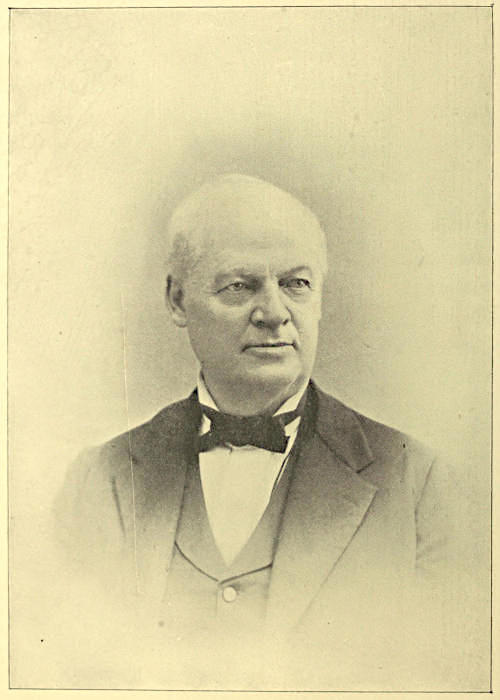
JOHN H. WALLACE.
New York: 40 West 93d Street.
September 1, 1897
THE HORSE OF AMERICA. — CHAPTER I. INTRODUCTION.
General View of the Field Traversed.
In undertaking to fulfill a promise made years ago, to write a
history of the American Trotting Horse and his ancestors, I am
met with the inquiry: What were his ancestors and whence did
they come? To say that the American Trotter, the phenomenal
horse of this century, is descended from a certain horse imported
from England in 1788, does not fully meet the requirements of
the truth, for there are other and very distinctive elements
embodied in his inheritance that are not indebted to that particular
imported horse. In searching for these undefined elements,
I have found myself in the fields of antiquity, reaching out step
by step, further and further, until the utmost boundaries of all
history, sacred and profane, were clearly in view. There I found
a field that was especially attractive because it was a new field,
and the relations of the peoples of the earliest ages to their horses
had never been investigated nor discussed. Having no engagements
nor necessities to hurry me, the careful exploration of this
hitherto unknown territory has afforded me very great enjoyment.
As the result of these investigations, the breadth and scope of
this volume will be greatly widened, touching upon the originals
of most of the lighter types of horses, and many of the idols of
the imagination will be demolished. The objective point is the
history of the Trotting Horse, but before reaching that point we
must consider the beginnings of, practically, nearly all the varieties
of horses in the world. The assistance that I may be able
to gain from modern writers will be very limited, and restricted
Haicus, the great grandson of Japheth, became the ruler of his
people. Descending from him, in the direct male line, there
were five or six long reigns before the dynasty was overthrown
by the Assyrians. They were largely an agricultural people, and
the ancient historians have told us they were famous for the
great numbers and fine quality of the horses they produced. The
market for their horses, the prophet Ezekiel tells us, was in the
great commercial city of Tyre, whence they were carried “in the
ships of Tarshish” by the Phœnician merchants to all portions of
the known world. Having here reached back to the Noachic
period and country, with all that this implies, I will leave the
problem, with the more extended consideration that will be
given it in the chapter on the general distribution of horses in all
parts of the commercial world.
Horsemen of average intelligence and writers on the horse,
oftentimes much below average intelligence in horse matters, all
seem to unite on the Arabian horse as their fetish, when in fact
they know nothing about him. The songs of the poets and the
stories of the novelists have taken the place, in the minds of the
people of all nations, of solid history and sober experience. When
a story writer wishes to depict an athletic and daring hero, he
never fails to mount him upon an “Arab steed,” when some
blood-curdling adventures are to be disclosed. When Admiral
Rous, the great racing authority in England, announced some
years ago, that the English race horse was purely descended from
the horses of Arabia Deserta, without one drop of plebeian
blood, all England believed him, and this rash and groundless
dictum has served all writers as conclusive evidence ever since.
Now, it is not probable that more than two or at most three per
cent. of the blood of the English race horse as he stands to-day is
Arabian blood. The greatness and value of the Arabian horse is
purely mythical. He has been tested hundreds of times, both on
the course and in the stud, and in every single instance he has
proved a failure. This is what all history and experience teach.
There are but few horses bred in Arabia and there are, comparatively,
but few there now. From the time of their first introduction
into Yemen—Arabia Felix—up to the time of Mohammed,
about two hundred and seventy years, they were still very scarce.
Mohammed was not a horseman nor a horse breeder, nor is it known
that he ever mounted a horse but once, and then he had but two
in his army. When he made his first pilgrimage to Mecca he rode
a camel; and when he went the second time in triumph, mounted
on a camel, he made the requisite number of circuits round the
holy place, then dismounted and broke the idols that had been
set up there. Then came the triumphant shout of his followers;
“There is no God but Allah and Mohammed is his prophet.”
Since then, this cry has rung over a thousand battlefields, and
as I write it is still heard in the homes of the slaughtered Armenians.
From a great, warlike, and conquering people, the followers
of Mohammed have degenerated into an aggregation of
robbers and murderers of defenseless Christians. Since the days
of Mohammed, horses no doubt have increased in numbers, but
all modern travelers express their surprise at the small numbers
they see. The horse is an expensive luxury in Arabia, and none
but the rich can afford to keep him. He fills no economic place
in the domestic life of the Arab, for he is never used for any purpose
except display and robbery. Nobody is able to own a horse
but the sheiks and a few wealthy men. Nobody would think of
mounting a horse for a journey, be it long or short. The camel
fills the place of the horse, the cow and a flock of sheep, all in
one, and surely the Arabs are right in saying, “Job’s beast is a
monument of God’s mercy.” It is very evident that nearly all
the horses said to have been brought from Arabia never saw
Arabia. As an illustration of the uncertainty of what a man is
getting when he thinks he is buying an Arabian, in the Orient, I
will give, in some detail the experiences of Mr. Wilfrid S.
Blunt, a wealthy Englishman who had an ambition to regenerate
the English race horse by bringing in fresh infusions of Arabian
blood. He went to Arabia to buy the best, but he didn’t go into
Arabia to find it. He skirted along through the border land
where agriculture and civilization prevailed, while away off to the
south the wild tribes roamed over the desert, and to the north,
not far away, was the land of abundance that had been famous
for more than three thousand years for the great numbers and
excellence of the horses bred there. Here on the banks of the
Euphrates Mr. Blunt found the town of Deyr, and he soon discovered
it was a famous horse market. The inhabitants were the
only people he met with who seemed to understand and appreciate
the value of pedigrees, and there were no horses in the town
but “thoroughbreds.” Here Mr. Blunt made nearly all his purchases
which amounted to eighteen mares and two stallions “at
reasonable prices.” As will be seen in the extracts from his book,
he was strikingly solicitous that the friends at home should have
no doubt about the quality of the stock he purchased being all
“thoroughbred.” No doubt he realized the awkwardness of the
location as not the right one in which to secure “thoroughbred”
Arabians and hence the vigorous indorsement of the honesty of
the “slick and experienced” dealers as honest men and true descendants
of the Bedouins of the desert. In this “he doth
protest too much” and thus suggests that while the pedigrees
came from the tribes of the desert to the South, it might be possible
that the horses came from the farmers who bred them to the
North. However this may have been, the whole enterprise
turned out to be a flat failure, and after a number of years spent
in begging for popular support, the whole collection was dispersed
under the hammer of the auctioneer, not realizing a tithing of
the cost.
While it is not necessary that I should express any opinion as
to whether Mr. Blunt was deceived in the breeding of the animals
which he brought home, I will make brief allusion to an American
experience which is more fully considered elsewhere. Some
forty or more years ago Mr. A. Keene Richards, a breeder of race
horses in Kentucky, became impressed with the idea that the way
to improve the race horse of America was to introduce direct infusions
of the blood of Arabia. He did not hesitate, but he
started to Arabia and brought home some horses and mares and
put them to breeding. The pure bloods could not run at all and
the half-breeds were too slow to make the semblance of a contest
with Kentucky-bred colts. He concluded that he had been
cheated by the rascally Arabs in the blood they put upon him.
He then determined to go back and get the right blood, and as a
counselor he took with him the famous horse painter, Troye,
who was thoroughly up on anatomy and structure. They went
into the very heart of Arabia and spent many weeks among the
different tribes of the desert. They had greatly the advantage of
Mr. Blunt or any other amateur, for they were experienced horsemen
and knew just what they were doing. When they were
ready to start home they believed they had found and secured
the very best horses that Arabia had produced. When the
produce of this second importation were old enough to run it was
found that they were no better than the first lot, and thus all the
bright dreams of enthusiasm were dissipated. Thus was demonstrated
for the thousandth time that the blood of even the best
and purest Arabian horse is a detriment and hindrance rather
than a benefit to the modern race horse. Mr. Richards, with all
his practical knowledge and experience, was no more successful
than the amateur, Mr. Blunt. The blood which Mr. Richards
brought home was, no doubt, purer and more fashionable, as estimated
in the desert, than that brought home by Mr. Blunt, but
when tested by modern advancement it was no better.
A careful study of the chapter on the English Race Horse will
present to the minds of all my intelligent readers the consideration
of several points to which they will be slow in yielding
assent. These points run up squarely against the preconceived
opinions and prejudices of two centuries, and these preconceived
opinions and prejudices are well-nigh universal. The first point
upon which the public intelligence has gone wrong is in the
general belief that horse-racing had its origin in the seventeenth
century, when Charles II. was restored to his throne.
The truth is we have accounts of racing by contemporaneous historians
in the twelfth century, and indeed, we might say from the
time of the Romans in Britain. To go back four centuries, however,
is far enough to answer our present purpose. After selecting,
breeding, and racing four hundred years we must conclude
that the English had some pretty good race horses. This is
fully verified by the writers at the close of Queen Elizabeth’s
reign as well as at the beginning of Charles II.’s. They had native
English horses that were able to beat all the imported exotics, including
the Arabian owned by King James. We must, therefore,
conclude that the race horse was not created by Charles II., but
that racing was simply revived by him, after the restrictions of
Cromwell’s time, and that the old English blood was the basis of
that revival. The importations of so many exotics in his reign
were simply so many reinforcements of the old English racing
blood.
The next point to which exception will be taken is the conclusion
reached as to the character and influence of the exotics
that were introduced in the reign of Charles II. These exotics
have been designated in a general way, by the phrase “foundation
stock,” which has been introduced more out of deference to
the popular understanding than to its legitimate and true
meaning. For the real “foundation stock” we must look away
back in the centuries, long before Charles was born. The
analysis of the data furnished by Mr. Weatherby as “foundation
stock” clearly shows that the Turks predominated in
numbers, but, possibly, the Barbs in influence. The Arabian
element, in both numbers and influence, seems to be practically
nil, and this is the “gist of my offending.” The one great horse—Godolphin
Arabian—exerted a greater and more lasting influence
upon the English race horse than any other of his century
and probably than all the others of his century, and his blood is
wholly unknown. Fortunately, a few years ago I was able to
unearth his portrait and prove it a true portrait, and in that
picture we must look for his lineage. He was a horse of great
substance and strength on short legs, with no resemblance whatever
to a race horse. About fifty years after his death Mr.
Stubbs, the artist, who prided himself upon representing the
character of a horse rather than his shape, came across this
picture, from which he made an “ideal” copy of what he thought
the horse should have been, which is a veritable monstrosity.
These two pictures will appear together in their proper places,
where they can be leisurely studied, and the honest and the dishonest
compared.
The American race horse is the lineal descendent of the English
race horse, and like his ancestor he is very largely dependent upon
the “native blood” for his existence as a breed. The first
English race horse was imported into Virginia about 1750, and
he there met a class of saddle mares that had been selected, bred,
trained, and raced at all distances up to four-mile heats, for nearly
a hundred years. These mares were the real maternal foundation
stock upon which the American race horse was established,
as a breed. The phrase “native blood” is here used as applying
to the animals and their descendants, that were brought over
from England at and soon after the plantation of the American
colonies. Up to the time of the Revolution there were but few
racing mares brought over—as many as you could count on your
fingers—but they must have been marvelously prolific, for thirty
or forty filly foals each would hardly have accommodated all the
animals with pedigrees tracing to them. Quite a number of our
greatest race horses and sires of forty or fifty years ago traced to
some one of these mares through links that were wholly fictitious.
Indeed, from the period of the Revolution, and even before that,
down to our own time, the pernicious and dishonest habit of
adding fictitious crosses beyond the second or third dam became
the rule in the old American families, and an animal with a strictly
honest pedigree was the exception. In spreading abroad these
dishonest fictions as true pedigrees, the press—perhaps not
venally, but ignorantly—was made the active agent. Whenever
a rogue could get a pedigree into print, however absurd, nothing
could prevent its spread as the truth. The early sporting and
breeding press was not in the hands of men remarkable for conscience
and still less remarkable for knowledge. But the worst
of all was the “professional pedigree maker” who knew so many
things that he never knew, and stopped at nothing. In all this
dirty work of manufacturing pedigrees there is a very striking
resemblance between the awkward efforts of the early English
and the early American pedigree maker. This whole topic of the
ignorance of the press and the dishonesty of the pedigree makers
will be considered fully in its proper place. Fortunately, although
still far from perfect, the methods and care in the preservation
of the true lineage of the race horse in our own day
have been greatly improved. The many efforts to improve the
American race horse by introducing fresh infusions of Saracenic
blood will receive due attention, especially as they have nearly all
been made within the newspaper period, and their uniform and
complete failure will not be new to American horsemen.
When we reach the horses of the colonial period, we are in a
field that never has been explored and cannot be expected to yield
a very rich harvest. Here and there I have been able to pick up
a detached paragraph from some contemporaneous writer, and
occasionally a record, or an advertisement, from which, in most
cases, I have been able to construct a fair and truthful outline
and description of the horses of the different colonies, down to
the Revolutionary war. The collection of the material has required
great patience and great labor, but it has not been an irksome
task, for many things have been brought to light of great
interest to the student of horse history. The knowledge of the
colonial horse in his character and action, that may be gathered
from the chapters devoted to his description and history, I flatter
myself, will not only be interesting as something new, but will
throw a strong light on the lineage of the two-minute trotter and
pacer.
The colonists of Virginia were subjected for a number of years
to great suffering, privation, and want. They were badly selected
and many of them were improvident and never trained to habits
of industry and thrift. There were quite too many “penniless
gentlemen’s sons” among them, who had been sent out with the
hope that the change might improve their habits and their
morals. They were too proud to work, and when they were driven
to it by necessity they didn’t know how. After suffering untold
hardships for a succession of years, those that survived learned
to adapt themselves to their environment and to make their own
way in the world. Their first supply of domestic animals were
all consumed as food, embracing horses, cattle, swine, and goats,
and everything had thus been consumed except one venerable
female swine, as reported by a board of examiners. Their second
supply of horses, cattle, swine, and goats was more carefully
guarded, and from them in greater part came the countless denizens
of the barnyard.
There were several shipments of horses at different times, by
the proprietors in London, down till about 1620 and possibly
later, but they do not seem to have increased very rapidly, for in
1646 all the horses in the colony were estimated at about two
hundred of both sexes. This estimate was probably too low, for
ten years after this the exportation of mares was forbidden by
legislative enactment, and eleven years later this restriction was
removed, and both sexes could then be exported. From this
legislation and from writers who visited the colony we learn that
horses were very plenty, and they are described as of excellent
quality, hardy and strong, but under size. It was the custom in
Virginia, and indeed in all the other colonies at that period and
for long afterward, to brand their young horses and turn them
out to hustle for their own living. They increased with wonderful
rapidity and great numbers became as wild and as wary of
the habitation and sight of man as the deer of the forest. About
the close of the seventeenth century the chasing and capture of
wild horses in Virginia became a legitimate and not always an
unprofitable sport, for an animal caught without a brand became
the unquestioned property of his captor. It is a noteworthy fact
that off the coast of Virginia the island of Chincoteague has
been occupied for probably two hundred years by large bands of
wild horses. They are still there, and not till within the last few
decades have there been any efforts made to domesticate some
selections from them. They are of all colors, but quite uniform
in size, not averaging much over thirteen hands, with clean limbs,
and many of them are pacers. There is only one way to account
for them in that location, and that is, that they were originally a
band of Virginia wild horses that wandered or was chased out
onto this sandy peninsula, and while there some great storm set
the mysterious ocean currents at work and cut off their retreat by
converting a peninsula into an island, and there they have lived
and multiplied ever since.
The colonial horses of Virginia were of all colors and all very
small in size, as we would class them in our day. An examination
of a great many advertisements of “Strayed,” “Taken up,”
etc., of the period of about 1750, clearly establishes the fact that
at that time the average height was a small fraction over thirteen
hands and one inch. More were described as just thirteen hands
than any other size, and they were nearly all between thirteen
and fourteen. From this same advertising source I was able to
glean conclusive evidence as to their habits of action, and found
that just two-thirds of them were natural pacers and one-third
natural trotters. Thus for more than a hundred years they had
retained the peculiarities of their English ancestors in the reign
of James I., in color, size, and gait. This in no way differs from
the description of the Chincoteague Island ponies of to-day. As
early as 1686 a law was enacted that all stallions less than thirteen
and a half hands high found running at large should be
forfeited; but this, like Henry VIII.’s laws in the same direction,
had failed to increase the average size of the horses. From the
indomitable passion for horse-racing which prevailed universally
among the colonists, we may safely conclude that some animals
were carefully selected and coupled with a view to the speed of
the progeny, both at the gallop and at the pace, but the great
mass were allowed to roam at large, and under such conditions
no variety or tribe of horses has ever improved in size, or indeed
in any other quality.
The early horses of the Dutch colony of New Netherlands,
afterward New York, were brought from Utrecht in Holland.
As we would look at them to-day, they were small, but they were
larger and better, and brought higher prices than the English
horses of the Eastern colonies or than the Swedish on the West.
It was conceded, however, that for the saddle they were not so
good as the New England horses, and hence it may be inferred
that they were not pacers. It is very evident, however, that the
two breeds were soon mixed, as the saddle was then the universal
means of travel, whether for long or short distances. During
the time of the Revolutionary war a large accumulation of data
bearing on the size and action of the horses of that period goes
to show that the average size had then increased to fourteen
hands and one inch, and in gait fifteen both paced and trotted,
nine trotted only, and seven paced only. It is not pretended
that these data represent the horses of the early colonial period,
but only of the period above indicated. Strains of larger breeds
had been introduced, but the little New England pacer had made
his mark on the habits of action.
In 1665, the next year after the Dutch had surrendered the
country to the English, Governor Nicolls established a race-course
on Hempstead Plains and offered prizes for the fleetest runners,
and his successors kept up annual meetings on that course for
many years. This was the first official and regularly organized
race-course that we have any trace of in this country. These
meetings seem to have been well supported from the very first by
both town and country, and as the people were then practically
all Dutch, it is a fair inference that the horses engaged in the
races were Dutch horses. This was before the English race horse
had reached the character of a breed, and a hundred years before
the first of that breed was imported into New York. From this
beginning many tracks were constructed or improvised in and
about the city, upon which racing at all forms and at all gaits has
been carried on to the present day. When honestly conducted
the sport has always been favorably received by reputable people;
but at successive periods it has degenerated into a mere carnival
of gambling that placed it under a ban.
The horses of the New England colonies fill a very important
place in the horse history of the country. This is especially true
of a remarkable tribe of swift pacers, produced in Rhode Island
and known throughout the whole country as the “Narragansett
Pacers.” To the description of these a special chapter will be
devoted. The first horses imported into New England reached
Boston harbor in 1629 and were sent direct from England by the
proprietary company in London. The same year a small consignment
reached Salem. The next year about sixty head were
shipped to the plantation, but many of them were lost on the
voyage. In 1635 two Dutch ships landed at Salem with twenty-seven
mares and three stallions, and were sold there at remunerative
prices. Other shipments followed, no doubt, that have not
been noted. In 1640 the colonists seem to have been supplied
with all the horses they needed, for that year they shipped a
cargo of eighty head to the Barbadoes. From these importations
into Boston and Salem, all the New England colonists received
their supplies. The field specially gleaned to determine the size
and gaits of the Massachusetts horses covered the years 1756-59,
from which it appears that the average height was then fourteen
hands and one inch; and as to gait, just three-fourths were
pacers and one-fourth trotters. In comparing this average size
with the Virginians of the same period we find that the Massachusetts
horses were about one hand higher, which would
indicate the influence of the early Dutch blood. Besides this
we must make some allowance for a possible different habit of
estimating size.
When the plantation was made at Hartford, Connecticut, in
1636, the planters brought their horses and other domestic animals
with them. In 1653 the General Court, at New Haven, made
provision for keeping public saddle horses for hire, and all horses
had to be branded. After passing over a period of more than a
hundred and twenty years we find that in 1776 the average size
of the Connecticut horse was thirteen hands and three inches,
thus ranging below the other New England colonies. At that
period it is found that the ratio of pacers and trotters was as
fifteen pacers, or trotters and pacers, to four that trotted only.
The very interesting experience of two English travelers,
mounted on Connecticut pacers, in 1769, and their enthusiasm
about their superlative qualities, will be found in its place.
The colony of Rhode Island was planted in 1636 by Roger Williams
and his followers, and eleven years later they obtained their
charter. Their supply of horses came wholly from the colony of
Massachusetts, and in a short time the new plantation became
greatly distinguished for the superiority and speed of its pacers.
From the official report of the colony for 1690, we learn that
horses constituted their leading item of exports, and that they
were shipping horses to all the colonies of the seaboard. At that
early day the fame of the Narragansett pacer extended through
all the English colonies, and probably also through the French
plantations on the St. Lawrence. All trade with Canada was
strictly prohibited, but in the then condition of the borders how
could such regulation be enforced, if a Frenchman, with a bale
of peltry, wanted to exchange it for a Narragansett? Freed
from the Puritan restrictions of New England, of that day, the
Rhode Islanders developed the speed of their pacers by racing
them, and thus the best and fastest of all New England were
collected there. In 1768 the average height of the Narragansetts
was fourteen hands and one inch, which shows them to have been
about three and a quarter inches higher than the Virginia horses
of the same period. They were not all pacers, for out of thirty-five
there were eight that did not pace, and some others that
both trotted and paced. A full account of these famous pacers
will be found in the chapter on the Colonial Horse History of
New England, and that on The American Pacer and his Relations
to the American Trotter.
William Penn did not visit his princely gift from Charles II.
until 1682, and it was then under the government of the Duke of
York. In giving a description of things as he found them he
remarks: “The horses are not very handsome, but good,” and
this is all he says of them. Knowing that Pennsylvania, in the
early part of this century, produced larger and heavier horses,
than any other portion of the country, it was a great surprise to
me to find the undoubted proof that a hundred years earlier she
had produced the smallest and the lightest horses of any of the
colonies. In the first half of the last century the average size of
the horses of Eastern Pennsylvania was thirteen hands one and
a quarter inches, and they were remarkably uniform in size. This
was one-quarter inch below the average of the Virginians. Of
the twenty-eight animals examined as to gait, twenty-four of
them were natural pacers, three both paced and trotted, and a
single one trotted only. Finding these two facts of uniformity
of size and uniformity of gait together, we are prepared for
another fact that follows, viz., in Philadelphia the pacers were
more popular and fashionable than in any other city, so far as we
can learn, and they were selected with great care and bred for
their speed, and that speed was highly tested on the race-course.
They were breeding for speed without much regard to size, and
hence the uniformity.
It has not been discovered that the colonists of New Jersey
made any direct importations of horses from England. Their
original supplies were obtained from New York on the one side
and Pennsylvania on the other. From these sources, therefore,
we can form a correct estimate of the size and gaits of the Jersey
horses, without going into particular investigation. The only
object, then, in referring to this colony is to prove that before
1748 all kinds of racing had become so common in the colony as
to be a nuisance. Consequently the legislative authority passed
an act in 1748 for the suppression of “Running, Pacing and
Trotting Races.” This was in strict harmony with the well-known
condition of things in Philadelphia and vicinity very early in
the century. If there had been no pacing races there would
have been no legislation suppressing them.
The horses of the colony of Maryland would necessarily partake
of the characteristics of Virginia and Pennsylvania, from which
she probably received her supply. There seems to be no evidence
of direct importation. This colony was really the first, in point
of time, to legislate for the suppression of pacing races. In 1747,
one year before New Jersey, an act was passed forbidding pacing
races in certain locations at certain times, and the avowed object
was the protection of the Friends in holding their yearly meetings.
Here, then, we have historic evidence that the three colonies of
Rhode Island, Pennsylvania, and Virginia had frequent pacing
races, and legislative evidence that Maryland and New Jersey
had quite too many pacing races, early in the last century. It
follows, then, that the other colonies indulged their sporting
fancies in pacing races also.
The colonies of North and South Carolina obtained their supply
of horses from Virginia, and they possessed the same characteristics
as the parent stock. The first permanent settlement in
North Carolina was in 1653, but before this it had become the
refuge of Quakers and others fleeing from the proscriptions that
prevailed in Virginia against all who did not conform to the
English church. South Carolina received her charter in 1663, at
a time when horses were beginning to run wild in Virginia. In
1747 thirty horses were advertised in which the size was given,
and the average is within a small fraction of thirteen and a half
hands high, and in this number two were given as fifteen hands,
which was a very large horse for that day. The gait is given in
only twelve cases—ten of which were pacers, one paced and trotted,
and one trotted only.
The chapter on the “Early Horse History of Canada” is very
brief. It was not till the year 1665 that the first horses were
brought over from France, and as they came from ancient Picardy,
right across the Channel from England, it is reasonable to assume
that they partook of the same characteristics as the English horses,
and that many of them were pacers. Another theory of the
origin of the Canadian pacer is the probability of clandestine trading
with the New Englanders. Among the many impossible
stories about the breeding of Old Tippoo, the greatest sire of
Canada, the truth seems to come to the surface at last, and there
can be no reasonable doubt that he was got by “Scape Goat.”
However much or little dependence can be placed upon many of
the claims of fast pacing stallions coming from Canada, it must
be conceded that some of these claims seem to be well founded,
and that the pacing element has been greatly strengthened by
blood from the other side of the border.
The most striking fact in the history of the pacing habit of
action is its great antiquity. The average Englishman of to-day
and the average American of twenty years ago have been united
in insisting with the greatest vehemence that the pace is not a
natural but an acquired gait, resulting from some injury or malformation.
One of the great leaders on that side of the discussion
called it “structural incongruity” arising from the breeding
of the “thoroughbred” horse on the “slab-sided” mares of the
West and South, and thought the idea was unanswerable, but
never cited any instances to prove it. Now, the truth is, the
earliest unquestioned evidence we have that horses paced is that
furnished by the chisel of Phidias when he sculptured the horses
on the frieze of the Parthenon at Athens, and that is two
thousand three hundred and thirty-three years old. From the
period when the sons of Japheth turned their attention to horse-breeding
on the fruitful plains and valleys in the regions of the
mountains of Ararat down to this culmination of Greek art, I
have not been able to find any contemporaneous evidence of
the existence of the lateral habit of action; but as we know it
existed more than two thousand years ago, we are justified
in concluding that among the original bands of horses, in their
original habitat, pacers as well as trotters abounded. From the
erection of the Parthenon in Athens, the occupation of Britain
by the Romans, and through all the centuries down to the plantation
of the colonies in this country, we have mountains of indisputable
evidence of the antiquity of the pacer. In its place this
topic will be quite fully discussed.
The relation which the pacer bears to the American Trotting
Horse has for twenty-five years been a topic of much senseless
discussion. In the historical sketch which served as an introduction
to the first volume of the “American Trotting Register,” the
attention of the breeding public was first called to this question,
in a form that was somewhat tentative, and much less didactic
than my judgment suggested, but it served as an introduction to
the study of the question which it foreshadowed. From this
initial paragraph grew the discussion that has been going on ever
since, much of which has been the merest jargon. The essential
oneness of the trot and the pace has been clearly demonstrated by
thousands of experiences. The trotting inheritance that produces
the fast trotter also produces the fast pacer; and the pacing
inheritance that produces the fast pacer also produces the fast
trotter. The trotting-bred John R. Gentry, with his pacing
record of a mile in two minutes and one-half a second, is but a
single instance of very many of the same character. The fastest
harness racers in the world are the pacers, and it seems to make
no difference whether the inheritance of speed comes from the
trotter or the pacer. The subject of the pacer in his diversified
historical relations to the American trotter will be found in different
portions of this work, and all tending to show the significant
fact that he is again rapidly attaining the position of honor
among the equine race which he maintained for so many centuries
in the far-distant past.
Early in this century the American Saddle Horse, the real
saddle horse of all time, past and present, began to vanish from
sight. Improved roads and wheeled vehicles superseded him, in
great measure, long before the days of railroads. For business
and travel he was the sole dependence of our forefathers for two
hundred years, and in point of health it is a great misfortune
that he has gone so completely out of use. The horse that cannot
take the “saddle gaits” and carry his rider without discomfort or
fatigue is not a saddle horse. Springing up and down at every
revolution of the horse is not riding for pleasure, but to avoid
punishment and a torpid liver. In the chapter devoted to his
description, origin, and breeding, it will be clearly shown that he
is indebted to his pacing ancestry of the past centuries for his
saddle gaits. As the mere matter of great speed cuts no figure in
the qualifications of a saddle horse there is a wide field here for
the production of style and beauty in the breeder’s art. The aims
of a goodly number of intelligent breeders are now moving in this
direction, and with the foundations so well laid as they now are,
we can look forward to a grand superstructure. As the breeder
of speed at the trot goes to the horse that can do it himself, and
as the breeder of speed at the gallop goes to the horse that can
beat all the others, so the breeder of the saddler will go to the
handsomest and best of all his tribe, and when we reach the horse
that is perfect in symmetry, style, quality, and disposition, he will
be a saddle horse and no questions will be asked about what particular
combinations of blood he may possess. He will be strictly
eclectic, with the one exception of the inheritance of gait, and he
will be the result of wise choosing in his size and structure, and
of skillful handling in his disposition and manners.
The Wild Horse of the plains and pampas of North and South
America was at one time an object of great interest and curiosity
with all our people. No schoolboy of sixty or seventy years ago
knew any lesson in his geography so well as the one which pictured
and described the millions of wild horses that roamed over
the Western plains. In the field of imagination and exaggerated
fiction he was a fairly good second to the Arabian—both arrant
humbugs, at least so far as their merits have been tested. In the
past, the question has sometimes been asked, tentatively,
whether the horse may not have been indigenous on this continent?
The paleontologists have undertaken to answer this question
in the affirmative and have produced the bones of what they
call the horse to prove it. This “horse” is scant fifteen inches
high and he has three, four or five toes on each foot. These toes
resemble “claws” more than anything else. They tell us these
little animals flourished over two millions of years before man was
placed on the earth, and that they are now found imbedded in
the solid rock, say two hundred feet below the general surface.
The outline drawing of horses on works supposed to have been
erected by a prehistoric and lost race, and also the linguistic question
as to whether any of the oldest Indian tribes had any word
representing the horse, will be fully considered, with that presented
by the paleontologists, in the chapter devoted to the Wild
Horse. Too much prominence has been given to the horses of
Cortez in his conquest of Mexico, as the progenitors of the American
wild horse. He had very few horses in his command, and it
is very doubtful whether any of them escaped the slaughter of
battle and found a home in the wilderness. The horses in the
army of the unfortunate Ferdinand De Soto, that were abandoned
on the confines of Texas, after his death, became the progenitors
of all the wild horses of North America.
The remarkable pre-eminence to which Messenger attained as
the founder of a great race of trotters, in his own right and by
his own power, and more especially as he was the only English-imported
running horse that ever showed any tendency whatever
in that direction, the study of Messenger’s lineage becomes a
question of very great interest and value to all students of trotting
history. His sire, Mambrino, was a great race horse, and
was distinguished above all others of his generation, or indeed of
any other generation, before or since, as the progenitor of a tribe
of coach horses of great excellence and value. In addition
to this, the evidence seems to be conclusive that he had a natural
and undeveloped trotting step that far surpassed that of all other
running horses of his day. His sire, Engineer, was notoriously
short on the side of his dam, and his grandsire, Sampson, was a
half-breed of great size and bone, and ran some winning races, in
the best of company, for that day.
The history of Messenger himself is still clouded in mystery,
and the blood he inherited from his dam remains hopelessly unknown.
The identity of his importer and owner has never been
established, which of itself throws a suspicion upon the pedigree
that is said to have come with him. He ran several races at
Newmarket, England, and proved himself a second or third-rate
race horse. The racing records there show that he was by
Mambrino, and that is all that is known about his inheritance.
He left a few tolerably good race horses, for their time, but he
filled the country with the best road and driving horses that the
horsemen of this country had ever known. A chapter each to
Messenger’s ancestors and to himself will be found in their proper
places in this volume. The twenty years of Messenger’s life and
service in this country fell in a period of indifference to all kinds
of racing except running. The English race horse was then the
popular idol, and it is not known that any of his sons or daughters
were ever trained to trot. Neither can it now be certainly
determined that any of them were disposed to pace, but if we
may judge of the habits of action of his immediate progeny by
what we know of succeeding generations, we can hardly doubt
that there were pacers among them. As the custom then was,
and as it so remained for at least half a century later, all pacers
were hidden away from public sight, as they were supposed to
furnish evidence of ignoble breeding.
The chapter on “The Sons of Messenger” will be long, but it
will be of exceeding interest. They constitute the connecting
link that brings together the peculiar trotting instincts of the
sire and develops them in their own progeny. Several of them
were not only trained to run, but did run successfully. It is not
known that any of his sons was ever trained to trot, but it is
known from contemporaneous evidence that several of them were
fast natural trotters, notably Bishop’s Hambletonian, Bush Messenger,
Winthrop Messenger, Mambrino, etc., all of which will
be considered in their proper place. When we reach the second
remove from Messenger we begin to enter into the full fruition
of all the promises, and in considering such animals as Abdallah,
Almack, Mambrino Paymaster, Harris’ Hambletonian, etc., we
begin to feel that we are well within the trotting latitudes, for
this remove began to found families and tribes that attracted the
attention of all intelligent breeders.
In the next remove from Messenger we strike the most famous
of all trotting progenitors in Rysdyk’s Hambletonian. At one
time there was an active and determined difference of opinion
among breeders as to which of three horses, Hambletonian, Ethan
Allen, or Mambrino Chief, would in the end prove to be the most
successful sire. This controversy may not be remembered by the
younger of the present generation of horsemen, but it was bitter
and uncompromising, and it presents a lesson so important that it
may be here referred to. The adherents of Ethan Allen argued
that as he was handsomer, that his gait was the very perfection of
trotting action, and that he was incomparably faster than either
of the other two, he must of necessity prove the most successful
in begetting trotters. The adherents of Mambrino Chief
used the same argument, with the exception of beauty and style,
and dwelt strongly on the fact that he was a faster horse than
Hambletonian, and would consequently get faster offspring.
Both these arguments were good, so far as they went, but they
lacked completeness and hence were not sound. Neither Ethan
Allen nor Mambrino Chief had a dam, and so far as we know the
inheritance of both was restricted to the male side of the house.
Development of speed is a valuable and real qualification in any
sire, but all experience goes to show that it is only a help to an
inheritance. Hambletonian was not much developed, but it is
conceded on all hands that he could show a 2:40 gait at any time
and that his action was very perfect. He was got by a grandson
of Messenger, whose dam, Amazonia, was one of the fastest mares
of her generation, whatever her blood may have been. Abdallah
got more and faster trotters than any other grandson of Messenger,
and his daughters were very famous as the producers of trotters.
Hambletonian’s dam, the Kent Mare, was by imported Bellfounder,
a horse that got no trotters practically, but this mare
was the fastest four-year-old of her time, and that because she was
out of a very fast mare, One Eye, that was a double granddaughter
of Messenger. That is, One Eye was by Hambletonian, the
son of Messenger, and out of Silvertail, a daughter of Messenger.
This double Messenger mare was unknown to the trotting turf,
but she was well known throughout Orange County as a remarkably
fast trotter. Hence Hambletonian not only possessed more
Messenger blood than any horse of his generation, but that blood
came to him through developed trotters, and he had a right to
surpass all competitors, especially the two that were, at one time,
the most prominent.
Several of the sons of Hambletonian, as shown by the tabular
statistics which will be introduced, became greater than their
sire, not only in getting trotters from their own loins, but in
transmitting the trotting instinct to their descendants. The
growth and spread of this family is far and away beyond any precedent
that can be cited in any age or country, and is simply marvelous.
It is said that fully ninety per cent. of the fast trotters
now on the turf have more or less of the blood of Hambletonian
in their veins, and I think it is a safe conclusion to say that
no intelligent breeder in all the country is trying to produce
trotters without it. All the other tribes are dropping out of
sight, and at the present ratio of rise and fall it will be but a few
years till every trotter on the turf will be credited in some
degree to the one really great progenitor, Hambletonian. The
other tribes will not be blotted out nor will their merits be lost,
but absorbed into the mightier tribe.
Such families as the Bashaws, the Clays, the Black Hawks, the
Mambrino Chiefs, the Pilots, the American Stars, the Blue Bulls,
etc., will be fully considered through several chapters, according
to their strength and merit. As these families have not been
able to hold their own in the rush to the front, and as they seem
to be falling further to the rear in the number and quality of
their performers each succeeding year, we may as well begin to
designate them as “the minor families.” Their inheritance was
feeble and unsatisfactory, and more or less sporadic, and we never
had any right to expect a brilliant and permanent success from
such beginnings.
As the investigation of disputed, spurious and fraudulent pedigrees
was a prime necessity in order to reach safe and honest
grounds upon which to build up a breed of trotters, much of my
time through all my editorial life was devoted to this kind of
investigation. From the first page of the first volume of the
“Register” I was deeply impressed with the importance of having
all pedigrees absolutely correct, and this impression grew into a
vital conviction that without this a breed of trotters never could
be established. I soon found that I had accepted from some
breeders of the very highest respectability a goodly number of
pedigrees that were thoroughly rotten in their extensions. This
taught me that I must study the moral fiber of breeders critically,
as well as their pedigrees, and that from the highest to the
lowest. Some men are honest from principle and because it is
right to be honest, while others are honest because “honesty is
the best policy.” Some men are dishonest because of ignorance,
others because they were born cheats, but the most dangerous of
all rogues is the man who will utter a false pedigree and then
prove it by trained witnesses who, for half a dollar, can remember
whatever is necessary and forget whatever might be against their
employer’s interest. By this kind of evidence a man can prove
anything. Not very long ago a man proved that a certain mare
came out of a certain other mare, and when that was shown to be
impossible he turned round and proved (?) that she was out of
another mare, and there was just as much truth in the one as the
other, and not a single word of truth in either. So long as there
are men in the world there will be rogues among them, but the
intelligence of the public in breeding matters has so greatly advanced
that many an honest man would begin to doubt his own
sanity if he were even to think of breeding in lines that he was
once ready to fight for as the only right and successful way to
breed. The brainless advocacy of “more running blood in the
trotter,” was substantially the basis of the whole brood of dishonest
pedigrees, against which it became my duty to wage war;
but to-day no intelligent man in all the land can be found to advocate
any such balderdash unless it be in the foolish support of
thoughtless opinions previously expressed.
The subject of “How the Trotting Horse is Bred,” is a most
interesting one because it is entirely new in animal economy and
is distinctively American. The initial thought that opened the
door to the practical and scientific consideration of the subject
was the happy conception, in the spring of 1872, of the little
phrase, “Trotting Instinct.” Following this with the definition
of the word “instinct” as being “the sum of inherited habits,”
the term expressed in two words and the definition of it in five
words, put the whole subject in a form that was easily comprehensible
and flashed upon the mind as thoroughly practical.
This little phrase, with its definition, when once comprehended,
is a very complete epitome of all that has been taught and all
that has been learned of the art of breeding the trotter. It not
only embraces, but requires, the trotting inheritance as the only
starting point, which must be strengthened and the instinct intensified
by the development of the speed of succeeding generations.
It stood some years at the parting of the ways between
intelligence and ignorance, between enlightened judgment and
stupid prejudice, between honesty and dishonesty, but now it is
accepted, in practice, as the universal law from one end of the
land to the other. Thus, we have not only added millions to the
wealth of the country, but without any outside assistance or instruction
we have produced a horse that by way of pre-eminence,
throughout the world, is justly entitled to be designated, “The
Horse of America.”
CHAPTER II. ORIGINAL HABITAT OF THE HORSE.
No indications that the horse was originally wild—The steppes of High Asia
and Arabia not tenable as his original home—Color not sufficient evidence
—Impossibility of horses existing in Arabia in a wild state—No horses in
Arabia until 356 A.D.—Large forces of Armenian, Median, and Cappadocian
cavalry employed more than one thousand seven hundred years B.C.—A
breed of white race horses—Special adaptability of the Armenian country
to the horse—Armenia a horse-exporting country before the Prophet
Ezekiel—Devotion of the Armenian people to agricultural and pastoral
pursuits through a period of four thousand years—All the evidences point
to ancient Armenia as the center from which the horse was distributed.
In undertaking to consider and determine what particular portion
of the earth was the original habitat of the horse, we must
not forget that we are in a field that antedates all history, both
sacred and profane. When we have gone back to the very first
dawnings of historical records we are still far short of the period
in which initial light can be reached. In profane history, with
more or less safety, we can get back to a point about seventeen
hundred years before the Christian era; and in sacred history
about two hundred years less. At both of these dates the horses
referred to were not in a feral state, but were the companions
and servants of man.
There have been two separate theories advanced which demand
some attention, because of the eminence and learning of the men
who have advanced them. The first is that the original habitat
of the horse was on the steppes of High Asia, east and north of
the Caspian and the Black Sea. The only argument I have ever
seen advanced in support of this theory is based upon the great
number of wild horses that are found in that part of the world,
and that so many of them are of a dun color. From the frequency
of the recurrence of the dun color another theory has
sprung up to the effect that the original color of the horse was
dun, and hence it is argued that when the dun color appears in
our own day it must be taken as evidence that the original color
of the horse was dun. This reasoning is very far from being
conclusive, for there are dun horses and dun tribes in all breeds,
just as there are greys, and the color is just as liable to be transmitted
as any other color. In the last century there were many
dun horses in England, and at least one of that color was advertised
very widely as “the Dun Arabian,” probably a foreign
horse, but it is hardly possible that he was an Arabian. It was then
the custom of the country to call all foreign horses “Arabians,”
no difference from what part of the world they came. It has
been stated on what seemed to be good authority that a dun
horse once won the Derby, but whether the color may result from
line breeding or from atavistic tendencies, the argument advanced
does not seem to have any weight in it for the purpose intended.
Transcriber’s Note: the map can be clicked for a larger version.
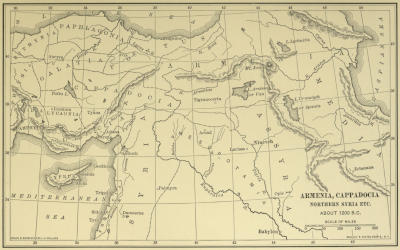
ARMENIA, CAPPADOCIA, NORTHERN SYRIA ETC.
ABOUT 1200 B.C.
Another argument in favor of the wild and unknown regions
east and north of the Caspian as the habitat of the horse has
been urged with much more power and effect. It has been accepted
and reiterated by so many learned men, one after another,
that I doubted the wisdom of attempting to overthrow it, until I
found the spot in which it was fatally weak. This view of the
question seems to rest upon the fact that the successive hosts of
Barbarians that overran Europe in the early centuries of the
Christian era brought their horses, as well as their flocks and
herds, with them, and it is assumed that these horses were the
first brought into Europe. This involves a total misconception
of dates; not of a few years merely, but of many centuries. All
of Europe, including Britain, and all of Northern Africa, were
abundantly supplied with horses, probably a thousand years
before the first destructive wave of Barbarians touched Europe.
Linguistic and ethnological facts clearly prove that those people
came from Asia, and possibly from a part of Asia where there
were horses running wild, but that does not prove that they came
from the original habitat of the horse. With no dates, either
definite or approximate, to support this theory, and with no
specific portion of the earth fixed upon as the general locality
from which they came, it resolves itself into a mere speculation
with nothing to support it, except the fact that different writers
have been copying it from one another, without throwing any
additional light upon it, for a number of generations.
The most remarkable and at the same time the most untenable
of all the claims that have been urged about the horse is that he
was indigenous in Arabia. We can tolerate any number of foolish
claims set up to show that the Arabian horse is superior to all
others, for such assertions can be tested and disproved, as they
have been a thousand times, but the claim that Arabia was the
original habitat of the horse is so utterly preposterous, and yet so
widely advocated by writers and others who know nothing about
it, that we must consider it with some brief deliberation. When
the maimed and crippled horses of De Soto were turned loose and
abandoned on the plains of Texas, they had all around them the
means of an abundant and healthy subsistence, and they multiplied
and grew into an innumerable host that made the earth
tremble when they moved in great masses. Under the same
favorable conditions of water and pasture, the same results followed
on the pampas of South America. Upon the early settlement
of Virginia, as well probably as in some of the other
colonies, and within two hundred years, many of the horses of
the colonists strayed away, became wild and remained so, propagating
and increasing for generations, and until the growing
numbers of their former masters captured or exterminated them.
The varied herbage of the forest and its grassy swales, and
streams of pure water everywhere, made Virginia a paradise for
the horse in his feral state.
Buffon, the French naturalist of a hundred and fifty years ago,
notices the theory of the wild horses of Arabia, but he is careful
not to commit himself nor indorse it in any form. In Vol. I., p.
237, he says: “According to Mannol, the Arabian horses are descended
from the wild horses in the deserts of Arabia, of which,
in ancient times, large studs were formed,” etc. In going further,
to find where Mannol got his information, it appears that
somebody, with an unpronounceable name that I have forgotten,
told him so. Major Upton, a very intelligent but very credulous
modern writer on what he saw and learned in the desert, says he
never heard of this story of wild horses in Arabia, and pronounces
it a “fallacy.” When we consider that Arabia never was
conquered and the reason why, although Rome, at the very culmination
of her power, followed by Assyria and Egypt, all failed of
their purpose without meeting an enemy in battle, we must accept
the fact that nature had interposed a barrier that military
power could not surmount. The barrenness and aridity of the
desert has always protected the Arabs against the most powerful
armies of the mightiest nations. Now, to maintain that wild
horses could not only live, but flourish and increase, in a country
where there was not enough edible herbage on a thousand acres
to keep a grasshopper alive, and not a running stream of water
within five hundred miles, requires a measure of mental sterility
that can be found nowhere but among a few of the writers on
the Arabian horse. Of all the curiosities in which the literature of
the Arabian horse abounds and in the multitudinous efforts to give
him the primacy among horses, there seems to be nothing quite
so absurd as this story about his being indigenous to the desert.
Animals in a wild state are never found except in countries and
districts where the conditions surrounding provide them with
food and water. How long would a band of strong, healthy
horses live if turned loose to seek their own subsistence in the
desert of Arabia? Of all the countries on the face of the globe
there is no one where the horse is so completely dependent upon,
the care and support of his master as Arabia.
Fortunately, we are not left for data to unwritten traditions
two thousand years old, nor to the fervid imaginations of a race
of cutthroats and thieves of the very lowest order of civilization,
but we can turn, with full confidence, to authentic contemporaneous
history, from which we can settle this question, at once
and for all time. Strabo, the great Greek geographer and philosopher,
flourished in the reign of Augustus, at the very beginning
of the Christian era. He describes Arabia just as we know it
to-day, for all countries have changed in their boundaries and
government except Arabia. He describes the people as chiefly
nomadic, and as breeders of camels. The most remarkable thing
in this description is the fact, found in his great work, Vol. III., p.
190, that they had no horses at that time. The exact language
used in this statement will be found in the next chapter of this
work. The question now arises, If there were no horses in Arabia
at the beginning of the Christian era, when and how did they
become possessed of them? Fortunately, again, written history
supplies the answer to this question. In my next chapter will be
found, quoted at some length, the circumstances bearing on this
question. In brief, the facts are as follows: Philostorgius, a distinguished
Greek theologian, wrote an ecclesiastical history in the
fifth century which is no longer extant. Photius, at one time
Patriarch of Constantinople, in the ninth century wrote an
epitome of the work by Philostorgius and to this epitome we are
indebted for the facts we here relate. Constantius, at the time of
which Philostorgius wrote, was on the throne of the Eastern
empire, and was exceedingly zealous in spreading and strengthening
the Christian religion. He learned that the prince of Arabia
Felix (that part of Arabia which we will designate by its modern
name Yemen) was strongly disposed to come out with his people
and embrace Christianity. Constantius thereupon determined
to encourage both prince and people in the movement they were
contemplating, and he sent them a grand embassy with many
valuable presents, the most noted of which were two hundred
“well-bred Cappadocian horses.” The embassy was completely
successful, and Theopholis, who had been made a bishop and
placed at the head of it, remained there several years. This was
in the year 356 of the Christian era, and is the first intimation we
have in all history of horses in Arabia. These are the facts, so
far as any facts are known, upon the consideration of which I am
not able to assent to the claim that either High Asia or Arabia
was the original habitat of the horse.
I have been surprised at the number of coincidences that seem
to point to ancient Armenia as the first habitation of the horse.
This country at one time was a very powerful kingdom, extending
from the mountains of Caucasus on the north to Media or Assyria
on the south, and from the Caspian Sea on the east to the
Euphrates on the west, and at one time even to the Mediterranean.
It was intersected by several ranges of mountains and
not only gave rise to the Euphrates and the Tigris, but to a number
of smaller rivers. It was well watered everywhere, and produced
in great abundance all varieties of herbage, cereals, and
fruits. It was originally called Ararat by the Hebrews, probably
after a range of mountains about central to the territory embraced,
and because Noah’s Ark rested somewhere “on the
mountains of Ararat.” It is also called Togarmah in Scripture,
after Torgom, son of Gomer, who was the son of Japheth, the
son of Noah. Japheth seems to have been the oldest son of
Noah, and he chose this fruitful region as the future home of his
descendants. The Rev. Michael Chamich, a native Armenian,
went back into the old Armenian records, translated the language
as originally used, and wrote a history of the country from its
first settlement; and this history has been Englished by Johannes
Adval, another native Armenian, and published in Calcutta in
1827. This work seems to be worthy of credence, and it clearly
establishes the lineal descent of the governing family back to
Japheth, the son of Noah. The order of succession as the head
of the tribe continues through several generations unbroken, from
father to son. Gomer, the son of Japheth, was succeeded by his
son Togarmah, then followed Haicus, Armenac, Aramais,
Amassia, Gelam, Harma, Aram, Arah, who was slain in battle,
his son Cardus (at twelve years old), Anushaven, who died without
issue and was succeeded by Paret, who reigned fifty years
and during his reign the patriarch Joseph died in Egypt, B.C.
1635. These princes all had long reigns. Haicus was the
first of the line to assume the title of king, and he was greatly
distinguished for extending the boundaries of his kingdom.
Gelam extended his borders to the Caspian. Aram was fifty-eight
years on the throne, during which time he had a war with
the Medes, and also with the Cappadocians, in both of which he
had a large force of cavalry in the field. This was about seventeen
hundred years before the Christian era, and is the first mention
of cavalry that I have found in history, either sacred or profane.
In both these wars his cavalry was met by the cavalry of
the enemy, equal to or greater than his in numbers. How long
before this troops may have been mounted on horses it is impossible
to say, but from the numbers so used at that period of the
world by the neighboring nations and tribes, as the Medes, the
Cappadocians, etc., it is fair to conclude that the horse had then
been an important factor in all military movements for many
generations. When we consider two opposing armies, each provided
with divisions of five thousand cavalry, the period being
about B.C. 1700, with no dates beyond that are known as relating
to the horse, we are shut up to our own reasoning as to the number
of centuries that may have been required to produce these
great numbers. It must have been at least one century, or it may
have been three or four, and this would carry us back to the head
of the house of Japheth.
If we accept Egyptian chronology, which still lacks much of
being reliable, one of the Pharaohs, named Thutmosis I., invaded
Syria, passing up through Palestine till he reached the latitude of
Aleppo, and then turned eastward and crossed the Euphrates.
His campaign was successful; he fought many battles and returned
laden with spoils, especially horses and chariots of war. This was
before the Israelites reached the promised land, and before
Joshua’s battle with the “Northern kings,” in which they had
“horsemen and chariots very many,” and which is the earliest
Scriptural instance in which horses were employed in battle.
The territory embracing the ancient countries of Eastern Asia
Minor, bounded on the north by the Black Sea and the Caucasian
mountains, on the south by the thirty-seventh degree of
north latitude, and extending to the Caspian Sea, has always
been remarkable for the variety, value, and abundance of its agricultural
products. Many of the very early historians have noted
the fact that each one of the countries embraced in this territory
was distinguished for the excellence and numbers of horses produced,
and they appear in about the following order, namely,
Armenia, Cappadocia, Cilicia, Media. The last-named country
embraced what is now the northern part of Persia, and as between
the “Medes” and the “Persians” there is no little confusion in
the public mind, as sometimes one was on top and sometimes the
other. Then, to add to the confusion, the Assyrians came in,
occupying the same country and the same capitals. For our
present purposes it is not necessary to enter into the consideration
of these successive dynasties. The Medes were comparatively
newcomers, and as they were a great military people their prominence
in horse history resulted more from the spoils of war and
the tribute in horses that they collected from their neighbors
than from their own production. Kitto says that in the time of
the Persian empire the plain of Nissæum was celebrated for its
horses and horse races. This plain was near the city of Nissæa,
around which were fine pasture lands, producing excellent clover.
The horses were “entirely white” (probably grey) and of extraordinary
height and beauty, as well as speed. They constituted
part of the luxury of the great, and a tribute in kind was paid
from them to the monarch, who, like all Eastern sovereigns, used
to delight in equestrian display. Some idea of the opulence of
the country may be had when it is known that, independently of
imposts rendered in money, Media (then the undermost dog),
paid a yearly tribute of not less than three thousand horses,
four thousand mules, and nearly one hundred thousand sheep.
The races, once celebrated through the world, seem to exist no
more.
When Darius the Mede had extended his empire over the
whole of Western Asia and Egypt, he exacted heavy tribute in
horses from all subjugated provinces. This was about 520 B.C.,
and antedated the racing referred to above. In all parts of his
extended empire he built roads and established lines of couriers,
mounted on fleet horses, that there might be no delay in receiving
at his capital and sending out again intelligence of what was
transpiring in any part of his dominions. For this service the
best and fleetest horses were required, and the only guide we
have to determine how these horses were selected we find in the
fact that the tribute collected from the little kingdom of Cilicia,
formerly a part of Cappadocia, was, in addition to a stated sum of
money, one white horse for every day in the year. It is possible
that these white Cilician horses may have been the progenitors of
the white (grey) race horses spoken of in Media.
In describing the general fruitfulness of Cappadocia, Strabo
says: “Cappadocia was also rich in herds and flocks, but more
particularly celebrated for its breed of horses.” Strabo speaks
of this as a leading characteristic of the country and doubtless it
had held pre-eminence in this respect for generations before he
wrote. Three hundred and fifty-six years later, when Constantius
was selecting his presents of horses for the prince and people
of Yemen, in Arabia, he knew just where to look, in all his
dominions, for the best of their kind, and selected two hundred
“well-bred” ones for Arabia. Sir R. Wilson, in discussing the
quality of the Russian cavalry horses about 1810, had evidently
heard of this Cappadocian origin of the Arabian horse, but, unfortunately,
he got all the parties badly mixed in his reference.
He makes Constantine instead of Constantius the donor of three
hundred Cappadocian horses, instead of two hundred, and they
are given to one of the African princes, instead of to an Arabian
prince. The African traveler, Bruce, found some excellent horses
in Nubia, Africa, and from their high quality and unusually large
size he seems to have jumped to the conclusion that these were
the descendants of the three hundred from Constantine.
After glancing over all the different countries in this great
zone as defined above, and extending from the Bosphorus to the
Caspian Sea, one cannot fail to be impressed with its special
adaptation to the production and sustenance of all varieties of
domestic animals, in their greatest perfection. Here the country
seems to have been made for the horse, and the horse for the
country. Here was a country suited to his nativity, and here we
find records of his existence centuries earlier than in any other
country. The wild ass flourished in this country, but I have not
been able to find any evidence or indication that the horse was
not always the companion and servant of man. Wherever he is
found in a feral state reasons that are amply satisfactory are
never wanting to account for that state. Ancient historians have
specially noted each of the principal countries embraced in this
zone for the superiority and numbers of its horses, but no one
has made any allusion to wild horses, nor suggested that there
may have been a time when their ancestors were wild.
Now, as we have designated a long and wide region of Western
Asia, embracing a number of different nationalities and governments,
as the probable original habitat of the horse, can we go
further and designate the particular nationality or government
in which was his original home and from which he was distributed
to adjoining nations or peoples? In answer to this question,
we cannot present any dates of record earlier than about
1700 B.C., and this date will apply as well to Media and Cappadocia
as to Armenia. We must, therefore, consider it in the
light of other facts and circumstances, not dependent upon
specific dates. In the first place, and taking the Mosaic account
of the deluge as the starting point, “the ark rested on the mountains
of Ararat.” This is the original name of a country, intersected
by a mountain range, and that range took its name from
the country in which it was found. “Mount Ararat” was simply
a very high peak in that range. The distinction should be observed
here between “the mountains of Ararat” and “Mount
Ararat.” In the second place, it is clearly established by all history
that near the base of this mountain range Japheth and his
descendants had their homes. His son Gomer was highly distinguished
in his day, and his grandson, Togarmah, son of
Gomer, became a powerful chief. To such prominence did he
rise in the affairs of his age that for centuries after his day his
country was called “Togarmah.” Hence we have the three
names, Ararat, Togarmah and Armenia applied in sacred and
profane history to the same country that we are now considering.
During the continuance of the dynasty of King Haic or Haicus,
the son of Togarmah, the Armenians became a very prosperous
and powerful people. They did not seem to be an aggressive or
warlike people, although their boundaries were greatly extended,
but a thrifty agricultural and industrious people. Breeding and
marketing horses seem to have been their leading employments.
In the twenty-seventh chapter of the Prophet Ezekiel he gives a
catalogue of the different peoples trading with the great
Phœnician merchants and the products of their countries, in which
they traded. This catalogue was written five hundred and fifty-eight
years before the Christian era, and is very remarkable
for its extent and completeness. It not only shows what the
Phœnicians carried away to the West, in their “Ships of
Tarshish,” but also what they brought back for distribution
among their customers in Western Asia. I will quote, from
the revised version, two or three of the classes of articles
enumerated, embracing both import and export trade. Of
foreign imports he says: “Tarshish” (Spain and beyond) “was
thy merchant by reason of the multitude of all kinds of riches;
with silver, iron, tin, and lead, they traded for thy wares.” Of
articles for export he says: “They of the house of Togarmah
traded for thy wares with horses and war-horses and mules.”
“Togarmah” here means “Armenia,” and this is the only instance
in which horses are mentioned in the catalogue. I will
give another quotation, not because it is conclusive in itself, but
because it is confirmatory of Strabo’s statement that there were
no horses in Arabia in his day. He says: “Arabia and all the
princes of Kedar, they were the merchants of thy hand; in lambs,
and rams, and goats, in these were they thy merchants.” Other
products from more southern portions of Arabia are enumerated,
but no horses. This is the initial step toward the general distribution
of horses, by the Phœnician merchants, which will be
developed in the next chapter.
In speaking of Media (Vol. II., p. 265), Strabo says: “The
country is peculiarly adapted, as well as Armenia, to the breeding
of horses.” Of one district not far from the Caspian he remarks:
“Here, it is said, fifty thousand mares were pastured in
the time of the Persians, and were the king’s stud. The Nessæan
horses, the best and the largest in the king’s province,
were of this breed, according to some writers, but according to
others they were from Armenia.” Again he says: “Cappadocia
paid to the Persians, yearly, in addition to a tribute in silver,
one thousand five hundred horses, two thousand mules, and fifty
thousand sheep, and the Medes contributed nearly double this
amount.”
Of Armenia he says, p. 271: “The country is so well adapted,
being nothing inferior in this respect to Media, for breeding horses
that the race of Nessæan horses, which the king of Persia used,
is found here also; the satrap of Armenia used to send annually
to the king of Persia twenty thousand young horses.”
The Nessæan horses, so famous for their speed, were the
“thoroughbreds” of their day, and there can hardly be a doubt
they originated in Armenia, and, just like our own “thoroughbreds,”
they were essentially the result of careful selection
through a series of generations, and of breeding only from
animals possessing the desired qualifications in the highest
degree. In the earlier days of racing in Media, it appears that
white was the fashionable color, but I am disposed to think that
grey, growing white with age, was the color intended to be expressed
by the writers of that period. The “albino” color is
abnormal and supposed to indicate tenderness and lack of stamina.
There is one fact, in considering this question, to which I have
probably not given sufficient prominence and weight. So far as
the records go, the three countries of Armenia, Cappadocia, and
Media are synchronous in having mounted troops in their
armies seventeen hundred years before the Christian era. We
must, therefore, consider the conditions of these countries antecedent
to the period of 1700 B.C. Of Cappadocia we know absolutely
nothing historically until it was conquered by Cyrus, king
of Persia, about 588 B.C. Of Media the earliest knowledge we
have of a historical character does not go back further than about
842 B.C. It should be observed that I here speak of “historical”
knowledge and not of uncertain traditions of many centuries
earlier. Both of these nations with their distinctive nationalities
have, long since, been wiped off the surface of the earth.
When we reach Armenia, we reach a people with a most remarkable
history, extending back for more than four thousand
years. This history, although not wholly free from criticism or
doubt, seems to be honestly written and worthy of a liberal
measure of confidence. That the children of Japheth should
have settled at the foot of the mountains of Ararat strikes every
one as a very natural event, but that their descendants should still
be there, through all the triumphs and oppressions of four thousand
years, is one of the most stupendous facts in the history of
the world. From the very first we know of them they seem to
have been an agricultural people, strongly attached to their
native soil. When they ruled over the land from the Caspian to
the Mediterranean, they built no great cities, but adhered steadfastly
to the rural pursuits of their fathers, and this, probably,
was the chief cause of their weakness. Their wealth and sources
of wealth were chiefly in their horses, and these they sold to the
merchants of Sidon and Tyre, who carried them to all the nations
of Europe and Africa, commencing with Egypt, and supplying all
wants as far as Spain and Morocco, and beyond, probably, as far
as Britain. The Phœnician merchants were the first to open
commercial transactions with Europe and Africa, and they were
in control of the commerce of the world long before King Solomon
entered into commercial partnership with Hiram, king of Tyre.
Armenia had horses to sell long before they had horses in Egypt,
and Phœnicia had ships and enterprise to carry them there.
There is a fitting of interests here that seems to point to Armenia
as the great original source of supply, and as the original habitat
of the horse.
CHAPTER III. EARLY DISTRIBUTION OF HORSES.
First evidences of horses in Egypt about 1700 B.C.—Supported by Egyptian
records and history—The Patriarch Job had no horses—Solomon’s great
cavalry force organized—Arabia as described by Strabo at the beginning of
our era—No horses then in Arabia—Constantius sends two hundred
Cappadocian horses into Arabia A.D. 356—Arabia the last country to be
supplied with horses—The ancient Phœnician merchants and their colonies
—Hannibal’s cavalry forces in the Punic Wars—Distant ramifications of
Phœnician trade and colonization—Commerce reached as far as Britain and
the Baltic—Probable source of Britain’s earliest horses.
Having considered the different theories or opinions as to the
original habitat of the horse and the means and facilities by which
distribution to the different portions of the earth may have been
effected, I have omitted land migration, which will be self-evident
to all as an important factor in the problem. It is now in order,
therefore, to consider such dates and facts as are pertinent and
may be gleaned from history, sacred and profane.
Transcriber’s Note: the map can be clicked for a larger version.
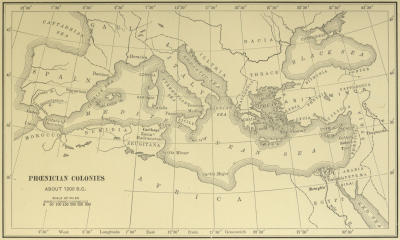
PHŒNICIAN COLONIES
ABOUT 1200 B.C.
When Abraham, with Sarah his wife, visited Egypt about 1920
B.C., the Pharaoh for her sake bestowed upon him many gifts:
“Sheep and oxen and he asses and men servants and maid servants
and she asses and camels.” Among these great gifts there
were no horses, evidently because Egypt had no horses at that
time. There is no mention nor reference to horses in Egypt till
Joseph became prime minister two hundred years later, when
there were a few horses, and they were traded or sold to Joseph by
their owners in exchange for food, not in droves, but as individuals.
These scriptural facts in the experiences of Abraham and
Joseph seem to be circumstantially sustained by the discoveries
of those learned Egyptologists who, in late years and with the
spade in their hands, have resurrected so much of history that had
been buried for thousands of years. It was during the reign of
the Hyksos, or Shepherd Kings, that Abraham and Joseph were
in Egypt, and in order to approximate the time when horses were
first introduced, we must glance at a few facts in connection with
what is known of the Hyksos. Some have claimed they were from
Chaldea, some from Northern Syria and Asia Minor, and some
again from Phœnicia, and it is one of the strangest things in history
that a great nation should be overthrown and held in subjection
for over five hundred years and nobody know who did it.
Then again, it is equally incomprehensible that any nation should
have subdued Egypt and held it in bondage so long and yet never
have claimed the honor of having done so. Still another mystery
remains that never has been solved, and that is, what became of
the Shepherds and their followers when they were driven out?
At the period of the conquest the governing class was rent by
factions and under a weak and tyrannical king. The Delta and
the Valley of the Nile were crowded with slaves, many of them
of Asiatic origin. The elevated plains and mountain sides were
covered with fierce and intractable nomads, all of Asiatic origin,
tending their flocks. Some brave and skillful shepherd organized
the shepherds and the slaves and at their head swept down upon
the government with a power that was so mighty as to be irresistible.
Manetho, the great Egyptian historian of more than
two thousand years ago, thus describes the event: “Under this
king, then, I know not wherefore, the god caused to blow upon
us a baleful wind, and in the face of all probability bands from
the East, people of ignoble race, came upon us unawares, attacked
the country and subdued it easily and without fighting.”
In remarking upon this same event Professor Maspero, who stands
at the very head of the Egyptologists, says: “It is possible that they
(the shepherds) owed this rapid victory to the presence in their
armies of a factor hitherto unknown to the Africans—the war
chariot—and before the horse and his driver the Egyptians gave
way in a body.” In view of the direct declaration of Manetho
that the question of the succession was settled “without fighting,”
the mere suggestion of an unsustained “possibility” from
Maspero that the result may have been determined by the war
chariots cannot be accepted. All the authorities agree that the
horse was introduced into Egypt at some period during the rule
of the Shepherd Kings, but there is absolutely no evidence that
this was at the beginning or anywhere near the beginning of that
rule.
No records or delineations of the horse have been found in any
of the temples or tombs of Egypt prior to the beginning of the
eighteenth dynasty, which was probably about the year 1570 B.C.
and contemporaneous with the birth of Moses. If the Shepherd
Kings left behind them any records or delineations of the horse
it would be quite natural for the true kingly line to destroy and
erase every vestige of whatever would revive a memory to them so
bitter and hateful. But the absence of all traces of horses under
the seventeenth dynasty of the Shepherds does not prove that
there was none, for we have direct proof in Joseph’s case that
they were there one hundred and fifty-six years, and in Jacob’s
burial one hundred and nineteen years before the beginning of
the eighteenth dynasty.
The question as to the time when they procured their horses
having now been approximately settled, the inquiry naturally
follows as to where they came from? In answering this question
there seems to be no hesitation or doubt. They came from
Northern Syria, which embraces not only the northeastern
coast of the Mediterranean, including Phœnicia, but the countries
north and east of it trading there, which means the great horse-breeding
countries of Armenia and Cappadocia. Being largely
engaged in the Egyptian trade for many centuries, it is probable
the Phœnician merchants were the principal agents in supplying
them. In speaking of the horse in Egypt, Prof. Maspero says:
“The horse when once introduced into Egypt soon became fairly
adapted to its environment. It retained both its height and
size, keeping the convex forehead—which gave the head a slightly
curved profile—the slender neck, the narrow hind-quarters, the
lean and sinewy legs and the long, flowing tail which had characterized
it in its native country. The climate, however, was
enervating, and constant care had to be taken, by the introduction
of new blood from Syria, to prevent the breed from deteriorating.
The Pharaohs kept studs of horses in the principal
cities of the Nile valley, and the great feudal lords, following their
example, vied with each other in the possession of numerous
breeding stables.”
There are some facts here that are worthy of special emphasis:
(1) There were no horses in Egypt till the period of the Shepherd
Kings, i. e., about the time of Joseph. (2) All Egyptologists
down to the present day agree that the supply of Egyptian horses
was procured from Northern Syria. (3) The Egyptians and the
Arabians were adjoining nations in constant, friendly intercourse,
exchanging the products of their respective countries, and yet
there is no shadow of an intimation that the Arabians had then
ever owned a horse. It is reasonable to conclude, therefore, not
only from what is written, but from what is implied, that the
Arabians at about the period of 1600 B.C. had no horses. Northern
Syria, as the source of Egyptian supply, points directly to
Armenia, adjoining on the east, as the original source. When
Strabo wrote at the beginning of the Christian era that there
were no horses in Arabia at that time, he would still have been
within the bounds of the truth if he had said there had been
none there for more the sixteen hundred years before his day.
All these considerations confirm the history that has come down
to us from Philostorgius.
As early as the dynasties of the Shepherd Kings and while the
Israelites were still in Egyptian bondage, the Phœnician merchants
had accumulated great wealth and great power and were
literally the masters of the seas. The Phœnicians were a commercial
and maritime people and the Egyptians were, in fact, dependent
upon them for all their foreign supplies. These conditions
leave hardly a doubt that Egypt’s first supply of horses came
through the Phœnicians. But upon the establishment of the
eighteenth dynasty under the old Thebans, the spirit of war and
conquest revived, and under Thutmosis I. and Thutmosis III.,
notably, numerous and successful campaigns were made against
Northern Syria and then extending eastward across the Euphrates
into the borders of Armenia and Assyria. And from the number
of horses and chariots captured in battle and collected as tribute,
the careful student cannot avoid the conclusion that this kind of
spoil was the chief incentive to the various campaigns. “Besides
the usual species,” Maspero informs us, “powerful stallions were
imported from Northern Syria, which were known by the Semitic
name of Abiri, the strong.” This is the first mention in history
of an improved type of horse noted for his strength.
Whatever may have been the precise period in which the Patriarch
Job lived, he was the author of the grandest panegyric on
the war-horse that ever was written. Yet it seems strange that
he owned seven thousand sheep, three thousand camels, five
hundred yoke of oxen and five hundred she asses, but did not
own a horse. To draw his picture of the war-horse he must have
seen him in action, on the field, and it is not improbable in his
younger days he witnessed, or possibly participated in, some great
battle between the Babylonians and the Persians, north of the
latitude and country in which he lived. It is now generally conceded,
I think, among learned men that the “land of Uz” was in
the southeastern portion of Arabia Deserta, bordering on the
Persian Gulf, where the horse is a useless luxury. Job was a
very rich man, he certainly did not lack in admiration of the
horse, and if he had thought that horses would add to his comfort
and enjoyment he could easily have obtained them from the great
herds in the north. But the camel is the great beast of service
and utility in Arabia; it was so in Job’s time, it is so to-day, and
it always will be so because it is suited to the environment.
When Joshua was subduing the tribes of Canaan, B.C. 1450, he
found that the Phœnicians had several well-fortified cities and
did not attack them, but he encountered a combination of
“Northern Kings” with a vast army and “with horses and chariots
very many.” His victory was complete, and he houghed their
horses and burned their chariots with fire.
Jabin, called the King of Canaan, in the time of the Judges,
had his kingdom on the northern border of Palestine and east of
Phœnicia, at the southern extension of Mount Lebanon. Sisera,
one of the greatest commanders of the time, B.C. 1285, commanded
his army and he had nine hundred chariots of iron, but
the victory of the Israelites was complete.
In the year B.C. 1056, David pursued some of the tribes of
Western Arabia that had made a raid on Southern Palestine and
carried away many captives and much spoil. He overtook them
with his own followers and subdued them, and none escaped except
four hundred young men who fled on camels. He recovered
all the captives and brought back all the flocks and herds, but
there were no horses among them. About the same time, historians
inform us, the tribes of Eastern Arabia were paying their
tribute to the Assyrians in camels and asses, while the northern
countries were paying theirs in horses and money.
The Queen of Sheba visited King Solomon B.C. 992, to learn of
his wisdom and “to prove him with hard questions.” Her kingdom
was in that part of southeastern Arabia now called Yemen,
bordering on the Red Sea. Her journey was a very long one and
she “came with a very great train of camels that bare spices and
very much gold and precious stones.” It will be observed that
there were no horses in this “very great train.” It will be observed
further, from the incidents above related, that whenever
the Israelites met their neighbors north of them, whether in
peace or war, they met horses with them; and whenever they met
their neighbors south of them, they were mounted only on
camels.
When the dominions of Solomon had become vastly extended,
embracing numbers of tributary kingdoms, as well as nomadic
tribes, and when his ships had gathered in untold riches from all
parts of the world, he found it prudent to reorganize his army
for the defense of his kingdom and his wealth, and on a scale
commensurate with the dangers that might arise from a combination
of the jealous and envious neighbors with whom he was surrounded.
Among the northern kingdoms of that day it had been
often demonstrated in battle that the effective force of an army
must be estimated by its strength in horsemen and chariots of
war. Solomon, therefore, bought horses and chariots from Egypt,
and horses from all lands that had them for sale. It is probable
that the superiority of the Egyptian chariots was the special
reason for buying them in that country, as he paid six hundred
shekels of silver for the chariots and one hundred and fifty for
the horses to bring them home. The reorganized army consisted
of one thousand four hundred chariots and twelve thousand horsemen,
and they were quartered in the different large cities in his
dominions. In the interval of seven hundred and twenty-eight
years that had elapsed since Joseph was Prime Minister, and
horses introduced in Egypt, they had greatly multiplied. When
Solomon died and his kingdom was divided into two hostile
camps, Hiram, King of Tyre, his lifelong friend and associate,
became virtually his successor to the trade of the world.
The great Greek geographer, Strabo, traveled and wrote in
the reign of Augustus, and died A.D. 24. For descriptions of all
countries of that period and their industries and productions, he
has been quoted for eighteen hundred years as the best if not the
only authority. Writing as he did, at the very initial point of
the Christian era, he gives us a landmark that fixes itself in the
mind. He gives a brief, but quite satisfactory, description of
Arabia, in which he notes the general topography and boundaries
as they are understood to-day; and then he enters, somewhat,
into the climate, productions of the soil, character and industries
of the people, etc. Of one part of the country he speaks of the
inhabitants as breeders of camels, and of another, that is more
productive, he remarks: “The general fertility of the country is
very great; among other products there is in particular an
abundant supply of honey. Except horses, there are numerous
herds of animals, asses and swine, birds also of every kind, except
geese and the gallinaceous tribes.”
Here we have from the very highest authority the pivotal fact
that there were no horses in Arabia at the commencement of the
Christian era. This does not rest upon argument, nor is it a
deduction from some condition of things that might have existed;
but it is a distinct declaration of what Strabo saw with his own
eyes and wrote down when he saw it. It must, therefore, stand
as an undisputed fact, until some reputable authority is brought
forward to contradict it. This description from Strabo applies
to that rich portion of Arabia, bordering on the Red Sea along
its full length. With the fact established, circumstantially and
historically, that there were no horses in Arabia at the beginning
of the Christian era, it now remains to consider how and when
they were first introduced in that country.
Philostorgius, a distinguished Greek theologian, born A.D. 425,
as related in the preceding chapter, wrote an ecclesiastical history,
which is no longer extant, but fortunately Photius, at one
time patriarch of the Eastern church, born A.D. 853, prepared an
epitome of it. This epitome of Philostorgius comes down to
A.D. 425, and is to be found in the Lenox Library of this city,
bound up in the same volume with Sozomen’s Ecclesiastical
History. I will here quote literally from this epitome so much
as is pertinent to the question before us. Constantius was then
on the throne of the Eastern Empire, and labored for the promotion
of the Christian religion.
“Constantius sent ambassadors to those who were formerly called Sabæans,
but are now known as Homeritæ, a tribe descended from Abraham, by Keturah.
As to the territory which they inhabit, it is called by the Greeks Magna Arabia
and Arabia Felix, and extends to the most distant part of the ocean. Its
metropolis is Saba, the city from which the Queen of Sheba went forth to see
Solomon.... Constantius, accordingly, sent ambassadors to them to
come over to the Christian religion.... Constantius, wishing to array
the embassy with peculiar splendor, put on board their ships two hundred
well-bred horses from Cappadocia, and sent them, with many other gifts.... The
embassy turned out successfully, for the prince of the nation, by
sincere conviction, came over to the true religion.”
Other facts might be quoted from this epitome, showing that
Theopholis was made a bishop and placed at the head of this embassy
and that he remained in Arabia Felix several years, prosecuting
his work successfully. It might also be quoted to show
that the people of the cities of Yemen (Arabia Felix) were, at
that day, well advanced in civilization and refinement, and that
wealth and luxury abounded on all sides. Their lands, from the
sea to the desert, were wonderfully productive, and their people
lived in the cities and on their farms, but few leading a nomadic
life. In later generations this part of the country, which is in
Arabia Felix, has been called Yemen, and I believe it is universally
conceded among the Arab tribes and by writers who have
studied the subject that the best horses come from Yemen.
Taking the administration of Joseph as indicating the time
when the first horses were introduced into Egypt, about B.C.
1720, and the actual date when Constantius sent the first into
Arabia, A.D. 356, we find that Egypt led Arabia by two thousand
and seventy-six years. And yet numbers of men have written
great pretentious books on the horse, in which they tell us that
the Egyptians got their horses from the Arabians; while others
equally pretentious and voluminous tell us the Arabians got their
horses from the Egyptians; and neither class probably ever gave
the labor of an honest hour to settle this question. The one is
over two thousand years out of the way, and still they know just
as much about it as the other knows. They are both equally
ignorant and equally dishonest, for they simply copied, as their
own, what somebody had said before them.
It is conceded on all hands and by all men who have gone beneath
the mere surface, that the literature of the ages furnishes no
evidence that there were horses in Arabia before the fourth or
fifth century of our era. General Tweedie, by far the ablest
writer on the Arabian horse that we have examined, concedes
the pertinency and force of the absence of all literary evidence,
until the fifth century is reached, and as a reply he says: “The several
Roman invasions of Arabia, in the reigns of Augustus, Trajan,
and Severus, must have left foreign horses behind them.” This
is, in fact, conceding the accuracy of Strabo’s representations and
that there were no horses in Arabia at the beginning of the
Christian era. The truth of the historical allusion is that the
Romans never overran nor conquered Arabia. They could skirmish
around the border and capture a few towns or cities, but
the death-dealing desert was too much for them. Trajan at last
made it a Roman province by his proclamation, and not by his
sword, and for the excellent reason that “the game was not worth
the candle.” What a strange fact it is that Arabia, instead of
the first, should have been the last country in all the old world to
be supplied with horses!
It is very difficult to comprehend or even imagine the changes
that may be wrought in a thousand years by a strong, enterprising,
and aggressive people, colonized in a rich country occupied
by semi-barbarians and savages. This was the condition in
Northern Africa, when the Phœnician colonies were planted
there, a thousand years before the Christian era. The colony at
Utica in Algeria was planted about eleven hundred years before
the Christian era, which was contemporaneous with the reign of
Saul as king of Israel. The colony of Carthage, that afterward
contested with Rome for universal dominion, was planted in the
same country, about two hundred years later, and was contemporaneous
with Jehu. The whole southern shore of the Mediterranean
was dotted with Phœnician colonies, from Egypt westward.
The oldest of the Phœnician colonies so far from home was
probably Gades, now called Cadiz, on the Atlantic coast of Spain
and outside of the Pillars of Hercules. This colony was planted
about fifteen hundred years B.C. and was contemporaneous with
Moses and the forty years’ journeying of the Israelites in the
wilderness. The more recent scholarship seems to have developed
the fact that still north of Gades and extending from
the mouth of the Guadelete to that of the Guadiana, there was a
very large and flourishing colony planted by the Phœnicians,
possessing within itself many of the requisites and functions of
statehood, and that this was the ancient “Tarshish” of scripture.
This plantation became a secondary Tyre, and the “ships of Tarshish”
not only made their voyages back and forth through the
length of the Mediterranean, but extended them northward, up
the European coast and to Britain, and southward along the
African coast for a great distance, establishing trading posts
wherever the products of a country promised profitable exchange.
The planting of colonies in that age, even for the one ostensible
purpose of trade, involved more than the mere erection of a
“trading post” at some selected harbor. A strong and well-equipped
and well-trained military force had to be employed to
protect and defend them. The Phœnicians were great traders,
and at the same time they were excellent fighters. Their numerous
colonies on both shores of the Mediterranean required a
strong military force that was made up very largely of slaves and
the nomadic tribes of the country, but always commanded by
prominent and influential Phœnicians. It is impossible to tell
what the very early experiences of the colonists may have been
with regard to horses; nor do we know whether they found horses
already there when they arrived at their new plantations. My
belief is, however, that they were not only the first to carry
horses to Egypt, but they were the first to carry them to the
western extremities of the Mediterranean. It will be remembered
that the early trade of the Armenians with the Phœnician merchants
was not only in horses, but in horsemen, and it is probable
that these “horsemen” were slaves, expert and skillful in managing
the horse. It has been said by historians that certain classes of
their ships were ornamented with a carved horse’s head, at the
prow; and it has been inferred that the ships so designated were
specially constructed and fitted up for the safe carrying of horses.
It is true that in the course of the centuries horses may have
found their way from Egypt westward to Algeria, and by crossing
the Bosphorus they might have found their way from Asia
Minor to Spain, but it is also true that from small beginnings at
the plantation of the colonies there was ample time for them to
increase to almost countless herds before the period when the
colonists became a mighty military power in the earth.
Historians tell us that the military establishment of the city
of Carthage alone, when on a peace footing, consisted of three
hundred elephants, four thousand horses and forty thousand foot
soldiers. When Hannibal started out to fight Rome, in the second
Punic war, say B.C. 218, he had with him eighty thousand footmen
and twelve thousand horsemen; and he left thirty-two thousand
soldiers at home to guard his Spanish and his African
dominions. With a proportional division of the home troops, he
then had about seventeen thousand mounted men in his army.
These were not war levies, but hardened and trained soldiers, and
it is, therefore, not remarkable that he held nearly the whole of
Spain in subjection, and practically all of Northwestern Africa.
Polybius, the soldier historian, tells us that “his Numidian
cavalry formed the strongest part of his army, and to their quick
evolutions, their sudden retreat, and their rapid return to the
charge, may be attributed the success of Hannibal in his great
victories.” At an earlier period, we learn that in the organization
of the Phœnician armies the numerous nomadic tribes were
placed on their flanks, and wheeled about on unsaddled horses
guided by a bridle of rushes.
At a very remote period there were two tribes in the interior of
Spain, the Celtæ and Iberi, that were greatly distinguished for
their love of independence and their bravery in defending it.
The antiquarians have failed to give us any information as to
what they were or whence they came. They were contemporaneous
with some of the early colonies of the Phœnicians. Their
tactics in battle seemed to have been to break the enemy’s ranks by
a charge as cavalry, and to then dismount and fight on foot. They
united as one people and called themselves Celtiberi. Where
they got their horses, or whether they had them before the
Phœnicians arrived, are questions that cannot be answered.
The Visigoths, or western Goths, overran Northern Italy, settled
in Southern France and eventually passed over into Spain,
where they established a dynasty that lasted over two centuries and
until it was overthrown by the Saracens, A.D. 711. Roderick,
the king of the Visigoths, went out to battle with the Saracens,
arrayed in his most showy apparel, and mounted on his splendid
chariot, made of ivory and set with precious stones. As the battle
progressed he saw what he had good reason to believe was
treachery on the part of one wing of his army and he alighted
from his chariot, mounted his horse called Orelia and rode away
while his soldiers were being butchered. He was the last of the
Gothic dynasty. There had been a battle between the navies of the
Saracens and the Goths, A.D. 680, fifty-one years earlier, in which
the fleet of the Saracens had been entirely destroyed, and at that
time the Saracens occupied the whole of the southern shore of
the Mediterranean. The word “Moors,” as often used to designate
the people of Northern Africa, is not well chosen, for it really
belongs to but one of many different tribes of different names.
The term “Saracen” anciently meant only an Arab born, but
since the middle ages it has come to mean any and all adherents
to the Mohammedan religion, in the usage of Christian people,
and is particularly apposite when speaking of a number of tribes
engaged in a common cause.
The people of Northern Africa were not negroes as we understand
the word, but a mixture of different races. When the
Phœnicians settled among them they were nomadic barbarians,
possessing a country of great riches without knowing it. Under
the tuition of their new masters they made great advances in
many of the arts of peace and in all the arts of war. The Phœnician
blood was liberally commingled with that of the natives.
The blood carried the brains, and hence the beautiful structures
that came from their hands and heads. No purely bred nomad
ever could have conceived or constructed the Alhambra. The
Phœnicians were refined and educated idolaters, as refinement and
education were understood in their day, while the native people
were literally barbarians.
The then recent and rapid spread of Mohammedanism among
all the people of Northern Africa is, on its surface, one of the
most remarkable facts in history. As a religion it served to
unite, under the banner of the Crescent, all who accepted it, and
guaranteed to all who fell in its defense immediate admission to
paradise. All who did not accept it were enemies and only fit to
perish by the sword of the Saracen. The founder of this religion
died A.D. 632, and seventy-nine years afterward his followers, in
Northern Africa alone, won their great victory over the Gothic
dynasty of Spain. When once on Spanish soil they appeared to
take root there and held possession of a large part of Spain for
nearly nine hundred years.
Now that I have traversed the field of Spain and Northern
Africa, from the first dawnings of history down to the beginning
of the seventeenth century, in order to gather in all that history
reveals touching the introduction and propagation of the horse
in those regions, we are ready to summarize the facts that we
have gleaned. At the periods of six hundred (when Carthage became
independent of the mother country), four hundred, and
two hundred years before the Christian era, there is undoubted
evidence, over and over again, that Spain and Northern Africa
were abundantly supplied with horses. Then, how is it possible
that the hordes of Barbarians from Asia could have supplied these
countries with horses, when they did not arrive there until
several centuries after the supply is established to have existed?
Take, if you please, the shortest of the periods suggested above,
when Hannibal’s cavalry almost annihilated a great Roman army,
two hundred and sixteen years before the Christian era. This
was five hundred and seventy-two years before Arabia had any
horses; and how can “the blind leaders of the blind” supply
Hannibal’s cavalry with Arabian blood? When the people of
Northern Africa, west of Egypt, fought their way into Spain it is
not known that there was a single Arabian soldier nor a single
Arabian horse in the whole army. They were all called Arabians,
however, and that pretense has existed ever since.
The Phœnicians were the most remarkable people of all the
early ages and indeed of any age. They belonged to the Aramaic
or Semitic race; they settled in Canaan long before the days of
Abraham and attained their greatest prosperity in the days of
Solomon, when his fleets and those of his friend Hiram, King of
Tyre, controlled and monopolized the commerce of the world.
More than five hundred years before this alliance, however, they
had established commercial relations with all the countries bordering
on the Mediterranean, and their ships were trading in the
ports of every country from Egypt to the Pillars of Hercules and
far beyond. There seems to be no doubt that they carried tin
from Britain and amber from the Baltic, and, of course, they
had to bring something to exchange for what they carried away.
What did they bring? As amber did not enter into the necessary
arts it is not probable the trade was very large, but tin was required
by many nations in their everyday life, especially the
Egyptians, who had no foreign commerce and were thus dependent
upon the Phœnician merchants. We may conclude, therefore,
that the trade in tin was large, and as there was no Phœnician
colony in extreme southwestern Britain, the foreign traders
would bring just what the Britons most needed. If they were
already in possession of horses they would not need that kind of
exchange, but if they were not in possession of horses, that would
be just the kind of exchange they would want, and probably this
was the source from which they obtained their supply. The
question, however, of how or when our British ancestors obtained
their first supply of horses has never been positively answered.
That they had them in great abundance at the beginning of the
Christian era is fully established by the experience of the Romans
when they captured Britain. From their great numbers and the
skill displayed in their management in battle, it cannot be
doubted that they were there for many generations before the
Roman armies came in contact with them. Many theories have
been advanced as to how the horse may have reached Britain, but
no one of them rests on so reasonable a basis of probability as
that of the Phœnician traders. If from this source, which I am
strongly disposed to believe was the true source, it must have
been during the maritime supremacy of the Phœnicians and their
colonies, and this would place the date several centuries before
the Christian era. If we were able to reconstruct the original
line of the migration of the early English horses, we would, probably,
first find them in “the land of Togarmah” starting to
market at Tyre, where they were exchanged for supplies needed
in Armenia. There they were put on board one of the great
“ships of Tarshish,” and when they next touched the land it was
at one of the ports at the southwestern portion of England, where
they were exchanged for tin and other products of the mines.
In addition to the argument furnished by this known course of
trade between nations and peoples, in prehistoric times, we have
an additional one in the natural perpetuation of racial qualities,
extending through many centuries. In reply to some questions
submitted to a friend of mine who was born in Western Persia,
educated in this country, and then returned to the land of his
nativity, I have replies to my questions bearing date of July,
1896. He is located at Oroomiah, not far from the modern line
between Persia and Turkey, and in what may be considered the
very center of ancient Armenia. He is not skilled in horse lore,
but he uses horses a great deal and is a very intelligent observer.
He says that the Persian horses have been greatly overrated and
that the country is full of very ordinary horses. He says that
they are all colors, with bays probably predominating. There is
a great variety of mixed greys, shading into white, and a few that
are dappled. Then there are chestnuts, sorrels, “mouse-color”
(duns), and not many blacks. They are small, as a rule, and a
harness of small size from this country has to be cut down for
them. From this I infer that they are generally under fourteen
hands. On the whole the horses are nicely shaped, have slender,
clean limbs, small ears, and carry the head and tail well up. As a
rule they are great stumblers. With regard to gaits he says that
stress is laid on a rapid walk—a half walk and half trot. In this
country we would call it the “running walk” that may be kept
up for days in succession. In speaking of the pace, my correspondent
says: “There are some horses trained to pace, while
some pick it up naturally, that is, are born pacers. The greater
number are natural pacers. Now and then one will find a rapid
pacer, but commonly the pace is a five or six miles an hour gait.
There are some that single-foot naturally, and from birth.”
He then says horses are not bred with any care. They are turned
loose in herds and the breeding is such as would naturally occur.
It will be observed that my Persian friend speaks of the different
colors “of grey, shading into white,” which suggests a possible
descent from the famous breed of white Nissæan horses kept
by the great Darius and other Medo-Persian monarchs for racing
purposes. But the striking feature in this description of the
horses of Persia, or more properly, of ancient Armenia, of this
day, is the fact that they are of the same size and color and
habits of action as the horses of Britain when first visited by the
Romans, as well as when they were more minutely described
twelve hundred years later, and as they were at the beginning of
the seventeenth century, and as they still were at the middle of
the eighteenth century. As evidence on these points reference
is made to the chapters on horses of the colonial period that will
follow in their place. In ancient Armenia, as with all pastoral
people of the early ages, horses were turned out to run in herds
and literally left to Mr. Darwin’s law of “natural selection and
the survival of the fittest.” So it was in Britain to a great extent,
until the eighteenth century, and so it was in the American
colonies until fifty years later; hence the same types and characteristics
prevailed and were perpetuated in all these countries.
It is sad to contemplate the present debased and semi-barbarous
condition of the descendants of a great people who for centuries
stood first among all the nations of the earth in commercial enterprise,
in learning, and in the arts. The banishment of the
Saracens from Spain in the beginning of the seventeenth century
of our era was in fact the banishment of the descendants of the
Phœnicians who first colonized Spain. The architectural structures
which they left behind them, and which for their marvelous
beauty have challenged the admiration of the world, were not
the work of nomads and barbarians. They were the flashes of
the old Phœnician taste and genius as exemplified by the descendants
of the men whom Hiram sent to construct and decorate
the buildings of Solomon. The Alhambra and some other structures
in Spain are all that we have to remind us of the genius,
and grandeur of Phœnicia. Whatever may have been the character
and attainments of the descendants of the colonists at the
time, the change from idolatry to Islamism was a bad one.
Wherever, throughout the world, the teachings of the “Prophet”
have been accepted, whole nations have become intolerant, murderous
and brutalized, and the modern Phœnicians are no exception.
They have now lost their identity in the follies and crimes
of Islamism and we can have no sympathy for them.
CHAPTER IV. THE ARABIAN HORSE.
The Arabian, the horse of romance—The horse naturally foreign to Arabia—
Superiority of the camel for all Arabian needs—Scarcity of horses in Arabia
in Mohammed’s time—Various preposterous traditions of Arab horsemanship—The
Prophet’s mythical mares—Mohammed not in any sense a
horseman—Early English Arabians—the Markham Arabian—The alleged
Royal Mares—The Darley Arabian—The Godolphin Arabian—The Prince
of Wales’ Arabian race horses—Mr. Blunt’s pilgrimage to the Euphrates—His
purchases of so-called Arabians—Deyr as a great horse market where
everything is thoroughbred—Failure of Mr. Blunt’s experiments—Various
Arabian horses brought to America—Horses sent to our Presidents—Disastrous
experiments of A. Keene Richards—Tendency of Arab romancing
from Ben Hur.
Admiration always leads to exaggeration. This is true in
most of the relations of life, but in our admiration of the horse it
becomes greatly intensified, so greatly indeed that in magnifying
his excellent qualities we find ourselves telling downright falsehoods
about him before we know it. This “amiable weakness,”
as we might call it, is true of our everyday life and our everyday
horses; but when we come to the horse that is the universal ideal
of perfection, everybody seems to lay aside all the restraints of
truth in extolling the superiority of his qualities. The “Arabian
horse” is the ideal horse of all the world. He is the “gold
standard” in all horsedom, with the one important distinction
that the one is real and the other is mythical. Not one so-called
horseman in a million ever saw a genuine Arabian horse, nor any
of the descendants of one; and in all the discussions of the past
three hundred and fifty years it has never been shown in a single
instance that a horse from Arabia, with an authenticated pedigree
and tracing as such, has ever been of any value, either as a
race horse or as a progenitor of race horses. The superior qualities
of “the Arabian horse,” like the superior qualities of “The
Arabian Nights,” are purely works of the imagination. There
is just as much truth in the stories of Sindbad the Sailor and
Aladdin’s Lamp as there is in most of the literature relating to
the Arabian horse.
I am fully satisfied that these views of the Arabian horse will
not meet with a ready acceptance by the vast majority of the
horsemen of this or any other country, but my reasons for presenting
them will become apparent as the discussion progresses.
They smash too many idols and dispel too many chimeras of the
brain to be readily accepted. It takes the average man a long
time to get clear of the prejudices in which he was born, and the
first question that will be asked by the doubter is, “Why could
not Arabia have supported a race of indigenous wild horses, as
well as any other country?” Because the horse, wild or tame,
has never learned to dig a well forty feet deep, nor to draw water
after it is dug. Neither has he learned to lay up a store in time
of plenty against a time of famine. The horse could not live in
Arabia without the care of man. And, second, “Why were all the
civilized and semi-civilized nations west of Asia supplied with
horses a thousand years before Arabia, when so near the original
habitat of the horse?” It is the first law of our nature to supply
ourselves with what we need. The camel always has been a
necessity to the Arab, not only to carry him and his burdens, but
to furnish nourishment and sustenance to him and his family.
The camel is adapted to the country and the country to the
camel, and no other created animal can fill that place. He is,
literally, “the ship of the desert.” The horse in Arabia is a
luxury that can be indulged in only by the rich; hence his ownership
is practically restricted to the chiefs of tribes. He is never
used except for display and war. Palgrave, in speaking specially
of the Nejd tribe, says: “A horse is by no means an article of
everyday possession, or of ordinary or working use. No genuine
Arab would ever dream of mounting his horse for a mere peaceful
journey, whether for a short or a long distance.”
When we consider the immeasurable superiority of the camel
to the horse in meeting the wants and necessities of the Arab,
we will not be surprised at the immense herds of the former and
the small numbers of the latter that are bred and reared in that
country. A camel can go four days without water, and under
stress, it is said, a good one can cover the distance of two hundred
miles in twenty-four hours. The camel and the country
are suited to each other, while the horse is an exotic, and has no
part in any industrial interest except raiding and robbery. My
attention was first called to this unexpected smallness in the
numbers of Arabian horses in the seventh century, two hundred
and sixty years after the introduction of the original stock from
Cappadocia. The flight of Mohammed from his enemies in
Mecca to Medina took place A.D. 622. There, setting up as a
Prophet, and as holding communications with Heaven, he soon
gathered around him a number who believed in his divine inspiration.
Understanding the habits and instincts of his followers,
he soon found he must give them something to do. He
called them about him, mounted a camel, and at their head he
was successful in plundering two or three caravans, which greatly
enraged his old enemies at Mecca. Whether the anger of his
enemies was kindled anew because some of the plunder belonged
in Mecca, or whether he merely deprived the Meccans of the opportunity
of doing the plundering themselves, the historian fails
to make clear. Whichever may have been the underlying reason,
it led to war. In the first campaign of the Meccans and in the
first battle fought, they far outnumbered the followers of the
Prophet. There were some camels in Mohammed’s train, but no
horses. He did not lead the battle himself, but remained in his
tent and promised his followers that all who fell in battle would
be forthwith admitted into Paradise. They believed the promise,
as millions and millions have believed it since; it inspired them
with a recklessness of life, and they were completely victorious.
The result of this victory was the capture of one hundred and
fifteen camels and fourteen horses, besides the entire camp of the
enemy. In the battle of the next year (A.D. 625) between the
same parties, the forces were much increased on both sides. Sir
William Muir, the historian, informs us that Mohammed had but
two horses in his army, one of which he mounted himself and
took command of his forces. This battle was not decisive. In
subsequent raids he captured many enemies and traded his female
captives for horses with the surrounding tribes, so far as he was
able to obtain them. The next year he had an army of three
thousand men and thirty-six horses, while the enemy had an
army of three thousand men, of whom two hundred were cavalry,
but there was no fighting. The fame of Mohammed as a successful
and relentless pillager and destroyer had now spread far
and wide, and as a means of escape the chiefs of the larger portion
of the tribes of Arabia hastened to tender their allegiance
and obey his commands. From this forward, therefore, we must
consider Mohammed as the representative of the whole of Arabia,
in both its religious and military power. The next year his old
enemies, the citizens of Mecca, surrendered the sacred city to
him without a blow, and thus Islamism became a mighty power
in the world.
It is evident from many sources other than the history of
Mohammed that horses have always been a very sparse production
in Arabia. Burckhardt, the famous traveler in the East,
journeyed very extensively in Arabia about 1814, and he gives
the result of his observations on this point of numbers as follows:
“In all the journey from Mecca to Medina, between the mountains
and the sea, a distance of at least two hundred and sixty
miles, I do not believe that two hundred horses could be found,
and the same proportion of numbers may be remarked all along
the Red Sea.” This is in strict conformity with the observations
of other writers, the reasons for which have already been given.
Time out of mind, everybody has heard of the insuperable
difficulty of prevailing upon an Arab to part with his genuine,
high-caste mare for either love or money. He will expatiate, as
the story goes, upon “the beauty and graces of his mare as the
light of his household and the joy and playmate of his children,
and above all as she is royally bred he cannot, as a good Moslem,
disobey the injunctions of the Prophet not to sell such mares, but
to keep them forever that their descendants may enrich the
children of the faithful to all generations.” If you ask him
more particularly about her lines of descent, he will give you fifty
or a hundred generations and land you safely on the name of the
particular one of the five mares of the Prophet from which she is
descended. To illustrate the sham of all this Major Upton’s experience,
in purchasing horses in Arabia for the East India
service, may be cited. It is evident the major understands his
dealers and they understand him. He says: “In the desert we
never heard of Mohammed’s mares, nor was his name ever mentioned
in any way as connected with the Arabian horse.” He
says there is no restriction nor difficulty in buying as many mares
as you want, in any part of Arabia. This disposes of the tricky
pretenses of the Arab horse dealer when he is negotiating a sale
to a man without Arabian experience.
Some modern writers make mention of a tradition that still
prevails among some tribes as to the origin of the Arabian horse,
and it is to the effect that their best horses came originally from
Yemen. This tradition is met with in Arabia Deserta, a long
way from Arabia Felix, of which Yemen is a portion. While
this tradition is of no possible value as evidence, it is suggestive
of what might be unearthed in that strange country. The people
were not nomadic, but agricultural and commercial, and the cities
were rich. The people were well advanced in the arts and comforts
of civilized life, and in their cities they had many beautiful
temples and palaces. Such a people would of necessity produce
learned men who would leave records of their national history
behind them, and especially that of such an event as the conversion
of the whole people to Christianity. Possibly the researches
of scholarly men may yet bring to light more of the facts connected
with the embassy from the Emperor Constantius and
the introduction of the Cappadocian horses into Yemen, as related
in the preceding chapters.
There are many other traditions, so called, that are burnished
up and brought out whenever the crafty dealer finds he has a
Richards from America, or a Blunt from England, with his mind
already made up that all the best horses of the world have come
from Arabia. To such a customer, with his mind already at high
tension in search for the longest pedigree and the purest blood,
the dealer casts his hook in something like the form following:
“When King Solomon had completed the temple he turned his
attention to supplying his army with horses and chariots. He
searched every nation that had horses for sale and would have
none but the very best that the world could produce. He spent
much of his time in admiring his beautiful horses, and one day
he was so thoroughly absorbed that the hour of prayer passed
without his observing it. He felt that this neglect to pray at the
proper time was a great sin, and that his horses had led him into
it. He did not hesitate longer, but he at once ordered all his
horses to be turned loose to the public. Some of my ancestors
succeeded in securing six of these mares, and from these six
mares all the good horses of Arabia are descended.”
Other dealers are a little more modest in their claims for the
antiquity of the pedigrees of their horses, and generously knock
off about sixteen hundred years, being content to trace to the
mares of the Prophet instead of the mares of Solomon. This
still leaves them with a pedigree only about twelve hundred years
long, which beats our modern romancers in making stud books.
In order to test and select the mares that were worthy of becoming
the dams of the best horses, as the story goes, the Prophet
shut up a herd of mares, in plain sight of water, and kept them
there till they were almost famished with thirst; and then at a
signal they were all released at once, and when rushing headlong
to the water the trumpet sounds, and notwithstanding their
sufferings they turn and align themselves up in military order.
In this test of obedience and discipline, it is said, only five of the
mares obeyed the signal (some say only three) and thus the mares
that obeyed, notwithstanding their sufferings, became justly entitled
to the distinctive and honored name of “The Prophet’s
Mares.” Another story is told of the particular markings which,
in the Prophet’s estimation, indicated the best horses. By one
authority he always selected a black horse with a white “forehead,”
and some white mark or marks on his upper lip. Another
authority says he always chose a bay horse with a bald face
and four white legs, and so we might go on till we had embraced
every color and every combination of marks, and we would then
find that each “authority” had a horse to sell corresponding with
the Prophet’s preferences. Now the fact is that Mohammed was
neither a horseman nor a horse breeder, and the whole tenor of
history goes to show that he neither knew nor cared very much
about horses. In his first pilgrimage to Mecca, after the battles
referred to above, the privilege for which was secured by negotiation,
a hundred horsemen, it is said, were started and kept one
day’s journey in advance of the main body of pilgrims. The
great numbers following Mohammed on this pilgrimage admonished
his old enemies of Mecca of the futility of attempting to
resist his power longer, and they fled from the city during the
continuance of the ceremonies. A year or two later he summoned
all the tribes of Northern and Eastern Arabia to follow him
again to Mecca, and they had too lively a sense of their own safety
to disobey. Due time was given for preparation, the rendezvous
was at Medina, and a vast host from all Northern and Western
Arabia congregated there for a purpose that might be to fight,
or it might be to pray. Mohammed mounted his camel and the
word was passed, “On to Mecca.” As against such a multitude
the Meccans saw that resistance was hopeless, and the city was
surrendered without either side striking a blow. Arrayed in great
splendor and mounted on his camel, the Prophet made the requisite
number of circuits round the holy place and then entered
and ordered all the idols that had been set up there to be destroyed,
and his followers then shouted, “Allah is Allah, and
Mohammed is his Prophet!” Thus he became master of all
Arabia—and woe to the Christian or the Jew who stood in his
way. Two years afterward he died, and there is nothing in his
life or history to indicate that he ever owned a horse or that he
ever mounted one, except on a single occasion. In the ten short
years of his public life he had something more important on hand
than to determine how to breed horses.
In studying the Arabian horse in the light of what he has done
and what he has failed to do, we are indebted to English writers
for little snatches of experiences extending back for a period of
about two hundred and fifty years. The earliest English writer
who has had anything to say about the Arabian horse was the
Duke of Newcastle, who seems to have known a great deal about
the various types and breeds of horses of his day. During the
period of the Commonwealth it appears he devoted his time, in
the Netherlands, to training horses in the manege of that day.
From his experience in this employment he became an expert in
the form, structure, and docility of the different kinds of horses
that he handled. When Charles II. was brought back and placed
upon the throne, the duke also came to his own, and being a
personal friend of the king he became his counselor and adviser
in all matters relating to the improvement of the horses of the
realm. In 1667 the duke published his famous book upon the
horse, in which he speaks right out on any and every question that
he touches. There can be no doubt that he knew more about
horses and horse history than any man of his day. In speaking
of the Arabian horse he says: “I never saw but one of these
horses, which Mr. John Markham, a merchant, brought over, and
said he was a right Arabian. He was a bay, but a little horse,
and no rarity for shape, for I have seen many English horses far
finer. Mr. Markham sold him to King James for five hundred
pounds, and being trained up for a course (race), when he came
to run every horse beat him.”
It is generally held that this Markham Arabian was the first of
that breed ever brought to England, and this seems to be established
by the fact that historians antedating his arrival make no
mention of any Arabian horse before this one, and those following
always speak of this horse as the first. In speaking of the
powers of endurance of the Arabian horse, the duke says: “They
talk they will ride fourscore miles in a day and never draw the
bridle. When I was young I could have bought a nag for ten
pounds that would have done as much very easily.” The duke’s
masterful knowledge of the subject, as well as his special official
relations to the king, gave him control of whatever was done or
attempted in the direction of improving the racing stock of England.
Tradition informs us that “King Charles II. sent abroad
the master of the horse to procure a number of foreign horses
and mares for breeding, and the mares brought over by him (as also
many of their produce) have since been called Royal Mares.”
It is very doubtful whether any such importation was ever made.
The question has been discussed, from time to time and even
recently, but nobody has ever yet discovered who was “Master of
the Horse,” to what country he was sent or what the character of
the mares he brought home, or where he got them. The fair
presumption is that these “Royal Mares” were myths and that
they were created merely for the purpose of putting a finish on
certain very uncertain pedigrees, just as a trotting-horse man
would finish a pedigree that he knew nothing about by saying,
“out of a thoroughbred mare.” As a matter of course it has
always been assumed that these “Royal Mares” were of distinctively
pure Arabian blood. But, if we admit that such an importation
was really made, we must consider that it was made
under the direction and control of the Duke of Newcastle, the
king’s mentor in all horse affairs, and this is sufficient proof that
there was no Arabian blood about the “Royal Mares.” As the
size of the English race horse and especially his weight of bone
commenced to increase soon after this time, it strikes me as
probable that this was the wise and guiding motive of the duke in
making his selections of the “Royal Mares.”
When we come down a little nearer to our own times and step
across the border from the seventeenth to the eighteenth century,
we are still in the realm of traditions, and many of them very
preposterous. The deceptions practiced in nomenclature were so
common as to be well-nigh universal. Everybody who owned a
foreign horse must have “Arabian” attached to his name. To
illustrate this evil and the misleading effects flowing from it, I
will give two instances of the most famous horses in all English
history. The Darley Arabian and the Godolphin Arabian stand
pre-eminent and before all others as progenitors of the English
race horse. The former of these two was purchased at Aleppo,
in Asia Minor, and brought to England in 1711, by Mr. Darley of
Yorkshire who secured him through a brother in trade in that
region. He was the sire of Flying Childers and many others,
and his blood carried from generation to generation. Aleppo is
in Northern Syria and far distant from Arabia. At one time it
was embraced in Armenia Minor, the original home of the horse,
and adjoined Cappadocia and Cilicia, all famous for the excellence
of their horse stock more than two thousand years before
there was a single horse in Arabia. Upon the restoration of the
ancient Theban line of Pharaohs in Egypt, at the beginning of
the eighteenth dynasty, no time was lost by Thutmosis I. in leading
a great army into Northern Syria for no other purpose that is
apparent except to replenish and reinvigorate the horse stock of
Egypt, from the region of Aleppo and further east, for this is
the region from which they had secured their original stock.
His successors pursued the same course, year after year, and the
number of horses and chariots captured in battle, as well as the
number of mares sent as tribute by the frightened people, were
duly recorded in the annals of their achievements. If the
Darley Arabian, so called, bore any relationship whatever to the
Arabian horse, it can only be established by tracing him back to
some one of the animals in Cappadocia that the Emperor Constantius
sent to Arabia in the year A.D. 356. A writer of the
seventeenth century, Dr. Alexander Bursell, in speaking of Aleppo,
says: “Formerly this part of the country was famous for fine
horses; and though many good ones are still bred here, it may
be said they are much degenerated.” This is the observation of
an intelligent man, written and published in 1756, about forty
years after Mr. Darley’s horse was brought from there.
The other illustration is that of Godolphin Arabian. As a progenitor
of race horses this was the greatest horse of his century, or
indeed of any other century in the history of the English race
horse. He died in 1753, and absolutely nothing is known of his
origin or his early history. The story is generally accepted, and
I suppose is true, that he was bought out of a cart in Paris, as an
act of humanity, by a Mr. Coke, taken to London, presented to
Mr. Williams, the keeper of a coffee-house, and passed from him
to Lord Godolphin, who kept him till he died. The story that
he was presented to Louis XV. by the Bey of Tunis in 1731 has
never been verified in any manner, and breaks down on the vital
point of date. Some intelligent Englishmen insist that he must
have been an Arabian, while others insist that he must have been a
Barb, while no man knows whether he was either one or the
other. With the most prominent horses of the nation and of
their century thus used to mislead the public mind as to their
lineage, what are we to expect from the great ruck of the obscure
and less prominent? But, as a more elaborate and methodical
discussion of this topic will be found in the chapter on the English
and American Race Horse, we will now turn our attention to
the actual experiences with the Arabians in recent times.
When we come down to the present century we get into the
era of newspapers that really begun to give the news, and thus
educate their readers, not very authentically, but circumstantially,
in what was passing in the world in every department of knowledge
and enterprise. Under these wide sources of information, a
few authentic experiences will serve to illustrate the true status
of the Arabian horse and his influence, or lack of influence, on
English and American horses. More than twenty years ago the
Prince of Wales made a royal progress through Her Majesty’s
dominions in the East. The enthusiasm was unbounded and he
was loaded down with many valuable presents, among them
several elegant, high-caste Arabian horses. It appears that some
of these horses had already won reputation and money on the
turf, and were considered the very best that could be found in
the East. On their arrival they were greatly admired and praised,
especially by the sporting friends of the prince, who seemed to
have no doubt, nor did they conceal their opinions, that they
could beat any horses in all England. This was a conclusion
that a great many racing men, with longer memories, could not
accept, and after a good deal of diplomacy a match was finally
concluded between the prince’s best horse and an old horse that
was third or fourth-class, in his prime, but was unsound and
liable to break down any time he was extended. The prince was
popular, had many supporters, and much money was pending.
The old horse was patched up as well as possible, the day came,
the race was started, and the old cripple was so much faster than
the Arab that his managers had the hardest work in the world to
prevent him from running clear away and disgracing the prince.
This account of the race I had from one of the most eminent and
successful trainers that England has produced. He witnessed
the race and knew all the facts concerning it. Notwithstanding
the popularity of the prince and the universal feeling of loyalty
toward him, it was a long time before his Arabs ceased to be a
laughing-stock among horsemen.
Some sixteen or eighteen years ago, an English gentleman of
wealth and intelligence—Mr. Wilfrid S. Blunt—got it into his
head that the way to improve the English race horse was to secure
fresh infusions of pure Arabian blood. He was industrious
in propagating his fad, in an amateurish way, through the columns
of the English newspapers, evincing great zeal and a great lack of
knowledge of the hundreds of experiments in the same direction
and in the history of his own country that had proved disastrous.
But he had a will of his own and a bank account that enabled him
to carry out his views to their own realization. In the autumn of
1877 he made up a pleasant family party, consisting of his wife,
Lady Anne, and two of her lady friends and started for Arabia, with
the full determination to find the best and to buy nothing that
was not of the purest and best lineage that could be found in all
that country. Fortunately, Lady Anne carefully noted down
everything that transpired in their journeyings and after the return
wrote a very pleasant and readable book, understood to have
been edited by her husband in some of its features. The title
of the book—“The Bedouin Tribes of the Euphrates”—did not
strike me pleasantly, for I never knew that any of the numerous
Bedouin tribes were to be found on the Euphrates. But my
purpose is not to criticise either the book or its title, but to follow
the party over its itinerary and discover just where Mr. Blunt
found the blood he was looking for, and upon what evidence he
accepted it as “the best blood.” With this view I will carefully
give his own language, so far as it applies to the point in view.
His first purchase was at Aleppo, where he got a mare he
named Hagar, as he says, “for a very moderate sum.” “She was
of the Kehilan-Ajuz breed.” “When purchased she was in very
poor condition, having just gone through the severe training of a
campaign.” “She was bred by the Gommussa, the most able of
the horse-breeding tribes, had passed from them to the Roala,
and had now been captured and ridden some two hundred miles,
in hot haste, for sale to Aleppo.” “We never met anything in
our travels that could compete with her over a distance, and she
has often run down foxes and even hares, without assistance,
carrying thirteen stone on her back.” This was the first experience
of the English “tenderfoot” among Syrian horsethieves.
According to his own showing, he bought her from the fellow
who had stolen her and had ridden her two hundred miles to
escape, and he accepted what the thief told about the breeding of
the mare as true. The thief knew just what Mr. Blunt wanted
and he shaped the pedigree and tracing to suit the purchaser.
Mr. Blunt had no knowledge of this mare’s breeding, nor where
she came from; still, her blood was to become one of the great
influences in renovating the English race horse. This incident is
of no importance, in itself, except as it illustrates the universal
conditions under which amateurs buy horses in the Orient.
Upon leaving Aleppo, the party traveled eastward till they
struck the Euphrates and then down the right bank of that river.
The first town of any importance was Deyr, on the river, and just
across was ancient Mesopotamia. They were still in the border
land between the productive north and the desert south, with
the Syrian desert between them and the Arabian desert. All
this region is occupied with a mixture of races, employed in
varied pursuits, with but a feeble trace of tribal authority, as all
are under the direct government of the Sultan of Turkey.
“Deyr is well-known,” Mr. Blunt says, “as a horse market, and is, perhaps,
the only town north of the Jebel Shammar where the inhabitants have any
general knowledge of the blood and breeding of the beasts they possess. The
townsmen, indeed, are but a single step removed from the Bedouins, their undoubted
ancestors. They usually purchase their colts as yearlings either from
the Gomussa, or some of the Sabaa tribes, and having broken them thoroughly,
sell them at three years old to the Aleppo merchants. They occasionally, too,
have mares left with them, in partnership, by the Anazah, and from these they
breed according to the strictest desert rules. It is, therefore, for a stranger,
by far the best market for thoroughbreds in Asia, and you may get some of
the best blood at Deyr that can be found anywhere, besides having a
guarantee of its authenticity, impossible, under ordinary circumstances, to get
at Damascus or Aleppo. There are, I may say, no horses at Deyr but thoroughbreds.”
He made some purchases at Deyr and then they pursued their
journey down the river, and at the most convenient point he
crossed over to Bagdad, on the Tigris. Here he inspected the stud
of the Turkish pasha, but the prices were high and he seemed to
lack confidence in the purity of their breeding. Whatever the
cause, he made no purchases, and soon started on his journey
up the Tigris. Upon reaching Sherghat on the Tigris, he turned
westward, and crossing ancient Mesopotamia, he was again at
Deyr, where he seems to have made more purchases, and then
started, in a southwesterly direction, with eighteen mares and two
stallions for Damascus and the coast. This closed the search of
Arabia for Arabian horses of the highest caste and purest blood,
without really being in Arabia, and this is all that can be said of
“The Bedouin Tribes of the Euphrates”—without having seen a
real Bedouin.
No doubt Mr. Blunt thinks he is right in his high appreciation
of the town of Deyr as a horse market; that it is “the best
market for thoroughbreds in Asia;” and that “there are no
horses in Deyr but thoroughbreds,” or he would not have bought
his horses there. Dealing in horses seems to be the principal
business of the people, they are all well informed on the best and
purest strains of blood, according to Mr. Blunt, and all their own
horses are thoroughbred. Truly an ideal market, an ideal people,
and ideal horses, just suited to the needs of enthusiastic amateurs
like Mr. Blunt. This remarkable horse town is located on the
border between the rich grain fields and luxuriant meadows on the
north, and the comparatively barren deserts of the south. On
the north the country has been famous for thousands of years for
the great numbers and excellence of the horses produced, and
they are still produced of excellent form and quality, and are sold
at very low prices. On the south is the land of the camel, and
but few horses and those few held at high prices, and the simple
term “Arabian horse” always brings them purchasers. Here,
then, we find that Deyr is the very paradise of horse traders—a
tribe, wherever we find them on the face of the earth, distinguished
for elasticity of conscience. The north furnishes the
horses and the south furnishes the pedigrees, and no wonder the
Deyrites had nothing but “thoroughbreds” when Mr. Blunt came
along. In the line of their business and from their southern
neighbors, they had picked up enough “Arabian horse talk” to
satisfy all inexperienced buyers that they knew all about the value
of the different strains of Arabian blood, and could supply them
from their own studs, at very reasonable prices. And thus Mr.
Blunt brought home to England eighteen “Arabian” mares and
two stallions, without any satisfactory evidence that they ever
had seen Arabia. In this enthusiastic venture, resulting in utter
failure, there is one alleviating fact that Mr. Blunt can call to
mind, and that is that his horses were just as good for the purpose
of improving the English race horse as any others that
have been brought from the Orient in the past hundred years.
Whatever their blood, whether genuine or counterfeit Arabians,
they have all alike been failures, and all alike good for nothing.
Early in the history of our own government it became not an
unusual thing for the Sultan of Turkey, the Emperor of Morocco,
or some other potentate of the Saracenic races, to present to the
President two horses, and as they were presents from royalty to
what they esteemed royalty, they were necessarily of the highest
caste and of the greatest value of any horses in all their dominions.
It is probable that Mr. Jefferson was the first president to
receive these royal gifts, and under the requirements of the constitution
and without any disrespect to the donor, he ordered
them to be sold to the highest bidder, and turned the money into
the treasury. Several of the presidents received these presents
of horses, and without knowing the fact, I will presume disposed
of them the same way. In the case of President Lincoln, Mr.
Seward seemed to be more highly favored and the sultan sent
the horses to him. Through the State Agricultural Society, Mr.
Seward presented his royal presents to the State of New York.
My recollection is not very distinct, but my impression is that
Mr. Van Buren had disposed of his in the same way. When
General Grant received his, he was not in public office and hence
they became his personal property. A number of the first of
these importations, together with some others that were brought
from Arabia, individually and by private persons, were, in the
early part of the century, carried into the South, which was then
the “race-horse region,” but the breeders there very soon discovered
that in breeding from them they were taking a backward
instead of a forward step. Their progeny could neither run nor
trot, and as they were too small for the ordinary uses of the
farmer and planter, they were almost unanimously rejected, with
nothing left but the ignorant “fad” that was embodied in the
name “Arabian.”
The most notable example of the folly of attempting to regenerate
the American race horse by the introduction of the
“blood of the desert” is furnished in the sad experience of the
late A. Keene Richards, of Kentucky. He inherited a large
estate, and when he came into possession he proved himself an
intelligent and successful breeder, and ran the colts of his own
breeding, with a full share of winnings. He was not a spendthrift
nor a gambler, but he was not content with mediocrity in sharing
triumphs with his neighbors, for he was ambitious to beat,
them all. He soon had his head full of such horses as the Darley
Arabian and the Godolphin Arabian, and he argued if that blood
founded the English race horse, he would go to Arabia and get it,
and it could not fail to regenerate the American race horse. He
did not stop to inquire whether either of his great ideals might
have had a drop of Arabian blood in his veins, but he started for
Arabia at once. He brought home a few stallions and felt sure
he was on the eve of the greatest triumph of his life. When the
half-Arab produce of his strong and elegantly bred race mares
were old enough to run the jockey club allowed the half-breeds
seven pounds the advantage in weight and they were beaten.
The club then allowed them fourteen pounds and they were
again beaten; and finally the allowance was raised to twenty-one
pounds, and they were still in the rear rank. Under these humiliating
defeats a careful man would have hesitated before he
went further, but he at once jumped to the conclusion that his
defeat was not in the fact that Arab blood could not run fast
enough to win, but in the fact, as he supposed, that the rascally
Arabs had sold him blood that was not Arab blood. In a short
time he was off for Arabia again, taking with him as companion
and adviser the distinguished animal painter, Troye, who had a
long and successful experience as a delineator of race horses and
knew all about the anatomy of the horse. They spent several
months among the different tribes, and in order to get “inside of
the ring,” as it were, they ate with the Arabs, slept with the
Arabs, and worshiped with the Arabs, as Mr. Richards told me
himself. They came home full of the highest expectations, bringing
several mares as well as stallions with them, and fully assured
that every one was of the highest caste and the best form for racing
that could be found on all the plains of the desert. After
the foals of this importation were old enough to start in the
stakes, they were given the same advantages in weight as before,
and they proved no better than the first lot. Poor Mr. Richards
was crushed in spirits, not only by the vanishing of his air castles,
but by the importunacy of his creditors. In his heroic, but misguided,
efforts to improve the American race horse by infusions
of pure Arabian blood, he involved his once handsome estate,
and he died hopelessly insolvent. He had bred a number of pure
Arabs of several generations, but the abundant feed and luxuriant
blue grass of Kentucky did not increase their size, for when they
came under the auctioneer’s hammer they were but little
“tackeys,” and they brought only the price of little “tackeys.”
The number of horses brought to this country, whether as
gifts to statesmen or as private ventures, and called “Arabians,”
is not very large, and it is safe to say that not one in ten of them
ever saw Arabia. They came from Turkey or some of the Barbary
States. But in the case of Mr. Richards there can be no
doubt that he made his selections in Arabia itself. Those selections
having been made personally and with care and skill, we are
bound to accept them as genuine Arabians. When we find,
therefore, that having been tested they are no better than the
horses brought from Turkey or from Africa, we must conclude
that the whole scheme is mere moonshine, and that Arabian
blood as a means of improvement has failed to develop the value
that enthusiasts and dreamers have claimed for it since “time
whereof the memory of man runneth not to the contrary.”
Practical and thinking men always judge of the value of a breed
of horses from what the representatives of that breed can do or what
they fail to do. The emotional and unpractical are always looking
for an ideal horse, and the poets and story writers are always
furnishing them one. Where a horse figures in a story he is
uniformly endowed with an almost supernatural intelligence and
sense. To finish up the ideal horse, he always traces back to the
“Courser of the Desert.” If his triumph is in a flight of speed,
he distances all competitors because he is a pure Arabian. The
story of “Ben Hur,” written by General Lew Wallace, furnishes a
fitting illustration of this tendency of the public mind. The story
of the chariot race at Antioch is a masterpiece of most exciting
ingenuity, and one of the finest specimens of word painting in
the English language. The irascible old sheik is quite overdrawn,
but the judgment and skill of Ben Hur cannot be surpassed.
As a matter of course, the team of black Arabians was
bound to win. Every bright schoolboy in the country has read
the story, and he has joined in the triumph of the black Arabians.
The wide interest in the chariot race seemed to demand its pictorial
delineation, and soon the public was gratified with a large
and elegant etching, which hangs before me as I write. The only
trouble about this excellent work of the imagination and the
team of black Arabians is that there were no horses in Arabia till
about three hundred and fifty years after the date of this supposed
scene. We must let the poets sing and the novelists work
out their plots, but it is well to pay some attention to the facts
and experiences of history.
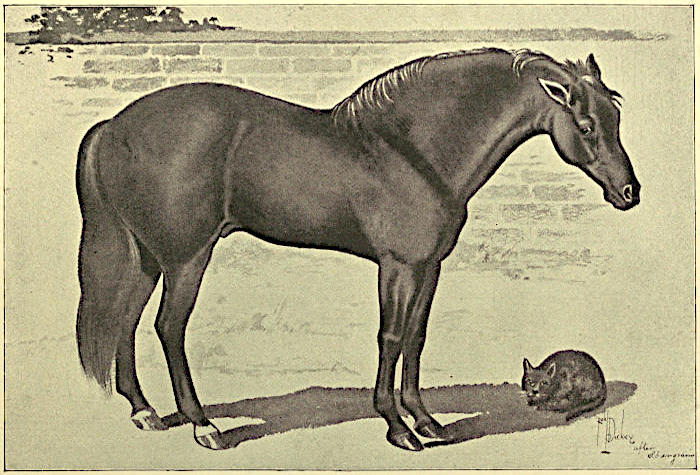
GODOLPHIN ARABIAN.
A true portrait taken from life by D. Murrier, painter to H. R. H. the Duke of Cumberland.
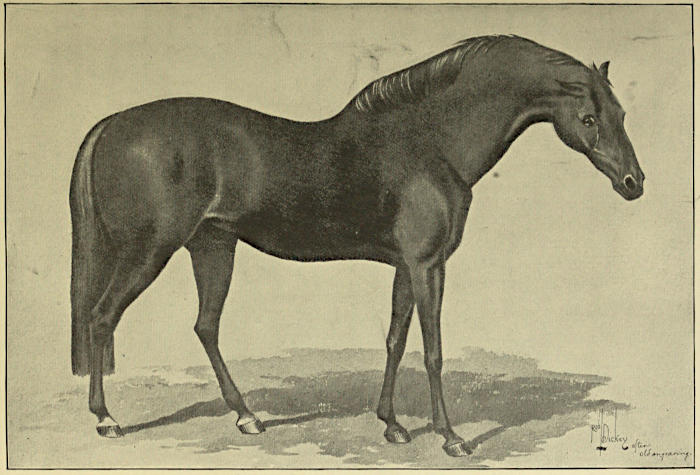
GODOLPHIN ARABIAN.
A distorted copy by Mr. Stubbs who never saw the horse, and changed to express the idea of fleetness.
CHAPTER V. THE ENGLISH RACE HORSE.
The real origin of the English race horse in confusion—Full list of the
“foundation stock” as given by Mr. Weatherby one hundred years ago—The
list complete and embraces all of any note—Admiral Rous’ extravaganza—Godolphin
Arabian’s origin wholly unknown—His history—Successful
search for his true portrait—Stubbs’ picture a caricature—The
true portrait alone supplies all that is known of his origin and blood.
The English Race Horse is the great central figure of all the
horse literature of the past two hundred years. Much has been
claimed for him and much has been written about him, in a haphazard
way, by people who know but little of the subject. A few
men of independent and real thought have written on this subject,
but they have devoted their attention to the comparing of
family with family or individual with individual. Of the books
that have been written by brainless people on the English horse
there is no end, and they are generally mere repetitions, without
giving credit, of what somebody has said before. Among all the
books that have been written on this subject I have never yet
found one that even pretended to make a serious attempt at discovering
the real origin of the English Race Horse. They all seem
to agree with Admiral Rous that he is purely descended from the
Arabian horse, and without one drop of the blood of the indigenous
English horse. The average writer for the two past centuries
has been content with just this much knowledge, and he
wants nothing more. Occasionally it is modestly suggested in
some magazine article that this exclusively Arabian origin may
not be true, and I am glad to note that these suggestions are becoming
more frequent of late years. It has been claimed that
the pure Arabian origin of the race horse “is as solid as a
pyramid,” all of which may be accepted—but, unfortunately for
the claimant, the “pyramid” is standing on its apex, and when
the facts breathe upon it, as gently as a zephyr, it will topple
over. The most convenient and the most authoritative collection
of facts relating to the earliest exotic horses that were
brought in is to be found in the English Stud Book itself, and
as but few of my readers have access to this work, I will copy
that portion of it entire, as it appears in the first volume, and
the edition of 1803. In the edition of 1808 the list was reprinted
with four additional animals and some verbal changes, which,
when important, will be noted.
“ARABIANS, BARBS AND TURKS.”
1. The Helmsley Turk was an old Duke of Buckingham’s and got Bustler,
etc.
2. Place’s White Turk was the property of Mr. Place, studmaster to Oliver
Cromwell, when Protector, and was the sire of Wormwood Commoner, and
the great grandams of Windham, Grey Ramsden and Cartouch.
3. Royal Mares: King Charles the Second sent abroad the master of the
horse, to procure a number of foreign horses and mares for breeding, and the
mares brought over by him (as also many of their produce) have since been
called Royal Mares.
4. Dodsworth, though foaled in England, was a natural Barb. His dam, a
Barb mare, was imported in the time of Charles the Second, and was called a
Royal Mare. She was sold by the studmaster, after the king’s death, for
forty guineas, at twenty years old, when in foal (by the Helmsley Turk) with
Vixen, dam of the Old Child Mare.
5. The Stradling or Lister Turk was brought into England by the Duke of
Berwick, from the siege of Buda, in the reign of James the Second. He got
Snake, the D. of Kingston’s Brisk and Piping Peg, Coneyskins, the dam of
Hip, and the grandam of Bolton Sweepstakes.
6. The Byerly Turk was Captain Byerly’s charger in Ireland, in King
William’s wars (1869, etc.). He did not cover many bred mares, but was the
sire of D. of Kingston’s Sprite, who was thought nearly as good as Leedes;
the D. of Rutland’s Black Hearty and Archer, and the D. of Devonshire’s
Basto, Ld. Bristol’s Grasshopper, and Ld. Godolphin’s Byerly Gelding, all in
good forms: Halloway’s Jigg, a middling horse; and Knightley’s Mare, in a
very good form.
7. Greyhound. The cover of this foal was in Barbary, after which both
his sire and dam were purchased, and brought into England by Mr. Marshall.
He was got by King William’s White Barb Chillaby, out of Slugey, a natural
Barb Mare. Greyhound got the D. of Wharton’s Othello, said to have beat
Chanter easily in a trial, giving him a stone, but who, falling lame, ran only
one match in public, against a bad horse; he also got Panton’s Whitefoot, a
very good horse; Osmyn, a very fleet horse and in good form for his size; the
D. of Wharton’s Rake, a middling horse; Ld. Halifax’s Sampson, Goliah and
Favorite, pretty good 12-stone Plate horses; Desdemona, and other good
mares, and several ordinary Plate horses, who ran in the North where he was
a common stallion and covered many of the best mares.
8. The D’Arcy White Turk was the sire of Old Hautboy, Grey Royal,
Cannon, etc.
9. The D’Arcy Yellow Turk was the sire of Spanker, Brimmer, and the
great-great-grandam of Cartouch.
10. The Marshall or Selaby Turk was the property of Mr. Marshall’s
brother, studmaster to King William, Queen Anne, and King George the first.
He got the Curwen Old Spot, the dam of Windham, the dam of Derby Ticklepitcher,
and great-grandam of Bolton Sloven and Fearnought.
11. Curwen’s Bay Barb was a present to Louis the Fourteenth from Muley
Ishmael, King of Morocco, and was brought into England by Mr. Curwen,
who being in France when Count Byram and Count Thoulouse (two natural
sons of Louis the Fourteenth) were, the former, master of the horse, and the
latter an admiral, he procured of them two Barb horses, both of which proved
excellent stallions, and were well known by the names of the Curwen Bay
Barb and the Thoulouse Barb. Curwen’s Bay Barb got Mixbury and Tantivy,
both very excellent formed Galloways. The first of them was only thirteen
hands two inches high, and yet there were not more than two horses of his
time that could beat him at light weights. Brocklesby, Little George, Yellow
Jack, Bay Jack, Monkey, Dangerfield, Hip, Peacock, and Flatface, the first
two in good forms, the rest middling; two Mixburys, full brothers to the first
Mixbury, middling Galloways; Long Meg, Brocklesby Betty, and Creeping
Molly, extraordinarily high-formed mares; Whiteneck, Mistake, Sparkler,
and Lightfoot, very good mares, and several middling Galloways, who ran for
Plates in the North. He got two full sisters to Mixbury, one of which bred
Partner, Little Scar, Soreheels and the dam of Crab; the other was the dam of
Quiet, Silver Eye and Hazard. He did not cover many mares except Mr.
Curwen’s and Mr. Pelham’s.
12. The Thoulouse Barb became afterward the property of Sir J. Parsons
and was the sire of Bagpiper, Blacklegs, Mr. Panton’s Molly, and the dam of
Cinnamon.
13. Darley’s Arabian was brought over by a brother of Mr. Darley, of
Yorkshire, who, being an agent in merchandise abroad, became member of a
hunting club, by which means he acquired interest to procure this horse. He
was the sire of Childers, and also got Almanzor, a very good horse; a white-legged
horse of the D. of Somerset’s, full brother to Almanzor, and thought to
be as good, but meeting with an accident, he never ran in public; Cupid and
Brisk, good horses; Dædalus, a very swift horse; Dart, Shipjack, Maica and
Aleppo, good Plate horses, though out of bad mares; Ld. Lonsdale’s Mare in
very good form, and Ld. Tracy’s Mare in a good one for Plates. He covered
very few mares except Mr. Darley’s, who had very few well-bred mares besides
Almanzor’s Dam.
14. Sir J. William’s Turk (more commonly called the Honeywood Arabian)
got Mr. Honeywood’s two True Blues; the elder of them was the best Plate
horse in England, for four or five years; the younger was in very high form
and got the Rumford Gelding, and Ld. Onslow’s Grey Horse, middling horses out
of road mares. It is not known that this Turk covered any bred mares except
the dam of the two True Blues.
15. The Belgrade Turk was taken at the siege of Belgrade, by Gen. Merci,
and sent by him to the Prince de Craon, from whom he was a present to the
Prince of Lorraine. He was afterward purchased by Sir Marmaduke Wyvill,
and died in his possession about 1740.
16. Croft’s Bay Barb was got by Chillaby, out of the Moonah Barb Mare.
17. The Godolphin Arabian was imported by Mr. Coke, at whose death he
became (together with Cade, Regulus, etc., then young) the property of Ld.
Godolphin. His first employment was that of a teaser to Hobgoblin, who, refusing
to cover Roxana, she was put to the Arabian, and from that cover produced
Lath, the first of his get. He was also sire of Cade, Regulus, Blank,
etc., and what is considered very remarkable, as well as a strong proof of his
excellence as a stallion, there is not a superior horse now on the turf without a
cross of the Godolphin Arabian, neither has there been for several years past.
He was a brown bay, with no white, except on the off heel behind, and about
fifteen hands high (a picture of him is in the library at Gog Magog, Cambridgeshire).
It is not known to what particular race of the Arab breed, indeed it
has been asserted that he was a Barb. He died at Gog Magog in 1753, in or
about the 29th year of his age. The story of his playfellow, the black cat,
must not be omitted here, especially as an erroneous account has got abroad,
copied from the first introduction to the present work. Instead of his grieving
for the loss of the cat she survived him, though but for a short time; she sat
upon him after he was dead in the building erected for him, and followed him
to the place where he was buried under a gateway near the running stable; sat
upon him there till he was buried, then went away, and never was seen again,
till found dead in the hayloft.
18. The Cullen Arabian was brought over by Mr. Nosco and was sire of Mr.
Warren’s Camillus, Ld. Orford’s Matron, Mr. Gorges’ Sour Face, the dam of
Regulator, etc., etc.
19. The Coomb Arabian (sometimes called the Pigot Arabian and sometimes
the Bolingbroke Grey Arabian) was the sire of Methodist, the dam of Crop,
etc., etc.
20. The Compton Barb, more commonly called the Sedley Arabian, was sire
of Coquette, Greyling, etc.
(Additions in 1808 Edition.)
21. King James the First bought an Arabian of Mr. Markham, a merchant,
for 500gs., said (but with little probability) to have been the first of the breed
ever seen in England. The Duke of Newcastle says, in his treatise on Horsemanship,
that he had seen the above Arabian, and describes him as a small
bay horse, and not of very excellent shape.
23. Bloody Buttocks; nothing further can be traced from the papers of the
late Mr. Crofts than that he was a grey Arabian, with a red mark on his
hip, from whence he derived his name.
23. The Vernon Arabian was a small chestnut horse. He covered at Highflyer
Hall, and was the sire of Alert, etc. Alert had good speed for a short
distance.
24 & 25. The Wellesley Grey, and Chestnut Arabians (so called) were
brought from the East, but evidently not Arabians. The former was a horse
of good shape, with the size and substance of an English hunter.
This list of twenty-seven different animals, which for the sake
of convenience I have numbered, was presented to the public
more than a hundred years ago by Mr. Weatherby, the highest of
all English authorities, as the foundation stock from which the
English race horse was propagated. The uniform omission of
dates of importations, etc., discloses the fact that the compiler
had no accurate knowledge of the animals or their history, and
that he was dependent largely upon very uncertain traditions for
his information. It must not be understood that the animals in
this list were contemporaneous, or that the list embraces all the
foreign animals that were brought in, but only those that were
recognized as of value in founding the breed.
To understand just what we have to consider, I will place here,
in juxtaposition to the above list, the remark of Admiral Rous, at
one time the great race-horse authority of England, which expresses
the popular opinion as to the origin of the race horse,
that is practically universally held in all lands. The admiral
says: “The British race horse is a pure Eastern exotic whose
pedigree may be traced two thousand years, the true son of
Arabia Deserta, without a drop of English blood.” To reach
the approximate truth on the issue here made, and to puncture
this extravaganza is the work now before us.
Numbers 1, 2, 5, 6, 8, 9, 10, 14, 15, were Turks, and to these we
may add Mr. Darley’s horse, known as the Darley Arabian, number
13, for he was brought from Aleppo in Turkey, far removed
from Arabia, and famous for the great numbers and excellence of
its horses many centuries before Arabia had any horses. To carry
horses, for sale, from the deserts of Arabia, where they are
scarce, to the region of Aleppo, where they are very plenty, and
of the highest quality, would be simply “carrying coals to Newcastle.”
We may therefore safely conclude that the ten horses
here enumerated were Turks.
Numbers 4, 7, 11, 12, 16, 20 were Barbs, as they are named in
the list. It is a surprise to me that these six horses should be
designated as “Barbs,” for it has been the usage of many generations
to call these horses “Arabians.” As late as 1819 the Dey
of Algiers sent several Algerine horses as a present to the Prince
Regent of England, and they were always spoken of as “Arabians.”
Numbers 17, 18, 19, 21, 22, 23, 24, 25 are all unsatisfactory as to
their origin. Number 17—Lord Godolphin’s horse—is wholly
unknown as to his blood elements, and further on his history will
be considered. Number 18 “was brought over,” but from
whence nobody knows. Number 19 is in the same condition, and
not one of his different owners has been able to tell us anything
about his origin. Number 21 was, possibly, an Arabian, but the
Duke of Newcastle, who knew the horse well, seems to have
doubted his genuineness on account of his inferiority. However
this may have been, he preceded other importations so many
years that it is not known that he ever sired a colt, and as a progenitor
we may as well strike him out. Number 22 seems to be
in darkness, and all efforts to find his origin having failed he may
as well be classed as unknown. Number 23 is furnished with no
evidence that he was entitled to be classed as an Arabian. Numbers
24 and 25 were confessedly not genuine.
This reduces the analysis to its lowest form and shows that in
the original foundation stock, including Mr. Darley’s horse (13),
there were ten Turks and six Barbs that can be accepted with
reasonable certainty. This leaves eight so-called “Arabians,”
from which we must eliminate numbers 17, 21, 24, 25, leaving
numbers 18, 19, 22, 23, without any evidence whatever that they
were Arabians except in name. From these four rather obscure
animals, therefore, according to the Rous dictum, the English
race horse must have derived every drop of his blood; and yet
there is not a scintilla of evidence either direct or inferential that
any one of them, or the ancestors of any one of them, ever saw
Arabia. From the custom of calling every horse from abroad
an “Arabian,” that has prevailed in England for more than two
hundred years, it is fair to conclude that there was no Arabian
blood in the foundation stock. It was the blood of the Turks
and the Barbs, commingled with that of the native blood that had
been bred to race for centuries, that furnished the foundation of
the modern English and American race horse.
Blood in the race horse is an imperative necessity, but it must
be blood that has been carefully selected from winners, and raced
for generations, or it is of no value as an element of speed. If
the English race horse had been a strictly pure exotic from
Arabia Deserta, as Admiral Rous maintained, he would have
been of no value either as a race horse or the progenitor of race
horses, without many generations of careful selection and development
of speed.
The Godolphin Arabian was altogether the greatest horse of
his century. He flourished during most of the reign of King
George II., but the horsemen of the world, even Englishmen
themselves, know far more about him than they do about the
reign of that monarch. Still, nobody knows anything of his
birthplace, his origin or his blood. He was to the English race
horse what Rysdyk’s Hambletonian has been to the American
trotter. Neither of them was ever in a race, but each of them
stood immeasurably superior to all others of his day as a progenitor
of speed, at his own gait. From the latter we had reason
to expect speed because we knew he inherited speed, but from
the former we had no reason to expect anything, for we knew
nothing of what he inherited until he proved his inheritance by
what he transmitted to his progeny. Some of the principal semi-tragic
incidents, so far as known in the early life of Godolphin
Arabian, were seized upon by the great novelist Eugene Sue, and
out of them grew a “horse novel” from his gifted pen. The
horse was foaled about 1724, was brought to England from France
about 1730, and died at Magog Hills, 1753. There seems to be a
substantial agreement among those who had the best opportunities
to know that the horse was employed on the streets of Paris
as a common drudge in a cart and driven by a brutal master. A
Mr. Coke, who is represented to have been a Quaker, was in Paris
on business and he happened to witness the brutality of the
ruffian who was this horse’s master in trying to make him draw a
load of wood up a steep acclivity on to a new bridge, which the
horse after repeated trials and clubbings was unable to accomplish.
To relieve the poor brute from his sufferings, Mr. Coke’s
feelings of humanity asserted themselves, and he stepped forward
and bought the horse on the spot and had him released from the
cart. Mr. Coke, it is said, brought the horse to London and presented
him to Mr. Williams, the proprietor of a famous coffee-house,
and Mr. Williams presented him to Earl Godolphin.
In September, 1829, Mr. John S. Skinner commenced the publication
of the first horse magazine that ever appeared in this
country, and in the first number there appeared a steel engraving
purporting to be executed by the famous Stubbs and to represent
the great horse, Godolphin Arabian. Not many years afterward
I came into possession of a copy of this publication from the beginning,
and the sight of this picture always impressed me as the
most ludicrous abortion of the likeness of a horse that could be
conceived of. The neck was absolutely longer than the body,
the legs were about strong enough for a sheep, and all over it
lacked strength of both muscle and bone to a most absurd extent.
When this picture appeared in London, some years before, it was
laughed at by all artists as well as by all men who knew anything
about the shape of a horse, as a monstrosity, and it was received
in the same spirit on this side of the water; but it bore the name
of a great artist and that was sufficient to secure the approbation
of the unthinking and the unknowing. The only key to the
origin of the horse, the only pedigree that can be given, must be
found written in his own structure of bone and muscle and
brain. A true delineation, therefore, of his form and shape became
a matter of the highest moment, not merely to satisfy the
curiosity of the curious, but as a study of the true sources of his
wonderful prepotency.
Sixty-five years ago a correspondent of Mr. Skinner’s magazine,
referred to above, and a descendant of Mr. Samuel Galloway
of Maryland, spoke of an oil painting of Godolphin Arabian
that had hung in the hall at Tulip Hill from the days of his
childhood as still hanging there, and said that it was wholly
unlike the Stubbs engraving. Mr. Galloway was one of Maryland’s
land barons, an enthusiastic horse breeder, and a successful
horse racer. He was educated at Cambridge, I think; and if
so, no doubt he saw Godolphin Arabian many times before he
died, for he was within four or five miles of him, and his sporting
instincts could not fail to take him to see so great a horse
when so near at hand. As he was a young man of great wealth
and great ambitions, it is quite probable he was on terms of
friendly acquaintance, if not intimacy, with Lord Godolphin, and
thus secured the oil painting from that distinguished friend himself.
This theory is strengthened by the fact that the picture
still bears the coat of arms of Lord Godolphin.
To reach and secure this picture, or at least a faithful copy of
it, became an object of continuous effort that was never intermitted
for more than twenty years. At last, in the spring of
1877, one of the correspondents of Wallace’s Monthly, Prof. M. C.
Ellzey, of Blacksburg, Virginia, wrote me that the picture was
then the property of Dr. J. H. Murray (whose wife was a lineal
descendant of Mr. Galloway) of Cedar Park, adjoining Tulip Hill,
West River, Maryland, and that he would have the picture sent
to me. In a few days it arrived, and when my eyes rested upon
it, it was like the feast of a lifetime; for there was all that could
ever be known of the greatest horse of his century. The painting
was in a state of excellent preservation and the coat of arms
of Lord Godolphin was plainly traceable. The horse is shown
from his right side, in his rough, paddock condition, with his
right hind foot a little advanced, and his head low and without
any animation or excitement. The standpoint of the artist is a
little forward of the shoulders, and he must have been a tall man
or the horse must have been a low horse, or perhaps both, for
he sees over the horse and portrays the fine spring of muscle over
the loin, on the opposite side of the vertebra. From the position
of the artist the drawing is slightly foreshortened, and this, together
with the advance of his right hind foot, intensifies the
droop of the rump, to some degree, in the outline. From the
proportions, as shown in the painting, I would conclude he was
below fourteen and a half hands high rather than above it. His
head is striking and unusually large for an animal of his size,
with remarkable width between the eyes, and without a star to
lighten it up. His ear is not fine, and it droops backward as he
stands, as if half-asleep. His mane is sparse and in disorder.
His throat-latch is very good, and the windpipe large and well
developed. The neck is of a fair length for a horse of his blocky
formation, and there is nothing unusual about it except its great
depth at the collar place. The slope of the shoulder is very
marked and shows his ability to carry his head in the air when
he wished to do so, but the shoulder itself is coarse and angular
to an unusual degree. His withers rise very abruptly and there
is great perpendicular depth through the carcass at this point.
His back is remarkably short and the spread and arch of his loins
is simply magnificent. But the point of superlative excellence is
in the remarkable development of power in his quarters. His
limbs, instead of being “spider legs,” are unusually strong for
an animal of his size; indeed, they might be considered coarse
for any horse that was pretended to be a race horse. His tail is
of the usual weight and somewhat wavy. With the addition that
there is a little white at the coronet of the right hind foot,
and not forgetting his friend and companion the cat, I have
made a somewhat detailed description of what is represented in
the painting. Several artists examined the picture, and they
pronounced it the work of an artist of ability and experience.
The signature “D. M. pinxt” was carefully examined, but no
one was able to throw any light upon the name represented by
the initial letters “D. M.”
While this painting contained within itself evidence of its
great value as a likeness of its subject, it lacked confirmation
as “true to the life;” and nothing could supply this
lack but to find a portrait of the same horse, painted by another
artist, and then if the two agreed, the proof would be fully satisfying
to the understanding. A little over a hundred years ago
Lord Francis Godolphin Osborne, Duke of Leeds, and heir to
Lord Godolphin, wrote Sir Charles Bunbury, a great race-horse
man, that he had a painting of Godolphin Arabian, by Wootton,
at Gog Magog Hills. Over sixty years ago an American gentleman
wrote to Mr. Skinner’s magazine that he had seen a painting
of Godolphin Arabian hanging in Houghton Hall, Norfolk.
In 1878 my physician told me I must quit work for awhile, and
that I had better visit the great Exposition at Paris that year. I
was anxious to see the Fair, but I was a great deal more anxious
to see those two paintings of Godolphin Arabian, if they were
still in existence. Gog Magog Hills is a quaint old place, and the
origin and meaning of its name is lost in a very remote antiquity.
As it has not been the residence of its owners for more than a
hundred years, it is much neglected. The people in charge were
very obliging, and I was immediately admitted to the view of
Wootton’s painting of Godolphin Arabian. The first glance was
a complete vindication of the truthfulness of the Maryland painting
as a true likeness in every important feature of the outline
and proportions. The canvas is about four and a half by four
feet, inclosed in a massive frame. After studying it and comparing
it, point by point for more than an hour, with a copy of
the Maryland painting, it became evident they were not painted
by the same hand, although the horse had the same position in
both pictures, with the exception that the right hind foot was
thrown backward in the Wootton painting instead of forward,
and thus gave a less abrupt droop of the rump. The head was
precisely the same shape, but in the large painting the articulations
were less distinct and expressive.
After a little peregrination through Norfolk, studying the
“Norfolk Trotter” as then called, but since called “Hackney,”
on his “native heath,” I reached Houghton Hall, in Norfolk.
This grand old place was built over a hundred and sixty years
ago by the famous Sir Robert Walpole, and at that time it was
considered the most splendid structure, as a gentleman’s country
seat, in all England. For many years it has been the property
of the Marquis of Cholmondeley, but is not often occupied as a
residence. Here too, I was lucky, for upon my entrance to the
picture gallery, about the first object upon which my eye rested
was the painting of the Godolphin Arabian, and the first impression
was that there must be “spooks” around, for that seemed
certainly the Maryland picture I was looking at. I had it taken
down and removed to a good light, and there the whole mystery
was removed. It is difficult to compare two peas. All you can
say about them is that they were just alike, and that is all I can
say about the Galloway picture in Maryland and the Houghton
Hall picture in England. The paintings were the same size, and
the pigments used were of precisely the same shades of color and
quality. The colors were peculiar in the fact that the artist had
used no varnish nor oil that would leave a shiny appearance.
The Houghton Hall picture had a black, glossy margin all around
it of about five inches in width on which the names of the most
noted of his progeny were inscribed in gold letters, and at the
bottom was this inscription: “The original picture taken at The
Hills, by D. Murrier, painter to H. R. H. the Duke of Cumberland.”
This explained the modest signature attached to the
Maryland picture, which was a replica of the original. “The
Hills” is the local designation of “Gog Magog Hills.” The word
“original” not only implies that the picture was made from life,
but that one or more replicas were made at the same time.
Here, then, in this picture, we have all that we know or probably
ever will know of the origin and pedigree of this horse. It
does not tell us what he was, but it does tell us in the most clear
and unmistakable language what he was not. There is no feature
nor element in his make-up that does not say that he was neither
an Arabian nor a Barb. He was a stout, strong-boned, heavily
muscled, short-legged horse. In his form and shape he was very
far removed from an ideal progenitor of race horses, but he was
that progenitor all the same. About forty years after his death
Mr. Stubbs, who never saw the horse, brought out a painting of
him which all artists laughed at as the picture of an impossible
horse. This picture, however, was engraved on steel and became
the standard representation of Godolphin Arabian, in England,
till this day. Both these pictures are here given, and a comparison
of many points makes it evident that Stubbs copied from
the original of Murrier or from the painting by Wootton, which
was probably also a copy of Murrier, and he followed his copy
just as closely as he could while converting a big-boned, stout
saddle horse into a long-necked, spindle-shanked race horse.
By actual measurement the neck is longer than the body, but it
is not necessary to point out the Stubbs absurdities, as they are
apparent to every eye. It was simply an awkward and dishonest
attempt to express in his form and shape such a pedigree as a
great racing sire should have had. In these two pictures we have
the real and the imaginary—the honest and the dishonest.
The search for this picture and then for its verification was a
labor of many years. I never expected to find the horse’s origin,
but the discovery of his likeness seemed to be in the bounds of a
possibility that was finally realized. Murrier’s picture, as a
mere work of art, is of no mean value. It contains within itself
undoubted evidence that it is a true picture of a horse, and it is
shown circumstantially that this horse was the great “unknown
and untraced founder” of the English race horse, with nothing
of the race horse in his appearance.
The name of this horse has been a misnomer ever since the
day he fell into the hands of Lord Godolphin, and it has misled
a multitude of men to their financial hurt. Of late years the
more intelligent class of writers, instead of calling him an
“Arabian” call him a “Barb,” but there is just as much propriety
in using one name as the other, and not a scintilla of
authority for using either. Whatever may have been his origin,
his marvelous structural combination of propelling power supplied
what was wanting in the English stock of his day, and gave
him success. Since then thousands of Arabians and Barbs have
been tried and all of them have failed.
CHAPTER VI. THE ENGLISH RACE HORSE ( Continued ).
England supplied with horses before the Christian era—Bred for different
purposes—Markham on the speed of early native horses—Duke of Newcastle
on Arabians—His choice of blood to propagate—Size of early English
horses—Difficulties about pedigrees in the seventeenth and eighteenth
centuries—Early accumulations very trashy—The Galloways and Irish
Hobbies—Discrepancies in size—The old saddle stock—The pacers wiped
out—Partial revision of the English Stud Book.
Britain was fully supplied with horses when first invaded by
the Romans, but as there is no history beyond that period we are
only groping in the dark when we attempt to discover when or
whence this supply was procured. The most reasonable theory
is that the first supply came from the Phœnician merchants,
when they were trading for tin in the southwestern part of
Britain. If this theory be correct, the trading between the
Phœnicians and the Britons could hardly have been later than
the fourth century before the Christian era, and it is more probable
that it was several centuries earlier. This topic, however,
has been considered in a preceding chapter. Another theory is
that when the tides of migration struck the Atlantic, in the
higher latitudes, there was a natural deflection toward the
warmer countries of the south, the people carrying their horses
with them. But from the primitive condition of the arts and of
maritime affairs among the Norsemen of that very early period,
and from the insular position of Britain, it seems to me that to
reach it with horses, the most probable source of supply was from
that great nation whose “ships of Tarshish” had been trading to
all lands more than a thousand years before the Christian era.
But, laying all theories aside, there are some facts and dates that
we know, and the particular one to which I wish here to call attention
is the historical record that when the Romans first visited
Britain they found an abundant supply of horses; and this was
about four hundred years before Arabia received her supply from
the Emperor Constantius.
From the time of the Romans in Britain, horse-racing has been
a popular and favorite amusement of our ancestors, and from that
time horses have been bred for special purposes. The “Great
Horse,” as he was called, was bred for war, parade, and show,
and was large enough and strong enough to carry a knight in
armor. The smaller horses were bred for the race or the chase,
others for the saddle on account of their easy, gliding motion, and
the comfort of the rider, while others, again, were stout of back and
limb and able to carry burdens. In regard to the speed of the
horses bred for that purpose, Mr. Gervase Markham, the second
Englishman who undertook to write a book on the horse, has
given us some very interesting and valuable information. He
brought out his work in the latter part of the sixteenth century,
and it passed through several “enlarged and improved” editions.
In the edition of 1606 he says:
“For swiftness what nation has brought forth the horse which excelled the
English? When the best Barbaries that ever were in their prime, I saw them
overcome by a black Hobbie, of Salisbury, and yet that black Hobbie was overcome
by a horse called Valentine, which Valentine neither in hunting nor
running was ever equalled, yet was a plain English horse, both by syre and
dam.”
From this we must conclude that some horses from the Barbary
States had been brought over previous to 1606, which doubtless
antedated the arrival of King James’ Arabian. This is the
horse known as the Markham Arabian, and is in the above list of
foundation stallions. In speaking of the Arabian horses as a
breed, the Duke of Newcastle remarks as follows upon this
particular representative of that breed:
“I never saw but one of these horses, which Mr. John Markham, a
merchant, brought over and said he was a right Arabian. He was a bay, but a
little horse, and no rarity for shape, for I have seen many English horses far
finer. Mr. Markham sold him to King James for five hundred pounds, and
being trained up for a course (race), when he came to run every horse beat
him.”
The duke then goes on to speak of the staying qualities of the
Arabians:
“They talk they will ride fourscore miles in a day and never draw
the bridle. When I was young I could have bought a nag for ten pounds that
would have done as much very easily.”
These remarks are repeated here because they are specially pertinent
in this connection.
It will be conceded by every one who has any knowledge of the
horse history of this period that the Duke of Newcastle was the
best-informed man of his generation on all subjects connected
with the history and breeding of the horse. His preference for
blood was in the following order: The Barb, the Turk, the
Spaniard, the Neapolitan, and the handsomest of the English
stock. It will be observed that in this classification the Arabian
has no place.
From these illustrations, to which other similar ones might be
added, it seems to be evident that the native English stock did
not lack speed so much as they lacked quality, finish, and beauty.
Perhaps size should be included in this enumeration. They had
been bred and trained to run for centuries, and they were as stout
and fleet as the exotics, but they lacked the qualifications of
beauty and style. The foreigners possessed what the natives
lacked, and more than all they furnished both the climatic and
the blood outcross that were needed to re-invigorate the native
character. It was the custom of the people in the seventeenth
century to let their horses of both sexes roam at will through
forests and glades, and in this way the average size had been reduced
and the law of Henry VIII. (prohibiting the running at
large of stallions under a certain size) had become a nullity.
At the time of the restoration of Charles II. (1660) the average
size of the traveling stock of England was very small—perhaps
not over thirteen hands high—and then commenced the serious
work of increasing the size and improving the speed of the light
horse stock, under the direction and influence of the Duke of
Newcastle. The introduction of the new blood would give vigor
to the stock, but as that blood was the blood of Turks and Barbs,
probably but little if any larger than the native stock, the mystery
still remains unsolved. In about one hundred years from
that time the average size of the race horse had been brought up
from less than fourteen to about fifteen hands. This increase of
size cannot be accounted for on any other grounds than the introduction
of the blood of some larger breed. We cannot conceive
of this being the blood of the old Flanders stock that had
been brought over centuries before; hence I am strongly of the
opinion that the duke knew just what he was doing when he
brought in a lot of stallions and mares (the latter called the
“Royal Mares”) without telling anybody what they were or
where they came from. This view is strengthened by the fact
that none of the descendants of these mares, for several generations,
ever made a mark upon the turf. If we reject this theory
of the “Royal Mares,” we are then forced to the conclusion that
the increase of size came chiefly from the large cold-blooded
mares of the native stock. The fleet running families of the
natives were small, and the imported Turks and Barbs were but
little if any larger; hence, if we accept the evidence of our own
senses and study the great variations in height, we cannot reject
the conclusion that these variations had their origin in the size
of the original elements entering into the formation of the breed.
What was the extent of the influence of the speed of the old
English race horse upon the new race horse that sprang up in the
seventeenth and eighteenth centuries? This is a question that
has not been very much discussed, but every intelligent and
thinking man has given it more or less thought. Britain was
not rapid in the progress of civilization and refinement, but
through all the centuries of her history she had her race horses
and she ran them. There can be no doubt that many of these
native horses could outrun and outlast the best of the exotics
that were brought in. None of those exotics, so far as we know,
could run and win. Their value, then, was measured, not by
what they could do themselves, but by what their progeny could
do; and that progeny, at the foundation, carried half the blood of
the old tribes. There were no racing calendars in the seventeenth
century and none till the second decade of the eighteenth,
and during all that time the blood of every man’s horse would,
naturally, be fashionable blood. When the racing calendars
were established they were a partial check upon untruthful representations,
but this check only extended to the sire of the animal,
and was then not always trustworthy. This left the whole
maternal side open to all kinds of misrepresentation, and as the
Anglo-Saxon race is fond of liberty, every man exercised the
liberty of making his pedigrees to suit himself. Thus, through
advertisements, sale papers, etc., great multitudes of fictitious
pedigrees, all shaped on fashionable lines, gained currency and
were propagated from owner to owner, from generation to generation.
On this point I speak from the personal knowledge of a
long lifetime in connection with such affairs in our own country,
and I take it for granted that our English ancestors were no
better and no worse than we are ourselves. This was the condition
of things in England for about one hundred and fifty years,
and when Mr. Weatherby was at work on the Stud Book he was
overflowed with a flood of those bald-headed fictions, concocted by
generations long past, and nobody could disprove them. In
this way a large portion of the accumulated rubbish of past generations
found its way into the English Stud Book and there it
stands to-day, serving only to misguide the seeker after truth.
The earliest records of English racing commence with the year
1709, and at Newmarket 1716. There have been several racing
calendars published at different times, but probably the best and
most convenient for office use is the Racing Register published
by Bailey Bros., commencing with the first and now filling several
large volumes. In the early days very few of the winners even
had any pedigree, but after the lapse of about fifty years we find
it the rule to insert the sire of all winners, although there were
still some exceptions. Under this usage it became possible in
the course of time to establish the leading facts on the paternal
side, and thus the work of the stud-book compiler was greatly
facilitated. Those racing calendars, although intended merely
to serve the convenience of men who bet their money, caring
nothing for blood, served the more permanent and valuable purpose
of fixing the paternal lines in the genealogy of the English
race horse.
In 1786 Mr. William Pick, of York, England, published “A
Careful Collection of all the Pedigrees it was then Possible to
Obtain,” thus antedating Mr. Weatherby’s “Introduction” by
five years. In 1785 Mr. Pick had commenced the publication of
a racing calendar called “The Sportsman and Breeder’s Vade
Mecum,” which was continued a good many years. These little
annual volumes were well received, and they were the forerunners
of Pick’s Turf Register, the first volume of which was brought
out in 1703. This was the same year that the first volume of
Weatherby’s Stud Book appeared, and there was a sharp rivalry
between the two authors, not merely as two men, but as representing
two divisions of the country. Mr. Pick was a Yorkshire
man and Mr. Weatherby was a Londoner. Yorkshire claimed to
be the “race-horse region” of England, and the Southrons were
ready to fight rather than concede that claim. This rivalry survived
two or three generations of racing men, and it is a question
whether it has yet subsided. In the north Pick was the authority
and in the south, Weatherby.
These two men worked on different plans, and each had its advantages.
Pick limited his labors to the great animals of the
past, and took them up in chronological order, giving a brief
sketch of the history and performances of each. This plan required
space, and when he had completed his first volume of five
hundred and twenty-eight pages he had only reached the close of
1763. The second volume, bringing the work down to the close
of 1772, made its appearance in 1805. Mr. Pick did not live to
continue the work, and it fell into the hands of Mr. R. Johnson,
who brought out the third volume in 1822, which continued the
chronological order to the close of 1782. After the lapse of forty-five
years, namely 1867, the fourth volume appeared under Mr.
Johnson’s name, bringing the work to the close of 1792, and I am
not aware that the work has been continued. These four volumes
contained much that cannot be found elsewhere, and are very
valuable.
When we come to study these assemblages of impossible things
put together and called pedigrees, we begin to realize the absolute
rottenness of the alleged pedigrees of that whole early period.
Take, for instance, the case of the horse called the Bald Galloway.
He bore this name because he had a bald face, and was of the
Galloway breed. This Galloway breed took its name from the
old Province of Galloway, in the southwestern part of Scotland.
They were small, active horses and were famous for many generations
as a breed of pacers. It has been said that the last pacers in
Great Britain were found in Galloway. This horse, Bald Galloway,
was foaled some time about 1708 and was famous as a fast
race horse till he trained off at five years old. I think there is
no doubt about his being a genuine Galloway, and if so how
could he have a pedigree all of foreign blood and ending in a
“Royal Mare?” This Galloway horse was the sire of the famous
Roxana, that produced Lath and his full brother Cade, that
made the early reputation of the great Godolphin Arabian. I
will ask my readers to refer to the Curwen Bay Barb, No. 11,
near the commencement of this chapter. This was one of the
very best of all the Barbs imported, and his origin and history are
given with unusual fullness, as well as an enumeration of the best
of his get. In examining this enumeration it will be seen that a
good number of his best foals were out of Galloway mares and
are called “Galloways.” Brocklesby Betty was one of the great
mares of her day, and the Stud Book says that “as a runner, she
was thought to be the superior of any horse or mare of her time.”
She was foaled 1711, was got by Curwen Bay Barb and out of Mr.
Leedes’ Hobby Mare. She was a brood mare before she was
trained, and her performances were soon after the establishment
of the Racing Calendars, which show her great superiority. The
“Hobbies” were a breed of Irish pacing horses that had been
noted for more than a hundred years, on both sides of the Irish
channel, as saddle horses, hunters, and runners. The theory
that these “Irish Hobbies” were descended from the horses on
board one of the ships of the Spanish Armada, that was wrecked
on the Irish coast, is purely fanciful, for they were known as a
breed long before the Spanish Armada was projected. The Hobbies
were larger and better formed, as a rule, than the Galloways,
and more highly esteemed. These illustrations of the influence
and power of indigenous blood in the formation of the breed,
known throughout the world as the English race horse might be
extended indefinitely, but let these suffice. With the “Galloways”
and the “Hobbies,” well known to our ancestors two hundred
years ago as established breeds or tribes of horses, we cannot
avoid the conclusion that they were very prodigal of fancy and
very economical of truth when they attempted to clothe Bald
Galloway, Leedes’ Hobby, etc., in foreign pedigrees to make
them fashionable. Aside from the matters of evidence here introduced
going to show the composite material entering into the
constitution, structure and instincts of the race horse as he is today,
there is another that plays a very prominent part in the
combination. When we see a race horse fourteen hands high,
and another of equally pure blood standing beside him seventeen
hands high, we naturally wonder, and ask, Why this difference
in size? The Turk, the Barb, the Hobby, the Galloway, and indeed
all the old English racing stock, were very small, scarcely
averaging fourteen hands. After we have made every allowance
for a salubrious climate and a generous and unstinted dietary we
must concede a gradual increase of growth, but these things fail to
account for a difference of twelve inches in the height of two
horses bred in the same lines for untold generations. The conclusion
seems to be inevitable that there were big horses as well
as little ones in the original combination of ancestors. From
these diverse sources of his inheritance, it becomes plain to the
mind of every one that the English race horse is thoroughly composite
in the blood he inherits, and it is beyond the powers of
analysis to determine whether one element did more than another
in making him the fastest running horse in the world.
While it might be forcibly, if not conclusively, argued that the
native English horse had in him all the elements necessary to the
development of a breed of race horses as great as the breed of
our own day, there is one fact ever present to the senses which
goes to show that the influence of exotic blood was very wide and
very powerful in controlling the action of the race horse. The
popular and prevailing pacing action of the Hobbies, the Galloways,
and other hunting, racing and saddle tribes was completely
wiped out more than a hundred years ago. Any attempt
to account for this revolution in the gait of the English horse as
a fancy of fashion, or on the introduction of wheeled vehicles,
fails to satisfy the understanding. In the first half of the seventeenth
century pacers were popular, common, and abounded
everywhere. In the second half of the eighteenth century not
one could be found in all Britain, “from Land’s End to John
O’Groat’s House.” Of all the facts that are known and established
in the history of the English horse, the wiping out of the
pacer is the most striking and significant. This exterminating
process was not limited to the families that were intended for
hunting or racing purposes, but extended to all types and breeds
of English horses. The little English pacers that had been the
favorites of kings and princes and nobles for so many centuries
were submerged in the streams of Saracenic blood that flowed in
upon them, and their only legitimate descendants left upon the
face of the earth found homes in the American colonies.
Their blood is one of the principal elements in the foundation of
the English race horse, but the “lateral action” in his progeny
was esteemed a bar-sinister on the escutcheon of the stallion, and
it was sought to be covered up with something more fashionable
in name. The old saddle horses of England were not all pacers,
although that habit of action was very general among them, and
in some families it was more uniform and confirmed than in
others, and my authority for this conclusion will be found in the
detailed account of the horses brought from England to the
American colonies early in the seventeenth century. It is evident
that from the day the blood of the Saracenic horse was
brought in contact with that of the indigenous saddle horse, they
were antagonistic, if in nothing more, certainly in the habit of
action. The one never moved in the lateral action and the other
very generally adopted that form of progression because it was
his inheritance. What might have been the result if left to the
laws of “natural selection,” it would be impossible to decide;
but with the dictates of profit to the master, the mandates of
fashion, and above all the accepted teachings of the Duke of
Newcastle, the little pacer had no “friends at court,” and all he
could do was to get out of the way, with his lateral action. In
our own country and under the observation of everybody the
pacer shows great tenacity to his long-inherited habit of action,
and although buried in non-pacing blood, as supposed, for two or
three generations, the pace is liable to appear again, at any time.
So it was, doubtless in English experiences, but as the revolution
was not retarded by the development of pacing speed, in one
hundred years from the restoration, in 1660, there was no longer
a pacer on British soil.
When the first Mr. Weatherby assumed the task of making and
keeping a registry of English race horses, he seems to have had
only a very faint conception of the magnitude of the undertaking.
The first volume of his “General Stud Book” was published
in 1803, and when it appeared it was found to contain so many
things that were not true that the necessary work of revision
and excision reduced its contents fearfully. In these eliminations
he started in with a free hand, as is shown by comparison
with later editions, but soon found that his book was disappearing
very rapidly, and not much of it would be left, if he did not
stay his hand. At this point he seems to have adopted some
new rule, unfortunately, either of evidence or of date, probably
the latter, for his work discloses the fact that he declined all responsibility
for pedigrees as they came to him, of an earlier
period than about 1780. Beyond that date nearly all the crude
and impossible things of fiction were allowed to remain and are
thus propagated as true, down to our own day. There was one
rule, however, adopted very early in the management of this
compilation that saved it from degeneracy, and that was the
difficulty of getting into it. In all its history, from the beginning,
it has been a kind of “close corporation,” and the animals
in the volume of the last year are almost uniformly descended
from the animals to be found in the first volume. The application
of this rule, no doubt, worked an injustice in very many cases,
but it made the English race horse a BREED, pre-eminent above
all other horses for his unequaled speed as a running horse.
This general rule restricting admissions to the descendants of
such as had places in preceding volumes seems to have been
followed and maintained with a good share of rigidity, by the
different generations of the Weatherby family, in whose hands
the compilation still remains. Whatever may have been the ratio
of fables and forgeries in the first volume, they were there
compacted and neither the Weatherbys nor the breeders have
been much annoyed with them since. The plan of the Stud
Book itself is very unsatisfactory to the careful student, for the
reason that it admits of no details of breeder, owner, etc., that
are of vital importance in tracing and identifying an unknown or
disputed pedigree. While the plan is very desirable and effective
in placing the produce of mares underneath the dams, it is
very defective in relation to breeders, and subsequent owners.
Unless the identity of the animal can be traced and established
by the records, the pedigree is always doubtful. But notwithstanding
the unsatisfactory plan of its construction, it has been
honestly compiled, and we may safely accept its contents, back
as far as the beginning of the nineteenth century, when Mr.
Weatherby began his work; but when we reach the period of the
eighteenth century, facts, fables and frauds are so inextricably
mixed that whatever we accept must be cum grano salis. Beyond
that period Mr. Weatherby furnishes nothing but the wildest
fancies and traditions shaped up by those contributing them
with a view to lengthen a pedigree and a price accordingly. All
that we can ever know of the horses of that period we must
gather from the little snatches dropped by contemporaneous historians.
In establishing his “General Stud Book,” Mr. Weatherby’s
work may be compared to the building of an embankment around
a great field which contained all the race horses of the realm. They
were of all colors, all markings and all sizes, except the monster
cart horse and the diminutive Shetland. They had all raced or
possessed blood that had raced, and they all had pedigrees of
various lengths and various degrees of reliability. They all
walked and trotted and galloped, and there was not a pacer
among them, for the last pacer had disappeared from England
probably fifty years before this. The antagonism of the Saracenic
horse had triumphed, and that antagonism was bred in the blood
and bone of every animal in the field. They were placed there
to be inter-bred and to produce race horses. Every one of the
thousand owners was anxious to produce a great winner, and he
was left to the exercise of his own fancy and judgment as to
what cross would be most likely to prove successful, and to vindicate
his superior intelligence. With, all experimenting outside
of the breed practically barred, the instincts of the breed ripened
and intensified until its representatives are able to beat the fleetest
in the world at the gallop, but they could neither walk fast
nor trot fast. It is doubtful whether any person in the world
has ever seen a true-bred race horse that could trot a mile in
four minutes. At this gait they show no aptness nor speed whatever.
By breeding to fit the modern methods of racing, the
speed of the race horse has been greatly increased, for short distances,
but his stamina and endurance no longer command admiration
as in former generations.
In the latter half of the last century there were a good many
excellent trotters in England, but the further we get away from
the blood of the old English pacer, the fewer the trotters we
find, until at last there are none at all. It seems to be true of
all countries that where there are no pacers there are no trotters.
It was not the purpose nor wish of the English people to
banish the trotter, but when the pacer was banished the trotter
soon followed him.
CHAPTER VII. THE AMERICAN RACE HORSE.
Antiquity of American racing—First race course at Hempstead Plain, 1665—
Racing in Virginia, 1677—Conditions of early races—Early so-called
Arabian importations—The marvelous tradition of Lindsay’s “Arabian”—
English race horses first imported about 1750—The old colonial stock as a
basis—First American turf literature—Skinner’s American Turf Register
and Sporting Magazine, 1829—Cadwallader R. Colden’s Sporting Magazine
short-lived but valuable—The original Spirit of the Times—Porter’s
Spirit of the Times—Wilkes’ Spirit of the Times, 1859—Edgar’s Stud Book
—Wallace’s Stud Book—Bruce’s Stud Book—Their history, methods, and
value—Summing up results, showing that success has followed breeding
to individuals and families that could run and not to individuals and
families that could not run, whatever their blood.
Horses were kept for running, and horse racing was a common
amusement in some of the American Colonies for about a
hundred years before the first English race horses were imported.
This embraces a century of horse history that, hitherto, has been
practically unexplored and unknown. For the details of what I
have been able to glean of this neglected and unknown century
my readers are referred to the chapters on the different colonies.
The first racing in this country of which we have any historical
knowledge was organized by Governor Nicolls. In 1664 the
Dutch surrendered the province of New Netherlands to the English,
and the next autumn, 1665, the new race course at Hempstead
Plains was inaugurated by the new governor of the colony.
This course was named Newmarket, after the famous English
course, and Governor Nicolls’ successors continued to offer
purses on this course for many years, and after a time there were
two regular meetings held there, spring and autumn. Owing to
the distance of this course from the city, other courses, near at
hand, were soon constructed and racing of all kinds and at all
gaits held high carnival. The principal prizes were called “Subscription
Purses,” the distance almost invariably two miles, and
the weight carried ten stone. The horses that ran were known
as “Dutch horses,” and were descended from the original stock
brought from Utrecht, in Holland. They were larger than the
English horses, and brought better prices, although the latter
were esteemed more highly for their saddle gaits. I think the
Dutch horses, originally, had no natural pacers among them, but
for the pleasures and uses of the saddle they were inter-bred with
the English horses and the mixed blood soon produced many
pacers. It is probable also that this mixture increased the speed
of the whole tribe. Thus racing continued with but few interruptions
and without any known changes in the rules or conditions
governing performances, except that after fifty years or more
the weight to be carried was reduced from ten stone to eight
stone. In the year 1751, which was eighty-six years after Governor
Nicolls had established the Newmarket course on Long
Island, we find the following significant condition inserted in
the terms of entrance to the races, for the first time: “Free to
any horse, mare, or gelding bred in America.” The simple
meaning of this new condition was to “head off” the scheme of
some “sharp” fellows who were, probably, then on the ocean
with two or three English race horses, with which they expected
to “gobble up” whatever stakes or purses came within their
reach.
The first record we have of racing in Virginia is to be found in
the court records of Henrico County, in the year 1677—twelve
years after the establishment of racing in New York. For fuller
particulars of this, the reader is referred to the chapter on that
colony. The Virginians were a horse-racing people from the
start, and it is impossible to tell how long before racing first commenced,
but probably just as soon as any two neighbors met, each
owning a horse, a few hundred pounds of tobacco were put up
the next day, to make it interesting, in determining which was
the faster. This racing feeling was not confined to neighbors
nor to neighborhoods, but it pervaded the whole colony, and the
people of every county had their annual and semi-annual meetings,
which everybody attended. Their methods of handicapping
will strike the present generation as somewhat peculiar. In
their advertisements of the meetings, such language as the following
was very common: “Sized horses to carry one hundred
and forty pounds and Galloways to be allowed weight for
inches.” From this we learn that the tribe of little Scotch pacers
were still to the fore on this side of the water and that they
were just as fleet as the larger horses, provided the weight was
graduated to their inches. There was one feature in these race
meetings that will be a surprise to many of my readers, as it was
to myself, and that is the fact that at most of these meetings
there was one four-mile race. Smaller prizes were run for by
horses classed as to size, and it may be noted that there was one
class “not exceeding thirteen hands.” At these meetings the
distance never seems to have been less than one mile, while on
the southern border of the colony and in North Carolina, quarter
racing was very popular and very common from the earliest dates,
and it was kept up through the greater part of the eighteenth
century. For a fuller account of the racing of those early days
the reader is referred to the chapter on Virginia.
In this old English, Irish and Scottish blood, full of the pacing
element, which we may now call “native” blood, we have the
real foundation upon which the English race horse was bred and
from which has come the approximate if not the complete equal
of the highest type of the English horse, in both speed and
stamina. The English and the American race horse came from
the same source and possess the same blood, with this trifling
distinction—the native mares in England were bred to horses of
exotic, Saracenic origin, while the native mares of America were
bred to the descendants of that native-exotic combination.
Hence, with the original maternal ancestry of the same blood,
the combined and improved English descendant of that blood
became the paternal ancestor of the American race horse. We
must not forget that this “paternal ancestor” had been the result
of crossing and recrossing, selecting, breeding and developing
for nearly a hundred years, and that he was, therefore, a far
better horse and far more prepotent as a sire than the produce
of the first cross made under the direction of the Duke of Newcastle.
We must not ignore the fact that while there were many
stallions brought over in the early days there were also a few
mares, but they were so few in number that their influence was
hardly appreciable in the new breed to be established. Saracenic
blood was touched very sparingly in the colonial days, as even
the names of not more than three or four have been preserved
in history. The only one of that period fully identified was
named Bashaw and was kept on Long Island about the year 1768.
Like all the others, he was called an Arabian, but according to
the showing of his advertisement he was bred by the Emperor of
Morocco, and was not an Arabian. Of the later period and coming
down to about 1860 there are twenty-five or thirty that have
been called “Arabians.” Near the head of the list stands one
called “Arab Barb” or “Black Arabian Barb.” He was claimed
to be an imported Barb from Algiers, and was seventeen hands
high, “and coarse in proportion.” Many other so-called “importers”
were equally absurd and dishonest in their claims, but
there horses all passed as genuine “Arabians.” Out of the
whole number called “Arabians” not more than five or six seem
to have had a shadow of right to the name, and these exceptions
were practically restricted to the animals imported by Mr. A.
Keene Richards, of Kentucky. That each and all of these exceptions
were irredeemable failures is a fact well known to all
intelligent horsemen. This motley crew of “Arabian” importations
came from all the countries bordering on the Mediterranean,
except Arabia, were all called “Arabians,” and they were all flat
disappointments both as race horses and as producers of race
horses.
Out of this list of thirty-five or forty so-called Arabian horses,
there is one that requires special mention, not only because a correction
may be made in his history, but because I have frequently
spoken of him as the only Arabian that had left any mark upon
the horse stock of the country. Lindsay’s Arabian, as he was
called, was a grey horse and represented to be over fifteen hands
high. The story is that he was a Barb and had been presented
to the commander of a British man-of-war, when a colt, by the
ruler of one of the Barbary States, as an expression of gratitude
to the captain for having saved the life of his son. The captain
sailed away for a South American port, and while lying there he
took his present ashore to let him have a little exercise. The
colt was given the free range of a lumber-yard, as the story goes,
and in his playfulness a pile of lumber fell upon him and broke
three of his legs. The British officer was greatly grieved at his
loss and proposed to put the colt out of misery by knocking him
on the head. There happened to be an American trading vessel
in port and the skipper “allowed if he had that critter on his
vessel he could save him.” The officer at once gave him to the
skipper and told him his history. Yankee ingenuity and thrift
soon got him aboard the trader and he was swung up and his
legs properly bandaged. The surgical treatment was good, the
bones knit, and in due time the vessel arrived at New London,
and the colt was taken to the vicinity of Hartford. Just where
this story originated it is not possible now to say, nor do I know
that it ever had currency in Connecticut, but it was certainly
rehearsed and probably believed in Maryland. He was owned by
Colonel Wyllis of Hartford, and was advertised in 1770 under the
single name of Ranger, and described as “a fine English stallion
of the Barbary breed, bred in England.” From this it would
appear that nothing was then known of his romantic history.
As a part of his Maryland history it was said that General Washington’s
attention had been attracted to a body of Connecticut
cavalry by the excellence of their horses, and at his instance
Captain Lindsay bought Ranger, because he was the sire of many
of those horses, and took him to Maryland, where he was ever
afterward known as “Lindsay’s Arabian.” The story of the
indorsement of Washington made an excellent stallion card, and
it is not necessary that we should inquire into it too closely, for
the dates might raise a question. The horse passed from Colonel
Wyllis to James Howard, of Windham, and was advertised by
him as “The Imported Arabian Horse called The Ranger to
stand at his stable the season of 1778.” Hence we must conclude
that he was not taken to the South before the season of 1779, or
possibly later. Then, as now, to catch the popular fancy, North
and South, the horse is no longer an “English stallion of the
Barbary breed” but an “Imported Arabian Horse.” His cross
was well esteemed in his day, and it has held its place in the estimation
of all the experienced horsemen as a good cross in an
old pedigree. We now see that he was bred in England, that he
was got by a Barb horse or the son of a Barb horse, and that it is
not probable there was a single drop of Arabian blood in his
veins. This little sketch will serve to illustrate the methods,
general and particular, that were invariably used to place a fictitious
value upon the so-called imported “Arabians.” In no
other department of human knowledge has there been such a
universal and persistent habit of misrepresenting the truth of
history as in matters relating to the horse. It seems to have
been, and still is, a kind of psychical contagion that has been
generating dishonesty and a habit of lying in the minds of the
great body of horsemen for the past two hundred and fifty years.
If a horse is brought from Turkey, or Syria, or Egypt, or Spain, or
Morocco, or any of the Barbary States, he is at once called an
“Arabian.” This is worse than a misnomer, for it is an essential
untruth, and its universal use does not redeem it from its essence
of deception and fraud. It must be conceded, however,
that this deception may have sprung from bad teaching and
ignorance rather than from a depraved moral sense, for many
people, as well as the poets and the novelists, may have concluded
that as the nations named above got their religion from Arabia,
so they got their horse stock from the same country, and thus
the horses brought from Turkey, or Syria, or Egypt, or Spain,
or Morocco, or any of the Barbary States, are descendants of the
Arabian horse and thus entitled to the name “Arabian.” This
seems to be the only theory upon which this universal misrepresentation
can be palliated. Let us repeat a sentence or two here,
to show what history reveals on this point. Strabo says there
were no horses in Arabia at the beginning of the Christian era.
Philostorgius says that in the year 356, two hundred “well-bred”
Cappadocian horses were sent as a present to the prince of
Yemen, by the Emperor Constantius. These were the first
horses in Arabia. In the days of Mohammed horses were exceedingly
scarce in Arabia, and they have remained so to the
present time. The horse is an expensive exotic in Arabia, as he
is never used for any domestic purpose, nor for any other purpose
except robbery or display. For all domestic and commercial
uses the camel is far better. All the countries named above were
abundantly supplied with horses, at least eight hundred or a
thousand years before there were any horses in Arabia. The
Moslems got their religion from Arabia, but not their horses.
This topic is more fully discussed in the chapter on the Arabian
horse.
The importation of English race horses to this side of the
water commenced about the year 1750, and that being the middle
of the last century it is easy to remember the date when the
line was drawn between the old and the new elements appearing
on the race course. The following six animals were brought over
within a year or two of that date—Monkey, Traveller, Dabster,
Childers, Badger, and Janus. A few others might be named,
but some at least are mythical. Of those here named, Traveller
was the great horse. Janus became the progenitor of a tribe of
very fast quarter horses, and although he did not found that
tribe, which had been in existence for a hundred years on the
border line between Virginia and North Carolina, he doubtless
improved it. Monkey was twenty-two years old when he came
and did not live long. The whole number imported into all the
colonies before the war of the Revolution counts up to about fifty,
and some of these are practically unknown, and a few of them
were wholly fictitious. Maryland, I think, was first in the field
of importations, and then followed Virginia, New York, and
North Carolina. Possibly the very earliest importations were
made in South Carolina, but there is not much evidence that
those importations were utilized to any extent for racing purposes,
and hence we know but little of the doings of that colony
till a later date. There were not more than about twenty mares
of English race-horse blood imported, in the quarter of a century
preceding the Revolution, into all the colonies. As many of
these animals of both sexes were stolen or destroyed during the
war, we can approximate with some degree of certainty the great
reduction in this producing force by the time the war ended and
importations again commenced.
Now, we have before us the old colonial running stock that
had been tested in many a battle and found able to cover the
distance of two to four miles, and we have also the new running
stock that had never been asked to go any further, but we have
no actual, authentic and reliable knowledge of the comparative
speed of the two classes. There were no stop watches nor
records of time kept in those days. This much only we know,
that prizes were offered for “half-breds” for a few years, but
when it was found that some of the half-breds could run just as
fast and as far as some of the whole-breds, this class of prizes was
withdrawn. Then commenced the manufacture of fraudulent
pedigrees, for, it was argued, “How could an American horse
beat an English horse unless he had English blood and plenty of
it?” Hence, when a horse won that fact was taken as proof that
he was full bred, and no time was lost in investing him with a
first-class, pure-bred pedigree. This was a little onerous on the
few imported mares that were known and named, as in the case
of imported Mary Gray, for she had to produce eleven filly foals
by imported Jolly Roger in order to accommodate her numerous
progeny, as alleged, and how many more claims were made of
the same pedigree it would be very difficult to estimate. When it
began to appear a little awkward to require Mary Gray to have,
on paper, more than eleven filly foals by Jolly Roger, it was soon,
discovered that it was less perplexing and at the same time less
liable to be “cornered” by saying “dam an imported English
mare.” No doubt there was a great deal of sharp practice, to
say nothing of cheating and lying, about horse matters in Colonial
times, but those little venialities were only the blossoms indicating
the mature fruits of deceptions and frauds that were to follow
when pedigrees would be considered an element of value in the
running horse, and when every man would have the power, in
fact, to make and print his pedigrees to suit himself. This
brings us to a very brief consideration of what has been done in
the direction of correcting the frauds of the past and preventing
them in the future.
The period of fable and of falsehood in the genealogy of the
American race horse seems to have commenced not long after the
first importations of English race horses. In the first generations
from the imported English horse and the native mare, it was rather
difficult for a man to fix up a pedigree for his half-bred colt that
would show him to be full bred, but after forty, fifty, or sixty
years had elapsed the events became misty, and then every man
exercised the right to make his own pedigrees to suit his own
fancy. This seems to have been the condition of things for
many years, and while there were a few honest men who would
stick to the truth, the great majority either made their pedigrees
to suit themselves or employed some “expert” to make them for
them. The confusion which ensued was most perplexing, and
the slipshod manner in which editors and writers on the horse
did their work was most discouraging. Whatever was found in
print on a crossroads blacksmith shop door was taken as authentic,
because it was in print.
In 1829 Mr. John S. Skinner, of Baltimore, Maryland, commenced
the publication of a monthly magazine, entitled “The
American Turf Register and Sporting Magazine,” and as it really
“filled a long-felt want,” it received a very encouraging support.
As its name indicated its field, it at once became the authority on
sporting events and the receptacle of a great amount of valuable
correspondence on the horses of the day, as well as the earlier race
horses. Mr. Skinner was industrious in collecting material for
his magazine, but unfortunately he published whatever was sent
to him relating to the horse, and just as it was sent. If a communication
was well written, no difference how many errors of
fact it might contain, it never seemed to occur to Mr. Skinner to
use his blue pencil. Pedigrees were sent in, amounting to many
thousands, during his ownership, with fictitious and untruthful
remote extensions, and published without any possibility of tracing
the different crosses to a known or responsible source or
name. Here was the opportunity of a lifetime to “fix up” the
pedigrees of stallions to suit the public demand and the fees
sought by their owners, send them to Mr. Skinner, and have
them duly spread before the public in all their dishonest finery.
The early volumes are very rich in the accumulations of pedigrees,
such as they are, and hence very valuable. The magazine
received less and less attention from its proprietor each succeeding
year and finally it was transferred to the Spirit of the Times,
of New York, and died after an existence of some fifteen years.
Mr. Cadwallader R. Colden, of New York, commenced the
publication of another sporting magazine, that was of very great
merit, and did much to correct some of the errors that abounded
in Mr. Skinner’s publication. In the controversies which naturally
sprang up he had greatly the advantage of his adversary, for
he knew horse history and Mr. Skinner did not. Mr. Colden was
a man of marked ability, and over the signature of “An Old
Turfman” he made himself famous as a writer. He hated a
fraud and wherever he saw one he did not hesitate to hit it. His
publication was a large and expensive one, racing was then under
the periodical interdict of public opinion, and after about two or
three years, and greatly to the loss and misfortune of the truths
of horse history, the publication was discontinued. The weekly
press had no representative in the field of “horse literature and
sporting subjects” until early in the thirties, when the Spirit of
the Times was founded by William T. Porter. The conception
of a weekly paper devoted to all kinds of sports, such as hunting,
fishing, racing, gaming, etc., was not only new in this country,
but it was brilliant. Mr. Porter was not only a gentleman in his
appearance and manners, but he had fine social qualities and was
a writer of ability and polish. Such a personage would naturally
gather about him friends and correspondents that were congenial,
and very soon The Spirit of the Times became noted as the organ
of a great body of educated men who loved sport and enjoyed
wit. It was the only publication of its kind on the continent,
and it soon obtained a very wide circulation. Mr. Porter knew
very little of horses, either theoretically or practically, but he
was a ready adapter and wrote some fine descriptions of famous
racing contests. His habits were sportive rather than industrious,
hence he left nothing behind him of value to his friends
or to the world except the mere fact that he was the founder of
the first sporting paper in this country. In course of time the
paper with all its belongings became the property of John
Richards, the former pressman, and Mr. Porter had to look for a
living wherever he could find it. Mr. George Wilkes then took
him under his wing, and started a new sporting paper called
Porter’s Spirit of the Times. The use of this name carried
with it the support of a good many friends, but as he was not
able to write anything, practically, for the new paper, from its
very commencement in September, 1856, it failed to yield any
support to Mr. Porter, and not much to Mr. Wilkes and his
partners. Litigation arose and Mr. Wilkes finally withdrew from
Porter’s Spirit of the Times, and started Wilkes’ Spirit of
the Times in September, 1859. We then had three sporting
papers all claiming to be the original and only legitimate Spirit
of the Times. Among their readers they were distinguished as
the Old Spirit, Porter’s Spirit, and Wilkes’ Spirit. The
circulation of the Old Spirit was largely in the Southern
States, and the war destroyed it, in 1861. Porter’s Spirit having
but little money and still less brains, died about the same
time. This left Mr. Wilkes in open possession of the field, and
his remarkably trenchant articles on the conduct of the war
gave Wilkes’ Spirit of the Times a very wide circulation, even
among those who cared nothing for sporting matters. At the
same time he was fortunate in securing the services of Mr.
Charles J. Foster, an able writer on horse subjects, and a very
industrious and capable man in managing and discussing affairs
connected with the horse. Some years later, Mr. Wilkes dropped
his own name from the title of his paper, and not long afterward
he added twenty-five or thirty years to its age by changing the
numbers so as to cover the period of the original Spirit of the
Times founded by William T. Porter. The old sporting publications,
one and all, maintained the view, so far as they ever had
any view to maintain, that all that was of any value in the
American horse, for whatever purpose, had come down to us
from the Arabian through the English race horse. Their value,
therefore, consists wholly in the naked statistics which they contain.
The first attempt made in this country, in the direction of
publishing a stud book of American race horses, was the product
of Patrick Nesbitt Edgar, an eccentric and apparently not well-balanced
Irishman, who was a resident of North Carolina. This
book, which purported to be a “first” volume, was very remarkable
in many respects, two or three of which I will enumerate.
The prevailing absence of dates and all means by which the truth
or falsity of a pedigree could be determined; the astounding
number of crosses given, even to the immediate descendants of
imported sires; the multitude of animals never heard of before
nor since, with pedigrees extended a dozen crosses; the absence
of many animals that everybody had heard of. This book had
been in print about thirty years before I ever saw it, and the first
impression it made on my mind was that the author was “clean
daft.” At the same time, through all his work there was a
“method in his madness,” going to show the care he had taken to
exclude or suppress any little fact that might lead to detection
and exposure. As an illustration of his methods I will take the
following pedigree, at random, as given by him and copied,
literally, by Mr. Bruce, following the particular form of the
latter:
CENTAUR, b. h. foaled 1767, bred by ——; owned in Virginia,
got by imported Stirling (Evans’) (foaled 1762).
1st dam by imp. Aristotle (imported 1764).
2d dam by imp. Dotterel.
3d dam by imp. David (imported 1763).
4th dam by imp. Ranter (imported 1762).
5th dam by imp. Othello (imported 1755).
6th dam by imp. Childers (imported 1761).
7th dam an imported, thoroughbred mare.
Now, what do we know about this pedigree that has been indorsed
and published, just as here stated, by two stud-book
makers? They do not pretend to know by whom he was bred,
nor do they know in what part of Virginia he was owned, but
they assume to know perfectly well each cross in his pedigree
and that his seventh dam was an imported, thoroughbred mare.
The dates of importations in parentheses in the foregoing have
been placed there by myself for the sake of the exhibit. The
horse Dotterel, the original of that name and by the same reputed
sire, never left England, and it is probable this Dotterel is mythical.
Now, let us analyze this pedigree by the aid of the searchlight
of dates. Ranter, imported 1762, might have had a filly to
his credit in 1763. This filly at two years old might have been
bred to David and produced a filly in 1766. This filly at two
years old might have been bred to Dotterel and produced a filly
in 1769. This filly at two years old might have been bred to
Aristotle and produced a filly in 1772. This filly, at two years
old, might have bred to Evans’ Stirling (or Starling), and produced
the colt Centaur in 1775—but he was foaled in 1767. Not
once in a million times would this succession of possibilities
occur, but if they did occur in this case the pedigree of Centaur
still remains absolutely impossible, for four generations of horses
cannot be crowded into five years. This exhibit fairly illustrates
the character of Mr. Edgar’s work, and being right on the border
line between the “native” race horse and the modern “thoroughbred”
we see just how they compressed the breeding of eight generations
into the space of fifteen or sixteen years. If we were to
compare the English with the American methods of manufacturing
pedigrees, it would be hard to determine which was the more
shamefully dishonest. Mr. Edgar was fiercely dissatisfied with
the indifference of horsemen to his enterprise, and with the lack
of support which they rendered him. He went forward with his
second volume and professed to have completed it, but announced
that it should never be put in type until the horsemen of the
country should assist and support him. In the event of their
failing to do so he threatened to sink his manuscript twenty feet
deep in the center of the Dismal Swamp, where no mortal would
ever find it. The second volume never appeared, and it is to be
hoped he carried out his threat.
For the second attempt at compiling a stud book of American
Race Horses I must, myself, plead guilty. Some time in the “fifties”
I came into possession of a number of volumes of the “old”
Spirit of the Times, Skinner’s American Turf Register, three
or four volumes of the “English Stud Book” and a large number of
volumes of the English Sporting Magazine. As I was then dabbling
slightly around the edges of “horse literature,” I found
this little nucleus of a library very convenient, but very unsatisfactory
in answering questions that came to me, and which an
official position seemed to require that I should be able to answer.
When asked for the pedigrees of other domestic animals I could
take down the Herd Books of the different leading breeds and
give precise information, but when asked about the pedigree of a
horse, unless he was greatly distinguished as a racer, days of solid
labor might be expended on the one question and then not discover
the information sought. It was, perhaps, ten years after
this time before I ever saw or heard of the misbegotten and foolish
compilation of pedigrees made by Edgar. For some years
this labor of compilation was prosecuted at odd hours, for my
own personal use and satisfaction, and without the remotest purpose
of ever publishing a stud book. As I plodded my way
along, finding what I supposed to be a fact here and another
there, and often conflicting, I found myself invariably accepting
what was longest as a pedigree, as this feature seemed to be evidence
not only of completeness, but of truthfulness at the same
time. As my gleanings grew in volume my interest in what I
was doing became more absorbing and intense, and when I had completed
the search of every page and paragraph of my published
sources of information, up to the close of the year 1839, I found I
had enough matter for a large volume. About this time I came
into possession of a copy of “Edgar’s Stud Book”—and I was
greatly perplexed to know what to do with it. The copyright
was dead and it contained a good many unimportant and utterly
unknown things that I had not met with in all my gleanings.
Under these circumstances and considering the fact that it
abounded in the crudest uncertainties, to call them by no harsher
name, I concluded to use his work in all cases where I did not
have a pedigree from other sources, to cut off all imaginary extensions
and to insert his name, in every case, as the source of information
and responsibility. The work then went to press and
the first volume of “Wallace’s American Stud Book” made its appearance
in 1871. The time and labor expended on the first
volume made me quite familiar with the leading performers of
the several generations embraced therein, and the work on the
second volume went forward with more ease and rapidity, and in
1871 I had completed the gleaning of all publications relating to
the race horse, up to the close of 1870.
This second volume, being about the size of the first, was completed
and put in due form for the compositor, but never was
published. The reason why it was never published may not be
without interest to the student of horse genealogy, and I will, in
a few words, state that reason. Side by side with the progress
of the second volume of the runners, I was carrying forward a careful
investigation of the lineage of the early trotters and their progenitors.
As there were no trotting records giving pedigrees, I
was compelled to go back to the breeders as the only source of
reliable information. When I obtained this from intelligent and
reputable people I accepted the information and stood by it as
the truth; and when I came to compare it with the representations
of pedigree made in advertisements of some stallion scion
of the family, the truth began to dawn upon me that advertisements,
whether in newspapers or on crossroads blacksmith-shop
doors, with scarcely an exception, were made up of statements
that were utterly false and fictitious. They were made up for
the single purpose of securing patronage, and generally traced in
different directions to famous and well-known horses. The fictitious
extensions of stallion advertisements have served as the
basis for the fictitious extensions of families and tribes. When I
came to compare the extensions of trotting pedigrees with running
pedigrees, I could not discover that the one was any more
or less reliable than the other. They rested on precisely the
same basis of stallion pedigrees, and no difference whether they
appeared in Mr. Skinner’s Turf Register or in a big poster, there
was no censorship, and they were both in type—and whatever
was in type was generally supposed to be worthy of belief. In
one respect the pedigrees of running horses are more reliable
than the early advertisements of trotting horses, particularly
with those that raced, for they were required to give the sire and
dam when they were entered in races, and a failure to comply
with this rule was penalized. The sires, therefore, are generally
right, but unfortunately the rule did not require the dam to be
named and definitely specified, hence any one of a dozen unnamed
mares by a given horse could be represented in after years
as the dam of that particular horse. Here commenced the
trouble in the unnamed and untraced mares that never have
been nor ever can be identified. On a careful and sorrowful
review of my work of many years I found that I had been working
on a wrong basis from the start. Instead of discovering and
arranging a great many valuable truths, as I supposed, I had devoted
years to perpetuating thousands and thousands of fictions
in these unknown, unnamed, and unidentified dams. This is the
reason the second volume of “Wallace’s American Stud Book”
never was published. The only benefit I ever derived from the
work was in its educational aspects. The work made me familiar
with the early running-horse history of this country and of England,
and taught me what so many horsemen should learn—that
a truth is always better than a lie. The more carefully and thoroughly
I went into the origin, lineage and history of what we
may call the modern race horse, the more evident it became to
my mind that the great mass of the running horses of our own
generation are carrying, in their pedigrees, the frauds and fictions
of the seventeenth and eighteenth centuries, to say nothing
of the innumerable deceptions and tricks of our own century.
To accept and propagate these untruths is simply to, in a manner,
indorse them, and an attempt to eliminate them would invoke
the clamors of a continent. Hence, more than twenty years
ago, I washed my hands of all responsibility for the pedigrees of
English race horses, and turned my attention to establishing the
lineage of the American trotter, on sure foundations, and building
him up into a breed.
The third attempt at compiling the pedigrees of running-bred
horses was made by Mr. Sanders D. Bruce, of New York, and as
it followed Edgar and Wallace, it was made up chiefly of what he
found in these works. The conscienceless fictions of Edgar were
accepted without hesitation or remorse, and the central aim
seemed to be to make every pedigree as long as possible, whether
true or false. No fictitious stallion advertisement was ever too
absurd to serve as a basis for the pedigrees of all his kindred.
Mr. Bruce accepted everything and rejected nothing, and it is
not probable he ever investigated a pedigree in his life. His
rule of action seems to have been to please his customers, and to
scrupulously avoid all public discussions of pedigrees. This was
the politic course to pursue, for any attempt to defend the monstrosities
it contained would have wiped it out of existence very
quickly. Bruce’s Stud Book seems to have been supported by a
few individuals, from the beginning, as a kind of eleemosynary
institution, and it is not likely it will ever rise above that condition.
The substantial correctness of the generations extending
back for a period of sixty or eighty years, and in some cases
even a little further, is a very valuable contribution to our store
of knowledge in this department of industry, but, unfortunately,
the generations beyond those that may be classed as recent very
largely rest upon foundations that are fictitious and fraudulent.
These fictions and frauds are so general and common in
the remote extensions on the female side of the pedigree that
when we find a string of ten or perhaps twenty dams and not one
of them named, known or identified until we strike the twenty-first,
and she described as “thoroughbred, imported mare,” we
know that this is the work of the professional “pedigree maker,”
and not more than once in a hundred times will we be mistaken.
This is alike true of both English and American pedigrees of
race horses. The modern crosses are comparatively honest, but
the remote extensions, through the maternal lines, in both countries
are chiefly the products of a venal imagination.
There are some foundation truths in the history and development
of the English and American race horse—for they are both
one in blood—to which I must briefly advert before dismissing
this topic. In announcing the conclusions which I have reached,
I am fully conscious that I will come in contact with preconceived
opinions that have been very prevalent, if not universal,
for at least two centuries.
1. There were race horses in England that had been racing and
breeding for centuries before the first Saracenic horse was
brought there, and it was not an uncommon thing for the native
to beat the exotic, when he first arrived. There had been racing
in America, by what we will call the native stock—but they were
all English and Dutch—for about one hundred years before the
first English race horse reached this country.
2. These horses had been selected with care and bred for centuries
with more or less intelligence, with the single purpose of
increasing their speed. During those centuries there were not
so many writers on biology, heredity, etc., as we have now, but
the old aphorism, “Like begets like”—a complete epitome of all
science on this subject—was just as well known and as universally
believed a thousand years ago as it is to-day. We may, therefore,
safely conclude that at the close of the sixteenth century
there were many native English horses, descended from lines and
tribes that had been selected, raced and bred for generations,
that were fully the equals of the best of the exotics, that were
brought in about that time.
3. The native stock of England at the close of the sixteenth
century, was the stock from which the American colonies received
their first supplies, except the few brought from Utrecht,
in Holland, to the Dutch Colonists in New York. When brought
across the Atlantic, especially in Virginia, no time was lost in continuing
their development as race horses, which was carried forward
for nearly one hundred years before the first English race
horse was imported for their improvement. Their regular racing
was at all distances, up to four miles.
4. On this basis of the native English blood, common to both
countries, the breed of English and American race horses was
built up. The foreign elements brought into England were
chiefly from the Barbary States and from Turkey. This exotic
blood certainly had a very marked effect upon the horse stock of
Britain, but it cannot be said, with certainty, that it increased
the speed of the race horse. All the experiences of the past
hundred years with these foreign strains have gone to show that
instead of increasing the speed they have retarded it.
5. The list of the foundation stock of the English race horse as
given by Mr. Weatherby, in the first volume of the English Stud
Book, and reproduced in the preceding chapter, is worthy of very
careful study, especially by those who seem to think that the
English race horse is descended, without admixture, from the
Arabian horse. The striking feature of that list is the overwhelming
preponderance of other blood than the Arabian, even if we
accept all that is called Arabian as genuine. Mr. Darley’s horse,
called an Arabian, and Lord Godolphin’s horse, called an Arabian,
count for more than all the others put together, in the make-up
of the English race horse. Mr. Darley’s horse came from a region
remote from Arabia and where a thousand good horses are bred
for one in Arabia, and should be called a Turk. Lord Godolphin’s
horse—“the great unknown”—will ever remain unknown.
He seems to have been traced to France, and, after studying his
portraiture, it is probable he was a French horse.
6. Taking this list of foundation stock and viewing it from the
standpoint of the greatest lenity and liberality that a sound and
careful judgment can accord, we find that the inheritance of
Arabian blood in the veins of the English race horse, if there was
any such inheritance at all, was strictly infinitesimal. This
historical fact in the foundation of the race horse, showing the
inutility of Arabian blood, whether genuine or spurious, has
been fully confirmed in great multitudes of trials, in both nations,
during the past hundred years. In no case has it been a benefit,
but always a detriment.
7. The race horse has been bred through centuries for the
single purpose of speed. Through all his generations he has
been the product of the brains, judgment and skill of his successive
masters. Parents were selected that could go out and win
the prizes from their fellows. The next generation was not only
the product of running parents, but parents that were from running
families. Thus grew up the pedigree of the race horse
under the direction of thought and judgment. Pedigrees are practical
things and full of winners, and in no sense made more valuable
by having some supposed “Arabian” cross away back ten
generations, that never ran in his life.
CHAPTER VIII. COLONIAL HORSE HISTORY—VIRGINIA.
Hardships of the colonists—First importations of horses—Racing prevalent in
the seventeenth century—Exportation and then importations prohibited—Organized
horse racing commenced 1677 and became very general—In 1704
there were many wild horses in Virginia and they were hunted as game—The
Chincoteague ponies accounted for—Jones on life in Virginia, 1720—Fast
early pacers, Galloways and Irish Hobbies—English race horses
imported—Moreton’s Traveler probably the first—Quarter racing prevailed on
the Carolina border—Average size and habits of action clearly established—The
native pacer thrown in the shade by the imported runner—An Englishman’s
prejudices.
The colony of Virginia, settled at Jamestown, May 13, 1607,
was subjected to a succession of dissensions, privations and disasters
extending through a number of years. The elements of
which this first plantation was composed were heterogeneous, and
many of them wholly unsuited to battle with the hardships and
privations of the wilderness. A very large proportion of the adventurers
were mere idlers at home, descended from good but
impecunious families, and had never done an honest day’s work
in their lives. Too proud to labor even if they had known how,
hunger and rags soon made them the most unhappy and discontented
of mortals. The governmental affairs of the colony fell into
confusion, like the people forming it, and we have no official
record of what was done for a number of years. All that is
known today of what transpired in the early years of the colony
has been gleaned from the personal correspondence of actors in
the many strifes that came so near destroying them all. These
letters are, generally, so strongly imbued with partisan feeling
that there seems to be no room left to tell us anything about the
industrial growth of the colony, either in planting or breeding.
The excerpts, therefore, relating to the early horses of Virginia
which I have been able to gather from a great many sources, will
fall far short of being complete, but I think they will serve as a
basis upon which to form an intelligent estimate of the Virginia
horses of the seventeenth and eighteenth centuries, and as to the
nineteenth, the newspapers will furnish everything what is
needed.
It is evident that the fleet of three vessels which took out to
Virginia the first adventurers took also some horses and mares
with them; for the governor and council, who went out the next
year, in reporting the condition of the colonists to the home
company, under date of July 7, 1610, use this language:
“Our people, together with the Indians, had, the last winter, destroyed and
killed up all our hogs, inasmuch as of five or six hundred, as it is supposed, there
was not above one sow that we can hear of left alive, not a hen or a chick in
the fort, and our horses and mares they had eaten with the first.”
From a letter written by M. Gabriel Archer, who arrived in
Virginia August 31, 1609, we gather the following facts:
“From Woolwich, the fifteenth day of May, 1609, seven sail weighed anchor
and came to Plymouth the twentieth day, where George Somers, with two
small vessels, consorted with us. There we took into The Blessing, being the
ship wherein I went, six mares and two horses, and the fleet layed in some
necessaries belonging to the action; in which business we spent time till the 2d
of June, and then set sail to sea, but crossed by South West winds, we put into
Falmouth, and there stayed until the 8th of June, then gate out.”
Now, as The Blessing was probably about the average size
of the rest of the fleet, I think it is reasonable to conclude that
each of the other vessels took some horses also. In a report of a
voyage to Virginia, dated November 13, 1611, we find the following
statement: “They have brought to this colony one hundred
cows, two hundred pigs, one hundred goats, and seventeen horses
and mares.” In 1614 the Virginians made a raid on Port Royal,
in what was then called New France, and carried off to Virginia,
among other captures, a number of horses, mares and colts. A
second raid in the same quarter seems to have resulted in carrying
off wheat, horses, clothing, working tools, etc.
Mr. Harmor, writing in 1614, in his “True Discourse on the
Present State of Virginia,” says: “The colony is already furnished
with two hundred neat cattle, infinite hogs in herds all over
the woods, some mares, horses and colts, poultry, great store,
etc.”
In 1894, in the Public Records Office in London, I found that
the Virginia Company had sent out four mares, February, 1619,
on The Falcon. And further, I found a kind of summary of
what the company had done in the past toward populating and
supplying the colonists with live stock. It is stated that they
had sent twelve ships, taking out one thousand two hundred and
sixty-one persons, making the total number in Virginia at that
date about two thousand four hundred. The exportations
include five hundred cattle, with some horses and goats, and an
infinite number of swine. In 1620 the company ordered twenty
mares to be sent over, at a cost, delivered, of fifteen pounds
each. From the price of horses in England at that day, I would
infer that somebody was making money out of the colonists.
In a little work published in London, 1646, entitled “A Perfect
Description of Virginia,” the author says that “There are in
Virginia, of an excellent raise (race), about two hundred horses
and mares.” It is evident that this statement is a mere estimate,
and I am disposed to think it a very wild estimate from what follows
in a very few years. It is true that horses do not propagate and
increase as fast as any other variety of domestic animals, but
under the circumstances every effort would be made to increase
the stock, and from what follows, I think my criticism will be
sustained.
In the legislation of the colony we find no mention of horses,
till the year 1657, when the exportation of mares was prohibited.
Eleven years after this (1668) this restriction was removed and
the exportation of both mares and horses permitted. The very
next year, 1669, the importation of more horses was prohibited
by legislative enactment. From this it would seem that there
were already too many horses in the colony, or possibly some
horse breeder had begun to realize that there were better horses
in some of the other colonies that were finding a market in Virginia,
and they thus sought “protection” for their own stock.
This prohibition could not have been aimed at the mother
country, for the prices obtained would not justify the cost and
risk of a sea voyage. We must, therefore, conclude that it was
intended to shut out the New England colonies, which were
already shipping horses to all the settlements on the seaboard, as
well as to some of the West India Islands. In this we see at what
an early date commenced the interchange of commodities among
the colonies. As early as 1647 the Dutch authorities at New
Amsterdam authorized Isaac Allerton to sell twenty or twenty-five
horses to Virginia.
The court records of Henrico County, Virginia, for the year 1677
contain three distinct trials growing out of horse races for that
year. In one case the contest was for three hundred pounds of
tobacco; in another the winner was to take both horses; in the
third the amount at issue does not appear. From the readiness
at sharp practice and from the cunning dodges to get clear of
paying a bet it is very evident that the principals and the witnesses
were well up in all the tricks of racing as it was practiced
at that early day. How long before 1677 racing was practiced in
Virginia I have no means of determining, but the next year and
the next, continuing to the end of that century, the records of
the court speak for themselves. In these trials I find the names
of Thomas Jefferson, Jr., grandfather of President Jefferson, and
also the name of Benjamin Harrison, the ancestor of two presidents,
although they were not principals in any of the cases.
In Beverley’s History of Virginia, published in London, 1705,
at section ninety-four, we have the following:
“There is yet another kind of sport, which the young people take
great delight in, and that is the hunting of wild horses; which they
pursue, sometimes with dogs and sometimes without. You must know
they have many horses foaled in the woods of the uplands, that never were in
hand and are as shy as any savage creature. These having no mark upon them
belong to him that first takes him. However, the captor commonly purchases
these horses very dear, by spoiling better in the pursuit, in which case he has
little to make himself amends, besides the pleasure of the chase. And very
often this is all he has for it, for the wild horses are so swift that ’tis difficult to
catch them; and when they are taken ’tis odds but their grease is melted, or
else being old they are so sullen that they can’t be tamed.”
In the number of Wallace’s Monthly for September, 1877, p.
684, will be found a very interesting article from the pen of the
late Dr. Elwood Harvey, on “The Chincoteague Ponies,” that
have from time immemorial occupied, in a wild state, the
islands of Chincoteague and Assoteague off the eastern shore of
Virginia and Maryland. The traditions relating to their origin
are very hazy and improbable, and the most reasonable one, because
it is within the range of possibilities, is that a Spanish ship
was wrecked off this part of the coast and the original ponies
were on board and swam ashore. It is well established that they
have occupied the islands for more than a hundred years. They
are about thirteen hands high, uniform in shape and resemble
each other except in color, for all colors prevail. Some of them
pace a little, and they have rather light manes and tails, and no
superabundance of hair on the fetlocks. Now, the horses of
Virginia, at the period of which Mr. Beverley writes, and of
which I will have something further to say as we progress, were
but little if any larger than these semi-wild inhabitants of the
islands; they were of all colors and many of them paced. As it
is well known that the action of the ocean, so unaccountable to
all human ken, one year builds up a dike connecting islands with
the mainland, and the next year, perhaps, washes it out again,
we can thus easily understand how a herd of these semi-wild
animals may have been caught and kept there. In this way, it
seems to me, the origin of the Chincoteague ponies may be easily
and rationally accounted for, without any shadow of violence to
the clearest reasoning. Mr. Hugh Jones, who, in many directions,
seems to have been a closer observer of the life of the colonists
than any of the other tourists whose writings we have examined,
wrote a little work entitled “The Present State of Virginia,”
which was published in London, 1724, expressing himself
as follows, on page 48:
“The common planters, leading easy lives, don’t much admire labor or any
manly exercise except horse-racing, nor diversion except cock-fighting, in which
some greatly delight. This easy way of living, and the heat of the summers,
make some very lazy, who are then said to be climate struck. The saddle
horses, although not very large, are hardy, strong, and fleet; and will pace
naturally and pleasantly at a prodigious rate. They are such lovers of riding
that almost every ordinary person keeps a horse, and I have known some spend
the morning in ranging several miles in the woods to find and catch their horses
only to ride two or three miles to church, to the courthouse or to a horse race,
where they generally appoint to meet on business, and are more certain of finding
those they want to speak or deal with than at their home.”
Mr. Jones here places us in close contact with the character
and habits of the people of that day, as well as with the character
and qualifications of their horses. It is not to be inferred, I
think, that all their horses were pacers, but that all their saddle
horses were pacers there can be little doubt. This is the first
intimation we have from Virginia that some of their pacers were
very fast, and when Mr. Jones says “they could pace naturally
and pleasantly at a prodigious rate,” he means that the speed
was marvelous, wonderful, astonishing. This “prodigious rate,”
in a good measure, balances Dr. McSparran’s account of the Narragansett,
which he had seen go a mile “in a little over two minutes
and a good deal less than three,” and gives strength to the
statement of Mr. Lewis, that when a boy he had ridden in pacing
matches and return matches between the Rhode Islanders
and the Virginians.
In the Virginia Gazette, under date of January 11, 1739, we
find the following advertisement, to which we invite special attention,
as it brings out some facts which, inferentially, throw a
great deal of light upon horse racing, up to that period:
“This is to give notice that there will be run for at Mr. Joseph Seawall’s,
in Gloucester County, on the first Tuesday in April next, a Purse of Thirty
Pistoles, by any horse, mare or gelding; all sized horses to carry 140 lbs. and
Galloways to be allowed weight for inches, to pay one Pistole entrance, if a
subscriber, and two if not, and the entrance money to go to the second horse,
etc. And on the day following, on the same course, there will be a Saddle,
Bridle and Housing, of five pounds value, to be run for by any horse, mare or
gelding that never won a prize of that value, four miles, before. Each horse
to pay five shillings entrance and that to go to the horse that comes in second.
And on the day following there is to be run for, by horses not exceeding thirteen
hands, a hunting saddle, bridle and whip. Each horse to pay two
shillings and sixpence at entrance, to be given to the horse that comes in
second. Happy is he that can get the highest rider.”
The first point suggested by this advertisement is that there
were no distinctions made except by size, and that, at this date,
1739, there were no English race horses then in Virginia. The
second point is that there was such a thing as “horse size” but
what size this was I have not been able to discover. The third
point is that Galloways were allowed weight for inches. They
were evidently below “horse size.” But they were expected to
enter for the big purse of the meeting, and they must, therefore,
have ranked as good race horses; but what did they mean by
“Galloway?” This is the only instance in which I have met the
term in Virginian history, although it is well known in general
horse lore. “Galloway” is an old name of a territorial division
of Scotland, embracing Wigtonshire, part of Ayrshire, etc., in
the southwestern part of that country, and was at one time
famous for the excellence of its pacers, and it is probable they
were to be found there after the influx of eastern blood had
driven the pacer from all other portions of Great Britain. The
Irish Hobbie, always undersized, was a famous race horse, as well
as a pacer, many generations before the period now under consideration.
The name “Galloway” is only known in history and
is not to be found on any modern map. I have learned by many
experiences that the name is very generally believed to be Irish
and is confounded with “Galway,” an Irish county. It is
known that an Irish gentleman shipped many cattle to the
colony, and it is quite possible that he shipped horses also, and if
this reasoning be right, these “Galloways” may have been Irish
“Hobbies.” It will be observed, also, that the distance to be run
is not definitely stated, but it is fairly to be concluded that the
race of the second day was to be four miles, and none of them less
than one mile, and that in heats. Races of four-mile heats were
very common long before the first English race horse was imported.
We here have a stock of horses that the people of Virginia
have bred and ridden and raced for a hundred years, and we
know comparatively nothing about them. They seem to have
been specially adapted to the saddle, but they could run four
miles, or they could run a quarter of a mile, like an arrow from
a bow. They were not a breed, although selecting and crossing
and interbreeding for a hundred years would make them quite
homogeneous. There is a romantic interest attaching to these
little horses, for we have reached the middle of the eighteenth
century, and all the successive idols of this race-loving people
are about to be dethroned by their own act, and their homage
transferred to a stranger—a larger and finer animal and faster
over a distance of ground. Whatever of glory and honor, to say
nothing of money, that was to be achieved from this time forward
was to be ascribed to the newly arrived English race horse.
But the truth should not be concealed that this old stock
furnished half the foundation, in a vast majority of cases, for the
triumphs of future generations of the Virginia race horse, and
the same may be said of the old English stock upon which the
eastern blood was engrafted. About the middle of the eighteenth
century the line was drawn, and there was thereafter developed
the engrafting of the new upon the old. In 1751-52, Moreton’s
imported Traveller was there, and he was the only English
race horse advertised that year. There may have been two or
three others, but they had not made themselves known to the
public, and I very much doubt whether there was any other. A
very few years later there were many others, and some of them
of great celebrity.
Mr. J. F. D. Smith made an extended tour of the colonies,
especially of Virginia, before the Revolutionary war, and he suffered
some of the inconveniences growing out of the rising
hostility to the mother country. In speaking of quarter racing,
he says:
“In the southern part of the colony and in North Carolina, they are much
attached to Quarter Racing, which is always a match between two horses to
run one quarter of a mile, straight out, being merely an exertion of speed; and
they have a breed that perform it with astonishing velocity, beating every other
for that distance with great ease, but they have no bottom. However, I am
confident that there is not a horse in England, nor perhaps in the whole world,
that can excel them in rapid speed; and these likewise make excellent saddle
horses for the road.”
It will be observed that Mr. Smith speaks of these heavily
muscled horses as a breed, which expression, I suppose, is intended
to be used in a restricted sense. In the many generations of
horses that would necessarily succeed each other in a century, in
the hands of a people so devotedly fond of racing, it is merely an
exercise of common sense, among barbarous as well as civilized
people all over the world, to “breed to the winner.” In this
way, and without any infusion of outside blood, there would be
improvement in the strength and fleetness of all animals bred for
the quarter path. He remarks further that “these likewise
make excellent saddle horses for the road.” In that day nothing
was accepted as a “saddle horse” that could not take the pacing
gait and its various modifications. This was true of Virginians
of that day, and it is still true of their descendants who have
built up new States further west.
In the early days, as already intimated, it was the habit of Virginians
to brand their horses and then turn out all not in daily
use to “hustle” for their own living. As a matter of course these
animals would often stray long distances away, and not a few
never were found. In due time, legislation provided for the recovery
of estrays, embracing all kinds of domestic animals as well
as negro slaves. Fortunately this enables me to reach what may
be considered “original data,” in determining the size and habits
of action of the early Virginian horses. As the field of my examination,
I have taken the Virginia Gazette, for the years 1751
and 1752, published at Williamsburgh, and in these volumes I
find a great many advertisements of “Strayed or Stolen” animals
scattered through the pages; and in the second especially a great
many “Taken Up” advertisements appear. In a very large proportion
of these notices, perhaps a majority of them, all the description
that is given is the color, sex and brand, with occasionally
some natural mark. As a matter of course these are of no
value for the object in view. In some cases the size is given
without the gait, and in others the gait is given without the size,
in a few both size and gait are given. The range of size is from
one of fifteen hands down to one of twelve hands, with more of
thirteen hands than any other size, either above or below. The
true average of the whole number is a little over thirteen hands
and one inch, and none of them are called ponies. As further
evidence of the small size of the colonial Virginia horses we find
that in 1686 the legislature of Virginia passed an act providing
for the forfeiture of all stallions under thirteen and a half hands
high found running at large. It provided that any person
might take up such stallion and carry him before a justice of the
peace, and if he measured less than thirteen and a half hands,
the justice was required to certify to the measurement and the
facts, and the horse passed legally to his new owner.
As to the gaits I find just twice as many pacers as trotters.
Double-gaited animals, of which there were a few, I have here
classed with the pacers. That many of these little fellows were
very stout and tough is fully demonstrated by the fact that they
could run heats of four miles with a hundred and forty pounds
on their backs. This closes the first epoch in the history of the
Virginia horse. The fleet and compact little horse of thirteen to
fourteen hands had had his day, and he was now about to be
overshadowed by a greater in speed and a greater in stature.
Much of the blood of the little fellow that could run four miles
and pace “at a prodigious rate,” was commingled with the blood
of the English race horse, but whatever its triumphs, the lately
arrived “foreigner” took the credit. A man would have been
pronounced “clean daft” if at that time he had dreamed that
one hundred and forty years later the blood of this little pacer
would stand at the head of the great trotting interest of the
world. The tough little fellow has retained his qualities through
all the generations in which he has been neglected, despised and
forgotten, until he was taken up twenty odd years ago, and now
the names and achievements of the great pacers are as familiar
to the whole American people as ever were the name of the greatest
running horses. It is not known how long he continued to be
a factor in the racing affairs of Virginia, but probably not later
than about 1760.
From about 1750 to 1770 seems to have been a period of great
prosperity in Virginia and, notwithstanding the general improvidence
of the times, many of the large landholders and planters
were getting rich from their fine crops of tobacco and their
negroes. This prosperity manifested itself strongly in the
direction of the popular sport of horse racing and improving the
size, quality, and fleetness of the running horse. England had
then been selecting, importing Eastern blood, and “breeding to
the winner” for a hundred years, with more or less intelligence
and success, while the colonists had rested content with the descendants
of the first importations from the mother country.
Doubtless progress had been made here too, but it was as the
progress of a poor man against another with great wealth and
backed by the encouragements of royalty. The English horse could
then run clear away from the Saracenic horse, his so-called progenitor,
and he was very much larger than that “progenitor.”
We can understand how the speed might be increased by its development
in a series of generations and by always breeding to
the fastest, but the increase of size can hardly be accounted for
as the result of climatic causes—but we are getting away from
the thought before us. When the Virginia planter found he had
a handsome balance in London, subject to his draft, he at once
ordered his factor to send him over the best racing stallion he
could find. The action of one planter stirred up half a dozen
others who felt they could not afford to be behind in the matter
of improvement, but more especially that they could not afford
to be behind in the finish at the fall and spring race meetings of
the future. These importations went on continuously for about
twelve years, and until they were interrupted by the excited relations
and feelings between the colonies and the mother country
and the preparations for the War of the Revolution, which was
then imminent. After the close of the Revolution a perfect
avalanche of race horses was poured upon us, some of which were
good, but a great majority of them were never heard of after
their arrival, on the race course or elsewhere. But up to the close
of the century they had not succeeded in exterminating the
pacer—the saddle horse of a hundred generations.
As a specimen of how absurdly a man can talk and even write
on subjects of which he knows nothing, I cannot refrain from
giving the following from what an Englishman had to say in
1796 about the horses and horsemanship of Virginia:
“The horses in common use in Virginia are all of a light description, chiefly
adapted for the saddle; some of them are handsome, but are for the most
part spoiled by the false gaits which they are taught. The Virginians are
wretched horsemen, as indeed are all the Americans I have met with, excepting
some few in the neighborhood of New York. They ride with their toes just
under the horse’s nose, and their stirrup straps left extremely long, and the saddle
being put three or four inches on the mane. As for the management of the
reins, it is what they have no conception of. A trot is odious to them, and
they express the utmost astonishment at a person who can like that uneasy
gait, as they call it. The favorite gaits which all their horses are taught are
a pace and a wrack. In the first the animal moves his two feet on one side at
the same time and gets on with a sort of a shuffling motion, being unable to
spring from the ground on these two feet, as in a trot. We should call this an
unnatural gait, as none of our horses would ever move in that manner without
a rider; but the Americans insist upon it that it is otherwise, because many of
their colts pace as soon as born. These kind of horses are called “natural
pacers” and it is a matter of the utmost difficulty to make them move in any
other manner. But it is not one horse in five hundred that would pace without
being taught.”
There can hardly be a doubt that our English friend in his
“Travels Through the States” noted and wrote down just what
he thought he saw, and when he saw anything that he never had
seen in England, he was ready to either deny its existence altogether
or to insist that there was some mistake about it. Poor
man, he could not understand how there could be anything outside
of England that could not be found in England. His
vision, mental and physical, seems to have been restricted to the
shores of his own island home, and he was probably a descendant
of a very good man we once heard of. As you sail up the Firth
of Clyde you pass an island of three or four miles in extent,
called Cumbrae. At the head of ecclesiastical affairs in the
island was a very pious man, some generations back, and every
Sunday morning he prayed that the Lord would bless the “kingdom
of Cumbrae and the adjacent islands of Great Britain and
Ireland.” The author of “Travels Through the States” was
evidently one of the very numerous descendants of this good
man, as they are scattered all over England, and as I am a strong
believer in the laws of heredity, I can hardly avoid this conclusion.
Indeed, some of the numerous tribe, tracing their genealogy
through many generations back to “The kingdom of Cumbrae,”
have found their way across the water, and at another place I
will pay my respects to them. But to return to our traveler:
there can be no doubt about his never having seen a pacer in
England, for the last one had disappeared before his day, unless
an occasional one might have been found in the old province of
Galloway, in the southern part of Scotland. If he had known
the history of the horses of his own country he would have known
that from the time of King John down to that of James I., the
pacer was the most popular and fashionable horse in England,
and that the nobility and gentry used no other kind for the saddle.
He was always of “a mean stature,” but he was compact,
hardy and strong, and could carry his burden a long journey in a
day with great ease and comfort to his rider. In the reign of
Elizabeth, he was kept separate from others, and bred as a breed
on account of his easy, gliding motion, which he transmitted to
his progeny. At the time of the plantation of the English colonies
in this country the pacers were very numerous, and as they
were just the type of horse suited to wilderness life, a very large
proportion of those selected were pacers. The pacers our traveler
saw in Virginia were the lineal descendants of the original English
stock brought over by the adventurers, and the awkward riding
charged upon the Virginians, with some evident exaggerations,
was wisely and sensibly adapted to the action of the horses
they were riding. The criticism of the long stirrups is wholly
unjust, as they are just the right length for the “military” seat,
and nobody in this country when mounted on a real saddle horse
would ever think of taking any other. The Englishman, when
mounted on his “bonesetter,” is compelled to have his stirrups
short so that he can rise and fall with every revolution the horse
makes on the trot to save himself from being shaken to death.
This up and down, up and down, tilt-hammer seat, if it can be
called “a seat” at all, is one of the most ungraceful things,
especially for a lady, that can be conceived of in all the displays
of good and bad equestrianism. The English have been compelled
to adopt it because they have no trained saddle horses,
and a lot of brainless imitators about our American cities have
followed them because “it is English, you know.” If the English
had pacers and horses trained to the “saddle gaits,” they
never would have anything else, and the tilt-hammer “seat”
would disappear from Rotten Row and everywhere else.
CHAPTER IX. COLONIAL HORSE HISTORY—NEW YORK.
Settlement of New Amsterdam—Horses from Curaçoa—Prices of Dutch and
English horses—Van der Donck’s description and size of horses—Horses
to be branded—Stallions under fourteen hands not to run at large—Esopus
horse—Surrender to the English, 1664—First organized racing—Dutch
horses capable of improvement in speed—First advertised Subscription
Plate—First restriction, contestants must “be bred in America”—Great
racing and heavy betting—First importations of English running
horses—Half-breds to the front—True foundation of American pedigrees—Half
bushel of dollars on a side—Resolutions of the Continental Congress
against racing—Withdrawal of Mr. James De Lancey—Pacing and trotting
contests everywhere—Rip Van Dam’s horse and his cost.
For several years after Henry Hudson, an Englishman in the
employ of the Dutch, discovered the harbor of New York and
the great river which took his name, in the year 1609, there is
uncertainty and doubt as to the nature of the settlement. For a
time it seems to have been merely a trading post, occupied only
by those in the employment of the company that owned it, and
without many of the elements requisite to make up a permanent
colony. At Fort Orange (Albany) and at Esopus (Kingston),
the conditions were the same as at New Amsterdam, as New
York was then named. The first party of immigrants that seemed
to have the elements of permanent colonization about it arrived
in 1625, and consisted of six families and several single men,
making in all forty-five persons, with furniture, utensils, etc.,
and one hundred and three head of cattle. Doubtless some of
these “cattle” were horses, and the general instead of the specific
term was used in enumerating them. Very little is known of the
early horse history of the New Netherlands, as the whole region
was then named; there can be no doubt, however, that they increased
and multiplied. Sometime, probably about 1643, a cargo
or two of horses were brought up from Curaçoa and Azuba, in
the Dutch West Indies, but the climatic change was too great for
them, and they did not do well, being specially subject to diseases
from which the Dutch horses seemed to have complete immunity.
In 1647, Isaac Allerton, as agent, was authorized to sell twenty
or twenty-five of these horses to Virginia, and whether the
authorities were able thus to get clear of a bad investment does
not appear from the existing records. In a report to the home
company, made in 1650, I find the following prices were given at
that time: A young mare with second foal, one hundred and
fifty florins; stallion, four or five years old, one hundred and
thirty florins; milch cow, one hundred florins. The same report
makes a comparison by giving the prices of New England horses,
as follows: A good mare one hundred to one hundred and twenty
florins; stallion, one hundred florins; milch cow, sixty to seventy
florins. Neither horses nor cows were then allowed to be shipped
out of the province without permission of the council.
Adrien Van der Donck wrote a description of New Netherlands
which was published 1656, in which he speaks of the horse stock
as follows:
“The horses are of the proper breed for husbandry, having been brought
from Utrecht for that purpose; and this stock has not diminished in size or
quality. There are also horses of the English breed which are lighter, not so
good for agricultural use, but fit for the saddle. These do not cost as much as
the Netherlands breed and are easily obtained.”
From a large number of facts collected for the years 1777 and
1778 the horses then averaged about fourteen hands and one inch,
and when compared with earlier data it is evident they had increased
in height. In the gaits of those advertised, fifteen both
paced and trotted, nine trotted only, and seven paced only. As
this was in the period of the Revolution, and right in the center
of hostilities, some allowance should be made for horses from
other colonies.
The people of this colony, like those of all the others, branded
their horses and turned them out to seek their own living in the
summer season, and this resulted in many losses, and oftentimes
in much bad feeling. The Dutch were not accustomed, in the
“old country,” to building fences around their crops high enough
and strong enough to keep out all the droves and herds of animals
running at large. In the line of improvement and increase of
size in their horses, they provided that all stallions running at
large, of two years and nine months old, must be fourteen hands
high or be castrated. This law was in force in 1734, and no doubt
was effective. Among the many laws for the suppression of vice of
different kinds, I find one prohibiting horse racing on Sunday,
and from this we might infer that it was not forbidden on
other days of the week.
In old newspapers, advertisements, etc., we sometimes come
across “Esopus Horses, Esopus Mares,” and, for years, I was not
able to tell what this term meant. The locality of Kingston was
originally called Esopus, and in that neighborhood there were
several farmers who bred horses largely, at an early day in the
history of the colony, and the locality became famous for the character
and quality of the horses produced there. They were
of the best and purest Dutch blood, and for what we would call
“all-purpose horses” their fame was very wide in that day. Hence
I infer that the term “Esopus” was used to indicate what was
considered the best type of Dutch horses. There is danger of
going astray in the meaning of the term “Dutch horses,” as in
later times it was applied to the great, massive draft horses of
Pennsylvania. They were better “for agricultural purposes,” as
Van der Donck puts it, than the Connecticut horses, because they
were larger and stronger, but they were sprightly and active and
some of them could run very well. They had a fine reputation
in the adjoining colonies.
New Amsterdam, and consequently all the plantations in New
Netherlands, surrendered to Colonel Nicolls, commanding the
British forces, August 27, 1664. Colonel Nicolls remained as
governor of the colony three or four years and until he was succeeded
by Governor Lovelace. Among his early official acts,
Governor Nicolls laid out a race course on Hempstead Plains,
and named it Newmarket, after the famous course in England.
No engineering or grading was necessary, as nature had already
made a perfect course without stick or stone or other obstruction.
The first race was run 1665, and although it was a long distance
from the city, the presence of the governor gave the occasion
prestige and there was a great gathering of the gentry from town,
and the farmers of Long Island. These meetings were kept up
annually by the appointment of succeeding governors, and after
a time they were held twice a year, spring and fall. There are
some very important facts about these races that are not known
and probably never will be known, namely, who were the nominators
and what breed of horses were entered in these contests.
With these two essential facts left out the value of the information
is greatly impaired. As it is known, however, that there
were but two breeds or types of horses that could have been engaged
in these contests, it becomes a matter of interest to reach
a conclusion as to which were the victors. Mr. John Austin
Stevens has done some very excellent work on this part of the
horse history of New York, but I cannot agree with him in his
characterization of the Dutch horses as being Flemish. They
did not come from Flanders, but from Utrecht. They were not
great unwieldy brutes, such as we would associate with Flanders,
but hardy, compact animals that could make their way in the
wilderness. Although larger, it does not follow that they could
not run as fast or even faster than the New England ponies. All
breeds of horses were very much smaller two hundred years ago
than they are now. These races were instituted, evidently, for
the improvement of the breed of horses in the colony, and the
great majority of these horses were the descendants of the original
stock brought from Utrecht. We must, therefore, conclude that
they were not slow, heavy, unwieldy animals with no action, as
the language of Mr. Stevens would seem to imply, but capable
of improvement in the direction of speed. No doubt there were
very many New England horses in the colony, “lighter and better
adapted to the saddle,” but neither the interests nor the pride
of the old Dutch settlers would have permitted them to support
racing for a period of more than eighty years, unless the early
Utrecht blood was represented. Besides this, the weights carried,
one hundred and forty pounds, and the distance, generally
two-mile heats, were conditions that were strongly against
the New Englanders, even if they were lighter of foot. With
these two breeds in the field, we may accept it as an inevitable
sequence that the superior qualities of the one would very soon
be engrafted on the other, and by this process of breeding, a better
type would be produced than either of the originals. This
first step was only a prelude to the next, and that again to the
next, until the common, plain lesson was thoroughly learned,
that if a running horse was wanted the way to get him was to
breed to a running horse that had proved he was a running horse.
The improvement became very wide and general, and occasionally
an animal was produced with such phenomenal speed that he
was barred from stakes and purses. On this foundation, and
this alone, the running turf was built up and continued for about
eighty years, with occasional intervals, when the gamblers made
it so nasty that no decent people would go near it.
The first subscription plate race of which we have any trace is
to be found in the New York Gazette, of September 27, 1736, of
which the advertisement is given below. The course indicated
is believed to have been on the Church Farm, west of Broadway,
and not far from where the Astor House now stands. There
is no account of what horses won, and all we know is just what is
in the advertisement.
“On Wednesday, the 13th of October next, will be run for, on the course
at New York, a plate of twenty pounds’ value, by any horse, mare or gelding,
carrying ten stone (saddle and bridle included), the best of three heats, two
miles each heat. Horses intended to run for the plate are to be entered the
day before the race, with Francis Child, on Fresh Water Hill, paying a half
pistole each, or at the post on the day of running, paying a pistole. And the
next day being the 14th, will be run for, on the same course, by all or any of
the horses that started for the twenty-pound plate (the winning horse excepted)
the entrance money, on the conditions above. Proper judges will be named
to determine any disputes that may arise. All persons on horseback or in
chairs, coming into the field (the subscribers and winning horse only excepted)
are to pay sixpence each to the owner of the grounds.”
Passing on to 1747 we find a duplication of the foregoing for
the plate race of that year, with some variations. Entries are
restricted to animals that never won a plate before “on this
island,” and a horse named Parrot is not permitted to compete.
This race was advertised to take place on the Church Farm.
The next that I will notice is the advertisement of this same
stake for 1751, when the weight was reduced to eight stone, and
in addition to the usual exclusion of previous winners, we have
for the first time a restriction of the entries to animals “bred in
America.” At the May meeting at Hempstead Plains, the year
following, 1752, the entries are again restricted to animals “bred
in America.” From this, then, we are able to fix the precise period
when English Race Horses were first brought to this colony. At
this time there were two or three other courses on Manhattan
Island, besides several noted speeding grounds on the roads and
elsewhere, for the trotters and the pacers, of which no advertisements
appear, and consequently no notice was taken by the newspaper
press.
From about 1760 up to the time when the Revolutionary struggle
began to engross and absorb all thought and all action, racing
received a tremendous impetus, not only in this colony but in
others. Ten or twelve years before this a very few rich men in
Maryland, Virginia and South Carolina commenced importing
English running-bred horses with great success, and Mr. James
De Lancey and other rich men of this colony were only a year or
two behind them. This fancy grew and spread until a great many
breeders and planters of the richer class had imported stock of
their own, while their less wealthy neighbors were well supplied
with half-breds. These half-breds were, for a short time, classed
by themselves and purses were offered and run for, restricted to
this class. After experimenting with animals bred in this way it
was found that not a few of them were able to hold their own in
any company. Mr. Morris’ mare Strumpet was only half-bred,
but she was able to beat many of the imported animals, as well
as the full-breds that started against her. From this it would
appear that breeding for speed for a hundred years had produced
results in this country as well as in England. These experiments
led many owners of old-fashioned stock to try it, and right there
is where thousands and thousands of our best old American pedigrees
end. The decade from 1750 to 1760 witnessed a complete
transformation from the old methods to the new, from the old blood
to the new, and more than all from the old managers to the new.
During the next decade, from 1760 to 1770, the new blood came
out in great strength, and the saturnalia of horse racing grew
more and more furious. Purses of a hundred dollars, as in the
olden time, sprang up to ten times that sum, and matches were
made for sums that were fabulous in that day. One match, between
Mr. Delaney of Maryland and Mr. De Lancey of New
York, specified the consideration on each side as a half bushel
of silver Mexican dollars, and the Marylander had the satisfaction
of carrying home a bushel of silver dollars. The great struggle,
in New York, for supremacy on the turf was between the De
Lancey family and the Morris family. These two families had
been bitter political rivals for years, and when they met on the
turf it was for “blood.” The De Lanceys were Tories and the
Morrises were Whigs, and this intensified the feeling that had so
long existed between them. When the Continental Congress
adopted that remarkable resolution, advising the people to abstain
from horse racing, cock fighting, gambling and some other
more slight offenses, on the grounds of “economy,” in view of
the approaching conflict with the mother country, the effect was
thrilling and electrical. Every man who loved his home and his
country obeyed it. True, as I have said, it was drawn in the
form of advice and in the interests of “economy,” but there was
but one great evil, one great prodigality at which it was aimed,
and that was the gambling connected with horse racing. It was
well aimed and struck the bull’s eye. It came in the midst of
preparations for the greatest race meetings ever then projected,
but everything was dropped and there it lay through all the years
of the bloody struggle and until peace again smiled upon a land
of free men. Before avowed hostilities commenced, Mr. James
De Lancey, one of the first and largest importers and breeders of
his day, sold out every animal of the horse kind that he possessed
and retired to England. Thus, as the colonial period
drew to its close, the brave little colonial horse that had weathered
the storms of a hundred winters and carried his master in
safety and comfort through all that time, is superseded by another
race, and no one has ever attempted to write even so much
as his epitaph.
As the contests of speed considered, up to this point, have all
been at the running gait, I must not close my review of this
colony without giving some attention to the pacers and the trotters.
At these gaits all sources of information are almost hopelessly
barren of facts and incidents. We know that the running
horses of the colonial period were the saddle horses of the country,
and we know that the best and most fashionable saddle
horses were pacers. When we connect these two facts and place
them alongside of the pacing and trotting experiences of Pennsylvania
and New Jersey, we have no difficulty in reaching the
safe conclusion that the same conditions would produce the same
results as in those two States. Pacing and trotting contests
were just as frequent and as exciting in this colony as in any
other, but they were sustained chiefly by road-house keepers
and butchers, and were never advertised. Matches were made
one hour and decided on the road in the next. In the “Annals of
New York,” compiled and published in 1832, by John F. Watson,
we find the following curious, but very valuable, scrap of horse
history:
“Some twenty or thirty years before the Revolution, the steeds most prized
for the saddle were pacers, since so odious deemed. To this end the breed was
propagated with much care. The Narragansett pacers of Rhode Island were in
such repute that they were sent for, at much trouble and expense, by some few
who were choice in their selections. It may amuse the present generation to
peruse the history of one such horse, spoken of in the letter of Rip Van Dam
of New York, in the year of 1711, which I have seen. He states the fact of the
trouble he had taken to procure him such a horse. He was shipped from Rhode
Island in a sloop, from which he jumped overboard when under sail, and swam
ashore to his former home. Having been brought back he arrived in New York,
in thirteen days’ passage, much reduced in flesh and spirit. He cost thirty-two
pounds and his freight fifty shillings. This writer, Rip Van Dam, was a great
personage, he having been president of the Council in 1731, and on the death of
Governor Montgomery that year, he was governor, ex-officio, of New York. His
mural monument is now to be seen in St. Paul’s Church.”
As New England saddle horses were only worth forty dollars
in 1650, and this horse cost more than four times as much, when
horses were more plentiful, we must conclude that he was a fine
specimen of the breed, and was, probably, bought for stock purposes.
The date of this transaction is a significant fact that
should not be forgotten, as 1711 is the same year in which the
first of the two great founders of the English race horse, Darley
Arabian, was brought to England.
CHAPTER X. COLONIAL HORSE HISTORY—NEW ENGLAND.
First importations to Boston and to Salem—Importations from Holland
brought high prices—They were not pacers and not over fourteen hands—In
1640 horses were exported to the West Indies—First American newspaper
and first horse advertisement—Average sizes—The different gaits—Connecticut,
first plantation, 1636—Post horses provided for by law—All
horses branded—Sizes and Gaits—An Englishman’s experience with
pacers—Lindsay’s Arabian—Rhode Island, Founded by Roger Williams,
1636—No direct importations ever made—Horses largely exported to
other colonies 1690—Possibly some to Canada—Pacing races a common
amusement—Prohibited 1749—Size of the Narragansetts compared with
the Virginians.
In 1629 the London founders of the plantation of Massachusetts
Bay sent out six vessels laden with emigrants, horses, cattle,
goats, etc. These vessels brought some twenty-five head of
mares and stallions, that were valued at six pounds each and all
owned by the company in London, except three mares from
Leicester, that were owned by private parties. At that time
there seems to have been some rivalry between Boston and Salem
as a shipping point, but this fleet came to Boston harbor. This
same year (1629) Salem seems to have had six or seven mares and
one stallion, besides forty cows, and forty goats. From this it
might be safely inferred that a part of this fleet put into Salem
harbor, or that there may have been another and somewhat earlier
shipment of which we have no details. Salem was really
founded in 1626, and the settlement at Charlestown, Boston,
dates from the same year. The next year about sixty head were
shipped to the plantation, but many were lost during the voyage,
of both horses and cattle. Several other shipments followed, but
nothing worthy of special note, till 1635, when two Dutch ships
arrived at Salem with twenty-seven mares, valued at thirty-four
pounds each, and three stallions. Some writers have spoken of
these mares as “Flanders mares,” but I have not been able to
find any evidence or even indication that this might have been
the fact. The records show they were Dutch ships, and that on
a given day they sailed out of the Texel, a Dutch port, far away
from Flanders. I think, therefore, we are safe in concluding
they were “Dutch mares,” and they should be so designated.
Just about this period they were bringing Dutch horses from
Utrecht, in Holland, to the Dutch colony at New Amsterdam,
and it was well known in Holland as well as in New England that
the Dutch horses brought much better prices in New England
than the English importations. It is probable, further, that
these Dutch traders were looking out for a choice of markets, as
between New England and New Netherlands. These mares were
valued at thirty-five pounds each, the record says, but we are not
informed as to the price that was really paid for them. There is
a very wide discrepancy between the figure at which these mares
were “valued” and the cost of the mares that were brought from
England. The English company charged the colony six pounds
each for the horses sent from there, and ten pounds freight.
I have labored assiduously to get at such data as would afford
a safe basis upon which to determine the size and other qualities
of these Dutch horses. They were larger than the English horses
of that period and they were more muscular, with greater weight
of bone. They were, doubtless, better adapted to the various
offices of the “general purpose” horse than their English contemporaries,
in every respect, except the saddle. There is no
distinctive evidence that they were pacers or could go any of the
saddle gaits, in their own right. It is probably safe to conclude
that the original importations would not average more than fourteen
and a half hands high, and very likely the exact truth, if it
could be reached, would place them below that figure rather than
above it. The process of reducing the size commenced as soon as
they arrived: for the English horses had saddle qualities which
the Dutch did not possess, and everybody wanted a saddle horse.
Still the Dutch blood was highly prized, and a hundred and fifty
years afterward it was no uncommon thing, especially in the
valley of the Connecticut, to meet with the advertisements of
stallions seeking patronage on the strength of “Dutch blood.”
This, for a time, was a puzzle to me, but as we consider the horse
interests of the region of the Hudson and the Mohawk Valley
extending eastward and that of eastern Massachusetts extending
westward along with the current of emigration, it is not difficult
to understand how the blood of the Dutch horse should have become
so generally diffused. On the one hand we had the much-desired
saddle qualities, and on the other we had the much-desired
increase of size without deterioration in appearance. Thus
owners were accommodated and the horse stock of the country
was improved by the interbreeding of the two nationalities. It
is not necessary to further particularize different importations.
It is sufficient to say that they were very numerous, and the multiplying
of the stock was carried forward with vigor and success.
Five years later—1640—the colonists not only had all the horses
they needed, but they shipped a cargo of eighty head to Barbadoes.
From the colony of Massachusetts Bay all the plantations
of New England secured their foundation stock of horses, hence
they are here considered collectively.
The people of the Plymouth plantation were very slow in providing
themselves with horses, and it was not till after 1632 that
they had any. It is hard to conceive of a colony like that of
Massachusetts Bay living and flourishing for a period of, say,
eighty years without a newspaper, and yet such is the fact. The
Boston News-Letter, the first newspaper, so called, in this country,
was established May 29, 1704, and it lived many years. The
early colonial newspapers, from one end of the land to the other,
were anything and everything but newspapers, as we understand
the meaning of the title in our day. If a boy fell off a building
in London and broke his leg, six weeks before, it was liable to
appear as an item of “news” in the local American newspaper,
but if the same accident happened the week before, in a neighboring
town, it was never mentioned. The name “newspaper”
attached to such publications was a fraud.
The following is a copy of the first horse advertisement ever
published in this country, and for that reason it is worthy of preservation.
It was taken from the Boston News-Letter of November
19, 1705:
“Strayed from Mr. John Wilson of Braintree, at Mr. Havens’ in Kingston,
in Narragansett, about a fortnight ago, a sorrel mare, low stature, four white
feet, a white face, shod all round, her near ear tore, has a long white tail and
mane. Whoever will give any intelligence of her ... will be sufficiently
rewarded.”
As this was in the period when the Narragansett pacers had
reached their greatest fame, we might argue that this mare had been
sent down to Kingston from Braintree, Massachusetts, to be wintered
and to be bred in the spring to some famous horse in
Kingston, the very center of the horse-breeding interests of that
day.
Under the date of June 17, 1706, I find a bay horse advertised
as “strayed or stolen: fourteen hands high, hardly possible to
make him gallop,” and October 28, 1706, a black gelding “fourteen
hands high, paces, trots, and gallops.” Then in the years
1731 and 1732 I find a “black mare fourteen and three-quarter
hands, trots and paces;” a “black horse twelve hands,” no gait
given; “black gelding, fourteen hands, races, trots, and gallops;”
“bay horse large, good pacer;” “roan mare, fourteen hands,
paces and trots.” But the field which I specially gleaned was
for the years 1756-59, where I found the average height was
fourteen hands one inch, the data including eight pacers and two
trotters. This, I think, may be taken as fairly representative of
the size and habit of action of Massachusetts horses in the first
half of the eighteenth century.
In 1636 the first plantation was made in Connecticut at Hartford
by the Rev. Thomas Hooker and over a hundred of his congregation
with him. They left nothing behind, but brought all
their domestic animals to their new home. I have not been able
to discover just how many horses they brought with them, but in
a few decades they had a great abundance and to spare. In 1653
the General Court at New Haven made provision for keeping
public saddle horses for hire and fixed the rate of charges for
their use. It also prohibited the sale of horses outside of the
colony. In 1658 all horses, young and old, had to be branded by
an officer appointed for that purpose, and it required several
years of legislation before the system of branding, selling and recording
could be so perfected as to prevent dishonesty and frauds.
In 1674 an act was passed providing and enjoining that all colts
entire and stallions running at large, under thirteen hands high,
should be gelded. This law also required a good deal of amending
before it could be made to work smoothly. The size of the
Connecticut horses about the time of the Revolution was an
average of thirteen hands three inches, thus ranging below the
other New England colonies. In 1778 horse racing was prohibited
under the penalty of forfeiture of the horse and a fine of
forty shillings. In 1776 a careful compilation of the gaits of the
horses of that period, embracing nineteen individuals, taken as
they came, showed that fifteen were pacers, or pacers and trotters,
and four were trotters only. As an evidence of the quality of the
Connecticut pacers, take the following passage from a little
volume published 1769, in England, entitled “A Voyage to North
America,” by G. Taylor, Sheffield, England, 1768-69:
“After dinner at New London, Conn., Mr. Williams and I took post horses,
with a guide to New Haven. Their horses are, in general of less size than
ours, but extremely stout and hardy. A man will ride the same horse a hundred
miles a day, for several days together, in a journey of five or eight hundred
miles, perhaps, and the horse is never cleaned. They naturally pace,
though in no graceful or easy manner, but with such swiftness and for so long
a continuance as must seem incredible to those who have not proved it by
experience.”
This is a very different view of the pacer from that expressed
by another Englishman who visited Virginia in 1796. He had
never seen a pacer before and he was wholly unwilling to believe
his host when he assured him it was a natural gait and that many
colts paced from the day they were foaled. This, to the mind of
the Englishman could not be true, he says, “for none of our
horses ever move in that manner.” (See Virginia, pp. 117-118).
The most noted horse ever owned in Connecticut, at least in
colonial days, was the horse named and known in later times as
Lindsay’s Arabian. When I was younger I accepted the marvelous
story of the origin and early history of this horse, of which a
brief account is given in the chapter on the “American Race
Horse,” to which reference is here made. This acceptance on
my part of the romantic story was largely superinduced by a
statement made by a justice of the Supreme Court of the United
States, that he had examined the animal when he was old and
found on three of his legs undoubted physical evidence that they
had at one time been broken. This appeared in a reputable
publication, but when compared with some other facts in the
history of the horse that are known, there can hardly be a doubt
that the examination by the justice was a fiction. When I began
to realize that the marvelous story was a mere fiction my “wrath
waxed hot” against the people of “the land of steady habits,” to
say nothing of “wooden nutmegs,” until Mr. O. W. Cook made
it very plain that the people of Connecticut never had heard of
the remarkable story. (See Wallace’s Monthly, Vol. VI., p. 251).
Thus it became evident that the whole story had been fabricated
in Maryland and was a kind of “green goods” method for catching
the unwary. These are my apologies to the general public
and especially to the Connecticut public for supposing them
guilty of any such fraud. The naked truth of the matter is,
that while this horse may have been imported from England, his
public advertisements clearly indicate that his owners knew nothing
of his blood or early history.
The colony of Rhode Island was planted by Roger Williams
and his followers in 1636, and the first patent giving it a legal
existence was obtained 1647. It was an offshoot from Massachusetts
and a protest against the intolerance of that colony in religious
affairs. For several years I made renewed and persistent
efforts to discover whether in the early colonial period Rhode
Island had ever imported any horses from foreign countries, and
after exhausting every source of recorded information, I have
not been able to find a single intimation of such importation.
It is evident, therefore, that the famous Narragansett pacer is
simply the result of carefully selecting and breeding from the
best and the fastest of the descendants of the English pacers, to
be found everywhere in the colony of Massachusetts. The
superiority of the Narragansett pacer over all others of his kind
seemed to suggest the probability that he must have possessed
blood that was superior to all others, and to supply this “want,”
a Rhode Islander advanced the claim that his grandfather had
imported the original stock from Spain. Unfortunately for this
“claim” there were two difficulties in the way of accepting it.
First, there were no pacers in Spain, and second, the Narragansett
pacers were famous for their speed and value before the
grandfather was born, or at least before he was out of his swaddling
clothes.
The horse interests of Rhode Island seem to have been active
and successful from the very founding of the colony, and the
fame of her pacers extended to all the American colonies at a
very early day. When the authorities made their report to the
Board of Trade at London, in 1690, showing what they had produced
and where and how they had disposed of their surplus,
they place horses at the head of their products and state that
they are shipped to all the English colonies on the American
coast. This statement is sustained by corresponding facts that
are known in New York, Pennsylvania, and Virginia. Trading
with the French colonies in Canada was rigorously prohibited,
but it is quite probable that many a good pacing horse found his
way to the St. Lawrence in exchange for pelts and furs. But,
as the Narragansett and the pacer generally will be fully considered
in another part of this volume, the reader is referred to
the chapters wholly devoted to those topics.
That racing was a common amusement of the people of Rhode
Island is fully established by the very best of contemporaneous
evidence, and by the silver plate prizes won, that are said to be still
in existence in some of the old families. Attempts have been
made to laugh this statement out of court, on the grounds that
Rhode Island was a Puritan colony, and such a thing as a horse
race would not be tolerated for a single day. This attempt shows
a great deal more smartness than knowledge, for Rhode Island
was not a Puritan colony, as that term is generally understood,
but had for its very foundation opposition to the spirit of intolerance
that prevailed in all the other New England colonies. But,
what is still more conclusive, the legislature of the colony in
1749 enacted a law prohibiting all racing, under a penalty of
forfeiture of the horse and a fine of one hundred dollars. As in
other colonies not in New England racing and betting had become
so common that the moral sense of the people rose up and
abolished it. If there had been no racing there would have been
no law to wipe it out.
When the Rev. Dr. McSparran, of Rhode Island, made a trip in
Virginia and rode the Virginia pacers some hundreds of miles,
early in the last century, he seems to have observed them closely
and spoke very highly of them, but he said they were not so
large and strong as the Narragansetts, nor so easy and gliding in
their action. It might be suggested that this opinion was the
natural result of esteeming one’s own as better than those of a
neighbor, but he was certainly right in the matter of size. In
1768 the Rhode Island horses averaged fourteen hands one
inch, while the Virginia horses averaged (1750-52) thirteen hands
one and three-quarter inches, making a difference of three and
one-quarter inches in height. In the matter of gait they were
not all natural pacers, for out of thirty-five there were eight that
did not pace, and some of the others both paced and trotted.
From this it may be inferred that breeders, in order to increase
the size, had incorporated more or less of the blood of the early
Dutch importations.
CHAPTER XI. COLONIAL HORSE HISTORY—PENNSYLVANIA, NEW JERSEY, MARYLAND, CAROLINA.
Penn’s arrival in 1682—Horse racing prohibited—Franklin’s newspaper—Conestoga
horses—Sizes and gaits—Swedish origin—Acrelius’ statement.
New Jersey—Branding—Increase of size—Racing, Pacing, and Trotting
restricted—Maryland—Racing and pacing restricted 1747—Stallions of
under size to be shot. North Carolina—First settlers refugees—South
Carolina—Size and gait in 1744—Challenges—No running blood in the
colony 1744—General view.
When William Penn arrived on this side of the water (1682)
and took possession of his princely gift from Charles II., he
found the eastern border of his new province already occupied,
though sparsely, by an industrious and enterprising people.
The old Swedish colonists as well as a sprinkling of Englishmen
and other nationalities had been there for a good many years, and
were beginning to get the necessaries as well as the comforts of
life about them. For their numbers, they had a fair supply of
horses, cattle, sheep, and swine; and the growing of cereals and
fruits of all kinds showed encouraging progress, with the
promise of plenty. The new proprietor was gladly welcomed
and his rule proved kindly and beneficent. In a letter to Lord
Ormonde, after his arrival, Mr. Penn, in describing the condition
of things in his new colony, says: “The horses are not very handsome,
but good.” The public affairs of Penn’s grant, before his
arrival, had been administered in the name of the Duke of York,
from about the time New Amsterdam had surrendered to the
English, and hence we find sundry regulations with regard to
the horse in force before that event.
The first of these, having the efficacy of law, was in the year
1676, requiring all horses to be branded, and officers appointed
to do the branding and keep a record of the fact. Besides the
individual brands, each town had its own brand that had to be
applied, and by this double marking it was supposed that strays
could be identified with certainty. Another provision was that
no mares should be exported to Virginia or Barbadoes or other
foreign plantations. Again, every owner was supposed to keep
a certain number of horses at home, for daily use, and he was
allowed to keep twice that number running at large. In 1682 no
stone horse under thirteen and one-half hands high was allowed
to run at large. This was afterward changed to thirteen hands.
In 1724 this law was revised and re-enacted so that colts “of
comely proportions” and not more than one year and a half old,
if thirteen hands high, might run at large; but if older than
eighteen months they must be fourteen hands high or suffer the
penalty, which was castration. In 1750 horse racing of all kinds
was prohibited, under a severe penalty.
In that grand old repository of ancient, curious, and valuable
things relating to colonial affairs, the New York Historical
Society, to which I am greatly indebted, I found a file of the
Pennsylvania Gazette, commencing with the year 1729, published
by “B. Franklin, printer.” In that day the term “editor” or
“reporter” was not known in the vocabulary of any well-regulated
newspaper office, and for anything of a local character you
had to look in the advertising columns. To these I resorted, as
usual, and they presented results that were a great surprise to
me. Pennsylvania has long been famous for the production of
great massive draft horses, and before the days of railroads just
suited, with six or eight of them in a team, for the transportation
of freights from the seaboard to the Ohio River. This was
a great business at the beginning of this century and for forty or
fifty years afterward. The fame of those great teams, the great
wagons and the great loads they hauled over the mountains,
spread far and wide, and as a special designation that went with
them they were called Conestoga horses, and the wagons were
called Conestoga wagons, named after a creek in Lancaster County,
Pennsylvania, where many large horses were bred. There was no
particular line of blood to be followed, for a large horse bred west
of the mountains was just as certainly a Conestoga as though he
had been bred in Lancaster County. The Conestoga was simply
the horse that was best suited for a big team with an enormous
load, and he varied in size from sixteen and one-half to eighteen
hands in height and from one thousand six hundred to one
thousand nine hundred pounds in weight. These measurements
he reached by breeding for the one purpose of strength and
weight. It is safe to conclude that in the latter part of the last
century breeding animals of large size were brought over the
water, for we can hardly conceive of their being descended from
the little pacers preceding them only fifty or sixty years.
The Pennsylvania horses of the first half of the last century
were remarkably uniform in size, and from a large number of
cases in which the size is given I find the exact average was
thirteen hands one and one-quarter inches. Of the twenty-eight
animals in which the habit of action is given, twenty-four were
pacers, three both paced and trotted, and just one is given as a
natural trotter. Here we have two very striking facts—the low
stature and the uniformity of the pacing gait. These horses
average a quarter of an inch below the Virginians, the next lowest,
and a higher ratio of pacers than in any other colony. There
must have been some reason or reasons for this, and I will suggest
two which strike me as probably effective in producing these
results. The earliest settlers in Southeastern Pennsylvania were
the Swedes. They brought their horses with them from the Old
World, and they were undoubtedly pacers, but I have no means
of determining anything about their size. This may be an important
factor in determining the uniformity of the gait, as well
as the diminutive size. The other consideration that I will
present is the fact that the pacer was more fashionable in and
about Philadelphia, then the leading city of the continent, than
in any other section or portion of the colonies. It is a fact that
seems to be fully established, that early in the last century the
breeding of pacing horses was carried on in the region of Philadelphia,
with much spirit and intelligence, and that pacing
stallions for public service were carefully selected for their shapeliness
and speed. It is also a fact that all horses that could not
pace were, in the public estimation, classed as basely bred.
The Swedes and Finns planted a colony on the west bank of
the Delaware in 1638, and as they were an industrious and
thrifty people they prospered and extended their plantation up
the river as far as Philadelphia. This territory was then claimed
by the Dutch of New Netherlands, and they overcame the
Swedes in 1655, and ten years later they in turn had to surrender
to the English. Of the early Swedes, the Rev. Acrelius
wrote and published, in the Swedish language, a very valuable
account of his people. In speaking of their horses he says: “The
horses are real ponies and are seldom over sixteen hands high
[evidently a misprint and should read “thirteen” instead of
“sixteen”]. He who has a good riding horse never employs him
for draft; which is also the less necessary, as journeys are for the
most part made on horseback. It must be the result of this,
more than of any particular breed in the horses, that the country
excels in fast horses, so that horse races are often made for very
high stakes.” Such horses often sold for sixty dollars in our
modern money. The question of the pacers of Philadelphia will
be considered more at length in the chapters devoted to the history
of the pacer.
New Jersey is not known to have made any direct importations
of horses from the old country. Lying between New York
on the east and Pennsylvania on the west, she had abundant opportunity
to get her supply of horses from her neighbors on
either side, to say nothing of the overflow from Virginia about
1669. Like all the other colonies, as early as 1668 her horses
were ordered to be branded and then suffered to roam at large
and find their own living. Not much attention seems to have
been given to the idea of improvement in the size and quality of
the stock till 1731, when it was provided by law that all colts of
eighteen months old, running at large and under fourteen hands
high, should be gelded. I have not made any attempt to get at
the exact average size of the Jersey horses, nor to ascertain the
ratio of pacers among them, for we know the environments and
the sources of supply, and in knowing these we know just what
the Jersey horses were—a large majority of them were pacers and
they were not over fourteen hands high.
The statutes of this colony, enacted 1748, furnished the first
real evidence of record, with one exception, going to show that
pacing and trotting races, as well as running races, were the common
amusement of the people in the first half of the last century.
They were so common, indeed, that the legislative authorities
declared them a nuisance and restricted them to certain days
in the year. That this was not a “moral spasm,” as some might
call it, that had seized the legislative authorities of that particular
year, is evident from the fact that, afterward and from time
to time, this statute was amended, and always in the direction of
greater restrictions and greater severity. This is sufficient evidence
that the moral sense of the community sustained the lawmakers
in pronouncing it a nuisance, to be abated. It is not
probable that pacing and trotting races were any more common
or more demoralizing in New Jersey than in some of the other
colonies, but they seem to have been content with fulminating
against “horse racing” without specifying the different gaits at
which the horses might go in the race. Until this old colonial
statute was discovered, it was not possible to prove by contemporaneous
evidence that there had been any pacing or trotting
races before the first decade of the present century. This, however,
adds to their antiquity more than a hundred years.
Maryland was really the first in point of time to legislate for
the suppression of pacing, as well as running races, but the old
statute, enacted in 1747, was not discovered till very recently.
This proves that pacing races were very common in Maryland one
hundred and sixty years ago, but it says nothing about trotting
races. It will be observed that in the New Jersey statute the
different kinds of racing are placed in this order: “Racing, pacing
and trotting,” and I take this to mean the order of their
prominence. Applying this method to Maryland, it may be inferred
that trotting races were infrequent and practically unknown,
and hence not enumerated as offensive. Taking these two
cases together, I think we are justified in concluding that the
pacer antedated and preceded the trotter in all turf sports. No
doubt he was faster then than the trotter, and he has maintained
his superiority, in that respect at least, to this day. Maryland
was a great racing colony and it was afterward a great racing
State. This statute did not sweep over the whole colony, but
applied only to the race course at Newmarket, and Anne Arundel
and Talbot counties. As I understand the matter, this statute
was enacted specially at the request of the Society of Friends,
and for the protection of their yearly meetings.
With Pennsylvania on the one side and Virginia on the other,
it is not necessary to spend any time on the sizes and gaits of the
horses of Maryland, for they were simply duplicates of those in
the two colonies with which they were in constant intercourse
and trade. In the matter of undersized stallions running at
large Maryland was more in earnest and more savage than any of
the other colonies. For, by an act of Legislature, passed 1715,
it was provided that any person finding an entire colt eighteen
months old, or an unbroken stoned horse, running at large, no difference
what his size, might shoot him upon the spot.
North Carolina was first permanently settled by a colony from
Virginia, led by Roger Green, July, 1653. For some years previous
to this it had been the refuge of Quakers and others fleeing
from the persecutions and proscriptions that prevailed in Virginia
at that time, against all who did not conform to the ritual of the
English church. These refugees and colonists took their horses
and all they had with them, and as this was but a few years before
there was an overproduction of horses in Virginia, and great
droves were running wild without an owner, we may conclude
they cost but little and that they spread rapidly in the new
colony. As we thus know whence they came, we necessarily
know what they were in size and gait, and we need not trace
them any further.
South Carolina received her colonial charter in 1663, and the
earliest newspaper that I have found was for the year 1744, from the
advertisements in which I have extracted the following data as to
size and gait. In the first four and the last four months of the
South Carolina Gazette for 1744 I find thirty horses advertised
as strayed or stolen, in which the size is given, and they average
within a small fraction of an inch of thirteen and one-half hands,
and of this number three are given as fifteen hands, which was
considered, in that day, a large horse. Out of this number the
gait is given in only twelve cases, ten of which were pacers, one
paced and trotted, and one trotted only. The foundation horse
stock of South Carolina was obtained chiefly, if not wholly, from
Virginia, and the practice of branding and turning out, to roam
at large, prevailed everywhere.
In the issues of the Gazette for this year (1744) I find but one
advertisement of a stallion for public service, and he is called the
“famous racing horse named Roger,” and is advertised as a great,
race horse, but there is no attempt to give a pedigree or to claim
that he possessed any blood that was not the inheritance of all
others. Another advertisement is a lengthy challenge from
Joseph Butler to run his gelding Chestnut against any horse,
mare or gelding for five hundred or one thousand pounds “inch
and weight,” the lowest horse carrying thirteen stone. No mention
or reference is made to his blood, and from these two facts
we may reasonably infer that at that time there were no strains
of blood, known to the Carolinians, specially bred to run. The
distance to be run is not definitely mentioned, but it was on a
road from one point to another, and I suppose it was about two
and a half, or possibly three miles. This was three years before
the first English race horse was imported into Virginia. It has
been represented that an old gentleman, whose name is forgotten,
imported into South Carolina a number of English race horses at
a period long anterior to this, but that claim has never been in a
shape that placed it above very grave suspicion and doubt; and
the claim accompanying it, in the way of apology, that the old
man would never allow any of his horses to race, did not improve
its credibility. From the advertisements just referred to, it
seems evident that there was no distinctively English running
blood in the colony till after this date.
This review of the horses of the colonial period embraces all
that I have been able to glean of the character, qualifications,
size and habit of action of the earliest importations and their descendants.
Their diminutive size will be a surprise to my readers
as it has been to me, and the overwhelming ratio of pacers to
trotters will be a still greater surprise. The importance of increasing
the size by judicious selections of the largest seems to
have been ever present to the minds of the colonists, but not
much could be accomplished in that direction, under the system
prevalent everywhere of roaming at large. The little pacers
were great saddle horses, and down to the days of good roads and
wheeled vehicles they were deemed indispensable. That there
were race horses among them at the running, pacing and trotting
gaits there is indisputable evidence, covering about a hundred
years of the colonial period, but there is no record of the rate of
speed. The pacer was the favorite and fashionable horse of that
period, and after something has been said about the Canadian
horse we will take up his history and treat it with that fullness
its importance demands.
CHAPTER XII. EARLY HORSE HISTORY—CANADA.
Settlement and capture of Port Royal—Early plantations—First French
horses brought over 1665—Possibly illicit trading—Sire of “Old Tippoo”—His
history—“Scape Goat” and his descendants—Horses of the Maritime
Provinces.
Before taking up the two provinces of the Dominion—Quebec
and Ontario—to which reference is made in this volume as
“Canada,” there is an incident in the history of Nova Scotia,
full of sadness, that I cannot pass over without mention. The
French made a settlement here in 1602, and named the country
New France. The settlement to which I refer was at Port Royal,
afterward named Annapolis by the English. This seems to have
been a thrifty and flourishing little plantation, far removed from
all outside associations, except the savages of the forests, with
whom they lived in peace. The first horses brought to North
America were owned and bred by the people of Port Royal. In
November, 1613, Captain Argall, of Virginia, organized a plundering
expedition, and having learned of the defenseless condition
of Port Royal from Captain John Smith, he sailed up there
with two or three ships, captured the place and carried away
horses, cattle, sheep, wheat, farming utensils, and indeed everything
their ships would carry, and then sailed away to Virginia.
This raid was without authority or orders, but it was winked at
by the officials, and forthwith a second raid was made by Argall,
and all that had been left in the first was carried away in the
second, as well as some of the inhabitants.
The pacer of Canada, generally believed to be of French origin,
has long been an object of diligent investigation, without reaching
any satisfactory results. Again and again I have gone over
the first half-century of the history of the French plantations
on the St. Lawrence; examining everything in the English
language that held out any hope of throwing light upon the question,
but nothing was revealed. The trouble was that my search
stopped a little short of the date when the first horses arrived.
The management of the affairs of the plantations on the St.
Lawrence being in a company located in France, there was a
lack of vigor, not much growth, and still less profits to the projectors
of the colony. The energies of the people seemed to be
directed almost wholly to collecting and trading in peltry instead
of building up a commonwealth from the productions of
the soil. For half a century these primitive people lived without
horses. Their farms, if they could be called farms, all had a
frontage on the water, running back in narrow strips to the
highlands. They did their plowing with cattle and their canoes
supplied the place of the saddle horse, the family carriage and
the lumber wagon to carry the scanty surplus of their little farms
to market. At last the company in France, holding direction
and control, got out of the way, and the king of France assumed
direct authority over the affairs of the plantation. On June 30,
1665, the Marquis de Tracy arrived at Quebec, as viceroy, with a
numerous suite of retainers and a regiment of French soldiers.
Two months later a large fleet arrived bringing many colonists,
embracing artisans, farmers, peasants, etc., with their families,
and a good number of horses, the first that had ever been seen
on the St. Lawrence. There is a tradition that a horse had been
sent over to the governor in 1642, but it is probable he was lost
on the voyage, as the older people of the colony had no recollection
or knowledge of any such animal. These colonists came
from the ancient province of Picardy, not now to be found on
the modern maps of France, but it lay on the English Channel
in the extreme northwest of France. As it is expressly stated
that these colonists came from Picardy, it is fair to conclude
that the horses came from that portion of the kingdom also.
At this period in history there had been no wars between France
and England for many years, and commercial as well as social
intercourse had long been cultivated between the people on both
sides of the channel. We know but little of the early horse history
of France, but in our own time we know that France has been
largely benefited by the diffusion of the English blood among
her horse stock, so we may conclude that if a man in Kent had a
horse that a man in Picardy wanted, he very soon got him in the
way of legitimate trade. I think, therefore, it is safe to conclude
that the horse stock of Northwestern France and the horse
stock of England were very much the same in appearance, action
and blood. On this basis of reasoning, which involves no improbabilities,
we may conclude that the same proportion of the
horses from Picardy were natural pacers.
There is another theory, giving the Canadian pacer an Anglo-American
origin, that commends itself to the unbiased judgment
with even greater force than the one just suggested. Various
writers have talked about the “French characteristics” of the
Canadian pacer, and all that, when probably not one of them ever
saw a horse that he knew to be French. The early pacers—the
pacing-bred pacers—all have more or less strongly marked resemblances,
especially in conformation, and it makes no difference
whether they come from Canada or whether their habitat has
been south of Mason and Dixon’s line for two hundred and fifty
years. When we look at a pacer, therefore, we may as well be
honest and say we don’t know whether he resembles the horses
that reached the St. Lawrence in 1665, or those that reached
Massachusetts Bay in 1629. The theory that the French Canadians
got the foundation of their pacing stock from the New
England colonies rests upon two well-known facts. First, the
colonies had a great abundance of such horses for sale; and second,
they were within reach of and purchasable by the Canadians. To
these two facts rendering the theory possible, we have others
which render it probable. The jealous restrictions sought to be
imposed on both the English and French colonists by the home
governments of both people strongly indicate that there was no
small amount of illicit trading, and this trading, in the very
nature of things, must have been between the English and French.
Toward the close of the seventeenth century the English colonies,
especially Rhode Island, had far more horses than they
needed for home use, and they did a thriving business in exporting
them to different parts. These were just the kind of horses
the Canadians needed for their wild life in the wilderness; they
were cheaper than they could be brought from France; the
water way of Lake Champlain was convenient; pelts and furs
were a desirable commodity of exchange, and there was no cordon
of customs officers to keep the willing traders apart. Of these
theories we consider the second the more probable of the two,
and if we accept it we reach the conclusion that the so-called
“French” Canadian pacer is merely a descendant of the old English
pacer brought over by the early New England colonists.
Objection has been presented to this theory, on the grounds that
the powerful confederation of the Six Nations Indians interposed
an insurmountable barrier to all trade, whether legitimate or
illicit, between the Canadians and the colonists of New England.
This objection is certainly conclusive as applied to the different
periods of hostilities, but the hostilities were not continuous.
During both the seventeenth and the eighteenth centuries there
were periods of years at a stretch when there were no hostilities,
and when there was nothing to prevent the Canadian and the
Yankee from coming together and exchanging what they each
had that the other wanted. The border abounds in traditions of
the incidents connected with this illicit trading, but we need not
go to the border in the wilderness to learn that the desire to
“beat the customs” is almost universal. We can see it manifested
every day at the docks in New York, when a steamer
arrives from abroad. The fine lady, with her gloves and lots of
other lingerie that she has been contriving all the way across how
best to keep from the sight of the officer, is no better and no
worse than the “Canuck,” who in a retired place at midnight
trades his peltry to the Yankee for his horse. If the Canadian
pacer did not have his origin in New England it was not because
he could not be carried across the border.
When we enter upon the consideration of the actual performers
descended from the original Canadian stock, we find both pacers
and trotters of speed and merit, but in attempting to trace them
to their particular ancestors we find ourselves in a labyrinth
from which there seems to be no deliverance. In the midst of
this darkness I am glad to be able to say there is a ray of light
that illumines much that has been obscure. The greatest progenitor
of trotters and pacers that Canada has produced, “Old
Tippoo,” has been fully identified in his true origin, and he has
been well named “The Messenger of Canada.” He seemed to be
known all over Canada as the greatest of their trotting and pacing
sires, and many attempts were made through several years to
give his pedigree, but in all these attempts there were elements
of weakness and in many of them very bald absurdities.
When the roan gelding Tacony made his record of 2:27, away
back in 1853, the performance was looked upon as something that
would not be surpassed in a generation at least. Then when
Toronto Chief made his saddle record of 2:24½, ten or twelve
years later, and it was found that he and Tacony were both
descended from a Canadian horse called Tippoo, the inquiry became
quite active as to what Tippoo was, and all kinds of imaginable
stories were told about him. In the search for the history and
breeding of the horse Tippoo, extending through more than
twenty years, many curious and some impossible things were
developed, and as these old “fads” may come as new discoveries in
future generations, I will mention two or three of them here.
The first of these untruthful statements to assume tangible form
was to the effect that Tippoo was imported from England, and
that he was got there by Nesthall’s Messenger. I never could
tell how or where this story originated, but it first appeared in the
pedigree given to Toronto Chief when he went into the stud on
Long Island. This was settled by the facts, expressed in very
few words, that the horse was not imported, but bred in Canada,
and that there was no such horse in England as “Nesthall’s
Messenger.”
The next representation came from an old horseman, Mr. V.
Sheldon, of Canton, New York, a very intelligent and careful
correspondent, who had given much labor to the question. He
had learned from different sources, that were satisfactory to his
mind, that a Mr. Howard, a traveling preacher, had ridden a
mare from Lowville, New York, over into Canada; that this mare
was in foal “by a very noted horse that stood at Lowville;” that
when the mare became too heavy for his use under the saddle he
sold her to Isaac Morden, and that the foal she dropped was the
famous Tippoo. The name of the “very famous horse that stood
at Lowville” was not remembered, but as Ogden’s Messenger
was there at that time—1816-17—the conclusion followed that
he was the horse. This representation was far from complete,
but as there was nothing unreasonable about it, and nothing
known to be untrue, I accepted it for a time, awaiting further light.
The third representation came from Mr. Lewis T. Leavens, of
Bloomfield, Ontario, who was born 1792, and was, therefore, old
enough to have had some personal knowledge of the horse. But
whether his knowledge was personal or only traditional cannot
now be made to appear. He says that Tippoo was got by a horse
called Escape, and I will ask the reader to note this name
“Escape” as we progress. He says that “when Escape was on
the ocean, the vessel encountered a severe gale, and the horse
had to be thrown overboard, and he was picked up the ninth day
off the coast of Newfoundland, on a bar, eating rushes.” This
silly and ridiculous story had been told and possibly believed by
some fools more than a hundred years before the dates here implied
by Mr. Leavens. It is probable it was first told as a joke,
by some wag in Rhode Island, when asked about the origin of
the Narragansett pacers. He replied that the original Narragansett
“was caught swimming in mid-ocean, when a ship came
along, lassoed him, pulled him on board, and landed him safely
in Narragansett Bay.” The vitality of the joke probably had its
origin in the experience of Rip Van Dam, when in 1711 he went
up to Narragansett for a flying pacer, which is related in another
part of this volume. Mr. Leavens speaks of the Rev. Erastus as
the owner of the dam, and the breeder of the horse; but he says
the horse did not come into possession of Isaac Morden till he
was six or eight years old. The date of his death is fixed by Mr.
Leavens in 1835, and while he is more definite than our information
from other sources, all agree he died from a kick about that
year.
The next representation that seems to be worthy of noticing
is a communication that appeared in the New York Sportsman,
written by somebody who signs himself “Dick.” Whether
“Dick” is in earnest and believes what he writes, or whether he is
merely trying to “sell” somebody, we will leave for him to decide.
He seems to depend upon Mr. Morden, at one time the owner of
the horse, as the source of his information. “Dick” says the sire
of Tippoo was imported into New York in 1811, and was called
Fleetwood. Why did he not tell us by whom the horse Fleetwood
was imported? If there was a man in New York in 1811 so
big a fool as to import an English stallion at great expense, and
then send him up to the wilderness of Canada where there was
neither money nor mares, his name should be handed down as a
historical curiosity. The whole story is a “fake.”
In January, 1883, I received from the Hon. J. P. Wiser, of
Prescott, Ontario, the following letter, which he had just received
from the writer:
Wellington, December 27, 1882.
As the origin of the Tippoo horses seems to be a mystery to you I will tell
you. Erastus Howard was a traveling preacher in those days, and he traveled
on horseback. He bought in Kingston a dark chestnut mare and bred her to a
horse called “The Scape Goat,” brought from Narragansett Bay, in Rhode
Island. The horse was a large brown horse, and could rack (pace) faster than
he could run. The colt was coal black and large, and was sold to Mr. Wilcox,
who named him Tippoo Sultan. His gait was like the “Scape” some, but
soon squared off to a trot, and the way he could go was dreadful. In June,
1836, he broke his leg and was lost.
Wilson Serls.
This short letter was a great surprise, for never before had I
heard of Mr. Serls. Through the kindness of Mr. Wiser he had
entered the discussion, evidently without knowing anything
about what representations had been made by others. His short,
crisp sentences seemed to be an epitome of a history of this horse,
which he might be able to give. It will be observed that the
traveling preacher, Erastus Howard, is still in the foreground,
and that Mr. Leavens’ “Escape” and Mr. Serls’ “Scape Goat”
are evidently one and the same horse, and thus these two men
practically confirm each other, so far as the identity of the horse
is concerned. No time was lost in preparing a series of questions
to be submitted to Mr. Serls, embracing the sources of his information,
for although well advanced in years he certainly could
not have had personal knowledge of what he testified. These
questions not only covered the minute points in the history of
the matter, but they were so framed as to test the accuracy and
honesty of his memory. In due time they came back fully and
satisfactorily answered, and as these answers embrace many things
that my readers care nothing about I will condense them into
narrative form.
Mr. Serls derived his information from his uncle, Stephen
Niles, the brother of his mother. In 1798 Stephen Niles took a
band of horses to Prince Edward County, and stopped with an
uncle of his who was then a member of the provincial parliament,
living on the Bay of Quinte. His uncle prevailed upon him to settle
there. In 1800 he was married, and bought a farm of two hundred
acres four miles west of Wellington, where he lived many
years, and the place is still known as Niles’ Corners. He was an
orthodox Quaker in his religious belief, and for a number of years
he was one of the bench of magistrates for Prince Edward
County. When the War of 1812 broke out he was employed by
the British forces in procuring hay and grain for the mounted
troops. In 1858 he died, leaving an honorable name behind him.
At the close of the war the military authorities sold off a large
number of horses to the highest bidder, and Mr. Niles was present
when the traveling preacher, Erastus Howard, bid off a dark
chestnut mare for ninety-three dollars, at Kingston. This mare
afterward became the dam of the famous Tippoo, and as a matter
of course nothing can ever be known of her breeding. In 1816 a
man from Rhode Island, whose name is not definitely remembered,
but believed to be Williams, traveled the horse Scape Goat
through Prince Edward County, and he stopped one day and
night in each week at the house of Stephen Niles, and during
that season Mr. Howard bred his chestnut mare to this horse,
and, as already said, the produce was Tippoo. This black colt
passed into the hands of Mr. Wilcox, who gave him his name,
and he afterward passed through several other hands before he
reached Mr. Morden about 1826, and he died ten years later from
the effects of a kick. As the horse Scape Goat was brought from
Narragansett Bay, and as he was a remarkably fast pacer, there
can be no mistake in calling him a “Narragansett Pacer.” He
was considerably larger than the average of that tribe, but this
does not vitiate his title to a place in that family. It seems he
was only kept in Prince Edward County the one season, and his
owner, not being satisfied with the extent of his earnings, took
him back to Rhode Island. Thus, the horse that has been
proudly designated as “Canada’s Messenger,” was the son of a
Narragansett pacer. In his younger days, Tippoo paced like his
sire, but as he grew older the trotting gait was more fully
developed.
It is safe to say that the immediate progeny of Tippoo were
numerous, and it is safe to say that some of them, either as trotters
or pacers, were fast for their day, but it must be confessed
that we know very little about the way they were bred. One son
was called Sportsman, but nothing is known of his dam and very
little of the horse himself beyond the fact that he was the sire of
the roan gelding Tacony, that trotted some great races about
1853, and made a record of 2:27. This horse had a son called
Young Sportsman, that was more widely known as “the Sager
Horse,” and his horse became the sire of the trotting mare
Clara, or Crazy Jane, as she was at one time called, that made a
record of 2:27 in 1867. Beyond these two representatives of the
Sportsman line, I have not been able to go. It has been claimed
that another son of Tippoo, called Wild Deer, was the sire of the
Sager Horse, but it does not seem to be well sustained. There
was a son called Wild Deer, and several others that have been
mentioned by turf writers, but no particulars of any value have
been given.
Warrior, or Black Warrior, as he is sometimes called, was a
brown horse and not a black, as his latter name would imply.
He was a son of old Tippoo and his dam was a black mare owned
and ridden by an officer in an English regiment, known as the
First Royals. She was a black mare and after she was sold out
of the service she was called “Black Warrior,” and this name
was transmitted to her son. This mare was for a long time represented
as the dam of Royal George, but she was the dam of his
sire. This horse was bred at Belleville, Ontario, and about 1840
a certain Mr. Johnston was moving from Belleville to Michigan.
He had this horse with him, which, becoming lame on the way,
he traded to a Mr. Barnes, living about twenty miles south of
London, Ontario. He was a valuable horse and left many very
useful animals. Many of his get were pacers, and he was kept by
Mr. Barnes till he died.
Royal George was a brown-bay horse, foaled about 1842, and
was got by Warrior, son of Tippoo. His dam was the off one of
a pair of bay mares taken to that vicinity from Middlebury, Vermont,
by a Mr. Billington. This mare got her foot in a log
bridge and the injury made her a comparative cripple for life.
Being thus unfitted for road work, Mr. Billington sold or traded
her to Mr. Barnes. She was bred to Warrior and produced Royal
George. It is said by those who knew both animals, that this
mare was a better trotter than Warrior, and from this springs the
argument that Royal George had a trotting inheritance from his
dam as well as from his sire. To learn whence this inheritance
came, I have labored assiduously for years without being able to
technically determine it. The single fact that her sire in Vermont
was known as “the Bristol Horse,” is beyond all doubt, but
as Mr. Billington was not living when this search was commenced,
it has not been possible to determine just what horse is meant by
“Bristol Horse.” At one time Harris’ Hambletonian was known
very widely as “Bristol Grey” or “Bristol Horse,” and this is the
only horse in the records so designated. It may, therefore, be
assumed as more than a probability that this was the sire of the
dam of Royal George.
When three or four years old he was sold by Mr. Barnes to
James Forshee, and he was known as “the Forshee Horse” for
several years. He was sixteen hands high, not very handsome,
but well formed, with plenty of substance and stamina, good
action, and a first class “business” horse for anything that was
wanted of him. In the stud, at low prices, he was largely
patronized, and during the other months of the year he was employed
in all kinds of drudgery. From Forshee he passed to
Frank Munger, and from Munger to Mr. Doherty, of St. Catherines,
for four hundred dollars, and he gave him the name of
Royal George, and kept him many years. In 1858 W. H. Ashford,
of Lewiston, New York, bought him and kept him two or
three years there and at Buffalo. He seems to have passed into
Doherty’s hands again, and died at St. Catherine’s, December,
1862. It is not known that he ever had any training as a trotter
except what he got from his owner on the road, and there is no
tradition of his ever having been in a race but once, and that was
on the ice at Hamilton, about 1852, against the famous State of
Maine, for a considerable wager. In this contest he was the
winner. His highest rate of speed was about 2:50 under the
saddle. He was strongly disposed to pace, but when he got
down to his work his gait was a square, mechanical trot. He
left a numerous progeny with a heavy sprinkling of pacers among
them; they were generally of fine size and very useful animals.
Many of his sons were kept entire and that whole region of Ontario
was filled up with Royal Georges, to say nothing of the
large numbers that were brought across the border. He left one
representative in the 2:30 list, and five sons that became sires of
performers.
Toronto Chief was the best son of Royal George, according to
the records. He was a brown horse, foaled 1850, and was bred by
George Larue, of Middlesex County, Ontario. His dam was a
small bay mare by a horse called Blackwood, and his grandam
was by Prospect. The horse Blackwood “was bought of a
Frenchman below Montreal in 1837,” and that is all that can be
said of his blood. He was a horse of fine size and went with
great courage. Toronto Chief passed through several hands before
he reached his owner, A. Bathgate, of New York. He was a
horse of great speed for his day, having a record of 2:31 in harness
and 2:24¼ under saddle. He left three representatives in the 2:30
list, and among them the famous Thomas Jefferson, 2:23, with
thirty-nine heats to his credit. Six of his sons became sires of
trotters, and five of his daughters producers. Like all the other
minor families, the Royal George family is surely being absorbed
or submerged in trotting strains of more positive and uniform
prepotency.
It is probably true that Old Columbus and Old St. Lawrence
were both descended from the Tippoo family, as they were both
bred in Canada and seemed to possess and transmit the same
characteristics as the Royal Georges possessed, in conformation
and gait. Their descendants were not numerous, but so many of
them were able to show such a rate of speed, either at the lateral
or diagonal gait, that they left a distinct trace on the trotting
stock of the United States. Old Pacing Pilot has always been
classed as a Canadian, but no trace of his origin has ever been
secured, and it is impossible at this day to give any definite information
as to whether he was brought from Canada or not.
Some forty or fifty years ago the “Canadian pacers” were so
highly esteemed for their speed that very many horses were called
“Canadians” that never saw Canada. The original Tom Hal was
purchased in Philadelphia as early as 1828, and was always called
a Canadian. He was the progenitor of the great pacing family
still bearing his name, that is doubtless the most noted pacing
family now in existence. Sam Hazzard, it is said, was brought
from Canada about 1844, and left some noted descendants. Many
others might be named, but as they never gained great celebrity,
and as their origin is not fully established, I will leave the
Canadians for future investigators.
The rich province of Ontario has always been, in all its ways,
the most English section of the Canadian Confederation, and in
nothing more than in horsemanship. True, it is now a great
trotting region, but running is and always has been the sport of
the rich and fashionable, and almost all the English horses imported
in Canada have gone to Western Ontario. On the other
hand, in the Maritime Provinces—New Brunswick, Nova Scotia,
and Prince Edward Island—running races have never been
popular, except at Halifax, which is a great military station and
socially and otherwise much influenced by its English army and
navy residents. It is the only point in the provinces where running
meetings are given or where the running horse is at all
cherished. For generations the principal sport of the people of
these provinces has been trotting and pacing races, winter and
summer, for ice racing is very general and very popular, through
Maritime as well as Western Canada, the numbers of great bays
and wide rivers affording ample courses, everywhere, throughout
the long winters. Though there is, through these provinces, a
generous sprinkling of horses called French Canadian, it is a fact
that when we write the horse history of Maine we have written
that of the Maritime Canadian provinces. The best of the early
trotting stock of these provinces came from Maine, and the most
and the best of the old-time trotters of New Brunswick, Nova
Scotia, and Prince Edward Island were of tribes loosely described
as Maine Messengers. For this there are ample geographical and
natural reasons. That part of Quebec nearest them has never
been rich in horses nor in anything else which the Provincials
want, or in which they trade. The people of eastern New England
are their natural trading neighbors, and the city of St. John,
New Brunswick, especially in the past, the common market
place; and almost all the earlier Maritime trotting sires trace
through St. John to Maine, or some of the other New England
States. It is a fact, too, that for generations enterprising horsemen,
in the lower provinces, have been importing American trotting
stallions for service, and to-day the trotting stock of these
provinces is very thoroughly Americanized. While the exportation
of horses, principally to Boston and Bangor, is one of the industries
of Nova Scotia and of Prince Edward Island especially,
almost without exception trotting and pacing stallions in use
there are imported American horses, or the descendants of
American trotting sires; while, as we have noted, the foundation
stock came chiefly from Maine, and in very small degree from
Ontario or Quebec. In either of the Maritime provinces it is a
rarity to find a trotting horse that has not more or less of American
blood.
CHAPTER XIII. ANTIQUITY AND HISTORY OF THE PACING HORSE.
The mechanism of the different gaits—The Elgin Marbles—Britain becomes a
Roman province—Pacers in the time of the Romans—Bronze horses of
Venice—Fitz Stephen, the Monk of Canterbury—Evidence of the Great
Seals—What Blundeville says—What Gervaise Markham says—What the
Duke of Newcastle says—The amble and the pace one and the same—At
the close of Elizabeth’s reign—The Galloways and Hobbies—Extinction of
the pacer—The original pacer probably from the North—Polydore Virgil’s
evidence—Samuel Purchas’ evidence—The process of wiping out the
pacer—King James set the fashion—All foreign horses called “Arabians”—The
foreigners larger and handsomer—Good roads and wheeled vehicles
dispensed with the pacer—Result of prompting Mr. Euren—Mr. Youatt’s
blunder—Other English gentlemen not convinced there ever were any
pacers.
In considering the antiquity and history of the pacing horse, it
seems to be necessary that we should have a clear perception of
the mechanism of the gait from which he takes his distinctive
name and the relation which that mechanism bears to other gaits
or means of progression. In the study of this mechanism we
learn the combination by which we unlock the mystery that has
puzzled so many breeders of the past and present generations.
Some have maintained that the pace is a combination of the trot
and the gallop, while a smaller number have maintained that the
fast trot was a combination of the pace and the gallop. It is
quite evident, as I will be able to show, that neither of these
parties has ever given any careful attention and study to the
mechanism of the different gaits. The most simple and least
complicated method of illustrating this mechanism of movement
is furnished in the human means of progression. At the walk, a
man steps off with his left foot and the heel of that foot strikes
the ground before the toe of the right foot leaves it. Then the
right foot advances and strikes the ground before the toe of the
left foot leaves it. This is the natural “heel and toe” walk, and
the speed may be increased by quickening the step and extending
the stride, so far as physical conformation will permit. Still
greater speed becomes a succession of bounds, the propelling foot
leaving the ground before the advanced foot strikes it. This is
running, the highest rate of speed attainable, and in every revolution,
for a space, the whole body is in the air. In the action
of the horse, with four legs, we find greater complication, which
I will try to make clear.
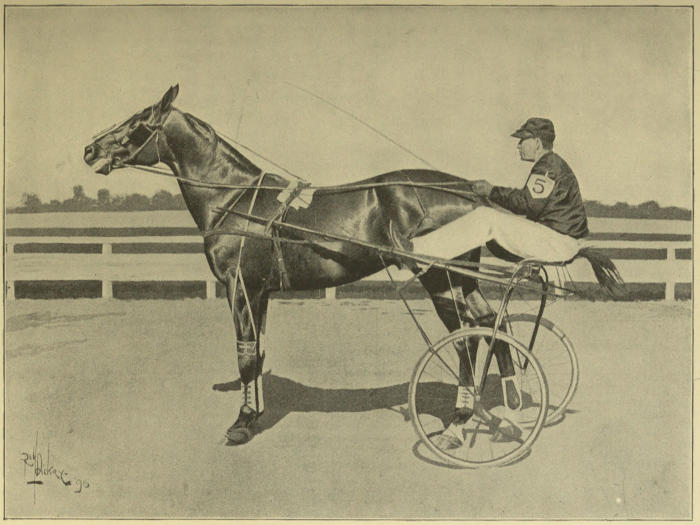
STAR POINTER.
By Brown Hal, strictly pacing bred, record 1:59¼, 1897.
First, all horses walk, all horses pace or trot, and all horses
gallop. The walk is easily analyzed, for it is slow and the movement
of each limb can be followed by the eye. Each foot makes
its own stroke upon the ground, and we count one, two, three,
four in the revolution.
Second, at the gallop, which is a succession of leaps, each
limb, as shown by the instantaneous photograph, performs its
own function, whether in rising from the ground, flying through
the air, or in striking the ground again. There is harmony in
all, but there is no unity in any two or more of them, and when
they strike the ground again you hear the impacts, one, two,
three, four, in a cluster. The conventional drawing of the running
horse in action is impossible in nature, and a wretched caricature
of the action as it is. As in the walk, so in the run, we
count four impacts in the revolution.
Third, at the pace the horse advances the two feet, on the
same side, at the same time, and when they reach the ground
again there is but one impact; then the two feet on the other side
are advanced and strike in the same way. Thus, the rhythm of
the action strikes the ear as that of the movement of an animal
with two feet instead of four. In this there can be no mechanical
mistake, for in the revolution of the four-legged pacing horse
we count one, two, and in the revolution of the two-legged man
we count one, two. The conclusion, therefore, seems to be inevitable
that the two legs on the same side of the pacing horse
act in perfect unison in performing the functions of one leg. At
the trot the horse advances the two diagonal feet at the same
time, and when they reach the ground again there is but one impact;
then the two other diagonal feet are advanced and strike
in the same way. Thus, the rhythm of the action strikes the
ear as that of the movement of an animal with two feet instead
of four. In this there can be no mechanical mistake, for in the
revolution of the four-legged trotting horse we count one, two,
and in the revolution of the two-legged man we count one, two.
The conclusion, therefore, seems to be inevitable that the two
diagonal legs of the trotting horse act in perfect unison in performing
the function of one leg. In the mechanism of the gait
then that is midway between the walk and the gallop there is no
difference in results, nor distinction in the economy of motion,
except that the pacer uses the lateral legs as one, and the trotter
the diagonal legs as one. In use, there is a vertical distinction,
if that term should be allowed, between the gait of the pacer and
the trotter. The action of the pacer is lower and more gliding
which fits him for the saddle, while the action of the trotter is
higher and more bounding which makes him more desirable as a
harness horse. In the processes of inter-breeding to the fastest,
this distinction, if it be a distinction, seems to be coming less
real, or at least less observable.
While the essential oneness of the pace and the trot is indicated
above from the mechanism and unity of the two gaits,
there is a great mountain of evidence to be developed when we
reach the consideration of breeding subjects, in which we will
meet multitudes of fast trotters getting fast pacers, and fast
pacers getting fast trotters; fast pacers changed over to fast trotters
and fast trotters changed over to fast pacers, and the final evidence
that speed at the one gait means speed at the other. Having
briefly explained what a pacer is, it is now in order to take
up the question of whence he came.
On the summit of the Acropolis, in Athens, stand the ruins of
the Parthenon, a magnificent temple erected to the goddess
Minerva. The building was commenced in the year B.C. 437,
and was completed five years afterward. All the statuary was
the work of the famous Phidias and his scholars, made from
Pentelic marble. This noted building resisted all the ravages
of time, and had, in turn, been converted into a Christian temple
and a Turkish mosque. In 1676 it was still entire, but in 1687
Athens was besieged by the Venetians, and the Parthenon was
hopelessly wrecked. As a ruin it became the prey of the Turks
and all other devastators, and in order to save something of what
remained of its precious works of art, Lord Elgin, about the year
1800, brought home to England some portions of the frieze of
the temple, with other works of Phidias, in marble, sold them to
the government, and they are preserved in the British Museum.
This frieze is a most interesting subject to study, not only as a
specimen of Greek art of the period of Pericles, but as a historic
record of the type and action of the Greek horses of that day.
It consists of a series of white marble slabs, something over four
feet wide, upon which are sculptured, in high relief, the heroes
and defenders of Athens, mounted on horses, and some of these
horses are pacing, while others are trotting and cantering. This
is the first undoubted record we have of the pacer, and it is now
over two thousand three hundred and thirty years old.
Britain became a Roman province in the reign of Claudius, in
the first part of the first century of the Christian era, and it continued
under the Roman yoke until A.D. 426, when the troops
were withdrawn to help Valentinian against the Huns, and never
returned. When Julius Cæsar first invaded Britain, in the year
B.C. 55, he found the inhabitants fierce and warlike and abundantly
supplied with horses and war chariots. These chariots
were driven with great daring and skill, and the fact was thus
demonstrated that this kind of warfare was not a new thing to
the Britons, and that they were not to be easily subdued. The
next year he returned again, but the second seems to have been
no more successful than the first expedition. But little is known
of the extent of territory overrun or the result of these invasions
beyond the fact that no settlement was made then, and none till
about ninety years afterward, when under the reign of Claudius,
a strong military colony was planted there and Britain became a
Roman province. During these centuries of bondage we know
practically nothing of the lives of the slaves and but little of
their masters, except the remnants of military works for aggression
and defence, and the magnificent roads they constructed where-ever
they moved their armies. In relation to their horses, I will
make a few extracts from a work published about the beginning of
this century, by Mr. John Lawrence, a man of great research and intelligence,
besides of a wide acquaintance with the practical affairs
of the horse, and, I may add, altogether the most reliable writer
of his period. He says:
“In forming the paces, if the colt was not naturally of a proud and lofty
action, like the Spanish or Persian horses, wooden rollers and weights were
bound to their pastern joints, which gave them the habit of lifting up their
feet. This method, also, was practiced in teaching them the ambulatura, or
amble (pace), perhaps universally the common traveling pace of the Romans.
“That natural and most excellent pace, the trot, seems to have been very
little prized or attended to by the ancients, and was, indeed, by the Romans
held in a kind of contempt, or aversion, as is demonstrated by the terms which
served to describe it. A trotting horse was called by them succussator, or
shaker, and sometimes cruciator, or tormentor, which bad terms, it may be presumed,
were applied specially to those which in these days we dignify with
the expressive appellation of ‘bone-setters.’”
The statuary of the early ages furnishes some excellent illustrations
of the gait of the horse at that period of the world’s history.
The four bronze horses on St. Mark’s in Venice are known
throughout the world, and they are in the pacing attitude. The
forefoot that is advanced is possibly a little too much elevated
to strike the ground the same instant the hinder foot should
strike it, but the whole action indicated is undoubtedly the
lateral action. The date of these horses is lost in history, but it
is supposed they were cast in Rome, about the beginning of the
Christian era. Their capture in Rome and transfer to Constantinople,
then their capture by the Venetians and transfer to
Venice, next their capture by Napoleon and transfer to Paris,
and then their restoration to Venice, are all matters of history.
William Stephanides, or Fitz Stephen, as he was called, a
monk of Canterbury, was born in London, lived in the reigns of
King Stephen, Henry II., and Richard I., and died 1191. He
wrote a description of London in Latin, which was afterward
translated by John Strype, and printed, from which I take the
following extract:
“There is without one of the gates, immediately in the suburb, a certain
smooth field (Smithfield) in name and reality. There every Friday, unless it
be one of the more solemn festivals, is a noted show of well-bred horses exposed
for sale. The earls, barons and knights who are at the time resident in
the city, as well as most of the citizens, flock thither either to look or to buy.
It is pleasant to see the nags with their sleek and shining coats, smoothly ambling
(pacing) along, raising and setting down, as it were, their feet on either side; in
one part (of the field) are horses better adapted to the esquires; those whose pace
is rougher, yet expeditious, lift up and set down, as it were, the two opposite fore
and hind feet (trotting) together.”
After locating and describing the pacers in one part of the field
and the trotters in another, Fitz Stephen goes on to take a look
at the colts, then horses of burden, “strong and stout of limb,”
and then their chargers in their galloping action. He next gives
a very spirited description of the race, when the people raise a
shout and all the other horses, cattle, etc., are cleared away, that
the contestants may have an unobstructed field. It is a fact
worthy of note that every English writer on the race horse, for
the past century or two, has quoted a part of the above paragraph
from Fitz Stephen as the first known and recorded instance of
racing in England, but left one of the most important parts out.
Even Mr. Whyte, one of the most prominent of modern writers,
in his “History of the British Turf,” seems to have followed some
other writer, in the omission; or possibly, as he never had seen a
pacer in England, he concluded that Fitz Stephen had only imagined
that he saw, in one part of the field, horses moving at the
lateral gait. In the paragraph quoted above, I have italicised
that part of the description which English writers on turf subjects
have omitted with remarkable uniformity.
This seems to have been the period in which the pacing horse
reached the highest point in official and popular appreciation, at
least since the days of the Roman occupation of Britain. In
speaking of this period, Mr. Lawrence says: “All descriptions of
saddle horses were taught to amble” (that did not amble naturally),
“and that most excellent and useful gait, the trot, was
almost entirely disused.” In addition to the evidence of Fitz
Stephen, we have that furnished by the Great Seals of a succession
of sovereigns commencing with Richard I., and continuing
to Elizabeth. These seals represent a knight in armor, mounted
on a pacing horse in action, and perhaps the most conspicuous,
at least the clearest, impression that has come down to us is that
of King John, used at Runnymede, when he yielded to the demands
of his barons and granted the Magna Charta. This act
secured the liberties of the Anglo-Saxon race for all time and in
all climes.
Mr. Thomas Blundeville was, probably, the first writer on the
horse who undertook to publish a book in the English language
on that subject. This book, entitled “The Art of Riding,” was
merely a translation from the Italian, with some brief observations
on English horses added to it. The first edition, it is said,
was published in London, 1558, the year that Queen Elizabeth ascended
the throne. The only edition which I have been able to
find in the British Museum is that of 1580, in old English black
letter. In quoting from the old authors of that period I will
seek to avoid confusion by using the modern orthography. In
speaking of the horses of his day he says:
“Some men would have a breed of great trotting horses meet for the war
and to serve in the field. Some others again would have a breed of ambling
horses of a mean stature for to journey and travel by the way. Some, again,
would have a race of swift runners to run for wagers or to gallop the buck, or
to serve for such like exercise for pleasure. But the plain countryman would
have a breed only for draft or burthen.
“The Irish Hobbie is a pretty fine horse, having a good head and a body indifferently
well proportioned, saving that many of them be slender and pin-buttocked.
They are tender-mouthed, nimble, pleasant and apt to be taught,
and for the most part they be amblers and thus very meet for the saddle and to
travel by the way. Yea, and the Irishmen, both with darts and light spears,
do use to skirmish with them in the field, and many of them do prove to that
use very well, by means they be so light and swift.
“Let those mares that shall be put to the stallion be of a high stature,
strongly made, large and fair, and have a trotting pace as the mares of Flanders
and some of our own mares be. For it is not meet, for divers reasons,
that horses of [service stallions] should amble. But if any man seeks to have
a race of ambling horses, to travel by the way, then I would wish his stallion
to be a fair jennet of Spain, or at least a bastard jennet, or else a fair Irish
ambling Hobbie; and the mare to be also a bastard jennet, bred here within
this realm, having an ambling pace, or else some other of our ambling mares,
so that the mare be well proportioned. And if any man desires to have swift
runners let him choose a horse of Barbary or a Turk to be his stallion, and let
the mare, which shall be put unto him, be like of stature and making unto
him, so nigh as may be, for most commonly, such sire and dam such colt.”
It is evident Mr. Blundeville was not much of a friend of the
pacer, but as an honest writer he considers things as he finds
them. Unfortunately he throws no light upon just what he
means by the term “Spanish Jennet,” and a definition of that
term, as used in the sixteenth century, would throw much light
on passages from following writers in later periods. Everybody
knows he was a small Spanish saddle horse, but nobody knows
just what gait he took. To use Blundevilles own language,
“The pace of the jennet of Spain is neither trot nor amble, but a
comely kind of going like the Turke.”
Mr. Gervaise Markham published several revised and enlarged
editions of his work on the horse, the last of which I have been
able to examine being printed in London, 1607, the same year
the colony was planted at Jamestown, Virginia. In this edition
he devotes nine short chapters or paragraphs to the pacer. In
quoting from him I will again use the modern methods of spelling.
He says:
“First to speak of ambling in general. It is that smooth and easy pace
which the labor and industry of an ingenious brain hath found out to relieve
the aged, sick, impotent and diseased persons, to make women undertake
journeying and so by their community to grace society; to make great men try
the ease of travel, more willing to thrust themselves into the offices of the commonwealth,
and to do the poor both relief and service. It makes them when
necessity, or as the proverb is, “when the devil drives,” not to be vexed with
the two torments, a troubled mind and a tormented body. To conclude, ambling
was found out for the general ease of the whole world, as long as there is
either pleasure, commerce or trade amongst the people. Now for the manner
of the motion and the difference betwixt it and trotting. It cannot be described
more plainly than I have set down in my former treatise; which is that it is the
taking up of both legs together upon one side and so carrying them smoothly
along to set them down upon the ground even together, and in that motion he
must lift and wind up his fore foot somewhat high from the ground, but his
hinder foot he must no more than take from the ground, as it were, sweep it
close to the earth. Now, by taking up both his legs together on one side, I
mean he must take up his right fore foot and his right hinder foot. For, as in
the contrary pace, when a horse trots he takes up his feet crosswise, as the
left hinder foot and the right fore foot, etc.”
Mr. Markham, in his edition of 1607, then goes on in six or
eight chapters acknowledging that many foals pace naturally,
and to show how the foal may be trained to pace. His methods
are very cruel, in many cases, and very crude throughout; but it
clearly demonstrates the fact that in the sixteenth century the
pace was a very general gait among English horses. In these
chapters we find the toe weight first introduced as well as the
trammels or hopples. The most striking fact brought out in
these chapters is the discovery that more than three hundred
years ago Englishmen were using the same devices to convert
trotters into pacers that we are now using to convert pacers into
trotters. He takes notice that Mr. Blundeville had advised those
who wished to breed amblers to select a Spanish jennet or an
Irish Hobbie, and objects to the former on the grounds that their
paces are weak and uncertain. From this I conclude that the
gait of the jennet, whatever it might have been, was not a habit
of action fixed in the breed, and that its transmission was doubtful.
Mr. Markham then goes on further to explain the mechanism
of the trot and the pace and incidentally introduces the rack or
single-foot action, which, I think, is the first time I have found
it in any English writer. He says:
“The nearer a horse taketh his limbs from the ground, the opener and evener
and the shorter he treadeth, the better will be his pace, and the contrary
declares much imperfection. If you buy a horse for pleasure the amble is the
best, in which you observe that he moves both his legs on one side together
neat with complete deliberation, for if he treads too short he is apt to stumble,
if too large to cut and if shuffling or rowling he does it slovenly, and besides
rids no ground. If your horse be designed for hunting, a racking pace is most
expedient, which little differs from the amble, only is more active and nimble,
whereby the horse observes due motion, but you must not force him too eagerly,
lest being in confusion he lose all knowledge of what you design him to, and
so handle his legs confusedly. The gallop is requisite for race horses....
If he gallop round and raise his fore legs he is then said to gallop strongly, but
not capable of much speed, and is fitter for the war than racing.”
In 1667 the Duke of Newcastle published his famous work on
the horse under the title, “A New Method and Extraordinary
Invention to Dress Horses, and Work them According to Nature
and also To Perfect Nature by the Subtilty of Art which was
Never Found Out, but by the Thrice Noble, High, and Puissant
Prince, William Cavendish, Duke, Marquess, and Earl of Newcastle,
etc., etc.,” followed with twelve other titles and offices.
The book was dedicated to “His Most Sacred Majesty, Charles
the Second,” and is pretentious and magniloquent in its letter
press and its make-up as it is in its title. In this work there is
a great deal of bad English, some sense, and much nonsense, all
mixed up with a strut of superiority that His Grace, no doubt,
felt justified in enjoying after his long years of beggary in Antwerp.
In giving the natural gaits of the horse he places the
walk first, then the trot and next the amble, which he describes
very minutely as follows:
“For an amble he removes both his legs of a side, as, for example, take the
far side, he removes his fore leg and his hinder leg at one time, whilst the
other two legs of the near side stand still; and when those legs are on the
ground, which he first removed, at the same time they are upon the ground
the other side, which is the nearer side, removes fore leg and hinder leg on
that side, and the other legs of the far side stand still. Thus an amble removes
both his legs of a side and every remove changes sides; two of a side in the
air and two upon the ground at the same time. And this is a perfect amble.”
The duke seems to have been somewhat profuse in the use of
words, and not very happy in his use of them, but after all we
know just what he means. The description of the movement is
that of the clean-cut pace, and our object in introducing it here
is not only to show that the pace was then a well-known and
natural gait in England, but also to show that the pace and the
amble are one. In itself, the word “amble” is a better word than
“pace,” for the latter is often used in referring to a rate of speed
without regard to the particular gait taken by the horse, but in
this country it is now universally understood to apply to the
lateral motion, and it would not be wise at this day to attempt to
change it. There is an undefined supposition in the mind of
some people that the amble is something different from the pace,
that it is a slower and less pronounced gait, and hence we are
often told a given horse did not pace, but “he ambled off.” In
all that we have found in the writings of the past, and in all that
I have seen with my own eyes, I have not been able to discover
that there is any distinction between the amble and the pace.
The only distinction is not in the gait itself, but in the fact that
our ancestors, four hundred years ago, used the word “amble”
to express precisely the same thing that their descendants now
express by the word “pace.” The only sense in which the word
“amble” is used among the horsemen of this country is to describe
a kind of slow, incipient pace that many horses, both runners
and trotters, show when recalled for a fresh start in scoring
for a race. This probably indicates, whether in the case of a
runner or a trotter, that somewhere, not very far removed, there
is a pacing inheritance, and this incipient amble, as it is sometimes
called, comes from that inheritance. It is also possible
that it may arise from the excitement of the start and the confusion
consequent upon the contest.
At the close of Queen Elizabeth’s reign, about the beginning
of the seventeenth century, the pacing horse of England was at
the highest point of his utility and fame. He was the horse for
the race course, he was the horse for the hunting field, and he was
the horse for the saddle. He was able to beat King James’
Arabian, and with the few Barbs that had then been brought in,
the historian informs us, he was able to hold his own. There
were two tribes of his congeners, the Galloway and the Irish
Hobbie, the former from Southwestern Scotland and the north of
England, and the latter from Ireland. These tribes were chiefly
pacers, and not a few of them were distinguished as running
horses. The Bald Galloway, as he was called, was a grand representative
of his tribe. He was simply a native pony with a bald
face, and he was a capital runner for his day, and a number of
his get were distinguished runners. True, he is tricked out in
the Stud Book with a pedigree, wholly fictitious, and that nobody
ever heard of for a hundred years after he was foaled, but
that did not prevent his daughter Roxana, when bred to Godolphin
Arabian, from producing two of his greatest sons, Lath and
Cade. This topic, however, has already been considered in the
chapter on the English Race Horse. The Galloways were very
famous as pacers in their day, and it seems they were about the
last remnants of the pacing tribes to be found in England. It
seems, also, that long after they had ceased to be known on the
other side their descendants were still known by the same designation
in Virginia. From the history of the times, it appears
that a wealthy Irish gentleman invested quite largely in shipping
live stock to Virginia, and there can hardly be a doubt that his
shipments included some of the Irish Hobbies.
While the opening of the seventeenth century witnessed the
supremacy of the English pacer, in the uses and enjoyments of
the lives of the people, during the whole course of its succeeding
years he was battling for his existence, and at its close he was
nearly extinct. At the close of Queen Anne’s reign there were
still a few Galloways left, but in the early Georges there were no
longer any survivors, and Great Britain was without a pacer in
the whole realm. The extinction of a race of horses that had
been the delight of the kings, queens, nobility, and gentry of a
great nation for many centuries is, perhaps, without a precedent
in the history of any civilized people, and the causes which produced
this wonderful result are well worthy of careful study. In
looking into these causes we must consider the facts as we find
them.
As we have no guide, either historic, linguistic or ethnographic,
by which we can certainly determine the blood of the original
inhabitants of the British Isles, it is not remarkable that we
should be in profound ignorance as to the blood of their horses.
They were, doubtless, like their masters, of mixed origin, and
through all the centuries their appearance would indicate that
they have been bred and reared in a nomadic or semi-wild state,
in which only the toughest and fleetest had survived. A good
many years ago I met with a theory, advanced by somebody, that
the original horse stock of Britain came from the North, but
there were no reasons given to support it. I have no hesitation
in accepting this theory, as far as it distinguishes between the
North and the South, for some Northern countries produce vast
numbers of natural pacers, as Russia, for instance, but I have
never learned that any Southern country produced pacers. Certainly
the shaft horse of the Russian drosky has been a flying
pacer for generations, and great numbers of them are produced
in Russia, especially in the eastern part of the empire. As these
pacers are produced in a natural and semi-wild state, it must be
conceded that habits of action have been inherited from their
ancestors in the remote past. Historically, we know that the
Phœnicians, when they ruled the trade of the world, supplied the
whole of the northern coast of Africa, from Egypt to Algiers, and
the southern coast of Spain, with horses, about a thousand years
before the Christian era. Now, the horses of those regions are
the descendants of the original stock carried there by the Phœnicians,
and we know their habit of action is not that of the pacer.
Hence the conclusion that the English pacer came from the
North and not from the South. In speaking of the difference in
the gaits of Northern and Southern horses, Mr. John Lawrence
specifies the horses of Norway, Sweden, Denmark, etc., and says:
“They are round made, but with clean heads and limbs; their
best pace is the trot (or pace), which indeed is the characteristic
pace of the Northern, as the gallop is of the Southern horse.”
Other writers speak of the trot (or pace) as common to Northern
horses, but as not common to Southern horses. Now, as all
Southern horses do trot, and as these writers could not fail to
know that they trotted, at some rate of speed, we must construe
their terms so as to be consistent with plain, common sense.
There was something in the “trot” of the Northern horse altogether
different from the “trot” of the Southern horse that rendered
his habit of action more conspicuous, probably by his higher
rate of speed, but still more probably by the peculiar mechanism
of his lateral action. If we insert the word “pace” instead of
the word “trot,” the meaning of these old writers becomes very
plain and in harmony with other known facts. Neither does it
militate against the theory that the inhabitants of Britain may have
secured their original horse stock from the Phœnician merchants;
but if they did, it seems quite evident that at a later date they
supplemented their supply from the pacing element from the
North.
At the close of the fifteenth century Polydore Virgil, an
Italian ecclesiastic, came to England and wrote a descriptive history
of the British Islands in Latin, which was published about
1509. Part of this history was very clumsily translated about
the time the English language began to assume its present form
in literature and learning. In speaking of the horses of the
country, he seems to have been greatly surprised with the pacers,
and treats them as a curiosity. He says: “A great company of
their horses do not trot, but amble, and yet neither trotters nor
amblers are strongest, as strength is not always incident to that
which is most gentle or less courageous.” It will be observed
that these observations were made nearly four hundred years ago,
and that the surprise of the Italian was not at merely seeing a
few pacers which he had never seen in his own country, but that
“the great company” of English horses were pacers. As I have
here given an instance showing the surprise of an Italian at finding
pacers, I will follow it with another showing the surprise of
an Englishman at not finding any pacers. The chaplain of the
Earl of Cumberland, on his several voyages of discovery in South
America and the West India Islands, about 1596, made elaborate
note of what he saw and learned of the new countries which the
English then visited for the first time. These notes passed into the
hands of that wonderfully prolific writer, or rather compiler,
Samuel Purchas, from whose fourth volume, page 1171, the following
paragraph is taken:
“And I wot not how that kind of beast [speaking of cattle] hath specially
a liking to these Southerly parts of the world above their horses, none of which
I have seen by much so tall and goodly as ordinarily they are in England; they
were well made and well mettled, and good store there are of them, but methinks
there are many things wanting in them which are ordinary in our English
light horses. They are all trotters, nor do I remember that I have seen
above one ambler, and that was a little fiddling nag. But it may be if there
were better breeders they would have better and more useful increase, yet they
are good enough for hackneys, to which use only almost they are employed.”
The surprise of the Englishman at finding no pacers in South
America seems to have been as great as that of the Italian at
finding so many of them in England, one hundred years earlier.
These horses were strictly Spanish, and probably were descended
from those brought from Palos in 1493 by Columbus, the first
horses that ever crossed the Atlantic. The “one little fiddling
nag” that showed some kind of a pacing gait may have been of
English blood and captured from some English expedition, several
of which were unfortunate; or his failure to trot may have been
the result of an injury. It should not be forgotten that in
that period every sea captain was out for what he could capture,
and this was especially the case as between the English and the
Spanish. These are the outlines of the principal points of evidence
that the pacing habit of action came from the North and
not from the South. That there were pacers in both Greece and
Rome before the Christian era, and perhaps later, there can be no
doubt, for they were both overrun and devastated again and
again by the hordes of Northern Barbarians, bringing their flocks
and their herds and their families, as well as their horses, with
them.
This question naturally suggests itself here: “If the English
pacer had been the popular favorite of the English people for so
many centuries, how did it come that he and his habit of action
had been so completely wiped out in one century, the seventeenth?”
This question might be answered in very few words,
by saying the people thought they were getting something better
to put in his place. In reaching this conclusion I will not
pretend to say the judgment of the people was not right, that is,
if they exercised any judgment in the case. “Jamie the Scotsman”
when on the throne set the fashion in the direction of
foreign blood by paying the enormous price of five hundred
pounds for the Markham Arabian. The Duke of Newcastle,
when he was young, had personally seen this horse, and while he
thought he was a true Arabian, he described him as a very ordinary
horse in his size and form, and an entire failure as a race
horse. It seems that any average native pacer could outrun him,
but he carried the badge of royalty, and that was sufficient to
make him fashionable, as he was not only the king’s horse, but
was himself a royal Arabian. The weak place in the character
of James I., in addition to his intolerable pedantry, was his inordinate
ambition to be considered the wisest sovereign who ever
sat upon a throne since the days of Solomon. His courtiers,
nobility, and all who approached him understood his weakness,
and a little quiet praise of the great superiority of the Arabian
blood in the horse, over all other breeds and varieties, was always
grateful to the monarch, for he was the original discoverer and
patentee of that blood. Then and there, in order to praise the
wisdom of a foolish king, a foolish fashion grew into a foolish
notion that has afflicted all England from that day to this. No
humbug of either ancient or modern times has had so long a run
and so wide a range as the miserable fallacy “that all excellence
in the horse comes from the Arabian.” Notwithstanding the
thousand tests that have been made and the thousand failures
that have invariably followed, from the time of King James to
the present day, there are still men writing books and magazine
articles on the assumption that “all excellence in the horse comes
from the Arabian,” without ever having devoted an honest hour
to the study of the question as to whether this is a truth or a fallacy.
This craze for Arabian blood was the primary cause of the
extinction of the pacer, and this craze was so strong in its influence
that when a foreign horse was brought in, no difference
from what country, if he were of the lighter type he was called
an Arabian and so advertised in order to secure the patronage of
breeders. Horses brought from the African coast were invariably
classed as Arabians, notwithstanding they and their ancestors
were in Africa more than a thousand years before there were any
horses in Arabia; and the same may be said of Spain. But as this
line of inquiry has already been considered in another chapter,
I will get back to the immediate topic.
The process of breeding out the pacer did not commence in
real earnest until the middle of the seventeenth century, when
the Stuarts regained the sovereignty of Great Britain in the person
of Charles II. Released from the restraints of Puritan rule,
the Restoration brought with it a carnival of immorality and vice,
for the court and the courtiers set the fashion and the people followed.
As the breeding interest of the period of which we now
speak has already been considered in the chapter on the English
Race Horse, I will not further enlarge upon it. The light, or
running and hunting, horses of England of that day were not all
pacers, but they were all of the same type and the same blood,
hence when I speak of the pacers I include their congeners.
They were small—less than fourteen hands high—and not generally
handsome and attractive. In general utility they were ahead
of the importations, and doubtless many of them could run as
fast and as far as the foreign horses, but the foreigners had the
advantage in size, especially the Turks and the Neapolitans; besides
this, they were more uniformly handsome and attractive in
their form and carriage. It is also probable that the outcross
from the strangers to invigorate the stock was needed and resulted
in the increase of the size of the progeny. This latter
suggestion is inferential and has been sustained by many similar
experiences, but without this as a start it would be exceedingly
difficult to account for the rapid increase in the height of the
English race horse. It is certainly true that the chief aim of the
English breeder of that day was to increase the size, without losing
symmetry and style, and if he found that foreign upon native
blood gave him a start in that direction, he was wise in the commingling.
Another consideration, growing out of the rural economy
of the people, doubtless had a very wide influence in the
direction of wiping out the pacer, in this period of transition.
Long journeys in the saddle became less frequent, good roads
began to appear and vehicles on wheels took the place of the saddler
and the pack horse. To get greater weight and strength for this
service, recourse was had to crosses with the larger and courser
breeds, and through these channels have come the giants and the
pigmies of the modern race course. Under the changed conditions
of travel and transportation it is not remarkable that the
people should have been willing to see their long-time favorites
disappear, for it is known to every man of experience that the
pace is not a desirable gait for harness work. No doubt the pacer
is as strong as the trotter of the same size and make-up, but in
his smooth, gliding motion there is a suggestion of weakness communicated
to his driver that is never suggested by the bold,
bounding trotter. The antagonism between the pacers and the
new horses of Saracenic origin was irreconcilable and one or the
other had to yield. As the management of the contest was in
the hands of the master the result could be easily foreseen, for if
one cross failed, another followed and then another, till the Saracenic
blood was completely dominant in eliminating the lateral
and implanting the diagonal action in its stead.
As no home-bred pacer, of any type or breed, has been seen in
England for nearly two hundred years, it is not remarkable that
Englishmen of good average intelligence, for the past two or three
generations, have lived and died supposing they knew all about
horses, and yet did not know there had ever been such a thing in
England as a breed of pacing horses. When, some eighteen or
twenty years ago, I called the attention of Mr. H. F. Euren,
compiler of the Hackney Stud Book, to the early English pacers
as a most inviting field in which to look for the origin of the
“Norfolk Trotters,” he was surprised to learn that such horses
had existed in England, but he went to work and gathered up
many important facts that appear in the first volume of the
Hackney compilation. Many of these facts, but in less detail,
had already appeared, from time to time, in Wallace’s Monthly,
but Mr. Euren’s was the first modern English publication to
place them before English readers. From this prompting, Mr.
Euren did well, but we must go back a little to see how this subject
was treated by English writers of horse books, who wrote
without any promptings from this side.
Mr. William Youatt was a voluminous writer on domestic
animals, and at one time was looked upon as the highest authority
on the horse, both in England and in this country. He seems
to have been a practitioner of veterinary surgery, and from the
number of volumes which he published successfully, he must
have been a man of ability and education. There can be no
question that he knew a great deal—quite too much to know anything
well. The first edition of his work on the horse was published
in 1831, and soon after its appearance several publishing
houses in this country seized upon it as very valuable, and each
one of them soon had an edition of it before the public. It purports
to have been written at the instance of “The Society for
the Diffusion of Useful Knowledge.” This declaration was a
good thing, in a commercial view, and no doubt it did much in
extending the circulation of the book. Without tarrying to note
several minor historical blunders, I will go direct to one relating
to the gait of the horse, which is now under consideration. In
his fourth edition, page 535, he incidentally discusses the mechanism
of the pace, and after speaking of the Elgin Marbles, to
which I have referred at the beginning of this chapter, and after
conceding that two of the four horses are not galloping but pacing,
he says:
“Whether this was then the mode of trotting or not, it is certain that it is
never seen to occur in nature in the present day; and, indeed, it appears quite
inconsistent with the necessary balancing of the body, and was, therefore, more
probably an error of the artist.”
This remark is simply amazing in an author who pretentiously
undertakes to instruct his countrymen in the history of the horse
when he knows nothing about that history. If he had gone back
only twenty-two years, “Old John Lawrence,” in his splendid
quarto, would have told him about the pacer. If he had gone
back one hundred and sixty years, the Duke of Newcastle would
have explained to him the complete and perfect mechanism of
the pacing gait. If he had gone still further back and examined
Gervaise Markham, Blundeville, Polydore Virgil, and Fitz
Stephen the Monk, of the twelfth century, any and all of them
would have explained to him the pacing habit of action and shown
him that for many successive centuries the pacing horse was the
popular and fashionable horse of the realm. If Mr. Youatt had
lived to see John R. Gentry pace a mile in 2:00½; Robert J. in
2:01½, and dozens of others in less than 2:10, he might have
changed his mind and concluded that it was possible, after all, for
a horse to travel at the lateral gait without toppling over. From
Mr. Youatt and a few other modern English authors, most of our
American writers on the horse have derived what little mental
pabulum they thought they needed, and thus an error at the
fountain has been carried into all the ramifications of our horse
literature. Only two or three years ago a very intelligent gentleman,
who had attained great eminence as a veterinary surgeon,
especially for his knowledge and treatment of the horse’s foot,
seriously and in good faith stoutly maintained that the pacing
habit of action was merely the result of an abnormal condition of
the foot, and that all pacers would trot just as soon as their feet
were put in the right shape. We must not laugh at this wild
notion, for it is really no worse than Mr. Youatt’s doubting
whether it was possible for a horse to balance himself at the
lateral motion. Neither gentleman seemed to know anything
about the fact that it was a matter of inheritance, and that the
lateral habit of action had come down by transmission through
all the generations for a period of more than two thousand years.
It is hardly necessary to say that the gentleman who was so confident
that the pace was merely the result of the abnormal condition
of the feet brought his notions about the pacer from across
the water. He was an Anglo-American, and could make a pacer
into a trotter in a jiffy, by using the paring-knife. He was an
intelligent man and a skillful veterinarian, but there were no
pacers in England and there should be none here. Toward the
close of the chapter on The Colonial Horses of Virginia, will be
found the observations of an English tourist in 1795-96 who is
very certain that there is some mistake about the pacer, and will
not be convinced there are any, unless they are artificially created.
Having now completed what I had to say about the old English
pacer, it is next in order to consider his descendants in this
country and the relations they bear to the American trotter.
CHAPTER XIV. THE AMERICAN PACER AND HIS RELATIONS TO THE AMERICAN TROTTER.
Regulations against stallions at large—American pacers taken to the West
Indies—Narragansett pacers; many foolish and groundless theories about
their origin—Dr. McSparran on the speed of the pacer—Mr. Updike’s
testimony—Mr. Hazard and Mr. Enoch Lewis—Exchanging meetings
with Virginia—Watson’s Annals—Matlack and Acrelius—Rip Van Dam’s
horse—Cooper’s evidence—Cause of disappearance—Banished to the frontier—First
intimation that the pace and the trot were essentially one gait—How
it was received—Analysis of the two gaits—Pelham, Highland
Maid, Jay-Eye-See, Blue Bull—The pacer forces himself into publicity—Higher
rate of speed—Pacing races very early—Quietly and easily developed—Comes
to his speed quickly—His present eminence not permanent—The
gamblers carried him there—Will he return to his former obscurity?
In the several chapters devoted to “Colonial Horse History”
will be found all the leading facts that I have been able to glean
from the early sources of information. With the exceptions of
the horses brought from Utrecht in Holland to New Amsterdam
(New York), two shiploads that sailed out of the Zuider Zee and
landed at Salem, Massachusetts, and those brought from Sweden
by the colonists that settled on the Delaware, all the early importations
came from England. As much the larger number of
those from England and Sweden were pacers, the breeds and
habits of action were soon mixed up, as those who had no pacers
wanted pacers for the saddle, and those who wanted more size,
regardless of the gait, were always ready to supply their want by
an exchange of their saddle horses for more size. The Dutch
horses were certainly something over fourteen hands and the English
and Swedish horses were perhaps nearer thirteen than fourteen
hands. The colonists from the first, and from one end of the
land to the other, seem to have appreciated the importance of increasing
the size and strength of their horse stock, and this was
very hard to do under the conditions then prevailing of allowing
their horses to roam at large. Hence, stringent regulations were
adopted in all the colonies against permitting immature entire
colts and stallions under size to wander where they pleased. It
is doubtful whether these regulations were any more effective
than those of Henry VIII., for while there was some increase, it
was hardly perceptible until after the close of the colonial days.
The real increase did not commence till the farmers had provided
themselves with facilities for keeping their breeding stock at
home.
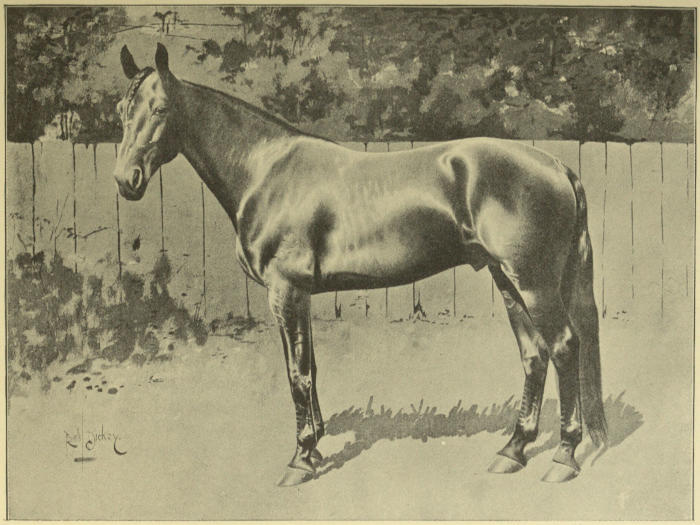
JOHN R. GENTRY.
By Ashland Wilkes, pacing record 2:00½, 1896.
It is very evident from the statistics of size and gait, as given
in the chapters referred to above, that our forefathers wisely
selected the most compact, strong and hardy animals they could
find in England as the type best adapted to fight their way
against the hardships of a life in the wilderness of the new world.
There have been some attempts, wholly fanciful and baseless, to
trace importations from other countries, outside of those mentioned
above, but all such attempts have proven wholly imaginary
and worse than futile. In less than twenty years after the New
England colonies received their first supply they commenced
shipping horses by the cargo to Barbadoes and other West India
Islands. This trade was cultivated, extended to all the islands,
and continued during the remainder of the seventeenth and
practically the whole of the eighteenth century. The pacers of
the American colonies were exceedingly popular and sought after
by the Spanish as well as the Dutch and English islands. Indeed,
the planters of Cuba alone carried away at high prices
nearly all the pacers that New England could produce. They
knew nothing about pacers for the saddle until they had tried
them and then they would have nothing else. These continuous
raids of the Spaniards of the West Indies upon the pacers of
New England, and Rhode Island especially, has been assigned,
by the local historians of that State as one of the principal
causes of the decadence and practically final disappearance of the
Narragansett pacer from the seat of his triumphs and his fame.
It is just to remark here, in passing, that if there had been pacers
among the horses of Spain, the Spanish dependencies would have
secured their supplies from the mother country and not have
come to Rhode Island and paid fabulous prices for them.
As all the pacing traditions of this country to-day point to
the horses of Narragansett Bay as the source from which our
modern pacers have derived their speed, we must give some attention
to the various theories that have been advanced as to the
origin of the Narragansett horse. In time past, and extending
back to a period “whereof the memory of man runneth not to the
contrary,” the horse world has been cursed with a class of men
who have always been ready to invent and put in circulation the
most marvelous and incredible stories about the origin of every
remarkable horse that has appeared. Some of these wiseacres
have maintained that the original Narragansett pacer was caught
wild in the woods by the first settlers on Narragansett Bay, while
others (and this seems to be of Canadian origin) have insisted
that when being brought to this country a storm struck the ship
and the horse was thrown overboard, and after nine days he was
found off the coast of Newfoundland quietly eating rushes on a
sand bar, where he was rescued and brought into Narragansett
Bay. This story of the marine horse probably had its origin in
the experiences of Rip Van Dam, which will be narrated further
on. Another representation, coming this time from a very
reputable source, has been made as to the origin of the Narragansett
horse, and as many, no doubt, have accepted it as true, I
must give it such consideration as its prominence demands. Mr.
I. T. Hazard, a representative of the very old and prominent
Hazard family of Rhode Island, in a letter to the Rev. Mr. Updike,
makes the following statement:
“My grandfather, Governor Robinson, introduced the famous saddle horse,
the Narragansett pacer, known in the last century over all the civilized parts
of North America and the West Indies, from whence they have lately been
introduced into England, as a ladies’ saddle horse, under the name of the
Spanish Jennet. Governor Robinson imported the original from Andalusia, in
Spain, and the raising of them for the West India market was one of the objects
of the early planters of this country. My grandfather, Robert Hazard,
raised about a hundred of them annually, and often loaded two vessels a year
with them, and other products of his farm, which sailed direct from the South
Ferry to the West Indies, where they were in great demand.”
This theory of the origin of the Narragansett came down to
Mr. Hazard as a tradition, no doubt, but like a thousand other
traditions it has nothing to sustain it. Opposed to it there are
two clearly ascertained facts, either one of which is wholly fatal
to it. In the first place, there were no pacers in Andalusia or
any other part of Spain, and in the second place, these horses,
according to official data, were the leading item of export from
Rhode Island in 1680, and Governor Robinson was not born till
about 1693. As impossibilities admit of no argument, I will not
add another word to this “Andalusian” origin tradition, except
to say that a hundred years later, when the pacing dam of Sherman
Morgan was taken from Cranston, Rhode Island, up into
Vermont, she was called a “Spanish mare,” because Mr. Hazard
had said the original Narragansett had come from Spain. The
story of the descendants of the Narragansetts having been carried
from the West Indies to England, and there introduced
under the name of the Spanish Jennet as a lady’s saddle horse, is
wholly imaginative. The Spanish Jennet, whatever its gait may
have been, was well known in England many years before the
first horse was brought to any of the American colonies. (See
extracts from Blundeville and Markham in Chapter XII.)
After several years of fruitless search for some trace of the
early importations of horses into the colony of Rhode Island, I
have reached the conclusion that probably no such importations
were ever made. The colony of Massachusetts Bay commenced
importing horses and other live stock from England in 1629, and
continued to do so for several years and until they were fully
supplied, as stated above. In 1640 a shipload of horses were exported
to the Barbadoes, and it was about this time that Rhode
Island began to assume an organized existence. Her people were
largely made up of refugees from the religious intolerance of the
other New England colonies, and they brought their families and
effects, including their horses, with them. The blood of the
Narragansett pacer, therefore, was not different from the blood
of the pacers of the other colonies, but the development of his
speed by the establishment of a pacing course and the offering of
valuable prizes, naturally brought the best and the fastest horses
to this colony and from the best and fastest they built up a breed
that became famous throughout all the inhabited portions of the
Western Hemisphere. The race track, with the valuable prizes
it offered and the emulation it aroused, was what did it. As the
question of origin is thus settled in accordance with what is
known of history and the natural order of things, and as the Narragansett
is the great tribe representing the lateral action then
and since, we must consider such details of history as have come
down to us.
The Rev. James McSparran, D.D., was sent out by the London
Society for the Propagation of the Gospel in Foreign Parts, to
take charge of an Episcopal church that had been planted some
years before in Rhode Island. He arrived in 1721, and lived till
1759. He was an Irishman, and appears to have been somewhat
haughty and irascible in his temperament and was disposed to
find fault with the climate, the currency, the people, and pretty
much everything he came in contact with. He was a man of observation,
and during the thirty-eight years he spent in ministering
to the spiritual wants of his flock, he was not unmindful of
what was passing around him, and made many notes and reflections
on the various phases of life as they presented themselves
to his mind, and especially on the products and industries of the
colony. These notes and observations he wrote out, and they were
published in Dublin in 1753, under the title of “America Dissected.”
His writings do not discover that he was a man of very ardent
piety, but he was honored as a good man while he lived, and was
buried under the altar he had served so long. His duties sometimes
called him away into Virginia, and, in speaking of the
great distance of one parish from another, he uses the following
language:
“To remedy this (the distance), as the whole province, between the mountains,
two hundred miles up, and the sea, is all a champaign, and without
stones, they have plenty of a small sort of horses, the best in the world, like
the little Scotch Galloways; and ’tis no extraordinary journey to ride from
sixty to seventy miles or more in a day. I have often, but upon larger pacing
horses, rode fifty, nay, sixty miles a day, even here in New England, where
the roads are rough, stony and uneven.”
The reverend gentleman seems to assume that his readers knew
the Scotch Galloways were pacers, and with this explanation his
observations are very plain. He makes no distinction between
the Virginia horse and his congener of Rhode Island except that
of size, in which the latter had the advantage. In speaking of
the products of Rhode Island he says:
“The produce of this colony is principally butter and cheese, fat cattle, wool,
and fine horses, which are exported to all parts of English America. They are
remarkable for fleetness and swift pacing; and I have seen some of them pace
a mile in a little more than two minutes, and a good deal less than three.”
When I first read this sentence in the reverend doctor’s book
I confess I was not prepared to accept it in any other light
than that of a wild enthusiast, who knew but little of the force
of the language he used. To talk about horses pacing, a hundred
and fifty years ago, in a little more than two minutes and a
good deal less than three, appeared to be simply monstrous.
The language evidently means, according to all fair rules of construction,
that the mile was performed nearer two minutes than
three, or in other words, considerably below two minutes and
thirty seconds. I doubt not my readers will hesitate, and perhaps
refuse, to accept such a performance, just as I did myself
till I had carefully weighed not only the character of the
author of the statement, but the circumstances that seemed to
support it. If the learned divine had known no more of the
world and its ways than many of his profession, I would have
concluded he was not a competent judge of speed; but he was a
man of affairs, and knew perfectly well just what he was saying.
The question naturally arises here as to what opportunities or
facilities the doctor had for timing those pacers of a hundred
and fifty years ago. In a note appended to the above extract by
Mr. Updike, the editor of the work, I find the following:
“The breed of horses called Narragansett pacers, once so celebrated for
fleetness, endurance and speed, has become extinct. These horses were highly
valued for the saddle, and transported the rider with great pleasantness and
sureness of foot. The pure bloods could not trot at all. Formerly they had
pace-races. Little Neck Beach, in South Kingston, of one mile in length, was
the race course. A silver tankard was the prize, and high bets were otherwise
made on speed. Some of these prize tankards were remaining a few years ago.
Traditions respecting the swiftness of these horses are almost incredible.”
The facts stated by Mr. Updike in this note are corroborated
from other sources, and may be accepted as true. These were
the opportunities and facilities the doctor had for holding his
watch, and nobody will doubt they were sufficient to enable him
to be a competent witness. In connection with this subject, and
as another footnote, Mr. Updike introduces a letter from Mr. I.
T. Hazard, which brings out another very curious fact in the history
of the pacer. The Hazard family was very eminent in
Rhode Island, and many of its members have occupied positions
of high honor and responsibility for several generations. The
date of the letter is not given, and we may infer it may have
been written fifty years ago, or perhaps more. Mr. Hazard says:
“Within ten years one of my aged neighbors, Enoch Lewis, since deceased,
informed me he had been to Virginia as one of the riding boys, to return a
similar visit of the Virginians in that section, in a contest on the turf; and that
such visits were common with the racing sportsmen of Narragansett and
Virginia, when he was a boy. Like the old English country gentlemen, from
whom they were descended, they were a horse-racing, fox-hunting, feasting
generation.”
This paragraph from Mr. Hazard’s pen has been the subject of
very deliberate consideration. The first promptings of my judgment
were to doubt and reject it, especially on account of the
absence of date to the letter, and of the remote period in which
Mr. Enoch Lewis must have visited Virginia. Another question,
as to why we have not this information from any other
source except Mr. Hazard, presented itself with no inconsiderable
force. After viewing the matter in all its bearings I am
forced to concede that it is likely to be true. These visits must
have taken place before the Revolution, and from the construction
we are able to place upon the dates, this was not impossible.
It is a fact that I do not hesitate to announce that before the
Revolution racing in all its forms was more universally indulged
in as an amusement than it ever has been since. This was before
the days of newspapers, and all we can possibly know of the
sporting events of that period we must gather up from the detached
fragments that have come down to us by tradition.
There was a strong bond of sympathy and friendship between the
followers of Dr. McSparran in Rhode Island, surrounded as they
were by Puritans, and their co-religionists in Virginia. They
were accustomed to maritime life, and had abundance of vessels
fitted up for the shipment of horses and other live stock to
foreign ports. To take a number of their fastest pacers on board
one of their sloops and sail for Virginia would not have been considered
much of an adventure. These visits were not only occasions
of pleasure and festivity, with the incidental profits of winning
purses and bets, but they were a most successful means of
advertising the Narragansett pacer; and through these means
alone the market was opened, as Dr. McSparran expresses it, in
all parts of British America. When we consider the widespread
fame of these Rhode Island horses, and that there were no other
means by which they could have achieved it, except by their
actual performances, we are forced to the conclusion that they
were carried long distances, and in many directions, for purely
sporting purposes. That these visits would result in the transfer
of a good number of the best and fastest horses from Narragansett
to Virginia would be a natural sequence, and thus, in after
years, we might look for a strong infusion of Narragansett blood
in the Virginian pacing-horse.
It appears to be a law of our civilization that each generation
produces somebody who, out of pure love for the curious and
forgotten, devotes the best years of his life to hunting up old
things that have well-nigh slipped away from the memory of
man. In this class Mr. John F. Watson stands conspicuous
in what he has done for Philadelphia and New York. In 1830
he published a work entitled “Annals of Philadelphia and Pennsylvania,”
in two volumes, and among all the antiquated manners
and habits that he again brings to our knowledge, he has something
to say about the horse of an early day:
“The late very aged T. Matlack, Esq., was passionately fond of races
in his youth. He told me of his remembrances about Race Street. In
his early days the woods were in commons, having several straggling forest
trees still remaining there, and the circular course ranging through those trees.
He said all genteel horses were pacers. A trotting-horse was deemed a base
breed. These Race Street races were mostly pace-races. His father and
others kept pacing stallions for propagating the breed.”
Mr. Watson further remarks, on the same subject: “Thomas
Bradford, Esq., in telling me of the recollections of the races,
says he was told that the earliest races were scrub and pace-races
on the ground now used as Race Street.”
The Rev. Israel Acrelius, for many years pastor of the Swedish
church of Philadelphia, wrote a book early in the last century,
under the title, “History of New Sweden,” which has been translated
into English. In describing the country and people, in
their habits and amusements, he thus speaks of the horse:
“The horses are real ponies, and are seldom found over thirteen hands
high. He who has a good riding horse never employs him for draught, which
is also the less necessary, as journeys, for the most part, are made on horseback.
It must be the result of this, more than to any particular breed in the
horses, that the country excels in fast horses, so that horse races are often
made for very high stakes.”
It will be noted that Mr. Acrelius does not say that these races
were pacing-races; but when his remark is taken in connection
with what Mr. Matlack said about the pacers, and when it is considered
that he is speaking of the speed of the saddle horses as
such, we can easily understand his true meaning. In our turf
history I supposed I was getting well back when I reached
the great race between Galloway’s Selim and Old England, in
1767, but here we find that race was comparatively modern, and
that the pacers antedated the gallopers by many, many years.
In 1832 Mr. Watson did the same service for New York that
he had done for Philadelphia, and published his “Annals of New
York,” in which we find the piece of horse history embodied
in the extract printed on pages 126 and 127, to which the reader
will please turn.
It is hardly possible to be mistaken in assuming that Rip Van
Dam’s letter was written to some person in Philadelphia, and that
Mr. Watson saw it there. I would give a great deal for the sight of
it; and if it has been preserved in any of the public libraries of that
city, either in type or in manuscript form, I have good hopes of yet
inspecting it. In one point of view, it is of exceeding value, and
that is its date. It is fully established by this letter that, as
early as 1711, the Narragansetts were not only established as a
breed or family, but that their fame was already widespread.
This, of necessity, carries us back into the latter part of the
seventeenth century, when their exceptional characteristics were
first developed, or began to manifest themselves. In reaching
that period we are so near the first importations of horses to the
colonies that it is no violence to either history or good sense to
conclude that the original Narragansett was one among the very
earliest importations. This plays havoc with some Rhode Island
traditions, as will be seen below; but with 1711 fixed as a point
when the breed was famous, traditions must stand aside.
While on this matter of dates, it may not be unprofitable to
compare the advent of the Narragansett with the well-known
epochs in horse history. Every schoolboy knows that the Darley
Arabian and the Godolphin Arabian, say twenty years after, were
the great founders of the English race horse. The Narragansetts
had reached the very highest pinnacle of fame before the Darley
Arabian was foaled. Darley Arabian reached England about the
same year that Rip Van Dam’s Narragansett jumped over the
side of the sloop and swam ashore, and this was eighty years before
there was an attempt at publishing an English stud book.
When Janus and Othello, and Traveller, and Fearnaught, the
great founders of the American race horse, first reached Virginia,
they found the Narragansett pacer had been there more than a
generation before. On the point of antiquity, therefore, the
Narragansett is older than what we designate as the thoroughbred
race horse, and if he has a lineal descendant living to-day
the pacer has a longer line of speed inheritance, at his gait, than
the galloper.
The only attempt at a description of this breed that I have
met with is that given by Cooper, the novelist, in a footnote to
“The Last of the Mohicans.” This note may be accepted as
history, so far as it goes, and pretends to be history; but I am
not prepared to admit that all the breed were sorrels. This
color, no doubt, prevailed in those specimens that Mr. Cooper
had seen or heard of, but I think all colors prevailed, as in
other breeds. He says:
“In the State of Rhode Island there is a bay called Narragansett, so named
for a strong tribe of Indians that formerly dwelt on its banks. Accident, or
one of those unaccountable freaks which nature sometimes plays in the animal
world, gave rise to a breed of horses which were once well known in America
by the name of Narragansetts. They were small, commonly of the color
called sorrel in America, and distinguished by their habit of pacing. Horses
of this race were, and still are, in much request as saddle-horses, on account
of their hardiness, and the ease of their movements. As they were also sure
of foot, the Narragansetts were much sought for by females who were obliged
to travel over the roots and holes in the new countries.”
Without having a minute description of so much as a single individual
of the race, I can only infer, from general descriptions,
as to what their family peculiarities of form and shape may have
been. It is fully established that they were very compact and
hardy horses, and that they were not large; perhaps averaging
about fourteen and a quarter hands in height. I have met with
no intimation that they were stylish or handsome, and we think
it is safe to conclude that they were plain in their form, and low
in their carriage. From my conceptions of the horse I think
one of the better-shaped Canadian pacers, of fifteen hands or
thereabouts, might be accepted as a fair representative of the
Narragansett of a hundred and fifty years ago. He was fleet,
hardy, docile, and sure-footed, but not beautiful, and it is reasonable
to suppose that the lack of style and beauty was one of the
leading causes of his becoming extinct in the land of his nativity.
In considering the causes which resulted in what we may call
the dispersal of the Narragansett pacers, and their extinction in
the seat of their early fame, we must be governed by what is
reasonable and philosophical in the industrial interests of the
people, rather than look for some great overwhelming disaster,
like an earthquake, that ingulfed them in a night. In speaking
of this dispersal, and the causes which led to it, Mr. Hazard says:
“One of the causes of the loss of that famous breed here was the great
demand for them in Cuba, when that island began to cultivate sugar extensively.
The planters became suddenly rich, and wanted the pacing-horse for
themselves and their wives and daughters to ride, faster than we could supply
them, and sent an agent to this country to purchase them on such terms as he
could, but to purchase them at all events. I have heard my father say he
knew the agent very well, and he made his home at the Rowland Brown
House, at Tower Hill, where he commenced purchasing and shipping until all
the good ones were sent off. He never let a good one escape him. This, and
the fact that they were not so well adapted to draught as other horses, was
the cause of their being neglected, and I believe the breed is now extinct in
this section. My father described the motion of this horse as differing from
others in that his backbone moved through the air in a straight line, without
inclining the rider from side to side, as the common racker or pacer of the
present day. Hence it was very easy; and being of great power of endurance,
they would perform a journey of a hundred miles in a day, without injury to
themselves or rider.”
We can understand very well how an enormous and unexpected
demand from Cuba without restriction as to price, should reduce
the numbers of the breed very materially. But it is a poor
compliment to the intelligence and thrift of the good people of
Narragansett to say that, because there was a lively demand,
they killed the goose that laid the golden egg every day. It is a
slander upon that Yankee smartness which is proverbial to conclude
that they deprived themselves of the means of supplying a
market that was making them all rich. We must, therefore,
look for other causes that were more potent in producing, so
marked a result.
After more than a hundred years of faithful service, of great
popularity, and of profitable returns to their breeders, the little
Narragansetts began to disappear, just as their ancestors had disappeared
a century earlier. Rhode Island was no longer a
frontier settlement, but had grown into a rich and prosperous
State. Mere bridle paths through the woods had developed into
broad, smooth highways, and wheeled vehicles had taken the
place of the saddle. Under these changed conditions, the little
pacer was no longer desirable or even tolerable as a harness horse,
and he was supplanted by a larger and more stylish type of horse,
better suited to the particular kind of work required of him.
This was simply the “survival of the fittest,” considering the
nature of the services required of the animal. The average
height of the Narragansett was not over fourteen hands and one
inch. His neck was not long, even for his size; he dropped
rapidly on the croup, and his carriage was low, with nothing of
elegance or style in his appearance. His mane and tail were
heavy, his hind legs were crooked, his limbs and feet were of the
very best, but aside from his great speed and the smoothness of
his movements under the saddle, there was nothing very desirable
or attractive about him. In a contest with a type of the harness
horse, at least one hand higher, of high carriage and elegant
appearance, there could only be one result, and that soon decided.
As in England, so in this country, the blood of the running
horse soon worked the extermination of the pacer; not because it
was stronger in reproducing itself, perhaps, but because it had
the skill and fancy of the breeder enlisted in selecting and mating
so as to make the expunging process complete. Only a few
years ago a pacing horse could hardly be found in any of the
older settled portions of the country, especially where running
blood had become fashionable. He was literally banished to the
frontiers of Canada, Indiana, Missouri, Kentucky, and Tennessee,
and especially in the latter two States, where his blood is still
appreciated and preserved for the luxurious saddle gaits which
it alone transmits. In many individual cases he has shown wonderful
power in meeting and overcoming antagonistic elements,
but with the tide of running blood all against him, it was only a
question of time as to how soon he would be totally submerged.
It is only a quarter of a century ago that the first volume of
“Wallace’s American Trotting Register” was published, and then
began the great task of bringing order out of chaos. In a historical
introduction to that work, I inserted the following:
“So many pacing horses have got fast trotters, so many pacing mares have
produced fast trotters, and so many pacers have themselves become fast trotters,
and little or nothing known of their breeding, that I confess to a degree of
embarrassment, from which no philosophy relieves me. If the facts were
limited to a few individual cases we could ignore the phenomena altogether,
but, while they are by no means universal, they are too common and apparent
to be thus easily disposed of. I am not aware that any writer has ever brought
this question to the attention of the public; much less, attempted its discussion
and explanation. Indeed, it is possible that the observations of others may not
sustain me in the prominence given these phenomena, but all will concede
there are some cases coming under this head that are unexplained, and perhaps
unexplainable. It is probable trotters from this pacing origin, and that
appear to trot, only because their progenitors paced, will not prove reliable
producers of trotters. Such an animal being in a great degree phenomenal,
should not be too highly prized in the stud, till he has proved himself a trotting
sire as well as a trotter.”
This very comprehensive little paragraph, put modestly and
tentatively rather than positively, contained a germ of thought
that is to-day exerting a very wide influence. So far as my knowledge
goes, this was the first time in which the public attention had
ever been called to the intimate relations between speed at the
pace and speed at the trot. Some laughed at it as not practical,
others sneered at it as a theoretical abstraction, a few gave it some
thought, while the writers who never think left it severely alone.
It required the cumulative experiences of nearly ten years before
horsemen generally began to think about it, and then ten more
before the germ had matured itself in the minds of all intelligent
men who were able to divest themselves of their earlier prejudices.
The great primary truth now stands out in high relief
that the pace and the trot are simply two forms of one and the
same gait, that lies midway between the walk and the gallop.
At last the truth, dimly foreshadowed in the paragraph above, is
received and accepted, in some form or other, almost if not quite
universally. This fact and its acceptance are now shown in all the
recorded experiences of racing, and especially in the origin and
habits of action of many of the heads of trotting and pacing
families, to which the reader is referred.
At the beginning of Chapter XIII. I have labored to make
plain the proposition that the pace and the trot are simply two
forms of one and the same gait. This is evident from the fact
that this gait, in one form or the other, is the intermediate link between
the walk and the gallop, and this is true among nearly all
quadrupeds. I have also there shown, and I think beyond cavil,
that the mechanism of the pace and the trot is the same, and
especially in the fact that in both forms two legs are used as one
leg. That is, if the two legs on the same side move together, we
call it the pace, and if the diagonal legs move together we call it
the trot. The rhythm is the same and the sound is the same,
and by the ear no man can tell whether the movement is at the
lateral or diagonal motion. In all the varieties of steps that a
horse may be taught, and in all the methods of progression that
he may naturally adopt, there is no step or movement in which
he uses two legs as one except in the pace or the trot. From the
place, therefore, which these two forms of the gait hold, indifferently,
in animal movement, between the walk and the gallop;
from the unity of action and result in the use of the same mechanism,
and from the wide disparity between the mechanism of
this gait and that of all other gaits in the action of the horse, we
must conclude that the pace and the trot are one and the same
gait.
Another evidence of the unity of the two forms of the trot is
to be found in the great numbers of pacers that have been
changed over to trotters and the astonishing readiness with which
they took to the new form of action. To go back no further
than the records sustain us, we find that the converted pacer
Pelham was the first horse that ever trotted in 2:28. This was
in 1849, and four years later the converted pacer Highland
Maid trotted in 2:27. Twenty years later, Occident, another,
trotted in 2:16¾. These were champions of their day, and when
we come a little nearer we find that Maud S. was a pacer and
Sunol was a pacer, although neither of them ever paced in public,
and the fact that they ever paced at all was held as a kind of
“home secret.” Since the days of Pelham, literally thousands
of horses have been changed from pacers to trotters, and some
hundreds have been changed from trotters to pacers successfully.
Then there are quite a number, like Jay-Eye-See, 2:10 trotting
and 2:06¼ pacing, that have made fast records at both gaits.
At one time the pacing horse Blue Bull stood at the head of
all sires of trotters in this country, and it is not known or believed
that he possessed a single drop of trotting blood. He was
a very fast pacer and could do nothing else, and a large percentage
of the mares bred to him were pacers, and practically all the
others had more or less pacing blood, but his great roll of trotters
in the 2:30 list was the wonder of all horsemen of that
period. Certainly the average of the elements in his inheritance
would place him very low in theory, but in practice he struck
back to some ancestor that was strongly prepotent. The trouble
in his case is practically the same as in all other pacing stallions—the
inheritance traces back to a period more remote than any
of the fast trotting stallions, but at intervals it has been neglected
and not developed until it has become weak and uncertain from
lack of use. The same may be said of the Copperbottoms,
Corbeaus, Flaxtails, Hiatogas, Davy Crockets, Pilots, Rainbows,
Redbucks, St. Clairs, Tippoos, and Tom Hals, as well as other
heads of minor families that will be considered in their proper
places.
The changes that have been wrought in the status of the pacer
have been truly wonderful. Instead of being hidden away as an
outcast and a disgrace to the family, condemned to a life of inferiority
and drudgery, he has been brought out and exhibited to
the public as a son and heir and the equal of the best. In looking
back over the trotting records of twenty years ago, any one will
be surprised to observe that at all the leading meetings of the
whole country there were no pacing contests. Occasionally at
the minor and local meetings of the middle Western States, a
pacing contest would be given for a small purse, in which local
and obscure horses only would be engaged. Very naturally the
owners of pacing horses protested against this practical exclusion
of their favorites from the trotting meetings, and employed all
their energies in begging for admission. When they began to be
really clamorous the managers of trotting tracks argued that
there could be no profit to them in opening pacing contests, for
nobody cared about seeing a pacing match, that the entries would
not fill, and especially that there would be no betting, that, consequently,
the pool-sellers would have nothing to divide with the
management. As the receipts for pool-selling and all other
gambling privileges were making the track managers rich, they
were very slow about admitting an untried element that might
diminish their profits. But gradually and patiently the pacers
worked their way into the exclusive circle, and when they appeared
everybody, especially in the Eastern States, was surprised
to see what excellent horses they were and the terrific speed they
showed. Instead of the typical pacer, as formed in the popular
mind, with the low head, bull neck, low croup, hairy legs, exuberant
mane and tail, and generally “Canuck” all over, that
would stop at the end of the first half-mile, here was an array of
horses that in make-up and gameness would average just as well
as the same number of trotters. This was a revelation to great
multitudes of people, and from that time forward the pacer had
a fair show, on his merits. For hundreds of years the pacer,
with very few exceptions, has been able to show a little higher
rate of speed than the trotter. When Flora Temple smashed all
records in 1859 by trotting in 2:19¾, Pocahontas had drawn a
wagon, five years earlier, in 2:17½; and when Maud S. trotted in
1885 in 2:08¾, this beat all laterals as well as diagonals, except
Johnson, who the year before had paced in 2:06¼. In 1894 Alix
trotted a mile in 2:03¾, which stands the best at this writing, but the
same year Robert J. paced in 2:01½, and John R. Gentry in 2:00½
in 1896.
It is not my purpose here to undertake to discuss the reasons
for the almost continuous supremacy of the pacer over the trotter,
for there is no data from which I might frame a conclusion
that would really “hold water.” At best, therefore, I can only
suggest two or three thoughts. Speed at the pace is older, and has
been longer in the process of development, than speed at the
trot. In 1747 pacing races had then been fashionable in Maryland,
and had been carried on in that colony time out of mind,
but we have no trace of trotting races. One year later (1748)
“running, pacing and trotting” races had become so numerous
and so common in the colony of New Jersey that they were declared
a nuisance and suppressed by the legislative authority.
My impression from the language of the act is that it was aimed
chiefly at the running and the pacing races, and that the trotters
were not very numerous. It seems to be a reasonable conclusion
that this racing mania in New Jersey took its rise about 1665,
when Governor Nicolls established the Newmarket race course
on Long Island, and if so, it had been growing in strength for
over eighty years, and if we add the time from then till now we
find that the speed of the pacer has been going on almost
continuously for over two hundred years in our own
country. There is another fact entering into the rural life
of colonial times that must not be left out of consideration.
The pacer was the universal saddle horse, and the trotter never
was tolerated for that service. Every farmer’s son had his saddle
horse, and when two of them met what so natural and common as
to determine then and there which was the faster, if a little
stretch of road offered? In these neighborhood rivalries, if not
in actual racing, the instinct of speed at the pace was kept alive
and developed, from generation to generation. If I am right in
this little study of colonial life, we can understand that the inheritance
of speed at the pace has come down to our own time
through a great many generations of pacers, and hence the pace
is the faster gait. There is one fact in our own experience that
seems to sustain this with great force, and that is the small
amount of “pounding” that the pacer requires in order to reach
the full development of his powers. There is no need of driving
a pacer to death in order to teach him how to pace, for he already
knows how to pace, and all that is needed in the way of training
is to get him into high condition. It may be possible that the
lateral action is faster than the diagonal because it is less complicated,
but I can see no anatomical reason for this, as the two legs
in both gaits act as one leg. The only difference I can see in
practice is that the trotter has more up-and-down motion than
the pacer; that is, he bounds in every revolution, describing a
series of depressed curves with his back as he moves, while the
pacer rises less from the ground with his hind feet and seems to
glide instead of bound; in other words, there is less action thrown
away by the pacer than the trotter, and this may arise from
the more complex action in the diagonal than in the lateral
motion.
The pacer has reached a higher acclivity than the trotter, but
he is not so well assured in his footing. His present popularity
and his upward flight are phenomenal, but the causes that have
sent him there are abnormal and not lasting. In his best individualities
he is simply a gambling machine when in the hands
of unscrupulous men, to be manipulated in whatever direction
he will make the most money. Racing, at whatever gait, is not
necessarily demoralizing nor disreputable, but when it falls into
the control of the “professionals” it becomes both. So long as
it remains under the control of the breeders it is not only honorable
and legitimate for them to develop and race their stock,
but it is a necessary adjunct to their business, for they must thus
bring their products before the public, if they expect to
make their business pay. Breeders should not own race tracks,
or if they do, they should have no part nor lot in the percentage
uniformly paid for the gambling privilege.
The history of racing in this country teaches over and over
again that whenever the breeding and racing interest falls into
the control of gamblers, down goes the whole interest and honest
men suffer with the rogues. The grasping track managers are
to-day complaining loudly that they cannot afford to give trotting
meetings unless they are allowed to bring in the pool-sellers
and make them divide the “swag” with the track. Every attempt
by legislatures to make gambling on races a felony outside
the race track and a virtue inside is a most arrant humbug and
most destructive in its results. It makes the race track a cesspool
of every vice, and a stench in the nostrils of every honest
man and decent woman. The moral sense of the people all over
this country is being aroused, and if public gambling cannot be
suppressed on horse races, then history will repeat itself and
horse racing will be wiped out. The gamblers and their friends
will sneer at this as “puritanism,” but no difference about the
name—it will come.
But, destructive and ruinous as gambling on races may be to the
life and moral character of young men, as well as to the
material interests of honest and reputable breeders, it hardly
comes within my province to discuss it further in this place, and
therefore I will return to the consideration of the pacer. As
the historical periodicity is now looming in sight when the moral
sense of the people will command the suppression of racing of
every kind, the question becomes exceedingly pertinent as to
what is to become of the pacer? He will no longer be of any
value as a gambling machine, the days of the saddle horse are
past as a means of travel, except by a few about the parks of the
cities, and however uppish and handsome he may be, he is not
and never will be a desirable driving horse in harness. We have
already used sufficient of his blood to create the American Saddle
Horse, and if the saddle horse shall produce “after his kind” we
need no more infusions from the pure pacer. In the trotter his
blood has leavened everything, and in some lines more than we
desire or need. He has been a great source of trotting speed,
and if, as I am inclined to believe, Messenger’s power to transmit
trotting speed came from the old English pacer, then the pacer is
the only source of that speed. Under the condition of things as
here foreshadowed he will probably sink back into the obscurity
from which he emerged twenty years ago.
CHAPTER XV. THE AMERICAN SADDLE HORSE.
The saddle gaits come only from the pacer—Saddle gaits cultivated three hundred
years ago—Markham on the saddle gaits—The military seat the best—The
unity of the pace and trot—Gaits analyzed—Saddle Horse Register—Saddle
horse progenitors—Denmark not a thoroughbred horse.
In the preceding chapters the pacer has been considered from
the standpoint of his antiquity, history, speed at the pace, and
his contributions to speed at the trot. We now come to consider
him as the founder of the best and most delightful type of saddle
horses in the world. This estimate of his quality and value had
a solid foundation in the judgment and habits of our ancestors at
an early period in our history. When our patriotic forbears
entered upon the struggle for independence, they were fully
alive to the necessity of foreign sympathy and aid. For this
purpose agents were sent abroad to enlist the good feelings and,
if possible, secure co-operation of foreign governments, especially
that of France. Mr. Silas Dean was sent to Paris, and in a communication
to the secret committee of Congress, under date of
November 28, 1776, he writes: “I wish I had here one of your
best saddle horses, of the American or Rhode Island breed—a
present of that kind would be money well laid out with a certain
personage.” This was probably intended as a present to Marie
Antoinette, or some other person having great influence at court.
It further indicates that “the American or Rhode Island Saddle
Horse” was at that period, in Mr. Dean’s opinion at least, the
best in the world. (See Dean Papers, New York Historical
Society, Vol. I., p. 377.)
To the man of average intelligence and candor on horse subjects
it certainly is not necessary to enter upon an elaborate discussion
to show that the saddle gaits come from the pacer, but a
certain class of writers, who neither declare nor attempt to prove
their position, constantly imply that the saddle gaits came from
the “thoroughbred.” As it is better, therefore, to make everything
plain as we go along, I will very briefly consider this
point. Twelve years ago, through Wallace’s Monthly, I presented
the following questions to all gentlemen interested in saddle-horse
affairs and acquainted with saddle-horse history: “Are all
the tribes and families noted for their saddle qualities descended
in whole or in part from pacing ancestry?” In order to cover
the whole question, no difference from what standpoint it might
be considered, I added the following: “Has any family or subfamily
of saddle horses come from pure running ancestry and
without any admixture of pacing blood?” To these questions
Major Hord, then editor of the Spirit of the Farm, at Nashville,
Tennessee, a gentleman of very wide and accurate knowledge on
this subject, but strongly in favor of running blood, made the
following response through his paper:
“We can only draw conclusions from established facts in reference to these
questions, for we do not think they can be answered otherwise, as the original
ancestry of our best saddle families is more or less clouded in obscurity. It is
an established fact, demonstrated by experience, that in order to get a saddle
horse, the quickest and most successful way is to get in the pacing blood; it
matters not how good or bad the other blood may be, a strong dash of pacing
blood will almost invariably improve the animal for saddle purposes, and never,
under any circumstances, does a pacing cross detract from an animal’s qualities
for the saddle. Judging from these facts, we conclude that all our saddle
families are descended, at least in part, from pacing ancestry. On the other
hand, all our best saddle families have a strong infusion of thoroughbred running
blood. This blood, however, is valuable only for the courage, bone, and
finish it gives the animal, for it imparts none of the saddle gaits; and while
we have secured the best results in breeding the saddle horse by mixing the
running and pacing blood, we have observed that too much running blood in
the stallion detracts from his success as a sire of saddle stock. As a rule, no
trainer’s skill can make a good saddle horse out of a thoroughbred runner,
whereas if you mix two or more strong pacing crosses on top of the running
blood, a child can gait the produce to the saddle. We have sometimes seen
good saddle horses that were thoroughbreds, but have never seen a perfect one.
Our observation and experience lead us to the conclusion that the natural saddle
gaits come from the pacers, but to the runner we are indebted for the size,
style, bone and finish of our saddle stock.”
In this reply, when the author says “all of our saddle families
are descended, at least in part, from pacing ancestry,” and when
he adds to this that “running blood imparts none of the saddle
gaits,” he has answered both questions very fully and very satisfactorily.
The argument that running blood gives bone and
finish, and all that, is very well as a theory of breeding, but it
has nothing to do with the questions propounded. As all
families of saddle horses have pacing blood, and as there is no
family without it, it may be taken as settled that the saddle
gaits come from the pacer.
I notice that at least one of the present saddle gaits was cultivated
more than three hundred years ago. Mr. Gervaise Markham,
a writer of the sixteenth century, and probably the second
English author on the horse, says: “If you buy a horse for
pleasure the amble is the best, in which you observe that he
moves both his legs on one side together, neat with complete deliberation,
for if he treads too short he is apt to stumble, if too
large to cut and if shuffling or rowling he does it slovenly and
besides rids no ground. If your horse be designed for hunting,
a racking pace is most expedient, which little differs from the
amble, only is more active and nimble, whereby the horse observes
due motion, but you must not force him too eagerly, lest
being in confusion he lose all knowledge of what you design him
to, and so handle his legs carelessly.” The orthography of the
work “rack” as used by Markham is “wrack,” and this is the
only place I have met with it in any of the old authors. Webster
defines the word “rack” as “a fast amble,” but Markham uses it
in contradistinction from the amble. It is worthy of note here
that the word “rack” is older than the word “pace,” in its use
as designating the particular gait of the horse, and through all
the centuries it has been retained. Of all the gaits that are
subsidiary to the pace and derived from that gait, the rack is
probably the most common, and in many sections of the country
the pacer is called a racker. Racking is often designated as
“single-footing,” and in this gait as well as in the running walk
and fox trot, there are four distinct impacts in the revolution.
It follows, then, that they are not susceptible of a very high rate
of speed.
In all the services which the horse renders and in all the relations
which he bears to his master, there is no relation in which
they can be made to appear to such great mutual advantage as
when the one animal is carrying the other on his back. There
is no occasion on which a beautiful horse looks so well as when
gracefully mounted and skillfully handled by a lady or gentleman.
And, I will add, there is no occasion when a lady or gentleman,
who is at home in the saddle, looks so well as when
mounted on a beautiful and well-trained American horse. England
has no saddle horses, and never can have any till she secures
American blood and adopts American methods. The shortening
of the stirrups and the swinging up and down like a tilt-hammer
is not, with our English friends, a matter of choice, but a necessity
to avoid being jolted to death. Their very silly imitators,
on this side, think they can’t afford to be out of the fashion, because
“it’s English, you know.” For safety, true gentility, and
comfort the military seat is the only seat, and if you have a
horse upon which you can’t keep that seat without punishment,
he is no saddle horse. If your doctor tells you that your liver
needs shaking up, mount an English trotting horse, but if you
ride for pleasure and fresh air, get a horse that is bred and
trained to the saddle gaits. There is just as much difference between
the two horses as the difference between a springless wagon
on a cobble-stone pavement and a richly upholstered coach on
the asphalt.
The American Saddle Horse has an origin as well as a history.
His origin dates back thousands of years, and his history has
been preserved in art and in letters since the beginning of the
Christian era. For centuries he was the fashionable horse in
England, and the only horse ridden by the nobility and gentry.
Away back in the reign of Elizabeth it was not an uncommon
thing to use hopples to teach and compel trotters to pace, just
as in our day hopples are often used to teach and compel pacers
to trot. In the early settlement of the American colonies pacers
were far more numerous than trotters, and this continued to be
the case till after the War of the Revolution. The great influx
of running blood after that period practically banished the pacer
to the western frontiers, where a remnant has been preserved for
the uses of the saddle; and on account of his great speed and
gameness he has again returned to popular favor in our own day.
The walk and the canter, or short gallop, are gaits that are
common to all breeds and varieties of horses, but what are known
as “the saddle gaits” are derived wholly from the pace and are
therefore considered modifications or variations of the pace. In
regions of country where the saddle horse is bred and developed
these gaits are well known among horsemen and riders as the
rack (single-footing), the running-walk, and the fox-trot. These
gaits are not easily described so as to be understood without an
example before the eye. The rack is the most easily explained
so as to be comprehended, and it is sometimes called the slow
pace. In this movement the hind foot strikes the ground an
instant before the fore foot on the same side, then the other two
feet are moved and strike in the same way; thus there are four
strokes in the revolution, in pairs. As each foot has its own
stroke we see the appositeness of the phrase “single-footing.”
The four strokes are in pairs, as one, two—three, four, and in many
cases as the speed of the horse increases the interval between the
strokes is lost and the horse is at a clean rapid pace. As a matter
of course none of these gaits in which the horse makes four
strokes instead of two in the revolution can be speedy. They
are not developed nor cultivated for speed alone, but for the comfort
and ease of the rider and the change from one to another for
the rest and ease of the horse.
These “saddle gaits” are always derivatives from the pace, and
I never have seen one that did not possess more or less pacing
blood. A careful examination of the first and second volumes of
“The National Saddle Horse Register” establishes this fact beyond
all possible contradiction. This work is a very valuable
contribution to the horse history of the country, but it is a misfortune
that more care has not been taken in the exclusion of
fictitious crosses in a great multitude of pedigrees. This trouble
is specially apparent among the supposed breeding of many of
the old stallions that are inserted as “Foundation Stock.” The
tendency throughout seems to be to cover up and hide away the
very blood to which we are indebted for the saddle horse, and to
get in all the blood possible that is in direct antagonism to the
foundation of the saddle gaits. It can be accepted as a fundamental
truth in horse lore, that from the day the first English
race horse was imported into this country to the present day,
which covers a period of about one hundred and fifty years,
nobody has ever seen, either in England or in this country, a
thoroughbred horse that was a pacer. When the old race horse
Denmark covered the pacing daughter of the pacer Cockspur,
the pacing blood of the dam controlled the action and instincts
of the colt, and in that colt we have the greatest of saddle-horse
sires, known as Gaines’ Denmark.
As this horse Denmark was by far the greatest of all saddle-horse
progenitors, and as his superiority has been widely
attributed to his “thoroughbred” sire Denmark, the son of imported
Hedgford, I have taken some pains to examine his pedigree.
His sire was thoroughbred, his dam and grandam were
mongrels, and the remoter crosses were impossible fictions. The
fact that he ran four miles cuts no figure as evidence of purity
of blood, for horses were running four miles in this country before
the first “thoroughbred” was born. Of the fourteen stallions
that are inserted as “Foundation Stock,” it is unfortunate that
the choice seems to be practically restricted to the State of Kentucky,
while the States of Ohio, Indiana, and Tennessee, to say
nothing of Illinois, Missouri, etc., have produced numbers of
families and tribes that are much more prominent and valuable
from the true saddle-horse standpoint than some that appear in
the select list of fourteen. It is doubtless true, however, that
more attention has been paid to symmetry and style, and to the
correct development and culture of the true saddle gaits, in
Kentucky than in any of the other States. With such horses as
Gaines’ Denmark, John Dillard, Tom Hal, Brinker’s Drennon,
Texas, Peters’ Halcorn, and Copperbottom the list is all right,
but the other half-dozen are mostly young and have hardly been
heard of outside of their own immediate neighborhoods. It is a
notable fact that old Pacing Pilot does not appear as the progenitor
of a saddle family.
In considering the comparative merits of the leading foundation
stallions we find that Denmark was not a success in any
direction except as the sire of handsome and stylish saddle
horses. John Dillard may not have been the equal of Denmark,
in the elegance of his progeny, but he far surpassed him in his
valuable relations to the trotter. His daughters became quite
famous as the producers of trotters of a high order, and they have
over twenty in the 2:30 list. The Tom Hals have developed
phenomenal speed at the pace, and a great deal of it, interspersed
with but few trotters.
Of late years many owners of the very best material for saddle
stock have given their whole attention to the development of
speed, either at the lateral or diagonal motion, because it has
been deemed more profitable. In thus selecting, breeding and
developing for extreme speed, the adaptation to saddle purposes
has been lost or bred out. While it is true that some colts come
into the world endowed with all the saddle gaits, it is also true
that skill and patience are requisite in teaching the saddle horse
good manners. There is no imaginable use to which the horse
can be put where he will show his beautiful form and thorough
education to so great advantage as under the saddle.
CHAPTER XVI. THE WILD HORSES OF AMERICA.
The romances of fifty years ago—Was the horse indigenous to this country?—The
theories of the paleontologists not satisfactory—Pedigrees of over two
millions of years too long—Outlines of horses on prehistoric ruins evidently
modern—The linguistic test among the oldest tribes of Indians fails
to discover any word for “Horse”—The horses abandoned west of the
Mississippi by the followers of De Soto about 1541 were the progenitors of
the wild horses of the plains.
Fifty years ago there was much that was romantic and mysterious
in our conceptions of the real character and origin of the
vast herds of wild horses that abounded on our Western plains, and
the same remark applies to their congeners on the pampas of
South America. The wild horse and the Indian opened up a
most inviting field for the writers of romance, and current literature
was flooded with “Wild Western” stories, with the horse and
the Indian as the leading characters. We are now one generation,
at least, this side of the time when stories of this kind are
either sought or read, but we are not past the period when the
origin or introduction of the horse on this continent may be considered
with interest and profit. Before touching upon the wild
horse, as known in our early history, however, it may be well to
consider, briefly, the question as to whether he may not have
been indigenous to this continent.
In our generation the spade has become a wonderful developer
of the truths of ancient history. The buried and forgotten cities
of the old world are being unearthed in Europe, Asia and Africa,
and thousands of works of art and learning that had vanished
from the face of the earth are again restored to the knowledge
of the human race. In a kindred branch of investigation the
geologists and paleontologists have been delving into the bowels
of the earth—not to find what previous generations of men had
left behind them, but to find what life was myriads of ages before
man was placed on the earth. Out of the rocks they have,
literally, quarried many strange examples of animal life that
lave been buried millions of years, and hundreds of feet below
the present surface. Among these strange petrefactions that
were thus buried when the earth was young, there is one that has
been widely exploited as the “Primal Horse,” that is, the animal
from which our present horse was finally evolved. There are
three or four specimens of this petrefaction now on exhibition in
this country, the first having been discovered by Professor Marsh,
of Yale College, and now in the museum of that institution.
Nearly twenty years ago Professor Huxley, the great English
naturalist, delivered a lecture in this city on the Marsh petrefaction
as his text, in which he told us that the “Primal Horse”
had, originally, five toes on each foot, that after an indeterminate
geological period he lost the two outside toes on the hind feet,
and after another million years, more or less, he lost the outside
toes of the fore feet, thus leaving him ready to go on developing
the middle toe into the foot and hoof of the horse while the outside
toes disappeared. In proof of this he offered the fact that
horses of this day have splint bones on each side of the leg,
under the knee, and these bones are the remnants of the outside
toes. This was the explanation which the learned professor gave
in disposing of the outside toes when there were but three toes
on each foot, but he failed to explain what had become of the
outside toes when there were five on each foot, and there his
whole explanation toppled to the ground.
In the American Museum of Natural History, in this city, there
is a very fine representative of this particular type of petrefactions.
It is about fifteen inches high, with a head that is disproportionately
large, and a tail that is long and slender, suggesting
that of a leopard. On each fore foot this animal has four
toes, or claws, as we might call them, and on each hind foot
three claws. With these claws this little animal might dig in
the ground, or he might climb a tree when necessary for either
safety or food. Each one of these toes has its own distinct
column of joints and bone extending to the knee, and there is no
material difference in the size and strength of these different
columns. Now, with three toes and three columns only, we can
accept or reject, as we please, Professor Huxley’s method of getting
the two superfluous ones out of sight by pointing to the
splint bones on the leg of a modern horse and saying these are
the remnants of the outside toes. But, in the meantime, neither
Mr. Huxley nor anybody else has told us what became of the
outside toes and their columns in cases where there were five
toes. It will not do to chuck these out of sight and say nothing
about them; they must be accounted for or the theory fails. In
the specimen now under examination the fore feet are each supplied
with four toes, and each toe is supported by its own distinct
column of bone. Here we meet with the same difficulty as in
the case of five toes, for we have more material than the Huxley
theory is able to provide for. This theory has been generally
accepted among specialists, in this line of investigation, and they
all point to the splint bones, as already stated, as the remnants
of the two toes, adhering to the main column. This leaves the
one superfluous toe wholly unprovided for, and thus the theory
discredits itself and leaves the question in a shape that is entirely
unsatisfactory and unacceptable to the understanding.
The teeth of this specimen, in their shape and arrangement,
very strongly resemble the teeth of the horse. Upon this one
fact is placed the chief reliance to sustain the claim that this was
the “Primal Horse,” but this fact, when taken without the support
of other facts, simply proves that the animal was herbivorous,
subsisting on the same kind of food as the horse, but it does
not prove that he was a horse. The teeth are an excellent starting
point, and we admit their arrangement and resemblance to
the teeth of the horse, but the rules of comparative anatomy, as
well as common sense, require that at some other point or points
there should be at least a suggestion of resemblance. In this
case there is absolutely no resemblance, but a very marked and
unmistakable divergence. The foot of this little animal, fifteen
inches high, bears no more resemblance to the foot of the horse
than the foot of the dog bears to the foot of the horse. Indeed,
the foot of the specimen before us, whether provided with three,
four or five claws, very strikingly resembles the foot of the dog.
The arrangement of the different specimens of the feet, commencing
with the smallest with four toes and ending with the perfect
and full-grown foot of the horse as we know him, intended to
illustrate the process of evolution, is a very interesting study, but
when you have done with the last foot with claws and reach forward
for the first foot with a hoof, you find there is an impassable
gulf between them, over which the theory of Evolution has not
been able to construct a bridge. But there is another consideration
that is final and that cannot be overcome by any theory
whatever. According to the chronology widely accepted among
geologists, this little animal was buried in the sand more than
two millions of years ago, and in a grave more than a hundred
feet below the general surface of the country in which he was
found. In some great upheaval or cataclysm of the earth’s surface,
this little animal, with all his contemporaries, perished, and
there perished with him all possibility of propagating his race.
It is only a waste of time, therefore, to speculate upon what a
certain race of animals might have produced in our day, when
they were all cut off two millions of years ago. With this disposition
of the little animal with the variety of toes, quarried
from the rocks and by courtesy here called the “Primal Horse,”
we reach another prehistoric epoch in our inquiry, but much
less remote than the one just considered.
From the incredible numbers of wild horses on our Western
plains and on the pampas of South America, at a very early
period in history, it became a question of some interest with
many thinking men as to whether the horse was not indigenous
on this continent. It is within the knowledge of everybody that
this continent was inhabited by a mysterious and unknown race
of people long before it was visited by Europeans. These mysterious
people seem to have been driven out by the fierce and
warlike savages who occupied the country at the time of its discovery,
and even they knew nothing about the people who had
preceded them. In very many localities the vanished people left
behind them marks, numerous and unmistakable, that they had
made considerable progress in the arts of civilized life. Writers
have generally designated them as “the Mound Builders,” because
they heaped great tumuli of earth over the graves of their
distinguished dead, but the real “Mound Builders” did far more
than this, for with immense labor they built great, strong defenses
for their protection against their enemies. When we go
further West and South, into the fertile valleys among the mountains,
we find still later traces of these unknown people in the
ruins of buildings and dwellings erected, with infinite labor,
traces of irrigating canals, etc., but we still fail to come up with
them, or any trace of their history. In that region ruins of this
type are designated as “Aztec Ruins,” but this title puts us no
further on the way of who the builders were. In 1877 a correspondent
of a Colorado newspaper, who seemed to write intelligently
and candidly, described some of those ruins which he
found in the valley of the Las Animas, in Southwestern Colorado.
He speaks of a valley fifteen miles long and seven miles wide, on
the Animas River, and says this valley was covered with dwellings
built of stone, but he gives particular attention to a row of buildings
built of sandstone laid in adobe mud. These buildings are
about three hundred feet long and three hundred feet apart, as
I understand the writer, and extend a distance of six thousand
feet. The outside walls are four feet thick and the inside ones
from one and a half to three feet thick; there are rooms still left
and walls remaining that indicate a building four stories high.
In some of the rooms there are writings that never have been
deciphered, and in one of them there are drawings of tarantulas,
centipedes, horses and men. The word “horses” riveted my attention,
and connected with it there were several things to be
considered. First, were the drawings really intended to represent
horses? Second, if so might they not have been placed there long
after the builders had disappeared and in recent years? Third, if
placed there by the builders, what was their date, and were they
before or after the introduction of the horse into Mexico by the
Spaniards? The possibility of ever obtaining any satisfactory
information about these drawings and their date seemed very
remote, but after watching and waiting for about eighteen years,
I have recently received two letters that settle the whole matter
so far as these particular ruins are concerned.
Mr. Charles McLoyd, a very intelligent gentleman of Durango,
Colorado, who has made a special study of the Cliff Dwellers and
kindred subjects, in that part of the world, writing under date
of January 10, 1895, says:
“I am unable to inform you in regard to the pictures on those particular
ruins, but can say that in no other locality have I found pictures of horses or
anything to indicate that these prehistoric races had any knowledge of the
animal. If such pictures existed we would be unable to determine anything
definite from them; or in other words, it would not show that the horse was
on this continent before the Spaniards brought him, but rather that the people
who constructed the buildings lived here after the Spaniards came. I have
often seen pictures of horses on the walls of cañons, but there is no question
but they were the work of the present Indians. We often find associated with
them pictures of railroad trains, etc., that indicate that some of them are of
very recent date. To sum the matter up, would say that, so far, there is no
evidence that these races had any knowledge of the horse, or had ever seen
the Spaniards.”
Mr. John A. Koontz, of Aztec, New Mexico, writes under
date of January 24, 1895. He knows all about the ruins in question,
for he owns the land on which they are situated, and puts
the whole matter very clearly, as follows:
“I know nothing of the drawings of horses and other animals on the walls
of the ‘Aztec Ruins’ here that Mr. Wallace speaks of. I think the drawings
were all in the imagination of the correspondent to whom Mr. Wallace refers.
I have been familiar with the ruins for fourteen years and this is the first time
I have ever heard of any drawings of horses on any of the walls. There are
drawings on some rocks some miles from the ruins, but from their nature I
have considered them the work of the modern Indians. These ruins were
visited by a party of archeologists two years ago, who spent several weeks
here, and made a survey, with maps and general drawings of the same. They
decided that the main building had, originally, over seven hundred rooms.”
These letters are conclusive, so far as the region of the Las
Animas is concerned, and with that region knocked out there is
not enough left to justify further search for evidence that the
prehistoric races had any knowledge of the horse. Nothing remained
then but the linguistic test, and in 1885 I had such an
opportunity for applying this test as may never occur again.
This test formulated itself in my mind, in this shape: “Did any
of the nations or tribes of the aboriginal inhabitants of this continent
have a word in their language indicating a horse?”
When in California I applied to Mr. Bancroft, the compiler and
publisher of the great documentary history of the Pacific coast,
who then had a large corps of skilled translators at work on his
famous compilation, and submitted my question. He introduced
me to his principal linguist, who knew not only Spanish, English
and other modern languages, but also the language of the
Indians of the coast, the mountains and the plains, of the period
covered by the question. The question did not seem to be new
to him, and he answered with the candor and conscientiousness
of a man who knew what he was saying, that there was no word in
any of the Indian tongues, ancient or modern, that represented
the horse. This settled the question of the supposed prehistoric
character and rank of the horse, and we are thus driven to accept
the infinitesimally small number left behind by Cortez, Nunez
and De Soto as the seed from which sprang the countless thousands
of wild horses that for generations roamed the Western
plains.
The story of the Conquest of Mexico is full of blood and
cruelty, but as we have nothing to do with any part of the story
except so much of it as relates to the introduction of the horse to
the continent of North America, it will require but small space
to tell it. Cortez sailed from Cuba for Yucatan, February, 1519,
with an army of six hundred and sixty-three men, two hundred
Indians and sixteen horses. This wholly inadequate supply of
cavalry was the weak place in his venture, but the horses could
not be had in Cuba, without paying an incredible price. Those
he was able to secure cost from four to five hundred pesos de oro
each. The peso was the Spanish dollar. The expedition was
nominally fitted out for Yucatan, but its real aim was the heart
of Mexico. In his first fight with the Indians near the coast,
men mounted on horses were feared by the natives as monstrous
apparitions. This overwhelming fear of the horse may seem to
some of my readers as overdone by the historian, but it seems to
have been the common experience of all the different nations and
tribes of Indians wherever the horse made his first appearance in
battle. In the first battle two of the horses were killed, and in
the second another was killed, and all that remained were more
or less severely wounded. Cortez was afterward joined by Alvarado,
at Vera Cruz, with twenty horses and one hundred and fifty
men. In making his official reports directly to the home government
in Spain instead of the governor of Cuba, Cortez gave mortal
offense to that dignitary, and he sent out an armada under
Narvaez to supersede Cortez and return him in chains to Cuba.
This armada consisted of eighteen vessels, carrying nine hundred
men, eighty of whom were cavalry. After some diplomacy,
Cortez, feeling that with his little handful of men he was wholly
unable to meet Narvaez, he did all he could to avoid a conflict.
Each party knew the exact strength of the other, and as Narvaez
began to threaten, Cortez determined to fight for his rights and
his liberty. He then had but five men mounted, but he took advantage
of the carelessness of his adversary, made a night attack
in the midst of a tempest, and captured Narvaez and his whole
army. The private soldiers of that day, like their commanders,
had no idea or principle to fight for except for plunder, and they
were always ready to attach themselves to the most successful
robber. Cortez was their ideal leader, and at once he had a new
army of devoted followers. He then had eighty-five mounted
men, and he felt strong enough to hold and rule the great country
he had conquered. Mexico was conquered in 1521, and the
news of the vast amount of treasure captured brought a great
crowd of emigrants from Spain and from all her dominions. The
Spaniards, like other nations of Southern Europe, kept their horses
entire and whenever representatives of both sexes strayed away,
reproduction would follow. As the country became more tranquil,
and as the tide of European settlers kept pouring in, we can easily
understand how the little bands of estrays should grow into larger
bands and soon become as wild as though they had never seen a
human being except to flee from him.
The explorer De Soto sailed for Florida in 1539, in search of
gold. He had in his command five hundred and thirteen men,
exclusive of sailors, and two hundred and thirty-seven horses,
besides some for the purpose of bearing burdens, the number
not given. In all his weary journey of three years he found the
Indians active, hostile, and courageous fighters. In one of his
first battles he lost twelve horses, and had seventy wounded. He
pursued many phantoms in search of gold, in different directions,
but his general course was westward and northwestward. He
was the first European to discover the Mississippi River, not far
from the mouth of the Arkansas, and there he was buried in the
middle of the river, to prevent the Indians from discovering he
was dead and from desecrating his remains. His followers then
determined to push on westward to Mexico, and reached as far as
the borders of Texas, probably, when they became discouraged
with the magnitude of the difficulties that surrounded them, and
determined to return and seek an outlet from the wilderness by
water. On this last journey, west of the Mississippi, they suffered
their greatest loss of horses. They had not been shod for
more than a year, and a great many were lame and unable to
travel. When the Spaniards had completed their boats and were
ready to leave the scenes of their sufferings and disasters, they
turned loose upon the bank of the river their four or five remaining
horses, which manifested great excitement, running up and
down the bank neighing for their masters, as they sailed away.
This alarmed the Indians and they ran into the water for safety.
The Indians were afraid of the horses and the horses were
afraid of the Indians. It seems to be a fact, observed in all the
early intercourse of the Spaniards with the Indians, that universally
they had a kind of superstitious awe of the horse as a
superior being, and it is probably due to this awe that the Indians
did not utterly destroy every horse that fell out of the ranks or
that escaped in the wilderness. As I understand the history of
this terrible exploration, when the Spaniards crossed the Mississippi
they had two hundred and fifty men and one hundred and
fifty horses, and when they came back and were ready to sail
they had but four or five horses left. It is fair, therefore, to
conclude that the greater portion of these hundred and fifty head
was scattered in the wilderness as they went out and as they returned.
This provides a sufficient breeding basis for the countless
multitudes of descendants, and places that nucleus in the
right region to nourish them in a feral state.
While this exploration of De Soto seems to furnish a breeding
basis of sufficient breadth to account for all the wild horses that
have appeared on this continent, there is another consideration
that we must not overlook, and that is the inborn tendency of
the domestic horse to become wild when in wild associations.
By turning to the chapter on the colony of Virginia you will see
that there were many wild horses there at the beginning of the
last century. On the frontiers, near the habitat of wild horses,
they became a great nuisance to the settlers in “coaxing” away
their domestic horses and making them as wild as the wildest.
These accretions to their strength from the domestic horse have
been going on for generations, and thus the wild horse became
conglomerate in the elements of his blood, with the Spanish
traits still predominant. Fifty or a hundred years ago the pens
of many writers were employed in idealizing “The Wild Horse of
the Desert.” He was made the leading figure in many a romance,
and the hero of many a triumph. Tom Thumb, the great trotter
that was taken to England, astonished all the world with his
speed and his endurance, and, following the fashion of the day,
he was represented to have been caught wild on the Western
plains. For many years the wild horse was the “fad” of American
writers, just as the Arabian was of English writers, and the
writers on one side were just about as far from intelligence and
truth as those on the other. When, forty years ago, great droves
of the half-breeds, Mustangs, were brought from the plains to
the border prairie States, seeking a market, the scales began to
drop from the eyes of the worshipers of the wild horse. They
were homely little brutes, and they were as tough as whit-leather.
But the countless multitudes that roamed at will over their
grazing grounds, making the earth tremble when they moved,
have dwindled down to a few insignificant bands, and the whole
glamour around the wild horse of the desert has vanished.
CHAPTER XVII. MESSENGER AND HIS ANCESTORS.
Messenger the greatest of all trotting progenitors—Record of pedigrees in
English Stud Book—Pedigrees made from unreliable sources—Messenger’s right
male line examined—Flying Guilders’ “mile in a minute”—Blaze short
of being thoroughbred—Sampson, a good race horse—His size; short in
his breeding—Engineer short also—Mambrino was a race horse with at
least two pacing crosses: distinguished only as a progenitor of coach
horses and fast trotters—Messenger’s dam cannot be traced nor identified—
Among all the horses claiming to be thoroughbred he is the only one that
founded a family of trotters—This fact conceded by eminent writers in
attempting to find others.
Having completed a brief historical sketch of horse history
from the beginning, and many events connected therewith, we
are now ready to consider the American Trotting Horse, as the
culmination of what has been written. Thus far we have met
with much pretentious nonsense, claiming to be history and
written by men who never gave the subject the study of an
honest hour. The horse is honest enough, but the rule seems
to be almost universal that whenever men commence to write
about him they are guided by their imagination and not by the
facts. As to what we are to meet in the coming chapters, I can
only say that, unfortunately, “the fathers have eaten sour grapes
and the children’s teeth are set on edge.” The instinct to misrepresent
has been transmitted, and I cannot promise that we
will find any great moral improvement among the horsemen of
our own country and generation.
For more than three-quarters of a century, and indeed from
the first trotting experiences of this country that have been preserved,
it has been the unanimous judgment of all who have
given any thought or attention to the subject that the imported
English horse, Messenger, was the great central source of trotting
speed. As the years have rolled by this opinion has
increased in strength until it has become an intelligent and
demonstrated belief. When, forty years ago, a horse was found
able to trot a mile in two minutes and thirty seconds, the speed
was deemed wholly phenomenal, but that speed has been increased,
second by second, until we are now on the very brink of
two minutes. In this process every second and fraction of a
second that has been cut off has been so much additional proof of
the universal belief that Messenger was the chief progenitor of
the American trotter. He is not the only source of trotting
speed, but he is the chief source. Whence he derived this distinctive
power to transmit trotting speed will be made more
clear as we proceed. His blood left no deep nor lasting impress
upon the running horses of the country, and it is seldom
we meet with any trace of it in the running horse of to-day, but
it is prominent and conspicuous at the winning post of every
trotting track on this continent. This will be made apparent
when we come to consider the details and the merits of the
mighty tribes and families that have descended from him.
Several years ago I promised to write a volume on “Messenger
and his Descendants,” and I have often been reminded of that
unfulfilled promise, which I will here try to redeem. When that
promise was made I had written many things about Messenger,
but since then I have secured very many valuable facts that, I
think, will far more than compensate for the delay. There is
still much that is unknown and much that is only partially
known of the origin and history of Messenger and his ancestors,
and in considering the questions that will arise as the discussion
progresses, I will not submit to a slavish acceptance of whatever
has come down in the shape of stallion advertisements, or as
unsupported traditions, and then recorded as facts by people who
knew nothing about them, and made no effort to know. I shall
look for the facts that are known to be facts, or such evidence as
is reasonable and commends itself to an unbiased judgment, and
then reach such conclusions as right reason shall dictate. The
pedigree of Messenger, or rather the pedigree of Messenger’s
reputed grandam, appears in the English Stud Book in the
editions of 1803 and 1827, in the following form:
| Regulus Mare (Sister to Figurante). Her dam by Starling, out of Snap’s dam. |
|
1769, b. f. by Herod (dam of Alert). |
Mr. Vernon. |
|
1770, bl. c. Hyacinth, by Turf. |
|
1771, bl. c. Leviathan (aft. Mungo), by Marske. |
Lord Abingdon. |
|
1773, — f. by Turf. |
Lord Grosvenor. |
|
1774, — f. by Ditto (dam of Messenger). |
|
1777, bl. f. by Dux. |
|
1780, b. f. by Justice (dam of Equity). |
|
1782, b. c. Vulcan, by Justice. |
Mr. Panton. |
|
1783, b. c. Savage, by Sweetbriar. |
Mr. Bullock. |
|
1784, b. f. Ariel, by Highflyer (dam of Mr. Hamilton’s Swindler, by Bagot). |
This is all we have of the pedigree of Messenger as recorded in
the English Stud Book, and this record, on its face, has a very
suspicious appearance. Messenger had run some races at Newmarket
and a place must be provided for him in the Stud Book.
He always ran as a son of Mambrino, and there is no doubt this
is correct, as it so appeared in the Racing Calendar, long before
the days of the Stud Book. But nobody, either then or later,
seemed to know anything about his dam. Toward the close of
this chapter I will give an exhaustive review of the many troubles
in which these two fillies by Turf seem to be involved.
Messenger was by Mambrino, he by Engineer, he by Sampson,
he by Blaze, he by Flying Childers, and he by the Darley Arabian.
We give the right male line here for the reason that there
can be no doubt as to the accuracy of this line, for it has been
preserved in contemporaneous racing records. The trouble, where
any trouble exists, is all with the dams of these horses which at
best are only matters of the most uncertain tradition. A writer
in the Edinburgh Review for July, 1864, covers the whole ground
when he says: “The early pedigrees (in the Stud Book) are but
little to be relied upon, as they seem for the most part to have
been taken from traditional accounts in the stable, from descriptions
at the back of old pictures, and from advertisements, none
of which had to pass muster at the Herald’s College.” This is
in full accordance with our American experiences and it is entirely
safe to say that the great body of our old American pedigrees,
especially in their remote extensions, are more or less fictitious.
The industry of producing great pedigrees out of little
or nothing has long been pursued on both sides of the water, and
it would be very difficult to determine which side had the better
of it.
Before attempting to analyze the pedigree of Messenger, or
rather that of his dam, with which the chief difficulty lies, we
will go back to the head of the male line and consider each successive
generation. The Darley Arabian, one of the most distinguished
of all the founders of the English thoroughbred horse,
was brought from Aleppo, about the year 1710. He did not
cover many mares except those of his owner in Yorkshire, but he
was very successful. Childers, commonly called Flying Childers,
was foaled 1715. He was got by the Darley Arabian out of
Betty Leeds, a distinguished lightweight runner, by Careless.
Childers was the most distinguished race horse of his day, and
the fabulous story of his having run a mile in a minute was circulated,
believed and written about for generations. He ran a
trial against Almanzor and Brown Betty over the round course
at Newmarket (three miles, six furlongs and ninety-three yards)
in six minutes and forty seconds, “and it was thought,” says the
old record, “that he moved eighty-two feet and a half in a second
of time, which is nearly at the rate of one mile in a minute.”
This was the basis of the legend “A Mile in a Minute,” and it
has lived till our own day, just as many a traditional pedigree
has lived. If we accept the time as given by the old chroniclers,
of which we have very grave doubts, Childers ran at the rate of
one minute and forty-five seconds to the mile, and he covered a
distance of fifty feet and about two inches to the second of time.
The pedigree of Childers on the maternal side is one of the oldest
in the Stud Book, and we are not aware that any charges
have ever been made against its substantial authenticity.
Blaze, the son of Childers, was foaled 1733, and was out of a
mare known as “The Confederate Filly,” by Grey Grantham; her
dam was by the Duke of Rutland’s Black Barb, and her grandam
was a mare of unknown breeding, called “Bright’s Roan.” Here
the maternal line runs into the woods, but this is not the only
defect in the pedigree, for the dam of Grey Grantham was also
unknown. In order to give a clear idea of just how Blaze was
bred, taking the Stud Book for our authority, we will here tabulate
the pedigree for a few crosses.
| Blaze (1733). |
{ Childers |
{ Darley Arabian |
|
| |
| { Betty Leeds |
{ Careless. |
| { Sister to Leeds. |
| { Confederate Filly |
{ Grey Grantham |
{ Browlow Turk. |
| { Blood unknown. |
| { Daughter of |
{ Black Barb. |
| { Brights Roan, unknown. |
Certainly this horse cannot be ranked as thoroughbred under
any rule, English or American, that has ever been formulated.
Only three generations away we find two animals of hopelessly
unknown breeding. Mr. Henry F. Euren, compiler of the English
Hackney Stud Book, has given Blaze a new place in horse
genealogy, and this new place affects the American trotter, remotely,
outside of the line through Messenger. Mr. Lawrence,
the best English authority on horse matters in the latter part of
the last and the beginning of the present century, had maintained,
confessedly on tradition only, that Old Shales, the great
fountain head of the English trotters of a hundred years ago, was
a son of Blank, by Godolphin Arabian. On this point Mr. Euren
has got farther back and found earlier evidence in printed form
that Blaze and not Blank was the sire of Old Shales. We combated
this claim for a time, but in the introduction to his Stud
Book he has made out a very good case, and we have hardly a
doubt but that he is correct. In speaking of the breeding of Shales,
and of his dam being a “strong common-bred mare,” he says: “It
is of interest to examine the pedigree of the sire (Blaze) to determine
whether yet stronger racing or pacing elements existed on
that side.” After giving a tabulation of the pedigree he continues:
“There would thus appear to have been a large proportion
of English (native) blood in the dam of Blaze, though no
one can say what was its character—whether running, trotting,
or ambling.” In referring to the fact that Bellfounder was a
descendant of Old Shales, the son of Blaze, Mr. Euren makes
this practical application of the incident:
“The fact that in the seventh generation from Blaze, on each side, the reunion
of the blood in Rysdyk’s Hambletonian, the sire of so many fast American
trotting horses, should have proved to be of the most impressive character,
would appear to warrant the conclusion that there was a strong latent trotting
tendency in the near ancestors, on one, if not on both, sides of Blaze.”
These two points from a very high English authority—that
Blaze was not thoroughbred and that he was the sire of Shales,
a great trotting progenitor, must have due weight in reaching
sound conclusions.
Sampson, the son of Blaze, was foaled 1745, and he has occupied
a very prominent and at the same time unique place in running-horse
history. He was not only a great race horse, at heavy
weights, but he was considered phenomenal in his size and
strength, and in his lack of the appearance of a race horse.
Some of his measurements have come down to us, and as they are
reliable data as to what was considered a remarkably large and
strong race horse a hundred and forty years ago, we will reproduce
them here in order that the curious may compare them with
the average race horse of this generation:
Height on the withers, 15 hands 2 inches; dimensions of fore leg from the
hair of the hoof to middle of fetlock joint, 4 inches; from fetlock joint to bend
of the knee, 11 inches; from bend of knee to elbow, 19 inches; round fore leg
below knee, narrowest part, 8½ inches; round hind leg, narrowest part, 9 inches.
These measurements may not seem to merit any particular attention
at this day, but a hundred and fifty years ago they were
considered phenomenal in the race horse. But we are not left
to the dry details of a certain number of inches and fractions of
an inch upon which to base a just conception of the strength and
substance of this horse. A number of historians have told us of
the merriment among the grooms and jockeys when Sampson
made his first appearance on the turf. The question was, “Has
Mr. Robinson brought a coach horse here to run for the plate?”
The laugh was on the other side at Malton that day, however,
when the “coach horse,” carrying one hundred and forty pounds,
won the plate in three heats. The distance was three miles, and
Sampson was then five years old. At long distances and at high
weights Sampson was a first-class race horse for his day. But,
notwithstanding all this, we are told that his blood never became
fashionable, for there was a widespread conviction that he was
not running-bred on the side of his dam. The historians tell us
that he transmitted his own coarseness and lack of the true running
type in a marked degree, which was very evident in his
grandson, Mambrino.
His pedigree has been questioned from the day of his first
appearance to the present time, and we have made a very careful
study of all the facts at our command. In the first edition of
his Stud Book (1803) Mr. Weatherby gives his dam as by Hip; g. d.
by Spark, son of Honeycomb Punch; g. g. d. by Snake and out of
Lord D’Arcy’s Queen. This has not been materially changed in
any of the subsequent editions, and we think it may be taken for
granted that the horse was advertised under this pedigree. Mr.
Weatherby commenced work on pedigrees in 1791, and avowedly
accepted the best information he could get with regard to old
pedigrees, regardless of the source. We are not aware that he
ever investigated anything outside of his office work, or if he did
he never gave the public the benefit of the details of his investigations.
John Lawrence commenced work on horse history long
before Mr. Weatherby commenced as a compiler of pedigrees, and
he was altogether the ablest writer of his day, or perhaps we
might add, of any other day. He was a clear and independent
thinker and a vigorous writer. In his “History of the Horse in
all His Varieties and Uses,” on page 281, he thus discusses the
question of Sampson’s pedigree:
“Nobody yet ever did, or ever could assert positively that Jigg was not
thoroughbred, but the case is very different with respect to Sampson; since
nobody in the sporting world, either of past or present days, ever supposed
him so. Nor was the said world at all surprised at Robinson’s people furnishing
their stallion with a good and true pedigree, a thing so much to their advantage.
Having seen a number of Sampson’s immediate get, those in the
Lord Marquis of Rockingham’s stud and others, and all of them, Bay Malton
perhaps less than any other, in their heads, size and form, having the appearance
of being a degree or two deficient in racing blood, I was convinced that
the then universal opinion on that point was well grounded. I was (in 1778)
an enthusiast, collecting materials for a book on the horse. It happened that
I wanted a trusty and steady man for a particular service, and opportunely for
the matter now under discussion, a Yorkshire man about threescore years of
age was recommended to me, who had recently been employed in certain stables.
I soon found that his early life had been spent in the running stables of the
North, and that he had known Sampson, whence he was always afterward
named by us ‘Old Sampson.’ He was very intelligent on the subject of racing
stock and his report was as follows. He took the mare to Blaze, for the cover
which produced Sampson, helped to bit and break the colt, rode him in exercise
and afterward took him to Malton for his first start, where, before the race,
he was ridiculed for bringing a great coach horse to contend against racers.
On the sale of Sampson this man left the service of James Preston, Esq., and
went with the colt into that of Mr. Robinson. His account of Sampson’s dam was
that she appeared about three parts bred, a hunting figure and by report a
daughter of Hip, which, however, could not be authenticated; and the fact
was then notorious and not disputed in the Yorkshire stables.... Mr.
Tattersall lately stowed me a portrait of Sampson in his flesh, in which this
defect of blood appears far more obvious than in one which I had of him
galloping.”
Again, in his great quarto work, issued 1809, Mr. Lawrence
reiterates his belief that Sampson was not thoroughbred. He
says:
“I am by no means disposed to retract my opinion concerning Robinson’s
Sampson. Not only did the account of the groom appear to me to be entitled
to credit, but the internal evidence of the horse’s having had in him a cross of
common blood is sufficiently strong by the appearance both of the horse himself
and of his stock; an idea in which every sportsman, I believe, who remembers
Engineer, Mambrino and others will agree with me.”
Here then, we have the answer to the whole inquiry reduced
to its simplest form. The groom who coupled the mare with
Blaze from which came Sampson says the mare was called a Hip
mare, but that her pedigree was really unknown. For the intelligence
and honesty of this groom Mr. Lawrence does not hesitate
to vouch, and he adds the common belief of all the Yorkshire
sportsmen of that day, who knew the mare, that she was of
unknown breeding. This evidence is further supplemented by
the family characteristics of the stock descended from Sampson,
to say nothing of the great lack of “blood” in the appearance of
Sampson himself. As against this we have the dry, unsupported
assertion of Mr. Weatherby, forty years after the event, and probably
copied from an advertisement of the horse. In view of all
this we must tabulate the pedigree of Sampson as follows:
| Sampson (1745). |
{ Blaze |
{ Childers |
{ Darley Arabian. |
| { Betty Leeds. |
| { Confederate Filly |
{ Grey Grantham. |
| { D. of Black Barb. |
| { Called a Hip Mare (Unknown). |
|
|
| |
| |
|
| |
Engineer, son of Sampson, was a brown horse, foaled 1755, and
was out of Miner’s dam, by Young Greyhound; grandam by Curwen’s
Bay Barb, and the next dam unknown. This is all the
pedigree that has ever been even claimed for this horse, and it
falls far short of the rank of thoroughbred. That the eye may
take it all in at a glance we will here put it into tabular form.
There is a discrepancy of one year between Weatherby and Pick
in the age of the horse, and we find Pick is right in giving his
date as 1755.
| Engineer (1755). |
{ Sampson |
{ Blaze |
{ Childers. |
| { Confederate Filly. |
| { Unknown. |
|
| |
| { Miner’s dam |
{ Young Greyhound |
{ Greyhound. |
| { Pet mare. |
| { D. of Bay Barb |
{ |
| { Unknown. |
Notwithstanding the absence of Eastern blood, Engineer was a
race horse of above average ability, although not so good as another
son of Sampson called Bay Malton. A few of his sons
aside from Mambrino ran respectably, and his daughters were, at
one time, highly prized as brood mares.
Mambrino, the son of Engineer, was a great strong-boned grey
horse, bred by John Atkinson near Leeds in Yorkshire, and was
foaled 1768. His dam was by Cade, son of the Godolphin
Arabian; g. d. by Bolton Little John; g. g. d. Favorite by a
son of Bald Galloway, etc. The Cade mare produced Dulcine, a
noted performer, and the mare Favorite was a distinguished
performer herself. The poverty of this pedigree is all on the
side of the sire, as will be seen by a brief tabulation.
| Mambrino (1768). |
{ Engineer |
{ Sampson |
{ Blaze. |
| { Unknown. |
| { Miner’s dam |
{ Young Greyhound. |
| { D. of Bay Barb. |
| { Daughter of |
{ Cade |
{ Godolphin Arabian. |
| { Roxana. |
| { Daughter of |
{ Bolton Little John. |
| { Favorite. |
It is worthy of note here, as a curious fact, that Mambrino had
two pacing crosses. Roxana, the dam of Cade, was by Bald Galloway
and Favorite was by a son of Bald Galloway. This horse
Bald Galloway was a distinguished representative of the famous
old tribe of pacers known as the “Galloways,” from the province
of Galloway in Southwestern Scotland.
Mambrino was not put upon the turf till he was five years old,
and he proved himself a great race horse in the best company
and for the largest class of stakes. He was on the turf most of
the time for five or six years and until he was beaten by Woodpecker
in 1779, in which race he broke down. He was beaten,
but four times, and paid four forfeits. He went into the stud in
the spring of 1777, although he ran after that, at 10gs. 10s. 6d.
to cover thirty mares besides those of his owners. In 1779 he
was again in the stud, in Cambridgeshire as before, at the same
price; 1781 he covered at 50gs. 10. 6d.; 1784 at 15gs. 10. 6d.;
1785 at 25gs. 10s. 6d.; 1786 he dropped back to 15gs. 10s. 6d.
We give these prices to show the variations in the estimated
value of his services. As a sire of race horses Mambrino was not
successful. Some fifteen or twenty of his progeny ran more or
less respectably, but none of them was at all comparable with
himself. While he was a comparative failure as a racing sire
there was another qualification in which he attained great eminence
and distinction. In the second volume of Pick’s Turf Register,
published 1805, on page 266, we find the following paragraph
appended to the history there given of this horse:
“Mambrino was likewise sire of a great many excellent hunters and strong,
useful road horses. And it has been said that from his blood the breed of
horses for the coach was brought nearly to perfection.”
This paragraph, considering its date (1805), the authority
from which it comes, and the peculiar circumstances which
prompted its utterance, has a most striking significance. After
years of familiarity with Mr. Pick’s works we can say freely that
we never have been able to find any allusion or reference to the
qualities of any horse portrayed by him other than his running
qualities. This reference to the adaptabilities of the progeny of
Mambrino stands alone. The “blood that brought the breed of
coach horses nearly to perfection” must have been blood that
gave the “breed” a long, slinging, road-devouring trot, as well
as size and strength. The very same qualifications were observed
and noted in the descendants of Mambrino in this country forty
and fifty years ago, and at no time in our history have we had
such unapproachable coach horses as the great-grandsons of
Mambrino. What has been said, therefore, by Mr. Pick of the
“coach-horse” qualities of the descendants of Mambrino in England
has been fully realized and verified in his descendants,
through Messenger, in this country.
The question here arises whether Mambrino ever showed any
remarkable trotting action himself that would seem to justify
this estimate of the trotting action of his descendants? Several
writers, and among them Mr. Lawrence, have spoken of this
peculiarity of Mambrino’s incidentally, but the most tangible
account we have of it is furnished by an English writer to the
Sporting Magazine, who dates his letter from the “Subscription
Rooms, Tattersall’s, 1814.” These “subscription rooms”
were the very focus of sporting events, and this writer seems to
be unusually intelligent on this class of subjects. The object
and point of his communication is to prove that no thoroughbred
horse could be developed into a fast trotter. “Hence,” he says,
“no thoroughbred was ever known capable of trotting sixteen
miles within the hour, and only one stands on record as having
trotted fifteen miles within one hour. That was Infidel, by
Turk, who performed it in the North, carrying nine or ten stone.
Several race horses have been supposed capable of trotting fourteen
miles in one hour, and it is reported that the late Lord
Grosvenor once offered to match Mambrino to do it for a thousand
guineas.” Now this writer does not say that Lord Grosvenor
really made such an offer, but only that he was “reported”
to have made it. This does not prove that the offer was formally
made, but it does prove that Mambrino had a very remarkable
trotting step or such a topic would not have been considered at
Tattersall’s subscription rooms. As this writer seems to refer to
Mambrino and Infidel only as exceptional horses for their trotting
step among thoroughbreds, we may take it for granted that
Mambrino was considered exceptional, in his day. It is not
probable that he was ever trained an hour at the trot, and we
must conclude, therefore, that whatever speed he showed was his
natural and undeveloped gait. It will be observed that Mr.
Pick’s paragraph was dated 1805, and the letter from the “subscription
rooms” 1814, so that they could not have been mere reflections
of theories advanced on this side of the Atlantic in relation
to Messenger being a great source of trotting speed. These
two facts were on record long before any “Messenger theories”
were in existence, and those “theories” were formulated long before
these two facts were known. The conclusions reached on
both sides of the water are entirely harmonious, but they were
reached in complete independence of each other.
Messenger, son of Mambrino, was a grey horse about fifteen
hands two inches high, with strong, heavy bone and a generally
coarse appearance for a horse represented to be thoroughbred.
From the Racing Calendar, and not from the Stud Book, we learn
that he was foaled 1780, and came out of a mare represented to
be by Turf, and she out of a mare by Regulus, son of Godolphin
Arabian, etc., as represented by Mr. Weatherby in his Stud
Book. By looking back to the beginning of this chapter the
form in which the entry appears in the Stud Book will be fully
comprehended. The identity, history, and breeding of the dam
of Messenger is the central point in this inquiry, and we must do
our work carefully and thoroughly. From the form of the entry
in the Stud Book, it will be understood that the breeder of each
animal is supposed to appear opposite the foals of his own breeding,
but this we have found in more than a thousand instances
to be wholly imaginary on the part of the compiler. If the
animal ran, the name of the party running him is far more apt
to appear than the name of the breeder. It will be observed,
also, that the Turf fillies of 1773 and 1774 appear without their
color being known. These fillies seem to be put in there to partially
fill the gap between 1771 and 1777. Mr. Pick says the dam
of Messenger was black, but he gives no account of her further
than that. Whether Mr. Pick was indebted to Mr. Weatherby,
or Weatherby to Pick, I cannot say, but they both give the
pedigree just as we have given it in this country. I am not
inquiring whether these authorities agree on this pedigree, but
whether they knew anything about it, and whether there is such
agreement in details between them as will support each other.
The first question that arises in every man’s mind is, whether
there is any further trace of this Turf mare, the reputed dam of
Messenger, in the Stud Book, by whom was she bred and owned,
and by whom was Messenger bred? Pick says the Turf mare was
bred by Lord Bolingbroke, and Weatherby says she was bred by
Lord Grosvenor. To test the question whether either is right,
I have gone through the English Stud Book, page by page, and
pedigree by pedigree, wherever I found the name of Lord
Bolingbroke, or Lord Grosvenor, to see if any trace of the Turf
mare could be found. I found no shadow of trace. The
certificate of pedigree that came across the ocean with Messenger
represents him to have been bred by John Pratt, and Mr. Pick,
or rather his successor, Mr. Johnson, says he was bred and owned
by Mr. Bullock. These clear and explicit declarations gave
new hopes of finding something of the Turf mare, and at it I
went again, and searched every pedigree that had the name of
Mr. Pratt or Mr. Bullock attached to it, with no better results
than before. Now, Lord Bolingbroke, Lord Grosvenor, Mr.
Pratt and Mr. Bullock were all breeders, and if any of them
ever owned the dam of Messenger and bred from her, none of
her produce was ever recorded or ever started in a race.
Thus, the more we search for the truth about Messenger and
his origin, the more dense becomes the mystery. When we find
an English authority that seems clear, we find another that contradicts
him, and probably neither of them knows anything
about it beyond uncertain tradition. When we consider these
contradictions of authorities in connection with the fact that
men were just as prone to lie and fix up a bogus pedigree a hundred
years ago as they are to-day, and that stud-book makers
were just as liable to be deceived then as now, we must conclude
that there is room for very serious doubts as to whether
Weatherby or Pick knew anything about the pedigree of Messenger,
or by whom he was bred.
In pushing our inquiries still further in search of this mare,
we must consider somewhat in detail Mr. Weatherby’s methods
and the degree of responsibility he assumed for the accuracy of his
compilations. In 1791 he published what he called “An Introduction
to a General Stud Book,” containing, as he says, “a small
collection of pedigrees which he had extracted from racing calendars
and sale papers, and arranged on a new plan.” In May,
1800, he issued a supplement to his “Introduction” bringing
down the produce of mares to 1799. In 1803 he issued what we
suppose is the first edition of the first volume of the Stud Book.
The title-page reads, “The General Stud Book, containing pedigrees
of race horses, etc., from the Restoration to the present
time.” The imprint is, “Printed for James Weatherby, 7
Oxenden Street, etc., London, 1803.” The volume contains
three hundred and eighty-four pages, while the edition of 1827
contains four hundred and forty-eight pages. There is no
“Volume I.” on the title-page, nor is there any indication that
this is a continuation or revision of any preceding work. It
brings down the list of produce in many cases to and including
1803, but none later than that year, so there can be no mistake
as to when it was issued.
I have been thus particular in identifying this first edition
of the first volume of the English Stud Book, for it gives us an
insight into the methods employed by Mr. Weatherby in the progress
of his work. Upon a careful comparison of the editions of
1803 with 1827 extending through the letters A, B, and M, we
find that he has thrown out more than ten per cent. of the entire
families in the edition of 1803. By “entire families” I mean
brood mares, with their lists of produce. In making these exclusions
he seems to have confined himself to what may be considered
the historic period, at that day, and did not go back
further than about twenty years. Beyond that period everything
was traditional, and he appears to have shrunk from all responsibility
of attempting the exclusion of families. On and near the
border line between these periods he seems to have taken the responsibility
of cutting off a great many individuals of doubtful
identity, even though the family was left to stand on its uncertain
basis of tradition. I cannot say positively that the dam
of Messenger and her sister were cut off with the multitude of
others, but I can say that neither of them ever appeared again
in the Stud Book. Other members of the family of the Regulus
mare have places for their descendants in subsequent volumes,
from which I would infer that Mr. Weatherby considered her
breeding all right, but the two fillies, one of them the dam of
Messenger, have been treated as spurious and wholly omitted
from the records. These are the facts relating to these two
fillies claimed originally to be by Turf, and there can be no moral
doubt that they were omitted or excluded because Mr. Weatherby
deemed them unsustained and probably spurious.
In confirmation of the facts and circumstances already adduced,
going to show that Messenger was not thoroughbred, we are now
ready to consider one of the strongest arguments that can be
advanced in support of that conclusion. This argument is
founded on the laws of nature and is not dependent upon the
mere writing down of uncertain traditions. Messenger possessed
and transmitted qualities that no thoroughbred horse has
ever transmitted, from the period when the breed of race horses
was formed to the present day. It is practically conceded on all
hands that Messenger, by his own power and by his own right,
founded a family of trotting horses, and this fact will be fully
demonstrated in coming chapters. It is equally plain and, with
honest and intelligent people, it is accepted with equal readiness,
that no thoroughbred horse has ever done this. This declaration
has been much controverted, but always in a general way
and without specifying any particular thoroughbred horse that
had succeeded in establishing a family of trotters. In the progress
of a discussion of this point with the late Charles J. Foster,
a very clear and able writer, he was directly challenged, in a
manner that could not be dodged, to name the thoroughbred
horse outside of Messenger, that had accomplished this feat.
Greatly to my surprise, and I might say, gratification, he came
back at me with two of Messenger’s sons—Hambletonian and
Mambrino. Thus he conceded the whole contention, for out of,
literally, thousands he had to come back to two sons of Messenger.
In reply to an article in Wallace’s Monthly for December, 1887,
going to show that Messenger was not a thoroughbred horse, Mr.
Joseph Cairn Simpson, of California, an able man and a lifelong
advocate of more running blood in the trotter, wrote a review of
the article in question. After admitting the full force of the
demonstration that Messenger was not a thoroughbred horse,
there is one sentence to which Mr. Simpson cannot subscribe,
and he quotes it as follows: “Complete and conclusive as these
facts may be, there is still another fact equally complete and
still more convincing. Messenger possessed and transmitted
qualities that no thoroughbred horse, in the experience of man,
ever possessed and transmitted.” This was a declaration of Messenger
as a progenitor against the whole world of thoroughbreds,
and Mr. Simpson felt that he could not let it pass unchallenged,
and after scratching about among the thousands of thoroughbreds
without finding anything, like poor Mr. Foster, he
“acknowledges the corn,” and comes back with Mambrino, the
son of Messenger, without, seemingly, once realizing that he was
proving my contention.
The theory that if any other English race horse had been in
Messenger’s place and bred upon the same mares and had his
progeny developed as Messenger’s were developed, he would have
produced the same results, has always been very popular with
the advocates of “more running blood in the trotter.” No
doubt there are still some honest, but not well-informed people,
who hold to this view merely because they have never heard of
any other imported English horses that were contemporaneous
with Messenger, and hence have concluded there were none. If
Messenger had been all alone during the twenty years of his stud
services, as this theory assumes, there might be some reason to
doubt whether some other English race horses might not have
done just as well in establishing a line or tribe of trotters. But
was he alone? From the close of the Revolutionary War to the
end of the last century was a period of great activity and enterprise
in the way of importing running horses from Great Britain.
The blood of Herod and English Eclipse was in the highest estimate,
not only in the old but in the new world, and a great many
distinguished horses were brought over possessing those favorite
strains. During that period racing was carried on with just as
much spirit and éclat on Long Island and the river counties of
New York, New Jersey, and some of the eastern counties of
Pennsylvania as it was in Virginia and South Carolina. Horses
of the most fashionable lineage were sought after and patronized,
not by a few great breeding establishments, but by the farmers
generally, in all the region here designated. The following list
of imported English race horses is made up of animals that were
contemporaneous with Messenger, covering the same mares and
the offspring subjected to precisely the same treatment and conditions.
The list is limited to what may be called the trotting
latitudes, and embraces such animals only as were brought into
New Jersey, New York and Eastern Pennsylvania. We will not
only give their names, but the blood elements also, so that all
can see that Messenger not only had competitors but competitors
of the highest grade of running blood.
- Admiral, by Florizel, son of King Herod.
- Ancient Pistol, by Ancient Pistol, son of Snap.
- Arrakooker, by Drone, son of King Herod.
- Baronet, by Vertumnus, son of Eclipse.
- Benjamin, by Ruler, son of Young Marske.
- Creeper, by Tandem, son of Dainty Davy.
- Deserter, by Lenox, son of Delpini, by Highflyer.
- Dey of Algiers, Arabian.
- Diomed (Tate’s), by Phenomenon, son of King Herod.
- Driver, by Saltram, son of Eclipse.
- Drone, by King Herod.
- Dungannon (Young), by Dungannon.
- Expedition, by Pegasus, son of Eclipse.
- Express, by Postmaster, son of King Herod.
- Exton, by Highflyer, son of King Herod.
- Florizel, by Florizel, son of King Herod.
- Grand Seignor, Arabian.
- Highflyer (1782), by Highflyer.
- Highflyer (1792), by Highflyer.
- Highlander (Brown), by Paymaster.
- Highlander (Gray), by Bordeaux.
- Honest John, by Sir Peter Teazle.
- Joseph, by Ormond, son of King Fergus.
- King William, by King Herod.
- King William, by Paymaster.
- Light Infantry, by Eclipse.
- Magnetic Needle, by Magnet.
- Magnum Bonum, by Matchem.
- Nimrod, by King Fergus.
- North Star, by North Star, son of Matchem.
- Paymaster, by Paymaster.
- Prince Frederick, by Fortunio.
- Punch, by King Herod.
- Revenge, by Achilles.
- Rodney, by Paymaster.
- Royal George, by Jupiter, son of Eclipse.
- Royalist, by Saltram.
- Slender, by King Herod.
- Sour Crout, by Highflyer.
- Venetian, by Doge.
- Yorkshire, by Jupiter, son of Eclipse.
Here we have forty-one imported English stallions, contemporaneous
with Messenger, occupying the same territory and
covering the same mares that he covered. With the exceptions
of two or three they were all ranked as not only thoroughbred,
but they possessed the most fashionable and successful blood
that England had then produced. A few of them were taken
southward after a time, but the great body of them lived out
their days here.
To this great array of imported English running horses we
might add hundreds of their sons, and yet not find one that claimed
to be thoroughbred that ever became a trotting progenitor or
founded a family of trotters. Mr. Foster and Mr. Simpson, by far
the two ablest writers on the wrong side of the question that this
country has produced, with this list of forty English stallions
before them from which to select their proof that Messenger was
not the only progenitor of trotters, were at last compelled to
take two of Messengers sons, as trotting progenitors, to prove
that their sire was not a trotting progenitor. If the intellectual
powers of these two gentlemen had enabled them to scratch ever
so little beneath the glittering surface of the word “thoroughbred,”
they would have saved themselves from this humiliating
exhibition of absurdity.
What was true of Messenger’s contemporaries is equally true
of all the strictly thoroughbred stallions that have lived on the
earth from his day to the present. No one of them has ever
founded a trotting family and no one of them has ever got a trotter
out of a mare of his own kind. Out of the half-dozen instances
on record where a thoroughbred horse has got a trotter there is
no one instance in which the dam did not have a strong pacing
or trotting inheritance. If we accept the known and recorded
experiences of the past seventy years, in the trotting world, we
find two great facts on every page of the record. First, Messenger
left a family of trotters; second, no other thoroughbred
horse did that. It follows, then, that if Messenger transmitted
capacities different from those transmitted by thoroughbred
horses, he must have had a different inheritance from thoroughbred
horses, and if different, then that inheritance could not have
been thoroughbred. From the facts we have developed in the
history of his English ancestors; from the ten thousand demonstrations
of his American descendants, and from the great laws
which govern the transmission of special capacities, we are forced
to the conclusion that Messenger was not a thoroughbred horse.
CHAPTER XVIII. HISTORY OF MESSENGER.
Messenger’s racing in England—His breeder unknown—Popular uncertainty
about the circumstances and date of his importation—The matter settled
by his first advertisement—Uncertainty as to his importer—Description of
Messenger by David W. Jones, of Long Island—Careful consensus of descriptions
by many who had seen Messenger—His great and lasting popularity
as a stock horse—Places and prices of his services for twenty years—Death
and burial.
Messenger made his first appearance on the turf in October,
1783, then three years old, and ran twice, successfully, that year.
He continued on the turf till November, 1785, winning eight
races, losing six and receiving forfeits in two. Most of his races
were practically matches, and all were single dashes but one, in
which he was beaten. Two of his winnings were less than a
mile, five at the distance of a mile and a quarter, and one at two
miles. These distances are approximate. He was beaten at two
and a quarter miles, three, and three and a half miles. He
never appeared in any great racing event, but seemed to be
managed with a special view to picking up small prizes at short
distances. His owner and manager, Mr. Bullock, was a very
shrewd “professional” at Newmarket, he had quite a number of
horses in the same stable with Messenger and some of them seem
to have been selected always to run for the more valuable prizes.
Considering the short distances he was able to run and the unimportant
character of the contests in which he was engaged, we
must conclude that Messenger was a very ordinary race horse.
It is not known by whom Messenger was bred. In his first
advertisement in this country it is stated that he was bred by
John Pratt, of Newmarket, but in the fourth volume of Pick’s
“Turf Register,” continued by Johnson, it is stated explicitly that
he “was bred by and the property of Mr. Bullock, of Newmarket.”
Mr. John Pratt was a breeder as well as a racing man of some
prominence, in his day, and the certificate of pedigree from him
and purporting to have been issued by him was probably a fraud,
as he died May 8, 1785. This was while Messenger was still on
the turf, and owned and controlled by Mr. Bullock for two years
previous to this, still no mention is made of the fact, and Mr.
Pratt is made to say that he sold him to the Prince of Wales,
while all the evidence, which must necessarily be of a negative
character, goes to show that the Prince of Wales never owned
him. Mr. Pratt was a Yorkshire man, of Askrigg, in the North
Riding, and although he died at Newmarket we have no trace
of any of the family from which the dam of Messenger was said
to have descended ever being in his possession. Besides this, it
is not likely that the importer of Messenger got a certificate from
him two years after his death.
The different representations that have been made about Messenger’s
importation would fill a much larger space than would
be profitable. About no horse has there been so much written,
and about no horse has there been so little really known. His
character and memory have never suffered defamation, for every
writer was a eulogist of the most enthusiastic type, whether he
knew anything of his hero or not. As a specimen of the admiration
which he excited, it has been told a hundred times that
when the horse came cavorting down the gangplank from the
ship, with a groom hanging on to each side of his head, literally
carrying them for some distance before he could be checked, an
enthusiastic horseman shouted out, “There, in that horse a million
dollars strikes American soil.” This story has been told so
often, even in England, that no doubt many people believe the
startling prophecy was really uttered. Indeed we have heard the
name of the prophet, but as he was a distinguished New Yorker
and as debarkation took place at Philadelphia, we never have
been able to fully reconcile the actor with the occasion. The
reputed prophecy, like the reputed pedigree, seems to have been
an afterthought, but unlike the pedigree it proved true, whether
uttered or not. Some said he was imported 1785, while others
dribble along through the intermediate years till 1800 was fixed
upon with great positiveness as the precise year. One of these
gentlemen, we remember very well, was entirely confident he
returned to England and was brought back again after a number
of years. Less than twenty years ago the breeding world was
favored with scores upon scores of this kind of teachers, not one
of whom knew what he was talking about. The most surprising
example of this kind of writing, however, is furnished by Mr. C.
W. Van Ranst, himself, who was part owner of the horse a number
of years. In a communication published in Skinner’s “Turf
Register,” 1831, he says Messenger was imported into New York
in 1792, and in the same publication for 1834 he says he was imported
into New York 1791. As the sequel will show, Mr. Van
Ranst, although his owner, had no definite knowledge of the
early history of the horse.
From some slight investigations I became satisfied, years before,
that Messenger made his first appearance in this country at
Philadelphia, and that he was imported into that city instead of
New York. In that view all the writers of the whole country
were opposed to me; but, as it became more and more evident
that those writers were merely copying from one another and
that none of them had ever made an honest search for the truth,
I resolved to follow my own convictions and to commence
there an investigation that would settle the matter one way or
the other. In a few hours after reaching that city I found a
file of the old Pennsylvania Packet, and in the number dated May
27, 1788, an advertisement of which the following is a true copy:
JUST IMPORTED
The capital, strong, full blooded, English stallion,
MESSENGER.
To cover mares this season at Alexander Clay’s, at the sign of the Black
Horse, in Market Street, Philadelphia, at the very low price of three guineas
each mare, and one dollar to the groom.
Messenger was bred by John Pratt, Esq., of Newmarket, who certifies the
following pedigree. The grey horse Messenger was bred by me and sold to the
Prince of Wales; he was got by Mambrino (who covered at twenty-five guineas
a leap). His dam by Turf, his grandam by Regulus; this Regulus mare was
sister to Figerant and was the dam of Leviathan. John Pratt.
The performance of Messenger has been so very great that there need only
be a reference to the racing calendar of the years 1783, 1784 and 1785.
Any mare missing this season shall be served the next gratis, provided
they continue the same properties, on paying the groom’s fees.
This is a literal copy of the first printed announcement of Messenger
in this country, and there are two very striking features
connected with it, namely, its bad grammar and the absence of
the name of the importer and owner. The former we may
attribute to the times, but to the latter I have been disposed to
attach no trifling significance. It is a fact that till this day we
have no direct information as to who imported this horse. The
name “Benger” was developed indirectly as the man, but not
till years after the horse was dead, and probably the importer too,
did I learn from an advertisement of a son of his that stood in
Jersey that the importer’s name was “Thomas Benger.” In 1791
and for two years afterward he was advertised to stand at “Mount
Benger, two miles from Bristol, Pennsylvania.” When I visited
Bristol for the purpose of identifying “Mount Benger,” which I
supposed was the country seat of the owner of Messenger, I was
greatly surprised to find that none of the “oldest inhabitants”
had ever heard of such a place, and when I was informed that
there was no locality within half a dozen miles of Bristol where
the ground rose to a hundred feet above the level of the Delaware
River, the name “Mount Benger” assumed the character of an
absurdity as well as a myth. From a very intelligent man of
middle age, who had learned the blacksmith trade with his grandfather,
I learned that he had often heard his grandfather speak of
Messenger, and as having put the last set of shoes on him when
he was taken away to New York the fall the yellow fever was so
bad in Philadelphia. The tradition was still preserved in the
family that Messenger reared up in crossing the river in a boat,
and struck his groom on the head with one of those shoes, from
the effects of which he died. As our informant was able to name
two other horses, Governor and Babel, brought over by Mr.
Benger, we were ready to accept his tradition that he lived at a
point known in old times as “China Retreat,” two miles below
Bristol on the Delaware. This point has been known later as
“White Hall.”
After all traditions were exhausted, without yielding anything
tangible or satisfactory, we turned with great confidence to the
records of the county of Bucks, in which Mr. “Benger” had
lived for a number of years. After a diligent and protracted
search, embracing a number of years before and after his known
residence in the county, we were not able to discover that any
person by the name of “Benger” had ever owned a foot of real
estate in the county or had been in any way publicly connected
with its affairs or its administration. We had search made in
Philadelphia with the same fruitless results. There is a faint
tradition that Thomas Benger, if that was his name, was a fox-hunting
Irish baronet, and if this was so, it is probable he returned
to the old country about the time he sold Messenger in
1793. However this may be, the owner is forgotten, but his
horse will live forever.
Among the many eulogies and word-paintings of Messenger,
by writers who knew the horse personally, we select the following
from the pen of the late David W. Jones, of Long Island, as
the most striking and picturesque. He says:
“Having scanned in my boyhood the magnificent form and bearing of this
noble old horse, and for more than half a century having drawn reins over his
descendants, I have for a length of time felt it incumbent to furnish such facts
and impressions, as, when considered with those of others, will give the
younger portion of the present generation, as well as posterity, a fair knowledge
of the general characteristics of the noblest Roman of them all. The first time
I ever saw old Messenger my father sent me to the farm of Townsend Cock,
Esq., of the County of Queens, L. I., where the horse was then standing, to
receive his services. On my arrival at his harem, I found the groom, whom I
knew, and he at once placed me with the mare a short distance from the stable,
by the side of a barrier erected for security. Having at home heard frequent
and long discussions in relation to the wonder I was now to behold, you may
suppose I was all eyes. Presently the stalwart groom, James Lingham, with,
at the extreme end of the bridle rein, all the blood of all the Howards, turned
the angle of the stable and came in full view. The moment the old horse
caught sight of the paragon of beauty I had brought to his embrace, he threw
himself into an attitude, with the grandeur of which no other animal can compare,
and at the same moment opened his mouth, and distending his nostrils,
raised his exultant voice to such a pitch as gave unmistakable evidence of the
capacity of his lungs and the size of his windpipe. Indeed, if his nostrils were
as much larger than ordinary as my boyish vision pictured them, I can almost
suppose that Mr. McMann with his little bay mare (Flora Temple), and sulky,
could drive in at one, down the windpipe, turn under his immensely long
arching loin and out at the other.... At that early day I was only impressed
by those extraordinary developments; but in after years as I sit behind
his offspring, they invariably remind me of what was then to my youthful
judgment less apparent—the extraordinary strength of his loin, the length
and beautiful molding of the buttock, the faultless shape of the crupper
bone, giving an elegant set to his fine flowing tail, as well as the remarkable
swell of his stifle, altogether forming a most perfect and powerful hind
quarter.”
A good many years ago I made a special study of all that had
been written about Messenger, and I was fortunate in being able
to supplement this information by interviews with a few old
gentlemen who knew the horse personally. Nearly all that
generation of horsemen had passed away before I commenced this
personal search for them. But a few then remained with excellent
memories and with characters above suspicion or reproach.
From these sources I gathered a great many incidents, facts and
descriptions which I succeeded in harmonizing, to my own mind
at least, and thus was able, to compile a complete description of
the horse at every point. That description was written out more
than twenty years ago, and in presenting it now I will not change
a single word. At the time it was written, as will be seen from
its perusal, I had really no doubt the horse was thoroughbred. It
will not be charged, therefore, that the coarse traits brought out
in the description were influenced in any degree by a theory of
his breeding:
“Messenger was a grey, that became lighter and flea-bitten
with age. He was fifteen hands three inches high, and for a
thoroughbred his appearance was coarse. He did not supply the
mind with an idea of beauty, but he impressed upon it a conception
of solidity and power. His head was large and bony, with
a nose that had a decided Roman tendency, though not to a
marked degree. His nostrils were unusually large and flexible,
and when distended they were enormous. His eye was large,
full, very dark and remarkably brilliant. In this particular he
does not appear to have inherited the weakness of his great-grandsire,
Sampson. His ear was larger than usual in the blood horse,
but thin and tapering and always active and expressive. The
windpipe was so unusually large and stood out so much as a distinct
feature that it marred what otherwise would have been a
gamelike throat-latch and setting on of the head. His neck
was very short for a blood horse, but was not coarse and thick
like a bull’s; neither did it rise into such an enormous crest as
that of his sire. It was not a bad neck in any sense, but like
Lexington’s of our own day, it was too short to be handsome.
His mane and foretop were thin and light. His withers were
low and round, which appears to have been a family characteristic
in the male line, back for three generations at least. His
shoulders were heavy and altogether too upright for our ideas of
a race horse. His barrel was perfection itself, both for depth
and rotundity. His loin was well arched, broad and strong.
His hips and quarters were ‘incomparably superior to all others.’
The column of the vertebra being of unusual depth and strength,
gave the setting on of the tail a distinctive, but elegant character.
The tail was carried in fine style; like the mane, it was not in
superabundant quantity, but there was no such scantiness as to
detract from the beauty and grace of the animal. His stifles
were well spread and swelling, but there appears to have been no
unusual development at this point. From the stifle to the hock
and from the elbow to the knee, no writer that we can now recall
has given us any description of either length or strength. We
may, therefore, take it for granted that these points had no unusual
development of muscle, but were in harmony with the
general contour and make-up of a great strong horse. His hocks
and knees were unusually large and bony, with all the members
strong and clearly defined. The cannon bones were short and
flat and the ligaments back of them were very large and braced a
good way off, so that the leg was broad and flat. Mr. Jones says
this part of the limb was of medium size, but other writers all
agree that he had an unusual amount of bone at this point.
Considering the whole style and character of the horse, and
especially the character of his ancestors in the male line, and of
Turf, the [reputed] sire of his dam, all of whom were distinguished
for their quantity of bone, we are disposed to think Mr.
Jones’ memory has not served him with entire accuracy in this
particular. The conviction is reasonable and grows out of evidence
that comes from every quarter, and we have no disposition
to surrender it, that the bones of Messenger’s limbs were unusually
large and strong for those of a thoroughbred. His
pasterns and feet were all that could be desired, and as an evidence
of the excellence and health of his underpinning several
writers have put it on record that whether in the stable or on
the show ground he never was known to mopingly rest one leg
by standing on the other three, but was always prompt and
upright. This is our conception of the form and appearance of
the horse as we have reached it after a diligent and careful study of
all that has been said by those who saw him while he lived.
From this description it is a very easy matter to pick out the
features which gave him his coarse and badly bred appearance.
His big head, long ears, short neck, low withers, upright shoulders,
large bones and, possibly, coarse hair, complete the catalogue.
From these features the purity of his blood has been doubted
and denounced, just as that of his sire, his grandsire and his
great-grandsire had been denounced. The coarseness, the cart-horse
appearance was in the family, but it did not seem to prevent
some of them from beating some of the best that England produced
in successive generations. There are many traditions that
have been handed down to us concerning his temper, some of
which, no doubt, have accumulated and gathered strength and
ferocity in the years through which they have rolled. There
have been perhaps half a dozen stories about his killing his
keepers, but we are not able to say whether any one of them is
true. It is known with certainty, however, that he was willful
and vicious and would tolerate no familiarity from strangers.”
The ownership of Messenger, after he was transferred from
Philadelphia to New York, like his earlier history, seems to be
very much muddled. Henry Astor, a New York butcher, certainly
bought him in the fall of 1793, and located him at Philip
Platt’s, four miles from Jamaica, on Long Island. In the spring
of 1796 Mr. Cornelius W. Van Ranst bought one-third interest
in him and removed him to Pine Plains in Dutchess County, New
York, and, without specifying the time, he says he afterward
purchased the remaining two-thirds, for which he paid two thousand
seven hundred and fifty dollars. There appears to have
been some mistake about this, for in 1802 we find Henry Astor, of
New York, conveying one-third interest in the horse to Benjamin
B. Cooper, of Camden, New Jersey. Some other parties also
claim to have owned an interest in the horse, and I heard that
there was a lawsuit about him between Astor and Van Ranst.
The latter claims to have owned an interest in him till the time
of his death, in 1808. It is not known how much Mr. Astor paid
for him when he bought him, nor have I any data from which to
determine the probable market value of the horse except that
Mr. Van Ranst says he paid two thousand seven hundred and
fifty dollars for two-thirds of him. If we accept this as a basis,
he must have been valued at about four thousand one hundred
and twenty-five dollars. It is true, beyond doubt, that for several
years he brought to his owners a net annual rental of one thousand
dollars. This would indicate a very large patronage at very high
prices for those times. For the twenty years of his stud services
in this country, we find him located as follows:
1788, at Alexander Clay’s, Market Street, Philadelphia, at $15
the season and $1 to the groom, privilege of returning.
1789, at Thomas Clayton’s, Lombard Street, Philadelphia, at
$10 the season and $1 to the groom.
1790, at Noah Hunt’s, in the Jersies, near Pennington, at $8.
1791, at “Mount Benger,” two miles from Bristol, Bucks Co.,
Pa., at $16.
1792, at the same place and the same price.
1793, at the same place and the same price.
1794, at Philip Platt’s, fifteen miles from New York and four
from Jamaica, Long Island, at $25 the season.
1795, at the same place and the same price, when, as Mr. Van
Ranst expressed it, “he took with our horsemen.”
1796, at Pine Plains, Dutchess County, N. Y., where he covered
106 mares at $30 the season.
1797, I have no advertisement for this year, but it is probable
he was at the same place at the same price.
1798, at Pine Plains, as before, and the terms $30 for the season
and $40 to insure.
1799, I have no definite trace of him this year, but there are
some indications he was in West Jersey.
1800, for the spring season he is not located, but he made a
fall season at John Stevens’ in Maidenhead, Hunterdon Co., N. J.
1801, at Goshen, Orange Co., N. Y., and I have seen the
book account of expenses, etc., while he was there.
1802, at Cooper’s Ferry, opposite Philadelphia, Pa., but the
price of services is not mentioned.
1803, at Townsend Cock’s, near Oyster Bay, Long Island, at
$20 the season.
1804, at the same place and the same price.
1805, at Bishop Underhill’s, in Westchester Co., N. Y., fifteen
miles from Harlem Bridge. Price reduced to $15.
1806, back again at Townsend Cock’s, and the terms fixed at $15
for the season, and $25 to insure.
1807, again at Bishop Underhill’s on the same terms as before,
and this was the last of his twenty years’ stud services. It will
be observed that the horse is located every year except two, and
these locations are determined, not by tradition or hearsay, but
by copies of his advertisements for each year. In giving the
prices charged for his services I have given the value of the
guinea or the pound as five dollars.
Messenger died January 28, 1808, in the stable of Townsend
Cock, on Long Island, in his twenty-eighth year. This date has
been as familiar to all intelligent horsemen for the last forty
years as any prominent event in the history of the nation. The
news of the death of the old patriarch spread with great rapidity,
and soon the whole countryside was gathered to see the last of
the king of horses and to assist at his burial. His grave was prepared
at the foot of a chestnut-tree some distance in front of
the house, and there he was deposited in his holiday clothing.
In response to the consciousness that a hero was there laid away
forever a military organization was extemporized, and volley
after volley by platoons was fired over his grave. Some of the
young men and boys who witnessed and participated in the ceremonies
of the occasion were still living twenty years ago, and as
they related the incidents of the occasion to me, their recollections
seemed to be as clear and bright as though the occurrence
had been of yesterday.
CHAPTER XIX. MESSENGER’S SONS.
Hambletonian (Bishop’s) pedigree not beyond doubt—Cadwallader R. Colden’s
review of it—Ran successfully—Taken to Granville, N. Y.—Some of his
descendants—Mambrino, large and coarse in appearance—Failure as a
runner—Good natural trotter—His most famous sons were Abdallah,
Almack and Mambrino Paymaster—Winthrop or Maine Messenger and his
pedigree and history—Engineer and the tricks of his owners—Certainly a
son of Messenger—Commander—Bush Messenger, pedigree and description—Noted
as the sire of coach horses and trotters—Potomac—Tippoo Saib—Sir
Solomon—Ogden Messenger, dam thoroughbred—Mambrino (Grey)—Black
Messenger—Whynot, Saratoga, Nestor, Delight—Mount Holly,
Plato, Dover Messenger, Coriander, Fagdown, Bright Phœbus, Slasher,
Shaftsbury, Hotspur, Hutchinson Messenger and Cooper’s Messenger—Abuse
of the name “Messenger.”
It is not my purpose to write a history of all the descendants
of Messenger, for that would fill several volumes and would be
simply writing over again the trotting and pacing records of the
past twenty years. I will, therefore, limit the chapters on this
topic to such of his descendants as have demonstrated the value
and prominence of their blood, as a factor, in the make-up of
the American Trotter. Naturally, the immediate progeny of
Messenger will first demand consideration, and then will follow
the succeeding generations that have written their own history
in the official records of trotting and pacing. Completeness of
description and space occupied will be determined, chiefly, by
the prominence and historic value of the animal under review.
In this scope and without following any chronological order, I
will try to embrace all that is known that would be of value to
the student of trotting-horse history.
Hambletonian (Bishop’s), originally called Hamiltonian.—This
was a dark-bay horse about fifteen hands two inches high.
He was bred by General Nathaniel Coles, of Dosoris, Long
Island, and was foaled 1804. He was got by Messenger, his dam
Pheasant (the Virginia Mare), said to be thoroughbred, by imp.
Shark and grandam by imp. Medley. I first unearthed the pedigree
of this “Virginia Mare” in the advertisement of Hambletonian
for 1814 when he was owned by Townsend Cock and standing
that year at Goshen, New York. The “Old Turfman,” Cadwallader
R. Colden, was thoroughly familiar with all turf subjects in
the early years of this century, and was the best turf writer of his
generation. He had no patience or tolerance with frauds in
pedigrees and always exposed them without mercy. He stoutly
maintains that the pedigree of the “Virginia Mare” was bogus,
and, to use his own language, he says:
“When Hambletonian became a public stallion, his owners were in a dilemma;
a pedigree was necessary, so to work they went, and, as many had done
before and as many are doing now, made one; and in his handbills his dam was
given as bred in Virginia, and got by imported Shark, with a train of maternal
ancestors, with as much truth, and affording as much ability to trace it or
discover the breeder of the dam, as though they had said hi, cockalorum jig.”
Mr. Colden goes into the pedigree of this mare and the non-racing
character of her family at great length, and it cannot be denied
that he has the whole argument. As a specimen of sharp and
interesting turf writing of that period and from that pen, I must
commend my readers to turn to this article, which will be found
in Wallace’s Monthly, Vol. II., p. 67.
With the probabilities all against the truthfulness of the pedigree
of the dam, as given, it is certainly true that he was a running
horse and attained distinction in his day. I have no full
list of his performances at hand, but the following may be taken as
a fair summary of his principal achievements. He ran at Newmarket
in the spring of 1807 (then three years old), one mile,
beating General Coles’ colt Bright Phœbus, Mr. Terhune’s bay
filly, and distancing two others. He also ran, two days after the
above race, four heats of a mile each, beating Bright Phœbus
again and distancing three others. In the fall of 1808 he ran
five weeks successively, and the three last weeks he won three
four-mile purses, running the distance in shorter time than it
ever had been run in the State of New York. I must say here that
these races were run on the then Harlem course, which was not a
full mile in length.
While Hambletonian was on the turf, Tippoo Sultan, a grandson
of Messenger, beat Bond’s First Consul in a famous four-mile
race, and Mr. Bond determined that he would find a horse that
would be able to lower Tippoo Sultan’s colors, and it was thought
there was nothing in the North able to do it except Miller’s Damsel,
so he made a match for four thousand dollars a side on condition
that Damsel should prove not to be in foal. But the mare
proving to be in foal the match was off. He then took Hambletonian
into his stable and offered to match him for the same
amount against Tippoo Sultan, but he went amiss and the match
was off. This incident is here introduced to show that whatever
his real merits, Hambletonian had some reputation as a running
horse. It was said that the secret of Mr. Colden’s hostility to
the “Virginia Mare” and her descendants was because those
descendants were always able to beat the descendants of his
fashionably bred mare Matilda. Whatever the motive in exposing
a pedigree that has never been fully established, there is one
particular and that the most important of all particulars, in
which Mr. Colden has done justice to Hambletonian. He says:
“Hambletonian got some excellent roadsters, good trotters.”
There seems to be no description of this horse extant that is
fully satisfactory. For some seasons he was in the hands of Mr.
Daniel T. Cock, who in 1869 furnished me the following: “He
was a dark bay, a little heavy about the head and neck, fifteen
and a half hands high, and rather an upright shoulder. Back,
loin and hind quarters as good as were ever put on a horse. Fore
legs a little light, but hind legs strong and good—pretty straight.
He was a beautiful saddle horse, notwithstanding his head and
ear were a little coarse.” Other persons who had seen him have
described him as “a great strong horse, with bone and substance
enough to pull the plow or do any other kind of drudgery.” It
has been said that he had a fine open trotting gait and that, in a
cutter with old Isaac Bishop behind him, he was able to show the
boys the road.
In 1807 he became the property of Townsend Cock, of Long
Island, and he remained on the turf till 1810, when he was put in
the stud. That and the following season he was at the stable of
his owner; 1812 at Cornwall; 1813 at Fishkill; 1814 at Goshen;
1815-16 at Fishkill; 1817 at White Plains. In the winter of
1819 Mr. Cock sold him to Stephen and Smith Germond of Dutchess
County, New York, and Isaac Bishop of Granville, New
York. The latter was probably the real owner, and the horse
then became known as “Bishop’s Hambletonian.” He made
several seasons in the region of Granville and was back in Dutchess
County 1823 and 1824. The next year he was at Granville—1825.
He made one season, at least, at Burlington, Vermont,
and some seasons or parts of seasons at Poultney, Vermont. It
is said he lived till 1834.
At Wallingford, Vermont, he was bred upon the “Munson
Mare,” said to be a daughter of imported Messenger, and doubtless
either by him or one of his earlier sons, and the produce
was Harris’ Hambletonian, also known as “The Remington
Horse” and Bristol Grey, and this son became the progenitor of
a great tribe of trotters, known as the “Vermont Hambletonians,”
some of which were very fast pacers, among them the
famous Hero, the fastest of his generation. Another son of
Mr. Bishop’s horse was the Judson Hambletonian, that was the
sire of the Andrus horse, that got the famous Princess, that was
pitted against Flora Temple. He was also bred on his half-sister,
Silvertail, by Messenger, and produced One Eye, a very fast mare,
the grandam of Rysdyk’s Hambletonian, and I have always
thought that this combination was the very cream of the pedigree
of that great horse. He was also bred on a daughter of Mr.
Coffin’s son of Messenger and produced Whalebone, that was the
phenomenal long-distance trotter of his generation. His son, Sir
Peter, out of an unknown mare, was also a famous old-time trotter.
One of his daughters was bred to Coriander, son of Messenger,
and the produce was Topgallant, the fastest horse of his
time. These individual enumerations might be extended indefinitely,
but I have given enough to show that he was not
merely a progenitor of trotting speed in remote generations, but
that speed came directly from his own loins. Another most significant
fact is here brought to light, namely, that when bred
back upon the blood of his own sire he achieved his greatest successes.
Mambrino.—This great son of Messenger was a bright bay
with a star and one white ankle. He was fully sixteen hands
high, with great length of body and generally of coarse appearance.
He was foaled 1806, and was bred by Mr. Lewis Morris, of
Westchester County, New York. His dam was by imported
Sour Grout, out of a mare by imported Whirligig, and she out of
the famous Miss Slammerkin, that is a well-known landmark
reaching beyond the Revolution. The late William T. Porter, of
the Spirit of the Times, stoutly maintained that Mambrino was
not a thoroughbred horse, and his reasons seemed to rest wholly
upon his coarse and cart-horse appearance. Technically, Mr.
Porter was right, but the trouble did not rest with the dam, as
he seems to have supposed, for I have seen the original certificate
of breeding in the handwriting of Mr. Morris, his breeder, and
there is no slip on that side of the pedigree. Mr. Morris was a
prominent breeder and racing man for many years and his character
was without taint. The pedigree is a very long one and I
would be very far from vouching for the truth of the remote
extensions, but back to the mare by Cub, imported by Mr. De
Lancey, who bred Miss Slammerkin, there can be no mistake.
In the spring of 1810, then four years old, he was purchased
of his breeder by Major William Jones, of Queens County, Long
Island, and in the autumn of that year he was trained and ran
for the two-mile purse at the old Newmarket Course, Long
Island, and it is said gave some evidence that he could run, but
after that he was never trained nor started in a race, from which
we may conclude he was not a race horse, or his owner, who bred
and ran his horses, would have given him another trial.
In 1811 he was put in the stud and made the season at Huntington,
Long Island, in charge of Ebenezer Gould. It is not
known where he made the season of 1812, but probably in Orange
or Dutchess County. The years 1813-14-15 he was in charge of
my late highly esteemed and venerable correspondent, David W.
Jones, on the borders of Queens and Suffolk counties, Long
Island, where he covered about two hundred and fifty mares.
In 1816 he was in one of the river counties, in 1817 at Fishkill,
and 1818 at Townsend Cock’s, Long Island. In later years he
changed hands many times, at from two hundred to two hundred
and fifty dollars, and there is no published trace of him till we
find that he made the seasons of 1825 and 1829 at Pleasant Valley,
Dutchess County, and he died the property of Benjamin Germond,
on the farm of Azariah Arnold in Dutchess County, about
1831.
He took his beautiful color from his dam and transmitted it
with great uniformity. His general structure was after the Messenger
model, especially in the large bones and joints of his
limbs. His head was long and bony and his ears were large and
somewhat heavy. He was too high on his legs and his general
appearance was coarse, all of which he transmitted. In speaking
of his offspring Mr. Jones remarks: “When young they were
somewhat leggy and lathy, but spirited, stylish and slashing in
action. When matured, he must indeed be fastidious who would
crave another.” With regard to his gait Mr. Jones uses the
following very emphatic language: “I have been the breeder of
some, and the owner of many good horses, and with the best
opportunities of judging, having ridden him (he was never driven)
many, many miles, I say, with entire confidence, he was the best
natural trotter I ever threw a leg over. His walk was free, flinging
and elastic; his trot clear, square and distinct, with a beautiful
roll of the knee and great reach of the hind leg.” In the
absence of actual training and timing, it is hardly possible to get
better evidence that Mambrino was a natural trotter that might
have been developed to a considerable rate of speed. It would
be interesting to know just why the horse “never was driven.”
Did he show an unconquerable aversion to harness, and did
Abdallah inherit this aversion? This description of Mambrino’s
gait was written in 1866, and the writer had spent a long lifetime
in an intimate personal knowledge of many, or indeed most, of
the best early trotters that this country had produced.
The only one of his immediate progeny that attained distinction
as a trotter was the famous Betsey Baker. This mare was
very prominent among the best of her day, and was able, on one
occasion at least, to beat the great Topgallant, and in tandem
with Grey Harry when she was old she trotted in 2:41¾-2:43¾.
Others of his progeny were trotters of some merit, but none of
them especially distinguished on the turf. His three sons, Abdallah,
Almack and Mambrino Paymaster, are the bright links in the
chain extending from Messenger to the two-minute trotter that
will keep his memory green as long as there is a trotting horse
on the earth. Abdallah at the head of the Hambletonians,
Almack at the head of the Champions, and Mambrino Paymaster
at the head of the Mambrino Chiefs embrace the major portion
of the great trotters of this generation.
Winthrop, or Maine Messenger.—Perhaps no son of Messenger,
not excepting Hambletonian and Mambrino, produced a
more marked effect upon the stock of any part of the country
than this horse did in the State of Maine. The impress he there
made was not only remarkable at the time, but it is still felt and
acknowledged in his descendants to this day. There have been
many conflicting statements made to the public about him and
his history, but I think I am now able to give, in authentic and
reliable form, all that is really known of his origin and history.
He was foaled about 1807 and was among the last colts by the
imported horse, but unfortunately we know nothing of the blood
of his dam. Mr. Alvan Hayward, for many years a citizen of
Kennebec County, Maine, but more recently of York, Livingston
County, New York, says his dam possessed some imported blood;
but as all his records and memoranda were burned up in 1845 he
is not able to give the pedigree of the mare that produced him.
Mr. Hayward bought the horse about 1817 or 1818, in the
village of Paris, Oneida County, New York, of a man by the
name of Rice or Wright, but did not remember which. He
took him to Winthrop, Maine, where he was first known as
“Messenger,” then as “Kennebec Messenger,” or “Winthrop
Messenger,” and when he became old, as “Old Messenger.” The
earliest contemporaneous account I have of this horse is his
advertisement for the season of 1819, which I copy from the
Hallowell Gazette of May 12, of that year, and is as follows:
“THE VALUABLE HORSE MESSENGER.
“The subscriber hereby recommends to the public and all who feel interested
to improve in the breed of good and serviceable horses, the good horse Messenger,
that stock so well known and approved of on Long Island, New York,
and Pennsylvania. Said horse was raised on Long Island, and owned by Mr.
Rylander, a gentleman who has taken the greatest pains to import the best
breed of horses that came to his knowledge. Said horse is a silver grey, well
proportioned, of a large size, and a good traveler. Gentlemen who are desirous
of raising good horses will do well to call and see for themselves.
“The Messenger will stand for the most part of the time in the village at
Withrop Mills.
Alvan Hayward.
“Winthrop, May 1st, 1819.”
From the foregoing it will be seen that the new element,
brought out in the history of this horse is the statement that he
was owned at one time by Mr. Rylander, of Long Island. There
were two brothers of this name, and they imported a great many
horses, but never before had I heard their names connected with
Winthrop Messenger. This carries us back to a period in the
history of the horse before he was taken to Oneida County.
Colonel Stanley, a prominent banker of Augusta, and at one
time a leading horseman and stage proprietor, bought Messenger
of his kinsman, Hayward, and owned him some seven years. He
says the horse was brought to Maine as early as 1816, and that
his Uncle Hayward had certificates that he was got by imported
Messenger, out of a mare well-bred and part of imported blood.
In a communication from Mr. Sanford Howard, who had been
prominently connected with the breeding interests of the country
for many years, the following description is given:
“I saw him several times, first in 1828. In the latter years of his life he
stood mostly at Anson, on the Kennebec River, and I think died there about
1831 [he died at Dixfield]. He appeared like an old horse when I first saw
him, older, perhaps, from being much afflicted with grease, which had become
chronic, and at length had almost destroyed his hoofs; so that the last time I
saw him he was nearly incapable of locomotion. His feet and legs looked like
those of an elephant. This trouble was transmitted to his offspring through
several generations (though not invariably so), and constituted, perhaps, in connection
with, in many cases, a flat foot and low heels, their greatest defect.
“Mr. Hayward states, in concluding his letter, that he has no doubt the
horse he took to Maine was got by imp. Messenger. The remark is probably
elicited by intimations that he might have been gotten by a son of Messenger.
I presume Mr. Hayward’s belief was well founded. As imported Messenger
did not die until the 28th of January, 1808, there is no discrepancy between
that event and the age of Mr. H.’s horse. At the same time I must admit that
Maine Messenger hardly looked like a half-blood horse. He was pretty large,
rather short-legged, thick-set, with heavy mane and tail, very hairy legs, long
hair on his jaws, and was heavy coated (in winter) all over his body. These
characteristics were sometimes accounted for by saying he was probably out of
a Dutch mare, meaning such mares as the Dutch farmers of New York kept.
I never heard of any claim being set up for his speed in trotting, and I presume
he was never tried at running. He was strong and plucky, and the story
was told at Winthrop that on an occasion when all the stallions of the neighborhood
were brought out to be shown, they were put to a trot in sleighs for half
a mile or so, and Messenger was beaten. Whereupon his owner proposed that
the horses should each draw a sled with six men on it up to Winthrop hill,
and be timed. It was done, and Messenger beat them all. I think the first of
his offspring that became noted for fast trotting was a gelding called Lion,
taken to Boston by a well-known horse dealer by the name of Hodges, of
Hallowell, Maine. He was sold, I think, for four hundred dollars, which
made quite a sensation among the Kennebec farmers who had any stock of the
same sort. I do not recollect the rate of speed this horse showed, but a mile
in three minutes was then considered wonderful, and probably this was about
his rate. Other horses of the stock were soon brought out as fast travelers. I
remember a friend of mine showing me some young horses he was training,
and I rode with him after several of them. They were natural trotters, and
would do nothing but trot, even under severe applications of the whip. But I
think the second generation from Mr. Hayward’s horse were generally faster
trotters than the first. They were also generally handsomer horses, not so
rough looking. Nearly all the horses of this stock which have acquired a
reputation in Massachusetts, New York, etc., as fast trotters, had not more
than a quarter of the blood of the horse that Mr. Hayward took to Maine, and
consequently had not more than an eighth of the blood of imported Messenger.
“The mares that produced these horses were of no particular blood.
Various stallions had been kept in that section. Morgans from New Hampshire
and Vermont, with an occasional change to the French Canadians, and
now and then a quarter or half bred horse from New York or New Jersey.”
This excellent communication from Mr. Howard is especially
valuable, as the conclusions drawn by an accurate and competent
observer from a personal acquaintance with the original horse
and his progeny. There are some inferences, however, that may
be drawn from Mr. Howard’s letter that would be unjust to this
distinguished animal. His general coarse appearance, in connection
with which Mr. H. says, “he hardly looked like a half
bred horse,” was a prominent feature in the family. Mambrino,
a very high-bred son of old Messenger, was very coarse, and the
same remark was often made about him. The quantity and
length of his coat in the winter of his old age are not conclusive
against his pretensions to a large share of good and pure blood.
They are the results oftentimes of neglect and ill health. It is
somewhere stated that the famous Sir Archy before he died
looked exceedingly shaggy, his hair being fully three inches long.
Mr. Howard expresses the opinion that “the second generation
from Mr. Hayward’s horse were generally faster trotters than the
first.” In many instances this, no doubt, is true, for it would
be altogether contrary to the uniform laws which govern these
things if development and use did not strengthen and intensify
the instinct to trot in successive generations. If Mr. Howard is
right, and we do not doubt he is, the increased capacity did not
grow out of the dilution of the blood, but out of the strengthening
of the instinct by culture and use. At the time Mr. Howard
made this remark he evidently did not know that the famous
old-time trotters, Daniel D. Tompkins and Fanny Pullen, were
both immediately from the loins of Winthrop Messenger. In
their day these two were classed among the best and fastest trotters
that the world had then produced. The facts that both
these animals were the immediate progeny of Winthrop Messenger
were never brought to light for many years, and all I will say
about them now is that they do not rest on shadowy traditions or
suppositions, but are fully and circumstantially established.
In a letter written by Mr. Hayward, May 12, 1852, in speaking
of the useful and everyday qualities of this horse’s progeny,
he used the following language:
“The stock produced by that horse I consider superior, as combining more
properties useful in a horse than any other stock I have ever been acquainted
with, being good for draft, for carriage, for travel, for parade, or any place
where horses are required. They had great bottom and strength, and were of
hardy constitution. There are some horses in this town twenty-two years old,
that were by a son of Winthrop Messenger, which I brought with me when I
left Maine. They have always been accustomed to draw the plow and to perform
other hard labor, and yet they have the appearance of young horses, and
will now do more service than many horses of seven or eight years old.”
Among the several sons of imported Messenger whose names
are conspicuous as the progenitors of great tribes of the most
distinguished trotters I know of no one entitled to a higher
place on the roll of fame, all things considered, than this one
that went to Maine, and there laid a foundation that has made
the State famous throughout the length and breadth of the land
for the speed and stoutness of its trotting horses.
With such noted performers from his own loins as Fanny
Pullen and Daniel. D. Tompkins, and in the next generation the
famous Zachary Taylor, this horse made about the best showing
of all the sons of Messenger, but as his line failed to produce a
Rysdyk’s Hambletonian or a Mambrino Chief, it dropped to a
place somewhat removed from the front of the procession.
Engineer was a grey horse, about sixteen hands high and very
elegant in his form, style and proportions. The earliest account
we have of him is in the spring of 1816, when he was advertised
in The Long Island Star to stand at the stable of Daniel Seely,
near Suffolk Court House, and at Jericho, in Queens County.
He was in charge of Thomas Jackson, Jr., generally designated
as “Long Tom.” He was then well advanced in years, but no
attempt was made to give his age. Mr. Daniel T. Cock, in
charge of Duroc and one or two other stallions, was then in sharp
competition with Engineer, and he assures me he was a horse of
large size, great share of bone and sinew, most elegant form, and
a fine mover. His elegant appearance was so captivating that he
was a very troublesome competitor.
The advertisement referred to contains the following very
unsatisfactory paragraph relating to his pedigree, viz., “The
manner he came into this country is such that I cannot give an
account of his pedigree, but his courage and activity show the
purity of his blood, which is much better than the empty sound
of a long pedigree.” This was a most unexpected discovery, for
I had always understood that Engineer was a son of Messenger
and never had heard of this mystery before. It is here intimated
that the horse was imported, and the story that Jackson told was
that he was brought from England to Canada by a British officer,
and by some surreptitious means found his way from Canada to
Long Island. What appears to be the real history of the horse,
and the version accepted afterward by everybody on the island,
will be found in the following extract from a letter written by
David W. Jones, February 28, 1870. He says:
“I can well account for Mr. Cock’s recollections of the history of the first
Engineer. Thomas Jackson and George Tappan, noted owners and keepers of
stallions on Long Island and in the counties of Orange and Dutchess, in the
course of their peregrinations met with a person in possession of this horse,
who offered him for sale. Impressed with his fine appearance and pedigree,
they at once entered into negotiations for his purchase, and finally obtained
him at so low a price as to cause strong suspicions that he was not honestly in
his vendor’s possession. They, however, determined to take the chances, and
at once brought him to Long Island, their place of residence, and determined
on what they deemed a harmless representation in regard to his history; for
this they had several motives. First, Messenger stallions were then very
numerous on Long Island; their blood coursed in the veins of nearly every
brood mare. Secondly, imported stallions were much desired, and by a little
added fiction they could give him considerable éclat, and thirdly, in case of his
having been unjustly obtained this would afford the best means of disguise.
Accordingly they represented him as having been imported from England to
Canada and ridden in the army by Gen. Brock, who, in an engagement with our
troops, was shot and killed. The horse, escaping into our lines, was secured
by our soldiers and brought to the State of New York. On these representations
they claimed to have purchased him. No pedigree, as I recollect, was
attempted to be given, and though many doubted the truth of this statement,
there was no evidence to controvert it. For a length of time this story was
adhered to; but after several years, when all fears of difficulty had subsided,
they acknowledged the deception. Mr. Tappan, who resided but a few miles
from me, was a man of more than ordinary candor and fairness, for one of his
position and employment. I knew him well, and occasionally rendered him a
favor by preparing his horse bills. On one of these occasions, at my house, he
gave a full and particular statement of the whole affair. Some of the details
have escaped me, but the essential facts are distinctly recollected. The owner,
with Engineer in possession, was met at some public place and the purchase
completed, and this statement then made, ‘that he had become involved in debt,
and that his creditor had begun a prosecution, with a view to levy on the horse,
the only property he possessed, and he was determined not to lose all.’ This
was certainly enough to arouse their suspicions with regard to his history. He
declared the horse was bred and raised in Pennsylvania and that he was got
by imported Messenger. Whether any further pedigree was given is not
recollected. He was at this time (1814) a horse considerably advanced in years
and perfectly white. Mr. Tappan also told me that he had afterward traced
the horse, and was entirely satisfied of the former owner’s veracity. I will
not apologize for the length of this statement, being desirous of giving you all
the information here possessed and probably all that can now be obtained.”
I am not aware that in the past sixty years any question has
ever been raised as to the truth of the universally accepted statement
that Engineer was a true son of Messenger, and I would
not have disturbed it now, nor thought of doing so, had it not
been for that remarkable advertisement discovered in the obscure
Long Island paper. That was contemporaneous history, however,
and it must either be explained or accepted. The question
has been examined down to the bottom by one of the most conscientious
and capable men of his generation, in this department
of knowledge. His verdict has been accepted as the truth by all
parties of that day, and I cannot reject it.
It is not known that any of his immediate progeny attained
distinction on the trotting turf. Several of his sons bore his
name in the stud and while their blood seemed to be helpful in
the right direction, only one of them made any mark as a sire of
speed, and that was the horse known as Lewis’ Engineer, the
sire of the world beater, Lady Suffolk. Burdick’s Engineer,
another son, was taken to Washington County, New York, and
got the dam of the famous Princess, which produced the great
Happy Medium. In all these instances there was commingling
with other strains from Messenger.
Commander.—This was a grey horse, fully sixteen hands high
and of massive proportions. He was a son of imported Messenger
and out of a mare by imported Rockingham. This Rockingham
was not a thoroughbred horse. Commander was bred in
Bucks County, Pennsylvania, and found his way to Long Island
about 1812, where he was liberally patronized. His name frequently
occurs among the remote crosses of good pedigrees, but
his fame rests wholly on the progeny of his son, Young Commander,
who was the sire of Screwdriver, Screws, Bull Calf and
other good ones. This horse Young Commander was sometimes
called “Bull” and sometimes “American Commander.”
Messenger, (Bush’s), generally known as Bush Messenger.
This son of Messenger was bred by James Dearin, of Dutchess
County, New York, and was foaled 1807. His dam was a Virginia
mare, named Queen Ann, by Celer, son of imported Janus,
and out of a mare by Skipwith’s Figure, son of imported Figure,
and she out of a mare imported by Colonel Miland, of Virginia.
This pedigree was not accepted without some misgivings, but as
it was possible and as it had been indorsed sixty years ago by
Cadwallader R. Colden and published before that by Mr. Dearin, I
am disposed to accept it as reliable.
He was sixteen hands high, a light grey, becoming white with
age. He was excellent in form and probably the most handsome
and attractive of all the sons of Messenger. The first public
notice we have of him, he was advertised at the stable of his
breeder, six miles south of Poughkeepsie, in 1813. Soon after
this he became the property of Philo C. Bush, and this was the
first horse, he says, that he ever owned. This Mr. Bush was a
noted “character” in his day. From early manhood, through
good and evil report, and until he died a very old man in poverty
and want, he was a habitue of the race track. He knew all about
race horses and their breeding, and he could prattle pedigrees
from morning till night. Added to this knowledge which his
life pursuits had placed in his possession, he was endowed with a
most vivid imagination which was brought into the most active
play whenever he found it necessary. To maintain his “reputation”
it seemed to be a necessity that he should be able to extend
all pedigrees laid before him and give the remote crosses, whether
he knew anything about them or not. He was the author of the
running pedigree given to the dam of Major Winfield—Edward
Everett, son of Hambletonian—and on it money was won in a
bet. An investigation of just two minutes disclosed the facts
that by established and known dates the whole thing was utterly
impossible. He was literally a very “racy” raconteur, but his
reminiscences soon became tedious, notwithstanding their brilliancy,
and it was always important to have a call to some business
that cut off further entertainment from his répertoire.
Mr. Bush says he paid one thousand seven hundred and forty
dollars and a silver watch for this horse, and with him he got an
elegant suit of clothing that had belonged to imported Express.
It is said that he never ran but one race and that was at Pine
Plains, in which he distanced all his competitors in the first heat.
In 1816 Mr. Bush kept him at Kinderhook; 1817 at Kinderhook
and Schodack; 1818 at Kinderhook and Albany; 1819-20 at
Utica. In the autumn of 1820 he was sold to Dr. Millington, of
Crooked Lake, Herkimer County, and he was kept there 1821-22.
He was then sold to Edward Reynolds, of East Bloomfield,
where he was kept three or four years, after which he made one
or more seasons at Le Roy, and he died at East Bloomfield in
July, 1829. This horse had probably more trotting speed than
any of the other sons of Messenger. Mr. Bush assured me that
he could trot very fast for a horse of that day, and when led by
the side of another horse he could beat three minutes very easily,
but as we have to take Mr. Bush’s assertions cum grano salis, we
fortunately have very reliable testimony of contemporaneous date
and from a source wholly disinterested. I have before me a
letter written by Judge J. Porter, of East Bloomfield, dated June
4, 1828, in reply to inquiries from some correspondent about the
horse, his terms, etc. He writes as follows:
“I should think he was a very swift trotter from what I have seen, and very
sprightly and nearly white. He has got a great number of fine colts in this
town which are three years old; and the probability of their drawing on the
old horse’s business is the reason of his being removed to Le Roy and Batavia.”
Whether Judge Porter was a horseman or not he certainly
reflected, in this remark which I have emphasized, the leading
quality for which Bush Messenger was distinguished in that region
and in that day.
Although he was certainly a very fast natural trotter, it is not
known that he was ever trained an hour in his life, neither is it
known that any fast or trained trotters ever came from his loins.
This was the period of fast mail coaches running from Albany to
Buffalo, and as the old proprietors of those great lines were
pushed westward from State to State until they finally were
driven across the Mississippi, I have many times heard them talk
of the great slashing grey Messenger teams that would carry their
coaches along at ten miles an hour, and lament that there were
no such horses nowadays. There were other sons of Messenger
and many grandsons, all known as “Messengers,” but as a progenitor
of horses suited to the stage coach this particular one
that broke his neck in trying to get out of his inclosure was the
premier. He probably came nearer filling the place in this
country that his grandsire filled in England—English Mambrino—than
any other one of the tribe, for we can truly say of him, as
Pick said of his grandsire, “from his blood the breed of horses
for the coach was brought nearly to perfection.”
Potomac was a bright bay, fifteen and a half hands high, and
was bred by Daniel Youngs, of Oyster Bay, Long Island. He
was foaled 1796 and got by imported Messenger; dam by imported
Figure; grandam by Bashaw. He was put on the turf in the
spring of 1799 and was a respectable race horse at short distances.
He ran against and beat some of the best of his day. He was on
the turf about three years. In the midst of his racing career he
was purchased by Mr. Van Ranst for five hundred pounds. In
1802 he was owned by Major William Jones, of Cold Spring Harbor,
and made some seasons there. In 1806 he was at New
Windsor, Orange County, New York. In 1808 he was in charge
of Thomas Jackson, at Rahway, New Jersey, and 1811 at Crosswicks,
near Trenton, New Jersey. It is probable he died about
this time, as we find no further trace of him. Most of his stock
were bays, of good size, and very salable animals. Nothing can
now be recalled that connects him with any of the trotting strains
coming from his sire. He was not strictly running-bred on the
side of his dam.
Tippoo Saib was a bay horse with one white foot and was fully
sixteen hands high, with plenty of bone. He was foaled 1795,
got by imported Messenger; dam Mr. Thompson’s imported
mare by Northumberland; grandam by Snap, etc. His fine size
and elegant pedigree made Tippoo Saib a very desirable horse to
breed to, but for some cause he did not appear much on the turf.
He ran a few races and went into the stud early, in the neighborhood
of Trenton, New Jersey, and in the following year was
at Goshen, Fishkill, and Pine Plains, New York. My impression
is he was then returned to West Jersey and Bucks County, Pennsylvania,
where he was probably owned in his latter days. His
sons Tippoo Sultan, Financier and others, acquired great fame on
the turf. His connection with the trotting lines of descent is
very distinct, but not very prominent.
Sir Solomon was got by imported Messenger; dam Camilla by
Cephalus; grandam Camilla by imported Fearnought and out of
imported Calista, etc. He was foaled about 1800, bred by General
Gunn, of Georgia, who seems to have kept Camilla and perhaps
others in the North for the purpose of breeding. The pedigree
on the side of this dam is an excellent one and would seem to
justify the owner in seeking to get the best crosses possible into
his stud. When five years old he was sold to Mr. Bond, of Philadelphia,
for two thousand dollars. His races were numerous and
often successful, beating some of the best horses of his day, and
among them the famous Miller’s Damsel, also by Messenger,
over the Harlem Course in heats of four miles. Not much is
known of his stud services, and he seems to have been kept
several years in Union County, New Jersey. He seems to have
labored under the disadvantage of having a greater horse of the
same name—Badger’s Sir Solomon by Tickle Toby—in competition
with him, and thus the son of Tickle Toby would steal many
a chaplet from the brow of his namesake, the son of Messenger.
Ogden Messenger was a grey horse, foaled 1806, got by imported
Messenger; dam Katy Fisher, by imported Highflyer;
grandam a mare imported by H. N. Cruger in 1786, by Cottager;
great-grandam by Trentham; great-great-grandam by Henricus;
great-great-great-grandam by Regulus. The pedigree of this
dam is correct, and she was doubtless entitled to rank as thoroughbred.
This horse was bred by Mr. Cruger, and at three
years old was sold to David Ogden, and that summer he was pastured
on the farm of Major William Jones, of Long Island, from
whose books we have the foregoing facts. Mr. David W. Jones
remarks: “I retain a perfect recollection of him. He was at
that time a large overgrown colt, not particularly ugly nor exceedingly
coarse, but having no special beauty nor finish. I cannot
better describe him than to say he was a coarse pattern of a
fine horse, with marked traits of his lineage.” Mr. Jones evidently
saw him at his worst age and before he fully reached his
maturity.
Judge Odgen, his owner, was a large landholder in St. Lawrence
County, New York, and in the spring of 1810 he removed
from New Jersey to an island of eight hundred acres in the St.
Lawrence river, opposite the village of Haddington, and took the
horse, then four years old, with him. It is not known that he
ever ran a race for money, and it is not probable he ever did, for
it was his owner’s aim and object to improve the stock of the
country as well as his own, in which he was successful. After
five or six years he was taken to Lowville in Lewis County, and
made several seasons there in charge of Charles Bush, and from
this fact he came to be known there, locally, as Bush Messenger.
Thus it happened that there were two sons of imported Messenger
in the State of New York at the same time, and both known
as Bush Messenger, and to these we might add a grandson and a
great-grandson in the State of Maine, and at later date both
named “Bush Messenger.” It was at one time supposed that
Mr. Ogden’s horse while at Lowville became the sire of the
famous Tippoo of Canada that became the head of a very valuable
tribe of trotters and pacers, but later developments showed
that this was a mistake. (He appears to have alternated in his
services between Lewis and Jefferson counties, but whether
weekly or yearly I cannot state. He was taken to Lowville as
early as 1815 and was there five or six years.)
The facts about this horse have been developed from much
correspondence with different parties, but more especially from
Mr. V. Sheldon, of Canton, New York, and from Mr. P. F.
Daniels, of Prescott, Ontario. Both men knew the horse personally,
and Mr. Daniels was seventy-five years old when he wrote.
He still had a very clear recollection of the horse in his appearance
and style of action. In describing him he says: “He was
peculiarly marked about his hocks and knees, having a series of
dark rings about his limbs, continuing at intervals down to his
hoofs, and many of his sons and daughters were marked the
same way.” Having ridden him many times he says: “He;
had a long flinging step and was a fast trotter. His action was
high and not easy to the rider, and he could not widen behind
as some of our modern trotters.”
When Mr. Daniels was a young man he was engaged in carrying
the mail, and in March, 1821, he believes it was, Judge
Ogden gave him an order to bring the horse home from Lewis
County. He led him all the way behind his mail conveyance
and delivered him safely to young Mr. Ogden, who gave him to
an Irish groom named Daley, and Daley remarked he would soon
make him look like another horse. That night he gave him an
overfeed of corn and he died of colic. He was never advertised
while at home and he was not very liberally patronized. The
Freemans and the Archibalds, however, Mr. Daniels says, bred
to him largely. His stock were good and many of them excellent,
especially those descended through his sons Blossom and
Freeman’s Messenger.
Mambrino (Grey).—This son of Messenger was foaled about
1800, his dam was by Pulaski, grandam by Wilkes; great-grandam
by True Briton. He was bred by Benjamin C. Ridgeway,
near Mount Holly, New Jersey. In 1807 he stood at Flemington
under the name of Fox Hunter. He was purchased by Richard
Isaac Cooper, who resold him to William Atkinson for about one
thousand two hundred dollars. He was a flea-bitten grey, mane
and tail white, handsome and stylish, about sixteen hands high,
head medium size, and a good, well-formed horse at every point,
except his feet, which were big and flat. He was probably never
harnessed and was a very popular stallion in Salem and adjoining
counties for many years. Mr. Atkinson was a very prominent
and influential member of the Society of Friends, and
“Billy” Atkinson was always a welcome guest as he traveled
through Salem, Gloucester, and Burlington counties with his
horse, and his genial good humor made him as popular as his
horse. He always claimed great speed for his horse; but owing
to his position in the society he never could gratify his friends
by showing it. When his offspring came into service they were
not only performers of great merit on the road and the course,
but they had bone and substance that fitted them for every kind
of labor required of them. All the Quakers had Mambrinos and
nothing else, after “Billy” Atkinson and his horse had been
among them a few years. Some of his descendants attained to
great local fame as trotters and some did well as runners. He
was a very valuable horse and left a wonderfully numerous and
valuable offspring.
Black Messenger.—Among all the progeny of Messenger,
this is the only one that I can now recall that was black. He
was bred by William Haselton, of Burlington County, New
Jersey, and out of a mare highly prized in the Haselton family,
but her blood cannot now be traced. He was foaled in 1801 and
on the death of Mr. Haselton in 1804 he was sold to Charles or
Richard Wilkins of Evesham, ten miles from Camden, New
Jersey, who owned him till he died at an advanced age. As the
birth of this horse is fixed by documentary evidence at 1801 it suggests
that Messenger was kept in Burlington County, New
Jersey, the unplaced season of 1800. Still as he was at Lawrenceville
in the fall season of 1800 it is possible the mare was sent to
him there. He was full sixteen hands high and possessed great
muscular development and strength of bone. He was not handsome,
but his figure and style were very commanding. In his
day he was regarded as one of the best natural trotters ever in
Burlington or Gloucester counties. This was not the claim of his
owner merely, but the unprejudiced opinion of all the horsemen
who knew him. His stock were very highly prized as horses
suited to all purposes and especially for fast road work. Some
of them were greatly distinguished locally as fast trotters, and
among them was Nettle, the dam of the famous Dutchman, that
was the greatest trotter of his day.
Whynot Messenger, Pizzant’s Messenger, Austin’s Messenger,
and Cousin’s Messenger were all sons of Messenger and got
by him while he was in West Jersey, but as nothing has been
developed concerning their maternal breeding nor the character
of their progeny, I will pass them over with this bare record that
such horses existed.
Saratoga.—This son of Messenger was a flea-bitten grey and
was foaled about 1805. It is believed he was bred on Long
Island, but nothing is known of the blood of his dam. He was
driven in harness and did service in several counties in Pennsylvania,
and was sold at auction in Philadelphia to James Dubois
of Salem, New Jersey. He was a great, strong horse, and was
kept at work on the farm of his owner, covering mares only as
opportunity offered. He was a slashing trotter, but it was only
when his owner was away from home and got an extra drink or
two that anybody ever had an opportunity to see how fast he
could go. A number of his progeny were fast trotters; among
them a mare called Charlotte Gray that was the fastest of her
day in all that region. Among his sons, one called Dove was
greatly distinguished in the stud.
Nestor and Delight.—These were sons of Messenger, the
former bred in Orange County, New York, in 1802, and was at
Warwick in that county, 1807 in charge of Nehemiah Finn. The
latter was bred in Westchester County in 1806, and made the
season of 1827 at Warwick, New York, in charge of John G.
Blauvelt, and is probably the horse that was more widely known
as Blauvelt’s Messenger. The breeding of the dams of both
these horses is very uncertain.
Mount Holly was a grey horse, fifteen and a half hands high.
He was foaled about 1807 and was bred by Colonel Udell, of Long
Island. His dam was by Bajazet, and his grandam was by Bashaw.
Not much is known of him till he was well advanced in
years and was taken to Dutchess County. Daniel T. Cock knew
him well on the island, and he assured me he was a trotter in the
true sense of the word. The late Mr. Daniel B. Haight, a horseman
of excellent judgment and knowledge, knew him very well,
and he describes him as of the true Messenger grey, and a smooth,
well-finished horse all over. His offspring were smooth, handsome,
and remarkably tough, and from their kindly tempers they
were easily managed and made horses fit for any service. The
most noted of his get were the famous trotters Paul Pry and Mr.
Tredwell’s grey mare that went to England. His cross appears
in the pedigrees of many trotters and is very highly prized to
this day. In the latter part of his life he was owned by Jacob
Husted, of Washington Hollow, New York, and made several
seasons there. His sight failed entirely as he grew old, and he
died about 1835. With two such performers from his own loins
as Paul Pry and the Tredwell mare, it cannot be doubted that
he inherited and transmitted the true Messenger “trotting instinct,”
and that without any assistance from the blood of his
dam.
Plato was a large brown horse, fully sixteen hands high, and
was a full brother to Bishop’s Hambletonian, being by Messenger,
out of Pheasant. He was bred by General Coles, of Long
Island, and was foaled 1802. As he matured the general judgment
was that his limbs were too light for his body, and this is
the only instance that I can recall where the get of Messenger
failed at this vital point. He was trained and ran a few races,
and from a trial with Miller’s Damsel General Coles said he was the
best horse that ever ran against that famous mare. In a race
against his half-brother, Sir Solomon, he won the first heat of
four miles and broke down in the second, which finished him as
a race horse. He was a larger and a handsomer horse than his
full brother Hambletonian, but at no other point was he so good.
When they stood in the same stable he was advertised at a lower
price. He was a number of years in the stud on Long Island,
New Jersey, and the river counties of New York, and after 1816
at Pine Plains there is no further trace of him. In his physical
structure and doubtless, in his mental structure also, he took after
his dam, and the only link now recalled coupling him with the
trotter is the fact that he was the sire of the dam of Lewis’ Engineer,
that was the sire of the great Lady Suffolk.
Dover Messenger was a grey horse, and was got by imported
Messenger, but the blood of his dam and the year he was foaled
are unknown. He was kept several seasons at South Dover,
Dutchess County, New York, and left a very valuable progeny
strongly endowed with the instinct to trot. He was taken to
the town of Russia, in Herkimer County, where he died. There
was a younger horse bearing practically the same name, a son of
Mambrino Paymaster, with which this horse has often been confounded.
Coriander.—This son of Messenger was a bay horse, about
fifteen and a half hands high; was foaled in Queens County, New
York, about 1796, and his dam was by Allen’s Brown Figure;
grandam by Rainbow; great-grandam by Dauphin. He seems to
have been kept on Long Island as long as he lived. His progeny
was much like their sire, and Mr. D. W. Jones describes them as
“clean, wiry, and brilliant. In their make-up there seemed
nothing wasted and nothing wanted.” He ran some races, as did
many of his get. He was bred upon one of the early daughters
of Hambletonian, and she produced the great trotter “Old Topgallant,”
the sensation of his period and one of the most famous
of the very early trotters. One of the most remarkable facts in
the history of this remarkable old gelding is that he ran some
races before he was trained to trot.
Fagdown.—This son of Messenger was bred on the Jersey
side of the Delaware, not far from Philadelphia, and was foaled,
I think, in 1803. His dam was represented to be by Diomed, and
if this be correct it must have been Tate’s imported Diomed that
was imported into New Jersey and kept there a number of years.
This was a bay horse and must not be confounded with the
chestnut horse of the same name imported into Virginia. Fagdown
became vicious and dangerous, and from this trait in his
character he was generally called the “Man Eater.” He was
kept in the region of Philadelphia and south of there for many
years, and left a very numerous and very valuable progeny. They
were noted for their superior qualities as road horses, and some
of them were very fast, for their day. For a number of years no
family of horses were so popular about Philadelphia as the Fagdowns.
He had a son called Cropped Fagdown that was fast, and
another son called Jersey Fagdown that trotted some races
against the great Andrew Jackson. Another son, named after
his sire, was bred in Northeastern Maryland, and was taken to
Eastern Ohio in 1829, and he was kept in Columbiana, Mahoning,
and Jefferson counties for at least ten years. He was never in
a race nor never trained, but his Quaker patrons all insisted that
when led by the side of another horse he could trot as fast as a
pretty good horse could run. This grandson of Messenger was
the sire of the grandam of Wapsie, the well-known trotter and
sire of Iowa.
Bright Phœbus was foaled 1804, the same year as Hambletonian.
He was out of the imported Pot-8-os mare, and his
breeder, General Coles, of Long Island, sold him to Bond and
Hughes, of Philadelphia. His most noted achievement was at
Washington, D. C., in 1808, when in a sweepstakes he more than
distanced the great Sir Archy, by catching him when he had the
distemper. His racing career was respectable, but not brilliant,
and when that ended it is not known what became of him.
Slasher, Shaftsbury, Hotspur.—There was quite a famous
brood mare owned somewhere in Jersey called Jenny Duter, or
Jenny Oiter, as some authorities have it. She was got by True
Briton; dam Quaker Lass by imported Juniper; grandam Molly
Pacolet, by imported Pacolet, etc., tracing on six or eight more
crosses that are all fudge. This mare was bred to Messenger about
1801, and produced Shaftsbury; her daughter by Liberty was bred
to him about the same time and produced Slasher, and about the
same time her granddaughter by Slender was also bred to him and
produced Hotspur. These three sons of Messenger do not seem
to have ever been trained, and very little of their history can be
traced, except that they were kept as stallions in different parts
of New Jersey. It is not known that their blood has had any influence
upon the American trotting horse.
Messenger (Hutchinson’s).—This was a large grey horse,
foaled in 1792, and bred by Mathias Hutchinson, of Pennsylvania,
near Philadelphia. His dam was by Hunt’s Grey Figure, son of
imported Figure. He was kept in Monmouth County, New
Jersey, 1797, and it is probable that he was often represented as
imported Messenger himself. I have no knowledge of this horse
or his progeny beyond the mere facts here given.
Messenger (Cooper’s).—This son of imported Messenger was
generally known as “Cooper’s Grey” and sometimes as Ringgold.
He was sixteen hands high and was foaled about 1803. He was
bred in Montgomery County, Pennsylvania, and was kept about
Philadelphia, on both sides of the Delaware, till 1821, when he
was sold by the administrators of Jacob Kirk, and it has been
said he was taken to the Wabash by Amos Cooper. He ran some
races when he was young, and was a horse of a good deal of local
fame. He was liberally patronized in the stud and left valuable
progeny. It has been suggested that probably he was the sire of
Amazonia, the dam of Abdallah; but as there is nothing to support
this suggestion except the mere matter of location, and as
all that has ever been claimed for her paternity is that she was
by “a son of Messenger,” we must not forget that there were
plenty of other sons of Messenger in the same locality that might
have been her sire.
The name “Messenger” was more sadly abused in its
duplication in the closing of the last and the early decades of
the present century than that of any other horse, or perhaps of
all other horses of that period put together. Multitudes of his
sons were called “Messenger,” and, in the next generation, multitudes
of his grandsons gloried in the same cognomen, and thus
generation after generation perpetuated it, in widening circles,
till “confusion became worse confounded,” leaving the historian
in helpless and hopeless ignorance as to what was true and what
was false. When grey horses in the second, third, or fourth remove
from the imported horse became old, it required but little
“diplomacy” to satisfy the public that they were true sons of
the original, and this became the custom.
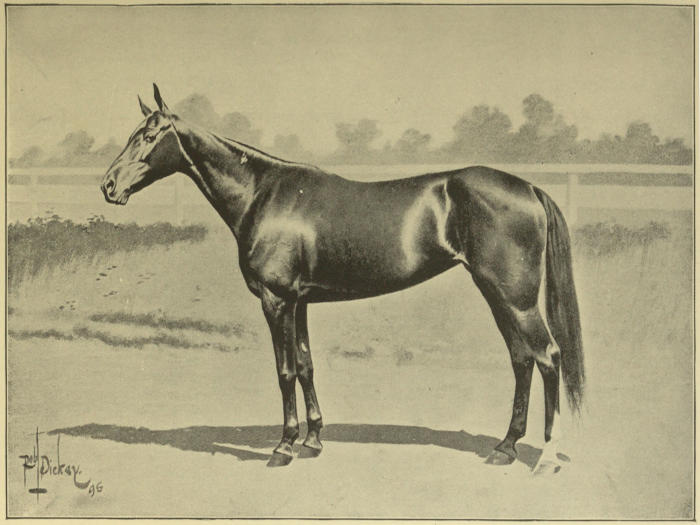
ALIX.
By Patronage, record 2:03¾, the fastest to this date.
CHAPTER XX. MESSENGER’S DESCENDANTS.
History of Abdallah—Characteristics of his dam, Amazonia—Speculations as to
her blood—Description of Abdallah—Almack, progenitor of the Champion
line—Mambrino Paymaster, sire of Mambrino Chief—History and pedigree—Mambrino
Messenger—Harris’ Hambletonian—Judson’s Hambletonian—Andrus’
Hambletonian, sire of the famous Princess, Happy Medium’s dam.
Abdallah.—This grandson of Messenger has been popularly
and justly designated as the “king of trotting sires of his generation.”
He was bred by John Tredwell, of Queens County, Long
Island, and was foaled 1823. His sire was Mambrino, son of
Messenger, and his dam was Amazonia, one of the most distinguished
trotters of her day. Concerning the breeding and origin
of Amazonia there has been great diversity of opinion among
horsemen and a great amount of controversy among writers.
It is not my purpose to enter into a discussion of the questions
raised on this point, but I would hardly be doing justice to history
to pass it over unnoticed. I will, therefore, try to give a
brief synopsis of the history and the arguments urged, and refer
the reader to the first and second volumes of Wallace’s Monthly
for a more extended consideration of the questions raised.
The first representation of her pedigree was that she was a
daughter of imported Messenger, and the next was that she was
by a son of Messenger. On the first claim, that she was by Messenger,
no argument was possible, one way or the other, on
account of dates; but against the second claim, that she was by
a son of Messenger, the arguments were numerous and vehement.
All these arguments were based wholly upon her coarse external
conformation and the absence of all resemblance to the Messenger
family. Among the supporters of this view were many of
the most intelligent and trustworthy horsemen of the whole
country. Indeed, the preponderance of intelligence as well as
numbers seemed to be on that side. That she had “coarse,
ragged hips,” that she had a “rat tail,” that she “had hair
enough on her legs to stuff a mattress,” that she was “a muddy
sorrel,” etc., were all urged to prove that she was not by a son of
Messenger. It is true that many entered into this controversy
who never saw the mare and who knew nothing about her appearance,
but there were others who knew her perfectly, among them
my venerable friend David W. Jones, to whom we are all indebted
for so many treasures from his storehouse of very valuable
memories.
On the other side there were some little scraps of history, that
at the vital point may have been history or may have been fiction.
In the certificate of sale of Abdallah, April 27, 1830, to Mr. Isaac
Snediker, his breeder, Mr. John Tredwell, says: “And believe him
to be the very best bred trotting stallion in this country, and be
it enough to know that his sire was Mambrino and his dam Amazonia.”
It has been argued that it would be very inconsistent for
a man of Mr. Tredwell’s standing to certify that Abdallah “was the
very best bred trotting stallion in this country,” if he knew nothing
of the blood of his dam, drawing the inference that he must
have known and believed the representations of his nephew, B.
T. Kissam, from whom he got Amazonia. The story of the
original purchase of Amazonia by B. T. Kissam and given to me
by his brother, Timothy T. Kissam, in 1870, is as follows: Amazonia
was purchased by B. T. Kissam, a dry goods merchant of
New York, when on an excursion of pleasure in the vicinity of
Philadelphia about 1814. She was brought out of a team and
was then four years old past, his attention having been called to
her as an animal of much promise. He used her for his own
driving a short time and sold her to his uncle, John Tredwell.
“Amazonia was represented to my brother to have been a get of
imported Messenger.”
Now, in considering whether this scrap of history is probably
true, the geographical question has been urged with telling effect.
Messenger had been kept a number of years on both sides of the
Delaware, right on the way to Philadelphia, his fee had been
above that of any other stallion, and a large percentage of his
colts had been kept entire. In no part of the country, perhaps,
were there so many sons of Messenger seeking public patronage.
The geography and the chronology of the question, therefore,
both sustain the probability of its truthfulness. Whether Mr.
Kissam crossed the river at Trenton, or Burlington, or Camden
he was right in the hotbed of the sons of Messenger. “If
Amazonia” it has been asked, “was as coarse and forbidding as
represented in her appearance, what induced Mr. Kissam to buy
her?” He wanted a carriage horse and he wanted one that could
not only show good action, but one that had a right of inheritance
to good action. He knew the Messengers and knew that
beauty and style were not family traits in that tribe. Many of
them were coarse, and possibly as coarse as Amazonia. Her very
coarseness and lack of style is, under the circumstances, a strong
argument that in choosing her Mr. Kissam had regard for her
Messenger blood.
Another argument, resting on “the internal evidences,” has
been urged with considerable force and it is very hard to answer
it. Amazonia was a mare of tested and known speed. She was
in a number of races to saddle and had won several of them in
less than three minutes along about 1816-18, and when Major
William Jones, in 1820, accepted the challenge to produce a horse
that could trot a mile in three minutes for one thousand dollars,
he knew very well what he was doing, for he had seen Amazonia
do it a number of times. Her best time was about 2:54, which
in that day was considered phenomenally fast. If we were to
meet a running horse out on the plains that could run away from
all others, we would naturally and justly conclude that he had
some of the blood of the race horse in his veins. If we have a
pacer and we learn he came from a section of the country where
a certain tribe of pacers abounded, we would naturally conclude
that he belonged to that tribe, especially if we knew there were
no other pacers in that section. If we have a trotter that can
go away from all other trotters, and we know that this trotter
came from a section abounding in a family of trotters, and in nothing
else that can trot, we naturally and justly conclude that this
trotter came from some member of that family of trotters. This
argument from the “internal evidences” seems almost axiomatic,
and when taken in connection with the historical argument,
unsatisfactory though it be, they together lay the foundation
for a very strong probability that Amazonia was by a son of
Messenger.
Abdallah was in color a beautiful bay, about fifteen and a half
hands high, and there was a measure of coarseness about him that
he could not well escape, as both his sire and dam were endowed
with that undesirable quality. The one exception to this was in
the character of his coat, which was very fine and glossy when in
healthy condition. His reputation as a great trotting sire was
very widely extended during his lifetime, but his lack of symmetry
and his “rat tail,” which he inherited from his dam, so
impaired his acceptability with the public that he never was
very largely patronized. Besides this he had an unconquerable
will of his own, which he transmitted to his offspring very generally.
This willfulness was not a desirable quality in a horse for
drudgery, and hence most of his patrons were such as were
seeking for gameness and speed. When he was four years old he
was not in the stud, and it is understood that Mr. Tredwell undertook
to break him thoroughly and train him that year. It is
also understood that when put in harness he kicked everything
to pieces within his reach and that all thoughts of training were
soon abandoned. He never was in harness again until, in extreme
old age, he was sold for five dollars to a fish peddler, and
the peddler’s wagon was soon reduced to kindling wood.
He was kept at different points on Long Island, and one season
in New Jersey, till the fall of 1839, when he, with Commodore,
another son of Mambrino, was sold to Mr. John W. Hunt, of Lexington,
Kentucky, where they made the season of 1840. Commodore
was much the more attractive horse of the two, and did
a large business, while Abdallah was almost wholly neglected,
leaving only about half a dozen colts. Meantime his progeny on
the island began to show their speed and their racing qualities; a
company was formed and he was brought back from Kentucky
and made the seasons of 1841 and 1842 at the Union Course,
Long Island. He was at Goshen, New York, 1843, at Freehold,
New Jersey, 1844 and 1845, at Chester, New York, 1846-47-48, at
Bull’s Head, New York, 1849, and did nothing, then at the
Union Course and Patchogue, Long Island, and was not off the
island again. After the period of his usefulness was past his inhuman
owners turned him out on a bleak, sandy beach on the
Long Island shore, and there he starved to death in the piercing
November winds, without a shelter or a friend.
Abdallah was the sire of Hambletonian, 10, the greatest of all
trotting progenitors and greater than all others combined. This
fact alone has made his name imperishable in the annals of the
trotting horse. A number of his other sons were kept for stallions
and some of them lived to old age, but they were all failures
in the stud. His daughters, generally, proved to be most valuable
brood mares, producing speed to almost any and every cross.
A pedigree tracing to an “Abdallah mare” has always enhanced
the value of a family.
Almack.—Mr. John Tredwell bred his famous team of driving
mares, Amazonia and Sophonisba, to Mambrino in the spring of
1822, and the next year they each produced a bay horse colt that
he named Abdallah and Almack. Sophonisba, the dam of
Almack, was a superior mare, but she was not fast enough for her
mate. Almack, however, was a good horse and left some trotters.
I have no particular description of him at hand and nothing
can now be given of his history further than that some of his
daughters produced well and that he seems to have been kept all
his life on Long Island. His dam Sophonisba was got by a grandson
of imported Baronet, as represented, but this is so indefinite
as to be unsatisfactory and suspicious. As none of the Baronets
could ever trot, even “a little bit,” it is evident that whatever
trotting inheritance Almack possessed came to him from his
sire. Aside from a number of his descendants that were recognized
trotters of merit there was one in particular that established
Almack as a progenitor of a great family of trotters. A son of
his bred by George Raynor, of Huntington, Long Island, in 1842,
and known as the “Raynor Colt,” out of Spirit by Engineer II.,
sire of Lady Suffolk, was led behind a sulky at a fair at Huntington,
when he was eighteen months old, and he went so fast and
showed such a magnificent way of doing it, that he was named
“Champion” by William T. Porter, editor of the Spirit of the
Times. At three years old he was driven a full mile in 3:05 and
this was a “world’s record” for colts of that age at that time. In
1846 he was purchased by William R. Grinnell for two thousand
six hundred dollars and taken to Cayuga County, where he
founded a great tribe of trotters that is now known everywhere
as the “Champion Family.” A fuller account of this horse will
be found at another place in this volume.
Mambrino Paymaster (widely known in later years as Blind
Paymaster).—This was a large, strong-boned, dark-bay horse,
sixteen hands and an inch high. When young he was somewhat
light and leggy, but with age he spread out and became a horse
of substance. He was bred by Azariah Arnold, of the town of
Washington, in Dutchess County, New York. There is some
uncertainty about the year this horse was foaled, but it was somewhere
between 1822 and 1826. He was got by Mambrino, son of
Messenger, and his dam was represented to be by imported Paymaster.
The late Mr. Edwin Thorne made a statement a few
years ago that in an interview with Azariah Arnold he said that
he did not know or remember the horse that was the sire of the
dam. At that time Mr. Arnold was very old, and doubtless his
mental faculties very much impaired, so it would not be remarkable
that he should have forgotten all about it. On the other
hand, Nelson Haight, Daniel B. Haight, Seth P. Hopson, and
others of like high character, maintain that Mr. Arnold, in his
younger days, always represented the mare to be by Paymaster,
and the name of the horse itself is very strong evidence that he
did so represent it, and is a standing proclamation to that effect.
There can be no possible doubt that in earlier life Mr. Arnold
constantly represented this mare to be by Paymaster; neither can
there be any reasonable doubt that when his faculties were impaired
with age he told Mr. Thorne that he did not remember
her pedigree. Mr. Arnold’s neighbors all agree that he was a
man of unblemished character and incapable of a willful misrepresentation,
when in possession of his faculties. Again, that this
Paymaster cross was not only possible, but probable, is shown by
the fact that imported Paymaster was kept by Ebenezer Haight,
in the year 1807, in the same township with Azariah Arnold, and
the years 1808 and 1809 in the same part of the county. Therefore,
Mr. Thorne to the contrary notwithstanding, I have but
little doubt that the Paymaster cross is correct.
He had a small star in his forehead and a little white on one
hind foot. His back, loin and hips were altogether superior, and
those who knew him best say they never saw his equal at these
points. His head was large and bony, with an ear after the
Mambrino model. His neck was of medium length and his
shoulder good. His hind legs were quite crooked and too much
cut in below the hock in front, giving the legs at that point a
narrow and weak appearance; his hocks were large and at the
curb place showed a fullness. His cannon bones, all round, were
short for a horse of his size, and his feet were excellent. He was
slow in maturing, but when he filled out he lost all that narrow,
weedy appearance which characterized his colthood. He was not
beautiful, but powerful.
About 1828 he was sold and taken to Binghamton, New York.
Meantime his colts came forward and proved to be so valuable
that Nelson and Daniel B. Haight and Gilbert Jones purchased
and brought him back to Dutchess County about the year 1840.
He was not a sure foal-getter, but his stock proved to be of great
value. When brought back from Broome County he was blind.
He made one season on Long Island in charge of George Tappan;
the other seasons till 1847 he was kept in Dutchess County in the
neighborhood of his owners. In 1847 he was sold to Mr. Gilbert
Holmes and taken to Vermont, where he died after getting one
colt. Many of his sons were kept as stallions, but the most
famous of his get were the mares Iola and Lady Moore, and last
but not least, his famous son Mambrino Chief, the founder of a
great family of trotters in Kentucky. His stock were probably
more noted and more highly prized than that of any of the sons
of Mambrino that stood in Dutchess County. As Abdallah was
the link by which the greatest of all trotting families are connected
with Messenger, so Mambrino Paymaster is the link
through which the family easily entitled to second place reaches
the same illustrious original.
Mambrino Jr. (Bone Swinger) was a beautiful bay horse,
foaled 182-, got by Mambrino, son of Messenger; dam not
traced. He was bred on Long Island and was owned by George
Tappan, near Jericho, Long Island. About 1833-4 he made
some seasons at Washington Hollow, Dutchess County. He was
about fifteen hands three inches high and was considered more
blood-like and handsome than most of his family. He was a
strong breeder, giving most of his colts his own elegant color.
Mambrino Messenger (commonly known as the Burton
Horse) was foaled about 1821. He was got by Mambrino, son of
Messenger; dam by Coffin’s Messenger, son of Messenger; grandam
by Black and All Black; great-grandam by Feather. He was bred
by Abram Burton, of Washington Hollow, New York. He was a
beautiful bay, about fifteen hands three inches high, and was the
same age as Mambrino Paymaster, and they were rivals for a
number of years, each having his friends and adherents. He was
finer in the bone, having more finish and beauty than his rival,
and what was still more effective with the public, he could out-trot
him. Many of his offspring proved to be most excellent
roadsters and some of them were fast. He was probably taken to
Western New York, but I have not found any trace of his location
or history. This name, Mambrino Messenger, was borne by
several other horses of different degrees of affinity to the originals.
Hambletonian (Harris’) (also known as Bristol Grey and
Remington Horse).—This was a grey horse, about sixteen hands
high, and possessed great strength and substance. When young
he was an iron grey and probably pretty dark, but as he advanced
in age he became lighter in color. His head was large and bony,
with great width between the eyes. He was short in the back,
with long hips, and the rise of the withers commenced far back,
showing a fine, oblique shoulder. He was a horse of unusually
large bone formation; his limbs were large, but flat and clean,
with a heavy growth of hair at the fetlocks. He was of docile and
kindly disposition and worked well either alone or with another.
His gait was open and decided and at a walk his long slinging
steps carried him over the ground unusually fast. His speed as
a trotter was never developed, but his action at that gait was so
free, open and square that those who knew him well have insisted
that his manner of going indicated the possibility of great
improvement, if he had been handled with that view. His offspring
were slow in maturing, and for many years, indeed till
toward the end of his life, he was not appreciated as a stallion.
He was in constant competition with the little, plump, trim and
trappy Morgans, and at three and four years old his long, lathy,
plain colts cut but a sorry figure against the well formed and
fully developed Morgans of their own age. With such a rivalry,
sustained by the question of profit to the breeder by early sales,
it is not remarkable that he should have been neglected, till it
was clearly demonstrated that he transmitted the true Messenger
trotting instinct in greater strength than any of his competitors.
He was bred by Isaac Munson, of Wallingford, Vermont; foaled
1823, got by Bishop’s Hambletonian, son of Messenger; dam the
Munson mare that was brought from Boston, 1813. There never
has been any question about the sire of this horse, but up to
1869 the representation made by Mr. Harris that his dam was
an imported English mare was generally accepted as the truth.
I was led to doubt this, and in December of that year I made a
thorough search of the records of the custom-house in Boston,
and found the claim was without any foundation whatever.
Through the kindness of Mr. Henry D. Noble I was enabled to
get beyond Mr. Harris, who really knew nothing about the mare,
back to the Munson family, and to Mr. Joseph Tucker, the
earliest and best authority living in 1870. In order that this evidence
may be preserved I will here insert Mr. Tucker’s letter
entire.
“Milford, N. H., May 4th, 1870.
“Mr. J. H. Wallace, Muscatine, Iowa.
“Dear Sir: Yours of 22d of April is duly received and contents noted. I
was 24 years old when first acquainted with the dam of the ‘Harris Horse,’ so
called, in the fall of 1813. Was then carrying on a farm, now owned by Wm.
Randall, Esq., in this town, for Mr. Israel Munson, a commission merchant
then doing business on India Street, and afterward on Central Wharf, Boston.
I was in Boston in the fall of 1813, as above, and found the dam (of Hambletonian)
and mate in Mr. Munson’s possession. He said they had been ‘leaders’
in a stage team, and they acted as if green about holding back, etc. He never
said she was imported from England, neither did I hear such a story till two
or three years ago. The dam was called ‘a Messenger.’ All the description I
can give of her is that she was a strong, well-built, light dapple grey, and would
weigh ten hundred, certain. The span was well matched. The nigh one (the
dam) was more serviceable than the other. Led them all the way from Boston
behind an ox team; kept them till the middle of April and then returned the
pair to Boston. Mr. Munson drove them up, only stopping to dinner, when on
his way to Vermont in August, 1814, and I didn’t see them again until December.
I then drove them from Boston to Vermont, and used them a year on the
Munson farm, on Otter Creek, in Wallingford. In June, 1815, I took them to
Phœnix Horse (bay, black mane and tail, good looking and smart) in Clarendon
Flats. Both stood and had foals the spring after I left Mr. Munson’s employ.
The off mare was occasionally a little lame, I think in the off fore foot, when
hard drove, but the nigh one was perfectly free from lameness or limping. I
left Mr. Munson in the spring of 1816, and know nothing of mares afterward.
“Yours truly,
Joseph Tucker,
“(By Geo. W. Fox).”
I have given this letter entire, with the exception of a few
closing sentences, that the public may be able to judge of its
authenticity. That these mares were leaders in a stage team
when Mr. Munson bought them is confirmed by members of the
Munson family, and that the nigh mare was represented to be a
Messenger at the time of the purchase I have not the least
doubt. But whether she was really a Messenger is quite another
question. All I can say is, it was possible in the nature of
things; and the employment and qualities of the mare, together
with the representations of Mr. Munson, appear to make it
probable. During the mare’s lifetime I find she was spoken of
in the Munson family and about Wallingford as “the imported
Messenger mare” and in this phrase, no doubt, was the origin of
the story that she was herself imported. When this phrase,
through her son, reached the next outer circle, “imported Messenger
mare” no longer meant a mare by imported Messenger,
but an imported mare by Messenger.
At the point where Mr. Tucker’s knowledge of this mare ceases,
fortunately Mr. Isaac B. Munson, of Wallingford, takes up the
history and carries it forward, with great particularity, to the
time of her death about 1826. She produced several foals by
different horses, and while they were all valuable animals, the
only one that is known to history is the subject of this sketch.
When Hambletonian of Vermont was two years old Mr. Munson
sold him to Samuel Edgerton and others, of Wallingford, and
they kept him in the stud till about 1828, when they sold him to
Mr. Eddy, of Bristol, Vermont, and in the hands of the Eddy
family he was kept at Bristol, New Haven, and other points in
and about Addison County till about 1835, when he was kept one or
two years again in Wallingford and adjacent towns. About 1837
he was sold to Joshua Remington, of Huntington, Vermont, and
was taken there. He stood in various parts of Chittenden
County, and became well known as the “Remington Horse.”
Unfortunately there is no guide to dates in these transfers and
it is not known just how long Mr. Remington owned him. He
next passed into the hands of Mr. Russell Harris, New Haven,
Connecticut, and remained his till he died late in the year 1847.
The location of this horse was unfavorable either to a large or
to a numerous progeny of trotters. He was surrounded with
Morgan blood, trappy and stylish and fast growing in popularity
on the supposition that they were trotters—a most valuable tribe
as family horses, but none of them were able to trot fast without
the introduction of trotting blood from the outside. He lived in
a period antedating the real development of the trotter and the
keeping of records of performances, and hence we must not
judge of his merits as a trotting sire by comparing the list of his
performers with lists of later generations. Green Mountain
Maid was one of the best of her day and made a record of 2:28½
in 1853, and the same year the famous pacing gelding Hero
made a record of 2:20½. Probably the best trotter from his loins
was Sontag, with a wagon record in 1855 of 2:31. This mare
was originally a pacer, and whether his dam was by imported
Messenger or not we must conclude that the tendency to the
lateral action was strong in his progeny. Lady Shannon,
Trouble, Vermont, Modesty, and True John were all famous performers
in their day. The last named was kept in the stud a
few years and was known as the Hanchett Horse. He fell into
the hands of Sim D. Hoagland, of this vicinity, became ugly and
was made a gelding. As a weight puller he had no equal in his
day. His daughters became the dams of many noted producers
and performers, and through the doubling of his blood and its
predominating influence we have the famous General Knox and
his tribe. But few of his sons were kept as stallions; among
them the best known is Hambletonian, 814, known as the Parris
Horse and the sire of the stout campaigner, Joker, 2:22½. Vermont
Hambletonian (known as the Noble or Harrington Horse)
was one of his best and best-bred sons. He died in 1865, leaving
a valuable progeny.
Hambletonian (Judson’s) was a brown horse and resembled
his sire very much in both size and form. He was foaled 1821, got
by Bishop’s Hambletonian, son of Messenger; dam by Wells’
Magnum Bonum. This Magnum Bonum family abounded in
that region, and it was a very good one, whatever the blood may
have been. This horse was bred by Judge Underhill, of Dorset,
Vermont, and sold, 1829, to Dr. Nathan Judson, of Pawlet, Vermont.
He was kept in that region till he died about 1841. His
progeny were very numerous and valuable.
Hambletonian (Andrus’) was a brown horse nearly sixteen
hands high. He was a well formed and evenly balanced horse,
all over, with an objectionable lack of bone just below the fore-knee.
His head and ear were strongly after the Messenger
model. I have never been able to determine just who bred him,
and consequently his blood on the side of the dam is not fully
established. He was foaled about 1840, got by Judson’s Hambletonian,
and out of a mare which Mr. B. B. Sherman says was by
old Magnum Bonum. He seems to have known this mare well
and speaks of her as a very superior animal. This would indicate
inbreeding to the Magnum Bonums, and as they were a light-limbed
family we may account for this horse’s defects in that respect.
He was owned a number of years by Mr. Andrus, of
Pawlet, and passed into the hands of G. A. Austin, of Orwell,
Vermont. In 1853-4 Mr. Austin sent him to Illinois, along
with Drury’s Ethan Allen, Black Hawk Prophet, Morgan Tiger
and some other stallions, in charge of Mr. Wetherbee, for sale.
In 1854 they were removed to Muscatine, Iowa, and several of
them sold there, among them the Andrus Horse. He was then stiff
in his limbs, showing the effects of previous neglect and abuse. He
died at Muscatine in 1857. His progeny there were defective in
bone. I am told several of his daughters in Vermont have left
good stock there and thus perpetuated his name in the second
and third generations. But his chief title to fame has been
secured to him by his renowned daughter Princess, the dam of
the great Happy Medium. In 1851 Mr. L. B. Adams, who then
owned her, bred the Isaiah Wilcox mare, by Burdick’s Engineer,
son of Engineer by Messenger, to Andrus’ Hambletonian, and,
in a nutshell, the union of this great-grandson of Messenger
with this great-granddaughter of Messenger produced Princess.
This pedigree of Princess is incontrovertibly established and will be
given in fuller detail in the history of her son, Happy Medium.
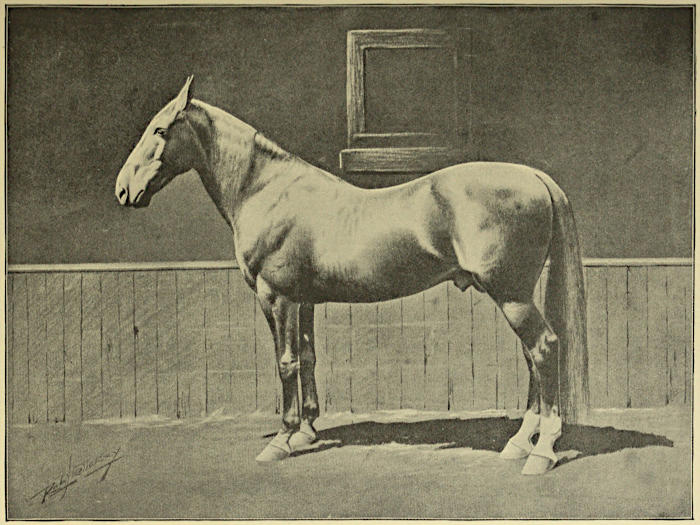
HAMBLETONIAN (RYSDYK’S).
The greatest of all trotting progenitors and the most intensely inbred to Messenger.
CHAPTER XXI. HAMBLETONIAN AND HIS FAMILY.
The greatest progenitor in Horse History—Mr. Kellogg’s description, and comments
thereon—An analysis of Hambletonian, structurally considered—His
carriage and action—As a three-year-old trotter—Details of his stud
service—Statistics of the Hambletonian family—History and ancestry of
his dam, the Charles Kent Mare—Her grandson, Green’s Bashaw and his
dam.
Hambletonian, 10.—It has been a matter of constant regret
that in the compilation of the first volume of the Register I attached
the name “Rysdyk’s” to this horse, and this misstep has
served as a kind of apparent justification for very many men to
seize upon the name “Hambletonian,” with their own name as a
prefix. This has led to great confusion and annoyance to all
that body of men who have anything to do with records and correct
pedigrees. Fortunately, however, the evil has become so
apparent that many writers are beginning to use the numbers,
and we now very frequently hear men speak of “Hambletonian,
10,” as the true designation of this horse.
As no horse of any blood or period in this or any other country
has excited an interest so universal, or represented such a vast
sum of money in his offspring and descendants, I must try to
give an account of him and his family—ancestors and descendants—as
full and accurate as the materials at hand will enable
me. He was a beautiful bay color, bred by Jonas Seely, of Sugar
Loaf, Orange County, New York, foaled 1849, got by Abdallah;
dam the Kent Mare, by imported Bellfounder; grandam One
Eye, by Hambletonian, son of Messenger; great-grandam Silvertail,
by imported Messenger; great-great-grandam Black Jin,
breeding unknown. He was sold with his dam, when a suckling,
to Mr. William M. Rysdyk, of Chester, in the same county, and
he remained his till he died in March, 1876. He has been described
by a great many writers, but the most minute and accurate
description I have ever seen is from the pen of “Hark Comstock”
(Peter C. Kellogg), which I will here present, and after it
note any point upon which my own judgment differs from his.
It should be remembered that this description was made when
the horse was breaking down with the weight of years:
Hambletonian, now twenty-six years old, is a rich deep mahogany bay, with
black legs, the black extending very high up on the arms and stifles. His
mane was originally black, and in his younger days very ornamental; rather
light, like that of the blood-horse, and of medium length, never reaching below
the lower line of the neck, but uniform throughout. His foretop was always
light. At the present time not a vestige of either remains, they having
gradually disappeared until crest and crown are bald. His tail is long and
full. When we first knew him it was very full, but is also thinning with his
advancing years. The hair of both was black as a raven’s wing, and entirely
devoid of wave or curl. His marks are a very small star and two white ankles
behind, but the coronets being dotted with black spots, the hoofs are mainly
dark. Muzzle dark. Head large and bony, with profile inclining to the Roman
order; jowl deep; jaws not as wide apart as in some of his descendants, yet not
deficient. Eye very large and prominent, and countenance generally animated
and expressive of good temper. We found him to measure 10½ inches across
the face. Ear large, well set, and lively. Neck rather short and a little heavy
at the throatlatch, but thin and clean at the crest. His shoulders are very
oblique, deep and strong; withers low and broad; sway very short, and coupling
smooth. The great fillets of muscle running back along the spine give extraordinary
width and strength to the loin, which threatens to lose the closely-set
hip in the wealth of its embrace. But it is back of here that we find lodged
the immense and powerful machinery that, imparted to his sons and daughters,
has ever placed them in the foremost ranks of trotters. His hip is long and
croup high, with great length from hip-point to hock. Thighs and stifles
swelling with the sinewy muscle, which extends well down into his large,
clean, bony hocks, hung near the ground. Below these the leg is broad, flat,
and clean, with the tendons well detached from the bone, and drops at a considerable
angle with the upper part of the limb, giving the well-bent rather
than the straight hock. Pasterns long, but strong and elastic, and let into
hoofs that are perfection. In front his limbs in strength and muscular development
comport with the rear formation. His chest is broad and prominent; his
forelegs stand wide apart (perhaps in part the result of much covering), and he
is deep through the heart; yet notwithstanding this, and the fact of his roundness
of barrel, there is no appearance of heaviness or hampered action.
Taken at a glance, the impressive features of the horse are his immense substance,
without a particle of coarseness or grossness. No horse we can recall
has so great a volume of bone, with the same apparent firmness of texture and
true blood-like quality. Though short-backed, he is very long underneath.
Indeed, he is a horse of greater than apparent length. We found his measurement
from breast to breeching, in a straight line, greater by four inches than
his height at the withers—a very unusual excess. We also found him two
inches higher over the rump than at the withers, and the whole rear, or
propelling portion of the machinery, would upon measurement seem to have
been molded for an animal two sizes larger than the one to which it is attached;
yet so beautifully is its connection effected with the whole that there
is no disproportion apparent, either in the symmetry or the action of the horse.
As an evidence of the immense reach which this admirable rear construction
enables him to obtain, it is often noticed by visitors that in his favorite attitude,
as he stands in his box, his off hind foot is thrown forward so far under him as
to nearly touch the one in front of it—an attitude which few horses of his proportionate
length could take without an apparent strain, yet which he assumes
at perfect repose. When led out upon the ground his walk strikes one as
being different from that of any other horse. It cannot be described further
than to say that it shows a true and admirable adjustment of parts, and a perfect
pliability and elasticity of mechanism that shows out through every
movement. Many have noticed and endeavored to account in different ways
for the peculiarity, some crediting it to the pliable pastern, others to surplus
of knee and hock action, etc., but the fact is, there seems to be a suppleness of
the whole conformation that delights to express itself in every movement and
action of the horse. “In his box,” said a Kentucky horseman, who recently
looked him over, “I thought him too massive to be active, but the moment he
stepped out I saw that he was all action.”
There is so much in the foregoing description that is intelligent
and just that I hardly feel like reviewing a single phrase.
In judging of the conformation of a horse and determining
whether it is good or bad, at different points, we must have in
our mind some ideal standard, by which we mentally compare
one thing with another. The popular conception of the perfect
horse is the picture of the “Arabian,” painted by artists who
never saw an Arabian horse. The next approach to perfection is
the English race horse, but others may insist that the Clydesdale
comes nearer perfection and that he should be the ideal with
which the standard of comparison should be made. It is unfortunate
that Mr. Kellogg should have described Hambletonian as
possessing “immense substance, without a particle of coarseness,
or grossness.” He had a remarkably coarse head in its size and
outline, but this is greatly softened by saying “with a profile
inclining to the Roman order.” The ideal muzzle of the English
race horse is so fine that, figuratively speaking, he can drink
out of a tin cup, but Hambletonian could not get his muzzle into
a vessel of much smaller dimensions than a half-bushel measure.
“Ear large, well set and lively.” This is true as to the size of
the ears, but not correct, in my judgment, as to the setting on.
As they habitually lopped backward when in repose, giving a
sour and ill-tempered expression, I could not concede that they
were “well set.” The hocks were good and clean, but the
abrupt angle at that point was certainly a coarse feature. The
round meaty withers and the round meaty buttocks were both
“coarse and gross” when looked at from the point of good breeding.
His two great, meaty ends, connected with a long and perfect
barrel, two or three sizes too small for the ends, showed such
a marked disproportion that I often wondered at it. Not one of
these criticisms is made in the sense of a criticism of Mr. Kellogg’s
description, but merely as the expression of a different
view on some points, and on those points not mentioned I most
heartily agree with him. He has omitted to give the height of
the horse for the reason that he had shrunken from his normal
height just one inch. When at his best he measured fifteen
hands one inch and a quarter. This shrinkage, in addition to
the ordinary results of great age, is thus explained by Mr. Guy
Miller, who knew him better than any other man except his
owner. “His splendid fore hoofs had been ruined by an operation
whereby the arch was lost and the horse during the remainder
of his days stood on his frogs.” He was two inches higher
on the hips than on the withers.
When the horse was led out his movements were so frictionless
and faultless that he impressed me as the most wonderful
horse that I had ever seen. He seemed as supple as a cat with
the power of an elephant. As he walked he kept pushing those
crooked hind legs away under him in a manner that gave him a
motion peculiarly his own, and suggested the immense possibilities
of his stride when opened out on a trot. Plain and indeed
homely as he was he was a most interesting and instructive study
whether in his box or taking his daily walks. The question has
been asked a thousand times whether the speed of Hambletonian
had been developed and how fast he could go. This question
I considered very important, in a philosophical and breeding
sense, and in starting in to investigate it I found two statements,
one that the time made at the Union Course was honest and true,
and the other that it was a “put up job” to make Mr. Rysdyk
feel good, and that the time in fact was much slower than that
announced. Each side had its advocates, and it did not take
long to discover that the enemies of Mr. Rysdyk were all on one
side and the more bitter their enmity the more blatant they were
in denying the truth of the time given out for the performance.
This party was headed by one “J. M.,” long distinguished, and
will be long remembered in Orange County, for the virulence of
his dislike to Mr. Rysdyk, and as the most unreliable of all unreliable
horsemen.
In the autumn of 1852 Mr. Rysdyk and Mr. Seely C. Roe, the
owner of Roe’s Abdallah Chief, then four years old, concluded to
exhibit their sons of Abdallah at the fair of the American Institute,
in New York, and after the fair to take their colts, three
and four years old respectively, for a light training for a few
weeks. The programme was carried out, and after reaching the
course they started the two colts together, and much to Mr.
Roe’s surprise Hambletonian beat his colt in 3:03. In a short
time Mr. Roe gave his colt another trial in 2:55½. A few days
later Mr. Rysdyk drove his colt in 2:48. Believing then he had
the making of the best trotter in the world and being thoroughly
homesick, he packed up his traps and started for Orange County,
and this was the first and the last training that Hambletonian
ever had. When we consider the age of the colt and how few
of that age had then ever reached that mark, the little then
known by amateurs of the arts of training and driving, and the
very limited preparation, we must conclude that this was a remarkably
good performance.
Was it honestly made? Mr. Roe has been dead a good many
years, but the next day after he returned from Long Island with
Mr. Rysdyk he called at the house of his brother-in-law, David R.
Feagles, a very responsible man, and in the course of the conversation
he asked Mr. Feagles if he had heard the news? “No,”
said Mr. Feagles, “what is it?” “Rysdyk’s colt trotted the
Union Course in 2:48. I held my watch and I know it is true.”
Mr. Roe was always steadfast and immovable in this declaration
while he lived. Mr. W. H. Wood, the breeder of Abdallah Chief,
says he told him the time was 2:48, and he had several times
heard it disputed in Mr. Roe’s presence and he had always settled
the dispute by giving the same fact. Mr. David R. Seely said
he could not remember the time made, but he had heard the
matter disputed, and Mr. Roe settled it by saying it was true, that
he saw it and held the watch on him when he did it. These men
were as reliable as any in Orange County and their statement of
Mr. Roe’s assertions cannot be doubted. Considering the circumstances,
it will occur to any mind that Mr. Roe was the very
best witness to the truth of this performance that could be produced.
He was not only disinterested, but in building up the
reputation of a rival stallion he was testifying to his own hurt.
There are other evidences of Hambletonian’s development and
speed, but nothing so definite as the foregoing. He was driven
in double team sometimes with the great trotter Sir Walter. Mr.
Kinner, at one time owner of Sir Walter and other good ones, a
horseman of experience and knowledge of trotting affairs, assured
me that Sir Walter had shown a trial at Centerville track to
wagon in 2:32, and this was before he was driven double, occasionally,
with Hambletonian; and that Hambletonian could out-foot
Sir Walter for the first half-mile, but as the young horse
was green and unseasoned, he could not keep up the clip to the
finish. He did not hesitate to express the belief that the team
could have trotted the mile in considerably less than 2:40. There
is one fact in connection with the trial at Union Course that I
have omitted in its proper place. Mr. Rysdyk was a remarkably
careful man and always aimed to be inside of the truth rather
than beyond it. He advertised his horse as having made the
trial in 2:48½, as it is probable some of the watches gave that as
the time, instead of 2:48 flat.
Like all the Abdallah family, Hambletonian matured early, and
at three years was as well advanced as many colts a year older.
His stud services commenced early. When two years old he was
allowed to cover four mares without fee and he got three colts,
one of which was afterward known as the famous Alexander’s
Abdallah. When three years old he was offered for public
patronage at twenty-five dollars to insure, and he covered seventeen
mares and got thirteen colts. The next season, at the same
price, he covered one hundred and one mares and got seventy-eight
colts. The next season (1854), being then five years old,
the price was advanced to thirty-five dollars, and he covered
eighty-eight mares, getting sixty-three foals. The price remained
at thirty-five dollars till 1863, when it was advanced to
seventy-five dollars. At which price he covered one hundred
and fifty mares. The next season the price was advanced to one
hundred dollars, and he covered two hundred and seventeen
mares, getting one hundred and forty-eight foals. In 1865 the
price was advanced to three hundred dollars and one hundred
and ninety-three mares were covered. In 1866 the price was put
at five hundred dollars and one hundred and five mares were
covered. At this price his services remained ever afterward—one
hundred dollars down and the remainder when the mare
proved in foal. In 1867 he covered seventy-seven mares and got
only forty-one foals. This large percentage of failure indicated
beyond question that his procreative powers had been overtaxed
and that there was a general letting down of his vital energies.
In 1868 he was not allowed to cover any mares. In 1869 he
again manifested his usual vigor and he covered twenty-one
mares, getting fourteen foals. In 1870 he covered twenty-two
mares and got thirteen foals. From this time forward his procreative
powers dwindled, and in 1875, I think, he got but two
foals, and died the following March.
It has been estimated that he got about one thousand three
hundred foals, and for several years it was one of the amusing
features of horse literature to see how many writers were able to
demonstrate that as a progenitor of speed he was a failure. This
item of one thousand three hundred foals was taken as the basis
of computation, and then with the small number of forty trotters
out of the one thousand three hundred, the percentage of trotters
was very small. The next step was to find some unknown horse,
generally a pacer, that had only two or three foals to his credit
and one of them had made a record of 2:30, thus showing a much
larger percentage than Hambletonian, and by that much he was a
greater sire than Hambletonian. All this foolishness has now
subsided in the face of the fact that the great mass of the trotters
of today have more or less of his blood in their veins, and in
a very short time that blood will abound in greater or less
strength in every American trotter. The tables which here
follows will make this fact evident to all who will study them.
[Prefatory to these tables and to the other statistics concerning the present
rank of the trotting families given in the pages following, an explanatory
paragraph is in order so that they may not be misunderstood. (1) They are
based on the tables given in the Year Book for 1896, and I regret to say that
these tables are so emasculated, incomplete, unsatisfactory and in many cases
contradictory one of the other that it is literally impossible to compile from
them statistics that may be accepted as absolutely correct and letter perfect.
However, as this work is not intended as one for statistical reference, the tables
being approximately correct serve my purpose, which is merely to show relatively
and with substantial accuracy the standing of the sires and families
embraced to the close of 1896. (2) By the term “standard performers” is meant
horses that have acquired trotting records of 2:30 or better, or pacing records of
2:25 or better. The Year Book no longer gives a 2:30 pacing list, and it should
be noted that pacers with records between 2:30 and 2:25 are not credited in
these tables. (3) The tables are designed to show (a) the number of standard
performers got by each sire named. (b) The number of his sons that are sires of
standard performers. (c) The number of his daughters that are dams of
standard performers. (d) The number of standard performers produced by
these sons and daughters, and finally, in the last column, the total number of
standard performers produced in the two generations—i. e., by the sire himself,
and by his sons and daughters. The dates of foaling and death are important
in considering the opportunities of the families embraced.]
The first table following gives some idea of the supremacy of
the Hambletonian family over all others. When we seek a rival
to Hambletonian as a trotting progenitor we must do so among
his sons; and by turning to the second table it will be noted that
many of these outrank the founders of any and all the other
great trotting families.
FOUNDERS OF THE GREAT TROTTING FAMILIES.
| Name. |
Year foaled. |
Year died. |
Standard performers. |
Producing sons. |
Producing daughters. |
Standard performers produced by sons and daughters. |
Total No. Standard performers in two generations. |
| Hambletonian |
1849 |
1876 |
40 |
148 |
80 |
1665 |
1705 |
| Blue Bull |
1858 |
1880 |
60 |
47 |
77 |
211 |
271 |
| Mambrino Chief |
1844 |
1862 |
6 |
23 |
17 |
119 |
125 |
| Ethan Allen |
1849 |
1876 |
6 |
22 |
18 |
118 |
124 |
| Pilot Jr. |
1858 |
1865 |
8 |
6 |
18 |
72 |
80 |
| George M. Patchen |
1849 |
1864 |
4 |
15 |
4 |
70 |
74 |
| Champion (807) |
1853 |
1874 |
8 |
6 |
7 |
53 |
61 |
In this table Ethan Allen is given as the representative of his
family in preference to his sire, Black Hawk, the real founder,
for the reasons that he was a far greater horse, and makes a better
showing than his sire, and further because he was a contemporary
of Hambletonian. For exactly the same reasons
George M. Patchen is given as the representative progenitor of
the Clay line.
The next table demonstrates what the Hambletonian family has
done in the second and third generations, and the relative standing
of the leading sub-families of the greatest trotting line. It
embraces separately every sire that has to his own credit and to
the credit of his sons and daughters an aggregate of fifty or more
standard performers, twenty-three in all, while the totals to the
credit of all the other sons of Hambletonian are grouped in the
last line:
FAMILIES OF HAMBLETONIAN’S SONS.
| Name. |
Year foaled. |
Year died. |
Standard performers. |
Producing sons. |
Producing daughters. |
Standard performers produced by sons and daughters. |
Total No. Standard performers in two generations. |
| George Wilkes |
1856 |
1882 |
83 |
94 |
81 |
1801 |
1884 |
| Electioneer |
1868 |
1890 |
154 |
65 |
43 |
493 |
647 |
| Happy Medium |
1863 |
1888 |
92 |
51 |
47 |
272 |
364 |
| Harold |
1864 |
1893 |
44 |
43 |
45 |
248 |
292 |
| Dictator |
1863 |
1893 |
52 |
44 |
42 |
234 |
286 |
| Volunteer |
1854 |
1888 |
34 |
40 |
48 |
221 |
255 |
| Strathmore |
1866 |
1895 |
71 |
26 |
54 |
158 |
229 |
| Abdallah (15) |
1852 |
1865 |
5 |
14 |
29 |
199 |
204 |
| Aberdeen |
1866 |
1892 |
45 |
25 |
19 |
110 |
155 |
| Egbert |
1875 |
—— |
75 |
25 |
18 |
74 |
149 |
| Messenger Duroc. |
1865 |
189- |
23 |
24 |
41 |
125 |
148 |
| Edward Everett |
1855 |
1878 |
13 |
12 |
16 |
112 |
125 |
| Administrator |
1863 |
1892 |
14 |
20 |
44 |
93 |
107 |
| Jay Gould |
1864 |
1894 |
29 |
14 |
28 |
76 |
105 |
| Victor Bismarck |
1867 |
189- |
31 |
13 |
13 |
64 |
95 |
| Cuyler |
1868 |
1894 |
15 |
15 |
36 |
74 |
89 |
| Masterlode |
1868 |
189- |
28 |
17 |
16 |
57 |
85 |
| Sweepstakes |
1867 |
189- |
35 |
4 |
20 |
39 |
74 |
| Sentinel |
1863 |
1873 |
8 |
9 |
14 |
57 |
65 |
| Middletown |
1860 |
1891 |
14 |
9 |
11 |
49 |
63 |
| Squire Talmage |
1866 |
1891 |
23 |
9 |
14 |
35 |
58 |
| Dauntless |
1867 |
189- |
31 |
6 |
9 |
20 |
51 |
| Echo |
1866 |
189- |
16 |
9 |
15 |
34 |
50 |
| Other sons (125) |
—— |
—— |
618 |
229 |
412 |
980 |
1600 |
This table shows what each horse himself produced, and how
his blood is breeding on through his sons and daughters; and
above all it demonstrates the stupendous fact that in three generations
the Hambletonian family has produced upward of seven
thousand standard performers, and all facts and all experience
now beyond cavil justify what I ventured to declare in Wallace’s
Monthly many years ago: “The Hambletonian line stands above
all other lines and must survive because it is the fittest.”
The Charles Kent Mare, dam of Hambletonian, was a bay,
fifteen and three-quarter hands high, with a star, left forward
ankle roan, and left hind foot white. Her son was long and
round, just the opposite of her sire. Hips rather coarse, and might
be considered a little ragged. Stifles very powerful and well-developed.
Her hocks and legs were exactly represented in her
son Hambletonian. Her neck was fine and bloodlike, but not
long. Her head was good, and her eyes remarkably full and
bright, showing considerable white. Her mane was long, but
thin, and her tail was light. Her shoulders were well-sloped,
her withers ran up high, and were thin. Jonas Seely, Sr., having
given the old mare One Eye to his son Charles, she was sold
to Josiah S. Jackson, of Oxford, Orange County. Mr. Jackson
bred her to Bellfounder and the produce was the Kent mare.
Although the Seely family owned the stock, originally and afterward,
Mr. Jackson was really the breeder of this mare. Mr.
Jonas Seely says she was got the year Bellfounder stood at
Poughkeepsie (1831), but Mr. Rysdyk says she was got in 1832,
when Bellfounder stood at Washingtonville. Mr. Jackson sold
her at three years old to Peter Seely for three hundred dollars;
Mr. Seely sold her soon after to Mr. Pray, of New York, for
four hundred dollars; Mr. Pray sold her to William Chivis for
five hundred dollars; and Mr. Chivis sold her to a gentleman,
who was a banker in New York—name not remembered—to
match another as a fast road team. This team ran away after a
time, and she was injured, and became lame. Charles Kent, a
butcher in New York, then bought her and bred her to Webber’s
Tom Thumb, before he came to Orange County. At this juncture,
on the earnest recommendation of Mr. Pray, who had
tested the quality of three or four of the family, Mr. Jonas Seely—Jonas,
second—bought the mare of Kent for one hundred and
thirty-five dollars, and took her back to the old place, where she
was bred and produced as follows:
- 1843. Brown filly Belle, by Webber’s Tom Thumb.
- 1845. Black gelding, by Webber’s Tom Thumb.
- 1846. Chestnut filly (died at 4 years old), by Abdallah.
- 1848. Brown filly (died at 4 years old), by Abdallah.
- 1849. Bay colt Hambletonian, by Abdallah (mare and colt sold to William M. Rysdyk, for $125).
- 1850. Brown filly (went to Maryland), by Young Patriot.
- 1851. Lost foal, by L. I. Black Hawk.
- 1852. Brown colt Tippoo Saib, by Brook’s Black Hawk.
- 1853. Chestnut colt (died young), by Fiddler.
- 1856. Brown gelding, by Plato.
- 1859. Bay colt, by Almack, son of Hambletonian.
In the preceding list there are but two fillies that lived to produce
anything, and one of them is lost from sight. The produce of
the first will be given below. The Patriot filly that went to
Maryland was a brown, and of good size, but nothing further is
known of her.
The Tom Thumb gelding of 1845 was in 1869 a good road
horse, and was owned by George S. Conklin. He was showy and
stylish without very much speed. Her fifth foal, Hambletonian,
is known wherever the trotting horse is known.
This mare was a trotter of no ordinary merit. She was never
in any races, so far as known, except they might have been of a
private nature, but after she passed into the hands of Peter
Seely her speed was pretty well developed. This is not only
shown by the advance in her price from owner to owner, but it
appears to be a well-established fact that when four years old
Peter Seely had her at the Union Course, and he there gave her
two trials to saddle, the first in 2:43 and the second in 2:41.
For a time I was skeptical about these trials, but they seem to be
beyond question. This is considerably faster than any other of
the get of imported Bellfounder ever trotted in this country,
and from this we may conclude that her inheritance from her
dam was the great factor in her speed.
One Eye, the dam of the Kent mare, was a brown, about
fifteen hands and an inch high, with two white feet and perhaps
a little white in her face. With the taste Mr. Seely had of the
Messenger blood in Silvertail he wanted more of it; and when
Townsend Cock sent the famous Bishop’s Hambletonian to
Goshen in 1814, Mr. Seely bred his daughter of Messenger to
this son of Messenger and the produce was One Eye. I do not
learn that this mare was handsome, but she was an animal of
most remarkable courage and endurance. The load was never
too heavy nor the road too long. Withal, she had a will of her
own and was a little hard to manage unless she was worked constantly.
One day when on her mettle she got an eye knocked
out by accident, and, hence, her name; but the great quality of
this mare was her remarkable trotting action. Those familiar
with her gait, and entirely competent to judge, are enthusiastic
in the opinion that no trotter of the present day ever surpassed,
her in a grand open trotting step. If the patience and skill
brought into use in developing the modern trotter had been expended
on her, she doubtless would have surpassed all of her
day, not even excepting her near relation, old Topgallant. This
mare illustrates a point of very great importance. She was got
by a son of Messenger that was a running horse of merit and able
to beat some of the best of his day, and her dam was a daughter
of Messenger. The trotting action of neither sire nor dam had
ever been developed, but when these two Messengers came together,
the clean, open, unmistakable trotting gait was the result.
Right at this point and in this mare, One Eye, we have the incipient
cause of all Hambletonian’s greatness. This mare was
bred by Jonas Seely, Sr.; given to his son Charles, who sold her
to his brother-in-law, Josiah Jackson, of Oxford in Orange
County. According the recollection of Mr. Rysdyk, who was
entirely familiar with the Seely family and their affairs, she produced
as follows:
- 1829. Bay gelding Crabstick, by Seagull.
- 1830. Bay gelding Pray Colt, by Seagull.
- 1831. Bay filly Young One Eye, by Edmund Seely’s horse Orphan Boy.
- 1833. Bay filly Kent Mare, by imp. Bellfounder. Sold to Mr. Pray.
- 1834. Bay filly; sold also to Mr. Pray, by imp. Bellfounder. Perhaps there was another foal that died.
The first of her foals, Crabstick, appears to have been well-named.
His temper was anything but smooth and pleasant. He
was sold early to Mr. Ebenezer Pray, of New York, and he soon
evinced two traits of character that did not elevate him in the
estimation of his owner. He would throw every one off that
dared to mount him, and when they did get him under motion
he was determined to pace and not trot. On a certain occasion
Mr. Rysdyk visited Mr. Pray, and he was urged to try his skill
in riding Crabstick and see if he could make him trot. The attempt
was long-continued, and embraced up hill, down hill, and
level work, but all to no purpose, as pace he would. At last Mr.
Pray proposed to put him over rails and stakes, placed on the
road at intervals of a good trotting stride, and see if that would
make him quit moving one side at a time. Mr. Rysdyk went up
the road and got under good headway, but just before he reached
the rails the horse threw him. He was not much hurt, mounted
again, and then commenced in earnest the fight for the mastery
between the horse and his rider. The value of a neck was nothing
when compared with the great question of who should conquer.
The next attempt was successful, and he went over the
rails flying. The intervals between them were then extended, and
he was kept at that most dangerous exercise till he would trot
without rails, and until both horse and rider were completely
exhausted. The horse was conquered, and although always
willful and hard to manage, ever after, when called on to trot, he
would do it. Mr. Pray sold him to Mr. Vanderbilt, and, although
kept as a private driving horse, he was fast for his day,
and could go in less than three minutes at any time.
Her next foal was sold also to Mr. Pray when five years old,
and was known as the Pray Colt. He was marked just as his
brother Crabstick, and, like him, was somewhat vicious and hard
to manage.
The third foal, Young One Eye, was by Edmund Seely’s horse
Orphan Boy, whose pedigree is not now known. One of her eyes
was knocked out by Peter Seely, accidentally, when breaking her,
just as her dam had lost an eye. She passed out of the hands of
the Seely family and her subsequent history is unknown. If this
mare ever produced anything, her history and that of her descendants
would be of great interest and value.
The question at once suggests itself, Where did Crabstick get
his pacing action? It could not have been from his sire, as he was
a son of Duroc, so said, but it may have come from Seagull’s
dam, as we know nothing of her breeding; or it may have come
from old Black Jin, the dam of Silvertail. If from neither of
these we must then conclude it came from Messenger himself, or
rather, through him from some of his pacing ancestors. It is
altogether probable that the strong infusion of pacing blood in
Messenger’s veins was the real element that made him a trotting
progenitor when every other imported English horse failed in
that respect.
Silvertail, the great-grandam of Hambletonian, was a dark
brown mare with white hind feet and a white face. She had a
great many white hairs in her tail and hence she was called
Silvertail. She was foaled in 1802 and was bred by Mr. Jonas
Seely, Sr., of Sugar Loaf, Orange County, New York. She was
got by imported Messenger in 1801, the year he stood at Goshen,
New York. Her dam was a great, slashing black mare called
“Jin” that Mr. Seely had used in his business many years, but
her origin and breeding cannot now be found. She must have been
a real good one or Mr. Seely would not have taken her to Messenger.
In the summer of 1806, as was his custom, he was down at
New York with a drove of cattle, and his son Jonas, then a lad of
eight or ten years old, went along to help drive the cattle and
to see the city. He was detained two or three days longer than he
expected and it was very important that he should reach home at
a certain time. On the morning of that day he found himself
in Hoboken, with his son, and no means of getting home except
on Silvertail. So he took the boy up behind him and went home
that day, seventy-five miles, by sundown. She was fully sixteen
hands high and of very fine style. Her head, neck and ear were
bloodlike, and her resolution and will were remarkable even in
old age. Her step, at the trot, is not known to have been much
developed, but she could gallop all day long. On several occasions
she carried her master to Albany in a day. Besides the
famous One Eye she produced several superior foals that brought
high prices, in those days, but we have only the one line tracing
to her as a producer. She died the property of Ebenezer Seely.
In searching for the particulars of this pedigree of Hambletonian
and in tracing it back to old “Black Jin,” I was necessarily
brought into contact with a great many people, some of
whom were helpful and some were not. As a matter of course
I met with the usual number who professed to “know it all,” but
really knew nothing that was reliable. As the whole tracing
was in the Seely family, the public may wish to know what kind
of people they were. Jonas Seely, first, of Oxford in Orange
County, was a large farmer in the last century and an extensive
cattle feeder and drover. As there were no railroads or steam
boats in those days, much of his time was given to driving cattle,
either in collecting them from the interior or in taking them to
market in New York. He had use for good horses and he had a
fancy for the best. His business brought him into contact with
the butchers of New York, and we find he sold many of his horses
as well as his cattle to them. These same business relations were
continued under his successor. He left a large family of sons
who seemed to take to the horse as a duck takes to water.
Jonas, second, was one of his younger sons and succeeded to his
father’s business as well as to the homestead. He was born 1797
at Oxford, and his father removed to the farm at Sugar Loaf
when he was a child. He was a thrifty and successful farmer.
For a number of years he was engaged with his partner and lifelong
friend, Ebenezer Pray, in buying and driving cattle from
the West to the New York market. In June, 1882, he passed
away and there ended an acquaintance and a friendship of nearly
thirty years. He was a strictly conscientious and truthful man,
and died in the glorious hope of a devoted Christian. His first
visit to New York, in 1806, the wonders he saw there, and especially
the total eclipse that occurred while he was there, and
how he watched it from the Bull’s Head tavern, through a piece
of smoked glass, and the ride home the next day behind his
father on Silvertail, and how he ran down many a hill to rest
himself, and how tired he was when they reached home, are incidents
that were all detailed to me with the interest and vigor of
yesterday.
When One Eye was about fifteen years old the elder Jonas gave
her or sold her to his son-in-law, Josiah Jackson, and in due
time he bred her to imported Bellfounder and she produced the
Charles Kent mare. Mr. Rysdyk thought the elder Jonas gave
this mare to his son Charles and that Charles sold her to Mr.
Jackson, which is not material. After the Kent mare had been
battered about in New York for some years and finally crippled,
Charles Kent, a butcher, bought her and bred her to Webber’s
Tom Thumb, a Canadian horse that was quite a trotter. On
one occasion when Jonas II. and Mr. Pray were down in the city,
Kent wanted to sell the mare, and Mr. Pray urged Jonas very
strongly to buy her and take her home for a brood mare. He
concluded to do so if she were not too badly crippled, and they
together went over on to the island to see her, when she came
again into the Seely family. In 1848 he bred her to Abdallah,
in 1849 she produced a bay colt, and in the autumn of that year
he sold her with her colt to William M. Rysdyk, who had been
employed on his farm for the year, for one hundred and twenty-five
dollars, and this colt proved to be the great Hambletonian.
As it is now conceded, not only in this country, but throughout
the world, that Hambletonian, as a trotting progenitor, is far
and away the greatest horse that has ever been produced, a careful
and true analysis of the blood elements entering into his inheritance
is a most interesting and instructive lesson for all
breeders. First we have the direct cross from Messenger himself
in Silvertail; second, we have the cross from a son of Messenger
on a daughter of Messenger in One Eye, making her equal to a
daughter of Messenger in blood; third, we have the out-cross
from Bellfounder, that was a total failure as a trotting progenitor,
on this double granddaughter of Messenger, and the result
is a trotter in the Kent mare and practically the only trotter
that Bellfounder ever got; fourth, we have the cross of a grandson
and probably a double grandson of Messenger on this trotter,
and the produce is Hambletonian himself. These crosses show
a stronger concentration of Messenger blood than can be found
in any horse of his generation.
Bashaw (Green’s).—This was a black horse, fifteen and a
half hands high, bred by Jonas Seely, the breeder of Hambletonian;
foaled 1855, and given when following his dam to his son-in-law,
Colonel F. M. Cummins, of Muscatine, Iowa. He was got
by Vernol’s Black Hawk, then known as the Drake colt, son of
Long Island Black Hawk, and his dam was Belle, the first foal of
the Charles Kent mare, that was out of One Eye. In the spring
of 1857 he was sold to Joseph A. Green, of Muscatine, and he remained
his till 1864. He had one white hind foot and a large,
full star in his forehead. He was a smooth, handsome horse in
every respect. His head, neck, ear and eye were all good, and
free from coarseness. His back and loin had very few equals
even among those that are called most perfect at these points.
His hip was of great length, and in his buttock there was quite a
resemblance on a reduced scale to his kinsman, Hambletonian.
His limbs and feet both in shape and quality were admirable, and
his disposition docile and kindly. In walking his gait was slinging,
but loose jointed and slovenly, and he was therefore not a
pleasant driving horse. But at the trot, whether going slow or
fast, his style was very taking and his action remarkably perfect.
While owned by Mr. Green he was handled by good, careful men,
but they had no experience in developing and driving a trotter,
and knew nothing about that kind of horsemanship. Under
these circumstances many a horse would have been spoiled, but
his gait was always perfect and his popularity as a trotter never
waned. He never was started in what might be called regular
races, but at State fairs and the principal county fairs he was
always in demand and always won. He was, perhaps, the best
natural trotter that I have ever seen. He was able to show about
2:28, but I think he never won a heat on a half-mile track in
better than 2:31, and when sixteen years old he was able to win
in 2:35. In 1864 Mr. Green sold him to some parties in St.
Louis, Missouri, and they to Mr. Beckwith of Hartford, Connecticut,
and while in his hands he was matched against Young
Morrill, but went amiss and paid forfeit. He made the season of
1865 at Hartford. The following winter Mr. Green repurchased
him and he was returned to Muscatine, where he remained till
January, 1877, when he was sold to George A. Young, of Leland,
Illinois, and died January, 1880.
He left seventeen trotters in the 2:30 list; twenty-four sons
that were the sires of fifty-nine standard performers, and thirty-four
daughters that produced forty-four standard performers. As
his sire never amounted to anything either as a trotter or a getter
of trotters, it is fair to conclude that whatever merit he possessed
was inherited from the same source that made Hambletonian
greater than all others.
Belle, the dam of Bashaw, 50, was a brown mare about
fifteen and three-quarter hands high, with tan muzzle and flanks
and some white feet. She was rather short in the body and
neck, but she was very stoutly built and had been a fine road
mare. She was bred by Charles Kent, the butcher, and I think
was following her dam when Mr. Jonas Seely bought her. She
was foaled 1843 and was got by Tom Thumb, a Canadian horse,
and a trotter that was brought into Orange County by William
Webber and left excellent stock. Her dam was the Charles Kent
mare, the dam of Hambletonian. She produced as follows:
- 1848. Bay gelding, by Abdallah.
- 1849. Bay filly Seely Abdallah, by Abdallah.
- 1851. Black colt Seely’s Black Hawk, by Long Island Black Hawk.
- 1853. Bay filly, (taken West) by Hambletonian.
- 1855. Black colt Green’s Bashaw, by Vernol’s Black Hawk.
- 1857. Bay filly by Black Hawk Prophet, son of Vermont Black Hawk, in Iowa. This filly was ringboned, and given away.
Nothing is now known of the gelding by Abdallah. The filly
of 1849 by Abdallah, called Seely Abdallah, was owned by Mr.
Charles Backman, and he had her produce for two or three
generations.
The black colt by Long Island Black Hawk of 1851 was sold to
Ebenezer Seely, and kept as a stallion. This Mr. Seely died in
Chemung County, and the horse died there in the spring of 1859.
The filly of 1853 by Hambletonian was one of a pair of Hambletonian
fillies bought and taken to Iowa by Mr. Green in 1855.
They developed a very fine rate of speed.
CHAPTER XXII. HAMBLETONIAN’S SONS AND GRANDSONS.
Different opinions as to relative merits of Hambletonian’s greater sons—George
Wilkes, his history and pedigree—His performing descendants—History
and description of Electioneer—His family—Alexander’s
Abdallah and his two greatest sons, Almont and Belmont—Dictator—Harold—Happy
Medium and his dam—Jay Gould—Strathmore—Egbert—Aberdeen—Masterlode—Sweepstakes—Governor
Sprague, grandson of
Hambletonian.
There is hardly a prominent sire by Hambletonian that has
not been claimed by his admirers to have been the “greatest son”
of the most renowned of trotting progenitors, and if a poll of
the horsemen of the country could be taken to-day as to what
horse was the greatest son of Hambletonian, probably a dozen
names would be found to have thousands of supporters each. As
with all questions that are largely matters of opinion, and that
cannot be decided absolutely by figures, the relative rank of
horses as progenitors must always remain open to disputation
according as thinkers approach the subject from different points
of view and of interest. I shall not enter into any discussion as to
the relative merits of the great sons of Hambletonian with a purpose
to reach any deduction as to which was or is the greatest; but
shall refer the reader to the table given in the preceding chapter,
and content myself with briefly giving the history of the more
renowned sires of the Hambletonian line, with such statistics as
may be necessary to gauge their rank as progenitors.
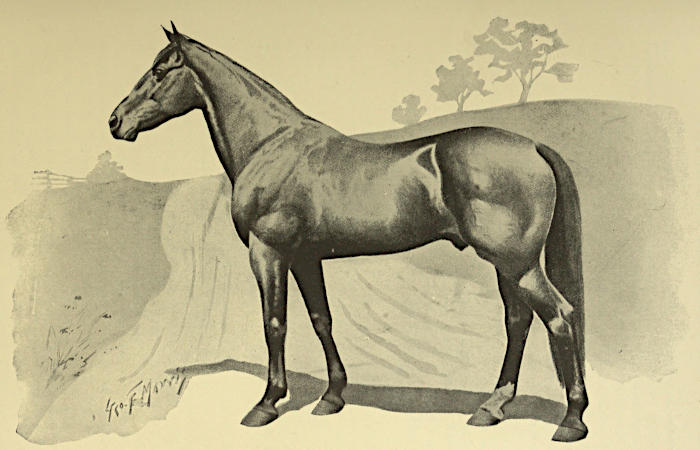
GEORGE WILKES.
A Great Son of Hambletonian.
George Wilkes was one of the first of Hambletonian’s sons
to attract attention, by his performances on the turf, to the
value of his sire; and as a progenitor he must be accorded a place
in the first rank of all trotting sires. This horse was bred by
Colonel Harry Felter, Newburgh, New York, was foaled 1856,
and was got by Hambletonian out of the fast road mare Dolly
Spanker. (This mare was afterward registered on what seemed
excellent evidence as by Henry Clay, out of a daughter of Baker’s
Highlander, but more recent investigation has thrown serious
doubt upon this pedigree, the subject being fully discussed in
the chapters in this work on “The Investigation of Pedigrees.”)
After the travail that brought the little brown colt into the
world, Dolly Spanker died, and the orphaned youngster, like
Andrew Jackson, owed his life to woman’s kindly care. He was
fed by the women of the farm on Jamaica rum and milk sweetened
with sugar, and soon grew lusty, though he was always an
undersized horse, never much, if any, exceeding fifteen hands in
height, though he was so stoutly and compactly made that he
gave the impression of being larger than he really was. He was
of that order that has been paradoxically described as “a big
little horse.” In color he was a very dark brown, and his flanks
and muzzle shaded into a deep tan, or wine color. From a detailed
description of him published in the Spirit of the Times in
1862, I extract the following:
“He is about 15.1, but all horse.... His traveling gear is just what it
should be—muscular shoulders long strong arms, flat legs, splendid quarters,
great length from hip to hock, and very fine back sinews. He stands higher
behind than he does forward, a formation we like.... He is very wide
between the jaws.... His coat is fine and glows like the rich dark tints
of polished rosewood.... His temper is kind. We had the pleasure of
seeing him at his work, and unless we are greatly mistaken he will make an
amazingly good one. He has a long and easy way of going, striking well out
behind and tucking his haunches well under him.”
Though from the fact that this writer stated that Wilkes “was
as handsome as Ethan Allen,” we might suspect him of a tendency
to “paint the lily,” it will be noted that this was written before
the horse had any great reputation to speak of, and it may be
accepted as a substantially correct description as far as it goes.
In describing his action Charles J. Foster wrote that “his hind
leg when straightened out in action as he went at his best pace reminded
me of that of a duck swimming.” He was then the property
of Z. E. Simmons, who had purchased him as a three-year-old
for $3,000, and another horse.
George Wilkes, or Robert Fillingham, as he was first named,
was a trotter from colthood. At four years old he was matched
against Guy Miller, but his party paid forfeit, the reason therefor
being afterward alleged that they found Fillingham possessed
of so much speed that they decided to “lay for bigger
game.” The late Alden Goldsmith, a most competent judge, saw
the colt trot at this time and then thought he was the fastest
horse he had ever seen. He won a race in August of his five-year-old
year, taking a record of 2:33, and the next year sprang
into wide fame by defeating the then popular idol, Ethan Allen,
in straight heats, over the Union Course, the fastest heat being
in 2:24¾. In October of that year he started in harness against
General Butler, under saddle. Though Butler was no match for
George Wilkes in harness, with a saddle on his back, and Dan
Mace in the saddle, he was almost unbeatable in his day, but it
took him four heats to beat Wilkes, who forced him out in the
first heat in 2:21½, a record he never after surpassed. Then
William L. Simmons and John Morrissey matched Wilkes against
Butler, two-mile heats to wagon, the latter having previously
beaten the great George M. Patchen a heat in record-breaking
time under similar conditions. In preparation for that match
George Wilkes was sent a trial over the Centerville Course, concerning
which there has been much discussion and probably
much romance. Charles J. Foster wrote thus:
“It was a close, sultry day and the stallion was short of work.... He
went the two-mile trial and I have no doubt it was faster than trotter ever had
before, or has since, in any rig. But it ‘cooked his mutton,’ as the saying is,
and for a long time he was George Wilkes no more.”
It is said that ever after this trial, whatever it may have
been, George Wilkes was inclined to sulk in his races. He raced
with fair success in 1863 and 1864, and at the beginning of 1865
was classed among the very best out. He was sent against Dexter
and Lady Thorn, being beaten by both; but in 1866 he twice
defeated Lady Thorn, the last time in a notable wagon race over
Union Course in 2:27, 2:25, 2:26¾. Afterward in the same year Lady
Thorn defeated Wilkes in four successive races, and she beat him
again in their only meeting the following year, but in 1868 he
defeated the mare in a hard-fought race, she winning the first
and second heats and making the fourth heat dead. George
Wilkes made his record of 2:22, October 13, 1868, over the Narragansett
Course at Providence in a winning race with Rhode
Island and Draco. He was kept on the turf with indifferent success
until 1872, racing frequently against Lucy, Lady Thorn,
and American Girl, all of whom outclassed him, at least in
the afternoon of his racing career. Just how fast a trotter
George Wilkes was it is impossible definitely to determine,
so many and varying have been the representations on that
point. It has been claimed that he went a quarter in
twenty-nine seconds to an eighty-five pound wagon. William L.
Simmons some years ago stated that of his own knowledge
George Wilkes trotted a mile and repeat as a six-year-old at the
Centerville Course in 2:19¼, 2:18½, and that Sam McLaughlin
drove him a half-mile to wagon over Union Course in 1:04½.
These statements I give for what may be deemed their worth,
contenting myself with the remark that it is safe to conclude
that George Wilkes would have trotted well within the 2:20 mark,
if he had been managed with a view to bringing out his highest
racing capacity, instead of being handled solely for the purpose
of smart betting and match-making manipulations.
George Wilkes was taken to Lexington, Kentucky, by William
L. Simmons, his owner, in 1873, and in his declining years made
a reputation so great in the stud that his brilliant turf career is
almost forgotten. After having trotted against the best in the
country for twelve successive years, proving his fitness in the
fiery ordeal of turf contest, he, in the nine remaining years of his
life, fulfilled the purpose of his being, and demonstrated the
truth of heredity by getting trotters in plenty able to do and
outdo what he had in his day done.
George Wilkes got a few foals before going to Kentucky, of
which the most notable was May Bird, 2:21, the first trotter to
bring him reputation as a sire. Of the others got in the North,
Young Wilkes, 2:28¼, a sire of some reputation, and Wilkes
Spirit, who also figures in the table of sires, are the only ones to
earn places in the records. Early in the eighties George Wilkes
began to assume high rank as a sire, May Bird, Kentucky Wilkes,
Prospect Maid, So So, Joe Bunker and others bringing him into
prominence. Every year added to his roll of honor and soon he
was among the leaders. Blue Bull had surpassed Hambletonian
in the number of trotters to his credit in the 2:30 list, but at the
close of 1886 George Wilkes was even with the Indiana sire, in
1887 he passed him, and for some seasons led all sires of 2:30
performers. George Wilkes got seventy-two trotters and eleven
pacers to acquire standard records, of which the most noted were
Harry Wilkes, 2:13½, Guy Wilkes, 2:15¼, and Wilson, 2:16¼; and
ninety-four of his sons and eighty-one of his daughters have
produced, as shown in the table of Hambletonian’s sons, 1801
standard performers. The following table embraces the sons
of George Wilkes that have twenty or more standard performers
to their credit:
LEADING SONS OF GEORGE WILKES.
| Name. |
Year foaled. |
Standard performers. |
Producing sons. |
Producing daughters. |
Standard performers produced by sons and daughters. |
Total No. produced in two generations. |
| Red Wilkes, 2:40 |
1874 |
127 |
62 |
41 |
267 |
394 |
| Onward, 2:25¼ |
1875 |
120 |
64 |
32 |
275 |
395 |
| Alcantara, 2:23 |
1876 |
98 |
29 |
15 |
115 |
213 |
| Bourbon Wilkes |
1875 |
67 |
14 |
12 |
45 |
112 |
| Simmons, 2:28 |
1879 |
64 |
13 |
6 |
35 |
99 |
| Wilton, 2:19¼ |
1880 |
61 |
3 |
4 |
8 |
69 |
| Jay Bird, 2:31¾ |
1878 |
57 |
10 |
10 |
68 |
125 |
| Alcyone, 2:27 |
1877 |
55 |
27 |
9 |
117 |
172 |
| Guy Wilkes, 2:15¼ |
1879 |
52 |
10 |
5 |
49 |
101 |
| Ambassador, 2:21¼ |
1875 |
48 |
8 |
3 |
33 |
81 |
| Gambetta Wilkes, 2:26 |
1881 |
48 |
11 |
6 |
32 |
80 |
| Baron Wilkes, 2:18 |
1882 |
47 |
6 |
7 |
18 |
65 |
| Adrian Wilkes |
1878 |
38 |
6 |
7 |
25 |
63 |
| Wilkes Boy, 2:24½ |
1880 |
37 |
2 |
3 |
8 |
45 |
| Young Jim |
1874 |
37 |
11 |
19 |
43 |
80 |
| Brown Wilkes, 2:21¾ |
1876 |
32 |
5 |
1 |
39 |
71 |
| Young Wilkes, 2:28¼ |
1868 |
29 |
6 |
3 |
12 |
41 |
| Favorite Wilkes, 2:24½ |
1877 |
23 |
7 |
6 |
21 |
44 |
| Woodford Wilkes |
1882 |
23 |
1 |
4 |
12 |
35 |
| Wilkie Collins |
1876 |
21 |
5 |
1 |
10 |
31 |
| Lumps, 2:21 |
1875 |
20 |
3 |
10 |
16 |
36 |
| The King, 2:29¼ |
1874 |
20 |
—— |
—— |
—— |
20 |
| Jersey Wilkes |
1881 |
20 |
—— |
2 |
2 |
22 |
Among the other seventy-one producing sons of George Wilkes:
that do not come within the scope of this table are many most
promising sires of rapidly growing prominence, and indeed this
family is branching out wonderfully in every direction. This
family is an emphatically improving one. In extreme speed, in
racing capacity, and in form the third Wilkes generation is better
than either the second or first. Of trotters, such as Beuzetta,
2:06¾, Ralph Wilkes, 2:06¾, Hulda, 2:08½, Allerton, 2:09¼, the
once sensational Axtell, 2:12, and many others of the first rank
by sons of George Wilkes sustain this judgment. The pacing
instinct is rampant in the Wilkes blood, as is attested by the fact
that twenty-five per cent. of the performing get of George Wilkes’
sons are pacers, and frequently pacers of extreme speed, including
such as Joe Patchen, 2:03, and Rubenstein, 2:05, while John
R. Gentry, 2:00½, Online, 2:04, and Frank Agan, 2:03, are by grandsons
of Wilkes. Like his sire, George Wilkes got many sons
greater than himself—and after all that is the true test of greatness
in a progenitor.
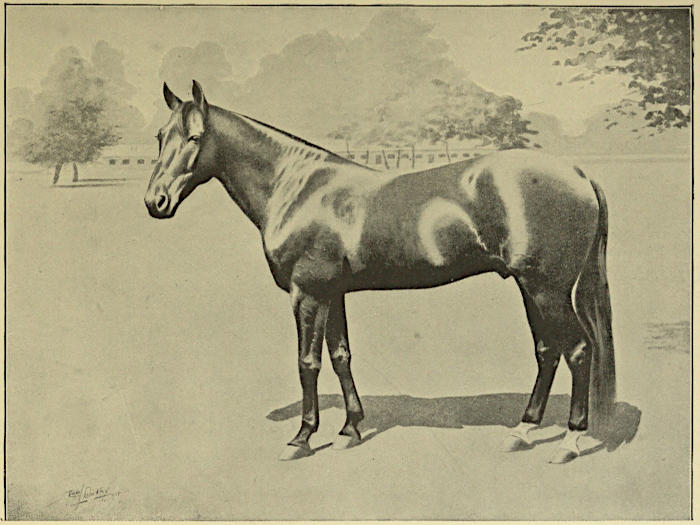
ELECTIONEER.
A Great Son of Hambletonian.
Electioneer has for some years led, far and away, all sires
of trotters in the numbers of performers to his credit in both
the 2:20 list and 2:30 list, and is generally conceded to have had
no equal as a producer of early speed—that is, of colts and fillies
that trotted fast at tender ages. In many respects this was the
most remarkable horse of any age, for besides being phenomenally
prolific in transmitting speed at the trot, and in getting early
trotters, he possessed in a higher degree than any sire that has
yet lived the ability to control running blood in the dam, and to
impress his own instinct and action upon his progeny out of any
and all kinds of mares. In speaking on his pet hobby of producing
trotters from thoroughbred running mares, Governor Stanford
once said to me: “None of my stallions but Electioneer can
do it;” and of all the hundreds of stallions that have been mated
with thoroughbred mares in the hope of getting a trotter of extreme
speed, Electioneer alone was able to do it. Palo Alto,
2:08¼, is so far faster than any other trotting horse out of a thoroughbred
dam—the one solitary instance on record of a half-bred
trotter of extreme speed—that he is significant in one way, and
one only, and that is as an evidence of the phenomenal prepotency
of the blood of his sire in controlling instinct and action.
Electioneer was a dark bay horse, foaled May 2, 1868, bred by
Charles Backman, at his Stonyford Stud, Orange County, New
York. He was got by Hambletonian, out of Green Mountain
Maid, by Harry Clay, 2:29, grandam the fast trotting mare
Shanghai Mary, pedigree not established, but in all probability a
daughter of Iron’s Cadmus, the sire of the famous old pacer and
brood mare Pocahontas, 2:17½. (In Chapter XXIX., on the
investigation of pedigrees, the history of Shanghai Mary is fully
given.) Green Mountain Maid, the dam of Electioneer, has been
called by Mr. Backman, and with justice, “the great mother of trotters.”
In all she bore sixteen foals, fourteen of which were by
the not remarkable horse Messenger Duroc. Electioneer was
her second foal and the only one by Hambletonian. Of the other
fifteen, nine have records of 2:30 and better, another has a record
of 2:31, another, Paul, was a very fast road horse, and two died
young. Of her four sons kept entire, Electioneer, Mansfield,
Antonio, and Lancelot, all are sires of trotters, and her daughters
already figure as producers. The figures would seem to point to
the daughter of Shanghai Mary and Harry Clay, 2:29, as perhaps
the most wonderful of all great trotting brood mares. She was a
brown mare, barely fifteen hands high, with a star and white hind
ankles, and was finely formed, with an exceptionally beautifully
outlined and expressive head. She had very superior trotting
action, the trot being her fastest natural gait. A writer who
made a very close study of her history said, on this point, in Wallace’s
Monthly:
“Her education was limited to a single lesson when three years old; but
previously she had been regularly developed on somewhat the same plan since
adopted for early training at Palo Alto, and was probably one of the fastest
trotters out of harness that ever lived.”
As a matter of fact Green Mountain Maid, while in no sense
vicious, was so highly strung, wild and uncontrollable, that her
training was abandoned with the “one lesson” referred to, and
she never wore harness again.
Green Mountain Maid was a money producer as well as a
speed producer. Mr. Backman paid four hundred and fifty
dollars for her when she was carrying her first foal, and the
writer above quoted states that up to that date (1889) Mr.
Backman had received sixty-eight thousand eight hundred
and thirty dollars for such of her progeny as he had then
sold. This remarkable mare died June 6, 1888, and a fitting
monument marks her grave by the banks of the Walkill.
At maturity Electioneer was of that shade of bay that many
might call brown, and stood precisely fifteen and one-half hands
at the wither and an inch higher measured at the quarter. Many
of his get, notably Sunol, are pronouncedly higher behind than
at the wither. In general conformation, Electioneer was a stout
and muscular horse, standing on fairly short legs. His head was
well proportioned, of fair size, and a model of intelligent beauty.
The forehead was broad and brainy, the eyes large and softly
expressive, and the profile regular, with just the faintest suggestion
of concavity beneath the line of the eyes. Electioneer’s
neck was a trifle too short for elegance of proportion, but
not gross. His shoulder was good, the barrel round, of good
depth and proportionate in length and well ribbed, and the
coupling simply faultless. The quarters were marvelous, and
Mr. Marvin did not overstate the case when he said they were
the best he had ever seen on any stallion. They were the very
incarnation of driving power, and recalled Herbert Kittredge’s
portrait of Hambletonian, except that there was nothing gross
or meaty about the buttocks of Electioneer. They were the perfection
of muscular endowment and development. The arms
and gaskins, like the quarters, were full with muscle laid on
muscle, and the legs and feet were naturally excellent. In the
last years of his life he went over on his knees a bit, but that was
not strange considering his age, and the fact that he had seen
considerable track work. Indeed as long as he was at all vigorous
he was daily exercised on the track, and in view of his great
success in the stud, this fact has a special significance.
As a three-year-old Electioneer was worked some on the Stonyford
farm track to wagon, and Mr. Backman, whose word is good
enough authority for all who know him, stated that he showed a
quarter to wagon in thirty-nine seconds in that year. Little
else is known of his history at Stonyford. He was bred to a few,
very few mares, and was evidently not greatly esteemed by Mr.
Backman. In the autumn of 1876, ex-Governor Stanford, who
was just establishing his great breeding farm, Palo Alto, in the
Santa Clara Valley, California, visited Stonyford to purchase
stock—principally brood mares. The governor was a great believer
in what I may call horse-physiognomy, or to be more exact,
he believed in the importance of the right psychical organization,
what we commonly call brain force, in horses, and was attracted
by the physical evidences thereof as indicated in the head. Electioneer
pleased him in this regard, and in his general make-up,
and when the governor’s purchase was completed Electioneer
went along, being put in at twelve thousand five hundred dollars.
He with the other Stonyford purchases arrived at Palo Alto
Christmas Eve, 1876.
Though Electioneer never took a record, he was emphatically
a developed horse. I do not know whether he was ever driven a
full mile or not—Mr. Marvin never drove him one—but it has
been stated that one of the other trainers drove him a mile in
time somewhere between 2:20 and 2:25. However they may be,
Mr. Marvin in his book settles the question as to his having been
a fast, trained trotter. He says:
“Electioneer is the most natural trotter I have ever seen. He has free,
abundant action; it is a perfect rolling action both in front and behind, and he
has not the usual fault of the Hambletonians of going too wide behind. Certain
writers have said that Electioneer could not trot, and have cited him as a
stallion that was not a trotter yet got trotters.... I have driven, beside
Electioneer, a quarter in thirty-five seconds.... He did this, too, hitched to a
one hundred and twenty-five-pound wagon, with a two hundred and twenty-pound
man, and not a professional driver, either, in the seat. In this rig he
could carry Occident right up to his clip, and could always keep right with
him; and it was no trick for the famous St. Clair gelding to go a quarter
in thirty-four seconds. Without preparation you could take Electioneer
out any day and drive him an eighth of a mile at a 2:20 gait. He
always had his speed with him.... That Electioneer could have beaten
2:20 if given a regular preparation is with me a conviction about which no
doubt exists.”
Mr. Marvin is a conservative and reliable man; he knew
whereof he wrote, and his testimony must be accepted as conclusive
both as to Electioneer’s having been a naturally fast trotter,
and as to his having had his speed developed. Undeveloped
horses do not trot quarters in thirty-five seconds.
When in 1880 Fred Crocker, one of the seven foals got by
Electioneer in his first year’s service in California, astonished
the world by trotting to a two-year-old record of 2:25¾, his sire
became instantly famous, and that fame has increased rapidly and
steadily from that day to this. It was not allowed for a moment
to wane or lag. After Fred Crocker came an ever-surprising
procession of young record breakers. In 1881 Hinda Rose made
a yearling record of 2:36½, and Wildflower a two-year-old record
of 2:21. In 1883 Hinda Rose lowered the three-year-old record
to 2:19½, and Bonita the four-year-old record to 2:18¾. In 1886
Manzanita lowered the four-year-old record to 2:16; in 1887
Norlaine, granddaughter of Electioneer, lowered the yearling
record to 2:31½; and in 1888 Sunol put the two-year-old record
at 2:18, and the year following took a three-year-old record of
2:10½, the fastest to that date. Sunol captured the four-year-old
record in 1889, and the world’s record, 2:08¼, in 1891, but what
made this the brightest year in all the history of Palo Alto was
that Arion lowered the two-year-old record to 2:10¾—the most
remarkable of all trotting performances—Bell Bird the yearling
record to 2:26¼, and Palo Alto the stallion record to 2:08¾. Electioneer
has now to his credit one hundred and fifty-four
standard performers, and in this and in the 2:20 list he has
a long lead over all other sires. He died at Palo Alto, December
3, 1890, and I am informed that his skeleton has been articulated
and mounted for the museum of the Stanford University. The
following table gives the sons of Electioneer that up to the close
of 1896 had ten or more standard performers to their credit:
LEADING SONS OF ELECTIONEER.
| Name. |
Year foaled. |
Standard performers. |
Producing sons. |
Producing daughters. |
Standard performers produced by sons and daughters. |
Total No. produced in two generations. |
| Saint Bell, 2:24½ |
1882 |
47 |
1 |
—— |
1 |
48 |
| Sphinx, 2:20½ |
1883 |
43 |
—— |
—— |
—— |
43 |
| Chimes, 2:30¾ |
1884 |
32 |
3 |
—— |
3 |
35 |
| Anteeo, 2:16¼ |
1879 |
28 |
5 |
3 |
12 |
40 |
| Norval, 2:14¾ |
1882 |
24 |
1 |
—— |
1 |
25 |
| Egotist, 2:22½ |
1885 |
18 |
1 |
—— |
1 |
19 |
| Anteros |
1882 |
16 |
—— |
2 |
2 |
18 |
| Elector (2170), 2:31 |
1879 |
16 |
—— |
—— |
—— |
16 |
| Albert W., 2:20 |
1878 |
15 |
1 |
—— |
1 |
16 |
| Eros, 2:29¼ |
1879 |
14 |
3 |
—— |
4 |
18 |
| Antevolo, 2:19½ |
1881 |
13 |
—— |
1 |
11 |
14 |
| *Bell Boy, 2:19¼ |
1885 |
11 |
1 |
—— |
1 |
12 |
| Fallis, 2:23 |
1878 |
10 |
1 |
—— |
3 |
13 |
| Palo Alto, 2:08¾ |
1882 |
10 |
—— |
—— |
—— |
10 |
* Died at 5 years old.
In considering this table it is necessary to remember that the
Electioneer family dates from 1878, and that no family of anything
approaching so late a date makes a showing that will bear
comparison with this. In considering the rank of families
this question of age is always vital. Electioneer’s first crop of
foals at Palo Alto—1878—numbered seven, and of these two
are represented above, while another was the famous gelding
Fred Crocker. The next numbered but twenty-one, and of
these Eros, Elector, and Anteeo are in the table, and ten are
in the 2:20 list. His third and fourth crops (1880 and 1881)
numbered sixteen and twenty-three respectively, and the forty of
1882 was the greatest number he ever got in one year. I am informed
that in all Electioneer got less than four hundred foals at
Palo Alto; and that, since the first one saw light in 1878 this
family should in eighteen years make the showing it has with
nearly fifty per cent. of its members in the 2:30 list, and four hundred
and ninety-three of the second generation also there, is certainly
remarkable. Electioneer has to his credit in the 2:15 list
the following trotters: Arion, 2:07¾, Sunol, 2:08¼, Palo Alto, 2:08¾,
Helena, 2:12½, Belleflower, 2:12¾, Utility, 2:13, Quality, 2:13¼,
Conductor, 2:14¼, and Norval, 2:14¾, an “extreme speed list”
greater than to the credit of any other sire, while among the get
of his sons are such trotters as Azote, 2:04¾, Fantasy, 2:06,
Little Albert, 2:10, Lynne Bel, 2:10½, Copeland, 2:11½, Athanio,
2:11¾, Cobwebs, 2:12, etc., etc. Sixty-five of his sons have sired
four hundred and thirty-seven performers, and forty-three of his
daughters have produced fifty-six performers. With all these
facts kept in view the study of the above table will prove interesting
and instructive in forming an estimate of the merit of Electioneer
as a trotting progenitor.
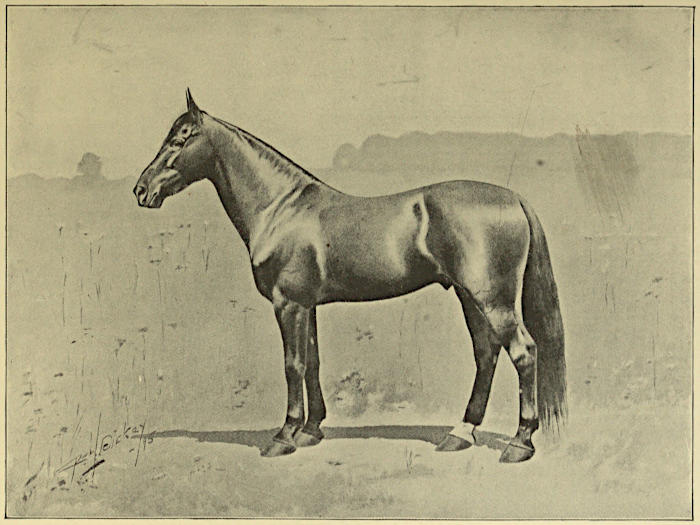
ABDALLAH (ALEXANDER’S).
A Great Son of Hambletonian.
Alexander’s Abdallah was the founder of one of the
very greatest of the Hambletonian sub-families, and he stands in
the records as a progenitor of the first rank. This was a stout
bay horse, about fifteen and one-half hands high. Excepting a
right white ankle he was a rich solid bay. The only reliable
portrait in existence of this horse was a drawing by Herbert
Kittredge, made from a photograph taken of Abdallah after he
went to Kentucky. The picture of Abdallah published in this work
is a faithful reproduction of the Kittredge portrait published in
Wallace’s Monthly for March, 1881, and in the absence of any
reliable detailed description of the horse this portrait must be
taken as the best reflection we now have of his individuality.
He was bred by Lewis J. Sutton, of Warwick, Orange County,
New York, and was foaled 1852. Mr. Sutton had in 1851 a
good road mare that he had got at Carl Young’s roadhouse in
Third Avenue, New York. This mare, Katy Darling, had been
quite a trotter, and had, it was said, won a match race on Union
Course. Her reputation as a trotter and her fine form caused
Mr. Sutton to buy her when, as he describes it, “she was standing
on three legs,” in the hope of getting a foal from her. He
took her home in March, 1851, and in August bred her to
Rysdyk’s Hambletonian, then a two-year-old colt, and September
22, 1852, she produced the subject of this sketch. Two years
later Mr. Sutton sold Katy Darling to James W. Benedict, of
Warwick, from whom she was purchased by Hezekiah Hoyt, who
took her to Muscatine, Iowa, where she produced a chestnut colt
that was gelded, by Hector, son of La Tourrett’s Bellfounder.
This gelding was her only foal other than Alexander’s Abdallah,
and Katy Darling died at Muscatine, the property of a Mr.
Stewart. A search was long kept up for the pedigree of this
mare, and for the full details of what is known of her history the
reader is referred to the different volumes of Wallace’s Monthly.
The conclusion from all the evidence found is that she was probably
by a son of Andrew Jackson.
As a foal by his dam’s side Alexander’s Abdallah attracted
much favorable attention by his fine trotting action, and his persistency
in cavorting around at that gait. Among those who
took great delight in watching the little fellow trot was Mr.
Hezekiah Hoyt, and when the youngster was seventeen months
old Mr. Hoyt, acting for, or in partnership with, Major Edsall,
bought the colt for five hundred dollars, a fine price at that time.
Major Edsall kept him until he was seven years old, and I am
under the impression that he won some local races during that
time, when he was known as Edsall’s Hambletonian. He was
accorded a fairly liberal patronage in Orange County, and his
progeny showed so well that Major Edsall sold him for three
thousand dollars in 1859 to Joel F. Love and James Miller, of
Cynthiana, Kentucky. The Hambletonian family was just then
becoming popular, and the price paid indicates that this horse
was already regarded by good judges as one of Hambletonian’s
best sons. That he was regarded, moreover, as quite a trotter is
indicated by the fact that at the close of his second season in
Kentucky—1860—Mr. Miller matched him against Albion, a
competing stallion, for two hundred and fifty dollars a side. The
affair caused quite a sensation at the time, the Cynthiana horsemen
going in crowds to Lexington to back Abdallah. The latter was
driven by “Jim” Monroe, and Albion by Warren Peabody, and
Abdallah won in the hollowest fashion, distancing Albion in 2:46.
As youngsters Abdallah’s first progeny in Kentucky showed very
well, and in the spring of 1863 he was purchased by R. A.
Alexander, and made the seasons of 1863 and 1864 at Woodburn.
On the evening of February 2, 1865, Marion’s band of Confederate
guerrillas raided Woodburn and took away a number of
horses, among them Alexander’s Abdallah and the then famous
young trotter, Bay Chief, by Mambrino Chief. Marion mounted
Bay Chief and, crossing the Kentucky River, the band encamped
on the farm of a Mr. Bush, in a rough, hilly region, twelve miles
from Woodburn. Here the next morning the Federal cavalry,
that were sent in pursuit after the raid, came up with the raiders,
and after a sharp fight routed them. Marion, on Bay Chief, was
a conspicuous mark for Federal bullets during the skirmish.
Early in the fray Bay Chief was shot through the muzzle,
through both thighs, and one hock. In this condition he carried
his rider two miles in the retreat, when the horse was so weakened
by loss of blood that a Federal cavalryman overtook them.
His piece being empty, the soldier aimed a blow at Marion, but
missing him, lost his balance, and fell from his horse. The
guerrilla leader quickly saw his opportunity, jumped from Bay
Chief, mounted the soldier’s horse, and escaped. Bay Chief
died about ten days later, despite all efforts made to save him.
Meanwhile, Alexander’s Abdallah had been found, safe and
sound, by a Federal soldier in Mr. Bush’s stable. The soldier
refused to give him up to Mr. Alexander’s men, and declared
he would send him North and keep him until he got a large reward
for his return. The horse was barefooted and in no condition
for hard usage. And so they rode him off, and after going
some forty or fifty miles he gave out, and they turned him loose
on the road. He was found next day in a pitiable condition by
the roadside, and brought back as far as Lawrenceburg on his way
home, where he was taken with pneumonia and died a few days
later.
Just how great a loss this was to the trotting breed was not
realized until long after—until in fact Goldsmith Maid had conquered
all before her, and made a record as a campaigner never
equaled, and until his two great sons, Almont and Belmont,
rose to pre-eminent places in the list of great sires. Other sons
of this remarkable progenitor have taken rank as sires, and his
daughters proved of the highest excellence as brood mares; but
Almont and Belmont have each established such large, important,
and popular sub-families that this work would be incomplete
without some brief sketch of each.
Alexander’s Abdallah got Goldsmith Maid, 2:14, Rosalind, 2:21⅔,
Thorndale, 2:22¼, Major Edsall, 2:29, and St. Elmo, 2:30. Fourteen
of his sons have produced one hundred and fifty-five standard
performers, and twenty-nine of his daughters have produced
forty-four standard performers, among them being the noted
campaigners, Favonia, 2:15, and Jerome Eddy, 2:16⅔, the latter
also a successful sire. The following table gives the families of
his most prominent sons:
LEADING SONS OF ALEXANDER’S ABDALLAH.
| Name. |
Year foaled. |
Year died. |
Standard performers. |
Producing sons. |
Producing daughters. |
Standard performers produced by sons and daughters. |
Total No. produced in two generations. |
| Almont, 2:39¾ |
1864 |
1884 |
37 |
95 |
72 |
609 |
646 |
| Belmont |
1864 |
1889 |
58 |
63 |
48 |
560 |
618 |
| Hambletonian (Wood’s) |
1858 |
1885 |
24 |
12 |
13 |
49 |
73 |
| Major Edsall, 2:29 |
1859 |
1886 |
3 |
6 |
3 |
87 |
90 |
| Thorndale, 2:22¼ |
1865 |
1894 |
10 |
8 |
14 |
47 |
57 |
| Jim Munro |
1861 |
1882 |
8 |
5 |
17 |
38 |
46 |
| Abdallah Pilot |
1865 |
1881 |
3 |
1 |
1 |
17 |
20 |
Almont was bred at Woodburn Farm, was foaled 1864, and was
by Alexander’s Abdallah out of Sally Anderson, by Mambrino
Chief; grandam Kate, a wonderfully fast pacer by Pilot Jr.
Colonel R. P. Pepper informed me that he knew Kate as well as
any of his own horses, and that her speed at the pace was “simply
terrific.” Kate, whose dam was called the Pope mare, pedigree
unknown, had several foals, among them the “catch filly”
that was the dam of Clay Pilot, sire of The Moor, that got the
great brood mare Beautiful Bells, 2:29½, and Sultan, 2:24, the sire
of the world-famous Stamboul, 2:07½. Thus the blood of this
pacing Pilot Jr. mare figures in three great sub-families, the
Almont family, the Beautiful Bells family, and the Sultan family.
Almont was a beautiful cherry bay, very rich in shade, and without
any white whatever. He was fifteen hands two and one-quarter
inches high at the wither, somewhat higher behind, and
stoutly and symmetrically made all over. He could not be called
a handsome or highly finished horse, but he was emphatically a
well-made one. He had very excellent feet and legs, and these
he reproduced with great uniformity, as well as his very intelligent
and even disposition. He was trained early at Woodburn,
and, like his sire, started but once and distanced his competitor
in 2:39¾, this being in his four-year-old form. He soon after
showed 2:32 over the slow Woodburn track, and was sold to the
late Colonel Richard West for eight thousand dollars and put in
the stud. In 1874 the late General W. T. Withers, Lexington,
Kentucky, bought him for fifteen thousand dollars, and a half
dozen of years later he was very generally regarded as the greatest
of living sires, and his prestige made the name of Fairlawn Farm
of world-wide renown, and made his owner rich. The fact that
ninety-five of his sons have sired standard performers, a greater
number of producing sons than is to the credit of any other
horse, Hambletonian alone excepted, indicates the high rank
Almont must be accorded as a progenitor. In considering his
success it is well for breeders particularly to note that good
judges considered Almont capable of showing a 2:20 gait any
day, and that, like Electioneer, he always was daily given regular
and ample track exercise. His gait has been described as bold
and open, without an excess of knee action, but with immense
display of power behind. Almont died of spasmodic colic, July 4,
1884, in the fullness of his fame, and at an age when, had he been
more discreetly used in the stud, he should have been at his
prime as a stock horse.
Almont was hardly a sensational horse in his day, the performance
of Westmont at Chicago in 1884, when he paced a mile with
running mate in 2:01¾, being the one sensational performance to
the credit of his progeny. This lightning streak of pacing speed
that so often crops out in the Almont family can be readily
accounted for by the student of breeding. As has been noted, his
grandam Kate, by Pilot Jr., was a phenomenally fast pacer, and,
as we have indicated, her blood proved potent in more than one
line. In addition to this there was a strong tendency to pace
among the progeny of Alexander’s Abdallah. St. Elmo was first
shown at fairs in Kentucky under saddle and as a pacer, and
many others of Abdallah’s get were known to naturally pace.
When we reflect that in Almont this Alexander’s Abdallah blood
with its pacing predilection was united with the blood of the old
lightning pacer, Kate, we need not be surprised at the great
number of fast pacers that came from Almont and his sons.
Belmont, too, has shown a tendency to get the pacing gait with
great frequency, but not in such frequency or at such high rates
as his son Nutwood. As there could not be traced any known
pacing blood in Belmont’s dam, and as the fact that Alexander’s
Abdallah transmitted an inclination to pace has been generally
not known or ignored, some writers have been unable to understand
why the Belmonts paced. He got pacers because he inherited
that capacity from his sire, and Nutwood got more and
faster pacers than Belmont, because in him the pacing inclination
inherited from Alexander’s Abdallah was reinforced by the
strong pacing inheritance of his dam, Miss Russell, the granddaughter
of Old Pacing Pilot.
As shown in the table of Alexander’s Abdallah’s sons, Almont
got thirty-seven standard performers, ninety-five of his sons sired
five hundred and three standard performers, and seventy-two of
his daughters produced one hundred and six standard performers.
His most successful sons are embraced in the following table:
LEADING SONS OF ALMONT.
| Name. |
Year foaled. |
Standard performers. |
Producing sons. |
Producing daughters. |
Standard performers produced by sons and daughters. |
Performers produced in two generations. |
| Almont Jr. (1829), 2:26 |
1872 |
44 |
7 |
20 |
39 |
83 |
| Altamont, 2:26¾ |
1875 |
39 |
7 |
1 |
10 |
49 |
| Atlantic, 2:21 |
1878 |
24 |
6 |
12 |
22 |
46 |
| Piedmont, 2:17¼ |
1871 |
19 |
3 |
8 |
18 |
37 |
| Almont Jr. (1764), 2:29 |
1871 |
19 |
11 |
11 |
51 |
70 |
| King Almont, 2:21¼ |
1874 |
14 |
—— |
1 |
1 |
15 |
| Pasacas, 2:43 |
1870 |
14 |
4 |
6 |
13 |
27 |
| Almonarch, 2:24¾ |
1875 |
13 |
2 |
3 |
7 |
20 |
| Allie Gaines |
1875 |
12 |
5 |
8 |
17 |
29 |
| Harbinger |
1879 |
10 |
1 |
2 |
3 |
13 |
| *Allie West, 2:25 |
1870 |
7 |
4 |
10 |
24 |
31 |
| Abdallah Mambrino |
1870 |
13 |
1 |
11 |
24 |
37 |
* Died at 6 years old.
This line is justly regarded with growing favor as one of our
very best and most productive sub-families, and one that is
breeding on excellently, generation after generation.
Belmont was a bay horse of very superior form and finish,
bred at Woodburn Farm, and foaled there in 1864. He was by
Alexander’s Abdallah, out of Belle (that also produced McCurdy’s
Hambletonian, 2:26½, and Bicara, the dam of Pancoast, 2:21¾) by
Mambrino Chief; grandam Belle Lupe, by Brown’s Bellfounder.
Belmont and Almont were of the same age, and, perhaps because
of his finer appearance, Belmont seems to have been the preferred
one at Woodburn, and was retained while Almont was sold.
Though Belmont was a successful horse and established a great
family, no thinking man can contend that he was the equal of
Almont as a sire, when all the circumstances are considered.
Almont spent almost his entire stud career at Fairlawn, where
there never were five mares worthy in blood to be in a great trotting
stud, where there were scores of mares of all kinds of poor
and freakish pedigrees, even to “Arabs,” and where none of the
stock was ever trained. Belmont, on the other hand, was all his
life at the head of the most famous, and, in his younger years,
unquestionably the best collection of trotting brood mares in the
world, and where a training department was always maintained.
Remembering these conditions, and contemplating the statistics
of the two families, it is interesting to speculate as to how the
records would stand had Belmont been at Fairlawn, and Almont
at Woodburn.
LEADING SONS OF BELMONT.
| Name. |
Year foaled. |
Standard performers. |
Producing sons. |
Producing daughters. |
Standard performers produced by sons and daughters. |
Performers produced in two generations. |
| Nutwood, 2:18¾ |
1870 |
136 |
90 |
69 |
432 |
568 |
| King Rene, 2:30½ |
1875 |
35 |
17 |
16 |
55 |
90 |
| Egmont |
1873 |
34 |
13 |
11 |
38 |
72 |
| Wedgewood, 2:19 |
1871 |
31 |
12 |
9 |
60 |
91 |
| Vatican, 2:29¼ |
1879 |
14 |
—— |
—— |
—— |
14 |
| Warlock |
1880 |
12 |
—— |
—— |
—— |
12 |
| Monaco |
1878 |
11 |
1 |
4 |
7 |
18 |
| Waterloo, 2:19¼ |
1882 |
10 |
—— |
1 |
1 |
11 |
| Meander, 2:26½ |
1879 |
10 |
3 |
1 |
7 |
17 |
| Mambritonian, 2:20½ |
1883 |
10 |
—— |
—— |
—— |
10 |
| Herschell |
1883 |
10 |
—— |
—— |
—— |
10 |
Belmont, besides having the advantage of excellent individuality
was also a trotter of no mean speed. He was driven a mile
over the working track at Woodburn in 2:28½, and was, therefore,
a quite well-developed trotter. He never appeared in
public, and has, therefore, no public history. The most successful
of his sons has been Nutwood, whose dam was Miss Russell,
the dam of Maud S. This horse was himself a fast trotter in his
day, taking a record of 2:18¾, and rose to great popularity and
success in the stud. Daughters of Belmont, being nearly all out
of producing mares, are greatly and justly esteemed as brood
mares. Belmont died at Woodburn November 15, 1889. Belmont
got fifty-eight standard performers, sixty-three of his sons
sired four hundred and eighty-nine standard performers, and
forty-eight of his daughters produced seventy-one standard performers.
The rank of his best sons is shown on the preceding
page; all having ten or more in the list of standard performers
being included in the table.
Volunteer stands pre-eminent among trotting sires as the
one horse against not one of whose get the epithet “quitter”
was, as far as I am aware, ever hurled. He did not get speed
with remarkable uniformity, nor did his progeny develop speed
early or rapidly. They required persistent training, but when
speed was developed in a Volunteer you had with it every other
quality of a resolute, enduring race horse. They were hardy,
rugged, good-limbed horses, and uniformly possessed stamina
and resolution in the highest degree. Volunteer had the advantage
of being owned by Alden Goldsmith, an ambitious and
experienced horseman, and the father of two of the most successful
trainers of our day. The Volunteers had, therefore, every
advantage that training could give, and his rise to fame was
largely due to Mr. Goldsmith’s constantly developing and racing
his progeny.
In 1853 Mr. Joseph Hetzel, Florida, Orange County, New
York, bred the bay mare Lady Patriot to Hambletonian, 10, and
Volunteer was foaled May 1, 1854. This mare, Lady Patriot,
was by a horse called Young Patriot, and out of Mr. Lewis
Hulse’s trotting mare, and that is all that is known of her pedigree.
Her sire’s pedigree is wholly unknown. She produced a
numerous family, among them being Sentinel, 2:29¾, and Green’s
Hambletonian, brothers of Volunteer, and of some rank as sires,
and Marksman, by Thorndale, that is also in the table of sires,
while her daughter Heroine, sister to Volunteer, produced
Shawmut, 2:26.
Volunteer was a bay horse, with a little white around the left
hind coronet, fifteen hands three inches at the wither, and sixteen
hands measured at the coupling. He has been considered
by many good judges to have been the handsomest of all the sons
of Hambletonian. He was a horse of superb form and of great
elegance of carriage. With sufficient of muscle and substance,
he was built on graceful, finished lines, with a beautiful head
loftily carried, a long and graceful neck, a body stout but finely
molded, and all set off by a handsome mane and tail. His feet and
legs were of superb quality, and despite his great age they were,
it is said, without fault or blemish to the last. His temper and
disposition were good, though he was very high-spirited, and in
harness he was especially attractive. As a four-year-old Volunteer
was sold to Mr. R. C. Underhill, of Brooklyn, after he had
won a premium at the Orange County fair. In April, 1861,
Mr. Underhill sent him to Tim T. Jackson, of Jamaica, Long
Island, and in Wallace’s Monthly for December, 1880, Mr. Jackson
gave his experiences with Volunteer, making among others this
specific statement:
“I had him at Union Course one day, and met Mr. Alfred M. Tredwell
there, and I got him to hold that watch on him. Had him in quite a heavy
single-seated wagon, weighing probably one hundred and twenty-five or one
hundred and thirty pounds. On the first trial he trotted in 2:33. I said to
Mr. Tredwell that he could beat that, and he trotted the next mile in 2:31¼.”
He had previously been trained by William Whelan, at
Union Course. It was June 26, 1862, while he was in Jackson’s
hands, that Alden Goldsmith, in partnership with Edwin
Thorne, purchased this horse, then called Hambletonian Jr.,
and he soon afterward became the sole property of Mr. Goldsmith.
Mr. Rysdyk greatly resented his having been called
Hambletonian Jr., and early regarded him as a possible rival
of Hambletonian, and there was war from the start between
the adherents of sire and son. The Civil War was just then at
its height, and the patriotic and military spirit rampant, and Mr.
Goldsmith aptly named his horse Volunteer. Mr. H. T. Helm,
who wrote a very detailed history of Volunteer twenty years ago,
credits him with having trotted in 2:36 to wagon at the Goshen
Fair in the fall of 1862, beating Winfield, Grey Confidence and
others. At Hartford, Connecticut, in August, 1867, he beat
George M. Patchen Jr., in a single dash in 2:37. He was, like
nearly all the other great sires, a developed trotter.
It is said that his early stud opportunities were so limited that
at ten years old he had but eighteen living foals. The first of
his get entered the 2:30 list in 1871, but from that time on his
list rapidly grew, and the great campaigners Gloster, Alley,
Driver, Bodine, Huntress, the great three-miler, and finally St.
Julien, 2:11¼, then the fastest trotter in the world, so spread the
fame of Volunteer that when his sire died in 1876 he was regarded
as the greatest living sire of trotters. In 1882 Mr. R. S.
Veech, probably the most intelligent breeder in all Kentucky,
while on a visit to New York, telegraphed Mr. Goldsmith to
know whether it was worth while for him to visit Walnut Grove,
with a view to buying Volunteer, and Mr. Goldsmith’s answer
reveals the regard in which he held his horse. The pith of his
admirably written letter was in this paragraph:
“While there is no person that would be more welcome at the farm than
yourself, if the only object of your visit would be the purchase of Volunteer,
then your trip would not be a profitable or successful one, as no breeder in
Kentucky has money enough to buy him.... I have as high a regard
for money as the most of men for the uses it may subserve, but there are certain
things which money cannot buy, as the Teacher of old taught Simon the
Samaritan.”
And so Volunteer remained at Walnut Grove, and “lagged
superfluous on the stage” long after his owner had passed away,
and died December 13, 1888, at the extraordinary age of thirty-four
years, seven months and twelve days.
Volunteer sired thirty-four standard performers, and forty of
his sons and forty-eight of his daughters produced an aggregate
of two hundred and twenty-one standard performers. The most
successful of his sons is the Michigan sire, Louis Napoleon, that
was out of the Harry Clay mare, Hattie Wood, dam also of Victor
Bismarck and Gazelle, 2:21. Louis Napoleon has twenty-seven
in the standard list, and fourteen of his sons and twenty-two of
his daughters are producers, his best son being Jerome Eddy,
2:16½, sire of Fanny Wilcox, 2:10¼, and twenty-seven other standard
performers.
Dictator very early in his career attracted attention as the
full brother to the famous Dexter, who was his senior by five
years, and who was king of the trotting turf, and the most
famous trotter in all the world just at the time when Dictator
was merging from colthood to maturity. Dictator had thus from
the very start the advantage of splendid stud opportunities. He
was bred by Jonathan Hawkins, of Walden, Orange County, New
York, and was foaled in 1863. He was got by Hambletonian out
of the famous Clara, the dam of Dexter, 2:17¼, Alma, 2:28¾,
Astoria, 2:29½, etc., by Seely’s American Star; grandam the McKinstry
mare, breeding unknown, but that produced Shark with
a saddle record of 2:27¾. Dictator was a seal-brown horse with
a white rear ankle, and stood scant fifteen hands and one inch.
He was made on a small but a fine model, and was, all in all, a
handsome little horse, and most of his get partook of his fine
quality of structure, though many were unsound. Shortly after
Dexter made his début on the turf, Dictator was bought by Mr.
Harrison Durkee, a wealthy New York gentleman who had an
extensive stock farm at Flushing, Long Island. The colt was
then but eleven months old and was left at the Hawkins farm
until two years old. Then he was sent to Mr. Alden Goldsmith’s
place, at Washingtonville, to be broken, after which he was taken
to Mr. Durkee’s farm. The colt was very fast, but the fame of
Dexter was already wide, and, no great importance being attached
to development of stallions in that day, he was considered
of more value for breeding than for racing. He was worked
considerably at Mr. Durkee’s farm, and Colonel John W. Conley
and H. C. Woodnut, who at different times had charge of him,
have both declared that they knew him to be one of the fastest
trotters of his day. In 1874 Colonel Richard West sold Almont
to General Withers, and to fill his place leased Dictator in the
autumn of 1875, and he made the seasons of 1876 and 1877 at
Colonel West’s Edgehill farm, Georgetown, Kentucky. Standing
at a higher fee than Almont or George Wilkes, he attracted
little outside patronage, and he was returned to Long Island. It
has been stated that when at Colonel West’s, George Brasfield
drove Dictator quarters as fast as thirty-four and one-half
seconds. After his return to Flushing he sank from public
notice until the appearance of Director as a great three-year-old
in 1880. Then a couple of years later came the phenomenal
Jay-Eye-See, and close after him Phallas, and with these three
great trotters on the turf at once “the sire of Jay-Eye-See, 2:10,
Phallas, 2:13¾, and Director, 2:17,” came again prominently before
the public. In 1883 he was purchased by Major H. C. McDowell,
and Messrs. David Bonner and A. A. Bonner, for a price that
was said to have been twenty-five thousand dollars, and taken to
Ashland farm at Lexington. Eventually he became the sole
property of Major McDowell, and died May 25, 1893.
Dictator did not get speed uniformly. He was what might be
called a sporadic sire, but those of his get that raced at all raced
well. By far his best son as a producer is Director, 2:17, that
was out of Dolly by Mambrino Chief, and is the sire of sixteen
trotters and pacers with records in the 2:20 list, including the
champion trotting stallion Directum, 2:05¼, and the one-time
champion pacing stallion, Direct, who after being practically
crippled in trotting to a four-year-old record of 2:18¼, carrying
great weights to keep him at that gait, was allowed to go at his
natural gait and paced in 2:05½, and is already a very successful
sire. Phallas, 2:13¾, of whom high hopes were entertained, and
who had great opportunities, proved practically a failure in the
stud, though his son Phallamont, out of an Almont mare, ranks
with Direct as the best of Dictator’s grandsons. Dictator got fifty
standard performers, forty-four of his sons have produced one
hundred and seventy-three standard performers, and forty-two of
his daughters have produced sixty-one standard performers.
Harold became very famous when Maud S. became queen of
the turf with the then marvelous record of 2:08¾, a record that
stood unequaled from 1885 till 1891. This horse was bred by
Charles S. Dole, Crystal Lake, Illinois, by whom he was sold, in
an exchange of horses, to Woodburn Farm, when he was a yearling.
He was foaled in 1864, and his dam was Enchantress
(the dam also of Black Maria and of Lakeland Abdallah), by
Abdallah. It was long claimed that this mare’s dam was a
daughter of imported Bellfounder, but investigation exploded
this claim. Harold was a bay horse, without marks, just fifteen
hands high, stoutly made but very homely of form. He had a
finely made head, but otherwise he was exceedingly plain, and
when Maud S. came out the late Benjamin Bruce, in the Kentucky
Live Stock Record, expressed wonder that “that little
bench-legged stud” could have gotten such a mare. Harold’s
full brother, Lakeland Abdallah, was far superior to him individually,
but ranks with Hetzel’s Hambletonian, the brother
to Volunteer, and Kearsarge, by Volunteer out of Dexter’s dams,
in the fore front of the well-bred failures in trotting history.
Largely from his individuality Harold was never, even when
Maud S. was in the heyday of her renown, a popular horse, and
the figures given by the Woodburn management say that in his
entire career he was bred to but five hundred and ninety-four
mares, or an average of about twenty-five for each of his twenty-three
seasons. With the exception of Maud S., Harold got
nothing of the first class, but in the second generation the family
holds better rank in respect to extreme speed production. Beuzetta,
2:06¾, Early Bird, 2:10, The Conqueror, 2:13, and the great
three-year-old Impetuous, 2:13, are out of daughters of Harold,
while Kremlin, 2:07¾, Io, 2:13½, Rizpah, 2:13½, Russellmont, 2:12¾,
and the great pacer Robert J., 2:01½, are among the produce of
his sons, and the present queen of the trotting turf, Alix, 2:03¾,
is out of a daughter of Attorney, by Harold. Harold died at
Woodburn, October 6, 1893. This horse never trotted in public,
but he was worked some for speed at Woodburn. As a six-year-old
he is said to have trotted the farm track in 2:40½, in which
mile it is stated he “grabbed a quarter” and was not worked
again. He is the sire of forty-four standard performers, forty-three
of his sons have produced one hundred and eighty-one
standard performers, and forty-five of his daughters have produced
sixty-seven standard performers.
Happy Medium was bred by R. P. Galloway, of Sufferen, New
York, and was foaled 1863. He was by Hambletonian, out of
the famous old campaigner Princess, 2:30, that trotted ten miles
in 29:10¾ and two miles in 5:02, and was the great rival of Flora
Temple, 2:19¾. Princess was a bay mare, foaled 1846, by Andrus’
Hambletonian, son of Judson’s Hambletonian, that was by
Bishop’s Hambletonian, son of imported Messenger; and her
dam was the Wilcox mare, by Burdick’s Engineer, son of Engineer,
by imported Messenger. She campaigned from ocean to
ocean, and her career is perhaps the most remarkable of the
earlier trotting days. When young she was mixed gaited, alternately
pacing and trotting, and was put to work hauling logs.
Then her owner traded her for a second-hand wagon, and finally
she reached the hands of D. M. Gage, of Chicago. He put her
into training, and she trotted some indifferent races as Topsy,
was sold, and taken across the plains to California. Here in
1858 she beat New York, taking her record of 2:30. Then she fell
into the hands of the notorious “Jim” Eoff, and the next year
was matched against the then crack trotter of California, Glencoe
Chief, at ten miles to wagon. These were golden days on the
coast, and this race was for the enormous stake of thirty-six thousand
five hundred dollars. Princess won easily in 29:10¾, but the
Glencoe Chief party being dissatisfied, another race was trotted
the next day at the same distance for five thousand dollars,
Princess again winning. There was after this nothing on the
coast to race with Princess, and Eoff brought her to New York
to try conclusions with Flora Temple. Her first race with Flora
was at three-mile heats at Eclipse Course, Long Island, Flora
winning, but at two-mile heats a week later Princess won in 5:02,
5:05. In their subsequent races Flora turned the tables, though
in a stubborn contest at two-mile heats Princess forced the then
queen of the turf to make the long unbeaten record of 4:50½.
She was then retired from the turf, and after passing through
several hands became the property of R. F. Galloway, who in
1862 bred her to Hambletonian.
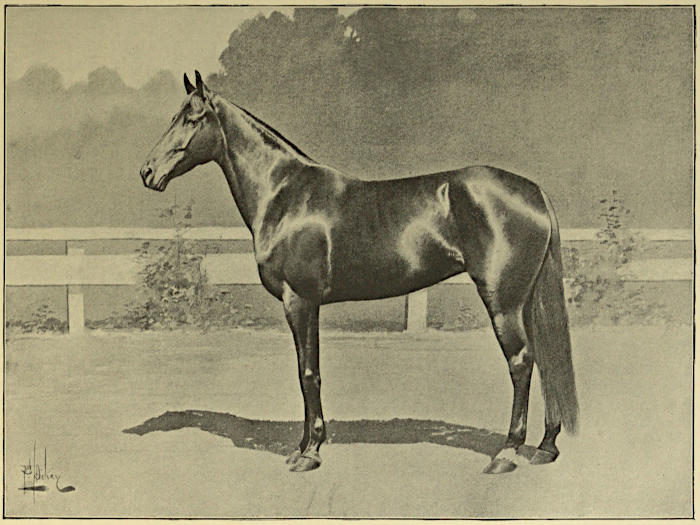
NANCY HANKS.
By Happy Medium, record 2:04.
Happy Medium was a bay horse, with star, snip, and two white
rear ankles, fifteen hands two inches in height, and was a shapely,
attractive horse, with excellent legs and feet. Some critics have
found fault that he was light barreled, and perhaps with some degree
of reason, but as a whole he was structurally much above the
average of his time. As a four-year-old he started at the Goshen
Fair and won, taking a record of 2:54, which he lowered to 2:51 in
1868. The next year, 1869, at Paterson, New Jersey, he distanced
Guy Miller and Honesty in 2:34½, 2:32½, and these three performances,
all winning ones, comprise his entire turf career. He was
in 1871 purchased at a very large price—said to have been twenty-five
thousand dollars—by Mr. Robert Steel, who placed him at
the head of his Cedar Park Farm, at Philadelphia. In 1879 he
was purchased by the late General W. T. Withers, and taken to
his Fairlawn Farm, Lexington, Kentucky, where he remained
until he died, January 25, 1888, at which time he had more 2:30
performers to his credit than any horse then living. The Happy
Mediums developed speed easily and quickly, and were remarkable
for the purity of their gait. The most famous of his get is
the mare Nancy Hanks, that lowered the world’s record to 2:04
in 1892. The mares bred to Happy Medium never were as a
whole of good breeding, and in his early stud career they were
largely of inferior blood and quality. His fame has steadily
grown, and with ninety-two standard performers to his credit,
and his sons and daughters breeding on, the blood of Happy
Medium is justly held in very high esteem as a positive speed-producing
element. Fifty-one of his sons have produced two
hundred and thirteen, and forty-seven of his daughters have
produced fifty-nine standard performers.
Jay Gould was one of the most famous of all the sons of Hambletonian
on the turf and the sensational trotting stallion of his
day, and he now, in turn, takes a high place among producing sons
of the great father of trotters. This horse was bred by the late
Richard Sears, of Orange County, New York, was foaled 1864,
and was got by Hambletonian, out of Lady Sanford, by Seely’s
American Star; grandam Old Sorrel, by Exton Eclipse; third
dam by Lawrence’s Messenger Duroc, etc. At maturity Jay
Gould was a handsome, blood-like horse, fifteen and one-half
hands high, and a rich bay in color, with white hind ankles.
With his dam he was sold while at her side to Charles H. Kerner,
of New York, who soon after traded them to John Minchin, of
Goshen, for the then well-known trotter Drift, Mr. Kerner also
paying a fair sum in cash. Later the colt came into the hands
of A. C. Green, of Fall River, and was by him named Judge
Brigham. It is said that Mr. Green first learned that Judge
Brigham was a fast trotter through his taking fright at a train
one day in 1870 and running away with him at a trot. Whatever
the facts as to this are, it was soon known that Mr. Green
had a very fast trotter, and the next season (1871) he started for
a five-thousand-dollar purse at Buffalo, among the other starters
being the already famous Judge Fullerton. To the general
astonishment, Judge Brigham “cut loose” in the second heat,
winning it in 2:22, thus equaling the stallion record then held
by George Wilkes, and placing to his credit the fastest heat ever
up to that time trotted by a horse in his maiden race. He won
the race handily, and was the sensation of the time. He was at
once purchased for, I believe, the great price of thirty-five thousand
dollars by the late world-famous financier, Jay Gould, H.
N. Smith, and George C. Hall. Later Mr. Smith acquired Mr.
Hall’s interest, and Mr. Kerner bought Mr. Gould’s, and finally,
some years after, Mr. Smith, who had established Fashion Stud
Farm, at Trenton, New Jersey, and owned the noted mares
Goldsmith Maid, 2:14, Lady Thorn, 2:18¼, and Lucy, 2:18¼,
became sole owner of Jay Gould, as Judge Brigham was renamed.
The week following his Buffalo race Jay Gould defeated another
strong field at Kalamazoo, Michigan; and in 1872 started
four times, winning in all his races, lowering his record to 2:21¼,
the then champion stallion record. He was kept in the stud in
1873, but being challenged on behalf of Bashaw Jr., the following
year, was given a hurried fall preparation, and met his challenger
at Baltimore. Bashaw Jr., broke down in the first heat,
and Gould of course won an empty victory, but to satisfy the
audience was driven a public trial in 2:19½. Meanwhile Smuggler
had lowered the stallion record to 2:20, and Jay Gould was
sent against it at Boston, trotting under unfavorable circumstances
in 2:20½ and 2:21½. This practically closed his turf
career. He made a number of seasons at Fashion Farm, and in
his later years at Walnut Hill Farm, near Lexington, Kentucky,
and died of old age June 10, 1894. Jay Gould’s opportunities
were never of the best. In his earlier years in the stud General
Knox was more used at Fashion Farm than Jay Gould, and there
was no training done at Fashion until 1886. Jay Gould is the
sire of twenty-nine standard performers, the most noted of which
is the great mare Pixley, 2:08¼. Fourteen of his sons have produced
thirty standard performers, and twenty-eight of his
daughters have produced forty-six performers, among the latter
being the great pacer, Robert J., 2:01½, and such trotters as Poem,
2:11½, Colonel Kuser, 2:11¼, Mahogany, 2:12¼, Edgardo, 2:13¾, etc.
His most noted producing daughter is Lucia, whose dam was the
famous old trotting mare Lucy, 2:18¼, by George M. Patchen,
2:23½. Lucia is the dam of Edgardo, 2:13¾, Hurly Burly, 2:16¼,
and several others in the 2:30 list, and her blood is breeding on
through both her sons and daughters.
Strathmore, taking all things into consideration, must be
rated among the very greatest sons of Hambletonian. He was a
solid bay horse, of the substantial Hambletonian type, foaled
1866, bred by Aristides Welch at his Chestnut Hill farm, near
Philadelphia, and was got by Hambletonian out of the quite
famous trotting mare Lady Waltermire, by North American, and
Lady Waltermire’s dam was said to have been by Harris’ Hambletonian.
This North American sired Whitehall, that got the
famous trotter Rhode Island, sire of the still more celebrated
Governor Sprague, and in the section treating of the latter the
reader will find particulars concerning North American. Lady
Waltermire was a noted trotting mare in her day, and it has been
claimed that she performed faster than 2:30, but I have never
been able to substantiate this claim. When Strathmore was a
three-year-old, in 1869, I visited Chestnut Hill. Mr. Welch then
had three sons of Hambletonian, viz., William Welch, Rysdyk,
and Strathmore, who was then called Goodwin Watson. The two
former were led out to be shown, but when I inquired for Goodwin
Watson, Mr. Welch’s reply was “Oh, he’s a pacer”—except
that he used an adjective in connection with “pacer” that added
emphasis, and betrayed some degree of regret, or indeed disgust.
The fact that several of Strathmore’s sons have gotten
many fast pacers need not be marveled at. I am not aware that
Strathmore was ever trained, and probably his pacing inclination
furnishes the reason. When he was seven years old he was purchased
by Colonel R. G. Stoner, of Paris, Kentucky, and named
Strathmore, and up to this time, Colonel Stoner states, he had
but three foals, one of which was afterward known as Chestnut
Hill, 2:22½, the first of his get to earn a reputation. His first
two seasons were made in Montgomery County, after which he
was taken to Paris, in Bourbon County. Colonel Stoner states
in one of his catalogues that Strathmore’s early opportunities in
Kentucky were very inferior; that in 1877 and 1878 the service
fees earned would not pay for his keep; that up to 1879 he
never served a mare with a record or the dam of an animal with a
record, and that it was not until Steinway trotted in 1878 as a
two-year old in 2:31¾, and Santa Claus as a five-year-old in 2:18 in
1879 that any good mares came to Strathmore. At Colonel
Stoner’s sale, February 9, 1886, Strathmore was sold for two
thousand one hundred and fifty dollars to Rockhill & Bro., of
Fort Wayne, Indiana, and they owned him until his death,
March 11, 1895. Strathmore has seventy-one in the standard
list; twenty-six of his sons and fifty-four of his daughters have
produced one hundred and fifty-eight standard performers.
Egbert is one of the youngest sons of Hambletonian, and has
achieved very fair success in the stud. He is closely inbred to
the Hambletonian, or rather the Abdallah blood, and is possibly
the most notable instance of a successful sire being very closely
inbred. Egbert was bred by Hon. J. H. Walker, Worcester,
Massachusetts, and was foaled in 1875. He was sold at the sale
of Mr. Walker’s horses at Worcester in the autumn of 1877,
when he was purchased for the then great price for a two-year-old
of three thousand four hundred and twenty-five dollars by
H. J. Hendryx, of Michigan, a representative of Mr. Veech, of
Kentucky, being a contending bidder. After the sale Mr.
Hendryx sold the colt for four thousand dollars to George W.
Raudenbush, of Reading, Pennsylvania, who I believe still owns
him. In the spring of 1880 Egbert was taken by Colonel Richard
West to his farm at Georgetown, Kentucky, and kept there a
number of years, and indeed the greater part of his stud career
has been in Kentucky. I am not aware that Egbert was ever
trained. He is individually a superior horse, but is alleged to
have an unkind disposition.
Egbert was got by Hambletonian out of Campdown, by Messenger
Duroc (son of Hambletonian); grandam Miss McLeod
(dam of Lord Nelson, 2:26¼, and Polonius), by the Holbert Colt
(son of Hambletonian); great-grandam May Fly, by Utter Horse,
son of Hoyt’s Comet; great-great-grandam Virgo, sister to the
dam of Messenger Duroc, by Roe’s Abdallah Chief, son of Abdallah,
the sire of Hambletonian. The Holbert Colt, son of
Hambletonian, was a pacer, and others in Egbert’s ancestry paced;
and in commenting on his pedigree, from this point of view, at
the time Colonel West took him to Kentucky, I remarked in
Wallace’s Monthly, March, 1880: “Colonel West need not be
surprised if he finds quite a number of Egbert’s offspring starting
off at a pace.” The facts have borne out the prediction, as a
glance at Egbert’s long list of fast pacers will show. Egbert is
the sire of seventy-five standard performers, while twenty-five of
his sons, and eighteen of his daughters have produced seventy-four
standard performers.
Masterlode, that left a family of some merit in Michigan, was
a mammoth bay, foaled 1868, got by Hambletonian out of Lady
Irwin by Seeley’s American Star. He was a gigantic, coarse
horse, and was certainly the largest horse that ever earned
a reputation as a sire of trotters. It is said he was quite seventeen
hands high and was built on a heavy mold even for his
height. He was bred by James M. Mills, Orange County, New
York, and passed to A. C. Fisk, Coldwater, Michigan, who
owned him until his death in 1892. The most noted of his get
was Belle F., 2:15¼, that was one of the very best campaigners out
in 1886. He has twenty-eight to his credit in the list, and seventeen
of his sons and sixteen of his daughters have produced in all
fifty-seven standard performers.
Aberdeen shares with Dictator such honors as attach to the
highest success of the “Hambletonian-Star cross” in the stud.
This horse was bred by the notorious Captain Isaiah Rynders, at
Passaic, New Jersey, and a full account of the investigation of the
pedigree of his dam, the noted Widow Machree, 2:29, will be found
in Chapter XXIX., on the investigation of pedigrees. Widow
Machree was altogether the best trotter of the American Star
family, and was especially noted for her gameness. Bred to
Hambletonian, it was natural that she should produce a trotter,
and Aberdeen was quite a trotter in his day. As a three-year-old
he won a stake at Prospect Park, distancing his field in 2:46,
and the statement has been published that he later in his career
trotted a slow New Jersey track in 2:24¼. This horse was foaled
in 1866, and was a bay fifteen hands three inches high, and very
stoutly, indeed coarsely made, and was of a dangerously vicious
disposition. The good race mare Hattie Woodward, that made
a record of 2:15½, first attracted attention to Aberdeen as a sire,
and in 1881 he was purchased by General Withers and taken to
Fairlawn, and before this his stud opportunities had been very
limited. He died in 1892. By far the best of his get is the
great mare Kentucky Union, that made a record of 2:07¼ in 1896.
Aberdeen has forty in the standard list, fourteen of his sons have
produced fifty-seven, and seventeen of his daughters have produced
nineteen standard performers.
Sweepstakes must be classed among the successful sons of
Hambletonian as a sire of trotters, though in the second generation
his family have yet failed of great distinction, nor did
Sweepstakes himself get extreme speed. This was a bay horse,
foaled 1867, by Hambletonian out of Emma Mills, that also produced
Mott’s Independent, by Seely’s American Star. He was
bred by the late Harrison Mills, near Goshen, in Orange County,
New York, and was never, I believe, trained. Indeed it has
been stated that he never wore harness, and is perhaps the most
remarkable example of a strictly undeveloped sire of trotters.
The most noted of his get is the bay horse Captain Lyons, 2:17¼.
Sweepstakes sired thirty-three trotters and two pacers that are
standard performers, four sons have produced eight trotters and
two pacers, and twenty of his daughters have produced twenty-five
trotters and four pacers.
Governor Sprague is one of the few horses not descended in
the male line from one of the great foundation progenitors, and
that yet was a trotter of merit and the founder of a trotting family.
His dam, however, was a producing daughter of Hambletonian,
and this must be regarded as the probable source of his power,
though his sire was a fine trotter for his day.
Back in the thirties a Frenchman living at Rouse’s Point,
New York, near the Canadian boundary line, bred a pacing mare
to a horse that was kept in the same stable with Sir Walter,
thoroughbred son of Hickory, and the result was the horse
known as North American, or the Bullock Horse. It was long
claimed that North American was by Sir Walter, but the best
authenticated version is given in Wallace’s Monthly, for 1880.
This was the statement of a Mr. Ladd, said to be a reliable man, who
knew the Frenchman who bred North American. Ladd had formerly
lived at Rouse’s Point, and kept a little hotel at Benson’s
Landing on Lake Champlain. Ladd’s statement was that the
Frenchman had a little pacing mare, from which he wanted to raise
a foal, but would not pay more than three dollars for any horse’s
service. Sir Walter’s fee was fifteen dollars, but in the same
stable was a large stallion that was used to haul water from the
lake to the hotel, and the Frenchman was permitted to have the
service of this horse for three dollars, and this is the only reliable
version I could ever obtain as to the pedigree of North American.
Besides the line we are now considering, this horse got Lady
Waltermire, the dam of the great Strathmore, and one of his
daughters is the dam of two in the 2:30 list, and Vergennes Black
Hawk came from another. North America was said to have
been a natural trotter, and quite fast for a short distance. A
son of his, named Whitehall, from the name of the place where
he was bred, was taken to Ohio from New York about 1854 and
there got the noted Rhode Island, 2:23½, the sire of Governor
Sprague. Rhode Island was a brown horse, foaled about 1857,
and his dam was by a black horse called Davy Crockett that was
brought from Pennsylvania, and her dam was called Bald Hornet.
This mare, Mag Taylor, was bred to Whitehall twice, one of her
foals being Belle Rice, the dam of the stallion Harry Wilkes, sire
of Rosalind Wilkes, 2:14¼, and the other was Rhode Island. This
horse trotted many races, and at Fashion Course, New York,
October 27, 1868, earned his record of 2:23½. He about this time
passed into the hands of Sprague & Akers, and he died in 1875.
At this time Governor Amasa Sprague had among his brood
mares Belle Brandon, by Rysdyk’s Hambletonian out of a
daughter of Young Bacchus. This was a bay mare, foaled in
1854 in Orange County, and was a fast trotter and a mare of
great general excellence. She was driven as a mate to Sprague’s
Hambletonian, and Mr. Sprague claimed that he had once driven
her a mile in 2:29. Bred to Volunteer she produced Amy, 2:20¼,
and to Rhode Island, produced in 1872, Governor Sprague, 2:20½.
Governor Sprague was a black horse, approximating fifteen
hands two inches in height, and very substantially built. He is
described as having been an exceedingly handsome horse, especially
in action, his gait having been pure and beautiful. In
1873 he was sent to Kansas and trained, and so promising was he
that he was that year sold to Higbee Brothers and Mr. Babcock,
of Canton, Illinois, for one thousand five hundred dollars. He
was shown and known as a very fast four-year-old, trotting
public exhibitions in about 2:22. With the exception of a three-year-old
race at Earlville, Illinois, he did not start in a public
race until July 20, 1876, when at Chicago he easily defeated a
good field, and so promising and attractive did he seem that the
late Jerome I. Case, of Racine, paid the great price of twenty-seven
thousand five hundred dollars for him. At Poughkeepsie,
New York, that season he lowered his record to 2:20½, and a few
more races ended his short but brilliant turf career. He died at
Lexington, Kentucky, May 23, 1883, at the early age of eleven
years. His stud career was therefore short, and this fact we
must remember in estimating his rank as a sire. Kate Sprague,
2:18, and Linda Sprague, 2:19, were about the best of his immediate
progeny, and Rounds’ Sprague, that has twenty trotters
and pacers in the 2:30 list, some of them in better than 2:20, seems
to be his most successful son. Governor Sprague has to his credit
thirty-six trotters and two pacers with standard records, twenty-two
of his sons have sired fifty-four trotters and fifteen pacers,
and his daughters have produced twenty-three trotters and six
pacers. There was nothing in the inheritance of Rhode Island to
justify a supposition that he would transmit speed uniformly, and,
like Smuggler, the speed-getting power with him was sporadic.
But from his dam, Belle Brandon, Governor Sprague received the
blood of Hambletonian through an individual that had speed
herself and naturally produced speed; and this strain, combined
with the blood of a horse that was good enough in his day to beat
Lucy, American Girl and George Wilkes, gave Governor Sprague
a right to be all that he was.
CHAPTER XXIII. MAMBRINO CHIEF AND HIS FAMILY.
Description and history of Mambrino Chief—The pioneer trotting stallion of
Kentucky—Matched against Pilot Jr.—His best sons—Mambrino Patchen,
his opportunities and family—Woodford Mambrino, a notable trotter and
sire—Princess—Mambrino Pilot—Other sons of Mambrino Chief.
Mambrino Chief was a dark bay or brown horse, got by
Mambrino Paymaster, grandson of imported Messenger, and his
dam was a large, coarse mare that was brought from the West in
a drove, and absolutely nothing was known of her blood. The
theory was once advanced in print that she must have been by
Stevens’ Messenger Duroc, but I think it was never repeated.
The basis of this theory was, that the horse referred to was large
and coarse, with a long thigh bone, and as the mare was large and
coarse, with a long thigh bone, she must have been a daughter of
his. There are some obvious difficulties about accepting this
“thigh-bone” pedigree. In the first place, the inventor of it
never saw either the horse or the mare, and how could he have
put his tapeline on their “thigh-bones” and thus ascertained
they were of the same length? In the second place, it is not
known, nor was it known to the inventor, that the horse ever had
been within three hundred miles of the dam of this “daughter”
of his. It is not much wonder that the “horse business” is
hardly considered reputable when an educated man will advance
such senseless gabble as the basis of a pedigree. This mare produced
another colt called Goliah that developed some speed, but
this was not the Goliah that was on the trotting turf.
Mambrino Chief was bred by Richard Eldridge, of Dutchess
County, New York, and was owned by Warren Williams; in the
spring of 1851 he passed into the hands of James M. Cockroft
and G. T. Williams; was kept two or three seasons in Ulster
County; trotted, under the saddle a trial in 2:36; sold to James
B. Clay of Kentucky, in the winter of 1854, and then to Gray &
Jones, 1857, for five thousand and twenty dollars, and died 1861.
Soon after his arrival in Kentucky he was matched to trot against
Pilot Jr., and the match stirred up a great deal of interest
among the breeders. He was so big and coarse and so far removed
from the type of the running horse that very few believed
he could show any speed at any gait, for the distance of a mile
and repeat. He was placed in the hands of Dr. Herr, who had
had some experience in handling trotters, for preparation. When
the day came there was quite an assemblage to witness the race
but the Pilot Jr. party came forward and paid forfeit. This was
a sore disappointment to those who thought the big horse could
not trot, and to satisfy them that he could trot and trot fast, Dr.
Herr drove him to show his gait, and notwithstanding his quarter
cracks he satisfied all that he really was a trotter. This was an
auspicious opening of a successful career extending through the
remaining six years of his life.
In the sense of success, Mambrino Chief was really the pioneer
trotting stallion of Kentucky. True, “Old” Abdallah had been
there fourteen years earlier, but he was in bad shape and breeders
did not like him. He was very plain in his appearance and only
left some half-dozen of foals behind him when he was brought back
to Long Island. The breeders all turned to his stable companion,
Commodore, that was more after the pattern of the running horse,
and would not look at Abdallah. This Commodore filled the
blue-grass fields with his foals, but none of them could trot. He
was a son of Mambrino, by imported Messenger, and was an inbred
Messenger, if his pedigree was right, but he was a failure as
a trotting sire. Mr. Marcus Downing took his horse, Bay Messenger,
there about the same time and he was a failure also, notwithstanding
he was a grandson of imported Messenger. Both
Commodore and Bay Messenger should have been trotting sires,
but either one of two reasons was sufficient to prevent that consummation.
First their blood and physical structure were all
right, but the mental structure—the instinct to trot—was lacking;
they inherited from some ancestor that could not and was
not inclined to trot. Second, Kentuckians of that period knew
nothing about trotters and they may have lacked in the requisite
knowledge, skill and patience to develop them. It is true that
old Pacing Pilot and some other pacing tribes were there that
would occasionally throw a pacer with the diagonal motion, like
Pilot Jr., but there was no other blood there that trotted before the
arrival of Mambrino Chief. This pacing element was a very
valuable element upon which to build up the trotter, but unfortunately
and wherever it was possible, a running pedigree was
tacked on to the pacer, and thus, in the estimation of Kentuckians
it was the running blood that did it.
The six years of his services in Kentucky gave sufficient time
to establish his value as a trotting sire, but not sufficient to build
up a large family. This limited period must be further restricted,
in estimating his value, by the fact that the war broke
out in 1861, at the very time when the larger part of his offspring
were just at the right age for development. This important fact
has been very generally overlooked when estimating the true
value of this horse. The question has often been asked why
this horse succeeded in Kentucky when he had not succeeded in
the North? This is too broad a question to be considered in this
historical sketch, but will be considered at another place in this
volume. In passing it, some very intelligent writers have attributed
it to what is called “the climatic outcross,” and there
may be some real value in this point, but the great cause, aside
from the new surroundings and expectations of his progeny, may
be found in the fact that his own speed was never developed
until the very eve of his transfer to Kentucky. His instinct to
trot and to trot fast had remained dormant, practically, during
the whole period of his Northern service, and when he reached
Kentucky he was, in a sense, a new horse and conscious of his
powers as a trotter. The salutary effects of development, at
whatever gait, have been shown in ten thousand instances and
will continue to be shown as long as the interests and ambitions
of man shall prompt him to strive to surpass his neighbor.
At one time it was maintained right vehemently by the owners
of the stock of Mambrino Chief, as well as some others, that as a
stock horse he was not only equal but superior to Hambletonian.
In 1867, when the battles were raging between Dexter and Lady
Thorn, this view showed little abatement, and notwithstanding the
gelding was beating the mare all the time, they still maintained
that in the end she would be the conqueror. When Lady Thorn
was seriously crippled and retired from the turf, there were many
sad hearts in the Mambrino family and many wonderful stories
were told, privately, of what Dan Mace had seen her do, and that
he was keeping very quiet till an opportunity came to show the
most wonderful flight of speed that the world had ever seen or
ever would see. With the shroud of what “might have been”
about them, they were “of the same opinion still.”
Mambrino Chief left six in the 2:30 list; twenty-three sons that
put ninety-five in the list and seventeen daughters that produced
twenty-four trotters.
LEADING SONS OF MAMBRINO CHIEF.
| Name. |
Year foaled. |
Year died. |
Standard performers. |
Producing sons. |
Producing daughters. |
Standard performers produced by sons and daughters. |
Performers produced in two generations. |
| Mambrino Patchen |
1862 |
1885 |
25 |
51 |
90 |
259 |
284 |
| Woodford Mambrino, 2:21½ |
1863 |
1879 |
13 |
23 |
24 |
172 |
185 |
| Mambrino Pilot, 2:34¾ |
1859 |
1885 |
9 |
17 |
15 |
71 |
80 |
| Clark Chief |
1861 |
1871 |
6 |
12 |
25 |
43 |
49 |
| Ericsson, 2:30½ |
1856 |
188- |
6 |
4 |
15 |
25 |
31 |
| Mambrino Chief Jr. (Fisk’s) |
1861 |
189- |
5 |
6 |
14 |
34 |
39 |
Mambrino Patchen was the best son of Mambrino Chief and
was brother to Lady Thorn, 2:18¼. He was foaled 1862, after the
death of his sire, and was bred by Levi T. Rodes. His dam was
by Gano, a running-bred son of American Eclipse; his grandam
was a pacing mare by a colt of Sir William, but what Sir William
is not known; his great-grandam was an inveterate pacer and
never was known to strike any other gait. Mambrino Patchen
was so much smoother and handsomer than his sire, and was so
much of a failure as a trotter, that a very strong conviction prevailed
among the friends and neighbors of his owner that he was not a son
of Mambrino Chief, nor a brother of Lady Thorn. To this story
that he was a Denmark and not a Mambrino Chief I never have
given any shadow of credence. The attempt of his owner, Dr.
Herr, to make him a trotter was patient and persistent, extending
through several years, but with all his skill and experience he
failed. Nobody was ever able to “catch” him a mile, but it
seems to have been conceded that he might go somewhere in the
“forties.” While this persistent and long-continued training
failed in its original purpose of giving the horse a record of reputable
speed, there can be no doubt, under the law that governs,
that this development did great good to the horse, as a progenitor
of trotters. The conditions being a handsome horse, with the
banner constantly flying over him, “full brother to Lady Thorn,”
an industrious and very capable owner, in the heart of the greatest
breeding region in the whole country, it is easy to account for
a very wide and lucrative patronage. Still, as a getter of speed
he was not a great success, and as a getter of high speed he was a
failure. With all the facilities for development, only twenty-five
of his progeny have found a place in the 2:30 list, the fastest of
which has a record of 2:20½. Of his sons, fifty-one are the sires of
one hundred and twenty-six trotters, and of his daughters, ninety
have produced one hundred and twenty-nine standard performers.
He has proved himself a very great sire of brood mares,
and when his daughters are bred to horses of stronger inheritance,
they stand among the best.
Woodford Mambrino.—This son of Mambrino Chief was a
large brown horse, foaled 1862. He was bred by Mr. Mason
Henry, of Woodford County, Kentucky. His dam was also the
dam of other trotters, was got by Woodford, son of Kosciusko,
and her dam was a farm mare without any known breeding.
Woodford was a large, strong horse used only for farm work, to
which he was well suited. After spending a good deal of time
and labor on his pedigree I am constrained to say that while he
may have been a son of Kosciusko, his dam’s breeding is worse
than unsatisfactory. Woodford Mambrino made a record of
2:21½, and placed thirteen of his get in the 2:30 list. He left
twenty-three sons that were the sires of standard performers,
and twenty-four daughters that produced twenty-seven standard
performers. His son, Princeps, owned by Mr. R. S. Veech, of
Indian Hill Farm, near Louisville, Kentucky, was in the stud
far and away the best of his sons, and although he had no record
of his own he placed in the list forty-four trotters and four
pacers, many of them with fast records.
Mambrino Pilot was a very large and very coarse horse. He
was a brown, got by Mambrino Chief, foaled 1859, dam Juliet, by
Pilot Jr.; grandam by Webster, son of Medoc; great-grandam by
Whip. He was bred by Thomas Hook, of Scott County, Kentucky,
and after passing through the hands of Dr. Herr and others
he was sold to C. P. Relf, of Philadelphia, and, I think, remained
in his family till he died, 1885. He had a record to saddle
of 2:27½. He put nine of his get into the 2:30 list, and seventeen
of his sons left fifty-one performers and fourteen of his daughters
produced twenty performers.
Many others of the descendants of Mambrino Chief might be
noticed, but it is not the purpose of this volume to dwell upon
matters that are accessible in the current literature of the trotting
horse. The foundations of breeds and the leading heads of
tribes must command my labor. The table shows the rank of
the other sons of Mambrino Chief that achieved any degree of
success, and of these clearly the best was Clark Chief, that died
at ten years old.
CHAPTER XXIV. THE CLAYS AND BASHAWS.
The imported Barb, Grand Bashaw—Young Bashaw, an inferior individual—His
greatest son, Andrew Jackson—His dam a trotter and pacer—His history—His
noted son, Kemble Jackson—Long Island Black Hawk—Henry
Clay, founder of the Clay family—Cassius M. Clay—The various horses
named Cassius M. Clay—George M. Patchen—His great turf career—George
M. Patchen Jr.—Harry Clay—The Moor, and his son Sultan’s
family.
This family is no longer prominent in trotting annals and its
blood has been practically absorbed by other strains that have
proved themselves more potent in transmitting and more uniform
and more speedy in performing. The name “Bashaw Family”
is a misnomer and it should never have been used, but as it has
represented, for many years, the oldest line of developed speed, it
seems a necessity to recognize it here. A branch of this family,
designated as “The Clay Family” has perpetuated itself in some
strength and will be considered in this chapter.
Grand Bashaw, the horse that gave this family its name, was
imported from Tripoli by Richard B. Jones, who was the American
consul at that port. Mr. Morgan was associated with him, and they
imported at the same time two other Barbs, Grand Sultan and
Saladin. Grand Bashaw was kept in Lower Merion, Montgomery
County, Pennsylvania, several years; Grand Sultan was kept in
New Salem, New Jersey, for a time, and Saladin was taken to
North Carolina and afterward died in Georgia. From these
three horses nothing has been left to the horse history of the
country but one single attenuated line. Grand Bashaw was a
black horse, fourteen hands and an inch high, with a star and a
snip on his nose. He was kept all his life in the vicinity of
Philadelphia, and died at Newtown, Pennsylvania, 1845.
Young Bashaw was a grey horse, about fifteen and one-quarter
hands high, and is the only descendant of Grand Bashaw through
which we can trace to that horse. He was foaled 1822 and was
bred by Thomas Logan, of Montgomery County, Pennsylvania.
His dam was Pearl, by Bond’s First Consul, a famous running
horse, his grandam Fancy, by imported Messenger, and his great-grandam
by imported Rockingham. This is the pedigree under
which he was advertised, but it has never been authenticated in
any of its crosses. Judging by the horse himself and his progeny
there can hardly be a doubt that there was a Messenger cross in
it, but just where cannot be determined.
He made his first season in Salem, New Jersey, 1826. He was
then four years old and by no means handsome or attractive in
his form. His head, ear and neck were his worst features; but
in addition to these defects he was flat on the ribs and habitually
carried his tail to one side. His limbs and feet were as good as
ever were made, but his great redeeming quality was his trotting
gait. When in Salem he was only a rough, partly developed,
four-year-old colt, but he showed then a step and a rate of speed
so remarkable as to induce a few to breed to him, notwithstanding
his ungainly appearance. He did not cover more than a
dozen mares that season, and all-told he got eight foals. Out of
these eight, seven proved to be superior trotters for that day.
Andrew Jackson was the best, but there was another that could
go below 2:40. The common remark was, wherever he touched a
mare of Messenger blood, there was sure to come a trotter. This
was the general rule, but the best hit he ever made, probably,
was when he covered Joseph Hancock’s black pacing mare and
got Andrew Jackson.
In looking over his blood elements we can see nothing in his
pedigree to justify these trotting qualities except the grandam,
Fancy, by Messenger. First Consul was a great race horse, but
neither he nor his descendants ever evinced a disposition to trot.
The horse Rockingham was contemporaneous with Messenger
and a constant rival while Messenger was about Philadelphia.
He was not wholly running-bred, as he was by Towser, afterward
called Counsellor, and out of a hunting mare. As a stock horse
he was esteemed as only second to Messenger on the Delaware,
where he stood many years.
The fame of Young Bashaw did not cease nor die out after the
exploits of Andrew Jackson, Black Bashaw, Charlotte Temple,
Washington and others from his own loins. The Clays, the
Long Island Black Hawks and the Patchens have kept spreading
it wider and wider until of late years we find that only the one
great Hambletonian family has overshadowed them all. Young
Bashaw, after eleven years in the stud along the Delaware River,
above and below Philadelphia, died at Morrisville, Bucks County,
Pennsylvania, June, 1837.
Andrew Jackson was the most noted son of Young Bashaw.
He was a black horse, fifteen and a half hands high, with three
white feet and a strip of white in his face. He was very well
formed in every point and was strong, compact, short-legged and
handsome. He was foaled 1827, and was bred by Joseph Hancock,
of Salem, New Jersey. His dam was a strong, compact black
mare that both trotted and paced, and was noted for her speed at
the latter gait. This mare was brought in a drove from Ohio, in
the spring of 1820 and on the twenty-first of June of that year she
was sold to Mr. Hancock, of Salem, New Jersey, for one hundred
dollars. He kept her a little over six years, and in the spring of
1826 bred her to Young Bashaw, and in the fall of that year sold her
to Powell Carpenter; and soon after he sold her to Daniel Jeffreys,
a brickmaker on the Germantown road, near Philadelphia. She
was then in foal by Young Bashaw, and the next spring she
dropped the colt that became famous as Andrew Jackson.
The incidents connected with the history of this mare are here
given, perhaps in unnecessary detail, but as Andrew Jackson
was very extensively advertised under a fraudulent pedigree from
about 1834 till the time of his death, and as I had at one time
accepted it as true, it is better that it should be made very plain,
especially as I had been severely criticised for changing it. The
correction made, as above, was founded on information received
from two separate and distinct sources and both thoroughly reliable.
The fraudulent pedigree of this mare represented her as
“by Whynot, son of imported Messenger, and her dam by Messenger”
himself. This was just such a pedigree as so great a horse
should have had, but there was no truth in it. The attack was
led by quite a large breeder in one of the prairie States, who had
a number of animals remotely descended from Andrew Jackson.
He did not even pretend to know anything at all about the truth
of the matter, but simply urged most vehemently that the pedigree
should be restored because it was old. The fact of the
matter was the man wanted the old lie instead of the new truth
maintained because it would help to sell his stock, which was the
very object for which the lie was originally invented.
Daniel Jeffreys was very much addicted to trotting horses, and
when he bought the black mare that was then carrying Andrew
Jackson he kept her for his own driving and named her “Charcoal
Sal.” She was no doubt among the fastest of the road
horses, but there is no record of her ever being in a race. How
much Jeffreys drove Charcoal Sal that autumn cannot now be determined;
probably too much for the physical, but not too much,
for the mental, organization of the foal she was carrying.
About the break of day, one morning in the following April,
somebody was passing Jeffreys’ brickyard (my recollection is,
it was George Woodruff himself), and he heard a splashing in the
water accumulated in one of the clay pits, and Charcoal Sal circling
round in great distress. She had dropped her foal, and in
its weak efforts to get on its feet, it had rolled into the pit. It
was at once pulled out and the family aroused, and no time was
lost in rubbing it dry and wrapping it in warm blankets. Some
of the mare’s milk was poured into it from time to time, and toward
noon it was so much revived and strengthened as to manifest
a disposition to get on its feet. This was due, principally,
to the womanly care and good nursing of Mrs. Jeffreys. But,
when helped up, he appeared to have strength enough everywhere
but in his pastern joints, and there he had no strength at
all. In this condition the colt remained a day or two, a most
pitiable and most helpless object, standing on its pasterns instead
of its feet. One morning at the breakfast-table Mr. Jeffreys
said he would give any of the boys a dollar if he would put that
colt out of misery and bury it out of his sight. Mrs. Jeffreys,
whose womanly feelings and sympathies were all enlisted, replied
to her husband’s remark that “the boy who would kill that colt
never could eat another mouthful at that table.” What a grand
exhibition of true womanly instincts! Day by day her unremitting
care was rewarded by seeing a little more strength gathering
in the weak places, and at last her kind, motherly heart was
gladdened by seeing him skip and play, a strong beautiful colt.
Mr. Jeffreys kept the colt till he was some five or six years old!
and then sold him to John Weaver, whose residence was about
half a mile from the old Hunting Park Course. He remained
the property of Mr. Weaver till he died, September 19, 1843. In
his stud services he was kept on both sides of the Delaware, in
the region of Philadelphia, and made one season, perhaps two, on
Long Island. As a trotter he stood as the first of all stallions of
his day.
His first race took place October 19, 1832, over the Hunting
Park Course for a purse of two hundred dollars for green horses,
to saddle. He was entered under the name of “Brickmaker,”
was ridden by George Woodruff (“Uncle George”), and beat
Jersey Fagdown, son of Fagdown, by Messenger. Time 6:30,
6:23.
The next year he beat Jersey Fagdown again for the same
purse and over the same course.
October, 1834, he again won the same purse, over the same
course, at two miles to saddle, beating Sally Miller. Time 5:26,
5:25.
The next October, 1835, over the same course, the same conditions,
he beat Lady Warrenton, by Abdallah, and Daniel D.
Tompkins, by a son of Winthrop Messenger. Time 5:20, 5:19.
These performances have been extended far enough to give a
just conception of his speed and his staying qualities. His races
seem to have been pretty much all to saddle and two-mile heats.
In that day most races were to saddle. George Woodruff told
me he was on his back when he made Edwin Forrest trot in
2:31¼ to win, but whether it was in a race or a trial I cannot now
recall. Mr. George Woodruff was an uncle of Hiram Woodruff
and a very worthy man. To him I am indebted for all the details
of the early life of Andrew Jackson, and they were of his
own personal knowledge.
Kemble Jackson.—About the year 1853, of all the idols of
the trotting-horse world, perhaps no one had so many worshipers
as Kemble Jackson. In 1852 he was beaten by O’Blennis,
three-mile heats in harness, and in April, 1853, he was beaten by
both Green Mountain Maid and Lady Vernon, mile heats in harness,
but in June following he achieved a great triumph. The
race was on the Union Course and there was a vast concourse of
people there to see it. The purse and stake was for four thousand
dollars, three-mile heats to two hundred and fifty-pound
wagons. The interest was very intense, as O’Blennis, Boston
Girl, Pet, Iola and Honest John were in it. Each horse in the
race made better time than he ever made before, and yet Kemble
Jackson took the lead and maintained it from end to end, without
a skip or a break. After the first heat even, the friends of
O’Blennis would not hedge their money, for they had faith that
the gallant son of Abdallah would win. The finish of the second
heat was in the order above given. The time was 8:03, 8:04¾.
Faster time has since been made to wagon, but probably not with
this weight and at this distance. As a weight-puller for three
miles I believe he still remains the champion. He was a very
strongly built chestnut horse, and was got by Andrew Jackson
the last year of his life.
The pedigree of his dam was in confusion for a long time.
Her name was Fanny Kemble. There were a number of running-bred
mares named after that very popular actress, and everybody
who had anything tracing to “Fanny Kemble” was sure
that that particular mare was the dam of Kemble Jackson. In the
first volume of the “Register” he is given as out of Fanny Kemble
by Sir Archy, and in the second volume there was some fairly
good evidence that he was out of Fanny Kemble by Hunt’s
Eagle, tracing on through running lines. It is true he was out
of a mare called Fanny Kemble, but neither of the two foregoing.
Her blood was wholly unknown. The Hon. Ely Moore was a
member of Congress, and when on his way to Washington in 1839
he saw a very fine, stout-looking mare hitched to a gig in the
city of Baltimore. She was a chestnut and showed such ability
to handle a great heavy gig with ease and rapidity that he bought
her. He bought her for what she was herself and not for what
her blood was. There was no evidence asked or given as to how
she was bred. This mare produced several foals to Andrew
Jackson, the youngest of which was Kemble Jackson. While he
was still a colt, Mr. Moore presented him to his son-in-law, G.
U. Reynolds, who still owned him when he died. Mr. Reynolds
is an intelligent and very reputable man, and this is the history
of the origin of Kemble Jackson as given to me in person by
him. Mr. Moore paid two hundred and fifty dollars for this
mare Fanny Kemble, and she was so handsome and so fast on the
road that he considered her a very cheap mare. The company
never was too hot nor the road too long for her.
Everybody has heard of “The Kemble Jackson Check” and
nearly everybody, until within the last few years at least, has
been using it without knowing just why or when it can
be used with advantage. When in the hands of Hiram Woodruff,
Kemble Jackson got into the habit of bringing his chin back
against his breast, and in that shape Hiram could pull on him all
day without getting control of him. In this dilemma, Mr.
Reynolds suggested an overdraw check which might prevent the
indulgence of this bad habit. Hiram took the suggestion, had
one made, and it was a success, in his case. In twenty-four days
after the performance which made him a great name from one
end of the land to the other he died of rupture. As he was only
nine years old and as he was just beginning to be appreciated as
a stallion the breeders of the country sustained a great loss. Up
to this point in his history he had no reputation, had been little
patronized and left but few of his progeny to perpetuate his
name.
Long Island Black Hawk.—This son of Andrew Jackson
was foaled 1837 and his dam was the distinguished trotter Sally
Miller, by Tippoo Saib, son of Tippoo Saib by imported Messenger.
This mare was bred in Bucks County, Pennsylvania, and
trotted as a three-year-old in 1828 on the Hunting Park Course,
Philadelphia. She was distinguished in her day, beating many
of the best, and was the first three-year-old trotter of which we
have any account. She was finally owned on Long Island, but I
have never been able to learn the name of her owner. Black
Hawk trotted some famous races on Long Island, the most noted
of which, perhaps, was his match with Jenny Lind in which he
was to pull a two hundred and fifty-pound wagon, and the mare
the usual weight. In this match he beat her in straight heats.
Time 2:40, 2:38, 2:43. In 1849 he beat Cassius M. Clay, time
2:41, 2:38, 2:41. This horse was owned for a time by Jonas
Hoover, of Germantown, Columbia County, New York, and was
there called Andrew Jackson Jr., or Young Andrew Jackson.
He made some seasons in Orange County, and died at Montgomery
in that county July, 1850. His progeny were not
numerous and but two of them from his own loins entered the
2:30 list. His son Jupiter put five in the 2:30 list; Andrew
Jackson Jr., two; Mohawk, three; Nonpareil, two; Plow Boy,
one; and Vernol’s Black Hawk, one; to which we may add the
fact that this last named was the sire of the famous Iowa stallion,
Green’s Bashaw. Although his life was not long and his
stud career was probably up to the average, it cannot be said that
he was a great progenitor of trotters.
Henry Clay, the nominal head of the tribe that has taken
his name, was a black horse, foaled 1837, got by Andrew Jackson,
son of Young Bashaw; and his dam was Surrey, or Lady Surrey,
as she is sometimes called, a pacing mare that was brought from
Surrey, New Hampshire, to New York, and was converted to a
trotter, or possibly she may have been double-gaited from her
birth. It has been generally stated in years past that this mare
was brought from Canada, and as there have been many disputes
about her origin, I will try to give what authentic knowledge
we have concerning her.
Mr. Peter W. Jones, one of the “old-time” horsemen and a
very reliable man, said that David W. Gilmore, formerly a grocer
at City Hall Place and Pearl Street, New York, bought a pacing
mare, five years old, of Mark D. Perkins, of Mount Vernon, New
Hampshire, which came from Surrey, New Hampshire, and hence
her name “Lady Surrey.” Gilmore rode her to New York, with a
young man named Lovejoy. He gave less than one hundred
dollars for her. She was a superior saddle mare, and as Mr. Gilmore
appreciated horseback riding he bought her for that purpose.
Frank Gilmore, who was a deputy sheriff under Sheriff Orser, of
New York, said that Lady Surrey was the mare his brother rode
from New Hampshire, and after he sold her she turned out to
be a trotter.
This is the story as told by Mr. Jones, and judging from its
source I have no doubt it is substantially correct. This leaves us
without any knowledge whatever of the blood of the mare, but
only that she was both a pacer and a trotter. She was engaged in
some races and was quite well known to the trotting men of that
day, and she must have been a pretty good one to have been
owned by such a horseman as George M. Patchen and by him
bred to Andrew Jackson. It is said Surrey and Sally Miller were
coupled with Andrew Jackson the same day; they both stood,
and the one produced Henry Clay and the other Long Island
Black Hawk.
While Henry Clay remained the property of his breeder he was
trained and was looked upon as a promising young horse, but I
have not been able to determine what rate of speed he was able
to show. He certainly did not stand anywhere near the fastest,
and he does not appear to have ever won a race, and perhaps
never started in one. Still, he was esteemed as one of the best
horses on Long Island and was liberally supported while there.
When about eight years old he was sold for a fine price to General
Wadsworth, of Livingston County, New York, and he was
kept at various points in that part of the State till he died of old
age and neglect in 1867. He came into the world when trotters
were few and he lived till they were many. He left a numerous
progeny, but as the sire of trotters he was a pronounced failure.
In examining the 2:30 list I find a single one of his get, before
he left Long Island, with a single heat of even 2:30. And in
examining the list of his get during the twenty-odd years of his
life in Western New York, I find a single representative, with
a single heat in even 2:30, and this one was out of a mare by old
Champion, a very noted trotting progenitor. He left three sons
that appear as sires: Andy Johnson, with three just inside of the
2:30 list, Henry Clay Jr., with a single one to his credit, and
Cassius M. Clay, with one very fast one to his credit. This
Cassius M. Clay was the sire of the famous George M. Patchen.
Three of Henry Clay’s daughters produced six 2:30 trotters, and
for a time it was held that the dam of the very famous George
Wilkes was a daughter of his, but that claim has not been sustained
by later developments.
The name and memory of the horse Henry Clay would have
been perpetuated in horse history through an attenuated line of
descendants, as a fairly good horse, though unsuccessful as a trotting
progenitor, had his bones been left to rest and rot where
they were buried. Unfortunately, about the time of his death,
there sprang up a most voluble enthusiast whose special mission
on earth seemed to be to extol the superlative greatness of Henry
Clay, and the contemptible worthlessness of “Bill Rysdyk’s bull,”
as he designated Hambletonian. He commenced pouring his endless
contributions into the columns of the breeding press and
writing interminable letters to as many prominent breeders as
would receive them, and all about the Clay blood being the only
blood from which the trotter could be bred. These effusions
were written with some skill, abounding in great prodigality of
fancy and still greater economy of truth. It was astonishing
how many men believed what he said and how few understood
that the “old man” was in it as a “business.” He had gathered up
all the cheap sons of the old horse and wanted to sell them at a
handsome advance, and for a time the game won.
To keep the interest from falling off and the Clay blood moving,
he secured access to the purses of two wealthy gentlemen
who were possessors and admirers of Clay blood, and the bones
of the horse were taken up, mounted and set up, and presented
to the United States National Museum at Washington, D. C.
The bones are still there, and the inscription on the pedestal
when last seen was as follows:
“The progenitor of the entire family of Clay
Horses, and the foundation of the
American Trotting Horse.”
Then follow the names of the two gentlemen who presented
the bones to the Museum, but as a kindness to them their names
are omitted. The first clause of the inscription is true, but
the second is not true, and I very seriously doubt whether they
ever authorized the second clause. Henry Clay was not the
“foundation” of anything, except the airy fabric of a fortune for
our enthusiast. The scheme as an advertising dodge was well
worked, and the schemer could well exclaim, “Where now is Bill
Rysdyk’s bull?” In the nature of things such shams cannot last;
this one had its fleeting day, and in the end the sheriff sold its
worthless accumulations.
Cassius M. Clay.—This son of Henry Clay was quite a large
bay horse, taking his color and much of his shape from
his dam. He was foaled 1843, and his dam, Jersey Kate,
was the dam of the trotting horse John Anderson. Jersey
Kate was a bay, about fifteen hands three inches high, with
a clean, bony head, long neck, well set up, and when in driving
condition was a little high on her legs. She was used in
livery work, and when a good and fast driver was wanted, Jersey
Kate was always in demand. In the same stable a pair of
“Canuck” ponies were kept that were driven in a delivery wagon.
They were duns with white manes and tails and about fourteen
and one-half hands high, quick steppers with no speed. One of
them slipped his halter one night and got Jersey Kate with foal.
While she was carrying this foal she became the property of Mr.
Z. B. Van Wyck’s father, and when she had dropped her colt and
was put to farm work it was found that she was too rapid and
spirited for his other horses, and he sold her to Joseph Oliver, of
Brooklyn. The colt she dropped was weaned before the sale of
the dam and remained in the family till he grew up. He was a
grey, a little below fifteen hands, and as the boy, Z. B. Van Wyck,
had broken and ridden him he got it into his head that he would
make a trotter, so he bought him from his father for eighty dollars.
He continued to improve and he sold him to Timothy T.
Jackson and he to Charles Carman, who trotted him in many
races. When Mr. Oliver, then owner of Jersey Kate, saw her
“catch” colt by a “Canuck” pony able to beat many of the
good ones on the island, he concluded to breed her to Mr.
Patchen’s horse, Henry Clay, and the produce was Cassius M.
Clay. From her appearance, form, and especially her action, it
was the universal opinion she was by Mambrino, son of Messenger,
and it is probable she was, but in the absence of proof she
must be classed as “breeding unknown.” Had it not been for
the speed of little John Anderson, there would not have been
any Cassius M. Clay.
When the colt grew up, Mr. Oliver, his breeder, sold him to
Mr. George M. Patchen, of Brooklyn, and he became a very popular
stallion. After the death of Kemble Jackson and Long
Island Black Hawk he was considered the best trotting stallion
on Long Island. He was in a good many races, some of which
were reported, but more that were not, and as against stallions,
he was with the fastest. In temper he was disposed to be vicious
and had to be watched. In form he could not be considered
beautiful, but powerful. When the artist was modeling the
equestrian statue of Washington that stands in Union Square,
he had a great search for a horse to serve as a model, and he
selected Cassius M. Clay as the best representative of majesty
and power that he could find. Although the bronze is of heroic
size, it is, no doubt, a fair representation of the outline and
structure of the horse. He died at Montgomery, Orange County,
New York, July, 1854, in the same stable where Long Island
Black Hawk had died four years before. The three great horses,
Long Island Black Hawk, Kemble Jackson and Cassius M. Clay,
died just as they entered on what should have been the period of
their greatest usefulness, the first at the age of thirteen; the
second at the age of nine; and the third at the age of eleven. If
these horses had lived through the usual period of horse life,
doubtless the records of performers would bear very different
relations from what they do to-day, but the really great sire had
not yet made his appearance.
Considering the short period Cassius M. Clay was in the stud
he left a numerous progeny, but only one of them, George M.
Patchen, achieved greatness on the turf. He placed thirty-four
heats in 2:30 or better to his credit and made a record of 2:23½
in 1860, which was the fastest for any stallion of his day. This
was the only one in the 2:30 list from the loins of Cassius M.
Clay. Nine of his sons became the sires of eighteen trotters,
and more than a dozen of his sons were named “Cassius M. Clay
Jr.” thus leading to great confusion and oftentimes uncertainty
as to identity.
Cassius M. Clay Jr. (Neave’s).—This was a brown horse
foaled 1848, got by Cassius M. Clay; dam by Chancellor, son of
Mambrino; grandam by Engineer, sire of Lady Suffolk. He was
bred by Charles Mitchell, of Manhasset, Long Island, owned by
Joseph Godwin, New York; stood in Orange County, 1852, in
Dutchess, 1853, and was taken to Cincinnati that fall. He was
owned by Mr. Neave, made a few seasons, broke his leg in the
hands of Mr. McKelvy, and had to be destroyed. Mr. Godwin
represented this horse to me as very fast until four years old,
when by an accident he was thrown into the Harlem River when
hot and was stiff ever afterward. He put four of his get into
the 2:30 list, and four of his sons got ten trotters and one pacer.
His early death was esteemed a great loss, for he was better bred
than most of the other sons of his sire.
Clay Pilot, by Cassius M. Clay (Neave’s), was out of a catch
filly, whose dam was the famous Kate, the grandam of Almont.
From the noted old trotting mare Belle of Wabash, whose history
will be found in Chapter XXX. on the investigation of pedigrees,
Clay Pilot got The Moor, himself a fast trotter and a successful
sire. He died at ten years old, leaving among others the
famous Beautiful Bells, 2:29½, that, mated with Electioneer, produced
a remarkable family; and Sultan, 2:24, sire of the great
Stamboul, 2:07½, and of thirty-eight other performers, and of
thirteen producing sons and twenty producing daughters. The
Moor founded an excellent family.
From a sister to Crabtree Bellfounder, by imported Bellfounder,
Neave’s Cassius M. Clay got the black stallion Harry
Clay, 2:29, that was quite a reputable trotter in his day, and left
five standard performers, sixteen producing sons and twenty-three
producing daughters, among the latter the famous Green
Mountain Maid, the dam of Electioneer.
Cassius M. Clay Jr. (Strader’s).—This was a handsome
brown horse, foaled 1852, by the original Cassius, and his dam was
a black mare by Abdallah, that passed through the hands of A.
Van Cortlandt and afterward became the property of Joseph
Godwin; grandam by Lawrence’s Eclipse; great-grandam the
Charles Hadley mare by imported Messenger. This pedigree
has been questioned without assigning any reasons or facts, but
as it came to me circumstantially and from unquestionable sources
I have no reason to doubt it. He was bred by Joseph H. Godwin,
of New York, and foaled the property of Dr. Spaulding, of
Greenupsburg, Kentucky. He made some seasons in the hands
of Dr. Herr, of Lexington, Kentucky, was bought 1868 by R. S.
Strader, and passed to General W. T. Withers, of Lexington,
where he died 1882. He was engaged in several races and made
a record of 2:35¼. He put four in the 2:30 list, and he left sixteen
sons that were the sires of forty-six trotters and seven
pacers. His daughters have produced well, thirty-four of them
having produced forty-two trotters and seven pacers. This
shows him to have been a better horse than his sire and better
than any of the other sons of his sire.
George M. Patchen was a large bay horse, fully sixteen hands
high and heavily proportioned. He was bred by H. F. Sickles,
Monmouth County, New Jersey, for Richard F. Carman, of New
York, the owner of his dam. He was got by the original Cassius
M. Clay, and his dam was a light chestnut mare, owned and
driven on the road by Mr. Carman. As the blood and origin of
this mare was for many years unknown, it is necessary to go into
some particulars concerning it. From 1835 two brothers,
Thomas and Richard Tone, were contractors on the streets in the
northern part of New York City. Two or three years afterward
Richard bought or traded for a large, strong sorrel mare to work
in one of their dirt carts. It was represented that she had lost a
foal shortly before and she was thin in flesh and looked coarse.
When she moved out of a walk she always went into a pace, and that
seemed to be her natural gait. They kept this mare at work in
the cart for several years and sometimes turned her out to pasture
in a small field at the foot of “Break-neck” hill, adjoining
a pasture owned by the Bradhurst family. One morning a two-year-old
stallion colt, owned by Samuel Bradhurst, was found in
the pasture with the big pacing mare. He had broken down the
fence between the two pastures and gotten the big mare with
foal. In due time she dropped a light chestnut filly, and when
weaned, Thomas Tone bought this filly from his brother Richard,
and at two years old commenced working her to his wagon. She
had very severe treatment for so young an animal and went amiss,
when Thomas sold her to James Scanlon, a blacksmith, and after
a time he sold her to Richard F. Carman for a driving mare.
Like her dam, when she started off she would pace, but after
going some distance she would strike a trot and go very fast.
Mr. Carman paid one hundred dollars for her and he drove her
beside another that he paid fifteen hundred for, and his fast daily
drives from Carmanville down to the city soon tested the respective
merits of the two mares. The hundred-dollar mare could
outlast the other and had to help her along toward the end of
the drive. In time she was foundered and permanently stiffened
and that was the reason she was sent to Mr. Sickles to be bred.
We must now look after the two-year-old colt that was the sire
of this mare. Robert L. Stevens, of Hoboken, owned the famous
race mare, Betsey Ransom, and with others he bred from her
the two fillies, Itasca and Frolic. In 1837 these two mares were
owned by Samuel Bradhurst, who manifested a sporting disposition,
very much against the wishes of his father. In 1837 he
bred these two mares to imported Trustee, then standing at
Union Course, Long Island, and the produce were Head’em
and Fanny Ransom. It is not known what became of Fanny
Ransom, but he continued to own Head’em for some years and
ran him in 1841 at the Union Course and beat the imported colt
Baronet, by Spencer. There seems to be no other trace of his
running or his stud services. It was in 1840, therefore, that he
jumped the fence and in 1841 that the dam of George M. Patchen
was foaled. George Canavan, Mr. Bradhurst’s coachman,
says there were no other foals of any description bred by Mr.
Bradhurst. These facts were gleaned personally and separately
from Tone and Canavan, and as they complement and sustain
each other, they must be accepted as the best information extant
on the breeding of this great horse. His dam was by Head’em,
a son of Trustee, out of a mare by American Eclipse, a grandson
of Messenger, and she was a pacer and a trotter. His grandam
was a pacer of unknown breeding.
In 1851 he was purchased for four hundred dollars from Mr.
Sickles by John Buckley, of Bordentown, New Jersey, and a few
months afterward he sold a half interest in him to Dr. Longstreet,
of the same place, and he remained their joint property till
1858, when Mr. Buckley sold his half interest to Mr. Joseph Hall,
of Rochester, New York. He commenced his remarkable career
on the turf in 1855 and it continued till 1863. In 1858 he was
engaged in the first race that gave him a national reputation.
This was against no less a celebrity than Ethan Allen, and he was
distanced, leaving Ethan with a clear title to the stallion championship.
In 1860 he turned the tables on his old rival and beat
him in straight heats in 2:25, 2:24, 2:29. The next week the
contest was renewed and Patchen again won in straight heats,
and this gave him the unchallenged right to the rank of the fastest
trotting stallion in the world. His triumphs, however, were
as wide as the trotting turf and not limited to sex. He was able
to beat and did beat all the best but the indomitable little Flora
Temple, and although he beat her twice, she was too fast for him
and beat him many times. It is not my purpose to give a history
of his achievements. It is sufficient to say he made a record of
2:23½, with thirty-four heats to his credit in 2:30 and less, and
two miles in 4:51½.
It cannot be said that he was a very great success in the stud
as we now measure success. Four of his get were able to enter
the 2:30 list, and among them was the great Lucy, with her
record of 2:18¼. Fifteen of his sons became the sires of sixty-two
trotters and three pacers, and four of his daughters produced
five trotters. It is hardly fair to compare the stud services of a
horse of Patchen’s generation with many of the great sons of
Hambletonian, but at the same time we must not forget that
Patchen was foaled the same year as Hambletonian. On the
first of May, 1864, when Dan Pfifer was preparing him for the
racing season then about to open, he died of a rupture, just as
his sire had died.
George M. Patchen Jr. (California Patchen) was a bay
horse by the foregoing; dam Belle by Top Bellfounder, a grandson
of imported Bellfounder, of which little is known. He was
bred by Joseph Regan, Mount Holly, New Jersey, and taken to
California 1862 by William Hendrickson; returned to New York
1866, sold to Messrs. Halstead, Poughkeepsie, 1867, and by them
to W. A. Matthews in 1869, and taken to San Jose, California;
then sold to P. A. Finnegan, of San Francisco, and died the
property of J. B. Haggin, Sacramento, 1887. He was campaigned
quite extensively during the years 1866 and 1867 in
the East, and carried away a good share of the winnings from
the best. His best record was 2:27. In the stud he was more
successful than his sire, which may be accounted for by his more
numerous progeny and his longer life. From his own loins he
put ten trotters into the 2:30 list, and, although there was no
Lucy among them, Wells Fargo made a record of 2:18¾; Sam
Purdy, 2:20½; Vanderlyn, 2:21, etc., showing a better average
than the get of his sire. Ten of his sons got twenty-three trotters
and two pacers, and eleven of his daughters produced twenty-five
trotters and three pacers.
Several of the other sons of George M. Patchen left valuable
and fast trotting progeny, and among them I will name Godfrey
Patchen, with nine trotters to his credit and his descendants
breeding on; Henry B. Patchen, with seven to his credit; Seneca
Patchen, with sixteen trotters and one pacer to his credit, perhaps
more than he is honestly entitled to; Wild Wagoner, with
four to his credit; and Tom Patchen with three and his family
transmitting speed.
In considering the founders of the Clay family, there are two
or three important facts that should be kept in view, bearing
upon the growth, or the decadence of the family. In a breeding
sense this appears to be the longest line of developed speed that
we have in any of our trotting families. While we know that
there were developed trotters and pacers many years before
Abdallah and Andrew Jackson were foaled, we are not able to
connect them in lines of descent, generation after generation.
As Andrew Jackson with his developed speed stands at the head
of this line, the question naturally arises, Where did he get his
ability to trot? The only answer we can give is, from the
daughter of Messenger that was the grandam of his sire, and
from the fast pacer, Charcoal Sal, that produced him. Even if
we accept the pedigree of Young Bashaw, with his Messenger
grandam, when we get to Andrew Jackson we are a long way
from the Messenger source of trotting speed; hence, we must
look to the pacing speed of his dam—Charcoal Sal from Ohio—as
the more probable source.
Andrew Jackson was bred upon the converted pacer Surrey,
and produced Henry Clay, then Henry Clay was bred upon
Jersey Kate, of unknown blood, but a producer of trotting
speed, and produced Cassius M. Clay. Then Cassius M. Clay
was bred upon a mare “full of Messenger blood” and produced
Strader’s Cassius M. Clay—the best of the Clay name
by the record. Cassius M. Clay (the original) was also bred on
“Dick Carman’s mare” and produced the famous George M.
Patchen. This Carman mare was by a running-bred son of
Trustee. She was both a pacer and a trotter and her dam was a
natural pacer. George M. Patchen was bred on the Regan mare
and produced California Patchen. This mare was, practically,
of unknown breeding. California Patchen was bred on Whiskey
Jane and the produce was his best son, Sam Purdy. This mare
Whiskey Jane was quite a trotter and she was undoubtedly pacing
bred, but I will not here enter into the details of her origin.
We have here before us a condensed view of the trotting inheritance
of the Clay and the Patchen families from Andrew
Jackson to Sam Purdy, and its most remarkable feature is its
poverty in recognized trotting blood. On the maternal side, the
pacing habit of action seems to prevail in almost every succeeding
generation. The second thought is that the tribe has not
held its vantage ground of the first and the longest line of developed
trotting speed. The third is that it has failed to transmit
speed with uniformity, but rather sporadically. This may
be accounted for by the general character and uncertainty of the
maternal side, and suggests the question whether animals so bred
can be relied upon to transmit with uniformity an inheritance
received sporadically. From its place in the first rank as to
time and popularity, this family has not been able to hold its
own and it has declined to a place among the minor families of
trotters and bids fair to be absorbed by tribes of stronger trotting
inheritance.
CHAPTER XXV. AMERICAN STAR, PILOT, CHAMPION, AND NORMAN FAMILIES.
Seely’s American Star—His fictitious pedigree—Breeding really unknown—A
trotter of some merit—His stud career—His daughters noted brood mares—
Conklin’s American Star—Old Pacing Pilot—History and probable origin
—Pilot Jr.—Pedigree—Training and races—Prepotency—Family statistics
summarized—Grinnell’s Champion, son of Almack—His sons and performing
descendants—Alexander’s Norman and his sire, the Morse Horse—
Swigert and Blackwood.
Of all the hundreds of difficult and obscure pedigrees that I
have undertaken to investigate and straighten out, I have given
more time, labor and money to that of Seely’s American Star
than to any other horse. In 1867 I got his pedigree from a gentleman
in Morris County, New Jersey, who claimed to have bred
him, and this pedigree and the history accompanying it embracing
several details that were interesting, I published it, at full
length, in the Spirit of the Times. This represented the horse
as a light chestnut about fifteen hands high, with star and snip
and two white hind feet. He was represented to have been foaled
1837 and to be by a horse called American Star, son of Cock of
the Rock, by Duroc; dam Sally Slouch by Henry, the race horse;
grandam by imported Messenger. As there was no horse of that
name, so far as I knew, by Cock of the Rock, but as there was
one of that name by Duroc, I wrote to know whether this was not
the breeding of the sire, and the answer came that it might have
been so.
After the appearance of this pedigree in the “Register” I was
greatly surprised that nobody believed it, and the more a horseman
knew of the horse and his history the more positive he was
that it was a mistake. Several years passed away, and while I
kept insisting it was true, the unbelievers became more persistent
than ever in their opposition to the pedigree. The consensus of
the opinions of horsemen seemed to be that the horse was part
“Canuck,” and this was the view held by his owner, Edmund
Seely, as long as he lived. At last the following story came to
me from different responsible persons, all of whom were personally
cognizant of the facts they related, as follows: On a certain
occasion a street contractor had a force at work, grading with
shovels and carts, near the foot of Twenty-third Street, I think,
New York City. Among the cart horses there was a Canadian
stallion and a frisky, high-strung bay mare that wouldn’t work
kindly. One day during the noon hour, the “boys” for amusement
brought this stallion and mare together and in due time the
mare proved to be with foal, and she was sent over to Jersey the
next spring. The foal she there dropped was Seely’s American
Star. When I asked to whom the mare had been sent to be
taken care of, the answer came back quickly naming the same
man whom I had represented as the breeder. As the contractor
had no use for the colt, as a matter of course, the keeper of the
mare would take the colt for the keeping. There is nothing
unnatural nor unreasonable in this story, and it bears a pretty
strong resemblance to the way the dam of the famous George M.
Patchen came into the world.
When the horse was four or five years old he began to show a
fine trotting step and he was sold to John Blauvelt, of New York,
for a driving horse. His feet not being strong, in the course of
a year or two he developed a couple of quarter cracks and he was
sent back to the man who raised him to be cured. In the winter
of 1844-5 he was sold to Cyrus Dubois, of Ulster County, New
York, who kept him in the stud the seasons of 1845, 1846 and
1847. His advertisement for the year 1847 reads as follows:
“American Star is a chestnut sorrel, eight years old on the 11th day of April,
1847, near 16 hands high, etc.... He was sired by the noted trotting
horse Mingo, of Long Island, who was got by old Eclipse. American Star’s
dam, Lady Clinton, the well-known trotting mare of New Jersey, was
sired by Sir Henry.”
Here we have the third pedigree of this horse, and now the
question arises, Where did this pedigree come from? Cyrus
Dubois is dead, but a living brother of his says this is the pedigree
that Cyrus brought with the horse from New Jersey. As
this same quasi-breeder was the man who delivered the horse to
Dubois, the statement of the living brother comes very near
proving that the first and the third of the pedigrees here given
were the work of the same man. Again, in 1844, this same quasi-breeder
kept this horse at Warwick and New Milford, in Orange
County, New York, and nobody in that region seems to have
ever heard of either of these pedigrees. And again, this quasi-breeder
wrote me that after Edmund Seely had brought the horse
to Goshen he went to see him, and after fully identifying him as
the same horse he had bred he gave the pedigree to Mr. Seely as
he had given it to me. If this be true it is a very strange thing
that Mr. Seely never seemed to know anything about it, but persisted
in giving the pedigree as by a Canadian horse and out of a
mare by Henry. Upon the whole, I long ago concluded that my
first and earliest correspondent on the question of American
Star’s origin was unfortunate in having a mental organization
that placed him “long” on the ideal, and “short” on the real.
His stud services may be summarized as follows: In 1844 he
was kept at Warwick and New Milford, Orange County, New
York. In 1845, 1846 and 1847 he was in Ulster County, and on
the borders of Orange. In 1848 and 1849 he was at Hillsdale,
Columbia County, New York. In 1850, 1851, 1852 and 1853 he
was at Goshen and other points in Orange County. In 1854 he
was at Elmira, New York. In 1855, it is said on good authority,
he was kept ten miles below Hudson. Others say he was at Piermont,
Rockland County, that year. In 1856 he was at Mendota,
Illinois. In 1857, 1859 and 1860 he was again in Goshen. In
February, 1861, he died at Goshen, the property of Theodore
Dusenbury. In Orange County his service fee ranged from ten
to twenty dollars, and at last twenty-five dollars, and he was liberally
patronized. An unusually large percentage of his foals were
fillies, and he was essentially a brood-mare sire from the start.
Opinions differ very widely among horsemen as to his capacity
for speed, some maintaining that he could trot in 2:35 while
others insisted on placing him ten seconds slower. In trying to
harmonize these conflicting views it is probably safe to conclude
that, when fit, which seldom occurred in his whole life, his speed
was about 2:40. He was always a cripple from defective feet
and limbs, and his whole progeny were more or less subject to the
same troubles.
He left four trotters that barely managed to get inside the 2:30
list and eight sons that put sixteen inside of the list. But his
strong point was in the producing character of his daughters.
Thirty-six of these daughters left forty-five of their produce inside
of 2:30. The disparity in the producing power of the sexes
in this family is very remarkable and, in a breeding sense, very
instructive. In the light of what has been developed in this
family in the past fifty years, we are certainly ready to form a
safe estimate of its value as a factor in the combination that goes
to make up a breed of trotters. Star mares gave us a Dexter and
a Nettie, and all the world thought that was the blood that was
to live on and on in the new breed. But, while Hambletonian
was able to get great trotters from Star mares, he was not able to
get, through their attenuated trotting inheritance, sons that
would be as great as himself. To his cover Star mares produced
no such great sires as George Wilkes, Electioneer, Egbert, Happy
Medium, and Strathmore. In the instances of Dictator and
Aberdeen there was a reasonable measure of success, but all the
others—and there were many of them—proved comparative
failures. There is a lesson taught here that any one can interpret.
American Star (Conklin’s) was a chestnut horse, foaled
1851, and got by Seely’s American Star, and his dam has been
variously represented, with nothing established as to her blood.
He was bred by a Mr. Randall, of Orange County, and was among
the first from his sire to attract attention. He came into the
hands of E. K. Conklin when young, and was taken by him to
Philadelphia, and was owned by him during his lifetime. He
gave early promise of making a trotter, and from 1865 to 1868 he
was on the turf, more or less, and left a record of 2:33. His stud
services were confined to the region of Philadelphia till the year
1872, when he was taken back to Orange County and died there.
Three of his get entered the 2:30 list; two of his sons got one
trotter each and four or five of his daughters produced one each.
At one time the name “American Star” was very popular, and
quite a number of stallions were so named that were bogus; but
his son Magnolia put two in the 2:30 list; one son got three trotters,
and three daughters produced five performers. His son
Star of Catskill got two performers, and his son King Pharaoh
got four pacers and all of them fast. The family has not grown
strong either in numbers or in merit. It has been carried, so
far, by the influences of stronger blood, and it seems destined to
complete absorption and extinction in more potent strains.
Pilot, the head of the Pilot family, was a black pacing horse, and
of later years he has been generally designated as “Old Pacing
Pilot.” He was foaled about 1826, and nothing is known of his
origin or his blood. From his make-up and appearance he was
generally considered a Canadian, as was the custom at that time,
and I think I have used this term myself in referring to the horse,
but there is really no foundation for crediting him to that source.
The earliest information we have of him is from an unpublished
source, to the effect that he was well known to certain sporting
men about Covington, Kentucky. He next appears in New
Orleans, hitched to a peddler’s cart, but really looking for a
match as a green pacer. To promote this object, Major Dubois,
a sporting man, was taken into the confidence of his owner, and
it is said the horse showed him a mile in 2:26 with one hundred
and sixty-five pounds on his back, and the major bought him for
one thousand dollars. In 1832 Dubois sold him to Glasgow &
Heinsohn, a livery stable firm of Louisville, Kentucky, and he
remained the property of that firm till he died, about 1855. It
has been asserted with some semblance of authority that he could
trot as well as pace, but this seems to be wholly apocryphal, and
on this point I am prepared to speak without hesitation or doubt.
A large breeder in the vicinity of Louisville, whom I have learned
to trust implicitly, through the intercourse of many years, has
assured me repeatedly that he knew the horse and his master
well, and that he had seen him very often, for years, that he
would not trot, and that his master could not make him trot a step.
On the occasion of a very deep fall of snow he was taken out to
see whether that would not compel him to trot, and he went
rolling and tumbling about with no more gait than a hobbled
hog.
He left a numerous progeny, most of them pacers, with some
trotters. We know but little of their merits, as at that period
pacing and trotting races were carried on, generally, on guerrilla
principles, and no records kept, except at a few of the more
prominent occasions. His fastest pacer, probably, was Bear
Grass, and there is a little history here that will be interesting
further on. My late friend, Edmund Pearce, had always, from
childhood, been a great admirer of the grand old saddle mare,
Nancy Taylor. She had been bred to Old Pilot and produced a
colt foal, which Mr. Pearce bought when young and named him
Bear Grass. This was the first piece of horseflesh he ever
owned, and he didn’t think he had ever owned a better one.
He was amazingly fast, and could go away from all competitors,
but unfortunately an accident befell him that ended his career
before he reached maturity. Bear Grass had a half-sister
called Nancy Pope, being the daughter of Nancy Taylor, that
was afterward bred to Old Pilot, and she produced the famous
Pilot Jr., that was the fastest trotter from the loins of the old
pacer. Pilot Jr. took the diagonal form of the trot from his
dam and never paced. It is worthy of noting that Nancy Taylor
and Nancy Pope—mother and daughter—produced old Pilot’s
fastest pacer and fastest trotter.
Pilot Jr. (Alexander’s) was a grey horse, foaled 1844, “got
by old Pacing Pilot; dam Nancy Pope, grandam Nancy Taylor.”
This is the literal version of his pedigree as given by his first
owners and as given by W. J. Bradley and others who had him
in charge year after year in the region of Lexington, according
to the different advertisements, and no change ever appeared till
the horse was bought and taken to Woodburn Farm. Then, for
the first time we learned that Nancy Pope was got by Havoc,
thoroughbred son of Sir Charles, and that Nancy Taylor was got
by Alfred, an imported horse. This was not the work of Mr. R.
A. Alexander, an honorable man, but the work of the professional
pedigree manufacturer, who exploited his inventive skill
very widely through the early catalogues of that great establishment.
As a matter of historic fact, Pilot Jr.’s dam was Nancy
Pope, but nothing is known of her sire, and Nancy Pope was out
of Nancy Taylor, about whose pedigree nothing whatever is
known. But as the subject of Pilot Jr.’s pedigree is exhaustively
treated in Chapter XXIX., the details need not be
further dealt with here.
The training of Pilot Jr. commenced when he was five years
old, and after the close of his stud seasons he was kept at it, in a
moderate way, for several years, and it is said he never manifested
any inclination to strike a pace. He was engaged in some
races, and his advertisement claims he won several, giving the
names of horses he had beaten, but the time made seems to be
carefully avoided. He could probably trot in about 2:50 or a
little better. He and all his family, so far as I can learn, were
willful and hard to manage in their training, and were, therefore,
in danger of becoming unreliable, but they were fast for
their day, and dead game campaigners. There is one particular
in which this horse seemed to surpass nearly all others and that
was in his power to eliminate the running instinct and to plant
the trotting instinct in his progeny from running-bred mares.
It is doubtless true that many of those mares, so classed, were
only running bred on paper; but the fact still remains, and it is
supported by a sufficient number of authentic instances, to justify
the conclusion that his potency in this direction was remarkable.
During the troublous times of the war many of his early progeny
were lost or destroyed, but from his own loins he put eight
performers in the 2:30 list and others not far away. Six of his
sons became the sires of forty-one performers, and eighteen of
his daughters produced forty-one performers. Although the
official records do not show that Pilot Jr. got any pacers, it is
nevertheless true that he did get some very fast ones. But when
we get past the period when the pacer was considered a bastard
and kept out of sight, we meet with some astonishing facts. As
an example, take Miss Russell, the greatest of all the Pilots.
First, she produced a pacer that was changed to the diagonal
instead of the lateral step, and then stood for years as the champion
trotter of the world. Second, her son Nutwood has placed
twenty pacers in the 2:30 list; her son Mambrino Russell has
placed five there, and her son Lord Russell has placed five there.
This brief and hasty exhibit of what the descendants of Miss
Russell are doing seems to upset all the laws of heredity, provided
always that her dam was a thoroughbred mare. The evidence
that the breeding of this reputed “thoroughbred” mare is wholly
unknown is considered in another part of this volume.
In a few odd instances, in the male lines of descent from Pilot
Jr., the trotting and pacing instinct seem to be transmitted in
stronger measure than in any of the other minor families, but the
day of its submersion is not far distant. The survival of the
fittest is the law of Nature.
Champion, the head of the Champion family, was a beautiful
golden chestnut, sixteen hands high and without marks. He was
bred by George Raynor, of Huntington, Long Island, and was foaled
1842. He was got by Almack, son of Mambrino, by Messenger;
dam Spirit, by Engineer Second, son of Engineer, by Messenger,
and sire of the famous Lady Suffolk. This is enough Messenger
blood to please the most fastidious, but I think there was still
more beyond the Engineer mare. When eighteen months old
this colt showed phenomenal speed when led behind a sulky, and
when three years old he was driven a full mile to harness in 3:05,
a rate of speed which, at that time had never been equaled by a
colt of that age. This made him “champion” as a three-year-old
and William T. Porter named him Champion. After this
performance Mr. John Sniffin, a merchant of Brooklyn, bought
him, and in June, 1846, Mr. William R. Grinnell paid two thousand
six hundred dollars for him and took him to Cayuga County,
New York. After keeping Champion in that county till the
close of the season of 1849, Mr. Grinnell concluded to sell the
horse, as in all that time he had not covered one hundred mares.
Mr. Grinnell complained that the farmers did not appreciate the
horse, and many of them failed to pay for his services. But the
fault was not all on the part of the farmers, for the price, to
them, was very high, and he was a very uncertain foal getter.
In April, 1850, he was sent to New York and kept in the stable
of Mr. Van Cott, on the Harlem road. He had been very badly
handled, and Mr. Van Cott says he had been abused and ill-treated,
and when he came to his place he was as vicious and
savage as a wild beast. The horse was kept there for sale, and in
his daily exercise Mr. Van Cott says he could “show considerably
better than 2:40 at any time.” In 1851 he was sent over to
Jersey and kept for public use at a fee of fifty dollars, by Samuel
Taylor, at Newmarket, Metuchen, Boundbrook and Millstone.
After making three or four seasons in the region of Boundbrook,
in the year 1854, Mr. Grinnell, who still owned him, sold him to
Mr. James Harkness, of St. Louis, Missouri, for about seven
hundred and fifty dollars. On reaching St. Louis he proved to
be as dangerous as ever, and no man dared to go into his stall,
except Mr. Harkness and one assistant. In 1858 Mr. Harkness
sold him to Thomas T. Smith, of Independence, Missouri, for
one thousand dollars. He was there stolen by “jayhawkers”
and taken to Leavenworth, Kansas, where he made two seasons
and died 1864. Although he lived to be old, he left comparatively
few colts, but a large proportion of that few were of excellent
quality and many of them trotters.
Champion (Scobey’s also known as King’s Champion) was the
best son of Grinnell’s Champion, the son of Almack, and he came
out of a mare called Bird, by Redbird, son of Billy Duroc. He was
foaled 1849, and was bred by Jesse M. Davis, then of Cayuga County,
New York, and sold to David King, of Northville, New York,
and by him in 1861 to Mr. Kellogg, of Battle Creek, Michigan.
He was repurchased by Messrs. Backus, Scobey and Burlew in
August, 1865, and soon became the property of Mr. C. Scobey
and died his in May, 1874. It has been claimed this horse had
speed and a record of 2:42 in 1857, but I have no data to determine
how fast he was. From his own loins he put eight performers
in the 2:30 list, two of which were phenomenally fast,
although their records do not show it. Here I allude to Nettie
Burlew and Sorrel Dapper, more generally known as “The
Auburn Horse.” The latter was a long, leggy, light chestnut,
with a tremendous stride, and Hiram Woodruff did not hesitate
to say he was a faster horse than Dexter. This Champion was a
sire of excellent quality, although but a few of his progeny were
developed. He left six sons that were the sires of forty-four
trotters, and seven daughters that produced nine performers.
Champion (Gooding’s) was a bright bay horse with black
points, standing fifteen and three-quarter hands high. He was
got by Scobey’s Champion, dam the trotting mare Cynthia, by
Bartlett’s Turk, son of Weddle’s imported Turk; grandam Fanny,
by Scobey’s Black Prince; great-grandam Bett, by Rockplanter,
son of Duroc; great-great-grandam Kate, represented to be a
Messenger mare. He was foaled 1853, and was bred by Almeron
Ott, Cayuga County, New York, and traded to Mr. Stearns, from
whom he passed to his late owners, T. W. and W. Gooding, Ontario
County, New York. He died June, 1883. This horse was
peddled about in Seneca County at a fee of five dollars, and had
a very light patronage among the farmers. At last he was sold,
with difficulty, at Canandaigua, for three hundred dollars to the
Messrs. Gooding, and he brought them a handsome income as
long as he lived. As his reputation as a sire of speed spread
abroad, the quality of the mares brought to him improved, and
among them were some with good trotting inheritance. Of his
progeny, seventeen entered the 2:30 list, the fastest in 2:21, and
they were good campaigners. It is a remarkable fact that only
one of his sons proved himself a trotting sire, and he left but a
single representative. On the female side of the house he was
more successful, for six of his daughters produced seven performers.
Charley B. was a bay horse, sixteen hands high, and was bred
by Charles Burlew, of Union Springs, New York. He was foaled
1869, and was got by Scobey’s Champion, son of Champion, by
Almack, and proved himself the best son of his sire. He was
out of a mare well known as “Old Jane” that was the dam of
Myrtle with a record of 2:25½. Several pedigrees have been provided
for this mare that did not prove reliable, and they were all
careful to endow her with plenty of Messenger blood. After
searching for the facts through some years, the only version of it
that seemed to be worthy of credence showed that her sire was a
horse called Magnum Bonum and there it ended. In his racing
career this horse was started sometimes under the name of
“Lark.” He has six heats to his credit in 2:30 and better, and
a record of 2:25. From his own loins he has twenty-two trotters
in the 2:30 list. Considering the respectable number this horse
shows in the 2:30 list, his great nervous energy, his vigorous constitution,
and the number of years he was liberally patronized in
the stud, it is a most notable fact that he has but two sons that
are producers. Six of his daughters have produced. As a propagator
of speed in the coming generations, this horse seems to be
even a greater failure than his half-brother, Gooding’s Champion.
Night Hawk was a chestnut son of Grinnell’s Champion.
He was bred by John S. Van Kirk, of Newark, New Jersey, and
his dam was by Sherman’s Young Eclipse, son of American
Eclipse. He was foaled 1855-6. In 1862 Mr. Van Kirk took
him to Kalamazoo, Michigan, thence to Paw Paw in 1872, and in
1879 he was returned to Kalamazoo, owned by A. T. Tuthill.
He was something of a trotter, and had a record of 2:36, under
the name of Champion, when he was controlled by Mr. D. B.
Hibbard, I think. He was shown at a State fair, held at Lansing,
on a poor half-mile track, it is said, and trotted a mile in
2:31¼, and for this performance he received a piece of plate from
the society testifying to this fact. He has but two representatives
in the 2:30 list, and three of his sons have five trotters to
their credit, while six of his daughters have produced seven performers.
He lived to an old age.
The merits and demerits of this family are very marked. The
head of it seems to have possessed great nerve force and an unmistakable
instinct to trot, but he was irritable and vicious in his
temper. Both these qualities—the desirable and the undesirable
alike—he seems to have transmitted to his offspring. I have seen
Gooding’s Champion, and he had the temper and disposition of
his grandsire. It appears that the original Champion was a shy
breeder, and I am disposed to think he inherited this infirmity
from his sire, Almack, and whether the inability of his sons and
grandsons to get sires of trotters may be accounted for from
this cause would be a very difficult question to answer. There
are several others of this family, East and West, that have single
representatives in the 2:30 list, that I have not enumerated, but
from the statistics, as they now stand, it seems probable that
whatever is good in this family will be swallowed up in other
tribes that are more prepotent and positive in the trotting instinct.
Norman, or the Morse Horse.—This horse was originally
named “Norman,” but in later years he was more generally and
widely known as The Morse Horse. His family is not large, but
some of his descendants have shown great speed and great racing
qualities. His origin and breeding as given below have resulted
from a wide and laborious correspondence, and, I think, can be
accepted as trustworthy. He was bred by James McNitt, of
Hartford, Washington County, New York, who was a large
farmer and distiller. He was foaled 1834, got by European;
dam Beck, by Harris’ Hambletonian; grandam Mozza, by Peacock,
son of imported Messenger. He was fifteen and three-quarter
hands high, a dark iron grey when young, and became
white with age. He had plenty of bone, was handsome and a
natural trotter. Something of the history of the animals entering
into this pedigree is important and I will try to give it in as
brief form as possible.
The breeder, Mr. McNitt, was in the habit of visiting Montreal
at least once a year with the products of his farm and his distillery.
On one occasion he brought back three horses with him,
two “Canucks” and a very elegant grey horse that he called
European, that was evidently somewhat advanced in years and
was a little knee-sprung from the effects of hard driving. The
two “Canucks” were fast trotters, but European could beat
either of them. Mr. McNitt represented that this horse had been
imported into Canada from Normandy in France and doubtless
he believed it, but there were none of the French characteristics
about him. He was purchased in Montreal about 1829 and died
in Washington County about 1836. The dam and grandam of
the Morse Horse were bred by Mr. Joseph T. Mills, of the town
of Argyle, in Washington County. Beck, the dam, was a bright
bay mare about sixteen hands high. At weaning time Mr. Mills
sold her to Robert Stewart, of Greenwich, and at three years old
he sold her to Mr. McNitt. She was got by Harris’ Hambletonian,
when he was kept by John Williams, Jr. This is established
quite satisfactorily and circumstantially. Mozza, the dam
of Beck, was a chestnut mare, without marks, and was got by
Peacock, a son of imported Messenger that was owned by Mr.
Emerson in Saratoga County and was afterward burned up in his
stable. This son of Messenger, called Peacock, was entirely new
to me when I was investigating this pedigree in 1876 and I was
disposed to reject it, but Mr. Mills certainly had a horse of that
name and he represented him to be a son of Messenger, and he
probably was, but I do not know that he was so bred.
Mr. McNitt sold the colt at three years old to Martin Stover,
who lived on his place, for eighty dollars; the next year Stover
sold him to James Mills. In 1840 Mills sold him to Mr. Tefft
and Zack Adams, and they sold him not long after to Philip
Allen and Calvin Morse, of White Creek. Mr. Morse had him
a number of years and when old sold him to Mr. Grant, and he
died at Spiegletown in Renssalaer County, New York. He was
a very perfect, natural trotter, and his speed was developed to
some extent. In August, 1847 or 1848, Mr. Morse put him into
the hands of John Case, of Saratoga Springs, the driver of Lady
Moscow, to prepare him for the State Fair, at which he expected
to meet the famous Black Hawk. Mr. J. L. D. Eyclesheimer, a
very intelligent gentleman, formerly of the region of Saratoga,
wrote that while the horse was in Case’s hands, he, with Mr.
Morse, timed him a full mile in 2:40½. At the State Fair he was
all out of fix and Black Hawk beat him in the second and third
heats. He won the first heat in 2:52½. In the rivalries between
stallions at agricultural fairs, however, is a very poor place to
look for fair work and fair judgment, either from the stand or
from the spectators.
General Taylor was a grey horse, foaled 1847, got by the
Morse Horse, dam the trotting mare Flora, a New York road
mare of unknown breeding. He was bred by the brothers Eyclesheimer,
then of Pittstown, New York. He was taken to Janesville,
Wisconsin, 1850, and thence to California, 1854, where he
trotted thirty miles against time in one hour forty-seven minutes
and fifty-nine seconds. He also beat New York a ten-mile race
in 29:41½. This horse has no representative in the 2:30 list, but
his blood has always been very highly esteemed in California for
its speed, but more especially for its game qualities. Honest
Ance was another son of the Morse Horse that did a great deal
of racing in California, although he has no record in the 2:30
list. He was a chestnut gelding, and was managed by the
notorious Jim Eoff, who was always ready to win or to lose as the
money seemed to suggest.
Norman (Alexander’s) was a brown horse, foaled about 1846,
got by the Morse Horse, son of European; dam one of a pair of
brown mares purchased by John N. Slocum of Samuel Slocum, a
Quaker of Leroy, Jefferson County, New York, and represented to
be by Magnum Bonum. These mares passed to Mr. Russell, and
from him to Titcomb & Waldron, who bred the better of the two to
the Morse Horse, and the produce was Alexander’s Norman. This
colt passed through several hands till he reached Henry L. Barker,
of Clinton, New York, and about 1860, he sold him to the late
R. A. Alexander, of Woodburn Farm, Kentucky. He died 1878.
The original version of this pedigree, as put upon Mr. Alexander
and advertised by him, as were many others, was wholly fictitious
on the side of the dam. He was not retained long at Woodburn
Farm. He does not seem to have been a uniform transmitter of
speed, but when it did appear it was apt to be of a high order.
He left but two representatives in the 2:30 list, Lula, 2:15, with
fifty-six heats, and May Queen, 2:20, with twenty-five heats. He
left four sons that became the sires of fifty-eight performers and
thirteen daughters that produced nineteen performers. Such
sons as Swigert and Blackwood speak well for his transmitting
powers.
Swigert was a brown horse, foaled 1866, got by Alexander’s
Norman, son of the Morse Horse; dam Blandina, by Mambrino
Chief; grandam the Burch Mare, by Brown Pilot, son of Copper
Bottom, pacer. He was bred at Woodburn Farm, Kentucky,
and when young became the property of Richard Richards, of
Racine, Wisconsin, where he remained many years and passed to
F. J. Ayres, of Burlington, Wisconsin. As a prepotent sire this
horse stands high in the list of great horses. This may be accounted
for in great part by the speed-producing qualities which
he inherited from his dam. I am not informed as to the amount
of training he may have had, nor of the rate of speed he may
have been able to show. He placed forty-four trotters and two
pacers in the 2:30 list. Thirty-three of his sons became the sires
of sixty-one trotters and fourteen pacers. Twenty-three of his
daughters produced twenty-one trotters and six pacers. From
the number of his sons that have already shown their ability to
get trotters, it is fair to presume that his name will be perpetuated.
He died in 1892.
Blackwood was a black horse, foaled 1866, got by Alexander’s
Norman, son of the Morse Horse; dam by Mambrino Chief;
grandam a fast trotting dun mare, brought from Ohio, pedigree
unknown. He was bred by D. Swigert, Spring Station, Kentucky,
and foaled the property of Andrew Steele, of Scott County,
Kentucky. At five years old he was sold to John W. Conley, and
by him to Harrison Durkee, of New York, and was afterward
owned at Ticonderoga, New York. He made a record of 2:31
when three years old, which, at that day, was considered phenomenal
for a colt of that age. His opportunities in the stud were
not of the best, but nine of his progeny entered the 2:30 list;
eleven of his sons got twenty performers, and twenty-five of his
daughters produced thirty-seven performers.
CHAPTER XXVI. THE BLUE BULL AND OTHER MINOR FAMILIES.
Blue Bull, the once leading sire—His lineage and history—His family rank—
The Cadmus family—Pocahontas—Smuggler—Tom Rolfe—Young Rolfe
and Nelson—The Tom Hal family—The various Tom Hals—Brown Hal—The
Kentucky Hunters—Flora Temple—Edwin Forrest—The Drew Horse
and his descendants—The Hiatogas.
Blue Bull, the real head of this family, was one of the most
remarkable horses that this or any other country has produced.
He was a light chestnut, just a little over fifteen hands high,
with one hind pastern white and a star in his forehead. He was
strongly built and his limbs were excellent, except perhaps a
little light just below the knee. He was foaled 1858 and died
July 11, 1880. He was bred by Elijah Stone, of Stone’s Crossing,
Johnson County, Indiana. For a time he was owned by
Lewis Loder and Daniel Dorrel, before he passed into the hands
of James Wilson, of Rushville, Indiana, who kept him many years
and whose property he died. At one time he stood at the
head of the list of all trotting sires in the world, and yet he
could not trot a step himself, but he could pace amazingly fast,
and it was claimed he could pace a quarter in thirty seconds.
He was the first and only horse that was ever able to snatch the
scepter from the great Hambletonian family, but after a brief
reign of a couple of years he had to surrender it again to that
family, where, from present appearances, it is destined to remain.
The breeding of this horse is very obscure, and after we have
told all that is known about it we will not have given very much
information. He was got by a large dun pacing horse that was
known as Pruden’s Blue Bull, and he by a blue roan horse
known as Merring’s Blue Bull, or Ohio Farmer. The latter was
taken to Butler County, Ohio, from Chester County, Pennsylvania,
and it has been said, without confirmation, that he was of
Chester Ball stock. He was a large, strong farm horse, a natural
pacer, as were many of his progeny, and dun and roan colors were
very prevalent among them. He died the property of Mr. Merring
about 1843. His son, Pruden’s Blue Bull, was of a dun
color and a natural pacer, but his dam has never been traced.
He was large, strong, rather coarse, and had some reputation as a
fast pacer, for a horse of his size, and his color was quite prevalent
among his progeny. He was bred in Butler County, Ohio,
and about 1853 was taken to Boone County, Kentucky. In 1861
he became the property of G. B. Loder, of the same county, and
in 1863 he traded him to James Pruden, of Elizabethtown, Ohio.
The pedigree of Wilson’s Blue Bull, the head of the family on
the side of the dam, is equally unsatisfactory so far as the blood
elements are concerned. We know that this dam was called
Queen, that she was bred by Elijah Stone, and that she was got
by a horse called Young Selim, but we know nothing about
Young Selim. We also know that the dam of Queen was called
Bet, and that Mr. Stone bought her of Mr. Sedan, and there all
knowledge ends. Since the days of the great racing progenitor,
Godolphin Arabian, of whose origin and blood nobody, living or
dead, had a single shadow of knowledge, down to the day of Wilson’s
Blue Bull, no horse equally obscure in his inheritance has
ever been able to prove himself really great as a progenitor of
speed.
In the days of Blue Bull’s rising fame, and indeed till his death,
there was developed such a condition of muddled morals as one
seldom meets with in a lifetime. Whenever a horse of unknown
breeding, in any one of three or four States, began to show some
speed, his owner at once called him a Blue Bull, and if he went
fast enough to enter the 2:30 list, he was at once credited to Blue
Bull by his friends, and they were all ready to fight for it. If
the books of Blue Bull’s services did not show that the dam of
the “unknown” had ever been within a hundred miles of that
horse, it was all the worse for the books. With a large number
of men interested financially in Blue Bull stock, ready to claim
everything in sight and anxiously looking for something more to
appear, it became a most laborious task to keep this class of
frauds out of the records. Another cause of dissent and dissatisfaction
among the “boomers” of Blue Bull blood was the final
discovery of the breeder in Elijah Stone and that there was no
“thoroughbred” blood in his veins. At that time a very large
majority of the horsemen of the country honestly believed that
all speed, whether at the pace or the trot, must come from the
gallop. It was not the truth, therefore, that these people were
looking for, but something to support that ignorant and stupid
theory.
A careful study of the statistics of this horse will teach a valuable
lesson. He put fifty-six trotters into the 2:30 list, varying
in speed from 2:30 to 2:17¼, and five of this number in 2:20 or better.
He also got four pacers with records from 2:24½ to 2:16¼.
It thus appears that this horse, without any known trotting
blood, got fifty-four trotters to four pacers, which clearly shows
that an inheritance of speed at the pace may be transmitted at
the trot, as well as the pace. When we come to his progeny, we
find that forty-seven of his sons have to their credit one hundred
and four performers, making an average of a little more than two
each. These sons are all past maturity and some of them dead
of old age, and not one of them has ever reached mediocrity in
merit as a sire. He left seventy-seven daughters that have produced
one hundred and seven performers, and if we had time to
trace out these performers we would find that they were generally
by strains of blood stronger and better than the blood of
Blue Bull. While, therefore, we can acknowledge Blue Bull’s
greatness as a getter of speed from his own loins, we must
acknowledge that his sons and daughters as the producers of speed
are failures. It is possible that some representative of the tribe
may spring up and restore the prestige of the family, but as
the source is sporadic and as the country is filled up with trotting
elements that are more prepotent, it is more likely to be swallowed
up and lose its family identity.
Cadmus (known as Irons’ Cadmus) was the head of a very
small family that occasionally developed phenomenal speed either
at the pace or the trot. He was a chestnut horse nearly sixteen
hands high, strong and active, with four white feet. He was
foaled 1840 and was got by Cadmus, the thoroughbred son of
American Eclipse, and was bred by Goldsmith Coffein, Red Lion,
Warren County, Ohio. His dam was a chestnut pacing mare
that Mr. Coffein got in a trade, from a traveler, and nothing was
ever known of her breeding. A pedigree was shaped up for her
that seemed to make her thoroughbred and her son took a prize
on it once, as a thoroughbred, but it was wholly untrue. Mr.
John Irons of the same county became joint owner in this horse, and
he became widely known as “Irons’ Cadmus.” To close this partnership
he was sold, 1850, and taken to Richmond, Indiana; then
to George Shepher, of Butler County, Ohio, and next to a company
in Wheeling, West Virginia, where he made two seasons,
and was sold to St. Louis, Missouri, and died without further
service, in 1858. From birth he was double-gaited, inclining
more to the pace than to the trot. From unskillful handling his
gaits became mixed up so that it was never known whether he
might have been able to show any speed or not.
Pocahontas, the pacer, was the most distinguished of his get,
and if there were no others of merit from her sire this one alone
would be sufficient to command a place in the volume. She was
a large, strong chestnut mare with four white legs, a white face,
and a splotch of white on her belly. She was bred by John C.
Dine, of Butler County, Ohio, and was foaled 1847. Her dam
was a very strong mare got by Probasco’s Big Shakespeare, a
horse over sixteen hands and very heavily proportioned, a very
valuable farm horse with good action, many of whose tribe were
disposed to pace. The grandam was also a descendant of Valerius,
that was brought to Ohio from New Jersey. Pocahontas
passed through several hands at very low prices and was used for
all kinds of heavy farming and hauling until she reached the
hands of L. D. Woodmansee, when her speed began to be developed.
She was soon matched against Ben Higdon, the fast
pacing son of Abdallah, and beat him in 2:32. In December, 1853,
she was taken to New Orleans, and beat several celebrities there
early the next spring. Before her last race it was discovered she
was in foal, and some two months afterward she dropped Tom
Rolfe. In the autumn of 1854 she was brought to the Union
Course, Long Island, and it was not till June, 1855, that her
owners and managers could get a match with her. At last Hero,
the famous son of Harris’ Hambletonian, met her for two thousand
dollars, he to harness and she to wagon. In the first heat she
distanced the gelding in 2:17½, and it was maintained by her
driver that she could have gone at least five seconds faster, if it
had been necessary. For racing purposes she was no longer of
any value, for nothing would start against her. She was then
sold and became a brood mare at Boston, Massachusetts, and
produced the sires Tom Rolfe and Strideway, Pocahontas, 2:26¾,
and the dams of May Morning, 2:30, and Nancy, 2:23½, thus ranking
as a great brood mare.
Shanghai Mary, that has become so famous as the dam of
Green Mountain Maid, one of the very greatest of all brood
mares, was probably a daughter of this same horse, Cadmus. This
mare, Shanghai Mary, was a trotter of speed, not far from a 2:30
gait, and she won some races, but she was hot-headed and unreliable.
Notwithstanding continuous searches, for years, her origin remained
a profound mystery, until of recent date certain facts
point to Mr. Coffein as her breeder and Cadmus as her sire.
This has not been established historically, but when the circumstances
are understood and taken in connection with the internal
evidences, which are amazingly strong, and had been pointed out
and applied to this sire long before the recent developments,
there remains hardly a moral doubt that she was by Cadmus.
The fact that this mare is the maternal grandam of Electioneer,
the greatest of all trotting sires to date, makes her pedigree a
matter of special interest, and for details of the various investigations
the reader is referred to Wallace’s Monthly, and to Chapter
XXIX. of this volume.
Pocahontas seems to have produced but five foals that reached
maturity: 1855, Tom Rolfe, of which hereafter; 1859, Young
Pocahontas, by Ethan Allen, a very fast trotter; 1860, May
Queen, by Ethan Allen; 1861, May Day, by Miles Standish; 1863
bay colt Strideway, by Black Hawk Telegraph. This was a very
fast and promising young horse, and doubtless would have stood
among the fastest stallions of his day, but he died on the very
eve of his public appearance on the trotting turf.
Tom Rolfe had a checkered existence from his conception.
His dam, Pocahontas, was bred to Pugh’s Aratus, by Abraham
Pierce, her then owner, May 10, 1853, and ten days afterward
she was sold without her new owner’s knowing she had been bred.
He was thus carried in his mother’s womb, during her training
and through her racing campaign in New Orleans, until a little
over two months of the time he was dropped. During most of
this period those handling the mare did not know she had been
bred, and hence the story that Tom was a “catch” colt. He was
a bay, about fifteen hands two inches high, and came to his speed
with very little handling. In private trials, it is said, he had
frequently shown a mile in 2:23. While on exhibition in a small
ring at Dayton, Ohio, he met with an accident, from which he
was ever afterward a cripple. In this condition however, he
afterward made a record in 2:33½. His sire, Pugh’s Aratus, was
a large, handsome farm horse, sixteen hands two inches high, and
weighing one thousand three hundred pounds. He was got by
Phares’ Aratus, out of a fast pacing mare. There is no evidence
whatever going to show that Phares’ Aratus was a son of Aratus
by Director. The type of the family did not indicate the possession
of any running blood. Tom Rolfe put four trotters and
three pacers, all with fast records, into the 2:30 list, and three
of his sons left twenty-nine performers. In the latter years of
his life he was sold by Mr. Woodmansee to Mr. Wesley P. Balch,
of Boston, and died 1877.
Young Rolfe was the best son of Tom Rolfe. He was a bay,
foaled 1876, and came out of Judith, by Draco, son of Young
Morrill, and she out of Lady Balch, by Rising Sun. He was bred
by Wesley P. Balch, passed to C. H. Nelson, of Maine, then back
to John Sheppard of Boston, and died 1884, when only eight
years old. He was one of the best horses of his day, as a race
horse, and his early death was universally considered a great loss
to the breeding interests of the country. He has to his credit
nine representative trotters in the 2:30 list.
Nelson, the great son of Young Rolfe, was bred and owned by
G. H. Nelson, Waterville, Maine. He is a bay horse, foaled 1882,
and out of Gretchen, the daughter of Gideon, by Hambletonian,
10, and she out of the fast trotting mare Kate, by Vermont Black
Hawk. This horse Gideon, the son of Hambletonian, was, like his
sire, very strongly inbred to old Messenger, tracing through mares
by Young Engineer and Young Commander, both grandsons of
Messenger, to the William Hunter mare, that was by Messenger
himself. When the pedigree of Nelson is compared with the
pedigree of Hambletonian, according to the rules of arithmetic,
it may be found to contain nearly or quite as much Messenger
blood as Hambletonian possessed, but, unfortunately, we know
nothing of the trotting capacity of the intervening mares. If
we had a “One Eye” and a “Charles Kent Mare” coming next
to the William Hunter mare, we would have much greater expectations.
But, as it is, when we consider the superlative
capacity of Nelson himself, with his record of 2:09, and his nineteen
trotters and seven pacers already to his credit, it is probable
he will found a large and valuable family.
Through his son Blanco, sire of Smuggler, we have another
notable line to Irons’ Cadmus. Smuggler was in his day the
champion trotting stallion, taking a record of 2:15¼ when owned
by Colonel Russell, of Boston, and driven by Charles Marvin,
who after long and painstaking efforts converted him from his
natural gait, the pace, to the trot. Wearing twenty-four ounces on
each fore-foot to keep him at the trot, Smuggler defeated all
the best horses of his day, including Goldsmith Maid. He was
by Blanco, out of a pacing mare of unknown blood. As might
have been expected, he failed to found a great family, though
fourteen of his get are standard performers, and twelve of his
sons and seventeen of his daughters have produced thirty-eight
performers.
Tom Hal.—The original Tom Hal was taken to Kentucky, as
early, probably, as 1824, and as was the custom in those days, he
was called a Canadian, like all other pacing horses. The tradition
is that Dr. Boswell got him in Philadelphia and rode him home
to Lexington, Kentucky. Another statement is that he was taken
to Kentucky by John T. Mason, and this statement appears in the
advertisement of the horse for the year 1828. As the horse was
in the hands of William L. Breckenridge that year, and as his
advertisement was practically a contemporaneous record, we
must give the preference to the Mason representation. He was
a roan horse, as I understand, a little over fifteen hands high, stout
and stylish. He was very smooth and pleasant in his gait and a
very fast pacer. He was for some time in the hands of Captain
West, of Georgetown, Kentucky, and then passed to Benjamin N.
Shropshire, of Harrison County, and after some years he died his
property.
Bald Stockings, also known as Lail’s Tom Hal, was a chestnut
horse with a bald face and four white legs. He was foaled
early in the “forties,” and was got by the original Tom Hal, and
his dam was by Chinn’s Copperbottom. He was bred by Higgins
Chinn, Harrison County, kept for a time by John Lucas,
and owned by Mr. Lail, of the same county. He was one of the
prominent links between the old and the new, and was a fast
pacer.
Sorrel Tom was a son of Bald Stockings (Lail’s Tom Hal) and
bore the same color and markings. He was bred and owned by
John Shawhan, of Harrison County, Kentucky. His dam was a
grey mare from Ohio, of unknown breeding. He was kept at
Falmouth, Indiana, the seasons of 1857 and 1858, and was very
widely known in that region as “Shawhan’s Tom Hal.” He was
quite a large horse, and to take the description as given him,
“he could pace like the wind.” He was then taken back to
Kentucky, leaving a multitude of good colts behind him, among
them the famous pacing gelding, Hoosier Tom, 2:19½. One of
his Indiana sons passed into the hands of William Gray, of Rush
County, Indiana, and became known as Gray’s Tom Hal. Nothing
is known of the dam of this horse. He was the sire of Little
Gipsey, trotter, 2:22, and Limber Jack, pacer, 2:18½, besides six
daughters that produced nine performers.
About 1863-4 Mr. Shropshire, Jr., a son of the owner of the
original Tom Hal, brought a little roan Tom Hal horse to Rushville,
Indiana, where he stood a number of years and was known
as Shropshire’s Tom Hal. This horse was probably by Lail’s
Tom Hal, as he was too young to be by the original of the name.
He was a fast pacer, but nothing is known of his progeny or history.
The locating of this Indiana branch of the family is of
particular interest, for it shows a concentration of pacing blood
that was doubtless a strong reinforcement to Blue Bull.
Tom Hal (Kittrell’s) was a large bay horse and a pacer,
bought by Major M. B. Kittrell in 1850 of Simeon Kirtly, near
Centerville, Bourbon County, Kentucky, and taken to Middle
Tennessee. His sire was represented to have been a large pacing
bay horse that was brought from Canada, thereby implying
that he was the original of the name, brought to Kentucky.
While it is possible that the original Mason horse may have been
the sire of Major Kittrell’s horse, the size and color of that horse
do not correspond with what has been accepted as facts. It is
altogether more probable that the sire of the Tennessee horse was a
son of the original Tom Hal, as the roan color seems to be
strongly fixed in all branches of the family.
Tom Hal Jr. (Gibson’s) was a roan horse, foaled 1860. Got
by Kittrell’s Tom Hal; dam (bred by John Leonard), by Adam’s
Stump, pacer; grandam said to be by Cummings’ Whip, pacer.
Bred by H. C. Saunders, Nashville, Tennessee; kept a number
of years by T. D. Moore, Petersburg, Tennessee, afterward
owned by Polk Bros. and Major Campbell Brown, of Springhill,
Tennessee. Adams’ Stump was a roan horse and a fast pacer
and he was not only the sire of Julia Johnson, the dam of this
horse, but also of the dam of Bonesetter. He died of old age,
July, 1890. The strong concentration of pacing blood in his
veins gave him unusual power in transmitting his inherited habit
of action. He put fourteen representatives in the 2:30 list, and
what is unprecedented, they are all pacers.
Brown Hal is a brown horse, as his name indicates, foaled
1879, got by Gibson’s Tom Hal; dam the pacing mare Lizzie, the
dam of the pacer Little Brown Jug, by John Netherland, son of
Henry Hal; grandam Blackie, by John Hal, son of John Eaton;
great-grandam Old March, by Young Conqueror. Bred by R.
H. Moore, Culleoka, Tennessee, passed to M. C. Campbell and
Campbell Brown, Springhill, Tennessee. Here we have a still
stronger intensification of the pacing instinct, for this horse not
only has a pacing record himself of 2:12½, but he put twenty of
his progeny into the standard list, and all of them pacers. It is
not shown by the Year Book that either this horse or his sire has
any trotters to his credit, but it can hardly be doubted that some
of their progeny took naturally to the diagonal trot, and not
showing encouraging speed, were never developed.
If the question were asked, “What is to result from this intensely
pacing family?” it would be very difficult to frame a satisfactory
answer. At present this family shows all the vigor of
youth in its new development, but, judging by others that have
come and gone, it too, in its turn, will be submerged in more
prepotent strains, that will more nearly meet the wants of their
masters. The pacer has been lifted from obscurity and made the
equal of the trotter as a race horse; his blood has contributed to
an unknown extent in giving speed to the trotter, but he must be
as good a horse for all uses as the trotter, or nobody will want him.
Kentucky Hunter, the head of the family bearing this name
that, at one time, was very prominent in Central New York,
was foaled 1822, and was bred by Louis Sherrill of New Hartford,
New York, and was got by Watkins’ Highlander. His
dam was a mare bought from a couple of dealers who were passing
through New Hartford with some six or seven horses for
sale, and they represented this mare to have been brought from
Kentucky. On this representation she was called “a Kentucky
mare.” She was a fine saddle mare and for this reason she was
used chiefly for that service. From her superiority as a saddler,
I think it is safe to conclude she was a pacer and could go the
saddle gaits. Kentucky Hunter was a chestnut horse, a little
above medium size. Mr. Sherrill sold him when young to
Messrs. Bagg and Goodrich who kept him two years and sold him
to William Ferguson, of Oriskany Falls, New York, and Mr.
Ferguson continued to own him till he died in 1838.
During the lifetime of this horse the pacing gait was considered
an evidence of bad breeding, and this prejudice has continued for
many years. The saddle was going out of use and wheels were
coming in. After Flora Temple electrified the trotting world,
writers had a great deal to say of her origin and family, but no
one ever intimated that her grandsire was a pacer. From sources
that I have no reason to doubt, I have been informed he was not
only a pacer, but a fast pacer. This habit of action was not
popular with breeders, and Mr. Ferguson kept it concealed as
much as possible. When the pacer, Oneida Chief, from his own
loins, was beating Lady Suffolk, three miles in 7:44, to saddle,
and many of the other cracks of that day, his sire was dead and
nothing was then to be made by proclaiming from the housetops
that Oneida Chief was by old Kentucky Hunter.
Very little is known of Watkins’ Highlander, the sire of this
horse. He was brought to Whitestown, New York, 1821, by
Julius Watkins, from Connecticut. Some of the older men who
knew the horse insist that Mr. Watkins represented him to be
by a son of imported Messenger, and out of Nancy Dawson by
imported Brown Highlander. This is possible, indeed probable,
but it is not established.
Bogus Hunter was one of the younger sons of Kentucky
Hunter. He was a chestnut horse of good size and came out of
a mare by Bogus. But little is known of this horse, and that
little is rendered still more uncertain by the unreliable character
of his owners, the Loomis brothers, of Sangerfield, New York.
It is certain, however, that a horse owned by the Loomises and
called by this name was the sire of the famous world beater,
Flora Temple. This fact rests upon the testimony of Mr.
Samuel Welch, a reputable and trustworthy man who owned the
dam of Flora and had her coupled with this horse, under his own
eye.
Edwin Forrest, the most prominent representative of this
family, was a large and rather loosely made bay horse, foaled
1851, got by Young Bay Kentucky Hunter, son of Bay Kentucky
Hunter, that was by the original Kentucky Hunter. His dam,
Doll, bred by Mrs. Crane, of Whitestown, Oneida County, New
York, was by Watkins’ Highlander; grandam a chestnut mare
owned in the Crane family, by Black River Messenger, son of
Ogden’s Messenger. The identification of this grandson of imported
Messenger was secured after the appearance of the fifth
volume of the “Register.” This same mare, Doll, the next year
produced Wamock’s Highland Messenger, that was taken to Kentucky,
and was a valuable element in the road-horse blood of that
State. Edwin Forrest was bred by Barnes Davis, Oneida, Madison
County; owned two years by H. L. Barker, of Clinton, New
York, sold to Marcus Downing, of Kentucky, by him to Woodburn
Farm, and after a time he passed to a company at Keokuk,
Iowa, and then to George W. Ferguson, of Marshalltown, Iowa,
where he was burned up in 1874.
It has been said this horse was a pacer and converted to a trotter,
but this does not seem to be sustained by the facts. He was
shown as a three-year-old at the Oneida County Fair, and he was
then a square natural trotter and was considered very fast, for
he was fully able to distance all the other colts of his age. The
story of his being a pacer probably grew out of the fact that
there was a strong pacing strain in the family, as the original
Kentucky Hunter was undoubtedly a pacer. Many of the Kentucky
Hunters were speedy travelers and a few of them were
fast. Black River Messenger was a horse of very wide local
reputation for the superiority of his progeny as rapid travelers.
The union of the Messenger blood with pacing blood produced
excellent results in this, as well as in thousands of other cases.
As was the common usage before the establishment of the “Trotting
Register,” this horse was advertised with two fictitious crosses
added to his pedigree—his grandam was given as by Duroc, and
his great-grandam as by imported Messenger. Only two from
his loins were able to enter the 2:30 list; six of his sons got seven
performers and twelve of his daughters produced fifteen trotters.
Skenandoah (afterward called Kentucky Hunter) was a bay
horse, foaled 1854, got by Brokenlegged Hunter, son of the original
Kentucky Hunter; dam not clearly established. He was
bred by Mr. Sykes, near Canastota, and passed through several
hands to Henry Dewey, of Morrisville, New York, who trotted
him in a number of races in Central New York and then took
him to California, where he was kept in the stud a number of
years under the name of Kentucky Hunter, and died there 1871.
He got one trotter; one son that left two performers and seven
daughters that left nine performers.
Drew Horse, commonly called “Old Drew,” was a brown bay
horse, foaled 1842, and was about fifteen and one-quarter hands
high and well-formed. He was bred, or rather raised, by Hiram
Drew, then of Exeter, Maine, who kept him all his life. The
story of his supposed sire was one of those weakly devised fictions,
so common in that day, and especially where the Canadian border
could be made effective in rounding it out. To show that the
mysterious colt that became the sire of Drew Horse was “thoroughbred,”
the stereotyped “British Army officer” is made
available, for the hundredth time, as having brought a mare
from England in foal to a thoroughbred horse, the foal was
dropped and at three years old he was traded by the aforesaid
“officer” to the party that brought the colt to Maine. Unfortunately
for the story, the party who made the trade and the
story had a bad memory, and sometimes he located the trade at
St. Johns and sometimes at Fredericton, New Brunswick. But
the fiction served its generation and was not exposed till long
after the Drew Horse was dead. The facts in the matter seem
to be simply these: a stallion colt was running in a pasture adjoining
Mr. Drew’s pasture, and that colt got over the fence, was
found with Mr. Drew’s mare, and in due time she dropped the
colt known as the “Drew Horse.” The fence-breaker was soon
after made a gelding and sold, and nothing is known of him,
either before or after this escapade. The dam of the Drew
Horse was a bay mare about fifteen and one-half hands high,
foaled about 1836, and bred by Mark Pease, of Jackson, Maine.
Her sire was called Sir Henry and was represented to be by a son
of American Eclipse, that was taken to Maine from Connecticut
by Dr. Brewster and sold to General F. W. Lander. She was
known as Grace Darling and afterward as Boston Girl. She was
on the turf and was quite a trotter, and it is claimed she made a
record of 2:37, and her dam was Lady Jane by Winthrop Messenger.
While I don’t know what the inheritance of this horse
was on the side of his sire, I do know that he had a trotting
inheritance on the side of his dam. He lived till 1866 and then
had to be destroyed on account of a broken leg.
This horse was never trained, and it is not known what he
might have been able to do as a trotter. He put two of his sons
in the 2:30 list, Dirigo and General McClellan. Of his sons, two
put five trotters and three pacers in the list, and of his daughters
left six representatives there. Besides these he left a number of
others with records a little short of the limit of speed, and many
without records that were fast and very game roadsters.
Dirigo, at first called George B. McClellan, under which name
he made his record, was the best son of Drew Horse. He was a
brown horse, and in appearance much like his sire. He was
foaled 1856 and came out of a mare that has not been traced, but
was doubtless a pacing mare. He was bred by Horace McKinney,
Monroe, Maine, and passed to David Quimby, of Corinna, Maine,
and died 1884. He made his record of 2:29 in a single heat and
never was on the track again. Four trotters and two pacers by
him entered the 2:30 list. Two of his sons became the sires of
three trotters, and five of his daughters each produced a performer.
He left others with and without records that were fast
and stylish drivers.
Hiram Drew, at first called Bay Morgan, was a son of Old
Drew, and his dam was a small bay mare, owned near Bangor and
said to be of Morgan blood. This horse was on the turf some
years and was engaged in some locally important contests, but
never was able to make himself standard either by his own or the
performances of his progeny. His best performance, I believe,
was 2:31½.
Winthrop was a bay horse, foaled 1864, got by Drew Horse;
dam by the Eton Horse and grandam by Stone or Simpson’s Messenger.
He was bred by E. J. Greene, Newport, Maine; taken
to California 1870, and there owned by Judge W. E. Greens and
L. E. Yates, of Stockton. It does not appear that he ever was
trained, and consequently has no record. His opportunities,
probably, were not very great, but whether or not, he was not
successful in the stud. He left one trotter and one pacer and
the dams of one trotter and one pacer.
This family never was large, and its popularity was up and
down just as a few individuals might be successful or unsuccessful
on the turf. To start with, it had a very weak inheritance
of trotting instinct, and that weakness did not strengthen in succeeding
generations. Of late years it has failed to maintain
itself as a trotting family, and is now practically out of the
reckoning of trotters.
Hiatoga, generally known as Rice’s Hiatoga, was a bay pacing
horse and was bred in Rockingham County, Virginia, and
taken to Fairfield County, Ohio, by Edward Rice, some time about
1836. He had the reputation of being a fast pacer, and was sold
to William Shiruo, of the same county, and by him to William
Munger, in whose possession he died. He was got by a horse
known in Virginia as Hiatoga, and also American Hiatoga, but
nothing is known of the blood of his dam. Nothing is known of
his speed or his progeny except through the two sons here given.
Hiatoga, generally designated as “Old Togue,” was got by
Rice’s Hiatoga; dam by Thunderbolt, grandam by Black or Bold
Rover. He was foaled 1843 and was bred by David W. Brown, of
Perry County, Ohio; sold 1849 to John Joseph, Kirkersville,
Ohio, where he made some seasons and was sold 1855 to Alvah
Perry, Lancaster, where he remained till 1863, and was sold to
Harvey Wilson, and two years later to William McDonald,
Columbus, Ohio, where he died 1871. This horse left excellent
stock and many of them fast pacers, but they never cut much
figure on the turf.
Hiatoga (Hanley’s) was a bay pacing horse of good size and
quality and was very popular as a sire. He was foaled 1849, got
by Rice’s Hiatoga; dam an elegant bay mare sixteen hands high
and represented to be of “Sir Peter and Eclipse blood.” This
mare was formerly given as by Firetail, but the present rendering,
whatever it may mean, comes from sources with opportunities
to know. He was bred by John Bright, of Fairfield County, sold
to Joseph Watt, and taken to Harrison County and then to Jefferson
County, and sold to James Davis Tweed. He next passed
through the hands of David Rittenhouse and Moses Hanley, of
Hopedale, Ohio, and after three or four years in the stud Mr.
Hanley sold him to David Rittenhouse, John Wiley and Samuel
Hanley for two thousand five hundred dollars, and he died the
property of Mr. Rittenhouse near Hopedale, Ohio, 1858. Two
of his progeny entered the 2:30 list; three of his sons left thirteen
performers, and three daughters produced five.
Hiatoga (Scott’s) was a bay pacer foaled 1858, got by Hanley’s
Hiatoga; dam by Blind Tuckahoe (pacer); grandam by Consul.
This horse was quite fast and paced under the name of
Tuscarawas Chief. He was the best of the family and was bred
and owned by Samuel Scott, East Springfield, Jefferson County,
Ohio. He put five trotters and four pacers in the 2:30 list; seven
of his sons and seventeen of his daughters were producers.
The Hiatoga family seems to have no trotting inheritance except
from the pacer. It is a useful family and still has vitality.
CHAPTER XXVII. THE BLACK HAWK OR MORGAN FAMILY.
Characteristics of the Morgans—History of the original Morgan—The fabled
pedigree—The true Briton theory—Justin Morgan’s breeding hopelessly
unknown—Sherman Morgan—Black Hawk—His disputed paternity—His
dam called a Narragansett—Ethan Allen—His great beauty, speed and
popularity—The Flying Morgan claim baseless—His dam of unknown
blood—His great race with Dexter—Daniel Lambert, the only successful
sire of the Black Hawk line.
Fifty years ago there was no family of horses so popular as
the “Morgans.” They were carried into all parts of the country
at high prices and they gave their purchasers general satisfaction.
They were small, perhaps not averaging over fourteen and
a half hands high, but compact, trappy movers and had most
excellent dispositions. Many of them were ideal roadsters,
where speed was not in great demand, for they were kindly,
tractable and always on their courage. Many of them carried
themselves in excellent style, and notwithstanding their diminutive
size, it is not probable we will ever again see a better tribe of
every-day, family horses. In all their outline and in every lineament
they were the very opposite of the blood horse, and when
bred on any strain outside of their own family, they almost universally
failed to impress their own characteristics on their progeny.
This failure I observed with deep regret more than forty
years ago. The step could be extended and the speed increased
by crossing with the long striders, but in securing this we lost
the Morgan. In advance of their general distribution they had
the misfortune to be heralded as great trotters, and in this respect,
at least, they failed of meeting expectations. They went,
largely, into the hands of inexperienced men, who knew nothing
about how to cultivate speed, and the little, short, quick steps of
their new trotters gave them all the sensations of going fast,
without the danger incident to rapid traveling. In regard to the
matter of speed, through the overzealous and not too conscientious
editors and others to say nothing of the advertisements of those
who had them for sale, they suffered greatly by too much praise.
The result is that the original type has been extinguished, and it
is doubtful whether a fair specimen could be found, even among
the mountains of New England. Next to the injury which the
family sustained from the exaggerated claims of speed put forward
by its too sanguine friends, there was another and even
greater injury from the absurd and foolish claims made for his
blood. It is impossible to make a thinking and sensible man believe
that a little hairy-legged “nubbin” of a pony, weighing eight
hundred and fifty pounds, hired for fifteen dollars a year to drag
logs together in a clearing, at which employment he was a great
success, had the blood of the race horse in his veins. This was
always a stumbling block to my immature enthusiasm for the
Morgan horse. From an experience of a great many years and
from the developments of horse history during that time, I find
the “stumbling block” no longer worries me, for it has rotted
away and disappeared. Although the family has ceased to exist
as a factor in current horse history, it had a history in the past;
and, as a historian, I must consider its origin as well as the
deeds it has accomplished or failed to accomplish.
Mr. Justin Morgan, the central figure in this investigation,
was born in West Springfield, 1747, where he married and lived
till 1788, when he removed to Randolph, Vermont, where he died,
March, 1798. He was a reputable citizen, fairly well educated
for his time, and taught school for a living. He owned a house
and lot in his native town, where he kept a wayside house of entertainment,
and during the early summer he usually had a stallion
to keep on the shares. In the spring of 1785 he had charge
of the horse True Briton, or Beautiful Bay, and I will here
add that three years later, John Morgan, Jr., had charge of the
same horse at Springfield, for the seasons of 1788 and 1789.
This John Morgan, Jr., removed to Lima, New York, late in
1790 or early in 1791. Justin had sold his place in West Springfield
to Abner Morgan, on long payments, and in the summer of
1795 he came back to West Springfield to collect some money
that was due him, presumably on the price of his former home,
but he failed to get money and took two colts instead. One was
a three-year-old gelding and the other was a two-year-old bay
colt, entire. He led the three-year-old with a halter and the two-year-old
followed. The date of this visit to the old home is the
key to the main question to be settled, and it is fixed by Justin
Morgan, Jr., then a lad of the right age to remember such things,
and by Soloman Steele and Judge Griswold, who fix the date in
the late summer of 1795. The horse was sold and resold and
sold again, as a foal of 1793, and that date never left him till he
died in 1821. I look upon this date as perfectly immovable, and
every attempt that has been made to overthrow it has not been
based on any reasonable evidence, nor prompted by a desire to get
at the truth, but only to make a fictitious sire a possibility. This
was the original Morgan Horse, and this date was thoroughly
fixed by Linsley, without knowing that it upset the pedigree he
had labored so hard to establish. After a lapse of fifty years an
attempt was made to fix up a pedigree for the “Original Morgan
Horse,” claiming that he was got by True Briton or Beautiful
Bay—represented to be a great race horse, stolen from the great
race horse man, Colonel De Lancey, in the Revolutionary War.
I must, therefore, consider, briefly, this part of the fiction.
First—As a starting point in the pedigree, it is assumed that
the race-horse in question was stolen, during the War of the Revolution,
from James De Lancey, perhaps the largest and most
widely known of all the colonial horsemen of that day. He was
the first man to import race horses into this colony, and his name
and the fame of his horses were discussed everywhere. He was
very rich, in politics a Tory, and on the eve of hostilities he sold
out every horse he owned, of whatever description, went back to
England and never returned. This disposes of the false assumption
that the sire of the original Morgan horse was stolen from
him.
Second—There was another James De Lancey, cousin to the
preceding, and not a rich man, who was colonel of a body of
Tory cavalry operating in Westchester County from 1777 to the
close of the war in 1782. It is not known whether he ever owned
a race horse in his life, but it is certain he was a dashing fighter,
and at the head of the cowboys he was known to the inhabitants
of all that region. His name is not to be found anywhere in connection
with horses. He bore, in full, the same name as the distinguished
horseman, and was mistaken for him, although he was
on the other side of the ocean.
Third—It is claimed that “one Smith” stole the horse in
question from Colonel De Lancey and sold him to Mr. Ward, of
Hartford, Connecticut, who kept him a few years and sold him
to Selah Norton, of the same place, and remained his till he died.
Who was this “one Smith” and where did he belong? Where is
the evidence that this “one Smith” stole a horse from Colonel
De Lancey?
Fourth—In the New York Packet, then published at Fishkill,
under date of October 19, 1780, we find the following: “Last
week Lieutenant Wright Carpenter and two others went down
to Colonel James De Lancey’s quarters and lay in wait for his
appearance. He accordingly came and having tied his horse at
the door, went into the house; upon which Carpenter seized the
horse and mounted. When De Lancey discovered him, he immediately
alarmed his men, who pursued him to White Plains,
but in vain,” etc., etc. This Lieutenant Carpenter was a dashing
young fellow and was promoted next month to the position
of first lieutenant in Captain Lyons’ company, of the Second
Regiment of New York Militia, of Westchester County, and still
commanded by Colonel Thomas. This is the man who stole the
horse, this is the contemporaneous evidence of it, and “one
Smith” had nothing to do with it.
In these four points we have what may be considered the first
chapter of this investigation and, as will be readily seen, each of
them must be fatal to the pretentious claim that has been maintained
for about a hundred years. Avoiding all circumlocution,
I think it is safe to say that this so-called pedigree did not originate
this side of Hartford. The Second Regiment of New York
Militia, called “The Skinners,” was made up of Westchester
County men, and as Colonel De Lancey had been sheriff of that
county, everybody knew him and knew that he was not the race
horse James. We must, therefore, look further on for the time
when and the person by whom this pedigree was manufactured.
In 1784 this horse was advertised at Lanesboro, Massachusetts,
under the name of Beautiful Bay, and no attempt was made to
give a pedigree or origin of the horse.
In 1785 he was at West Springfield, Massachusetts, in charge
of Justin Morgan, still called Beautiful Bay, and still no pedigree.
In 1788 and 1789 he was in charge of John Morgan, Jr., of
Springfield, Massachusetts, and here, for the first time, he is
designated as “the famous full-blooded English horse, called
True Briton or Beautiful Bay,” but no pedigree is given.
In 1791 he was advertised at East Hartford, Connecticut, by
his owner, Selah Norton, and his pedigree is here given for the
first time as follows: “True Briton, or Beautiful Bay, got by imported
Traveler, dam De Lancey’s racer.” After advertising the
horse for seven years without a pedigree, at last Mr. Selah Norton
manufactures one and gives it over his own signature.
In 1793 he is again called Beautiful Bay, but no pedigree, at
South Hadley, Massachusetts.
In 1794 and 1795 he was kept at Ashfield, Massachusetts, by
Mr. Norton himself, and called Traveler, and his pedigree is
again given in amended form as follows: “Sired by the famous
old Traveler, imported from Ireland, dam Colonel De Lancey’s
imported racer.”
This is the last trace we have of the horse Beautiful Bay, for
that seems to be his honest name, and now I must ask some
questions. These advertisements cover a period of eleven years
and they are worthy of careful study. From 1784 to 1791 there
is no attempt at giving any pedigree at all. With the exception
of three seasons he seems to have been let, probably on shares, to
different keepers, in different parts of the country. From first
to last Selah Norton seems to have been his owner. If he had
received the pedigree, and the romantic story of his theft, from
“one Smith,” as claimed, is it conceivable that he would have
concealed that story from the public when it would have added
so much to the patronage of his horse? How does it come that
not a single man having this stallion in charge, except Selah
Norton himself, ever gave his pedigree? What prompted Selah
Norton to withdraw the horse from public service, in Hartford,
immediately after he first gave his pedigree? Was it because
everybody there knew it was a fraud? When the horse was taken
to South Hadley in 1793, why did his keeper there refuse to
accept either the name True Briton or the new pedigree? It will
be observed he was advertised there simply as Beautiful Bay and
no pedigree given. The next two years we find him at Ashfield,
Massachusetts, to which point it would seem his owner had removed
from Hartford. For some reason that can be better
imagined than explained, the names Beautiful Bay and True
Briton are there dropped and he is rechristened as Traveler. To
this change of name the old pedigree is attached, with a very
important change in that also, as follows: “Sired by famous old
Traveler, imported from Ireland, dam Colonel De Lancey’s imported
racer.” These three words, “imported from Ireland,”
are very important in two particulars, for they not only knock
out the “featherheads” who have been always maintaining that
the imported Traveler meant Lloyd’s Traveler of New Jersey,
son of Morton’s Traveler, that was imported from Yorkshire into
Virginia about 1750, but it convicts Selah Norton of inventing
this pedigree, for there was no such horse brought from Ireland.
It is certainly unnecessary to say another word in illustration of
Selah Norton’s character. When we study these advertisements
it becomes as clear as the light of day that nobody believed him
or the story that “one Smith” stole the horse from Colonel De
Lancey. The crimes of horse stealing and desertion were exceedingly
common during the period of the revolution and it is
quite possible that “one Smith” may have stolen a horse out of
somebody’s stable and sold him to Mr. Ward or Mr. Norton as
the same horse that Lieutenant Carpenter stole from Colonel De
Lancey, but neither “one Smith” nor “one Norton” knew anything
more about his pedigree than he did about the man in the
moon, and I will here end the second chapter of this investigation.
I am clearly of the opinion that Justin Morgan was an honest
man and that he would not tell a lie, even if he knew it might
accrue to his present and personal advantage. He was poor,
feeble in health, and had hard scuffling to get along. As a
means of livelihood, in part at least, it seems to have been his
business for a good many years to keep stallions on shares for
different owners. As late as 1795 he had a horse from Hartford,
Connecticut, called Figure, to which we will refer later on. In
1788 he sold his little place in West Springfield, Massachusetts,
and removed to Randolph, Vermont, where he died in March,
1798 In the autumn of 1795 he visited West Springfield again,
for the purpose of collecting some money that was still due him
there, probably some deferred payments of his former home, and
as he was not able to get the money he took two horses in lieu
thereof. One was a three-year-old gelding, and the other was a
two-year-old bay colt, entire. He led the gelding beside the
horse he was riding and the colt followed all the way. The evidence
that fixes the date of this trip in the autumn of 1795 and
the age of the colt that followed seems to me to be completely
bomb-proof. This evidence not only embraces the recollections
of Justin Morgan’s neighbors, but when he died the colt, in 1798,
was sold by his administrators as a five-year-old. In all the
changes of ownership that took place through his life and at his
death, in 1821, he was represented as foaled in 1793. He died
from the effects of a kick that was neglected, and not from old
age.
The only serious attempt that has been made to controvert the
date of 1793 was that made in the name of John Morgan, of
Lima, New York, in 1842, he being then eighty years old, in the
Albany Cultivator. Unfortunately the editor fails to publish the
letter he professes to have received from John Morgan and only
gives his construction of it, which any child knows is no evidence
at all. The editor represents him to say “that the two-year-old
stud which he (Justin) took with him to Vermont was sired by a
horse owned by Selah Norton, of East Hartford, Connecticut,
called True Briton or Beautiful Bay.” Justin Morgan removed
to Randolph, Vermont, in the spring of 1788, and this John
Morgan removed to Lima, New York, about February, 1790.
They were not brothers, but distant relatives. If John means to
say that Justin “took with him” when he removed to Vermont a
two-year-old son of Beautiful Bay, that colt must have been
foaled in 1786, which would make him twelve years old instead of
five when he was sold upon the death of his owner, and thirty-six
years old instead of twenty-nine when he died from a kick.
Now, if we concede that Justin did take with him a two-year-old
son of Beautiful Bay, the dates render it impossible that he
should have been the founder of the Morgan horse family and we
have no trace of him whatever.
Another authority has very recently come to the front, and in
order to avoid the difficulty of dates and still retain the possibility
of the horse being by Beautiful Bay, insists that he was foaled
1789 and bred by Justin Morgan himself. Under this new light
he was foaled in Vermont and didn’t have to travel there at all.
He insists further that he named the horse Figure and kept him
in the stud till his death in March, 1798, when the horse was sold
and his name changed to Justin Morgan. It is true that Justin
Morgan, still seeking to make a living, kept a stallion two or
three years owned in Hartford, Connecticut, and advertised him
as “the famous horse Figure, from Hartford.” Now, if this
horse was foaled the property of Justin Morgan and owned by
him as long as he lived, why should he advertise him as “from
Hartford?” All these efforts to fix dates by shifting about so as
to make it possible for the bogus stolen horse to come in as a sire,
have already received more attention than their importance demands
and I will therefore call this the close of the third chapter.
There are several incidents connected with the life of the colt
of 1793 that fixed his identity and age upon the recollections of
the neighbors and friends of Justin Morgan. Solomon Steele,
Evans, Rice and others who knew the colt well, all agree that the
colt followed his companion and playmate from West Springfield
to Randolph in the autumn of 1795 and that he was not then
halter broken. They all agree that Evans hired him for fifteen
dollars a year to draw logs in his clearing, in the place of a yoke of
oxen. They all agree that Justin Morgan died in March, 1798,
and that the colt was then sold as a five-year-old. The death was
an immovable date fixer around which everything in connection
with these events must be determined. And when the horse
died in 1821 nobody had ever doubted that he was foaled 1793.
Justin Morgan, Jr., was in his tenth year when the colt was
brought home, and he was twelve years old when his father died.
In 1842 Justin Morgan, Jr., in a communication to the Albany
Cultivator, says: “One was a three-year-old gelding colt, which
he led; and the other a two-year-old stud colt, which followed all
the way from Springfield. The said two-year-old colt was the
same that has since been known all over New England by the
name of the Morgan Horse. I know that my father always, while
he lived, called him a Dutch horse. I have a perfect recollection
of the horse when my father owned him and afterward, and well
remember that my father always spoke of him as of the best
blood.”
When he made these clean-cut and emphatic declarations
Justin Morgan, Jr., was fifty-six years old, and it has been suggested
that he was too young, at the time, to have remembered
about the colt. This is a grave mistake, for farmer’s boys remember
a thousand things better then than they ever do afterward.
I don’t think that my own memory is remarkable, but today,
at over three score and ten, I can, with the utmost distinctness,
recall the names, color, markings, size, peculiarities and, in
some cases, the history of most of the horses that were on the
farm when I was eight years old. I can, therefore, have no hesitation
in accepting Justin Morgan’s evidence on account of his
youthfulness, at the time of which he speaks.
Did Justin Morgan know what he was saying when he “always,
while he lived, called his horse a Dutch horse?” And did he
understand the historical meaning of his words when “he always
spoke of him as of the best blood?” To answer these questions
we must make some reference to history. The Dutch horses
were a breed wholly distinct from the horses of the other colonies.
The colony of New Netherlands (New York) received its supply
from Utrecht, in Holland, commencing in 1624 and a few years
following. In forty years they had so increased that the colony
was well supplied. These horses were about fourteen hands and
one inch high, which was about one hand higher than the horses
supplied to the English colonies. They were not only higher,
but they had more bone and muscle, and, I think, more shapely
necks. In every respect they were better, except that they were
not so good for the saddle, for the reason, as I think, that they were
not pacers. The standard that determined their superiority was
the higher prices at which they were bought and sold, over the
New England horses, as shown by the official reports of the
colony. When the colony passed under British rule, the first
governor immediately established a race course on Hempstead
Plains, Long Island, and there in 1665 the first organized race in
this country took place. This was long before the English race
horse had reached the character of a breed, and a round hundred
years before the first representative of that breed reached New
York. The horses that ran at Hempstead Plains were undoubtedly
Dutch horses, for the inhabitants of New York and
Long Island attended these annual meetings in great numbers,
and as they were nearly all Dutch they would not have gone a
stone’s throw to see an English horse run. These annual race
meetings were kept up a great many years by the successive
governors.
In 1635 two shiploads of Dutch horses, from the same quarter,
chiefly mares, reached Salem, Massachusetts, and were sold at
prices enormously high as compared with the prices of those sent
from England to the same colony. These two shiploads added
materially to the average size of the horses of the colony of Massachusetts
Bay, as shown by statistics, as well as the other colonies
getting their foundation stock from that source. We may
safely conclude, I think, that some of the descendants of these
shiploads were taken to the valley of the Connecticut when
Hartford was planted, for we not infrequently meet with the
term “Dutch horse” in the old prints of that valley. Besides
this source the valley of the Hudson was full of them. They
retained their distinctive appellation till about the beginning of
this century.
Mr. O. W. Cook, of Springfield, Massachusetts, did a great
deal of fundamental investigation on the origin of this family,
away back in 1878-9, etc., and I am under special obligations to
him for being the first man to open my eyes to the great confidence
game that has been played for a hundred years, and all originating
in the fabulous story of “one Smith.” Among other important
things he unearths an advertisement of Young Bulrock
that was advertised to stand at Springfield, 1792, as follows:
“Young Bulrock is a horse of the Dutch breed, of a large size,
and a bright bay color, etc.” In speaking of his pedigree, Mr.
Cook most pithily remarks: “In view of the three-fold concurrence
of time and place and breed, it fits into the vacuum in the
Morgan’s lineage as a fragment of pottery fits into its complement.”
There was another horse advertised in Springfield that
year, but he had neither name nor breed and in color he was
gray. The advertisement of Young Bulrock fits in time, fits in
color and fits in breed; and thus removes all reasonable doubt
that he was the sire of the original Morgan horse. This is the
reason why Justin Morgan “always, while he lived, called him a
Dutch horse;” and the little scrap of history given above will
show why he always spoke of him as “of the best blood.” He
was right in the former and he was right in the latter declaration.
It is not possible, at this day, to prove, technically, these
matters of a hundred years ago, but after considering all the
facts in the case, we must conclude that they are satisfying to
the human understanding, and that Justin Morgan told the truth.
For the past fifty or sixty years the breeding of the original
Morgan horse has been a subject of apparently unending controversy.
The real facts concerning his origin, however, have
never been brought to light and fully developed until within the
last few years, and it is probable that nothing of material value
will ever be added to the foregoing tracing. We have found
from contemporaneous history that Lieutenant Wright Carpenter
stole a horse from Colonel James De Lancey and was successful
in carrying him into the camp of the patriots at Fishkill, and
that is all we know about that particular horse. After the war
was over it is stated that “one Smith” sold a horse to Mr. Ward,
of Hartford, and represented that he had stolen the horse from
Colonel De Lancey, and Mr. Ward sold that horse to Selah Norton,
who seems to have owned him as long as he lived. It must
be accepted as true that Lieutenant Carpenter captured a horse
from Colonel De Lancey, but we cannot accept it as true that
this was the same horse owned by Norton. We must first know
how and where “one Smith” got him. Norton had this horse
and advertised him in different parts of the country for public
service seven or eight years before the romance of his history
and pedigree was given to the world. As this romance would
have been a grand feature in an advertisement of a stallion, Mr.
Norton was too slow in evolving it, and when he did bring it out
nobody believed it. At that period many portions of New England
abounded in stallions with bogus pedigrees and histories,
and if we judge Norton by his acts in giving his horse three
different names at different times and places, we must conclude
he was ready to conceal or invent anything that would add to
his horse’s popularity and patronage.
Sherman Morgan.—In his history of the Morgan Horse, Mr.
Linsley names this and three or four other sons of the original,
that were kept for stock purposes, but none of them seems to
have attained any eminence, except Sherman. As he never made
any pretensions to being a trotter, he would have been forgotten
long ago, had it not been for the lucky circumstances that he
was the sire of Black Hawk, and thus his name has been preserved.
He was scant fourteen hands high, with heavy body on
short legs, and carried his head well up. He was a chestnut and
foaled about 1809. There has always been a doubt in the minds
of many as to whether he was the sire of Black Hawk, but that
question will be considered when we reach that horse. His dam
was a very handsome mare, brought from Narragansett, a pacer,
and a very desirable saddle mare. In the trotting “Register,” three
representations are given as to the breeding of this mare, namely,
that she was of the Spanish breed; that she was an imported
English mare; and that she was brought from Virginia on account
of her beauty and speed. The first claim seemed to have
the best historical support, and besides this she was brought from
Providence, Rhode Island, and was a very fine pacer. The
theory was then prevalent that the Narragansett pacers were of
the “Spanish breed.” The elimination of that foolish notion
from the history of the pacers does not affect the plain statement
that she was a Narragansett pacer. It is not known that this
mare ever produced anything else, either by the original Morgan
or by any other horse.
Black Hawk.—As his name indicates, this horse was a jet
black, and was something over fifteen hands high. He was
foaled 1833, was got by Sherman Morgan, and was bred by Benjamin
Kelly, of Durham, New Hampshire. As the question of his
paternity has been the subject of a great deal of bitter controversy,
continued through many years, and participated in by
men of intelligence, on both sides, I must give the history, as I
understand it. Mr. Kelly kept a tavern at Durham and Mr.
Bellows, the owner of Sherman Morgan, made this house one of
his points of stopping as he traveled his horse, in his circuit of
the season. Along with Sherman he had another horse called
Paddy, black as a raven, that did some service at seven dollars,
while the price for Sherman was fourteen dollars. On one of
his visits, Mr. Kelly’s black mare, called “Old Narragansett”
was bred to Sherman and proved to be in foal. Not long after
this Mr. Kelly sold the mare to Mr. Shade Twombly, living
about two miles from Durham, and a part of the agreement was
that if the mare should prove to be with foal, Mr. Twombly was
to pay for the services of the horse. The next spring the mare
dropped a fine black horse colt, and Mr. Twombly claimed the
colt was by Paddy and not by Sherman, hence, he refused to pay
fourteen dollars for the services of Sherman, but was willing to
pay seven dollars for the services of Paddy. This resulted in a
lawsuit in which it was proved that Sherman was the sire of the
colt, and Mr. Twombly’s estate had to pay the money. The colt
was kept by Mr. Twombly’s heirs, at pasture in Greenland, New
Hampshire, till he was about two years old, when he was sold at
auction to Albert Mathes, of Durham, for seventy dollars and
from him he passed to Benjamin Thurston, of Lowell, for two
hundred dollars. In Thurston’s hands he became quite noted,
locally, as a trotter, and in 1844 he became the property of David
Hill, of Bridport, Vermont, where he became altogether the most
popular stallion in the United States, and died there November,
1856. He was the first horse to command one hundred dollars
for his services; and many of the great mares of the country
were sent to his embrace, among them the world-renowned Lady
Suffolk, but unfortunately she failed to produce.
To understand why the fight against the Sherman Morgan
paternity of this horse should have been so bitter and so persistent,
we must consider the condition of the horse interests in
New England at that time. When Black Hawk came to the
front the Morgans of the real Morgan type had already attained
some degree of popularity and here came a horse overtopping
them all, with no trace of the Morgan type about him. He and
his family attracted the attention of purchasers and threw a
shadow of doubt over the little punchy, hairy-legged fellows that
knocked out many a sale. Besides this, it was a serious and real
question in the minds of a great many honest and intelligent
men, as to whether Sherman Morgan, so typical of his family,
could possibly have been the sire of a horse so completely outside
of the family, not only in appearance and formation, but in his
ability to trot. In 1847 Black Hawk was pitted against the
Morse Horse, mile heats, best two in three, at the Saratoga State
Fair. He won the first heat in 2:50½ and the second in 2:43½.
He was then fourteen years old and this was very fast, for a
stallion of that period. It is but justice to say that the Morse
Horse contingent claimed that Black Hawk was set back in the
first heat for running and that the heat was given to the Morse
Horse in 2:52½ and that the second and third heats were won by
Black Hawk in 2:54½ and 2:56. Just what the truth is in this
disagreement I am not able to determine. As we look at this
horse, so distinct from all his tribe; and as we consider the very
indistinct knowledge of the laws of generation as held by the
masses in that day, we cannot wonder that the paternity was so
vehemently disputed. Neither can we wonder, as his descendants
pass in review before us, that this dispute has never been
settled to the satisfaction of the contending parties. The old
Morgan type never reappears in the descendants of this family.
But, we must not forget that we have considered only half of
the inheritance of this horse. He had a dam as well as a sire.
To that half of his pedigree we must now give some attention.
The story of the “half-bred English mare, brought from New
Brunswick” has had its day and we may as well lay it aside as a
humbug. Mr. Allen W. Thomson, of Woodstock, Vermont, has
brought out the facts with regard to this mare in a form that is
very clear and satisfactory. In 1876 Mr. Thomson visited Albany
for the purpose of examining everything that had been said in
The Country Gentleman newspaper touching on the paternity of
Black Hawk. In this search for the sire he would necessarily
find many references to the dam and among these references he
was greatly surprised to find she had been described as “a pacing
mare.” He goes on to say: “In our visit the same fall to Durham,
Dover, Portsmouth and Greenland to learn more of her, we
found a number that knew her when owned in Durham, and they
said she was then known as the ‘Old Narragansett Mare.’ They
said that Benjamin Kelly, deceased, brought the mare into Durham,
that he had a son John L. living in Manchester, New
Hampshire, and that he would know more about her, etc.”
After learning that Mr. John L. Kelly was a very intelligent and
responsible man, having been city marshal and mayor of Manchester,
and known as “Honest John,” he wrote him and received
the following reply:
“In answer to your inquiries about the dam of Black Hawk, I will give you
my best recollections, aided somewhat by a diary which I kept at that time. I
returned to Durham from a sea voyage in the fall of 1830. In the following
spring I went to Boston with my father with a lot of horses. We stopped
over night at Brown’s Hotel, at Haverhill, Mass., where we met a teamster
from Portsmouth, N. H., with a team of four horses. In the hind span was a
large gray horse and a dark bay mare. Among father’s horses was one which
was a good match for the gray horse. The man noticed it and told father that
the mare was too fast for the horse, was worth two of him for speed and bottom,
yet he would trade with father for his gray horse. After a good deal of
talk, with the aid of Mr. Brown, the trade was made and we drove the mare
in the carriage to Boston, leading the others. We found her to be a splendid
roadster, and as she was not in good condition to sell, we took her back to Durham.
At this time she was chafed and bruised up very badly with the heavy
harness, yet in a few months she came out of it, with no traces of it, except a
few white spots on her back and breast. The teamster said she was a Narragansett
mare. She would weigh 1,000 pounds. Father kept her as one of his
stable horses. She was found to have great speed as a trotter, and father was
always bragging about her. One day, late in the season, Israel Esty, of Dover,
drove up to Durham with a trotter, and bantered father for a trot, mile heats
on Madbury Plains, between Durham and Dover. I had great faith in the
mare and pleaded with father to accept his offer, and he did, and fifty dollars
was staked on the race. John Speed was father’s hostler at the time, and he
commenced getting the mare ready for the race. He had only three weeks to
do it in. At the time specified, a large collection of people from Dover and
Durham collected to witness the race. Dr. Reuben Steele was one of the
judges. The Esty horse won the first heat, the Kelly mare won the next two,
distancing the horse in the last one. In the spring of 1832 John Bellows came
to Durham with the old Sherman Morgan, and I persuaded father to have the
mare bred to him. He did, as I saw the horse cover her. I was 21 in 1832;
went to sea again that fall. My recollection of the dam of Black Hawk is she
was a very fine pointed dark mare, with a nostril so large, when excited, that
one could put his fist into it.
John L. Kelly.
“Manchester, N. H., August 25, 1876.”
The only “trip” in this letter is where Mr. Kelly speaks of the
mare as “a dark bay,” but as the identity of the mare is fully
maintained by other witnesses, this shade of color is not material
and is, doubtless a slip of the pen. We don’t know she was a
Narragansett mare, but we do know that she was called a Narragansett.
It is wholly possible she may have been a bastard Narragansett,
or she may have been called a Narragansett merely
because she was a pacer. At that date there were still many descendants
of the old Narragansetts to be found, of greater or less
degree of purity in their breeding. Among Mr. Thomson’s
gleanings from persons who knew the mare there are some bearing
upon her color and gait that are in order at this point of our
inquisition. Mr. John Bellows, the owner of Sherman Morgan,
says: “She was a good-sized black mare, a fast trotter, with a
swinging gait, and resembled in appearance the Messenger stock
of horses.” The following description was gathered from several
persons who knew the mare well and among them Mr. Wingate
Twombly, son of her former owner. “She was a large, rangy
mare, a little coarse and brawny, did not carry much flesh, might
have weighed some over one thousand pounds and was a trifle
over fifteen and one-half hands high. Head and ears rather
large, neck long and straight, withers low and thin, medium
mane and tail, had more hair on the fetlocks than her son, was
called black a little way off, but close to one could see her grey
hairs mingled with her coat and close to she was called a steel
mixed. She had a white strip in her face and some say a little
white on one hind foot. She was smart to go, but her gait was
not a smooth, square trot. Some called it a sort of a pace,
others that she single-footed. She went with her head low when
trotting fast. One person said it was about a straight line from
her back to her head when she was going fast.” She was called
the Narragansett Mare when Mr. Kelly owned her. From other
sources and from men who personally knew the mare and had
ridden beside her, we have undoubted evidence that she was very
fast, but all through there is some confusion about the character
of her gait. Mr. Bellows, who ought to know something about
the gait of a horse, says: “She was a fast trotter, with a swinging
gait.” Now just what he means by the phrase “swinging
gait” is hard to determine. Putting all these bits of evidence
together, the reasonable conclusion seems to be that she was
double-gaited, and when speeded she would go from the trot to
the pace or from the pace to the trot as the case might be.
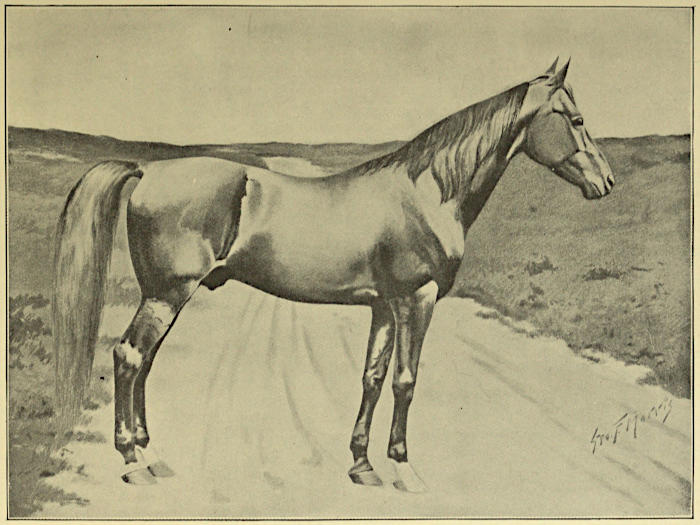
ETHAN ALLEN.
Son of Vermont Black Hawk.
From this synopsis of all that has been developed in the blood
lines of Black Hawk, there can be no longer any mystery about
where he got the characteristics making him so intensely different
from the representatives of the typical Morgan. His sire
was out of a high-class Narragansett pacer, and his dam was probably
a fast Narragansett pacer, thus giving him presumably
seventy-five per cent. of Narragansett blood and twenty-five per
cent. of Morgan blood. The fight that was made against him all
his life, as not being a genuine Morgan, had its foundation in
justice and truth. He was not a Morgan in either blood or character.
He founded a very valuable line of trotters, something
that no other branch of the Morgan family has ever accomplished,
and of right his descendants should be designated as “the
Black Hawk Family,” and not jumbled up with the heterogeneous
mass of nondescripts still called “the Morgan Family.” Black
Hawk’s gait was spluttery and uneven, rather than square and
mechanical. A few of his progeny were very perfectly gaited,
but a great many of them manifested their evil inheritance,
which, together with unskillful handling, destroyed all possible
value as trotters. He placed three in the 2:30 list; fourteen of
his sons were sires of 2:30 performers, six of them with two or
more, and two daughters produced 2:30 performers. He died
November, 1856.
Ethan Allen, 43.—This was a handsome, bright bay horse,
less than fifteen hands high, with three white feet and a star.
He was foaled 1849, got by Black Hawk, 5; dam, a fast trotting
grey mare of unknown pedigree. With a list of all the celebrated
American horses before him, it would be very difficult, if
not impossible, for the best informed horseman to select an animal
that has been so great a favorite with the American people, and
for so long a time, as the famous Ethan Allen. When four years
old he gave the world a sensation by eclipsing everything that
had appeared before him at that age; and again when he was
eighteen years old he renewed and intensified the sensation by
trotting in 2:15 with a running mate. These sensations of his
youth and his old age, did much to give him a standing with the
people; but his wonderful beauty and remarkable docility and
kindness, with the elegance and ease of his action, made him the
favorite of everybody. His trotting gait was recognized by the
best judges and experts as probably more perfect than that of
any horse of his day. Others have gone faster singly, but no
one has done it in greater perfection of motion. In his great
flights of speed he was not bounding in the air, but down close
to the ground, with a gliding motion that steals from quarter-pole
to quarter-pole with inconceivable rapidity. He was bred
by Joel W. Holcomb, of Ticonderoga, New York, and as the result
of a practical joke he played, for the purpose of annoying his
uncle, David Hill, the owner of Black Hawk, against whom he
had some pique just at that time, many well-meaning and no
doubt honest people once believed, and possibly still believe, that
Ethan Allen was by Flying Morgan and not by Black Hawk.
The fact that Ethan Allen was the same color as Flying Morgan
and that there was some resemblance in size and style of action
of the two horses, lent a strong suggestion to the joke as a truth.
I am indebted to Mr. I. V. Baker, Jr., of Comstock’s Landing,
S. B. Woodward, then of Ticonderoga, and B. H. Baldwin, of
Whitehall, New York, for the details of the way the Flying Morgan
story started, and need only say the narrator was an eye-witness
to the whole affair. In the spring of 1852, in the barroom
of S. B. Woodward’s hotel, at Ticonderoga, quite a number of
the villagers being present, Mr. Joel W. Holcomb came in and
said he was going to write a letter to R. M. Adams, of Burlington,
Vermont, the owner of Flying Morgan, and he was going to
have some fun with him; and, going to the desk in the room, he
wrote, substantially as follows: “I don’t know but I have made
all the reputation for David Hill and old Black Hawk that I
care to. I am willing to have the credit go where it belongs,
and desire to let yourself and the public know that my colt Ethan
Allen is got by your horse Flying Morgan.”
“There,” he said, “you will see this in all the Vermont papers
next week. Won’t Uncle David be mad?”
“What!” exclaimed some of his neighbors, after hearing it
read, “you won’t put your name to such a falsehood as that?
It’s a shame.”
“Well, well,” said Holcomb, “I’ll add a postscript.” And
going to the desk he wrote below his signature, leaving a good
wide space between his signature and the following words:
“Flying Morgan never covered the dam of Ethan Allen, never
smelt of her and never saw her, consequently Ethan Allen was
not by Flying Morgan, but he can beat Flying Morgan or any
other stallion in the State of Vermont.”
The next fall Mr. Adams visited many of the fairs with his
horse and showed Holcomb’s letter, and, it is said, with the postscript
torn off. Every man in Ticonderoga knew as well as Mr.
Holcomb how Ethan Allen was bred, and this letter created
much indignation. But Holcomb was a reckless man and cared
for nothing more than what he called a good joke, and the
more it hurt any one’s feelings the better it suited him.
This account of the “joke” was written down by Mr. Baker,
at the dictation of Mr. Woodward, April 22, 1875, and I have
implicit confidence in its substantial accuracy. It has been said
that the reason Holcomb did this was out of ill feeling toward
Mr. David Hill, the owner of Black Hawk, and Holcomb’s uncle,
because he dunned him for payment of the horse’s services in
getting Ethan Allen. One day at the Fashion Course, in the
spring of 1867, as I was looking at Ethan while he was taking
his daily exercise, either Mr. Holcomb or Mr. Roe, his partner—I
knew them both by sight as the owners of Ethan Allen, but not
well enough to distinguish one from the other, but I think it was
Mr. Holcomb—came up to me and expressed a good deal of
solicitude to know how I was registering the horse. He appeared
gratified when I assured him I had no doubt he was a son
of old Black Hawk and would so enter him. He remarked “that
was right,” and said the Flying Morgan story originated in a
practical joke and should not be permitted to go into history as a
fact. This is the full history of the basis of the controversy,
and certainly, to a reasonable man, it does not leave a single peg
on which to hang a hope for the Flying Morgan story.
But, the paternity of Ethan Allen is not left to the uncertainties
of recollection nor to be trifled with by practical jokers.
The books of Black Hawk’s services show that the dam of Ethan
Allen was bred to him on a certain day or days of the season of
1848, and was taken away believed to be in foal. This fact is conceded
on all hands as wholly indisputable, but it is claimed that
Flying Morgan was kept in Holcomb’s stable one night, after the
mare returned from Bridport, and the two were there surreptitiously
coupled. I have studied this claim in all its details, I
have examined every detail minutely, and I do not hesitate to
say there is not a single shadow of evidence to support the claim.
In Vermont, as in Kentucky, there are many people who can remember
things that never occurred, but in the former State these
people are at a great disadvantage, for they are not able to get so
many to agree with and support their remarkable memories.
The Vermonters are very far from being all honest, but they are
very much disposed to make up their own minds, whether right
or wrong.
In searching for the breeding of the little flea-bitten grey
mare, “called a Messenger,” that produced Ethan Allen, I have
not been sparing of either time or labor. I have assiduously
followed every clew that presented itself, and waded through
“sloppy” correspondence “knee deep,” but I never have been
able to reach a single point that was relevant and tangible.
From the first that is known of her at Hague, New York, her
identity has been maintained by a spavin on one leg and one hip
knocked down, and thus she has been traced through the hands
of many owners till she reaches Mr. Holcomb, of Ticonderoga,
New York. A pretence has been set up that she was by some
Morgan horse, but this was only a wish of the originator, and not
a fact founded on reasonable evidence. It is said she was quite
a fast trotter, in her younger days, and that she could beat all
the farmers’ horses against which she was started. That she
had a trotting inheritance, and probably from Messenger, there
can be no reasonable doubt.
Ethan Allen made his first appearance as a trotter at the Clinton
County Fair, as a three-year-old, and made a record, over a
very bad track, of 3:20-3:21. In May following, then four years
old, at the Union Course, he beat Rose of Washington in 2:36-2:39-2:42.
This was then the fastest time ever made by a four-year-old.
He then retired to the stud and did not again appear
till October, 1855, when, over the Cambridge Park Course, he
beat Columbus, Sherman Black Hawk, and Stockbridge Chief for
the stallion purse in 2:34½-2:37. Three of the contestants here
were sons of Black Hawk. The next season he defeated Hiram
Drew twice, to wagon, making a record of 2:32¾. October 15,
1858, at Boston, he beat Columbus Jr., and Hiram Drew, 2:37-2:35-2:33.
The same month, on the Union Course, he beat
George M. Patchen, to wagons, distancing him the first heat in
2:28. At the Union Course, Long Island, July 12, 1860, he beat
Princess, distancing her the second heat in 2:29½-2:25½. This
is his fastest record. He was frequently beaten by George M.
Patchen, Flora Temple, etc., and it was thought by many that
he could not take up the weight and “hold the clip” for the full
mile out. His most famous performance was made in 1867, and
as I had the pleasure of witnessing it, from a very eligible position,
I will here repeat the description as then made:
“On the 21st of June, 1867, on the Fashion Course, it was
my good fortune to witness the crowning event of his life.
Some three weeks before, with running mate, he had beaten
Brown George and running mate, in very fast time, scoring one
heat in 2:19. This made horsemen open their eyes, and there at
once arose a difference of opinion, about the advantage to the
trotter of having a runner hitched with him, to pull the weight.
This resulted in a match for two thousand five hundred dollars
to trot Ethan Allen and running mate against Dexter, who was
then considered invincible. As the day approached the betting
was about even; but the evening before the race, word came
from the course that Ethan’s running mate had fallen lame and
could not go, but they would try to get Brown George’s running
mate, then in Connecticut, to take the place of the lame runner.
As the horses were strangers to each other, it was justly concluded
that the change gave Dexter a great advantage and the
betting at once changed from even to two to one on Dexter.
Long before noon the crowd began to assemble; the sporting men
everywhere were shaking rolls of greenbacks over their heads,
shouting “two to one on Dexter.” I met a friend from Chicago,
who sometimes speculated a little, and when he told me he was
betting two to one on Dexter, I took the liberty of advising him
to be cautious, for I thought the team would win the race, and
that its backers knew what they were doing. Before the hour
arrived I secured a seat on the ladies’ stand, from which every
foot of the course, and the countless multitudes of people, could
be taken in at a glance. The vehicles in numbers were simply
incalculable, and the multitudes were estimated at forty thousand
people. Upon the arrival of the hour, the judges ascended the
stand and rang up the horses, when the backers of the team
came forward, explained the mishap that had befallen the runner,
that they had Brown George’s mate on the ground, but, as
he and Ethan had never been hitched together, they were unwilling
to risk so large a sum, and closed the race by paying one
thousand two hundred and fifty forfeit. When this announcement
was made there was a general murmur that spread, step by
step, through all that vast multitude. The betting fraternity
were just where they started and every spectator realized a feeling
of disgust at the whole management. As soon as this had
time to exert its intended effect upon the crowd, the backers of
the team came forward again and expressed their unwillingness
to have the people go away dissatisfied, and proposed a little
match of two hundred and fifty a side, which was promptly
accepted by the Dexter party; and when it was known there
would be a race after all the shout of the multitudes was like the
voice of many waters.
“This being a new race, the betting men had to commence de
novo. The surroundings of the pool stands were packed with an
eager and excited crowd, anxious to get on their money at two,
and rather than miss, at three to one on Dexter. The work of
the auctioneers was short, sharp and decisive, and the tickets
were away up in the hundreds and oftentimes thousands. But
the pool-stands did not seem to accommodate more than a small
fraction of those anxious to invest, and in all directions in the
surging crowd, hands were in the air, filled with rolls of greenbacks,
and shouting “two to one on Dexter.” I was curious to
note what became of these noisy offers, and I soon observed that
a quiet-looking man came along, took all the party had to invest
and then went quietly to another of the shouters, and then another
and so on, till I think that every one who had money to invest,
at that rate, was accommodated. The amount of money bet was
enormous, no doubt aggregating a quarter of a million, in a few
minutes.
“When the horses appeared on the track to warm up for the
race, Dexter, driven by the accomplished reinsman Budd Doble,
was greeted with a shout of applause. Soon the team appeared,
and behind it sat the great master of trotting tactics, Dan Mace.
His face, which has so often been a puzzle to thousands, had no
mask over it on this occasion. It spoke only that intense earnestness
that indicates the near approach of a supreme moment.
The team was hitched to a light skeleton wagon; Ethan wore
breeching, and beside him was a great strong race horse, fit to
run for a man’s life. His traces were long enough to allow him
to fully extend himself, but they were so much shorter than
Ethan’s that he had to take the weight. Dexter drew the inside,
and on the first trial they got the send off without either one having
six inches the advantage. When they got the word, the flight of
speed was absolutely terrific, so far beyond anything I had ever
witnessed in a trotting horse, that I felt the hair rising on my
head. The running horse was next to me, and notwithstanding
my elevation, Ethan was stretched out so near the ground that
I could see nothing of him but his ears. I fully believed that,
for several rods at this point, they were going at a two-minute
gait.
“It was impossible that this terrible pace could be maintained
long, and just before reaching the first turn Dexter’s head began
to swim and the team passed him and took the track, reaching
the first quarter-pole in thirty-two seconds, with Dexter three or
four lengths behind. The same lightning speed was kept up
through the second quarter, reaching the half-mile pole in 1:04,
with Dexter still farther in the rear. Mace then took a pull on
his team, and came home a winner by six or eight lengths, in
2:15. When this time was put on the blackboard, the response
of the multitude was like the roar of the ocean. Although
some distance away, through the second quarter of this heat I
had a fair, unobstructed side view of the stallion and of his action,
when going at the lightning rate of 2:08 to the mile. I could
not observe that he received the slightest degree of propulsion
from the running horse; and my conviction was then, and is now,
that any such propulsion would have interfered with his own unapproachable
action, and would have retarded rather than helped
him. The most noticeable feature in his style of movement was
the remarkable lowness to which he dropped his body and the
straight, gliding line it maintained at that elevation.
“The team now had the inside, and in the first attempt they
were started for the second heat, but they did not appear to me
to be going so fast as in the first heat. Before they had gone
many rods Ethan lost his stride and Dexter took the track at the
very spot where he had lost it in the first heat. The team soon
got to work, and near the beginning of the second quarter collared
Dexter, but the stallion broke soon after and fell back, not
yards, nor lengths, but rods before he caught. Incredible as it
may seem, when he again got his feet, he put on such a burst of
speed as to overhaul Dexter in the third quarter, when he broke
again and Mace had to pull him nearly to a standstill before he
recovered. Dexter was now a full distance ahead and the heat
appeared to be his beyond all peradventure. I was watching the
team in its troubles very closely and my idea of the distance lost
was the result of a deliberate and careful estimate at the moment;
and the query in my mind then was whether the team could save
its distance. At last the old horse struck his gait, and it was
like a dart out of a catapult, or a ball from a rifle. The team
not only saved its distance, but beat Dexter home five or six
lengths in 2:16.
“In the third heat Mace had it all his own way throughout,
coming home the winner of the race in 2:19. The backers of
Dexter, up to the very last, placed great reliance on his well-known
staying qualities; but the last heat showed that the terrible
struggle told upon him more distressingly than upon the
team. It is said by those who timed Dexter privately that he
trotted the three heats in 2:17, 2:18, and 2:21. As an opinion,
I will say that if ever there was an honest race trotted this was
one, but there was such an exhibition of sharp diplomacy, of the
“diamond cut diamond” order, as is seldom witnessed, even
among the sharp practices of the turf. It is not probable that
Ethan’s running mate fell amiss at all, the evening before, as
represented; and if she did, it was not possible to send to Connecticut
for another horse and have him there early in the morning
as was pretended. This was a mere ruse put out to get the
advantage of the long odds. The managers of the team knew
just how the horses would work and knew they had speed enough
to beat any horse on earth. When the race was called and they
came forward and paid forfeit, it was merely to give the ‘two to
one on Dexter’ money encouragement to come out. It did
come out most vociferously and was all quietly taken. It was
said John Morrissey was the manager in chief, and that his share
of the winnings amounted to about forty thousand dollars.”
I have here given my personal impressions of this race, not because
the performance was of any special value, as a test of
speed, but because the time was then phenomenal, even with this
kind of hitch, and as an illustration of what certain horses can
do when relieved of all weight. This was among the first of the
contests of this kind, and although some effort was made to introduce
this plan by which a poor horse could beat a good one, it
never has received much encouragement. With all his perfection
of gait and wide popularity, extending from early life to old
age, Ethan Allen was not a success as a progenitor of speed. He
placed but six in the 2:30 list, and the best—Billy Barr—with a
record of 2:23¾. He left but one son equal to himself as a sire,
and several daughters that became the producers of single performers.
He was kept several seasons in Kansas and died there
September, 1876.
Daniel Lambert, 102, was a chestnut horse, foaled 1858; got
by Ethan Allen, 43; dam Fanny Cook, by Abdallah; grandam by
Stockholm’s American Star, etc. His color was a light chestnut,
and his mane and tail were of the yellow, flaxen shade. He was
about fifteen hands high and long and light in the body, with no
indications of Morgan blood about him unless it was in the
kinkiness of his mane and tail. But why should he not resemble
almost anything else than the little nondescript Morgan, when
he had only one-sixteenth of his blood in his veins? He had
more Messenger than Morgan blood, and according to the rules of
arithmetic it is a misnomer to call him a Morgan. More than
this, his dam was a daughter of the great Abdallah, far and away
the greatest trotting sire of his generation. When we consider
that he had four times as much of the blood of Abdallah as he
had of the original Morgan, we can see the absurdity of sticking
to the right male line after that line has been wiped out by other
lines far more potential. Lambert was bred by Mr. John Porter
of Ticonderoga, New York, and as a colt he showed great promise
on the ice, and was thought to be the fastest and best of the get
of Ethan Allen. He was known far and wide as the “Porter
Colt,” and he was the popular heir to very great expectations.
To have created so much enthusiasm he must have shown great
speed for a youngster, and he is credited with a record of 2:42 as
a three-year-old. As a sire of trotters he stood very high at one
time and was even with Blue Bull in his number of representatives
in the 2:30 list, but in the end the little “plebeian” pacer
outstripped him a long way. Lambert put thirty-seven trotters
into the 2:30 list, but when we come to study this list we are not
very favorably impressed, for about one-third of the animals have
but a single heat inside of the mark, with only five or six reputable
campaigners and a single one—Comee—that ranked among the
real good ones. Comee had seventy-one heats to his credit and a
record of 2:21¼. Thirty-three of Daniel Lambert’s sons have put
one hundred and thirty-six in the list, and forty-four of his
daughters have produced seventy-four performers.
CHAPTER XXVIII. THE ORLOFF TROTTER, BELLFOUNDER, AND THE ENGLISH HACKNEY.
Orloffs the only foreign trotters of merit—Count Alexis Orloff, founder of the
breed—Origin of the Orloff—Count Orloff began breeding in 1770—Smetanka,
Polkan, and Polkan’s son, Barss, really the first Orloff trotting sire—The
Russian pacers—Their great speed—Imported Bellfounder—His history
and characteristics—Got little speed—His descendants—The English
Hackney—Not a breed, but a mere type—The old Norfolk trotters—Hackney
experiments in America—Superiority of the trotting-bred horse
demonstrated in show-ring contests.
It may be a little outside of the field of our discussion to include
the Orloff Trotter, but as a few of them have been brought
to this country, and as that is the only organized and recognized
breed of trotters in all the world beside our own, it seems to be
necessary to give a brief synopsis of the origin and history of
that breed, so far as we may be able. An additional and probably
a more cogent reason for making this foreign detour is the
fact that there are now many American trotters on the turf in
Europe, and practically their only competitors, whether on the
turf or in the breeding studs, are the Orloffs of Russia.
“Wallace’s American Trotting Register,” the first volume of
which was issued in 1871, was an individual enterprise. Two
years afterward the director-in-chief of the Russian Imperial
Studs submitted a series of questions to different scientific gentlemen,
whose studies were in the right direction, soliciting their views,
on the practicability and advisability of establishing a governmental
standard by which the Orloff trotters should be classed and
officially registered. The report was favorable and the Russian
trotting register was established under governmental direction.
This was the second movement toward establishing a breed; not
merely by writing a lot of names in a book, but by writing those
names on the turf of two continents. A delegation from France
once visited me to consult about establishing a Register in that
country, and to learn how to commence such an enterprise.
When I asked them what strains of blood they had that could
trot, they did not seem to know of any particular strains, or any
one strain better than another, to serve as a foundation, but they
were sure they had plenty of trotters. This was the first I ever
had heard of French-bred trotters, and it was the last I ever
heard of the French trotting register.
The stalwart Alexis Orloff took a very active part in making
Catherine II. Empress of Russia—for which he was loaded with
honors as well as lucrative offices. In the war with the Turks in
1772 he was given command of the Russian fleet, and with the
assistance of the English fleet under Admiral Elphinstone, he
achieved a great victory and captured the pasha in command of
the Turkish fleet. Owing to some unusual kindness Count Orloff
was able to extend to the captured Turkish commander, or his
family, he presented the count with a pure white stallion, said
to be a Barb, which he took home with him and placed in his
stud of horses, that he had established but a short time before.
Another story is that the count bought this white horse, which
he called Smetanka, while he was in Greece and paid a large
price for him. I am not able to say which representation is the
more probable, and it is not material to our history, as there is
no dispute about the identity of Smetanka as the nominal head
of the Orloff breed of horses, and neither story gives any information
about his blood. No doubt he was a Turk. Count Alexis
commenced his breeding stud in 1770, and there appears to have
been a good deal of system about it or else a large amount of
very free guessing. When first established, the horse breeders
say, it consisted of stallions and mares as follows: Arabs, 12 stallions,
10 mares; Turkish, 1 stallion, 2 mares; English, 20 stallions,
32 mares; Dutch, 1 stallion, 8 mares; Persian, 3 stallions,
2 mares; Danish, 1 stallion, 3 mares; Mecklenburg, 1 stallion,
5 mares. From this it will be seen that he had more English running
blood than all the other varieties put together, and yet no
trotters came from that source. From this great variety of composite
material the count had free rein in his grand experiment
of producing the type of horse that best pleased his fancy. As a
matter of course the indiscriminate commingling of these different
strains and types would produce a mongrel lot, from which a
few superior animals might be selected, and doubtless were
selected, for breeding purposes.
The different writers who have discussed the result of this
experiment seem to agree, substantially, that two distinct types
were the result—the galloper for the saddle and the trotter for
harness—but they assume what appears to me to be a very unreasonable
conclusion that both these types were indebted to the
super-excellence of Smetanka. The count was one of the most
prominent sporting men of his day, an inveterate horse-racer and
cock-fighter, and under this kind of management it is hardly
credible that the twenty English thoroughbred stallions should
have been put aside for the little white horse of positively unknown
origin. But whatever may have been the predominating
blood in the saddle department, it is certain that the trotter is
lineally descended from Smetanka. He was bred on a Danish
mare and produced Polkan (Volcan), without anything new or
striking in his characteristics. Polkan was bred on a Dutch mare
and produced Barss, and this was the first to manifest a disposition
to extend himself to his utmost at the trot and to stick to it.
Barss became a great favorite with his master; for, although stumbled
upon, he was a new creation and is the real progenitor of all
the horses that bear the name Orloff. His component elements
are easily expressed. He had twenty-five per cent. of the blood
of Smetanka; twenty-five per cent. of the blood of the Danish
mare, and fifty per cent. of the blood of the Dutch mare, it
seems to be reasonable to conclude, therefore, that the trotting
instinct must be found in the unknown elements of the Dutch
mare.
Some years ago Prof. —— (the name I cannot now recall),
from the Imperial Agricultural College, near Moscow, Russia,
paid me several visits for the purpose of gathering up what information
he could obtain about the origin and history of the American
Trotter. He was very intelligent and thorough in his
methods of obtaining information, and each succeeding day he
came back to me with a new series of questions hinging upon
previous interviews, and all carefully prepared. These questions
were so admirably shaped to reach the vital points of the subject
that I became greatly interested in the man. When it came my
turn to ask questions, my first one was, What was the origin and
lineage of the Dutch mare that produced Barss? He replied, “Ah,
the scientific men of Russia would give a great deal to be able to
answer that question.” We both agreed, perfectly, that the living
instinct of the trotter came from that mare, but he was not
able to tell me anything of her history or habits of action. He
told me there were many pacers in Russia and that the best ones
came from the province of Viatka and from the region of the
Volga River.
As the true source from which the Russian trotters have
drawn their ability to trot fast has not been developed nor determined
by history, we must consider the problem in the light of
the surrounding conditions, and possibly our American experiences
may lead to its solution. In 1873 Prof. Von Mittendorf,
at the request of the director-in-chief of the imperial stud, prepared
a very able paper on the scientific questions involved in
the establishment of a Government Register for the Orloff trotters.
In this paper he discusses the pace and the trot as both
original and natural gaits and insists that there are no outward
indications in form or shape by which the animal, when at rest,
can be decided to be a pacer or a trotter. In his own words he
says:
“In answer to the question whether, from the form of a horse at rest, it
can be ascertained what gait would be easiest assumed by it, viz., trotting or
pacing, I must confess that I have never seen, read or heard of such marks,
and, indeed, there never are any symptoms or signs of inclination for pacing
in the proportions of any horse with the single negative exception, viz., that
great speed in one-sided motion does not agree with a large frame, which is
more adapted to leaping, and hence fast pacers are never found among large
horses.”
This is the view as taken by a Russian scientist of the distinction,
or rather lack of distinction, between the trotter and the
pacer. I have not quoted this paragraph from Prof. Mittendorf
because it contained anything new in the economy of breeding,
but to prove that there were pacers in Russia and that their relation
to the trotter was considered in the formation of the rules
of admission to the Orloff trotting register. A very intelligent
writer, evidently a Russian and one who knew what he was talking
about, contributed an interesting article to the New York
Sun of July 9, 1877, from which we get a clear and strong light
on the practical side of the Russian pacer, and I will here again
quote:
“Up to the middle of the last century horses in Russia were not scientifically
bred; they ran wild in many parts of the country. Those caught on
the steppes of the river Don, and in the wilderness of the district of Viatka,
obtained early celebrity, which they still maintain. The Don horses are those
famous Cossack steeds about which so much has been written of late. The
Viatka horses, or Bitugues, as they are called are the genuine trotters of
Russia. They are all pacers, equally remarkable for their speed and their endurance.
But since the Orloff breed has been introduced, the Bitugues have
been excluded from all matches, on the ground that their pacing is not
orthodox.
“It is with these Bitugues that the peculiar troika team, of which a specimen
was shown in Fleetwood Park, on Saturday, originated. A fast, sturdy
Bitugue is put in shafts, and a light running horse from the steppes harnessed
on each side of him. A good Bitugue trots so fast that the wild steppe runners
have to be whipped all the time to force them to keep up with him. The
idea of putting an Orloff trotter in the place of a Bitugue is very queer, as no
square trotter can equal the speed of those famous pacers of Viatka, and keep
abreast with side runners.”
From these three several sources we learn a number of facts
that may have a more or less important bearing upon the true
origin of the Orloff trotter. (1) That there are now, and have
been for generations past, plenty of pacers in Russia. (2) That
these pacers have a common habitat, north and east of the Don.
(3) That they are a very old race, running back in the centuries
away beyond the knowledge of man or the records of history.
(4) That they are a very fast and very enduring race, and that
they have been trained for generations as the shaft horses of the
troika and their speed so well developed as to require good running
horses to keep abreast with them. (5) That they are of
smaller size than the average and lack symmetry, and thus, notwithstanding
their great speed and bottom, they and their blood
are excluded from registration with the Orloffs. (6) That they
are also excluded from competing for any prizes that may be
offered, and no other reason is suggested than that they would be
sure to win.
Russia and America both have pacers and they are both carrying
forward the breeding and development of the trotter with
great intelligence and success. No other nation has been able
to make even a beginning in this field of animal economy except
by the introduction of the foundation stock from one or other of
these two countries. It may be taken as historically true, and
as applying to every nation on the face of the earth, that where
there are no pacers there are no trotters. Hundreds of unmistakable
experiences in this country go to show that the pacer is
a great source of trotting speed. At one time a pacing stallion
of obscure pacing origin stood at the head of the list of all stallions
as the sire of the greatest number of trotters with fast
records. A great multitude of our fastest trotters at maturity
were foaled pacers from trotting parents. It is no longer a matter
of wonder or surprise that with two animals from the same
parents one of them should be a fast trotter and the other
a fast pacer. Neither is it any longer remarkable that a fast
trotter with a very fast record should turn around and make just
as fast a record at the pace. The American people are just beginning
to realize, in its full force, the declaration of more than
twenty years ago; that the trot and the pace are simply two forms
of the same gait, in the economy of motion. The only difference
that has been observed as between two brothers, the one a
pacer and the other a trotter, is that with the same skill in handling
the pacer will come to his speed much quicker than the
trotter, which is of itself a strong suggestion at least that the
pace is the more natural and easier form of the one gait.
Now, in view of the fact that Smetanka was of Saracenic origin—a
strain of blood that has always been antagonistic to the pacer,
and never produced a pacer or a trotter; and in view of the fact
that his grandson, Barss, is accepted as the first of all Orloff
trotters; and in view of the further fact that in thousands of
American experiences the trotter has come from the pacer, it
seems to be a reasonable conclusion that the “Dutch Mare” that
produced Barss had a strong pacing inheritance, and possibly
had her speed fully developed, as the Bitugue in the count’s own
team.
Among all the pleasures which Count Orloff derived from his
experiments in breeding, whether of gamecocks, or race horses,
or saddlers, or trotters, Barss was his greatest favorite because he
was his highest achievement in the art of breeding. This judgment
of his master has been confirmed in the experiences and
history of all succeeding generations for a hundred years, and the
name of Barss will be known through the coming centuries as
the founder of a mighty breed of trotters. I once possessed a
fine picture of Barss hitched to a sleigh and driven by his
breeder, Count Orloff, himself; and I have seen it stated somewhere
that this picture was a copy of a bronze statue erected to
the memory of the Count Orloff and the greatest horse of Russia.
It has been stated by some writers, but with what measure of
authority I do not know, that for about thirty years after the
appearance of Barss his daughters were bred to English thoroughbreds,
to Arabs, to Anglo-Arabs, and, indeed, to all the
highly bred crosses that the great establishment was able to
furnish, and there was no improvement in either the quality or
the speed of the produce. From this it is evident that the
count and his managers were at that period entangled in the
same foolish notions that befogged the minds of so many very
worthy gentlemen in this country some years ago, viz., that the
way to improve the trotter was to go to the runner—the horse
that never could trot. This foolish notion, that never had a
spark of reason in it, naturally and necessarily weakened the
trotting instinct of the descendants of Barss, and would have
wiped it all out if it had been followed persistently, and there
would have been no Orloff trotters to-day.
After this narrow escape from the annihilation of much of the
good that Barss had done, the management then began to look
for the same blood and the same habit of action that the “Dutch
Mare” transmitted to her son, and, with this element to the
front, progression was resumed. Out of his great variety of
forms and of strains of blood the count and his managers could
pick and choose for the size, shape and forms they wanted, but
they were not able to transfer with the size, shape and form the
instincts and psychical nature of the horse. The count seems
to have carried forward his great enterprise rather with a view
to experimentation than its commercial possibilities. Smetanka
lived but a year or two, and when he stumbled upon the production
of Barss, a magnificent individual and a great trotter, his
head seems to have been turned, as he evidently supposed that
he could breed any kind of horse he wished to breed, and be able
to do anything he wished him to do. At his death, in 1808, he
left no male heir to succeed him, but he provided in his will that
his stud should not be dispersed. It was kept intact till about
1845, when it was purchased by the government, and finally
divided among a number of prominent breeders in different portions
of the empire.
Without having any knowledge on the subject that is definite
and specific, I am led to infer that the rules on registration and
racing in Russia are a hindrance to the breeding and development
of the trotter. As I understand it, no horse can be registered
unless he is purely descended from Barss. And I understand
further, that he must possess the same requirements in
order to enter and start in a public race against the Orloffs. If
it be true that these restrictions are really in existence and are
enforced, we can understand why the American trotter is so far
ahead of the Orloff in speed and in the markets of Europe. The
Orloff is restricted to certain lines of blood and is protected
against competition from others that might beat him. The
American is free from all restrictions of blood and gathers up
all that is best and fastest. He neither asks nor accepts protection
from any quarter, but throws down the glove to all comers.
Bellfounder was imported from England, July, 1822, by
James Boott, of Boston, Mass. He was placed in the hands of
Samuel Jaques, Jr.—a very shrewd manager who understood the
use of printer’s ink and did not hesitate about employing it liberally.
In his advertisement for 1823 he says: “This celebrated
horse is a bright bay with black legs, standing fifteen hands
high.” From this we are safe in concluding he was not more
than fifteen hands, and from another contemporaneous source
it is learned that he was a little below that measurement. On
this point the recollections, or perhaps impressions, of Orange
County horsemen are not very trustworthy, as one of them places
his height at sixteen hands and others at fifteen and a half.
His pedigree was given on the card which was distributed by his
groom in the form following: “Got by old Bellfounder, out
of Velocity by Haphazard, by Sir Peter out of Miss Hervey
by Eclipse.” “Velocity trotted on the Norwich road in 1806,
sixteen miles in one hour, and although she broke five times into
a gallop, and as often turned round, she won her match.” Although
after diligent search I have not been able to find this
performance of Velocity, it may be true that a mare so named
may have trotted as represented, but she was not a daughter of
Haphazard. The dates make this utterly impossible, and Mr.
Jaques was smart enough never to put this humbug pedigree in
his elaborate advertisements that appeared in the leading agricultural
papers of the country, year after year.
As the great mass of people of that day knew nothing and
cared but little about pedigrees, the astute manager of the horse
struck an expedient in the way of advertising that was very
effective. He had a cut made of a horse trotting loose on the
road, at the rate of a hurricane, and in the background was an
entablature with the legend “Seventeen and a half miles an
hour,” which anybody and everybody would interpret to mean
that this was a record made by imported Bellfounder, and there
he was doing it. This cut in reduced form went the rounds of
the agricultural press, and in 1831 made its appearance in the
“Family Encyclopedia of Useful Knowledge.” This dodge was
exceedingly effective, and as it appeared in a book it must be true.
Thousands of people interpreted the picture to mean that imported
Bellfounder had trotted seventeen and a half miles in an
hour. Mr. Jaques did not say this in letters and figures, but he
said it even more plainly in a picture. The basis of this deception
is found in the advertisement itself, where, in speaking of
the speed of old Bellfounder in England, he says: “His
owner challenged to perform with him seventeen miles and a half
in one hour, but it was not accepted.” Here we have a possible
challenge of the sire transmuted into an actual performance of
the son, for the sole purpose of securing public patronage.
There can be no doubt that this horse was a true representative
of what was then known as the Norfolk Trotters and at this time
designated as Hackneys or Cobs. Bellfounder was of a quiet,
docile disposition, with a display of great nervous energy in his
movements when aroused. His knee and hock action was high
and showy, giving the impression of a great trotter, without
much speed. At several points his form was measurably reproduced
in Hambletonian, especially in his low, round withers and
his great, meaty buttocks. In seeing these points so plainly developed
in his idol it is not remarkable that Mr. Rysdyk should
have placed too high an estimate on Bellfounder blood as a factor
in the American trotting horse. If he had thoughtfully asked
himself the question, What has Bellfounder blood done in its
own right in the way of getting trotters? the illusion would have
vanished.
Bellfounder was in the control of Mr. Jaques for six years, and
never in my knowledge of trotting stallions have I known one so
widely and successfully advertised. The name “Bellfounder”
was heard and known everywhere. From 1829 to 1833, inclusive,
he was under the control of Mr. T. T. Kissam, of Long Island.
After that time he seems to have gone “a-begging” wherever
there seemed to be a chance to earn his oats. At last, at
Jamaica, Long Island, he died, having made twenty-one seasons
in this country—one more than Messenger. The question was
once raised as to where Hambletonian got his aversion to the
chestnut color, and it was flippantly assigned to Bellfounder.
The truth is, quite a number of Bellfounder’s get were chestnuts,
perhaps as large a percentage as would naturally come from the
average stallion.
It is the testimony of several gentlemen who were familiar with
trotting affairs in the time of the Bellfounders, that a number of
them were skillfully and persistently trained and none of them
could trot faster than about 2:50. The one exception to this fact so
widely established is the case of the dam of Hambletonian. After
this filly passed into the hands of Peter Seely he gave some attention
irregularly to the development of her speed, and before
he sold her he gave her two trials to saddle on the Union Course
and she trotted in 2:43 and 2:41. As she was then but four years
old it is safe to conclude that she would have made a trotter, beyond
all doubt. This is the only one, old or young, from the
loins of Bellfounder that ever trotted so fast. I once put the
question directly to Mr. Rysdyk as to whether the Kent Mare
was as good and as fast as her dam, One Eye, and he promptly replied
that One Eye was much the faster and greater mare. To
this answer he added that One Eye, under the same circumstances,
would have been the equal of Lady Thorn or any other
that ever lived. This may account for the superiority of the
Kent Mare over all the other Bellfounders, and it may account
for the superiority of Hambletonian over all other stallions.
Bellfounder (Brown’s or Kissam’s), was a bay horse, foaled
1830, got by imported Bellfounder; dam Lady Alport, by Mambrino,
son of Messenger; grandam by Tippoo, son of Messenger;
great-grandam by imported Messenger. With such breeding he
should have been a great horse. He was bred by Timothy T.
Kissam, of Long Island, and sold along with a full brother one year
younger, named Bellport, about 1834-5, to L. F. and A. B. Allen,
of Buffalo, New York. Bellfounder was a bay horse, sixteen
hands high, and Bellport was sixteen and one-half hands, but was
poisoned and died at four years old. Bellfounder passed into
the hands of some parties at Cleveland and then to Mr. Brown, of
Columbus, Ohio, made most of his seasons in that portion of the
State, and died September, 1860. This was altogether the most
valuable son the imported horse left—indeed the only one that
made any mark in the world. He was not much of a trotter and
did not get trotters, but got colts that were excellent types of
the coach horse, and for that purpose was very highly esteemed.
Some of his sons and daughters, especially the latter, are met
with sometimes in trotting records as having produced something
that had more or less speed.
Conqueror was a bay gelding, foaled 1842, and got by La Tourrett’s
Bellfounder, a grandson of the imported horse, and out
of Lady McClain by imported Bellfounder, and she out of Lady
Webber by Mambrino, and she out of a mare brought from
Dutchess County and represented to be a daughter of imported
Messenger. This gelding had been pounded about in slow races
for years and had the reputation of being a stayer. In 1853 a
match was made with him to trot a hundred miles in nine hours.
The race was started and the horse won in 8h. 55m. and 53s.,
and he died three or four days afterward. This is the only instance
that I know of in which the advocates of Hackney blood
can point to a trotting record made in this or indeed in any
other country.
In closing the account of this family—for out of courtesy we
have called it a “family”—we find we have nothing left but a
name with nothing in it. The name that was more widely known
than that of any other horse of his generation has now practically
ceased from the earth, with nobody so poor as to do it
reverence.
The type of horse now known as the “Hackney” is found
chiefly in the shires bordering the northeastern coast of England—Norfolk,
Lincoln and Yorkshire. The name now given is not
only new but it is appropriate and applies to any one part of
England as well as another, and applies to any one horse, suited
to the general use of a Hack, as well as another, no difference
what his blood or what his country. The name “Norfolk Trotter”
fifty or a hundred years ago was often applied to horses of
this type coming from that part of the country, but it did not
follow that they were “trotters.” In the discussions of the association
preceding the adoption of a name it was urged that the
qualifying word “trotter” would imply the ability to trot fast,
and as the material to be registered could not do this, it would
subject the whole movement to ridicule and contempt. It was
also urged that the name “Norfolk” would give that particular
region an advantage over all other parts of England in the prospective
sales of registered stock, and thus the old title was fully
disposed of. When the name “cob” was suggested, it was conceded
that it represented just what they had, but it was too common,
as everybody in all England, rich and poor, had “cobs.”
Then came the term “Hackney,” which meant the same kind of
a horse as the cob, but as it was not in such universal use it was
adopted. On this point it must be admitted that it is an honest
name.
The Hackney is a good horse for all the uses to which he is
adapted. He is short on his legs and stout, with a good share of
nervous energy. He is symmetrical, and, we might say, handsome,
if we can use that word without any show of fine breeding,
for he is far short of the ideal blood horse. But he is not a saddle
horse, he is not a hunter, he is not a runner, and he is not a
trotter. As against these desirable and useful qualifications, he has
been bred and trained when in action to jerk up his limbs to the
highest point anatomically possible, and put them down again
with a thud at a point but little removed from where he started.
In this showy, undesirable action he exhausts his nervous energy,
pounding the earth without covering much of the distance. In this
excessive knee action every element of easy, graceful and rapid
progression is wanting. This fad will have its day and then along
with the barbarous excision of the caudal appendage they will
disappear together as they came, and we will know them no more
forever.
There are two points in advocating the merits of the Hackney
with which every Englishman is thoroughly familiar and which
he will call to your attention on the slightest provocation: (1)
Bellfounder was a Hackney and it was his blood that gave us the
greatest trotting sire that the world has ever produced. This is
the Englishman’s estimate of Bellfounder when he has a Hackney
for sale, and especially if the prospective purchaser be an American.
(2) He is descended from a long line of distinguished
trotters. To the first of these reiterated and parrot-like claims
an answer will be found in the chapter relating to that horse,
where his twenty-one years of stud service have been carefully
considered, and where he is shown to have been a monumental
failure. In the second claim there is some truth and we must
consider it very briefly.
Of all the elements entering into the families of horses locally
and indefinitely called Norfolk Trotters, there were two that
might be looked upon as the founders—Useful Cub and Shales—for
they were more conspicuous and valuable than any others.
Mr. John Lawrence was not only a practical horseman, but he
was the most intelligent and reliable of all the writers on the
horse in the latter part of the last century. He was the only
one who gave any attention to the trotter and trotting affairs.
He says: “To old Shales and Useful Cub the Isle of Ely, Cambridgeshire
and Norfolk are indebted for their fame in the production
of capital Hackneys.” Useful Cub was bred by Thomas
Jenkinson, of Long Sutton in Lincolnshire, and was foaled about
1865-70, and was got by a Suffolk cart horse, doubtless a light
weight, and his dam was by Golden Farmer, a son of the famous
half-bred Sampson, that was the great-grandsire of Messenger
and beat most of the best horses of his day. Mr. Lawrence knew
Useful Cub well, and was beaten by him in Hyde Park. We
have no details of this horse’s performances, but it seems to be
conceded that he trotted fifteen, sixteen and seventeen miles in
the hour. Old Shales, or Scott’s Shales, as he is sometimes
called, is described by Lawrence as “the bastard son of Blank,”
son of Godolphin Arabian, but Mr. Euren, the compiler of the
Hackney Stud Book maintains that he was the son of Blaze and
not the son of Blank. The reasons given for this change I do
not remember, but they would have to be well founded before I
could throw overboard the contemporaneous evidence of Mr.
Lawrence. It will not do to say that Mr. Lawrence mistook the
name Blaze for Blank and so wrote it by mistake, for he knew
all about both horses. This distinction, however, is of but little
practical value. The horses Shales and Useful Cub were both fast
and successful trotters, in their day, and they both became distinguished
sires of trotters. By this I do not mean that they
were the sires of all the trotters, for there were many that were
wholly unknown in their breeding.
Judging from the numbers of leading contests that were reported
in the Sporting Magazine and other publications, we must
conclude that trotting contests reached their height as well in
numbers as in public interest about the last decade in the last
century. The contests were all to saddle, on the road, and the
leading ones were made under the watch and over a long distance
of ground, specifying such or such a distance to be made inside
of an hour. To form a correct estimate of the speed of those
horses, I will copy one paragraph, entire, from the description
given by Mr. Lawrence concerning his own mare Betty Bloss:
“My own brown mare, known by the name of Betty Bloss, was the slowest
of all the capital trotters, but at five years old trotted fifteen miles in one
hour, carrying fourteen stone, although fairly mistress of no more than ten.
She afterward trotted sixteen miles within the hour, with ten stone, with
much ease to herself and her rider. She was nearly broken down at four
years old, had bad feet, and, besides, too much blood for a trotter, having been
got by Sir Hale’s Commoner, out of a three-part-bred daughter of Rattle, son
of Snip.”
In this paragraph, from the best-informed man of his generation,
it will be noted incidentally that the cry, “no more running
blood in the trotter,” is not new, but more than a hundred years
old. The best performances were about sixteen miles in the
hour, but there was an occasional one that reached sixteen and
a half. A black gelding called Archer was recognized as the fastest
of that period, and on one occasion under a stop watch he trotted
the second one of two miles in a little less than three minutes.
From my gleanings I find but a single instance from which we
might be able to approximate the money value of trotting horses of
that day, and this is given as a phenomenal price, viz., Marshland
Shales, a paternal grandson of the original Shales and out of a
mare by Hue and Cry. He had beaten Reed’s Driver in a match
of seventeen miles for 200 guineas. He was foaled 1802 and in
1812 he was sold at auction for 3,051 guineas—$15,255. He was a
great horse, but this price was just as startling to Englishmen of
that day as the $105,000 was in our own day, when Axtell was
sold. This seems to have been the culmination of the “boom”
in Norfolk Trotters, and from then till the present there has been
a steady deterioration in the trotting step of the Norfolk horse.
In the earlier part of this period of eighty or ninety years, possibly
some exceptions may be found, but they are only individual
exceptions and do not controvert the broad fact that must be apparent
to all observers. They had been breeding and training
their horses to strike their chins with their knees—the up-and-down
motion—instead of getting away and covering some ground
in their action. I have stood and watched scores of them in the
show-ring, on their native heath, with their grooms at the ends
of long lines running and yelling like wild Indians to rouse up
their horses, and they called this training the trotters. When I
privately expressed the wish that saddles might be put on a few
of the best and the ring cleared so that the trotting action might
be studied, I was very kindly and politely assured that they did
not show their trotters that way in England. Thus with the
taut check-rein, the long leading-line and the whoops of the
groom they got the up-and-down action upon the perfection of
which the prizes were awarded. This explained why the splendid
foundation of a breed had been lost by non-use and why England
had produced no trotters in the past fifty or eighty years.
While our English cousins know they have no trotting horses
of their own they seem to be exceedingly anxious, possibly for
commercial reasons, to make it appear that the American trotting
horse is the lineal descendant of the Norfolk Trotter. This
effort is not restricted to the idle twaddle about Bellfounder,
which everybody on this side of the Atlantic estimates at its true
value, but it has taken an official and wider range, which, trifling
though it be, my duty as a historian impels me to expose. Mr.
Henry P. Euren, the compiler of the Hackney Stud Book, wrote
to the Commissioner of Agriculture, at Washington, D. C., in
1888, taking exceptions to some conclusions reached in an article
written by Mr. Leslie E. Macleod, in my office, on “The National
Horse of America,” and published in the report of the Department
of Agriculture for 1887; Mr. Euren claiming that the American
trotting horse came originally from Norfolk, in England.
In proof of this he says: “I beg to inclose you a cutting which
confirms my idea.” And now for the “cutting” which he offers
as proof:
“It appears from an Act of Parliament, passed December 6, 1748, in the
Legislature of the State of New Jersey, America, that on and after the publication
of this Act, all Norfolk pacing or trotting of horses for lucre or gain,
or for any sum or sums of money at any time (excepting such times as are
hereafter expressly provided for by this Act), shall be and are hereby declared
public nuisances, provided always that at all fairs that are or may be held within
this province, and that on the first working day after the three great festivals
of Christmas, Easter and Whitsuntide, etc., etc.”
The act passed by the provincial legislature of the colony of
New Jersey in 1748 embraced very stringent regulations against
dice, lotteries, etc., as well as horse racing. It is divided into
several sections, and at Section 4 we reach the provision against
racing as follows:
“And be it further enacted by the authority aforesaid that after the
publication of this Act, all horse racing, pacing or trotting of horses for lucre
or gain, or for any sum or sums of money at any time (excepting such times
as are hereafter expressly provided for and allowed by this Act), shall be and
are hereby declared public nuisances, and shall be prosecuted as public
nuisances, in manner hereinbefore directed. Provided always, and it is the
true intent and meaning of this Act, that at all fairs that are or may be held
within this province, and that on the first working day after the three grand
festivals of Christmas, Easter and Whitsuntide, etc., etc.”
These quotations are sufficiently extended to afford an unmistakable
comparison, and on their face evidence that cannot be
doubted for one moment that they both purport to be copied
from the same act of the Jersey Colonial legislature. In the
official printed copy which is before me as I write, the mandate
is against “all horse racing, pacing or trotting of horses for
lucre or gain.” In Mr. Euren’s “cutting” the mandate is
against “all Norfolk pacing or trotting of horses for lucre or
gain,” etc. The substitution of the word “Norfolk” instead of
“horse racing,” is in the nature of a forgery, and I cannot believe
that Mr. Euren would be guilty of any such execrable
piece of trickery. It must have been conceived and written by
some horse sharp who was trying to sell a Hackney to an American
with a pocket full of money, and after he had effected his sale
he could mutter quietly, when at a safe distance from his victim,
the couplet from “Hudibras:”
“The paltry story is untrue
And forged to cheat such gulls as you.”
Unfortunately, however, for Mr. Euren, he indorsed the
trick, and not only indorsed it, but sent it to the Commissioner
of Agriculture with the hope and possible expectation that it
would receive public recognition and become part of the horse
history of this country. Did he not know that somebody would
be nosing round among the old laws and expose the dirty deception?
But, on the basis that Mr. Euren was deceived by this
wretched interpolation of a fraud into the law, could he not see
that the date of the law—1748—was before old Shales or Useful
Cub was foaled, and long before the very first “Norfolk trotter”
was ever heard of either in Norfolk or in any other part of England?
The exposure of this foolish attempt, wherever it originated, to
incorporate into an old New Jersey statute a fiction, or a forgery,
as it may be called, carries with it a punishment that should be
felt by the most unscrupulous of horse sharps; but when we find
it unequivocally indorsed and given to the world as true by
the compiler of the Hackney Stud Book, it destroys all confidence
in the accuracy and reliability of that work. This is a
misfortune that the friends of the Hackney in England as well as
in this country must feel as a blow at the value of the whole
interest. Opinions may change with new light, and opposing
conclusions may be honestly reached from different standpoints,
but running against a fixed and certain date, as in this case, is
like running against a two-edged sword.
In conclusion, the Hackney is merely the dear-bought and far-fetched
fashion of the hour. A few years ago he was “something
new in horses,” just as the modiste has “something new in
dresses.” He was found in England, where there are no flies,
without a tail, and as that was the fashion in England we must
have horses in America without tails, notwithstanding the millions
of torments they have to endure without the natural means
of defense. As hack-a-bouts they are good horses, but their
“churn-dasher” style of action will never become acceptable to
the American people.
A few years since a quite persistent attempt, backed by unlimited
wealth and all the prestige that metropolitan “fashion”
and “society” could bestow, was made, particularly in New
York, to create a Hackney “boom” in America. All that element
in the social life of our great cities that affects a disdain for
things distinctively American, and particularly for American
horses, and that glories in the stultifying habit of aping things
“English, ye know,” took up the Hackney fad with unbounded
enthusiasm. As a park and road horse the American horse—the
incomparable trotting-bred driver—was to be incontinently
crowded out of the driveways, the markets and the shows. The
National Horse Show Association, whose annual show at Madison
Square Garden is the great social fête of the year in New
York, lent all its powerful influence to forward the Hackney
“boom,” which was, it must in fairness be said, consistent; for
the miscalled National Horse Show has always catered more to
foreign horses and foreign customs in horsemanship than to
American horses and horsemen. Men of great wealth and prominence
established extensive Hackney studs, imported famous
prize-winning stallions and mares, and there was only one thing
left to be done, and that was to convert the American people to
the belief that the driving horse they had been breeding and
developing with a special purpose and care—the fleetest and most
versatile harness horse in the world—was inferior to an imported
nondescript. In that attempt the Hackney advocates have failed
in America as completely as did Mr. Blunt and others in England,
when they sought to make racing men believe that the
Arab was a better race horse than the English thoroughbred.
Perhaps nothing illustrates better what I have called the
versatility of the trotter than this contest with the Hackney in
the latter’s own especial field—if he may be said to have any.
Of course there could be no contest between the horse of a special
breed and the nondescript as a harness horse for speed or usefulness
on the road, whether the distance were half a mile or a
hundred miles; but in the show-ring the Hackney men claimed
absolute pre-eminence for their “high-acting” horses. They
did not dare contest with the trotter in the matter of road speed,
so to have any contest at all the trotting horse men had to
“carry the war into Africa.” This they have done with a vengeance.
They have taken the pure-bred trotting horse, dressed
him in the fashion dictated by the Hackney “faddists,” taught
him the Hackney tricks, the preposterous Hackney action and all
that, and have beaten the Hackneys not once but time and again
right on their own ground, viz., at the National Horse Show in
Madison Square Garden. In almost all cases in classes where
trotters have been admitted to compete with Hackneys, the
former have carried off the honors within the past two years.
Many notable instances might be cited, but one will suffice. At
the National Horse Show, 1896, a class was offered for “half-bred
Hackneys,” sires to be shown with four of their get. The Hackney
end of the argument was upheld by Mr. A. J. Cassatt’s renowned
prize-winner, imported Cadet, with four of his get.
Against him was entered the well-known trotting sire Almont
Jr., 2:26, with four of his get, and though the judges were gentlemen
identified more or less with the Hackney interest, so
superior in form, action and style were the four youngsters by
the trotting sire that they carried away the honors from the
chosen progeny of one of the most noted Hackney show horses in
the world.
In the sale ring this verdict has been corroborated. The
highest prices—the record figures—paid in the fashionable New
York market for park horses, “high steppers,” or by whatever
name the merely spectacular harness horse may from time to
time be called, have been paid for trotting-bred horses: and in
advertised sales of “Hackneys” it has become somewhat common
to encounter half-trotting-bred and full-trotting-bred horses.
While no genuine American and horseman can without regret
see a typical American horse mutilated and his action perverted
in the manner required to bring him into “Hackney” classes at
the National Horse Show, or in the markets where New York
society people buy their stub-tailed horses, it is some compensation
to know that these experiments have demonstrated the
superiority of the American-bred horse even in the field claimed
as especially that of the Hackney. And the Hackney “fad” in
America, while it lasted, accomplished a good end in so far as it
directed the attention of American breeders more to the importance
of form and style, and taught them that in their own trotting
families they have the material from which may best be
produced, in form and style and quality as well as in speed,
pre-eminently the most excellent park horses in the world.
CHAPTER XXIX. INVESTIGATION OF DISPUTED PEDIGREES. — HOLTON’S TRUE STATEMENT. — BRODHEAD’S REPRESENTATION OF IT.
Tendency to misrepresentation—The Bald Galloway and Darley Arabian—
Godolphin Arabian—Early experiences with trotting pedigrees—Mr.
Backman’s honest methods—Shanghai Mary—Capt. Rynders and Widow
Machree—Woodburn Farm and its pedigree methods—Victimized by
“horse sharps” and pedigree makers—Alleged pedigree of Pilot Jr.
conclusively overthrown—Pedigrees of Edwin Forrest, Norman, Bay
Chief and Black Rose—Maud S.’s pedigree exhaustively considered—Captain
John W. Russell never owned the mare Maria Russell—The deadly
parallel columns settle it.
A few years more than forty have slipped away since I first
began to give serious attention to the subject of horse history
and to contribute an occasional article to the press on that subject.
Among my very earliest observations, or I might say, experiences,
was the realization of the fact that exaggeration as a
habit of thought and utterance was practically universal among
horsemen. Sometimes I have thought this tendency to the untrue
resulted from the ammoniacal exhalations of the stable, but
this thought is not a satisfactory solution, for some of the greatest
liars about horses have never known anything about stables.
Then, again, I have thought that a really skillful metaphysician
might write a learned disquisition of the question and satisfy
himself as to the cause of this moral delinquency, but nobody
would be able to understand him when he had completed it.
This wretched vice, so prevalent everywhere, was not restricted
to the professional country “hoss jockey,” ready to “swap” with
every man he met on the road, but it reached up to men of
otherwise excellent character, and these men would “stretch the
blanket” tremendously about the blood and other qualities of
the horses they were selling. The only way we can account for
an otherwise honest and truthful man exaggerating the merits
and blood of his horses must be (1) in the fact that he has become
attached to him and thinks him better than he is, or it may
be (2) that he bought with a false pedigree and without examining
it, he assumes it is true and represents it accordingly. But
underlying all this, the representation cannot be disproved, and
(3) it may add to the market value of the horse.
This weakness of human nature, so pervasive of all interests
connected with the horse, did not originate in this country, but
came from the old world. We inherit it from our ancestors.
“The fathers have eaten a sour grape and the children’s teeth
are set on edge.” Take the case of the little bald-faced, pacing-bred
horse known in the old records as “The Bald Galloway” and
while it is not probable he had a single drop of Saracenic blood
in his veins, he is fitted out with a grand pedigree, full of that
blood. Although I have already referred to this horse as an exemplification
of the dishonesty of the early records of English
pedigrees, I will again look at it in a more specific manner. He
was nothing more nor less than a little native horse, belonging
to a tribe of noted pacers in the southwestern part of Scotland
and in the northern part of England. These Galloways were
probably the very last remnant of pacers to be found in Great
Britain. He is represented in the books to have been by a horse
called “St. Victor’s Barb;” dam by Whynot; grandam a Royal
Mare. The Bald Galloway was foaled not later than 1708, and it
was probably a few years earlier. His reputed sire, “St. Victor’s
Barb,” is not to be found anywhere and was probably fictitious.
His dam was represented to be by Whynot, and this horse was not
foaled till 1744—thirty-six years after his grandson was foaled.
The grandam is given as a “Royal Mare,” which in that day
was a convenient way of rounding out a pedigree, just as we now
attempt to round them out when we know nothing of the blood
by saying “dam thoroughbred.” “The Bald Galloway” was one
of the most successful stallions of his day, and yet he was nothing
in the world but a good representative of the old pacing Galloways
of that portion of Scotland then called Galloway. He
was low in stature, but he was esteemed as one of the greatest
and most valuable racing sires of his generation. One of his
sons—the Carlisle Gelding—was still a race horse when he was
eighteen years old.
“The Darley Arabian” was contemporaneous with the Bald
Galloway, and they commenced service in England about the
same year. It is said he was brought from Aleppo, in Syria, or,
perhaps I had better say Asia Minor. Aleppo is but a short distance
from the borders of ancient Cappadocia and Cilicia, countries
that were famous in history for the great numbers of fine
horses that they produced far more than a thousand years before
the first horse was taken to Arabia. This horse is called an
“Arabian,” and in the brief record of his importation we have
the same venerable “chestnut” served up to us that has served
so many generations of speculators in “Arabian blood.” The
record says that Mr. Darley had a brother who was an agent for
merchandise abroad, who “became a member of a hunting club,
by which means he acquired interest to procure this horse.”
This “gag” has been played too often to give éclat to horses
claimed to be brought from Arabia, in the past two hundred
years, to have much effect on the minds of people who have any
sense. That it required great social or political influence to induce
the old Arab sheik to part with him, was intended merely
to secure the attention of prospective customers to his superlative
excellence in order to obtain their patronage. This horse
probably never was within five hundred miles of the nearest part
of Arabia, and to call him an Arabian is a misnomer wholly unjustifiable.
He came from a country where horses were abundant
and cheap on all sides, and of a quality far superior to any
Arabian. He was simply a Turk, he was for sale, and it required
no influence to buy him except the contents of the purchaser’s
purse. This horse has always been classed as one of the two
great founders of the English race horse. His progeny from
well-bred mares were not numerous, and his greatest distinction
is in the fact that he was the sire of Flying Childers. In accordance
with the truth, he should be known in the records as
“Darley’s Turk.”
The horse bearing the dishonest misnomer of “Godolphin
Arabian” was really the greatest regenerator and upbuilder of
the running horse that England ever possessed. There seems to
be no historical doubt that he was brought from France, and that
is all we know about his origin and early history. It may be laid
down, therefore, as a safe proposition, that the odds are as a thousand
to one that he was a French horse. The only evidence that
can ever be furnished as to the strain of blood that he may have
possessed must be found and studied in his portrait, which appears
in this volume. I believe this portrait to be a correct and
true delineation of the horse, and there is not a single lineament
in or about it that indicates the blood of either the Arabian or
the Barb. His pedigree is in his picture, and, from what is
known in history and from what has been preserved in art, instead
of “Godolphin Arabian” his true title should be “Godolphin
Frenchman.” But this subject has been discussed at greater
length in the chapter on the English Race Horse, to which my
reader is here referred.
In the chapter on the American Race Horse, I think sufficient
attention has been given to the frauds and impossibilities that
are to be found everywhere in the extended pedigrees of our own
running horses to satisfy any one that the remote extensions of
pedigrees are a great mass of dishonest rubbish, with scarcely a
speck of truth to be found. I will, therefore, pass along to the
consideration of some of the difficulties, of the same nature, that
have been developed in investigating and recording the pedigrees
of the American Trotting Horse. In entering the untrodden
wilderness of trotting-horse history it became the ambition of
my life to reach the truth in every possible instance and to cut
off and reject all frauds wherever they showed their heads. This
meant war from the beginning with a great many horsemen, but
it also meant the enthusiastic support of a great many honest
men. The trouble, at this point, was in the fact that a number
of prominent, wealthy and influential breeders insisted upon
their right to state their pedigrees in their own way and thus
compel me to indorse them by inserting them in the Trotting
Register. When at work on the early volumes of the Register,
especially the first, if a man of unblemished reputation and intelligence
sent me a list of his stock to be registered, I assumed
that he had too much regard for his reputation and standing as
a breeder to print a lot of pedigrees in his catalogue that he did
not know to be correct, and hence I accepted many a pedigree
that was based upon fiction. In course of time it began to dawn
upon my understanding that there were many men in the world
of unsullied reputation, as they were known in their business
relations, who would stand up boldly for a fiction or a fraud in
the pedigrees of their stock. It is but just to say that all the men
who uttered fraudulent pedigrees were not equally guilty, for in
some cases the owners had been victimized by unscrupulous
rogues from whom they had purchased, and in others they had
been betrayed by the still more unscrupulous rogues whom they
had employed to make up their catalogues on the supposition
that they were capable and honest. This state of things soon
developed another line of thought and observation in my mind
which evolved a rule by which I could determine the difference between
the degrees of honesty among horsemen. One man, when
a fiction in a pedigree was pointed out, would go to work and
carefully investigate it; while another would hang and higgle
about it and finally investigate, not to find the truth, but to find
how many old rummies, swipes and negroes he could get together,
who would support his claim and swear to it for a half-dollar
each. The first man investigates to find the truth wherever
it may lead; while the second man investigates merely, not
to find the truth, but to find some kind of evidence to sustain
the untruth. In the everyday affairs of life these two men may
stand on the same plane, but, at heart, the one is honest and the
other a rogue.
When Mr. Charles Backman founded the great Stonyford
breeding farm in Orange County, New York, he was an excellent
horseman, in a general sense, although he did not pretend to
know much about pedigrees. About 1869 he placed all his pedigrees
in my hands with the request that I would give them a
careful examination, strike out everything that was wrong and
note everything that was doubtful or uncertain, that it might be
investigated and the truth fully determined, no difference where
it might lead. Many investigations followed which were conducted
by his secretary, Mr. Shipman, either by mail or
by personal visitation—so many, indeed, that Mr. Shipman
became quite an expert in this kind of difficult work. As
an illustration of the methods pursued, one instance will
serve to show how it was done, and more than this, it is a
very interesting history in itself. In the first volume of the
Register I had entered Green Mountain Maid, the dam of the
famous Electioneer and all that family, as “by Harry Clay, dam
said to be by Lexington.” This was the form in which Mr.
Backman had received the pedigree, except that it was stated
positively and without any “said to be” that the dam was by
Lexington, the great running horse. After a time I called Mr.
Backman’s attention to this “said to be” and suggested that if
the mare was really a daughter of Lexington she could certainly
be traced and established. The next day, Mr. Shipman started
to Western New York and to Ohio. On his trip he found the
mare had been known in Western New York as the “Angelica
Mare” and afterward as “Shanghai Mary,” that she was a trotter,
well known locally, and that she had trotted a race and won
at a State fair, in very fast time for that day. She had been
brought from Ohio by some sheep-dealers, who were able to give
her exact age, and it was thus found that she was older than her
reputed sire. Several expert horsemen, from a picture secured
by Mr. Shipman on his trip, have not hesitated to give it as a
strong conviction that she belonged to the Cadmus family, in
Southern Ohio. In the last two or three years a correspondent
of the Chicago Horse Review brings out some local facts that
make it almost morally certain that she was bred by Goldsmith
Coffein, of Red Lion, Ohio, and that she was got by Iron’s Cadmus,
the sire of the great Pocahontas. The final nail has not
been clinched in establishing this pedigree, and probably never
will be, but the circumstances are so fully detailed as to scarcely
leave room for a doubt that she was a half-sister to the famous
Pocahontas.
From what has here been said about the methods of Mr.
Backman, the leading breeder of that period, in the North,
it should not be inferred that all Northern breeders were
like him. The first real battle I ever had against fraudulent
pedigrees originated in Orange County, New York, with the
notorious Captain Rynders, in which the pedigree of the once
famous Widow Machree, the dam of Aberdeen, was involved. The
pedigree of this mare had been registered as obtained from Mr.
James W. Hoyt, who once owned her, and her dam was given as
by Durland’s Messenger Duroc. When Aberdeen came before
the public for patronage, his owner, Rynders, advertised him as
out of Widow Machree and she out of a mare by Abdallah.
This was challenged as untrue by Mr. Guy Miller and Mr. Joseph
Gavin, of Orange County, and I was called upon to demand the
evidence upon which the change had been made from Messenger
Duroc to Abdallah. As a matter of course “the fat was in the
fire” at once, and out came Rynders with a terrific explosion of
anger, abounding in threats and denunciations against anybody
and everybody who attempted to interfere with his “business.”
The good names of Guy Miller and Joseph Gavin carried too
much weight as against that of Isaiah Rynders, and, as his last
card, he brought out a duly and formally executed affidavit,
sworn to by a man whose name I will not here mention, stating
that he bred the Abdallah mare; all of which was the very rankest
perjury, which was so easily exposed that it did Rynders far
more harm than good. At last the whole truth came out in a
form that was complete and conclusive, showing that the mare
in question was bred by Garrett Duryea, of Bethel, Sullivan
County, New York, and was got by a horse known as Pintler’s
Bolivar. Rynders had been a leader in New York politics so
long that he knew just how to manage things where the truth
must be suppressed. He was a liberal advertiser, the two sporting
papers were needy for patronage in that line, and their
columns were closed to any and all communications against his
side of the question. But all this failed to suppress the truth
and uphold a fraud, and I doubt whether there is a man living
to-day who does not believe that the fight was fairly and honestly
won. This contest taught me a very important lesson, and that
was, that if I expected to fight bogus pedigrees I must have a
channel of communication of my own. Hence Wallace’s Monthly,
which, in its day, was not only able to expose bogus pedigrees,
but lead intelligent thought and experience on all breeding subjects,
till it fell into the hands of an unscrupulous neocracy,
where it soon died for want of brains.
Having given a very brief illustration of the methods which
governed Mr. Backman in ascertaining and determining the
blood elements which entered into the foundation of his great
breeding establishment, and the care and promptness with which
errors were eliminated, it is now in order to take a glance at the
methods pursued at the great Woodburn Farm, founded by R.
A. Alexander in Kentucky. These were the two earliest establishments,
of any prominence, for breeding the trotter, in the
whole country. The one was the northern center of the interest
and the other the southern, and they together may be considered
as representative of both sections. Mr. Alexander, I think, was
reared and educated in Scotland, and there inherited a large
estate. Upon coming into this inheritance he determined to
transfer his interests to Kentucky, where he bought up a cluster
of farms and shaped them for the purpose of building up a mammoth
establishment for the breeding of all varieties of domestic
animals of the highest type and excellence. I think his fancy
ran more to Short Horn cattle than to any other line of breeding,
probably because he knew more about the value and merit of
the different tribes of that breed than he did of any other variety.
The founding of an establishment so immense, and for the grand
purpose of the breeding and improving the varieties of domestic
animals, was the agricultural sensation of the period, and everybody,
from one end of the land to the other, soon knew of and
applauded the great enterprise. There had been great enterprises
on similar lines before, and there have been even greater
ones since, but Mr. Alexander’s Woodburn Farm, of Kentucky,
may always be looked upon as the real pioneer in stock breeding
on a large and methodical scale, and without limit as to resources.
A university education in Scotland, with all its training
in the refinements of logical distinctions, did not bring to
Mr. Alexander a knowledge of the pedigrees of Kentucky horses,
nor did it train him in the detection of the tricks of Kentucky
horse dealers, and thus as a purchaser of his breeding stock he
was looked upon by the “sharps” as a fat goose, ready to be
plucked. After these “sharps” had secured their pluckings,
Mr. Alexander called in a professional pedigreeist to put the
lines of the blood he had purchased in order and print a catalogue.
This “professional” was not a pedigree tracer, for he
never traced anything in his life, but a pedigree maker, and
wherever he thought that anything was needed he added it,
whether true or not, and it went to the world in that form. This
is more conspicuously true in the department of trotting pedigrees,
as will appear below. Thus the acts of an incapable and
dishonest employee were given the indorsement of an honorable
and eminent name; falsehoods were made to appear as truths;
counterfeits were put in circulation that are still circulating as
genuine coin, with many people. Under the circumstances, Mr.
Alexander could hardly be blamed, for, knowing nothing of such
matters of his own knowledge, he employed what he supposed
was the best authority then to be found. For my own part,
when I came to register the Woodburn stock, I was ready to
accept as true whatever I found in the catalogue, believing that
Mr. Alexander was incapable of publishing to the world a misrepresentation.
In this estimate of his character I was right, and
I have never changed my opinion on that point, but when I came
to examine the structure of his catalogue I found there was rotten
wood all through it. A few examples that have been carefully
investigated will serve to show the value of the work done
by the “pedigree maker” for Mr. Alexander.
Pilot Jr. was a gray horse, foaled 1844, was got by Old Pacing
Pilot and attained the distinction of being the head of a well-known
family of trotters. He was foaled 1844, bred by Angereau
Gray, and owned a number of years by Glasgow & Heinsohn, of
Louisville, Kentucky. He was kept a number of years about
Lexington, Kentucky, by Dr. Herr, Mr. Bradley, and perhaps
others, and always advertised as “by Pilot (the pacer), dam
Nancy Pope, grandam Nancy Taylor.” Nobody then ever pretended
to know what horse was the sire of either Nancy Pope or
Nancy Taylor. He was then owned by the parties who afterward
sold him to Mr. Alexander, and it is evident they did not then
know anything about the sires of these mares. Mr. Alexander
bought him in 1858, and immediately his “pedigree maker”
furnished the sires of these two mares; Nancy Pope was given as
by Havoc, son of Sir Charles, and Nancy Taylor as by imported
Alfred. The controversy about this pedigree was long and
sharp, the one side, headed by the modern management at Woodburn,
as usual laboring to sustain the infallibility of the Woodburn
catalogues, and the other to reach the exact truth, whatever
it might be. The Board of Censors of the National Breeders’
Association sent out a call for information on certain abstract
points and finally reached a decision as follows: (1) That Havoc,
the reputed sire of Nancy Pope, the dam of Pilot Jr., died in
1828. (2) That Nancy Pope was not foaled till 1832. (3) That
the breeding of Nancy Taylor, the dam of Nancy Pope, was unknown.
These dates were fixed by undoubted evidence, and, as
afterward developed, another might have been added with equal
authenticity. Imported Alfred, the reputed sire of Nancy Taylor,
was not imported till several years after Nancy Taylor was
foaled, and thus it was clearly shown by the absolutely insuperable
difficulties of dates that both the sires inserted in the pedigree
were nothing more than very stupid fictions.
Edwin Forrest seems to have held second place in the list of
stallions in the Woodburn Stud at that period, and the remote
extensions of his pedigree were also fictitious. His grandam
was represented to be by Duroc, the famous son of imported
Diomed, and his great-grandam by imported Messenger. The
first two crosses were technically inaccurately stated, but the
second two, as given here, were purely fictitious.
Norman, the third stallion in the catalogue, had his sire correctly
given as the Morse Horse, but his dam was given as by
Jersey Highlander and his grandam as by Bishop’s Hambletonian,
son of Messenger, both of which were wholly fictitious.
His dam was by a horse called Magnum Bonum, a representative
of a family of that name, and that is all that is known of his
pedigree. A full showing of this pedigree will be found in the
“Trotting Register,” Vol. III.
Bay Chief was a bay son of Mambrino Chief, with a bald face,
and was often called Bald Chief. He was the sensational trotter
of the whole Mambrino Chief family, and I believe it is true that
when four years old he showed a half-mile on Mr. Alexander’s
track in 1:08 and repeated in 1:08½. In the catalogue he is
given as foaled in 1859, got by Mambrino Chief, dam by Keokuk,
son of imported Truffle; grandam a thoroughbred mare by Stamboul
Arabian. As this was found in Mr. Alexander’s catalogue
I took it for granted it must be true, but I never had heard of a
running horse called Keokuk before, and I kept hunting for ever
so many years without finding hide nor hair of him, until 1885,
when the whole mystery was developed. Mr. Richard Johnson,
of Scott County, Kentucky, had business interests in Keokuk,
Iowa, in the early fifties, probably locating land warrants, and he
bought a pair of mares in Keokuk to travel over the prairies, and
when he was through with his work he brought the team home
with him to Scott County. He knew nothing whatever of the
breeding of those mares, but they were a good pair of drivers
and one of them was quite a smart roadster that he called “Old
Keokuk.” He bred this mare, Keokuk, in 1858 to Mambrino
Chief, and in 1859 she produced the colt called Bay Chief. In
1862 he was bred to some sixteen or eighteen mares, and the fall
of that year Mr. Alexander bought the colt at public auction,
paying one thousand dollars for him. He was taken to Woodburn,
put in training and never covered any more mares. In the
spring of 1865 he was killed in a raid of Southern troops upon
the horse stock at Woodburn. (For further particulars of this
little sketch the reader is referred to Wallace’s Monthly for 1885,
page 285.) To fix up a pedigree for the maternal side of this
colt was no easy matter, but Mr. Alexander’s “pedigree maker”
proved himself fully equal to the occasion. There was the nasty
name Keokuk fastened to the old mare, and it would stick as
tight as wax to the end of her days, coming from a region where
there was no drop of running blood; so he made a “thoroughbred”
horse, right on the spot, and gave him the name of Keokuk,
which would account for the name of the mare, and pronounced
him a son of imported Truffle. To supply a “thoroughbred”
grandam was comparatively easy, for Mr. Johnson had long been
a resident of Scott County, and the horse Stamboul had been kept
in that county, hence there could be no doubt that she was a
“thoroughbred” daughter of that horse. With this review of
the misfortunes of Mr. Alexander in placing the arrangement
and, I might say, care of his pedigrees, in dishonest hands, we
will pass whatever may remain of his early stallions, and take a
glance at some of the pedigrees of his brood mares.
Black Rose proved to be one of the best brood mares ever
owned at Woodburn. I am told she was a pacer, and certainly
all that is known of her blood was pacing blood. She was sought
after and procured by Mr. Alexander because she had produced
several trotters, and it can be read all through his purchases for
the trotting stud, that he had undoubting confidence in the
theory that trotters must come from trotters. When this mare
first appeared in the Woodburn catalogue no dam was given to
her, but meantime the “pedigree maker” had come around, and
the next year she was fitted out with the following, in fine style.
“Black Rose, bl. m., foaled about 1847; got by Tom Teemer; dam by Cannon’s
Whip; g. d. by Robin Gray, son of imp. Royalist.”
The pedigree stood in this form a number of years, and probably
would still be so standing had it not been that in trying to
learn something more about the sire, Tom Teemer, I received
some intimations that made me doubtful about the maternal side.
On a certain occasion I asked Mr. R. S. Veech, of Kentucky, what
he knew about it, and he replied that he had made a trip to
Clark County for no other purpose than to trace and investigate
the pedigree of Black Rose, and he was not able to get a single
syllable of information about her dam, any more than if she never
had a dam. Some time afterward I wrote to Mr. Brodhead,
manager at Woodburn, inquiring where the pedigree of Black
Rose as given and perpetuated in the Woodburn catalogues came
from and on what basis it rested. He replied promptly and
briefly that Mr. Veech had made a trip to Clark County in search
of this pedigree and the result of that search was what appeared
in the catalogue. These are the facts, substantially, as given
me by these two gentlemen, and this is the first time I have ever
given them to the public. I have known Mr. Veech intimately
and trustingly for twenty-eight years and I know him to be eminently
truthful. I have not known Mr. Brodhead so long, and if
he had not published the fraudulent extension of this pedigree
in his catalogues every year for more than ten years, before Mr.
Veech made his trip to Clark County, I might at least express
my sympathy with him in having so bad a memory. Mr. Brodhead
had nothing to do with either the original construction or
utterance of this fraud, for he was not then connected with the
management of Woodburn. My readers can employ their own
terms in characterizing, as it deserves, the fraudulent act of
manufacturing a pedigree out of whole cloth; and they can also
exercise their own ethical discrimination in determining whether
the man who executes the fraud is any worse than the man who
maintains and supports it after he knows it is fraudulent.
We pass on to Sally Russell, the grandam of Maud S. It is
not a pleasant task to review an old controversy, whatever it
might bring to light; but a controversy which involves the true
lines of descent of so great a family as that of Maud S., Nutwood,
Lord Russell, etc., is worth preserving for the enlightenment of
future generations. It all turns upon the breeding of Sally
Russell and the identity of her breeder. She was a little chestnut
mare, represented to have been foaled 1850, got by Boston
and out of Maria Russell, by Rattler, and so on, claimed to be
thoroughbred. She was bought by Mr. Alexander from the foreman
on Captain John W. Russell’s farm, with the pedigree given
as above. The name of her breeder was not given to Mr. Alexander,
I think, but Bruce has it that her dam, Maria Russell, and
this mare Sally Russell were both bred by Benjamin Luckett. In
1863 this mare was offered, with others, to the highest bidder, at
Mr. Alexander’s annual sale, being then thirteen years, old according
to the records of the establishment, and the auctioneer
was not able to coax a bid of ten dollars on her and she was led
out unsold. Five years later—1868—I attended the Woodburn
sale, and a little scrubby-looking old mare was brought into the
ring, represented to have been stinted to imported Australian,
and when this was announced a subdued whisper went round
the ring, “She’ll never raise another foal.” The auctioneer was
eloquent upon the value of the Australian blood on the Boston
blood, and the possibilities of the coming foal, but all to no purpose,
as the mare was led out of the ring the second time, with
no person willing to bid a dollar. I was astonished that such an
animal should have been put up at auction, for she had all the
appearance of being twenty-eight instead of eighteen. She died
that summer, apparently of old age, and I have no shadow of
doubt that she sank under the weight of years. On two separate
occasions great crowds of practical horsemen had, in this manner,
proclaimed that Mr. Alexander had been victimized in the
age of the mare, and fifteen years later I determined to settle the
question as to whether this judgment was right.
As the supposed age and breeding of Sally Russell has been
made to turn and rest upon the ownership of her dam, Maria
Russell, it is important that we should have the antecedent circumstances
set out in the plainest possible manner. Captain
John A. Holton and Captain John W. Russell were farmers in
Kentucky, living a few miles apart, and I think they were both
river men at one time or another; certainly Russell was in command
of a snag boat on the Ohio and Mississippi along about
1836-40. Like many other Kentucky farmers, they both bred a
few running horses, but not enough, singly, to justify the expense
of separate training establishments, so they united their
strings in one stable, sharing the expense and dividing the
profits, if any, equally. The partnership did not extend to the
joint ownership of any of the horses, but simply to the losses or
profits of training and racing, and Major Benjamin Luckett was
in their employ as trainer.
Before going to work in earnest on this investigation, I learned
that Mr. Llewellyn Holton, a son of Captain John A. Holton,
still resided on the old farm and that he was old enough to know
all about the origin and history of Maria Russell, as well as the
other stock belonging to his father at that time. This was very
encouraging, but I wanted to know whether he was a man who
could be relied upon to tell the truth. On this point I addressed
an inquiry to the late Colonel R. P. Pepper, and his reply is as
follows: “Your letter of the 29th received. I regard L. Holton,
of this county, as a man of honor, integrity and intelligence, and
the peer of any gentleman of my acquaintance. In my opinion
any statement he will make upon any subject, as to his own
knowledge, will be accepted in this community as readily as that
of any gentleman in it. He is a man who sometimes gets on
sprees from intoxicating liquors, but I have never heard of it
affecting his intelligence, honor or integrity, and, as above
stated, his word will be accepted in this community at this time
as soon as the word of any gentleman in this county or community.”
With this very high indorsement I did not hesitate to send a
commissioner to interview Mr. Holton and get from him the
exact facts in the case, without any leading questions and without
any shading of the truth or bias on either side. What this
commissioner learned will be given further on.
Let us now turn to the other side and see how Mr. Brodhead
manages to get Maria Russell into the ownership of Captain
John W. Russell. Under date of April 30, 1883, he wrote to the
Turf, Field and Farm as follows:
“A Colonel Shepherd, of the South—New Orleans, I think—gave or sold to
Captain J. W. Russell and Captain J. A. Holton a Stockholder mare, out of
Miranda, by Topgallant, etc. This mare was called Miss Shepherd. They owned
and bred this mare in partnership. Among the produce thus owned were
Maria Russell by Rattler, Mary Bell by Sea Gull, and Swiss Boy by imported
Swiss. Captain Russell sold his half of Swiss Boy to Mr. Taylor, son-in-law of
Ben Luckett, for $750. Maria Russell was owned and run as a partnership
mare by Holton and Russell, but was trained by Major Ben Luckett.”
Then follows a lot of stuff, without any relevancy whatever,
going to show that Ben Luckett trained her at three years old,
but had no connection whatever with the family, all of which is
known to everybody, and then he again asserts that “in the division
of the partnership property, Maria Russell fell to Captain
Russell.” The next dash that Mr. Brodhead makes is for a negro
seventy-five years old, who had been in the Russell family from
his birth, named Jesse Dillon. Jesse was no exception to his
race, or indeed to many of the white race, for whenever any information
is wanted from them they are always ready to give it,
as they expect at least one half-dollar, and if they tell the story
“right up to what is wanted” they expect two. Jesse was sharp
enough to discover just what his interviewers were after, and he
was ready to supply “the long-felt want.” Jesse was able to tell
just how the mare got her eye knocked out and just how he took
her to Blackburn’s and had her bred to Boston. In all this, including
the loss of the eye and the trip to Blackburn’s, Jesse
may have had in his mind Captain Russell’s one-eyed mare, Mary
Churchill, while his interviewers were thinking about Maria
Russell. It is no uncommon thing for white people as well as
black, at seventy-five, to get names of forty or fifty years past
confused.
This is all of Mr. Brodhead’s case so far as what he presents
has any relevancy to the point at issue, namely, the identity and
ownership of the mare Maria Russell. The pedigree was not
made at Woodburn; Mr. Alexander in this case as in many others
was simply the victim of the sharper. The only shadow of evidence
that has been presented that the pedigree might be true is
the evidence of a superannuated negro, Jesse Dillon. For the
Woodburn side of the case the reader is referred to Wallace’s
Monthly for June, 1883, page 366. In replying to this case I will
try to summarize the different considerations as briefly as possible.
First. The case is opened with the assumption that Colonel
Shepherd presented the mare Miss Shepherd, by Stockholder, to
Captain J. W. Russell and Captain J. A. Holton. We might
laugh at this by asking which half he gave to Russell and which
half to Holton? This is merely constructing a theory by which
the ownership of Russell might be maintained. It is safe to say
the mare was given to Holton and to Holton alone, and here is
the proof of it. There is a silver cup, now in possession of Mr.
Bowen, grandson of J. A. Holton, with this inscription: “J. A.
Holton, awarded by Franklyn Agricultural Society, 1836, for
filly Maria Russell.” Where is Captain J. W. Russell’s ownership
at that date?
Second. When S. D. Bruce was compiling his Stud Book, Captain
John W. Russell had his thoroughbred stock entered there.
There were several brood mares with their produce under them,
but where were Maria Russell and her daughter Sally Russell?
They appear as the property of Ben Luckett, when everybody
knows he had nothing to do with them. As Captain Russell did
not have them entered when he was entering his other stock, I
must take it as prima facie evidence that he did not own them
at that time.
Third. It is now in imperishable evidence that John W. Russell
did not own Maria Russell in 1836, and that he did not own
her at the time Bruce was compiling his Stud Book, and now
the question is, was there ever a time when he did own her? To
answer this question we must turn to Llewellyn Holton, the only
man then living who knew and had a right to know all about
the history of this mare. His statement is as follows:
“Forks of Elkhorn. May 24, 1883.
“This is to certify that my father, Captain John A. Holton, was, for a number
of years, interested with Captain John W. Russell in a number of thoroughbreds,
and they raced them in partnership. When they dissolved and divided
the stock, I am positively certain that my father retained all the descendants
of the Stockholder mare—among them Maria Russell, and all her produce—and
I know to my certain knowledge that Captain Russell never owned or had
in his possession the mare Maria Russell, or any of her produce; and I further
know to my certain knowledge that said mare, Maria Russell, had two good
eyes from the time of her foaling until the day of her death. If my father
bred a mare to Boston in 1848, I incline to the opinion that it was a bay mare
called Limber, for the reason that she, Limber, was very uncertain, having
missed several seasons. There is one point, however, that I feel very certain
upon, and that is that neither my father nor Captain Russell, during their racing
or breeding career, ever owned a Boston filly. As Boston was the most
famous horse of his time, it is not at all possible that there could have been a
Boston colt or filly on my father’s farm and I not knowing of the fact. I was
born in the old homestead the 15th of November, 1820, and have resided either
there or adjoining all my life; therefore I had constant opportunity to know
all about my father’s stock of horses.
L. Holton.
“I hereby attest that the above is my father’s signature.—J. A. Holton, son
of Llewellyn Holton.”
Fourth. With the foregoing clear and decisive statement before
us, it is not necessary to determine whether the partnership between
Holton and Russell embraced the joint ownership of the
racing stock or whether the running colts of the two farms were
brought together from year to year, and as a matter of economy
and profit, trained and raced as one stable. This latter view of
the question seems to be made plain. In his interview with Mr.
Holton my commissioner reported as follows: “The horses were
always trained by Captain Holton at his private track at the
Forks of Elkhorn. That he, Llewellyn Holton, always went
after the colts that were on the Russell farm when the training
season commenced, and at the close of the racing campaign of
the year he always took those back that came from the Russell
stock, while those from Captain Holton’s stock were kept on the
home farm. When the partnership between Captain Holton
and Captain Russell was dissolved, Mr. Llewellyn Holton is positively
certain that Captain Russell retained his own stock and
Captain Holton his own, the latter consisting of the produce of
the Stockholder mare, among them Maria Russell, and all her
produce. And he is still more positively certain that neither the
mare, Maria Russell, nor any of her produce was ever in the
hands of Captain Russell.” At the close of each season the
owners, respectively, took their own stock home till the next
spring, and after a series of years each owner took his own stock
home, and that was the end of the arrangement.
Fifth. In the summer of 1883 I met Mr. John W. Russell,
son of Captain Russell, at the house of Mr. R. S. Veech, near
Louisville, Kentucky, and we had some conversation on the
question of the pedigree of Sally Russell, which had then been in
hot controversy for some months. The subject was not a pleasant
one to him and he either parried or negatived the few questions
I asked. A year or two after this I met him at the Galt
House in Louisville, and we had a very pleasant conversation.
The controversy about Sally Russell had then subsided, and I
asked him if he remembered his father’s thoroughbred mare
Mary Churchill. “Oh, yes,” he said, “she was the first horse I
ever rode, and my folks were very much afraid I would fall off
and get hurt.” I then asked him if Mary Churchill was blind of
one eye, and he answered he “could not remember.” My next
question was, whether he recollected anything about Maria Russell,
and his reply was: “Nothing that is definite.” Then followed
the inquiry, “whether there were any traditions in the
household going to show that his father ever owned Maria Russell,”
and he replied: “There are no traditions that are reliable.”
These replies were a most grateful surprise to me, and if I have
not given the precise words used I certainly have given the precise
meaning.
Sixth. Llewellyn Holton was sixty-three years old in 1883 and
he was afflicted with physical paralysis, but his mind seems to
have been perfectly sound and memory good for a man of his age.
Before he had the slightest intimation that a pedigree was being
investigated that might call him into controversy, he was asked
about Maria Russell by one of the most prominent and distinguished
of all the breeders of Kentucky, and that breeder wrote
me as follows:
“I have seen Mr. L. Holton, the son of Captain John A. Holton, of this
county, and he says his father bred and owned Maria Russell; that she was
by Rattler, and out of a mare by Stockholder, and was foaled 1834. He says
he thinks a man by the name of William Duvall can give some information
about these mares. I will see him to-morrow, and write you.”
As this information about Maria Russell was elicited from Mr.
Holton on the spur of the moment, and as he gave her pedigree
correctly, and not only this, but gave the year in which she was
foaled correctly, his memory, at least so far as this mare is concerned
seems to have been remarkably good.
Seventh. My correspondent wrote a few days later: “I have
just learned from William Duvall, who trained for Captain J. A.
Holton in 1842, that he remembers the mare Maria Russell, and
he thinks she was by Seagull, and out of Limber, by Whipster;
he also remembers a mare owned by Holton that was by Rattler,
but cannot remember any more about her.” This confirms Mr.
Holton’s recollections in a very striking and satisfactory manner.
As a trainer Mr. Duvall did not handle the brood mares, but
only their produce. He recalled a Seagull mare and a Rattler
mare, that Captain Holton owned, but he attached the name
“Maria Russell” to the wrong one. This kind of impromptu
inaccuracy is almost always an element of strength, for it goes to
prove that the witness has not been “coached.” He remembered
there was a mare by Rattler in the field, and as there was no
other Rattler mare owned by either Holton or Russell, the identity
of Maria Russell is clearly established as the property of
Captain Holton in 1842.
Eighth. With the high indorsement of Mr. Llewellyn Holton
as a man of truth and honor, given on page 421 of this chapter;
and with the evidence before me of his clear and unclouded
memory in giving correctly not only the pedigrees but the year
in which Maria Russell was foaled, and all this before there was
any pressure or suspicion on his part as to where his disclosure
might lead, I cannot, as an honest man, fail to believe that he
told the truth. Thus, after leaving out all the minor evidences,
we have the three major points fully and clearly established,
namely, (1) the inscription on the silver cup that Captain Holton
owned her in 1836; (2) the evidence of William Duvall that
he owned her in 1842; and (3) the statement of Llewellyn Holton
that he owned her always and that she died his.
Ninth. At the Woodburn sale of 1863 and 1868 there were certainly
at least two hundred experienced horsemen and breeders
present who were able to discriminate concerning a mare represented
to be thirteen years old when she looked ten years more;
or concerning a mare represented to be eighteen years old when
she looked as if she were twenty-eight. Hence, no man was
willing to bid five dollars on her. This I take it, was the personal
judgment of every man who thought anything about it,
and when she died a few weeks after the last sale, nobody could
doubt that she died of old age, and nobody could doubt that Mr.
Alexander represented her to the public just as she had been
represented to him, both in age and breeding, by the rogue who
victimized him.
The mare Sally Russell, the grandam of Maud S., had been
sold to Mr. Alexander by the foreman of Captain Russell’s farm,
and it does not appear that he represented her as having been
bred by Captain Russell. Indeed, it was not claimed at Woodburn
that Captain Russell bred her until a representative of that
establishment called at my office to examine the service books of
Boston and there found that “John Russell’s one-eyed mare”
had been bred in 1849. If a fraud, therefore, was established
the Russell family must bear the odium. Hence all evidence
from that source must be considered in the light of the fact that
every member of the family is deeply interested. But notwithstanding
the efforts of the Russell family to preserve the father’s
name from obloquy, and notwithstanding the trip in search of
some superannuated darkey who could remember anything and
everything in consideration of the pour-boire that would be forthcoming,
there stood that terrible statement of Llewellyn Holton
that could not be met by evidence. The whole matter was
against him, and Mr. Brodhead was not happy. He knew he
could not prove him wrong, and the only course left open was
to get him to take back certain things that he had said on the
ground that his memory had failed and that the fight was between
“Old Kaintuck” and outside parties who had no business
to interfere with Kentucky affairs. On an appointed day, therefore,
all who were supposed to have any influence with Mr. Holton,
in the whole countryside, met Mr. Brodhead, and they came
down on “the poor old paralytic” hammer and tongs. They
asked him what he remembered about all the horses, each in his
turn, in the whole neighborhood, whether he had ever heard of
them before or not. This was kept up a long time, but they
could not prevail on him to take back a single specific statement
he had made. He had said Captain Russell had never owned
Maria Russell or any of her produce, and he would not take it
back. He had said Maria Russell had two good eyes when she died,
and he would not take it back. At last when the poor old invalid
was worn out they sprung the patriotic dodge of “Kentucky
against the world” upon him and this had some effect, but not
enough to save the anxious “bulldozers” from a feeling of great
depression. At last Mr. Brodhead seized a pen and indited a
letter for him to sign, addressed to me, with the request that I
would publish it. I am not able to say how many attempts were
made to get such a letter as he would be willing to sign, but
several different drafts were made, and sick and worried, and in
order to get rid of his tormentors, he signed, and the letter came
to me, and I published it as follows:
“Forks of Elkhorn, June 12, 1883.
“Mr. J. H. Wallace.
“Dear Sir: In answer to your letter to my son, of May 21, 1883, there are
three points suggested. First, in regard to her produce (Maria Russell’s). I
have no recollection any further. I have no data from which I could find out
concerning them. Second, I have no remembrance of her death nor the manner
of it. Now, in regard to the statement I made to Mr. John K. Stringfield.
I think he has made it too strong, for I told him my statement was from memory
only, and that I could not nor would not swear to it. Since that time I
have had sufficient proof to overbalance my memory, and circumstances called
to mind that have convinced me I was in error. I simply stated what I
believed to be true at that time. I have no interest in the matter whatever—only
want to be understood. I trust that you will oblige me by publishing the
above letter.
Yours truly,
“L. Holton.”
It must have been a most pitiful sight to see six or eight able-bodied
men, headed by the stalwart Brodhead, acting as chief
inquisitor, circling round the reclining form of a poor old invalid,
trying to convince him that he had no memory and that he was
a liar, prodding him with questions about horses that he never
had heard of, and when he failed to tell them, torturing him with
remarks that if he couldn’t answer that question how could he
know so well about Maria Russell? But with all their tortures
they couldn’t force him to say his father did not own Maria Russell
all her life and that she did not die with two good eyes. It was
simply a little Spanish Inquisition on the waters of the Elkhorn
from which came the cry, “Recant, Recant,” dinged into the
ears of the helpless paralytic. Still, helpless as he was against
so many, he obeyed his conscience and maintained his integrity,
notwithstanding all the satanic arts of Torquemada. When all
else had failed the war-cry was shouted in his ear: “New York is
trying to destroy the breeding interests of Kentucky, and all true
Kentuckians must stand by each other or we all go under.”
The old man brightened up and said: “I’m a Kentuckian, but
you mustn’t try to make me a self-convicted liar.” The piece of
patchwork given above, in the shape of a letter, was then
shaped up by his tormentors, for the old man was not able to
write a line, and dispatched to the office of Wallace’s Monthly,
where it was printed just as it was received. Each one of the
tormentors made a copy of it, and no one of them was satisfied
with it; even the inquisitor-general said it fell far short of what
they wanted, but that by industriously speaking of it as a recantation,
the public would soon come to treat it as a recantation.
When, after years of fruitless effort, Mr. Brodhead, manager
at Woodburn Farm, got control of registration, he made an early
move to have the cloud removed from the pedigree of the stallion
Lord Russell, and brought the matter before the neocracy of
his own creation, of which he was himself the head and brains,
and the action thereon was published in Wallace’s Monthly for
February, 1893. The presentation is imposing in length and
abounds in many things that have no possible bearing on the
question at issue. Unfortunately I have no means of determining
the extent to which the crime of the interpolation or excision
has been made manifest except in two of the exhibits which I
will give. In Exhibit 1 (Holton’s letter above) the following
words are interpolated: “and in justice to all I correct my statement.”
These words are not very important to the meaning,
but they are very important as indicating the accuracy, and hence
reliability, of a witness. In the same exhibit Mr. Brodhead says:
“I insist that you will oblige me,” etc., while the original uses
the word “trust” instead of “insist.” Again, Mr. Brodhead has
his letter dated June 11, 1893, instead of June 12, 1883, as it is
in the original. The variation of the dates here seems to have
had a purpose, whatever it may have been. This letter must
have been a great trouble, for I have seen three or four copies
of it, so called, and no two of them alike.
I was duly notified that the question of Sally Russell’s pedigree
would be brought up at that meeting, and requested to be there
to sustain my view of that question. The court and the jury
were made up of Brodhead’s creatures, and organized simply to
register his edicts. The wise man said, “Surely in vain the net
is spread in the sight of any bird.” The bird looked on, from a
safe distance, and saw the fowler impaled in his own snare, by his
own act, and his true character revealed to the world. It is very
difficult to understand just why it should have been deemed
necessary to cut out the very pith and heart of Mr. Holton’s
letter, when he knew that it would make no difference with his
court whether there was any evidence at all. Under the law of
retribution, a man’s character may be determined by his own
acts.
“Forks of Elkhorn, May 24, 1883.
“This is to certify that my father,
Captain John A. Holton, was for a
number of years interested with Captain
John Russell in a number of
thoroughbreds, and they raced them
in partnership. When they dissolved
and divided the stock, I am positively
certain that my father retained all the
descendants of the Stockholder mare—among
them Maria Russell and all
of her produce AND I KNOW
TO MY CERTAIN KNOWLEDGE
THAT CAPTAIN RUSSELL NEVER
OWNED OR HAD IN HIS POSSESSION
THE MARE MARIA
RUSSELL, OR ANY OF HER PRODUCE.
And I further know to my
certain knowledge that said mare,
Maria Russell, had two good eyes
from the time of her foaling until
the day of her death. If my father
bred a mare to Boston in 1848, I incline
to the opinion that it was a bay mare
we owned called Limber, for the reason
that she, Limber, was very uncertain,
having missed several seasons.
There is one point, however, that I
feel very certain upon, and that is,
that neither my father nor Captain
Russell, during their racing or breeding
career, ever owned a Boston filly.
As Boston was the most famous horse
of his time, it is not at all possible
that there could have been a Boston
colt or filly on my father’s farm and I
not knowing of the fact. I was born
in the old homestead the 15th of November,
1820, and have resided either
there or adjoining all my life; therefore
I had constant opportunity to
know all about my father’s stock of
horses.
L. Holton.
“I hereby attest that the above is my
father’s signature.—J. A. Holton, son
of Llewellyn Holton.”
“Forks, Elkhorn, May 24, 1883.
“This is to certify that my father,
Captain John A. Holton, was for a number
of years interested with Captain
John Russell in a number of thoroughbreds,
and they raced them in partnership.
When they dissolved, and divided
the stock, I am positively certain that
my father retained all the descendants
of the Stockholder mare, among them
Maria Russell and all her produce, and
I know to my certain knowledge that
said Maria Russell had two good eyes
from the time of her foaling until the
day of her death. If my father bred a
mare to Boston in 1848, I incline to the
opinion that it was a bay mare he
owned called Limber, for the reason
that she, Limber, was very uncertain,
having missed several seasons. There
is one point, however, that I feel very
certain upon, and that is that neither
my father nor Captain Russell during
their racing or breeding career ever
owned a Boston filly. As Boston was
the most famous horse of his time, it
is not at all possible that there could
have been a Boston colt or filly on my
father’s farm and I not knowing of the
fact. I was born in the old homestead
the 15th of November, 1820, and have
resided either there or adjoining all my
life; therefore I had constant opportunity
to know all about my father’s
stock of horses.
L. Holton.
“I hereby attest that the above is my
father’s signature.—J. A. Holton,
son of L. Holton.”
The deadly parallel columns tell the whole story. The central
and most important fact in Mr. Holton’s statement has been deliberately
and carefully cut out by Mr. Brodhead, and the evidence
that he did so cannot be wiped out either by money or by
the torture of invalids. The testimony of cold type remains forever.
Has Mr. Brodhead, it is asked, professed to have given
the whole of Mr. Holton’s statement, and suppressed a vital part
of it? He has given every word and letter of the statement,
from the date line to the signature, except the one sentence that
is the life and soul of the whole statement, and that sentence I
have printed above in capital letters, so that it may be easily distinguished
and compared. For years I have known that Mr.
Brodhead possessed most remarkable visual powers. When he
wanted to see a thing he could see it through a stone wall and
without any assistance from the “X-rays,” and when he didn’t
want to see a thing he couldn’t see it even when held up to his
very nose under an arc light. The deception practiced here
might justly be designated by a harder name, for it was deliberately
planned and carried out in order to gain an end by suppressing
the truth. Why did he not free himself from his marvelous
powers of vision, and looking out of the natural eyes of his mind,
see the imminent danger of a terrible exposure? In keeping back
part of the truth with the pretension that he had given it all,
how could he avoid recalling the fate of Annanias and Sapphira
for keeping back part of the price with the pretension that they
had given it all?
As an exercise in ethical athletics I will submit the following
abstract question to the debating clubs, especially in Kentucky,
viz., “Is the man who suppresses the truth in order to sustain a
fraudulent pedigree any more worthy of belief than the man who
made the pedigree and sold the horse upon it?”
CHAPTER XXX. INVESTIGATION OF DISPUTED PEDIGREES.—( Continued .)
How Belle of Wabash got her pedigree—Specimen of pedigree making in
that day and locality—Search for the dam of Thomas Jefferson—True
origin and history of Belle of Wabash—Facts about the old-time gelding
Prince—The truth about Waxy, the grandam of Sunol—Remarkable attempts
to make a pedigree out of nothing—How “Jim” Eoff worked a
“tenderfoot”—Pedigree of American Eclipse—Pedigree of Boston—Tom
Bowling and Aaron Pennington—Chenery’s Gray Eagle—Pedigree of
George Wilkes in doubt.
At Louisville, Kentucky, October, 1860, a ten-mile race was
trotted which excited a good deal of local interest and comment.
The contestants in this race were entered as follows:
- “Captain Magowan, by imp. Sovereign, dam by American Eclipse.”
- “Gipsy Queen, by Wagner, dam by imp. Glencoe.”
- “Belle of Wabash (Indiana Belle), by Bassinger, dam by imp. William.”
The names of the parties making the entries are given in the
entries of the first and second, and the Louisville Journal of the
week before remarks that “J. J. Alexander will represent his
State honorably with the Belle of Indiana.” Captain Magowan
held the lead from start to finish, and at the end of the eighth
mile, some say the seventh, Belle of Wabash was drawn. It will
be observed that, so far as given, each one of these animals was
furnished with a first-class race-horse pedigree; for it was then
held as firmly as any religious tenet that no horse could go that
distance at any gait unless he was strictly thoroughbred, and, in
Kentucky, if he did not have such a pedigree they gave him one
on the spot. At that time they never bothered their heads hunting
up the breeder of an animal to learn how it was bred. They
simply wanted to see the performance and then make the pedigree
to suit it. These three pedigrees were all bogus in all their
elements, and I knew so little of the ways of the horse world, at
that time, that I accepted and recorded them as genuine.
Captain Magowan was a roan gelding, willful and bad tempered,
and all that seems to be known about his origin is the conceded
fact that he was bred in Kentucky and that he was probably
descended from the tribe of Copperbottoms, or possibly the
Tom Hals. The roan color prevailed in both tribes and the
horse himself looked like the Copperbottoms.
Gipsy Queen, at the time of the above race in 1860, was
owned by a “sporting man” named George Bidwell, of Chicago,
or at least she raced under his direction. About the time of this
race, Mr. Thomas J. Vail bought the mare and took her to
Hartford, Connecticut. He bred her to Toronto Chief and she
produced a black colt. The mare and colt afterward passed into
the hands of Mr. William B. Smith, and this colt grew up to be
the famous Thomas Jefferson—“The Whirlwind of the East.”
In connection with Mr. Smith I devoted a good deal of labor to a
futile search for the origin and pedigree of this mare, and the result
of our search amounted to nothing more than a reasonable
probability that she was bred at Rochester, New York; was got
by a son or grandson of Vermont Black Hawk and was taken
from there to Chicago. This latter point of the transfer to
Chicago seemed to be quite circumstantially fixed in Mr. Smith’s
mind.
Mr. Allen W. Thomson, of Woodstock, Vermont—a man of
great industry and a lover of the truth for the truth’s sake—also
made an exhaustive search, and from a recent contribution to the
press he evidently thinks he has found it, and possibly he has;
but while I generally agree with Mr. Thomson’s conclusions, and
prize them as honest and carefully reached, I am forced to dissent
in this case. Without going into details, he brings the
mare from Williamstown, Vermont, and takes her to Woodstock,
Illinois, where she is paired with another black mare, and after
passing through two or three hands they at last land in a public
livery stable in Chicago, and there the identity of the suppositious
Gipsy Queen is lost, and so far as known she never came
out of that stable. One or two years afterward a black mare
from Chicago, in possession of George Bidwell, appeared in some
public races, notably the one given above, and the conclusion is
at once reached that this black mare, Gipsy Queen, was the
black filly brought from Williamstown, Vermont. To this all
the intermediate owners between Williamstown and Behrens’
livery stable were ready to insist that this black mare was the
Williamstown filly, but not one of them had ever seen the mare
that George Bidwell was handling, and some of them evidently
were not worthy of belief if they had seen her. There is the
“missing link” between Behrens’ stable and George Bidwell, that
has not been supplied and probably never can be supplied. The
chances that the Williamstown filly was the real Gipsy Queen,
all things considered, seem to stand as about one to a thousand.
We must, therefore, conclude that we have no satisfactory information
as to how or where this mare was bred.
Belle of Wabash.—My first inquiry about this mare was
made more than twenty-five years ago, and I did not then suppose
that her pedigree would ever become a question of any general
interest. In the first volume of the Register I had entered her
as a black mare, foaled 1852, got by Bassinger, son of Lieutenant
Bassinger, and dam said to be by imported William IV. She was
then owned by George C. Stevens of Milwaukee, Wisconsin.
After her son—The Moor—proved himself a great sire of trotters
in getting Beautiful Bells, Sultan, and other good ones, her
pedigree became a question of very great importance. As the
search for it would occupy more space, in detail, than I can give
to it in these pages, I will here give the references in Wallace’s
Monthly, where the principal correspondence may be found: Vol.
XIV., p. 510; XV., p. 441; XVI., p. 43; and for a complete understanding
of the matter the references here given should be
carefully examined.
Mr. S. D. Puett, of Indiana, was the first to give me a starting
point in the investigation of the pedigree of this mare. In all
that had been said about her I never was able to find a man who
really knew anything about her origin, until Mr. Puett gave me
the address of Cyrus Romaine, who had owned her when very
young and handled her for speed. He says “she was sired by a
colt from her own dam, that was got by a Copperbottom stallion
from Kentucky.” He was not able to give any information
about the sire of the dam, and as to the gait of the dam he says:
“Her dam was a natural pacer. I cannot say as to her sire, as he
was unbroken at the time.” He bought the mare at three years
old, handled her one year and sold her to Mr. J. J. Alexander,
of Montezuma, of the same county (Parke), in 1856. Mr. Alexander
still owned her in 1860 when she trotted in Louisville, and
after his death Williams, his trainer, married his widow and still
controlled the mare. Mr. Romaine failed to give the name of
the breeder of the mare, which will be explained further on.
Soon after he wrote, April 26, 1880, he removed to Nebraska
and I have not heard from him since. In 1857 she was trained
for Mr. Alexander by John Williams on Stroue’s track at Rockville,
Indiana, the county seat of Parke County. In 1860 she
was entered by Williams in several races at Indianapolis and at
other points, and made a record of 2:40. About 1865, or perhaps
a year or two earlier, she became the property of George C.
Stevens. In his catalogue for 1868 she is entered merely as “Old
Belle,” and he know nothing of her origin or history till I gave
it to him, along with the humbug pedigree that I had copied
from the entries at the Louisville ten-mile race.
Through the kindness of Mr. Puett I received the following
letter from Mr. Henry C. Brown, a very reputable business man
and a grain dealer in Rockville, Parke County, Indiana. This
letter from Mr. Brown has in it such evidence of candor and intelligence
that I will here insert it entire:
“Dear Sir: In reply to your inquiry of the 23d ult., as to what I know of
the ‘origin and history of the mare called Belle of Wabash,’ I will give you
the following facts:
“In the year 1855, or ’56, I am not positive which, this mare, when a three-year-old,
was purchased by Cyrus Romaine, then a resident of this county, of
an old farmer in Clay County, this State, paying $85 for her. This farmer
lived at that time about a mile and a half north of Brazil, the present county-seat
of Clay County.
“As to this farmer’s name, neither myself nor Romaine can tell. He was
an old man at that time, and undoubtedly has gone to his reward long ago.
Neither do we know anything at all about the pedigree of the mare.
“There is no person living, so far as I or Romaine know, that can tell anything
about her ancestors, and in my opinion it would be impossible, at this
late day, to find any one in Clay County that could give us any information in
regard to her.
“The country around Brazil at that time was almost a wilderness; now the
city is spread out, and covers, no doubt, the farm where the mare was foaled.
Clay County is now the center of the Indiana coal-fields, and, of course, the
entire face of the country about there is changed wonderfully since 1856; consequently
it would be almost if not quite impossible to find the exact location.
“After keeping the mare eight or nine months, Romaine sold her to John
Alexander, of Montezuma, this county, for $160. Alexander soon after commenced
training her, and in about one year I think he, or his trainer, John
Williams, took her to Kentucky, and entered her there in some kind of races.
Since then you know her history much better than I do.
“At the time Romaine bought the mare he and I were trading in stock together,
boarding at the same house and sleeping in the same bed. I mention,
this only that you may understand that I know what I am writing about.
“I am truly sorry that I cannot give you the true pedigree of the mare, but
it cannot be done. There is no man here or anywhere else that can tell you
anything more than I have stated herein.
“You will no doubt think that there is considerable of superfluous matter
in this letter, but I do not see how I could tell you what I wanted to in fewer
words.
“Everything stated herein is truth, and, if necessary, I am willing to make
affidavit to the same at any time.
Very truly yours,
“Henry C. Brown.”
Mr. Romaine’s representation amounted to nothing definite or
satisfactory about the pedigree of Belle of Wabash, because he
failed to give the name and location of her breeder, but Mr.
Brown’s letter clears this all up on the grounds that Mr. Romaine
really did not know the breeder’s name. Whatever her sire and
whatever her dam, we may feel sure they were not trotting-bred,
although she was a trotter. We are left, therefore, to conclude
that, as in a thousand other cases, this mare was a pacing-bred
trotter. The one point that is vital is settled by Mr. Brown, as
he was with Mr. Romaine when he bought the mare and knew
all about the transaction. He cannot remember the breeder’s
name, but he locates him as “living a mile and a half north of
Brazil,” and that it is now all cut up into residence and mining
lots. This seems to fix the location of the breeder beyond all
doubt. This old man seems to have been a pioneer in a very
poor county and still a comparative wilderness when this transaction
took place. At that time the coal fields had not been
touched, and it is wholly beyond belief that he took his unknown
old mare out of his own county, across the adjoining county of
Parke and into Vermilion County, wherever in it Mr. Weisiger
lived, to have her bred to his part-bred stallion Bassinger. And
then when he came to sell the foal at three years old for $85,
when horses were high, can we believe he would do so without
ever mentioning how the filly was bred? The chain of
ownership is complete, as she passed from her unnamed breeder
to Mr. Romaine, from him to Mr. Alexander, in whose hands
she did her trotting, and then to Mr. Williams, and there is no
place for the Louisville humbug pedigree to come in. She got
her bogus pedigree at the same time and in the same way that
Magowan and Gipsy Queen got theirs, and there was not a single
shadow of truth in any one of them. The tenacity with which
some people hold on to a “thoroughbred” origin for their trotters
when the evidence is all against them has long been a mystery
to honest folks, who are able to look at things as they are;
but it is not difficult to understand the phenomenon when we
analyze the reasons for it. First, the owner is anxious to hold
on to all he can possibly claim in the way of aristocratic descent
with the hope that it may help his sales; and second, there are
always a few “featherheads” with golden pockets ready to buy
that kind of stuff, because they have never gone far enough in
horse history to be able to kick themselves loose from the swaddling
clothes of their infantile prejudices.
Prince.—The chestnut gelding Prince was one of the great
trotters in the early “fifties.” He was pitted against Hero, the
pacing son of Harris’ Hambletonian, Lantern and others. As
usual at that time he was given a thoroughbred pedigree, which
I was then led to accept, without really knowing anything about
his origin. He was represented to have been bred in Kentucky,
and owned by R. Ten Broeck of that State. Then would naturally
follow a thoroughbred pedigree coming from that State, and
nobody doubted it for a long time. He was represented to be by
Woodpecker, son of Bertrand; dam by imported Sarpedon;
grandam said to be thoroughbred. When he started in his ten-mile
race against Hero, William T. Porter said he was by Woodpecker,
and out of that grew the pedigree above. In the old
Spirit of the Times, of October 11, 1856, there is a short communication
signed “Hiram,” in which is the only circumstantial
account of the origin of Prince that I have ever seen. It is implied
by the writer that he was bred by a Mr. Dey, of Chautauqua.
County, New York, for he says he was got by “an old chestnut
horse called Duroc, from Long Island,” and came of the Dey
Mare. It seems that Dey sold the colt to a young man named
Worden, and he was first known as “the Worden colt.” He was
then sold to Manley Griswold, and from Griswold to Daniel Vanvliet,
who sold him in Buffalo to Bennett & Jones (or Thomas),
for one thousand dollars, and they sold him to William Whelan,
of Long Island, for fifteen hundred dollars. “Hiram” carries
the history of the horse no further, as he had then placed
him in the hands of the great artists of the trotting world.
Of his sire, “Old Duroc,” he says he was taken from Long Island
to Villenova, in Chautauqua County, by a merchant of that
place, named George Hopkins, and after getting about twenty
colts he died. Among these twenty we find Prince and another
afterward known as the Walker Horse, which achieved a high local
reputation as a sire of trotters and I have frequently met with his
cross in the pedigrees of good animals. This showing is not absolutely
complete, but it is infinitely better than any other that
has over been given to the public.
Waxy, the grandam of Sunol. When the two-year-old filly
Sunol in 1888 came out and trotted a mile in 2:18, it fairly took
one’s breath away, and the first question on every tongue was,
“How is she bred?” She was represented to be by Electioneer,
out of Waxana by General Benton, and she out of Waxy by Lexington,
and “thoroughbred.” When asked who bred her and how it
was known that Waxy was by Lexington, the answer came back
that the breeder was not known—that she had been taken across
the plains by a man who died on the way. The search then
commenced for the breeder of Waxy and the identification of her
dam. As the search progressed there were some very curious
things developed. When it started in the spring it was a yearling
stallion colt, and when it reached California, in the fall, it
was a two-year-old filly. More than this, it was shown by indubitable
proofs, such as they were, that she had two dams, and
then shown that she had no dam at all. With such a Kentucky
muddle on hand there was an excellent opportunity for a controversy
that might possibly become somewhat heated. This controversy
is famous in the history of the exposures of untruthful
pedigrees, and I will give a brief outline of it, with some specimens
of the evidence adduced to sustain it.
Early in the spring of 1864 Mr. John P. Welch, an intelligent
man, trained to the profession of civil engineer, reached the blue
grass region of Kentucky for the purpose of securing and taking
across the plains a band of well-bred horses to California. In
this venture he was backed by Mr. John Anderson, a wealthy gentleman
of the latter State. Mr. Welch was successful in perfecting
his arrangements, and when on the very eve of starting he
sent forward a complete inventory of all the animals he had in
his band and sent this inventory to the California Spirit of the
Times, in which paper it was published May 14, 1864, and is as
follows:
- 1. Bay mare, 6 years old, by imp. Sovereign, dam by Glencoe, g. d. Ann Merry.
- 2. Bay filly, 3 years, by Vandal, dam Miss Singleton by Old Denmark, g. d. Bellamira by Monarch.
- 3. Bay filly, 2 years old, by Mambrino Chief, dam by Commodore.
- 4. Bay horse, 3 years old, by Mambrino Chief, dam by Gray Eagle.
- 5. Black colt, 2 years old, by Kt. of St. George, dam (dam of Capitola) by Margrave.
- 6. Bay mare, 9 years old, by imp. Glencoe, dam by Rudolph, g. d. Belle Anderson.
- 7. Bay filly, 2 years old, by Revenue, dam Sally Morgan by Emancipation.
- 8. Chestnut filly, 4 years old, by Vandal, dam by Gray Eagle, g. d. Churchill.
- 9. Chestnut mare by Wagner (dam of No. 11).
- 10. Bay mare by Sovereign.
- 11. Black colt, 2 years old, by Kt. of St. George, dam No. 9, by Wagner.
- 12. Chestnut filly, 3 years old, by Jack Gamble, dam Betty King by Boston.
- 13. Bay mare, 6 years old, by imp. Sovereign, dam by Mirabeau, g. d. Arabella.
- 14. Captain Beard, b. s., 9 years old, by imp. Yorkshire, dam by imp. Glencoe, g. d. by imp. Leviathan, g. g. d. by Stockholder.
- 15. Gray mare by Gray Eagle, dam Mary Morris, by Medoc.
- 16. Hope, ch. m. by Glencoe, dam Susette by Aratus.
- 17. Bay mare by Sovereign, dam by Gray Eagle.
- 18. Chestnut filly, 2 years old, by Bob Johnson, dam by Brawner’s Eclipse.
- 19. Chestnut filly, 3 years old, by Kt. of St. George, dam by Gray Eagle.
- 20. Bay colt, one year old, by Lexington, dam by Gray Eagle, g. d. Mary Morris.
- 21. Ch. c., 2 years old by Ringgold, dam Hope by Glencoe.
- 22 and 23. Pair 3:00 six-year-old trotting mares.
- 24. Black mare, trotter, 8 years old; time, 2:50.
- 25. Bay gelding, trotter, 5 years old; time, near 3:00.
- 26. Bay mare for show, but not to go.
From this inventory we must conclude that Mr. Welch was a
careful and methodical man. He knew he had twenty-six animals
ready to start, and after he had written off the descriptions and
pedigrees of these twenty-six animals he verified his work by
numbering them from one to twenty-six inclusive, and then he
knew he had not omitted any one. This inventory is the basis of
the whole truth in this matter, and is the only evidence in the
wide world of what animals Mr. Welch started with to California.
As this is the vital and only starting point to reach the truth, I
trust my readers will examine it again carefully and see whether
it includes any filly or mare by Lexington, of any age. When
you ask any of these “more-running-blood-in-the-trotter” people
who took Waxy, the phantom daughter of Lexington, to
California, you will get an evasive answer, and when pressed
they will at last say, John P. Welch. Now, as to John P.
Welch, “he being dead yet speaketh.” From his unknown grave
he tells these people they are trying to establish what is not true,
and with his ghostly finger points to the inventory and demands,
“Where is the Lexington filly in that list? You are trying to
displace the truth with a falsehood,” and he drives this charge
home to the heart of each one of them.
Here we might close this case and leave it to the enlightened
judgment of all intelligent and honest people, for there is not
a scintilla of evidence that any two-year-old daughter of Lexington
was taken to California in 1864. Until this evidence is adduced,
no attempt to overthrow the contents of John P. Welch’s
inventory has a single peg to stand on. But I am not yet done
with some of the peculiarities that have been developed in this
case, for long ago I learned in this pedigree business,
“That for ways that are dark,
And for tricks that are vain,
The heathen Chinee is peculiar.”
At this point the case bifurcates, one fork leading to the Grey
Eagle mare as the dam of Waxy, and the other to the Brawner’s
Eclipse mare, and I think my language will not be wholly unparliamentary
when I pronounce them both frauds. Mr. Levi S.
Gould, a worthy business man of Boston, whom I have always
esteemed as honest, was the first to dig up this whole matter in
the columns of the California Spirit of the Times, and the first to
give the above inventory to the public. He traveled thousands
of miles and claimed to have traced Waxy to the stable of her
breeder, Philip Swigert, of Frankfort, Kentucky. The full
account of his laborious trip was published in Wallace’s Monthly
for March, 1889, p. 17. In the inventory he found one animal
got by Lexington, but this was a bay colt of 1863, and out of the
Grey Eagle mare, but he wanted a chestnut filly. After studying
the matter over, he concluded that this “bay colt” was a
typographical error for “chestnut filly” and that this established
the pedigree of Waxy. He interviewed a number of people who
had known of, or had been in some way connected with, the
Welch venture, and they were all able to confirm his discovery of
the typographical error, and could recount to a nicety their distinct
recollections of the sorrel filly by Lexington, out of the
Grey Eagle mare. These people seemed to possess the most astonishing
memories, and the color, breeding and age of a filly they
had not seen nor heard of for a quarter of a century all came
back to them with as much freshness as though the events had
occurred yesterday. Then there was a peculiar element in their
memories, for they could recall everything about this one filly
and nothing about any of the others. At last Mr. Gould reached
Mr. Brodhead, of Kentucky, where the “finishing touches” were
put upon the pedigree of Waxy. Mr. Satterwhite did not reach
Woodburn till after Mr. Gould had left, but that did not prevent
him from making a “statement” that exactly fitted the theory of
the pedigree as matured by Mr. Gould and Mr. Brodhead. He
had been Mr. Philip Swigert’s foreman in 1864, and had a right
to know something of the transfer of some eight or ten head of
stock from Mr. Swigert to Mr. Welch in the spring of that year.
Satterwhite was quite too good a witness, as he disclosed his
cramming frightfully. He remembered “the light chestnut filly,
by Lexington and out of the Grey Eagle mare,” with great distinctness
and was sure she was foaled in 1863. In no single case
was he certain except in the filly by Lexington, and in no single
case was he able to give the ages of the other young things correctly.
After Satterwhite made his visit to Woodburn, Mr.
Brodhead wrote Mr. Gould as follows:
“Satterwhite says Dick Jackson was with Welch. I think, with what you
have, the pedigree of Waxy is conclusively proved, and you can get your article
ready. The sooner it is published the better. I forwarded some letters
to you, and I hope they gave you additional information.”
It will be remembered that Mr. Gould started out on the assumption
that, as there was but one animal in the inventory by
Lexington and that was a bay colt of 1863, that “colt,” he argued,
was a typographical error, and instead of “bay colt” it should
read “sorrel filly.” On this very uncertain basis he worked
throughout. On this basis he collected all his futile statements.
On this basis, and to lend a helping hand, Satterwhite testified;
and on this basis Brodhead wrote, “With what you have, the
pedigree of Waxy is conclusively proved.” Now that Mr. Brodhead
is satisfied and that Mr. Bruce promptly entered Waxy in
his Stud Book as by Lexington and out of the Grey Eagle mare,
we must drop the whimsical idea of the “typographical error”
and consider whether the bay colt of 1863, by Lexington, did
really become a sorrel filly of 1862 when he reached California a
few months later.
1. The bay colt, No. 20, of the inventory, was the only animal
in the band by Lexington. He was a foal of 1863, and was a year
younger than any of the others.
2. In speaking of the losses, by death on the route, of some of
the more noted animals, Mr. Anderson enumerates the noted
stallion Captain Beard, and a very fine yearling colt by Lexington,
called Frank. Here perished the only foal by Lexington in
the band, and we may as well bury Mr. Gould’s and Mr. Brodhead’s
“typographical error” with him, for the colt kicked it to
death before he died.
3. When the band reached California there were several additions
smuggled into it as being part of the originals from Kentucky,
and among these additions was the light chestnut filly that
has been since known as Waxy, given as a foal of 1862, and got
by Lexington, dam unknown.
4. As Mr. Brodhead had proved conclusively, from the records
at Woodburn, that Mr. Swigert’s Grey Eagle mare was barren in
1862, the “typographical error” parties found themselves placed
“between the devil and the deep sea.”
This outside filly that had been smuggled into the band of
Kentuckians was advertised along with them, as a foal of 1862,
in the fall of 1864; she was sold as a foal of 1862; she was entered
in a sweepstake for three-year-olds as a foal of 1862; she was exhibited
at a horse show as a foal of 1862; she started to run the
only race she ever attempted as a foal of 1862, and proving herself
utterly worthless as a race mare, she was given away on the
spot as a foal of 1862.
As the only representative of Lexington in the band was “the
yearling bay colt Frank,” as shown by Mr. Anderson, the partner
of Mr. Welch; and as the records at Woodburn had clearly and
distinctly shown that Swigert’s Grey Eagle mare was barren in
1862, the bottom was out of the conspiracy and it was abandoned.
There was a little fussing about the possibility that there might
have been a mistake and that Waxy might have been a foal of
1863 after all, but it amounted to nothing more than the enfeebled
squeak of an asthmatic mouse and then all was quiet.
Before passing to the other branch of the investigation, this
seems to be the proper place to speak of the incidents of the sale
and its sequences at the Fair Grounds at San Jose, January 3,
1865. There were some twelve or fifteen head, that had been
previously advertised, offered at public sale, and a number of
those were sold, all indeed in which this inquiry has any interest.
When the stock arrived at San Jose, there was a good deal of
confusion, and it is just possible that some of them were not
correctly placed. The only discrepancy which I have found between
Mr. Welch’s inventory and the facts is in the color of the
filly No. 18, that appears in the inventory as a chestnut, but is
advertised and sold as a bay. This mistake in color is not infrequent
in the spring of the year before the old coat is shed, and I
think it may be reasonably accounted for on this ground. James
L. Eoff, well known from ocean to ocean as the king of all “horse
sharps,” seems to have taken a good deal of interest in assorting
the animals and in picking up scraps of information from the
boys who had come with them. At the same time he was an excellent
judge of racing stock, and as silent as the grave to the victims
whom he sought to mislead and then beat. In this way he
soon knew more about the breeding of the animals than those in
charge of them. Mr. William Woodward seems to have been his
friend (?) with plenty of money, but a perfect “tenderfoot” in
the mysteries of the race horse. No doubt he pointed out to Mr.
Woodward the so-called Lexington filly and advised him to buy
her, assuring him that he wanted her himself, but if he wanted
to take a little fly in racing he would not bid against him. The
sale came off, and Eoff ran up the Revenue filly, out of Sally
Morgan, to three hundred and twenty-five dollars and got her, it
is said, for Theodore Winters. When they came to the filly by
Bob Johnson, out of the mare by Brawner’s Eclipse, Eoff bought
her at two hundred and fifty dollars for himself, and named
her Lilly Hitchcock. The next animal sold was the filly by Lexington,
dam unknown, and she was bought by William Woodward
at two hundred and fifty dollars, and he named her Waxy.
The sale was slimly attended and much of the stock was bid in
for the owner, Mr. John Anderson. That night the wine flowed
very freely, as it was the initiation of the “tenderfoot,” Mr.
Woodward, into the ranks of running-horse men. After they all
“got hot” (except Eoff), a sweepstakes was opened for the three
fillies, Ada C. (the Revenue filly), Lilly Hitchcock and Waxy, at
two hundred and fifty dollars each, and Eoff was careful to see
that it was made “play or pay.” The race was a dash of a mile
and a quarter, and it took place nearly twelve months after the
match was made. Eoff won easily with Lilly Hitchcock, and
Waxy was so badly beaten that Woodward gave her away on the
spot and “swore off” ever owning another running horse. Thus
Eoff’s cunning carried his plot through, without a break at any
point. From the hour he bought this filly he stoutly maintained
she was by Lexington and out of the Brawner’s Eclipse mare.
She ran all her races under this pedigree and never was challenged,
and if ever there was a mare in California bred in this
way, this is likely to be the mare. We can understand just how
he could have discovered where Waxy came from, and that she
never saw Kentucky, and on this knowledge he based the game
he played on poor Woodward.
After the failure to establish the claim that Waxy came out of
Philip Swigert’s Grey Eagle mare and publicly confessing that
the evidence upon which Mr. Gould and Mr. Brodhead based
their conclusions was fallacious and the conclusions themselves
incorrect, the advocates of “more running blood in the trotter”
pulled themselves together for another bout. What purported
to be an old document was dug up somewhere—indeed I am told
there were two of them dug up, one in Kentucky and the other
somewhere on the Pacific coast—purporting to be duplicates of an
agreement entered into, in March, 1864, between John P. Welch,
of California and Philip Swigert, of Kentucky, by which Welch
agreed to take certain blood horses to California and sell or breed
them on the shares, etc. This document possessed all the
paraphernalia of authenticity, with government stamp, witnesses
to the signatures of the contracting parties, etc. This document
(I don’t know which “duplicate”) was shown to me in
April, 1891, and at the first glance, and without reading a word
except the date, it astounded me. There was a paper purporting
to be twenty-seven years old, and it looked as bright and fresh as
though it had been written within twenty-seven hours. There
was no fading of the luster of the ink and there was no ageing in
the color of the paper. Having devoted a great deal of time to
the examination of writings, varying in age from one day to a
hundred years and more, and this experience extending through
many years, I ought to be a fairly competent judge of the effects
of age on ink and paper. Here was a paper purporting to be
over a quarter of a century old with all the newness of yesterday,
and when Mr. J. C. Simpson showed it to me I was impressed
with the belief, on this one point of evidence alone, that it was
spurious, and that Mr. Simpson had been made a victim by some
rascally scrivener. With so much for the appearance of the paper,
on its face, we will now examine the contents and see whether
any evidence can there be found that will throw further light on
the question of its authenticity. Unfortunately I have not what
purports to be the original of this document before me, and I
must therefore depend upon my memory and upon what Judge
Halsey, as attorney for Mr. Brodhead, has printed as the contents.
In giving the list of animals I will follow the order of the
“document” and place before each one, for convenience of reference,
the number attached to that animal in Mr. Welch’s original
inventory.
- 15. One gray mare, by Grey Eagle, out of Mary Morris.
- 16. One sorrel mare, Hope, by Glencoe.
- 17. Sovereign filly, out of Grey Eagle mare, four years old.
- 8. Vandal filly, out of bay Grey Eagle mare, four years old.
- 18. One two-year-old filly, by Bob Johnson, out of bay Grey Eagle mare.
- 19. One two-year-old filly by Lexington.
- 20. One yearling colt, by Lexington, out of Grey Eagle mare.
- 21. One two-year-old filly, by Ringgold, out of Hope.
In looking over this list there are several points suggested for
remark and they all have a bearing, more or less direct, on the
question at issue. The list seems to have been prepared, if prepared
by Mr. Swigert, very hurriedly and without sufficient regard
to completeness or accuracy. He started off, possibly to
make a careful list, as he gave the color of the two-year-old mares
at the head and then dropped all purpose of completeness and
gave no colors nor descriptions to those that followed. He gives
No. 21 as a filly when it was a colt, and so appears in the inventory,
was sold as a colt with pedigree at San Jose, January, 1865,
and again, with the same pedigree, at The Willows, February,
1866. Under ordinary conditions the statement of the breeder
should be conclusive against all others, but in this case the evident
hurry and absence of descriptions have destroyed the value
of the whole list, in great degree, as evidence that could be accepted
with safety. We must, therefore, look for something
in the way of evidence more deliberative and descriptive in its
preparation, and this we find in the joint work of Mr. Swigert and
Mr. Welch, as embodied in the inventory. When the descriptions
of the animals were taken, both men were equally interested
in accuracy and completeness, both were present, and probably
the animals were before them. Hence my infinitely greater confidence
in the deliberative work of the two, as found in the inventory.
The one point about which all this hubbub has been raised is
the so-called “Lexington filly,” that appears as the sixth in the
above list. She has no number attached to her name, and this
means that she was not in the inventory, and it means more than
this; for it is, in a manner, the dying testimony of an honest man
that he took no Lexington filly to California, and fortunately
this testimony has been preserved. The methods introduced to
prove that Welch did take her are the methods of the imbecile.
Let us admit, for the moment, that Swigert had a Lexington
filly and that she was in a contract with Welch to be taken to
California; does that prove that Welch took her, when he says
he did not? There are hundreds and hundreds of people every
year who buy steamship tickets to go to Europe who fail to go.
The records of Mr. Swigert’s ticket office show that the ticket
was bought, but they fail to show that the purchaser went aboard
the ship. You must go to Purser Welch and get a list of passengers
actually on board in order to determine who did and who
did not go. Accidents, sickness and death are all factors in the
movements, of horses just as they are in the movements of human
beings. It is the observation of a long lifetime that horsemen
are never so near their best as fools as when they attempt to
establish a fraudulent pedigree by evidence that utterly fails to
cover the case. They claim to have found a ticket that would
carry Waxy to California, and whether genuine or counterfeit
they rely wholly on this ticket as evidence that she went. The
master of the vessel affirms she was not aboard his vessel, and in
support of this he shows a complete list and description of the
passengers numbered from one to twenty-six inclusive. This is
the whole thing in a nutshell. The proof is clear and conclusive
that Mr. Welch did not take any daughter of Lexington to California.
Now, will the prominent and active supporters of Waxy’s
pedigree, as a daughter of Lexington, come forward and in a
manly way answer this question of five words? “Who took Waxy
to California?” If Welch, prove it. If anybody else, prove it.
We may be able to catch a few gulls with chaff, the first attempt,
but we can’t repeat it. If the question can be answered, it is
well, and if not, honest people will form their own conclusions
that it is not sustained and is no more worthy of belief than the
“Grey Eagle mare” form of the same pedigree, which is now
universally conceded to be a fiction.
American Eclipse.—It is not my purpose to frighten people
by overthrowing landmarks that have stood for years, but it is
my purpose to tell the truth and expose falsehood in pedigrees
wherever I meet it. As a satisfaction and guide to breeders in
the future it is important to know just how the early stock were
bred, although they may have belonged to past generations. A
breeder never can know too much of the lines in which he is
operating. This great horse was a good chestnut, with a star
and left hind foot white. He was stout, with heavy limbs, and
somewhat coarse, and not of the best quality, but possibly better
than the average of the Durocs. He was a fraction of an inch
below fifteen two. He was foaled 1814, got by Duroc, son of imported
Diomed; dam Miller’s Damsel, by imported Messenger;
grandam a mare by Pot8os, imported by Mr. Constable along
with the horse Baronet, in 1795. This is just as far as we can go
with any certainty, and this leaves the greatest race horse of his
day far short of being thoroughbred. When Mr. Constable
bought the Pot8os mare in England he got no certificate of
pedigree, but he was told there she was out of a mare by Gimcrack.
Mr. Cadwallader R. Colden was the best-informed man
of his day on the history, blood, and performances of the blood-horse,
was a very intimate and warm friend of Mr. Constable, and
he did everything that could be done to straighten out and extend
this pedigree, but he utterly failed. He thought it probable
that the mare was thoroughbred, but he believed the Gimcrack
cross was a fiction. Some eighteen or twenty years ago,
when in London, Mr. Tattersall suggested to me that if Lord
Grosvenor bred a filly by Pot8os in 1792 that was thoroughbred,
there could hardly be a doubt that she was entered in some of
the stakes for three-year-olds. Then and there we searched the
old records, but nothing could be found to support the supposed
pedigree. It was not till 1832 that any special effort was made
to establish the pedigree through the press, and in January of
that year the famous Patrick Nesbit Edgar, of North Carolina,
wrote as follows to Mr. Skinner, editor of the American Turf
Register:
“The authority I had for sending the remote pedigree of American Eclipse
for publication was that it was furnished me lately by a gentleman in England,
who put himself to uncommon pains to procure it. He resides near
Bath, in that country. All the authority requisite I have at this time in my
possession. The Pot8os mare was got by Pot8os; her dam, foaled in 1778, by
Gimcrack, out of Snap-Dragon, sister to Angelica by Snap. (See English Stud
Book.)”
Mr. Edgar wrote more on the same subject, after he was
pressed to it by Mr. Colden, but he failed to produce any evidence
whatever that he was telling the truth. According to his
representations his correspondence on the subject had been very
extensive, and he complained that he had paid out forty shillings
in postage.
It will be observed how cleverly Mr. Edgar conceals the sources
of his information while he pretends to give them, and that has
been the favorite “dodge” of all rascally “pedigree makers”
from that day till the present. Mr. Constable always insisted
that the mare was bred by Lord Grosvenor, and that she was by
Pot8os, but he did not insist that she was out of a mare by Gimcrack.
As Lord Grosvenor was one of the most prominent of
all breeders of race horses in his day, and as he evidently kept
the records of his stud with more care than most of his contemporaries,
we might reasonably expect to find some trace of this
mare if she was thoroughbred. After a careful and diligent
search of all the records of that period, it is found that Lord
Grosvenor never bred a Gimcrack filly to Pot8os. This disposes
of Mr. Edgar’s humbug story, and when we state the pedigree of
American Eclipse we can simply say he was got by Duroc; dam
Miller’s Damsel by Messenger, and grandam the imported Pot8os
mare, and there we must stop.
For years past I have observed that the less a man knows about
horse history and horse achievements, the more importance he
attaches to the word “thoroughbred;” and of all the millions
and millions of lies that have been told about pedigrees
nine-tenths have been concocted and circulated for the one
purpose of enhancing the supposed value of the animal by claiming
“thoroughbred” blood. The “instinct” to lie about pedigrees,
so common among certain classes of horsemen, seems to
be “the sum of inherited habits” that has come down from generation
to generation. If you ask one of these mendacious gentlemen
whether American Eclipse was a thoroughbred he will
answer, with a strong marked expression of contempt and pity
for your ignorance on his countenance, “Certainly he was thoroughbred.”
If you then ask him about his pedigree he will answer,
“I don’t know anything about his pedigree.” Then you venture
to ask how he knows he was thoroughbred if he does not
know anything about his pedigree, and he will squelch you completely
by saying, “No horse not thoroughbred could ever have
done what American Eclipse did.” Here we get at the real basis
of the universal mendacity on this subject. The preacher wrote
a great book called “The Perfect Horse” in which he maintained
that the Morgan Horse was thoroughbred. The lawyer wrote
another great book on “The American Roadster” in which he
maintained that Dexter was a thoroughbred. With two gentlemen
of intelligence and education writing such miserable stuff,
what are we to expect from the masses?
Now here is the horse American Eclipse, the greatest horse of
his day in his racing achievements, that in his blood is very far
from being “thoroughbred,” under any rule that has ever been
suggested or devised. Now, with this taint on his escutcheon,
it follows that no one of his descendants for at least five generations
can be classed as thoroughbred. As a progenitor, Eclipse
cannot be considered a great horse, either in his immediate or
more remote descendants. Medoc was about his best, and he was
better than his sire. Another son, called Monmouth Eclipse, was
grandly bred on the side of his dam, was sold, it was said, for
fifteen thousand dollars for stock purposes, and proved a most
lamentable failure, never having got a colt that was worth fifteen
dollars as a race horse. The great fame of American Eclipse,
therefore, rested upon what were then designated as “his mighty
achievements upon the turf.” A reasonably complete history of
this horse may be found in Wallace’s Monthly for March, 1877,
p. 160. His great race against Henry, in which he represented
the North as against the South, was doubtless the most memorable
turf event that ever took place on this continent, and a very
brilliant description of it will be found at the reference given
above. This race of four-mile heats took place on the Union
Course, Long Island, May, 1823, for twenty thousand dollars a
side, and it was, in effect, Eclipse against the world. Eclipse,
fit or not fit, must start, while his opponents had several prepared
to start against him and all they had to determine was to select
the fastest and best of the whole party. At the last hour Henry
was chosen as the champion of the South, and he won the first
heat by about a length in 7:37½. A change was made in the
rider of Eclipse and he won the second heat by about two lengths
in 7:49. In the third heat the instructions to the rider of Henry
were not to hurry the gait, but to trail to near the finish and
then pull out and win in a rush. The rider of Eclipse understood
the tactics of the enemy and he hurried the pace every step
of the way, in order to tire out his younger opponent. When
near the finish Henry made his dash and covered Eclipse’s
quarter with his head, but he could get no further and abandoned
the contest. Eclipse had been punished unmercifully from start
to finish, and the time of the heat was 8:24. This shows an
average rate of speed in the third heat of two minutes and six
seconds to the mile, a rate which half a dozen trotters and a
round dozen of pacers have beaten for a single mile. It shows
also the cruelty, to say nothing of the absurdity, of heat racing
at the distance of four miles. Still American Eclipse was the
greatest running horse of his generation.
Boston was a chestnut horse, foaled 1833, and bred by Mr. John
Wickham, the very eminent jurist, of Richmond, Virginia. He
succeeded to the great fame of American Eclipse, and although
about two generations, in a racing sense, after him there was no
horse between them that was the equal of either of them. He
was a terror to all competitors whether of the North or the South.
But it is only my purpose here to put on record the real facts
about his pedigree and to expose a glaring fraud that has been
propagated concerning his breeding for many years. Mr. Wickham,
the breeder of Boston, bought a mare by imported Alderman
(1802 or 1803) from John Randolph, of Tuckahoe (not
“Roanoke” as sometimes stated). This mare was out of a mare
by imported Clockfast, and here, to sum it up and give Mr.
Wickham’s exact language, as he wrote in 1827: “This mare, a
dark bay, foaled about 1799, was got by Alderman, her dam by
Clockfast, out of a mare said to be full-blooded, of the Wildair
blood.” This Alderman mare he bred to Florizel, and she produced
the race horse Tuckahoe, and a filly that was bred to
Timoleon and produced Boston. Then Boston’s pedigree stands;
Got by Timoleon; dam by Florizel; grandam by imported Alderman;
great-grandam by imported Clockfast; great-great-grandam
“said to be of the Wildair blood.” This is down to “hard pan,”
and there is no authority in the wide world to add anything to it.
If we admit the Wildair mare to be genuine and authentic we
are still one degree short of the thoroughbred standard. The
six additional crosses that have been added to this pedigree are
entirely fictitious. They were copied from the advertisement of
a stallion descended from this maternal line, that had neither
indorsement nor name attached to it. This was seized upon by
the late Benjamin Bruce, and boasted of as a “discovery” of the
extension of Boston’s pedigree. After the appearance of this
advertisement Mr. Wickham prepared and published a full list of
his stock, with their pedigrees, from the first of his breeding operations,
and when he reached the Wildair mare he stopped, just as
I have stopped at that point. Here we have the two authorities—Mr.
John Wickham, distinguished for his eminent character as
a man and a jurist; or a nameless stallion advertisement without
any shadow of truth or responsibility.
Timoleon, the sire of Boston, was one of the most distinguished
sons of the great Sir Archy, his dam was by imported Saltram, and
his grandam by Wildair, but beyond that the pedigree is a hopeless
muddle, embracing some features that are absolutely impossible.
Tom Bowling and Aaron Pennington.—The first of these
horses was by Lexington, the second was by Tipperary, son of
Ringgold, and they were both out of Lucy Fowler, by imported
Albion, grandam-by imported Leviathan, great-grandam by Top
Gallant, great-great-grandam Eli Odom’s saddle mare, which
means, in that country, she was a pacer. Tom Bowling was
probably the best race horse of his year, and Pennington may be
classed as mediocre, but as the latter is credited with some pacers
or trotters that have come within the 2:30 list, his pedigree becomes
of interest on this account. I will, therefore, give the
facts in some detail, which go to show the truth about what the
pedigree contains and what it does not contain.
In 1869 the late William R. Elliston, of Nashville, Tennessee,
furnished me the following facts, which he obtained personally
from Mr. Eli Odom. It was very fortunate that Mr. Elliston obtained
these facts when he did, for Mr. Odom was advanced in years
and died not long afterward. He was a brother-in-law of the
once very famous breeder and race horse man, Colonel Elliott, of
Tennessee, and in early life had charge of his establishment and
knew more about Colonel Elliott’s stock than he did himself.
He lived to old age, highly respected by all who knew him, and
was a man of truth. He kept for his own use a pacing saddle
mare whose blood he knew nothing about, and he bred her to Top
Gallant, son of Gallatin, and the produce was a filly. This filly
he bred to imported Leviathan, and in due time there came another
filly which he bred to imported Albion, and the next filly
was Lucy Fowler. This filly passed through the hands of a Mr.
Fowler and perhaps one or two others, and at last became the
property of Price McGrath, of Lexington, Kentucky, and was the
dam of Tom Bowling, Aaron Pennington and others. Starting
in with the pacing mare, Mr. Odom bred all that followed until
we reach Lucy Fowler, and there we find she had seven parts of
running blood and one part of pacing blood. While an animal
bred in this way is certainly not “thoroughbred,” nobody can
deny that he is “running-bred,” for there are hundreds of instances
on record where animals of even shorter pedigrees than
Tom Bowling have been noted race horses. But there is another
fact connected with this family that is very interesting.
When the running qualities of Pennington were exhausted,
McGrath presented him to a kinsman of his, somewhere in Western
Missouri. After awhile I began to hear of an occasional trotter
from this horse and I wrote his owner (whose name I cannot now
recall), and he replied that “he went all the saddle gaits and was
a pacer.” Here was a tidbit that I thought well worth looking
after, and I wrote the owner again for specific information of the
character of his pace and whether it was a clean and pronounced
side action, but for some reason or other I never was able to get
a reply to my questions. There can be no mistake about his
going the “saddle gaits,” but whether this was the result of
training or whether he took to them naturally as inherited from
Mr. Odom’s old pacing mare, is a point about which I have never
been fully satisfied.
Grey Eagle (Chenery’s).—When Mr. Winthrop W. Chenery,
of Boston, bought this horse, about 1866, he got with him the
following pedigree.
“Got by Grey Eagle; dam by imp. Trustee; g. d. by Columbus; g. g. d. by
Stockholder; g. g. g. d. by Pacolet. Bred in Kentucky, and passed through
many vicissitudes, both as a runner and a trotter, beating his competitors at
both gaits; owned for a time in Ohio, now the property of Winthrop W.
Chenery & Co., Boston.”
This was a correct type of the pedigrees of that time, lacking
date, location, breeder and all other things necessary to trace and
determine its value. The horse had certainly trotted in 2:31,
and he had trotted two miles to wagon in 5:09½, and to this evidence
of his trotting ability it was claimed that he had run and won
many races at all distances. This was such a combination of abilities
as I never had heard of before, and in attempting to solve the
riddle I became deeply interested. The search then instituted
has been kept up ever since, and I must say that after all these
years I know absolutely nothing about the breeding of this
horse. His first known owner was a petty gambler and general
outlaw in the neighborhood of Portsmouth, Ohio, and the story
he told will be found in Wallace’s Monthly, Vol. I., p. 53, and Vol.
VII., p. 597, besides other references. The search has been so
barren that I have not even the shadow of a theory as to what
his blood may have been. He got two or three trotters and one
or two pacers, I think, and here we have to leave him as the most
completely unknown horse in all my experience.
George Wilkes.—It is a grievous misfortune that the pedigree
of this great progenitor should be in doubt. The misfortune
is not in the fact that his descendants lose the supposed
Clay cross in his dam, for that was not of very great value, but
in the fact that we should not know just what belongs in its place.
In December, 1877, I had the good fortune to meet with Mr.
Harry Felter and Mr. William L. Simmons at a breeders’ banquet,
and it was not long until we were in conversation about the blood
of the dam of George Wilkes. I knew that the breeding of that
horse had never been established, but I was greatly surprised
that these two gentlemen—one the breeder and the other the
owner of Wilkes—had never made any effort to trace and establish
so important a fact. Mr. Felter stated that he had bought
the mare from Mr. W. A. Delevan, and that Mr. Delevan had
bought her from Mr. Joseph S. Lewis, of Geneva, New York.
Thereupon I wrote to Mr. Lewis and the following is his response:
“Some twenty-six years since I bought a brown mare from a gentleman by
the name of James Gilbert, then living in the town of Phelps, in this county,
for a friend, and very soon after sold her to W. A. Delevan, of New York.
She was then about five years old, a fine roadster, and could speed in about
3:30. He took her to New York, and after driving her some time sold her to
my esteemed friend, Harry Felter. I think she passed into the hands of his
father, and met with an accident. She was put to breeding, and had a colt by
Rysdyk’s Hambletonian, that grew up to be the famous George Wilkes. For
the benefit of many persons in New York I lost no time in looking about to
learn the pedigree of the mare and of the horse that got her. On seeing Gilbert
I learned that he got the mare of an old man who is now dead, by the
name of Josiah Philips, of Bristol, in this county. I lost no time in sending
a man, who lived with us at the time, by the name of John S. Dey, to Bristol,
to get all the facts in the mare’s pedigree that he could get hold of. He learned
through Philips that the father of this mare was the old Wadsworth Henry
Clay, owned for many years by General Wadsworth, of Genesee. There is
no mistake about this, as I have since learned from his neighbors that she was
a Clay colt. Philips further stated that the mother of the mare was got by a
horse called Highlander, a good horse, and owned in that section of country.
I have no doubt about this, as there was such a horse in that section about
that time. When I go to Buffalo, where Gilbert now lives, I may be able to
get at more facts in regard to your inquiry, and if I can get hold of anything
that will give more light on the subject before I am down in New York, I will
drop into your office to see you.
Very truly yours, etc.
“J. S. Lewis.”
The receipt of this letter, so straightforward and clean-cut in
its statements, developed a mystery that was incomprehensible
to me. Dates, names, places, circumstances, all stand out as evidences
of the truth of the representations, and also as evidences
that Mr. Lewis had fully investigated the matter, and given the
results of his investigations to his friends in this city; still, those
friends had never heard the facts, or had entirely forgotten them.
As there was a strong prejudice against Clay blood in certain
quarters, it occurred to me that possibly that cross had been left
in abeyance so long that it really had been forgotten. This did
not clear up the mystery, however, and I determined to have the
whole matter investigated from a different starting point. I
submitted the matter to Mr. John P. Ray, a very capable and
very honest man, and he kindly and without reward undertook
the investigation. The Philips family lived in the vicinity of
Bristol, and the first of the family met by Mr. Ray was Mr. E. V.
Philips, nephew and adopted son of Joshua Philips (not Josiah,
as Mr. Lewis had it), and he enumerated several head of Clays
that had been owned by his uncle Joshua, among them a mare
that was bred by Mr. Clark Philips, bought of him when a yearling
by E. V. Philips, sold as a four-year-old to his uncle Joshua,
and by him the next year to “some man from the eastern part
of the country.” He next met Mr. Clark Philips, who fully
confirmed E. V. Philips about the Clay filly already referred to
and said she was got when old Henry Clay was owned by Kent
and Bailey of Bristol, and that her dam was “Old Telegraph” by
Highlander, etc. In his original report to me of his investigation
Mr. Ray uses the following language:
“When Henry Clay was being brought from the East to his home in Western
New York, he stopped one night at the hotel then kept in Bristol by Dr.
Durgan, deceased (the breeder of Castle Boy), and made a season at this place
the following year, when he became the property of Kent & Bailey. He was
kept in that town for several years, etc.”
Now, as between the original and voluntary statement of Captain
Lewis and the investigation carried through by Mr. Ray,
there is no conflict and all is smooth sailing, and upon the information
derived from these two sources the pedigree of George
Wilkes was decided as established by the Board of Censors. But
more recent discoveries made by Mr. Ray, in which I have no
doubt he is thoroughly conscientious and possibly thoroughly
right, have raised a conflict that is irrepressible, for dates are
involved and insisted upon that make the pedigree impossible.
In his original statement Mr. Ray says that Henry Clay made
the season of 1846 at Bristol, “when he became the property of
Kent & Bailey. He was kept in that town for some years.”
Up to this point there is no contradiction and no impossibility;
Ray agrees with Lewis and Lewis agrees with Ray. But in the
past two or three years Mr. Ray believes he has secured additional
information, and this places Captain Lewis in a very unenviable
position. The whole point of Clark Philips’ evidence is
that he bred his mare “Old Telegraph” to Henry Clay when that
horse was owned by Bailey Brothers, of Bristol, and I suppose
they were the successors of Kent & Bailey of an earlier date.
Now, as Mr. Ray told us in his first investigation that Henry Clay
passed into the hands of Kent & Bailey in 1847, and as he tells
us later that he did not pass into their hands till nine or ten
years after that date and then fails to fix the precise year, it must
be conceded by all that his information is not wholly satisfactory.
Recollections may be ever so honest, but they are of various
degrees of reliability. The best and final evidence is the service
book of the horse. My best judgment of the whole matter is
that Mr. Ray’s later information is probably correct, but until
all doubt is removed by the production of some contemporaneous
record covering the case there must remain an element of uncertainty
attaching to the pedigree.
CHAPTER XXXI. HOW THE TROTTING HORSE IS BRED.
Early trotting and pacing races—Strains of blood in the first known trotters
—The lesson of Maud S.—The genesis of trotting-horse literature—The
simple study of inheritance—The different forms of heredity—The famous
quagga story not sustained—Illustrations in dogs—Heredity of acquired
characters and instincts—Development of successive generations necessary
—Unequaled collections of statistics—Acquired injuries and unsoundness
transmitted.
As preparatory to taking up the consideration of the breeding
problem, it may be well to look back a little and see what had
transpired in the trotting-horse world, leading up to the serious
consideration of how he was bred. It has been generally accepted
as true that there were no trotting contests in this country
till about the second decade of the present century, but this
impression has grown out of the fact that the newspapers, down
to that period, failed to report such contests. It is historically
true that pacing races were a common amusement among the
people of different portions of the colonies nearly two hundred
years ago. This is established by the legislative action of some
of the colonies, in the first half of the last century, in suppressing
all “pacing and trotting races.” It is well to note, in passing,
that pacers and trotters of that early period were commingled,
just as they are to-day, with the former the more prominent,
and the more highly prized. Of that hundred years of silence
we have no details and but few historical references that were
contemporaneous with the events. Hence we are practically dependent
upon the legislative action of the colonies to establish
the truth beyond question.
When we reach the period when the newspapers began to report
some of the more conspicuous and important trotting events
about Philadelphia and New York, we find a condition of things
for which we are hardly prepared. The pacer has lost his prominence
and is but little in evidence, and all the best trotters seem
to be descended from the imported horse Messenger. The best
performers of that period were as follows:
- Topgallant
- Paul Pry
- Dutchman
- Jersey Fagdown
- Commander (Bull)
- Gipsy
- Bull Calf
- Lady Warrenton
- Betsy Baker
- Sir Peter
- Screwdriver
- Chancellor
- Whalebone
- Lady Suffolk
- Andrew Jackson
- Fanny Pullen
- Washington
- Sally Miller
- Greenwich Maid
- Charlotte Temple
- Confidence
- Rattler
- Lady Salisbury
- Modesty
These were all descended from Messenger, and with the exception
of Edwin Forrest and one or two others, believed to be descended
from pacing blood, they were the leading performers of
their day. All of the above animals were not equally strong in
Messenger blood as three of them were by sons and out of
daughters of Messenger, five were by sons of Messenger, and all
the others had more or less of his blood. More than eighty years
ago the descendants of Messenger, wherever known, were recognized
as a family of trotters and this broad fact became a kind of
universal belief among horsemen. This belief, being founded on
a truth, was all right, but a plausible deduction from it, which
was not a truth, inflicted a terrible penalty upon the pockets of
otherwise intelligent men for a period of more than fifty years
before they discovered their error. The postulate was in this
form: “Messenger was a thoroughbred horse and founded a
great family of trotters, hence, any other thoroughbred horse,
under the same conditions, would have accomplished the same
results.” This “stock” form of the argument was plausible and it
was in everybody’s mouth from one end of the land to the other.
Every stable boy, every breeder, every editor believed the deduction
was sound, and, I may as well own it, I believed it myself
until I had gathered together all the accessible trotting statistics
of this country and reduced them to order and method, so that
they might be studied and their true teachings be drawn from
them. As an illustration of the ignorant intolerance and dishonesty
with which certain editors and their followers maintained,
less than twenty years ago, that all that was of any value
in the trotter was inherited from the runner, take the following:
In the autumn of 1878 the famous Maud S., then four years
old, came out and trotted a mile in 2:17½, which was then a
world’s wonder. She was a pacer of the plastic type, but she
had to wear toe-weights through all her brilliant career to keep
her on her gait as a trotter. Everybody was astounded at this
phenomenal performance and went wild over it as something
that had never been done before, by a four-year-old, and probably
never would be done again. On this performance I simply
remarked, in the Monthly:
“Her trotting inheritance is very strong and well defined on both sides of
the house, and she has a right to trot, and trot fast, and her 2:17½ shows that
she trots instinctively, and without much training; and in this she is phenomenal.
She is simply a little in advance of her time; for no truth is more fully
sustained by analogy and reason than that, in a few generation of judicious
selections, such mares will not be phenomenal.”
From this four-year-old record of 2:17½ in 1878, we pass on to
the two-year-old record of 2:10¾ in 1891. A four-year-old now
trotting in 2:17½ is only commonplace. It was not a gift of
“prophecy” nor an overwrought enthusiasm, therefore, that
enabled me to determine that 2:17½ for a four-year-old would
become commonplace, but a study of the laws of breeding in the
light of all past trotting experiences. When this performance
was made the late B. G. Bruce, of Lexington, Kentucky, then
editor of a sporting paper, went into ecstasies over it and was at
once able to show, to his own mind, that it was all owing to the
running blood in Maud S. that enabled her to show phenomenal
speed. He figured this all out and showed that she possessed
eleven-sixteenths of what he called “pure blood,” to five-sixteenths
of what he called “cold blood.” In winding up his
article, he says:
“In conclusion we deem it evident from her form and action that the great
power of Maud S. comes from her pure blood; that her breeding back on the
form and action, courage and endurance of the blood horse is the very reason
why she is so superior to all four-year-olds that have ever appeared. And another
point is obvious: the pure blood matures so much earlier than the cold
blood that years are gained in development over the cold-blooded trotter.”
Now instead of Maud S. possessing eleven-sixteenths of “pure
blood,” as claimed by Mr. Bruce, it has never been shown and
never can be shown that she possessed one single drop of “pure
blood.” When Sally Russell, the grandam of Maud S., was sold
to Mr. R. A. Alexander, she was sold under a fraudulent pedigree,
and when Pilot Jr. was sold to Mr. Alexander an utterly
impossible pedigree was manufactured for him. In both cases
he was the victim of sharpers, for in his life and character he
stood away above all suspicion. The pedigrees of Pilot Jr. and
Sally Russell have been fully considered in Chapter XXIX. of this
volume.
After publishing “The American Stud Book” in 1867, and the
first volume of the “Trotting Register” in 1871, and having carefully
compiled all past trotting races and trotting experiences,
up to the close of 1872, it began to dawn upon me that possibly
I had been handling a great many fictions and thereby given
them an indorsement to the world as truths. This “gave me
pause,” as well as many a sleepless night and anxious day. The
old adage, “What everybody says must be true,” gave me no comfort,
for I had just found that Mr. “Everybody” was a great liar.
Then a higher and purer maxim suggested itself to my mind,
“One, with the truth on his side, is a majority,” and under this
banner I enlisted for the war which I knew was coming. Having
compiled the pedigrees of all running horses and all trotting
horses, so far as known, up to 1870, and more especially having
gathered up all past trotting experiences and statistics, I felt
that I was equipped to enter the lists with everybody against me.
I knew I was liable to meet antagonists on every side, and some
of them of great ability, but at the same time I knew they had
neither the armor of truth nor the weapons of facts at their command.
Mere prejudices and the limping opinions that spring
from them have no force in an earnest combat. The platform
upon which I stood was aggressive, but simple and easily comprehended,
viz., “The English horse Messenger, in his own right
and by his own power, founded a family of trotters—something
which no other English horse had ever been able to take the first
step toward accomplishing.” This was the central point around
which the battle raged, and to it I added the pacer as a subsidiary
or minor source of speed, equally certain in fact, but not equally
well defined in lines of descent, nor equally important in numbers
and value. From these major and minor sources it is literally
true that all our trotters have descended. In confirmation
of this, a very capable and careful writer in the New York Sun,
within the past few months, has said: “Hambletonian is the progenitor
of ninety per cent. of the fast trotters now on the turf.”
When we start with Hambletonian, the triple great-grandson of
Messenger, we are safely within the period of records of both
blood and performances, and we are relieved from some possible
uncertainties in the earlier period of Messenger himself, hence
the writer quoted above is at bed-rock in the sources of his information.
This makes my major proposition so plain and so
triumphantly sustained that it is doubtful whether there is now
living an intelligent horseman who would even think of disputing
it.
In the spring of 1872 I wrote a series of articles under the
caption of “How shall we breed the Trotting Horse?” which was
published in the Spirit of the Times in February and March
of that year. These papers were revised and enlarged and published,
as an introductory treatise on breeding the trotter, in the
second volume of the “American Trotting Register.” This
treatise is the genesis of all discussions in which the laws governing
the breeding of the trotter are considered. Up to that period
contributions to the press on breeding subjects were generally
transient and confined to the writer’s own experience. If he was
trying to breed trotters a comparison of his material always
corresponded with his arguments, and the only thing he demonstrated
was his own inability to see over the fence surrounding
his own paddocks. I love a man who loves his horse, and, as a
man, I cannot dislike him because he thinks his horse is the very
acme of all equine perfection, although he may be a worthless,
brute; but when a man spends a whole lifetime in trying to breed
trotters from blood that cannot trot, I lose all respect for his mental
operations. The man who cannot widen out and take profit
from the demonstrated experiences of the whole trotting world,
had better turn his attention to some business suited to his
capacity. Not a single thought advanced nor a position taken
in the article referred to has ever been successfully controverted,
although they excited much opposition. An attempt was made
to laugh the phrase “trotting instinct” out of court, but that
little phrase not only held the fortress, but became, as it were,
the basis of the whole system of thought represented in the
treatise. It had a meaning and a fitness in what it meant that
put it in everybody’s mouth, and there it stays for all time. Instinct
is “the sum of inherited habits;” and these five words express
the best practical definition of its meaning that I have ever
met with.
The Laws that Govern.—In all animal life the resemblance
of the offspring to the parents is the universal law. The law is
not only true in the physical conformation of the offspring, but
it is also true in the mentality and instinctivity of the offspring.
In former years it was very aptly termed the law of inheritance,
but the more general usage is now the law of heredity. In
casting about for a definition of this newly coined word, I have
not been able to find anything more comprehensive and expressive
than that given by Ribot, in the opening sentence of his work
on this subject. He says:
“Heredity is that biological law by which all beings endowed with life tend
to repeat themselves in their descendants; it is for the species what personal
identity is for the individual. By it a groundwork remains unchanged amid
incessant variation; by it Nature ever copies and imitates herself.”
This has been the law ever since the command went forth,
“Let the earth bring forth the living creature after his kind,
cattle and creeping thing and beast of the earth after his kind.”
Hence sprang the varieties, species, genera and orders into which
naturalists have sought to classify the animal kingdom. In generations
long past our ancestors used such phrases as “Like
father, like son,” “Trot father, trot mother, trot colt,” “Like
begets like,” etc., meaning just what we mean to-day by the
word “heredity.” While heredity is a universal law of animal
life, it must be remembered that its results cannot be pre-determined
by any rule of arithmetic. Every colt has a sire and a
dam, four grandparents, eight great-grandparents, and then
sixteen, and next thirty-two progenitors. Here we have five
generations embracing sixty-two different animals, and the experiences
of many years have gone to show that if these sixty-two
animals are all purely bred in the breed which you are seeking to
secure there is a reasonable certainty that your prospective colt
will be a good representative of that breed. By this I mean that
with this number of generations there is but little danger of your
colt following some undesirable type outside of and beyond these
five generations. The only way to study this problem intelligently
and with satisfaction is to tabulate the pedigrees of the
two animals you propose to couple and then study each individual
of the different generations and see what each one has done in
the direction you are breeding. If you are breeding for a Derby
winner you want every one of the sixty-two to have proved himself
or herself a first-class runner, and you don’t want a single drop of
outside blood in any of them. If you are breeding for the two-minute
trotter, you don’t want any blood but the fastest trotting
blood. If you are breeding for the two-minute pacer you want
nothing but the fastest pacing blood. But, possibly you may be
breeding for size, style, and beauty, and in that case you must be
particularly careful to have your tabulation full of animals possessing
these qualifications. In times past many breeders have
been led to their own hurt in making ill-considered attempts at
improvement by mating animals of antagonistic instincts. The
fast runner and the fast trotter have nothing in common between
them in the way of gait. In physical structure there may be no
antagonism that we can see, but in mental or psychical structure
there is nothing but what is inharmonious. Each animal and
each line of blood must be considered as it stands separate from
the other, and the question must be not only asked but answered:
“What has this line of blood done in its own right and by its own
power?”
In studying these tabulations it certainly is not necessary to
remind any thinking man of the comparative value of near and
remote individuals. The first and second generations are the
important factors in the character and value of the proposed colt,
and, as a rule, the four grandparents are not given that weight
in making up a sound judgment to which they are entitled. A
tabulated pedigree may show a general equality or average goodness
all over, in the direction we are looking; although it may
embrace but few stars it is not a pedigree that should be hastily
rejected. The student should never lose sight of the truth that
bad qualities are just as certain to be transmitted as good ones.
Bad feet, bad limbs, bad eyes and bad respiration should be
sufficient cause for prompt rejection. Derangement or unhealthiness
of the internal viscera or any of them is just as likely to be
transmitted as an external malformation or disease.
In some instances the qualities sought seem to emanate
entirely from the sire or the dam, and this prepotency seems to
appear more frequently as the work of the sire than of the dam,
perhaps because the opportunities are greater in the number of
services. Thousands of stallions have failed to get trotters out
of running-bred mares, but as many as you could count on the
fingers of one hand, probably, have succeeded in a few instances.
Of these Pilot Jr., Almont and Electioneer occur to me at this
time as the most prominent. These horses, so far as we know
the lines of their blood, were strictly trotting and pacing bred,
with no tincture of running blood in their veins. On a certain
occasion Senator Stanford wished to demonstrate to the writer
that Electioneer could get trotters out of running-bred mares,
and after showing the step of the famous Palo Alto, he remarked:
“None of my other stallions can do that. Electioneer alone has
the power to get trotters out of some thoroughbred mares, but
not all.” This ability to get a trotter out of a running mare is
the highest test to which the prepotency of a trotting sire can be
put, as is shown by the very small number that have ever
succeeded.
Direct Heredity.—While it is true that all inheritance must
come through the parents, it is also true that phenomena of form,
character and quality are not infrequently presented that the
parents do not seem to possess, and upon looking further we find
those phenomena in some of the more remote ancestors. When
we find the character of the offspring a practical reproduction of
one or both the parents, we designate this as a case of “direct
heredity” merely for the convenience of description and elucidation.
Ideal or perfect heredity never has been reached and never
will be. There are two sources to the life of the new being, and
each of these sources is made up of never-ending variations.
There may seem to be a very complete coalescence of the elements
of the sire and dam in the foal, but it is not like either of them
and yet it may resemble both. A mere physical resemblance to
a great sire is no evidence that the colt will be equally great. I
have seen many of the sons of the great Hambletonian, and among
them all the one that bore the strongest physical resemblance to
him was of the least value, either as a performer or a progenitor.
Hambletonian left many great sons behind him, some of them
even greater than himself, and while they all possessed certain
family characteristics, I cannot recall a single one that strikingly
resembled him in his physical conformation. From this incident,
as well as a thousand other similar ones, we cannot avoid
the conclusion that heredity controls the whole animal, man or
beast, in his mental as well as in his physical constitution.
Cross Heredity is one of the forms of direct heredity, and
is not very well exemplified in trotting experiences, nor very
valuable in the lessons it is supposed to teach. In its first form
it embraces instances where the character of the sire is transmitted
to his daughters and the character of the dam is transmitted
to her sons. Long ago I established a table in the “Year
Book” to embrace the sires of mares that produced two or more
animals in the 2:30 list, but had failed to place any representative
there from their own loins. The development of this table
simply showed an array of sires that were not able to get 2:30
trotters, but when their daughters were bred to horses of stronger
inheritance, horses indeed that were able to get trotters from
almost any kind of mares, they produced foals that came within
the circle. This was a grandsire’s table and depended upon
second causes, that is, the horses that gave it life occupied
secondary positions in it, and it presented but little that was of
value to the student of horse history. In the discussion of this
particular form of heredity the books are filled up with instances
of vicious fathers begetting vicious daughters and vicious mothers
producing vicious sons, with more or less uncertainty as to the
individual origin of the parties in question.
Indirect and Collateral Heredity.—When a child or a
colt does not resemble its parents, but “takes after” the grandfather
or some more remote ancestor, it is said to be a case of
atavism, or indirect or collateral heredity. Twenty years ago I
visited, by appointment, a branch of my family at the old homestead
of my great-grandfather, on the maternal side. There
never had been any knowledge of each other or intercourse between
these two branches of the family. On arriving at my
destination I was warmly greeted by a gentleman who came forward
from the crowd and named me. As there were a good
number of people alighting from the train at the same time I
asked my cousin how he knew me, and he replied that I bore
such a striking resemblance to my grandfather that at a single
glance he could have picked me out of a hundred men. This
grandfather was the father of my mother and he died when I was
a small boy. But there was a still greater surprise awaiting me.
My kinsman was an intelligent man of excellent sense, and during
the few days I spent in his family he was to me a most interesting
study. In a hundred ways he reminded me of my brother,
not in resemblance of face, for there was, practically, no resemblance;
but in the action of his mind, in his way of putting things,
and especially in his unstudied and peculiar gestures of his hands
in conversation, the one seemed to be a perfect reproduction of
the other. They were both born and reared on farms, they were
both heads of families, and they were both elders in the Presbyterian
church. The one was the third and the other the fourth
remove from their common progenitor. I have read carefully
descriptions of many cases of mental heredity, but this case,
coming under my own observation and deliberate study, seemed
to be more thoroughly convincing than any or all others.
The fact that certain qualities may lie dormant through several
generations and then be unexpectedly developed was well known to
the ancients more than two thousand years ago. Plutarch mentions
a Greek woman who gave birth to a negro child and was brought
to trial for adultery, but it was discovered that she was descended
in the fourth degree from an Ethiopian. Montaigne expresses
his astonishment at this, and remarks:
“Is it not marvelous that this drop of seed from which we are produced
should bear the impression, not only of the bodily form, but even the thoughts
and inclinations of our fathers? Where does this drop of water keep its infinite
number of forms? How does it bear these likenesses through a progress
so haphazard and so irregular that the great-grandson shall resemble the great-grandfather,
the nephew the uncle?”
The most prolific and satisfactory sources of evidence in support
of indirect or reversionary heredity are to be found in the
crosses between the white and the black races. They abound in
all quarters wherever the two races are to be found, and many a
proud family has been humbled to the dust when the long-concealed
“black drop” makes its unexpected appearance. There are hundreds
of such cases in the world, and it is impossible to make even
an approximation of the number of generations that would be
required to wash out the stain.
Heredity of Influence.—When the subject of “How to Breed
the Trotting Horse” was in its infancy there was a wonderful
amount of mystery about it. Nobody could understand why one
horse of the same general conformation should not trot just as
fast as another. When it was found that this way of looking at
the problem would not meet the facts, one thought it was owing
to the length of certain bones, another that it was all in the hind
quarters, another that it was “the trotting pitch,” another that
it was “a happy nick,” etc. When it was all made plain that a
horse was able to trot fast because his ancestors were able to trot
fast, the seekers for the mysterious had nothing left that suited
their taste but the effects of first impregnations, resting on
Lord Morton’s story of the quagga and the mare, which is here
dignified with the title “Heredity of Influence.” Now, just
how “influence,” two or three years after the event, should become
a controlling factor in the paternity of a colt, is a mystery
sufficiently profound to satisfy our friends of earlier years, so
intent upon finding something mysterious. For about three-quarters
of a century the story, coming from so reputable a
source, has been cited in many scientific bodies and accepted by
many scientific men and writers without a question or doubt.
No writer, so far as I know, has ever attempted to controvert it,
and if the facts be well founded it demolishes in its conclusions
all the laws of generation, to say nothing of the universal
law of heredity. The point to be considered is, whether the first
impregnation influences the offspring of subsequent and different
impregnations. In other words, whether the children of a widow
by her second husband will partake of the characteristics of her
first husband. Ribot says “that from the psychological point of
view, we are skeptical in regard to this form of heredity. The
fact seems to be perfectly out of the order of things.” He then
goes on to consider it as though it might be true, and cites any
number of the veriest fables in support of it, without ever stopping
to inquire whether they have any foundation of truth. In
every assemblage of breeders brought together for the purpose
of discussing how best to breed and rear our domestic animals at
a profit, there is always somebody to bring in the everlasting
story of the mare and the quagga, not because it may have any
relevancy to the subject, but it is an opportunity not to be lost
to show one’s learning. As this story has served the purpose of
showing off the learning of so many thousands who never saw it,
I will here give it in its original and official form. A communication
from the Earl of Morton was read before the Royal Society
of London, November 23, 1820, and published in “Philosophical
Transactions” for 1821, p. 20, and is as follows:
“I yesterday had an opportunity of observing a singular fact in natural
history, which you may, perhaps, deem not unworthy of being communicated
to the Royal Society.
“Some years ago I was desirous of trying the experiment of domesticating
the quagga, and endeavored to procure some individuals of that species. I
obtained a male; but being disappointed of a female, I tried to breed from the
male quagga and a young chestnut mare of seven-eighths Arabian blood, and
which had never been bred from; the result was the production of a female
hybrid, now five years old, and bearing both in her form and in her color very
decided indications of her mixed origin. I subsequently parted with the seven-eighths
Arabian mare to Sir Gore Ousley, who has bred from her, by a very
fine black Arabian horse. I yesterday morning examined the produce, namely,
a two-year-old filly and a year-old colt. They have the character of the Arabian
breed as decidedly as can be expected, where fifteen-sixteenths of the
blood are Arabian; and they are fine specimens of that breed; but both in their
color and in the hair of their manes they have a striking resemblance to the
quagga. Their color is bay, marked more or less like the quagga, in a darker
tint. Both are distinguished by the dark line along the ridge of the back, the
dark stripes across the forehand, and the dark bars across the back part of the
legs. The stripes across the forehand of the colt are confined to the withers,
and the part of the neck next to them. Those on the filly cover nearly the
whole of the neck and the back as far as the flanks. The color of her coat
on the neck adjoining the mane is pale, and approaching a dun, rendering the
stripes there more conspicuous than those on the colt. The same pale tint appears
in a less degree on the rump; and in this circumstance of the dun tint
also she resembles the quagga.
“The colt and filly were taken up from grass for my inspection, and owing
to the present state of their coats I could not ascertain whether they bear any
indications of spots on the rump, the dark pasterns, or the narrow strips on
the forehead, with which the quagga is marked. They have no appearance of
the dark lines along the belly or the white tufts on the side of the mane.
Both their manes are black; that of the filly is short and stiff, and stands upright;
and Sir Gore Ousley’s stud groom alleged it never was otherwise; that
of the colt is long, but so stiff as to arch upward, and to hang clear of the
side of the neck, in which circumstance it resembles that of a hybrid. This is
the more remarkable, as the mane of the Arabian breed hangs lank and closer
to the neck than those of most others. The bars across the legs, both of the
hybrid and of the colt and filly, are more strongly defined and darker than those
on the legs of the quagga, which are very slightly marked; and though the
hybrid has several quagga marks which the colt and filly have not, yet the
most striking, namely, the stripes on the forehand, are fewer and less apparent
than those on the colt and filly. These circumstances may appear singular,
but I think you will agree with me that they are trifles compared with the
extraordinary fact of so many striking features which do not belong to the
dam, being in two successive instances communicated through her to the progeny
not only of another sire, who also had them not, but to a sire probably
of another species; for such we have very strong reasons for supposing the
quagga to be”
This is Lord Morton’s original quagga story without abridgement,
the substance of which has been quoted and printed millions
of times, but I never have seen anything like an analysis of
it, either for or against its value as determining any fact or principle
in breeding. The elements are: a young chestnut mare,
“seven-eighths Arabian blood,” was bred to a quagga and produced
a hybrid. She was afterward bred to a black “Arabian”
and produced a colt and a filly that were supposed to be marked
like the quagga; hence, first impregnations influence all subsequent
foals; and hence “the heredity of influence,” as called by
some scientists. Lord Morton has given an intelligent and, no
doubt, faithful description of the colt and the filly that came out
of the mare that had previously produced the hybrid quagga; but
he has failed to show that none of the near-by ancestors of the
sire and dam of this colt and filly were of a dun color and were
marked just as the colt and filly were marked. Until it is shown
that the peculiar markings of this colt and filly could not have
been inherited from their natural ancestors, the half-formed
theory that they were the result of the coupling with the quagga,
years before, wholly fails to satisfy the human understanding.
When Lord Morton tells us that the dam was seven-eighths, and
the sire full Arabian, he seems to think he has covered that
point; but he has not, for he has not shown that there was a single
drop of Arabian blood in either of them. It must not be forgotten
that at the period here referred to all Eastern and Southern
horses were called Arabians, when not one in fifty of them
ever saw Arabia either through his own eyes or through the eyes
of any of his ancestors. The composite material out of which
the English race horse was built up was of all colors, including
the dun, with the dark stripe on his back, the short stripes or
patches on his shoulders, and the transverse bars on his legs.
A horse of this color, I am told, once won the Derby. The
Kattywar horses of Northwestern India, Mr. Darwin informs us,
are from fifteen to sixteen hands high, of all colors, with the
several shades of dun the most common, and when one of them
fails of having the spinal stripe, the shoulder stripes, and the leg
stripes the purity of his breeding is doubted. This is the type
of horse the British officers ride, and when their term of service
expires sometimes bring home with them. There are many
duns in Persia and in Eastern Asia Minor, I am informed, and
the stripes seem to belong to the color. In Norway the color of
the native horse is dun and the stripes are considered evidence of
pure breeding. Many of the mountain horses of Spain are duns,
with the stripes. The dun color prevailed, to a greater or less
extent, among the native English horses of three hundred years
ago, and some of them were brought to this country in the early
colonial period. Mr. Darwin, in his “Animals and Plants under
Domestication,” fully describes the dun horses of Devonshire, and
in order to be clearly understood he figures one of them showing
the dark stripes on the shoulder and the transverse bars upon the
legs. I have seen numbers of dun horses so marked, in this
country, the most conspicuous that I can now recall being Wapsie,
the distinguished son of Green’s Bashaw. The fact that horses
of this color and marking are to be found in all parts of the
globe, has led many thoughtful writers to the conclusion that
these characteristics are among the very earliest in the history of
the horse. To bring this instance to a close, I must say:
1. Beyond the color alone of the sire and dam of this colt and
filly, there is no evidence whatever that they might not have
inherited, by ordinary generation, the color and markings from
some of their ancestors.
2. The miscegenous breeding of the ass upon the mare has
been practiced, we know, for more than three thousand years,
and yet in all that time, and down to our own day and experiences,
there has been no established indication that the first impregnation
of the filly by the ass had any influence whatever upon her
subsequent produce by the horse.
This theory of the first impregnation having an influence on
all subsequent produce is probably more generally maintained
among dog fanciers than any other class of breeders. In some
instances when a valuable maiden bitch gets astray she is
banished from the kennel and either destroyed or given away.
For this foolish notion some antique authority might be cited.
Burdach, a French writer on physiology, says:
“If a bitch be once put to a dog of another race, every litter of puppies
afterward will include one belonging to that other breed, except the first time
she be put only to dogs of her own breed.”
This is a kind of pseudo science that is only calculated to mislead,
for the vital facts are omitted. What was the pedigree of
the bitch? She may have looked like a well-bred pointer and a
high price may have been paid for her, but her sire may have
been a mongrel, or, possibly, a miserable cur. No dog breeder
or dog dealer has ever been known to drown the results of a
mésalliance if it was a fairly good-looking puppy. It goes into
the records as a thoroughbred and finds a market. When a dog
and a bitch, seeming to be well-bred and costing a high price,
bring into the world a litter of puppies showing a mixed inheritance,
the fancier at once jumps to the conclusion that there is
something mysterious about it, and as he has heard of the evil
results of first impregnations, he thinks he has discovered the
source of the trouble and straightway this is another example
resulting from first impregnation. He then goes back on the
dealer, or possibly the breeder, and there to conceal the fact that
the blood of his kennel was not pure, he would naturally play
the rogue and admit that the young bitch might have got astray.
This satisfies the unsophisticated owner, and another trick of an
unscrupulous “dog jockey” goes on record as a case of “heredity
of influence,” when in fact it was nothing more nor less than a
dirty fraud in the breeding of the dog or bitch, or both.
Some of the early French writers on scientific subjects, as
Burdach, Michelet, etc., advanced the theory more than a hundred
years ago that the children of a second marriage, in some
cases, inherited the resemblance and character of the first husband.
In the nature of things this theory could have but very
feeble support and that chiefly among scandalmongers. In connection
with this phase of “heredity of influence” I will give a
little instance of my personal experience. Twenty years ago, or
more, I was making an address before an association, in a New England
city, on the subject of “How to Breed the Trotting Horse.”
The audience was very large and composed exclusively of gentlemen.
At the opening it was announced that at the close of each
specific topic an opportunity would be given to any one in the
audience to ask questions on the thoughts presented. The signal
had hardly been given when a gentleman arose in the audience
and raised the question whether I had not omitted an important
fact in heredity? He then went on to rehearse the everlasting
quagga story, with a most confident flourish of his learning and a
sure grasp on a triumph.
“The quagga story,” I remarked, “is well known to everybody,
but there are some facts about it that are not known to anybody.
The mare herself may have been from a dun tribe of horses, or
the horse to which she was afterward bred may have been from
such a tribe, hundreds of which have stripes on the back, the
shoulders and the legs, and thus the stripes might be accounted
for by indirect heredity; not because the quagga had stripes, but
because the dun horse ancestry had stripes. Most people, probably,
look upon it as a freak of nature, and as the case has never
duplicated itself, in all the years before or since, it fails to be a
practical question, and in our personal experiences as breeders,
we need not be afraid of suffering harm from it.”
“Your explanation,” replied my interlocutor, “fails to cover
the case, I think, for I have seen, with my own eyes, instances
of it in the human family and I will relate one. A dozen years
ago, or more, a friend of mine married a lady who was a brunette
in complexion, with black eyes and black hair. He was of florid
complexion, with blue eyes and sandy hair, just about the color
of my own. After three or four years the husband died leaving
two children of his own complexion and color of eyes and hair.
In course of time the widow married a man with black hair and
black eyes, and there came a second set of children that were as
perfect reproductions of the first husband as his own children
were in complexion and color of hair.”
“How long have you personally known this family, and have
you ever seen these two sets of children?”
“I have known the family intimately ever since the first marriage
and I have seen both sets of children very often.”
“You certainly have had abundant opportunity to know
whereof you affirm, and the facts seem so plain that it would be a
refinement on folly to undertake to contradict them; but there
is one element in this case that has not been explained, and it is
a vital one. How are we to know whether some man of ‘sandy
complexion’ and with ‘hair and eyes just the color of yours,’ is
not the father of this second set of children?”
This ended the colloquy in a “roof-raising” shout, and I never
have been called upon since, in a public meeting, to even allude
to the “heredity of influence.” With the experiences of thousands
of years of miscegnatious breeding between the ass and the
mare and no indication among the writers of the ancients as to
the evil and abiding effects of first impregnations; and with the
experiences of more than a century in this country, with the
same results, we are compelled to throw over all claims of this
kind until furnished with full and complete pedigrees of the sire
and dam, showing the color and markings of each individual for
a number of generations.
Heredity of Acquired Characters and Instincts.—On
this point there is a lack of unanimity among the promoters of
the “primordial germ” theory, and the principal advocate of the
negative side of this question appears to be Professor Weismann.
Mere opinions of men, no difference how profound their learning,
cannot be of any value, unless they are sustained by actual experiences,
on questions of this kind. To determine this matter
we are not dependent upon any of the explanations of the central
Darwinian hypothesis of creation without a Creator, for we
have all around us, safely within the historic period of human
observation and experience, mountains of evidence, so to speak,
heaped upon us, going to show that “acquired character and instincts”
are transmitted and become hereditary.
Dr. Pritchard, in his “Natural History of Man,” gives the
following illustration on this point:
“Two other very important observations made by M. Roulin, in
South America, were pointed out by M. Geoffrey St. Hillaire, in his report
to the Academy of Sciences. They refer to the fact of the hereditary
transmission of habits originally impressed with care and art upon the
ancestors. Of this fact I will adduce other examples in the sequel; at present
I only advert to M. Roulin’s observations. The horses bred on the grazing
farms of the table-lands of the Cordillera are carefully taught a peculiar pace,
which is a sort of running amble. This is not their natural mode of progression,
but they are inured to it very early, and the greatest pains are taken to
prevent them from moving in any other gait; in this way the acquired habit
becomes a second nature. It happens occasionally that such horses becoming
lame, or no longer fit for use, it is then customary to let them loose, if they
happen to be well grown stallions, into the pasture grounds. It is constantly
observed that these horses become the sires of a race to which the ambling
pace is natural, and which requires no teaching. The fact is so well known
that such colts have received a particular name; they are termed ‘aguilillas.’”
The fact that there were some pacers in South America came
to me from many sources, and especially from gentlemen of intelligence
and character who had spent years in that country, and
was for a long time a puzzle to me. All the evidences of history
went to show that the horse stock of South America was Spanish,
and no evidence could be found that the Spanish horse was a
pacer, or that there was any tendency to pace in the blood of the
Spanish horse. This report to the French Academy of Sciences
was made in the early part of this century and is really the first
information I have ever had of Spanish horses pacing. Dr. Pritchard
was one of the earlier modern writers on natural history
and stands very high as a man of conscience as well as learning.
The surprising feature in this South American experience is the
wide and, apparently, immediate measure of success that seems
to have followed the training to the pacing gait in its transmission.
It may be taken as a rule that the changing of the gait
from the diagonal to the lateral, or vice versa, is a slow process,
and it seems to me that with few exceptions it would require
several generations before the new habit of action would become
fixed in the breed. It is just possible, however, that there may
have been a tincture of pacing blood in the Spanish horses of the
sixteenth century. The Visigoths, one of the early Asiatic hordes
that overran Europe, first settled in Scandinavia, and the southern
part of Sweden is still called “Gothland.” After a long stay
in that country they became dissatisfied with soil and climate
and determined to seek another. According to the historians,
they first migrated in a southeastward direction and from
there in a southwestward till they reached the southern part of
France, from which they soon passed over into Spain, which they
subdued, and established there a dynasty which lasted two hundred
years. In A.D. 711 the Saracens from Africa crossed over,
and after a very bloody battle lasting two days, defeated Rhoderic,
the last of the dynasty, and cut his army to pieces. In Scandinavia,
and especially in Norway and Sweden, we find plenty of dun
horses that are pacers, and they are recognized as a very old
breed. In the mountains of Spain we also find small dun horses,
and it is, perhaps, not an unreasonable possibility that the
Visigoths may have carried some of their horse stock with them
in their migration from the North to the South of Europe, and
thus this habit of action that may have remained for centuries
latent in the breed may have been unusually plastic in its restoration.
This, however, is a mere surmise as to a possibility
and cannot displace the historic observations reported by M.
Roulin and presented before the French Academy. The gait of
the South American pacers, as I understand it, is not that of the
pure pace, with two strokes completing the revolution, but is
more like the “saddle gaits” that we find in the West and Southwest
of our own country. The true pace seems to be exceptional,
because that is not a saddle gait. It is a fact often observed in
this country that foals from parents trained to the saddle gaits
will take to those gaits naturally and as soon as they are dropped.
In a preceding part of this work I have given some consideration
to the fact that three or four hundred years ago the horses of our
English ancestors were largely pacers, and to the methods adopted
in that day for changing the action from the diagonal to the
lateral gait—the hopples, rattles, weights, etc. The descendants
of those horses, brought to this country by the colonists, as will
be seen at another place, were nearly all pacers.
The following letter, addressed by Dr. William Huggins to
Charles Darwin and by him published in “Nature” twenty years
ago, very strongly illustrates the heredity of instincts, and as it
is authentic and true beyond question I will here insert it. Dr.
Huggins says:
“I wish to communicate to you a curious case of mental peculiarity. I possess
an English mastiff, by name Kepler, a son of the celebrated Turk out of
Venus. I brought the dog, when six weeks old, from the stable in which he
was born. The first time I took him out he started back in alarm at the first
butcher’s shop he had ever seen. I soon found he had a violent antipathy to
butchers and butchers’ shops. When six months old a servant took him with
her on an errand. At a short distance before coming to the house she had to
pass a butcher’s shop; the dog threw himself down (being led by a string),
and neither coaxing nor threats would make him pass the shop. The dog was
too heavy to be carried, and as a crowd collected, the servant had to return
with the dog more than a mile, and then go without him. This occurred about
two years ago. The antipathy still continues, but the dog will pass nearer to
a shop than he formerly would. About two months ago, in a little book on
dogs, published by Dean, I discovered that the same strange antipathy is shown
in the father, Turk. I then wrote to Mr. Nichols, the former owner of Turk,
to ask him for any information he might have on the point. He replied: ‘I
can say that the same antipathy exists in King, the sire of Turk, in Turk, in
Punch (son of Turk), out of Meg, and in Paris (son of Turk out of Juno).
Paris has the greatest antipathy, as he would hardly go into a street where a
butcher’s shop is, and would run away after passing it. When a cart with a
butcher’s man came into the place where the dogs were kept, although they
could not see him, they all were ready to break their chains. A master
butcher, dressed privately, called one evening on Paris’ master to see the dog.
He had hardly entered the house before the dog (though shut in) was so much
excited that he had to be put into a shed, and the butcher was forced to leave
before seeing the dog. The same dog, at Hastings, made a spring at a gentleman
who came into the hotel. The owner caught the dog and apologized, and
said he never knew him to do so before, except when a butcher came to his
house. The gentleman at once said that was his business. So you see that
they inherited these antipathies, and show a great deal of breed.’”
Some ancestor, not far removed, of these three generations of
dogs must have suffered a life of oppression and cruelty at the
hands of an unfeeling master, and that master must have been a
butcher. We fail to understand and appreciate the mentality of
the dog and the horse, and as they are above the average of the
brute creation we fail of a word midway between instinct and
reason to express that mentality. We call it “instinct,” and correctly,
too, but this grade of instinct requires a more expressive
word to represent it. That a feeling of antipathy should have
been so deeply seated in the nature and life of a dog that the
resentment and hatred should have been transmitted to his descendants
for three generations in succession is a very remarkable
instance of the heredity of instinct. As a companion piece
to the foregoing and as showing the difference between the
hatred of one dog and the gratitude and love of another, I will
relate an instance that came under my own observation and
knowledge more than forty years ago. General John G. Gordon
was a merchant in Muscatine, Iowa, and Dr. George Reeder was
a physician of great skill and very large practice. These two
gentlemen were among my most intimate personal friends. On
a certain occasion one of Gordon’s well-to-do farmer customers
brought him a puppy a few months old as a present. He had
no use for a dog and didn’t want one, but he was not willing to
forfeit either the good wishes or the custom of his farmer
friend, so he accepted the gift with thanks. When he took the
puppy home in the evening there was consternation in the household,
and in a family conference it was decided that he should
not be allowed to run through the house with his dirty feet, and
thereupon he was consigned to the cow stable, and that became
his home as long as he lived. Every night and morning he got
a liberal ration of milk fresh from the cow and they soon became
inseparable friends. In cold nights, as if by mutual agreement,
he always slept cuddled up close to the cow. At that time in
the history of the town, the country was open and pasture abundant
in every direction, and everybody kept a cow. In the mornings
these cows would start out to their grazing grounds, in
bands, radiating in every direction, and in the evenings could be
seen “the lowing herds wind slowly o’er the lea.” Gordon’s
dog never missed a day for years in going with his friend the
cow and returning with her in the evening.
Dr. Reeder used two or three horses in his practice, and his stable
was on the same alley, and some ten or twelve rods distant from
Gordon’s cow stable. One day in winter time he was having his
bins filled with corn in the ear, and to make room for it all he
had to fill up a large dry-goods box that stood in one corner of
the stable. While he was supervising the delivery of the corn
Gordon’s dog came in, reared up on his hind legs, seized an ear
of corn and made off with it. The doctor was very much surprised
at this act of the dog as he never had seen or heard of a
dog eating corn. While he was thinking about this strange act
of the dog, he came back again and seized another ear and made
off with it. This time the doctor watched him, and he carried it
direct to his friend the cow, dropped it before her, and she soon
made away with it. This phenomenal exhibition of the attachment
of one animal to another of entirely different nature aroused the
doctor’s desire for a further confirmation of what he had seen.
Concealing himself behind the door he awaited further developments
and in a little while the dog came back, seized the third
ear, and whipping past some other cows, carried it safely to his
friend. I have seen this dog a hundred times, and he was a
mongrel nondescript, about the size of the average pointer, with
nothing remarkable about his appearance; but in all the illustrations
of all the naturalists I have not met with any authenticated
instance where character in a dumb animal was so beautifully
exhibited. In history we have many touching examples of the
attachment of the dog to his master and of his heroism in defending
the weak against the strong, but this case seems to be
unique. Here is a character developed that is far more than “the
sum of inherited habits.” We may call it instinct, but that word
fails to express it. In whatever light we view this character, it has
in it an element of reason and we have no word that expresses it.
The oldest written evidence we have of the origin of the setter
dog dates back about two hundred years, in which we find John
Harris agreeing to teach Henry Herbert’s “spaniel bitch Quand”
to set game. Allusions are made in the old writers to dogs used
for this purpose long before, but the setter certainly has an
ancestry dating back at least two hundred years. The pointer
is of much more recent origin and seems to have come from an
ancestry wholly distinct from that of the setter, and yet, in the
field, it would be very difficult for the most competent jury to
decide which stands to his game with the greater steadiness. It
is agreed, I think, among experienced sportsmen and breeders
that the best dogs are the result of couplings made in the midst
of the hunting season when the instincts of the parents are aroused
and active under the gun. Puppies so bred are already half-trained
when they are whelped. The instinct to point the game
instead of rushing upon it is an instinct acquired at an earlier or
later date, well within the historic period, and we know that it is
transmitted and inherited under the laws of heredity. We know
also that this instinct is strengthened and improved by training
and use; and at the same time it is weakened, if not obliterated,
by neglect and non-use for a few generations.
The Scotch collie, with plenty to do, is altogether the most
useful, and hence, in a utilitarian sense, the most valuable of all
the varieties of the canine race. In understanding his master’s
commands and the motions of his hand in the management of the
flock, he evinces an intelligence, an instinct, that is almost human.
There is a marked distinction between the instinct of the pointer
and the collie. The former acts chiefly by his innate mental
endowments, while the latter is at his best when carrying out the
will of his master. In both cases the instinct was acquired in
comparatively recent years, and it is now fixed in the breeds and
is transmitted with great certainty.
The most remarkable results in the development and use of an
instinct that was practically latent, or never developed, are to be
found in the history of the American Trotting Horse. Fifty-one
years ago Lady Suffolk was the first trotter to cover the mile in
2:29½. Four years later Pelham, a converted pacer, trotted in
2:28, and four years still later Highland Maid, a converted pacer,
trotted in 2:27. In 1859 Flora Temple trotted in 2:19¾; in 1874
Goldsmith Maid trotted in 2:14; in 1885 Maud S. trotted in
2:08¾; in 1892 Nancy Hanks trotted in 2:04; and in 1894 Alix
trotted in 2:03¾. But a greater performance than any of these
was that of the two-year-old colt, Arion, when in 1891 he covered
the mile in 2:10¾. I have no hesitation in pronouncing this the
greatest performance ever made, to this date, not because it was
the fastest, as shown by the watch, but because it was made by a
two-year-old, and from this fact there had been no time for prolonged
and skillful training. He was essentially the product of
heredity and not the result of education.
Fifty-one years ago there was but one animal in the 2:30 list,
and at the close of 1896 there were over fifteen thousand within
that limit and far more than fifteen thousand others hovering on
its border. This astounding result must be attributed primarily
to a trotting inheritance, but this inheritance has been constantly
strengthened, reinforced, fortified by the acquired capacities resulting
from the development of the trotting speed of succeeding
generations. This is not a mere estimate of what has resulted
from acquired characters and instincts, for if we put all the
observations of all the writers on subjects of natural history,
large and small, together, they make but a meager and unsatisfactory
showing when compared with the fifteen thousand actual
experiences, officially noted and recorded on the spot and printed
in “Wallace’s Year Book.” In all the world there is no other
collection of statistics so vast, so accurate and so valuable as is
there to be found, touching the question we are considering.
While the heredity of acquired characters and instincts is thus
clearly and fully established, there is another truth intimately
connected with it that should not be forgotten. In an inheritance
springing from recent acquisitions there seems to be less of
adhesive strength than in one that has come down through many
generations. This being true, it follows that whether the lines
of inheritance be long or short there must be an intelligent and
constant exercise of good judgment in strengthening them
by bringing the best and strongest together and uniting them in
the prospective foal. When this has been done it is possible that
the foal may not be of much value, but the chances of success
are in exact proportion to the strength of all the lines of inheritance
that are united in the foal. Beyond the chance of failure
and beyond the average chance of an average production, there
is a chance for something better than any of the ancestors. This
latter hope always has been and always will be the inspiration of
the breeder. In his structure and form he may be an improvement
on his parents, but his value as a trotter can only be determined
by the development of his instincts and speed as a
trotter. Without such development he may transmit what he
inherits, but he adds nothing to his inheritance except by the development
of his own powers. These accretions, growing out of
the development of succeeding generations, are the material cause
that has placed the American Trotter at the very edge of two
minutes to the mile, and with wise management will eventually
carry him away beyond that rate of speed. This whole topic
may be summed up in a single sentence: every acquisition of
eminence and superiority adds something to the value of what
is transmitted.
Heredity of Bad Qualities, Unsoundness, etc.—Under the
laws of inheritance no distinction can be made between the desirable
and the undesirable, nor between the earlier or later
acquisitions, as they are all liable to be transmitted and to become
hereditary. The bitter must go with the sweet. Dropping
below is just as liable to occur as rising above what might be considered
the average inheritance of the immediate parents. This
may result from following or throwing back to some undesirable
or unsound cross that may exist in some of the lines of inheritance
which possibly may be distant several generations. As a
practical consideration it makes but little difference whether a
tendency to, or a fully developed, unsoundness has been in the
inheritance for generations, or whether it may be the result of
some recent accident or injury, it is liable to be transmitted. It
is known to everybody that the great running horse Lexington
was blind, and it was urged that his blindness was not congenital,
but the result of an accident; hence it was argued by those interested
that it would not be unsafe to breed to him. It was
stated and repeated a hundred times that while in training he
got loose in his stable and stuffed himself at the oats bin, and
without knowing this his trainer took him out next morning and
ran him a trial of four miles, from the effects of which he lost
his sight. Without giving full credence to this as the cause of
his blindness, it is nevertheless true that he filled the country
with blind horses. If, for example, a joint or a ligament or a
muscle of the hind leg be sprained by overexertion or by a misstep,
a spavin or a curb may develop, or possibly something still
worse, and this is a blemish and generally an unsoundness that is
likely to be transmitted, if not in a developed form, then in an
unmistakable tendency in that direction, which, in turn, will
make its appearance in succeeding generations. The horse world,
and I might say, the whole animal kingdom under domestication,
abounds in examples, seen and unseen, of unsoundness originating
in injuries to the parents.
CHAPTER XXXII. HOW THE TROTTING HORSE IS BRED ( Continued ).
Trotting speed first supposed to be an accident—Then, that it came from
the runner—William Wheelan’s views—Test of powers of endurance—The
term “thoroughbred” much abused—Definition of “thoroughbred”—How
trotters may be made “thoroughly bred”—How to study pedigrees—Reward
offered for the production of a thoroughbred horse that
was a natural pacer—The trotter more lasting than the runner—The
dam of Palo Alto—Arion as a two-year-old—Only three stallions have
been able to get trotters from running-bred mares—“Structural incongruity”—The
pacer and trotter inseparable—How to save the trot and reduce
the ratio of pacers—Development a necessity—Table proving this
proposition—The “tin cup” policy a failure—Woodburn at the wrong
end of the procession.
Before the question of speed in the trotter began to be considered,
either from a historical or a philosophical standpoint, or,
in other words, a question involving scientific truths, there was a
universal concurrence in the idea that speed at the trot was an
accident and that there was nothing of inheritance or heredity
about it. This idea was greatly strengthened by the performances
of such horses as Boston Horse, Rattler, Edwin Forrest, Dutchman,
Confidence, Moscow, Pelham, Flora Temple, Tacony, etc.,
whose origin and blood were wholly unknown, while they were
on the turf. Contemporaneous with these there were such
splendid performers as Topgallant, Screwdriver, Lady Suffolk,
Sally Miller, O’Blennis and many others that were known to be
descended from Messenger, a horse that was looked upon by
everybody as a “thoroughbred.” Hence, the conclusion that the
flying trotter was either an accident in breeding, or his speed
qualities came from the English running horse. The fact that
such champion trotters, in their day, as Pelham, Highland Maid,
etc., had originally been pacers and changed from the lateral to
the diagonal gait was sedulously concealed from the public, during
their day, and only after they had passed away was this bar-sinister
in their origin brought to light. Doubtless this same
fact might have been developed in the origin of Edwin Forrest
and others, if action had been taken in time. In that day—say
the first half of this century—it is not remarkable that the
plebeian origin of some of our most famous early trotters was concealed,
for everybody was claiming a thoroughbred ancestry, and
the more famous the performer the more certain he was to be
furnished with a thoroughbred pedigree.
“Whatever is of value in the trotter must come from the runner,
and whatever is of value in the runner must come from the
Arab,” was the view that was universally accepted when I was
a boy. And yet there were thousands of fast trotters and fast
pacers in this country long before the first running horse was
brought from England, and England itself was abundantly supplied
with horses several hundred years before there was a horse
in Arabia. These two facts are historical, and the dates make
them incontrovertible. Some forty or fifty years ago William
Wheelan, a successful trainer and driver of trotting horses in this
country, took some trotters over to England, to try his “luck,”
as others had done before him, in making matches and winning
stakes. He was quite successful, and when he came home he was
kept busy answering questions about English horses and why
they did not have more trotters there. He replied that “there were
plenty of horses that could trot as well or better than our American
horses, if they were trained; they had plenty of blood and
most of them good limbs and feet, with all the substance that
was needed.” This made William Wheelan an authority, and
his opinion was quoted all over the land; which went to prove
that the way to breed the trotter was to get plenty of running
blood into his veins. About this time the English running horse
Trustee was bred on a famous trotting mare, Fanny Pullen, a
daughter of Winthrop Messenger, of Maine, and the produce was
the gelding Trustee, the first to trot twenty miles within the
hour, or at least the first to make that distance regularly and to
rule. This gave a tremendous “boost” to running blood, as
everybody except Hiram Woodruff ascribed the result to the
great powers of the imported running horse. All subsequent experiences
fully demonstrated that Hiram Woodruff, although
alone, was right; for although Trustee’s blood commingled more
kindly with trotting blood than most of the other running
horses, he left no trotters but this one. The highest rate of
speed of which this gelding was capable was about 2:40, and at
last, in a race of mile heats with some fifth-rate old pelter, at
Cincinnati, Ohio, on a very hot day, he fell exhausted on the
track and died from the effects of the heat. But the great fame
of being the only horse able to trot twenty miles within the hour
did not long remain with this son of imported Trustee. Five
others have done the same thing, viz., Captain Magowan, Controller,
John Stewart, Mattie Howard, and Lady Fulton, all of
whom went faster than Trustee, except Lady Fulton.
There have been many crucial tests of the “staying qualities”
of running blood in the trotter, as against the trotter without
any running blood, in which the running blood has uniformly
been worsted. The last of these which I now recall was a match
for two thousand dollars between Scotland, a half-bred son of
imported Bonnie Scotland, and Lizzie M., by Thomas Jefferson,
and out of a pacing mare. The race was two-mile heats, best
three in five—a very unusual race, and admirably adapted to test
the staying powers of the contestants. Scotland was a fast and
well-seasoned trotter; while the mare had, probably, a little
higher flight of speed she never had been tried at such a distance,
and in her breeding she was short, and had not a single drop of
running blood in her inheritance. The mare won the first and
second heats in 4:56—5:03, and the gelding the third heat in
4:55½, the fastest in the race, but he was not able to come again,
and the last heat was won by the mare in 4:58½. This race took place
at Philadelphia in 1883, and if, at that time, there still remained
any advocates of “more running blood in the trotter,” they have
not since been in evidence, with two or three addle-pated exceptions.
In looking back over the many years I have devoted to the literature
of the horse, and especially to the breeding of the trotting
horse, I can find no word in the English language that has been
so much abused as the word “thoroughbred.” A minister wrote
a great, pretentious book on the horse in which he maintained
that the Morgan horse was a “thoroughbred.” A lawyer wrote
another pretentious book in which he maintained that the trotting
horse Dexter was a “thoroughbred.” With these two
shining lights in the learned professions writing books on the
horse and pronouncing this family or that individual “thoroughbred”
without knowing the meaning of the term, we should not
deal too severely with uneducated men for following their example.
The minister and the lawyer evidently had always heard
the term “thoroughbred” applied to what men considered the
best, and when they were discussing their favorites which they
considered the best, they naturally called them “thoroughbreds”
without knowing what they were saying. This was more than
twenty years ago, and was really the popular conception of the
meaning of the term at that time. Not one man in a thousand
then knew that the term had any other meaning than the individual
superiority of the animal, and that it applied only to the
pedigree, or concentration of blood in the veins of the animal,
was quite foreign to the popular conception. After the founding
of Wallace’s Monthly the light began to dawn on this as well
as on many other questions, and to-day the true meaning of the
term is very generally understood.
To constitute a “thoroughbred” of whatever variety or species
the animal must possess a certain number of uncontaminated
crosses of his own breed, and this applies to all kinds of domestic
animals that are bred for special uses or qualities. There is no
law determining the number of these uncontaminated crosses,
except the law of usage. The cattle men, I think, were the first
to establish a rule on this subject, in this country, and they did
it on enlightened and scientific principles. It was found in experience
that the danger of atavism, or throwing back to some
undesirable ancestor, was diminished in the ratio of the number
of pure crosses through which the animal was descended. At
two crosses it was found that there were many reversions to some
type outside of the breed; at three crosses there were not so
many; at four there were very few, and at five reversions had
practically disappeared. While some required another cross the
majority drove the stake at the fifth generation, proclaiming
thereby that an animal bred through five uncontaminated generations
of ancestors was free from the dangers of reversion, and
hence was “thoroughly bred.” This is the formula and this is
the principle, and it applies with equal propriety to the colt, the
calf, the pig, the puppy, the chick, or the birdling. In this
phrase “thoroughly bred” we have the origin, reason and meaning
of the term “thoroughbred.” The formula of this rule, if
tabulated, would show two parents: next, four grandparents;
next eight great-grandparents; next sixteen ancestors and next
thirty-two, making in all sixty-two ancestors, all of which must
be “thoroughly bred.” This rule of breeding is not limited to
the running horse alone, but applies to all the varieties of our
domestic animals; and whenever the point is reached at which
the danger of reversion has been overcome the animal is “thoroughly
bred,” and the term “thoroughbred” applied just as
properly to one kind of domestic animal as to another.
The question here arises as to whether the American Trotting
Horse can be so thoroughly bred as to be entitled to be ranked as
a thoroughbred trotter? This question is already affirmatively
answered when we say the rule “applies to all the varieties of
our domestic animals.” This is the general fact, but the trotting
horse has a qualification, already determined, that serves as
a fixed starting point in giving him rank. The standard as
originally adopted and honestly administered was the mighty
engine that wrought the revolution in breeding the trotter.
It fixed a certain qualification that had to be complied with before
an animal could be admitted to standard rank, and that
qualification was in brief to either perform or produce a performer
that could cover a mile in 2:30. It excluded no strains
of blood, but it admitted the animals only that had fully demonstrated
the ability to trot or to produce trotters. The standard
is now antiquated, and far behind the speed of the trotters, which
is a clear demonstration of the wisdom of its construction and
adoption, but to this topic I will refer at another place more at
length. With the standard, then, and the unmistakable evidence
it furnished of the possession of what we will call “trotting
blood,” we have a more definite and satisfactory starting point
than can be claimed for any kind or variety of domestic animal.
With this demonstrated ability to trot fully established, we can
commence to count the generations of standard animals in a trotting
pedigree, and if we find five generations of ancestors, with
every animal standard bred, we can safely and intelligently say
the animal is “thoroughly bred” as a trotting horse. With those
sixty-two progenitors all legally established as standard animals,
who will say this is not a thoroughbred trotting horse? He is not
only thoroughbred, but he is more distinctly and completely
thoroughbred than any other domestic animal, because the fifth
generation of his ancestors, and the fourth and the third and the
second and the first have all proved that they are either trotters
or the producers of trotters. No other breed has ever been
established on so good a foundation, for they have fairly won
their initial honors by what they have done. But this is one
degree higher and embraces one generation more than the formula
usually prescribed as necessary to constitute the rank of
thoroughbred. Five “generations of ancestors” do not include
the representative product of those generations. The product
would be the sixth generation, which is one more than the generally
accepted usage requires. An animal representing five
generations of standard trotting blood, complete and without
contamination, is “thoroughly bred” and is justly entitled to be
classified as a “thoroughbred trotting horse.” At this point of
breeding it is considered that the danger of reversion is practically
eliminated, and hence this distinctive classification. At the
time of this writing (1897) there should be, in this country, quite
a number of youngsters fully entitled to rank as thoroughbreds.
All intelligent breeders have long been aiming at this point,
not merely for the name “thoroughbred,” but for the greater
certainty of uniformity in producing what they want—the
ability to perform; and the quality of these thoroughbred trotters
must be determined by the ability to perform and the quality of
each and every one of the ancestors. If each and every one of
the four or five generations of ancestors was able to go out and
win himself or herself, there could hardly be a doubt that the
colt could do the same, but some of those ancestors may be in the
standard merely from reflected honors, which are good, but not
a crucial test of superiority in the individual. There is nothing
like the animal that “has gone out and done it” himself, over
and over again, and when we sit down to the study and comparison
of pedigrees in the thoroughbred rank we find great differences
in the quality of the lines of descent. The reflected honors
of an uncle or an aunt are of much less value than the honor of
a direct ancestor. While the blood of all the ancestors is tested
blood, the individuals may not all have been tested, and hence
are less certain in transmitting the true trotting instinct. While
the standard has done wonders in teaching the true art of breeding,
like all other human devices it has its imperfections. Just
like the runner, the trotter may be strictly thoroughbred, and
yet in taking after some of the imperfections of one or more of
his ancestors, he may be of but little value as a performer. This
truth has been verified in a thousand experiences in the runner, and
it is just as liable to be verified in the trotter. Hence the supreme
importance of looking well to the qualities and capacities of
every animal in the inheritance.
At the very inception of the idea that the trotting horse could
be bred and developed into a breed, an opinion prevailed everywhere
that it could not be done. The theory that speed at the
trot came from speed at the gallop was universally held and
advocated. In 1868 I made a tour among the breeders and
horsemen of Tennessee and Kentucky, for the purpose of gathering
information about both runners and trotters. Those States
were then beginning to pull themselves together after the war.
At General Harding’s, among others, I was shown a large, heavy-boned
colt, and the General remarked that if he did not make a
race horse he would make a capital stallion to take to the West
and breed on trotting mares. At Balie Peyton’s I was shown a
great big, coarse horse that had run some races and won in very
slow time, and that was unsound at many points. He was over
sixteen hands high, and had very bad limbs. Mr. Peyton remarked
that “he was too big for a race horse, but he would do
well in the West as a trotting sire.” This was the remark everywhere
as applied to big colts that couldn’t run. About the same
time Mr. Joseph Cairn Simpson, then in the employ of a sporting
paper in New York, as an editorial writer, expressed his
sorrow that Hambletonian did not have a thoroughbred cross,
close up, and his opinion that such a cross would have made him
a much greater sire. Thus, East and West, North and South, the
opinion prevailed everywhere that the way to breed the trotter was
to go to the runner. This universal belief, wholly without foundation,
soon generated the cry, “more running blood in the trotter,”
and the instincts of all the rogues in the country were quickened to
make their pedigrees conform to the popular belief of what was best.
This resulted in a period of fictitious claims, for when a man had a
colt out of a mare of unknown breeding the rule was to say, “dam
thoroughbred,” and if the owner was unusually conscientious
and knew the breeding for one or two crosses, he would give them
correctly, but seldom failed to tack on two or three thoroughbred
crosses that were wholly fictitious. After all my years of experience
with the pedigrees of horses, it is my deliberate and candid
opinion that no word in the English language has been so much
abused as the word “thoroughbred.” It has been the medium
of more deceptions and downright falsehoods than any other
word in the vocabulary. For many years it was the word above
all other words that the unscrupulous jockey employed to defraud
his inexperienced victim. And if there had been no strong hand
to take the improper and dishonest use of the word by the throat
there would be no breed of trotters, and the whole business of
breeding and developing the trotting horse would be to-day just
where it was thirty years ago. The old, threadbare stock argument
was in everybody’s mouth, to the effect that “Messenger
was an English thoroughbred and he founded a family of trotters,
hence any other English thoroughbred could do the same thing
under the same circumstances.” When this ancient formula
was submitted to the test it was found to be fatally unsound at
both ends, as has been shown in another chapter. Messenger
was found to be far short of being thoroughbred in his inheritance;
forty other English thoroughbreds had been in competition
with him and bred upon the same mares, yet no other English
thoroughbred, in the experiences of a hundred and fifty years,
ever founded a family of trotters. The two ablest advocates of
“more running blood in the trotter” that this country has produced,
Mr. Charles J. Foster and Mr. Joseph Cairn Simpson, when
challenged to produce an English thoroughbred horse that had
founded a family of trotters, conceded the whole contention by
naming Bishop’s Hambletonian and Mambrino, both sons of
Messenger and the principal channels through which Messenger
had founded his family of trotters. This knocked all the noise
out of the famous formula, and instead of the braying of an ass
we have heard nothing since on this subject but an occasional
and very feeble squeak of a mouse.
In the earlier portion of the period when the American Trotter
was beginning to assume the shape and character of a breed, the
term “thoroughbred,” meaning English racing blood, was adhered
to with astonishing tenacity, as an indispensable element
in the breeding of the trotter. A few men of clear and independent
minds commenced to study the question in the light of experiences,
and they were not long in reaching the truth; but, as a
rule, the less a man knew of the question, whether a breeder or
a writer, the more blatant and vociferous he was in maintaining
that all trotters were dependent for their speed on the blood of
the “thoroughbred English race horse.” When Maud S. made
her four-year-old record and astonished the world, the acclamations
of this class went up in tremendous volume pointing to the
Boston blood of her grandam as the element that did it. Now,
it never has been shown, and it never can be shown, that there
was a single drop of Boston’s blood in her veins. Besides all
this, Boston was not a thoroughbred horse, for neither his sire
nor his grandam was thoroughbred. A curious phase of the interest
attached to the mere word “thoroughbred” was brought
out by a Catholic priest, in New Jersey, in a very cranky and
ill-natured letter addressed to the editor of Wallace’s Monthly
protesting against the frequent use of the term “running-bred”
instead of “thoroughbred.” Priests are generally educated men,
but this poor man struck out into a field where he was entirely ignorant.
A horse with two or three immediate and direct running
crosses may be properly and truthfully called “running bred,”
because that blood predominates in his veins, but to be justly
and truthfully called “thoroughly bred” he must have at least
five direct and distinct crosses, and each and every one of them
pure and without any contamination from any other blood. As
an illustration of what results from this definition of the word
“thoroughbred,” we may take the very cream of our old American
racing families and not one in fifty is “thoroughly bred.”
American Eclipse was far short of being thoroughbred, even if
we admit that Messenger was thoroughbred. Timoleon, the
greatest son of Sir Archy, had an impossible and untruthful
pedigree on the side of his dam. His great son Boston was short
and deficient on both sides, and with these taints how could he
get the great blind horse Lexington and make him a thoroughbred?
These horses were distinctively “running bred,” but not
technically “thoroughbred.” It is not to be presumed the priest
was angry because I preferred not to use a word that conveyed
an untruth and to use one that told the exact truth, for he was
not qualified to judge which was true and which was not true,
but like hundreds of others he feared the value of his property
might be affected by the refusal to apply the term “thoroughbred”
to some supposable cross in some of his pedigrees.
“More running blood in the trotter” was a “fad” that has
been completely extinguished by all the experiences of later years.
It was a freak that never had any foundation either in nature or
in reason. No animal can transmit to his posterity qualities and
capacities which he has not inherited, or which he does not
possess by acquirement. This is a rule which seems to be perfectly
plain to the comprehension of everybody, and in observation
and experience it proves itself true every day of the year.
To breed a horse that can go fast at the trotting or pacing gait
we must go to the horse and the blood that has gone fast at one or
the other of these gaits. It seems like a needless work to
expend any time or space on what is self-evident in all human experiences.
A few years ago I offered a money reward, of sufficient
amount to justify some labor in a search, to any one who would
report to me any thoroughbred running horse, with the proofs,
that had ever made a trotting record of a mile in three minutes,
and there was no response. Some years later I renewed the
offer, doubling the amount of the former offer, and still there
came no response. I regret now that I did not make the offer
for a mile in four minutes instead of three, for I very much
doubt whether there ever was a thoroughbred horse able to trot
a mile in four minutes. What is the use, then, of giving further
attention to the consideration of the value of thoroughbred running
blood in the trotter?
But after conceding that the instinct to stick to the trot and
the step of the trotter must come from the trotter, the advocates
of “more running blood in the trotter” plant all their heavy
guns on the proposition that running blood is needed to give the
trotter more courage, endurance, and beauty of form. In all
the past years we have had so many grand panegyrics on the will
power and undying courage of the “courser of the desert” that
they have become threadbare and have an “ancient and fish-like
smell,” and we would prefer to exchange them for something
more recent and practical. When we go to a race meeting and
see so many contests at various distances less than a mile, a few at
something over a mile, and all these merely single dashes, we
naturally and justly conclude that the distance of ground to be
covered in each contest is adjusted to the courage and stamina
of the racers. I cannot conceive of any fairer criterion by which
to determine the measure of gameness and pluck of running
horses than simply to consider the distance chosen, and that for a
single dash. Trainers and owners know just where each horse will
quit, if hard pressed, and they will not enter him in any distance
beyond the point where they know his courage will fail. With
the data of distances for these single dashes already fixed for
the accommodation of horses with different degrees of staying
qualities, and after making a liberal allowance for age and lack
of condition, we seem to have a solid foundation for a safe conclusion
that the crucial test of the speed of the average race
horse fails him before he reaches the first mile-post.
When the trotter starts out for his summer’s campaign he has no
choice as to the length of his races, and he is not looking about for
single dashes of four, five, six or seven furlongs, but enters the field
boldly and throws down the glove to all the best strains of trotting
and pacing blood. Every race will be mile heats, best two
in three or three in five, and it often requires six, seven or eight
heats before the victor is declared. This experience is repeated,
week after week, during the whole season. Such a weekly experience
as this, continued through twenty consecutive weeks,
would probably destroy the best and stoutest running horse now
living. This is the test to which the trotter is subjected, and
no man can say it lacks in severity in determining his qualities
as a race horse, in his stamina, his courage and his gameness.
In touching this point I will here take the liberty of entering my
protest against what I consider the unnecessary severity of this
test. We want all these tests, and from the standpoint of the
breeder we cannot progress without them, but we want them to
stop short of injury to the animal. When a contest is drawn out
to six, eight or ten heats, it not only becomes cruel as a sport,
but it is liable to inflict irreparable injury to the soundness of
the animal. Unsoundness, either external or internal, is liable to
result from all such abuses. This is a dominant fact, and while
we may not be able to see the injury with the eye, we are likely
to see the evil results in the progeny. Animals of the kind most
likely to be subjected to this over-severity of test are the hope
of the future as producers, and by all means wise and possible we
should seek to preserve them in their pristine soundness and
vigor. As breeders we cannot afford to let them go without
development and test, neither can we afford to impair or destroy
their producing qualities, in the test. This can be done only by
shortening the race; not the distance of ground, but the number
of heats that can be trotted. With an inflexible rule that not
more than five heats should be trotted in any race, and that at
the conclusion of the fifth heat the money should be divided according
to the places of the contestants, I would not be particular
as to whether the race was for the best two in three, or the best
three in five. The invariable results have been that in long-drawn-out
contests of many heats there have been bargains and
combinations for or against certain horses, and all managed by
and in the interest of the so-called “speculators.” If this were
done the combinations of the gamblers would be checkmated,
the cruelty of the sport would be eliminated, and our best horses
would come through the campaigns ready and fit to propagate
their species.
In breeding for a particular purpose or qualification all experience
goes to show that the elements entering into the new creature
must be carefully selected as possessing the quality that we
seek to propagate. Nobody would think of breeding a running
mare to a trotting horse if he was seeking to breed a running
colt. No thoughtful and intelligent man would think of breeding
a running horse upon a trotting mare if he were seeking to
breed a trotting colt. The runner to the runner and the trotter
to the trotter has been demonstrated ten thousand times as the
right way. The cross-bred or half-and-half-bred animal may be
something of a trotter or something of a runner, doing neither
well; and this uncertainty never can become a certainty as to
which it may be till you try him. The evil of half-and-half
breeding does not cease with the life of the animal, for the division
in his own inheritance will manifest itself in his progeny for
generations, or till it is bred out. But, strange as it may seem,
there are still a few old men living who, from pride of opinion advanced
in their younger days, still maintain that trotting speed
must come from the “thoroughbred” and “point with pride” to the
great horse Palo Alto as the complete illustration of their belief.
In relation to the breeding of Palo Alto I will here tell a little
story, premising that I neither accept it as true nor reject it as
false, for I know nothing about it. The late Mr. William H.
Wilson, of Cynthiana, Kentucky, was in many respects a remarkable
man. He was full of energy and push, and his brain seemed
to teem with formidable ideas, chiefly relating to his prospects,
and the management of his own business. He was intelligent in
horse matters, and very well informed on local horse history. He
did a great deal of work for me in the way of straightening out
tangled skeins, and in tracing obscure pedigrees. In this way I
came to know Mr. Wilson very well, and as I never found him
wrong on these questions I came to place great confidence in his
word and his judgment in all pedigree matters that he had investigated.
Some time about 1889, probably, he asked me to investigate
the pedigree of Dame Winnie, the dam of Palo Alto,
for, he said, he had every reason to believe she was not by Planet,
but by a trotting-bred horse that he named, but that name has
escaped me. I replied that I had not time then, but I would
think about it. Some months afterward he was again in my
office and he again urged the investigation. My reply was that
there were some very upright and honest men in Kentucky as
well as some great rogues, and if I were to undertake to investigate
this pedigree the rogues could get forty men, if so many
were necessary, for a bottle of whisky or a half-dollar a head,
who could remember just what it was necessary to remember,
and forget just what it was necessary to forget in order to prove
that the mare was by Planet. I recalled my experience with
suborned evidence in the past, and knew just what I might
expect in the future, and so I had concluded to make no more
investigations in certain portions of Kentucky until I had an
opportunity to cross-examine the witnesses. Dame Winnie was
a plain, common-looking mare, with nothing about her to indicate
high breeding, and if we lay aside Mr. Wilson’s story and
accept the pedigree as usually given she was strongly running
bred, but at several points in her pedigree she fails of being thoroughbred.
The internal evidence as to the breeding of this
mare, brought to light in the performance of her produce, suggests
very strongly the probability that she possessed some trotting
blood, from some source not far removed. She has five
representatives in the 2:30 list, and this of itself strongly supports
Mr. Wilson’s untold story, that I would not listen to. In passing
I will say I would be glad to listen to it now; for this solid
foundation of experience is so stoutly corroborative of what he
suggested as to justify an effort to reach the exact truth. When
it was known in Kentucky that Senator Stanford had sent his
representative down there to gather up a lot of “thoroughbred”
mares from which to breed trotters in California, every dealer in
the State had just what he wanted. He was looking for pedigrees,
and it was a very easy matter to shape up the pedigrees
just to suit him.
Whatever may have been the breeding of his dam, Palo Alto
was a great horse, but he came to his speed slowly, and this
would seem to indicate that if his dam had any trotting inheritance
it was weak in the direction of attaining a high rate of
speed. From the day he was weaned till the day he died he was
Senator Stanford’s idol, and with this horse as an object lesson
he was going to teach the world how to breed the trotter. At
two years old he was driven a mile privately in 2:22¾, and his
owner, feeling that his dream was realized in breeding the greatest
horse the world had produced, named him “Palo Alto,” as
he deemed him worthy of being at the head of the greatest breeding
establishment of the world. He was in the hands of the
most skillful and careful of all trainers, and the training went
on without respite, year after year. When four years old he
went through the Eastern circuits, winning the larger share of
his purses, and making a record of 2:20¼. Now let us consider
for a moment whether the Senator did not make a great mistake
and select the wrong horse as the typical representative of his
great establishment. In 1888 he bred a colt by Electioneer out
of Lula Wilkes, grandam the famous trotting mare Lula, 2:15,
by Norman, etc., intensely trotting bred, and when he was three
years old he made a record of 2:16. This is better than 2:20¼ as
a four-year-old, for this fellow had not to take one-half the training
that Palo Alto was subjected to. The next year he bred another
colt by Electioneer called Arion, out of a mare by Nutwood; she
out of a sister to Voltaire, 2:20¼, by Tattler, 2:26; and she out of
the famous trotting brood mare Young Portia, by Mambrino
Chief; and the next dam Portia by the pacer Roebuck.
This colt came out and trotted a mile in 2:10¾ as a two-year-old.
The four-year-old had a great “boom” and was considered by
many as the phenomenal colt of his year, but when we place his
record of 2:20¼ beside the 2:16 of the three-year-old, it looks
very sickly, and when we compare it with the 2:10¾ of the two-year-old
it is shaded into a deathly pallor. The four-year-old is
largely the result of skill and art; the two-year-old is the result
of nature. Arion is the best horse, by the record, that the world
has ever produced, and the Senator was mistaken in his dream.
We must judge of the value of a fast performance by the degree
of naturalness which it represents and the measure of its freedom
from the arts of the trainer. The “born trotter” is what we
want, and at two years old Arion, or any other colt, was at the
right age to determine whether a fast performance was the result
of nature or of art.
It is a fact well known to everybody that some trotting-bred
stallions have shown greater power in controlling the action of
their progeny than others that seemed to be equally well bred.
If out of the great mass of stallions, past and present, that have
been more or less successful as trotting progenitors, we pick out
thirty of the very best, as shown by their progeny, it will probably
surprise many of my readers to learn that only three of that
number have been able to triumph in the supreme test of getting
trotters out of running-bred mares. Of these three Electioneer
stands first, Almont second, and Pilot Jr. third. After making
all allowance for the anxiety of certain Californians and certain
Kentuckians to prove the need of “more running blood in
the trotter,” and their manifest willingness to help along with
pedigrees in that direction, I am fully convinced that these three
horses, in some cases, were able to meet and overcome the hostile
elements of the galloper. Not in every case, certainly, nor in a
majority of cases. When Senator Stanford was showing me the
step of Palo Alto, on his own track, as a three-year-old, I remarked,
“Well, Electioneer certainly triumphed in that case,”
and the Senator replied, “Yes, but none of my other stallions
can do it, and there are some thoroughbred mares upon which
Electioneer can’t do it.” When approached by others on this
subject in the riper years of his experience, he was in the habit
of replying: “There are thoroughbreds and thoroughbreds; some
of them will produce trotters to Electioneer, and some will not.”
He accepted everything as thoroughbred that had been bought
by his agents as thoroughbred, whether in Kentucky or California,
and he claimed to be able to pick out those that would
produce trotters by their appearance. When pressed to give the
characteristics by which he was able to make his selections, he
spoke of the shape of the animal, in a general way, and especially
by the head and the expression of countenance. In selecting his
mares to put in the trotting stud by their “appearance” he
would naturally select such as had the “appearance” of trotters,
and as he personally knew no more about their pedigrees or
the inheritance of the animals than the mares knew themselves,
he was very liable to be deceived in the breeding of the animals
as he selected them. In selecting a mare by “appearance” as
indicating that she might throw trotters to Electioneer, there is
a strong suggestion that this “appearance” may have been a
legitimate “inheritance” sought to be covered up by that sadly
abused term “thoroughbred.” Whether this suggestion ever
entered the Senator’s mind I have no means of determining.
But whether some of the mares called “thoroughbred” had really
a mixed inheritance or not, the fact remains that the three horses
named above did succeed in getting some trotters from mares
that were strongly running bred. Then the question arises: Why
did these three horses succeed where all others failed? We are
not able to give an answer to this question that is complete and
irrefutable, for there is so much in the laws of generation that
we do not and cannot know. Take two brothers, for example,
and one is a great success and the other a great failure, and
often the failure is the better formed and the better looking
horse of the two. All that science teaches us here is that one
took after some ancestor, near or remote, that was good, and the
other after some ancestor that was not good. Electioneer, Almont
and Pilot Jr. all had short pedigrees composed exclusively
of trotting and pacing blood, except possibly a few drops of running
blood that may have trickled down from the runner through
trotting or pacing channels. Their instincts to stick to the trot
had been encouraged and more or less completely developed.
Electioneer and Almont both had pacing blood some distance
away, and Pilot Jr., so far as we know, had nothing but pacing
blood, and yet he never paced a step in his life. This embraces
all we know of the three horses that proved themselves the most
prepotent in overcoming all antagonisms of race or blood. Others
equally great, no doubt, have come up since their day, but as
breeding is now better understood and as the laws of nature are
now more carefully followed, tests of this kind are not often
made.
After all the “wiring in and wiring out” of the tortuous advocates
of “more running blood in the trotter” had found that
their efforts had borne no fruit and that all intelligent breeders
had left their theories away behind, a remarkably brilliant genius
struck out a new line of thought and argument, which unfortunately
died “a bornin’” just as the attention of all intelligent
breeders was turning away from “more running blood in the
trotter” as a senseless “fad,” and looking to the pacer as a possible
source of increased trotting speed. In formulating and exploiting
his idea, our genius seems to have reasoned after this
manner: “The crisis is here, the breeders are all turning away
from the thoroughbred as a source of trotting speed and considering
the pacer, and now if I can convince them that the pacer is
at least half-thoroughbred I will beat the standard and win the
day.” Here we have the motive and the subject, and now we are
ready for the manipulation. In due time the article appeared,
and I must do the writer the justice of saying I never have been
fully satisfied that he believed a single word of it himself. He
starts out to show that the pace is not the result of hereditary
transmission but the result of “structural incongruity.” He
declared that this “structural incongruity” is the result of
breeding the thoroughbred horse on the slab-sided, ill-shapen
mares of the West and Southwest. From the inheritance, part
of the animal is structurally formed to run and the other part
structurally formed to trot, and between the two a compromise
is made on the pace. In this “structural incongruity,” between
the two parts the pacing gait originated, and hence whatever
speed the pacer may possess comes from the “thoroughbred;”
and, therefore, of necessity, whatever speed the trotter gets from
the pacer comes from the “thoroughbred.” There are many
humbugs in the literature of the horse, but this is the craziest
humbug I have ever met with. What a pity he left his work unfinished,
and failed to tell us which end of the horse was running
bred and which end trotting bred, so that we might locate the
“incongruity” and cut it out! But to look at this “structural
incongruity” seriously, it lacks but little of a scandal on the intelligence
and honesty of American writers on the horse. Here is
a gentleman of reputed intelligence, who wields a facile pen and
has been writing on breeding subjects for about thirty years, and
much of his work was well done; and now at the close of the
nineteenth century he undertakes to tell us how the pacer originated
in this country. The veriest tyro in horse history knows
that pacers abounded in England in the twelfth century, and
indeed long before that. Every colony in this country was full
of pacers a hundred years before the first thoroughbred crossed
the Atlantic. But wild and absurd theories can safely be left to
the public judgment.
It required several years of labor and iteration to convince the
breeding public that the trot and the pace were simply two forms
of one and the same gait. When first advanced it was received
by the more intelligent breeders as an abstraction that had nothing
practical in it, while those of less ability to think for themselves
only laughed at it. Since then the inevitable processes of
experience have demonstrated its truth, and the question of today
is how to separate these two forms of the same gait and to
breed either form, as we may desire, as a distinct and certainly
transmissible gait. With a few it will still remain a matter of
indifference whether the colt comes a pacer or a trotter, but with
the great mass of breeders the question of profit in breeding the
harness horse must be considered. Everybody knows that in the
market for road horses the clean-stepping trotter is worth more
than the smooth-gliding pacer. This is not a question to be determined
by fashion, but a fact of universal experience that the
trotting action is better suited to harness and the pacing action
better suited to the saddle. Fashions may change, but these two
facts are unchangeable, for they are founded in the nature and
mechanism of the two forms of action. The difficulties in the
way of separating the diagonal from the lateral form of the trot
are very great, and there is no use or wisdom in attempting to
blink this fact. Speed at both forms of the gait comes from the
same source, the same blood, the same inheritance; and source,
blood and inheritance, in a breeding sense, are the hardest things
in nature to overcome. So far as experience teaches there is but
one method or treatment that has ever been successful in wiping
out the pacer. In the first half of the seventeenth century England
was full of pacers, and about a hundred years later she did
not have one. The trouble about this remedy is that the trotters
were wiped out also, and today England has neither a pacer nor
a trotter. When she now wants a trotter she has to send to this
country and get some of the blood of the little despised pacer
that was shipped from her own shores in the early colonial days.
The blood of the Saracenic horse has not lost its potency as a
pacing expunger, as shown by modern experiments, and all our
breeders have to do is to use it in copious effusions, and we will
soon be rid of the pacer, and the trotter along with him. The
pacer and the trotter are never found separate from each other,
so far as my information goes. In Russia they breed trotters
methodically, and they have a full supply of very fast pacers
that are used as shaft horses in their droskies. As in the past,
so in the future, we never need expect to see the two forms of
the gait entirely separated.
Our people, however, are not ready, and as long as the horse is
used for business and pleasure never will be ready to dispense
with the trotter; and even though some considerable number
might deplore the presence and prominence of the pacer, every one
of them would welcome him with great joy if they knew he was
a necessary adjunct of the trotter. When we consider the
problem of reducing the ratio of pacers and increasing the ratio
of trotters in what we produce, there is so much that is old and
still imperfectly known in what we incorrectly call our “earlier”
period of trotting that we find nothing encouraging in the
study. The origin of the principal trotters of the early part of
this century, except the direct descendants of Messenger, was so
sedulously concealed that it was entirely natural for so many
men to conclude that the trotter was not bred, but made by the
trainer. When Flora Temple was the queen nobody knew that
her speed came from a pacer. Old Kentucky Hunter was a very
fast pacer. When Pelham was king nobody knew he had been
a pacer. When Highland Maid eclipsed all records nobody knew
she was pacing bred and had been a pacer herself. When Vermont
Black Hawk was the most popular sire of his day nobody
knew that his dam was “Old Narragansett,” a pacer. When Ethan
Allen stood at the head of all young trotters the old grey mare,
his dam, was, and still remains, entirely unknown, but everybody
believes that a large share of his speed came from that mare.
Andrew Jackson, the head of the great Clay family, was out of a
fast pacing mare. And thus we might extend the list indefinitely.
But away back, more than a hundred years before the period of
which we are here speaking, pacing and trotting races had become
so numerous that they had to be suppressed by legislative
enactment. More than two hundred years ago there were pacing
races and trotting races in this country, and then as now it
seems evident that the form of the action of the prospective colt,
whether lateral or diagonal, was uncertain until it appeared.
This condition of uncertainty about the secrets of the womb has
existed for centuries, as it exists today; and if we were furnished
a complete list of all the great trotters of the last two decades
that were born pacers we would hardly be willing to believe our
own senses. The following short list of such animals as have
gone fast at both forms of the gait will serve to illustrate the
oneness of the two forms:
|
Pacing. |
Trotting. |
| Jay-Eye-See, bl. g. by Dictator |
2:06¼ |
2:10 |
| Direct, bl. h. by Director |
2:05¼ |
2:18¼ |
| Monbars, b. h. by Eagle Bird |
2:16¾ |
2:11¾ |
| George St. Clair, b. h. by Betterton |
2:10¼ |
2:15¼ |
| Heir-at-Law, bl. h. by Mambrino King |
2:07½ |
2:12 |
| Ottinger, br. g. by Dorsey’s Nephew |
2:11½ |
2:09¾ |
| Bert Oliver, b. h. by Ashland Wilkes |
2:08¾ |
2:19¼ |
| Vassar, gr. h. by Vatican |
2:07 |
2:21¾ |
| Pilgrim, br. h. by Acolyte |
2:10½ |
2:20¾ |
| San Pedro, bl. g. by Del Sur |
2:10¾ |
2:14½ |
| Wardwell, b. g. by Almont Jr. |
2:16¼ |
2:14¼ |
| Gazette, b. h. by Onward |
2:09¾ |
2:23¾ |
| Welcome, b. h. by Arthur Wilkes |
2:10½ |
2:27¼ |
| Story’s Clay, b. b. by Everett Clay |
2:14¾ |
2:18¼ |
| Captain Crouch, ch. h. by General Smith |
2:13 |
2:25 |
| Red Bud, ch. h. by Redfern |
2:12½ |
2:14½ |
| Cleveland S., b. h. by Montgomery |
2:10 |
2:24 |
| Connor, bl. h. by C. F. Clay |
2:14 |
2:13¼ |
| Babette, b. m. by Sir John |
2:12¼ |
2:22¼ |
This exhibit might be further extended, but the foregoing will
suffice for the purpose intended. The only remark that seems
needed by way of explanation is that all the animals named, except
two (San Pedro and Wardwell), made their records first as trotters.
In surveying the whole situation there is but little encouragement
in attempting to solve the problem of how to reduce the
ratio of the pacers and at the same time avoid the reduction of
the speed of the trotters. The central point in the problem is
the development of speed; and so long as the pacer comes to his
speed so much quicker and easier than the trotter, and so long as
the best pacer is a little faster, as he has always been, than the
best trotter, there is no probability that his speed will not be
developed. All efforts at repression or exclusion of the pacer
from contesting for prizes at public meetings would be futile and,
in a sense, unjust. Moreover, this would not be in the province
of the breeder and he must work out his plans within the boundaries
of his own domain. The laws of heredity apply to either
of the two forms of the trot—the lateral and the diagonal—just
as certainly as they apply to the two forms united. This is the
breeder’s opportunity, and if he grasps it he will make progress
slowly but surely. In his breeding selections he must lay it
down as an inviolable rule that all pacers, especially pacers with
their speed developed, must be excluded, no difference how
strongly they may be bred in the best trotting lines. If a horse
produces some fillies that, like Maud S., Sunol and hundreds of
others, are halfway, or more than halfway, inclined to pace, he
must rigorously keep them at the trot and nothing but the trot,
unless he sells them. He must study intelligently the pedigrees
and produce of the generations away back, and make such selections
as are most likely to promote his object and least likely to
violate the rule laid down. Of all the varieties of the horse on
the face of the globe the American trotter is the typical harness
horse. Our civilization no longer requires the saddle to climb
through mountain passes, and to follow seldom-trodden paths
through the wilderness. For either business or pleasure we
travel on wheels, and we want the bold, bounding trotter to
propel us. The pacer is the early and only saddle horse in the
world, but he is not a harness horse. Aside from the few that
will be used as gambling machines, his value will recede while
that of the trotter will always advance. In the hands of a man
of intelligent and fixed purpose it is certainly possible to breed a
family of trotters in which the appearance of a pacer from birth
would be of rare occurrence, and the longer such careful selections
and purposes are continued the more rare will be the recurrence
of the lateral habit of action.
That the development of the speed of the parents was very
important, if not necessary to the increased speed of the progeny,
was a proposition that was long disputed. Generally, as on other
questions, each man argued it from the standpoint of his own
stable, but not a few men of clear minds took that side of the
question without regard to the potency of the law of heredity.
In the early stages of the discussion of this question it was a
difficult one to handle effectively. At that time very few sires,
and still a less proportion of dams, had ever been regularly
developed as trotters, hence the field for generalization was
narrow and many of the instances quoted were disputed. For a
time the battle raged quite fiercely around Hambletonian, as he
was the most prominent stallion of that period, and if a man was
trying to build up another family he would rave till he got black
in the face against “Bill Rysdyk’s bull.” It is but just to say
that the man who led in all this froth and fury against Hambletonian
was engaged in breeding what he called “Clay Arabs,”
and after dodging his creditors for a number of years his last
hoof was sold from him by the sheriff. On the other hand, Hambletonian
made his master a rich man, and he left a large estate.
Hambletonian was only partially developed, but sufficient to show
he was a fast colt for his period. (For full particulars see his
history in another chapter.) Abdallah was a very great sire of
speed and he was not a developed trotter, but his dam, old
Amazonia, was quite fully developed. She won many races and
was the fastest trotter of her day. Whether her speed came
from a fast pacing ancestry, or whether it came from the reputed
“son of Messenger,” as stated when she was bought near Philadelphia,
never can be determined. The “son of Messenger”
story seemed to be straight, but her form was coarse and plain,
and her legs were so hairy that many who knew her best condemned
the story; hence, all we can say about her is simply that
she was a fast developed trotter. Andrew Jackson had but little
trotting inheritance from his sire, and his dam was a fast pacing
mare of unknown breeding, but his speed was very fully developed
as a trotter, and he became the progenitor of the Clay and
the Long Island Black Hawk families, that became famous in
trotting history. While this reasoning was true in experience
and sound under the canons of science, it was not strong and
convincing, for the one and only reason that the basis of the
generalization was too narrow and lacked in a sufficient number
of cases to convince the understanding of the skeptical. We
have had to wait for the accumulation of the experiences of a
number of years, and now we have the evidence that is so complete
as to be really startling and which no man can gainsay.
The following little table embraces all the breeding farms in this
country that have produced three or more trotters with records
of 2:15 or better, and here the rate of speed is certainly high
enough and the foundation is certainly broad enough to furnish
just and safe conclusions:
| Leland Stanford |
18 |
| Fashion Stud Farm |
13 |
| William Corbitt |
9 |
| Wm. H. Wilson |
8 |
| C. J. Hamlin |
7 |
| Glenview Farm |
6 |
| Timothy Anglin |
5 |
| Henry C. Jewett |
4 |
| Wm. C. France |
4 |
| Woodburn Farm |
4 |
| Robert G. Stoner |
4 |
| R. S. Veech |
3 |
| C. W. Williams |
3 |
| Highland Farm (Lee, Mass.) |
3 |
| Fairlawn Farm |
3 |
| E. W. Ayers |
3 |
| Charles Backman |
3 |
| George H. Ely |
3 |
| Mrs. S. L. Stout |
3 |
| Monroe Salisbury |
3 |
Quite a number of other breeders have produced one or two
that have made records in 2:15 or better, but I think the above
list embraces all that have bred three or more with trotting
records of 2:15 or better. The table will be a surprise to everybody,
but I doubt whether it will be a greater surprise to anybody
than it is to myself. At the head of the list stands the late
Senator Stanford’s great establishment with eighteen to its
credit, but this is not a fair basis of comparison with any other
establishment in the whole country, for he had about three hundred
mares in the trotting department of his breeding stud—about
six times as large as the average of the larger studs of the
country. The average number of horses in training, the year
round, was about eighty, exclusive of yearlings and the kindergarten.
In attempting to institute a comparison, therefore, with
the average breeders of the country, we might as well compare
the daily receipts of John Wanamaker’s store with those of the
little green-grocer on the corner. But at the head of this establishment
stood the great Electioneer with his strong breeding
and trotting speed well developed, and indeed, in many respects
the greatest horse of his generation. He was the sire of eleven
in the list, and the remainder were either by his sons or out of
his daughters.
Mr. Henry N. Smith, of New York, a prominent Wall Street
man, became greatly interested in trotting sport, and in 1868 he
organized a trotting stable of his own, which contained some remarkable
animals, as will be seen below. His stable was very
successful, and this success naturally increased his attachment
to the trotting interests. He then determined to establish a
breeding farm, and about the year 1869 he purchased the famous
old Fashion Course adjoining Trenton, New Jersey, embracing
one hundred and forty-five acres of land and provided with an
excellent mile track and much stabling that had been constructed
years before for running horses. This property he very appropriately
named the “Fashion Stud Farm,” and on it he placed
the grandest assemblage of developed trotters, for breeding purposes
only, that had ever been brought together in this or any
other country. His stallions were Jay Gould, 2:20½, Tattler,
2:26, and Gen. Knox, 2:31½. This was Knox’s fastest record,
but it was known he had trotted miles, in races, faster than this.
The speed of all three horses was developed, and it is evident
at a glance that there was only one first-class horse among them.
But the great strength of the establishment was in the grand
galaxy of mares, some of which I will enumerate, namely. Goldsmith
Maid, 2:14, Lady Thorn, 2:18¼, Lucy, 2:18¼, Lady Maud,
2:18¼, Rosalind, 2:21¾, Belle Strickland, 2:26, Western Girl, 2:27,
Idol, 2:27, Big Mary, 2:28½, Daisy Burns, 2:28, Music’s Dam (that
had produced 2:21½ speed), besides others with slower records or
known to have had their speed developed as fast road mares,
making in all about thirty mares on the farm, and Mr. Smith
claimed that every one of them had shown more or less speed as
trotters.
Mr. Smith neither knew nor cared much about pedigrees, in a
general sense, and when you came to talk to him about “nicks”
and “trotting pitch” and all that kind of tomfoolery, his mind
simply recurred to the old adage uttered generations ago: “Trot
father, trot mother, trot colt.” His whole philosophy was
wrapped up in the one central truth that the horse that could go
out and trot fast, when bred on the mare that could go out and
trot fast, would produce a colt that would go out and trot fast.
This was sufficient for him or indeed for anybody else, for it contains
and expresses the whole substance of the laws of heredity.
Mr. Smith’s great mares acquired in their training and development
new characters and new capacities which they never would
have possessed had it not been for the care and skill expended in
their training. Here we touch the very marrow of a question
around which the scientists of today are warring. Darwin
taught that such acquisitions were transmissible, of the truth of
which I have no doubt, but a post-Darwinian school has arisen
which controverts this position, and claims that it weakens and
destroys the whole evolution theory of creation. But it matters
not about the hypothesis of evolution concerning things we
know, for it is simply an attempt to show how all things might
have been created without a Creator. I have read a great deal
about evolution and the transmissibility of acquired characters,
but in all I have read I never have met with a lesson so broad and
so strong as that furnished by Henry N. Smith’s great mares,
proving that acquired characters are transmitted.
In instituting a comparison between the high-class products of
the Palo Alto and the Fashion Stud Farms, it seems to be necessary
to place the premier stallions of the two side and side.
They were half-brothers on the side of the sire, but Electioneer
had the greatest speed-producing dam of her generation. She
was a fast natural trotter herself, and was out of a fast and fully
developed trotter. Jay Gould was out of a good road mare by
American Star, but nobody has ever said she had any speed, and
she was out of a nondescript mare that we know nothing about.
Gould’s dam never produced any other trotter with a reputable
rate of speed, so far as I have been able to learn. Electioneer
was trained and developed by Mr. Backman, but he never was in
a race, and consequently he has no official record. After he
was taken to Palo Alto he was given quite regular work, and
it is beyond all doubt that when in stud condition he could show
a quarter in a little better than a 2:20 gait. The difference in
the rate of speed, therefore, as between the two horses was not
very great, but whatever it was must go to the credit of Jay
Gould. But the offspring of Electioneer had a very great advantage
over those of Jay Gould in the methodical and skillful development
of their speed. In his maternal inheritance as a trotter,
as already indicated, Electioneer had a marked superiority,
and on an equally high class of developed mares he would have
far outstripped his rival. Now, with this attempt at a clean-cut
description of the two horses, we are ready to consider the question
in its arithmetical elements, and it will be found a plain
question of “simple proportion” which anybody can solve in a
minute, as follows: “If the Fashion Stud Farm from thirty
mares produced thirteen trotters with public records of 2:15 or
better, how many of equal capacity should the Palo Alto Farm
have produced from three hundred mares?” The answer is one
hundred and thirty, but the facts, up to the close of 1896,
furnish us with the beggarly number of eighteen.
The grand assemblage of so many great trotters at the Fashion
Stud Farm, and all for the purpose of breeding, was the subject
of much comment among breeders from one end of the land to
the other, and not a few pronounced it all wrong and that it
would be succeeded by failure. Mr. Smith lacked some of the
elements that go toward making a man popular, and hence, in
many cases, there was not much sympathy between him and his
brother breeders, but he held tenaciously to the central truth
that the way to breed high-class trotters was to mate high-class
trotters. His experience has clearly demonstrated the soundness
of this canon of breeding, and it has just as clearly demonstrated
the unsoundness of the notion that high-class trotters can be
bred from animals that never trotted and never could be made to
trot. The law, as we have taught it for years, has been vindicated,
and that by experiences so wide and so complete that it
can no longer be controverted. Mr. Smith has achieved a great
honor, and as a producer of high-class speed he stands at the head
of all American trotting-horse breeders.
As we have now considered a great triumph, with the causes
that led up to it and the lesson it has taught, it seems to be in
order to give an example of a great failure and the causes which
have produced it. For more than forty years Woodburn Farm,
in Kentucky, has been breeding trotters, and up to the close of
1896 just four with records of 2:15 or better have hailed from
that great establishment. During all these years, and until Palo
Alto Farm was established, Woodburn was the largest establishment
in this country. With thousands of broad acres of the most
productive soil, with the possession and control of money without
limit, and with the experiences of forty years in which to
select and breed only to the best, it is the natural and reasonable
expectation of everybody interested in the question of breeding
the trotter to look to Woodburn as leading all other establishments
in the whole world in the production of first-class trotters.
And what has Woodburn done? With her experiences of forty
years, with all her broad acres and boundless wealth, up to the
close of 1896 she has produced just four trotters with records of
2:15 or better. Instead of leading all others, she is at the wrong
end of the procession, and if we consider the proportional advantages
involved, we find that “all others,” little and big, are leading
her. By referring to the above list of breeders that have
produced three or more with records of 2:15 or better, we find
that Henry N. Smith has produced thirteen, that William Corbett,
from his little stud in California, has produced nine, and
that the late William H. Wilson, of Cynthiana, Kentucky, from
his little band of mares, and without either broad acres or money,
has produced eight within the past twelve or fifteen years, and
all except one by the same horse. This places Mr. Wilson first
among all Kentucky breeders. In the short period of its existence
Glenview Farm produced six, and the quite unpretentious
farmer, Mr. Timothy Anglin, produced five; W. C. France and
Colonel R. G. Stoner produced four each—the same number as
Woodburn—but they did not require forty years to accomplish
it. Thus the breeding world, with “the little fellows” on top,
has gone away ahead and left Woodburn to mumble over her
“tin cups,” and exult in the many triumphs she has won against
the watch in 2:30. The policy of Woodburn for years past
seems to have been to hold the lead of Kentucky breeders in
the production of 2:30 trotters, and to this end the youngsters
are put in training in the early spring and kept at it till the frosts
come, when such of them as are sure to win are brought out and
started against the watch, for a “tin cup,” and these are the victories
that Woodburn wins. Nobody has ever heard of Woodburn
entering a youngster in a stake where he would have to win
on his merits. That would be bringing him down to an equality
with the colts of such people as William H. Wilson, Colonel R.
G. Stoner, Farmer Timothy Anglin, and all the other “little
fellows.” Woodburn has made a great deal of money out of
these humbug tin-cup records, and as registration and the
standard are now absolutely under the control of her manager,
the 2:30-tin-cup still remains the evidence of a fast trotter,
worthy of standard rank. True, everybody nowadays laughs
at the idea that 2:30, with the “tin cup,” is any evidence of even
reputable speed, but as they have given a certain kind of pre-eminence
and made money in the past, the twins will not be
separated, but will hold their places just as long as the standard
is under the present control.
From this brief examination of the symptoms I think a safe
diagnosis can be made. The trouble seems to be twofold, or it
may be said there are two troubles, either one of which is dangerous,
but the two together may prove fatal in the end. It is a
well-known fact in veterinary science that there are certain diseases
among horses that may be communicated to the men who
have them in charge. There is one disease, vulgarly called “big-head,”
that comes creeping upon its victim before he is aware
of its existence or approach, and against the insidious steps of
this destroyer the manager at Woodburn should be affectionately
warned. Sham records of 2:30 for standard rank are no longer
welcomed with enthusiasm in this country. The other trouble
is not so much with the manager as with the material which he
manages, which seems to be affected with what may be called
“dry-rot.” This view of the non-productive character of the
Woodburn breeding stock, when measured by first-class performers,
seems to be borne out by the fact that the names of those
gentlemen who have depended most largely on Woodburn blood
do not appear on the foregoing list as the producers of first-class
trotters. For about forty years the fame of Woodburn as the
greatest of all our breeding establishments has been as wide as
the boundaries of the nation. But notwithstanding the weight
and influence which great wealth and an unblemished name may
have secured, the records up to the close of the year 1896 have
deposed her from the first rank as a breeder of trotting horses,
and sent her away to the rear, where she now occupies her true
place in the eighth rank. It is well known to everybody that,
since the days of the first Mr. Alexander, Woodburn has never
entered a colt in a stake nor started one against other people’s
colts, prize or no prize. This air of assumed superiority is
sought to be explained on high moral grounds against the evils
of horse-racing. This is like the man who never tasted whisky
for conscience’ sake, in view of the great evil it was doing in the
world, and yet he was the chief owner in a large distillery. At
the great local meetings in Kentucky practically all the breeding
establishments of that region, except Woodburn, are represented
in the stakes, and while they are being contested Woodburn
will come in with a string of youngsters, between the heats,
and win sham records in 2:30 for “tin cups.” Depending on
this kind of test and this kind of development, it is not remarkable
that all the small breeders of the State have left Woodburn
in the rear. This shining example of failure teaches unmistakably
the necessity of honest and full development of breeding
stock in order to produce high-class trotters.
CHAPTER XXXIII. HOW THE TROTTING HOUSE IS BRED ( Continued ).
Breeding the trotter intelligently an industry of modern development—Plethora
of turf papers, and their timidity of the truth—The accepted theories,
old and new—Failure of the “thoroughbred blood in the trotter” idea—“Thoroughbred
foundations,” and the Register—“Like begets like,” the
great central truth—Long-continued efforts to breed trotters from runners
—New York the original source of supply of trotting blood to all the
States—Kentucky’s beginning in breeding trotters—R. A. Alexander, and
the founding of Woodburn—The “infallibility” of Woodburn pedigrees—Refusal
to enter fictitious crosses in the Register and the results—The
genesis and history of the standard—Its objects, effects and influence
—Establishing the breed of trotters—The Kentucky or “Pinafore” standard
—Its purposes analyzed—The “Breeders’ Trotting Stud Book” and
how it was compiled—Failure and collapse of the Kentucky project—Another
unsuccessful attempt to capture the Register—How honest
administration of the Register made enemies—The National Breeder’s
Association and the Chicago Convention—Detailed history of the sale and
transfer of the Register, the events that led up to it, and the results—Personal
satisfaction and benefits from the transfer, and the years of rest
and congenial study in preparing this book—The end.
All that American breeders know about producing the trotting
horse they have learned in the past twenty-five years. In
that short period this interest has developed from practically
nothing into a great national industry that has placed this country
in front of all the nations of the earth in the character, quality
and speed of the light harness horse. It is true we had the
“raw material” out of which to build up this new breed, and this
had been in our possession we may say for generations, but we
didn’t know how to use it. There may be some apparent indelicacy
in making the remark, but I think every intelligent man
who is acquainted with the subject will sustain me in saying that,
had it not been for the compilation of the “Trotting Register”
and Wallace’s Monthly, with the facts, statistics and reasonings
which were developed through them, we would know no more
about the trotter today than we did thirty years ago. The trotting
horse, therefore, as we contemplate him in his position of
superiority to all others of his kind, is simply the result of great
labor in collecting the facts and sound reasoning from the lessons
taught by those facts. With all the facts placed in his hand,
any breeder of intelligence, if he were honest, could not fail to
reach the truth; but, unfortunately, all breeders have never
learned to divest themselves of their prejudices, and to accept
the plain teachings of the facts, just as they are.
To be able to think intelligently and honestly and to reason
soundly, is the first requisite to success in breeding the trotter.
It is a seeming paradox, but it is nevertheless true, that many
men who are able to think a little are not able to think honestly.
It is easy to understand why a man may act dishonestly, for there
is the hope of gain to impel him; but why he should think dishonestly
is not so apparent. Let us illustrate this matter of
thinking dishonestly. On an occasion a correspondent asked a
breeding journal to give a list of the thoroughbred horses that
had sired trotters. A list of horses, represented as thoroughbred
in the reply, was given, embracing some ten or twelve, about half
of which were either unknown or dependent upon the most flimsy
kind of representation as to their blood. It is not with the
actual misrepresentation of the blood of most of the animals
named, but with the use that was made of the list that I will now
speak. After accepting the list as true and genuine, the correspondent
comes before the public with his conclusions. He
shows that these dozen performers from about as many horses
made an average record of 2:24 and a fraction, and then triumphantly
raises the question whether any single trotting-bred sire
can show as many performers with as low an average record.
Having satisfied himself that all the running-bred sires, real and
imaginary, put together could more than equal any one trotting-bred
sire in the average high rate of speed, he reaches the profound
conclusion that the way to breed the trotter is to go to the
runner. This is a real and not an imaginary instance of a few
years ago. No doubt this man thought he was thinking when he
reached this conclusion, and that he had solved the problem of
breeding the trotter; but, poor man, he was simply trying to
advertise a half-and-half-bred stallion he had in his stable.
I have no old scores to pay off against the breeding and sporting
press, for I generally managed to pay them off as we went
along, and the triumph of the views I advanced and sustained
has become sufficiently complete to satisfy the most fastidious.
It seems to be a real misfortune that there are so many weekly
journals in this field and most of them leading a precarious existence.
It may be observed in most directions that the management
of these journals is hesitating and timid, as though afraid
that somebody might be offended and a five or ten-dollar advertisement
lost thereby. It is all right to make the advertising
patronage remunerative, but it is all wrong when that department
is placed in control of all the others, from the fear that
somebody may be offended if the truth be told. In the present
depressed condition of the breeding interests, and indeed of all
interests, the horsemen of the whole country feel that they are
carrying too heavy a burden in supporting so many papers, and
the question of the “survival of the fittest” is already imminent.
But, whatever the present financial and intellectual condition of
the breeding and sporting publications of the country may be, a
number of them have had their part in the discussions and
wrangles that were naturally coincident with the progress of the
revolution on the question of breeding the trotter, which finally
brushed everything out of its way and fully established the truth
of the laws of inheritance. Twenty-five years ago there was a
good number of intelligent and capable writers on the horse, and
they were either engaged in editing horse papers or contributed
to them, and one and all they were handicapped with the idea,
inherited from their fathers, that whatever of excellence that was
found in the American horse came from the English race horse, and
that all the speed, at any gait, that he was able to show came from
the same source. From this absurd fallacy, it naturally followed
that speed at the trot was merely the result of accident or of the
persistent skill of the trainer. This was, substantially, the view
of the general public at that date.
When, therefore, it was announced that the horse was far more
than a mere machine, that he had a mental as well as a physical
organization, that these were both equally matters of inheritance,
that one horse ran fast because his ancestors ran fast and that
another horse trotted fast because his ancestors were able to trot
fast, and that no fast runner was ever a fast trotter, there was a
tremendous hubbub. This was a new gospel, and it threatened
to annihilate the stupid Anglo-Arabian fetish that all that was
good in horsedom must of necessity come from that source. For
generations the belief had been universal that the only way to
improve the horse for any purpose under the sun was to “breed
up” to the running horse and thus get back to the blood of the
pure Arabian. On the other hand, and as opposed to this ancient
fallacy that the way to breed the trotter was to go to the runner,
it was urged, with a thousand proofs at the back of it, that the
way to breed the runner was to go to the horse that could
run, and the way to breed the trotter was to go to the horse that
could trot. Here was a direct issue squarely made, and it was
not to be expected that such men as Charles J. Foster, Peter C.
Kellogg, Joseph O. Simpson, etc., all writers of ability, would
quietly surrender without a battle. They had committed themselves
to the running-blood traditions, some rich men had shaped
their breeding studs in that direction, and without deciding
whether a rich man had necessarily more sense than a poor one,
they knew instinctively that a rich man could be more liberal in
advertising, and that he could be more generous in properly
recognizing the little courtesies that might be extended in the
way of keeping his establishment before the public in an approving
light. Thus, with an eye to the weather-gauge, the editors
were able to maintain their own consistency. As the experiences
of every succeeding year added thousands of proofs to the plain
proposition that the trotter inherits his speed from a trotting
ancestry, the “irreconcilables” began to shift their ground, conceding
that there must be trotting blood to give the action, but
that there must be “speed-sustaining” blood from the thoroughbred
to give courage and endurance. This was the second position,
and in a commercial sense it was shrewdly chosen for the
advantage of certain localities. This position furnished the
“thoroughbred foundation” argument, and for a time it had its
supporters. This theory also furnished its promised commercial
advantages to such localities as had formerly bred running horses,
and it was but a week till everybody in those localities had
“thoroughbred foundations” for their trotting pedigrees, and
those who did not have them could easily procure them. This
brought an avalanche of pedigrees, especially from Kentucky,
with “thoroughbred foundations,” consisting of long strings of
dams by famous horses, but without names, dates, breeders or
histories, and many of them impossible. To checkmate this
inundation of manufactured foundations, in the office of the
Register, a rule was adopted requiring satisfactory identification
and history of each dam, and where that could not be given the
pedigree would be cut off. This rule saved the “Trotting Register”
from becoming the mere dumping place for countless frauds,
but it aroused such a feeling of antagonism on the part of the
manager of Woodburn Farm that he, at once, started an opposition
Register to be compiled at the farm, under his own personal
direction. Of this, and what came of it, I will speak further on.
It is but just that I should say here, that from a wide knowledge
of men and from a study of their moral fiber extending through
many years in connection with horse affairs, I have found many
Kentuckians that were thoroughly truthful and reliable in pedigree
matters; but at the same time it must be admitted that the
conditions there for generations past have not been favorable,
among horsemen, for the cultivation of the highest type of truthfulness.
Many of them have been making their own pedigrees
for so long, and padding them out with nameless dams by suppositious
sires, to suit themselves—and the market—that they
don’t take kindly to any restraint in what they consider their own
business.
The great central truth in reproduction, whether of animals
or plants, is summed up in the homely but axiomatic phrase,
“like begets like.” With the rank and file of intelligent breeders
who were able to think, this axiom was soon accepted as a fundamental
and basic truth. The phrase “trotting instinct” was
soon in everybody’s mouth, and the broad, plain distinction between
that and “running instinct” was so palpable and easy of
practical comprehension that the fallacy of a “thoroughbred
foundation” was buried out of sight. When it was considered
that the instinct of the one was to put forth his supreme effort
at the trot, and of the other to put forth his supreme effort at
the gallop, the irreconcilable antagonism between the two gaits
was apparent. The cumulative evidences furnished year after
year by the official records of performances on the tracks, and all
going to show that the trotting horse must have a trotting inheritance,
soon became so overwhelming in the uniformity of
their teachings, and so completely unanswerable in the force of
numbers, that no man able to observe and think could any longer
doubt the truth of the position taken. But, unfortunately, some
men can neither observe nor think, and, what is still more unfortunate,
they not infrequently undertake to fill the rôle of
public teachers and leaders of public thought. We can understand
how a man of average intelligence may be wise in many
things and foolish in others. When we come to study the
phenomena he presents, we find he has studied the subjects on
which he is wise, and he is ignorant on the subjects on which he
is foolish. Like “Brother Jasper,” the negro preacher, he is
ready to maintain against all comers that “the sun do move.”
Another class of men in the writing fraternity, but fortunately
they are restricted in numbers, have brains enough to apprehend
the facts surrounding them and their teachings, but they have
not conscience enough to lift them above their toadying instincts,
for fear they might miss the crumbs from a rich patron’s table.
Another type of man, generally a beginner in the breeding business,
has a half-and-half-bred stallion at the head of his little
stud, and he is uniformly an enthusiast for the “thoroughbred
foundation.” As might be expected, he fills the columns of all
the papers accessible with his “views of breeding,” which are
always shaped to fit his own stallion and bring him patronage.
We might here go on and point out other types of would-be
“teachers” that would be entertaining, but certainly not profitable
or instructive. We might follow the vagaries of different
writers and show the origin and reason for those vagaries, but as
the breeding world has become far more intelligent, and I think
more honest, than it was twenty-five years ago, one vagary after
another has disappeared and been buried out of sight. All such
trumpery as, “to breed the trotter you must go to the runner,”
“more running blood in the trotter,” “thoroughbred foundation,”
etc., are phrases that are never heard in our day among
intelligent breeders. A mile in two minutes and thirty seconds
is “played out” as an evidence of trotting speed, but it is still
held in its place as such evidence to suit the blood and methods
of development at one particular establishment, and to gather in
the money for registration from the little fellows.
Anything slower than “two-twenty” is no longer looked upon
as of any value in a trotting sense.
This astonishing increase of speed has come hand in hand with
a closer and more careful observance of the law of inheritance,
or heredity. If we breed the merino ram upon a merino ewe, we
know that the produce will be a merino. If we breed the
cotswold on the cotswold we know the produce will be a cotswold,
but if we breed the merino on the cotswold the produce will be a
mongrel. The physical inheritance is destroyed, and in propagating
from this mongrel confusion, uncertainty and disappointment
always follow. If we go a step higher and consider those
types of domestic animals endowed with a species of mentality
that we call instinct, we find the illustrations still more marked
and effective. The finely bred greyhound coupled with the
finely bred pointer produces neither a greyhound nor a pointer,
but only a nondescript cur. Sometimes the instincts of the
greyhound and sometimes the instincts of the pointer may be the
more masterful, but the inheritance is broken and divided, and
the mongrel should never be used for propagation. If we couple
the very best specimen of the English race horse with the very
best and fastest American trotting mare, the produce would be
literally half-and-half bred. The sire never could trot a mile in
four minutes and the dam never could run a mile in two minutes,
and what is the produce good for? Once in a hundred times the
running instinct might predominate and develop something of
a runner, and once in a hundred times the trotting instinct
might predominate, as in the case of Bonnie Scotland and Waterwitch,
and produce something of a trotter, but of what value
would the half-and-half progeny be for breeding purposes?
Whatever might be the characteristics of their progeny, physically,
they would undoubtedly and invariably inherit and transmit
not only divided, but antagonistic, instincts that would require
generations of careful selection and training to get rid of. While
the “featherheads” may, for the sake of personal consistency,
which is a very weighty matter of public concern, still advocate
“more running blood in the trotter;” and while one great concern
may still look one way, on this question, and row the other,
it being literally true that she has not added a single drop of
running blood to her trotting stud in a quarter of a century, it
is safe to say that the whole body of intelligent breeders of this
country have come to accept and obey the great central truth
that the American trotter has reached his present state of perfection
by the development of his unbroken and undivided trotting
inheritances. These inheritances have been cumulative and thus
made stronger in each developed generation of ancestors, and if
this high development of speed is kept up for a series of successive
generations the speed of the American trotter will be placed
at a point of which we have never yet dreamed. The inherited
and developed instinct to stick to the trot as the fastest gait of
which the horse is conscious, coupled with skillful preparation
and handling, are the two factors that will always put the American
trotting horse in the front rank and keep him there.
In the early chapters of this work we have considered the
horse in his original habitat and his distribution among the
different peoples of the then known world, but we have not considered
the distribution of the trotter through the different
regions of our own country. Fifty or sixty years ago the trotting
horse was hardly known outside of a limited territory embracing
the cities of New York and Philadelphia. In the New
England States the trappy little Morgan filled the place of the
driving horse with very great acceptance, but he had no speed as
a trotter. We then began to see and hear something of the
“Maine Messengers,” that were trotters in reality and able to
demonstrate their speed and courage on the track. Occasionally
a converted pacer would strike a trot and show speed that was
phenomenal in that day, but it was uniformly treated as “accidental.”
There was a great deal of high-class trotting blood in
the region of Philadelphia, and for a time that was the leading
center of the trotting interest, but it did not receive that measure
of encouragement and support that was necessary to its permanent
growth, and the seat of empire was transferred to Long Island
and Orange County, New York. South of Mason and Dixon’s
line the trotter was tabooed, as a mongrel nondescript, and “not
worthy of the attention of a gentleman, sah.” They had runners
and they had pacers, and as all excellence in the shape of a
horse, at whatever gait, as they argued, must come from the
running horse or his progenitor, the Arabian, they had already
the very best material in the world for the production of the fast
trotter. The belief as expressed in their motto, “Speed at the
gallop was a guarantee of speed at any other gait required,” pervaded
all minds and directed all action in matters of breeding.
Thus they worked away for years trying to breed trotters from
blood that never could and that never did trot, and, strange as
it may seem, there are still some people in that region, at the
close of the nineteenth century, trying to breed trotters from
runners. From New York as a common center all the breeding
States obtained their supplies of trotting blood, and they in time
became sources of supply. The only exception to this is that of
the pacer, which eventually developed into a trotting element
of some prominence and value, especially in the West and South.
The prominence of Kentucky as a breeding center is wholly
due to the trotting blood she obtained from New York. She had
plenty of pacing blood that was good, of its kind, but it was so
uncertain and sporadic that it did not commend itself to the
breeders of that section as a source of trotting speed. From an
early period in the history of the State the habits and fancies of
the people, in the richer portions, had been “horsey,” from their
knowledge and familiarity with running races for many years,
and thus when the demand came for trotters they struck out
vigorously to meet that demand. When Mr. R. A. Alexander
organized the great Woodburn Farm he established a department
of trotters, which was among the very first of any magnitude in
the State. As he had been reared abroad he knew nothing about
American pedigrees, and in making his purchases of breeding
stock he was victimized by every sharper who came along with a
brood mare to sell. He was a man of honest purpose and excellent
natural judgment which told him to buy such breeding
animals as could trot themselves or had produced trotters, and if
he had been content to stop with what little he knew of their
breeding he would have been all right; but, meantime, the professional
pedigree-maker—the successor to the famous Patrick
Nesbitt Edgar—came along and tricked them out in an excellent
quality of pinchbeck pedigrees containing plenty of running
blood that had never trotted nor produced a trotter. When the
first Mr. Alexander died he was succeeded in the proprietorship
of the great estate by his brother, a very worthy gentleman who
made it a law to the establishment that none of his horses should
ever start in a race. His fancy and knowledge were all in the
line of cattle, and he seemed to neither know nor care anything
about horses. Soon after this change in the ownership of the
estate a new manager was placed in charge, and it was soon
manifest that however absurd and untruthful the pedigrees of
breeding stock might be, they must not be questioned nor corrected
by any authority whatever. This doctrine of infallibility
as applied to Woodburn pedigrees was wholly incompatible with
what I conceived to be my duty to the breeding public. I had
accepted the Woodburn pedigrees, at the start, as trustworthy,
on the grounds of the eminence and high character of the first
Mr. Alexander, and it was far more than a surprise to me when
I discovered something of the extent to which the pedigrees of
the whole establishment had been honeycombed with the dishonesty
of “sharpers” and “pedigree-makers.” These fictions
antedated any compilation or known authority of trotting pedigrees,
and there can be no doubt they were accepted as honest
statements of the blood of the animals in question, while many
of them were wholly fictitious and all of them contained crosses
on the maternal side that were merely imaginary. These embellishments,
to call them by no harder name, were uniformly in
one and the same direction, all stretching out to embrace as
much of the blood of the running horse as possible, and often a
great deal that was impossible. Here I may state the general
fact that all Kentuckians had claimed and exercised the right so
long to shape up their pedigrees to suit themselves and to bring
the most money in the market that a number of them still
claimed that as a right and became somewhat restive when told
that their pedigrees would be recorded just as far as they were
proved, and no further. Two or three breeders expostulated
against this rule, and in reply they were assured that they had a
perfect right to shape their pedigrees as they pleased, but that insertion
in the Register was the same as my personal indorsement,
and that this indorsement could not be given to any pedigree
that I did not know or believe to be honest and true. This
ended all doubts about the position and character of the Register,
and I think that every breeder of any standing in Kentucky
submitted to the rule, with the solitary exception of Woodburn
Farm. The manager of that establishment was not only unwilling
to have the infallibility of Woodburn pedigrees called in
question, but he aspired to the control of the pedigrees of all
other breeders in the whole country. When the National Association
of Trotting Horse Breeders was organized in December,
1876, he was not only asked, but pressed, to become a member
and take part in its management and control. But no, he would
be “boss,” or he would be nothing. New York was not the
right place to organize it. It should be organized in Kentucky,
and with the manager of Woodburn at the head of it. The
arrogance of this young manager was something amazing, his
intrigues to get control of registration were continued for a number
of years, and the means employed to accomplish his ends
were of such a character as clearly to demonstrate that of all the
men in the world he was the last one who should be placed in
the control of such a trust. As this controversy extended
through the period of building up the breed of trotters, it is of
necessity a part of the literature of the formation of that breed,
and as some of the more salient points seem to be of sufficient
importance to hand down to future generations, I will here consider
them very briefly. In doing this I am conscious of some
feeling of embarrassment on account of the personal matters that
must enter into the recital, but it is a part of the trotting history
of the times, and I prefer that the truth may be preserved, whatever
may be the teachings of the canons of taste.
In the collection and registration of pedigrees that seemed to
be more or less closely allied to trotting blood, embracing all
contained in the first, second and third volumes of the “Trotting
Register,” there was no guide or rule to determine what was
worthy of registration, in a trotting sense, and what was unworthy.
I had a general conception of the families that had
produced trotters and those that had not, but I had no rule by
which I could decide what to admit and what to reject, except
that all actual performers of reputable speed must be admitted.
To undertake, on individual responsibility, to determine what
amount of trotting blood should be requisite to admission, and
how that amount should be measured, was quite too hazardous,
except when backed by a strong moral and numerical force of
breeders. Hence my active interest in the organization of the
National Association of Trotting Horse Breeders, and my earnest
desire that it might be composed of breeders of high standing
and character from all parts of the country. Upon the organization
of the association, its character was so entirely acceptable to
me that I did not hesitate to place in its hands the supervisory control
of the registration of pedigrees for the “Trotting Register,”
to be exercised by a Board of Censors to be appointed annually.
The first board was appointed and entered on its functions January
15, 1877, by formulating the first set of rules relating to the
requisites necessary to the acceptance of pedigrees, in their form
and completeness. The third volume was then approaching
completion and the Board of Censors commenced their supervisory
duties on that volume.
The members of the Breeders’ Association were generally men
of intelligence, and capable of thinking, and every suitable opportunity
was improved to get their individual views on the question
as to whether a set of rules could be adopted by the association
that would distinguish between animals that had trotted
themselves or produced trotters in say 2:30, and animals that
had not. Not many had ever thought of the subject, but all
were ready to think of it more. The only objection urged was
that such a scheme would certainly reduce the fees for registration
in large degree. To this I assented as doubtless true for the
time being, though in the end it would largely increase them,
but declared that it was not for the fees I was working, but to
establish a breed of trotting horses. When satisfied that a good
number of the leading breeders were thinking favorably of the
subject, it was presented to the public in a very modest and unpretentious
way. In discussing “The Future of the Breeders’
Association,” in Wallace’s Monthly for April, 1878, the following
language occurs:
“In addition to the thought and labor necessary to secure such an organization
as the interest demands, there is another topic that will require great
deliberation and wisdom, in the near future. The association must fix a standard
of admission to the official record of pedigrees. Up to the present time
there has been no standard of blood requisite to secure a place in the Register.
This matter has been left wholly to the compiler, without even so much as
advice on the subject. The Register, therefore, has no value as a classification
of blood, but only as a reliable record of the pedigrees of the animals it
contains, whatever their blood may be.”
This is the first intimation ever given to the public, so far as
I know, that any body of men ever contemplated the construction
of a standard to control the admission of trotting horses
to specific rank and registration. The question was thus placed
openly before the public and it was looked upon favorably by
those most immediately interested. In due time, at a meeting
of the Breeders’ Association, a committee was appointed to whom
was referred all the suggestions that had been made for the proposed
scheme. Soon afterward (November 19, 1879) the committee
reported the standard to a large, enthusiastic and harmonious
meeting of the Association, and it was unanimously
adopted as follows:
THE STANDARD OF ADMISSION TO REGISTRATION.
(Established by the National Association of Trotting-Horse Breeders,
November 19, 1879.)
In order to define what constitutes a trotting-bred horse, and to establish a
breed of trotters on a more intelligent basis, the following rules are adopted
to control admission to the records of pedigrees. When an animal meets the
requirements of admission and is duly registered, it shall be accepted as a
standard trotting-bred animal.
First.—Any stallion that has, himself, a record of two minutes and thirty
seconds (2:30) or better; provided any of his get has a record of 2:40 or better;
or provided his sire or his dam, his grandsire or his grandam, is already a
standard animal.
Second.—Any mare or gelding that has a record of 2:30 or better.
Third.—Any horse that is the sire of two animals with a record of 2:30 or
better.
Fourth.—Any horse that is the sire of one animal with a record of 2:30 or
better; provided he has either of the following additional qualifications:
1.—A record himself of 2:40 or better.
2.—Is the sire of two other animals with a record of 2:40 or better.
3.—Has a sire or dam, grandsire or grandam that is already a standard
animal.
Fifth.—Any mare that has produced an animal with a record of 2:30 or
better.
Sixth.—The progeny of a standard horse when out of a standard mare.
Seventh.—The progeny of a standard horse out of a mare by a standard
horse.
Eighth.—The progeny of a standard horse when out of a mare whose dam
is a standard mare.
Ninth.—Any mare that has a record of 2:40 or better, and whose sire or
dam, grandsire or grandam is a standard animal.
Tenth.—A record to wagon of 2:35 or better shall be regarded as equal to
a 2:30 record.
In this, its original form, the standard was administered successfully
and smoothly through the period of the compilation of
volumes four, five, six, and seven of the “Trotting Register,”
when it was revised by the Breeders’ Association as follows:
THE STANDARD.
(AS REVISED AND ADOPTED BY THE NATIONAL ASSOCIATION OF TROTTING-HORSE
BREEDERS, DECEMBER 14, 1887.)
In order to define what constitutes a trotting bred horse and to establish a
breed of trotters on a more intelligent basis, the following rules are adopted
to control admission to the records of pedigrees. When an animal meets the
requirements of admission and is duly registered it shall be accepted as a
standard trotting-bred animal.
First.—Any stallion that has himself a record of two minutes and thirty
seconds (2:30) or better, provided any of his get has a record of 2:35 or better,
or provided his sire or his dam is already a standard animal.
Second.—Any mare or gelding that has a record of 2:30 or better.
Third.—Any horse that is the sire of two animals with a record of 2:30 or
better.
Fourth.—Any horse that is the sire of one animal with a record of 2:30 or
better, provided he has either of the following additional qualifications: (1) A
record himself of 2:35 or better. (2) Is the sire of two other animals with a
record of 2:35 or better. (3) Has a sire or dam that is already a standard
animal.
Fifth.—Any mare that has produced an animal with a record of 2:30 or
better.
Sixth.—The progeny of a standard horse when out of a standard mare.
Seventh.—The female progeny of a standard horse when out of a mare by
a standard horse.
Eighth.—The female progeny of a standard horse when out of a mare
whose dam is a standard mare.
Ninth.—Any mare that has a record of 2:35 or better, and whose sire or
dam is a standard animal.
From the indefinite and unsatisfactory starting point, and
without any rule or guide as to what should be admitted, except
the pointless phrase, “well related to trotting blood,” it soon became
evident that the Register would soon contain as much chaff
as wheat. Through the Monthly, which was established for
that purpose, I did not despair of the success of my aim in leading
the intelligent breeders of the country up to the point of
recognizing and establishing the American trotting horse as a
breed. The road was long, steep, rough in places, and beset
with prejudices on all sides, but labor conquers all things, and
we have in the standard and its revision, as given above, the
culmination and perfection of the implements that were to effect
this purpose. To reject a horse from registration merely because
he was running bred would have been “flying in the face” of the
prejudices of nearly everybody, but to reject him because neither
he nor any of his tribe had ever been able to trot, was philosophical
and just; and as it gave no section of the country an advantage
over any other section, and no theory an advantage over a
fact, no man could gainsay or criticise its justice or its truthfulness.
This was the wedge that split the rock of ignorance and
prejudice, and thus exploded the theories of generations as to the
value of running blood in the trotter. As I look at it to-day,
the undertaking to gather up a great lot of fragments and convert
them into a breed was a tremendous one, and although it
was backed up with brains and influence, it is doubtful whether
many of its promoters had any very clear conception of the results
that would follow—either its success or its failure. It
assumed to direct and control the trotting-horse breeding interest
of the whole country, and to leave its impress for all time. It
required no gift of prophecy to see this as the result of success,
and neither did it require any gift of prophecy to foresee that
failure would wipe out the work already done in both the Register
and the Monthly. It was the crucial period in the history of
these publications. A misstep or an unwise provision would
have brought a disastrous end. To found a breed of horses resting
primarily and wholly upon performance and the blood descended
directly from performers, or the producers of performers,
was something that never had been attempted in the world. The
basis was wholly unique, but it commended itself to the public
judgment as a just one, and as the only foundation upon which
the proposed breed could be successfully established. The basis
was wisely chosen and the superstructure erected thereon was
equally wise in all its provisions. Never have we known a set of
men to work more earnestly or more unselfishly for the common
purpose.
After very careful consideration in a large and intelligent committee,
the finished labors of that committee was reported to the
Association on November 19, 1879, at the Everett House, in this
city, and the standard was then and there adopted without so
much as a question and without a voice or a vote being raised
against it. Thus the standard was launched in unity and wisdom,
and from that day it went forward on its mission of educating
the people. The “Trotting Register” has done much and the
Monthly has done something in the way of education, but the
standard has been the special formula through which all these
teachings have been brought home to the breeder, great and
small, in a manner that educated both his mind and his pocket.
If we could conceive of the brightest mind directing the most
pointed pen for the period of a hundred years in the special
department of how to breed the trotting horse, we feel sure he
would fail to accomplish as much as this little, practical formula
called the “Standard” accomplished in the first dozen years of
its existence.
When the standard was adopted and put in operation there was
a material advance in the market value of all animals registered
under its requirements, and it thus became not only a matter of
honor, but of profit, to breed only in the standard ranks. Everybody
was willing to pay more for a good horse that was standard
in his breeding than for one equally good that was not standard
in his breeding. A record of 2:30 was then accepted as evidence
of a high rate of speed, everywhere. There was a grand rush for
standard rank and the number of fraudulent performances sent
forward in order to secure such classification was overwhelming.
This led to many rejections of performances, adroitly shaped up
to deceive, and every rejection made a batch of enemies. But
great as this evil was, there was another that began to manifest
itself very strongly. The Register was rapidly filling up with
colts under rules seven and eight, and everyone of them, as soon
as he was able to stand up, wanted his number, for he was to be
kept as a standard stallion. The public attention was urgently
called to the preponderating numbers of these feebly bred colts,
as a menace to the hitherto unimpeded progress of the grand
purpose of establishing a breed. The Breeders’ Association
thereupon took up the standard and revised it, wholly in the
direction of higher qualifications and more stringent requirements.
By comparing the revised standard with the original,
above, it will be observed that rule ten was stricken out, and
that rules seven and eight were restricted to fillies only, thus
cutting off the source of danger altogether. The rates of subsidiary
speed were advanced and there was a tightening up of the
requirements in other directions. This revision did not suit all
interests, especially beginners who were just starting to breed
their first colt by a standard horse, but as every one knew there
would never be a time when there would not be just such groundless
complaints, the action received the hearty indorsement and
support of all breeders who kept in view the central object of
the standard in building up a breed of trotters.
When fast horses began to multiply by the thousand, annually,
say about 1890-91, we began to hear an increasing number of
gibes at the standard as “a slow coach,” “away behind the times,”
“a 2:30 horse was no longer considered a trotter,” etc., and
every one of these taunts had an element of truth in it. The
standard, as the teacher of the breeders of the country, had not
only produced trotters, but great trotters, with marvelous rapidity.
At one time it was the ambition of all breeders to place
their stock inside of the limits of the standard, not only because
it was an honor, but because it added materially to the bank account
and to the value of every animal, so bred, in the establishment.
But breeders both great and small are no longer stimulated
to enter a standard with the antiquated 2:30 rate of speed
that is everywhere received with a sneer. When the standard
was formed on the basis of 2:30, it was within about fifteen
seconds of the fastest performance, and if the same ratio were
now preserved, “2:30” would be stricken out and “2:20” inserted
instead. The breeders would again be stimulated to look forward
with hope, and not backward with regret.
Of the numerous criticisms of the standard after its adoption,
there were none of any special force or practicability, but from
one source there was a persistent war made upon it, not because
it was unfair in its principles or administration, nor because it
lacked vigor in its support, but evidently because it was not controlled
in Kentucky, and that the pivotal authority of that control
was not placed in the hands of the manager at Woodburn.
It is but just that I should say here that many of the stanchest
and most enthusiastic supporters of the standard and the Register
were Kentuckians, and with the exceptions of two or three
breeders who stood well in their community, and a few others
who were bankrupt in character and morals, there were no
enemies to engage in this war. I would gladly skip over this
period, for it is of necessity more or less personal, but to omit it
would leave the history of the times and of the formation of the
breed of trotters incomplete, and liable to misrepresentation by
those who may come after us.
The first public suggestion or demand for a standard, and
the first use of the word “standard” in connection with rules for
registration, was addressed to the Breeders’ Association, in the
paragraph quoted above, from the Monthly for April, 1878. In
that paragraph, while no specific rules were formulated, the
whole scope of such rules was foreshadowed.
In the course of correspondence with breeders all over the
country as to their views about the provisions of the proposed
standard, I received from Mr. Henry C. McDowell, of Kentucky,
a little slip of paper, perhaps as large as your hand, marked
“copyrighted,” on which were printed a number of rules that
purported to be rules for the admission of certain animals, trotters
and runners, to some book that was not named or described.
This little paper was courteously received and commended as a
step in the right direction.
The idea of inserting the word “copyrighted” seemed to be
that it might serve as a “scare head” and thus deter all makers
of books from attempting to make a book under the provisions of
these rules. These rules were strictly tentative, and they were
peddled about for months, and changed several times to see
whether they would be acceptable or not, and every revised and
corrected edition was marked “copyrighted.”
Some of the rules that were, we might say, self-evident, were
not very objectionable, but others again were simply intended to
give Woodburn and those who had their breeding stock from that
establishment a great advantage over all other breeders. The
selfish object of the fourth rule is palpable, as follows: “Any
mare, the dam of any mare or stallion that has produced or sired
a horse, mare or gelding, with a record of two minutes and thirty
seconds or better.”
To the original draft of six rules, “rule seven” was afterward
added, which reads: “The full sister of any animal entered under
rules one, two, three, and four.” This was the capsheaf of absurdity,
for it not only made the grandams of trotters standard
trotting brood mares, but all their sisters also. This not only
embraced a large number of running mares, genuine and bogus
alike, in Kentucky, but it reached across the Atlantic and made
one of the greatest of English dams of running horses, and all
her famous sisters, standard trotting brood mares in America.
Bonnie Scotland, the great racing sire, never was able to get a
trotter except from old Waterwitch, and upon the strength of
that scratch, his sisters and his mother and his aunts were all
made standard trotters. No wonder this marvelously stupid
production came to be known as the “Pinafore Standard.” [A
more extended review of the “Pinafore Standard” may be found
in Wallace’s Monthly for December, 1879, page 831.]
But when we come to consider the ultimate result intended to
be reached, the scheme was not “marvelously stupid”—it was
not the work of a fool, but of the other kind of fellow. The
admission of the grandmothers and all their sisters was not
specially intended to bring in the great English racing mare and
all her sisters as standard-bred American trotters, but it was intended
to bring in a great host of Kentucky running-bred mares
that never could trot a mile in four minutes, and place them on
an exact equality of rank with mares that had records of 2:20 or
less. This would not only place Kentucky away ahead of the
North in the length of her lines of inheritance, but would place
Woodburn away above all competitors, either North or South, and
with a little help of the Edgar-Bruce type, we would soon have
had “twelfth dam, fifteenth dam,” etc., not one of them named
and not one of them honest. Great local, and especially personal,
advantages were to accrue, and the theory that Kentucky running
blood was not the best trotting blood in the world was to be
smashed, and here we reach “the milk in the cocoanut.” So
far as we can understand the conditions as they then existed and
so far as we can analyze the facts developed, this seems to be a
fair interpretation of the impelling motive. In an unfortunate
hour I took up this buntling of the young manager and exposed
its absurdities, addressing the exposure to a highly esteemed
personal friend whose name was connected with the movement,
and just as soon as the gentlemen interested could be got together,
every vestige of the “Pinafore” features was eliminated,
the poor old grandmothers and their sisters being ruthlessly
turned out in the cold. This was the first set-back which Mr.
Brodhead received in his enterprise, which was to accomplish so
much for Woodburn, and which ended so disastrously.
There was another feature embraced in the “Pinafore,” and
protected by the same “copyright,” that was of special significance.
It was provided that time made in a public trial, against
the watch, should be accepted as of equal value with time made
in a race with other horses. It is not worth while to stop to consider
the question as to whether these two kinds of performance
are of equal merit, and should receive equal honor, for every
honest man will call such a claim a bald absurdity on its face.
Then why has Woodburn, from time immemorial, it will be
asked, always refused to enter a colt in a stake or start one
against others? If you ask the manager he will tell you that Mr.
Alexander, the owner, is opposed to racing in all its forms. Then
why does Woodburn, in one form or other, hold so much stock
in the Kentucky Breeders’ Association, one of the most notorious
gambling concerns in the whole country? We will not press this
question too closely. There can be no shadow of doubt, therefore,
that this feature of the “Pinafore” was the special product
of the mind of the manager at Woodburn, for no one of the other
gentlemen would be willing to own it.
The quasi-organization from which, nominally, the “Pinafore
Standard” emanated consisted of the five gentlemen following:
Lucas Brodhead, Henry C. McDowell, Richard S. Veech,
James C. McFerran, and Colonel Richard West. The names of
these five gentlemen when appended to any matter connected
with their enterprise and given to the public had no rank assigned
to them, except “Committee on Rules.” This implied that
there was an organization behind them that had appointed them
to this duty, but there never was even a shadow of such an organization.
Mr. Brodhead was manager at Woodburn and ambitious
to control the trotting pedigrees of the whole country,
and for the methods employed the reader is referred to page 430
of this volume. Mr. McDowell is simply Mr. Brodhead’s echo.
In December, 1877, he attended the annual meeting of the National
Association of Trotting Horse Breeders, and out of compliment
to Kentucky he was elected president. He was about
the city two or three days, and before he left for home he resigned
without ever intimating any reason why he resigned. Mr. Veech
is a man of undoubted integrity and plenty of brains, and was
identified with the Breeders’ Association from the start. Mr.
McFerran and Colonel West are both dead, and while it was not
my privilege to know them intimately, I knew enough of them
to trust them as honorable and honest men. Not long after the
appearance of the original suggestion in the Monthly, as given
above, that a standard of qualifications for admission to registration
was of paramount importance, and that the preparation of
such a standard was in the special province of the National Association
of Trotting Horse Breeders, Manager Brodhead caught
the idea and the situation, and with Mr. McDowell hurried away
to spend a night with Mr. Veech, near Louisville, and thus forestall
the action the Breeders’ Association might take in the
premises. They were all of one mind as to the importance of
keeping Kentucky in the foremost position as a breeding State,
but they were not all of one mind as to the means best adapted
to that end. Mr. Veech was very clear and pronounced in his
views that the way to breed the trotter was to go to the trotter
and not to the runner, but what Brodhead said McDowell said,
and that left him in the minority. Seated around a table, each
with a copy of Wallace’s Monthly containing the table of 2:30
trotters under their sires, they commenced forming some rules.
With “The Great Table” before them they could not fail to strike
the self-evident requirements of a standard, and two or three of
their rules were very good, but as a matter of course the scheme
of the majority to get in all the running-bred mares possible and
enter them as standard trotting mares had to prevail. Hence
the provision for admitting the grandams. Imported Bonnie
Scotland was kept many years in the trotting latitudes, and just
got one trotter and no more at any rate of speed, hence he was a
standard horse according to this scheme, and his dam, Queen
Mary, in England, was a standard trotting brood mare. Now if
the dam thus became a standard trotting mare, why should not
Iago, his sire, become a standard trotting sire? This would have
been too glaring and open, and would have been ridiculed as an
absurdity by everybody. The trick had to be carried through
quietly or it could not succeed. At a later period the sisters of
all the standard mares were made standard, and then came the
very appropriate and expressive title of the “Pinafore Standard,”
for it literally embraced “his sisters and his mother and his
aunts.” This scheme would have admitted a vast herd of so-called
trotting mares in Kentucky that had no trotting inheritance, had
never trotted themselves, and never produced a trotter. This
part of the scheme was certainly not the work of the “Committee
on Rules,” but the work of an individual for the purpose of
carrying out a selfish and inadmissible scheme to promote
local and personal interests. When the exposure of this scheme
came out Woodburn, with all its influence in Kentucky, could
not stand against it an hour, and every “Pinafore” feature was
promptly eliminated.
When the processes of emendation and change in the “Pinafore,”
and each change “copyrighted,” were going forward, the
views of the different members of the “Committee on Rules” did
not always harmonize, and when it came to the selection of a
man to do the work, part of the committee insisted the work
should be placed in the hands of John H. Wallace, and after
some discussion a committee consisting of Mr. Brodhead and
Mr. McDowell was deputed to tender this work to Mr. Wallace
on such terms as would be equitable and just. In due time a
communication was received from these gentlemen, informing
me of the business upon which they had been appointed and
wishing to know for what compensation I would engage to compile
the book, laying down the conditions upon which it must be
done. Without having a copy of this correspondence before me
I can only give the substance from memory. First, the copyright
was to be in the committee or some member of it; second,
the compilations were to be as the committee directed; and third,
the book was to be the property of the committee when completed.
This was a stunner, but I concluded to play out the rôle
they had assigned me and see what they would do. In my reply
I put the case substantially as follows: “Your proposed book,
if ever made, must be made almost, if not quite wholly, from the
first three volumes of the “Trotting Register,” and these volumes
are carefully protected by copyright. I have spent several years
of hard labor in compiling them, and a large amount of money
in traveling over the country tracing and verifying the facts
which they contain. You ask me, in effect, to take my three
volumes and to skim all the cream out of them to make one
volume for you. Now, before going an inch further, we must
understand what you are willing to pay for my property, before
I can entertain any proposition to dump it into the lap of your
committee.” Sometimes I have been disposed to lament my
hard fate in coming so near the exalted position of “hired-man”
to two such distinguished characters as Henry C. McDowell and
Lucas Brodhead, but I missed it. To this letter I never received
any reply, nor did these gentlemen ever make any report of their
negotiations with me to the “Committee on Rules.”
The next news we had from the “Pinafore” was the announcement
that the book would be compiled at Woodburn, by LeGrand
Lucas, and on inquiry as to his capacity and knowledge of the
subject it was learned that he was a young kinsman of Brodhead’s,
perhaps still in his “teens,” who was employed there as a
kind of clerk or bookkeeper. He was evidently an innocent lad,
for he had been installed in his new office only a very few days
when he wrote me for certain numbers of the Monthly, in duplicate.
In reply I wrote him that each volume of the “Register”
and each number of the Monthly was legally covered by copyright
and that I could not consent to his taking my property to
make up his new book, and that he must do as I had done—commence
at the beginning and hunt for himself. Poor boy, what
could he do? If he were debarred from the use of the Wallace
publications, where on the face of the globe could he get the
information? If cribbing had to be done in order to carry out
the scheme, it would be very indiscreet to do it under the very
roof of Woodburn and under the supervision of its manager.
Thus the work languished for months, and little or no progress
was made.
In Chicago there was one James H. Sanders, publishing a
paper, whom I had known for years. He never had an idea of
his own in the world, but he was one of the most notorious and
shameless plagiarists that I have ever known. As an illustration
of what I knew about him in this department of industry and
thought, I will give a single example that will honestly represent
many others in my own experience. At one time he was employed
several months as editor of Wilkes’ Spirit of the Times,
and during that time I wrote an article for that paper that had
some pith and point in it, but I was afraid to send it for fear
Sanders would steal it, so I called in a capable friend and told
him the situation, had him read it carefully and make some notes
of the order of thought that he might know it if he ever saw it
again. The paper was then signed and sent forward. In two or
three days I received an acknowledgment of the communication
effusively thankful for the favor, remarking that by a singular
coincidence our minds had been running in the same channel and
that when my communication was received he already had an
article in type taking the same view of the subject. When the
paper came my friend looked it over and remarked “that man is
nothing more than a shameless plagiarist.”
In a short time work on the book, if it were ever begun, came
practically to an end for want of material, and this was probably
brought about by a hint from the proprietor, Mr. Alexander,
that Woodburn, with all its strength, could not afford to sacrifice
its good name for honesty, by taking the property of another
man, without his consent. At this juncture J. H. Sanders, of
Chicago, wanted a job, for ready money, and knowing the situation
in Kentucky, published an editorial going to prove that
pedigrees could not be copyrighted, for they belonged to the owners
of the horses, or some other such brainless argument as this.
Brodhead and his echo saw in this the opportunity of their lives,
for Sanders wanted the job, and if my work were to be appropriated
they could blame it all on him. So they hied away to Chicago, and
the three worthies, all fully inspired with the animus furandi,
were not long in reaching an agreement. Sanders did not want
any share in the book or in the profits it might yield, but he
was ready to do the work for a fixed compensation, in cash, and
to be free from all responsibility for damages or loss. The compensation,
as represented by Sanders, was three thousand dollars.
The negotiations were consummated, announced through the
press with a brilliant flourish of trumpets, and the two gentlemen
returned to Kentucky in high feather. Work on the compilation
(?) was soon commenced, and, as related by an eyewitness,
the methods were very simple and expeditious. Mr.
Sanders sat at one side of a table with the three volumes of
“Wallace’s Trotting Register,” and Wallace’s Monthly open before
him, and as he read out the pedigrees in their alphabetical
order, his clerk, on the opposite side of the table, wrote them
down. In a very few weeks the work was done and Sanders put
his three thousand dollars in his pocket. Thus the clerk was paid,
his employers were in possession of his dishonest work, and J. H.
Wallace was robbed of the labor of years, but the instinctive
honesty of the public conscience had not yet been reckoned with.
The book was published under the title of “The Breeder’s
Trotting Stud Book.” The clerical work was well done, closely
following the copyrighted sources from which it was drawn, so
closely indeed as to furnish strong prima facie evidence that it
was copied. But this feature of excellence, if that word can be
applied to theft in any form, furnished literally hundreds of
evidences, clear, unmistakable and conclusive, that from beginning
to end it had been copied from the “Register” and the
Monthly. Like all works of the kind, those volumes were not
free from errors, the spelling of a name might be wrong, the
initials of a name might have been misplaced or reversed, a date
or a location may have been incorrect, and as all these errors were
copied and not one of them corrected, and there were hundreds
of them, each one stood up as a competent and undisputed witness
and told the story of the theft. But, knowing the character
of the people with whom I had to deal, I was prompted to adopt
the methods of the detective in using marked bills, and then
finding those bills on the person of the culprit. Fortunately
there was a very easy way of applying this effective and conclusive
method and I adopted it. Instead of marking bills, I
marked pedigrees, by inserting imaginary crosses. As an illustration,
there was a horse in Delaware called Frank Pierce Jr.
Nobody ever knew anything about the blood of his dam, and I
supplied the place with “dam by Tom Titmouse, pacer,” and
then waited for my marked pedigrees to make their appearance.
Nobody ever heard of a horse called “Tom Titmouse” in Delaware
or any other country. In due time the book appeared and
there my “marked bills” came to light in the possession of Lucas
Brodhead and Henry C. McDowell. The piracy was a clean sweep
and the evidence of it was just as complete as the depredation
itself. As a matter of course I did not delay in raising the shout
“stop thief,” and after one or two broadsides from the Monthly
giving the extent of the theft and examples of the evidence to
sustain the charge, the moral sense of the breeders of the whole
country, including Kentucky, was aroused, and I was really surprised
at the sudden death of the bantling and its burial out of
sight, but still more surprised that no man opened his head in
explanation or defense of the piracy, and thus was practically confessed
the truth of all that was charged against them. It is said
that Mr. Alexander, the proprietor of Woodburn, tightened the
reins on his over-ambitious manager, at this point, and admonished
him that his course had done great injury to the good name
of Woodburn, and that he must change it, and not attempt any
defense of what he had done. Whether this really occurred or
not I am not able to say, but it was just such a course as any
wise employer would adopt toward a reckless employee whose
course was destroying the good name of an establishment. It
then appeared to be my duty to go forward and under a decree
of the courts have this stolen property confiscated and destroyed,
according to law, but as the bantling was already very dead and
growing deader every day, with nothing left of it but a trace of
its putrescence in the nostrils of all honest men, I concluded that
the game was not worth the candle.
Among the amusing things that were developed in the progress
of this controversy was Mr. Brodhead’s peculiar views as to what
“copyright” really meant. He got the idea of restricting admission
to the “Register” to animals possessing certain qualifications
from the Monthly, and he formulated this idea into five or
six rules, expressed in eight or ten short printed lines and, as he
claimed, copyrighted this idea. He evidently seemed to think
he had invented a rat-trap and got his patent on it, and that no
man dare make any rules restricting registration, so long as he
safely held the patent on his rat-trap. He could see no difference
between a patent right and a copyright. An “idea” cannot
be copyrighted, no difference whether it be expressed in one
printed line, or in a dozen. The copyright law is constructed
for the special and only purpose of protecting the author in the
results and products of his labor. The work of seeking, tracing
and establishing the pedigrees of trotting horses had been pushed
forward persistently, laboriously and expensively for more than
twelve years, and it had grown into a vast accumulation of facts
of imperishable value to the whole horse world, and every line
of it was protected under the copyright law; but because it didn’t
conform to his “rat-trap” idea he seems to have persuaded himself
that it would be justifiable to hire and pay a man to transfer
it from my possession to his own.
During its very short life and while the memory of the book
was retained in the recollections of the horsemen of that period,
it was very generally, if not invariably, spoken of as “The Tom
Titmouse Stud Book.” It has already been suggested how this
name would aptly fit in among my “marked bills,” but the
reason for it has not been made apparent. In Warren’s romance
called “Ten Thousand a Year,” his “delectable,” or to speak
soberly, his “detestable” hero was named “Tittlebat Titmouse,”
and as one of the gentlemen involved in this controversy strongly
reminded me of Warren’s hero, by his arrogance and ignorance,
I involuntarily wrote in the “marked bill” “dam by Tittlebat
Titmouse;” but upon looking at it I concluded it was not good
bait, for it was doubtful whether any man in the world who ever
owned a horse would name him after so contemptible a character.
Hence, to make it less conspicuous it was changed to read “dam
by Tom Titmouse, pacer,” and the bait was swallowed in a
twinkling. The Kentucky scheme, from its very inception, had
its motive in securing a local and personal advantage over the
breeders of every other section of the country and hence the
provisions of the “Pinafore” standard, from which the promoters
were only driven by exposure and ridicule. The piracy was consummated
as proved by a hundred witnesses that will never die,
and of which the “marked bill” element, such as “Tom Titmouse,
pacer,” is an unmistakable representative. With the inception
and consummation both understood and named, how could we find
another name so fit as “The Tom Titmouse Stud Book?” To
this might be added, on an amended title-page: “Edited by a
clerk employed by Lucas Brodhead and Henry C. McDowell of
Kentucky.”
Some three or four years after the death and burial of the “Tom
Titmouse” book and when its odoriferous memory had become
less offensive, another effort was made to get control of the registration
business, by the same parties in Kentucky. Mr. Brodhead
did not appear prominently in this move, but worked
through his echo, McDowell. The plan was to present a monster
petition to the National Trotting Association, composed chiefly
of track owners and track followers, to establish a trotting register.
This petition purported to be from breeders, but in fact it
embraced all the “swipes” and stable-boys about Lexington and
Woodburn, I was told, and there were very few actual breeders
in the list, and that few were men who were trying to breed trotters
from runners. The movement was inspired and engineered
in good degree from Woodburn, and Brodhead’s friends were at
work in all directions securing the names of the “rag, tag and
bobtail” whose names appeared on the petition, and a very great
noise was raised about what was going to be done. Whether the
association took any action on the petition, or what it was, I have
no recollection, but whatever the disposition made of the petition,
it never was heard of again. To the reader not familiar
with the condition of things in Kentucky at that time, these
persistent and renewed attempts to get control of the registration
of trotting horses can hardly be comprehended. They did
not grow out of ruffled tempers merely, as the result of friction,
but out of strictly business considerations. Kentucky had a
great variety of brood mares from which they were trying to
breed trotters, and practically every one of them was tricked out
with more or less running blood as tail-pieces to their pedigrees,
while others were paraded with pedigrees showing a dozen or
more successive crosses by thoroughbred horses, and not one of
them with a name, a history or a breeder. There were many
purchasers flocking to Kentucky with more money than knowledge
for the purpose of buying a few animals to serve as the
nucleus for a breeding stud, and it was no uncommon thing for
such purchasers to estimate the value of a pedigree by its length.
When the purchaser got home with his stock, his next step was to
send them to me for registration, and here came in the “business”
consideration. The pedigree having reached the office of the
“Register,” unless it were already known to me, every cross had to
be established circumstantially and specifically before it could be
accepted, and at the precise point where reasonable information
failed the pedigree was cut off. The purchaser then goes back
upon the seller, and there the trouble begins. He writes me an
indignant letter. “You’re interfering with my business, sah;
that pedigree is just as I got it from Colonel Jones, sah; and he’s
a gentleman, sah.” It was very seldom, indeed, that a man of
this type could be mollified by assuring him that all pedigrees
were judged by the same rule and requirement, whether they
came from Maine or California or Kentucky. He generally remained
an enemy to the “Register” because “it interfered with his
business.” From early in the century, three or four counties
out of about one hundred and twenty in Kentucky bred running
horses and grades and raced them, but no records were kept of
their breeding and nobody knows with certainty to-day anything
about the more remote crosses. For a time the union of two or
three trotting horses upon the top of a line of nameless dams extending
ten or fifteen generations was looked upon as the perfection
of a trotting pedigree. This notion, foolish as it was, gave
Kentucky a great advantage over the breeders of all other sections
of the country, and every exposure, with the evidence, that
in nine cases out of ten these lines of nameless dams were in
whole or in part pure fictions, was cutting the ground from under
their supposed superiority in the breeding of their trotters.
Under the arguments and illustrations of the Monthly, supported
by the incontrovertible statistics of the “Year Book,” the Kentucky
cry for “more running blood in the trotter,” was silenced
as the child of ignorance and prejudice, and instead of looking
for pedigrees tracing back to Godolphin Arabian, everybody began
to look for pedigrees that traced to individuals and families distinguished
for producing trotters, no difference what blood they
possessed. Here the public mind reached the truth, and in
grasping it the boasted predominance of Kentucky was crushed,
and producing trotting blood was again placed on an equality in
all parts of the land. The loss of the pretensions of one section
could not be of any specific pecuniary advantage to any other
section, but the establishing of the truth was of inestimable advantage
to all. The loss of mere “pretentions” would not, in
ordinary affairs, be considered a very great loss, but in this instance
it was looked upon as a grievous wrong, because it interfered
with their “business.” Every slippery fellow who failed to
pass a bogus pedigree complained that it interfered with his
“business.” Every gang of cheats that got together and hired
the use of a track for a few days for the purpose of giving their
horses bogus records, when detected, cried out vigorously that
this was interfering with their “business.” Besides these, there
were scores, perhaps hundreds, of others, ready for some such
game to cheat the public, but when they learned the ordeal was
severe, their courage failed and they contented themselves by
threatening the “Register” for interfering with their “business.”
Here was an army of jockeys and cheats, and all they needed to
make their numbers formidable was a leader with courage and
money, and whose “business” was their own, to seize registration
and thus recoup the losses they had sustained in their
“business.”
In considering the conspiracy that resulted in the sale and
transfer of the Wallace publications to the American Trotting Register
Association, which means simply Lucas Brodhead, there are
some antecedent conditions connected with these publications
that need a brief explanation. The first volume of “Wallace’s
American Trotting Register” was published in this city in 1871
and the second in 1874. An office was opened in this city in
1875 and the first number of Wallace’s Monthly was issued in
October of that year. The National Association of Trotting
Horse Breeders was organized December 20, 1876. The attendance
was large and many of the States were represented by men
of influence and standing. Mr. Charles Backman was elected
president, and L. D. Packer secretary. From the favor with
which the idea of a national organization was received and from
the character of the men participating in it, I voluntarily and
without judicial advice placed in the association the authority to
appoint annually a Board of Censors to examine and decide all
questions relating to disputed pedigrees sent for registration.
The plan worked smoothly and satisfactorily for several years,
in some of which there was not a single case to be examined. My
publications were soon past the critical point, and they seemed to
grow from their inherent strength, and not from pushing or advertising.
The Breeders’ Association seemed to take the opposite
chute, and after three or four years it became merely a name.
At first there was trouble in finding a man to take the presidency,
but at last a rich dry goods merchant was found who was willing
to take the presidency, and add five hundred dollars a year to
some stake for the honor conferred; and the secretary, L. D.
Packer, was the mere satellite of the president, and was willing
to give two weeks’ work every year for the privilege of drawing
a thousand dollars a year from the treasury. The annual meetings
became a mere formality, with an attendance of three or
four and the two officers, who seemed to re-elect each other year
after year, until the association was finally buried somewhere out
in Michigan, I think, and the money that had accumulated in
the treasury was, on his petition, donated to the secretary in
consideration of his valuable services for so many years in carrying
the association from the cradle to the tomb.
Owing to my relations to the Breeders’ Association, I felt that
I was in honor bound to maintain its good name in the minds of
the people, while every publication in the whole country was
laughing at it, and that this was my duty as well as my interest
until the time came for a final separation from it. True, when
I made these efforts to uphold it I had to put my tongue in my
cheek, for I knew that its management, like “the Old Man of
the Sea,” was riding it to death. As my business continued to
grow and prosper, I began to consider the propriety of forming a
joint stock company of breeders, to own and control the property
absolutely when I was ready to retire. Greatly to my surprise
this proposition gave offense to the two gentlemen who managed
the association, for I had not alluded to that in any possible
manner. When explained to me it became perfectly plain that
the offense was in the fact that making a legal corporation to
own and control the property would leave no “position” for the
president, no salary for the secretary and no further need for the
N. A. of T. H. B.
The Wallace Trotting Register Company, in due time, was incorporated
under the laws of the State of New York, and commenced
business October 1, 1889. The publications of the company
were the “Register,” the Monthly and the “Year Book.”
The capital stock of the company was fixed at one hundred thousand
dollars, and as work came pouring in upon us more rapidly
than we could handle it, labor became a burden and I had no
time to distribute this stock among the breeders of every State,
as I intended. This was the condition of things in the office in
the following spring when, to my horror, I discovered I had been
robbed of something over fifty-four thousand dollars and the thief
escaped to Cuba. The blow was a stunner, and messages of
sympathy came pouring in from all quarters, with many tenders
of pecuniary assistance all of which were thankfully acknowledged,
but all tenders of assistance were declined.
The capitalization at one hundred thousand dollars, and the
robbery of fifty-four thousand dollars, and the company still not
crushed, gave Mr. Brodhead a new view of the possibilities of the
future, and inspired him with a new hope that he might yet reach
the ambition of his life and gain control of the registration of all
the trotting pedigrees of the country. Without much violence
to the processes of Brodhead’s mind we can imagine the way in
which he reasoned out the problem. “This has become a valuable
property and is bound to be still more valuable,” he doubtless
reasoned, “and it is possible it can be bought, but if bought it must
be done before that stock is scattered among the breeders of the
different States. There are Russell Allen and Malcolm Forbes
and a whole lot of rich fellows just coming into the trotting
horse business and I can show them that this property would be
a good investment. With the money in one hand and the bluff
of starting an opposition Register in the other, it is possible the
property might be got for something like its value.” He next
probably reasoned: “The first thing to consider here, is how to
make that bluff sufficiently imposing and effective, in an authoritative
way; and shall it be a mass meeting or a delegate meeting,
and where shall it be held? I have seen Packer and he evidently
wants to know what there is in it for him and Mali, in case
they agree to call a National convention. They want to perpetuate
their offices in their present so-called National Association.
If it should be a mass convention, and held at Chicago, I could
send up a few carloads of farmers’ sons from around here and
every one of them would swear he was a breeder. If it should
be a delegate convention from State Breeders’ Associations, there
are several States that have no such associations, but I could get
a few friends to organize for the purpose of sending delegates.
The horse papers would be a unit on our side, for they have been
‘set on’ so often and so hard that they would like to see the old
bear superseded. Beside this, every one of those papers has at
least the one man who is competent to succeed Wallace, and
every editor who has been in the business six months thinks he
is fully qualified for that place. But the real roar of the shouting
would come from the angry men whom Wallace has disappointed
in refusing to accept their pedigrees or their performances
because they were irregular. These men are very numerous
and we must have as many of them present as possible. I
think this plan will work,” he doubtless reasoned with himself,
“if we can only keep Wallace in the dark till we get things fixed,
and to throw him off his guard I will send him three or four
pedigrees to register.”
Thus the plan of the conspiracy, with all the elements to be
employed, were evidently matured in Mr. Brodhead’s mind.
There were two points about which he was specially solicitous.
The first was that I should be kept wholly in the dark as to his
movements and purposes, and the second was some apparently
official authority for calling a convention at Chicago that would
be of a nominally “national” character. On invitation Secretary
Packer visited Woodburn, and for a promised consideration it
was all arranged that the President and Secretary of the N. A. of
T. H. B. would call a convention. With the initial step thus
safely provided for, Mr. Brodhead was everywhere, east and west,
north and south, beating up recruits. In a short time, evidently
by preconcerted arrangement, there was an unusual number of
horsemen in town, some of them very rich men, while the greater
number were blowers of the Dr. Day type with a grievance. The
horsemen were hustled together by Secretary Packer, in what
was called an impromptu meeting, and there President Mali,
after some apparent hesitation, fulfilled his part of the agreement
and called the convention at Chicago, and thus Mr. Brodhead
secured his share—and we will see how the other side fared
further on.
When the convention assembled at Chicago it was indeed a
motley mass. President Mali took his place as president, and
called the convention to order, and Secretary Packer took his
place as secretary. This, as I understand, was not by the choice of
the convention, but by virtue of their positions in the N. A. of T.
H. B. It was eventually determined that the meeting should be
composed of delegates from State associations, and when the associations
were called, several of them had never been heard of
before and never have been heard of since. They were bogus
associations, and were gotten up especially for the occasion.
Some of the delegates bore names that never had been heard of
in the office of the “Register,” and it may be inferred they never
bred a standard horse. The names of others, again, were well
known in the office from their efforts to get spurious and unknown
crosses accepted. All these men were anxious for a new
management. One man whom I had discharged from my office
a few weeks before represented a New England State. He was
guilty of a flagrant attempt at deception. He was a fawning
sycophant, always laughing at his own supposed wit, and he was
known in the office as “Uriah Heep.” The man who dominated
the convention from beginning to end had not been appointed
a delegate by his own association. The whole thing, as
a convention, was about as hollow a sham as was ever enacted in
Chicago. Next behind the gentlemen who by courtesy may be
designated as delegates, sat the moneyed men who were anxiously
looking for a good investment for some of their loose funds, and
Brodhead had told them this property was paying twenty-five
per cent. on a capitalization of one hundred thousand dollars, and
he thought it could be made to pay more. Like many other
fools, they thought it was a machine that when fired up in the
morning would run itself. Next to the rich men sat a good
sprinkling of farmers’ sons, some carloads of whom had been
brought from Kentucky, and all ready to swear they were breeders.
As Brodhead explained this incident to a gentleman who
stated it to me: “If there was any attempt to pack the convention
he was ready to do some packing himself, with these young men
he had brought from Kentucky.”
On the outside circle there was a large number of young men
and some older ones watching the proceedings with great intensity.
They were restless, and some of them looked hungry,
and every one of them was looking for a place if the purchase
went through. One had a copy of the Bungtown Bugle in his
pocket containing a report of the racing at the last county fair,
written by him, and he thought that was sufficient evidence that
he was qualified to take charge of the Monthly. Another had
made, with his own hands, as he asserted, a tabulated pedigree on
a large scale and shaded the letters beautifully and artistically
with pokeberry juice; and what evidence could be more satisfactory
that he was qualified to take charge of the department of
registration? Every one of them seemed to think that there
would be a good place for him in the new deal, and hence his
enthusiasm at every incident that seemed to point in that direction.
Thus the little cormorants as well as the big cormorants
were all anxious for the prey.
While the soreheads were wrangling over how best to get hold
of my property, and what they would do with it when they got
it, I had several hours in the privacy of my own apartments to
look over all the conditions of the situation, and the conclusions
I then reached I have never had reason to change. It, therefore,
may be of interest to all to know just what I thought at
that crucial period, and I will give these thoughts as contemporaneous
with the event:
“This meeting is a miserable sham, but the action of Mali and
Packer has given it a pseudo-type of regularity as a national
convention of horsemen, and this idea of ‘regularity’ will carry
weight with many who know nothing of the bottom facts.
“The members of the press will, substantially, be a unit against
me, and ring all the changes on ‘the National convention’ at
Chicago, and labor to make it appear as an uprising of the horsemen
of the whole country against me.
“The meeting is packed by Brodhead with his own satellites
whose expenses he has paid, and embraces a good many rogues
who have failed in passing upon me dishonest pedigrees and
spurious records. Besides these there are several men here, and
very active, whose names have never been heard of before in the
horse world.
“Taking these elements together, they are in numbers more
formidable than dangerous, but when led by Brodhead, with
what they consider a fair price in one hand and a club in the
other, with the demand ‘take the price or we’ll take the property,’
the occasion becomes serious.
“The latter alternative means a battle that may last ten years.
Ten years ago these same people employed a man who purloined
my literary property and it was found in their possession. The
evidence of the piracy was so clear that it never was denied.
“Have I time enough, am I strong enough, am I young enough
to enter upon this long battle? Ten years ago I was robbed of
my property, but I was then vigorous and strong; one year ago
another thief robbed me of my money and it was a terrific and
lasting strain upon my vitality.
“The days of my years number nearly threescore and ten, so
there is no time to enter upon the uncertainties ‘of the law’s
delays.’ From overwork and the anxieties growing out of family
afflictions and the robbery, my health is shattered. It is time,
therefore, that I should seek to rest rather than to struggle.
“And what about the work to which I have devoted the best
years of a long life? Will it be attacked? Certainly it will be
attacked for the reason that it does not suit Woodburn. Will it
be overthrown? No, the laws of nature cannot be overthrown.
The trotter can come only from the trotter and nobody but an
ignoramus or a fool can doubt the truth of this declaration.
The experiences of every year, of every track, and in every race
confirm this central truth and will continue to do so as long as
the world stands.”
From the above reasonings and conclusions, when the offer of
one hundred and thirty thousand dollars was made, in a business
form, it was accepted.
When the property was transferred it was on the individual
and joint responsibility of some half a dozen rich men, and they
were as gleeful and happy over their investment as though they
had obtained a gold mine for a song. But, while these men were
rejoicing over their acquisition, there were many others cursing
the deception that had been practiced upon them by promising
them places and perquisites and, in short, whatever they wanted
in order to secure their adherence to the conspiracy. Of all this
numerous class, Messrs. Mali and Packer had so little sense as to
make the nature and terms of their agreement public, namely,
that they were to be clothed with the power to annually appoint
the Board of Censors for the new organization. Poor fools! they
didn’t know Brodhead. For a consideration of place they had
betrayed a trust to him that as honorable men they should have
sacredly guarded, and the more they complained the more bitterly
they were condemned by all right-thinking men. Hence,
after they had served his purpose he kicked them aside as he
would an old shoe, and thus he punished the traitors with whom
he had dealt. When the multitude of writers, statisticians, etc.,
who had received private assurances of “something equally as
good” in the new deal, saw the fate of Mali and Packer, they
had sense enough to keep their mouths shut. A man who knew
anything about the trotting families and their lines of descent
was not the kind of man that Mr. Brodhead wanted to put in
charge of registration. The only man who could suit Mr. Brodhead
was the man who would implicitly and without doubt follow
his instructions, right or wrong. When Mr. J. H. Steiner was
appointed Registrar it was wholly evident that this was the purpose
of the proprietor, for of all the men in my knowledge, in
any way connected with trotting horse interests, Mr. Steiner
seems to be the most profoundly ignorant of horse history and
horse lineage, and till this day he does not seem to have learned
anything thereof.
At this point the public confidence received a shock from
which it has never recovered, and never will recover. From that
day till the present the estimate of value of the publications
of the company, in the minds of breeders, has been on the
“down grade,” and coupled with this is the ever-obtruding doubt
as to whether these publications are managed for the advantage
of the general breeding public, or for the little clique of which
Woodburn is the center. The lack of knowledge displayed has
resulted in a profound disgust. This has been shown most conclusively
in the fate of the poor old Monthly. It started out
under its new owners to controvert breeding history and breeding
law in which the public had been thoroughly and conscientiously
indoctrinated. The sham pretense of using the title Wallace’s
Monthly instead of Brodhead’s Monthly was “too thin” to deceive
any one except the most ignorant. The labored productions of
the weaklings hired to overthrow the truth only tended to deepen
the disgust. The price was lowered as an inducement to support,
but nobody wanted the miserable thing about his house,
and thus it died without a tear except from the eyes of the rich
fools who put their money into it supposing it would live and
prosper in the hands of ignorant and incompetent men.
It is natural for the rich men who put their money so gleefully
into this publishing enterprise, at the instigation of Mr. Brodhead,
to try to get some of it back before the final smash, which is evidently
not far removed, and hence the ignorant and blundering
emasculation of the Year Book, in order to reduce its cost.
“The Great Table,” as it was called for years, embraces all
others, and all others are merely subsidiary to that. This table
should be restored in its entirety, for it is worth the whole of
them and double as many more. With every other table thrown
out and this one restored, complete, the breeders would be content.
The Year Book—the great instructor of the past—I have
just learned is no longer published for the breeders or for the
press, but for the tracks. The operation is explained as follows:
Every year the secretaries of the National and the American
Trotting Associations send out by express a lot of blank
books, blanks, etc., to each track in good standing and in this
outfit for the year is a copy of the Year Book, which is charged
at the long price. The tables of fastest records, I am told, are
quite carefully made in the offices of these associations themselves,
and the book is thus made a convenience for the tracks.
Thus, by this system of forced loans on the tracks, the Year
Book is kept alive. This method of financing the company will
not last long.
A different method has been adopted in order to secure funds
from registration. Money for registration must come from the
breeders themselves directly, and there is no way of forcing them
to put up through the manipulation of intermediary officials.
Hence the plan has been tried of scaring them into it, but with
what success I am not informed. At the annual meeting in
April, 1895, I think it was, a committee was appointed, consisting
of Messrs. Brodhead and Boyle, if I remember, to consider
and report to the next meeting amendments to the standard advancing
the requirements for registration, and everybody was
advised to hurry in their pedigrees or they might be excluded.
At the meeting in 1896 the committee did not report, but Mr.
Brodhead reported in a series of resolutions, in which the number
of standard dams was advanced, which suited Woodburn
exactly, but there was no advance in the time to be made, and
the tin-cup record against time was carefully protected. The
resolutions were adopted unanimously, and went before the
breeding public as the new advanced standard that would be decided
at the next annual meeting. From time to time the breeders
were duly informed of the proposed advance and cautioned
many times to get in while they could. The annual meeting in
April, 1897, came, and instead of a rush of breeders interested one
way or another in the proposed advance, the same stereotyped
half a dozen men were there who had been manipulating the
scare for two years, and not one of them, even Brodhead himself,
voted for the advance. This is no advance at all, in a practical
sense, and would accomplish nothing, and would do no good to
anybody except Woodburn or some other establishment that like
her has been breeding trotters for forty years. It was merely intended
for a scare, and it failed under such circumstances as to
fully disclose the object in placing it before the breeders. The
scare is all out of this kind of humbug and deception, and now
what? When the standard was adopted on the basis of 2:30 that
rate of speed was sixteen seconds behind the fastest record then
made. To-day if the standard were placed at 2:20 it would be
about sixteen seconds slower than the fastest time now on record.
But this real advance, which is imperatively demanded by all the
considerations of philosophy and progress, will never be made so
long as the standard is under the control of Woodburn. The
reason for this is made obvious by reference to page 504, etc.
Mr. Brodhead’s ambition has been fully gratified, he is in full and
absolute control of the registration of the country, he has completely
demonstrated his incompetency for such a position, and
he has the satisfaction of knowing, if it be a satisfaction, that no
sensible business man on the face of the globe would be willing
to pay ten per cent. of the cost for the property he now controls.
And who will say this is not a righteous retribution for the disreputable
means employed, first and last, to obtain this control?
My life-work in building up a breed of trotting horses and
thereby adding many millions to the value of the horse stock of
the country had been more effective than I had even hoped for.
I knew that I had laid the foundation on the bed-rock of truth,
and I knew that the superstructure had been honestly erected,
but I did not know what a deep root my teachings had taken in
the minds of all intelligent and thinking men. In transferring
the property the chief source of my unhappiness was in the
thought that heaven and earth would be moved to destroy what
I had done and overthrow what I had taught. But I had
builded wiser and stronger than I knew, and when the “feather-weights”
were hired to pull the house down and tear up the very
roots of the seed I had planted, the people would not listen to
them and nobody would read their vapid utterances. And thus
the effort ended in the death of the Monthly. The harvest of
thought was much nearer the reaping time when the transfer was
made than I had supposed, and since then it has been ripening
and ripening, and to-day if any man were heard advocating more
running blood in the trotter, he would with very great unanimity
be pronounced either an ignoramus or a fool, on that question at
least.
But, much as I disliked to surrender my life-work to a man
whose moral fiber I had tested and found brittle, the transfer
was really “a blessing in disguise.” It gave me rest, it gave me
health, and it gave me leisure to prosecute the study of the horse
of history in fields hitherto untrodden. The years thus employed
in digging after the very roots of history in the libraries, at home
and abroad, have glided by, affording a continuous enjoyment in
the discovery of many things that are very old and yet entirely
new to this generation. Very often, when the work went slowly,
I thought I could again hear the quiet, sympathetic voice of a
Pennsylvania Friend gently prompting me with the remark,
“Thee should remember that thee is no longer a young man.”
And now that my long-promised and pleasant undertaking is
completed, it is my very earnest wish that the thousand friends
who have been waiting for it may enjoy the pleasant surprises it
will furnish them as much as I have enjoyed their exhumation
from the archives of long-buried centuries.
APPENDIX HISTORY OF THE WALLACE PUBLICATIONS. BY A FRIEND OF THE AUTHOR. — “ Wallace’s American Stud Book. ” — “ Wallace’s American Trotting Register .” — “ Wallace’s Monthly. ” — “ Wallace’s Year Book. ” — Conclusion.
Mr. Wallace’s early life and education—Removal to Iowa, 1845—Secretary
Iowa State Board of Agriculture—Begins work, 1856, on “Wallace’s
American Stud Book,” published 1867—Method of gathering pedigrees—Trotting
Supplement—Abandons Stud Book, 1870, and devotes exclusive
attention to trotting literature—“American Trotting Register,” Vol. I.,
published in 1871—Vol. II. follows in 1874—The valuable essay on breeding
the forerunner of present ideas—Standard adopted 1879—Its history—Battles
for control of the “Register”—Wallace’s Monthly founded 1875—Its
character, purposes, history, writers, and artists—“Wallace’s Year
Book” founded 1885—Great popularity and value—Transfer of the Wallace
publications, and their degeneration.
The history of the series of works known as the Wallace publications,
even in the brief form here contemplated, involves in a large degree the
biography of Mr. Wallace. It is indeed more than the sketch of a long
and indefatigably industrious life-work. It involves as well, in the forty
years of creative labor, the development of a great productive industry,
and of a distinct branch of literature. Mr. Wallace’s labors in the field
of gathering and systematizing American horse history began at a day
when there was no breed of trotters, or no trotting literature. When he
laid aside active work there were both, well established and clearly defined
factors in the nation’s progress, and in all the years from the commencement
he was the central figure in the work of establishing a breed of trotters,
and incomparably the clearest and strongest force in the direction
and upbuilding of a trotting literature. That is the simple truth of history,
which the verdict of time will render it puerile to deny.
John H. Wallace was born August 16, 1823, and reared on a farm
in Allegheny County, Pennsylvania. As a boy he evinced no particular
liking for farm work, but had a great fondness for reading. He
was educated chiefly at the Frankfort Springs Academy, where he was
prepared to enter the junior class at college. There occurred a little
incident at this time that illustrates how seemingly slight a thing may
change the current of a life. The then member of Congress for that district,
Mr. Dickey, a scholarly man, advised Professor Nicholson, of the
Academy, that if he had a young man in his institution whom he could
recommend, he (Mr. Dickey) would appoint him a cadet to West Point.
Mr. Wallace was selected, provided his father’s consent was forthcoming.
When Mr. Wallace, Sr., was approached on the subject his reply was,
“John, I think there is some better employment in the world for you than
studying the most approved methods of killing men”—and that ended the
West Point incident. Young Mr. Wallace, about this time, became
alarmed, however, at his then persistently delicate health, and decided to
seek an outdoor life rather than one of study. In 1845 he married Miss
Ellen Ewing (who died in 1891), of Fayette County, Pennsylvania, and
settled on a farm at Muscatine, Iowa. Iowa was then a new country, and
Mr. Wallace did much in the way of organizing the industrial and educational
interests of the State. There, as related below, he began work in
the line in which he became famous. With an invalid wife he returned to
Allegheny in 1872; and in 1875 in company with the late Benjamin Singerly,
of Pittsburg, started Wallace’s Monthly at New York, which has been his
home ever since. Mr. Wallace in 1893 married Miss Ellen Wallace Veech,
a niece of the first Mrs. Wallace; and since his retirement from active business
he has spent his time, at home and abroad, chiefly in prosecuting
investigations into the horse history of the remote periods, the results of
which are seen in this, his crowning life-work.
We will endeavor here to sketch, in the abstract, the history of Mr.
Wallace’s publications to as great a degree as possible separately, though
they cannot be entirely separated. The “Trotting Register” was an outgrowth
of the “Stud Book,” and Wallace’s Monthly and the “Year Book”
outgrowths of the “Register,” and both auxiliary thereto. The career
and usefulness of all were intertwined, yet each had its own peculiar mission,
and to that extent their histories will be kept distinct.
During the early “fifties” Mr. Wallace, then in the prime of early manhood,
was Secretary of the Iowa State Board of Agriculture, and as such had
much to do with the management of State fairs. He was thus frequently
called upon for information about the pedigrees of animals, and the need
of an authority on horse pedigrees was pointedly and constantly forced
upon his attention. If the pedigree of a cow was asked for he had only
to turn to the “American Herd Book” to find it, but when the breeding
of a horse was wanted there was no authority to which to turn. Mr. Wallace
had been dabbling more or less in such horse literature as there was
at that day, and in 1856 began collecting information with the ultimate
purpose of publishing a stud book of thoroughbred horses—for the thoroughbred
was then here, as in England, supreme as the only horse of
literature. He already possessed certain of the publications that were the
best horse authorities of the day—a file of the Spirit of the Times, Skinner’s
American Turf Register and Sporting Magazine, and a number
of volumes of the “English Stud Book,” and English Sporting Magazine.
Added to these, later, were other sources of information and misinformation
most notable in this latter class being the alleged “Stud Book” published
by Patrick Nesbitt Edgar, of North Carolina, in 1833—an utterly unreliable
work, but the only American stud book in existence prior to Wallace’s.
From these, and every other available source, Mr. Wallace began to glean
and systematically compile the pedigrees of thoroughbred and so-called
thoroughbred horses. Of these sources by far the most valuable was
Skinner’s periodical, begun in Baltimore in 1829. Novice as he was at
the time, Edgar’s work was regarded with more than suspicion by Mr.
Wallace, and, as a matter of caution as well as of honesty, whenever he
borrowed pedigrees from Edgar they were so credited.
Modern methods of investigating pedigrees were not dreamed of by our
compiler then. His principal aim seems to have been to get as large a
collection as possible, and whatever was found in print, whether newspaper,
book, or hand-bill, was taken for granted; and pedigrees gathered
from private sources were, like the others, submitted to little scrutiny.
Neither men’s motives nor their knowledge of what they represented to
know were questioned, and in this way, after years of labor, a great mass
of pedigrees was gathered, written in new form and order, and the thoroughbred
stallions numbered—which was the first instance of numbering
horses in registration. While compiling the thoroughbred pedigrees, Mr.
Wallace also incidentally seized upon such information as he found about
trotting pedigrees and records, and these he arranged as an appendix
to his work. Finally, in 1867, “Wallace’s American Stud Book,” a
great, handsome volume of 1,017 pages, bound pretentiously in green and
gold, was published in New York.
The trotting supplement embraced about 100 pages, and that the editor
was pretty well satisfied with it is shown by a sentence in the preface:
“It is believed that this compilation of trotting horses, embracing over
700 animals, is very nearly perfect, but it is not claimed to be entirely so.”
Of course, from the method of its compilation it was decidedly imperfect,
but it was the best and only compilation of trotting pedigrees up to
that time.
Meanwhile Mr. Wallace was pushing forward the compilation of the second
volume of the “Stud Book,” and in this traveled much, making personal
investigations. In 1870 this was completed, all the ground up to
that year having been gone over, but in the course of the work “a great
light” began to dawn upon the compiler. He found that he had been
proceeding on a wrong plan entirely. Experience in compiling and investigating
taught him that a pedigree may be printed in a newspaper, or
even in a book, and still not be true. He discovered that the sources from
which he had drawn were largely unreliable, that hundreds of pedigrees,
through ignorance or dishonesty, or both, were fabrications and frauds,
especially in their extensions in the maternal lines, and with the realization
in full force of this knowledge came the determination, even though
the last page of the manuscript for the second volume of the “Stud
Book” was complete, that it should never see the light.
At the same time Mr. Wallace had discovered that the trotting supplement
was the part of his “Stud Book” most used and appreciated.
He saw that the trotter was coming to be the horse of the American
people, and that there was a great and new field opening in which a literature
had yet to be formed. His experience with the “Stud Book” gave
him the training necessary for the work before him, and thus equipped,
with little capital outside of his newly acquired knowledge, and marvelous
natural industry and perseverance, with an unusual capacity for
hard work, he turned in 1870 to the work before him—the literature of the
trotter.
He had as a nucleus the supplement to Volume I. of the “Stud Book,”
added to which was the work done and knowledge gained in compiling
the second volume, together with an increasing library and written data.
Thus in incidentally adding a few pages of trotting pedigrees to his “Stud
Book,” Mr. Wallace had builded better than he knew, but he even now
had little conception of the extent and richness of his new field of exploration.
He traveled all over the country, levying upon every source of information
for his “Trotting Register;” but, taught in the dear school of
experience, depended chiefly upon personal investigation, taking monthly
and yearly less and less for granted. He gradually became more trained
in meeting the natural human fondness for embellishing, extending and
completing pedigrees without reference to fact or evidence, and the
equally common predilection for stating as known facts those things concerning
pedigrees that were only of common report. This work was
excellent training for the more extended duties of the future, and it gave
Mr. Wallace an insight into methods of the olden time, and a knowledge
of men and horses that later made him, backed by uncompromising
honesty, absolute fearlessness, and a quite unusual disregard for “policy,”
a “terror to evil-doers” in the realm of manufacturing in whole or in
part fraudulent pedigrees.
Still the knowledge, the caution, the system that made it almost impossible
in the last years of Mr. Wallace’s administration to impose a fraud
upon the “Register” were of slow, gradual, but constant growth. The work
improved with every volume, with every year of experience, and the evidence
that would be accepted in the compilation of the early volumes
would not suffice later. Mr. Wallace had also the quality of just as remorselessly
overthrowing his own errors as those of others, and thus a
system of correction was continually going along, in which work Wallace’s
Monthly, founded in 1875, was a particularly effective agency.
The first volume of the “Trotting Register” was published in 1871, and
was a neat book of 504 pages. It contained, besides the pedigrees gathered,
tables of all trotting and pacing performances up to the close of 1870, and
this was the first time in which the records of the trotting turf were
collected and published. This part of the work entailed a vast amount of
research, including a thorough review of all sporting papers, annuals and
other sources where contemporaneous record of racing would be liable to
be made, but it was a very valuable feature; and, besides serving as a
basis for Mr. Wallace’s future compilations, was unscrupulously seized upon
by imitators who, from time to time, sought to publish “record books.”
There was also an introduction to the volume entitled, “An Essay on
the True Origin of the American Trotter,” which showed a glimmering of
understanding of the truths of history and of breeding as now understood
by students well grounded in the subject. In the second volume, however,
was an essay that marks an epoch in the literature of breeding.
Written less than three years after the introduction to Volume I., it betrays
the fact that in the intervening years the author had risen suddenly
and broadened infinitely in his study of the science of breeding, and his
understanding of the application thereto of the facts of trotting history.
It advanced then entirely new views, and it was the first article published,
as far as the writer is aware, that rose to an appreciation of the supremacy
of biological laws in horse breeding, and suggested such a thing as
psychical heredity in the transmission of habits of action. It originated
the term “trotting instinct,” so generally used thereafter, began the discussion
of the problem of the increasing number of fast trotters from
pacing ancestors, and wound up with ten sound propositions or conclusions
based throughout on the law that like begets like. It opened up new and
endless lines of investigation and thought, and at once elevated the discussion
to a scientific plane. This article, written by Mr. Wallace originally
for the Spirit of the Times, marked the advent of the school of
thought on breeding now almost universal.
The second volume of the “Register” was published in 1874, and the third
in 1879. The first three volumes of the “Register” contained about 10,000
pedigrees, and the statistical tables in the second and third volumes were
greatly improved and amplified over those in the first. Volume II. gave
a table of sires of 2:30 horses, with the number to the credit of each sire,
and the number of heats to the credit of each performer—a sort of vague
foreshadowing of the famous “Great Table of Trotters under their Sires,”
later to be conceived and developed by Mr. Wallace, and destined to become
the most valuable single trotting compilation yet designed, and the
one now universally used, adopted and imitated. This volume also gave
a table of 2:25 trotters to the close of 1873, arranged in the order of their
speed. The first table of trotters under their sires was published in
Wallace’s Monthly, covering the statistics to the end of 1877.
The third volume was much larger than its predecessors. The industry
of breeding trotting and pacing horses was, under the stimulus of the
“Register” and Wallace’s Monthly, and other agencies with which Mr.
Wallace was identified, and of a general era of prosperity then dawning,
advancing and extending now at rapid strides, and about this time certain
events of almost inestimable influence on the future of the business
transpired.
In the autumn of 1876 there was formed at New York the National
Association of Trotting Horse Breeders, an organization in which Mr.
Wallace’s influence predominated from its inception until a short time
before its dissolution, for lack of an excuse for existence. This organization
was broadly representative of the best elements in the breeding business
in its virile and useful days, and accepted a sort of advisory and
supervisory control over the “Trotting Register;” and Volume III. and subsequent
volumes were compiled under its authority. Questions of disputed
pedigrees and other such issues affecting breeding and the record
of pedigrees were decided by a Board of Censors appointed by this association;
and, aside from its usefulness in connection with the “Trotting
Register,” it contributed largely to the advancement and encouragement of
breeding by inaugurating colt stakes, and other stakes designed more
especially to attract the breeder than the professional campaigner.
Before the third volume was through the press the need of some measure
for restricting registration became apparent to Mr. Wallace. The economics
of the “Register” demanded it, but beyond this the need of systematizing
and establishing a specific breed called for some definition as to
what rightfully belonged to that breed. Up to this time the only rule was
the indefinite provision that “anything well related to trotting blood”
might be acceptable as eligible by the compiler of the “Register.” The
problem that confronted those who took a broad and comprehensive view
was to educate public opinion up to that point where the possibility of
establishing a breed of trotters would be appreciated. As early as April,
1878, Wallace’s Monthly strongly urged the necessity of a standard, and
this was the first suggestion of one that had been made. At the November
meeting of the National Association of Trotting Horse Breeders that
year the Board of Censors in their report presented a letter from Mr.
Wallace advising the adoption of a standard, a recommendation which the
Board indorsed. Meanwhile the matter was being agitated and discussed
in Wallace’s Monthly, and affairs were gradually shaping for action. In
the March, 1879, number of the Monthly a standard formulated by certain
Kentucky breeders and forwarded by Major H. C. McDowell was printed
and commented upon. It was fair on its face, but under discussion its
weak points were made clear. For instance, its fourth rule made standard
“Any mare the dam of any mare or stallion that has produced or
sired a horse, mare, or gelding with a record of 2:30.” It was pointed
out that under this rule the celebrated English thoroughbred mare
Queen Mary would become a standard trotter, for her son, the race horse
Bonnie Scotland, had sired the trotter Scotland. As other provisions
made the sisters and brothers of standard animals standard, the defects of
the Kentucky standard were made patent, and the Breeders’ Association
failed to approve it. Instead, at a meeting at the Everett House, New
York, November 19, 1879, the standard as printed on pages 519-20, in the
framing of which Mr. Wallace and General B. F. Tracy did the active
work, was unanimously adopted.
Under this standard the work of compiling Volume IV., which involved
bringing forward animals registered in preceding volumes, that met its
requirements, and numbering stallions, was carried on.
Meanwhile, some Kentucky gentlemen failed to acquiesce in the standard
decision, and had, or believed they had, other grievances against the
compiler of the “Register.” They proceeded to plan to control the “Register.”
but as in the last chapter of this work Mr. Wallace gives full details
of this and subsequent battles for the control of registration, this history
need not be here repeated.
In the meantime the breeding interest was enjoying remarkable prosperity,
and this was reflected upon and through the “Trotting Register”
and Wallace’s Monthly. In 1882 Volume IV. was published, Volume V.
in 1886, and Volume VI. in 1887, these containing about 6,000 pedigrees
each. Volume VII. appeared in 1888, Volume VIII. in 1890, and
Volume IX., the last published by Mr. Wallace, appeared in 1891.
While an adequate discussion of the standard is neither necessary or
possible in this article, it was so obviously part and parcel of the “Trotting
Register” that its history must be briefly outlined. The standard
formulated in 1879 served its purpose well, but it was but an initial step,
and it was fully recognized by Mr. Wallace at the time that it would have
to be revised and strengthened from time to time so as to keep pace with
the progress of the breeders. If the standard to-day is held in slight
esteem, or even in contempt, it is clearly because it has been allowed to
lag far behind the progress of the breed.
Evils grew out of the standard, even in its early years, simply through a
quite general misunderstanding of its purposes and its full meaning. Standard
rank became instantly so popular and so sought after that thousands of
breeders aimed solely to breed into the standard, without much regard for
other necessary qualifications. They seemed to forget that it was merely a
definition of the blood that was eligible to the “Register,” and not,
nor ever intended, to be taken as a general measuring stick of value. Soon
after its adoption an era of great prosperity came in trotting affairs, with
recklessly high prices for standard animals. With an apparently insatiable
market there came an abnormal expansion of the industry. Thousands of
men began breeding without knowing anything, either practically or
theoretically, about the industry, except how to get into the standard.
Hence the overproduction of not only standard trotting horses, but all
kinds of trotting horses of inferior breeding and little excellence, and the
subsequent break in prices, for all of which the standard has been by
inconsiderate persons blamed.
Not long after its adoption Mr. Wallace saw these dangerous tendencies,
and in the Monthly warned the breeders against them, and early began
agitating for a revision of the rules. But nothing could stem that rising
tide, and at first the opposition to any change in the rules was vehement
and general. The obviously easy gateway into the standard was through
rule seven, and this became the storm center of the discussion. Mr. Wallace
led in the call for the abolition of this rule, and did it so persistently
and well that gradually the leading breeders and thinkers were won over,
but the outcry against a change was so earnest and so general among the
smaller breeders that the National Association hesitated long. Though a
Committee on Revision was appointed as early as December, 1885, it was
not until December 14, 1887, that a revision was finally effected, the
standard being then adopted as printed on pages 520-21.
Every reader can observe, by comparison with the previous standard,
that there was a wise and conservative strengthening of the rules all along
the line. The next step contemplated by Mr. Wallace was not only a further
restricting revision on blood lines, but also an increase in the speed rate
required, an advance from 2:30 to 2:25, then ultimately to 2:20, his purpose
being that the standard should keep pace with the progress of the
breed. But before any of these steps were made the “Register” passed
into other hands—and other theories and practices have prevailed, with
the result that the standard is to-day held in derision and the value of the
“Register” has sunk to the vanishing point. But before reaching this
phase of our history some account of Mr. Wallace’s other publications is in
order.
At a very early period in the history of the “Trotting Register” Mr.
Wallace perceived the necessity of there being some medium of communication
with the breeders which he could control. This was one of several
reasons, which need not here be detailed, the outcome of which was the
establishment of the publication which has played a greater part than any
other in developing the trotting literature of to-day, and in leading American
thought on the science of breeding—Wallace’s Monthly. The first
number came out in October, 1875, with Benjamin Singerly, publisher,
and John H. Wallace, editor. Mr. Singerly was an uncle of Hon. William
M. Singerly, of the Philadelphia Record, and had large printing establishments
in Harrisburg and Pittsburg, Pa. The first twelve numbers of
Wallace’s Monthly were printed in Harrisburg, though published from the
outset from New York. Benjamin Singerly died in August, 1876, from
which time Mr. Wallace carried on the publication himself, from the little
office at 170 Fulton Street, overlooking St. Paul’s churchyard.
In accordance with the time-honored custom in journalism, the first
number of Wallace’s Monthly contained a salutatory outlining its purposes
and its policy, and in almost every detail that policy was honestly lived up
to while Mr. Wallace controlled the magazine. The horse was to be made the
leading, but not the exclusive feature; full trotting and running summaries
with indexes were to be published; correspondence was invited; and, as a
cardinal principle of policy, gambling in any and all forms was to be uncompromisingly
fought against. This last detail of policy Mr. Wallace
rigidly adhered to always. He opposed public betting in any form and
under any pretense, and believed, and acted up to the belief, that if racing
could not be maintained without betting it were better that grass should
grow on the tracks. The first number of the Monthly contained a
descriptive article by “Hark Comstock,” and some selected matter, but
was chiefly the editor’s work—mostly concise historical matter, dealing
with the early progenitors of the trotting breed.
With each number the Monthly strengthened, until soon it had gathered
around it the brightest writers in the country. Notwithstanding this,
however, the editorial department was always its strongest feature, and it
rapidly became a power in the land. Among the earliest contributors were
“Hark Comstock” (Peter C. Kellogg), always a fluent writer, and one of
the most versatile special pleaders on horse topics known to the turf press;
Charles J. Foster, the gifted “Privateer,” whose work, from a literary
standpoint, was oftentimes a model of finish; “Yah Amerikanski” (Spencer
Borden), and “S. T. H.” (S. T. Harris), both brilliant, especially in
controversy; H. T. Helm, Levi S. Gould, and many others prominently
known in turf literature a quarter of a century ago.
Spirited controversy early became a feature of the Monthly, and in these
passages-at-arms the editor was generally found taking a leading hand.
As a writer Mr. Wallace was always above all things forceful. He fortified
himself in theory and fact amply, and his style was so direct, yet comprehensive,
that every shot told, and even those who disagreed with him were
forced to read and admire these spirited discussions. Mr. Wallace moreover
early impressed the public with his uncompromising honesty, and
with the fact that, above all things, he had the courage of his convictions.
There was no dodging issues, no dallying or compromising with humbug
of any sort; a spade was called a spade, and no consideration of “policy”
brought a note of indirection into the Monthly’s editorial pages. The
personality of the editor was ineffaceably stamped on his magazine, and
its influence became potent for good far beyond the limitations of mere
circulation.
The magazine became quickly the leader in thought on breeding subjects,
and hardly an advanced idea that to-day prevails in this field of
literature but can be found first suggested in the Monthly. The first
table of trotters under their sires was published in Wallace’s Monthly for
1877; the standard was first suggested in its pages; the pacer as an origin
of trotting speed was first advanced in February and March, 1883; it was
the first to formulate and advocate and put to the test a scale of points for
judging horses; and above all it was the power that educated breeders to
an understanding of breeding on truly scientific principles, and brought
about an acceptance and appreciation of the laws of heredity as applied to
breeding the trotter. And, interspersed with this continual seeking for
the light and the right, there was an amount of historical matter published
that would make the compilation of a valuable book on the American
trotter possible from the Monthly alone. It was, moreover, continually
exposing frauds of history and of pedigrees, and was as potent in
guarding as it was in discovering the truth. It was the recognized enemy
of fraud, of humbug, of false pretense everywhere, and attacked them in
high places as well as low, and that its editor incurred the enmity of many
whose designs attracted the Monthly’s searchlight, and were thwarted
by it, is a fact known of all men.
This, in brief, was the character of the Monthly from its foundation,
until it passed out of Mr. Wallace’s hands. To follow its detailed history
through the nearly sixteen years of Mr. Wallace’s editorship is not the
purpose of this article, but the rather to group the salient factors that
made it what it was, and that have secured for it an enduring place in
trotting history.
The Monthly was from the first illustrated, and the progress in horse
art is well demonstrated by tracing through its pages. Its first drawings
were made by James C. Beard, who came of a race of artists, but whose
attempts at horse portraits were wretched caricatures, one and all. Still,
they seemed to be the best, or rather the least bad, then obtainable. Mr.
Wallace, however, was painfully cognizant of the lack of truthful portraits
of horses, and was not less delighted than surprised when, one September
day in 1878, a young man came into his office, and exhibited
drawings that were so obviously truthful portraitures that they were a
revelation in horse art. A rapid questioning as to whether he had drawn
them, and where he had hidden his light so long, developed that the young
genius was Herbert S. Kittredge, of Pennsylvania. He was immediately
engaged, and his work in the Monthly was the first reputable horse portraiture
in American literature. This gifted, self-educated genius died in
May, 1881, long before his prime, and when his powers were daily developing.
He was the forerunner of Whitney, Dickey, Morris, and others
whose ability to faithfully portray horses is acknowledged to-day. He
had not the mechanical aids—notably the camera—or processes which
they so freely call into play, but in true artistic ability to draw faithfully,
it is doubtful whether this undeveloped master was the inferior of any
artist who has yet made horse portraiture a specialty in any country.
From year to year the contributory staff of Wallace’s Monthly increased,
and always had in its membership a number of the leading breeders and
students. For many years Mr. Wallace did practically all the editorial
work himself, as in fact he did the registration work. But this gradually
outgrew him, and soon his office staff began to increase. First he removed
the office to 212 Broadway, not far from its first location. Then in May,
1887, the final move was made to commodious offices in the Stewart Building,
at Broadway and Chambers Street, when the office staff had grown
until more than a dozen assistants were employed on all the publications.
Among the earliest editorial assistants on the Monthly was C. T. Harris,
later trotting editor of the Spirit of the Times, and still more recently of
The Horse Review, a faithful and conscientious worker. Later Gurney O.
Gue, a clever writer, and exceptionally well grounded in facts of pedigree
and record, occupied a desk with the Monthly, and is now one of Mr.
Dana’s “bright young men” on the Sun. In 1886 Leslie E. Macleod became
associate editor, and continued in that capacity until 1890. He
subsequently became managing editor of The Horseman, and later editorial
writer of The Horse Review.
Of contributors, among the best known may be named, in addition to
those enumerated as identified with the Monthly at the start, General B.
F. Tracy, Allen W. Thompson, Samuel Hough Terry, “Mark Field” (Jas.
M. Hiatt), “O. W. C.” (O. W. Cook), Thos. B. Armitage, “Mambrino”
(H. D. McKinney), Otto Holstein, “Bill Arp,” “Aurelius” (Rev. T. A.
Hendrick), A. B. Allen, “Fidelis,” Harvey W. Peck, Benjamin W. Hunt,
“Roland” (Leslie E. Macleod), Major Campbell Brown, F. G. Smith,
Judge M. W. Oliver, Prof. Chas. T. Luthy, Colonel F. G. Buford, John
P. Ray, “Vision” (W. H. Marrett), H. C. Goodspeed, and others.
The last number of Wallace’s Monthly issued under Mr. Wallace’s
editorship was published in July, 1891. It then passed to the American
Trotting Register Company, at Chicago, and its degeneration was rapid,
and in a few months it died for lack of brains. Robbed of its virility and
of its purpose, without editorial direction, and aiming only to lead a
harmless existence, and to say or do nothing to offend any one of a score
of directors and hundreds of stockholders, it soon began to lead a useless
existence, and dropped out of the notice of thinking men. It became the
antithesis of all that it had been, and its end was a pitiable one for a
publication with a history of sixteen years of fearless, honest, able
direction.
Early in the history of the Monthly Mr. Wallace decided to drop running
summaries, and give exclusive attention to trotting and pacing
statistics. These grew so rapidly that they soon became burdensome, and
an outlet became inevitable. Furthermore the adoption of the standard,
depending as it did on records of performances, necessitated for its application
a bureau of statistics, and these considerations and others—not the
least of which was the recognition of “a long-felt want”—prompted Mr.
Wallace to start “Wallace’s Year Book.” The first volume of this valuable
annual was published in May, 1886, covering the performances for
1885, and contained, besides summaries of all races in which a heat was
trotted in 2:50 or less, a 2:30 list for the year, and the Great Table of
Trotters under their sires. The book contained 273 pages, was bound in
flexible cloth, and sold at $1.
An improvement of the greatest value and importance was made in the
Great Table in the first volume of the “Year Book.” This was the addition
after the list of performers under each sire of the names of his sons
that had sired performers, with the number to the credit of each, and of
the performers out of his daughters. It furnished at a glance what a
horse had done, not only of himself, but through his sons and daughters,
and the Great Table thus improved became at once the gauge of trotting
blood by which breeders everywhere estimated the comparative values of
the different families and different sires. It was the most clear, condensed,
yet comprehensive and perfect summing up of all the facts and
experiences of trotting history imaginable, and so apparent is this fact
that nothing original has ever been attempted to replace it, while all compilers,
without exception, imitate it. The Great Table of itself would
have carried any book to success.
The second volume of the “Year Book,” 330 pages, contained in addition
to the same class of matter as its predecessor, tables of sires and
dams, great brood mares, and fastest records. Still further improvements
were made in every year. Volume VI., published for 1890, was a handsomely
bound book of 642 pages, with summaries of all races in which
heats were trotted or paced in 2:40 or better, list of best records slower
than 2:40, complete 2:30 lists with extended pedigrees, the Great Table
with the pedigrees of the sires extended, list of 2:20 trotters according to
records, list of 2:20 trotters under their sires, list of great brood mares,
sires of dams, mares the dams of producing sons or daughters, tables of
fastest records, champion trotters from 1845 to 1890, champions at all
ages from yearlings to five-year-olds, champion stallions, table of 2:20
pacers, and of 2:30 pacers under sires. No such comprehensive and
valuable mass of statistics was ever arranged, and this volume was in
itself a perfect encyclopedia of trotting literature.
No eulogy of the “Year Book” is necessary, for every farmer’s boy
knew before it was three years old that it was indispensable to all horsemen.
It instantly bounded into a place of authority, and to thousands
who felt the “Register” out of reach it was at once “Stud Book” and
“Racing Calendar,” and none of Mr. Wallace’s creations performed a
wider public service, or attained a popularity so broadcast and sudden.
The new work was peculiarly fortunate in having back of it the authority
of the “Register,” and the prestige of a name that had already become
world-wide as rendering everything it bore authoritative—but even allowing
for these advantages the quick popular indorsement of the “Year
Book” was an eloquent testimony to the wisdom of its plan.
The Wallace Trotting Register Company, with a capital of $100,000, was
organized in 1889, and October 1, of that year, all the publications became
the property of this company. The last chapter of this book details
the final transfer to the American Trotting Register Association in 1891.
With the fortunes of the Wallace publications since that transfer it may
be, perhaps, questioned whether this sketch has anything to do, and yet
it would seem incomplete without the sequel. As already stated, Wallace’s
Monthly degenerated to nothing and died. The “Year Book” has been
emasculated until it is but a shadow, incomplete and unsatisfactory, of
what it was, and is notoriously published at a loss. Its once great tables
are cut from their complete state to be merely the tables of a single year,
and where one complete “Year Book” was in the Wallace régime the
only hand-book necessary, now the student must rummage through half
a dozen, more or less, to ascertain the simplest series of facts. The
standard has been mismanaged, revisions have been made and rescinded,
and no advance has been made in the speed qualifications, though 2:20
trotters are as common to-day as 2:30 trotters were in 1891. In consequence,
registration has fallen away, and from being a good purchase
at $130,000 in 1891, the “Register” properties to-day are rated so
dubiously far below par as to make the expression of their value
in figures hardly possible. That a period of “hard times” came shortly
after the purchase of the “Register” is true—but the practical wrecking
of the Wallace publications cannot be accounted for solely on the theory
of business depression.
Such in brief outline has been the story of the founding of these works,
which in their own upbuilding helped incalculably to upbuild one of the
nation’s great industries. The present works may be destroyed or pass
away, but the true Wallace works cannot. Mr. Wallace’s works have a
place in horse history, secure, unique, alone. Created, we might say from
nothing, they each and all grew and prospered in his care and guidance,
and became powers for good and auxiliaries of industry. If he is a benefactor
who causes two blades of grass to grow where one grew before, how
much the more is he whose labor and genius have enriched ten thousand
farms, and been the most potent single influence in developing a productive
industry the extent of which can only be estimated in millions. Mr.
Wallace’s works will live after him. In speaking once on the transient
nature of fame, a distinguished lawyer, a man of national reputation, said:
“After I am gone I will be remembered as a successful lawyer among
many other successful lawyers, but Mr. Wallace’s name will live as long as
a horse exists on the earth.” We rarely judge contemporaries justly. It
needs the softening perspective of time in which to lose the dimming prejudices
of the present; and however much these works may be appreciated
to-day, their true worth, what they accomplished, and the productive
genius, purposeful industry, and plain, consistent honesty from which they
were evolved will only be clearly seen and fully conceded by the historian
of the future.