The Horse IN AMERICA A PRACTICAL TREATISE ON THE VARIOUS TYPES COMMON IN THE UNITED STATES, WITH SOMETHING OF THEIR HISTORY AND VARYING CHARACTERISTICS
Transcriber's Note:
The cover image was created by the transcriber and is placed in the public domain.
THE HORSE IN AMERICA
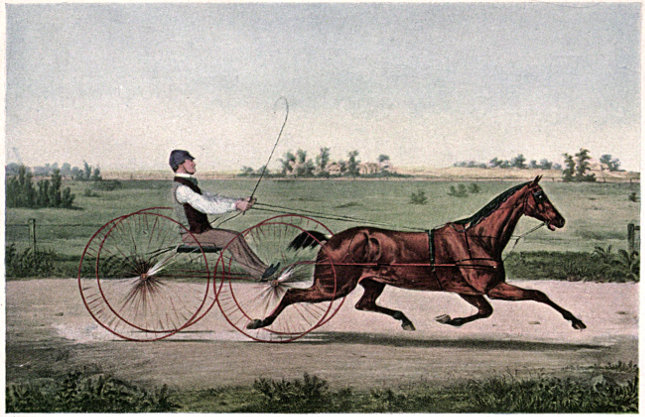
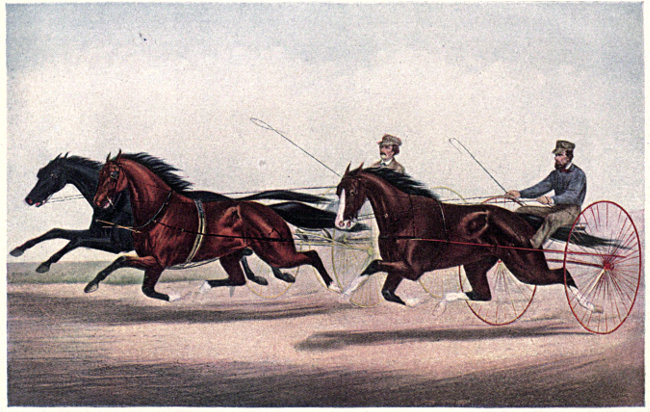
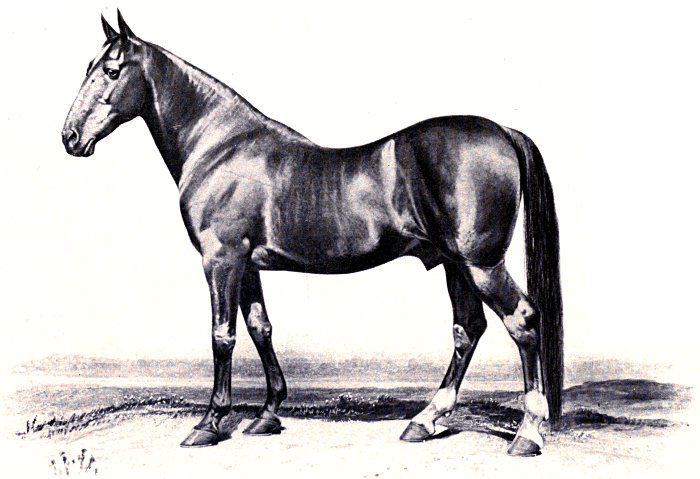
Original lithograph published by Currier & Ives.
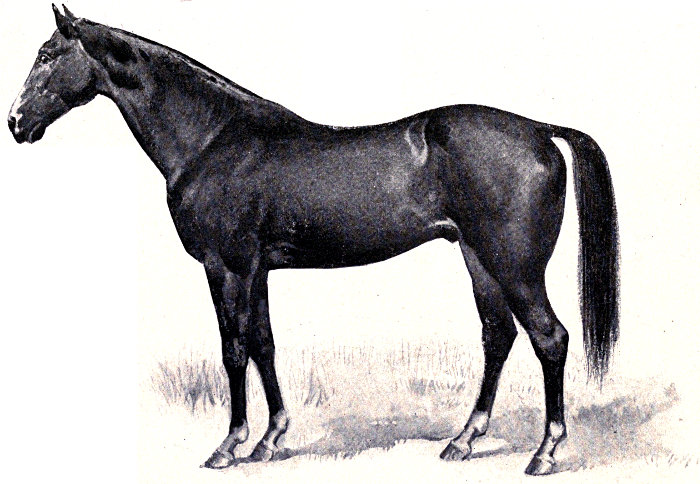
FLORA TEMPLE
This remarkable mare was the first trotter to go a mile better than 2.20. For more than six years she was called “Queen of the Trotting Turf.” Nothing is known as to her breeding, but from 1853 to 1859 she beat all the good horses in the country. She was a light bay, 14⅛ hands in height, and weighed 835 pounds when in training.
There have been so many books written about
horses that in offering a new one I feel that an explanation,
if not an apology, is due. And I am
embarrassed as to how to frame the explanation
without seeming to reflect on the books previously
given to the public. Nothing could be further
from my desire. Most of these previous books
have been devoted to special kinds or types of
horses without any effort to cover a very broad
field. Some others have been frankly partizan with
the avowed purpose of proving that this type or
that was the only one that was worth serious consideration.
All these are interesting, but valuable
chiefly to the careful student bent on going into
the subject of horse breeding and horse training
in all of its branches. To do this an ordinary reader
would have to study half a hundred books with
ivthe danger of becoming confused in the multiplicity
of theories and conflicting statements and
with the final result of knowing as little in the end
as in the beginning. In this modest little volume I
have endeavored briefly to show how the horses in
America have been developed and have come to be
what they are to-day. If I have succeeded even
partly in my purpose I will have my ample reward;
if I fail, my book will end on a few dusty
library shelves along with hundreds of others on
kindred subjects.
There is a peculiar characteristic of most writers
on the horse. Let a man be ever so fair in his
ordinary business and social life, he is apt, when
he becomes interested in horses, to throw away
his judicial attitude and change into an advocate
who sees only one side. When his interest in that
one side carries him to the length of writing, the
tendency is to be so partizan that he is even discourteous
to others who do not agree with him.
This queer disposition to wrangle and dispute is
due, no doubt, to the fact that horse breeding is
not yet by any means an exact science, and the
data, guiding even those who exercise the greatest
vcare and intelligence, is not trustworthy. We do
not know with certainty how any of the great
types has been produced, for the beginnings of all
of them are covered up by fictions, based on traditions
not recorded, but handed down from generation
to generation, or on fictions that have
been manufactured with ingenious mendacity.
All this is a pity, but there is no help for it now.
What we can do is to tell what is true, show what
has been demonstrated by known achievements
and go on working in the material that we have at
hand, so that we may assist in increasing the great
property value that this country has in its horses.
That property value is immense. In the beginning
of 1905, the Agricultural Department estimated
that the (taxable) value of the horses in the
United States was $1,200,310,020, and of mules
$251,840,378, or a total of $1,452,150,398. This
is only about eight per cent less than the aggregate
value of the cows, beef cattle, sheep and
hogs in the whole country. Merely, therefore,
from an economic standpoint this question of
preserving and increasing the value of horses is
one of prime importance. At this particular time
viit is a question not only of increasing, but even of
preserving, this value, for new agencies are coming
into competition with horses for many purposes
and are being substituted for horses in
many others. The automobiles and the electric
tramways are not merely passing fads. They
have come to stay until substituted by something
else which has not yet swum into our ken. The
common horses will soon be obsolete except on
our farms, and even on the farms they ought to be
given up, for, notwithstanding all the great
breeding establishments in the various states, by
far the greater number of the horses are bred on
the farms at present. That should always be the
case; but it may not be so when the time comes
that is rapidly approaching and a common horse
will have next to no value at all. Farmers more
than others need to realize that only such horses
should be bred that will have a value for other
than strictly farm work, for a farmer should be
able to sell his surplus stock with a fair profit. If
farmers have not the foresight to anticipate the
inevitable, then they will have to accept the loss
that will surely ensue.
viiEvery breeder whether farmer, amateur or
professional, should breed to a type. Any other
method is merely a haphazard waste of time and
money. When I say breed to a type, I mean always
a reproducing type. There are several such in this
country, a few of which belong to us, though most
of them are of foreign origin. The Thoroughbred
is English, the Percheron is French, the Hackney
is English, the Orlof is Russian, the Clydesdale
is English, the Morgan is American,
the Denmark is American, the Clay-Arabian is
American, and the standard bred trotter a
kind of “go-as-you-please” mongrel; nevertheless
he is considered by many the noblest achievement
of intelligent American horse breeding.
When any one goes in for horse breeding on
either a small or a large scale, whether with one
mare or with one hundred mares, he should, in
selecting mates, always strive for a definite type
in the foal. If intelligence and correct information
be guided by experience the results are apt to
be pleasantly satisfactory.
The first cardinal principle of horse breeding
was formulated in England a century and a half
viiiago in the expression: “Like begets like.” This
rule has been followed in the creation and maintenance
of all the great horse types in the civilized
world, and singularly enough all of them,
both great and small in size, have descended
from Arab and Barb stock. This concise rule of
breeding, “Like begets like,” has been misunderstood
by some who did not take a sufficiently
comprehensive view of it. This likeness does not
refer merely to one thing; not to blood alone, nor
to conformation, nor to performance; but to
blood and to conformation and performance, but
most of all to blood. Where blood lines, as to likeness,
are disregarded, and conformation and performance
are alone considered, the result is sure
to be a lot of mongrels, some of them, it is true, of
most surpassing excellence, but as a general
thing, quite incapable of reproducing themselves
with any reasonable certainty.
The great danger always in breeding horses
and other domestic animals with the idea of improving
a type or a family, is that mongrels may
be produced. A mongrel is an animal that results
from the union of dissimilar and heterogeneous
ixblood. An improved and established reproducing
type has hitherto been, and probably always will
be, the result of the mingling of similar and homogeneous
blood, crossed and recrossed until
the similar becomes consanguineous. The Arab
and Barb, I have said, are the foundation in
blood of all the great types from the Percheron to
the Thoroughbred. To be sure, other and dissimilar
blood was used in the beginning of the making
of all the types, but there was such crossing
and recrossing, such grading up by a selection of
mates, that the blood became similar, and the
rule: “Like begets like,” being constantly followed
a type becomes established.
When a type has been established and is of unquestioned
value to the world, it should be preserved
most carefully. The French, the Russians,
the Germans and the Austrians do this by means
of Governmental breeding farms. The English
accomplish the same result by reason of the custom
of primogeniture and entailed estates. Continuity
in breeding is essential to its complete success.
In this country when a breeder dies, his collection
of horses is usually dispersed by sale to
xsettle his estate. Considering our lack of Governmental
assistance we have done amazingly well
to become the greatest horse-producing country
in the world. Our greatness, however, is mainly
due to the vastness of our area, the fertility of our
soil and consequent cheapness of pasturage, and
to the high average intelligence of the American
people. We have not exercised the scientific intelligence
in breeding that some European people
have done. So as breeders we have not a great
deal to be proud of. We have done better as to
quantity than quality. But we can do better, and
I am sure that we will, for the time is hard upon
us when the four-year-old horse that is not worth
$300 in the market will not be worth his keep.
There is, however, an important public aspect
to this question of improving and maintaining the
breed of horses. Without good horses for cavalry
the efficiency of an army is very much crippled.
When our Civil War broke out horseback riding
in the North had as an exercise for pleasure been
generally given up, and nine-tenths of the men
who went into the service on the Union side could
not ride. On the other hand, at least seven-tenths
xiof those who went into the Confederate army
could ride. Moreover, the North had a scant supply
of horses fit for cavalry, while in many States
of the South such animals were abundant. Here
we had on one side the material for a quickly-made
cavalry, and on the other side practically
no material either in horses or men for such a
branch of the army. Critics of the war attribute
the early successes of the South to the superiority
of the cavalry. The Northern side was obliged
to wait for nearly two years before that arm of
the service was equal to that of the South. Thus,
this distressful war was probably continued for
more than a year longer than it would have been
had the two sides in the beginning been equally
supplied with riders and riding horses. And in
the Japanese-Russian War, now in progress, the
Japanese are hampered dreadfully by their lack
of cavalry. They have beaten the Russians time
and again only to let the Russians get away because
of the Japanese inability, from lack of
horses and horsemen, to cut off the line of retreat.
It is a most distressingly expensive thing to
be without horses in time of war; unless proper
xiihorses are abundant in time of peace, and the
people who own them use them under the saddle,
when war comes there is a scarcity of men who
know how to ride. Good material for cavalry in
horses and men is an excellent national investment.
In addition to my chapters on the breeding of
various types I have added several others on the
keeping, handling and using of horses so that if
an owner have only this one book, he may be able
to have at least a little useful information of many
sorts and kinds.
THE HORSE IN AMERICA
CHAPTER ONE PREHISTORIC AND EARLY HORSES
3
The paleontologists tell us that the rocks abound
with fossils which show that Equidæ were numerous
all over America in the Eocene period. These
were the ancestors of the horse that was first domesticated,
and though there were millions of
them on the Continent of North America in the
period mentioned there were no horses here at all
when Columbus made his great discovery, and the
first explorers came to find out what this new India
was like. The remains of the prehistoric
horse, when first found, baffled the naturalists,
and he was called by Richard Owen Hyracotherium
or Hyrax-like-Beast. The first fossils discovered
showed that the horse was millions and
millions of years ago under twenty-four inches in
stature, with a spreading foot and five toes. In his
development from this beginning the horse furnishes
4one of the most interesting examples of
evolution. When he had five toes he lived in low-lying,
marshy land and the toes were needed so
that he could get about. He had a short neck and
short jaws, as longer were not needed to enable
him to feed on the easily reached herbage. As the
earth became harder, the waters receding, his
neck and jaws lengthened, as it was necessary for
him to reach further to crop the less luxuriant and
shorter grasses. He lost, also one toe after another
so that he might travel faster and so escape his
enemies. These toes, of course, did not disappear
all at once, but grew shorter, until they hung
above the ground. The “splint bones” on a
horse’s legs are the remains of two of these once
indispensable toes, while the hoof is the nail of the
last remaining toe.
As the neck of the horse grew longer and two
toes had been dropped, the legs lengthened and
by the time he became what the scientists call a
“Neohipparion” he was about three feet high,
and his skeleton bore a very striking resemblance
to that of the horse of to-day. The teeth also
changed with the rest of the animal. In the earliest
5specimens discovered the teeth were short
crowned and covered with low, rounded knobs,
similar to the teeth of other omnivorous animals,
such as monkeys and hogs, and were quite different
from the grinders of the modern animal.
When the marshy lands of the too-well watered
earth had changed into grassy plains the teeth of
the horse also changed from short crowned to
long crowned, so that they could clip the shorter
and dryer grasses and grind them up by thorough
mastication into the nutritious food required for
the animal’s well being.
Indeed, the whole history of the evolution of
the horse by natural selection is a complete illustration
of adaptation to environment. Even to-day
in the Falkland Islands, where the whole surface
is soft, mossy bogland, the horses’ feet grow
to over twelve inches in length, and curl up so
that frequently they can hardly walk upon them.
Where we use horses on hard, artificial roads it is
necessary to have this toe-nail or hoof pared, and
protected by shoes.
Where the horse was first domesticated is a
matter of dispute upon which historians are not
6at all agreed. Some say it was in Egypt, some select
Armenia, and some content themselves with
the general statement that horses were indigenous
in Western and Central Asia. It would be
interesting to go into this discussion were it not
that it would delay us too long from the subject in
hand. At first they were used only in war and for
sport, the camel being used for journeys and
transportation, and the ox for agriculture. Indeed,
I fancy the horse was never used to the
plough until in the tenth century in Europe. The
sculptures of ancient Greece and contemporaneous
civilizations give us the best idea obtainable
of what manner of animal the horse was in
the periods when those sculptures were made.
Mr. Edward L. Anderson, one of the most
careful students of the horse and his history,
says: “Whether Western Asia is or is not the
home of the horse, he was doubtless domesticated
there in very early times, and it was
from Syria that the Egyptians received their
horses through their Bedouin conquerors.
The horses of the Babylonians probably came
from Persia, and the original source of all
7these may have been Central Asia, from which
last-named region the animal also passed into
Europe, if the horse were not indigenous to some
of the countries in which history finds it. We
learn that Sargon I. (3800 B.C.) rode in his chariot
more than two thousand years before there is
an exhibition of the horse in the Egyptian sculptures
or proof of its existence in Syria, and his
kingdom of Akkad bordered upon Persia, giving
a strong presumption that the desert horse came
from the last-named region through Babylonian
hands. It seems after an examination of the representations
on the monuments, that the Eastern
horse has changed but little during thousands of
years. Taking a copy of one of the sculptures of
the palace of Ashur-bani-pal, supposed to have
been executed about the middle of the seventh
century before our era, and assuming that the
bareheaded men were 5 feet 8 inches in height, I
found that the horses would stand about 14½
hands—very near the normal size of the desert
horse of our day. The horses of ancient Greece
must have been starvelings from some Northern
clime, for the animals on the Parthenon frieze
8are but a trifle over 12 hands in height, and are
the prototypes of the Norwegian Fiord pony—a
fixed type of a very valuable small horse.”
The British horse is as old as history. He was
short in stature and heavy of build. New blood
was infused by both the Romans and the Normans,
and when larger horses were needed to
carry heavily-armored knights, Flemish horses
were introduced both for use and breeding, so
that by the time the Oriental blood was introduced
they had in England many pretty large
horses, resembling somewhat the Cleveland Bay
of the present time, though not so tall by three or
four inches, and not so well finished. The horses
that were first brought to America by the English
were such as I have suggested. But the first
horses brought hither were not English, but
Spanish, and these were undoubtedly of Oriental
blood as were the horses generally in Spain after
the Moslem occupation. But when the Spanish
first came there were no horses, as has been said
before, in either North or South America. Columbus
in his second voyage brought horses with him
to Santo Domingo. But Cortez, when he landed
9in 1519 in what is now Mexico, was the first to
bring horses to the mainland. They were the
wonder of the Indians who believed that they
were fabulous creatures from the sun. The wild
horses of Mexico and Peru were no doubt descended
from the escaped war horses of the Spanish
soldiers slain in battle. These escaped horses
reproduced rapidly, and the plains became populous
with them. So, also, with the horses abandoned
by De Soto, who returned from his Mississippi
expedition in boats leaving his horses behind.
Professor Osborn of the American Museum
of Natural History, has recently been conducting
explorations in Mexico, studying the wild horses
there, and his conclusions are proof of the accuracy
of the surmises which have been made by the
historians of the early Spanish adventurers.
Flanders horses were brought to New York in
1625 and English horses to Massachusetts in
1629. Previous to these importations, however,
English horses had been landed in Virginia, and
in 1647 the first French horses reached Canada,
being landed at the still very quaint village of Tadousac.
Indeed, during all the colonial times
10there were many importations as well as much
breeding, for on horseback was the only way a
journey could be taken, except by foot or in a
canoe. They needed good serviceable horses, and
they obtained them both by importation and
breeding. I suspect that the general run of horses
in the Colonial era in New England and along
the Atlantic seaboard was very similar to the
horse that is now to be found in the province of
Quebec, Canada. Every one who has visited this
province knows that these habitant horses are
very serviceable and handy, besides being quite
fast enough for a country where the roads have
not been made first class. Harnessed to a calash,
an ancient, two-wheeled, French carriage, they
take great journeys with much satisfaction to
their drivers and small discomfort to themselves.
Then the Colonists had the Narragansett pacer, a
horse highly esteemed not only for speed but for
the amble which made his slow gait most excellent
for long journeys. When Silas Deane was the
colleague of Benjamin Franklin at the French
Court during the Revolutionary War, he proposed
getting over from Rhode Island one of
11these pacers as a present for the queen. Indeed,
there are those who maintain stoutly that the virtues
of the American trotter as well as the American
saddle-horse came from these pacers. That
may be the case so far as the trotters are concerned,
for of the horses bred to trot fast, as we
shall presently see, more are pacers than trotters.
As a matter of fact, however, Barbs are apt to
pace, and these Narragansetts may have had
such an origin. In the blood of all our horse types
there is some proportion of Barb blood, and we
find pacers among all except Thoroughbreds. I
am sure I never saw a Thoroughbred that paced,
or heard of one.
The history of the American horses with
which we are concerned to-day may be said to
have begun after the War of the Revolution. But
the basic stock upon which the blood of the post-revolutionary
importations was grafted was most
important and also interesting. It was gathered
from every country having colonies in North
America and blended after its arrival. The Spanish
and French blood was strongly Oriental and
mixed kindly with that from Holland and England.
12At any rate, when Messenger came in 1788
and Diomed in 1799 there was good material in
the way of horse-flesh ready and waiting to be
improved.
CHAPTER TWO ARAB AND BARB HORSES
13
The Arab horse from Nejd and the Berber horse
from Barbary are the most interesting and most
important specimens of the equine race. This has
been the case as far back as the history of the
horse runs and tradition makes it to have been so
for a much longer period. And, moreover, these
horses in the perpetuation of established European
and American types are as important to-day
as ever. From this Nejdee Arabian and Berber
of Barbary have sprung by a mingling of
these ancient bloods with other strains, all of the
reproducing horse types of signal value in the
civilized world, including the Percheron of
France, the Orlof of Russia, the charger of Austria,
the Thoroughbred of England, the Morgan
of Vermont, Mr. Huntington’s rare but interesting
Clay-Arabians of New York and the Denmarks
14of Kentucky. The same is the case with
other types or semi-types, but I only particularize
these because the mere mention of them shows to
what uses this singularly prepotent blood can be
put when the two extremes of equine types, and
those between the extremes as well, appear to
owe their reproducing quality to the blood of
these handsome little animals that have been
bred, preserved and, so far as possible, monopolized
by the nomadic tribes of Barbary and of
Nejd. Nejd comprises the nine provinces of Central
Arabia, while the Berbers wander all through
the Barbary states which consist of Morocco, Algeria,
Tunis, and Tripoli, but keep as remote as
possible from what European influence that exists
in that section of the world.
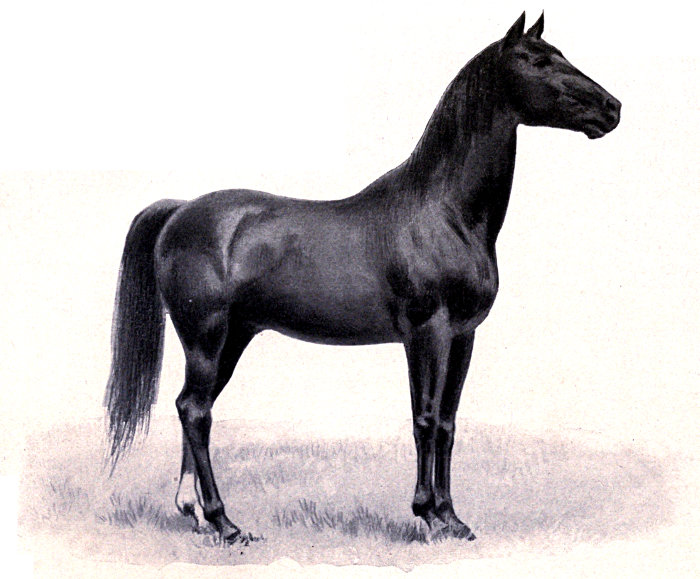
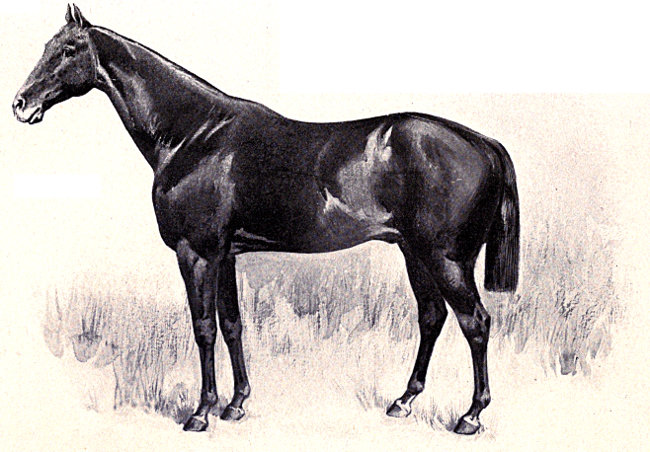
NIMR (ARAB)
Imported by Randolph Huntington
To most horsemen in America the name of
Arab is anathema. They will have none of him.
So far as their light goes they are quite right in
their prejudice. But prejudice in this instance, as
in most others, is the result of ignorance. And I
trust in the light of what I shall say about the
Nejdee Arabian, the Berbers of Barbary and the
influence of this blood on the equine stock of the
15world, I may say this without any offense. If I
give the offense then I preface it with the apology
that I mean none. The truth is that seven out of
ten of the Arabian horses taken into Europe or
brought to America have been inferior specimens
and not of the correct breed; twenty per cent at
least have been mongrels and impostures, while
of the remaining ten per cent not more than one
per cent have been correct in their breeding, conformation
and capacity to do what was expected
of them.
Some men reading the history of this type and
that have persuaded themselves that a few Arabs
selected personally in Arabia would enable them
to beat their competitors as breeders and even to
win against horses that traced back one hundred
or two hundred years ago to Arab and Barb ancestors.
Such folly always resulted in costly disappointment.
This folly and consequent disappointment
will become manifest as my narrative
proceeds. But before going any further I do not
wish any of my readers to harbor the notion that
I think an Arab would stand any chance on an
ordinary race-course to outrun an English Thoroughbred,
16or to out-trot in harness or under saddle
an Orlof or an American. I maintain no such
absurdity. But I do maintain that all these types,
so that they may preserve their reproductive capacities,
must get from time to time fresh infusions
of this blood. That is why the purely bred
Arabian—and the Nejdee is the purest of all—is
as valuable to-day as when the Godolphin
Barb and the Darley Arabian began the regeneration
of the English horse into that wonderful
Thoroughbred, which is one of England’s proudest
achievements and most constant sources of
wealth.
Historical records dating back to the fifth century
show that the best quality and the greatest
number of Arabian horses were to be found in
Nejd. They are also to be found there to-day,
and the number has not, so far as the records
speak, increased. They have never been numerous,
as it has never been the policy of the chiefs to
breed for numbers, but for quality. It is not true,
however, that a lack of forage was the restraining
cause of this comparative scarcity of horses in the
very section where they have been kept in their
17greatest perfection. As a matter of fact, the pasture
land of Arabia is singularly good. The very
desert, during the greater part of the year, supplies
sufficient browse for camels; while the pasture
grass for horses, kine, and above all for sheep on
the upper hill slopes, and especially in Nejd, is first-rate.
To be sure there are occasional droughts,
but few grazing countries in the world are free
from them. No, the scarcity in horses is not due
to a lack of food, but to two other reasons entirely
satisfactory to the chiefs of Nejd. Horses there
are not a common possession and used by all. On
the contrary, their ownership is a mark of distinction
and an indication of wealth, as they are
never used except for war and the chase and racing,
the camel carrying the burdens and doing the
heavy work of the caravans. The second reason
for the scarcity is that Nejdee horses are very
rarely sold to be taken out of the province. This
is not the result of sentiment, but one purely of
protection and the desire to preserve a monopoly
in a race that is easily the very purest in the
world.
The traditions as to the origin of the Arabian
18horse are numerous. Some hold that they are indigenous.
If this were supported, then the traditions
would lose interest. But the traditions are
interesting and in general effect were thus expressed
by the Emir Abd-El-Kader in 1854, in a
letter addressed to General Daumas, a division
commander who served long in Arabia and who
was later a senator of France. He said that God
created the horse before man, and then this domestic
animal was handed down: “1st. From
Adam to Ishmael; 2d, from Ishmael to Solomon;
3d, from Solomon to Mohammed; 4th, from Mohammed
to our own times.” This tradition, it
must be said, is very general and comprehensive
in its scope, but to the Arabs it has a significant
meaning, as they claim that Ishmael, the bastard
son of Abraham, was not only one of themselves
but their founder, for is it not written in the Bible
that when Hagar, the concubine of Abraham,
fled into the wilderness, an angel appeared to her
and said:
“I will multiply thy seed exceedingly that it shall not be
numbered for multitude. Behold, thou art with child, and
shalt bear a son and shalt call his name Ishmael; and he
19will be a wild man; his hand will be against every man, and
every man’s hand against him; and he shall dwell in the
presence of all his brethren.”
Indeed, this son of Abraham was the very personification
of the Arabian people throughout
their whole history, and he needed horses as the
Arabian people have needed them ever since to
assist in the forays and expeditions which give to
life its spice and its prize. Then again, there is a
tradition that Nejd got its horses from Solomon;
another that they came from Yemen. This seems
to me the same tradition, for Yemen’s ancient
name was Sheba; and what more natural than for
Solomon to have rewarded with gifts of horses the
Queen of Sheba’s people for giving him one of his
most satisfactory wives. Then there is a story that
has been builded up in our own days by a man
who was a Methodist minister before he became
a manufacturer of trotting-horse pedigrees in this
country. This interesting man in his old age, if he
did not resume the occupation of his youth, did
study the Bible in the endeavor to show that the
Arabian horses never had been much in quality
and many in numbers, and that their antiquity
20was not of any importance for they had not been
taken into Arabia from Armenia until the third
century. A century or so made little difference to a
man like Wallace, who unwittingly gave to these
horses two centuries more of record than history
really accounts for. But whether the Nejdee Arabs
were indigenous or brought into the land by Ishmael,
or sent by Solomon, or taken there by the
Armenians, it is certain that they were there a
hundred years before Mohammed became a
prophet, and in characteristics of size, temper
and performance they were the same that we find
to-day. So that gives us a long record of fifteen
centuries during which we know that the greatest
care has been taken to keep them pure in blood
and to train them to the work for which they were
required.
The tradition as to the Berber horse of Barbary
is much simpler, as these robber tribes have
not developed poets or historians, and content
themselves with saying that the horses have always
been there. And so far as we are concerned
that statement is as satisfactory as any other. But
we do know that supplies of these horses were obtained
21by Saladin in his domestic wars, and were
used also in his contests with the faith-breaking
crusaders who vainly tried to destroy the Moslem
rule and obtain perpetual possession of Jerusalem.
From the earliest times it has been a mooted
point as to which was the superior, the Berber or
the Nejdee. Among the Europeans who have
lived much in Egypt this is still a disputed matter,
and when Count de Lesseps was a young
man he endeavored to decide the question by a
series of races at 4½ kilometers (about 2⅘ miles).
Other horses, however, were admitted. In the
first heat there were three Nejdee horses all bred
in Cairo—the purity of the blood being open to
suspicion—and one Syrian horse. A Cairo-bred
Nejdee was the winner. In the second heat there
were three Nejdee horses, one bred in Cairo, and
one Barbary horse from Tunis owned and ridden
by Count de Lesseps himself. The Barb won. In
the third heat there were three Nejdee horses,
one of them ridden by de Lesseps, and one Samean
horse. A Cairo-bred Nejdee horse won. In
the fourth heat there were three Nejdee horses
and one Egyptian horse from Abfeh. A Nejdee
22horse was the winner. Then came the final heat
between the winners of the trial heats. The result
was that the de Lesseps Barbary horse was first,
a Cairo-bred Nejdee horse was second, and Nejdee
horses third and fourth.
This trial was cited by General Daumas as evidence
that at least the Barb was not inferior to
the Nejdee in fleetness. It only indicates to me
that Count de Lesseps was the shrewder of the
contestants and had selected the best individual
animal among the sixteen competitors. However,
the Emir Abd-El-Kader believed in the superiority
of the Barbs, and as an instance of this, quoted
the practice of Aamrou-El-Kais, an ancient
King of Arabia, who “took infinite pains to secure
Barbary horses wherewith to combat his enemies.
He was doubtful of success if obliged to trust
himself to Arab horses. It is not possible, in my
opinion, to give a more invincible proof of the superiority
of the Barb.” This illustration may
have been convincing to the learned Musselman,
but to-day we should want, I think, a more modern
instance to be satisfied; and we should want
to know more of the individuals in the de Lesseps’s
23trials than has been recorded. That the
Barbs have had as great influence in the creation
of other types as the Nejdees is undoubtedly true,
for while it has never been easy to get the best
specimens of Barbary horses for exportation, it
has never been so difficult as to get Nejdee Arabians
of equivalent excellence. The Berbers were
natives of Palestine and expelled by one of the
Persian kings. They emigrated to Egypt, but
were refused permission to settle, so they crossed
over to the other side of the Nile. They were adventuresome
robbers, as they are to-day, and no
doubt have taken their horses with them from
their first setting out from Palestine. So I quote
Abd-El-Kader again: “As for the Berbers themselves,
everything proves that they have been
known from time immemorial, and that they
came from the East to settle in the Maghreb,
where we find them at the present day.”
Europe did not know much of these Arab and
Barb horses until the Arabs and Moors invaded
and conquered Spain. The invasion of Spain began
in the eighth century and the rule lasted until
into the thirteenth century, though the Moors
24held Grenada for two centuries later. What became
a conquest was begun merely as a raid for
rich booty, and, of course, the Arabs, of whom it
has been said, “their kingdom is the saddle,”
were mounted. The Berbers, of course, took their
horses, and it is likely that during those long centuries,
it was the first time out of the Sahara that
Arabian and Barb horses were bred extensively
and their blood united. It is undoubtedly a fact
that after the expulsion of these conquerors,
Spain was well supplied with excellent horses,
horses which assisted the armies of Spain to hold
what her navigators had discovered. The pilgrims
returning from Palestine, also told of the
excellent horses in the East, and the Crusaders,
more practical men, had all the evidence that
they needed in their battles with the Musselman
to enable them to testify to the hardiness and the
fleetness of the horses of the desert. And so when
lighter cavalry was needed to replace the heavily-armed
knights, whose armor the use of gunpowder
had made obsolete, the soldiers and statesmen
of the seventeenth century knew where to look
for the blood that would improve the home-bred
25horses. It was as difficult then as now to get
Arabs and Barbs of the best blood, but some at
least were obtained, and from the beginning in
England in the earliest years of the eighteenth
century we trace back to Eastern horses to find
the founders of the wonderful Thoroughbreds,
which in their way are the best horses the world
has seen. In France, too, there were many importations
for the upbuilding of the native stock,
but this took a different direction, and we are not
so much concerned with it as with the English.
The English stud book of the Messrs. Weatherby,
the first effort to keep trustworthy records
of the breeding of horses, begins with 1700, the
only Eastern horse mentioned before this being
the Byerly Turk, a charger used by Captain Byerly
in Ireland in 1689. Then they had the Darley
Arabian, Markham’s Arabian, the Alasker
Turk, Leede’s Arabian and the Godolphin Barb.
The most important of these were the Godolphin
Barb and the Darley Arabian. We do not know
exactly whence any of these came, nor do we
know the pedigree of any. Indeed, to know, or
pretend to know the pedigree of a Nejdee or Berber
26horse is to show ignorance or to confess imposture.
The breeders do not keep or give pedigrees
except when they wish to bolster up the
merits of an inferior animal. And then they do it
because they have been asked to do so by European
or American purchasers not acquainted
with the Arab practices. It seems as sensible to
ask an Arab for the pedigree of a horse as to ask a
diamond merchant for the pedigree of a stone.
The Arabs have had these horses time out of
mind. They know them to be purely bred. What
more could a sensible man want? But if the purchaser
insists, then he may have any kind of pedigree
that seems to please him most. He can have
pure Nejdee, pure Barb, a cross between the two,
or any admixture of Egyptian, Syrian, or Turkish
blood that best suits his taste. But as a matter of
fact, these Eastern pedigrees are pure fakes,
merely made up things, such, for instance, as the
recorded pedigree of the famous Hambletonian,
the founder of the standard bred trotter in America.
To the Arabs in their breeding, pedigree
makes no more difference in mating than it does
to the birds of the air or the beasts of the forest.
27They know that they have animals of pure blood
and that the progeny of them will still be pure no
matter how closely the parents may be related.
There is selection, of course, as inferior males are
not permitted to be sires. Instead of that they are
sometimes destroyed, or sent to Syria and even to
Mesopotamia to serve the mares of those regions
where the mares are Arabs but not pure
Nejdees. Here is one queer fact about the Arab
and Barb blood, and proof also of its wonderful
prepotency. So long as it is mingled with other
blood not too heterogeneous, the most close inbreeding
appears not only to do no harm, but actually
to do good. This is particularly so with the
English Thoroughbred, the American Morgan,
and the Kentucky Denmark.
All we are told about the Darley Arabian is
this. Mr. Darley of Yorkshire, had a brother who
was a merchant in Aleppo. This brother brought
home a black bay[1] stallion some 14 hands in
stature, about 1700. He became in 1707 the sire
of Flying Childers, the greatest race-horse in
England and the progenitor of most of those on
28the running turf in America and England to-day.
The dam of Flying Childers was also rich in Oriental
blood, as she was an inbred Spanker and
Spanker was by D’Arcy’s Yellow Turk from
the daughter of Morocco Barb and Old Bald
Peg, the latter being by an Arab horse from
a Barb mare. So we see that this first great
English race-horse was almost of pure Eastern
blood.
Of Markham’s Arabian we only know that he
met with the disapproval of the then Master of
Horse, the Duke of Newcastle, and had scant
chance. Of the Godolphin Barb we know very little
previous to his coming to England, where he
was held in such little esteem that he was used as
a teaser for Hobgoblin. We are told, however,
that he was first taken to France and held of
such little account that he was used as a cart horse,
in Paris. He was finally brought to England about
1725, and became the property of Lord Godolphin.
He was a brown bay, 15 hands high, and
with an unnaturally high crest. He served Roxana
in 1731, the produce being Lath, next to
Flying Childers the greatest horse in England in
29the first half of the eighteenth century. Roxana
was by Bald Galloway, her dam sister to Chanter
by the Alasker Turk from a daughter by
Leedes’s Arabian and a mare by Spanker. Here
we see again the value of these crosses of Oriental
blood. From the mating of the Godolphin Barb
and Roxana also came Cade, the sire of Regulus,
the grandam of that most marvelous horse,
Eclipse. When all this had happened the English
were sure they were on the right road. And they
have kept on that road with great persistency,
not going back, however, in my opinion, frequently
enough to the pure Nejdee and Berber
stock for fresh infusions. That they have not
done this is natural enough, however. A breeder
wants results quickly. To get a collateral strain
from fresh Arab and Barb blood equal to the present
thoroughbred would probably take fifty
years. No private breeder cares to do that. And
the English government does not officially breed
horses. The French, the Austrians and the Russians
all, however, have agents in Arabia trying
to buy the animals that are best suited to do just
what I have suggested. And they all succeed. It is
30too much, however, to expect this from a private
breeder.[2]
2. According to the reckoning of Major Roger D. Upton of the 9th
Royal Lancers, there were used in the formation of the English stud from
the time of James I, to the beginning of the 19th Century, Eastern horses
to this extent: 101 Arab stallions, 7 Arab mares, 42 Barb stallions, 24 Barb
mares, 1 Egyptian stallion, 5 Persian stallions, 20 Turkish stallions, and
2 “Foreign” stallions, or 210 in all. In the popular mind of all of these
were classed as Arabs. This is not right, as the real Arab is much purer in
blood than the others, though the Barbs have virtues by no means to be
despised.
One, however, in this country has had the
courage and the tenacity of purpose to do this. I
allude to Mr. Randolph Huntington, of Oyster
Bay on Long Island. Mr. Huntington has mingled
Arab and Barb blood with that of the Henry
Clay family to which he is very partial. His success
in creating a reproducing type has been demonstrated
in the face of handicaps that would
have worn out the patience of a less tenacious and
determined man. This experiment of Mr. Huntington
makes a story of its own which I shall
tell in a later chapter.
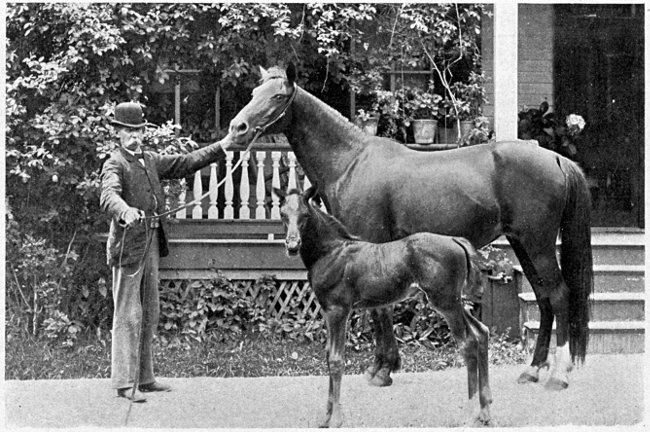
RANDOLPH HUNTINGTON AND HIS IMPORTED ARAB MARE NAOMI, AND FOAL
31From the time that superior horses began to be
imported into this country, and that was in the
Colonial era, there have always been a few Arabs
and Barbs brought over of various degrees of excellence.
Of course, all of the English Thoroughbreds
were rich in the blood, Messenger among
them. They came also into Canada with the
French, and the Spaniards who had crossed the
Mississippi and gone to California from Mexico
brought many horses all presumably of this
breed. The hardy Mustangs of the West, which
were a very distinct type, were evidently descended
from the castaways of the Spanish explorers.
To President Jefferson there came a gift
of Arab stallions and mares. These were sold and
the money turned into the treasury. After Ibraheem
Pasha overran Arabia in 1817, and took
several hundred head of Nejdee horses to Egypt
it was easier for a time to buy them for exportation.
And from there at about this time there were
several importations into America. This supply,
however, was soon exhausted, as the Egyptians
are not skilled horse breeders. Besides, the
French got the pick of this captured lot.
Then again, Teysul, King of Nejd, made a
present of forty stallions and mares to Abdul-Azeez,
Sultan of Turkey. From this source came
Zilcaadi, the grandsire of the great Morgan horse
32Golddust, and also the Arab stallion Leopard,
given to General Grant in 1879, when the Barb,
Linden Tree, was also presented to him by the
Sultan. It was with these two Grant stallions, by
the way, that Mr. Huntington began the experiment
I just alluded to.
What gave the Arab horse a kind of disrepute in
America was the experiments of Mr. A. Keene
Richards. Mr. Richards was a man of wealth and
education and a breeder of race-horses in the Blue
Grass section of Kentucky. In studying the history
of the English Thoroughbred he came to the
conclusion he would like to get fresh infusions of
the original blood. He went to Arabia, and personally
selected several stallions. These he mated
with his Thoroughbred mares, and when the colts
were old enough he entered them in the races.
They were not fast enough to win even when conceded
weight. He went again, this was about
1855, taking with him the animal painter, Troye.
They took their time, and came back with a superior
lot. Mr. Richards tried over again the
same experiment with the same result. The colts
did not have the speed to beat the Thoroughbreds.
33It seems to me that any one except an incurable
enthusiast would have anticipated exactly what
happened. If Mr. Richards had waited several
generations and then injected the new infusions
of the Arab blood, the result probably would have
been quite different. The Civil War came along
about this time, however, and the experiment
ended in what was considered a failure. But that
blood taken to Kentucky at that time by Mr.
Richards has been valuable in an unexpected way,
for it has been preserved in the half-bred horses in
the horse-breeding section, and it crops out all the
time in those wonderful saddle-horses of the Denmark
strain, which are sent all over the country
to delight the lovers of horseback exercise as well
as to monopolize the ribbons in the horse shows.
Mr. Wilfrid Blunt, in England, has had experiences
similar to Mr. Richard’s. But he has gone
the same wrong road, and has been in too much
of a hurry. Continuity in breeding is something
beyond the capacity of an individual; his life is
not long enough. That is why every government
should have a stud to keep up the standard of the
horses. In the United States the interests are so
34diverse that it is not likely that this will soon be
done in an extensive way, though already begun
on a small scale, but each State, whose people
are horse breeders, should do something of the
sort, so that the success of an undertaking might
not depend upon the uncertain life and more
uncertain fortunes of any one man.
In Arabia the horses are trained at a very early
age. Indeed, the suckling colt is handled almost
from his birth. As a yearling he is trained to obey,
exercised with the halter and the bit. At two-years
old he is ridden gently but without fear of
hurting him. At three there is a let-up in his
work, so that he may acquire his full growth; but
he is used enough to keep him from forgetting
what he has been taught. At four he is considered
full-grown and is put to as hard service as
the Arab usually knows. It is a mistaken idea
that the Arab horse is considered a member of
the family to which he belongs, and that he is
pampered, petted and caressed by the women and
children, and stabled in the same tents as his
owners. Those are all fanciful ideas of the poets.
On the contrary, an Arab horse is early immured
35to hardships, so that in emergency he may subsist
on scant food and little water. Every one has
heard it said that an Arab would give his last
crust to his horse rather than eat it himself. I
readily grant that in some cases he would do so,
and so would any other man of sense in a like predicament.
The Arabs are great robbers and wonderful
chaps to run away. In the desert they do
not have telegraphs and telephones to intercept
a fleeing thief. There it is a question of the fastest
and longest enduring horse. So of course, a fleeing
Arab, with his pursuers hot on his track, would
give his last crust to his horse rather than eat it
himself. He would be a fool if he did not. That
last crust might be the very fuel that would keep
life and strength in his engine of escape. The
Arab is not a sentimentalist except when he talks
or makes poetry. In his words he exhausts his
whole supply. Beneath them he is a very shrewd,
cold and able man of affairs.
In his horses the Arab has immemorially had
the means to gratify his vanity, to give him his
best beloved sport, to enable him to make war,
and, above all, to run away. The distances that
36these horses can go on scant rations and small
quantities of water seem incredible, while that
they can carry heavy weight without inconvenience
is entirely true, for I have tried them. But
we have heard weird stories of them from the Arabic
poets themselves, and also from the English
who have used what they could get for their
sports in India, where pony racing has ever been,
since the English occupation, a most attractive
diversion. A frequent expression that one comes
across in old books of life in India is that some
named Arab horse had a head so small that it
could be put in a quart cup. That, of course, was
an absurd exaggeration, but they undoubtedly
have very small and handsome heads. Their
heads, I am sure, were never so small nor their
necks so long as the painters have represented
the heads and necks of the Darley Arabian and
the Godolphin Barb to have been. At that time in
England, however, the painters even took the liberty
of exaggerating the length of neck and diminutiveness
of head of the women who sat to
them. It was the fashion of the time, and to that
fashion we owe the loss of correct likenesses of
37two of the famous horses of those breeds that have
left their impress upon the fleetest racers in the
world, besides contributing the reproducing capacity
to all the horse types that amount to anything
in the civilized world.
CHAPTER THREE THE THOROUGHBRED IN AMERICA
38
In the previous chapter I have told, as well as I
could, how the English race-horse was developed
by a commingling of Oriental blood with that of
horses that had been used for sporting purposes
in our mother country. I confess that my explanation
must seem very slipshod to any who are
looking for a mathematically exact exposition of
facts. Nothing would have pleased me better
than to have been able to gratify the natural
craving that people have for exactness. But I
cannot be less general than I have, for more
specific information is not at my command. It was
simply demonstrated by practical experiments
that the mixture of the bloods mentioned produced
a very fast and sturdy horse that was superior to
what had previously been known in England, together
with the more important fact that this
39new Anglo-Arab was a type that was reproducing
and kept on improving in speed and staying qualities
so long as the cardinal principle of breeding:
“like produces like” was adhered to with the
comprehensive intelligence which made the rule
embrace performance, conformation and blood.
To the narrow-minded the law “like produces
like,” indicates that the progeny of the fastest
stallion and the fastest mare, when breeding for
speed, would be faster than either parent. It is
a well-known fact that mares whose fleetness and
gameness has been demonstrated by long careers
on the turf are rarely successful as dams. Of
course, there have been exceptions to this general
statement, but notwithstanding these exceptions,
the narrow-minded application of the rule breaks
down just at this point. It is likeness in blood,
conformation and general characteristics that the
rule more particularly refers to. At any rate, the
English had, by the middle of the eighteenth
century, developed a distinctive type of horse of
most marvelous fleetness and courage and with a
blood prepotency that has been so great, that after
a century and a half the Thoroughbred is as much
40improved over what he was at the beginning as
the beginners were better than the common
stock of England a century earlier. And this is
the type that we call to-day in America the
Thoroughbred.
The importation of the Thoroughbred into this
country began in Colonial Virginia, where there
was then probably more sporting blood than
there is now, when it cannot be said to be at all
pallid, but on the contrary very red. The first
Thoroughbred of which there is record, and the
record is not as exact as we should like, was
brought to Virginia in 1730, by Messrs. Patton
and Gist, and was called Bulle Rock. He was
said to have been foaled in 1718, and to have been
sired by the Darley Arabian, first dam by the
Byerly Turk. That was good breeding, and the
gentlemen of Virginia accepted, to an extent, at
least, the invitation of Bulle Rock’s owners to use
his services in improving the general stock of the
Old Dominion, for every now and then in the very
oldest records he appears in the genealogy. How
good the horses were that were landed in Virginia
previous to this time, we can not say, but only
41presume that they were as good as the importers
could find and afford to buy, for they were fox
hunters and hard riders from the beginning of
their coming. After Bulle Rock’s coming to Virginia,
very quickly Dabster, Jolly Ranger, Janus,
and Fearnaught followed.
The South Carolinians were not long behind
the Virginians in their importations, and by 1760
a jockey club had been established in Charleston,
and regular race meetings were held. Many of
the wealthy land owners imported and bred
horses for these contests. In the same year that
this club was founded, Colonel De Lancey, of
New York, brought out Lath from England, and
a little later Wildair, the horse supposed by some
to have been the great grandsire of the dam of
Justin Morgan, founder of the Morgan type of Vermont.
About the same time there came to New
York the Cub Mare and Fair Rachel, both still
famous in the pedigrees in the “American Stud
Book.” These matrons found homes in Virginia,
and assisted in the making of those old time
“four mile heat” horses, the only kind which our
ancestors deemed really first rate. Before the
42Revolutionary War there was much racing in
Long Island as well as in Virginia and the Carolinas,
but the great contests between states and
sections did not begin till a later date. During the
Revolutionary War there were few importations of
Thoroughbreds, but when the young country had
a little recovered in her industries from the effects
of that conflict, the importations began again and
in 1788 the gray stallion Messenger, the founder in
some measure of our trotting stock, was brought
out, and in 1799 the Derby winner Diomed—the
most important of all horses, so far as race-horses
in America are concerned—came out to
Virginia. Of Messenger, much will be said in the
proper place; of Diomed, here is the place to
speak of his record and his influence on the
Thoroughbreds born to America. As a race-horse
he was par excellence the horse of his day in
England, carrying practically everything before
him while that day lasted. But he was kept in
training too long—for what may be called two
days instead of one—and rather lost his fame
before he was retired to the stud. In the stud he
was successful, but was not fashionable, his
standing fee being reduced to two guineas before
he was sold to Colonel Hoomes to be taken to
Virginia. In Virginia he was an immense success
as a sire, and few successful horses of American
stock up to the present time lack a strain of this
blood. Among his American progeny were Sir
Archie, Florizel, Potomac, Peacemaker, Top
Gallant, Hamiltonian, Vingt-un, Duroc, Hampton,
Commodore Trixton, the dam of Sir Henry
and the dam of Eliza White. He was in the stud
only eight years in this country, but left an imperishable
impression. While he lived he dominated
all other stallions in America, and afterwards
his sons worthily took his place. He was a
chestnut, 15.3 in stature, and was got by Florizel
out of a Spectator mare, her dam by Blank, grandam
by Childers out of Miss Belvoir by Gray
Grantham, and so forth. The greatest race-horse
of Diomed’s get in America was Sir
Archy; and Sir Archy rivaled his sire’s performances
in the stud. He was retired early and,
living to a great age, had opportunities denied to
Diomed.
LEXINGTON
Bred by Dr. Warfield and owned by Mr. Ten Broeck and Mr. Alexander
43Before the death of Sir Archy, racing was well
44established in America in several sections and was
pre-eminently the sport of gentlemen. The
wagers made were heavy—would be considered
heavy to-day when the sport has become defiled
by being very much of a gambler’s game—but
the races run were comparatively few. Section
against section soon became popular—the North
against the South, Virginia against South Carolina,
Kentucky against Tennessee, and so on.
The first, and in many regards the most important
of these contests, was a race at four mile
heats over the Union Course on Long Island in
1823, for a wager of $20,000 a side. Sir Henry,
the representative of the South, was by Sir
Archy, dam by Diomed and grandam by Bel
Air. He was four years old, and carried 108
pounds. Eclipse (or American Eclipse) was by
Duroc, his dam being Miller’s Damsel by
Messenger. He was nine years old and carried
126 pounds. So it will be seen that the contestants
were both grandsons of Diomed; indeed, Sir
Henry was a grandson through both sire and dam.
The description of the race I take from that entertaining
book, “Figures of the Past,” by the
45late Josiah Quincy, with the consent of the publishers,
Messrs. Little, Brown & Co., of Boston.
Here is what Mr. Quincy wrote from his diary.
“ECLIPSE” AGAINST THE WORLD
“On the 27th of May, 1823, nearly fifty-seven
years ago, there was great excitement in the city
of New York, for on that day the long-expected
race of ‘Eclipse against the world’ was to be decided
on the race-course on Long Island. It was
an amicable contest between the North and the
South. The New York votaries of the turf—a
much more prominent interest than at present—had
offered to run Eclipse against any horse that
could be produced, for a purse of $10,000; and
the Southern gentlemen had accepted the challenge.
I could obtain no carriage to take me to the
course, as every conveyance in the city was engaged.
Carriages of every description formed an
unbroken line from the ferry to the ground. They
were driven rapidly, and were in very close connection;
so much so that when one of them suddenly
stopped, the poles of at least a dozen carriages
broke through the panels of those preceding
46them. The drivers were, naturally, much
enraged at this accident; but it seemed a necessary
consequence of the crush and hurry of the
day, and nobody could be blamed for it. The
party that I was with, seeing there was no chance
of riding, was compelled to foot it. But after plodding
some way, we had the luck to fall in with a
returning carriage, which we chartered to take
us to the course. On arriving, we found an assembly
which was simply overpowering; it was
estimated that there were over one hundred
thousand persons upon the ground. The condition
of the race were four-mile heats, the best
two in three; the course was a mile in length. A
college friend, the late David P. Hall, had procured
for me a ticket for the jockey-box, which
commanded a view of the whole field. There was
great difficulty in clearing the track, until Eclipse
and Sir Henry (the Southern horse), were
brought to the stand. They were both in brave
spirits, throwing their heels high into the air;
they soon effected that scattering of the multitude
which all other methods had failed to accomplish.
And now a great disappointment fell,
47like a wet blanket, on more than half the spectators.
It was suddenly announced that Purdy,
the jockey of Eclipse, had had a difficulty with his
owner and refused to ride. To substitute another
in his place seemed almost like giving up
the contest; but the man was absolutely stubborn,
and the time had come. Another rider was provided,
and the signal for the start was given. I
stood exactly opposite the judges’ seat, where the
mastering excitement found its climax. Off went
the horses, every eye straining to follow them.
Four times they dashed by the judges’ stand, and
every time Sir Henry was in the lead. The spirits
of the Southerners seemed to leap up beyond control,
while the depression of the more phlegmatic
North set in like a physical chill. Directly before
me sat John Randolph, the great orator of
Virginia. Apart from his intense sectional pride,
he had personal reasons to rejoice at the turn
things were taking; for he had bet heavily on the
contest, and, it was said, proposed to sail for Europe
upon clearing enough to pay his expenses.
Half an hour elapsed for the horses to get their
wind, and again they were brought to the stand.
48But now a circumstance occurred which raised
a deafening shout from the partizans of the North.
Purdy was to ride. How his scruples had been
overcome did not appear, but there he stood before
us, and was mounting Eclipse. Again, amidst
breathless suspense, the word “Go!” was heard,
and again Sir Henry took the inside track, and
kept the lead for more than two miles and a half.
Eclipse followed close on his heels and, at short
intervals, attempted to pass. At every spurt he
made to get ahead, Randolph’s high-pitched and
penetrating voice was heard each time shriller
than before: ‘You can’t do it, Mr. Purdy! You
can’t do it, Mr. Purdy! You can’t do it, Mr.
Purdy!’ But Mr. Purdy did do it. And as he took
the lead what a roar of excitement went up! Tens
of thousands of dollars were in suspense, and,
although I had not a cent depending, I lost my
breath, and felt as if a sword had passed through
me. Purdy kept the lead and came in a length or
so ahead. The horses had run eight miles, and
the third heat was to decide the day. The confidence
on the part of the Southern gentlemen
was abated. The manager of Sir Henry rode up
49to the front of our box and, calling to a gentleman,
said: ‘You must ride the next heat; there
are hundreds of thousands of Southern money
depending on it. That boy don’t know how to
ride; he don’t keep his horse’s mouth open!’ The
gentleman positively refused, saying that he had
not been in the saddle for months. The manager
begged him to come down, and John Randolph
was summoned to use his eloquent persuasions.
When the horses were next brought to the stand,
behold the gentleman[3] appeared, booted and
spurred, with a red jacket on his back, and a
jockey cap on his head. On the third heat Eclipse
took the lead, and, by dint of constant whipping
and spurring, won by a length this closely contested
race.
“There was never contest more exciting. Sectional
feeling and heavy pecuniary stakes were
both involved. The length of time before it was
decided, the change of riders, the varying fortunes,
all intensified the interest. I have seen the
great Derby races; but they finish almost as soon
as they begin, and were tame enough in comparison
50to this. Here for nearly two hours there
was no abatement in the strain. I was unconscious
of everything else, and found, when the
race was concluded, that the sun had actually
blistered my cheek without my perceiving it.
The victors were, of course, exultant, and Purdy
mounted on Eclipse, was led up to the judges’
stand, the band playing, ‘See the Conquering
Hero Comes.’ The Southerners bore their losses
like gentlemen, and with a good grace. It was
suggested that the comparative chances of Adams
and Jackson at the approaching presidential election
should be tested by a vote of that gathering.
‘Ah,’ said Mr. Randolph, ‘if the question of the
Presidency could be settled by this assembly,
there would be no opposition: Mr. Purdy would
go to the White House by acclamation.’”
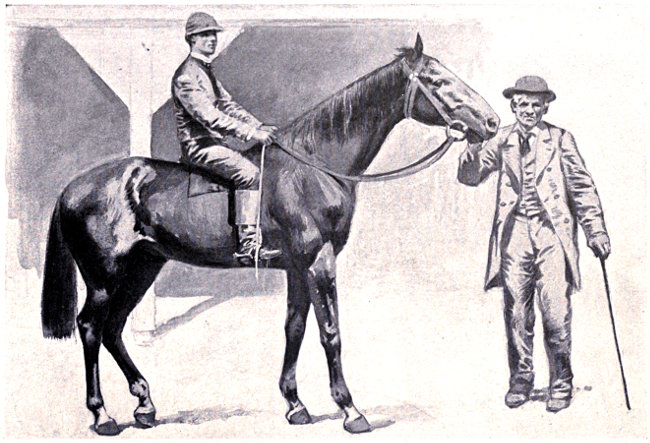
TEN BROECK (THOROUGHBRED)
Bred and owned by John Harper
The first heat was run in 7.37½, the second in
7.49, and the third in 8.24. Not very fast time
considering what has been done since; and contemptible
according to the pretensions made by
race-horse owners of the present day, when “four-mile
heats” are obsolete because they interfere
with the business of the sport, and do not give the
51bookmakers frequent enough chance to turn over
the money of the public. They base these pretensions
on the performance of Lucretia Borgia,
a four-year-old, that ran a four-mile dash in 1897,
in California, in 7.11, carrying eighty-five pounds.
I have no doubt that the Thoroughbreds of the
present are much faster than those of 1823, but
the only way to compare them as to gameness
and bottom is to have them repeat and repeat
again, and see whether or not this increased fleetness
is maintained. Probably it will not be done,
for the one-time sport of gentlemen is nowadays
very much a mere gambler’s game.
The next great contest that old-time racing
men spoke of with a respect that was akin to awe
was that between Gray Eagle, a Kentucky horse,
by Woodpecker out of Ophelia by Medley, and a
Louisiana horse, Wagner, by Sir Charles out of
Maria West by Marion, at four-mile heats. This
was at Louisville in 1839. Wagner won the first
two heats, Gray Eagle being badly ridden, in
7.48 and 7.44. This race was run on a Monday.
The following Saturday the race was repeated.
Gray Eagle won the first heat in 7.51; Wagner
52took the second heat in 7.43. Gray Eagle broke
down on the second mile of the third race, and no
time was kept. Though I was not born for many
years after these races were run, they were so important
in the history of the neighborhood where
I lived and such frequent topics of conversation
that I sometimes have difficulty in persuading
myself that I was not present. In this I somewhat
resemble the gallant King of England, who
believed that he was at the battle of Waterloo.
Kentucky had become prominent before this
time as a breeding place for Thoroughbreds. The
Kentuckians, mainly from Virginia in the early
days, were horse lovers by inheritance and habit,
so they took with them to their new homes very
little but good stock. They were not impoverished
adventurers seeking new pioneer homes because
they had failed in the places of their birth. Not a
bit of it. They were well born and of good substance,
and they went to this new country to
found estates, for the gentlemen of that period
had not outgrown the Elizabethan land hunger
which took so many of the cavaliers to Virginia
in an earlier century. That they took good horses
53with them was a matter of course. And arriving
there they found that the native blue grass, which
grew plentifully even in the woods, was pasturage
upon which horses flourished mightily.
The advertisements in the Kentucky Gazette from
1787 to 1805 show that there were many Thoroughbred
stallions standing in the neighborhood
of Lexington during those years, and not a few
of them were imported from England, the others
coming from Virginia, the noble pedigrees being
printed at full length, with references nearly always
to the Newmarket Racing Calendar to substantiate
the turf performances of the sires advertised.
So Kentucky was prepared with stock of her
own to take the place of the Virginia horse breeders
when the wasteful methods of agriculture, and
the costly habits of hospitality, had impoverished
the mother State and made racing a sport too expensive
for the depleted purses of the gentlemen
who stayed at home. The Sir Archy blood was
what the Kentuckians seem to have been after,
and soon there was more of it in Kentucky than in
Virginia. Some six of Sir Archy’s sons stood in
the neighborhood of Lexington at one time, and
54there were mares there fit to mate with Diomed’s
grandsons.
The Whip family were also well represented,
and among the other English stallions taken
thither may be mentioned Buzzard, Royalist,
Dragon, Speculator, Spread Eagle, Forrester,
Alderman, Eagle, Pretender, Touchstone and
Archer. All a reader, who wishes to go deeper,
needs to do is to look at the stud book and see
what pure and royal blood the Kentuckians were
working with to make that foundation stock
which made the State so famous, that at this time
there are more Thoroughbreds foaled there than
in all the other States of the Union combined.
The breeders there were amateurs, however—men
who bred for the love of the horse and
the love of sport—until Mr. Robert A. Alexander
began his operations at the famous Woodburn
farm, where the breeding of Thoroughbreds
was more extensively carried on than in any
other place in the world. Mr. Alexander was a
native Kentuckian, but educated at Cambridge
in England. He died at forty-eight, but he gave a
great impetus to stock breeding in Kentucky.
55When I first visited Woodburn, the great Lexington
was at the head of the stud. Later Mr.
Alexander, as well as his brother and successor,
had many other great stallions and brood mares,
and colts and fillies from this farm for a score of
years captured the richest prizes of the American
turf. The history of Woodburn from 1850 to
1880 would almost amount to the same thing as a
history of Thoroughbred breeding in Kentucky
for that period, though there were many other
smaller breeders, as there are now, when the
James B. Haggin Elmendorf farm has taken
the premier place, and that, too, on a very
much larger scale even than Alexander’s Woodburn.
As it was in Alexander’s time, however,
the smaller breeders, particularly Mr. Keene and
Mr. Belmont, are still fortunate in producing
most admirable horses; and it will be a bad thing
for the Thoroughbred industry in Kentucky when
this is no longer so. The result of a monopoly of
breeding horses would be the same as the result
produced by the trusts in oil, in steel and in beef;
the industry would be controlled by one man, or
several in combination, and the only competition
56that would remain would be between the men who
attend to the gambling end of the game. This is
not likely to happen, unless a corporation be
formed to take over the chief breeding farms, for
in nine cases out of ten, when an owner dies, his
horses are sold and his collection dispersed so as
to settle his estate.
After the Gray Eagle-Wagner race, the next
one that was watched with breathless interest by
the whole country was the match at four-mile
heats between Fashion and Boston for $20,000 a
side. This was run on Long Island in 1842, and
both heats were won by Fashion, the time being
7.32½ and 7.45. The time of this race, it will be
seen, was an improvement on that of the Eclipse-Sir
Henry race, and also on the time in the race
between Gray Eagle and Wagner. It was called
a match between North and South, and the North
was again the winner. Fashion was bred in New
Jersey, and was by Commodore Stockton’s imported
stallion Trustee out of the Virginia bred
mare, Bonnets o’ Blue. Boston came from Virginia,
and was by Timoleon out of Robin
Brown’s dam by Florizel. Boston was a grandson
57of Sir Archy, and foaled in 1833. From the
time of his training as a three-year-old until he
met Fashion, six years later, he had campaigned
all over the country and had meet with almost
universal success. He was considered the greatest
horse of his day, and there are many students of
Thoroughbreds who to-day consider that he was
the greatest influence for good of any horse ever
bred in this country, greater even than his very
wonderful son, Lexington.
The last great race—classic races, the turf
writers call them—prior to the Civil War, was
at New Orleans, between two sons of Boston—Lexington
and Lecompte. The former was out of
Alice Carneal by imported Sarpedon, the latter
out of Reel by imported Glencoe. This race was
in 1854 and, of course, at four-mile-heats, for the
Great State Post Stakes. The city of New Orleans,
the place of the race, was packed with visitors
from all over the country. Lecompte won the two
first heats, the time being 7.26 and 7.38¾. Mr.
Richard Ten Broeck, the owner of Lexington,
was so dissatisfied that he tried to arrange a
match with Lecompte. This came to nothing, so
58he issued a challenge to run Lexington against
Lecompte’s time, 7.26, which was the record.
This challenge was accepted and the trial was
made over the Metarie Course in New Orleans in
April, 1855. The most famous jockey of the time,
Gil Patrick, was taken from Kentucky to ride
Mr. Ten Broeck’s horse, and again the sporting
world of the country crowded to New Orleans.
Lexington beat the record, doing the four miles
in 7.19¾, and Mr. Ten Broeck was $20,000 richer
for his belief in his horse. There was at that time,
and is now for that matter, a feeling that a record
made against time is not so satisfactory as one
made in an actual race, so the friends of Lecompte
were not cast down by Lexington’s performance.
This trial against time took place on the 2d of
April. On the 24th of April was to be run the
Jockey Club Purse of $1000, and both Lecompte
and Lexington were entered. Mr. Ten Broeck
and General Wells, the owner of Lecompte, bet
$2500 against each other, though in the general
betting Lexington was the favorite at $100
to $80. A writer of the day thus describes
the race:
59“Both animals were in the finest possible condition,
and the weather and the track, had they
been manufactured to a sportsman’s order, could
not have been improved. At last the final signal
of ‘Bring up your horses’ sounded from the
bugle; and prompt to call Gil Patrick, the well-known
rider of Boston, put his foot in Lexington’s
stirrup, and the negro boy of General Wells
sprang into the saddle of Lecompte. They advanced
slowly and daintily forward to the stand,
and when they halted at the score, the immense
concourse that had, up to this moment, been
swaying to and fro, were fixed as stone. It was a
beautiful sight to see these superb animals standing
at the score, filled with unknown qualities of
flight, and quietly awaiting the conclusion of the
directions to the riders for the tap of the drum.
“At length the tap of the drum came, and instantly
it struck the stationary steeds leaped forward
with a start that sent everybody’s heart into
his mouth. With bound on bound, as if life were
staked on every spring, they flew up the quarter
stretch, Lexington at the turn drawing his nose a
shadow in advance, but when they reached the
60half-mile post—53 seconds—both were exactly
side by side. On they went at the same flying
pace, Lexington again drawing gradually forward,
first his neck, then his shoulder, and increasing
up the straight side amid a wild roar of
cheers, flew by the standard at the end of the first
mile three-quarters of a length in the lead. One
hundred to seventy-five on Lexington! Time,
1.49½.
“Onward they plunge; onward without pause!
What makes this throbbing at my heart? What
are these brilliant brutes to me? Why do I lean
forward and insensibly unite my voice with the
roar of this mad multitude? Alas, I but share the
infatuation of the horses, and the leveling spirit
common to all strife has seized on all alike.
Where are they now? Ah, here they fly around
the first turn! By Heaven! Lecompte is overhauling
him!
“And so he was, for on entering the back
stretch of the second mile the hero of 7.26 made
his most desperate effort, reaching first the girth,
then the shoulder, then the neck of Lexington,
and finally, when he reached the half-mile post,
61laid himself alongside him, nose by nose. Then
the mass, which during the few seconds of this
special struggle had been breathless with hope
and fear, burst into a shout that rang for
miles, and amid the din of which might be
heard here and there, ‘One hundred even on
Lecompte!’
“But this equality was only for a moment’s
term. Lexington threw his eye jealously askant;
Gil Patrick relaxed a little of his rein, which up to
this time he had held close in hand, and without
violence or startling effort, the racer of racers
stole ahead, gently, but steadily and surely, as
before, until he drew himself a clear length in the
lead, in which position they closed the second
mile. Time, 1.51.
“Again the hurrah rises as they pass the
stand—‘One hundred to seventy-five on Lexington!’—and
swells in wider volume when
Lexington increases his one length to three from
the stand to the turn of the back stretch. In vain
Lecompte struggled; in vain he called to mind
his former laurels; in vain his rider struck
him with the steel; his great spirit was a sharper
62spur, and when his tail fell, as it did from this
time out, I could imagine he felt a sinking of the
heart as he saw streaming before him the waving
flag of Lexington, now held straight out in race-horse
fashion, and anon nervously flung up as
if it were a plume of triumph.
“‘One hundred to fifty on Lexington!’ The
three lengths were increased to four, and again
the shout arose, as in this relative condition they
went for the third time over the course. Time,
1.51.
“The last crisis of the strife had now arrived,
and Lecompte, if he had any resources left, must
call upon them straight. So thought his rider, for
the steel went to his sides; but it was in vain, he
had done his best, while, as for Lexington, it
seemed as if he had just begun to run. Gil Patrick
now gave him a full rein, and for a time as he
went down the back stretch, it actually seemed
as if he were running for the very fun of the thing.
It was now $100 to $10 on Lexington, or any
kind of odds, but there were no takers. He
had the laurel in his teeth and was going for a
distance.
63“But at this inglorious prospect Lecompte
desperately rallied, and escaped the humiliation
by drawing himself a few lengths within the distance
pole, while Lexington dashed past the
stand, hard in hand, and actually running away
with his rider—making the last mile in 1.52¼
and completing the four in the unprecedented
time of 7.23¾, I say unprecedented, because it
beats Lecompte’s 7.26, and is, therefore, the
fastest heat ever made in a match.”
I have taken pains to transcribe this account of
the race for a double purpose. This race fixed
Lexington’s place as the best horse in the country
and it was also his last public appearance.
Then, again, I think it interesting to show how the
reporters of half a century ago dealt with an important
sporting event. After this race Lexington
was taken back to Kentucky and covered thirty
mares without being thrown entirely out of training.
It was Mr. Ten Broeck’s intention to take
the horse to England and race him there. Unfortunately,
exactly how even Mr. Ten Broeck
never knew, the horse was over-fed just before a
long gallop and went blind, so he never faced a
64starter after his contest with Lecompte at New
Orleans. Mr. Ten Broeck and Mr. A. J. Alexander
meeting in England, where Mr. Alexander
had gone in search of a stallion for Woodburn, a
bargain was struck and Lexington changed hands
for $15,000. There never was a horse in Kentucky,
or in the world for that matter, that was
held in such esteem as was Lexington. The feeling
for him was actually one of reverence. I remember
being taken to see him when I was a
boy by my father. We felt and acted as though
we were visiting a shrine. When the sightless
veteran was brought from his box it was the most
natural thing in the world for us to remove our
hats. A few years before I had been taken to the
White House to see Mr. Lincoln. Upon my word
Lexington to me at the time seemed the greater
and more impressive of the two.
This best four-mile record of Lexington lasted
for nineteen years, when one-quarter of a second
was clipped from it at Saratoga by Fellowcraft,
a colt by imported Australian out of Aerolite, a
daughter of Lexington. This only lasted two
years, when at Louisville it was beaten by Ten
65Broeck, by Mr. Ten Broeck’s imported Phaeton[4],
the dam being Fanny Holten by Lexington. Ten
Broeck’s time was 7.15¾. Mr. Ten Broeck, by the
way, was the first man to take American horses
to race in England. He met with moderate success
and thoroughly persuaded the English that
we had first class horses in this country. His
Prioress ran fifth for the Goodwood Cup, much
to the chagrin of the Americans who had backed
her heavily. Even the “Autocrat at the Breakfast
Table” preached a charming sermon on the occasion.
It was left for Mr. Pierre Lorillard and Mr.
Keene to win classic events on the other side, the
Derby for one, the Grand Prix and Oaks for the
other. Lexington’s great influence as a sire was
rather through his daughters; when bred to imported
English sires they were wonderfully successful
in producing winners. The name of Lexington
probably recurs more frequently than that
66of any other horse, except his own ancestors, in
American Thoroughbred genealogies.
4. This splendid sire was not appreciated in Kentucky until after his
death. Lexington lost his eyes through neglect, and Phaeton actually lost
his life. So Mr. Ten Broeck had bad luck with the two best sires he ever
owned. But Lexington’s loss of his eyesight was probably America’s gain,
for it is very unlikely, if this great horse had ever gone to England, that he
would have been suffered to return.
During the Civil War the breeding of Thoroughbreds
was severely interrupted, as in Kentucky
and the South generally there were sterner
things to be done. Besides, the armies were always
looking for horses without any prejudices
against Thoroughbreds, and the guerrilla bands
had an absolute fondness for them. It did not
cease, but languished. Immediately afterwards it
started again, there being many new importations
from England, and in 1866 Jerome Park
was opened and a new era in racing began. In
this new era the first horse to catch the popular
affection was Harry Bassett, by Lexington out
of Canary by imported Albion. This horse was
the people’s idol, and whenever he was to run the
accommodations of the race-course were all too
small to hold the crowds. As a two and three-year
old he won all of his engagements, except the
first, in which he started, when a blunder at the
post took away his chances. Although bred in
Kentucky, the Kentuckians sought a horse to
clip his laurels, and the choice fell on old John
Harper’s Longfellow, by imported Leamington,
dam Nantura (the dam, also, of Fanny Holton,
Ten Broeck’s dam). The two met at Long
Branch for the Monmouth Cup, two miles and
a half, in July, 1872. Longfellow won so easily
that it was difficult to believe that Harry Bassett
was at his best. And he was not, for two weeks
later at Saratoga, for the Saratoga Cup, two miles
and a quarter, Bassett won. One of Longfellow’s
plates (shoes) became twisted after he had gone
a mile and a half, and for the remaining distance
the horse had the entire use of only three feet.
They never met again. In the stud Longfellow
was a great success, and Bassett practically a
failure. The whole country watched for intelligence
of these two races, and they proved conclusively
that the old-time sporting blood of the
people was as rich as it had been in the earlier
years.
LONGFELLOW AND OLD JOHN HARPER, WITH BOBBY SWIM IN THE SADDLE
67By this time the four-mile heat races, indeed,
any kind of heat races, were becoming unpopular
with the managers of the turf, and both breeders
and trainers were called upon to turn out horses
that could go shorter distances at an increased
68rate of speed. Indeed, the English methods were
coming more into vogue. That the votaries of the
turf might have what they wanted, the breeders
imported many new stallions and not a few
mares from England. The result was that what
was needed for the new style of racing was obtained.
I have often had doubts whether this
change was a good thing either for the turf or for
the breed of horses. The short dashes enable the
bookmakers to bet against six races in an afternoon,
and so largely increase the toll they levy
on the public. The racing stables are enabled to
contest for more purses and so increase their
earnings. There is a greater demand for race-horses,
so the breeders have a larger and a better
market. But, after all, the sport of racing is only
permitted because it tends to improve the breed
of horses; not race-horses alone, but because the
Thoroughbred, when crossed with other strains
and types, tends to improve those types. Now,
does the blood of the new-fashioned horse assimilate
so well with the common blood as that of the
more compact, and possibly sturdier, horse of
thirty or fifty years ago? My opinion is that it
69does not. The modern race-horse is merely a
racing machine, a racing machine very much as a
Herreshoff yacht is. The contrast between this
racing machine and a Denmark, a Morgan, or
even an ordinary trotter is too great, and good
results from the crossing of the strains is hardly to
be expected; but the tendency is all towards
greater speed for shorter journeys, and it will
doubtless continue until the men who encourage
and insist on the new style of racing bring racing
under the ban of the law. Then will come the
deluge. The racing machine horses will not be
worth their oats, and the race-tracks will be cut
up into building lots for suburban villas.
Between 1870 and 1880 the coming of the
modern type was clearly indicated, but the
horses that were raced in that period were certainly
grand specimens. The Bonnie Scotlands
were at this time particularly strong. Among
these Luke Blackburn, Glidelia, and Bramble
were probably the best. It is a pity that Bonnie
Scotland did not have a better chance in his
earlier career. When he arrived in America it
was at Boston, whence he was taken to Ohio. It
70was only in 1872 that he joined the stud of the
Belle Meade Farm in Tennessee. He lived only a
few years later, but in 1882 the winnings of his
get led the list. It was during this period that Mr.
Keene sent Foxall to Europe, where he won the
Grand Prix de Paris, was second to Bend Or for
the City and Suburban, won the Cesarewitch
and other great stakes. Then there were Falsetto,
Duke of Magenta, Duke of Montrose, Aristides,
Eolus, Grenada, Grinstead, Himyar, Kingfisher,
Monarchist, Sensation, Springbok, Tom
Ochiltree, Uncas, Virgil, and Spendthrift, the
latter seeming to me to best represent the virtues
of the old and the new-fashioned horse than
any other of this middle period. But Bramble
was the most useful of them all, being up to any
weight and ready to start every day in the week.
The present period may be said to have begun
at Coney Island in 1880. There have been so
many wonderfully fast horses developed in this
twenty-five years that even to enumerate them
and their breeding would take a book by itself.
The chief characteristics of the breeding, however,
may be said to be in the larger infusions of
71the English blood, the English having gone into
the racing machine business before we did. I
shall have to content myself with going along very
rapidly now, and mention only those horses and
events that have enduring prominence. One of
these horses was Hindoo, by Virgil, the winner of
many of the greatest stakes, and the sire of Hanover
and many another star performer. Thora, by
Longfellow, was one of the greatest fillies that
ever looked through a bridle, and as a matron is
one of the exceptions to the rule that hardly
worked race-horses rarely reproduce themselves
in their offspring. Miss Woodford, by Billet out of
Fancy Jane, came along about this time, and was
so splendid a racer that she was more than once
barred in the betting as invincible. In 1884 was
foaled Hamburg, by Hindoo out of Bourbon
Belle. This horse outclassed all of his time, winning
thirty-two races out of fifty starts, was
thirteen times second, three times third and unplaced
only twice. His dam was by imported Bonnie
Scotland. We also had Firenzi, Troubadour,
The Bard, and Emperor of Norfolk. Among the
most notable contests was that between Salvator
72and Tenny in 1890, over the Coney Island
Jockey Club track. Salvator won the Suburban
and a challenge was sent by Tenny’s owner for
$5,000 a side. Mr. Haggin, Salvator’s owner,
accepted. Murphy rode Salvator, and Garrison
had the mount on Tenny. When the distance was
half over it seemed Salvator’s race in a gallop,
but Tenny made up lost ground in the last half,
and Salvator won by only half a head. The first
mile had been run in 1.39¾, while the mile and a
quarter was covered in 2.05. Mr. Haggin, who is
said to be the most laconic and imperturbable
man alive, is reported to have remarked, with a
sigh of relief when the race was finished: “Uncomfortably
close.” After this match Salvator
made one more distinguished appearance. This
was at Monmouth Park, where, in a mile straight
away, he ran against time and covered the
distance in 1.35½. Salvator was by imported
Prince Charlie. Salvator was not a success in the
stud.
DOMINO (THOROUGHBRED)
Bred and owned by J. R. KEENE
In 1893 appeared another popular champion
in Mr. Keene’s Domino, a son of Himyar out of
Mannie Gray. Domino was the perfection of
73what I have called a racing machine. He won the
Futurity at two years old, carrying 130 pounds,
but by a very narrow margin. As the chestnut
colt Dobbins, by Mr. Pickwick, had carried the
same weight and seemed to have gained on
Domino in the last few strides, there were many,
Dobbins’ owner included, who thought Dobbins
the better colt. So it was arranged that they
should run a match over the Futurity course,
each carrying 118 pounds. They ran like a matched
team the whole distance, and the judges not
being able to separate them, it was declared a
dead heat. The heat was not run off. Domino
made a clean sweep of his first season. The next
year he went amiss, and was retired to the stud.
Though he only had one or two seasons in the
harem, he was a success, and his name will be
perpetuated in the American Stud Book.
The next great horse after Domino was Hamburg,
by Hanover out of Lady Reel by Fellowcraft.
This was a phenomenal race-horse during a
long career, and his get are now doing him honor
on the turf. The colts by imported Watercress
have been most distinguished, and one, Waterboy,
74was the star of his year. Indeed, the horses
now winning the laurels seem to be mainly by
imported sires, though Ben Brush and Hamburg
appear to be holding their own as sires.
These rapidly sketched events I have only
meant as illustrations of the four periods in the
development of the English Thoroughbred in this
country. The first period was Colonial; the second
period was up to the Civil War; the third
period from the end of the Civil War to 1880, and
the fourth from 1880 till the present writing.
CHAPTER FOUR THE MORGAN HORSE
75
The Morgan horse is the most distinctive reproducing
native type in America, and has been so
since the family was recognized as a type in Vermont
some seventy-five years ago. For symmetry,
docility, intelligence, sturdiness, and speed, the
Morgans have been justly famous and have met
with the approval of good judges of horse-flesh
during the whole of their history. They reached
their highest fame during the two decades between
1850 and 1870. After that, both as a type and as a
family, they came near perishing, a victim to the
desire, which merits the name of craze, to produce
trotting horses of phenomenal speed by means of
crossing and recrossing with the Hambletonian
blood. That there is a revival of Morgan breeding
is an excellent thing for the country, for the
Morgan is about the best all-round, everyday,
76general utility horse that this country has had
and probably as good as any type in the world.
The renascence of the Morgan horse is due to
the horse shows, which have become deservedly
popular in many parts of the United States. There
are those who speak of the horse shows rather
contemptuously as society fads in which the
horses exhibited are of secondary importance and
interest. To many, who care nothing about
horses and know less, it is doubtless true that the
social side of horse shows is the important, if not
the only side. This attitude, even if it be the attitude
of the majority of those who attend the exhibitions,
does not detract from the value of the
shows so long as the work in the ring be of the
right sort, and high standards be established and
maintained as to the various classes of horses that
are produced in this country. Indeed, it is a good
thing for the shows that people with no fondness
for or taste in horses should still patronize them,
for their money helps pay expenses and makes it
possible to offer the handsome prizes which go
along with the awards. If the horse shows had
done nothing else than stimulate the renewed
effort to re-establish the Morgan type they would
have served a purpose far from vain.
THE JUSTIN MORGAN TYPE
77Twenty years or so ago, when the horse shows
began to take the place of the old-time county
fairs, the driving horse that was popular in the
United States was the Standard Bred Trotter,
which usually traced back to Messenger through
Hambletonian, who has been celebrated with
such insistence of praise as the great begetter of
trotters that the majority of Americans believe
all that has been said of him as the actual and indisputable
truth. It is not a grateful task to destroy
established and well-liked fictions, so for
the moment I shall pass the Hambletonian fiction
by, and devote myself to telling about horses of
superior breeding, better manners, higher courage,
greater symmetry and above all, a prepotency
of blood which reproduces itself in offspring
from generation to generation, so that we
have in the Morgans an easily recognized and
most valuable type. Before going on with my
story, however, I must disavow any intention to
detract from the merits of those who have bred
and trained the wonderful trotters that have,
78year by year, been clipping seconds off the mile
record until the two minute mark has been
passed. At the same time I wish to insist that the
breeding and training of these phenomenal animals
should be left to the very rich, just, for instance,
as yacht racing is. The breeding of trotters
is far from an exact science, as the trotter, as
such, is not a reproducing type, and only two or
three in a hundred of the standard breeds ever go
very fast, while more of the fast horses among
them pace than trot. They are not a type in conformation,
in action or in gait; they come in all
sizes and all shapes, and are not to be judged by
the two or three per cent that develop speed.
Moreover, they do not pay. Counting the cost of
the ninety-seven or ninety-eight per cent of failures,
I venture to say that the production of each
successful trotter must cost in the neighborhood
of ten thousand dollars. Lottery prizes, when lotteries
were in vogue, were as high as that; but
buying lottery tickets was never considered a
good commercial enterprise. I sincerely hope,
however, that rich men will continue to breed for
extreme speed, as they can afford such costly and
79interesting experiments. The breeder, however,
who wishes to make his stock farm pay, and the
ordinary farmer who raises a few colts annually
will surely find a more profitable business in trying
to secure high-grade Morgans than in pursuing
the elusive course which frequently leads to
bankruptcy by the well-known Hambletonian
road.
The founder of the Morgan type was a horse
born somewhere about 1789, and was the property
of Justin Morgan, who kept a tavern in West
Springfield, Massachusetts, until he moved to
Randolph, Vermont, in the year the colt that has
perpetuated his owner’s name was foaled. I have
examined all the testimony available as to the
pedigree of this first Morgan horse, and I must
say with regret, but with entire respect for those
who have gathered the evidence, that none of it
seems to me quite convincing. This was the conclusion
of Mr. D. C. Linsley, who published a
valuable book in 1857, called “Morgan Horses.”
Mr. Linsley in his book printed all the stories and
traditions about the breeding of the Justin Morgan
with candid impartiality, but he did not decide
80that any was correct. According to these stories
the first Morgan was anything from a Thoroughbred
to a Canadian pony. Recently Col.
Joseph Battell, of Middlebury, Vermont, himself
a breeder of Morgans and the editor and publisher
of the “Morgan Horse and Register,” has
re-examined all the records extant as to the owner
of the first Morgan horse, and he announces, with
a thorough belief in his conclusions, that the
horse was a Thoroughbred, got by Colonel De
Lancey’s True Briton (also called Beautiful Bay
and Traveler) out of a daughter of Diamond,
also a Thoroughbred. According to the Battell
pedigree, Justin Morgan had many infusions of
the blood of the Godolphin Barb, the Darley
Arabian, and the Byerly Turk, and was worthy
to be registered in the stud book established by
the Messrs. Weatherby, in England. Indeed,
Colonel Battell personally told me that he thoroughly
believed in the accuracy of this pedigree,
adding, however, “that while the evidence is
strong enough to transfer property on, it would
not hang a man.”
As I said before, none of the evidence seems
81quite convincing to me. And no wonder. This
horse died in Vermont in 1820, and not until
nearly thirty years after was there any systematic
effort made to trace his pedigree. During his life
he was known only in his own neighborhood
where, notwithstanding his acknowledged value
as a stallion, he was used the greater part of
every year as a common work horse. My own belief
is that this horse was very rich in Arab and
Barb blood, but not an English Thoroughbred.
He had, so far as his history has been told, none
of the Thoroughbred characteristics. Nor had his
descendants. But whence his ancestors came and
where he was born or when are not matters of so
much importance as the indisputable fact that
his progeny now for a hundred years have had
similar excellent characteristics and have remained
a fixed type, through good and evil repute,
so that we know by what we can see to-day
that the old stories and songs of our grandfathers
as to the strength, the speed, the beauty and the
courage of Morgan horses were more than mere
songs and stories—they were the truth put into
pleasing form.
82This founder of the type, when the property of
Justin Morgan, who, after he gave up tavern
keeping in Massachusetts, became a schoolteacher,
a drawing and music master in Vermont,
was called Figure. When the produce of
his sons began achieving fame, and the family and
type needed a distinctive name, he was called
after his old owner (maybe his breeder, for all
that I can say to the contrary), Justin Morgan.
His most famous son was Sherman Morgan,
though there were eight or ten others of his colts
kept entire, and the progeny of them have found
place in the Morgan Register. Mr. Linsley’s description
of the first Morgan is worthy of transcription:
“The original, or Justin Morgan, was about
14 hands high and weighed about 950 pounds.
His color was dark bay, with black legs, mane
and tail. His mane and tail were coarse and
heavy, but not so massive as has sometimes been
described; the hair of both was straight and not
inclined to curl. His head was good, not extremely
small, but lean and bony, the face straight,
forehead broad, ears small and very fine, but set
83very wide apart. His eyes were medium size, very
dark and prominent, with a spirited but pleasant
expression, and showed no white round the edge
of the lid. His nostrils were very large, the muzzle
small and the lips close and firm. His back
and legs were perhaps his most noticeable point.
The former was very short, the shoulder blades
and hip bones being very long and oblique, and
the loins extremely long and muscular. His body
was rather round, long and deep, close ribbed up;
chest deep and wide, with the breast bone projecting
a good deal in front. His legs were short,
close jointed, thin, but very wide, hard and free
from meat, with muscles that were remarkably
large for a horse of his size, and this superabundance
of muscle exhibited itself at every step. His
hair was short and at almost all seasons soft and
glossy. He had a little long hair about the fetlocks
and for two or three inches above the fetlocks on
the back sides of the legs; the rest of the limbs
were entirely free from it. His feet were small but
well shaped, and he was in every respect perfectly
sound and free from every sort of blemish.
He was a very fast walker. In trotting his gait
84was low and smooth, and his step short and nervous;
he was not what in these days (1857)
would be called fast, and we think it doubtful if
he could trot a mile much, if any, within four
minutes, though it is claimed by many that he
could trot it in three.”
So we see that the founder of this great type
was, whatever his breeding, a pony of most admirable
conformation. In his performances he
was the most remarkable horse in the neighborhood
of his owner. He won against all comers in
the various contests that were indulged in by the
somewhat primitive sportsmen of the Green
Mountain State. He won at walking, trotting,
and running and also at pulling. Besides he was
in great demand on muster day as the mount of
the commanding officer, who would make a great
show on this elegant, graceful, and intelligent
horse. So we see the founder was exactly what the
Morgans have been and are to-day, a good all-round,
general utility horse. And his progeny
have been like him. Many of them, however,
have been much larger and much faster as trotters,
and, as we shall presently see, a breeder of
Morgans stands as much chance to produce a
very fast trotter as he who breeds with speed
alone as his ultimate object.
DUKE OF ALBANY (MORGAN)
Bred by Joseph Battell
85Justin Morgan was in the stud for more than
twenty years in Vermont, and became the father
of many sons and daughters. How many sons
were kept entire is not known. Mr. Linsley mentions
only six, but Colonel Battell accounts for
twelve or fourteen on “information more or less
reliable.” Of the daughters we have very little direct
information, but that there were many and
that they had a great influence on the stock of
New England, and particularly of Vermont, is inevitable.
The records of most of the sons as sires
have not been kept with either fullness or certainty,
and the evidence is usually speculative
rather than exact. This as a rule; sometimes,
however, it is exact. This is the case with some of
the progeny of Sherman Morgan, Bulrush and
Woodbury Morgan. As to the others—Brutus,
Weasel or Fenton Horse, Young Traveler or
Hawkins Horse, Revenge, the Gordon Horse,
the Randolph Horse, and one or two that went to
the neighborhood of Boston—the records are
86not satisfactory. For instance, here is the kind of
story that was once current. Revenge was in the
stud at Surrey, New Hampshire, in 1823. The
dam of the famous Henry Clay by Andrew Jackson
was the noted mare Lady Surrey, foaled
about 1824. She was said by some to be sired by
Revenge. Mr. Randolph Huntington, the historian
of the Clay family of horses and the staunchest
advocate of their merits, does not endorse this,
as he says that Lady Surrey was a Kanuck, and
brought to New York with twelve other horses
from the neighborhood of Quebec. Had she been
the granddaughter of the original Morgan, the
fact would hardly have escaped Mr. Huntington,
who has also always been a believer in the Morgan
blood. But there is very little profit in discussing
or analyzing these old stories. There is no
mortal way of getting at the truth, and we can do
little more than grant that many of them are not
impossible. What is important is that in the
course of three horse generations the Morgan
was a fixed and reproducing type in Vermont, a
type which had attracted the attention of breeders
and horsemen all over the country to such an
87extent that commissioners were sent, even from
Kentucky, to examine and report upon the stock.
Sherman Morgan was foaled in 1808, his dam
being a Rhode Island mare taken to Vermont in
1799. Of her pedigree nothing is certainly
known, but Mr. Sherman, her owner, spoke of
her as of Spanish breed, which means that she
was, in all probability, a Barb. Her high quality,
docility, speed, spirit and stamina have been testified
to in unusually trustworthy fashion. She
was taller than Justin Morgan, but her colt,
Sherman Morgan, was not so tall even as his sire,
being only 13¾ hands high, and weighing only
925 pounds. He was worked hard as a young
horse on a farm, and for many years also driven
in a stage from Lyndon, Vermont, to Portland,
Maine. His team mate was another son of Justin
Morgan, and the “little team” was famous at
every inn between the two ends of the route. In
that section Sherman Morgan was the champion
runner in the matches at short distances then frequent
in the locality. This horse was also known
for a time as “Lord North,” but there was no effort
to disguise the facts as to his correct lineage.
88The change of name indicates that in 1823 the
true value of the horse as a sire was not fully recognized.
He died in 1835, some twenty of his sons
being kept entire. As in the case of Justin Morgan
we have no records of the females that
sprung from Sherman Morgan. His sons averaged
14¾ hands, the average weight being 1020
pounds. Here was distinct improvement in the
third generation, and clear evidence also of the
prepotency of the blood, together with the value in
breeding of the Arab blood when transplanted.
Sherman Morgan’s most famous son was Black
Hawk, foaled in 1833, his dam being a large black
mare of unknown breeding, but fast and superior
in quality. Those who had owned the mare said
that she was from New Brunswick or Nova Scotia
and of English stock. The pedigree manufacturers—Wallace,
particularly—insist that she
was a Narragansett pacer, with the evident idea of
bolstering up their contention that all fast trotters
owe their capacity to trot to the pacing capacity
of their ancestors. As not two per cent of Morgans
ever pace, including the descendants of
Black Hawk, this contention is preposterous, to
89say the least. Black Hawk’s son, Ethan Allen, was
a magnificent roadster, and his great speed in
trotting matches did harm, I think, to the perpetuation
of the Morgan type, for the Morgan breeders
began making efforts to get fast trotters rather
than to preserve the type, with the result that
there was, in the course of twenty or thirty years, a
distinct falling off in the interest that was felt in
these very superior horses. Ethan Allen was foaled
in 1849 at Ticonderoga, New York, and his dam
was said to be an inbred Morgan. The colt certainly
had all the Morgan characteristics, and
was the fastest stallion of his day, trotting three
heats with a running mate when he was eighteen
years old in 2.15, 2.16, and 2.19. He was also
the most popular public performer of his day;
and at that time trotting was more attractive to
the people in America than running. “No one
has ever raised a doubt as to Ethan Allen being
the handsomest, finest-styled and most perfectly-gaited
trotter than had ever been produced,” was
said by the “American Cultivator,” in 1873. He
was a bright bay, a trifle less than 15 hands, and
weighed 1000 pounds. He was the sire of a great
90many colts and fillies, but being kept in training
the better part of his life he never had so good a
chance as some other horses to become famous as
an ancestor. Through his sons, Honest Allen and
Daniel Lambert, his name and that of his sire
have been kept very much alive in the records,
for his descendants have been fleet in the track
and most successful in the show ring. His daughters
and granddaughters have also done him
proud, proving the excellence of the Morgan
blood as brood mares. It is only when we get to
his generation that the chroniclers take much notice
of the importance of the females in perpetuating
the Morgan type and family. Honest Allen
spent the last ten years of his life at Lexington,
Kentucky, and he was mated with many of the
best mares in that section, his son, Denning Allen,
out of Reta, a granddaughter of Black Hawk,
proving himself one of the best speed producing
sires the country has had, one of his colts, Lord
Clinton, being marvelously fast and courageous.
Woodbury Morgan was the largest of the stallion
sons of the original Morgan. He was 14¾
hands, and usually weighed about 1000 pounds.
91He was in the stud in Vermont for twenty years,
and at twenty-two was taken to Alabama, where
he died from an injury received in disembarking
from the ship that carried him. His sons and
daughters in New England helped materially to
increase the fame of the type, as they were larger
than the other branches of the family, and had in
a great degree the characteristic virtues—fearlessness,
elegance, speed, stamina, and docility.
Three of his sons—Gifford Morgan, Morgan
Eagle, and Morgan Cæsar—became famous
sires, their sons, grandsons and great-grandsons
being reckoned among the best horses in America.
One of the grandsons of Gifford Morgan was
Vermont Morgan, the sire of Golddust, a horse
which established one of the most noted and valuable
families of the Morgan strain. Golddust
was foaled in Kentucky in 1855, and was at his
best during the Civil War, his opportunities being
very much curtailed by the unsettled and distressing
social conditions which prevailed in the
neighborhood where he was owned. But he was a
wonderful horse, and having received through
his dam another fresh infusion of Arabian blood,
92his sons and his daughters were rich in that
potent quality, without which no equine family or
type has ever, in the last few centuries at least,
been valuable or permanent. Golddust’s dam was
by Zilcaadi, an Arabian horse given to United
States Consul Rhind by the Sultan of Turkey.
The Golddusts were speedy horses, but speed
was not their chief virtue. If Mr. Dorsey, of Kentucky,
had not been handicapped by the prevalent
prejudice held by the purchasers of roadsters
against any other than Hambletonians as fast
trotters, he would have been able to perfect a better
type of carriage horses than we have in this
country, and have got, also, many very fast trotters.
Golddust did get fast trotters, but his bent
was certainly in another direction which was not
followed. He was 16 hands high, and weighed
1250 pounds. He was a bright gold in color—hence
his name—and the perfection of symmetry,
while his action left nothing to be desired.
The third of the sons of Justin Morgan to establish
a distinct Morgan family was Bulrush
Morgan foaled in 1812, and living to the great
age of thirty-six years. The breeding of the dam
93of Bulrush Morgan is not known, but she is said
to have been a French mare, which I take to
mean that she was brought into Vermont from
French Canada. This horse left a great many descendants,
and they were all singularly alike,
generally being deep bays and browns with dark
points and a general freedom from any marks,
such as white feet or white spots in the face. They
were noted also for the absence of spavins and
ring bones. They were fast, good all-round horses—good
on the road and in the field, in harness
and under the saddle. They did not particularly
attract the attention of trotting horse people until
Bulrush Morgan’s great-grandson, Morrill, began
a family of many branches—the Winthrop
Morrills, the Fearnaughts, and the Dracos—all
of much distinction in that field where fast mile
records are considered the highest test of merit.
Suppose that we were to concede that phenomenal
speed was the one test of merit for a driving
horse and then examine the records. We should
find that the majority of the really phenomenal
trotters from Ethan Allen’s time till now had in
their breeding rich infusions of Morgan blood.
94As I have said before, Ethan Allen, with no other
than Morgan blood that we can account for, was
the fastest stallion of his time, and the most popular
performer on the trotting tracks, even eclipsing
the famous Flora Temple in his ability to excite
the enthusiasm of sportsmen by the evenness
of his work, the smoothness of his gait, his
endurance and courage, and that intelligent docility
which made him seem to know in every emergency
exactly what he was called on to do. In his
great race in 1867, at the Fashion Course on Long
Island, when, with a running mate, he met the
fleet Dexter, who had taken from Flora Temple
her long-maintained fastest record, we are told
that forty thousand people had assembled to witness
the contest, and the betting was 2 to 1 in favor
of Dexter. In Wallace’s “Monthly” of ten
years later, there was a description of the race
that I venture to reproduce:
JUBILEE DE JARNETTE (MORGAN)
Owned by C. X. Larrabee
95“When the horses appeared upon the track to
warm up for the race, Dexter, driven by the accomplished
reinsman, Budd Doble, was greeted
with a shout of applause. Soon the team appeared,
and behind sat the great master of trotting
tactics, Dan Mace. His face, which has often
been a mask to thousands, had no mask over it on
this occasion. It spoke only that intense earnestness
that indicates the near approach of a supreme
moment. The team was hitched to a light skeleton
wagon; Ethan wore breeching, and beside
him was a great, strong race-horse, fit to run for a
man’s life. His traces were long enough to fully
extend himself, but they were so much shorter
than Ethan’s that he had to take the weight. Dexter
drew the inside, and on the first trial they got
the ‘send-off,’ without either one having six
inches advantage. When they got the word the
flight of speed was absolutely terrific, so far beyond
anything I had witnessed in a trotting horse
that I felt the hair raising on my head. The running
horse was next to me, and notwithstanding
my elevation in the grand stand, Ethan was
stretched out so near the ground that I could see
nothing of him but his ears. I fully believe that
for several rods at this point they were going a
two-minute gait.
“It was impossible that this terrible pace could
be maintained long, and just before reaching the
96first turn, Dexter’s head began to swim, and the
team passed him and took the track, reaching the
first quarter pole in 32 seconds, with Dexter
three or four lengths behind. The same lightning
speed was kept up during the second quarter,
reaching the half-mile pole in 1.04, with Dexter
further in the rear. Mace then took a pull on his
team and came home a winner by six or eight
lengths in 2.15. When this time was put on the
blackboard the response of the multitude was
like the roar of old ocean.”
The team also won the next two heats in 2.16
and 2.19, and Wallace is of opinion that the team
might have won the first heat in 2.12 had it been
necessary. This enthusiastic description of Ethan
Allen’s performance was written before Wallace
“took a brief” for the Hambletonians. Then he
belittled the Morgans in every way, and when reminded
of his previous admiration of Ethan Allen,
expressed a doubt of his Morgan ancestry.
But the Morgans have kept on going fast, when it
has happened to be their nature so to do, and that
really is as much as can be said of any horses.
The dams of the following remarkable performers
97were of Morgan breeding:—Jo Patchen,
Dan Patch, Sweet Marie, Major Delmar, and
Lou Dillon, while the only trotting inheritance of
Rarus, Fearnaught, and Lord Clinton was from
Morgan forebears. The Morgans can go fast
enough. There is no doubt about that. But that is
not their chief value or their highest merit. Probably
not a much greater percentage of Morgans
would go phenomenally fast than of Standard
Bred Trotters with no Morgan strain, though such
a proposition has not been proved; but the Morgans
are what the Standard Bred Trotters are
not—the Morgans are of a definite reproducing
type, and whether they trot in 3.30, 2.30, or 2.00
minutes, they have their typical excellences to
recommend them and to give them a value,
which no other horse type in America can approach,
because they are the best, most symmetrical,
most elegant and most docile harness horses
in the world, with a stamina and a courage that
none but Thoroughbreds approach.
So much importance has been attached to this
matter of speed with track records, that I felt
obliged to dwell on it somewhat in my discussion
98of the Morgans. It is really, however, much more
interesting than important. The important thing
is to get a breed of horses ninety per cent of which
can go with reasonable speed, showing a clean,
square trot and graceful high action, and when at
top speed be free of clicking or forging or interfering,
performing in this manner, moreover,
without boots or hobbles and without effort, and
also without tiring even when the road is long.
And in the Morgans we have such a type. That
there should ever have been any danger that they
might have perished through neglect is a curious
chapter in the history of this country. It does not
properly belong in this place, but to that other
chapter which relates to the chicanery, the delusions
and absolute forgeries which are so interwoven
with the history of the Standard Bred
trotter that good men believe in them though
they have been pointed out again and again with
elaborate detail and circumstance.
Original lithograph published by Currier & Ives.
ETHAN ALLEN AND RUNNING MATE vs. DEXTER
Mile heats, best three in five heats, Fashion Course, L. I., June 21, 1867. Ethan Allen and mate won in three straight heats. Time: 2.15, 2.16, 2.19.
The Morgans are being bred in many parts of
the country, more of them being in the Middle
and far West, probably, than in Vermont and the
rest of New England. Their blood is closely
99blended with many of the families of the Kentucky
saddle-horses, and goes far in giving finish
to that remarkable type, which now furnishes
mounts for the great army of American park riders,
while pretty nearly all the show winners in
the saddle classes come from two or three counties
of the beautiful Blue Grass State. The adaptability
of the Morgan blood to other crosses is a
strong argument in favor of its Arab origin. That
its prepotency has continued so long is another
argument in favor of the theory that there was
other Arab blood brought by the female lines.
These speculations and surmises we cannot
prove, but as there is now a register we can know
about the latter generations, the good qualities of
which will, no doubt, show us that we were fortunate
in saving this invaluable type before it was
too late and madness had done its final work of
extermination.
CHAPTER FIVE MESSENGER AND THE EARLY TROTTERS
100
One of the most important events in the early
horse history of this country was the landing from
England in 1788 of the Thoroughbred stallion
Messenger, a gray horse that had had some success
on the turf in the old world, but was scarcely
what might be called great as a race-horse. He
was brought over here to be the sire of runners,
and he was, to an extent, as both his sons and
daughters were good performers. His greatest
place in the Thoroughbred records is due to the
fact that he was the sire of Miller’s Damsel, the
dam of American Eclipse, the horse that upheld
the honor of the North in the great contest when
Sir Henry represented the South. But before
Messenger’s death it had been recognized that
when he was bred with the mares of the American
basic stock, the produce had a disposition and a
101capacity to trot faster than was then at all usual.
Naturally, therefore, he was used to further this
end as much as to sire runners, though there was
nothing like a trotting turf in those days, the contests
being on the roads under saddle and for considerable
distances.
Messenger’s sire was Mambrino, by Engineer;
Engineer was by Sampson, and Sampson by
Blaze; Blaze by Flying Childers (pronounced by
Major Upton in his “Newmarket and Arabia,”
“the best horse to be found in the stud book”);
and Flying Childers by the Darley Arabian. This
is pretty good breeding, as any one will say who is
familiar with the early English records as kept
by the Messrs. Weatherby. But even Messenger’s
title to be a Thoroughbred has been bitterly disputed
by the controversialists of recent time, this
controversy having been precipitated and intensified
when, in the effort to get faster trotters, it
was proposed to put in more Thoroughbred blood.
The leader of the opposition to more Thoroughbred
blood was an able and ingenious writer who
has never had his equal in manufacturing pedigrees
to suit his own theories, and at the same
102time please the interests of those who hired him to
bolster up the merits of the stock they were breeding
to sell. He maintained that the dam of Sampson,
the grandsire of Messenger, was a pacing
mare, and hence Messenger’s capacity to transmit
the trot to his progeny. He further affirmed
that the trot and the pace were the same gait; but
of this I will speak later when I get to the Standard
Bred Trotters. Now, as a matter of fact, the
Godolphin progenitor of Messenger through the
female line was a Barb, and Barbs are apt to
pace, though if Thoroughbreds pace I have yet to
see one.
So many fictions have grown up about Messenger
that he seems more like a hero of romance
than a flea-bitten gray horse of not very
fine finish, and worth, according to the records of
sales, in the neighborhood of $4500. Indeed, the
record of his landing is so obscure that I have
not been able to determine whether it was in New
York or Philadelphia. But he was in the stud for
nineteen years and left many sons and daughters.
He was kept in various places—near Philadelphia,
on Long Island, in Orange County, New
103York, and in New Jersey. But in each neighborhood
he made an impression on the horses that
came after him, an influence which seems to have
been both good and enduring.
Trotting and pacing racing in America had
been popular even before Messenger’s coming,
and long before his get and their get appeared on
the road. But the matches were neighborhood
affairs and attracted only local attention. There
was absolutely no effort at organization and the
construction of trotting tracks until many years
later. What racing there was was in the hands
and under the control of gentlemen; how much
interest they took in these trotting and pacing
matches I do not know. But not much I fancy,
for caste in America was stronger and more
separating than it is now, when, if we put the
“mighty rich” in a class by themselves there is
very little at all. It was not until between 1820
and 1830 that horses were trotted on tracks, and
then there was little, if any, of this mile heat
business to see really how fast a horse could go for
a short distance. What the people of that elder
day seemed to be most interested in was how far
104a horse could trot at a good rate of speed. I will
not tire my readers with a recital of the fictions of
the contests on the roads of Long Island and
Harlem, but begin with the race of Lady Kate
under the saddle against time. Her task was to go
fifteen miles in an hour. This she did and easily.
Nor does it seem much of a task when we consider
that a few years later Andrew Jackson was
doing mile after mile in much less than three
minutes. This horse, by the way, was so superior
to the trotters of the time that his owner could
make few matches with him. His speed and endurance
frightened the others off, and there was
little, if any, rivalry. We find it recorded, however,
that Paul Pry, in 1833, beat time in an effort
to go sixteen miles to the hour, and Hiram Woodruff,
then a boy, expressed the opinion that this
horse could then have gone twenty miles in the
hour. This same old driver tells of a horse which
he thought was one of the most superior he ever
knew, Top Gallant, by Messenger. This fellow,
in his twenty-second year, went four four-mile
heats in time very fast for that day. A little later
appeared Dutchman, who, in a race of three-mile
105heats against Rattler, went the distance in 7.45½,
7.50, 8.02 and 8.24, Dutchman won the first and
fourth heat, Rattler won the second heat, while
the third was a dead heat. Here we see the first
heat was trotted at the rate of 2.35, which was
surely very fast going, considering the distance,
the vehicles used and the shoeing. But such
journeys are now considered too far.
Lady Suffolk, an inbred Messenger, was
spoken of for a while as the Queen of Trotters,
and she was a remarkably good one both in
breeding and in performance. She was sired by
Engineer II, by Engineer, a son of imported Messenger;
her dam was by Don Quixote, son of
Messenger. So it will be seen that she was closely
inbred to Messenger and had as much of the Thoroughbred
blood as any trotting horse of remarkable
performance. She was a gray, and was foaled
in 1833 on Long Island. She began trotting
when she was five years old, and had a remarkably
successful career. She trotted 138 races,
winning eighty-eight times and receiving forfeit
three times. When she was twelve years old, at
Beacon Course, Hoboken, she trotted the second
106heat of a five-heat race in 2.29½, which was the
first time 2.30 had been passed, and was, of
course, the record. In 1849 she made a saddle
record of 2.26. She was bred to Black Hawk in
Vermont, but the colt was prematurely born, and
she left no descendants. Although this record was
reduced in 1849 to 2.28 by Pelham, a converted
pacer, another second was knocked off in 1853 by
Highland Maid, also a converted pacer, there
was nothing in the way of trotters to take the
great place of Lady Suffolk until Flora Temple,
the queen of them all, came along about 1850, and
proceeded to beat all that attempted to rival her
for speed and courage.
When I was a boy, Flora Temple was considered
almost as great as Lexington. In Kentucky
at that time, her wonderful performances, her
speed and her courage were considered all the
more remarkable from the fact that no one knew
how she was bred, and inferred that she had no
breeding that was good. This was not a fair inference.
Her appearance, her gameness, her
fighting qualities, together with her nervousness,
all indicated that she was a high-bred animal. To
107say what that breeding was is another matter. So
a pedigree was fixed up for her. On the plate published
by Currier and Ives when she was at the
very zenith of her fame, her pedigree was set
down as follows: “Sired by one-eyed Kentucky
Hunter, by Kentucky Hunter; dam Madam
Temple by a spotted Arabian horse.” I have no
doubt that this pedigree is as arrant nonsense as
was ever put in print, and was simply made up to
put on the advertisements of the races in which
she was entered. I doubt, even, whether there was
any serious effort to trace her pedigree when she
was a filly, for it was not until she was five years
old that she attracted the attention of a horseman
and he bought her for $175, and sold her quickly
for $350. Previous to that she had been used in a
livery stable, though I recall a tradition that she
had been used in a milk cart.
Colonel Battell, who spares no pains when he
goes after a pedigree, investigated that of Flora
Temple, and says it is as follows: “Foaled May,
1845; bred by Samuel Welch, Sangerfield, New
York; got by Loomis’s Bogus, son of Lame
Bogus, by Ellis’s Bogus, son of imported Tom
108Bogus; dam Madam Temple, about 850 pounds,
bay, foaled 1840, bred by Elijah Peck, Waterville,
New York, sold when four months old to
William Johnson, of whom she was purchased,
1843, by Samuel Welch, got by a spotted stallion
(owned by Horace Terry, who brought him from
Long Island or Dutchess County, New York)
said to be by a full-blooded Arabian stallion kept
on Long Island; second dam described by John I.
Peck, son of Elijah Peck, as bay with black
points, bob tail, low set and heavy, very smart
and would weigh from 1050 to 1175 pounds,
foaled about 1834, purchased by Mr. Peck of a
Mr. Randall, Paris, New York. Sold when weaning
with her dam to Archie Hughes, Sangerfield,
who sold her for $13 to Nathan Tracy of Hamilton,
New York, who kept her two and one-half
years, and sold to William H. Condon, Smyrna,
New York, who sold to Kelley & Richardson,
livery-stable keepers, Richardson, New York.
Mr. Richardson took her with a drove of cattle to
Washington Hollow, New York, and sold her for
$175 to Jno. Vielee, who took her to New York
and sold her to George E. Perrin, for $550, who
109sold her September, 1850, to G. A. Vogel, for
$600. A correspondent of the Spirit of the Times,
writing from Waterville, Oneida County, New
York, February, 1860, says: “Madam Temple,
the dam of Flora, was foaled the property of Elijah
Peck, Waterville, Oneida County, New York,
in the spring of 1840: her dam was a small but
fleet bay mare. Madam Temple was sired by a
spotted Arabian stallion brought from Dutchess
County, and owned by Horace Terry. Mr. Peck
disposed of Madam Temple when four months
old for a mere trifle to William Johnson of the
same place.... Terry’s spotted Arabian
was a remarkably strong, restless, fast-trotting
horse, said to have been sired by a full-blooded
Arabian stallion on Long Island. He was a great
favorite in this section, and his stock for general
use possesses probably more excellent qualities
than that of any other horse known in this vicinity.
They were uniformly strong, with rare speed
and bottom. The general high reputation in
which his stock was held may be judged from the
fact that George W. Crowningshield, of Boston,
owned a pacing gray mare of his get, so
110fast and enduring that he sold her for $1500.
That was considered very high in those days.
Madam Temple has always been regarded as a
remarkable roadster. Mr. Hughes sold her in
1846 to G. B. Cleveland, Waterville, who soon
parted with her to N. W. Moss of the same
place, but now of Osage, Iowa. By him she was
kept as a horse of all work for several years, from
whom she was purchased by James M. Tower in
the spring of 1854, and he subsequently sold to
H. L. Barker, of Clinton, Oneida County, New
York, in January, 1855, who now owns her.
Flora was her first colt. Her second a horse colt,
was foaled in the spring of 1855, and was bought
by J. W. Taylor, of East Bloomfield, for R. A.
Alexander, of Woodford County, for $500. This
colt was sired by H. L. Barker’s Edwin Forrest
(a Kentucky colt), now owned by S. Downing,
Lexington, Kentucky.”
So we can take our choice of pedigrees. If Flora
Temple had been born a few years later the Hambletonian
advocates would surely have claimed
her. It has always been a wonder to me that they
did not, after all, assert that she was of collateral
111blood. When her new owner brought this most
remarkable mare to New York, he had not the
most remote idea that he held one of the wonders
of the world. He believed that she was a pretty
good pony, and could strike a good clip on the
road. She was only 14.2 hands high and had a
mere stump of a tail. Besides, she was nervous,
and before she “found herself” had a rather
choppy action. When she had learned the trick,
however, her action was smooth and clock-like,
and she glided along with almost unapproachable
grace. Moreover, when she broke she lost
scarcely nothing, as she did not have to be pulled
back almost to a standstill, but caught her trotting
stride from what was very like a run.
There are other books in which the record of
Flora Temple can be found in all of its proud and
brilliant details. She beat everything of her day,
beginning with the Waite Pony on the Bloomingdale
road in 1850, until Ethan Allen, Princess,
George M. Patchen and all the good ones had to
take her dust. She was not used under the saddle,
but always to sulky or wagon. Hiram Woodruff,
her first real trainer, says she was a great weight
112puller and was not in the least bothered by a 350
pound wagon, but went along with it as merrily
as though she were in a racing sulky. Her first defeat
was in 1853 by Black Douglas, a son of
Henry Clay; but a few months later she had her
revenge and beat the Clay stallion with apparent
ease. In 1856 she took the trotting record away
from Highland Maid by covering a mile in
2.24½. The record remained with her for eleven
years; she reduced it in 1859 to 2.19¾, and so
she was the first to trot better than 2.20, as
Lady Suffolk was the first to go below 2.30. In
1859 the little bay stump-tail mare was at the very
zenith of her fame, though Hiram Woodruff was
of opinion that the next year she might have
surpassed this. The next year the Civil War
broke out and she, not being in good form, was
retired to the breeding farm of Aristides Welch,
near Philadelphia.
During the two or three last years of her public
life, Flora Temple had nothing to beat, so she
was sent all over the country “hippodroming”
with Princess and George M. Patchen, variously.
On the farm she dropped a few colts. Two were
113by sons of Hambletonian, and one by imported
Leamington. They have not done much to perpetuate
her prowess. My own idea is that in selecting
mates for her the great cardinal principle
of breeding: “like begets like,” was utterly disregarded.
The blood of a Hambletonian was
probably too cold to mate with hers, though we
do not know what hers was, and Leamington’s
conformation was too great a contrast. Though
she has left no descendants that do her particular
honor, she has left by her performances imperishable
fame as the greatest trotter of her day,
and her day lasted for more than a dozen years.
There was a lull in trotting during the Civil
War, just as there was in racing, but after the war
the trotting tracks became even more popular
than the running courses—not the most fashionable,
but the most popular. Fashion has never
forsaken the running horse, and probably never
will; but in the main, the trotting races have been
patronized and managed by men of a slightly
different social status. To be sure, there are notable
exceptions, exceptions so notable, indeed,
that they ought to be sufficient to lift the ban from
114the trotting world; but they have never been able
to do it. And even during the ten years after the
Civil War, when trotting was immensely popular,
it was considered slightly a reproach to be interested
in the sport. It was during this period that
Dexter took the trotting primacy away from
Flora Temple, and the tribe of Hambletonian
came into such prominence that the legislators
who framed trotting-match rules, established a
register and made laws fixing a standard entitling
a stallion or a mare to a place in these
sacred books. And so the “Standard Bred
Trotter” came into being, and his has been a
long day—his advocates and admirers say a
great day.
CHAPTER SIX RYSDYK’S HAMBLETONIAN AND THE STANDARD BRED TROTTERS — “ The Trotting Standard — “ The Pacing Standard
115
After Dexter, in 1867, took away from Flora
Temple the trotting record by doing a mile in
2.17¼, his reputed sire, Rysdyk’s Hambletonian
was held in such high esteem by those trying to
breed fast trotters, that they considered any horse
not by him or of his breed to be not in the least
worth while in any attempt to improve these
light harness horses. So it is quite impossible to
treat of the Standard Bred Trotters without also
treating of Rysdyk’s Hambletonian. There are
many who do not, and never have, agreed with
the Hambletonian admirers, and as I am one
who once believed in the fictions as to his breeding
and other excellences, I propose to be perfectly
fair by giving both sides of the story of a
horse that cuts a most considerable figure in
116American horse annals. Now, here is one side of
the Hambletonian story, and I take the liberty of
quoting from Mr. Hamilton Busbey, a noted
writer on trotting horses, and the editor of a paper
devoted to trotting horse interests. He says:
“Lewis G. Morris bred a mare by imported
Sour Crout to Messenger, and the produce in
1806 was a bay colt who developed into a horse
of 16 hands, and is known to history as Mambrino.
He was never trained in harness, but was a
natural trotter. Betsey Baker, the fastest mare
of her day was sired by him. Amazonia, a snappy
chestnut mare of 15.3 hands, showing quality,
but of untraced blood, and who could trot to 2.50
was bred to Mambrino, and whose outcome was
Abdallah, whose register number is 1. He was
bred by John Tredwell, of Saulsbury Place, Long
Island, was foaled in 1823, and developed into a
bay horse of 15.3. As a four-year old, he trotted
a mile in 3.10, but was not kind in harness, and
was principally used under saddle. He made seasons
on Long Island, in New Jersey, and in
Orange County, and spent 1840 in the Blue
Grass Region of Kentucky. In 1830 he passed to
Isaac Snediker, and after many changes of fortune
died of starvation and neglect on a Long
Island Beach, and was buried in the sand....
RYSDYK’S HAMBLETONIAN
117“The Charles Kent mare was a bay of 15.3
hands, foaled in 1834, with powerful stifles, and
as a four-year old trotted a mile under saddle in
2.41. She was by Bellfounder, a Norfolk trotter of
15 hands, imported from England to Boston in
1822, by James Bort. Imported Bellfounder was
foaled in 1815, and the blood of his sire, Bellfounder,
is at the foundation of the hackney
breed. One Eye, a determined mare by Bishop’s
Hambletonian (son of Messenger), out of Silvertail,
a hardy brown mare by Messenger, was the
dam of the Charles Kent mare, who found a
happy nick in Abdallah.
“The fruit of this union was a bay colt, foaled
May 5, 1849, at Sugar Loaf, near Chester,
Orange County, New York. This colt, when five
weeks old, was purchased from the breeder,
Jonas Seely, by a plain farmer with a lean pocket-book.
The price named for mare and colt was
$125, and the farmer, William M. Rysdyk, sat
on the top rail of a fence and pondered for some
118time the vital question. The outlay would embarrass
him if the mare or colt should die. He finally
said yes, and the mother and son were taken
to Chester. The bay colt, with star and hind
ankles white, grew into a powerful horse 15.2,
and was named Hambletonian. His head was
large and expressive, his neck rather short, his
shoulders and quarters massive and his legs
broad and flat. His triple line to thoroughbred
Messenger, over the substance imparting cross
of Bellfounder, gave us the greatest progenitor of
harness speed the world has seen.”
I once believed all this just as sincerely as I am
sure Mr. Busbey believes it, and, some ten years
ago, I wrote this fiction about Hambletonian:
“Messenger begat Mambrino, and Mambrino
begat Abdallah, and Abdallah begat Hambletonian.
Now, the race may be said to have
fairly begun, for there is scarcely a trotting horse
in America which has not in its blood one, two, or
three strains of this Hambletonian blood, for
Hambletonian was the great-sire of trotters. He
was a Messenger on both sides, great-grandson in
the male line, and grandson and great-grandson
119in the female line, from which also came a new
English cross, for his dam was by the imported
hackney Bellfounder.[5] In him the Messenger
blood was strong, and, himself a trotter of much
speed, though never trained, he had the capacity
of transmitting the trotting gait in a greater degree
than any horse in history.”
5. No human being in the world knows anything whatever about the
breeding of the Charles Kent mare, Hambletonian’s dam.
There are a good many misstatements in that
paragraph; but when I wrote it I was deceived by
the false pedigrees which have been manufactured
and recorded in the trotting-horse registers
and stud-books. The truth is, that Hambletonian
was a bull-like horse that was trained by
Hiram Woodruff, but could never develop a
speed equal to a mile in three minutes—3.18, to
be exact, being the best mile he ever did. As to his
pedigree: Mambrino, the grandsire, was by Messenger;
but he was worthless and also vicious. He
could neither run nor trot. He was bred by Louis
Morris, of Westchester County, New York, and
sold to Major William Jones of Cold Spring Harbor,
Long Island. As he was worthless and a serious
120disappointment, Major Jones virtually gave
him away, and he was used as a traveling stallion
at a small fee. John Treadwell, a Quaker
farmer near Jamaica, Long Island, had two
Conestoga[6] or Pennsylvania Dutch draft-mares.
Out of one of these mares, by Mambrino, was
born Abdallah. This horse was so bad-tempered
that he could never be broken to harness, but
was ridden under the saddle. He had no speed
either as a runner or trotter, not being able to do
a mile in four minutes at any gait. He had a mule-like
head and ears, a badly ewed neck, and a rattail.
But he was a Messenger, despite the Conestoga
crossing, and he was sold to Kentuckians
for $4500. In less than six months the Kentuckians
repented of their bargain, and sold him
121back to New Yorkers for $500—Messrs. Simmons
& Smith, Bull’s Head dealers, buying
him as a speculation. No purchaser could the
speculators find at any price, and the stallion
was virtually given away to stop expenses of
keeping. About this time Charles Kent wanted
a new horse for his butcher wagon, and traded,
through Alexander Campbell, of Bull’s Head,
his worn out mare to Edmund Seeley, a farmer
in Orange County, New York, for a steer for
butchering. The butcher’s mare had, originally,
been sold to him by Campbell, who had obtained
her in a drove of western horses, paying $40 for
her. Her pedigree was quite unknown. This mare
is known in American horse history as the
Charles Kent mare, and is said to be by imported
Bellfounder. She was in foal to Abdallah when
Seeley got her, and the colt and mare became the
property of Bill Rysdyk, a hired man on Seeley’s
farm. Rysdyk looked around for a name for his
colt—a name which should indicate the Messenger
blood in him. There had been in the early
years of the century a famous son of Messenger
named after Alexander Hamilton. This horse
122finally became known as Bishop’s Hamiltonian.
In his effort to borrow the name, Rysdyk, being
weak in his orthography, called his horse Rysdyk’s
Hambletonian. And so he lives in history—false
in his pedigree as in his name. The public
of that day believed this horse to be a son of
Bishop’s Hamiltonian, and for the sake of the
Messenger blood he was served to the best mares
in Orange County, and Orange County was rich
in the Arab and Barb blood of the daughters and
granddaughters of that great and unbeatable
trotting horse, Andrew Jackson. No stallion ever
had a better chance, and it was almost impossible
that there should not have been good horses
among his get. And there were. But the bad blood
of his ancestry, sire and grandsire being worthless
degenerates, together with the utterly unmixable
Conestoga blood in his grandam, have
been continually cropping out in his progeny—for
faults more readily reappear than perfections—until
now, when it must be acknowledged that
the boasted horse type of which he is said to be
the founder is no type at all.
6. I had a friend who was with the Confederate Cavalry when Lee
invaded Pennsylvania to meet defeat at Gettysburg. He told me that
the sleek, large Conestoga horses that were abundant in the section
traversed were too tempting to be neglected, so many of the cavalry
men abandoned their lean and battle scarred mounts and replaced them
with the Conestogas. Before they reached the Potomac on their retreat
southward, these cold blooded draft horses were completely used up and
the soldiers swore at themselves for their folly in making the exchanges.
The Conestogas are good draft horses and serviceable on farms where
no quick work is required, but they are totally lacking in speed and the
courage and stamina which speed requires. A more impossible cross than
that between a Conestoga and a Thoroughbred could hardly be imagined.
When the pedigree manipulators were manufacturing
123this line of descent for Rysdyk’s Hambletonian,
Alexander Campbell, of Bull’s Head,
was offered a thousand dollars to certify to the
stated pedigree of the Charles Kent mare.
Campbell declined, and ordered the Hambletonian
emissaries out of his office. Here is another
rather amusing evidence of the careful way
in which the pedigree of Hambletonian was bolstered
up. There was no such horse as Bishop’s
Hambletonian. The horse alluded to was Alexander
Hamilton, or Bishop’s Hamiltonian. Nobody
ever thought of calling a Hamiltonian a
Hambletonian until old Bill Rysdyk did it, simply
because he was not gifted in the art of spelling.
But this did not bother the record makers. They
simply misspelled the name of the elder horse.
Surely old Bill Rysdyk laid a spell on the gentlemen
of the press, and he kept it to the end as his
horse, shaped like a cart horse, rather than one
filled with high blood, was a great money-maker
in the stud. His earnings by the record were
$184,725.
When there was a great many men interested,
and most sincerely, too, in the breeding of trotters,
124it was thought to be a good thing to inaugurate
a systematic method of breeding and establish
a standard which should regulate the records
that were to be kept of trotters. By general consent
the suggestion of the Turf, Field and Farm, Mr.
Busbey’s paper, a horse that could go a mile in
2.30 was considered worthy to get a place in the
register. This would have excluded all the trotters
previous to the time of Lady Suffolk. But the
matter was discussed, and Wallace’s “American
Trotting Register” was accepted as the official
record of pedigrees, thus putting the business in
the hands of the most ingenious partizan that has
ever been interested in the horse business in
this country. These were the rules that were
adopted:
“In order to define what constitutes a trotting-bred
horse, and to establish a Breed of trotters on a more intelligent
basis, the following rules are adopted to control admission
to the records of pedigrees. When an animal meets
with the requirements of admission and is duly registered,
it shall be accepted as a standard trotting-bred animal.
“First—Any stallion that has, himself, a record of two
minutes and thirty seconds (2.30) or better; provided any
of his get has a record of 2.40 or better; or provided his sire
125or his dam, his grandsire or his grandam, is already a standard
animal.
“Second—Any mare or gelding that has a record of 2.30
or better.
“Third—Any horse that is the sire of two animals with a
record of 2.30 or better.
“Fourth—Any horse that is the sire of one animal with a
record of 2.30 or better; provided, he has either of the following
additional qualifications:—
“1. A record himself of 2.40 or better.
“2. Is the sire of two other animals with a record of 2.40
or better.
“3. Has a sire or dam, grandsire or grandam, that is
already a standard animal.
“Fifth—Any mare that has produced an animal with a
record of 2.30 or better.
“Sixth—The progeny of a standard horse when out of a
standard mare.
“Seventh—The progeny of a standard horse out of a
mare by a standard horse.
“Eighth—The progeny of a standard horse when out of
a mare whose dam is a standard mare.
“Ninth—Any mare that has a record of 2.40 or better;
and whose sire or dam, grandsire or grandam, is a standard
animal.
“Tenth—A record to wagon of 2.35 or better shall be regarded
as equal to a 2.30 record.”
Before much had been accomplished under
126these rules, Wallace, who was as militant as he
was ingenious, got into a dispute with the Kentucky
breeders over methods of breeding, the
value of thoroughbred blood, the genuineness of
his published pedigrees and about anything else
that came along. So the Kentuckians started the
“Breeders’ Trotting Stud Book,” the standard
for it being a little modified. In a year or so, Wallace,
seeing that the war was going against him,
sold out his register and retired from the field.
Then new rules were adopted, as follows:
“When an animal meets these requirements and is duly
registered, it shall be accepted as a standard-bred trotter:—
“1. The progeny of a registered standard trotting horse
and a registered standard trotting mare.
“2. A stallion sired by a registered standard trotting
horse, provided his dam and grandam were sired by registered
standard trotting horses, and he himself has a trotting
record of 2.30 and is the sire of three trotters with records
of 2.30, from different mares.
“3. A mare whose sire is a registered standard trotting
horse, and whose dam and grandam were sired by registered
standard trotting horses, provided she herself has a
trotting record of 2.30, or is the dam of one trotter with a
record of 2.30.
127“4. A mare sired by a registered standard trotting horse,
provided she is the dam of two trotters with records of 2.30.
“5. A mare sired by a registered standard trotting horse,
provided her first, second, and third dams are each sired by
a registered standard trotting horse.
“When an animal meets these requirements and is duly
registered, it shall be accepted as a standard-bred pacer:—
“1. The progeny of a registered standard pacing horse
and a registered standard pacing mare.
“2. A stallion sired by a registered standard pacing
horse, provided his dam and grandam were sired by registered
standard pacing horses, and he himself has a pacing
record of 2.25, and is the sire of three pacers with records of
2.25, from different mares.
“3. A mare whose sire is a registered standard pacing
horse, and whose dam and grandam were sired by registered
standard pacing horses, provided she herself has a
pacing record of 2.25, or is the dam of one pacer with a
record of 2.25.
“4. A mare sired by a registered standard pacing horse,
provided she is the dam of two pacers with records of 2.25.
“5. A mare sired by a registered standard pacing horse,
provided her first, second, and third dams are each sired by
a registered pacing horse.
“6. The progeny of a registered standard trotting horse
out of a registered standard pacing mare, or of a registered
standard trotting mare.”
128And these are the rules that obtain to-day in
keeping a register of which the rat-tailed semi-Conestoga
Abdallah is No. 1.
It will be seen by the rules certain features of
the great breeding principle: “Like begets like”
are followed, and there is no doubt that some
intelligent breeders have tried most sincerely to
embrace in the mating of stallions and mares all
of the principles; but, as a rule, the speed test
alone was considered instead of similarity of
blood, similarity of conformation (for nature abhors
great contrasts), and also performance. The
importance given to the time tests and the public
records and the disregard of pure and similar
blood has detracted, in my opinion, most seriously
from the success of the experiments and the
effort to create a type of fast trotting horses. Why,
the Standard Bred Trotter is not a type at all.
They come in all sizes and shapes, they have no
fixed gait, and not more than three per cent of
them can trot fast enough to be considered even a
good roadster. The visitors to the Speedway in
New York have opportunities to see the best and
fastest trotters in the world. There are certainly
129some fine animals shown there, a few that are
splendid. But they are of all sorts in conformation
and method of going. It cannot be a reproducing
type under such circumstances. When a
hundred colts and fillies are bred we want many
more than three of that number to be able to accomplish
the purpose of their creation. At least
half of the progeny of the Standard Bred Trotters
should be trotters themselves and more than half
of the remainder should be good general utility
horses. That is the case with the Morgans and the
Denmarks, the two true American types, for
these types have substance and character, besides
a systematic method of breeding is pursued
where lineage and conformation rather than performance
count. And even with the Standard Bred
Trotters that go fast—the three per cent of them—quite
half of them are pacers rather than trotters.
Gen. Benjamin F. Tracy said in a letter to the
Turf, Field and Farm, February 15, 1901, that
the greater proportion of fast Standard Bred Trotters
are not trotters at all, but pacers. There has
been no one to dispute this statement, which was
not one merely of opinion, but of compilation.
130The trotting men, however, avoid this by saying
that trotting and pacing are the same gait, because
many horses both trot and pace and because
a pacer can be converted into a trotter.
This theory is beyond my intelligence. I know
that the natural gaits of a natural horse are walk,
trot, and gallop. Many that do these gaits, as in
the case of the Denmarks, can do several others
besides—the rack and the running walk, for instance.
Yet no one will say that these gaits are all
the same. It is too preposterous to discuss. Besides,
the pace is not a fit gait for a gentleman’s
roadster. It may be well enough for butchers,
barkeepers and gamblers, but a gentleman
should have a gentleman’s horse.
It has not been a pleasure to say these things of
what some call the great light harness horse of
America; but when breeders, through false principles,
go a wrong road it ought not to be considered
an unkindness to call their attention to
the fact. A few years ago in a magazine article I
told the truth about Hambletonian’s breeding,
and received many indignant letters of protest.
One kind gentleman up in Massachusetts, asked
131me to visit him, saying he should like to have the
pleasure of kicking me across the state. I requested
him to have a survey made so that I
might know how far I would have to be propelled
by the toe of his boot, as I did not care to put him
to an undue amount of trouble. He has not replied,
so, I presume the survey is not yet completed.
But breeders in Kentucky, in Vermont,
and in Illinois wrote in complimentary terms,
saying that they had paid dearly for their belief
in false pedigrees and false principles of breeding.
I am thoroughly persuaded that these false notions
have cost the breeders of America millions and
millions of dollars, for a Standard Bred Trotter
that does not go fast is a pretty poor specimen of
a horse and worth very little, while the amounts
spent in trying to develop speed which does not
exist are colossal.
But the records have unquestionably been
lowered until the horse that can trot a mile in two
minutes is one of the wonders of the world. Look
at the record of progression.
Boston Blue, black gelding
1818
3.00
Bull Calf, bay gelding
1830
2.47¾
132Edwin Forrest, black gelding
1838
2.36½
Dutchman, bay gelding
1839
2.32
Lady Suffolk, gray mare
1845
2.29½
Pelham (converted pacer), bay gelding
1849
2.28
Highland Maid (converted pacer), bay mare
1853
2.27
Flora Temple, bay mare
1856
2.24½
Flora Temple, bay mare
1859
2.19¾
Dexter, brown gelding
1867
2.17¼
Goldsmith Maid, bay mare
1871
2.17
Goldsmith Maid, bay mare
1874
2.14
Rarus, bay gelding
1878
2.13¼
St. Julien, bay gelding
1879
2.12¾
Maud S., chestnut mare
1880
2.10¾
Maud S., chestnut mare
1881
2.10¼
Jay-eye-See, black gelding
1884
2.10
Maud S., chestnut mare
1884
2.09¼
Maud S., chestnut mare
1885
2.08¾
Sunol, bay mare
1891
2.08¼
Nancy Hanks, brown mare
1892
2.04
Alix, bay mare
1894
2.03¾
The Abbot, bay gelding
1900
2.03¼
Cresceus, chestnut horse
1901
2.02¼
Lou Dillon, chestnut mare
1903
1.58½
LOU DILLON (STANDARD-BRED TROTTER)
Owned by J. G. K. Billings. First horse to trot a mile in less than two minutes
This table shows that three minutes was reduced
in forty-one years to two minutes and
twenty seconds—that is in that time forty seconds
were lopped off the record. It took forty-four
years to take off the next twenty seconds. In
133the meantime the bicycle, ball-bearing sulky had
been invented, and the last half of this twenty
seconds were cut off when this weightless and
frictionless vehicle was used. The Standard Bred
Trotter had also been created. My idea is that the
Dutchman, Henry Clay, and Lady Suffolk could
either of them gone a mile in from ten to fifteen
seconds faster than they did under modern conditions
of training, driving, shoeing and harnessing
and hitched to the modern vehicle. These experiments
have all been very interesting, but I
believe the same results might have been achieved
at a very much less cost and loss—indeed,
with a profit.
Exceeding high prices for trotting-horses have
been very injurious to the horse-breeding industry.
Whenever a trotting-horse brings twenty,
forty or a hundred thousand dollars it sets the
breeders, even the small ones wild with a desire to
breed a colt that will bring such a price. Mr. Bonner
began this with his purchase of Dexter, and
followed it up by buying many others at very high
figures, including Maud S. and Sunol. He doubtless
found this an excellent advertisement for
134himself and his paper, but it was a bad thing for
the horses of the country. The purchase of Axtell
at $105,000 and Arion at $125,000 was even more
demoralizing. No trotting-horse was ever worth
that much and none probably ever will be. However,
it is an excellent thing for very rich men to
breed horses. They can afford to make experiments,
and if their experiments are successful the
men of moderate means can imitate them and
succeed also. But this trotting horse breeding
business is a rich man’s divertisement just as
yachting is. The men who breed for profit should
confine themselves to types which are reproducing,
to types which come true more frequently
than they prove false.
I firmly believe that if these trotters are ever
made a consistently reproducing type, it will be by
constant infusions of a mixture of trotting blood—Morgan
or Clay—with that of the Thoroughbred.
The first cross will probably not produce
it, but if the mares of such unions be bred back to
stallions of the blood mentioned, the result ought
to be more satisfactory in the way of making a
type, even though the experiments may not result
135in phenomenal speed; but there is no reason
why there should not be a satisfactory percentage
of phenomenal speed as well.
CHAPTER SEVEN THE CLAY AND CLAY-ARABIAN
136
Henry Clay was one of the greatest horses that
ever lived in this country. He was very fast, very
strong and as game as it was possible for a horse
to be. He founded a distinguished family, and
from that family Mr. Randolph Huntington, of
Fleetwood Farm, Oyster Bay, Long Island, by
crossing Clay mares with Arab and Barb stallions,
has created a type of as splendid horses as
ever touched the earth. And it is a great pity that
the United States Government has not long ago
taken over all of Mr. Huntington’s horses, so as to
perpetuate this new and useful type into a great
national horse. On the sire’s side Henry Clay was
a closely inbred Messenger. He was by Andrew
Jackson, the greatest trotting horse of his day,
and absolutely unbeaten during all his long career.
Andrew Jackson was by Young Bashaw,
and his dam was by Why Not, by imported Messenger,
the grandam also being by imported Messenger.
Young Bashaw was by the imported
Arabian Grand Bashaw, the dam being Pearl by
First Consul (Arab bred) out of Fancy by imported
Messenger out of a daughter of Rockingham.
Henry Clay’s dam was the famous mare,
Lady Surrey. She was bred in the neighbourhood
of Quebec, Ontario, and was brought with
twelve other horses into New York. With her
mate, “Croppy,” she was sold to one of the Wisner
family in Goshen, New York. The class to which
Lady Surrey belonged was then called Kanucks,
though some called them “Pile Drivers,” because
of their high-knee action. Records of breeding
were not kept in Quebec, but all the external
evidence points to an Oriental origin of the
horses that were taken there from France. But
the strong admixture of Arab and Barb blood in
Henry Clay is evident from the recorded part of
his pedigree and disregarding the blood of his dam.
CLAY-KISMET (CLAY-ARABIAN)
Bred by Randolph Huntington
137Henry Clay was foaled in 1837, and lived until
1867. He was bred by Mr. George M. Patchen,
of New Jersey, and afterwards passed into the
138hands of Gen. William Wadsworth, of Geneseo,
New York. Probably, if he had remained the
property of Patchen, he would have had a better
chance as a sire, for there were times during the
Wadsworth ownership, when this horse suffered
alternately from neglect and abuse. When General
Wadsworth wanted to buy the colt, he asked
Mr. Patchen to put a price on him. Mr. Patchen,
not anxious to sell, finally put on a price which he
thought prohibitive. “We will give the horse all
the water he can drink,” he said to General
Wadsworth, “and then weigh him, and you may
give me one dollar a pound for him.” General
Wadsworth promptly accepted, and the horse
weighing 1050 pounds, that fixed the price, which
was paid immediately, and the horse was sent at
once to Livingston County, New York.
Once when General Wadsworth had a match
at mile heats, best three in five, he drove his horse
ninety-eight miles the day before the race, rather
than pay forfeit, and then won the race, one heat
being trotted in 2.35. This was in 1847. Consider
the clumsy shoes, the heavy sulkies, and other
impedimenta of that time, in comparison with
139the wire-like plates, ball-bearing, pneumatic-tired
sulkies, and cobweb-like harness of to-day,
and decide whether even the most phenomenal
of our trotters is better than that.
Another performance shows the stoutness of
heart of this great horse. General Wadsworth
needed a doctor for his sister. Henry Clay was
harnessed to a two-seated wagon, did the journey
from Geneseo to Rochester, thirty-eight miles,
and then back again, the whole seventy-six miles
being covered in less than five hours. A horse that
could do that was worthy to found a family. He
did this through his son, Black Douglas, his
grandson, Cassius M. Clay, and his grandson,
George M. Patchen. His female descendants are
conspicuous in the trotting-horse pedigrees, the
most conspicuous among them being Green
Mountain Maid, the dam of Electioneer, and
conceded by the Standard Bred Trotter element
to be the greatest dam in American horse
history. She was got by Harry Clay,[7] a great
grandson of the founder of the family.
7. It has been said that the Star mare, the dam of Dexter, was served
both by Rysdyk’s Hambletonian and Harry Clay the spring before Dexter’s
birth, and that it is more likely that Harry Clay was the sire of Dexter
because of Dexter’s resemblance to the Clays rather than the Hambletonians,
and also because of his stoutness of heart. As Dexter was a gelding
and incapable of leaving progeny this question is more interesting than
important. I have no opinion in the matter, but as I am convinced of the
general inaccuracy of the records of the day, I am not at all prepared to
believe that Dexter’s pedigree as put in the books is accurate. About the
time he became famous the Hambletonian party was numerous and powerful
and by no means scrupulous in claiming everything in sight.
The dam of the trotting stallion George Wilkes was also said to be by
Henry Clay. The Hambletonian advocates—George Wilkes was sired by
Hambletonian—were so bitter in their opposition to the Clay blood, that
they refused to accept this and preferred that the breeding of George
Wilkes’ dam should be set down as unknown. I have read a good deal that
has been written on the subject and can only say that the statements pro
and con are equally unconvincing and only illustrate over again the utter
untrustworthiness of the early records, together with the partizan discourtesy
of the disputants.
140Mr. Huntington has long believed that the
Clay was the best trotting blood in America, and
when this blood was spoken of contemptuously
by Mr. Robert Bonner and called “Sawdust”
Mr. Huntington’s indignation knew no bounds.
However, the blood could never become unpopular
after the record of the Green Mountain Maid
in producing trotters. All of her colts could trot—she
had sixteen—and trot fast. But Mr. Huntington’s
opportunity to utilize this Clay blood
came when General Grant received a present of
two stallions from the Sultan of Turkey. When
141General Grant took his famous trip around the
world, the Sultan entertained him at Constantinople.
Among the things that particularly interested
the General there were the Sultan’s stables.
The Sultan hearing of this, selected two of the
best stallions in his collection and gave them to
the General. The stallions were Leopard, an
Arab, and Linden Tree, a Barb. Mr. Huntington
at once set about getting General Grant’s
consent to use these horses for breeding. He got
the consent and set about securing what he considered
proper mares. It seems a pity that General
Grant had not turned these horses entirely
over to Mr. Huntington. He was not himself a
breeder, and after he reached middle life was
only interested in driving horses. So these stallions
were really white elephants on his hands.
But Mr. Huntington might have made a more
extensive use of them than he did. His theory was
that these horses should be bred to virgin Clay
mares. And he secured several of them. As a
breeder Mr. Huntington is one of those who hold
to the theory that a mare once pregnant to a
horse is liable, if not likely, in later foals to
142“throw back”, as it is somewhat technically expressed,
and show in these later foals the characteristics
of the sire of the first pregnancy. This is
a matter of dispute among breeders. The theory
has been proved, so far as dogs are concerned, in
my own experience. I had a fox terrier bitch.
She was accidentally served by a spaniel. When
she was next bred it was to a proper fox terrier
and there was no chance of error. The ensuing litter
of puppies was a mongrel lot, showing spaniel
traces, and all of them had to be destroyed. Then,
as to horses. Mr. Bruce said that Dr. Warfield,
the breeder of Lexington, had had thoroughbred
mares served by Jacks for the producing of
mules, and later had got winning colts from the
same mares by Thoroughbred stallions. It is an
interesting matter with breeders and by no means
settled. But Mr. Huntington did not want to take
any chances in making this new venture, so he
sought and obtained virgin mares, that the progeny
might not be tainted with other than the
blood of the sires.
Mr. Huntington also holds to the theory that
when breeding with homogeneous blood that
143the degree of consanguinity between sire and
dam may be very much closer than is the usual
practice. In other words, he is an advocate of inbreeding
so long as the experiments be not between
horses of heterogeneous and unmixable
blood. Under the latter circumstances he
thoroughly agrees with the rest of the world that
the mongrelization of the product is increased.
Indeed, it can be increased in no way more surely,
for the prevailing characteristics of an animal
type are increased by inbreeding and when the
animals are mongrels to begin with, that which is
bad in them becomes more and more exaggerated
in the offspring. Mr. Huntington has been a
breeder and a writer on breeding for more than
half a century. In a controversy he is, what may be
called, without any offense to him, I am sure, decidedly
militant. It has, therefore, been the case that
not unfrequently his discussions as to the breeding
of horses have been fast and furious. If I disagreed
with him in his conclusions I should refrain
from saying this—indeed, I should not remark
his personal characteristics at all. But I
feel that the misrepresentations to which he has
144been subjected should be spoken of, for they have
been cruel and continuous, and have done great
injustice to one of the most sincere, most honest
and most capable horse breeders who has ever
lived and worked in this country. Moreover, he
has had more than a due share of misfortune in
one way and another.
When he had got well along with his experiments
with the Clay mares and the Grant stallions,
and proved to his own satisfaction and that,
also, of many of the friends who were observing
his operations, it was considered desirable to enlarge
the plant. There were few sales, for the obviously
wise course was to keep the collection together
for observation and until the type sought
after should be fixed and reproducing. So more
capital was taken in, and a man considered one
of the chief financial lawyers of New York, organized
a company and became its treasurer. In
a year or so this lawyer was apprehended in some
of the most far reaching financial rascalities ever
perpetrated in the metropolis. He ruined estates
in his charge, and corporations with which he
was connected. Mr. Huntington’s horse-breeding
145company among the others. Here was a blow.
The collection had to be dispersed just as it had
arrived at success. Though at that time Mr.
Huntington was an old man, he did not give up.
He bought what of the collection he could, and
started in again. His second attempt proves
that he is entirely right, as he produces with an
absolute certainty two classes of as admirable
horses as I have ever seen. The first, and the one
that ought to be most useful, is represented in the
illustration in this book of Clay-Kismet, and the
other by Nimrod. Clay-Kismet is 16½ hands high,
and is as perfectly adapted for a carriage horse as
any I have seen—as well adapted even as the
Golddust, of which I spoke in the Morgan
chapter. His symmetry, finish and high breeding
adapt him particularly for this, while the cleanness
of his action gives a final perfection that
cannot fail to excite admiration in those who
know and love horses. He is by an Arab stallion 15
hands in stature, out of a closely inbred Clay
mare, the union resulting in a horse larger than
either sire or dam. It is a singular thing that even
the purely bred Arabs, mated by Mr. Huntington
146and bred on his place, increase very much in
size and action. For instance, Khaled, when I last
saw him was 15.3½ hands, which is something like
a hand taller than either Naomi, his dam, or
Nimr, his sire. Here was an interesting instance
of inbreeding, as Naomi was the grandam of
Nimr, the sire of Khaled. Whether this increase
in size was due to inbreeding or to transplantation
to a different climate than the desert, with
different and better food, I am not prepared to
say. But it is a striking change for the better. The
other horse I alluded to is Nimrod, now, I am
sorry to say, in the Philippines; he is more of a
pony or cob type—something, indeed, like the
earlier generations of Morgans, this type is most
admirable in light harness, or to use in the stud in
the creation of polo ponies. This horse was sired
by Abdul Hamid II, son of General Grant’s
Leopard out of Mary Sheppard, an inbred Clay
mare.
These Clay-Arabians are as remarkable for
their intelligence and docility as are the Morgans.
Their action is as clean and elegant and their
bottom cannot be surpassed. If this double accomplishment
of a single private owner be suffered
to be wasted it will be a pity indeed, as well
as a national reproach.
NIMROD (CLAY-ARABIAN)
Bred by Randolph Huntington
CHAPTER EIGHT THE DENMARK, OR KENTUCKY SADDLE-HORSE
148
The assessed value of horses tabulated by States
would make it appear that Kentucky horse-flesh
was not more precious than in other parts of the
Union. And yet Kentucky horses have a fame
that is not approached by those of any other
state. This is due to the fact that in a small section
of the state, none but horses of high breeding
are reared. A few counties give to the whole state
a reputation which, I am afraid, the whole state
does not deserve. But in the famous Blue Grass
region the noblest horses of several types and kinds
have been bred for more than a hundred years.
It is distinctively the breeding place in America
of the English Thoroughbred, and comparatively
few men who have gone into the reproduction of
these interesting and fleet animals have refrained
sooner or later from buying or renting farms in
149Central Kentucky to carry on their operations.
So, also, with the trotters. Indeed, it has been
maintained that in this lime stone region, where
blue grass is indigenous and where it was found in
abundance in the park-like woods by the early
explorers that the very bones of horses that had
grazed upon it from infancy were harder, stouter
and less sponge-like than those from anywhere
else. This much for the virtue of the lime stone
nurtured merits of the blue grass.
But the people have had much to do with the
excellence of Kentucky horses. They seem to
have been by nature interested in the breed of
horses from the beginning of their settlement
there. One of the first records of the Colonial era
is that of a Kentuckian who was killed by an
Indian while training a race-horse on a frontier
race-course. And among the seven first statutes
enacted by the Colony when in preparation to
become a state of the Union, was one to regulate
the range and improve the breed of horses. They
were horse lovers in Kentucky in the beginning as
they are to-day. And to-day there is no crime that
is looked upon with more contempt than to misrepresent
150the breeding of a horse. In Kentucky a
gentleman may kill another gentleman if his
cause be just, and suffer no reproach save that of
himself; but if he palter with the pedigree of a
horse he trifles with his caste, and is ranked with
the sneak thieves and the pickpockets who take
their victims unaware, and achieve at once a
petty and cowardly advantage. This love of the
horse and knowledge of him has gone on from
generation to generation until it has become a
part, and no inconsiderable part of the heritage
of every Kentuckian who considers himself well
born.
Some twenty years ago a Kentucky horse-breeder
was in Boston, visiting a gentleman with
whom he had business. The Bostonian, with the
characteristic hospitality of those Dr. Holmes
catalogued as of the “Brahmin caste,” showed
the Kentuckian about. He pointed out to him the
equestrian statue of Washington at the head of
Commonwealth Avenue. “There is the Washington
statue,” remarked the Bostonian. “And what
was the breeding of the horse?” the Kentuckian
inquired. The horse to him was almost everything.
And, later in the day, when dinner was
over at the hospitable Bostonian’s home, and the
ladies and children were retiring, the Kentuckian
leaned over to his host and said, with enthusiasm:
“By Gad, Colonel, you have outbred
yourself.” That was a heartfelt tribute expressed
in the natural way in which a Kentuckian should
speak. No wonder that they have fine horses
when they give so much thought to this subject of
breeding.
A GROUP OF DENMARK MARES AT PASTURE IN KENTUCKY
151But for all this Kentucky has produced only
one distinctive reproducing type. Her trotters—if
type they be—belong as much elsewhere as to
Kentucky; her runners are purely English. Her
Denmarks, however, belong to Kentucky. They
have been bred there for more than sixty years,
and as a distinctive American type, they are second
only in this country to the Morgans of Vermont.
It is a singular fact and not unworthy of
note that only two states have produced distinct
American reproducing types, Vermont and Kentucky,
and those were the first two states admitted
to the Union after the original thirteen got
ready to embrace other sisters.
152It is most curious how a type happens. The
Morgans, as has been shown in a previous
chapter, came from a horse whose pedigree was
not even considered, and to this day is known
only by conjecture and not at all by established
fact. He was considered a good horse in his day,
but it was not until his sons begat colts of exceptional
merit that it was thought worth while to inquire
into his origin, and that of his antecedents.
With Denmark it was, in a degree, different. Denmark
was a Thoroughbred, though some who are
over-critical, quarrel with the pedigree of his dam.
Let that be as it may. In 1839, when he was foaled,
begat by Imported Hedgeford out of Betsey
Harrison, he was about as good a Thoroughbred
as the generality of those we had in America.
Moreover, he was a successful contestant on the
turf and a good horse at four-mile heats. These
disputes as to the purity of the blood of our early
horses are rather academic than practical. In all
of the early race-horses, not purely English, there
were infusions of the American basic blood; and
for that matter this was the case also in England,
where the Thoroughbred at that time was only
153newly evolved with the aid of Oriental blood from
the native strains. Here, however, is his pedigree
of Denmark traced back for several generations:
PEDIGREE OF DENMARK
Imp. Hedgeford
Fihlo-da-puta
Haphazard
Sir Peter
Highflyer
Papillon
Miss Hervey
Eclipse
Clio
Mrs. Barnet
Waxy
Pot-8-os
Maria
Daughter
Woodpecker
Heikel
Miss Craigie
Orville
Benningbrough
King Fergus
Daughter
Evelina
Highflyer
Termagant
Marchioness
Lurcher
Dungannon
Vertumus
Miss Cogden
Phenomenon
Daughter
Betsey Harrison
Aratus
Director
Symmes' Wildair
Imp. Fearnaught
Jolly Roger Mare
Eclipse Mare
Harris' Eclipse
Daughter
Betsey Haxall
Imp. Sir Harry
Sir Peter Teazle
Matron
Saltram Mare (Timoleun's dam)
Imp. Saltram
Daughter
Jenny Cockracy
Potomac
Imp. Diomed
Florizel
Sister to Juno
Fairy
Pegasus
Nancy McCullock
Saltram Mare (Timoleun's dam)
Imp. Saltram
Eclipse
Virago
Daughter
Symmes' Wildair
Daughter
154That is pretty good breeding, even though the
ancestors of Potomac might not pass muster
with those who look very closely back through
the sixteen generations. It may be that this so-called
“cold-streak” in Denmark, through his
maternal great grandsire, was just what was
needed when he was mated with the Kentucky
mares whose produce has given him enduring
fame.
In England the Thoroughbred is thought to be
the ideal saddle-horse. I confess that I have had
the Thoroughbred fever pretty badly. But that was
a long time ago; and maybe that fever was contemporaneous
with Anglo-mania; indeed, the
former may have been due to the latter. Personal
preferences, however, have properly little weight
in a judicial inquiry. My whole effort in this book
has been to be entirely fair. Personally, I care for
a very few gaits in a saddle-horse. I am quite content
with the walk, the trot and the gallop. The
Thoroughbred does all of these with, to say the
least, a reasonable satisfaction. But it is unquestionably
true that a well-formed, well-trained,
well-bred Denmark will go all three of these gaits
155with better style and more finish than any Thoroughbred.
Besides, he can readily be taught the
amble or pace, the running-walk, or fox-trot, and
the rack or single foot. That some do not care for
these gaits is not in the least a reproach upon the
capacity of the horse that can do them at the bidding
of the rider. Moreover, this multiplicity of
gaits does not in the least detract from the complete
finish of each and all. This fact has become
so apparent that there is a kind of hostility between
New York and South and Western horse-show
standards as to what a saddle-horse shall be
like. A thoroughly gaited horse, trained in all the
paces, would look absurd in the eyes of those who
like such horses if he were shorn of his tail. It is
considered by many who care only for the three
gaits that a saddle-horse must have a docked
tail. A few years ago a man with a thoroughly
gaited horse could show him, long tail and all, in
the Southern and Western circuit, and then bring
him to New York and Philadelphia where he
would tie up the horse’s tail and only exhibit the
walk, trot and gallop. Now, this still may be permissible;
but, if not absolutely denied, it is sternly
156frowned upon. So really the question has become
the highly absurd one of tail or no tail. It is about
as absurd as to deny the place to an applicant for
a position where knowledge of French was required
because he also knew Italian and Spanish.
The breeders and trainers of Denmarks are too
practical, however, to shed tears over such foolishness.
They breed their horses the same as
before, but they train this one for the East and
that one for the West and South. The quality
tells wherever they go, and a horse in any section
that takes a blue ribbon away from a Denmark is
more than lucky, he is almost unique.
For several years past, however, at the Horse
Show in New York, a gentleman from England
has come over to judge the saddle classes. In
England he is, no doubt, as good a judge of such
classes as may be had, for there the Thoroughbred
is the one type, except the cob, that is considered
as filling the requirements for the saddle. Before
the advent of this gentleman, a great master in
training, exhibiting and judging saddle-horses,
had acted for a good many years. He had, by his
awards, established a standard that made it almost
157impossible for other horses to compete with
the Denmarks. He appeared to think—I have
never spoken with him on the subject—that
symmetry, good manners, good mouth, style of
action both in front and behind, sure-footedness,
docility, and intelligence were the requisites to be
aimed at. Now, these are all characteristics of the
Denmark. Not all are characteristics of the Thoroughbred.
For instance, in the slow gaits a Thoroughbred,
particularly one that has ever been in
training, is not sure-footed; he travels too close to
the ground. Again, he is not docile, as he becomes
very easily excited, and when his blood is up,
wants to gallop at full speed. His mouth, owing
to this easily aroused excitement, more frequently
than not, gets all wrong, and he responds more to
force than to that sympathy which makes a good
saddle-horse, and his rider seem to be one. His
style of action is inferior to that of the Denmark
both in front and behind and, as a general thing,
he lacks the symmetry of substance which is really
the most remarkable thing about a Denmark. It is
surely a pity that there should be in our show
rings this confusion as to standards. The Thoroughbred
158type as a saddle-horse standard does
not obtain away from New York. In Philadelphia,
in Boston, in Chicago and all over the South and
West, the Denmark is still the saddle-horse par
excellence, as he deserves to be. A friend of mine,
in upholding the New York authorities for getting
an English judge for American saddle-horses,
says that the substitution was wise, because the
Kentucky horses hammer themselves all to
pieces on the hard roads in the parks of the East.
If the park roads in the East are harder than the
Kentucky turnpikes, I have yet to see them. His
idea seemed to be that every Kentucky horse was
sure to rack. But that is not so at all. He racks
when he is taught, and he is taught so easily that
he acquires the gait by what might be called second
nature; but the Denmark can be turned out
whenever desired to go only the three gaits—walk,
trot, and canter—and he does these with a
finish that the Thoroughbred cannot approach.
MONTGOMERY CHIEF, JR. (CLOSELY INBRED DENMARK BY MONTGOMERY CHIEF)
Bred by Allie Jones, owned by Philippine Government
But these other easily acquired Kentucky gaits
are not to be despised. The running-walk is not
hard upon the horse, and it is the easiest of all on
the rider. When men on business, or soldiers on a
159march both have to go great distances in the saddle,
the running-walk is about as great an excellence
as a horse can be endowed with. It came
into being in this country when most journeys
were made on horseback. In those days, when
about to take the long road from Lexington to
Washington and Philadelphia, a man would have
been considered lacking in intelligence who expressed
contempt for either the amble or the fox-trot.
And when Morgan’s men, during the Civil
War, were making those wonderful raids—now
here, now there, and the next day out of sight—they
were generally mounted on these Kentucky-bred
horses—not Thoroughbreds, but Denmarks
and others of the saddle-class type, the
one type that particularly belongs to Kentucky,
and one of the very few types that we can call
American.
Long before Denmark came to Kentucky—fifty
years and more—there had been good
saddle-horses there. There was an urgent need
for them, and men of enterprise usually get what
they need. They had been brought from Virginia
by the early settlers, they had come from Canada
160and from Vermont. They were excellent horses
for the purposes of the time, but they lacked the
fine finish that came to them from Denmark and
other Thoroughbred crosses that were made about
his time. It was not appreciated to the full what
an excellent cross Denmark made on those old
time mares until after his death, and the appearance
of his sons as sires—particularly Gaines’s
Denmark. From this latter horse the best saddle-horses
that Kentucky has produced have descended
and, in many instances, they breed back
to him two, three and four times. To my mind,
here is the strongest proof that the Denmark is a
fixed reproducing type. Inbreeding is fatal among
mongrels of any sort; but where the type is fixed
it may be done with most excellent results and
strictly, too, according to the rule of “like begetting
like.”
Here is another peculiarity of the Denmark.
His excellence as a driving horse is only exceeded
by his virtues under the saddle. I am well aware
that men of fortune, who can keep as many horses
in their stables as they choose, rather scoff at
the “combination horse.” All right for them. All
161of us, however, are not so fortunately situated.
When a man whose means only enable him to
keep a few horses—or even one horse—and he
wants both to ride and drive, the “combination
horse” is the only animal that will enable him to
go how and when he chooses. The Denmarks
make splendid combination horses. They trot in
harness with quite reasonable speed and very
good action, and the road is seldom too long for
them. My personal experience has not shown me
that this change from saddle to harness worked
any great harm. I once had a Denmark that won
first prizes at the same show in the rings for saddle-horses,
for combination horses and for roadsters;
all these winnings in two days. It seems
only reasonable that horses with the activity, the
adaptability, and the intelligence to acquire the
various gaits that are within a Denmark’s range
would not necessarily be injured by driving in
harness. At any rate, a man who has only a small
stable can get more kinds of fun out of a Denmark
than out of any other type of horse.
This type of horse is bred in five or six counties
grouped about Lexington. There are several
162large breeders, but pretty nearly every farmer has
a saddle mare or two that are regularly bred. But
the supply is not up to the demand. The dealers
and trainers have their eyes open all the time for
promising individuals to train for the show rings,
and supply to wealthy customers in various parts
of the country. They get first choice because they
are willing, when they come across a particularly
fine specimen, to take it even as a yearling. As
these animals are usually not salable until four
years old, it will be seen that the disposal of the
yearling is an attractive thing for the breeder and
risky for the dealer. But there are still a good
many of them needed for use at home, as the
young Blue Grass Kentuckian must have his saddler
so that he can range the country-side at will.
Most men, unacquainted with the easy gaits of a
Kentucky saddle-horse, as used in his native
counties, would think it rather strange to go
courting on horseback, and arrive at one’s destination
hot and mussed up. But these easily
gaited horses do not muss one up any more than
a hansom cab does. This easiness of gait reminds
me of another use for which they are invaluable.
163The planters in the South, as a general thing, go
about their places on horseback, also visiting the
village and their neighbors in the same way. In
that generally warm climate a Thoroughbred or
trotting horse would get the rider so warm that a
change of clothes would be necessary; but these
Southern gentlemen do not find such a need. Indeed,
I have been told that one accustomed to the
saddle and the climate can attend to business and
social duties, plus two or three mint juleps, without
any great inconvenience.
When I was asked last year by the Civil Government
of the Philippines to select some mares
and stallions for transportation there for breeding
and the improvement of the ponies in the Islands,
I bought as many Denmark mares as the conditions
of my commission permitted. As my time
was limited I had to scour several counties very
thoroughly. The gentlemen I first consulted were
rather discouraging, but I got in a few weeks as
fine a lot as ever left Kentucky, and the picture
that is in this book shows a group of them
at pasture just before they were started on
their long journey to the other side of the world,
164where they arrived, I am glad to say, with a loss
of only two per cent. It was more difficult to find
Denmark stallions. The scarcity of these is due to
the efforts of the dealers and trainers to get males
for their customers. So many of the most promising
are sold as yearlings and gelded. The greatest
stallions of the day are, I should judge, Montgomery
Chief, belonging to the Ball Brothers,
Highland Denmark, belonging to the Gay
Brothers, and Forest Denmark, belonging to
Colonel Woodford. These are all closely-inbred
Denmarks, and are most successful as sires, their
progeny winning blue ribbons wherever shown.
These horses have found their way into Tennessee,
Illinois, and Missouri, where the stock is
most highly esteemed; but they flourish most in
Kentucky. I have heard army officers say that in
the hard riding days, when the Indian was still a
frontier menace, that a troop of cavalry mounted
on horses from Kentucky would find their
horses in first-class condition when other troops
on horses say from Iowa, Missouri, or Illinois
would be completely worn out and unable to continue.
These horses are singularly free from
165blemishes. I noticed this particularly when making
the Philippine purchases just alluded to. Here
every horse had to be absolutely sound, or, as
they say in Kentucky, “without a pimple.” The
small percentage of rejection for unsoundness
really surprised me. This was testimony to the
careful selection in breeding that is practised
there. One other word as to this experience.
When a breeder was asked whether his offering
were broken or trained, he either looked bewildered
or treated the question as a joke. This was
because all of them are perfectly broken and, as a
mere matter of course, both to saddle and
harness.
The prevailing size of the Denmarks, I should
say, is 15.2, the weight 1050 pounds. In color
they are usually bays or chestnuts, though there
are browns, blacks and grays. I never saw a dun;
but I have seen a few roans. The usual practice
is to handle them at two years old, train them
gently at three, and give them a complete education
at four.
The American Saddle Horse Breeders’ Association
keeps and publishes a register affirming
166that the following sires are the founders of the
type:
Denmark (Thoroughbred), by Imp. Hedgeford.
John Dillard, by Indian Chief (Canadian).
Tom Hal (Imported from Canada).
Cabell’s Lexington, by Gist’s Black Hawk (Morgan).
Coleman’s Eureka (Thoroughbred and Morgan).
Van Meter’s Waxy (Thoroughbred).
Stump the Dealer (Thoroughbred).
Peter’s Halcorn.
Davy Crockett.
Pat Cleburne, by Benton’s Gray Diomed.
This wide inclusion is hospitable and probably
just, for the blood of all these horses commingling
with the old stock has made the Kentucky
saddle-horses what they are, but among
them all the Denmarks are pre-eminent. That
they should be a reproducing type is, no doubt,
due to the Oriental blood in the Thoroughbreds
and the fresh infusions that came with the Jefferson
Barbs, Keene Richards’s Arabs and from
other more recent sources.
HIGHLAND EAGLE (A CLOSELY INBRED DENMARK BY HIGHLAND DENMARK)
Owned by Thomas K. Ryan
CHAPTER NINE THE GOVERNMENT AS A BREEDER
167
The United States as a government has never
until now conducted any horse-breeding experiments.
Army officers have frequently tried to induce
the War Department to start a breeding establishment
so that remounts of a proper kind
could be supplied to the cavalry. But the idea has
never appealed to Congress, and in this particular
direction nothing has been done. Dr. D. E.
Salmon, the accomplished chief of the Bureau of
Animal Industry of the Agricultural Department,
has inserted what may be the “entering-wedge”
for at the Colorado Agricultural Experiment Station
a few mares and stallions have been assembled,
and an effort will be made to breed a type of
carriage horses, a type badly needed. Of this experiment
Dr. Salmon says:
“In the countries of the world where horse
168breeding has been encouraged by government assistance
the foundation has been native stock,
and the key to successful work has been selection
according to a certain type. Furthermore, with all
due respect to Godolphin Arabian, the Darley
Arabian and their contemporaries, the great factor
in developing the Thoroughbred horse was the
method of the English breeder, and more credit
is due to native English stock and to environment
than has generally been acknowledged. The Thoroughbred
has been the great leavening power in
developing English breeds of light horses; the
trotter may bear the same relation to the horse
stock of America.
“The trotter is found throughout the country
wherever horses are raised, and any improvement
in this breed affects in time the entire horse
industry. The light harness classes can be supplied
from this source, and there is no more effective
way to provide a supply of suitable cavalry
horses for the United States army than by showing
how the native horse may be improved.
“That the trotter has faults no one will deny,
and that the speed idea has been responsible for
169many of these faults and has caused many a man
to become bankrupt are equally certain. If a
horse can trot 2.10 or better it is reasonably certain
that he will make money for his owner, and
it matters not how homely or unsound he may be;
but if the horse has bad looks and unsoundness,
and also lacks speed, he will be unprofitable on
the track, and can not be sold at a profitable
price on the market, while, if used in the stud,
his undesirable qualities are perpetuated. On the
other hand, if the horse has a moderate speed, but
is sound, handsome and stylish, with a shapely
head and neck, a straight, strong back, straight
croup, muscular quarters and stifles, well-set
legs, possesses good all-round true action and has
abundant endurance, he is almost certainly a
profitable investment. This is the kind of light
horse which the market wants and will pay for. If
of the roadster type, he sells well as a driver; if
more on the heavy harness order, as a carriage
horse.
“The occurrence of trotting bred horses of the
finest conformation is by no means uncommon; it
is so frequent, indeed, that these animals supply
170not only the demand for roadsters, but the principal
part of the fine city trade in carriage horses,
and are conspicuous winners at the horse shows.
The demand for such horses has been so keen
that dealers have resorted to the pernicious practice
of buying mature stallions, many of them
valuable breeders, and castrating them to be sold
later as carriage horses. The famous Lord Brilliant,
three times winner of the Waldorf-Astoria
gig cup at Madison Square Garden, is a notable
instance of this practice; Lonzie, a noted Chicago
show horse, is another, and the horse purchased
for the department experiments (Carmon) narrowly
escaped the same fate. This practice can
not be too strongly condemned. There is reason
to believe that if these stallions were used as the
nucleus of a breed the type would in time become
fixed and their blood be saved to the country.
On the other hand, if steps are not taken to
mould the blood of these horses into one breed,
and preserve the blood lines which produce them,
an irreparable loss to the industry will result. The
first step should be to select foundation stock
strictly according to type; the next to study the
171lines of breeding which produce these horses. To
a certain extent they are accidents of breeding,
but there is little doubt that certain families show
a greater tendency in this direction than others.
For example, the descendants of Alexander’s Abdallah,
Harrison Chief, the Morgans and the
Clay family have been more or less notable in this
respect. Further, certain sires are known to produce
handsome and marketable horses with
regularity.
“In view of these facts, the department decided
to undertake the development of a breed of
carriage horses on an American foundation as an
interesting and important problem for solution. If
successful it will show that we can develop our
own breeding stock of horses in this country; it
will make light horse breeding less a lottery than
it is at present, and will at the same time provide
breeding animals which can be used profitably on
the lighter horses of the country.
“After a thorough search the department has
purchased as foundation stock eighteen mares
and one stallion. In addition, it can command
the services of additional stallions if desired. The
172instructions of the purchasing board allowed considerable
latitude, but it was required to select
strictly according to type. Hereditary unsoundness
was regarded as a disqualification. Pedigree
was not considered, so far as registration was
concerned, but the board required evidence to be
submitted showing that the animals purchased
were from parents and ancestors of like type,
thus insuring blood lines that would breed reasonably
true. Speed, while not ignored, was not
made an essential. Life, spirit, and energy, with
moderate speed, were considered, and, while conformation
was not sacrificed to speed, speed with
conformation and good action was regarded as an
advantage.
“The type for mares was one standing about
15.3 hands, weighing 1100 to 1150 pounds, bay,
brown or chestnut in color, with stylish head and
neck, full made body, deep ribs, straight back,
strong loin, straight, full croup, muscular forearms,
quarters and lower thighs; good all-round
was insisted upon. Any tendency to pace or mix
gaits was regarded as grounds for disqualification.
In some cases mares of more than 15.3
173hands were purchased and in others they were
less than this. All, however, conformed closely to
type. Some of the mares are in foal; the rest will
be bred this spring.
“The ancestors of six mares purchased in
Wyoming have been bred for five or six generations
in that state, the band having been started
by means of an importation of horses from the
Central West which was largely Morgan stock.
On this stock Thoroughbred and Standard sires
have been used, and the herd has been developed
more to produce a horse suitable for carriage purposes
than one which had speed characteristics.
Some of the six have been exhibited at the New
York Horse Show, and the owner of the ranch
maintains a stable near New York City, where he
sends his surplus from year to year to be finished
for the fine city trade.
“The search for a stallion to head the stud was
the most difficult of all. An almost unlimited
number of trotting horses suitable to get good
carriage horses were recommended to the department,
but on investigation it would be found that
they were deficient in some respect and could not
174be considered. A horse was finally selected
which was among the first suggested—Carmon
32907, American Trotting Horse Register,
16 hands, weighing 1200 pounds in fair condition,
bay with black points and no white
markings, bred by Norman J. Coleman, of St.
Louis.
“The points of Carmon’s conformation which
deserve special mention are his head and neck
and hind quarters. His forehead is broad and
full, with a straight nose and face; full, expressive
eyes and well-carried ears. The neck is
clean, muscular, and well arched. In the hind
quarters special attention should be directed
to the straight, broad croup and the muscular
quarters and lower thighs. The horse has
an abundance of bone and substance, but ample
quality at the same time. His action is excellent.
“A study of Carmon’s pedigree shows that it is
not a particularly fashionable one from the
standpoint of the man who is breeding solely for
speed. This is a pedigree from which one might
expect a horse of excellent conformation. Robert
175McGregor, for example, was a horse with especially
well-developed hind quarters and this characteristic
is seen in his sons and grandsons, as
shown by Cresceus and Carmon. Abdallah XV
was a horse with a particularly attractive head
and neck. The frequency with which the Abdallah
cross appears in Carmon’s pedigree and
the presence of Morgan, Mambrino Chief and
Clay blood readily explains where this horse
gets his handsome head and neck and his
full quarters and stifles. These families have
produced some of our handsomest horses. Their
blood makes up nineteen-sixty-fourths of Carmon’s
pedigree.
“The small percentage of pacing blood is
worthy of particular notice. Further, the prominent
trotting sires in it have produced more trotters
than pacers, and Robert McGregor, Abdallah
XV, and Ethan Allen are noteworthy for the
small number of pacers sired by them or produced
by their sons and daughters. This is so
small that they may be regarded strictly as
sires of trotters. Abdallah XV and Ethan
Allen sired no pacers, and of the immediate
176get of Robert McGregor less than ten per cent
are pacers.”[8]
John Gilmer Speed, Fort Collins, Colo., June 12, 1905.
New York, N. Y.
Dear Sir:—Your favor of May 24 has been referred to me for reply.
Will say that we now have 19 brood mares and a stallion in our breeding
stud here and as you probably have learned, our object is to establish a
type of American carriage horses eventually. We will found a stud book
for this type of horses in America and we hope to so foster and develop
this type of horses in America as to make them par excellence as a heavy
harness horse. The mares that we have secured range in weight from 1050
to upwards of 1280 pounds. They are from 15.2 to 16.1 hands in height
and are without exception high headed with superb action, of fine quality
and while not noted for speed, can trot a mile in approximately three minutes
and do it in a wonderfully easy and graceful manner, showing great
style and finish. They are all bred from the American trotter foundation,
and as far as possible of Morgan blood. We were careful to secure nothing
but straight trotting bred stock, as we wish to eradicate the pacing characteristic
from our horses. As you are aware, the Government and the Colorado
Agricultural College are co-operating in this work. The Government
is furnishing part of the funds and the College has taken charge of and is
directing the work.
Trusting that this information is satisfactory, I am,
Yours very truly,
W. L. Carlyle,
Expert in charge.
I need not explain to readers of this book that
I do not entirely agree with Dr. Salmon in his
views of the American trotting horse. But in the
main I do agree with him in the selection of his
177mares. The stallion used to be known in the
horse-show rings as Lawson’s Glorious Thunder
Cloud. He never struck me as anything at all out
of the common and I am astonished at his selection.
He was a good wheeler in a four-in-hand,
but that was all. In single harness he never won in
any ordinary class at any important show. He
seemed to me to lack quality and to be lacking in
many of the things for which Dr. Salmon gives
him praise. I trust, however, he will prove a better
sire than he was a show horse, for the need for
carriage horses is great; then it would be a great
pity for this first official experiment to turn out
badly. It will be watched with peculiar interest.
But I wish Dr. Salmon had selected as his stallion
a horse that was in blood and conformation similar
to Clay-Kismet.
CHAPTER TEN FOREIGN HORSES OF VARIOUS KINDS
178
For draught purposes there have been a great
many foreign horses brought here, and they have
served an excellent purpose. I suspect indeed
that if we had a record of the Percherons, Clydesdales,
and Shire horse that have been brought into
America for the purpose of breeding heavy horses
for trucking, that the number would exceed the
Thoroughbreds that have been imported for the
improvement of that special type. We had no
heavy horses of our own, and as there was a constant
demand for draught horses it was inevitable
that breeders should go for stock where that
stock had been brought to the highest perfection.
To us it seemed that the French horses, the Percherons,[9]
were best adapted for our use. And
179though many have been brought here, it is not
likely that the generality of Americans know the
pure bred Percherons. But all of us are familiar
with Rosa Bonheur’s “Horse Fair.” The models
of the horses in this stirring and beautiful picture
were Percherons, and nearly all of them stallions.
The French, and other Latins besides, have a
fondness for using stallions in ordinary work, and
any day in Paris a visitor may see a long string of
Percheron stallions drawing a heavy load as placidly
as geldings would do it. There is no reason
why stallions should not be used more generally
in this country. The prejudice against their use
as saddle- and harness-horses no doubt arose when
the business of a greater part of the country was
transacted by travelers who needed to hitch their
horses where other horses were also tethered. But
in work where a groom or driver is always in
charge of a horse the stallion may be used with
much advantage to himself and satisfaction to his
owner.
9. Mr. Walters of Baltimore, began importing Percherons to America
in 1866 and kept it up for twenty years. He translated the work of
M. du Hays on the Percheron and illustrated it with photographs of
horses and mares of his own importation. It is one of the handsomest
horse books ever published.
180The basic blood of these Percherons is Arab
and Barb mixed with the blood of those heavy
Norman horses that were used by the heavily-armed
knights in the time when the lance, sword,
and crossbow took the place in war now monopolized
entirely by rifles, balls and powder or other
explosives. After securing the type the French
have been so zealously aware of its value that
they keep agents in Arabia always looking out for
animals suitable to start a new and parallel supply
of this basic blood. These same agents are
also on the lookout for horses to be used in the
breeding of army horses. Few of the Percherons
that are brought over here are used in actual
work, but are kept on the breeding farms in Ohio,
Illinois, and other places for the production of
“graded draught horses,” horses not quite so
heavy as the Percheron, but heavier than any
draught horses we previously had of our own
breeding. The Percheron stallions are mated
with heavy American mares and with “graded”
mares, and the produce sent to the great cities
where the animals fetch highly satisfactory
prices. Great care has to be exercised in making
181the cross between a Percheron and an American
that the contrast shall not be too great between
the members of the union. When it is too great
the consequences are disastrous, and result in a
misshapen beast with unrelated characteristics
of each parent. This shows that the blood of the
union has not blended harmoniously. But the
men who are in the business of producing
“graded draught horses” appear to know that
business well as the horses sold are handsome,
strong, and active, and well adapted for the
work for which they were created.
This is a business pretty sure to decrease rather
rapidly. These graded horses are not the ideal
farm horse, although on a large farm where there
is a deal of hauling, they serve a very useful purpose.
But in plowing or in other work over soft
ground they are too heavy. The city is the place
for these horses. And year by year the heavy hauling
will more and more be done by auto-cars. The
auto-car for trucking is at present probably the
most satisfactory achievement of the designers of
horseless vehicles. When it is satisfactorily demonstrated
that this mode of transferring freight,
182building material, and so on, is the cheapest way,
then draught horses will be less and less in demand,
and the French will lose one of their most
profitable markets for her large, heavy, and symmetrical
horses. Still that may be a many years
off, and if I were Dr. Hartman or Messrs. Dunham
I should not just yet sacrifice my Percherons
to any save the highest bidder.
Before the era of the draught horse from
France, those from England had a certain
amount of popularity. That has long since passed
away, and the Shires and Clydesdales in the
United States are not proportionally so numerous
as formerly. But they keep their popularity in
Canada, where probably the farmers, being
chiefly Britons, understand them better. That
they should have been supplanted by the Percheron
in the United States is no doubt due to the
fact that the Oriental blood in the French horse
makes that blood more assimilative with other
strains. The French coach horse is brought over
here to an extent for experimental use, and the
Cleveland Bays formerly were brought quite frequently.
Both, no doubt, have had temporary influences
183on the American stock in the localities
where these horses were in the stud, but I know of
no type that has been influenced by them to any
great extent.
The Orlof trotting horse of Russia is one of
the most interesting horses in Europe, and was
created by Count Alexis Orlof-Tchestmensky,
who began his work during the reign of Peter III,
in the last half of the eighteenth century. As there
has been an effort to make this type popular in
America, it may be interesting to record how
Count Orlof went about his work to secure a reproducing
type of animals that resemble each
other as much as the puppies in a litter of fox terriers.
In 1775 he imported from Arabia a stallion
named Smetanka, and bred this horse to a Danish
mare. The produce was Polkan who sired in
1784 Barrs out of a Dutch mare. Barrs is looked
upon as the founder of the Orlof type. Barrs sired
Lubeznoy out of a mare that was sired by an
Arab out of a Mecklenberg mare; Barrs also sired
Dobroy out of a Thoroughbred English mare;
also Lebed out of a mare by Felkerzamchek out
of a Mecklenberg mare, Felkerzamchek being by
184Smetanka out of a Thoroughbred English mare.
Now all the Orlofs must descend from Smetanka
and Barrs through the three stallions named.
This mixture was crossed and recrossed until it
became homogeneous, and so the Russian noble
had created a type.
In 1772 he had in his stud the following horses:
Arab
12 stallions and
10 mares
Persian
3 stallions and
2 mares
English
20 stallions and
32 mares
Dutch
1 stallions and
8 mares
Mecklenberg
1 stallions and
5 mares
Danish
1 stallions and
3 mares
Miscellaneous
9 stallions and
17 mares
He developed his type before his death in 1810,
and his widow kept up the same method of
breeding until 1845, when she sold the horses to
the Russian government. These horses have been
of vast service in Russia, where even in the
eighteenth century the steppes were filled with
wild, scrubby but hardy little horses to such an
extent that even the poorest peasant could own
one or two. The Orlofs have done much to
improve these steppe ponies and it is upon them
185that the Russian cavalry largely depends for
remounts.
The fastest of these trotters can go a 2.20 clip,
but I have heard that a rate like this can be maintained
only a short while. They are not so symmetrical
as our Morgans or Clay-Arabians, but
they have immensely more substance than the
Standard Bred Trotters. I do not see how they can
find any very useful place in this country. We
could from our own stock quickly develop a better
looking coach horse, and I believe we will do it,
but never until we keep in mind that type is
nine-tenths of any horse breeding battle that is
ever won.
The English Hackneys at one period promised
to be popular in this country. This popularity
was stimulated by fashion, and the English
breeders did not fail to take advantage of the fad
that possessed some Americans of wealth. The
Hackney comes from the Dutch horses by way of
the Norfolk trotter. He is a horse of substance
and easily acquires a high step with much knee
action. In the show ring he is exhibited after the
English fashion and makes a very lively picture.
186But his step is not light. He pounds the ground as
though he wished the earth to tremble, and the
Chinese feel his tread on the other side of the
world. He has no very fitting place here, no more
than the Orlof, either in his purity or as a cross
with our own horses. We can easily do without
him, and accomplish the creation of heavy harness
and coach horse without the assistance of
this English type. Originally in England the
Hackney was a knock-a-bout horse, good under
the saddle and in harness; but he has been bred
up to large size and very heavy weight. Some of
the American breeders of hackney ten or fifteen
years ago when they went to England for stock to
breed from paid such prices that the English
laughed with delight, for they never dreamed of
such a market at home. The fad is fastly dying
out, and it is likely that in a few years there will
not be opportunity even in the show rings for
their exhibition. As they are deficient in courage
and staying qualities, this will not be a bad
result of lack of popularity.
CHAPTER ELEVEN THE BREEDING OF MULES
187
On the first day of January, 1905, we had in the
United States 2,888,710 mules with a taxable
value of $251,840,378. This shows how extensive
an industry mule-breeding is, and also what an
important place the mule occupies in the economy
of the country. The mule is an ideal farm
animal. They would find it hard to get along without
him on the plantations in the South. The
negro is the poorest horseman in the world. As a
groom he is careless and neglectful. A horse
must be attended to or he will get ill and die.
The mule seems, if not to thrive on neglect, at
least not seriously to deteriorate. On many of the
Southern plantations mules never know either
currycomb or brush during all their long lives.
And they live to a great age. I have never seen
any statement based on carefully ascertained statistics
188at to the comparative length life of the
horse and mule, but I am persuaded, from my
own observation that on an average a mule lives
twenty-five per cent longer. And there is pretty
nearly as much work in an old mule as in a young
one. They can also be put to hard work sooner
than a horse. So the working life of a mule is
lengthened at both ends. Moreover, they can subsist
on what would be starvation for a horse.
If mules were bred at all in America in the Colonial
era it was to a very limited extent. But after
the Revolution they were bred a little, and George
Washington was the man who encouraged this
new industry. In 1786, before his election to the
Presidency, Washington accepted from the King
of Spain the present of a large Spanish Jack. He
called the jack Royal Gift, and thus advertised
his services in a Philadelphia paper:
“Royal Gift—A Jack Ass of the first race in
the Kingdom of Spain will cover mares and jennies
(she asses) at Mount Vernon the ensuing
spring. The first for ten, the latter for fifteen
pounds the season. Royal Gift is four years old,
is between 14½ and 15 hands high, and will grow,
189it is said, until he is twenty or twenty-five years of
age. He is very bony and stout made, of a dark
colour with light belly and legs. The advantages,
which are many, to be derived from the propagation
of asses from this animal (the first of the
kind that was ever in North America), and the
usefulness of mules bred from a Jack of his size,
either for the road or team, are well known to
those who are acquainted with this mongrel
race. For the information of those who are not, it
may be enough to add, that their great strength,
longevity, hardiness, and cheap support, give
them a preference of horses that is scarcely to be
imagined. As the Jack is young, and the General
has many mares of his own to put to him, a limited
number only will be received from others, and
these entered in the order they are offered. Letters
directed to the subscriber, by Post or otherwise,
under cover to the General, will be entered
on the day they are received, till the number is
completed, of which the writers shall be informed
to prevent trouble or expense to them.
“John Fairfax, Overseer.
“February 23, 1786.”
Washington believed in mules and in the inventory
of live stock in his will made in 1799,
190mention is made of two covering jacks, three
young ones, ten she asses, forty-two working
mules, and fifteen younger ones. It was a much
later period, however, before mules were extensively
bred in the United States. With the exception
of Royal Gift, it is likely that the jacks
brought from Europe were rather inferior. But in
1832, Henry Clay imported two pure-blood Catalan
asses, a jack and a jenny. They were landed
in Maryland, and there the jenny had a foal.
This foal was called Warrior. This jack was fifteen
hands high, and he became a great ass progenitor
in Kentucky. The jennies there at that
time were not well bred, but mongrels, mostly a
light shade of blue, with gray, buff and grizzly
hair, nearly as stiff as hog bristles, generally with
a colored stripe across the shoulders and down the
back, ewe-necked, flat in the rib, low carriage,
and heavy headed, entirely destitute of any good
quality except hardihood and ability to get a living
where any other animal, save a goat, would
have starved to death. With such jennies began
the first effort to improve the race in Kentucky,
and they flocked to Warrior in droves. He seemed
191to cross advantageously with them, just as the
Cashmere goat crosses on the common hairy
goat. His progeny seemed rapidly to lose the leading
traits of their dams, and to inherit in a remarkable
degree the color and outward characteristics
of their sire. Four years later Dr. Davis
imported in South Carolina another Catalan jack.
He was 16 hands high and of great weight. This
jack, Mammoth, was mated to the young Warrior
jennies then just maturing, thus making the
second cross of pure blood, and upon these two
crosses rest to-day the breeding of the race of
jacks known throughout the United States as the
Kentucky Jack. These Kentucky jacks are still
popular, and last year the British Government
bought a number of them to take to India.
Mr. J. L. Jones, of Columbia, Tennessee, is a
recognized authority on mule breeding, and I prefer
to give my readers his counsel in a matter with
which he is better acquainted than I am.
He says:
“There are two kinds or classes of the mule,
viz., one the produce of the male ass or jack and
the mare; and the other, the offspring of the stallion
192and female ass. The cross between the jack
and the mare is properly called the mule, while
the other, the produce of the stallion and female
ass, is designated a hinny. The mule is the more
valuable animal of the two, having more size,
finish, bone, and, in fact, all the requisites which
make that animal so much prized as a useful
burden-bearing animal. The hinny is small in
size, and is wanting in the qualities requisite to a
great draught animal. This hybrid is supposed
not to breed, as no instance is known to us in
which a stallion mule has been prolific, although
he seems to be physically perfect, and shows great
fondness for the female, and serves readily.
There are instances on record where the female
has produced a foal, but these are rare.
“The mule partakes of the several characteristics
of both its parents, having the head, ear,
foot, and bone of the jack, while in height and
body it follows the mare. It has the voice of
neither, but is between the two, and more nearly
resembles the jack. It possesses the patience, endurance,
and sure-footedness of the jack, and the
vigor, strength, and courage of the horse. It is
193easily kept, very hardy, and no path is too precipitous
or mountain trail too difficult for one of
them with its burden. The mule enjoys comparative
immunity from disease, and lives to a comparatively
great age. The writer knows of a mule
in Middle Tennessee that, when young, was a
beautiful dapple gray, but is now thirty years old,
and is as white as snow. This mule is so faithful
and true, and has broken so many young things
to work by his side, that he bears the name of
‘Counsellor.’ The last time he was seen by the
writer he was in a team attached to a reaper,
drawing at a rate sufficient to cut fifteen acres of
grain per day.
“Kentucky mules are showy, up-headed, fine-haired
animals, their extra qualities being attributable
to the strong, Thoroughbred blood in the
greater part of their dams. The same may be said
of Tennessee, where it is thought the climactic influences
produce a little better, smoother, and
finer hair, coupled with early maturity, which
qualities are much prized by an expert buyer.
“The mules in Missouri, Illinois, Indiana, and
some of the so-called Northwestern states, have
194large bone, foot, body, and substance, and possess
great strength, but they are wanting in that
high style, finish, and fine hair that characterize the
produce of some of the states further south, and
are longer in maturing. Mule-breeding in these
states is one of the most important branches of industry,
and is supposed to date back prior to 1787.
“There is no kind of labor to which a horse can
be put for which a mule may not be made to answer,
while there are many for which mules are
more peculiarly adapted than horses; and among
the rest, that of mining, where the mule is used,
and many of them need no drivers. They can endure
more hardships than the horse, can live on
less, and do more work on the same feed than
any other beast of burden we use in America.
“A cotton-planter in the South would feel unwilling
to raise his crop with horses for motive
power. The horse and the labor of the cotton belt
could not harmonize, while the negro is at home
with the mule.
“A mule may be worked until completely
fagged, when a good feed and a night’s rest will
enable it to go; but it is not so with a horse.
195“The mule being better adapted for carrying
burdens, for the plough, the wagon, building of
railroads, and, in fact, all classes of heavy labor,
let us see how it compares with the noble animal,
the horse, in cost of maintenance.
“From repeated experiments that have come
under my observation in the past twenty-five
years, I have found that three mules, 15 hands
high, that were constantly worked, consumed
about as much forage as two ordinary-sized
horses worked in the same way, and while the
mules were fat the horses were only in good working
order. Although a mule will live and work on
very low fare, he also responds as quickly as any
animal to good feed and kind treatment. True, it
is charged that the mule is vicious, stubborn,
and slow, but an experience in handling many
mules on the farm has failed to sustain the charge,
save in few instances, and in these the propensities
were brought about by bad handling. They
are truer pullers than the horse, and move more
quickly under the load. Their hearing and vision
are better than the horse. The writer has used
them in all the different branches of farming,
196from the plough to the carriage and buggy, and
thinks they are less liable to become frightened
and start suddenly; and if they do start, they usually
stop before damage is done, while the horse
seldom stops until completely freed. The mule is
more steady while at work than the horse, and is
not so liable to become exhausted, and often becomes
so well instructed as to need neither driver
nor lines.
“In the town in which the writer lives, a cotton
merchant, who is also in the grocery trade, owned
a large sorrel mule, 16 hands high, that he worked
to a dray to haul goods and cotton to the depot,
half a mile from his business house. This mule
often went the route alone, and was never known
to strike anything, and what was more remarkable,
would back up at the proper place with the
load, there being one place to unload groceries
and another for cotton.
“They are also good for light harness, many of
them being very useful buggy animals, traveling
a day’s journey equal to some horses. The writer
obtained one from a firm of jack breeders in his
vicinity, that was bred by them, as an experiment,
197being out of a Thoroughbred mare by a royally
bred jack. She is 16 hands high, as courageous as
most any horse. In traveling a distance of thirty-two
miles, this mule, with two men and the baggage,
made it, as the saying goes, ‘under a pull,’
in four hours, and when arrived at the journey’s
end seemed willing to go on.
“We do not wish to be understood as underrating
the horse, for it is a noble animal, well suited
for man’s wants, but for burden-bearing and
drudgery is more than equaled by the patient,
faithful, hardy mule.
“There are two kinds of jacks—the mule-breeding
and the ass-breeding jack, the latter
being used chiefly in breeding jacks for stock
purposes. It is only with the mule-breeding jack
that we will deal.
“A good mule-jack ought to be not less than 15
hands high, and have all of the weight, head, ear,
foot, bone, and length that can be obtained,
coupled with a broad chest, wide hips, and with
all the style attainable with these qualities.
Smaller jacks are often fine breeders, and produce
some of our best mules, and when bred to
198the heavier, larger class of mares show good results,
but as ‘like produces like,’ the larger jacks
are preferable.
“Black, with light points, is the favorite color
for a jack, but many of our gray, blue, and even
white jacks have produced good mules. In fact,
some of the nicest, smoothest, red-sorrel mules
have been the product of these off-colored jacks;
but the black jacks get the largest proportion of
good-colored colts from all colored mares.
“The breed of the jack is also to be looked into.
There are now so many varieties of jacks in the
United States, all of which have merits, that it will
be well to examine and see what jack has shown
the best results. We have the Catalonian, the
Andalusian, the Maltese, the Majorca, the Italian,
and the Poitou—all of which are imported—and
the native jack. Of all the imported, the Catalonian
is the finest type of animal, being a good
black, with white points, of fine style and action,
and from 14½ to 15 hands high, rarely 16 hands,
with a clean bone. The Andalusian is about the
same type of jack as the Catalonian having,
perhaps, a little more weight and bone, but are
199all off-colors. The Maltese is smaller than the
Catalonian, rarely being over 14½ hands high, but
is nice and smooth. The Majorca is the largest
of the imported jacks, the heaviest in weight,
bone, head, and ear, and frequently grows to 16
hands. These are raised in the rich island of Majorca,
in the Mediterranean Sea. While they excel
in weight and size, they lack in style, finish and
action. The Italian is the smallest of all the imported
jacks, being usually from 13 to 14 hands
high, but having good foot, bone, and weight, and
some of them make good breeders. The Poitou is
the latest importation of the jack, and is little
known in the United States. He is imported from
France, and is reported to be the sire of some of
the finest mules in his native land. These jacks
have long hair about the neck, ears, and legs, and
are, in some respects, to the jack race what the
Clydesdale is to other horses. He is heavy set, has
good foot and bone, fine head and ear, and of
good size, being about 15 hands high.
“The native jack, as a class, is heavier in body,
having a larger bone and foot than the imported,
and shows in his entire make-up the result of the
200limestone soil and the grasses common in this
country. He is of all colors, having descended
from all the breeds of imported jacks. But the
breeders of this country, seeing the fancy of their
customers for the black jack with light points,
have discarded all other colors in selecting their
jacks, and the consequence is that a large proportion
of the jacks in the stud now, for mares, are of
this color.
“The native jack, being acclimated, seems to
give better satisfaction to breeders of mules than
any other kind. From observation and experience
it is believed that our native jacks, with good imported
crosses behind them, will sire the mules
best suited to the wants of those who use them in
this country, and will supply the market with
what is desired by the dealers. The colts by this
class of jacks are stronger in make-up, having
better body, with more length, larger head and
ear, more foot and bone, combined with style
equal to the colts of the imported jacks.
“While many fine mules are sired by imported
jacks, this is not to be understood as meaning
that imported jacks do not get good foals, yet,
201taken as a class, we think that the mule by the
native jack is superior to any other class. This
conclusion is borne out by an experience and observation
of some years, and by many of the best
breeders and dealers in the United States.
“As the mule partakes very largely in its body
and shape of its mother, it is necessary that care
should be taken in selecting the dam. Many suppose
that when a mare becomes diseased and unfit
for breeding to the horse, then she is fit to
breed to mules. This is a sad mistake, for a good,
growing, sound colt must have good, sound sire
and dam.
“The jack may be ever so good, yet the result
will be a disappointment unless the mare is good,
sound, and properly built for breeding. First, she
should be sound and of good color; black, bay,
brown, or chestnut is preferred. Her good color is
needed to help to give the foals proper color, and
this is a matter of no small importance.
“This should not be understood as ignoring the
other colors, for some of the best mules ever seen
were the produce of gray or light-colored mares,
as many dealers and breeders will attest. The
202mare should be well bred; that is, she would give
better results by having some good crosses. By all
means let her have a cross of Thoroughbred, say
one-quarter, supplemented with strong crosses of
some of the larger breeds, and the balance of the
breeding may be made up of the better class of
the native stock. The mare should have good
length, large, well-rounded barrel, good head,
long neck, good, broad, flat bone, broad chest,
wide between the hips, and good style.
“Having selected the sire and the dam, the
next thing is to produce the colt. The sire, if well
kept and in good condition, is ready for business,
but not so with the mare. The dam is to be in season;
that is, in heat. Before being bred, to prevent
accidents, the mare should be hobbled or pitted.
Having taken this precaution, the jack may be
brought out, and both will be ready for service.
Care should be taken not to over-serve the jack,
as he should not be allowed to serve over two
mares a day.
“The mare, after being served, may be put to
light work, or put upon some quiet pasture by
herself for several days until she passes out of
203season, when she may be turned out with other
stock to run until the eighteenth day, when she
should be taken up to be teased by a horse, to
ascertain if she be in season, and if so, she should
be bred again. Some breeders think the ninth,
some the twelfth, and some the fifteenth day
after service is the proper day to tease, but observation
has taught me that the best results
come from the eighteenth-day plan. After she
becomes impregnated she should have good treatment;
light work will not hurt her, but care
should be taken not to over-exert. She should
have good, nutritious grass if she runs out and
is not worked, but if worked she should be
well fed on good feed. The foal will be due in
about 333 days. As the time approaches for foaling,
the mare should be put in a quiet place,
away from other stock, until the foal is dropped.
She will not need any extra attention, as a rule,
but should be looked after to see that everything
goes right.
“After the foal comes, it will not hurt the mare
or colt for the dam to do light work, provided she
is well fed on good, nutritious food. Should she
204not be worked and is on good grass, and fed
lightly on grain, the colt will grow finely, if the
mare gives plenty of milk; if she does not the foal
should be taught to eat such feed as is most suitable.
“The colt should be well cared for at all times,
and particularly while following its mother, for
the owner may want to sell at weaning time,
which is four months old, and its inches then will
fix the price. Good mules, at weaning time, usually
bring from $75 to $90, and sometimes as high
as $100.
“Feeders, dealers, and buyers prefer the mare
mule to the horse, and they sell more readily.
The females mature earlier, are plumper and
rounder of body, and fatten more readily than
the male.
“In weaning the colt, much is accomplished by
proper treatment preparatory to this trying event
in the mule’s life. It should be taught to eat while
following its mother, so that when weaned it will
at once know how to subsist on that which is fed
to it. The best way to wean is to take several colts
and place them in a close barn, with plenty of
205good, soft feed, such as bran and oats mixed,
plenty of sound, sweet hay, and, in season, cutgrass,
remembering at all times that nothing can
make up for want of pure water in the stable.
Many may be weaned together properly. After they
have remained in the stable for several days they
may be turned on good, rich pasture. Do not forget
to feed, as this is a trying time. The change from a
milk to a dry diet is severe on the colt. They may
all be huddled in a barn together, as they seldom
hurt each other. Good, rich clover pastures are
fine for mules at this age, but if they are to be
extra fine, feed them a little grain all the while.
“There is little variety in the feed until the
mules are two years old, at which time they are
very easily broken. If halter-broken as they grow
up, all there is to do in breaking one is to put on a
harness, and place the young animal beside a
broken mule, and go to work. When it is thoroughly
used to the harness, the mule is already
broken. Light work in the spring, when the mule
is two years old, will do no hurt, but, in the
opinion of many breeders and dealers, make it
better, provided it is carefully handled and fed.
206“How to fatten the mule is one of the most
important parts of mule-raising, for when the
mule is offered to a buyer, he will at once
ask: ‘Is he fat?’ and fat goes far in effecting
a sale. A rough, poor mule could hardly be
sold, while if it is fat, the buyer will take it
because it is fat.
“The mule should be placed in the barn with
plenty of room, and not much light, about the 1st
of November, before it is two years old, and fed
about twelve ears of (Indian) corn per day, and
all the nice, well-cured clover hay it will eat, and
there kept until about the 1st of April. Then, in
the climate of Middle Tennessee, the clover is
good, and the mule may be turned out on it, and
the corn increased to about twenty ears or more
per day. They will eat more grain, without fear of
‘firing;’ that is, heating so as to cause scratches,
as the green clover removes all danger from this
source. During the time they run on the clover
they eat less hay, but this should always be kept
by them. About the 1st of May the clover blooms,
and is large enough to cut, in the latitude of Tennessee.
The mules should be placed, then, in the
207barn, with a nice smooth lot attached, and plenty
of pure water. A manger should be built in the lot,
four feet wide by four feet high, and long enough
to accommodate the number of mules it is desired
to feed. This should be covered over by a
shed high enough for the mule to stand under, to
prevent the clover from wilting. The clover
should be cut while the dew is on, as this preserves
the aroma, and they like it better. While
this is going on in the lot, the troughs and racks
in the barns should be supplied with all the shelled
corn (maize) the mules will eat. ‘Why shell it?’
some one will ask. Because they eat more of
it, and relish it. A valuable addition at all times
consists of either short-cut sheaf oats, or shelled
oats, and bran, if not too expensive.
“From this time the mule should be pressed
with all the richest of feed, if it is desired to make
it what is termed in mule parlance, ‘hog fat.’
Ground barley, shelled oats, bran, and shelled
corn, should be given, not forgetting to salt regularly
all the while, nor omitting the hay and green
corn blades. While all those are essential, oats
and bran, although at some places expensive, are
208regarded as the ne plus ultra for fattening a mule,
and giving a fine suit of hair. Be sure to keep the
barn well bedded, for if the hair becomes soiled
from rolling it lowers the value, as the mule is
much estimated for its fine coat.
“The grain makes the flesh, and the green
stuff keeps the system of the mule cool, and balances
the excess of carbonaceous elements in the
grain fed.
“The manner of feeding, if properly carried
out, with the proper foundation to start with, will
make mules, two years old past, weigh from
1150 pounds to 1350 pounds by the 1st of September,
at which time the market opens.
“A feeder of eighteen years’ experience claims
that oats and bran will put on more fine flesh in a
given time, coupled with a smoother, glossier coat
of hair, than any other known feed. The experienced
feeder follows this method from weaning
till two years old.”
In war the mule is invaluable both as a pack animal
and for army trains. He can stand the hard
usage of army life much better than horses. In our
great Civil War they were used very extensively.
209In his book General Grant told of a certain army
chaplain who always took an active part in the
battles. On one occasion the roads were blocked
up with mule-drawn trains, and it was most desirable
for them to get out of the way. The chaplain
lent a hand to the teamsters. Now mule-drivers
use language more forceful and picturesque
than pure or elegant. Well, the parson “cussed
and swore,” with the rest of them, and helped
straighten out the tangle. That evening the
General thanked the chaplain, but said: “How
do you reconcile the language you used with your
conscience?” “Oh,” answered the chaplain, “do
mules understand any other language?”
CHAPTER TWELVE HOW TO BUY A HORSE
210
It is far from my purpose to give any advice on
the purchasing of horses to professionals or to
amateurs who know the subject thoroughly. The
professional knows his business so well, or is apt
to think that he does, that my advice would be
almost an impertinence, while the amateur who
thinks he knows is incapable of learning. It is, by
the way, a most astonishing thing how few men
there are who are willing to confess ignorance as
to horses. A little experience makes them wondrous
wise. I once heard of a reader for a great
publishing house who “turned down” a treatise
on the horse because “the writer did not know
the subject sufficiently well.” This reader, I
learned on inquiry, had studied the subject thoroughly,
for one summer a friend lent him a polo
pony which was under his constant observation
211for nearly three months. This conceit that we
have in our knowledge of horses whets our appetite
for gambling on horse-races, and makes the
opportunity of the bookmakers to undo us much
greater and surer. It also induces us to make unwise
purchases and then conclude that horses are
delusions and snares while dealers are rogues of
deepest dye. Only a few days before this page was
written, I heard of a college professor who
bought a pair of horses at a fancy price and without
an examination from a veterinary, only to
find after reaching his country place that one of
the horses was blind. So, while I am sure that advice
is needed, I am not at all certain that it is in
demand.
We all recall the doggerel rule:
“One white leg, inspect him;
Two white legs, reject him;
Three white legs, sell him to your foes;
Four white legs, feed him to the crows!”
That is advice to which no attention should be
paid at all, unless the markings be such that a
person looking for a horse positively dislikes.
And that is about the only rule I advise a person
212not to consider in buying a horse. Everything else
should be looked over carefully, for pretty nearly
everything about a horse has more or less importance,
usually more than less.
The first thing a prospective purchaser should
determine is why he wants a horse, and what he
wants to do with him. Then he should decide
whether he means to buy the horse on his own
judgment or on that of some one else. If he means
to be his own judge he should go alone; if he
means to have a friend select his horse he should
let the friend go alone. But he should never take
his friend along with him to give advice and assist
in driving a bargain. This kind of thing is annoying
to a dealer, and tempts him to match his experienced
and hard-worked wit with that of the
seldom-used judgment of the buyer. That the
dealer will win in such a contest goes without saying.
I have taken for granted that the buyer will
go to a dealer for any advice of any kind is wasted
upon one who would buy a horse from a friend,
unless he coveted his friend’s horse and wanted
that particular animal from personal knowledge
of him.
213Horse dealers are frequently spoken of as unconscionable
rogues. And there is no doubt that
many of them do lack the virtue of probity and
straight speaking. But a reputable dealer in
horses with an established business can be as fair
as any other business man, and I have known
many such. Such an horse dealer has a reputation
to maintain that is as valuable to him as that of a
banker is to him. If you will place confidence in
him he is not apt to betray it, for he values his
customer and knows that there will probably be
other sales to make.
But the dealers who advertise in the newspapers
that they will sell from private stables horses
worth $500 or $1000 for $100 or $200 are the
pirates of the trade. They give one excuse or another
why such immense bargains are offered,
and they make many sales. They are really “confidence-men,”
and why the police authorities
should permit them to continue in their thieving
operations is one of the mysterious manifestations
of city life that I could never understand. It
was from one of these rogues that the college professor
I just mentioned bought his prize pair.
214Never on any account look for or even at any of
these advertised bargains in a private stable. A
good horse has a market value and a dealer
knows it thoroughly. When he offers to sell below
that value, you may depend upon it that he is trying
to cheat you by imposing upon your ignorance.
Having determined what kind of a horse
you want, and what kind of work you purpose
doing with a horse, go to a dealer and tell him
all about it just as you would to your lawyer or
doctor. He will show you horses and quote prices.
If the prices are higher than you care to pay tell
him that also, and he will show you others. He
usually begins with the higher-priced horses, unless
he “sizes you up” as lean of pocket-book.
But in a large establishment the price you have
fixed in your own mind is likely to be arrived at
very quickly. Then you must determine whether
the horse shown to you is of the quality you desire.
But be not deceived by the hope that you
can get a very superior and well-trained horse for
very much less than he is worth. This can often be
done with green horses. By green horses, I do not
mean unbroken horses, but horses that have not
215been educated and developed. A skilful horseman,
either rider or driver, will nearly always
prefer a green horse because of the pleasure in
training him, and also of the chance of securing a
prize at a minimum of cost. But an inexperienced
horseman will probably never make anything out
of a green horse, so he had best not consider such.
Having found a horse that seems to meet requirements,
the horse should be tried and the reputable
dealer will give the buyer every opportunity
for such a trial. When the trial is satisfactory,
the buyer should have him examined by a
veterinary, and if sound the transaction should be
closed. Warranties are not of much good. They
cannot be enforced except through suits at law;
and a lawsuit even when won would usually cost
more than the loss on an unsatisfactory horse, if
the horse were sent to the auction block immediately.
Then try again. To buy one bad horse is no
reason whatever for discouragement. One of the
Tattersalls said that to have one good horse in a
lifetime is as much as a man should expect.
The splendid specimens that we see in the
show rings inspire us with the desire to have one
216or several of these, and as each show is followed
by a sale there is our easy opportunity. But I am
persuaded that to one not himself a horse-show
exhibitor nothing is more unwise than to buy a
horse-show winner. These horses are most highly
keyed up and trained by most skilful hands. In
the hands of one less skilful they rapidly deteriorate
and in the ordinary park and road work
they lose a major part of that style which originally
inspired the purchase. This skill in handling
has made itself so manifest that even in the
horse shows the managers have been obliged
to exclude the dealers from many of the classes.
There are professional horse-show exhibitors
notwithstanding this exclusion of the dealers,
and their horses are probably more unsafe
to buy than those of the dealers themselves.
No, the horse-show horse is for the horse-show
exhibitor.
Another discouraging thing about one’s first
horses is the illnesses which they contract. As frequently
as not this is due to the inexperience of
the new owner, or to the change of home and climate.
Dealers buying horses frequently have the
217animals inoculated against cold and fever—shipper’s
fever, it is called. This should always be
done as the result has been found to be most excellent.
“You can get no use out of a Kentucky
horse for the first year,” I have heard New Yorkers
say. That may have been their experience;
but when treated with the proper serum before
shipment they do not suffer to any extent with
colds and influenza. There is one disease, however,
that I do not know how to provide against—nostalgia.
The generality of horses are not
very affectionate, for they are not very intelligent,
being trained more by fear than anything else
and going on in their work through custom. But
they do love their homes, and that they should
suffer from home-sickness until the satisfaction
with the new environment wipes out the longing
is inevitable. The homing instinct of a horse is
very strong and also interesting. Take a horse
ten or even twenty miles in a direction never
traveled before, and then turn him towards
home over a new route, and he knows it instantly
and shows that he knows it by a quickened gait
and a renewal of spirit. So these things should be
218taken into consideration with a new horse, and
due allowance made for them.
A man who has an establishment and keeps
many horses has one very difficult problem. It is
customary for the coachman to get commissions,
whether the coachman has been consulted in the
purchase or not. The dealers understand this,
and add to the price of the horse what will have
to be paid to the coachman. I have had dealers
ask me plainly whether I kept a coachman to settle
with. And once when I sold a horse to a distinguished
professional man in New York, he
sent a check for $50 more than the agreed price,
asking that that sum be given to the coachman as
he did not want the horse lamed or put out of
condition. This is a stable tradition that we have
borrowed from England, and is a tyranny that
should be suppressed not only by law but by custom.
I sold a horse recently to a gentleman at a
price not at all above his value. His negro coachman
called at my house for his commission. I
sent him away in short order and at once wrote
his master a note telling of the visit and its object,
and requesting him to pay his own servants.
219If a man have leisure for travel, the breeding
farm is a good place to purchase a horse. At most
of these farms the horses are green, but at some
they are thoroughly trained before being offered
for sale. But none of these horses are accustomed
to the fearsome sights and sounds of the city. So I
should advise none but skilful horsemen to go to
the farms to make purchases.
But the wisest course that an amateur can pursue
is to take a loss quickly. Just as soon as you
find that you do not want a horse, sell him. If
there be a purchaser ready at hand, well and
good; if not there is sure to be an auction block
not far away.
CHAPTER THIRTEEN THE STABLE AND ITS MANAGEMENT
220
Badly-constructed, badly-kept, and badly-managed
stables are the contributing causes to
most of the illnesses that horses suffer from. As
nine stables out of ten in America are bad in all
these three regards, I am confirmed in the belief
that horses are very hardy animals instead of the
delicate creatures that we sometimes think they
are. That so many of them should be equal to
hard and continuous work considering the conditions
that surround them when they are at home
is really quite remarkable. Even on breeding
farms, where it is the business of the proprietors
to rear fine animals for sale, the stables more frequently
than not are wretched barns not fit even
for the lodgement of mules. This is the case in
Kentucky, even in the Blue Grass region. In
many of the stables there I have seen tons of
221manure, that were most valuable for fertilization,
left in the stables for no other reason that I could
fathom than that it seemed to be no one’s business
to take it away. “Why don’t you spread it
on the pastures, or use it on the ploughed fields?”
I asked one gentleman. “Oh, the ground does not
need it,” he replied. I did not like to go any further
for fear of seeming intrusive. Then again I
did not believe that a man who thought tilled
ground even in the limestone enriched land of the
Blue Grass section would not be better for stable
manure would bother particularly about the advantages
of keeping stables clean.
Stables should be light not dark. There is a notion
as old as the hills that a stable should be a
dark and somber place. There are those who still
hold stoutly to this view. Why a stable should be
dark and the living room of a human being light,
I cannot conceive. Light and air are the great
purifying agents. Germs of various kinds multiply
mightily in the dark, while many are killed by
the light. The only reason that is given for a dark
stable is that constant light in a horse’s eyes is
likely to injure his organs of sight. I grant that
222cheerfully. Still there is no reason why there
should not be light without the light shining directly
into the eyes of the horses. It is as easy as
possible to place the windows above the heads of
the horses, and even to shield them with shutters
that open upwards, shutters such as are so generally
used on seaside cottages.
Ventilation is most important. This should always
be provided for, however, so that in securing
it there will not also be draughts either on the
body or the legs of a horse. To accomplish this is
not difficult even in the stables of the dry-goods-box
pattern. The one supreme affection of a
horse is for his home, and it is as little as an owner
can do to make that home comfortable. Cleanliness
is an imperative necessity. Without it the
other things go for naught. There is no good reason
why a stable should not be as clean as any
other part of a gentleman’s establishment. And
yet this is so seldom the case that a man who has
visited a stable often brings with him to his house
odors that are unmistakable and entirely objectionable
to the sensitive olfactories of the more
delicate members of his household. This cleanliness
223can only be secured by unremitting good
housekeeping. The stable should not only be
cleaned very thoroughly once a week, but it
should be kept clean the other six days in the
week. Any owner, no matter whether he be a
good horseman or not, can see to this. He may
not know the nice points in harnessing a horse or
even the points of a horse, but his eyes and his
nose can tell him whether his stable is clean. The
droppings should be removed as soon as they are
discovered, and they should not be piled up in the
stable or against one of the walls of the stable on
the outside, but removed to a distance, if in the
country and treated for fertilizers; in a city stable
they should be removed daily. This latter can be
done without any expense to the owner, as there
are manure collectors only too glad to cart it
away.
Drainage is also most important, but it should
always be surface drainage. Pipes beneath the
floor are always getting clogged up, and hence becoming
foul. Besides plumbing everywhere is
expensive and bothersome. There should be as
little as possible of it in a stable. Of course running
224water is most desirable if not necessary. But
it should be restricted to two hydrants, one for
carriage washing and one for drinking water. The
surface drainage can be got rid of by having the
floor of the stable a little bit elevated above the
surrounding ground. Where the stable can be located
so that there is declining ground on one side
other than the exit, there is natural drainage
which is a great advantage. The stalls also should
have a very slight incline, so that they will keep
dry naturally. This stall inclination, however,
should be very slight, as it is desirable that a
horse should have all his feet pretty nearly on the
same level.
Box-stalls or not? This is a disputed matter.
Some owners have only box-stalls in their stables;
some none at all. In my opinion both ideas are
wrong. Cutting up a stable into a series of boxes
does not facilitate drainage, ventilation, light, or
cleanliness. Then again it is doubtful whether a
horse in a loose box-stall does not often acquire
habits of independence that are sometimes uncomfortable
and dangerous. In a stall a horse
is tied, he is also more easily observed and
225therefore always under control. Box-stalls, however,
are excellent for a horse that comes in very
tired, or for one that is sick. So I should advise
that in every stable there be one or two box-stalls,
but that as a general thing the horses be kept in
ordinary stalls. These stalls should be 9 feet long
and 5 feet wide. A wider stall makes it easier
for a horse to get cast. The ceiling of a stable
should not be less than 12 feet.[10]
10. A carpenter in my neighborhood once asked me to select a horse for
him from a drove that was on sale in the village. I picked out a large fine
fellow, and the carpenter bought him. The next day I saw him with another
horse. “Why, where is the roan?” I asked. “Oh, I had to take him
back, he was too big for the stable!” “Why the dickens did you not make
the stable bigger?” was my comment to the carpenter.
Every stable should be kept cool in summer
and warm in winter. But artificial heat should
never be used, as it is in some of the sumptuous
stables of the over-rich in the large cities. A horse
does his work in the open, and there is no sense in
pampering him. In very cold weather the stable
should be kept as warm as is possible without
stoves or steam-pipes, and the horse made comfortable
with good blankets and plenty of straw
for his bedding. In the summer when the
226thermometers are trying to climb to a hundred
in the shade, then the shutters should be regulated
so as to keep out the direct rays on the
sunny side, and other windows and doors be left
open.
Harness room and coach room depend almost
entirely on the size of the establishment that
is kept. Both, however, should be light—then
both can be seen without difficulty by the owner
when he makes inspections. These inspections, by
the way, should not be made at stated times, but
at any time. An owner who expects his horses to
be kept in good condition and turned out with
proper harness to proper traps must take an interest
in his stable and be on good terms with his
servants. There is no suggestion of familiarity in
this, but only the good understanding and the
good feeling that always exists between that master
and man, when the one gives and other gets
good service.
A well-groomed horse is so fine a thing that we
have latterly applied the term to fine men and
beautiful women. The grooming of a horse is an
art, which is not practised on more than one or
227two per cent of the horses at work in the United
States. The others are cleaned in a happy-go-lucky
fashion, which makes them neither clean nor
beautiful. This is not as it should be; a horse that
is compelled to give service to a man is entitled to
good attention. An ungroomed or improperly
groomed horse has an offensive odor. This does
not conduce to the pleasure of a person using such
a horse nor to the well being of the horse himself.
In grooming a horse the brush and cloth alone
are needed. A currycomb—once universally
used—should never be put on a horse. It serves
a good purpose, however, in cleaning the brush.
And that is its only service. Where an owner
knows or suspects that the currycomb is used
directly on the horse it is better to banish it entirely.
When a horse has been put away covered
with sweat and the sweat allowed to dry, it is very
much easier to remove this salty deposit with a
currycomb than with a brush. But a horse should
never be put away without being thoroughly
groomed except when he comes in so tired that
the grooming would further fatigue him. This is
sometimes the case. When it is so the horse
228should have quite loosely-wrapped bandages put
on his legs, he should be well blanketed, given a
swallow of water and turned into a box-stall
knee deep in straw. Then when this horse is rested
enough to be groomed, the mud on his legs
will have become caked and will come off by
using the hand and a wisp of straw, the polishing
being finished with the brush and cloth. The
dried sweat should be removed in the same way.
When a muddy horse comes into the stable it is
a great temptation to play the hose on his legs,
and so wash the mud off. This should never be
done. The only places where water should be applied
to a horse are the feet and the other hairless
portions. These should be washed with a sponge.
The washing of a horse’s feet before he is put
away is most important. “No foot, no horse” is
the old English rule. And it is as true as gospel.
The feet should always be kept clean in the stable,
and at night they should be packed with
sponge or felt. The foot of a horse is an important
part of him, and every owner should see that
they are well looked after. And in accomplishing
this he will not find it an easy job, for a horse has
229to have his shoes changed every three or four
weeks, and if the feet be not ruined by the farrier
or the fads of his groom or coachman then he is
lucky. Every man that has anything to do with
horses sooner or later develops notions as to
horseshoeing, the blacksmith usually knowing
much less than any one else but confident that he
knows it all. He should know it all, as to shoe
horses is his business. As a matter of fact, however,
his practice, if he be permitted to have his
own sweet will, is to lame horses and ruin their
feet. There are a few good horse-shoers, however,
and if an owner find one in his neighborhood he
is lucky. I shall not attempt, however, to write a
treatise on horseshoeing. There are books in
abundance on the subject, and any man who
wishes to become an accomplished amateur on
the subject can find plenty to study and also an
abundance of instruction. But there are a few
principles that dominate all else. The shoe should
be neither too large nor too small. A large shoe
stretches the hoof too much, a small shoe pinches
the hoof and makes corns. Then do not permit
the blacksmith to pare the sole and frog of the
230foot or rasp or burn the hoof to make it fit the
shoe he has selected. The shoe should be made to
fit the hoof, and as few nails used as is consistent
with security. As the hoof is growing all the time,
just as a man’s finger-nails grow, the shoes need
often to be changed so that they will not be too
small and so contract the hoof. The ideal horse is
the barefoot horse, but this is not possible when
a horse is used on pavements or hard roads. Then
the shoe should not be too heavy. Heavy shoes
merely make a horse’s work very much harder.
The feeding and watering of a horse are most
important. The horse can carry only a little food,
as his stomach is small compared with his size
and his need of nourishment. But he can drink a
good deal of water. He should have both food and
water equal to his needs. He should always be fed
three times a day, and he would not be the worse
if he were treated as the Germans treat themselves,
with four meals a day. Moreover, a horse’s
food should be varied a little. Oats and hay three
times a day for three hundred and sixty-five days
in the year may suffice, but it seems to me very
like a cruelty when it is so easy to vary the food
231with barley, beans, pease, corn, turnips, and
many other things easy to obtain and not at all
expensive. A little nibble of fresh grass occasionally
is also a grateful change, but not much of this
should be given when a horse is doing steady
work. The allowance of oats in the United States
army is ten quarts a day. This with plenty of hay
is a good allowance and will keep a horse in good
condition, but a hearty eater can make way with
twelve quarts a day and be all the better for it.
The hay should not be fed from a rack over the
manger, but from the ground. When carrots are
fed they should be sliced; whole they might choke
a horse. When corn is fed it should be given on
the cob. In this way the horse improves his teeth
and helps his gums, while he is obliged to feed
slowly.
A horse should be watered before eating, and
the last thing at night before the stable is closed.
And when the horse comes in tired he should be
given a mouthful of water, even before he is permitted
to drink his fill. I have seen stables where
there was running water in a trough in each stall.
I do not recommend this, nor yet a common
232drinking-place for all the horses in a stable. A
bucket filled from a hydrant and held up to the
horse is the best way. A horse needs salt. The best
way to give it to him is to put a crystal of rock salt
in his trough and let it remain there. He will then
take it when he pleases, and not too much at a
time.
One man cannot properly look after an unlimited
number of horses. If the stableman does no
driving he can look after four together with the
vehicles and harness. If he has to go out with the
carriages he cannot manage more than three.
Without a proper, sober, and sensible stableman,
a gentleman can never have any satisfaction out
of his horses. They are hard to get, but there are
such. If a man be an accomplished horseman he
can train his own servants, and be pretty sure of
nearly always being well served. If he know nothing
himself he will have to use his own intelligence
and learn. In case he will not do this he had
better not keep horses. Saddles should be dried in
the sun when it is possible. Stirrups and bits
should be cleaned at once as it is much easier to
prevent rust than remove it. The same rule
233should apply to all harness and to carriages. The
best results will never be obtained unless the
grooms be given ample time to harness or saddle
a horse. Sometimes, of course, in cases of emergency
this has to be done “on the jump,” but generally
speaking the groom should be given time to
do his work with calm carefulness.
CHAPTER FOURTEEN RIDING AND DRIVING
234
All of us have heard of natural riders. It must be
that when any one with knowledge of the art of
riding speaks in this way that he means to say
that the individuals alluded to had a great natural
capacity to acquire the art of riding, for riding
is an art and does not come to any one except
through practice, instruction, and imitation.
Some persons can acquire a foreign tongue with
what seems an easy facility—while others of
equal mentality—have the greatest difficulty
and never succeed in any eminent degree. Those
to whom the acquirement of foreign tongues is
easy have a gift for languages, just as some others
have a gift for mathematics or for rhyming or for
drawing. And so it is in Equitation. To some
riding comes easily, to others it is difficult, while
some others seem absolutely incapable of acquiring
235a good seat, good hands, and that knowledge
of horse nature which complete the equipment of
every expert in the art. I confess that I do not
know much about riding schools, nor indeed that
I have seen much of them. When I was a boy in
Kentucky there were no riding schools there, and
I am not at all sure that there have ever been.
And yet so competent a judge and careful an observer
as Mr. Edward L. Anderson has expressed
the opinion that the Kentuckians are the
best riders in America.
If this be so, and I agree with him, it must be
that the Kentuckians in educating their horses
also educated themselves. This seems reasonable
enough, for the Kentucky saddle-horse is the best
trained of any saddle animals in America, though
the circus tricks of what are called the “high-school
horse” are unknown. It used to be common
there at the county fairs to have rings for
men, and for boys under fifteen, in which they
competed with one another as to skill in horsemanship.
The competitors put their horses
through all the paces and were required by the
judges to change horses, so as to see what each
236rider could do on a strange horse. These rings
were most interesting, and the largest crowds of
visitors were usually attracted by these features. I
never saw any “circus tricks” but once. Then a
German, who had served in the Civil War, entered
in the contest making his horse do the common
high-school feats, including that of going to
his knees and lying down. This German carried
off the blue ribbon to the amazement of many, including
myself. The fact proved, however, that
the Kentuckians, who happened to be judges that
day, were not inhospitable to foreign ideas, and
recognized that the best rider was the one who
had the greatest control over his horse and could
get the most out of him. Now I believe that they
were right, though at the time I protested against
such a judgment with all my might. Since then in
the army riding schools many of these arts are
properly included in the course of instruction. No
good knowledge is amiss in a horse, and the best
rider is he who can make his horse do the most
kinds of things, even though some of them seem
rather absurd and useless. It goes rather against
the grain for me to say this for I, like most gentlemen
237riders in America, was brought up with the
English notion that to ride straight and fast and
be in at the finish was both the beginning and the
end of horsemanship, while I looked upon anything
else as not only superfluous but rather unmanly.
In this country at that time, and to a very
great extent now, we looked upon all the Continental
people of Europe as most unsportsmanlike
and mere dandy frivolers in horsemanship. This
is the case in England to-day, universally the
case. There the hunting field and the polo
grounds are the only places where horsemanship
is put to the test. In those fields the riding of Englishmen
and Irishmen is superb. No other people
can compete with them. That is natural enough,
however, as they do more in the way of hunting
and polo than any others and pay more attention
to the breeding of horses suitable to these
kinds of work. But the prejudice against the Continentals
in horsemanship is as insular as many
other opinions that are cherished there. It is also
entirely undeserved. Among the French, the Germans,
the Austrians and Italians are splendid
riders, men who can go anywhere an Englishman
238can, and also perform feats an Englishman never
dreamed of.
I recall very well when Buffalo Bill first took
his “Broncho Busters” to England that the press
and the people, particularly the horsemen, insisted
that these vicious wild horses, that had been
spoiled in the breaking, were merely trick horses,
trained to their antics and taught to buck and
plunge and turn somersaults. At length came the
request that some English riders be permitted to
try the bronchos. The request was hospitably entertained,
and one afternoon several men appeared.
They insisted, however, that they be permitted
to use English saddles and bridles. This
request was acceded to and the experiments were
tried. I never saw a more pitiful exhibition of
helplessness. They tumbled off as though they
were inexperienced babies, and some were more
or less hurt. Indeed the experiments resulted in so
many accidents that they were given up as too
dangerous. The English saddle and the English
seat are well adapted to the hunting field, but not
at all suitable for the kind of riding cow-punchers
have to do and the kind of horses that they have
239to use. This is proved by the fact that when an
Englishman goes into ranch life in this country,
and many of them have done it, they soon adopt
the Mexican saddle and the cowboy seat. The
many exhibitions given by Cody in Europe have
made the people over there believe that the
Rough Rider is the typical American horseman.
It is unquestionably an American style that is
well adapted to the work and the purpose which
created it. And yet there are no schools at which
a man can learn rough riding except the ranches.
There I am sure there is no systematic instruction;
but the beginner observes and imitates the
experts, and by practice acquires the art which
enables him to “bust” a broncho. Some learn
quickly, some slowly, and some never at all.
This is as it is in other kinds of riding whether
in the park, over the hurdles or in the hunting
field. Instruction, imitation, and practice are
what make a rider—the man who rides the
most being apt to be the best. Even, however,
when a man rides a great deal, unless he use intelligence
he will never become either expert or
graceful. I have known men who rode for many
240years without acquiring either grace or skill in
the saddle. This was either from inaptitude or
from a careless disregard of the principles of the
art. I have known other men who had strong
seats, which enabled them to acquit themselves
well in the hunting field, but who never were
graceful or seemed entirely at ease. They simply
lacked the grace that usually is part and parcel of
good horsemanship. It is generally supposed
that at West Point Military Academy there is
maintained the best riding school in the country.
This is probably true. But I have seen comparatively
few American army officers who looked
“smart” in the saddle. Their idea is, no doubt, to
be businesslike rather than finished. In this I believe
they are quite wrong for “slouchiness” is out
of harmony with the military seat just as it is in the
park or the show ring. It finds its only appropriate
place among the rough riders of the plain.
“I saw young Harry, with his beaver on,
His cuisses on his thighs, gallantly arm’d,—
Rise from the ground like feather’d Mercury,
And vaulted with such ease into his seat,
As if an angel dropp’d down from the clouds,
241To turn and wind a fiery Pegasus;
And witch the world with noble horsemanship.”
The Indian should probably be considered the
real American type[11] of rider. There were no
horses here when the whites came, but the Indians
rather quickly caught and subjugated some
of the wild horses that were descended from the
castaways of the Spanish explorers. They undoubtedly
taught themselves to ride in the first
place, though many of them had seen mounted
white men. It is impossible to think that in the
many generations that they have been using
horses, that they have not improved in their
horsemanship. At any rate they have a style of
their own, and as bareback riders they cut a great
dash. But they are not good horsemen. They are
cruel to their horses, and are far from getting the
best results out of their mounts. The whites, as
242was proved year after year in the frontier warfare,
can outride them even when the whites
carry more weight and more impedimenta.
11. I hope it will never occur to a visitor to this country to think that
what is called the mounted traffic squad of the New York police represent
any American type of riders. With them it is go-as-you-please and kind
Heaven help us from falling off. Only a few moments before making this
note I saw a group of these police going through the Fourth avenue. Some
were ambling, some single-footing, some in a hand gallop and some trotting.
One noble horse, fit for a general’s charger, was going two or three
gaits at once and the rider keeping his seat with the help of the reins.
The best horseman usually gets his instruction
and acquires most of his skill in his early youth.
But there is no use in putting a boy on a horse until
he has intelligence enough to learn what he is
told to do and strength sufficient to keep his seat
and manage his horse. The pony for very young
children is merely a plaything. No child ever
learned much from a pony or by means of a pony.
The horse is what a man rides, and it is upon a
horse that a child should be taught. A large horse
would not be suitable for a boy of ten or eleven,
the earliest age that a boy can learn much that is
valuable of the art. But the small horse, something
like a polo pony for instance, may be and
should be very much of a horse—all horse, indeed.
Where there is a good riding school—that is
the place to send a lad for his first instruction.
There are some grooms, however, who make excellent
instructors, even though as a general thing
grooms look like the dickens in the saddle. They
know horses, however, and know how to ride
243them, even though they do not acquire the finish
and excellence that is to be expected of gentlemen.
But as critics of the riding of others they are
often unexcelled. Have some kind of a master,
unless he be an ignoramus, for a lad in the beginning,
and by no means let him go at the game by
the light of nature. Uninstructed he is sure to acquire
habits that it will be harder for him to overcome
than it would have been for him to be correct
from the beginning. And he should be given
a reason for everything he is told to do. That it is
necessary to be reasonable in riding makes me
sometimes think that it would be just as well not
to put a boy on a horse until he was fifteen or sixteen.
The objection to this delay is that a lad will
be kept out of four or five years of fun in the very
playtime of his life.
A beginner should use only a snaffle-bit with
one rein. The awkwardness of a beginner and his
disposition to help keep his seat with the aid of
the reins is frequently a severe hardship on a
horse and pretty sure to ruin a horse’s mouth.
Besides both snaffle and curb are in the beginning
confusing, and too much of a handful for a
244tyro in a novel position. Of course a correct seat
in the saddle is impossible at first, but an effort at
it should be made from the start. When the beginner
is placed in the saddle he should sit up
straight and let his legs hang down straight. Then
the stirrups should be adjusted so that when the
ball of the foot is upon the iron, the leg still being
straight, the heel will be about three inches below
the stirrup. Then the rider should be required to
so bend his knees that his toe and heel will be on
a level without moving back into the saddle so
that his buttocks will be against the cantle. This
bending of the knees will bring them in a position
so that they can clutch the horse and secure his
seat. Great emphasis should be laid upon the
fact that the toes should not be turned out. The
feet should be parallel with the horse. When they
are so the knees come in contact with the saddle
and the seat is secured. When a rider turns out his
toes he must depend upon the calf of the leg to
form his clutch. This not only is awkward, but it
prevents the thighs from doing their part of the
work.
Being thus mounted the beginner should only
245walk his horse at first. Indeed I should not recommend
anything faster than a walk in the first
lesson. The object of that first lesson is to familiarize
a novice to a novel position, and enable him
to know something of the sensation of being
astride a horse. If he go faster at first he is sure to
bump around and tug on the reins, the latter being
about the greatest sin against horsemanship.
After this he can go in a very slow trot, and still
later in a hand gallop. Having acquired the capacity
to keep his seat in these gaits with his feet
parallel to the horse and his knees well in and
without tugging on the reins to keep his balance,
he has reached the point when he may be instructed
to ride with both reins, snaffle, and curb.
There are some riders who never use other than
the snaffle, indeed it was quite a fad in the neighborhood
of New York a few years ago. But I do
not believe that the very best results can be obtained
without the curb. The curb enables a rider
to keep his horse better in hand, and a horse not
in hand under the saddle is apt to do several disagreeable
things—sprawl or be slouchy in his
gaits, for instance, or worse than all tumble down.
246To hold the snaffle and curb reins in the left
hand properly so that either one or both may be
used at pleasure is most important. The reins of
the curb bit should be divided by the little finger,
the reins of the snaffle by the long finger, the loose
ends of both pairs being carried through the
hand and held by the thumb against the forefinger.
The right hand should be kept on the loose
ends of the reins behind the left, and when reins
are needed to be shortened the right hand should
pull them or either of them through the bridle
hand; but when the right hand is needed in assistance
of the bridle hand, the right should be
placed in front of the left. The knuckles of the
bridle rein should be kept up. This all seems simple
enough, and it is so simple when learned that
an experienced rider never gives it a thought; but
new riders some times find it hard to learn, indeed
some never learn it.
The beginner should not use a spur. Most people
think a spur is an instrument of punishment.
It should seldom be so used. It is merely a tool to
assist the rider in conveying his wishes to the
horse. But to an obstinate, pig-headed horse it is
247a reminder that the rider has something in reserve.
The horse, by the way, is not the intellectual
animal that some think, and “horse sense”
ought not to be much of a compliment to a man.
Seven horses out of ten will become bullies, and
get the upper hand if they be suffered so to do.
There is one sense, however, that even a bullying
horse always preserves—he knows the touch of
the master hand and stops his “monkey shines”
in very short order. But there are other horses—crazy
horses and fool horses. The crazy horse can
be subdued by the Rarey or other similar method,
but for the fool horse there is no hope. He learns
nothing, remembers nothing—the glue factory
for him is the only proper place.
And how late in life can a man take up horseback
riding? That is hard to say. There are men
and men—some at forty are to all intents and
purposes sixty, while others at sixty appear not
over forty. So long as a man retains a reasonable
amount of suppleness and agility he is not too old
to take up horseback riding and get great pleasure
and benefit out of it, while if he began as a
youth and has kept it up there is no reason why
248he should give it up so long as he can sit a horse
and the exercise is not too exhausting. Remember
what Lord Palmerston said: “The best thing for
the inside of a man is the outside of a horse.” And
it is so; there is no exercise that so aids digestion,
none which more completely takes the cobwebs
out of the brain. A man who takes up horseback
riding in middle life need not expect to become as
accomplished say as his son who began at twelve;
but if he will give his mind to it he will be apt to
do very well and will surely get from it both
pleasure and profit. I know a lady who did not
take up horseback riding until she was a mother.
I have seen her in the hunting field since she became
a grandmother sailing along as gaily as a
bird, and even taking a tumble with the serene
amiability of a youth in small clothes. But she
has found the fabled spring.
That every rider will sooner or later have a fall
is inevitable. Therefore when the first one comes
there should be no discouragement, even to a
man of middle age. Many falls are prevented
when a horse stumbles by gathering the horse,
and assisting him to regain his footing. But often,
249in jumping particularly, the fall cannot be prevented.
When the rider feels it coming the best
way is to take the feet from the stirrups, tuck in
the chin, and fall as much like a ball as possible,
holding the reins, however, until the feet are
surely clear of the stirrups. I was recently
knocked off my horse on a steep hillside path by
coming in contact with the limb of a tree. I rolled
down the hillside for fifty feet, but suffered no inconvenience
though I weigh 175 pounds and
carry an undue amount of that weight at the
middle. Had I landed on my head, the consequences
would probably have been serious.
Every rider should learn how to make a horse
change his lead in the gallop, that is, change the
leading foot from right to left and back again.
Horses naturally go with the right foot in front
or the left foot in front, as the case may be, just
as children are more dextrous with the right
hand or the left. When the change is desired, the
horse should be well in hand, and when from
right to left is required the right heel should be
applied when the leading foot is on the ground,
and the hind legs are leaving it; immediately
250thereafter as the right fore foot is rising the left
rein should make a slight play and the change in
lead will be effected without a false step or disturbance
in pace. Every rider should practise
making figure eights, each circle being from
twenty to thirty feet in diameter, and asking his
horse to change the lead when going from one
circle to the other. In some show rings the judges
require that the riders do this, and those who accomplish
it easily and gracefully help their score
very considerably.
The American jockeys have developed a new
method of race riding, a kind of acrobatic horsemanship,
which when the English first saw it
they called the “monkey-on-the-stick” style.
The jockeys use very short stirrups and seem to
throw the weight even forward of the withers so
as to relieve the hind legs, where the propelling
power is, from as much weight as possible. It
seems effective and has been almost universally
adopted by all save steeplechase riders, who still
use a stirrup long enough for both knees and legs
to embrace the horse—or as Mr. Anderson says,
they still ride like men.
251A good rider is apt to be also a tolerable driver.
The contrary of this, however, is not in the least
the case. There are many good drivers who were
never mounted in their lives. Probably also there
are many more good drivers in this country than
good riders. It is with us a more universal method
of employing the horse. Notwithstanding this,
good driving is by no means universal. Indeed I
doubt whether it is common. It seems the easiest
thing in the world to sit in a wagon and pull on
the right rein or the left and go wheresoever one
chooses. Because it seems so easy all kinds and
conditions of people essay to drive no matter how
little experience they may have. I have sometimes
been nearly scared out of my wits in driving
with a man or woman whose every act displayed
ignorance of even first principles. Probably no
more grievous insult could be paid to a man than
to betray lack of confidence in his capacity to
drive, and latterly when I have been asked to go
with a man, even to the golf links two miles away,
when I knew he did not know how to handle the
reins or manage a horse I have blandly declined.
Death comes to all of us, but there seems to be
252lack of wisdom in seeking it in such an ignoble
fashion.
The men who train trotting horses in America
are the most wonderful drivers the world has ever
seen. They seem to get more speed out of a horse
at less expense than any others. I have often
thought that the lowering of trotting records in
America had been assisted in a great degree by
the increasing skill of American drivers. How
many seconds this skill may be responsible for I
have no idea—maybe one second, maybe five or
ten. But their patience in developing the horse
and their skill in driving is responsible for a good
deal. I have often watched the trotters on the
Speedway in New York, and many a time I have
seen contests which I was sure would have been
reversed had the drivers been changed. No doubt
some men have an aptness for driving, just as
others have an aptness for riding; but driving is
also an art which can be acquired only by instruction,
imitation, and practice together with a
knowledge of and consideration for horses. There
are so many things that a man must know to
make him a good driver that it would take a book
253by itself in which to set down the rules. I shall
not make such an essay, but content myself with
a few fundamental principles.
The first that I shall mention may seem trifling
but is really of much importance. It matters not
so much what kind of coat a driver may wear, but
he must have a hat that fits so well that it will not
be blown off even in a gale. Many awkward happenings
have resulted from a driver’s efforts to
secure his hat at a moment when all his attention
was needed by his horse or horses. He should also
have proper gloves. They should be loose enough
to enable him free use of his fingers, and indeed
of all of his hands, but not so loose that they will
slip off while he is driving. A size larger than his
dress gloves would, I should say, be about the
right thing. They should also be heavy enough to
prevent the reins from hurting his hands. Dogskin
is probably the best material.
Then he should, even in a runabout, be, at
least, above his horse. This is regulated by a
driver’s cushion with a slant, the back being
about three inches above the front. His feet
should not be sprawled out against the dashboard,
254nor yet tucked awkwardly underneath
him. Indeed with a driver’s cushion either attitude
would be uncomfortable if not impossible.
What he should seek for is a position in which he
is at ease in all his movements for a driver has to
drive all the time, at every moment from the
starting out until he sets foot on the ground and
turns over his horse to the groom. It is carelessness
in driving that causes nearly all the accidents,
for it is the unexpected that is always happening.
One should always drive with the left hand,
using the right to hold the whip and give assistance
to the left when it is required to shorten the
rein. A good mouth is just as excellent in a driving
horse as in a saddle-horse. The mouth should
be like velvet, and at all times responsive to the
telegraphic signal from the hands of the driver.
To drive with a slack rein makes a horse slouchy
even when a check is used. To pull on a horse
hardens his mouth and lessens the control of the
driver. Nothing is more unpleasant than a pulling
horse. It is as fatiguing in harness as in the saddle.
And a puller is the easiest thing to accomplish.
255When it has been accomplished the driver
does as much work as the horse. To smack a
horse with the reins instead of using the whip
may be well enough for old Dobbin on the farm,
but it is a silly habit which hurts the horse, without
being effective for the purpose intended,
while it proves the driver to have no knowledge
of the business. Jerking on the reins, or rather
giving a pull and then letting them loose to make
a horse quicken his gait is unworthy even of a
peddler or a city huckster.
Keep your eye on your horse. That is the most
important thing in driving. The driver is in command,
and it is the horse’s part to obey. This may
seem an unnecessary thing when jogging along
on a long clear road. But we should not jog along.
A brisk pace is the proper pace to drive at, and if
the road be very long a rest can be taken and no
time be lost, while if the journey be only seven or
eight miles the brisk pace reduces the time, and
the horse is sooner in the stable and at rest. Poking
along at a jog will in time ruin any horse. It
will spoil his style, detract from his speed, and
take away his spirit. When a horse is taken along
256briskly, it is absolutely necessary to keep him always
well in hand—not a pulling on the bit, but
a feeling of the bit so that the horse will know
every instant of the time that he is being driven
by one who is master.
A driver should keep in communion with his
horse. A horse has a keen sense of hearing and a
good memory for a voice. The master should
have his horse well acquainted with his voice.
But he should not do too much talking or chirruping
when other horses are about. That is a
discourtesy to other drivers whose horses may be
fretted and made restless when it is meant that
they should stand still. The disregard of this is
not only annoying but has been the cause of many
accidents at crowded railway stations, where
many traps are waiting for the home-comers.
As to the method of holding the reins Mr. Price
Collier, a most accomplished horseman and
charming writer on driving says: “The reins
should be held with the near rein between the
thumb and first finger, the off-rein between the
third and fourth fingers. Hold your hand so that
your knuckles, turned towards your horse, and
257the buttons on your waistcoat, will make two parallel
lines up and down with the hand three or
four inches from the body. The reins should be
clasped, or held by the two lower, or fourth and
fifth fingers; the second finger should point
straight across and upward enough to keep the
near rein over the knuckle of that finger and the
thumb pointing in the same direction, but not so
much upward. The reins are held not by squeezing
them on their flat surfaces, but by pressure on
their edges. The edges, in a word, being held between
the two last fingers and the root of the
thumb. This arrangement makes a flexible joint
of the wrist, for the reins and for the bit to play
upon. This suppleness of wrist, just enough and
not too much, is what is called ‘hands.’ It means
that your wrist gives just enough play to the
horse’s mouth to enable him to feel your influence,
without being either confused or hampered
by it. As this is the key to perfection in all driving,
everybody claims to possess it; only the elect
few have it.”
In leaving the stable or starting out from any
other place, you should go quietly. Nothing is
258more vulgar than to rush off with the idea of
“cutting a dash.” It does not give the horse a fair
show, and driver and horse are not yet in good
adjustment. And in stopping also it is vulgar to
rush to the stopping place and throw the horse on
his haunches by a quick pull. Neither of these
things is done by good drivers, but is the practice
of either the ignorant or vulgar who wish to attract
attention to themselves at places where
there are likely to be spectators.
I have often heard it said that two horses were
easier to drive than one. I always marked down
the person who made such a remark as not being
thoroughly in earnest, or not knowing the subject
he was discussing. I do not know how much harder
it is to drive two horses than one. That is I cannot
express the difference mathematically. But
there is a good deal. Any reasonably strong man
can prevent one horse from getting away with
him. Few can prevent a thoroughly frightened
team if they once get off. The thing is not to let
them get off. Not to permit this requires that he
shall control two animals, for when one of a pair
gets frightened he quickly communicates his
259fear to his mate. When the panic is serious then
serious trouble is likely to ensue. With a runaway
horse or a runaway pair the circumstances of the
moment must control. If the road is clear and the
driver can keep the horse straight all may go
well; but horses nearly always choose to get
frightened when the conditions are nearly the
opposite of this. Then the circumstances of the
moment must guide the driver. If he keeps his
head cool and can prevent collisions, he will probably
come out safely. But the best of them have
been run away with. This comes sooner or later
to every man who uses horses constantly. Eternal
vigilance will prevent most all of the accidents
that might happen; but human nature is fallible
and horses are very uncertain. Carelessness in the
driver, however, is responsible for ninety and
nine of every hundred driving accidents that
happen. The flying automobile, in recent years,
has been responsible for a great many. I must say,
however, that I never met but once with anything
but the greatest consideration from automobilists
that I have encountered when driving. The
discourteous one proved to be a dentist, and
260the mission of dentists in the world is, I believe,
to give people pain.
Every driver should know when his horses are
properly harnessed and hitched to the vehicle.
And he should never fail to look over the whole
“turn out” in every detail to see that all is secure
and each part in proper adjustment to every
other part. The horse show authorities have formulated
rules as to what is proper for one vehicle
and another. The experts are veritable martinets
and attach as much importance to a strap here and
a buckle there as the unlucky King of Prussia,
who did battle with Napoleon, attached to one
row or two rows of buttons on a soldier’s coat.
Intelligence, however, can find its way without
much regard to these fine points. But it is never
safe to trust to grooms and stablemen even
though they may really know more about it than
the driver himself. The driver is the master, and
he should make the inspection even though it be
only a formal one—he should assume a virtue
though he has it not. Inspections of the work of
stablemen do not go amiss unless the unlucky
master should take to finding mares’ nests. Two
261or three such discoveries will hurt discipline
amazingly.
There is now a good deal of four-in-hand driving
in America. It is only now pleasure driving,
and quite different from that of the coaching
days of our grandfathers’ time. This is an art
which a man may be able to pick up himself. But
the safest and quickest course is to take instruction
from a professional or from a friend, if so
amiable a friend can be found. It is, of course,
more difficult to drive four than two horses. But
this can be learned by any cool-headed man who
has the good fortune to be a horseman to start
out with. Not having that gift he would do well to
let it alone. Some of the most accomplished four-in-hand
drivers about New York are women,
which shows that it is not main strength that is
effective, but skill and practice. Practice and intelligence
combined will overcome most all of the
difficulties. By practice I do not mean an hour a
day for a couple of weeks, but six hours a day for
two or three years; and by intelligence I mean
the instructed knowledge which enables a driver
to know the reason for each thing that is done.
CHAPTER FIFTEEN TRAINING VS. BREAKING
262
As has been frequently remarked before in this
volume, the horse is not a very intelligent animal.
Nor has he any of that natural affection and
fidelity that is so remarkable in the dog. This being
the case—and it is so no matter what the
sentimentalists who know nothing about the subject
may say—the training of a young horse is a
thing requiring much patient intelligence on the
part of the person who undertakes the job. But
this patience is rewarded if the young horse have
qualities that are worthy of development. I fancy
that seven horses out of ten in the United States
are broken before their training begins. This
means, in my opinion, that a large percentage of
a horse’s value is deliberately thrown away in
the very beginning of his career of usefulness.
A horse broken is a horse half spoiled. The
263“Broncho Buster” is the typical horse breaker.
Those who have not been on the frontier have
seen the Broncho Buster’s methods in the Wild
West circuses. A young horse or a wild horse is
saddled and bridled. A Rough Rider mounts
and stays on the back of the young thing until the
animal is conquered and subdued through fear
and fatigue. This brutal method of treating
young horses used to be universal in America.
That so much of it should still be done is not
complimentary to the intelligence and kindliness
of American horse owners. It is about on
a par with the treatment that weak-minded
persons received a century or so ago. They
were beaten and maltreated and kept in order
by cruelty and harshness—ruled, indeed, by
the fear of those who should have treated
them with the most patient kindness. When
the spirit is taken out of a horse by his early
handling, we can never hope to develop his small
intelligence very far, or to guide his instincts in
the right direction. While a horse’s intelligence
is of a low order, he has a fine memory. His
fear being aroused in the beginning, he remains
264afraid, and is controlled by his fear alone—his
fear of being hurt. This always seemed to me a
cowardly way of acting, for the horse is one of the
most timid of all animals. To beat a horse is
about as noble as to beat a child.
The breeders of good horses are pretty generally
giving up the rough methods of breaking.
Their horses are too valuable to be trifled with in
this way. There are some horses that are naturally
vicious. With them the gentle method will
not accomplish the desired result. They have to be
conquered in another way. When this is the case,
I much prefer the Rarey method. Rarey so fashioned
a harness that he could cast a horse the
moment that a horse disobeyed. After a horse has
been thrown a few times he usually comes to the
conclusion that obedience is the safer plan. There
is nothing cruel in the Rarey method and with
bad horses it is much to be preferred to the brutal
breaking style. The horse is not hurt, he is merely
surprised at the result of his own waywardness.
The Arabs handle their horses from the time
they are foaled, so that they are from the beginning
accustomed to men, women and children
265and all the other things common to a human habitation.
That is the way all young horses should
be treated. To be sure this involves a good deal of
work and many think that it does not pay, so they
turn their colts out and let them get two or three
years old before anything is done with them. This
is as wise as to let a boy run wild and uninstructed
until a year or so before he is bidden to go
forth and earn his own living. When a colt is accustomed
to persons and not afraid of being
touched or led, only patience and intelligence is
required to complete his education without any
fight or contest whatever.
Before the colt is a year old it should be accustomed
to the cavesson while running in a paddock,
and when a year old it should be practised
on the lunge, a rein of fifteen feet long attached
to the nose-piece of the cavesson. This is a head-collar
with a metal nose-band, upon the front and
each side of which are rings. To the front ring the
leather lunge is fastened and from the side rings
straps will be buckled to a surcingle or girth at
such lengths as will prevent the colt from extending
the face much beyond the perpendicular.
266The colt should then be led about, stopping and
starting, time and time again until it has some
comprehension of the word of command. The feet
should be lifted so that the colt realizes that the
trainer has no intention to do him harm. After
good terms have been established the colt should
be practised on the lunge, the trainer standing in
the center of a circle, and letting the colt walk first
and then trot slowly around the circumference of
the circle—first to the right, then to the left.
These short lessons should be given every day.
Soon a colt enjoys the exercise, evidently thinking
it play. If it be a driving horse that is
being trained, harness should soon be added so
that the colt will not be afraid of it, and also a
light bridle with a snaffle-bit or, better still, a
leather bit. If it be a saddle-horse that is being
trained, the lunging and bitting should continue
until the colt is passed two years old before he is
saddled or mounted.
Suppose we take the saddle-horse first. Two-year-old
colts are often trained by light weight
riders. At three their serious education is continued,
and at four they are given their accomplishments.
267The colt, after being practised on the
lunge, should be taught somewhat the meaning
and the purpose of the bit before he is mounted.
Patience and gentleness to the end that fear may
be banished will enable a trainer to get a colt into
such an acquiescent condition that when the rider
finally gets into the saddle the colt accepts the innovation
with nothing exceeding a mild surprise.
The saddle should be used in the lunge exercise
several times before a man mounts. Some recommend
that a weight, such as a bag of meal, be tied
into the saddle towards the end of the lunge exercises
so that the colt will get used to weight on
the back. This is not a bad idea. Before the rider
mounts the first time, the stirrups should be pulled
down and pressure be put upon them so that the
colt may feel the weight of the saddle. When the
foot of the rider is first put into the stirrup he
should raise himself very gently, the left hand
being in the mane of the colt. After bearing all his
weight a few seconds in the stirrup he should return
to the ground without taking his seat in the
saddle. This he should repeat several times, the
number of times depending upon how the colt
268acts. At any rate, this half-mounting should be
continued until the colt is no longer disturbed by
it. Then the rider may take his seat in the saddle.
This should be done as quietly as possible. He
should sit in the saddle a few minutes and then
dismount. The mounting and dismounting should
continue until the colt is accustomed to it. This
will not be long if everything be done easily,
slowly and gently. An awkward man has no business
in trying to train a saddle-horse. A flop into
the saddle would, naturally, frighten a colt and
defeat the purpose in view. When the colt has become
used to a rider in the saddle the rider should
close his legs against the sides of the colt, draw a
slight tension on the reins, and induce the colt to
go forward in a walk. There should be nothing
but the walk in the first few lessons. In them,
however, the colt should be taught the meaning of
the bit so that he could be guided in whatever
direction the rider wishes. In nine times out of ten
a colt that has been treated as I have described will
be quiet and do what is asked of him without
any excitement. If the colt does get excited then
the whole work will have to be done over and
269over, with more patience and more gentleness,
until the colt acquiesces. It is most important
that all these first steps be taken quite slowly,
otherwise the colt will get hot and excited, and
then may come a fight which is the thing most
to be avoided. I can see a rough rider turning up
a scornful nose at these admonitions. Very well!
Be scornful as much as you choose, I am not
writing about the training of a broncho, but of a
horse fit for a gentleman to ride.
After the mounted colt goes quietly in the walk,
then he should be trotted gently, and if the rider
is a light weight, cantered, too. But as a two-year-old
work should be very light—play, indeed. At
three years old the colt may be confirmed in his
gaits, but not worked a great deal harder than at
two. At four years old the colt is ready for the finishing
touches and the beginning of his life work.
But he is not nearly up to the hard work of which
he should be capable between six and sixteen.
Trainers of colts for driving hitch them up
when they are yearlings, and drive them a little
to a low cart built with long shafts and running
out behind. Before being hitched up, however, he
270is harnessed and driven around with a pair of
long reins, being guided by the driver to one way
and another, and being stopped and started at
the word of command. When the colt is harnessed
to the cart a strong kicking strap should be used.
A few lessons a week driven in such a cart will
work wonders so that when the colt is two years
old there will be no difficulty in driving him in an
ordinary road cart. In driving a colt the same precautions
should be used as in training a colt for
the saddle—it should not be frightened or
treated roughly.
It is probably more important to accustom a
young driving horse than a riding horse to the
sights and sounds that are likely to be encountered
on the road. Here, too, patience and gentle
firmness are amply rewarded. Whenever I see a
driver thrashing a young horse to compel him to
go by an automobile or a trolley car or some
other strange and fearsome thing, I have a desire
to get the whip and apply it to the driver. Such
treatment of a horse is not only cruel, but it is
utterly foolish. The horse is frightened at what
he sees. He is afraid that in some way it will hurt
271him. And why should he not be? These devil
wagons are frightful enough in appearance to
scare a less timid animal than a horse. There
is only one course to pursue. Teach the horse
that the automobile or other frightful machine
will not hurt him. Do this, not with the whip,
not with shouts and execrations, but by leading
the horse up to the offending machine until he
realizes that it is not some monster of destruction.
Patience and sense will prevent almost any
horse from acquiring bad and dangerous habits
of shying and bolting. Curing a horse of established
habits is quite another and a different
thing. It is like reforming the dissolute or regenerating
the depraved. The horse, however,
is not blameworthy. These bad habits are always
the result of foolishness on the part of some
man. The sensible course is not to permit a
horse to acquire bad habits. This is a thousand
times easier than curing them. Patient firmness
and gentle insistence will prevent bad habits in
all save those that are fools. A fool horse is too
worthless to bother about.
CHAPTER SIXTEEN CONFORMATION AND ACTION
272
In the horse shows an exhibitor, except in the
Thoroughbred classes, is not required to furnish
the pedigrees of his horses. The judges, therefore,
decide entirely on conformation and action.
These two things are what make or unmake the
excellence of the individual animal. A well-formed
horse is apt to have good action. Sometimes
this is not so, just as sometimes a woman
may have beauty of form and feature and lack
animation, vivacity, and that infinite variety and
sympathy which recently we have accustomed
ourselves to call temperament. Good conformation
in a horse, however, is the advantage which
conduces to good action. When action and conformation
supplement, adjust, and confirm each
the other, we have what may be called an approach
to the ideal horse. I have never seen the ideal horse;
273but pretty close to it. I have owned a few that were
very satisfactory, but never one that was entirely
so. Still I have hope. I suspect that when one realizes
his ideal in anything, life loses some of its
zest. The pursuit, the seeking, the longing for the
unattained—these are the things that make life
so interesting, so absorbing. If I had the horse I
have long had in my mind I should be glad, no
doubt. But I might be sorry, too. There is one
saving fact, however. We change our ideals as we
get more experience and further knowledge. I
have changed my opinions often about horses,
since I first became interested in them. While
writing the last chapter of this book I confess that
I have changed some of my opinions during the
two or three months that I have been engaged in
the composition. I have learned some things that
I did not know before; I have parted with some
prejudices which I ought never to have entertained.
So it was inevitable that I should modify my
views. If, therefore, I should ever obtain my ideal
in horse-flesh I might awaken a few weeks later to
find that I really wanted something just a little
different. I seek the ideal, therefore, without fear
274of achieving it and meanwhile I have lots of fun
with horses that are not more than half what
they ought to be.
The oldest writer on horses was Xenophon. He
says: “The neck should not be thrown out from
the chest like a boar’s, but like a cock’s, should
rise straight up to the poll, and be slim at the
bend, while the head, though bony, should have
but a small jaw. The neck would then protect the
rider, and the eye see what lies before the feet.”
Xenophon is the oldest writer on the subject.
Mr. Price Collier is the latest and in many regards
the best, because he not only knows how to
write, but knows what he is writing about. Here
is what he says about the proportions of a well-formed
horse:
“One cannot go to buy a horse with a tape-measure,
but certain proportions are well enough
to keep in mind. The length of the head of a well-proportioned
horse is almost equal to the distance;
(1) from the top of the withers to the point
of the shoulder; (2) from the lowest point of the
back to the abdomen; (3) from the point of the
stifle to the point of the hock; (4) from the point
275of the hock to the lower level of the hoof; (5)
from the shoulder blades to the point of the
haunch. Two and a half times the length of the
head gives: (1) the height of the withers and the
height of the croup above the ground,
and (2) very nearly the length from the
point of the shoulder to the extreme of the
buttock.”
The tape-measure test is all very well, but if a
man does not have an eye for a horse he will
never be able to select a good one by mathematics.
And an eye for a horse is a singular endowment.
I have known men of proved intellectuality
quite incapable of learning about horses.
Also I have known men who, in the ordinary affairs
of life were very fools but who knew good
horses by a kind of instinct. The man with an eye
for a horse takes the whole animal in at a glance;
his minute examination, in nine cases out of ten
only confirms his instant judgment. When I am
buying a horse I do not need to hesitate very long.
I have inspected and bought as many as twenty
in a day, giving not more than fifteen or twenty
minutes to each horse. Yet these purchases in the
276main have been satisfactory. No one of them,
however, was my ideal.
In a general way, all horses should have certain
points. Therefore general rules apply in all
the types, from the Pony to the Percheron. Every
horse should have (1) a bony head and small
ears; (2) medium-sized eyes, neither protruding
nor sunken, and without an excess of white in the
pupil; (3) the forehead should be broad; (4) the
face should be straight and neither concave nor
convex; (5) the neck should be small and lean, its
length regulated by the size of the head and the
weight of the shoulders, the head being so joined
to the neck that the neck seems to control the
head instead of the reverse; (6) the shoulders
should be oblique or sloping; (7) the back should
be short; (8) the ribs should be well rounded,
definitely separated and full of length; (9) the
legs should be flat and lean, with knees wide
from side to side and flat in front, the upper bone
of the leg being long and muscular in proportion
to the lower or the common bone; (10) the feet
should be moderately large; (11) the pasterns
should be long rather than short, but, better still,
277neither long nor short; (12) the hair should be
short and fine.
I might have added another point, making
thirteen in all, but for luck I stop at the dozen,
feeling sure that if any of my readers gets a horse
with the good points noted he will have a treasure
beyond the lot of most men and maybe far
beyond his deserts.
A well-formed horse ought to have good action.
This does not always follow. But good conformation
without good action is a kind of disappointing
fraud. The best action is that which is
natural to the horse. We expect this in families
and in types. But training can modify the action
of a horse, indeed, change it entirely as when a
pacer is converted into a trotter. With pacers,
however, I am not concerned as I presume that
this book is written for gentlemen.
There can be no good action which is not
straight. In the walk, the trot and the gallop a
horse must move his feet and legs in parallel
lines. The horse that does that naturally can be
taught the other things that may not come to him
by nature—high stepping, for instance. When
278a horse moves always without paddling or any
other lateral motion, he is a very fit subject for
cultivation. He can be taught to go daintily and
gracefully as our grandmothers walked through
the minuet de la couer. Throwing the feet far out in
front or lunging, as it is called, is a very ugly trick
and can be remedied in the shoeing, I am told. I
believe this to be true, but I have never tried it.
A horse with this inclination always seemed to
me badly bred—Hambletonian, for instance—and
I have not recently bothered with such. Paddling
also can often be corrected by shoeing.
General rules cannot be laid down as to these
things. Each horse has his individuality. He must
be so studied. When an owner brings general
knowledge and acute intelligence to this study he
can determine in a little while what is best to be
done in each case. In the great majority of cases
the best plan is to sell the horse that seems unpromising,
but as no horse is ever entirely satisfactory
some of them must be retained and educated
by training, a training dominated by gentleness,
courage, firmness and patience—but most
of all patience.