THE HOPE OF THE KATZEKOPFS; OR, THE SORROWS OF SELFISHNESS. A Fairy Tale.
Transcriber's Note:
The cover image was created by the transcriber and is placed in the public domain.
THE JUVENILE
Englishman’s Library.
II.
“Not so Master Marmozet, sweet little boy,
Mrs. Danglecub’s hope, her delight, and her joy.
* * * * *
His jacket’s well laced, and the ladies protest
Master Marmozet dances as well as the best;
Yet some think the boy would be better at school.”
Anstey.
SECOND EDITION.
LONDON:
JOSEPH MASTERS.
JAMES BURNS.
1846.
· LONDON ·
PRINTED BY JOSEPH MASTERS,
ALDERSGATE STREET.
PREFACE.
v
The former edition of this little tale was put
forth with an Introduction (which was intended
to be in keeping with it) from the
pen of an imaginary author,—that William
Churne, of whom Bishop Corbet writes, and
who, two centuries since, seems to have been
the great authority on all matters connected
with Fairy-land.
In this introduction, the object with which
the “Hope of the Katzekopfs” was written
viwas stated. It was an attempt, under the
guise of a Fairy-tale, to lead young minds to
a more wholesome train of thought than is
commonly found at the present day in popular
juvenile literature. The Author’s aim was to
excite the sympathies of the young in behalf
of others, and to set before them in its true
colours the hideous sin of selfishness. And
the book was put forth as an experiment, to
ascertain whether the youth of the present
generation had patience to glean the lessons
which lurk beneath the surface of legendary
tales, and the chronicles of the wild and
supernatural; whether their hearts could be
moved to noble and chivalrous feelings, and
to shake off the hard, cold, calculating,
worldly, selfish temper of the times, by being
brought into more immediate contact with the
ideal, the imaginary, and the romantic, than
viihas been the fashion of late years,—whether,
in short, a race that has been glutted with
Peter Parley, and Penny Magazines, and such
like stories of (so called) useful knowledge,
would condescend to read a Fable and its
Moral, and learn wisdom from a tale of
enchantment.
The early call for a Second Edition seems
to show that the experiment was not made in
vain, and at the request of the Publisher, the
Author appends his name.
“‘A Fairy tale, by William
Churne of Staffordshire!’ And
who may he be? I am sure I
never heard of him before.”
“Say you so, gentle Reader?
Well, perhaps, after all, there is
nothing very extraordinary in
the fact that a man who was born
some two hundred and fifty years ago should
be forgotten. Well I wot that William Churne
is not the only one who is in that predicament.
xiiAnd yet my name has had a better chance of
being remembered than that of many of my
cotemporaries, who, in their day, were more
illustrious than ever I was; for it has been
wedded, look you, to immortal verse. Doctor
Corbet, Bishop of Norwich,—‘the wittie Bishop,’
as King James the First was wont to call him—conferred
on me the title of Registrar-General
to the Fairies. Have you never read his
‘Fairies’ Farewell’? They say, indeed, that
his poems, like many better things, are little
read now-a-days; but you will find it among
the ballads collected by a congenial spirit (a
prelate likewise), Bishop Percy of Dromore.
His ‘Reliques of Ancient Poetry,’ you are
surely conversant withal? But stay, I see you
have forgotten the passage, which my vanity,
perhaps, has preserved in my memory for so
many years. Thus, then, Richard Corbet
xiiispeaks of me in connection with those merry
elves, whom he supposes to have taken their
final farewell of that land, which, since their
presence was withdrawn, has deserved the
name of merry England no longer:—
‘Now, they have left our quarters;
A registrar they have,
Who can preserve their charters;
A man both wise and grave.
An hundred of their merry pranks
By one that I could name,
Are kept in store; con twenty thanks
To William for the same.
‘To William Churne, of Staffordshire,
Give laud and praises due,
Who, every meale, can mend your cheare
With tales both old and true;
To William all give audience,
And pray ye for his noddle,
For all the Fairies’ evidence
Were lost if it were addle.’
There, gentle reader, that was the way in which
the Bishop-Poet spake of me. I warrant you,
my cheeks tingle still as I repeat the lines.”
xiv“Indeed? cheeks that blushed for the first
time two centuries and a half ago, must, I
should think, have nearly blushed their last by
this time. I cannot read your riddle. You
would not have us believe, would you, that a
man who was born in the sixteenth century,
was story-telling in the nineteenth? I fear
you must be story-telling in more senses than
one, or else that the event so much deprecated
by the Bishop of Norwich, hath befallen you,
and that the ‘noddle’ is ‘addle.’”
“Ah, gentle reader, is it even so? Can you
think of no other solution of the difficulty?
I fear me that you have a larger share of the
unbelief of this dull, plodding, unimaginative,
money-getting, money-loving nineteenth century,
than of the humour, and simplicity, and
romance of the seventeenth.”
“Come then, I will hazard a solution.
xvWhat if the fairies, whose official you have
admitted yourself to be, carried you off some
moonlight night, two hundred years ago, and
hid you for that space in their secret chambers,
amid the recesses of the grassy hills?”
“Hush! hush! kind reader; speak not so
loudly. You know not who may be listening.
However, I do not say but that it may be even
as you suppose. Perhaps, while time and
change have worked their will on others, I have
been exempted from their influence.”
“How? What? Can such things be?
Dear Sir, how much I should like to make
your acquaintance. Two hundred and fifty
years old! Why, your face must be a wilderness
of wrinkles! And your dress, how strange
and antiquated must be its cut! Are you not
greatly incommoded, as you walk the streets,
by the curiosity of the populace?”
xvi“Nay, my friend, if that which I have hinted
be the case, it is more than probable that I
have the secret of fern-seed, and walk invisible.”
“What changes you must find among us!
What advances have been made since you went
to Fairy-land!”
“Changes, indeed! and advances, too, for
that matter! but whether on the right road is
another question. However, of this I can
assure you, gentle reader, that I would I were
back again in Fairy-land. I see nothing here
to tempt me to linger among you.”
“Then why do you linger?”
“I only wait to see if it be a hopeless task
to speak to the youth of the rising generation,
as I spake to their forefathers. I would fain
learn whether it be possible to excite their sympathies
in behalf of anything but themselves;
whether they have yet patience to glean the
xviilessons of wisdom, which lurk beneath the surface
of legendary tales, and the chronicles of
the wild and supernatural; whether their
hearts can be moved to noble and chivalrous
feelings, and to shake off the hard, cold, calculating,
worldly, selfish temper of the times, by
being brought into more immediate contact
with the ideal, the imaginary, and the romantic,
than has been the fashion of late years.”
“In plain English, then, good Master
Churne, you desire to ascertain whether a race
that has been glutted with Peter Parley and
Penny Magazines, and such like stores of (so
called) useful knowledge, will condescend to
read a Fable and its moral, or to interest themselves
with the grotesque nonsense, the palpable,
fantastic absurdities, the utter impossibilities
of a Tale of Enchantment?”
“Such is my object.”
xviii“Well, we have lived to see a tunnel under
the Thames, and they are talking of a canal
across the isthmus of Darien. But your scheme
is a wild one.”
“I do not think so.”
“And suppose you can find readers, is it
your object to retail those ‘hundred merry
pranks’ of Fairy-land, of which Bishop Corbet
tells us that you are the depositary?”
“I shall be better able to answer your question,
gentle reader, when I know how far your
patience has carried you through the ensuing
pages. Till then farewell.”
CHAPTER I. The Heir and many Friends.
1
“This little one shall make it holy day.”
Shakespeare.
“Unheard and unespied,
Through keyholes we do glide;
Over tables, stools, and shelves;
We trip with our fairy elves.”
Poole’s English Parnassus.
3
CHAPTER I.
Never were such rejoicings heard
of before as those which took place
at the Court of King Katzekopf
when it was announced that Queen
Ninnilinda had got a little boy. It
was what everybody had been wishing for,
hoping for, expecting, year after year, but no
little boy came; and so, at length, folks began
to despair, and to settle it in their own minds
that, whenever King Katzekopf died, the
crown would go to his second cousin nine
4times removed, one of the Katzekopfs of
Katzenellenbogen-Katzevervankotsdarsprakenluftschlosser,
whom nobody knew or cared
about.
So when Queen Ninnilinda had an heir, the
nation almost went beside itself with joy.
The church bells rang till they cracked; the
guns of the citadel were fired till they grew
so hot that they went off of themselves; oxen
were roasted whole in the great square (my
dear reader, never attempt to roast an ox
whole, either on your own birthday, or on
that of anybody else; the thing is an impossibility,
half the meat is sure to be raw, and the
other half burnt, and so good beef is spoiled);
the two chief conduits of the city no longer
poured forth water, but one spouted out
cowslip-wine, and the other raspberry-vinegar;
the lake in front of the palace was filled with
small beer (this, however, was a failure, as it
killed the fish, and folks said that the beer
tasted muddy); an air-balloon hovered over
the principal streets, and showered down carraway
5comfits and burnt almonds; Punch was
exhibited all day for nothing; the prisons
were all thrown open, and everybody paid the
debts of everybody else.
Such being the state of things out of doors,
you will readily believe that within the palace,
the joy was of the most exuberant kind.
Everything was in confusion; people ran up-stairs
and down-stairs, jostling against one
another, and always forgetting whither they
were going, and for what they had been sent.
Some were laughing, and some were crying,
but the greater part were all talking at once,
each making his own remarks, and nobody
listening to his neighbour. The lords of the
bed-chamber were laying wagers upon the
likelihood of a new creation of peers; the
maids of honour were discussing the probable
colour of the infant prince’s eyes; the pages
were speculating upon an increase of salary;
nay, the very scullions were counting on a
brevet for the kitchen.
But if all his court were thus in such a
6frenzy of pleasurable emotion, what must have
been the condition of King Katzekopf himself?
It must be confessed, that, in the main,
his Majesty was one of those easy, indolent,
careless sort of folks, who are content to let
things take their own course, and who can
very seldom be roused to make an exertion of
any kind. But the birth of an heir had
thrown even him into a state of excitement.
Happily, he was a king, and so he had it in
his power to give vent to his emotions in the
manner which was most agreeable to him, for
if such unwonted exhilaration had been pent
up too long, there is no saying what the consequences
might not have been. Fortunately,
however, there was a safety-valve, through
which he was enabled to let off the steaming
overflow of his spirits.
So first he sent for the Yeoman of the
Mouth, and bespoke a roast goose, with plenty
of sage and onions, for his dinner; then he
summoned the Master of the Robes, and
ordered himself four new suits of clothes;
7then the head Confectioner was commanded
to prepare materials for the manufacture of
the largest christening-cake that the world had
ever seen; and, lastly, he called together his
Privy Council, and having created the new
born infant Commander in Chief, and Lord
High Admiral, Inspector General of everything
and everybody, and settled on him the
Crown revenues accruing from the sale of
shrimps and periwinkles, his Majesty in a
fervour of patriotism and paternal pride, rang
the bell, and desired that the nurse, Mrs.
Yellowlily, should bring the heir apparent
into the Council-chamber.
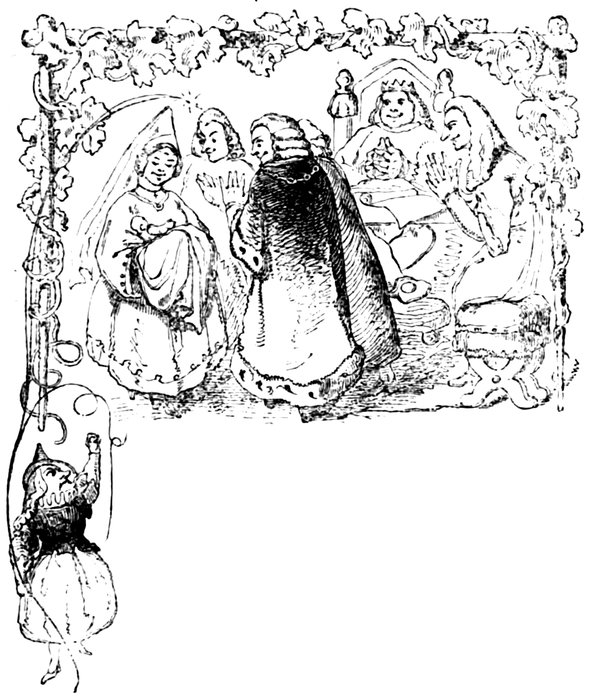
Accordingly, in a few moments, the folding
doors were thrown open, and nurse Yellowlily
appeared with her precious charge swathed in
a mantle of sky-blue taffety and silver, supported
by two of the royal rockers.
“No indeed!” said the Lord Chancellor,
dropping his mace and the great seal, and
clasping his hands, as he fixed his eyes on the
ceiling, “never was such a lovely infant seen!”
8“Wait a moment, my Lord,” said nurse
Yellowlily, “and you shall have a peep at his
Royal Highness:”—for as yet the Chancellor
had not beheld him.
With that she gently turned back the
mantle, and the Privy Councillors crowded
round her. “There, my Lord,” she exclaimed,
“you can now see his blessed little nose.”
Everybody was delighted: it was the most
exquisite nose ever beheld. The King was so
gratified, that he instantly created the nurse a
Baroness in her own right; upon which she
curtsied three times, walked backwards till she
trod upon the Lord Chamberlain’s gouty foot,
and then retired with the rockers, who, as
they proceeded down the corridor, chanted the
softest of lullabies.
The Privy Councillors listened till the last
faint echoes of the melody had died away,
when King Katzekopf thus addressed them.
“My Lords,” said he, “I have called you
together on the present auspicious occasion,
for the purpose of making you acquainted
9with certain measures which I am about to
take with reference to the Prince, my son.
And first, my Lord Chamberlain, I have to
announce to you my intention of giving a
most magnificent fête on the occasion of his
Royal Highness’s christening. You will be
pleased to send out cards of invitation according
to this list, which I believe contains the name
of every person of reputation in the kingdom.”
Here his Majesty handed a book to the
Lord Chamberlain, which that functionary
received with reverence, and proceeded to
inspect with great attention. Having turned
over five or six pages, the Chamberlain suddenly
nodded his head as if a thought had
struck him. This was so uncommon an event
that the Lord Steward of the Household
immediately inquired in a whisper what it was
that had attracted his attention. The Chamberlain
pointed to the list of names, and said
in an under tone, “Look through the A’s,
my Lord, and see if there is not a very
important name omitted.”
10At this moment King Katzekopf’s attention
was attracted by the whispering, and he graciously
exclaimed, “Well, my Lords, what’s
the matter?”
“I apprehend,” said the Chamberlain with
becoming diffidence, “that your Majesty has
caused these names to be written in alphabetical
order.”
“Certainly, my Lord,” replied the King.
“I speak with all possible deference,” rejoined
the Chamberlain, “but I presume that
your Majesty did not intend that the Lady
Abracadabra should be excluded from the
invitations.”
“Humph,” said the King, “I never thought
about her.”
“But she is your Majesty’s consort’s great
aunt,” observed the Chamberlain.
“And a very powerful Fairy,” suggested the
Steward of the Household.
“And, if I may say it without offence,
rather capricious in her temper at times; at
least she turned an acquaintance of mine into
11a tadpole,” remarked the Groom of the
Stole.
“And your Majesty,” said the Keeper of
the Records, interposing, “cannot have forgotten
the very untoward event which took
place in your Majesty’s family, some centuries
ago, when all the misfortunes that occurred to
your Majesty’s ancestress, the Sleeping Beauty,
arose from her Fairy relative not being invited
to the christening.”
King Katzekopf would have rather preferred
the Lady Abracadabra’s room to her company,
for he was very much afraid of the Fairies,
but then, on the other hand, the bare thought
of having the Hope of his House turned into
a tadpole, or put to sleep in a castle in a wood
for a hundred and fifty years, was most alarming.
His Majesty grew red and pale alternately,
shifted from one side of his throne to
the other, and was evidently in a state of great
anxiety.
“But how is the Lady Abracadabra to be
found?” said he at length. “Who can tell
12where to look for her? One moment she may
be a thousand miles off, and the next she may
bob up through a crack in the floor, as if she
had passed the night in the cellar.”
“He! he! he!” cried a shrill tiny voice
in the distance, as though the owner of the
said voice was greatly amused at something it
had just heard.
“How the mice are squeaking behind the
arras to-day!” exclaimed the King. “My
Lord Chamberlain, you must send for a cat,
and when she has caught the mice, we will set
her to catch the Lady Abracadabra. Ha! ha!
ha!” continued his Majesty, laughing at his
own wit.
But the Keeper of the Records, who, from
his study of the archives of the kingdom, knew
better than most people what a dangerous
thing it is to speak disrespectfully of the
Fairies, and who was supposed to have acquired
a smattering of the black art himself, immediately
endeavoured to repress King Katzekopf’s
laughter, by saying,—“So please you,
13my Liege, I apprehend that there would be
little difficulty in sending an invitation to the
Lady Abracadabra. If one of the Government
messengers will bury it under a fairy-hill,
next Wednesday morning, any time before
noon, turning his face to the East, and calling
her by her name three times....”
At this point the Keeper of the Records
stopped short, for all of a sudden, a very
strange sound was heard at the keyhole of the
Council-chamber door, a scratching, rustling,
noise, followed by a violent blast, such as
might issue from the nozzle of a blacksmith’s
bellows.
The President of the Council looked up to
see what was the matter, but was immediately
struck on the nose by a pellet of closely
squeezed paper, which was immediately
followed by another, and another, as the blowing
at the keyhole was repeated. At length,
when another blast had produced a shrill
whistle, which showed that the aperture was
clear, a little object, about the size of a hornet,
14darted through it, and increasing instantaneously
in dimensions, presented the appearance
of an old woman, some three feet high,
by the time it had reached the floor.
Whether the Lady Abracadabra (for of
course it was she) had been a beauty in the
days of her youth, some eight or nine hundred
years before, there is, at present, no means of
ascertaining; but certainly, when she stood
upon the floor of the Council-chamber, her
appearance was anything but prepossessing.
Perhaps, gentle reader, you have been in the
habit of supposing that all the Fairies are
dainty, little, airy beings, with butterfly wings,
and vests of green and gold, who hide themselves
in a blue-bell, and lose themselves among
the petals of a peony. And such, no doubt,
are the elves that live among the green hills,
and who love to dance by moonlight, in the
glades of the forest, or beside the pleasant
water-courses. But there are others who
mingle more with the human race, and adopt
their habits, and hence, it may be, they become
15more subject to the changes which affect mortals.
Perhaps this was the cause why the Lady
Abracadabra’s face had become so brown, and
shrunken, and covered with deep-set wrinkles;
or perhaps it was the having had her own way
so much; or those long journeys in which she
travelled at the rate of a thousand miles a
minute, might have spoiled her complexion;
or perhaps, having arrived at (what even
among the Fairies is allowed to be) a certain
age, she could not help looking like an old
woman. But be this as it may, she did look
very old, and the effect of her short black
velvet jacket, and yellow satin petticoat, did
not mend matters. She wore on her head a
tall, steeple-crowned hat, of the same material
as her jacket; had high-heeled shoes with
diamond buckles, and bore in her hand a pliant
rod of ebony, with a small star of living light
at each end of it.
It was evident that she was very angry, for
she scowled at the Privy Councillors, stamped
16vehemently on the floor, and every muscle of
her face quivered with passion, as she addressed
the King.
“So, nephew! you are determined to keep
me out of your palace at any rate, I see. Let
who will come to court, I am to be excluded.
There is always greater difficulty in getting
into your house than anybody’s else.”
King Katzekopf stammered forth an apology,
assured his kinswoman that he was delighted
to see her, that he had just been speaking of
sending her an invitation, and that he had
given general orders that she should be
admitted at all times.
“No such thing!” cried the little lady
angrily. “You use me abominably. You
know I always make it a rule to come through
the keyhole, and there it is that you always
try to stop me. Either I find a plate of metal
over the opening, or else the key is left in
the lock, and so my ruff gets crumpled to
pieces. But the insult you have exposed me
17to to-day is intolerable: blocking up the passage
with scraps of dirty paper, squeezed
together by fingers of some greasy yeoman of
the guard.—Oh it’s atrocious!” And the
Lady Abracadabra shook her quilted petticoat
as if she never should be clean again.
The King looked at his Ministers, and the
Ministers looked at the King; but neither
seemed to know how to excuse themselves.
At length, the President of the Council,
trembling exceedingly (for he expected to
be changed into a tadpole, or some such
reptile), ventured to assure the Lady, that
he was the person in fault; for that, finding
that the door-keeper had got into the
habit of applying his ear to the keyhole of
the Council-chamber, and fearing lest state-secrets
should thus get wind prematurely, he
had himself obstructed the passage in the
manner already described.
“The varlet! the knave!” exclaimed the
Fairy, as she heard of the door-keeper’s delinquency,
“I’ve a great mind to hang him
18up by his ears to the vane of the church
steeple. Go look for him, my Lord, and tell
him from me, that if ever he puts his ear to
a keyhole again, I’ll blow mushroom spawn
into his brains, and cause his ears to vegetate,
instead of to listen.”
Fairies, as all the world knows, are hasty
and capricious; but it is only a very few
who are spiteful and malignant. And to
this class the Lady Abracadabra had never
belonged. If she was angry one moment,
she was pacified the next, and she much
more frequently used her supernatural powers
in acts of kindness, than to gratify her freaks
of mischief.
It was so on the present occasion. After
the little ebullition just recorded, she speedily
recovered her equanimity. Her eyes no longer
sparkled with passion, and so agreeable an
expression came over her countenance, that
nobody thought about her wrinkles, or the
unbecomingness of her yellow petticoat.
“I was taking an airing on Mount Caucasus
19a quarter of an hour ago,” said she,
“when one of our people told me of your
good fortune; so here I came wind-speed to
congratulate you, and to see if I could not
find some lucky gifts for my great-great-nephew.”
King Katzekopf thanked her for her condescension,
and immediately proposed to escort
her to the royal nursery.
“Ha! ha! ha!” cried the Lady Abracadabra,
almost choking with laughter at the
absurdity of the suggestion. “You don’t
suppose I came to talk to you before I had
seen the baby, do you? Why, I’ve been
sitting by his cradle these ten minutes!”
“You have?” exclaimed the King in
astonishment.
“Aye, marry,” said the lady, “and have
pulled the chair from under the Baroness
Yellowlily, and, he! he! he! have given her
such a bump. She was going to feed the
child with pap that would have scalded it;
but it will be cool enough, I warrant me,
20now, before she has done rubbing her bruised
elbows. Well, nephew, and so you’re going
to have a grand christening, are you? Who
are to be sponsors besides myself?”
It had never entered into King Katzekopf’s
imagination to ask the Lady Abracadabra
to be godmother to the young prince.
And now she had taken it as a matter of
course, and it would never do to affront her!
Was there ever such a distress? And what
would Queen Ninnilinda say, and what would
the Arch-duchess of Klopsteinhesseschloffengrozen
say, when, after a direct invitation,
she found an old Fairy was to be substituted
in her place?
The King was so nervous and frightened
that he did not know what to answer. He
could only stammer out something about final
arrangements being as yet undetermined.
“Well, but, at any rate, I suppose you
have settled the child’s name,” continued the
Lady Abracadabra, approaching the Council-table.
“Hoity toity! what is this?” she
21added, snatching up one of his Majesty’s memoranda:
“Conrad-Adalbert-Willibald-Lewis-Hildebrand-Victor-Sigismund-Belvidere-Narcissus-Adonis
Katzekopf? I never
heard such a string of silly, conceited names
in my life. I shan’t allow it, I can tell
you that,” and she stamped on the floor till
her diamond buckles glanced like lightning.
“If I am to have anything to do with the
child, I shall give him what name I think
proper. Stay; I’ve watched him for ten
minutes, and can read his whole character,
and a more wilful little brat I never saw.
You shall call him Eigenwillig. There!
that’s to be his name; Eigenwillig, and
nothing else!”[1]
1. It is mentioned in the Chronicle of Carivaldus of Cologne,
from which this veracious tale has been extracted, that the
word “Eigenwillig,” in the ancient Teutonic tongue, bears
the meaning of Self-willed; a statement which is the more
credible, since it has a corresponding signification in the
modern language of Germany.
And then, not waiting for a reply, the
Lady Abracadabra gathered her yellow satin
22habiliments round her, threw out her arms,
brought them together above her head, sprung
from the floor, shrunk up to nothing in a
moment, and darted through the keyhole of
the Council-chamber door.
CHAPTER II. The Hunting of the Heir.
23
“You parents all that children have,
And you that have got none,
If you would keep them safe abroad,
Pray keep them safe at home.”
Nursery Rhyme.
25
CHAPTER II
And Eigenwillig he was called.
There was no help for it. Even
Queen Ninnilinda soon saw that.
She flew into a violent passion,
indeed, and called her husband
an old goose, and told him that if he had
as much sense in his whole body as a mite
has in the tip of its tail, he would have contrived
to have got rid of the Lady Abracadabra
without affronting her.
26“Shall I send her an excuse, my dear?”
asked King Katzekopf meekly.
“Send her a fiddlestick!” cried the Queen
indignantly, at the same time kicking over
her footstool, and upsetting a basin of caudle,
scalding hot, into her husband’s lap.—“How
can you make such a ridiculous proposition?
What but mischief can come of offending her?
Will she not vent her spite on me, or the
Arch-duchess? Or may not she make the
poor dear baby a victim? May she not dart
through the keyhole, and carry him off to Fairy-land,
and substitute in his place some frightful,
wide mouthed, squinting, red haired changeling,
as much like your Majesty, and as little
like me, as possible? Oh it is too vexatious,
and ridiculous, and shocking, and foolish!”
And then Ninnilinda burst out a crying.
But her Majesty’s tears and rages were so
frequent that they had lost their effect. Nobody
thought much about them; and besides,
King Katzekopf was trying to take out the
stains of the caudle, which had sadly damaged
27the appearance of the pea-green brocade that
covered his knees.
So when her Majesty was tired of crying,
she ceased: and, in the course of the afternoon,
wrote a note to her “dearest Lady
Abracadabra,” expressing the intensity of her
satisfaction at the fact that her sweet baby
had secured the protection of such an amiable
and powerful patroness.
Then she sent for the Baroness Yellowlily,
and told her that, as she had reason to fear
that a malicious old Fairy was disposed to do
the child a mischief, and, perhaps, carry him
off altogether, she must immediately anoint
him all over with an unguent, made of three
black spiders, the gall of a brindled cat, the fat
of a white hen, and the blood of a screech owl;
and that his cradle must be watched night
and day until after the christening. It was
lucky for Queen Ninnilinda that the Lady Abracadabra
wished nothing but well to the little
prince, and knew nothing of these proceedings.
It is not necessary to fatigue the reader
28with the details of the fête, which was given
a few weeks after the events which have just
been recorded. There were firing of cannon,
and ringing of bells, and beating of drums,
and blowing of trumpets. And there were
long processions of high officers of state, and
nobles, and foreign ambassadors, dressed in
gorgeous robes, and glittering with gold and
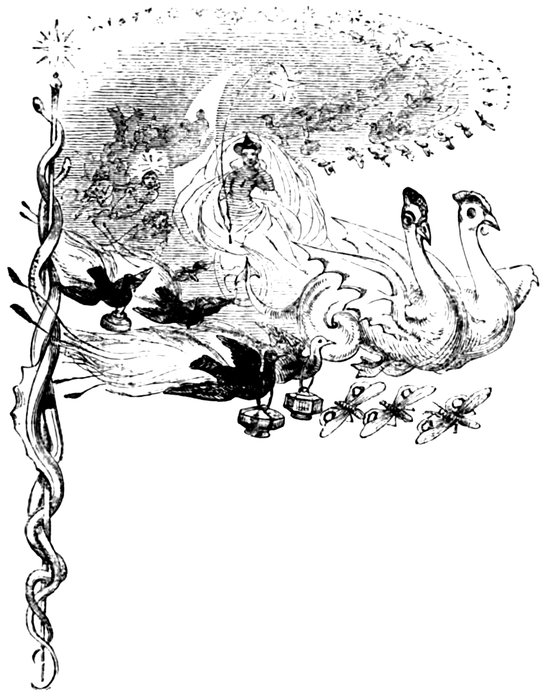
jewels. And there was the arrival of the
Fairy sponsor, in a coach made of a single
pearl, and drawn by a matchless pair of white
cockatrices from the mountains of Samarcand;
and there was the flight of birds of
Paradise that accompanied her, each bearing
round its neck a chain of gold and diamonds,
from which depended a casket, containing
some costly offering for the Hope of the
House of Katzekopf. And there was the
Lady Abracadabra herself, no longer stamping
the floor with anger, and wearing that frightful,
unbecoming, ill-tempered dress of yellow
and black, but arrayed in the most delicate
fabrics of the fairy-loom, and bearing upon
29her shoulders a mantle of gossamer, spangled
all over with dew-drops, sparkling with the
colours of a hundred rainbows. No look of
age or ill-nature had she. The refulgence of
her veil had obliterated her wrinkles, and as
she passed along the gallery of the palace,
side by side with the Arch-duchess of Klopsteinhesseschloffengrozen,
even Queen Ninnilinda
herself was forced to confess that she
looked very amiable, that her manners were
exceedingly good, and that, on the whole, she
was a captivating person,—when she chose it.
When the child was to be named, the
Queen gave a supplicatory glance at her
kinswoman, and gently whispered in an appealing
tone, “Have you really any objection
to the charming name originally proposed?
Conrad-Adalbert-Willibald....”
But the Lady Abracadabra cut the catalogue
short, with saying the word “Eigenwillig”
in so decided a tone, that the prince
was named Eigenwillig directly, and there
was an end of the matter.
30And then followed the royal banquet, and
then a ball, and then the town was illuminated,
and at midnight the fête terminated
with a most magnificent display of fireworks.
Just, however, before the amusements of
the evening were concluded, the old Fairy
called her niece and the King into the royal
closet, and thus addressed them: “Kinsmen
mine,” said she, “I have shown you this day
that I bear a most hearty good-will both to
you and yours; and therefore if ye be wise,—which
I think ye are not—you will listen
to what I now say to you. You have got
a fair son: for that you must thank Providence;
and your son has got the fairest gifts
that were to be found in all Fairy-land: for
them you must thank me. But if, in spite of
these gifts, your son turns out a wilful, disagreeable,
selfish monkey, for that you will
have to thank yourselves. Queen Ninnilinda,
if ever I saw a mother that was likely to spoil
a child, you are that person. King Katzekopf,
if ever I saw a father who was likely to
31let his son lead him by the nose, you are that
man. But attend to what I say,” continued
the Fairy, with a look of great severity, “I
don’t intend to have my godchild a selfish
little brat, who shall be a bad man, and a bad
king, and a bad son, whom everybody shall
dislike, and whose faults shall be all attributed
to his having a Fairy godmother. No: I
have named the child according to his natural
temper. I have called him Eigenwillig, because
his disposition is to be self-willed.
And of this it is fit that you should be reminded
continually, even by his name, in
order that you may discipline his mind, and
make him the reverse of what he is now called.
Poor child! he has everything around him to
make him selfish. Let it be the object of your
life, to make him unselfish. This is my injunction,
and remember I have both the will
and the power to enforce it. I am his godmother,
and I am a Fairy besides, so I have a
right to insist. And mark my words, I shall
do my duty by the prince, let who will neglect
32theirs. I shall watch over him night and day,
and shall be among you when least you expect
me. If you manage him properly, you may
expect my help; if you show yourselves unfit
for the charge, I shall take the reins of discipline
into my own hands; and if you then resist
me ... but I will not allow myself to
imagine that such infatuation and insanity
were possible. Sweet niece, I must take my
leave. May I trouble your Majesty to open
the window. Kiss my godchild for me. Good
night.”
As the Lady Abracadabra took her leave,
there was a rustling of wings in the air, the
chariot of pearl, with its attendant cockatrices,
appeared on a level with the window: the
Fairy sprung into her seat, and, preceded by a
cloud of lantern flies, each insect sparkling
with a different coloured flame, blue, or crimson,
or violet, or green, and followed by
myriads of elves, each crowned with asteroids
of lambent light, she wended on her way to
Fairy-land, her track through the sky being
33marked by a long train of sparks, whose dazzling
brilliancy waxed fainter and fainter as
she receded from earth, till it mingled with,
and became lost in the pallid hues of the
Milky Way.
It is needless to say that Queen Ninnilinda
did not relish the parting admonitions of her
Fairy kinswoman. First, she (being a Queen)
did not like to submit to dictation; next, she
persuaded herself that she had a full right to
do as she pleased, and to spoil her own child
as much as she liked; lastly, being rather
timid, she felt very uncomfortable at the
notion of being watched by a Fairy, and still
more so at the possibility of incurring that
Fairy’s vengeance. So, as usual, she vented
all her anger on her husband, and then went
to bed and sobbed herself to sleep. King
Katzekopf was not easily disturbed; and the
chronicles of the kingdom assure us that he
slept as well as usual on the night after the
fête; but upon awaking next morning he felt
the necessity of something being done, and
34therefore called together once more his trusty
councillors, who, after much grave discussion,
determined that the best method of securing
the further favour of the Lady Abracadabra
would be, by immediately appointing proper
instructors for the royal infant.
Accordingly, a commission was issued to
inquire who would be the proper persons to
undertake so responsible an office, and after a
year and a half of diligent investigation, it was
decided that the three cleverest women in the
kingdom should be charged with the prince’s
education until such time as he should exchange
his petticoats for jacket and trousers.
So the Lady Brigida was appointed to teach
him how to feed himself, and to instruct him
in Belles Lettres, and the —ologies: the
Lady Rigida was to make him an adept in
prudence and etiquette: while the Lady Frigida
was directed to enlighten his mind on the
science of political economy, and to teach him
the art of governing the country.
But alas! nobody thought of appointing a
35preceptress, who should instruct him in the
art of governing himself.
Meanwhile, Queen Ninnilinda, finding that
her husband had become highly popular in
consequence of the pains he was taking to
have his heir properly educated, determined
that she would do something which should
set her own character in a favourable light
as a wise and discreet mother. She, therefore,
after much careful consideration, drew up the
following rules for the nursery, which were
immediately printed in an Extraordinary
Gazette, and which were received with so
much applause, that almost all the ladies in
the kingdom adopted them immediately in
their own families, and have, in fact, been
guided by them ever since, even though they
have not followed Queen Ninnilinda’s plan of
having them framed and glazed.
RULES FOR THE NURSERY.
1. The Prince Eigenwillig is never to be contradicted;
for contradiction is depressing to the spirits.
362. His Royal Highness is to have everything he
cries for; else he will grow peevish and discontented.
3. He is to be allowed to eat and drink when,
what, and as much he pleases; hunger being a call of
nature, and whatever nature dictates is natural.
4. His Royal Highness is to be dissuaded from
speaking to any one below the rank of Baron; as it is
highly desirable that he should acquire a proper pride.
5. It is to be impressed upon the Prince’s mind continually
that he is an object of the first consequence,
and that his first duty is to take good care of himself.
Such being the plan laid down for Prince
Eigenwillig’s education, it is not to be wondered
at that, by the time he was two years
old, he had a very fair notion of the drift of
his mother’s rules, and that they found great
favour in his eyes; insomuch that at three,
when the Ladies Brigida, Frigida, and Rigida
commenced the task of tuition, he contrived
to inspire them with the notion that their
office, for the present, at least, was likely to
be a sinecure. He even resisted the efforts
which the Lady Brigida made to induce him
37to feed himself with a fork and a spoon, and
adhered upon principle to the use of his fingers,
lest, by yielding the point, he should
seem to allow himself to be contradicted.
At four years old the precocity of his talents
had greatly developed themselves. He had
mingled mustard with the Lady Frigida’s
chocolate; he had pulled the chair from
under his father, just as the King was about
to sit down, whereby his Majesty got a tumble,
and the Prince got his ears boxed; he had
killed nurse Yellowlily’s cockatoo by endeavouring
to ascertain whether it was as fond of
stewed mushrooms as he was himself, and he
had even gone the length of singing in her
presence, and of course in allusion to her
bereavement,
“Dame what made your ducks to die?
Ducks to die? ducks to die? ducks to die?
Eating o’ polly-wigs! Eating o’ polly-wigs.”
But if the truth must be told, the prince had
acquired by this time many worse habits than
that of mischief. And these had their origin
38in his being permitted to have his own way in
everything. For, indeed, it might be said,
that this spoilt child was the person who ruled
the entire kingdom. The prince ruled his
nurse, and his three instructresses; they
ruled the Queen; the Queen ruled the King;
the King ruled his Ministers; and the Ministers
ruled the country.
O Lady Abracadabra, Lady Abracadabra,
how could you allow things to come to such a
pass? You must have known right well that
Queen Ninnilinda was very silly; and that
King Katzekopf was one of those folks who
are too indolent to exert themselves about
anything which is likely to be troublesome
or unpleasant; and you must have been quite
sure that the nurses and governesses were
all going the wrong way to work; you must
have foreseen that at the end of four years
of mismanagement the poor child would be a
torment to himself and to everybody else.
Why did you not interfere?
This is a hard question to answer; but perhaps
39the Lady Abracadabra’s object was to
convince both parties of this fact by actual
experience, as being aware that in such experience
lay the best hope of a remedy.
A torment, however, the child was; there
could be no mistake about that. Though he
had everything he asked for, nothing seemed
to satisfy him; if he was pleased one moment,
he was peevish the next: he grew daily more
and more fractious, and ill-humoured, and
proud, and greedy, and self-willed, and obstinate.
It is very shocking to think of so young
a child having even the seeds of such evil
tempers; but how could it be otherwise, when
he was taught to think only of himself, and
when he was allowed to have his own way in
all things? Unhappy child! yet happy in this,
that he was likely to find out for himself
that, in spite of having all he wished for, he
was unhappy! Unhappy parents! yet happy
in this, that, if so disposed, they might learn
wisdom, from the obvious failure of their
foolish system of weak indulgence!
40Prince Eigenwillig had nearly completed
his fifth year, when, one day that the Lady
Rigida was endeavouring to explain to his
Royal Highness her cleverest theory on the
subject of the Hyscos, or Shepherd Kings
(he, meanwhile, being intently absorbed in a
game of bilboquet), a Lord of the Bedchamber
entered the apartment, and announced that
the Queen desired the Prince’s presence in her
boudoir.
“Ha!” exclaimed the little boy, with a
start of pleasure and surprise, as he entered
the apartment, “what a beautiful creature
you’ve got in that cage. Whose is it? I
should like to have it.”
“Well, my sweet pet,” replied his mother,
“so you shall, if you wish for it.”
“Of course I do,” said the Prince; “what
a sleek gray coat! what strange, orange-coloured
eyes! what curious rings of black and
white fur on its tail! What is it?”
“It is a ring-tailed macauco, love,” answered
the Queen, “your papa has just made me a
41present of it. I don’t know how much money
he gave for it.”
“Well, mamma, it’s mine now; that’s one
comfort,” observed the Prince. “Let it out,”
continued he, addressing the Lord of the Bedchamber.
“I am afraid, sir,” replied Baron Puffendorf,
“that it might do mischief. I believe
it isn’t tamed yet.”
“Oh, we’ll tame it, then,” replied the
Prince; “call Lady Rigida; she’ll tame it
directly, I’m sure. Lady Rigida, here’s a
monkey wants taming; talk to it about the
shepherd kings, will you?”
The Lady Rigida drew up with offended
dignity.
“Ha! ha! my good Rigida,” said the Queen,
laughing, “you mustn’t be angry with these
sallies of wit. What a clever child it is!”
“Is nobody going to open the door of the
cage?” asked the boy impatiently. “I want
to see the creature loose.”
“Oh, my sweet child, leave it where it is.
42You’ll frighten me to death, if you let it out,”
cried the Queen in alarm.
The Prince immediately threw himself down
on the floor, and began to roar.
“Don’t cry, there’s a love,” said his wise
mother, soothingly, “and the Baron shall see
if he can’t hold it while you look at it. Wrap
your handkerchief round your hand, Baron;
it won’t bite, I’m sure.”
The Baron did as he was bid, and, in considerable
trepidation, opened the door of the
cage, and made an effort to seize the macauco.
The animal immediately darted at his
hand, bit it with all its strength, and dashed
out of the cage in an instant. “Sess! sess!
sess!” cried Prince Eigenwillig, springing up
from the floor, and clapping his hands. “Now
for a chase! Sess! macauco! Hie at them!
Good monkey! Bite Rigida! Bite Puffendorf!”
Away ran the instructress, away ran the
Lord of the Bedchamber, and after them pursued
the macauco round and round the room,
43now biting at the Baron’s heels, and now at
the Lady Rigida’s; while the Queen ran
screaming out of the apartment, and the
author of all the mischief stood in the midst,
laughing with all his might. In another moment,
the agile monkey had scrambled up the
Lady Rigida’s back, and, having half strangled
her in its attempts to tear off her head-dress,
took a flying leap to the top of a cabinet,
whence, having dashed down a most precious
vase of rose-coloured chrystal, it proceeded to
tear the cap to tatters.
But Prince Eigenwillig was too highly delighted
with the more active freaks of the
animal, and too much pleased at the opportunity
of terrifying and tormenting the Lady
Rigida, to allow it to remain long at the top
of the cabinet. So snatching up a book
which lay on a table beside him, he threw it at
the macauco for the purpose of dislodging it.
And therein he succeeded, but at a cost
which by no means entered into his calculations,
for the animal, irritated by the blow,
44now turned on the naughty boy, and springing
on his shoulders, laid hold of one of his
ears with his teeth.
It was now the Prince’s turn to scream,
and the more he screamed and struggled, the
more the macauco bit him, and the child
would soon have fainted with fright and pain;
but, just at the critical moment, when he had
fallen to the ground, the sound of many
voices was heard outside the door, which was
immediately flung open, and, together with a
number of members of the household, in
rushed a great black mastiff, which immediately
flew at the monkey, who, thereupon,
quitted its hold of the Prince’s ear, and retreated
to its cage.
The whole palace was by this time in confusion;
messengers were rushing in all directions
for surgeons and physicians; and even
King Katzekopf, who had now grown so fat,
that he never left his arm-chair when he could
help it, ran up-stairs, three steps at a time, to
know what was the matter.
45“Ah!” exclaimed the Lord Chamberlain,
as soon as he had recovered sufficient presence
of mind to shake his head. “Ah,”
quoth he.
“Yea, forsooth!” replied the Chancellor,
with the air of one who could say a great deal
if he chose.
The Arch-Treasurer of the Empire, who
never spoke at all, if he could help it, and who
never allowed his countenance to indulge itself
in any particular expression, shrugged his
shoulders slightly, but with what particular
intention no one ventured to imagine.
The old ladies of the household (including
his grace the Keeper of the Records) were,
however, by no means so prudent or taciturn.
“I knew how it would be!” cried one.
“I always guessed as much,” rejoined
another.
“I anticipated it from the first,” ejaculated
the third.
“This comes of Fairy-godmothers,” groaned
forth he of the Records.
46“No doubt, it is some malicious prank of
hers!” said Nurse Yellowlily, with a shudder.
“I shouldn’t be surprised if henceforth the
poor child were possessed,” added the first
speaker.
“Or squinting and blear-eyed,” continued
the second.
“Or if his ears mortified, and turned into
pigs’ feet!” sobbed out the third.
“Oh, too true! too true!” exclaimed the
Queen. “I see it all. Unhappy mother that
I am! All the poor child’s misfortunes, past,
present, and to come, are owing to my peevish,
spiteful, malicious, capricious, old, ugly witch
of an aunt, Lady Abracadabra! Oh, that I
had been turned into a tadpole, and the Grand
Duchess of Klopsteinhesseschloffengrozen had
been the only sponsor!”
It was a long while before anything like
tranquillity was restored; but when the King
and the Queen had been assured by the medical
attendants that the Prince’s wound was by no
means serious, and the child himself had
47ceased screaming, and the macauco had been
hanged, the black mastiff began to attract
attention.
“Whose dog is it?” asked one.
“Where did it come from?” said another.
But nobody could answer the question. At
this moment the King called the hound to
him, for the purpose of patting it. The mastiff
approached, and laid its heavy fore-paws
on the royal knee, and looked very wisely at
the King; and then his Majesty looked as
wisely as ever he could (how could he do less?)
at the dog. But what was the King’s amazement,
when, all of a sudden, he perceived the
tan portion of the glossy hide changing into
a yellow satin petticoat, and the black part
into a black velvet jacket; the canine features
resolving themselves into a human countenance;
the fore-paws becoming hands, and
hind-paws a woman’s feet, enveloped in high-heeled
shoes fastened with diamond buckles?
It was even so. The Lady Abracadabra
stood before him, not, however, as when he
48last beheld her, all smiles and affability, but
stern, grave, and angry. Her eyes gleamed
like coals of fire, her wrinkles were deeper than
ever, and gave her face a most harsh and
severe expression,—nay, her black jacket had
acquired a most ominous sort of intensity,
and the yellow petticoat seemed shot with a
lurid flame-colour.
“So!” said she, “you have not only disobeyed
all my injunctions, neglected my advice,
and thwarted all my benevolent intentions, but
now, when you are reaping the fruit of your
misconduct, you have audacity enough to
charge me with being the cause of it!”
King Katzekopf declared that he had never
suspected her ladyship of anything but good
will towards the prince; and had never attributed
to her agency the mishaps of a spoilt boy.
“Spoilt boy!” she exclaimed with indignation,
“and how comes he to be spoilt? Yes,”
she continued with increasing vehemence,
“who has spoilt him? What is it that makes
everybody dislike him? What makes him a
49plague and a torment to himself and everybody
else? Why is he impatient, and greedy,
and wilful, and ill-tempered, and selfish? Is
it not because Queen Ninnilinda encourages
him in all these vices, and because King
Katzekopf, though he knows that everything
is going wrong, is too lazy and indolent to
interfere and set them right? You are neither
of you fit to be trusted with your own
child. You are doing all you can to make him
wicked and miserable, a bad man, and a bad
king.”
“I’m sure there’s not a child in the kingdom
that has such pains taken with him,”
replied the Queen angrily. “He has instructors
in all the different branches of useful
knowledge, and if he is a little mischievous, or
self-willed at times, are not all children so?”
“Niece, niece,” replied the Fairy, “you
speak like a fool. What good is there in
knowledge, unless a right use be made of it?
And how is he likely to make a right use of
it, if he be mischievous and self-willed? And
50how can you expect him to be otherwise than
mischievous and self-willed, if you encourage,
instead of checking, his propensities that way?”
“I’m sure I cannot check his propensities,”
retorted Ninnilinda in a huff.
“I never thought you could,” said Lady
Abracadabra quietly, “for you have not yet
learned to control your own temper.”
The Queen coloured and bit her lip.
“I wish, kinswoman,” said the King in a
conciliating tone, “since you thought the
Prince was being so ill brought up, that you
would have told us so a little sooner?”
“And where would have been the good of
that? You know very well that you would
not have listened to me. Nay, I don’t believe
that you will listen to me now. No, no, when
I promised to befriend your child, I ought to
have taken the matter into my own hands at
once, and carried him off to Fairy-land, and
superintended his education there.”
When the Queen heard these words, she
trembled from head to foot, and threw herself
51on her knees before her aunt, exclaiming—“Nay,
Lady Abracadabra, anything but that!
anything but that! I know your power, but
oh! as you are powerful, be merciful likewise,
and do not take my child from me!”
The Fairy saw that Queen Ninnilinda was
now in a disposition to submit to any conditions
which might be imposed upon her, and
therefore she answered her kindly:
“I do not want to separate you from your
child, if only you will do your duty by him.”
“I will do anything you desire, aunt!”
“Teach him not to be selfish, then!” replied
the Lady Abracadabra. “If you really
are in earnest, I will give you one more trial;
but remember it is the last.”
The Queen grew more frightened than ever,
for she felt as if she were a fly in a spider’s
web; that the Lady Abracadabra was spreading
toils for her, and that the little Eigenwillig
was already as good as lost to her.
“But how can I teach him not to be selfish?”
she asked at length.
52“By making him consider others as much
as himself; by teaching him to bear contradiction,
and to yield up his own wishes and
inclinations; and by letting him associate with
his equals.”
“You forget he is a prince, Lady,” replied
the Queen proudly.
“No, I do not,” answered the Fairy. “A
prince may have his equals in age, I suppose,
if not in rank.”
“Ah! Lady Abracadabra!” cried King
Katzekopf. “I believe you have hit the right
nail on the head. I’ve often wished the boy
could have had somebody to play with,—somebody
who would set him a good example, and
would not flatter him, as these courtiers do.”
“Suppose I could find such a companion for
him,” said the Fairy, “would you befriend him,
and treat him as you do your own child?”
“Gladly will I,” answered the King. The
Queen could not bring herself to say that she
would do it gladly, but she submitted with as
good a grace as she could.
53“Well then,” said the Lady Abracadabra,
“upon those terms I will give you a fresh
trial. I know a fair, gentle boy, whose temper
and disposition the Prince will do well to imitate.
His father, foolish man! is anxious to
get him a place at court,—little knowing what
he desires for him. Methinks it would be well
that he should see the experiment tried. It
may be of benefit to both parties. So I shall
set about it at once.”
And thereupon the Lady Abracadabra gradually
faded away, or at any rate seemed to do
so, till she wholly disappeared.
CHAPTER III. Another Heir Started.
55
“More swift than lightning can I flye
About this aery welkin soone,
And in a minute’s space descrye
Each thing that’s done below the moone.”
Ben Jonson.
57
CHAPTER III.
Many and many a mile from King
Katzekopf’s Court,—in a valley
among those Giant Mountains,
which separated his territories from
the neighbouring kingdoms, stood
the Castle of Taubennest, in which, at the
date of our tale, dwelt Count Rudolf and his
family.
And a happy family they were, all except the
Count, who was a discontented man. He had
58spent his youth in cities, and so the country
had no charms for him. He was ambitious,
and a time-server. He was never so happy as
among great people, and he longed to meddle
with the intrigues of state, and to be talked of
as among the eminent men of the kingdom.
He was a very poor man when the Castle
and its broad lands were bequeathed him by a
distant relation, and so he was glad enough to
take possession of them, even though he found
the bequest coupled with the condition that he
should live on his domains continually.
Now if, on acquiring this property, the
Count had set himself in earnest to the discharge
of the duties for which the possession
of that property rendered him responsible,—if
he had turned his talents to bettering the condition
of his vassals, improving his estates, and
benefiting his neighbourhood generally, he
would not only have spent his days happily,
but would, in all probability, have arrived at
the object of his desires, and acquired an illustrious
name. But instead of this, he spent
59his years in murmurs and repinings; now
railing at the blindness of Fortune, who had
condemned one of his genius for rising in the
world to a sphere of inactivity, now complaining
that he was imprisoned for life amid the
mountains. What a sad thing it is, when
people neglect their present duties, for no
wiser reason than because they choose to imagine
that if their duties were of some different
kind, they could discharge them better! Our
trial in life consists in our being required to
do our best in whatever circumstances we are
placed. If we were to choose those circumstances
for ourselves, there would be an end of
the trial, and the main object for which life is
given us would be lost.
Happily for her children and dependents,
the character of the Countess Ermengarde
was a complete contrast to that of her husband.
She was one of those people who
seem only to find happiness in doing good to
those around them. Had her destiny placed
her in the midst of a court, she would have
60added to its dignity and honour by the lustre
of her example. But that example was not
lost because her days were spent in comparative
seclusion. The Castle of Taubennest
was at a great distance from the metropolis,
but it did not rear its head in a solitary desert.
And the Countess, as she stood on the stone
platform, which opened out of her withdrawing
room, and led to the garden below, and
gazed at the wide and fertile valley which lay
stretched before her, could count hamlet after
hamlet, the inhabitants of which were tenants
to her husband, and over whom, therefore, she
felt that it was in her power to exercise an
influence for good. But the Countess Ermengarde
had yet dearer ties, to whom she well
knew that all her care and tenderness were
due. There were her two little girls, Ediltrudis
and Veronica, and her son, a boy of seven
years old, the gentle, yet noble-spirited Witikind.
In educating these her treasures,
disciplining their youthful minds, and training
them for the duties and trials of active
61life, the greater part of her time was spent,
and so fully absorbed was she in this labour of
love, that never an hour hung heavy on her
hands, and not days only, but months and
years seemed to glide on without her having a
wish or a thought beyond her children, and
the vassals of her husband’s house.
“What a happy family should we be!”
exclaimed the Count, as, in spite of himself,
he stood enjoying the evening breeze, and
watching his lovely children in their play,
“What a happy family we should be, my Ermengarde,
if we were not condemned to wear
out our existence in this dull wilderness!”
“I would you were in any place that could
bring you a greater measure of enjoyment
than you find here, my dearest Rudolf,” replied
the Countess, soothingly, “and yet,
methinks, our lot might have been cast in a
less fair scene than this. What if the setting
sun, instead of throwing its rosy lustre on
yonder mountain peaks, and illumining with
its declining rays those verdant meadows,
62through which our glassy river flows, and the
fields yellow with the ripening corn, and the
purple vineyards, and the deep umbrageous
forest, were to light up for us no more joyous
scene than a desert of interminable sand?
What if, instead of looking forth, and seeing
nothing so far as eye can reach which does not
call you master, we were landless, houseless
wanderers, without bread to eat, or a roof to
cover us, should we not have less to be thankful
for, than is the case now?”
“Doubtless,” answered the Count; but he
made the reply impatiently, and as if his wife
were putting the matter before him in an unfair
point of view. Without being the least
aware of it, he was unthankful for all the
blessings which he actually possessed, because
a single ingredient which he supposed necessary
to fill up his cup of happiness was wanting.
So long as he had not that, all else went
for nothing. “Doubtless,” said the Count;
“but, say what you will, this place will never
be any better than a wilderness in my eyes.
63Is it possible to conceive a more monotonous
life than I pass? nothing to interest one, not
a soul within twenty miles that one cares to
speak to!”
The Countess smiled. “Nay, nay, Rudolf,”
she cried gaily, “you shall not persuade me
that the children and I do not make very
agreeable society!”
“The children! there again! what a distressing
subject is that! Poor things, they
will not have common justice done them!
They have not a chance of getting on in the
world.”
“For my part,” replied the Countess, “I
don’t see what is the necessity for their ‘getting
on in the world.’ They will do very well
as they are.”
“How can you talk such nonsense as that,
Ermengarde?” exclaimed the Count in a tone
of pique. “Why, what is to become of the
girls, when they grow up to womanhood?”
“Oh,” answered the Countess, “we need
scarcely make that a cause of anxiety at present.
64Years must elapse before they will be
women, and when they are grown up, I don’t
know why they may not become the wives of
honest men, or why they may not find happiness
in a single life, if they prefer it.”
“Really, Ermengarde, you sometimes provoke
one past all patience. ‘Wives of honest
men,’ forsooth! I believe you would be
satisfied if you could see them making cheese
on the next farm, or wedded to the huntsman,
or the woodreve. You forget,” added
he proudly, “that their birth entitles them to
some splendid connexion, and less than a
splendid connexion shall never satisfy me.”
“Why, what is it that you covet for
them?”
“That they should see something of courts
and cities, instead of being immured in this
mountain-dungeon; that they should take
that place in the world to which their rank
entitles them, and that they should be followed
by a host of admirers, and that their
cotemporaries should have cause to envy their
65good fortune. Yes,” continued he, warming
with his subject, and falling unconsciously
into one of those day-dreams in which he was
continually indulging, “I should like to
waken and find myself at the court, with
Ediltrudis at my side, the admired of all
beholders, princes and peers struggling to
obtain the honour of her hand, while I, with
watchful eyes, would be ascertaining which
of her many suitors it would be most prudent
to encourage, and which to reject. Can you
conceive anything more interesting, more delightful
to a parent’s feelings?”
“Yes, indeed, my Lord,” replied the Lady
Ermengarde, “to me it would afford more
satisfaction, if I were permitted to see my
child growing up to maturity, unspotted by
the world, and saved from exposure to its
poisonous breath, and from the temptation to
yield to its evil influences. I would rather
see her innocent and happy here, than the
star and favourite of a court.”
Had Count Rudolf listened to this speech
66it would have probably made him very angry,
but he was too much occupied with his castles
in the air to attend to it.
“And then my pretty little Veronica,” he
continued, “your career shall be no less brilliant
than your sister’s. Come hither,” said
he, calling the child, “and tell us what destiny
you would choose. Would you not like
to be a Maid of Honour to the Queen, and
to be glittering with silks and jewels, and to
live in a royal palace, and to spend your time
in all manner of pleasures?”
The little girl seemed puzzled, and did not
answer immediately. After a pause she said,
“Must I leave Taubennest, if I were to be
Maid of Honour to the Queen?”
“Yes, my child, that must you, for where
the King lives is many a mile from Taubennest.”
“Nay, then, dear father, I would rather
be where I am. I should like to see the
royal palace, and all the things you mention,
but I should prefer to live here. Ah! we
67never could be so happy as we are here,
could we, Witikind? We never could find
such pretty walks as we have here among the
hills, nor play such merry games in a palace,
as now we do in the meadows by the river
side. And besides, I dare say I should not
be allowed to take my kid with me, nor my
birds, nor perhaps,” added the child in a tone
of dismay,—her eyes brimming with tears as
the thought occurred to her—“perhaps you,
and Ediltrudis, and nurse, and papa, and
mamma might not be with me. Oh, no, no;
I would rather stay where I am; would not
you, Witikind?”
“Why, what folly!” exclaimed Count Rudolf,
interposing. “Even you, Veronica,
must be old enough to know that a boy cannot
pass through life beside his nurse’s apron-string.
Witikind must see the world, and
learn to be bold and manly.”
“Can I not be bold and manly, father,
unless I see the world?” asked the boy rather
timidly.
68“No, to be sure not!” answered the Count.
“Well then of course I must go,” replied
Witikind with a sigh. “But I never can be
so happy elsewhere as I am here.”
“Pooh! you are but a child;” rejoined his
father, “you don’t know what real happiness
is.”
“Did you find real happiness, father, in
living among courts and cities?”
“Certainly, I did,” said the Count; and
then, after some hesitation he added, “At
least I should have found it, if I had not
been a poor man, as I was in those days.
Ah! what would I have given for such advantages
as you have, my boy?”
“Is it possible that there can be so much
pleasure to be found away from home and
friends?” asked Witikind, still somewhat
doubtfully, and looking up with anxiety at
the expression of sadness which seemed to
spread itself over his mother’s face.
“Possible, Witikind? I would I had the
opportunity of enabling you to make the experiment
69this very moment! How I should
like to see you a Page of Honour to the King,
It would make a man of you at once.”
Witikind thought it would be a very fine
thing to be made a man of at once, and his
heart was more inclined to a change than it
had yet been. “And I suppose then, father,
I should ride a horse instead of a pony, and
wear a sword, and be treated by every body
as if I were a man.”
“Of course, you would,” replied the Count,—“at
least, in a very short time.”
“Then, father, I do think that I should
like to go and live at court.”—The Count
kissed the boy and withdrew.
It is a very well known, but at the same time
a most remarkable circumstance in the natural
history of Fairies, that they are not only sure
to be found in the most unexpected places,
but they are certain to arrive in the very nick
of time, for the purpose of overhearing some
conversation which was never intended for
their ears, but which they never fail to turn
70to account in some manner for which the
speakers are wholly unprepared. It was so
on the present occasion.
Our friend, the Lady Abracadabra, who had
been paying a visit to some old acquaintances
among the Gnomes who inhabited the silver
mines in the mountains, in the immediate
vicinity of Count Rudolf’s castle, had heard
from her subterranean hosts such an interesting
account of the goodness and benevolence
of Countess Ermengarde, that she had resolved
to introduce herself to her. And as she
had been led to believe that to be poor, or
afflicted, was a ready passport to that lady’s
presence, she assumed the garb and appearance
of a lame beggar-woman, and in this disguise
entered the domain of Taubennest, and
approached the castle. No gate was closed
against her, no insolent, pampered menial
thrust her from the door. The Countess had
long since forbidden her servants to turn
away one who sought relief at her hands.
“We have enough for all,” she was wont to
71say, “and, therefore, if we give not according
to our ability, we may expect that the ability
to give, will be taken away from us. If we
do not make a good use of our money; our
money is like to make itself wings, and fly
elsewhere.”
Of course where so much was given, there
must have been some unworthy recipients of
her bounty. And when this was urged upon
her by some of her less liberal friends, she
made no attempt to deny the probability of
the assertion; “but,” said she, “I would
rather bestow my alms on a hundred unworthy
recipients, than miss an opportunity of aiding
one poor creature who needed my bounty.”
And so the weary traveller, and the needy
applicant, were under no fears of being repulsed
when they approached the portals of
Taubennest, and thus it happened that the
Lady Abracadabra wandered forward unobserved,
or, if observed, unchecked, until she
came close to the platform on which the conversation
which has been recorded, took place.
72“And so you would like to see the court,
would you, my pretty master?” said she, as
soon as little Witikind had expressed his wish
on the subject.
The boy started at the sudden inquiry,
“What is it you want, good mother?” he
asked after a little hesitation.
“Nay,” replied the Fairy, “I have expressed
no want. I desire to learn what it is
that you want?”
“Oh! I want some good Fairy to carry me
over hill and dale to the court of King Katzekopf.”
“Are you quite sure of that?” asked the
lame woman.
“Aye marry, am I,” replied the boy,
laughing. “Will you show me the way to
Fairy-land?”
“May be I will, and may be I won’t,” answered
the Fairy. “I must first see what
metal you are made of. Will you go with
me to court?”
“I shouldn’t like your pace, mother,” said
73Witikind. “I should never get there, if I
kept by the side of your crutches.”
“Don’t be too sure of that,” rejoined the
beggar. “There’s many a worse hobbyhorse
than my crutch. Can you ride, sir
boy?”
“To be sure I can,” replied Witikind, “I
were fit for little, if I could not.”
“Then let me see how you can sit this nag
of mine,” said the Fairy; and seating herself
sideways on one crutch, she waved the other;
when, in an instant, that on which she was
seated became a living cockatrice, which
mounted up into the air with its burden, and,
after three or four circumvolutions, descended
on the platform, to which allusion has been
made, and then stood still; while the Lady
Abracadabra, no longer disguised as a beggar-woman,
but wearing her usual Fairy garb,
dismounted and approached the astonished
Countess and her terrified children.
“I ought to apologize for this intrusion,”
said she, “but a Fairy, who comes with
74purposes of kindness, can scarcely conceive
herself to be unwelcome. You do not know
me, Countess, for I quarrelled with your
father before you were born; but your mother
Frideswida and I were well known to one
another. I doubt not you have heard her
speak of Abracadabra of Hexenberg.”
The Countess intimated her assent.
“I recognize in you, Lady,” said the Fairy,
“a transcript of her beauty of feature, and if
fame do not greatly misrepresent you, the
beauty of her mind has descended to you. I
hear you spoken of as the blessing of these
valleys, and that your days are spent in feeding
the hungry, clothing the naked, and visiting
the sick.”
“I live among my own people,” replied
Ermengarde, “and they are a simple race,
who are satisfied with little, and whom small
kindnesses gratify largely.”
“You are modest,” rejoined the Lady
Abracadabra, “but if, as I believe, you have
the means of doing good, and find pleasure
75in doing it, why should you be dissatisfied
with your abode?”
“I dissatisfied, Lady?” exclaimed the
Countess, “I would gladly live and die here.”
“Then, what was the meaning of what I
heard no long time since? Methought as I
listened to your converse, your boy seemed to
say that he should like to go and live at court.
You would hardly send him to face such perils
alone? That were as unnatural as wicked.”
The Countess knew not what to answer.
The thought of separation from Witikind had
already filled her with sorrow and dismay, but
she was unwilling to excuse herself at the cost
of inculpating her husband. She therefore
remained silent, but the tears gushed from her
eyes in spite of her.
“And how comes it that you, sir boy,”
asked the Fairy, addressing Witikind, “are
so eager to leave your home? Can you not
be happy here?”
“Yes, Lady, I am happy as the day is long;
but my father assures us often and often, that
76our best happiness here is grief and dulness,
compared with what we should find, if we
went to the great City, and lived in King
Katzekopf’s court?”
“Is this true, Lady?” said the Fairy to
Ermengarde. “But,” continued she, “I see
it is, and will spare you the pain of answering.”
She paused awhile, and then added,
“Countess, I see a black spot on that child’s
fair brow, that, unless we find a remedy, will
spread and spread till it infects his whole
nature. What his natural disposition may
be I know not, but I see his father has inoculated
him with one of the most dangerous of
all maladies, a love of self. He is willing to
seek for pleasure, even though it cost him
separation from you. He already thinks of
himself more than of you.”
“He is but a child, Lady,” said the mother
apologetically.
“Aye, Countess Ermengarde, but the child
is father to the man. Such as you make him
now, such will he be hereafter.”
77“Perhaps, Lady, if you spoke to Rudolf,
he might be induced to see the matter as you
do,” observed the wife.
“Nay, nay!” replied the Fairy, with an
increase of sternness in her manner, “I am
not one to be trifled with. You know even
while you make it, that your suggestion is a
hopeless one. To reason with your precious
husband (of whom I know more than you
think) is only to render him more obstinate.
I must devise some other plan. Ah!” she
continued, after a momentary pause, “I see
my way clearly. The evil shall be made to
work its own remedy. Go, tell the Count,
that an ancient Fairy, a friend of your
mother’s house, and who, on that account,
desires to befriend you, has become acquainted
with his wishes as respects his son: tell him
that I have influence at Court, that King
Katzekopf and the Queen are not likely to
turn a deaf ear to any request I make them,
and that he may hold himself in readiness to
expect, ere long, a summons from his Majesty.
78Countess Ermengarde, tell him this; but I
charge you at your peril, tell him no more than
this. Meanwhile, keep up good heart, and
trust me to befriend your boy. I will teach
him one lesson, that shall be of more use to
him than all his father’s.”
So saying, she smiled graciously on little
Witikind, patted him on the head, and springing
on her cockatrice was soon out of sight.
CHAPTER IV. A hashed Heir.
79
“Over hill, over dale,
Thorough bush, thorough briar,
Over park, over pale,
Thorough flood, thorough fire.”
Shakespeare.
81
CHAPTER IV.
The events recorded in the last
chapter took place, as the judicious
reader will have anticipated, a short
time previously to that visit of the
Lady Abracadabra to the Court of
King Katzekopf, in which she
asserted her authority, and proposed the companionship
of a boy of his own age as likely
to form a salutary check on the growing wilfulness
and selfishness of Prince Eigenwillig.
82Accordingly, many days did not elapse before
little Witikind was transported from the Castle
of Taubennest to the royal nursery.
It was a sad business, that leaving his home.
Of the trials that lay before him, he, poor
child, could, of course, know nothing. He
had never lived anywhere but at home, and he
could not as yet imagine that any place could
be very different from home; and he had good
hope, from all his father told him, that he
would be happy as the day was long at the
court of King Katzekopf. But when it really
came to bidding farewell: when he saw his
mother trying to smile and encourage him,
yet was sure, by her appearance, that she had
been weeping all night long; when Ediltrudis
and Veronica, quite unable to bear up against
this, their first deep sorrow, clung to him, and
sobbed as if their hearts were breaking. Oh,
how bitterly did Witikind lament the rash
words he had spoken! Oh, what would he
have given to recall them, and to be allowed
to live on, as heretofore, with those who so
83dearly loved him, and whom he so dearly loved!
But it was now too late.
And so it is ever with us all. The blessings
which we do not appreciate are sooner or later
withdrawn from us, and when, on their removal,
we feel their value, and would flee
after them and secure them, we find they are
gone irrecoverably, and that we can never be
again as we were when we possessed them. For
Witikind, we trust that many happy days may
be in store, that he will return to Taubennest
better and wiser every way than when he left it;
that his mother will fold him in her arms once
more, and that his sisters will shed more tears
of pleasure over him than now of sorrow; but
never, never will he be again as when first he
quitted home: a change will have taken place;
he will be different himself; those around him
will be different; fresh hopes, and feelings, and
wishes will have come over them; their confidences
will not be the same confidences, their
love will not be the same love that it was before
they knew the sorrows of separation.
84Oh, reader, reader! if you have a happy
home, and loving parents, and affectionate
brothers and sisters, try and show yourself
worthy of the blessing while yet it is yours.
You know not how soon you may be taken
from them, or they from you: strive, then, so
to live with them, that, when separation comes,
you may have no cause to mourn for your
behaviour to them now!
Taubennest was a fine old castle in its way,
but certainly not at all comparable to King
Katzekopf’s palace; and as for the city, it was
a thing altogether beyond Witikind’s conceptions.
Such a labyrinth of streets and
houses! such crowds of people passing and
repassing! such strange, unaccustomed sights
and sounds! the boy was in a state of utter
bewilderment!
And before he had recovered himself, he
found he was passing through marble halls,
and corridors hung with silks and satins, and
glittering with gilding; and then he was
85brought into an apartment where King Katzekopf
was sitting on his throne, with a velvet
nightcap on his head, and his crown over his
nightcap (for his Majesty was now growing
so fat and infirm, that when he was not
eating or governing the country, he was
usually asleep); and then, when he had been
patted on the head by a real, live king, and
had been told to be a good boy by Queen
Ninnilinda, who came into the room on purpose
to look at him, he was committed to the
care of Lady Brigida, and immediately became
an inmate of the royal nursery.
The Prince was quite charmed to have such
a companion: he dismounted from his rocking-horse
in a moment, and running up to Witikind
asked whether he was the little boy
(Witikind was the biggest of the two) who
was to come and live with him.
And when Lady Brigida answered in the
affirmative, he immediately threw his arms
round Witikind’s neck and kissed him.
“I shall love you so much, and we shall be
86so happy together,” said he. “I know we
shall, for you look so good-natured.”
Witikind could say but little in reply, for
he was quite unused to being with strangers,
especially royal ones, and his thoughts were
already reverting to his mother, and Ediltrudis,
and Veronica, and the happy home at Taubennest;
but he was grateful to the Prince for his
kindness, and anxious by all the means in his
power to show that he was so. He was a very
gentle, amiable, good humoured boy, ever
ready to oblige, and not easily put out of
temper, and though in some respects his
being an only son had been to his disadvantage,
he was not spoilt like the little Prince,
and had even made some progress in habits of
self-control.
For several days, therefore, the two boys
lived very happily together, and the nurses
and governesses began to congratulate themselves
on the improvements which had taken
place in their prospects; and that, whereas,
they scarce knew what it was to have five
87minutes in the course of the day free from
vexation of some kind connected with their
royal charge, the little Eigenwillig seemed all
at once transformed into an amiable child.
And so he was, as long as he continued
without any temptation to be overbearing and
disagreeable. His attendants, whom heretofore
he had tormented so diligently, were
now left in peace, because, for the time, he
found more immediate amusement in Witikind
than in the art of tormenting. His
companion was, as it were, a new toy: so
long as Witikind was new to him, things were
pretty sure to go smoothly. The trial only
began when the novelty ceased.
And there was a good deal in Witikind’s
gentle temper, and in the feelings natural to
his position, which tended to avert, for some
time, the explosion which, sooner or later,
was inevitable.
At first, the Prince treated him as if he
were his equal in rank, offered him his toys
to play with, and even went so far as to say
88that he would allow Witikind to ride on his
pony,—when he had done with it himself.
By-and-bye, however, when he saw that his
attendants paid more respect to him than to
the son of Count Rudolf, he thought it would
be better to assume a patronizing air, which
he did very much to his own satisfaction. A
few more days elapsed, and then, instead of
patronizing, he was domineering.
All this, however, Witikind submitted to
as a matter of course. He had been already
taught to give up his own wishes and inclinations
cheerfully; and his father had inculcated
upon him twenty times that he never was to
allow himself to think of anything save how
he could best please the heir-apparent. He
felt it was his business to yield his own inclinations
to the Prince’s, and he invariably did
yield them amiably, and as, consequently,
the little Eigenwillig continued to have his
own way, there could be no open rupture.
It is impossible to have a quarrel, when there
is nobody to quarrel with.
89However, it cannot be said that at the end
of a week Witikind thought his royal companion
so full of good nature as he had expected,
and at the end of a fortnight Witikind
had begun to compare the ways of
Ediltrudis and Veronica, with those of the
Prince, and certainly the result of the comparison
was not in his royal highness’s favour.
On the other hand, the Prince had made the
discovery that with his nurse and instructresses,
the gentle-tempered son of Countess Ermengarde
was rapidly becoming a much greater
favourite than he was himself.
This made him very jealous; and his jealousy
became insupportable when Witikind
was held out as a model for his imitation.
“What a sweet little boy is Count Rudolf’s
son;” nurse Yellowlily would exclaim. “He
always does what he is bid the moment he is
spoken to: so unlike some people!”
“Yes;” the lady Brigida would add, “and so
quick at his lessons; never stupid, never idle,
never impatient. Such a contrast, you know!”
90“Every body loves little Witikind,” rejoined
the nurse again, “he is so civil-spoken,
and gives so little trouble, and isn’t proud,
nor quarrelsome, nor selfish, nor finds pleasure
in teasing and plaguing people.”
Thus these silly women took the surest
means to prevent the prince from benefiting
by the example of his companion.
Under such circumstances Witikind grew
more and more unhappy every day. Let him
do what he would, the Prince was always disposed
to quarrel with him: and the more he
gave up his own will to the Prince’s, the more
he strove to oblige him, the more the Prince
seemed to dislike him for it, for a contrast was
sure to be drawn by the attendants between
Witikind’s good nature, and the unamiable
disposition of his companion.
At length Witikind gave up the attempt to
please, and would go and hide himself in
some corner where nobody was likely to find
him, or would sit moping on a bench in the
palace gardens, thinking of Ediltrudis and
91Veronica, and contrasting their affection with
the Prince’s ill nature.
Now it so happened, that the seat to which
Witikind was so fond of betaking himself was
one which King Katzekopf could see out of
his window as he sat in his arm chair. Witikind
did not know this, or he would never
have chosen it. He was thinking of watching
the gold fish in the fountain, not of King
Katzekopf, when he first made it his favourite
haunt.
“I wonder why that boy sits on yonder
bench all day,” observed the King, one fine
afternoon. “I wonder why I never see him
playing with Eigenwillig.” But nobody made
any answer in reply to his Majesty’s observation,
and so the matter passed from his
thoughts. But when another day, and another,
and another, and another, had elapsed,
and Witikind was still seen on his favourite
bench, the King’s curiosity was quite roused,
and he sent for the boy. Witikind was very
much frightened when he heard that the
92King wanted him; but he could not help
hoping that, since the Prince disliked him so
much, he was going to be sent home again.
“Why are you not at play with Eigenwillig?”
asked the King, so soon as Witikind
was ushered into the room.
“The Prince, Sire, prefers playing alone,”
replied Witikind.
“But don’t you know that you came here
on purpose to be his playfellow?”
“Yes, Sire.”
“Why won’t the Prince play with you?”
“I suppose it is, Sire, because he does not
like me,” answered the boy.
“Have you quarrelled with him?”
“No, Sire.”
“I am afraid, Witikind, you are not happy
here,” said the King kindly. “It is my wish
that you should be so. I gave orders that you
should be as kindly treated as if you were at
home.”
“Your Majesty is very good to me,” replied
Witikind, and he meant to have gone on
93to thank the King for all the favours that had
been shown him; but his heart was very full,
and that one word “home,” which the King
had used, made it overflow. Taubennest and
all its dear ones, rose before his eyes, and he
began to sob violently. The King saw there
was something at which he had not yet arrived;
but he thought it more prudent to seek
an explanation elsewhere; so, with a few kind
words, he dismissed the boy, telling him that
he would speak to him again in a day or two.
By-and-bye, Witikind fell in with the Prince.
“So!” exclaimed the latter, as soon as he saw
him, “you have been complaining of me to
the King, have you? You little, mean, spiteful
creature!”
“No, Prince, I haven’t. The King asked
me why you would not play with me, and I
told him I supposed the reason was because
you did not like me.”
“Well, I don’t like you. I hated you before,
and I hate you now worse than ever.”
“Why should you hate me, Prince?”
94“Because I do,” answered the heir of the
Katzekopfs.
“But why will you hate me? I am sure I
don’t hate you, Prince; I would be very glad
to love you, if you would only let me.”
“But I won’t, won’t, won’t” shouted the
Prince, clenching his fist, and striking the
table with it. “I won’t let you love me. I
won’t have anything to say to such a mean,
sneaking creature.”
“Why do you call me mean and sneaking?”
asked Witikind, the colour mounting in his
cheeks.
“Because you are so,” replied the other.
“Are you not always trying to show off before
Nurse Yellowlily, and the governesses, in
order that they may praise you, and blame
me?”
“No, Prince; I would much rather they
should never praise me. I would much rather
they would never say a word, unless they
could praise us both. Oh, Prince, you would
be so much happier, if you would try and not
95be so—so—so self-willed. Indeed, indeed,
you would!”
“How dare you call me self-willed? And
what business is it of yours if I am ever so
self-willed? I wish I had never seen your
face. You have done nothing but make mischief
ever since you came here.”
“I never made mischief,” replied Witikind
indignantly, “and it is very unjust of you to
say such a thing. You would not have dared
to say it to one who was your equal. But it is
no use talking with you. If I am what you
charge me with being, I am no fit companion
for you; if I am not, you are no fit companion
for me. So at no rate will I stay here any
longer.” And he immediately proceeded towards
the door.
“Oh, you won’t, won’t you?” cried his enraged
companion; “then take this with you!”
And, suiting his actions to his words, the
Prince seized a heavy silver inkstand, which
stood upon the table, and threw it at Witikind.
Had it reached him, it might have hurt
96him very seriously; but Eigenwillig was in
too great a passion to take a deliberate aim,
and the consequence was, that the missile,
instead of hitting Witikind, struck the centre
of a large looking-glass, which it broke to
shivers.
The crash of the falling fragments was heard
by Queen Ninnilinda, and she immediately
entered the apartment, to see what was the
matter. The first object which met her eyes
was Witikind, who ran against her in his
hurry to escape from the Prince.
“Ah,” said she, laying hold of him, “you
need not attempt to run away. I knew I
should find you out sooner or later, and now I
have caught you. How dared you to break
that looking-glass, and spill the ink all over
the carpet, you little, good-for-nothing varlet?”
“Please your Majesty, I did not break it.”
“Not break it!” exclaimed the Queen, who
was much too angry to observe that her own
son was likewise in the room. “Not break
97it? Are you not ashamed to utter such falsehoods?”
And with that the Queen struck
the little boy two or three sharp blows.
“Oh, Mamma, Mamma,” cried Prince Eigenwillig,
rushing forward, and seizing her uplifted
arm, “it was not his doing; it was
mine. I don’t like him, and I wish he had
never come here; but he didn’t break the
looking-glass. I broke it; do not beat him;
he doesn’t deserve it. I did the mischief.
He put me in such a rage with what he said,
that I took up the inkstand and threw it at
him; but it struck the glass instead of him.”
The Prince was a spoilt child, and full of
faults; but here was an evidence that there
were redeeming points in his character.
Nothing could have been better than the manner
in which he came forward to take the
blame on his own shoulders. There was still
something to work upon; and had his mother
been anything but what she was, the incident
might have been turned as much to his advantage
as to her own. But her weakness and
98vanity were excessive. She saw she had been
too hasty; but was unwilling to confess herself
in the wrong; so she availed herself of an
expression of her son, and continued to pour
out her wrath on the unfortunate Witikind.
“How dared you offend the Prince?” she
cried. “How could you presume to misbehave
yourself in such a manner, as to put him in a
rage, as he says you did? And what is the
meaning of all these malicious tales you have
been carrying to the King?”
“I have carried no tales to the King,
Madam,” replied Witikind.
“Yes, you have,” retorted the Queen, “you
have been making him believe that the Prince
is cruel to you. And like a little artful, hypocritical
wretch, you have been even setting
his own attendants against him.”
Witikind was so bewildered with all these
charges that he was quite silent.
“Yes,” continued the Queen, “no wonder
you are struck dumb; now you are found
out, you have not a word to say for yourself.”
99“Will you hear me, Madam, or believe me,
when I do speak?” replied Witikind, recovering
his self-possession.
“Believe you? you little deceitful creature!
No, that will I not.”
“Then, since your Majesty says that, when
you know I have never deceived you, I had
rather say nothing, except that I hope you
will confront me with the King, and the
Prince’s attendants.”
“Leave the room,” said Queen Ninnilinda,
in still greater anger, “I am not going to be
argued with by you, I promise you.”
“Mamma,” said Prince Eigenwillig, as soon
as Witikind had left the room, “I don’t like
him, but I don’t think he ever tells lies; and
I don’t think he ever tried to set Nurse Yellowlily
against me, though she often praised
him, in order to plague me.”
Here again, the boy was getting upon a
right path; but his foolish mother, as soon as
she perceived it, lost no time in turning him
into a wrong one.
100“Ah, my sweetest boy,” said she, “it was
no more than I expected from your noble,
generous nature, that you should try and find
excuses for this odious little brat. You
don’t know the world as well as I do: if you
did, you would find it prudent to consider
others less, and yourself more. But I have
my own opinion about this Witikind. Everything
went on well enough in the palace till
he came, and now every thing goes wrong,
and I can trace his finger at the bottom of all
the mischief. I always misdoubted the intentions
of that cross-grained old toad, my
Fairy-aunt, ever since she insisted on giving
you your horrid name. I was sure her professions
of kindliness were a blind, and that
she was meaning mischief all the time. And
I am quite satisfied now that this creature
which she brought here, is not Count Rudolf’s
son. Count Rudolf is a very respectable
man and would not deceive us, but
parents are proverbially blind;” (Yes, indeed,
Queen Ninnilinda!) “and I don’t doubt that
101this Witikind is a changeling, some imp from
Fairy-land, hundreds of years old, perhaps,
sly, and mischievous, and malicious, who is
sent to bring some terrible misfortune on us
all.”
Poor Witikind! he little suspected the
nature of this fresh accusation against him;
and while he was weeping in his chamber
over the injustice which he was suffering, and
writhing under the indignity of being charged
with saying what was not true, he was being
subjected to an imputation, at once the most
cruel, and (in his case) the most difficult to
disprove.
The idea once started, every body had
something to say in confirmation of it. All
the courtiers discovered that, though they had
never mentioned it, they had, from the first,
observed something very elvish in his countenance.
The Keeper of the Records had
been struck with his always being dressed in
green and gold,—the fashionable colours in
Fairy-land. The Ladies Frigida, Rigida,
102and Brigida, detected something supernatural
in the precocious aptness with which he received
their lessons. The Baroness Yellowlily
had occasionally found great entanglement
in the poor child’s sunny ringlets, when
she combed them after he had been at play:
this was a strong presumption they were elflocks.
He was wont to talk with rapture of the
happy home he had left; this, in the opinion
of the Lord Chamberlain, was proof positive
that he had come from Fairy-land, for what
but Fairy-land could be preferable to a
palace? Finally, even good-natured King
Katzekopf, when he heard all these allegations,
was fain to shake his head, and confess
that there was something suspicious in the
case, and that the circumstance which he had
himself observed, namely, Witikind’s habit of
sitting moping for hours together, by the side
of the fountain, was certainly very unlike the
habits of other boys.
What was to be done? If they sent him
back to his reputed parents, without the Lady
103Abracadabra’s permission, they might bring
all kinds of trouble upon themselves. If they
kept him longer in the palace, there was no
calculating the amount of mischief which
might be effected by him. However, it was
resolved, that of the two evils, this was the
least: and so it was determined, that things
should go on as usual, and that Witikind
should be kept in ignorance of the nature of
the suspicions against him.
Whether all those who contributed to
blacken this unlucky boy’s character, were
sincere in their belief of his elvish origin, may
be doubted. To seem so was to follow the
fashion, and a ready method of getting into
Queen Ninnilinda’s good graces; and that
was enough for courtiers.
But, though Witikind knew not of what
he was accused, he was not long kept in ignorance
of the fact, that he was out of favour
with every body. It seemed as if nobody,
from the King on his throne, to the scullion
in the kitchen, could say a word of kindness
104to him. Some were ruder than others, in
proportion as they desired to pay court to her
Majesty; but all made it evident that they
wished to have nothing to say to him. A
thousand petty mortifications were heaped
upon him. He was kept at his lessons for
many more hours than heretofore, and his
tasks were made doubly difficult. He was allowed,
as formerly, to take his meals with
the Prince, but those in attendance contrived
to give him whatever was likely to be most unpalatable.
He was required to be with the
Prince during his play hours, but was not
allowed to play with him, but only to wait on
him; to run after his ball, or to fetch his
hoop out of a ditch, or pick up his arrows
which had fallen wide of the mark.
And yet nothing was said or done in such
a manner that Witikind could lay hold of it.
He felt that every body was against him,
though it was their general manner, rather
than any particular act, that gave him the impression.
It seemed to him, as if his feet
105had become entangled in a net, and that some
unseen hand was preventing his escape. And
all this while, Prince Eigenwillig was growing
more and more unkind, sometimes not
speaking to him at all, and other times loading
him with abuse and reproaches. For
weeks and weeks, this state of things continued,
and Witikind was nearly broken in
spirit, and would have been quite so, had he
not been able to cheer himself, by the thought
that sooner or later, he would be sent home,
and that the Fairy had promised to befriend
him.
Yet still as time passed on, and he heard
nothing from Taubennest, and his father
never came to Court to inquire after him, and
the Lady Abracadabra failed to appear, he
grew more and more downcast. Sometimes
he thought of running away; but whither
should he run, and how could he find his way
home? Sometimes he resolved to entreat the
King to dismiss him; but then he remembered
the Fairy’s commands, that let what would
106happen, he must not leave the Court, without
her permission.
However, when things are at the worst,
they usually begin to mend; and just as Witikind
began to despair, the crisis came which
he feared would never come.
In obedience to his mother,—for sometimes,
when he had no temptation the other way,
even Eigenwillig could be obedient,—the
Prince had carefully abstained from letting
fall any expression which should convey to
Witikind the knowledge that he was suspected
of being an elf in disguise; but at
length it happened, as might have been expected,
that the boy forgot his secret.
It fell out, upon a summer’s evening, that
the Prince and Witikind were alone together
in one of the apartments of the palace, which
opened out of the Queen’s sitting-room, and
which had a door of communication with the
gardens.—The Prince was amusing himself
with a game of battledore, and Witikind
stood near to pick up the shuttlecock for him
107as it occasionally fell. But the Prince was
expert with his battledore, and would keep
the shuttlecock bounding in the air for a long
time together. Consequently the services of
Witikind were not often needed.
No wonder, therefore, that he crept towards
the window to look at the gay flower beds,
and to watch the waters of his favourite fountain
as they rose sparkling in the air to a vast
height, and then fell into various fantastic
basins, from which they issued into the grand
reservoir below; and no wonder, as he listened
to the soothing plash of the waters, and
watched the clouds, painted with all the gorgeous
hues which the setting sun threw over
them, that his thoughts reverted to Taubennest,
and that fatal evening when he had expressed
a wish to quit it. Surely the error had
brought its recompense of punishment! If
he had done wrong, he had suffered for it, and
had learned a lesson which would last him his
life. Oh bitter and sincere was his repentance!
What would he not now give to turn
108his back for ever on the hateful palace! What
would he not give to see the towers of Taubennest,
and look from its ramparts on the
mountains, barren as they were; and the
valley, and the winding river! What would
he not give, were it but for a few brief
minutes, to hear the sweet voices of his sisters,
and to be clasped in his mother’s arms!
The shuttlecock had fallen, but he heard it
not, and remained inattentive to his duties.
How could it be otherwise! he was hundreds
of miles away.
“Why don’t you pick up the shuttlecock?”
cried the Prince, in a sharp, impatient tone.—Witikind
started, and ran forward in a random
way; but he could not see it: tears were
blinding his eyes.
“Not there, blockhead!” shouted the
Prince “look behind the statue.” There
were two statues; Witikind went towards
the wrong one.
“What a stupid elf’s-brat you are!” cried
the Hope of the Katzekopfs to the child of
109Countess Ermengarde, when he brought back
the shuttlecock.
“What did you call me, Prince?” said
Witikind with a look of surprise and anger.
“I called you what you are,—what all the
world knows you to be—an elf’s-brat: the
good-for-nothing, impish son of some malevolent
old Fairy, or some old hag of a witch!”
“How dare you call my mother evil names?”
exclaimed Witikind, his eyes sparkling with
anger, and his whole frame quivering with
emotion. His patient endurance and gentleness
seemed to have fled from him for ever;
his entire character appeared altered on the
instant. Anything personal he had long since
proved that he could submit to, but the insult
to his mother called forth in a moment the
long-sleeping energies of his character. “How
DARE you to abuse my mother?” he cried in
a still louder tone. “How dare you utter
such a base, cowardly lie?”
The Prince, wholly unprepared for such an
outbreak, was too much terrified to answer.
110He saw that in Witikind’s gleaming eye which
told him, boy as he was, that Countess Ermengarde’s
son was not to be trifled with.
The Hope of the Katzekopfs turned pale,
quailed, and continued retreating towards the
corner of the room nearest to his mother’s
apartments.
“Unsay what you have said,” cried Witikind,
following close upon him as he retreated
step by step. “Unsay what you have said,
and beg my pardon on your knees for this
insult to my mother!”
Down sank the Prince on his knees in the
corner of the room, while over him stood
Witikind, pale with anger, his arm outstretched,
and his fist clenched, repeating in
tones hoarse from excitement, but waxing
louder, and louder every moment, “Unsay
what you have said, unsay what you have said!”
Such was the sight which presented itself to
Queen Ninnilinda’s wondering eyes, when she
issued from her boudoir to ascertain the cause
of the noise which had alarmed her.
111“Take him away! take him away!” cried
the Prince, as soon as he saw his mother.
“Take him away, or he will kill me!”
“Help! help!” shrieked the Queen, “or
the Prince will be bewitched by this spiteful
elf—this Fairy’s changeling.”
Her screams brought one of the yeomen of
the guard into the room, who instantly seized
Witikind.
“Hold him fast!” exclaimed her Majesty.
“Get ropes and tie him hand and foot, and
then flog him till he faints. He has been
trying to bewitch my son!”
But the Queen’s commands were not destined
to be obeyed. Even when the hubbub
was at its height, a pause ensued, for the well-known
whistle of the Fairy at the keyhole,
loud and shrill above all other sounds, was
heard. Forth from the aperture the Lady
Abracadabra sprung, and with a single bound
darted into the midst of the group. Her expression
was that of the deepest indignation,
and her robe seemed glowing with living fire.
112Throwing her wand down upon the nearest
table, she caught hold of Witikind with one
hand, and with the other sent the burly yeoman
of the guard reeling to the extremity of
the apartment, from whence he rushed forth
in an agony of terror.
“And this is the way you keep your promises,
is it, Queen Ninnilinda? This is the
way you treat the poor child whom you engaged
to bring up with the same kindness
which you exhibit to yonder unhappy boy?
Think not that I am not cognizant of all your
proceedings! Think not that I have not witnessed
the indignities and unkindnesses you
have heaped upon him! Think not that I
have not overheard your shameless words of
ingratitude towards myself. Think not, above
all, that I, his friend and protector, have kept
Witikind an hour longer than was necessary
for his future happiness, in this abode of folly
and weakness: think not, that I, your own
child’s sponsor, will allow him to be longer
exposed to your mismanagement, and evil influence.
113I gave you a fair warning; and
you must now take the consequences of having
neglected it. You have had your trial. It is
over. Now comes your punishment.”
The Queen threw herself on her knees.
“No:” replied the Lady Abracadabra; “it
is too late now. The sooner you take leave of
your son the better. But first, Prince Eigenwillig,
come here to me.”
“I won’t!” cried the Prince doggedly.
“It will be the worse for you if you don’t,”
said the Fairy.
“I won’t, I tell you!” repeated the Prince.
“Oh Eigenwillig,” cried his mother, “for
mercy’s sake, do as you are bid; you know
not what the consequences of disobedience
may be!”
“Come, when I call you!” said Lady
Abracadabra calmly, but fixing her eye upon
him, “come here and beg Witikind’s pardon
for all your abominable conduct towards him.”
Eigenwillig approached Witikind, who had
already a smile of reconciliation on his face,
114expecting that the Prince would now gladly
make up for his error. But the Hope of the
Katzekopfs had no such intention. He advanced
indeed close to Witikind, and stretched
out one hand towards him, but with the other
he snatched the Fairy’s wand off the table,
and before she could prevent him, he struck
Witikind over the head, and exclaimed, “Detestable
creature! be thou turned into a timid
hare! Mays’t thou be hunted to death by
dogs and men!”
In another instant he was gazing in
amazement at what he had done; for such was
the portentous power of Abracadabra’s wand
that, even in his hands, it failed not to work
the required transformation. Witikind was
crouching before them, a terrified trembling
hare!
“Well!” cried the Fairy, “be it so. You
have but anticipated my purpose, evil-minded
child that you are!” She opened a door that
led into the garden, and said,
115“Hare! Hare! hurry away!
Neither halt nor rest,
And at Taubennest
You shall safely be, by the break of day.
No huntsman harm thee!
No hound alarm thee!
From evil I charm thee!
Bound forth! away! away!”
She paused a moment to see the little creature
safe on its route, and then closed the door.
“And now,” said she to the author of the
mischief, “I come to settle my account with
thee. But first surrender my wand.”
“I’ll turn you into a toad first,” shouted
the Prince, striking at her; but with indecision
in his voice and manner; for, in spite
of his recent triumph, he was utterly terrified
at what he had done, and at what he was doing.
He already had a misgiving that Fairies are
not to be trifled with.
The Lady Abracadabra was, as may be supposed,
in no humour to be turned into a toad.
She, therefore, merely stretched out her hand,
and caught hold of the extremity of the wand
116as the Hope of the Katzekopfs struck her
with it.
“Give me the wand!” said she.
“I shan’t!” cried Eigenwillig.
“Give it me directly!”
“I won’t, won’t, WON’T!” screamed the
naughty boy, clinging fast to one end of the
wand, while the Fairy held the other.
“I shall make you glad enough to loose it
before I have done with you.”
“Leave it alone, Eigenwillig,” cried his
mother, clasping her hands.
“I won’t,” exclaimed the boy, “I won’t do
anything you tell me. If you had not spoilt
me, I shouldn’t be in all this trouble now! I
won’t give it up, I say!”
“Then take the consequences!” said the
Lady Abracadabra. As she said these words,
she darted up into the air, still keeping hold
of the wand, and lessening in size, as she rose,
made her way towards the keyhole. By the
time she had reached it, dragging the Prince
after her, she had shrunk to the size which
117enabled her to go through it. But she paused
for a moment before she disappeared, and,
standing on the handle of the door, she cried
out in a shrill, thin voice, such as might be
expected to issue from one of her diminutive
size:—
“Follow wand,
Follow hand.”
Then she sprung through the keyhole, and in
another instant her wand was seen following
her.
“Drop it now, my darling!” exclaimed the
Queen. “Let her take her wand, if she’ll
only take herself off, too!”
All this time the wand was passing through
the keyhole. Less and less of it was left in
sight. Now not more than an inch; now not
half an inch; now the tips of the Prince’s
fingers seemed sucked up towards the keyhole.
“Drop it,” cried the Queen, “why don’t
you drop it?”
“Oh, mother, mother!” screamed the
118struggling, breathless boy, in an agony of
terror, “I can’t, I CAN’T; it has grown to my
fingers; it sticks to them! Oh dear! dear!
what shall I do? my fingers are being dragged
through the keyhole! they are being stretched
into strings! Oh help me! help me!”
The Queen rushed to the door, before which
her son was kicking and writhing. But his
efforts to escape were fruitless. To her horror,
the Queen beheld each joint tapering and
elongating itself, till it could pass through
the narrow aperture; now, the wrists had
disappeared; now, in a twinkling, the elbows
were out of sight; now the upper portion of
the arm was gone.
“Surely,” thought Ninnilinda, “she will
never attempt to drag his head through.”
But she was wrong; the boy’s hair was
rapidly sucked through the keyhole, and the
head began to lengthen itself out for the
purpose of following.
This was too much for endurance. The
Queen strove with all her power to open the
119door; but it was as fast as if it formed
part of the original wall. Then, in her dismay,
she seized hold of the body of the
Prince, for the purpose of dragging him
back; but a miserable, elongated drawl from
the other side of the door conveyed the boy’s
entreaty that she would not hurt him.
“Never mind what he says, niece,” cried
the voice of the Fairy. “Hold his legs tight,
and in half a minute I shall have finished my
work, and wound him up!”
The Queen was so transfixed with dismay,
that she stood motionless, watching the receding
body of the Prince, till the soles of his feet
caught her despairing eyes.
“There! ‘tis done now,” cried the Lady
Abracadabra. “He makes a very compact
ball, and will travel well!”
The Queen, in her despair, now rushed to
the door leading into the flower-garden; but
she was too late.
The Fairy had reached the extremity of
the terrace, kicking before her something
120that seemed like a ball of rope; but which ball
was, in fact, the convoluted form of Prince
Eigenwillig.
In another moment, the lady Abracadabra
and the Hope of the Katzekopfs had bounded
over the parapet, and were lost to view; and
Queen Ninnilinda fell, for the first time in her
life, into a real swoon.
CHAPTER V. The Heirs on their Travels.
121
“O see ye not yon narrow road,
So thick beset with thorns and briers?
That is the path of righteousness,
Though after it but few inquires.
“And see ye not that braid, braid road,
That lies across that lily leven?
That is the path of wickedness,
Though some call it the road to heaven.
“And see ye not that bonny road,
That winds about the fernie brae?
That is the road to fair Elf-land,
Where thou and I this night maun gae.”
Thomas the Rhymer.
123
CHAPTER V.
How is it that the faithful hound
succeeds in finding his way back to
his master’s house, from a distance
of many miles, and through a
country which he has never been
permitted to see? How is it that the carrier-pigeon,
when loosed from the bag in which it
has been confined, mounts up into the air,
makes one brief circuit, and then pursues his
way, through an unknown region, in a straight
124line homeward? Mysteries these, which the
more we attempt to investigate them, the
more do they bewilder us, and, in the attempt
to elucidate which, the learned and the ignorant
are alike at fault.
However, our daily experience of the fact
that such things are, at once removes any antecedent
improbability which might otherwise
suggest itself to the sceptical, when it is
mentioned that Witikind, though transformed
into a hare, found little difficulty in discovering
his route to Taubennest. Had he been
even a hare only, his instinct would probably
have guided him in the right direction; but
being a sharp-witted boy, as well as a hare,
there seems little cause for wonder in the
matter. The circumstance most worthy of
remark is, that he should have performed his
journey of many hundred miles in the course
of a single night. The spells of the Lady
Abracadabra had secured him from the perils
of huntsmen and hounds; but how had she
bestowed upon him such marvellous speed
125of foot? The sun was setting, as we know,
when the son of Count Rudolf received his
unexpected dismissal from the Court of King
Katzekopf: ere the moon had risen, the
towers and cupolas of the city scarce broke
the line of the distant horizon: by midnight,
a distance which, to the ordinary traveller,
would have been equivalent to a six-days’
journey, had been mastered, and when the
chilliness of the first grey dawn refreshed the
heated frame of the breathless quadruped, the
giant forms of his own loved mountains were
looming dim and indistinct in the shadowy
distance. What was it that gave to Witikind
the speed of the winged wind? Was it solely
the boon of his patroness? or was it not
the magic of deep affection,—of filial and
fraternal love, and the spells of home—which
infused into his tender frame a vigour with
which even the supernatural gifts of Fairy-land
would have been unable to inspire him?
“Over the mountains,
And over the waves,
126Under the fountains,
And under the graves;
Over floods that are deepest,
Which Neptune obey;
Over rocks that are steepest,
Love will find out the way.
“Where there is no place
For the glow-worm to lie;
Where there is no space
For receipt of a fly;
Where the midge dares not venture,
Lest herself fast she lay;
If Love come, he will enter,
And soon find out his way.”
And thus it was that Love urged Witikind on
his way, and inspired him to task to the uttermost
the extraordinary powers with which
he had been endowed. No loiterer, nor
lingerer was he; “he stay’d not for brake,
and he stopp’d not for stone,” till the turrets
of his happy home at Taubennest caught his
eyes, glittering in the brightness of the morning
sun.
But Taubennest, whatever it might be in
his imagination, had scarce deserved the name
127of happy Taubennest, since the day he quitted
it. It was not that his sisters had not had
many a pleasant walk, and played at many a
merry game together, during his absence. It
was not that no smiles had ever lightened his
mother’s brow of care. Things had gone on
much in their usual course; a year (for it was
no more) of separation had not wrought many
obvious changes, save that Count Rudolf’s
health was declining; disappointed hopes, and
ungratified ambition are worse diseases than
fever or consumption, and they were wearing
his life away. Countess Ermengarde had
spent many days in calm content, and in
active usefulness, and these things bring their
reward of peace with them. The little girls
had not lost the gaiety of disposition which
is natural to their years, and their minds were
in a process of training, which is sure to
produce a happy temper. So Taubennest
seemed to the friends of the family the same
bright joyous scene as ever.
And yet they who watched closely, would
128see a tear falling at times, from the mother’s
eye, or mark that now and then an involuntary
sigh would escape from her. And they who
looked for it might observe, that ever and anon
some game was laid aside by the children,
because two felt that they could find no pleasure
in it, when the third, who had been used
to join in it, was absent. And walks were
chosen, because they had been favourites with
some one who was no longer of the party.
And every thing that awakened an association
of this description was most dearly prized.
Surely they did not err who deemed that at
such seasons Witikind was foremost in his
mother’s and his sisters’ thoughts.
“I wonder,” said Veronica to Ediltrudis,
“whether we shall find the rosebud blown
this morning. Mamma said she thought it
would not be out for three days. What a pity
he planted such a late-flowering rose in his
garden. It would have been such a nice
present for Mamma on his birthday.”
“Dear Witikind!” exclaimed Ediltrudis,
129“how few besides himself would ever have
thought of such a delicate attention to Mamma,
as his choice of that tree involved! ‘What
kind of rose shall we plant against the trellis
which surrounds your garden?’ asked the gardener.
‘Shall it be the blush-moss from
Candahar? it is the choicest rose grown; but
I have a promise of one for you, if you wish
it.’ ‘No, Florian, that will not suit me, unless
it be the latest, as well as the choicest
rose that grows. I do not care for a rose that
I can gather when roses are in plenty; you
must find one for me that will be in flower
when all others are gone. You know how
the Countess loves flowers. I want to be
able to provide her with a nosegay, when nobody
else can do so.’”
“Ah!” replied Veronica, “that was just
like Witikind. A more affectionate heart
than his never beat. How I hope we shall
find one of his buds in flower! It is quite too
soon to expect it; but that was a chance
cluster which we observed yesterday, and,
130perhaps, one of the buds may be far enough
advanced by this time. If it be open ever so
little, I would gather it for Mamma.”
“How I wish some good Fairy would touch
the buds with her wand, and provide us each
with a full-blown rose; one for Mamma; one
for you; and one for me.”
“Nay,” said Veronica, “I shall be satisfied
if only a few petals of that single bud be open.
I shall hail it as a good omen that we shall
have Witikind himself among us before the
year is over.”
“What a fanciful notion!” answered Ediltrudis,
laughing. “There is no end to your
romantic imaginations. Now, I confess that,
for my part, I shall be quite surprised if I
find that——why look here!” she suddenly
exclaimed, as, being a little in advance of her
sister, she caught the first glimpse of the rose-tree.
“Look here, Veronica; make haste,
make haste, a Fairy must have been here.”
“How very extraordinary!” cried the child,
running up. “Four full-blown roses on this
131cluster! And yet, when we were here yesterday,
there was but one bud at all advanced,
and the others were tiny, tiny things, which
I thought would not be in bloom for months
to come! You may say what you will, Ediltrudis,
but this must be a good omen. There
is not only a rose for Mamma, and for each of
us, but one for Papa likewise.”
“You forget that Papa does not care for
flowers.”
“Ah, poor Papa, the smell is too strong for
his head now; but, perhaps, he would not dislike
a rose if he knew it was gathered from
Witikind’s tree.”
Ediltrudis shook her head.
“But what if it should be for Witikind
himself?” cried Veronica with eagerness, as so
pleasant a thought struck her. “Depend
upon it, this is a token that Witikind will be
here before long, to gather his own roses!”
“I hope you don’t mean to leave these ungathered
till he comes. Why, if you don’t
cut them now, they will shed their leaves with
132the noon-day heat. You are not hesitating
about gathering them, surely, Veronica?”
“Why I don’t know what to think,” replied
Veronica doubtfully. “Suppose we wait till
we come in from our walk.”
“Nonsense!” said Ediltrudis; “lend me
your knife, and let us carry them in to Mamma
at once.”
“Very well,” answered Veronica; “only let
me tie up this clove-gilliflower first. How
sadly,” she continued, “its leaves have been
eaten. I wish we could keep those tiresome
hares out.”
“It won’t be easy to do that while they are
as bold as they are at present. See there!
there is one coming now to the bed, though
we are standing here. I wonder what people
mean by talking of timid hares. I am sure
here they are as bold as lions. Sh! sh! get
away with you!” cried Ediltrudis, clapping
her hands, and making a noise which was
likely to have put any ordinary hare to
flight.
133But the little animal made no attempt to
retrace his steps.
“Sh! sh!” cried Ediltrudis once more; and
taking up a pebble, made as though she was
about to throw it.
“Nay,” said Veronica, “do not hurt it.
See how weary the poor creature looks; how
faint and breathless; and how soiled is its fur!
It has been hunted, and has fled here for succour.
Come here, poor thing. I will protect
you!”
The animal approached Veronica, and
crouched at her feet. “Get some water,
Ediltrudis! it is going to die; I am sure it is;
its eyes look so dim and glassy.”
Ediltrudis ran to a fountain close at hand,
and brought some water in a shell which lay
at its side. Veronica stooped down to place
the water within reach of the exhausted animal,
and, as she did so, she was about to pat
it gently; but no sooner did her hand light
upon its head, than a shock like that from an
electric battery, ran through her frame, and
134made her start violently. Before she could
recover herself, the hare had disappeared, and
Witikind was in his sisters’ arms.
For a time, the children were too much
overwhelmed with terror and amazement, to
be able to speak. Veronica would have
fainted, but for the timely supply of water
which was close at hand; and even when she
came to herself, she could not persuade herself
that she was not dreaming. But there
was something too hearty in the embraces of
Witikind, and his kisses were altogether too
vehement to have come from Dreamland.
Briefly, but clearly, he made them acquainted
with the events which had befallen him, and
when, by degrees, they began to comprehend
the reality of what they saw, he sent them
into the castle, to prepare the Countess for
his arrival.
Poor children! it was an arduous task.
The excess of their joy made them as timid
and afraid to speak, as excess of sorrow might
have done. However, the roses helped them,
135and, as it were, prepared the mother’s mind
for some unexpected intelligence of her boy;
for, in those days, people thought more about
the unseen world, and the interference of
spiritual beings in men’s affairs, than they do
now. And so, at length, the Countess Ermengarde,
and the other inhabitants of Taubennest,
were brought to understand that
Witikind was once more among them.
Oh! how vain it were to attempt to describe
the scene which then ensued!—
“Eager steps the threshold pressing;
Open’d arms in haste advancing;
Joyful looks through blind tears glancing;
The gladsome bounding of his aged hound,
Say he in truth is here! our long, long lost is found.”
The reader’s imagination must delineate to
him the ecstatic joy of that meeting; how
embrace followed embrace, and a thousand
questions were put to him, ere Witikind had
time to answer ten: how Count Rudolf,
having first forgotten his ambitious schemes,
136in the joy of seeing his son, soon began to
express his belief that the Lady Abracadabra
had mismanaged things shockingly; that she
was a Fairy without either talent or discrimination;
that she ought not to have allowed
the boy to quit the palace till she had secured
a handsome pension for him; and that it was
quite inexcusable of her to allow a child of
Witikind’s high rank to return home in the
form of a hare, and to be liable to be barked
at by every village cur; how Witikind poured
forth his regrets that he had ever been
selfish enough to desire to leave his home;
how ardently he hoped that all he had gone
through had cured him of some of his worst
faults; how useful a lesson he had been
taught; how truly he appreciated the blessing
of a home; and how earnestly he trusted that
his future life would be spent in doing good to
his neighbours and dependants at Taubennest.
“I have seen enough,” said he, “young as
I am, to cure me of ambition. I would rather
pass my days in retirement here, striving to
137benefit those among whom I dwell, and to
repay, so far as I can, my dear parents’ care
of me, than have the highest place and the
highest honours, in the greatest kingdom in
the universe.”
“Wait a few years, and we shall see!” said
Count Rudolf.
“May Heaven strengthen you to keep to
such a determination, my dearest Witikind,”
exclaimed the Countess Ermengarde. “The
Fairy has proved herself a true friend to us,
by giving you an opportunity of learning, by
your own experience, to estimate, at their
proper value, those things which are so commonly
looked on as advantages, and which
the world so earnestly covets. How I long to
express my thanks to our kind patroness!
How earnestly I hope she will continue to help
you with her counsels and advice!”
“Mother,” replied the boy, “I am as grateful
to her as you could wish me to be; but so
long as I can be guided by you, I will seek no
other counsellor!”
138As he said this, he threw himself into his
mother’s arms, and mingled his kisses with
her tears of affection and joy.
And thus engaged we must leave them for
the present.
Bump, bump, bump! never was ball so
elastic and springy. Caoutchouc was as lazy
and lumpish as lead itself when compared with
it! Bump, bump, bump! and a bound of
twenty feet between each bump. Down to
the ground as light as a feather, and then up
in the air again, ever so high, almost before
you could say it had touched the earth. A
single kick from the Lady Abracadabra, and
away it went, down the broad gravel terrace,
as if it took pleasure in its feats!
Poor Prince Eigenwillig: it was lucky for
you that that same process of drawing you
through the keyhole, which, so to speak,
139had elongated you into a coil of living catgut,
had also transformed your bones into gristle.
Had there been any brittle material left in
your fabric, it must have been fractured;
but you were more mercifully dealt with than,
considering your conduct to little Witikind,
you deserved. The Fairy had no malevolent
intentions towards you, though she did not
choose that your audacious misbehaviour
should go unpunished. She made a foot-ball
of you, and kicked you before her, which was
very much the kind of treatment you had
bestowed upon all your attendants; but she
had no wish to do you a mischief in life or
limb; she only desired to administer some
wholesome discipline.
Down the broad terrace bounded the involuntary
traveller, and over the parapet in
which it terminated. Fifty feet and more did
the contorted Hope of the Katzekopfs traverse
in the air before a bed of nettles received
him. Over and over did he turn, to escape
the stinging torment, but in vain: even the
140most elastic of balls cannot raise itself out of
the bottom of a ditch.
Another kick from the Fairy was necessary;
and as she kicked him, she exclaimed,
“This is your punishment for having endeavoured
to turn me into a toad: you may
thank your lucky stars, and my good-nature,
that this ditch is filled with nothing worse
than nettles: it would have served you right
had it been full of vipers.”
The Prince was smarting all over, so, perhaps,
he did not feel as grateful as the Lady
Abracadabra seemed to expect. But however
that might be, there was no time for talking.
Up the bank he flew, and pursued his painful
way, “through bush, and through briar,”
now over a wide expanse of gorse, now over
thistly wastes, till there was not a quarter of
an inch on the whole surface of the ball
which had not received its share of castigation.
“Stop!” cried the Lady Abracadabra at
length; and the Prince was but too glad to
141obey. “Come hither!” she continued. The
Prince rolled towards her. As soon as he was
within reach, she slipped off her girdle, and
passing it through two or three of the living
coils, lifted the ball from the ground, and threw
it over her shoulder with a jerk, much in the
same manner that a porter raises a sack on
his back. Then she whistled three times;
her cockatrice appeared at the sound; she
sprung on her embroidered saddle,—her burden
still suspended from her shoulder:—she
gave the word; the monster spread forth his
wings, and rose in the air; and in a few
seconds the Hope of the Katzekopfs was far
away from the scene of his errors, and from
the influence of those whose weak indulgence
had contributed to confirm him in them.
Darkness was now coming on apace, and
the Prince was too much entangled in his own
circumvolutions to be able to see very accurately
whither he was wending, even had he
known the country; but he was conscious
that he was mounting higher and higher, and
142that he was being borne along with such increasing
rapidity, that he thought within himself
that they would certainly reach the
world’s end by sunrise. On, and on, and on.
The moon rose and set. The night air grew
colder and colder: the clouds among which
they travelled seemed denser and denser.
Shivering at once and smarting; exhausted
and hungry; terrified and indignant, the unhappy
son of Queen Ninnilinda at length sunk
into a state of apathy or unconsciousness.
How far, therefore, or in what direction he
had been conveyed he knew not, but when he
came to himself, morning had dawned, and
he was aware that the Fairy was hovering at
no great distance above the summit of a grassy
hill, in the midst of a wooded country.
“Stop!” cried the Lady Abracadabra to her
steed. The cockatrice poised in mid air. “Now,
Eigenwillig,” said she, “you are going into
Fairy-land. Take care how you behave there,
for my countrymen are not to be trifled with.”
As she spoke she slipped one end of her
143girdle, and at the same moment the Prince
became conscious that he was falling as
rapidly as he had risen. But this was not all,
for still, as he fell, he was conscious that he
was no longer a compact ball, but that he was
unrolling—yard after yard—with the greatest
velocity; and not only so, but that his elongated
form was shrinking back again to its
original dimensions.
No sooner was he aware of this than a fresh
terror seized him. “I am being restored to
my natural shape,” thought he, “only to be
dashed to pieces when I reach the summit of
the hill beneath me.”
In a few moments he touched the earth;
but instead of receiving a concussion which
shattered him to atoms, he fell as lightly on the
summit of the grassy knoll, as if a featherbed
had been placed there to receive him;
and, stranger still, the green turf immediately
parting asunder beneath him, he continued to
fall through a chasm which opened below him,
and closed above him, till suddenly he found
144himself once more emerging into daylight,
and entering into a country altogether new to
him, in the bowels of the earth.
A single glance sufficed to show that he
was in Fairy-land; for where else grow trees
with fruits that gleam like precious stones?
where else is the whole surface of the country
covered with flowers of the most dazzling
hues, and most delicious fragrance? where
else is every dwelling a palace, and every palace
built of gold and silver, and mother-o’-pearl?
and of what but Fairies could those
troops of delicate, ethereal forms consist,
some of which were chasing each other in mid
air, and some, with robes as green as the
grass upon which they scarce deigned to
tread, were hurrying hither and thither to
discharge the various tasks assigned them by
their sovereign?
Prince Eigenwillig had scarcely reached the
ground before he was surrounded by a crowd
of them, while, in a moment, scores more were
swarming over him in the air.
145“Ho! ho! who are you? How came you
here?” cried a little sprite, who, by his crabbed
face, and the bullrush which he carried
in his hand like a mace, was probably the
holder of some such office among the elves, as,
with us mortals, is occupied by the parish
beadle. “Ho! ho!” said he, poking the
Prince with his staff of office. “Who are
you? How came you here?”
“The Lady Abracadabra, whom perhaps
you know, dropped me just now from the
clouds,” replied the Prince.
“Ha! ha! ha!” shouted the whole troop
laughing immoderately, “what a comical lady
she is! Why, how come you with such fine
clothes? Who are you?”
“I am the Prince Eigenwillig, eldest son
of King Katzekopf,” replied the boy, throwing
as much dignity into his manner as possible,
for he was altogether unaccustomed to
such interrogations, and had no idea of not
being treated with profound respect.
“Ha! ha! ha!” laughed the elves louder
146than ever. “What a very comical fancy!
Why this is the spoilt boy, that gave himself
such airs, and was so selfish that nobody could
endure him! What a strange choice to fix
on him of all people! To think of sending
us a prince for our new apprentice! Well,
Prince, what can you do?” asked he of the
bullrush.
“Do!” said the Prince. “I don’t know
what you mean. But I wish, gentlemen, you
would let me have something to eat, for I am
very hungry.”
“Ha! ha! ha! how very ridiculous, the
apprentice wants something to eat! I tell
you what, my young friend, you must take
care what you are about, or you’ll make some
of us laugh till we go into fits!”
“I don’t see anything laughable in asking
for food when one’s hungry!” observed the
Prince rather sulkily.
“No, no;” answered the first speaker as
soon as he recovered breath, “the oddity consisted
in the notion that you could get it by
147asking for it, and without doing anything to
earn it. Nothing for nothing, is the rule
here.”
“Well, I’ll pay for it honestly,—I’ll give
you money for it,” said the Hope of the
Katzekopfs.
“Money! what is money?” inquired a very
young Fairy.
The man in authority laughed louder than
ever. “Little bits of the stones we build our
houses of, my child,” said he. “No, Prince,
you must offer us something more to our taste
than money, before we can find you provisions.
Money is of no use here: we often
mend the roads with it.”
“Then what is it you require of me?”
asked the Prince, in a perturbed and astonished
tone.
“Why you must work, work, work, like a
dutiful apprentice, and then, as often as it is
proper, you shall have something to eat.”
“Who am I to work for? what work am I
expected to do?” inquired the scion of royalty.
148“Oh you’re to work for me!” answered a
shrill voice.
“And for me.” “And me.” “And me,”
added a hundred more.
“Why, of course, you are to work for all
of us,” observed the bearer of the bullrush
gravely, “how could you be our apprentice
else?”
“My chimneys want sweeping,” cried one.
“My garden wants digging,” said another.
“My house wants scouring,” observed a
third.
“My ditches want cleaning,” remarked a
fourth.
“I’m sure I shan’t clean ditches, or sweep
chimneys for anybody,” said the Prince, in a
most resolute tone.
“Ha! ha! ha! nobody asked you!”
shouted the sprites, and away they all swept
like a flight of starlings, making the air ring
with their shrill laughter, while some of them
sang,—
149“Our apprentice has got an obstinate fit;
Hunger and thirst shall cure him of it.
He shall not eat
A morsel of meat,
He need not think
A drop to drink,
Till he works and earns it every bit!”
The Prince was now left alone. Not a
Fairy remained in sight. So long as there
was a single spectator, the boy’s pride enabled
him to seem bold and unyielding; but when
he was sure that no eye was upon him, overcome
with weariness and vexation, he threw
himself down upon the ground and sobbed
as though his heart would break.
Poor child, he was to be pitied! There he
was, without a friend—so far as he knew—near
him; unable any longer to command attention
on the score of his exalted rank;
conscious within himself that all his misfortunes
were the consequences of his own
errors; and yet, at present, so rooted in his
bad habits, that he was rather disposed to
150punish himself to any amount, than do anything
which seemed to imply a disposition to
yield and submit.
Long and sore he wept; but, in the end,
hunger and thirst prevailed, and induced him
to dry his tears, and to endeavour to obtain
for himself that sustenance which the inhospitable
Fairies would not provide him withal.
And he did not long hesitate as to the
quarter whence he would seek refreshment.
Those trees, laden with glittering fruits, had
caught his eye the moment he entered Fairy-land,
and he now resolved to help himself.
To be sure the trees were high, and he was
unused to climbing, but he did not feel much
apprehension of not being able to get as
much fruit as he needed; but he soon found
greater difficulties than he expected. The
first tree which he attempted to ascend had
such an unctuous, slippery bark, that he only
mounted a few yards, before he involuntarily
slid to the ground. And this happened again
and again. The next tree he approached
151had the most luscious-looking pears imaginable,
hanging quite within his reach; but
when he had advanced within a few yards of
it, he beheld a tiger, glaring at him with
blood-shot eyes, from within the tangled
thicket. A third tree offered him its fruits,
but the rind was so hard that his teeth could
not penetrate it: in a fourth, the products,
though beautiful to the eye, seemed to the
taste like liquid fire;—his lips scarce touched
them before they were blistered.
So he soon gave up the fruit trees in despair,
and hastened towards a lake, which
seemed at an inconsiderable distance, in order
to satisfy his thirst with its sparkling waters.
But soon he discovered that, as he advanced,
the lake retreated, and that a shadowy vapour
was mocking his aching sight.
Faint and weary he threw himself upon
the ground once more and wept. But his
tears this time were not those of offended
pride, but of real suffering and distress.
“Alas!” thought he to himself, “how
much I wish that I had considered more
152about the sufferings of those beneath me,—the
poor, and sick, and hungry, and thirsty in
my father’s kingdom! If I die here of hunger
and thirst, nobody will miss me; nobody
will mourn for me! Even Nurse Yellowlily,
and the governesses, will be glad to find that
they are not to see me any more; and no
wonder! for I used to plague them shamefully.”
Thus did self-reproach mingle with the
bodily discomforts of Prince Eigenwillig.
Ah! if those whom he had most wearied and
irritated with his naughty tricks, could have seen
him now, they would have pitied and soothed
him! And what a lesson would it have been
for silly Queen Ninnilinda, could she have
witnessed the end of her foolish indulgences!
It was a happy thing for the Hope of the
Katzekopfs, that he had no one to pity and
soothe him. The bitterer his pains now, the
more hope that he would escape them hereafter.
The more searching and nauseous the medicine,
the more hope that he would be careful not to
render it necessary again, the more prospect
that it would work an entire reform in his
153constitution. The experience of the last
twelve hours was doing more for Prince Eigenwillig,
than could have been acquired in as
many years at his father’s court. The course
of self-examination upon which the usage he
had received in Fairy-land had caused him to
enter was of more real value to him than all
the jewels in his future crown. The sharp
and trying process by which he was now in
progress of being taught the defects of his
character, was a more certain evidence of the
good-will of his Fairy-godmother towards
him, than all the precious gifts which she had
heaped upon him, on the day when she
named him Eigenwillig.
There is no night in Fairy-land; for elves
have no need of that rest and sleep which are
indispensable to more gross and corporeal
forms; so the Prince knew not, save by the
increase of his hunger and thirst, that another
day (as we mortals count time,) was
drawing to its close. Hour after hour he had
lain upon the grass, alternately weeping and
154meditating, and still uncertain what to do.
Once or twice he felt disposed to remain in
his obstinacy. “I’m not going to be a slave,”
thought he, “and nobody shall compel me to
work for them.” But then, after a while, he
reflected that there was no compulsion in the
case. So, when he got very hungry indeed,
he determined he would apply to the first
Fairy he saw, for some job of work which
should be worth a good meal to him. No
sooner had he made this resolution, than he felt
rather more comfortable in his mind, than
when he was struggling with his self-will; but
his appetite was by no means relieved. “I
shall see a Fairy, no doubt, very soon,” said
he. But he waited a long time, and not one
appeared in sight. “I wish I could see a
Fairy!” he cried, after a while. “What a
terrible scrape I shall be in, if they have left
this part of the country! Perhaps I had
better get up and walk onward!”
Up he got: but he was so faint and exhausted,
he was obliged to rest at the end of
155half-a-mile. “Alas! alas! how rash was I to
offend them: how wrong to give way to my
pride and bad temper! But what a terrible
punishment they are inflicting! They have
certainly left me to starve!” And the Prince
buried his face in his knees, and wept once
more. He had not sat long, when he heard a
rustling in the air above him, and, looking up,
he beheld, within a few yards of him, two
Fairies, bearing between them a basket laden
with most delicious-looking grapes.
“Gentlemen,” said the Prince, “can you
set me to work? I should be very glad to
earn a meal.”
“Who are you?” asked the first.
“Oh,” replied the second, “he’s our new
apprentice; the self-willed Prince, who expected
to live among us in idleness.”
“No, my little master,” said the first, addressing
himself to the Prince, “I’ve no
work for you. You should have asked me
when I was going to the vineyard, not when
I was coming from it. Let me find you here
156twelve hours hence, and I dare say we can find
you something to do.”
“But I shall be dead in twelve hours; I am
so faint for want of food now, I can hardly
walk.”
“I am sorry for that,” observed the second
Fairy. “What a pity you didn’t sweep the
chimneys, and clean the ditches, when you
had the offer. But it can’t be helped. Nothing
for nothing is the rule here. Farewell,
Prince Wilful. Come, Tomalin, forward with
our burden.”
“Nay, nay,” replied Tomalin, who was the
more amiable-looking of the two; “if it be as
he says, and if he be willing to work, we may
as well do somewhat for him. Maybe he is
inclining to mend his ways.”
“You are the ruin of our apprentices with
your good-nature,” replied Claribel, “but I
suppose it must be as you wish. Suppose we
give him the grapes to carry. Come Prince-Apprentice,
here’s work for you, if you want
it. Carry our load for us over the hill yonder,
157and you shall have some of the fruit for
your pains.”
The Hope of the Katzekopfs came forward
with alacrity: at least, with all the alacrity in
his power.
“Take care you don’t drop any!” said Tomalin,
helping him to throw the basket over
his shoulder. “Now, then, away with you!”
The Prince bent under his burden with
hearty good-will. The elves had seemed to
bear it through the air without the slightest
difficulty, and he anticipated that, after all,
he had got an easy task. But he was wofully
disappointed. The grapes might have been
bullets, to judge from their weight. The basket,
instead of resting easily on his shoulder,
nearly dragged him backwards. He was
tempted to relinquish his task almost at the
outset. Fortunately, however, his natural
resoluteness of character, which so often had
assumed the shape of obstinacy, now displayed
itself in a more praiseworthy form; he determined
to prove his sincerity, by doing his best.
158And he was rewarded. For, after reeling
and staggering a few steps, the burden at his
back seemed somewhat lighter. At first the
relief was almost imperceptible, but the further
he advanced, the more his load was lessened,
so that, at the end of two or three hundred
yards, he found he was getting on with tolerable
ease.
He ventured to remark the change to his
companions. They only smiled, and said, “It
is ever so when folks are in earnest.” It was
a long tug up the hill, and the Prince was a
good deal out of breath; but he did not lose
heart, and, before long, had arrived at a mansion
built of mother-o’-pearl, and adorned with
cupolas and domes of silver, according to the
usual form of Fairy architecture. Here, still
bearing his burden on his back, he passed
through a tennis-court of ivory, thence through
a hall of blue sapphire, down a long corridor of
agate, into a kitchen of crystal, with doors of
nutmeg, and pillars of green ginger. Here
he was bidden to set down his load, and
159was allowed to refresh himself with the
grapes.
“You have worked hard and shown hearty
good-will,” said Claribel, “so you may eat as
many grapes as you like, while we take our
own repast.” And a strange repast it seemed.
If the Prince had not been too much occupied
with the grapes, he might have ventured to
ask its nature, and perhaps would have received
some such reply as the following:—
“I begin to have hopes of our apprentice,”
observed Tomalin, when he had finished his
160supper. “There’s plenty of work for him in
the meadow yonder. I want to have all the
worm-casts stopped. You had better go and
set about it, my little master.”
Prince Eigenwillig coloured, and, for a moment,
he had a struggle with himself not to
say that as he had now got a meal, he did not
intend to do any more work; but experience
had taught him wisdom; so he expressed his
willingness to do what he was bidden, only
hinting that he should be better up to his
work, if he could be allowed a few hours’
sleep.
“Oh, true,” said Claribel, “I forgot that;”
Then he showed the Hope of the Katzekopfs
a soft bed of moss, and bade the weary child
rest himself.
Prince Eigenwillig—king’s son as he was—had
never eaten so delicious a meal as those
few bunches of grapes, earned with the sweat
of his brow, and never had he slept so sound
between sheets of the finest cambric, as now
on that mossy couch.
161And better still, when he woke, he woke
with a light heart—light, though he was far
from home, and forced to work for his bread,
as the Fairy’s apprentice. From the moment
in which he made up his mind to take his trial
cheerfully, and do what he was bidden, the
whole prospect seemed to brighten before him.
And the Fairies, who, at first, appeared
cross, and spiteful, and capricious towards him,
by degrees softened in their manner. The
feeling that he was at every body’s call, and
that he had more masters to please than he
could count, was certainly very disheartening
at the outset; but in a few days he got reconciled
to it. And then, moreover, he had the
satisfaction of finding that the kind of labour
to which he was put was changed. At first,
and while the Fairies thought him disposed to
be obstinate and self-willed, and inclined to
rebel, they set him to all the dirtiest and
hardest tasks they could think of; but, as they
observed him growing more willing and good-humoured,
they made more of a companion of
162him than a servant, and at length he became
such a favourite, that he was allowed to join in
their sports.
Hitherto he had seen nothing of the Lady
Abracadabra; but when the Prince had thus
gained the regard of her countrymen, she suddenly
appeared among them, and inquired how
their apprentice had conducted himself.
All were open mouthed in his praise. Even
the beadle with the bullrush, had a word to
say in his favour, and Claribel declared that he
thought the Lady Abracadabra’s object was
accomplished, and her godchild might be
allowed to revisit his family.
But the Lady Abracadabra, though smiling
kindly on him, shook her head. “Alas,”
said she, “you know not how much he has to
unlearn every way, and how great are the trials
to which he would still be exposed at home.
But so far, so good. He has learned to obey
orders. We must now see whether he has
learned to govern himself.”
CHAPTER VI. Experiments on the Heir.
163
Portia.——“Now make your choice.
Morocco. “The first of gold, who this inscription bears:
‘Who chuseth me, shall gain what many men desire.’
The second silver, which this promise carries:
‘Who chuseth me, shall get as much as he deserves.’
This third, dull lead, with warning all as blunt:
‘Who chuseth me, must give and hazard all he hath.’
How shall I know if I do chuse the right?”
Shakespeare.
165
CHAPTER VI.
The Hope of the Katzekopfs was
alone once more: the Lady Abracadabra
had brought her countrymen
another apprentice, in his place, and
Prince Eigenwillig’s term of servitude
was ended. But, as has been
already intimated, this measure was only the
prelude to a further trial; for his Fairy-sponsor
had no intention of allowing him to quit
Fairy-land, till his mind had been so far
166disciplined as to give every reasonable hope
that in spite of the temptations to which he
was likely to be exposed at home, he would
turn out a good man and a good king.
The Prince was once more alone; for the
Lady Abracadabra had suddenly transported
him to a district in Fairy-land, which he had
not hitherto seen; but instead of being, as on
a former occasion, an ill-tempered, unhappy,
weary, hungry boy, he was there with a light
heart, expecting companions whom his godmother
promised should meet him, and anticipating
no small pleasure, from being allowed
to roam at will through the realm of the
Fairies.
The part of the country in which he found
himself was even more beautiful than that
with which he had been made acquainted at
first. The flowers were of a more dazzling
brilliancy, and more perfect fragrance. The
fruits upon the trees were even more tempting
in their appearance. The waters sparkled like
diamonds, and the mingled forms of hill and
167valley arranged themselves into the most exquisite
landscape imaginable.
While the Prince stood gazing on the scene,
listening to the enchanting songs of the birds,
and watching the flight of butterflies, each
more delicate in form and colouring than the
other, he observed a figure approaching him
out of a neighbouring thicket. The form was
that of an aged man, with white hair, and
white beard, and a long grey robe reaching
down to his feet. He was very pale, and very
thin, and his shoulders were rather bent. He
was not different in height and size, from the
generality of the inhabitants of Fairy-land;
and so the Prince supposed, at first sight, that,
in spite of the stranger’s unusual dress, he was
one of the ordinary inhabitants of that country.
And so, perhaps, he might have been. But
there was a gravity in his manner, and calm
severity in his eye, which was unlike other
Fairies, whose countenances have generally a
merry, sly, or mischievous expression.
The Prince continued to gaze on him, and
168as he gazed, their eyes met. Immediately,
and without being able to account for the
feeling, the boy felt himself fascinated. The
old man’s expression was stern and even repulsive.
Under ordinary circumstances, the
Prince would have said to himself, “What an
odd, disagreeable face is that!” would have
turned away from it, and never thought of it
again. But now the face rivetted him, and as
he looked on it, its severity seemed to relax,
and the mouth had something of inexpressible
sweetness in it.
“Good-morrow to you, my Prince,” said
the old man, “I have been long looking for
you, and am glad to have found you at last.”
There was nothing peculiarly attractive in
his voice, which, indeed, to Eigenwillig’s ears,
sounded rather harsh and grating; but the
old man’s manner was very kind and winning,
though his words surprised the Prince not a
little.
“I thank you, good father,” said he; “but
how is it possible that you should have been
169long looking for me? Are you a friend of
King Katzekopf, or of Queen Ninnilinda?”
“No, my son. I knew them once for a short
time; but they have long since forgotten my
very existence.”
“Then who are you, aged man?”
“Never mind who I am. I am not wont
to tell my name at first. I have found that it
raises a prejudice against me. But you may
be satisfied of my good-will towards you, since
it was by the Lady Abracadabra’s direction
that I came to seek you here. I am ready to
be your companion, if you are willing to accept
my services.”
“I fear I should weary you out in a few
hours,” replied the Prince, “you forget that
I have the active limbs of youth, and that
you, my father, guide your steps with a staff.”
“Nay,” answered the old man, “the fear is
on the other side. I am more like to weary
you, than you to weary me.”
“Have you ever travelled with any as young
as I am?”
170“I have set out upon pilgrimage with multitudes
such as you are,” answered the stranger
with a sigh, “and some,” he added, “have
I accompanied to their journey’s end. And
dearly have they loved me.”
“I think I should love you, too, and like
you for a companion,” said the Prince, “for
though you look severe, and speak gravely,
your manner bespeaks kind intentions.”
“Stay,” said the old man, “perhaps you
choose me because no more acceptable guide
appears at hand. The Lady Abracadabra did
not mean to restrict you in your choice. If I
mistake not, we have another companion hard
at hand. Lo you there!”
The Prince following the direction of the
old man’s eyes, turned himself a little to the
left, and there, close by his side, he perceived
a tiny sprite, scarce a span high, who
was eyeing the old man with a most malevolent
and insulting expression of countenance.
The Prince gazed at him in wonder; he had
never seen a creature so small, wearing the
171human form. “Surely!” he remarked to his
aged companion, “this must be the most
diminutive of elves.”
“All persons think him so,” replied the old
man, “when first they see him; indeed, many
declare that, except in a strong light, and after
a good deal of exertion, they are unable to see
him at all. And what is very remarkable, he
never appears alike to two persons at the same
time. For instance, I will be bold to say that
he looks quite different in your eyes and mine
at this very moment. I think him a very
hideous little ape.”
“An ape!” exclaimed the Prince, “how
you surprise me! To me he seems to have
the features of a good-looking boy.”
The old man gave a glance of peculiar meaning
at the Prince, and smiling, said, “Did you
ever see any boy like him?”
“No!” answered the Hope of the Katzekopfs.
“There is nothing remarkable in that,” replied
the grey-robed stranger, with the same
smile, and quiet tone, “some persons are more
172quick at finding resemblances than others.
What think you of his dress?”
“Oh,” said the Prince, “I see nothing to
find fault with in that; it is just like my own.”
The old man smiled once more.
Meanwhile the little Sprite was fidgetting
about uneasily, endeavouring to attract attention,
as it should seem, and provoked at not
finding his efforts more successful.
“Good day to you, my fair and gracious
Prince,” it said at length, in tones which, to
the Prince’s ear, sounded the softest and most
agreeable he had ever heard; “may I venture
to address your royal highness?”
“Wait a moment longer,” said the old man,
waving his hand. The Sprite made a movement
of impatience, which the Prince, involuntarily
and unconsciously as it were, repeated.
The old man saw it. “Bear with me, Sir, for
a single instant. I was only going to say this
to you. I am aware that the merry gentleman
yonder is more likely to find favour in your
eyes than I am. I can only engage that I will
173be a safe and faithful friend to you, and that I
ever keep the promises which I make. If he
makes large professions to you, perhaps you
will do well to consider his probable ability to
fulfil them. I will now leave you to make your
decision. I will not interrupt your colloquy,
nor attempt to bias your judgment. You have
heard me without interruption. You will now
have an opportunity of hearing him. It may
be that I already anticipate your decision; but
of that I say nothing at present. If, hereafter,
you find yourself in trouble or difficulty, and
have need of me, I shall not be so far off as
not to be within call. Clap your hands thrice,
and I will speedily be at your side.”
There were some things in this speech which
the Prince did not like, and others which he
did not understand. But he felt that, at any
rate, the old man’s intentions towards him
were kind, and, therefore, he was about to express
his thanks; but, as he turned to do so,
the aged stranger had vanished.
“Ehem!” said the little Sprite, resolved to
174gain the Prince’s attention at last; “did your
royal highness speak? Perhaps you wished
that that venerable gentleman should be called
back; shall I run after him, and endeavour to
find him?”
“Why, no,” replied the Prince, with a little
hesitation, “it is unnecessary; but perhaps
you can do me the favour of informing me
who he is?”
“He was an entire stranger to your royal
highness, was he?”
“Yes,” answered the Hope of the Katzekopfs,
“I am pretty sure I never saw him
before.”
“Just what I apprehended,” observed the
Sprite; “he is an old fellow of the most insufferable
presumption; one who is continually
endeavouring to obtrude himself into
the best society; and if by any chance
accident he gets admission therein, he is sure
to meddle with matters that don’t concern
him, to volunteer advice when nobody wishes
for it, and to throw a restraint and gloom
175over any company into which he is allowed to
enter.”
“His name?” inquired the Prince.
“Ah,” responded his companion, “it has
escaped me; but I shall recall it presently.
Meanwhile, allow me to tender my own allegiance,
and to assure you that if you should so
far condescend as to choose me for the companion
of your leisure, your royal highness—”
“I observe that you have given me that designation
very frequently,” observed the Prince,
“what reason have you for supposing it belongs
to me?”
“My Prince,” replied the Sprite; “had I
never set eyes upon you till this moment, there
is that in your form and figure which could
not have failed to betray to the most unobservant
that you could be sprung from none
but the very highest. You bear that in your
eye, and on your brow. But, my gracious
Prince, though you see me now for the first
time, you are no stranger to me. I am
of a race who walk invisible, and, if I may
176be allowed to say such a thing without presumption,
you have been the object of my
tender regards since the very hour of your
birth. In fact, I may say that I have never
been parted from you during your whole
existence.”
“You amaze me,” said Eigenwillig; “explain,
I pray you, how such a thing can
have happened without my being conscious
of it.”
“I would gladly do so,” replied the Sprite;
“but it is among the mysteries which we are
forbidden to reveal to mortals.”
“But may you not tell me who you
are? How call they you, and what is your
name?”
“Selbst, at your service,” answered the
tiny elf.
“And why have you sought me here?”
asked the Prince.
“Because our interests are identical, and
because the Lady Abracadabra, being well
aware of my anxiety to befriend you, permitted
177me to offer myself as a companion to you on
your travels.”
“You know this country then?”
“Intimately, my Prince; and I flatter myself
that I am sufficiently conversant with your
tastes to be able to make myself agreeable to
you, which (I say it with all diffidence) is a
great deal more than our friend in the gray
habiliments undertook for himself. I can fly,
while he can only creep. I am ready to join
in any merry sport; but he seems fit for
nothing but a hermitage in a desert. I can
watch over you, and defend your interests;
he, poor old gentleman, is fit for nothing but
a scarecrow.”
“Why certainly,” answered the Prince,
with a smile, “there is no denying that externals
are in your favour. He looks so austere,
and his dress and appearance are so unlike
those of the rest of the world, that if I
was to ask him to accompany me, every body
would think I was travelling with an old
schoolmaster.”
178The sprite laughed contemptuously at the
notion of the Hope of the Katzekopfs being
so attended. And that laugh settled the matter,
for the Prince was not accustomed to be
laughed at, and the thought of appearing ridiculous
to anybody was what his pride would
not brook for a moment. So he said, “Well,
Selbst, I fix my choice on you. Will you be
my companion?”
“With the greatest pleasure imaginable,
my gracious Prince, if you will grant me one
condition.”
“And what will that be?”
“Oh, it is by no means an onerous one,”
replied Selbst. “My limbs, though active, are
so slight, that I am a bad walker, and soon
wearied. Have you any objection to taking
me on your back. I am as light as a feather.”
“None in the world,” answered Eigenwillig,
“I can stow you away in my pocket if you
like it. Come, jump up.”
The sprite waited for no second bidding.
“You’re heavier than I expected,” exclaimed
179the Hope of the Katzekopfs in some
surprise.
“You’ll soon get used to it,” returned
Master Selbst, in the most nonchalant tone
imaginable. “Thank you, I’m quite comfortable
now,” he continued, clasping his arms
round the Prince’s neck.
“Why, Sprite, Sprite, how have you contrived
to make your hands reach in front of
my neck? A moment ago, and your arms
scarce seemed two inches long?”
“Oh, I’m obliged to stretch them to the
utmost; but I’m comfortable now,” replied
the Sprite with an air of great self-satisfaction.
“Yes, but you are throttling me,” said the
Prince, “unclasp your fingers.”
“No, I can’t do that, my Prince: you’ll
soon get used to the pressure; and I am sure
you would not wish me to be uncomfortable.”
“Let go your hold, I say,” cried the Prince
angrily, “you are suffocating me;” and he
endeavoured to unloose the tiny fingers which
180clutched round his throat. The sprite only
increased his pressure.
“I shall be strangled,” cried the Prince,
gasping for breath.
“Oh no, you won’t,” replied Selbst; “do
not struggle, and you will be as comfortable
as I am directly. Why should not we both
be comfortable? It is useless to writhe about
in that way, my Prince. See, it forces me to
drive my knees into your side.”
And suiting the action to the word, the
sprite contrived to shoot down those knees
which, but a minute before, were so tiny as
to be scarce perceptible, and to give them a
very firm hold on the Prince’s ribs.
Now, if Prince Eigenwillig had only possessed
the courage and resolution to have
continued the struggle, and had remembered
to have called the old man to his aid, he
would have been able to master Selbst, to
shake him off, and prevent him from gaining
the upper hand. To be sure it was a grievous
oversight to have allowed such a mischievous-looking
181elf to get upon his back at all;
but for this there was now no help; the only
question was, how to get rid of him. If the
Prince had given himself time for consideration,
it might have occurred to him as probable
that such a boastful little creature, as
Selbst had already shown himself to be, was
not likely to have much resolution about him
when fairly encountered. Selbst, in fact, was
little better than a cowardly bully, full of
presumption and bravado, who was in the
habit of endeavouring to carry matters with a
high hand, by using great swelling words, and
who, when persons yielded to him, tyrannized
over them more and more, the more they
yielded. But though there was a good deal
of obstinacy and importunity in his character,
he was very mean and pitiful when he met
with a determined opponent.
Unhappily for himself, Prince Eigenwillig
was soon cowed. When he found that he
could not shake off the sprite at once, his
heart failed him, and he thought within himself
182that, having given Selbst such an advantage
over him, there was no help for it, and
he must e’en make the best bargain he could
for himself.
“There!” cried the Sprite, as, breathless
and exhausted, Prince Eigenwillig desisted
from further efforts to free himself, “There!
now I hope you will be satisfied. It is no use
struggling with me. I am sure to carry the
day. So, that point being settled, we shall be
good friends directly, and I will see if I cannot
make my weight less of an incumbrance
to you.”
This was said so pleasantly that the Prince
felt disposed to be appeased; and being immediately
followed up by an effort on Selbst’s
part to sit more lightly, and by an apparent
relaxation of his hold, the royal traveller became
much better reconciled to his companion,
and proceeded cheerfully on his way, Selbst
directing him as to the route which would
prove most agreeable, and beguiling the path
with narrative and song.
183They had not gone far together before the
Prince became so well used to his burden,
that he would have disliked the thought of
being released from it. He ceased to find it
troublesome, and grew so intimate with Selbst,
that he felt as if he must needs consult him,
and take his opinion upon every thing, and
that there would be no getting on without him.
This was precisely the object at which the
sprite was aiming: he desired to make the
Prince wholly subservient to him, but he did
not choose that his victim should become
aware of the extent to which he was enslaved,
and therefore he contrived to appear to submit,
when, in fact, he was dictating.
The Hope of the Katzekopfs was travelling
with the object of seeing all that was most
remarkable in Fairy-land, and he had been
particularly anxious to witness the process by
which dew-drops were crystallized into diamonds,
and also to learn the method by which
sunbeams can be extracted from cucumbers.
Remembering how much his mother was apt
184to suffer from cold in the winter season, he
felt desirous to be able to carry home a recipe
which might materially increase her comforts,
and also, being aware of her strong penchant
for diamonds, he affectionately proposed to himself
to acquire the secret by which diamonds
could be made as plentiful as blackberries.
The sprite made no sort of opposition to the
Prince’s proposal that they should visit these
manufactories; but, while secretly resolving
that he should see neither, this sly elf affected
to give his cordial consent to the scheme.
However, what with enlarging on the length
of the journey, and the difficulties to be encountered,
he contrived so effectually, though
so skilfully, to work on the Prince, that his
royal highness gave up the scheme in the full
belief that the change of plan originated in
himself, and that it was owing to himself only,
that the evening found them in the self-same
spot from which they had started in the
morning.
Throughout the course of his long day’s
185walk, the Prince had been carrying Selbst on
his back, and very much surprised he felt that
the sprite had never offered to get down, and
allow the Prince to rest himself. But no: no
such thought ever seemed to enter his mind;
he pointed out the road, complained, now and
then, of the roughness of the ways, and expressed
his own great satisfaction at finding
himself in such a comfortable position; but
he evidently thought of nobody but himself.
If the wallet of provisions was opened, Selbst,
while appearing anxious that the Prince
should take refreshment, contrived to lay his
own hands on the delicacies which were
choicest: if the flask of wine was produced,
Selbst drained it all but a few drops. And
what was stranger still, even the little which
the Prince secured seemed of no service to
him, it appeared to refresh the sprite, and not
himself; he continued as hungry and thirsty
as if neither victuals nor drink had entered
his mouth. And yet, all the while, Selbst
talked so pleasantly, and was so amusing, and
186there was so little appearance of intentional
greediness or ill-breeding in his manner, that
the Prince did not feel that he had any cause
of complaint.
But as he continued plodding on his way,
wondering why it was that his food did him
so little good, a circumstance occurred which
afforded him a probable, though certainly a
very strange explanation of his difficulty.
Happening, while the sun was shining
brightly, to catch a glimpse of his own shadow
on an opposite rock, he perceived that Selbst
had increased in bulk to such a degree that,
instead of being any longer a span high, he
was now larger than the Prince himself.
By some mysterious process he was not only
absorbing all the nourishment in the Prince’s
body, but was intercepting, as it were, the
supplies on which existence depended.
No wonder the Hope of the Katzekopfs felt
low and sinking.
“Why, Selbst,” exclaimed he, “how enormously
you are increased in size, since you
187mounted on my shoulders! I shall never be
able to carry you.”
“Go on, go on,” answered the sprite.
“I am quite comfortable. I dare say you will
do very well.”
The Prince was very much alarmed when
he perceived that Selbst was growing so
rapidly, and that all the sustenance which he
himself took was turning to his companion’s
nutriment. But the excitement and alarm
passed off almost immediately; somehow or
other he got reconciled to the state of things,
and grew quite apathetical about it. If he
felt any increase of weight on his shoulders,
he speedily became indifferent to it, and he
even ceased to wonder that his food seemed to
do him no good.
Thus they went on roaming about, with no
particular object in view; Selbst directing the
Prince to go in this direction or that, as the
fancy happened to take him, and the Prince
obeying implicitly, in a sort of listless, unresisting
manner.
188“Go to yonder fountain,” said the sprite,
after they had journeyed some hours longer.
“Your body is so warm it quite heats and fatigues
me. Why don’t you keep yourself cool?”
“How can I,” asked the Prince, “under
such a broiling sun, and with you on my back?
I wish you would get down for a little while.”
“No indeed,” answered the sprite, “I shall
do nothing of the kind. I am quite comfortable,
all except the heat, and I shall be cooler
when you have stood a little while in the
fountain.”
“Oh, Selbst, surely you forget how hot I
am: to stand in a fountain would kill me.”
“And what does that matter to me, so long
as I can keep myself comfortable? I am
master now, and intend to remain so.”
“Master!” exclaimed Prince Eigenwillig,
his natural disposition breaking out for a
moment, “Tyrant, you mean.”
“Well, tyrant, if you like,” said the sprite.
“Call me what you please, I care not; only
do what I tell you. Go into the fountain.”
189The Prince groaned, but obeyed mechanically,
for resistance seemed to be useless;
but when he approached the water’s edge, he
saw a sight reflected on its glassy surface
which made him start back. Selbst had become
double the size which he was when the
Prince had seen his shadow on the rock.
“What’s the matter? why don’t you go
in?” cried the sprite impatiently.
Fear, and the strong impulse of self-preservation
now aided the unhappy victim, and
he replied, “Look at your own reflection in
the water. How can you expect me who am
but half your size, to carry you in there?
Your weight is enough to drown me.”
“Do as you are bid, slave!” cried the
sprite angrily, giving the boy a violent kick
in the side. Hitherto he had contrived to
keep his limbs out of the Prince’s sight, but
Eigenwillig had now the opportunity of observing
that his tormentor’s foot was the size
of that of a full-grown man.
“You may drag me into the water if you
190will: you are stronger than I am, and I can’t
help myself, but go, of my own free will, I
won’t.”
The Prince spoke these words in a tone of
resolute determination, and the sprite seemed
to hesitate for a moment what he would do;
but his mind was soon made up, for he gave
the boy another kick, and much more severe
than the first. It quite took the Prince’s
breath away, and he was very near falling.
“If you kick me in that manner,” said he,
“you will break my ribs, and then I shall
be unable to carry you at all.”
“Go into the water, slave, or it will be the
worse for you!” rejoined Selbst, and tried to
force him forward. The Prince threw his arms
round a young tree, and clung to it with all
his strength.
“You’re as obstinate as a pig,” exclaimed
the sprite, “and I have a great mind to throw
you into the water, and hold you there till
you are drowned,—only I don’t choose to
make myself hotter than I am already.”
191Thus he yielded the point, and proved himself
a mere blustering bully.
As for the Prince, he was so amazed and
confounded at so unexpected a change, that he
was unable to avail himself of his own victory.
Had he been sufficiently self-possessed, he
would have reflected that now was the time
to follow up his advantage, and never to rest
till he had shaken off his troublesome companion.
But the boy had been so cowed and
alarmed at the sight of the prodigious size of
his adversary, that he felt it would be hopeless
to prolong the struggle,—that he must be
worsted,—and so he hesitated and lost heart,
at the very moment when Selbst was beginning
to fear that his tyranny was at an end.
He, the crafty elf! had no lack of self-possession;
and so, though foiled in his object,
he contrived to make it seem as if his yielding
was rather the result of good-nature than
necessity, whereby he hoped that, before long,
he should reduce the unfortunate Prince to
his former condition of listless docility.
192But if young Eigenwillig had not yet acquired
sufficient resolution to enter on a further
struggle with his oppressor, he was no
longer inclined to look on him in the light of
an agreeable companion. He had now
learned the falseness and hollowness of his
professions; he began to see through his artifices;
he was no longer unconscious of his
unwieldy size; he had contrived to catch a
glimpse of his features, and to see that they
were hideous and ape-like, and to perceive
that his very breath was loathsome and pestilential.
And this was a great point gained, though
much more remained behind to be accomplished.
It set the Prince upon reflecting
on the Lady Abracadabra’s last words to him,
and on the ill-considered haste of his recent
decision.
But why did he not summon to his aid the
venerable stranger who had first appeared to
him, and who had promised to be close at
hand to help him?
193It is not difficult to find an answer to this
inquiry. Greatly as Prince Eigenwillig had
been improved by his recent trials, he had a
good deal of false pride still hanging about
him, which disinclined him to own himself in
the wrong; and then, though the old man
had been so kind to him, it is sometimes difficult
to get over first impressions, and the
stern, austere countenance, and grave manners
of that venerable person, rendered him unattractive.
The Prince was afraid of him, and
he felt as if he could not make a friend of any
one of whom he stood in awe. Still he had
grateful feelings towards the grey-robed
stranger, and desired to have an opportunity
of seeing more of him.
Moreover, he had a secret conviction that
the old man was the only person who could
protect him against the tyranny of Selbst,
and he determined upon any fresh act of
tyranny, to call the old man to his aid.
It was not long before his resolution was
put to the test.
194Though Selbst, like a cowardly bully, had
given way when he found he was manfully
resisted, and though, like a cunning knave, he
had endeavoured to make his defeat appear
like a voluntary concession, still he was too
fond of having his own way, and of domineering
upon all occasions, to go on for long without
further exasperating his victim against him.
When he yielded the point upon the fountain,
he commanded the Prince to carry him
to the top of a hill at some distance; the air,
he said, would be less hot and oppressive
there than in the valley. This was his nominal
reason; his real object was to punish the
Prince, by wearing him out with fatigue and
exhaustion.
The Prince, bending under his burden,
accordingly set forth towards the hill; but he
had now been on foot many hours, and every
step he took, Selbst seemed to grow heavier
and heavier; however, he contrived, though
very weary and breathless, to reach the bottom
of the hill; but there he stopped.
195“Prithee, Selbst,” said he, “let us rest
awhile.”
“Rest forsooth!” cried the sprite in a tone
of surprise, “what should we rest for? I am
quite comfortable. I am not at all tired.”
“Likely enough!” replied the Prince, “for
you have not walked a step all day. But I,
who have had to carry you, am quite tired out;
so rest I must.”
“Get to the top of the hill first, then,”
answered Selbst. The Prince, dispirited and
unwilling to begin a fresh contest, made an
effort to ascend the precipitous bank; but he
had not gone many yards before he stumbled
and fell. Nor was it a simple fall; for he
continued rolling over the sharp stones, Selbst
and all, till he reached the bottom of the hill.
He was not much hurt himself; but Selbst
was a good deal scratched and bruised. This
misfortune, however, as might be expected,
threw the sprite into a great rage. He
abused the Prince, called him all manner of
evil names, declared that he had fallen on
196purpose, and ended by bestowing on him a
shower of blows.
“Get up again, you idle hound,” cried he,
“and mount the hill directly. I’ll soon teach
you who is master.”
“Indeed I would get up if I could,” said
the Prince, “but you know, Selbst, how weary
I am.”
“Get up, or I’ll strangle you,” screamed
the malicious sprite, tightening his hold round
the Prince’s neck.
The poor boy made an effort to get up, but
fell backwards. Harder and harder, tighter
and tighter, grew the grasp upon his throat.
His eyeballs seemed ready to start from his
head; his ears were tingling and his veins
swelling through the impeded circulation of
the blood. He struggled, but his struggles
were powerless; he endeavoured to shriek for
help; but a gasping, gurgling sound was all
that proceeded from his lips. In another minute
he would have been strangled. Hitherto
his hands had been employed in vain endeavours
197to wrest the sprite’s fingers from his
throat; on a sudden, however, he looses them,
and leaving his adversary to do his worst, claps
his hands once—twice.
Selbst sees his object, and looses his hold
round the boy’s neck, in order to secure his
hands, and prevent his making the signal a
third time.
The relaxing of the monster’s grasp enables
Prince Eigenwillig to draw his breath, and
with his returning breath, returns, in some
measure at least, his strength. It is a struggle
for life or death; long it continues.
Longer far than could have been expected
from the exhausted powers of the boy. But
in his struggles lay the secret of his strength.
The more he struggled, the stronger he became,
and the weaker waxed his adversary,
and not only weaker, but smaller. He
shrank and shrank at each fresh effort of the
Prince to master him, till from the size of a
full-grown man, he became no bigger than a
dwarf.
198Who could fail to be encouraged to persevere
in such a contest? Each effort of the
Prince became more vigorous and effectual,
till, at length, after a violent exertion, he
contrived to liberate both hands, and, for the
third time, made the required signal. The
sprite no sooner heard the sound, than he
howled like a maniac, and gnashed his teeth
with disappointed rage.
The Prince had scarcely clapped his hands
for the third time, when there seemed a
change in the appearance of the air before
him, as when a shadow is cast: and then the
shadow assumed the form and consistency, as
it were, of a thin vapour; and the vapour
thickened and thickened till it became a dense
grey cloud; and the outline of the cloud
grew sharper and more defined, till the form
of the old man with his white hairs and flowing
beard, and long sombre robes, were developed,
and Prince Eigenwillig saw before
him the companion he had rejected, and whose
aid had now come so opportunely.
199“Well, my son,” said the old man, “you
are now able to judge who was your truest
friend; he who made few promises, and kept
them; or he, who after multiplied professions
of regard, has made you first his slave, and
who then nearly destroyed you.”
No sooner had the old man begun to speak,
than Selbst shuddered from head to foot, and
ceased to struggle with the Prince, who now,
breathing freely once more, looked up timidly
at the old man, expecting to see nothing but
severity depicted on his countenance. How
was he surprised! Gravity, indeed, there
was in the old man’s face and manner; but
all sternness had passed from his eyes, and a
smile of the utmost gentleness and benignity
lit up his features.
“Oh, my kind friend and protector!” exclaimed
the Prince, “how little have I deserved
such a timely interference from you,—you
whom I treated so unthankfully and ungraciously!”
“If you be grateful, as you intimate you
200are,” replied the old man, “give me now the
proof of it by following my advice.”
“Advise me, father,” said the boy, “and
you shall judge whether or no I be grateful.”
“My son, you know not yet to what you
may be pledging yourself. My terms are
hard,—my conditions difficult to be fulfilled.”
“I will not shrink from the hardest,” exclaimed
the Prince with fervour, “if you will
but free me from this clinging reptile. Command
him to loose his hold.”
“Ha! ha!” cried the sprite in a mocking,
gibing tone, “there go two words to that bargain.
Old greybeard may command if he
pleases, and as long as he pleases, but he cannot
force me to obey.”
“It is even so, my son,” observed the old
man, “I cannot compel him; nay, I can be
of no service at all, without your hearty cooperation.
And, even then, the most I can
do for you will be to show you how to treat
201him; so that, for his own sake, he will be
glad to quit you.”
“Oh, good Father, prithee teach me how
to gain the mastery over him!”
“Starve him, and Contradict him continually,”
said the old man; “keep him from
every kind of food—from all that can, in any
way, nourish him. And so soon as ever you
ascertain what his wishes are—be the subject
what it may—make it your rule to do the reverse.
Follow this plan, and he will soon be
your slave; you will be no longer his. My
long experience enables me to pledge myself
to this.”
“Then others, father, besides myself, have
been exposed to his malignant influence; and
you have befriended others as well as me!”
“My son, none ever mastered that odious
sprite, but he received assistance from me. It
is only by the aid of DISCIPLINE that any
one can hope to conquer SELF!”
Then the Prince knew the old man’s name,
and he ceased to wonder why he had been so
202unwilling, on a former occasion, to make it
known; for it has a stern, repulsive sound in
it, which is sure to disgust the thoughtless
and the pleasure-seeking.
“Father,” said the Prince, “if thy name be
Discipline, then will I be thy Disciple. Had
I known thee sooner, from what faults and
errors should I have been saved! If thou
hadst but taken a part in the education of my
earliest years, how different should I now be
from what, alas! I am.”
“Prince,” replied his venerable friend,
“heretofore you have been greatly to be pitied,
for you have deserved, as well as possessed,
the name of Self-willed. But sharp trials
have brought you to your senses, and I trust
that you have already laid the foundations of
a character in which shall be united all the
best qualities of your race. But you have
still an arduous task before you, and your first
and most pressing duty is, to effect the entire
subjugation of that hateful sprite whom I still
see clinging to you.”
203“Father,” said the Prince, “will you now
be my companion, and will you advise and
help me to master Selbst!”
“That will I gladly, my child,” answered Discipline,
and forthwith they wended on their way.
Steep, and rugged, and narrow was the
route: now among tangled thickets of thorns
and briers, now over parched and arid sands,
now in a waste and howling wilderness.
Often, when the Prince was most hungry and
thirsty, did Discipline enjoin him to go without
food or drink, or, just as he was about to
partake of them, to give them to some wayfarer
on the road. Often, when most weary,
was he advised to pass the night in watching.
Often, when he desired to go one way, was he
recommended to pursue another.
Now all this was done in order to master
Selbst, and make him glad to relax his hold,
and quit a companion who would give him
nothing to eat, and who led him through
thorns and briers for the purpose of wounding
and hurting him.
204And all this Prince Eigenwillig continued
to do day after day, and still he found the
wisdom of those oft repeated sayings of his
aged companion: “Learn to live hardly;
Deny yourself in things lawful; Love not
comforts; Think of others first, and of
yourself last.” And thus, when they drew
near to their journey’s end, and the palace of
the Lady Abracadabra was in sight, the sprite
Selbst, who had exercised such tyranny over
the little boy, was no longer to be seen. For
some time,—much longer than the sanguine
Prince had expected,—for it was when Discipline
had been for some time his companion,
he continued to feel inconvenience from the
presence of the malicious elf. But in due
time, starving and contradiction did their
promised work. The evil creature dwindled,
and withered, and shrank, till at length, from
sheer weakness and exhaustion, he relaxed his
hold round the Prince’s throat, and fell to the
ground.
The Prince himself was not aware of the
205precise moment when this event took place,
and Discipline did not think good to make
him acquainted with it immediately. And
even when he made the circumstance known,
he accompanied it with a word of caution.
“Prince,” said he, “you are released from
the grasp of your adversary. He has fallen to
the ground, mastered by your perseverance
and resolution. But I entreat you bear this
in mind, that, though invisible, he still runs
at your side; and if ever you give him opportunity
or encouragement, he will yet again be
your master!”
They had now reached the palace of the
Lady Abracadabra, and as they stood before
its portals, the Fairy godmother came out to
receive them. Once more she was radiant
with smiles; the flame-coloured petticoat had
faded into the palest primrose, and instead of
seeming haggard and wrinkled, her complexion
had that dazzling lustre which is peculiar to
Fairy-land. She threw her arms round her
godson and embraced him with tenderness.
206“I have been a secret witness,” she said,
“of all your trials and struggles. I have
watched your endeavours to rid yourself of
your selfish, and self-willed habits, and being
satisfied of the pains you have taken, and are
taking with yourself, I am not afraid to
restore you to your family. The Court of
King Katzekopf is not a wholesome atmosphere
for you; but every place has its trials, and I
am satisfied that you will profit by your past
experience.”
“Lady,” replied the Prince, “the time has
been that I have feared you, and even hated
you; but I now know how much I owe to
you. You have taught me that the secret of
happiness is in myself, and that I am most
happy when I am showing most consideration
to others. I hope, dear Lady, that now you
are about to send me home, you will not cease
to befriend me, and that this venerable man
may accompany me to the upper world.”
“Follow the rules he has given you here,
and you will not need his bodily presence.
207They that dwell in kings’ houses, and the rich,
and the indolent, and the lovers of comforts,
bear a deadly hatred to him, and therefore he
is not wont to expose himself to their insults.
You, however, he has adopted as one of his
children, and so long as you do not forget
him, he will not forget you. For myself, you
may count on my protection. If I loved you
because I saw the elements of good in you, when
I brought you into this country seven years
ago, how much more do I love you now, when
I have witnessed your endeavours to become
master of yourself.”
“Seven years ago!” These were almost
the only words in the sentence which the
Prince heard. Why, the time he had spent
in Fairy-land seemed hardly as many days.
But so it was; and when he came to reflect,
he remembered to have heard, over and over
again, that nobody who enters Fairy-land is
allowed to return under seven years.
So it was; and when he arrived at his
father’s court (where he found himself already
expected; for, little as Queen Ninnilinda
208deserved it, the Lady Abracadabra had never
kept her in ignorance about her son’s place of
abode, and general well-doing,)—when he
arrived at his father’s court, he saw changes
which soon satisfied him that a long period
had elapsed since he had quitted it. King
Katzekopf had become quite childish, and
Queen Ninnilinda was so occupied with her
lap-dogs and parrots, that, though very glad
to see her son, she was not likely to spoil him
again. The Baroness Yellowlily was dead,
and the Ladies Rigida, Frigida, and Brigida
had quitted the court for scenes more congenial
to their taste.
But the greatest surprise of all to Prince
Eigenwillig, was to hear himself spoken to as
if he were almost a young man. It seemed
but the other day, since he was a little
naughty child, and now grave counsellors
were discussing the propriety of appointing
him Regent of the kingdom, and easing poor
old King Katzekopf’s shoulders from the
burden and cares of state.
Prince Eigenwillig had, however, too much
209distrust of himself, and felt the responsibilities
of the position too deeply to desire such a
charge; but when he saw that the welfare of
the nation in a great measure depended on it,
and found that the Lady Abracadabra heartily
approved of it, he consented to become
Regent.
And his first act, when he assumed the
office, was to write an affectionate letter to
Witikind, intreating him to forgive him his
past misconduct, and come and give him his
assistance in ruling the country.
Count Rudolf had been dead some years,
and Witikind was in possession of his father’s
estates, and he found such abundant scope for
the best energies of his mind in contributing
to the welfare of his neighbours and vassals,
that he could not (especially after his past
experience,) make up his mind to quit his beloved
Taubennest for a court. So he declined
the Prince’s offer of place and power; but
was, through life, his sound adviser and faithful
friend.
210As for the Prince, though he could not
shake off the name of Eigenwillig, he entirely
ceased to be the thing: in a few years he became
king in his father’s place; reigned long
and happily; ruled his subjects well; his
family better still; and himself best of all:
so that his name was cherished in his native
land long after his bones were mouldering in
the grave; and it is mentioned in the Chronicles
of Carivaldus of Cologne, that he whose
real name was Eigenwillig, and who for some
years of his life was called the Hope of the
Katzekopfs, is now only remembered by that
name which the universal consent of his
countrymen assigned him while still living,
and that his designation in the annals of
Christendom is that of King Katzekopf the
GOOD.
And so my Story ends.
211
L’Envoy.
“If we shadows have offended,
Think but this, (and all is mended,)
Think you have but slumber’d here,
While these visions did appear.
And this weak and idle theme,
No more yielding but a dream;
Gentles, do not reprehend,
If you pardon, we will mend.”
J. MASTERS, PRINTER, ALDERSGATE STREET.
By the same Author.
In square 16mo., with bordered pages, and Frontispiece from Overbeck.
THE CHRISTIAN’S DAY, Price 3s. 6d.
CONTENTS.
Chapter I.
On the Necessity of a Prescribed Rule of Daily Life.
II.
Of Walking in the Fear of God all the Day long.
III.
The Christian’s Daily Rule.
IV.
The Christian’s Daily Rule continued.
V.
The Christian’s Rule with respect to the Vigils and Fasts of the Church.
VI.
The Christian’s Rule with respect to the Festivals of the Church.
VII.
The Christian Learning to Number his Days.
THE LIVING AND THE DEAD. Practical Sermons on
the Burial Service, 12mo. cloth, 6s. 6d.
SERMONS ON DUTIES OF DAILY LIFE. 12mo.
Price 6s. 6d.
MEMORANDA PAROCHIALIA; or, THE PARISH
PRIEST’S GUIDE. Price 3s. 6d.
“This work is printed, in the hope that it may prove acceptable to
any of the Clergy who may be in want of a Memorandum Book with
reference to the Statistics, and general condition of their Parish.”
LUKE SHARP; or, KNOWLEDGE WITHOUT RELIGION.
A Tale of Modern Education. 18mo. Price 2s. 6d.
TALES OF THE VILLAGE CHILDREN. 1st Series.
Price 2s. 6d.
TALES OF THE VILLAGE CHILDREN. Second
Series. Price 2s, 6d.
THE PAGEANT; or, PLEASURE AND ITS PRICE.
Price 4s. 6d.
THE WARDEN OF BERKINGHOLT. 5s.
MILFORD MALVOISIN; or, PEWS AND PEWHOLDERS.
4s. 6d.
S. ANTHOLIN’S; or, OLD CHURCHES AND NEW
3s. 6d.
TALES OF THE VILLAGE. First Series. 3s.
TALES OF THE VILLAGE. Second Series. 3s. 6d.
TALES OF THE VILLAGE. Third Series. 3s. 6d.
HYMNS OF THE CHURCH, Pointed as they are to
be Chanted; together with the Versicles, Litany, Athanasian
Creed, Responses after the Commandments, &c. Set to
Music by T. Tallis. Revised and arranged by Mr. Pearsall,
of Lichfield Cathedral. Small 8vo., cloth. Price 2s., with a
reduction to clergymen introducing it into their churches.
PRAYERS ON BEHALF OF THE CHURCH AND HER
CHILDREN in time of TROUBLE. 1s.
A TRACT UPON TOMBSTONES. 1s., or 1s. 2d. by post.
THE IDOLATRY OF COVETOUSNESS. 1s.
A FEW PRAYERS, AND A FEW WORDS ABOUT
PRAYER. 2d.
HOW TO SPEND SUNDAY WELL AND HAPPILY. 1d.
HOW TO BE USEFUL AND HAPPY. 2d.
The Juvenile Englishman’s Library.
EDITED BY THE
REV. JOHN FULLER RUSSELL, B.C.L.,
INCUMBENT OF S. JAMES’S, ENFIELD.
Under this title a Series of Works has been published, which, while
maintaining the same principles as those of the popular collection,
entitled “The Englishman’s Library,” are adapted to a younger class
of readers. The original Proprietor having transferred his interest in
the Series to another Publisher, and a previous change of Editorship
having also taken place, it is thought desirable to announce to the
Subscribers that, in the future volumes, the same principles will be
strictly adhered to, which have obtained for “The Library” so much
favour. It will be the aim of the present Editor to put forth such
Works only as shall tend to develope with simplicity and integrity the
youthful English Churchman’s character; and he is happy in being
able to state that he has succeeded in retaining the valuable assistance
of several of the former Contributors (Including the late respected
Editor), and also in securing the aid of others in all respects qualified
for such an undertaking.
I. TALES of the VILLAGE CHILDREN. By the Rev.
F. E. PAGET. First Series, Including “The Singers,” “The Wake,”
“The Bonfire,” “Beating the Bounds,” “Hallowmas Eve,”
and “A Sunday Walk and a Sunday Talk.” 2nd Edition. 18mo.,
with numerous cuts, neatly bound in cloth, 2s. 6d.
⁂ For School Rewards, &c., the Tales may be had in a packet,
sorted, price 2s., or 4d. each.
II. THE HOPE of the KATZEKOPFS. A Fairy Tale.
Illustrated by Scott. Cloth, 2s. 6d. Second Edition. With a
Preface by the Author, the Rev. F. E. PAGET.
III. HENRI de CLERMONT; or, the Royalists of La
Vendée. A Tale of the French Revolution. By the Rev.
WILLIAM GRESLEY. With cuts, cloth, 2s.
IV. POPULAR TALES from the German, including
Spindler’s S. Sylvester’s Night; Hauff’s Cold Heart, &c.
With cuts, from Franklin. Cloth, 1s. 6d.
V. TALES of the VILLAGE CHILDREN. By the Rev.
F. E. PAGET. Second Series. New Edition. With cuts, cloth,
2s. 6d.
VI. THE TRIUMPHS of the CROSS. Tales and Sketches
of Christian Heroism. By the Rev. J. M. NEALE. 2nd. Edition.
Cloth, price 2s.
VII. EARLY FRIENDSHIP; or, the Two Catechumens.
Cloth, price 1s. 6d.
VIII. THE SWEDISH BROTHERS. Cuts, price 1s. 6d.
cloth.
IX. THE CHARCOAL BURNERS. Cloth, price 1s. 6d.
X. LUKE SHARP. A Tale illustrative of the effect of
Knowledge without Religion. By the Rev. F. E. PAGET.
Price 2s. 6d.
XI. A HISTORY OF ENGLAND, from the Invasion of
the Romans, to the Accession of Queen Victoria. A New Edition,
Revised. Price 2s. 6d.
“We can conscientiously recommend this nice little book, and we
trust that it is the first step towards the banishment from nursery and
school-room of those odious compilations that at present disgrace the
name of ‘Histories for the Young,’ and which are fraught with eminent
danger to the moral rectitude of those who read them.”—Ecclesiastic,
Feb. 1846.
XII. LAYS OF FAITH AND LOYALTY. By the Ven.
Archdeacon CHURTON, M.A., Rector of Crayke. Price 2s.
XIII. TRIUMPHS OF THE CROSS. Part II. Christian
Endurance. By the Rev. J. M. NEALE, M.A., price
2s. 6d.
“Mr. Neale has favoured us with a second part of Christian
Heroism, and a charming little volume it is.... We do think
that the service done to the cause of truth by a careful and judicious
selection and publication of such stories as the latter ones, especially,
of this series is very considerable.”—Ecclesiastic, June, 1846.
XIV. A SCHOOL GEOGRAPHY. Carefully compiled;
including the Latest Discoveries, and a Chapter on Ecclesiastical
Geography. By the Rev. H. HOPWOOD, M.A. With a Map
coloured to show the Christian, Heathen, and Mahometan Countries,
English Possessions, &c. Price 2s. 6d.
“We are indebted to Mr. Hopwood for an ‘Introduction to the study
of Modern Geography,’ which appears to us far superior to any manual
of the kind yet in existence.”—Ecclesiastic, Sept. 1846.
XV. COLTON GREEN. A Tale of the Black Country.
By the Rev. WILLIAM GRESLEY. Price 2s. 6d.
XVI. A HISTORY OF PORTUGAL from its erection
into a separate kingdom to the year 1836. Price 2s. 6d.
XVII. POYNINGS. A Tale of the Revolution.
The following are in preparation, and nearly ready:
A LIFE OF CHRISTOPHER COLUMBUS. By the Editor.
A HISTORY OF SPAIN. By the Rev. BENNETT G. JOHNS, S. Mark’s College, Chelsea.
A HISTORY OF FRANCE. By the Rev. JOSEPH HASKOLL, B.A.
A HISTORY OF GERMANY. By the Rev. A. J. HOWELL, M.A.
A HISTORY OF HOLLAND. By the E. H. LANDON, M.A.
A HISTORY OF GREECE. By the Rev. J. M. NEALE, M.A.
A HISTORY OF ROME. By the Rev. SAMUEL FOX, M.A., F.S.A.
STORIES FROM HEATHEN MYTHOLOGY, for the Use of Christian Children.
THE MANGER OF THE HOLY NIGHT, with other Tales. From the German of Guido Gorres. By
C. E. H., Morwenstow.
LONDON: J. MASTERS. J. BURNS.
TRANSCRIBER’S NOTES
Changed all instances of 'Shakspere' to 'Shakespeare'. There was originally one
'Shakespeare' in the book.
Silently corrected typographical errors.
Retained anachronistic and non-standard spellings as printed.