ANATOMY.
Having given in detail the instructions necessary
for the domestic management of the Bee, and
treated of such parts of its physiology as that
detail naturally suggested; I shall now proceed
to give an account of the most important parts of
its anatomical structure, and so much more of its
physiology as may arise from a consideration of
that structure, or be otherwise likely to interest
my readers.
Some persons may possibly consider a description
of the anatomy of so small a creature as
unimportant and uninteresting; but without understanding
the anatomy of the bee, its physiology
would be vague, uncertain, and conjectural; and
it is physiological knowledge that has hitherto
led, and must still lead, to a scientific and profitable
management of this insect. The enlightened
Boyle, when contemplating the various wonders
of Nature, has declared his astonishment to have
been more excited by the mite than by the elephant;
and that his admiration dwelt, not so much
on the clocks as on the watches of creation. It is
not my intention, however, to enter deeply into the
anatomy of the bee, but merely to give a general
account of those parts which are most prominent
and important; anything beyond this would, to
the general reader, be tedious and uninteresting.
Those who desire minute information may obtain
it in various works, but in none more satisfactorily
than in that of Messrs. Kirby and Spence.
The natural
divisions of
the Bee |
} |
are |
{ |
The Head.
The Trunk.
The Abdomen. |
These are connected together by ligaments.
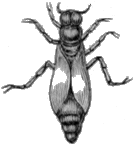
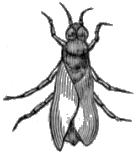
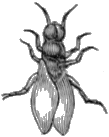
The Head, in common with that of other
creatures, is the inlet for nutrition and the principal
seat of the organs of sensation.—Of nutrition
and sensation I shall speak in their appropriate
places.
The Trunk is the intermediate section of the
body between the head and the abdomen: it
approaches in figure to a sphere, and is the seat
of the organs of motion; it contains the muscles of
the wings and legs which proceed from it, and is
the main prop, or as it were the key-stone, of the
other two sections. The upper side is called thorax
or the chest, the under side pectus or the breast.
The Abdomen is the third section of the body,
posterior to the trunk; it is divided into six rings
or segments, which, by sliding one over another,
serve to shorten or lengthen the body. It is the
seat of the organs of generation, and principally
of those connected with respiration; and contains
also the anus and the sting. The upper part is
called tergum or the back, the under side venter
or the belly.
The Head.
The most remarkable part of the head is the
Proboscis, of which so good an account has been
given by Dr. Evans that I shall describe it nearly
in his words.
It is not so much the mere simplicity of nature,
which excites our wonder and admiration, as that
apparently complex structure, which operates with
all the ease of the simplest machinery. Of this
we have not a more striking instance than in the
proboscis of the labouring bee: though the component
parts of the proboscis are scarcely discernible
by the naked eye, yet are they far more
complicated than the elephant’s stupendous trunk.
It consists of no less than five distinct branches;
namely, a central trunk, or tongue, and four horny
scales, tapering to a point, convex outwards and
concave towards the trunk; the two outer ones so
sheath the inner as to appear but one single tube:
by a joint in the middle they bend, or extend all at
once, carrying with them the unarticulated tongue,
which is cylindrical, and about the size of a man’s
hair, and appears through a magnifier to be composed
of successive rings. It has probably as many
short muscles as the tongue of a fish, which are capable
of moving it in all directions; and towards its
termination is furnished with hairs or villi, some
of which at the point are very long, and seem to act
like capillary tubes. Mr. Wildman assures us,
that he has seen the trunk growing bigger and
less by turns, swelling the instant the bee sucked;
and this alternate lessening and enlargement propagated
from the extremity to the root. What a
delicate apparatus of invisible muscles must perform
this office! The tongue is capable of being
contracted and folded up at pleasure; for if it
were constantly extended, it would be exposed to
injury: when at rest, therefore, it is doubled up by
means of its joint, and lies in a very small compass;
the first portion being brought within the
lip, and the second part folded under the head
and neck, protection is given to it by a double
sheath, consisting of four strong scales, the two
inner scales sheathing the tongue, and the two
outer and larger ones encompassing the whole.
When at work, the trunk is lengthened beyond
its sheaths, probes the very bottom of the flowers,
through all impediments of foliage or fructification,
and drains them of those treasured sweets which,
without such an apparatus, would be completely
inaccessible.
The proboscis of the bee is not used like that
of other flies, not being tubular like theirs, but
serves as a brush or besom to sweep, or as a
tongue to lap[K]; having collected the nectar of
flowers in small drops, it deposits its collection
upon the tongue, which is protruded for the purpose
of receiving it, and having received it, withdrawn
again.
The Lips. The bee has two lips, an upper one
called labrum, and an under one called labium;
(the Mentum of Latreille.)
The Tongue of the bee, which is very long, is
at its upper part cartilaginous; below the middle,
membranous and capable of considerable inflation,
thus forming a bag to receive the honey from the
proboscis, preparatory to its conveyance into the
pharynx. It terminates in a knob, but has no
passage through it, to exercise the power of suction,
as has been supposed. When in a state of
inaction, it is folded up longitudinally, and lies
between the lips. The tongue of the working
bee is probably the largest of any known animal,
for its size; it is much longer than that of either
the male or queen, and thus fitted for taking up
honey at a considerable depth. The bee has the
power of unfolding it with great rapidity, and
darting it betwixt the petals and stamina of those
flowers that afford honey, it moves it about in
every direction, sweeping the convex as well as
the concave surface of the petals.
The Pharynx lies at the root of the tongue;
it is an opening by which the honey passes from
the tongue to the gullet or honey-bag, and closes
by a valve.
The Œsophagus or Gullet receives the food
from the pharynx, and conveys it, in part at least,
to the stomach, there to be digested, animalized,
and forwarded to the small intestines, from whence
it is distributed, through appropriate vessels or
tubes, to all parts of the body for its nutriment.
The gullet is long and slender, commences at the
termination of the pharynx, and traversing the
neck and breast, dilates into a fine bag, transparent
as crystal, and when filled with honey about the
size of a small pea. In bees caught on going out
early in the morning, Mr. Hunter found this reservoir
perfectly empty; but in those returning
from the fields, it was quite full of honey, some
of which had passed into the stomach.
The Mandibles or upper jaws move horizontally,
and are armed with teeth.
The Maxillæ or under jaws are situated below
the mandibles, have a similar motion, and form,
according to Linnæus, the sheath of the tongue.
De Geer regarded them as part of the apparatus
of the under lip, on each side of which they are
placed.
The mandibles are powerful organs, hard and
horny, and constitute the tools with which the bee
performs its various labours; the maxillæ on the
contrary are soft and leathery: the latter probably
serve to hold such materials as the former
have occasion to operate upon.
The Antennæ. Of all the organs of insects,
none appear to be of more importance than their
antennæ: in all the tribe they are planted either
between or below the eyes; and no insect has
more than two: in their general structure, they
consist of a number of tubular joints, each having
a separate motion, which gives them every variety
of flexure. The antennæ of the male have one
more joint than those of the female, the former
having thirteen, the latter only twelve. They
seem to enable the insects, by certain signs and
gestures, to communicate to each other their
mutual wants or discoveries. But I shall enter
more fully into this subject when I come to speak
of the various uses to which the antennæ are
applied.
The Palpi or Feelers are also important organs;
their ends are furnished with nervous
papillæ, indicating some peculiar sense, of which
they are the instrument: they are four in number,
two emerging from the maxillæ called maxillary
feelers, and one from each side of the labium,
called labial feelers. The maxillary are short
and without a joint, the labial long and with four
joints, including the two flat joints or elevators.
The Eyes, two in number, are placed in the
sides of the head; they are compounds of an infinite
number of hexagonal lenses, as clear as
crystal, and are guarded by a horny tunicle or
covering. This subject is however treated of in
Chap. XXXII.
The Trunk.
The trunk affords attachment to the organs of
motion.
First, To the Wings, which transport the insect
through the air; these consist of two superior and
two inferior: they are membranous and transparent,
and while in a state of repose are incumbent
on each other, covering the abdomen.
Bees and various other hymenopterous insects,
and also those of the dipterous family, possess
the power of flying in a more perfect degree than
any class of animals besides, surpassing in this
respect even the bird tribe. In the anterior margin
of the under wings small hooks (hamuli) are
placed, which are capable of laying hold of the
posterior margin of the upper wings, by means of
which they are kept steady when flying. These
hooks are discoverable under a good magnifier.
Secondly, To the Legs, by which the insect
moves itself from place to place upon the earth.
Of these there are six in number, each composed
of several joints, and articulated like our arms,
thus affording the power of various movements:
in the legs are three distinct divisions; namely, the
thigh, the shank, and the foot. In the four hinder
legs one joint forms a kind of brush, externally
smooth and bare, but covered on the inside with
stiff bristling hairs. By these the insect is enabled
to brush off farina both from the tips of the stamina
of flowers and from the hairs of its own
body. With the jaws and two fore-feet, the meal
is rolled into small compact masses, which are conveyed,
by the middle pair of legs, to the spoon-shaped
cavities in the centre joint of the two hindmost
feet; these are surrounded by strong close
set hairs, to secure more firmly the precious burdens.
(No such groove is to be found in the legs
of either the queen-bee or drone.) Each foot terminates
in two hooks, with their points opposite to
each other, by means of which the bees suspend
themselves from the roofs or sides of the hives or
boxes, and hang from each other, in the form of
festoons, ropes, or cones. From the middle of
each pair of hooks proceeds a little thin appendix,
which is usually folded up; when unfolded it enables
the insects to fasten themselves to polished
surfaces, such as glass, &c.: they probably also
use it for taking up small bodies, the pollen for
instance, which they thereby transmit to the hollows
of their hinder legs.
The trunk also gives origin to a number of
muscles, serving various purposes, which it would
lead me too much into detail to enter upon here.
The Abdomen.
The abdomen, besides various other parts, contains
the honey-bag, the venom-bag, and the anus,
which latter in the female comprehends the ovipositor
and sting: in the male it contains the
organs of reproduction but no sting, and of course
no ovipositor. For a particular account of these,
vide Organs of Reproduction further on.
Organs of Sensation.
We have an abundance of presumptive evidence
that bees are endowed with sensation and perception,
and that the excitement of these faculties is
communicated, through the medium of nerves, to
a common sensorium, though the latter was denied
to insects by Linnæus and other eminent naturalists.
Common sensation, however, does not
reside in the brain alone of insects, as in that of
warm-blooded animals, but in the spinal marrow
also; hence it is that bees and many other insects
exhibit signs of sensation after their heads have
been severed from their bodies. Some insects
exhibit these for a long time afterwards, the wasp
for instance; Lyonnet informs us that he has
seen motion in the body of a wasp, three days
after its division from the head; and I have known
several instances of its inflicting wounds with its
sting, at least four-and-twenty hours after the
separation. The severed body will not only
move but walk, and sometimes even fly, at first
almost as actively without the head as with it.
The penetrating genius of Lord Bacon afforded
him such illumination upon this subject, as to
enable him to approach very near to what is at
this day regarded as a correct statement of the
cause of this protracted vitality in mutilated insects.
“They stirre,” says he, “a good while after their
heads are off, or that they be cut in pieces; which
is caused also for that their vital spirits are more
diffused throughout all their parts, and lesse confined
to organs than in perfect creatures.”
That insects have a real sensorium or brain,
would seem to be proved by their having memory,
and a capacity to receive instruction, and acquire
new habits. Such functions in higher animals are
regarded as functions of a cerebral system. That
they are endowed with memory cannot well be
doubted. Huber relates a remarkable instance
of it in bees, which illustrates what will hereafter
be said on their having a method of communicating
information to each other. “Honey,” says
he, “had been placed in a window in autumn,
where the bees resorted to it in multitudes. It
was removed, and the shutters closed during
winter; but when opened again, on the return of
spring, the bees came back, though no honey was
there. Undoubtedly they remembered it, therefore
an interval of several weeks did not obliterate
the impression they had received.” “But the
most striking fact evincing the memory of bees
has been communicated to me,” says Mr. Kirby,
"by my intelligent friend Mr. W. Stickney, of
Ridgemont, Holderness. About twenty years ago,
a swarm from one of this gentleman’s hives took
possession of an opening beneath the tiles of his
house, whence, after remaining a few hours, they
were dislodged and hived. For many subsequent
years, when the hives descended from this stock
were about to swarm, a considerable party of
scouts were observed, for a few days before, to
be reconnoitring about the old hole under the
tiles; and Mr. Stickney is persuaded, that if
suffered, they would have established themselves
there. He is certain that for eight years successively
the descendants of the very stock that
first took possession of the hole, frequented it as
above stated, and not those of any other swarms;
having constantly noticed them, and ascertained
that they were bees from the original hive by
powdering them, while about the tiles, with yellow
ochre, and watching their return. And even at
the present time, there are still seen every swarming
season about the tiles, bees, which Mr. Stickney
has no doubt are descendants from the original
stock.”
Some anecdotes of the spider prove that insects
are capable of instruction. M. Pelisson, when he
was confined in the Bastille, tamed a spider, and
taught it to come for food at the sound of an
instrument. A manufacturer also, in an apartment
at Paris, fed 800 spiders, which became so
tame, that whenever he entered it, which he
usually did with a dish of flies, they immediately
came down to receive their food. That insects
are susceptible of a change of habits, or rather
that they may acquire civilized habits, if I may
say so, is shown by the domestication of bees,
and occasionally by that of ants and wasps.
Huber’s experiments, with leaf-hives, show the
existence of this faculty in an eminent degree, for
he assures us that it renders the bees quite tame
and tractable.
Most physiologists, resting upon the evidence
of analogy, agree in attributing five senses to
insects: (Dr. Virey, as will be seen further on,
ascribes to them seven senses:) though there is a
difference of opinion as to the organs by which
those senses are conveyed. The antennæ for instance,
have been regarded by some as the organs
of smell, by others as the organs of touch, and by a
third class as the organs of hearing. With the substitution
of taste forbearing, the same opinions have
been maintained respecting the palpi; nor can the
question even now be considered as settled. The
prevailing opinion seems to be, that the antennæ
are explorers or tactors, but that they are also
applied to other uses; the effects produced by
their excision indicate that they are organs of the
highest importance. Vide Senses of Bees.
Messrs. Kirby and Spence notice the analogy
borne by antennæ to the ears of vertebrate animals,
such as their corresponding in number and standing
out from the head. No ether organ has been
found which can be supposed to represent the
ear[L]. And what I have said in another place, of
their constituting a sixth sense, has received some
countenance from the observations of those naturalists.
“I conceive,” says Mr. K., “that the
antennæ, by a peculiar structure, may collect notices
from the atmosphere, receive pulses or vibrations,
and communicate them to the sensorium, which,
[communications] though not precisely to be called
hearing, may answer the same purpose.” Lehmann
calls the function of the antennæ aëroscepsy. A very
remarkable instance of the effect produced upon
them by sound, is adduced by the authors just
quoted, which one of them has thus related. “A
little moth was reposing upon my window; I made
a quiet, not loud, but distinct noise: the nearest
antenna immediately moved towards me. I repeated
the noise at least a dozen times, and it
was followed every time by the same motion of
that organ; till at length the insect, being alarmed,
became agitated and violent in its motions. In
this instance, it could not be touch; since the
antenna was not applied to a surface, but directed
towards the quarter from which the sound came,
as if to listen.”
That the antennæ should have been regarded
as organs of smell is not surprising when the proceedings
of the bees on visiting flowers are considered;
their first act is to introduce one of the
antennæ, but no further than the tip: this conduct
would naturally enough convey the idea of looking
or smelling for nectar; yet it does not at all
militate against the opinion that the antennæ are
transmitters of sound; the sense which they supply
may, in these little creatures, be so very fine, as
to enable them to hear the bursting of an anther,
or the exudation of nectar. The continual motion
of the antennæ of insects from side to side, when
they walk, conveys the idea that it is by their
means that they inform themselves of what is
going on in their immediate vicinity. The importance
of the antennæ may be inferred from their
very complicated structure. Mr. Kirby has
observed, that in one species of Apis which he
examined, under a powerful magnifier, the ten
last joints of the antennæ appeared to be composed
of innumerable hexagons, and from this similarity
in their structure to the eyes (Vide Senses of
Bees) he thought that they might serve a somewhat
analogous purpose.
What I have said with respect to the Senses of
Bees, in another place, will I think make it evident
that these insects possess an organ of smell, but
with respect to its situation naturalists differ.
Baster, Lehmann, and Cuvier, consider the
spiracles as the organs of smell, as well as of
respiration: this opinion is founded upon the
notion that, without the inspiration of air, there
can be no smell; and that as insects are smaller
than the food they live upon, it would be of no
consequence to them where this sense was situated.
Kirby and Spence, on the contrary, suppose that
it resides in some organ near the mouth: in other
parts of the animal creation certainly, that is its
situation; and as there seems to be a necessary
connection between smell and taste, analogy should
lead us to argue in favour of that opinion; but
though smell be usually accompanied by respiratory
organs, they may not be essentially necessary
to it; a bee may receive impressions from external
objects, in a manner which we cannot comprehend.
In confirmation of this opinion of Kirby and
Spence, we have the experiments of Huber. It
seems that no odour is so unpleasant to insects as
that of oil of turpentine. M. Huber having presented
this oil, on the point of a camel’s hair pencil,
successively to every part of the abdomen, trunk
and head, it excited no uneasiness in the bee: he
then tried the eyes and antennæ, but with the
same result; yet as soon as he pointed it a little
above the insertion of the proboscis, near the
cavity of the mouth, the bee receded, became
agitated, clapped its wings, and would have taken
flight, had not the pencil been withdrawn. This
experiment was repeated with the turpentine and
other articles of penetrating odour, and with the
same effect; but when the mouths of several bees
were stopped with paste, no such consequences
ensued, on the contrary they traversed the impregnated
pencils without being at all annoyed
by them; even honey did not attract them. All
these circumstances tend to prove that the site of
smelling is in or near the mouth.—This subject
will be resumed in Chap. XXXII.
Organs of Respiration.
The respiration of bees is performed through
several little orifices, called stigmata, spiracles, or
breathing pores, situated in the sides of their
bodies, behind their wings. Reaumur was of
opinion that inspiration was performed through the
spiracles, and expiration through the mouth; but
Bonnet proved satisfactorily that neither inspiration
nor expiration takes place through the mouth.
The spiracles are connected with a system of air-vessels
called tracheæ, ramifying through every
part of the frame, and serving the purpose of
lungs. From the absence of lungs, Aristotle and
the ancients in general thought that insects did
not breathe. Pliny may perhaps be excepted, for
he has observed that dipping bees in honey or
oil deprives them of life;—this immersion stops up
the mouths of the spiracles. Modern physiologists
have however incontestibly proved that they
do breathe. “Life and flame,” says Cuvier, “have
this in common, that neither the one nor the other
can subsist without air; all living beings, from
man to the most minute vegetable, perish when
they are utterly deprived of that fluid.” Huber
detected the existence of the stigmata or breathing
pores, by immersing different portions of a bee
in water, and finally by total immersion, upon
which he observed that bubbles of air attached
themselves for some time to the orifices of the
stigmata, which alternately appeared and receded,
till their increased bulk enabled them to overcome
the resistance of inspiration and rise to the surface.
These respiratory organs escaped the observation
of Swammerdam.
Air is equally necessary to insects in the egg
state: Spallanzani found that their eggs could
not be hatched in small close vessels, though all
other circumstances were favourable to a development.
The eggs of the hive-bee, whilst in the
ovaries, have a net-work of air-vessels spread
over their surfaces;—these were discovered by
Swammerdam: from analogy, we may reasonably
conclude, that such a provision obtains generally.
The closeness of a hive, and its having no
direct current of air through it, may favour a
belief that bees can exist in any atmosphere,
however vitiated, and may seem also to confirm
the opinion of the ancients, that they have no
particular system of respiratory organs. But
M. Huber and Son have proved that they breathe
like other animals, that they are speedily deprived
of life, if the process of respiration be arrested;
so delicate indeed is their organization, that they
detect the smallest deterioration in the atmosphere
of their hives, and immediately adopt measures to
restore to this element the degree of purity
essential to respiration: from some eudiometrical
experiments, it has been ascertained that the air
of a well stocked hive is as pure as that by which
it is surrounded. Still neither wax nor pollen
favours the generation of oxygen gas, nor have
bees the faculty of generating it; for when very
closely shut up, they perish in a few hours. The
writers just referred to, discovered that the bees,
by uniting the two wings of each side, by means
of the small marginal hooks with which they
are provided, so as to make them present the
largest possible surface to the air, were capable
of striking it with considerable force, and that
this force was increased by the wings forming a
slight concavity. The wings arranged in this
manner, are put into a violent vibratory motion
by the bees appointed to the office of ventilators,
and produce what we call a draught of air. Ventilation
is thus systematically accomplished. A
certain portion of ventilating bees is stationed in
files at the entrance of the hive, with their heads
turned inwards; another and a larger party, in
files also, stands a considerable way in the interior,
with their heads towards the entrance: thus both
these parties cooperate, in producing a current of
air in the same direction, and are so arranged as
not to interrupt the passage of their fellow-citizens,
moving in and out. As this hard duty has
no intermission during the day, nor in hot weather
during the night, and must necessarily occasion
fatigue, one set of ventilators is considerately relieved
in about twenty-five minutes, by another set
of fresh bees. Under particular circumstances
the number of ventilating bees is considerably increased.
“When the air,” says Huber, “was
not renewed in the manner desirable, we have seen
all vibrating their wings at once, though this never
occurs in the natural state, when the vibrations
of a few are sufficient for ventilation.” Although
this fanning motion of the wings is so rapid as to
render them almost indistinguishable, yet they
may be observed to describe an arc of 90°. The
sagacious bees remind me of a method which is
sometimes adopted of renewing the air of a room,
called pumping; some person moves the door
backward and forward so rapidly as to cause a
thorough agitation of the confined air, and the introduction
of a fresh unvitiated atmosphere.
“When they are engaged in ventilation, the bees
by means of their feet and claws, fix themselves
as firmly as possible, to the place they stand upon.
The first pair of legs is stretched out before;
the second extended to the right and left: whilst
the third, placed very near each other, are perpendicular
to the abdomen, so as to give that part
considerable elevation.” That ventilation is carried
on for the purpose of renewing the air of the hives,
and not for lowering its temperature, is evident
from its being continued to a certain extent, even
during the depth of winter.
The vibratory motion of the bee’s wings has
been regarded by some as the principal cause of
the humming noise heard in every prosperous hive
during the busy season. This humming has likewise
been attributed to the rushing of the air
through their spiracles: so thought M. Chabrier,
and, I believe, Mr. J. Hunter. Mr. H. assures
us that bees can produce a sound independently
of their wings; for if these be smeared over with
honey so as to stick together, the bee still makes
a noise, which is shrill and peevish. He found
the same effect from holding the bee by the legs,
with a pair of pincers, while the wings were perfectly
still, and also by immersing the insect in
water, though not till it was very much teased.
The whole body of a drone is in a state of vibration
when it hums. Though deprived of its
wings, it is capable of producing a sound exactly
similar, and probably the same with its former
hum: even when the legs are cut off, the trunk
retains its tremulous motion, and utters an audible
noise. If immersed in water, many air-bubbles are
disengaged from it: but though the mutilated
insect be taken out alive, it is no longer sonorous.
“This experiment, however incomplete,” says a
writer in the Dictionnaire des Sciences Naturelles,
“tends at least to prove, that the humming of bees
is not occasioned by a strong vibration of the internal
part of the upper wings, but rather by a
tremulous affection of the entire body; and perhaps
even by the escape of a greater quantity of
air through the stigmata or spiracles. This last
would amount to a sort of voice.” The humming
noise with which a flower is always approached by
the bee, ceases as soon as she has alighted upon
it, though during the time that she is extracting
its sweets she is in a constant vibratory motion.
Circulation.
The term circulation is not strictly applicable
to the imperfect sanguineous system of insects, as
the fluid which supplies their bodies with nutriment
is not distributed to its several parts through
the medium of a heart and vascular system.
Lyonnet and Cuvier are both of opinion that insects
have no heart, whereas all creatures that
possess a circulation, properly so called, have a
heart, lungs or gills, and a liver; but insects have
only air-vessels and hepatic ducts. The chyle
which is produced in their intestines, transpiring
through the pores of the intestinal canal, passes
into the general cavity of the body, where it is
probably animalized, and made to answer the
same purposes that blood does to creatures of a
higher class, though when animalized it still retains
its white colour. Although its distribution
is obscure, from its analogy to blood, we may conclude
that it is a fluid which visits and nourishes
every part of the insect’s body; that from it secretions
are made, and that, as in other creatures, it
is fitted for these purposes by receiving oxygen
from the air-vessels. Cuvier has observed that
the blood of insects, “for want of a circulating
system, not being able to seek the air, the air
goes to seek the blood;” the air-vessels, as I have
stated under the head of Respiration, are distributed
to every part of the body.
Nutrition.
From what I have said under the head of Circulation,
it will appear evident that the bodies of
bees and other insects are supplied with nutriment
in a very simple manner. Cuvier is of
opinion that it is obtained by direct absorption or
transudation, by imbibition as he calls it, through
the pores of the intestinal canal, along which the
blood or animalized chyle passes: and Lyonnet
thinks that this imbibition is analogous to that
which takes place from the earth by the roots of
plants.
Secretion.
Every thing connected with the subject of secretion
seems to be obscure: it is evident, however,
that secretions do take place; for silk, wax,
and poison are all the results of that process.
The first of these substances is only secreted by
the bee when in its larva state. I must refer
those who wish for information respecting silk, to
those naturalists who have written on the silk-worm.
The secretion of wax I shall treat of
hereafter in a distinct chapter; and it will be
better perhaps to speak of Poison, after describing
the sting and its appurtenances. There is one secretion
however, on which I will say a few words
in this place,—viz. Perspiration.
Perspiration.
The temperature of insects not gregarious, is
generally that of the medium they inhabit; but
bees possess the power not only of preserving a
high temperature during the coldest mouths of
winter, but of raising that temperature under particular
circumstances. Dr. Darwin has observed
that they generate heat by a general motion of
their legs, as they hang clustered together in the
hives: Huber thinks that it may be increased by
the agitation of their wings;—whatever disturbs
them so as to cause a tumult invariably produces
a considerable accession of heat. Inch, a German,
plunged a thermometer into a bee-hive in the
winter, and saw the mercury stand 27 degrees higher
than it did in the open air. Mr. Hunter found
the heat of a hive vary from 73° to 84° of Fahrenheit;
and Huber, who says that in a prosperous
hive the thermometer in winter commonly stands
at from 86° to 88°, and in summer between 95°
and 97°, states that he has observed it, on some
occasions, to rise suddenly from about 92° to above
104°. The former naturalist, about ten o’clock in
the morning, in the middle of July, when the
quicksilver in the thermometer in the open air
ranged at 54°, found that on plunging it into a
bee-hive, it rose in less than five minutes to 82°.
At five the next morning it stood at 79°,—at nine
it had risen to 83°,—at one to 84°; and at nine in
the evening it had fallen to 78°. On the 30th of
December, when the temperature of the air was
35°, that in the hive was 73°. Bees also possess
the power of counteracting or throwing off superabundant
heat, by perspiration. Huber observed,
that when crowded together in hot weather,
they become much heated, and perspire so
copiously that those near the bottom seem perfectly
drenched, and are for a time incapable of
flying from the moisture on their wings.
Motion.
The motions of insects are performed through
the medium of an appropriate apparatus of muscles,
which move the head, trunk, abdomen, viscera,
and limbs, as in other parts of the animal
creation. The muscles of insects generally possess
very great power, as may be seen by the
motion of the mandibles, and the propulsion of
the bee’s sting. It is very strikingly evinced
also in the flea. Latreille gives an account of
one that dragged a silver cannon twenty-four
times its own weight, firing it off afterwards,
without exhibiting any symptom of fear. An
English workman also is said to have made an
ivory coach, with six horses, a coachman on the
seat with a dog between his legs, a postillion, four
persons in the coach, and four lacqueys behind,—the
whole of which was dragged by a single flea.
A further evidence of the muscular power of the
flea is the extent of its leaps, which equal a space
of 200 times the length of its own body. This
calculation, or a very similar one, was made by
Socrates, who was much ridiculed for it by
Aristophanes. The poet, however, did not confine
his ridicule to this minuteness of calculation,
but attacked likewise the character and precepts
of that great philosopher; for the whole of which
satire he has justly incurred the censure of posterity.
Organs of Reproduction.
These organs, in the drone, correspond in function
and denomination with those of the higher
classes of animals: their chief peculiarity consists
in their size, in proportion to that of the insect,
and in their being more under the belly than in
other insects of this tribe;—they are larger than
those of the humble-bee, and the two last scales
of the back and belly are larger than those of the
queen or workers.
The female organs consist principally of the
ovaries, the oviducts, the sperm-reservoir, and
the ovipositor. In the ovaries the eggs are generated,
and remain till rendered fit by impregnation,
and the other circumstances necessary for
their maturation, to pass through the oviducts.
According to Mr. Hunter, what are called ovaries
are really ducts; the eggs therefore are not formed
as in other animals, in a cluster on the back,
but in those ducts, of which there are six on each
side. When full of eggs, they form a kind of
quadrangle; these six ducts uniting on each side
into one duct, this latter enters a duct common
to both sides, which may be called the vagina or
ovipositor. The common oviduct is the canal
through which the eggs pass from the ovaries as
they are called, to the ovipositor. The sperm-reservoir
is the organ which, according to Herold,
receives the impregnating sperm of the drone, the
modus operandi of which we are unacquainted
with. In the hive-bee and in some other insects,
the influence of this sperm continues so long
a time, and through so many generations, as
almost to exceed belief. (Vide page 31). This led
Dr. Haighton to entertain the opinion that
actual contact betwixt the male sperm and the
egg was not necessary, but that impregnation was
effected by some unknown sympathetic influence.
Messrs. Kirby and Spence have recourse to the
old doctrine of an aura seminalis being all that
is required to vivify the egg, and which they think
may be retained for a long period. Upon this
subject I have entered at some length in page
25 et seq. The ovipositor places the eggs in
their appropriate situations, and is an instrument
of most curious structure. It consists of a long
tube, or rather several tubes, retractile within
each other, like the pieces of a telescope, and
serves not only to convey the extruded eggs to the
place of their destination, but acts also as a sheath
for the sting, having a sharp point which makes
the first impression when the creature intends to
use its sting,—indeed it appears to be itself the
sting. It has a slit near its extremity, through
which the sting and poison are allowed to pass
at the time of stinging. Some insects have occasion
to bore a hole in wood, or other hard substances,
to obtain a proper nidus for their eggs;
the ovipositor is their operating instrument, and
will either saw or bore a passage to the desired
place. Thus it appears that this curiously complex
apparatus, which in the bee is used both as
a weapon of defence and offence, is a hollow horny
tube or scabbard, inclosing two bearded darts,
which can be thrust a short way beyond the
sheath, though the whole appears to the naked
eye like the solid point of the minutest needle.
This apparatus is moved by muscles which,
though invisible to the eye, are yet strong enough
to force the sting to the depth of one twelfth of
an inch through the thick cuticle of a man’s hand.
It is articulated by thirteen scales to the lower
end of the insect’s body; and at its root are situated
two glands or ducts, from which the poison
is secreted: these glands uniting in one duct, eject
the venomous liquid along the groove formed by
the junction of the two piercers. There are four
beards on the outside of each piercer: when the
insect is prepared to sting, one of these piercers,
having its point a little longer or more in advance
than the other, first darts into the flesh, and being
fixed by its foremost beard, the other strikes in
also, and they alternately penetrate deeper and
deeper, till they acquire a firm hold of the flesh
with their hooks, and then follows the sheath entering
and conveying the poison into the wound.
The action of the sting, says Paley, affords an
example of the union of chemistry and mechanism:
of chemistry, in respect to the venom which can
produce such powerful effects: of mechanism, as
the sting is a compound instrument. The machinery
would have been comparatively useless
had it not been for the chemical process, by which
in the insect’s body honey is converted into
poison; and on the other hand, the poison would
have been ineffectual, without an instrument to
wound, and a syringe to inject it.
In consequence of the barbed form of its sting
the bee can seldom disengage itself without leaving
behind it the whole apparatus, and even part of
its bowels; so that her life is usually sacrificed to
her passion.
“Illis ira modum supra est, læsæque venenum
Morsibus inspirant, et spicula cæca relinquunt,
Affixæ venis, animasque in vulnera ponunt.”
Virgil
The sting of the queen-bee is longer and stouter
than that of the working-bee, and bends a little
under her belly. She is not eager to employ it;
and from what has been said above, of the fatality
which usually attends its use, conjecture has been
busy as to the cause of her extreme caution in
this respect. Dr. Evans observes, that it cannot
arise from any selfish consideration, founded on
an instinctive knowledge of the danger she thereby
incurs; since the common bees, who run the same
risk when they sting, are ready to attack upon
the slightest provocation. “Is it owing,” says
he, “to a consciousness of the importance of her
life to the community? or may we rather ascribe
it to the dignified and generous forbearance so
frequently exemplified in the lion or English
mastiff?”
The reluctance of queens to eject their stings,
led Pliny and others to imagine that they did not
possess any. Their extreme caution in this respect,
and the fatal consequences usually attending
a departure from it, gave birth to the following
jeux d’esprit. In consequence of Pope Urban the
Eighth being suspected of a stronger attachment
to the French than to the Spaniards, a Frenchman
who had observed three bees quartered upon his
arms, wrote this Latin verse.
“Gallis mella dabunt, Hispanis spicula figent.”
To this a Spaniard is said to have subjoined,
“Spicula si figant, emorientur apes.”
To close the series, and to show his universal
paternal regard towards his flock, Pope Urban
is made to add the following distich:
“Cunctis mella dabunt, et nullis spicula figent,
Spicula rex
[M] etenim figere nescit apum.”
This caution of the queens is never more conspicuously
evinced than in their combats with each
other, for they instantly separate if there be any
danger of mutual destruction from the darting
forth of their stings. Huber gives a striking instance
of this. Two queens in one of his hives
having left their cells at nearly the same instant,
rushed together with great apparent fury. The
antennæ of each were seized by the teeth of the
other, and the head, breast, and belly of both
were mutually opposed. Finding themselves however
thus dangerously situated, and their curved
extremities on the point of meeting, each disengaged
itself and flew away; when the other
bees, who had before receded, to make a clear
arena for the combatants, drove them together
again. This was done repeatedly, till at last the
stronger queen, seizing the other’s wing, and
curling her extremities under her belly, inflicted
a mortal sting.
I think this observation of Huber puts a negative
upon Dr. Evans’s last question, and to assent
to his first would I apprehend raise her majesty
too high in the scale of existence. I believe
we must here, as in many other similar cases,
acknowledge our ignorance, and refer the proceeding
to instinct.
We have seen that where there is more than
one native queen in a hive, there is always a
combat between them, terminating in the death
of all but one. It was the opinion of Schirach
and Riem, that if a stranger queen were introduced
where there was a native one, the former would
be assailed by the workers, and by them stung to
death. The experiments of Huber and Dunbar
discountenance this opinion: indeed Huber says
that in the whole course of his experience he
never knew more than one instance of a queen’s
being stung by a worker, and that was wholly
unintentional.
But though the experiments to which I have
just alluded, produced different results from what
we were led to expect by Schirach and Riem, yet
those of Huber did not correspond with those of
Dunbar. The former introduced two stranger
queens into hives containing native queens; of the
latter, one was fertile the other a virgin,—the former
were both fertile. Each of these introductions
led to a single combat between the queens,
and each terminated in the death of the stranger.
The latter gentleman also on two occasions introduced
stranger queens to the queens regnant,
in his mirror-hive; but in neither case were they
stung to death, either by the queen or workers,
but merely surrounded and confined by the latter,
and by that confinement either suffocated or
starved to death. Schirach and Riem had probably
witnessed similar conduct on the part of the
workers, and were no doubt led thereby to conjecture
that they dispatched the queens with their
stings.
From what has been said of the fatal consequence
to the bee itself when it makes use of its
sting for the annoyance of man and other animals,
it might be supposed that the darting of this
weapon by one bee into the body of another,
might cause the death of both; but this is not
usually the case, otherwise there would be a great
mortality amongst them, when the persecution of
the drones takes place. Huber contrived, by placing
several of his hives upon a glass table, to witness
this scene of massacre; on which occasion the
bees thrust their stings so deeply into the bodies
of the drones, (generally between the segments of
the abdomen,) as to be obliged to turn upon themselves,
as upon a pivot, before they could extricate
them; but by so doing they succeeded, as do the
queens also in their combats with each other.
Instances are related, of combats between workers
proving mutually destructive, from the victors
being unable to extricate their stings from the
wounds they have inflicted. Mr. Hunter saw
an instance of this: the bee was stung in the
mouth; and he saw it running about afterwards,
with the sting and its appurtenances adherent in
the wound.
Indeed by allowing the bee to draw out her
Sting gradually, when we ourselves are stung,—which
if we had sufficient firmness and presence
of mind to remain still, she would instinctively do,
by bringing the beards close down to the sides of
the darts,—the life of this valuable insect might be
preserved, and the pain in the wounded part be
much lessened: but the alarm of both parties
seldom admits of such forbearance. The wasp is
not so liable to leave its sting behind as the bee,
the beards of the former being rather shorter, and
the insect stronger and more active.
The sooner the sting is extracted the less venom
is ejected, and consequently less inflammation induced.
To alleviate the irritation, numberless
remedies have been proposed, of the most opposite
kind and uncertain effect; as oil, vinegar, bruised
parsley, burnet, mallow, or the leaves of any succulent
vegetable (renewed as soon as warm, and
probably therefore operating by cold alone), honey,
indigo dissolved in water, &c. &c. The most effectual
remedy appears to be the Aq. Ammon. or
Spirit of Hartshorn: nor is this surprising, when
we consider that the venom of the bee, or wasp, is
evidently acid. If a humble-bee be irritated to sting
paper tinged with litmus, or any other of the vegetable
blues, the colour is changed by the acid of the
venom to a bright red; this acid appears not to
differ from the acid (bombic) of silk-worms, or
(formic) of ants. The acrimony of the latter
many have experienced when inadvertently sitting
down on an ant-hill. On this principle, a solution
of any alkali, or even lime-water, might answer
the same purpose; and soap would have the
double advantage of neutralizing the acid and allaying
the inflammation, by the oil which would be disengaged.
Plunging the part stung into cold or
warm water would afford the same relief as in burns,
&c. and also dilute the acid acrimony. Quietness
is the surest protection against being stung.
It has lately been affirmed, that a person is perfectly
secure amidst myriads of bees, if he carefully
keep his mouth shut, and breathe gently
through the nostrils only, the human breath being,
as it would appear, highly offensive to their delicate
organs. (Vide Senses of Bees.) It is added
that with this precaution, hives may be turned
up, and even part of the combs cut out, while the
bees are at work, with perfect impunity.
Those who wish to view the sting of a wasp or
bee through a microscope, may cut off the end of
its tail, when by touching it with a needle or pin
it will thrust out the darts and their sheath, which
may be then snipt off with a pair of scissors and
reserved for observation. If the insect be caught
in a leather glove and provoked to eject its sting,
the same end will be answered; as the sting being
detained by its barbs, will be left in the leather,
from whence, when the creature is dead (which in
the case of a wasp will not be for many hours),
the whole apparatus may, with care, be extracted.
“Upon examining the edge of a very keen
razor by the microscope, it appeared as broad as
the back of a pretty thick knife, rough, uneven,
and full of notches and furrows, and so far from any
thing like sharpness, that an instrument as blunt
as this seemed to be, would not serve even to
cleave wood[N].” “An exceedingly small needle
being also examined, the point thereof appeared
above a quarter of an inch in breadth; not round,
nor flat, but irregular and unequal; and the surface,
though extremely smooth and bright to the
naked eye, seemed full of ruggedness, holes, and
scratches. In short it resembled an iron bar out
of a smith’s forge[O].” But the sting of a bee,
viewed through the same instrument, showed
every where a polish most amazingly beautiful,—without
the least flaw, blemish, or inequality; and
ended in a point too fine to be discovered: yet
this is only the case or sheath of instruments much
more exquisite, contained therein, as before described.
The Poison of Bees.
The poison of bees, as also that of wasps, is a
transparent fluid: applied to the tongue it imparts
a sweet taste, which is succeeded by a hot
acrid one. It gives a slight red tinge, as has been
already hinted, to litmus paper, and hence the
Abbé Fontana has concluded that an acid enters
into its composition, but in very small proportion.
The venom is so extremely active, that he conjectures
a grain in weight would kill a pigeon in
a few seconds. It is this fluid which causes the inflammation
consequent upon being stung. A puncture
from a needle that was charged with it, would
produce precisely the same effects. These effects
are very different in different persons; for whilst a
single sting will produce alarming symptoms in
one individual, another may receive numerous
punctures without sustaining pain or inflammation
in any considerable degree; sometimes without
suffering either. The activity of the venom
varies according to the season of the year: a sting
received in winter produces much less inconvenience
than one inflicted in summer; the pain and
inflammation are neither so intense nor of such
long continuance. This may arise from there
being a more copious secretion of venom in summer
than in winter; for during the former season, if
a bee inflict several wounds with its sting, the pain
and inflammation become progressively less at each
consecutive puncture: after three or four punctures,
it is rendered incapable of producing more
inconvenience than the point of a sharp needle.
If a bee be provoked to dart its sting against
glass, so as to eject its venom upon it, and the
glass thus charged be placed upon a double microscope,
oblong pointed crystals will become visible;
these may be seen at first floating in the
venom, and gradually shooting into crystals as the
fluid part evaporates.
The Anger of Bees.
I have already treated of the disposition of bees
to use their stings, when irritated, either by direct
interference with them, or by the approach of persons
to whom they have an antipathy. Virgil
has, in strong terms, noticed their irascibility:—when
once provoked, says he, they set no bounds
to their anger, but
“Deem life itself to vengeance well resign’d,
Die on the wound, and leave their stings behind.”
Fatal consequences occurring from their wounds
are not often heard of, though such I believe have
occasionally happened. Messrs. Kirby and
Spence relate an instance of a violent fever being
produced, by the injury they inflicted, and in
which the person’s recovery was for some time
doubtful. Mungo Park also mentions, in his
Travels, an instance of severe annoyance from
them, and states that he lost several asses in
Africa owing to their being attacked by bees.
Mr. Talbot, in his Five Years Residence in the
Canadas, states, that during the summer of 1820,
the Rev. Ralph Leeming having sent a fine horse
to grass at a neighbouring farmer’s, who kept
about twenty stocks of bees, the animal got upon
the lawn where the hives were placed, and by accident
overturned one of them, the bees of which
attacked him with great virulence. The horse,
rearing and kicking from agony, overthrew another
hive. Having thus doubled the number of his
assailants, his sufferings brought him to the ground,
and in less than five minutes from the commencement
of the attack the poor animal was literally
stung to death.
The anger of bees is not confined to man, and
other large animals; it is sometimes vented upon
their own kind, not only in single combat, but in
conflicts of organized masses. Cases of the former
kind every observer must have noticed; and of
the latter, several instances have been related by
Reaumur, Thorley, Knight, and others. The
engagement, witnessed by Thorley, lasted more
than two days, and originated in a swarm’s attempting
to take possession of an already occupied
hive. Remarkable battles of this kind have also
been related by other writers. Whenever the
angry excitation is diffused through a whole community,
a great accession of heat is produced in
the hive.
Notwithstanding bees are thus occasionally
animated by a most vindictive spirit, against what
they regard as a public enemy, they are not found
to display any peculiar hostility in the revenge of
a private injury, committed upon them at a distance
from their homes. This is a fact which has
been noticed both by Mr. Hunter and Mr.
Knight. The former observes also, that bees
never sting but in the neighbourhood of their
property, unless hurt; that they never contend
with each other for honey, unless it be placed
within the boundary of their own right,—but that
what they have collected they defend. The indisposition
of bees to attack or be angry at a
distance has been confirmed by Mr. Knight,
who says, that, though the most irritable of animals
near home, he has seen them suffer themselves to
be patiently robbed of their loads by other bees,
and that he has witnessed this in the same bee
three times in succession. He says likewise, that
if the wasps in a nest have their communication
cut off from those that are abroad, the latter, on
their return, will not make any attack; but that if
one escape from the interior, it evinces a very
different temper, and is ready to sacrifice its life
to avenge the injury. This Mr. Knight discovered
when a boy, and he has no doubt but
that if a similar proceeding were adopted towards
bees, they would observe the same conduct.
The Language of Bees.
All creatures that live in society seem to possess
the power of communicating intelligence to one
another. “Brutes,” says Mr. Knight, “have language
to express sentiments of love, of fear, and of
anger; yet they seem unable to transmit any impression
they have received from external objects.
But the language of bees is more extensive: if not
a language of ideas, it is something very similar.”
This faculty has been very remarkably illustrated
by Huber in his Treatise on Ants; and the bee
exhibits many strong evidences of it. Huber
clearly shows that the communications of Ants are
made through the medium of their antennæ; he
has also proved very satisfactorily, that these
organs serve the same purpose in bees.
Being desirous of ascertaining whether when
a queen was removed from a hive, (a circumstance
which is communicated to the whole family within
an hour,) they discovered their loss by means of
smell, touch, or any unknown sense; he accordingly
divided a hive into two portions, by means
of a grating which admitted a free circulation of
air, but denied a passage to the bees, or even to
their antennæ: the consequence was, that the bees
contained in the half that had no queen, after they
had recovered from the agitation[P] always produced
under such circumstances, set about building
royal cells, just as they would have done if the
queen had been entirely removed from the hive.
He repeated this experiment, with a grating which
allowed the transmission of the antennæ only.
Here the effect was quite different: for the bees
being able to assure themselves, by the frequent
crossing of their antennæ with those of the queen,
that she was still amongst them, every thing remained
in order; the brood were attended to, no
interruption took place in any of their labours,
nor were any royal cells commenced. From all
these experiments (and they were repeatedly
tried), it seems evident that the antennæ of bees,
as well as of ants, possess the faculty of receiving
and conveying information. Bees receive some
kinds of intelligence through the medium of certain
sounds, as has been stated in another place.
The antennæ, in addition to the uses already
ascribed to them, may serve to inform the bees of
the state of the atmosphere, and enable them to
discern the approach of a change in the weather.
The suddenness and rapidity of their flight towards
the apiary, often afford a hint to the observer of
their proceedings, that a storm is at hand, of which
he received no intimation from any other quarter.
“Inque vicem speculantur aquas et nubila cœli.”
Virgil.
“That the bees,” says Dr. Evans, “can foresee
bad weather, is a fact beyond denial; though we
know not through the medium of what sense that
faculty is exerted. We are often surprised to
find, even with a promising appearance of the sky,
their labours suddenly cease, and that not a bee
stirs out; or, on the contrary, that those which
a e abroad, hurry home in such crowds that the
door is too small for their admission. But on
strictly examining the heavens, we may discern
some small and distant clouds, which, insensibly
collecting, soon after descend in rain." The Doctor
likewise says, that an observant friend of his,
foretells with confidence that rain will fall in the
course of a few hours, when he finds on a clear
summer’s morning that his garden is wholly
deserted by his neighbour’s bees. In this he
enjoys an advantage over their real owner, the
flowers near the apiary being crowded as usual by
these wary foragers. “If,” says Mr. Kirby,
“they wander far from home, and do not return
till late in the evening, it is a prognostic to be
depended upon, that the following day will be
fine: but if they remain near their habitations, and
be seen frequently going and returning,—although
no indication of wet should be discoverable, clouds
will soon arise and rain come on. Ants also are
observed to be excellently gifted in this respect:
though they daily bring out their larvæ to the
sun, they are never overtaken by sudden showers.”
I have before stated that in the course of an
hour the important intelligence of the loss or
safety of a queen is known to a whole colony. It
seems highly improbable that in this time, 20,000
bees should have assured themselves of the presence
and safety of their queen, by applying their
antennæ to hers; such an attempt would create a
state of complete confusion. Huber proved by
a very decisive experiment, similar to those already
related, that the queen is not distinguishable by
her subjects, in consequence of any emanation
from her person. There must then be some mode,
to which I have given the name of language, by
which those who have exchanged contact with
their antennæ can communicate the tranquillizing
intelligence to their companions. It seems impossible
to explain, in any other way, the concurrence
of so many wills to one end; or that sudden
interruption and restitution of harmony which are
often exhibited in every community of bees. It
is the opinion of Mr. Knight that bees are not
only capable of communicating intelligence to the
members of their own family, but that a friendly
intercourse sometimes takes place between neighbouring
colonies: the cases which he has related
in support of this opinion, however, can hardly be
said to bear him out in it; for in each of them,
after the intercourse had continued for a few days,
it terminated in violent hostility. Such instances,
though not of frequent occurrence, have been
occasionally noticed by others.
Sleep of Bees.
It is reasonable to suppose that every part of
animated nature needs occasional intervals of repose.
That this is the case with the bee seems
evident, from the almost motionless quietude of
the workers, which often occurs for fifteen or
twenty minutes together, each bee inserting its
head and thorax into a cell, where it might be
mistaken for dead, were it not for the dilatation
of the segments of its abdomen. The queen sometimes
does the same in a drone’s cell, where she
continues without motion a very long time, when
“the workers form a circle round her, and gently
brush the uncovered parts of her abdomen. The
drones while reposing do not enter the cells, but
cluster in the combs, and sometimes remain without
stirring a limb for eighteen or twenty hours.”
Huber says that he has seen the workers, even in
the middle of the day, when apparently wearied
with exertion, insert half their bodies into the
empty cells, and remain there, as if taking a nap,
for half an hour or longer; at night they regularly
muster, in a sleep-like silence.
“The sun declining, through the murky air.
Home to their hives the vagrant bands repair,
There in soft slumber close their willing eyes,
And hush’d in silence, the whole nation lies.”
Murphy’s Vaniere.
Longevity of Bees.
The several members of a hive have very different
periods of existence. The general law
among insects is, that both male and female shall
perish soon after sexual union; in a few days or
weeks at furthest, according to the time, probably,
that the female occupies in maturing and depositing
her eggs. By retarding sexual union, the
lives of some insects may be very much prolonged,—even
ephemeræ have been kept alive by this
means for seven or eight days. Annual plants,
if prevented from seeding, may be rendered biennial.
The bee and some other insects are exempted
from this forfeiture of life after sexual
union, with the exception already alluded to in
page 33. The ancients were very deficient in
knowledge upon this subject. Virgil fixes the
term of a bee’s existence at seven years[Q], having
probably copied from Aristotle; though Aristotle
says that bees who live to an extreme old age
may reach to nine or ten years. Columella
[R]
and Pliny[S] have been supposed to regard their
existence as extending to ten years; though the
language of the former applies to the existence of
the community, and not to individual bees: and
provided the hive be never changed, nor the
combs renewed, it is not likely that any one family
should have its existence prolonged beyond that
period; as the accumulation of silken pellicles
with which the breeding-cells are successively
lined, would render them unfit for use in a very
few years. In addition to the diminution of the
cells by this succession of silken linings, they are
also diminished further by the excrement of the
larvæ, which is never cleaned out, but confined
behind each lining: both together, therefore, soon
render the cells unfit for use as brood-cells.
Mr. Hunter found three of these layers deposited
in a single season, and counted upwards of twenty
in the cells of an old comb; which, upon an average
of three a year, would correspond with the period
fixed by the ancients; though this observation by
no means proves that the hive upon which it was
made, or any other, might not have had a much
more protracted existence. Mr. Espinasse tells
us that he once took a hive which had stood
fourteen years, having found that it had become
weak: it had nevertheless sent off a swarm the
year previous. There is an instance or two on
record, of one family having continued in the
same hive for thirty years. One of these is
mentioned by Reaumur, another by Mouffet.
Thorley speaks of a colony having occupied
the same domicile for 110 years. The spot chosen
was under the leads of the study of Ludovicus
Vives in Oxford: the original swarm settled there
in 1520 and kept possession till 1630. Query,—may
not the bees when the combs become very old
and the cells much diminished in size, remove them
and construct fresh ones? To those who may
wish for their own satisfaction to examine the
linings of a brood cell, I would observe, that Mr.
Hunter’s mode of proceeding was, to soak the
cell in water, till the linings were swelled, when
he had no difficulty in separating and counting
them: he found them separate most readily at the
bottom, on account of the inclosed excrement.
To common observers it might appear, that
the lives of the bees were coeval with the foundation
of the colony, presuming upon all the young
bees leaving the parent stock in swarms. But I
have already stated that all swarms consist of a
mixture of young and old bees; the difference
between them is very distinguishable, those of the
present year being brown, plump, and clothed
with light hairs, whilst the old ones have red hairs,
notched and ragged wings, and are paler and more
shrunk in their bodies.
The cases which I have related, and others of a
similar kind, have led to the erroneous opinion
that bees are a long-lived race. But this, as Dr.
Evans has observed, is just as wise as if a stranger,
contemplating a populous city, and personally
unacquainted with its inhabitants, should on paying
it a second visit, many years afterwards, and
finding it equally populous, imagine that it was
peopled by the same individuals, not one of whom
might be then alive. “Such strangers are we to
the honied hive, where, however quickly its generations
may have passed away, the same face is
presented to the beholder.”
“The race and realm from age to age remain,
And time but lengthens with new links the chain.”
Sotheby’s Georgics.
The usual term of the male’s existence is two
or three months only;—I say the usual term, for
his life is always cut off by violence, when no
peculiar circumstances arise to render his existence
any longer useful. Such circumstances having
arisen, as has been before observed, (page 44,) he
may be kept alive a much longer period, for a
year at least, but how much longer has not as yet
been ascertained.
With respect to the queen, by comparing what
has been said above, as to insects not dying till
their eggs are all matured, with what has been
stated in page 31 of a single sexual union serving
to impregnate all the eggs laid for the two
succeeding years, it would appear that the period
of her existence could not, in general, be less than
two years; and Huber has proved very satisfactorily,
that this is the fact: indeed he states that
he has known a queen live for five years. Feburier
suspects that, like the males, the queens
are destroyed by the labourers, when they have
fulfilled their destination. The only ground of this
opinion, however, appears to be his having witnessed
an attack made upon a queen by six
labourers, from whom he with difficulty rescued
her. Messrs. Kirby and Spence, in like manner,
seem to think it not improbable that when the
workers become too old to be useful to the community,
they are either killed or expelled the
society. Vide page 7. Reaumur also throws out
a hint to the same purpose.
The length of a working bee’s life has not yet
been ascertained; but the general opinion is that
it is short-lived. Butler says that “the bee is
but little more than a year’s bird;” and some think
the period of its existence shorter still. “The
bees of the present year,” says Butler, “will
retain their vigour and youthful appearance till
(Gemini), about the 21st of May in the following
year, when they begin to decline, and from
(Cancer to Leo) June 21st to August 21st, the
ground in front of the apiary may be seen strewed
with them, some dead, some dying, and a few
alive but incapable of rising again, and by (Libra)
32d September, scarcely an old bee will be left.”