THE BISHOP'S INQUISITION
THE REVEREND MCCARTHY was commonly regarded
as a good politician in church affairs, meaning,
that he was successful with the Bishop in being
able to hold the office of Presiding Elder over such a long
period. At every conference other aspirants attempted to
oust him. But he had always held with the Bishop and had
succeeded himself annually until the five-year limit had expired.
At the end of this time he had usually succeeded in
manipulating matters in such a manner that he had invariably
been successful in securing the same appointment
over another district in the state. Over this he presided another
five years, and was then automatically transferred
back to the district over which he had formerly presided.
For twenty years he had been successful in keeping this up,
but in the conference that was to convene after he had been
sued by his son-in-law, it became known and talked about
that he would not be re-appointed to the Presiding Eldership,
and would necessarily be sent to a charge for a year or
more.
Accordingly, he began early to seek a charge which he
was in position to know would be lucrative, since there were
few outside the large churches in Chicago that would pay
as well as the Presiding Eldership.
The fact was, however, he regretted going back to a
charge, for his former experience in such work, in gaining
and retaining the confidence of the members of his church
had not been ideal, to say the least. And again, it was expedient
that he should have his family, especially his wife,
living in the town with him where he held the charge.
Perhaps that made it awkward for him, as he was not accustomed
to having his wife in such close proximity with
him daily. His regard for her was such that he could not
bear the thought of that close association. For his experience
had been that it was impossible for him to be in the
house with her a matter of two days without losing his patience
and speaking harshly to her. To avoid this unpleasant
domestic state of affairs it had been agreed that Orlean
should be his housekeeper, and this was settled on before
conference—and before he had been sued.
This pending suit, however, brought added complications.
Ever since he had brought Orlean home, he had been embarrassed
by gossips. Nowhere had he been able to turn
unless some busy-body must stop him and inquire with regard
to his daughter; what was the matter, etc., and so on.
It kept him explaining and re-explaining, a subject that was
to say the least, delicate. He had, however, succeeded in
explaining and conveying the impression that the man she
married had mistreated and neglected her, and that he had
been compelled to go and get her in order to save her
life. This was not satisfactory to him in view of the fact
that he decided once to let her return, but Jean Baptiste not
knowing that he had reached such a decision, had felt that
his only chance to secure her again was to keep away from
her father—well, we know the result of that effort.
But inasmuch as that Jean Baptiste had refused to argue
with him over her, he had used this as an excuse to become
his old self again, which, after all, was so much easier. So
when 'Gene Crook had approached him with an offer, and
convinced him that Baptiste was what the Elder knew he
was not (because the Elder was easily to be convinced of
anything toward the detriment of his adversary) he easily
secured the place and the Elder had felt himself ahead.
Three hundred dollars was a great deal of money to him,
and went a long way in taking up the payments in which
they were in arrears on the home they were buying in Chicago.
True, it twitched his conscience, but N.J. McCarthy
had a practice—long in effect—of crucifying conscience.
So when he had closed the deal—and had been reimbursed
for his traveling expenses—he went directly back to his
work, and had not been in the city since until called in on the
suit.
When he left the lawyer's office and returned home, he
discussed the matter with Glavis, who in turn discussed
the matter with white friends who advised him how to
answer to the charge. Returning to the lawyer's office they
engaged counsel. It was very annoying—more than ever—to
the Elder when he was required to put up twenty-five
dollars in cash as a retainer. He had become so accustomed
to posing his way through in so many matters—letting
some one else put up the money, that when he was
forced to part with that amount of money he straightway
appreciated the seriousness of the situation. It was no
pleasant anticipation in looking forward to the trial, for
there he would be compelled to counter the other on equal
terms.
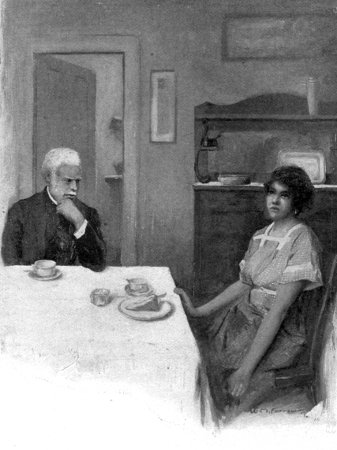
He was very disagreeable about the house when he returned
home, and his wife adroitly kept out of his sight.
He sought the street to walk off his anger and perturbation,
only to run into a Mrs. Jones, teacher in the Sunday
school of one of the large Negro churches, and with whom
he had been long acquainted. It was, in a measure, because
his acquaintances were of long standing that gave
them, they felt, the right to question him regarding such
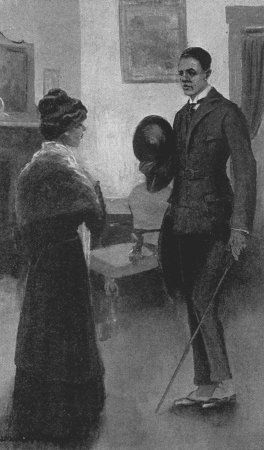
delicate affairs. So when he met Mrs. Jones, he doffed his
hat in his usual lordly manner, and paused when she came
to a stop.
"Good evening, Reverend Mac.," she exclaimed, and extended
her long, lean hand. He grasped it, and bowing
with accustomed dignity, replied:
"Good evening, Sister Jones. I trust that your health is
the best."
"My health is good, Reverend Mac. But, say, Reverend
Mac., you don't look so well."
"Indeed so, my dear madame, I have not been in the
best of health for some months."
"Well, well, that is too bad, indeed. I hear that you
have not been, Reverend Mac. And say, Brother McCarthy,
what is this I read in the paper about your son-in-law coming
in here and suing you for breaking up Orlean and he?"
His Majesty's head went up, while he colored unseen, and
would have passed on, but Mrs. Jones was standing in such
a manner that he was unable to do so without some difficulty.
"The man is crazy," he retorted shortly, and stiffened.
But it took more than stiffness to satisfy this gossip.
"Well, I thought something was the matter, Reverend.
For you see, I've heard that you went out there and brought
her home to save him from killing her, so you see it is
rather strange. That fellow, as a boy—and even yet,
when he is in Chicago—attends Sunday school and sits in
my class, and I was rather surprised that he should treat
Orlean as it is said you said he did."
Reverend McCarthy would liked very well to have moved
on. But Mrs. Jones was very much interested.
"There's all kind of talk around town about it. They
say that if he gets a judgment against you, Elder, he will
put you in jail, and all that; but of course that couldn't be.
You stand too well in the church. But you know, Reverend,
the only thing that looks kind a bad for you is, they say that
he wouldn't dare start such a suit unless he had good ground
for action. They say—"
The Elder had extricated himself at last, and now sailed
down the street with high head. "May the God crush that
hard-headed bulldog into the earth," he muttered between
compressed lips, so angry that he could not see clearly.
"How long am I to be aggravated with this rotten gossip!"
He changed his mind about walking far, and at a convenient
corner, he turned back toward home. But when
he arrived there, he was confronted with another, and more
serious problem. It had been his intention before arriving
there, to arraign his wife again for having let Orlean go
West in the beginning. But now he was confronted with
his august honorary, the Bishop.
"And, now, Reverend," said the Bishop, after they had
gone through the usual formalities, "I am forced to come
around to something that embarrasses me very much, in view
of our long and intimate relations," and he paused to look
grave. The Reverend tried to still his thumping heart.
All his life he had been a coward, he had bluffed himself into
believing, and having his family believe, that he was a brave
man, but Orlean had told Baptiste on several occasions that
her father might have risen higher in the church, but for
his lack of confidence.
"It pertains to all this gossip and notoriety that is going
the rounds. I suppose you are aware of what I refer to."
The other swallowed, and nodded.
"You can appreciate that it is very embarrassing to me,
and to the church, more, because I have struggled to raise
the standard in this church. We have in the years gone by
been subjected to unfair gossip, and some fair because of
the subtle practices of some of our ministers. And now,
with conference convening in two weeks, it is very awkward
that we should be confronted with such a predicament with
regard to you, one of our oldest ministers. The subject is
made more embarrassing because of its—er, rather personal
nature. I would regard it as very enlightening if you
would give me an explanation—but, of course, in the name
of the church."
The Reverend swallowed again, struggled to keep his eyes
dry, for the rush of self pity almost overcame him. It was,
however, no time or place for self pity. The Bishop was
not an emotional man; he was not given to patience with
those who pitied themselves—in short, the Bishop was
very much of a cold hearted business man, notwithstanding
his position. He was waiting in calm austerity for the
other's reply.
"Ah-m ahem!" began the Reverend with a great effort
at self composure. "It is, to say the least, my dear Bishop,
with much regret that I am compelled to explain a matter
that has caused me no end of grief. To begin with: It was
not with my consent that my daughter was allowed to go
off into the West and file on a homestead."
The other's face was like a tomb upon hearing this.
Indeed, the Elder would have to put forth a more logical
excuse. It has been said that the Bishop was a practical
man which in truth he was, and the fact is, he regarded it
as far more timely if a larger number of the members of
his race in the city would have taken up homesteads in the
West, than for them to have been frequenting State Street
and aping the rich. Also, the Bishop had read Baptiste's
book—although the Reverend was not aware of it,—and
was constrained to feel that a man could not conscientiously
write that which was absolutely false.
"But I came into the city here after a conference to find
that my daughter had been herded off out West in a wild
country to take a homestead."
"Now, just a minute, Reverend," interposed the Bishop
astutely. "Regarding this claim your daughter filed on.
What was the nature of the land? You have been over it, I
dare say."
"Of course, of course, my dear Bishop! It was a piece
of wild, undeveloped land. At the time she took it, it was
fifty miles or such a matter from the railroad. She gave
birth to a child—"
"But," interposed the Bishop again, "you say the land
was a considerable distance from the railroad at the time
your daughter filed on the place? Very well. Now, Reverend,
isn't it a fact that in the history of this country, all
new countries when opened to the settler may have been
some distance from the railroad in the beginning? For instance,
somebody started Chicago, which was certainly not
the convenient place then that it is now in which to live."
"Of course, my dear Bishop, of course."
"So the fact that the railroad was, as you say, fifty
miles away, could not be held as an argument against it.
Besides, is it not a fact that there were other people, men
and women, who were as far from the railroad and therefore
placed at an equal disadvantage?"
"Of course, of course."
"Then, my dear Reverend, it does not appear to me that
that should be a fact to be condemned."
"I have not condemned it, my dear Bishop. No."
"Very well, then, my dear Reverend, please proceed."
Now the interposition of the Bishop, had rather disconcerted
the Elder. Had he been allowed to proceed in the
manner he had planned and started to, he might have made
the case from his standpoint, and under the circumstances
very clear to the Bishop. But the latter's questions threw
him off his line, and he started again with some embarrassment,
and with the perspiration beginning to appear around
the point of his nose. Appreciating, however that he was
expected to explain, he went resolutely back to the task.
"Well, my wife allowed my daughter to be taken out
there and file on this land that this man had secured on his
representation that he wished to marry her, and when I came
into the city it was all settled."
"Pardon me for interrupting you again, my dear Elder.
But is it not a fact that Mrs. Pruitt, with whom you
are well acquainted, accompanied your daughter on this
trip?"
"It is so, Bishop."
"And is it not a fact that Mrs. Pruitt as well as your
daughter, explained it all at the time with satisfaction to
you?"
"Well, ah—yes, she did."
"You admit to this, then, my dear Reverend?"
"Under the circumstances at the time, I was rather compelled
to, my dear Bishop."
"Meaning that since she had gone and taken the land,
you were morally bound to look into and consider the matter
favorably?"
"Yes, I think that explains it."
"Now, Reverend. Is it not a fact that a considerable
write-up appeared in the Chicago Defender shortly after this
visit, detailing considerable, and with much illustration regarding
the trip; that, in short, your daughter had come into
considerable land and was regarded as having been very
fortunate?"
"I think so, my dear Bishop."
"Very well, Reverend. Now—a—who solicited that
write-up? Did the editor not have a conversation with you
before the article appeared?"
"I believe he did, yes, sir. I think he did."
"Well, now, Reverend, if I remember correctly, this
young man visited the city the Christmas following, and I
was introduced to him by you in this same room?"
"I think so. Yes, Bishop, I remember having introduced
him to you myself."
"And do I quote correctly when I say that you called me
up the following spring to perform the ceremony that made
your daughter and this Jean Baptiste man and wife?"
"I think you quote correctly, my dear Bishop."
"M-m. Yes, I recall that I was indisposed at the time
and was very sorry I could not perform the ceremony," said
the Bishop thoughtfully, but more to himself than to the
other.
"Well, now. After they had been married some months,
my wife visited your wife, and the latter seemed to be
greatly impressed with the union. I think if I am correctly
informed that you went on a visit to them yourself
that fall."
"I did, my dear Bishop. Yes, I did."
"And at the conference on your return, you, if I am not
mistaken, called on me at my home and discussed the young
man at considerable length."
"Yes, my dear Bishop. I did that."
"Yes," mused the Bishop again thoughtfully and as if to
himself. "And you appeared greatly delighted with their
union. You seemed to regard him as an extraordinary
young man, and, from what I have heard, I have been inclined
to feel so myself. Now it seems that a few months
after you were speaking in high praise of him, you made a
trip West and on your return brought your girl home with
you, and she has not since returned to her husband. Of
course," he added slowly, "that is your personal affair, but
since it has reached the public, the church is concerned, so I
am ready to listen to further explanation."
"I went out there and found my girl in dire circumstances,"
defended the Elder. "I found her in neglect; I
found her without proper medical attention—no nurse was
there to administer her needs. In short, I was prevailed
upon by my love and regard for my daughter's health, to
expedite the step I took."
"Nobly said, Reverend, nobly said," said the Bishop, and
for the first time during his explanation, the Elder felt encouraged.
"The man did not marry her for love," the Elder went
on now somewhat more confident. "He did not marry her
to make her happy and comfortable. He married her to
secure more land. It is true that I was impressed with him
in a way, because the man was rather—er, inspiring, and I
entertained hopes. Our race does not possess successful
men in such a number that we can be oblivious to apparent
success as on a young man's part. This man seemed to be
such a man—in fact, I grant him that. The man was popular
with those who knew him; he was a pusher; but he was
so ambitious to get rich that he was in the act of killing my
child to accomplish his ends." The Reverend finished this
with a touch of emotion that made the other nod thoughtfully.
And while he paused to gather force and words for
further justification of his interposition, the Bishop said:
"I note by the reports in the newspaper that you are
accused of having coerced the girl; that you had her write
her husband's name on a check with which you secured
the money to bring her from the West."
"He gave my daughter the privilege of securing money
by such a method for her needs, and it was not I that had
her do any such a thing."
"But it was—er, rather—a little irregular, was it not?
It does not seem reasonable to suppose that he granted her
the privilege to sign his name to checks to secure money
with which to leave him?" The question was put rather
testily and caused the other to shift uncomfortably before
making answer.
"Well, under the circumstances, methods had to be resorted
to—er, rather to fit the occasion." The Elder's
defence was artful.
The Bishop, not pretending to take his question seriously,
pursued:
"I note, further, that he accuses you of disposing of
some property...."
"My daughter sold her place. It was hers, in her name,
and the transaction did not require his consent."
"M-m—I see. It seems that the property, so he claims,
represented an outlay of some thirty-five hundred dollars
in cash, and he purports the same as being worth something
like sixty-four hundred dollars. What is your opinion, having
been on the property, of its actual worth?"
"Well, I have some sense of values, since I am buying
this home, and I do not regard the property as being worth
such a sum."
"I see," said the other, stroking his beard which was thick
and flowing.
"A piece of wild, raw land such as that I could not estimate
it as being so valuable."
"M-m. Have you any knowledge of what land has
brought in that neighborhood, Reverend. You see, value is
a very delicate thing to estimate. We cannot always be the
judge in such matters. The usual estimate of what anything
is worth is what some one is willing to pay. Do you
recall of having ever heard your daughter or any one say
what deeded land in that section sold for?"
"Well, I have heard my daughter say that a place near
there had brought five thousand dollars."
"Which would not compare with the value you put on the
place your daughter held."
"It would not seem to."
"M-m. You say this was your daughter's place entirely?"
"It was," returned the Reverend promptly.
"And she paid for it out of her own money?"
"Well, no. She did not."
"I see. M-m. Then who purchased it for her, Reverend?"
"I think he did that. Yes, I think he did."
"I see. Do you recall the consideration. I understand
that he purchased what is called a relinquishment. I understand
such transactions slightly. I have read of such deals
in Oklahoma. Seems to be a sort of recognized custom in
securing land in new countries, notwithstanding the subtlety
of the transaction."
"I think he claimed to have paid two thousand dollars
for the relinquishment, which I would consider too much,
considerably too much."
"But, inasmuch as your knowledge of new countries has
been brief, perhaps, you would not set your judgment up as
a standard for values there," suggested the Bishop, pointedly.
"You will grant that the individual in the controversy
would likely be able to judge more correctly with
regard to values?"
"It is obvious."
"Yes, yes. Quite likely." The Reverend was very uncomfortable.
If the Bishop would only stop where he was it
wouldn't be so bad, but if he kept on with such questions.
That was what he had disliked about Jean Baptiste....
He had a habit of asking questions—too many questions,
he had thought; but this man before him was the Bishop,
a law unto himself. And he must answer. The Bishop
knew a great deal more about the West than he had thought
he did, however.
"Who bought your daughter's place, my dear Elder? A
white man or a Negro? Which of course, doesn't matter,
but if I understand all the details, it would be more clear,
you understand."
"Of course, my dear Bishop. Naturally. A white man
bought the place."
"I understand now. A white man," he repeated thoughtfully.
During all the questioning, the Bishop had looked
into the Reverend's eyes only occasionally. Most of the
time he had kept his eyes upon the carpet before him, as if
he were studying a spot thereon.
"It seems by the paper that the man, according to the
accusations set forth in the complaint, had once contested
the claim."
"Yes, he had done so, Doctor, he had."
"I see. Why did he contest the place, my dear Reverend?"
"Why, I do not understand clearly, but such methods
appear to be a recognized custom in those parts," countered
the Elder evasively.
"But isn't it a fact that he tried to contest her out of
the place, and if he had been successful, he would have
had the place for nothing in so far as she was concerned?"
"It is quite likely." The Elder had nothing but evasive
answers now. He tried counters no more.
"But he failed, it seems, to get the place through contest,
regardless of the fact that your daughter was here in
Chicago instead of being on her claim."
"It seems that way."
"And then, forsooth, it must have been your daughter's
husband who was instrumental in saving the place for her?"
"Yes."
"And after this, your daughter sold the place to the man
who had struggled to beat her out of it and failed through
the instrumentalities of her husband, and without consulting
her husband with regard to the bargain."
"I counciled her, my dear Bishop."
"Ah, you counciled her," and for the first time he turned
his sharp, searching eyes on the Elder and seemingly looked
directly through him. The next moment they were back on
the carpet before him, and he resumed his questions. He
was thinking then, thinking of what he had read in the
book by Jean Baptiste, and what had recently appeared in
all the papers. It seemed to him that the Elder's defence
was not quite clear; but he would see it through.
"It was reported that this man, a banker, whose bank
had failed ... sent you the money for your railroad fare
from Cairo to this city, and also reimbursed for the return.
Is that quite true?"
"That was—the railroad fare—a part of the transaction."
"Ah-ha. A part of the transaction. You never, I suppose,
informed her husband regarding the transaction after
the deal was closed?"
"No."
"What was the consideration, Reverend, for this piece
of land that your daughter's husband bought, for which he
paid $2000, placing a house and barn thereon, digging a
well, and making other improvements, fighting off a three
years' contest—placed there by the man who tried to beat
her out of it? What did he pay for the place?"
"Three hundred dollars." Such an awful moment! The
Elder's head dropped as he said this. But the Bishop's eyes
were still upon the spot in the carpet.
"And so this young man comes hither and accuses and
sues you, accusing you of breaking up he and his wife.
He published all that you have told me and if he should
secure a judgment it is known that he can remand you to
jail for six months."
He paused again, regarded the spot in the carpet before
him very keenly and then arose. The Elder arose also, but
he was unable to find his voice. In the meantime the
Bishop was moving toward the door, his hand was upon the
knob, and when the door was open, he turned, and looking
at the one behind him, said:
"Well, see you at the conference, Newt," and was gone.
The other stood regarding the closed door. His brain
was in a whirl and he could not quite understand what
had happened. But something in that hour had transpired,
and while he could not seem to realize what it was
just then, he knew he would learn it in due time.