THE PLEASANT VALLEY GIRLS LEARN TO MAKE
MORE GARMENTS
Would you like to learn to make some useful garments? Perhaps, then,
you can help with the family sewing and make some useful garments for
your sister or mother. Some day you may wish to be a seamstress or a
dressmaker and to earn money in that way. Barbara Oakes says she expects
to do so. Now is the time to begin to learn how, and later perhaps you
may go to a dressmaking school.
Barbara Oakes and some of the League girls have a class which meets
once a week for instruction in gymnastics and fancy dancing. In the
spring or early summer they expect to give a dance outdoors. A pageant
will be prepared by some of the members of the Mothers' Club; and the
dance is part of that pageant.
The pageant will picture the history of Pleasant Valley. The Mothers'
Club is planning to have all the people who will, take part. Have you
ever seen a
pageant? It is a pleasant way to learn history and to celebrate an
interesting local event. Pageants have been held in many parts of the
eastern and western states; and in England there have been many pageants.
Perhaps you can plan a pageant for your town. While the girls are
practicing their dancing and gymnastics, bloomers will be very useful,
and the girls have decided to learn to make them. Would you like to learn
how? The bloomers will be useful for school gymnastics, too. You can also
make a middy blouse and a skirt to wear with them, so as to have the
whole outfit.
THE PATTERN OF THE BLOOMERS
Let us study the pattern which your teacher has brought to school. You
have learned to read patterns. You must also calculate how much material
to order, and what kind.
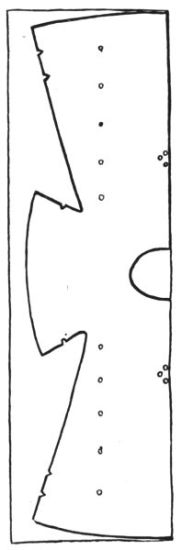
Let us open the pattern and study its parts. Yes, the long
narrow strips are for the belt; some are for the placket facings. Notice
if the dots indicate where these are to be placed: on a fold of material
or lengthwise of the cloth. There is one other piece. It is the leg; so
two must be cut. Is it possible to cut two at the same time? How, then,
should the material be folded? Notice the perforations. They will help
us to know which part of the pattern is to be placed on the warp of the
cloth. How wide is the width of the pattern at the widest part? If it is
34 inches, then it will be easy
to calculate how many lengths to buy of cloth 36 inches wide. Measure
the length of the pattern and see if it is long enough for you to allow
for fullness at the knee so that there is some to blouse over. If not,
how will you add to the pattern? This extra length must be allowed in
ordering the material. Can you tell how much cloth to order? See if you
can calculate.
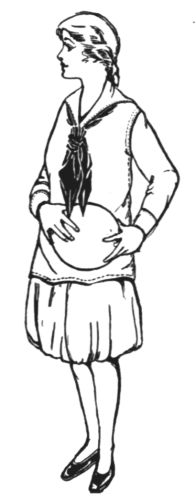
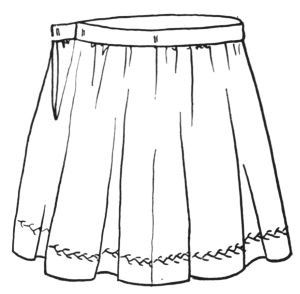
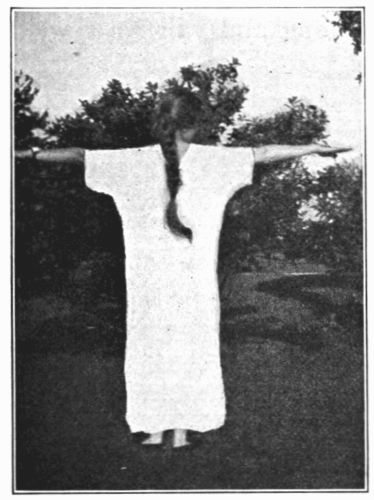
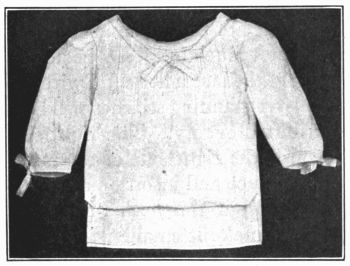
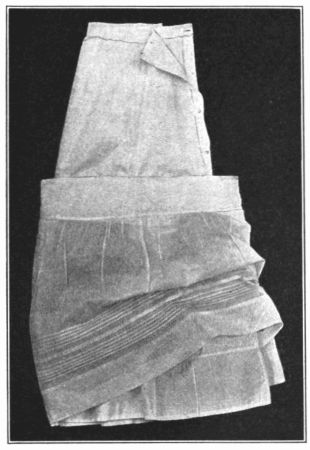
Fig. 114.—The bloomers and middy
blouse.
What kind of material will you use? Some of the Pleasant Valley
girls wish wool material because it will be warmer for winter wear. Dark
blue or black serge is very durable, is washable also, and will shed the
dust. Here are some samples. Sateen is also a durable cotton material,
but it is not so warm. It is easier for girls to handle in making than
wool. Bloomers can also be made from gingham, percale, galatea, or
other cotton cloth. Which will you choose? Shall we not write for some
samples of these different materials? The Pleasant Valley girls wrote and
received them in a few days. Perhaps you too are learning how to order
by mail when you are too far away from town to go shopping. Try to make
all the calculations to-day and to learn all about the pattern. Pin the
pieces of the pattern together; also try to hold them up to your figure
or the girl next to you. It helps one to learn where the parts lie
on the body and to locate where the seams will fall. The Pleasant Valley
girls worked in pairs and helped each other with the cutting, fitting,
and planning. This is a good way when each girl does her part.
EXERCISES AND PROBLEMS
1. Open the pattern for the bloomers. Notice the parts, also
the perforations and directions.
2. Calculate how much cloth will be necessary for a pair of
bloomers for yourself.
3. Bring samples of materials suitable for bloomers.
THE STORY OF WHERE WOOL IS GROWN
While you are waiting for the samples of wool serges, galatea, and
sateen, let us study about wool. Wool is the most important textile
fiber. All girls should know about it, whether you will use wool or
cotton for your bloomers.
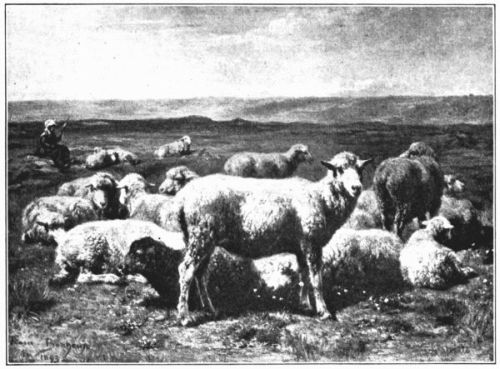
In the picture (Fig. 115) you will see a very peaceful scene. The
sheep are grazing and storing up food and energy to be converted into
food for us to eat and clothing for us to wear. Mr. Allen has over a
hundred sheep on his farm. How grateful we should be to the patient
sheep. This animal fiber called wool is a variety of hair, and varies
in fineness. The coarser varieties are called hair. Hair is obtained
from the angora goat, the camel, and alpaca. Perhaps your teacher has
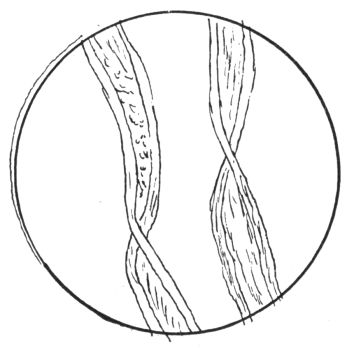
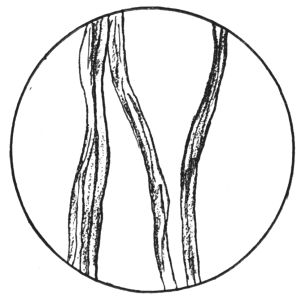
a microscope. Look at the fibers under the glass. You can see how hair
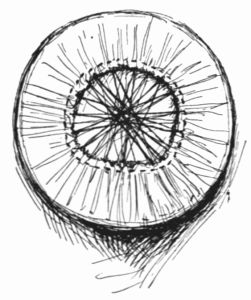
differs from wool. There are tiny
serrations on the wool surface which look like the scales of a pine cone,
lapping one over the other. This is a wonderful thing to see; for it is
on account of these tiny serrations which close up when in hot water
that one must be so careful about laundering woolens. Wool looks wavy in
length. It is fine and has a luster; while hair has a smooth surface and
lies straight.
Rosa Bonheur.
Fig. 115.—These peaceful looking sheep provide our wool clothing.
Have you ever seen sheep sheared of their wool? Perhaps it is
done on your farm. Sheep are usually sheared only once a year, in April
or May. If there are only a few sheep, it is easy to use the hand shears
like those in the picture (Fig. 117); but where there are many sheep,
the machine clippers must be used. These clipping machines can be run by
hand or other power. They shear close and save wool. Notice the machine
which the man in the picture (Fig. 118) is using; it is just like the one
Mr. Allen uses. Frank or John sometimes helps. The coating of wool from
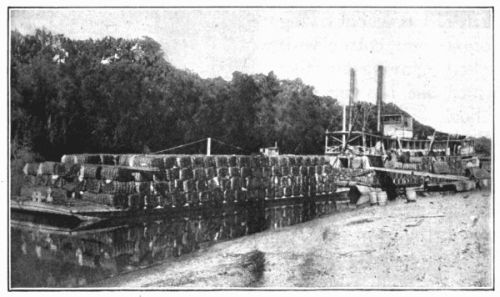
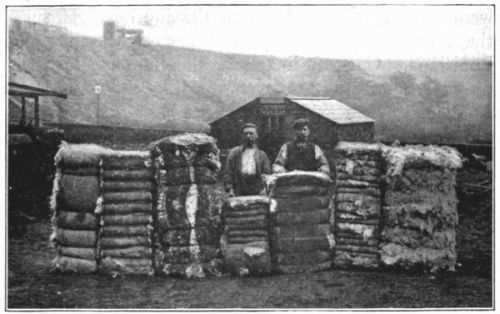
one sheep is called a fleece. On the large sheep ranches of the West the
fleeces are tied into bundles, and these bundles are put in sacks holding
about 400 pounds to be shipped to certain wool-purchasing centers where
the buyers examine the wool and buy in quantities.
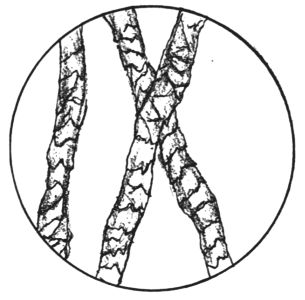
Fig. 116.—Wool fibers magnified.
What do you know about the sheep industry? Our sheep industry
is very important. The western states, Montana, Idaho, Wyoming, and
Oregon, support about 38 million sheep. That is a large family to shear
and feed.
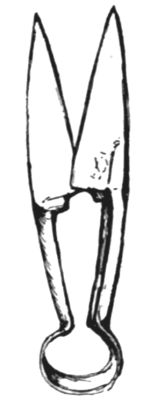
Fig. 117.—The
hand
shears.
Other countries grow sheep for clothing wools, too. Australia,
England, South Africa, South America, Spain, and Germany all give much
attention to sheep raising.
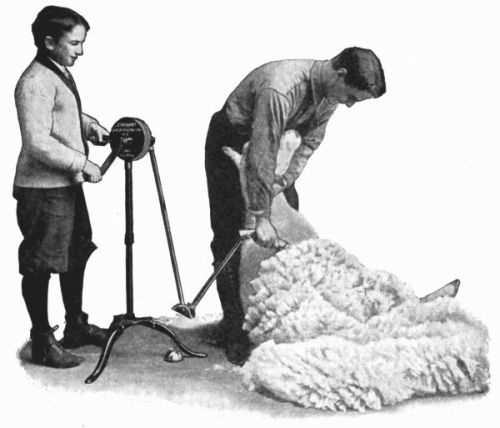
Courtesy of Chicago Flexible Shaft Co.
Fig. 118.—Sheep shearing by machinery.
This industry is very old. We read in the Bible that wool was used
long ago and that King David of Israel wrote psalms as he tended his
sheep on the hillside. Abel, the brother of Cain, was a keeper of sheep.
Can you find these stories in the Bible? Writers of many ages tell about
wool—Pliny, Homer, and Virgil. Alexander too, when he journeyed to
India in early days, saw beautiful woolen shawls being made.
Some sheep give a better quality of wool than others. The
Merino wool is the very finest. The camel furnishes a beautiful soft
fiber. Then, there is the angora goat of Asia Minor, which provides us
with mohair. This is a lovely soft fiber resembling silk. Can you find
this country on your map? Look for Peru and for Chili. The sheep there
furnish the alpaca and llama wools.
Some wool fibers are long, and some are quite short. The length
of fiber, or staple as it is called, varies. An average length is 7 or
8 inches. How does this compare with the silk or linen fiber? Is it as
long as cotton? The fibers also vary in strength and luster, fineness,
softness, and elasticity. What do these words mean? Can you find them
in your dictionary? The tiny serrations on the wool fiber cannot be
seen with the naked eye. They are, however, very important; for it is
this characteristic of wool which makes it felt, and, because these
tiny serrations interlock, it is possible to make the fine texture of
broadcloth and other fine wool materials. We shall study how later. Do
you think we wish the tiny serrations to interlock when we wash woolen
articles? If they do, what will happen to the garment? Do you know how
this can be prevented? If you have sheep on your farm or near, will you
bring some of the wool to school. It is dirty. Perhaps you can wash it
at school, and see how soft and fine and lustrous it is. You may also be
able to dye some. The center of the wool fiber is rather
porous, and this enables the fiber to take up dye easily.
The wool from some sheep farms varies on account of the differences
in climate, soil, and breed of sheep. The sheep of southern England
produce short and fine wool; while in the north, where it is colder, the
wool is stronger and coarser. Wools from Saxony and Silesia are very
fine. The English and Australian wools are of several qualities. The long
wools come from Lincoln and Leicestershire, and the shorter from Suffolk
and Shropshire. Can you find these places on your map of England? The
long coarse wools are used for carpets and for knitting, because they
are so strong. The short wools used for clothing are about 3 to 4 inches
in length. The long wools, about 10 inches in length, are called combing
wools and are used for materials which are loosely woven like serges,
homespuns, and others.
Next lesson we shall study our samples of woolen materials. Bring all
the scraps of different kinds which you can contribute. Put them in the
surprise box. We shall learn the names of the most common ones. Will you
make a sample book for these too?
EXERCISES AND PROBLEMS
1. Find on the map the principal countries producing wool.
2. If your teacher has a microscope, compare wool and hair.
How do they differ?
3. Why do woolen garments shrink when washed in hot water?
4. Why is wool the most important fiber of commerce?
5. Tell some of the uses of long coarse wools; of the finer wools.
SOME OF THE MOST COMMON MATERIALS MADE FROM WOOL
There are many materials made from wool. Let us learn to-day about
those which are used most commonly.
Perhaps some one in the class will sort the pieces in the surprise
box. Mollie Stark sorted those at Pleasant Valley School. Do not sort
according to color, but place them in three piles. We have the thick,
close materials, which are heavy and firm. Then we have the thin, sheer
ones. In the third pile, place the medium weight ones which look strong
and are wiry but not so closely woven and firm as those in the first
pile. Shall we learn about some of each kind?
Let us see what we have in the third pile of wiry, more loosely
woven materials. First we have the serges. Here are several
pieces. Some are fine with the twilled weave, and others are twilled
but the weave is coarser. They are very serviceable and are suitable
for bloomers, or for dress fabrics. Here is a sample of a plaid serge.
Marjorie Allen had such a dress last winter. It is possible to buy plain
colors too. Serges are woven quite wide, from 42 to 54 inches, and cost
from 75 cents to $3 per yard. Cheviots are very similar to serges in
price and width, but are somewhat heavier in appearance. The surface of
some is rather rougher than serge, although there are smooth cheviots
too. Have some samples of serges been sent from the store? You
must examine these, too, to see if you will select one for your
bloomers.
This coarse one in the same pile is a homespun, and this is
a tweed. They are both rough, wiry, loosely woven, and made
of rather coarse yarn. They are rather open in texture and were both
in olden times spun and woven by hand, but are now made by machinery.
Tweed gets its name from a place in Scotland. These materials are very
serviceable, especially for rough wear for suitings, coats, or dress
goods. The color or pattern is not always clearly defined, because the
yarn of which it is woven is mixed in color. Homespuns are somewhat
cheaper than tweeds. They cost from $1 to $3 per yard, and are woven from
42 to 50 inches wide. Tweeds are a little wider, 52 to 54 inches, and
cost from $2 to $4 per yard.
There are four samples in this pile, not quite so heavy. They
are cashmere, challie, albatross, and
henrietta. Have you ever heard these names before? They are all
common wool materials. They are often used for girls' school dresses, for
wrappers, and for baby wear. They are all softer than serges. Cashmere
and henrietta resemble each other. They both have a twilled weave.
Henrietta was originally woven with a silk warp. One can buy silk warp
henrietta to-day. Grandmother Stark has one. Is there a sample in your
box? Cashmere is also soft, and the finer qualities are made from hair of
the cashmere goat. Cashmere is woven 36 to 45 inches in width and can be bought
for from 75 cents to $1.25 per yard. Henrietta is about the same width
and price, except when it has silk warp. Then it is more expensive.
Challie and albatross are about the same weight. I am sure
you have all had a pretty challie dress sometime. Challies are
figured;—sometimes the pattern is woven in and sometimes printed.
It is made sometimes of a mixture of cotton and wool, or silk and wool;
but now challies can be bought in all cotton too as well as in all wool.
They come about 30 inches wide and cost from 50 to 75 cents per yard.
Albatross is also soft and a fancy weave. It too is used for dress
goods and costs about the same as challie, 50 cents to $1 per yard. It is
woven from 38 to 45 inches in width.
Let us now examine some of the heavy ones in the first pile.
Yes, every one knows the name of the heavy fine piece. It is broadcloth
and is used for coats and dress goods. There are also some lighter
weights of broadcloth with a smooth satiny finish. They are called
lady's cloth. A very good broadcloth is expensive, and costs about
$5 per yard. One can buy it for $1.50, but as a rule it is not very
satisfactory under $2 per yard. Broadcloth is closely woven, smooth, and
soft in finish. It is from 50 to 58 inches in width. Has any one at your
house a dress or coat made from this? Examine it and ask how durable
it has been. Father's winter overcoat was perhaps made of melton, or
covert cloth. Mr. Allen had such a coat last year. Examine
the samples. They are both heavy. Melton is about the same width as
broadcloth, 52 inches, and costs also from $2 to $4 per yard for a good
quality. It is used for suits, overcoats, and heavy garments. This is a
standard material and is usually dark blue or black. Uniforms are often
made from it.
Covert cloth is, also, used for overcoats and suits. It is heavy, but
differs from the smooth surface of broadcloth. It is a heavy twilled
cloth.
Felt and flannel are both in this heavy pile, although there are
some lightweight flannels. Felt is not woven, but is compressed, so
that the wool fibers are matted together in a flat mass. It is made 24
to 50 inches in width and costs from 80 cents to $1.50 per yard. I am
sure you all know its use. School pennants are made from it, and so are
some table covers. Flannel is woven. It is finished with a soft surface
which is slightly napped. What does that mean? It is a rather loosely
woven fabric, and is used for many purposes. Can you tell some? Yes,
petticoats, baby garments, waists, dressing sacques, shirts for men. It
costs from 50 cents to $1 per yard. Sometimes it is made of a combination
of cotton and wool, instead of all wool. It varies in width from 27 to 36
inches.
Let us examine some of the thin samples. Here is one which it
is almost possible to see through. It is called voile and is thin and
gauzy, like veiling. This sample near is called nun's veiling. It,
also, has an open mesh weave, and is a common wool material.
They are both used for dress goods, and are made in solid colors. There
are also some printed voiles, but they are usually made of cotton.
Wool voile costs from $1.25 to $2 per yard and is woven from 42
to 45 inches wide; while nun's veiling is narrower, 36 inches wide, and
slightly less expensive, from 75 cents to $1 per yard.
Here are some samples called etamine and grenadine.
They are similar to the voiles, of open mesh weave, and are used
principally for dress goods.
Bunting is another open mesh weave. We certainly all know its use.
Look at the flag flying on your schoolhouse. Bunting is about 24 inches
in width and costs about 35 cents per yard. It is sometimes made from
mohair.
Here are three samples: one called brilliantine; and another,
alpaca; the third, mohair. The brilliantine and mohair do not feel as
soft as the wool serges or cashmeres, but rather more wiry. They are made
from hair of the Angora goat. They are serviceable, for they both shed
dust and wear well. They are used for dresses or dust coats. The Alpaca
is made from the hair of the llama, which is bright, strong, and elastic.
All of these materials are bright and glossy. Here are their prices and
woven widths:
| Alpaca | 36-45 inches | 75 cents-$1 per yard |
| Brilliantine | 54 inches | 75 cents-$2 per yard |
| Mohair | 40-54 inches | 50 cents-$2 per yard |
There are still some common wool materials we have not
mentioned. Yes, blankets. They are made of cotton as well as
of wool, or of a mixture of the two. They cost from $7 to $30 per pair if
all wool. The combination of cotton and wool can be had for less.
Carpets are also made from wool yarn. They are woven so that the
yarn stands up in loops, and then these loops are cut as in velvet
carpet. In Brussels and ingrain carpets the loops are not cut.
Suppose you plan to arrange your sample books with three columns of
materials made from wool. You may have four or five columns if you prefer
to put the mohairs, alpacas, and brilliantines by themselves, and the
blankets and carpets in a separate column. That is the way the Pleasant
Valley girls arranged theirs. The first will be the heavy materials;
then the medium weight, and then the thin ones. It is easy to sort and
label them now that you know their names, uses, and widths. Before very
long we shall learn the story of how the wool fiber is made into so
many different kinds of cloth. It is treated by different processes in
manufacture in order to get a smooth close finish or a loose wiry finish.
We shall learn how.
EXERCISES AND PROBLEMS
1. Tell the difference between felt and flannel.
2. Name some heavy wool materials; some of lighter weight.
Tell where you have seen them used.
3. Look up the story of how carpets are made. Perhaps you
would like to study about rugs, too.
4. How do serges and broadcloths differ in appearance?
5. Plan to collect materials for the five columns of the chart.
Mount with prices and widths.
MAKING A PAIR OF BLOOMERS
Let us begin to make the bloomers to-day.
First, we shall lay the pattern. Some girls have probably
chosen serge for their bloomers, and some have ordered galatea or sateen.
The black or the blue are serviceable. Suppose you cut them out to-day.
You have studied the pattern which your teacher had. Perhaps some girls
will find it necessary to add in length or width. Your teacher ordered
the pattern by size, according to age. 14-year size was chosen. Perhaps
you must make yours smaller or larger. One pattern can be adapted to
the whole class. This you allowed for, in ordering the amount of cloth.
Let us place the pattern carefully. Be sure that the perforations which
indicate lengthwise of the material are placed on the warp. Can you cut
out both legs at the same time? Can you tell where to place the two
strips for the bands, and for the placket facings? Which way of the
material will the length of band and facings be cut? Pin carefully in
place and cut with an even motion. It will perhaps be safer to mark the
notches
with a pencil or with a white thread. Girls sometimes forget—cut
the notches too large and spoil the cloth.
Then we shall learn to make a flat felled seam. The two legs
are to be sewed up on the right side. Be very careful not to make both
legs for the same leg. That is the mistake Marjorie Allen made. Baste the
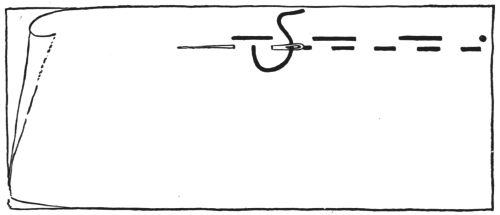
seam ½ inch wide. Then stitch close to the basting. Cut off one
edge of this seam to within 1⁄8 inch of the
stitching, and lay the other edge of seam flat on the cloth for the fell.
Turn in the raw edge, baste, and stitch flat. This must be done very
carefully, for it is very easy to make a fell which is wrinkled and full
instead of flat (see Fig. 119).
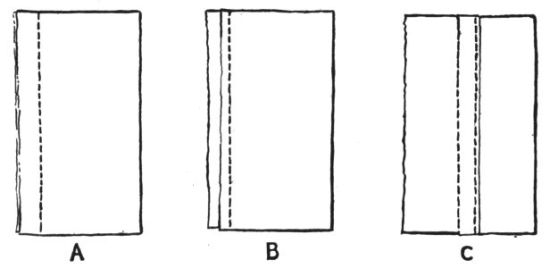
Fig. 119.—The flat fell, showing the three steps in making: A, the seam
stitched; B, one edge cut; C, the turning of the other edge flat, to be basted
and stitched.
Join the two legs together at the center with the same flat fell. Be
sure to have the two leg seams come together. This is important.
The placket openings lie over the hip. A single strip may be used to
bind this opening, or a regular placket may be made according to your
pattern. If a strip is used, cut it lengthwise of the cloth and one inch
longer than twice the length of placket opening. If cut 2½ inches
wide, the finished facing will be one inch in width. Place the right
side of the strip to the right side of the bloomers. Baste ¼ inch
seams, holding strip all around the placket opening; and then stitch.
Turn to the wrong side, turn in ¼ inch and baste, stitch again.
Care must be taken at the bottom of the placket opening to make the seam
of sufficient width so that it will not pull out.
At the bottom of each leg make a hem, one inch wide finished. Stitch,
leaving one inch open. This is the opening for the elastic band. Run in
the elastic before completing the hem by hand.
Now we are ready for the bands. There is one for the front and
one for the back. If your pattern allows for fullness, gather to fit
½ of your waist measure. It will be necessary to measure your
bands and to allow the two inches for lapping on the back band. The front
band is usually shorter than the back. Fasten the bloomers so that they
lap towards the front.
To put on the band, work in the same way as in putting on the apron or
petticoat band, except the band is turned to the right side for tailor
finish on a garment with flat fells. Begin by placing the right side of
the band to the inside of the front, and also
back of the bloomer portions. Baste, stitch, turn to the right side.
Snaps may be used, or buttons and buttonholes, for closing. Buttonholes
can also be placed at the center front and at the back of the bands, if
the bloomers are to be fastened to a waist. How shall the buttonholes
be placed in cutting for fastening in this way? Do you think it is very
difficult to make the bloomers? The girls who use serge can make the
placket facings and bands of silk or sateen or some lining material which
will be thinner. Only the most experienced Pleasant Valley girls used the
serge—those who had sewed at home.
EXERCISES AND PROBLEMS
1. What are the important things to remember in cutting out
the bloomers?
2. How does the band of the bloomers differ from that put on
the petticoat?
THE STORY OF HOW WOOL IS MADE INTO CLOTH
The Pleasant Valley boys and girls learned how wool is made into
cloth after it has been sheared from the sheep. Would you like to
know?
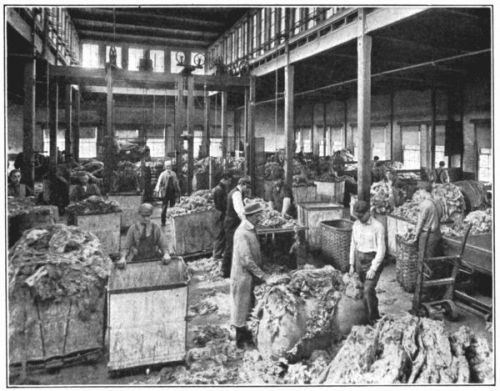
Courtesy of M. J. Whittall.
Fig. 120.—Wool sorting.
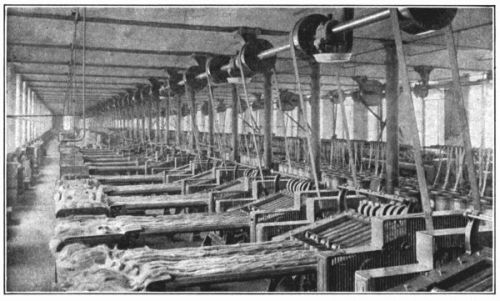
First, the wool is sorted. Wool sometimes travels a long
distance before it is delivered to the manufacturer. Perhaps the wool in
your skirt was grown in England or in Australia, and was shipped in great
sacks to New York, and then to the manufacturer. As it is
sheared from the sheep, it is dirty and full of burrs, grease, and
perspiration. This grease helps to preserve the wool until the
manufacturer is ready to use it; and, although he buys the wool by
weight and pays for dirt and grease, he prefers to do so because of the
preserving qualities of the grease. Even ⅔ of the weight may be
dirt and grease. The first thing the manufacturer does is to sort the
wool to put the good grades together, and to separate them from the poor
ones. You remember the fleece is the whole coat of
the sheep. Some parts of this coat are better wool than others;
especially the part from the head and upper part of the back and sides.
About seven different grades are separated for different purposes.
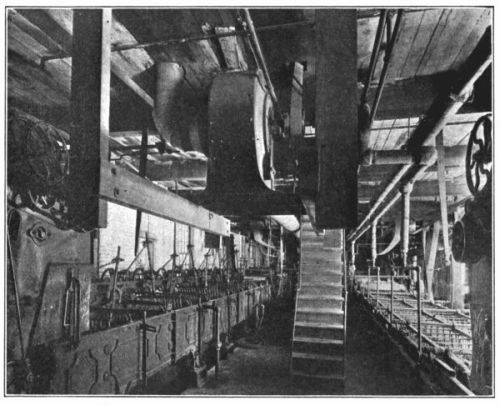
Courtesy of M. J. Whittall.
Fig. 121.—Wool washing or scouring.
The second process is washing or scouring. Wool cannot be
carded and spun until the dirt and grease are removed; so the next thing
the manufacturer does is to remove the grease, or "yolk" as it is called,
by washing. This must be done very carefully so as not
to break or injure the wool. Perhaps you can bring some dirty wool from
your farm to school and wash it. Soft soap is the most harmless. Use a
soft water at a low temperature (120° F.). Can you tell why it must be
low? The washing is done in a series of tanks. You can see them in the
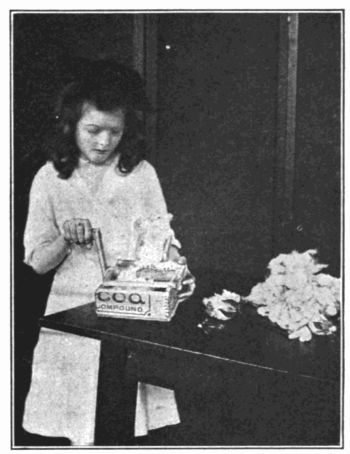
picture (Fig. 121). The wet wool is swished back and forth by means of
wooden forks which carry the wool forward and beat it out. There are
rollers for passing the wool from one tank to another. Then the wool must
be dried. This is done in a kind of wringing machine called a "hydro
extractor." Then it is beaten into a fluffy mass.
Then a strange thing happens. Oil in wool is necessary in order to
help in the spinning and to keep it soft and elastic, so the manufacturer
must return some oil to the wool, after having washed it all out. Olive
oil is used.
If there is any dirt or any burrs left in the wool, they must be
removed. A machine called a burr picker is used to beat out the dirt.
Then the wool is blended. Do you know that the wool skirt which
you are wearing may not be made of all new wool? Wool can be used over
and over again. Old wool rags are pulled apart and mixed with new wool.
If this did not happen, the manufacturer would have to charge much more
than you pay for serge or some woolen materials, as he would have to use
all new wool. That is why some wool materials are so expensive.
If only new wool were used, there would not be enough raised in the world
to clothe everybody. The wool manufacturer, therefore, blends, or mixes,
the wool before it is sent to the carding machine. In blending he knows
just what color, style, and grade of material he wishes to produce, and
he grades accordingly. Cheapness is one of the principal reasons for
blending. Sometimes cotton or jute are mixed in, if the manufacturer
wishes to produce a very cheap material which is not all wool.
Would you like to know the names of some of the all-wool substitutes
which are used in reducing the cost of all-wool materials? Marjorie
Allen's grandmother told her, and Marjorie told the League girls. Shoddy
is one; it is made from old rags, like woolen stockings, flannels, soft
underwear; materials which have not been felted together. Do you know
what felted means? The rags are washed, ground up, and prepared to mix
with the new wool. Mungo is another queer name which is given to woolen
rags which have been felted, as broadcloth or men's suitings. Flocks
is nothing but dust or waste from the clipping machines when cloth is
sheared or clipped in finishing. This is used to fill in. So you see
nothing is wasted.
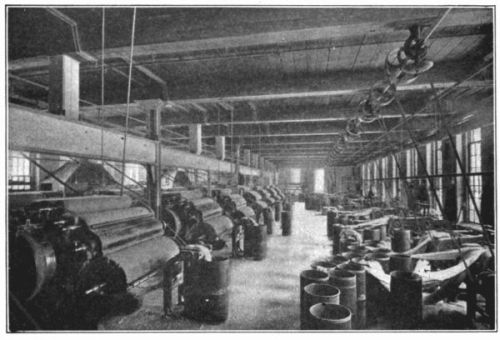
Courtesy of M. J. Whittall.
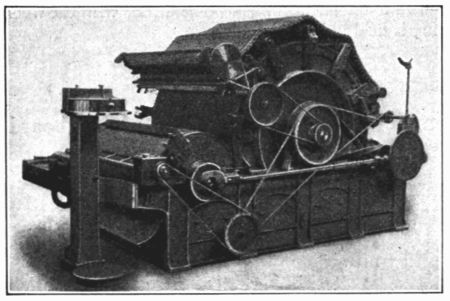
Fig. 122.—Wool carding. Notice the round cylinders. The gauzy web is being
delivered into the can in front of the carding machine.
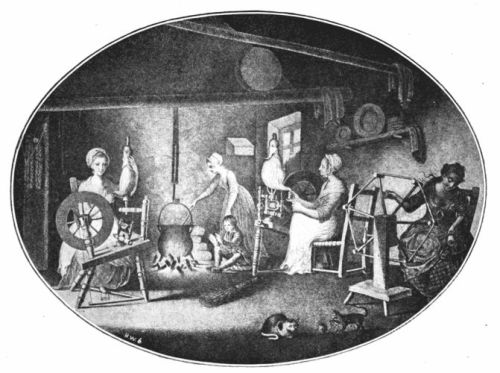
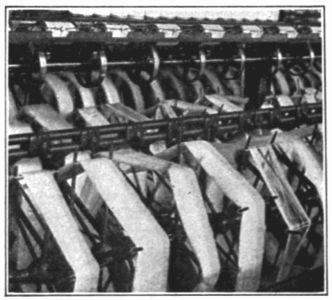
The next process after blending is carding. Do you remember
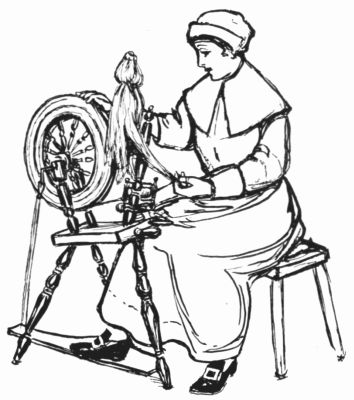
how cotton is carded? Long ago, when Marjorie's grandmother was young,
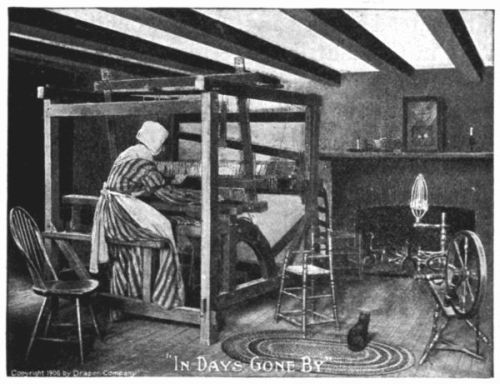
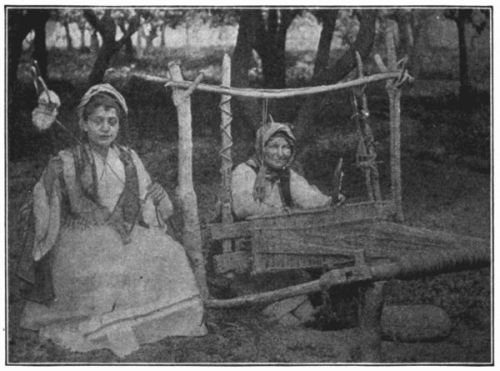
wool was carded by hand. Look at the picture on page 77 and see how
Grandmother Allen holds the cards. She is preparing
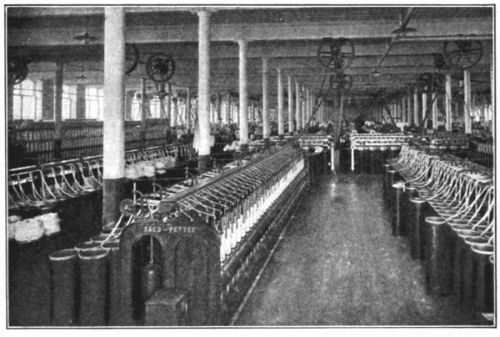
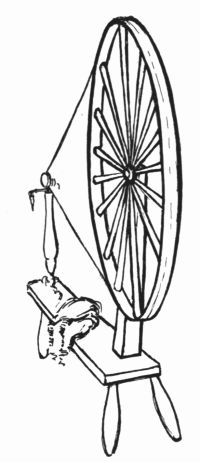
rolls of wool for the spinning wheel. The manufacturer must prepare the
slivers, or rolls like ropes of wool, for the spinning frames as they are
called to-day. The machine which helps to produce these ropes is called
the carding machine. It also helps to clean the dirt from the wool. The
picture (Fig. 122) will show you how the wool carder looks. There is
a center cylinder and around it revolve small cylinders. They are all
covered with wire teeth which help to pull the wool apart and to cleanse
it. If you were to stand before the machine, you would see a gauzy, filmy
sheet of wool the width of the long rollers as it leaves the machine.
The wide gauzy mass is pulled together as it is drawn through a hole at
the front of the carder and is delivered or wound up in the can, just as
we learned the cotton was delivered. This wool roving is then wound on
spools and is ready for spinning. Do you remember the story of how cotton
is drawn out and twisted and wound on spools? Wool too must be spun and
made into yarn, before yarn can be woven into cloth. The manufacturer
makes woolen yarn and also worsted yarn. Do you know the difference? We
shall study in our next lesson about them.
EXERCISES AND PROBLEMS
1. Ask your grandmother to tell you about sheep raising on
the farm, when she was a girl.
2. Tell why the manufacturer must blend old and new wool.
What are the names of some old rags of wool used for this purpose?
3. Tell how carding was done in olden times. How is wool
carding done to-day? Why is carding an important process
in the manufacture of cloth made from wool?
SOME FACTS TO REMEMBER IN PURCHASING WOOL CLOTHING
Why does the manufacturer use woolen yarn in weaving some
materials and worsted yarn for others? If one knows this, it
will be a guide in purchasing wool materials. The Pleasant
Valley girls know.
The difference between woolen and worsted yarns.
Before you can answer the question for this lesson, you
must learn the difference between woolen and worsted yarns. Worsted yarn
is prepared from the sheep giving long wool. It is prepared by processes
which comb it until all the short fibers are removed and only the long
straight ones are used. This combing prepares the long wool fibers for
spinning so that they lie parallel. This makes an expensive yarn because
so much is combed away. This fine combed worsted yarn is used for high
grade worsted materials, as some cheviots or fine tweeds, and for
underwear.
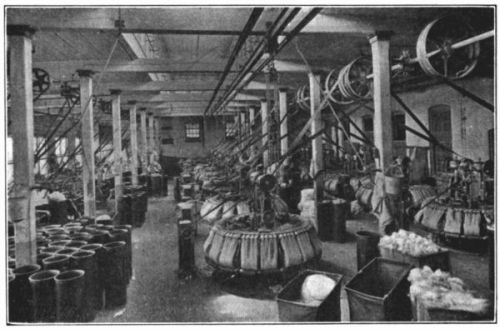
Courtesy of M. J. Whittall.
Fig. 123.—Wool combing for high grade materials. There is much waste.
Woolen yarn is not combed to remove the short
fibers. It is, instead, carded a great deal so that the
wool fibers are well mixed and the serrations of the tiny
fibers arranged so that they will interlock, when put in water of high
temperature, and the gelatinous scales are opened up. Woolen yarn is
woven into broadcloths and meltons. After the weaving the cloth is put
into vats where the temperature opens up the serrations and the scales
interlock, and make a close, smooth piece of cloth. This is called
fulling. Isn't this interesting? Do you see why the manufacturer uses
worsted instead of woolen yarn for making underwear? If worsted yarn were
used for making broadcloth, there would not be the same close finish. The
worsted yarn is combed and the fibers are not in position to interlock
as in the woolen yarn (Fig. 124). Can you answer the question now why
worsted yarn is used sometimes and woolen at others?
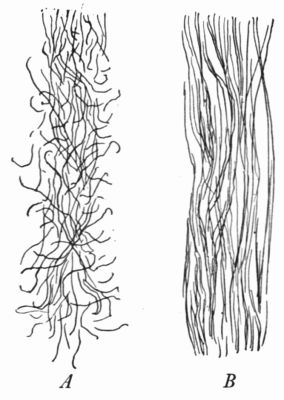
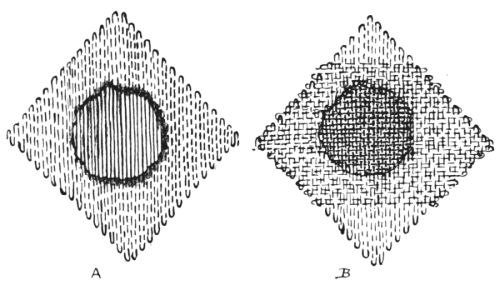
Fig. 124.—This shows the difference
in the slivers of wool and worsted yarn. A is the woolen yarn, well
mixed; B is the worsted yarn, well combed.
After the yarn has been spun, it is woven into cloth just as cotton
is prepared and woven. Woolen yarn is fuzzy; cloth made from it is woven
loosely and then it is put into vats and shrunken or fulled until the
cloth is compact, as broadcloth.
Worsted yarn when made into cloth is shrunken very little or not at
all. It is woven as it will appear.
Beautiful homespuns and worsted suitings are the result.
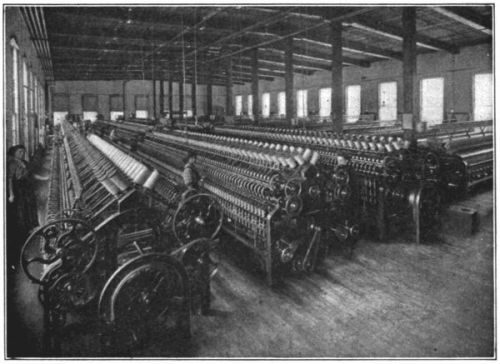
Courtesy of M. J. Whittall.
Fig. 125.—The spinning of wool into yarn.
Many fabrics made of wool are of simple weave like the plain homespun,
but complicated patterns are also woven of wool. The yarns are arranged
in the loom in the same way as the cotton about which we studied. Many
beautiful patterns are made in woolen materials, even the complicated
patterns of double cloth weaving like the old-fashioned golf capes, made
of doubh, which were worn a few years ago.
So you can see that the manufacturer must know
whether he is to adulterate his wool cloth with cotton or reduce the cost
of production by using mungo, shoddy, or flocks. Flocks is put in when
the cloth is shrunken or fulled in the vats. The short pieces and dust,
or flocks as it is called, are drawn in as the serrations open and the
cloth is shrunken.
This is all useful to know, for it helps one in purchasing materials.
Most of us cannot afford to buy cloth made of all new wool, but we should
be able to tell whether cloth is made of cotton and wool mixed, or all
wool. We will know by price whether the all wool is new wool or not. No
shopkeeper should sell a cotton and wool for all wool. When we have our
textiles labeled as foods are now labeled, we shall be able to tell.
What have you learned to-day which will help you in purchasing wool
materials?
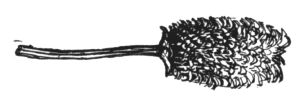
Fig. 126.—This is the teasel
which is used to brush the nap of the cloth in finishing. These small
thistles are arranged in rows in the machine rollers through which the
cloth passes.
Woolen and worsted yarns are used also in the manufacture of carpets,
rugs, hosiery, blankets, underwear, and also for knitting purposes. Do
you know how to knit? Does any one know at your home? It is a useful and
pleasant accomplishment. Shawls, afghans, caps, and sweaters can all
be knitted. Miss James taught the Pleasant Valley girls to knit bright
scarfs which they wore for tobogganing the next winter. Some girls made
them for sale.
Points about buying woolen garments. Here are a few things
to think about which Miss Travers from the State College told the
Mothers' Club of Pleasant Valley to remember in buying wool garments or
materials.
1. Wool mixed with cotton should not be sold for all wool. It is a
cheaper fabric. It wears fairly well, but is not so warm. Pull the fabric
apart, untwist the fibers to see if cotton is present.
2. Garments bought ready-made of cotton and wool do not keep their
shape as well as all wool garments.
3. Burning a piece of the fabric will help you to identify the fiber.
Wool burns slowly, chars, and gives off an odor of burned feathers.
Cotton burns quickly with a flame.
4. A good wool material can always be used over again. The inexpensive
is not cheap unless you wish something which does not look well or wear
well but is cheap.
5. Remember that a close twill weave is more durable than a basket
weave. Think about this in buying; for the weave of material affects the
wearing quality.
EXERCISES AND PROBLEMS
1. How is yarn which is to be used for underwear treated in
manufacture? Why?
2. How does this treatment differ from yarn used in the manufacture
of broadcloth?
3. What are some of the things your mother thinks about when
she buys a garment made from wool, in order to get good value
for her money?
THE CLOTHING BUDGET
Have you ever thought how much your clothing costs father and mother
every year? Marjorie Allen and Barbara Oakes tried to figure the cost
one day. Girls must begin to learn how to spend wisely, for they will
very soon have the responsibility of being spenders. If you can make
some of your clothing, you will help to reduce the cost. Would you
like to learn to make a budget as well as a simple dress skirt to
wear over the bloomers? Suppose we study to-day about the clothing
budget.
Have you ever tried to calculate how much is spent each year for
your clothing? If not, suppose you try. Girls who know how to make
some articles of clothing can have more for the same amount of money.
Suppose you send for the material for your dress skirts. It is wise to
learn to make a very simple skirt first. Choose a simple pattern. Your
teacher will help you. What material will you use? Perhaps you would like
a middy blouse later to wear with the skirt. Can you name some suitable
cotton materials to use for this purpose? Yes, Indian head, galatea,
duck. You have studied about all of these and should have them in your
sample books. Such a dress will be suitable for school wear. Talk with
your teacher and calculate how much cloth you must buy for your skirt and
middy. While you are waiting for the cloth you have ordered, let us study
how Marjorie's Cousin Ann, who works at Paterson, manages to plan each
year for her clothing.
She has such good plans. Do you know that such a plan is called a
budget?
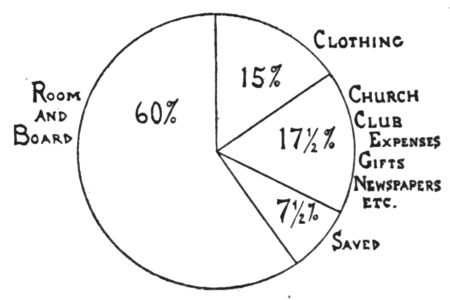
Fig. 127.—Cousin Ann's division of her
money. How much was for clothing?
Would you like to learn to make your clothing budget? Ann earns
$10 per week and her room and board cost her $6 per week, so she has $4
for other expenses. She puts aside $1.50 each week for clothing, and so
has $6 per month or about $75 per year. She lives near her work so does
not have daily carfare, and she goes home at the noon hour for a little
rest and for lunch. The rest of her money she divides in this way: Each
week she tries to save 75 cents or $3 per month. The rest she uses for
church and club expenses, for gifts, newspapers, or occasionally she
buys a new necktie or an extra waist; but usually the $75 supply all
her clothing needs. This is how she manages. She plans for more than
one year, usually trying to keep three years in mind. Ann also goes
to the Girls' Club and has learned to make her waists and some simple
dresses.
The following is what she bought the first year. Remember she had some
clothes to begin with before she started to keep her clothing budget.
Your budget will of course be different from this, but this will show how
Ann manages with $75. Some things which she
needs you may have no use for in your section of the country. Try to plan
what you would substitute. This will at least be a working basis for you,
and will give you some suggestions for making yours. Marjorie Allen and
Barbara Oakes have made their clothing budgets. They have $60 per year
for clothing. What do you think they omitted from this list? The things
marked * are made at home. Ann's mother helps her; but Ann learned to
make clothes at her Sewing Club.
First Year
| 2 union suits (winter) @ #2.00 | $4.00 |
| 3 union suits (summer) @ .50 | 1.50 |
| 1 flannelette nightdress @ 1.00 | 1.00 |
| 1 flannelette nightdress left over | |
| 2 night dresses @.80 | 1.60 |
| *3 corset covers @.50 | 1.50 |
| 2 pairs of corsets @ 2.00 | 4.00 |
| 6 pairs of stockings @.25 | 1.50 |
| 2 pairs of garters @.25 | .50 |
| shoes: 1 high lace @ 3.00 | |
| 2 pairs low shoes @ 2.50 | 8.00 |
| 1 pair rubbers | .75 |
| 1 black sateen petticoat | 1.00 |
| 1 long white petticoat | 1.25 |
| 2 short white petticoats @.75 | 1.50 |
| retrimming last year's best winter hat | 1.25 |
| summer hat (new) | 4.00 |
| 1 straw hat, common wear | .75 |
| 1 umbrella | 1.00 |
| *1 wool dress skirt | 4.00 |
| *3 shirt waists: 2 tailored @ 1.00 | |
| *1 fancy @ 1.50 | $ 3.50 |
| 1 winter coat | 12.00 |
| 1 spring coat (left from last year) | |
| 1 pair kid gloves | 1.50 |
| 1 pair wool gloves | .50 |
| 1 wool dress (winter, bought close of season) | 12.00 |
| 1 sweater | 3.00 |
| *1 summer dress | 3.00 |
| *1 white duck dress skirt | 1.00 |
| 1 party dress (left over from last year) | |
| Gloves, handkerchiefs, neckties, collars | |
| received for Christmas. | |
| | ——— |
| Total | $75.60 |
Notice that in the second year some articles are left over from
the year before. This is because Ann has foresight. She is a
good manager, and takes care of her clothes too, and plans ahead.
Do you?
Second Year
| 2 union suits (left from last year, winter) | |
| 2 union suits (left from last year, summer) | |
| 1 new union suit summer | $ .50 |
| 2 flannelette nightgowns (left over) | |
| 2 summer nightdresses (left over) | |
| 1 new summer nightdress | .75 |
| *3 corset covers @.50 | 1.50 |
| 2 pairs of corsets @ 2.00 | 4.00 |
| 6 pairs of stockings @ .25 | 1.50 |
| 2 pairs of garters @.25 | .50 |
| shoes: 1 high laced @ 3.00 | |
| 1 pair low shoes @ 2.50 | |
| 1 pair low left over, half soled @ .75 | |
| 1 pair high laced, half soled @ .75 | 7.00 |
| 1 pair rubbers | $ .75 |
| 1 black sateen petticoat | 1.00 |
| 1 long white petticoat (left over) | |
| 2 short white petticoats (left over) | |
| 1 new short white petticoat | .75 |
| 1 winter hat | 5.00 |
| 1 winter hat (left over) common wear | |
| 1 summer hat (retrimmed) | 1.50 |
| 1 new summer hat (second) | 2.00 |
| 1 umbrella (left over) | |
| *1 wool skirt (refreshened) | 1.00 |
| *2 shirt waists (plain) @ 1.00 | 2.00 |
| *1 extra white waist @ 1.50 | 1.50 |
| 2 shirt waists (left over) | |
| 1 winter coat (left over) | |
| 1 spring coat (new) | 12.00 |
| 1 pair kid gloves | 1.00 |
| 1 pair wool gloves (left over) | |
| 1 wool dress (left over) | |
| 1 sweater (left over) | |
| *1 summer dress (left over, remodeled) | 1.00 |
| 1 white duck skirt (left over) | |
| *1 new white duck skirt | 1.00 |
| *1 party dress | 8.00 |
| 1 coat suit, bought end of winter season | 14.00 |
| 2 gingham aprons | 1.00 |
| 1 gingham house dress (ready-made) | 1.50 |
| 1 summer dress | 4.00 |
| | ——— |
| Total | $74.75 |
Try to find below, in the list for third year, the articles left over.
Also new articles which will be of service the fourth year. Do you
not think it is wise to plan in this way? Marjorie and Barbara
have enjoyed making their budgets.
Third Year
| 2 union suits, winter @ 2.00 | $ 4.00 |
| 2 union suits, summer @ .50 | 1.00 |
| 1 union suit, summer (left over) | |
| 2 flannelette nightgowns @ 1.00 | 2.00 |
| 1 new summer nightgown @ .75 | .75 |
| 1 summer nightgown (left over) | |
| *3 corset covers @ .50 | 1.50 |
| 2 pairs corsets @ 2.00 | 4.00 |
| 6 pairs of stockings @ .25 | 1.50 |
| 2 pairs garters @ .25 | .50 |
| shoes: 1 pair high laced @ 3.00 | |
| 1 pair high laced repaired, left over, @ .75 | |
| 1 pair low shoes (new) @ 2.50 | |
| 1 pair party slippers (new) @ 2.00 | 8.25 |
| 1 pair rubbers | .75 |
| 1 black sateen petticoat | 1.00 |
| 1 long white petticoat | 1.25 |
| 1 new short white petticoat | .75 |
| 1 short white petticoat (left over) | |
| retrimming last year's winter hat | 1.25 |
| 1 winter hat (common wear) | 1.50 |
| 1 summer hat (new) | 5.00 |
| 1 summer hat (remodeled, common wear) | 1.00 |
| 1 umbrella | 1.00 |
| *1 wool skirt | 4.00 |
| *2 shirt waists (plain) @ 1.00 | 2.00 |
| *1 extra white waist @ 1.00 | 1.00 |
| 2 shirt waists (left over) | |
| 1 winter coat (left over 2 years) | |
| 1 spring coat (left over one year) | |
| 1 pair kid gloves | 1.50 |
| 1 pair wool gloves | .50 |
| *1 wool dress (remodeled after 2 winters' wear) | $ 3.00 |
| 2 white duck skirts (left over) | |
| 1 party dress left over (refreshened) | 2.50 |
| 1 coat suit (left over) | |
| 2 gingham aprons (left over) | |
| 1 gingham house dress (new) | 1.50 |
| 1 gingham house dress (left over) | |
| 1 summer dress remodeled | 1.00 |
| 1 new summer dress | 4.00 |
| 1 raincoat | 5.00 |
| 1 wool dress (bought towards close of season) | 10.00 |
| 1 pair winter arctics | 2.00 |
| | ——— |
| Total | $75.00 |
EXERCISES AND PROBLEMS
Plan a clothing budget with mother's help, and see how yours
will differ from the above. Perhaps mother spends less for your
clothes or more. Mrs. Allen says that Marjorie is learning to purchase
so wisely that next year she may buy all of her own
clothes. Of course, Mrs. Allen will always be willing to help
when Marjorie needs her.
PLANNING TO MAKE A DRESS SKIRT OF COTTON MATERIAL
Let us begin to make our dress skirts.
Open the pattern carefully and examine it. How did you order
it, by age or by waist measure? The pattern books usually say order by
age for a girl unless she is large or small for her age; then order by
waist measure.
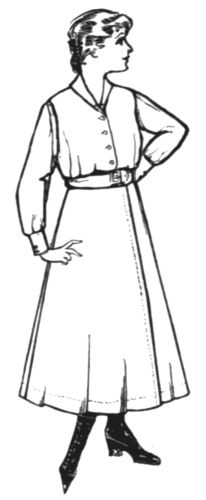
Fig. 128.—The
simple dress skirt
and shirt waist.
Notice how many pieces you have. Notice whether
some are to be cut on a lengthwise fold: perhaps, the
center front and maybe the center back if it has a panel front and back.
Notice how many gores there are. Do you know what a skirt gore is? Look
at your pieces. A gore is always wider at the bottom than at the top. Can
you tell why? Gores are of different shapes. Style sometimes regulates
the width, for some seasons skirts are very narrow and at other times
very full. The gores help to reduce the fullness around the waist. Do you
understand? Notice how many gores your pattern has. The front panel is
counted as one gore, and the back panel a gore. There are skirt patterns
with three, four, or even eleven or more gores. Perhaps your pattern has
three gores like the one in the picture (Fig. 128). Then the center back
will be cut on a lengthwise fold of material, as there will be two front
gores joining the back with seams at the hips. This is an easy pattern
and suitable for a young girl. One must think of suitability in selecting
the style to be worn. Instead of three, you may have a plain five or
seven gored skirt. Then the center front will be placed on a lengthwise
fold, and there will be two gores each side of the front for the five
gored skirt, and three each side of the front for the seven gored. A five
gored skirt is a simple one.
Study your pattern. Notice all the notches; also just where
the pattern is to be placed on the warp threads. This is very necessary.
Take your tapeline and measure the skirt length; compare with your own
measures. Your teacher will show you how to take your skirt measure,
at front, hips, and back, from the waist line to the desired length
(see page 50). You have learned how. Pin the tapeline about the waist
and measure from it. If your pattern is too long, it will be wise to
double it over at the center to reduce the length. If too short, add
a few inches at the bottom in cutting your cloth. Remember you must
allow for the hem according to desired width (see page 50 for changing
patterns).
Now lay the pieces economically. Remember the wide end of the
gore usually cuts to best advantage at the end of the cloth. Pin and cut
out after your teacher has approved.
The pattern usually allows from 3⁄8 to 1 inch for seams.
Notice how much. Match the notches, pin, baste, and then try on. If too
loose or too tight, it is possible to stitch inside or outside of the
bastings and so to alter. The seams can be finished by overcasting the
rough edges (see Fig. 28).
If your pattern calls for an opening or placket at one side of the
front, it will be appropriate to make a hem running lengthwise of the
skirt as a finish at the placket, and the skirt will not be seamed with a
simple seam at that place. Turn to the wrong side one inch
for hem along the right front. Baste. Lap this hem over the left side.
Baste flat to the left portion of front, and stitch nearly one inch from
edge, to within 8 or 9 inches of the top. The placket opening on the
under side of front can be bound with a two inch strip, sewing on right
side at the edge and turning to wrong just at the edge. If the pattern
does not allow for a hem on right front and lap finish on the right side
of front, but only for a simple seam, then it will be necessary to face
the right front portion with a strip 1½ inches wide.
Pin the skirt to the belting. It is possible to turn in the
skirt edge at top of belt so that it comes even with the top of the
belt. This makes a slightly raised waist line. Stitch neatly at the top
edge. Turn hem at the bottom the desired width and baste carefully. The
stitching of the hem can be done on the right side for neater finish if
the basting is done with care.
Sew on hooks and eyes. Be careful to attach the hooks so that they
will not show on the outside of skirt.
Mollie Stark was so successful with her skirt that she made one
for her older sister Ruth, and also won the prize at the County Fair
contest.
EXERCISES AND PROBLEMS
1. Study some of the skirt patterns which mother has at home.
Compare with the one used at school.
2. What is a skirt gore? Describe. Draw on the blackboard.
3. Give some suggestions for economical cutting.
CLOTHING IN RELATION TO HEALTH
Do you know that clothes help to keep us well? The Pleasant
Valley girls learned how, and we are to study, too.
Well people are usually happy people and they can do many more things
for themselves and for others than sick people. Have you ever thought
about this? All people wish to be well, but many are not because they
forget that it is absolutely necessary to think each day about keeping
well. There are many things which help to accomplish this. One cannot
wait until the end of the month or year to think about keeping well, but
must do so every day, as you have learned. Exercise and good habits,
sleep, proper food, recreation, and proper clothing all have a share.
Clothes are more important than people think. Ill health is often the
result of lack of thought in the protection of the body. Let us study how
clothes affect health. You know clothing helps to keep us warm or cool,
if we dress properly. You have learned how necessary it is to preserve
an even body temperature. Growing girls must think about this, for no
girl is well dressed who does not think about the relation of clothes to
health. Is a dress really beautiful if it is unhygienic? Miss Travers
told the Mothers' Club that clothing should serve our use in the best
way, should be pleasing and artistic, but also comfortable enough to
permit freedom. Did you ever feel sorry for the poor Chinese women
who squeeze their feet? Many American women squeeze their waists as
well as their feet. This prevents proper circulation of the blood and
causes many complaints, loss of hair, and serious troubles, because the
circulatory system cannot carry nourishment to the many parts of the
body.
Perhaps you have noticed some girls wear very thin stockings, low
shoes, and low-necked dresses; really very scant clothing in cold
weather. Is this a good practice, do you think? Why not?
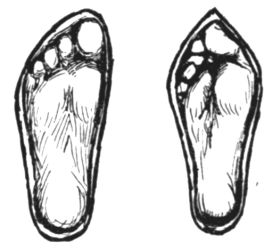
Fig. 129.—Shoes are
important. Why?
Heat and energy are generated by the body. We have learned that it is
a machine. Food, water, exercise, rest, keep it going. Heat and energy
are the result and are needed if the machine is to run well. If the heat
is all carried away quickly because the surfaces of the body are exposed
to the cold, then there is a waste of the energy which should go to
provide for the necessary workings of the body.
Why do we wear clothing? The principal reason is that the body
may be protected from the cold and that the temperature of the body may
be kept constant. It protects also from sharp, hard objects and briers
and stones which might injure the feet. Many people think only of the
decoration. This does affect our choice of clothes too, but should not be
the prime consideration. Miss Travers told the girls of Pleasant
Valley to keep these things in mind in choosing clothes:
Some things to remember in choosing wearing apparel.
1. Adapt your clothing to your work. One cannot do garden and house
work in stiff collars and unsuitable clothing.
2. The condition of health will affect choice. Strong, well people do
not need the same kind of clothing as sick or delicate people.
3 Age makes a difference; young people are more vigorous than old
people. Babies feel the heat or cold more than adults.
4. Clothing should be chosen in relation to climate and temperature;
in winter, one should prevent an undue loss of heat, in summer, clothing
should not interfere with loss of heat.
Some important things about wearing clothing.
1. Wet clothing is very dangerous and should be removed at once. If
this is not possible, exercise, keep moving, until there is opportunity
for a rubdown and change. John Alden always runs when he gets his clothes
very wet.
2. The clothing worn next to the skin should be changed twice a week.
The body gives off impurities which are absorbed by the clothing. This
change is necessary if one wishes to keep well.
3. Clothing worn at night should be aired during the day, not shut up
in a closet or folded and placed under a pillow.
4. Clothing worn during the day should be aired at night. This is
necessary for health. The same underwear should never be worn day
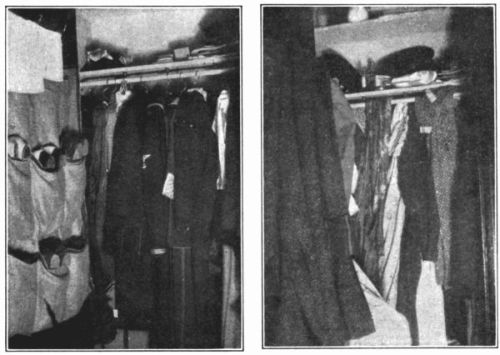
and night both. How do you air your clothes? (Fig. 56.) Many mothers
do not change baby's shirt at night and wonder why he cannot sleep
and is so cross. Sometimes this irritability is due to this very
cause.
5. Outer garments should be rather closely woven, so that the wind
cannot penetrate and carry the heat away too rapidly.
6. Heavy garments are a great burden. One wearing them is not free to
act or work.
Next lesson we will study about selecting our clothes, shoes,
underwear, and other garments with reference to health.
EXERCISES AND PROBLEMS
1. Write on the blackboard some important things to remember
in choosing wearing apparel.
2. Tell some important things to remember in wearing clothing.
MORE HEALTH PROBLEMS IN CHOOSING CLOTHES
Clothes help to keep us well. Let us study about the wise selection
and use of them.
Buying shoes. When Barbara Oakes goes to buy a pair of shoes
what do you suppose she thinks about besides the fact that they are
pretty and that she likes or dislikes them? She remembers that they
should fit her feet. She thinks about these things:
1. They should suit her purpose, be adapted to her use.
2. They should fit the instep and heel snugly.
3. They should be straight on the inside line.
4. The heel should be broad enough to balance the body well.
5. The soles should be strong enough to walk, and thick enough so
dampness cannot strike through.
6. There should be plenty of room for the toes to move. (See Fig.
129).
7. They should be long and wide enough for comfort. Tight shoes are a
strain on the body.
Many girls have "fallen arch." This affects the whole nervous system
and makes them ill. Many are suffering and do not know the cause. Barbara
Oakes was ill for a long time before her mother or the doctor knew why.
It is not necessary to wear an arch supporter or an orthopedic shoe, if
one has normal feet; and one can have normal feet if the above things
are remembered. Some girls choose foolish footwear, and later have much
discomfort and are unable to walk.
Very great care must be taken to keep the feet dry. It is cheaper to
buy a pair of rubbers than to pay a doctor; and rubbers save shoes and
keep the wet from rotting the thread of the shoes. Many women forget that
it is dangerous for a woman to get her feet wet.
Selecting clothing that is healthful. Stockings should be
chosen in relation to climate. It is unwise to wear thin, transparent
stockings on a cold day. If possible have two weights and select
according to weather.
Corsets are important. They may seriously affect health if not worn
correctly. They should fit snugly over the hips but allow freedom at the
waist line. For young girls corset waists are very satisfactory. Great
care should be taken, however, when the first corset is
selected. Jane Smith says her mother tried several for her before getting
exactly the right one. The corset should leave no marks on the body. The
danger is that, unless well fitted, a corset interferes with circulation.
Lacing causes all kinds of troubles. It deforms the body and makes it
hour glass in shape, instead of free and beautiful like Miss James'
picture of the Venus de Milo (Fig. 130). When tight bands or corsets
interfere with circulation, the blood supply for the brain and the other
organs is shut off, and consequently these organs are not nourished.
Most girls wish to preserve the graceful waist line with which nature
has endowed them. Do you? Fat easily accumulates around the waist, but
plenty of exercise, gardening, sweeping, walking, climbing, will prevent
this. Buy a corset which supports your organs, one which does not press
downwards; and arrange the garters so that they will not be too tight and
interfere with the circulation.
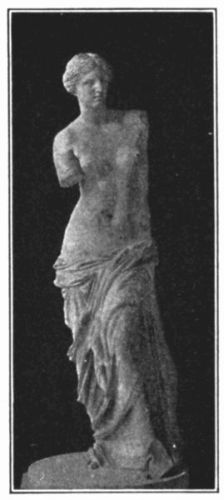
Fig. 130.—Notice the
beautiful lines on the figure of Venus de Milo.
Underwear affects health. Do you remember that we discovered
the reason why one should be particular about the kind of underwear worn?
We learned that ill health and fatigue are often caused by weight of
clothing or by tight clothing causing lack of circulation or by clothing
which prevents the skin from being ventilated. Textile materials and
temperature of the body are closely related. We should learn to know
which materials to select. Each person feels the need differently. Old
people and little babies feel the heat or cold more than other people.
Grandmother Stark usually feels cold and wears a shawl about her
shoulders. Underwear must be chosen in relation to climatic conditions
and also for conditions under which one wears them, for indoor or outdoor
work. Each must study her health, the climate, her age, and occupation,
and plan accordingly for the best kind.
Underwear should be chosen which can be easily cleansed, also that
which will permit plenty of air next to the skin. These properties of
materials, as we call them, must be studied.
The body, as we know, loses heat and water every day. Some materials
conduct heat more rapidly than others; and some absorb and retain, while
others eliminate, moisture more readily. Absorption and elimination
differ with different fabrics. Linen is quicker than other fabrics to
eliminate moisture. Wool on a dry body of a person who does not exercise
freely feels warm and continues so as long as the skin does not give off
more moisture than the wool can take up. If the body continues then to
give off moisture, the heat of the body cannot escape and one does not
feel comfortable. If a current of air or a draught occurs,
the heat will be conducted quickly and the bodily temperature reduced
too quickly. So underwear must not only prevent too great loss of heat
by conduction, but must be so constructed as to conserve heat when it is
needed.
Heat is eliminated when materials conduct it. Porosity of materials
prevents too great elimination. The air in the meshes or pores prevents
this, as a still layer of air does not conduct heat readily. A loosely
woven or knitted shawl is warmer under certain conditions than one which
is firmer. Two lightweight garments are better than one heavy one because
of the air space between.
Wool is warm, but irritating to many people. It is not as cleanly
as some fabrics, for it absorbs the body excretions and is not easily
laundered. As it shrinks with use, it has fewer air spaces between the
meshes. Any loosely woven or knitted underwear with air spaces is more
hygienic than the closely woven.
Cotton garments are often woven loosely and so treated in manufacture
that they absorb easily. Silk is very pleasing but costly. Silk and
wool combined are also excellent, but expensive. The great argument for
wool or for wool and cotton is that evaporation is slow unless moisture
and draught are present, and so the bodily temperature is not apt to be
reduced so unduly as through cotton or linen; in other words, one is not
so apt to take cold.
Union suits form an even layer over the whole body
and are considered more hygienic than the double layer
of vest and drawers at the abdomen.
EXERCISES AND PROBLEMS
1. What underwear do you think is the best kind for you to wear
considering your age, work, climate, health?
2. Write a composition of two hundred words about the best kind of
corsets to wear, and why.
3. What important things will you consider the next time you buy a
pair of shoes?
REVIEW PROBLEMS
I. Begin to keep your clothing budget. Ask mother to permit you to
plan it. Do not stop at the end of the year; keep on for at least four
years.
II. In what ways are you definitely planning each day to keep well?
How do clothes help?
III. What facts learned at school can you give mother about wool,
which will help in buying your new winter coat.
IV. Plan a school exhibit of all the work done during the year. Your
teacher will make suggestions about the refreshments and invitations as
well as plans for mounting the work.
CHAPTER VI — Lesson 1 — Lesson 2 — Lesson 3 — Lesson 4 — Lesson 5 — Lesson 6 — Lesson 7
CHOOSING AND WEARING CLOTHES
Have you ever thought that being properly and attractively dressed
helps towards achieving success in life? Marjorie's Cousin Ann says she
knows that the neat, tidy girls who come to the factory looking for
work are more apt to be chosen than those who are careless about their
dress. Cousin Ann, as you have learned, is very particular about her
appearance. She learned long ago that cleanliness of clothing is the
first essential in being well dressed, and that neatness is another
requirement. Cousin Ann knows that it takes time to wash out her collars,
her shields, and stockings every other night; but she also realizes that
she must be particular about her appearance if she wishes to be retained
at the factory. She takes time to mend the tears which sometimes come so
unexpectedly, and the lace which is ripped on her waist, or to sew on the
button which will soon be lost from her coat unless sewed. If she spills
anything on her dress or coat, she tries as soon as possible to remove
the spot. This takes
thought, too, as well as time; but Ann knows that it pays. Have you,
too, thought about these things? One must also know what is suitable and
appropriate for various occasions, and how to choose becoming colors in
materials or hats and gowns if one buys them ready-made. This is really
a study in buying, too, and of knowing how materials are made and can be
tested. All these things were discussed by Miss James and the Pleasant
Valley girls. They were always very glad when Miss Travers came to help
too.
WHAT IT MEANS TO BE WELL DRESSED
The Pleasant Valley girls have decided that it is worth while learning
about suitable and attractive dress. They are anxious to begin this
study. Suppose we learn some of the things one must think about and study
in order to be properly and attractively dressed.
One does not have to be expensively dressed in order to be
attractively and well dressed. Much depends on appropriateness. It is
not appropriate for a girl to wear jewelry, thin stockings, low fancy
slippers, lace waists, feather hats, to work or to school. How much more
attractive and appropriate is a plain, neat shirt waist and cloth skirt,
a plain necktie and a simple hat, and plain boots or ties. One should not
dress as if one were going to a party when one goes to work or to school.
Do you understand what appropriateness
means? It means wearing the suitable kind of clothing for every occasion.
It is our duty to be as well dressed as possible, for our friends' sakes
as well as for our own; but a well-dressed girl is never conspicuous.
Clothes which would be appropriate in a large city for a reception
might be very inappropriate in a small town. Our daily clothes should
be adapted to our uses, whether in country or city. Would you wear your
party dress for gardening or for tennis or skating?
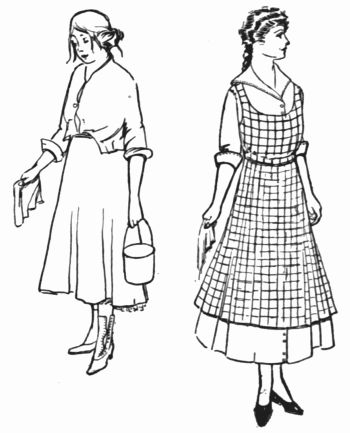
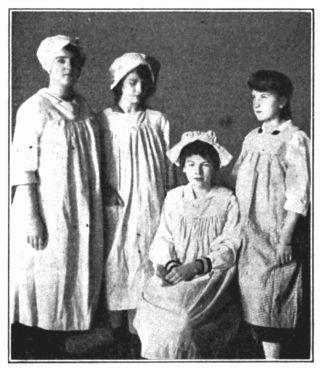
Fig. 131.—Which of these girls looks
ready to do her work?
Criticize your own garments. Try to have them neat and clean,
for this makes one more self-respecting. Try to have your clothes
convenient, neat, graceful, beautiful, allowing for free movements of
the body. Choose something which is not overdecorated but which will
emphasize your charm and personality. Young girls do not need jewelry or
much decoration on clothes, for youth is always charming in itself.
Some girls try to copy every "latest style." Do you? One should not
unless it is a style which will suit one. Cousin Ann heard a talk at the
Young
Women's Christian Association one night. It was on simplicity of dress.
The speaker was from a large department store in Paterson where Ann
lives, and she gave Ann some new ideas about dress. She said simplicity
is not necessarily plainness, but it means being so intelligent that
one knows what to leave off in the way of decoration. She said being
well dressed is knowing what to omit. She also said that trimmings and
ornaments without reason are foolish and spoil a gown. Because one bow
looks well it does not follow that ten will improve one's appearance.
So many girls are really caricatures. They wear every exaggerated thing
and many things which are not refined, as the very low neck, or the very
scant or transparent skirt. This is not beauty of dress, but very bad and
vulgar taste. The speaker said that "beauty of costume is not necessarily
the result of costliness, but of artistic appreciation." Cousin Ann said
several of the members of her sewing club were at this lecture, and
they decided to ask Miss Willing, who leads their club, to talk about
"artistic appreciation." Cousin Ann said she did not quite understand
what the speaker meant. This is what Miss Willing told the girls, and
then they understood perfectly. Perhaps you would like to know, too.
A costume is a work of art. She said we must think of our
costumes as being works of art. Every girl has a style of her own, and
she should study it and dress so as to bring out all her good points and
conceal those not so attractive. One's hair or eyes should be considered
in choosing color. Stooped or narrow shoulders, if they cannot be
corrected, can be made to look less narrow by the plan of the gown. Stout
figures can be made to look less stout. So by choosing the right colors
and correct decoration and right lines, one can often improve one's
appearance. Miss Willing says to understand about this is to have what
the speaker at the Young Women's Christian Association called "artistic
appreciation." One should cultivate artistic appreciation for good
furnishings as well as for appropriate dress. Miss Willing told the girls
another evening about color and good lines, for they are all so anxious
to learn. They never even imagined before that any one ever thought about
such things. Marjorie Allen and the other girls at Pleasant Valley School
are very glad Cousin Ann told them too.
The costume should be the background as it were. Miss Willing
says to remember always that a really artistic costume is one which
makes us say "what a lovely girl!" rather than "what a lovely gown she
is wearing." A costume should not be so strong in color or design that
one thinks only of that. Do you remember how in some rooms we feel the
pattern of the wall paper or of the carpet. When one does, the design is
poor; the wall is the background. Our clothes should make the wearers'
good qualities stand out. They should be subordinate, Miss Willing says.
Do you understand that word?
Miss Willing says the outline of our clothed figures
should be pleasing. Have you ever walked to town and seen girls with
large hats which were not balanced on their heads, and short skirts and
perhaps large muffs? If you watch them as they come towards you down the
street, you will see that the whole outline or silhouette against the
sky or house is poor; they look top-heavy or, we say, unbalanced. Such a
costume is not good. A smaller hat with the short skirt is what is needed
in order to have a balanced figure. The outline of the natural human
figure is most beautiful. Look at the lovely figure of the Grecian woman
(Fig. 132); see how the lines follow her figure. Costumes which make ugly
lumps, as bustles and large muffs, and other ugly shapes are not well
balanced.
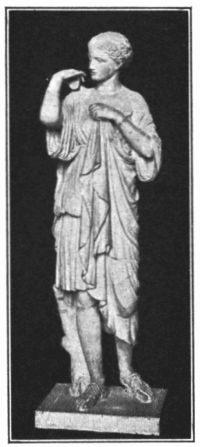
Fig. 132.—Notice the
lovely folds of the
Grecian costume.
An artistic dress shows good taste. Do you remember your talks
in your art class about the spaces in a design, and the relation of one
to the other. This is true in dresses too. Tucks, buttons, seams, bands
of trimming all mark off spaces on our bodies (Fig. 133). In order to
have a really artistic dress, there must be a plan about the arrangement
of spaces. A short, stout girl with bands of trimming running around her
skirt and with lines of trimming running up and down the
waist will present a very strange appearance to one who has "artistic
appreciation." Can you tell why this would not be good taste? A stout
figure should wear vertical lines of trimming rather than horizontal;
and the spaces between lines should be such as will make the girl look
smaller rather than larger; so dresses must be really designed, and the
spaces, colors, values, really thought about. Do you know what value
means? Some costumes have contrast in values. Black and white are sharp
contrasts. One sees the black or the white at once. These spots of black
or white jump at one unless there is something to connect the two, as
gray, which would be an intermediate value. Spotty costumes are not good
or restful. Have you seen, perhaps, a white dress with black hat and
gloves and shoes? Did you notice how the black things stand out and the
eye jumps from one spot of black to another? A white dress with white
shoes and gloves and a black hat trimmed with some white, thus carrying
some of the white to the black, would be better.
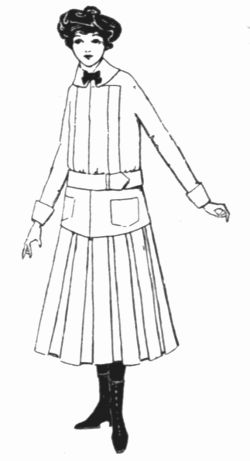
Fig. 133.—Notice the
good spacing and arrangement
of lines.
Miss Willing said this is called studying values. We can study values
of color as well as of black and white. Next lesson we shall learn
what Miss Willing told the girls about color in selecting or making
dresses.
EXERCISES AND PROBLEMS
1. Why do you think Miss Willing had "good taste" in dress?
2. What can you tell about Miss Willing's talk on artistic
appreciation? What does it mean in relation to dress?
3. Criticize your own garments in relation to line, simplicity,
decoration, appropriateness.
THE CHOICE OF COLORS FOR CLOTHING
Color is important in choosing or making our clothes. We too
must learn if we would choose as wisely as the Pleasant Valley girls.
Miss James thinks that the Pleasant Valley girls have learned so much
about color in relation to general design in their art classes that they
will be able to understand easily about color in dress too. Colors, they
have learned, have value, with gradations from light to dark. In black
and white the contrast is striking, but when values are closer together
the harmony is closer and less conspicuous.
In choosing your new spring dress be sure to think of your
own characteristics. Your appearance may be injured or improved
according to the color chosen. Color even more than design may spoil the
appearance, and is important to the wearer and to all who come in contact
with her, for color is expression of one's refinement and culture. Every
girl of Pleasant Valley will wish to know how to look her best. Color in
which there has been mixed much gray, as dull blue or dull
red rather than pure bright color, is apt to make the individual
characteristics stand out. This grayness in color forms a background
as it were, or a setting, for the face and shows the figure to best
advantage.
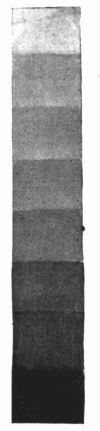
Fig. 134.—Can you find
the middle values of gray?
Artists have a way of expressing this brilliancy of color. Miss
James says they call it intensity. Do you understand what is meant by
color when it is strongest and loudest and most intense? Think of red
of the most vivid brilliant kind; gradually think of it growing grayer
and grayer until it is pure gray. By intensity of a color is meant this
difference in grayness. Very few people can wear very bright red. Miss
James says she must have the "grayed" colors, in dahlia tones of red if
she wishes a dark dress of this color, or in old rose if she wishes a
dress which will be less somber. This is true of all colors; only red is
perhaps the most difficult to use. One learns to use color in its full
intensity only for touches here and there on a gown or a hat, which is
itself not intense in color.
Large people should not wear red. Blue or green are cooling, quieting
colors and so are better adapted to large figures than red and also
better for those whose features are not very pronounced. Blues which are
not very strong, or so grayed that they
have lost half or more than half of their strength, are more interesting
and becoming for large figures for a whole dress.
Yellow is nearest light, and in combination with red gives the oranges
from which we get browns of all kinds and degrees, rich and warm in
effect. Try mixing these colors in your paint box. Green combines yellow
and blue. It is a light, cheerful, and calm color, always restful and
soothing. The yellow-greens are perhaps more cheerful; that is, when more
yellow than blue is used. When more blue is introduced, the greens are
more soothing and cool. Violet is red and blue mixed; a cool and exciting
color, which can be very intense or very subdued.
Choosing color for a dress. Do you think the Pleasant Valley
girls will think before choosing their new gowns whether it is for
school, or for a best dress, for a party or for the house? Even apron
material can be chosen which will make the wearer look unattractive. Why
not look pretty and clean when one is at work too? Miss Willing says
that quiet color in dress is an evidence of good taste. In combining
colors in dress one must aim to obtain the right balance in color. Miss
Willing says, in planning the color scheme for a costume, think about the
dominant or most prominent color and endeavor to bring the others into
harmony with it. Harmony is the result of colors being brought together.
Touches of black help to bring colors together and so harmonize them.
Miss Willing gave several other
suggestions for harmony. Cousin Ann put them down
in her notebook and sent them to Marjorie.
1. When one wishes to use contrasting colors, as yellow and violet,
one can get pleasing harmony by using a large quantity of one color and
a small amount of the other. This subordinate relationship of one color
to the other gives harmony; the more grayed the tone of the large mass
of color, the greater the intensity of color in contrast that can be
used.
2. In combining colors of weak intensity for harmony, a harmony of
costume of one mode, that is one color used in different values, is safe
but is not always so interesting as the contrasting colors.
3. To emphasize a color, a touch of the same may be added to some part
of the costume. Blue eyes seem even more blue with a blue necktie around
the shirt waist collar.
4. Another way to make a good harmony is to use complementary colors.
Red and blue; green, violet, and yellow; green and plum; blue and
orange; purple and yellow-green. One should be used intense, and the
other in a gray tone. For example, in combining color with hair, greens,
particularly gray greens, are very pleasing with auburn hair. Barbara
Oakes discovered that fact with her auburn hair. Violet tends to make
yellow hair look more golden, so care must be taken to have a gray violet
so the gold color in the hair will not be overpowered. "Red" hair is made
to look brighter when a blue costume is worn. So you see one can avoid
unfortunate combinations if one studies the strength of the color of the
hair in relation to the colors to be used.
Learning to combine colors. Miss James had many samples of
gauzy chiffons which the girls learned to handle and to combine so as to
get artistic results, for combinations of complementary and contrasting
colors
as well as for combinations of "one hue." It is only through trying that
one learns. This, too, is a matter of appreciation. Some people have
finer appreciation for color than others. By thinking about this and
learning all you can in school and from books, you too may come to have
real color appreciation.
In choosing the best colors for your figure or for mother's or for
auntie's, you must think about the value and intensity as well as the
other characteristics of color.
Our costumes, as a rule, are worn for different occasions and are
seen against different backgrounds. We say that the backgrounds, as
in rooms, or against rocks or grass or hillside, are of about middle
value—halfway between white and black; in other words, gray. Black
and white costumes, then, will always stand out. White tends to make the
figure appear large; black calls attention to the outlines of figure
and looks best on people with good figures because of this emphasis of
outline. Blue, blue green, and blue violet—if of middle value, very
"gray"—or gray itself are best adapted to stout figures as they are
retiring colors. They seem to melt into the background and do not give
prominence to the figure. A little brighter color may be added and make
the costume more becoming to the face. This should be used through the
center of the gown, not at the edge to draw the eye to the boundaries of
the stout figure. A rose or a flower of contrast at the center of the
belt is an example.
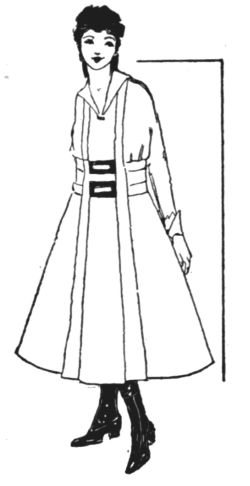
Fig. 135.—Vertical
lines through the center of the costume make the figure appear
thinner.
Studying lines of a costume. Miss James says the best way to
get an effect of height is to place the longest possible vertical lines
through the center of the figure with no points of emphasis as trimming
on the outer parts (Fig. 135). For a slim figure, when one wishes to
appear stout, the outline of the figure should be emphasized at the outer
sides of sleeves or shoulders or skirts, by such arrangement of trimming
that the eye is carried across the figure (Fig. 136).
Miss Willing and the girls had a good laugh about the use of large
plaids and broad stripes for stout people. Plaids or squares certainly
tend to emphasize stoutness, as do bold designs or conspicuous color
combinations.
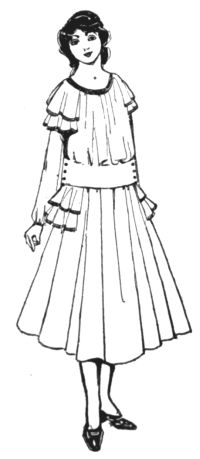
Fig. 136.—Notice
how the emphasis on the outside of the costume makes the figure appear
larger.
So many things to remember—line, value, color; all-important, if
one is to be attractively dressed. Miss James has decided to permit the
girls to work out the color combinations at school for their new spring
dresses. The subject of color in choosing hats is equally important. Let
us study next lesson about it.
EXERCISES AND PROBLEMS
1. Study your own characteristics. Write them down. Decide
what predominating color you would like for a spring dress. From
the chiffon colors which your teacher has, combine the appropriate
color combination which you would like.
2. Arrange with the chiffon samples, combinations of complementary
colors, of contrasting colors.
3. Write a composition on the subject of "What makes a girl
well dressed."
SELECTING A HAT
What can you learn about the care and arrangement of your hair. Do you
know how to choose a hat?
Jane Smith says that some day she expects to be a milliner. Perhaps
she will be. Miss James says she can later go to a school and study
millinery. This means that Jane will learn not only how to make hats, but
about the right lines and colors to use. Jane has a natural deftness of
touch and a good idea about copying and designing; so Miss James thinks
she will make a good milliner. So often hats are unbecoming because the
colors are inharmonious, or the lines out of relation to the face wearing
them. Whether one is old or young, one should think about this.
Give some care and thought to your hair. One day when Miss
Travers came from the State College to speak to the Mothers' Clubs, she
stopped at the school and gave a talk to the girls of Pleasant Valley
School
about their hair and hats. She said that so many women and girls forget
to take care of their hair. It should be washed once a month in hot
water with castile soap and perhaps with the white of an egg, and then
thoroughly rinsed. The comb and brush should be washed once a week.
Marjorie Allen's mother has beautiful hair, and she says she does as Miss
Travers told the girls; and also she brushes her hair carefully to remove
dust, every night before going to bed, and braids her hair in two braids
for the night. This is a very good way to care for one's hair.
Have you ever noticed how some girls nearly lose all their hair
because they burn it or dry it up with the curling irons? One should be
very careful always to test the irons on a paper. Burned hair is not
beautiful. So often girls forget that the becomingness of a hat will
depend on the way the hair is taken care of or dressed.
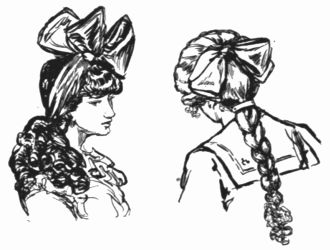
Fig. 137.—Which arrangement of hair
and bow do you think most appropriate
for school wear?
Large bows, out of proportion to the size of the head, are very poor
taste. A bow as well as a hat should suit the face in line as well as
color, and a bow which stands way out in conspicuous angles is not good
in line, as it is not apt to conform to the lines of the face and of the
head wearing it. Have you noticed this?
Perhaps you can try to rearrange some of the bows the girls are wearing
to school so they will be in better taste. Cleanliness of the head and
hair, and a clean, clear complexion, which comes from proper food and
good digestion as well as from cleanliness, are the best backgrounds
for a hat. Any girl who has this charm of cleanliness can with thought
choose a hat which will be becoming. Hats, also, emphasize the defects as
well as the good points of the wearer; so neatness and a becoming way of
arranging the hair will help very much. Perhaps some of the girls would
like to learn to make hats, too. The hat is the most difficult article of
the whole wardrobe to select. Most girls and women wear hats that are too
small and that stand on the top of the head instead of fitting it. Good
taste, Miss James says, in choosing hats means the very thing we have
studied about: artistic appreciation, a knowledge of line and color and
form as well as appropriateness.
Think about the shape and the lines of a hat. Hats should
be chosen or planned, if one is making them, in relation to the whole
figure. Do you stand up or sit down before the mirror in selecting a hat?
Try standing up so you can see your whole figure and the relation of
the hat to the whole. You can tell then if the hat is too large or too
small, whether it overbalances the figure, or if the silhouette will be
pleasing. Marjorie Allen says since she has learned about these things
she is surprised to notice how few people have thought of this question
of the silhouette. Sometimes,
the milliners are to blame too, for they do not always know this secret.
Marjorie says her new winter hat does not please her because of the
silhouette.
Miss Travers told the girls to think especially about lines. The
round-faced girl whose nose turns up a little will look best in a hat
that is slightly tilted in front or with a rolling brim at the side or
front. Barbara Oakes says she discovered that for herself. She had two
hats which rolled in that way; and she liked them better and was more
comfortable in them than in others. She also learned through experience
that she did not look well in narrow hats that bend over the face. Miss
Travers says it is true when one's face is full and the nose retroussé,
that such a shape is not apt to be becoming.
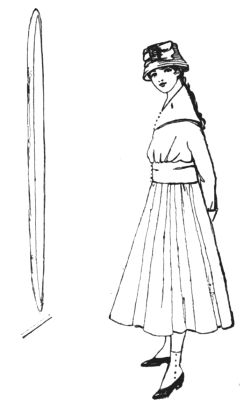
Fig. 138.—One can
select a hat which will make a good silhouette when one sees the whole
figure before a mirror.
Miss James says she noticed that long, thin faces look longer and
thinner in high pointed trimmings. What kind of trimming, then, would you
recommend for a long, thin face? For long faces, a brim worn slightly
forward will cast a shadow and so tend to shorten the length of the face;
and brims that are rolling and wide, counteract the effect of the long,
thin face. Do you see
how very important it is to study the face and its lines?
The way of dressing one's hair may make it difficult to choose a hat.
If the person with the long, thin face also draws back her hair sharply
at the sides, her face will look longer and it will be more difficult to
choose a hat for such a face. If the hair is worn very fluffy when one
has a very round, full face, then the face is apt to look fuller. So you
see hairdressing is very important to study too, if a girl is to look her
best and choose the most becoming hats.
Color, too, should be kept in mind. Some skins are pale; others
are rosy. Black makes the complexion look white and should not be worn
next to a dark, swarthy skin. Browns are apt to look well with auburn
hair like Jane Alden's. She has such a clear complexion. Barbara's
mother, Mrs. Oakes, with gray eyes and hair, will look well in gray.
We have studied about contrasting colors. The contrasting colors for
a person with light hair will be quite different from the colors for a
person with auburn hair. Notice what is said in the lesson about color in
selection of dress. This is true of hats too.
Select a hat that is becoming. In choosing hats aim always to
get what is becoming to you and your style rather than the extremes
of fashion. The latest styles can always be adapted to suit your style if
a milliner knows her business.
Remember that very often hats are not becoming because
they are not worn properly. Sometimes the
wearer forgets and pushes the hat back or to one side; and then its lines
do not conform to the outline of hair and head and face. Study how to
wear your hats. Large hats are often difficult to wear because of correct
balance.
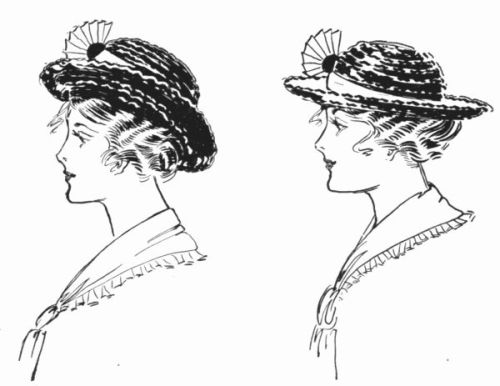
Fig. 139.—Which way
looks better?
If you would like to try to make a simple summer hat, perhaps you
can buy a frame, and with your teacher's help learn to change and adapt
it to your face. It is easy to learn to sew straw on a frame and to
trim with a bow or flowers. Simple trimming for young girls is always
the most pleasing; flowers, wings, quills, and simple bows are the most
suitable.
EXERCISES AND PROBLEMS
1. What things will you have in mind when you go to the milliner's to
select a new hat, or to have your old hat remodeled? Write a list of the
principal points to be kept in mind in choosing.
2. Bring to school pictures of hats adapted to faces; some that
are not. You can find these in old fashion magazines; perhaps in old
portraits. Pin them on your classroom Bulletin Board. Criticize. Your
teacher will probably have some too. Why is this a good subject to
study?
MAKING THE MIDDY BLOUSE
The Pleasant Valley girls will make middy blouses and so complete
their gymnasium suits. Will you not wish to complete your suits too?
The girls have found their bloomers and skirts very useful, and are
glad to make the middy blouse too. They will use the same material as for
the skirt.
By this time the Pleasant Valley girls are so expert that they make no
mistakes in laying on their patterns or in cutting out garments. They are
very particular to have the long line of single perforations indicating
the length lying exactly on the warp threads of the cloth. Jane Smith
says she can tell exactly which pieces must be cut double on a fold of
the goods. Can you? The girls sent for patterns for 34 bust measure
and for 38. Some of the girls are quite large for their age—Jane
Andrews and Barbara both are large and will need the 38 size.
Miss James opened a pattern and held up all the pieces. She pinned
them to the dress form so as to show the relationship of each piece to
the figure. Can you do this, too, before you begin to cut, and so learn
which pieces are to be cut on a fold? Then lay the pattern on your cloth
most carefully and pin ready for cutting. Do not cut until your teacher
says you may. Learn to use a tracing wheel and trace your seams, so all
will match in putting the middy together. This garment will be made
entirely by machine, except the hand processes of basting and gathering.
Hems and facings should be carefully basted before being stitched. Good,
perfect stitching improves all such tailored garments. Poor stitching
spoils the effect.
How to make a middy blouse. After the pattern has been
carefully laid on, and the material cut out, this is the way to make and
finish a middy blouse:
1. Baste, with the seams on the outside, shoulder, and underarm seams.
Try on. If necessary in order to fit more smoothly across the chest,
let the front drop; if extra fullness across the chest is desired, let
out under the arms. The shoulder seams will be finished, but not the
underarm. Mark with tracing or pencil the new seam for underarm if you
must change it.
Make a flat fell seam at the shoulder, ½ inch wide finished.
You have all learned how.
2. The sleeves, which are in one piece, are put in next, before the
sleeves or underarms are seamed. Match the notches, gather the sleeves if
there is any fullness at armhole, and baste in the sleeves so that the
seam is on the right side. Make flat fells, basting the turn which falls
over the sleeves so that it will lie very flat.
3. Baste seams of sleeve and underarm all in one long seam on right
side. Match at armhole. Make flat fell, turning the fell towards the
front (see page 216).
4. Hem the bottom of the middy with one inch hem.
5. Finish the neck next. Prepare the collar with its facing according
to the notches of the pattern and directions. Sew; turn to right side.
If the collar is to be decorated with finishing braid, this decorating
should be done before the collar and facing are sewed together. Attach
collar to middy, right of center collar to right of the center back of
middy. The seam will then fall on the inside towards the neck and will
be concealed by the facing which should be turned in and sewed over the
seam. Patterns for middies vary, and other methods of attaching collar
may be suggested. A loose ribbon or scarf of silk can be tied under the
collar to form a sailor's knot.
6. Then finish the sleeve. The sleeve may be finished with a half inch
hem and rolled as many are worn, or a cuff can be attached which will be
of the same width as the sleeve or just to fit the wrist. In the latter
case, the fullness of the sleeve must be gathered to fit.
Fig. 140.—Eyelets were
made by some girls, in the front of their middy waists.
The girls of Pleasant Valley School made sleeves of three quarter
length, and attached a turned-up cuff of same width as sleeve. This cuff
was made double: the two pieces sewed together, turned, and attached
to the sleeve with the seam, on the outside of sleeve. The facing,
then, concealed the seam and, when the cuff was turned up, was entirely
concealed. This makes a very neat finish inside the sleeve.
Some of the girls, those who worked rapidly, made eyelets at the front
of the middy and laced the middy. Eyelets are punched with a stiletto or
sharp point, and are worked like a buttonhole, only perfectly round.
The girls of Pleasant Valley will give an entertainment of calisthenic
exercises as soon as their middy suits are entirely completed. The
boys will also give some exercises with the dumbbells and join in the
folk dancing. "The Pleasant Valley News" has already announced this
entertainment at the Town Hall. Every body in Pleasant Valley is going.
The money will be used to pay for some of the furnishings of the Ellen H.
Richards House.
EXERCISES AND PROBLEMS
1. Draw a sketch of your middy blouse. How will yours differ
from the one in the picture?
2. Try to make another middy at home.
SUGGESTIONS FOR BUYING GARMENTS OF WOOL AND SILK
Miss Travers from the State College talks to the girls of Pleasant
Valley School about buying clothing, especially of wool or silk.
You, too, will wish to know what Miss Travers said.
Have you ever considered whether it is wise or not to buy your
clothing ready-made? Most of the mothers of the Pleasant Valley
girls make the garments at home with some assistance from the visiting
dressmaker.
What a help the Pleasant Valley girls will be when the dressmaker comes
to their homes. They are not old enough to take full responsibility, but
they will surely be able to assist after the dressmaker has planned. This
will help their mothers, too. Mrs. Allen, Mrs. Stark, and Mrs. Oakes have
already discovered how many good suggestions their daughters have to
give.
It is sometimes wise to buy things ready-made. In our
grandmothers' day this was impossible. Grandmother Stark used to stitch
all Grandfather Stark's shirts by hand and make his overalls. To-day one
can buy good serviceable garments like overalls, rompers, shirts, etc.,
at moderate prices, ready-made. Just what should be made at home should
be determined by the mother, and will depend on her time and duties at
home. Some mothers can so organize their household work that they have
time for some sewing too, and they enjoy the change of work. It pays to
make certain garments because the workmanship is often better and one can
choose one's own materials. This means that the life of the garment is
apt to be longer. This is economy if one has the time and strength; but
it never pays if one sacrifices other things like fresh air, exercise,
some relaxation, for the sake of saving a little money.
What should you consider in buying ready-made garments? Miss
Travers says it never pays to buy flimsy materials, cheap lace edging, or
insertions which are poorly put together and will tear. One can instead
purchase ready-made garments which are plain. It is not always possible
to afford the time to make dainty, fine, handmade underwear, which soon
wears out; but one can often spare the time to construct a few pairs of
more durable drawers, and corset covers, by machine for everyday wear,
when one realizes how much greater will be the life of the garment.
If one is buying ready-made garments, one should think about the
following things:
1. Is the material suitable? will it wear well? is the color
suitable or will it fade very soon?
2. Consider the workmanship. Are the seams well sewed? Is the
stitching very coarse, or does the garment look well finished? Is the
appearance neat, or will it pull apart very soon?
3. The construction should be examined. Is the garment well cut,
or is it cheap because it is scant in fullness? This may not permit of
freedom in movement, and the garment may have to be cast aside because
uncomfortable. Then money is wasted.
4. It never pays to buy anything which one does not need. It is well
to have foresight and to plan for what one will need for the year,
but experience soon teaches one the quantity. It is foolish to buy
unnecessary things because they are pretty. One should learn not to be
tempted.
5. It sometimes pays to wait until certain seasons for purchasing
garments. Between seasons one can get well-made articles of clothing at
considerable
reduction, if one can wait. Winter garments are reduced in January or
February, and summer goods in July or August. It often pays to wait. In
planning one's wardrobe, one can think about this. January is often a
good time to buy household linens or other furnishings at a reduction.
6. The use of garments should guide one in making a selection. It is
necessary to study one's whole wardrobe and to know what is needed. A
girl engaged in business will need an entirely different wardrobe from
one who spends most of her time at home helping mother. The first step,
then, in economy is to know one's needs and to purchase accordingly.
Is the garment needed and suitable for the occasion? Remember about
appropriateness, and buy garments which will render the service needed.
One does not wear silk dresses for housework.
7. Sometimes undergarments are made in sweatshops under very
undesirable conditions for health. The garments are cheap because made
by poorly paid workers under very unsanitary conditions. Do you wish
to wear such garments? As long as women buy the cheap kind made at the
sacrifice of human life, this sweatshop system will continue. One can buy
inexpensive underwear made under sanitary conditions. It is labeled with
a tag of the Consumers' League. This is an organization which is trying
to better the conditions in workrooms and shops in which clothing is made
and to improve wages and working hours. This League
permits the use of its label on white underwear made under the conditions
they approve of: no work outside of factories, no child labor under
sixteen years of age, and obedience to the state labor laws. The labels
are used by firms agreeing to fulfill the above requirements. If you are
purchasing underwear, perhaps you can buy some with the Consumers' League
label. It looks like this (Fig. 141). Miss James wears this kind, and
Mrs. Oakes and Mrs. Allen, too, now that they know about it.
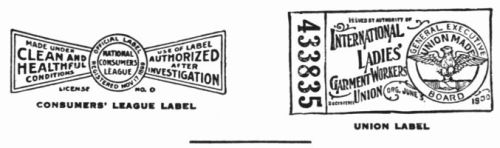
Fig. 141.—Consumers' League Label and Union Label.
8. It is sometimes more economical to decide on a particular color
for a season. One can, as a rule, wear one's clothes to more economical
advantage and look better dressed by choosing a particular color than if
one has a red dress, a blue coat, and a green dress for best. The coat is
probably worn with both dresses and may not look well.
9. Remember, if one has only a limited amount of money for clothes,
one should not try to buy the very latest fashions. Exaggerated styles
live but a short time, and some of us must wear our clothes for a long
time, until they are worn out. If materials are good, one can often have
one's clothes remade, by combination with a little new material of a
contrasting kind. A knowledge of textile materials and values will always
help in selecting either ready-made clothing or materials.
10. Remember you must know about the things you wish to
purchase. Clerks as a rule know very little about the goods they sell.
If you know, you can make the dollars earned buy more than if you were
ignorant.
Fig. 142.—It takes much thought to learn to buy intelligently.
What should you think about in buying materials? Here are some
of the hints for purchasing wool and silk materials or garments which
Miss Travers gave the Pleasant Valley girls. Talk them over with your
teacher. See if you agree.
1. Garments made of wool and cotton mixed do not keep their shape as
well as all wool. If one can afford
only wool and cotton, the salesman should tell one in purchasing about
their composition. The mixture should be cheaper. It is often sold for
all wool at a higher price. If one untwists the fibers of the material,
it is possible to detect cotton. Try at school on some ravelings of
garment seams or other materials. The burning test will help one to
decide. We shall learn some tests in our next lesson.
2. Remember wool is an expensive fiber. Do not expect to get all wool
for little money.
3. Remember the weave affects wearing quality. A close twill weave is
often more durable than a basket weave.
Do you remember your lessons about silk; how it is grown and made
by the little worm, and how it is manufactured or spun into thread
or woven into silk cloth? In buying silk one must remember about its
manufacture.
1. Silk is seldom pure. It is apt to be weighted. If the silk feels
heavy in the hand, it does not always mean that it is a good piece of
material and will wear; it may be weighted with tin; up to 30 per cent of
tin is not harmful. A softer, pliable silk is not apt to be so weighted,
and will wear better. Soft silks so woven as to pull at the seams are
not economical. Close weaves are better than loosely woven ones for
wearing.
2. Fray some of the threads of the cloth you wish to buy. Is it
possible to break either the warp or woof
easily? If so, the silk will split along either warp or filling and will
not wear.
3. One should not expect to get bargains in silk. Cheap silk will not
wear. It is better to wear some other material. Is the material made of
reeled silk or of spun silk? You have learned the difference. Articles
made of reeled silk are more expensive.
4. Silk is sometimes adulterated with cotton or artificial silk and
sold for all silk. We shall learn some tests in our next lesson so we may
discover too.
Miss James talked over all these points with the Pleasant Valley girls
and showed them some good and bad materials. The girls decided to be on
the lookout for these things. Will you?
EXERCISES AND PROBLEMS
1. Bring to school garments or materials which have not worn
well. Try to find out why. Your teacher will help.
2. Write a composition about things to think about in purchasing
a new winter suit ready-made. If you must buy from a catalogue,
can you judge about the wearing qualities?
LEARNING TO USE SOME SIMPLE TEXTILE TESTS
Miss James and the girls of Pleasant Valley tried some simple
tests for materials. Perhaps you would like to try them too?
The Pleasant Valley girls became so interested in
Miss Travers' talk about textiles and how difficult it is
to buy intelligently that they decided to learn to judge materials and to
study about adulterations.
How are clothing materials adulterated? Miss James told the
girls that there are a number of ways of adulterating materials, and
that most women shoppers are so indifferent that manufacturers have been
able to adulterate the materials of everyday use. This increases the
cost of living, for materials do not wear so long. Miss James says that
textiles should be labeled so we may know what we are buying. Some kind
of adulterations are honest if the goods are so marked; but, when sold
for something they are not, the buyers are fooled. The tests help one to
know whether materials are adulterated or not. Let us learn first some of
the methods generally used in adulterating, and then some of the simple
tests.
Weighting is one method of adulterating. This means that something
else has been used beside the material. In cotton and linen material,
sizing or starch is pressed in with the rolling in finishing. After
washing, this material will be found to be very open in mesh instead of
smooth. Notice some of the smooth linen table cloths before they are
laundered. Afterwards you will notice they look quite coarse and have
lost their smoothness. Sometimes glue or clay or gums are used instead of
starch.
Silk is often weighted in the finishing process with sugar and some
with dyes and metals. This is because silk has a property which enables
it to absorb a great
deal of moisture without changing its quality. The manufacturer can
buy salts and dyes for less than silk, and so he often uses a large
per cent of dye or metal in place of the gum washed out of the silk in
manufacture. One can seldom find to-day silks like our grandmothers used
to use. This is because people wish cheap silks; the manufacturer cannot
produce silks for little money, as the raw fiber is so high; and so he
uses other things with silk to weight it.
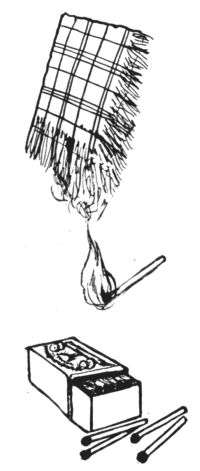
Fig. 143.—One can
sometimes test materials
by burning.
Materials are also adulterated by combination with other materials.
Did you ever buy a handkerchief marked "pure linen" and discover it was
a mixture of cotton and linen? Cotton is also used to adulterate woolen
materials, and sometimes silk materials; "pure silk" so called, is often
artificial silk.
Adulteration is also practiced when made-over materials or waste is
used to cheapen the cost. We learned about this in studying about wool.
Wool materials should be labeled so that the purchaser will know. It is
not fair to pay the price for an all-new wool material if shoddy and
mungo and flocks, which are all old wool and waste, have been used. The
per cent of new wool should be told and the price made accordingly.
Silk is sometimes sold as reeled silk when waste from cocoons which is
called spun silk has been used for the woof or filling thread.
In finishing of materials, adulteration is sometimes practiced. In
pressing cotton or linen, a luster is given to the surface. Cotton can
be made to appear like silk or like linen, and is often sold for those
fibers. Cotton can be napped in finishing and made to look woolly as in
blankets or outing flannel, but it is still only cotton.
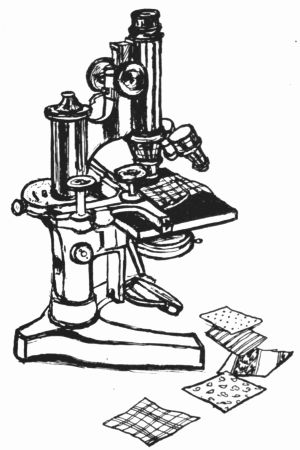
Fig. 144.—The microscope reveals many things.
How can clothing material be tested? These are the simple tests
which the Pleasant Valley girls learned:
For sizing. This is easy to identify. Pick at the surface with
your nail, and the starch or sizing will easily come off. Hang a wet
piece in the air and see how the gloss looks then. This sizing often
conceals defects in the cloth.
These can be seen if the material is thin, by holding it against the
light.
Fig. 145.—The test for fading.
Burning tests. The girls unraveled the fibers which Miss James
gave them and tested wool, silk, cotton, and linen. They tried both
warp and filling threads. They burned them with a taper. The animal
threads (which are they?) burned slowly, charred, and smelled like burned
feathers. Silk burns to an ash, except when weighted. Then it burns more
slowly. When very heavily weighted, the flame does not burn readily and
the form of the silk will remain. The vegetable fibers, cotton and linen,
burn quickly and with a flame.
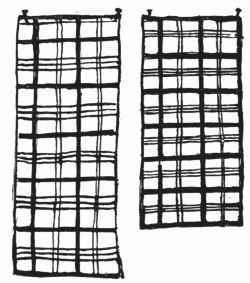
Fig. 146.—The test for shrinkage.
Tests with microscope. You have all seen the appearance of the
fibers under the microscope. This reveals many things, and the
unraveled fibers are easily identified. The microscope is the only sure
test for telling cotton and linen fibers. One can sometimes discover
shoddy mixed with the all-wool fiber because of the color. Shoddy is
sometimes made of old colored woolen rags.
Tests for fading. Pin a piece of cloth on a board with thumb
tacks. Cover half with cardboard or heavy paper. Expose to the rays of
sun for several days. Remove paper and notice difference. A piece can
also be exposed near bright light, but not in sun's rays, to see the
effect under ordinary wear. Marjorie Allen tested a piece of cashmere
she was considering for a dress and decided not to buy it, for it faded
quickly near the bright light.
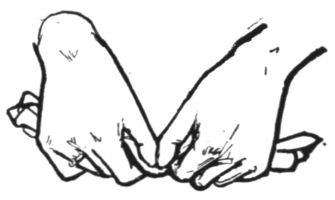
Fig. 147.—The test for strength.
Tests for strength. Try to break either warp or woof threads.
Place the two thumbs together and press down on the cloth which should be
held firmly in the hands. Try both sets of threads. Sometimes a weak warp
or woof can be discovered.
Tests for shrinkage. Barbara Oakes had a white cotton dress
last year which never seemed to stop shrinking. Sometimes we can test
materials for shrinkage. Measure width and length of sample to be tested.
Wash it in hot water and soap. Dry and measure again. Is it narrower and
shorter? In planning for cotton or woolen garments allowance should be
made for shrinkage.
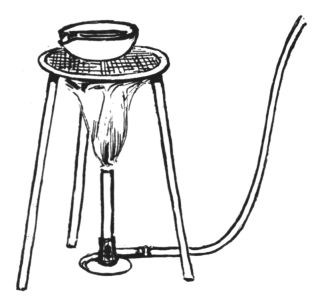
Fig. 148.—The chemical tests show
many things of use in judging materials.
Chemical tests. Chemicals are used for identifying fibers.
Have you learned in your eighth grade studies about acids and alkalies?
Have you studied at all about chemicals? It is possible to discover
the composition of woven materials by testing them with chemicals.
This is because acids and alkalies affect vegetable and animal fibers
in different ways. Look up the difference between acids and alkalies.
Study with your teacher and try to discover some of the common food and
cleaning materials which we use every day in our homes which are acid or
alkali. Some of these teach us we should know what the soaps and washing
powders which we use will do to our clothes. Your teacher will provide
some chemicals for testing. It is easier to test samples of cloth if they
are fringed at the edges. Here are directions for some chemical tests:
1. Place a piece of white cotton cloth and a piece of woolen material
in small dishes. Cover with 50 per cent solution of nitric acid. The wool
fibers will turn yellow. The cotton remain white. If a piece of wool
cloth was mixed with cotton, how would the test prove it?
2. Boil samples of cotton and wool together; then samples of
cotton and silk together, for fifteen minutes in a 5 per cent solution
of caustic potash. The animal fibers will dissolve, the cotton will
remain. Of what use would this test be?
3. Moisten samples of cotton and of wool with Millon's reagent. Place
in porcelain dishes and heat gently. The animal fibers will become red;
the vegetable are unchanged.
4. Material made of cotton and linen and sold for all linen can be
tested. Place fringed sample in a porcelain dish. Heat gently in 50 per
cent solution of caustic potash for two minutes. Remove with glass rod
and dry between blotting papers. The linen will be dark yellow in color
and the cotton white or light yellow.
So we have learned a few tests of different kinds. There are many
more. When you go to high school you can learn about others. The Pleasant
Valley girls enjoyed making these tests with Miss James' help. Perhaps
you may be able to try them with your teacher.
EXERCISES AND PROBLEMS
1. Try the above chemical tests with your teacher's help.
2. Try some of the other tests for adulterations.
3. Tell four ways in which materials are adulterated.
HOW PATTERN IS MADE IN CLOTH
Barbara said she never could quite see how pattern is made in cloth.
There seem to be so many different kinds of patterns. Miss James
explained about this. She said there are several ways of making patterns.
Some are printed; others woven; some embroidered. Have you discovered
this?
Patterns are often woven. Do you remember, when you studied
about linen, you learned that the Jacquard
loom has a series of cards above it which are able to control the
pattern? Wonderful silks and beautiful velvets and brocades as well as
damask table linen are made in this way by weaving. Patterns of stripes
and plaids are also made by the loom in weaving. Sometimes the warp or
the filling threads are colored; and this color forms patterns in stripes
or squares. See if you have any pieces in your surprise box in which
pattern is made by colored threads of warp or woof.
Try to find some woven patterns made by the Jacquard loom in silk or
linen. Think of all the beautiful ribbons, silks, tablecloth damasks,
towels, and napkins; all such patterns are woven by the loom. Plain
patterns like basket weave, twill, diagonal, satin weave, are also made
by weaving. See if you can work out some of these patterns on your school
loom.
Some patterns are printed. On the plain woven material,
patterns are printed by means of rollers on which the pattern has been
stamped. The colors are put on by this roller. The picture shows the
machine. Did you ever have a calico apron or dress of percale or cambric
on which the pattern showed on one side only? Many ribbons are printed
with a pattern, but sometimes patterns are put on both sides of the
cloth. Again, printing is sometimes done on the warp threads before the
filling thread is woven in. This makes a dull effect in pattern. Miss
James had a piece of ribbon which was so printed. When it was ravelled
out a little, the printed warp could be seen.
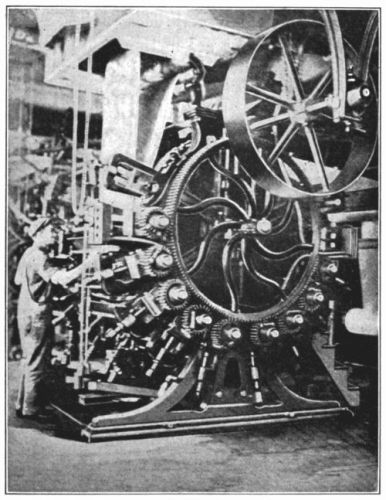
Courtesy of Cheney Bros.
Fig. 149.—Printing cloth by machinery.
Did you ever see a foulard silk dress with white spots? Do you know
how they are made? There are two. methods. One is called "resist," and
the other "discharge." The first method, "resist," is easy to understand.
The material is printed before it is dyed. The spots are printed with
a chemical which resists the dye when it is put in the dye bath. So
the cloth comes out of the dye with white spots where the chemical was
stamped. The "discharge" method is just the opposite. The cloth is dyed
blue or black or whatever the color is to be, and then it is passed
between rollers something like your wringing machine and the color is
taken out in spots by chemicals. Sometimes, when the chemicals are too
strong or cheap, they eat the cloth. Jane Alden's cousin had a dress from
which the white spots fell out, leaving holes.
Patterns are sometimes printed on cloth by means of wood blocks or
stencils. Perhaps you can do some printing on plain cloth. You can make a
stencil pattern. Cut out the design in it and paint through the holes, or
cut a design from a piece of wood, dip it in color, and print the cloth.
Lovely materials are made by hand in this way. Miss James has a beautiful
English piece of Morris block printing which she values highly.
Many patterns are embroidered. Look in the piece box. Sometimes
embroidered designs are worked on cloth by hand, but many are made by
machine. Miss James has a scarf which came from India. It is embroidered
in gold with little bits of glass sewed on the right side, and held by
the embroidery. This is all hand work. Miss James has a waist with little
spots of white embroidered in silk. This is done by machine
on a loom. Find some piece of material embroidered by machine.
So Barbara Oakes now understands about the patterns. Miss James had
some books to show the girls, too. They looked up in the encyclopedia
about printing of materials and about the other things they wished to
know about patterns. Barbara says to her the most wonderful thing is
the way in which the warp threads of the loom can be controlled by the
Jacquard pattern cards and other devices. The shed of the warp as it
is raised for each filling thread is governed by the devices, and a
different set of threads bobs up for each shuttle throw.
EXERCISES AND PROBLEMS
1. Mount on strips of cardboard, samples of material made:
a. By weaving, plain, stripes, diagonal, etc.
b. By printing, resist, discharge, machine, block, stencil;
c. By embroidery.
2. Look up in the encyclopedia or other books the subject of cotton
printing.
3. Try to find pictures of modern looms and more primitive ones in
which pattern is controlled by the harness which raises the warp threads
and makes the so-called shed.
REVIEW PROBLEMS
I. Look over the fashion pages of your magazines at home and
find:
1. A young woman suitably dressed for business.
2. A girl dressed for outdoor sports.
3. A girl in a party gown.
Tell why you think each is "well dressed." If not, why?
II. What textile tests would you suggest when buying a silk dress.
Mrs. Stark expects to have one next summer. How will she be able to judge
if it will wear?
III. Can you make another middy at home. Perhaps you are so expert you
can take an order for one.