The cover image was created by the transcriber and is placed in the public domain.
THE HOLYHEAD ROAD
EARLY DAYS ON THE LONDON AND BIRMINGHAM RAILWAY.
By Charles G. Harper
Author of “The Brighton Road,” “The Portsmouth Road,” “The Dover Road,” “The Bath Road,” “The Exeter Road,” “The Great North Road,” and “The Norwich Road”
Illustrated by the Author, and from Old-Time Prints and Pictures
There are said to be no fewer than a hundred
and forty different ways of spelling the name of
Birmingham, all duly vouched for by old usage;
but it is not proposed in these pages to recount
them, or to follow the arguments of those who
have contended for its derivation from “Bromwicham.”
It is singular that in the first
mention we have of the place, in Domesday
Book, it is spelt “Bermingham,” almost exactly
as it is to-day, and this lends much authority
to the view that we get the place-name from an
ancient Saxon tribe or family of Beormingas.
When the original Beormingas, the Sons of
Beorm (whoever he may have been), settled here,
in the dim Saxon past, they founded better than
they knew; but they chose a hill-top, a place
where no river runs, unless we choose thus to
dignify the little stream called the Rea. This
lack of watercourses mattered nothing at all to
2mediæval Birmingham, but when, in spite of
all disabilities, the place rose into commercial
importance, the want began to be severely felt,
and herculean have been the efforts in modern
times to effect a proper water-supply.
Little but scattered mention is heard of
Birmingham and its smiths before the Civil War,
but when that struggle broke out, they were
heard of to some purpose. Its 4000 inhabitants
in 1643 were Puritans to a man, and warlike.
They furnished 15,000 sword-blades for Cromwell’s
troops, and at a convenient opportunity
waylaid the King’s carriage and seized it, his
furniture, and his plate. For these enormities
Prince Rupert came later from Daventry and
punished them severely in a battle on Camp
Hill, overlooking the town. Many Birmingham
men were slain that day, and eighty houses
burnt; the whole affair piteously related in a
tract of that time called “The Bloody Prince;
or, a Declaration of the Most Cruell Practises
of Prince Rupert and the rest of the Cavaliers,
in fighting against God and the true Ministers
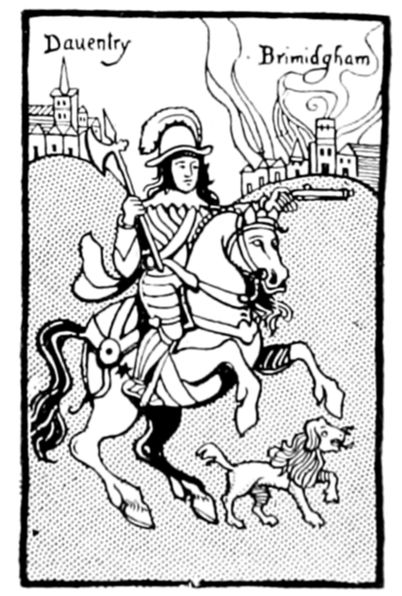
of his Church.” A woodcut intended to portray
that sanguinary Prince appears on the cover,
with Birmingham flaming furiously in the background;
Daventry in the rear. The rest of the
Cavaliers appear to be manœuvring somewhere
else; at any rate, Rupert is alone, on horseback,
with a mild expression of countenance and a
big pistol.
Twenty-two years later the Plague depopulated
3the town, but in another twenty-three years
it had grown to double its former size, and by
1791 numbered between 70,000 and 80,000. Yet
it had no Parliamentary representation until 1832.
That Birmingham is seated on a hill is not
so evident to railway travellers, but he who
comes to it by road is well advised of the fact
at Bull Ring, where the hilly entrance confronts
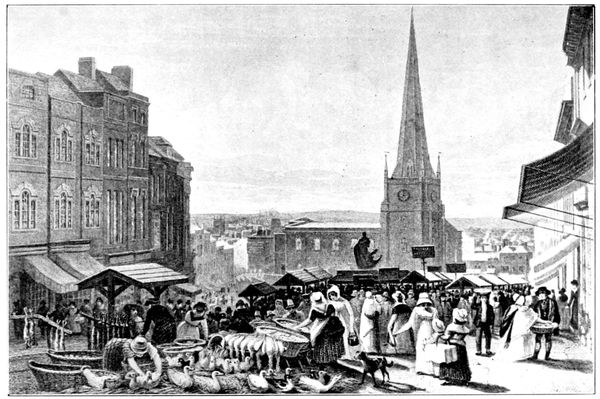
him. Bull Ring is old Birmingham of a hundred
years and more ago; the nucleus of the town,
and little altered since David Cox drew his
picture of the market there. The market
remains, but there has come about since his
day an extraordinary popular appreciation of
the beauty of flowers, so that, instead of the
fowls pictured largely in his view, the crowded
stalls are radiant with blooms of every sort; cut
flowers, and growing plants.
Here stands, as ever, St. Martin’s, the
mother-church of Birmingham, where the ancient
manorial lords of the place lie; those de Berminghams
whose last representative was choused
out of his rights in 1545. Here is that statue
of Nelson for whose proper cleansing a patriotic
tradesman left by will sixpence a week; and here
occurred the Wesley riots of 1742 and the Chartist
Riot of 1839. When Charles Wesley sought to
preach, the people set the church bells a-ringing
to drown his voice, and then began to pelt him
with dirt and turnips; but the political riot was
a much more serious affair, resulting in the pillaging
of shops and houses, and immense damage.
II
4
In Birmingham, close upon four hundred years
ago, Leland found but one street, yet that street
was full of smiths, making knives and “all
manner of cuttinge tooles, and many loriners
that make bittes, and a great many naylors. Soe
that a great part of the towne is maintained by
smithes, who have their iron and sea-cole out of
Staffordshire.”
Not only has Birmingham grown out of all
knowledge since that time, but it has largely
changed its trades. Sheffield has taken away the
pick of the cutlery trade, and that of the loriners
has its chief seat at Walsall; but Birmingham
now makes everything, from a monster engine
to a pin’s head, and in the murderous art of
manufacturing fire-arms is pre-eminent.
“She is,” observed an enthusiastic writer, “in
the truest sense the benefactress of the universal
man, from the crowned head to the savage of
the wilderness.” To the crowned heads, for
example—or to their governments—Birmingham
supplies stands of arms and ammunition; and to
the savage, guns warranted to hurt no one but
he who uses them. Civilisation is thus heavily
indebted to Birmingham, and religion too; for
if the heathen, who “in his blindness bows down
to wood and stone,” is no longer restricted to
those two materials, by reason of Birmingham
industriously supplying little tin and brass gods
by wholesale, and at extremely low prices, to
Africa or India, yet on Sundays the godly folks
of her hundred churches and chapels liberally
subscribe to missionary funds for spreading
Christianity in strange lands, and thus help to
discredit the heathen Vishnus, Sivas, Hanumans,
and assorted Mumbo-Jumbos they export.
5
BULL RING. From a Print after David Cox.
7“Birmingham,” said Burke, a hundred years
ago, “is the toyshop of Europe.” Fancy articles
in steel and paste; buckles, sword-hilts, buttons,
and a thousand other trifles were made, for
home or export; among them the sham, or
“Brummagem” jewellery, and the base coin
that long cast a slur upon the town. Things
coming from Birmingham were in those times
rightly suspect. One of its industries was the
making of “silver” buckles of a villainous kind
of cheap white metal, called from its nature
“soft tommy.” A tale is told of the owner of
the factory where this precious stuff was made
up, going through one of the workshops and
hearing a workman cursing the man who would
chance to wear the pair of buckles he was
making.
“Why,” asked the astonished employer, “do
you do that?”
“Well,” replied the workman, “whoever
wears these buckles is bound to curse the man
that made them, and so I thought I would be
the first.”
Those were the days when it was said that
if you gave a guinea and a copper kettle to a
8Birmingham manufacturing jeweller he would
turn you out a hundred guineas’ worth of
jewellery!
Things are very different now. The trades
of Birmingham seem almost countless in their
number; many of them conducted on a scale
large enough for each one to suffice a small
township of workers. Brass-founding, tube-making,
gun-smithing, pin-making, wire-drawing,
screw-turning, gold-smithing, electro-plating, tinplate
working, coining (in the legitimate kind),
steel pen-making—these are but a few of the
countless industries to whose skirts clings for
livelihood a population of half a million.
When Mr. Pickwick visited Birmingham, he
repaired to the “Old Royal” hotel. Where is
the “Old Royal” now? Ask of the winds—nay,
consult the histories of Birmingham, and
you shall learn. But if the old hotel and many
of its fellows be gone, at least the description
of the entrance to the town holds good, and
“the dingy hue of every object visible, the
murky atmosphere, the paths of cinders and
brick-dust” are phrases that awake echoes of
recollection in the breasts of those who know
the town of old: but “the dense smoke issuing
heavily forth from high toppling chimneys,
blackening and obscuring everything around,” is
not so descriptive of the Birmingham of to-day.
For fully realising that picture, and the added
touches of the “deep red glow of furnace fires,
the glare of distant lights, the ponderous
9wagons laden with clashing rods of iron, or
piled with heavy goods,” one must journey to
Dudley, where such things may be seen and
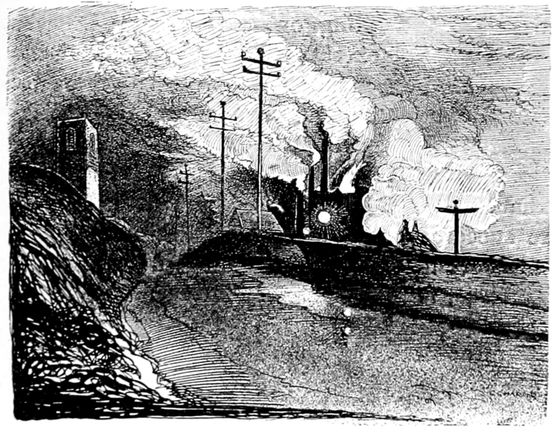
heard in a hellish crescendo: Birmingham has
largely put those things in the background.
In Mr. Pickwick’s time “the hum of labour
resounded from every house, lights gleamed
from the long casement windows in the attic
storeys, and the whirr of wheels and noise of
machinery shook the trembling walls, and the
din of hammers, the rushing of steam, and the
dead, heavy clanking of engines was the harsh
music that arose from every quarter”; but
most of these things are nowadays decently hid
in purlieus remote, or masked from the chief
streets by the towering modern buildings of
hotels, banks, assurance offices, and all the
hundred-and-one parasitical things of a limited
liability age, that fasten like vermin on the
producing body.
Birmingham became a City on January 11th,
1889. It is a City of two fine streets, surrounded
by many miles of formless, featureless,
dull and commonplace (or, at their worst,
hideous and squalid) houses, workshops, and
factories of every size and description. New
Street was only new at a period over a century
ago. Corporation Street was formed in 1871
by boldly cutting through a mass of slums.
In those two thoroughfares, and the open space
by the Town Hall to which they both lead, is
included almost everything of architectural note.
10In their course are to be found the best and
most attractive shops, and the principal banks
and commercial offices. The rest is merely of
a local and provincial character.
The geographical, municipal, and political
centre is, of course, that spot where the
Town Hall stands, a grim and massive building
in the Corinthian style, with that air
of age and permanency about its rusticated
basement, as though when the Anglo-Saxons
came they had found it here, the relic
of an ancient civilisation. But the Town
Hall can lay no claim to antiquity, built as it
was in 1832. Around it, in an open space of a
singularly irregular shape, are the General
Post Office, the Art Gallery, the great Free
Library, and other municipal buildings proper
to a city so rich and prosperous; and, scattered
about the pavements, a miscellaneous collection
of statues, facing towards New Street Station,
as though they formed some kind of deputation
assembled there to welcome visitors. It is a
very oddly assorted crowd, captained by Queen
Victoria, and formed of such varied items as
Joseph Priestley (who with his burning glass
looks as though he were critically examining a
bad coin), Peel, John Skirrow, Wright, George
Dawson, James Watt, and Sir Josiah Mason.
In the little corner called Chamberlain Square
the curious will find a monument to the energy
and enterprise (the “pushfulness” as those
who love him not might call it) of Joseph
11Chamberlain, without whose work and initiative
Birmingham would not own, as it does to-day,
its gas, water, and tramways, and could
not show such evidences of progress in new and
handsome streets and model government.
It is a far cry from the Red Radical days
of Birmingham’s great Mayor in 1874 to those
of the Colonial Secretary, a pillar of the Empire
and the darling of Duchesses. Perhaps no
other man has, politically, travelled so far,
estranged so many friends, or made such
strangely alien alliances, with the result
that his sheaf has been exalted over his
brethren these years past. Hence the extreme
bitterness of the hatred his name arouses in
certain circles.
The memorial to his work on the comparatively
small stage of Birmingham, before he
trod the boards of Westminster, takes the form
of a Gothic canopied fountain, with a profile
portrait medallion, whereon one may trace in
the aggressive, sharp-pointed nose a striking
likeness to William Pitt, and that suggestion
of the crafty fox the venomous caricaturists of
a later day have seized and used to such
advantage.
III
Sir William Dugdale, in his diary, under date
of July 16th, 1679, mentions the first Birmingham
12coach we have any notice of. He says, “I came
out of London by the stage-coach of Bermicham
to Banbury.” That is all we learn of specifically
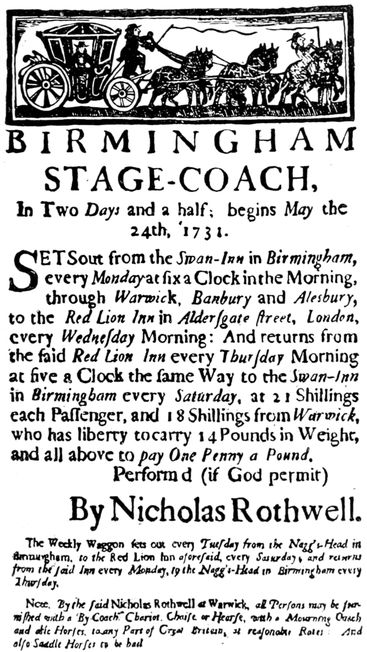
Birmingham coaches until 1731, when Rothwell’s
began to ply to London in two days and a half,
according to the old coaching bill still preserved.
Afterwards came the Flying Coach of 1742,
followed in 1758 by an “improved Birmingham
Coach,” with the legend “Friction Annihilated”
prominent on the axle-boxes. This the Annual
Register declared to be “perhaps the most useful
invention in mechanics this age has produced.”
Much virtue lingered in that “perhaps,” for
nothing more was heard of that wonderful device.
In 1812 the Post Office established a Birmingham
Mail, and great was the local rejoicing on
May 26th, when, attended by eight mail-guards
in full uniform, adorned with blue ribbons, it
paraded the streets. After two hours’ procession,
when coachman and guards were feasted with
wine, biscuits, and sandwiches, the Mail set out
for London from the “Swan” Hotel, amid the
ringing of St. Martin’s bells and the cheering of
the assembled thousands.
Eight years later it was estimated that Birmingham
owned eighty-four coaches. Forty of
these were daily, and most plied on bye-roads.
13
OLD BIRMINGHAM COACHING BILL.
BIRMINGHAM
STAGE-COACH,
In Two Days and a half; begins May the 24th, 1731.
SETS out from the Swan-Inn in Birmingham,
every Monday at six a Clock in the Morning,
through Warwick, Banbury and Alesbury,
to the Red Lion Inn in Aldersgate street, London,
every Wednesday Morning: And returns from
the said Red Lion Inn every Thursday Morning
at five a Clock the same Way to the Swan-Inn
in Birmingham every Saturday, at 21 Shillings
each Passenger, and 18 Shillings from Warwick,
who has liberty to carry 14 Pounds in Weight,
and all above to pay One Penny a Pound.
Perform d (if God permit)
By Nicholas Rothwell.
The Weekly Waggon sets out every Tuesday from the Nagg’s-Head in
Birmingham, to the Red Lion Inn aforesaid, every Saturday, and returns
from the said Inn every Monday, to the Nagg’s-Head in Birmingham every
Thursday.
Note. By the said Nicholas Rothwell of Warwick, all Persons may be furnished
with a By Coach Chariot, Chaise or Hearse, with a Mourning Coach
and able Horses, to any Part of Great Britain, at reasonable Rates And
also Saddle Horses to be had.
14From 1822 to 1826 Birmingham witnessed
a great improvement in its coaches. Waddell
owned the two most prominent yards in the
town, but had many ardent competitors. In
1822 the “Tally-ho” was established, shortly to
be followed by the hotly competing “Independent,”
“Real,” and “Patent” Tally-hoes. Supposed
to keep a pace of ten miles an hour,
they no sooner left the town behind than they
started racing, to the terror of the nervous and
the delight of the sporting passengers. Annually,
on the First of May, they were spurred to superhuman
and super-equine exertions, and, we are
told, covered the hundred and eight miles between
Birmingham and London “under seven hours.”
How much under is not stated, but as an even
seven hours gives us fifteen miles an hour,
including stops, the pace must have been furious.
Harry Tresslove, the coachman of the “Independent
Tally Ho,” always galloped the five-mile
stage between Dunchurch and the “Black Dog,”
Stretton-upon-Dunsmore, in eighteen minutes.
The existence of all stage-coaches being
furiously competitive, they could not afford to
be quiet and plain, like the Mails. “Once I
remember,” says De Quincey, “being on the
top of the Holyhead Mail between Shrewsbury
and Oswestry, when a tawdry thing from Birmingham,
some ‘Tally-ho’ or ‘Highflyer,’ all
flaunting with green and gold, came up alongside
of us. What a contrast with our royal simplicity
of form and colour in this plebeian wretch! The
single ornament on our dark ground of chocolate
colour was the mighty shield of the Imperial
arms, but emblazoned in proportion as modest
as a signet-ring bears to a seal of office. Even
this was displayed only on a single panel,
15whispering, rather than proclaiming, our relations
to the mighty State; whilst the beast from
Birmingham, our green-and-gold friend from
false, fleeting, perjured Brummagem, had as
much writing and painting on its sprawling
flanks as would have puzzled a decipherer from
the tombs of Luxor. For some time this Birmingham
machine ran along by our side—a piece
of familiarity that already of itself seemed to
me sufficiently Jacobinical. But all at once a
movement of the horses announced a desperate
intention of leaving us behind. ‘Do you see
that?’ I said to the coachman. ‘I see,’ was
his short answer. He was wide awake, yet he
waited longer than seemed prudent, for the
horses of our audacious opponent had a disagreeable
air of freshness and power. But his motive
was loyal; his wish was that the Birmingham
conceit should be full-blown before he froze it.
When that seemed right he unloosed, or, to
speak by a stronger word, he sprang his unknown
resources: he slipped our Royal horses like
cheetahs, or hunting-leopards, after the affrighted
game. How they could retain such a reserve of
fiery power after the work they had accomplished
seemed hard to explain. But on our side,
besides the physical superiority, was a tower
of moral strength, namely, the King’s Name.
Passing them without an effort, as it seemed,
we threw them into the rear with so lengthening
an interval between us as proved in itself the
bitterest mockery of their presumption; whilst
16our guard blew back a shattering blast of triumph
that was really too painfully full of derision.”
The “Emerald” was a fast night coach between
London and Birmingham, “driven,” says
Colonel Corbet, in his book, An Old Coachman’s
Chatter, “by Harry Lee, whose complexion was
of a very peculiar colour, almost resembling
that of a bullock’s liver—the fruit of strong
potations of ‘early purl’ or ‘dog’s nose,’
taken after the exertions of the night and
before going to bed.”
The last coach put on the road between
London and Birmingham, we are told, on the
same authority, was in 1837. It was a very
fast day mail, started to run to Birmingham and
then on to Crewe, where it transferred mails
and passengers to the railway for Liverpool.
It was horsed by Sherman, and timed at twelve
miles an hour.
Early or late in the coaching era robbery
flourished. In the opening years the coaches,
as already abundantly noted, were held up by
the conventional figure of the highwayman; but,
as civilisation advanced, methods changed, and,
instead of bestriding a high-mettled steed at the
cross-roads, there to await the coach, the thief,
in concert with a chosen band, booked seats,
and during a long journey cut open the boot
from the inside of the vehicle, and having safely
extracted the bank parcels and other valuables,
made off from the next stopping-place with ease
and complete safety. The advantages of this
17method were so obvious that coaching history
teems with examples of such robberies. Very
often, however, the booty was in notes, and
difficult to turn to any account. Hauls such
as that described in Aris’s Birmingham Gazette
of February 17th, 1823, were rare. It mentioned:
“A parcel containing 600 sovereigns, directed to
Messrs. Attwood and Spooner, was stolen last
week from one of the London coaches, on its
way to Birmingham.” The bankers never saw
the colour of their money again.
IV
Birmingham, says De Quincey, was, under the
old dynasty of stage-coaches and post-chaises,
the centre of our travelling system. He did not
like Birmingham. How many they are who
do not! But, look you, he gives his reasons,
and acknowledges that circumstances, and not
Birmingham wholly, were the cause of his
dislike. “Noisy, gloomy and dirty” he calls
the town. “Gloomy,” because, having passed
through it a hundred times, those occasions
were always and invariably (less once), days
and nights of rain. Ninety-nine times out of
a hundred; what a monstrous proportion! And
even so, the hundredth was just one fleeting
18glimpse of sunshine, as the Mail whirled him
through; so that he—with a parting sarcasm—had
not time to see whether that sunshine was,
in fact, real, or whether it might not possibly
be some gilt Brummagen counterfeit; “For
you know,” says he, “men of Birmingham, that
you can counterfeit—such is your cleverness—all
things in Heaven and earth, from Jove’s
thunderbolts down to a tailor’s bodkin.”
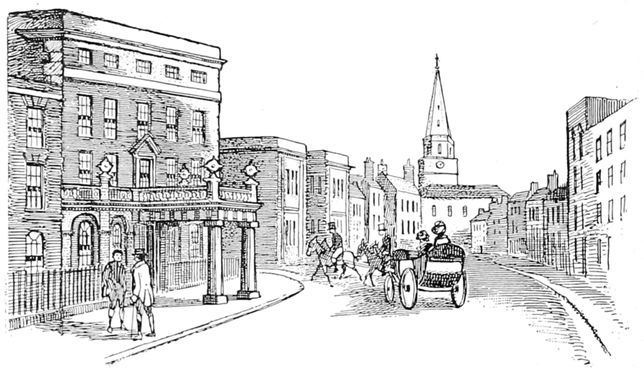
THE “HEN AND CHICKENS,” 1830.
De Quincey put up, as most travellers of
his time were used to do, at the famous “Hen
and Chickens”; the enormous “Hen and
Chickens.” “Never did I sleep there, but I
had reason to complain that the discreet hen did
not gather her vagrant flock to roost at less
variable hours. Till two or three, I was kept
waking by those who were retiring; and about
three commenced the morning functions of the
porter, or of ‘boots,’ or of ‘under-boots,’
19who began their rounds for collecting the
several freights for the Highflyer, or the Tally-ho,
or the Bang-up, to all points of the compass,
and too often (as must happen in such immense
establishments) blundered into my room with
that appalling, ‘Now, sir, the horses are coming
out.’ So that rarely, indeed, have I happened
to sleep in Birmingham.”
The old Hen in High Street, ceased very
many years ago to lay golden eggs, and her
Chickens were dispersed, to be gathered under
a new roof in 1798. The first notice of the
original “Hen and Chickens” appeared in an
advertisement of December 14th, 1741. In
1770, a certain “Widow Thomas” kept it, and
in 1784 one Richard Lloyd. When he died,
his widow carried on the business until the
expiration of the lease in 1798. This lady,
Mrs. Sarah Lloyd, was one of those enterprising
and business-like women who—like
Mrs. Ann Nelson and Mrs. Mountain—left so
great a mark upon that age. She was not
content to renew her lease of the old house,
for which she had hitherto paid £100 a year
rent; but, with a keen appreciation of Birmingham
improvements, purchased a plot of land in
the newly formed New Street, and, some time
before the lease of the old house expired, began
to build a much larger and imposing structure,
“from the designs of James Wyatt, Esq.” It
was one of the first houses in Birmingham to
be built of stone, instead of brick. To this
20she removed in 1798, and named it “Lloyd’s
Hotel and Hen and Chickens Inn.”
Mrs. Sarah Lloyd, who to many of her more
irreverent guests typified the old Hen, sold her
business and leased the inn five years later,
April 16th, 1804, to William Waddell, of the
“Castle,” High Street. He was the son of a
London oil merchant, and years before had
married Miss Ibberson, daughter of the proprietor
of the “George and Blue Boar,”
Holborn.
It was during Waddell’s reign that the
“Hen and Chickens” saw its greatest prosperity.
His rule extended from 1804 until 1836, ending
only with his death in that year; and not only
covered the best years of the coaching era,
but almost saw its close. His was the greatest
figure in Birmingham’s coaching business. In
1830 he had purchased the freehold of the
“Hen and Chickens” and about the same time
bought the “Swan,” and with his son Thomas
carried on a general coaching business and
contracting for the Mails.
In 1819 thirty coaches left the “Hen and
Chickens” yard daily; by 1838 the ultimate
year, the number was thirty-two. But by far
the greatest number started from the “Swan,”
for in 1838 no fewer than sixty-one coaches
hailed from thence.
On Waddell’s decease the freeholds of both
the houses were sold, and bought in by
members of the family; that of the “Hen and
21Chickens” realising £14,500, and the “Swan,”
£6,520. The beds alone of the “Hen and
Chickens” were then stated to bring in £800
per annum. The “Hen and Chickens” was
then leased by Devis, of the “Coach and
Horses,” Worcester Street, at a rent of £600.
He shortly afterwards sublet it for £700 to
Mrs. Room, a widowed innkeeper, who remarried
and gave it up in 1843, after a term of seven
years, when Devis resumed.
These appear to have been ill years for the
famous old house. Coaching and posting business
had decayed, and the commercial growth of
Birmingham did not make amends for the loss
of the good business done with the nobility and
gentry who resorted here in the old days of
the road, but now travelled through by train.
Devis, accordingly disappears, and the Waddell
family, finding difficulties in getting a tenant,
put in a manager, Joseph Shore by name. A
tenant was at length found in Frank Smith,
who had long been a druggist in New Street,
but was now ready to try his fortune as hotel-keeper.
His rule extended from 1849 to 1867,
and was then changed for that of Oldfield,
who reigned until 1878, when the old fittings
of the hotel were sold and its career brought
to a close. The end of the building, was,
however, not yet, and the “Hen and Chickens”
continued in a modified form, until 1895.
Lately it has been pulled down, and a tall,
showy “Hen and Chickens Hotel and Restaurant,”
22in a Victorian Renaissance style and
liver-coloured terra-cotta erected on the site;
a complete change from the old house, once
looked upon as an ornament to New Street,
but become at last, owing to the rebuilding
carried on all around, altogether out of date
and, by contrast, heavy and gloomy. Its severe
architecture had been frilled and furbelowed at
different times—a portico built out over the
pavement in 1830, and a stone attic storey
added in more recent years, with a saucy turret
at one end—but, however comfortable within,
the exterior suggested a bank or some sort of
public institution, rather than the warmth and
good cheer of an hostelry, and so it was swept
away.
“The Fowls” as Young Birmingham delighted
to call the “Hen and Chickens,” housed of
course many notable persons, but not those of
the most exclusive kind. The “Royal,” where
no coaches came, was in those days the first
house. In later days, however, somewhere about
1874, the “Hen and Chickens” lodged the
Grand Duke of Hesse, and never ceased to
boast the fact. Absurdly much was made of
him. He walked on special carpets, dined off
plate that had graced no plebeian board, and
came and went between rows of servants frozen
at a reverential angle of forty-five degrees. The
management even went to the length of placing
likenesses of his wife on his dressing-table, to
make it seem more home-like. Excellent
23creatures! How touching a belief they cherished
in the prevalence of the domestic virtues,
even in the august circumstances of a Grand
Duke!
V
Although the “Hen and Chickens” had so
early been removed to New Street, Bull Ring
and High Street continued to be the chief
coaching thoroughfares. There stood the “Swan,”
the “Dog” afterwards known as the “Nelson,”
the “Castle,” “Albion,” and “St. George’s
Tavern.” In Bull Street was the “Saracen’s
Head.”
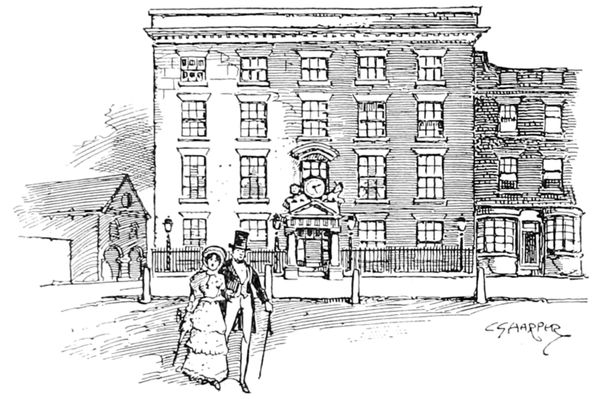
But the most exclusive and aristocratic of
all was the “Royal,” afterwards known as the
“Old Royal.” This was the house mentioned
in the “Pickwick Papers,” where the waiter,
having at last got an order for something,
“imperceptibly melted away.” It stood in
Temple Row, and long arrogated to itself, before
ever the title of “Royal” came into use, the
name of “The Hotel.” Other hotels there were,
but this proud house professed ignorance of them.
It was originally built, with its Assembly Rooms,
in 1772, and set forth, as a special attraction
to its patrons, the statement that no coaches ever
approached to disturb the holy quiet of Temple
Row.
24It was about 1825 that something of this
seclusion was sloughed off, and the business
transferred to the old Portugal House in New
Street, where, with two additional wings, it
blossomed forth as the “New Royal.” Its old
supremacy now began to be challenged by the
newly established “Stork,” in Old Square, then
a quiet and dignified retreat, very different
from the same place to-day, with its flashing
shops, electric lights, and tramways; nothing
now old about it, excepting its name. The
“Stork,” of course, suffered something at the
hands and pens of witlings, just as did the
“Pelican” at Speenhamland, on the Bath Road!
and to make humorous reference to its “long
bill” was the custom, whether the charges were
high or moderate.
THE “OLD ROYAL.”
But the days of the old hotels, exclusive or
otherwise, were in sight when the railway came.
25Another sort replaced them, and, although the
kind in its turn has gone out of favour, examples
may yet be found. Who does not know the
typical hotel of, say, the Fifties and the Sixties,
that abominably draughty type of building, all
cold would-be magnificence and interminable
flights of stairs, with lofty rooms, apparently
built for a Titanic race fifteen feet in height, and,
by consequence, never warm, and never with
an air of being fully furnished. That such as
these should ever have replaced the cosy old
houses can only be explained on the score of
fashion, for there are illogical and senseless
fashions in architecture, as in everything else.
The railway era commenced in Birmingham
with the opening of the Grand Junction and
the London and Birmingham Railways in 1837
and 1838. The early railway engines and
carriages, and, indeed, everything connected with
those days of the rail, are curious nowadays, and
not the least amusing are the comments then
made on travelling by steam. “A railway conveyance,”
said one, writing in favour of the
coaches, “is a locomotive prison, and, the novelty
of it having subsided, we shall seldom hear of a
gentleman condescending to assume this hasty
mode of transit.” That was a very bad shot at
prophecy, but it was followed by a perfect howler
in the way of error. “It has already been
proved,” says this person, “that railways are not
calculated to carry heavy goods.”
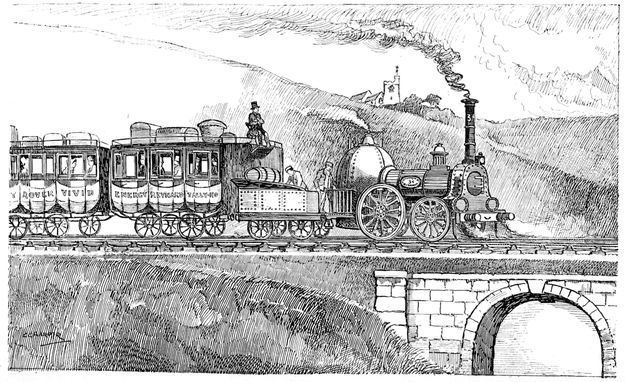
An early London and Birmingham train was
26an odd spectacle; the engine with immensely
tall funnel, and a huge domed fire-box; the carriages
modelled on the lines of stage-coaches, and
their panels painted with high-sounding names.
Luggage was carried on the roof, and the first
guards rode outside with it, until the cinders
and red-hot coals from the engine half blinded
them and destroyed their uniform, when they
quitted that absurd position and travelled inside.
Early railway journeys were penitential for
travellers, for, instead of rolling smoothly over
wooden sleepers, the granite slabs to which the
fish-bellied rails of that time were riveted, produced
a continual jarring and a deafening rattle.
Fares too, with less than a quarter of the accommodation
now provided, were almost double what
they are now, and the breaking-down of engines,
and all manner of awkward accidents, disposed
many to think a revival of coaches probable.
VI
The way out of Birmingham is dismal and
unpromising, by way of Livery Street and Great
Hampton Street. At the end of that thoroughfare—formerly
known as Hangman’s Lane—Birmingham
is left behind; but some seventeen
miles of continuous streets, ill-paved and hilly,
27and infested with tramways, yet lie before the
pilgrim.
Livery Street, so-called (at a hazard) because
its granite setts jolt so unmercifully the cyclist
who is rash enough to ride along it, gives an
outlook on to close-packed, mean, and frowsy
little courts and thoroughfares with grotesquely
commonplace or absurd names—among them
“Mary Ann Street.” Here and along Great
Hampton Street, where the smuts from Snow
Hill Station and those from adjacent factories
now fall thickest, the Birmingham of little
more than a century ago ended, and gave place
to the open heath of Soho, enclosed only in
1793. “At the second milestone,” says an old
Birmingham guide-book, “on the left, when
you have passed through the turnpike, is Soho
Factory, a magnificent pile of buildings”; but
that great workshop of Boulton and Watt has
long since disappeared and the turnpike itself
forgot; while Soho Heath is covered, far and
near, with streets of a terribly monotonous kind—as
like one another as the peas in a pea-pod.
The only landmarks and bright spots are public-houses.
Not inns for travellers, but gin-palaces
for boozers, where plate-glass, gas-lamps the size
of balloons, and florid architecture give the inhabitants
of these wilds their only idea of style
and distinction, and that a mistaken one. All
else is dull and grey. Such are Hockley and
Soho, and such is Handsworth.
Between those two last Warwickshire is left
28behind, and Staffordshire entered—“Staffordshire
ful of Queenys,” as an old writer has it. What
he meant by that, no commentator appears yet
to have explained, but it sounds complimentary.
The “elegant village” of Handsworth, as it
is called by the author of that old guide-book
already quoted, was built over the great surrounding
commons, enclosed in 1798. That
extraordinary person seems to look upon this
enclosing and filching of public property as
virtuous and altogether praiseworthy, and talks
with unctuous satisfaction of “at least 150
respectable houses erected on land which lay
formerly entirely waste. Plots of land”—he
continues, with greasy delight—“have been sold
from £200 to £1,000 an acre.”
He tells the same tale of the waste lands of
West Bromwich, enclosed in 1801, and realising
similar sums. These long thoroughfares, therefore,
are nearly all built upon stolen property,
and the rents of the houses should by right go
into municipal or imperial coffers, instead of
private pockets.
West Bromwich, the greater part of whose
site was a rabbit-warren so late as 1800, is a
continuation of this weary street. Here, perhaps,
it was that Mr. Bull, “an eminent tea merchant,”
while journeying on horseback from Wolverhampton
to London in October, 1742, was overtaken
by “a single Man on Horseback, whom he took
for a Gentleman. After they had rode three or
four miles,” the account continues, “the highwayman
29then ordered him to deliver, which
Mr. Bull took to be in Jest; but he told him
that he was in Earnest, and accordingly robb’d
him of about four Guineas and his Watch, and
afterwards rode with him three miles, till they
came near a Town, when the Highwayman
rode off.”
West Bromwich is now a busy ironworking
town, with newly opened collieries and a population
of 90,000. Just as the cuttle-fish obscures
its surroundings by exuding an inky fluid, so
do West Bromwich and Dudley, away to the
left, belch forth clouds of smoke, and between
them till the sky with a pillar of cloud by day
and of fire by night. The road, running as it
does at a considerable height, commands a good
view of the clustered towns and districts of the
Black Country, with the sullen-looking canals,
collieries, blast-furnaces, and a hundred other
kinds of the commercial enterprises of this
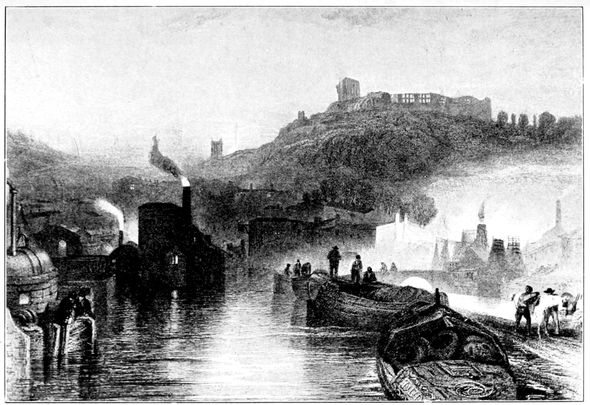
wonderful hive of industry. Dudley, with its
ancient castle on a hill-top, wreathed in inky
fumes, and Dudley Port down below, with rows
of brick and tile works spouting smoke so black
and dense as to look almost solid, form the
centre; with Tipton, Oldbury, Priestfield, and
Swan Village as satellites offering their contributions
to the general stock of grime and
obscurity. At night all this is changed, and the
chimneys that in daylight seemed only to smoke
all become tipped with tongues of fire, casting
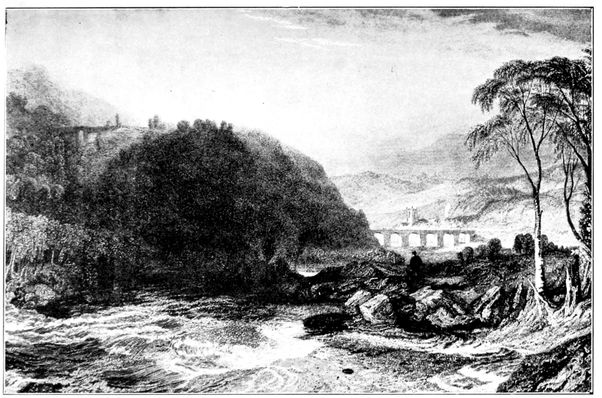
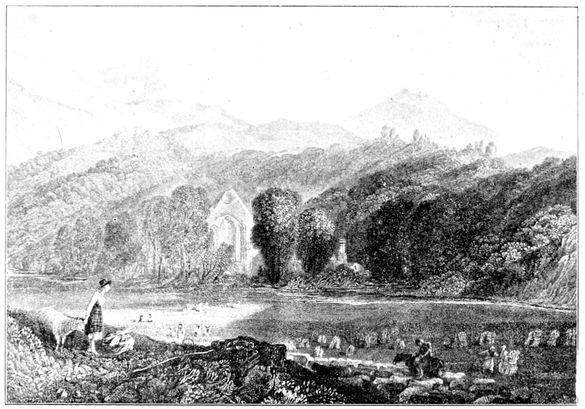
a lurid glow upon earth and sky. Turner has
30left, in his weird picture of Dudley, a characteristic
view of Black Country scenery; and
Dickens, in the morbid pages of the Old
Curiosity Shop, has described its darker and
more repellent side. It is a country where
every effort of Nature to put forth leaves and
grass is thwarted. Land not built upon has
been ransacked for mineral wealth and turned
inside out, with the result that on the shale
and debris only the scantiest and most innutritious
of weeds can find a livelihood—and weeds
commonly thrive where nothing else can exist.
VII
At Hilltop, where the rattling and belching
steam tramcars branch off for Dudley, a descent
is made by Holloway Bank to Wednesbury—the
“Wodensburgh,” as it is thought to have
been, of Saxon times, and the “Wedgebury”
of modern local parlance. Wednesbury begins
at the bottom of this descent at Wednesbury
Bridge, where the filthy stream called the river
Tame trickles between slimy mud-banks under
the brick arches built by Telford in 1826; but the
end of one town and the beginning of another in
the Black Country, where the streets between
half a dozen townships are continuous, can only
be noted with certainty by the borough surveyors
concerned. There are still on the West
Bromwich side of the bridge a few queerly
gabled old cottages—kept white by dint of
constant recourse to the whitewash pail and
brush—that show by their sunken position how
the road once dipped to the ford, before the
bridge was built.
31
DUDLEY After J. W. M. Turner, R.A.
33Wednesbury is not, any more than its neighbours,
a place of beauty; but it is of far more
remote origin than most, and, though it be dirty
and foul, and surrounded by waste lands like
a vast congeries of domestic dustbins, has a
story going back to Saxon times, and the highly
romantic connection with Woden, the war-god,
already hinted at. The old parish church, conspicuous
on the hill that forms the site of
Wednesbury, is beautiful within, even though
as black as your hat outside, and, moreover,
dates as to its foundations from the Norman
period. Those foundations have an unusual interest,
built as they are of the material called
“pockstone,” which is nothing less than surface-clay
baked and burnt by the underground fires
that have raged at intervals from time immemorial
in the coal-beds underlying the town
and its surroundings.
For Wednesbury is, or was, one great coalfield,
and long before its modern iron and steel
trades had developed, was a place of collieries.
Many of them are exhausted now, but there
were times when to dig in one’s back-yard was
to open up a private coal-mine and find fuel
34for the seeking, so near the surface did the
coal-measures lie. Even to this day, when
the streets are “up” for new gas or water
pipes, the excavating discloses coal of sorts: not
perhaps equal to the best Wallsend, but still
coal that will burn and give out heat, and as
such eagerly pounced upon by the poor little
ragamuffins of the town, who come forth with
bags and baskets and aprons to freely fill the
domestic scuttle.
The first coal-getting at Wednesbury was
by “openworks,” just as gravel is dug, or the
brick-earth of brickfields is excavated. These
“openworks” are very ancient and mostly
disused, and even in places where they still
yield coal, it is of inferior quality. To these
succeeded the “bell-pits” of the middle period,
and the deep levels of more modern times. In
all this succession of years the underground
conflagrations continued, and the parish registers
contain many references to them; for example,
when on “June ye 20th, 1731,” a collier was
“most dismally scorched and roasted to death
by ye Hellish Wildfire.” Even in recent years
these fires, thought to be caused by spontaneous
combustion, have broken out. Such was the
one that burned from 1894 until 1898, and not
only destroyed a great part of the King’s Hill
Road, but caused the death of a watchman, who
fell into one of the gaping holes and was burnt
to death.
Wednesbury’s blast-furnaces, foundries, iron
35and brass and steel tube works, and manufacture
of railway wheels and axles support the place,
now that coal is not so plentifully got. The
quantities of railway material may not surprise
one, but feelings of astonishment arise on
contemplation of the tubing produced—tubing
for bicycles, bedsteads, water-pipes, gas-mains,
and for many other purposes known only to
specialists in these matters; tubing from gauges
as slender as a lead-pencil to a size ample
enough for one to crawl into, if so minded.
All the world, it might be thought from a sight
of these things, has an insatiable appetite for
tubes!
The coal trade is not so completely exhausted
but that pit-men are a common enough sight
in Wednesbury, and pit-girls too, or rather pit-bank
lasses; gentle creatures who sort and
pick the coal over at the pit’s mouth, and
have muscles strong enough to fell an ox. It
is not known when a lass of the pit-bank ceases
to be a lass; probably they always remain so,
just as postboys were, and “Cape boys” are,
nominally juveniles for the term of their
natural lives. Let it not, however, be thought
that the pit-lass is being made fun of: it is
done here in print as little as it is likely to be
within reach of her brawny arm.
A curious revival of old customs here is the
trade of the “coal-jagger,” a peripatetic retailer
of coals to the poorer classes. The moneyed
man may have his coals in by the ton, but the
36working-man buys his by the pony or donkey
load of the jagger, who may be seen in the
streets leading a patient and depressed animal
hitched up to three or more odd little three-wheeled
trucks, coupled together like a
miniature mineral-train. Each truck contains
about a sackful of coals, offered direct from the
pit’s mouth at a price low enough to suit
modest weekly exchequers.
VIII
Down-hill from Wednesbury Market Place,
and thence rising to Cock Heath and Moxley,
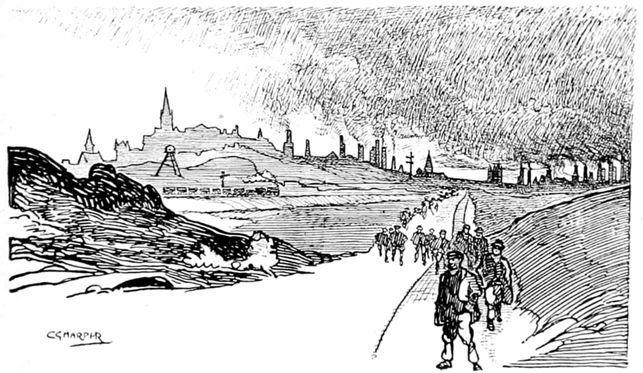
the road runs between rubbish-heaps; a scene
of desolation that, however ill it may be to
live near to, makes a not unpleasing picture in
a sketch, taken at a backward glance, with the
town grouped on a curving sky-line. Moxley,
perhaps, hints at decayed trade in the sign of
the mean little “Struggler” inn.
37
WEDNESBURY.
As for Bilston, where is the man heroic
enough to sound its praises? Passengers by
railway, passing through Bilston, see only
deserted slag-heaps, cinder mounds, and a
general area of desolation, but the road reveals
Bilston in an added squalor of grimy houses
and frowzy courts. The collieries and ironworks
that created the town are things of the past,
and their ruins only remain to tell of what it
was a century ago. Surely never was there
a more second-hand looking place than Bilston
is now, with its long street apparently divided
between old-clothes shops, “marine stores,”
pawnbrokers’ establishments, and public-houses.
Even Bilston gritstone, once prized for the
making of grindstones, is under a cloud, and
the old saying, that “a Dudley man and a
Bilston grindstone may be found all the world
over,” takes a new significance in the fact that
the enterprising native, if he wishes scope for
his enterprise, must go forth in the world to
places as yet unexhausted. But the decay of
the town perhaps dates more certainly from
the fearful times of the cholera epidemic of
1882, when Bilston suffered more severely than
any other place; when so many died that help
38had to be brought from other districts to bury
them; and when hundreds of children were
left fatherless and motherless in the stricken
town. Of a population numbering 14,492,
no fewer than 742 died.
You enter Bilston across a tract of abandoned
coal mines, and leave it for a similar waste.
The forlorn and derelict condition of these
deserted mining fields, strewn with shale and
piled with fantastic, but always grim and
forbidding, rubbish heaps, is a blot upon these
busy districts, and a reproach to the condition
of affairs that permits such things. Apart from
the certainty that the mineral wealth of a
country should be the property of the State
rather than of the individual landowner, the
question of the deserted coal-fields is a very
serious one. Here, in these barren and
absolutely unproductive wastes, the cynical
selfishness of the landed class is abundantly
evident. The coal measures exhausted and the
collieries closed down, the land is unoccupied
and contributes nothing in rates or taxes. It
may lie thus, unfenced and hideously sterile,
until such time as it is wanted for building
operations. In many instances it will never be
required for that purpose, and so much land
has thus permanently become as useless as the
Sahara or the stony deserts of Arabia. There
is no reason, beyond individual self-interest,
why such a state of things should exist. Before
the pits were sunk and coal dug, these wild
39and uncared-for tracts were in many cases
cultivated fields, from which the soil was
removed when the colliery companies began
operations. In leasing ground for this purpose,
landowners usually insert a clause protecting
themselves in the event of the coal being
exhausted and the works deserted; a clause binding
lessees’ to restore the surface soil, or to pay a
fine of £30 an acre. In practice, it is much
cheaper to pay the £30 fine on every acre than
it would be to remove the refuse-heaps and to
spread the nutritious soil over the land again;
hence these abominations of desolation that else
might become fields once more, grow the kindly
fruits of the earth again, employ industry, and
contribute toward the rates and taxes of the
community.
The old red-brick toll-house still standing by
the wayside, about two miles from Wolverhampton,
where Gibbet Lane toll-gate once
barred the way, is in midst of these wastes. The
modern settlement of Monmore Green, as little
like the picture of a village green, conjured up
by its name, as possible, is beyond. It was here
in September, 1829, that the “Greyhound”
coach came to grief on its way to Birmingham.
The breaking of an axle, that fruitful source of
disaster, threw the coach over, and of the five
“outsides” who jumped for their lives, one was
killed, and the other four badly injured.
The great and progressive town of Wolverhampton
now looms ahead, a busy and thriving
40contrast with the scenes just passed, and a place
second to none in the forward strides made
towards improvement in these days of its
expansion.
IX
The old entrance into Wolverhampton, before
the making of Cleveland Road in 1830, was by
the narrow Bilston Street, still remaining as an
object-lesson in old-time thoroughfares, and
thence by Snow Hill along Dudley Street, and
so into what was then called “High Green,”
now known as “Queen Square.” Darlington
Street did not come into being until 1821, and
before that time the rest of the way through
the town and out at the other end, followed a
devious course, by lanes long since swept away,
or widened out of recognition. Coaches changing
horses at the “Peacock” in Snow Hill, a house
still existing as the “Swan and Peacock,” had
the privilege of driving through its yard, and
so by a short cut into Bell Street, across into
Barn Street (long since re-christened Salop
Street), and right away for Chapel Ash, and the
open country again. The coaches thus privileged
were the “Tally-ho,” “Hibernia,” “Crown
Prince,” “Emerald,” “Reindeer,” and “Beehive.”
The mails and other coaches using the “Swan”
41in High Green, or Market Place as it was indifferently
called, or the “Lion” in North Street
close by, had a longer journey, and threaded a
mazy course utterly vanished and forgotten
since the broad and spacious thoroughfare of
Darlington Street was made.
Wolverhampton has nothing to do with
wolves. It was never the “wolves’ town” of
Dr. Mandell Creighton’s contemptibly childish
etymology, but probably derived its name from
Wulfrun, sister of Ethelred II. She it was who
in 994 founded the great collegiate church of
St. Peter, that, collegiate no longer, stands on
the crest of the waterless ridge forming the site
of the town. It is true that there had been
both a church and a town here before that time,
for Wulfhere, first Christian king of Mercia,
dedicated a church to St. Mary at “Hamtun”
in the year 657, and the names of both founders
have such close points of similarity that there
must ever remain some uncertainty as to which
of them really gave Hampton its distinguishing
prefix. It may be noted as a curious fact that
the town is still known in the surrounding
districts as “Hampton.”
Although it is not approached from Birmingham
and Bilston by any appreciable hill, Wolverhampton
is seen by one standing in Queen Square—now,
as ever, the centre of the town to
occupy an elevated site, sloping rapidly towards
the west. It is, indeed, situated, very curiously,
three hundred feet above sea-level, and on the
42great watershed dividing the river-system of the
Midlands. To the east flows the Trent into the
German Ocean, and to the west the Severn and
its tributaries empty themselves into the Bristol
Channel; but, decreeing though it does the
destinies of those rivers, this ridge itself sends
forth only the rivulet called the Smestow.
Wolverhampton is (not very happily) called
the “Capital of the Black Country.” That
title is misleading, for the reason that, although
it has grown enormously, and has long ceased to
be the agricultural market-town it once was, it
stands, not in the centre, but at the very edge of
that busy and grimy tract. Coming through the
Black Country from Birmingham you suddenly,
on taking leave of Wolverhampton, step over
the threshold again into a land of grass and
trees and clear sunshine.
It is a fine and an interesting town, not
wholly given up to factories and soot, and still
keeping a hold upon ancient memories in the
great church of St. Peter, a noble building that,
about 1450, rose upon the site of Wulfrun’s
church, and presents as magnificent an example
of the Perpendicular style as anything to be
found in the Midlands. Much might be said of
St. Peter’s if this were the place for it—of its
rich interior, of the curious and beautiful carved
stone pulpit, and its grotesque lion, goggling
with its stony eyes, erected about 1480, and of
the life-sized bronze statue of Admiral Sir
Richard Leveson, by Le Sœur, that supreme
43artist who wrought the beautiful equestrian
statue of Charles I. at Charing Cross. But
these pages are not for lengthy archæological
disquisitions, and so St. Peter’s must needs he
thus summarised, and even that fruitful source
of angry discussion, the so-called “Dane’s Cross”
in the churchyard, must be but mentioned. It is
not a cross, but a circular pillar of red sandstone,
standing twenty feet high, and covered with
interlacing ornament that may be either Saxon
or Norman, and is thought by some to be the
memorial of a seventh century battle of Tettenhall.
St. Peter’s and its surroundings form the
pleasantest part of Wolverhampton, and though
electric tramways and the press of commerce
make the neighbourhood anything but reverend,
the lawns and beautiful gardens on whose grass
and variegated flowers the ancient tower looks
down prove that, although the town is very
earnest on the subject of getting on in the world,
it does not, for all the striving, forget all those
gracious things that make life better worth the
living.
Of old times there is little, besides the
church, remaining, and the one notable thing,
curiously enough, is, or was, connected with the
church itself. This is the old Deanery, built
in the reign of Charles II., and reminiscent of
the time when the oddly conjoined Deanery of
Wolverhampton and Windsor lasted, together
with the collegiate establishment dissolved in
1846. The Deanery, a grand old mansion of
44red brick, standing in its own grounds, is now
a Conservative Club.
To ask a catalogue of what they make in
modern manufacturing Wolverhampton would
mean a lengthy and varied list; but to specialise
is an easier task. Locks stand at the head of
all products, with more than sixty firms—Chubb’s
the most generally known—engaged in
a weekly output of close upon 400,000 locks;
probably as eloquent a testimonial to the world’s
ingrained dishonesty as anything likely to be
advanced. Thirty firms make the attendant
keys. Tin-plate working and japanning come
next, with cycle-manufacturing; and at the end
of a long list of hardware industries, five “soot
merchants.” There must be great scope for
their business in this neighbourhood of the Black
Country, and the only wonder is that there are
not more of them.
X
Little indeed is left of the Wolverhampton of
the coaching era—a fact not very greatly to be
regretted, because the old town had no architectural
pretensions, but a great many squalid
cottages and lanes, of no real interest or antiquity.
High Green was the exception. It must be
45borne in mind that the Wolverhampton of that
time was a very small place compared with the
great manufacturing town of to-day, and that
the “neat market-town” of Wigstead and Rowlandson’s
tour in 1797 contained only some
11,000 inhabitants. To-day it numbers 96,000,
and extends along the Holyhead Road as far as
Tettenhall, a distance of nearly two miles, more
than a mile beyond what was, a century ago,
the “small village” of Chapel Ash, a place
forming now an integral part of the town. High
Green was a place well named in the adjectival
part of its title, for it occupied the highest
part of the commanding ridge on which Wolverhampton
was first built. Whatever there was
of a green on its site has vanished these
centuries ago, and as a market-place it has long
been superseded by the great market-buildings
near by, and by the Corn Exchange; both erected
about 1851. Before that time it was thronged
with the stalls of butchers, and with country
folk come to sell their vegetables, fruit, eggs,
butter, poultry, and other produce. Farmers
and corn-dealers met there, in the open air,
careless of the weather, as their grandfathers
and remote ancestors had done before them,
holding forth samples of golden grain in their
great outstretched palms, and doing business
with a hand-shake and a convivial glass at the
“Swan,” to the great content of the pigeons
that hovered numerously over this then picturesque
centre of the old market-town, not yet
46transformed by the discovery of the mineral
wealth of the district.
The “Lion” was the principal inn of old
Wolverhampton. It stood on the site now
occupied by the Town Hall, and was originally
built about 1750. Thirty coaches a day are said
to have changed horses in its yard, or to have
started from its doors, and under the sway of
Thomas Badger, who died in 1799, and of his
successor, Richard Evans, it enjoyed for a long
series of years the chief posting business. The
yellow-jacketed and black-hatted postboys of the
“Lion” for nearly three-quarters of a century
rode the pigskin, bumped and plied the whip in
front of the best in Staffordshire, Shropshire, and
Warwickshire.
Richard Evans was highly successful in the
combined parts of coach-master, horse-owner, and
innkeeper. The variety of his business was
surprising, and his methods matched every shade.
He ruled his stable-yards with a passionate storm
of objurgatory eloquence, bore himself with a
tactful but self-respecting deference to the great
ones who honoured his house, was popular with
the townspeople who used his assembly-rooms,
and at one with the Town Commissioners, a
body first established in 1779, and meeting, in
those days before Town Halls, under his roof.
One of his strange guests was the body of the
Duke of Dorset, killed in 1815 in an Irish
hunting-field, and brought to England for
sepulture with his forefathers in the Sackville
vault at Withyham, in distant Sussex. A kind
of lying-in-state, with the public admitted to
view, took place at every town where the
mournful procession halted. The next year,
1816, Napoleon’s travelling carriage, captured
after Waterloo, was here, being shown in the
stable-yard for a week at sixpence a head to
thousands of country-folk and colliers. The pit-men
were not content with gloating over the
capture: they wanted to mark their hatred of
“Boney” by dragging his carriage out and
burning it.
47
HIGH GREEN, WOLVERHAMPTON, 1797. After Rowlandson.
49Richard Evans in 1821 sold his coaching
business to his son, who took it to the newly
built “New Hotel” in Bell Street, itself now
a thing of the past. Shortly afterwards he relinquished
the “Lion” into other hands, but in
a few years the old house began to decline.
Landlords and landladies succeeded one another
at increasingly frequent intervals, and at last
it was closed in 1838, to be used for a period
partly as a private house and partly as a
chemist’s shop. The growing dignity of the
town and of municipal life had by this time
begun to demand the provision of a Town Hall,
and it was acquired and altered at a large cost
for that purpose, only to be found so highly inconvenient
that it was pulled down in 1869 and
the building erected that now stands upon the site.
Next in importance to the “Lion” was the
“Swan,” already mentioned, which stood on the
east side of High Green, where Lloyd’s Bank
50now is. In the old theatre down its yard, built
in 1779, the Kembles, Mrs. Siddons, and many
another trod the boards, and from the balcony
over the “Swan” entrance Daniel O’Connell
addressed excited crowds before the passing of
the first Reform Bill. Reform, however, did
not still political passions, for it was in front
of this house that the election riot of 1835 took
place, with the result that the military were
sent for, the Riot Act read, volleys fired, and
several persons—not rioters, but women and
children—severely wounded.
It was ill work that destroyed the old “Star
and Garter” inn, that stood, a picturesque brick
and timber house in Cock Street (since re-named
“Victoria Street”) until 1834. In that old
house, on a night in 1642, Charles I. slept,
on his way from Shrewsbury to London, to be
intercepted, and his army defeated, at Edge Hill.
The inn was rebuilt and opened again in 1836,
with a make-believe “King’s Room,” a spurious
bedstead, and such incongruities as portraits of
the King and Cromwell on its walls.
Beside these hostelries, and the “Coach and
Horses” on Snow Hill, the old inns of Wolverhampton
were of a minor sort, where the
simpler business-men of those times repaired in
the evening to drink a jovial glass and smoke a
companionable pipe; to play bowls or quoits and
enjoy themselves in what the present generation
would consider a very free and easy, not to say
low, manner.
51
HIGH GREEN, WOLVERHAMPTON, 1826. From an Old Print.
XI
53
Perhaps the most striking way of picturing the
great changes that have taken place in Wolverhampton
in the course of a century is by
comparing the different aspects presented by
High Green at periods ranging from 1797 to
modern times. It has had many changes. Only
two features in the series of pictures have
remained unaltered during that period: the
handsome old brick houses at one corner have
survived, and the noble tower of St. Peter’s still
looks down upon the scene, as it has done for
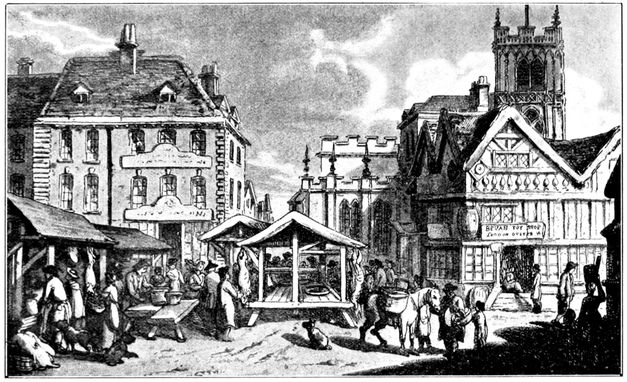
close upon five hundred years. The series opens
with Rowlandson’s spirited drawing, showing the
market in full swing. There are the butchers’
and other stalls; there you see a milkmaid,
milk-pail on head, and the pack-horse of some
country trader in the foreground. On the right
hand is a picturesquely gabled, half-timbered
shop, selling such incongruous things as toys
and oysters: the building covered over with
plaster and become an inn, long known as
“Cholditch’s,” by the time the next view, taken
in 1826, was drawn.
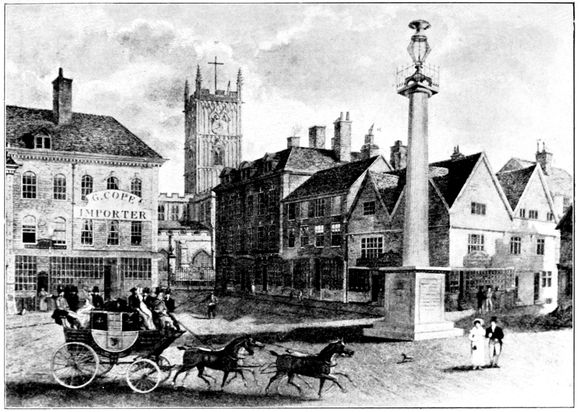
In that view, the coach, making so stately
an exit in the direction of Birmingham and
London, is the “Prince of Wales,” from Maran’s
Hotel, Holyhead, to the “George and Blue Boar,”
Holborn. It reached London from Birmingham
by way of Henley-in-Arden, Stratford-on-Avon,
54Woodstock, and Oxford. The imposing-looking
coachman with the three-caped coat was Miller,
said to have been of Dunstall Hall, reduced in
circumstances, and driving a coach as to the
manner born. As for the monumental structure,
like the second cousin to a lighthouse, standing
in the middle of the road, that was erected in
1821 by the “Light Committee” of the town,
to celebrate the establishment of the first gasworks
and to illuminate the Market-place. As
a monument it was successful enough, and the
patent refracting gas-lamp that crowned it shed
a light visible for miles around; but its height
was so great that the Market-place itself remained
in darkness. It only served to illuminate the
bedroom windows of the surrounding houses and
light the good folks to bed. The “Big Candlestick,”
as the pit-men of the neighbourhood called
it, was a failure, and, after several proposals had
been made to crown the pillar with a statue of
the Duke of Wellington, Sir Robert Peel, or
other heroes of that time, it was removed in
1842, to be succeeded some years later by that
warlike trophy the captured Russian gun, seen
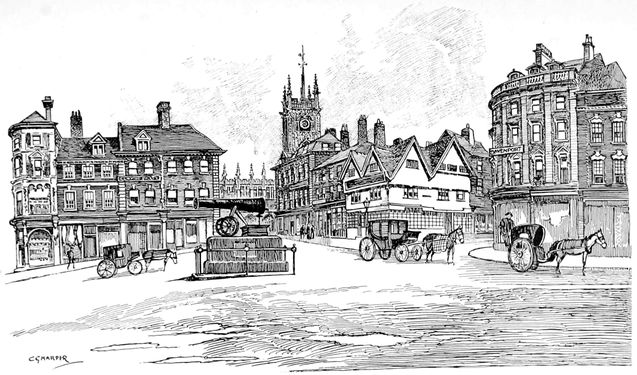
in the picture of “High Green, 1860.” Railways
had then long abolished coaches, and cabs
waiting to be hired form a feature of the scene,
eloquent alike of altered manners and of Wolverhampton’s
growth. Some of the houses are also
seen to have been rebuilt.
55
HIGH GREEN, WOLVERHAMPTON, 1860. From a Contemporary Photograph.
57In the “Queen Square” of to-day the gun
is replaced by an equestrian statue of the Prince
Consort: a Gothic stone bank stands on the site
of the old inn, and on the right hand stands a
newer new building, with sundry other reconstructions
and changes. High Green became
“Queen Square” from November, 1866, when
Queen Victoria unveiled the statue. History
does not tell us why the Prince Consort should
have been especially honoured at Wolverhampton,
which owed him nothing, nor he it. Local
association he had none, and in the placing of
his effigy here we find only another example of
the tiresome excess of loyalty that has planted
statues of Royal personages thickly all over the
kingdom, and has produced a dreary and unmeaning
repetition of “Victoria” and “Albert”
squares, streets, stations, museums, and what
not, to the blotting out of really interesting local
names that had endured for centuries before the
wallowing snob came upon the scene, like some
evil pantomime sprite.
Electric tramways now run through Queen
Square to all parts of this modern and progressive
borough, and new streets and new buildings of
both a business and a public character have
changed the squalid and formless character of
the town into something very different; while
pleasant suburbs extend far into the country
districts.
XII
58
At Tettenhall the borough of Wolverhampton
ends, and with it the Black Country. Crossing
over the Staffordshire and Worcestershire Canal,
the road makes direct for Tettenhall Hill, eased
in its course by a long embankment in the hollow,
and by a deep cutting through the red rocks of
the hill-top, but still a formidable rise. The old
road, however, was infinitely worse. Its course
may still be traced branching off to the left by
the “Newbridge Inn,” where the old toll-house
used to stand, and plunging down into the hollow
where Wolverhampton’s only watercourse, the
Smestow brook, trickles under a narrow bridge,
thought to enshrine among its stones some remains
of Roman masonry. Thence the old way rose
steeply, and went partly through grounds now
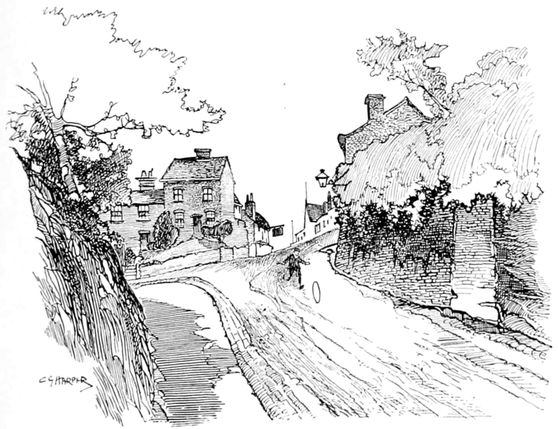
private, and up “Old Hill,” where a bye-road
still zig-zags with an extravagant steepness
between sheer rocks. Here is the chief part of
old Tettenhall village, much the same as it was
a hundred years ago, and, with the exception of
an ugly modern hotel built on the summit of
the rocks, untouched by the life and changes of
all the revolutionary years that have passed since
Telford cut the new road and left this in a
quiet backwater of life.
Tettenhall church and pretty churchyard are
cut off from the rest of the village by the modern
59Holyhead Road. Half-way up the hillside, and
overhung with trees, the old-fashioned rural spot
overlooks Wolverhampton, seated in smoky
majesty on its ridge.
OLD HILL, TETTENHALL.
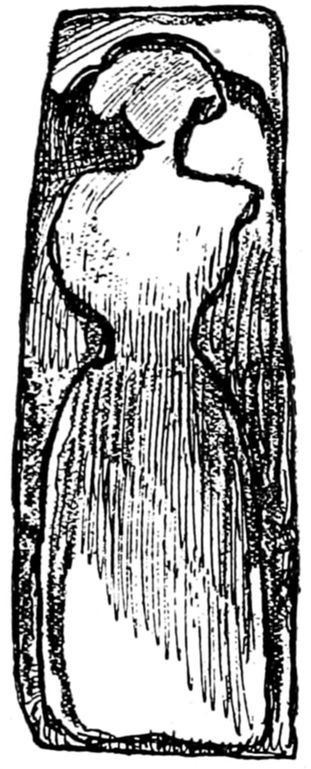
In the crowded churchyard they show the
confiding stranger a stone with the much flattened
and battered figure of a woman, and recount
the legend of it being the memorial of a seamstress
who worked on Sundays, and when
reproached for it replied that if it were wrong
she hoped her arms would drop off. Her arms
dropped off accordingly the next Sunday, when
plying her needle! The stone is really a much
mutilated effigy from some ancient tomb, cast
out of the church so long ago that every feature
60has been worn away; but it will be noticed that
the arms have been hacked off at the shoulders.
THE SABBATH-BREAKING SEAMSTRESS.
On the hill-top is Tettenhall Green, where
old road and new meet, and so go past a park
and hamlet oddly named “The Wergs” to
Wrottesley Park, fenced off for the length of a
mile by as ugly a stone wall as it would be
possible to find in many a long journey. “The
Wergs” is a corruption of the ancient name
“Witheges,” itself a mangled form of “withy
hedges.” It is probable that the name was
derived from the sallows with which some early
squatter fenced his land, instead of the rude
cut-wood fences of primitive times. Wrottesley
Hall, burnt in 1896, still lifts its ruined and
blackened walls between the trees.
61Five miles beyond Wolverhampton, passing
the “Foaming-Jug” Inn, Staffordshire is left
behind, and the borders of Shropshire crossed.
XIII
Shropshire is the land of the “proud Salopian.”
Of what, you may ask, is the Salopian proud?
It may be doubted, however, if the phrase really
means more than that the Shropshireman has
ever been high-spirited, jealous of his own good
name, and quick to wrath. But he has good
cause for pride in the fair shire that held out
of old against the Welsh in the hazardous
centuries when this was part of the Marches,
the Debatable Land where the frontiers shifted
hither and thither as the Lords Marchers or the
Welsh chieftains warred with varying fortunes,
and where the Englishman often sowed, and
raiding Taffy came and reaped unbidden. Shropshire
bore its part well in those centuries of
strife, when the Welsh were continually striving
to get back their own; for it should not be
forgotten that this also was Wales in the dim
background of history. More than eleven hundred
years ago the Englishman threw the Welshman
back upon his rugged hills and out of these
fertile plains, and this became part of the great
Anglo-Saxon kingdom of Mercia. Not only
62politically a part of that realm, but socially, for
war was not an affair of kid gloves in those
days, but an affair of race-hatred and extermination,
so that when the conquering King Offa
had set his rule over what is now Shropshire,
those Welshmen who had not fled were slain,
and their land occupied by an alien race. So
thorough was that change that the very names
of the towns and villages were altered, and are
either quite forgot or else only survive in the
memories of antiquaries. Take a map of
England and its neighbouring Wales, and you
will find a mysterious earthwork called “Offa’s
Dyke,” traced from near Prestatyn, on the
Flintshire coast, to Bridge Sollars, on the Wye
in Herefordshire. That was the boundary set
up by Offa, “the Terrible.” The Shropshire
portion of it runs from Chirk, by Llanymynech,
Welshpool, Montgomery, and Clun, and to this
day not only the place-names, but the people
on either side show a distinct cleavage between
Saxon and Welsh. In the heart of Shropshire
it is difficult to find a trace of the old race.
Who but the antiquary knows that before Offa
came and seized that town Shrewsbury was
“Pengwern”? Yet that was its name. Under
the Saxon it became “Scrobbesbyrig,” that is to
say “Scrub-borough,” or the Town in the Bush.
Two hundred years after Offa and his kingdom
had perished, another fierce personage laid his
heavy hand upon the Welsh in this region. This
was the Norman, Richard Fitz Scrob, to whom
63Edward the Confessor granted what was not his
to give, namely, all the land he could seize from
the Welsh on the Borders. The curious similarity
of his name to that of “Scrobbesbyrig” has
often led to the supposition that he built the
first castle of Shrewsbury, and that the place
took its name from him. But he certainly built
Richard’s castle, on the border, near Ludlow,
one of a chain of more than thirty fortresses
designed to keep the as yet unconquerable Welsh
in check.
From “Scrobbesbyrig,” its capital, Shropshire
derived its Saxon name of “Scrobbescire”
(pronounced “Shrobshire”), changed in after
centuries to its present form; and let it be
noted by all who would not earn the contempt
of Salopians that the right pronunciation of
Shrewsbury follows the derivation, and that to
name it as spelled is regarded by all Salopians
as a vulgarism. It is “Shrowsbury” to the
elect, rhyming with blows, not news.
The name of “Salop,” applied frequently
both to shire and county town—whence
“Salopian”—is another matter, and difficult
of derivation. It comes, say philologists, from
“the ancient Erse words, sa, a stream, and
lub, a loop,” describing the site of Shrewsbury,
encircled as it is by the strange windings of
the Severn.
Shropshire remains one of the most exclusive
and aristocratic counties in England, as well
as one of the wealthiest. It might well have
64claimed, not so long since, to be the thirstiest
also, the Squire as an institution lived longer
here than in most parts, and flourished most.
Two generations ago, Salopians of every class
had the reputation of being able to drink all
others senseless, but that is one of the obsolete
virtues.
One topples over the edge of Staffordshire,
as it were, into Salop, for here the steep
descent of a range of hills leads, by a dramatic
transition, from the waterless plateau around
Wolverhampton to the valley of the Severn.
Summerhouse Hill is the joy of the cyclist
bound for Shrewsbury, and the bane of his
return; with a mile run down in one direction,
and a steady heartbreaking climb in the other.
Near the summit is the “Summer House,”
an inn where the flying “Wonder” of seventy
years ago changed horses punctually at 8.16
every morning, on its journey from London to
Shrewsbury; and at the foot of the hill, the
“Horns” of Boningale. Boningale itself may
be sought on a slip road that goes off to the
left and returns in a semicircle of five hundred
yards: the tiniest village, with a very small
church and one very large black-and-white
farmhouse, almost as ancient as the church
itself. The road onwards is quiet, and unmarked
by any outstanding features, save a
house at Whiston Cross; Albrighton and other
large villages lying a little distance to one
side.
65Whiston Cross, situated 130¼ miles from
London, can claim the distinction of being
exactly half-way between London and Holyhead.
The house was once an inn, but has
long been the place where the Albrighton
Hounds are kenneled. In the old days of
hard drinking, this and the “Harp” inn at
Albrighton were the resorts of a cobbler reputed
to be the greatest sot in the neighbourhood.
He must have been exceptional, for he scandalised
even these parts. He was once the victim,
when in his cups, of a joke whose echoes still
linger mirthfully in the countryside. Senselessly
and helplessly drunk, he was driven over
to a coalpit at Lilleshall and lowered into its
depths. When he came dimly to his senses,
he found himself surrounded by a circle of
inquisitors, their faces blackened, in an uncanny
place, spectrally lighted, and was very soon
made to understand that he was dead and come
to judgment before a jury of fiends anxious
to consign him to a warm corner.
“I don’t know why I was brought here,” he
said miserably, addressing the supposedly satanic
tribunal, “and I can assure you, gentlemen,
I was once a respectable shoemaker, of
Albrighton, in Shropshire.”
Beyond Whiston Cross, in Cosford Brook
Dingle, the Wolverhampton Waterworks raise
their tall chimneys unexpectedly from the surrounding
woodlands of Halton Park; the engine
houses humming with the machinery that daily
66pumps more than three million gallons of water
for the use of that enterprising community. In
another two miles across the Salopian plain,
Shiffnal is reached, and with it the first, and
entirely lovable, specimen of a Shropshire
town.
XIV
Shiffnal is a little place, changed less in the
course of three hundred years than any along
this road. Three centuries ago, when it was
called “Idsall” quite as often as by its other
name, all the town, with the exception of the
church, was brand new, and its site with it;
for the fire that in 1591 had levelled it with
the ground led to the new township being
erected a hundred yards or so to the east of
the old one.
67
SHIFFNAL.
69No fires, however destructive, warned our
Elizabethan forbears that timber was a dangerous
material to build with, and Shiffnal arose,
one mass of timbered houses, and by a happy
chance they most of them remain to this day;
so that, whether one comes into the town by
road, or is swept swiftly over it by train on the
Great Western Railway that looks down from
a lofty embankment upon the queer old Market-place,
the effect is charming indeed. But, lest
this magpie architecture should, or ever could,
look monotonous, there have been introduced,
from time to time, buildings in other styles
and materials. Down the street, and seen, in
fact, before one arrives at the Market-place
itself, is, for example, the “Jerningham Arms,”
stucco-fronted and thrusting forth the elaborate
quarterings of the Jerninghams, Lords Stafford,
and lords of the manor, ensigned with the
Bloody Hand of Ulster, which leads the ignorant
to suppose that Allsopp’s ales are obtainable
within. The “Jerningham Arms” was a
coaching inn, and the “Star” (prominent in the
illustration, with a skylight on its roof) another,
and a handsomer. Behind the fine old red-brick
front of that house, and through the archway,
the stable yard runs down; the beam over the
arch rich in the badges of old fire insurance
offices, and above them the sculptured armorial
shield of some forgotten county family.
Shiffnal church stands a little apart: a fine
red sandstone building with a central tower
crowned with a low pyramidical red-tiled roof
that only by a little overtops the battlements.
Does that sound like a depreciation of it? I
hope not, for it is a type characteristically
English, and very lovable. One may trace
many architectural periods in Shiffnal church,
from the Norman when they could not build
too heavily, to the Perpendicular, when lightness
was coming in. Not that lightness has part or
lot here, for the church is stately rather in the
70massive masculine way. Within a recess of
the chancel wall lies the monumental effigy of
Thomas Forster, “sometime Prior of Wombridge,
Warden of Tongue and Vicar of Idsall,” 1526.
In that inscription the old name of the parish
is preserved, as it is also on a tablet giving an
account of a much more interesting person; a
certain William Wakley. It recounts how he
“was baptised at Idsall, otherwise Shiffnal,
May 1st, 1590, and was buried at Adbaston,
November 28th, 1714. His age was 124 years
and upwards. He lived in the Reign of eight
Kings and Queens.” But this ancient’s record
is surpassed, for the tablet goes on to tell of
“Mary, the wife of Joseph Yates, of Lizard
Common,” who died August 7th, 1776, aged
127 years. “She walked to London just after
the fire in 1666, was hearty and strong 120
years, and married a third husband at ninety-two.”
Two other curiosities, and we are done with
Shiffnal church. The first is the odd Christian
name of a woman—“Kerenhapputh”—on a
stone in the churchyard: the second a Latin
inscription of 1691 on the churchyard wall. It
may be Englished thus (the wall supposed to
be speaking): “At length I rise again, at the
sole expense of William Walford, the kindest
of men.”
XV
71
Breasting a long incline of nearly three miles,
the road comes to Prior’s Lee and Snedshill,
and, reaching a commanding crest, looks down
upon the industry and turmoil of Lilleshall
on the one side, and the equally busy and
industrious Coalbrookdale on the other. The
prettiness of Prior’s Lee is in name alone. It
and Snedshill are wastes of slag and cinder-heaps—some
a century old, others the still
smoking refuse from the blast-furnaces that
roar and whizz and vomit smoke on the left.
SNEDSHILL FURNACES.
But the great iron furnaces of Snedshill are
72seen at their most impressive at night. The
strange cyclist who has never before known
the road sees the reflection of their flames a
long way off, and comes upon the scene bewildered
by the rising and falling of the lurid
light that glows intensely in one direction and
sinks all other quarters in an impenetrable
obscurity. It is the weirdest of scenes, the surrounding
house-fronts and the tower of Prior’s
Lee church standing out in the radiated glare
against the blackest of backgrounds: spouting
flames an angry red, turning the white light
of arc-lamps down at the ironworks a wicked
and debauched-looking blue. Sighings of escaping
steam, like the groans of some weary Titan
exhausted with labour, rise now and again, and
are succeeded by thunderous crashings and huge
clouds of steam and smoke, mingled with millions
of sparks, as the molten metal is now and again
discharged.
To this is added the clattering of coal-waggons
where Oakengates and the collieries lie, deep
down in the valley, brilliant at night with constellations
of lights. In strange contrast with
all this, the benighted wayfarer sees roadside
cottages whose open doors disclose housewives
going about the business of their homes with
all the world, as it were, for a background.
The sight enforces the thought—how great the
little home, how small the vast outside world!
Passing Ketley Station and rising Potter Bank,
great banks loom mystically on the left, and bars
73of light from wayside inns streak the road. If
it be summer night, sounds of glee-singing rise
by the way, for the colliers, although this is
not Wales, have got musical culture.
But daylight strips Ketley of all possible
mysticism, for the soaring banks are then found
to be just cinder-heaps, and the depth of the
deep valley on the right is not so appalling
after all. Most of Ketley’s mines are deserted
now, but the cinder-heaps are gaunt as ever.
Telford drove a new road through the heaps and
used vast quantities of the cinders in ballasting
and paving it, leaving a portion of the Watling
Street, diving down a hollow, on the right.
It is still there, with the disreputable roadside
cottages beside it, as of old, and the same semisavage
class as ever inhabiting them.
Away in the distance, rising majestically
over the miners’ rubbish-heaps, comes the whalelike
outline of the Wrekin, shaggy and blue-black
with pines. Not a great hill, compared with the
Stretton Hills and the Welsh mountains presently
to come in sight; but its isolated position in the
surrounding Shropshire plain gives it a commanding
appearance, and has made the Wrekin
a centre to which all Salopian hearts fondly
turn in response to that old toast, honoured
with three times three, “To all friends round
the Wrekin.” The toast has not so limited an
application as those who are not Salopians, or
know not Shropshire, might imagine, for the
Wrekin is visible from incredible distances, and
74the view from it comprises not only the whole
of Shropshire, but a radius of distant hills
sweeping the horizon round from Malvern, the
Warwickshire Edge Hill, the Peak in Derbyshire,
the mountains about Llangollen, the
Berwyns, Cader Idris, and Plinlimmon, to the
Brecon Beacons.
The famous hill rises only 1,260 feet above
the surrounding plain, but just because it is a
plain, its Protean bulk looms larger and loftier
than many a taller eminence. Protean the
Wrekin is because the outline of it, viewed from
different quarters, varies singularly. Whale-like
from Wellington, from the south-west it looks
like a truncated sugar-loaf, and seen from the
road near Wroxeter resembles a huge and shapely
dome.
Wellington lies a mile distant from the road,
but straggling outposts of houses extend all the
way, and at Cock Corner one may look down
the cross-road and clearly perceive the existence
of the town and what manner of town it is.
To coaching travellers Wellington was but a
name and a distant mass of roofs; for, with
but two minutes to change horses at the “Cock”—or,
if they travelled by the famous Shrewsbury
“Wonder,” a minute at Haygate inn, a mile
onward—they were gone, and roofs and chimneys
sank, as though by magic, beyond the rounded
fields and tall hedgerows.
The “Cock” has remained game to the present
day, and has witnessed the disappearance
75of its once prosperous neighbour, the “Hollybush.”
That picturesquely named inn was a
coaching house of a humbler sort, and carriers
and coal-waggoners made it a house of call.
Now a private house, brilliantly whitewashed,
it seems by that dazzling raiment to have put
away, as far as possible, all coaly memories.
XVI
Haygate inn stands, just as does the “Cock,”
at the fork of a bye-road leading to Wellington.
The “Cock” caught the travellers from London,
the “Falcon” (which was really the sign of
Haygate inn, although few knew it by any
other name than that already mentioned) those
from Wales and Shrewsbury. It was intimately
connected with the Shrewsbury “Wonder,” being
kept by H. J. Taylor, a brother of Isaac Taylor
of the “Lion” at Shrewsbury, who put that
famous coach upon the road in 1825. Another
brother kept the chief inn at Shiffnal, and so
between them they kept the hotel and coaching
business in the family along the first eighteen
miles from Shrewsbury.
When the “Falcon” was rebuilt, in the flush
of the coaching age, it was built to outlast the
requirements of rich and jovial posting and
coaching travellers for at least a century to
come. So much is evident at sight of the
house, substantially constructed and designed
76with all the dignity of a private mansion.
Alas! for all such anticipations; the first railway
train rolled into Shrewsbury Station in
1839, and shortly afterwards the house became
what it is now—a farmstead.
HAYGATE INN.
Hay gate derived its name from “the Haye
of Wellington,” and was a gate into the forest
of the Wrekin in ancient times. Nothing remains
of that forest; the pine-trees that now
clothe the Wrekin were planted on what was
then a bare hillside in the early years of the
last century.
Down this road that once led into the forest
glades in one direction, and to Wellington in
77the other, the town is soon reached. Shropshire
has few places so uninteresting, and its modesty
in thus secluding itself from the old turnpike
is therefore not misplaced. The narrow and
devious streets of the town are not excused by
their houses, almost without exception ugly
and dull. A duller and uglier church, very
“classic” and grimy, fitly lords it over those
secular buildings, and looks down upon the
railway station, placed in a cutting in the very
centre of the town. A portion of the churchyard,
indeed, was cut away to form the site of
that station. A depressing monument, as pagan
and as “classic” as the church, stands prominent
among the humbler tombs. It is black-painted
and gilt, like a jeweller’s show-case, and forms
a canopy or shrine over an urn that does not
contain the ashes of the Reverend John Eyton,
who died in 1823, and is commemorated in a
very long epitaph. He lies below, and the urn
is merely decorative: just of a piece with the
rest of the pagan affectation around. The
author of that epitaph was evidently not one
who “damned with faint praise.” But listen
to the virtues of the departed:—
“As a Christian Pastor he was vigilant, affectionate,
and faithful; unweariedly devoted to
the concerns of the fold, gathering the lambs
with his arm, and daily feeding the flock
committed to his charge. And now, while the
Chief Shepherd places upon his Head a crown
of glory that will never fade away——.”
78And so forth. Another side of the monument
takes up the tale, and tells us what manner of
cleric this was:
“A man of whose character and endowments it
is difficult to speak in any other language than
that of admiration and reverence. His person
and appearance interesting and attractive. His
deportment and manners graceful and engaging.
His intellectual and sacred attainments so
various, so extensive, and so captivating as to
render him everywhere the Desire and Delight
of his edified associates.”
All these advantages and virtues did not avail
him much for preferment, for he never became
a Right Reverend. And yet this surely would
have been the man for a Bishopric. Nay,
Primates could be no more—and are commonly
less.
XVII
Regaining the old turnpike at Haygate Inn,
the Wrekin broods monstrous on the scene
for miles to come, its central bulk reinforced by
Ercall to the left, and little attendant Wrekins,
crowned with fir-trees, on the right. In midst
of this comes Burcot toll-house, situated on a
lonely rise, where cross-roads seem to butt up
against the great hill on one side and disappear
into a valley on the other. This toll-house
79may well compare for size and solidity with
any on the way from London to Holyhead;
but why it should, and why a shield carved in
stone, and inscribed “W.T., 1835,” should
especially distinguish it from its fellows, are
things now hid from mortal ken. Nor has
“W.T.” achieved the fame he evidently desired,
for the initials—to whomsoever they really
belonged—are commonly and erroneously ascribed
to Telford, whose Christian name was Thomas.
THE WREKIN.
From this point, for a distance of nearly two
miles, Telford made what were described in the
published projects of that time as “sundry
valuable improvements.” He planned and
carried out a new line of road through the
shoulder of Overley Hill, so that the coaches,
instead of toiling over its crest, went through
a short piece of rocky cutting below, and left
so much of the old Roman road to solitude
and decay. Coming from Shrewsbury, even
80this improved road remains a weary drag; the
summit and its little group of villas gained
with joy.
Below and beyond comes the Wrekin again,
brooding vengefully over the smiling vale, and
in wind and storm spreading a greater blackness
over the scene: at all times giving a sombre
cast to the long straight reaches of the Watling
Street. There it has sat, moodily reminiscent,
since time began to be. Geologists, who have
their reasons for so doing, describe it as “a
mass of eruptive greenstone,” and say the
Wrekin is “the oldest mountain in England.”
Therefore it may well be reminiscent. It has
seen mankind emerge from the primeval ooze
and floating as invertebrate jelly-fishes in the
inland sea that washed its base, and has watched
the family history from that interesting era to
the present time; through the period of the
arboreal ancestor, when the jelly-fishes acquired
backbones and prehensile tails and took, as
monkeys, to climbing trees; and unless some
of the glorified monkeys come meanwhile as
engineers and quarry it off the face of the
earth, or blast it away, it will probably see the
race itself follow the lead given by the
governments of this country during the last
sixty years, and resume the condition of
invertebrata, wallowing in the slime.
The Wrekin has seen the Stone Age, the
Bronze Age, the coming of the Romans and
the going of them; saw the first clearings in
81the primeval forest, the subjected Britons slaving
under Roman taskmasters at the making of the
Watling Street, and the brief period, centuries
later, of coaching. It has looked down over the
vale these last sixty years upon the railway,
and the time is ripe for another change.
Perhaps we are on the threshold of it.
It is very still and peaceful on the Roman
road, and the traveller has it and its memories
wholly to himself. Among those memories is
the sad story of Robert Bolas, of Uppington,
yonder where the church tower and the
hedgerow elms occupy the middle distance, with
the Wrekin for background.
Robert Bolas came of an old and respected
family in Uppington, but that fact did not serve
to keep him honest, and it seems that he had
long made a practice of stealing wheat from a
farm between his village and Wroxeter. It all
happened very long ago, but the tale is not
likely to be forgotten.
The gradual shrinkage of his grain made
the owner, a farmer named Witcomb, suspicious,
and, with a man named Matthews, he kept a
watch. Bolas duly appeared, with an empty
sack over his shoulder, which he was proceeding
to fill when Witcomb and Matthews made to
seize him. Bolas then picked up a bill-hook,
and attacking them so furiously that Matthews
was killed and Witcomb left, for dead, made off.
But it so happened that Witcomb recovered, and
the affair, that had in the meanwhile created
82a great stir in the neighbourhood, was explained.
For some reason or another, Bolas was confident
of an acquittal, and cheerfully told his
friends he would be home in time to harvest his
barley.
But they found him guilty, hanged him at
Shrewsbury, and gibbeted his body here by the
roadside; and so, although, after a fashion, he
came home again, other hands reaped his bearded
grain. The thing made so strong an impression
upon the countryside that the phrase, “Don’t
make so sure of your barley,” became proverbial.
All these things happened in 1722. Matthews
was buried in Wellington Churchyard, where his
tombstone, stating that he was “barbarously
murdered,” stood until the railway came and
swept it and others away. “Bolas’s Gibbet”
long remained a landmark beside the Holyhead
Road, a weatherworn stump bristling with the
rusty fragments of nails that had been driven
into the post so that it should not be climbed
and the body removed. That “the evil that
men do lives after them” was exemplified
shortly after the body of Bolas came home and
was hung upon the gibbet. There still stands,
not a great way ahead, an old roadside “public,”
the “Horseshoes,” where the road forks to
Wroxeter. Here, one dismal night, several
youths were drinking and joking, when the
conversation turned upon Bolas. Each dared
the others to go in the dark to the lonely spot
and ask the dead man how he felt, and as no
83one was sufficiently courageous to go alone,
they set off a body. On the way, one more
mischievous than the rest drew off unperceived,
and hid in the hedgerow beneath the gruesome
object.
“How are you to-night?” asked the little
group, keeping very close together, and sorry
they had come.
“Very cold and chilly,” answered a pitiful
voice; and immediately they all took to their
heels. One suffered such a shock that he
became a raving maniac.
XVIII
Wroxeter lies within a short distance, but
only approached along a narrow and uneven
lane. Its fine church-tower looks down upon
little more than a few farms and bartons; for
village, as generally understood, there is none.
This simple rural place, aromatic with hay and
straw and corn, is the representative of, and
takes its name from, the great Roman city of
Uriconium, one-third larger than Pompeii,
destroyed by the fury of savage hordes more
than fourteen hundred years ago. The City of
Uriconium,—the “City of the Wrekin”—was
established shortly after A.D. 48, when the
Roman general, Ostorius Scapula, had driven
84out the British tribes. He set an important
station here, at a crossing of the Watling and
the Ikenild Streets, and the place not only
served as an armed camp to guard the roads
and the ford of the Severn, but grew to be the
most important market along the road to Wales.
It lasted four hundred years, and only fell
some forty years after the Romans had deserted
Britain. Uriconium was then taken by the
combined onslaughts of the Welsh tribes, and
burnt to the ground, and the Romanised British
who had remained were all massacred.
THE “OLD WALL.”
To this great city, its site now under corn
and grass land, and inhabited by a handful of
peasants, the Roman road led, on its way to
Wales and the shores of the Menai, and to its
site still leads, but beyond is lost, save to
those who study archæology. The only relics
left on the spot to tell of that vanished place
are the two Roman pillars standing before the
85church; the font, made out of a carved capital;
and that massive fragment of masonry, the
Old Wall, standing once in the centre of the
city, but now solitary in a field.
WROXETER CHURCH.
Superstition brooded for ages upon this spot,
and weird legends were created by the terrors
the lonely place had for the ignorant of other
times. Dead and gone Romans, who had,
86perhaps, been very matter-of-fact and commonplace
persons in their lives, and gifted with all the
small virtues of the hearth-loving citizen, loomed
large, menacing, and supernatural before those
whose business took them near the ruin, and
so it was not until modern times that much was
done to unearth what relics might lie deep
down below the earth deposited by the changes
of so long a period.
It was in 1859 that two acres of land were
excavated. What did they find? Many things.
Fragments of the red Samian ware on which
the Roman citizens served their banquets, and
whence they pledged one another, drinking to
the eternity of Rome. A rusty key without a
lock, and a stylus among bones, wine-cups, and
scattered coins; the wooden tablets it wrote
upon perished, like the hand that held it. The
figure of a cock, modelled in lead, once a
child’s toy, and near it the skeleton of a child,
doubtless the one that owned that ancient
plaything. Three skeletons of older persons
were found, crouched up in one of the underground
hypocausts. A hypocaust was a basement
chamber, constructed to heat a room or house.
Into one of these places those persons had fled
when the barbarians stormed the city. They
intended to creep out when danger was past,
but the place was fired, and they perished in
their hiding-place. Two of these fugitives were
women; the other an old man. Within his
grasp lay a pile of Roman coins, 142 in all,
87and, beside them, all that was left of his
cash-box—some fragments of wood and rusty
nails.
Roofing-slates, still with nails in many of
their holes, were discovered in the ruins; the
slate, by its appearance, judged to have been
brought from Bettws-y-Coed. Millstones for
grinding corn, and a charred heap of the corn
itself, were found; brooches, seals, household
gods, and fragments of the innumerable intimate
articles of everyday life. Even some careless
scribbling, such as that often found on the walls
of Pompeii, was seen; but before it could be
protected some graceless excursionists among the
thousands carried by rail at that time to see
the novelty of a buried city, obliterated it with
their walking-sticks.
The two acres then explored, with the little
that has been done since, give the impression
that if the three-miles’ circuit of the walls
could be excavated, results surpassing the finds
at Silchester might be attained.
From Wroxeter, crossing the Severn, the
Watling Street went by the two Strettons
Wattlesborough, taking its name from being
situated on the great road; Rutunium, now
Rowton; thence to Mediolanum at the crossing
of the river Tanad, under the Breidden, a site
now called Clawdd Coch, or “Red Ditch”;
Mons Heriri, under the shadow of Snowdon
(whose Welsh name is Eryri, or Eagles’
Mountain) at the ancient earthwork known as
88Tomen-y-Mur, in the Vale of Maentwrog; and
to the sea-coast at Segontium, identified with Caer
Seiont, near Carnarvon. A branch, with stations
of the way at Bovium (Bangor-ys-Coed); Deva,
the great fortress of the Twentieth Legion,
identical with Chester, on the Dee; Varae, the
modern Bodfari; and Conovium, by the Conway
(Caer Hên, or Old Fort), traversed the Dee
estuary and the coast-line looking out to Anglesey
and the Irish Sea.
XIX
Returning from Wroxeter and passing the tiny
hamlet of Norton, the way lies flat to Shrewsbury.
Flat, because we are now come beside
the Severn (which no Welshman calls anything
else than Sivern). Away across the watery plain
as we advance are the Stretton Hills on the
left, volcanic and mountainous in outline, blue
and beautiful in colour; and, more distant,
ahead, far beyond Shrewsbury, the Breidden
Hills, a great bulk starting from the level
without any disguise of foothills or preliminary
rises to detract from their dramatic effect.
The Tern, a tributary of the Severn, crosses
the road beneath a handsome stone balustraded
bridge, with views to the right over Attingham
Park and along the road, through a mass of
89overarching trees, toward the village of Atcham.
There, in the Park, stands the classical stone
building of Attingham Hall, one of those places
built a century or more ago at incredible expense,
and only to be maintained at a cost far
exceeding the resources available to-day. Corn
at 50s. and 60s. a quarter built many fine
mansions, and nowadays corn at 25s. keeps
them empty. Attingham Hall lacks a tenant.
It belongs to Lord Berwick, whose title does
not, by the way, come from the only Berwick
commonly known—the town of Berwick-on-Tweed—but
from Berwick Maviston, close by Atcham,
the old home of the extinct Malvoisin or Mayvesin
family.
The chief entrance to Attingham Park is
through the great archway in Atcham village.
One side of the village street is made up of
church, school-house, post office, a deserted
coaching inn, and a number of rustic cottages;
the other is the long brick wall of the Park,
densely overhung with trees, on to which the
village blankly looks. The only opening in this
wall is the great archway aforesaid; very tall,
Doric, and stony. With a spinal shiver the
stranger, who stands wondering awhile where
he has seen its like, suddenly realises the
resemblance it bears to the entrance of certain
great London cemeteries. The arch is flanked
by a stag on one side and by a pegasus on the
other, with the inscription in gigantic lettering
in between: “Qui uti scit ei bona.” A very
90proper aspiration; but it is just as well that
tramps are innocent as a rule of Latin, or they
might not inaptly call and ask for something
on account.
Opposite this gateway stands what was once
the “Talbot,” a first-class posting-house. It
looks on to the church in one direction, the
entrance to the Park in another, and down upon
the Severn in a third, so that its situation is
by no means commonplace. When the altered
conditions of travelling rendered it no longer
possible to carry on a remunerative business
here, the hotel was converted into a private
mansion, and the gravelled drive walled in and
turfed, but it has only been occupied for short
periods and has long stood empty. Like the
Princess in the fairy tale, it waits and still
waits, looking up the road and down the road
and over the bridge for the expected. It is
weary waiting, and even the rats and mice who
lived royally in old times, and were reduced at
last to the pitiful expedient of subsisting on
the faint smell of what had been, gave it up
and lived on one another. The ultimate survivor
is believed to have committed suicide in the
Severn.
It is a noble bridge that spans the river
here, and, built before the art—no, not the art,
the science—of constructing bridges in iron was
understood, is of stone, and very steep. This
steepness added to its narrow proportions was a
terror to those nervous coach-passengers whose
91faith in Sam Hayward of the “Wonder” was
not what it should have been, considering the
consummate art he displayed as a whip. But
possibly they thought that all the artistry in
the world would be of little use to save them
and the coach if, on one of the wintry nights
and mornings when the Severn mists had
obscured the road, they came into collision
with the parapets and so were hurled into the
swirling river; and, moreover, the hours—5.30
in the morning and 10 at night—when the
“Wonder” passed this dangerous spot, are not
those when courage is high and confidence
greatest.
ATCHAM BRIDGE.
It is a gentle rise from here to Abbey
Foregate, Shrewsbury, passing on the way the
old toll-house of Emstrey Bank. On the hill-top,
and looking down the Foregate from the
summit of his Doric column, stands the statue
of “old Rowley.” The personage owning that
92nickname was Sir Rowland, afterwards Lord Hill,
Field-Marshal and Commander-in-Chief in succession
to Wellington. As a Peninsula and
Waterloo hero, and a brother-in-arms of Wellington,
Shropshire people held him in great honour,
for was he not also a Salopian—one of the Hills
of Hawkstone—and a fine representative of the
county? It was left to a descendant to bankrupt
the estate and disperse the medals, warlike relics,
and trophies of Hawkstone Park.
LORD HILL’S MONUMENT.
93It is perhaps not the sculptor’s fault, but a
result of distance and acute perspective, that
the gallant general on his elevated post bears
an extraordinary likeness to Pecksniff, as pictured
by Phiz.
Abbey Foregate must have been the place
where Benjamin Disraeli, travelling post to
Shrewsbury in June 1839, in company with Sir
Philip Rose, to fight for one of the two Parliamentary
seats the borough then retained, had
his attention drawn by his companion to a huge
poster, displayed on the walls of a roadside
barn. Disraeli was standing in the Conservative
interest, and was at the time head over ears in
debt.
“Something about you,” said Rose to his
companion, as his eye lighted on the poster.
The chaise was stopped, and Disraeli, deliberately
adjusting an unnecessary eyeglass—for
the bill was set in the boldest and blackest of
“display” type—slowly read it from beginning
to end.
It began, “Judgment Debts of Benjamin
Disraeli, Tory Candidate for Shrewsbury,” and
unfolded a long, long list of creditors and the
amounts due to them. After long and careful
consideration of the lengthy roll, Disraeli turned
to his friend, and calmly said: “How accurate
they are. Now let us go on.”
Shrewsbury was apparently not so scandalised
94as it should have been by this revelation of
Disraeli’s financial straits, for the electors
returned both himself and the other Conservative
candidate by thumping majorities.
The Foregate, a broad thoroughfare outside
the town walls, was an early suburb on the
hither shore of the Severn, which comes winding
again athwart the road, presenting, when such
things were matters of the first importance, a
defence that not the boldest might pass. Whoever
held Shrewsbury, girdled by river and
ramparted walls for fully seven-eighths of a
circle, and with the remaining eighth, the only
easy approach, blocked by the frowning dark
red turrets of its great castle, was master of
the situation. Hence that race between Henry
IV. and Hotspur for possession of the town in
1403; a race won by the King, who flung his
army into it a day before Hotspur’s Northumbrians
and Scots came in sight; hence, too,
the repeated attempts of the Welsh to gain
possession.
Foregate still keeps something of its old
suburban character, the old-fashioned houses
partaking both of town and country; curious
old inns neighbouring stately mansions, and
village shops shouldering the doctor’s or the
lawyer’s staid Queen Anne and Georgian
residences. But the great feature is the Abbey
Church, great even though only a fragment of
its former self. Ruddy sandstone of a particularly
deep, almost blood-red, hue gives its
95massive and time-worn tower a suggestion of
Shrewsbury’s sanguinary history; just as the
great bulk of the Abbey may have been the
measure of the sins of that Roger de Montgomery,
Earl of Shrewsbury, who founded it
and died, a world-renouncing monk, within
these walls in 1094. Close upon two hundred
years later, in 1283, the first English Parliament
was held in the Chapter House; and that would
be a place of much historic interest to-day, but,
like most of the monastery buildings, it has
been destroyed.
XX
“Shrowsbury,” as already noted, is the correct
pronunciation of the name of Shropshire’s
capital; a mode that still follows the structure
of the Saxon place-name, “Scrobbesbyrig.” But
it is not reasonable to suppose that the outlander
who has never been to Shrewsbury should know
all the rights and wrongs of the case, and though
it may grate upon the Salopian to hear strangers
talk of “Shroosbury,” he can have no possible
remedy until he procures a reform in the
spelling of the word. Meanwhile, the outlander
aforesaid is often severely entreated for his
solecism. Sometimes, too, he deserves all he
gets, as for example when, somewhere about
961894, the author of “Pictures in Parliament”
taunted a Shropshire member with using a
“Salopian pronunciation which for some time
hid from the ordinary member a knowledge
that he was alluding to Shrewsbury.” It did
not hide the identity, and moreover, no Salopian
ever did or could use any other pronunciation.
Now, if that member had said “Salop” there
would have been more room for criticism,
although by that name Shrewsbury is just as
often known in Shropshire. It may be presumed
that every one knows the county to be
often so-called, but it is a novelty for strangers
in these gates to hear the word applied to the
town. To this day the railway booking-clerks
for at least twenty miles round Shrewsbury are
commonly asked for tickets to “Salop,” and the
very milestones adopt the same name. The
Earls of Shrewsbury, on the other hand, are
(it may not be generally known) miscalled by
that title, and are really Earls of Salop. Not,
let it be noted, of the town of Salop, but of the
county; as seen in the original patent of nobility
granted to the ancestral Talbot in 1442. But,
although there is not the shadow of a warrant
for their adoption of the “Shrewsbury” title,
they appear never to have used any other, and
in literature, from Shakespeare downwards, the
same custom has always been observed. But
why? Is it possible that the ill meaning
of the French word “Salop” has forbidden
the use?
97The town presents a hold front from this
side of the river, crossed in these peaceful times
without let or hindrance by the English Bridge,
a beautiful seven-arched stone structure built
in 1774. It looks not a little foreign when
viewed from the river-banks, with the osier-grown
islands in mid-stream; houses and church
spires clustered beyond, and the Castle turrets
closing the view on the right; while the
approach over the bridge discloses a street so
steep that it fills the untravelled Londoner
with as much astonishment as it did the lawyer
come to Shrewsbury for the first time by the
“Wonder” coach. “I think I’ll get off,” he
said nervously, touching Hayward on the arm.
THE ENGLISH BRIDGE.
“You be d——d!” shortly replied that past
98master of the whip and ribbons, as, springing
his team up the hill, he brought the coach round
in a circular course, and, shooting his wheelers
and pointing his leaders, made with the certainty
of an arrow through the archway, and into the
stony courtyard of the “Lion.”
The hill leading in this astonishing fashion
into Shrewsbury is Wyle Cop, the main thoroughfare
in old days. Its name, meaning “Hilltop,”
is sufficiently descriptive. The “Lion”
still stands on the summit, on the left hand, its
coach-entrance yawning as of old; the streets,
as narrow as ever, giving point to Sam Hayward’s
clever feat of coachmanship.
“Pleasant and chatty,” says one who frequented
the Holyhead Road in those days,
“was Ash, the guard of the ‘Wonder’ coach,
but the coachman, one of two brothers, Hayward[1]
by name, could by no means be so called.
The other brother drove the Holyhead Mail.
The coachman of the ‘Wonder’ was grimly
silent. ‘I will wager,’ said one of this taciturn
Jehu’s passengers to another, ‘that you don’t
99get a word out of him from the “Hen and
Chickens” at Birmingham to the “Lion” at
Shrewsbury, barring a pure answer to a question.’”
The bet was won, for Hayward kept silence all
the way.
1. The authority here quoted says “Hodgson,” but that is an
error. Nor even was there a Hodgson driving the Holyhead
Mail, but a guard of that name who accompanied it on to Holyhead.
Many of the statements made by writers on old coaching
days are, indeed, surprisingly inaccurate, even when they have
been contemporary with those times. Thus, Colonel Corbet
sanctions the frontispiece to his Old Coachman’s Chatter, showing
the “Wonder” from London ascending Wyle Cop at one minute
to twelve, noon. The “Wonder” reached Shrewsbury at 10.30
every night; the midday coach was the Holyhead Mail.
But he was no misanthrope. A naturally
cheerful nature was overlaid by an undue sense
of responsibility to the proprietors of the
“Wonder,” whose law was “ten miles an hour,
including stoppages; or put the paint-brush over
the name of the ‘Wonder’ on the dickey.” Had
his road not been one of the best in the world—true
almost to the spirit-level, and constructed
of hard dhu-stone—he could not have kept that
excellent time, day by day, and from year to
year. As it was, the doing of it absorbed the
man’s very existence. He might hum an air
to himself, but talk he would not.
“What the deuce ails you, Hayward?” asked
one of his box passengers, “are you dumb, man?”
Then the Sphinx broke silence: “Can’t drive
and talk, too,” he said; and, closing his mouth
like a steel trap, spoke no more.
That he was not only a master of the ribbons,
but also of a peculiar feat in driving, has already
been hinted. This exploit, only once known to
be attempted by any other,[2] was repeated every
time he brought the “Wonder” into Shrewsbury,
and never failed to draw an appreciative knot
of spectators, or to transfix with horror any
100strangers who might chance to be among the
outside passengers. There was always some
difficulty in driving up the steep and narrow
Cop and into the “Lion” yard, standing on the
near side. Other coachmen quartered slowly up,
and then, having first drawn to their off side,
turned carefully across and slowly piloted their
teams through the narrow entrance of the “Lion.”
Hayward’s method was radically different.
Galloping up the hill and almost scraping the
near-side kerb, he would pass the inn, and then,
suddenly thonging his leaders, smartly turn them
round in their own length opposite the street called
“Dogpole.” Then, calling to the “outsides” to
“mind their heads,” he would drive the coach
at a trot into the yard, with an inch to spare.
2. Stephen Howse, of the Ludlow night mail, was the hero of
that occasion. He was born in 1809, and died in 1888.
When the “Wonder” was driven off the
London road, and became only a two-horse coach,
running between Shrewsbury and Birmingham,
Hayward drove the “Greyhound” between
Shrewsbury and Aberystwith. Then, following
the example of Tony Weller, he “took a widow
and a pub.” This house, the “Raven and Bell,”
next door to the “Lion,” was long since pulled
down. He died November 1st, 1851, but his
widow was still in business in 1856. Hayward
lies near the scene of his daily exploit, in the
churchyard of St. Julian’s, under the shadow of
the square tower seen in the accompanying view
of Wyle Cop. The flowers bloom fresh at the
head of his grave.
XXI
101
Coaching enterprise, from the earliest to the
latest days of the coaching era, flourished better
at Shrewsbury than any other town along the
Holyhead Road. An early mention of public
coaches is found in Sir William Dugdale’s diary
under date of May 2nd, 1659, when he says:—“I
set forward towards London by the Coventre
coach,” and is followed in June, 1681, by a
reference to a journey from London to his
country seat in Warwickshire by the “Shrewsbury
coach.” This was an extremely deliberate conveyance.
It trundled as far as Woburn the
first evening and stopped there the night, for
at that period when the state of the country
was unsettled, and roads uncertain, and infested
with bad characters, no one thought of travelling
after sundown. The second evening it lay at
Hillmorton, near Rugby, and thence proceeded,
on the third day, to Coleshill. Sir William
alighted there, leaving the coach to reach
Shrewsbury by way of Sutton Coldfield, Aldridge
Heath, and Wellington in another two days.
By the light of later coaching history, which
shows that coaches between London and Shrewsbury
were established principally at Shrewsbury
to go to London—proving that the desire of
country folk for the metropolis was greater than
that of Londoners for the country—it would
102seem that this pioneer coach was also a Shrewsbury
venture. It probably did not continue long, for
even sixty years later Pennant describes how
the able-bodied rode horseback to London, while
the rich, who were the only people who travelled
frequently, had their own carriages, leaving a
very inconsiderable and uncertain number to
support a regular conveyance. Thus it is that
in 1730, when three Shrewsbury ladies visited
the capital, we find them riding horseback,
escorted by five gentlemen and six servants.
Such goods as then passed between the two
places came and went by pack horses, and it is
not until 1737 that another glimpse of vehicles
plying regularly along the road is obtained.
From Shrewsbury in that year began the long-drawn
journeys of the “Gee-ho,” whose establishment
was due to a very shrewd and enterprising
soldier, appropriately named Carter. He had
been billeted at the “Pheasant,” on Wyle Cop,
where the pack horse business was then located,
and so enslaved the heart of the widowed Mrs.
Warner, who kept the inn, that she married
him. The old house is still on Wyle Cop,
changed only in name, and that only by an
addition. It is now the “Lion and Pheasant.”
The “Gee-ho” in part supplemented, but in
greater measure supplanted, the pack horses.
It was chiefly intended to carry goods, and was
drawn by eight horses, which, with an extra
couple to pull it out of the sloughs, brought
the lumbering and creaking vehicle to or from
103London in seven, eight, or nine days, according
to the condition of the roads.
Even in 1749, twelve years later, we do not
find the failure of the first stage-coach of 1681
forgotten, for a certain Pryce Pugh, who was
then landlord of what his advertisement calls the
“Red Lion on Wild Cop,” in drawing attention
to his house, mentions room for a hundred horses,
and notes the starting of a stage-waggon for
London, but says nothing of a coach. The
horses, doubtless, were post-horses for riders.
But if passengers were still scarce and not
worth the provision of a coach, something could
be done, and was done, to expedite the waggons,
so that passengers and goods could be conveyed
at once. Imagine, then, the stir created by the
announcement on October 22nd, 1750, that the
“Shrewsbury Flying Stage-waggon will begin to
fly on Tuesday next, in five days, winter and
summer.” They were, of course, only the poorer
classes who were thus catered for——people who
had no objection to being wedged in between
the rolls of Welsh flannel, the butter and lard,
and miscellaneous consignments being conveyed;
or else we should not in the same year find a
lady, anxious to reach London, riding twenty-two
miles to Ivetsey Bank, across country, to catch
the Chester and London stage-coach, which,
taking six days over the whole journey, would
not have brought her to town any sooner.
But times now began to move rapidly, and
the close of 1750 saw a new conveyance on the
104road. This was the “Caravan,” an affair greatly
resembling modern gipsy-vans, and fitted up
inside with benches for eight, twelve, or even,
at a pinch, eighteen persons. It was drawn
by “six able horses,” and professed to reach
London in four days, but often occupied the
whole of five. If it had taken the direct way,
instead of wandering off to the Chester road,
this promise could have been kept, as it was in
1752, when the proper way was adopted, and
Birmingham reached the first night. The fare
to London by the “Caravan” was 15s.
The roads were then, under the operation of
various Turnpike Acts and the General Highway
Act of 1745, beginning to lay aside something of
their pristine horrors, and Shrewsbury coaching
enterprise was once more aroused to great issues.
In April, 1753, the “Birmingham and Shrewsbury
Long Coach, with six able horses, in four days,”
started from the “Old Red Lion” (the “Lion,”
Wyle Cop), and went to the “Bell,” Holborn.
The fare was only 18s., not more than 5s. over
and above the price of a third-class railway
journey that nowadays takes you either way
in something less than three hours and three-quarters.
Competition began at Shrewsbury in
less than three months after the establishment
of the “Long Coach,” for in the following June
Fowler’s “Shrewsbury Stage-coach in three and
a half days” began to set out from the “Raven
and Bell” to the “George and White Hart,”
Aldersgate Street; fare one guinea, outside half-price.
105It is not on record how these rivals
regarded one another, but they seem to have
continued, each going to London once a week,
for thirteen years before circumstances warranted
the intrusion of a third.
In April, 1764, however, a “Machine” was
started, to go three times a week and do the
journey in two days, at a fare of 30s. The
continually increasing fares up to this point
were balanced by the lower hotel expenses on
the shorter time taken, and so the “Machine”
became popular in summer. But this celerity
of motion could not be sustained during the
winter, when the journey was extended to three
days. In the spring of 1765, when it returned
to its fine weather rapidity, it received the
name of the “Flying Machine,” with the fare
raised to 36s.; but in August, 1772, when its
time was reduced to one and a half days, the
price came down by a couple of shillings. The
reason for this combined acceleration of pace and
reduction of fare is instantly apparent—opposition
was threatened. It came with the spring of the
following year, but did not directly challenge
the supremacy of the “Flying Machine,” for the
“new Flying Machine,” as it was called, by
John Payton, of Stratford-on-Avon, and Robert
Lawrence, of the “Raven and Bell,” Shrewsbury,
took the Stratford-on-Avon and Oxford
route to London, was half a day longer on the
journey, and charged 2s. more. The proprietors
of the original “Flying Machine” must have
106felt relieved when those particulars were disclosed;
but their nerves received a worse shock
in the spring of 1774, for the confederates who
had started the “new Flying Machine” re-named
it the “London and Shrewsbury New Fly,” and
announced several alterations and improvements.
It was to perform the journey in a day and a half,
to go three times a week, and, fitted “quite in
the modern taste” and with steel springs, it
offered decided advantages over the old favourite.
In addition came the unkind announcement that,
“notwithstanding the Fly sets out after the old
coach, it will be in London as soon.” How
sweet a sop for lazy travellers, none too eager to
rise, and how bitter the taunt to the old firm!
It is not to be supposed that they tamely
submitted to this impudence. Their reply was
soon forthcoming. It stated that the proprietors
of the “original London and Salop Machine,”
in the modern taste, on steel springs (the
Machine, not the proprietors) and bows on the
top, called upon all travellers to observe “that
the road through Coventry, being several miles
nearer than through Oxford, will fully demonstrate
the most speedy conveyance to London.”
The “bows on the top” were seats for the
outsides, who, if carried before, must have been
accommodated in the “basket,” a wicker-work
structure, hung on behind. Unfortunately for
the “original,” it had very determined competitors
to deal with. Its business suffered,
just as, thirteen years before, it had come upon
107the scene and cut up the trade of the “Long
Coach” and Fowler’s “Shrewsbury Stage.”
WYLE COP AND THE “LION”
The rivals even put on another conveyance,
the “Diligence” they called it, conveying three
passengers at the express speed of Shrewsbury
to London in one day, at £1 11s. 6d. each.
This startling innovation was announced to go
three times a week.
108There were thus in 1776 three modes of
getting to London. Rivalry, however, had outrun
custom, and discretion had far out-distanced
both. The “Original” slipped back to a two
days’ journey, twice a week, the “Fly” dropped
one weekly journey during the winter, and the
“Diligence” soon ceased to run at all.
But Robert Lawrence, the landlord of the
“Raven and Bell,” and partner in the newer
coaching enterprises with Payton, of Stratford-on-Avon,
was a remarkable man. Given a wider
sphere of action, there is no knowing to what
greatness he might have developed. As it was,
he did much for Shrewsbury in his time, and
greatly influenced the traffic along the Holyhead
Road, from end to end. The route had until
then been invariably by way of Chester; but
the casual inspection of any map will soon
show that that city lies at a considerable distance
to the north of a direct line drawn from
London to Holyhead, and that Shrewsbury is
placed much more centrally. It occurred to
Lawrence that the difficulties and dangers of
the route by what we now call the Holyhead
Road, viâ Llangollen and Capel Curig, were
much exaggerated, and that time might be
saved and the dangerous ferry (as it then was)
of Conway missed by avoiding Chester altogether.
In that case Shrewsbury would regain
much of the trade that belonged to it by virtue
of its geographical position.
These prime facts grasped, Lawrence set
109himself to alter the course that traffic had
taken for centuries, and devoted his life to this
one aim. It was, as may readily be supposed,
no easy matter, and he was obliged to begin
his reforms slowly. Thus, on July 3rd, 1779,
we find him setting up a post-coach to Holyhead
by Wrexham, Mold, St. Asaph, and
Conway, three times a week, and in one and a
half days, in conjunction with other innkeepers.
The fare was £2 2s.
This ceased in 1783, but in the meanwhile,
in conjunction with some London innkeepers, he
had started the first stage-coach to perform the
whole journey between London and Holyhead.
This was established in May, 1780, going through
Coventry, Castle Bromwich, Birmingham, Walsall,
Wolverhampton, Shrewsbury, Llangollen,
Corwen, Llanrwst, and Conway. In November of
that year Lawrence removed from the “Raven
and Bell” to the “Lion,” next door, a larger
house, and announced his determination to pursue
with unremitting industry the object he had in
view, of securing the Chester traffic for Shrewsbury.
This bold pronouncement roused the Chester
proprietors and the innkeepers along that route
to fury. They threatened Payton with opposition
to his Birmingham, Oxford, and London coaches
if he did not break his connection with Lawrence,
and when Payton declined to listen to them,
established themselves as a confederacy at the
“Raven and Bell,” just vacated by his partner,
110and put the “Defiance” coach on the road to
London, by Worcester. Lawrence, in his turn,
perhaps somewhat alarmed by the storm he had
raised, issued an advertisement, thanking the
public for their patronage, and entreating further
support in his attempts to open up a direct
road to Holyhead. Without this encouragement,
he said, “several years’ labour and great expense
he has been at (together with the great advantage
to the town of Shrewsbury) would be
entirely lost.”
He was not content with advertising, but
travelled largely, and waited upon many people
of influence for their interest in obtaining the
improvement of the route on which he had set
his heart; and prevailed upon several persons
who had been upper servants in great English
families to establish inns at the several stages.
His exertions were not fruitless. Several of the
principal travellers began to travel the Shrewsbury
route, and not only saved some miles and
avoided the Conway ferry, but had the additional
advantage of superior accommodation. Lawrence
had a powerful ally in the press, and the
Shrewsbury Chronicle is early found recording
successes. Thus, February 3rd, 1781, the Editor
“is happy to inform the publick that the travelling
through this town daily increases,” and
from that time proceeded to record the names
of important personages who passed through,
in preference to Chester. In the same year
Lawrence still further enlarged his views, and
111inspired the Chronicle with the statement: “We
have not a doubt, from the rapid increase of
business on this road, that, if proper application
is made, one, if not both, of the Irish mails will
pass through the town.” He had, in fact, been
making interest with the Post Office to that
end. The mails of that day, however, were not
coaches, but mounted postboys; the first mail-coach
in England not being established until
August, 1784.
Lawrence indeed went to surprising lengths,
and seems to have constituted himself a species
of informal road-authority, to judge from the
Shrewsbury Chronicle of April 13th, 1782, in
whose columns care is taken to “inform the
publick that the new road through Wales, viâ
Llanrwst, has by the activity of Mr. Lawrence
been kept open, notwithstanding most other
roads were rendered impassable by the heavy
falls of snow.” In the September of that year,
Lawrence had another triumph, for Earl Temple,
the new Lord-Lieutenant of Ireland, travelled
by Shrewsbury, and lay at the “Lion,” where
he was received in state by the Mayor and
Corporation. “His lordship,” we learn, “said he
was extremely glad the Shrewsbury road had
been recommended to him, as he found it not
only considerably nearer, but the accommodations
were in every respect perfectly to his
satisfaction.”
In February, 1784, we still find Lawrence
“determined to use every effort to establish
112effectually what he has so long laboured at a
great expence to accomplish,” but it was not
until 1802 that his exertions procured the commencement
of a shorter line of road, branching
off at Pentre Voelas from his previous route by
Llanrwst and Conway and going to Bangor by
the present route, viâ Bettws and Capel Curig.
He was aided in this by the Lord Penrhyn of
that time, with whom it had long been a favourite
scheme, and who, to ensure its popularity with
travellers, built the great inn beside it at Capel
Curig. By the completion of this road a saving
of eight miles was effected.
Meanwhile Palmer had established mail-coaches,
and Lawrence had secured an “Oxford,
Birmingham, and Shrewsbury Mail, on Mr.
Palmer’s plan,” so early as September 5th,
1785. But it went no further until 1808, when
it was extended to Holyhead.
New times, however, had now dawned, and
the modernised Holyhead Road was coming into
existence, under the control of greater forces
than Lawrence could have brought to bear. The
Government and Telford between them planned
the “New Parliamentary Road,” which by July
1817 was sufficiently advanced for the mails
to be sent this way. The “Oxford, Birmingham
and Shrewsbury Mail” was therefore discontinued
beyond Birmingham, and the “New
Holyhead Mail” began to run from London by
the present Holyhead Road, in thirty-eight
hours. Shrewsbury had at last achieved its
113due, and the “Chester and Holyhead Mail,” a
slower coach, by Northampton and Stafford,
was regarded as altogether an inferior affair.
XXII
When at last Lawrence was gathered to his
fathers and new men took up the business of
coaching, the daily Mail-coach to Holyhead and
the two stages, running twice a week, were
increased to seven coaches to or from London
daily, in addition to numerous local stages.
There were the “Oxonian Express,” through to
Holyhead, by High Wycombe, Oxford, and Birmingham;
the “Union,” by the same route, going
no further than Shrewsbury; the “Shamrock,”
to Holyhead, by Coventry and Birmingham;
the “New Mail,” to Holyhead by the same
route; the “Prince of Wales,” to Holyhead, by
Oxford and Birmingham; and two Post-coaches.
One could then actually do the journey between
London and Shrewsbury in eighteen hours.
There were also Crowley’s and Hearne’s vans
and waggons, three-horsed and six-horsed, for
the carriage of goods, plodding very soberly and
with much jingling of harness and whip cracking,
accomplishing the distance in three or four
days.
But to accomplish the journey by coach in
114eighteen hours did not satisfy the new spirit
come upon the scene. Isaac Taylor, who had
taken the “Lion” coach-office and appears to
have separated the businesses of inn-keeping
and coach-proprietorship—that house being then
occupied by William Tompkins, who was succeeded
by Mrs. Basnett in 1835, and by Mrs.
Brown in 1842—started the celebrated “Wonder”
between Shrewsbury and London, in 1825, to
“perform,” as the old coach advertisements
expressed it, the journey of one hundred and
fifty-eight miles in sixteen hours. The “Wonder”
set the fashion of day coaches running long
distances, and was the first to accomplish over
a hundred miles a day. The proprietors’
complete satisfaction and pride in what they
had found it possible to do are seen clearly
reflected in the name given to the coach. Taylor
had a strong company of allies to work the
enterprise. It was horsed out of London from
the “Bull and Mouth” by Sherman, and by
the most reliable men at Coventry, Birmingham
and Wolverhampton; while at Shiffnal and
Hay gate were two of his own brothers.
According to the time bill here appended,
there were sixty-five minutes consumed in stops
on the way. Add to these fifteen minutes for
the fourteen or fifteen changes at the various
stages down the road, and the result is eighty
minutes to be deducted from the running time,
thus giving a net average speed of a little over
eleven and a half miles an hour.
115
Time Bill of the “Wonder” Coach, London to Shrewsbury
Departed from the “Bull and Mouth” at 6.30 morning.
Left the “Peacock,” Islington, at 6.45 morning.
Proprietors.
Places.
Miles.
Time allowed.
Should arrive.
Did arrive.
Time lost.
H.
M.
H.
M.
Sherman
St. Albans
22½
2
3
8
48
J. Lilley
Redbourne
4½
0
25
9
13
Breakfast
0
20
Goodyear
Dunstable
8¼
0
48
10
21
Sheppard
Daventry
29¾
2
54
2
15
Collier
Coventry
19
1
47
4
2
Business
0
5
Vyse
Birmingham
19
1
39
5
46
Dinner
0
35
Evans
Wolverhampton
14
1
15
7
36
Business
0
5
Evans
Summer House
6½
0
35
8
16
J. Taylor
Shiffnal
6½
0
35
8
51
H. J. Taylor
Haygate
8
0
43
9
34
I. Taylor
Shrewsbury
10
0
56
10
30
158
14
45
This was a programme kept with surprising
punctuality throughout the year; a punctuality
and an evenness of working obtained only by
the large number of horses kept and the frequent
stages. The Shrewsbury “Wonder” thus came
to be regarded with such veneration for its
time-keeping qualities that watches and clocks
were regulated by its passing. When the swift
yellow coach hove in sight at the end of a
village street, the inhabitants, finding their timepieces
fast, would not assume the lateness of
the “Wonder,” but would put back the hands
116with a thorough and well-merited belief in the
coach.
The stud of horses kept for the “Wonder”
numbered one hundred and fifty, all sleek and
plump. None of the horses worked more than
one hour out of the twenty-four, being required
merely on one of the ten-mile stages, which they
frequently performed in five minutes under
schedule time, and then were taken fresh and
vigorous from the traces. They were fed liberally,
with the view of keeping them heavy, rather
than muscular; strength for short and powerful
exertion being required, rather than endurance.
Their average value was £20 and they were
seldom worked more than four years on this
fast coach. Well groomed and cared for, theirs
was a lot to be envied.
The surprising performances of the “Wonder,”
and its financial success, at last raised up a
spirit of rivalry in the breasts of others in the
horsey and coaching way, so that in 1834 a competitor
was put upon the road, named (from the
pseudonym adopted by C. J. Apperley, that
famous sporting writer), the “Nimrod.” Jobson,
landlord of the “Talbot” inn, horsed the
“Nimrod” out of Shrewsbury. From London
it was horsed on alternate days by Horne, from
the “Bull,” Holborn, or by Robert Nelson
from the “Belle Sauvage,” as far as Redbourne.
The proprietors of the “Wonder,” whose enterprise
had in its success raised up this competition,
were furious, and determined to put another
117coach on the road. Accordingly, the “proud
Salopians” were astonished by the appearance
of an advertisement in the Shrewsbury Chronicle
during July, 1835, announcing a new coach,
designed to supplement the celebrated “Wonder.”
It ran:—
Isaac Taylor, ever grateful for the distinguished
support he has received from the public, announces
a new and elegant fast day coach, called the
“Stag,” every morning at a quarter before five,
arriving at the “Bull and Mouth,” opposite the
General Post Office, at seven the same evening.
I. T. has been induced to commence running the
“Stag,” to prevent the celebrated “Wonder”
being in any way injured by racing or at all
interfered with in the regularity which has
hitherto been observed.
The figures quoted above give a journey of
fourteen hours and a quarter, a speed not
approached within half-an-hour by the “Wonder”
itself at its very best. But this kind of thing
could not, and did not, last, and while it did
continue must have been cruelly hard on the
horses.
The “Stag” was designed to run a little in
advance of the “Nimrod,” while the “Wonder”
followed it. In the expressive language of the
road, the “Nimrod” was “well nursed,” and
only by the greatest good luck chanced to pick
up any passengers on the way. They raced
along with such a hearty rivalry all the way
that the three coaches often arrived simultaneously
118at Islington, two hours before time.
It is surprising, both that nothing ever happened
to them, and that Shrewsbury could at that
time have had sufficient intercourse with London
to render this wholesale competition, in view
of the other coaches running at the same time,
a paying speculation.
The rivals then commenced cutting one
another’s throats by actually rendering the affair
unprofitable, and paring down the fares by one
third, trusting that those with the longest purse
would be able to survive, and recoup themselves
when the others had been driven off the road.
Fifteen hundred pounds were lost in twelve
months by the proprietors of the “Stag” and
“Wonder” in this way; but they had the
satisfaction of seeing the “Nimrod” off the
road, and though the “Emerald” and “Hibernia”
night coaches, extended for a time from Birmingham,
loaded well from the rival yard, the
famous “yellow belly,” as the “Wonder” was
fondly called, went on, with fares raised again
to 48s. inside and 30s. out, from the 30s. and
£1 to which, in competition, they had fallen.
Thus did the “Wonder” maintain its pre-eminence
in the little time left before the
London and Birmingham Railway came, in 1838,
to cut its journey short, and the Shrewsbury
and Birmingham Railway, in 1849, to complete
the work of sweeping all the coaches off the
road into the limbo of obsolete institutions. In
its last few years the “Wonder” was accelerated
119by one hour on both up and down journeys,
for, starting an hour later, it reached its
destination at the same time as before. Indeed,
at the very time when railway enterprise
cut it off in mid-career, a further acceleration
was contemplated. It was proposed to perform
the journey in thirteen hours. To do this
it would have been necessary to establish six-mile,
instead of ten-mile stages, and to abandon
all stopping for taking up intermediate
passengers.
But in the last days of its entire journey
the “Wonder” was made to do a remarkable
thing. It left the “Bull and Mouth” at the
moment when the train for Birmingham steamed
out of Euston, and reached Birmingham twenty
minutes earlier. That extraordinary feat was
not repeated, and was only possible even then
by reason of the rails being slippery with rain
and the locomotive wheels losing grip, causing
great delay. From 1839 the “Wonder” ran
only between Shrewsbury and Birmingham, by
way of Ironbridge and Madeley, and ended its
career, as a two-horse coach, in 1842.
XXIII
If Shrewsbury was a place to and from
which came and went many fast coaches, it
120certainly sent forth one coach that was phenomenally
slow. The “Shrewsbury and Chester
Highflyer,” at the beginning of the nineteenth
century, was very much less of a flyer than
might have been expected from its name.
Those two places are forty miles apart. The
“Highflyer” set out from Shrewsbury at eight
o’clock in the morning, and arrived at Chester,
under favourable circumstances, at the same
hour in the evening. This snail-like crawl of
little over three miles an hour is so remarkable
that it invites investigation, whereupon some
extraordinary things are revealed. At Wrexham,
for example, two hours were allowed for dinner,
and if his passengers wanted to linger over
another bottle, Billy Williams, the coachman,
who had looked in at the coffee-room door to
announce the starting, would affably say, “Don’t
let me disturb you, gentlemen.”
“Billy Williams,” as he was to one class,
“Mr. William Williams” to another, “Chester
Billy” and “Shrewsbury Billy” to the rest,
was—need it be said?—a Welshman, and if
any one wished for a little extra time in
which to see Wrexham Church and its tower—one
of the “wonders of Wales”—his patriotic
ardour could not withstand the application for
a further halt. Then, when Ellesmere was
reached, another long stop was made to sample
the cwrw da, the famous ale of that place; and,
in fact, stops anywhere and everywhere, so
that the wonder was, not that the journey
121occupied twelve hours, but that it did not take
twenty-four. It must, indeed, have required
some sharp driving, between whiles, to perform
the distance in a dozen hours, and it was probably
during one of these spurts that another coachman—one
Jem Robins—was killed by being
crushed under the coach when on one occasion
it was overturned at an abrupt corner.
Billy Williams, however, made a peaceful
end. He retired, or was retired by the railway’s
usurpation of his line of country. He was what
our grandfathers called an “original,” and a
protégé of the Honourable Thomas Kenyon, at
Pradoe, to whom he gave an excellent reason
why horses should seem to go better at night.
“Hang me, Billy!” the honourable had exclaimed,
“I’ve tried to account for it, but never
could.”
“Why, I’m surprised at you,” said Billy;
“do you mean you don’t know that?” “Why,
of course I don’t,” replied the squire. “Well,
then,” said Billy, “if you want to know the
real reason, it’s because you’ve had your dinner.”
Billy was the hero of a story that long made a
laughing-stock of him. The Honourable Thomas
Kenyon was driving on one occasion to Chester
races, but before setting out with his party
from Pradoe thought that, as it was a particularly
hot day, Billy might feel more comfortable if
he exchanged his breeches and leather tops for
lighter raiment. He accordingly told him to
go upstairs and put on a pair of his own white
122trousers. Billy went up, and came back attired
in a manner his host had never contemplated,
for he had put the trousers on over the other
garments!
Those days of fast coaches and slow coaches
seem very remote from these railway times, when
by a quick train you may reach Shrewsbury from
London in three hours and thirty-five minutes,
arriving, without turning a hair, at the castellated
building that serves for a railway station, say,
by the 2.10 p.m. train from Paddington, bringing
you to the capital of the “proud Salopians” at
5.45, not too late for tea. Thus, between lunch
and the afternoon cup you have accomplished
what the “Wonder” at its best took fourteen
hours and three-quarters to do. This forty-eight-miles-an-hour
gait is, of course, not remarkable
as railway travelling goes, but it would have
sufficiently startled the old Shropshire squires,
who thought they knew something of pace, aye,
and went it themselves, in every sense.
Those were fine fellows, and their grand and
beautiful old town of the Three Loggerheads
still keeps an air—historic, racy, and individual—even
in these levelling days. The memory of the
hard-drinking, hard-swearing, and anything and
everything but hard-working, Shropshire squires
of the first quarter of the nineteenth century,
who drank deep and left no heeltaps, “to friends
all round the Wrekin,” will not readily fade.
The heritages of their descendants—gout and
encumbered estates—forbid the generous capacity
123of their forbears for old port and gambling to
be forgot, and such things, however excellent
they may be as vouchers for the fact that they
lived their lives of old, are little desired by a
generation that also desires to live and go the
pace after its own ideals.
There remain in Shrewsbury many signs of
this fine old free-handed way of living, when
the town was not only the capital of the Marches
of Wales, but resorted to for its “season” by
the county families, who had their own town
houses here, and came to them from their rural
seats just as do their descendants to the London
season. For another thing, the picturesque old
town—seated so grandly within the girdle of
the yellow Severn that enfolds it lovingly—is
full of the queerest, quaintest inns that can be
imagined; their strangely roomy and cavernous
construction equalled only by their uniquely
incongruous signs.
Much has already been said of the “Lion”
inn, in connection with coaching, and let it
now be more particularly treated, first of all
with the remark that it was the foremost inn
of its day. It was also the scene of some of
Mytton’s mad exploits: that Jack Mytton, of
Halston, who was a true pattern and faithful
exemplar of the old-time Shropshire squire.
They still show the window through which he
leaped, for pure devilment, when he was being
chaired, shoulder-high, by the enthusiastic burgesses
on his return for Parliament in 1819.
124He sprang from the chair on that occasion, and
alighted, amid a shower of broken glass, in the
bar. No one was particularly surprised, for his
was a freakish nature; but they would have
been astonished if he had walked in, in the
usual way, by the door.
It was here, too, that the adventure of the
foxes, narrated by “Nimrod,” occurred. Mytton,
“on going into the bar of the ‘Lion Inn’ one
evening when somewhat ‘sprung’ by wine, was
told there was a box in the coach-office for him,
which contained two brace of foxes. He requested
it might be brought to him, when,
taking up the poker, he knocked the lid off it,
and let the foxes out in the room in which the
landlady and some of her female friends were
assembled—giving a thrilling view-halloa at the
time. Now it cannot be said they ‘broke cover’
in good style; but it may safely be asserted that
they broke such a great quantity of bottles,
glasses, and crockery-ware as to have rendered
the joke an expensive one.”
It will not be matter for surprise, after this,
when it is said that Jack Mytton was absolutely
the most fearless and dare-devil among the
courageous, reckless spirits of his time. He was
always ready to risk breaking his own neck,
and that of any one else who might have the
misfortune to be thrown into his company while
driving; and the story told of him and his
nervous friend in a gig together is perfectly
true. The friend gently remonstrated with him
125on his wild driving. “We may be upset,” said
he. “Were you ever much hurt, then, by being
upset in a gig?” inquired Mytton. “No, thank
God!” exclaimed the friend, “for I was never
upset in one.” “What!” replied the squire,
“never upset in a gig? What a d—d slow
fellow you must be,” and, running his near
wheel up the bank, over they both went.
XXIV
The “Lion” was the hotel to which De Quincey
came in 1802, when, as a youth, he was setting
forth in his unpractical way for London. He
had walked in from Oswestry, reaching Shrewsbury
two hours after nightfall. Innkeepers in
those times knew little of pedestrians who footed
it for pleasure, and classed all who walked
when they might have rode as tramps. Therefore,
it will be allowed that De Quincey timed
his arrival well, at an hour when dusty feet
are not so easily seen. However, had his shoes
been noticed, he was ready with a defence, for
he came to the “Lion” as a passenger already
booked to London by the Mail. An Oswestry
friend had performed that service for him, and
here he was come to wait the arrival of that
conveyance.
“This character,” he says, “at once installed
126me as rightfully a guest of the inn, however
profligate a life I might have previously led as
a pedestrian. Accordingly I was received with
special courtesy, and it so happened with something
even like pomp. Four wax-lights carried
before me by obedient mutes, these were but
ordinary honours, meant (as old experience had
instructed me) for the first engineering step
towards effecting a lodgment upon the stranger’s
purse. In fact, the wax-lights are used by innkeepers,
both abroad and at home, to ‘try the
range of their guns.’ If the stranger submits
quietly, as a good anti-pedestrian ought surely to
do, and fires no counter-gun by way of protest,
then he is recognised at once as passively within
range, and amenable to orders. I have always
looked upon this fine of 5s. or 7s. (for wax that
you do not absolutely need) as a sort of inaugural
honorarium entrance-money, what in jails used
to be known as smart money, proclaiming me to
be a man comme il faut, and no toll in this
world of tolls do I pay so cheerfully. This,
meantime, as I have said, was too customary a
form to confer much distinction. The wax-lights,
to use the magnificent Grecian phrase επομπ ευε,
moved pompously before me, as the holy-holy
fire (the inextinguishable fire and its golden
hearth) moved before Cæsar semper Augustus,
when he made his official or ceremonial avatars.
Yet still this moved along the ancient channels
of glorification: it rolled along ancient grooves—I
might say, indeed, like one of the twelve
127Cæsars when dying, Ut puto, Deus fio (It’s my
private opinion that at this very moment I am
turning into a god), but still the metamorphosis
was not complete. That was accomplished when
I stepped into the sumptuous room allotted to
me. It was a ball-room of noble proportions—lighted,
if I chose to issue orders, by three
gorgeous chandeliers, not basely wrapped up in
paper, but sparkling through all their thickets
of crystal branches, and flashing back the soft
rays of my tall waxen lights. There were,
moreover, two orchestras, which money would
have filled within thirty minutes. And, upon
the whole, one thing only was wanting—viz.,
a throne, for the completion of my apotheosis.
“It might be seven p.m. when first I entered
upon my kingdom. About three hours later I
rose from my chair, and with considerable interest
looked out into the night. For nearly
two hours I had heard fierce winds arising;
and the whole atmosphere had by this time
become one vast laboratory of hostile movements
in all directions. Such a chaos, such a
distracting wilderness of dim sights, and of
those awful “Sounds that live in darkness”
(Wordsworth’s Excursion), never had I consciously
witnessed.... Long before midnight
the household (with the exception of a solitary
waiter) had retired to rest. Two hours, at least,
were left to me, after twelve o’clock had struck,
for heart-shaking reflections, and the local circumstances
around me deepened and intensified
128these reflections, impressed upon them solemnity
and terror, sometimes even horror....
“The unusual dimensions of the rooms, especially
their towering height, brought up continually
and obstinately, through natural links of associated
feelings or images, the mighty vision of London
waiting me, afar off. An altitude of nineteen or
twenty feet showed itself unavoidably upon an exaggerated
scale in some of the smaller side-rooms—meant
probably for cards or for refreshments.
This single feature of the rooms——their unusual
altitude, and the echoing hollowness which had
become the exponent of that altitude—this one
terrific feature (for terrific it was in its effect),
together with the crowding and evanescent
images of the flying feet that so often had
spread gladness through these halls on the
wings of youth and hope at seasons when every
room rang with music—all this, rising in
tumultuous vision, whilst the dead hours of
the night were stealing along, all around me—household
and town—sleeping, and whilst
against the windows more and more the storm
was raving, and to all appearance endlessly
growing, threw me into the deadliest condition
of nervous emotion under contradictory forces,
high over which predominated horror recoiling
from that unfathomed abyss in London into which
I was now so wilfully precipitating myself.
“... Such thoughts, and visions without
number corresponding to them, were moving
across the camera obscura of my fermenting
129fancy, when suddenly I heard a sound of wheels,
which, however, soon died off into some remote
quarter. I guessed at the truth, viz., that it
was the Holyhead Mail,[3] wheeling off on its
primary duty of delivering its bags at the post-office.
In a few minutes it was announced
as having changed horses; and I was off to
London.”
3. Not the Holyhead Mail. De Quincey is writing of 1802,
when the Holyhead Mail, as already shown, went through
Chester. He refers to the London, Birmingham, and Shrewsbury
Mail, which, started in 1785, lasted until 1808. It was
by this he travelled.
XXV
“All the mails in the kingdom,” he continues,
“with one solitary exception (that of
Liverpool), were so arranged as to reach London
early in the morning. Between the hours of
four and six a.m., one after the other, according
to their station upon the roll, all the mails
from the N[orth]—the E[ast]—the W[est]—the
S[outh]—whence, according to some curious
etymologists, comes the magical word NEWS—drove
up successively to the post-office and
rendered up their heart-shaking budgets; none
earlier than four o’clock, none later than six.
I am speaking of days when all things moved
slowly. The condition of the roads was then
130such, that, in order to face it, a corresponding
build of coaches, hyperbolically massive, was
rendered necessary; the mails were, upon principle,
made so strong as to be the heaviest of
all carriages known to the wit or the experience
of man; and from these joint evils of ponderous
coaches and roads that were quagmires, it was
impossible for even the picked breed of English
coach-horses, all bone and blood, to carry forward
their huge tonnage at a greater rate than six
and a half miles an hour. Consequently, it cost
eight-and-twenty massy[4] hours for us, leaving
Shrewsbury at two o’clock in the dead of night,
to reach the General Post-office, and faithfully
to deposit upon the threshing-floors of Lombard
Street all that weight of love and hatred which
Ireland had found herself able to muster through
twenty-four hours in the great depôt of Dublin,
by way of donation to England.”
4. The “solid” hours, or the “mortal” hours, of modern
colloquial speech.
No apology, it will be conceded, is necessary
for having quoted De Quincey at this length,
especially as these passages are omitted from
many editions, and so are little known. The
eloquence that thus gives expression to the
morbid imagination of this forerunner of modern
neurotics is well employed here, and so largely
has mind usurped dominion over matter in later
years that few of the present generation will
altogether fail to sympathise with his nocturnal
terrors.
131The circumstance that led to his being shown
into the ball-room of the “Lion,” was that of
the house being under repair. That room is
still in existence, and a noble and impressive
room it is, occupying the upper floor of a two-storeyed
building, added to the back of the
older house perhaps a hundred and fifty years
ago. Lofty, as he describes it, and lighted by
tall windows, the features of the two music-galleries
and the chandeliers are still there,
together with the supper-room at one end,
divided off from the greater saloon, and so
disproportionately lofty. The ball-room is additionally
lighted from the ceiling by a domed
skylight. The moulded plaster decorations on
walls and ceiling, in the Adams style—that
style which so beautifully recast classic conventions—are
exquisite, and even yet keep their
delicate colouring, as do the emblematic figures
of Music and Dancing painted on the door-panels.
At rare intervals the room is used for
its original purpose, but it more commonly
serves, throughout the year, that of a commercial
travellers’ stock-room.
The way to this derelict haunt of eighteenth-century
gaiety lies down the yard of the inn,
and up a fine broad stone stairway, now much
chipped, dirty and neglected. On the ground
floor is the billiard-room of the present day,
formerly the coach dining-room. In crepuscular
apartments adjoining, in these times given over
to forgotten lumber, the curious may find the
132deserted kitchens of a bygone age, with the
lifts and hatches to upper floors that once
conveyed their abundant meals to a vanished
generation of John Bulls.
THE “LION” YARD.
This portion of the house is seen to advantage
at the end of the cobble-stoned yard, passing
the old coach office remaining there, unchanged,
and proceeding to the other end, where the
yard passes out into a steep and narrow lane
called Stony Bank. Looking back, the great
red brick bulk of the ball room, with the stone
effigy of a lion on the parapet is seen; the
surrounding buildings giving a very powerful
impression of the extensive business done here
in days of old.
133The “Lion” suffered severely when the
railway was opened to Shrewsbury, and the
more so because its position, from being the
most favourable, was suddenly changed into
the most unfavourable; the railway-station
lying at the other end of the town, and
travellers no longer passing as a matter of
necessity by Wyle Cop.
For many years the “Lion” has therefore
been all too large for present needs, and its
upper floors unfurnished and given over to rats,
mice and spiders. But it has had better fortune
than befell the “Talbot.”
The “Talbot,” in Market street, was the
great rival of the “Lion.” It was the house
to which came John Jobson to set up the
“Nimrod,” and be generally a thorn in the
side of Isaac Taylor, of the “Lion” yard.
Although much else is lost, fugitive memories
still remain of Mrs. Jobson’s turban, hinting
that she must have been a remarkable person.
Why has not some diarist of that time left us
an intimate account of all these things?
After the coaching age and Jobson were both
simultaneously snuffed out, in 1842, the “Talbot”
was taken by E. Wheeler and Son, followed
shortly by one Peters, who had been a coachman
on the “Nimrod.” It is to be feared he found
it anything but a lucrative speculation, for the
house was shortly closed. Some little while
later, it was taken by the Post Office. The
building still exists, little altered, although the
134lower part is a fancy warehouse, and the upper
floors let out as offices, by the name of “Talbot
Chambers.” It is a great square unbeautiful
red-brick structure, with the sign, an effigy of
that old English hound, the Talbot, still surmounting
the entrance.
The “Raven and Bell,” frequently mentioned
in the rivalries of the old coach-proprietors, is
not to be confounded with the “Raven” in
Castle Street, but was situated on Wyle Cop.
The “Raven,”—a favourite sign in Shropshire
and Staffordshire—and almost exclusively confined
to these two counties, derives from the old
heraldic coat of the Corbets, that ancient Shropshire
family whose ancestral acres are situated
at Moreton Corbet, and is an ancient play upon
the family name, by way of corbeau, the French
for raven. Indeed, not only the Corbets of
Moreton, but most others of the same name,
bear one or more ravens as their heraldic
cognizance.
Wyle Cop is still a place of inns. There are
the beautiful old “Unicorn,” half-timbered and
gabled, and that oddly conjoined “Lion and
Pheasant”; and many another to be found
throughout the town.
XXVI
But if the inns be quaint, how shall justice be
done to the quaintness of the mediæval timbered
135houses in the High Street, or Butcher Row?
There is no town in England—no, not even
Chester—that can show a greater number, or
more beautiful examples of black and white;
while for queer street names Shrewsbury certainly
bears away the bell. There are Wyle Cop, and
the houses at its foot, once known as “under
the Wyle”; Pride Hill, which does not refer
to the almost Spanish pride of Salopians, but to
an old mansion of the Pride family that once
stood there; Shoplatch; Murivance, on the
old town walls; Mardol, or “Dairy Fold”; and
Dog-pole, originally “Duck-pool.” In midst
of all these is the Market-square, with the old
red sandstone Market-house in the centre; a
place notable in these days rather for a pleasant
and aristocratic quiet than for anything connected
with marketing. The old trading interest went
in 1809, when the new Market buildings and
Corn Exchange—a not altogether successful
combination of red and yellow brick—were
opened. A curious inscription on the front of
the old building dates it back to Queen Elizabeth’s
time, and above, in a recess, stands the
effigy of that Richard, Duke of York, whose
head graced one of York’s gates in 1460, after
the Battle of Wakefield. The effigy was brought
from the old gatehouse on the Welsh Bridge,
demolished in 1791. Armoured from heel to
crown, it reminds one vividly of those feudal
Daimios of Japan whom it was imperative to
sweep away before that country could emerge
136from barbarism and savagery. And let it not
be forgotten that our “chivalry” of old was
as savage and as barbarous as anything to be
found in China or any other Asiatic country.
A warrior of unflinching resolve and proud
belief in self was Clive, one of Shropshire’s
greatest sons, whose bronze statue, its pedestal
simply inscribed with his name, stands in advance
of the Market-house. It was well merely to
place his name there, for what do Shropshiremen
need to be told of Clive? That would be an
ill day when they should forget his youth, his
manhood, his achievements, and his tragedy.
To serve your country—to give her Empire,
trade, and wealth—these things do not fall to
the lot of many men, and it is well they should
not, for they bring the curses and the rabid
enmity of the factious, the deprecation of the
feeble-hearted, and the vitriolic hatred of the
envious and the mean-souled; ever the loudest
voiced among the body politic. Few are those
who, unmoved, could be the recipients of such
base slander and ingratitude, and Clive was not
one of them. The man who gave us India died by
his own hand, but none the less done to death
by the Little Englanders of that day.
The dedications of Shrewsbury’s churches
are as unusual as the names of its streets.
There are St. Chad’s, St. Alkmund’s, and St.
Julian’s, among others; but the finest church
of all is St. Mary’s, whose spire, soaring to a
height of 220 feet, is oddly at variance with the
137tower and the rest of the building, being of
white stone, while the body of the church is in
red. St. Mary’s spire is visible from great
distances. It tempted a steeple-jack named
Cadman to a fearful death in 1739. He had
been repairing the spire, and, having completed
the work, was foolish enough to essay the feat
of sliding down a rope fastened to the spire at
one end, and at the other to an oak tree across
the Severn. The rope broke, and he was flung
from mid-air into the street of St. Mary Fryars,
being instantly killed. A curious epitaph to
him remains:—
Let this small monument record the name
Of Cadman and to future time proclaim
How by a bold attempt to fly from this high spire,
Across the Sabrine stream he did acquire
His fatal end. ’Twas not from want of skill
Or courage to perform the task he fell.
No, no; a faulty rope being drawn too tight,
Hurried his soul on high to take its flight
And bade the body here a last good-night.
St. Mary’s is largely Norman, and very,
very beautiful. St. Chad’s, on the other hand,
built a hundred years ago, is Greek of sorts
and designed in a perfect circle; the model of
a heathen temple, and the worst of bad taste.
But there is this satisfaction; it is not in an
obtrusive position, and unless it be diligently
sought is not likely to be found.
138
THE MARKET-PLACE, SHREWSBURY.
The Castle, on the other hand, is the first
thing seen by the railway traveller from London,
just as it was the least likely in coaching days.
When the Psalmist sings of the valleys being
exalted and the mountains laid low, he parallels
the changes wrought at Shrewsbury by the
railway, for the traffic that came in by Wyle
Cop has been wholly transferred to another line
of route, where the Castle is the most prominent
object. If there were ever one who, alighting
at Shrewsbury station and, entering the station-yard,
failed to see the Castle, he surely would
be blind to the light of day, for the frowning
battlements that even now glower down from
their craggy foothold, after eight hundred
years, overhang very dramatically the cabs and
139carriages, the portmanteaus and Gladstone bags
of modern life. The keep is all that is left
of the original Norman stronghold. The outworks
have disappeared these hundreds of years
past, and the walls of the keep itself have been
patched and re-faced. Impressive still is that
ancient fortress in sunshine, but infinitely grand
when the sun is setting, the lights of the station
begin to twinkle, and the signal-lamps to gleam
green and red. Then those ponderous turrets
and ruddy walls take on a silhouetted blackness
that effectually hides the innovations and the
modern touches only too visible in the broad
eye of day.
Shrewsbury School is as prominent as the
Castle itself, on the way up into the town; a
school no longer since modern buildings have
been raised on the other side of the Severn.
Now used as a Public Library and Museum,
and with a seated bronze statue of Darwin, its
last famous scholar, in front, it fitly enshrines
within its noble Tudor walls many records of
Shrewsbury’s and Shropshire’s past.
One thing, certainly, the visitor to Shrewsbury
cannot, nay, must not, fail of doing. He
must not neglect the delicacy peculiar to the
town—
A Shrewsbury cake of Pailin’s best make,
as Ingoldsby has it in his “Bloudie Jacke of
Shrewsberrie.” Only Pailin no longer makes
Shrewsbury cakes. He has long been gathered
140to his fathers, and let us hope he is quiring
with the celestial throng. But, if Pailin be
dead, the making of the especial cakes goes on
unfailingly, and the eating of them is a rite—a
canonical observance almost.
Over against the shop where the original
Pailin earned his undying fame—why has
Shrewsbury no statue to him?—is the courtyard
that gives access to that wonderfully
beautiful timbered building, the Council House,
the spot where, in bygone days, the Council of
the Marches governed the Principality of Wales
and these marchlands. “Lords’ Place” they
sometimes name this vice-regal court.
A great feature of Shrewsbury is the Quarry.
Now the Quarry is not a quarry at all, but a
public park beside the Severn, in whose beautiful
grounds is probably the largest and most
beautiful avenue of limes in the kingdom; and
amidst those noble trees there stands a stone
effigy of Hercules, covered over with the green
stains of weather until he looks quite the most
horrid Hercules the explorer is likely to discover
anywhere. Also, his muscles are things
of a weird and wonderful fascination, more
resembling subcutaneous apple dumplings than
mere representations of gristle and sinew. Who
is there that lives within a circle of fifty miles
from Shrewsbury and has not heard of the
Quarry and its flower shows? Do not the
railway companies run excursions especially for
those who flock there? What Shrewsbury
would do without its Quarry it is difficult to
imagine, and scarce anything more disastrous
could be thought of than that it should ever
be improved away; for the town is so placed
upon its almost island site that the houses
huddle closely up to one another in most
directions, and this is one of the very few clear
spaces within the circlet that the Severn makes.
141
THE COUNCIL HOUSE.
XXVII
142
Indeed, when you have descended Mardol, and
so across the Welsh Bridge—the “reddie way
to Wales”—have left the town on the way to
Holyhead, you are not yet clear of streets and
houses. There, on the further shore of Severn,
outside Shrewsbury altogether, is the long, steep
street of Frankwell, all old houses and tottering
tenements, dirty and crazy, and so picturesque
that surely some top-hatted, frock-coated smeller
of drains will presently level it with the ground
and build some sanitary and abominably ugly
successor. The pity of these reforms that must
needs be so destructive! Not many places are
more charming to the artistic eye than Frankwell.
There, among many other old houses is
the timbered “String of Horses” inn, that
perhaps got its name when the road was a
steeper ascent even than now, and eight and
143ten horses in line toiled up the rugged way to
Wales.
In those old days, going back many centuries
ago, the “Frankwell” of to-day was the Franche
ville, or “Free-town,” where the outlanders might
squat; the “beggarly and turbulent” Welsh, for
example, who might by no means come and live
or ply their trades within the walls, and must
go forth from the town every night. Partly as
a defence against more threatening dangers, and
partly to keep the Frankwell aliens, and other
unauthorised and undesirable rabble, outside for
the night hours, when the powers of evil are
exalted, the gatehouse was long maintained
across the Welsh Bridge and the gates duly
shut at sundown.
Darwin, who by his doctrine of evolution
and heterodox reading of accepted phenomena
caused many flutterings of episcopal skirts, uprooted
much placid belief, and gave many a
simple soul anxious times, was born in that
great house, the Mount, on Frankwell hill-top,
so long ago as 1809. The house stands in its
own grounds, surrounded by high walls, just the
same now as then; only the toll-gate, spoken
of in Telford’s reports as “Dr. Darwin’s”—although
Dr. Darwin had nothing to do with
it and probably wished it at the devil, with the
shouts of “Gate!” all night long—is gone.
Here the old houses begin to thin out, and
beyond, to Shelton, one mile and three-quarters
from the town, suburban villas line the way.
144
SHELTON OAK.
At Shelton Gate, where the road branches to
Welshpool, still stands that battered and riven
monarch, Shelton Oak, just within the garden-wall
of one of these modern villas, but readily
to be inspected. “Glyndwr’s Oak” it is often
named, from the persistent legend that Owain
Glyndwr from its branches watched his ally,
Harry Hotspur, being defeated at the Battle of
Shrewsbury, on that fatal day, July 21st, 1403.
But, unfortunately for the credibility of that
legend, the battle was fought three miles away,
at a spot not visible from here, and Glyndwr
was very far distant on that particular day.
This has been proved again and again, and it
saves something of Glyndwr’s reputation to
accord him a decent alibi; but the myth is
immortal. It has brought no good to the old
oak, for, what with the relic-hunters who have
hacked pieces away, and their fellow-sinners
145who have carved their own names on its giant
trunk, it is in sorry case. Age, of course, is
responsible for its hollow body and dead limbs,
but the kindly ivy wraps it fondly round and
hides many a scar. The trunk has a girth of
45 feet, a measurement that goes far to prove
an age going a hundred years or more back
beyond Shrewsbury Fight, and that if Glyndwr
had been here he could have, indeed, climbed
its branches. Had he desired to see the battle,
he should have taken his courage in his hands
and gone down the road to Shrewsbury, beyond,
to get a good view. But there were those at
Shrewsbury who could have desired nothing
better, and Glyndwr, if again he had been
here, would perhaps have remembered too
keenly what they did down there to the rebel
Prince Dafydd when they caught him, more
than a hundred years before. What they did
was to draw him on a hurdle, hang and quarter
him, and divide the pieces among the clamorous
towns. Greedy London got his head, and,
crowning it with a tinsel crown, spiked it upon
Temple Bar, or London Bridge, or some similarly
prominent place.
Passing the outlying houses of Bicton village,
the road comes to Montford Bridge, where we
take our last look at the Severn from Telford’s
sturdy red sandstone bridge.
The Severn is no sooner left behind than
the Breidden Hills, first glimpsed ten miles away
and then lost, come again into view. They rise
146suddenly from the level with even more dramatic
effect than the Wrekin; not of a greater
height, rising only to 1200 feet, but of true
mountainous character. The distance of seven
miles separating them from the road, while not
obscuring them, has the grand effect of blotting
out all petty detail and giving the appearance
of a huge, blue-black, and apparently unscalable
mass. To give the last touch of theatrical effect,
a monument tops the highest point; perhaps, the
traveller thinks, the memorial of some hardy
mountaineer who essayed to climb these heights
and perished in his rashness. But it is nothing
of the sort; only a pillar erected to keep
green the memory of Rodney’s naval victories.
“Colofn Rodney,” as the Welsh call it, otherwise
“Rodney’s Pillar,” is inscribed in Welsh to
the effect that
The highest pillars will fall,
The strongest towers decay;
But the fame of
Sir George Brydges Rodney
shall increase continually
and his good name shall never be
obliterated.
From behind “the Breidden,” as Salopians call
the Hills, came the Welsh in olden times to
plunder and commit outrages on these exposed
frontiers; and the whole district remained a
veritable Alsatia until the beginning of the
seventeenth century; outlaws and freebooters,
both in Shropshire and Montgomeryshire, the
147real authorities, who usually slew, but in their
lighter moments and more kindly vein contented
themselves with making sheriffs’ officers eat the
writs they carried, seal and all; or just stripped
the traveller and with an oath and the prick of
a sword bade him begone.
THE BREIDDEN HILLS.
The red rock that rises, tall, rugged, and
precipitous behind Nesscliff village, and gives
that place its name, was the fastness of one
of the last of these gentry, Wild Humphry
Kynaston, who, when forced from his seat at
Middle Castle and outlawed, lived in a cave
here and began a career as wildly romantic as
that of Robin Hood.
The Ness gave a name not only to Nesscliff,
but to the neighbouring villages of Great and
Little Ness, in lonely and sequestered spots at
a little distance from the road. Nesscliff itself
has put off the outward trappings of romance,
148and has but a few unremarkable cottages, the
very ugly old red-brick “Nesscliff Hotel” of
coaching days, and the older and, dazzlingly
whitewashed “Old Three Pigeons.” Telford’s
fine road, too, disclaims any memories of lawless
times, and except where the branch road goes
off to Knockin, is in itself as safe and commonplace
as any in England. At that point, however,
just at the fork, a deep and foul horse-pond
offers a likely snare for the outward-bound
stranger on dark winter nights; although its
sides are guarded by breast-walls as old as
Telford’s day, to the traveller making towards
Shrewsbury. Gallows-tree Bank, one of the
rises on the way, now a name only, and not
well known at that, had its significance in the
old days, together with another of the same
name a mile short of Oswestry; better known
because it gives its grim title to “Gallows-tree
Gate,” an old toll-house built beside that
Golgotha. The especial need for these engines
of retributive justice, placed here in old times,
is seen in the peculiar political and social
condition of the Marches. Nineteen miles
separate the towns of Shrewsbury and Oswestry,
and only the smallest of villages are found
between. There had once been an attempt
to establish a town—with markets and fairs
and municipal life—midway, but it failed, and
the site of that enterprise may be sought at
the quite insignificant village of Ruyton, to
which a finger-post, pointing along a bye-road,
149directs. “Ruyton-of-the-Eleven-Towns” is the
name of that place, and one that whets
curiosity. “Towns,” however, is a misleading
term in this connection, and never meant more
than the eleven “townships,” or petty subdivisions
of land, into which the manor of
Ruyton was subdivided. The Earls of Arundel
were anciently lords of this manor, as also of
that of Oswestry. One of them granted in 1308
a full market charter to Ruyton, with right of
scot and lot, and of assize of criminals, and
many other privileges, and it is possible that
the place would have thrived, only for the fact
that another Earl of Arundel, ninety-nine years
later, rendered these privileges useless by an
arbitrary ordinance that none of the tenants of
his various manors were to offer anything for
sale at any fair or market until they had first
offered it at Oswestry. The penalty for disobeying
was a fine of six shillings and eightpence.
There is an eloquent piece of fifteenth-century
protection! The result, of course, was that
Oswestry had the “pick of the market,” and
Ruyton decayed.
With that decay the road grew more lonely
and dangerous. It had always been a wild
country, with robbers roaming the open heaths
that spread, forbidding and desolate, where
enclosed fields now border the road; and as
Shrewsbury and Oswestry grew and trade
waxed between them, the plunder to be gained
grew more and more tempting. Oswestry was
150then, and for long after, the chief seat of the
Welsh flannel market, and every Monday the
Shrewsbury drapers were accustomed to ride to
it and back on business. So dangerous was the
journey that, even so late as Queen Elizabeth’s
time, the drapers, not without due cause,
had prayers for their safety read in St. Alkmund’s
church before they set out, and were
“ordered”—no need for being bidden, one
would think—always to go together, and to
bear arms. Perhaps it was because their
prayers, their companionship, and their arms
did not suffice to protect them, that, a few
years later, we find them insisting that the
Welsh cloth-weavers and flannel-makers should
bring their goods to Shrewsbury to be sold.
XXVIII
Along the road, half a mile or so short of West
Felton, on the right hand, stands the lodge
guarding the entrance to Pradoe, the home for
half a century of that famous whip and amateur
of coaching, the Honourable Thomas Kenyon.
Whether Pradoe be a corruption of the old Welsh
word “Braddws,” meaning “Paradise,” none
can now say with certainty, but sure it is that
the beautiful park in whose recesses the house
is secluded, half a mile from the road, has one
151of the loveliest outlooks upon the distant Welsh
mountains of any domain in this fair county of
Shropshire. From the tall windows of the noble
drawing-room at Pradoe the landscape slopes
down towards where the road runs, hid from
view; and in the blue distance, glimpsed between
the romantic stems of fir trees, rise the steep
sides of the Breiddens, their highest point crowned
with the Rodney Pillar. The fame of the
Honourable Thomas Kenyon—“His Honour,” as
he was known in his day—will not readily be
forgot between Shrewsbury and Oswestry, whose
nineteen miles he drove times innumerable in
his coach and four. His was a prominent figure,
any time between 1803 and 1851, among those
“country gentlemen of England,” of whom
Sir Robert Peel once declared he would rather
be the political leader than enjoy the confidence
of princes. Whether as a sportsman or a magistrate,
“His Honour” was held in the greatest
esteem. He was the third son of Lord Chief
Justice Kenyon, and was born in 1780 at
Gredington, a few miles north of Ellesmere.
“Nimrod” has a characteristic passage showing
how early Thomas Kenyon’s love of horses
developed. “Nimrod” was fifteen years of age
at the time, and a guest with his father at
Gredington:—
“Where are Lloyd and George?” asked Lord
Kenyon, wishing that my father might see them.
“They are in the garden,” was the answer.
“And where is Tom?”
152“Master Thomas is in the stable, my Lord,”
was the reply given by the footman.
He was, in fact, taking an active part in
caring for the horses, just as, in later years, he
“delighted in seeing twelve or fourteen horses
bedded down, all for his own driving on the
Shrewsbury road.”
“The most popular man in the county,” as
he was presently to be known, married in 1803,
and settled at Pradoe. He became active in
the volunteer movement consequent upon the
threatened invasion of England by Napoleon,
and was Chairman of Shropshire Sessions and
High Steward of Oswestry. That he never chose
to compete for Parliamentary honours was due
to his love of a country life in general and of
the road in particular. He set up his own four-in-hand
and drove it himself, on an average,
three times a week, the thirteen miles from
Pradoe to Shrewsbury; at other times the five
miles to Oswestry, or, on occasional longer trips,
to Llangollen or Bangor. Long before Telford
had taken in hand the first portion of his work
on the Holyhead Road, “His Honour” and his
neighbour, Sir Henry Peyton, had done something
to improve the part that ran close by.
It was in those days heavy with sand, and “as
bad a road as ever coach travelled on.” Grips
and watercourses ran athwart, and rendered it
specially dangerous at night. He had these
defects covered over, and the sandy parts laid
with hard material.
153
THE HONOURABLE THOMAS KENYON. From an Old Print.
154A rigid punctuality was the chief feature of
“His Honour’s” drives. He is described as
having been a stylish whip, though by no means
a fast driver, and never tempted to any racing
rivalry. He was a species of Providence to the
country-folk who had business calling them into
Shrewsbury, and would always give a lift to
any decent wayfarer. Only one condition he
insisted upon: that no walking-sticks were
allowed. Any one desiring a ride must choose
between throwing his stick away and walking.
Ducks and geese and market-baskets were permissible,
and many an old market-woman rode
to or from Shrewsbury on his coach; but sticks
never had a place there. The reason of this
objection to them does not appear. His punctuality
was as invariable as that of the “Wonder”
itself; and we have already heard how the
country-folk took out their watches as that
smart turn-out passed—not to see by how much
the coach was overdue, but to set their watches
by it. The country people whom he had
brought into Shrewsbury learned, by many doleful
experiences, to value punctuality as greatly
as he; for if, when ready to return, they came
to the “Lion” yard a minute too late, they
would find the inexorable squire and his coach
gone, and have to resign themselves to walking
home.
This lover of the road and all its ways lived
to see the old order pass away and railways
supplant the crack teams that passed his gates.
155Endeared to all the coachmen and guards on
the Holyhead, and the Chester, and Liverpool
roads, he was the recipient in 1812 of what was
called “a Token of gratitude presented by the
Coachmen and Guards of the ‘Lion’ Establishment,
Shrewsbury.” This took the form of a
silver salver purchased with a subscription of
a hundred and twenty guineas. The presentation
was made in the course of a dinner at the
“Lion” by Isaac Taylor, himself, as the guest
of the evening truly said, “one of the most
spirited and respected coach-proprietors in the
kingdom.” It was an occasion marked by much
compliment, and much enthusiasm for the road,
but the glory had already waned. Four years
before, the London and Birmingham Railway
had cleared the greater part of the Holyhead
Road of its coaches, and the “Wonder” itself,
from the smartest four-horse coach in England
had become a two-horse conveyance; but still
a wonder, the wonder being that it could, in
the face of the railway advance, have kept the
road at all.
Nine years later, in 1851, the Honourable
Thomas Kenyon died, and was laid to rest in
the church of West Felton.
XXIX
Beyond that straggling village, at a point
where a branch of the Ellesmere canal runs
156athwart the road and is lost in a long perspective
to the right, is the hamlet called
“Queen’s Head,” taking its name from the old
coaching-inn of that name still presenting a
stolid red face to the highway. The inn, the
road, the canal, and a deserted toll-house all
tell a tale of the havoc wrought by the railway.
It was a busy place once, for many coaches
changed at the inn, and on the old grass-grown
wharves of the canal many a ton of goods was
unloaded from the barges that in times gone
by passed in great numbers, laden with coals,
bricks, and manure. It is also the point whence
a branch road, going through Whittington, and
rejoining the main Holyhead Road at Gobowen,
saves a mile by avoiding Oswestry altogether.
QUEEN’S HEAD.
157Along that road lies the road to Halston,
where, in the first quarter of the nineteenth
century, lived the Mad Squire, Jack Mytton,
of whose exploits we have already heard something
at Shrewsbury. He came of the ancient
family of Mytton, and traced a distinguished
ancestry from 1373, when Reginald de Mutton,
as the name was then spelled, was a Member
of Parliament for the county town. Between
that time and his own there were Myttons who
left names honoured in the law and in the
service of King and Country, and had always
held a tight hand upon Halston; handing from
father to son, a fine estate and a handsome
rent roll.
John Mytton was born in 1791, and his
father died two years later. His admiring friend
and biographer, “Nimrod,” gives us the picture
of an unlicked cub, spoiled by the indulgence
of his mother. Expelled from Westminster and
Harrow schools and rusticated from Oxford,
he was gazetted to a cornetcy in the 7th
Hussars after Waterloo, too late to be taught
anything on the battlefield, and just at the
time when he came of age, and the estate,
carefully managed during a long minority of
nineteen years, fell to his own disposal. A rent
roll of £10,000 a year and an accumulated sum
of £60,000 only existed for him to dissipate as
soon as possible; and he was not long about
it. In four years he had left the army, and
158come home to marry and be the Squire and a
Member of Parliament, and to enter upon the
wildest part of a career that squandered upwards
of half a million sterling and brought him to
an early grave in 1834.
The “hard-drinking, hard-swearing, hard-fighting
and hard-hitting Jack Mytton” has
left an immortal memory in North Shropshire.
They tell still of his exploits; of how he only
engaged a certain gamekeeper for the Halston
coverts on condition that he should thrash a
sweep supposed to lurk there. The gamekeeper
accordingly went forth to battle and fought for
his promised place, giving the sweep a thorough
hiding. Hard-hitter though he was, the Squire
met his match that day, for he was the Sweep!
Another encounter, from whose gory twenty
rounds he came victorious, was his set-to with
a miner who had annoyed him when out with
the harriers. The miner boasted himself a
“tough ’un,” but was knocked out of time.
Mytton gave him half a sovereign and a hare,
and told him to take it to Halston “and get
another bellyful.”
To his maniacal pranks there was no end.
He once went duck-shooting on the ice in the
depth of winter, naked, and a favourite amusement
was to ride into the drawing-room in full
hunting costume on the back of a tame she-bear.
To put a guest to bed (dead drunk of course,
for hospitality in those days could do no less,
and both inclination and etiquette on the guest’s
159side did their part) in company with the bear
and two bull-dogs was a prime joke.
One of his exploits is connected with the
toll-gate that once stretched across the road
just beyond the “Queen’s Head.” It lay, of
course, on his way home from Shrewsbury,
whither he had gone one day. Returning at
some time between eleven o’clock and midnight,
the turnpike man, roused out of his bed, and
thinking the hour past twelve o’clock and
another day come, insisted upon charging him
another toll. It was a bitterly cold night, and
the pikeman was glad enough to hurry back to
bed.
Waiting until he had got between the bedclothes,
Mytton rode back and had him out
again to open for him, and returned a little
later to rouse the worried wretch once more
from his slumbers with the cry of “Gate!”
The man then returned the money and Mytton
went home.
Among his eccentricities was an inordinate
love of filberts. He and a friend ate eighteen
pounds on one occasion, on the way down from
London in his carriage, and when they reached
Halston they were “up to their knees in nutshells,”
as he declared. A sporting hairdresser
of Shrewsbury, who generally supplied him with
filberts, once said that he had sent two cartloads
to Halston in one season. Perhaps he ate them
to provoke a thirst, and certainly his exploits
with the port equalled his consumption of
160nuts, four to six bottles a day being his usual
performance.
But he would drink anything. On one occasion,
going into the establishment of the sporting
hairdresser, he called imperiously for something,
and taking down a bottle of lavender-water,
knocked the head off and drank the contents.
He said it would be “a good preservative against
the night air.”
In a comparison made by an admiring friend
between him and the dissolute Lord Rochester
of Charles II.’s time—a comparison showing
Mytton to be Rochester’s superior in every kind
of extravagance and depravity—it was said that
Rochester was drunk continually for five years,
and Mytton beat him by seven. He had a
breath like a wine-vault and a complexion like
a beet-root, as a result of these excesses. They,
naturally, did not lessen his extravagances, but
never left him helpless. “Damn this hiccup!”
he exclaimed one night, when standing in his
nightshirt, about to get into bed, “but I’ll
frighten it away,” that being the usually accepted
theory of ridding one’s self of that distressing
spasm. So saying, he took a lighted candle
and, applying it to the tail of his shirt, was
instantly enveloped in flames. By the exertions
of two friends, who rushed to his aid and tore
the blazing garments piecemeal from him, he
was saved from being burnt to death; but his
only remark was, as he staggered, naked, to bed,
“The hiccup is gone, by God!”
161He ran his course to its appointed and
inevitable end. The fine timber of his estate
went to pay for his racing, hunting, gambling,
and drinking extravagances, and for others still
less reputable, and the estate followed. A
relative remonstrated with him, and deplored the
approaching necessity of alienating those ancestral
acres. “How long,” asked Mytton, “has the
property been in the family?”
“Five hundred years,” was the reply.
“Then,” rejoined the reckless Squire, with
an oath, “it is high time it went out of it.”
Imprisonment for debt, and exile to the
Continent came later. Brandy did what port
could not, and sent the graceless scion of an
ancient stock to his death-bed. His body was
brought from London and laid among the ashes
of worthier men, who had passed on to their
descendants the patrimony they had received,
Halston passed away with the Mad Squire to
other hands, and his son lived and died landless,
filling the position of bailiff to a Shropshire
nobleman.
XXX
Up along the rise from Queen’s Head, past
Aston Park, where sepulchral burrows of prehistoric
man are seen beneath the trees, the way
162lies on to Oswestry. The town of “Odgerstree,”
as the country people call it, is entered soon
after passing the old toll-house of Gallows Tree
Gate. Once called Maserfield, it lost that name
at an early date, and acquired its present title
when history was very young indeed. It owes
the name of Oswald’s-tre, or Oswald’s Town, to
the Christian King Oswald of Northumbria, slain
here in the year 642 in battle with the heathen
Penda, King of Mercia. Oswald had taken the
offensive, and as a raider only met his deserts;
but the Church accounted him a martyr, made
him a saint, and dedicated to him a religious
house that in the course of time rose here. The
parish church bears the name of St. Oswald to
this day, and his Well, not so holy as it once
was, may be found near by.
From the earliest times Oswestry was a
fortified place. It stands two miles on the
English side of Offa’s Dyke, that boundary
between the Welsh and the Saxons, and, occupying
an advanced position, close upon the more
rugged Welsh mountains, was greatly exposed
to sudden inroads of the Welsh. Five miles
away stood the great castle of Chirk, placed
there to command the easy road from Wales
into England by the Vale of Llangollen; but
Oswestry was a fortified post and a market
town in one. Sometimes it would be attacked;
at others, the Welsh resorted to it as the only
place where their needs could be supplied. In
course of time the requirements of trade broke
163down the barrier between the two nations, and
Oswestry, from being a Saxon outpost where
the roving Welshman, when caught, was surely
put to death, became itself half Welsh. The
results are plain to see, even now. Offa’s Dyke,
along almost the whole of its length, still
sharply divides the two races, and only in the
immediate neighbourhood of Oswestry is the
division blurred and indistinct. Here English
names and Welsh mingle, and each understands
something of the other: even Welsh place-names
exist on the English side of the Dyke.
The Civil War of Charles I.’s time was the
last occasion of Oswestry being besieged. It
was held for the King by a band of Shropshire
loyalists who, to render themselves more secure
against attack, partly demolished the tower of
the church, standing outside the town walls
and likely to afford the besiegers a great advantage.
But the siege did not last long. A
breach was made in the defences, and a youth
named Cranage, “enlivened by the Parliamentary
generals with wine,” volunteered to go
under fire and explode a petard at the Castle
gate. The gate was blown in and the garrison
surrendered.
After that period the Castle remained in
ruins, and the town walls and gates were left
to decay. So long ago as 1782 the work of
removing the gates was begun, and now not a
fragment remains. Of the Castle, once planted
on a hilly site in the town, only some shapeless
164walls in a public garden are left. When
the craze for modernising Oswestry began, a
hundred and twenty years ago, the market rights
still belonged to the Earls of Powis, Lords of the
Manor, who were paid “Toll-Thorough” on all
goods entering the town, and on the gates being
removed to widen the streets, the places where
tolls were still payable were marked by carved
stones. One of these may be seen in Church
Street, on the site of the New Gate that stood
until 1782. It occupies an eminently greasy
position in the party-wall dividing two butchers’
shops, and bears the words “Toll-Thorough”
and the date. The arms of the Earls of Powis
are still to be seen, boldly carved on it, but
the Corporation purchased the market rights
and abolished tolls in 1833.
History of the larger sort had then been
done with, but some interesting happenings may
be recounted. For example, the Princess Victoria
passed through Oswestry with her mother, the
Duchess of Kent, on her Welsh tour, en route
for Wynnstay, August 4th, 1832—the tour that
made King William IV. so indignant. It was
“almost a Royal Progress,” he said. Oswestry
was a happy town that day. The Princess’s
carriage changed horses at the “Wynnstay
Arms,” the Honourable Thomas Kenyon presented
a copy of the History of Oswestry, and
everybody cheered. There was at that time a
diary-keeping tradesman in the town, a Pepys
in his little way, and a most engaging wrestler
165with the art of spelling. He tells how “Tom
Kinaston” (postboy at Knight’s “Wynnstay
Arms”) “got drunk and whas turnd from
Mr. Knites as Post Boy; alsow a woman kild
at Winstay, thear being such a crowd to See
the Royal Pursaneags. Oswestry was the seam
as a wood from Pentrey Poeth to Betrey St.
With rchs across the streets and frunt of the
houses all covered with Laurel and ock.”
The “Wynnstay Arms,” mentioned in this
amusing account, was the chief inn of coaching
days, and remains much the same in appearance.
It was once known as the “Cross Foxes,”
the two names meaning the same thing, for
two foxes, “counter-salient,” as the heralds say,
placed back to back, form a prominent feature
in the arms of the Wynnes of Wynnstay, the
great landowning family of this district.
The Wynne arms are satirically referred to
by Gwillim, who says: “They are not unlike
Samson’s foxes that were tied together by the
tails, and yet these two agree; they came into
the field like two enemies, but they meant
nothing like fighting, and therefore pass by
each other, like two crafty lawyers which come
to the Bar as if they meant to fall out deadly
about their clients’ cause; but when they have
done, and their clients’ purses are well spunged,
they are better friends than ever they were, and
laugh at those geese that will not believe them
to be foxes till they, too late, find themselves
fox-bitten.”
166Another charge in the old coat of the Wynnes
is a spread eagle, referred to in the proud motto
of the family: “Eryr Eryrod Eryri” = “The
Eagle of the eagles of North Wales.”
Much might be said of the Wynnes, if one
had a mind to it, for each succeeding Sir
Watkin has been a species of Providence to
the district, from Oswestry to Llangollen, and
many of them great sporting figures in North
Wales. One of that long line has put upon
record his method of conveying his rents to
London in days of old. His precautions might
well fit the escorting of a convoy through an
enemy’s country, and although dealing only with
a period covering the close of the eighteenth and
the opening of the nineteenth century, read like
a mediæval romance.
First of all, the “fourgon,” as he styles his
carriage, was thoroughly overhauled, so that no
defects might remain to cause a breakdown on
the long and arduous four or five days’ journey.
Then the iron bullet-proof lining of the carriage
was examined, and four of his most muscular
gamekeepers selected to accompany him. All
at last being ready, two keepers were seated on
the box, each provided with a double-barrelled
gun, and two others, similarly armed, in the
dickey. Sir Watkin would personally superintend
the loading of the carriage with the products
of his rent-roll, and would then take his seat,
accompanied by his land-bailiff. After a day’s
journey of between forty and fifty miles, the
167coach would be drawn up at some hostelry well
known to Sir Watkin, and the treasure guarded
throughout the night by two of the keepers and
by the two carriage-dogs which had trotted
beneath the equipage all day. With such precautions,
it is not altogether remarkable that
the worthy Baronet’s fortress on wheels was
never attacked.
Carriage dogs—Dalmatian hounds or “plum-pudding”
dogs—are not so fashionable as they
were. Until recent years they were often to
be seen trotting at an even pace under the
carriages of the aristocracy and the wealthy
during the London season, and were almost
wholly kept for the sake of style and display.
They were then, apart from being somewhat
companionable and soothing to the nerves of
restive horses, wholly useless; but—just as the
waist-belt of a groom is the now meaningless
survival of the necessary belt by which ladies
riding pillion on horseback in the old days clung
to the horseman—they had originally a very
good reason for existence. Carriage dogs, in
fact, date from more than two centuries ago,
when families, travelling in their “chariots”
between their country and their town houses,
and often carrying great store of valuables with
them, were always accompanied by these dogs,
whose especial business was by no means comprised
solely in keeping pace with the equipage.
Indeed, the serious part of their profession only
began when the wayside inn was reached, and
168the carriage put up in the coach-house.
Throughout the night they kept watch and
ward over their master’s goods; and ill fared
the thief, or even the incautious stable-hand,
who went near.
XXXI
Modern Oswestry is a place of engineering
shops, foundries, and mining interests, and, as
the seat of the Cambrian Railway locomotive
and carriage works, is busy and prosperous.
Not a vestige of its old trade in Welsh flannel
remains, for the mills of Lancashire long ago
began to produce a cheaper article than the
Welsh could make. Very little of old Oswestry
is left, and although the streets are still for
the most part narrow and crooked, the greater
number of the houses are modern. Inns abound
in the grimy and slovenly place; a very different
state of things from a hundred years ago, when
Rowlandson and Wigstead came here and found
it “remarkable for having (though rather a
large town) the fewest public-houses we ever
witnessed.” No one is at all likely to raise that
complaint in these times.
The road out of Oswestry passes close by
two grassy hills crowned with trees, the original
site, according to legend, of the town, and still
169known as “Old Oswestry.” The Welsh name
them, and the ancient entrenchments that ring
their summits, “Hen Dinas,” or “Old Fort.”
Hidden away behind is Porkington, a historic
estate whose real name is Brogyntyn, but thus
vulgarised by the invading Saxon certainly as
early as the reign of Henry III. Quite recently
Lord Harlech, who now owns the estate, has
re-adopted the original name, but “Porkington,”
after an existence of six hundred years, is not
so readily forgotten.
The Great Western Railway crosses the road
on the level, three miles out of the town, at
Gobowen, on its way to Chester. Gobowen
village itself is utterly commonplace, but marks
the beginning of one of Telford’s important
alterations in setting out a new line of road, in
place of the three miles of steep, circuitous, and
narrow old road leading from here to the
“Bridge Inn” at the crossing of the river
Ceiriog. The old road is still in existence, and
can be easily explored. It goes off to the left
soon after the “Cross Foxes” is passed, beginning
where a narrow lane, entered by a turnstile,
runs between the “Railway Tavern” and a
hideous Wesleyan Chapel: an atrocity in red
and yellow brick and blue slates.
Having found the old road, you “dinna turn
none,” as the Shropshire country folks say, but
go straight ahead, up hill and down dale, along
a track that in every rut proclaims “old road,”
and “disused” in the grass and rubbish plentiful
170everywhere along its course. At its further
end, where the Ellesmere Canal is crossed, the
rotting quays by the waterside are faced by a
row of cottages and a little general shop, pushed
suddenly into the background, as it were, when
those two successive blows of fate—the making
of the new road and the coming of the railway—took
away both the wayfaring and the canal
traffic. It is a picture of bygone prosperity and
present ruin as complete as ever drawn of any
deserted mining town in California.
The new road is the model of what a road
should be; broad, level, and straight. It passes
the estate of Belmont, and was indeed cut
through a portion of the Park, sold to the
Commissioners for the Parliamentary Road in
1820. To the ground sold for this purpose the
Lovetts, who owned Belmont, agreed to add, as
a gift, the site for a toll-house, afterwards
erected and known as Belmont Bar. One
condition was attached to this gift: that if
within seventy years the toll-house should no
longer be required, the ground should revert to
the estate. The Shropshire gates were abolished
towards the close of 1883, and the toll-house
has, therefore, again become private property.
There is not a single dwelling near, or within
sight of, that old toll-house, lonely by the wayside
at the edge of a dark plantation: and the
life of the old man who lives there rent-free on
a small weekly allowance must be dull indeed.
It would be lonelier and duller still were it not
171for the tramps, whose footsteps can be heard
stealthily crawling round the house and trying
the doors and the shuttered windows at all
hours of the night. They add a little spice of
excitement to life in such a place; but an
occupant who had anything to lose would be
nervous. One night the old man discovered
two navvies and a woman in his garden, preparing
to camp out there. As they seemed to
be genuine travellers on the way to a job of
work, he brought them in, warmed them at his
fire, and let them sleep by the hearth. Early
in the morning they prepared to go, and made
their breakfast before he rose. “God bless you,
Daddy!” said the woman as they went, “we’ve
left you something”; and he found a pound
of sugar, a loaf, and some tea.
At the “Bridge Inn,” where the old road
comes down in a steep bank, all ruts and loose
stones, to meet the new, the Ceiriog foams and
splashes in its ravine. Across the bridge that
spans it, and we are in Denbighshire and Wales.
In Wales, after a fashion; but the steep road
winding upwards to Chirk has to be traversed
before the narrow opening into the valley of
the Dee and the Vale of Llangollen is gained;
and there were those at this strategic point in
olden days who saw to it that unauthorised
passengers did not pass. For as the village of
Chirk crowns the plateau, so also does the
Castle of Chirk command a cleavage in the
hills, where Castell Crogen stood in days before
172the existing fortress and the Norman builders
of it were thought of.
Seven hundred years ago, this was just as it
is now, the readiest road by which to enter North
Wales. Accordingly, when Henry II. set himself
to conquer the Welsh, and to stamp their
national life out of existence, he led his army to
the Ceiriog. There was fought the battle of
Crogen, and when Henry had won it he pushed
on across the rough country of the Berwyn
mountains to Corwen. He had been better
advised to advance by the more ample valley of
the Dee, and the Vale of Llangollen; but Henry
Plantagenet was the Buller of his age, and his
rank bad luck and ill generalship combined
caused him to lead his army the hardest way.
Arrived at Corwen, amid the dense woods and
thickets that then covered the hillsides, he found
the chieftains of all Wales, having sunk their
own quarrels for a time, assembled with a host
of followers to bar his passage. They knew their
wild country, he did not, and so, in fearful
weather, commenced a disastrous retreat, and
was not safe from pursuit until the walls of
Oswestry were in sight. Not for him was the
conquest of Wales. To a greater than he, in a
hundred and twenty years’ time, was to fall that
achievement, and even when Llewelyn, the last
independent Prince of Wales, was slain in 1282,
and his country subdued, there yet remained the
long-drawn rebellion of Owain Glyndwr that
was to break out a hundred and twenty years
173later, and for ten years to imperil the English
rule.
Castell Crogen gave place to the present castle
of Chirk, built by Roger Mortimer of Wigmore,
who murdered his ward, Gruffydd ap Madoc, to
obtain possession. From that time this was one
of the strongest fortresses on the Borders. In
long years after the Mortimers, and many another
family who had held it, had gone their ways,
Chirk came into the possession of the Myddeltons.
The first was a Sir Thomas, of Queen Elizabeth’s
time, who, from being a wealthy London citizen
and Lord Mayor, became in 1595 the purchaser of
this estate. His brother was the famous Sir
Hugh Myddelton who brought the first water
supply to London by the New River, and whose
paltry stone statue, set up in modern times,
stands at the beginning of this very road to
Holyhead, on Islington Green. The son of the
first Sir Thomas had some stirring experiences in
the castle his father had bought. The spacious
days of Elizabeth were done, and the bitter years
of civil war had come to shake the country from
end to end. This Sir Thomas was a man of
changeable views. He at first took arms for the
Parliament, and in his absence found his castle
of Chirk seized and held for the King. He lay
siege, and unsuccessfully, to his own house, then
changed sides, and was himself besieged in it by
his former allies to such effect that he was
obliged to surrender. It cost this injudicious
trimmer £80,000 to repair the damage done.
174That Cromwell suffered his fortress to stand is
sufficiently remarkable; but here it frowns to-day
a splendid specimen of feudal architecture
without, and a princely residence within.
XXXII
Chirk village in summer-time is enlivened by
innumerable excursion parties on those days of
the week when the Castle is thrown open; otherwise
it is a dull little place, its only outstanding
features that sometime coaching inn, the “Hand,”
and the church. The church is made, by the huge
and numerous monuments within, to redound
greatly to the honour and the glory of the
Myddeltons, and the Myddelton-Biddulphs.
Among others, two occupy the place on either
side of the altar commonly reserved for the
Decalogue, those ordinances being stowed away
out of sight. The most amazing memorial of all
is that to “Sir Richard Myddelton, Bart.,” described
as “great in his descent, great in his
possessions,” and, it may be added, greatest in
his monument.
Here we bear sharply to the left, and, crossing
an elevated ridge, come to the fringe of the
Denbighshire coal-fields at Black Park toll-house,
superseded in 1824 by Whitehurst Gate just
beyond, commanding not only the Holyhead
175Road, but that to Cefn, Ruabon, and Wrexham
as well, branching off to the right. The Road
Commissioners sold the toll-house at Black Park
for £10.
Crossing the Holyhead Road, just beyond
Whitehurst, is Offa’s Dyke itself, that famous
boundary called by the Welsh Clawdd Offa, and
regarded by them for centuries as an insulting
mark of Saxon power. This is the point where
the early frontiers marched; and England is
English still on the hither side, and Wales
Welsh on the other, in almost as striking a
degree as when the earthen ditch and rampart
were raised eleven hundred and fifty years ago.
Chirk is thoroughly English; Vron, the next
village, no less thoroughly Welsh. The merest
trifles serve to show this. Ask the first person
on the road what is yonder great structure
straddling in the distance across the valley, and,
if he be not actually a Welshman come from
that direction, he will tell you it is “The
Aqueduct.” At Vron, on the other hand, the
reply will be that it is “Pont Cysylltau.”
English, too, is the roadside conversation heard;
immediately exchanged for Welsh on the other
side of that old boundary.
Offa’s Dyke, cut through as it is by the
road, might very easily be missed in this land,
where smooth fields are the exception and rugged
pastures the rule. Its site is marked distinctly,
however, by a farmhouse, named after it, “Plâs
Offa,” standing near the road. On the one hand,
176the Dyke, very like an ordinary hedgerow, with
great trees growing on the embankment, may
be seen going uphill towards Chirk Castle; on
the other it plunges, straight and resolute, steeply
down to the river Dee. It is on this side that
the Dyke shows at its best, with an embankment
in places over ten feet high, and a ditch
on its outer side, six feet deep and twelve broad.
Offa here built himself a monument more lasting
than many of bronze or marble have proved.
OFFA’S DYKE.
177
THE VALE OF LLANGOLLEN.
179But to return to Whitehurst Toll-house
awhile. There the “fertile and happy” Vale of
Llangollen first opens out before the traveller
in a deep, long, and narrow vista closed by
mountainous hills. It is the gate by which one
enters the romantic land of Wales, that lies
there in the setting sun like a Promised Land
flowing with milk, honey, and cwrw; the river
Dee sparkling in the distance, and the last sunrays
lighting with a magic glow the hillsides
and the precipitous Eglwyseg Rocks. A mediæval
knight coming upon this profound valley and
these crannied precipices would have halted and
offered up the prayer, In manus tuas Domine,
before going on his way, for the Unknown hid
many terrors in those days, and Loathly Worms
and unimaginable horrors might then have
peopled the rocks. To the modern stranger, with
none of these terrors, the scene also calls a halt.
He sees the sun go down, lighting the hill-top
roofs of Cefn and Acrefair with a mysterious
glow, and glinting redly in the serried windows
of Wynnstay; lights come out in cottage windows
as day draws in, and signal lamps shine red
and green on the great railway viaduct crossing
the valley immediately beneath him; and it is
well if he comes to this spot ignorant and unprepared,
for then those colliery villages of
Acrefair and Cefn, and the distant smoky shafts
of Ruabon, hold many mysteries; the histories
of the great railway viaduct and the canal
aqueduct of Pont Cysylltau in the middle distance
do not put a curb to his imagination, and the
dim outline of Wynnstay, majestic in the crepuscule,
might be not merely the French Renaissance
and very Mansard-roofy, Alexandra-Palace-like
residence of Sir Watkin Williams Wynn, the
local magnate, but a fairy palace. Nor need the
fiery dragon that should inhabit the fairy-like
180and mysterious landscape be missing, for the
lighted trains that come down the valley and
cross the viaduct in thunder can well sustain
the part to the eye.
It is surely in some early autumn evening,
when stormy weather threatens not too insistent,
and when kindly mists hide the hill-tops, rendering
unlimited their possibilities of height and cragginess,
that the exploring cyclist, say, should come
to the Vale of Llangollen, previously uninstructed
in what he is to find there on the morrow. It
is to be premised, however, that he be not an
unimaginative man. Let all such reach Llangollen
by train in the glaring sun of a July afternoon,
when everything is revealed, and imagination
finds its occupation gone.
The stranger coming down the darkling road,
past the little hamlet of Vron Cysylltau, and
winding midway between the hills and the valley,
obtains the true exploratory thrill. It is true
that he will find, on after and daylight experience,
that the road is a sandpapered one, on which
the puzzle would be to find a rut or a loose
stone; but he will proceed with the caution
proper to a Livingstone or a Speke in unknown
African wilds, and, when at last the lights of
Llangollen begin to twinkle before him, will
sigh with a great content for perils overpast,
and rest at his inn.
Let us forbear in these pages to discuss the
accommodation that Llangollen now affords. Is
it not the business of the town—the town, mark
181you!—to find accommodation for tourists of every
sort, with the result that it is become a place of
many hotels and boarding-houses, and very
different from the tiny village of Llangollen that
disgusted the travellers of a century ago, of
whose one and “only tolerable” inn (he names
the “Hand”) Wigstead severely remarks: “Of
the accommodation of that—Cætera desunt—”
which, by some little freedom, may be translated
“the less said the better”?
XXXIII
Our imaginary and imaginative traveller, waking
at Llangollen to morning sunshine and matter-of-fact,
will, if his mind is of the proper critical
kind, be at once disappointed with the town and
enthusiastic on its setting. Around it, shutting
out the noisy world, rise the great heights of
Barber’s Hill and Castell Dinas Bran, the last-named
a mighty eminence rising to a height of
over a thousand feet, and diademed with a circlet
of very ancient and time-worn ruins. If any one
were known to have visited Llangollen and not
to have climbed the steeps leading to “Crow
Castle”—as it is called in English—on him or
her would fall the righteous wrath of those
who, much enduring, have made that toilsome
pilgrimage. From this height you command not
182only the town of Llangollen at its foot, diminished
as though looked at through the wrong end of
a telescope, but mile upon mile of heaped-up
or overthrown mountains, tumbled and fantastic
masses, growing at last indistinct in the direction
of Snowdon; or, looking eastwards, see the
Eglwyseg Rocks, a long range of mural precipices,
curiously stratified, stretching towards Ruabon,
with the Vale below their unscalable crags.
The slate-works of bygone years have made
little impression upon the scene, but they sufficiently
impressed Ruskin, who speaks of “the
Works (whatever the accursed business of them)
on the north hillside.”
In the rear of this fortified hill extends the
region eloquently called the “World’s End,”
where infrequent tracks lead to nowhere in
particular, and the craggy descent of one hill
but to the immediate toilsome ascent of another.
Those who named the “World’s End,” named
it well. The ruined Castle itself on this
blusterous height is only a matter of rude
walls; shapeless but for a tall fragment that
shoots up above the rest and shows against
the sky as you near the summit, like some
gigantic cockerel in the act of crowing. Who
built the Castle and who destroyed it are
equally uncertain matters. Eliseg, Prince of
Powis, occupied it in the eighth century and
Gruffydd ap Madoc five hundred years later;
that false Gruffydd who sided with the English
under Henry III., and, later, founded Valle
Crucis Abbey for the expiation of that and
many other sins and wickednesses. But when
these walls were unroofed, and by whom, no
man knows.
183
LLANGOLLEN.
185The only architectural gem in these surroundings
is that Abbey, two miles away in
the Vale of the Cross, a transverse valley
opening on to the Dee. There its ruins still
nestle among the trees, just as Turner has
pictured them, surrounded by the most fertile
land within many miles. Men of Wrath might
build themselves impregnable castles on shivery
hill-tops, but holy monks knew a better way,
and mortified the flesh in the fruitful and
sheltered lowlands, where the fishponds were
unfailing, the kine came lowing into byre at
eventide, the corn was gathered in its season,
and the fruit ripened early on sunny walls.
But the habitations of wrathy and peaceable
are alike overthrown, and both are the sport
of the excursionist and the amateur photographer.
But now for more intimate grips with Llangollen,
that “dirty, ill-built, and disagreeable
town,” as the Reverend Mr. Bingley described
it in 1798. Many at that time told the same
unflattering tale, and though it be out of date
to-day, Llangollen as a town cannot, with the
exception of the bridge across the Dee, be said
to contain anything in the least beautiful or
interesting. Only the lovely vale and the
encircling mountainous hills render Llangollen
endurable. One forgets the mean houses in the
186beauty of the scenery. Dividing the place in
half, the Dee flows noisily over a bed of rocky
slabs and under that old bridge once regarded
as one of the wonders of Wales. Engineering
wonders are so plentiful nowadays that the
mind, supersaturated with them, and the eye,
accustomed to works on a gigantic scale, refuse
to marvel at anything more. Only one wonder
is left to the modern visitor to Llangollen—the
wonder that Llangollen Bridge should ever
have been considered a wonder. One has
mentally to project oneself into the period
when the bridge was built, over five hundred
and fifty years ago, to understand why it was
so considered. It was built when times were
always disturbed, and when nothing in the
nature of a town or a hard road existed here;
and certainly they wrought well who built,
for though the Dee has come down in floods
innumerable, it still stands. It was doubled
in width in 1873, and modern times have
witnessed the coming of the railway up the
vale along the course of the Dee, causing it
to be lengthened by another opening. Four old
pointed stone arches and a stone and girder span
now make the total sum. Let the number here
be specified, for the many travellers who have
written on Llangollen exhibit a curious inability
to give them correctly. Turner, whose view
of Llangollen may be referred to, gives six,
and in addition, places a viaduct on a hillside
possibly intended for Castle Dinas Bran, in a
place where no viaduct or aqueduct ever was
or could be. Those are, however, the merest
trifles compared with his dealings with the
Dee, represented as flowing in the opposite
direction it takes in Nature, and upwards
towards its source.
187
LLANGOLLEN. After J. M. W. Turner, R.A.
XXXIV
189
Llangollen owes its name to St. Collen, the
patron saint of the parish church. “The name,”
says the Reverend W. Bingley, “is pretty
enough, and of no great length.” Sarcastic Mr.
Bingley! Here is a portion of St. Collen’s
name, quoted by him:—“Collen ap Gwynawc,
ap Clydawc, ap Cowrda, ap Caradawc Freichpas
ap Lleyr Meirion, ap Einion Urth, ap Cunedda
Wledig,” and so forth, like recurring decimals.
“Ap” being Welsh for “son of,” it becomes
quite evident that Collen’s ancestry was,
speaking in the decimal manner, corrected to
at least six places. Welshmen, happily, have
long ceased to thus trail their genealogical trees
after them, and life in the Principality becomes
simplified by so much. Nay, the “ap,” for all
the tenacity with which the Welsh cling to
their nationality, is rarely in use nowadays,
and has long been used as a kind of alloy,
wherewith to coin new family names. From
190this source come the patronymics of Price,
Prichard, Probert, and other common Welsh
surnames, once Christian; originally Ap Rhys,
Ap Richard, and Ap Robert. “Prothero,” too,
derives from Ap Rhyddero, “Pugh” from Ap
Hugh, and Bevan and Bowen from Ab Evan
and Ab Owen. In the case of the Thomases
and other names where the combination is
impossible, the prefix has been generally
abandoned, and so while the Scot and the
Irishman retain their “Mac” and “Mc,”
Taffy has in this respect at least Anglicised
himself.
St. Collen’s Church is by no means beautiful
or interesting, and its crowded churchyard is
damp and dismal. It is the first on the journey
along the Holyhead Road in which the Welsh
language usurps the place of English, and here
certainly, if even other signs were wanting, the
Englishman—the “Saxon” as the Welsh called him—will
find himself, to all intents and purposes, in
a foreign land. The average educated Englishman,
from whom the general sense, at least, of Latin
epitaphs and those in two or three Continental
languages is not hidden, stands mystified before
these Cymric tombstones and, if he be of a
reflective nature, finds it not a little humiliating
that even the ragged little urchins in the streets
of Welsh towns and villages are often bi-lingual,
and in this respect better educated than he.
Among the few English epitaphs is one not
often met:—
191Our life is but a winter’s day,
Some breakfast and away:
Others to dinner stay and are full fed;
The oldest man but sups and goes to bed.
Large is his debt who lingers out the day;
Who goes the soonest has the least to pay.
The subject of those lines had a short reckoning.
He went (to pursue the simile) after lunch,
dying in his nineteenth year.
The chief monument in the churchyard (ornament
it is not) is the triangular pillar to those
fantastical old frumps, the Ladies of Llangollen,
and their servant. On it you may read of the
“Amiable Condescension” of the one, the friendship
of the other, and the faithful service of the
servant. “It is believed,” continues the epitaph,
“they are now enjoying their Eternal Reward.”
Let us hope so—but what may be the most
appropriate reward in the hereafter for collecting
old oak and entertaining society travellers along
the Holyhead Road to tea and small-talk, it is not
easy to imagine. Let us hope the Bricklayers,
Cabinet-makers, Blacksmiths, and Bakers who
lie around, with their trades all duly specified
on their tombstones, also have their reward
for well and truly bricklaying, cabinet-making,
blacksmithing, and baking.
That Llangollen is not only geographically but
socially in Wales is very evident, in the churchyard,
in the names over the shops, and in the
talk of the streets. Griffiths, Jones, Williams,
Roberts, and Evans have it all their own way,
192and are repeated over and over again, recalling
the humorous story of how the Welsh originally
got their names. Llewelyn—was it?—had spent
a long time in naming the clans, and at last,
growing weary of the work, said: “Let all the
rest be called Jones!”
As for the talk, the bridge over the Dee is
the place to hear Welsh. That favourite lounging-place
becomes on market-days as noisy as a
parrot-house with the excited talk of Welshmen
black-haired and Welshmen red. Who can shout
like a Welshman, and who but a Taffy or Frenchman
works himself up into such gesticulating
rages on such trivial occasions? Feather-headed
pride, conceit, insincerity, treachery, fickle enthusiasms,
religiosity, falsehood, and superstition,
have always characterised the Welsh in the pages
of history; but the modern Welshman is not
superstitious, and has no faith in the wild legends
of his own land, nor belief in the diablerie that
was part of his grandparents’ creed. He regularly
attends the services of his hideous Calvinist-Methodist
Chapel, and is as completely, religiously
and politically, under the thumb of the
Boanerges who ministers within as is the Irish
peasant beneath the sway of the Romish priest.
The Welshman clings fanatically to his nationality
and his language, and is saturated with matter-of-fact
Radicalism; but although he does not believe
in the fairies, is careful not to speak ill of the
little people, lest evil come of it; and although
so pious, is commonly a shameless and resourceful
193liar. Untruthfulness has always been a characteristic
of Taffy, and judges have quite recently
commented upon the prevalence of perjury in
Welsh courts of law.
Education is advancing by leaps and bounds in
the Principality, and sometimes lights heavily on
the shoulders of some decent farmer’s son, and
constrains him thenceforth to walk the world an
example of the perfect prig. Culture, in fact,
brings all the acrid defects of the Cymric character
into prominence, and impels those who have taken
it badly towards political nostrums of unpatriotic
bias, or social “movements” where the faddist
shrieks and has his being.
XXXV
Llangollen was “discovered” in 1788 by those
feminine Robinson Crusoes commonly called the
“Ladies of Llangollen.” Their singular story and
the alliterative title have gone forth to all the
world, and are familiar where the achievements of
many worthier persons are unknown. If eccentricity
may rightly be considered a proper passport
to fame, then the Ladies of Llangollen are justly
celebrated, but if the extraordinary mental obliquity
that shaped their wasted lives be looked
upon pathologically, the consideration they received
in their time and the tolerant interest in
them in later years must seem highly mischievous.
194When the Ladies first came to Llangollen, the
place was but a village on the post-road to Holyhead.
The newly established mail-coaches went a
different route, and only one inn—the “Hand”—existed
for the accommodation of travellers. But,
although the road was rough, and the accommodation
matched it, this was the route by which
travellers between London and Ireland came and
went; and so although the village was less than
one-tenth the size of the Llangollen of to-day, it
could not have afforded that “romantic retirement
from the world” the two Ladies are said to
have desired.
These eccentrics were by no means of that
age or those social surroundings that might
reasonably be expected to dispose them to
renounce the world, its pleasures, and its
duties. One of them was extremely youthful;
both enjoyed the advantages of good birth and
social position. Lady Eleanor Butler, the elder,
by some twelve years, of the two, was twenty-nine
years of age, and was the daughter of
that John Butler, Member of Parliament for
Kilkenny, who in 1791 obtained the reversal
of the attainder which had many years before
deprived his family of the Earldom of Ormonde
and Ossory: the Honourable Miss Ponsonby
belonged to the Bessborough family. A favourite
explanation of the friendship of the two is that
they were disappointed in love, and thereafter
determined to live for each other, apart from
the world. It is an explanation that at any
195rate, if quite unfounded, is evidence of a not
unpleasing desire to seek romance in the most
unlikely places. Lady Eleanor Butler was the
originator and moving spirit in this eremitical
enterprise. Tiny in stature, petite in figure, and
overshadowed by the tall and commanding figure
of her youthful friend, she at the same time
possessed and retained during the whole of their
career will-power for two. Several unsuccessful
attempts to elope from their homes in the
neighbourhood of Waterford took place before
their relatives became unwillingly convinced that
their eccentricity was quite unconquerable; but
at last they were allowed to depart whither
they would, their respective families doubtless
expecting them back again so soon as the
novelty of the escapade had worn off. In May,
1788, therefore, they left Waterford for Dublin,
attended by their one servant, Mary Carryl, who
shared their fortunes for upwards of forty years.
Landing at Holyhead, they travelled for awhile
in North Wales, seeking a suitable spot. That
they did not readily find one seems to throw
something of a sardonic side-light upon the
scheme; for even nowadays, when the tourist
plumbs the deepest valleys and scales peaks
often thought inaccessible, solitude is not
difficult to achieve in this part of the world.
Robinson Crusoe’s island, or a solitary lighthouse,
would not have suited their project,
which, frankly, seems to have been the building
up of a reputation for eccentricity in a spot
196where it could readily be observed. As well
might one, in these times, attempt to set up a
solitary cell on the platform of Willesden
Junction, and escape observation, as in those
days play the hermit at Llangollen. Why, it
was a halting-place on the great road between
two kingdoms; with kings and princes, lords-lieutenant,
peers, members of Parliament, and
the whole social circle to which those two
humbugs belonged travelling constantly to and
fro throughout the year, within hail of their
windows.
On the hillside sloping down to the great
road they found a modest cottage, which, with
some adjoining land, they purchased and commenced
to convert into the odd museum it is
now. They called it “Plas Newydd,” and by
that name it is now familiar to many thousands
of summer visitors to Llangollen.
It was not long before the fame of this
so-called “romantic” retreat spread to London;
brought, doubtless, by some traveller whom the
Ladies, as keenly alive to advertisement as any
theatrical manager, had invited up from that
not too comfortable hostelry, the “Hand.” From
that time forward a constantly increasing stream
of callers presented letters of introduction at
Plas Newydd, on their passage along the great
road. Every one who was any one found a welcome
there. Rank, fashion, art and literature,
politics, were all represented in their visitors-books.
Artistic and literary visitors left sketches
197and sonnets, and presented autograph editions;
rank and fashion gossipped and tittle-tattled and
corresponded; and political and influential callers
eventually made a Government pension possible
to these precious “hermits.” It was in 1788
that Lord Mornington wrote them, somewhat
mysteriously, about some “arrears” in that
pension which “he will not fail to interest
himself in despatching,” adding that “Mr. Pitt
is acquainted with their situation and with the
motive that so greatly recommends them to His
Majesty’s favour.” What was that recommendation?
What national service did the Ladies of
Llangollen render that they should have received
a Government subsidy? Is it possible that, in
those palmy days of the Secret Service Fund,
the Ladies were eavesdropping agents, gathering
political gossip from Irish members travelling
this road and reporting it to Downing Street?
In no real sense did these two friends retire
from the world. Indeed, they visited all the
best people within reach of a carriage-drive
from Llangollen; but always, however far the
distance, making it a point never to sleep away
from home. Their costume was invariable,
and strange. It consisted of riding-dress; with
white stockings, shoes, beaver hats, stiff starched
neckcloth, and short, powdered hair. Their
coats were of decidedly masculine cut. Charles
Mathews, who saw them occupying a box at
the Oswestry Theatre when he was playing
there in 1820, said they “looked exactly like
198two respectable superannuated old clergymen.”
Their love of jewellery, however, was a distinctly
feminine trait, and was carried an inordinate
length. Lady Eleanor had the Cordon of the
Order of St. Louis, presented by Louis XVIII.;
and both wore a vulgar profusion of ribbons,
brooches, and rings.
THE LADIES OF LLANGOLLEN. From an Old Print.
199As time wore on, they came to know and
be visited by every one of note. Wordsworth
enjoyed their hospitality, and composed a sonnet,
as a kind of votive offering, in the grounds:
grounds graced by fonts and fragments of ancient
crosses, stolen from Valle Crucis Abbey and
other places, to fit the whim of these insatiable
collectors of “curios.” Wordsworth’s offering
was, sad to say, not accepted with enthusiasm.
Why not? For the reason that he had dared
to call their home a “low-roofed cot”:—
... Where faithful to a low-roofed cot,
On Deva’s Banks, ye have abode so long:
Sisters in love, a love allowed to climb,
Even on this earth, above the reach of time.
The Ladies declared they could write better
poetry themselves!
XXXVI
The great Duke of Wellington was, of course,
well known to the Ladies. They had known
him from a boy. It was from an old Spanish
Prayer Book given him by Lady Eleanor that
he learnt that language when going out to his
campaigns in the Peninsula.
200Reminiscences of this queer old couple abound
in the published diaries and correspondence of
old-time travellers; but none afford so good a
picture as that drawn by Lockhart, who accompanied
Sir Walter Scott on a visit to Llangollen
in 1825. Lockhart, writing to his wife, says:
“We proceeded up the hill, and found everything
about them and their habitation odd and
extravagant beyond report. Imagine two women—one
apparently seventy and the other sixty-five—dressed
in heavy blue riding habits,
enormous shoes, and men’s hats, with their
petticoats so tucked up that at the first glance
of them, fussing and tottering about their porch
in the agony of expectation, we took them for
a couple of hazy or crazy old sailors. On nearer
inspection they both wear a world of brooches,
rings, etc., and Lady Eleanor positively orders—several
stars and crosses, and a red ribbon,
exactly like a K.C.B. To crown all, they have
cropt heads, shaggy, rough, bushy, and as white
as snow, the one with age alone, the other
assisted by a sprinkling of powder. The elder
lady is almost blind, and every way much
decayed; the other in good preservation. But
who could paint the prints, the dogs, the cats,
the miniatures, the cram of cabinets, clocks,
glass cases, books, bijouterie, dragon china,
nodding mandarins, and whirligigs of every
shape and hue—the whole house, outside and in
(for we must see everything, to the dressing
closets) covered with carved oak, very rich and
201fine some of it; and the illustrated copies of Sir
Walter’s poems, and the joking, simpering compliments
about Waverley and the anxiety to
know who Melvor really was, and the absolute
devouring of the poor Unknown, who had to
carry off, besides all the rest, one small bit of
literal butter dug up in a Milesian stone jar
lately from the bottom of some Irish bog. Great
romance (i.e., absurd innocence of character) one
must have looked for; but it was confounding
to find this mixed up with such eager curiosity
and enormous knowledge of the tattle and
scandal of the world they had so long left.
Their tables were piled with newspapers from
every corner of the kingdom, and they seemed
to have the deaths and marriages of the
antipodes at their fingers’ ends. Their albums
and autographs, from Louis XVIII. and George
IV. down to magazine poets and quack doctors,
are a museum. I shall never see the spirit of
blue stockingism again in such perfect incarnation.
Peveril (a family name for Sir Walter)
won’t get over their final kissing match for a
week. Yet it is too bad to laugh at these good
old girls; they have long been the guardian
angels of the village, and are worshipped by
every man, woman, and child about them.”
The collecting mania grew upon the old
women with the passing of the years. They
had long converted their cottage from a labourer’s
dwelling to the likeness of a curiosity shop, and
had begged or bought all the ancient Elizabethan,
202Carolean, and Jacobean carved wooden four-poster
bedsteads within a circle of twenty miles
from Llangollen, to decorate the interior and
exterior of Plas Newydd; but their passion for
old oak was insatiable. The posts of the black
oak porch and the other profusely carved oak
decorations that front the house to this day
were placed here by them. Here is still the
famous carved frieze of cat and acorns that they
went into raptures over, and opposite is the
little dog, also in black oak, with which, after
years of anxious waiting and searching, they
matched the cat. So wedded to this passion
for old oak did the Ladies become that no one
was welcome as a visitor who did not bring
with him an offering of this sort. They were
proud of their house. “When we fust came
home,” Lady Eleanor was wont to say, drawing
a word-picture of the place, “then and afterwards,
we had only bare walls and a roof.” Then they
would point out the trees they had planted in
the garden; and the laylocks that made so
fragrant a bank of blooms in the spring. (They,
in common with others of their order, continued
to say “fust,” and “laylock,” and “obleege”
when merely common people had adopted what
is now the usual pronunciation.)
Well, well: the trees are more beautiful now
than ever they could have been before, but the
ladies are gone. Their servant died in 1809;
Lady Eleanor, in her 90th year, in 1829, and
Miss Ponsonby two years later. But the interior
203of the house is much the same: rich in oak so
black as to absorb much of the light; with a
wealth of beautiful old china and miscellaneous
odds and ends that would have delighted the
soul of Horace Walpole. These collections owe
much of their completeness to the late General
Yorke, who had known the two ladies, and
rescued the houseful of curiosities from utter
dispersal at the sale by auction, conducted by
that George Robins whose extravagant auctioneering
eloquence has become a classic. In his
words, the grounds of Plas Newydd occupied
“a wooded knoll, overhanging a deep and
hallowed glen”; language that may compare
favourably with Wordsworth’s sonnet.
PLAS NEWYDD.
204We have seen Lockhart excusing himself for
laughing at these “good old girls,” as he calls
them, and have his word for it that they were
“the guardian angels of the village”; but whatever
they may have done in their lifetime has
been quite thrown into the background by the
posthumous benefits their fame has conferred
upon Llangollen. Local charities until recently
benefited largely from the fees charged to visitors
curious to see the collections at Plas Newydd; but
since a party of thieves and vandals broke some of
the objects and stole others the house has not been
so readily accessible. It would be quite impossible
for a stranger to visit Llangollen for
even the shortest space of time and then to
come away ignorant of the Ladies, for photographs
of them, statuettes, and paintings abound
at every turn, and must prove an important
source of revenue. It is no more possible to
flee from the Ladies of Llangollen in Llangollen
than it is to avoid Lorna Doone at Ilfracombe,
or Shakespeare at Stratford-on-Avon.
XXXVII
The settlement of “The Ladies” here synchronised
with the appreciation of the picturesque
in rural scenery, then a new-born and strange
portent. The only travellers along this road into
205Wales had been those who were obliged to take
the journey on business; pleasure in travelling—pleasure
in such solitary and rugged scenery—was
quite out of the question, and if travellers
remembered Llangollen at all, it was as a place
where the coach changed horses, and where the
one inn afforded the worst cheer at the highest
prices. But in the last quarter of the eighteenth
century the tourist sprang suddenly into existence.
None were more astonished than the Welsh
peasantry at this strange spectacle of people
who had riches and comfort in their own homes
travelling for pleasure and delight in their
mountains and rivers; aye, and often walking,
not for economy, but for love of that exercise,
in strange places. Sometimes the astonished
Welshman was incredulous. He would ask,
“Where do you come from?” “Why do you come
here?” and “Where do you go to from hence?”
and, dissatisfied with the answers received, would
ask, “Are there, then, no mountains or rivers
in England?”
One of these early tourists was Warner,
author of a “Picturesque Tour.” Arriving at
Llangollen on their walk through Wales of over
a century ago, Warner and the companion of
his pedestrian tour went, of course, to the
“Hand.” But that then solitary inn of the
place could not attend at once to the tired and
hungry tourists. Much more important guests
than dusty-footed travellers (always at that time
regarded with suspicion) were occupying the
206attention of the establishment. These were the
Margrave of Anspach and his suite, who came,
undoubtedly, in carriages, and whose dinner
the wearied couple could distinctly smell.
Abashed, they went to contemplate the beauties
of Valle Crucis, what time the Margrave dined.
It is not surprising that they did not altogether
care for the place. Empty bellies are not
kindly critics of architectural ruins. But what
does surprise the reader of their tour is that they
went on and explored the mighty hill of Dinas
Bran before returning to the “Hand,” when,
the Margrave and his suite, even down to the
footmen and page-boys, having fed to repletion,
they found, at last, some attention.
It would seem, judging from an expression
used by Daniel O’Connell, that the hotel now
called the “Royal,” but originally named the
“King’s Head,” was established by some action
on the part of the Ladies of Llangollen. The
“Hand” was in those days notoriously ill-equipped,
and O’Connell wrote in the visitors’
book of the “King’s Head”:—
I remember this village with very bad cheer,
Ere the Ladies, God bless them, set this inn here;
But the traveller now is sure of good fare,
Let him stay at this inn, or go to that ’ere;
But all who can read will sure understand
How vastly superior’s the Head to the Hand.
The sign of the “King’s Head” was changed
to the “Royal” after the visit of the Duchess
of Kent with the Princess Victoria in 1832.
207
VALLE CRUCIS ABBEY. After J. M. W. Turner, R. A.
XXXVIII
209
When the traveller sets forth from Llangollen,
he does so primed with stories of the excellence
of the scenery and the road. The folded
mountains, some clothed with pine and larch
to their very summits, others stern and jagged
with rocks, far exceed any word-picture, as do
also the valleys and the glittering course of
the Dee, dashing impetuously over boulders and
pebbly beaches, or more rarely sliding quietly
where the trout lurk in deep and darkling
pools, where the Welshman still navigates that
early British canoe or boat—whichever you like
to call it—the “coracle,” a craft that no Saxon
can master. The scenery is exquisite, the
air cooler and more refreshing as you leave
Llangollen, and the road broad and hard.
But as you come past Berwyn station, that
picturesque little place on the railway line
running so neighbourly and yet inoffensively
parallel with the road and the Dee, you are
conscious, whether awheel or afoot, that the
road is not by any means flat. The old coachmen,
indeed, knew this, although imperceptible
to the casual eye, to be one of the most trying
rises on the way to Holyhead; and the modern
cyclist, who pedals bravely up its two miles,
thinks sadly upon the debilitating air of Llangollen
until its crest is reached and he perceives
the true state of affairs. Telford was confronted
210by a dilemma here. He could do either of two
things: carry the road thus steeply over the
ridge of Rhysgog, or take it in more level
fashion, but in three parts of a circle, following
the great bend the Dee makes at this point—a
bend so great that it almost coils back upon
itself. He chose the first course, and so,
although he saved more than a mile, has
punished all travellers that have used the road
since then.
Emerging from the sombre plantations that
darken the greater part of the rise, the road,
terraced on the shoulders of the hills, runs
down to Glyndyfrdwy, passing the toll-house of
that name, and coming to the village where the
“Sun” inn stands on the left, on entering.
This is the little “pot-house called the ‘Rising
Sun,’” mentioned by Colonel Birch-Reynardson,
one of the places where the Holyhead Mail
changed horses when he took the reins. Across
the river is Llansaintffraid, which gave a name
to a toll-house here—one of the few that have
been demolished.
At the other end of Glyndyfrdwy, passing
that pretty, tree-shaded anglers’ house, the
“Berwyn Arms,” the hills recede and the
valley opens out. The Mail at one time
changed here. In those days it was called
the “New Inn.” Just before the scenery becomes
comparatively homely, two strikingly
prominent hills or tumuli, at a short distance
from one another, are seen overhanging the
211Dee. The second of them, standing isolated and
crowned with a spindly group of fir trees, is
known as “Owain Glyndwr’s Mount,” and there
are those among the great Owain’s worshippers
who still affect to see the foundations of his
house in the rolling meadow beneath.
Owain Glyndwr is one of the greatest and
latest of Welsh national heroes, and the valley
of the Dee is especially linked with his memory.
It could scarce be otherwise, for his name of
Glyndwr was a territorial one, and derived from
his ancestral estate situated here at Glyndyfrdwy
and for some miles along the Dee between
Berwyn and Corwen.
OWAIN GLYNDWR’S MOUNT.
It was in the year 1400 that Owain rose in
rebellion and set all Wales aflame against the
English. He was no hot-headed patriot, rising
for the mere idea of throwing off a foreign
yoke, but a man who had suffered wrongs and
212sought redress in vain. Lord Grey of Ruthin,
one of the powerful Lords Marchers, had seized
a portion of his land, held it by force of arms,
despite the decision of the Courts in London,
and represented the injured man to be a rebel
who refused the feudal duty of sending help to
aid the King against his opening campaign
against the Scots. Hitherto he had been no
rebel, but a loyal supporter of the English
rule, at that time long established firmly in
Wales. Not only so, but he had moved in the
Court circles of that day, and was not only an
educated gentleman, but a personage of wealth,
consequence, and influence in his own country,
and precisely one to be well treated by politic
rulers.
Glyndwr was driven into rebellion, if ever
man was. He was no youth, but a man of
forty-two years of age when matters came to
this crisis. He was also one of skill and resource,
and, before the provocative Grey could
do much, had burnt his town and castle of
Ruthin, and, turning towards England, advanced
with fire and sword up to the very walls of
Shrewsbury. Fortune smiled from that time,
first upon one and then upon the other side.
English expeditionary forces under the young
Prince of Wales drove Glyndwr back, and burnt
his ancestral halls at Sycherth and Glyndyfrdwy,
and yet when stress of weather warned the
English to retreat, Glyndwr, unconquered,
was snarling at their heels. Later, he himself
213assumed the title of Prince of Wales, and in
royal manner entered into a tripartite alliance
with Hotspur and Mortimer to dethrone
Henry IV. and divide England and Wales
between them. And had the Battle of Shrewsbury
been decided the other way there can be
little doubt of their success.
The Welsh bards and seers had been very
busy with prophecies and portents even at his
birth, and Shakespeare—who thought Welshmen
excellent subjects to make fun of—has used
these forebodings and Glyndwr’s rising arrogance
with effect in that scene of Henry IV. where the
allies meet at Bangor. “At my birth,” says
Glyndwr—
The frame and huge foundation of the earth
Shak’d like a coward.
“Why,” retorts Hotspur, “so it would have
done at the same season if your mother’s cat
had but kitten’d, though you yourself had
never been born.”
“I can call spirits from the vasty deep,” adds
Glyndwr; to which the unromantic Hotspur
observes:—
Why, so can I, or so can any man;
But will they come when you do call for them?
It is plain, if we take the Shakespearean
view, that there were never such ill-assorted
allies as Hotspur and Glyndwr. The one boasts,
in true Welsh style, that no man is his equal,
214and Hotspur is only ready to allow that no man
speaks better Welsh.
Had this alliance been successful, Glyndwr’s
sovereignty was to extend over Wales and to
include all the territory comprised within a
line drawn from the Mersey to Burton-on-Trent,
and from thence to Worcester and the mouth
of the Severn. But he distrusted Hotspur,
even if he was frank with Mortimer, who had
become his son-in-law; and when Hotspur advanced
from the Scottish borders to give battle
to Henry IV. at Shrewsbury, left him to fight a
hopeless struggle against overwhelming numbers.
Had Glyndwr been a true ally and joined forces
Shrewsbury Fight would have had a different
ending. But, cursed with those streaks of
treachery and suspicion that mar the character
of the Celt, Glyndwr let his ally be destroyed,
and with that desertion wrought the eventual
failure of his own ambitions. This is no place
to follow his fortunes, rising and falling in a
long and hopeless struggle. Successes he had
in plenty, and he laid the greater part of Wales
waste, but Saxon tenacity wore him down in
the long run. After a romantic career, he at
length became a beaten fugitive, and at the
last fades out of sight, in 1416. No man knows
where or when he died; but legends connect
the little village of Monnington, in Herefordshire,
with his obscure end.
The Welsh bards who twanged their harps
in Owain’s halls, and ate his food and swilled
215his sack and metheglin, did him an ill service
when they sang of the deeds he was to do and
the glory that was to be his. His halls are
gone, and only traditions and the researches of
the antiquary preserve his story. His Mount
stands still by the roadside, and vague stories
of how he stood here and watched for the
approach of his enemies are told; but one
may have a shrewd suspicion that it is only
your literary Welshman who nowadays knows
or cares much about him.
XXXIX
More in accord with modern Wales is Llansaintffraid,
across the Dee, with its trim lodging-houses
and villas, and little railway-station which the
railway authorities, alarmed at the name of Llansaintffraid,
have christened by the simpler title of
“Carrog.” More villas, more lodging-houses, and
many tourists mark the approach to Corwen, a
village or townlet that does not favourably impress
the stranger fresh from Llangollen. No one could
with truth say that the houses of Llangollen are
beautiful, but the scenery there makes full atonement:
at Corwen the scene is tame, the hills
recede, and the Dee flows through a wide valley.
Just here, where the town should be especially
attractive, it is mean at the best, and at its worst
downright ugly. Moreover, the railway company
216has deliberately chosen to place its coal-sidings
and engine-sheds alongside the road and abutting
upon the old Dee bridge.
Opinions upon Corwen are singularly unanimous
through the course of over a hundred years.
In 1797 Wigstead must have found it at its worst.
The houses were then, he says, of clay and loam,
and “most miserable hovels: the people, cows,
asses, hogs, and poultry all live in one apartment,
and all turn out at the same time in the morning.”
The following year, another tourist finds Corwen a
“disagreeable little town”; and in modern times
the kindliest of itinerists has nothing better to say
of the place than that “the tourist will not find
much to detain him” in it.
The little that does suffice to detain him centres
in the old church whence the name of the town
derives, Cor Wen meaning White Choir. No
longer white, but on the contrary, greyish-black
and unlovely, the church stands behind the houses
of the long street, and immediately under a huge
pile of cliff-like rocks called Pen-y-Pigyn, crowned
by a flagstaff, whence Owain Glyndwr is said to
have cast his dagger, in some unexplained fit of
anger. It is a legend stupidly invented to account
for the rudely incised figure of a cross, resembling
a short sword, seen in the granite slab now built
as a lintel into the south porch. A battered old
churchyard cross stands near the west door, and
several old slate tombstones with two semicircular
hollows, are to be seen, cut in this manner to
receive the knees of those who came to pray by
217the graveside of their dead. On the southern
side of this churchyard, more melancholy than
most, a row of almshouses, called “Corwen
College,” may be noticed; built in 1750 for six
widows of Merionethshire clergymen, who may
thus meditate among the tombs from morn to eve
on the evil fate that left them widows before their
husbands had attained to fat prebends, decanal
dignities, or the culminating honours and riches of
an episcopal throne.
The odd effigy of Iorwerth Sulien, an early
vicar of the church, divides with the fine old
timber roof the honours of the interior.
The “Owen Glendower” inn at Corwen has
long since lost the “fierce gigantic figure like that
of some Saracenic Soldan” that once served for
a sign, and attracted the attention of every
eighteenth-century traveller; and has in other
ways altered since the time when the first tourists
came, note-books in hand. It must be confessed
that the first tourists in Wales are now become
highly amusing where they intended to be improving,
and not a little dull when their intent
was jocular. One of them who says he was
“Josephus Rex,” is not a little obscure at first,
but presently we find that phrase to be a ponderous
play upon words, and that, in short he meant he
was Jo King—joking. You take him, do you
not? How exquisitely pretty a wit!
Such an one as this must have been the Rev.
Mr. Evans who, in 1705, toured the Principality.
He found “decent accommodation,” and pointed
218civility at Corwen, where others had found nothing
of the kind; but it was stupid of him to ask for a
“tonsor” when he meant “barber,” and wanted a
shave. Instead of bringing him a tonsor, they
brought him a blind harper. He retained the
harper, but still clamoured for his shave; whereupon,
a “blooming damsel of twenty-five years”
came with razors, soap and hot water, and deftly
scraped his chin.
Most of Corwen’s business activity is centred in
its railway-station at the further end of the town,
where roads divide like the two arms of the
letter Y; one, to the left, going to Bala, and the
other for Holyhead. Here those two leviathans,
the Great Western and the London and North-Western
Railways, meet and go their several ways
to Barmouth and to Rhyl. Beyond, for twenty-two
miles, there is a vast expanse of country where no
railway goes, and if Corwen wants to visit Bettws-y-Coed
and Bettws desires to return the call, they
have either to take the road or else embark upon
a roundabout railway journey of fifty miles. The
engineering works for a line that should connect
the two along the Alwen, Geirw, and Conway
valleys would not be so very great; the difficulty
perhaps lies in the question, which of the rivals is
to do it? Meanwhile, one passes over the ancient
bridge that spans the Dee on six lichened arches,
and bids good-bye to the modern world for awhile
just as effectually as Borrow did when he tramped
the road fifty-five years ago.
It is at first a tame road, by comparison with
219the scenes left behind, and it is not until the
“Druid’s Head” inn—or what once was that
hostelry—is passed that its character grows wild.
The old toll-house of Macs Mawr and the “Cymro
Goat Inn” mark the change in pleasant fashion
by a bridge at the confluence of the Alwen and
the Geirw. Their curu at the “Goat” (whether
it be a Billy or a Nanny is no matter) is better
than their English, and the traveller is little likely
to make himself understood, unless he be as clever
a Saxon as Borrow himself, who lost no opportunity
of showing the astounded Welshmen that he
understood their language. Imagination pictures
what he would have done, after several highly
critical pulls at his tankard. “Maes Mawr,” he
would have asked, “that means ‘great meadow’;
that is it, I suppose, across the road?” pointing to
a pasture under the lee of the hills; and, when
he had been answered in the affirmative, telling
his astonished host the history of it, carefully
“got-up” before-hand.
Here you meet few people besides farm-hands
and drovers. Of drovers plenty, urging their small
Welsh sheep and their bony cattle to market. If
you be at all curious you remark, perhaps, that
the sheep are small. “Yess,” says the drover,
“they wass ferry small sheeps whateffer. They
wass take them from the mountains to makee the
other sheeps petter. They will be”—here they
break away suddenly, and the drover hurries after
them with an opening “Tam!” swallowed up in
a torrent of Welsh expletives.
XL
220
From Maerdy Post-office, half a mile onwards,
commences a steady rise of nearly two miles,
the uplands on the right presently culminating
in the crags of Cader Dinmael, and the valley
of the Geirw on the left gradually deepening
and contracting into a profound and narrow
gorge; the road running round cornices of rock,
fenced by breast-high masonry on the one side,
and overhung by rocky cliffs on the other. With
boring-tools, pickaxe, and blasting-powder, Telford
forced a way for his road round this shoulder
of the mountain and converted what had been
a narrow and dangerous track into a smooth
highway, thirty-six feet in width. This is the
spot rightly called in the old road-books “the
romantic Pass of Glyndyffws,” and the bridge
that seems to hazardously leap the gorge where
the Geirw plunges and foams is identical with
the “Pont-y-Glyn-Bin”—the Bridge of the Glen
of Trouble—named by Borrow. Very justly he
speaks of this as “one of the wildest and most
beautiful scenes imaginable,” and of the bridge
as “a kind of Devil’s Bridge, diabolically fantastical,
flung over the deep glen and the foaming
water.”
“Projecting out over the ravine,” he continues,
“was a kind of looking-place, protected
by a wall forming a half-circle, doubtless made
by the proprietor of the domain for the use of
221the admirers of scenery. Cut on the top surface
of the wall, which was of slate and therefore
easily impressible by the knife, were several
names, doubtless those of tourists who had gazed
from the look-out, amongst which I observed,
in remarkably bold letters, that of T******”
Borrow would have been more correct in his
surmise if he had given the credit of this little
balcony built out from the road to Telford. He
it was who designed that little look-down into
the depths, together with a few others along
this road at particularly favourable view-points,
thus proving his own appreciation of scenery
and the possession of that artistic sense denied
engineers by architects, who, as a body, are the
most intolerant, opinionated, and barbarous set
of professional men in existence, ready to ruin
an old building for an idea, or to destroy the
artistic work of one period to replace it with
modern imitations of the especial style that suits
their individual opinion.
Glyndyffws (how tearful and wonderful these
Welsh names!) is lovely beyond expression.
Nowhere else are the mountain-ashes and the
scrub-oaks more exquisite than here, where they
are seen clinging tenaciously to the jagged ledges
of the ravine, soaked continuously in the moisture
thrown up from the tortured water below, and
clothed in every twig and wizard limb with moss
and lichens. This, of course, was a spot that most
powerfully impressed the imaginations of old
travellers. Hear one of them. He speaks of the
222“deep and dismal chasm through which the
hoarse-sounding torrent roars over the disjointed
rocks beneath, and, lashing the rocky sides that
check its impetuosity, rolls its angry waters to the
Dee.” But we have not done with him yet. He
goes on to describe the “stupendous fissure fully
two hundred feet deep, overhung by large forest
trees,” and continues in that strain to a wearisome
length, until, in fact, we tear ourselves away,
catching as we go such disjointed phrases as
“awful scene,” “maddened torrent,” “profundity
of horrible bed,” and so forth. That old tourist,
fortunately for himself, did not visit Snowdon,
after so recklessly expending all his adjectives
on the way. Had he done so, he must surely,
bankrupted in phrases, have, in presence of
Snowdon’s grandeur, become a literary insolvent,
paying the equivalent of a farthing in the pound.
Leaving Pont y Glyn and its “tremendous
roar” behind, “the prospect,” according to a
century-old wayfarer in these wilds, “becomes
as uninteresting as Bagshot Heath.” But
scarcely so. That Heath has no mountains
enlivening the distance, nor a clear and beautiful
stream trickling in little sharps and trebles
through a solitary valley, such as this. Indeed,
the hamlet of Tynant passed, where a shop, an
inn, a chapel, and some scattered farmsteads in
the cwms or on the hillsides comprise the
whole, the rest of the way to Cerrig-y-Druidion
is singularly beautiful in the open and unfenced
sort. The name of Tynant alone, which means
223the “House by the Stream,” points to a solitude
once greater than now, when the inn was the
only house here.
It was to this quiet spot, by the sparkling trout
stream, that Dick Vickers, who once drove the
Holyhead Mail between here and Shrewsbury,
retired, as Colonel Birch-Reynardson relates. He
had been in early days a postboy, and had then
performed the feat of driving “His Honour,” of
Pradoe, from that place to London faster than
the fastest. “His Honour” was posting up to
town in a light barouche, and reached the
“Lion” yard at Shrewsbury just as the “Wonder”
was starting. “Dick,” said the squire, “I
wonder whether I could beat the ‘Wonder’
into town; I should like to do it if I can.”
And, in short, it was done, that celebrated coach
coming in a bad second.
But steady and careful as old Time was
little Dick when on the bench. “Little Dick”
they called him because “he had to get on
sixpennyworth of halfpence to look on the top
of a Stilton cheese,” and those cheeses are of no
great stature. In an evil hour he gave up the
ribbons and set up as a farmer at Tynant, where,
when his day’s work was done, he had been used
to fish the little stream. But farming was a
very different matter from driving four horses,
and he lost his money in it, and so one ill day
they found him hanging from a beam in one of
his barns.
Flat for four miles to Cerrig-y-Druidion, with
224spreading moors ahead, the village itself stands
prominent on a knoll, with an old road going
to its bleak and hard-featured street, and the
Holyhead Road just skirting its fringe. Cerrig-y-Druidion
means “the rock of the Druids.”
CERRIG-Y-DRUIDION.
“This place,” says Warner, “as its name
imports, was connected with the awful superstitions
of the ancient Britons, and exhibited
some years since vestiges of Druidical worship.”
These vestiges were British stone huts or tombs—the
“kistvaens” of archæological literature.
Warner and the peasantry thought them to be
prisons, but, whatever they were, they have long
since disappeared; only the rocky site—like a
granite island rising from the surrounding level—remaining
to give a reason for Cerrig’s name.
It is curious to reflect that the village of Crick
in Northants, was originally Cerrig, and that the
name of Carrick, in Ireland, has a similar
225meaning. Only in England, where ages ago
“the coiling serpent” (as the Welsh call the
advancing Saxon) established himself and expelled
the Celt, has the word been corrupted.
When Borrow came to Cerrig-y-Druidion he
says he stayed at the “Lion—whether the
white, black, red, or green Lion I do not know.”
It was, in fact, the “White Lion,” which still
protrudes a battered and weather-beaten sign
over the bye-street, while the “Saracen’s Head”
stands boldly upon the main road. How he met
the Italian who spoke Welsh, and on the morrow
met the Irish fiddler with the game leg and the
infernal cheek, let the pages of Wild Wales
relate.
XLI
The scattered cottages and old toll-house of
Glasfryn bring one to Cernioge, the place to which
the milestones have been insistently directing,
since Corwen. What, the stranger wonders, is
this place (“Kernioggy” the Welsh pronounce
it) that it should be thus dignified? Well, here
it is, just a farmhouse lying back from the road,
with a pond beside it under the trees, a few outbuildings,
and an older toll-house than the
Glasfryn one. Not, nowadays, a very striking
spot, except for its remote solitude; yet this,
226in the old days of road-travel, was a quite
famous inn and posting-house, a stage between
Bettws-y-Coed and the “Druid’s Head.” The
inevitable reflection here is that if it was to such
lonely places as this that travellers of old were
glad to come, exclaiming with delight as to
their comfort, how discomfortable must travelling
then have been!
The older toll-gate standing close by, and
early deserted, was found to be inconveniently
close to the inn, and certainly no postboy, having
been halted at the gate for toll, could in the
few remaining yards drive his patrons up to the
house with the flourish and circumstance that
the times demanded. It is all very well nowadays,
when even a first-class fare between
London and Holyhead only costs a trifle over
two guineas, for the traveller to leave the railway
station in the decent obscurity of a cab; but,
in times when a journey between those places
might cost anything from thirty to fifty pounds
sterling, travellers liked some pomp and circumstance
for that expenditure. And they generally
obtained it, for when travelling was so costly
that few but the well-to-do were found upon the
roads, and when the guest at an inn was wont
to drink many bottles of the best port, it was
eminently desirable he should be received and
despatched with the greatest show of consideration.
227
CERNIOGE.
229“Cernioge Mawr”—or “Great Cernioge”—was
the full name of the place. George Borrow
conceived it to have derived from “Corniawg,”
which means a place with many chimneys or
turrets; certainly not descriptive of the existing
house, but perhaps so in remote days when an
old mansion stood here, its gables and clustered
chimneys prominent to wayfarers in this
solitude while they were yet far off, down the
road.
The accommodation at Cernioge, whose sign, by
the way, was the “Prince Llewelyn,” seems to
have varied considerably at different times, and
somewhat over a hundred years ago it appears
to have been very bad. Some tourists in 1795,
hearing that the inn kept three chaises and a
post-coach, assumed a larder to match, but found
“not a single article of food that even hungry
appetites could relish.” Another, three years
later, in speaking of the house as “a solitary
inn, in the midst of a desert, chiefly intended
for the accommodation of the coaches which run
this road,” talks bitterly of the larder “in unison
with the population of the country: nothing to
be had but a leg of mutton, which it seems was
tripping over the dark brown heath about three
hours ago.”
By 1836, however, a change had come over
the scene, for another tourist is found to speak
of the “comforts and accommodations not being
exaggerated”; but by that time its day was
almost done. Another ten years saw the road
exchanged for the rail, and Cernioge became
what it is now, a farm.
Beyond this sometime inn the road descends,
230and “Snowdonia”—a term invented by Pennant
a hundred and thirty years ago—opens up before
the advancing explorer; a majestic disarray
of tumbled peaks and lesser hills, smeared across
with trailing mists. Then, in two miles, comes
the hamlet of Pentre Voelas, with the “Voelas
Arms,” a slate-fronted inn, by the way, displaying
a very elaborately blazoned coat-of-arms
over its door. “Toujours Prest” says the motto
under that family scutcheon, and a very good
motto too. Let us hope it has always been
descriptive of the inn also, and that it, unlike
Cernioge, was “Always Ready.”
From this point it is a seven-mile descent
to Bettws-y-Coed and the Vale of Conway: a
descent beginning gradually and gently, with
pleasant scenery on either side, and culminating
in a two-mile length of steep and winding
road, with towering rocks overhanging on the
one hand, and a deep wood-enshrouded valley
on the other. Beside the road stands an
inscribed stone that tells how Llewelyn ap
Seicyllt, an obscure Prince of Wales, was slain
in 1021.
Passing Henresea toll-house at five and a
half miles from Bettws, the rocky chasm is
skirted where the Conway boils and frets and
splashes over obstructing boulders, or flows
swiftly and with an unwonted calmness over
some reach of smooth-slabbed rock. At the
bridge of Glan Conway, where the road is taken
across, is one of these quiet interludes. The
231water glides with a silent swiftness, infinitely
impressive, over rocks clothed in moss, as it
were in green velvet: the “Lincoln green” of
Robin Hood and his merry men. Deep pools,
a little aside from the main current, have the
hue of dilute stout and porter; as though a
raft freighted with Barclay and Perkins’ best
had made grievous shipwreck here; shallower
pools resemble brown sherry, and the sliding
main stream, threaded with gold by the glancing
sunlight, resembles some god-like brew of nectar
or ambrosia, tipped into the kennel and run to
waste by the fanaticism of some celestial Wilfrid
Lawson.
The Conway presently plunges quite out of
sight below the mountain road that winds on
a cornice at Dinas Hill, lodged midway between
the depths and the heights, and buttressed by
sturdy masonry against sliding down into the
woods whose tree-tops are seen far below. Away
ahead, blocking a long valley, the great peaked
mountain of Moel Siabod rises up and pretends
to be Snowdon; imposing on many a confiding
stranger with its 2,800 feet and bold outline,
and discounting the real view of Snowdon, 700
feet higher, but not so effectively seen, at Capel
Curig.
232
THE WATERLOO BRIDGE.
This profound valley, or rather, meeting-place
of valleys, is a kind of rendezvous of many
waters—the Machno, the Llugwy, the Lledr—pouring
into the Conway. Fairy glens and
waterfalls abound down below in those dense
woods, and on still summer days, when the
winds are hushed, one may hear the voices of
those confluent streams and falls, mingled in
a hoarse whisper. The pilgrim, strange to this
road, adventuring afoot or awheel from these
commanding heights onward and downwards to
Bettws, is presently possessed with a curiosity
to know how much further the descent goes.
Downward and still down, meeting cyclists,
carriages, and waggonettes crawling up, he goes
and, passing another toll-house, comes at last
to the valley, beside the Conway again. Here,
where the road turns with a singular abruptness
to the left, Telford has spanned that stream
with the Waterloo Bridge, a single cast-iron
arch, beautiful in itself, and, decorated with
233emblematic and symbolic representations of the
Rose, Thistle, Shamrock, and Leek—the floral
and vegetable badges of our composite kingdoms
and principalities—proving that Telford had
something of the artistic sense, as well as
engineering genius. Cast-iron lettering, pierced
and easily to be read, follows the course of the
arch and explains why “Waterloo” Bridge
was so named. “This arch,” it says, “was
constructed in the same year the battle of
Waterloo was fought.” The names of Telford,
of the iron-founder, and of the foreman of works,
are all recorded in cast iron.
XLII
Across the bridge and we are in Bettws-y-Coed:
“Bettws in the Wood.” Exactly how that name
fits the situation of the place is instantly seen.
It occupies the floor of a tiny valley hemmed
in by great hills covered with trees, chiefly
dwarf oaks. Through this valley runs the
Conway, joined in its midst by the Llugwy.
Close by this confluence still remains the old
church, the “Bettws” that preceded the village
itself, and whence the village obtains its name.
Bettws is the Cymric corruption of the Anglo-Saxon
bêd-hûs, or “house of prayer”; signifying
a minor chapelry; and the ancient and quite
humble building fully bears out that character.
234When a branch railway was made to Bettws
from Llandudno some twenty years ago, the
station was built beside the old church, robbing
it of not a little of that quiet seclusion which
belongs to the spot chosen by David Cox as the
scene of his “Welsh Funeral.” Since then the
primitive little place that served the simple
needs of many generations of Welsh folk has
been found neither good enough nor large enough
for the fine flower of civilisation that now makes
holiday at Bettws. Just as the long, long row
of hotels and lodging-houses has replaced the
original whitewashed granite cottages of the
village, so a quite new, quite magnificent, and
absolutely cathedral-like church in the Transitional-Norman
style has been erected to serve
the needs of the modern resort. It is an
altogether admirable building, too, and could
contain, perhaps, ten or twelve churches of the
size of the old one; but——!
THE OLD CHURCH, BETTWS-Y-COED.
235The old church remains, but little used. One
enters the churchyard over a rugged stile of
granite, and passing through a grave of yews of
a peculiarly sombre shade—the yews that Cox
painted—comes upon the neglected building with
reverence. Across the way, the railway trucks
are slamming and hanging in the goods-yard,
and the shunters swearing in Welsh; in the
“Royal Oak” and the other hotels the visitors
are feeding as they would in London; on the
road the waggonettes are plying with their loads
to the Fairy Glen or the Swallow Waterfall:
only in this little churchyard is there complete
solitude.
The building is plain to barrenness within,
and is more like some secular room than a
church. The sole monument, or inscription, of
any period, is the stone effigy of Grufyd ap
Davyd Gôch, with his nose duly knocked off;
his hands in prayer:—
For past omissions to atone
By saying endless prayers in stone.
XLIII
The fame of Bettws was made by David Cox,
that unassuming landscape painter who, appreciated
inadequately in his lifetime, now keeps
236company with the Old Masters in the estimation
of the discerning, and in the prices his works
command at public auction. David Cox well
knew the Holyhead Road: few so well, and
perhaps none better. He was born beside it, in
a cottage at Heath Mill Lane, Deritend,
in 1783, and his favourite sketching grounds in
North Wales lay along, or within sight of, the
old highway. When he came to Bettws—when
he, in the artistic sense, “discovered” it—the
village was not a tenth part of the size it is
now. No one ever thought of staying here in
those days, and had travellers by any chance
been compelled to halt at either of the two
primitive inns, the “Royal Oak” or the
“Waterloo,” the plainest country fare and the
homeliest accommodation would have been theirs.
No baronial dining-rooms, no odious German
waiters whom one longs to wipe one’s feet upon,
no wine lists then: just a simple choice between
the parlour or the rustic kitchen; between
cwrw da (that is to say, good ale), and bread
and cheese and eggs and bacon served by a
Welsh lass, who probably understood not a word
of English, but possessed cheeks like a rose, a
waist some thirty inches round, and great flat
feet—very trying to amateur poets given to
rhyming about gazelles, Hebes, and tripping
Phyllises.
To the then tiny whitewashed inn, the “Royal
Oak,” came David Cox during a long series of
years, almost, indeed, until 1859, the year of his
237death. It must not be supposed that Cox was
a neglected or unsuccessful genius. It is true
that his greatness has only been realised to the
full since his death, but he was prosperous
throughout almost the whole of his career, and
the legends that tell how he painted the sign
of the “Royal Oak” in order to pay his score
are absolutely without foundation. At no time
after his youthful days was Cox poor, and he
never possessed those Bohemian habits that left
many a successful but dissolute artist of those
times stranded for lack of money.
Cox himself has told how he came to paint
the sign. It was done in 1847, at a time when
his art and his reputation were ripe. The old
painted board, fixed against the wall of the house,
had become faded with long exposure to the
weather, and he volunteered to repaint it for his
old friend the landlady. The long street of
Bettws was infinitely quieter in 1847 than now.
The houses were few and scattered, the railway
had done away with the coaches, and tourists
were uncommon, so that he not unreasonably
expected to do the work without interruption.
He had ascended a short ladder, and was working
away with palette on thumb, and heaps of pigments
and the largest brushes he could lay
hands on, when it suddenly occurred to him that
he was not in a very dignified position for a
man of his standing; and that, should he be
seen by any one passing through Bettws, a very
ridiculous story might be put into circulation,
238not at all to his advantage. However, he
summoned up courage, and comforted himself
with the reflection that he would not be observed,
or, if seen, would be taken for a common house-painter.
But, when in the midst of his work, to
his horror he heard a carriage approaching.
“Now,” he thought, “I’m done for! Perhaps,
though, it will pass by.” But, instead of passing,
it halted beneath, a pretty face looked up at
him from it, and a voice exclaimed: “Why, it is
Mr. Cox, I declare!” The lady was a former
pupil of his who, recently married, was travelling
in Wales on her honeymoon. “That is not the
ladder of Fame you are on now,” she said.
SIGN OF THE “ROYAL OAK.”
Poor Cox was horrified. If he explained the
why and the how of his work that day, it
evidently did not make the impression of sincerity,
239for the stories of his painting the sign to wipe
off a debt obviously derive from this chance
meeting.
Two years later the painter retouched his
work. In 1861, two years after his death, it
was, at the request of many admirers, removed
from the outside and placed in the hall of the
house, then become a “hotel,” and beginning
that series of rebuildings and extensions that
have made it what it is to-day. In 1880 the
then landlady became bankrupt, and the trustees
of the estate claimed the old sign as a
valuable asset, stating that a connoisseur had
offered £1,000 for it, a statement that moved
the late Cuthbert Bede to scandalised incredulity.
It, however, would certainly bring bids of more
than double that amount if put up to auction
to-day.
The claim of the trustees was disputed by
the freeholder, the Baroness Willoughby De Eresby,
and the matter was decided in her favour, with
costs. The famous sign was judged to be a fixture,
and may yet be seen in the hall of the hotel,
handsomely enshrined behind glass in a decorative
overmantel.
It is a fine, bold piece of work, virile in its
dashing brushmarks and impasto, and in a
pleasing low key of colour; altogether very Old
Masterish. An inscription beneath states that it
“forms part of the freehold of the Hotel belonging
to the Baroness Howard de Walden.” It
now belongs to the Earl of Ancaster. Let those
240who will, and have the curiosity to it, trace
the why and the wherefore of this devolution of
property and titles from a De Eresby, through a
Howard de Walden, to an Ancaster.
XLIV
If there were not so many dishonest people,
and so many vulgar people, in the world, the
visitors-books of the “Royal Oak” would be
a delight to present-day travellers. Those books
begin in 1855, and have in their time been
filled with a very miscellaneous collection of
autographs, criticisms, and sketches. In the old
days, before the house was rebuilt, and its new
magnificence and crowds of vulgar and artless
rich frightened away the majority of artists,
thoughtless fellows who had not “arrived”
endowed these books with many signed sketches
which in after years, when they had achieved
reputations, became valuable in a commercial
sense. Pencil sketches there were, pen-drawings,
and water-colours; and autographs of other men
since known to fame were scattered plentifully
through those pages. Among and between them
were many of the silly, offensive, and downright
infamous things that one finds in every visitors-book;
for the Howling Cad is a large and
plentiful leaven. The productions of the Cad
241are there still, and later generations of cads and
thieves have added their own sillinesses with one
hand, while with the other they have cut out
the things that really interested. As, according
to Tennyson, “the lie that is half a lie is ever
the blackest of lies,” so the Cad that has got
sufficient culture to appreciate the worth of a
thing, and then steals it, must be the caddiest
of cads. It is as demonstrable a thing as a
theorem in Euclid.
The visitors-books of the “Royal Oak” are
therefore things of tatters and fragments, but in
these remains the spirit of old-time touring may
here and there be found. They walked mostly,
those tourists, and sketches of them in peg-top
trousers—very baggy in the upper part of the
leg, tight at the foot, and very braidy at the
seams—show how they roamed the country.
Often they wore “Jemimas”—the brutes!
It is quite certain that the tourist who in
these times should tour in that quaint guise
would be mobbed, for, in addition to his weird
nether garments, the gay young man of 1860
or thereabouts wore a felt hat like a pudding
basin, with a flat brim and a button on the
crown. Complete the picture with an eyeglass
and a pair of “Piccadilly weepers,” and there
you are. Yet they were consummate lady-killers,
or so imagined themselves to be, and
a reflection of their deathly oglings is found in
these pages. “Look out for the girl in the
village, just beyond the gate—such a stunner!”
242says one. (“Stunner” was a word characteristic
of the sixties.) It is quite evident that those
who followed took this amatory pilgrim’s advice,
for “Not equal to our Mary Ann, though,” is
appended by some disappointed swain.
Girl, gate, and pilgrims, where are they,
and where is the Bettws of that era? Gone,
my friends, and only the immemorial hills and
these ragged visitors-books remain. For Bettws
has been entirely rebuilt since then, and the
“gate” referred to was brutally swept away
some ten years since. Brutally, because it was
an ivy and creeper-clad old toll-house, one of
the charmingest landmarks in the place. It
stood at the corner leading to Pont-y-Pair, where
a boarding-house called “Carleton House” may
now be seen.
But to return to our visitors-books. The
verses found in them would scarce grace a
poetic garland, but here is a sample, circa
1860:—
Good reader, supposing you’ve looked through this book,
Some fair verses no doubt you have read;
Some good sketches, with bad ones—the latter but few;
But did soliloquy enter your head?
How many are left who their names have inscribed
In a mood both happy and free?
How many in Britain, how many abroad?
Some sleep ’neath the old willow tree.
A later scribbler appropriately asks this poet
to “Cheer up!” He is followed by one who
243rhymes “spruce” with “Bettws,” which is
a very close approximation to the correct pronunciation.
Then comes the “Marquis of
Alicampane,” and later a critic who implores
some heterographical guest, “Do cultivate a
taste for spelling.” Then comes a shapeless
scribble, signed and priced by some wag,
“J. M. W. Turner, £450.”
The fate that follows distinguished visitors
who gravely and pompously enter their names
is seen in the comments on the entry, “Sir
William Barlow, K.C.B., and Lady Barlow.”
There was at that period a popular song called
“Billy Barlow,” and with the hint thus afforded
some idle artist has drawn in the margin his
ideas of Sir William and his lady. They are
not flattering.
David Cox did not live to see his beloved
Bettws overrun by artists and excursionists and
exploited to the nth degree. It remained unspotted
from the world. To those who only
know the Bettws of to-day, and see the railway
station and the hundreds of excursionists that
pour out of it on every summer afternoon, it
is incredible that a visitor who, like some
exploring Columbus, or Livingstone, at the least
of it, stumbled upon the place in 1855, at the
close of the great struggle in the Crimea, should
have found the villagers quite ignorant of there
having been any war. To-day things are very different.
Hotels, boarding-houses, lodging-houses,
and cyclists’ rests, with a sprinkling of shops
244where photographs and guide-books are sold,
occupy the whole street; and when lunch-time
and the dinner-hour are come, the scent of
other people’s meals wafted down the road is
quite oppressive.
But let it not be thought that Bettws is
spoilt. It is only changed. If no longer unsophisticated,
it is yet delightful, and if the
houses are all new, they are at least either in
good taste, or, at the worst, inoffensive. And,
after all, the glorious scenery remains. The
artists, however, are gone to Trefriw, a village
down the Conway, as yet untamed and unbroken
to the harness of convention. Time was when
one could not stir out of doors at Bettws
without upsetting an easel. Passing a wall,
you would be startled by a fellow with long
hair and a velvet jacket, and with a portfolio
under his arm, jumping over it; looking down
a lane, many easels would be seen there; a
glance at the rocks of Pont-y-Pair would reveal
sketch-books and pencils busily at work; and
wandering, hand in hand with your Aminta in
the shady bye-ways, you would not find the
seclusion that such romantic occasions demand.
Other times, other manners. The amateur
photographer is now in possession of Bettws.
That central spot, the very hub of the place,
the bridge over the Llugwy—called Pont-y-Pair,
or the “Bridge of the Cauldron,” in allusion
to the seething water falling over the rocks—is
the favoured shooting-ground, and all day long
245the excursionists who bask picturesquely on the
sunny stones are the victims of snapshotters, or
with their own cameras pick off the sharpshooters
on the bridge. Under such a terrific cross-fire
as this few can hope to escape.
PONT-Y-PAIR.
XLV
246
The two miles leading from Bettws along the
Holyhead Road to Rhaiadr-y-Wennol, or the
“Swallow Falls,” conduct upwards, out of
the hole in whose kindly shelter Bettws lies.
Along this somewhat tiring incline a long procession
of sight-seers may be seen toiling every
day, from April to October, at any time between
eight a.m. and seven in the evening, for the Falls
have always been considered one of the sights
best worth seeing in Wales, and even the
Holyhead Mail used to pull up for five minutes
to allow passengers to see them. They obtain
their pretty name only, it is sad to reflect, by
error, in an old confusion of “Wennol,” the
Welsh word for “swallow,” with “Ewynol,”
which means “foaming,” and is therefore a
description merely Saxon in its unimaginative
matter-of-fact. To those who would compare
the Swallow Falls with Niagara or Alpine
waterfalls, with intent to disparage this beautiful
spot, we need have nothing to say. Let
it be sufficient that these foaming waters, overhung
with rocks and fantastically-rooted trees,
are sufficiently lovely. The Falls are so close
to the road as to be readily seen from it,
between the trunks of the little fir plantation
that intervenes, while their roaring can be heard
far away. They begin with a tumbled race of
the Llugwy between scattered rocks, developing
into three distinct steps or falls, followed by
a long slide. These masses of water, flung
riotously upon one another, produce a curiously
beautiful effect on the river immediately below,
the element being so thoroughly aerated that
for many yards onward it is full of air-bubbles
as brilliant as the sparklets in champagne or
mineral waters. The Swallow Falls have, of
course, their legend. Beneath them is supposed
to lie the spirit of Sir John Wynn, of Gwydyr,
a canny baronet of the early seventeenth century,
who was so “shrewd and successful in his
dealings” that his Welsh neighbours, rightly or
wrongly, thought him enriched by foul means at
their expense. Accordingly, here his unhappy
shade was sent “to be punished, purged, spouted
upon, and purified from the foul deeds done in
his days of nature.” According to latest advices,
it is here yet, “damned moist, unpleasant.” If
all erring shades were banished to such situations,
it is to be feared there would not be
waterfalls sufficient to go round; but, indeed, it
is to a roomier and a drier place that they are
generally thought to be consigned.
247
THE SWALLOW FALLS. From an Old Print.
249The Llugwy, more and more a mountain stream
as we proceed, borders the road, on one side or the
other, as far as Capel Curig. Half a mile beyond
the Swallow Falls, it is crossed at Ty-Hyll bridge,
and is thenceforward on the left-hand. The road
still ascends, crosses a wild tract with an ancient
fir-crowned tumulus, and comes steeply up to
Pont-y-Cyfyng and the Cyfyng Falls, a pretty
250scene, among scrub oaks and silver birches, with
one of Telford’s happily placed little alcoves, for
the amateurs of the picturesque, built out from
the breastwork protecting the road.
CYFYNG FALLS.
Here the great road enters upon its wildest
and most impressive stretches, but not without
such compensations to the traveller as the pretty,
artist-haunted inns of Tan-y-Bwlch afford.
Another toll-gate—never, surely, was there a
great highway to vie with this in the number of
them—blocked the way until the close of 1890,
and the old house remains. Just beyond it, and
full in view of the trim peaks of Snowdon, of
Moel Siabod, and their great cloud-capped
brethren, is the little village, or rather hamlet,
of Capel Curig, lying in the valley where roads
go off left to the stormy pass of Llanberis and so
on to Carnarvon; and on the right to Holyhead.
251Capel Curig was, like Bettws, never more than a
chapelry in the wilds; but, unlike Bettws, it has
not grown with modern times. One may seek the
reason with success in the fact that no railway
comes near it. A contributory reason is perhaps
found in the nature of its surroundings. Grandeur
of scenery, and purity of air do not compensate
holiday-folks for the mists, the furious storms, and
the frequent rains that haunt the spot. Visitors
to Capel Curig have been known to drive into it
through the rain, to stay as indoor prisoners to
stress of weather for a week; departing without
ever once having seen the mists disperse that
cling so fondly about Snowdon, and veil his
majesty from many eyes.
A thunderstorm here is a terrific and appalling
thing, with the encircling mountains acting as
sounding-boards to the demoniacal peals of thunder
that crash with ear-rending reverberations along
the valleys. Fortunately for those who are unwilling
witnesses of this elemental strife, Capel
Curig possesses a very large and resourceful hotel,
standing off the Holyhead Road, by the twin lakes
in the valley. It was built about 1802 by the
then Lord Penrhyn, one of the first to urge the
improvement of the Holyhead Road and the
adoption of this route, instead of the older and
more circuitous one by Chester. He probably
could not, with the best will in the world, have
erected a plainer building.
When Borrow, tramping eighteen miles on a
hot and dusty day, came here, he found the
252fashionable company in the grand saloon surveying
him with looks of the most supercilious
disdain. They thought him some poor fellow,
tramping from motives of economy.
CAPEL CURIG.
The poor little whitewashed church of Capel
Curig—the original Chapel of St. Curig that gives
the place its name—stands quite near the big
hotel. It was dedicated to Curig and to Julitta,
his mother. The missionary zeal that impelled
them to come here, a thousand years or so ago,
must have been at fever heat, for this was then a
place of unutterable loneliness: not as now with
a fine road running by, but a trackless country,
deeply shadowed by the almost impenetrable oak
woods that covered the mountain sides and the
moorlands, now almost entirely innocent of trees
of any sort. A mild specimen of what even
eighteenth century roads were like will give
some notion of the difficulties of approach that
253remained until 1820. This “awful example” is
the four-mile length of deserted road between
Capel Curig and Llyn Ogwen. It was once the
only way, and the modern Holyhead Road
between these two points is wholly of Telford’s
making. The beginning of this track—for it was
little better—may be sought between the Post
Office and the whitewashed cottage that was once
the “Tap” of the hotel down yonder. Passing
immediately over a rugged bridge spanning a
waterfall on the Llugwy, it mounts across the
rising moorland, and climbs a boulder-strewn
ridge; to descend to the shores of Ogwen under
the beetling crags of Trifaen mountain. There is
sufficient evidence that it is little less than the
bed of a mountain torrent in winter-time, and
even to pedestrians the exploration of it is
difficult.
XLVI
Telford’s road takes an infinitely better course,
although, to be sure, the four miles onward to
Lake Ogwen are on a steady and uninterrupted
rise, almost impossible to face with a steady
head-wind, and wholly so when storms scour
through the pass. Here is the summit-level
of the road, 957 feet above the sea, with
mountains 3,000 feet higher surrounding the
254lonely moorland. Infrequent farmsteads of the
smallest and most cabin-like kind are scattered
about the almost barren space, among the bogs
and the tremendous boulders that have at some
time or other come hurtling down from the
mountain-sides, where there remain many more
of the same sort, ready to descend. Peat-stacks
to every farm tell of what fuel they use here,
just as the great stones placed on the roofs of
stacks and cabins alike hint of the fury of
the winds.
Llyn Ogwen comes at the end of this moor,
where the mountains close in and narrow the
passage. It borders the road for a mile; a
shuddery lake of ice-cold water, sombre and
austere as Trifaen the three-headed himself, or
Braich Du and Carnedd Dafydd on the opposite
shores; all of them mountains of the most
craggy and stupendous sort.
Trifaen, an abrupt mountain of 3010 feet,
is incomparably the finest in Wales, after
Snowdon. Its three peaks, with tattered shreds
of mists clinging about them, seem to hang
immediately overhead, and the huge fissures up
its mighty sides, with moisture sparkling here
and there on the slaty rocks, like jewels in the
sunshine, forbid all but the most determined
climbers.
255
LLYN OGWEN AND TRIFAEN MOUNTAIN.
257
THE FALLS OF OGWEN.
The anglers who fish for trout in Ogwen,
the cyclists, and the brake-parties from Bangor,
all help to make the little refreshment house
that was once a toll-house, a busy enough place.
It stands where the overflow from the Llyn
dashes down more than a hundred feet, in a
series of cascades, into a deep valley. These
are the Falls of Ogwen, and the valley that
opens out below and stretches for miles onward,
with a glimpse of the sea in the distance, is the
far famed Nant Ffrancon—“the Glen of
Beavers.” Until Telford reconstructed the
road from this point, the way—“the most
dreadful horse-path in Wales” as Pennant
describes it in 1759—led over the Falls by an
258extremely narrow bridge without parapets, and
descended in break-neck fashion into the other
side of the valley. Telford wholly abandoned
that suicidal drop and set his workmen to
quarry and blast out a gradual three miles’
descent on the hither side, along the shoulders
of the hills: a gradient so gentle that, although
the road is situated in the midst of the most
rugged scenery, it never exceeds 1 in 22. He
built a new bridge over the Falls, and propped
up his road from falling into the valley by a
massive length of retaining-wall; carrying
underneath the carriage-way by cross drains,
the little spouts of water that fall at every
few yards from the mountain sides.
NANT FFRANCON. After David Cox.
The old bridge may still be seen, a moss-grown
and decrepit arch, beside the modern,
259and the old road still descends the vale; but
no one save the peasants and the wandering
shepherds ever trace the deserted way. David
Cox has left a line view of the modern road,
with Carnedd Dafydd and Trifaen in the background,
and the scenery to the right, where the
black and frightful precipice called the “Devil’s
Kitchen” gapes; vapours overhanging it like
the steam of some infernal cookery.
XLVII
The Glen of Beavers is a beautiful spot from
the standpoint of the tourist, if not of the
farmers, who have with infinite labour collected
the scattered boulders, and built boundary walls
with them; and essay to grow corn and hay
in the bottom, where the Ogwen stream goes
prattling in summer on its winding course. The
Ogwen is no friend to the farmer, for walls and
stacks and earth are often carried away in
winter by the innocent looking brook, that arises
at such times and, clearing the fields far and
wide in an irresistible flood, deposits stones
where the good earth bad been, and carries the
earth itself in solution down to Bangor, and so
out to sea. Before agriculture can feel secure
here, locks and dams should regulate the tricksy
watercourse, just as was done by the dams the
260beavers built in the unrecorded ages, before ever
the farmer came.
NANT FFRANCON.
At the foot of the descent is Tyn-y-Maes——the
House in the Meadow, a hamlet where an
inn stood in coaching days to supply relays
for the last stage into Bangor, and where, one
may be quite sure, the coachmen and passengers
coming down or going up, partook of those
creature comforts the rigours of the journey
demanded. A coachman was said to have lost
his eyesight from the effects of a snowstorm at
Nant Ffrancon.
It is a woeful exchange from the quiet
streams and the rural sights of the last few
miles to Bethesda and the hideous slate quarries
that gash the hillsides. “A Scriptural name,”
261said Borrow, when a chance acquaintance on the
road told him the name of the village.
“Is it?” said he; “well, if its name is
Scriptural, the manners of its people are by no
means so.”
If the appearance of Bethesda (now a town,
and a very mean and ugly one) were any
criterion of the character of its inhabitants,
then, the Bethesda people would be past praying
for. It is a long, long street of the most
furiously ugly houses that ever roof was put
to, and the whole of its surroundings are
pitifully sordid. Whether cheap stucco or slate
be the building materials, the result is the
same, and the generations of quarrymen who
have laboured to enrich Lord Penrhyn and his
ancestors are doomed to dwell in a most squalid
place, within sight of some of the most beautiful
scenery in the world.
For Lord Penrhyn is the owner of land far
and near. Not, for the most part, land that
would enrich its possessor, but in the slate
quarries of Bethesda a veritable mine of wealth,
far surpassing the riches derived from many a
goldfield. Slate rock that can be quarried and
split into the thin sections required for roofing is
of the rarest occurrence, and most of it is
situated within the bounds of the Penrhryn
estates, that for centuries have produced more
than three-quarters of the slates coming into the
market. Not only the home market is supplied
from here, but foreign also. Unlike the working
262of most mineral estates, the quarries are not let
out to some middleman, but worked direct for
Lord Penrhyn, and have been notorious from
time to time for the bitter and long-drawn
strikes that have taken place. The middleman
is not generally regarded with favour, but it is
safe to say, without following the wretched story
of the Bethesda quarrymen, that if such an one
had the control of the quarries, such occurrences,
although possible, would not have been of so
protracted a character. A man who should lease
the quarries could not afford to lock them up,
and, putting the key in his pocket, let the
strike go on for ever, or until the workmen and
their families were starved into accepting terms;
but the Lords Penrhyn can. The Penrhyns have
been so greatly enriched by the quarries that
their wealth is colossal, and current income from
that source can be cut off without any discomfort.
The whole pitiful business would be impossible
under that enlightened statesmanship which some
day will make all mineral wealth public property.
The chief features of the Bethesda scenery
are the long series of rubbish-heaps, or rubbish-mountains,
and the terraced clefts in the hills
whence the slates have come. Whole hillsides
have been cut and blasted away, to be fashioned
into slates that have roofed half the little
suburban villas of the world. The great success
of Welsh slates is due to their cheapness, and to
the thinness to which it is possible to split them,
so that the cheap builder of cheap houses need
263not provide a very substantial roof to bear their
weight. It is very different with the Cumberland
slates; smaller and thicker and a great deal
more expensive, they are only to be found on
buildings where cheapness has not been the first
object. Between the Welsh and the Cumbrian
products there can only be one choice on the
score of appearance and strength. Welsh slates
have a disagreeable colour, something between a
blackish-blue and dark purple: those from
Cumberland are a delicate grey-green, beautiful
when new, and improving with age. Their
comparative thickness, too, is an advantage from
many points of view.
PENRHYN CASTLE.
264
LONISAF TOLL-HOUSE.
The gates of Penrhyn Park confront the
traveller when he has at last left Bethesda in
his wake. They are appropriately feudal and
threatening, in a revival of the old castellated
style, just as though the owner of the quarries
had shut himself within, and was prepared to
defend himself and his hoards to the last
extremity against the starving thousands of the
quarry-town. The little village of Llandegai
stands near, and beyond stretches the Park, with
Penrhyn Castle in its midst: a lovely scene of
dense woodlands falling towards a blue expanse
of sea, with an island and a lighthouse and
white-winged yachts. The Castle turrets dominate
the whole, an elaborate and highly
successful piece of make-believe, compelling the
reverence of the wayfarer, until he draws near
and discovers that the Norman keep, own brother
in appearance to that of Rochester Castle, was
built about a hundred years ago by a certain
“judicious Hopper” (not our old theological
265friend, the judicious Hooker), “who with his
usual taste and science has preserved in his
improvements the characteristic style of the
military Gothic.”
Positively the last toll-house before Bangor
is found at Lonisaf, standing not far from the
spot where the old road from Ogwen Falls joins
the modern. Some toll-gates were provided with
weighbridges, and Lonisaf was one of them, the
little weigh-house still remaining. The especial
function of these weighbridges was to detect
overloading. Fines for carts and waggons laden
beyond their proper weight were very heavy,
and their severity and frequent application fully
reimbursed the trustees the cost of installing a
check of this kind.
XLVIII
The road makes an abrupt turn to the left to
enter the city of Bangor. The grim stone walls
on either side of the forbidding edifice in front
do not represent a prison, workhouse, or
lunatic asylum, but have at present the honour
of housing the University College of North
Wales, founded in 1884. Years before that date
this was the “Penrhyn Arms” hotel, one of
the largest and best on the road, with great
266resources in the way of reception-rooms, extensive
private suites for the considerable personages
who travelled to and from Ireland, and stabling
for over a hundred horses. A private inclined
road leads up to the pillared doorway, and an
arch over the public road conducted in those
days to the hotel farm and dairy. It is frequently
found to be too low to permit the
passage of hay and straw waggons and other
mountainous loads, with the result that the so-called
“private” road is used, and is almost as
public as the other. The best side of the
building is turned away from the road, and
looks from amid wide lawns and beautiful
gardens across the Menai Straits to Beaumaris.
Here they show with reverence the stump
of a fir tree planted by the Princess
Victoria in 1832. The tree died in 1899. The
interior of the house is, of course, divided into
class-rooms, lecture-rooms, and the like. The
kitchen and scullery are now a library, and
students now swat where fat cooks once sweated
before roasting fires. The change is one that
would have horrified Colonel Birch-Reynardson,
equally with the coachmen and guards of the
Holyhead Mail that used to change here in the
palmy days of Host Bicknell.
THE PENRHYN ARMS.
267The Colonel, as an amateur whip, often drove
the Mail between Oswestry and Bangor, and
tells how others occasionally did the same.
There was, for example, one who took a glass or
a bottle too much at the “Owen Glendower”
at Corwen, and wrought havoc with the mail
and other things along the road, with the result
that the bags were too late for the packet at
Holyhead, and the Post Office authorities heard
of it. Result number two was that horse proprietors
were severely admonished not to allow
any one but the authorised coachman to drive.
They did so all the same, but the reins were
prudently made to change hands when nearing
“the change.” Charlie Harper, who about that
time had been promoted from the slower Chester
and Holyhead to the fast direct Holyhead Mail,
had resigned his ribbons one day to the Colonel,
but took them over on nearing Bangor. The
Colonel, however, good-humouredly took Bicknell
to task for giving him the sack. The hotel-keeper
was sorry, but no amateur could drive
268the Mail again after the wigging he had got
from the Post Office.
Some little while later, one stormy evening,
the Colonel was on the Mail at Bangor. Harper,
at the end of his day’s work, got down and went
home; the new team was put to, and the Mail
stood waiting for Jack Williams, the coachman
who was to take it across the bridge and on to
Holyhead. Five minutes passed; time was up,
and no coachman appeared. “What the devil
are you waiting for?” asked Hodgson, the guard,
coming back from the Post Office with the
bags. “Where is Jack Williams?”
No one had seen Jack Williams, and no one
seemed to know whether he was dead or alive.
At last one of the horsekeepers seemed to remember
all of a sudden that Williams had been
summoned to attend a magistrates’ meeting on
the other side of the Menai Bridge; that Harper
was to have taken the Mail over the bridge, and
Williams to get up at the public-house where
the worthy beaks who had summoned him were
to hold their conclave. “Yess, inteet, I remember
it wass summoned to attend the
magistrates’ meeting” (it standing, of course, for
‘Chack’ Williams).
“Now then,” said Hodgson, growing impatient,
“we can’t wait here all day; somebody
must drive. Mr. Reynardson, will you be so
good? We shall be late for the packet.”
“I don’t care,” said the Colonel, “whether
you are late or not; I am thankful to say I am
269not going to cross such a day as this. Jump up
and drive yourself, and I’ll take charge of your
bags. Bicknell has said that I am not to drive
his horses, and if you take root here I don’t
care; I’ll not touch them.” “Well, sir, we
shall be late for the packet if you won’t,” said
Hodgson. “I don’t care,” he replied, “I dare
say I shall be able to get to where I am going
in time for dinner, or at all events before bedtime,
so I’ll have nothing to do with either
the mail or Mr. Bicknell’s horses, and if the
mail stays here all night it’s nothing to me.”
“Now, Hodgson,” said Bicknell, who just then
appeared at the door, “what’s the Mail standing
there for.” “That’s just what I should like to
know,” answered Hodgson; “but the Mail
can’t go, sir, without some one to drive it.
Jack Williams is not to be found, Charlie
Harper has gone home long ago, and Mr. Reynardson
says you said he was not to drive your
horses any more, and he won’t have anything
to do with them; so what’s to be done I don’t
know. We shall be late for the packet, and
then you know there’ll be a row again with
the Post Office people.”
Things seemed to be in something of a fix,
and Hodgson, though in a fuss to be off, was
rather enjoying the joke, which began to be a
serious one; for there seemed to be no chance
of any one to drive. It was blowing great guns,
and the Menai Bridge would be rocking about
like a cradle, and the team of greys were not
270the handiest in the world, if they had not got
up the right way in the morning, and if things
went a little wrong.
“Well,” said Bicknell, “this won’t do. Will
you drive them, Mr. Reynardson, till you find
Jack Williams on the other side of the bridge?”
“No,” said the obstinate Colonel, “you may
drive them yourself, if you like; I won’t touch
them.” Things looked bad; Bicknell was no
coachman; Hodgson said he could not, and
Reynardson that he would not, drive, and there
seemed none of the horsekeepers competent to
perform the feat. So at last, Mr. Bicknell,
putting on his most affable face, said: “Mr.
Reynardson, Sir, will you be so kind as to take
them across the bridge? I shall be very much
obliged to you if you will.” “Oh! Oh!” said
the pacified amateur, “if you are going to be
obliged, or anything of that kind, I don’t mind
obliging you, Mr. Bicknell,” and the thing was
done.
XLIX
Bangor is a forbidding place—a squalid and
uninteresting mile-length of street, extending
from this spot to the railway station, where a
more recent and less objectionable continuation
of it, called Upper Bangor, climbs for another
271half-mile towards the Menai Bridge. The long,
long street of Bangor, narrow and dirty, gives
an indescribably second-hand appearance to
everything exposed for sale in its shop-windows;
and the stranger, newly arrived from the champagne-like
air of Capel Curig, has not been in
Bangor half an hour before he, too, feels
second-hand and soiled. He goes weak at the
knees, totters, and feels utterly undone. The
town lies as it were in the bottom of a funnel,
and, tucked away from actual contact with the
vivifying breezes of the Menai Strait, has air
neither from one side nor the other. It is, by
consequence, a town of the sickliest. Let these
things, however, be said rather in sorrow than
contempt, for of contempt Bangor has already
had sufficient at the hands of generations of
travellers. Many are attracted to Bangor by
reason of its cathedral, but it were better the
building had not that proud title, because those
who have already made acquaintance with the
famous cathedrals of England see a lack of proportion
in thus dignifying a church that, for
both size and beauty, is surpassed times without
number by parish churches in the shires. For
its present want of interest, such individually
remote and entirely dissimilar persons as Owain
Glyndwr and Sir Gilbert Scott are responsible.
Owain in 1402 laid it in ruins; and Scott, who,
at a cost of £35,000, was engaged from 1866 to
1875 in “restoring” the debased Perpendicular
building he found here, has impressed his own
272architectural nostrums upon it in a very disastrous
manner. It is a long, low structure, with a dwarf
central tower, and its own inherent disadvantages
are greatly worsened by its site being in a hollow
beside the shabby street.
Doctor Johnson, who, touring North Wales
in 1774, found the “quire” of Bangor to be
“mean,” could quite honestly repeat that criticism
to-day. The service in his time was also “ill-read.”
A “very mean inn” in the town further
helped to jaundice his views—an inn with little
accommodation, for he records: “I lay in a
room where the other bed had two men.”
De Quincey is one of the very many who
have not liked Bangor. He says it has “fewer
attractions than any other spot in Carnarvonshire”—a
very mild and negative way of
putting Bangor’s disabilities, and much milder
than it might have been, considering the provocation
received. It was in 1802 he was
here, following his “elopement” from school at
Manchester. With the weekly allowance of a
guinea, he was free for a while to roam Wales as
he pleased, and came (of all places!) to Bangor,
where he hired “a very miniature set of apartments—one
room and a closet.” His landlady
had been a servant in the household of the
Bishop of Bangor, and, one day, calling at
the Palace, happened to mention to the Bight
Reverend how she had let her rooms. Thereupon
that dignified cleric thought it incumbent
upon him to caution her as to her selection of
273inmates. “You must recollect, Betty,” he said,
“that Bangor is the high road to the Head
(the Head was the common colloquial expression
for Holyhead); so that multitudes of Irish
swindlers, running away from their debts into
England; and of English swindlers, running
away from their debts to the Isle of Man, are
likely to take this place in their route.”
This was excellent advice for judicious ears;
but Betty unhappily repeated the Bishop’s words
to De Quincey, together with her reply, which
was, “Oh, my lord, I really don’t think this
young gentleman is a swindler, because——”
But the clause that was to have justified him
that young gentleman never knew. “You don’t
think me a swindler,” he interposed; “I shall
spare you the trouble of thinking about it”;
and so departed, in a righteous fury.
L
It is at Bangor that the old Chester route to
Holyhead, by way of Penmaenmawr, falls into
the great Holyhead Road. Although we have
not come by Chester, it may be worth while to
glance at Penmaenmawr, that gigantic headland
over whose perilous heights old-time travellers
went, trembling for their safety. Its Welsh
name, meaning literally the “great stone
274head,” sufficiently describes this old obstacle
and stumbling-block, looking over the water
to Anglesey. Nowadays the railway tunnels
through it, and travellers by the Wild Irishman,
warned by the locomotive’s shriek, are
plunged into a momentary darkness, fifteen
hundred feet beneath the windy height where
the horsemen of two hundred years ago stumbled
along an indistinct track. Swift was of that
company, and it is still told how the inns at
either end of this laborious route used to display
on their signs the couplets written by him:—
Before you venture here to pass,
Take a good refreshing glass.
And—
Now this hill you’re safely over,
Drink, your spirits to recover.
By 1774, when Dr. Johnson toured in Wales,
matters had somewhat improved. “We came to
Penmaenmawr,” he says, “by daylight, and
found a way, lately made very easy and very
safe. It was cut smooth and enclosed between
parallel walls, the outer of which secures the
passenger from the precipice, which is deep and
dreadful. This wall is here and there broken
by mischievous wantonness. The inner wall
preserves the road from the loose slates, which
the shattered steep above it would pour down.
That side of the mountain seems to have a
surface of loose stones which every accident
may crumble. The old road runs higher, and
must have been very formidable. The sea beats
at the bottom of the way.”
275
PENMAENMAWR. After J. M. W. Turner, R.A.
277Those italics are not due to Johnson, but
are placed here to duly emphasise the romantic
note struck, perhaps unconsciously, by him at
the close of those too-staccato sentences, studded
all too plentifully with that often necessary but
harsh word “which.” “The sea beats at the
bottom of the way:” there you have a picture
of the place that hints in a sentence all manner
of disasters; ships blown against the rocky coast,
coaches swept off the road into the waves, and
obscure catastrophes, the more dreadful because
left to the imagination.
But not every one found Penmaenmawr so
safe, even though the new road had replaced
the old. They had not Johnson’s robust nature,
or else desired to make some literary capital out
of the scene. Thus, more than twenty years
later, the Rev. Richard Warner describes “the
rocky mountain of Penmaenmawr,” in what he
evidently intends to be blood-curdling terms.
“Formerly extremely rude and dangerous,” he
says, “it has been entirely altered and divested
of a considerable degree of its horror. Still,
however, it cannot be travelled without shuddering.
Creeping round the side of the mountain,
it hangs, as it were, in mid-air, with a frowning
precipice above and a steep descent immediately
under it. The rocks on the right are nearly
perpendicular, sometimes beetling over the road
in a terrific manner, at others retiring into deep
278declivities of nine hundred or a thousand feet,
from whose rugged sides project fragments of
incalculable magnitude, so capriciously placed,
and having such a disjoined appearance that it
is impossible for the traveller to lose the perpetual
dread of his being every moment crushed to
atoms under a torrent of huge stones.” That
such stormy torrents did sometimes flow is
evident from Wigstead, who, coming to “where
Penmaenmawr awfully raises its aspiring head,”
found a mass of rock recently fallen into the
road in a storm; a huge fragment of cliff that,
if broken up, could not have been cleared away
by ten large waggons.
PENRHYN CASTLE AND SNOWDONIA, PROM BEAUMARIS. After David Cox.
When the union of Great Britain and Ireland
was effected, the Irish members clamoured for
279the immediate improvement of this dangerous
road. Indeed, the city of Dublin had already
contributed something towards such a work, but
the present fine highway round the base of the
headland did not come into existence until
Telford came upon the scene, blasting and
levelling the way that Turner has pictured so
well.
Having passed Penmaenmawr, the old travellers
to Holyhead often crossed into Anglesey by the
Lavan Sands to Beaumaris: a dangerous passage
only to be attempted by those correctly informed
of the tides. Horsemen would ride the three-mile
stretch of sands exposed at low water,
and, hailing the Beaumaris ferry, be readily
landed on the island; but if they by any chance
ventured out half an hour too late, the rising
tide swept them away, or the treacherous sands
engulfed them. It was here that Sir John
Bramston and his son were nearly lost in 1641.
They had ridden across the sands to the verge
of the channel and hailed the ferry; but the
ferrymen were drunk, and it was long before
any notice was taken of them. Meanwhile, the
tide was rising fast, and was swirling about them
before aid arrived, and they were rescued in the
nick of time.
LI
280
The ferries into Anglesey, five in all, from end
to end of the Straits, were all more or less
perilous. Crossing by them, according to evidence
produced at an enquiry on the subject,
180 persons lost their lives between 1664 and
1842. The mail route was by Bangor Ferry,
called by the Welsh Porthaethwy, or the “Ferry
of the Narrow Waters,” close by where Telford’s
suspension bridge now spans the channel. Up
out of Bangor drove the Mails, and many of
the stage-coaches, post-chaises, and chariots, to
the ferry-house. Thence passengers and their
luggage were ferried across to the opposite side
in boats and lighters, each manned by four
ferrymen. Coaches and chaises were in waiting
when they landed, to whisk them off to Mona
and Holyhead. Swift crossed here in 1727, and
refers to the inn, “which, if it be well kept,
will break Bangor.” There he lay the night,
and was up at four o’clock the next morning.
This inn was the “George,” still standing, with
an addition built on, in what was intended to
be a grand and imposing style, about 1850. The
huge, buff-coloured pile, standing in midst of
lovely gardens, faces the Strait. There still
hangs on the wall of the coffee-room an autograph
of the Duke of Wellington, taken from
the visitors-book and proudly framed: “I passed
the night of the 21st August, 1851, at the
281George Inn, and was very well accommodated.
Wellington.”
In the terraced gardens is preserved the ferrymen’s
horn, but the ferrymen are dead and
gone, and even their huts, built on the rocks
of the Anglesey shore, are in ruins. There
stands on that rocky landing-place an old inn,
now called the “Cambria,” but in the days of
the ferry known as the “Three Tuns.” It is
a romantic spot, romantic with all the pathos
of a tale that is told. From the wrought-iron
bracket of the inn, long without a sign, to the
deserted and roofless huts and the slippery, sea-weedy
rocks, everything tells of a vanished order
of things. A few ancients gossip of what their
fathers and grandfathers told them of the times
when exhausted passengers climbed from the
slimy rocks at the water’s edge to the shelter
of the inn, and of the old custom of swimming
the cattle across the Straits at low water, from
the island of Ynys-y-Moch that now supports
one of the bridge-towers; but even the bridge
is now become something of an antiquity, and
the ferry well-nigh forgot. A well-authenticated
story of it is still remembered. It tells how an
attorney, on the ground of having booked through
to London, refused to pay the penny demanded
by the ferrymen for taking his portmanteau
across, and how it was accordingly detained
until the Mail had left. The lawyer then paid
the disputed penny and ordered out a chaise and
four to London. Arrived there, he brought an
282action against the proprietors of the Mail, and
recovered all his expenses and compensation for
loss of time. The Judge expressed his opinion
that the plaintiff was a benefactor to his country,
a view not likely to be taken in these times of
one who would spend £50 and perhaps five
times that amount in litigation rather than pay
a penny.
The ferry was not superseded without some
little contention. It had been the property,
time out of mind, of the Williams family, of
Plas Issa, Conway. Leased to an ancestral John
Williams by Queen Elizabeth, for £3 6s. 8d. a
year, there is no knowing how far back beyond
that time the family interest had reached.
Government offered a sum in compensation when
the bridge was building, but the amount was
not considered sufficient, and the question was
referred to the Beaumaris Assizes, where the
average takings of the last twelve years were
stated to have been £885 18s. per annum. In
the result, Miss Williams, the representative of
the family, was awarded £26,557, representing
thirty years’ purchase, and she, or rather her
husband, for she married in the meanwhile, was
paid that sum on the day the Bridge was
opened.
283
THE OLD LANDING-PLACE ON THE ANGLESEY SHORE.
285Telford was not the first who had proposed
to bridge the Menai. Forty-two years before he
had prepared his plans a Mr. Golborne sketched
a design, and Rennie had at a later period
proposed a cast-iron bridge to span the water in
one arch. Even Telford’s first proposals differed
wholly from the design he eventually adopted;
and he, like Rennie, favoured more than any
other type of bridge the single cast-iron arch.
Difficulties in the way of construction, in some
degree, but in greater measure the objections of
the seafaring interest engaged in navigating the
Straits, led to this type being abandoned and
the suspension principle adopted. A legend,
much in favour at Llangollen, tells how the
engineer, at a loss for ideas, obtained the suggestion
for his Menai Bridge from a small bridge
on the suspension principle that then crossed the
Dee at Berwyn. However that may be, suspension
bridges of practical use, if of no very
great size or scientific construction, were already
known to the world. Telford produced his
design in 1818, and it was submitted to the
Commissioners and authorised by Parliament in
the following year. The design, carried out
exactly as proposed, was to provide a level roadway
across the Straits at a height of 100 feet
above high water, with a clear opening between
the main suspension towers of 579 feet, thus
providing an ample fairway for mariners, and
silencing the objections of the shipping interest.
The spot chosen was at a narrowing of the
channel, where the rocky shores, rising on either
side abruptly to a considerable height, afforded
this clearance, and where an island called Ynys-y-Moch
gave a ready site for one of the great
towers. Between these main supports of the
286chains and the shores, a series of arches—four
on the Anglesey side and three on the Carnarvonshire
approach—were to support the rest
of the roadway, to be 52 feet wide, divided
into two carriage ways of 12 feet each, with
a central footpath between of 4 feet width.
The total height of the two great towers, above
high water mark, was to be 153 feet, and the
entire length of the bridge 1000 feet.
The first stone of this great work was laid
on the 10th of August, 1819, when the tower on
Ynys-y-Moch, on the Anglesey side, was begun.
In the course of four years the whole of the
masonry work was completed, and the series of
piers and arches, built of Anglesey limestone,
ready to receive the iron chains, weighing close
upon 2,200 tons. The first of these was hauled up
to its place on the 26th of April, 1825, in the
presence of thousands of spectators, come, many
of them, in expectation of seeing a colossal failure.
When the hauling was completed, and the first of
the sixteen great chains that carry the central
span safely bolted in position, the friends who
rushed to congratulate the anxious engineer found
him on his knees, in prayer.
The last chain was in position by the 9th of
July, the driving home of the final bolt, followed
by the playing of “God Save the King” by a
brass band placed in the centre of the bridge, and
a triumphal march across it of workmen, amid
volleys of cheers from those assembled thousands
who seem to have been constantly on the spot for
287more than two months, and were still there on the
following 30th of January, when “this stupendous,
pre-eminent, and singularly unique structure,” as
an old writer calls it, was opened “at thirty-five
minutes after one o’clock a.m., to allow the Royal
London and Holyhead Mail coach, conveying the
London mail-bags for Dublin, to pass; David
Davies, coachman, Wm. Read, guard.” The
Mail was followed by the Bangor Pilot, and the
London, Oxford and Holyhead “Oxonian”; the
Holyhead Road Commissioners, the engineer, and
several thousands of persons.
The total cost of the bridge and approaches
was £120,000; a very moderate sum in comparison
with many other bridge-building works, and something
less than one-fifth the cost of its huge
neighbour, the Britannia railway bridge, two
miles distant, down the Straits. Four workmen
were killed during its progress.
Tolls are still taken at the Bridge. Foot-passengers
and cyclists are alike charged a penny
each, and flys and cabs a shilling; the charges
running up curiously to half-a-crown for a stage
coach, and three shillings for a “post-chaise,
coach, landau, berlin, or barouche, or other
vehicle with four wheels and four horses.”
These charges are arranged so as not to press
too heavily upon the inhabitants of either side,
and one payment frees the bridge for the rest of
the day, the payer of one toll being allowed to
come and go as often as he pleases up to twelve
o’clock, midnight.
288As a business speculation, if it had been built
solely to that end, the Menai Bridge would be
pronounced a failure, for the interest on capital
originally expended comes, at five per cent., to
£6,000 per annum, and the annual income from
tolls, returned in 1837 as £1,200, when the
coaches were still running, must now be less
rather than more. In addition to the original
cost, the charge for upkeep must be taken into
consideration, although, as the ironwork has not
been painted for many years past, that, perhaps,
does not bulk very largely.
Proposals made by the County Councils of
Carnarvon and Anglesey to purchase the bridge
from the Government and to open it toll free
have failed, the price asked being beyond the
resources of those bodies.
LII
Across this monument of early engineering skill,
with roadway swaying and vibrating to the
passage of every vehicle, and bird’s-eye views up
and down the glittering waterway, Anglesey is
entered. On its shores to the right sprawls
Menai village, with Beaumaris in the distance,
and down beneath, on the left, lies the Isle of
Benglas, with the oddly placed church of Llantysilio
on it.
289You cannot unmoved set foot in Mona, as this
was called before ever it obtained its name of Isle
of the Angles. It was the last retreat of the
Druids before the advance of the Roman power,
and from it they incited the Welsh tribes to
resistance. It was in A.D. 61 that Suetonius
Paulinus, the Roberts of that distant past, made
his great march across Britain, with a resolution
to finally crush their mystic power. His line of
march followed the Watling Street, bringing him
to the shores of the Menai Straits at Segontium,
now identified with Carnarvon. Arrived there, his
first care was to provide a flotilla of flat-bottomed
boats where the Straits narrow, at a point now
known as Port Dinorwic. When this was done,
and all in readiness for crossing, he found the
passage energetically disputed, and the unknown
shores of the island lined with a terror-striking
army of blue-stained Britons, white-robed Druids,
and shrieking women clad in dark and dismal
garments, with hair streaming wildly over their
faces, and carrying torches. These ministering
angels ran like furies up and down the rocks,
and cursed; while the Druids prayed and cursed
in one breath. These unusual sights and sounds
so astonished the Roman soldiery that they gaped
with dismay, and stood unnerved, an excellent
mark for the javelins the enemy began to throw
at them. They would probably have fled had it
not been for their own general, who encouraged
them by promising death to all who flinched.
Death, therefore, being rather more of a certainty
290in the rear, they made a wild rush, closed with
the howling mob, and completely defeated them.
Many Druids were roasted on their own sacrificial
altars that day, as just burnt-offerings to atone
for the cruelty of a blood-stained religion that
demanded living victims and divined events from
the inspection of human entrails. The sacred
groves of Mona were cut down, the altars
demolished, and the island reduced to a conquered
province.
DESERTED STABLES, MENAI VILLAGE.
Having said thus much, and given the views
of the Druids and their practices popularly
received, it is only fair to those ancients and
to the respectable old gentlemen who, in these
days of Celtic revivals and Eisteddfodau, become
Arch Druids and things of that sort, and attend
gatherings in mystic garments like nightshirts
291over their highly respectable tweed trousers and
broadcloth frock-coats—it is only just and fair
to say that Julius Cæsar, in his Commentaries,
gives the Druids a very high character. The
priests, he says, taught the immortality of the
soul, and held truth to be the highest virtue.
They were sound as priests, as legislators politic,
and as philosophers enlightened and humane.
We have nothing in the way of public men so
good as this nowadays, and therefore we cannot
but deplore the action of Suetonius Paulinus in
wiping them off the face of the earth; and at
the same time may hope that the Arch Druids
and lesser Druids of modern summer gatherings
in Wales, who look so supremely silly with
laurel wreaths round their respectable old bald
heads, and white whiskers and collars beneath—and
would certainly not dream of auguring over
any fellow-creature’s entrails—may get equal
wisdom and political soundness.
THE MENAI BRIDGE AND THE ISLE OF BENGLAS.
292There is on the Anglesey side, near Llanedwen,
a field called “Maes Mawr Gad,” or the Field
of the Great Army, marking the spot where
Paulinus and his victorious host landed. The
Roman general rested but a short while here,
for the Druids had scarce been blotted out when
the terrible news reached him of the revolt of
the Iceni, and the massacre at Camulodunum.
He hasted back, collecting an army of ten
thousand on the way, and, leaving the young
and old and defenceless of Verulamium to their
fate, advanced into Essex and utterly defeated
Boadicea.
LIII
Very few are the old travellers or modern
writers who have a good word to say for
Anglesey. It is “flat, dull, monotonous, barren,
treeless, wind-swept,” and many more things
expressed by adjectives in the uncomplimentary
sort; but will the present historian be credited
when, with his hand upon his heart, and if
necessary—should his bare word not be held to
deserve credit when opposed to that bulk of
damnatory evidence—his lips upon the Book
293he declares that Anglesey is none of these
things? A recent traveller finds in the word
“Mona” what he calls a “soft-sounding name,
well suited to the present aspect” of the island.
What does he mean? “In all the bare, flat
fields,” he continues, “you scarcely see a tree.”
To this the returned traveller from Anglesey
may reply, in the inelegant but expressive
schoolboy phrase, “What rot!” But then that
writer traversed Anglesey by train, as he confesses,
and therefore has no locus standi in topographical
criticism. Probably the others explored
the island as little as he.
It is a high table-land of an island, mounted
atop of rugged cliffs for a goodly part of its
jagged and irregular circumference, and divided
athwart by the Malldraeth Marsh, a valley almost
deep enough to admit the sea, which would in that
case divide the isle in two unequal parts. Even
the modern and easy high road, made by Telford
in 1825 for a direct line from Menai Bridge to
Holyhead, is by no means flat; while the old
coach road is not only hilly but mountainous.
Along its course lies Penmynydd, whose very
name, meaning “mountain-head,” should have
checked the pen that talked of flatness in
Anglesey. This was the place where the mails
and the stages were commonly upset: the place
that so alarmed London coachmen imported for
the duty of driving the mails, that they refused
to remain. Penmynydd is the worst spot on
that old road, but hills along its course are the
294almost invariable rule, and flat stretches the
very infrequent exceptions.
Now as to the barrenness of Anglesey. That
is a contention no Anglesey farmer will support,
for the island is a quite celebrated dairying
district; and the best of butter and milk are
not usually obtainable from barren wildernesses.
From one or other of the numerous tor-like
granite-crowned hillocks that plentifully stud the
Anglesey landscape, and give it a close resemblance
to Cornwall, fertile farms and numerous
scattered white farmsteads and cottages are seen.
They paint prosperity in the mind’s eye, small
though many of the holdings and cottages be,
and although in a proportion of them lives a
mining class. These whitewashed granite cottages
and the stone walls that fence the fields render
the resemblance to Cornwall very close: and no
one yet has been found to apply such disparaging
remarks as those quoted above to that county.
As in Cornwall, too, the myrtle, the hydrangea,
and the tree-fuchsia flourish all the year round
in the cottagers’ gardens, and few sights are so
lovely as that of a lowly, granite one-storeyed
cottage, its walls and garden-walls alike whitewashed,
and its garden luxuriating with the
myriad red and purple blooms of the fuchsia,
the pale mauve or pink blossoms of the hydrangea,
or the more delicate petals of the myrtle. Wind-swept
the hills of Anglesey are in winter, but
in the warm and sheltered valleys these alien
creatures of the garden live unharmed.
295Nor even is the isle treeless. So little so is
it that the pine-woods of Menai village might
reasonably for their beauty and extent be envied
by Bournemouth itself; while peculiarly characteristic
of Anglesey are the strange groups of
trees, looking like lineal descendants of Druidical
groves, that are everywhere to be seen; generally
very line umbrageous trees, and often hiding in
their midst some old mansion or farmstead of
the larger kind.
LIV
The first two miles into Anglesey command the
whole range of the Snowdonian mountains; but
nothing could be more monumentally striking
than the Anglesey Column that shoots up from
the wooded, rock-strewn hill of Craig-y-Dinas on
the way to the village of “Llanfairpwllgwyngyll,”
as a board on the post office amiably shortens that
terrific place-name. The column, itself 100 feet
in height, designed in the Doric style, rises from
a crest 260 feet above the waters of the Straits,
and commemorates the first Marquis of Anglesey;
he who, as “Lord Paget” and “Lord Uxbridge,”
warred with Wellington in the Peninsula and at
Waterloo, where he left a leg, shot off towards
the close of that famous victory. He was created
Marquis of Anglesey three weeks after the battle,
296and lived to enjoy his title until 1854. He saw
the column rise, long years before, but the
bronze statue of him was not erected until 1860.
It represents him in hussar uniform, standing
with contemplative gaze across the water, towards
England. The curious old uniform and the green
stains with which the storms and rains of over
forty years have coloured the metal give the
bronze Marquis quite an awful Arabian Nights
kind of blood-curdling uncanniness in certain
conditions of light and shade. It is possible to
make closer acquaintance with him by climbing
the staircase within the column, and to see
from that eyrie the family seat of Plas Newydd
down below, by the waterside—the name of it
latterly altered by the present Marquis, of jewel-robbery
fame, to “Anglesey Castle.” It was
there that George IV. stayed in 1821, and heard
of the death of his Queen. Doubtless the bluff
Marquis congratulated him on the event, for he
was no adherent of Caroline, having, indeed,
the worst opinion of that more or less injured
lady. Time was, indeed, when his house in
London had been assailed by a mob clamouring
in her favour. They insisted upon his drinking
the Queen’s health, and he did. “The Queen,”
he said, with bitter sarcasm, “and may all
your wives be like her!” What more could
champions desire? Yet it is possible that they
were not satisfied.
THE ANGLESEY COLUMN.
297The full name of the village that now comes
in view at a bend of the road presents an
unparalleled array of grotesquely assorted letters
to the bewildered Saxon. It is without doubt
by far the longest place-name in the United
Kingdom, and can probably challenge the whole
world. It is Llanfairpwllgwyngyllgogerchwyrndrobwlltysiliogogogoch.
The stationers and booksellers
of Bangor and Menai Village sell for the
modest price of one penny what is described as
the “Englishman’s cure for lock-jaw”—a printed
sheet with this fearsome word divided into its
proper syllables, and the translation into English
underneath. Enterprising tourists, at pains to
master the pronunciation of Welsh, go forth into
Anglesey, and, having caught a Welshman who
can be made to understand a little English,
parade their version; but when the native can
298be induced to pronounce it at all the name
sounds very different. He generally, however,
calls it “Llanfairpwllgwyngyll”; while the signposts,
not provided with longer arms than usual,
are models of compression, with “Llanfair P G”;
the London and North-Western Railway recklessly
naming the station “Llanfair,” careless of the fact
that Llanfair, meaning “St. Mary’s Church,” is
as common a Welsh place-name as Jones is among
Welshmen.
But this astonishing name, like most others
in the Principality, is (or was originally) descriptive,
and contained almost as much local
information as a guide-book. Done into English
it means “the church of Saint Mary in the
hollow of white hazel, near to the rapid whirlpool
of Saint Tysilio and a red cave.” The
church of St. Mary may, indeed, be found in
the deep hollow at the foot of an incredibly
steep lane and by the shores of the Menai,
where whirlpools of sorts are created by the
tides that set so strongly through the Straits,
and rise and fall over twenty feet; but the red
cave is not now to be discovered, and they
are oaks and elms rather than white hazels
that to-day enshroud the hollow.
Llanfair church has been rebuilt and is
uninteresting. In its churchyard, close to the
shore and almost in the shadow of the great
Britannia Tubular Bridge that carries the mail
trains between Anglesey and the mainland, one
may find the decaying monument, overgrown
299with bushes, erected to the memory of fifteen
men who lost their lives on the bridge works
between 1846 and 1850. The bridge itself,
“that ’ere great, long, ugly iron thing,” as the
coachmen whom it drove off the last length of
road called it, bulks large from this point of
view, with an irrevocable air in its straight,
clear-cut lines and massiveness, and a stern and
solemn grandeur—like that of some Egyptian
monument; in sharp contrast with the Menai
Suspension Bridge, spanning the waters in the
distance like the product of some fairy wand.
THE BRITANNIA BRIDGE.
It was in April 1846 that the foundation
stone of this great structure on the then Chester
and Holyhead Railway was laid, on the Britannia
Rock in the middle of the Straits. The rock
itself obtained its name from the “Britannia,”
a vessel wrecked some years before at this point,
and in its turn suggested the very appropriate
title of the bridge. The width of the Straits,
here about 1,100 feet, presented an even graver
300problem to Robert Stephenson than had been
faced by Telford, over twenty years before, for
not merely a suspended road-bridge, but a rigid
structure to sustain the burden of trains
weighing 200 tons had to be designed. The
Admiralty, jealous to preserve the navigation,
forbade an arched bridge of any less height
than a clear hundred feet above high water,
and moreover refused to allow the interruption
of the passage for a single day during the construction.
Arches were out of the question,
and eventually Stephenson resolved what was
then the novelty of a bridge on the beam
principle, consisting of rectangular iron tubes
supported at intervals by giant masonry piers.
There are three of these supports: the Britannia
pier and tower, midway, and one on either shore.
The two spans, or main tubes as they are called,
across the water are each 472 feet in length, and
that of the side spans 230 feet each; the whole
length of the bridge 1841 feet, the weight of
iron 10,000 tons, and the cost £602,000. The
idea of this vast mass of riveted iron being
elastic, seems grotesque, but when Stephenson
designed the bridge he had sufficient forethought
to allow for the expanding and
contracting properties of iron under extremes
of heat and cold. This precaution for securing
free movement of the tubes, that would otherwise
have broken down the supporting piers,
took the form of allowing their ends to rest on
cast-iron rollers and balls in a clear space left
301in the masonry. Experience has shown the
expansion and contraction to be fully twelve
inches. The first train ran through on March
5th, 1850, completing the present railway route
from London to Holyhead; and although the
weight of locomotives and trains has doubled
since then, the bridge still serves its purpose.
A near sight of the Bridge is generally
sought for, and when one has climbed the
railway embankment and walked along the line
to its gloomy entrance, it can scarce be
denied that the expedition is worth the while.
There are the two parallel tubes for up and
down lines, and above them the masonry of
the Anglesey tower; on it deeply carved the
name of Robert Stephenson and the date. On
either side the colossal granite figure of an
Egyptian lion crouches on its pedestal, guarding
the approach, and with sphinx-like inscrutable
gaze seeming to bide the coming of an appointed
day. The impression of weird mysticism they
give at twilight; the inky blackness of the
two railway tubes in between; the evening
mists gathering over the Snowdon heights in
the background; and the last rays of the
setting sun flushing the Britannia tower with
a dusky red, is indescribable. Suddenly as one
gazes, a hollow rumbling is heard, gradually
increasing until with a hellish clang and the
reverberation of a million echoes, a train dashes
out, bringing with it a taste of the sooty air
that lingers in the tubes, the product of fifty
302years, and abominably like that of an unswept
chimney.
But the curiosities of Llanfairpwllgwyngyll
are not yet exhausted. One other remains, in
the shape of a colossal granite statute of Lord
Nelson, claimed to have been “designed” by
Lord Clarence Paget, placed ridiculously on an
undersized pedestal on the sea-weedy rocks by
the Menai. It is, as a matter of fact, an exact
copy of the well-known statue crowning the
Nelson Column in Trafalgar Square, with empty
sleeve pinned across the breast and cocked hat
on head. Here, lonely in a meadow, beside the
water he stands, with a very fine view of
nothing in particular, and looking as though
left to be called for. The curious who seek
to know all about it may make the circuit of
the slippery rocks and find the date 1873, and,
facing the water, Nelson’s famous signal,
“England expects that every man will do his
duty.” But why the statue should find a place
here, in so remote a spot, is not revealed.
LV
From the old toll-house at Llanfairpwllgwyngyll
to Holyhead it is only twenty-one miles, but
there are no fewer than five toll-houses on the
way, all in as good and sufficient repair as
303though they had only retired from business
yesterday. And indeed it is not so long since
the gates were swept out of existence, and this
remote corner of the country freed from these
irritating taxes on the farmers and villagers.
It is a curious fact that to the Holyhead Road
belongs the distinction of having been under
the control of turnpike trusts for a longer
period than any road in the kingdom. That
portion of it lying in Bedfordshire and Bucks
was the first road placed in the care of trustees,
instead of in the hands of the parish surveyors,
and is described in the Act of 1706, handing
it over to the new jurisdiction, as “now and
for many years past the common post-road
towards Ireland.” The greater number of the
gates were swept away from 1860 to 1870, but
Shropshire was not rid of them until November
1st, 1883, nor Denbighshire and Merioneth
until a year later; while, under the Annual
Turnpike Continuance Act of 1884, the Carnarvonshire
gates levied toll until November 1st,
1890, and by the Act of that year the Anglesey
gates were continued until November 1st,
1895.
NEAR MONA INN.
304
LLANGRISTIOLUS.
At Gaerwen village the road descends to
Pentre Berw, the “Holland Arms,” and the
snipe-haunted Malldraeth Marsh; rising again to
where the church and isolated cottages of
Llangristiolus stand overlooking a vast expanse
of mountains, marsh, and sea, from a curious
rocky bluff, cleft by a huge fissure; the effect,
perhaps, of some prehistoric earthquake. The
name of Llangristiolus, grotesque though it
sounds, means the “church of the most worshipful
Christ.” “Mona,” two miles beyond, the
place mentioned on all the Anglesey milestones,
is—or was when such things were—the half-way
305house between Bangor and Holyhead. The
inn, for such it was, is referred to by Telford in
his reports to the Holyhead Road Commissioners
as having been a part of the work undertaken,
and the cost of building it is included in the
estimates. Never anything but ugly, it is a
melancholy enough place in these days of
railway travel: remote in the middle of
Anglesey, and now a farmhouse, encircled with
trees.
Gwalchmai, by comparison with Mona, is a
veritable metropolis, with inns, aye, and shops,
and a post-office. Between this and Bryngwran,
a stone-walled enclosure in midst of hillside
fields marks the spot where some one has chosen
to be buried. Why that solitary place was
selected is hid from the Saxon by the Welsh
inscription on the tombstone.
Now comes the village of Caer Ceiliog, with
windmills and toll-house overlooking the descent
from Anglesey into Holy Island. When the
gate was first erected the Road Commissioners
experienced some little trouble at the hands of
a certain Reverend Mr. Griffiths, who had
objections against paying tolls. It seems that
when the parish had made all the necessary
legal arrangements with the Commissioners for
the new road constructed just here, the authority
required for stopping up the old one was forgotten
and not applied for; so when the old
way was abandoned and fenced in, compelling
travellers to pass through the gate and pay toll,
306the Reverend Mr. Griffiths, learned in the law,
pulled down the obstructions and passed down
the old road, toll free. Naturally, the neighbours
all followed his example, and the horrified
lessee of the tolls, who had bought them at
auction for the year, saw his income going.
The trouble had to be remedied by a special
Act.
CAER CEILIOG.
From Caer Ceiliog the crest of Holyhead
Mountain, ten miles distant, is seen; a dark-blue
mass suspended, to all appearance, in mid-air,
like some fabled scene of Arabian Nights
adventures. It is the original Holy Head; in
Welsh “Pen Caer Cybi,” or the Head of Cybi’s
town—Cybi himself a Welsh saint who somewhere
about the year 500 founded a college
where Holyhead town now stands. That rugged
307mountain rises from the sea to a height of 719
feet, and is rarely free from the dense sea-fogs
that make the neighbourhood of Holyhead so
dangerous to mariners. The billowy vapours,
often leaving the upper part of the mountain
clear, create this startlingly complete illusion of
a suspended island, and dispose the stranger to
come into Holyhead expectant of marvels.
Coming, thus expectant, down from Caer
Ceiliog, the old road is crossed at Valley, a
modern village with a railway station. A
quarter of a mile beyond, road and rail go side
by side across the Stanley Sands, dividing
Anglesey and Holy Island: the road on Telford’s
great mile-long embankment and the rail on the
left, hid from sight by a dull masonry wall some
sixteen or twenty feet high. The scene is still
as melancholy as it was when Borrow tramped
past, with the broad channel a waste of sand at
low tide, and a furious salt-water stream at the
flood, rushing with great force through the
arches in the middle of the embankment. The
winds that boom and buzz across the flat shores
and rank grasses, and the waves lapping about
the seaweed and rotting timbers of ancient
wrecks, give the place a sinister and mournful
air.
At the Holy Island end of the embankment
stands the last toll-house, and thenceforward
the town of Holyhead begins.
LVI
308
This destination of the Holyhead Road, its sponsor
and reason for existence, makes a very sorry
ending to these two hundred and sixty miles of
picturesque and historic scenery. It is a squalid
little town, set down, to all appearance, at the
edge of the known world, and only existing on
the traffic of its harbour. Described by Swift
so long ago as 1727 as “a scurvy, unprovided,
comfortless place,” and in Ogilby’s Roads, of
1749, as “consisting chiefly of houses for the
entertainment of such persons as are bound for
Ireland, or just arrived thence,” it has not
advanced far in all the years that have passed
since those unflattering descriptions were penned.
Swift, to be sure, came to Holyhead in a
fury. When, however, was he not possessed of
that “saeva indignatio” referred to even in his
epitaph? He had come by Penmynydd, where
he had hoped to see Owain Tudor’s tomb, but
missed the place by the knavery of the guide,
who wanted to be moving on. Wearied with
riding, he then rested two hours at Llangefni.
“Then I went on, very weary, but in a few
miles more Wat’s horse lost his two fore-shoes,
so the horse had to limp after us. The Guide
was less concerned than I. In a few miles
more my horse lost a fore-shoe, and could not
go on the rocky ways. I walked about two
miles to spare him. It was Sunday, and no
smith to be got. At last there was a smith in
309the way; we left the Guide to shoe the horses,
and walked to a Hedge Inn three miles from
Holyhead. There I stayed an hour with no ale
to be drunk. A boat offered, and I went by sea,
and sailed in it to Holyhead. The Guide came
about the same time. I dined with an old innkeeper,
Mrs. Welsh, about three, on a loyn of
mutton, very good, but the worst ale in the
world, and no wines, for the day before I came
here a vast number went to Ireland, after
having drunk out all the wine. There was
stale beer, and I tryed a receit of Oyster shells,
which I got powdered on purpose, but it was
good for nothing. I walked on the rocks in the
evening, and then went to bed, and dreamt that
I had got twenty falls from my horse.”
Swift lay here for seven days waiting for the
packet to sail. On the 28th of September it set
forth, but was obliged by stress of weather to
return, and it does not appear how much longer
he was detained. In these empty days of
waiting he wrote the verses:—
Lo, here I sit at holy head,
With muddy ale and mouldy bread ;
I’m fastened both by wind and tide,
I see the ships at anchor ride.
All Christian vittals stink of fish,
I’m where my enemyes would wish.
Convict of lies is ev’ry sign,
The Inn has not one drop of wine,
The Captain swears the sea’s too rough—
(He has not passengers enough.)
And thus the Dean is forc’d to stay.
Till others come to help the pay.
310The room smoked, but it was too cold to be
without a fire. “There is,” he writes, “or
should be, a Proverb here:”
When Mrs. Welsh’s chimney smokes,
’Tis a sign she’ll keep her folks;
But when of smoke the room is clear,
It is a sign we shan’t stay here.
Thus his notes run on: “Dined like a king
all alone for seven days. Whoever would wish
to live long should live here, for a day is longer
than a week, and, if the weather be foul, as long
as a fortnight. Pray pity poor Wat, for he is
called Dunce, Puppy, and Liar five hundred
times an hour; and yet he means not ill, for he
means nothing.” Wat he ordered to wipe his
wet gown and cassock, and he did so with a
meal-bag, with the result that it was caked
thickly with a kind of meal-plaster. When at
last the Dean did leave Holyhead, he carried
with him memories not likely to be speedily
effaced.
Wesley had something like these experiences
in 1748, when he was storm-bound for eleven
days. He spent the time mainly in preaching,
but for all practical purposes might just as well
have stayed within doors, for he laments that
his congregations did not understand English.
It is difficult to decide whose was the greater
foolishness—that of the preacher who preached
in a strange tongue, or that of those who listened
to words they could not comprehend. Two years
311later he was at Holyhead, detained for three
days, and then, obliged by storms to return for
another eight, he “expounded the story of Dives
and Lazarus to a room full of men daubed with
gold and silver.” They, at any rate, seemed to
understand, for they “took it in ill part, and
went away railing and blaspheming.” These
“sons of Belial,” as he calls them, returned, and
would have seriously injured him, but that he
was locked in the room. They were at last dispersed
by a courageous maidservant, who threw
a bucket of water over them.
No longer is it necessary for travellers to
wait shivering for days before winds and weather
permit of the Channel being crossed. They
arrive nowadays for the most part at dark and
ungodly hours, at railway terminus or harbour,
and are at once whisked away to Dublin or to
London. Some may make acquaintance with
the Railway Hotel, but, beyond that, Holyhead
merely stands for a name and an hour in the
time-tables. It was different before the steam
packets began from July 1st, 1819, to make the
sixty-four miles passage in 7½ hours. To wait a
week at Holyhead before the crossing could be
made was no unusual experience in the old
sailing days, when a good average passage took
fifteen hours, and a very bad one more than
double the time. Even the journey by steamer
has been cut down to half its duration, and now
takes only from 3½ to 4 hours, so that the passengers
who halt at Holyhead are few and far
312between, and the town lives only in an indirect
way on the traffic between the kingdoms. It
remains no more than a fringe of hilly, gaunt,
and aimless streets gathered round the harbour
and railway station, with the old church of
St. Cybi in their midst, its central tower surmounted
by what has been described as “a low,
flat spire.” The traveller will doubtless be as
eager to see this curiosity of a flat spire as he
would to discover a round square, a square angle,
or anything else equally unknown to Euclid.
LVII
There still stands, at the entrance to the Pier,
the granite archway erected to commemorate
the landing of George IV. in 1821. Severely
classical, in the Doric sort, it resembles (save
that it is not so large and not so black) the
funereal entrance to the Euston terminus of the
London and North-Western Railway. It bears
an inscription in Welsh—“Cof-Adail i Ymweliad
y Brenin Gior y IV. ag ynys fôn. Awst VII.,
MDCCCXXI.”—which those whose Pentecostal
attainments render it possible may translate.
Holyhead was a proud town that day,
August 7th, when George IV. landed, on his
trip to Ireland. He had come, aboard the yacht
Royal George, round by St. George’s Channel,
313escorted by a squadron, and spent five days in
the Isle of Anglesey, detained by contrary winds.
“His Majesty,” says a contemporary report,
“was struck with admiration at the appearance
of the town”; and we in our turn might well
be struck with astonishment, were it not that
modern monarchs are the best of actors and can
smile approval to order.
But, in spite of this admiration, the King
did not stop at Holyhead. That battered warrior,
the Marquis of Anglesey, took him across the
island to Plas Newydd. The next day died
Queen Caroline, at Hammersmith, and the news
by incredible efforts reached the squadron lying
off Holyhead the day after. The King was freed
at last from the wife he hated, and his feeling
towards her was sufficiently marked by the facts
that the squadron did not fire the salute of
minute-guns usual on such occasions, and that
the trip to Ireland, with its attendant banquets
and rejoicings, was not interrupted.
The winds that could in those days detain
a fleet, and kept the King’s yacht and his
escort swinging for days idly at their anchorage,
made a vast difference to Holyhead. The Times
correspondent on that occasion tells how scarce
provisions grew, and to what extravagant prices
ordinary articles of food rose. Eggs, he wails,
were sixpence each, and for neither love nor
money could he obtain any Welsh mutton for
his dinner. He was, accordingly, truly thankful
when the squadron sailed and plenty reigned
314once more. The King left, however, before his
escort. He had observed how the Dublin new
steam-packets crossed, irrespective of weather, and
took passage on the 12th, aboard the Lightning,
named afterwards, in honour of the occasion,
the Royal George the Fourth.
When, in 1851, Borrow walked into Holyhead,
he stayed at the “Railway Hotel,” a
“noble and first-rate” house. All others were
described to him as “poor places, where no
gent puts up.” What, then, had become of the
several mentioned in the works of Cary and
Paterson; the hostelries that had been sufficient
for the needs of coaching times? Only four
years had then passed since the last coach was
driven off these ultimate miles, and yet Maran’s
Hotel, the “Royal,” the “Hibernian,” the
“Eagle and Child,” and others, were already
dismissed among those unmentionable “poor
places.” Possibly travellers by coach put up
with a great deal more than railway passengers
would tolerate. An illuminating side-light on
these matters is shed by Jack Williams’ recommendation
of the Holyhead inns, quoted by
Colonel Birch-Reynardson; and certainly Jack
Williams, who drove the Mail between Bangor
and Holyhead, should have been an authority.
“Coachman, do you know Holyhead well?”
asked a passenger. “Me know Holyhead,” said
Jack, who spoke with a strong Welsh accent.
“Yes, inteed; I suppose I to; at laste I
should to; I’ve lived there all my life. Yes,
315inteed; I was pred and porn there.” “Then
you can tell me, I dare say, which is the
best inn; for I want to stay a day or two
at Holyhead.” “How should I know the best
inn?” said Jack. “Well, if you know Holyhead
so well, surely you must know which is the best
inn.” “Well, inteed, I know that there’s two
inns in Holyhead, but I canna say which is the
pest; I never goes to either of ’em.” “Well,
but you must know which of them is called the
best, and which would be best for a gentleman
to stay at.” “Well, inteed,” said Jack, at last,
“I’ll tell you how it is. Should you wish to
get drunk, go to Spencer’s. Should you wish to
get lousey, go to Moland’s.”
“Maran’s” was probably the house meant.
As Colonel Birch-Reynardson remarks, it is not
likely that the landlord or the landlady would
have felt flattered by Jack Williams’ account of
what any one going to their house was to expect.
No one need look to match Borrow’s experience
at the “Railway Hotel,” where “Boots”
was a poet and critic of poets. “In those days,”
says Borrow, “there never was such a place for
poets as Anglesey; one met a poet, or came
upon the birthplace of a poet, everywhere.”
Every one is now a great deal more matter-of-fact,
and railway and steam packet time-tables,
are the forms of literature best known to the
modern hotel staff.
Holyhead, in short, is but a dependency of
the London and North-Western Railway, and
316wakes up only at those intervals when
the steamers and the trains arrive. Then,
just as though it were an ingenious
mechanical toy of a larger growth, like those
that used to be—perhaps are now—at the Crystal
Palace, and as though the necessary penny had
dropped into the mechanism, everything begins
to work furiously. Trains roll in, electric lights
glare coldly from tall standards in the docks,
mountains of luggage are shot out upon platforms
or quay walls; porters, sailors, passengers, newsboys,
and a miscellaneous crowd rush back and
forth, just after the fashion of those little clockwork
mannikins in the glass cases. Then the
whistles of the steamer or train blow; the
passengers are all aboard, the porters trundle
their trucks back whence they came, the crowd
disperses, the newsboys end in the midst of
their shouting, and out go the lights; all as
though the machine had done its allotted task,
but would begin it all over again if another
coin were forthcoming.
Some day, when the oft-discussed project is
realised of making Holyhead, instead of Liverpool,
the terminus of the trans-Atlantic voyage,
the melancholy wastes surrounding the town
will be built upon or excavated for docks.
Even now, a large proportion of the American
passenger traffic comes this way: travellers
landing from the great liners at Queenstown
saving time and escaping the tedious up-channel
voyage and delays at Liverpool by taking train
317from Queenstown for Dublin, and so across to
Holyhead.
More than five millions sterling have been
sunk in harbour, lighthouse, and railway works
at this bleak port. Close under the sheltering
hills behind the town are the original harbour
and the railway company’s improvements upon
it; and away in the distance the great breakwater
of the Harbour of Refuge, that occupied
twenty-eight years in building, and was completed
in 1873. The breakwater stretches half
way across Holyhead Bay, a distance of nearly
a mile and a half, with a lighthouse at its seaward
end; the greater lighthouses of the Skerries,
seven miles away, and the South Stack, on the
other side of Holyhead Mountain, guarding the
approaches to this perilous coast.
LVIII
But to end the Holyhead Road in the mean
streets of Holyhead, or by merely tracing
Telford’s modern highway, would be to conclude
on a very feeble and inadequate note.
Fortunately, the “old post road” across
Anglesey still remains. It is three miles longer
than Telford’s, and is especially interesting
because it affords an excellent means of seeing
with our own eyes what were the difficulties
318travellers had to contend with in the days
before road reform. The twists and turns, and
hills and hollows, remain just as they were,
but as the road is still in use as a means of
communication between several villages, with
one town midway, the surface, it is safe to
assume, is in better condition than in old times.
It branches off to the right from the modern
road, half a mile beyond Menai Bridge, and
gives a taste of its quality at the outset, in
making straight for a steep hill. Having climbed
this, and passed through Braint and Ceint, up
and down and to right and left, it climbs the
hill of Penmynydd, whose very name is significant.
Here the stage-coaches and the mails
were accustomed to be overturned, and it was
at sight of this portion of the road that some
London coachmen, imported to work this stage,
threw up their engagement and went home
again. Travellers were not so much interested
in Penmynydd being the historic place whence
sprang the Tydyrs (“Tiddir” in the Welsh
pronunciation and “Tudor” in English), as
they were concerned in getting over the ground
without broken bones; and the horsemen who
preceded coach-travelling looked dismayed in
each other’s faces at such a wild spot as this;
reassured, however, on descending the rough
and stony hill by a sight of a gallows that then
overhung the roadway. Cheered by this evidence
of law and order extending to the uttermost
verge of the land, they removed their hands
319from their pistol holsters and spurred onward
with renewed assurance.
Llangefni, beyond Penmynydd, has grown
into a town since those times, with a big
“Bull” hotel. At Gwyndû or Glanyrafon,
half-way across the Island, an old coachman,
not so handy as most of his fellows, failed to
steer so neatly as he should between the great
stones that in the good old days lay loosely
about the road; with the result that the jolt
knocked him off his box and he suffered a
broken leg. Gwyndû in those times was a
noted inn. It is now, like many another, a
farmhouse, and all the historian can glean of
its history is found in the fugitive notes of
century-old tourists. Thus, a Mr. Hucks,
pedestrianising in 1795, says he dined at
Gwyndû inn, and that the hostess, a “fine old
lady,” paid him and his companion “the utmost
attention, and appeared particularly solicitous;
gave us her blessing at our departure, with a
thousand admonitions not to lose ourselves,”
which of course they did. Rain and storm
beset them, and they gladly quitted the “inauspicious
island.”
There is little difficulty in losing one’s way on
this old road, for when maps fail there is not a
soul here who can understand the English tongue.
One might talk Hindustani with equal chance of
being understood. Welsh is the only language
spoken, for the bi-lingual Welshman is left behind
when crossing the Menai. Anglesey is the great
320stronghold of the Welsh language, and in many
of its villages it is impossible to find a single
person who understands a word of English.
Dim saesoneg is the sole reply the traveller is
likely to meet with on the road, or if by chance,
in some more civilised townlet, he makes himself
understood, the broken and grotesque English of
the replies he obtains is likely to be quite unintelligible.
Even those who can command a little
“Saxon” are chary of using it, and not a few
of those who gruffly grunt Dim saesoneg do
so because they are shy of their attempts at an
unfamiliar tongue being laughed at.
The scenery on the high ground near Gwyndû
may be commended to the attention of those who
describe Anglesey as flat, dull, and featureless.
Here the road, to the backward glance, looks
down towards Bodffordd, in a deep hollow, and
away across the island into a charmingly wooded
valley, with great bosses of granite cropping out
here and there, and in the distance the inevitable
background to Anglesey scenery, the Snowdonian
mountains. The hamlet of Llynfaes, with whitewashed
granite cottages, very quaint and homely,
and very like Cornwall, is pleasing, and at Trefor
there is a stretch of tree-shaded road whose like
is not often found. Bodedern only is somewhat
commonplace, and even that is transfigured by
glimpses of the dark Holyhead Mountain and
shining sea unfolded as the road goes downhill
to Llanyngenedl, and thence to Valley. When it
has crossed Telford’s road at this last place, the
321old way enters upon quite another kind of
scenery; very beautiful in its sort. Hills, it is
true, are not wholly left behind, but the prevailing
landscape is flat, with wide, wild stretches
of gorsy and heathery moor, threaded with salt-water
creeks and pools. Holy Island is entered
at Four-Mile Bridge, a causeway spanning the
tidal channel. Windmills, seen in long perspective
across the flats, shrilly piping gulls, salt
pools, lichened granite rocks, and the ruins of
Druidical cromlechs, make up the sum total of
foreground and middle distance; with the sea at
Penrhos and Trearddur Bay on the left, and a
long line of roofs and chimneys in the background
under Holyhead Mountain, standing for Holyhead
town.
LIX
If a grand and awe-inspiring finish to the Holyhead
Road be sought, let the pilgrim, instead of
making for the town, ascend the misty steeps of
Holyhead Mountain, and make his rugged and
circuitous way to the South Stack. The road
runs past some peculiarly depressing outskirts,
and by a long row of empty and forlorn cottages
offered to be let at fourpence a week, and not
finding tenants even at that modest sum. These
desolate dwellings were built for the use of the
322men employed on the Holyhead Harbour Works,
and have not been occupied since the Harbour
was completed.
The South Stack, at the rocky edge of Holy
Island, cannot be gained under four miles of
wandering by winding roads across the heathery
uplands: the way traced by whitewashed stones
placed at intervals to mark the track in foggy
weather. Long before the traveller gains the
cliff’s edge, he will perhaps be suddenly overtaken
by one of the sea fogs, and at last come
to the place unawares. Then he may be grateful
indeed for the strong breast-wall of masonry
that saves the strayed visitor from walking over
the precipices into the sea some five hundred
feet below.
A sea-fog is a ghastly and chilling phenomenon,
but in no other circumstances does the
South Stack rock appear so impressive, or the
fog-horn of its lighthouse seem so uncanny. As
a light wind springs up and gradually clears
away the fog, like clouds of white smoke, the
first object looming in ghostly fashion out of
the absolute void is the lighthouse lantern,
apparently detached and swimming in air; while
the strange bellowing, like that of a dyspeptic
cow, that has been coming at half-minute
intervals from some unknown quarter, is located
from it. The distant wail, throbbing in a higher
key across the invisible water, is the fog-horn on
the Skerries.
323
THE SOUTH STACK. After T. Creswick, R.A.
As the fog gradually dies away, the lighthouse
becomes revealed with the island rock it
stands upon. This is the South Stack: a great
mass of seamed and crannied rock torn off from
the cliffs and standing as an island, itself rising
to a height of 212 feet above high water, and
looked down upon by sheer granite cliffs three
hundred feet taller. In the narrow chasm below
the sea dashes savagely in and out of the gloomy
caverns, with a sound like muffled thunder. The
grandeur and scale of this terrific scene—a
fitting climax to all the varied scenery of the
Holyhead Road—are not fully realised when
looking down upon it. There, on the island rock,
stands the white lighthouse, with whitewashed
stone walls zigzagging along the verge of its
cliffs, and forming a little compound where the
store-houses and the cottages of the staff are
324situated; and the whole looks so neat and toy-like
that its dimensions are not at first grasped.
But when the slow and winding descent to it
down the face of the cliff by 381 rude rocky
steps has been cautiously accomplished, the
awful savagery of the spot is realised. There
may possibly be a few places on these coasts to
approach the grimly bristling rocks of the South
Stack in their wild beauty, but none can surpass
them.
At the foot of the long descent, but still
perched high above the fearful waves that even
in calm weather run and recede, hissing and
foaming, for a distance of thirty or forty feet
up and down the face of the cliffs, is the
entrance to a suspension-bridge hung from side
to side of the channel. Before this was built,
the only means of access was by a line and
basket, followed at a little later period by a
rope bridge; but the risk was so great that the
present one, a miniature reproduction of the
Menai Bridge was constructed.
Perhaps as remarkable a feature of this
strange place as anything else to be seen is
the vast concourse of sea-birds inhabiting the
rocks—shags, penguins, guillemots, cormorants,
sea-gulls, puffins, razor-bills, and even peregrine
falcons, screaming and chattering loud enough
to drown even the sound of the waves. The
lighthouse-keepers and other observers tell how
the gulls all migrate to other and warmer
climes on or about every 12th of August, returning
325in a body about February 10th. The keepers
state that in midst of the February night they
are advised of the birds’ arrival by a great
noise, as though it were a mutual greeting
and cheering. These feathered inhabitants of
the South Stack are under the protection of the
Government, and are as useful to the Trinity
House as any of the lighthouses, buoys, beacons,
or fog-horns on the coast; their incredible
numbers and deafening noise warning mariners
just as effectually as any mechanical devices.
As no sportsmen (so-called) are allowed to
disturb the birds, they are wonderfully tame,
and present an odd sight, row upon row of
them perched upon the ledges like some vast
and patient audience. The cliffs for long
distances are populous with them, and one
particularly noisy and turbulent place near
the North Stack has acquired the name of the
“Parliament House.”
HOLYHEAD MOUNTAIN.
Here, then, where the sea-birds scream and
326fly, on the rocky ramparts of this wild land,
overlooking that broad belt of water known by
choice either as St. George’s Channel or the
Irish Sea, shall the Holyhead Road most fittingly
end. From this outlook one may watch the
great liners coming by, bound for America, or
within an hour of ending their voyage at Liverpool,
and may see the packets set forth or come
in from Ireland. Whether Ireland itself, or
that other Mona, known better by its modern
name of the Isle of Man, can be seen, lying
afar off, like cloudbanks upon the horizon, is a
matter for the most favourable weather, the
keenest eyesight, and the most robust faith
to decide in the affirmative, or for scepticism to
deny.