A journey through the Holy Land may reasonably be expected to be in some
sort a sacramental event in a man’s life. Spiritual things are always
near us, and we feel that we have a heritage in them; yet they
constantly elude us, and need help from the senses to make them real and
commanding. Such sacramental help must surely be given by anything that
brings vividly to our realisation those scenes and that life in the
midst of which the Word was made flesh. The more clearly we can gain the
impression of places and events in Syria, the more reasonable and
convincing will Christian faith become.
Everything which revives the long past has power to quicken the
imagination, and site-hunters and relic-hunters in any field have much
to say for themselves. Now, apart altogether from the Christian story,
Syria has the spell of a very ancient land. The mounds that break the
level on the plain of Esdraelon represent six hundred years of buried
history for every thirty feet of their height. Among the first objects
pointed out to us in Palestine was a perforated stone which serves now
as ventilator for a Christian meeting-house in Lebanon, but which was
formerly a section of Zenobia’s aqueduct. In Syria the realisation of
the past is continual, and the centuries mingle in a solemn confusion.
Its modern life seems of little account, and is in no way the rival of
the ancient. In London, or even in Rome, the new world jostles the old;
in Palestine the old is so supreme as to seem hardly conscious of the
new.
All this reaches its keenest point in connection with men’s worship; and
what a long succession of worshippers have left their traces here! The
primitive rock-hewn altar, the Jewish synagogue, the Greek temple, the
Christian church, the Mohammedan mosque—all have stood in their turn on
the same site. His must be a dull soul surely who can feel no sympathy
with the Moslem, or even with the heathen worship. These religions too
had human hearts beating in them, and wistful souls trying by their help
to search eternity. To the wise these dead faiths are full of meaning.
Through all their clashing voices there sounds the cry of man to his
God—a cry more often heard and answered than we in our self-complacency
are sometimes apt to think.
The sacramental quality of the Holy Land is of course felt most by those
who seek especially for memories and realisations of Jesus Christ.
Within the pale of Christianity there are several different ways of
regarding the land as holy, and most of them lead to disappointment. The
Greek and Roman Catholic Churches vie with one another in their passion
for sites and relics there, and seem to lose all sense of the
distinction between the sublime and the grotesque in their eagerness
for identifications. A Protestant counterpart to this mistaken zeal is
that of the huntsmen of the fields of prophecy, who cannot see a bat
fluttering about a ruin or a mole turning up the earth without turning
ecstatically to Hebrew prophetic books,—as if these were not the habits
of bats and moles all the world over. Apart from either of these, there
are others less orthodox but equally superstitious who have some vague
notion of occult and magic qualities which differentiate this from all
other regions of the earth. Benjamin Disraeli and Pierre Loti are
representatives of this point of view. The former is persuaded that the
land “must be endowed with marvellous and peculiar qualities”; and the
hero of his Tancred seeks and finds there supernatural communications
from the unseen world. The latter tells in his Jérusalem how he went
to Palestine with the hope that some experience might be given him which
would revive his lost faith in Christianity. He returned, a disappointed
sentimentalist. The saddening and yet fascinating narrative reaches its
climax in Gethsemane, where, beating his brow in the darkness against an
olive tree, he waited (as he himself confesses) for he knows not what.
His words are: “Non, rien: personne ne me voit, personne ne m’écoute,
personne ne me répond.”
The belief in miracle is always difficult: nowhere is it so difficult as
on the traditional site. The earth is just earth there as elsewhere; and
the sky seems almost farther above it. The rock is solid rock; the
water, air, trees, hills are uncompromising terrestrial realities. It
is wiser to abandon the attempt at forcing the supernatural to reveal
itself, and to turn to the human side of things as the surest way of
ultimately arriving at the divine. When that has been deliberately done
the reward is indeed magnificent. An unexpected and overwhelming sense
of reality comes upon the sacred narrative. These places and the life
that inhabited them are actualities, and not merely items in an ancient
book or the poetic background of a religious experience. More
particularly when you look upward to the hills, you find that your help
still cometh from them. Their great sky-lines are unchanged, and the
long vistas and clear-cut edges which you see are the same which filled
the eyes of prophets and apostles, and of Jesus Christ Himself.
It is this, especially as it regards the Saviour of mankind, that is the
most precious gain of Syrian travel. Now and again it comes on one with
overpowering force. Sailing up the coast, this impression haunted the
long hours. As we gazed on the mountains, and the image of them sank
deeper and deeper, the thought grew clear in all its wonder that
somewhere among these heights He had wandered with His disciples, and
sat down by the sides of wells to rest. In camp at Jericho we were
confronted by an uncouth, blunt-topped mountain mass, thrusting itself
aggressively up on the Judean side, in itself a very rugged and
memorable mountain-edge. Not till the light was fading, and the bold
outline struck blacker and blacker against the sky, did the fact
suddenly surprise us that this was Quarantana, the Mountain of
Temptation. Then we understood that wilderness story in all its
unprotected loneliness, and we almost saw the form of the Son of Man.
Thus, as day after day he rides through the country, the traveller finds
new meaning in the words, “I have glorified Thee on the earth.” An
inexpressible sense possesses him of the reality of Jesus Christ. These
pathways were, indeed, once trodden by His feet; through these valleys
He carried the lamp of life; under these stars He prayed; through this
sunshine He lay in a rock-hewn grave. To a man’s dying day he will be
nearer Christ for this. The chief sorrow of the Christian life for most
of us is the difficulty of realisation. At times we have all had to flog
up our imagination to the “realising sense” of Christ. After this
journey that necessity is gone. It is almost as if in long past years we
had seen Him there, and heard Him speak. The divine mystery of Christ is
all the more commanding when the human fact of Jesus has become almost a
memory rather than a belief.
Every land has a scheme of colour of its own, and while form and outline
are the first, they are not the most permanent nor the deepest
impressions which a region makes upon its travellers. It is the colour
of the land which slowly and almost unconsciously sinks in upon the
beholder day by day. We observe the outlines of a scene; we remember its
colouring.
This is especially true of Palestine. Nothing about it is more
distinctive than its colour-scheme; and nothing is perhaps less familiar
to those who have not actually seen it. Syria may be treated as if it
were Italy, or even Egypt—in hard intense colouring; or it may be
treated as if it were England, in strong tones but with a certain homely
softening of edge. Neither of these modes is true to Syria. Its
edge-lines are sharp, but they are traced in such faint shades as to
produce an effect very difficult either to reproduce or to describe, and
yet impossible to forget.
The colours are manifold, and they vary considerably with the seasons of
the year. Yet the bare hill-sides (which form the greater masses of
colour in most landscapes), the desert, and the distant mountain ranges,
are ever the same. Most travellers make their first acquaintance with
Palestine in Judea, entering it from Jaffa. When the plains are behind
you, and you are in among the valleys up which the road climbs to
Jerusalem, you at once recognise the fact that a new and surprising
world of colour has been entered. In the valley-bottom there may be but
a dry watercourse, or perhaps a rusty strip of cultivated land; but
above you there is sure to be the outcrop of white and grey limestone.
In some places it appears in characterless and irregular blotches whose
grotesque intrusion seems to confuse and caricature the mountain side.
This is, however, only occasional, and the usual and characteristic
appearance is that of long and flowing lines of striation which
generally follow pretty closely the curve of the sky-line. The colours
of these strata are many. You have rich brown bands, dark red, purple,
yellow, and black ones; but these are toned down by the dominant grey of
the broader bands, and the general effect is an indistinct grey with a
bluish tinge, to which the coloured bands give a curiously artificial
and decorative appearance. As a work of Art Judea is most interesting;
as part of Nature it is almost incredible.
In the northern district, near Bethel, everything yields to stone, and
the brighter colours disappear. The mountain slopes shew great naked
ribs and bars—the gigantic stairs of Jacob’s dream. On the heights your
horse slips and picks his way over long stretches of
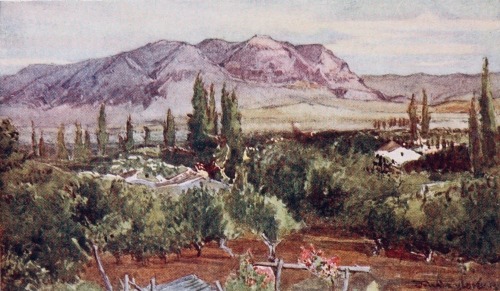
THE MOUNT OF TEMPTATION, FROM JERICHO.
The Mount of Temptation is one of the spurs of the mountains which
overlook the deep valley of the Jordan on its western side. The central
peak is the traditional site of the Temptation of Christ.
smooth white rock; in the valleys the soil is buried under innumerable
boulders and fragments of broken rock.
The whole land is stony, but Judea shews this at its worst. It is an
immense stone wedge thrust into Palestine from east to west. South of it
lie the fertile valleys of Hebron, with their wealth of orchard and
plantation. North of it open the “fat valleys” of Samaria, winding among
rounded hills planted to the top with olives, or terraced for vines.
Over these, here and there, a red cliff may hang, or the irrigation
ditches may furrow and interline a vale of dove-coloured clay. But while
the green of Judea is for the most part but the thinnest veil of sombre
olive-green, a mere setting for the rocks, Samaria is a really green
land, variegated by stone.
In the north of Samaria the land sinks gradually upon the Plain of
Esdraelon. As we saw it first it was covered by a yellow mist through
which nothing could be seen distinctly. But afterwards, viewed in its
whole expanse from the top of Tabor in clear sunlight, the great
battlefield of the Eastern world appeared in characteristic garb—“red
in its apparel,” with the very colour of the blood which has so often
drenched it.
Galilee repeats the limestone outcrop of Judea, but in far gentler
fashion, the undergrowth and trees softening almost every landscape, and
the mountains leading the eye along bold sky-lines to rest on that form
of beauty and of light which masters and watches over the whole
land—the white Hermon. Hermon is always white. But sometimes when
clouds are forming rapidly around its summit, it is a wonder of
brightness. On no other mountain, surely, was it that “a bright cloud
overshadowed” Jesus and his three friends. Even now, on many a summer
day, Hermon is lost in a changing glory of frosted silver, when the sun
strikes upon its cloudwork, and the long trails of snow in the corries
stream towards the plain below.
The limestone runs on into Phœnicia, and seems to grow whiter there.
Nothing could be finer than the valleys east of Tyre at harvest time,
when the fields of ripe grain wave below cliffs white as marble, and the
whole scene, with its foreground of brilliantly robed reapers, is a
study in white and gold. But in the higher valleys of Phœnicia the rock
breaks through a rich red soil, which in parts is gemmed with the
curious and beautiful “Adonis stones”—little egg-shaped bits of
sandstone, dyed to the heart of them with deep crimson, as if they had
been steeped in newly shed blood. Little wonder if the women of old days
“wept for Tammuz” at the sight of them.
The thing most characteristic of Syrian colour is its faintness and
delicacy. Pierre Loti, who in this matter is a witness worthy of all
regard, is constantly ending the colour adjectives in his Syrian books
with -atre—“yellowish,” “bluish,” “greenish,” etc. The general
impression is of dim and faded tints, put on, as it were, in thin
washes. In the stoniest regions there seems to be no colour at all, as
if the sun had bleached them. The curious colouring of the Judean
valleys, which has been described, is never aggressive, and it takes
some carefulness of observation to see anything in them more than a blue
green in the sparsely-planted olive-groves fading into faint greenish
grey above. The valleys of ripe sesame and vetch are washed into the
picture in pale yellow or yellow ochre. Where tilled earth appears it is
generally a variegated expanse of light brown, or pink, or terra-cotta.
The eastern slopes of Hermon, below the snow, shew vertical stripes like
those of the haircloth and jute garments of the peasants, washed out
with rain and sun; or they are spread upon the roots of the mountain
like some vast Indian shawl cunningly and minutely interwoven with red
and green threads, but worn almost threadbare. As you approach a village
in strong sunlight, you see it as a dark brown mass shaded angularly
with black; but it seems to float above a mist of the airiest purple
sheen, where the thinly-planted iris-flowers stand among the graves
before the walls. The Sea of Galilee, as we saw it, was light blue; the
Dead Sea was light green, with a haze of evaporation rendering it even
fainter in the distance.
If this be true of the near, it is doubly so of the distant, landscape.
In a country so mountainous and so sheer-cleft as Palestine, distant
views are seen for the most part as vistas, the “land that is very far
off” revealing itself at the end of some V-shaped gorge or towering over
some intermediate mountain range. Of course distant views are faint in
all lands, but in Palestine the clear air keeps them distinct with
clean-cut edge, however faint they are. Thus there is perhaps nothing
more delicate and spirituel in the world than those faint dreamlike
mountains in the extreme distance of Syrian vistas—the hills east of
Jordan grey, with a mere suspicion of blue in them, or the lilac and
heliotrope mountains of the desert which form the magic background of
Damascus looking eastward.
Reference has been made to the irises (the “lilies of the field”) near
villages. These are but typical of the general sheen of that carpet of
wild flowers which every spring-time spreads over the land. They are of
every colour. There are scarlet poppies and crimson anemones, blue dwarf
cornflowers, yellow marigolds, white narcissus (said to be the Rose of
Sharon); but here they seldom grow in patches of strong hue. Each flower
blooms apart, and the sheen of them is delicate and suggestive rather
than gorgeous. They seem to share the reticence and shyness of the land,
and tinge rather than paint it. Even the animal life conforms to this
dainty rule; lizards are everywhere, but their colouring is that of
their environment, now stone-grey, now wine-red, now straw-coloured.
Chameleons are anything you please—green in growing corn, black among
basalt rocks. Tortoises are blue at the sulphur springs, brown or slate
in the muddy banks of streams.
This faintness is, however, but half the truth of the colour of Syria.
Everywhere it is rendered emphatic by certain vivid splashes of the most
daring brilliance. Wherever springs are found you have instances of this
contrast, and Palestine is essentially the land of bright foregrounds
thrown up against dim backgrounds.
The Jordan valley is the greatest example, running south along its whole
length, “a green serpent” between the pale mountains of the east and the
faint mosaic of the western land. Its jungle is uncompromisingly
distinct throughout the entire course, and its colour is living green,
with a white flash of broken water or a quiet flow of brown bursting
here and there through the verdure. Other streams are similarly marked,
with luxurious undergrowth of reeds, varied by clumps of hollyhock or
edged with winding ribbons of magenta oleander. But the most striking
oases of this kind are the valley of Shechem and the city of Damascus.
There is a hill seldom visited by tourists, but well worth climbing, set
in the broad vale of Makhna, right opposite Jacob’s Well. North and
south past the foot of this hill runs the broad valley. It is edged on
the western side by the continuous line of the central mountain range of
Samaria—continuous except for one great gash, where, as if a giant’s
sword had cleft the range, the valley of Shechem enters that of Makhna
at right angles. The whole landscape is in dim colour except for that
valley of Shechem. Ebal and Gerizim guard its eastern end, dull and
rocky both. But the valley which they guard is fed by countless springs
and intersected by rivulets, so that below the shingle of their slopes
there spreads a fan-shaped expanse of intensely vivid green, like a
carpet flung out from Nablus between the mountains. The lower edge of
the green is broken by the white wall of the enclosure of Jacob’s Well,
and the cupola of Joseph’s tomb. Damascus—surely the most bewitching
of cities—owes its witchery to the same cause. The river Abana spends
itself upon the city. As you approach it from the south it discloses
itself as a mass of bold outline and high colour in the midst of a great
field of verdure, flanked on the west by precipitous hills of sand and
rock—sheer tilted desert. When you climb those hills you see the white
city, jewelled with her minarets of many hues, resting on a cloth of
dark green velvet whose edge is sharply defined. Immediately beyond that
edge the sand begins, stretching into the farther desert through paler
and paler shades of rose and yellow to the lilac hills in the eastern
distance.
It is not only the water-springs, however, that provide the land with
vivid foregrounds. Loti describes a little sand-hill in the desert “all
bespangled with mica,” which “sets itself out, shining like a silver
tumulus.” Such bold and detached features are by no means uncommon even
on the west of the Jordan. The name of the cliff “Bozez” in Michmash
means “shining,” and there are many shining rocks in these
valleys—either masses of smooth limestone, or dark basalt rocks, from
whose dripping surface the sun is reflected in blinding splendour after
rain. Even without such reflection the sudden intrusion of black rock
will often give character to an otherwise neutral landscape.
But the sun is the magician of Syria, who bleaches her and then throws
up against his handiwork the boldest contrasts of strong light and
shade. No one who has seen the crimson flush of sunset on the olives,
or the sudden change of a grey Judean hill-side to rich orange, or the
whole eastern cliffs of the Sea of Galilee turned to the likeness of
flesh-coloured marble, will be likely to forget the picture. Loti’s
wonderful description of desert sunsets—“incandescent violet, and the
red of burning coals”—is not overdrawn. Shadows will transform the
poorest into the richest colouring. The tawny desert changes to the
luscious dark of lengthening indigo at the foot of a great rock; and the
shadows of clouds float across Esdraelon, changing the red plain to deep
wine-colour as they pass. Silhouettes are of daily occurrence in that
crisp air. One scene in particular made an indelible impression. It was
a village on terraced heights, thrown black against a gold and
heliotrope sunset. The figures of Arabs standing or sitting statuesque
upon the sky-line were magnified to the appearance of giant guardians of
the walls, and the miserable little hamlet might have been an
impregnable fortress.
The inhabitants have entered with full sympathy into the spirit of this
play of foreground. They are spectacular if they are anything. Their
religion forbids them all practice of the graphic arts, and most of the
Western pictures which are to be seen in churches are execrable enough
to reconcile them to the restriction. But they obey the law in small
things only to break it by transforming themselves and their
surroundings into one great picture. Their clothing, their buildings,
and their handiwork are a brilliant foil to the dull background. From
them Venice learned her bright colouring, and there are few English
homes which have not borrowed something from them.
In part, this is thrust upon them by the sun. The interiors of houses
are all Rembrandt work, as Conder has happily remarked. The rooms are
dark, and the windows very small. But when the sun shines through the
apertures, their rich brown rafters and red pottery gleam out of the
shadow. One such interior is especially memorable, where a bar of
intense sunlight lit up the skin and many-coloured garments of children
sitting in the window-sill, while through the open door the green grass
of the courtyard shone. Still more wonderful is the effect when one
opens the door of a silk-winding room in sunlight, and sees the colours
wound on the great spindles, or when one enters the dark archways of the
bazaars where long shafts of light striking down slantwise upon a
shining patch below turn the brown shadow of the arch to indigo. The
natives see this, and love the lusciousness of it. They build minarets
cased with emerald tiles, or domes of copper which will soon be coated
with verdigris. Of late years a further touch has been added in the
red-tiled roofs which are already so popular in the towns.
In proof of the genius of the Easterns for colour, nothing need be
mentioned but their carpets and their glass. The glass of old windows in
mosques beggars all description. It is an experience rather than a
spectacle. The panes are so minute, and so destitute of picture or of
pattern, that they are unnoticed in
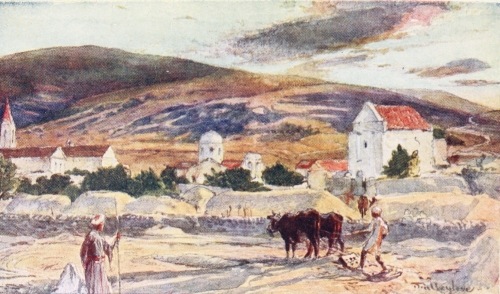
CANA OF GALILEE.
This is the village of Kafr Kenná, believed to be the Cana of the New
Testament, where our Lord performed His first miracle at the marriage
feast.
detail, and the general effect is that of a religious atmosphere in
which all one’s ordinary thoughts and feelings are lost in the
overpowering sense of “something rich and strange.” After the magic of
that light, with its blended purple and amber and ruby, the finest
Western work seems harsh. It is hardly light; it is illuminated shadow.
The rugs and carpets, with their intricate colouring, are more familiar
and need not be described. The finest of them are of silk, and their
delicacy of shade is marvellous. The patterns constantly elude the eye,
promising and just almost reaching some recognisable figure, only to
lose themselves in a bright maze. It is said that they were suggested by
the meadows of variegated flowers; but they are intenser and more
passionate—as if their designers had felt that their task was to supply
an even stronger counterpart to the faint landscape.
The gay clothing of the East is proverbial. Even the poorest peasants
are resplendent. “Fine linen” is still the mark of the rich man, but
Lazarus can match him for “scarlet.” In certain parts the men are clad
in coats of sheepskin, the wool being inside, and protruding like a
heavy fringe along the edges. Almost everybody’s shoes are bright red.
In one place we saw a shepherd whose sheepskin coat had met with an
accident, and the patch which filled the vacant space in the raw brown
back of him was of an elaborate tartan cloth. In another village all the
men wore crimson aprons. When our camp-servants were on the march they
seemed to be in sackcloth, or in thick grey felt which suggested
fire-proof apparel; but when they reached a town they blossomed out into
a rainbow. Children playing in a village street, women at the wells,
statuesque shepherds standing solitary in the fields, all seemed
arranged as for a tableau. Everybody official—the railway guard, the
escort, even the mourner at a funeral—is immensely conscious of his
dignity; and on him descends the spirit of Solomon in all his glory. The
man you hire to guide you for a walk of half a dozen miles will
disappear into his house and emerge in gorgeous array. One of our guides
decked himself in flowing yellow robes and marched before us
ostentatiously carrying in front of him a weapon which appeared to be a
cross between a carving-knife and a reaping-hook, through a land
peaceful as an infant school. A procession marching to some sacred place
across a plain lights the whole scene as with a string of coloured
lanterns. Even where the natives have adopted European dress the fez is
retained, and a crowd of men, seen from above, is always ruddy.
The delight in strong colour goes even one step farther. The rich hues
of the flesh in sunny lands seem to suit the landscape, and one soon
learns to sympathise with the native preference for dusky and brown
complexions. To them a fair skin appears leprous, though bright flaxen
or auburn hair are regarded with great admiration. Not satisfied,
however, with their natural beauty, the Syrians paint and tattoo their
flesh in the most appalling manner, and redden their finger-nails with
henna. Fashionable ladies, and in some places men also, paint their
eyebrows to meet, and touch in their eyelids with antimony, whose blue
shadow is supposed to convey the impression of irresistible eyelashes.
In towns where “the Paris modes” are the sign of smartness, some of the
girls paint their faces pink and white—faces painted with a vengeance,
with a thick and shining enamel which transforms the wearers into
animated wax dolls of the weirdest appearance. But that which shocks the
unsophisticated traveller most is the tattooing of many of the women.
Some of them are marked with small arrow-head blue patches on forehead,
cheeks, and chin; others are lined and scored like South Sea Islanders,
and their lower lips transformed entirely from red to blue.
All this is savage enough, but it illustrates in its own crude way that
delight in strong colour which transforms the human life of the East
into such a vivid foreground to the faint landscape. In the dress there
is artistic instinct as well as barbaric splendour, and in the carpets,
the mosaics, and the glass there is brilliant and matchless artistry. As
to the general principle which has been stated in regard to natural
colouring, this is as it always must have been. These were the quiet
hues of the land, and these the brilliant points of strong light in it
which Christ’s eyes saw, and which gave their colour to the Gospels.
Environment counts for much in national life. A country knows itself,
and asserts itself, as in contrast with what is immediately over its
border; or it retains connection with the neighbouring life, and is what
it is partly because the region next it overflows into its life. At any
rate, to understand anything more than the colour of a land—indeed even
to understand that, as we shall see—it is necessary to begin outside it
and know something of its surroundings. For Palestine, environment means
sea and desert—sea along a straight line for the most part unbroken by
any crease or wrinkle of coast-edge which might serve for a harbour, and
desert thrown round all the rest, except the mountainous north.
Palestine is a great oasis—a fertile resting-place for travellers
making the grand journey from Egypt to Mesopotamia; between which
kingdoms she was ever also the buffer state in war and politics. These
nations were her visitors, her guests, her terrors, but they never were
her neighbours. Her neighbours are the sea and the desert.
The sea she never took for a friend. With no harbour, nor any visible
island to tempt her to adventure, and no sailor blood in her veins, she
hated and feared the sea, and thought of it with ill-will. There is
little of the wistfulness of romance in her thought of the dwellers in
its uttermost parts; little of the sense of beauty in her poetry of the
breaking waves. She views the Phœnician trader who does business on the
ocean as a person to be astonished at rather than to be counted heroic.
She exults in the fact that God has his path on the great waters, but
has no wish to make any journey there herself. Her angels plant their
feet upon the sea, and she looks forward almost triumphantly to the time
when it will be dried up and disappear. Meanwhile its inaccessible huge
depth is for her poets a sort of Gehenna—a fit place for throwing off
evil things beyond the chance of their reappearing. Sins are to be cast
into it, and offenders, with millstones at their necks.
The desert was Israel’s real neighbour. South-east from her it stretched
for a thousand miles. From N.N.E. round through E. and S. to W. it
hemmed her in. To a Briton, watching the departure of the Bagdad
dromedary post from Damascus, the desert seems infinitely more appalling
and unnatural than the sea. For ten days these uncanny beasts and men
will travel, marching (it is said) twenty hours out of every
twenty-four. The stretch of dreariness which opens to the Western
imagination, as you watch the lessening specks in the tawny distance, is
indescribable. To the Eastern it is not so, and it never was so. He
knows its horrors, and yet he loves it. The modern Arab calls it Nefud
(i.e. “exhausted,” “spent”), and, according to Palgrave, there are in
the Arabian desert sands no less than 600 feet in depth. Yet with all
its horrors it is after all his home.
The desert is not all consecrated to death. Besides the occasional oases
which dot its barren expanse, there are many regions where grass and
herbage may be had continually so long as the flocks keep wandering.
Accordingly the long low black tent, with its obliquely pitched
tent-ropes and skilfully driven pegs, takes the place of such
substantial building as might create a city. It has been so for
countless generations, until now the desert Arab fears walls and will
not be persuaded to enter them. Kinglake gives a remarkable instance of
this, telling of a journey to Gaza on which his Arabs actually abandoned
their camels rather than accompany them within the gates.[1]
Colonel Conder insists that the Arabs are entirely distinct from the
Fellahin of the Syrian villages; yet he and other writers call attention
to the borderland east of Jordan where the boundaries of the rival races
swing to and fro with the varying successes or failures of the years. In
places where the land lies open, as at the Plain of Esdraelon, the east
invades the west. No one who travels in Palestine can fail to be
impressed—most will probably be surprised—by the frequency with which
those black hair-cloth tents are seen, sprawling like the skin of some
wild-cat pegged out along the ground. If the question be asked what
becomes of them, the day’s journey will likely enough supply the answer.
In the market-place of a town you may see their inhabitants trading
their desert ware for city produce. But even such slight contact of city
with desert evidently has its temptations. In the valley below, the tent
is pitched on the edge of a field rudely cultivated. The nomad here has
already yielded to the agriculturist. Descend to the Jordan valley, and
you shall see the hair-cloth covering a hut whose sides are of woven
reeds from the river, and a little farther on the covering itself will
be exchanged for a roof of reeds. Finally, you may look from the road
that runs between the two main sources of the Jordan, and see in the
southern distance, shining out against the lush verdure of the Huleh
morass, the red-tiled roof of a two-storey villa—the house of the
Sheikh of the local tribe of Arabs![2] This immigration has gone on from
time immemorial, and it was some such process by which Palestine
received all her earlier inhabitants. Once fixed in cities and settled
down to the cultivation of the fields, their character and way of life
so changed that the desert and its folk became their enemies. Yet a
deeper loyalty remained through all such alienation; and, in spite of
dangers and even hostilities, the desert was still their former home.
It is not only by its neighbourhood, however, that the desert has
influenced Palestine. Nature has done her best to shut it off from the
land, from the eastern side at least, by the tremendous barrier of the
Jordan valley. Not even the angel of the wilderness, one would think,
might cross that defence. Yet even that barrier has been crossed, and a
bird’s-eye view of Palestine shews a land bitten into by great tracts of
real desert west of Jordan. In a modified degree, the whole of
Judea—that great stone wedge to which reference was made in Chapter
I.—exemplifies this. Half the Judean territory is wilderness, and the
other half is only kept back from the desert by sheer force of industry.
Even on the western side this is strikingly seen. As viewed from the
ocean, the desolate sand and scrub of the coast seems to clutch at the
land, stretching here and there far inland from the shore. But the
desert of Judah, in the south-east of the country, is the great
intrusion of the desert upon Palestine. The sea-board of Palestine is
perhaps the smoothest and most unbroken of any country in the world. But
if a coast-line of the desert were sketched in the same way as a
sea-coast is shewn on maps, the edge would show an outline almost as
broken as that of the Greek coast, with many a bay and creek. The desert
is the sea of Syria, and its inthrust is like that of great fingers
feeling their way through the pastures to the very gates of her cities,
and at one place reaching a point within a mile or two of her capital.
Disraeli describes graphically the transition from Canaan to
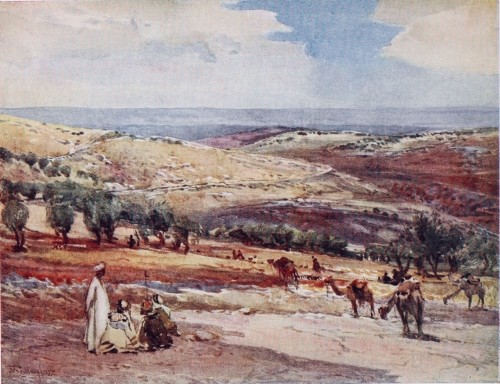
ON THE ROAD FROM JERUSALEM TO BETHANY.
stony Arabia—the first sandy patches; the herbage gradually
disappearing till all that is left of it is shrubs tufting the ridges of
low undulating sand-hills; then the sand becoming stony, with no
plant-life remaining but an occasional thorn, until plains of sand end
in dull ranges of mountains covered with loose flints. In the journey
from Bethlehem to the Dead Sea the transition is even more abrupt.
Hardly have you left the “fields of the shepherds” when you perceive
that the herbs, though still plentiful among the stones, are parched. In
a mile or two there is nothing round you but wild greyish-yellow sand
and rock. You thread your way precariously along the sides of gorges
till you reach that sheer yellow cleft down which Kidron is slicing its
way with the air of a suicide to the sea. Then you come up to a lofty
ridge from which are seen the dreary towers of Mar Saba, like the “blind
squat turret” of Childe Roland’s adventure, “with low grey rocks girt
round, chin upon hand, to see the game at bay.” So you journey on,
feeling at times that this is not scenery, it is being buried alive in
great stone chambers beneath the surface; at other times welcoming the
sight of a broom bush like that under which Elijah lay down and prayed
that he might die. The carcase of a horse or the skeleton of a camel are
almost welcome, breaking the monotonous emptiness of this land of death.
The physical influence of the desert on the land is evident in many
ways. Greece and Britain are not more truly children of the sea than is
Syria the desert’s child. Even those who have had no experience of the
desert proper, but have only made the regulation tour in Palestine, will
have memories of what they saw recalled to them in every page of a book
descriptive of the desert. The land throughout has ominously much in
common with its desolate neighbour—so much so as to suggest a territory
rescued from the desert and kept from reverting only by strenuous
handling.
Many things go to confirm this impression. The winds that blow from east
or south have crossed the sand before they reach the mountains. When
they are cool, they are pure and fresh, unbreathed before, “virgin air.”
The evening breeze of Syria is “the respiration of the desert” after its
breathless heat of day. When the wind is hot, it is terrible as only
wind can be that comes off burning sand. The shirky, or sirocco,
interprets the desert in a fashion which the traveller is not likely to
forget. We rode against it half the length of the Plain of Esdraelon,
when the thermometer registered 104° in the shade, until the steel of
our coloured eye-glasses became so hot that we were glad to remove them,
and endure the glare by preference.
The plant-life of the desert has its counterpart in the land. Loti
describes it with his usual vividness. There is the furze dusted with
fine sand; there are the strange sand-flowers of yellow or violet
colours, the spikes shot out of the soil without leafage, the balls of
thorn which wound the feet, the occasional palm-tree, the white edible
manna plant. And there is the exquisite scent of these after rain, so
strong that one might think a jar of perfume had been broken at the tent
door—a perfume in which one distinguishes the scents of resin, lemon,
geranium, and myrrh. All this the Palestine traveller seems to
recognise; in that curious but familiar flora, and that pungent aromatic
smell, we have the intrusion of the desert again.
The colour of the land has already been described, and here again we
have the touch of the wilderness. The colouring is no doubt partly due
to the quality of the air, dry and crisp as nothing but those miles of
sand could make it. Having absolutely no concerns of its own, as wooded
or grassy lands have, the desert abandons itself to the sun. It takes
and gives the sunlight wholly, making itself a mere reflector for the
light and heat. “Everything in this desert is of one colour—a tawny
yellow. The rocks, the partridges, the camels, the foxes, the ibex, are
all of this shade.”[3] Yet this absolutely neutral region, just because
of its neutrality, catches the sunrise and the sunset in a brilliance
that is all its own, and deepens its shadows to liquid depths of indigo
and violet. In this we see the extreme and untempered form of that
interplay of faint background with intense foreground which is the
characteristic feature of the colour-scheme of Syria.
It is the same as regards form. The two towers of Mar Saba are among the
most impressive of all the Syrian spectacles. Pitilessly unsuggestive,
they are the most unhomely things one ever saw, like the mere skeletons
of habitations. But part of this impression comes from the shape of the
surrounding hills. Ranged in a wide semicircle, their fronts eaten out
with land-slips and torrents, they are polished and smooth like gigantic
sculptures. In some parts the regularity of their cones and tables
suggests the work of purposeless but mighty builders. In other parts the
rocks are twisted as if by tormentors, or tumbled in utter confusion.
This too, as we shall see, has its modified counterpart in the land.
If the desert has thus produced a strong physical effect upon the land,
its moral effects are even more apparent. We have seen how to the
dwellers west of Jordan it was at once an abiding enemy and an ancient
home. Shut out from it by the huge trench of the Jordan valley and the
barricade of the eastern mountains, the Syrian still feels enough of the
desert’s fiery touch to fear it as an enemy. Its wind blasts his crops
and its heat drives him from his valleys to the hill country for the
breath of life. Every traveller speaks of the “positive weight” of heat
that makes men bend low in their saddles. Others besides the Persians
are constrained, as Kinglake puts it, to bow down before the sun, whose
“fierce will” is most terribly felt in those tracts of the land which
the desert has claimed for its own. In the desert there are the same
conditions which are to be found in the land, only in extreme forms and
without mitigation. It is the place of tempests, fires, and reptiles.
These visit the land at times, but they abide in that weird country into
whose distances the Syrian may peer from most of his mountain tops.
There, too, abide those dark and occult powers of evil in which every
Eastern man believes. The magic of the desert—its treacherous mirage,
its genii (by no means difficult to imagine in the forms of sandy
whirlwinds whose march is strewn with corpses), and its infinite
unexplored possibilities of terror—all this is very real to the native
imagination. Its inhabitants, too, are uncanny to think of. The true
Arabian, whom perhaps they may have met on a journey, with his
jade-handled jewelled sword and his shrunken skin; the lunatics who have
wandered to its congenial wildness; the anchorites and ascetics whom,
like the scapegoat of ancient times, sin has driven forth to its
unwalled prison-house,—all these fill in for Syrians the ghastly
picture, and its tales of wars and massacres add the last touch of
horror.
Nothing proves and exemplifies all this more strikingly than the
apparently unreasonable view of the fertility, beauty, and general
perfection of Palestine which its inhabitants have always cherished.
Visitors from the West are often disappointed, and as they move from
place to place their wonder grows as they recall the Biblical
descriptions of the land flowing with milk and honey. Allowing for the
many centuries of misrule and deterioration, it still remains obvious
that Palestine never can have been that dreamland of natural delight
which piety has imagined. But the inhabitant views it, as Dr. Smith has
pointed out, not in contrast with the West, but in contrast with the
desert. We have to remember how “its eastern forests, its immense
wheat-fields, its streams, the oases round its perennial fountains, the
pride of Jordan, impress the immigrant nomad.” This contrast exaggerates
all his blessings in a heat of appreciation. Coming in from the desert,
a man sees trees and fountains not as they are in themselves, but as
they are in contrast with burning sand: he welcomes them as the gift of
God’s grace. The sound of wind among the leaves or of flowing water is
to him truly the speech of a god.[4] To many a wayfarer the poorest
outskirts of the Syrian land have meant salvation from imminent death,
and so appreciation enlarges to optimism, and the very barrenness of the
desert becomes a challenge to hope and faith. Streams will break forth
there, as in his happy experience they have already broken forth, until
the whole barren waste shall blossom as the rose. It is by such hope and
faith that the tribes of Palestine have lived. There is a magnificent
indomitableness in the spectacle of Jews after two thousand years of
exile still celebrating their vintage festival in the slums of great
cities, or in the “squalid quarter of some bleak northern town where
there is never a sun that can at any rate ripen grapes.” One seems to
find the key to this in that tradition of the Arabs that certain ruins
near the Dead Sea are the remains of ancient vineyards. The Syrian land
can never be seen but as a miracle of life and beauty rescued from the
desert, and that appreciation becomes the incentive for a larger hope.
Yet it is not as an enemy, however wonderfully conquered or strenuously
held at bay, that the desert appeals most to the Syrian. As he looks
eastward to the hills of Moab and dreams of what lies beyond them, there
is perhaps more of wistfulness than of terror in his heart. The
melancholy note of his music, heard by every camp-fire in the long
evenings, is infinitely suggestive as well as pathetic. Where was that
note learned if not in black tents pitched in the boundless waste, where
man’s littleness, in contrast with the great powers of Nature, oppressed
him into prone fatalism, or revealed to him the infinite refuge and
comfort of the Everlasting Arms? He whose fathers have sung such songs
will not satisfy his soul with the bustle of towns. He will need the
desert for retreat, that his confused mind may calm itself down to order
and find new revelations of truth. And when the Syrian retreats to the
desert he seems rather to be going home than abroad. David and Elijah,
Paul and Mohammed, for various reasons, but with the same urgency,
betook themselves to the solitude. Jesus Christ himself was driven of
the Spirit into the wilderness. If temptation waited them there, and the
sense of exile and desertion, it was there also that angels ministered
to them; and ancient prophecies were fulfilled in those “streams of
spiritual originality which broke forth in the deserts of moral routine”
of their times. To their spirit, and to the spirit of all dwellers in
the land, the desert is not enemy only, it is home.
This fact is abundantly borne out by many traits of character which are
the survivals of a desert ancestry. There is nothing in Syria which can
explain the fact that the most skilful dragoman cannot understand a map,
nor guide you to your destination by geographical directions. On unknown
ground a Syrian is of little use as guide. On one occasion some of us
set out on a journey of five or six miles in Hauran under the guidance
of an excellent lad who started with the air of a Napoleon Bonaparte.
His directions were to go straight from Muzerib to Sheikh Miskin—two
stations on the railway south of Damascus, between which the railway
line runs in a wide curve. Our route was the bow-string, while the line
was the bent bow. For a little way he boldly marched forward, but soon
began to edge towards the rails, and finally lost his head altogether,
crossed the line, and set out on a route whose only apparent destination
was Persia! This was too much for us, and we mutinied and reversed the
direction, arriving at Sheikh Miskin in less than an hour, with our
guide under a cloud. There could not have been a better illustration of
a Syrian’s helplessness on ground without familiar landmarks. He finds
his way partly by a nomad instinct, very difficult to account for;
partly by the habit of noticing minute features of the road which
entirely escape the ordinary observer. A story is told of a thief in a
certain town in Palestine who entered a house and stole nothing. He
simply went out and claimed the house before the judge. When the case
came to trial, the thief challenged the owner to tell how many steps
were in the stair, how many panes of glass in the windows and a long
catalogue of other such
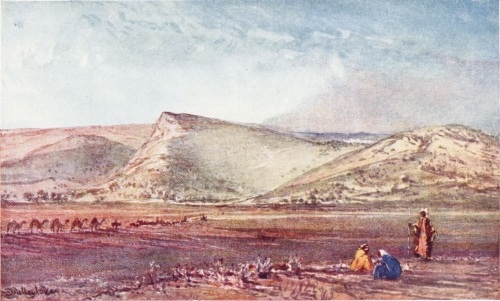
THE HILLS ROUND NAZARETH, FROM THE PLAIN OF ESDRAELON.
The village of Nazareth shows out white in the dip between the hills.
details. This the owner could not do, and when the thief gave the
numbers correctly, the house was at once given to him as its obvious
possessor. The tale at once recalls the Arab of our childhood who
described the route of the strayed camel.
The Syrian character is nothing if not complex, a mass of paradox whose
contradictory elements it seems hopeless to attempt to reconcile. The
politest and the most ruffianly of men, the most effusively frank and
the most impenetrably wary, the most silent and the most voluble, the
gayest in laughter and the most melancholy in song, is the Syrian. He
will bully you so long as he has the majority, and he will beg for the
privilege of tying your shoe’s latchet if the majority is with you. He
will row a boat or drive a donkey under a noonday sun with a violence
which threatens apoplexy; he will suddenly subside into a repose which
no surrounding bustle can disturb. The captain of the Rob Roy tells
how in the Huleh region a native boy running alongside pointed his long
gun at him at least twenty times with the cry of bakhshish, so close
that he once knocked the barrel aside with his paddle; and yet in the
tent that evening this same youngster “was my greatest favourite from
his lively laugh and eyes like diamonds, and his quick perception of all
I explained.” In a note on page 39 an adventure of our own is told which
illustrates sufficiently the rapidity of change in the mood of the
native. He is a civilised barbarian, a scrupulous fraud, an aged little
child. No doubt so complex a character is traceable to many causes, but
in the main it is the work of the desert. There the extreme
conditions—the long hunger and the occasional surfeit, the great
silence and the shrill speech in which that silence unburdens itself,
the demand for desperate exertion and the long deep rest—these call
forth the most opposite qualities, each in exaggerated degree.
Perhaps the most important contributions of the desert to the Syrian
character have been two. There is a certain hardiness and strenuous
carelessness of comfort, which produces a rather bleak impression on
European travellers, but which nevertheless has counted for a great deal
in national life. It has told in opposite ways. Judea’s success has been
undoubtedly due to the fact that it had to be fought for against such
bitter odds. On the other hand, this same independence of fate has led
the nation to settle down in a too easy contentment. Defeat, and even
oppression, sit more lightly on people who are indifferent to
circumstances; and if the artificial demands for luxury have been the
ruin of some nations, they have been the saving of others, keeping alive
in them their vigour and whetting their ambition. The other contribution
is the instinctive kindliness and hospitality which are well known as
characteristic of the desert tribes. Where life is so precarious, it
inevitably comes to be regarded as an inviolable trust by the man on
whose mercy it is cast. Accordingly the wandering Arab has but to draw
in the sand a circle round his laden camel in order to secure every
scrap of his possessions from robbery; and the bitterest enemies are
sure of safety so long as they abide in each other’s tents. A little
incident which occurred to ourselves brought home to us vividly the real
kindliness of the Eastern sense of guest-right. It was in Damascus, and
after nightfall. Some of us, wishing to see how the city amused itself,
set out for a ramble through the streets. It was only nine o’clock, yet
everything was shut up and the bazaars and thoroughfares silent and
deserted. At last we found a little café still doing business at the end
of the high black vault of a bazaar. Seats were placed in the open air
in front of it, while from within came the rattle of dice and the voices
of one or two gamblers. Sitting down on the outside bench, we asked for
coffee, which was immediately brought. A stylishly dressed Moslem, in an
indescribable flow of robes, took his seat silently opposite us and sat
smoking his nargileh. When we rose to go we found that he had paid for
us all, and when we would have thanked him he would have none of it,
satisfied with the consciousness of having shewn hospitality to
strangers sojourning in his land. We could not help wondering how long
our friend might have continued making the circuit of London restaurants
before a similar experience would have fallen his way! There is a tale
of a scoundrel who acts as guide to English travellers, and presents to
each of them a certificate from a former victim, which invariably makes
them laugh. The writing is, “I was a stranger and ye took me in.” It was
pleasing to find that this testimony need not always be ironical.
One of the horses had been stolen in the night. It was the last on
the line, and beyond it Harun was sleeping on the ground. At 11.30
all was right, but by 12.30 it had disappeared. By 1 A.M. the
village had been roused, and the head men were coming in to the
camp offering us one of their mares in compensation. The mares,
which were wretched skeletons of beasts, were refused, and the
horse demanded. Nothing could persuade them to bring him back, or
to acknowledge any cognisance of him whatever. They said that
passing robbers had taken him, and begged us not to report the
affair. Our dragoman, however, took another view. He wrote a
letter, long and circumstantial, describing us as “Hawajas”
(merchants, gentlemen), travelling for information under tescera
from the Sultan. The touch of genius in the letter was its
insistence upon the seriousness of this affair on the ground that
we were travelling under three flags, the Union Jack, the Turkish
flag, and the Stars and Stripes. This letter was sent, by one of
our men on horseback, to the Kaimakham, governor of the district,
at a place some distance from where we were. The Kaimakham passed
him on to the Mudir at another village, a person of terrible
reputation, of whom everybody in the neighbourhood was afraid. The
upshot of it all was that Mohammed, the messenger, returned to camp
accompanied by two soldiers, powerful and intelligent young
fellows, but savage-looking and rather ragged. The taller of the
two, named Nimr (the leopard), was armed with bayonet, rifle, and
revolver, while a double belt of cartridges added to the effect.
His orders were to take the thirteen leading men of Banias in
irons, and march them off “shoulder-tight” to prison at Mejdel.
During the day a great meeting was held in the dragoman’s tent, the
soldiers on one side, the “leading men” on the other. One of the
latter protested that this was unfair—they had expected the
dragoman to grow cooler, but although he had been hot at first, he
was getting hotter instead of cooler. The reply was—(may it be
forgiven!)—that he had meant to get cooler, but the Hawajas were
getting hotter steadily, owing to the three flags aforesaid. After
a long parley it was arranged that they should send to another
village for a horse worth £20, the value of the stolen one. They
stoutly maintained that a stranger, and none of themselves, had
committed the robbery, and that it was a bitter day when the
Hawajas had pitched their tents among them. Nimr the soldier sat
frowning and beating the ground savagely with a stick between his
wide open legs. He repeated several times, with gusto, the
aphorism, “Better to touch fire and scorpions than the property of
Hawajas,” to which the rueful answer of the Sheikh was that it
would be better! All was gloom, and when at last a messenger was
sent off to procure a horse worth £20, the grandees went to their
houses with the air of men doomed. Next morning the horse was
brought, and was to be seen at the end of the line kicking and
biting viciously. Its worth was only £15, but the balance was
condoned. We expected that this would draw forth gratitude and even
some gladness; but instead it brought them all to tears, and drew
from them many assurances of the miserable poverty of their
condition, and the inevitable ruin that awaited them if we actually
accepted this horse which they had brought. To these pleadings the
dragoman was deaf, insisting that we must now at least let things
take their course. When they saw that this was the final position
of affairs, they ceased from wailing. Within five minutes our own
original horse was led into the camp, and their new one removed!
Their game had been played to its very last turn, and having failed
was laid aside. During the rest of our sojourn there these same men
lingered in the camp, manifesting neither regret nor shame, but
smoking, chatting, and laughing with our company in the highest
possible good-humour.
Every writer about Palestine speaks of the smallness and concentration
of the land, yet these take the best informed by surprise. It is “the
least of all lands” indeed, when one thinks how much has happened in it.
Leaving Jaffa at 10 A.M., the steamer reaches Beyrout at 6 P.M. The
passengers in that short sail have seen the whole of Palestine. National
life there is a miniature rather than a picture. In a stretch of country
equal to that between Aberdeen and Dundee you cover the whole central
ground of the Bible, from the Sea of Galilee to Jerusalem. In a ride
equal to the distance from London to Windsor there may be seen enough to
interpret many centuries of the world’s supreme history. The Dead Sea is
but 50 miles from the Mediterranean, the Sea of Galilee about 25 miles;
while the distance in miles between the two seas is only 55. Yet in that
little land there is every kind of soil, from mere sand and broken
limestone to rich red and chocolate loam. It is a mountainous country
throughout, and its inhabitants are a race of Highlanders. So numerous
are its mountain spurs that you may pass up and down the centre of the
country for scores of miles, and yet never catch sight of the sea,
though you constantly feel it in the breeze. Everything is there—the
gorge, the wide sweeping valley, the great plain, the rolling tableland.
It is, indeed, a land in miniature, the multum in parvo of lands. Its
history and religion, like its natural features, are crushed together
and compact. The epigram is the only form of speech that can express it.
This idea of smallness and compression, however, is by no means the only
possible view which may be taken. All depends on what it is with which
one compares Palestine. Thinking of it as a field of history, one
inevitably has other fields in mind. If we think of Britain, Palestine
is but the size of Wales; if of France and Germany, it is the equivalent
of Alsace. But a more primitive point of view is gained when you regard
it as a reclaimed tract of the desert. Just as Egypt is a huge
river-meadow, and Venice a glorified harbour in the sea, so Syria is the
largest oasis in the world. Its whole geographical character is that of
desert, more or less modified by water. The sculptured hills are here,
the rock and the shingle and the sand. Dry up its rivers and arrest its
rainfall, and you will have a continuation of the peninsula of Sinai,
except that instead of granite it will be of limestone. It is this, as
we have seen, that has led its inhabitants to regard it with a rare
appreciation, an extraordinary sense of its preciousness, and a
tendency to exaggerate both its beauty and its fertility.
Nothing illustrates this loving appreciation of their land better than
the play of imagination which has created the place-names of Palestine.
Hebrews, Arabs, and Crusaders vie with each other in the poetic beauty
of their nomenclature. It is a little land, but there is much witchery
in it. For its inhabitants it lives personified, and its masses of
mountain scenery are often named from parts of the human body. There are
“the shoulder,” “the side,” “the thigh,” “the rib,” “the back.” The
“head” of Pisgah looks down upon the “face” of the wilderness.[5] There
is a “hollow hearth”—homeliest of names to a Semite. In other names
poetry has reached its utmost of epigrammatic beauty—“the dance of the
whirls,” “the star of the wind,” “the diamond of the desert.” Yet sacred
and beautiful as its scenery was to Israel, she had a dearer bond with
her land than that. She was kept from nature-worship by a spiritual
faith which created such names as “Bethel” (the house of God), and many
others of similar significance. These claim the land in all its length
and breadth for the God of Israel. Every green spot was for the Semites
the dwelling-place of some divinity; this whole oasis of hers was for
Israel the house of her God of peace and blessing. To the ancient Greek
“God was the view”; to the Hebrew, God was the inhabitant of the
view—He Himself was Righteousness. And because the land was
His—rescued by Him from the desert with His waters, and given to the
people in His love—it was tenfold more dear to them. Down every vista
which shewed them a land that was very far off, their eyes caught sight
also of some vision of the King in His beauty; every high hill was a
veritable mountain of the Lord’s house.
Let us try to get, as it were, a bird’s-eye view of this fascinating
country, noticing in their right perspective and significance its
outstanding natural features. Dr. Smith’s Historical Geography has
perhaps rendered no service higher than the aid towards this which is
afforded by its epitome and map (pp. 49, 50, 51). These divide Palestine
into five parallel strips running north and south. Cutting across these
strips in a straight line westwards from the desert to the sea, we first
traverse the range of the eastern mountains; then dip to the immense
gulf of the Jordan valley, far below the Mediterranean level; then climb
by precipitous ascents to the summit of the central range; then descend
through the foot-hills; and finally land on the maritime plain. To grasp
thoroughly the lie of these five longitudinal regions is the first
necessity for understanding the geography of Palestine. Its general
impression is one of extraordinary brokenness of contour, and Zangwill
points out the important fact that a land with so much hill surface has
in reality a very much larger superficial area than that estimated by
multiplying its length by its breadth.
By far the most remarkable feature in the whole
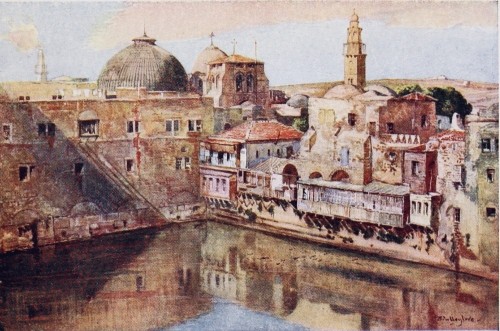
JERUSALEM—THE POOL OF HEZEKIAH.
territory is the Jordan valley. Rising from springs at the western roots
of Hermon, high above sea level, it sinks by rapid stages till at the
Dead Sea it reaches bottom nearly 1300 feet below the Mediterranean.
Down its extraordinary gully flows the one great river of Palestine.
There are other perennial streams, but none to compare with Jordan
either for volume or for associations. It is this mass of flowing water
which stands as the heart and soul of the Syrian oasis. Its mighty
stream has overcome the desert, and claimed the western land for
greenness and for life. It is this huge cleft that has isolated the Holy
Land for the purposes of its God.
The only clear opening from the Jordan to the Mediterranean is the Plain
of Esdraelon. Standing on Jordan’s bank below Bethshan and looking
westward, you see before you a valley whose farther end shows nothing
but sky. Many streams cut their way down its slopes beside a green
morass, and hold in their embrace the ruins of a strong city. You must
follow them up westwards for some ten miles before you reach sea level,
and soon after that you cross the watershed in a wide valley with
mountains rising to north and south. Jezreel stands above you on a
protruding tongue of high cultivated land to the south. At a level of
about 200 feet above the sea, you suddenly emerge upon a great
triangular plain, with Carmel at its apex, 15 miles to the west. This is
the Plain of Esdraelon. The one really large level space in Syria, its
rich soil, even surface, and plentiful water-supply make it a famous
piece of cultivated ground. But it is also the natural battlefield of
the East, and its chief associations are not with agriculture but with
war.
Esdraelon, however, is but an incident in the geographical fact of
Syria, though an important and large incident. It is but the largest of
those open spaces into which Syrian valleys swell out. There are three
or four of them in the Jordan valley, and several of smaller size are
scattered here and there throughout the country. The really essential
feature of the land—that, indeed, which historically is the land—is
the mountain range that sweeps from Lebanon to Hebron and beyond. It was
on the mountains that Israel lived. The Plain of Esdraelon, being the
ganglion of the natural main routes of traffic and of war, was but a
doubtful possession, precariously held at best, and often changing
owners. The strong city of Bethshan at the eastern mouth of its main
valley was held by Israel’s enemies during almost the whole of her
history; and, until a year or two ago, the Arabs made yearly raids upon
the Plain. Again, the sea-coast was largely in the hands of enemies;
while the Jordan valley, with its insupportable heat and malaria, was
thinly peopled, and its population swiftly degenerated from national as
well as from moral loyalties. Thus he who would know the Holy Land must,
in every sense of the words, “lift up his eyes unto the hills.”
It was our good fortune to have this view at its very best for our first
sight of Palestine. We should have landed at Jaffa, but a rather
doubtful case of plague at Alexandria inflicted a two days’ quarantine
on all ships coming out of Egypt. So we looked at Jaffa from under the
yellow flag, and sailed off in the morning sunlight northward to
Beyrout. All day long we lay on deck, with maps spread out before us.
The quarantine had cost us the sight of the Greek Easter ceremony at
Jerusalem, but it gave us in exchange the rare experience of a daylight
sail along the Syrian coast. The day was marvellously clear, and every
object on the shore was seen in photographic outline, while the various
distances were preserved in fading colours, back to the thin
transparency against the sky which stood for the furthest mountain
ranges. The shore was barren: a low belt of tawny sand, broken by dark
olive-green scrub, and very desolate. One solitary house was all we saw
for the first two hours, and in another place a column of smoke,
apparently rising from some invisible camp. Beyond this the foot-hills
east of the plain were seen, lifting towards the great central ridge of
the mountain range. Though broken here and there by an occasional point,
or overlooked by a peak that rose very high beyond, the crest of the
range was remarkably level, with wavy outline. Until we passed Carmel it
shewed as a unity—“the mountain” of Ephraim and Judah. North from
that there was a bolder sky-line, much nearer to the sea, which led on
eventually to the magnificent heights of Lebanon, beautiful as they are
mighty.
Let us suppose ourselves to land at Beyrout and journey from north to
south well inland. At first we climb eastwards among bold bare hills, in
whose recesses mulberry gardens nestle and on whose heights innumerable
villages perch. Cedars are conspicuous by their absence, but there are
plenty of humbler trees. Soon we come to realise the large-scale meaning
and contour of the district. We have been crossing Lebanon, whose
highest peaks have revealed themselves now and then far to the north.
Some twenty miles from the coast we find ourselves in the valley of the
Litany (Leontes). This whole region is easily understood. It consists of
the magnificent ranges of Lebanon and Antilebanon and the spacious
valley between them, running in ample curves parallel with the shore.
Mighty though these are, however, it is neither of them that has
received the name of Jebel-es-Sheikh—“the patriarch of mountains.” That
honour is reserved for Hermon, the range and summit which Antilebanon
thrusts south from it into Galilee, just opposite Damascus. It is
happily named “the sheikh.” Go where you will in Palestine, Hermon seems
to lie at the end of some vista or other. For many miles around it,
Hermon commands everything. Its mass tilts the plain and sends out
innumerable spurs of rich and fertile land; its snow shines far and
gives character to the view; its eastern waters redeem the wilderness
through many a mile of Hauran; and from its western roots spring all the
fountains of the Jordan. This is the king of Syria, by whose beneficent
might the desert has become oasis.
While the southern continuation of Hermon holds up the high tableland of
Bashan and runs it on into the mountains of Gilead and Moab east of
Jordan, the thrust of Lebanon into Western Galilee ends curiously in a
succession of hills divided by valleys running east and west, like great
waves of mountain rolling south to break along the northern edge of the
Plain of Esdraelon. There is a quiet regularity about these Galilean
Highlands, which gives the impression of a region made to plan. The
eastern end of Esdraelon is blocked by the group of Tabor and “Little
Hermon,” while the feature of the western end is the long lonely ridge
of Carmel.
Crossing the plain we enter Samaria, whose deep rounded valleys, rich in
corn, send their sweeping curves in all directions. Here there is
neither the dominant north-and-south trend of Lebanon, nor the
horizontal ripple of Galilee, but an intricate network of curving
valleys, which leave the mountains everywhere more individual and
distinct, and which frequently expand into wide meadows or fields. Yet
the general rise of the region is from west, sloping up to east. The
watershed is perhaps 10 to 15 miles from Jordan, while it is more than
30 miles from the sea. But Jordan here is well-nigh 1000 feet below
sea-level, so that the eastern slope is immensely steeper than the
western.
As we enter Judea, we find the land, as it were, gathering itself up on
almost continuous heights. The lesser valleys are shallow, and the
hilltops swell from the lofty plateau in colossal domes or cupolas. So
high is the general level that when we come to Jerusalem we look in vain
for the mountains we had understood to be round about her. No peaks
cleave the sky—only smooth and gentle hills, which have never been in
any way her defence, but have made excellent platforms for the
siege-engines of her enemies, and have grown wood for the crosses of her
inhabitants. The lateral gorges of Judea, both east and west, cut into
her high tableland in angular zigzags, and as you descend these in
either direction you realise what is really meant by “the mountains
round about Jerusalem.” She does not see them, lying secure upon the
height to which they have exalted her. But he who approaches her must
come by their gorges, where for many miles his sky will be but a strip
seen between sheer heights of cliff and scaur.[6] The rugged sharpness
of outline reaches its climax on the eastern side, where the range,
split in the wildest gorges, falls in fragmentary masses between their
mouths down to the Jordan valley. Nothing in the land has a more bare
and savage grandeur than the square-chiselled mountain blocks of
Quarantana, seen from below at Jericho in black angular silhouette
against the sunset. South of Jerusalem the Kidron gorge, cleaving the
intruding desert, exaggerates the wildness of the north, but as you
climb past Bethlehem to Hebron you are in a region liker to Samaria,
with its deeper and more rounded valleys and its richer pasture and
cultivation. South of Hebron the range spreads fanwise and gradually
sinks to the desert.
The most impressive memories of the land, so far as its form and
contour go, are two—the gorges cleft through the Judean mountain, and
certain isolated conical hills thrown up from the Samaritan valleys.
Judea is mountain, emphasised by gorge; Samaria is valley, diversified
by hill. The gorges are uncompromising. When we read, for instance, the
third verse of the seventh chapter of Joshua, we think of an ordinary
march—“The men went up and viewed Ai. And they returned to Joshua, and
said unto him, Let not all the people go up; but let about two or three
thousand men go up and smite Ai; and make not all the people to labour
thither.” But he who has himself “gone up” from Jericho to Ai puts
feeling into his reading of the words “to labour thither.” That is the
only way of going up. The recollection is of several hours of
precipitous riding, with beasts stumbling and riders pitched ahead. When
the climb is over you turn aside to the south, and view the gully of
Michmash along whose northern edge you have scrambled inland. It looks
not like a valley, but a crack in rocks, hundreds of feet deep. The
valley of Achor, next to the south of Michmash, presents an almost more
dramatic appearance as you view its entrance from the Jordan foot-hills.
It gapes on the plain, like the open mouth of some petrified monster.
The isolated hills of the northern territory are in their way as
memorable as the gorges of the south. In Judea you cannot see the
mountains for “the mountain.” The whole land is one great elevated
range, and the noticeable features of the district are the gorges that
cut across it. Samaria, on the other hand, is a place of valleys and of
plains, and its mountains are seen as mountains. This fact finds its
most striking instance in certain “Gilgals,” or isolated cones standing
free in the midst of plain, or cut off by circular valleys round their
bases. The most perfect of these is that which bears the name of Gilgal,
rising detached in the wide valley to the south-east of Jacob’s Well.[7]
It is in shape an almost perfect cone, whose gradual curve renders it
very easy of ascent. The Hill of Samaria itself is another such
“Gilgal,” the centre of a splendid circular panorama of hills. Sanur, in
the country of Judith and Holophernes, is a third, on a smaller scale,
but with even wider panorama. North of Esdraelon, again a long ripple of
mountains sweeps round at least one such Gilgal, leaving Sepphoris
isolated on the peak of it. And Tabor itself might plausibly be counted
in this class—Tabor the irrelevant, whose cone seems always to be
peeping over the shoulder of some lower ridge, unlike any other
landmark, commanding all the views eastward from the heights of
Nazareth. These curious cones are in Palestine to some extent what the
Righi is in Switzerland. With the exception of Tabor, they are but
lesser heights; yet they give the widest mountain views, and seem to
shape the land into a succession of circles, of which their summits are
the centre-points.
The mountains of Israel are the characteristic features of her history
as of her geography. In every part of Syria they are the companions of
the journey. Great
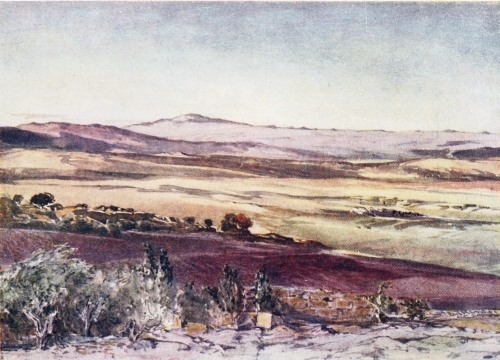
MOUNT HERMON, FROM THE SLOPES OF TABOR.
The lofty mountain in the extreme distance is Mount Hermon.
distant masses, or near crests of them, seem to accompany you as you
move. And as you travel through the history of the land it is in the
same companionship. The Jordan valley lies along the western side of the
mountain range, a place of luxury and temptation. But Israel abides on
the hills, sending down to it only the most degenerate of her children.
It is a very striking fact that Jesus was tempted to sin for bread on
the mountain almost within sight of Jericho, where the Herodians were
sinning with surfeits of wine and rich meats. All that is truest to
Israel and most characteristic of her at her best is on the hills. They
are the places of her war and of her worship. The Gilgals have almost
all stood siege. All, or at least the most of them, have been fortified.
On some of them the rude remains of ancient sacred circles, or the
decayed steps of altars cut in the rock, may still be traced. Her
enemies found by bitter experience that “her gods are gods of the
hills.” Her ark had its abode on the tableland at Shiloh or on the hill
of Zion. Its history on the low ground was but a story of calamity; it
had to be sent up again to Kirjath-Jearim among the hills. Yet the
heights of Israel stand for more than this blend of war and worship;
they were her home. All her greater towns nestle among them somewhere;
most of them stand on the summits, or just below them. It was a race of
Highlanders that gave us our Bible—men whose home was on the heights.
Her wars, indeed, were everywhere, for it is a blood-drenched land.
Many of her battles were fought at the edge of the mountain-land, on the
kopjes that run along the southern border of Esdraelon, or among the
foot-hills near the mouth of the western gorges. There, or on the great
plain, she met her invaders. But the heights were the scenes of battles
in the last resort, and the gorges are associated with the advance and
retreat of armed hosts, the rush of the invader and the headlong retreat
of armies that had been surprised and routed from above.
Meanwhile, in the middle spaces, she fought her continuous battle with
the desert and the sun for her daily bread. It is said that in Malta,
where every possible spot is cultivated, the earth has been all
imported, and that the Knights of Malta allowed no vessel to enter the
harbour without paying dues in soil. The denuded hill-sides of
Palestine, with their ruined heaps of stones that once built up terraces
for cultivation, tell a similar story. On some hillsides the remains of
sixty or even eighty such terraces may still be traced. In many places
the valleys are rich in an altogether superfluous depth of fertile soil.
But this did not suffice the inhabitants, and they built up the terraces
along the southward slopes, in many places quite to the walls of their
mountain villages. On not a few of these slopes labour must have
actually created land, and men’s hearts grown strong within them as they
changed the rocks into gardens and the slopes of shingle into harvest
fields.
Keeping in mind our view of Palestine as an oasis, we naturally turn at
once to the thought of the waters that have retrieved it from the
desert. By far the most conspicuous of these is the Jordan, flowing down
a long course to its deep-dug grave in the Dead Sea. At whatever point
we approach that great valley the eye is inevitably led along it
northward to the white Hermon, whose great “breastplate” shines over all
the land. That mountain, and the Lebanons of which it is the southern
outpost, are the real makers of Palestine.
There was a beautiful poetry of Hermon which from earliest times made it
a sacrament of sweet thoughts to Israel. Perhaps the sweetest thought it
gave her was that of dew. In every part of that land of clear skies, a
heavy dew lies upon the ground at sunrise. Poetic feeling, undertaking
the work of science, interpreted this dew as Hermon’s gift, so that “the
dew that descended on the mountains of Zion” was “the dew of Hermon”
(Psalm cxxxiii. 3). The meteorology is faulty, but the larger idea is
true. The cool and glistening snow-field, more than a hundred miles
away from Zion, does indeed send out and receive again the waters that
refresh the land in an endless round. “The Abana dies in the marsh of
Ateibeh, yielding its spirit to the sun, as Jordan dies in the Dead Sea,
and, rising into clouds again, both of them wafted to the snow-peaks
where they were born, they pour down their old waters in a current ever
new, in that circuit of life and death which God has ordained for
all.”[8]
So conspicuous are these two rivers that we almost need to remind
ourselves that they are not the only waters of Israel. There are several
perennial streams in Syria, of which something will be said presently;
but the list of these by no means exhausts the stores of water in the
land. Great stretches of the country are apparently waterless,
especially in the south, and yet water is almost everywhere,
underground. In many parts the soil and surface-rock are soft, lying on
a hard bed-rock at various depths below. Accordingly we find that one of
the most mysterious and characteristic features of the south country is
its underground waters.[9] Springs and streamlets find their way through
fissures or filter through porous stone to the harder rock below, and
flow along subterranean channels there. Zangwill quotes an older
authority for the somewhat startling statement that “the entire plain of
Sharon seems to cover a vast subterranean river, and this inexhaustible
source of wealth underlies the whole territory of the Philistines.”
Putting the ear to any crack in the sunburnt clay of the surface, in
certain parts, one may hear the subdued growl and murmur of the waters
underneath. Trees flourish in places where there is no water apparent,
their roots bathing in unseen streams, and drawing life and freshness
from them. One can well understand the feelings of awe with which
primitive people regarded these mysterious nether springs. They did not
connect them with the idea of rain from above, as modern science does,
but believed that they had forced their way up from “the Great Deep,”
which was supposed to underlie the earth, and into which the roots of
the mountains were thrust far down like gigantic anchors of the world.
Some of the rivers of Damascus are also underground, “and may often be
seen and heard through holes in the surface.”[10] Jerusalem is a
waterless city, whose famous pools are tanks for rain-water. Its one
spring is that strange intermittent one which overflows from the Well of
the Virgin through Hezekiah’s aqueduct to the Pool of Siloam. Yet there
are legends that beneath the sacred rock which the mosque of Omar covers
there is a subterranean torrent; and that the rushing of hidden waters
has been heard at times below the massive stones of the Damascus Gate of
the city.
These underground waters have given to Palestine a still more
interesting feature at the points where her greatest rivers rise. This
is the sudden emergence of full-bodied streams from the ground. These
rivers have, so to speak, no infancy. Their springs are not little toy
fountains with trickling rivulets. They bound into the world full-grown,
with a rush and fury which is perhaps unparalleled in any other land.
This inspiring and suggestive phenomenon has not been without its effect
on the national thought and imagination. In the midst of one of the most
gloriously forceful passages of Isaiah (chap. xxxv.) the vigour and
impetuousness of the prophecy finds its climax in the sudden leap of
waters which “break out” in the wilderness, and which are described in
the same breath as the first glad leap of the restored lame man, leaping
“as an hart.” When Moses in his blessing of the tribes speaks of Dan
“leaping from Bashan,” he refers to that wonderful spot where Jordan, in
the tribe of Dan, leaps up from below Hermon. Matthew Arnold, had he
chanced to think of it, might have seen in his delight in full and
rushing streams another link connecting him with the Hebrew race with
which he so quaintly claims affinity.
The south country keeps its rivers for the most part below ground,
though even there considerable streams suddenly break out. Conder
describes deep blue pools of fresh water near Antipatris which “well up
close beneath the hillock surrounded by tall canes and willows, rushes
and grass.”[11] Yet the greatest outbursts are in the north. One
traveller describes a river-source in Lebanon as an abyss of seething
black waters, into which he rolled large stones, only to see them
presently reappear, flung up like corks from the depths. At one of its
sources the Abana bursts from the masonry of some ancient temples “a
pure and copious river, rushing into light at once as if free.”
It is at Hermon that we find the true centre of the water supply of
Palestine. Parts of it are under snow all the year round, and it gives
off some thirty streams flowing in every direction. Not one of these
streams reaches the Mediterranean. They flow forth only to evaporate
sooner or later in some inland morass or sea, and to return in vapour
that will be condensed again by the snows of Hermon. Conder describes
one of these in the north, whose water “rushes out suddenly with a
roaring noise from a cavern” in winter, and transforms the plain below
into a lake. But the great work of Hermon is the Jordan, two of whose
three sources leap up from its roots. The most striking of these is that
of Banias, which Jewish tradition names as one of the three springs of
Palestine which “remained not closed up after the Flood.” On the crest
of a spur of Hermon stands the ruined castle of Subeibeh, one of the
noblest ruins in the world. From the castle you descend 1400 feet to the
village of Banias, the ancient Caesarea Philippi. The descent, over
basalt boulders whose interstices are filled for the most part with
thorn-bushes, is said in the guide-books to be practicable for horses.
One wonders how long the horses are supposed to survive the journey! The
view across and down the Jordan valley is indescribably grand. Near the
foot the path curves round the top of a precipice and doubles back on a
lower level to a white-washed Mohammedan weli, or praying-house. Just
below, as you look down from the weli, a large cavern is seen, with
niches beautifully carved in the rocks beside it. On one of these niches
is the inscription “To Pan and the Nymphs,” and on another the names
“Augustus and Augustina.” Here, most likely on the site of a prehistoric
holy place of the Semites, stood the Roman temple which Herod built in
honour of Augustus. Nor is it wonderful that these and so many other
faiths have counted this a sacred place; for Jordan used to pour forth
from that cavern, clear and full-bodied. Now the old cave-channel is
choked up with debris, and Jordan forces its way to light in many
smaller fountains among the stones and earth of the open space below,
which is coloured by long trails of slime. Within a few yards the
streams unite in a rich green pool, with reeds and luxuriant
water-growth. The second source of Jordan is even more impressive. It is
at Tell-el-Kadi, some two miles west from Banias. On the western side of
this Tell, on which there are traces and ruins of an ancient city, there
is a thicket of rank undergrowth, from beneath whose lowest branches and
creepers the river suddenly appears, spreads immediately into a wide
pool, and within a hundred yards is racing violently south in foaming
rapids. The pool was reported to be bottomless, but the irrepressible
little canoe Rob Roy was launched upon its boiling waters, and the
depth proved to be but five feet!
Jordan is a river worth much study, interesting from
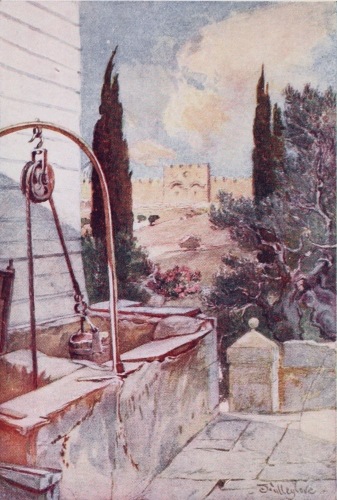
THE GOLDEN, OR BEAUTIFUL, GATE, FROM THE GARDEN OF
GETHSEMANE.
The well is in the upper part of the Garden of Gethsemane.
every point of view—geographical, historical, religious.[12] Changing
in colour, as the floods wash down their various soils to it, it tumbles
and rushes south through a stretch of some 137 miles without a single
cascade till it sweeps, with strong and level current, into the Dead
Sea. At Banias its height above the Mediterranean is about 1000 feet,
but the extraordinary valley is chiselled on a running slope down to the
depths of the earth. Clouds have been seen sweeping above its bed 500
feet below the level of the ocean. The Dead Sea level is 1290 feet below
the Mediterranean; its bottom, at the deepest part, is as deep again.
Spanned by a few bridges, of which only one or two are now entire, the
river’s course is for the most part through solitudes without
inhabitants, or tenanted but by a few half-savage people. The valley is
alternately wide and narrow, swelling out in five broad expanses, of
which the two northern are lakes, and the other three are plains. From
Banias to the last confluence of the different head-streams is a
distance of some seven miles through green land. Soon after that point
the river loses itself in a vast forest of impenetrable papyrus canes
growing in shallow water, from which it emerges in a little lake or
clear space half a mile lower. Then it flows, a solemn and glassy
stream, for some three miles and a half down a sharp-edged lane whose
perpendicular banks are tall papyrus canes, till it glides silently out,
a hundred feet in breadth, into Lake Huleh. From Huleh to the Sea of
Galilee is ten miles, along the greater part of which the river tears
through a narrow gorge. Emerging clear and broad from the Sea of Galilee
it soon begins its innumerable windings. A few streams flow into it
perennially from east and west, and countless torrents after rain. In
the north it quickens a poisonous soil into rank vegetation, and spreads
its superfluous waters on steaming swamps, full of malaria. Opposite
Shechem its clay is good for moulding, and the mounds which break the
level are for the most part apparently the remains of old brickfields or
brass foundries. As it descends to the broadest of its plains at Jericho
the valley falls into three distinct levels. From the hills a flat
expanse of desolation spreads towards the river, till it falls in steep
banks of 150 to 200 feet to the lower level of the “trench” down which
the river flows in flood. Finally, in the centre of this lies the
ordinary channel, at whose banks the trees and undergrowth seem to
crouch and kneel over the sullen brown stream.
There are other perennial rivers in Syria, but their courses are short.
The Litany (Leontes) rises between the Lebanons a short distance north
of the highest springs of Jordan. For many miles the two flow in
parallel courses, divided only by the little ridge of Jebel-es-Zoar. But
before Jordan has passed its new springs at Banias, the Litany has swept
to the west in a sharp right angle, to pour itself into the ocean north
of Tyre. It is a fine stream, yellow with rich loam, but its bed is in
the sharp angle of valleys whose sides remind one of the Screes of
Wastwater. Its descent is so rapid that even if there were meadows in
the bottoms of its gorges, it would hurry past them to pour its treasure
of water and of soil alike into the thankless sea. The Abana, rising in
the same region as the springs of the other two, has a course of only
some fifty miles. Kishon, which waters the Plain of Esdraelon, is
certainly the most generous in the matter of cultivated fields, but it
is also the most treacherous. Its fords are never certain, for great
masses of sand and mud are shifted to and fro in the most unaccountable
manner. The rest of the perennial rivers are either tributaries of the
Jordan, companions of the Abana in its eastern course, or streams from
Carmel or the central mountain range, whose short course to the
Mediterranean is of little account.
As we think of these rivers flowing through a land which so sorely needs
their help, we cannot but feel oppressed by a sense of waste that is
almost tragic. There is no boat plying on any of them. Most are, indeed,
far too rapid for that, but not everywhere. The guide-book speaks of a
steamer plying on the lower reaches of Jordan; and the local story of
oppression there—every district has its particular grievance—is of two
boats that had been brought for the service of the monastery, and then
confiscated by Government. The only boats of any kind we saw on fresh
water between Hebron and Damascus were two on the Sea of Galilee, manned
by Syrians in red jerseys, on which the magic letters were inscribed,
“COOK.” In the old days it must have been very different. There is
mention of a ferry-boat on the Jordan in 2 Sam. xix. 18, and in Christ’s
time there must have been a considerable fishing fleet on the lake. The
trireme on the coins of Gadara reminds us of Roman vessels which sailed
there for warlike purposes, and here and there you find a valley dammed
across its breadth for the construction of an artificial lake, on which
a naumachia or naval fight might add piquancy to the games. There is
an island in the Dead Sea itself on which what are supposed to be ruins
of a landing-stage are still visible, showing that long ago even these
uncanny waters were not without their sailors. There used to be a
wrecked boat in the Ateibeh marsh from which three men had been drowned.
The wreck of another boat was still visible some years ago under the
surface of Lake Huleh. These wrecks are but too truthfully symbolic of
the fate of men’s attempts to utilise the waters of Israel. The Abana,
indeed, is utilised. Never was river so wholly taken possession of by a
city as Abana by Damascus. She flows into it—right into the heart of
it—and disappears underground; she is led captive into a thousand
fountains in public streets and the courts of private houses; she is
sent in a thousand little channels to irrigate the gardens which
surround it. All the more pitiful is her ending in that wild and haunted
morass of Ateibeh, where she yields up her waters to the desert and the
sun.
The fate of Jordan seems still more tragic. In the far north his waters
are indeed utilised to some small extent for irrigation, but for the
vastly longer part of his course he does nothing but flee through the
wilderness to the bitter sea in the south. Dr. Ross has strikingly
summed up Jordan’s career in the words: “So, in a valley which is
thirsting for water, the Jordan rushes along to an inglorious end.” Yet
that is only one aspect of the matter. Jordan gave Israel her last story
of Elijah and her first of Christ’s ministry. Neither association is of
the kindly sort which a nation’s sentiment usually gathers round its
rivers. There is, as it were, the glitter of fire from the prophet’s
departure for ever lending to these brown waters a sort of unearthly
grandeur. Those fiery horses which bathed their feet here take the place
of the gentle memories of generations of lovers or little children. Yet
that is true to the spirit of the river. To Israel it stood for a very
forceful and practical fact. Their first crossing of Jordan began their
national life in Palestine and cut them off from the desert. So, to the
end, the Jordan stood for this to them, and that was much. Jordan
created no great city as Abana created Damascus; but it streamed down
the side of the east, flinging, as it were, a great arm round the land,
claiming it from the desert, and proclaiming this to be oasis and the
home of men. Disraeli characteristically writes: “All the great things
have been done by the little nations. It is the Jordan and the Ilyssus
that have civilised the modern races.” And truly it is the Jordan that
is in great part responsible for the Hebrew share in that
civilisation—not by his material gifts, indeed, which were ever
ungenerously given and carelessly gathered, but by his sentiment of
isolation and aloofness from the rest of the Eastern world, to which we
owe much that is best in our inheritance from Israel.
For the homelier uses and gentler thoughts of Israel’s waters we must
turn to the lesser fountains and streams. There is, it is true, much
disillusionment for the sentimentalist even here. Remembering the sweet
music in which they have been sung—the “Song of the Well” (“Spring up,
O Well, sing ye unto it!”) or the “gently flowing waters” of the 23rd
Psalm—one expects the perfection of purity and freshness. Early
tradition has pictured the angel Gabriel meeting with Mary at the
village spring of Nazareth; nor is that the only Syrian fountain by
which the footsteps of angels have been traced. All the more trying is
the reality. Hideously tattooed women squat by the sweetest springs,
fling filthy garments into them, and beat them with stones till the
stream flows brown below them; or they toil wearily a mile or two away
from their villages to fill the heavy water-pots, beasts of burden
rather than mothers in Israel. Of cleanliness the natives have not the
remotest idea. We used to see them filling their vessels from a stream
where our horses were being washed down after their day’s ride, and they
seemed on principle to choose a spot just below that where the horse was
standing. Often the water seemed calculated to assuage hunger rather
than thirst. The natives drank it freely when it was mere mud in
solution; and even when it was clear, the glass bottles on the table
sometimes presented the appearance of lively and well-stocked aquariums.
Our squeamishness was unintelligible even to our camp-servants, who
drank in defiance large draughts of the water we refused. The landmarks
of the hot journey are the pools where one may bathe, and the first
sight of Elisha’s Fountain and the Well of Harod is refreshing to
remember still. But one touch of the bottom mud sufficed to bring to the
surface a gas which sent us posthaste to our stores of quinine—and yet
the deliciousness of the plunge was worth the risk!
The spell of the fountains remains in spite of all, and no traveller
wonders that the ancient men revered them as sacred places. Israel
exulted in the forcefulness of her larger rivers, but hardly knew their
kindlier resources. Her affection was kept for those wells and
streamlets which flowed past her doors and made glad her cities. It is a
land of dried-up torrent-beds, and no river made glad any City of God
except at the seasons when God had filled it with His rain. In such a
land a wayside well like Jacob’s counts for more than our Western
imagination can realise. Property in water was an older institution than
property in land. These wayside wells and “sealed fountains” refreshed
men from time immemorial in the very presence of their enemies. They
were the choicest riches of their owners. The journey from south to
north leads one ever more frequently in among such springs, but many
towns of the south are built at places where there is abundance of
them. Hebron has twelve little fountains; Gaza fifteen. In Samaria they
burst forth in every valley, and the vale of Nablus is a net-work of
rivulets, springing, it is said, from no fewer than eighty sources. In
Galilee they are still more abundant. At Khan Minyeh, supposed by many
to be the site of the ancient Capernaum, the ruins are mostly those of
aqueducts, and springs break forth and stream in little rivers
everywhere.
The beauty and refreshing coolness of such fountains is very great. The
dripping walls of the Khan Minyeh aqueducts are covered with magnificent
bunches of maidenhair, whose fronds were the broadest we had ever seen.
The Well of Harod, close by the stream where Gideon tested his soldiers,
is one of the loveliest spots imaginable. There is a little cave, where
the pebbles shine up blue through the shallow water; ferns grow in its
crannies, and at the side a clear spring, two feet broad and five inches
deep, splashes into the pool from a recess entirely hidden by hanging
maidenhair. Nor is the natural beauty of these springs their only charm.
When one remembers the days of old through which they flowed, and the
men who stooped to drink of them so along ago, all that was most sacred
and most heroic to one’s childhood lives again, and speaks to the heart.
Ay! and to the conscience too; for these were the springs that gave to
Bible men their metaphors of a fountain opened for sin and for
uncleanness; this is the land in which it sprang up and from which it
has flowed forth with cleansing and refreshment for the whole earth.
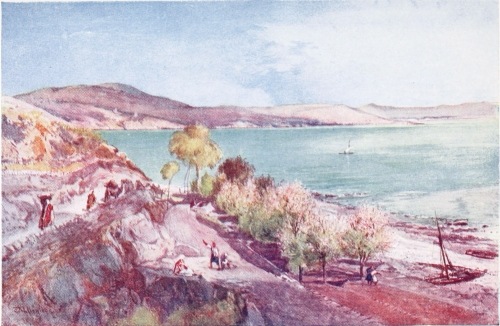
THE LAKE OF GALILEE, LOOKING NORTH FROM TIBERIAS.
The road at the left of the picture is the main road to the north from
Tiberias.
Nothing could better illustrate the completeness of the change through
which Israel passed when she exchanged a nomadic for a settled life than
the great importance which the idea of the city has in the Bible.
Kinglake describes the Jordan as “a boundary between the people living
under roofs and the tented tribes that wander on the farther side.” The
very name of “city,” applied to these grotesque little hamlets, shews
how seriously they took themselves, and compels an amused respect for so
mighty a little self-importance, for a “King” of that time might be
compared with a chairman of parish council to-day. The idea of the city
became more and more part of the religion of Israel as Jerusalem rose to
religious as well as civil importance. To them God was a city-dweller,
and there is an eastern saying about lonely wanderers journeying
homeless towards the sunset, that they are “going to God’s gate.”
The changing history of the land has passed it through many phases, and
no doubt there are far wider differences between the centuries in
respect of men’s dwellings than in respect of those natural features of
the land which we have been studying in the preceding pages. This
chapter will describe present conditions. And yet in spite of changes
the aspect of things must be pretty much what it always was. Men
gathered into cities on some strongly fortified hill for purposes of
war, or around some holy place for worship, or in some fertile valley
for safe agriculture; and the sites thus chosen are retained for the
most part. With the exception of the wandering tents, which are
occasionally seen throughout the land, there is hardly a solitary
dwelling in Palestine which is not a ruin. And the want of good roads,
together with the uncertain government, seems still to keep the village
communities more apart than they are in most countries. Each village has
a character and a reputation of its own, and cherishes views regarding
its neighbours which it is not slow to impart either to them or to
foreigners. The colour of these townships divides them into the three
classes of our title. Damascus and Beyrout are beyond the scope of the
present description—Damascus, the greyest city in the world so far as
age is concerned; and Beyrout, the over-grown white town upon which the
ends of the world are come, leaving it little individual character of
its own. Keeping to the south of these, we have the clearly marked
division, with little overlapping. A brown village may indeed have a
white church or mosque gleaming from its bosom, and the walls of some
towns besides Jerusalem are grey; yet in the main it is a land of brown
villages, white towns, and one grey city.
The villages are very brown—“dust-coloured,” as they have been happily
called. Seen from a distance they generally look inviting, but it takes
the traveller no long time to believe that a near approach will
certainly disillusionise him. They have many sorts of charm in the
distance. Some of them are set up on the edge of a hill, and these seen
from below present all the appearance of fortification, their flat roofs
and perpendicular sides giving them an angular and military aspect.
Others are surrounded by neatly walled and cultivated olive-yards which
give the promise of a well-conditioned village. In the rare instances
where trees are planted among the dwellings, the flat brown roofs seem
to nestle among the branches in delightful contentment and restfulness.
Where trees are absent there is generally a high cactus hedge, serving
as an enclosing wall, which sets the village in a pleasant green. Even
those hamlets which have about them no green of any kind are not
uninviting, especially if they are built on a hill-slope. There is a
peculiar formality and neatness given by irregular piles of flat-roofed
buildings overlapping each other at different levels. But as you
approach, all is disillusionment. The trees seem to detach themselves
and stand apart in the untidy paths. The cactus hedge is repulsive, with
its spiked pulpy masses and its bare and straggling roots. The brown
walls seem to decay before your eyes, and the village seen from within
its own street changes to a succession of ruinous heaps of débris, with
excavations into the mud of the hillside. If, as at Nain, there be a
white-walled church or mosque in the place, it seems to stand alone in a
long moraine of ruins. An acrid smell hangs upon the air, for the fuel
is dried cakes of dung. These are plastered over the walls of low ovens
into which the mud seems to swell in great blisters by the street-side.
In some of these ovens crowds of filthy children and tattooed women are
sitting, while the men loiter in idle rows along the house walls. When
suddenly you say to yourself that this is Shunem, or this Nain, or
Magdala, the disappointment is complete.
In some places the houses are built of stones gathered from the ancient
ruins of the neighbourhood (Colonel Conder believes that in hardly any
instance are the stones fresh quarried). Other houses consist simply of
four walls of mud, with a roof of the same material laid upon branches
set across. A small stone roller may be seen lying somewhere on the
roof, for in heat the mud cracks and needs to be rolled now and then to
keep the rain from leaking through. The sheikh, or headman of the
village, has a better house—often the one respectable habitation in the
place, but suggestive of a ruined tower at that. It is a two-storeyed
building, whose great feature is the public hall, or reception-room,
where local matters are discussed and strangers interviewed. There is no
glass in the windows, and the strong sunlight deepens the gloom of the
interiors to a rich brown darkness with points of high light and
colour. The shade is precious in these sun-smitten places, and Conder
narrates an incident which often recurs to mind in them. It was in the
cave of the Holy House at Nazareth, the reputed home of Jesus in His
boyhood. The visitor “observed to the monk that it was dark for a
dwelling-house, but he answered very simply, ‘The Lord had no need of
much light.’” The rooms are almost bare of furniture, a bed and a few
water-jars in a corner being sometimes the only objects visible. In some
of them the floor space is divided into two levels, half the room being
a platform two or three feet higher than the other half. On this
platform the family lives, while the cattle occupy the lower part; and
along the edge of the platform there are hollows in its floor, which
serve as mangers for the beasts. No doubt it was in such a manger that
Jesus was laid in Bethlehem.
The inhabitants of these villages are the Fellahin, of whom Conder has
given so interesting a description.[13] He recognises in them a people
of almost unmixed ancient stock. Distinct from Bedawin and from Turks,
they are the “modern Canaanites,” probably descendants of the original
inhabitants whom Israel displaced. These were never quite exterminated;
and although there have no doubt been many minor instances of the
absorption of other breeds, yet in the main they remain very much as
they were when they talked with Jesus in Aramaic, or even as they were
in days much earlier than His. A slight enrichment to their lives has
been made by each of the invaders, and reminiscences of Israel, Rome,
the early Christians, the Crusaders, may be found blended with their
Mohammedanism. But they are conservative to the last degree, and any
radical change seems an impossibility among them. Many things contribute
to this conservatism, among which perhaps the chief is the tradition of
intermarriage between the inhabitants of the same village. Another
factor is their extraordinary ignorance, combined with a pride no less
remarkable. It would be difficult to find anywhere men so self-satisfied
on such small capital of merit. A third cause of their immovableness is
to be found in the usury and oppression by which they are held down; and
even their local self-government—that imperium in imperio which
prevails under the larger oppression of the Turk—keeps up, so far as it
is allowed, the ancestral ways and thoughts. In one respect this
conservatism of theirs is a gain to the world: it has preserved among
them those habits of speech and manner with which the Bible has made us
all so familiar; and it is to them, with all their faults, that we owe
much of the “sacramental value” of Palestine travel.
As for their faults, no doubt they are many, but it is not for the
passing stranger to attempt an estimate of their character. The most
obvious lapses are sins of speech, and one always has the impression
that the interpreter is toning down as he translates. One can see that
property is insecure, and life by no means so sacred as in the West. One
incident brought this home to us vividly. Some of our party had been
detained on an exploring excursion till after dark. When we asked a
group of natives what could have become of them, the answer was more
significant than reassuring, for they pointed with their fingers
vertically downwards! It was not so bad as that, however, for we soon
heard revolver shots, and answered them. We fired into a field, aiming
at a large stack of corn to prevent accidents. Conceive our horror when
a silent figure in flowing robes rose from the centre of the stack! He
was spending the night there to keep his property from thieves. For the
rest, it is their laziness that strikes one most forcibly. Their
agriculture is as leisurely as it is primitive. They sit while reaping,
and thresh by standing upon boards studded with flints, which oxen draw
over the threshing-floors. Their ploughs are but iron-shod sticks which
scratch the surface of the field. In outlandish districts they are
described as mere savages, but we saw little to justify such a
criticism. They are uncompromisingly dirty everywhere, yet their food is
simple, and they appear in the main to be healthy enough. At first one’s
impression of them is of universal gloom, sulky and contemptuous; but
the mood soon changes if you stay among them for a little time, and the
knit brows relax to a smiling childishness.
Of white towns, with a population between 3000 and 3500, there are about
a dozen in Palestine, of which, excluding Damascus and Beyrout, the best
known are Haifa and Acre, Tyre and Sidon, Tiberias, Jenin, Nablus,
Bethlehem, Hebron, Gaza, Jaffa. They shine from far as you approach
them. Some, like Jenin, gleam most picturesquely from among palm trees;
others, like Nazareth seen from Jezreel, shew like stars of white in
high mountain valleys; and yet others, like Bethshan, appear “like white
islands in the mouth of an estuary.” The nearer view of Nazareth, when
the hill has been climbed and the town suddenly reveals itself, is one
of rare beauty. You are looking down into an oval hollow full of clean
and bright houses. Many cypress trees and spreading figs enrich the
prospect, and the whole picture is most pleasing. Bethlehem, again, has
a picturesqueness that is all its own. Approaching it from the south,
the track turns sharply into a valley whose end is entirely blocked by a
lofty hill, covered along its whole length with shining white masonry
set far up against the sky. It looks trim and newly finished; and one
hardly knows whether to be delighted or vexed that Bethlehem should be
so workmanlike a place.
But it is the sea-coast towns which are the most characteristic of their
class. Tyre is a surprisingly living and wide-awake place still, and the
name recalls ever some vista of blue sea with ships seen through the
white arches or rich foliage that decorate the town’s western front.
Jaffa is still more surprising. It is usual to embark at Port Said late
in the evening, and when you wake in the morning and find the steamer at
anchor, the first sight of Palestine that greets you is Jaffa, framed in
the brass circle of the port-hole—a very perfect and brilliant little
picture. The town is set well up, a conical
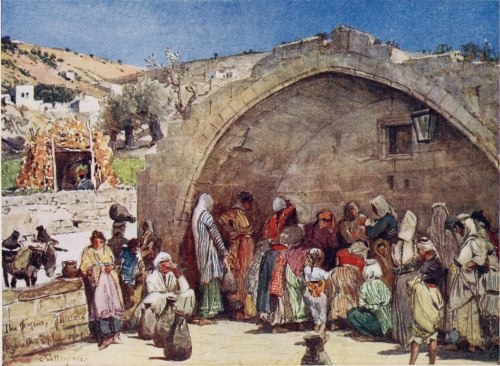
THE FOUNTAIN OF THE VIRGIN AT NAZARETH.
hill of sparkling colour, backed, as we first saw it, by cloudless
Syrian sky, into which it ran its two minarets. It was larger than we
had imagined, and much loftier, with a very bold and gaily tilted
edge-line—a city set on its hill, and with a mighty consciousness of
being so set, like Coventry Patmore’s old English cottage. Dark-leaved
trees, red roofs, and occasional jewel-like points of green, where
copper cupolas have been weathered, light up the picture into one of the
most ideal of its kind.
Within, the white towns shew a strange mixture of splendour and of
sordidness. The streets are aggressively irregular, and the whole
impresses one as at once ancient and unfinished. The wider spaces are
full of colour and of noise, and the houses which surround them are a
patchwork of all manner of buildings, with smaller structures leaning
against their sides, and gaudy awnings of ragged edge protecting
doorways from the sun. Where the street narrows, it is filled with
crowds of men, women, and children, and laden donkeys pushing them aside
as they pass along. There are lanes, also, in deep shadow, with
buttresses and long archways converting them into high and narrow
tunnels. The shopkeepers in these lanes sit behind their piles of
merchandise and converse in shrill voices with neighbours on the other
side, not six feet away. The whole appearance of the town is that of
close-huddled dwellings, which have squeezed themselves into as little
space as possible, and have been forced to expand upwards for want of
lateral room.
These towns are the mingling-places of Syria—crucibles of its national
life, in which new and composite races are being molten. One or two of
them, like Nablus and Hebron, are inhabited chiefly by a fanatical
Moslem population, and in these life stagnates. But the others are open
to the world. In the past, long before the modern stream of travellers
came, this process was going on. In very early times the towns were
recruited by the neighbouring Canaanites and Arabs. They were, as they
still are, so insanitary that if it were not for such additions their
population would soon die out. In Christ’s time the Greek and Roman
world poured itself into them; then came the long train of Christian
pilgrims; after that the Crusader hosts. Each of these, and many other
incursions, have helped to mix the race of townsfolk. In Bethlehem and
elsewhere there are many descendants of the Crusaders, whose fair hair
and complexion tells its own tale. But the mingling of races has gone on
with quite a new rapidity during the last few decades. Trade and travel
have combined to force the West upon the East. Circassians, Kurds,
Turks, Jews, Africans, Cypriotes have settled there. Travellers who have
twice visited the land, with an interval of some years between their
visits, are struck by the sudden and sweeping change. Even the passing
visitor cannot fail to perceive it. The villagers remain apart,
intermarrying within the village or with neighbouring Fellahin. The
townspeople bring their brides from other towns, and sometimes from
other nations. Many kinds of imported goods are exposed for sale in the
bazaars. There are parts of Damascus where nothing is sold that was not
made in Europe. The habits of the West are also invading towns.
Intoxicating liquors are freely sold, and in Nazareth there are now no
fewer than seventeen public-houses. “Paris fashions”—probably
belated—are ousting the ancient customs. Tattooing is quite out of
fashion among the women of the towns, and knives and forks have
penetrated native houses even in Hebron. The traveller comes into
contact with the townspeople far less fully than with the villagers. In
the towns everybody is minding some business or other of his own, and
the stranger meets with the residenter merely as buyer with seller. Once
only did we see the interior of a town house, and that visit confirmed
the impression of a new and composite life very remarkably. It was in
Tyre. An agreeable native, who had brought some curiosities for sale,
invited us to go home with him and inspect his stock. The house was in a
narrow street, but the rooms were large. His wife sat near the window
smoking a nargileh, her eyebrows painted black, and her face heavily
powdered and rouged. The room was crowded with furniture. There were a
sofa and two European beds with mosquito curtains; a new English
wardrobe of carved walnut, with a large mirror; a kitchen dresser
covered with dinner dishes of the customary European kind. Dry-goods
boxes were drawn forth from under the beds and the sofa, and pasteboard
boxes from drawers and shelves, all filled with the most indescribable
medley of curiosities from rifled tombs. Bracelets, tear-bottles,
ear-rings came to light in rapid succession. Finally, a square foot of
lead-work appeared—part of a leaden winding-sheet which had recently
been torn off an ancient corpse in a sarcophagus—a heavy shroud, finely
ornamented with deep-moulded garlands and figures. Our hosts were
good-humoured and pleasant people, who conducted the conversation in
some five different languages, and appeared to combine in themselves and
their properties several centuries of human life.
The grey city of Jerusalem stands unique among the towns of Palestine.
With the brown villages it has nothing in common. The immense variety of
its buildings, with their domes, flat terraces, minarets, and sloping
roofs, distinguishes it at once from the rectangular masses of the
villages. As if on purpose to emphasise the contrast, one of these
villages has set itself right opposite the city across a narrow valley.
Looking from the southern wall of the Haram enclosure, this village of
Siloam is seen sprawling along the opposite hillside, a mere drift of
square hovels seen across some fields of artichokes. Nothing could
appear more miserable; inferiority is confessed in every line of it.
More might be said for the description of Jerusalem as the largest of
the white towns. It is, like them, a centre where races mingle; indeed
it is the centre of such mingling. All roads lead to it from north,
south, east, and west; and when one suddenly comes upon one of those old
Roman roads which make for Jerusalem with such purposeful and grim
directness over the Judean mountains, one realises that this has been
the centre and mingling-place of nationalities for many centuries. Yet
on the spot an obvious distinction is felt at once. There are two
Jerusalems: the old one within the walls, and a new one spreading on the
open ground to the west and north. This “new Levantine city side by side
with the old Oriental city” is quite a modern place. When Stanley wrote
his Sinai and Palestine it was unsafe to inhabit houses outside the
walls. Now such houses are clustered together to the west in a city
which is actually larger than the enclosed one, and whose rows of shops
are hardly distinguishable from those of Western Europe. A strange
medley its buildings are! The best sites are occupied by the great
Russian Cathedral and Hospice, white-walled and leaden-roofed. Beyond
these, embedded in Jewish “colonies,” are the European consulates, with
a Syrian Orphanage and an English Agricultural Settlement farther up the
slope. The Tombs of the Kings lie to the north, in all their desolation,
and the still more desolate Mound of Ashes which is supposed by some to
be a relic of Temple sacrifices; but these are next neighbours to the
Dominican monastery, the Bishop’s house, and the house of that curious
body of Americans known as the “Overcomers”; while on the hill, not a
mile above them, is an English villa. All this and much else pours
itself into the city and mingles in the streets with the very composite
life already dwelling there. Just at the foot of the hill which Gordon
identified as Calvary, while Turkish bugles were blowing from the fort,
we saw two Syrians engaged in rough horseplay, a party of Americans and
English riding, some tonsured and cowled monks on foot, and a travelling
showman with an ape clinging to him in terror of a tormenting crowd of
Jews and Mohammedans; while poor women, unconscious of any part in so
strange a tableau, were returning to the city with full waterpots on
their heads.
Yet in Jerusalem all this makes a different impression from that of
other towns. The mingling of races here is but, as it were, the surface
appearance of a far more wonderful fact. From the days of Solomon,
Israel centralised her life in Jerusalem. On that hill the mountainland
seems to gather itself as in a natural centre, typical and
representative of the whole. There the nation centred its life also, in
“the mountain throne, and the mountain sanctuary of God.” Jeroboam’s
attempt to decentralise cost the nation dear; but in spite of that
attempt the centralisation took effect, and made her the most composite
of cities from the first. All ends of the earth meet here as in a focus.
Laden camels of the Arameans from the far East are making for the city,
and ships flying like a cloud of homing doves to their windows are
bearing precious freights to her port. History and religion are
compressed within the walls. On the spot no one can forget the ancient
geography which regarded Jerusalem as the centre of the earth, with Hell
vertically below, and the island of Purgatory its antipodes, and
Heaven’s centre overhead. In the Church of the Holy Sepulchre they shew
a flattened ball in a little hollow place as the centre of the world. As
in some other cases of faulty science, an imaginative mind may discover
here a happy truth beneath the error. The composite life of Jerusalem
without the walls is but of yesterday, that within the walls is hoary
with age.
We have called it “a grey city,” and even in respect of colour this is a
true name. Not that there is any one colour of Jerusalem. In the varying
lights of sunrise, noon, afternoon, and evening, its colour changes. At
one time it hangs, airy and dreamlike, over the steep bank of the Valley
of Jehoshaphat; at another time it seems to sit solid on its rock, every
roof and battlement picked out in photographic clearness; again, in the
twilight of evening, all is sombre with rich purple shadows. There are
spots of colour, too, which break its monotonous dull hue. The Mosque of
Omar, with its faint metallic greenish colour, stands in contrast to
everything, and makes a background of the city for its isolated beauty.
There is another dome, that of the Synagogue of the Ashkenazim, whose
colour is a lustrous blue-green, shining over the city almost
luminously. White minarets and spires are seen here and there, and a few
red-tiled roofs have found place within the walls. Several spots are
softened by the foliage of trees, and the pools, whose edges are formed
of picturesque and irregular house-sides, catch and intensify the
colours in their rich reflections. Yet, in spite of all that, Jerusalem
is grey. The walls are grey with a touch of orange in it. The houses,
massed and huddled close within, are grey with a touch of blue. They are
built roughly, the stones divided by broad seams of mortar, and most of
them in their humble way conform to the fashion set by the Mosque of
Omar and the Holy Sepulchre, and are domed. But the domes of ordinary
houses are far from shapely, and suggest the fancy that the scorching
sun has blistered the flat roofs.
By far the best view of Jerusalem is that which is seen from the Mount
of Olives, as one approaches the city by the hill-road from Bethany. Her
environs are of interest from many associations—there, on the Mount of
Offence, Solomon offered sacrifices to idols; yonder, on the hill of
Scopus, the main body of Titus’ troops was posted; here, near where we
stand, is the place of the agony in Gethsemane. For many days one might
go round about the city, every day gaining new knowledge of its story.
But what the first eye-shot gives is this: a sharp angle formed by the
two valleys of Jehoshaphat and Hinnom; steep banks rising from their
bottoms to the walls, which they overlap in an irregular and wavy line;
within the walls, glancing back from the angle which they form above the
junction of the valleys, the eye runs up a gradually rising expanse of
close-packed building, which is continued more sparsely in the long
rolling slope beyond, to the ridge of Scopus in the north, and to the
distant sweep of long level mountain-line in the west. It is as if the
whole city had slidden down and
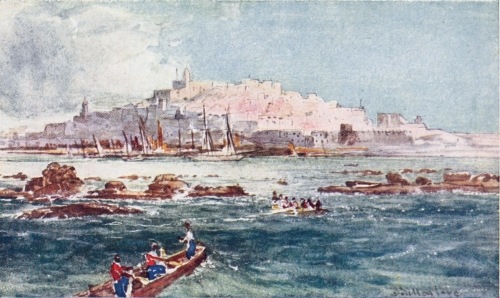
been caught by that great angle of wall just before it precipitated
itself into the gorges.
To see the grey city rightly, and feel how grey it is, you must view it
across these gorges. The more distant environs are detached from the
city. They are cultivated in patches, and dotted with modern buildings
of various degrees of irrelevance. But these are mere accidents, which
the place seems to ignore. The gorges themselves are part and parcel of
the city, and they stand for the overflow of her sad and desolate
spirit. Their sides are banks of rubbish—the wreckage and débris of a
score of sieges, the accumulation of three thousand years. You look from
the lower pool of Siloam in the valley of Hinnom, up a long dreary slope
of dark grey rubbish, down which a horrible black stream of liquid filth
trickles, tainting the air with its stench. Far off above you stands the
wall, which in old days enclosed the pool. Here the city seems to have
shrunk northwards, as if in some horror of conscience. The Field of
Blood and the Hill of Evil Counsel are just across the gorge to the
south. The valleys are full of tombs, those on the city side for the
most part Mohammedan, while the lower slopes of Olivet are paved with
the flat tombstones of Jews.
What a stretch of history unrolls itself to the imagination of him who
lingers on the sight of Jerusalem! The boundaries seem to dwindle, till
that which stands there is the old grey battle-beaten fortress of the
Jebusites, the last post held by her enemies against Israel. David
conquers it, and the procession of priests and people bring up to its
gate the ark, for the celebration of whose entrance tradition has
claimed the 24th Psalm. A new city rises, and falls, and rises again,
through more than twenty sieges and rebuildings. Assyrians, Babylonians,
Romans, Moslems, Crusaders batter at its gates. The level of the streets
rises through the centuries, till now the traveller walks on a pavement
thirty or forty feet above the floor of the ancient city. To discover
the old foundations, the explorers of our time have sunk shafts which at
some parts of the wall touch bottom 120 feet below the present surface.
Far below the slighter masonry of the present wall, with its
battlemented Turkish work, lie the huge stones of early days, some of
which bear still the marks of Phœnician masons.[14]
The gates, of course, are modern, though in some of them there are
immense stones of very ancient date, whose rustic work the Turkish
builders have cut away, and scored the flat surface with imitation seams
to make them match the small square stones of the building above. Yet
the positions of the ancient gates are not difficult to fix, and modern
ones do duty for some of them. Others are built up with solid masonry,
notably the double-arched “Gate Beautiful,” which was thus closed
because of a tradition that Messiah would return and enter the city by
it. It was from this gate that in olden times the man went forth with
the scapegoat that was to bear the sins of the people to the wilderness.
The interior (which, however, dates from the seventh century) is a rich
and beautiful piece of architecture, with massive monolithic pillars
supporting heavy arches, and an elaborately decorative entablature
cornicing the walls. It is a dreary little place, with its litter of
débris and its flights of bats; and its dead wall, pierced only with
loophole windows, now affords neither entrance for Christ nor exit for
sin. What memories crowd the mind of the beholder as he looks upon these
gates! Here, seven centuries ago, went out the weeping company of the
inhabitants, when Saladin took the city. There, eleven centuries
earlier, the Jews set fire to the Roman siege-engine, the flames were
blown back upon the fortifications, and the wall fell and made an
entrance for the legions. That was near the Jaffa Gate. Here again, by
the Damascus Gate, if Gordon’s theory be the correct one, the Saviour
passed to Calvary; and there may be stones there on which the cross
struck, as Simon the Cyrenian staggered out under its weight.
It is indeed a strange city, a city of grey religion, in which three
faiths cherish their most hallowed memories of days far past. But “far
past” is written on every memory. That Beautiful Gate has indeed shut
out Christ, and shut in all manner of sin unforgiven. The land, as has
been already said, seems still inhabited by Christ, but He has forsaken
Jerusalem; it is almost impossible to feel any sense of His presence
there. This is a city of grey history, whose age and decrepitude force
themselves upon every visitor. It has been well described as having
still “the appearance of a gigantic fortress.” But it is a weird
fortress, with an air of petrified gallantry about it, and an infinite
loneliness and desolation. No river flows near to soften the landscape.
A fierce sun beats down in summer there upon “a city of stone in a land
of iron with a sky of brass.” But for the sound of bugles, whose calls
seem always to shock one with their savage liveliness, it might be a
fossil city. Built for eternity, setting the pattern for that “New
Jerusalem” which has been the Utopia of so many devout souls, it seems a
sarcasm on the great promise, a city “with a great future behind it.”
What has this relic to do with a blessed future for mankind—this rugged
bareness of stone, this contempt for beauty, this pitiful sordidness of
detail? History and religion seem to mourn together here, and one sees
in every remembrance of it those two weeping figures, the most
significant of all, for its secular and religious life—Titus, who
“gazed upon Jerusalem from Scopus the day before its destruction, and
wept for the sake of the beautiful city”; and Jesus Christ who, when
things were ripening for Titus, foresaw the coming of the legions as He
looked upon Jerusalem from Olivet, “and when He was come near He beheld
the city and wept over it.”



 . In this form it is more impressive than in the other. The
oblique lower bar represents a board nailed across the shaft for the
feet of the sufferer to rest on. The realistic effect of this is
surprising, for it brings home to one’s imagination in a quite new way
the terrible fact that men have actually been crucified.