THE JACKS IN THE THIRTEEN COLONIES OF NORTH AMERICA.
We now turn to the history of the Jacks in the country to the south
of Canada, where immigration from England had been building up the
thirteen English colonies which subsequently became the United States
of America. The Spanish flag had been planted in 1492 by Columbus upon
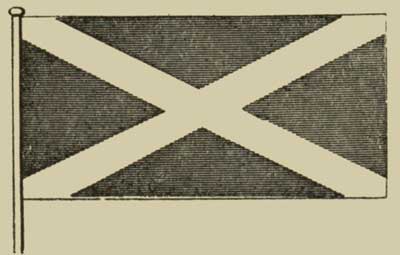
San Salvador in the Bahamas. In 1497, Cabot had placed the St. George
cross, the English Jack of Henry VII., on the North Atlantic shores,
and the English claim by right of first discovery was thereafter laid
to Newfoundland, Labrador, and the coast of America, from Cape Breton
to Maine. Under Elizabeth, Raleigh, in 1584, expanded the claim of
the St. George cross in Virginia far to the south, and in 1602, under
the same flag, Bartholomew Gosnold, sailing out for the merchant
adventurers of Bristol, exploited the shores of Nantucket, Martha's
Vineyard, and Elizabeth, which still retain the names he then gave
them. Other adventurers, too, there were, who were searching the
unknown resources of the new continent. Jacques Cartier, in his second
voyage, had, in 1535, occupied Stadacona (Quebec), and the French flag
had been established on the shores of the St. Lawrence, the permanent
settlement at Quebec being founded by Champlain, in 1608. For more
than two hundred years the cross of St. George had been prospecting
along the Atlantic coasts and laying claim to their possession, but no
settlements were permanently established on these shores by any except
the Frenchman, De Monts, who raised the white flag of France at Port
Royal, on the Bay of Fundy, and laid the foundations of the town in
1605, and from this time on began the contest for their final ownership.
The sovereigns of France and England had with profuse liberality given
royal grants of American territory to their venturesome merchant
seamen, and in this manner James I., in 1605, partitioned off the
larger part of these shores to the two merchant-adventurer companies of
London and Plymouth.
The Plymouth Company was granted the country between what is now known
as New Brunswick and Long Island, to be called Northern Virginia, and
the London Company from the Potomac to Cape Fear in Carolina, to be
called Southern Virginia—the two hundred miles intervening between
them being left unoccupied in order to separate their boundaries,
and so ensure peace between the rival companies, each company being
warned not to make any occupation beyond the limits of the territory so
allotted to them.
The London Company in 1607 established themselves in Virginia, where
their Capt. Newport, after a weary and wave-tossed voyage, named their
first shelter and landing place "Point Comfort," and the river the
"James," and their settlement "Jamestown," in honour of his King.
It was into this interval between the two English companies that
Hendrick Hudson sailed in 1609, and planted the Dutch flag, with its
three lengthwise stripes of orange, white and blue, the orange being
the uppermost, over New Amsterdam (now New York).
To these English colonists fell the honour of the first contest for the
flag.
The French had occupied Acadia, and were quietly extending southward,
when, in 1613, Commander Samuel Argall, of Southern Virginia,[81]
finding them trading off Mount Desert, in what is now Maine, captured
and destroyed their new shore settlement of St. Sauveur, and next
year, heading an expedition sent out by his Colony, advanced farther
northward, and destroyed their headquarters at Port Royal. Thus the
colonists of Virginia, acting for their nation, defended the English
claim, and repelled the interference made with the cross of St. George
in its rights of prior discovery under Cabot.
The Plymouth Company had not been so energetic as were the London
Company in the occupying of their "plantations," but, in 1614, Captain
John Smith, on their behalf, settled a port which he called "New
Plymouth," and gave the name of "New England" to the surrounding
country.
While these things were going on in America the migration of the
Puritans from England to Holland had taken place. These non-conforming
Independents left their homes in England, in 1609, not from any
disloyalty to their native land, but because their religious views
forbade them to bend to what they considered were the unbiblical
Church requirements of James I. To his ritual regulations they would
not conform, so they removed themselves and their families to Holland.
Strong in their English nationality they remained for ten years
at Leyden, an isolated and unsettled colony in a foreign land. To
England they could not return, no place in Europe was open to them
for settlement without losing their language and changing their flag,
and they must, therefore, leave Holland and seek the New World lands
across the ocean. The Dutch offered them assistance and favourable
arrangements for colonization in their Dutch possessions in America.
They were also offered inducements by the London Company to settle on
the Delaware, in their colony of Virginia. As it was considered that
complications might arise if an English colony were to proceed across
the seas under the Dutch flag, they declined the offer of Holland and
accepted the English proposition, and the consent of King James was
obtained to their repatriation in the English territory in America
without conforming to the religious conditions to which they had so
devotedly objected in the Old Land.
Thus they sought the new land, not as rebels, but as loyalists
returning in gladness to their nation's flag.
Forming the "Pilgrim Company," in which they all took shares, a vessel
named the Speedwell was purchased at Delft-Haven in Holland, and
another named the Mayflower in London. The two parties joined at
Southampton. After leaving the shores of England the Speedwell was
found to be unseaworthy, and the two vessels, therefore, returned to
England, when it was determined that the Mayflower should proceed
alone. There not being sufficient accommodation on the one ship for
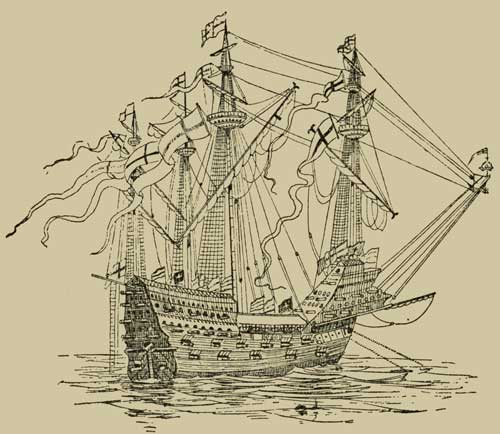
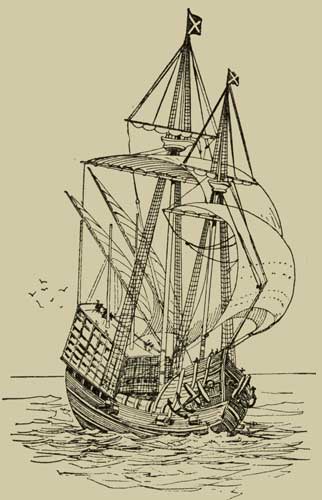
the combined expeditions, a number were left behind. The Mayflower,
a vessel of only 180 tons, sailed from Plymouth with about 100 of
the "Pilgrims" crowded on board. On reaching the shores of America
in November, 1620, after a voyage of two months and five days, they
found that they were far to the north of the Virginia Colony to which
they had been commissioned. Tired of the sea, but being hopeful that
they would receive, as they subsequently did, a grant of land from
the Plymouth Company, and being without a charter for the territory
on which they were about to land, it became necessary to make a new
agreement between themselves for the government of their colony. A
"compact" was accordingly drawn up on board the Mayflower "off
Cap-Codd," and signed by all the heads of families. In this document
they described themselves as
" ... the loyall subjects of our dread Soveraigne Lord King James by
the grace of God of Gt. Britaine, France and Ireland, King-defender of
ye faith, &c., having undertaken for the glory of God, and advancement
of ye Christian faith and honour of our King & Countrie a voyage to
plant ye first colonie in ye Northerne parts of Virginia,"
and the date of the year is given as
"the eighteenth of 'Our Soveraigne Lord King James.'"[82]
As the Mayflower was an English ship she would carry the St. George
cross flag on the foremast, and as they declared themselves to be loyal
subjects of King James it is most probable that the "additional" Union
Jack of James I. was also displayed at the main.
Such was the beginning of the migration of the Puritans from England,
which, following this first colony, continued during the remainder of
the century.
That the Pilgrims carried the English Jack is plainly shown by the
controversies which arose from time to time in this "New England"
district upon the subject of the use of the cross of St. George, not
for want of any loyalty to it, but from their strict religious views.
John Endicott, and the Puritans who subsequently settled at Salem,
objected to the cross in the flag as being an "idolatrous emblem,"
and, in 1634, "defaced the ensign by taking out one part of the red
cross."[83]
Much discussion ensued upon these conscientious scruples, and the
offenders were summoned to appear before the Court of Assistants, but
decision was deferred for several meetings, "because the Court could
not agree about the thing, whether the ensigns should be laid by, in
regard that many refused to follow them." It was, however, ordered by
the Commissioners for military affairs that all the ensigns should in
the meantime be laid aside.
Endicott was finally tried at a general court held at Newtown, and
"his offence found great; he judging the cross to be a sin, did not
content himself to have it reformed at Salem, not taking care that
others might be brought out of it; also laying a blemish on the other
magistrates, as if they would suffer idolatry, and giving occasion to
England to think ill of us." He was, however, lightly sentenced by
suspension for one year of right to hold civil office, because "he did
it out of tenderness of conscience and not of any evil intent."[84]
A suggestion was made that red and white roses should be inserted in
the flag, instead of the cross, as being English emblems, and the
ministers were "to write to England and consult the most wise and
godly;" but nothing came of this suggestion.
Opinions must have continued strong in the controversy, for at the
close of the year the commissioners appointed colours for the military
companies, but left out the cross in them all, leaving the space blank,
but they ordered that the King's arms were to be inserted in the flag
which was to be used on the fort on Castle Island, at Boston.[85]
In the following year (1636) much heart-burning was occasioned by the
masters of several ships trading to Boston declaring that because the
King's colours were not displayed at the fort the colonists were all
traitors and rebels. This imputation was most warmly resented by the
people, and the captains were promptly tried by the Massachusetts court
for this defamation of the loyalty of the colony.
The offenders acknowledged their error and made humble apology in open
court, but in doing so suggested that the King's colours ought to be
shown on the fort. To this answer was made, "that 'we had not the
King's colours'; thereupon two of them did offer them freely to us.
We replied that, for our part, we were fully persuaded that the cross
in the ensign was idolatrous, and, therefore, might not set it in our
ensign, but because the fort was the King's and maintained in his name,
we thought that his own colours might be spread there."[86]
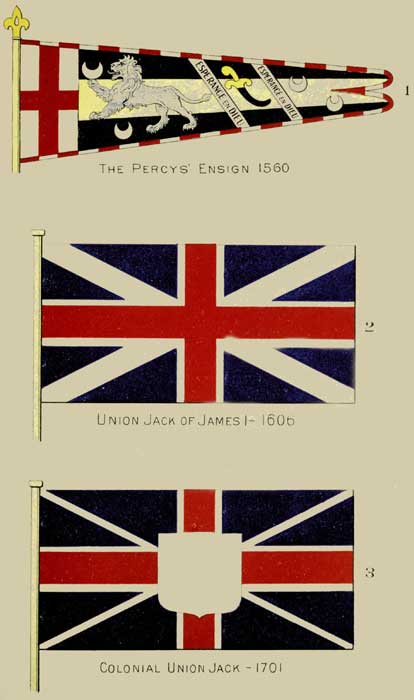
The King's own colours would be the two-crossed Jack of James, which
Charles I. had, in 1634, declared as His Majesty's Jack to be the
"ornament proper for our owne ships." This Jack was ordered to be
thereafter displayed at the fort, lest it might again be thought that
the colony had abated its allegiance.
In 1643, the colonies of Plymouth, Massachusetts Bay and Connecticut
formed themselves for defence against the French and the Dutch into an
alliance as the "United Colonies of New England."
That their forces had continued to use the two-crossed "King's Jack" of
Charles I. is proved by the fact that they found it necessary, owing
to the change of sovereignty in the Mother Country, to pass an order
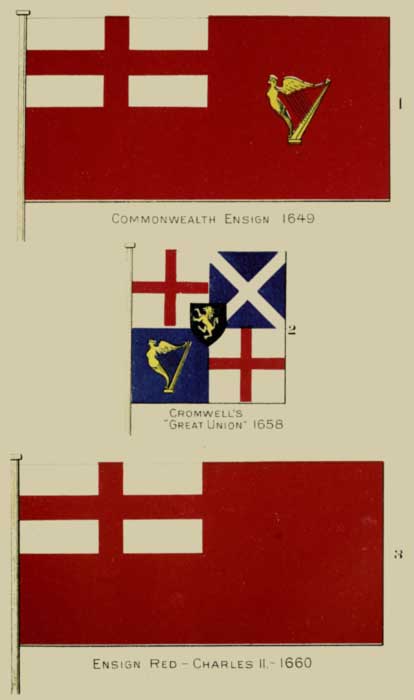
authorizing a change in their own flag. The Commonwealth of England
had, in 1648, abolished the use of the two-crossed Jack. In 1651, the
fleet of Cromwell which crossed the Atlantic was to be seen flying the
single English Jack of St. George and the new Commonwealth Ensign at
Barbadoes and in Virginia. Following the action of the Home Government,
the General Court of Massachusetts overcame their local scruples and
passed an order adopting the English ensign:
"Forasmuch as this Court conceives the old English colours now used
by the Parliament of England to be a necessary badge of distinction
between the English and other nations in all places in the world, till
the State of England shall alter the same, which we much desire, we
being of the same nation, have therefore ordered that the Captain of
the Castle shall presently advance the aforesaid colours of England
upon the Castle upon all necessary occasions."[87]
So the English Jack took the place of the Jack of James in America.
Under this St. George Jack, with its red cross and white ground, the
colonists not only organized and defended their own territories, but
also carried on active operations against the French. As in its earlier
years, so also throughout the century, the extensions southward of the
French settlements in Cape Breton and Acadia had been a menace to the
colonies. The colony of Massachusetts itself took the matter in hand,
and organized an expedition which it sent out under the leadership of
Major Sedgwick, in 1654, when Port Royal was taken from the French,
but, much to the chagrin of the colony, only to be restored to France,
in 1667, by the peace of Breda.
The old controversy about the cross in the flag had by no means been
settled by the decision of the General Court of Massachusetts, in 1651,
and although it was so displayed officially, yet many individuals still
held to the original religious objections.
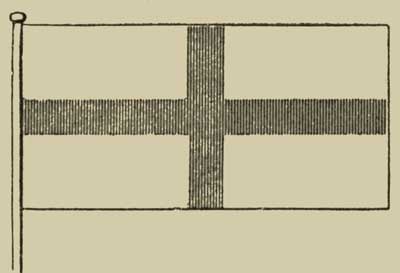
In 1663, the "Ensign Red," with the plain red cross of St. George in
the upper corner, had been ordered by Charles II. to be used.
Thomas Singleton, master of the ship Charles, notes (when off Boston)
in his diary of a voyage to the American coast in 1679-80: "I observed
that while the English flag or colour has a red ground with a small
white field in the uppermost corner where there is a red cross, they
have here dispensed with this cross in their colours and preserved the
rest."[88]
The New England colonists were evidently flying the Ensign Red, but had
taken the red cross out of the Jack in its upper corner, leaving only
the white ground. It was in this it had been suggested that the roses
of England should be introduced, and in which the "pine-tree" emblem
was afterwards placed.
The importance of the particular flags which were to be used along
these Atlantic coasts, where the nationalities were constantly coming
into contact, was eminently increased by the terms of a treaty, made
in 1686, between James II. and Louis XIV., providing "for rights and
pre-eminences in the American seas." Under this it was agreed that,
"the British shall not trade nor fish in the havens, bays, creeks,
roads, shoals or places of the French in Canada,"
and vice versa, the French were not to interfere with the British;
and further,
"that whensoever the subjects of either king shall be forced to enter
with their ships into the other's ports, they shall be obliged at
their coming in to hang out their flag or colours of their nation, and
give notice of their coming by thrice firing a cannon, and if they
have no cannon by thrice firing a musket, which if they shall omit to
do, and, however, send their boat on shore, they shall be liable to
confiscation."[89]
Governor Andros brought out with him from England, in 1686, his
official flag as Governor of New England. A drawing of this in the
British State papers office[90] shows it to have been a large St.
George Jack, having on the centre of the red cross a royal crown, and
underneath the initials of the King, I.R. (Jacobus Rex), in gold.
This Governor's flag was officially used by Governor Andros in the
colonies of Massachusetts and Connecticut.
The united colonies of New England, moved, no doubt, by the necessities
of the Treaty of Whitehall, passed an Order-in-Council, in 1686,
directing the cross to be restored to their Colours. In this way the
red cross of St. George came back into the blank white space which had
been left in the upper corner of the Ensign Red.
We get some glimpse of the mental difficulties of the times from the
diary of Samuel Sewall, an officer in the colonial forces. On August
20th, 1686, he writes:
"I was and am in great exercise about the cross to be put into the
colours, and afraid that if I should have a hand in it whether it may
not hinder my entrance into the Holy Land."
He even contemplated the necessity of retiring from the service, and
enters:
"Sabbath day, August 22.
"In the evening seriously discoursed with Captain Eliot and Frary
signifying my inability to hold, and reading Mr. Cotton Mather's
arguments to them about the cross, and say'd that to introduce it into
Boston at this time was much, seeing that it had been kept out more
than my lifetime, and now the cross much set by in England and here;
and it scarce could be put in, but I must have a hand in it. I fetch
home the silk Elizur Holyoke had of me to make the cross, last Friday
morn, and went and discourse Mr. Mather. He judged it sin to have it
put in, but the captain not in fault, but I could hardly understand
how the command of others could wholly excuse them, at least me who
had spoken so much against it in April, 1681, and that summer and
forward, upon occasion of Captain Walley's putting the cross in his
colours."[91]
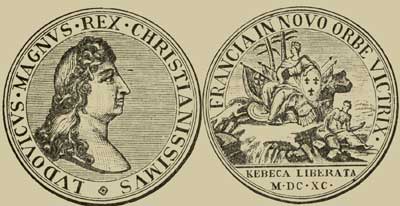
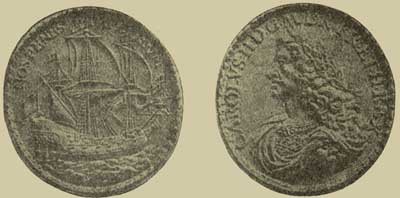
36. Medal of Louis XIV., "Kebeca Liberata,"
1690.
But the crosses were restored, and it was under this single cross
Ensign Red that, during the war between William III. and Mary and Louis
XIV., the nine colonies[92] united together, and, in 1690, of their own
motion and at their own expense,[93] sent out a naval expedition from
Boston, under Admiral William Phips, against the French in Canada.
The fleet successfully attacked and again captured Port Royal,[94] but
arriving before Quebec, above whose ramparts was flying the white
flag and fleur-de-lis of France, was repulsed by the redoubtable
Count Frontenac. The records of the expedition, and of the episode of
the capture of the flag of the Admiral, which, being shot away from
its halliards and falling into the water, was swum after and brought
to shore by the venturesome French,[95] attest that this fleet of the
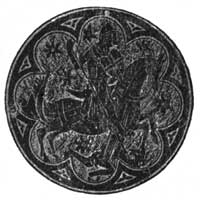
United Colonies was sailing under the cross of St. George. A copy of
the medal (36), issued by Louis XIV. of France in commemoration of the
event, is given in the narrative,[96] showing three fleur-de-lis of
France, and the cross of St. George on a flag reversed.
While the forces of the United Colonies thus used, in common,
the English ensign, some of the colonies had distinctive flags.
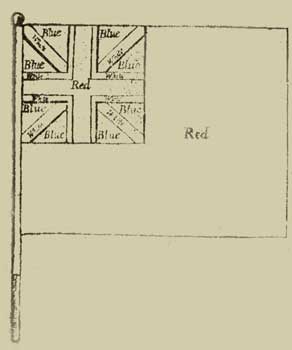
Massachusetts at times displayed the red ensign with a "pine-tree" on
the white ground in the upper corner instead of the cross to which
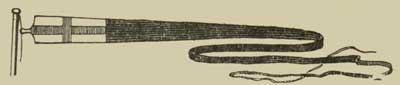
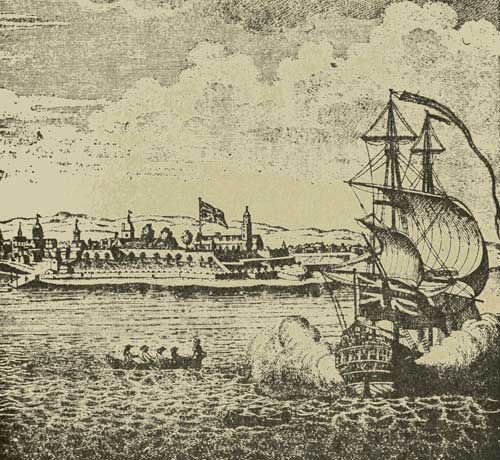
so much objection had been made. The flag of New England (37) was the
English red ensign with the pine-tree, or else a globe signifying the
New World, in the upper corner of the white canton bearing the cross of
St. George. The instance given is taken from the old Dutch publication
of 1711.[97]
This New England ensign was in continuous local use from 1686 to 1775.
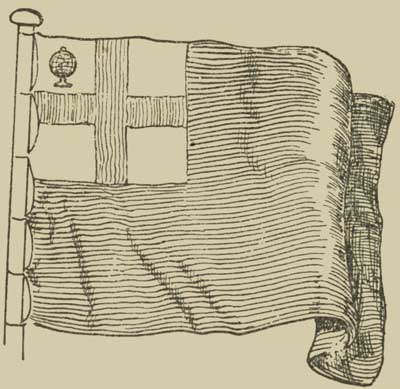
37. New England Ensign.
(From a Dutch publication of 1711.)
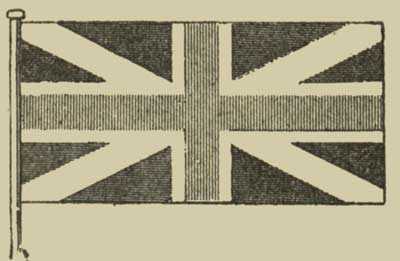
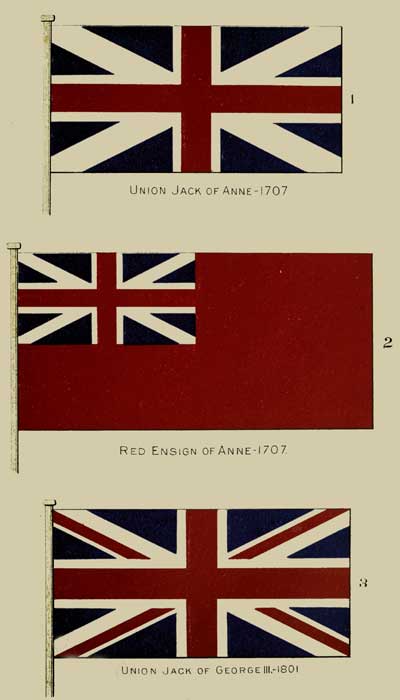
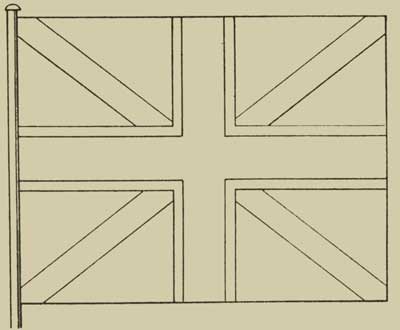
The change in the English flag, made under Queen Anne, from the cross
of St. George to the two-crossed Jack, brought a corresponding change
in the union flag in America.
The narrative of the change in Massachusetts, in 1701, is given in
Chapter XXVII. (page 280). In 1709, similar instructions were sent out
to Governor Hunter for the Province of New York, and the drawing of the
flag[98] which is attached to the documents is the same in 1709 as in
the instructions of 1701.
Under this Queen Anne Union Jack, Port Royal was once more taken by
the forces of the United Colonies, sent out from Boston under General
Nicholson, in 1710, and its name changed in honour of their Queen to
Annapolis, where both Royal name and British ensign have ever since
remained.
The colonists had in all these expeditions stoutly proved their share
in the prowess of the British Jacks. Acadia,[99] by the Treaty of
Utrecht (1713), had been ceded to Britain, but Cape Breton had remained
in the hands of the French, and Louisbourg having been created by
them the strongest fortress in the New World, the British colonists
determined upon its reduction.
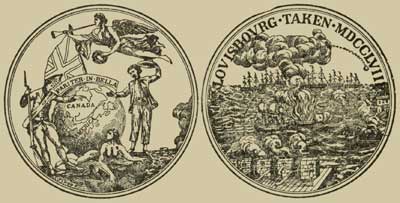
38. The Louisbourg Medal, 1758.
In 1745, an expedition, entirely colonial, organized by General
Shirley, of Massachusetts, and William Vaughan, of New Hampshire,
sailed from Boston under General Pepperell. After a siege of forty days
Louisbourg surrendered. In 1748, the fortress was again restored to the
fleur-de-lis by the Treaty of Aix-la-Chapelle, but only to be retaken
by Wolfe, in 1758, and the Queen Anne Jack, which the United Colonies
had before placed above it, was restored and is shown again in the
Louisbourg medal,[100] used to commemorate Wolfe's victory (38).
On yet another field the United Colonists carried the Union Jack. In
1762, when Havana was captured from the Spanish by Lord Albemarle,
there were in his fleet of 203 vessels, and among his land forces of
12,000 men, alongside the men from across the sea, colonial contingents
sent by the colonies of Connecticut, New York, Rhode Island, New Jersey
and Maine.[101]
When Cuba was thus gained for the Union Jack the colonists of America
were joined with their British brothers from the Old Land in lowering
the flag of Spain, but the island was restored to Spain by the Treaty
of Paris, February 10th, 1763.[102]
Thus for over two and a half centuries (1497-1762) had the English
Jacks wrestled with the forests and battled along the shores of
America, carried first by the merchant adventurers, and afterwards
by the several and the United Colonies, as sign of their origin and
allegiance. For yet another long period was the two-crossed Jack to be
carried by those who had so manfully won competence and glory beneath
it, so that at length, even when joining for contest with their parent
realm, the Thirteen Colonies held its past and record in such esteem
that they placed the Union Jack of Queen Anne in their new Union Ensign
as a sign and remembrance of their common history.